The Magazine of the National Traction Engine Trust
4.41t
•. I.
. •
Preserving our heritage with steam on the road Vol 52 No 3 — Summer 2009
n .CMAY HALL. Lori° ❑ NON.
THE NATIONAL TRACTION ENGINE TRUST Preserving our heritage with steam on the road The membership of the National Traction Engine Trust is open to all of those who, whether they are engine owners or not, have a genuine interest in the preservation of self propelled steam road vehicles, portable engines etc.
The annual subscription rate is £25.00. The Trust's profusely illustrated colour magazine Steaming is sent free to members during the early part of January, April, July and October, and other benefits of membership include very advantageous terms for boiler and other types of insurance cover as well as access to advice on technical matters. The Steam Apprentice Club is the junior section of the NTET, formed to support youngsters up to the age of 21 in learning about and appreciating road steam. To find out more please contact the Chairman (see right) or view the SAC website at www.ntet.co.uk/sac
President: Richard Sandercock Vice Presidents: Andrew Semple; Len Crane Chairman: Robert Herring, Glebe Court, Fringford, Bicester, Oxfordshire OX27 8RJ (v 01869 277410) Vice-Chairmen: John Cook; Bob Siddall
General and Company Secretary: Jenny Holt, South View, Hutton Roof, Kirkby Lonsdale, Carnforth LA6 2PF (s' 01524 271584; fax 01524 271768) Membership Secretary: John Cook, 74 Church Lane, Kirkby la Thorpe, Sleaford, Lincolnshire NG34 9NU Om 01529 303160) Treasurer: Julie Smith FCA, Yew Tree Cottage, 98 The Ridgeway, Astwood Bank, Redditch Worcestershire B96 6NA (v 01527 893427) Chairman, Rally Organisers Section: Tim Holt, South View, Hutton Roof, Kirkby Lonsdale, Carnforth LA6 2PF (Tr 01524 2/1584; fax 01524 271768) Chairman, Engine Owners Section: Bob Siddall, Stud Farm House, Ossington Lane, Sutton on Trent NG23 60R (v 01636 821991) Head, Technical Services: David Smith, Yew Tree Cottage, 98 The Ridgeway, Astwood Bank, Redditch, Worcestershire B96 6NA (Ts 01527 893427) Head, Membership Services: John Cook (as above) Chairman, Steam Apprentice Club: Kevin Munn, 56 Biacklands Avenue, Hayes, Middlesex UB4 8EX 0208 573 9180) Rally Authorisation/Affiliated Groups: Bill Evans, PO Box 102, Wrexham, Clwyd LL13 OZS (a/fax 01978 781196) Insurance Officer: James Blenkinsop, Forge Cottage, Combrook, Warwick CV35 9HP (1T/fax 01926 642016)
Patrons Hal Bagot, JP; Robert Goodwill, MP Dr Tony Marchington; The Rt Hon Sir William McAlpine, Bt; Michael Oliver, MBE; Hamish Orr-Ewing; Richard Preston
Internet address: http://www.ntet.co.uk E-mail: ntet@ntet.co.uk A full list of the e-mail addresses of officers can be found on the Trust website - www.ntet.co.uk
Steaming
Back issue references are shown as Volume/number in year (as shown on cover) and page number.
back ...
Boiler inspection - 50/2, page 68; 50/4; 51/1, pages 6, 7, 35; 51/2, page 64 and 66; 51/3, page 116; 51/4, page 168; 52/1, page 6 and 14; 52/2, page 60 and 75.
This panel is a selective index to topics from past issues which readers may wish to refer back to. It is confined to items such as legislation, insurance and other subjects which may not be totally absorbed by members at first reading. The index will be maintained on a rolling basis, with topics retained from issue to issue, depending on their currency and association with on-going discussions and announcements.
Boiler joints - 48/1 page 5 and 52; 48/2 page 85 and 116; 48/3, page 177; 49/3, page 145; 50/4 page 198. Coal - 48/3, page124; 50/1, page 26; 50/2, page 10; 50/3, page 143. Driver competency - 50/1, page 5; 50/3, page 128; 50/4, page 184 etc; 51/1, page 6; 51/2, page 84; 51/3, page 117; 51/4, page 169/177; 52/1, page 7 and 8. Engine insurance - 48/4, page 188; 49/2, page 69; 49/3, page 127; 50/1, page 7; 50/2 page 69; 50/4 page 190. Engines on the road, inc licences - 47/4, page 185; 48/2, page 67 and 69; 48/3, page 126/127; 49/1, page 9; 49/4, page 185; 50/1, page 38. NTET Disc Scheme - 49/3, page 127; 51/2, page 65; 52/1, page 10. Traction Engine Code - 50/1, page 4; 50/2, page 68; 50/3, page 128; 50/4 page 184. Water
48/2, page 65 and 86; 49/3, page 145; 52/2, page 75.
The Magazine of the National Traction Engine Trust Volume 52 Number 3 Summer 2009 Editor: Roger West, 14 Charles Street, Market Harborough, Leicestershire LE16 9AB (V 01858 467326) e-mail steaming@ntet.co.uk Steaming Around (only): Derek Rayner, 'Invictac 9 Beagle Ridge Drive, Acomb,YorkY024 3J1-1 Display Advertising and Small Adverts: to the Editor Distribution and Change of Address: John Cook, 74 Church Lane, Kirkby la Thorpe, Sleaford, Lincolnshire NG34 9NU (V 01529 303160) The Editor is pleased to consider contributions of suitable articles, shorter items or photographs for inclusion in future issues. All material submitted is voluntary and payment cannot be made for any material published, although expenses incurred may be met. The opinions expressed in the magazine, with the exception of those printed asTrust announcements, are those of the contributors and do not indicate the views of the Trust as a whole. All items are held copyright by the contributors and/or the NTET. Next issue:The press date for news items, recent photographs and small adverts is 9th September 2009. For the date for Steaming Around see that section.
From the Chairman As the rally season unfolds, early indications are that events are being well supported by the public, but spending on the field is curtailed — let us hope the weather remains in the organisers' favour. The Training Course at Astwood Bank in May was again a success, very much due to the efforts of Hazel and StuartTomlinson. After six years they are stepping down from the role of organisers of this annual event, and on behalf of all involved I pay tribute to their hard work, which has been much appreciated. After much discussion, dialogue and determination the trio of Bob Garnett, Tony Seddon and Stuart Tomlinson has brought the completed alternative Voluntary Certificate of Competency in to being. Its official launch will be on the Wednesday evening at the Great Dorset Steam Fair, and I hope all those who took such a keen interest in its requirement will be in attendance. In my last report I mentioned the thorny subject of conversions; a small working party was tasked with reviewing theTrust's position. I must say it was disappointing to read in the chairman's report of a fellow magazine some unsavoury remarks of our past history on this subject. These I feel were unfounded; only through combined efforts by all like minded bodies will we address this issue. The thread throughout all discussion is that of education, we cannot turn the clock back, but we can create awareness through education to our Steam Apprentices, the general public and the rally organisers. There will be more to report in forthcoming editions. Recent approaches from respected engine owning members who are also steam car enthusiasts have resulted in collaboration in supporting them in continued on next page
This issue 108 115 116 118 121 123 124 126 134 138 140 152 155
Trust News National Steam Car Association Caveat Emptor Keeping a McLaren at work TechnicalTips An East African export Persian aid NIPPY comes to life Steam rollers around the trams in Leeds From Trowbridge to the Line of Communication Steaming Around, compiled by Derek Rayner Letters WAIT & SEE
Bob Payne Derek Rayner
ISSN 0260 - 2962
Front cover
Published by the NationalTraction EngineTrust at 14 Charles Street, Market Harborough, Leicestershire. Printed by AB Printers, Montrose, Crown Hill, Great Dalby Leicestershire LE14 2ER
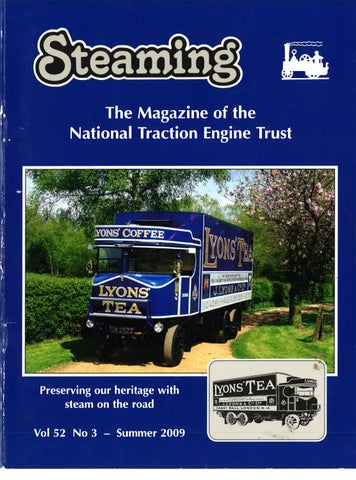
NIPPY Sentinel DG6 wagon 7966, basks in the May sunshine after the completion of its restoration. A feature article on that work and pictures on its second excursion on the road appear elsewhere in this issue. Barry Cousins' seven years painstaking work on the iconic Lyons wagon will surely be pronounced to be the restoration of the year, despite other colourful contenders. (Dick Blenkinsop)
STEAMING Summer 2009
107
Trust News continued from previous page their wish to form an Association that takes the issue of responsible ownership of a steam propelled car. Their aspirations are very much in line with the standards we set for traction engines, and embrace the merits of our much revered insurance disc scheme. The new group is to be known as the National Steam Car Association and you will find a press release elsewhere in these pages. I am pleased to be associated with it. In supporting them we will be hosting a display of steam cars and items of interest within the Trust marquee at GDSF this year; NSCA members will be on hand throughout the week. I hope all those interested will take the opportunity to view and support this new venture. I look forward to the development of our ties and the strengthening of safe operation of these vehicles. In other areas within the Trust marquee at Dorset will be found much else of interest, with all the usual activities that have become standard in recent years — book sales, refreshments, membership renewals, with different engines on display and this time a demonstration of engine lamp making. Most officers of the NTET will be in attendance some of the time and will be pleased to discuss any issues. Finally we will be holding an Open Forum within the marquee on the Friday evening. (Robert Herring, Chairman)
Rally Organisers Column Rally Organisers Section Once more we are into the rally season and I sincerely hope all goes well with your event. So far, as I write, the weather has been kind, and 'heavy plant' has not been needed to haul exhibits and traders onto and off the fields. It is presently early in the season, but attendances through the 108
gates at rallies have been up. The downside is that traders, who are going through a bad time anyway, do not seem to be reaping the benefit — or is it that they are not selling what people want to buy? I have notified all Authorised Event organisers that fraudulent insurance discs have been discovered so, Safety Officers, please be aware when checking steam engines and steam cars. To help event organisers the Trust has set up an internet based checking system. A personal code and password is supplied to organisers to allow them to check, shortly before the event, the status of all steam vehicles with NTET discs that have arranged to attend their rally. If anyone finds this difficult there is still the facility to notify James Blenkinsop with a list of engines attending their event and he will be able to check them. Please remember lu lel the Authorisation Officer, Bill Evans, have your completed Safety Report within 30 days of your event.This is a condition of your Authorisation. The Rally Organisers Conference is usually held annually in October. In order to make the Conference worthwhile and rewarding to riPlerjAtPC we nopri to arlrirpec their concerns, and to cascade information on the subjects which are required by the membership. Legislation and interpretation of requirements is often a worry to many; therefore, if you feel a specific subject should be addressed please make contact and let me know, as the agenda will be prepared shortly in order to book speakers. If you are new to rally organising you may find it of benefit to have subjects repeated which you know we have discussed in the past. This would not be a problem, but please let me know what they are. I am always ready to help on all aspects of rally organising; please do not hesitate to contact me with your doubts and problems. Have a safe and happy rally season. (Tim Holt, head of Rally Organisers Section)
Steam Cars The Executive Committee of the
Trust issues advice to Rally Organisers that steam cars of any type attending an Authorised Event, or appearing in a public place, should be able to demonstrate that an independent examination of the steam generation and pressurised fuel supply systems has been undertaken. This advice is given to ensure that such vehicles are adhering to the NTET's 'Duty of Care' and Health and Safety Policy statements, both of which are in the public domain.
Technical Services Unit Launch of NTET web services Over the last few months members of the Technical Services Unit and the Rally Organisers Section have been working to develop an internet based Insurance Disc enquiry service. By the time you read this the service will be officially live. This new on-line service enables organisers of Authorised Events to check the validity of Insurance Discs of steam exhibits attending their events, prior to them actually attending the event. Access to this service is afforded by a combination of the Event Authorisation reference and a unique password, the specific contents of each will be included in individual 'Authorised Event Packs'. The on-line service includes the following salient features — • Online preparation of a check list for all of the steam exhibits that are scheduled to attend a specified Authorised Event. • Simple on-screen instructions including requests for assistance from the service administrators. • Results of each on screen enquiry shows whether a valid Insurance Disc is in place throughout the dates of the specified event by a 'Pass' — 'Fail' indicator. • The on-screen report can be printed to a local printer or emailed to an address of the enquirer's choice. • All of the expected exhibits may be checked at one time, or the enquirer may Summer 2009 STEAMING
return to check groups or individual exhibits. • After midnight on the closing date of an event access to the service is withdrawn for that event. • A copy of all enquiries made is emailed to the Event Authorisation Officer, Bill Evans and also to the Insurance Officer, James Blenkinsop. This allows the service administrators see how well the system is being used.
This is how the new system will be working — Authorisation Officer • The Event generates an Authorised Events export table from within the Events Manager System and posts that table onto the services website. This process is repeated prior to and during the rally season as new events become authorised. • Details for accessing the service, including pass-keys, are detailed in the 'Authorised Events Pack' sent to the event organisers. Event Organisers please note: because this new service has been commissioned after the start of the current rally season access details are being sent separately to event organisers. • The Insurance Officer regularly updates the Insurance Disc Management System with input from the Authorised Disc Issuing Agents and from his own endeavours. A summarised output from the Disc Management System relating only to inspection and insurance control dates and simple item identity details is posted to the services website on a weekly basis. • On the NTET Services website the two sets of information are used to provide authorised users with the disc status information relevant to the dates of their events.
Certificate of Competency Scheme - the experience based option The initial proposals for this scheme were outlined for members' further discussion and input on pages 8 to 10 of the Winter 2008/2009 issue of this magazine. From responses, some valuable input has been received and incorporated. A goodly proportion of the time at the June 2009 Council meeting was devoted to consideration of the final version of the Scheme, and this was approved by Council subject only to a few amendments. With these final adjustments it is proposed to launch the Scheme on the Wednesday evening of the Great Dorset Steam Fair. By then the full details will be available on the Trust website, and in printed form in a small booklet. If you are at the Dorset event please come along to the—
Trust marquee, 7.00pm, Wednesday, 2nd September As with the annual Engine Owners Meeting, non-members will be welcome to attend.
• Access to the service is via a link from the NTET main website Events page, http://www.ntet.co.uk/events.html or directly via www.ntetwebservices. org.uk/insurancediscs
I hope that Rally Organisers will find this innovative service useful in cutting down the work required to examine Insurance Discs during their event; with the check list report in
hand, an organiser will need only follow up on any exhibits reported as having discs that are 'Failed'l This long awaited service will remove almost entirely the dependency upon the Insurance Officer for up to date disc status information. I extend my gratitude to David Collidge, the NTET's webmaster, who wrote the web-side software code
Burrell showmans road loco 3288 NANCY succeeds in brightening the scene during an otherwise wet and dismal event in Bailey Park, Abergavenny, Gwent at the 2008 May bank holiday. (David Warren)
JOSEPH BREWER 84
SONS GOLDEN GALLOPERS -4-t-•49 . 114040
1111r F4--
/ 4:
This is Marshall 6hp compound traction engine 74335. It was delivered new in April 1921 to Herefordshire County Council, and, from the glimpse of the surroundings we see in the photo, probably put to work at driving quarry machinery to prepare road making material and in distributing it to roadside sites. By evidence of the Marshall's registration number on the living van, it seems the engine and its driver were also expected to move good distances around the county. If the youngish chap standing awkwardly with oil feeder hl, roar whool is tho drivor tho hnwlor imttorl figuro to tho right IC rortainh, his superior, maybe the County Surveyor. The Marshall had two later owners in Cheshire, being with Walter Mansfield of Macclesfield from 1943. (collection Willem Middlemiss) and helped me develop the ideas. I also thank Bill Evans and James Blenkinsop for their valuable input, and the authorised Insurance Disc issuing agents, upon whose continued support the success of this system is heavily reliant. In conclusion, if any event organisers who are reading this article have any feedback, following their use of this service, I would be pleased to receive it. Technical Support to Members This is a reminder that theTSU not only supports the internal working of the Trust, but is also available to provide assistance to members. The volunteer team consists of repair 110
professionals, insurance advisors, engine owners, chartered engineers, business administrators, IT Professionals, and we also have direct access to quality legal opinion, albeit at a cost. (both paragraphs, David Smith, Head of Technical Services Unit)
The Trust website It is high time for a reminder in these pages of the Trust's website. There may be some members who complain they do not have access to a computer; however statistics
published earlier this year claim over two-thirds of households now have access to the Internet. Even among those with computers, many may not have a fondness for the medium, but much of the detailed information on the Trust's activities — the Codes of Practice fnr oxrnplo — aro !)0 1-. mario available to members and others in on-line form. Generally, there is little that is placed on the website that does not have an equal airing in our quarterly magazine, so members not using computers can be assured they are not missing out. The Trust's website is located at www.ntet.co.uk As well as information about the work of the Trust, it has in addition a News Page which is updated regularly — sometimes two or three times a week. Some may be unaware of the Q&A page, where members and non-members can ask about any matter connected with steam road vehicles; the work of the Trust; steam events, etc. Recent questions have sought guidance on public steering at steam rallies; the status of Authorised Events, and then wanting to know something of the voluntary certificate of competency, the legal age for driving a steam vehicle on the road, Summer 2009 STEAMING
the subject of coal .... And, of course, the answers are there for all to see and learn from. If you have a question please send it to me at public.relations @ntet.co.uk The original question together with an answer, generally written by a member of the Trust's General Council, will be published on the website. Every endeavour will be made to answer your question as quickly as possible. (Mike Dyson, Public Relations Officer)
Steam Apprentice Club By the time members read this aragraph we shall have celebrated the 30th Anniversary of the Steam Apprentice Club at the Shuttleworth Collection premises at Old Warden Bedfordshire on the 27/28th June. Although it was headed the SAC 30th weekend - and I am writing these words prior to the gathering - I know the event would not have been possible without the organisation and assistance of the Bedfordshire Steam Engine Preservation Society under the guidance of Paul Worbey, ably helped by many members of the club to whom we give our warmest thanks. My thanks also to all the enginemen and ladies who made their engines available during a busy part of the season for the Apprentices to learn on. I hope in the next issue of Steaming to be able to give details and pictures of what went on. And now not very far around the corner is the Great Dorset Steam Fair, where we shall again have a stand in the NTET tent. I hope you will come along and say hello. To those engine owners who are going to be exhibiting at Dorset, I hope you will be able to spare some time to take an Apprentice for a day or even half day, to show them how your particular engine works, and for them to learn how to operate it. It is hoped an announcement will be made at the safety briefing on the Wednesday on how we shall arrange to distribute the Apprentices; there will also be a notice on the SAC stand. As usual there will be the cavalcade on the Thursday evening around 5pm which many, engine crews and Apprentices, enjoy. So, please keep your engines in steam for that. (Kevin Munn, Chairman, Steam Apprentice Club) STEAMING Summer 2009
NTET Sales Exhibition and Sales Unit - The Unit will continue its travels to engine rallies through the rest of the 2009 season. Appearances are due at the following events in the second half of the summer. August - 31st July to 2nd, Kemble, Glos; 22nd/23rd, Fairford, Gloucestershire. September - 2nd to 6th, Great Dorset Steam Fair; 12/13th, Barleylands, Essex; 19/20th Old Warden, Beds. Further detail on the location of each of these events was in theTrust's The Rally List 2009, which was distributed with every member's copy of the Spring issue. New books - At times it has not proved possible to stock certain new book titles for sale to members by Mail Order, due to the postage costs being greater than the publisher's discount available to the Trust. Such books may, in future, be available to those members who can call at the Sales Unit at rallies and Trust gatherings, so eliminating the postage costs. Published in June by the Lincolnshire Steam Engine Preservation Society, to mark their 50th anniversary, is a splendid photographic album Lincolnshire at Work with Steam. The A4 size casebound landscape volume has 208 pages, the illustrations mainly one to a page, full width, with suitably extensive captions to describe the scene. The pictures cover all the years of commercial steam use, and then also take in the early days of preservation in the county. Copies of this book will be available from the Sales Unit, price £19.95, but not by Mail Order. (Colin and Val Brown, NTET Sales)
FBHVC News There is no news from the Federation of British Historic Vehicle Clubs, via its Newsletter, of items of potential future legislation that would adversely and specifically affect steam engines on the road. Similarly, the Trust has no points on which it is presently seeking assistance for the Federation. However, the ways and means are in place within the FBHVC to attempt to counter anything which may arise from proposed EU and Government legislation, and is unhelpful to old vehicles on the road.
jrcook books for the traction engine enthusiast visit our website www.johncooksbooks.co.uk
or send for a catalogue 74 Church Lane, Kirkby la Thorpe, Sleaford, Lincolnshire, NG34 9NU Tel: 01529 303160
The Federation was pleased with the response from owners of all varieties of old vehicle to the 2009 Drive It Day in April, which once again showed the spirit and enthusiasm of the movement. The Newsletter editor wrote that 'the very many vehicles out on that day proved that we are not involved with the 'old bangers' that the Government is trying to banish from the roads, but are using genuinely cherished cars, bikes, commercials etc. This fourth running of D-I-D was the best supported yet - thank you to everyone who took part, and that includes the spectators that waved enthusiastically as we passed by.' It seems though, that not everyone is pleased to see old vehicles on the roads; the Western Morning News of 21st April published a letter from a very disenchanted motorist held up by what he felt was a slow moving convoy. Our answer must be to be considerate in these circumstances, for it is vital we retain the good will of the general public. Some time ago the Trust distributed to members a copy of the FBHVC's Guide for Users of Historic Vehicles, and section 4 of the booklet gives some useful pointers: if your copy has wandered try the Federation website www.fbhvc.co.uk A single steam engine moving at not very much more than walking pace may not be so much of annoyance as a group of elderly cars at a faster, but not modern, speed, but it behoves us to guard our right to steam on the highway by choosing suitable roads, sensible times and generally acknowledging the needs of other
road users. 111
Obituaries Roger Newbery We much regret to record the death at the age of 66 of Roger Newbery of Ringwood, Hampshire, on 25th May, following the diagnosis of cancer about the turn of the year. Roger's name is well known to many road steam enthusiasts for his avid enthusiasm for photography and especially in more recent years, video photography of engines on the road, a passion which extended to
vintage commercial vehicles on similar runs. The completed films were marketed for others to enjoy, a more recent notable programme being that commissioned by the Bedford club to mark their 50th anniversary. There was meticulous attention to detail when planning locations of the passing parade, and his films will be a tribute to his
memory, being typical of a man who was of careful and considerate thought. An accountant by profession he worked for insurance companies dealing with tax issues at high level, sometimes at the Treasury. In the 1970s Roger and his wife Mary gave much time to the then newly
introduced sales tents of the NTET, being the sales team that represented the Trust at rallies and events in the southern half of England for a good many seasons. Roger died at home, as he wished. His private cremation was followed by a memorial service at Ringwood Church, which was attended by a
large number of his steam world friends. We offer our sincere condolences to Mary, his wife of 37 years, and to daughters Joanna and Emma and their families.
John Podmore John Podmore, who passed away in January, was a founder member of the North Staffordshire & Cheshire
Traction Engine Club and its long serving Treasurer — until the end of last year its only Treasurer, having served for over 50 years. The Club celebrated its 50th anniversary last year, and John was one of eight present who attended the first meeting. John Stuart Podmore was born in
July 1924 at Moddershall, Stoke-onTrent, into a family involved for several generations in the local pottery industry. Leaving school John trained with Barclays Bank in Tunstall where he met his wife, Jean Lindop; they married in 1950. John's banking experience stood the Club in good
112
stead. Serving in the RAF, he gained his pilot's licence, and on demobilisation joined the family firm. John later worked for Dale Hall potters' millers at Middleport, supplying
and road steam still evident on highway works and fairgrounds. Even as a youngster his notebook started to record everything he saw. A naturally methodical person who
industry with raw materials. In 1966 he became a director ofTean Minerals Limited, a consortium of local firms at the former Foxfield Colliery near Cheadle, which ground flints and
became an accountant with the Oxford University Surveyor's Department, it was second nature to John to set out his records in exceptionally accurate detail. Over
other material for the pottery industry. Here John's interest in steam facilitated the Foxfield Light Railway Society to operate the 3? mile private railway which ran to the
the years he built up not only the road engine Register but in even greater detail, historical and current records of British railway steam. As railway steam was withdrawn
main-line at Blythe Bridge. The unencumbered use of the line by Society members was largely due to the good-will of John and his fellow directors.
John's interests moved into the practical preservation of engines and a long association with Didcot Railway Centre. Here the locomotive he owned, Great Western Railway
John was indefatigable in supporting the North Staffs Club, attending its events and arranging financial matters. In early days, when the rally moved to Rugeley from
saddle-tank 1338, was housed and eventually restored. To assist in funding this, and with the help of colleague Brian Kinsey, the first Traction Engine Register was
Alton Towers, what might be referred to as creative accounting was required. But John kept his eye on matters, and we could not have been
produced from their records in the 1960s. Sparse in content and duplicated on foolscap sheets it nevertheless started a record of
in better hands. It was John's wish to complete his 50 years as treasurer, and while he was prevented from having a formal hand-over, for he was taken ill shortly after the
current road steam preservation. In 1968, now in association with the Southern Counties Historic Vehicles Preservation Trust, the familiar TER
anniversary celebrations, he achieved his ambition. Although John never owned an engine, he was joint owner of one of
booklet first appeared. Few enginemen will have met John and others will only have known him through correspondence. John took his pleasure, not in visiting
the first engines that Club members acquired in 1959, Mann's tractor number 1287 TINY TIM. For several years I looked after and rallied this engine, often accompanied by John's
rallies, but in collating information. With a trusted team of observers and the help of owners he gradually refined the listing such that it has become the recognised definitive
daughter Helen.
schedule of existing engines. In 2008 the 10th edition was piblished, with John insisting on maintaining his involvement and standards despite major disabilities.The issue stands as a testament to his dogged
As wall as his inter-PO in marl
steam, John was a keen Rotarian. Until recent times, with his wife Jean, he regularly visited their daughter Susan in South Africa. He is survived by Susan and other daughters Gill and Helen, along with their families. The North Staffordshire & Cheshire
Club was well represented at the Thanksgiving Service. I am grateful to John's daughter Helen Banks, David and Dorothy Bradbury and Alan Williamson, for help in compiling these notes. (Allan Baker)
John True Many interested in road steam vehicles will immediately recognise the name John True as the compiler of The Traction Engine Register. John Barrett True died in March 2009. Born in 1932, his early days in north Kent introduced him to steam trains at the bottom of the garden,
determination over fifty years to compile an accurate record. Those who worked with John on the Register will miss him for his
friendship, his quiet and professional approach to resolving details and his ability to recall information at a moment's notice. They are determined to ensure the Register continues to develop as he sought to maintain it. A packed chapel at his funeral remembered a quiet man who had done so much for others
and for railway and road transport history. (Brian Johnson) Amendments to the Traction Engine Register are now being collated by Brian Johnson, as the editor, at 24 Priory Road, Arundel, West Sussex BN18 9EN — e-mail tractionSummer 2009 STEAMING
.2L°' TELEPHONES* 1110143.BILSTON TARMAC LIMITED ETTINGSH ALL WOLVERHAMPTON
enginereg@btintemet.com Readers are asked not to send correspondence to the Oxford address given in the current Register.
Affliated and other groups Road Roller R.R.A. Association Progress continues to be made with the Pudsey Roller - 1921 Fowler 15752 (WR7508). Dismantling has carried on and the Road Roller Roller Pudsey Association's Restoration Fund sub-committee met in February when several decisions were taken on the seeking prices for the supply of a new tender, an ashpan and a new boiler barrel. A conscious decision was taken not to pursue the production of the roller's new tender (at a very good price) Long off-cuts of timber are fed to build the fire in the Britannia circular firebox of Marshall 6hp portable 87866 of 1936, being prepared for its day in the wood sawing arena at the 2007 Great Dorset Steam Fair. (Roger West) STEAMING Summer 2009
TARMAC
LIMITED
ETTIN ;SHALL
WOLVERHA IPTCNO
Always presented immaculately in its black livery is Sentinel model S6 steam wagon 8821 of 1933. lan Cooper took the photograph at the July 2008 Kemble event. with the person who recently carried out the conversion of the Fowler tarspraying roller UNDAUNTED. It is accepted this decision will cost the RRA more money - which is not presently available - but it was felt it was the right thing to do in the circumstances. As a result of recent local publicity, Leeds City College Engineering Department asked if there are any suitable projects with which students could become
involved, so helping them with their studies and also furthering the restoration project. This has been explored and several tasks are being pursued which will hopefully benefit both parties. The present financial position is that the Fund has now topped £13,000 since it was launched in March 2007.The contact for anyone who may wish to assist is Derek Rayner, whose address is at the beginning of the Steaming Around section of this magazine.
Annual General Meeting The 2009 Annual General Meeting of the Trust will take place on Saturday, 21st November at the Manor Hotel, Meriden, West Midlands. Details of the informal programme for the whole of the weekend are under the Future Dates heading in this issue and will be repeated in the Autumn magazine. These notes give information for the 2009 AGM, and the formal notice regarding the submission of any Motions to be debated. Formal notice of the meeting and other information, including the Agenda, Report and Accounts for the year and an Appointment of Proxy form, will be distributed to all then current members with the Autumn issue of Steaming. Any member may submit a Motion for discussion al the AGM. All such Motions must be in writing and signed by a proposer and a seconder, stating their respective Trust membership numbers. The items for discussion, in order that they can be published in the Agenda for the AGM, as required by Article 16 of the Trust's Constitution, must reach the General Secretary, Jenny Holt, on or before Saturday, 19th September 2008 (address inside front cover). The elected General Council for the current year was published on page 5 of the Winter 2008/2009 issue
of this magazine. Members who are retiring by rotation at the AGM in November 2008 after their three year period of office are: Len Crane Vice President John Cook, Vice Chairman Edward Goddard Tim Holt Elaine Massey Tony Seddon Dave Smith Roger West All of the above are eligible for reelection. As noted on page 67 of the Spring issue, Elaine Massey's name was in error omitted from recent Council members list published in this magazine. There are vacant positions on the General Council. A form of Nomination Paper is puhlishecl with these notes and may be used cut from the magazine, in photocopied form or written out on plain paper. All nominations for the General Council should be sent to the General Secretary, Jenny Holt (address inside front cover) and must be received on or before Saturday, 19th September 2009. They will not be accepted after that date. The names of the nominees will be included in the published Agenda to be distributed with the Autumn magazine. Members standing for election will be required to provide a brief introductory profile of themselves and their interests and aspirations for the steam engine interest (of about 150 words).
The National Traction Engine Trust AGM, 21st November 2009 NOMINATION PAPER
PIPRgi? I
hlnnk Ipttprg
Vice President, Vice Chairman or a member of the National Council* Name
Membership No
Address I agree to aceept nomination for this office and, if elected, to serve the Trust and abide by its Constitution. Signed:
Proposed by
Membership No SIGNATURE
PRINT NAME
SIGNATURE
PRINT NAME
Seconded by
Membership No
Nomination can be made on this form, cut from the magazine: on a photocopy, or on a copy hand written on plain paper. *delete as necessary, but use a separate paper for each nomination. Completed nomination forms must reach the General Secretary by Saturday 19th September 2009 and be accompanied by a brief introduction of the nominee, as described in the adjacent text. 114
PRECISION ENGINEERS & MACHINISTS. One-offs or small batches. Full size or miniature.
John Dunn Engineering, North Cave, East Yorks. Tel: 01430 — 424957 Fax: 01430 — 423443 Email: theworks@johndunnengineering.co.uk
Future Dates Great Dorset Steam Fair, 2nd to 6th September The Trust will have its usual prominent presence at the Great Dorset Steam Fair. Our large marquee will offer services to members and friends as well as portraying the aims of the Trust to those engine enthusiasts from the general public who are not members and care to visit us. The Trust Sales portion of the tent will have available a wide selection of road steam reading, DVD viewing and clothing. At the other end of the marquee, volunteers are again to provide tea and coffee to members, families and friends who need to take a rest, or merely to sit and talk just a little more on engines. Membership renewal facilities will also be present - existing members should be willing to drag their friends or acquaintances along and insist they join up on the spot. Part of the tent will again be transformed into an art gallery, showing original works and prints with an engine or rural composition by artists Robin Wheeldon, John Hancox and John Wigston. The paintings have a variety of prices, and if you have only thought about buying an original in previous years, don't forget to bring your cheque book. For display in the marquee this year are two Marshall engines that took part in the Trust's 50th Anniversary gathering at Dorset in September 2004. Then, the engines were in poor circumstances - now, in the same ownership as five years Summer 2009 STEAMING
ago, they make a return visit - fully restored 8hp traction 17134, owned by Michael Davison of Co Durham, and 6hp traction 52435, owned by Matthew Peacock of Cambridgeshire, who is 80% through the restoration work. Other exhibits will be a Shand Mason fire engine, and a working display of the making of reproduction traction engine oil lamps by Roger Mills. Members with concerns on topics affecting engines and ownership should take the opportunity to talk with Trust Council or Executive Committee members who may be in the tent - you will usually find at least one of them present, and if not, a later time can be arranged. But don't leave it until the Sunday. It is intended to hold an Open Forum for the early evening of the Friday, 4th September. Having last year sought a more quiet location than the Trust marquee for the meeting, the feeling is that no such place exists during these few days in this part of Dorset, and that our own marquee should be the venue. An address system will be secured, and hopefully one that can also enable audience speakers to be heard by all present.
Annual General Meeting The more formal notes concerning the Trust's 2009 AGM on Saturday, 21st November can be found in adjacent columns - this is a brief outline of the informal arrangements planned for what we trust many members consider is the enjoyable social side of the weekend, alongside the annual business. For the 2009 AGM we are at a location which cannot be more central in the country - the Manor Hotel is at Meriden in the West Midlands, which is the village said to be geographically at the very centre of England. The hotel is 2 or 3 miles east of the M42 junction 6/A45 intersection, and is thus of speedy access from the M5, M6 and even M1 roads. Reservations for accommodation at a special rate of £50 per person per night, inclusive of breakfast, have been arranged for Trust members for the Friday, Saturday or Sunday nights. Bookings should be made directly with the Manor Hotel, 'a 01676 522735, mentioning the group reservation and quoting NTET. Details of the hotel can be found at www.manorhotel meriden.co.uk On the Saturday evening there will be a dinner with speaker -further details and arrangements for tickets will be in the Autumn magazine. STEAMING Summer 2009
National Steam Car Association
rft) •-.•
4'
Preserving our heritage with steam on the road
With the ever increasing interest in steam car preservation, the NationalTraction EngineTrust was approached by a group of well known steam car owners, who as a result have formed the National Steam Car Association, very much affiliated to the National Traction Engine Trust, sharing in general the same principles and aims as the NTET. The objects of the new National Steam Car Association are, apart from catering for all those interested in steam cars themselves, to promote responsible preservation, restoration and conservation of all steam cars, including those of both historic and educational value. Members of the new NSCA aim to take part in not only their own activities, but to integrate with the NTET's Steam Apprentice Club and Authorised Events scheme, allowing their interest in steam cars to be spread amongst all steam related groups. Together with the NTET they aim to develop a guide for all steam car users, covering maintenance, restoration and the general running and regular examinations of the pressure systems, so that anyone interested can come to the NTET for the same advice and support as any new engine owner; likewise the Steam Apprentice Club will have a route for any younger members specifically showing an interest in cars. Another important activity of the new NSCA will be to build a historic archive, pattern register and technical support for all cars in preservation. Like the NTET, the NSCA will share the objective of 'Preserving our heritage with steam on the road'. David Webster, well known to both the traction engine and steam car fraternity will be the NSCA'a first chairman. David was, in 1977, one of the initial John o'Groats to Land's End runners in his Sentinel S4 and is the previous owner of the Tarmac Sentinel S6 wagon, before retiring from bigger things and taking up his own interest and ownership of a Stanley steamer several years ago. He is an active member of the steam car fraternity. The new National Steam Car Association has its newly developed website, www.steamcarassociation.org.uk , where full contact details can be found, and plans to publish a quarterly informative magazine for all members. It will be staging its main launch at this year's Great Dorset Steam Fair, where the NTET will be hosting the Club with a display of steam cars in its marquee. All those interested will be welcome. For more information contact: Sally-Ann Dod, Middleton Lodge Farm, Astrop Road, Middleton Cheney, Banbury 0X17 2PJ or email: sallyanndod@hotmail.com or 'a 07970 721976; and for membership (£25.00 per annum): Diana Goddard, 29 Nibs Heath, Montford Bridge, Shrewsbury, Shropshire SY4 1HL or email: steamcargb@aol.com or 13. 01939 260595. David Webster, Chairman, NSCA Robert Herring, Chairman, NTET - 15th June 2009.
115
Saturday morning: it has been arranged for members to have a concessionary admission rate (show your NTET membership card!) to the National Motorcycle Museum, which is accessed from the M42 junction 6/A45 roundabout. It is hoped an engine or two will be present at the Manor Hotel before the time of the AGM. Sunday morning For the Graham Lee has kindly invited us to visit his narrow gauge steam railway at Statfold Barn Farm, near Tamworth.This splendid line runs for a mile or so out into the fields, and the premises are also the headquarters of the Hunslet Engine Co, with much excellent engineering work being carried out on a variety of railway locos and road steam engines. Steam Training and Driving Course For those wishing to think and plan ahead, the date of next year's Course will be the weekend of 8/9th May 2010. The venue will again be at Astwood Bank, Worcestershire, by kind invitation of the Davis family.
included, but the Membership Secretary is always willing to put members in touch with one another by forwarding mail. A Hnit, Wakefield, South Yorkshire P J Webb, Newton Abbott, Dcvon I Padgett, Grantham, Lincolnshire R Lambeth, Durham J C Kidley, Coleford, Gloucestershire R J McLeod, NSW, Australia R Verwall, Ledbury, Herefordshire J D Causier, Ledbury, Herefordshire D Rogers, Leeds, West Yorkshire R C Pates, Hartpury, Gloucestershire G Lynn, Hove, East Sussex I Baxter, Wigan, Lancashire J Paulson, Frodsham, Cheshire M J Parr, London J AT Mawdsley, Ormskirk, Lancashire C Mathieson, Nova Scotia, Canada M A Kelly, Kingston Buci, West Sussex D G W Parfitt, Crediton, Devon A Hacke, Germany J R Thompson, Hitchin, Hertfordshire J Scandrett, Invercargill, New Zealand J W Ward, Holbeach St Marks, Lincolnshire J Savage, Wheathampstead, Hertfordshire M Groom, Bury St Edmunds, Suffolk C Dorman, Loughborough, Leicestershire D L Masterman, Dukinfield, Cheshire D Duffy, Bradford, WestYorkshire A Warner, Wellingborough, Northamptonshire M Ireland, Bristol R L Clarke, Southampton J A Drinkwater, Bicester, Oxfordshire A D Plank, Maidenhead, Berkshire
New Members A warm welcome is extended to these new members who have joined theTrust in the last three months. We hope they will gain friendship, information and enjoyment from their membership over a period of many years. Full addresses are not
'Since the beginning of the year Messrs Alley and McLellan Ltd, have sold four of their new 3-ton Sentinel steam wagons, one being for service on a tea plantation in Assam, India.' (from Industrial Motor Review, February 1908)
STEAM ENGINE RESTORATIOIS Wallis & Steevens 7861
• Engine alignment problems solved • Valve setting, motion re-pinned • Cast iron welding • Crankshaft bearings re-fitted • 30 years experience Fowler 15625
• Boiler repairs, riveting, caulking, fire boxes, re-tubing • New tenders • Washout plug threads restored • Oversize fusible plug repair tap • Complete boiler overhaul service George Hudson, 64 St James Gardens, Leyland, Lancashire PR26 7X6 Tel: 01772 451383 or 07811 664363
116
past reflections on our magazine of 25 years ago
One of the more interesting facts in the Summer 1984 issue of Steaming was that whilst NTEC membership numbered 3500 the Severn Valley Railway Association had nearly 12000. This prompted the Editor to question whether traction engines are as popular as we think they are. Many preserved railways now operate pretty much year round, whilst rallies are largely limited to the summer. It would however be interesting to see how annual rally and preserved railway public attendances compare. An interesting article by Fred Dunbar drew on his experiences working for Fowlers from 1913 to 1931. Starting as an apprentice on steam engines for 5shillings for a 5? day week, after World War 1 he became involved with internal combustion engines, before moving on to out work — erecting and repairing new and existing steam and diesel engines. In the factory on the steam side it was normal practice for a team of three or four men and three apprentices to simultaneously have three boilers to build up from. John Wharton wrote on an unusual aspect of showmans engines, describing how the sire of dynamo is largely limited by the power that the drive belt can transmit. The article explained how critical it is that the correct size pulley is fitted to the dynamo as both dynamo and engine have optimum running speeds. A report of a near miss near Halifax in 1905 recorded how an engine and trailer came to a halt ascending a steep hill, with wheel slip. The trailer was scotched and unhitched and as the engine pulled forward the trailer started to slide back down the hill with the scotches still in place. Fortunately the crew were able to steer the trailer off the side of the road on to a tip. Finally, was it good luck or planning that enabled the Editor to juxtapose an advert for the Quexpo rally in Kent with an article on the Jesse Ellis steam wagon that the Quex Park once owned? (Stuart Gaines) kate, Summer 2009 STEAMING
Caveat Emptor Caveat Emptor [Latin, Let the buyer beware]. A warning that notifies a buyer that the goods he or she is buying are 'as is', or subject to all defects. This is term not very often used these days, but when a sale is subject to this warning the purchaser assumes the risk that the product might be either defective or unsuitable to his or her needs. This rule is not designed to shield sellers who engage in Fraud or Bad Faith dealing by making false or misleading representations about the quality or condition of a particular product. It merely summarises the concept that a purchaser must examine, judge, and test a product considered for purchase himself or herself. However, the modern trend in consumer protection laws is designed to minimise the importance of this rule and, although the buyer is still required to make a reasonable inspection of goods upon purchase, increased responsibilities have been placed upon the seller, and the doctrine of caveat venditor (Latin for 'let the seller beware') has become more prevalent. Generally, there is a legal presumption that a seller makes certain warranties unless the buyer and the seller agree otherwise. One such Warranty is the Implied Warranty of merchantability. If a person buys soap, for example, there is an implied warranty that it will clean; if a person buys a car, there is an implied warranty that it will be safe to drive, unless otherwise stated. Importantly, a seller who is in the business of regularly selling a particular type of goods has still greater responsibilities in dealing with an average customer. A person purchasing antiques from an antique dealer, or jewellery from a jeweller, is justified in his or her reliance on the expertise of the seller. And so it is with a dealer specialising in the sale of antique steam equipment. However, and notwithstanding the presence of consumer protection laws, the NTET's strongest advice to a potential owner is — take nothing for granted. The NTET recommends that despite the absence of a 'caveat emptor' notice alerting a potential owner to the possibility of defects likely to affect the fitness for purpose status of a traction engine up for sale STEAMING Summer 2009
(even where there are boiler examination reports purporting to vouchsafe the item), any potential purchaser should enlist the services of a reputable inspector surveyor who is not associated or even familiar with the history of the item being offered. This will be order to obtain an up to date and qualified opinion on which to make a reasoned judgement of value and suitability. In simple terms — don't believe what you see or read without further
qualification! If you are serious about becoming the owner of a particular item then obtain a qualified opinion from a reputable independent source before parting with your money! Recent events reported by correspondents to the Trust paint a woeful picture of monies spent badly, naivety on the part of buyers, and blatant misrepresentation by sellers who should know better. So, 'Buyer Beware'! (David Smith)
1041,
Our Vice President Len Crane's Fowler crane engine 17212is well known to most members. Here is a close up picture by Barry Job of part of it whilst at an event at The Bratch pumping station in Staffordshire — Len is chief engineer to the preserved and working vertical triple expansion engines, which were built for the Bilston Corporation in 1895.
BOILER INSPECTION SERVICES
Dave Bower
D. J. Wothers
Steam Power Savage Engineers Ltd 0
Savage Engineers Ltd is the only company dedicated to building NEW English-style steam tractors under the "Dave Bower" brand name. Visit us at: www.savage-engineers-ltd.com
Engineer surveyor and boiler inspection service on all types of steam traction engines and loco type boilers of all sizes • NTET compliant • Reports and Certificates issued on site same day • Internal camera inspection of all areas with colour monitor and recording service available • N.D.T. die penetrant testing carried out • Notification to insurance company same clay A professional independent inspection at an affordable price for that peace of mind
irr 07815 771245
email; djwothers@hotmail.co.uk
117
Keeping a McLaren at work Some time ago, in our Autumn 2005 issue, we delved into the interesting paperwork that has survived the passage of eighty and ninety years to let us know some of what went on when the Craig Brothers' Fowler engine desperately need new parts from its maker. Gerry Doherty of Dundalk, Eire, has now kindly provided another batch of papers from the former Walterstown, Co. Louth, engine owning family — this time we learn something of the hard life, on bad roads and engaged at contract heavy work, of the Craigs' McLaren number 1014, a three speed 7hp compound road engine. J & H McLaren wrote to their customer from the Midland Engine Works in Leeds on most attractive notepaper. The top third of the sheet bore engravings of no less than nine of their varied products, and also illustrated their Royal Agricultural Society of England's medal won at the Agricultural Motor Trials at Baldock in 1910. At the left margin they listed the locations and dates of many of their awards, and that left perhaps less than half the area of the sheet for the actual typed r.ornmimication. As well as the letters McLarens sent off Advice Notes and Invoices, the latter also bear small engravings of a traction and a ploughing engine. As before, the surviving papers unfortunately show us but one side of the exchanges between the Craigs' office or house at Walterstown (about 5 miles south west of Dundalk) and Leeds, for the family no doubt had to rely on posting off their handwritten letters without making a copy, or sending the occasional telegram. The knowledge of when, and from whom, the Craigs acquired McLaren 1014 (built mid 1908) is now lost — Gerry knew Clem Craig well in more recent years, and says he should have asked him all such things, but, well .... Whenever it was, by 20th August 1921 the Craigs had needed to enquire of the makers for quotes for a new main gear wheel, prices to be with and without the bushes and differential pinions. McLaren director 118
A Mitchell sent the response on the 23rd — 'One New Cast Steel Main Gear and Differential Wheel, fitted with Brass Bush, Two Differential Bevel Pinions with Brass Bushes and Differential Bevel Pins ... £52.10s'. Without the bush and pinions, but with the bevel pinion pins the price was £38.15s, and one main driving pinion was £8. The parts could be delivered free on rail in 7 to 10 days after receipt of order, and the terms were one third to be cash with the order, the balance on delivery. Robert Craig, junior, seems to have decided on the cheaper option, and sent off his order for the gear wheel to be without the bush and pinions, but with the pinion, on 9th
September, together with all of the cash, but then things had become more urgent. On the 12th McLarens confirmed the latest happenings in writing — they had received Craigs' wire that morning which read 'Have fittings ordered for 1014 Engine sent immediately, engine broke down on road' and they had replied 'Will despatch castings tomorrow, do you want them per passenger train?' We shall never know whether the breakdown was real, or a mere ruse to get the parts quickly to take advantage of a gap in the engine's contract duties and a return to its yard, when the items could be fitted without losing potential profit. Whatever the reality, the parts did travel by passenger train and the makers duly submitted an Invoice for the additional £4.1s.5d they had paid to the Midland Railway, over and above the goods train rate which had been included in the original price. A new chimney without top or bottom rings was supplied in October 1921 (£4.5s), but then in March 1922 the gear items delivered six months earlier caused a letter from Midland Engine Works that carried more the a slight tone of polite admonishment.
Some dull and less than perfect old photographs become very relevant when the subject is the focus of an article such as this. Here is McLaren 7hp road engine 1014 (1Y1815), hauling a Clayton & Shuttleworth mill and a Roberts elevator, and just back from a job, standing in the yard at Walterstown, near Knockbridge, Dundalk at an unknown date. The men look thoroughly black from their work, and the chap sitting on the engine's front wheel has large patches on his trousers — these were hard times! Only Peter Rogan, with his hand outstretched to the mill, is identified among the trio. (collection Gerry Doherty) Summer 2009 STEAMING
•
ESTA1911511ED 1876
" Mt LAREN, LEEDS:.
1,1 I e014
rn EP FIONI• DID LEEDS 24-263
usLo
TD CELIVCI, CI. C. r U1, 31,1 A F.,11_,E14iS (7.1USE`::. E3E1'CbtIn 01J1k OWN CCK FROL
MIDLAND ENGINE WORKS,LIMI
A U L 14,e.
BE,21,. --111• 14,
TED.
IL ff'&131..
• t R P
•I•1I••
•
S !3 ri.E I !,•1 j
THREE
G F2 AN (,) S PRIX
THREE
GRANDS PRIX
Rits:
I9 PONT r E 1.17 AB EP, 11,i,!1,.; I PRIZE I 00 ,C11.1 PLOUCNING
29th liarch, 1022,
I9II
51.
ENGINE
lasers. Craig Brothers, Walterstomn, hnockbridge, Dundalk,
E 1 PSI" PRI Z
Director J A McLaren wrote: 'No 1014. ... We are in receipt of yours ordering a Main Driving Pinion for this engine. We note you say that the existing pinion has only done two months work. We would point out that the life of this pinion entirely depends upon the way it is lubricated. If you give it plenty of tallow, or good oil, it will last for years. If, however, you allow it to run dry it can cut out in a few days. We remember a case where we sent a new engine to Ireland. It had to travel 70 miles from the Port to the owner's farm. When it arrived at the farm this particular pinion was all worn away, & a new one had to be sent afterwards. We have been making engines with similar gear to yours for nearly 30 years, and had there been anything really wrong with the design of the gear we should by now have heard about it many years ago. When you put in a new Pinion to gear into an old and worn wheel, it is especially necessary to see that when it is first put in it is thoroughly well lubricated. We are despatching this afternoon.' We sometimes expect the maker to wriggle over unsatisfactory STEAMING Summer2009
The fine letterhead of the Midland Engine Works. We might wonder what customers in 1922 made of the list of prizes to the left - success in Port Elizabeth in 1913 was still fairly timely, but further down the sheet they could read of Mesohegyes in 1909 (a town at the southern side of the Hungarian agricultural plains and nowadays, still just as obscure to Britons, near the Romanian border) and then another award at Long Sutton as far back as 1877 Many of the small steel engravings used for the illustrations also appeared at larger size in the company's contemporary catalogues, and the scene at the right, of the traction engine drawing three timber wagons, is from a photograph taken by Banbury Cross.
goods, but maybe, in ordering the pinion in the same letter as their grumble, the Craigs had acknowledged on which side the fault lay - it cost them £7.16s.6d including carriage. A new ashpan complete, at about the same date, took another £5.4s.6d. In letters dated in early April comes more evidence of the hard, even brutal, work the engine was being put to on road haulage. Three of the spokes in the third motion wheel had cracked, and the makers replied 'We certainly think you ought to have a new wheel, as although we could electrically weld the broken spokes, we could not guarantee how long they would hold good'. I he
wheel was to be despatched back to Ireland the next day; an advice note tells us it had gone half rate passenger to the care of Mr Sheills, Warrenpoint station, the weight recorded as 1qr. 14Ibs. Another £10.11s.4d to pay, though there seems to have been an agreed 21/2% discount for prompt cash settlement after the Craigs had initially sent money in advance and made a plea of some kind. 'We regret that the prices charged you are very lowest at present' McLarens had replied. A new cast steel winding drum and an exhaust pipe followed in late July, illustrating to us the constant week by week problems in keeping a 14 year old engine in fair order whilst 119
ESTAIALM140 1876 TaisgrAms
'McIAREN.LEEDV: Telephone N' 24263.
FOR 8 HORSE POWER TRACTION ENGINE.
Urzit •11w.94....9.Auskkkhn 4..JrzIkaYkAkiwN4.' \914444M.93.a.
je37 /,'"Ks.sup.Ah-4,_ 4
, f(
GENERAL ENGINEERS & MAKERS oFTRACTION ENGINES.
LIMITED,
INTEREST CHARGED ON OVERDUE ACCOUNTS.
-N5WQ 11.%&%1.•
being engaged at heavy work. At the end of August 1922 a new axle was ordered — we might wonder how the brothers found time to work the engine for profit between days spent fitting the spares. The Craigs were again quibbling about the high prices they considered they had been charged for the winding drum, but they seem to have been trapped in the position of wanting the items despatched immediately to keep the engine at work, with no time for quotes, and knowing the wisdom of using the makers parts, rather than trying to make do with local ill-fitting substitutes that would be weeks in the making.The 'New Steel Main Axle with keyways cut ... £16.12s.6d' was despatched on the ninth day after order. It went complete with keys and wedges, and a new large footstep, and presumably not by passenger train, for, packed in a crate, it would surely have needed lifting by crane in the goods yards. After this flurry of requirements there is a gap in the papers from McLaren until the end of July 1924, when it seems some rear wheels needed re-fettling. For 1014 the works despatched 64 Cross Plates, drilled and countersunk with rivets for fixing. The invoice stated £15.4s.0d, but a 10% commission was allowed, as well as 21/2% discount, so was this 120
ti p ,,
•
The Invoice sheets of the McLaren company featured more illustrations — two not-so-good engravings of an early traction and a ploughing engine, and medals harking back almost 50 years. Although their printer seems to have been asked to repeat the letterhead design without major alteration for rather longer than was good, there are additions in the 1920s such as the telephone number.
Another snapshot of McLaren 1014 at Knockbridge, this time with Clem Craig on the footplate, along with young Marjorie Bloomfield, and Speck sitting on the rear wheel. At the rear it is probably Badger McGee. (collection Gerry Doherty) Summer 2009 STEAMING
County Louth enginemen fifty years on — at Louth Village about 1979 we see, from the left, Gerry Doherty; Clem Criag; Tom McDonnell, champion ploughman and Patrick Mallon, former Great Northern Railway steam fitter. Pat's Garrett 4CD tractor 33374, ready to be off on the seven mile journey to the Maytime Festival Dundalk, is the background. (collection Gerry Doherty)
McLarens' way of lessening their bill to what we are seeing was a good customer? It was the following June before another order appears — a new spiral spring for the forecarriage. By May 1926 the front wheel surfaces needed attention. One set of 'Front Wheel Belts, drilled and countersunk and necessary rivets' cost E5.12s.0d and they were accompanied by another driving pinion, and a regulator valve spindle. A full year passes before a new smokebox door was required. McLarens asked if they were to send one having a baffle plate attached, or merely the outer plate: the invoice was for one with baffle (£3.10s), plus two drive shaft bushes. In August 1929 the engine needed another new chimney, etc. The Midland Works had responded that they could send the chimney from stock, whereas the pump and valves had to be made. 'These ... are now well in hand, and if the pump casting proves to be tight when on test tomorrow, we shall get it despatched then.' The customer was certainly being kept fully informed. Fourteen months after, the chimney base on 1014 seems to have given up — McLarens replied to Craigs telegram order with the news there was a casting in stock, but it required machining and would be sent off on Monday by passenger train — pity the poor railway guards and platform staff who had to handle that lump of iron, for these McLaren examples were distinctively tall in shape. A sign of the times on the McLaren invoice, dated 6th October 1930, was that the clerk had typed the item as being 'for McLaren-Benz Engine No 1014.' A new governor spring supplied about the same time is probably evidence the engine's work around that time was threshing rather than road haulage. The final paper of the survivors dates from August 1936. By then the printed heading has changed and reveals alterations in McLarens' business — Diesel Engine Makers and Agricultural Engineers it slates. STEAMING Summer 2009
Despite that they had still despatched steam spares in ten days after the Craig Bros letter had been posted — still quoting 7hp engine 1014, and detailing a fire door complete with hinge, pin, catch and baffle plate for £2.5s.0d. Although the letters and invoices end here, the engine carried on at
work for quite a few more years. Along with its stablemate at Craigs, Fowler 7645 of 1895, it would have been cut up for scrap in the late 1950s by a scrap merchant from Dublin — the Hammond Lane Metal Co. Thanks are due to Mrs G Barrett (Gloria Craig — Clem's eldest daughter) for details of family history.
Technical Tips — tales of caution and advice Re-tubing an Aveling tractor John Durling of Derbyshire writes — During the Engine Owners' Meeting earlier this year I mentioned was planning to re-tube my Aveling & Porter L type tractor, due to problems experienced last season with leaking tubes at the firebox end whenever the engine was made to work. The tubes, having been fitted for 10 years, were probably due for replacement anyway, but we had always had the leaking problems whenever serious work was done. The tendency got worse as the tubes aged. In order to try to improve the performance of the new set — 1?in od by 10 gauge tubes from Willingales — I decided we would bead the firebox ends on fitting them. It was this last point which leads to me writing these notes. Like many others, I had heard of beading tubes, but had never seen it done, or even seen traction engine boilers so treated; therefore I was
asked to describe what is done. The old tubes were removed in the now standard way, using the gas axe to cut through the tubes roughly half way along their length and then working them out through the manhole. As the old tubes had been rolled on several occasions using a 3roller expander we reamed the tubeplate holes to return them to being round. This also had the effect of leaving clean, uncontaminated surfaces on which to expand the new tubes. We used a shell reamer, powered by an air drill to achieve this, the firebox holes being done from the front using lots of Morse taper extensions. Remember — this is a small tractor, where the firebox is only 1ft 7in x 2ft 2in. The tubes were prepared by upsetting the smokebox end to allow for the ?in difference in diameters front to back, and both ends of the tubes were annealed to make them easier to expand. Willi the tubes in 121
place we put expanders in both ends at the same time, and turned the smokebox end one. This either resulted in the expander gripping in the smokebox end and expanding, or turning the tube until the firebox end expander gripped. Either way we got the desired result. Obviously we then had to move to the firebox end with the air gun to complete the expanding process. To ensure the right length of tube protruded through the firebox tube plate a 5/16in collar was made up to fit over the end of the tube and press on the end of the expander. By making sure that the expander contacted both the tube and the collar the correct extent of protrusion was maintained. The expanders we used were 5-roller expanders, as favoured by the railway boys because they produce a much rounder tube, rather than a 3 lobe hole that can result from a 3roller expander. The beading was done using a small air riveting gun and three tools to work the tube end over in stages. The first is a coned tool which is hammered in to the end of the tube to produce a flair.This is followed up 122
with a radiused tool a bit like a dart which is used to spread the end of the tube further. This tool needs to be moved continuously whilst the air gun is working to produce a smooth working to the metal. This sounds easier than it is; I had the benefit of the presence of someone who has beaded many hundreds of tubes to show me how, and then tidy up my first efforts. The final process uses a hook shaped tool to complete the rolling over. Again this is harder to achieve than it sounds. Working the tool round the tube needs to be a steady process, working a 'wave' in front of the tool until the whole end of the tube is beaded smoothly on to the tubeplate. The skills of the professional were useful in finishing off my attempts to produce a bead. Apparently this process is much easier on railway locos where you can stand up inside the firebox with plenty of room to spare! The illustrations show the 5-roller expander, the three tools used in the beading process, and the finished result.
To expand on this, irrespective of paperwork supplied with the items, the following procedure as specified in BS1633 should be applied. Testing of Rivets — a few rivets from each batch and size shall be selected and tested as follows. 1. —The rivet heads shall be flattened while hot, until their diameter is two and a half times the diameter of the shank; this without cracking at the edges. 2. — The rivet shanks shall be bent cold and hammered until the two parts of the shank touch without fracture of the outside bend.
Code of Practice - update on Rivets Following concerns regarding the quality of manufactured rivets, the following is quoted from the Code of Practice: 'Section 6, Repairs — Rivets shall be subject to bend and flattening tests as specified in BS1633, page 9, to the satisfaction of the Boiler Inspector.'
Tensile strength of boiler rivets should be from 26 to 32 tons, with a contraction of area during a tensile strength test of around 60%.
'The unusual character of an advertisement in the Daily Mail on Thursday set many people wondering. It was: Elephant Wanted to Purchase for heavy harness work — Hopwood, Sandygate, Sheffield. Inquiries showed that the advertisement emanated from a Mr John Hopwood, a large South Yorkshire farmer, who wishes for an elephant in order that he may use it as a wartime substitute for horses and traction engines. Mr Hopwood farms nearly four hundred acres at Langold, near Worksop and has a very large dairy farm at Sandygate, Sheffield. Heavy traffic passes between the two farms over twenty miles of good road and this has usually been hauled by horses or traction engines. Owing to the war such methods of locomotion are now not available in sufficient strength for Mr Hopwood, who anticipates a bumper harvest. Having
seen the Sedgwick elephants and two camels in the service of a large Sheffield steel firm Mr Hopwood declares an elephant should prove an Ideal animal for his farmwork and if the experiments with the one he now advertises for prove successful he will be able to provide enough work for another. Primarily the elephant will be used for heavy road haulage between the two farms, but also to draw hay loads during the summer.' (from The World's Fair, 17th June 1916)
material UTS nominal stress tons/sq in lb/sq in 24/28 13,400 26/30 14,500 28/32 15,700
'For Sale — an 8hp Fowler road loco in first-class order, having 3 speeds, 2 tanks, on springs, and all modern improvements; and with several wagons. — Geo Snodin, Swallowbeck, Lincoln.' (from The World's Fair, 1st January 1916) Summer 2009 STEAMING
An East African export This remarkable steam road train was photographed at a farm called Punda Milia (Swahili for zebra) near Thika in Kenya, east Africa, probably about 1906. We are grateful to Robin Schalch and Nigel Parvitt for their permission to use the picture in the Trust magazine. The two trailers, methodically and neatly stacked with sacks of groundnuts, are nothing much out of the ordinary, but the steam tractor is a very rare machine. It was one built by Thomas Cooper of the Cooper Steam Digger Co Ltd of Kings Lynn, Norfolk, apparently a variation of the company's better recorded, but also rare, three wheel No 5 Digger, and our subject seems to have been supplied to be also used for general haulage purposes. In the early years of the twentieth century Thika was established as a small town in the then newly settled areas of the East African Protectorate of Kenya, about 40km north of Nairobi. Cotton was to be one of the new crops to be grown — the experiment was not a great success, though cotton plantations did well further west in Uganda. By this time a railway had reached Lake Victoria from the Indian Ocean coast at Mombasa, but roads were still largely non existent, with human porterage being the usual means of transporting goods, whether import or export. Ronald Clark in Steam Engine Builders of Norfolk, and Colin Tyler in Digging by Steam, both give lengthy accounts of the small No 5 digger, but neither mentions a tractor version. The picture shows the latter to be built up on the same return-flue boiler, with its enclosed compound engine on top of the boiler driving to a crankshaft above and behind the STEAMING Summer 2009
rear wheels, and the front end supported on a single rather wide wheel — almost like a roller, but with a six inch wide centre portion an inch or more greater in diameter. There is a generously sized fuel basket above the front axle (which is much further forward than on the digger) — and at least on this occasion the crew seem to have stacked the basket well with wood, almost to the detriment of forward vision. Water capacity seems to be beneath the driver's seated position. Steering may have been as on the digger — from a vertical wheel via bevel gears and a vertical shaft to a sector or similar over the front wheel, but the driver faced awkward contortions to fire and see to the boiler, and the regulator seems to be well behind his right shoulder, here
being attended to by an assistant. On the digger version, the regulator handle was at least located in front of his driving position at chest level, with linkage probably arranged via the roof of the long awning above him. It seems quite likely it was the intention to fix the digging attachment to the rear of the engine in our picture, when it was not being used for haulage, and being put to land cultivation work. The engine photographed is thought to be one of two Cooper machines that were imported into Kenya in 1905, the other of which was a No 5 Land Digger — the remains of that example were found more than 15 years ago in theTana River delta in the north east coastal area of the country (it had been long abandoned following the failure of a cotton growing project in the district), and returned to Britain to await restoration.
123
Persian aid
Aveling & Porter proudly informed customers in their 1920s catalogues 'Today, our Road Rollers are rolling firm, level and durable roads in every quarter of the Globe...'. But even their own salesmen agent or
defence of the oil pipeline from Persia to the Gulf. The Kerind Valley
shaft single speed, inside flywheel type, probably an 8 tonner.The single
would have been part of the area further north that was cleared of the Turks by the Russian armies, and British presence on this high ground
cylinder is inclined down to the front, to line up with the crankshaft that was mounted high enough for the inside flywheel to clear the top of the
representatives probably failed to follow the machines to the more isolated spots where they were worked. These pictures, courtesy of the photographic archive of the
seems to have been in giving assistance with relief work to save the remnants of the population from death by starvation. Seed grain was distributed, and Kurdish tribesmen
firebox - the type was featured in articles in our Autumn 1995 and Summer 1996 issues. The roller probably dates from 1905 or so, but its precise identity will be lost among
Imperial War Museum, London, may come into that category. The caption, in the album of World War 1 pictures entitled Engineering Equipment Roads, Trenches, Water, merely
were given wage-earning work in road making*. This latter task is presumably what we see in the IWM pictures, with the engineering and
the hundreds that were entered in the ledgers as despatched to Crown Agents or other government bodies. A puzzlement is purpose of the metal
records 'Constructing a new road across the Kerind Valley, 29.1.1917'. We see an unusual Aveling roller in a seemingly remote area, finishing off
organisation being carried out by the British Army with government funding. Notice that the British are wearing topees against the power of the sun, despite it being January in
bars fixed to the chimney, complete with rings at each end - was it to enable a canvas sun awning to be rigged over the engine, but removed because it was winter? Two loose
an ambitiously broad and substantial highway that disappears into the distance down a wide valley, and accompanied by its British driver and
an area where snow often blocked the passes in winter. If he's a serviceman, the driver is presumably not the same chap who took charge
fixing bolts and a packing piece on the side of the tender may be evidence of the other end of some support. The driver has a practiced
maybe a couple of engineers, and a dozen or more Arab tribesmen, probably engaged as labourers. In 1917 Kerind, or Karind, was in Persia, in the province of Kermanshah; the wide valley flowed west
after landing and assembly when newly arrived in the region; however, someone had had to drive the one speed roller many hundreds of miles through an area of poor tracks and no
stance, correctly looking backwards for rolling in reverse, and therefore a professional steam man rather than a volunteer soldier. Ninety years on from the pictures we may reflect on the fact there is
and was some 5000 feet above sea level. Nowadays it is in Iran Kermanshah town is named Bakhtaran, and it's the Karand valley, the whole area being not far north of
the Iraq border and about 120 miles north-east of Baghdad - which before World War 1 was part of the Ottoman Empire and ruled by the Turks. The World War 1 British fighting involvement in the region was some way to the south, in Mesopotamia in 124
doubt a general shortage of water sources. The Aveling is the only item of mechanical equipment on view. The workforce is collecting the stone for
pitching the new road formation from nearby, using as carriers discarded tins that had probably brought cooking or fuel oil supplies to the area. What an immaculate and imposing road to have come from such seemingly meagre input. The roller itself is one of the makers' 4-
another British presence in the area, and more aid work is necessary in the wake of military intervention. 111411 * Referred to in the letters of Gertrude Bell (1868- 1926), archaeologist, traveller and Oriental Secretary to the High Commission in Baghdad, held at the Library of University of Newcastle upon Tyne www.gerty.ncl.ac.uk Summer 2009 STEAMING
'LEITH. Nairn's Patent Traction Engine. On Wednesday forenoon, the traction engine, patented by Mr Nairn, Leith, was tried at drawing a load from Fisherrow to Leith, a distance of about six miles. The experiment, on the whole, proved satisfactory. The load consisted of fifty barrels of ale, being in weight fifteen tons, which were placed on four common lorries, attached to one another by proper couplings. The train started from Whitelaw's brewery shortly after ten o'clock, but before it had proceeded far, a stop had to be made for nearly an hour, in consequence of two wheels of one of the lorries giving way under the excessive weight of the load. The mishap being rectified, and the load on the frail lorry lightened by the transference of about half its barrels to the others, the journey was resumed. As the train passed through Portobello the utmost interest was manifested by the inhabitants in the unusual spectacle. Leith was reached shortly before two o'clock, and the goods consigned to the master of the 'Edina' to be conveyed to Newcastle. With the exception of one or two stoppages to put water into the boiler and get up the steam, which had been unfortunately allowed to go down on account of the accident to the lorry, no hitch occurred, and the engine with its four cars attached steamed steadily all the way — the train turning the different corners on the route with much ease and in very small space. A feature of the machine STEAMING Summer 2009
is that it is small, makes comparatively little noise, and consumes to a great extent its own smoke. The engine, it may be stated, was constructed by Messrs J Todd & Co, engineers, Leith Walk'. (from The Weekly Scotsman, 18th June 1870)
'BOYDELLS TRACTION ENGINE. An engine and train of wagons for Venezuela will run daily from Manchester to Smithfold Colliery, Little Hulton until 2nd April 1859: (an advertisement in Herepath's Railway Magazine, 26th March 1859.)
Burrell single cylinder 8hp agricultural 2093 of 1898 poses amid the carefully re-created buildings and surroundings at Beamish Museum in Co Durham. Most of what we see in the picture has been collected from locations within the county, though the Riffraff spent its working life in Essex. (Malcolm Ranieri) 125
speed of 16mph on lorries fitted with solid tyres, as opposed to 20mph for
NIPPY comes to life After nearly 70 years of dereliction and seven years of restoration, the sole example in Lyons' steam wagon fleet of a Sentinel model DG6, number 7966, has returned to the road. To stand alongside his Shadrack model 54, Barry Cousins has produced another milestone in Sentinel wagon restoration. Friend and fellow preservationist Bob Payne has been privileged to follow the project over the period, and has put the story into words.
History - NIPPY was the last, and certainly the largest of the 32 Sentinels supplied to J Lyons & Co Ltd, of Cadby Hall, London, and Greenford, Middlesex during the years 1919 to 1929. It also proved to be one of the shortest lived, falling victim to the solid tyred vehicle speed legislation of the period, and
"e
BIG SIGN
an increase in road tax. According to the log book, £60 was paid to put the vehicle on the road for its first year of operation - from October 1929. This sum underlined the high unladen weight for NIPPY of nearly 10 tons. A gross vehicle weight of 19 Lulls was allowed for a six-wheeler by the Hoad Traffic Act of 1930 and a maximum
ones running on pneumatics. Sentinels designed the nickel steel
chassis to carry more weight than the payload allowed by law, so 7966's full potential could never legally be achieved. The Sentinel job sheet for the wagon gives little away, save that all pipework was to be of steel rather than the usual copper. In keeping with most of the DG6s of the earlier period, the boiler was of the large bell-bottomed type, with 2751bs working pressure. A long range watertank was fitted. The 26ft 9in long chassis cab was despatched to Lyons' own body building and coach painting concern - Messrs Normand Garages Ltd of Park Royal, London. Here the 20ft long, 7ft 6in high and 7ft 4in wide body was made, and the elaborate livery applied. The vehicle became fleet number 3581, and is said to have been used on running long distance trips from the Lyons factory at Greenford to Nottingham - some 120 miles. It was last licensed in 1933, still running on solids, and as far as is known, never worked again.
Phuiugraplis by Barry Cousins, or from his collection, unless noted otherwise.
That Messrs. Lyons are users of the "Sentinel" D.G.6. is sign in the Transport World.
a big
Here is a firm whose name is a household word, whose vehicles are seen in all the towns, on all the roads of the British Isles. Experts in transport matters and discriminating in the choice of the vehicles they employ, with a vast experience in the running costs of many types, they have found in the big capacity D.G.6. the sturdiest and most economical in its class. Speed, too, in delivering their goods guides them in their choice, and no surer sign of their appreciation of the quick, efficient service the D.G.6. will give is to be found than in the fact they named theirs "Nippy."
The "Sentinel" Waggon Works, Ltd., Shrewsbury.
LOOK _PM 12 TONS OF LyoNs'
S WISSRoL LS. •
126
Summer 2009 STEAMING
Taken by Dan Doncaster in 1970 or 1971, this close up picture of the front end of 7966 was his first sight of it at Edgar Shone's yard behind 'The Crown' at Cricklewood, north London. (collection Sue Doncaster)
A detailed account of the Lyons fleet, by Derek Rayner, appeared in the Autumn 1994 issue of Steaming, though little additional historical information on 7966 has since come to light. However, referring back to this article will reveal the extensive nature of the transport operation of the Lyons company. Preservation - Surprisingly little is known of the history of NIPPY between 1933 and the early 1960s, when it was purchased by well known Sentinel enthusiast Edgar Shone, licensee of the 'The Crown' public house in Cricklewood, north London. After being sold for scrap by the Lyons company it is believed to have lain in a scrapyard in Berkshire. The engine and the boiler were removed and sold for their scrap value, but the body was still useful
The original of the photograph used in the Sentinel advertisement was taken on completion of the bodybuilding and signwriting at the Park Royal workshops in London. The Sentinel firm then used the photograph as a basis for their advertisements in the trade press magazines World's Carriers and Motor Transport in December 1929, emphasising the fact that they were still selling steam wagons to one of the biggest and most discerning transport operators in Ilse country.
STEAMING Summer 2009
and is said to have provided a home for the yard proprietors or their employees. In this condition it is thought to have been discovered by John Keeley of Knowl Hill, who informed Edgar of its existence. What is more certain, however, is that in 1987 leading Sentinel enthusiast Dan Doncaster acquired all that remained of the wagon from Edgar, and then started to gather parts for its restoration. Some patterns were made, problems thought out and solved, and some drawings obtained. About this time Barry became friends with Dan, who proved to be a great help in the restoration of Barry's Shadrack S4.
Another photo by Dan, taken 1977, showing the visually confusing remains of the body of the Lyons wagon. It was measured in detail before it finally collapsed some years later. The all important ironwork that still existed was saved, also some of the woodwork to provide templates for the new body. (collection Sue Doncaster)
Travelling down to Essex on occasion to view progress on the DG6, Barry little realised that some years after Dan's tragic death in 1993, he would have the opportunity to purchase it.
A section of the Sentinel drawing of the camshaft. (courtesy The Sentinel Trust)
127
The engine before and after restoration. To the left it is seen as found, and to the right when the new cylinders were in place, along with new camshafts and some of the valve mechanism.
In October 2001 the parts of 7966 were moved to Northamptonshire, and in true Barry style, restoration commenced as soon as the bits were unloaded from the lorry! Restoration — The replacement engine that had been acquired was
The king pin assemblies mounted into the front axle atter remachining.
128
tackled first, and though essentially complete, it was missing the inlet and exhaust cam shafts. It is thought that the recent manufacture of these, by Leonard Reece Ltd of Huntingdon to the original Sentinel drawings, was a first in Sentinel preservation. Certainly it cost a lot more than the price originally quoted, on account of the number of grinding wheels worn out when machining the leads on each side of the cam lobes. Without going into too much detail, the Sentinel cam shafts slide sideways, as well as rotate, and so allow the reverse; blow through; and 89%, 40% and 30% forward cut off positions to be selected. There are a
total of 20 lobes on each camshaft, and though they were manufactured on a similar design tool as used originally, in 1929, one may begin to understand the complexity of this achievement. Original specification steel was rough machined, heattreated, then finished ground to profile and size. A new selector gear to operate these camshafts had been found by Dan and was fitted at this point. Re-machined rear axle and rebushed rocking arms assembled. The leading rear wheel axle has been offered up, along with some of the brake shoe operating parts.
Summer 2009 STEAMING
Steam is raised in the boiler for the first time. As daylight could be seen through the walls of the original cylinders, new ones were cast. Machining was placed in the capable hands of likeminded enthusiast Ian Woollett. Pistons, rings, valve guides and springs were manufactured, and big end journals on the crankshaft touch ground to clean up. The big end bearings were white-metalled and remachined, and new main roller bearings and thrust race for the crankshaft were fitted. Like many parts, these had been sourced by Dan Doncaster some years before. New small end pins and bushes were fitted to the crosshead. Unlike the cylinder castings, parts in this area were serviceable. Luckily too, the aluminium cast crankcase was satisfactory, as it was manufactured before the days of the experiments with lightweight magnesium alloys, after which many a Sentinel owner suffered a sleepless night or two. The front axle - The king pins were built up with weld and machined back to give a running fit in STEAMING Summer 2009
the new gunmetal bearings when clamped up in the half caps on the axle. The stub axle journals on the wheels and white metal linings to the king pin assembly were found to be in very good condition, considering the exposure to road grit, etc. The steering box and Ackerman linkages were overhauled and adjusted, resulting in a reasonably light touch to the steering, considering the dead weight sitting over the front axle. Rear axle and bogie - Lack of lubrication to the rear bogie axle had resulted in the heavy gunmetal bushes, which press into the cast steel rocking arms, wearing right through into the carbon manganese steel axle, to a depth of half an inch. Progressive building up with weld and subsequent re-machining and rebushing at Ian Woollett's rectified this. The massive amount of wear after just four years commercial use highlights some shortcomings in the Sentinel drawing and design office, and also of the Lyons maintenance crew. As with the front wheels, whitemetal linings are fitted to the rear, which revolve on fixed steel axles. Once again, tyres were replaced by new ones pressed onto the wheels. Brake shoes were relined, two for the steam brake, two for the hand brake, in each of the four rear brake drums. Springs and spring were refurbished and gear remounted. Transmission - The high speed gear on the crankshaft was replaced by a 'new old stock' original part. Though the differential was in usable condition, the same could not be said of the 19 tooth 2 inch pitch pinions, fixed on each end of the output shaft. Surprisingly however, these can still be purchased ex-stock at certain engineering suppliers, and with some boring and drilling can be made to fit. Renolds chain of the correct type is also still obtainable, though its cost can prove prohibitive on a preservation job. Boiler - One of the positive factors on the project was the good condition of the fresh boiler that had been acquired for the rebuilding, though many fittings had to be made or sourced. Of note is the manufacture of the Sentinel venturi type tapered chimney liner, which should give very responsive boiler management. It is a brilliant piece of sheet metal work and was produced using an original one as a pattern its construction is a first in preservation. When new the makers had these liners vitreous enamelled -
this was considered a step too far for the present job. A new superheater coil was manufactured in the workshops of John Goold at Camerton. To give maximum reliability on the road the boiler feed pump was also extensively rebuilt. Cab - The framework for this is constructed out of oak and ash, with tulipwood boarding for back, sides and roof. Sentinels' specification calls for magnolia wood for this job, due to its stability under conditions in service. It is hard to come by this timber these days, hence the use of the similar tulipwood. Of the sheet steel cheeks which sit above the new apron, one is an original from 7966 and the other is a heavily rebuilt example from another Sentinel. A job such as this today would stretch most sheet metal workers to their limit. Whilst the cabsides are skinned in aluminium sheet, the specification called for sheet steel covering for the outside of the roof, instead of the normal calico. This, it can be seen, continued on page 132
The new tapered chimney liner standing before the front end of the DG6. 129
NIPPY comes to life
We are very grateful to Barry Cousins, and his wife Heather and son Mark, for offering to let Trust members, through their magazine, be the first to see published pictures of the freshly completed restoration of Sentinel 7966, and then more of the wagon's second excursion onto the highway near Byfield in Northamptonshire.These photographs, which Dick Blenkinsop kindly took on specially arranged occasions during May, can speak for themselves, and need no captions to describe this beautiful restoration.The Cousins' work really is nothing short of amazing —the latter is an easily used word among youngsters nowadays, but just spend a minute looking up the real and more ancient definitions in the OED.
130
Summer 2009 STEAMING
(4 .:
•/.4
EN s ,
---74 gossTEA Y
0003A
•IxoNsh,r , LoND 011.1„.
STEAMING Summer 2009
131
continued from page 129 takes the weight of a massive toolbox. Access to this treasure chest has always been a mystery to us, as in old photographs no ladder can be seen to allow the crew to climb perhaps it was kept in the body. New seats and canvas side curtains were made locally. Speaking of canvas, new draught excluders were also made, to fit between the top of the window frames and underside of the cab roof. Traces of these were found on the original cab structure, though it was probably a Lyons luxury, not a Shrewsbury provision. The advertising board above the cab is pure Lyons, and took Barry a lot of patience and determination to form out of steel sheet. Sourcing the rare CAV 7 inch diameter headlights was a saga in itself; suffice to say that The framework of the van body under construction. European oak is being used for the framing and floorboarding, and the sheer size of the structure can be judged from the stepladders.
132
Then and now. To the left is the rear view of 7966 when newly completed. This image provided the knowledge for much of the detail needed to recreate the rear doors and the locking device. On the right the new rear view is seen before painting - a huge amount of effort and time went into achieving this result.The 2 inch wide D section steel used for the door frame is still available, being widely used in the canal world as rubbing strips on narrow boats. (courtesy City of London, London Metropolitan Archives)
Summer 2009 STEAMING
they were eventually found in the autojumble world, as was the dynamo to illuminate them. Body - By studying the photographs and captions, some idea of the scale of this part of the restoration can be measured. Rarely has anything as large as this been attempted in the road steam world. Let the pictures speak for themselves.
MI*
The project nears completion. The aluminium skin sheeting and Go sections are in place, five sheets per side cover the woodwork. The sloping lid to the toolbox can just be seen on the cab roof.
STEAMING Summer 2009
133
Steam rollers around the trams in Leeds Derek Rayner The arrival in 2007 of a fourth, penultimate, volume of the Leeds Transport Historical Society's most comprehensive publications on the city's public transport has almost concluded Jim Soper's 'magnus opus' on the subject. The books, naturally, feature many pictures of trams and buses, but also contain one or two interesting illustrations of steam rollers associated with the maintenance of the roads adjacent to the once extensive street tramway system in Leeds. We are grateful to Jim for allowing us to share some of these pictures; others showing the same steam rollers have been found from different sources. The first roller appears in Leeds Transport- VolumeTwo (1902 -1931), in a picture taken from a 'Reliable Series' postcard, showing tramcar number 211 descending Queen Hill on the Harrogate Road, adjacent to the junction with King Lane. An Aveling & Porter overhead valve compound stands in the lane at the right, along with an assortment of road making tackle, a watchman's hut
and a cart. The postcard was published in 1910, so the photograph was probably taken the previous year. Consultation of the Road Locomotive Society's historic records reveals the Leeds Highways Department had only one Aveling steam roller which matched the roller pictured - 4256, a 15ton machine despatched new to the City on 5th January 1899. It became fleet No 3 and from early 1921 was registered U8426. The following year it passed to local steam roller manufacturer Thomas Green - probably a partexchange deal for a new roller, for the Corporation had purchased Green 12ton compound roller 2020 (U8705) in March 1922. During the research for his books, Jim Soper viewed the listing by the Leeds City Transport Department entitled 'Record of Vehicles Owned'. The document is usually known as the ROVO. Among the fleets of trams and buses it records a Tasker 6ton steam roller being purchased by the Transport Department in March 1940 from 'Foster & Co' for £70. The
The steam roller on the right is Aveling & Porter 4256, a 15ton overhead valve machine, new to the highways department in January 1899. Tram number 211 is approaching from Leeds city, down Queen Hill on the Harrogate Road, on its way to the Moortown terminus. The roller is standing in King Lane, but it is not clear whether it was engaged on work around the tramway formation, or in the lane leading to Adel and Eccup. 134
Illustrations courtesy of Jim Soper, except where noted.
reconditioning of the machine cost an additional £192.4s.2d. No disposal details of the roller are shown.This is unusual (and unfortunate), as elsewhere the name of the scrap dealer concerned was usually quoted, along with the selling price of the item and the date. RLS records do not help in this instance, and the business records of Fosters of Lincoln, if that is indeed the firm to which the ROVO records refer, have not survived from that period. However, the machine was the feature of my article describing the three distinct phases of its life in our Winter 1997/98 issue. The account detailed the interesting transition of the Waterloo Ironworks' number 1582 into other guises - when new in 1913 at Andover as a convertible tractor it had received the registration AA5205; later in June 1933 it became a showmans tractor owned by John Pullen of Rotherham and was there re-registered R6246, and the engine was later turned into its final guise as a steam roller for Leeds. Leeds tramway enthusiast Noel Proudlock, author of Leeds - A History of its Tramways, photographed many trams in service in Leeds in the 1950s and during one of his forays in May 1952 he captured a busy scene on Duncan Street. Nearby, another picture of tramway interest took his eye - on the nearby crossroads with Boar Lane and Briggate, a steam roller was working on road repairs around tramway renewal work; it was taking water from a hydrant.The roller can be seen to be registered JNW299, and although the surviving Leeds CBC registration records at the West Yorkshire Archives in Wakefield are sparse, the appropriate book does confirm that mark was registered to owners Leeds City Transport on 18th April 1940. Unfortunately, no indication of the vehicle's type or past history is shown. But the index number is correct for a fresh issue in early 1940, and also ties in nicely with the Transport Department's acquisition date of March 1940. Thus the Tasker received its third road Summer 2009 STEAMING
Tasker roller 1582 (JNW299) taking water whilst at work in the centre of Leeds on Sunday, 18th May 1952 - the large crowds are queuing for trams to take them to the delights of Roundhay Park. (Noel Proudlock) registration number; this one maybe because in its alteration to a roller, it came in a different taxation category. Another view of the same roller came from the late Alan Duke, who found it at an unknown location, presumably in Leeds, in the company of the various associated accoutrements of road repairing, and a rather splendid and somewhat unusual ROAD GUARD sign. The Leeds ROVO also records a further steam roller: in December 1940 Aveling & Porter (E5351) was purchased for £200.0s.0d. by the Leeds City Transport Department from Norman Walker. It is not known if the Norman Walker involved was a firm local to Leeds - no record of a firm of this name involved in steam engine dealing is known in the West Riding of Yorkshire. There was a rolling contractor and dealer of this name in Hull, East Riding, who at one time had Aveling 8778 of 1916 (E5349). Perhaps, noting the E Staffordshire registration mark this is just coincidence; perhaps not! RLS records show the Aveling roller registered E5351 to be 10ton compound 8233 of 1914, originally with Leek Urban District Council in Staffordshire. The roller was also reconditioned before entering service with the LeedsTransport Department, but in this instance the work was carried out by the local firm, Thos Green & Sons, North Street, for the sum of £99.15s.0d. The wide STEAMING Summer 2009
discrepancy between this charge and that of refurbishment of the Tasker (over £192) is no doubt because the latter included the costs of converting the Tasker from tractor to roller. According to the ROVO, both this Aveling and the Tasker rollers were still on the Transport Department's books in 1953. After then, the records were not kept as up to date as religiously as previously-the demise of the tramway system had, by then, already been sanctioned.The Aveling
was last licensed on 24th March 1955, per RLS records. Trams in Leeds lasted in operation until late 1959 but by that time, both steam rollers were long gone. Brian Shaw also photographed many steam rollers in commercial use in the mid-1950s and later. On the evening of 8th July 1955, he stopped to picture Leeds City Transport Department's Aveling 8233 on Selby Road, close to Halton Dial, parked next to the tramway electricity substation. This was at the point where the tram routes 22 to Temple Newsam and 18 to Crossgates diverged. Judging by adjacent equipment such as a mobile air compressor and a tar boiler, the steam roller had either been engaged in some quite extensive works in the area - or was about to be so. These two tram routes were to be the last operated in Leeds some four years later and a 'Last Tram Procession' of ten cars passed here that dismal Saturday night of 7th November 1959 - with the author on board. It is perhaps surprising that both the aforementioned rollers were purchased in 1940, during the early stages of World War 2. Does this beg the question why there was a need for purchases at a time of crisis, and presumably when money was short? Certainly the tramway system required to be kept running, to provide transport for workers in the many Leeds engineering factories, maintaining and increasing output for the war effort. Were the two rollers replacements for something completely worn out, of was it a change of policy for the Transport
Tasker roller 1582 of 1913 photographed at an unknown location in Leeds note the unusual ROAD GUARD wording to the warning sign. (Alan Duke) 135
Leeds City Transport Department's Aveling roller 8233 in July 1955, parked for the evening among its working paraphernalia on the A63 Selby Road, and next to the tramway electricity substation. (Brian Shaw)
Department to be independent of the Highways Department, which had its own fleet of Fowler and Green rollers for maintaining the city roads. Soper's Jim Unfortunately, researches did not answer these questions, but he has suggested the purchases might relate to the high cost of man-power associated with repairs to tram tracks still surrounded in the roadway by stone setts (or cobblestones). The increasing use of tarmac to reduce labour-intensive sett-laying may have been the reason for acquiring two steam rollers in 1940. A look at the RLS records perhaps provides a slightly different slant on the subject. Leeds City Highways Department had purchased Aveling vertical-boilered tandem rollers 10301 (NW2313) and 12018 (UM6360), respectively 0 and P types of August 1922 and February 1928. The former was sold on by January 1941, whilst the latter left the council's service in 1940. For whatever reason, perhaps associated with the war, its possible there was change in maintenance responsibilities between council departments about this time, with the tandem rollers taken from tramway duties previously carried out by the highways, and replaced by theTasker and Aveling rollers described in the ROVO. The fact that there were no other earlier references to rollers in that document, either steam or motor, gives some credence to this suggestion. Later, in 1947, two small Green motor rollers were obtained by the Transport Department, second-hand from the Air Ministry for £415 each. These were 21/2 to 41/2 ton rollers, and had 2-cylinder Lister diesel engines. They were registered LUA563 and LUA834. As an aside, and not directly related to the topic of steam rollers of this article but mentioned for completeness, the ROVO also records Leeds City Tramways as having three Yorkshire steam wagons — all supplied by theYorkshire Commercial Motor Company, the name by which the firm was known at the time. They were fleet numbers 1, 2 and 3 and respectively works numbers 903 (U3954), supplied on 13th September 136
1916 at a cost of £731 14s 6d; 1002 (U4458), 30th November 1917 at a cost of £800, and 1007 (U4604), 20th March 1918 for £803 11s 3d. The first two were 5/6ton tippers with 35hp engines, whereas the third was a smaller 3 to 31/2ton tipper with a 30hp engine. All the wagons had box bodies and were painted in a red livery. All were sold to local scrap
dealer Hinchcliffe of Kirkstall Road on 19th July 1933, for the total sum of £30 — a mere £10 each! The disposals were undoubtedly the result of the then new legislation that went against solid tyres, in favour of In vehicles. pneumatic-tyred addition, a further Yorkshire wagon, registered U4603, was obtained on 26th March 1918, also with the
This roller is pictured during work at a road crossing over new trackwork for the Belle Isle to Middleton extension to the south of the city in 1949. At this late date Leeds was still extending its system on tramway reservations, to serve new housing estates. The photograph is on Middleton Park Road, at Sharp Lane, and the newly erected poles seen fading into the distance have yet to receive the overhead wiring. The roller is locally-madc Groan compound roller 2021 of 1920 (U8431) — Leeds Highways Summer 2009 STEAMING
Aveling roller 8233 is passed by Leyland bus 382 in New Market Street, Leeds, on 4th October, 1953. A new load of tarmac is being tipped, giving a pause in the steam roller's activities.
Tramways Department. This was a 5/6ton machine. For unknown reasons, it was soon disposed of and is not listed in the ROVO. However,
RLS records show Yorkshire 1001 of April 1918 was the U4603 mentioned above, and that it was used by the Council's Cleansing Department, along with several other steam wagons. Maybe the wagon was loaned to the Tramways Department
for a time to cover repairs. Acknowledgements My thanks are extended to Jim Soper for the use of details and illustrations from his books. I also
thank Noel Proudlock and Jamie Guest, without whose help this article would not have been satisfactorily concluded. The assistance of the Road Locomotive Society's Historic Records Officer for details of the various road steam vehicles
mentioned in the text is also recognised. Copies of the books which sowed the seeds of this article, LeedsTransport—Volumes 1 to 4, can be obtained from the LeedsTransport Historical Society. Prices vary by the number of books purchased, and the
differing postage costs, so in the first instance please contact J B Parkin, 7 Sherbrooke Avenue, Halton, Leeds, LS15 OLR. All proceeds from the books go towards the LeedsTransport Historical Society's funding of the restoration of Leeds horse car 107 and the preservation of other historic
Leeds transport vehicles, including the Leeds trams at Crich Tramway Village in Derbyshire.
Later the same day, Horsfield tram number 793 on route 5 to Beeston approaches the Corn Exchange barriers, ready to pick up homeward bound shoppers. Aveling 8233 is rolling the tarmac between the tram tracks.
'The Kent County Council has been fined in a Kent Police Court by one of its own Aldermen.The offence,
was as remotely responsible as were the lords and squires and other gentlemen who form the Kent County
however, was not a serious one — merely that of allowing, through its servant, a traction engine to disperse too much smoke over the town of
Council in the present instance. Whether justice or not, however, it seems rather farcical that, when the
Tonbridge. This conviction looks, on the face of it, as stern and unbending a piece of justice as that of a Kentish
driver and stoker, who know probably as much about regulating a smoky engine as all the Council put together, are available for prosecu-
Mayor who recently fined himself — we believe for allowing his chimney to be on fire or for some equally
tion, it should be necessary for one county body, as represented by the police, to drag another county body,
trifling incident for which probably he
and that the premier one to boot, into
STEAMING Summer 2009
this undignified position.' (a press cutting, probably from the Kent Messenger, and dating from about 1908.)
'Worthing magistrates fined Fritz Eufinger ten shillings for driving a traction engine which polluted the air with thick black smoke, at Findon [north of Worthing]. He blamed the use of wet coal for the problem: (a
report from an unidentified Worthing newspaper) 137
From Trowbridge to the Line of Communication These notes follow on from Derek Rayner's article in our Autumn 2008 issue, which included details of the export of some fourteen steam rollers from Barnes Bros,Trowbridge, Wiltshire for the use of the Indian Mechanical & Electrical Engineers (CIEME) in north east India during World War 2. At the end of that article, the question was posed if more information had survived of the steam rollers on the infamous roads that took British troops to reclaim Burma from the Japanese. Subsequently, Derek was pleased to discover the BBC online archive of World War 2 memories - a collection contributed by members of the public and gathered by the Corporation between 2003 to 2006 under the title of 'WW2 People's War'. The archive can be found at bbc.co.uk/ww2peopleswar. A most interesting section was that provided by Alan Shaw, and much of this additional information, which adds considerably to the background of some of the steam rollers still existing in India, comes from his contribution. It seems the No 345 Indian Workshop and Park Company IE (Indian Engineers) was raised at Lahore in 1943, and went off to a training centre to learn basic military and workshop practices and to amass arms, transport and stores before proceeding on active service. This was to be in north east India, around Dimapur, Assam and on the road to Imphal, in Manipur State. In 1941 and early 1942 the Japanese had over-run the whole of south east Asia and, progressing through Burma, were approaching the lengthy, lightly defended frontier of India in Assam. The Line of Communication for British forces to repel this advance on the eastern front was long and tedious - a 612 mile railway route, successively of broad and metre gauge, with the latter interrupted by ferries across the Brahamaputra river. Then, at the railway station yards at Dimapur, later renamed Manipur Road, came the starting point for, at that time, the only road leading over the mountains to Burma. This onward route was the destination of at least some of the 138
Aveling rollers that had been gathered together in the Wiltshire contractor's yard in the autumn of 1944, and fettled up for this desperate task. Alan Shaw records that when the men arrived in India, they had no modern textbooks, apart from engineer's pocket books and the like, brought from Britain. Problems were solved by trial and error and original thinking - much of which was by the Indian troops themselves. For example, Havildar Ragunath Pershad solved a shortage of electric batteries for the road vehicles by teaching himself how to split up old batteries into their separate cells and reassemble only the good cells. This versatile young soldier was promoted to Jemadar, a Viceroy's Commissioned Officer. Nineteen steam rollers were operated and maintained at the Base and various points on the Imphal Road. These, at the time, were accepted to be ancient machines, and known by the men to have been combed from the highways and byways of Britain and India for this war service. One day a telephone message came from Kohima Hospital that one of the Sappers had lost fingers in an explosion. He was a member of a small steam roller maintenance team, which, under a junior NCO, was repairing the valve gear of a steam roller several miles south of Kohima on the road to Imphal, at a point where a few months earlier there had been confrontation with the Japanese. He had all but finished his job, but needed a split pin to complete it. Casting about among the debris of the earlier battle he saw a split pin in an unfamiliar object. He removed it and lost three fingers to a Japanese plastic hand grenade. He was fortunate not to be killed. At the Base daily routine included despatching a very early morning lorry laden with local Assamese firemen, who were dropped off at each steam roller to light the fire and raise steam an hour or so before the arrival of the Sapper driver. One man applied petrol to start the fire - the resultant explosion burned his seminaked legs and body badly enough
for hospitalisation. He was treated as a soldier, not a civilian, at the Base Indian General Hospital. In due course his burns healed and the hospital, unable to vary its routine, sent him a thousand miles away to a military convalescent hospital near Madras.The first knowledge of this in Assam was the receipt of the man's letter, obviously done on his behalf by a street letter writer in Madras, saying that as he was a civilian the hospital had no authority to issue him a soldier's railway ticket and could he please have a railway warrant. This was done, but before it reached him he was back at Manipur Road station, having travelled mostly on carriage roofs, free and illegally! As the Burma campaign progressed through 1944, and vehicles and armaments of every description poured up and down the Imphal Road, the wear and tear on the surface required steam and diesel rollers to work seven days a week, consolidating surface patches and reconstructing stretches. If a roller could run at all it was kept going and only taken to workshops when completely unserviceable. One hot Sunday afternoon Alan Shaw was relaxing in a 'planters chair' when a Sapper steam roller driver came to see him, in a state of shock after being involved in an accident. Pausing only to ask the nature and location of the accident, Alan sent him to the medical officer. The man had driven his charge off the side of an embankment while rolling a stretch between Dimapur and Nichugard, where much of the road ran on a 'bund' up to twenty feet high, surrounded by dense rain forest. At the scene of the incident it took two or three passes in each direction before Alan's eye was caught by the glint of sun on the chimney of a steam roller lying at the foot of the bund, nearly hidden by the surrounding vegetation. The roller, pending the provision of a new surface for its brake band, had been authorised to work on this fairly level stretch of road - it was to be controlled using the reversing gear. The driver had attempted an unwise manoeuvre: a three point turn on the twenty-foot wide road, and he had reversed too late, but for his own good had leapt clear just in time. There the roller lay, steam gently leaking from it, a recovery problem weighing eight tons. How could it be retrieved without blocking the Line of Communication? There was no unit in the Base with the necessary heavy lifting gear, but Summer 2009 STEAMING
on the return journey an unfamiliar and temporary looking unit sign on a stick was spotted at the entrance to a jungle glade. A REME tank recovery unit had paused overnight on its way into Burma.The OC readily agreed to help, lending the services of one of his Scammell tractors fitted with a massive winch. Under the command of a young lance corporal, the giant vehicle set out towards the stricken steam roller. On the way, another of the unit's steam rollers was seen bogged down in monsoonal mud. The recovery crew looped a thick hawser around the base of its funnel and hauled it out of the mud like a cork out of a bottle. Things were looking promising! On arrival at the accident site the Scammell reversed to the edge of the bund and the crew quickly rove a pulley block and tackle down to the steam roller. With one of the crew on the roller footplate to steer, the stillsteaming machine was hauled slowly up the embankment to a suitable resting point whilst the block and tackle was readjusted. One more heave and it was on the road, largely unharmed. From start to finish the rescue operation had taken but fifteen minutes. Asking the REME Major in command what gift could he made in return for the favour, he modestly suggested a bag of coke for his blacksmith's forge! By the following morning the tank recovery unit had departed on its way to Burma. During the 1944 monsoon, a column of Chindits arrived at Dimapur from Burma, badly in need of home comforts. 345 Company was requested to set up a bath unit, with hot and cold water supply. An old steam roller boiler was brought on site and set up on a brickwork plinth to provide hot water, the Chindits arriving just as the job was completed. There was no time to test the system - water was pumped out of the Dhansiri river, flooded by monsoon rains, but when the first men went through the showers they emerged muddier than they were before!
This single cylinder Fowler roller is displayed in the Public Works Department compound on Collectorate Avenue, Jalpaiguri, in north east India, and we are grateful to Indranil Dasgupta of Siliguri for making a special journey to take the photograph for us in May 2009. The machine is presently unidentified by works number, so its age and early history are not known. It appears to be a late example, or a derivative of, the N class - three shaft, single or compound, 8 tonners built from the early 1900s in relatively small numbers, and mostly for export. However, the Indian survivor has the extended top tender of the laterTiger tractor derived T class rollers, and other features to he seen on machines built around and after World War 1. Maybe it dates from that period. The Fowler could have been one of the road rollers taken to Assam during World War 2 from elsewhere in the subcontinent, as described in the accompanying article, and which later stayed in the area. Local information is that it last worked in the 1960s, but the renewable rims of the rear rolls seem to have been replaced in 1956 - they bear a casting imprint of that date and of 'Burns & Co Ltd, Howrah; a long established Calcutta firm which was the import agent to several British steam engineering companies.
A week after the rally at the Buckinghamshire Railway Centre at Quainton in September 2008, Burrell Gold medal tractor 3554 of 1914 leaves the village and heads for home at Prestwood. (John Maund)
STEAMING Summer 2009
139
Steaming Around Compiled from members notes and reports by Derek Rayner
was interesting to hear of the It was success of steam at this year's London to Brighton Commercial Vehicle Run at the beginning of May. The event goes from strength to strength and although the annual number of steam vehicles taking part fluctuates, something usually takes part, if only of the faster steam wagon category. This year, however, the steam entries included of two steam tractors and a crane engine, well complemented by four steam wagons, and it is good to learn they shared a number of the awards at the prestigious event. I am extremely grateful to the members who have taken time at this busy period of year to send information for this issue, and from which the following notes have been compiled. The details that have been received have come from the following groups and individuals: East Anglian TES, East Riding Engine Club, Hockley Heath Steam Association, Lancashire TEC, Leeds & DistrictTEC, Long Shop Museum, The Robey Trust, Scottish
BEDFORDSHIRE Colin Piggot is having new final drive and spur gears made at Percival Engineering at Colchester for his Fowler A8 class traction 11484 of 1909 (CJ5367). He had the old gears rebuilt — but found them just as noisy! John Forshaw's large Ransomes portable 10753 of 1897 is having boiler work carried out at Maskell's boiler works. Michael Watts' Marshall conversion has been retubed by its owner, but went to Maskell's to have rivets replaced in the boiler barrel seam. Michael is at pains to point out that they were not the apparently 140
TES, Sentinel Drivers Club, Southern Counties HVPT, Steam Apprentice Club, Steam Plough Club,ThamesValleyTEC and James Brett, Keith Brothwell, Darren Curryer, Stephen Daws, Dave Davies, Steve Dean, John Ditchfield, Michele Goddard, Peter Haywood, Brian Johnson, Mike Lewendon, David Llewelyn, Stephen Mael, Mervyn Mayes, Bob Moorman, Brian Parsons, Alan Porter, John Pyatt, Lyndon Shearman, Tony Thomas, Michael Watts and Peter Wells — and not forgetting The Traction Engine Register for the detailed references, The press date for this part of the magazine for the next issue is the last day of July. Information, club magazines, news and letters for this section by then to D A Rayner, Invicta, 9 Beagle Ridge Drive, Acomb, York Y024 3JH. Worldwide contributions can be accepted by fax to + (0)1904 331926, or they can be emailed to derek and @invicta1915.freeserve.co.uk marked Steaming. Press dates for future issues are the last days of October, and January 2010.
poor quality new rivets which have recently been used elsewhere and failed. John Saunders had Fowler Tiger tractor 15629 of 1920 (U7290) in steam for the first time in preparation for the Stotfold Mill steam day in early May. The majority of the Saunders' fleet was out on this occasion — including Wallis agricultural 7666 of 1919 (BL8289), Burrell showmans 3890 MAJESTIC and 4000 EX-MAYOR, as well as the Fowler K7 class ploughing engines 14247/14248 of 1915 — now carrying their original registrations NM1249/125U — and
Fowler DNA roller 17560 of 1929 (TM4782). Also there were Bob Jakes' Aveling tractor 7898 of 1913 (D7078), Paul Worbey's 1923 Marshall traction 76751 (BT6447) and Ruston & Hornsby roller 158623 of 1930 (UR5657), belonging to Simon Vickery. There was a very large attendance, indeed more than our correspondent had seen at such an event for a great number of years. The programme was free, but disappointing, containing no detail of the entries — only general information and adverts — strange for an event of this nature!
BUCKINGHAMSHIRE The annual event at Stoke Goldington took place in early May. This is one of many rallies where nowadays the engines decrease in numbers year on year. A benefit for visitors was that the nicely produced colour programme was free on this occasion. Around sixteen engines were present plus Savage centre engine number 638 in John Downs' gallopers. Those present included Nick Le Count's 1928 Ruston & Hornsby roller 149813 (VF3186), David Philpot's 1918 Clayton & 48154 Shuttleworth traction (NM1161), Peter Johnson's Fowler roller 16175 of 1924 (NW8198), Terry Petty's Marshall traction 61970 of 1913 (BJ5934), Stephen Haylock's 1903 Ransomes traction 15278 (N02009), 1896 Wallis roller 2357 (H06139) owned by Jonathan Vickery, and 1910 Allchin 1499 (AY9494) owned by Richard Poole.
CAMBRIDGESHIRE Good progress is being made by Andrew Waling on his 1927 Foster showmans style tractor 14589 (UT2109), with undercoats being applied in renewing the paintwork of the machine. He has also been using Aveling-Barford steam roller AG757 of 1946 (FRM960) to scarify and roll roads on his premises.
CHESHIRE A Sentinel to change hands is Super tractor 7527 of 1931 (MP5939), purchased by Chris Garbett from Mike Jones in North Wales. The onetime Liverpool docks machine was previously with Gareth Rees in Oxfordshire and spent a considerable time in the ownership of Jan Brinksma in Holland, where it was much travelled. Steam engine enthusiasts in Cheshire were stunned by the news of the sudden passing of Andrew Barber of Chelford in March 2009 at the relatively early age of 60. His Summer 2009 STEAMING
funeral at St John's, Chelford had the church overflowing with friends and enginemen from Cheshire and surrounding counties. As his coffin was borne from the church, the whistle sounded on his traction engine as a final farewell and tribute to a popular man of steam. Andrew was well known in the area and regularly rallied Burrell agricultural 2336 of 1900 (E5113), bought by his father Alan in 1961 from Mr Webb, a nurseryman of Sutton Coldfield. Andrew's presence at local rallies and other events will be sorely missed by many. To his wife Pamela and children Adrian, Sarah and Jonathan we send our deep and sincere condolences.
DERBYSHIRE On a very cold Saturday at the end of March, the Fair Organ Preservation Society held their annual meeting at Thorpe, near Ashbourne. Adding to the day's enjoyment was Ian and Gary Howard's Fowler showmans engine RENOWN, with young Edward and Tim Howard playing a major role, and Fowler class T3 tractor 14805 of 1920 (UG1496) belonging to David Cope, which at one location enroute made a fine sight travelling through a 'splash', where water lay across the road. Further south in the county, sister Fowler showmans REPULSE owned byTerry Gibson has had a new set of tubes fitted.
STEAMING Summer 2009
Brighton Commercial Run — 1. A welcome entrant for the 2009 event was the freshly finished Robey 6 ton wagon 42657, not seen in steam or far from its Frithville, Lincolnshire base for some years. Keith Broth well's pictures show Robert Crawford's 1925 built machine at rest and in full cry on its way to the seaside. Editorial apologies are due to Keith fnr wrongly crediting his photograph on page 79 of the last issue to Colin Brothwell — a second occurrence of the same error, which must now be a lesson learned.
DEVON After extensive rebuilding, the boiler for conventional 1913 Robey roller 32387 (DE2592), the prototype Robey three-point roller, has now been finished at Roger Pridham's boilerworks. The required work has preserved in the new, the exact construction of the original, and the Robey Trust is very pleased with the result. Similarly, a very good job has been made of the boiler of 31821, the now unique 1913 Robey directploughing 5ton tractor from Mozambique, which has been rebuilt using steel plate donated by BIB — Beel Industrial Boilers, successors to Robeys of Lincoln — before the works closed down. On the negative side, however, the 95-year old inner firebox of 6hp Robey traction 33348 of 1914 (Z200) has become life-expired and the necessary dismantling is now under way. As a result, the Robey Trust is again at a temporary low point in its operable engines, though tandem roller 42693 of 1925 (FE7490) and conversion 40991 of 1923 (FE5377) are fully operable. Efforts are being made to complete the re-tubing of Robey tri-tandem roller 45655 of 1930
(VL2773) in time for the Tavistock Steam Fair at the end of May. Following a change in the administration of The Tri-Tandem Partnership, partners are once again enthusiastically active on this roller, for which shares are once again available. ContactThe RobeyTrust for details. The Trust's largest stationary engine has been repatriated from Launceston after 24 years and is being erected in the 'Works' at Tavistock. The restoration of other stationary engines is almost complete; a large Holman compressor of traditional design and construction is the next installation task, whilst a unique steel-framed, drop-sided Robey trailer is also well on in restoration. Additional active participants, whether skilled or not, are very welcome to join the Robey Trust's convivial team! Please contact Dave Davies on ' 01822 615960.
GLOUCESTERSHIRE A roller to recently move south is Aveling 10005 of 1921 (BB5023), purchased by Joe Nemeth from John-Leonard l'Anson in Nottinghamshire. This H type 12ton roller 141
was once onTyneside and, unusually, had a complete new boiler constructed some time ago by a railway engineering firm in that area.
HAMPSHIRE David Redman has bought two exChilean Marshall engines from Preston Services in Kent. These are 27581 of 1897, a traction, which returned in 2006, and portable 42967 of about 1905. The latter, repatriated in 2007, is apparently an unusual machine — originally a single cylinder 10hp portable; it was modified to a tandem compound arrangement in Chile. A Fowler D2 class roller to change hands is 9005 of 1901 (HR3582), purchased by David Eves from Chris Lawton of Dorset. Chris has bought 1911 Marshall traction engine 55924 (in dismantled form) from David. The engine, an 8hp single, came from Australia some years ago.
KENT An excellent rally was held at Chatham Dockyard at Easter with most local engines attending. The progress in the workshops there on Colin Hazelhurst's 1905 Marshall portable 44110 was good to see; the outer firebox is now riveted with the barrel sections in position ready for
riveting. Wallis Advance roller 8033 of 1930 (0U5185) belonging to John Hughes now has rubber to its rolls, which is only noticeable when inspected closely and will certainly make for a softer ride for both machine and crew. A new roller to the area is presently un-registered Aveling 11695 of 1927, bought by Robin Munday from Preston Services. The machine was sent new to Ceylon (Sri Lanka) and is identical in specification to 11699 of the same year, now in Holland. Original details include single speed, two injectors and no lagging. Both came back from Sri Lanka, with others, in the early 1970s. 11695 has had a new firebox and been fitted with a second speed. However, it is now for sale again. The Weald of KentTraction Engine Society in April organised a small road run and gathering near East Peckham. Engines came from nearby Hadlow, including two early ploughing engines — Fowler 2861 of 1876 (AB9451) and 1050 of 1868 (KE2319); the latter has previously been recorded as 2620 of 1875 (KE2322) and this recent change in identity was set down in our last issue. The run was the first time the latter engine had been on the road for quite some time, due to its recent
major overhaul and its rather unfriendly tender steering. On the return journey Roger Luck's Clayton & Shuttleworth portable 43069 of 1910 was taken in tow; it has been steamed for the first time since restoration, much to the obvious delight of its owner. It is now fully painted and lined and looks very smart. Another engine making a rare appearance was Damon Holah's Aveling tractor 9225 of 1920 (CJ4160). Damon is usually too busy looking after Burrell showmans No 1, owned by Terry and Val Maynard. Work on imported Fowler class A4 traction 9691 of 1903, owned by Roger Luck and Simon Fisher, is progressing well; Andy Melrose in Somerset is getting on with the boiler and a new tender is being riveted together at Hadlow. The aim is to finish for Barleylands rally in Essex in 2010. Other restoration work presently seen at Hadlow is Paul Ransley's Fowler ploughing engine 1908 of 1873 (HR3666) which is a very extensive rebuild. Work progresses on the boiler, and the newT rings for the rear wheels have been made; the spokes will be cast into the hubs in due course — as they were originally. A roller to move from the area is Aveling C type 11836 of 1927 (K01761), which was owned by the
From a Burrell to a Sentinel. Whatever your pride and joy, we'll get you covered.
CrION: 'dor,
'..PP The enthusiasts' favourite for over twenty five years, Footman James is one of the leading specialist insurance brokers. With a UK client base of 140,000 owners of classic
FOOTMAN JAMES
and vintage vehicles, Footman James consistently uses its enormous influence to arrange our best deal for you.
I F; 111Insurance specialists. At your service. So whatever your pride and joy, you can be confident that
Tel. 0845 458 6788
with Footman James behind you, you've adopted our best policy.
www.footmanjames.co.uk
Talk to us soon,
Footman lames is a trading name of Aon Limited, which is authorised and regulated by the Financial Services Authority in respect of insurance mediation activities only.Telephone calls may be monitored or recorded for your protection
FP 5349 01 09
COMPETITIVE RATES on modern car, motorcycle, home and contents insurance 142
Summer 2009 STEAMING
1'7, a
0
Burrell 6hp road loco 3593 of 1914 is swirling up the dust as it speeds, light engine, round the heavy haulage area at the 2007 Dorset event. (Paul Cook)
BLACINORE VALE HAULAGE Cc
late John Ullman. It has gone to the Isle of Wight and the ownership of Keith Calcutt.
LANCASHIRE Three engines emerged from the workshop at Johnson's of Banks in time to attend the first Riverside Steam and Vintage Rally, held over the weekend of 18/19th April at Banks, near Southport. Wallis & Stevens 10ton Advance roller 7851 of 1925 (H06459), owned by Alan Atkinson, was in for a re-tube and annual boiler inspection. Clayton & Shuttleworth 7hp traction 46059 of 1913 (CE7943), owned by George Coles, has had a new tender fabricated and fitted along with a new cast iron chimney base. Burrell compound roller 3535 of 1913 (TB2710), owned by Alan Porter, had the crankshaft realigned and the motion retimed following the repair of the crankshaft. The latter was broken in two while the roller was on its way to attend Astle Park Rally at Chelford in August 2008. At the rally the above trio joined 17 other steamers which included two veterans recently rebuilt by George Hudson and painted by Bob Hawthornethwaite — Marshall traction 23885 of 1893 (TB2843), owned by Anthony Cowell, and 1889 Marshall traction 17134 (PY298),
One of the oldest Burrell traction engines to survive is this venerable 7hp single cylinder example — thought to be number 1141, built in 1884. Paul Bishop took the picture at the 2008 Marcie Steam Rally in Herefordshire. STEAMING Summer 2009
owned by Michael Davison from Co Durham. Providing entertainment was the Howard Brother's veteran set of Savage gallopers with centre engine 664 and Edward Howard's 'Atlantic Star' ferris wheel, built in 1949 by Eli Bridge. Providing power to light both rides was Fowler showmans 15653 RENOWN. Other showmans engines attending were Michael Wilkinson's Foden PROSPECTOR, Mike Priestner's Fowler EVENING STAR and the Woodward family's Fowler conversion 14948 (EB4999). A highlight of the event was an
auction sale on the Saturday afternoon, which included three steam engines. However, there are fewer buyers around, or the owners required too high a reserve, for not one was sold at the drop of the hammer, or in this case the large and stout stick wielded by Cornish auctioneer John Wakeham from Kivells Heritage. Lot 44 was 1905 Fowler class K5 compound ploughing engine 10460, reaching £55,000. This is only partly restored, but was new to Honolulu Iron Works for Pacific Sugar Mills at Kukuihaele, Hawaii. Lot 45, McLaren 8hp traction 787 of 1904 (WR6494) from the Myers' family, was next on offer but even a massive £125,000 failed to secure a buyer. The third engine was Anthony Cowell's Marshall 23885 in steam and in immaculate condition, but again failing to find a buyer at the final bid of £102,000.
LEICESTERSHIRE On his way to Dorset last year, driving his Sentinel Super wagon 7651 of 1928 (B59215), Mark Johnson experienced a somewhat amusing incident. Stopped in a lay-by in Wiltshire, a fire engine arrived with the crew saying that they had a report that there was a lorry on fire in the
lay-by. Needless to say no action was required by the fire crew over this well-meaning call and they left with smiles on their faces! In the south of the county an engine noted for sale is Fowler traction 11594 of 1908 (EW2335) belonging to Don and Steve Wing. Phil Tansley has owned different types of engines over the last few years and it is hoped that his latest, a new-build Foster tractor, will be ready to debut at the Stapleford event in June. Still located in the county after its move from Cadeby Rectory four years ago is 1912 Aveling roller 7856 (MD5902), which owner Peter Wood has not steamed for a while; it is understood he is considering a sale of the roller, which had major boilerwork a few years ago. Another roller with Cadeby associations is Aveling 5163 of 1903 (NR6525). This was wrongly noted in our last issue as being in new ownership; at the moment it is still with Audrey Boston. Michael Stokes has taken an interest and will be purchasing it once its condition is confirmed and the dismantled components are gathered together. The boiler and firebox are currently at Fred Dockray's, being rebuilt. Michael has most of the rest of the parts in his care and undergoing restoration.
LINCOLNSHIRE The latest parts to arrive in the rebuilding of Foster showmans engine 14502 VICTORY, owned by Don and Dorothy Robinson, are a set of stainless steel piston rods. Restoration work is well underway at Dave Ingall's on McLaren traction engine 1110 of 1910; it is hoped the engine will be rallied later this year.
NORFOLK The Langley School PTA held their Annual Daffodil Day fair at Langley Park, Loddon at the end of March. In attendance was the Norfolk and Suffolk Steam Engine Club's 1910 Marshall traction 54486 (AH7349), out for the first time since 2007. Two engines were steamed to the show, these being Aveling 8ton C type roller 10487 of 1923 (FK1650), in the care of Alan Harper-Bourne, and a Burrell miniature belonging to James Brett. The engines were joined by miniatures, stationary engines, tractors and cars for an enjoyable day. Almost a thousand people attended the annual 'Founders Day' event at the Thursford Collection in the north of the county in April. The large number is understandable, as this is an out of Christmas season 144
LIMITED Elworth Works, 5ANDBACH,England — ::..tEODENS .
06. G
•A
3 H.P. 44P30. 13.3oW 3 Crams CAniao..4 Sh...nsin'. Light Potiorn RoW Lacomaslw. h 1))[1:tmo axed fol Otitlein
- -
Fairground Fodens The Foden compound road locomotive as supplied to travelling showmen was an impressive machine, though it has to be said they were only a fairly occasional product of the Elworth works. However, one of them survives in preservation - David Warren's colour picture of Foden 2104 PROSPECTOR shows the 8hp engine basking in full sun at the 2008 Cumbria Steam Gathering. It was built in March 1910 for Walter Shaw & Sons of Sheffield, and served well across the north country fairgrounds. By 1959 the Foden had migrated to retirement and preservation in Cornwall - the black and white picture, from David's collection, is from those days. For comparison, the above picture, from the maker's catalogue of c1902, is of Foden 514 of June 1901, described as '8HR 3-Speed Double Crank Compound Showman's Light Pattern Road Locomotive: With the usual design of Foden's nameplate at the front of the dynamo platform, it was patriotically named KING EDWARD, with some anticipation as it happened for the monarch's Coronation was delayed until August 1902. The purchaser of the new engine was Isaac Richards, for use with his Steam Flying Yachts, though it is variously noted as delivered to West Bromwich or to Hull. The picture gives us a glimpse of the distinctive and rather different painted decoration applied by the Foden company.
chance of to view the unrestored engines that are arranged in the Santa's Magical Journey section of the buildings, and also on this occasion, for the first time, the opportunity to visit the late Harry Bushell's yard opposite.This is where many of the engines in the collection were restored and is still used today as such by John Cushing. Unfortunately, no list of engines in the collection was provided to the visiting throng, which once again
made identification difficult (especially of those sheeted in Bushell's yard). Accordingly, John Cushing kindly gave permission to Steve Dean, assisted by John Pyatt, Gordon Watkins and Roger Smith, to untie the ropes of the very well sheeted engines in the yard so that identification could be made. As a result of this, it is established the rollers in the yard are (all Avelings): 10341, 10342 (missing its builder's plate), 10345, 10456, 10780, 11454, Summer 2009 STEAMING
Service store at Aikman's Yard in King's Lynn. A report in a contemporary news-stand magazine noted the wagon was in a state of distress and because of this, was to be 'drawn' before being dispnqed of by the museum. The subsequent free transfer has therefore given a better result than Norfolk Museum Service could have achieved.
NORTHAMPTONSHIRE The early season event at the beginning of May, the 31st Cavalcade of the Rushden Historical Transport Society, was a good overall show with plenty of exhibits and steam numbers slightly up on this occasion. Our correspondent makes the same detrimental observation as he has done for several years now and asks, after so many similar events and programmes, why they can't be bothered to include engine works numbers in the programme. Those present included Bob Jakes with Aveling tractor 7898 of 1913 (D7078), Peter Johnson and 1924 Fowler roller 16175 (NW8198) and Allen Eaton with Allchin traction 1546 of 1912 (AP9079). A relative newcomer to the country was Fowler roller 17480 of 1929 (BS9196), which has been very nicely restored by Alan Baker from the West Midlands. The roller returned from Portugal in recent years. Also present was Mike Maskell with 1915 Fowler traction 14012 (CE7818).
OXFORDSHIRE
11822 (missing plate), 12205 and 14137. Visitors of another generation also descended on Norfolk over a weekend in April when Richard Parrott hosted a Steam Apprentice Club gathering at Fengate Farm. By all accounts, a good time was had, and much learned as a result of the efforts put in by both tutors and students. An engine to change hands is Mrs Bloom's Sentinel DG timber tractor STEAMING Summer 2009
8756 of 1933 (VN4294), which belonged to her late husband, Robert. It has gone to Michael ListBrain in Kent. The tractor, which was based at Bressingham Museum, was gifted to the Bloom's as a wedding present by the late Alan Bloom, so has not been part of the Collection for many years. Mervyn Mayes has obtained for restoration a Savage-built Boer War traction engine hauled ammunition wagon from the Norfolk Museum
At the end of April, the last engine to remain in the yard of the late Viv Kirk was moved. This, unfortunately, was not before it had been vandalised and robbed whilst awaiting the resolution of problems associated with probate. Aveling roller 2760 of 1890 (NT2017) was in two halves in that a new smokebox had been made and partially fitted, but not sufficiently far to enable a move on its rolls. A trailer axle was therefore pressed into service and the move was quite easily effected with assistance from the winch from Mike Lewendon's Tasker tractor 1902 of 1923 (KL9885). Since arrival at its new home, the roller has been driven around the yard connected to an air compressor — a useful activity for it is now realised the gears need work, but generally the motion is good.The roller now awaits restoration by new owner Nigel Lewendon, Mike's father. In early May, a good day was had at Joe and Darren Curryer's yard when their Ransomes portable was run with steam from a Ruston boiler. The Ruston is class 320 mark L 145
Ransomes, Head & Jefferies number 5141, built in 1882 - a portable engine that was taken back into the Ipswich works in 1909 and prepared for export to south America under number 21785. The engine is presently without its firebox but was turned over with steam from another engine at the Curryer's yard in Oxfordshire during this spring. (Darren Curryer)
portable 163860 of 1931, minus its top works. The old Ransomes presently minus its firebox - was an example from the firm of Ransomes Head & Jefferies of Ipswich. Built in 1882 as 5141, it was used in this country before being rebuilt in 1909
and renumbered 21785, prior to export to Chile. Due to the re-build the engine has a curious blend of new and old features. It was a great moment for all when the regulator was opened by Joe and the crankshaft turned. It is planned the
Ransomes will receive its new firebox next January. Marshall S class roller 77550 of 1924 (H06292) was in also steam. It was restored by Stanley Coates for its commercial owners in Northern Ireland and came to the UK where it was bought by cousins Joe Curryer and Leonard Cross in 1979. Under restoration was Darren's venerable Aveling & Porter roller 3278 of 1893 (DW357). The roller has had a new firebox in recent times and work continues to bring the machine back to working order. It was originally owned by the Llandaff Highway Board in South Wales, and then Newport-based contractor H Richards & Sons, before going to the Isle of Wight. It was purchased by Joe and Len in November 1972.
yours Full Size oriMiniature? Don't worry - size doesn't matter!
MODEL ROAD STEAM INSURANCE for miniature road engines up to bin scale
STEAM TRACTION INSURANCE for road going engines above 6in scale including full size
PORTABLE & RESTORATION STEAM INSURANCE for portable engines and for road engines which are off the road or undergoing restoration
AU include optional cover for home workshops, and personal accident Cover for Living Vans, Trailers, Water Carts and Implements is available on the Steam Traction and Portable 8s Restoration policies For full details call us free on 0800 783 0878 or visit www.walkermidgley.co.uk Ralum of post Service for policy and cbdirleafefalue end for NTST Monthly premium payment plan available
WY-
Walker Midgley
1-M insurance Brokers
Steam Traction Inv unn,00 $ Portable & Rostorsilon Steam Insurance are NTET Endoreed Products
Yorkshire Bank Chambers, Fargate, Sheffield S1 2HD Arranged by Walker Midgiey Insurance Brokers Ud & Underwritten by Royal & Sun Affiance Insurance plc nhorisavl oral Rapilalari by this Financial PervIrwa Alahnrity
146
2008
Summer 2009 STEAMING
For as long as miniature traction engines have been built there has been a problem with out of scale drivers. Paul Jeffery claims to have solved the problem - though perhaps he'll find that his solution is for but a couple of seasons - with the help of his grandson Jack Jeffery. Paul's photo was taken at an event at Laughton in spring 2008, with the 4inch scale Clayton & Shuttleworth only warm at the time, and securely in gear with the brake hard on so little fingers were quite safe.
SCOTLAND Easter Sunday was a day of glorious weather on Orkney, so Lyndon Shearman lit a tire in his 1860s Brown & May portable and ran his small thresher-and sat around in the sunshine. It was idyllic. Later in the month, with due regard for the Chairman's encouragement to participate in the FBHVC's 'Drive it Day' on the 26th (and even though the portable couldn't be driven on the road), Britain's most northerly steam engine was in operation again, driving the Shearman family's small sawbench, cutting sticks for firewood. Lyndon wondered where the nearest other engine would be that also heeded the invitation! The Scottish TEC's rally was held at Balado in May. As the site is a
former airfield, the concrete runways mean engine movement is possible whatever the weather, and this was to the good on this occasion, for it rained on both days - unfortunately reducing the attendance. The event was sponsored by Scottish Coal, with a good variety of exhibits present. There were 21 engines, including Alfie Cheyne's Aveling KT type traction 11137 of 1925 (S02182) and Sentinel S4 wagon 8933 of 1934 (WV4705); Gary Scott's 1924 Marshall traction 78312 (SW1686); Steve McDonald's 1925 Fowler roller 16400 (ES7419) and from Aberdeen, the Barracks' Foden wagon 9580 of 1920 (MA2645). Two long distance exhibitors were Alex Hayward from the Borders with 1918 McLaren road loco 1642 (6E8739) and George Kerr
Heritage Steam Supplies With over 36 years experience as enthuasists in road steam we are pleased to offer our advice Mudlid and Manhole Joints PILOTSEAL, BLUE MAX, TOPOG E Water Lifter Suction Hose Sole Agents for S Redfern & Co Packing and Sheet Jointing packings available in 2m cut lengths Water Gauges, Glasses and Seals Plain, Red line and Reflex Tube Brushes and Rods Coco, Wire and Brass Boiler Water Treatment Multitreat TC, a traditional tannin based treatment. 5 litre and 0.5Iitre Pressure Gauges New and re-calibration service, faces restored and gauges remade
(rultmaster Heat Resistant Paints Firing and Clinker Shovels Full range of firing irons
Penberthy Injectors Exclusive distributors for genuine Penberthy Automatic Injectors and spares
Heritage Steam Supplies a division of
Industrial Boilerhouse Supplies Ltd. Unit 34, Brunel Way, Segesnworth East Fareham, Hants, P015 5SF Tel: 01489 570737 Fax: 570767 Stuart Gray : 01462 431848 Fowler class DNB compound roller 17480 of 1929 photographed by Barry Job at an end of May gala day at The Bratch Pumping Station, Wombourne in south Staffordshire. The machine returned to England some years ago from Portugal, to where it was exported when new.
STEAMING Summer 2009
Email: sales@heritagesteamsupplies.co.uk www.heritagesteamsupplies.co.uk New 2009/2010 catalogue now out — call us for your own copy
147
Brighton Commercial Run — 2. The Searle family from Horsham entered no less than four engines in the 2009 event. Here three pictures by Keith Brothwell show the trio of Burrells — from the left we see Gold Medal tractors 3245 of 1910 and 3442 of 1913 posed at a mid-way stop either side of (and rather dominated by) 6hp crane loco 3829 of 1920; Gold Medal 3245 again, steaming along Madeira Drive on the Brighton seafront; and 3442 again, en route earlier in the day with the fine furniture van and necessary coal supply stacked across its front end — presumably just as it would have been in working days if behind steam.
with Aveling conversion 14181. Mike Brown and brother Des brought their relatively recently acquired Ruston Proctor traction 49804 of 1914 (EB3554). Incidentally, their other machine, Aveling M type convertible tractor 10156 of 1921 (SP6369), has recently had its firebox condemned; the next job will be its replacement. A visitor to Christie's Garden Centre at Fochabers found a Robey portable boiler on display there. It is numbered 53445 and is complete, and still has last year's Christmas lights on it! There is no evidence that it was ever an engine as no cylinder foot or crankshaft brackets could be seen. It appears to be a late example with disc wheels, but it does not feature in TER being merely a boiler.
SUFFOLK A vintage vehicle rally at the East Anglia Transport Museum at Carlton Colville near Lowestoft saw two visiting traction engines — the Marshall belonging to the Norfolk & Suffolk Steam Engine Club, and Marshall 52483 of 1909 (E5114) owned by David Dean. Of the three resident rollers at the museum, two were in steam — these being 148
Armstrong-Whitworth 10R22 of 1924 (DX4602), owned by the museum, and Aveling & Porter 11648 of 1926 (RT2474), owned by the Lowestoft Roller Group. The latter was showing off repairs to the tender, including a new water pocket. The third member of the trio, Ruston & Hornsby 122282 of 1924 (BJ9644), owned by Roger Gouldby, is still undergoing restoration. Members might like to note that all three engines are still on display at the museum despite the current edition of the TER having omitted the usual footnote from the engine listings, as well as deleting the museum from the list inside the rear cover. As forecast in the last issue, repair of the boiler of Aveling tramway locomotive 6158 of 1906 SIRAPITE was duly completed and at the end of March successfully passed a hydraulic test. Grit blasting and undercoating have been carried out both at the museum and off site, and the large number of fresh bolts and nuts that are needed have been made to measure by Robert Cassidy. The Trustees of The Long Shop Museum thank everyone who supported the museum's successful
Jubilee Open Day on 4th April — it was first opened to the public in April 1984 by Sir Joshua Rowley, Suffolk's Lord Lieutenant. A record attendance of 900 saw the Museum re-opened for this season by local author Ronald Blythe on Saturday, 4th April. There was a performance by the Leiston British Legion Band inThe Long Shop and the museum's 1923 Garrett roller 34265 (SV4945) was in steam, with Garrett tractor 32944 of 1916 (BJ3206) also on display. The former Garrett works shunting locomotive SIRAPITE was in steam for the first time in public, largely completed. Now on show in front of the engine shed, the engine's green paintwork is being applied. It remains to make sure that all the remaining parts fit together, a job that will make use of all the skills of Trevor Wrench and his crew. It is hoped the locomotive will be ready for running on rails by the end of the summer, and fully restored at the close of the season event on Sunday 18th October.
SUSSEX The 48th London to Brighton run of the Historic Commercial Vehicle Society took place on the first Sunday in May with the usual weather for the run — chilly and cloudy at the start, but clear blue skies upon arrival at Madeira Drive! This year's run saw no less than eight steamers entered, which is (by contrast to previous years) a huge improvement, with the Searle family from Horsham fielding no less than four entries. This quartet consisted of Foden Summer 2009 STEAMING
replica bus 11340 of 1923 (M6359), which was returning to the town it once worked in, for it was a brewers' dray in Brighton; Burrell Gold Medal tractor 3245 of 1910 (AH 054) (showing a correct number plate specially lifted for the run); Burrell tractor 3442 of 1913 (AH 0119) hauling a pantechnican van, and Burrell crane engine 3829 of 1920 (PB9687) HIS MAJESTY. The latter was making a debut after major overhaul and a complete repaint to its original livery of Hickey's of Richmond. The exploits of the engine will be familiar to readers of the East Anglian TE Club's booklet The Heavy Gang. The Searle family and their oupportcra wcrc justly rewarded for their efforts by receiving a number of the Awards. Burrell tractor 3442 (in the livery of her original owners S M Price of Craven Arms) was 'Third in Class'; the crane engine gained a 'First in Class' (and therefore the prestigious Transport World Challenge Trophy), as well as 'Best Vehicle on the Run built between 1920 and 1930', and the trophy for the 'Best Vehicle Entered from the County of Sussex'. A fine achievement, considering the fact that the run attracted 200 other entrants! Also making a public debut following an extensive rebuild was Robey steam wagon 42657 of 1925 (MY318), belonging to Robert Crawford & Sons of Frithville in Lincolnshire. Despite a problem on the run, the wagon and crew (complete in matching Robey shirts) made it to the seafront, though sadly missing out on the vehicle judging. STEAMING Summer 2009
Also making it to Brighton was Gareth Jones' Foden wagon 13624 of 1930 (WX2682) in the red and cream livery of Bishops & Sons removals, plus the always immaculate Sentinel S4 9293 of 1937 (UJ9497). This latebuilt lorry - the newest steamer on the run - is in the original orange livery of the Castle Fire Brick Co of Flint and is owned by Stuart Gray of Hitchin. Stuart and his crew justly walked away with 'Second in Class' at the prize giving. The furthest travelled steam entrant, the Davies family's Fowler road loco 13141 (H05677) of 1913, entered by E Bunker of Southam, Warwickshire, was observed in steam at the start but sadly failed to leave
the Crystal Palace starting point. In closing it should be noted that of the eight engines entered only the Fowler and the Robey were lowloaded to the event, the other six being steamed into central London to the Crystal Palace start and then away, through the heavy Brighton traffic, at the end of the event. Elsewhere in the county, Burrell tractor 3786 of 1918 (PB9610) is now with J and G Lynn at Hove, and is understood to be included in the renovated Brighton Engineerium project.
WALES In West Wales, Cardigan's 'Barley Saturday', traditionally a parade of
MGC ENGINEERING Martin Clark MSc BEng CEng MIET • Chartered Engineer • Consultancy • Full Size • Miniatures • Boiler Inspections • NTET Registered • Steam since 1985
Meadow View, Reading Road, Eversley, H ants RG27 ON J Tel/Fax 0118 973 0098 Mobile 07974 960 292 Email martin.g.clark@googlemail.com 149
John Cook took this photograph of Ransomes, Sims & Jefferies 6hp traction engine 37087 at the 2005 Belvoir Castle event. The 1923 built engine is one of the maker's less common compound agriculturals.
Steam at work
National Traction Engine Trust
Steaming Down the Ages (Freeman) Archive Photographs (Leeds and DistrictTEC)
Mail Order TRACTION ENGINE READING
150
£6.90 £6.50
D
Bob Whitehead's Garrett histories
Books, DVDs and other items for traction engine enthusiasts are available from the NTET's Sales Section. This Mail Order service is post free to UK members, and also benefits Trust funds.
New Lincolnshire at Work with Steam (Lincs SEP Society) Brown) From unit only New Showmans Engines at War (Townsend) New Steam on the Farm (Brown) reviewed in 52/1 New Thomas Walker (Downie and Middlemiss) reviewed in 52/1 New Anderton & Rowland (Scrivens and Smith) New Ploughs, Chaff Cutters and Steam Engines (SLHA) New TheTraction Engine Register, 10th Edition (True and Johnson) European Traction Engine Register (Toy and Rayner) The Fowler Gyrotiller Story (Southgate) Steam Locomotive Design and Maintenance (Walker) Journeys on George (Lewendon) Lincoln's Excavators, the Ruston Bucyrus Years (Robinson) Hancocks of the West (Scrivens and Smith)
horses through the main street, is now enlarged by a good display of vintage vehicles, with pride of place on this occasion being taken by Stewart Soper's 1938 Aveling roller 14186 (ENN173). With extensive gear and motionwork repair completed, Richard Scourfield gave his Garrett tractor 32969 of 1917 (BJ3280) a trial run over Easter. All went well and the next step for the engine is a professional paint job. Richard's JOE CHAMBERLAIN re-creation continues to grow, with many hours having been put into producing authentic gear guards, and machining many other fittings. Jeff James' 1909 Foster traction 12394 (BE7638) was in his workshop last winter having new gears and a third shaft fitted, also for refreshing faded paint and lining etc. Boiler work at Bartlett Engineering continues apace with an all new boiler for a Burrell traction engine currently in production. At the Monmouth steam fair in early May an American-built traction engine - made by the Advance Thresher Company of Battle Creek, Michigan - was present on its first outing. The owner Hadrian Spooner bought the engine in Nebraska in a very bad state, and a new boiler has
Garrett SteamTractors and Rollers (Whitehead) GarrettTraction and Ploughing Engines (Whitehead) Garrett Wagons, Part 1 Pioneers and Overtypes (Whitehead) Garrett Wagons, Part 2 Undertypes (Whitehead) Made by Garretts (Whitehead)
£19.95 ❑ £15.00 ❑ £19.95 ❑ £21.00 ❑ £20.00 ❑ £17.50 ❑ £7.95 ❑ £5.00 ❑ £9.95 ❑ £12.50 ❑ £5.00
❑
£29.95 ❑ £15.00 ❑
£18.50 ❑ £18.50 ❑ £18.00 ❑ £18.00 ❑ £2.25 ❑
Reproduction makers catalogues Ransomes, Sims & Jefferies (RLS catalogue reprint) Wallis & Steevens Ltd (RLS catalogue reprint) Fowler Road Making Machinery (RLS catalogue reprint) Fodens Ltd (RLS catalogue reprint)
£7.50 ❑ £7.50 ❑ £9.00 ❑ £7.50 ❑
To claim UK post free purchase, just do the following • Write your name, address, and your purchase order. • Enclose your current NTET membership card. • Make cheques payable to National Traction Engine Trust • Send your order to -
NTET Sales, 90 Devon Road, Luton LU2 ORL Card purchases can be made on 12 01582 733971 Non-members and non UK members to add 10% for postage tissues will show further sit the NTET website .ntet.co.ukisales-lists.html - for the full listing of traction ne reading, traction engine viewing, and NTET branded 52/2 ping and ragali3.
Summer 2009 STEAMING
been built during its rebuild. The engine is fitted with an interesting and very simple design of valve gear, apparently made to Advance's own patent. Hadrian has another American engine, a Keck Gonermann. Also at the event was Henri Collings' 1915 Aveling roller 8548 (AF4442); Ransomes traction 27524 of 1918 (E5123) belonging to Nick Jones — previously owned by Ray Preece in the Midlands, and Richard Hesbrook's Gibbons & Robinson traction engine 959 of 1891 (AY9874). WEST MIDLANDS A break-in at the Hockley Heath Steam Association's premises earlier in the year resulted in the loss of equipment worth £1500 — something a relatively small society can ill afford. For Paul Atkins' 1925 Fowler class T3 roller 16392 (MB8144), the crank, crankshaft bearings and stems for the drain cocks have now been returned for refitting. Before that however, the crankshaft was to be painted. David and Debbie Marsh's Marshall portable 44605 has been receiving attention: the engine's wheels have been shot blasted, and better weather in April enabled painting to be progressed. Also receiving paint was the underside of the fulecarliage, the wheel hubs and axles. Whilst shot blast equipment was on site, the opportunity was taken to strip the Fowler's rolls and clean up the headstock and forks.
STEAMING Summer 2009
WILTSHIRE The county was the venue for the Road Roller Association AGM over the first weekend in March. Saturday's base was the STEAM museum at Swindon, originally the Great Western Railway's machine shop in the huge works complex — some of which is now a shopping village. Two Aveling & Porter rollers specially steamed from their local home to be present at the AGM venue — type G 12 tonner 10981 of 1924 (AF9604) belonging to Charlie Collier, and Nigel Keene's 5590 of 1904 (CH3282), of the film Titfield Thunderbolt fame. Sunday's RRA visit was to the Goddard's yard. Their diverse collection was on display along with a number of welcome visitors. In steam in public for the first time was Chris Woods' 1919 Mann's patching roller 1145 (KM514). This now unique machine was supplied new to Kent County Council, and then went on to Wingham Engineering, who later rallied it in Kent before purchase by Chris in the early 1980s. The Cummings family had their 1934 AD type Aveling & Porter 14174 (GL1281) in steam, along with the Goddards'
Tax or Boiler Disc Holders in cast brass, fully polished finish NTET Sales has, once again, available from stock, a traditional appearance holder, suitable for tax or NTET insurance discs. It is water proof, with improved turned two piece screw thread assembly with '0' ring. £43.00 from the Exhibition Unit £45.50 inc post and packing make cheque payable to NTET card purchases - 01582 733971 send order to: NTET Sales, 90 Devon Road, Lulon LU2 ORL
unique (to the UK) Aveling & Porter tandem roller 12023 (162834), which had been returned here in recent times from Germany. It was originally supplied to John Smith of Ballyfodrin Quarries, Craigavon, Northern Ireland in 1928. A number of portable engines were also on display including 1907
The start of the slow race at the Woulpit rally in Suffolk, held at the end of May 2009. Nearest to David Warren's camera is Burrell 7hp compound 3923 of 1922, and seen further away are Wallis & Steevens Expansion engine 7497 of 1916; Marshall 7hp single 49725 and Foden wagon 3510 of 1913, the latter making lamentably swift progress in the circumstances.
151
LLE WELLIN S
G ea rs
GEARS UP TO 8ft 6in DIA SPLINED SHAFTS UP TO 25ft LONG Broaching and Splining - Spurs , Racks, Helicals Worms and Wheels, Bevels - Straight and Spiral Stock Gears and Splines Wire Cutting - Gearbox Rebuilding Specialist Supplier of Gears and Splines for all Vintage Vehicles and Traction Engines Telephone Mike Horlick LLEWELLIN'S GEARS KING SQUARE, BRISTOL BS2 8JJ TEL: 0117 942 4026 FAX: 0117 923 2028 E-Mail: Info011ewellins.co.uk Web: www.11ewelllns.co.uk
Brown & May 7770, manufactured fairly locally at Devizes, and, in steam, 1929 4hp Garrett 35135 and 1927 6hp Marshall 82367. More recently, a new batch of Marshall portables arrived at the premises from Chile. These are 8hp 57959 of c1911 (with a Britannia firebox); 1913built 61794 of 8hp, and 6hp 82407 of 1927. All are single cylinder machines. Hatch Heritage Engineering at Lotmead Farm near Swindon also was open for visitors on the Sunday afternoon. John Wharton's Fowler B6 showmans 20223 SUPREME is undergoing major restoration in the workshop, whilst Colin Hatch and Richard Hurley's Burrell 2426 of 1901 (BL4843) is also showing progress in making good the collision damage incurred last year from a 4x4 in a great hurry on narrow road. It is hoped to have the Burrell back on the rally fields this year. Another new engine to Wiltshire (a recent import from Chile) is Marshall 12hp duplex Britannia portable 57753 of 1911, owned by Steve Rodenhurst. The engine looks in good condition having all its original fittings and paintwork. Steve has started to remove the 58 tubes to assess the rest of the inevitable boiler work required.
WORCESTERSHIRE One of the first 2009 events in the Midlands was that held at Evesham at Easter — a fairly large vintage vehicle rally but with only three steam engines in attendance. The organisers were lucky with the weather, at least on the Saturday; it was dry and sunny at times. Terry Gibson from Derbyshire put in an appearance with his Fowler 152
showmans REPULSE of 1920 together with Darren Wardell with D5 class Fowler roller 15902 of 1923 (KR8728) and Dave Wothers with Wallis Advance 7905 of 1926 (0T3191).
YORKSHIRE A correction is necessary to previous notes, with apologies due to Chris Peacock for incorrect information on which Aveling roller he had sold. He has parted company with 10357 of 1922 (NL4218), an E type, and this has gone, as stated, to Ed Wright in Co Durham. Chris retains the earlier 1914 slide valve roller 8ton roller 8242 (BH7171), referred to in the last issue. In mid-March Ken Myers took delivery of his new Marshall 5hp compound traction 35978 of 1901 (TA2434) from Kent, and steamed it for the first time a few days later. It is very different from his previous machine and easier to handle. However, with a much smaller boiler,
it is expected when on the road that it will require more frequent attention on its steam raising capabilities than Ken's earlier charge, a 7hp engine on an 8hp boiler, which generally had steam to spare. At Easter, two engines took to the roads in West Yorkshire and visited the Harewood Arms between Leeds and Harrogate in order to give the machines an airing after their winter rest in the shed. These were the jointly-owned Wallis 10ton Advance roller 7920 of 1927 (0T4606) belonging to Kevin Parkin and Steve Corfield, together with Ian Fearnley's 1933 Sentinel DG6 wagon 8803 (YD7012). Later in the month, on the FBVC's 'Drive it Day' in April these same engines made the same journey to enable their respective drivers and families to have lunch. There were also miniature engines present as well as cars and motorcycles belonging to local enthusiasts — they all enjoyed the day's fine spring weather.
Letters Busby's boilers From Geoff Hayes, Cupar, Fife — The boilers being delivered to Busby's store in Bradford (pictured in the Winter 2008/2009 issue) are John Thompson Patent dished-end Lancashire boilers. Thompsons advertised that they made this type of boiler for pressures up to 2501bs. Personally I never saw a Lancashire boiler having a working pressure of more than 2001bs, but no doubt there were a few. Busby's boilers are certainly intended for a pressure towards the upper end of the range — the circumferential joints are double-row riveted and the longitudinal joints have inner and outer butt straps which are treble-riveted. As the boilers were made in Wolverhampton, it would perhaps be perceived that it was not a good idea to advertise the fact through the large white painted legends we see on some boilers on delivery. There were a number of boiler makers in Yorkshire who may well have been
having a rather hard time in 1937, with the textile and coal industries in the doldrums. Referring to David Mitchell's letter on combustion rates (in the same issue) a sustainable rate for a Lancashire boiler on natural draught was reckoned to be 251bs per square foot of grate per hour, and 401bs per hour with induced or forced draught. A boiler such as Busby's would have approximately 32 square feet of grate area over the two furnaces.
Alton Towers From Allan Baker of High Halden, Kent — I was surprised on opening my Spring Steaming to find a picture on page 100 of me, as James Blenkinsop aptly puts it, riding shot-gun on the Alton Towers' Barrows & Stewart portable. I have no recollection of the particular event! I do recall that we raised steam on the engines in their shed at the rear of the Hall, to then Summer 2009 STEAMING
steam round to the rally field - which is what is happening in the picture. The driver will be Ernie Durose, who looked after the engines, and who I helped. Comparing the scene with the picture on page 20 of the Winter issue, it seems it may be the same girls, and if so the photograph was at the 1961 event. Although the portable was 100% complete and nicely restored externally, I am pretty sure from my own memory and of others that it was never steamed in the ownership of Alton Towers, I suppose due to the condition of its boiler. What a shame it was allowed to fall into the disrepair as seen in James's other illustration. Whilst writing, I can add the surname to the fellow on Jim Dakin's Foster WINNIE, on page 21 of the winter edition. He is Peter Holden. I should have known this, for in later years Peter enjoyed helping us on track work on the Foxfield Light Railway! The pictures of the Barrows & Stewart in the last issue (pages 100/101) were wrongly captioned by the Editor as 'Brown & May' apologies!
The attractive price of scrap From Arthur Bullman of Wickford, Essex I read and enjoyed the article in the Spring issue - it brought back memories for me of a couple of engines going on their last journeys, probably faster than they had ever moved before. About 1949/1950, when I WAS 17. I WAS a n apprpntirp electrician with a gang at Marsh Farm, now part of Basildon. We were working on what we assumed was a nuclear proof bunker - dug into the ground, walls of 6 foot solid concrete, and all fixings done by hand with a Rawlplug jumper. How could I forget! Our lunch breaks were to a café across the old A13. One day, a tremendous rumbling and crashing din interrupted our eating. The noise got louder, until we saw out of the window a lorry doing 20mph or so, towing a traction engine. The front axle was removed, with the smokebox perched on the lorry bed, and the machine bouncing up and down on its strakes. It sounded as if all hell had broken loose, then as the racket faded, it started again with a second lorry and engine rushing by, mounted just the same. I can remember seeing right through the cylinders, for the pistons had been removed. I don't know where they STEAMING Summer 2009
Rirrrah traction angina 1919mony th„fri.r s u wing -nginoc to ctoc..m around our roads, having been built in 1886, but Easter Sunday 2009 saw Tim Clark's Shp single standing in the High Street in Yarm-on-Tees, Cleveland, beside the Town hall which dates from 1710. (David Warren)
came from; I guess from a farm in the area, but the way they shook the ground, it certainly tested the nuclear shelter thing. Several years later, before I became an engine owner, I was talking to George Keeling of Grays Hill, who told me that his brother Walter had sold several engines - 15 comes to mind - to a man who then exported them to Belgium. George related that they were sold on the understanding they would not be scrapped, and the chap agreed to sign to that and paid Wal something like £3000. Walter's words were "That's a lot of brass" - the same words the scrapman in the article used when fined, and nearly the same amount! Apparently Walter's
scrapman cut up the engines, and for that possibly went inside. At the time of that conversation I didn't connect it all with what I had witnessed as a lad apprentice. I did eventually buy my first engine, Burrell single crank compound 2473, from Joe Keeling, in need of major rebuilding. A few years later I followed another Keeling family Burrell, out on its first outing after repair. At a stop at the Shepherd and Dog at Grays Hill I chatted with Squibo Keeling about old times, and mentioned the lorries and engines on the A13. "That would have been the scrapman they called Bedford Hutton;' he exclaimed, "he was taking loads of engines to Tilbury Docks to be exported for the Ground 153
Nut Scheme in West Africa!' Does all this ring a bell with other older members in the area at the time?
The Training Course From Dave Price of Aberystwyth, Mid Wales — I would like to publicly thank all those associated with the annual Steam Training and Driving Course held at Astwood Bank early in May. As a participant I found the organisation of the event was exceedingly good and the welcome offered was very warm. I, and I believe all another attendees, really enjoyed the event and learnt a lot in the process. In my case I particularly thank Stuart and HazelTomlinson and my two engine instructors Tony Seddon and Joe Black. I'll be back next year. The thanks of all of us should also go to the Davies family for the use of the location and to the engine owners who provided the engines for us to use. I have previous practical and engineering experience of narrow gauge rail steam, but this was my first experience of road steam. It was really interesting to see what knowledge directly transferred as well as those things that were very different. Operational work and responsibility, which on rail is split between the driver and fireman, virtually all falls on the shoulders of the driver in the road steam world. Having said that, the task of the
steersman is also most challenging. My respect for the skills of traction engine and roller drivers and steersmen has grown enormously. If anyone located in or around Mid Wales would like an extra person to join their crew, I would love to hear from them and I'd be very willing to contribute towards costs etc.
Theft of engine parts From Steve Corston of Spilsby, Lincolnshire — Would you be kind enough to publicise in our magazine the theft of parts from my Aveling in the hope that, somehow, a Trust member may be able to offer some clues. Over recent years, as time and money allow, I've been rebuilding my Aveling & Porter KLD type combined engine 8679 (BT8812) — one of the compound convertible engine rollers of 1916. On starting to refit the crankshaft and second shaft I discovered the following parts had been stolen: the complete crankshaft bearing assembly, brasses, cap and 154
oil cup; the adjusting segment from the other crankshaft bearing; both bearing assemblies from the second shaft, with brasses, caps and oil cups; injector. The crankshaft bearings were stolen between 16th May (when they were cleaned) and the 30th (when found missing). I assume the other bearings were taken at the same time, though they could have been stolen much earlier. Hopefully, as the reassembly continues, I will not discover more parts missing. I believe they were stolen to order, as most of the brasses for the second crankshaft bearing were left untouched, and if so, the thieves are a disgrace to the preservation movement. If they haven't got the expertise or cash to have new parts made how on earth do they expect
Small Adverts For Sale, Wanted and Announcement advertisements, appertaining to road steam engines, etc are free to members, maximum of 75 words, excluding contact details. They must be sent in writing, with the advertiser's membership number. Rates for non-members, and members wishing to use the columns for trade purposes, are 20p per word, minimum charge £4.00, in advance. Cheques payable to National Traction EngineTrust. The publishers retain the right to refuse or withdraw advertisements, and do not accept liability for errors, though care is taken to avoid mistakes. Small Adverts to be sent to the Editor; see title page of each issue for last date. J B Weld - flat and V belting, castors and wheels, alligator fasteners, chains and sprockets. -A C Belting, 58 Kingsholm Road, Gloucester GL1 38Q, °Er 01452 53/1 410968 or www.acbelting.co.uk Steam Plough Club - for all interested in steam cultivation, offering regular magazine, events, visits, history and technical advice. Subscription £15.00 per year. - Roger Hales, 37 Cambridge Road, Oakington, Cambridgeshire CB45BG (e 01223 232836), or visit www.steamploughclub.org.uk Wanted - a place on a road steam crew in Mid Wales. I am willing to
me to? I am offering a reward for the safe return of the items. Please contact me if you can help —Steve Corston, Corner Cottage, Lusby, Spilsby, Lincolnshire PE23 4JB — /. 01507 588465 (evenings) or steve_corston@ dynexsemi.com
LITTLE MAC From Geoff Hayes of Auchtermuchty, Fife — Further to the mentions in the last two issues of the nameplate that was in preservation years affixed to Burrell 2950, it was taken from McLaren 1100, another of the Forton engines. LITTLE MAC was a small single cylinder traction engine with a full length canopy. It was cut up in the late 1950s.
contribute towards running costs. I have four years narrow gauge railway steam driving and engineering experience and I have attended the NTET intermediate Steam Training and Driving Course. Please contact - daveprice@melindwr. eclipse.co.uk or'' 01970 880549. Wanted - for Garrett tractor 4CD steam tractor: undamaged trunk guide for high pressure crosshead. Also, is anyone interested in forming a group to share information, patterns, and secondhand spares on the type? Please contact James Evans - 12 01579 351329 evenings; sorry no email but write to Ash Barn, Bury, Callington, Cornwall PL17 8BP. Firebars - we can offer a casting service for firebars up to 40in long. Please contact Andrew Semple for details on 52/4 ' 01588 650105. For sale - tube expander, 21/2in; steam engine indicator complete in wooden box with full set of springs; duplex pressure gauge, 0 to 3001bs with adaptors in leather case; 2no 5ft circular saw blades; cast iron sawbench made by Sager with 39in blade; gauge glass guard 12in long; Foden brass front wheel cap. Offers to - IT 01665 711137 (Northumberland). National Vintage Tractor and Engine Club - caters for all enthusiasts (8000 members nationwide). 35 local groups organise meetings with illustrated talks and help for members. Club magazine VAPORISING with articles of interest and free adverts to members. Basic membership £11. Details from - Mrs R E. Sims, 1 Hall Farm Cottages, Church Lane, Swarkestone, Derby DE73 7GG (sae please, sample magazine £1.00 stamps). Wanted - Sentinel steam wagon. Any type, any condition, anything considered. Please call - 72 01227 722569. Christopher, an 11 year old Steam Apprentice Club member from Southampton, is looking for an engine to work on and learn from. He is keen and enthusiastic. If you can help Christopher please contact John Durling on tr 01283 712818. Summer 2009 STEAMING
WAIT & SEE There was a fresh and visually surprising engine entry at the Stapleford Park event in Leicestershire in mid-June with the inaugural appearance in steam in preservation of Burrell 7hp showmans 3910. The engine many years ago went into the collection of the late Bill Hunt of Oldbury, Birmingham, but we have long waited to see its restoration in very different hues of paintwork, for the enigmatically named WAIT & SEE was sent away from Thetford at the end of July 1921 in a striking light yellow livery, lined in red and green, with white wheels decorated in red and blue, silver leaf replacing the
I)
usual gold beloved of the fairground proprietors. It was delivered at Leeds to Crowther & Johnson to work with their 'Flying Pigs' machine, though their ownership was quite short, the Burrell being acquired by Pat Collins in the Midlands in 1923. In its working days the engine seems to have been, photographically, somewhat shy, and even the picture taken by the makers seems to have fooled the monochrome film emulsions of the day, the yellow showing up as an unsurprising medium or dark tone. Many rally goers will be curious over the name; we, better knowing the excitement before the arrival of a brand new steam engine, can appreciate Mr Crowther or Mr Johnson's wry sense of humour in teasing those who eagerly enquired of the name of the forthcoming arrival. (photos by John Cook) 155
A Marshall steam tractor - Many were the hues that road 'steam engine makers chose to offer to their customers as a standard paint colour to go on'their new purchase. Unusually, MarshaIls of Gainsborough picked on a darker shade of blue for many of their compound 5ton tractors, and
here we see works number 74962, built in 1921 (YA2197). The pictures were taken by Roger West at the Great'Dorset Steam Fair way back in 1983 - the days when it was often possible to have engines posed against the adjacent rolling hills, quite alone,
ISSN 0260 - 2962