4.
I
The Magazine of the National Traction Engine Trust
;
44,
f
.
WILLIOMMA, - •
wilovwcomr,•.
Preserving our heritage with steam on the road
4 .44.
Vol 52 No 2 — Spring 2009
THE NATIONAL TRACTION ENGINE TRUST Preserving our heritage with steam on the road The membership of the National Traction Engine Trust is open to all of those who, whether they are engine owners or not, have a genuine interest in the preservation of self propelled steam road vehicles, portable engines etc.
The annual subscription rate is £25.00. The Trust's profusely illustrated colour magazine Steaming is sent free to members during the early part of January, April, July and October, and other benefits of membership include very advantageous terms for boiler and other types of insurance cover as well as access to advice on technical matters. The Steam Apprentice Club is the junior section of the NTET, formed to support youngsters up to the age of 21 in learning about and appreciating road steam. To find out more please contact the Chairman (see right) or view the SAC website at www.ntet.co.uk/sac
President: Richard Sandercock Vice Presidents: Andrew Semple; Len Crane Chairman: Robert Herring, Glebe Court, Fringford, Bicester, Oxfordshire OX27 8RJ (Ty 01869 277410) Vice-Chairmen: John Cook; Bob Siddall
General and Company Secretary: Jenny Holt, South View, Hutton Roof, Kirkby Lonsdale, Carnforth LA6 2PF (17 01524 271584; fax 01524 271768) Membership Secretary: John Cook, 74 Church Lane, Kirkby la Thorpe, Sleaford, Lincolnshire NG34 9NU (Tr 01529 303160) Treasurer: Julie Smith FCA, Yew Tree Cottage, 98 The Ridgeway, Astwood Bank, Redditch Worcestershire B96 6NA (12 01527 893427) Chairman, Rally Organisers Section: Tim Holt, South View, Hutton Roof, Kirkby Lonsdale, Carnforth LA6 2PF (13 01524 271584; fax 01524 271768) Chairman, Engine Owners Section: Bob Siddall, Stud Farm House, Ossington Lane, Sutton on Trent NG23 6QR (1:r 01636 821991) Head, Technical Services: David Smith, Yew Tree Cottage, 98 The Ridgeway, Astwood Bank, Redditch, Worcestershire B96 6NA (Tr 01527 893427) Head, Membership Services: John Cook (as above) Chairman, Steam Apprentice Club: Kevin Munn, 56 Blacklands Avenue, Hayes, Middlesex UB4 8EX (Tr 0208 573 9180) Rally Authorisation/Affiliated Groups: Bill Evans, PO Box 102, Wrexham, Clwyd LL13 OZS (''/fax 01978 781196) Insurance Officer: James Blenkinsop, Forge Cottage, Combrook, Warwick CV35 9HP (1T/fax 01926 642016)
Patrons Hal Begot, JP; Robert Goodwill, MP Dr Tony Marchington; The Rt Hon Sir William McAlpine, Bt; Michael Oliver, MBE; Hamish Orr-Ewing; Richard Preston
E-mail: ntet@ntet.co.uk Internet address: http://www.ntet.co.uk A full list of the e-mail addresses of officers can be found on the Trust website - www.ntet.co.uk
Steaming
Back issue references are shown as Volume/number in year (as shown on cover) and page number.
back ...
Boiler inspection - 50/1, page 5 to 7; 50/2, page 68; 50/4; 51/1, pages 6, 7, 35; 51/2, page 64 and 66; 51/3, page 116; 51/4, page 168; 52/1, page 6 and 14. Boiler joints - 48/1 page 5 and 52; 48/2 page 85 and 116; 48/3, page 177; 49/3, page 145; 50/4 page 198. Coal - 48/3, page124; 50/1, page 26; 50/2, page 10; 50/3, page 143.
This panel is a selective index to topics from past issues which readers may wish to refer back to. It is confined to items such as legislation, insurance and other subjects which may not be totally absorbed by members at first reading. The index will be maintained on a rolling basis, with topics retained from issue to issue, depending on their currency and association with on-going discussions and announcements.
Driver competency - 50/1, page 5; 50/3, page 128; 50/4, page 184 etc; 51/1, page 6; 51/2, page 84; 51/3, page 117; 51/4, page 169/177; 52/1, page 7 and 8. Engine insurance - 48/4, page 188; 49/2, page 69; 49/3, page 127; 50/1, page 7; 50/2 page 69; 50/4 page 190. Engines on the road, inc licences - 47/4, page 185; 48/2, page 67 and 69; 48/3, page 126/127; 49/1, page 9; 49/4, page 185; 50/1, page 38. NTET Disc Scheme - 49/3, page 127; 51/2, page 65; 52/1, page 10. Traction Engine Code - 50/1, page 4; 50/2, page 68; 50/3, page 128; 50/4 page 184. Water - 48/2, page 65 and 86; 49/3, page 145.
The Magazine of the National Traction Engine Trust Volume 52 Number 2 Spring 2009 Editor: Roger West, 14 Charles Street, Market Harborough, Leicestershire LE16 9AB Cu 01858 467326) e-mail steaming@ntetco.uk Steaming Around (only): Derek Rayner, 'Invicta', 9 Beagle Ridge Drive, Acomb,YorkYO24 3JH Display Advertising and Small Adverts: to the Editor Distribution and Change of Address: John Cook, 74 Church Lane, Kirkby la Thorpe, Sleaford, Lincolnshire NG34 9NU (IT 01529 303160) The Editor is pleased to consider contributions of suitable articles, shorter items or photographs for inclusion in future issues. All material submitted is voluntary and payment cannot be made for any material published, although expenses incurred may be met. The opinions expressed in the magazine, with the exception of those printed asTrust announcements, are those of the contributors and do not indicate the views of theTrust as a whole. All items are held copyright by the contributors and/or the NTET. Next issue:The press date for news items, recent photographs and small adverts is 10th June 2009. For the date for Steaming Around see that section.
From the Chairman The winter recess has been a busy time for several within theTrust. January saw a well attended Engine Owners Meeting, with constructive debate on major topics. Chris Boocock gave a mind concentrating account of engine owners' responsibilities within the boiler inspection regime. Bob Garnett brought members up to date on progression of the second stream Voluntary Driver Competency Scheme, and the valued discussion that followed from those present has assisted his team in preparing the scheme for final acceptance. A recent General Council meeting decided to trial the scheme with a selected group, with an official launch at GDSF. Two of the three planned Rally Organisers Safety Seminars have already taken place; these well attended events are an important part of our support to the event organisers, who have to deal with ever more legislation. Presentations by Lance Jackson have brought sensibility to subjects that in the past produced the comment 'Is it all worth it?' Having attended these events I realise how fortunate we are to receive the services of individuals who freely give their time and energy to the Trust. This comes to the fore when I see the fees and costs the commercial world expects for similar services. It also highlights the need to balance the cost of services provided for members, to that of increased expenditure and lower income. In the last issue mention was made of a recent roller conversion; subsequently members contacted me to ask what we can do to eradicate continuance of these acts of desecration.The topic was brought to the table at the recent General Council meeting and you will read elsewhere the initial outcome from the discussion. I like to feel we approach the forthcoming season with some optimism: a well run, sensibly priced outdoor event could be just the tonic the general public will appreciate in the present financial climate. For those able to be out and about with their machines, 'Drive it Day' on the 26th April is a golden opportunity to show what we are about.
This issue 60 68 75 78 80 86 87 88 90 100 103
Trust News Engines of south-east Holderness Technical Tips More on the Avelings atYudanamutana Steam wagons around Dewsbury Did engines use village pumps? Gosh, an old photograph The attractive price of scrap Steaming Around, complied by Derek Rayner Letters, Small Adverts Report of the 2009 Engine Owners Meeting
Derek Rayner Derek Rayner Dick Williams Jonathan Wheeler
ISSN 0260 - 2962 Published by the National Traction EngineTrust at 14 Charles Street, Market Harborough, Leicestershire. Printed by AB Printers, Montrose, Crown Hill, Great Dalby Leicestershire LE14 2ER STEAMING Spring 2009
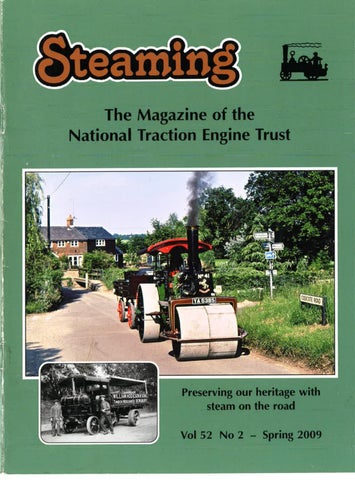
Front cover Leaving the village and heading for home after the Codicote rally in Hertfordshire in June 2008 is Sandy and David Ross's E type Aveling & Porter roller 10596 of 1923. The number painted on the front of the chimney saddle, and the distinctive awning, identifies it as a former member of the Buncombe hire fleet in Somerset. (John Mound) 59
Trust News Rally Organisers Column Help the Organiser — Already we are into spring and the horrible realisation that more work needs to be done to our precious toys than originally thought to present them in their full glory at rallies and events thrni inhni it tho climmor An nrid
ri
irritation is no doubt the completion of the numerous event entry forms which drop through the letter box, and the logistics of planning attendance at the various events, not to mention the cost! On behalf of all organisers of events I would like to make the following plea to exhibitors in order that together we can put on well organised and enjoyable events. Help us to help you — • Deal with entry forms promptly, don't stick them behind the clock • Observe any closing date which may be appropriate • Read the form carefully, especially the declaration(s) to be signed • Make sure that the recipient can read your writing; use capitals if requested • Make sure you include your name and address • If you have concerns or requests put a note in with the form • Keep a copy of the form for future reference • Include a stamped addressed envelope, if requested, for passes etc • If you are concerned about delivery, register your form, or • Include a stamped postcard or similar to be posted back to you on receipt • Above all — make sure you attach the correct postage to any item.You risk your entry form not being promptly delivered. Authorisation — To date a total of 109 rallies/events have been authorised for 2009 under the Authorisation Scheme, and all are included in the colourful rally list, a copy of which has been distributed to every member with this issue of the magazine; further copies are available from me or the Authorisation Officer Bill Evans. As in previous years a percentage of events will be subject to an inspection by a member of the section team. This is to ensure that the NTET Rally Organisers Code of 60
Practice is being correctly applied — such compliance being a condition of Authorisation. The purpose of inspections is to help organisers get their event as right as possible. In most cases any concerns identified by an inspector can and will be put right on site at the time. All authorised events will have received a copy of the current Code of Practice, but if more are required they can be downloaded from the website, or I can send copies, at £10 plus postage. The section has, over the year, tried to help organisers keep up with the ever changing legislation and requirements which need to be addressed. A number of issues were covered at the October Conference, and three regional Safety Seminars will have been attended by almost 200 event representatives. Depending on demand there may be a further Rally Organisers Conference in October 2009. If you have subjects you feel need to be addressed please let me know, and they can be included in the format of the Conference. My contact details are inside the front cover of every Steaming and I'm available at any time to discuss problems relating to rally organising. Here's hoping we all have sunny, enjoyable and safe events in 2009. (Tim Holt, head of Rally Organisers Section)
Insurance Officers notes Independent Boiler Inspectors' Insurance — It has been the time of year to again re-visit the list of compliant Independent Boiler Inspectors who lodge evidence of their Professional Indemnity insurance cover with the Trust. At the Engine Owners Meeting held at Willoughby in February I presented the list which is reproduced here for all members to see; it is also
available on the Trust's website along with contact email addresses. Alan J Hines Allan Prout ANB Inspections (Alan Bulmer) D J Wothers Inspection Services Farncare Inspection Services (Ian Farrance) Graham Morris Engineering Ltd Knight Engineers (Norwich) (Brian Knight) Wheeler Steam Company (Jonathan Wheeler) J A Glaze Ltd H&S Steam Ltd (subsidiary of R&B Inspection Services) SFP Inspection & Consultancy Martin Clark In addition to the above, all corporate inspection bodies are automatically included as they are insurers in their own right. As a guide, the following corporate bodies carry out inspections — Allianz Engineering Bureau Veritas Inspection Services Ltd HSB Naughton Engineering Insurance Services Ltd Lloyds Register EMEA Royal Sun Alliance Zurich Risk Services For those wishing to have an NTET Insurance Disc, it will be necessary to show a copy of the boiler inspection report/certificate from any one of the above inspection companies or independents. However, if you have a miniature traction engine inspected by a club which is a member of either the Southern or Northern Federation of Model Engineering Clubs, then their inspection certificate will be accepted.This naturally assumes that the inspection is carried out to Code of Practice to the Examination & Testing of Miniature Steam Boilers (New Edition 2008). Boiler Explosion Insurance of Miniature Boilers — It has recently been brought to the notice of the Trust that there are commercially made boilers manufactured after 30th May 2002 in use without CE marking. These boilers are either miniature traction engine boilers or boilers for locomotives up to 101/4 inch gauge, although we have just heard of a boiler for a steam car being affected. Spring 2009 STEAMING
For those unaware of the Pressure Equipment Regulations 1999, it is an built a boiler offence for commercially after 30th May 2002 to be sold unless the boiler is safe, meets essential safety requirements covering design, manufacture and appropriate satisfies testing, conformity assessment procedures and is accompanied by a declaration of conformity and carries CE marking. (Boilers up to 2 litres capacity regardless of working pressure are subjected to less stringent requirements and whilst they must bear specified markings, they must not carry the CE mark). Most, if not all, insurance companies insist that for boiler explosion cover to be in force, there must be a valid boiler certificate in force. If any non-compliant boiler has been tested and issued with a certificate, we are informed it is unlikely that the boiler explosion insurance cover will be valid. If you think you are affected by this, it is worth speaking with your insurance provider to establish how their underwriter would view a claim being made under the circumstances. This is a very unfortunate situation and we have every sympathy with miniature engine owners who find themselves unable to steam because of the lack of CE approval for their boiler.The prospect of either buying a new compliant boiler or rebuilding their engine is quite a challenge. Miniature engines are an integral part of the rally scene and we are committed to maintaining their presence at rallies where members of the public can view the remarkable workmanship and workings far more easily than on a full size engine. To this end we will endeavour to assist members who find themselves in this position to overcome these difficulties. However, it may also be helpful to make contact with Tony Wood of Walker Midgely who has arranged with Royal Sun Alliance Engineering, a route to provide retrospective CE approval. For this to happen, a full conformity assessment will be required where full documentation will need to be submitted including drawings, certificates, material welder's certificates etc. Anyone requiring further details should contact Tony Wood direct either by phone 0114 250 2770 or email tonyw@walkermidgley.co.uk or speak to your insurance provider. (James Blenkinsop — Insurance Officer)
STEAMING Spring 2009
Five horsepower Burrell general purpose engine number 4019 was built in 1925, during the firm's time within the Agricultural & General Engineers group. When new it was sent off for display at that year's Royal show at Chester, painted in olive green with brown wheels — the colours it is still presented in. Peter Love took the picture at the Hadlow Down rally, Kent, in June 2006.
Conversions The recent reports of the conversion of Fowler class DNB roller 17506 (see also the last issue, page 11) has again brought to the fore the Trust's policy on engines converted whilst in preservation. Several members, concerned at the continuing practice, have approached our Chairman to know how the Trust intends to address the issue, with accusations that we are 'sitting on the fence'. Letters and comment
appearing in the traction engine press indicate a similar strong depth of feeling against the practice of altering engines, and particularly steam rollers, to something that they never were (or were likely to become) in working life. The Chairman presented the concerns to the Trust Council at its March meeting, together with some discussion points and proposals. It was decided to form a working group to gather information on the topic,
The NTET's Engine Owners Section presents its 19th
STEAM TRAINING and DRIVING COURSE to be held at
Astwood Bank, near Redditch, Worcestershire on 9th and 10th May 2009 A practical course including instruction on boiler management, mechanical operation, care and maintenance, and on driving techniques. Adult members, f176.25 for the two days Steam Apprentice Club members (13-15) f58.75 or (16-21) f88.12 Contact Stuart Tomlinson on Tr 01455 613079 or e-mail hazel.tomlinson@homecall.co.uk
61
An event near Cheltenham in October 2008 featured steam ploughing. John Maund's pictures show Fowler class K7 14257 of 1916 nearing the end of another pull of the plough, and, when it was time to finish and leave the field, Fowler class BB1 15143 of 1918 attempting a swift exit through the very muddy gateway.
and in particular to gather ideas and comment on practical and workable ways in which the continuing practice could be effectively halted. Pending the completion of this work, it was agreed the Trust's existing policy statement on conversions should be repeated in this magazine, together with a brief account of the list of steam roller conversions in preservation days, so to emphasise the large number of machines affected, and the potential future effect on certain classes of roller. The topic of conversions was the subject of a Motion put the Trust's 1999 AGM at Lincoln. It was proposed the Committee should publish a definitive statement confirming opposition to conversions, and with the AGM's passing of the Motion, the following was published in the Spring 2000 issue of Steaming: 'One of the major objectives of the National Traction Engine Trust is to preserve our steam heritage, including the original design of our road steam vehicles, their use and maintenance. Therefore the Trust 62
does not support in any way the conversion of any steam road vehicle into a form which that particular machine never had during its working life.' The policy still stands. As an indication of the cumulative effect of converting engines, it will be of interest to many members to learn that the number of steam rollers that have been altered from their original
guise whilst in preservation now amounts to about 100 — getting on for half of them Fowler built machines; almost a third Avelings; a good number of Marshalls, and then Burrells, Wallis and some other makes. It is intended that notes from the above mentioned working group will be made available on the Trust website and in the pages of this Spring 2009 STEAMING
magazine. Practical ideas on how the Trust can limit or halt the conversion of more engines are needed — make via public.relations contact @ntet.co.uk
F. HAR
6c SUNS UAL,LOPIN(. iluRSES ASHINGTON.
Driver Competency Scheme Extensive notes on the proposed experienced based Voluntary Driver Competency Scheme appeared in this section of the last issue. Since then Bob Garnett and the other members of his team, Tony Seddon and Stuart Tomlinson, have spent much time in developing and polishing the detail of the Scheme. The work is ongoing, but it is hoped to complete the task, have it all presented to Council, and be ready for a launch at the Great Dorset Steam Fair.
Steam Apprentice Club The year ahead — Hopefully, by now, you aware it is the SAC's 30th Anniversary year, which we intend to mark by holding a special Driving Day in the grounds of the Shuttleworth Collection at Old Warden, Bedfordshire on 27/28th June.The Bedford club are helping to organise the event, at which we hope to have 30 plus engines for Apprentices to learn and practice their skills on, as well as lectures and stands for them to attend and view. NTET members are invited to come along and see what the SAClub is about. Admission will be by production of yourTrust membership card —this will be essential for access to the grounds of the Shuttleworth Collection, for our weekend is a 'private event'. .Other Driving Days are being arranged throughout the country and if you are an Apprentice reading this, or a parent, who hasn't sent in their application please do so as soon as possible. We are always looking for new venues in areas where we don't have an event, so if you feel you might like to hold one please contact me for more information. Though we look after very old STEAMING Spring 2009
Garrett compound tractor 33091 was sent off new in 1918 to the Ministry of Munitions, and moved up to a showland career in 1920, when acquired by F Harris & Sons' Southdown Amusements. Christened MARGARET in celebration of the survival of a sick child born to the family, the engine worked the galloper ride until 1946. Dave Bagley took the picture at the Banbury rally in 1999.
machines, we of course live in the 21st century and the age of the computer. Like many organisations the Committee of the SAC is conscious of both our costs and how to keep in touch with our members. To that end we are asking our members how they would feel about receiving their magazine, Raising Steam, either as an e-mail shot or posted on their own website. It will be interesting to see if they would like to go that way, or to stick with the
BOILER INSPECTION SERVICES D. J. Wothers Engineer surveyor and boiler inspection service on all types of steam traction engines and loco type boilers of all sizes • NTET compliant • Reports and Certificates issued on site same day • Internal camera inspection of all areas with colour monitor and recording service available • N.D.T. die penetrant testing carried out • Notification to insurance company same (lay A professional independent inspection at an affordable price for that peace of mind 17 07815 771245
email: djwothers@hotmail.co.uk
'old fashioned' written word. Though I say this at the start of every season, I thank in advance those of you who support the SAC in whatever shape and form that might take. For, without your assistance, we could not operate in the manner we do. (Kevin Munn, chairman, Steam Apprentice Club) Young drivers on the rally field — It has been some time since we addressed the question of 'What are
LLEWELLIN'S
Gears
GEARS UP TO 8ft 6in DIA SPLINED SHAFTS UP TO 25ft LONG Broaching and Splining - Spurs , Racks, Helicals Worms and Wheels, Bevels - Straight and Spiral Stock Gears and Spines Wire Cutting - Gearbox Rebuilding
Specialist Supplier of Gears and Splines for all Vintage Vehicles and Traction Engines Telephone Mike Horlick LLEWELLIN'S GEARS KING SQUARE, BRISTOL BS2 8JJ TEL: 0117 942 4026 FAX: 0117 923 2028 E-Mail: info@llewellins.co.uk Web: www.11ewellIns.co.uk
63
the rules governing young drivers on the rally field?' As the NTET is an Authorising Body under the 1995 Off Road Regulations, we have been able to allow young, unlicensed people to drive engines on the rally field providing the following points are complied with. It must be made clear that these only apply to NTET Authorised Rallies. If the event is not an NTET Authorised event then the normal licence conditions apply, that is you must be over 21 and hold a full group B licence (or group G for a steam roller). Under age, non-licence holders may be allowed to drive a steam vehicle at an Authorised event if all of the following conditions are met • The insurance cover for the vehicle specifically includes Steam Apprentice Club members (as per the NTET Insurance Scheme). • The person is a bone fide member of the NTET Steam Apprentice Club. • That, age not withstanding, the Apprentice is not prohibited from applying for or holding a driving licence. • The Apprentice is closely accompanied at all times by a person who is a full licence holder for the type of vehicle being used. • The minimum age shall be 13, with a minimum height of 1.400m. • The known conduct of the Apprentice is
not likely to detract from the Safety standards of the event. • The Safety Officer has given formal sanction following a risk assessment of the roadways and vehicle manoeuvring places. • The Rally Organiser has given written notice to the Exhibitors and Public of his intention to allow such movements (via notices and the Rally programme). These rules, correctly complied with, allow an SAC member to drive an engine on the rally field but remember, the final point is important - all this can only happen if the Rally Organiser has agreed. I know that there are some rallies who decide, for good safety reasons, that they can't allow youngsters to drive even if the rest of the above conditions are met. If this is the case please respect their decision. (John
Durling, President, SAC)
NTET Sales Exhibition and Sales Unit The NTET Unit will again be visiting a good number of traction engines rallies during the summer months. Arrangements have been made for attendance at the following
i•A KiNG
M
Shaping the way in pattern making The Boss Pattern making Company is located in Coventry, in the heart of industrial England. We are a small friendly company specialising in a combination of traditional and modern techniques to provide a precision yet cost effective pattern service, with fast turn around times. Our time served highly skilled master patternmakers utilize all methods and materials to produce high quality pattern work in wood, metal and resins. Castings supplied in all ferrous and non-ferrous metals
What we do
Please call us to discuss your requirements on:
024 7888 0488
64
•Traditional & Heritage Pattern Making • Reverse Engineered Patterns • Resin Patterns • Metal Patterns • Castings • Machining
events in the first half of the 2009 season. May - 9/10th, Stoke Goldington, Bucks; 16/17th, Belvoir Castle, Leics; 23rd to 25th, Strumpshaw, Norfolk; 30th/31st, St Albans, Herts. June - 27/28th, Banbury, Oxfordshire. July - 4/5th, Helmsley, North Yorks; 11/12th, Ardingly, Sussex; 17th to 19th, Langport, Somerset; 24th to 26th Boconnoc, Cornwall; 31st to 2nd August, Kemble, Glos. There is more detail on the location of each of these events in the Trust's The Rally List 2009 which is distributed with every member's copy of this issue of Steaming.
(Colin and Val Brown, NTET Sales)
FBHVC News Drive It Day The FBHVC's 'Drive It Day' this year will be on Sunday 26th April. Although it may be a little early in the year for some engines to be fully ready for steaming, do think about joining other owners of historic vehicles on the road. Just making an appearance on the open highway among vintage cars, motorcycles and all the other wonderful variety of preserved vehicles is the purpose of the Federation's 'Drive it Day' - to let the public see the strong support there is for such preservation, but to offer the contrast of how little, on other days of the year, we intrude on everyday traffic. You can find out more on events and gatherings from www.fbhvc.co.uk
Obituaries Robin Greenaway In October 2008 mourners gathered at the small church of St John at Stoke Row to pay their last respects to Robin Greenaway of Stoke Row, near Henley on Thames, Oxfordshire, who had passed away having braved a long battle against cancer. Robin was a strong family man, whose interest in steam traction engines was ingrained in him before the coming of rallies. Born in 1929, he was the son of William Greenaway, a threshing contractor of Stoke Row, who ran two Fowler engines: 6hp compound traction 15640 and 7hp
Spring 2009 STEAMING
road loco 15373. Growing up with working steam and leaving school at the age of fourteen, Robin went to work for his father, along with his two brothers. By this time the Fowlers were less used, in favour of a Fordson. A dispersal sale saw both engines sold to Goodey of Twyford, and Robin and his brothers drove 15640 into their yard, towing 15373. Later, Robin tried to buy back one of the engines — to no avail. He therefore pursued his interest with steam by purchasing Garrett tractor 33782 for the princely sum of £20, in a deal which included several loads of firewood. The engine attended early Appleford rallies named BLACK PRINCE. Leaving his father's business, Robin worked for a contractor, driving a Caterpillar D4, and then set up his own agricultural contracting business, purchasing an IH TD-9 crawler. As time progressed equipment was updated, and he finished his working days using Droll and JCB machines, carrying out all manner of land clearance and drainage work in the area. On retirement the business passed into the safe hands of eldest son Noel. A self taught engineer, many people were recipients of Robin's kindness and knowledgeable advice. His skills were demonstrated through the restoration of the ex-Kings Foden wagon 12018 EMILY (purchased in a very derelict state from the Hirst sale of 1971), with the help of his sons Noel and Nigel. Later he completed the build of a 6inch Burrell 'Devonshire' and his favourite — a 6in Burrell showmans based on 4092 SIMPLICITY. An early member of the then NTEC, number 14, Robin was a founder member of the Thames Valley Traction Engine Club, with his yard at Stoke Row becoming a hive of activity on engines and tractors at the start and end of the season. were parties night Bonfire particularly memorable. He could be found warming himself by a homemade brazier; surrounded by engines and chatting amongst friends. An avid supporter of rallies in the Thames Valley and Chiltern area, Robin, his wife Jean and family would be found in the working area. Many will recall his cap and braces covered in sawdust, as he gave the racksaw blade fine tuning with a file. If not engrossed at a sawing demonstration, he would be keeping a watchful eye on the Powell stationary baler, which his father had bought and used commercially. Robin's Aside from steam, interests stretched wide, for he was STEAMING
Spring 2009
Marshall 6hp compound traction engine 40101 of 1903 in steam at the 2008 Great Dorset event. (John Maund) equally happy participating on a road run on his industrial Fordson, giving a ploughing demonstration with his Titan tractor, performing furniture removals in his old Dennis lorry or taking a little jaunt in his Austin Twelve — and not forgetting his love of going to an auction just to see what bargains might be on offer. In October 2008, he made his final journey to Stoke Row church behind his favoured little Burrell SIMPLICITY, with Bob Staunton at the helm. A true gentleman, Robin will be sorely missed, but there is little doubt he would be pleased to see how his love of steam and vintage machinery has been passed on to future generations, long into the future. (William 011ey) David Hirst David John Hirst of St Mary Bourne, near Andover in Hampshire passed away in December 2008, aged 70, after a long battle against cancer. An inventive engineer, scrap dealer and steam enthusiast, he was involved in the early days of steam preservation and spent his lifetime devoted to his passion of steam and bygones. David was the second son of Joe and Olga Hirst, born 10th August 1938 at Nether Wallop, near Andover. He showed entrepreneurial spirit from an early age, selling 'relics' of
shot down German aircraft to American servicemen based at the local airfield. The relics were 'borrowed' from the pile of downed German aircraft dumped at the end of the airfield, but the fact that pieces with bullet holes fetched a premium was not lost on a young David, who soon discovered a pickaxe hole looked uncannily like a bullet hole, and feverish activity ensued in the garden shed. After the war the family moved to nearby St Mary Bourne where after a spell as apprentice smithy with his
Tax or Boiler Disc Holders in cast brass, fully polished finish NTET Sales has, once again, available from stock, a traditional appearance holder, suitable for tax or NTET insurance discs. It is water proof, with improved turned two piece screw thread assembly with '0' ring. £43.00 from the Exhibition Unit £45.50 inc post and packing Make cheque payable to NTET card purchases - Tr 01582 733971 send order to: NTET Sales, 90 Devon Road, Luton LU2 ORL
65
Could this be evidence of Mrs Pettigrove slipping out from her living van for a morning tipple in the Ladies Only bar at The Vine Inn? Probably not - Keith Broth well's colour photography shows the scene to be a contemporary one of Burrell 7hp showmans making a mere pause at Stockbridge, Hampshire, on its journey to the 2008 Great Dorset event.
uncle he joined father Joe, mother Olga and elder brother Joe in forming at Bank Top the J Hirst & Sons scrap metal and government surplus yard, to become known near and far for its eclectic range of goods and equipment. David realised that the bins used on early trucks were not large enough and too unstable for the scrap they had to handle and developed a new 'roll on/off' system with the help of hydraulics engineers; a system since developed into the trucks seen worldwide. In the
seventies the scrap business expanded and moved to old railway yards at Hurstbourne Station, but the surplus yard continues in the village to this day, and men turn to boys when they come upon it's treasures. David's 'unhealthy' interest in steam started at a young age when, on a bike, he would try to keep up with steam wagons on the roads around Andover. Outrun by yet another Foden wagon he vowed that one day he'd own just such a beast and he went on to own many!
Meeting Jean New from nearby Fyfield, he married her before undertaking National Service in 1958 - though wasn't pleased that during the absence dad had sold his modelT. But the price was good and before long the success of the business meant no more worrying about old vans. The scrap yard was still cutting up engines steamed into the yard, a practice David did his best to stop, but hiding them from his elder brother proved difficult. In 1967 Joe senior had come across a Wallis 5ton convertible roller, which was taken to local rallies to try to sell; David had a cunning plan to prevent any sale, for he named her LITTLE OLGA after his mother and the engine became the first of the Hirst Family steam collection.Thirty other engines joined the Wallis, including W J King wagons, as the family stockpiled for a huge sale in 1971 - the proceeds of which purchased the UK's first scrap fragmentiser plant. This huge machine ensured the success of the scrap business through the 1970s and onward. During this buying frenzy, Joe senior heard of a rare engine at a convent farm in Ireland. It turned out to be a Ransomes, Sims & Head of the 1870s. David soon restored the engine to former glory, and revelled in having the world's oldest in-steam engine at the rallies. The new name LIZZIE MCKENNA - after his grandmother - was again the way to prevent father and brother selling. But Fodens were David's love, and eventually he managed to assemble enough parts to build up several examples - many of which grace the
At the Kemble rally in August 2008 Keith Brothwell photographed Burrell Shp showmans road loco 2351 EPHRAIM - an engine that worked the fairgrounds around Nottinghamshire, and stood unused in the south of the county until fairly recent times. 66
Spring 2009 STEAMING
rally circuit in various guises. Finally he obtained a 1929 Foden 6ton timber tractor, SAMANTHA, ex Boughtons of High Wycombe, and his pride and joy when restored in the 80s. With the Foden wagon and the little Wallis (now back in its original tractor form) tucked away inside their custom lorry, David and Jean then travelled in Europe, entertaining thousands with the engines and seeking out local KFCs (one of his few vices, for David neither smoked nor drank, unusual in steam circles). At the Great Dorset events David could often be found holding court in the 'National' tent, wheeling, dealing and telling tales of all things steamy. A few years ago, the look on the face of Sir Stirling Moss, when he saw David had a longer patiently waiting queue than him, was priceless. In later years David obtained the former W J King's Foden Speed 6, an engine he'd had an eye on for 40 years. It was recently reluctantly sold, he realising ill health would preclude him from completing the restoration. He was a supporter of steam societies and museums, and many have benefited from his generosity over the years. David leaves wife Jean, sons Stephen, Trevor, Mark and Neil, and seven grandchildren, as well as his mother Olga, sister June and brother Keith. His passing will be mourned by many in the steam preservation movement worldwide. The funeral was held in St Peter's Church, St Mary Bourne on a crisp December day. His final journey to the church was behind his Foden tractor, followed by family mourners and then the three Fodens of Richard Vincent, Robert Bullen, and Danny and Joe Dovey. Following the funeral hundreds shared memories of David by the Oram family's fairground organ at the village hall. The Hirst family extend their thanks for the hundreds of messages they have received from David's friends worldwide. (Mark Hirst)
r0.0:ture) rialtkts Driving and Training Course This NTET Course will take place on 9/10th May in Worcestershire — please see the display advert for further detail and contact addresses, etc. At press date for this magazine there were still a few places available on the Course. 1.-7,7FAM5NC:
Spring 2009
The 2009 AGM This will be held on Saturday, 21st November 2009. With the high level of interest shown by the membership in the recent work the Trust has been involved with, it was decided at a recent General Council meeting to change the venue for this year's AGM from Cornwall to the Midlands, to give easier access for as many members as possible. The venue for the meeting is just off the A45 between Coventry and Birmingham and is planned to be at The Manor House Hotel at Meriden, which is affiliated to the National Motorcycle Museum, but a stone's throw away, so reduced rates for admission to the Museum will apply. For those who wish to visit a steam location on the day, the Birmingham Railway Museum at Tyseley has offered to open, but it is also hoped to have some special engines in steam at the AGM venue. The evening dinner can accommodate up to 150 guests, so please try to make a weekend of it especially as we are due to visit nearby Statfold Barn on the Sunday. For those who haven't before been to this private location, it is the works of the Hunslet Engine Company, where narrow gauge locomotives are built and repaired, alongside road steam engines. There is an extensive dual gauge railway running for a couple of miles around the farm where oil seed rape is grown and processed to make beauty products. Visits to the processing factory may be available, as well as rides on the railway. For more details visit www.statfold barnrailway.co.uk This visit is highly recommended and is well known to those enginemen from Klondyke Mill. Further details of the AGM and the weekend's activities will, of course, be included in the Summer and Autumn issues of Steaming.
'On Saturday last there was seen on the streets of Leith a wonderful team of mechanism. It consisted of a ten horse-power road steamer, with two companions of equal size in tow to the docks for shipment. The road and an illustration steamer, description of which we gave on 2nd October 1868, which was acting as a tug to its two mates, was exhibiting its maiden efforts, as it had only just been completed, and had never been out before. It is a ten horse-power engine nominal, but can develop up
terS
eVit A warm welcome is extended to these new members who have joined the Trust in the last three months. We hope they will gain friendship, information and enjoyment from their membership over a period of many years. Full addresses are not included, but the Membership Secretary is always willing to put members in touch with one another by forwarding mail. Miss E Drury, Newark, Nottinghamshire Miss RTruelove, Blandford, Dorset R Harvey, Bournemouth, Dorset A Dickinson, Gainsborough, Lincolnshire R Fensom, Luton, Bedfo)dshire J Perkin, Chester R FTodd, Cambridge C Beeby, Shepshed, -Leicestershire G Boyd-Hope, Earl Shilton, Leicestershire G Stockton, Crewe, Cheshire J P Stafford, Warrington, Cheshire G S Burges, Aylesbury, Buckinghamshire J P Brett, Norwich K Harness, Louth, Lincolnshire L J Solomon,Truro, Cornwall S Purnell, Wallingford, Oxfordshire CT Barnard, Newent, Gloucestershire J Eckardt, Sturminster Newton, Dorset J Parry, Aberteifi, Ceredigion T J Walters, Chichester, West Sussex B Connolly, Co Monaghan, Ireland R D Smith, Burton onTrent, Staffordshire K Oliver, Ripley, Derbyshire G Holder,Thirsk, North Yorkshire
PT.), car Ste m g We apologise for the omission (for the second year, too) of Elaine Massey's name from the General Council list on page 5 of the last issue. Elaine was elected to Council at the 2007 AGM, and as well as being vice-chair of the Steam Apprentice Club, has special duties as Child Protection Officer to the Trust, bringing experience to that role from her involvement in other spheres.
to thirty horse-power. Its weight on the road is from eight to nine tons ... Messrs T M Tennant & Co Ltd, Bowershall, Leith, have obtained a licence to manufacture Mr R W Thomson's patent road steamers and steam omnibuses with India rubber tyres, and are making arrangements on a large scale to keep pace with the numerous orders received, and to turn out engines with great despatch'. (from Mechanics Magazine 8th January 1870)
67
Engines of south-east Holderness Derek Rayner The area to the east of Hull in East Yorkshire, on the way to Spurn Point, is something of a rural backwater. It is not really on the way to anywhere and as such, one usually makes a special visit to go there. It is, however, good agricultural land. Much in the way of crops was grown in the area in times past — and continues to he sn Many yaarc ago, growing crops meant the use of steam engines to help with both care of the soil and harvesting the crops — and the district of south-east Holderness was no exception. One of the villages of the area is Keyingham, now the headquarters of a very active vintage tractor and agricultural machinery preservation group. The village's Local History Group, as part of their Millennium celebrations, compiled an excellent history of village life, going back to the Domesday Book. Keyingham and its People: the story of a Millennium contained several references to steam engines kept at or near the
village to work in the area, and some of the material in this article is drawn from that source, by kind permission of the Book Committee. Keyingham had a number of 'machine owners' living there at the time of the 1851 census, although that document, of course, is not specific about the types of machines owned or operated. However, two of the men were born in Keyingham and were undoubtedly the first agricultural machine contractors who threshed corn for the local farmers. Some 30 years later, 'steam engines' were so mentioned in the returns regarding two of the men included in the 1881census, so it is known that at least two of the five names linked to threshing were using steam at that time. By 1891 two windmills were in operation in the village; there were three blacksmiths, and two wheelwrights plying their trade there. One of the mills was in Church Lane near St Nicholas' Church, and in 1911 this had its gallery and sails removed and
."' •••
-
r Zumk
r
• N.
A rather large threshing gang pause for refreshment and the photographer at East Bank Farm, Sunk Island, on the banks of the River Humber. An unidentified single cylinder portable engine is in the background. (Vic Makey) 68
a steam engine became the sole source of power.This secondary form of power had only been used previously when there was no wind, but it is presumed major repairs to the sails etc, were required and it was more economical to use the steam engine on a permanent basis. This was placed in an engine house and connected to the mill by a belt from the flywheel. The steam origin.= was, in turn, replaced by an electric motor located in the tower and the mill continued working like that in the ownership ofT S Eyre & Son until the early years of World War 2. By the end of the 19th century, threshing contractors had gone from the village of Keyingham, the nearest owners then being R & R Cornthwaite (Robert J Cornthwaite by 1909) at Ottringham, just to the east.They had four Ransomes, Sims & Jefferies engines over a period — 12511 of 1899, 19417 of 1907 (BT4093); 21559 of 1909 (BT4094) and 23477 of 1911 (BT4095), all single cylinder engines, the first three of 7hp and the last 8hp. Also at Ottringham was George H Harness, who bought a Marshall 7hp single new in 1923. This was 76751 (BT6447); it was sold in 1953 to Fishtoft in Lincolnshire, and is still in existence in Bedfordshire. At the Belvoir Castle Rally a year or two ago, the engine was visited, and driven, by the late Len Harness, the last surviving steam man in the Holderness area. Another operator relatively close-by was J Wilkin of Welwick, who had an Allchin (BT4561) and a Fowler (BT4562), both tractions and unfortunately both unidentified by maker's number. For threshing it was usual for the contractor to provide two or three men for the work, including the engine driver, but the rest of the crew was contributed by the farmer — and a small farmer might have to hire the extra men. On threshing days in or near the village men would wait next to Keyingham Cross in the village centre hoping to be hired for the day. Food was provided by the farmer's wife — sometimes before work commenced — and there were tales that some hired hands would slope off after they had been fed, much to the annoyance of everyone else. At one time, instead of threshing Spring 2009 STEAMING
everything at once, just one day's threshing was done at each farm at a time. This gave the opportunity for the farmer to use up the threshed straw for feed and bedding for the animals before he sent for the contractor to come again. Another engine owner in the locality was Edward Connell Caley, the great-grandfather of David Caley who currently lives at Keyingham. Edward was born on Christmas Eve 1869, illegitimate son of Hannah Caley; the event no doubt caused something of a scandal in the area. He was brought up at Leven, near Beverley and apprenticed to a joiner at Routh, a village nearer Beverley and he walked the three or four miles there each day. The date of Edward's marriage is unclear; probably in late 1890 — as his eldest son, George Edward Caley (David Caley's great uncle) was born in 1891, his date of baptism having been traced to 8th November 1891. When Edward Connell Caley married he moved from Leven to Rose Cottage, Burton Pidsea. Bulmer's Directory of 1892 lists Caley as 'Engineer to the Owstwick Co, steam threshing machine owners'. William Markham of Owstwick had two 6hp single cylinder traction engines — Ransomes 6954 of 1886, secondhand from the makers in 1894, and 11089, new 1897. About ten years later, in 1901, the local Kelly's Directory lists Edward Caley as a threshing contractor in his own right. He owned Ransomes 6954, and it was known to be for sale by him in 1910. It seems that his engine and tackle operated initially from Rose Cottage, he later moving to Solomans Cottage in the same village. This cottage was divided into two — Edward living in one part and Leonard Caley, who was David Caley's grandfather, living in the other. George Edward Caley worked with his father (Edward C), eventually taking over the business, presumably after his father died in 1934. He then based it at Stocks Garth, Fitling, where he lived. From around 1937/38 he used a Massey Harris Pacemaker tractor and a threshing machine and the traction engine was then broken up for scrap. The last recorded licensing date of 1936 for his 1892 Aveling 8hp road engine 2973 (BT4691) ties in with that. George Caley went on to disgrace
himself in life, for he suffered from the seemingly regular engine driver's fascination with beer and pubs. After the war, competition for the threshing business emerged in the shape of Frank Jackson of Aldbrough, a village north-west of Fitling. Jackson bought a tractor-powered
outfit and set up as a contractor intending to attract George's regular customers. In the pub one evening George was being wound-up about Jackson taking his trade. On leaving and making his way home he came across Jackson's outfit on the roadside, ready for work the following
Len Harness on the family Marshall engine, 76751 of 1923 (BT6447), at the age of seventeen. (Vic Makey) STFitiviING
Spring 2009
69
E C Caley's threshing set at Burton Pidsea. The engine is an early example of a Ransomes, Sims & Jefferies engine — shown by the raked angle of the back of the tender — so is presumed to be 6954 of 1886, a 6hp machine. The dress of those present suggest the view was taken around the turn of the century. (collection David Caley)
morning at the Fisher farm at Garton, but a mile or so from George's home. Full of anger, frustration and Guinness, George took his revenge on the newcomer intent on taking his trade by setting fire to the outfit! It was completely destroyed, with George subsequently jailed for arson. It was, of course, the end of his business and following release from prison he worked for various local firms — ending his career back with steam as a roller driver for Hughie Willingham of Thorngumbald, probably in charge of the Aveling & Porter now in preservation in that same area with SteveTracey — 8688 of
70
1915 (AT1218). Leonard Caley (David Caley's grandfather) established an agricultural engineering business at Solomans Cottage, and when joined by David's father, they diversified into contractors' plant and land drainage machinery. The company was wound up in the mid-1980s when drainage grants were withdrawn, and at more
or less the same time two Dutch firms came into the country. By aggressive marketing, the latter took away a large amount of the available business, so the Caley family actually got out at an opportune time. Many other interesting tales are told of Uncle George, including that of his regular approaches trying to buy new-born babies in the area, since he and his wife Lucy were never able to have children of their own — but these do not concern us in the traction engine world! Research into the past owners of Mount Airey Farm, where David Caley now lives, reveals that a family by the name of Langdale once lived there. Road Locomotive Society records show James B Langdale, a farmer of Keyingham, had an unidentified Fowler traction (BT3617)
Stephenson's threshing set pictured near Burton Pidsea Mill. The engine is Ransomes 21745 of 1909, and the circular enamelled iron East Riding County Council registration plate is prominent on the footboard toolbox, showing the photograph would have been taken in or prior to 1921. A timeless scene, and typical of so many rural locations for over half a century. (Vic Makey)
Spring 2009
STEAMING
by October 1922. Traction engines were also owned in the area by Henry Lambert of West Farm, Sunk Island, to the south of Keyingham and adjacent to the River Humber. He had three early Burrell engines, all new from Thetford - 553 was a 10hp engine of May 1872, and there were a pair of ploughing engines, 687/688 in 1875. Another use of steam, for ploughing, is mentioned in the Millennium book as first coming to Holderness as early as 1862, though no details are known of who was involved, or with what equipment. The two engine cable method of ploughing and cultivating was to become a major use of engines in the
A nice view of a Marshall single cylinder engine and drum, presumably taken before 1921, as no registration number is visible. The engine is thought to be local to Burton Pidsea and could therefore be the Holderness Plough Co's Marshall engine (later 8T6485), for which a works number has not been established. (Vic Makey)
area. As in the case of the threshing engines, the farmer also supplied the coal and water for the ploughing engines - usually in horse-drawn wagons.The engines would tow their
own living van, and often had a cookboy with them, though sometimes the crew would hire a cook from the village. Alf Pepper, doyen of steam men
Threshing at Owstwick Grange, near Burton Pidsea - with the engine apparently blocking the highway. However, the road was merely a farm track and the main road past the Grange is by the trees, behind the engine. It is a Ransomes machine and may have been one of the engines belonging to Cornthwaite from Ottringham. (collection David Caley)
associated with John Fowler's Steam Plough Works at Leeds, came to Keyingham when he took charge of a Fowler subsidiary, The East & West Riding Steam Plough Co. The company had been formed to contract plough in the area, with the consent of the directors at Fowlers and the Ministry of Agriculture. (See The Story of the Steam Plough Works, Lane, page 320). The engines
At the Yorkshire Agricultural Show in Beverley in August 1909, one of the stands displayed a Ransomes, Sims & Jefferies engine destined for delivery to R J Cornthwaite at Ottringham. The sales stand was that of John V Nutchey - the unusual name on the posters fixed on the engine - and he was sole proprietor of Collison & Co, agricultural implement manufacturer and agents, and insurance agents, of Railway Street, Beverley. Over the years Cornthwaite was the customer for three new Ransomes' engines: 12511 of August 1899; 19415, which was turned out in 'Royal Show' finish when completed in June 190Z and 21559 of August 1909, as seen here. The original build document for the latter engine records that it went to the Yorkshire Show, and as well as the Cornthwaite name plate, there was also a plate attached with Nutchey's name, as agent. In addition, 19415 and 21559 are noted as having had Ransomes owners' plates, so both sales were presumably acquired under a hire purchase arrangement. (collection Mr and Mrs Coatsworth)
used were 1917 built AA6 class 13980/13891 (later BT3812/3813), and during the period Pepper was with this tackle, many records were set up for acres cultivated per day, and for acres per ton of coal used. Having achieved his objective, Alf was called back to Leeds to embark on other projects to the benefit of the company. The E&WRSP Co also had 15238/15239 (later BT3814/385), 18hp class AA7s, new in December 1917 Both pairs were ordered by the Ministry of Agriculture and Fisheries and were later run by Kitching Bros at Keyingham. Kitching & Sons, of Sykehouse, near Doncaster and later Ealand, Lincolnshire were associated with the company at Keyingham at one time; an auction in August 1934 involved the first pair of engines, whilst the other two went to Ealand. The Kitching firm also had two sets of Fowler ploughing engines 14373/14374, a pair of BBs of July 1916 (later WR7183/7184), and 15426/15427, a pair of BB1s of July 1920 (later WR7181/7182). In the early 1930s, one local ploughing contract team comprised Bob East, the foreman, and Jack Rust (both from Keyingham), Arthur Dibnah (from Burstwick) and Joseph Taylor (from York). They worked for Kitching Bros, who operated on many Holderness farms. Elsewhere, in June 1919, Fowler BB1s 15412/15413 were supplied to the Ministry of Agriculture and Fisheries (Food Production Department) at Patrington Settlement, a self-contained village with accommodation and workshops, which was also known as Enholmes Farm. These engines were later CT8726/8727 in Ward & Dale's
A nicely arranged photograph of R J Cornthwaite's threshing activities, no doubt recording a wealth of family history in the assembled group. The engine at work is Ransomes 21559, presumably with the still relatively new threshing machine with which it was also pictured at the Yorkshire Agricultural Show at Beverley in August 1909. (collection Mr and Mrs Coatsworth) 72
Spring 2009 STEAMING
It is known that this photograph was taken in the Keyingham area, although the date is unrecorded. It appears to depict one of Fowler's AA class ploughing engine derivatives and therefore could be one of the East & West Riding Steam Plough Co's (Kitching's) engines — AA6 class 13980/13891, or AA7 class 15238/15239. (collection David Caley)
A ploughing engine and Fowler water cart in use in the Holderness area, although to which contractor they belonged is not known. (collection David Caley) ownership at Sleaford and survive in preservation. Most of the steam ploughing work was undertaken between the months of April and November and in the winter the equipment was taken to Crawshaw, a yard with some trees around it, perhaps no more than a paddock, at the north-east corner of Keyingham, adjacent to a farm track leading to Halsham Grange. There, in the mid-1930s, the engines were stripped down, rebuilt and made ready for the forthcoming season. STEAMING
Spring 2009
About 1936, Fowler Gyrotillers superseded the steam ploughs.These machines had a pair of contrarotating spinning cultivators at the rear and with caterpillar tracks could move across the large open fields of the area without problem. The firm of De la Hope operated up to ten of these machines in Yorkshire, and several of them in Holderness. They could work from midnight Sunday to midnight Saturday in eight-hour shifts, as they were equipped with powerful headlights. On the outbreak
of war in September 1939, the Gyrotillers were found to be suitable for levelling ground for airfields, and so were sent away, working from the West Riding to the Scottish borders on this new type of work. Road haulage by steam was also a feature of the south-east Holderness area, with J & A Lanham of Keyingham having three wagons from the Sandbach firm of Foden.The first, 2638 of 1911 (M3282), was secondhand to them in 1924, whereas 11002 of 1924 (BT7839) and 11940 (BT8852) of 1925 were both new. The type of work the wagons were involved in is unrecorded, but likely to have been associated with sand and gravel extraction. The railway line from Hull to the coast at Withernsea passed through Keyingham, and was well used by city dwellers for an outing to the seaside. Withernsea was in competition with the bigger resort of Hornsea, just up the coast, and served by another branch line from Hull. Competition for the railway from road transport became serious in the 1920s. At the start of that decade, the main road from Hedon to Withernsea, via Patrington, had been surfaced merely by scraping off the top surface and rolling in gravel. In 1922, Patrington Rural District Council, who had responsibility for the roads, sought that the East Riding County Council take over the maintenance. This was agreed, but only after it had been up-graded to a tarmac-surfaced road. Work on the Hedon to Withernsea section was put in hand (Hull to Hedon was already done) and was completed by 1926. The Ministry ofTransport, contributed £51 towards the £154 required to purchase a tar sprayer for the job. A long time before that modern surfacing, Withernsea Urban District Council had, in July 1903, purchased an Aveling & Porter steam roller. Overhead valve compound roller 5308 was, however, eventually found to be much too heavy at 12? tons for the duties it was required to perform; it was sold in August 1910 to Hampshire Bros of Ravensthorpe, Dewsbury in Yorkshire's West Riding. The roller survives in preservation and was brought back to its original haunts by owner Barry Wood during its centenary year in 2003. Patrington Rural District Council had Aveling roller 9309, a 12 ton single new in 1920, and then in December 1926 bought Wallis 10 ton Advance 7906 (0T3304). The latter passed to ERCC in April 1930, on the changes in arrangements for road maintenance within the local 73
4.1
authorities, When the Patrington steam roller was working in Keyingham around this time, the driver, George Robinson, parked it at Bryn Ferra in Salthaugh Road, the former blacksmith's shop which was built in 1917 on the site of a small cottage. The name derives from the Welsh language (Hill of Iron); suggested by the Welsh wife of the owner of Salthaugh Grange, who was responsible for the construction. There was hard standing for the roller in what would have been the garden of the cottage, although this has now gone, removed by the present owner of the private house. ERCC last licensed the Wallis roller in 1950. In the preservation era, engines came into the area to be restored and exhibited at shows. Bernard Blashill at Welwick in 1990 bought an Aveling roller from John Golding of Loughborough — 10991 of 1924 (BC9483). It was sold out of the area at auction in June 2003. Nearby, Alec Beadle has a venerable Clayton twin cylinder portable 11305 of 1868, which came from Great Yarmouth, Norfolk, Vic Makey owns Clayton & Shuttleworth traction 36731 of 1904 (AJ5890); he purchased this from
Norman Gerrard in 1988. The engine, OLD GLORY, was one of the engines taking part in the firstTraction Engine Derby in the north of England at Pickering in 1953. lain Smith ofThorngumbald, later of Ottringham, bought 6ton Aveling
roller 8688 of 1915 (AT1218), formerly in the ownership of the firm of Sangwin Ltd of Hull, who had sold it
74
Aveling overhead valve compound roller 5308 of 1903 at Withernsea in the Edwardian era. The buildings in the near distance marked Holderness College are still in existence. (collection Barry Wood) for scrap in the early 1960s to Albert Draper of Hull. Draper subsequently sold it on to Hugh Willingham, farmer and agricultural contractor, of Thorngumbald. Hugh used the roller for local contract work, including some work at Sunk Island. In lain Smith's ownership, a re-tube and other work was undertaken, including a repair to the broken front
fork, and it was back in steam by 1968. Sold t❑ Steve Tracey in 1991, many years of further restoration work have resulted in the engine being almost ready to rally in 2008. In 1996 Colin Johnson bought 1926 Clayton traction 48759 (CT8263) from Lincolnshire; the engine needs heavy repair. David Broadley more recently, in 2000, purchased 1918 Aveling roller 8942 (N0164) from Fred Dockray, also requiring rebuilding work.
Acknowledgements The Author expresses grateful thanks to the following for their valuable help in the production of this article: David Caley; Vic Makey; Bernard Blashill; Steve Tracey; the
Road Locomotive Society's Historic Records Officer; the Steam Plough Club; the late Peter Butler; Mrs A M Foster of the Keyingham Local History Group and the Keyingham Millennium Book Committee. At the time of writing, copies of Keyingham's Millennium book,
Keyingham and its People: the story of a Millennium were available by post from Mrs A M Foster, Greenways, Salthaugh Road, Keyingham HU12 9RT, price £20, including postage and packing. 144
'Trial of a traction engine. Mr George Wilkinson, engineer, South Street, Newcastle, has almost completed an exceedingly compact traction engine, which was tried with very successful results on Wednesday afternoon in South Street and Forth Street and excited unbounded admiration and interest among the inhabitants of the neighbourhood, who, however familiar they must necessarily be with steam engines on iron roads, are as likely as anybody to distend eyes and mouths at the apparition of steam on macadam. The engine has
been constructed for Mr Ayton of Hindley, from his own designs. The boiler is upright, its cylinders are
vertical and 4? inches in diameter, its stroke is 10 inches, and motion is communicated to the wheels by an endless chain. The engine is worked by a crank motion, and can be reversed or stopped in a second; and the steering apparatus combines extreme simplicity with great efficiency'. (from the Stockton and Hartlepool Mercury, 4th April 1863)
Spring 2009 STEAMING
Technical Tips — tales of caution and advice
Water treatment Lyndon Shearman writes of his experiences - Two years ago we began using the boiler water treatment which is offered for sale by the Severn Valley Railway, and which had been the subject of an article in Steaming. For twenty years our Brown & May portable had rallied mostly in the Midlands, where a lot of the water is fairly hard. We got a good couple of handfuls of scale out of the boiler each washout, but there was always hard scale on the internal surfaces which was hard to remove. There were also little excrescences (don't you just love that word?) on the tubes. Recently, having drained down for the 2008/2009 winter up here on Shetland, I had the opportunity to have tests done on the boiler water, and on the local tap water for comparison. The SVR treatment consists of tannin, which reduces the oxygen content of the water to reduce oxygen corrosion, and sodium bicarbonate to react with calcium and magnesium salts and stop them adhering to the metal, and also to prevent acid corrosion. SVR had given me recommended quantities to add to the feed water, based on our previous Wolverhampton water, but, apart from weighing out the initial dose, I have not measured additions to the water barrel with anything more accurate than a teaspoon. In any case, water has come from widely different sources at different rallies, so I kept the colour of water in the gauge glass about that of weak tea, and dosed accordingly. At the latest washout, there was still a similar amount of flaky scale removed, but the internal surfaces were much cleaner, with none of the blobs of crud stuck on the ironwork. SVR had said that use of their treatment could also gradually dislodge old scale, and this certainly seems to be happening, and may be the reason why we still got the same amount of flaky scale as previously. The water test gave these results. Local tap water gave a dissolved oxygen reading of 94%, that is, 94% of the maximum quantity of oxygen STEAMING
Spring 2009
water can contain at that temperature.The boiler water, by comparison, gave a reading of 80%. I should mention that the boiler had stood cold for a couple of weeks before draining, so the water may have absorbed some oxygen while standing, but there was clearly a significant reduction in dissolved oxygen. As for acidity, the local tap water gave a pH reading of 6.52, showing it to be slightly acid, while the boiler water pH was 11.20, it was alkaline. The showing recommended pH range given by British Standard 2486 is between 11 and 11.5, no lower than 10.5 and no higher than 12.0. If the boiler water is too alkaline, that is, if the pH is too high, a phenomenon known as caustic embrittlement of the steel can occur, possibly leading to cracking. SVR do recommend the boiler water be tested and can provide test kits. I did not have the facility to measure the total dissolved solids (TDS) in the water; SVR give recommended figures for this, and recommend the TDS should be up to 3000 parts per-million, This is pretty dark in colour, quite disgusting in appearance, but the idea is to keep the solids in suspension in the water, not on the plates and tubes, so the solids are flushed away at washout. The TDS should not exceed 5000ppm, or priming may occur. What I also found last year was that after draining the treatment formed a brown coating on the metal sufaces which appeared to discourage corrosion while the boiler was standing empty. Both the test results and the appearance of the boiler internals have provided reassurance of the effectiveness of the treatment.
Boiler inspections and the Wohler inspection camera On behalf of the Engine Owners section, Colin Hatch reports on the Wohler fibre optic inspection camera. The Apparatus - is constructed for, and used predominantly by, companies involved in drain maintenance, repair and inspection.
It consists of a combined camera and light head, permanently joined to a fibre optic cable. This cable is in turn connected to a TFT tv screen. The equipment is contained in a moulded plastic carrying case, the TFT screen being centrally positioned on a tilting mount, which can also be lifted out to the extent of its flying lead - about 1.5 metres length. This enables the screen to be positioned next to the chosen point of entry. Power is supplied by rechargeable batteries, and a charger is supplied which can power direct from mains electricity. 20 metres of fibre optic cable is coiled into the underside of the case, payed out by hand as required. The dimensions are: diameter of camera lens and light unit - lin diameter of fibre optic cable — 1/4in size ofTFT screen — 5 x Thin size of carry case — 20 x 16 x 7in weight of complete unit — 4 kg Power on, brightness and contrast buttons are situated beneath the TFT screen, and on the moulded case there are means to check battery status, input dc power, output video and photos (with additional software), and main switch to power up the equipment. Viewing inside a boiler - the fibre optic cable is quite rigid, and will not bend at 90degrees around a tight radius such as a corner of a firebox. However the stiffness of the cable does provide self support, and 'steer ability' to the head whilst examining the average sized firebox. For longer distances, that is, from
boiler manhole to front tubeplate, or backhead, it is useful to tape a length of steel rod to the cable directly behind the head in order to position the camera where required. Bending the steel rod then enables examination down into the backhead water space directly onto the firehole ring and backhead stays. By entering a rear firebox backhead mudhole (sometimes a difficult viewing place by eyesight due to back axle components in the way), it is easily possible to view backhead stays, and grooving at foundation ring level. Other examples of useful inspection with the equipment are viewing the bottom of the barrel and lap seam rivets through the front tubeplate washout hole, and examining tube necking directly in front of the firebox tubeplate in the water space, by looking up from front corner mudholes. On engines with smaller boilers, for example tractors, small rollers etc, the water space around firebox can be impassable with the camera head due to the adjacent rows of lap seam rivet heads. On some such engines, there is an absence of mudlid doors in the backhead, thus making any inspection techniques very difficult, in this area. Observations during use - the screen image is of very good quality, and contrast/brightness can be adjusted. There is no means of accurately measuring the size of a stay, for example, because the distance from the lens to the object cannot be readily assessed when the lens is inside a boiler. It may be possible to tape a short length of rod to the side of the lens as a form of depth stop. This could be calibrated by positioning the lens, say, onto some printed text, and getting the image on the screen to appear as life size. Then, when the depth stop touches an object, the image on the screen will be close to life size. Sometimes it is difficult to know which way is 'up' when the lens is deep inside a boiler, but as experience is gained in use, understanding what is being seen becomes clearer. A small mark with a paint pen on the outer casing of the lens, positioned at the top, does help when entering a mudhole etc, to indicate the top of the picture. Conclusions - this equipment does enable viewing of areas not accessible by other means, particularly backhead water space and barrel area below tubes. In itself, it is not the 'be all and end all' of inspecting aids which are available for use, but is another tool of several 76
to give a more accurate assessment of the condition of the boiler. It could also be used to find that dropped item which has clattered its way to the bottom of the barrel and you wish to retrieve! Also, for a 'prior to purchase' examination of a boiler, this device would be extremely useful. There is one independent boiler inspector who is currently using a similar unit as routine during his inspections. The Trust's Wohler - the unit shown in the photogragh, and which has been displayed at the Engine Owners Meeting, was purchased for theTrust by members' donations.The unit is to be made available to Trust members, for short term loan, under the guidance of the Engine Owners section. Contact should be made with Bob Siddall in the first instance. (Colin Hatch)
Governor Problems David Dean, of Great Yarmouth, reports on what seems to be his solution - When I first used my 7hp Marshall to drive a threshing drum 32 years ago the governor left something to be desired as the valve and its cage were badly worn, resulting in steam leakage. I lapped out the cage, made a new valve, new bearing bushes for the spindle and renewed pins - all of which made a marked improvement. There was every satisfaction until about five years ago when for no apparent reason the governor became very erratic in operation. Intermittently, it would let the engine race away, but the weights did not come up as the speed increased until the engine was running far too fast, when they would fly to the top and shut off steam. Things then slowed
MGC ENGINEERING Martin Clark MSc BEng CEng MIET • Chartered Engineer • Consultancy • Full Size • Miniatures • Boiler Inspections • NTET Registered • Steam since 1985 Meadow Vi0w, Reading Road, Eversley, Hants RC27 ON j
Tel/Fax 0118 973 0098 Mobile 07974 960 292
Email rnartin.g.clark@googlemail.com
STEAM ENGINE RESTORATION Wallis & Steevens 7861
• Engine alignment problems solved • Valve setting, motion re-pinned • Cast iron welding • Crankshaft bearings re-fitted • 30 years experience
• Boiler repairs, riveting, caulking, fire boxes, re-tubing • New tenders • Washout plug threads restored • Oversize fusible plug repair tap • Complete boiler overhaul service George Hudson, 64 St James Gardens, Leyland, Lancashire PR26 7X13
Tel: 01772 451383 or 07811 664363 Spring 2009 STEAMING
•
round to get there, spending much
down, but the weights stayed at the top until suddenly dropping, and off the engine went again. It was as if something was sticking, but trying them by hand found everything free. The valve is supported by a crank which is keyed to the spindle (I take my nomenclature from the Marshall spare parts list), this had a circular portion where it passes through the valve, so there should be no backlash no matter what angle the crank is at. This was far from round on mine, with much clearance, but it had never caused problems. I built it up and machined to correct profile and a
mandrel and compressed them one on another so there was equal weight on each; the old one went down 30% of its free length, the new one to 60%. I tried it in the governor and found the engine ran much faster for any position of the speed adjuster. When
and the weights had barely lifted off the stop. If two sheaves had gone into the drum together the weights would not have been able to drop far enough to produce the expected chuff. I went back to the spring
anyone has any use for a spring about 8'4 in long, VA diameter, 0.114 wire, get in touch.
neat fit - no improvement. I then turned my attention to the rotating element. Things were a little
manufacturer with the new and original springs - 'Please can you make me one half way between the
worn on this, but not excessively. The spring guard was loose on the spindle and rubbing on the slide, but not binding. I machined the spindle true and fitted a new guard and slide - no improvement. The valve spindle was somewhat pitted in the way of the gland
two?' That was marginally better, but still too strong. I began to wonder if I should try the original spring with a washer under it. A quarter inch one gave encouraging results and more out of curiosity than anything I
'Careful Man' relates another warning - Driving back home from a rally we had just turned into the yard when my steersman suddenly said
threshing, although it ran steadily, it was not governing properly, the adjuster was in its minimum position
time, money and effort on the way. Also, if such a washer can make that much difference, the strength of the spring must be critical. I cannot explain why the new spring was so
very much stronger than the existing one. Once again I thank those who responded to my request for help. If
Steering chains
that he was getting no response from the steering - though at the moment he put it rather more bluntly and urgently! The left hand shackle that
packing, so I made a new stainless steel one and replaced the asbestos
reduced this to an eighth one. Perfection. Since then I have taken every opportunity to use the engine on the
attached the steering chain to the front axle had crystallised and shattered, causing the steering to go onto full right hand lock. Had this occurred on the road when we going
packing with the new sort. There followed two days threshing with no trouble, and I thought my problems were over. However, five minutes into the next time, when the sheaves went in, it was as bad as ever, such
belt, all with no problems. Some have even commented how well it governs, which is pleasing after some of the things that were said a few years ago. Although the problem was always intermittent, I now feel
along at a normal engine speed it is doubtful whether I would have been able to stop in time before veering into the path of oncoming traffic. The point that I am making is that incidents like this can happen very
that the engine had to come off the drum. At this stage the only thing I had not looked at was the spring,
confident it is solved. If all it needed was an eighth washer, then I went a very long way
quickly, without due warning, and with no apparent visible signs to warn you in the hours before. t4,
which might have got weak in its old age, but I couldn't see that producing my symptoms: if it was weak surely all that would happen is the weights could raise that much easier and the engine would run proportionally
slower? It was then that I asked for advice via our magazine in our Autumn 2006 issue. I had a considerable number of replies, and thank you all. Suggestions such as to move the cylinder oil supply to where it can lubricate the governor valve, or fit an extra spring
•
•
for the governor to work against came into the category of ... 'Yes, I could try that, but if it hasn't needed it for the last 90 years, why should it, suddenly, now?' The most frequent suggestion was 'Is the belt slipping?' I confess I had not specifically checked that - but I did, and eliminated that as a reason. Then I had a breakthrough, reading the chapter on governors in Wans-
broug h's The Portable Steam Engine. Apparently, reducing spring tension beyond a certain point can produce the symptoms I was experiencing. I had a new spring made and was surprised how much stronger it was. I placed the two examples on a STEAMING
Spring 2009
Marshall compound 10 ton roller 40047 of 1904 at the Chipping event in May 2008. (Phil Steer) 77
National Traction Engine Trust
CLUB ITEMS
Mail Order Books, DVDs and other items for traction engine enthusiasts are available from the NTET's Sales Section. This Mail Order service is post free to UK members, and also benefits Trust funds.
Magazine binder (12 copies per binder, Vol 24 onward) £700 E Magazine binder (12 copies per binder, up to 23) £6.75 E NTET 50th Anniversary badge, boxed £2.95 E NTET Sweatshirts, embroidered logo, choice of four colours, M/L/XL/XXL (XXL - £18.00) £1700 E NTET Polo Shirts, embroidered logo, choice of three colours, M/L/XL/XXL £12.00 NTETTee Shirts, printed centre chest logo, choice of 4 colours and 4 sizes £6.95 E NTET Members Badge - members only £2.50 E NTET 2000 showmans badge (boxed) £2.95 E NTET traction engine lapel badge (boxed) £2.95 E NTET Foden wagon badge £2.95 E Steam Apprentice Club badge - members only £2.50 E SAC embroidered sew-on badge (3in dia) £1.50 E Fowler cap badge £2.50
E
TRACTION ENGINE READING New Steam on the Farm (Brown) reviewed in 52/1 New Thomas Walker (Downie and Middlemiss) reviewed in 52/1 New Anderton & Rowland (Scrivens and Smith) New Ploughs, Chaff Cutters and Steam Engines (SLHA) New TheTraction Engine Register, 10th Edition (True and Johnson) EuropeanTraction Engine Register (Toy and Rayner) The Fowler Gyrotiller Story (Southgate) Steam Locomotive Design and Maintenance (Walker) Journeys on George (Lewendon)
£19.95
E
£21.00 £20.00
E E
£1750
E
£7.95 ❑ £5.00 £9.95
E E
£12,50 £5.00
E E
Pictorial Albums Fodens - a pictorial history (Davies) Steam Wagons (Rayner) Traction Engines and other Road Steam Vehicles (Rayner) Lincoln's Excavators, the Ruston Bucyrus Years (Robinson)
More on the Aveiings for Yudanamutana In its issue of the 10th January 1863 The Mining Journal reported an exciting Saturday afternoon's excursion from the Aveling & Porter works at Rochester.The notice makes an interesting postscript to, and reason for re-reading, the article in our Summer 2004 issue, which traced the history of the engines concerned, and noted the amazing discovery of a survivor. 'TRIAL OF A NEW TRACTION ENGINE FOR THE YUDANAMUTANA MINING COMPANY. A number of eminent engineers and scientific men assembled at Rochester, on Saturday, for the purpose of witnessing some experiments made with a new traction engine, manufactured by Messrs Aveling and Porter, of Rochester, the patentees. The engine selected for the trial was one of 78
£24.95 £4.50
E E
£4,50
E
£29.95
E
E
•
To claim UK post free purchase, just do the following • Write your name, address, and your purchase order. • Enclose your current NTET membership card. • Make cheques payable to National Traction Engine Trust • Send your order to -
NTET Sales, 90 Devon Road, Luton LU2 ORL Card purchases can be made on 17 01582 733971 Non-members and non UK members to add 10% for postage
r
igirt574;717MFei;nt issues wh show further fections of our stock, or visit the NTET webslte www.ntet.co.ukfsetes•liste.html - for the full listing of tractio engin a9sdlna.,j ction engine viewing, and NTET bran cloth
several which are now being manufactured for the Yudanamutana Copper Mining Co, of South Australia. 'Shortly after 1 o'clock the engine started from the factory at Strood with four heavy wagons attached, each laden with baulks of timber, the total weight of each wagon, with its freight, being close upon 5 tons. With this load the engine traversed the narrows streets of Strood, turning the sharp angle at the turnpike, and ascending a long incline about 1 in 12, for upwards of a mile, at a speed of five miles per hour.The engine was then turned towards a hill with a rise of 1 in 3 - the steepest of the kind in the neighbourhood and notwithstanding the exceedingly soft, slippy state of the road, ascended to the top with a train of wagons at the rate of about three miles an hour. 'After travelling some distance at speeds varying from three to six miles an hour, the engine and train descended the long inclines, and again reached the turnpike roads, where two more heavily laden wagons were attached, swelling the weight, with the engine, to upwards of 40 tons. Once more the engine was
started, and without the least apparent difficulty it dragged its load over every variety of ground and through the streets, arriving at the factory at about 5 o'clock, after an absence of upwards of three hours. 'The engine experimented upon was one of nominally 10-horse power, and was the first traction engine which has ever ascended a gradient of the steepness of that passed over on Saturday with such a heavy weight. It is the intention of the company to send out three similar engines to Australia for the purpose of transporting the copper from their mines to the port, a distance of 120 miles, over an unbeaten tract of land. The cost of the transport is now 5L to 10L [British pounds] per ton, but by the use of these engines it will be reduced to 2L per ton. The trials on Saturday were considered very satisfactory by those present, several of the most eminent engineers pronouncing the new traction engine in every respect the best yet constructed.' The chain-drive engines were some of the earliest to be built at Rochester, being Royalty numbers 53, 54 and 55, and it is the first Spring 2009 STEAMING
numbered of these of which parts survive in Australia - presumably the one which so pleased the eminent visitors in January 1863. Mining Journal was required reading for mining engineers, but also for financial speculators in hopefully booming copper, tin and other mining companies in Britain and around the world.TheYudanamutana venture, named after the indigenous peoples of the Flinders Ranges, was the speculation of the time, and had many column inches devoted to its progress. The enterprise, however, seems to have been beset by serious doubts, expressed in scurrilous circulars sent out to shareholders, as to the company's management, and the true yield of the ores that were claimed to be present in the deposit. As holders of 25 shares in the company, it is likely Thomas Aveling and Richard Porter received this junk mail. But through all these continuing reports the Journal is almost silent on the arrival and working of the Aveling engines. In March 1864, over a year after the Saturday afternoon excursion with number 53 (was the hill in Kent really as steep as 1 in 3?), the 'last advice' received from Australia for the company's second AGM in London told that 'the engines had not arrived at the mines, but their working appears satisfactory' - a carefully worded statement. There was doubt expressed from the floor as to whether the engines would be satisfactory, so some information seems to have come through that the Aveling engines could not cope with the ground conditions they had to pass over between port Augusta and the mines at Yudanamutana and Blinman - it was, in fact, a route of loose sand for much of the 120 mile distance. In September 1863 an engine had shown itself to answer well where the ground was hard and firm and to travel at a fair rate, but in places where the sand lay deep and loose, it proceeded with great difficulty and then came to a standstill to the intense delight of the bullock-team drivers, who were to be set aside. Later in 1864 there was news that 'a large carrying firm at Melbourne expected to place on the Port Augusta district 50 to 100 horse-teams, during the temporary absence of sufficient bullock-drays, caused by the drought'. Shareholder concerns continued to be on the 'disgraceful deprecating of the Stocks', and the Mining Journal's columns were silent on any detail of the failure and fate of the Rochester built traction engines. STEAMING Spring 2009
reflections on our magazine of 25 years ago
Once again common threads abound in the Spring 1984 issue of with the Editor Steaming, predicting, with some accuracy, that insurance and inspection problems would not decrease. An article by the Insurance Officer reported that the Club's then preferred insurance provider, Tennant Budd Ltd, had decided that they would only accept inspections carried out by National Vulcan Engineering. Alternative arrangements had been negotiated with John Scott & Partners Ltd which not only offered one policy to cover all risks (Tennant Budd had separate ones for Road Traffic Act cover, and for boiler explosion) but would allow owners to continue with their existing inspection arrangements. Surprisingly, given the increase over ensuing years in car premiums, the fully comprehensive rates were not significantly lower than now - £175 for £35,000, compared to just over £200 for the same value now. Further illustrating this common theme, the 25Years Ago notes reported that new boiler inspection rules could impact the number of engines attending rallies. The Kent area notes reported that work to convert the former Aveling & Porter/VVinget factory at Strood into new offices for Medway District Council had been held up.Twenty five years on the surviving old offices are now in danger of being demolished, with an uncertain future for the RRA's plaque commemorating the work of Thomas Aveling. Two safety matters covered in the area notes or letters are worthy of repeating now. The risks of running with only one pin on a roller when descending a hill are well known, but what about when ascending? The Cheshire notes reported that Alan Porter's living van had sustained minor damage when it jack-knifed after the roller skidded backwards whilst the rolls were going forwards. Less well known are the risks with recovering a dead engine on a push pole. A letter, quoting advice from the late Tom Bridson, was that dead engines should always be pushed
wherever possible as it provides much better control, though with the drawback that increased steering vigilance is required from both crews. A far better solution is to prepare a frogged A frame connected to the front axle and front hitch of the dead engine. It can then be safely towed. As with previous issues, in the days before there were news-stand preservation magazines, articles on non-road steam topics were included. An appeal had been launched to save the steam cable laying/repair ship ST MARGARETS my web search has only found a picture of it at Pounds' scrap yard in Portsmouth, so presumably the appeal was unsuccessful. The first official steaming at Coldharbour Mill in Devon of their Pollitt & Wigzell cross compound engine was reported. This engine is still steamed several times a year - you can find more at www.coldharbourmill.org.uk Similarly, the Mill Meece Pumping Station in Staffordshire had recently opened to the public, and there too, according to my web searches, the engine is still operated several times a year. (Stuart Gaines)
Emerging into the sunshine again from its climb through wooded Sussex lanes, Wallis & Steevens Patent Motor 7641 of 1920 hauls furniture away from the Ardingly Rally. Colin Brothwell took the picture in July 2006. 79
Steam wagons aroun Derek Rayner We are grateful to member Eric Robinson for drawing our attention to an historical feature on an accident at Earlsheaton which appeared in the Dewsbury Reporter of 26th October 2007 and to the editor at the paper for permission to use the contemporary reporting. The owner of the picture postcard of the crash, Peter Robinson (no relation to Eric), willingly allowed a copy of the original for our use. Peter then made us aware of the Kirklees Image Archive (administered by Kirklees Metropolitan Council, the present day authority which includes the town of Dewsbury), from where Amanda Booth kindly made available other interesting photographs in the extensive collection. From the identity research undertaken for this article, details of the vehicles shown have been forwarded to the Kirklees Archive to enable their notes, which were somewhat sparse, to be expanded for the benefit of future users of the Archive. Simon Broadbent, joint managing director of Broadbent's of Huddersfield, has been helpful in providing detail of the firm's previous products, and Jane Helliwell of Dewsbury Library assisted with information from local maps and directorie.s
ew
y
High Road, Earlsheaton, near Dewsbury in the Heavy Woollen District of Yorkshire's West Riding on 7th November 1906 was the scene of sensational excitement for passersby and those who subsequently came to see what had happened. Around 10 o'clock on that Wednesday morning, a steam wagon driven by Arthur Atkins halted at a trough in High Road to top up its water tank. It seems Atkins had made a slight detour to take the water, for on completion of the task he needed to turn the wagon round to continue his journey up the Wakefield Road Cutting. During the manoevoure, according to the subsequent report in the local press, the wagon 'jerked' and the reversing lever was thrown forward, allowing the vehicle to charge forward. As our pictures of the incident show, before Atkins could regain control, the wagon crashed through the adjacent stone wall and railings and plunged 10 feet down into Spring Gardens and Sykes' Fold, ending up at a 60° angle, and narrowly missing Mr Cross the greengrocer, his horse and cart and his women customers, standing below. Around 20 feet of wall was demolished — which, the contemporary Dewsbury Reporter report of the day indicated, could have been much worse. Only a couple or so years beforehand, the wall had been raised, and topped by iron railings, which had thus offered substantial resistance to the wagon's progress on its plunge. As soon as it struck the ground the driver leapt clear, but finding his steed showed no signs of toppling 'he returned to his place and shut off steam and also allowed the water to escape'. The photo viewpoint from further back (this picture is courtesy Peter Robinson; all others are from the Kirklees Image Archive) shows how the street levels fell away to the right, and how near the wagon must have come to turning a complete
Whitfield & Sons'Yorkshire steam 'wagon in trouble at Dewsbury in November 1906. Despite the position, the load of mungo remained virtually intact and in place on the lorry's flat bed. 80
Spring 2009
STEAMING
The postcard that the Earlsheaton residents were able to buy to let their relatives know of the current excitement in their area. The card's rather indistinct caption seems to be 'Motor wagon runaway, Earlsheaton, November 7th 1906: (collection courtesy Peter Robinson)
somersault and crashing on its back even further down the slope. Atkins suffered severe shock at the time, but later in the day returned to his charge and took an active part in the work of the raising of the wagon, accomplished with the aid of jacks and a traction engine. The total weight of 'the giddy motor wagon' (as the paper headlined it) and its load of mungo was estimated to be some six tons. The cargo appears to have remained virtually intact on the lorry's flat bed, only slightly shifted forward. The term mungo is applied to the disintegrated rags of woollen cloth, as distinct from those of worsted (which form shoddy), both of which were and are a necessary and integral part of the woollen industry during the production of the newly woven product. The newspaper report recorded how driver Arthur Atkins was on his way to Ossett. He was a married man living at Greengates — a place which at first surprises, as being nowhere near Dewsbury, but located to the north-west of Leeds. The picture, and the angle it was taken from, shows us no lettering displaying the wagon's ownership, so fortunately for us the paper indicated Atkins worked for Messrs T D Whitfield & Sons, and the wagon was theirs. Reference to Road Locomotive Society records show the firm was based at Oak Lee Mills in Apperley Bridge on the River Aire (quite close to Greengates near Bradford), about 12 miles to the north. They were wool and waste dealers, and rags for mungo would have been one of their staple products. They had been very early owners of Yorkshire wagons, having an unidentified example by February 1904 which carried registration AK133. They also, in April 1905, had STEAMING
Spring 2009
number 93, a 3 ton wagon, and then a further example, number 239, new to them in June 1908. Registration numbers for the second and third wagons have seemingly not survived. Unfortunately placed as it was by the actions of driver Atkins in the year 1906, with the road registration number not discernible from the photograph, our subject cannot be positively identified, but we may judge the vehicle to be of the earlier of the Yorkshire designs, with
the engine mounted horizontally on the wagon frame, so was it number 93? The next two pictures show anotherYorkshire wagon owned by a firm that was local to Dewsbury. Timber merchants William Hodgson & Sons Ltd were located at the Scarbro' Saw Mills in Savile Town. The enterprise was founded by William and later run by his two sons William and John. Around the 1930s, the business had become a forerunner of today's massive do-ityourself retailers; in addition to providing large orders for housing schemes, they were also able to supply a wide range of mouldings, windows, doors, fencing, ladders and many other items. Hodgsons' had their first Yorkshire wagon new in May 1914, number 633 (U2684), and it was followed in 1917 by a second, 939 (U6016). It is the former that is the
William Hodgson's Yorkshire wagon number 633 taking a rest from its usual task of movinp,sown .timber. It is fitted with a temporary charabanc body and canopy,:and nicely polished by its crew for what is unfortunately a now unrecorded day out. 81
Blowing off steam and ready to deliver the goodly load of long timber on its platform, Yorkshire 633 shows off its everyday commercial work — but is no less excellently presented. subject of our pair of photographs — and rather interestingly, the machine is depicted in two different guises. The first shows 633 fitted up as a temporary charabanc — the body and canopy over the seats was presumably easily and economically knocked up by the company workmen from the plentiful stocks of timber at the mills. It would be interesting to know more of the outing for which the steam wagon had been prepared; although the date of 1910 has been attributed to the picture, it clearly comes from a few years later, and probably not even from the Yorkshire's first summer in 1914, for its condition
already shows signs of everyday use. This scene is credited by Kirklees Image Archive to photographer B Smith. The second view of 633 portrays it in more usual commercial working order, with a goodly load of timber joists chained to the body. The cameraman is stopping the crew from getting on with their delivery, judging by the steam blowing off from both safety valve exhaust tubes. 633 seems to have lasted in service with Hodgsons until scrapped in 1928. Our third and smaller picture from the Bagshaw Museum Collection shows another of
Hodgsons' fleet — the superheated 3ton Garrett wagon 32088 of April 1914 (BJ2038), obtained following the end of World War 1, about February 1920. It had come from Huddersfield, relatively close to Dewsbury, and the firm of L B Halliday & Co, though they had not had the wagon new. Contrasting with the sharply focused professionally taken pictures of the Yorkshire, this image has the appearance of an amateur snapshot, but it does show that Hodgsons were prepared to apply a smart paint job to their used purchase. We return now to Yorkshire-built wagons, this one no doubt posed for the photographer because of the abnormal and articulated load it was about to deliver. This image is one of a number in the KIA from the Broadbent collection. The firm of Thomas Broadbent & Sons Ltd, of Huddersfield, some eight miles west of Dewsbury, were long ago general engineers and, as lettered on the front panel of the picture of their steam wagon, crane makers. In the 1870s they built large tandem compound mill engines up to 250hp, and in following years, a multiplicity of engineering products such as motor cars, centrifugal extractors, clutches, foundry equipment, capstans, dry-cleaning machines and, for the war effort, gun components and the secret WW2 midget submarines. They also produced bridge operating and control gear, being sub-contractors in the supply of this to the still operating Newport Lifting Bridge over the Tees near Middlesborough. Today the firm specialise in centrifuges for the process industries. The Yorkshire is standing on Queen Street South, in front of Broadbents' garage building, which, together with the steel foundry behind, was opened in 1916. It is carrying part of an overhead crane structure. A Goliath crane made by the firm appears just to the right. This long-lived item was in daily operation until 1979 when the foundry closed. Notice the method of the wagon's loading — the rear of the steel structure is supported on a sprung wood-wheeled bolster that is linked to the body of the wagon by a stout timber beam. The customer's load does not take the strain of being hauled to its destination.
A snapshot picture of Hodgson's 1914 superheated Garrett wagon 32088, taken some time after the firm acquired it in February 1920. 82
Spring 2009 STEAMING
Thomas Broadbent's first Yorkshire wagon, 884 of 1916, posed for the photographer outside the firm's Queen Street South premises in Huddersfield. The rear bogie is a long way back to enable the extremely long structure to be transported away to the customer in its largely complete state.
In the years following World War 1, Broadbents had two Yorkshire wagons and a Mann's - all Leeds products. The first was new to them in February 1916 and was Yorkshire 884 (U3084), a 6ton machine. In April 1925 it was traded in to the Pepper Road works at Leeds for a somewhat more modern product, Yorkshire 1515 (CX7224), and this is the wagon that features in our picture. Between times, after the war in 1919, they had
second-hand the 1911-built Mann's number 650 (U1508). We now move on to the familiar outline of the Foden steam wagon. Two very similar and similarly excellent pictures show Ralph
Gregg's removal outfit and men ready for work in Dewsbury - indeed, it may be the photographs were taken whilst engaged on the same contract on the same morning, for there is no detail on the wagon and vans to be seen that is different, one image to the other. Ralph C Gregg had premises at 21A Bradford Road and also in Foundry Street in Dewsbury. The former address is the location of our main picture, taken in 1910, and the building by the wagon
Ralph Gregg's 'motor haulage' outfit and removals crew photographed outside his premises at 21A Bradford Road, Dewsbury. The Foden wagon is number 2258 of 1910 - which also features on one of the two advertising hoardings on either side of his front doorway.
might well be Gregg's dwelling house as well as his offices. The dour stone exterior is enlivened by his splendidly signwritten boards either side of the front door — 'Motor haulage, Cartage & Removal Contractor, removals expeditiously carried out' and 'vehicles kept for all classes of work' they read. The signwriter has also been asked to try his hand at illustrating the steam wagon, the arrival of which had probably signified an ambitious expansion of Gregg's business. Behind the wagon's lift van is No 23, the property of James S Saville, wool merchant, whilst next door at No 25 there is another instance of the importance of the local trade, for this three storey warehouse is from where Verdier-Dufour & Co, woollen and cotton rag merchants of Paris, of all places, plied their trade! Today, Gregg's premises have been demolished to make way for a supermarket car park, but the two taller buildings behind are still in existence, the one nearest the camera being semi-derelict and the other in use by a work-wear specialist. The Foden wagon in the pictures is 2258 (M2710), which had been delivered new to Gregg in August 1910; it turned out to be the only steam wagon owned by the firm, and was sold on locally to J Fenton & Sons in 1913. Gregg had seemingly been in the removal business for some time judging by the formerly horse-drawn pantechnicon behind the steam wagon, and the lift van which is fleet numbered 12. The second scene showing the same outfit was taken outside the adjoining premises of J T Davenport and Bickers & Co, gents outfitters and cabinet makers respectively, on Northgate, Dewsbury. The railway viaduct is the background. Gregg's premises at Bradford Road were some 250 yards from here, and Foundry Street, where it is presumed Gregg's yard and stores were to be found, is behind the photographer. This view was said to have been taken in 1910.The building still exists today with shops on the ground floor with similar uses to those of a century ago.The stone pillar with the decorative ball at the left was the entrance to the then Salem Methodist New Connection Chapel — it is now the Islamic Education and Cultural Centre, as perhaps befits the town's present-day multi-faith society. The local Kelly's Directory for 1912 puts Bickers in this location, but does not show Davenport's — thus narrowing the period in which the photograph 84
A second photograph of the same Foden 2258 — pictured at the kerbside on Northgate, Dewsbury, and opposite the owner's Foundry Street stores and depositories. This view is said to have been taken in 1910.
was taken to within a year or so of the Foden being new. These two photographs are attributed by the KIA to local photographer Fred Hartley, born in 1869. He moved to Dewsbury in 1893, and established a printing works in 1899. Being a keen photographer he boosted his business takings by producing postcards, which were sold in the shop. He took many photographs of local buildings, events and various people in the area. Hartley died in 1948 and many of his negatives found their way into the Kirklees Image Archive where they can be enjoyed today. It is not impossible, therefore, that the two images of the Foden were taken on the same day — maybe a commission for Hartley from Gregg for publicity purposes to further promote the latter's removals trade. It may be that some family problem caused Gregg to part with the wagon after only a few years — had he financially over-reached himself in taking on the steamer, or had it been usurped by a petrol lorry? Either way, the 1917 directory had no entry for Gregg, or indeed, for Verdier-Dufour & Co, but that omission is more likely the result of the War. Finally, a further smaller picture from the Kirklees Image Archive from the Red House Collection. It shows a nearside view of another Garrett superheated wagon, this one belonging toThe Cleckheaton Colliery Co Ltd, and is said to have been
photographed in 1930. This firm, located five miles or so north-west of Dewsbury, had no less than four similar Garrett steam wagons over a twelve-year period.They were all new to the company: Garretts 32887 of 1916 (BJ3079); 33028 of 1917 (BJ3348); 33983 of 1920 (BJ5592) and 33231 of 1919 (BJ4295). All were 5ton tipper four-wheel superheated wagons, indeed they were of fairly standard Garrett specification of the time, apart from the low cab height and short chimney, features that were specified to be to a maximum height of 7ft 10in so that the wagons could pass under the loading chutes at the colliery. So we might guess that the company engineer could rest easily that the men would not overtax the capacity of his wagons and offend the law by loading the coal above the level of the body sides. The Road Locomotive Society's historic records show the first three wagons were sold on to Lee & Waddington at Toftshaw Moor Colliery, Bradford in 1928, 1928 and 1927 respectively. The last went to W H Sharp & Sons, coal merchants and removal contractors, who had premises at Bradford Road, Cleckheaton, and at the railway station.The date of this sale, however, is indicated as prior to 1921 and then later, in 1928, the same wagon had joined the others at Lee & Waddington. All four were recorded as scrapped by the end of 1930. From this, it appears the photograph date of 1930 ascribed by the Kirklees Archive is incorrect. The Spring 2009
STEAMING
.417API A p Cif. tut 1 tirn ••I CL FClittE more
One of the four Garrett wagons owned by the Cleckheaton Colliery Company Ltd. It has not been possible to determine which particular wagon it was, as they were virtually identical in size and design. pictured wagon shows nothing to enable us the distinguish it as any particular one of the quartet. In this small selection of photographs of steam wagons from Yorkshire's Heavy Woollen District in the early years of the last century, we have seen the carriage of a range of
commodities that originated in the area — woollen industry goods, coal, timber, general items and manufactured goods. All of these were to he expected in what was then a very much industrialised area of northern England.
'A TRACTION ENGINE AND A LOCOMOTIVE IN COLLISION. An alarming accident occurred recently on the railway between Inverurie and Oldmeldron [Aberdeenshire]. It appears that a traction engine with threshing mill and waggon attached was proceeding to a farm at Portstown; the driver, making a short cut, turned from the highway and took the road which passes by the old mill at Portstown. The road is now quite unsuited for heavy traffic. The engine was on the point of crossing a bridge which spans the railway about two miles from Inverurie when the structure collapsed; the engine did not reach the rails, but hung suspended between the two buttress wal Is. A passenger train proceeding at a high rate of speed reached the bridge, dashed into the suspended traction engine, and carried it about fifty yards along the line. The shock was so great that the traction engine was turned upside down, and lay on the line with the wheels in the air!The driver of the locomotive was seriously hurt, and the traction engine driver badly injured. The line was blocked for some hours' (from The Engineering and Machinery Chronicle, April 1904.)
NATIONAL TRACTION ENGINE TRUST Preserving our heritage in steam on the road
0111 • EWA 1 .
From a Burrell to a Sentinel. ----, Rest assured. Welt get you covered. fijUdre ctt your orrvice!
FOOTMAN JAMES il l
Insurance specialists.Atyour service.
Call for a quote
0845 458 6788 www.footmanjames.co.uk
Authorised and regulated by the Financial Services Authority. Telephone calls may be monitored or recorded for your protection.
SPECIAL RATES on modern car, motorcycle, home and contents insurance STEAMING
Spring 2009
85
Did engines use village pumps? Dick Williams I've been researching for a book I'm writing on the subject of village pumps, and found many passing references on the internet to traction engines in days gone by using wayside hand pumps to fill up with water. So many references, in fact, that I took it for granted that this was common practice, but my publisher queried this usage, feeling that the rate a hand pump could deliver water would be insufficient to satisfy the patience of a traction engine crew keen to be getting on with their journey. So let's take a quick look at the arithmetic: most village pumps use a single action barrel of 3 or 31/2 inch diameter, but wayside pumps tend to be bigger.Taking a 4in pump — if it has a 12 inch stroke operated at 6 strokes/min, it would deliver about 51/2 gallons of water in that time, compared with a 3in pump's 3 gallons. I'm told by members of the road steam engine fraternity that water tank capacity for the types of engines which roamed the rural roads could be 100 to 150 gals, so that would mean the larger wayside pump would need to be operated for 18 to 27 minutes in order to fill up a completely empty tank or, more reasonably, 13 to 22 minutes to take on 70 to 120 gallons, Wayside pumps usually (but not always) have unthreaded spouts, so my assumption was that the water would have to be pumped into a bucket and this either raised by hand to the engine's water filler or use made of the engine's lifter/water elevator to transfer the water to its tanks. Either way, it seems a long-winded process — and how often would it have to be repeated during the engine's journey through the countryside? I'm reliably informed that a lifter could suck up water at a very fast rate indeed — far faster than a wayside pump could supply the water, so further discussion raised the possibility that, if the pump had a trough, maybe this could be filled
Two wayside pumps at Kineton, Warwickshire. The pump facing the road has dual spouts and, unusually, both are threaded. Note also that the rear pump's delivery pipe is far too high for domestic use. 86
before the lifter started its work. All of this evidence increased the doubts in my mind, but I couldn't get away from the fact that some pumps carried notices specifically banning traction engines from using them — which implies that their drivers might sometimes have wished to do so. (The pump in Newick, East Sussex, is one such example.) However, what's not clear is whether the ban was imposed because of fear of depleting the water source, or perhaps because of possible damage caused by the weight of the engine. I investigated further: a village pump restoration group reported their pump was once 'the main water source for these thirsty machines', and the comment was backed up by one of their members who had wide experience of traction engines. Then a bit more research revealed that some pumps were supplied with an underground cistern, from which stored water could be drawn. I visited the locations of a number of wayside pumps, in order to see if I could gather further clues. One such pump in a village in Somerset seemed a very promising candidate: it was said categorically to have been used for engine purposes, and had a wide threaded spout. However, on inspection it turned out not to be a hand pump at all, but a hydrant, supplying water under pressure from the water mains — and therefore not meeting my definition of a pump.
What I had taken for a flywheel was simply a means of turning off or on a stopcock, and in fact was labelled 'Open' and 'Shut'. I went on to investigate a series of pumps installed by the roadside by various Turnpike Trusts, and which can still be found in place today, even though the old turnpikes are now minor roads. These are large-bore pumps, with single spouts set at about 6ft above ground level — clearly not intended for villagers to fill their buckets! Popular rumour had it that they had been used routinely by traction engines, but by luck I discovered on the internet the draft of an unpublished book on the old London to Bath turnpike (at http://www.turnpikes.org.uk/Reading %20turnpike%20roads.htm), which states categorically that 'In dry weather the road surface became very dusty and some trusts, notably those on the Bath road, employed water carts to wet the road and minimise this nuisance'.The text goes on to say that a series of pumps was installed specifically to supply the water for the water carts to damp down the dust, and one or two can still be found. There's a similar story regarding the Norwich to Newmarket turnpike, where two tall wayside pumps remain. I've gone on to examine other wayside pumps, many of which have dual spouts, one at 'old crone with bucket' level, and one at 6ft or higher, and I'm entirely convinced that the higher level spout was commonly used to replenish large water tanks carried on carts — either for damping down the roads or for transporting to local farms, where indeed traction engines might then have made use of the water, if there were no handy streams or ponds from which to fill up. But I'm still left with the question of whether or not traction engines routinely used the wayside pumps: does any reader have solid evidence either for or against this which can solve the mystery for me? The author, from Cheltenham, Gloucestershire, invites response — he can be contacted via e-mail at rkwillil@tiscali.co.uk For further information see his website www.villagepumps.org.uk which includes photographs and details of many wayside pumps, including Aldbourne (Wiltshire), Poyle (Buckinghamshire), Longford (Greater London), Kineton (Warwickshire), Cringleford and Hethersett (Norfolk) and Shilton (Oxfordshire). Spring 2009 STEAMING
helping your event too. Based in Cambridgeshire, they can be contacted at 1 Hythe Lane, Burwell, Cambridgeshire CB25 OEH. The pictures show Sam Wheeler winding the handle, and taking beech timber through the family's rack bench, which was built by Davies of Shrewsbury about 1910; and then Daniel, Jonathan and Sam Wheeler against their Ruston & Hornsby traction engine 113043 OLIVER, with Maurice Ruffles on the footplate. 1,4
Gosh, an old photograph Jonathan Wheeler Displaying and operating a rack saw and traction engine at rallies, means you often meet folk of different interests than if you lined up with the other engines at the more common 'flywheel' rallies. One such occasion happened when we were invited to saw timber at the Bressingham Steam Museum last season during their Farming Day event. I was intrigued to spot among the spectators, a couple in 40s period dress carrying the sort of cameras that press reporters and professionals used in that by-gone era. Striking up a conversation about their old Rolli-flex 21/4 inch square twinlens reflex camera introduced me to Paul andTerri Craske. I was amazed in this digital world that such material as black and white negative film is still available. Generally, spending your time inside the barrier ropes working the machinery doesn't often give you a chance to record what you are doing, so Terri and Paul did not take much persuasion to put their props to good use. Some weeks later the results, some of then even sepia tinted, came through the post. The results are a delight and are absolutely timeless; they could have been taken any time in the last 100 years! Copies have been framed and now proudly hang on the office wall, STEAMING
Spring 2009
to be much admired by visitors, who at first glance think they are historical photos of long lost generations of the Wheeler family. Well ... not quite, just yet, but what a super record for the futurelThank you both, Paul andTerri, for your kindness. As well as being professional photographers, the Craskes are part of an ever growing preservation reenactment scene, adding an authentic touch to any event they attend. I'm sure they won't mind
'By voluntary agreement, the Chatham and District Light Railway Company are paying Chas Hasted, the driver of one of their [tram]cars, £37. 17s. including costs, as compensation for an injury sustained by him through a live spark from a passing road locomotive entering his eye.' (An unidentified press cutting, probably from about 1909; had the unfortunate Hasted been in a position to have kept sight of the engine well enough to remember its identity, the not inconsiderable doctor's fees or whatever might have been claimed from the owners!) 'A peculiar accident occurred on Tuesday when the boiler of a traction engine burst in the Gray's Inn Road, London. The driver of a Midland railway van was knocked off his seat, and had to be taken to hospital, suffering from shock. The traction engine was thrown right across the tramway lines, holding up traffic for some time.' (from The World's Fair, 13th March 1916)
The attractive price of scrap metal A fair number of years ago, in our Spring 1989 issue, we included an article on the mystery surrounding some traction engines at Hull Docks. It attempted to elaborate on reports from 1952 of G S Sheperdson of Hull, who had seen 'some eighteen traction engines of all types .... on Victoria Dock on Hedon Road behind the bombed-out St Peter's Church'. The machines were, it was suggested, en-route to the continent for further use, but were later seen by others being broken up for scrap. Accompanying our article were photographs, from Keith Lewis of Hull, of two engines standing at the docks, and Geoff Ellerker recalled his father's Fowler A9 class traction engine 20035 of 1933 also went there after it had finished work in their threshing business, believed to be destined for Holland and soil sterilising duties, but ending up being cut up in Belgium, with the scrap, it was said, being returned to England. There was more that needed adding to the tale, but there it stalled. More recently, member John Selby from the south Humberside area, has recalled memories from 1952. Then, at the age of six, he went to Hull Docks with his father Arthur, and Norman Duckett from Thorne. John's father wanted to say 'Goodbye' to his two engines he had recently sold for scrap - believing that they were going for steaming greenhouses in the Low Countries. In addition to his father's engines, and the Ellerker engine, John recalls he saw others. Arthur Selby had received what he considered to be a very good price for the engines - a total of £150 for Fowler R3 class traction 12760 of 1915 (BE7320) and a Marshall agricultural (with the registration 6E7345, but which is otherwise unidentified). This was more than he had considered them worth, at a time when others were going for a mere £20 each. It was all contrary to the known values of the time and, in retrospect, the high figure seems to point to them being part of the shady dealings which will be referred to below. The unfortunate thing from the Selby 88
family's point of view was that the Marshall was in very good order, having recently had valve gear repairs and a new firebox. The arrangement was that John's father and his uncle Jack took their engines, the Fowler towing the Marshall, and handed them over to Norman Duckett at Boothferry Bridge for him to continue their journey to Hull. John was aware that Norman was involved in the transport of the engines on behalf of the purchasers but at this distance in time, knows not who they were. When father climbed down from the engine at the bridge, he thought it would be the last time he would drive a traction engine - but how wrong he was. Within a week, John recalls rushing home from school in time to see his father coming into their yard with another Marshall traction engine, 79441 of 1925 (FU4677), behind their Minneapolis-Moline tractor, having
just rescued it from a local scrapyard in Crowle. Subsequently, the Marshall was rallied from the early days of such events, and through to the present time - and it is still in John's ownership. The late-1980s articles in our magazine asked for further information on the topic, for it was thought there might have been something rather clandestine about the destiny of the engines. Nothing was forthcoming at the time but now, courtesy of Martin Hallows and from a scrap book kept at the time by Jack Hampshire (of Hampshire Bros, Ravensthorpe, Dewsbury, Yorkshire), we learn more from what was written by reporter George Glenton in the London daily newspaper, the News Chronicle of 12th October 1955. The story relates to the appearance in court of 61-year old John McKenna of Cloverdale Road, Upper Tulse Hill, South London. McKenna's charges related to six counts of evading prohibition regulations for scrap metal and four charges of making false declarations on export values in respect of his export of 'steamrollers ... ancient steamtractors, unwieldy steamploughs' to the scrapyards of Ghent, Belgium. McKenna had a Belgian wife-and through her, apparently, other Belgian connections - so was aware that metal scrap value in that country
The Selby family's two engines about to set off on a journey to Hull Docks, and a maybe dubious ending. Fowler R3 class compound traction 12760 of 1915 (BE7320), bearing a Hull-issued trade plate 271A7; is in steam to tow the unidentified (by works number) Marshall agricultural 8E7345. (collection John Selby) Spring 2009 STEAMING
was as high as £28 per ton, whereas in Britain it was a mere £7 per ton. He clearly thought this was the opportunity for a good moneymaking venture, despite the Board of Trade having banned the export of scrap iron and steel. This was in consideration of such materials being of high importance to Britain's economy as it struggled during the rebuilding of the country so soon after World War 2. McKenna bought up and collected steam road vehicles from 'all over England' and the only way he could ship them to Belgium was by declaring they were worth more than £40 per ton; at that figure, well above even continental scrap prices, machinery might be presumed to be in working order, or at least suitable for renovation and further work. Some 67 vehicles — the subject of the charges — were sent abroad by McKenna before the Customs were able to act and put a stop to the shipments. Presumably by then some 600 or 700 tons had gone, from which McKenna might have been seeing over £10,000. The ultimate destination would not have been known but for some holidaymakers in Ghent seeing a vintage British steam roller in a scrap yard! According to the News Chronicle report, questions were asked in no lesser place than the House of Commons on what was going on, resulting in Lawrence Kerrigan and John Rodgers, British Customs investigators, travelling to Belgium to see for themselves — they could have gathered a surfeit of evidence had they known of Alan Duke, and asked him to go along with them! In order to access one scrap yard, the officers posed as interested tourists and saw, being dismantled, one of the steam rollers that had been shipped by McKenna. Three years had been taken to bring the case to court, as McKenna continually stalled enquiries by telling investigators the documents relating to his dealings were 'at a relative's home in Ghent', and then claiming they had been 'destroyed by accident'. He was eventually caught out by currency exchange figures which showed he had paid the former owners only UK scrap prices, and not what he claimed. Defending counsel, Mr Leonard Caplan QC, invited the judge to regard Mr McKenna as a 'somewhat chuckle-headed man' who thought he would humour the authorities if they wanted him to put higher figures in the export documents. This seemingly made no STEAMING
Spring 2009
746WEI CH RONCCLE, VEDNERDAY, OC70BE31 H. 1555
HE SMUGGLED STEAMROLLERS The man with an idea to make a lot of brass By GEORGE GLENTON
IN Customs Service records 14-stone John McKenna was listed last night as the all-time heavy-weight champion in contraband. His line—smuggling steamrollers. For many months his be,•,-`-, ^ *es rumbled tb-mirrh the ^, eht t" Dagenham
Dock where a 40-ton er-:. Thum were ancient
'glum.
How the News Chronicle headlined McKenna's case in October 1955. The reporter's use of the word 'smuggled' seems a little melodramatic — the defendant had carried out his illegal trade quite openly, albeit with dishonest export papers.
difference to his plea, for in sentencing McKenna at London's Old Bailey, Judge Aavold told him that he had narrowly missed a prison sentence and he fined him £3150. He was required to pay £1000 within a month and the balance at a rate of £500 per month, default of which would result in 12 months in jail. McKenna's comment on hearing the amount of the fine was, in his Manchester accent, "It's a lot o' brass"! The revelations from this News Chronicle article beg the question as to whether the scrap engine shipments to Belgium might have included the Hull engines mentioned in the old Steaming articles — were
they too part of McKenna's fraudulent export activities? Dagenham Dock was spoken of in court as the place of despatch, but the total of 67 engines quite large. mentioned is Somewhere, there might be a court record with more detail of interest to us.The period of time we are writing of is quite within living memory, so do these notes jog the memories of any readers who can tell us more of the nefarious early 1950s dealings of John McKenna from Tulse Hill, south London? Reporter Glenton, alluding to the 14-stone dealer's stature and his chosen exploits, gave him the sobriquet 'the all-time heavy-weight champion in contraband'. 164,
'TRACTION engine owners will soon have to travel with the Bank of England hitched on to their engines. The County Borough of Bury exists under an Act which states that a deposit of £100 must be made before a traction engine is allowed to come into that borough. The Corporation have reduced that amount to £10, but they insist on their pound of flesh, and when an application for a day licence accompanied by the usual P.O. [postal order] for 2s. 6d. [12?p] was tendered to the Chief Constable of that borough recently, so that an engine might pass through, it was
correspondence returned, and ensued during which the user of the engine was asked to make a £10 deposit before he came into the borough in future, otherwise proceedings would have to be taken against him. We understand that the engine got through on that occasion with a little diplomacy without paying the deposit, but in future journeys Bury is to be avoided like the plague. £10 deposit is bad enough, but the £100 provided by the Act almost takes one back to the Dark Ages.' (a press cutting of an unknown source, probably dating from about 1907)
89
Steaming Around Compiled from members notes and reports by Derek Rayner The trend for engines to come back 'home, mentioned in the last issue, continues.This time we record a Sentinel wagon from America and another Aveling steam roller from Europe, following hard on the heels of one reported last time. These two Avelings were exported when new to widely differing customers and have now been repatriated to find new homes with enthusiasts. With the dearth of engines or rollers now available in Britain for restoration, it is natural the net be cast wider and where such machines that meet UK enthusiast's aspirations are to be found at sensible prices, they should be secured for a new life in preservation here. There are still numerous road steam engines in Europe — a pointer towards them is The European Traction Register, available from NTET Sales. Those in museums are less likely to be available to enthusiasts, but many are in the ownership of companies or in private hands and it perhaps only needs the
CHESHIRE A new engine to the area arrived in December 2008 when Aveling & Porter D type roller 10348 of 1922 (N05890) came into the ownership of Steve Latham, owner of Wallis & Steevens 10ton Advance 7947 of 1927 (0T6259). When restoration is completed on the Wallis later this year, work will begin on the Aveling, which is in a very derelict, though almost complete, condition. The roller was abandoned in a builders yard shortly after acquisition in 1958 from Essex County Council by contractor CH Smith of Sherington, 90
right approach with a sensible offer to secure the machine of one's dreams. A requirement in addition to cash resources is likely to be ability with the local language, for not all owners will be speaking English! A speculative advance of this nature was made recently over a conventional type Wallis & Steevens steam roller — so far unidentified — which is in a plant yard in Sardinia, the Italian island in the Mediterranean. The roller is semi-derelict, will undoubtedly need a very full overhaul with firebox etc, not to mention the transport charges to the UK involving two sea crossings! But with only one or two such machines on the island, the owner thought he should value it at no less than € 50,000 (equivalent to £50,000 with the Euro near parity), so curbing any chance of negotiation. Somewhat similarly, a German-built Zettelmeyer dating from 1914 (the oldest known steam roller from this maker) and located even further south on Sicily had an asking price of € 100,000.
Milton Keynes, Buckinghamshire.The roller was new in June 1922, one of a batch of eleven for Essex CC and operated from their Stanway depot near Colchester. On the death of Mr Smith ownership passed to his son Ian, from whom Steve has acquired the machine. Work on Green 10ton compound 2135 of 1927 (BF4966), owned by Phil Braithwaite, has centred on replacing the four large keys and refurbishing the keyways on the crankshaft and high and low speed gears. This has been completed by Leeks of Leek. After refitting the crankshaft and
An unusual report in this issue relates to two Fowler engines taking part in an Arts Festival — perhaps something of a new departure for their owners! It is hoped that the cacophony described was music to the ears of the promoter, and perhaps even to the visitors who braved a winter's evening in Blackpool to listen to the production, even though it sounds as though it might not have been fully appreciated by some of the 'artistes'. Once again, I am very grateful for the various items of information etc that have been sent to me for this issue and from which the following notes have been compiled. Information and details have been received ,from the following groups and individuals: East Riding Engine Club, Friends of the Long Shop Museum, Hockley Heath Steam Association, Lancashire TEC, Leeds & District TEC, Scottish TES, Southern Counties HVPT, Steam Apprentice Club, Steam Plough Club, West of England SES and David Bickerdike, Stephen Daws, David Dean, Peter Haywood, David Llewelyn, Stephen Mael, Bob Moorman, Terry and Niki Munt, Alan Porter, Mike Priestner, John Pyatt, Lyndon Shearman, Tony Thomas and Mike White — not forgetting The Traction Engine Register for the detailed references. The press date for this part of the magazine for the next issue is the last day of April. Information, club magazines, news and letters for this section by then to D A Rayner, Invicta, 9 Beagle Ridge Drive, Acomb, York Y024 3JH. Worldwide contributions can be accepted by fax to + (0)1904 331926 or they can be emailed to derek@invicta1915. marked and freeserve.co.uk Steaming. Press dates for future issues are the last days of July and October.
flywheel, the motion was reassembled, and with completion of a few minor jobs, it will be a pleasant to see this rare roller in action at local rallies. Will Dakin has started on the massive task of assembling the various pieces for the new all-riveted boiler and firebox for his 6hp Davey Paxman portable engine 15584, new in 1910 to the International Boring Company of Brisbane, Australia.
CORNWALL At the village of Summercourt on a cold evening in early December Spring 2009 STEAMING
M
come from Chile to Richard Pocock. They are a Fowler class A7 compound road engine 11308, mounted on springs, and two portable engines: 4hp Ransomes 15651 of 1904 and Robey 10364 of 1888, a smaller 3hp machine. The Fowler engine, together with number 11307, went new to Chile; they were two built up from the batch of twelve A7 boilers 11298 to 11309, leaving the works between June 1910 and August 1911 — though not by numerical order.
EIRE For the record, it is understood that the price paid for the pair of 1871 Fowler ploughing engines sold to Ireland from the Beeby sale in September of last year was a record for a pair of such engines — £250,000.
ESSEX
Bob Moorman found this very authentic looking working scene at the Amberley Working Museum, near Arundel, Sussex in June 2008. The engine ready to work the rack sawbench is the Eatwell family's Marshall 7hp single cylinder agricultural 57375 of 1911.
there was a spectacular Christmas lights switch on, attended by a couple of engines — Chris Vincent's showmans style Garrett tractor 30959 of 1912 (BJ1458) and Gareth Buscombe's 1926 Burrell roller 4041 (U0793).
DERBYSHIRE The big news this time is Joe Walker's acquisition of Fowler class B6 road locomotive 12906 of 1911 — the engine pictured on the front cover of our Autumn 2008 issue — from Richard Willcox in Gloucestershire. Moving in the opposite direction is Joe's Tasker tractor 1424 of 1908 (AA2356), which Joe has expertly restored. This was owned by Richard at one time in the past, and is the only surviving example with the above-boiler water tanks, mounted pannier style. Over the Christmas period, Joe removed the firebox from his recent acquisition and intends to rally it in its 'as acquired' condition later this summer. Also on the move as a result of the Fowler corning into the county is Joe's former playground roller, Aveling 10510 of 1923 (PR509), one time a resident in a park in Stamford, Lincolnshire. The machine will require a lot of work to make it run again; the new owner is Andy Littlewood, whose father Barry once STEAMING Spring 2009
owned Aveling roller 12079 of 1928 (PH9633). Tony Ledbury, who owns a couple of traction engines imported from America, - has now concluded negotiations for a portable engine made by J I Case, which is a recent import. It is number 24477 and has been obtained from Tuxfords of Calverton, Nottinghamshire, where it has been for the past eighteen months or so. A visitor to Alton Engineering at Christmas time found a Ransomes engine from North Yorkshire awaiting repair.This was Chris Peacock's 24774 of 1912, an engine built for direct ploughing use. In addition, Eric Marshall's 1924 Ransomes traction engine 35247 (PU4391) was present from the Cheshire area, and two Fowler rollers from Lincolnshire were receiving attention. Burrell single crank compound traction 3262 of 1910 (AH5278) belonging to David Vaughan from Northamptonshire was also in the workshop for mechanical work and completion, having had boilerwork elsewhere. It was receiving its new coat of paint prior to being seen out and about later in the year.
DORSET There are three new imports to record to the county, which have all
September 2008 saw the reappearance to visit old haunts of a pair of ploughing engines which once worked in the south of the county. Fowler class BB1 15453 and 15454 (TW1803/1802) were new to CH Cole & Sons of WestTilbury in 1925, direct from the end of year Smithfield Show in London. Last year they returned to one of the family farms which was hosting the annual Rochford Hundred Ploughing Society ploughing match. The engines travelled from Richard Parrott's farm at Weeting, where they are kept, courtesy of Richard and Peter Lowns. Peter Philpot from nearby Barleylands at Billericay provided a 6-furrow plough for the occasion. (A pernickety aside from the Editor here — would both of the ploughing engines have been on display at the Show? Surely exhibition space would have been at a premium at the city show, with the organisers declining to allow two identical machines. But how would Fowlers have managed their already difficult delivery arrangement of a pair? Did the 'Cinderella' one of the pair languish on its railway wagon in some east London railway sidings for a week?)
ISLE OF WIGHT Two of the Island's best known steam lorries, Ralph Cook's Sentinel S4 9277 of 1937 (DKN689) and Graham Atrill's 1931 Foden 6ton C type 13746 (WX9030), joined five hundred or more relatives and of friends at the service remembrance for Den Phillips, chairman of the Isle of Wight Steam Club. The flatbed Sentinel carried a display of a very early plough and other agricultural bygones that were dear to Den. 91
A Luton renaissance Sandy Ross writes - Although at one time enthusiasts derided the placing of steam rollers in municipal parks as childrens' playthings, in practice this has resulted in the long term survival of rollers that would otherwise have been cut up. So it is good to report that Luton Corporation's E type Aveling 10471 of 1922 (NM2570) has finally returned to steam after a lengthy rebuild. My first picture shows its inaugural public appearance at Luton's Stockwood Park 'Discovery Centre' at the end of September 2008 — the park has recently benefited from a £6million makeover. It is thought the Aveling went into the Manor Park recreation ground in the mid 1950s — the second picture shows it soon after it took up its new role, at that time still complete with awning, motion covers plus other parts which . subsequently went missing, as can be seen on the third view. Later its condition deteriorated and the tender was filled with concrete as a safety measure. In the 1980s the roller was taken away for restoration by an abortive local railway preservation society, but apart from dismantling (and the subsequent loss of further parts), no progress was made. It was not until the current project started in the 1990s, carried out under the auspices of the Friends of Luton Museum, that any progress was made. Although final work, including painting, is still required, the boiler and tender have been rebuilt, missing parts made or acquired, and successful steam tests
KENT The item in our last issue regarding Richard Pierce's Fowler ploughing engine, sometimes known as HEINZ because of the origins of several of its components, has brought response indicating that the works number 2620 sometimes used has, locally, been in doubt for some time. Recent research shows 2620 was quite different in certain aspects to HEINZ, and that numbers 1049 or 1050 are far more likely candidates for the identity of the engine. The 92
most likely of this pair is 1050, built in 1868. The registration KE2322 has been carried by the engine for a very long time. At present, the engine is receiving a new winding drum drive gear pinion in order to improve its running. Other news relates to Pete Masters who has sold 1912 Wallis & Steevens tractor 7289 (AA5014) to Les Searle, whose family once owned it. An engine to come into the county, and which may not have been previously reported, is Marshall
portable 44110. Dating from 1905, it was a Calverton, Nottinghamshire import in early 2004 and is now with Colin Hazelhurst. It was previously owned by Martin Ashworth in Leicestershire. An engine to change hands within the county is Davey Paxman traction 19412 of 1916 (KE2700). This has moved from Bill Best to Michael ListBrain. Chatham Dockyard was open for visitors on the Saturday after Christmas and engines were in steam Spring 2009
STEAMING
carried out.Throughout the years the restoration team has been led by the late Bernie Emmerton and Dennis Goodyear. At the end of September local Hertfordshire-based engines again visited the site to support the efforts of the team who operate the two ex-Luton Corporation rollers. During the day the E type, together with the 1908 Aveling tandem 6530 (NM291), were handed over by the Friends of Luton Museums to the successors of the original owners, now Luton Borough Council.To honour the two stalwarts who, over the years, have kept the tandem roller going and more recently overseen the restoration of the E type, the latter was named DENNIS, while the tandem was named BERNIE in memory of the late Bernard Emmerton. Late summer sunshine attracted large crowds of local townsfolk to see the two resident rollers and seven visiting engines. (photographs Sandy Ross; 1955 photo courtesy of Luton Cultural ServicesTrust)
despite a very cold day. Progress could be studied on Colin Hazlehurst's Marshall, in the course of having a completely new boiler made; the work so far is very impressive. Dave Main's 1930 Aveling roller 14039 (JG999) is slowly going back together after major boilerwork. Michael List-Brain held his usual open days over the Christmas and New Year period with a very good display of engines, including a most impressive line-up of steam wagons. In this were examples from Foden, Atkinson, Clayton,Yorkshire, Sentinel and Ransomes; the Clayton and Sentinel coming from Rory Woolfe in Northern Ireland. Apparently, Michael sold one engine on Boxing Day — presumably as a late Christmas present for someone!
LANCASHIRE The workshop of steam engineers Johnsons of Banks was rather full in January with no less than eight engines receiving attention. These ranged from a complete rebuild down to the somewhat easier task of re-tubing. Nearing completion of a major rebuild, including new tender and belly tanks, re-rubbered wheels and a motion overhaul, is 1920 Aveling & Porter tractor 9354 (KE1748) owned by Alan Thwaites from Cheshire. From Ireland is Ransomes, Sims & Jefferies 6hp compound agricultural 41046 of 1930 STEAMING Spring 2009
(VX7317) has received a new boiler barrel, front tubeplate and smokebox. Clayton & Shuttleworth agricultural 46059 of 1913 (CE7943) is having a new tender to replace the now worn out one fitted by Albert Deans of Baldock, Hertfordshire before present owner George Coles became the owner in May 1968. At the front end, the worn out and original cast iron chimney base is to be replaced with a new casting once a pattern has been made. Whilst the engine is in a dismantled condition, loose bolts in the differential will also receive attention. In one corner of the cavernous workshop, George Hudson is replacing the front tubeplate and firebox on Ian Craggs' Fowler class T3B roller 16851 of 1926 (PY6070), and is coming to the end of realigning the cylinder and motion work of 1926 Wallis & Steevens 6ton Advance roller 7861 (H06496), owned by Guy Rutter of Ferryhill, Co Durham. In for re-tubing is the tiny 1902 Tasker tractor 1296 (BY160), owned by James Moore, and also Alan Atkinson's 6ton Wallis & Steevens Advance roller 7851 of 1925 (H06459). Rounding off the workload is 1913 Burrell 10ton roller 3535 (TB2710) belonging to Alan Porter, which has had the broken crankshaft correctly repaired this time by deep
penetration MiG welding, and the motion refurbished and valve timing reset. Another Burrell roller receiving attention is Brian Rawstrone's large 12ton single crank compound machine, 2649 of 1904 (TB3779), receiving a new front tubeplate. Elsewhere, Richard Fairhurst has finally got the firebox out from his Fowler roller 16436 of 1925 (SA8439). Things are now progressing well and it may be that the roller will be restored with tar-spraying equipment, and so revert to the condition
jrcook books for the traction engine enthusiast visit our website www.johncooksbooks.co.uk
or send for a catalogue 74 Church Lane, Kirkby la Thorpe, Sleaford, Lincolnshire, NG34 9NU Tel: 01529 303160
93
in which it worked in Aberdeenshire. In February, a festival of circus, magic and new variety was held in Blackpool under the title of 'Showzam 09' — funded by Blackpool Council. It was therefore an early season start for the two engines that attended: Len and Jane Crane's Fowler class B6 crane engine 17212 of 1929 (RF6092) and Mike Priestner's 1917 Fowler showmans EVENING STAR. The road loco was positioned amongst a number of coal-fired steam 'containers' made out of oil drums, each with its own whistle and safety valve. These had a 'working pressure' of 10Ibs. The engine provided steam to a bank of whistles that were played by one of the show's performers, whilst Len operated his own siren and chime whistle on the engine. Mike's showmans was backed up to the conductor's ten-foot high podium; the engine's two whistle chains were extended and passed through the canopy vent so that 'Ansuman' — the conductor and director — could operate them remotely as required. The last show of the day, billed as 'Dark Spark — Full Steam' lasted from 8 to 8.30pm and harnessed whistles, fire horns, pyrotechnic whistles, flying rockets, soulful sirens, pyrophones and balls
of fire, making it a performance to remember. Mike wondered how the event should be described, for the benefit of those who were not present. He was told that it could be likened to a 'visual artwork with nothing to show at the end of it'! An interesting concept!
LEACESTFRSHER Abbey Pumping Station in Leicester had its venerable 1894 Aveling roller 3319 (HR6013), belonging to Leicester MuseumsTechnology Association, in steam for their Christmas offering in December. Boxing Day saw the annual 'Bash' organised by the East Midlands Steam and Vintage Society at the Station Hotel at Kegworth. Richard Buck, assisted by Mark Adams, had his Aveling roller 9347 of 1920 (L8953) in steam for the occasion. The firebox has been removed and all the rivets taken from the outer wrapper of 1923 Wallis 6ton Advance roller 7784 (XP2338), belonging to Barry and Mary Johnson. A new tubeplate has been made and drilled, and all the boiler materials have been acquired ready for the re-assembly. There is a change of ownership for Aveling roller 5163 of 1903 (NR6525), which was with the late
Rev E R Boston and his wife for over 45 years. The new owner is a former helper at Cadeby Rectory. Currently the boiler and firebox are being replaced at Fred Dockray's premises. A new headstock has also been cast for the roller, which was worked by the former Billesdon RDC in Leicestershire. Speaking of Teddy Boston, it is sad to report the demise of Cadeby Steam and Country Fayre in the north-west of the county. Founded byTeddy back in 1963, it has suffered venue, weather and visitor problems over the last few years — although a lack of helpers is quoted as the reason for its finish. David Corbett, owner of Aveling roller 7798 of 1912 (R7497) has been one of the stalwart helpers here over many years.
LINCOLEMSH,'4RF A Keck-Gonnerman Americanbuilt traction engine has arrived in the county and is now in the ownership of Andrew Dickenson. Number 1314, it was despatched new on 9th June 1913, and arrived in the UK in 2007. It is a twin cylinder machine and is one of two machines by this maker which came to Britain in relatively quick succession: the other is in Wiltshire.
ours Full Si or a Minia ure? Don't worry - size doesn't matter!
MODEL ROAD STEAM INSURANCE for miniature road engines up to 6in scale
STEAM TRACTION INSURANCE for road going engines above 6in scale including full size
PORTABLE & RESTORATION STEAM INSURANCE for portable engines and for road engines which are off the road or undergoing restoration
All include optional cover for home workshops, and personal accident Cover for Living Vans, Trailers, Water Carts and Implements is available on the Steam Traction and Portable & Restoration policies For full details call us free on 0800 783 0878 or visit www.walkermidgley.co.uk Return of post service for policy and certificate Issue and for NTET discs. Monthly premium payment plan available
UV Walker Midgley V% Insurance Brokers
Steam Traction Insurance & Portable & R9410..tIOn Steam autumn cc ere NTET Endorsed Products
Yorkshire Bank Chambers, Fargate, Sheffield S1 2HD Arranged by Walker Midgley insurance Brokers Ltd & Underwritten by Royal & Sun Alliance Insurance plc Authorised and Regulated by the Financial Services Authority
94
2006
Spring 2009 STEAMH
Liverpool cartage Twice recently we have featured steam tractors and wagons used by Criddle & Co in Liverpool, and here now are two scenes somewhat further back in time - but only about 1960. Sentinel Super tractor 6842 of 1927, the machine now in the Liverpool Museums' collection, is seen in March 1960 passing along Bixteth Street in the centre of the city. It hauls a generously loaded multi-wheeled drawbar trailer, and is surrounded by motor cars of the time, plump shaped Austins and a more severe looking Hillman. The United Africa Co was another Merseyside carting contractor that used steam until much the same time, though flat bed wagons with four wheel trailers were used for the journey between shipside and city warehouse. The picture below, taken near George's Dock Gates in August 1958, is of Sentinel Super wagon 6680 of 1926 and trailer, laden with boxed goods well sheeted against wet weather, and again surrounded by the up-to-date cars of the day. The photographs were taken by the late Jim Peden of Liverpool.
NORFOLK It has been advised that 1917 Burrell traction 3777 (Y9922) is still
with Len Rudd in the north-west of this county - and not, as shown in the recently new edition of Traction Engine Register, in Dorset. At their Annual General Meeting held in Gillingham village hall, members of the Norfolk & Suffolk Steam Engine Club were given a progress report on their Marshall traction 54486 of 1910 (AH7349). Retubing of the engine is complete and hydraulic and steam tests have been carried out, so all that remains is to refit the lagging, and it is confidently predicted the engine will be out again later this year. Its place on the threshing drum at Brampton Plough Day last September was taken by David Dean's similar Marshall 52483 of 1909 (E5114). A pair of ploughing engines which have been at Bressingham for a number of years have changed hands at auction in recent times and have moved on to a new owner, Simon Cruickshank, and thus remain in the STEAMING Spring 2009
county. They are a pair of AA7s 15236/15237 of 1917 (CF3411/3412).
NORTHUMBERLAND A new engine owner, David Bickerdike, has purchased a steam roller in Germany and brought it home. It is a somewhat rare machine, being Aveling & Porter 5499 of 1904 a 4hp sloping cylinder 71/4 ton example with outside flywheel. Originally supplied to Riga, Russia (in what is now Latvia), it worked latterly in the town of Chemnitz (formerly Karl Marx Stadt) in East Germany. The condition of the roller is reported reasonable and a boiler inspection is awaited in order to find out more. Externally, the roller is more or less
complete, and it is fitted with an unusual hinged cover which completely encloses the motion presumably to keep out dirt.
NOTTINGHAMSHIRE A major tractor exhibition took place on Newark Showground in November. It was cold and rainy but a large crowd attended to see very many tractors and other agricultural machines. Complementing them were a couple of steam engines: Richard Naylor's 1937 AvelingBarford steam roller AC605 (DTM537), previously in Yorkshire with Chris Smith and which Richard has owned for a couple of years, and venerable Marshall traction 23803 of 95
Sunlight before a later bonfire party falls on Aveling & Porter 9264 of 1922 — one of the Rochester makers' 8 ton GND type combined engines. (Barry Job)
Mersailarri, ri*loce Stems rt Shew 2N9 16th/17th May 2009 (10am - 5pm) St Nicholas School, Taynton Drive, Merstham, REDHILL, Surrey RH1 3PU, off Junction 8, M25 Live Steam Model Railways - 16mm layouts plus G Seale - 71 //ln Narrow Gauge Railway - Model Boats - Bayko 75 Toyshop Steam - Dollshouses Preservation Societies -Trade Stands PLUS the renowned Members Sales Stand! Enquries Te 01737 760400 or follow the email links on our website WWW. rn MSS C 0.11k
7G,m I
PRECISION ENGINEERS & MACHINISTS. One-offs or small batches. Full size or miniature.
John Dunn Engineering, North Cave, East Yorks. Tel: 01430 — 424957 Fax: 01430 - 423443 Email: theworks@johndunnengineering.co.uk
96
1894 (BE7795) owned by Peter Clements, a machine unusually fitted with a feed water heater. Close to Nottingham, Anthony Thomson and team have been working on Aveling & Porter traction engine 1995 of 1884 (BT3939), belonging to Peter Hodgkinson, Jim Crane and Andy Best. To date the boiler has been dismantled and the necessary new plates are being rolled — the work includes new hornplates, backhead and throat plate. The future of Nottingham's Industrial Museum, based in the old stables at Wollaton Hall, is being reviewed by the Council, and it looks set to close because of budget constraints. In late February a 90-day consultation period started with staff. The collection includes a late-built pair of Fowler ploughing engines and the now unique JT Marshall portable, along with another aged, but unidentified, portable with wheels by Crosskill of Beverley, EastYorkshire.
OXFORDSHIRE A number of enthusiasts gathered at Joe Curryer's yard towards the end of last year. Engines were in steam both inside and out, along with various stationary engines. In steam was Marshall S class roller 77550 of 1924 (H06292). This worked commercially at one time in Northern Ireland for Strangford Ltd, a firm located near Belfast. It was restored there by Stanley Coates and was bought by cousins Joe Curryer and Leonard Cross in 1979.
SCOTLAND On Boxing Day Lyndon Shearman took advantage of glorious Orkney
weather and early darkness to run his 1860s Brown & May portable, hooked up to neighbour Harry Garriock's dynamo. This powered floodlights, which looked extremely good in the dark. The dynamo is by Britannia Manufacturing Co of London, though no details of the firm have come to light despite extensive searches. It is rated at 240v DC and 2hp (no ampere rating), which suggests great age, though it is a big lump for an output of a mere 1500w. The surroundings were lit for about 3 hours, much to Harry's delight; the dynamo has run from his waterwheel before, but never from steam power. To mark the New Year, the Brown & May and threshing mill were run on 1st January. The events took place at the now playfully entitled 'Institute for the Study of the Portable Steam Engine' — a grandiose title for Lyndon's premises and maybe a serious future opponent for 'Amalgamated Heavy Haulage'. An engine to come north, another of a seemingly continuing procession of interesting machines, is Fowler B6 class road loco 17105 of 1928 (VM2110) ATLAS. This, previously with James Hervey Bathurst in Herefordshire, is now in the ownership of Mike Dreelan.
SOMERSET Sentinel S4 wagon 9031 of 1934 (US5431) has been purchased from America by Grant Goold (son of John, brother of Justin). It was recently with Norman Shanklin in New Hampshire, USA and then Alex Joyce. So, after almost 50 years the wagon is back in this country, now in the same family ownership as consecutively numbered S4 9032 (US5430). Both wagons were originally owned by Ingram Bros (Glasgow) for contract haulage work for Cowlairs Co-operative Society in Glasgow. Both passed to All Counties Engineering in Co Durham and Ernie Liversidge of Doncaster bought 9031 from them for preservation by 1958. After being rallied for a few years 9031 was sold by Ernie in March 1961 to a C O'Connor of Los Angles, California. A letter from Alex Joyce in
Vintage Commercial Motor Magazine for May/June 1988 describes how the wagon had been discovered in the
Spring 2009 STEAMING
south California desert by Stan Lucas of Long Beach, and that Alex had bought it in December 1987. It seems a strange thing to go to the trouble of importing a steam wagon from Britain and within 10 years or so abandon it in the desert, but maybe the reasons are already lost in time. The ex-Swiss Aveling roller mentioned in the last issue, 5995 of 1906, appeared on a low-loader at the Somerset Club's road run in Taunton on NewYears Day. Owner Mike White used to have a Zettelmeyer Germanbuilt roller but passed it on to John Ralph in Cornwall about three years ago. The Aveling came from Switzerland without mudhole lids and manhole cover but replacements have now been sourced and the roller underwent a hydraulic test without problem. Further information is now available on the machine. It was written up as despatched on 17th May 1906 for Avelings' Paris Office, for a customer in Switzerland. Compensating gear (Avelings' term for a differential) was fitted and the manufactured weight was 9 tons 16 cwt. It was provided with a full-length awning. The firebox had drilled firebox stays and the boiler furnished with Swiss fittings. A further order of January 1908 was for an injector to replace the pump and another — dated 13th December 1933 by Brun & Co, Lausanne, for 2-tine resilient scarifier. A new left hand driving wheel was supplied on 31st January 1939.
SUFFOLK Henham rally last September was blessed with good weather and a near record attendance. Local health and safety officers descended on the event, but apart from spotting beer cans on the saw bench they were apparently pleased with what they saw. The main attraction in the ring on both days was a 'Road passenger transport through the ages' pageant. Working demonstrations of wood sawing, stone crushing, chaff cutting and threshing took place. There were no less than ten first time exhibitors at the show — Aveling roller 10695 of 1923 (PR1083), owned by Richard Seaga; P Starling's 1903 Ransomes traction 15278 (N02009); Ransomes traction, ex-Tasmania, 24436 of 1912 belonging to Stuart Hart; the boiler shell of 8hp Ransomes portable 25384 of c1913 owned by Mark Dreher; Wallis Advance roller 7907 of 1926 (013317) belonging to Alan Brice; Wallis Advance 8058 of 1930 (0U4737) from Nottinghamshire and owned by Mike Farmer; Fowler roller 16235 of 1924 STEAMING Spring 2009
(AV45) owned by Simon Higgins from Essex; Damon Holah's 1920 Aveling tractor 9225 (CJ4160) from Kent; the diminutive Wallis tractor 2694 of 1903 (AA2111) belonging to Doc Romanes, also from Kent and finally Ian Gilbert's new-build Foster tractor. Garrett tractor 33141 of 1918 (BJ7721) was once again on display, but now in the ownership of Mervyn Mayes. Armstrong Whitworth roller 10R22 of 1924 (DX4602), whilst being roaded back to base at the East Anglian Transport Museum at Carlton Colville near Lowestoft, came to a sudden standstill with a broken high pressure valve spindle, but was very efficiently rescued by a local transport firm. The Garrett Museum's 'Final Fling' in October was reported in the last issue. Since then, progress has been made on the rebuild of their 1906 Aveling & Porter tram engine 6158 SIRAPITE — the shunting locomotive which serviced the Garrett works sidings at Leiston for so long. After the installation of the new firebox, foundation ring riveting has taken place by a team led byTrevor Wrench and including Mark Groom and John Smith.Trevor and Richard White have brought the engine's new tender back to the Museum from Mervyn Mayes' premises at Yaxham, together with the original and the old firebox. Following the installation of the firebox, it has been stayed up and boiler tubes fitted. In late January, after filling the boiler with water — with minimal leakage — a warming fire was lit, much to the delight of everyone present. A hydraulic test should have been carried out by the time this appears in print.
In recent years, several successful 'Harvest Past' events have been held locally and as a result, its committee has donated £1000 specifically for the purchase of the original SIRAPITE nameplates from the engine. The museum is now trying to locate the original Aveling & Porter works plate off the locomotive, thought to have been removed as a souvenir, possibly when the engine was lying semiderelict at Leiston and awaiting disposal. It may well be in someone's shed or workshop without realisation of its significance. To identify it — the plate is a brass oval, approximately 10in x 8in with the usual Aveling wording 'By Royal Letters Patent', as well as the makers' name and number — 6158. It would be marvellous it the original could be reunited with the engine.
SUSSEX An American-built traction engine owned by Nicholas Heywood has been identified by Tony Ledbury from Derbyshire, himself the owner of a couple of engines which came from America. This is George White number 1333, despatched on 13th August 1918.
WALES Engine numbers have increased in West Wales with Stewart Soper buying 8hp Marshall portable 39785, to keep company with his Aveling roller. Fitted with a Britannia firebox, this 1903 machine has, somewhat unusually, slide bars for the crosshead instead of the more usual cast trunk guide. A light steaming found the motion work in good condition. Interestingly, the portable came with a full history of its time in
ARDINGLY VINTAGE & CLASSIC VEIIICLE SHOW iiii2 JULY Sat/Sun 10am- 5pm
South of England Showground, Ardingly, West Sussex, RH17 6TL GREAT FUN FOR ALL THE FAMILY I ADULTS £8 OAP/CHILD £6 FAMILY 2+2 £22 PARKING FREE. PRESENTED JOINTLY BY THE MORRIS REGISTER & HORSHAM HISTORICS
e-mall: avevshowDynhoo.co.uk www.ord Inglocvsh ow.org.uk Info: 01273 306817
97
to experience steam; it makes a fine addition to local engine numbers. An engine to leave the area is Richard Scourfield's 1920 Aveling roller 9074 (FX 7061); this is heading for the Shropshire area.
WARWICKSHIRE Steam Power Savage Engineers Ltd
Savage Engineers Ltd is the only company dedicated to building NEW English-style steam tractors under the "Dave Bower" brand name. Visit us at: www.savage-engineers-ltd.com
Chile, complete with photographs which show it working a saw mill near Collisulli. A sharp sunny day over the festive period saw Jeff James' 1909 Foster traction 12394 (BE7638) fired up and a good run was had around the locality. The event was recorded for posterity by a keen video camera crew. A new engine owner is John Parry who has purchased the rare Barrows & Co portable 2506 of 1900 from Cornwall. Fully restored, the engine fulfils a long held ambition for John
The new owner of Wallis & Steevens traction engine 7248 of 1914 (HR3555) is Alan Harrington, who lives in the county. The engine was previously in Hampshire with Ricky Kenway, and was mentioned in the last issue as attending an event in Leicestershire.
WEST MIDLANDS Paul Atkins' 1925 Fowler class T3 roller 16392 (MB8144) has now been lagged with wood by fitting this to metal hoops around the boiler. New cladding sheets have been cut and fitted, and then made ready for painting. The crank has been lifted and the bearings sent away for replacements to be made, and the drain cocks are having new stems made. David and Debbie Marsh's Aveling-Barford AC604 of 1937 (CPT235) has had new safety valve springs fitted and the safety valve assembly will be refitted once paint has been applied. Last November, after a short period of ill health, the Hockley Heath Steam Association lost Michael Goddard, one of its long time members. Mike had been involved
Aveling AM type compound tractor 11997 of 1928, pictured by Peter Love at the lnnishannon rally in June 2006. 98
with the Association since the late sixties and at one time was involved with the Rev Fred Coley, later steering for his grandfather Edgar Goddard, a one time Worcestershire CC roller driver, on the ex-Coventry Corporation Aveling compound roller 12088 of 1928 (WK5769). WiLTSHIRE An American-built traction engine built by the firm of Keck-Gonnerman, number 1793 of April 1925, arrived at Liverpool Docks in July last year. It is a single cylinder engine and has an American horsepower rating at 22hp. It is now with Stephen Hirst in the county and is one of two machines by this maker which came to the UK in relatively quick succession, the other one to Lincolnshire.
YORKSHIRE An engine to change hands in the north of the county is 1903 Marshall 7hp traction 38977 (HR3775), which has moved from Ken Myers to Chris Peacock. Chris has Marshall traction 51483 of 1909 (NL1296), and has now sold 1914 Aveling 8ton roller 8242 (BH7171) to Edward Wright in Co Durham. At the time of writing, Ken was expecting delivery of Marshall 5hp compound traction 35978 of 1901 (TA2434) from Michael List-Brain in Kent — this engine was previously with Simon Tingley in Sussex, but its initial home was in Scotland and then after World War 1 it was converted to a roller and used for some forty years as such by Devon County Council. In the same area, Thirsk was treated to a Father Christmas celebration in late November when John Smith's ex-New Zealand Burrell traction 2696 of 1904 (B58259) was driven by Mark Ellis into the town for a charity fund-raising event. There was a marked reduction in the number of full-size steam exhibits that attended the Christmas opening at Wortley Top Forge in December — a hidden gem of an industrial archeological site close to the villages of Wortley and Thurgoland, by the A629 to the north of Sheffield. Only Les Donn's ex-Sri Lankan 1923 Fowler class DN1 roller 15981 (SV5862) was in attendance on this occasion, though stationary engines, a tractor or two and the permanent miniature railway also provided for the steady stream of visitors. What better way of blowing away the cobwebs after Christmas than by going for a run under steam to a gathering where other local enthusiasts can enjoy a whiff of steam as well? The day after Boxing Day Ian Fearnley lit up his Sentinel Spring 2009 STEAMING
GERMANY - Steam rollers were among various steam powered products made by the engineering firm of Maschinenbau-Gesellschaft Heilbronn (MGH) at Heilbronn, a town on the River Neckar in midGermany. They also produced ploughing engines and railway locomotives; the comparative numbers were 606 railway locos, 139 steam rollers, 78 ploughing engines and 18 portables. Well kept records exist of the firm's production. There is a surviving steam roller to be found in Heilbronn, and according to a plate fixed on the roller's front end, it is on loan from theTechnik Museum at Sinsheim, about 25 miles away. This plate describes the exhibit as made in the town by MGH in 1899. Unfortunately', the locals have got it wrong, for the roller is a Fowler class D2 compound, originating in Leeds, though it is fitted with a very un-English scarifier. Information from Germany is that it is believed to be Fowler 8885 of 1902 - although no identification was found on the machine during a recent visit to the roller on an extremely cold day in January, with temperatures down to -10°C. The roller is said to weigh 15.8 tonnes, but it is most definitely not a convertible as many might conclude from the ring of bolts around the smoke box - that was the Steam Plough Works quite usual contemporary method of fixing a roller's front end casting to the boiler. The latter would have been
drawn from a small batch of previously built D2 class boilers that ended up on traction engines, road engines or rollers - however the next customer order that was received in Leeds dictated. The preserved engine is to be found in the grounds of the local University, previously the Technical High School orTechnische Hochschule, on Max Planck Strasse on the outskirts of the town. There are, elsewhere in Germany and in Switzerland, surviving rollers built by the Heilbronn company.
DG6 wagon 8803 of 1933 (YD7012), and after a run around the lanes to warm up, drove to the Harewood Arms, adjacent to the grounds of Harewood House, the Leeds & DistrictTraction Engine Club's traction rally site for the past three years. The wagon was suitably decorated for the occasion by the Christmas addition of fairy lights. Ian was later joined by Wallis & Steevens Advance steam roller 7920 of 1927 (0T4606) belonging to Steve Corfield and Kevin Parkin, though it stayed but a short time before setting off to return to its yard before dark. A two or three days later, on New Year's Eve, the Sentinel was again in steam to entertain Swiss visitor Markus Ziegler, from the Dampfwalzen Club Schweiz. Markus received a lovely surprise for he was taken for a trip in the cab, and later, after a somewhat foggy trip, drove
the wagon up the yard on its way back to the shed. It was the first time he had been in the cab of a Sentinel, despite many visits to England, so being also able to drive was a new and pleasurable experience for him. Steve Corfield and Kevin Parkin's Wallis roller was also steamed for the occasion and other engines under restoration on site were inspected. Barry Wood is progressing well with his large 10hp Aveling traction engine still unfortunately unidentified, as was recently mentioned in the magazine (Summer 2008).The wheels are away for repair, and this is the last major task to conclude the engine's restoration. The nature of the treads of these cambered with 'diamond-shaped' depressions in them - is such that there are now no other Aveling wheels in the world like them. Although various methods of repair
STEAMING Spring 2009
have been discussed over a long period, including the fitting of a shrunk-on tyre in a similar manner to a railway wheel - in the end it was considered imprudent to destroy this unique feature of the engine. Many spokes were broken, and had been previously 'splinted' and also large portions of the tread were missing after the engine's very hard life in Australia. New cast sections have been made to replace the missing portions, and the whole is being welded together, using current technology to make good the wheels. In order to set the valves and ensure the motion is correct, Barry steamed the engine three times early in the NewYear whilst waiting for the wheels to be returned. More painting is required and details associated with the water lifter remain to be established, but it is hoped the finished engine will appear in public 99
Heritage Steam Supplies
later this year. It was shown at the Harewood House rally in 1993, not long after Barry purchased it. A new engine to West Yorkshire is Aveling conversion 11450 of 1926 (NS787), now owned by new
enthusiast Tony Holt. It came north from Hampshire, where it has not been steamed for some 20 years. Once checked mechanically, and with a satisfactory boiler inspection, it will be out locally.
With over 36 years experience as enthuasists in road steam w are pleased to ofer our advice
Mudlid and Manhole Joints PILOTSEAL, BLUE MAX,TOPOG E
Water Lifter Suction Hose Sole Agents for S Redfern & Co
Packing and Sheet Jointing packings available in 2m cut lengths
Letters
Water Gauges, Glasses and Seals Plain, Red line and Reflex Missing parts
Tube Brushes and Rods Coco, Wire and Brass
Boiler Water Treatment Multitreat TC, a traditional tannin based treatment. 5 litre and 0.5Iitre
Pressure Gauges New and re-calibration service, faces restored and gauges remade
New Heat Resistant Paints Firing and Clinker Shovels Full range of firing irons
Lubrication Spares
From James Blenkinsop, of Combrook, Warwickshire — I was most interested to read the article by Allan Baker in the last issue on the early days of the North Staffordshire & Cheshire Traction Engine Club, and in particular the links with Alton Towers. I am fortunate to have custody of the c1870 Barrows & Stewart portable engine number 542 which he mentions in the text, so I was rather hoping to see a fresh photograph of it. However readers might he interested to see a copy of one taken at Alton Towers along with the Aveling tractor also mentioned. I'm
guessing it was taken at one of the rallies there in either July 1960 or 1961 — with perhaps a young Allan Baker riding shot gun? During the time it was owned by Alton Towers the portable remained in a very good condition with all its original fittings. How times changed, for it is seen in the second photograph taken at a Pearson sale at Thruxton circuit in May 1987. Can anyone say what happened in the intervening years and whether any of the missing parts could still be around? In particular I would like to find the horse-shoe shaped works plate and oval owner's plate and the connecting rod. The portable was purchased at the sale by Dave Plant of Oaksey, Wiltshire and beautifully restored to working
Worsted wool wicking kits, vented motion corks, J. Beesley oil bottles and pourers
Heritage Steam Supplies a division of Industrial Boilerhouse Supplies Ltd. Unit 34, Brunel Way, Segesnworth East Fareham, Hants, P015 5SF Tel: 01489 570737 Fax: 570767 Stuart Gray : 01462 431848 Email: sales@heritagesteamsupplies.co.uk www.heritagesteamsupplies.co.uk
100
Spring 2009 STEAMING
condition. The engine now resides within a stone's throw of the village of Brailes, where it spent all its working life.
North Staffs engines From Alan Porter, of Altrincham, Cheshire — The article by Allan Baker in the last issue on the formative years of the North Staffs & Cheshire TEC was really interesting, and a good read. However, I'm a little concerned about the author's inaccurate remarks about Aveling 6093. The caption on page 20 infers the tractor is now a conversion to showmans style, but the tractor did see showland use in the late 1940s, even if for a very short time, when and vpci cacd by J Sanders of Ashford. The engine was re-converted to showmans form after it left Alton Towers in the 1970s. Another point concerns Burrell 2950 which was not named by the Dale family after they acquired the engine in 1962 — from John Rawlinson of St Michaels-on-theWyre, not John Ball of Forton. The engine was already called LITTLE MAC, named by John Ball after he restored the engine to appear at the 1959 Royal Lancashire Show, the nameplate coming from a McLaren traction engine which I believe they cut up for scrap in their yard in the 1950s. Allan Baker comments — regarding Burrell 2950, I have to hold my hand up to Alan. However, I can say that
Two pictures of James Blenkinsop's small Brown & May portable — being hauled around Alton Towers by Aveling tractor 6093, and at a rather dismal period in its history awaiting a bidder at a sale in 1987 STEAMING
Spring 2009
Aveling & Porter steam tractor 6093, pictured in 1947 when owned by Kent showman Ernie Aldridge. (collection Bill Love)
when Colin Dale acquired the engine it was recorded in the Club's Newsletter as coming direct from 'Forton of Preston'; it is thus described in the programmes of its early rallies. RLS records, Bill Wells tell me, have no owner between John Ball of Forton and Colin Dale, and the only photograph I have of the engine before Colin bought it is dated April 1957, taken in John Ball's yard at Forton. As to the name LITTLE MAC, all I can say is that when I first saw the engine in Colin's workshops I cannot recall a name, but it was partly dismantled. Bill Wells also tells me RLS records have the Aveling tractor recorded as converted to a showmans tractor when owned by J Sanders of Ash in Kent. In an effort to establish if this was full showmans specification, or if the engine was just used for haulage, at our Editor's suggestion I contacted Bill Love, an expert on engines in and around Kent. Bill was able to tell me that in fact the engine was with two Kentish showmen: Sanders, and later Ernie Aldridge of Snodland, confirmed by RLS records. He was not sure which of them converted it to a showmans tractor, but it was still an ordinary tractor when with Sanders in June 1938. However, when seen in June 1947, by then in the ownership of Aldridge, it had a dynamo platform and a dynamo, and the engine covers had the obligatory showmans brass star, but the engine had neither a full length awning nor
twisted brass. When Don Eastwood acquired the engine in 1956, Bill says it was promptly reconverted to a tractor. In my defence, I point out that I did not say in either my article or the caption to the photograph, that the engine had never been used in showland, or converted as a showmans tractor. What I do say is that: 'unfortunately, this well proportioned engine has since been converted to showmans specification', and I stand by my case! It is certainly very different today, as we can see from the photograph reproduced here, taken when owned by Aldridge.
Firebars From Trevor Daw, of Warwick — Further to Chris Garbett's interesting article in the last issue, when I first purchased a steam roller in the mid-1960s it was equipped with single rib bars of similar pattern to those shown at the top of Figure 2. Later I was able to purchase some spare parts from the Council who had previously owned the roller, and a number of secondhand but similar bars were part of the deal. A combination of inexperience and using old bars meant that new ones were needed to complete an extensive overhaul. Those with long memories will recall Roy Snodin of Midland Rolling & Haulage at Birmingham, at the time still making and fitting 101
fireboxes. He took an interest in the early days, and we preservationists did lean on him for guidance. Therefore I asked for advice on new bars and he suggested, if the boiler continues to steam well, adopting the same type as found. 'Go for the best quality bars you can afford; they will last a long time' I made a pattern using my current examples, and went in search of a foundry, and along the A5 at Towcester I found Tattersall's. They cast 14 new bars in pure 'Nausical Grey iron' and most of them were still giving good service 30 years later. To summarise, if the bars you have work well, continue as before. Always specify best quality grey iron and insist the founder does not use scrap castings to make up the melt. Allow for expansion in service, and enough 'rattle room' as Roy used to say. If too tight or the air gap is too
Small Adverts For Sale, Wanted and Announcement advertisements, appertaining to road steam engines, etc are free of charge to NTET members, maximum of 75 words, excluding name and contact details. They must be submitted in writing, with the advertiser's membership number. The rates for non-members, and members wishing to use the columns for trade purposes, are 20p per word, minimum charge £4.00, in advance. Cheques payable to National Traction EngineTrust.The publishers retain the right to refuse or withdraw advertisements, and do not accept liability for errors, though care is taken to avoid mistakes. Small Adverts to be sent to the Editor; see title page of each issue for last date. Wanted - NTET brass double tax/insurance disc holder. Please contact Tim Watson, Tr 01727 859680, or timothy.f.watson@kcl.ac.uk Wanted - for 1892 4hp Marshall vertical steam stationary engine: one connecting rod and bearings etc. a 01209 713169 or 07855 682944. For Sale - one No3 morse taper air drill, £50; one large diameter sander or
102
From Lyndon Shearman, Orkney, Scotland Following the news that most of the independent boiler inspectors are to form a self governing and self regulating body, can I add an observation which I hope will be taken as a contribution to their deliberations? Self regulation is a laudable principle, but history has thrown up
few examples of it actually working. For this reason, committed organisations put in place quality assurance systems, in which the regulation of affairs is monitored by an external body. The purpose of this is not to catch people out, but to give assurance that the aims are being met. The original NTET proposal included arrangements for random quality assurance samples of boiler inspections by SAFeD, for this very reason, to ensure that consistent standards of inspections would be achieved. Those of us who have inspections done by the 'big boys' already have the assurance that SAFeD provides assurance of the quality of their work. It may be useful for the newly-formed group of independent inspectors to consider what quality assurance systems they will put in place to ensure that their aims are met.
01209 713169 or cup wire brush, £30 07855 682944. Road Roller Association - for all who are interested in steam or motor rollers, road making machines, practices and history. Quarterly journal Rolling. Subscription £16.00 per year. Membership Secretary, Dorothy Rayner (RRA), 9 Beagle Ridge Drive, Acomb,York Y024 3JH. Firebars - we can offer a casting service for firebars up to 40in long. Please contact Andrew Semple for details on 52/4 Tr 01588 650105. Wanted - for Aveling & Porter steam tractor type XAC - original governors, or governor bracket pattern number XAC4 149, or any other suitable patterns or castings. - Tr 01962 862680. J B Weld - flat and V belting, castors and wheels, alligator fasteners, chains and sprockets. -A C Belting, 58 Kingsholm Road, Gloucester GL1 3BQ, Tr 01452 53/1 410968 or www.acbelting.co.uk For sale - Old Glory magazines complete from No 1, 1988 up until December 2008. Offers invited, transportation help possible. - a 01643 705996, Somerset. Wanted - Garrett traction engine parts for my incomplete restoration project. Castings with the following prefix: T, K, U, HT, CT, and TZ. Also any boiler fittings usually with the prefix SD. We also need a set of wheels, 4ft 3in front, and 6ft rear for the same engine. If you have any items that may be of use, or unidentified parts that could be Garrett, then please get in touch. Information of the whereabouts of any parts also (day) appreciated.- Brent Cameron, 02476 681980; (mob) 07970 686669 or bdcameron@btinternet.com Miniature Steam Road Vehicle Society - Our 24th Annual Rally is on Sat and Sun 27/28th June 2009 at the Rugby Club, Gander Lane,Tewskesbury, Gloucestershire (Satnav GL20 5PG).
Model exhibition, arena displays, trade stands, free parking. Details www.msrvs.org or Tr 01926 815305. The Leyland Society - to promote the study and preservation of Leyland vehicles, from all periods, including the steam wagon years. Subscriptions include quarterly magazine Leyland Torque and an annual Leyland Journal - both produced and illustrated to high standards. Membership details available from - Mike Sutcliffe, 213 Castle Hill Road,Totternhoe, Dunstable LU6 2DA. Wanted - the following books: Steam Road Vehicles and Railcars in Germany (Walton/Light Steam Power); German Developments of Steam Road Vehicles (HMSO); Steam Returns to the Royal Highland (Scottish Traction Engine Society); The Portable Steam Engine, CINDERELLA (Hoadley); The Album of American Steam Traction Engines, 1900 1930 (T H Smith). - Maurice Poole, 89 Glebelands, Pulborough, West Sussex RH2O 2JH. For Sale -T Baker & Sons 150 gallon water cart in need of restoration - Tr 0208 897 3436 (West Middlesex). Pudsey Roller Restoration Fund limited edition die-cast model of the Fowler class DN compound roller from the Pudsey Park, now under restoration by the Road Roller Association. Help the necessary funds by purchasing one of these models - £12.45 inc post (cheques to RRA) from 42 Alexandra Road, Pudsey LS28 8BY or Tr 0113 257 9641 for more details. Wanted - to buy, all steam engine spares, tools, lamps, whistles, pressure gauges, etc. Contact - Heritage Steam Supplies, 9 Walnut Way, Ickleford, Hitchin, Hertfordshire SG5 3XT - w 01462 431848 or e-mail Heritagesteam@aol.com For Sale - Major R JW Ind Collection of Historical Photographs; rare book £45. Cover soiled slightly but otherwise in good condition. - IT 07976 274214.
small, take a bar out and try again. Another observation that Chris made in his article was to keep the ash below the bars. Rollers in general were not made with deep ash pans; when roading to an event it is wise to clear the pan as necessary, for vibration will tend to cause ash build up. If making a new pan, make it deeper to avoid bar distortion.
Boiler inspections
Spring 2009
STEAMING
Report of the 2009 Engine Owners Meeting These notes are an abbreviated version of the complete formal minutes taken at the Meeting; the latter will be made available at the 2010 Engine Owners Meeting The 2009 Engine Owners Meeting, held at Willoughby Village Hall, Warwickshire on 11th January 2009, was chaired by Head of Engine Owners Section Bob Siddall. Trust Chairman Robert Her ring and 75 members arid guests were present. Where the Buck Stops Chris Boocock spoke on the responsibilities and liabilities of engine owners and drivers. He thought there was confusion on such matters, and outlined the English legal system, explaining Statute Law, Common Law, Civil and Criminal Law. Prior to 1974 safety legislation was generated by reaction to accidents, but in 1974 new arrangements of Regulations with Codes of Practice were put in place by the HSE. These allow a balanced view of a situation and what is 'reasonably practical'. Statute Law was discussed, and it was stated that if engine drivers were to be regarded as being at work, approximately 200 sets of Regulations would apply. Chris explained that an individual was only regarded as 'at work' if he or she was employed, or making a living. Appearance money was seen as an inducement, therefore driving an engine was unlikely to be regarded as 'at work'. Both NTET membership and Common Law include a Duty of Care requirement, whereby an individual must recognise foreseeable risk and take reasonable care of everyone around him/her. Individuals if found to be negligent can be sued. Gross negligence, for example if someone is killed, may be a criminal offence. Boiler inspectors are 'at work', and must comply with all Regulations subject to Statute Law, including Pressure Systems Safety Regulations 2000. Chris closed by outlining responsibilities. An engine owner should operate within safe limits and must not operate a system, or allow it to be operated, unless there is in place a written scheme for the periodic examination by a competent person. He or she should take every care in employing an inspector, be responsible for maintenance and be satisfied as to the competency of any repairer. Records should be kept of all repairs. In reply to a question it was confirmed that if the driver of an engine was not the owner, the responsibility still rests with the owner, who must ensure the operator is competent. Insurance James Blenkinsop announced that details of the disc scheme would be put on the website in the spring so that event organisers, by means of a password, could access the status of those engines attending his event. Independent boiler inspectors Chris Boocock reported on a meeting between the Trust and independent boiler inspectors, when the latter had agreed to set up an independent Association. The Association would aim to: Control - to develop policy, prepare a code of conduct, review progress, and audit activities. Co-operate - by pooling knowledge and commitment. Communication - among those involved with heritage steam plant. Competency - training, setting
STEAMING
Spring 2009
standards, transfer of knowledge. (A complete transcript of the statement from the meeting is on page 14 of the Winter 2008/2009 issue of this magazine.) Jonathan Wheeler thanked Chris for his input at the boiler inspectors' meeting. He then spoke of the failure of rivets, producing a number which had their heads broken off. These were rivets supplied with an apparently correct material certificate. Although further investigation is pending it would appear that unsuitable high tensile steel was involved. Colin Hatch commented we can only buy what the industry is prepared to make, but traceability and quality controls remain important. Details of the head flattening test and the bend test are to be incorporated into the Engine Code of Practice. Information would be made available via Steaming and the website. Competency - a Second Route Bob Garnett displayed the proposed application form, explaining that the cost of application and processing would be free to members, with non-members either joining the Trust or paying a fee of £25. Initially 500 hours of 'in steam' experience was required. The meeting considered this too low. It was suggested the minimum should be 1000 hours, others suggested 750; a vote agreed the latter figure. A 100 hour allowance had been made for those holding a G licence. No age limits had been set for the scheme, but it was unlikely that anyone applying would be under 25. The scheme was not intended or designed for new owners or young drivers. It was agreed that this second scheme should run for three years, and then be reviewed. The Maintenance and Repair questions were discussed and it was agreed that the term 'hands on' should be incorporated. If applicants find it difficult to get the necessary sponsors they should include an explanatory note with the form. Sponsors must hold a certificate of competence, and to be sure that the applicant is competent. Event organisers' signatures, were to be from events (not necessarily rallies) with a minimum of 1000 attendance. Bob closed by explaining the finalised scheme would be presented to the General Council meeting in March, and was to be launched in early May. (The earlier draft proposals on this scheme were presented on pages 8 and 9 of the Winter 2008/2009 issue of this magazine.) Steam Apprentice Club John Durling thanked those who had helped Apprentices 2008. Chris Boocock was asked if it was an offence for a child to ride on an engine. He replied that it was an offence to put a child (a person under 18) in danger, therefore the risk had to be assessed. The child should be made aware of hot surfaces and moving parts and be under constant supervision. The nature of the child should be assessed, and action taken accordingly. Any other business David Philpot asked whether, in view of CO2 emissions, the availability of alternative fuels for engines should be explored. Bob Siddall explained what was available including smokeless briquettes which are costly and do not work well unless mixed with other coal. He was asked for the definition of 'dry steam coal' and explained it was defined by the moisture and gas content. The meeting was asked if there was any merit in the Trust buying coal in bulk; Bob replied that because of storage and transport cost it had proved not practicable. The meeting closed at 4.00pm.
103
Young rollers - It fell to the Aveling-Barford company to produce Britain's last road steam engines - even if the piston valved roller design had largely emanated from Ruston & Hornsby's drawing office in the late 1920s. Above is David Warren's picture of W type 10 tonner AE998 of 1943 at an
event last June at Clumber Park, Notts. In the August Anthony Coulls photographed a much smaller 6 ton R type, number AG760 of 1946, at Onslow Park in Shropshire another 'modern' steam roller design can be seen alongside, Wallis Advance 7905 of 1926.
ISSN 112fill - 2962