The Magazine of the National Traction Engine Trust
!Mir :AZA 4.
4.44.. .n.
Preserving our heritage with steam on the road Vol 52 No 1 — Winter 2008/09
THE NATIONAL TRACTION ENGINE TRUST Preserving our heritage with steam on the road The membership of the National Traction Engine Trust is open to all of those who, whether they are engine owners or not, have a genuine interest in the preservation of self propelled steam road vehicles, portable engines etc.
The annual subscription rate is £25.00. The Trust's profusely illustrated colour magazine Steaming is sent free to members during the early part of January, April, July and October, and other benefits of membership include very advantageous terms for boiler and other types of insurance cover as V1/P11
ac WV`PCC to arkfirp nn
technical matters. The Steam Apprentice Club is the junior section of the NTET, formed to support youngsters up to the age of 21 in learning about and appreciating road steam. To find out more please contact the Chairman (see right) or view the SAC website at www.ntet.co.uk/sac
President: Richard Sandercock Vice Presidents: Andrew Semple; Len Crane Chairman: Robert Herring, Glebe Court, Fringford, Bicester, Oxfordshire OX27 8RJ (2:r 01869 277410) Vice-Chairmen: John Cook; Bob Siddall
General and Company Secretary: Jenny Holt, South View, Hutton Roof, Kirkby Lonsdale, Carnforth LA6 2PF (Tr 01524 271584; fax 01524 271768) Membership Secretary: John Cook, 74 Church Lane, Kirkby la Thorpe, Sleaford, Lincolnshire NG34 9NU (13' 01529 303160) Treasurer: Julie Smith FCA, Yew Tree Cottage, 98 The Ridgeway, Astwood Bank, Redditch Worcestershire B96 6NA (' 01527 893427) Chairman, Rally Organisers Section: Tim Holt, South View, Hutton Roof, Kirkby Lonsdale, Carnforth LA6 2PF (a 01524 271584; fax 01524 271768) Chairman, Engine Owners Section: Bob Siddall, Stud Farm House, Ossington Lane, Sutton on Trent NG23 6QR (IT 01636 821991) Head, Technical Services: David Smith, Yew Tree Cottage, 98 The Ridgeway, Astwood Bank, Redditch, Worcestershire B96 6NA (IT 01527 893427) Head, Membership Services: John Cook (as above) Chairman, Steam Apprentice Club: Kevin Munn, 56 Blacklands Avenue, Hayes, Middlesex UB4 8EX (' 0208 573 9180) Rally Authorisation/Affiliated Groups: Bill Evans, PO Box 102, Wrexham, Clwyd LL13 OZS (v/fax 01978 781196) Insurance Officer: James Blenkinsop, Forge Cottage, Combrook, Warwick CV35 9HP (Tr/fax 01926 642016)
Patrons Hal Bagot, JP; Robert Goodwill, MP Dr Tony Marchington; The Rt Hon Sir William McAlpine, Bt; Michael Oliver, MBE; Hamish Orr-Ewing; Richard Preston
E-mail: ntet@ntet.co.uk Internet address: http://www.ntet.co.uk A full list of the e-mail addresses of officers can be found on the Trust website - www.ntet.co.uk
Steaming back ••• This panel is a selective index to topics from past issues which readers may wish to refer back to. It is confined to items such as legislation, insurance and other subjects which may not be totally absorbed by members at first reading. The index will be maintained on a rolling basis, with topics retained from issue to issue, depending on their currency and association with on-going discussions and announcements.
Back issue references are shown as Volume/number in year (as shown on cover) and page number. Boiler inspection - 49/4, page 184; 50/1, page 5 to 7; 50/2, page 68; 50/4; 51/1, pages 6, 7, 35; 51/2, page 64 and 66; 51/3, page 116; 51/4, page 168. Boiler joints - 48/1 page 5 and 52; 48/2 page 85 and 116; 48/3, page 177; 49/3, page 145; 50/4 page 198. Coal - 48/3, page124; 50/1, page 26; 50/2, page 10; 50/3, page 143. Driver competency - 49/2, page 64; 50/1, page 5; 50/3, page 128; 50/4, page 184 etc; 51/1, page 6; 51/2, page 84; 51/3, page 117; 51/4, page 169/177. Engine insurance - 48/4, page 188; 49/2, page 69; 49/3, page 127; 50/1, page 7; 50/2 page 69; 50/4 page 190. Engines on the road, inc licences - 47/4, page 185; 48/2, page 67 and 69; 48/3, page 126/127; 49/1, page 9; 49/4, page 185; 50/1, page 38. NTET Disc Scheme - 49/2, page 68; 49/3, page 127; 51/2, page 65. Traction Engine Code - 50/1, page 4; 50/2, page 68; 50/3, page 128; 50/4 page 184. Water - 48/2, page 65 and 86; 49/3, page 145.
The Magazine of the National Traction Engine Trust Volume 52 Number 1 Winter 2008/09 Editor: Roger West, 14 Charles Street, Market Harborough, Leicestershire LE16 9AB (IT 01858 467326) e-mail steaming@ntetcauk Steaming Around (only): Derek Rayner, 'Invicta', 9 Beagle Ridge Drive, Acomb,YorkYO24 3JH Display Advertising and Small Adverts: to the Editor Distribution and Change of Address: John Cook, 74 Church Lane, Kirkby la Thorpe, Sleaford, Lincolnshire NG34 9NU (Tr 01529 303160) The Editor is pleased to consider contributions of suitable articles, shorter items or photographs for inclusion in future issues. All material submitted is voluntary and payment cannot be made for any material published, although expenses incurred may be met. The opinions expressed in the magazine, with the exception of those printed asTrust announcements, are those of the contributors and do not indicate the views of the Trust as a whole. All items are held copyright by the contributors and/or the NTET. Next issue:The press date for news items, recent photographs and small adverts is 10th March 2009. For the date for Steaming Around see that section.
From the Chairman Now is an opportune time to reflect on the Annual General Meeting at Shaftesbury last November. I thank all our hosts who went to considerable trouble to provide us with an excellent weekend with much to see. Our meeting was again particularly well attended and everyone present was afforded the opportunity to express their feelings, and the results of the amended motions, the elections, etc, will be found elsewhere in the magazine. I hope those members who are not able, or choose not, to attend the annual meetings do find that the business conducted is subsequently explained in our magazine in an adequate manner. With the election of several new Council members I look forward to their input over the ensuing twelve months. We have much to consider. The implementation of the second stream Competency Scheme I hope will feature high on the agenda, and not forgetting communication with the membership, the expansion of the website is now well under way; why not pitch that question that you have always wanted answered. At the AGM we saw the retirement of Sue Jackson who has undertaken our secretarial duties for seventeen years; she has witnessed many changes both in the workings of the Trust; the Officers and the Council members. We welcome a new General Secretary in Jennifer Holt, who already has some experience in the ways of the preservation world. We enter a new year with many challenges. Not least we must remember that our movement is made up of many factions, and that all of them are entitled to our representation. It is only with everyone's support will we deal with these challenges. (Robert Herring)
This issue 4 15 16 26 28 31 32 34 48 51 53 55
Trust News Busbys' new boilers The North Staffordshire & Cheshire Traction Engine Club — the formative years Firebars The Gothenburg Exhibition, 1871 TechnicalTips The life of Robert Neville-Grenville Steaming Around, compiled by Derek Rayner Letters Reading Small Adverts Report of the 2008 AGM
Allan Baker Chris Garbett Tore Blom Michael Lane
ISSN 0260 - 2962
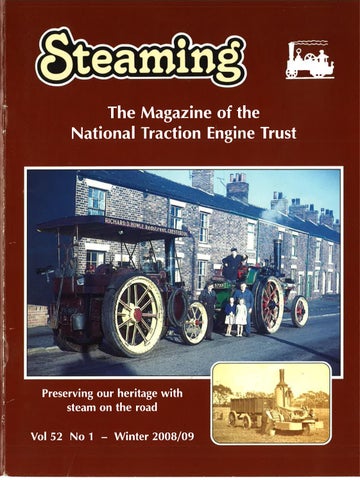
Front cover
Published by the NationalTraction Engine Trust at 14 Charles Street, Market Harborough, Leicestershire. Printed by AB Printers, Montrose, Crown Hill, Great Dalby Leicestershire LE14 2ER
This issue of the magazine includes an extensive account of the early years of the North Staffordshire & Cheshire Traction Engine Club. Here a pair of a club member's engines pose for a photograph before setting off for a rally in 1962 — Foster Wellington tractor 14431 is nearest, with Burrell traction engine 3746 ready to lead the way. A longer description of this scene is with the article. (later SA Baker)
STEAMING Winter 2008/09
3
Trust News Rally Organisers Column Rally Organisers Section I write this at the end of another Rally season. For some events 2008 was a resounding success with good events, good attendances and others profits. For sensible unfortunately, the year has boon a catastrophe with probably the wettest, most miserable summer we have had for many a year - I have heard rumours that one of the entry classes being considered for some 2009 events is for arks! For many, the end of the season means putting away the toys, deciding whether maintenance, modifications or just polishing has to be done before the coming season gets underway - but for rally organisers the work starts now, and the questions come: do we have an event in 2009; what have we learned from last year's event; can we put our new ideas into practice; do we need to change our management team; where is our new blood coming from; do we still enjoy running a rally? One thing I would like to impress on all our rally organisers is that the rally section works hard to help in very many respects. The Rally Authorisation Scheme is very
important to ensure a measure of protection for your exhibitors from the boys in blue under the Off Road Regulations of the Road Traffic Act. Sixty thousand copies of the Trust's Rally List are circulated, carrying your listing, all over this country viaTourist offices, information Boards, museums, the NTET Exhibition Unit, plus another 30,000 distributed within the Best of British news stand magazine. To enable us to do all of this we must have your cooperation. Firstly by submitting your request for authorisation to Bill Evans as soon as possible, enabling paperwork to be prepared, printed and distributed before Easter, and secondly by your later compliance with the agreement on your application form that you will submit a safety officers report within 21 days of your event (even if you have to cancel). Please help us to help you. (Tim Hoit, head of Rally Organisers Section)
The 2008 Conference The Rally Organisers Conference in October 2008 was attended by 130 members and associates from 53 organisations, joining in discussions on the wide variety of subjects. Members had the chance to meet the Trust Chairman, and members of the Executive Committee and the Rally Organisers Section. Probably the most important parts of the Conference agenda were the two presentations given by Mike Garstang on Risk Assessment, and Manslaughter. He Corporate illustrated risk assessment in a practical way, comparing the risk associated with troops on a front line and workers on the oil rigs, to the risk involved with a game of corikeis.This demonstrated the importance of keeping risk assessment in perspective, for the subject is not as scary as first appears. The consequences of the concept of corporate manslaughter can also be
For those readers who are everwilling to study yet another photograph of a heavy haulage job, this one is a further scene to add to the series of three we used in our Autumn 2007 issue - the article 'JIX at Glovers: We need do no more than suggest referring back to GraemeThirkell's excellent commentary of the c1930s scene. This one was probably taken in the minutes between the two printed on pages 196/197 with JIX, Fowler 16264 of 1926, almost ready to draw its load from under the travelling yard crane - there is just the mauling job of the chains to be brought round and fixed. (courtesy Museum of Science and Industry in Manchester) 4
Winter 2008/09 STEAMING
worrying, but we should all make use of the help and advice available and do our best. The audience heard from Simon Watson, a local council senior environmental officer that steam rallies and similar events could be considered a 'walk in the park', compared to dealing with music festivals attracting many thousands. There are always one off situations with no hard and fast guidelines, but most officers are helpful when approached in the right way. Andy Lee of Nationwide Fire Protection Services gave an interesting presentation on fire prevention and fire fighting, and had many resolving to replace, in house and caravan fire alarms, the batteries which have been borrowed for the kids' toys and the like! He explained the benefits of foam and extinguishers. Following the lunch break there was an interesting fire fighting display in the car park highlighting good and bad practice. Bob Siddall, chairman of the Engine Owners Section, gave an informative presentation on the quality, availability and estimated costs of steam coal, and covered firing techniques. He reminded the Conference that the Engine Owners Code of Practice discouraged boiler testing at public events due to the safety element. He closed by giving a breakdown of the costs necessary in keeping and maintaining an engine and presenting it at a rally. During the concluding open forum it was agreed that regional safety seminars would be provided in the early part of 2009 (see separate advertisement for details). Those attending the Conference received a certificate of attendance. (Tim Holt, head of Rally Organisers Section)
Engine Owners Column Voluntary Competency Scheme The Voluntary Competency Scheme test will continue be available, whatever the outcome of the discussions on a 'second route'. Now, during the close season for engine steaming, is the time to find out about the VCS test.There are now seven examiners on the traction engine scheme and three on the under-type wagon scheme. If you want to take your test, or STEAMING Willie! 2008/09
simply find out more, look at the NTET website and download the syllabus (http://www.ntet.co.uk/ syllabus.pdf), or contact me for a copy to be sent to you. I can be contacted by post to 19 Mill Lane, Barton under Needwood, Burton upon Trent, Staffs DE13 8HE, by 01283 712818 or emailjohn. r.durling@uk.transport. bombardier.com Arrangements can then be made for testing when the 2009 season gets started. Why not have a go? (John Durling, administrator, NTET Voluntary Competency Scheme)
PG9 Prohibition Notices Since July 1991 Vehicle Inspectorate (now VOSA) examiners have been able to prohibit the use of any vehicle on a road which appears to them to be un-roadworthy. This also includes vehicles which are not normally subject to testing. These powers were later extended to include certain authorised Traffic Police Officers, but those officers are restricted to defects that are 'likely to cause danger or injury to any person'. Examiners, both VOSA and police, have wide powers of discretion based on professional judgement, as to issue prohibitions that are not justified may lead to their authorisation being revoked. Prosecution for any defects may not automatically arise and generally depends on the seriousness of the defects. Notices fall into three categories. Immediate - issued for the most serious defects and effective immediately. Delayed issued when the defects are of a less serious nature but if left unrepaired would become immediate. Information Notice - issued as information to the owner or operator and noted by VOSA. A person driving in contravention of a prohibition notice issued under s.69 (vehicle unfit or dangerous) or s.70 (overloaded) of Road Traffic Act 1988, will be guilty of an offence under s.71(1) RTA 1988. However, as always, there are exemptions to driving in contravention of a prohibition notice: going to a pre-arranged inspection by a vehicle examiner/authorised police officer, with a view to removal of a prohibition going to a pre-arranged inspection as above with a view to the issue of an MOT or Goods Vehicle Test certificate and the removal of the prohibition. within 3 miles from where any repair has/is being made solely for the purpose of its test or trial, with a view to removal of a prohibition.
General Council and Officers 2009 This column lists, for the information of members, the General Council and Officers of theTrust for 2009.The addresses/ phone numbers of those with special duties are given inside the front cover of each issue of this magazine; others may be contacted by phone or via the General Secretary or Heads of Sections. Names marked with an asterisk* are appointments by the Council and are non-voting positions. President Richard Sandercock Vice Presidents Andrew Semple, Len Crane Chairman Robert Herring Vice Chairmen John Cook, Bob Siddall General and Company Secretary Jenny Holt* Treasurer Julie Smith, FCA" Public Relations Officer Mike Dyson" PT 01353 740470) Membership Secretary John Cook (and Head, Membership
Services Editor, Steaming Roger West Sales Officers Colin and Val* Brown General Council
The above and also: Irvin Barraclough
(S. Yorks, 01709 850346) Joe Black (Yorks, Tr 01748 829601) James Blenkinsop (Insurance Officer) Colin Brown (NTET Sales) Michael Davies (Warks, ' 01295 770217) Sue Doncaster (E. Anglia, 22 01206
230689) John Durling (Derbyshire, 1 :r 01283 712818)
Bill Evans (Rally Authorisation) Bob Garnett (Avon, Tz 01275 878054) Stuart Gray (FBHVC, 12 01462 431848) Tim Holt (Head, Rally Organisers
Section) Richard Hurley (Wilts, 07867758366) Pat Jenkins (S. Wales, 11' 01792 390379) Adam Marriott (Warks, IT 01608 686945) Kevin Munn (SAC chairman) Tony Seddon (Shrops, 12 01948 780599) Bob Siddall (Head, Engine Owners
Section) David Smith (Head, Technical Services) StuartTomlinson (Leics, Ir 01455
613079) Neil Williams (Shrops, 12 01948 830669) Representatives Reg Mattless (NVTractor & EC)* Auditors: Charles Lovell & Co, Royal House, Market Place, Redditch, Worcestershire BN98 8AA
5
Sections and Services 2009 This column lists the members of the Trust's Sections for 2009. Names marked with an asterisk* are co-opted; others are elected General Council members, Addresses/phone numbers of the chairmen or heads appear inside the front cover of each issue. Engine Owners Section Bob Siddall (head) Nick Allen* Irvin Barraclough Joe Black James Blenkinsop Michael Davies Sue Doncaster Sylvia Dudley* Julin Dulling Bob Garnett Colin Hatch* Andy Hawkswell* Pat Jenkins Kevin Munn Richard Pierce* Tony Seddon David Smith StuartTomlinson Neil Williams Peter Williams* Rally Organisers Section Tim Holt (head) Colin Brown Val Brown* Norman Douglas Trevor Evans* Bill Evans Paul Hemstritch* Lance Jackson* Keith Stott* JoTilling* Technical Services David Smith (head) Irvin Barraclough James Blenkinsop Chris Boocode Bob Garnett Stuart Gray Colin Hatch* Richard Hurley Tony Wood* Membership Services John Cook (head) Colin Brown Val Brown* David Collidge* Mike Dyson* Roger West Steam Apprentice Club Kevin Munn (chairman) John Durling (president) Elaine Massey (vice chair) Nick Bosworth* Emily Drury* Kevin Lawrence* Matthew Lund* Nanette Sanders* Barry Sumsion*
6
Any prohibition can only be removed by having the vehicle examined by an authorised examiner at a VOSA vehicle test station, or in exceptional circumstances at an agreed location. Having heard that a steam lorry had been issued with a PG9 for dropping oil on the road, these notes have been sought for the information of engine owners, as well as those with transport and support vehicles. How far, in general, the expertise of VOSA and other officers extends to steam vehicles is an unknown, but be aware that the legislation can apply to any vehicle on the road. (Bob Siddall, head of Engine Owners Section)
The V765 Scheme Last year my role as the Road Roller Association's authenticating officer of DVLA Swansea's Lost Registrations V765 Scheme expanded to include applications regarding engines from Trust members. Since then I have had enquiries from those wishing to reclaim registrations which have, for one reason or another, lapsed. Some enquiries have been pursued in the right and proper manner — the forms completed, traceable documentary evidence provided, etc, with the owners eventually receiving the necessary V5C and regaining the number. I remind members it is the owner's responsibility to provide adequate traceable evidence to prove that what they possess is what they say it is. There have been other enquiries which, for whatever reason, have not been further pursued by the people concerned. This, to me, suggests the owners of the machines still do not have a current V5C for their machine. To take an engine out on the road without having this document is unlawful and, if a problem arises, will negate insurance held for the machine and result in points on the licence, and perhaps a driving ban. The situation is similar to those who drive steam rollers without a Category G licence or L plates, believing, or claiming to believe, that an ordinary car or LGV licence will do. Since last year, DVLA have slightly changed the requirements regarding V765 applications and now ask that all vehicles involved are inspected prior to the forms etc being sent to Swansea. I fully support this requirement where possible fraudulent claims could be being made—such as with cars and motorcycles. But
traction engines, steam rollers etc are generally so well historically documented that in my opinion this requirement for inspection is not warranted. If such inspection does become a mandatory requirement, I may, from the geographical aspect, have to enlist the assistance of others. A further requirement put upon me by DVLA is to report to them V765 enquiries which I turn down before submission. I understand such declined reports will cause the registration mark to be 'flagged' — thus not allowing it to be issued. Although in my opinion an enquiry is not an application as such, the enquirers in these cases have, clearly, made themselves known to me. So when I later see photographs of their engines on the road, I have to ask myself — have the owners obtained a document, or are they flouting the law? In this respect I cannot allow theTrust or myself to be compromised, and I have sought legal advice on the matter. I therefore point out that those who have sought advice on V765 applications, but who have not pursued an application, may eventually find themselves unable to have granted the historically correct registration mark for their machine. I have also provided dating letters for applications for a new age related number for a recent import, using the same yardstick that is required for a V765 application. (Derek Rayner)
Technical Services NTET's Written Scheme of Examination You will read elsewhere of the meeting that Bob Siddall held in October 2008 with the independent boiler inspectors, and of the formation by the inspectors of an association, one aim of which is to inspection consistent develop procedures. Along with Bob Siddall I am very pleased with the outcome of that meeting. Subsequently, in order to allow the new body to develop in an unfettered manner, the NTET's proposed Boiler Inspections Audit Scheme has been suspended for the time being. However, the NTET's SAFed approved Written Scheme of Examination (WSE), contained in Part 4 of the Engine Owners Code of Winter 2008/09 STEAMING
Practice, remains as the basis on which thorough and ad-hoc examinations of locomotive type and under-type pressure systems, both types being common to our hobby, should be undertaken. The NTET's WSE is fully compliant with PSSR 2000 Regulation 8, 'Written Scheme of Examination'; Regulation 9, 'Examination in accordance with the written scheme, and Regulation 10, 'Action in case of imminent danger'. Importantly therefore, and until the newly formed association produces its own version of a Written Scheme of Examination, engine owners, in demonstrating their common law duties (at least), are encouraged to continue applying the existing scheme. In response to earlier suggestions made by the inspectors relating to the design of the scheme data sheets and attendant examination reports, much simplified versions have been produced and substituted into the Written Scheme. Copies of the WSE may be obtained from Bob Siddall or the Trust's website.
Proposed development of Voluntary Driver Competency Scheme You might be forgiven for wondering what the VDCS has to do with theTechnical Services Unit. Well, as the co-designer along with Irvin Barraclough of the original scheme some years ago, I have a vested interest in its ongoing development, and importantly my team is charged with ensuring that anything the NTET embarks upon fits within its charitable status and also does not jeopardise the Trust's reputation in seeking to preserve our heritage with steam on the road. Since its launch the NTET's competency scheme has been the focus of much debate, some of it grossly misinformed. The examination-based VDCS provides scope for practical training, and aims to demonstrate the participant's knowledge and experience in the design, STEAMING
Winter 2000/09
New faces — five nominees for vacant places on the NTET General Council were voted on and approved at the AGM in November. Here, from left to right are Joe Black, Sue Doncaster, Stuart Gray and Adam Marriot. Colin Brown, the fifth newcomer, missed the picture-making after the meeting by being too fully occupied with the book sales stand.
operation, maintenance and running repairs of steam powered traction engines — thus promoting safe operation in a public place. Following hard on the heels of the independent review of the current examination based options scheme (see our Autumn issue, page 177), Bob Garnett has been working, along with other Trust members, to devise an 'experience based' option. Not to be confused with so-called grandfather rights, this option is designed to dovetail into the existing options (Self sponsoring, Steam Apprentice and Adult mentoring) and will lead to the award of the Certificate of Competence. To aid discussion Bob has devised a document which details the proposed processes in this 'experience based' option, and these paragraphs, together with an accompanying flow chart, are included elsewhere in these Trust News pages. The first draft was presented by Bob Garnett to the General Council
meeting in December and after suggested slight modifications the principles were accepted. There now remain just a few areas where the working processes have to be more fully developed. When this development work is concluded the draft scheme diagram will be posted on the Trust's website and the scheme, complete with explanatory document, will be re-presented to Council for ratification in March 2009. (all paragraphs — David Smith, head of Technical Services Unit)
A change of Secretary Members will be aware that last spring Sue Jackson gave notice that she wished to relinquish the post of general secretary to theTrust after the autumn AGM. Sue commenced duty
An invitation to rally organisers, safety officers and other interested parties. By popular request, three
Safety Seminars have been arranged for early spring, so that Safety Officers can obtain a Safety Officers Certificate, or replace an existing one. 14th February 2009 - Heckmondwike, West Yorkshire 28th February 2009 - Somerset/Wiltshire 21st March 2009 - Willoughby, Warwickshire Select the venue that suits you best. Invitations and booking forms will be sent shortly to all Authorised Rallies. Other interested parties or event representatives are most welcome. Contact: Tim Holt, South View, Hutton Roof, Carnforth LA6 2PF `23' 01524 271584 — fax 01524 271768 — rallychair@ntet.co.uk
7
in the post in May 1991, in the days when the late Eric Fillmore was chairman. Responses to our magazine advertisements for a successor were not, it has to be said, very encouraging by the number of enquiries, but we are pleased to announce the appointment of the new general secretary - Jennifer Holt, of near Kirkby Lonsdale, Cumbria. Members will find the new secretarial address at the panel inside the front cover. The paragraphs below are a farewell and a hello, in their own words, from Sue and Jenny. Sue Jackson says goodbye - As many of you already know, due to moving to a less central part of the country I have reluctantly decided to put down the quill pen I have wielded on behalf of theTrust for many years. I would like to thank the many people I have come in contact with for all the help that has been given to me during my period of office. I am amazed at how many people continue to work tirelessly at the traction engine hobby so that our engines are kept in steam on the road and displayed on the rally field so that everyone can continue toenjoy these fine machines. What was my closely guarded secret? My grandfather was bannerl from driving traction engines as he was found drunk when he should have been moving goods for Tommy Ward's of Silvertown in east London! I trust you will all give Jennifer as much help as you have given to me now she has taken over the reins. I hope I will see many of you on the rally field over the coming years.
An experience based Voluntary Driver Competency Scheme The General Secretary to theTrust Jenny Holt of Cumbria.
Jenny Holt introduces herself- I am nearly, but not quite, the 'new girl on the block', having been taking minutes on Sue's behalf at recent Trust Executive meetings. I've been married to the chairman of our Rally Section (and the Cumbria Steam and Vintage Society) for over thirty years, so I have some basic idea of what the Trust is about. I come from a 44 year career with the Ministry of Agriculture as a subsidy or satety inspector, so am no stranger to either pen pushing or dealing with 'country gentlemen (and ladies)'. I am sure we will get along fine. As a Northerner born and bred what you see is what you get, and if I can help in any way I am on the end of a telephone, a fax or a PC. I've no doubt that I shall have a lot to learn, but feel that there is a good team at the helm who will help me through. Sue has supplied me with a great deal of information which will be invaluable and I wish her all the best in her retirement. I look forward to meeting you all and being a useful part of theTrust team.
Insurance Officers notes
of General Secretary after 17 years, is presented with a farewell gift from theTrust at the AGM at Shaftesbury in November. Within the wrapping was an original oil painting by Robin
For a number of years the Trust has operated its computerised NTET Disc issuing system, and for the last four has worked with its agents to enable them to issue discs by the same manner. The details printed on the disc are recorded and passed on a regular basis to the Trust's central data base. Initially this record was merely kept in case of future queries, but it was always our desire to make
Wheeldon of steam engines at work in a farmyard setting.
(continued on page 10)
Sue Jackson, retiring from the post
8
a draft proposal As a result of the strongly expressed views of a number of members on the Trust's Voluntary Driver Competency Scheme during last summer and autumn, a small group led by Bob Garnett and Stuart Tomlinson have worked on an alternative 'experienced based' Scheme which will enable drivers to make application for the Certificate of Competency which takes into account their experience. The submissions will he on a selfassessment basis, supported by sponsors and checked by verifiers. The following notes outline Bob Garnett's present thinking with regard to the steps in the self assessment option. A - Obtain application form. These will be available as hard copy from the administrator, or by downloading from the NTET website. B - Complete the form. The following sections will require consideration: 1. Steam plant operational experience: experience of operation of any steam plant, OR candidates with non road steam experience should state period and type of experience. 2. Restoration and maintenance experience: including rebuilding and repairing steam engines. 3. Declaration of 'in-steam' experience: 500 hours is considered to be the minimum acceptable period for this scheme.The statement of relevant experience is not expected to be in log form of dates and hours of experience, but may be in any clear and concise form with one of the following being considered to be a normal acceptable statement — 'Engine owner/operator of xx years standing, attending rallies in xxxshire for this period' or 'Have clewed engines for x years, operating on the road and at events for this period.' 4. Formal qualifications, including driving licences: proof of having taken a national driving test on a steam powered road vehicle will contribute 100 hours (must comply with UK legislation) Winter 2008/09 STEAMING
5. Sponsors' signatures and recommendations. 6. Organisers' signatures. 7. Submission of formal safety test. 8. Scheme administrator's sign off. C - Obtain Sponsors. Two sponsors are required, each to hold an NTET Certificate of Competency (any route): 1. The sponsors should scrutinise the application and satisfy themselves that the declaration satisfies the requirements of the scheme. 2. For applications that satisfy the requirements of the scheme the sponsors will sign a declaration that the details are correct and forward the form to the verifier. 3. For applications that are found not to satisfy the requirements of the scheme the applicant should be advised of the outcome of the application review and what actions are required to secure a successful application.The process is not designed for a pass/fail culture, but if not completely satisfactory a referral of the applicant for additional information, mentoring or experience. The sponsors should make recommendations at this time.
Experience Based Option
Practical Assessment Option Self Sponsoring
Steam Apprentice
Adult Mentoring
obtain compentency syllabus
obtain Apprentice log book
obtain adult log book
obtain assessment form complete a self assessment form
find mentor(s)
check personal status against syllabus
apply to scheme administrator
complete requisite log-book cycles
complete requisite log-book cycles
check progress against competency syllabus
check progress against competency syllabus
SAC officer sign-off
mentor sign-off
obtain sponsors' sign-off obtain event organiser's -sign-off? complete safety questionnaire? apply to verifier
D - Event organiser signatures. To determine the likely conduct of the applicant when attending public events the signatures of three officials will be required. Any of the following will be acceptable: event organisers; appointed club officials; museum or venue officials; Trust officers; Affiliated Club officers. These signatories confirm the applicant's good standing at their venue, event or function etc - they are not required to have any operational experience of steam road vehicles. Some other considerations - Initially a run-in period could be allowed to kick start the process, when applicants may not have easy access to the required event staff for signatures. During the run-in period the scheme will either require a statement of three names that can be verified, or a period of time to complete this activity possibly up to 12 months after approval of the application. We must also think about the engine owner who does not rally his engine or attends only one event a year; it must be possible for the scheme to be relevant to this owner. E - Complete safety test. The safety test shall consist of 30 questions set by the scheme administrators: 1. The questions shall be multi choice, that is each question has two wrong answers and one correct - identify the correct answer. 2. The test shall be open book. 3. The pass mark shall be 80%. 4. Applicants scoring below 80% shall be referred back to their sponsors for mentoring. STEAMING
Winter 2008/09
verifier's assessment
adminstrator assigns examiner ❑p ion pass -4-
examiner's assessment
fail
reject
Diagram of routes to Voluntary Certificate of Competency
F - Apply to verifier.
Submit completed application form and question sheets to verifier. G - Assessment. Verifier checks application against scheme standards: 1. Undertake basic checks for minimum compliance. 2. Contact sponsors and event signatories to obtain confirmation of the applicant's declaration and the sponsors' recommendations. 3. Mark the answers to the safety questions. H - Outcome. Draw conclusion: 1. Acceptance -The verifier will forward the details to the scheme administrator with a request for a Certificate to be issued. 2. Submission not accepted Recommendation for either additional steaming time required, or transfer to examination based route, or more experience required. Appeal - it is hoped that enough checks have been built into the scheme to make appeal a rare event. In the event, an appeal should be lodged in
writing with the scheme administrator. The administrator will nominate twoTrust General Council members with proven engine handling ability to investigate. All parties will be encouraged to take part in the appeal process. I - Administration. On completion of the application with acceptable assessments, the administrator will arrange for the issue of a Certificate and 'wallet card', stating that the applicant has successfully completed the NTET's Voluntary Driver Competency Scheme, and details are added to the competency register. The certificate will be identical to any other basic competency schemes administered by the Trust. Comments and further input from Trust members on the above scheme would be welcome - contact Bob Garnett on 'Er 01747 824689 or bobluk@blueyonder.co.uk or the Trust website. 9
fFi
The NTET's Engine Owners Section presents its 19th
STEAM TRAINING and DRIVING COURSE to be held at
Astwood Bank, near Redditch, Worcestershire on 9th and 10th May 2009 A practical course including instruction on boiler management, mechanical operation, care and maintenance, and on driving techniques. Adult members, £176.25 for the two days Steam Apprentice Club members (13-15) £58.75 or (16-21) £88.12 Contact Stuart Tomlinson on 17 01455 613079 or e-mail hazel.tomlinson@homecall.co.uk
(continued from page 8) more use of the information to help event organisers. A couple of years ago, the Trust offered to help NTET Authorised event organisers to prepare details of the discs for the engines attending their event. This had enormous benefits for the organiser in that it saved the Safety Officer traipsing Around the site Irv)king at disc details during the busy Saturday morning period, and helped avoid engines turning up without evidence of insurance cover and boiler inspection reports. The service has been invaluable to many events, especially large ones where engine numbers can exceed 100. It is limited to events with 25 or more engines, for it would be too time consuming to manually review all 110 authorised events. However to be fair to all, we will now be rolling out the service to all
authorised events through the medium of the Trust web site. From next season, each event will be issued with a password to enable them to gain access to the web site section where they can view the latest insurance disc information.The password will be time limited to the last day of their event so it will not be a free-for-all access. Whenever a disc list is prepared by an event organiser a copy will automatically be sent to both the NTET event authorising officer and the Insurance Officer. This will help ease the process of compiling the Safety Report, which includes the disc list, and is normally subsequently returned to the authorising officer. The success of this service depends heavily upon the disc issuing agents returning information on the discs issued, and on a regular basis. In the past we have been receiving reports weekly, so we are
The Steam Apprentice Club announces its annual award
Technical Achievement of the Year Award, 2009 for the best technical achievement by an Apprentice in the current year Areas of achievement may include: work on full size engines, model engineering or other road steam related subjects . The purpose is to encourage young people to develop experience in engineering skills. Apprentices may enter themselves, or through a sponsor for whore they have been working. Initial submission should be a brief description on one side of A4 paper with photographs or sketches, to the SAC Chairman by the end niftily — address inside front cover. Suitable projects will be chosen, and detailed submissions invited. The winner will be named in October, with the award presented at the Trust A(M. Judges will be from the SAC Committee, plus invited persons from areas appropriate to the subject.
10
planning to refresh the information on the web site at the end of each week to help keep it up to date. I must stress that the only details listed for each disc issued will be those which are readily seen on the disc. We have no sensitive data such as names and addresses stored on the central disc system —this will only be available at the original issuer's end. As more authorised event organisers get used to adopting the service, am I sure they will quickly see the benefits of checking discs before the event rather than during it. This in turn will save the engine owner the worry of whether his new disc will be posted to him in time, so that he can attend his next rally as the electronic data flies ahead of it. (James Blenkinsop, Insurance Officer)
Steam Apprentice Club This year, as I hope you are all now well aware, is the 30th A nnivors.ry pf the SAP Preperetinne are under way for a special driving weekend for Apprentices on 27/28th June at Old Warden, Bedfordshire. Please make a note in your diary. As part of the weekend activity we hope to do a rolling slide show of pictures taken of Apprentices over the years. If you have any, please send them with details of where and when and maybe who, to myself (address on inside cover), or if you can scan and email please send them to sac.webmaster@ntet.co.uk We also need engines — full size and miniature; again, contact me if you would like to participate. We have been fortunate with many individuals and clubs kindly offering to host driving days for Apprentices in 2009. I thank all in advance for giving the time to run these events. If you feel like doing one yourself to help our youngsters gain the experience of driving an engine, please contact me for details of how a day is run. Whilst the SAC is going from strength to strength, one of the things I raised at the NTET AGM was the disappointment in the number of entries we received for both the Steam Apprentice of the Year and the Technical Achievement awards. Elsewhere in this issue is an advert Winter 2008/09 STEAMING
1
FBHVC News
David Warren sends this valedictory picture of Fowler class DNB roller 17506 UNDAUNTED, taken at the Woodcote Rally in 2007 when he had the pleasure of steering it in one of the parades. Now, it seems, the 1928 built machine has changed hands and been sent off for conversion to a showmans type shame enough for any engine, but the more so with this roller, for it was nicely presented in original form with the complete outfit of Fowler-Wood patent tar spraying and gritting equipment. Alright, the tar was missing, but the roller and its apparatus was nevertheless one of the more authentic exhibits on our rally fields, and well worth many minutes careful and enjoyable study. Will those who know and care about engines in future stand and show interest in what 17506 is to be reduced to?The poor machine must be finding its name a severe burden.
From a Fowler Road Making and Maintenance leaflet, we see the opposite side of a 'Fowler-Wood combined apparatus for rolling, tar-spraying, gritting and grouting; this one based on an example of the smallerT3 class rollers.
asking for entries for the latter, which does depend on names being put forward by members in general. Please consider entering an Apprentice you may know or who crews with you. It would be a shame in our anniversary year not to have a recipient, as happened in 2008. The Steam Apprentice of the Year 2008 was Emily Drury, nominated by STEAMING Winter 2008/09
Michael Beeby for, amongst other things, her aptitude and determination to master the art of steam ploughing. A new award started this year was for adults or organisations who have supported the SAC over the years. This award was given to GDSF and accepted by Martin Oliver. (Kevin Munn, chairman, Steam Apprentice Club)
FIVA agrees on 'Historic' vehicle definition At the recent meeting of the Federation Internationale des Vehicules Anciens representatives held in Brussels, including members of the Federation of British Historic Vehicle Clubs (of which the Trust is a subscribing member), the long running issue of determining the definition of a 'historic' vehicle was finalised. FIVA defines a historic vehicle as a mechanically propelled road vehicle: • which is at least 30 years old; • which is preserved and maintained in a historically correct condition; • which is not used as a daily means of transport; • and which is therefore a part of our technical and cultural heritage. This definition is considered important, mostly for political lobbying purposes. For example, the EU Commission has given indications that while it is happy to consider legislative exemption for a reasonably small number of vehicles, used for relatively low mileages, they would become concerned if the number of vehicles or the mileage they covered grew too large. It is hoped that by lifting the defined age to 30 and excluding vehicles used for daily transport, this would be avoided. From the above wording, it might seem conversions of former steam rollers - and other non-historically correct conversions - will not be able to be considered as historic vehicles in future. Drive It Day The FBHVC's Drive It Day this year will be on Sunday 26th April.The aim is simply for historic vehicles to be seen on or by the highway, so that the public is reminded that they exist and that there are lots of people preserving them for posterity. Owners don't need to do anything special if they don't want to - all that they are encouraged do is just use their old vehicle instead of a modern one for whatever it is they do on that day. That might be slightly impractical for a road steam vehicle, but if your machine is out of winter storage, do consider joining the throng on a modest trundle. D-I-D not only intends to show how big and varied the historic vehicle movement is, it also aims to 11
make the point of how infrequently they are actually used.The number of old vehicles on the road on that one day in the year will highlight just how rare it is to see them the rest of the time, and thus demonstrate that historic vehicles make up only a tiny fraction of normal everyday traffic. NTET representative Stuart Gray, elected to the General Council at the 2008 AGM, is to take the position ofTrust representative at the FBHVC. He can be contacted on 12 01462 431848.
Trust Trophies The events around the Trust's Annual General Meeting provide very suitable occasions at which to present our trophies to those who have achieved success in one form or another within the engine hobby. As usual, the recipients were generally chosen from the broad area around the meeting at Shaftesbury in Dorset. The presentations were made by our President Richard Sandercock, and the citations were read by Paul Worbey. John Ante!! - prosantod with the ARTHUR NAPPER CUP for engines; John has for nearly 40 years owned a Fowler agricultural of the type that would have been at the early Appleford rallies. Paul Antell - awarded the PERCY HIRONS BOWL for his many years of serious use and demonstration of his fine Robey agricultural engine. Robert Coles - presented with the BAKERTOC-H CUP for his mighty contribution to engine preservation, which is country, and indeed world, wide. The Fairground Heritage Trust - was selected for the JOHN CRAWLEY TROPHY, for outstanding service to the hobby but not directly connected with engines. Received on the FHT's behalf by Richard Sandercock. Malcolm Fleet - presented with the JACK HOLLOWAY COMMENTATORS SALVER for his work as commentator at several shows in the south west, and more recently, the Great Dorset Show. Jill Honeybun - awarded the CURTIS BOWL for her continued involvement with the family's two engines following the untimely death of her husband Ken. Gordon Howell - presented with the EDNEY SHIELD for his associa12
tion with engines and rallies since the days of the earliest Andover rallies in the 1950s. Sue Jackson - the Trust's retiring secretary, inevitably chosen as this year's choice for the CONNIE HUTCHENS MEMORIALTROPHY. Sue has been outstanding with her work for us for 17 years, and will be much missed by many. Chris Lawson - presented with the ERIC MIDDLETONTROPHY for his achievements on a limited budget with his Fowler roller. Tom Mayhew - was awarded the DACRE LACY CUP for his recent purchase of an engine that he was able to take back to its roots in Southampton. Jos Nieuwenhuys - this effervescent lady from the Netherlands was handed the JACK HOLLOWAY PORTABLE CUP for portables, for her efforts in exhibiting her Marshall engine, always on a sawbench or thresher, in many countries in northern Europe. The Oliver family - what is considered our premier award, the GOLDEN FILM SHIELD, was presented to Martin Oliver to mark the presence of the Trust's AGM in Dorset - the home of the biggest outdoor event in the world, and the creation of Michael Oliver 40 years ago. Graham Vincent - awarded the CHOISY & SIMPSON CUP for his outstanding work in the fifteen year restoration of his Burrell showmans road engine. Presentations by the Steam Apprentice Club were made to: Emily Drury - the JACK BEEBY CUP, as SAC Apprentice of the Year. Martin Oliver of Great Dorset Steam Fair - the SAC Award to an adult, or an organisation, who have helped SAC over the year. The SAC Technical Achievement Award was not presented in 2008.
Affiliated and other groups The Museum of English Rural Life, Reading A workshop study group on engineering drawings is to be held at MERL on the afternoon of 28th March 2008, 2,00 to 4.30pm. The study will look at the work of the drawing office in engineering companies, and some of the different types of organisation within firms
and the types of drawing produced. Selected items from the archive collections of drawings at MERL will be used to show their origins, their size and nature, and what we can expect from the drawings in using them in the present day, and their limitations. There will be time within the session for participants to share their experiences and to have a closer look at drawings which will have been presented for the workshop. The number of participants has to be limited to a maximum of 12. To book a place for the afternoon please contact MERL on .12 0118 378 8660 or merlevents@reading.ac.uk East Anglia Transport Museum Heritage Lottery Funding in the sum of £198,500 was awarded in September to the East Anglia Transport Museum at Carlton Colville, near Lowestoft, Suffolk. The grant is to enable the Museum to develop a new exhibition 'Tar, Sweat and Steam' which will tell the story of roadmaking and roadmen in the age of steam, and focus on the Museum's 10 ton Armstrong Whitworth roller 10R22 of 1924 (formerly worked by the Ipswich Dock Commission), a roadman's living van of 1910 vintage and a water cart. All these have strong connections with Suffolk. The project is to help visitors understand the link between steam and the roads of today, and will complete the story of transport that is portrayed in the rest of the Museum.
Future Dates Driving and Training Course This NTET Course will take place on 9/10th May in Worcestershire please see the display advert for further detail and contact addresses, etc. Safety Seminars A further series of NTET Safety Seminars for rally organisers and their safety officers has been arranged by the Rally Organisers Section. Invitations will be circulated to organisers on the Trust lists, but newcomers are welcome - please see the display advert in this section of the magazine. Winter 2008/09
STEAMING
many years. Full addresses are not included, but the Membership Secretary is always willing to put members in touch with one another by forwarding mail. J LWilson,Yarnton, Oxfordshire Dietmar Berndt, 41564 Kaarst, Germany R N Evans, Crymych, Pembrokeshire S Sanders, Porchfield, Isle of Wight D Cheriton, Henley on Thames, Oxfordshire N Hirst, Whitchurch, Hampshire R Allen, Yeovil, Somerset Miss K Ascott,Yeovil, Somerset J S J Palin, Horncastle, Lincolnshire D F Buckingham, Grays, Essex G R Cooper, St Neots, Cambridgeshire S C Ranns, Wilstead, Bedfordshire S J Dickinson, Kirkby in Furness, Cumbria M H Brackenbury, Ravenshead, Nottingham M Gardiner, Newport, Shropshire S Robinson,Telford, Shropshire D Lilley, Preston, Lancashire R Foreman, Irchester, Northamptonshire W Norval, Clackmannan, Scotland M W Smith, Chandlers Ford, Hampshire G Scott-Coomber, Biggleswade, Bedfordshire S Cruickshank, Norwich 0 Maslin, Keighley, WestYorkshire
Coventry home-coming In mid October last year Dick Blenkinsop visited Coventry city centre with his steam roller. The occasion was to celebrate the 70th anniversary year of the delivery in March 1938 of Aveling-Barford 6ton single cylinder roller AC624 to the highways department of the Corporation of Coventry. It so happened the day was also Dick's birthday anniversary. The robed Lord Mayor was waiting on the steps of the Council House to receive the pair, where inspections were made and a lump of coal, fixed with seven ten-year birthday candles, was consigned to the firebox for consumption by the Aveling. Dick found the visit and the small civic reception he was accorded to be most enjoyable, and recommends the conception to any engine owner who can observe a suitable celebration or home-coming - but plan things very much in advance. Following the official duties the Aveling visited the statue of Lady Godiva on her horse, and then retired to the Coventry Motor Museum, where it will be on display to the citizens of Coventry until April. In Malcolm Ranieri's photograph of the roller making its way through the city's post war buildings and modern traffic there is nothing or nobody in the view that is of greater age than either the Aveling or Dick!
Trust Diary 2009 The diary of Trust events of a business and social nature during 2009 is set out below. It includes, in bold type, dates of Conferences and other member's gatherings and, in italic type, Council and Executive meetings. Details of the former group will given in the Future Dates column or in display adverts in issues of the magazine nearer to the time. 5th February Executive meeting 14th February Safety Seminar 28th February Safety Seminar 8th March General Council 21st March Safety Seminar during April Executive meeting 9/10th May Driving and Training Course 14th June General Council STEAMING
Winter 2008/09
Poor Steaming There was an editorial slip within the caption to the picture of STARLIGHT, Burrell 3836 whereby the engine's stature was challenged - it is of 6hp, not 5. Owner Allan Lloyd adds that whilst at Kemble the Burrell drove Dorman's dodgems and the yacht lights and juvenile for the whole of the show, pulling out at 4.00pm on the Sunday for the 50 mile drive home to Herefordshire through the evening.
27/28th June
SAC 30th Birthday Event during August Executive meeting September GDSF open forum 11th October General Council during November Annual General Meeting 13th December General Council
New Members A warm welcome is extended to these new members who have joined the Trust in the last three months. We hope they will gain friendship, information and enjoyment from their membership over a period of
'About seven o'clock yesterday morning a steam-roller belonging to the Fulham Vestry was proceeding slowly along Dawes Road, when the driver found the roadway rapidly giving way beneath the engine, which weighs about ten tons. He jumped off just in time to save himself, for within a few minutes the steam-roller sank to a depth of ten feet. The subsidence was caused through the breakage of an old cesspool. A large number of men were set to work to extricate the engine, but it is expected that some time will elapse before this can be done' (from The Times, 6th September 1887) 13
Trust meeting with the Independent Boiler Inspectors
• setting of standards • assessment of knowledge, training and experience, • identifying, implementing and evaluating training needs, • sharing and transfer of knowledge into, within and out of the Association.
proficiency of their self-governance and self-regulation. This will be characterised by communication founded on mutual trust, by shared perception of the importance of safety and the preservation of heritage steam plant by confidence in the efficacy of preventive measures.
Whilst this is a very high level statement of aims and objectives, based on the principle of HSG(65) 'Successful Health and Safety Management', that probably raises more questions than it answers, it represents a significant step forward and provides the framework for a number of initiatives that will be of mutual benefit to the Independent Boiler Inspectors, the engine owners and the general public. As these aims and objectives will be they materialise, communicated by the Association to their stakeholders and customers.
In furtherance of the Trust's aims to bring consistency and best practice to boiler inspections, another in the series of meetings of Independent Boiler Inspectors was held on Sunday 19th October. Ten out of the 13 inspectors who appear on the NTET's Register attended, and apologies were received from Alan Prout, Ian Farrance and Martin Clark. Acting as facilitators at the gathering were Chris Boocock of Rainham Industrial Services and Glyn Amphlett, principal engineer at AlIlanz Engineering (and also e member of the Safety Assessment Systems Pressure Federation, Committee). Following their working session that day with Chris and Glyn, the independent inspectors, in seeking to demonstrate their commitment to the longevity of the hobby, proposed that they form an informal association, the founding principles of which are made clear in the following announcement.
A statement to the NTET A group of Independent Boiler Inspectors have agreed in principle to form a self governing and self regulating body in the form of an informal independent association, committed to maintaining and improving the safety, and preserving the longevity of heritage steam plant. The ethos of the Association will be the product of individual and group values, attitudes, perceptions, competencies and patterns of behaviour that determine the commitment to, and the style and
'Bray's Traction Engine. .... a number of 5 horse-power, possessing of extra speed to the one now in use (at Woolwich Dockyard) are in course of construction by R & F Hughes of New Cross for Keyham and other yards, as well as one for Barcelona of 8 horse-power, one of equal power for Western Australia, one for agricultural experiments in Leicestershire, one for a mercantile firm in the City, and others for the Cape of Good Hope, South America etc etc.' (from the Kentish Mercury,
23rd October 1858) 14
Control will be established by: • formulating and developing policy and a Code of Professional and Ethical Conduct, • identifying key objectives and reviewing of progress against them, • planning, measuring, reviewing and auditing activities to meet legal requirements and minimise risks, • ensuring effective implementation of plans and reporting on performance.
Co-operation will be established by: • participation of the Independent Boiler Inspectors to support risk control by encouraging mutual ownership of policies, procedures, processes and practices, • to establish an understanding that the Association as a whole, and those in it, benefit from good performance, • pooling knowledge and experience through participation. Commitment and involvement means that the safety and preservation of heritage steam plant becomes 'everybody's business'.
Communication will be established by a common appreciation of how and why the Association is trying to improve the safety and longevity of heritage steam plant, and will rely on information: • coming into the Association, • flowing within the Association, • going out from the Association.
Competence will be established by ensuring there are proper arrangements in place to ensure that they are competent.This will include:
'ROAD LOCOMOTIVE. On Monday we saw at work in the New Cross yard of the Brighton Railway a road locomotive, as seen some months ago at Woolwich Arsenal, It was one of two of Bray's patent traction engines recently manufactured by Messrs R &T Hughes of New Cross. The one we saw is for Australia, to convey lead ore. The other is for Barcelona, Spain, to take coal to that town, and is to the order of Catalan Credit Society. It has two cylinders 7in x 15in, driving wheels 7 feet, steering and leading wheels 4 feet,
Chris Boocock and Glyn Amphlett, for and on behalf of:
Chris Beason, Alan Bulmer, John Glaze, Alan Hines, Graham Morris, Andrew Reen, Tony Reen, Hal Richardson, Jonathan Wheeler and Dave Wothers.
As chairman of the Engine Owners Section of the NTET, I warmly welcomed the initiative and confirmed that the NTET would support the move. The NTET Code of Practice for Traction Engines is in place and being used by a number of inspectors, and this arrangement will continue until such time as there is an agreement between the new inspectors association and the NTET on changes to that scheme. In the meantime any Inspector who wishes to use the NTET Scheme may do so, and any owner who wishes his engine to be examined under the scheme may also request it. (Bob
Siddall, head of Engine Owners Section) 104
and water tank under boiler; it weighs 10 tons in working order. (from Herepath's Railway Magazine, 8th
January 1859. The engine destined for Western Australia landed was peculiar in there landed circumstances in June 1859 — you can read a detailed account of its early use and its present day survival as a relic in Pioneer of the Road, by John Clydesdale, available from NTET Sales. The Hughes business is referred to in several published traction engines works as F & J Hughes.) Winter 2008/09 STEAMING
Busby's new boilers This photograph was recently part of a display at the Bradford Industrial Museum which celebrated the history of Busbys, a formerly well-known local department store in the city. We are grateful to Bradford Museums, Galleries and Heritage for their ready permission to use the picture in our magazine, and to David Mitchell for the arrangements. David notes: Busbys was first established in the centre of Bradford, but in 1930 moved to new premises in Manningham Lane, a short distance out of town.There, in 1937, a laundry and a power house were added, the latter to provide heating and lighting for the entire store. A Bellis & Morcom high speed steam engine of 400hp drove a 250kVA alternator, and steam was provided by a pair of Lancashire boilers. It is these we see in the picture, being delivered by road engines owned by H Bentley & Co STEAMING
Winter 2006/09
(Bradford) Ltd — though having arrived at the store's side entrance doors in Drewton Street, it is far from evident to us where the boilers will go next. It looks to have been a rather dull day, and though the picture was subject to some minor dark room touching up on the original print (mostly around the front end of both engines) there is much to study. Road Locomotive Society records list two late-built McLaren road engines in Bentley's ownership about this time, and it seems likely the pair is numbers 1571 and 1716. 1571, the nearest engine, was an 8hp compound. It was new in July 1919, fitted with Boulton rear wheels, and later, registered NC2305, some of the letters of which are just visible on the back of the awning. We can see the engine has the heavy side rims that were a feature of Boulton wheels, but rubber tyres have by now replaced the original sprung blocks that were mounted around the perimeter face. A later photo, used by John Crawley in his Traction Engines in Focus, shows the engine after the fitting, in 1944, of replacement braced tee rings and strakes, work carried out by Allen
Knight of Huddersfield, by then the owners. The second engine is even less well-positioned to see detail that might confirm its identity as 1716, which was built in 1923. The rear wheels, again, appear to be of the Boulton pattern, now faced with rubber tyres. However, to confound things, the registration NC2305 seems to be affixed to the rear of the boiler trailer it is hauling! It is surprising, too, that the boiler manufacturer has not taken the opportunity to display the firm's name on the product. It could well be that it was Hewitt & Kellett Ltd, whose premises were only some 2 or 3 miles from the Busby store — and they also had, but before this period, a McLaren road engine originally on Boulton wheels. Whatever the identity of the engines, it is a nice scene, and the excitement for the staff seems to have drawn two of Busbys' neatly dressed floorwalkers to the store doors by the chimney of the nearest engine, though many of the passersby seem quite disinterested.The store closed in the mid 1970s and the building was subsequently destroyed by fire. 15
The North Staffordshire & Cheshire Traction Engine Club — the orma lye y-a 5
Allan C Baker The winter of 1958/59 saw the formation of the North Staffordshire & CheshireTraction Engine Club — the 50th anniversary therefore, provides an excellent opportunity to trace the early history of the group.
An invitation The origins of the club actually go har.k to December 1958, when the late Stan Wedgwood had a letter published in the Staffordshire Evening Sentinel inviting those interested in forming a local club to contact him. My father, the late Stephen Raker, did just that and in a letter dated 2nd December from Stan (which I still have, along with the newspaper cutting), we were invited to attend a get-together of interested parties at the Clough Hall Hotel at Kidsgrove, just north of Stoke-on-Trent, on Friday 5th December, to which Dad and I went along. Dad served part of his apprenticeship with Aveling & Porter at Rochester and despite having concentrated on model engineering, building miniature livesteam railway locomotives, he had maintained a keen interest in road steam, which rubbed off onto me (he later built a 2in scale Marshall compound road locomotive which is still in the family). When we saw steam rollers, along with the odd traction engine or steam wagon at work on various family outings and holidays, we always stopped to have a look. Stan Wedgwood (1907-2001) was the youngest son of Arthur Wedgwood (1876-1941) and grandson of Leveson Wedgwood (1852-1928); Leveson was a boilermaker by trade who started his own business at Cobridge in the Potteries in 1885.The company he formed later branched out into road haulage using various steam vehicles including Foden steam wagons. So Stan and his elder 16
brother, who was also christened Arthur (1900-1979), had steam in the blood as they say, but while Arthur joined the family firm, Stan became a chemist. However, in 1956 Stan and his family had acquired a six-ton Standard Sentinel wagon number 2307, registration AW4693, from Horridge & Cornell of Bury in Lancashire. This machine was straight trom commercial service and was in full working order; they kept it in much the same external condition as acquired and it looked a treat! The initial fact-finding meeting oraanised by Stan took place as arranged, when 27 local enthusiasts and prospective members turned up, sufficient to make the decision to form a club. There were a number of others interested who for one reason or another were unable to attend, but who had been in communication with Stan offering support. Stan had done his homework well — later events confirmed that he always did — and the decision was made to form a club under the patronage of the NationalTraction Engine Club (NTEC), the present day Trust (NTET). Stan was elected secretary with the late Dan Howle as chairman and John Podmore treasurer; a post incidentally, that John holds to this day: is this some sort of record one asks? Dan Howle had been very much a man of steam, as prior to nationalisation of the road transport industry in 1948, his family had owned and operated a road transport business from Red Street, near Chesterton in Newcastle-under-Lyme, and Dan had driven both Foden and Garrett steam wagons over many years (I penned an article on Dan and his family business in our Autumn 1990 issue). Following the formal business, which did not detain us long, there followed what was later described in the local press as a 'fine
show of photographs by Mr Wedgwood'. I still have a copy of the agenda for the meeting and the slides which Stan projected included some taken at the Woburn Park Rally earlier that year. We all left invigorated and full of enthusiasm for our new venture.
Formalities The Club's first 'News Sheet' as it was called, just before Christmas 1958, had the heading 'The National Traction Engine Club — N Staffs & Cheshire Group'. Among items of interest it confirmed an agreed annual subscription of 20/-, which was broken down as 15/- for the NTEC membership and 5/- for the Group (Cl, 75p and 25p respectively). A second meeting was arranged for Friday 2nd January, again at the Clough Hall Hotel, which then became the regular venue for a couple of years. An interesting sidelight on the times was the secretary not having a telephone at his home; he could be contacted by phone at his business, but only in the evenings between six and seven pm! Phil Swindlehurst by the way, a member from Leek, assumed editorship of the News Sheet, and in duplicated form this went from strength to strength under his excellent stewardship. He also took on the role of submitting Club news to the editor of Steaming. By the time of the second meeting membership had grown substantially, and there was much interest reported from potential members, doubtless to some extent due to the first gathering being reported in the local press. In fact a reporter and photographer attended the first meeting and took the accompanying group photograph, which appeared, along with a short article, in a subsequent edition of the Evening Sentinel. At this second meeting Stan reported discussions with the hierarchy of the NTEC had resulted in a decision to become a Club in our own right, albeit affiliated to the NTEC, rather than the original plan. However, as part of our subscriptions continued to go to the NTEC, we got our copies of Steaming via our own distribution arrangements. By the third meeting held in February, the decision had been taken to hold an engine rally somewhere locally during the forthcoming summer months, although at that time with no particular site in mind.
Engines appear At the time the Club was formed Winter 2008/09 STEAMING
The photograph taken on the occasion of the exploratory meeting held at the Clough Hall Hotel in Kidsgrove on Friday 5th December 1958. Left to right the 27 individuals are: Back Row (all standing): unknown; Jim Robinson (arms folded); Ernie Durose; Ephraim Daniels; unknown; John Podmore; Dan Howle; Brian Bickley; Norman Bailey; Bob Ing; Philip Wedgwood; Alan Williamson; Derek Phillips; Steve Baker; unknown; Jos Wedgwood (slightly in front of row); unknown; unknown; Allan Baker (in front holding book - actually a Sentinel catalogue!). Front Row (all sitting): Cyril Brough; Ramon Hill; Ronald Gidman; Sylvia Wedgwood; Hilda Wedgwood; Malcolm Rigby; unknown; Stan Wedgwood. Phil Swindlehurst was also there, but was unfortunately missed by the photographer. apart from the Wedgwoods' Sentinel, only one other local member owned an engine. This was Phil Swindlehurst, mentioned above as our first News Sheet editor. He was a market gardener of Six Elms Nurseries in Leek, and owned Foster Wellington 5 ton tractor 14378 of 1925 (PP7306), acquired some years earlier from Knights of Old in Northamptonshire. Phil was however on the verge of selling this engine for he had recently acquired the wellknown Burrell 5hp showman's engine RAJAH, Burrell 3509 of 1913 (G6469). This famous engine, by then well past its showland days with Bostock & Wombwell's travelling menagerie, was in the ownership of the thrashing contractor John Henton of Hopwas near Tamworth in the south of the county. On Sunday 22nd February 1959 RAJAH was steamed to its new home, a distance of around 35 miles, and several members turned out to witness the event at places en-route. Phil also owned the engine and boiler of Foden wagon 3398 of 1912, a former three tonner; these he sold in July 1961 to the late Bill Sparrow of Ferndown in Dorset, who used the parts along with a STEAMING Winter 2008/09
chassis he already had, to form a wagon again - registration number M4489. RAJAH, incidentally, was steamed during the winter months to provide steam for sterilising Phil's nursery soil, although he later acquired a portable engine to carry out this task. Single cylinder 8hp Ruston Proctor number 29011 of 1904, came to Leek in late 1963 via member Brian Nicholson and was originally from Burton-on-Trent sewage works. Not long after the arrival of RAJAH at Leek, Phil acquired a rather nice medium sized 46-key Verbeeck fair organ which had travelled with George Ryan's steam yachts. The organ, with RAJAH providing the power, became a regular at the Club's events. Also of interest was a former RAF Karrier fire tender, which Phil had cut-down to provide the transport for the organ, semipermanently mounted where the fire fighting equipment had been. Other engines soon joined the Club members' collection. The March 1959 News Sheet announcing the purchase by a small group of members of 5ton Mann's tractor TINY TIM, number 1287 of 1915 (FU5027).
The engine came from George Lazenby of Pickering and the chairman Dan Howle collected it by low-loader on the weekend of 25th April. On 1st May we had our first 'live-steam' evening with the Mann's tractor active at New High Carr Colliery, Dan Howle's small colliery off the Talke Road (A34) near Chesterton. A good time was had by all - most of us had a go! The Mann's was followed in May by Foster Wellington 5ton tractor 14431 of 1920 (FE3217), which Dan purchased from John Rundle of New Bollingbroke. Other early engines owned by members, although still in everyday use, were those of the late Tom Bridston of Neston on the Wirral, for Tom joined early on. Yet another engine soon to be owned by a club member was 5ton Foden wagon 5218 of 1914 (M7287), which Stan's elder brother Arthur had acquired from T P Willian of Stand Hall at Whitefield in Manchester. Surprisingly, this wagon had not been used since about 1928, so when Arthur bought it mechanical restoration work was necessary before its first public appearance at the Birmingham Science Museum gathering of engines at New Hall Street in May 1962. Still in its working attire, with much original paintwork, it really looked the part. Arthur brought the wagon to Alton Towers rally that same year and he later made both this wagon - and himself - somewhat famous, or at least wellknown, when he took it on an extensive cough sweet advertising campaign for Halls Bros (Whitefield) Limited. With its name GWENNIE WILLAN, Arthur, between October 1963 and December 1964, took the Foden on a 6000 mile journey around England, Scotland and Wales, the wagon well adorned with the legend Halls Mentho-Lyptus Tablets. The campaign was so successful for Halls, that Arthur was immediately
commissioned for a second similar excursion. Worth a mention at this juncture is the acquisition by the Club of its own Foden low-loader, which made movement of engines to and from events a much easier task, at times when it was impractical for one reason or another to move them under steam. As several members had experience of driving large articulated road vehicles, finding a crew was never a problem, although Cyril Brough officiated on most occasions. On one occasion, with Alan Williamson in charge, a halfshaft broke on the Foden when the Club's Burrell THE ADMIRAL was on 17
board. Fortunately, the engine was in steam, so roles were hastily reversed and the journey from Uttoxeter to Cheadle was successfully completed!
Social visits As enthusiasm gathered apace, a number of visits were arranged for members in the first few months of the Club's existence, it has to be said largely due to the efforts of Stan Wedgwood. One Sunday in February 1959 a party visited the late Tom Alberts' yard in Bolton where his Marenghi organ was giving a recital, accompanied by engines from his collection, including a Savage centre engine and a Sentinel S4 wagon in steam.This was Sentinel 8992 of 1934 (TJ4148), later with Ernie Liversidge of Doncaster and since exported to Australia where it is still in the ownership of Kelvin Erskin-Livick in Sydney. On Sunday 19th April we visited Crewe Locomotive Works and later in the year, on a Sunday in November, had a fascinating day with the late Tom Ward. Tom was the proprietor of Transport Vehicles Warrington Limited, a company that had not only purchased all the Sentinel diesel lorry spares when Rolls Royce took over the old firm, but had also made the odd diesel wagon itself, largely to Sentinel designs. Tom was a keen Sentinel enthusiast, who over the years owned and restored a number of Sentinel steam wagons; a good supporter of our Club too, at some of its early rallies. Another interesting day on 8th April 1961, was spent on the Cromford & High Peak Railway, where courtesy of British Railways, we were hauled up the various inclines in open wagons, enjoyed footplate rides on the more level sections, charging Hopton incline (at 1 in 14 the steepest adhesion worked incline in the country) in a couple of brake-vans hauled by a class J94 that is, a former WD design Austerity six-coupled inside cylinder saddle tank locomotive. We also saw the various stationary winding engines fascinating day indeed. Yet another fine day in September 1960 was spent on the Tal-y-llyn Railway, member Cyril Brough, who worked for a local coach operator, doing the honours.
Planning a Rally Despite these and numerous other collective and individual activities by members, arrangements went on apace for the Club's first traction engine rally. Several sites 18
were considered and eventually we were fortunate in finding the ideal location, through the good offices of a couple of our Cheadle (Staffs) members who were friendly with Dennis Bagshaw. It was however touch and go at one stage, and it was serious considered that perhaps the first rally should wait until the following year. The Bagshaws were Uttoxeter based estate agents and Dennis was the chairman of Alton Towers Limited, a local pleasure park in the Staffordshire Moorlands - now far better, and indeed nationally, known than it was then! To cut a long story short, Dennis offered the facilities of Alton Towers for an event, as a large field was available and there was ample car parking facility and other attractions to keep happy those of our visitors least interested in traction engines! So, not much more than six months after we started, the Club's first rally did take place on Saturday 4th July 1959, a one day event with nine engines and wagons attending The Wedgwoods were friendly with the Stafford and Wakefield families of Houghton-le-Spring in County Durham, along with the Fearnleys of Castleford in Yorkshire; between them the Fearnleys and the Staffords brought three Sentinels and a Foden. An extra entry wag the 5ton Foden wagon 6350 of 1916 (M8681) THE DORSET RAMBLER owned by the late Bill Sparrow and his wife, all the
way from Ferndown in Dorset. For the record a list of the engines present on that historic occasion is appended - it also includes those that were due to attend but did not. All the wagons apart from Sparrow's Foden came under their own steam and, if memory serves me right, at least some of them doing their journey there and back in the day. I certainly recall at least one of them leaving the field early to take to the road. Worth a note is that whichever way one goes to Alton, there are steep hills to climb. Such was the success of the event that there and then it was decided to hold a second rally at Alton in 1960, to be a two-day affair. If this was not enough, such was the enthusiasm of Dennis Bagshaw and his fellow directors, that the added all year round attraction of a permanent collection of engines was considered a good idea, with Club members perhaps providing the expertise to restore and operate them. Following the success of the rally, along with the latter decision, Dennis was elected president of the Club. When the committee had a meeting at Alton Towers in the November to discuss the arrangements for the next rally, the members were greeted by the sight of two engines already acquired. McLaren 10hp showmans 1623 of 1918 (DH2482) GOLIATH had arrived from Pat Collins at Bloxwich, and Aveling & Porter 8471 of 1914
The 1959 Alton Towers Rally
wagon) MATILDA, No 11788 of 1925 (TD3236). owned by Edo Middleton of Hartlebury, Worcestershire. 8. Sentinel S4 model wagon No 9096 of 1934 (SE4013), owned by A Fearnley & Sons of Castleford, Yorkshire. (did not attend) 9. Foden 6ton wagon No 13120 of 1928 (VM4536), owned by Walter Fearnley of Castleford,Yorkshire. 10. Sentinel Super wagon No 1465 of 1916 (AW3321), owned by A Fearnley & Sons of Castleford, Yorkshire. The order and numbering is exactly as it appears in the programme for the rally, which was a simple duplicated affair. However, on the day, entry numbers 5 and 8 were not in attendance, but there was an additional machine: (11)Foden 5ton WagonTHE DORSET RAMBLER, No 6350 of 1916 (M8681), owned by W D J Sparrow of Ferndown, Dorset. Burrell showmans RAJAH appeared in the same external condition it had been in with John Henton, and minus a dynamo.
Saturday 4th July Engines scheduled to attend, with non-attendances and additional engines noted. 1. FosterWellington tractor PRINCESS ANNE, No 14431 of 1920 (FE3217), owned by R D Howie of Red Street, Chesterton. 2. Mann's steam tractorTINYTIM, No 1287 of 1918 (FU5027), owned by a consortium of Club members. 3. Sentinel S4 model wagon No 9278 of 1936 (BTD868), owned by B M Stafford of Houghton-le-Spring, County Durham. 4. Sentinel Standard wagon THE SHREWSBURY BELLE, No 2307 of 1919 (AW4693), owned by the Wedgwood family. 5. Sentinel S4 model wagon No 9009 of 1934 (AKR471), owned by H Wakefield of Houghton-le-Spring, County Durham. (did not attend) 6. Burrell showmans road locomotive RAJAH, No 3509 of 1913 (G6469), owned by Phil Swindlehurst of Leek. 7. Foden tractor (converted from a
Winter 2008/09 STEAMING
McLaren 1623 of 1918 GOLIATH after receiving a repaint in a rather light shade of red, on the rally field at the 1962 Alton Towers rally. It is the author of this article at the steering wheel, crewing the engine at the rally with the Club chairman Dan Howle. The engine was originally built as a road locomotive for the War Department and converted to showmans specification by Pat Collins. However, notice there is no ornamentation, somewhat different to how the engine now appears. (late S A Baker)
(AF4478), a 6hp compound threespeed road locomotive, had come from Barlow Brothers of not so far away Doveridge, just over the Staffordshire border in Derbyshire. The latter engine by the way, after a number of owners, is now the well
known and much travelled CLYDE, a regular in the haulage area of the Great Dorset Steam Fair. GOLIATH came from Collins yard at Bloxwich towed by one of their Scammell Showtracs — by all accounts the engine steersman wore out a strong
Aveling & Porter 6hp compound road locomotive 8471 of 1914, seen in November 1959, shortly after it arrived at Alton Towers. The McLaren showmans engine GOLIATH can be seen behind, in the area where a building was later erected to house the collection. (late S A Baker) STEAMING
Winter 2008/09
pair of leather gloves in the process. The two engines were very soon joined by Fowler single cylinder 7hp agricultural engine 9507 of 1902 (NM141), purchased from Ron Barrett of Thrapston, in Northamptonshire, and May 1960 saw the arrival of two further engines, Aveling & Porter 5ton tractor 6093 of 1906 (D2800) from Don Eastwood of Horsmonden (unfortunately since converted to a showmans tractor — I saw it at last summer's Dorset Steam Fair), followed by the lovely old and extremely rare Burrows & Stewart single cylinder portable 542 of about 1870. The Alton Towers collection was completed with the addition of the massive Fowler 10hp stump-pulling engine 17107 of 1928; this arrived from the late Rev. Philip Wright's collection in March 1961, but before that time a rather nice building had been erected to house the engines.
The second rally GOLIATH, the Aveling tractor and the portable attended the 1960 rally, which was held over the weekend of 2nd/3rd July. The McLaren was in exactly the external condition it arrived from Collins, and it took some persuading by Dan Howle for Dennis Bagshaw to agree to have the engine steamed and brought round to the rally field. Having done so, however, it generated much interest. The other engines were available for inspection in their new shed. This second rally mustered 17 engines, as by this time several members had been busy with their cheque books. Once again we were joined by several friends including the Staffords and Fearnleys and there were appearances from Bill Sparrow with his Foden tractor number 13832, and the Liversidge family with their two S4 Sentinels.These were number 8992, the former Tom Alberts' wagon mentioned earlier and by this time fitted with a large water tank and named PRINCE, along with 9031 (also since exported, only in this case to America and currently with Alex Joyce of Woodbury in Virginia). Of our own members Alan Williamson of Endon near Leek had been busy around the Liverpool docks, following a couple of visits by groups of members to see and photograph what were among the last commercially working Sentinels in the country, and to enquire of their future. Alan actually purchased three: Super tractor 6695 of 1926 (EX1638) from Edward Billington & Son, trading as Criddle, and two S4s, formerly with George Davies & Son, but recently taken out of service and 19
Club - Uncle Jos as he was generally known. Like Arthur, Jos (Josiah) spent the best part of his lifetime in steam, for many years in charge of various showmans engines for the Stoke-on-Trent amusement caterer John Wyatt, and for one season Collins' McLaren GOLIATH, mentioned above, but was latterly in charge of one of the local contractors' Fowler steam rollers. Stan's younger son Philip, as well as wife Hilda and daughter Sylvia, with her boyfriend Brian Bickley, were also heavily involved in the movement.
More engines
Aveling & Porter 5ton tractor 6093 when in the ownership of Alton Towers Ltd, and seen here at the 1961 Rally. Unfortunately this well proportioned engine has since been converted to showmans specification and is currently in the ownership of Dennis Woodward of Congliaton, resounding in the name JULIE. (late Frank Jones - collection Allan C Baker)
moved to a nearby scrapyard. These wore, numbers 8884 of 1933 (1113319) and 8980 of 1934 (TJ4651). The S4s arrived in July 1959 and the Super in the December. Worth a mention is that the Super came straight out of service, and on the day Alan collected it one of Criddle's other Super tractors, which they were still using at the time, arrived in the yard. It had been to Manchester that morning with a 12 ton load and after changing trailers, cleaning the fire, emptying the ashpan, taking on coal and water, it left with safety valve just lifting and another 12 ton load. This time it was destined for Carlisle, 160 miles away, the total time the wagon was in the yard only occupying about 15 minutes! The Super was rallied first as it was in nice working order, attending its first rally in 1960. The late Jack Sandham had also been busy purchasing Burrell 6hp road locomotive number 3395 of 1912 IFJ1536), like RAJAH from John Henton of Hopwas. As this engine had spent many years working for a brickyard in Exeter, Jack christened it CITY of EXETER, and by the courtesy of the city fathers the engine proudly bore the Exeter coat of arms. This christened THE engine, now DALESMAN, and with a shorter awning, was another old friend I saw last 20
summer at Dorset. Our 1960 rally attra cted some 9nnn visitors nn the Saturday and over 10,000 on the Sunday. Bill Sparrow and his wife were great and regular supporters of the Club's early rallies, as mentioned above making their first appearance at the 1959 event - a late entry after the programme had been printed. The following year they brought the Foden tractor 13832 of 1930 (HX2197) THE DORSET WANDERER, and in 1961 both Fodens came. This was quite an achievement in those times from far away Dorset; Bill had a large Foden low-loader on which he could place both the Fodens and tow a caravan to boot! Mrs Sparrow had a 4in scale model traction engine, I cannot recall the make, which travelled on the back of the 5ton wagon. The Sparrows were also present the following year, and continued to support the Club at later events. Another engine acquired from Liverpool was Super Sentinel tractor number 5558 of 1925 (PD1854), once again from Edward Billington's Criddle stable. The wagon was acquired in 1963 by Stan's eldest son the late Dennis Wedgwood.Talking of the Wedgwoods, again mention has to be made of another of the clan, and another founder member of the
By this time the club was going from strength to strength and in December 1960 a party of us journeyed north to Blackburn to view Burrell Devonshire 6hp single-crank compound traction engine number 2706 of 1904 (TB2845), which was on the market. The engine was in the ownership of the Rawcliffe family and on the death of the father in 1959, son Raymond decided to part with this rather fine Burrell, named THE ADMIRAL. To cut a long story short, the engine was eventually bought by a group of members and arrived in North Staffordshire in time to attend our 1961 rally, again held at Alton Towers, in this case on the weekend of 1st/2nd July. In fart; the arrival of THE ADMIRAL was only just in time, as it was delivered direct from Blackburn to the rally field! The 1961 rally was another very successful event as we were blessed with excellent weather, as had been the case for all the rallies so far, with 22 wagons present enaines and including the first appearance of the Alton Towers single-cylinder Fowler mentioned above. Other engines members considered for preservation were two steam wagons and a very early Marshall single agricultural engine in a scrap yard belonging to Mr Barlow of the same Barlow Brothers mentioned above, alongside the Uttoxeter by-pass. Eventually those members who made the inspections decided that all three were beyond redemption, but the 6hp Marshall, 16553 of 1888, was eventually extracted from the piles of scrap by a large crane, departing to Gloucestershire and the ownership Richard Willcox, where it still is, nicely restored. Barlow had acquired the engine way back-about 1917 - and had thrashed with it for over 30 years. One of the wagons was a 6ton Yorkshire, number 652 of 1914 (U2749); it was saved, being loaded to rail at Uttoxeter in early 1961, having been bought by John Winter 2008/09 STEAMING
Henry Hall & Sons, who owned saw mills in Newcastle-under-Lyme, the engine later migrated to G B King of Temple Cloud in Somerset. It was known to be for sale about the time the Club was formed, so Dan Howle and Ernie went to have a look. Unfortunately, the owner had just sold it for export to the USA (latterly at least at Coral Gable Museum in Miami) and was not prepared to renege on the deal despite a higher offer! Eventually, in 2002, the Burrell was repatriated, and now lives in Kent, its new owner having managed to both restore its original registration number and the name GLADSTONE; unlike so many of its brethren, it has not been altered to showmans specification.
Cheshire developments Burrell single-crank compound traction engine 2706 THE ADMIRAL, making its first appearance at a Club event, the 1961 Alton Towers Rally - in fact it arrived from its former owner direct to the rally field. The poster on the front of the awning advertises the rally, for the engine faced to the rear on the low-loader on its journey from Lancashire! (late Frank Jones - collection Allan C Baker)
Butler of Tonbridge. The wagon was recalled locally by Alan Williamson as for many years it had worked at the Wall Grange Brickworks, not far from Alan's home in Endon. It is currently in the ownership of Michael ListBrain in Kent. However, the other wagon, a rare Mann's, of which little is known save that it was or is a 5ton model advertised for sale by Barlows as far back as July 1919, was to the best of our knowledge either broken up - or may still be there under piles of scrap, for some of the yard still exists!
One more that got away is worth a mention. Burrell Gold Medal tractor 3540 of 1914 (AH 0171), was new to G & W Oakes, haulage contractors based at Hollington, not far from Cheadle (Staffs), the location of a large stone quarry. Billy Oakes was often employed to take loads from the quarry to Rocester railway station for transhipment, and Ernie Durose, who we shall meet later in these notes, as his first job on leaving school acted as a brakes-boy for Billy on the Burrell's trailers, sometimes up to three of them. Initially sold to
We must now turn our attention to the Cheshire members of the Club, for although Cheshire was part of the Club's name from inception, it was a year or so before there were many of them - but once arrived it did not take them long to get into their stride! Prominent among them were the late Jim Dakin, Alan Barber and George Lea, who between them either owned or had charge of the last three engines from the stable of Barlow Brothers of High Lea near Knutsford, well-known thrashing contractors in that part of the world. In 1960 George Lea, who hailed from Snelson near Chelford, had bought the Burrell 6hp compound traction engine 3746 of 1917 (MA5733). Jim Dakin from nearby Goostrey acquired Foster 6hp compound traction engine 12539 of 1910 (MA5731), while Alan Barber had charge of the Foden 7hp traction engine 2654 (E5684), on which he lavished a great care and attention, though it remained in the Barlow family ownership, and in fact still does. Named KING GEORGE V, this well known local engine took part in the Foden company's centenary
A photograph taken in late 1962 at a small club gathering at Jim Dakin's yard at Goostrey. Jim's beloved Foster compound 12539 WINNIE is with Alan Williamson's Super Sentinel tractor to the right. The tall chimney behind the Sentinel is of Jim's Aveling portable described in the text. It looks like Philip Wedgwood in the driver's seat of the Sentinel, and the chap on the Foster is Peter, but I cannot recall his surname (answer to the Editor on a postcard please) - he was a regular in Jim's crew at the time. (late S A Baker)
21
Ernie Durose in the process of giving attention to the Alton Towers' single-cylinder Fowler 9507 at the 1962 Alton Towers rally. Ernie was another of the stalwarts who achieved so much in getting the Club off the ground in its early days, not least in the liaison with the Alton Towers management. Alan Williamson's Super Sentinel tractor can be seen in the background, and to the right Tom Ward's DG Sentinel 8571 (KF6482), in the rather gaudy livery it then sported. The distinctive Foden cylinder seen on the extreme right is on the company's own 6hp engine 1174 PRIDE OF LEVEN. Founder member Cyril Brough is standing to the rear of the Fowler he can also be seen in the group photograph. (late S A Baker)
procession from Elworth to Sandbach on July 7th 1956. Alan later acquired 8hp single-crank compound 2336 (E5113) STANLEY MONARCH, which came in 1961 from Tom Webb of Coleshill near Sutton Coldfield, where it had been used for sterilising soil.This was another former Henton of Hopwas engine, sold by them in 1953. Over the next few years the late Jim Dakin made his Foster WINNIE quite a celebrity, with his team of helpers probably travelling more miles with the engine under its own steam than almost any other engine in preservation. Jim was a fantastic chap, and as great a supporter of the Club as anybody in those early days. One Saturday in the late summer of 1961 the Cheshire boys held a small unpublicised gathering of engines aL Lower Withington, near Chelford, and I helped Dan Howie take his Foster Wellington tractor
there. We did the trip there and back in the day, not bad as it's a round journey of some 50 miles - she was a game little engine and would put a move on when she wanted. This is another of the many small tractors of several makes that have since, unfortunately in my view, been converted to showmans specification. It was not until the 1962 Alton Towers rally, the last held there as events turned out, that the Cheshire lads organised themselves well enough to stray south of the county border! Incidentally it was at Lower Withington that George Lea announced he had acquired Foden tractor 13222 (FK3925); he was a great Foden enthusiast and very knowledgeable on the firm and its products. Not long after this Dan Howie bought Burrell 3746 from him (for the princely sum of £260, as I recall!), and I went over to Chelford
Front cover - The picture that appears on the front cover of this issue shows how we used to set off from Red Street with Dan Howle's engines to events all over North Staffordshire and Cheshire. The engines were standing for a few minutes by one of the long rows of terraced houses in this the former mining village. We were about to leave early one spring morning in 1962, the sun having just broken through, although I recall that as we descended towardsTalke - we were heading north for a Cheshire event - we ran into dense fog. To the left is the Foster Wellington tractor number 14431, which Dan christened PRINCESS ANNE (since lamentably converted to showmans specification), and in front the ex Barlow Brothers Burrell 3746, which Dan named PRINCESS ALEXANDRA. Standing at the left is Dan's nephew Jack Clarke, who looked after the Foster, with Dan by the Burrell's offside wheel, and that is your young author on the footplate. The photograph was being taken by my father, who was also crewing the Burrell. The occasion was not long after Dan acquired the engine and before we did away with those gaudy yellow wheels and located a proper Burrell chimney! (late S A Baker)
with Dan in the early spring of the following year to collect the engine, which we then drove to Red Street, near Chesterton, its new home. George had lit, the fire before we arrived, so it did not take long, following a brief familiarisation from him, and of course, the proverbial cup of tea provided by Mrs Lea, to get on our way. Dad had provided our transport and took a couple of photographs before we set off. We had a great trip, and the first of many hundreds of miles I crewed for Dan on that lovely engine. Dan was a local JP, so he was quite often preoccupied when arrangements had been made for the engine to attend local events, church garden parties, school fetes and the like, in which case my father and I would provide the crew. Dan was a great supporter of anything like this, especially if it involved children. When I see the engine these days belted up to a box and baler at the Dorset Steam Fairs, I always stand for half an hour or so, memories flooding back as indeed I did last summer. By the time the Burrell arrived Dan and his brother had sold their small colliery, and a home for the engines was established at nearby Red Street where Dan's nephew, Jack Clark, had a blacksmith business with plenty of space. Jack then took charge of the Foster tractor, leaving the Burrell to Dan and myself. The yard at Red Street was soon established as a regular stopping off and stabling point for local engines on their various travels, with the Mann's tractor finding a home there too.The adjacent Crown Hotel became the home for the Club's monthly meetings, and a grand place to end the day when returning with the Winter 2008/09 STEAMING
engines from the various events we went to! Reg Leake the landlord, with his wife and family always making us very welcome; it was uphill whichever way one arrived at Red Street, so a pint or two on arrival was well earned! It should be added that despite not attending the Alton Towers event in 1961, the Cheshire boys had not been lazy! There were appearances that year at the Macclesfield Council centenary celebrations as well as the annual Congleton carnival, at which a small collection of engines attended year after year. Another engine joining the Cheshire fold in 1961 was Burrell 6hp single-crank compound 2950 of 1907 (AF3532), acquired by S J A Dale & Sons, engineers of Congleton; it came from Forton of Preston in 1961. The late Colin Dale was an early member of the Club, and a staunch supporter. He and his family kept this engine, which they christened LITTLE MAC, in beautiful condition and it became a regular at almost all the club events. It still belongs to the family.
More rallies As well as the AltonTowers rally in 1962, held on the weekend which spanned June and July with a line-up of 25 engines and wagons, a second rally was held at a new site at Lower Withington in Cheshire on the weekend of 6/7th October. The field was quite near the large radio telescope at Jodrell Bank and this formed an impressive backcloth for photographs; the press loved it and a picture even made the Daily Express on the following Monday! On this occasion there was an array of 20 engines and wagons, and the philosophy of holding an autumn rally in south Cheshire was established, although it was gradually moved to an earlier date in September. Great friends of the Club from its earliest days were members of the Foden family, and for the 1962 Alton Towers rally, and many subsequent events, the Foden company brought along 6hp traction engine 1174 of 1906 (SN1609) PRIDE of LEVEN and 5ton wagon number 6368 of 1916 (M8118) PRIDE OF EDWIN, both of which were owned by the company. They had been beautifully restored, and were crewed by Elworth employees. On occasions Fodens also made available their sports and social club for our social events, as well as allowing visits round the works. Unfortunately, despite four very successful events, each significantly STEAMING Winter 2008/09
better than the one before, the site at Alton Towers was not available for the 1963 rally. With the increasing popularity of the site as a pleasure park, the extension of the amusements, in particular a chair-lift on the site where the rally had been held, it was impossible to fit our needs around the programme of other events or in the space available. However, the directors were as sorry as we were, and we parted on amicable terms. The decision also resulted in the dispersal of the collection of engines; Buxton based member John Wooliscroft was able to acquire the Fowler single, but it was not until 1970 the last two engines — GOLIATH and the Fowler stump puller — departed. As far as I am aware the latter was never steamed at Alton, although another founder member I have already mentioned, the late Ernie Durose of Cheadle, used to steam one or other of the rest of the engines most summer Sunday afternoons as an added attraction. For the 1961 and 1962 rallies Dan Howle and I had crewed GOLIATH, an enormous machine after the Burrell, and were joined for an hour or two on one memorable occasion by one of its former drivers, who had many a yarn to tell! Dad and I later helped John
Wooliscroft move the Fowler under its own steam from Alton to Buxton, and as John had little experience at the time with engines, Dad and I did the honours with John acting as tender in his Austin A40! We had quite an eventful journey that Saturday in October 1962, for the engine was still on steel strakes and had not been very far on the road for many a year. We lost several bits (usually recovered) including at one point approaching Ashbourne the complete ashpan! With some wire hastily purloined from an adjacent fence we were able to make temporary repairs and were soon on our way again! The journey was a story in itself, perhaps best left for another occasion!
End of the beginning With the demise of the Alton Towers rallies, the Club now well established in both north Staffordshire and south Cheshire, and many engines being either acquired by members or arriving with new members joining, this is an opportune juncture to conclude this story of the early years of the Club. Largely due to the good offices of member David Bradbury, a new rally site was found at Bellamour Hall, near Rugeley, and the first rally was held
Jack Sandham's Burrell 6hp road locomotive 3395, resplendent at the 1962 Alton Towers Rally. The ex Bostock & Wombwell Burrell RAJAH, 3509 is to the left, with GOLIATH peeping into the picture too. Jack was a tremendous fellow and a great supporter of all Club activities; a big loss when he passed on shortly after — Mrs Sandham is to be seen giving her attention to the appearance of the flywheel. (late SA Baker) 23
and Monday morning — mainly because the crew could not find anywhere to stay the night in London! Four hundred odd miles in three days: not bad at all and well in the Criddle tradition. The wagon was crewed by Philip and Dennis Wedgwood along with Tony Kirk and David Bradbury on its journey to London, with Bob Ramshaw and Alan helping with the run to Brighton, and Jim Dakin and David Bradbury taking it back to Endon. A good, albeit tiring, time was had by all!
Odds and ends
Super Sentinel tractor 6695 at Alton Towers in July 1961, owned then and now by Alan Williamson, and formerly part of the Edward Billington Criddle fleet at Liverpool. Bob Ramshaw is the driver, he is mentioned in the text in connection with the 1963 London to Brighton run. (late Frank Jones — collection Allan C Baker)
there on 20th/21st July 1963. This became the regular venue for several years, eventually expanding into The Midland Festival of Steam. Similarly, after one more event at Lower Withington on 28/29th September 1963, the Cheshire event moved to a site at Wistaston near Crewe, belonging to the old established road rolling contractors and general engineers Samuel Jackson & Sons, a company which had, over the years, owned and operated a large fleet of steam rollers, as well as engines and wagons. Other engines in the ownership of Club members in those early days, although none of them ready to appear at events, included the famous Fowler road locomotive ATLAS, and an old Aveling & Porter portable, along with Ruston, Proctor and Marshall traction engines. ATLAS, Fowler 17105 of 1928 (VM2110), was bought by the late Ted Trubshaw, with an eventful weekend being occupied in towing it back from Huyton near Liverpool to its new home in the Cheadle area.The singlecylinder Ruston 51737 of 1917 (EB8164), was found on Anglesey and towed home to the Manchester area with, would you believe, the proud new owner Jack Doyle's Land Rover! Marshall 78085 of 1924 (E9624), another single cylinder agricultural machine, belonged to the Nicholson 24
brothers of Draycott-in-the Clay, and was kept on their farm premises which, by the way, were the genesis of the Club's later well known headquarters at Klondyke Mill Preservation Centre. The lovely old Aveling single cylinder portable of 1894, number 3338, was a large 8hp job, found languishing in an orchard near Canterbury in Kent, and acquired by Jim Dakin in late 1962. Jim, as would be expected, then made a fine job of restoration and he used to tow it behind WINNIE to local events — despite its steel wheels! It featured on the covers of the Volume 11 issues of this magazine. There were other engines acquired by members about this time, but I think I have mentioned enough to indicate the tempo was building up. Although just out of the period I have been covering, one other significant exploit by Club members is worth including. In 1963 a group led by Alan Williamson decided to enter his Super tractor, described above, in that year's Historic Commercial Vehicle Club London to Brighton run, scheduled for 5th May. The whole operation was accomplished in just three days, from Endon to London on the Saturday, taking just nine and a half hours; the trip to Brighton and back to London on the Sunday, followed by the long journey home during Sunday night
Before closing, one or two other issues are worth a mention. In 1962 the Club branched out into publishing. Our small booklet The Lure of the Traction Engine, consisted of 32 pages and retailed at 3/- (15p). It consisted of a series of short articles on different aspects of the movement, many members contributing in their particular specialist fields. I seem to remember it went quite well, and although selling out in a couple of years, was not reprinted. Briefly mentioned above is the small contingent of members that lived in and around the Staffordshire market town of Cheadle, some of whom had been instrumental in making the contact with Dennis Bagshaw. Ernie Durose, a great supporter of the Club, was the chief fire officer at Cheadle, so the excellent facilities at the fire station were available. This is why Cheadle became the first home for the Club members' Burrell singlecrank compound THE ADMIRAL. The station also had custody on behalf of the Staffordshire Fire Brigade of an early Merryweather steam fire engine, and the local members were involved in its restoration — it had originally been at Brierley Hill. Perhaps I can be allowed a brief personal revelation at this point. As a youngster I had always been fascinated by the sight of firemen sliding down poles from upstairs quarters so as to be able to join their engines quickly at a call-out — most readers must have seen pictures of this sort of thing. While they no longer did it at Cheadle, quite a new station building, they still had a pole at Newcastle-under-Lyme, and Ernie kindly arranged with the chief there for me to have a go — an experience not to be forgotten! Another Cheadle stalwart was the late Gordon Pyatt, though personally he was more involved with internal combustion vintage commercial vehicles. Dad having served part of his apprenticeship at Rochester, and having spent some time with the Winter 2008/09 STEAMING
valve setting team, was much in demand by Club members to help in correctly setting their engines. I recall going over to Goostrey one Saturday afternoon to help Jim Dakin with WINNIE. Jim has been complaining how much coal and water he was using on his extensive travels, and Dad assured him that there was a good chance this could be improved. On arrival Jim had all the covers off and we soon found, with Jim and I man-handling the flywheel while Dad measured up, that the valves were in fact way adrift. It was no easy matter to get the valve events correct either, as we had to take down the eccentric rods and make shims to fit between the rods and the straps. After the treatment Jim reckoned the engine was a good 10 miles better on a tank of water. Another early member who was continually coming to members' assistance was Alf Goldstraw; he was an experienced boilermaker, with his own small business at Bucknall in the Potteries, and almost all Club members' engines benefited from his expertise at some point or other.
that for almost all the people I have mentioned, as great a bunch of enthusiasts as one could meet, I have had to prefix their names with the words 'the late'. To celebrate its 50th Anniversary the Club held a social evening on the 5th December 2008 at the Clough Hall Hotel at Kidsgrove, which was, to the day, 50 years since the very first gathering and at the same location. Around 50 members and friends assembled, including no fewer than eight who were at that first meeting, including yours truly
and Philip Wedgwood, who came all the way from the Isle of Man. Philip is the younger son of the late Stan Wedgwood, the man who first had the idea of the Club. Needless to say an excellent time was add by all, with much to reminisce over, along with a selection of early photographs, rally programmes and other old items. In a short address Alan Williamson, another founder member, asked the younger members to keep the flag flying and ensure a similar event takes place in another 50 years!
Conclusion In concluding these notes, I would like to thank my friends of many years and fellow founder members Malcolm Rigby, Alan Williamson and Philip Wedgwood — you can see us all on the photograph — for their recollections which have greatly added to this story. Unlike Dad and I (and this was very unlike us!) Malcolm managed to keep all the Club's News Sheets, and in kindly loaning them to me, has enabled a lot of factual detail to complement my ramblings of those most enjoyable early years. In many ways they seem so far away, while others are like only yesterday! Incidentally, Malcolm was instrumental is procuring a large quantity of Sentinel model S wagon spares belonging to the Douglas Gas Light & Coke Company, while otherwise on holiday in the Isle of Man during 1961 — to the no small amusement of his companions by the way. These helped to get one of Alan Williamson's S4 wagons back on the road, and continue to help keep it there. Bill Wells of the Road Locomotive Society has come to my assistance with details of some of the engines mentioned from the records originally kept by another friend of mine, the late Alan Duke. John K Williams, who was at the 1959 Alton Towers Rally, made extensive notes as is his wont, enabling the Appendix to be a comprehensive list of engines and wagons in attendance. Nevertheless, it is a salutary point STEAMING Winter 2008/09
Ruston & Hornsby class SR roller 158623, built in 1930, passes through Quainton village, Buckinghamshire, during an evening road run from the nearby rally site in September 2008. (John Maund)
MGC ENGINEERING Martin Clark MSc BEng CEng MIET • Chartered Engineer • Consultancy • Full Size • Miniatures • Boiler Inspections • NTET Registered • Steam since 1985
Meadow View, Reading Road, Eversley, Hants RG27 ONJ Tel/Fax 0118 973 0098 Mobile 07974 960 292 Email martin.g.clark@googlemail.com
25
Firebars Chris Garbett Photographs by the author
Firebars are the sometimes abused and often ignored component of the traction engine boiler.Tucked away inside the firebox, their importance is often overlooked. Even when worn, burnt and requiring renewal, modification of any available bar is deemed acceptable. Hardly any consideration is given to the suitability of the replacement bar. A few years ago the need to replace the bars in our Fowler engine prompted an investigation into the firebar topic. I would like Trust members to share in my conclusions. Design - Original designs would have been based on experience gained by burning a British coal. The near demise of our native coal industry has seen many traditional rnalc inrli irlinn 1A/olch ctoam all hi it disappear. Today, coals, of widely differing properties, are imported from many parts of the world for our use. Given these circumstances, producing a new bar to cover every eventuality would not be realistic. Some compromises will have to be As a starting point it would be helpful to establish what the bars are required to do. An efficient firebar arrangement would need to satisfy the following: • Support and retain the burning fuel until the combustion process is complete. • Allow adequate air, known as primary air, to flow through the gaps to support corn bustion, • Allow only spent fuel — ashes — to fall into the ashpan to keep the fires clean. (Fuel burning in the ashpan, beneath the bars, is detrimental.) • Achieving all of the above should not be affected by any vibration caused by travelling along the road. A real problem for an engine on strakes. A review of the contemporary design information and existing drawings was undertaken. The most popular grate is made up of bars having one, two or three individual ribs, typically 6/ein thick. Between the ribs a variable air gap, usually V2in wide, is allowed. When burning Welsh steam coal the air gap could 26
be narrowed to Vain; if burning coke, increased to 3/4 in. The maximum depth of the rib, in the centre, depends on the span (length) of the bar. A bar 22 inches long from a Foden wagon would be 25/sin deep in the centre, whereas a bar 36 inches long from a road loco, would be 31 /2in deep. Some original drawings survive in various archives. Those available at MERL at Reading University include one for Fowler bars, part of which is reproduced here. Fowlers principally used double bars in the grate area, with triple bars for the outer ones against the firebox side. A single bar would be used only as a fill-in measure. Multi-rib bars have a structural integrity which provides better stability in use.This stability is most important for the outer or edge bars.Traditional fireboxes have round (flanged) corners, and this restricts the length of the front and back bearer bars which have to support the ends of the firebars. By examining the Fowler design it will be seen that the outer rib is hanging in fresh air, restrained by the other two ribs. It could he argued that the outer rib is supported by the firebox wall however, this causes other problems. Having inspected a number of edge bars, I find they are usually the most distorted.The amount of distortion is much less when the rib is held away from the firebox wall with the spacer blocks or lugs. I offer the following explanation for this behaviour. When the outer rib is in full-face contact with the firebox wall, it is continually 'cooled' by the water jacket.The other ribs are at furnace temperature and therefore a massive temperature gradient exists across this one bar. Over time this promotes differential expansion which in turn causes distortion. A gap provided by the spacer blocks helps to 'insulate' the rib from the cooling water jacket and the bar maintains a more even temperature. A half inch gap, the standard space, is usually adequate (Figure 1). In addition to the conventional firebars, alternative designs were available. Foden, Fowler and others offered a herringbone bar. This bar had thin 1 /4in fins radiating from a supporting spine. I have also come across a reference to a bar known as the Collins Improved Bar. Again it is of herringbone style. I have yet to find detailed proportions of this bar. I mention the alternatives as they may he more suited to burning the type of coal now available. Bars in the preservation era For some reason there has been a
move towards large, sometimes massive, single rib bars. Unfortunately the supporting structure (bearer bars and brackets) have not yet been strengthened to carry the additional load. I have yet to understand why the use of these cast iron monoliths is perceived to be beneficial. In the photograph (Figure 2)the replacement bar is 67% heavier than the original. Replacement bars and pattern production - Having settled on a suitable design for the bar, a small problem arises. Local foundries capable of this class of work are fast disappearing. Those remaining may take on the work as a favour, but exotic requests are not popular.They prefer to work from a pattern as a lot of time would be saved. The production of a pattern for a simple bar is well within the capabilities of a
Figure 1 - edge hars. The tipper example is the distorted original, and the replacement, with spacing lug, below.
Figure 2 - why the increased weight? At the top is a heavy replacement bar, with the lighter original below.
Figure 3 - a selection of wooden firebar patterns. Winter 2008/09 STEAMING
diligent do-it-yourself woodworker (examples shown on Figure 3). Birch ply is the best material for pattern work, as it is stable and hard wearing. The pattern will have to withstand between 10 and 20 uses, so needs to be robust. Certain allowances must be included in the making of the pattern. Cast iron shrinks on the cooling that follows the casting process, by about 1/8in per foot, or a ratio of 1:96. When working from an original drawing or an existing bar, all dimensions must be increased by this ratio:
T .•
1
1
IL
1...
------47. I .:
.4. •
A
pattern dimension = finished size +
finished_size
96 This may be easily worked out with a pocket calculator. I find it convenient to work in millimetres, but imperial measure is OK. Vertical surfaces should have a draft taper of about 10° to permit the pattern to be removed from the moulding sand. If it is proposed to machine or grind mating surfaces to provide a good fit, then additional thickness should be included on the pattern Finally, the finished pattern should be painted with a heat resistant paint which is not affected by the foundry process. The completed pattern can now be sent to the foundry for them to complete their part using a good quality grey cast iron. Fitting the new bars - Having collected the finished new bars from the foundry, some rectifications will be required. The use of an angle grinder to dress the bars will improve the fit of mating surfaces. For those with suitable facilities, the bars can be machined in a milling machine to produce uniform identical bars. Small modifications can also be undertaken. It is believed that a depression let into the top surface of the bars is beneficial. The slot fills with ash forming an insulating layer which protects the bar. Depending on
Figure 4 - a set of replacement bars to the original maker's dimensions. STEAMING
Winter 2008/09
+4-
A.Z._
nrl.' • C.. .41 .1/4..700•
Wig:PI O& 1 101.1N 110W 1.111;N (:,.) 13.
1188
Mei11W 1:1,,11N111N 17.1:101 1.1C IC
C
1 71111: 13,N115.4
(is81.1) TRACTION r CNGINI
T.
T C:
Au(3261.11 27
Fowler drawing 37868 was dated 26th August 1927, and was designated as 'Firebars 6 & 8hp traction engines To enable it to be understood from the small size of this magazine page only one quarter of the drawing is reproduced, but copies are obtainable for the Museum of English Rural Life at Reading. (courtesy MERL)
the casting process selected, this depression could be let into the pattern. Fitting the bars into the box requires care. The condition of the bearer bars and brackets should be checked and the items renewed if worn. Any cross-wind (a low corner) should be adjusted until the bars are parallel and level. Once again an allowance for expansion should be included. Logically, cast iron cannot expand more than it contracted whilst cooling following casting (1/8in to the foot), so for a box 2 feet wide, 1/4 in to 1/2in will be enough. At the ends of the bars, at least 1 inch is needed to allow the bar to be lifted and removed from the inwardly tapering firebox. So expansion is easily accommodated. Finally, having obtained a good fit, permanently mark the bars with their position and orientation (Figure 4). This will make the job of re-fitting a lot easier. Use and care - Having gone to some trouble and expense to provide new bars, it is worth looking after them. Bars fail due to neglect rather than hard work. The simple task of keeping the ash level low will prolong bar life. Ash is thermal insulant, a property exploited when it is used in building blocks. If the ash level builds up to the underside of the bars, they can overheat and distort.
Don't blame the bar for your bad management. Keeping the bars cool is vital. Part filling of the ashpan with water was adopted by Foden and Sentinel, condensate from the feedwater heater and steam brakes being directed into the ashpan to compensate for evaporation. A mixture of water and ashes is corrosive, and could shorten the life of the ashpan; however, replacing that worn item can be completed at a fraction of the cost of a complete set of firebars. Simple operation changes can extend the life of bars with no detriment to the engine. Conclusions - I hope this short treatise on the humble firebar, the Cinderella component, will prove of interest. Given the dramatic changes in the coal industry, it may now be time to review our practices. At the 2005 Engine Owners Meeting, the availability of quality coal for the then forthcoming season was raised, and it was said that one ship load, currently at sea, might be available, though it could be sold to another country before even landing in Britain. Burning efficiently what we can obtain has to be one of our objectives. Any positive feedback, be it further information, experience or opinion, will only increase our understanding of what goes on 'through the fire-hole door'. bi 27
The Gothenburg Exhibition, 1871 5
141
We are grateful to trust member Tore Blom of Galena, Sweden for arranging for us to reproduce this extremely fine and recently discovered group of pictures from archives in Sweden. From his extensive knowledge of the use of steam power in agriculture and on the highway in his native country, Tore is able to make interesting comment.
Tore Blom Four most amazing old photographs of steam engines taken at the agricultural exhibition in Gothenburg in 1871 have been newly found at the Swedish Royal Academy of Agriculture and Forestry. I am grateful to the Academy for their courtesy in allowing me to contribute them to the Trust magazine. Two of the scenes, shown across the top of these pages, more or less come together to show a panorama of several of the portable steam engines, most of which were able to be exhibited at work. To the left, the picture is showing a British built Tuxford portable engine, with its engine steeple inverted characteristically housed in the cast iron boxing - the vertical engine can be seen through the open door. The firebox of the return flue boiler is the other end of the machine, beneath the exceedingly long chimney. The products of the firm of William Tuxford & Sons of Boston in Lincolnshire were exhibited here under various agencies during the 1860 to 1870 period, but not being mentioned in the official catalogue 28
we do not know any further information on the size of the engine or the representative who brought it over to Sweden. During the 1870s Tuxford engines of various sizes were on show at a lot of agricultural shows. However, I have never heard of any traction engines other than the road locomotive of 1861, which has survived the years and is now at Hagfors Museum in Sweden. At Gothenburg in 1871 the majority of engine exhibitors were British, and in addition to the Tuxford engine in the section of portable engines, there were well known names such as Marshall, Ransomes Sims & Head, Garretts, and Clayton & Shuttleworth. Amongst the stationary and vertical boilered engines we see Ashby & Jeffery, Howard, and Davey Paxman. Over to the centre right of the panorama is the stand for a complete set of threshing machinery by Clayton & Shuttleworth. The company's signwritten notice board is fixed to the top of the threshing machine, clearly announcing their own name and the famous city of their works, Lincoln, but with equal
prominence showing the name of their Swedish agency of R Wejdling of Stockholm.The rest of the wording reads 'Sold at factory prices. Orders are taken at the office at the right of the exhibition gate'. Further to the right, at the extreme edge of the picture, is a glimpse of a portable from Kockums in Malmo, who had brought two engines to the show; again it is set up to be working a threshing machine. Another of the pictures shows a closer view of no less than three engines, of which the nearest is a single cylinder Munktells of 4hp - it is not of Ransomes manufacture, as has been suggested. It is of a type with the cylinder within the steam dome, not previously seen by me on any Munktells engine of this early period, but which was typical for that firm's Express type of engines later on in the early 1880s. The portable engines have been set to run machinery in the extensive shedding, most probably timber sawing equipment. It seems the Munktells was still being positioned into place when the photographer was at work, for there are many timber baulks to be seen, though the three heavy boards in the foreground are the all-weather walkway for the visitors to the exhibition. Further to the right in the same picture is a portable set up to work a water pump, and that one is probably in its final position, as it has been fired. It is thought to be a Marshall Winter 2008/09 STEAMING
•
Lr1VY7p clI 01111% MA IM [ p ` '161JMq. liamoati,
ZP-' .^
Jr.t. . but another suggestion is a Robey. The transfer on the boiler sheeting looks more like a star shape than the image of lady Britannia used by Marshalls. However, the catalogue from the show does not mention any Robey — perhaps it was a late entry, as was the case of the previous Tuxford? Between the two portable engines is a vertical unit of which, unfortunately, we can see little, and it remains an unidentified machine.
STEAMING
Winter 2008/09
There is a hint of identity in the statement from the catalogue listing entry number 66 to be a steam engine with boiler and shaftlines from Goteborgs Mekaniska Werkstad, or would it be the Davey Paxman's vertical 'movable' steam engine of 2hp, for which a third prize was awarded? Somewhere nearby at the same 1871 Gothenburg Exhibition — it is the same location because we can see the timber fence behind the exhibit
-.11 6"*W6frPIC:221r-7 4_ Ag,4FFeaa#St ' ' which also appears in the other photos — the fourth picture is a superb one of the 8hpThomson road steamer and its accompanying transport wagon. The catalogue tells that entry 62 is shown by H H Thomson, invented by him, a steam wagon with wheel rims of vulcanized kautschuk — German for rubber. Although Munktells won first prize in this class for their portable engines, Thomson was awarded a 2nd. The citation reads 'for the advantages of developing the idea of using steam power on the common roads'. It is a long while ago that I wrote of this Thomson engine in this magazine. In the Summer 1984 issue of Steaming I noted what I knew about steam road haulage in Sweden, and there I suggested the engine, which I knew had been exhibited in 1871, was later used in the south of Sweden at Walle'kra. However a similar road engine, was given trails at Dannemora, Ostby Bruk. The agency for the Thomson steamers was held by F B Beskow of Stockholm. In 1880 Beskow also designed and patented a small vertical boilered two wheel steam plough which he believed would meet the needs of the Swedish farmer. It was attached ahead of the plough, so enabling the machine to be balanced and kept upright, and hauled itself along a cable laid between the plough and an anchor at 29
the headland. Although a manufacturing company was formed, and it was claimed a prototype had been successfully tested, it seems unlikely production of the rather novel plough ever started. Whilst looking at the Thomson steamer it is obvious how similar these machines are to the American Westinghouse design of traction engine, which appeared at much the same time in history. To round off our glimpse of the exhibition, the final picture shows a posed group of fifteen men, presumably some of those who attended in a formal capacity, or were responsible for the organisation. Their identities, unfortunately, are no doubt lost by the passage of time.
'INQUEST. — Mr Danford Thomas held an inquest at Islington on Saturday on the body of Louie Furb, 18, domestic servant, of Retcar Street, Highgate NewTown, who was killed on Thursday night by the armoured train in the Islington carnival. The train was composed of an ordinary traction engine and heavy trucks which had been covered with canvas to represent an armoured train used during the war 30
in South Africa. The only entrance to the trucks was by a trap door underneath the train. Mr Charles Townley, who acted as chief marshal of the procession, said that the arrangement was that only men should go into the train, but the deceased and other girls seemed to have been invited to go in and to have accepted the invitation. The train was on its way home when the fatality occurred. The train had
stopped to allow a tramcar to pass, and the deceased and a friend seized the opportunity to leave. The friend got through the trap door safely, but the deceased was on her hands and knees crawling out when the driver, not knowing what was taking place, started the engine, and the girl was shockingly crushed. Death must have been immediate.' (from The Times, 2nd July 1900)
Winter 2008/09 STEAMING
Technical Tips — tales of caution and advice =IMM1==-
Replace the gear locking pin! A reader cautions us over something that happened 20 years ago: I was involved in an autumn road run with a Fowler class BB ploughing engine. Despite the early start it was one of those days when a combination of damp weather and a sheltered parking spot meant the engine was very slow raising steam. But we eventually set off, then after a mile or two started an up hill climb, with the need to stop to change gear. In the rush to get away I had somehow forgotten that the pin which secures the gear lever in gear was not in place. This elementary mistake was repaid when starting off and the engine came out of gear. For anyone who knows, this is a heart stopping moment and the chance of getting back into gear again is just about naught. The engine rolled in that - intr, was following, driven by my wife. At this moment a good friend who happened to be there dropped a block under the wheel to prevent further mayhem. The car was bent (a passenger having left the car without waiting to open a door) but not irretrievably so. The day was spoilt, not least by thinking how worse it could have been. So never forget that pin. I never have since. And even when ploughing or cultivating, when the pin is in and out all the time. Just don't do it!
Valve setting Graeme Dawson, of Invercargill, New Zealand, writes - For some time we have realised that the performance of our Yorkshire steam wagon 1535 should be better. The six ton 3-way tipper dates from 1925, and at times I have wondered that Lyttleton Borough Council, here on South Island, New Zealand, managed to work it for thirty years. Knowing the remaining drawings of the Yorkshire Patent Steam Wagon Co Ltd are in the care of the West Yorkshire Archive Service, I wrote enquiring if they could try to locate drawing number 839, entitled 'Slide STEAMING Winter 2008/09
valves for six-ton wagon, dated 8th February 1913'.The records had been deposited in 1964 by Deighton's Patent Flue &Tube Co Ltd -the parent company that began trading in 1900 and closed in 1972, when it became part of the Hestair Group. The Archive service has difficulty searching such a large amount of uncatalogued material to find specific drawings. Fortunately, the researcher found the sheet I required, and although it was too fragile to copy archivist Vickie Hudson kindly read to me the details written by the draughtsman. I know there are not many survivingYorkshire wagons like mine, and few owners to be able to practically benefit from the following, but I hope the details will be of technical interest to many readers. Valve settings from Yorkshire Steam Wagon drawing 839 - slide valves. Low pressure valve travel - 13/32in forward, tin reverse. utside !op 7/32in; negative inside !ap v1/,sin. Lead -'764 in up, 5/64in down. Angle of advance - 30°. Cut off - 75% of stroke. Port opening 21 /64in. The high pressure valve has the same measurements except the cut off is 71.5% With the knowledge of these figures from the maker's drawing, I have set the valves accordingly and the performance of the wagon, and its water consumption, etc is close to
Yorkshire's published figures. It starts well, and runs smoothly. With the exhaust steam passing through jets in the smokebox doors, there is no beat at all. However, standing back and listening to the wagon climbing a steep slope you can just hear a faint exhaust beat. Previously I had trouble with the piston rod glands, but not now. I hope this information will be of interest to others as there have been few articles on valve setting by any maker. I wish to acknowledge the assistance I received to my request from the staff at West Yorkshire Archive Service, both written and by telephone. A pleasant experience indeed.
An early June 2008 event organised by Roddy Swain at Bridgemere Garden World, a large garden centre at Woore on the Cheshire/ Staffordshire border, attracted fifteen engines and several miniatures. At the end of the engine line, Barry Job photographed Burrell 7hp single crank compound 3218 of 1910 (ils full length awning betraying its Lancashire working days), with Marshall 7hp agricultural 41151 alongside.
The Life of Robert Neville-Grenville (1846-1936) Michael Lane Robert Neville-Grenville, Squire of Butleigh Court, Somerset, was born in Windsor Castle on 16th December 1846; the eldest son of Ralph NevilleGrenville (1817-86), MP for Windsor (1841-7). His grandfather was the Very Rev George Neville-Grenville (17891854), Dean of Windsor and Chaplain to Queen Victoria.The name Grenville came into the Neville family through James Grenville, Lord Glastonbury, who died unmarried and bequeathed it to his first cousin, Thomas Grenville, for life, with the remainder to the Very Rev the Hon George Neville (1789-1854), Dean of Windsor, and his successors, carrying with it the additional surname and arms of Grenville, all approved by Royal licence dated 27th July 1825. Robert Neville-Grenville went to Eton in 1858 and then on to Magdalene College, Cambridge, where the Lords Braybrooke were hereditary visitors and patrons of the Mastership, the latter honour being held by George Neville-Grenville for over 40 years, between 1813 and 18532. Robert obtained his BA in 1869 and an MA in 1878. At Cambridge he established a life-long friendship with Frank Simpson, later the Dartmouth boat builder, Simpson & Denison. Their principle activity was designing and building steam launches, and they patented a unique compound cylinder, which both Charles Burrell and Thomas Aveling incorporated in their original compound cylinder engines. At Cambridge the two men derived enormous pleasure from their 21 foot long steam boat which they named IMP'. Years later Robert Neville-Grenville was author of a paper entitled The Birth of Engineering at the University of Cambridge' to mark the 60th anniversary of the Applied Science Degree, of which he was the first named in the order of merit. Circa 1870 the two friends were apprenticed for a year to the famous manufacturing and consulting firm Easton, Amos & Anderson of Erith and London. Two of the firm's 32
partners, Charles Amos and Sir William Anderson, were consultants to the Royal Agricultural Society of England (RASE) for many years, and Robert Neville-Grenville and Frank Simpson would have been well versed with both the road rolling contract Easton & Anderson undertook in Belvidere Park, Kent, employing an Aveling & Porter traction engine, and with the important engine trials carried out by the Society at the Royal Show held at Wolverhampton in 18715. At this event the dynamometer developed by Charles Amos was successfully employed, and Aveling engines triumphed, winning the premier award. Robert Neville-Grenville circa 1873 became a pupil to John Wright, the locomotive, carriage and wagon superintendent of the South Devon Railway, just three years before the company was absorbed into the Great Western Railway (GWR). It so happened that George Jackson Churchward, later the celebrated chief mechanical engineer of the GWR, was also a pupil at the time, and another life-long friendship was established by the two men.6 While they were at Newton Abbot they designed and had built by T Cooke & Sons Ltd. of Buckingham Works, York, a unique steam road carriage with a Shand Mason cross-tube fire- engine type boiler. Originally a single cylinder was employed, but later this was altered to a duplex horizontal cylinder'. The carriage has survived and now in the collection of the Bristol Industrial Museum. An interesting article published in The Engineer in June 1896 described a 14 mile journey Neville-Grenville made in the carriage to visit his friend, the Bishop of Wells.5 Another of NevilleGrenville's great treasures was a splendid model of Churchward's famous Saint class 4-6-0 locomotive number 2934 BUTLEIGH COURT, which Churchward had specially built for his friend. It had pride of place in the hall at Butleigh Court for many years.
During Neville-Grenville's stay at Newton Abbot railways became his great passion. He passed as a driver and fireman, and as Churchward's career developed at Swindon he became a regular visitor to the works. The development of the GWR became his hobby for the remainder of his life. He was deeply upset when his friend, Churchward, was killed by a train while walking by the line at Swindon in 1933. Undoubtedly Neville-Grenville maintained a good relationship with Thomas Aveling and the Invicta Works after his period with Easton, Amos & Anderson. Unfortunately, no precise details of this appear to have survived. In May 1872 he acquired, one suspects with Aveling's connivance, 6hp traction engine number 838, similar to the four Steam Sappers supplied to the War Office School of Military Engineering at Chatham.' Neville-Grenville's engine was fitted with patent spring wheels, the invention of the eccentric adventurer, W Bridges Adams. India rubber blocks were interposed between the inner and outer wheel rims acting as springs without interfering with the mesh of the gears. In 1875 Neville-Grenville acquired a set of Aveling steam ploughing tackle incorporating Aveling 12hp single cylinder ploughing engines numbers 1083/1084. Apart from being used to cultivate his own 3000 acre estate at Butleigh he appears to have sought business locally as a steam plough contractor. In 1877 he acquired a set of Aveling 8hp single cylinder ploughing engines, numbers 1332/1333, having previously persuaded his kinsman, the Earl of Dartmouth, to purchase an identical set, 1296/1297. Finally, in 1878, he purchased a set of 14hp Aveling ploughing engines numbers 1418/1419, In 1877 Neville-Grenville had attended the inaugural meeting of the National Association of Owners of Agricultural Steam Engines, chaired by the Duke of Sutherland, and was appointed to its Council, placing him amongst the doyen of the steam world. Shortly afterwards the Journal of the Royal Agricultural Society listed him as a life member. Later he became a member of the council of the Society and of the Bath and West of England Agricultural Society. By 1880 the Golden Age of 'High Farming' was over and agriculture was in deep depression. NevilleGrenville turned his attention to Winter 2008/09 STEAMING
Robert Neville-Grenville (1845-1936). Last squire of Butleigh Court, Somerset; an eccentric and a great steam enthusiast; owner of twenty Aveling & Porter engines at various times. (courtesy Somerset Records Office)
steam road rolling and during the seven year period between 1885 and 1892 invested in nine Aveling 10ton single cylinder steam road rollers, which he hired out to Local Authorities. By this time our legislators were beginning to focus their attention upon matters relating to the responsibility for the maintenance of our roads and the climax of this activity was the passing of the Local Government Act of 1888, which set up County Councils in substantially their present form. This was followed by the 1894 Local Government Act, which established Rural and District Councils Following the passing of the 1888 Act Neville-Grenville felt that his road roller business activities conflicted with his local government interests and he decided to sell his machines. Seven were purchased by the Dorchester steam ploughing contractors Eddison, who had recently been acquired by the de Mattos family. They were in the process of diversifying into road roller hiring as a means of mitigating the crisis in agriculture, and the Neville-Grenville engines formed the nucleus of the huge fleet of rollers of STEAMING
Winter 2008/09
all types they built up in the next thirty years. In 1877 Neville-Grenville acquired an Aveling 6hp agricultural traction engine, number 1391, for general duties on his estate. In 1892 he replaced the engine with a similar engine which Aveling had exhibited at the 1891 Smithfield Club Show in London and at the 1892 Bath &West Show. Ten years later he acquired a little 3hp Aveling compound road locomotive, number 5071. It would be very interesting to know whether the Aveling firm had built this prototype engine upon their own initiative, or Neville-Grenville had whether suggested there may be a future market for small one-man operated engines. Wallis & Steevens of Basingstoke had already built a 3ton prototype, anticipating a change in the law. The Heavy Motor Car Act of 1904 allowed an engine to be operated by one man on the public roads. The speed was restricted to 5mph and the unladen weight was limited to 5tons. Most engine builders were ready to take advantage of this new legislation and within a short time the SLUdFII tractor was a common sight on our roads.1° Robert Neville-Grenville married Gertrude Agnes Portman in 1879. She was the daughter of the Rev Henry Fitzharding Berkeley Portman, Rector of Staple Fitzpaine near Taunton, and a niece of the 1st Viscount Portman. Her grandmother was Lady Emma Lascelles, a Lady of the Bedchamber to Queen Victoria.11 Although Robert and Gertrude do not appear to have had any children, Robert had five brothers and three sisters. His second brother was Admiral Sir George Neville, at one time C-in-C of the Home Fleet, and an ADC to King Edward VII. The third brother, Hugh, was a barrister-in law in the Inner Temple in the City of London." Throughout his life he retained his interest in engineering and was a member of both the Institution of Civil Engineers and the Institution of Mechanical Engineers, but steam engines and railways were his main interest and preoccupation. He soon became a loved and respected figure in Somerset. He was a Justice of Peace, a Deputy Lieutenant, High Sheriff of Somerset, Alderman of the County, and Patron of two livings in the Glastonbury area. In 1870 he joined the West Somerset Yeomanry, and retired as a Captain in 1884. The Somerset Catchment Board was constituted in 1876, and Robert became its first chairman, a position he held until his death. He was one of the original Trustees of Glastonbury
Abbey, and presented Glastonbury Tor, a conical hill surmounted by a 15th century tower, to the nation. At one time he owned a fine steam yacht and held a master's certificate. He was known to be particularly fond of cruising in the Baltic and the Norwegian fjords The care and maintenance of his estate, which he inherited from his father in 1886, was always of great importance to him. Records describe Butleigh Court as a mansion of noble proportions and, apart from many features of architectural interest and the splendour of the interior, it was famous for its collection of paintings. In later life Neville-Grenville setup a cider press, and a trout fishery, the products of which soon gained a high reputation. The writer of his obituary (probably his nephew, retired Captain Philip Neville RN) described him as 'a deft inventor of many interesting and ingenious gadgets for household and other uses.' His household was one in which morning and evening prayers were reverently maintained and it was a custom of the house also to preface every meal by a toast to the King. Robert Neville-Grenville died on 13th September 1936 in his 90th year, only one month after his beloved wife. His executors were his brother Hugh, and his nephew Philip Neville. Butleigh Court was eventually sold in 1947.13 NevilleGrenville was undoubtedly a fine English gentleman, and his passing should not be forgotten, especially by lovers of steam. '1. Burke's Peerage (With Edition) P490 Braybrooke. 2. Burke's Peerage (107th Edition) P2188 Kinross. 3. The Times, 22nd September 1936. 4. University Engineering Society Journal 1928. 5. Journal of the Road Agricultural Society (RASE), 1871. 6. Paper by Sir William Stanier, published by Newcomen Society, 1955; G J Churchward, A Locomotive Biography by H C B Rogers, pub Allen & Unwin 1955. 7. Grenville Steam Carriage, Journal of the Road Locomotive Society, October 1970, p 67. 8. The Engineer, 1896, January - June, p 421. 9. The Story of the lnvicta Works, by Michael Lane, Chapter 4. 10. The Story of the St Nicholas Works by Michael Lane, Chapter 16. 11. Burke's Peerage (107th Edition) P3188 Portman, 12. Burke's Peerage (107th Edition) P490 Braybrooke. 13. Butleigh, A Thousand years of a Somerset Parish, by Rev E F ,444+ Synge, pub 1973 33
who have sent information to me for this issue and from which the following notes have been compiled. Details have been received from the following groups and individuals:
Compiled from members notes and reports by Derek Rayner
The picture of the magnificent Fowler class B6 road locomotive in its working days livery on the front cover of our last magazine reminds us that engines continue to be brought back to this country from Europe, perhaps only in penny numbers, and in larger quantities from South America and elsewhere. In the following notes, no less than three engines are recorded as arrived in England from the near Continent, one from being locked in a barn for some 57 years. Another was an export in recent preservation times, and both of these are now-unique engines to these shores — a large 10hp Davey Paxman portable and a P type vertical-boilered Aveling coffee
BEDFORDSHIRE The Old Warden rally in September was another splendid event but the ground conditions, common to so many other places in 2008, were very bad in places due to previous heavy rain. It did, however, dry out as the Saturday of the rally progressed. Down from Scotland — or perhaps more correctly, on the way back to Scotland — was Alfie Cheyne's rare 1925 Aveling KT type traction 11137 (S02182), whilst another engine from the very north was Barrack's 1921 Burrell showmans TERESA/WESTERN PIONEER. Star of the show was undoubtedly recently restored Burrell crane engine 3197 of 1910 (AB8904), which looked resplendent. It is owned by David Allen. There was also a good selection of steam wagons, including Barry Weatherhead's 1924 Sentinel Super 5256 of 1924 (KC5071), P and S Lyons' 1916 Mann's wagon 1120 3'l
pot roller. There are only three other examples of these interesting rollers in Traction Engine Register — all 0 types and all in Ireland. Another Aveling roller has also come back from Switzerland, following in the steps of a large Fowler that returned from the same country a few years ago. It is good to know that such machines continue to make their way back home. The discovery of the portable makes one wonder how many more British-built engines there are, even in France and the nearer European countries, let alone out further east in the former Eastern Bloc, still waiting to be discovered. I am very grateful to the members
(U3781) and Nicola Hemmaway's 1926 Foden 12364 (TW4207). Steam rollers were represented by Dick Blenkinsop's 1938 Aveling-Barford AC624 (CVC979) and Nick Le Count's Ruston & Hornsby 149813 of 1928 (VF3186) — another from this same Lincoln maker was Simon Vickery's 1930 158623 (UR5657). It was difficult to ascertain the engine count at the show with them being unloaded in many different places in the park, as well as the fact that the organisers encourage movement of engines around the grounds, and they are constantly changing location. On 11/12th October, John Saunders, chairman of the Stotfold Mill Trust, put on a splendid steam, heavy horses and tractor working weekend. There were no fairground rides or trade stands and entry was free — but donations were invited.The occasion was the first outing of the two class K7 ploughing engines
East Anglian TES, East Riding Engine Club, Hockley Heath Steam Association, Lancashire TEC, Leeds & District TEC, Scottish TES, Sentinel Drivers Club, Somerset TEC, Southern Counties HVPT, Steam Apprentice Club, Steam Plough Club, Thames Valley TEC, West of England SES and Brian Allison, Syd Brown, Alex Campbell, Ian and Denise Corfield, Anthony Cowell, Stephen Daws, Michele Goddard, Andrew Hall, Peter Haywood, George Hudson, Bruce Lee, David Llewelyn, Stephen Mael, Bob Moorman, Terry and Niki Munt, Brian Parsons, Alan Porter, John Pyatt, Sandy Ross, Lyndon Shearman, Trevor Smallbone, Graham Smith, BarryThirlwall,TonyThomas, Bernie Ward, David Warren, Michael Watts and Bill Wells — and not forgetting The Traction Engine Register for the detailed references. The press date for this part of the magazine for the next issue is the last day of January. Information, club magazines, news and letters for this section by then to D A Rayner, Invicta, 9 Beagle Ridge Drive, Acomb, York Y024 3JH. Worldwide contributions can be accepted by fax to + (0)1904 331926 or they can be emailed to derek@invicta1915. freeserve.co.uk and marked Steaming. Press dates for future issues are the last days of April and July.
which John and helpers have renovated in the last twelve months with assistance from Michael Maskell's boilerworks. The engines, 14247/ 14248 of 1915 (YB1269/1268), looked very good and not over-painted, but unfortunately over the weekend one of the Fowler worksplates was stolen. Two sets of threshing tackle were at work with John Forshaw's Ransomes Colonial engine 36020 of 1925 (BS9010) and Saunders' 1919 Wallis Expansion engine 7666 (BL8289) providing the power. Also present were Dave Knott's 1920 Aveling traction 9096 (AF6001) and Michael Watts' Marshall conversion 36258, working saw benches. Simon Vickery brought along his newly acquired 1921 Ruston & Hornsby roller 114059 (CJ4853).
BERKSHIRE Our correspondent planned on the second weekend in August go to Winter 2008/09 STEAMING
Aveling & Porter 11137 is a rare engine, of which few were built at Rochester — a KT type traction engine, the road engine version of the largest of the makers compound piston valve rollers. The 7hp engine was delivered in 1925 to a northern Scottish county council, and returned to the area a few years ago, but, following recent restoration, it made a brief visit south in September to appear at the Bedfordshire club's Old Warden event. (Keith Broth well)
a rally on the Stubbings Estate near Maidenhead — but he couldn't find it. Nor could he see any signs directing him to the event. Eventually he came across Dave Knott's Aveling traction engine 9096 of 1920 (AF6001) on the A4 road and enquired of the crew. The rally had been cancelled as the landowner had not bee able to harvest the crops on the site in time because of bad weather. Our rallygoer diverted elsewhere to an undercover museum! That same weekend a wedding took place which involved the above Aveling, perhaps totally unbeknown
to our reporter! Charlotte Keeley and Dave Knott were married in Maidenhead and taken part-way to their reception by Les Searle's 1923 Foden replica bus 11340 (M6359). On alighting from the Foden and with suitable new attire (boiler suits), the newly married couple then drove the ,A.veling the last mile or so to the reception, held close to the site of the much loved Knowl Hill rally. Lined up in greeting were three engines, including David Wren Davies' 1904 Burrell showmans 2668 BRITANNIA. Mention was made in last issue's Oxfordshire notes of Peter Lee's
Burrell 8hp single cylinder traction engine 2948 of 1907 at work threshing at Richard Parrott's premises at Weeting, Norfolk in May 2008. (Malcolm Ranieri)
Aveling roller attending Woodcote rally in July. Its appearance there, after lying dormant for a very long time, raised questions in the minds of some if the quoted identity was actually correct. With the help of the Road Locomotive Society records and personal memories of enthusiasts in the area, it has become apparent that the details mentioned last time — Aveling 11975 of 1927 (TR4485) — is not the present machine, for the roller with that Royalty number was cut up sometime after attending the 1954 Andover Rally. The confusion has arisen because Southampton Corporation purchased a pair of identical Aveling D type rollers at the same time, consecutively numbered 11975 and 11976. They were both delivered on 17th October 1927. From the stampings on the roller's hornplates it is confirmed that the roller, which is under restoration by Peter's son Bruce, is actually 11976 and not 11975. The other details are correct. It is honed that the roller will he steamed again in 2009, after a long absence from the rally scene. Dave Another enthusiast, Marriner, has bought something that
he has long craved - a ploughing engine. This is Fowler class K7 16646 of 1926 (R04520), restored in Hertfordshire some years ago. Dave is now thinking about selling his nicely restored 1927 Wallis Advance roller 7933 (015326).
CAMBRIDGESHIRE
George Bridson of Wirral, Merseyside, comments on the short article on the Criddle Sentinels in our Autumn issue: When the last Sentinel service depot closed in Liverpool in 1959/60 the work passed to Robert Bridson & Son who where based in Neston on the Wirral - in fact I think this was reported in a Steaming of that time. Soon after, none except Bridsons' own Sentinels remained in commercial use, and the work was nearly all on wagons for preservation. By the mid 1960s Liverpool Museum was starting to collect road steam exhibits for their transport gallery and most of these were stored (or worked on) at Neston at one time or another around this period. The picture shows the former Griddle's Sentinel 6842 of 1927 arriving at the yard in Neston, being pushed in by Fowler 15376. After the restoration work was completed the wagon was taken by low loader to Speke Airport for a test run, which took place on 11th May 1966. Just over a year after that Tom Bridson passed away and this brought to an end ninety seven years of commercial steam activities at Neston. One of his engines, Burrell 3098, was donated to Liverpool Museum in his memory.
The Haddenham rally did take place when all around were being cancelled! The site was very muddy in places - in fact very muddy everywhere by the end of the event but it didn't rain during the time our reporter was there on the Saturday, though the previous poor weather meant that some of the engines that were expected didn't turn up. Three engines there and not in the programme were Rule's Tidman built centre engine CITY OF CARDIFF in their gallopers, Michael Goakes' Aveling-Barford roller - the last built for the home market -AH425 of 1950 (JRM966), and Marshall roller 87618 of 1935 (JL2172) owned by R Randell and son. Other engines attending included Burrell showmans MARGARET, owned by Keith Honour, and Andrew and Peter Waling's Foster tractor 14589 of 1927 (UT2109). From the same stable came Andrew's 1946 Aveling-Barford roller AG757
Is yours Full S3 or a Miniature. Don't worry - size doesn't matter!
MODEL ROAD STEAM INSURANCE for miniature road engines up to Sin scale
STEAM TRACTION INSURANCE for road going engines above Sin scale including full size
PORTABLE & RESTORATION STEAM INSURANCE for portable engines and for road engines which are off the road or undergoing restoration
All include optional cover for home workshops, and personal accident Cover for Living Vans, Trailers, Water Carts and Implements is available on the Steam Traction and Portable es Restoration policies For full details call us free on 0800 783 0878 or visit www.walkermidgley.co.uk and for NTET discs.
Walker Midgey
Portable & Restoration Steam insurance
?Mom hly premium payment plan available
Insurance Brokers
ero NTET Enda mod Products
Return of post service for policy and certificate issue
Steam Traction insurance &
Yorkshire Bank Chambers, Fargate, Sheffield S1 2HD Arranged by Walker Wrigley Insurance Brokers Ud & Underwritten by Royal & Sun Alliance Insurance plc Authorised and Regulated by the Financial Services Authority
36
2008
Winter 2008/09 STEAMING
(FRM960), back on the scene after something like a twenty year hibernation. At the autumn Cheffins sale held in October, Fowler roller 18659 of 1930 (3969DG) changed hands. It stayed in the county with new owner Robert Todd. The roller was previously owned by Derek Spearman from Essex. Another engine to change hands at the same sale was Burrell traction 2159 of 1899 (BW4424), which has now gone to Patrick Edwards in Oxfordshire, having previously been with John Brock and sons atThaxted, Essex.
CHESHIRE Its not often a pair of single cylinder Clayton & Shuttleworth agricultural engines are exhibited at the same rally, but that happened at Astle Park Rally in mid-August, in the form of George Coles' 46059 of 1913 (CE7943), and 48232 of 1919 (DS7537) owned by Richard Metcalfe. An engine of note was debutante Fowler class T3B roller 17071 (BF4887), new in 1928 to Africa (and thence to America!). It has been restored here recently by Aide Bailey of Congleton and was handed over to new owner Luke Edwards at the rally. A rare pair of engines were two from the Elworth Works in Sandbach — John Bownes' 1899 Foden 6hp traction 443 (DJ1142) and Foden 7hp traction 2654 of 1911 (E5684) owned by the Barlow family. Showmans engines put to work were Howard brothers Fowler RENOWN, generating power for the owner's set of gallopers, with Savage centre engine 664 driving the ride. On the Saturday night, Burrell special scenic LORD LASCELLES, now owned by Alan Williams, was generating continuously from 5pm to 11pm to power and light showman Dave Guest's three rides in the fairground. Mike Priestnei 's Fowles EVENING STAR ran Frank Lythgoe's 89 key Marenghi fairground organ. Also in attendance was Mike Wilkinson's unique Foden showmans PROSPECTOR, new in 1910 to riding master Walter Shaw of Sheffield; the engine travelled with his swing boats until 1956. Whilst steaming to this event, Alan Porter's 1913 Burrell roller 3535 (TB2710) disgraced itself (again!) when the crankshaft broke. It turned out to be a previous repair that had failed. The engine was low-loaded to the Banks workshops for investigations and a decision on the best way to repair. The next major event on the calendar for Cheshire enthusiasts was the Malpas Yesteryear Rally in STEAMING Winter 2008/09
Compound cylindered agricultural engines from the Wellington Foundry at Lincoln were never particularly common, and even fewer have survived to preservation. This is Foster 12539 of 1910, a 6hp example, photographed by Phil Steer at the August 2006 Pickering, Yorkshire, rally.
early September, but heavy and persistent rain during the preceding days waterlogged the site at Hampton Heath, forcing the organisers to cancel the event at short notice. The end of September produced fine summer-like weather for Mike Priestner to hold his steam working, exhibiting the art of ploughing and cultivating by steam power. The event took place on an eight acre field in Dunham Massey, borrowed for the occasion from Mike's brother David. Taking part were Mike's own 1918 Fowler class BB1 engine 15148 (CT4663) and Robert Abram's Fowler AA7 engine 15364 (N01236). This latter was new in 1919 to the Saffron Walden Steam Ploughing Co in Essex and last used commercially for dredging by James Lowther of Andover, Hampshire.These two were working Mike's Fowler balance plough.Tackling the cultivating, using Mike's recently restored Fowler wing harrow 12310 of 1916, was Mark Jones' Fowler class K7 engine 14257 of 1916 (KE2494) from Worcestershire. The implement was hauled away from the Fowler either by Simon Priestner's Fordson Roadless tractor or by local enthusiast Rob Pennington's 1958 Fordson County crawler. A fourth Fowler ploughing engine in attendance, but yet to have the wire rope fitted to the drum, was K7 15279 of 1919 (FA1302), brought from County Durham by owner Graham Hayton.
Supporting the ploughing men were Nick Parker with his Wallis & Steevens single cylinder conversion 2394 (13E9345), built in 1897 as a 10 ton steam roller; Mike's Fowler showmans engine EVENING STAR and from Lancashire, Anthony Cowell with his recently restored Marshall traction engine 23885 (TB2843)• This engine was new in 1893 to threshing contractor Isaac Ball of Wharles and came into preservation as late as 1978. In October 1968 a few engines gathered at the Holly Bush Inn in Little Leigh near Northwich to celebrate the end of that year's steaming season in convivial surroundings. October 2008 was the 40th year that engines had gathered in the village, though for the last eight years they have congregated in the large car park of the Leigh Arms, half a mile from the original venue. No showmans engines were present at the 2008 event, but it again managed to attract sixteen full size steamers including a couple of real surprises! Those present included Mark Walker's 1929 Burrell roller 4069 (RL9960) and Brian Allison's little 1917 Aveling & Porter roller 8704 (FX7043). When they arrived by low loader, nine engines which had steamed there were already parked up, among them Richard Metcalfe's Clayton & Shuttleworth traction engine; Fowler roller 16078 of 1923 (SV9427) owned by Lee and Anne 37
to be outdone, a small event was held by enthusiasts in a nearby yard on the weekend the rally should have taken place. At Mawla Yard, Ben Jacka steamed his Wallis roller 7247 of 1912 (H06417) along with a miniature or two. For those who braved it to the rally field on the Sunday (in fine weather!) Charlie and Nickey Daniels could be seen driving the Fowler ploughing engine and trailer on a run around the district with friends. The run was specially staged by Charlie in memory of the late Alan Thomas — a stalwart of the WESES — and is something that Charlie has done every year since Alan sadly passed away; that there was no rally was not going to put him off! A roller to change hands in the county is Aveling 9008 of 1919 (BH7167) which now belongs to Steve Hawkins. It was previously with Geoffrey Harding.
CUMBRIA
Steam on road and rail meet at the Beamish Museum in County Durham during a new gala weekend at the end of September 2008. Curator Paul Jarman's picture shows newly restored Marshall 8hp agricultural 17134 of 1889 — it was then but a fortnight out of the paint shop — and six-wheel colliery shunting engine BELLEROPHON, built in 1874 at Haydock Foundry in Lancashire. The Museum hopes to develop its working exhibits — a pre World War 1 mortar mill for use with a portable, and have a larger traction engine presence at the May 2009 event. Fisk; Andrew Simpson's 1927 Wallis Advance roller 7931 (0T5350); Terry and Des Bostock's Fowler class R traction engine 9187 of 1902 (8S8432), and Burrell agricultural 4037 of 1926 (EW4904) owned by Steve Al!sop, Russ Bolger and Steve Peach. Burrell road loco 3098 of 1909 (MA5657) was also present, having been driven from Merseyside Museums in Liverpool by Dale Riley. The two rarities mentioned were Richard Prideaux's 1908 Foster traction 3710 (CJ4222), en route home to Lancashire and brought by Will Woodward's low loader, and the unrestored tandem compound John Collings number 2 of 1910 (AH 047), brought on a trailer by owner Max Cowap. Max has recently purchased this unique engine from Richard Parrott in Norfolk. The set of new gears for Andrew Bradbury's 1930 Fowler class DNB roller 18663 (TF1851) have been made but before fitting, new second and third shaft bearings and new axle bearings are to be made and fitted.To complete the job, Andrew has had the crankshaft trued up and acquired new big end bearings. Eric Marshall's 38
1924 Ransomes agricultural engine 35247 (PU4391) is to have a new firebox fitted at Alton Engineering in Derbyshire. One engine to leave the area is the large 10hp McLaren showmans 1623 (DH2482) GOLIATH, sold in September by Frank Lythgoe to Mike Dreelan in Scotland.
CORNWALL The St Agnes Rally in mid-August was unfortunately cancelled, the result of the very poor weather which affected much of the country around that time. A lot of preparation work had already been done and it must have been a difficult decision for the organisers to make, especially with three engines already on the rally site — the Daniel brothers' 1918 Fowler ploughing engine 15163 (WR7151), Richard Stock's Aveling tractor 5541 of 1904 (PP581) and Marshall roller 88097 of 1937 (DAF499) belonging to Chris Smith. Several other engines were ready in nearby yards, waiting to come onto the field. Nevertheless, it was not to be in 2008 and everyone is now looking forward to a better deal from the weatherman in 2009. Despite the bad weather, and not
Hal Bagot of Levens Hall, Kendal owns 1920 Fowler showmans 15116 BERTHA. The lower section of the smokebox is being replaced for, after 88 years use, it had rusted through. The engine is also being retubed. In addition, Hal's Foden wagon 11892 of 1925 (DD7916) is having its front spring changed, the current one being a mix of various spring leaves. A genuine Foden spring was sourced a number of years ago. This work is being carried out by George Hudson with assistance from Chris Harrison. Derek Bouch has sold his exScottish 1912 Aveling roller 7857 (SH4274). It is now with Michael Sheardown in South Yorkshire — via Alan Painter.
DERBYSHIRE Having parted company with Burrell showmans engine 2894 PRIDE OF WORCESTER, David Eansworth has acquired 1918 Fowler road loco 15323 (HR3697) from Graham Love. Graham has owned this machine for 33 years and prior to that he crewed for its then owner, John Reynolds. Dave was spotted on the Fowler at the Cromford event in early August. A visitor to Barrow Hill loco shed near Chesterfield around the end of August — for their Rail Power 2008 event — came across Laurie Fletcher's Aveling roller 8778 of 1916 (E5349). The machine wasn't sheeted and could well have been in steam over at the weekend for it was the Friday when our reporter visited.
DORSET The 2008 Great Dorset Steam Fair was the 40th — an anniversary year Winter 2008/09 STEAMING
Volume 27, No 1 for the Winter of 1983/1984 included an initial list of Approved Rallies for the following summer. It is sad to note that nearly half of the events in the list no longer take place, despite the fact that some were events of long standing. With the current debate over matters such as Certificates of Competence and the Boiler Inspections Audit Scheme it is worth noting the mention within the 'Steaming Past 25Years Ago' column, that only one person objected at the 1958 AGM to a motion that all engines attending club rallies would in future need to have valid boiler
certificates. An article on the 1983 event at the Black Country Museum included what could easily be taken to be a period photo of the ex-Screens Burrell crane engine 3197, whose restoration story has just featured in Old Glory. This was very much a working event for some of the engines present as Burrells 3996 CONQUEROR, 3057 LORD ROBERTS and Fowler 17212 spent most of the weekend extracting and loading a large horizontal boiler onto a solid tyred trailer which they subsequently transported to a local boilerworks for repairs. With the work requiring a mixture of winching and shunting to get the trailer into position, in period surroundings, there must be more photographs about of this historic event. 'Man, it was magnificent' wrote Tam McTaggart at the start of an article on the first heavy haulage demonstration at Stourpaine. For something that is now such an established part of the show it is perhaps surprising that the recreations came about more or less by
accident, when Jim Sarney had to stand in for the log loading foreman and ended up using his engine and Len Crane's Fowler to tow the pole carriage from the bottom of the field, assisted by Richard Sandercock's CONQUEROR — further assisted by the Daniel brothers' Mclaren ploughing engine when the weather turned wet. Staying with the Dorset theme, where it is now mandatory to use cotters on drawbar pins in the playpen, a Hints and Tips column reproduced from Commercial Motor in 1905 was included. An engine had been unable to get away on a hill with a large load behind. A wire strop was therefore added between the trailer bar and engine, secured with shackles. Cotters were not put in the shackle pins, the latter presumably not of the threaded variety now common, and as the engine jerked to get a start, one of the pins came out and the trailer ran away, out of control. Miraculously no damage or injuries resulted — the tram close behind just managing to reverse quickly enough. (Stuart Gaines)
which made the event all the more special. Following a count taken over one or two days by our regular GDSF stalwarts, they reached an agreement on a total of 233 engines in attendance (at least over those days) and this was a dozen more than in 2007! The total encompassed the engines on rides, a fire engine and the fullsize replicas which arc over growing in numbers, and this time included a Garrett 3ton wagon and a Wallis & Steevens 5ton wagon; the latter including a few original parts. To mark the 40th, there was a show within a show, and a recreation of the first event, the 'Great Working of Steam Engines', was staged with many of the engines that were present then appearing again — no less than 30 engines were in this section. The 2008 listing by maker provided interesting references. The Armstrong-Whitworth roller — in the Trust's marquee — made it a rare example of its make to be at the GDSF, only the second to appear at the show. Other single representatives of makers included Barrows, Brown & May, Richard Hornsby, Ruston & Hornsby, Shand Mason, Tidman and Yorkshire, and then — perhaps strangely — Clayton & Shuttleworth and Ransomes Sims & Jefferies.The most prolific maker was
Burrell, with 62 in attendance, followed by Fowler with 38 — both slightly down on the previous year. There were 14 Fodens present as well as eight Fosters and four Taskers. There were 19 Avelings, 12 Garretts, 15 Marshalls, 11 Sentinels and 19 Wallis: altogether no less than 26 different makers were represented. Two of the former Lillywhite family Marshall engines from Sussex were on show in unrestored condition, these being the somewhat derelict traction 55676 of 1911 (H05557), and the now unique Q type 73040 of 1920 (BL2179) — belonging to Steve Paxton and Michael Webber respectively. These were the subject of much scrutiny and speculation by many onlookers probably not used to seeing engines at rallies in that condition. A special line-up of no less than thirteen special scenic Burrells was a splendid achievement, and it was good to see James Gilbey in attendance with Burrell showmans PERSEVERANCE THE SECOND. An important engine at the Dorset show was Fowler class BB1 ploughing engine 15206 of 1918 (CE7898) which was celebrating its 40th anniversary in the ownership of the same Hodgson family. After the show it was roaded 15 miles to the Berwick St John event near
Shaftesbury with a Fowler living van and water cart in tow — a sight rarely seen on the roads today. Once there it paired up with Michael Smith's Fowler BB1 15164 of 1918 (WR7185) for a ploughing demonstration. Fowler 15207 (CE7899)), the Hodgson engine's pair and also with the family, is in the process of being stripped down for a new firebox. A previous owner had had the engine shot blasted as a complete unit and
reflections on our magazine of 25 years ago
STEAMING
Winter 2008/09
PRECISION ENGINEERS & MACHINISTS. One-offs or small batches. Full size or miniature.
John Dunn Engineering, North Cave, East Yorks. Tel: 01430 — 424957 Fax: 01430 — 423443 Email: theworks©johndunnengineering.co.uk
39
Sentinel S4 model wagon 9293 of 1937 whispers past St Giles Church at Codicote, Hertfordshire, after leaving the local rallyfield in June 2008. (John Maund)
made only a cursory attempt to seal off the oilers and around the bearings. As a result every bush, bearing, oilway and hole is full of grit waiting to destroy the brasses. Fortunately the engine was seized solid so no shafts have turned since the shot blasting, but the unthinking action has certainly complicated the dismantling process.
EIRE The annual Dunbell vintage rally in Co Kilkenny was held on 9/10th August near Gowran. Very wet weather in the days leading up to the show meant that engine movements on this occasion were very much restricted. Engines attending included a couple of rollers — Cathal Brady's 1932 Fowler 19191 (IY2784) and Tom Tynan's 1926 Fowler 16783 (SA9876). David Sixsmith took along his 1920 Marshall traction 72446 (IC1603) and Eddie Hanlon had Marshall 49865 of 1980 (IF5943) on display. Harry McFerran was in charge of Rory Woolf's 1918 Fowler ploughing engine 15223 (CT4290), whilst the Glynn family took along 40
McLaren road locomotive 1497 of 1917 and Ransomes traction 11412 of 1897 (FI1407). Fred Jenkinson was also present with Allchin traction 1311 (HR5059) of 1905. Unfortunately the weather was not very kind to the majority of the steam rallies in Eire in 2008 and as a result, as at Dunbell, at most of them minimal engine movement and demonstration was practical.
HAMPSHIRE Mention of Marshall roller 78953 of 1925 (TD2652) in last issue's article on Joshua Rodgers has prompted the present owner, Neil Mackinlay, to provide an update on its present condition. In Neil's opinion the roller was rather poorly converted to a tractor in the mid 1960s — as there was a spring provided at the front end, but no means of allowing the axle to move in relation to the perch bracket! The rear rolls were swapped with another Marshall, whilst the front rolls, forks and headstock are thought to have gone to Nicholson's yard in Lincolnshire and were sold at their auction of a few years ago. The
machine may have been originally intended as a convertible, as the gear ratios are higher, and the boiler barrel shorter, than other 8ton rollers. The machine was acquired in 2003 as a kit of parts — even the cylinder was detached from the barrel. Cleaning revealed a sorry story of poor maintenance over many years — the hind axle bearing housings had been loose for a long time, one of the eccentric rods had been broken and welded back together at the wrong angle and length, and a large hammer appears to have featured heavily in the tool kit! The previous owner, from whose widow the engine was purchased, had obviously recognised the problems and made a start on its return to steam by dismantling the engine to have the boilerwork done. Work carried out so far by Neil has included a new tender, new pistons, new valves, new piston rods, valve rods, re-pinning the valve gear, various new bushes, rerubbering the wheels, new back axle and a complete new front end apart from the actual wheels. It is hoped the machine will make an appearance in public sometime in 2009. Marshall portable 53360 of 1910, owned jointly by Neil and James Hodgson, remains in storage awaiting its turn for rebuilding. As a Winter 2008/09 STEAMING
double-high engine with cylinders of 101/2 bore and 14 inch stroke, this is one of the largest portables of any type in the UK — there is one of about the same size in New Zealand and another in Australia, and larger semiportables in preservation in the UK. Elsewhere and in perhaps something of a surprise move, Tom Mayhew is now the owner of Burrell showmans 2894 of 1907 (FK1463) PRIDE OF WORCESTER. This engine joins Tom's 1913 Burrell Gold Medal tractor 3497 (AH 0150) which he bought from Jeff Shackell in Oxfordshire in 2007.
HERTFORDSHIRE The Hatfield House Country Show was again held during three sunny days in mid August and a number of engines, including some long disinvited. tance visitors, were Strangers to the area noted were Anthony and Wendy Thompson's Foster showmans style engines 12509 (UX6727) and 14564 (FE8055). An interesting contrast in Fowler engine design was provided by the presence of the Piggott's class A8 traction 11484 of 1909 (CJ5367) which is fitted with an unusual design of compound cylinder that, in theory, allows the valves to be adjusted under steam, to compare with Martin Frampton's A4 road loco 9279 of 1902 (SY1125), this with the more normal Fowler compound cylinder casting. This year the Enfield Steam and Country Show, organised by the Whitewebbs Museum-based Enfield and District Veteran Vehicle Trust, moved their annual event northwards to Cuffley, to avoid the London low emission zone which includes the previous site. Although steam engines are exempt from the LEZ regulations, many support vehicles would have been prevented from attending. Engines infrequently seen in Hertfordshire included Phil Retman's 1911 Ransomes tractor 23266 (DX792) which started its working life in Ireland, and brother Mike's ex-Montgomeryshire County Council 1922 Aveling KND tractor 9181 (EP1649) which retains the flanged casting on the smokebox, identifying it as a true 'combined' engine. Simon and Sheila Vickery's 1930 Ruston & Hornsby single cylinder roller 158623 (UR5657) was present; as noted some issues ago in our Warwickshire notes, the family have recently purchased Ruston compound roller 114059 (CJ4853), new in 1921 to Leominster RDC — the engine has since been steamed locally in the Redbourn area. The last Saturday of August saw a STEAMING Winter 2008/09
gathering of local engines at the Three Blackbirds at Flamstead. Landlord Brendan Corcoran had his 1928 Wallis Advance 7967 (0T7256) on display but for many, this was a first opportunity to see Pat Burbury's recently re-boilered and fully repainted 4CD Garrett tractor 33991 of 1921 (FK1300). The occasion also provided the first outing since retubing of David and Sandy Ross' 4ton Aveling roller 7385 of 1911 (FC4016). The following weekend saw a local road run in the Markyate area in honour of Albert Fensom's 80th birthday. Pride of place, of course, went to his 1928 Foden D type tractor 13266 (VJ1476); in days gone by Albert crewed a similar tractor run commercially by the family firm, T C Fensom & Sons, and this engine, 11788 of 1925 (TD3236), survives elsewhere.
ISLE OF WIGHT Crowds turned out in force for the 34th Isle of Wight Rally at Havenstreet Station over the August bank holiday weekend.This family show of steam has the added bonus of trains running on the Isle of Wight Steam Railway, who are the event organisers. The local engine turnout this year was, as in previous years, well supported by mainland visitors, swelling numbers to over twenty.The considerable effort made every year on the ferry pilgrimage to the Island is always much appreciated by all.
Engines came from as far afield as County Durham, with Stuart Ritchie and family bringing their Foden 'flexible' tractor 13536 of 1930 (RY9259) and Keith Collins coming from Yorkshire with Fowler Tiger tractor 14406 of 1917 (U4171).Timber sawing was enjoyed utilising a large and somewhat rare circa 1900 Barrows portable engine, in the care of Adrian and Karen Griffen. No number has been found to date this engine, as the makers plate is missing. It was driving a 1904 Stenner & Gunn sawbench restored by John and James Jackson. Sadly we report the passing of the Dennis (Den) Phillips from Compton Farm, the chairman of the Isle of Wight Traction Engine Club for the past 15 years. Den's farm was the venue for the club's Easter Steam-Up for the last 21 years. He will be most sadly missed.
KENT Richard Pierce's 1875 Fowler ploughing engine 2620 (KE2322) made a return to steam at the Barleylands rally in September. The engine has had a large amount of boilerwork carried out and a lot of effort was made to get it back together in time for the event. The crew were pleased with the result at the rally, but the engine still needs adjustments in order to get it right! Tony Slingsby has sold his 1927 Sentinel tipper 6979 (YH5763) to
An agricultural engine in an industrial setting — Burrell 5hp compound 4037 of 1926 was pictured by Phil Steer at the Hope cement works, in the Peak District west of Sheffield, during a works open day in September 2008 organised by the quarry and works owner Lafarge. 41
rubber tyres — something which makes a much smoother ride for both roller and crew. Michael and his mate Tom Attwood had tested this earlier in the year when they drove the roller, over four days, to the Kemble event in Gloucestershire, starting at 4am on the Monday morning — a quite remarkable journey.
LANCASHIRE
After a gap of 22 years, a vintage event was resumed last year at Quex Park, near Birchington, Kent. Anthony Coulls' picture shows a newcomer that was presented at the rally— Bob Hobbs' freshly restored 5ton Foden wagon 1427 of 1907 Chris Vincent in Cornwall, it making a surprise visit to the Great Dorset event in 2008. Chris's father-in-law is Denis Warren whose father Joe owned the wagon in the 1960s. Another wagon in the news is that of Bob Hobbs, who has now fitted rubbers to 1906 Foden wagon 1427, it being supplied originally with steel wheels. The 2008 road run to Offham village had six steam engines in attendance along with a large array of internal combustion-engined vehicles. The engines were 1920
Fowler road loco 14754 (N0549) driven by Duncan Pierce; Peter Stanier's Fowler ploughing engine 13877 of 1917 (N05) driven by Peter Denham, andTerry and Val Maynard's 1920 Burrell showmans No1. Colin Wheeler drove his 1917 Foden wagon 7536 (T8750) from Dartford, taking about two hours to do about 20 miles, and Tony Baker brought Julian Hopper's 1935 Sentinel S4 9208 (BYL485). A roller present was Aveling 14044 of 1930 (DW7088) belonging to Michael Fuller, another of the examples recently fitted with
Temporary welding repairs to George Coles' cast chimney base by George Hudson were successful, thus allowing his Clayton & Shuttleworth traction 46059 of 1913 (CE7943) to finish the season's steaming. The Clayton was go to Johnson's of Banks steam engine works at the turn of the year for a new tender; at the same time the repaired chimney base will be taken off and a pattern made for a new casting. George Hudson has stripped down and removed the front tubeplate and firebox of Fowler class T3B roller 16851 of 1926 (PY6070) which is in for boiler repairs. The outer plates were found to be in good condition. The machine belongs to Ian Cragg. Anthony Cowell has purchased a Marshall engine originally from the Isle of Man. This is 75408 of 1922 (MN9389). The machine was originally purchased by the Isle of Man Highways Board and became No 5 in their sizeable fleet. It was employed in the winter as a 10ton roller and in summer for hauling roadstone as a 5hp tractor — the conversion being accomplished by removing the front rolls and placing a pair of wheels and axle under the smokebox. The Marshall was last used as a traction engine in the late 1940s and the conversion parts were scrapped shortly afterwards. It came to the mainland in 1974.The previous owner was Ray Hulock who has supplied this information. Anthony has also purchased 1919 Burrell Gold Medal tractor 3808 (AH570) from John Toulson of Co Durham. This engine was rallied by George Howard in the 1970/1980s and was owned in commercial days by Isaac Ball & Sons of Wharles.
A comparison between the offerings of two makers of about a century ago, seen at Preston Court, near Canterbury in May 2007 On the left is Burrells ofThetford's 6hp compound agricultural 3034 of 1908, and to the right Ruston, Proctor of Lincoln's rather larger Shp single traction engine 49804 of 1914. (Keith Broth well) Winter 2008/09 STEAMING
LEICESTERSHIRE The much-heralded sale of single cylinder Fowler ploughing engines 1641/1642 of 1874 (NR1212/1213), by the direction of Michael Beeby and the executors of Reg Beeby, took place on 20th September at Rempstone. The successful bidder, at a record price for a pair of ploughing engines, was a buyer from Eire who paid £250,000. Also in the sale was Marshall compound piston valve roller 82517 of 1927 (RR7519), which went to a relatively local bidder for £38,000. In the south of the county, 1901 Aveling RC10 roller 4757 (TA2300) belonging to Harry Cheeseman has joined the growing band of rollers to have rubber tyres fitted to its rolls. Mick George had his 1923 ArmstrongWhitworth roller 10R2 (BD7511) on static display in the Trust's marquee at Dorset, whilst in early October, this roller joined Roger West's Aveling 10647 of 1923 (PD6727) for a road run to Allen Eaton's village steam-up at Clipstone. Moving further north we can record a successful summer of travelling for Mark Johnson and 1928 Sentinel Super wagon 7651 (BS9215) - with just over 1,000 miles on the road. Wet weather on the Saturday did not help the Cadeby Steam and Country Fayre held on a new site adjacent to Mallory Park race circuit. Just half a dozen engines were on show, amongst which were Wallis & Steevens traction 7248 of 1914 (HR3555) belonging to A J Harrington, and Richard Mil!band's 1921 Burrell showmans style engine 3894. Stanford Hall near Loughborough played host to a poorly attended event at the end of September. In the line up of five engines were Michael Beeby's 1911 Clayton traction 44103 (AL9348) and Peter van Houten's Foden tractor 13196 of 1928 (GC5832), which proved an ideal taxi back to Kegworth for your correspondent!
LINCOLNSHIRE In mid-August, the Lincolnshire club held their event on the showground just to the north of Lincoln and, as usual, a good collection of engines was on show. Those not in the programme included Robert Goodwill's 1907 Fowler ploughing engine 11082 (SV7345) from North Yorkshire and from Derbyshire, the Howard showmans Fowler brothers' RENOWN. Tony Ledbury brought along his 1916 Canadian-built White STEAMING
Winter 2008/09
Engines on display at the event at the Quainton Railway Society's Buckinghamshire premises in September 2008 included Marshall 7hp traction 61970 of 1913 and Wallis & Steevens 8ton Advance roller 7863. The background is interesting too - it is the driving end of a 3-car Sentinel steam railcar unit, built in 1950 (works number 9418) for service with the Egyptian State Railways. (John Maund)
NORTHAMPTONSHIRE traction engine 1198 which caused quite a lot of interest, it being so different to such engines from British manufacturers. Other exhibits included Nigel Myers' Burrell showmans GENERAL GOUGH, Ephraim Flear's 1917 Fowler ploughing engine 13881 (N0372) and Foden road loco 3534 of 1913 (MA5502) belonging to Peter Wyeld from Norfolk. Mrs Pat Parker's Foster tractor 13031 of 1913 (FE1456) also put in an appearance at its local event and rollers included John Selby's 1937 Fowler 21632 (BWY847) and Ray Pearson's Aveling 11788 of 1927 (CJ9720), over from Cheshire. Steve Plumb's 1913 Foden wagon 4086 (M4848) was also in attendance and there were two Marshall portables Robin Battersby's 71396 of 1919 from Cheshire and the Museum of Lincolnshire Life's 30169 of 1898, a 7hp machine. Having been for sale for some time, Dave Pierce has now sold his 10ton Wallis Advance 7962 of 1928 (0T8117) to Tim Hall, who has a museum near Sleaford. Tim had the roller on display at a Steam and Organ Day held at New Bolingbroke in mid October. Other engines were Brown & May showmans engine 8742 of 1912 GENERAL BULLER from John Rundle, Pat Allen's Fowler road loco 19338 of 1931 (RX8106) and Aveling roller 11969 of 1927 (VB1107) belonging to Marcus Kenning.
Bob Allison's Fowler class D2 roller 8889 of 1901 (WR6554) is in Brian Allison's workshop in North Wales for work on the hornplates and the fitting of a new tender. The roller is one of tew which has a Bamford scarifer support arm fitted.
NOTTINGHAMSHIRE Work on Bob Siddall's Babcock & Wilcox roller 95/4009 of 1926 (YB7976) came to a halt earlier in the year due to a temporary shift in allegiance - the fitting of a new smokebox, hand rolled by Robin Drury, to Richard Booty's 1927 Robey traction 42675 (JU8198) from Lincolnshire. The team can now continue riveting the new firebox stays into the roller; the new barrel and tubeplate are already in place. Robert Tyler had a Sunday road run around the country lanes near his home in mid-October with half a dozen engines taking part. Amongst these were Robert's Fowler Tiger tractor 15288 of 1919 (U4952) and Anthony and Wendy Thompson's 1926 showmans style Foster 14564.
OXFORDSHIRE Mention was made in the last issue of a couple of engines from the July Cheffins sale in Cambridgeshire coming into the county. We now hear that there was a third - for Sydney Williams bought Foden wagon 2876 of 1911 (M3631), which had previously been in Lincolnshire. Another 43
addition to the county's engines is Aveling roller 9093 of 1920 (NK9344); this was initially restored by the Parkin family in Yorkshire, having previously been a playground roller at Scunthorpe. It was with Alan Williams in North Wales in recent times and the new owner is Wayne Hunt.
SCOTLAND There were seven engines at the third Boat of Garten Steam Fair in mid July, an event held in conjunction with the Strathspey Steam Railway. A new engine to attend was Derek Hubbock's Fowler conversion 21222 from Northumberland, whilst home-based engines included Alfie Cheyne's Fowler conversion 17290 and his son Alfie junior's 1934 Sentinel S4 8933 (WV4705). Another Sentinel was 1935 S4 9213 (UJ5862) from Barrack's Steam Museum in Aberdeen. An event organised by the Deeside Steam and Vintage Club at Milton of Crathes in mid-August saw several engines including the Scott family's newly acquired Sentinel DG6 8351 of 1930 (RG1417) and Stephen MacDonald's 1925 Fowler roller 16400 (E57419). Mike Dreelan also
attended with his Burrell Gold Medal tractor 3397 of 1912 (AH 095). On the Saturday of the first weekend in September, Lyndon Shearman took his 1860s Brown & May portable engine to Broad Street in Kirkwall and operated it outside St
DVDs
National Traction Engine Trust
Mail Order Books, DVDs and other items for traction engine enthusiasts are available from the NTET's Sales Section. This Mail Order service is post free to UK members, and also benefits Trust funds.
TRACTION ENGINE READING New Steam on the Farm (Brown) reviewed this issue New Thomas Walker (Downie and Middlemiss) reviewed this issue New Anderton & Rowland (Scrivens and Smith) New Ploughs, Chaff Cutters and Steam Engines (SLHA) New TheTraction Engine Register, 10th Edition (True and Johnson) The Fowler Gyrotiller Story (Southgate)
£19.95 ❑ £21.00 ❑ £20.00 ❑ £17.50 ❑ £7.95 ❑ £9.95 ❑
Company Histories The History of J. & H. McLaren of Leeds (John Pease) Ransomes, Sims & Jefferies, Agricultural Engineers (Brian Dell) The Story of St Nicholas Works (Lane), few remaining! The Rise and Fall of Aveling Barford, 1933-1988
£24.95 ❑ £19.95 ❑ £30.00 ❑ £3.60 ❑
Steam at work Steaming Down the Ages (Freeman) Archive Photographs (Leeds and DistrictTEC)
44
Magnus Cathedral, as part of the Orkney Vintage Club's display at the start of the Island's Science Festival. The annual festival runs for a week and the club always puts on an interesting display. This usually includes vintage cars, while the street
£6.90 ❑ £6.50 ❑
New Aveling & Porter of Rochester (60 mins) £15.95 ❑ New The Steam Traction Engine (85 mins) £15.95 ❑ New Marshalls of Gainsborough (100 mins) £9.95 ❑ New The Steam Road Locomotive (85 mins) £15.95 ❑ Steam Across the Stubble, SPC Great Challenge 2006 (75 mins, Moonlight) reviewed 50/1 This item only, cheques payable 'Steam Plough Club' £18.50 ❑ Burrells ofThetford (110 mins) £9.95 ❑ Fowlers of Leeds, part 1 (115 mins) £9.95 ❑ Fowlers of Leeds, part 2 (50 mins) £9.95 ❑ Dedicated to Garretts (65 mins) £9.95 ❑ Fodens of Sandbach (70 mins) £16.95 ❑ Road Works Ahead (50 mins) £9.95 ❑ Fosters of Lincoln (70 mins) £9.95 ❑ DVDs are Old Glory/Morton's Heritage unless noted
To claim UK post free purchase, just do the following • Write your name, address, and your purchase order. • Enclose your current NTET membership card. • Make cheques payable to National Traction Engine Trust • Send your order to -
NTET Sales, 90 Devon Road, Luton LU2 ORL Card purchases can be made on 27 01582 733971 Non-members and non UK members to add 10% for postage Other Mail Orde selections of our www.ntalco.uldsales-lists.htmi - for the full listing of traction engine reading, traction engine viewing, and NTET branded clothing and regalia. 52/1
Winter- 2008/09
STEAMING
Witt EDwARos GREENDAI.E STAFEOROSIfIRf
is closed off and filled with tractors and stationary engines. Perhaps it is to look at yesterday's good technology at the start of such a Science Festival?
SHROPSHIRE Stuart Phillips has bought 1911 Marshall 3-speed compound road loco 57304 (TM4430) from Oxfordshire. The previous owner was the late Robin Greenaway.
SOMERSET Anthony Masters owns Aveling roller 5124 of 1902 (N0754), which he bought a year or two ago from Ford Bros in the county. This information has recently come to hand, a change in ownership not previously recorded here. Another Aveling roller to arrive in the county is 5995, a 10ton compound which has very lightweight motion, almost of the tractor type. It was No 3 in the fleet of Travaux Publics de l'Etat Vaud when delivered to Switzerland in 1906. It is now with Mike White, who purchased it from Switzerland, and returned it to the UK in a container. The machine is in good order but surprisingly minus its mudhole doors. The boiler has passed its visual inspection but awaits the sourcing of some doors, to enable a hydraulic test. Another arrival in the county in September - this lime from France is Davey Paxman portable 20776 of 1921. This, their only known 10hp compound engine, had been stored in a locked barn in the Seine-etMarne region not far from Paris for some 57 years and came to light only when the barn required demolishing STEAMING Winter 2008/09
for a road widening scheme. It is said to be quite complete, and the new owner is Brian Hill.
STAFFORDSHIRE Luke Edwards has, at last, taken delivery of his 1928 Fowler T3B class roller 17071 (BF4887) from the Painter/Woodward establishment in Cheshire. He has since steamed the machine as much as possible, without actually going to bed with it! The roller is proving a great success on the hilly roads around north Staffordshire and Luke has declared himself highly pleased. Outings have been a run to the Foxfield Railway, as well as the North Staffs Club's 50th anniversary road run. Having sold Aveling showmans style tractor 9179 of 1920 (CJ4158), Tony Wilson has purchased a half-size Burrell traction engine. Andrew Hall has had a quiet but extremely enjoyable season with 1908 Wallis agricultural 7008 (IJ3582) - a number of Saturday morning meanderings for pub lunches with family members and friends, and the Churnet Valley Steam Association's rally at Cauldon Lowe early in the season. There the Wallis was joined by the Staffordshire County Council's 1927 Green roller 2054 (RF3309), on long-term loan to the North Staffs & Cheshire Club. On this occasion, the roller was in the hands of Ian Durling. Also there was Dave Harding's speedy Foster tractor 14608 of 1930 (PN5629). However, the big celebration for Andrew's Wallis was its centenary, for which time the Wallis was taken back to her origins in County Down, Northern Ireland, and the rally at
This is FowlerT3B class roller 17071, a much travelled engine that has seen three continents - see reports in both the Cheshire and the Staffordshire notes. Malcolm Ranieri took the monochrome picture at the Klondyke Mill premises in November 2008, and Barry Job's colour view, opposite, shows the roller a month earlier whilst steaming around the local highways. Mount Stewart. The trip had been planned by Andrew when the engine was being rebuilt eight years ago, when he was in touch with Wilmer Bryce, one of her previous preservation owners. The welcome the other side of the water was tremendous - the engine's fame seemed to have spread the length of Strangford Lough. They were even made welcome on the ferry, with a conducted tour of the bridge for the crew, and an introduction to the captain. All in all, it was a highly satisfactory expedition for all. At the end of October, Claymills Pumping Station near Burton-on Trent held their 15111 anniversary open day at which two of the boilers were in steam, following the recent restoration of the second. The newly opened E engine house was available for the public inspection. The event was enhanced by the appearance of one of the Fowler class K7 ploughing engines that had worked on the Claymills sewage farm in days gone by. Graham Hayton from Co Durham brought along his Fowler 15279 of 1919 (FA1302). It was a pity that the other engine of the pair - from the other end of the country - was not able to make it a double re-union.
LLEWELLIN S
Gears
GEARS UP TO 8ft 6in DIA SPLINED SHAFTS UP TO 25ft LONG Broaching and Splining - Spurs , Racks, Helicals Worms and Wheels, Bevels - Straight and Spiral Stock Gears and Splines Wire Cutting - Gearbox Rebuilding Specialist Supplier of Gears and Splines for all Vintage Vehicles and Traction Engines Telephone Mike Horlick LLEWELLIN'S GEARS KING SQUARE, BRISTOL BS2 8JJ TEL: 0117 942 4026 FAX: 0117 923 2028 E-Mail: info@Ilewellins.co.uk Web: www.11ewellins.co.uk
45
SUFFOLK The Garrett Long Shop Museum's Final Fling took place in mid October and Trevor Wrench brought along his 1919 Clayton & Shuttleworth traction engine 48215 (PT1916). Trevor's assistants on this occasion wereTrish Bloomfield and Kevin Farrington. Ian and Daniel Snowden looked after the Museum's 10ton Garrett roller 34265 of 1923 (SV4945) which was returned to the UK by the Transport Trust from Ibiza. Several miniatures also were in attendance including two based on Garrett engines.
SUSSEX Sean Cox has added to his collection of engines with the purchase of 1936 Sentinel DG tractor 9236 (AAM483) from Gareth Jones.
WARWICKSHIRE Brian Allison has made a new tender for Ransomes traction 15012 of 1903 (N04034) belonging to Foden and Shepherd. It is expected that it will be fitted during this forthcoming close season.
WALES A wet Milford Carnival in June saw Jeff James and Julian Thomas brave the elements to present Jeff's 1909 Foster 12394 (6E7638). A few weeks later, the Foster was roaded to the Haverfordwest carnival along with Nick Jones' Aveling roller 12442 of 1929 (MY102); the pair made a fine
sight on the open road, especially as Nick was towing an immaculate living van which he has restored from a derelict condition. Nick and Jeff's engines joined Hywel Mason's Ransomes traction 42032 of 1931 (HI2816) at a show in Carmarthen later in the month. Postponed due to poor weather, the Cardigan Vintage Society Show finally took place in August with a strong steam presence—with Stewart Soper taking 1938 Aveling roller 14186 (ENN173) to join Jeff, Hywel and Nick's engines. An exhibit from Pembrokeshire attracted a great deal of attention at the Great Dorset Steam Fair when Richard Scourfield took along the remains of Clayton & Shuttleworth 45333, a crane engine exported to South America in 1912. Good progress is being made with Richard's Garrett tractor 32969 of 1917 (BJ3280), with new gearing having been fitted along with the motion work and wheels. In the north, Alan Kelly's Clayton & Shuttleworth roller 44449 of 1912 (EY1570) has been shipped to Brian Allison's yard for tidying up work, including slide valve refurbishment and the fitting of an awning made to original Clayton drawings.
WEST MIDLANDS Two of the rollers from Hockley Heath, David and Debbie Marsh's Aveling-Barford AC604 of 1937
(CPT235) and Paul Atkins' 1925 T3 class Fowler 16392 (MB8144), were on the road to the Hanbury Rally in September when they found the event had been cancelled. Because they both had trailers, the news resulted in Dave making a large circular diversion back to the sanctuary of the yard, for he was unable to easily turn round. Paul, on the other hand, because he was up and running, continued and managed a 16 mile run before the end of the day. In October seven tons or so of road planings were put down on Church Lane close to the Hockley Heath Steam Association's yard, and they were rolled by the AvelingBarford with Dave driving and Paul steering. Six hours hard work resulted in most of the holes being filled and rolled. The following weekend, in order to improve access, the road making crew, who had shifted the large quantity of planings with three wheelbarrows the weekend before, returned to create a passing place along the lane. The verge on one side was cut away and this filled with hardcore, then rolled by Paul's Fowler. By then the roller was in a new guise, for during the time the roller was being steamed, its awning was taken off for rebuilding over the coming months. Since then, the flywheel has been removed from the crankshaft, the crankshaft taken out and sent away for re-machining of the big end journals. Elsewhere in the area, Rob Walker's Burrell roller 4012 of 1925 (RL1254) was used for rolling a driveway and car park at an allotment in Kenilworth. A twelve-hour day involved steaming up, a two hour run to site, five hours of rolling and the return journey. In this instance, the hard work of site preparation was done by others.
WILTSHIRE
The chimney top of Aveling & Porter roller 14125 betrays it as a former Barnes Bros, contractors, machine, worked from their depot atTrowbridge, Wiltshire. The 1931 built AC type 10 tonner's home is now in Yorkshire, and Anthony Coulls took the picture at the Hunton Gathering in September 200Z
At Colin Hatch's yard, Fowler roller 15964 of 1923 (WY7912) belonging to Jason Howard is taking shape after extensive boiler work. The tender and rear axle assembly is currently being refitted. The machine is now sporting a beautiful paint job and will be one to look out for on the rally fields later this year. Richard Hurley and Colin's jointly-owned Burrell traction 2426 of 1901 (BL4843) is also progressing well, with a new front axle and perch bracket awaiting machining. Elsewhere in the county, David and Michele Goddard have recently repatriated 1928 Aveling & Porter tandem coffee pot roller 12023 (IB2834) from southern Germany. Winter 2008/09 STEAMING
A step back in time at the Claymills Pumping Station at Burton on Trent, Staffordshire, with Fowler class K7 ploughing engine 15279 of 1919 standing by brick walls and ironwork that are little changed from when new. There is also a strong association, for the engine was once owned by Burton on Trent Corporation to turn the sewage beds, to where the effluent had been pumped from Clay Mills — and the engines would have come to the station workshops for maintenance. Malcolm Ranieri took the picture during an open day at the restored and operating pumping station in October 2008.
Believed to be the only P type tandem roller in the northern hemisphere, the roller is fitted with a tapered top boiler and was originally supplied to John Smith of Portadown, Craigavon, Northern Ireland. Fitted with steam-assisted steering from new, the roller is extremely speedy, and exciting to drive. Also in their yard are two ex-Chilean engines. The first is Martyn Blackburn's Aveling roller 7195 of 1911, nmAi having a new firphny anti tubeplate. Martyn is looking for a pair of R10 chain sweeps if anyone can help him. The other engine is Dave Hardiman's Marshall S type portable 82367 dating from 1927.This has now had a new smokebox fitted, together with a set of tubes, and has passed both its hydraulic and steam tests.
addition to the railway items of interest (four steam locos and several of the diesel variety), there were a couple of visiting road steam engines. Ian Fearnley took along his Sentinel DG6 and was joined by 1927 Wallis Advance roller 7941 (DN2005) belonging to John and Dorothy Knapton and Eric Robinson. The Great Yorkshire Traction Engine Club held its customary end of season gathering in North
Yorkshire over the third weekend in September, the main event being the Saturday road run taking in the villages of Faceby and Carlton-inCleveland — where the participants called in at the Blackwell Ox — before moving on to Kirkby, and then returning to base at the home of club chairman Mick Gaines-Burrill. Of the seven engines taking part, no less than five were by Aveling & Porter, and these included tractor 12115 of 1928 (VW5172) owned by Nigel Crisp and driven by Mick. Rollers were
YORKSHIRE In West Yorkshire, a number of small events took place in late September. At Upper Denby, not far from Penistone, there was the first ever appearance in public of Britain's unique McLaren steam roller 752 of 1908 (WY981) belonging to John Wade. Alan Smith has done some excellent restoration work on the machine, and brought it along at the last minute to an After the Harvest vehicle gathering. Also at the event were Les Donn's Fowler roller 15981 of 1923 (SV5862), and three different types of steam wagon — Mick Walters' Garrett 34841 of 1926 (RT1940), John Ward's 1905 Yorkshire 117 (CA170) and Ian Fearnley's Sentinel DG6 8803 of 1933 (YD7012). The same weekend, the Middleton Railway in Leeds held its 250th Anniversary Gala — celebrating the 1758 Act of Parliament, which was the first in the world for a railway. In STEAMING Winter 2008/09
It's a fact that parched, dry grassland could be found at rallies earlier in the season — witness Paul Bishop's photograph at the Welland event at the end of July. Ransomes, Sims & Jefferies 6hp compound 42032 of 1931, in the centre of this group, shows there was little alteration in design in the last 30 years of building of traction engines. For comparison, to the left is 1902 made Garrett 23992, another 6hp, though a single, and on the right Foster 7hp single 12394 of 1909. 47
Burrell 7hp showmans road loco 3871 of 1921 WESTERN PIONEER and fairground rides sharply lit by the setting sun at the 2008 Pickering event. (David Warren) 10575 of 1923 (PR280) owned by Bill Summerell, and Alan Borthwick's 11145 of 1925 (TN216), which were joined this year by 1930-built 14071 (VN2095) belonging to Barry RockliffSimpson. This latter was seeing its first outing on the road for a good number of years. A conversion taking part was Ed Bayles' 14068 of 1930 (VN2092) which, like 14071, also
spent its commercial rolling days working for Yorkshire's North Riding County Council. The other two participants were Stuart Ritchie's Foden 'flexible' tractor unit 13536 of 1930 (RY9259), shortly to be completed with its fixed semi-trailer, and 1901 Fowler traction engine 9055 (no registration recorded) belonging to Gordon Leathley. Since taking part in this event two years ago, the Fowler has received further attention which has considerably improved its steaming capabilities. It made a fine sight in the autumn sunshine. Over the last weekend in the month, an end of season steam-up at the Smiths Arms at Beckwithshaw, near Harrogate, attracted half a dozen engines together with a couple of Stanley steam cars and a number of other exhibits.There was also a run to the nearby Squinting Cat pub. Andrew Biglands' Fowler traction engine 11700 (SV5785) was the centre of attention on the Saturday, for a group of his friends gathered for a centenary dinner, as the engine was built in October 1908. Also here were Tony Hunt's 1920 Burrell engine 3849 (TA905), Graham Towers' Foden traction engine 664 of 1903 (BS8042) and John Wright's Fowler conversion 15748. In his first season out with it, Ian Fearnley's also put in an appearance with his Sentinel DG6. In the east of the county in the village of Welwick, the heritage weekend was held in October at the Moat Farm. An auction took place on the Saturday whilst there were lots of exhibits on display — tractors, stationary engines, motor cycles
BOILER INSPECTION SERVICES
Letters Rally Organisers Conference From Bryan Donkin, Lingfield Steam and Country Show, Surrey (to Tim Holt, chairman, Rally Organisers Section, and included here with Bryan's agreement)— ! have just completed typing up the notes we took at last weekend's Conference. We were amazed how 48
cars, commercials vehicles and a tractor-powered threshing demonstration. The star exhibit, however, was Fowler showmans engine 11108 of 1909 DREADNOUGHT owned by Robin Knox, who now lives locally. The engine was providing power for David Byass's organ. A charity collection was divided between Dove House Hospice and St Mary's Church, Welwick, the latter being adjacent and open to visitors. An engine to leave the county is Gordon Brooks' 1920 Fowler ploughing engine 15436 (N01364) from North Yorkshire. It has gone to the ownership of Brian Snelgar in Wiltshire. Also in the north of the county it is reported 1919 Garrett showmans tractor 33486 QUEEN OF GREAT BRITAIN has been purchased by Alan and Peter Turner of Thormanby.The third of the trio of exNRCC rollers mentioned previously, Aveling 14070 BILLY BOY, is also in their ownership, but it is now an exroller.
1). J. Wothers
much ground we covered in one day, and the diversity of the subjects. The information gathered will be used over the coming months as a basis for training our marshals. On behalf of the Show, I thank you and your team for a friendly and informative conference, and assure you that we appreciated all the hard work that went into the organisation.
Engineer surveyor and boiler inspection service on all types of steam traction engines and loco type boilers of all sizes • NTET compliant • Reports and Certificates issued on site same day • Internal camera inspection of all areas with colour monitor and recording service available • N.D.T. die penetrant testing carried out • Notification to insurance company same day A professional independent inspection at an affordable price for that peace of mind
Tr 07815 771245 email: djwothers@hotmail.co.uk
Winter 2008/09 STEAMING
Heritage Steam Supplies With over 36 years experience as enthuasists in road steam we are pleased to offer our advice
Mudlid and Manhole Joints PILOTSEAL, BLUE MAX, TOPOG E
Water Lifter Suction Hose Sole Agents for S Redfern & Co
Packing and Sheet Jointing packings available in 2m cut lengths
Water Gauges, Glasses and Seals Plain, Red line and Reflex
PORTUGAL - This roller on the Atlantic island of Madeira has been recorded more than once in our columns over the years, but as the last time seems to be 15 years ago, its worth including this holiday picture by Liz Robinson, taken last year especially for her neighbour the editor. Fowler 16946, a DNA class 10 ton single of 192Z continues its retirement in the public gardens adjacent to the palace of the regional governor at the capital city Funchal. Surprisingly, the machine keeps all of its fittings, and boiler concerns aside, looks as though it could be steamed just where it stands.
RUSSIA - From a visit to Russia in June 2008, Chris West reports: Russia's
premier narrow gauge railway is at the Pereslavl' Museum, located atTalitsy, and known as the Cuckoo Line. When founded in 1991 it was part of the working Peresiavi' nairovv-gauge railway; but closures since then have resulted in the Museum being limited to running just 2 kilometres. As well as railway items the Museum has the remains of two portables engines - a Lanz and a Marshall, both largely unidentifiable. The Marshall, which is listed in European Traction Register, has had its wheels removed and now rests on the ground. The Lanz, which as far as Chris is aware has not previously been reported, retains its wheels, but has lost the engine, crankshaft, flywheel, etc from above the boiler. Visitors to the railway, or enquirers, should make contact with the Museum's director Sergei Dorozhkov - office@kukushka.ru
Lubrication Spares Worsted wool wicking kits, vented motion corks, J. Beesley oil bottles and pourers
Tube Brushes and Rods Coco, Wire and Brass
Boiler Water Treatment Multitreat TC, a traditional tannin based treatment. 5 litre and 0.5litre
Firing and C.:linker Shovels Full range of firing irons
New
erafinuister Paints
Heat Resistant Paints
Pressure Gauges New and re calibration service, faces restored and gauges remade
Heritage Steam Supplies a division of Industrial Boilerhouse Supplies Ltd. Unit 34, Brunel Way, Segesnworth East Fareham, Hants, P015 5SF Tel: 01489 570737 Fax: 570767 Stuart Gray : 01462 431848 Email: sales@heritagesteamsupplies.co.uk www.heritagesteamsupplies.co.uk
STEAMING Winter 2008/09
49
Brake Horse Power From Hamish Orr-Ewing of Swindon, Wiltshire As a follow on to Lyndon Shearman's enjoyable article (last issue) on testing the water and fuel consumption of his historic Brown & May portable, Lyndon might want to add horse power measurement. It can be done quite easily, but it will require a tachometer and a spring balance. Many years ago we tested the brake horse power of an engine about the same size as Lyndon's.This was the little 1870 Barrows & Stewart portable, now owned by James Blenkinsop. We used a method which goes back to the dawn of mechanical power. A spring balance is anchored to a strong point on the engine. The balance is attached to a belt which is passed over the flywheel so that when the engine runs the belt puts a load on the spring balance. The other end of the belt is either loaded with weights or attached to a spring which can be adjusted for tension. The engine is then run and the weights or spring tension on the free end of the belt is increased until the engine will only just sustain its working speed with wide open regulator. Now stop the engine and note the static reading on the spring balance; it was 251bs in our case. Now run the engine again. This
time note, simultaneously, both rpm and the pull on the spring balance. The figures for the Barrows were 150rpm and 1251bs of pull. Now use this formula to work out the brake horse power: BHp_ 3.142 xFxRx(P-b). 33000 Where: F = diameter of flywheel in feet. R = rpm. P = Spring balance reading in lbs. p = static pull in lbs. The results were: 3.142 x 3.92 x 150 x (125 - 25) = 5.6bhp 33000 Whilst writing, can I mention this last year was the 50th anniversary of my ownership of Marshall 7hp agricultural 73901, and also my 50th year of NTEC/T membership. When holding the post of treasurer in the early 1960s I caused a lot of controversy by advocating a subscription increase from 10/- to 12/6 (50p to 62'/2p). My membership has always been a pleasure and the Trust has done a really good job for the membership, not least through Steaming, which is always readable and informative.
Engine testing From David Mitchell of Guiseley, Leeds Given that such a relatively low steaming rate has been chosen as the baseline for Lyndon Shearman's engine testing (last issue, page 192),
For small powers it is quite easy to make an accurate test rig. The accompanying sketch shows how it is done and the photograph shows the attractive little Banbury-built Barrows & Stewart engine and the dynamometer rig in place. The result of the test was a net pull on the belt of almost exactly 1001bs at 150rpm, which with a flywheel diameter of 3ft 11in yields 5.6bhp. It would have been interesting to establish what power output the boiler could sustain, but a belt brake dynamometer heats up the flywheel, and so it would have been dangerous to have continued testing long enough to find out. (Hamish Orr-Ewing) 50
it is debatable whether the 'methodology' of his 'qualitative and quantitative testing' is of much use to us. Certainly commendable boiler efficiency has been achieved, but by what amount would this figure be reduced if a more realistic steaming rate had been chosen? Similarly, to compare different fuels at this low rate is surely suspect; coal which appears to perform well in such tests may be hopeless at a more representative combustion rate. Coal burned during the test worked out at 71bs per sq foot of grate per hour, whereas a traction or portable engine on a typical duty may well average a 201bs figure for the day's work, but with much higher short term values. Lyndon admits to the limitations of his results but nevertheless for these to be of much practical value, increased steaming rates must be used in the future.
Boiler inspections From Peter Jordan, Bournville, Birmingham I had not expected to contribute to the debate over boiler inspections but, having read recent reports on the subject, I wonder if the changes proposed by the NTET are not 'over the top' and could still miss addressing important issues. I don't think anyone would suggest that there is serious problem with how basic inspection is carried out and recorded - if there were, we would have witnessed accidents on the scale of the Medina tragedy and insurance companies would have acted quickly. I believe it is when inspectors get involved in issues beyond basics that problems arise. Let me give an example. When I owned Aveling roller 14070 the smokebox was found to be badly rotted, just behind the saddle and funnel base. As some of you will know, Aveling smokeboxes were not a separate item attached to the boiler but an extension of the barrel plates forward of the front tubeplate. For me, a repair was called for. I contacted a firm advertising in the magazine at the time and was told they could make a new smokebox and weld it to the boiler barrel. I chose that course and, even though the repair would not affect the pressurised part of the system, I informed my boiler inspector. That is when things started to go wrong. My inspector claimed such a repair would not be satisfactory; a proper repair could only be done by cutting the boiler barrel back into the steam Winter 2008/00 STEAMING
space and welding on an extension much further back. 'OK' I thought, 'this man is the expert; that's what I'll have to do' But now that cutting and welding within the steam space was needed my engineering firm couldn't do the job, because the weld would need x-raying, and they couldn't use such equipment on the site, it being adjacent to a primary school. I then discovered an easy solution to the problem - to change boiler inspectors! The inspector employed by the engineering firm was quite happy to accept the externally welded-on repair. Why wasn't my previous inspector? In the event other circumstances came about so that I never had the work done, and the engine was sold - to eventually meet the fate of being converted to a 'showmans tractor'. But I have never forgotten the waste of time and money involved in the issue of the smokebox. And I do wonder if the amendments that are currently proposed will do anything to address the differing standards such as I encountered. If they do not, they will be of little value.
The Tromso relic From Raymond Drake of Colorado, USA I was interested to see the article in the Autumn issue of your magazine on the Buffalo Springfield roller that survives in Norway. In researching the makers' factory records it would appear that this may be the last Buffalo roller to have left the factory equipped with the 'elephant trunk' attachment, and indeed, this rather unusual option was only rarely installed on Buffalo rollers. According to the shop records, in my possession, there were two rollers completed on 3rd February 1917 which came with what are referred to as 'reverse head brackets'. What is interesting is that these machines came with special mounting plates that were numbered R1524 and R1525, and were the only two Buffalo rollers using these plates. It might be interesting to learn if the mounting plates on the Tromso roller are so numbered. If so then it would be roller number 3560, as it was fitted with a scarifier, while its sister engine (3.1559) was not. Stamped, about 8 inches above the fire box door, someone should be able to find the boiler inspection numbers 1609 and 678. Prior to the two mentioned above there were only two rollers equipped with the 'elephant trunk' option, STEAMING Winter 2008/09
which were built about ten months earlier. Neither of these machines were fitted with scaritiers, so my guess that the Tromso roller is serial 3560 is probably 99% correct. Also, both my 1914 and 1916 factory catalogs show the fitting as an option - however it doesn't appear in catalogs published either before or after these dates. This leads me to assume that sales were somewhat less than good and therefore the option was dropped. Last evening I searched the shop records up until the year 1926 and was unable to find any additional rollers that were either built with this option, or any that were back fitted with it. As an example of the latter practice, it was
fairly common for roller owners to later fit their machines with scarifiers and, fortunately, these changes were meticulously recorded by the factory. With nothing being so recorded on a front bracket, it seems unlikely that any were back fitted. Another point of interest on the Tromso machine is the scarifier. While it is of the pre-1920 style the cast rib pattern is slightly different than those which I have seen on 1918/1919 machines. The solid style scarifier wheels are typical to those supplied on rollers built after mid1916. The earliest ones had an open spoke pattern, similar to what you might expect to find on wagons of this time period.
theme of the author's work, which also pinpoints the key fact that in Britain. '...The common expectation was that the engines used for ploughing would also do the u.reshing. It seemed the obvious way to make the most economical use of the engine'. However, in the event, it was the sales potential of the export trade, and the competitive influence of the North American manufacturers, which provided the spur for the British manufacturers to develop a range of engines which fulfilled the combined threshing and ploughing STEAM ONTHE FARM -A History role, but this was overseas, and in of Agricultural Steam Engines areas where growing conditions 1800 to 1950, by Jonathan Brown. were more favourable. 192 pages, casebound, 10in x 7 1/tin, Through successive chapters the 100 black and white illustrations. author reviews the wider aspects of Published September 2008 by steam threshing, steam cultivation Crowood Press, price £19.95 and and contracting, and looks at what available from NTET Mail Order. was actually involved in the day to This well researched book day operation of steam equipment, represents a new approach to our including stationary, portable and understanding of the contribution of traction engines. Illustrating the steam power to agriculture in Great Britain. In addition to extensive. extent and operation of steam power, the author draws from the records historical coverage of threshing, and experiences of a wide range of ploughing and land drainage, the contractors, including Beeby Broauthor examines trends in thers, who during their peak years agriculture, and their impact on the operated eleven ploughing sets and development of steam power. For three sets of threshing tackle, with a example, interpreting Fowlers' 1918 staff of sixty to seventy, covering an survey of the distribution of steam area which extended from ploughing sets, the author indicates Leicestershire to Birmingham. that '...eleven of the operators were The author, who was for many based around Spalding, the heart of years Business Records Officer at the Lincolnshire Fens where potato MERL at Reading University and will growing and bulb production were have given help to members on major industries. .They were numerous occasions, concludes with profitable industries as well, when an estimate of the contribution of much of arable farming was not. steam power to the total power Potato growers were, therefore, consumption in farming, which is prepared to invest in cultivation and indicated to be 'about 20%' during the implements required for it'. the years before World War 1. He The reasons for the employment sums up the relative significance of of steam power form the central
Reading
51
Burrell 7hp single cylinder traction engine 2963 of 1908, with a Ransomes threshing drum at the Essex Show at Billericay in September 2007 (B R Owens) steam threshing and steam cultivation within the context of British agriculture: 'The steam threshing machine did just what almost every farmer needed, when he needed it, and it was cost effective. On the other hand, steam cultivation did what some farmers wanted, some of the time'. These assessments are likely to prove of considerable interest, and may well initiate a wider discussion among the steam and farming communities. In broad terms, there is little that
jrcook books for the traction engine enthusiast we buy and sell traction engine related literature visit our website www.johneooksbooks.co.uk to see our current stock, or send for a catalogue 74 Church Lane, Kirkby la Thorpe Sleaford, Lincolnshire, NG34 9NU Tel: 01529 303160 dolfarni@btinternet.co.uk
52
one can take issue with in this farranging book, and it is likely that many enthusiasts will gain a fresh insight into agricultural 'steam'.There is every likelihood Steam on the Farm will serve as a standard work of reference for many years to come. (Mike Thexton) THE TRACTION ENGINE ARCHIVE — Volume 3, The TransitionalYears, by John H Meredith. 176 pages, laminated casebound, 81/2in x 12in landscape, 208 black and white illustrations. Published November 2008 by the Road Locomotive Society, and available from RLS Sales, 2 Ocean View, Polruan, Fowey, Cornwall PL23 1QJ, price £19.95 + £5 postage and packing. This is the final book of The Traction Engine Archive trilogy published by the Road Locomotive Society in recent years. The previous two contained pictures from their photographic archive, with captions by Richard Willcox. For this book John Meredith has, in the main, used photographs from his own collection of traction engines in latter days of working steam and the early days of rallying, with a brief look at the modern day preservation scene bringing the book to a close. The captions are very informative and trace the history of each engine shown in the illustrations in a readable manner. The book covers an important
period in the history of traction engines that has not been covered in the past. Many of the subjects are worn and tired and well past their best; some are in very good working order, and others have been left derelict but all have a story to tell.The book is divided into nine chapters that cover all the different types of engine, including one titled 'A Miscellany', encompassing unusual uses of traction engines and wagons. These include some industrial conversions of both Garrett and Foden wagons into railway shunting locomotives.The final chapter is titled 'Preservation comes of Age', which includes some pictures of the unusual plus, surprisingly, a few conversions! This is another excellent publication by the Road Locomotive Society and a magnificent ending to the series, although it leaves the reader wanting more. If you are interested in traction engines in their working day or early preservation then this book is highly recommended. THOMAS WALKER, Builders of Steam Roundabouts, by Graham Downie and John Middlemiss. 136 + vii pages, casebound with coloured jacket, 10in x 73/4in, 118 illustrations. Published October 2008 by the Fairground Association of Great Britain, price £21.00. Copies are available from NTET Mail Order. The subject matter of this book is, of course, somewhat to one side of that of road steam engines, but nevertheless it is closely associated with them and will be of much interest to many members. The research for the book dates from the early 1970s when the authors corresponded on a mutual interest; by eventual full collaboration this excellent history has materialised, though with the sadness that Doc Middlemiss died as the final chapters were written. Thomas Walker founded a modest engineering firm inTewkesbury about 1870, having served apprenticeship with steam engineer James Savory in the same town. From the 1880s he was able to make business with the repair of road engines, and the machinery of travelling fairground proprietors, and soon moved on to the construction of roundabouts. The steam driven dobbies and gallopers from the Gloucestershire works competed with Savage at Kings Lynn and Tidman at Norwich for the showmen's choice of which ride he would buy. Many thought the Walker machine of superior build to the Winter 2008/09 STEAMING
Savage one.The search for fresh lines of trade in the 1920s led to the building a number of fairground rides that failed to become popular. The larger half of the text of the book is given to a general account, appropriately illustrated, of the Walker family history, the Walker business and its place inTewskesbury until its demise in 1925. Seven appendices, copiously illustrated, give considerable detail of the products, the workforce, the engineering (including the centre engines), with an extensive final picture miscellany, the latter featuring many surviving machines. This book is a model of its kind, offering a remarkable amount of well researched history. It is the more so because virtually no company or family records have survived, and the very nature of the machinery means identities have often been handed down verbally through successive families, to be collected and pieced together by the authors. An excellent and well presented read. (Roger West) FRED DIBNAH'S CHIMNEY DROPS, by Alan McEwen. 190 + x pages, laminated casebound, 12in x 8'/tin, about 260 illustrations in
colour and black and white. Published November 2008 by Sledgehammer Engineering Press Ltd. Copies are available, price £34.00 including postage from the publishers at Farling Top, Cowling, Keighley, West Yorkshire BD22 ONW. This is a rather unusual addition to the extensive list of literature and media presentations that have been published on the various doings of Fred Dibnah, steeplejack of Bolton. It is an intimate and painstaking record of 28 of Fred's total of 90 north country chimney drops between 1970 and 2004. From his lifetime fascination with industrial history the author, a boilermaker at Keighley, was drawn to close friendship with Fred. He attended many of the chimney demolitions, recording the events both by camera and from later interviews with he who had carefully worked out the engineering of the drops. Many of the accounts are prefaced by a potted history of the mill or factory, and the illustrations range from a few nineteenth century engravings through to photographs by the author and friends of the final hours of the chimneys — there is extensive coverage of the latter by both close ups of the preparations
The main article in this issue features the early years of the North Staffordshire and Cheshire Traction Engine Club — here Barry Job's photograph shows part of the 50th year anniversary celebrations, which in October featured an 18 mile road run from the site of the Foxfield Railway at Blythe Bridge, Staffordshire to the club's home site at Klondyke Mill, Draycott-in-the-Clay. Phil Jeffs' Fowler DNB class roller 18507 of 1931 is seen passing through Upper Teen, just a few miles into the journey. STEAMING Winter 2008/09
and sensibly distant views of the falling masonry. There is no coverage of Fred's activities with road steam, and the well produced book's title is exactly that of its subject. But if your interest is the demise of high chimneys in the north, it gives an excellent and entertaining spread of description and illustration. (Roger West)
Small Adverts For Sale, Wanted and Announcement advertisements, appertaining to road steam engines, etc are free of charge to NTET members, maximum of 75 words, excluding name and contact details. They must be submitted in writing, with the advertiser's membership ['umbel. The rates for non-members, and members wishing to use the columns for trade purposes, are 20p per word, minimum charge £4.00, in advance. Cheques payable to NationalTraction EngineTrust.The publishers retain the right to refuse or withdraw advertisements, and do not accept liability for errors, though care is taken to avoid mistakes. Small Adverts to be sent to the Editor; see title page of each issue for last date. Wanted — to buy, all steam engine spares, tools, lamps, whistles. Especially road engine pressure gauges, all sizes and any condition. — Stuart Gray, 9 Walnut Way, Ickleford, Hitchin, Hertfordshire SG5 3XT — Tr 01462 431848) or e-mail heritagesteam@aol.com Wanted — to complete the restoration of a Burrell engine: one 11/4in organ pipe whistle as fitted to Burrell engines, exactly as shown on page 303 of Traction Engine Design and Construction; 1/2in straight bronze steam valve (globe valve) by Shipham; lhin bent nose steam valve No 255 by Shipham; 1/2in injector water valve No 84 by Shipham; 1/tin BP injectors, size D, two required 01892 833896. Bedford Steam & Country Fevre, 50th annual rally programme, 2008. Copies available, price £1.50 inc postage
53
a-A(IMARE --- INSPECTIONS FOR YOUR STEAM BOILER INSPECTIONS
All pre, ,stin.t vessel and equipMent statutory inspections carried on: Ian Farrance Farneare Inspections 2 Hawkins Close, Poulner, Ringwood, Hampshire BH24 I UQ Tel: 01425 479683 Fax: 01425 473765 Mobile: 07973 697818
0
0 Dave Bower
Steam Power Savage Engineers Ltd 0
Savage Engineers Ltd is the only company dedicated to building NEW English-style steam tractors under the "Dave Bower" brand name. Visit us at: www.savage-engineers-ltd.com
from Brian Sharp, 17 Castle Close, Stotfold, Hitchin, Hertfordshire SG15 4BZ. For sale - Jones & Shipman cylindrical grinding machine, model 1049, 10in x 18in capacity. Buyer collects, £700. - v 0115 963 4154. Steam Apprentice Club 30th Anniversary Celebrations - engines wanted, both full size and miniatures for the special SAC driving weekend 27/28th June 2009 atThe Shuttleworth Collection, Old Warden, Bedfordshire. Some expenses will be paid. Please contact the SAC chairman Kevin Munn - address inside front cover. For sale - one Aveling & Porter crankshaft bearing cap, believed from R10 roller, £50; two Aveling crankshaft bearing caps, new castings, unmachined, originally cast for C type piston valve (part number C108), £100. - v 02392 812418. Christopher, a 10 year old Steam Apprentice Club member from Southampton, is looking for an engine to work on and learn from. He is keen and enthusiastic. If you can help Christopher please contact John Durling on 17 01283 712818. Firebars - we can offer a casting service for firebars up to 40in long. Please contact Andrew Semple for details on 12 01588 650105. 52/4 For sale - 1907 Clayton & Shuttleworth portable, 4hp, unrestored, 98% complete. f4500.- Ir 01209 713169 or 07855 682944. Wanted - Aveling & Porter parts and information for the extensive rebuild of our 8hp LC8 road loco. I am in need of all sorts of items including boiler fittings, gear change mechanism, oiler pots, etc. If you have anything you think may be of use please contactTony Seddon — a 01948 780599 or 07854 226251 or tonyseddon@btinternet.com Road Roller Association - for all who are interested in steam or motor rollers, road making machines, practices and history. Quarterly journal Rolling. Subscription £16.00 per year. Membership Secretary, Dorothy Rayner
STEAM ENGINE RESTORATION • Engine alignment problems solved • Valve setting, motion re-pinned • Cast iron welding • Crankshaft bearings re-fitted • 30 years experience
• Boiler repairs, riveting, caulking, fire boxes, re-tubing • New tenders • Washout plug threads restored • Oversize fusible plug repair tap • Complete boiler overhaul service George Hudson, 64 St James Gardens, Leyland, Lancashire PR26 7X6
Tel: 01772 451383 or 07811 664363 54
(RRA), 9 Beagle Ridge Drive, Acomb, York Y024 3JH. For sale - cast iron saw bench made by Sagar, 6ft x 3ft with 39in saw; 75ft x 'bin wire rope with spliced end; 2no 5ft circular saw blades; steam engine indicator, complete in wooden box. PeterThompson, Bridge Street, Warkworth, Northumberland NE65 OXA v 01665 711137) John Hancox engine pictures. Original paintings and drawings, prints and cards of traction engines, showmans, rollers and ploughers. - 01788 572967 or check us out at www.hancoxart.com 52/1 Wanted - 3in tube expanders. - G Doherty, Louth Village, Dundalk, Co Louth, Eire 12 042 93 74564). A C Belting - flat and V belting, castors and wheels, Alligator fasteners, JB Weld, chains and sprockets. -A C Belting, 58 Kingsholm Road, Gloucester GL1 3BQ, zr 01452 410968 or www.acbelting.co.uk 52/1 Pudsey Roller Restoration Fund limited edition die-cast model of the Fowler class DN compound roller from the Pudsey Park, now under restoration by the Road Roller Association. Help the necessary funds by purchasing one of these models - £12.45 inc post (cheques to RRA) from 42 Alexandra Road, Pudsey LS28 8BY or T.r 0113 257 9641 for more details. For sale - Ransomes, Sims & Jefferies compound traction engine, 1932, new firebox and boiler 1996. Viewing in Cornwall. Offers over £175,000. - v 07710 933253 or email clubdomaine@btinternet.com For sale - Ransomes threshing drum, 48inch, new belt. Viewing in Cornwall. 07710 933253 or email clubdomaine@btinternet.com For sale - Scammell 6 x 4 Recovery, 1943, winch, spare tyres, no jib. Viewing in Cornwall. Offers over £8000. - 12 07710 933253 or email clubdomaine@btinternet.com For sale - water cart, made by W A Foot, Blandford. 150 gallon, very original and excellent condition with hand pump on side and tool box. Photo sent on request. Offers. - Tr 01502 573930 or 08703 177882. The Leyland Society - to promote the study and preservation of Leyland vehicles, from all periods, including the steam wagon years. Subscriptions include quarterly magazine Leyland Torque and an annual Leyland Journal- both produced and illustrated to high standards. Membership details available from - Mike Sutcliffe, 213 Castle Hill Road,Totternhoe, Dunstable LU6 2DA. Wanted - small open crank stationary steam engine up to 6inch bore, any condition as long as restorable. ALSO 'fat lady' lubricators or displacement type for same. Quantity of black iron fittings and pipe needed: eighth, quarter, three eighths, half -WHY? Please IT John on 07901 804151. Wanted -Tuxford portable engine or similar, no bigger than 2hp.- Please IT John on 07901 804151. For sale -Wallis & Steevens 12 ton diesel twin steer roller. - 'Er 01697 351339 (Cumbria)
Winter 2008/09 STEAMING
Report of the 2008 AGM These notes, which are not the formal minutes of the AGM, should be read in conjunction with the Agenda for the meeting, which was published in Report and Accounts, 31st March 2008, distributed with the Autumn 2008 issue of Steaming. The 2008 AGM was held at The Clarion Royal Chase Hotel, Shaftesbury, Dorset at 2.00pm on Saturday 15th November 2008. The minutes of the 2007 AGM were accepted and signed as a true record of the meeting. Chairman's Report Robert Herring said this year had been dominated by two issues: the review of the Driver Competency Scheme and the Boiler Inspections Audit Scheme. He outlined some of the achievements: • The SAC continued to give our younger members experience of being involved with engines. • 110 rallies were authorised and 28 randomly inspected by our safety inspectors. • Much work was been undertaken with the Boiler Inspections Audit Schene. • David Smith and James Blenkinsup had further developed the insurance disc issuing process. • TSU continued to monitor the many aspects of legislation that could impinge on our activities. • We had run an Engine Driving Course and held a well attended Engine Owners Meeting. • Head of Membership Services John Cook had chaired the Review Panel of the Competency Scheme. The Chairman mentioned the many elements that make up our presence at the GDSF Despite having a small team the Membership Services section's activity is the face of the Trust seen by most members, whether it be our excellent magazine Steaming, or the Exhibition Unit's attendance at rallies. These in part create encouragement to become a member; the current membership is around 3,000. A Int of time and effort is expended by a group of volunteers on the members' behalf. 'We acknowledge we do not get it right every time, but with your continued support we will strive to Preserve our Heritage of Steam on the road.' Treasurers Report Julie Smith briefly explained the accounts for the year ending 31stMarch 2008, saying the NTET had made a surplus of income over expenditure of £5088. A full set of accounts is available from the Treasurer on request. The accounts were unanimously accepted. Motions in accordance with Article 16 Amended motions were presented by Andrew Bradbury and Kevin Mills for consideration by the meeting. Motion A — 'That in order to protect the voluntary nature of any form of Certificate of Competency (CofC) introduced by the National Traction Engine Trust (NTET), a statement is introduced into the Certificate of Competency syllabus stating the General Council of the NTET does not seek to make the holding of a CofC conditional upon being invited to attend an NTET authorised avant.' Motion B — 'That any authorised rally found to be requiring drivers and operators of steam vehicles to hold a voluntary CofC as a condition of exhibit entry has its authorisation reviewed.' The proposers said the motions were not a criticism of the voluntary competency scheme, or an attack on Rally Organisers. They felt it was an omission from the published
STEAMING
Winter 2008/09
paperwork and believed Motion B posed no threat to Rally Organisers and the NTET, if it is a voluntary scheme. They believed a CofC should not be used as a condition of entry for engine owners and crews to authorised events and would like this made clear in the Rally Organisers Code of Practice. Andrew Semple informed members of the Off-road Events legislation, and reminded members of the reasons for Rally Authorisation, saying that the rally was a public place and was governed by the rules of the road. By being Authorised, it protected engine owners and drivers from being prosecuted for dangerous driving or driving without due care and attention at the rally. He recommended that Motion B should be rejected. The vote on Motion A was carried by a large majority; Motion B was not carried. Messrs Bradbury and Mills then confirmed they were withdrawing the original proposals. Election of Council and Officers The results of the elections to the Council were: Richard Sandercock — re-elected as President Robert Herring — re-elected as Chairman Bill Evans. John Durling, Bob Garnett, Richard Hurley and Kevin Munn — re-elected to the Council. Joe Black, Colin Brown, Sue Doncaster, Stuart Gray and Adam Marriott, having been proposed and seconded, elected to the Council. John Bosworth and John Billard had not sought re-election, For the help they had given to the Trust over the years, honorary membership was given to John Bosworth, Bob Davis and Michael Lane. Appointment of Auditors Julie Swill] recurienended Charles Lovell & Cu be reappointed as auditors to the NIEI next year — unanimously acepted Presentation by the SAC Kevin Munn and Elaine Massey gave a presentation on the relationship and requirements of the engine owners when accepting Apprentices and how their log books should help the engine driver as well as the apprentice. Boiler Inspections presentation Chris Boocock gave a presentation on behalf of the independent boiler inspectors, who had agreed to form themselves into a professional organisation to express their views as a single body. Their aim is to share knowledge for the safety and longevity of heritage steam plant and the work is progressing. Alternative Voluntary Competency Scheme Bob Garnett gave a presentation on the initial thoughts on producing an alternative voluntary competency scheme, to be further developed and presented to the membership shortly. Any Other Business Referring to the Competency Review, a member questioned the wisdom of one test covering all types of steam vehicles. Observations were made from the floor that the scheme is a basic entry into the hobby and at that level you must know the limits of your own ability. Robert Herring thanked members for coming to Shaftesbury, and closed the meeting at 4.15pm. A Motion passed at the 2007 AGM called for a Review of the NTET Voluntary Driver Competency Scheme, to be presented to the 2008 AGM. This Review, to enable it to be seen by all members and not just those attending the AGM, was published in the Autumn issue of the Trust magazine. Having by that action largely complied with the request of the Motion, it is unfortunate the Review was not included as an Agenda item for the recent AGM, and apologies are due for that omission.
55
Forty years of the Great Dorset fair - Within the many, many acres of the 2008 GDSF an area was set aside for a compact and nostalgic re-creation of the first 'Great Working Among engines reappearing from the first or early events was 7hp Burrell showmans 3159 of 1921 THE
GLADIATOR, tucked in between the gallopers and the waltzer. On the large expanse that gives the crowds excellent opportunities to view the present day showmans line-up against the background of the fair, is 8hp Burrell scenic 3888 of 1921 GENERAL GOUGH. (Roger West)
ISSN 0260 - 2962