The Magazine of the National Traction Engine Trust
Preserving our heritage with steam on the road Vol 51 No 4 - Autumn 2008
C010:021.
HLAND 1-,IMPS 101
r.
THE NATIONAL TRACTION ENGINE TRUST Preserving our heritage with steam on the road The membership of the National Traction Engine Trust is open to all of those
who, whether they are engine owners or not, have a genuine interest in the preservation of self propelled steam road vehicles, portable engines etc.
The annual subscription rate is £25.00. The Trust's profusely illustrated colour magazine Steaming is sent free to members during the early part of January, April, July and October, and other benefits of membership include very advantageous terms for boiler and other types of insurance cover as well as access to advice on technical matters. The Steam Apprentice Club is the junior section of the NTET, formed to support 'VuLiiigSiel up iu LIIC dye ur
21 in learning about and appreciating road steam. To find out more please contact the Chairman (see right) or view the SAC website at www.ntet.co.uk/sac
President: Richard Sandercock Vice Presidents: Andrew Semple; Len Crane Chairman: Robert Herring, Glebe Court, Fringford, Bicester, Oxfordshire OX27 8RJ (v 01869 277410) Vice-Chairmen: John Cook; Bob Siddall
General and Company Secretary: Susan Jackson, 16 Lady Garne Road,
West Hougham, Dover, Kent CT15 7BA Membership Secretary: John Cook, 74 Church Lane, Kirkby la Thorpe, Sleaford, Lincolnshire NG34 9NU (-a 01529 303160) Treasurer: Julie Smith FCA, Yew Tree Cottage, 98 The Ridgeway, Astwood Bank, Redditch Worcestershire B96 6NA (171' 01527 893427) Chairman, Rally Organisers Section: Tim Holt, South View, Hutton Roof, Kirkby Lonsdale, Carnforth LA6 2PF (IT 01524 271584; fax 01524 271768) Chairman, Engine Owners Section: Bob Siddall, Stud Farm House, Ossington Lane, Sutton on Trent NG23 6QR (71 01636 821991) Head, Technical Services: David Smith, Yew Tree Cottage,
98 The Ridgeway, Astwood Bank, Redditch, Worcestershire B96 6NA (z• 01527 893427) Head, Membership Services: John Cook (as above) Chairman, Steam Apprentice Ciub: Kevin Munn, 56 Biackiands Avenue, Hayes, Middlesex UB4 8EX 0208 573 9180) Rally Authorisation/Affiliated Groups: Bill Evans, PO Box 102, Wrexham, Clwyd LL13 OZS (w/fax 01978 781196) Insurance Officer: James Blenkinsop, Forge Cottage, Combrook, Warwick CV35 9HP (12/fax 01926 642016)
Patrons
Hal Bagot, JP; Robert Goodwill, MP Dr Tony Marchington; The Rt Hon Sir William McAlpine, Bt; Michael Oliver, MBE; Hamish Orr-Ewing; Richard Preston
E-mail: ntet@ntet.co.uk Internet address: http://www.ntet.co.uk A full list of the e-mail addresses of officers can be found on the Trust website - www.ntet.co.uk
Steaming back ... This panel is a selective index to topics from past issues which readers may wish to refer back to. It is confined to items such as legislation, insurance and other subjects which may not be totally absorbed by members at first reading. The index will be maintained on a rolling basis, with topics retained from issue to issue, depending on their currency and association with on-going discussions and announcements.
Back issue references are shown as Volume/number in year (as shown on cover) and page number. Boiler inspection - 49/4, page 184; 50/1, page 5 to 7; 50/2, page 68; 50/4;
51/1, pages 6, 7, 35; 51/2, page 64 and 66; 51/3, page 116. Boiler joints - 48/1 page 5 and 52; 48/2 page 85 and 116; 48/3, page 177;
49/3, page 145; 50/4 page 198. Coal - 48/3, page124; 50/1, page 26; 50/2, page 10; 50/3, page 143. Driver competency - 49/1, page 7; 49/2, page 64; 50/1, page 5; 50/3, page
128; 50/4, page 184 etr.; 51/1, page 6; 51/2, page 84; 51/3, page 117. Engine insurance - 48/4, page 188; 49/2, page 69; 49/3, page 127; 50/1, page
7; 50/2 page 69; 50/4 page 190. Engines on the road, inc licences - 47/4, page 185; 48/2, page 67 and 69;
48/3, page 126/127; 49/1, page 9; 49/4, page 185; 50/1, page 38. NTET Disc Scheme - 49/2, page 68; 49/3, page 127; 51/2, page 65. Traction Engine Code - 50/1, page 4; bUt1, page 68; b0/3, page 128;
50/4 page 184. Water - 48/2, page 65 and 86; 49/3, page 145.
The Magazine of the National Traction Engine Trust Volume 51 Number 4 Autumn 2008 Editor: Roger West, 14 Charles Street, Market Harborough, Leicestershire LE16 9AB (1r 01858 467326) e-mail steaming@ntet.co.uk Steaming Around (only): Derek Rayner, 'Invicta', 9 Beagle Ridge Drive, Acomb,YorkY024 3JH Display Advertising and "Small Adverts: to the Editor Distribution and Change of Address: John Cook, 74 Church Lane, Kirkby la Thorpe, Sleaford, Lincolnshire NG34 9NU (Tr 01529 303160) The Editor is pleased to consider contributions of suitable articles, shorter items or photographs for inclusion in future issues. All material submitted is voluntary and payment cannot be made for any material published, although expenses incurred may be met. The opinions expressed in the magazine, with the exception of those printed asTrust announcements, are those of the contributors and do not indicate the views of theTrust as a whole. All items are held copyright by the contributors and/or the NTET. Next issue:The press date for news items, recent photographs and small adverts is 10th December 2008. For the date for Steaming Around see that section. ISSN 0260 - 2962 Published by the National Traction EngineTrust at 14 Charles Street, Market Harborough, Leicestershire. Printed by AB Printers, Montrose, Crown Hill, Great Dalby Leicestershire LE14 2ER STEAMING Autumn 2008
From the Chairman What two issues have the potential to ruin our hobby? I believe the answer, put simply, is a fatal accident involving an engine in the wrong hands, or an explosion caused by an engine that was unfit to steam. Despite the unpredictable weather that seemed determined to curtail our summer's enjoyment, I personally have managed to spend quite a bit of time visiting events and talking to owners and drivers. Without exception they all come up with the same answers to the above two important questions. And if you feel such things are unlikely to happen, I suggest you read the area notes from Wales in this issue's Steaming Around. None of this concern is new — in fact whilst I was reading some archive correspondence of the late Anthony Heal recently returned to the Trust (Anthony was in the chair in the 1970s), I realised there was much deliberation on how to deal with exactly the same problems in those days. Recognising the issues around capably working and operating steam engines, and adequately presenting and maintaining them in good order is fairly straightforward: dealing with them turns out to be not quite so easy, especially when there are mixed views. A start was made some years ago to find solutions, and considerable work has gone into achieving what we already have in place, but the unpredictable bit has proved to be members' and individuals' reactions. We are now in the process of reassessing our implementation strategy. We acknowledge we have been rather ambitious in introducing the Boiler Inspectors Audit Scheme, and will now remove any timescales and spend more time in talks with those inspectors who want to make this work. The Voluntary Competency Scheme will now move forward via a second tier, to (continued on next page)
This issue 168 176 177 180 184 186 188 189 192 194 198 213
Trust News Dalmatian Enigma Review of the Voluntary Driver Competency Scheme Tromso's Yankee Relic Geoff Aldridge A Ransomes returns home to Kent The Invercargill Roller Andrew Semple BESTT Derek Rayner A Mystery Solved Lyndon Shearman Testing a Steam Engine Derek Rayner Joshua Rodgers Steaming Around, complied by Derek Rayner Letters, Small Adverts
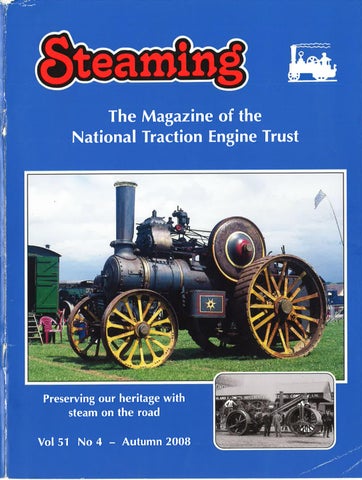
Front cover A good many of our cover pictures portray examples of well restored examples engines in preservation, but here is one whose restoration time has yet to come — indeed, it is something of a rarity for us to see an engine that is nicely conserved and complete, but still much as when it finished work. This is Fowler class 86 compound road engine 12906 of 1911, recently acquired from France by Richard Willcox of Gloucestershire. It was once a Charles Openshaw engine, believed sold by that Reading dealer to the southern part of France, or nearby, about World War 1 time. The elaborate flywheel decoration is typical of Openshaw. Malcolm Ranieri took the picture at the Kemble event in June, 167
Trust News (continued from previous page) address the wishes of those members who want to achieve compliance through proven experience and ability. Only through these processes will we deal with the questions posed at the beginning of my paragraphs. I am pleased to welcome Mike Dyson to the team who work for the progress of theTrust. He has taken on the role of Public Relations Officer, and has already set his mark with the introduction of extra information on our activities via the web site, an additional step towards our communication efforts. Once again we were pleased to welcome many into the Trust marquee at Dorset. I extend our thanks to a hard working team who also kept the refreshments flowing. We also send congratulations to Martin Oliver and all of those who were involved in the superb and emotive recreation of the first Great Working that was their 40th Year Celebration - it is no coincidence that this year the Trust will be holding its AGM at Shaftesbury, not to far from the rally site. I look forward to this meeting and to seeing those who take an interest in how the Trust is run. Just as the magazine is about to be printed we sadly learn of the death of Esmond Kimbell of Boughton, Northamptonshire. He died on 25th September in his 101st year. Esmond was a former steam threshing and road rolling contractor, and a staunch of supporter engine both preservation and the Trust from the 1950s. We have truly lost an elder statesman. Herring, (Robert Chairman)
latter part of October. So far six out of the twelve independents have replied to say that they will attend. Since its launch in January 2007 the Boiler Inspectors Audit Scheme, whilst well intended, has not got off to the most successful start. Consequently we are trying to put in place a strategy that will help reintroduce the scheme on a noncontroversial basis, and without any deadlines. A recent Council meeting of the Trust agreed that the Boiler Inspectors Audit Scheme should be progressively re-introduced, rather than through any imposed deadlines. A revised version of the report forms, which have had a limited trial with one inspector, have been sent to all the inspectors for their comments prior to the meeting. The Trust's objective is to ensure that consistent and practical standards of inspection are applied to our hobby and that any reports subsequently generated reflect those aspirations. Engine Owners Meeting -The next Engine Owners Meeting will be held on Sunday 11th January 2009 at the Village Hall, Willoughby, near Rugby, Warwickshire. All engine owners, crews and other interested parties are invited to attend - whether members of theTrust or not. Christmas presents - If you are not sure what to give your young apprentice for Christmas, why not consider a voucher for the Trust's Driving Course to be held at Astwood Bank, Worcestershire, on 9/10th May 2009 (see the advert elsewhere in these pages). (all paragraphs Bob Siddall, Head of Engine Owners Section)
Services Unit (TSU). The TSU was established as a result of the Trust's re-organisation, primarily to ensure that the main functions of the Trust were provided with consistent viewpoints related to legislation, government policy, functions affecting charitable status, business practice and similar corporate information. In addition the TSU also provides services to members when seeking information or advice relating to our hobby. The six permanent members of the TSU include: the NTET Insurance Officer, a professional engine repairer, a boiler inspector, an engineering consultant, a representative from the miniature and model fraternity, and a business management consultant. Two of these are Chartered Engineers and four are engine owners. The Head of the Engine Owners Section also attends our meetings on an adhoc basis. In addition we have direct and open access to our lawyer, an expert on Health and Safety, an insurance consultant and to the corporate inspection companies via SAFed and Royal Sun Alliance and Allianz. We also attend or receive the minutes of the HMRI-ORR meetings of the preserved railways group. Boiler Inspectors Audit Scheme Elsewhere you will read of Bob Siddall's invitation to the independent boiler inspectors to attend a review meeting at Bedford in October
Important News Important news items and subjects in this issue can be found on the following pages:
Engine Owners Column Engine Owners Section Independent Boiler Inspectors - A meeting of Independent Boiler Inspectors has been arranged for the 168
• Boiler Inspectors Audit Scheme
168
Technical Services
• Driver Competency
The Role of the Technical Services Unit - I have been asked by some members to explain the rationale behind the Technical
• SAC 30th anniversary
172
• Engine Owners Meeting
173
169, 177
Autumn 2008 STEAMING
reach a conclusion on the issues being raised. In order to make way for more dialogue the General Council has agreed to remove the 1st January 2009 deadline. GDSF Forum - Competency Scheme - At the Forum held at the Great Dorset Steam Fair it was announced that the General Council would be asked to endorse a proposal from the Executive that an alternative to 'direct assessment' should be devised for those with appropriate experience. I fully endorse this approach and I am pleased that the General Council has given its approval. However, in order to maintain the integrity of the scheme of this alternative route, and also to protect the Trust from charges of the old pals act, I believe strongly that a system of accountability must be devised and applied to the role of 'scrutiniser' - of which there must be many. An Oxfordshire Mann's With our current NTET Chairman Robert Herring living in Oxfordshire, we had to chase a copy of the photograph of this Mann's Patent Steam Cart & Wagon Co wagon, which had appeared in the August 2004 issue of the Oxfordshire Family Historian. The original caption reveals what might be a distant Herring family relationship, but that can be explained at a later time. The picture shows an undertype wagon lettered for to 'J S & J Norwood of Bletchington, Oxon' - that's about six miles north of Oxford. The firm operated from their Euston mills in that village and delivered flour to bakers in the surrounding area. The caption in the Historian read 'The Bakehouse, Bletchington, circa 1910 with John Herring (1853-1930), son of Rowland (the founder of the business and to whom George Bartlett was apprenticed) by the side of his steam lorry.'The picture ended up with George Herring of nearby Piddington and we are grateful to his wife Mrs Mary Herring for providing a copy. The historic records of the Road Locomotive Society list the wagon as Mann's number 564 (U1191). It is recorded as a 5ton undertype - at the time the Leeds firm were producing these and the overtype wagons side by side to customer preference. The vehicle was new in February 1910, and was taken for exhibition at a Manchester Show before being delivered to the Horwoods. From the condition of the wagon as seen in the picture, it would seem likely the scene is when it was newly arrived. Any later history is unrecorded, other than the fact that by March 1921 it was with Plews Bros of Stockton-on-Tees, Co Durham.
2008. It is fair to say that we are not really any nearer to convincing all of the inspectors to participate in the scheme. We are very grateful to those that do use it and supply us with feedback. However, a number of arguments have been made to support the negative stances - the Trust is an intransigent bully; we don't communicate; we don't listen; the paperwork related to the new system is too detailed and cumbersome, and STEAMING Autumn 2008
other points in a similar vein. There does however appear to be a consensus that we do need consistent standards, but the devil is in the detail of how we set and apply them. We have already revised the report forms and these are being circulated to the inspectors for their consideration prior to the October meeting I referred to earlier. The Health & Safety at Work Act still appears to be a stumbling block to some and it is hoped that we can
Driver Certificate of Professional Competence (CPC) - Not to be confused with our own voluntary competency scheme this is legislation being introduced by the EU and administered by the Driving Standards Agency. Already there appears to be confusion about the CPC amongst those owners of Heavy Goods Vehicles owned and driven solely for non-commercial use. I reproduce here part of the introduction to the DSA leaflet on the subject. The whole of this leaflet can be read via http://www.dvtani.gov.uk/ uploads/leg Islation/CPCBooklet.pdf What is Driver CPC? Driver CPC is short for Driver Certificate of Professional Competence. It is a new qualification that all bus, coach and lorry drivers will need to have and is being introduced across the European Union to maintain high driving standards. Why is it being introduced? The aims of Driver CPC are to: • Improve road safety • Recognise and accredit skills for professional bus, coach and lorry drivers • Encourage drivers to continually update their skills and knowledge • Raise the status of bus, coach and lorry drivers to promote driving as a career When will it start? For bus and coach drivers it was 10 September 2008 and for lorry drivers 10 September 2009. Who is asking me to do this? The Driver CPC is an EU requirement; the DSA is responsible for implementing it in Great Britain and is working with transport indus169
try representatives to ensure it is introduced successfully. And here is further explanation — with acknowledgement to the FBHVC. The confusion I refer to relates to the holders of HGV (or PCV) driving licences and who don't drive in a professional capacity, that is they only drive for their hobby and are not paid or receiving reward for their driving activities. Under the new legislation all existing HGV and PCV licence holders will be 'deemed to have the acquired rights' to the new CPC on its introduction. However they will lose the right to drive professionally after 2013 — just 5 years time — unless they have undertaken and passed 5 days of training during that time. Without the
training the CPC element of their licence will be lost, but not the vocational entitlement. Therefore they can continue to drive PCV/HGV as appropriate after 2013, but not for hire and reward. In simple terms if any part of your driving is done professionally then you must complete the CPC training within 5 years, but if you are solely a 'hobby driver' you can either continue as you are or volunteer to take the CPC exam. In the future anyone taking an HGV/PCV licence test for the first time will be able to opt for a CPC test module or a nonCPC (not professional) test module. (all paragraphs — David Smith, Head of Technical Services Unit)
The National Traction Engine Trust's
2008 AGM will be held at 2.00pm on
SATURDAY, 15th NOVEMBER 2008 at The Wessex Suite at The Royal Chase Hotel, Shaftesbury, Dorset. Please refer to the formal notice in the Report and Accounts booklet which is distributed with this issue of the magazine for details of the Agenda etc, and to the other notes on this page for the arrangements that have been made for the rest of the day and on the Sunday.
The 2008 AGM This year's AGM will be held in the south west — at Shaftesbury in Dorset.The arrangements are centred on The Royal Chase Hotel, where the meeting will be held in the afternoon, and a block reservation has been arranged by the Irust for those wishing to stay on the Friday and/or Saturday nights; there will be an informal private Trust dinner with guest speaker on the Saturday evening. The 2008 AGM is at 2.00pm on Saturday, 15th November in the Wessex Suite at The Royal Chase Hotel. The hotel is situated on the south-east side of the town, with access off the roundabout at the 170
junction of the A30 Salisbury and A350 Blandford roads. Formal notice of the meeting, with the Agenda and Annual Report & Accounts, is distributed with this magazine. In the event of voting being necessary at the AGM only current members are eligible to vote and you should therefore ensure you bring your current membership cards as evidence. The names of the nominees for positions of officers or council members of the Trust, together with Motions under Article 16 of the Trust's Articles of Association, will also to be found in the Report & Accounts. At the conclusion of the formal meeting, about 5.00pm, tea, coffee
Treasurers Report The accounts for the year ended 31st March 2008 are enclosed with every member's copy of this edition of Steaming. Due to the various projects being undertaken, the planned budgets for the year ended 31st March 2008 were quite difficult to foresee. I am pleased to say that the outcome shows a healthy financial performance due to prudent management of the budgets, combined with the effects of the subscription increase in February 2007 The Trust is again indebted to its officers and members of the General Council for a significant amount of unpaid time spent on the Trust's affairs. It is impossible to quantify
and biscuits will be served. A selection of the Trust's trophies and shields will then be presented, or at other appropriate times during the weekend's activities. Val and Colin Brown will as usual bring a good selection of items from the NTET Sales Stand. If you want to ensure a parlicular book, DVD or sweater is available, maybe for a Christmas present or a birthday, please preorder via the Mail Order address and ask for your purchase to be brought to the AGM.
The Saturday and Sunday mornings Arrangements have been made for a number of interesting visits in the immediate Shaftesbury area on the Saturday morning. During the morning, until midday, Trust members will be welcome at Cann Mill, which has a regularly working and original water wheel and other old machinery; at the Compton Air Museum, and at Edward Hine's organ museum, with six instruments. Members should meet in the car park of the Royal Chase Hotel at 9.30am to follow a route to these visits, or collect a printed itinerary. For the Sunday morning Robert Coles has kindly invited us to visit his premises on the A30 Salisbury road out of Shaftesbury — its a mere 400 yards or so away from the Royal Chase Hotel: look for the combines! We are welcome from about 9.30am, several engines will be in steam and coffee will be available. For those travelling home from the area via the Salisbury direction, Brian Snelgar also kindly invites members to see Autumn 2008 STEAMING
this time and effort and obviously this is not reflected in the accounts. (Julie Smith, Treasurer)
Steam Apprentice Club The SAC attended the Great Dorset Steam Fair with their stand, meeting and greeting new and current Apprentices alike. I hope many Trust members took the opportunity to see what we do. One of our objectives is to place Apprentices on engines, and again I would like to thank the engine drivers
his workshops and engines at Whiteparish. There, another half dozen engines, some of which are not rallied, should be in steam for us from midday -Whiteparish village is about 8 miles south east of Salisbury, just off the A36 Southampton road.
Herefordshire hills rise behind Foden steam tractor 13762 of 1930 as it parades the arena at the Marcie event in June 2008. (Paul Bishop)
Staying for the weekend For those who wish to make a social weekend with friends around the AGM, a block booking of rooms for overnight accommodation has been arranged for the 14th and 15th atThe Royal Chase Hotel. En-suite rooms are available at a special NTET inclusive rate per night of £108.00 per room (double or twin) or £60 single (Friday and/or Saturday), including breakfast. There is a 10% discount on bookings made and paid for up to one week in advance. Members should make their own reservations direct with the Hotel (12 01747 853355) - please mention that you are an NTET member.
The Saturday evening On the Saturday evening there will be an informal dinner, private to the Trust, in the Wessex Suite at the Hotel, at 7.30 for 8.00pm. Tickets for the four course meal, are available £26.00 per person. A vegetarian option will be available. Tickets must be booked with the Trust General Secretary and paid for in advance please make your booking and send your remittance by 7th November at the latest (cheques to be made payable to NTET) to Sue Jackson at the address inside the front cover Foster Wellington steam tractor 13031 of 1913 pictured by David Warren at (12 01494 446582). the event at Clumber Park, Nottinghamshire, in June 2008. STEAMING Autumn 2008
171
A Belfast survivor One of the last steam tractors to work in commercial service was this Garrett 4CD owned by John Harkness & Co, cartage contractors of Belfast, Northern Ireland.The tractor is pictured in September 1953, hauling an empty solid-tyred trailer along Station Street in the city, and spiritedly heading towards Bridge End. Garrett 33414 of 1919 — its front registration plate BJ 4195 rather awry — was one of two similar machines the firm used in the latter days of steam haulage, along with 1909 Garrett road loco 27946 (01 6818). All three of these engines were still to be seen at the Harkness premises in 1963, when Derek Rayner made an early morning visit; he had gone to the yard straight off the overnight ferry, but it was a somewhat grim day from the point of view of the weather.Ten years earlier photographer W E Robinson had been in bright sunshine, and we are grateful toTrust member Graeme Smith for drawing the image to our attention. It is reproduced courtesy of Colour-Rail — an organisation more widely known for its vast collection of colour images of railway subjects.The tractor shares the road with Austin andThornycroft lorries of the time, as well as, potentially, the quayside shunts of the UlsterTransport Authority steam locomotives and their trains on the 5ft 3in gauge rails set in the road surface.The shop-front to the right of the tractor, on the corner of Middlepath Street, is Flanagan's Ships Supply Stores.Today there is virtually nothing remaining of this scene in this area of Belfast — it having been demolished and replaced by modern housing.The street names, however, continue in use.
who took the trouble to have young people with them and explain how to operate and maintain the engine. But it is not only the SAC committee and Apprentices who appreciate this, but parents as well, and I reproduce a letter I have received: 'Dear Mr Munn, As the mother of an 11 year old Steam Apprentice who 172
took part in this year's cavalcade at Dorset ... please can you pass on my thanks to everyone involved in the SAC and all the engine owners who so kindly allow the children onto their engines. Being allowed to 'drive' around the playpen on these wonderful machines makes the Fair for my son Luke. I am sure it must
take a huge amount of organisation and some strong nerves to keep the event running! So once again, thank you to everyone concerned.' The subject of competency was discussed at the NIEI Forum held at Dorset. To clarify the SAC position in relation to the scheme, perhaps I can mention that the competency 'test' was initially written for, and at the request of, the Rally Organisers. It was also as a means of 'testing' staff from corporate organisations, that is museums etc, with steam vehicles of a type similar to those that we operate. As many of you know, the Apprentices when going on an engine, have a logbook with them so that the work and activities they carry out can be recorded.The competency 'test' has been a welcome addition to what an Apprentice can achieve. Permission for Apprentices to take the competency test took over eighteen months to resolve. An Apprentice needs to be 17 to take the test. The reason for asking for a minimum licence requirement of a Provisional is to show firstly, they are over 17 and secondly, have started to gain that elusive quality of road sense. It is good to know however that the young people we pass on to the NTET are competent engine drivers. May I remind you of a date for your diaries next year. On the 27/28th June, the SAC are to celebrate the 30th anniversary of the Club with extended SAC driving days at Old Autumn 2008 STEAMING
Warden in Bedfordshire. It is intended not only to invite current and past chairs and other persons who have helped the SAC over the years, but the NTET membership itself to see what the SAC is all about. When more details are known I will publish them in Steaming and have announcements posted on both SAC and NTET websites. (Kevin Munn, Chairman, Steam Apprentice Club)
Engine Owners Meeting The next meeting will be held at The Village Hall, Willoughby, near Rugby, Warwickshire
on Sunday 11th January 2009 starting at 11.00am with coffee from 10.30 A buffet lunch will be provided All owners, crew, potential owners and others interested in the working of preserved road steam vehicles are welcome to attend — whether they are members of the Trust or not.
Affiliated and other groups The future of the surviving buildings of the former Aveling & Porter premises at Strood in Kent is in doubt, and the Friends of the Medway Archives (FOMA) are seeking support in a bid to protect the company offices, built just over a hundred years ago, with a preservation order. We have only a short while to wait until the full history of Aveling & Porter is published, but here it will suffice to record that in 1933 the firm left the Strood works for Grantham, the result of the debacle that was the Agricultural & General Engineers combine. When the engineering firm Winget vacated the works in the early 1980s, much of the site was redeveloped by the then Rochester upon Medway City Council, including the building of a new civic centre. Now, through central government policies, the offices have moved on and the former Aveling site is to be for sale for housing development. FOMA, worried that the original building will be subject to a demolition order, have applied to English Heritage to order a halt on this until the site can be investigated, and hopefully have a preservation order placed to protect the historic property for the future. Members interested in supporting the local group can contact John Witheridge, vice chair, at Friends of the Medway Archives, Medway Archives and Local Studies Centre, Strood, Kent or by email — john.witheridge@google mail.com . Alternatively further representations can be made to English heritage — russell.mann@englishheritage.org.uk
A rather over-smoky exit from the arena by the crew of Burrell scenic showmans 3886 LORD LASCELLES, photographed at the 2008 Astle Park rally by Jim Stevenson. STEAMING Autumn 2008
Contact Bob Siddall for more information, or if you wish to have a topic discussed — Tr 01636 821991 or RGSiddall@aol.com
Dorset appreciations The Trust's marquee at the Great Dorset Steam Fair was again well supported by members and friends throughout the five days. To those who again arrived from around the country to help run the tent, I thank them on behalf of all Trust members for the time and effort they spent. As usual, engines were exhibited in various states within the tent, which seems to encourage visitors to more closely inspect and understand them than if in steam — fresh from overhaul was Ted Freeman's Burrell road loco 3395; just out of long time barn storage was Stuart Smith's Marshall agricultural 72808, and away from a busy life on local road runs was Mick George's Armstrong Whitworth 10ton roller. Mark Filer's
beginnings of a Garrett 3ton wagon represented new build work, Elsewhere in the tent the art exhibition continued to attract many people to browse and purchase paintings and drawings hung by artists Robin Wheeldon, John Hancox and John Wigston, the area administered by John and Karen Robinson. The tea and coffee in the tent is provided by a hard working team and I thank: Wendy Chapman, Angela Cornell, Christine Giddings, Jan Greenhough, Angie Head, Mary-Lyn Hill, Sally Humphrey, Charlotte Keeley-Knott, Irene Kelly, Shirley Manning, Margaret Sharp, Gill Stoneman, John and Maureen Street with Ryan, Val Wingate. There was the usual good support
from members (and of course their friends) to the donation bowls — I'll repeat my usual explanation that although there is no charge for the tea or coffee, members can be assured the coins put into the bowls considerably exceed the cost of the materials used, and then go on to cover other expenses of the tent. The Trust's sales area was busy and, in exchange fur buoks, DVDs and many other items, took appreciable sums from members and the general public — all of which assists Trust funds. The helpers over the period of the event here were: Nick Greenhough, Sue and Peter Howard, Fiona Rashleigh, Kathy Smith, Steve Snooks, Peter Stanier, Steve Wagstaff, Carolin Wright. There was general help at any awkward time from John Kelly and Paul Shergold, and Jane Eminson was the new additional face at the
Christmas is coming! What present would you like? Ask someone to give you a voucher for the NTET Driving Course on 9th & 10th May 2009 at Astwood Bank, Worcestershire. The cost is £176.25 for both days (reduced for SAC members) For more details from Stuart Tomlinson at 470 Coventry Road, Hinckley, Leicestershire LE10 ONH or Irr 01455 613079
174
membership desk, helping to process the 500 new and renewing members during the five days. It is our usual form to not specifically name the wives and families of Trust Council members and officers who give their support before, during and after the event, but I gratefully acknowledge their many hours of work to support the Trust. (John Cook, Membership Secretary)
Future Dates Annual General Meeting — The details of the AGM on 15th November are included in adjacent pages of Trust News. Engine Owners Meeting — An Engine Owners Meeting will be held on Sunday, 11th January 2009, at the usual central venue of Willoughby, near Rugby, Warwickshire — please carefully note the date now, for it is unlikely the next, Winter, issue of the our magazine will be with you before that date. Look for the details from the display panel elsewhere in these notes.
New Members A warm welcome is extended to these new members who have joined theTrust in the last three months. We hope they will gain friendship,
A fine display of hawthorn blossom provides a springtime background for 1891 built Burrell 8hp single cylinder traction 1522 and its haul of lengthy timber poles. Malcolm Ranieri took the picture at Richard Parrott's farm at Weeting, Norfolk in May 2008.
information and enjoyment from their membership over a period of many years. Full addresses are not included, but the Membership Secretary is always pleased to put members in touch with one another by forwarding mail. B Hobbs, Bradford on Avon, Wiltshire P J Wareing, Preston, Lancashire C Morris, Saline, Fife J Suitor, London National Museums of Scotland W Messenger, Moreton in the Marsh, Gloucestershire A R Shilton, Compton, Berkshire M Allwood, Reading, Berkshire I Folland, Andover, Hampshire R Atter, Colerne, Wiltshire A Alexandre, Sturminster Newton, Dorset P D Wilson, Nottingham J M S Orem, Newbury, Berkshire D Price, Aberystwyth, Ceredigion I Payne, Burntwood, Staffordshire M Denning, St Pauls Walden, Hertfordshire P Scott, Sleaford, Lincolnshire M Ford, Poole, Dorset L Vernon, Hetton le Hole, Co Durham D B Hewlett, Laugharne, Carmarthenshire S Leatham, York C D Hall, Peterlee, Co Durham L Chadderton, Ashton under Lyne, Lancashire T Hinds, Co Meath, Eire P M Hatcher, Biddenden, Kent K RThorpe, Gainsborough, Lincolnshire D Shelmerdine, Long Eaton, Nottingham B Foreshaw, Stroud, Gloucestershire A E Wills, Rushden, Northamptonshire Autumn 2008 STEAMING
N Barnes, East Sheen, London Noach van Opstal, Neerlanden, Belgium H Cosgrave, Co Wexford, Eire Miss H Barrack, Aberdeen, Scotland G Barrack, Aberdeen, Scotland S Cockram, South Molton, Devon M Herriott, Basingstoke, Hampshire D A Richards, Market Drayton, Shropshire J Curran, Alfred Cove, Western Australia DTaylor, Marston, Oxford R Donovan, Naseby, Northamptonshire M Sherwin, Cheadle, Staffordshire Miss K Churchill, Southampton
reflections on our magazine of 25 years ago
Steaming Past
Poor Steaming Two points in Mike Jones' article on Robert W Roberts' Burrell in the last issue, page 136, need correction. Firstly, the photograph comes from the collection of Gwynfor Williams of Garstang, not as shown. Further, the Editor, tinkering with the detail in the same article, introduced an unfortunate error. The haulage job for the beam engine parts for the Dorothea Slate Quarry Co in October 1904 did not start from the station yard at Caernarfon, as wrongly stated, but from the terminus of the London & North Western Railway's branch line atTal-y Sarn — quite a few miles nearer to the Dorothea quarry. Although for the Burrell that haulage distance was little over a mile, it does not belittle the task of the engine and the crew in loading the parts with a no doubt simple crane at the goods yard and then taking them through tight places and up very steep rises to unload with the even more minimal, and temporary, lifting tackle at the quarry. That would have been a good day to be around and watch, and probably many of the local menfolk did just that, pausing on their way to or from work. An error needs to be corrected within Richard Willcox's letter on page 157 of the last issue — the third paragraph should be altered and extended to read 'In the picture the slow speed pinion is on the outside of the crankshaft, whereas on a 3 shaft Marshall of this period the top gear pinion is on the outside — the slow speed pinion being adjacent to the hornplates'.
The Belvoir Castle event in mid May 2008 provided one of the first appearances for freshly restored Garrett compound steam tractor 34461 Of 1924, VICTORIA. (John Cook) STEAMING Autumn 2008
A look back at the Autumn 1983 issue of our magazine shows how some things have changed with the weather. As with this year, Easter events were marred by snow, with wet weather continuing to June, with several events cancelled. But unlike this year most rallies through the main part of the 1983 summer enjoyed hot, dry conditions and good attendances. This doesn't seem to be the change we have been told so much about! These days it is unusual to read an obituary for someone who worked with engines commercially.This issue saw five: Harry Bushell had a workshop across the road from the Thursford Collection and was involved in the restoration of a number of the engines there; Wilf Cole served his time with Mann's at Leeds and his later career was spent predominately with steam wagons. Jack Hedges served his apprenticeship at the GWR works in Swindon and went on to become the chief boiler inspector at Weymouth and for the whole region in the last days of steam. In the early days of the
preservation movement Jack owned a number of engines and provided valuable advice to fellow enthusiasts on the boiler condition of prospective purchases. Arthur Jackson served an apprenticeship at Blackstones before becoming involved in the family steam ploughing business and, finally, Billy Jeanes also started off in steam ploughing before moving on to rolling; he became involved in preservation in the early fifties with the Garrett tractor now on display at Leiston Long Shop Museum. A brief article on laying up an engine for winter made what may now be considered the poor recommendation of using old engine oil to protect the firebox. Far better to use clean oil and diesel, due to the acids and other nasties in used oil. How many people realise the practice of having road steam engines at Carter's Fair at Pinkneys Green goes back 25 years? The Berkshire notes reported Jim Hutchens had taken his recently restored Burrell roller along. The fair at that time included gallopers, chairoplanes and other attractions. The Hampshire notes reported that at Beaulieu Burrell LORD NELSON had been called in to power the monorail due to a problem with the mains power supply. Other than LORD LASCELLES powering the Seaton Tramway at Devon some years ago, are there any other instances of a showmans engine powering a railway or similar conveyance. Were they ever used on damaged tramways during the war? (Stuart Gaines)
Obala-Marina
Dalmatian enigma This is an intriguing postcard scene, of what appears to be the town square at Sibenik, a small port by an inlet on the northern Dalmatian coast, off the Adriatic Sea. Nowadays the area is in the Republic of Croatia, but when this postcard was published in Sibenik, most probably in the years before World War 1, it was part of the AustroHungarian monarchy.The town would have been something of an outpost of that dual empire, though a railway had been there since 1877. Comparing the view with modern street plans and old and present day pictures of the town it becomes clear the elegant arcaded buildings do not surround a square but are fronting the quayside. So we may be correct to think the array of machinery and goods in the foreground has recently been unloaded from a ship — indeed, the slightly elevated position from which the original photograph was taken could have been the deck of a steamship. But what of the two sheeted traction engines that stand there, waiting to be collected by their anxious new owners or operators? Most coloured 176
picture postcards of the era had to suffer an amount of studio work betwoon phc,,tograph and printing, with detail in the shadows often being roughly touched in, inevitably spoiling what we would like to pore over. It seems likely, however, that the machines are British built, and maybe they have the appearance and proportions of products of the Steam Plough Works at Leeds. Fowlers, of course, had a good commercial presence in central Europe in the early years of the twentieth century, with agencies in Germany, Prague, Budapest, Bucharest and Vienna — the engines were all built in Leeds and sent out for onward sale. Even the nearest of those agencies, Vienna, was over 300 miles to the north of Sibenik across the Hungarian plains, and
that might explain why this pair of engines seem to have been landed from a ship. Or is that the right round — were they waiting to be loaded for export further south, across the other side of the Mediterranean? Along with the engines there is a stone crushing and grading outfit (being inspected by sailors), and several piles of general goods and boxed and bagged produce. It would be nice to be able to jump ship and walk over to the tables outside the hotel on the right and order a breakfast coffee — half an hour or so watching from that viewpoint would probably reveal just what was happening at Sibenik in about 1910. And if you can manage that, please go over and lift the engines' sheets and find out more about them.
'Boiler Explosion. Two Men Killed & Several Injured. On Saturday morning, a painful accident occurred near to the Hill of Fearn, in the county of Ross. The cause of the accident was the bursting of the boiler of an engine attached to a portable thrashing engine. The engine had been converted to a locomotive for conveying the machine from place to place, and the explosion occurred while the engine was on its way from
the Hill of Fearn to the parish of Tarbat. Six men accompanied the machine, and it had only proceeded about two miles when the explosion took place. The owner, William Telford, was thrown off the engine a distance of some yards, his body being frightfully mangled. Duncan Ross was pitched into a neighbouring field.The other men were all more or less injured....' (from The Weekly Scotsman, 15th August 1868) Autumn 2008 STEAMING
The Review of the NTET Voluntary Driver Competency Scheme The Panel's Report 1. History of the Review At the Trust AGM held in November 2007 a Motion was passed: 'That a formal review be made of the Driver Competency Scheme after the 2007 Rally Season and this completed review to be returned to the 2008 AGM for open discussion and acceptance.' The Council did not oppose the motion as the Scheme is under constant review. As a result of that motion the National Council at their meeting in December 2007 decided to set up a review panel consisting of — • John Cook, head of Membership Services, to be chairman of Review Panel • Martin Oliver — managing director of the Great Dorset Steam Fair • Steven Turner — HM Inspector of Railways; Office of Railway Regulators • Graham Mitchell — serving Police Officer with the West Mercia force • Len Crane —Trust vice-President and engine owner • Alan Rundle — engine owner
2. Proposed Terms of Reference These were set down to — • determine the scope and achievements of the current Scheme • examine the level of awareness of the membership with regard to the Scheme • determine the need for change • if necessary to develop proposals for change, with associated cost implications
The review Panel was to take evidence from the relevant Heads of Sections, other officers of the Trust, and any member of the Trust who wished to submit views. 3. History of the Scheme The NTET started to discuss the merits of a Voluntary Competency Scheme late in 1998, and has subsequently operated the Scheme for more than seven years. Originally STEAMING Autumn 2008
the Scheme was introduced to assist corporate organisations such as museums and centres of learning to be able to demonstrate that operators of vintage steam equipment could satisfy local Health & Safety policy requirements. It was soon seen by the NTET as a method of encouraging 'hobby drivers' to demonstrate their own competency. The scheme was modelled in some aspects on the Institute of Advanced Motorists approach, that is, optional training by mentors to set standards, and final examination by assessors appointed by the Institute. It differs in the award of a 'Competency Certificate' that is based on a point scoring system. The successful participant is required to achieve at least a 75% pass mark. Potential assessors are selected from successful participants in the competency assessment who have attained a score of 90% or higher. New assessors are appointed after completing an successfully additional, points based, practical examination which is undertaken on a 'live' competency test. Finally, it should be remebered — • there is no Government requirement for a Competency Scheme — but it is part of the NTET's strategy to demonstrate self regulation. • the Competency Scheme came out of a request from museums and Local Authorities to be able to demonstrate to their insurers that drivers of their engine(s) were competent, whether employees or volunteers • it was then extended to 'all-comers' on a voluntary basis • in 1998 the Council's view was — 'The Council does not support a mandatory system of certification for engine drivers at rallies ' • in 1998 the Council's view was — 'The General Council supports the implementation of a voluntary Competency Scheme, but does not seek to make the holding of a Competency Certificate conditional upon being invited to attend an NTET Authorised Event.' • the Engine Owners Section does not support any form of compulsory Competency Scheme
4. Review Panel Meeting Thursday 26th June 2008 at the Holiday Inn, Crick, Northamptonshire Present:
Apologies:
John Cook — chairman Steven Turner Len Crane Alan Rundle Martin Oliver, report sent via e-mail Graham Mitchell
Those present had received a package containing details of the Competency Scheme, from its initiation through to the present day. Following a request in the Spring 2008 issue of Steaming for members to send in contributions for discussion, it was very disappointing to only receive four replies from the membership plus a further three from officers of the Trust. The contributions received were very informative in their content and proved valuable at various times during the meeting. The first topic for discussion was if we should consider 'grandfather rights' as a method to gain a competency certificate. After discussion it was deemed that because the scheme was 100% voluntary there was no need to allow grandfather rights. It was thought that this would devalue and lower the standard of the present scheme, and be seen as an easy way to obtain a certificate. It would also give the NTET an enormous workload in setting up such a scheme, plus the monitoring that would come with it. Discussion then took place on the basics of the scheme. What, for example, would be your answer if an owner of a 6ton Aveling roller came up to you on your B6 class road loco waving a competency certificate and asking 'Can I have a go on your engine?'The answer was likely to not be very positive — so therefore, is the Aveling owner competent or not? Therefore the Revue Panel would like to see the following changes: • you can only take the test on a particular type of engine.This is because of the many irregularities and peculiarities in different makes or types of engine • the engine must be 100% mechanically sound and in 100% working order—no 'the pump only works if you give it a bang' scenario. Any mechanical gremlins — no test • have a separate test syllabus for each type of engine: road roller, agricultural engine, ploughing engine, road locomotive, steam tractor, showmans road locomotive, wagon
It might also be necessary to split this down to single or compound, 177
and undertype or overtype, to whatever level deemed necessary to make the test suitable to the applicant. The Revue Panel then discussed the actual examination itself. One of the panel had actually undertaken the test, so he explained its content to those present. It was thought by the panel that the present Scheme goes beyond the original remit which was to provide evidence that the person in charge of the engine at a rally was competent to look after and operate it in a safe manner. 'We seem to be doing an advanced version and not the basic test' was one comment received from our membership. A total revamp is required and the following recommendations were suggested -
Section 1 - Engine Design • remove engine condition - if not 100%, no test • if the candidate can explain the use of all the drive pins, then no requirement to answer questions on differential • joint material - is this part of being competent on a rally field? How do you differentiate between an owner who does his own repairs and one who buys in the expertise? • gears and gear changes - combine these into the ability to demonstrate engagement and disengagement of gears
Section 2 - Boiler Inspections
Further, the test should offer the candidate either section 7 or section 8, not both. It should be the practice to use examiners from a different area, so avoiding the 'old pals' syndrome. For the scheme to succeed there must not be a charge made to undertake the test and this should also include non-members.Therefore the Panel recommended offering tests to be undertaken at rallies similar to Cumbria and GDSF to make it viable.
Conclusion The Panel deemed that because the scheme was 100% voluntary there was no need to allow grandfather rights. They thought that although the present test system was both fair and comprehensive and covered all aspects of owning, maintaining and driving a traction engine, in order to achieve a satisfactory level of competency, the content should be reviewed to eliminate the unnecessary, avoid repetition and simplify where possible. At present the test is too severe and lengthy for what is required. The competency test should concentrate on the ability of the driver to safely drive the engine and control the pressure system plus ancillary equipment.
• the panel questioned the relevance of this section in its entirety
The future
The Council's Response
recommended that throughout the Review Panel document 'engine owner' should change to 'engine driver'. As to a test not able to be taken unless the engine is 100% sound, the Executive felt this was unrealistic and the discretion of the examiner should be used. The Executive recommended three categories of engine should be catered for: stationary, traction engine (locomotive type boilered machines) and undertype, and that the certificate should indicate which type of test had been taken. 2. An addendum to the Voluntary Competency Scheme - Chairman Robert Herring described his numerous discussions and interviews at the Great Dorset event at the end of August, prior to the Open Forum on the Thursday evening. From these he formed the opinion that those members present were determined to convey the
1. The Panel's Report - The Trust's General Council received the report of the Competency Review Panel (which for the benefit of all members is published in full, above) at a meeting in September; also received were the comments from the Executive Committee which had considered the report earlier. The general view of the Council was that the results were fair and to be welcomed, and that John Cook and the panel members should be applauded for a worthwhile task. The Executive had made observations. They emphasised that not all drivers own an engine and the competency certificate is awarded to a driver not an engine. They 178
The Panel then discussed the way
forward for the Trust, and how to make the Driver Competency Scheme more acceptable to engine owners and crews. • if necessary, re-launch the Scheme in a more friendly way - the Panel thought that in the past we had come across in an aggressive way with too much 'thou shalt do this' • we must sell the idea to the owners, possibly by getting senior owners to take the test and use them to promote it • use Martin Oliver and other respected members of the NTET in our promotion of the scheme - get his permission to reprint his e-mail as an article • do some Roadshows to promote the NTET and its Schemes • more articles in other magazines • make PR an important feature encniirnge the new PR Officer • we must accept that we have made mistakes - have an internal inquiry to see why and how to improve • we must remember who we are - we are a group of like minded enthusiasts • we are a club with no powers - its time to encourage not discourage • it is time to promote the NTET - it will take time to get everybody on our side J R Cook, chairman of the Review Panel, July 2008. The syllabus for the Voluntary Driver Competency Scheme has not been printed in full in a past issue of this magazine. However, copies have always been available for sending to those considering taking the test, or otherwise interested, and the full text has for some time been available on the Trust website.
message to Officers that we were still not listening to their wishes, to the extent that the situation had the ability to undermine the integrity of the Trust, and we would be seeing a repeat of arguments put forward at last year's AGM. After discussion with those members of the Executive Committee present at Dorset, it was agreed that to enable the situation to be diffused, the Committee would recommend the General Council make amendments to the Scheme, to enable drivers to obtain a certificate based on their previous experience and proven abilities. This would not affect the present voluntary scheme which will continue to operate for the henefit of NTFT and Steam Apprentice Club members. At the Dorset meeting it was proposed Council Member Bob Garnett will head a team to develop the content of the new scheme; Autumn 2008 STEAMING
consultation will take place with Trust officers before presentation to the General Council. It is expected Bob will have developed the scheme enough to provide some detail at the AGM; as the existing scheme has always carried the proviso that it is subject to review and modification, there is no necessity to put forward a motion over these points. 3. Conclusions — Following on from the above, the General Council at the above mentioned meeting in September unanimously accepted the Review Panel recommendations and conclusions, and agreed that the recommendations of the Executive Committee should be included. It was proposed, and seconded, that the Council seek 'that a scheme be developed to be integrated into the existing Competency Scheme that enables drivers to obtain a competency certificate based on their previous knowledge, experience and proven abilities.' The General Council agreed that the Review Panel document, the Executive amendment and the addendum suggesting the alternative route would be presented to the AGM. 4. Presentation of an alternative Scheme — At the same September Council meeting Bob Garnett and StuartTomlinson gave a presentation on an alternative route which they recommended could be dovetailed in with the Competency Scheme — to provide a second route to achieve the same ends, and which would involve checks and successfully answering questions, but also avoid grandfather rights. It was agreed an outline of the principles could be given at the AGM, pending further development of the alternative Scheme.
David Harding's Foster steam tractor 14608 was rather late-built when it was sent out, complete with pressed on rubbers, from the Wellington Foundry at Lincoln in 1930. Barry Job took this picture during a steam party at the Klondyke Mills yard of the North Staffs club in Derbyshire in June 2008.
Your club eW needs you We are forming a small group to develop and formalise an experiencebased Certificate of Driver Competence for steam road vehicles, which will run alongside the existing examinationbased scheme. We need your thoughts and ideas to enable us to launch a scheme that is soundly based and acceptable to all members. Please contact: Bob Garnett or Jill Duncombe on 17 01747 824689 or bob1uk@blueyonder.co.uk or Stuart or Hazel Tomlinson on Tr 01455 613079 or hazel.tomlinson@homecall.co.uk
STEAMING Autumn 2008
Despite the upheavals in Serbia in recent times, the preservation of steam age machinery is thriving. The restored narrow gauge Sargan Mountain Railway, in the west of the country not far from the Bosnian border, already caters for large numbers of tourists, and at the nearby Mokra Gora forestry museum this steam roller could be a candidate for future restoration to working order. Chris West's photograph, taken in May 200Z shows the piston valved single crank compound roller built by Stanko Paunovic of Nis (then in Yugoslavia, and now Serbia), works number 114 of 1954. A good number of these locally designed steam rollers were built in the years following World War 2, no doubt much needed to improve roads damaged during the conflict.
- Tromso's Yankee relic Way, way up in the northernmost lands of Europe, almost 400 kilometres inside the Arctic Circle and at nearly 70° North, there stands in preservation a most unusual steam road roller.The Norwegian island city of Tromso has carefully saved an important part of local history — the American built steam tractor-cumroller that must have been a revelation when it arrived to improve the roads of the Tromso Kommune (Municipality) in 1918. Despite its northern latitudes, this Arctic area has a long history of settlement; the island of TromsOya had a church in the 13th century, and although being home to only 80 people, Tromso was issued its city charter in 1724. In more recent history it has become a fishing industry centre with an international port, and a leading base for polarrelated activities. Known as the capital city of northern Norway, it has a population of almost 64,000. How the city fathers of Troms0 came to select the Buffalo Springfield Roller Co product as best suited for their road construction needs is probably lost in time, but we can guess it was more to do with the suggestion of an observant Norwegian emigrant returning to his homeland from Gold Rush experiences, than to an intrepid Yankee travelling salesman who had risked wasting his selling skills in a trip to remote Arctic regions. It was American practice in highway construction and maintenance to need to haul from quarry or railway to the site of the road works, long road trains of gravel or rock-filled dump cars that had centre discharge. The Buffalo Pitts 'Special Tractor' was marketed to serve as both a roller and a road engine for the highway haulage — an American version of the British built convertible or 'combined engine'. The two front rolls were able to be replaced in the cast fork by 8 inch or so wide wheels with a suitable spacer to keep them at the outside edge — an arrangement much as Aveling & Porter briefly 180
offered on their rollers in the mid1890s. But a most noticeable feature on the Buffalo machine was the 'elephant trunk' — a large curved casting bolted around the forecarriage head which served as a rigid coupler. This must have helped with the shunting of the close-coupled dump car train, with the ability to push or pull the empty wagons from the work and avoid the turning of either them or the engine on less than solid ground to the sides of narrow rural roads. The company's literature of the period claimed that anything up to a total of 40 tons could be hauled by the engine with relative ease. The surviving Norwegian roller has played an important part in Tromso town's history. The expansion of the modern town from about 1910 proved the need for machinery suited to the task of making better roads and the single cylinder roller was delivered new from the American factory, in parts, to the Kommune (municipality ofTroms0) in 1918, though its works serial number is not known. Having been assembled it was in use from 1919 until 1965. Along with the roller, and its sets of alternative front wheels, came some dump trucks for hauling stone. How many there were, and for how long the American practices were kept up is not known, but when the roller ceased work the wagons were the first things that went to the dump, and they were not able to be saved. In addition to building roads and other construction works the Buffalo Springfield's steam power was used for other jobs. The roller was fitted with one of the maker's Patent seven tine scarifiers at the rear and that was used for digging the building site for Kongsbakken Skole.The drawings for this school are dated 1919, so the digging was probably done in 1920. It has also been used to power a saw mill. In the 1920s it was on loan to Harstad, a neighbouring smaller town and the Harstadvringene (the Harstad citizens) were so impressed that the Tromso authorities had
difficulties getting their roller returned! A very special job, described in the town history, was when the Buffalo Springfield hauled a Sekundaerstasjonen (a transformer unit for electricity, the second to be built in the town) up the hills towards Forh6pningen. For many years that was the heaviest cargo to have come across the quay in Troms0. The steam roller was pictured as it pulled the transformer past the Cathedral. It took four days before the load was hauled up the steep roads — not because the steam roller's tractive power was lacking, but because the roads were in such a poor condition they often had to be repaired. More than in most places in Europe, we can presume the driver had the additional tasks to ensure his charge was protected from the low temperatures of northern Norway. With average January temperatures of minus 4° Centigrade, snow depth measured in metres, and the sun staying below the horizon during December and January, it is likely the road making season with a steam roller was concentrated during the time of the midnight sun, in June and July. Following the roller's withdrawal from service in the 19606, it fortunately escaped being turned into scrap metal.The rare survivor is now on display at Skattora, in front of Slottet. This name translates as The Castle —the nick-name of the building and premises for the vehicles and equipment (snow-plows etc.) of the Technical Department of the municipality. It is Bjorn Sandnes, a journalist who worked for the local newspaper Troms0, who should be honoured for saving the steam roller. Three months after it was put aside as unwanted, in June 1965, it was on its way to the dump at Arneberg. Bjorn tells: 'I was shocked when I saw that this central part of the town's history was disappearing. I and my brother Tore had several times as kids been together with Boassen, shoveling coal into the engine'. By the time agreement to save the roller was given, only a third of it was visible in the dump. Bjorn spent two weeks digging so that the old machine could be hauled out, and Technical Department vehicles helped in towing it to a resting place at the Nautical College. There it stayed for 12 years, as a part of the education on 'kjelelinja' (a nickname for mechanical or engineering education). Bjorn didn't live too far away and was there quite often, looking Autumn 2008 STEAMING
after the roller. Slowly, helped by many hands in and outside the Technical Department, it became restored to original condition. As the Buffalo Springfield roller now stands outside Slottet, it is painted in the original shade of mid green, with yellow striping. Not many remember those colours, for since the early 1920s the coal dust, steam and general dirt from its everyday work had made it more simple for the engine to be painted black. And that's the way aged Tromsovringer (citizens of Troms0) do remember the steam roller: as a black, steaming and foaming monster. But it did the work, in a period when the horse and cart were
The single cylinder Buffalo Springfield steam roller as it is currently displayed at SkattOra,Troms0. (Troms0 Kommune)
The Buffalo Pitts 'Special Tractor' or road locomotive roller, with its distinctive rigid coupler prominently displayed. This illustration, from a maker's catalogue, shows a machine very similar to the Tromso example, though it is provided with a twin cylinder engine, and was probably built a few years earlier, under the pre-1916 title of the Buffalo Steam Roller Co. (collection Raymond Drake) STEAMING Autumn 2008
181
Another view of the Buffalo Pitts machine, together with a road train of dump trucks. The catalogue picture has the sixth dump truck disappearing at the left edge, but whether there were more, or even six was a bit of an exaggeration on the maker's part, we shall have to ponder on. (collection Raymond Drake) the more ordinary way of getting a job done. Local people consider that taking good care of this mechanical gem should be a matter of honour. The next step is to get a glass roof to give cover and protection. This they owe to the history of the town; to those who worked for the old Technical Department eighty years ago, and not least, to Bjorn Sandnes. Thanks
Lay 1 r'
to his effort and initiative an important part of the town history is preserved for the future. It seems there are only two examples of this Buffalo 'Steam Tractor' model to survive around the world; the other is on display at the factory in Ohio, USA. Staff from the present day American factory have been in Troms0, looking at the restored engine. The history of the firms that came together to make the Tromso roller is quite complicated. John and Hiron Pitts, twin brothers from Maine, New England, were building agricultural threshing equipment from the 1830s, but later went their separate ways. The Buffalo connection came when John moved to that New York state city about 1850, with the family name continuing after his death - steam rollers were made from 1892 by The Buffalo Pitts Co, and with the potential for increasing sales of such machines another new company was formed in 1901 - the Buffalo Steam Roller Co.
In 1916 that concern and another of the leading American manufacturers of steam road rollers, the Kelly Springfield Road Roller Co of Springfield, Ohio, had merged to become Buffalo Springfield Roller Co. With the Springfield company came the design for a pressure scarifier, a seven tine tool lowered to, held at, and raised from its working position at the road surface by the pressure in a steam cylinder, invented by Henry Jones of Springfield, and patented in 1917. It was one of these devices that was supplied with the roller sent off to Norway in 1918. Road making and rolling machinery continued to be built at Springfield, in recent years under the name of the internationally known firm BOMAG. The Bopparder Maschinenbau Gesellschaft MBH was founded in 1957 in Germany, introducing vibratory rollers, which revolutionised compaction technology. BOMAG was acquired by American interests in 1970, opened a plant in China in 2002, but since 2005 has been French owned. And if folk rock fans reading this know they have heard the name Buffalo Springfield before - yes, that 1960s group's name was thought up for them by their producer after he had noticed it on a roller parked
The drawing that was included in Henry Jones' USA Patent application for a pressure scarifier. Approved in May 1917, the Patent was then assigned to the Kelly-Springfield company, and became a common fitting to Buffalo Springfield steam and oil-engined rollers, including the one purchased by Troms0 Kommune. (collection Robert Rhode) 182
Autumn 2008 STEAMING
A rear view of the Tromso roller clearly shows the Patent seven tine pressure scarifier. (Tromso Kommune)
outside the studio, though presumably at that date it was not a steam one. These notes on the Tromso steam roller have been assembled from details kindly supplied by Oda KvaalTanguey of the tourist office in the town, also by Lief H Pedersen and Bjorn Sandnes.To enable the story to be expanded to include mention of the history of the American builders of the roller, etc, we are grateful to RobertT Rhode and Raymond Drake, and their ready permission to use material in Classic American Steam Rollers 1871 — 1935 (Raymond Drake and Robert Rhode, published USA 2001).
Jaap van Pelt, editor of the Stoomwalsenclub Nederland's magazine Op Stoom sends notes and pictures of the steam roller spotted by his wife during their holiday in Greece earlier this year. The small island of Kythira, just south of the Peleponnisos, is the most southerly of the Ionian islands and was the mythological birthplace of Aphrodite. The machine has lain by the roadside just north of the small capital 'city' of Chora for a good many years, and is now a very rusty hulk. However, somebody cares, for the large amount of scrub vegetation that surrounded it when illustrated in our Summer 2005 issue has now been cleared away. The roller is a German built J A Maffei, identified from its small brass boiler plate as works number 8895, made in 1924. The single cylinder engine is still very largely complete, though non-ferrous fittings have gone, as well as things like steering chains that no doubt were taken for further use. Nevertheless, it is unusual today to find a derelict and abandoned engine that is seemingly in too difficult a position to attract a scrapman. The engine is, in fact, the true identity of European Traction Engine Register's entry under Greece, on Kythira, there listed as an Aveling & Porter — on an island barely twenty miles by ten there can hardly have been the need for another steam roller. STEAMING Autumn 2008
'TRACTION ENGINE CAPSIZED AT STELLING MINNIS. — An extraordinary accident occurred on the Stone-street road at Stelling Minnis on Saturday afternoon, the carriageway subsiding under the weight of a traction engine, which overturned into an adjoining wood, pinning the driver and steersman beneath the heavy locomotive. The former, a man named Boning, was killed, and the driver Bailey was so terribly injured that his life is despaired of. A third man named Palmer, who was riding on a truck behind the engine, suffered
severely from shock. The traction engine, which is owned by a Tunbridge Wells firm, was drawing three trucks to Parnstead Quarry for flints. Whilst descending the hill near Park Farm the edge of the road adjoining a wood collapsed, and the heavy engine turned turtle.The driver and steersman stuck to their posts. It was apparent that they realised what was happening, as the machinery had been reversed in a desperate attempt to avert the accident.' (an undated cutting from a Kent newspaper.
Geoff Aldridge
A Ransomes returns home to Kent, 100 years on
Approaching Hyde Park Corner, and tightly hemmed in with other traffic.
In 1977 Alan Frost of Wingrave, Buckinghamshire, purchased Ransomes, Sims & Jefferies general purpose engine number 20760. It being the year of Her Majesty's Silver Jubilee he marked the occasion by bestowing her with the name JUBILEE. The Ransomes regularly does the round of various steam events — local village fetes, Christmas runs etc, and has five times visiting the Great Dorset Steam Fair, on three occasions making the journey in steam in under three days. The engine, of the makers' 6hp Light Agricultural Engine class, had originally been purchased in 1908, by the Powell Estate in Speldhurst, Kent to work at their saw mills. This work continued until just after World War 2. When the Ransomes was purchased new, a Mr Everest was put in charge. He received a one day's instruction on how to drive and maintain the engine, and was then left to get on with it. After Powells had no further use for the engine it was taken into preservation, and in 1955 found its way back to Ransomes' Orwell works where it was superficially restored and painted in 'exhibition' colours for display in the works' museum. However, just four years later the company closed the museum and again it went back into private preservation, until Alan brought the engine in 1977. Alan has for a few years pondered on steaming the engine back to Speldhurst, a village a couple of miles north west of Tunbridge Wells. The journey would involve crossing central London and the River Thames! Contact was made with Speldhurst and a year ago the plan was taking shape. Yes, the village would love to have the engine return — could we bring it back and open their annual village fete on Saturday 28th June 2008?The original plan had been to steam to Kew, cross London and carry on down to Speldhurst, and then return west across the south of England visiting shows at Ardingly and Netley Marsh before arriving at the end of August at the Great Dorset Steam Fair. In the end the trip was somewhat modified, but it was no less exciting. Following a centenary party for JUBILEE (which was also Alan's 70th birthday party) at the Kew Steam Museum, all was geared to set off on
Passing the west front of St Paul's Cathedral. 184
Autumn 2008 STEAMING
The Woolwich Free Ferry is boarded by an unusual load. Sunday 22nd June. At 9.15 JUBILEE left Kew Museum, immaculately turned out, with plenty of supporters to encourage the crew on the way. The early morning run from Kew through Hammersmith and towards central London was much easier than expected, with very little traffic, but arriving at Hyde Park Corner, travelling aboard what always seems a large machine, we were suddenly dwarfed by buses and coaches. Doing her best to maintain her maximum speed of 5mph, it was quickly on to Buckingham Palace, giving a big surprise for the many hundreds of tourists awaiting the changing of the guard. Even at 5mph the many landmarks quickly passed — Westminster Abbey, the Houses of Parliament and Big Ben, along the leafy Embankment, and down Fleet Street to our lunch stop in Giltspur Street opposite the Old Bailey. Here arrangements had been made to take water, and then it was off again, after all were refreshed, past St Paul's Cathedral, Mansion House, the Bank of England — on though the narrow City streets and eastwards. Fortunately the Woolwich Free Ferry still operates and JUBILEE was easily loaded, towing her living van and the water cart, whilst one of the support crew was able to gain access high up on the bridge and take some unforgettable pictures.The day ended at Crossness pumping station. It had been for us a remarkable run of about 22 miles, right across the centre of London. A couple of days later JUBILEE was low loaded to a field just outside Speldhurst, and was able to make the special entry to the fete on Saturday 28th June. A lovely surprise for us was the appearance of the descendants of old Mr Everest, who had cared for the engine 100 years ago. They came along with their grandchildren to enjoy a ride on the engine around the fete. Two weeks later and JUBILEE had steamed to Ardingly, before being low loaded home to Wingrave — from there to resume its normal trips and familiar routes.
JUBILEE outside Speldhurst Church to greet parishioners on the Sunday morning, and above, Speldhurst Fete with descendants of the Everest family, together with Alan Frost and Geoff Aldridge. (all photographs by Geoff Aldridge) STEAMING Autumn 2008
The Invercargill roller The 1880s were times at the Steam Plough Works in Leeds when, although many of the road engine designs were settling down to standards that would endure for years to come, the occasional oddly arranged experimental machine was also leaving the Fowler workshops. The strange steam roller shown in these pictures, however, was not one of the latter, but a fine example of Colonial enterprise and adaptation from around the other side of the world. We are grateful to John Skinner of New Zealand's South Island for providing copies of these amazing photographs — they seem to have been taken on the same occasion, believed to have been in the late 1880s or early 1890s, at Invercargill in Southland, right at the southern end of the South Island of New Zealand. The unlikely looking roller is a local rebuilding of an early Fowler compound traction engine owned by the local county council. It is superfluous to describe here the cumbersome and somewhat convoluted structure that supports the front end of the machine on its front 186
rolls — the different viewpoints of the two illustrations give us a clear understanding of what had been constructed, though not, unfortun ately, an explanation of the inventor's reasoning. Cast, twice, into the metal of the forks for the front roller is the name THE SOUTHLAND IMPLEMENT AND ENGINEERING COMPANY, INVERCARGILL. A variation of that title appears in the background, painted on the timber fascia cladding of the open sheds and also the brickwork of the substantial buildings. The end gable of the open shedding also bears the information 'Sole Agents for Fowler's Traction Engines, Hornsby's Oil Engines and Threshing Mills'. Was this occasion, which warranted the presence of a photographer, the inaugural steaming of the Fowler traction engine owned by the Southland County Council, just as it was freshly turned out with locally designed and made attachments to equip it for road making in the area? The assembled group are unidentified, but could be the principals of the Southland Engineering Company (and the other
concerns that seem to have existed in close business relationships), together with officers and members of the Council. Study of the top-works of the engine shows it to exhibit a certain amount of oiliness and grime through a period of use — certainly the sign-writing (SOUTHLAND COUNTY COUNCIL, INVERCARGILL) on the cylinder lagging looks to have gone through a good few steamings and being wiped down. All of the components that comprise the roller adaptation, however, look to have a fresh coat of black paint. On the original Fowler rear wheels the ends of the strakes and the turned over edges of the tee rings (a distinctive feature of the wheel rims from the Steam Plough Works) can just be seen under the eight cast segments that have been riveted on to form the new rolling surfacing. The rear wheels were probably 5ft 6in diameter, but what of the huge diameter front ones? They must be 6ft 6in, and the top of the structure all but the same height as the chimney top at 11ft or so. Notice the slender proportions of the new front rolls, but that aside it does seem the Invercargill works had the ability at this date to roll the tee rings and to cast the spokes to the hubs. John Skinner makes the comment that engineering requirements in the area would have started with the gold rush in 1861, about 70 Autumn 2008 STEAMING
•
miles from Dunedin. One local foundry employed 200 people in the 1860s, and skills were developed to build large gold dredges and other mining and logging equipment. The first local railway locomotive was built in 1887. The Steam Plough Works' brass plates of the 1880s had the works numbers formed in italic script, rendering them not the easiest to read from a photograph. However, even from the shaded area of the print it is just about possible to see a number which relates to surviving Fowler records at the Museum of English Rural Life at Reading. The company started building the compound cylinder B class traction engines in 1883, and from the start seem to have found an enthusiastic purchaser in the form of 'Carter & Co, New Zealand'. That name appears in their books against three of a batch of five early in the year; alongside five of six later on, and then in the November against all three of numbers 4719 to 4721. It is the latter number that seems to be on the makers' plate on the engine in the picture - the figures are barely discernible, being almost in the shadows, but at least there isn't anyone standing in the way! The B class were 8hp engines, and had 61/2 and 111/4in x 12in cylinders. Carter & Co must have been purchasing agents for New Zealand, moving the engines on to other more local agents or the user. 4721 was sent off on 17th November 1883 to 'Carter & Co ,.. for Wood, Shaw [sic] & Co, Christchurch, New Zealand'. It was probably the latter concern that had carried out the procurement on behalf of the eventual user, the Southland County Council, who probably worked the engine on land development and clearance and log hauling - the Fowler had a wood burning firebox. Look carefully at the timber boarding that can be seen behind the rear roll in the right side view of the engine - is that the double 0 of the Wood name incorporated with all the other the on displayed advertising buildings? However, the name as written by the Steam Plough Works clerk against 4721 seems to include an error - elsewhere the firm is set down as a New Zealand agent Wood, Shand & Co of Christchurch. This sizeable firm appears in directories of the 1890s as importers of general merchandise and agricultural and mining machinery, and exporters of hemp, butter, wool and produce; it had large steam driven flour mills, gp and exported to England. STEAMING Autumn 2008
'A Typical Day's Work - 'N.E.R.' (York) writes on the 22nd inst: The following account of a sharp day's work will, I think, interest the readers of the 'Drivers News'. On September 7th, I and my mate commenced work at 6 a.m. at the depot. We then took out our Straker steam wagon and went to the North-Eastern Railway Company's goods depot, where we loaded the vehicle with five tons of coal. A start was made at 7.20 a.m. for a run of about eight miles; on the way the wagon had to climb a long bank with a gradient varying from 1 in 16 to 1 in 20, and we arrived at our destination at 9 a.m. We unloaded, turned round for home, and arrived at the railway depot at 11.30 a.m. We had to fill up our water tank on this journey.The wagon was again loaded with coal, left home at 1 p.m., and arrived without any incidents at the same destination about 2.45 p.m. Here we unloaded our coal and filled up the wagon with sacks of grain, departing once more on our homeward journey at 3.30 p.m. Unfortunately, we had trouble with the pump, which suddenly refused to work for some unexplained reason, so I immediately took out the water strainer and found it choked with grit and sediment. I cleaned the strainer and replaced it; the engine was then re-started, and we arrived home at 5.5 p.m., having lost only about ten minutes on the road. This wagon
works splendidly, 32 miles a day being done easily, and, although there may not seem to be much of interest in my communication, I am sure it is a good thing for a driver to be able to say how very regular he finds his engine.' (from the Motor The Drivers News page in Commercial Motor, 28th September 1905. It is a pity this account fails to mention just where the driver's sharp day's work took him, for it ties in nicely with the article on the North Eastern Railway steam wagons that appeared in the Spring 2006 issue.)
BOILER INSPECTION SERVICES D. J. Wothers
Engineer surveyor and boiler inspection service on all types of steam traction engines and loco type boilers of all sizes • NTET compliant • Reports and Certificates issued on site same day • Internal camera inspection of all areas with colour monitor and recording service available • N.D.T. die penetrant testing carried out • Notification to insurance company same day A professional independent inspection at an affordable price for that peace of mind
rt 07815 771245 email: djwothers@hotmail.co.uk 187
The Boiler and Engineering Skills Training Trust
BESTT An introductory note by
Andrew Semple Members who attended the Trust AGM at Windermere in 2006 may recall I gave a short talk on the objectives of the Boiler and Engineering Skills Training Trust, or BESTT for short. BESTT is a charitable organisation which has been formed to maintain the old skills of riveted boiler construction. The initial concerns about the fast disappearing skilled boilermakers was raised by the Keighley & Worth Valley Railway. This prompted an extensive survey, the results of which supported the view. At this point Gordon Newton, managing director of Israel Newton Boilermakers at Bradford, became involved. Gordon is looking to retire in not more than two years time and has no fainily sucessur to continue the business. I he tounding group was joined by Gordon with a view to ensuring these skills flourish. Gordon invited me to join the group, I having just retired from the Chair of the NTET - he felt I would have time on my hands! We have been making steady progress and have reached the point where we feel able to tell the world what we have achieved so far, and set down what we are still looking for in the way of support. The BESTT trustees are from a wide background, an accountant, a banker, members of the traction engine movement and from preserved railways. The National Railway Museum is represented as well as Bradford Council, and yours truly has the privilege of chairing the group. BESTT is formed of two basic units. First the trading company: Israel Newton 21st Century Ltd. This will be a straightforward engineering, boilermaking and repairing company, operating commercially. This will be formed from Gordon's existing company.The profits from this will go to the training arm of BESTT, the second unit. The aim of this arm is to train skilled boilermakers and develop other engineering skills related to traction engine and railway loco repairs, resulting in some 188
recognised qualifications. We are in talks with a number of colleges about engineering training schemes. So, where are we with these objectives? Gordon is donating all the existing equipment from his factory to BESTT, and this will be relocated to a building in Shipley which is being prepared for us, not far from Gordon's present works.This will mean that the existing skilled staff will also be able to move into the new operation, The new building ir, 18,000 square feet, compared to the existing building of 3,500 square feet. This has been made possible as a result of support from Bradford City Council through the European regeneration fund. The building will be equipped with amongst other things a new furnace allowing larger plates to be heated for forming, rebuilt rivetting equipment and an overhead crane system able to lift the largest loco boilers in use on railways. The extra space will allow expansion of the boilermaking arm and engineering activity, and of course a proportion of the space will be given over to training. All we need now is £525,000 to fund the move, buy the cranes etc. Talks are taking place between ourselves and a number of funding bodies which at this stage it is prudent to keep confidential; once we have the boilermaking operation up and running we will then turn to developing the training arm. Equally important will the recruitment of a
i
works manager, best described as a 'Gordon Newton mark 2'. There is much yet left to do, but given a fair wind we could be moving into the new building at the turn of the year. We have reached this point on a shoestring budget of some £20,000, a part of which was donated by the NTET, and we are extremely grateful for this support given by the Trust. I have already probably used up more apace than the Hon Editor ever imagined, so although there is much more to tell I will just ask you to get in touch with me with any expressions of interest. We need practical help in many ways from people who would like to see this project flourish: funding is an obvious one, but we need for example a web site developed, we need to produce a prospectus, and at the time of writing we are looking for a PR officer and so on. Everyone reading this magazine will know of the fantastic achievement realised by the debut of the brand new railway locomotive TORNADO, the boiler of which was sourced in Germany - it would be even better if the next one was built in what will probably be the newest boiler works in the world, here in the UK. Andrew can be contacted at Inn on the Green, Wentnor, Bishops Castle, Shropshire SY9 5Eif by 'm 01588 650105, or by email sempleaj@aoLcom
jrcook
books for the traction engine enthusiast we buy and sell traction engine related literature visit our website www.johncooksbooks.co.uk to see our current stock, or send for a catalogue Dolfarni, 74 Church Lane, Kirkby la Thorpe Sleaford, Lincolnshire, NG34 9NU Tel: 01529 303160 - E-mail:dolfarni@btinternet.co.uk Autumn 2008 STEAMING
A mystery solved Derek Rayner A surprise find made during an early 2007 visit to north west India by my wife Dorothy and me was an 1890s Aveling 10ton roller. There it was, incongruously placed up high on a substantial framework and acting as the adornment over a gateway leading to the Bungalow (Office) of the local Public Works Department road engineer and surveyor in Malbazar, West Bengal. We were on a visit to the Darjeeling Himalayan Railway, staying at the Cindrella Hotel, Siliguri. When the proprietor, Rajendra Baid, discovered my interest in steam rollers, he was keen to show photographs of several in the vicinity. The R10 single cylinder Aveling at Malbazar had apparently never previously been seen by a western enthusiast (as far as is known!) and its identity was unknown. A visit to the town, around 60km away, was hastily arranged and on arrival, detail of the history of the roller was found on panels on either side of the structure, in both English and Bengali. Briefly, the English version indicated the roller had been 'made by Bradford & Vickers, New Castle, Great Britain' -this despite the words 'Aveling & Porter Rochester' appearing as usual on the rear roll hubs! The text continued that it was an engine with a single chimney and a single cylinder, and was coal fired. Its age was approximately 88 years (I assumed this was from when the notice was signwritten) and the machine had worked in Great Britain for ten years and for 25 years in India, where it last worked in 1960/2. Its weight was approximately 8 metric tons. The notice further said the roller had been imported from Britain after World War 1 and used in the area of un-separated Old Bengal, and after India's independence in 1947, in North Bengal. Its present situation, the notice went on, was that the boiler was out of order which I have to admit somewhat amused me! It also related that the roller came to the Nagrakata Construction Division of the PWD at Malbazar around 1955/58, and the STEAMING Autumn 2008
person who drove it was Birsa Oraon and he lives [lived?] in Chalsa (Dooars), about 5km away. In his memory, the roller was now known as BIRSHA and it was installed in its elevated position at the same time as a children's play park was inaugurated in the grounds of the Bungalow, on 3rd July 2005, by Dasharath Tirkey, a minister of the West Bengal Government. The notice concluded by saying that the roller was of historic importance and there are about 27 of them in 'the area'.This number included others at places such as South Kolkata, Cooch Behar, Gairkata, Alipurduar, Darjeeling and Siliguri - and the situation was neatly clarified by adding 'but none of them are working'. After reading the first line of the quite mixed-up notice, I'm afraid I took the rest of the details with a pinch of salt, accepting that whoever had directed the sign-writer had confused the post-war AvelingBarford rollers built for the
Grantham, Lincolnshire, firm under licence by Vickers-Armstrong at Newcastle-on-Tyne, with those from the original firm of Aveling & Porter at Rochester, Kent. In fairness, the information had travelled a long way, and across a good number of years! So what could I make of it? The approximate age given would make a build date of around 1917 - and from the constructional details that I could see on the roller I knew this was also wrong. It was difficult to determine exactly when it had arrived in India apart from 'after World War 1'. However, working for 25 years in India until the year 1960 takes us back to 1935. The other locations mentioned were interesting - given that two of them were new names to me - Gairkata and Alipurduar - and therefore perhaps worthy of further exploration at some later time. Standing beneath the machine and looking up at it, I hoped I could do better on dates by specifically identifying it from the boiler test number I knew should be stamped on the hornplate(s). But first I had to get up there. A rather unsteady bamboo ladder was procured for me to more closely inspect the roller, but unfortunately the climb eventually proved nothing, for the numbers I found in the appropriate places and wrote down did not tally with known information I had when I returned home to my records.
The author of the article gingerly climbing the bamboo ladder at Malbazar, West Bengal, in 200Z seeking details on the roller. (Dorothy Rayner) 189
The three figures to be seen on the hornplate - and I was very careful to note that there were only three were 226. These exactly matched the cast-in numbers on the saddle, as carried by all rollers of the same type and era. Was this a coincidence, or what, I wondered? For a boiler test number of 226 to be correct, the roller would have had to be built in mid1883, which it clearly wasn't. For the time being, the identity remained frustratingly unknown. Discussions with other northern Aveling enthusiasts, following the publication of the photo of the Malbazar roller the Spring 2007 issue of our magazine, led to the conclusion the roller was an ex-Eddison machine, for it was known that come of their rollers were exported for further work abroad and not all have been accounted for following the demise of the steam fleet of this wellknown contractor. There were also a couple of features visible on the roller felt to be typically Eddison, One was the wooden awning, the other the provision of bunker extensions to enable more coal to be carried. The present three-quarter length awning would have been full length at one time, indeed there is a now unused single support at the very front just behind the chimney. I he top of this support is unlike any Aveling standard, it being forged into a fork into which the front cross timber would have been slotted and bolted. This did not appear to me a typical English design, and I felt it may have been fitted during the roller's life in India. The Eddison theory was plausible but it would lead to the somewhat mammoth task of checking details of the almost 500 steam rollers owned by the firm at one time or another, eliminating those not Aveling and then those for which the disposal details were known. Then I would have to check the boiler test numbers of those left on the list that were of the right type and approximate age. Here the Road Locomotive Society historical records helped tremendously with a copy of the full Eddison list. Eventually the hundreds of possibilities were whittled down to 26 candidates. The next stage of the task was to visit the Lincolnshire Archives to trawl through the Aveling & Porter records and find the appropriate test numbers. Various things intervened to prevent my start un LI lib next stage, but I was almost ready to get started when the long arm of coincidence reached out. The last, Summer, issue of our magazine, on page 137, carried a 190
A rear view of the Malbazar roller clearly shows the bunker extension noted as 'sideplates on tender' by the makers in their records. Also to be seen is the distinctive forged top to the redundant awning support, as mentioned in the text. At ground level the author and Biplab Sarkar are in discussion about the dubious facts of the English-worded history on the notice on the decorated pillars. (Dorothy Rayner)
short item on Barnes Bros and the War Effort. The Trowbridge firm, apparently, had sent steam rollers to India during World War 2 and a typewritten report by a Mr Pocock, copies of which were pasted onto various Royalty Book pages, mentioned and set down the works numbers of no less than fourteen rollers. What, you may think, had this to do with the unidentified gatepost Aveling at Malbazar, some 5000 miles away? I'd been annoyed that an opportunity for me to solve the mystery of its identity, and send the information to friends in India, had not come to pass. So the coincidence of the Barnes name and World War 2 with my unsolved puzzle was close. A further look at RLS records revealed much more information. Thomas Barnes (and later Barnes Bros) had 10ton Aveling rollers from new in the 1890s, and three were shown as being sent to India in September 1944. This led me to wonder about the other Avelings listed by Pocock, and the already known connection
with Barnes Bros and Royalty 7756, now displayed in Siliguri Town (mentioned in Steaming of Spring 2002), as well as my Malbazar one. Clearly, a visit to the Lincolnshire Archives was imperative. I consulted the Royalty Book pages for each of the rollers mentioned as having a duplicate copy of the 1944 Pocock report attached. Here I noticed an error had been introduced into the notes in the Summer magazine Pocock wrote that he had inspected rollers (not boilers), and this probably led to the concluding comment of the notes, musing on how Barnes had managed to acquire the rollers, and repair them at the behest of the War Office. In fact, none of the rollers was specially obtained by the Trowbridge firm for the purpose - they had all been previously acquired over a considerable number of years from various sources, and were until then part of the extensive Barnes Bros fleet, though maybe by then unused. The reason for their being recommended for purchase by Pocock was Autumn 2008 STEAMING
undoubtedly the cost. The cost of fourteen rollers at £400 each was considerably less than buying new, quite apart from the probable problem of quickly obtaining material for fresh construction in 1944! Those at Barnes who arranged the deal out of their by then over-large fleet must have smiled wryly: they had, indeed, proved that in some differing circumstances steam rollers were as important as Spitfires. I too puzzled over the abbreviation CIEME mentioned by Pocock - and I think the answer is that on 1st May 1943, the Commander-in-Chief of British Forces approved the raising of an equivalent of the REME in India. Consequently, the Mechanical Engineering Directorate at General Headquarters (India) was formed and the new outfit was known as the Corps of Indian Electrical and Mechanical Engineers. Their role was the same as REME, and they offered support in all manner of ways associated with military activities. This would have included desperately needed road building or improvement in north-east India, and hence their need for rollers, but maybe someone else can take up that part of the story. The accompanying table and notes reveal the detail of my combined Lincoln/RLS research. I will now return to my quest to know the history of the Malbazar roller. Remembering that it had a three-figure test number which I had read as 226, and that it also had a bunker extension to the tender, there is sufficient evidence from those two facts to suggest it was a poor stamping of the test number by the foreman boilersmith on this occasion - and that a further figure 2 was so faintly marked that is now, well over a hundred years later, undetectable. Test number 2226 appears on the build sheet for Royalty 3569 - the penultimate roller on Pocock's list and the pages also record the fitting at Rochester of 'sideplates on tender'. I am confident the machine at Malbazar is established as Aveling 3569, which was new from Rochester to its first owners in London on 17th July 1895. It had received the registration HR5631 when moving to Wiltshire and to Barnes' ownership. The mystery solved, I sent off a message with the identity to Vivek Baid, in Siliguri. He was delighted to give the information to his father, Rajendra Baid, and he also passed the detail to the local newspaper, The Telegraph. Their principal correspondent, Anurradha Sharma, got in touch and as a result, the STEAMING Autumn 2008
Aveling despatch original owner and subsequent number date listed owner 3002
23 Apr 1892
3134
1 Dec 1892 13 Dec 1892 21 Jan 1893 28 Feb 1893
3141 3145 3158
3168
10 Apr 1893
3306
2 Dec 1093 14 Dec 1895 29 Dec 1893 5 Feb 1894 8 Feb 1894 17 Jul 1895
3311 3317 3330 3332 3569
3630 3657
9 Nov 1895 24 Dec 1895
boiler note weight new — tons, test cwt, qrs number 1562 11.0.2
R.N. Grenville, Butleigh, Glastonbury; then Eddison Steam Rolling Co; then Wilts CC; then Barnes Bros in 1929. South Molton Corporation; 10.15.0 then Wilts CC; then Barnes Bros in 1929. Newmarket Local Board (later UDC); 10.15.0 then Barnes Bros by 1921. Thomas Barnes,Trowbridge; 10.10.3 then BB fleet No 36. Chesterfield Corporation; thenThomas 10.11.1 Barnes,Trowbridge; then Barnes Bros by 1921, fleet No 18. Fred W Wheeler, Midsomer Norton, 10.15.2 Radstock; then Barnes Bros at unspecified date. Eddison & De Mattos; then Wilts CC; 12.8.0 then Dames Bi us al unspecified dale. Thomas Barnes, Southwick. 10.13.1
Thomas Barnes, Southwick; 10.13.3 then BB fleet No 34. Woking Local Board; then Barnes Bros 10.12.2 in 1918, fleet No 25. Thomas Barnes, Southwick; 10.12.2 then fleet No 30. A & H Rutty, Bromley by Bow, London; 10.19.3 then EC Parry & Co, Putney, then Barnes Bros by October 1921, fleet No 26. Eddison & De Mattos; then Wilts CC; 10.13.0 then Barnes Bros in 1929, fleet No 16. William Rawlings, Collingbourne; 11.19.2 then Barnes Bros by 1921, fleet No 1/.
1719 1732 1736 1760
1
1750
1922 1947
2
1824
3
1962 1963
4
2226
5
2303
6
2343
7
Notes (as recorded in the Aveling royalty book): 1. McNeil's pressed steel manhole cover 9in x 6in fitted on barrel of boiler (lengthways), December 1921. Extension to coal bunker and cross plate. Special large manhole and cover. Prepared to receive 2-tine scarifier. 2. Set of WI uprights etc for wood top long awning supplied, September 1913. New tube plate for smokebox and 9 x 6 manhole fitted in boiler, Feb 1926. 3. 1 set of wrought iron uprights for wood top long awning supplied, 23 September, 1913. 4. Renewable driving rollers, 10 October, 1903. 5. Boiler shell and firebox of Weardale Steel. Erected by Miller. Sideplates on tender and stays for scarifier. Brass bands around boiler. 6. Scarifier No 766 supplied. 7. 2-tine Morrison's scarifier No 1731 supplied, Sept 1920.
importance of steam rollers from an historical point of view, and the one at Malbazar in particular, was highlighted in a feature in the Calcutta-based paper. Hopefully this has raised the profile of such preserved machinery in the area, for a plea was included for readers to report other surviving rollers to the Baid family at Siliguri. With luck this will establish the whereabouts of some of the two dozen or so rollers alleged - by the text of the notice by the Malbazar roller - to be still in the area; I suppose some could be motor rollers. Yet to emerge is the detail of how Aveling 7756, now on display at Siliguri, comes into the story, for it would scorn another group of Trowbridge rollers went to north-east India as well as Pocock's batch so
neatly recorded in the Aveling Royalty books. Has any reader more knowledge on the use of steam rollers during the desperate struggle to improve road communications to the east, beyond the railway routes in Assam, and the making in 1944 of the 'Burma Road'?
'For sale - one 6 ton Marshall steam-roller purchased a year back at Rs6900 for special works which have been finished. It is just like a brand new roller and is in tip top condition; worked only for four months. Sale price Rs6000 or nearest offer Chairman, Khulna Municipality.' (from The Statesman, Calcutta, 15th May 1932) 191
Testing a steam engine Lyndon Shearman This test was carried out on 23rd July 2008 at Brennanaire Cottage, Harray, Orkney using my portable steam engine LITTLE DRAGON. This single cylinder engine was made by Brown & May of Devizes about 1860, and was rated by them at 31/2 nominal horse power. The purposes of the test were — 1. to establish a methodology for qualitative and quantitative tests on different kinds of fuels 2. to establish as a baseline the engine's consumption of Columbian house coal 3. to establish as a baseline the engine's consumption of water 4. to comment on the results, and on the conduct of future tests. Method The engine was coupled to a Stanger threshing mill which was to be run empty. This provided a steady load which could be replicated in future tests.The engine was to run at about 60rpm, this being a comfortable speed which would not cause distress to either engine or mill. Speed was to be estimated, no tachometer being available, and controlled by the driver. The maximum boiler pressure is 401bs per sq inch, and the pressure was to be held around 251b per sq inch to avoid blowing off, causing a water loss, which could not be measured. Coal was to be weighed in a bucket using bathroom scales, 141b at a time being found to be convenient, each bucketful then being tipped on to a paved area so that firing could be done as normal, selecting small or larger coal as the fire needed. Coal unused at the end of the test could be shovelled back into the bucket and weighed and deducted from the total. Water was to be provided in a barrel, the volume of which was calculated. It was to be completely filled each time, and the quantity of any unused water calculated from the depth remaining. Blowing off at the safety valve was to be avoided by regulating the firing of coal, admission of air, and feeding of water as in normal working practice, so that water usage would represent that actually evaporated. There was, in 192
practice, some loss from leakage at the feed pump gland. In order to obtain reasonably accurate results, it was necessary to achieve test conditions in a steady state, that is, without fluctuations. Steam was raised so that at the start of the run a fire of a size ready for work was available, and at the end of the test, sufficient fire remained to be able to continue at work.The amount of burning fuel on the grate could not be measured, so readings of coal consumption were taken at two and three hours, and of water consumption at one, two and three hours, to show whether reasonably steady state conditions had been achieved. At the end of the test, in order to ensure sufficient fire had been left on the grate to eliminate 'end effects', the engine was then connected to a small saw bench and run empty for a further half hour. At two hours a short stop of three minutes was taken to oil round. During the tests, there was no problem making steam or controlling
the engine so that a steady speed was achieved, so far as could be judged by ear and eye, and blowing off steam was avoided. The stop valve, 3/4inch bore, was a quarter of a turn open. The oil used was tallow compounded viscosity 220 for the engine's bearing, and 680 for the cylinder. The mill runs on grease lubricated ball bearings. The weather was fine and warm. Results Times were as follows — Fire lit at 10.10am, using paper, wood and oily rags First dark smoke, indicating ignition of coal, 10.20am Water in boiler 'singing', 10.35am Steam began to show on gauge, 10.50am Running, 10.57am Water usage measured, 12.12pm Water and coal usage measured, 12.57pm; stop for oiling Start running again, 1.00pm Stop running, 2.00pm The coal used was Columbian housecoal. Coal consumption for lighting up was 201b, and then for running during the first two hours it was 251bs, and for the full three hours 36Ibs.This gives a coal consumption, during running, of 12Ibs per hour, and the two and three hour figures are within 3% of each other, affirming that steady state had been achieved. Water consumption was 11 gallons in the first hour and a quarter,
Lyndon Shearman's Brown & May portable and threshing mill at his home on Orkney. (Derek Rayner) Autumn 2008 STEAMING
20 gallons at the end of two hours, and 29 gallons in three hours. This gives an overall mean consumption of 9.7 gallons per hour. The rates per hour for the first hour and a quarter and the second hour work out at 8.8 and 10, which are close enough to the overall result of 9.7 to reinforce the suggestion that steady state conditions had been achieved.
Analysis of results The quantity of water evaporated per pound of coal can give an indication of the efficiency of a boiler. In this test 361bs of coal evaporated 2901bs of water, giving a ratio of 81bs of water per lb of coal. This is a creditable result, but it does not take into account the quantity of vvatel lost through pump gland leakage, and so the actual result should be considered a little lower. Gilbert (Traction Engine Design & Construction) quoted test results on Fowler ploughing engines showing evaporations of 6.65 and 6.3131bs water per lb steam, admittedly very different engines working under different conditions, but the results still suggest the Brown & May boiler is an efficient producer of steam. It was not possible to measure the brake horse power given off, but if a crude estimate of 1bhp is taken, then the figures for coal consumption are high, at 121b per bhp. At full load the engine would make perhaps 3bhp, and it was by no means working hard. For a saturated steam engine, 51bs per bhp may be considered reasonable. The engine is known to leak steam past the piston, as a result of pitting caused by years of standing derelict with the cylinder cover missing, and the cylinder is neither jacketed nor are its covers lagged, and it works at low (by later standards) pressure. The best that might be deduced is that, while the engine was satisfactory for its time, the boiler was more efficient than the engine. Coal burned per square foot of grate works out at 71bs per sq foot. This is much less than was common in locomotives, which might burn ten times that amount. For a ploughing engine Gilbert quotes 58.7Ibs per sq foot. It would be expected that a portable engine would be less hard worked than either a locomotive or a ploughing engine, but there appear to be few actual recorded figures. High rates of combustion can cause problems in loss of unburned fuel, and would in any case be inappropriate for a portable engine burning, say, wood or other vegetable fuels. The times given for raising steam STEAMING Autumn 2008
show that from 10.35am to 10.50am, the boiler was 'singing', that is, the water reached its boiling point at 10.35, but steam production did not begin for another 15 minutes. During this time heat from the burning coal is still being imparted to the water, but as 'latent heat of evaporation'. Every subsequent gallon of water fed into the boiler requires its own latent heat to be added before it will give off steam.This latent heat does no useful work and is discharged in the exhaust (this is true of any steam engine, not just the test engine). The fact that such a proportion of the steam raising time is spent necessarily, but uselessly, provides a graphic and tangible explanation of why steam engines are less thermally efficient than other forms of heat engine.
Conclusions The test ran smoothly with no unforeseen problems. The methods for determining coal and water consumption were adequate, and of sufficient accuracy, given the usual variations in coal and firing practice that are part of normal steam engine working. While it was not possible to measure brake horse power, it will be possible to replicate the tests under similar conditions, with the same load. It will, then, be possible to compare performances using different fuels, and so make judgements about their utility as steam engine fuels, and to give an estimate of what the fuel consumption might be. It is the intention, over a period of time, to run similar tests on fuels such as Redflame, Aimcor Excel, Ecobrite, Chinese anthracite, waste wood, etc, and to investigate to what extent dross (slack) or other low cost fuels may be co-fired. It may be possible, subject to supplies, to run a test using peat. There are several possible uses for the results of such tests. It can be difficult to obtain data on ash, volatiles, sulphur content, etc for some fuels, so practical trials may be useful in showing what can be used as steam engine fuel. It will be possible to comment, albeit qualitatively, on issues such as smoke, ash and clinker production. There will, at the same time, be limitations on the results, and on their application to other types of engine. For example, the rate of combustion per square font of grate is lower than that in many types of engine, so considerations such as fuel lost unburned up the chimney will not show up. Furthermore, road engines do not have a steady load,
and so what is achieved under steady state conditions will not necessarily be achieved on the road. Other tests in the future may involve or include measuring the smoke box draught or, in different weather conditions, estimating the effect of having an unlagged firebox, or other parameters known to affect engine performance.
Recommendation Concluding that the methodology had done what was intended, and a baseline laid down with quantitative results, it is intended to carry out similar tests over a period of time and make known the results.
'ACCIDENT. — On Saturday evening last, Mr F Walter, of Bassett's Mill, Chiddingstone, was driving along the Langton-road, and when passing a light locomotive (owned and driven by Mr C F Nash, of Tunbridge Wells), attached to a pantechnicon, the horse, apparently frightened by the noise, swerved and collided with the pantechnicon, throwing Mr and Mrs Walter out of the cart, happily without injury. The pony fell under the wheels, and was found to have broken its leg, and had to be destroyed. The off-side shaft of the cart was broken, and the step slightly bent.' (from an untitled newspaper cutting of 1910.) 'For sale — old steam-roller by Aveling & Porter 1881, about 9 tons, with boiler. unserviceable — Bhagalpur District Board.' (from The Statesman, Calcutta, 31st July 1919)
0
Dave Bower
Steam Power Savage Engineers Lid
0
Savage Engineers Ltd is the only company dedicated to building NEW English-style steam tractors under the "Dave Bower" brand name. Visit us at: www.savage-engineers-ltd.com 193
Joshua Rodgers — his firm and his nameplates Derek Rayner My article in the Summer 2008 issue of this magazine set down my research on two rather economically produced nameplates that had graced steam rollers owned by Joshua Rodgers in working days. The brass plate on my Aveling 8506 marks it as number 4 in the fleet of engines that Rodgers ran from the little Pennine village of South Crosland, near Huddersfield; Halton Curry's Aveling 8956, never one of Rodgers' machines, in more recent years has come to carry the No 5 plate, but with that legend hidden from view. Harry Rodgers, Joshua's son, had been enthusiastic towards my quest to know more of the history of the engines, and volunteered the information that some of the firm's ledgers were still in his possession. My inspection of them unfortunately turned out to be less than successful, for although much was recorded, it was of a detailed financial nature, and did not reveal the hoped-for recording of the Rodgers' fleet numbers.
I questioned Harry on the engine of other likelihood nameplates being re-used by his father in the same way as that on HALLAS, and the former Skipton one now on my roller.This brought forth a positive response — and a visit to the depths of the firm's former workshop revealed a cast brass SKIPTON URBAN DISTRICT COUNCIL plate, with a 1921 date and the weight of 10 tons recorded on it. That corresponded exactly with the details for Fowler roller 15813 which Rodgers once owned. The reverse of the plate was signwritten in paint with Rodgers' fleet No 9. I failed at the time to see much significance in what I considered to be a duplicate of the one on my own engine — we will return to that point later in the account. However, the style of this figure 9 seemed to indicate it was a later addition, perhaps over the Slaithwaite 98 telephone number used by the firm at one time. In the collection there was also an oval plate — Rodgers No 2 — which had details relating to the Corporation of
Aveling C type roller 10035 in the yard at South Crosland. It was possibly the third roller that Rodgers acquired, but the owner's plate fitted is the unnumbered one. (Jim Smith, collection Martin Hallows) 194
Harrogate and its surveyor on its original obverse. The shape of this latter plate betrayed Basingstoke origins, and I therefore assume it to have been on the Wallis Advance roller sold on to Timmins. This was Wallis 7988 (OU 624), new to Harrogate Corporation in January 1929. The Rodgers No 1 and No 3 plates were also in the workshop. The former had nothing on the reverse, and therefore the roller it may have been fitted to was not established. The latter plate bore the words NEW MILLS URBAN DISTRICT COUNCIL. This had no link with any steam roller owned by Rodgers and we initially presumed it to have come from a motor roller, of which the firm had had several. Harry definitely knew two more plates had been on motor rollers — RAMSBOTTOM URBAN DISTRICT COUNCIL had come from a 1953 Marshall and MANCHESTER CORPORATION CITY SURVEYOR'S DEPARTMENT was off a Marshall type RD, also of 1953. Further plates were produced by Harry, one being a small Rodgers No 7 and the other a lengthy rectangular and un-numbered one. Possibly the latter was the only one new to Joshua, perhaps made specially for him, for it was merely engraved, and had nothing on it's reverse. The No 7, however, recorded C. W. SYKES, SOUTH CROSLAND No 2 on the front, and Harry said the plate was somewhat special to him. From that explanation I was able to explore the history of his father's business and the engines he acquired. The Sykes plate had originated with another local contractor, Charles William Sykes, who started in business close-by around 1901, when he bought a threshing machine together with a McLaren agricultural, new to (Matthew) Brooksbank & Snowden, farmers, also of South Crosland. At the time, Sykes lived at Moor End Farm, South Crosland, and his No 2 plate was from McLaren traction 1106 which he had bought new in 1910. Sykes later moved to Netherton, a little nearer to Huddersfield, where he successfully expanded his agricultural contracting and rolling activities into a thriving business. Joshua Rodgers went to work for Sykes around 1914 and stayed until 1916. He served in France for two years and then returned home — and to Sykes — in 1918. During the next few years, he saved up to start his own business; 1926 thus saw him branching out into poultry and pig farming until World War 2. It was then, when he could see no future in Autumn 2008 STEAMING
Joshua Rodgers' first engine — Marshall agricultural 22466 of 1893, GOLDEN MILLER, It was photographed in 1944 at Pogg Myers Farm, Roherttnwn with a Marshall drum and tyer. The plate on the tool box on the footboard is Rodgers No 1, as evidenced by the eight fixing holes around the edge. (Jim Smith, collection Martin Hallows)
farming, that circumstances turned in Josh's favour. Sykes had no children to continue his threshing trade and he decided to slim down his activities. It was maybe a belated time, in 1941, to be entering the business, but in that year Josh bought his first set of tackle from Sykes, with whom he had maintained a friendship. The following year he bought the whole of the threshing side of the business, taking all of the engines, including McLaren 1106 of 1910 (the bearer of the C W Sykes No 2 plate). Sykes continued in business with rollers, with Rodgers sometimes supplying drivers and other equipment to him. Sykes's business at Netherton closed down in early 1950 and a dispersal auction was held on 21st June. Harry recalled that all the steam rollers sold for scrap price, a 'standard' £15, except one — Marshall 75383. This was the roller his father had taken off a railway wagon at Marsden railway station when it was delivered new to Sykes from Gainsborough in 1922. It fetched £35, and it went to Haigh, not far away at Emley. From available details, it seems not all Rodgers' steam rollers received fleet numbers — indeed some may not even have been operated by the firm at all, for a degree of machinery dealing went on as well. For example, the first roller STEAMING Autumn 2008
the firm had — which logically should have been fleet No 1 — was an early piston valve Aveling compound (10068 of 1921) obtained, along with the Wallis, from Harrogate Corporation in 1948, only to be sold on in the following year to Cole. That same year, 1949, three second-hand Aveling rollers came in different months to South Crosland from Cole — one of which subsequently became fleet No 6, at a time when, according to the records, Rodgers only owned five steam rollers! In May 1951, Rodgers bought Marshall 78953 from Cole — which must have been fleet No 5, and it was the history of this adapted number plate that instigated the previous article, and led to the present writings. The second Marshall roller that Rodgers owned was 75383 — which Sykes had bought new in 1922. As previously mentioned, it had moved locally to J Haigh & Sons of Emley at the Sykes' sale. Josh subsequently bought it from Haigh in 1953 for £72, presumably because he had personal associations with the machine, having unloaded it on delivery, knowing it well with its previous owners and being aware it was still a good machine. Notwithstanding, it was sold for scrap for £90 three years later, and cut up on site at South Crosland. As earlier noted, Harry Rodgers was of the opinion the HALLAS plate
was already on Marshall 78953 when it came to his father from Cole at Sleaford, but in the light of research, it would appear that at an unknown time and place, Josh Rodgers came across this plate, took a shine to it because of its curved shape, and had it engraved on the reverse to be fixed above the makers' roundel on 78953, which thus became fleet No 5. On its sale to Timmins, the plate was presumably still there, unnecessarily displaying the previous owner's name. If there was consternation when it was removed and the original face revealed, the new owners would also have had in their hands a nameplate that was very easily refitted and displayed, much as it must have been on the now unknown engine of years before. I had hoped, at the start of my investigations, to be able to compile a fleet list of Rodgers' rollers, identifying them one with the other. This has not been possible — except perhaps for numbers 4, 5 and 6, and the supposition that the first Aveling would probably have been No 1. Also, it was assumed the oval shaped owner's plate from Wallis Advance 7988 had been merely turned over and engraved for the roller to become No 2. However, my own roller, Aveling 8506, according to the ledgers was not purchased by Rodgers until 9th October 1959 — though there is photographic evidence of it being in the yard at South Crosland on 20th September — and at that time was the last in the fleet. As it carried No 4, it appears there may have been earlier interchanges of plates or, more likely, the Aveling had been randomly fitted with the plate because it happened to be available at that time. Further conversations with Harry, specifically on why my roller was number 4 when it was the twelfth and last one purchased, jogged his memory. Initially, when his father had bought the traction engines from Sykes to start his own threshing business, the engine known as fleet No 4 (acquired in 1942) was 8hp McLaren 718 of 1902, named NULLI SECUNDUS.The one they called No 5 was 6hp McLaren 1446 of 1914, bought in 1943 from Ward Bros at Ackworth.Thus there was a sequence of numbering dating from the traction engine days, several years before any rollers were acquired. Once Harry had started, the rest of the numbers flowed from his memory — though perhaps, in some instances, it was the case that no plates were carried. Rodgers' No 1 was GOLDEN MILLER, 6hp Marshall 195
agricultural 22466 of 1893, which had been the first engine purchased in 1941. No 2 was SUNSTAR, McLaren 1106 of 1910, and obtained in 1942, whilst No 3 was 6hp McLaren 664 of 1899 FLYING FOX, also bought in 1942 and which had been Charles Sykes' No 1. The latter was one of three engines that came from Sykes at more or less the same time, the names all from horse racing circles, being Derby winners. Nos 4 and 5 we have covered in the previous paragraph; No 6 was Ransomes 7hp traction 10737 of 1896; No 7 was R class Fowler 12130 of 1908; No 8 was Wallis Expansion 8hp engine 2372 of 1897, and finally Foster 13034 (a 5hp road engine that had started life as a showmans engine) was known as No 9.Thus, some of the plates I had been shown in the workshop were not necessarily first used on Rodgers' steam rollers; they had been in use on the firm's traction engines before that. With the decision to cease using steam for threshing, several of the engines were cut up in the yard at South Crosland between 1948 and 1950. Harry also remembered which roller the NEW MILLS UDC plate had come from — it was on overhead valve compound Aveling 4805 of 1901, which had also belonged at one time to C W Sykes, who bought it in 1930. Sykes also had other locally owned rollers after they had finished in Council use. The mention of Sykes in connection with second-hand plates then jogged my own memory, for, as mentioned in the opening paragraphs of the article, I had previously briefly puzzled on the fact there were two Skipton plates, which I had assumed had both come from Fowler roller 15813 that Rodgers had acquired — although this did seem a little strange, that there were a pair. An article in Steaming in recent times featured the testing of Pindar Bridge at Skipton in 1909, and brought home to me there were two councils in the area owning rollers — one the Rural authority, and then the Urban body. I had become confused, and not taken in that the reused plates were from two different owners. A check on the Sykes' roller fleet list revealed that they, coincidentally, had also purchased a roller from Skipton — this one being Aveling 8 ton compound 7586 of 1912 from the Rural Council, No 17 in their fleet. It was sold on in 1950 to Hampshire Bros of Ravensthorpe, Dewsbury, and still exists in the Northampton area. Surviving Aveling records confirm 196
The complicated story of how Joshua Rodgers economically provided brass owner's plates for his engines is revealed by these photographs, taken by Derek Rayner, of the collection which is kept by his son Harry. In the left column we see the re-used, Rodgers, side of the plate, and on the right the original side.
rKoto SIAM.
.45111A KC3['GERS, SU t a Citc.,.-..AND HUIVP.S . It
• .44.64;,, r4..... ?-• • 00, •
At the top of these two illustrations, the back of the Fowler plate signwritten for Rodgers in white paint on red for his No 9, and then the Skipton UDC side as seen when it was attached to Fowler 15813. At the bottom is the reverse of the Wallis & Steevens plate, neatly engraved for Rodgers No 2, and original face proclaiming the Corporation of Harrogate's ownership of Advance roller 7988 of 1929.
There was only enough room for a brief version of Joshua's address on the rather small No 7 plate, which was the reverse of Sykes' No 2 casting. At the bottom is a Rodgers' brass plate with no number included, metal of which which was not secondhand, for the back of it is unmarked.
Rodgers' No 3 plate was the reverse of that originally provided by the makers on Aveling roller 4805, sent off to New Mills UDC in 1901. Rodgers chose to drill for replacement bolts further towards the centre. At the bottom is Rodgers' No 1 plate, another one with no earlier history revealed from its reverse, though something must have gone on, with no less than eight fixing holes having been drilled!
7586 was supplied with a cast owner plate SKIPTON RURAL DISTRICT COUNCIL , its size 171/ain x 43/Bin. Amazingly (or perhaps the foundry had several standard sized patterns on which to assemble the wording) this corresponds exactly with the size of the Rodgers' No 4 plate now
carried by WHITE ROSE, on the obverse of which is SKIPTON RURAL DISTRICT COUNCIL. My plate must therefore have been taken off the former Rural roller when it was sold on by Sykes and could have been kept by them for some time before it migrated to Rodgers. Josh was Autumn 2008 STEAMING
obviously still friendly with Charles William and may have just been given it, or begged it, for further use. It was not the only one to make this transition, however, for Rodgers' No 3 plate (with NEW MILLS UDC on its obverse) also came from Sykes. And from that little piece of intrigue, revealed by Harry's memory and his keepsakes, I was relieved to discover that my plate had not been carried by a Fowler machine in its previous existence! This has been the second part of my account of some rather obscure, but interesting, detail of the history of a small agricultural and rolling contracting firm in Yorkshire's West Riding, all of which came from a
chance discussion with a fellow engine owner at a rally. The Rodgers' history has been shown to be inexorably linked with that of C W Sykes, an earlier firm in the same area for which Joshua worked at one time, and out of which he largely (unusually late in threshing era) made his own business. Many such companies around the country had similar ties. My findings no doubt show the 'waste not — want not' attitude of the principal. The 1940s were a much different world to the one we know today, and a second life for anything, by its re-use, was considered good. Notwithstanding those austere wartime years, some may say such habits are in any case a
As with the first part of my writing on the Rodgers' engines, I record my grateful thanks to Harry Rodgers for his interest and assistance. The Road Locomotive Society's Historic Records Officer again gave valuable help with engine details, and Martin Hallows provided photographs. Others for extremely useful comments and • finally, of course, my thanks are due to Halton Curry for his curiosity and questioning which started the ball rolling.
A Foden Log — Messrs. Watkins Bros, Imperial Flour Mills, Hereford, write, under date the 15th July, 1910: We find from the driver's 'log' which has been kept up from the first journey, that the engine has now done over 42,000 miles, and we have practically had no trouble with it of any account at all. Same tubes, which indeed have never leaked, and do not know what an expander is, and same gears, though the fast wheel will hardly last another year. We think this is highly satisfactory to all concerned. She took out 8 tons 14 cwt. today — 3 tons on a trailer.' (from The Commercial Motor, 16th February 1911)
'NEW STEAM ROLLER — Tenders for a new steam road roller were considered by a special committee consisting of Messrs Paine, Earl and Tournay, and upon their recommendation the offer of Messrs Childs [sic], Burrell and Sons of Thetford at £408 was accepted. A vote of thanks was accorded to the Committee, and it was decided to ask Mr Earl (of Aldington) to inspect the engine when delivered.' (from a local newspaper report un a meeting of
East Ashford Rural District Council in Kent in July 1904. Burrell Style (Geoff Gilbert) reveals the roller was works number 2702, an A class machine, marked up as '8 ton', but probably weighing over 10 tons. It was completed on 29th September 1904. The newspaper reporter, not having sight of the tender document, had to rely on what he thought he heard of the maker's title as it was read out to those assembled; the supplier was, of course, Charles Burrell.)
typicalYorkshire trait — and the author himself is said to exhibit the same 'short arm, deep pocket' tendencies on occasion.
Acknowledgements
Fowler 86 class Super Lion showmans road loco 19782 of 1932 THE LION almost ready for work in the fairground area at the Welland rally in July 2001. (Phil Steer)
Steaming Around Compiled from members notes and reports by Derek Rayner
Although there has been a major inflow of portable engines to the UK in recent years, some of them in virtually complete condition, apart from one exception they do not seem to feature in the reports of events this time.The largest collection of engines in the UK is in Kent, with a large number of portables still to be seen there. Indeed, a visitor to the June event at Preston Services counted no less than 115 engines (excluding visitors) and a lot of them were portables. It is still rare to see a portable in steam at an event, let alone more than one, so it was good to meet up with the owner of a portable at Masham rally in North Yorkshire during the somewhat wet summer, for it is a long time since such a
machine was exhibited there. And all the more pleasurable to discover that the owner of the Robey (it is unidentified by works number) was David Warren, a member who has provided notes for Steaming Around in the past and someone who I had never knowingly met. I was even more delighted to discover that David is a nephew of a past Steaming Editor the late Ran Hawthorne of Woodcote, near Reading. Ran was a north-country Yorkshireman by birth and so, in addition to Richard, Ran's son, David is also keeping alive the steam heritage which is obviously in the blood of the Hawthorne family. I am grateful for the various items of information etc that have been received for this issue, and from which the following notes have been
BEDFORDSHIRE
place on the first weekend of July, with approaching three dozen engines present. These included David Wren Davis' 1914 Burrell tractor 3554 (AH 0181), Dave Knott's Aveling traction 9096 of 1920 (AF6001) and 1896 Wallis & Steevens roller 2357 (H06139) owned by Jonathan Vickery. Others present were Martin Frampton's 1902 Fowler class A4 road loco 9279 (SY1125) and Phil Honour's 1921 Aveling roller 9314 (HR4399) driven by Barry Stevens. The latter had been off the road for a time whilst a heavy rebuild was underway.
A visit to Maskell's boiler works at Wilstead in late July found Mike Thompson and friends working to get his 15ton Aveling roller 8717 of 1916 (SX923) ready for the Shabbington Rally the following weekend.The two Fowler K7 class ploughing engines 14247/14248 of 1915 (YB1269/8) belonging to the Saunders family are now back at their owner's premises having had new boiler barrels, fireboxes and smokeboxes; the tenders have had new bottoms welded in and have also been patched in many places. Also at Maskell's is a Baker water dandy, being repaired for John Saunders. Willem Middlemiss' Burrell showmans 3669 of 1915 NERO has had its boiler tubes renewed.
BUCKINGHAMSHIRE The Chiltern Steam Rally took 198
CAMBRIDGESHIRE At the July Cheffins sale, several engines went under the hammer. These included Roy Swain's Mann's wagon 881 of 1914 (TF2598), which passed to Alan Stevens in Oxfordshire; Marshalls 61307 of 1913 (6E7805) and 83217 of 1928 (SL1314),
compiled. In the middle of summer, these have been average for this time of the year, bearing in mind that the weather has caused cancellation of several events. Details have been received from the following groups and individuals: East Riding Engine Club, Friends of the Long Shop Museum, Hollycombe Steam Collection, Lancashire TEC, Leeds & DistrictTEC, Scottish TES, Sentinel Drivers Club, Somerset TEC, Southern Counties HVPT, Steam Apprentice Club, Steam Plough Club, West of England SES and Sandie Campbell, Colin Coomber, Ian and Denise Corfield, Anthony Coulls, Andrew Craske, Sean Cullen, Peter Haywood, Brian Hillsdon, George Hudson, Brian Johnson, Mike Jones, John Knapton, David Llewelyn, Stephen Mael, Mervyn Mayes, Niki and Terry Munt, Brian Parsons, Alan Porter, John Pyatt, Sandy Ross, Lyndon Shearman, Trevor Smallbone, Graham Smith, BarryThirlwall, Deryk Vernon, David Warren, Michael Watts, Keith Wear and Peter Wells — and not for getting The Traction Engine Register for the detailed references. The press date for this part of the magazine for the next issue is the last day of October. Information, club magazines, news and letters for this section by then to D A Rayner, Invicta, 9 Beagle Ridge Drive, Acomb, York Y024 3JH. Worldwide contributions can be accepted by fax to + (0)1904 331926 or they can be emailed to derek@invicta1915. and marked freeserve.co.uk Steaming. Press dates for future issues are the last days of January and April 2009.
both roller conversions, which went to Cornwall and the ownership of Graham Vincent, and a couple of rollers bought by Michael List-Brain. The latter were 1908 Fowler class D2 11095 previously with John Paul and ex-Scotland, and Wallis Advance 7836 of 1925 (R0895) which had been owned by the late Dick Joice.
CHESHIRE An engine to leave the county is 10ton Wallis & Steevens Advance roller 7920 of 1927 (0T4606), sold via a dealer to Stephen Corfield in Yorkshire. It is understood to be partowned by Kevin Parkin. New to the area is 1924 Aveling & Porter C type roller 10905 (NX6366), acquired in March 2008 by Gary Howard from Heath Darley in Yorkshire; the roller attended the Smallwood Rally at the end of May and the Kelsall rally at the end of June, being steamed 22 miles Autumn 2008 STEAMING
Ruston, Proctor 7hp single cylinder agricultural engine 34987 of 1908, pictured by John Cook at the 2008 Spring bank holiday rally at Strumpshaw, near Norwich.
there from its base. Kelsall attracted 18 engines and fresh faces were Derek Hubbuck's Fowler conversion 21222 of 1937 (CS5409), all the way from Northumberland, Burrell special scenic showmans LORD LASCELLES owned by Alan Williams, and Gary Howard's Aveling. Only one newcomer was in the 31 engine line-up at Cheshire Steam Fair in July, this being Julian Stafford's Aveling & Porter roller 9024 (NT2019), new in 1919 to Shropshire County Council. However, it was pleasing to see Foden showmans 2104 (WR6985) PROSPECTOR back on the rally field; a second Foden at the event was 7hp traction 2654 of 1911 (E5684), owned by the Barlow family. A roller happily back in action after four years of major refurbishment including a new firebox and front tubeplate, new back axle and a repaint, is Nick Whittaker's 6ton 1946 Aveling-Barford AG760 (BTL810). As a trial run, the roller was steamed 30 miles from its base in Winsford to the Foxfield Railway Centre at Blythe Bridge in July. Will Dakin has received all the new boiler parts from Newton's boilerworks at Bradford for his 4hp Davey Paxman portable 15584 of 1910. Now commences the long laborious task of drilling hundreds of holes in the new firebox wrapper, throatplate, boiler barrel, front tubeplate and inner firebox. The extremely rare Green 10ton compound roller 2135 is now nearer
to owner Phil Braithwaite's home. A couple of steamings revealed faults in the motion which need urgent repair, particularly the renewal of the four large keys at the end of the offside of the crankshaft on which the
gears slide in and out of mesh. The roller was new in 1925 to Dowson & Dobson of Johannesburg, and was plinthed for 40 years in South Africa before being acquired by Phil when he worked there.
A pair of Super Sentinel steam wagons, nicely presented with the appearance of neatly sheeted loads, pose for John Maund's camera at the Leighton Buzzard rally in June 2006. To the left is number 5256 of 1942 and at the right is 6725 of 1927
, iOYIARBDERBYSHIRE. CAR I] NO AGENT.
LIVERPOOL. LT,Nt Uhrrn
iirt*
ploughing engine 15139 (HR3399); Lee Fisk's Fowler 10ton roller 16078 of 1923 (SV9427) and Andrew Simpson's 1927 Wallis & Steevens Advance roller 7931 (0T5350).
In early August, the Cromford rally at Tansley suffered heavy overnight rain before the Saturday which caused major problems for the organisers. On the Saturday, only a few engines made the parade because of the wet ground, but one roller tried the arena with no adverse effects. Sunday was better — dry and sunny — and the visitors who had stayed away the previous day came out in droves. All the engines made it to the arena for prize-giving. Notable attendees were Garrett tractor 33632 of 1919 (163740), belonging to Ian Strange, and Canadian-built White traction engine 1198 of 1916 owned byTony Ledbury.The oldest operating steam roller in the world — Aveling & Porter 2031 of 1884 (ME3918) owned by Ian and Denise Corfield — was also there for the first time, making only its second rally appearance in their ownership. The major casualty, however, was the operation of the rack-saw bench. The planned location was deemed too soft as a result of the rain, but with move to firmer ground at the top of the hill the demonstration was still deemed not possible for safety reasons. The excellent A4-size programme listed 23 engines, including Dave Lomas's 1924 Aveling roller 10753 (NU3041); Steve Arrowsmith's veteran 1882 McLaren traction 127 (H05618). Graham Love's Fowler A9 class road loco 15323 of 1918 (HR3697) made an unscheduled appearance in the hands of Dave Eansworth with, indeed, Graham himself also there driving the engine around.
DERBYSHIRE
CO DURHAM
Elvaston rally in early July may have suffered from the weather but not as much as in 2007 — when it was postponed. This time 29 engines attended, including Dave Eansworth's 1907 Burrell showmans PRIDE OF WORCESTER; Joe Walker's 1910 Tasker steam tractor 1424 (AA2356); Brian Boucher's Aveling roller 10237 of 1922 (FX8715), an ex-Eddison machine, and wartime built type W Aveling-Barford roller AE998 of 1943 (DTM540) — another Eddison machine but which finished its days as a playground roller in Liverpool. Dave Palmer showed his Ruston Proctor traction 33189 of 1907 (CT3949), whilst Mike Beeby brought along 1911 Clayton & Shuttleworth agricultural 44103 (AL9348) and the Flear family Fowler class BB ploughing engine 14375 of 1917 (6E7548). From the other side of the Pennines came Robin Battersby with his immaculate 1919 Marshall portable 71396.
A new event on 12/13th July was a small steam gathering at the Commercial Vehicle Museum in Shildon. Sadly despite investment in publicity, a very poor turnout of visitors resulted. For the record, four full size engines were present, Ed Bayles' Aveling conversion 14068 of 1930 (VN2092); Alan Borthwick's 1925 Aveling roller 11145 (TN216); Mark Sutherland's Wallis traction engine 7769 of 1923 (PD7172) all in steam, and the venerable resident 1894 Aveling 15ton roller 3315 (NL1309) under restoration. There was great atmosphere at this small event and it is hoped that the organisers are encouraged to repeat the event next year, hopefully with better visitor numbers. Also in the county, Jim Rees has advertised his ex-Chilean Ruston Proctor piston valve straw burning portable engine for sale. It is works number 47319 of 1913.
Admiring rallygoers watch the progress of the Tyler family's FowlerTiger steam tractor 15288 at the Astle Park event in July 2008. The 1919 built engine's first season in its finished and lined paintwork. (Paul Bishop)
Friends Lee Fisk and Richard Metcalfe held a belated 'Birthday Party in Steam' at the end of July in a field borrowed from Richard's grandfather at Over Alderley. In steam were Richard's Clayton & Shuttleworth traction 48232 of 1919 (DS7537) and 1918 Fowler class BB1
LLEWELLIN'S
Gears
GEARS UP TO 8ft 6in DIA SPLINED SHAFTS UP TO 25ft LONG Broaching and Splining - Spurs , Racks, Helicals Worms and Wheels, Bevels - Straight and Spiral Stock Gears and Splines Wire Cutting - Gearbox Rebuilding
Specialist Supplier of Gears and Splines for all Vintage Vehicles and Traction Engines Telephone Mike Horlick LLEWELLIN'S GEARS KING SQUARE, BRISTOL BS2 8JJ TEL: 0117 942 4026 FAX: 0117 923 2028 E-Mail: info@llewellins.co.uk Web: www.11ewellins.co.uk
200
Autumn 2008 STEAMING
DORSET Engine numbers continue to increase at the Portland Steam and Vintage Show held towards the end of July. Those there included Andrew Loader's 1910 Fowler D2 class road loco 12255 (FX7170), J Parker's 1924 Robey tractor 41493 (MF3946) and Dorset County Council's Marshall traction 36033 of 1901 (NK2524). Also there were the conversions of Colin Knight and Anthony and Jo Gennard - an Aveling and Fowler respectively.
EIRE The annual Innishannon steam and vintage rally near Bandon in Co Cork was held on the June bank holiday weekend. Thirty-two engines attended and splendid weather ensured an excellent crowd over the two days. Over from the UK were Stuart Ritchie with 1930 Foden wagon 13536 (RY9259) and Keith Collins with Fowler tractor 14406 of 1917 (U4171). Long distance visitors from the north were Rory Woolf and Harry McFerron with 1918 Fowler BB1 class ploughing engine 15223 (CT4290). Peter Wrafter took along his recently acquired Ransomes, Sims & Jefferies traction 27548 of 1919 (NL2563). Other tractions from this maker included Billy Macnn's 13R6F of 19111 (1P727), Glynn family's 11412 of 1897 (F11407), Cavanagh family's 27258 of 1917 (IR1253) and Tom Sheehan's 1907 convertible 19609. There were five engines from McLaren of Leeds, the earliest being Tim Nagle's 1879 built number 60 (M12317). The Halfway Vintage Club showed their 1912 Burrell traction 3391 of 1912 (N0404) and 1927 Burrell roller 4067 (WW1556). Willie Ellis had Fowler class A9 traction 15313 of 1920 (SX899) in attendance, whilst another Leeds-built product was Cathal Brady's Fowler roller 19191 of 1932 (1Y2784). The weather was good on the last weekend of June and a good crowd attended the annual Charleville vintage rally in Co Cork. There were four engines in attendance, these being Finn Lynch's 1918 Garrett showmans style tractor 33395 (BJ3398), Billy Mason's Ransomes agricultural driving the thresher, Marshall traction 83953 of 1928 (11-12530) belonging to Declan Lordan, and Cathal Brady's Fowler roller. In contrast to the good weather during the previous week, the Clontibret vintage rally in Co Monaghan had a very wet day with a drizzle from around mid-day until evening: nonetheless a sizeable crowd attended. Eamon McAleenan's McLaren traction 1244 drove the STEAMING Autumn 2008
If UNITY MISBEHAVES `The fact that 'Unity' misbehaved herself caused quite a sensation down at the Fair on Monday evening. In these days of the new-fangled names 'Unity' might easily stand for a little boy or girl, so probably you will remark 'No wonder, poor child, with a name like that. "Unity', however, is neither a little boy nor a little girl, but a large traction engine belonging to MrThurston. 'On Monday night her driver wanted to move forward a few inches, but evidently on the 'give one an inch and I'll take an ell' principle and being tired of standing still all day, 'Unity' lumbered forward a couple of yards. 'The surprised driver climbed down to find the adjacent dart stall leaning over at a drunken angle and an admiring crowd attracted by the noise of glass being smashed examining a heap of more or less mutilated prizes on the ground. 'Unity' was given a severe talking to, and persuaded to move back to her old place' (from the Kettering Leader & Guardian,
stone crusher. Joining this engine was Finn Lynch with his 1918 Garrett and Patsy Connolly with Fowler traction 13044 of 1912. A roller to attend was 1930 Wallis & Steevens, Advance 8046 (0U5346) belonging to Matt Bermingham. Up in the very north of Eire, the annual Carrigart vintage rally in Co Donegal was held in beautiful
Just on eight years after the incident of the dart stall at Kettering Feast, on 5th July 1938, Bob Pratt photographed UNITY Burrell 3200 at Christchurch Park, Ipswich. Even here, it looks as if the driver is finding the engine is playing up, the by now older girl having discovered a soft spot in the grass. The Burrell stayed with theThurstons until it passed to preservation with George Cushing at Thursford, Norfolk.
4th July 1930, humorously reporting an embarrassing incident at the fair assembled for Kettering Feast week. The fair, traditionally held at the beginning of each July, was held on the recreation ground on Northampton Road, and the presentation of the rides and sideshows was held, and indeed still is, by successive generations of the Thurston family. The feisty UNITY was Burrell 8hp showmans 3200, built for Charles and Henry Thurston in May 1910, and the engine survives in the Thursford Collection in Norfolk.)
weather on the 12/13th July: good crowd attended. Wesley Glynn came from Co Carlow with 1901 McLaren traction 701 (ZV163), whilst a newcomer this year was Burrell traction 3763 of 1917, just restored by John and Wesley Glynn for William Boreland of Co Donegal. The engine performs extremely well and looks immaculate. 201
At the end of July, an event with just three engines — all Garretts — took place. This was the annual Mountbellew vintage rally which was held in beautiful sunshine. Peter Wrafter had his recently acquired 1908 Garrett showmans 27160 (AD1891) generating in the square on Saturday night. He was joined by Paddy Denby, with Garrett showmans style 33459 of 1919 (TC64), and Finn Lynch with his similar 1918 Garrett. The big event in Ireland is at Stradbally and this took place on the August bank holiday weekend — the beginning of the month. Apart from a few showers the weather was mainly dry. Wesley Glynn showed McLaren traction 701 and his brother had 1911 Aveling roller 7234 (ZA1456) in attendance. Incidentally, this roller has recently been noted for sale. Rory Woolf's Fowler ploughing engine was there, and Peter Wrafter took his 1919 Ransomes traction, recently returned from England. A showmans engine in attendance was Osmond Bennett's 1911 Burrell 3295 PRINCESS ROYAL, whilst the Glynn Family took along the boiler of Burrell traction 3772 of 1917 to show the public the work that is required to return an engine to steamable condition. The Cavanagh family from Birr took along their two
tractions — Ransomes 27258 (IR1253) and McLaren agricultural 435 (FI 5), of 1917 and 1892 respectively. Tom Sheehan showed his 1908 Wantage traction 1522 (BW4415) whilst Alec Crosse drove the saw bench with Fowell 98 of 1909 (CE7858). A good crowd attended both days. In early August, the annual Dunbell vintage rally in Co Kilkenny took place near Gowran. Very wet weather in the days before the show meant that engine movement and demonstrations were restricted. Engines attending included Tom Tynan's Fowler roller 16783 of 1926 (SA9876); 1920 Marshall traction 72446 (IC1603) belonging to David Sixsmith; Eddie Hanlon's 1908 Marshall traction 49865 (IF5943) and Harry McFerran with Rory Woolf's Fowler ploughing engine. The Glynn family took along 1917 McLaren road locomotive 1497 and Fred Jenkinson was there with Allchin agricultural 1311 of 1905 (HR5059). A visitor to Roscommon during the summer found Aveling & Porter roller 7601 of 1912 (DI637) parked on display outside the Roscommon Council Offices, whilst more or less at the side of the Athlone to Roscommon road was a portable engine boiler — with wheels indicating they were of Charles
Burrell origin, but no apparent markings on the rest of the machine. Whether the machine itself originated from Thetford is perhaps open to question.
GLOUCESTERSHIRE Part of the rally site at Kemble airfield where the steam event is held in early August is in Wiltshire, so it is a bit of a dilemma to know under which county heading to report the happenings there. No matter, it was again a very good display with 66 engines attending including ten not in the programme. Against the trend with portables, no less than six were on display, including three recently returned to these shores, and not previously having been seen by regular observers.These were Garrett 35313 of 1929 belonging to David and Michele Goddard; Ransomes 25462 of 1912, whose owner was not recorded, and Paul Cummings' 1920 Robey 38818. There were a dozen rollers on display including one not in the programme — Roger West's 1923 Aveling 10647 (PD6727) from Leicestershire. Six pedigree showmans engines were to be seen — a better display than some northern rallies, which seem to be deluged with conversions. One of those present was Arthur Thompson's
NATIONAL TRACTION ENGINE TRUST Preserving our herimge in steam on the road
•Jralf,0011011, I M19.1!=
From a Burrell to a Sentinel. Rest assured. We'll get you covered. • /
We're al your oerutce.
FOOTMAN JAMES F; Insurance specialists. At your service.
I
Call for a quote
0845 458 6788 www.footm a nja mes.co.uk
Authorised arid regulated by the Financial Services Authority. Telephone calls may be monitored or recorded for your protection.
SPECIAL RATES on modern car, motorcycle, home and contents insurance 202
Autumn 2008 STEAMING
FowlerTHE LION; another was Burrell EPHRAIM owned by Graham Vincent, up from Cornwall. The Sentinel Drivers' Club members came from a wide area to give a special display and eleven of the Shrewsbury products were present.These included Bob Garnett's 1924 Super 5260 (RS5540) from Dorset, Edward Goddard's DG4 8571 of 1931 (KF6482) from Shropshire and model S4 9293 of 1937 (UJ9497), owned by Stuart Gray from Hertfordshire.
HAMPSHIRE Mention was made in the last Sussex notes that only two steamers were on the HCVS London to Brighton run this year - indeed this class is usually only four strong, so a 50% reduction is significant! The society held a 50th anniversary rally at Beaulieu at the end of July with one steam wagon present - Sidney Williams of Oxfordshire's Foden wagon 2876 of 1911 (M3631). It arrived on a low-loader but was not steamed. Our correspondent also comments there was no steam vehicle presence in the National STEAMING Autumn 2008
Working in the fairground area at the 2008 Gloucestershire Steam and Vintage Extravaganza at Kemble is Burrell 5hp showmans 3836 STARLIGHT (Ian Cooper)
Motor Museum, other than the displayed Merryweather steam pump on the 1907 Gobron Brille fire engine. Hollycombe Steam Collection's 1919 Burrell tractor 3815 (BP5757) attended the gathering and road run at the Spread Eagle pub in Liss in early July. It steamed from Hollycombe on the Friday and stayed for the run on the Saturday, returning to Hollycombe on Sunday morning, so to be back in time for pulling the afternoon Woodland Rides. Two Marshall engines to come to the county are traction 72808 of 1920 (AH5979), bought by Stuart Smith from G B Thompson of Norfolk, and portable 83732 of 1928, now owned by David Eaves - the latter machine coming from Michael List-Brain in Kent.
HERTFORDSHIRE The start of the 2008 season was a disappointment for local engine owners. Whipsnade Zoo had already
decided to do without visiting road engines for the three-day May bank holiday period, but worse was to come when the incessant late May rain resulted in the cancellation of the Herts Steam Club's well established Leighton Buzzard bypass rally. For their tenth year of rally organisation, the Whitwell Steam and Country Fair committee moved their event to a new site at Codicote, north of Welwyn. Nearer to main roads and habitation than the previous site, the relocation paid off handsomely with a much better attendance by the public. Once again wet weather during the setting up week caused concern, but the engine line was moved to firmer ground nearer the access road and most engines managed to get about in the rather soft arena. Fourteen full-size engines were on show, although some of the expected heavier exhibits did stay away. In attendance was ex-Essex County 203
Council Aveling GND tractor 7898 of 1913 (D7078), now in the ownership of B Jakes; this made an interesting contrast with the earlier-built Aveling XAC4 tractor 6319 (BP7501) owned by Jonathan Vickery, which was delivered as a steam tractor to Herne Bay Motor Transport Company in 1907, but later converted to a roller until a reversion to its original form in recent years. Others present included the Vickery's 1930 Ruston & Hornsby roller 158623 (UR5657) and Marshall 61970 of 1913 (BJ5934) owned by Terry Petty. Local engines made a return visit to Redbourn Museum on the third weekend of June for the Sunday open day. Andy Harvey was a first time attendee this year with his late Aveling E-type 12103 of 1928 (SM7013), new to Dumfries County Council; we have since heard that this roller is for sale. Present after a major boiler rebuild by Bicknell's last winter was Doug Williamson's 1930 Foden tractor 13484 (LG8784). The 40th annual Redbourn-based rally promoted by the Steam Owners and Drivers Club was successful, but heavy rain in the preceeding weeks and the Friday evening resulted in some owners declining to attempt to get on to the by then very muddy field. Eleven full-size engines were present, though two rollers spent some time by the entry gate waiting for the ground to recover — these were Brendan Corcoran's exEastleigh Borough Council Wallis Advance 7967 of 1928 (0T7256), and Steve Ward's 1921 Aveling 9370 (YA1177). The even power output of the twin-cylinder Advance engine usually allows these rollers to get across wet ground better than conventional rollers, but not on this occasion. The ex Luton Corporation Aveling E type roller 10471 of 1922 (NM2570) has been steam tested. This is a milestone in the restoration of the roller, which had languished for many years in a Luton playground, and had then been subjected to an earlier abortive restoration attempt which succeeded in doing little apart from distributing parts far and wide! The current project has been in hand for well over ten years and though there are many detail items to complete, the present restoration team are now encouraged to keep the momentum going.
ISLE of WIGHT A bright breezy weekend — the last one in June — prompted a good turn out from both the loW Club members and the public for the annual Arreton 204
Ransomes, Sims & Jefferies 7hp single cylinder traction engine 27603 ST JOSEPH (Al 3040) photographed when standing out of use at Julianstown, Co Meath, Eire in 1953. The engine, and Fowler 7hp single 15720 ST MEL (IY2277) which was alongside in the yard, were owned byT J Kavanagh; although they slumbered a few years longer in the same spot, neither has survived, and presumably succumbed to a scrapman's torch about 1960. (P Mallon)
Barns 'Dairyman's Daughter SteamUp'. All engines had been driven to the event, one roller over 11 miles — Wight miles are longer! This popular event is set in unusual surroundings, with early artefacts of every kind around, from water-cooled engines to pitch forks. Add real ale to this and the weekend is bound to go well.The arrival of the island's smartest — Foden wagon 6ton C type 13746 of 1931 (WX9030) belonging to Graham Atrill — caused great interest, and later in the day it took a number of road trips with riders. Other engines present included Stan and Caroline Brading's Wallis & Steevens 10ton Advance Roller 7935 of 1927 (0T5327), with their deluxe living van; Peter and JillTaylor's 1899 Wallis & Steevens traction engine 2459 (AL9335); Mark Filer's 1907 8ton Aveling roller 6323 (PG372), and 8ton Marshall roller 74450 of 1921 (CA4258) belonging to Niki and Terry Munt. A roller to come onto the island is Aveling 10272 of 1922 (EJ860) which has been owned by Brian Kinsey in Somerset for a very long time. It is understood that the boiler needs some major work carried out on it. The new owner is Michael Harper.
KENT The revived Quexpo Country Fair at Quex Park, Birchington in early July saw one full size engine attend — Bob Hobbs' Foden colonial wagon number 1427 of 1906, which steamed from its base nearby. This machine, the registration number of which is presently not known, is incorrectly recorded in Traction Engine Register as both 1475 and 1478. More engines had been booked to attend, but for various reasons this did not happen. However, a pleasant show, though a programme listing the exhibits would have helped a newcomer to the area's vintage scene. South of Canterbury, Godfrey Jordan's 1904 Aveling R12 roller 5467 (PB9619) continues to appear on the roads of its local area, and was due to be shown at the annual Stelling Minnis Windmill Fete in July. Also in the south, Dover Transport Museum is home to another Aveling roller, this being Tony Brett's E type 11055 of 1924 (NY6931). On loan to the museum, it is in good order and the centre-piece of the display hall of this excellent museum, though the roller appears not to have steamed for a while. In the north of the county, John Autumn 2008 STEAMING
Munday's Aveling roller 10784 of 1924 (PU3094) is kept at the Sittingbourne & Kemsley Light Railway and steams for special events. It is one of the growing number of rollers to have rubber fitted to the rolls. An engine to leave the county in July was 1930 Sentinel DG6 wagon 8351 (RG1417), previously owned by Derek Gransden, which was observed at Michael List-Brain's premises being loaded onto a lorry bound for Scotland — an appropriate destination for this former Aberdeen Harbour Board vehicle. It is now with Gary Scott in Morayshire. The resident engines at the Bredgar &Wormshill Railway were all in steam for their monthly open day in July, with the exception of Burrell roller 2551 of 1903 belonging to Chris Bedo, which was seen in pieces but coming together very well, with its new tender on site.The other engines — all belonging to railway owner Bill Best — had to move off the paddock during afternoon rain but made a fine sight lined up outside the display shed. They were 1919 Garrett traction 33442 (BL9009), Garrett showmans tractor 33305 of 1918 (HT7112), and 1922 Ruston & Hornsby compound roller 115023 (XM6373). This is an excellently presented venue which is well worth a visit. The rebuild of the Garrett undertype wagon belonging to Simon Bass continues to progress. Simon is still searching for parts and appeals to readers for anything that would be useful. Richard Vincent completed the chassis a few years ago and the rear axle assembly is now close to completion. At the front end there is now a new footplate, with many of the hand levers and other components fitted. The biggest move forward has been the casting of a new crankcase, cylinder hlnck and trunk guides — together with their machining — by Julian Hopper and Paul Ransley, using patterns from Michael Walters. Julian has also fabricated the differential covers and made an excellent job. Next is the 'Gabriels horn', which will be the last of the major missing engine components. A crankshaft is currently being investigated, and work on the pump and other engine components is also under way. Major missing components now are a front axle and front wheels. The front axle was a Kirkstall Forge product and is similar to some Sentinels, whilst the wheels are very distinctive and heavy six spoke steel castings. If anyone has any details or is aware of the whereabouts of any, Simon would be very interested to learn of them STEAMING Autumn 2008
Many late season steam-ups take place around the country — this scene is the October 2006 gathering by the Lime Kiln Inn at Holbury, a village on the south edge of the New Forest in Hampshire. Burrell showmans 3651 EARL KITCHENER poses in fine autumn sunshine, with Foster 14501 VICTORIOUS at the left. (John Maund)
(v 01622 890525) for these are the main components which stand in the way of completion.The wagon will be completed as 34751, an 8 tonner built in July 1925. This was owned by the Fullers Earth Union Ltd, based in Betchworth, Surrey.
LANCASHIRE Johnsons of Banks continue to be busy on steam engine restoration work. At the end of June a total repaint of 1919 Ransomes, Sims & Jefferies 7hp single cylinder traction 27548 (NL2563) was completed, and the engine was despatched to owner Peter Wrafter in Ireland. Work continues meanwhile on the fitting of new belly tanks and tender to 1920 Aveling & Porter tractor 9354 (KE1748), and George Hudson ploughs on with the sympathetic rebuild of 1889 Marshall 8hp single 17134 (PY298), belonging to Michael Davison. The first problem was to realign the third and fourth shafts. A new spud pan has been made to Marshall drawings, and among other jobs an early Manzel HA open ratchet mechanical lubricator has been found and fitted, as befits an engine of this age. Also, the rubber tyres have been removed and the engine will once again run on its strakes and steel tyres. It was expected to have left for
home in Co Durham by the time these notes are published. Taking the Marshall's place will be two rollers, both from Co Durham. These are Guy Rutter's 1926 Wallis 6ton Advance 7861 of 1926 (H06496), which is in dismantled condition and needs work to solve problems with the crank to cylinder alignment, the roller having had a new barrel fitted. Secondly, Fowler class T3B 16851 of 1926 (PY6070) owned by Ian Cragg will receive a new firebox and tubeplate as well as repairs to the tender. The first gear needs attention as it has badly worn during its working life. George Hudson is also trying to extend the life of the cast iron chimney base of Clayton & Shuttleworth 46059 of 1913 (CE7943), which was found to have developed nasty cracks in July.The owner of the machine, George Coles, hopes a repair will to allow the engine to complete the season before a new chimney base is made during the winter lay up. Not long after taking delivery of his completely rebuilt and repainted Marshall 6hp single 23885 (TB2843), new in 1893 to threshing contractor Isaac Ball of Wharles, owner Anthony Cowell put the engine up for sale with a price tag of £132,000. 205
LEICESTERSHIRE The main news this quarter comes from the north of the county. After 102 years of association with steam ploughing, by direction of Michael Beeby and the executors of Reg Beeby, the last two ploughing engines retained in the Rempstone family were to be sold at auction in late September. Fowler single cylinder engines 1641/2 of 1874 (NR1212/3) have been in the Beeby family ownership since August 1932. 1642 is steamable and has attended many events both prior to and after the fitting of a new firebox in 1980. The other of the pair is awaiting firebox repairs. Also to be included in the sale was 1927 Marshall roller 82517 (RR7519), a compound piston valve machine, also awaiting repairs. This roller was rescued from scrap in 1960 by John Beeby, Ralph Marriott and John Daysh — with John Beeby eventually becoming the sole owner. Ransomes traction 18504 of 1906 (N06925) owned by Vaughan Wray has received a new ashpan. Whilst roading to the Stapleford event in June, Vaughan had a difficult experience when a welded seam in the water tank split whilst travelling through Freeby. The seam was repaired by TIG welding. Two fresh faces at Stapleford were Robert Tyler's Fowler T3 class tractor 15288 of 1919 (U4952) and Foster showmans 14501 VICTORIOUS, owned by Ian Houlgrave. There was just one steam roller in the fifteen engine line up —Wallis Advance 8058 of 1930 (0U4737) owned by Mick Farmer. In late May, the Belvoir Castle
event took place on a new site within the estate. Having its first outing after a complete rebuild that commenced in 2004 was Ian Houlgrave's 1924 Garrett tractor 34461 (PM4795). Other first timers were Ian's Foster showmans, Vaughan Wray's Ransomes and the 1905 Yorkshire wagon 117 (CA170) belonging to John Ward, down from the county of its origin. Also present was Martin Frampton's Fowler classs A4 road loco 9279 of 1902 (SY1125); the 1888 Tuxford portable engine 1283 belonging to James Coward, and one of the last steam rollers made for the home market — 1950 built AvelingBarford AH425 (JRM966) owned by Michael Goakes and family. Burning the midnight oil prior to the Rempstone rally was Guy Debes, who introduced his Fowler single cylinder ploughing engine 2528 of 1874 at the show. This engine was merely a kit of parts when sold at Beeby's sale in the 1990s; the initial purchaser was a scrapman. Others to visit for the first time were Robert Tyler's ex-Storer sale tractor referred to previously, Alan Baker's 1929 Fowler DNB roller 17480 (BS9196), ex Portugal; Tony Ledbury's American Case traction engine 10941 of 1902 and Steve and Chris Arrowsmith's McLaren traction 127 of 1882 (H05618), whilst an extra to the programme was Richard Buck's 1920 Aveling compound roller 9347 (L8953). Others present included Joe Walker's 1910 Tasker tractor 1424 (AA2356) and Fowler roller 17501 of 1927 (SY3413) owned by Russell Inman.The Beeby ploughing engines for the forthcoming sale, plus
STEAM ENGINE RESTORATION Marshall 17134 • Boiler repairs, riveting, caulking, flanged plated • Fire boxes, re-tubing, new tenders • Cast iron welding
• Engine alignment problems solved, valve setting, complete rebuilds • Crank refitting, bearing scraping etc • 30 years experience George Hudson, 64 St James Gardens, Leyland, Lancashire PI126 7XB
Tel: 01772 451383 or 07811 664363 206
Michael Beeby's 1911 Clayton & Shuttleworth traction 44103 (AL9348) and Guy Debes' Fowler, were in a special display area away from the engine lines to mark the demise of the local steam ploughing firm of Beeby Brothers.
LINCOLNSHIRE A traction engine to be fitted with a new smokebox is Richard Booty's Robey 42675 of 1927 (JU8198), which next year celebrates 50 years in his ownership. A showmans style tractor to come into the county is Garrett 33987 of 1920 (BJ5597) — the new owners are David and Peter Ingall. It was previously with Ted Wootton in the West Midlands. David and Peter are also responsible for the restoration of Marshall Universal roller 87635 of 1935 (APX542), which had its first outing for a number of years at the Carrington rally in May. The North Lincs Vintage & Steam Rally has been held now for more than 30 years; for the last twenty or so at Brocklesby Park. In 2008, however, the event moved dates and location to Winterton Showground on the last weekend in July. This unfortunately clashed with other events, resulting in a reduced engine attendance. A road run through Winterton village on the Saturday evening was well appreciated by the locals. Engines present included Mark and Judy Riggall's 1923 Marshall roller 76797 (FU1327), Glynn Macdonald's pair of Fowler rollers and 1908 Ruston Proctor traction 35501 (6E7438) owned by the Ingalls. Another traction was Peter Green's 1907 Burrell 2933 (CF3507).
NORFOLK This years' Weeting rally celebrated its 40th anniversary, but the commeration was a fairly low-key affair — apart from the cover the of rally programme! Of the line up of over 60 traction engine entries, there were one or two that were present way back in 1968, as well as one or two newcomers. Of the former, mention should be made of the Wyeld family's Ruston Proctor 34987 of 1908 (AH5654) and Garrett tractor 33141 of 1918 (BJ7721), making its first appearance at a rally with new owner Mervyn Mayes of Yaxham. New for 2008 was Neil Ayers' Aveling DT type roller 12058 built in 1928 and now with a new age-related registration number, BF4501. This, being a recent import from Australia, has appropriately been named SYDNEY. Also making a first appearance at Autumn 2008 STEAMING
Criddle's Sentinels Reunited
Sentinel tractors 5558 (left) and 6842 pose in evening sunlight at the Liverpool Maritime Museum on 27th June 2008.
To celebrate the 150th Anniversary of the Liverpool based company Edward Billington & Son Ltd, two of the three surviving Sentinel steam wagons formerly owned by one of the firm's subsidiaries, Criddles, were reunited for just a few hours on 27th June 2008 at a special gathering at the city's Maritime Museum. Edward Billington established his business in 1858, importing tea, coffee and other commodities. The present day firm is recognised as a leading supplier of unrefined and organic cane sugars, and in the UK to be one of the largest suppliers of agricultural and speciality food products. In the latter years of steam road haulage the company operated a fleet of Sentinels carrying the green
livery of Criddle & Co. As steam tractors hauling trailers, they were a regular sight up and down the Dock Road, and the last three in the fleet were only taken out of service in 1961. Of the three survivors, 1924 built tractor 5558 (PD1854) has been restored and is in the hands of the Clarke family from nearby Cheshire, and can often be seen at steam rallies. Sentinel tractor 6842 was built in 1927 (KA6147), and is in the care of Liverpool Museum. The third one is undergoing restoration in Staffordshire. It was fifteen years ago that these two former Criddles steamers were last seen together, and number 6842 had been brought from the Museum's large exhibit store for this special anniversary celebration. The occasion was enhanced by period music and actors taking on the role of dock labourers. After the event, KA 6147 was taken back into storage until the new Museum of Liverpool Life opens in a few years time, when it will there be presented on static display.
Suitably attired as, respectively, master and docker, John Billington of Billingtons (left) poses with Tim Clarke, owner of Sentinel 5558.
Weeting was the late Viv Kirk's 1920 Burrell showmans 3833 QUEEN MARY. This engine is now with thy. Burrell Museum at Thetford and is still in much the condition it was when last commercially used on the fairgrounds. It is to be hoped that the current trustees will endeavour to
keep the engine in this state. Other traction engines included 1919 Clayton 48224 (BH7651), owned by Paul and Anne Blanche, and the Taylor family's Wallis & Steevens 7497 of 1916 (N04710) from Essex. Two other showland engines present were the Honour family's
1922 Burrell MARGARET, restored back in the late 1950s by Darby's Sand & Gravel. It subsequently spent time in Holland. Foster tractor 14589 of 1927 (UT2109), owned for many years by the Waling family and named LORD OF THE ISLES, was once part of the same Darby
words and pictures by Brian Dobbs
STEAMING Autumn 2008
207
portable 71728 of 1919 belonging to Seamus Kelly was also present. The annual 'Maid of the Mournes' festival was held in Warrenpoint, Co Down in August, with four engines were in attendance. William Carlisle took along Fowler 18875 of 1931 (TY8176) and Tom Herron Marshall traction 66134 of 1914 (IR2083). Eamonn McAleenan was there with ex-Australian McLaren traction 1244 of about 1911. Completing the line up was Finn Lynch with Garrett showmans style tractor 33395 of 1918 (BJ3398).The above engines paraded the town in the afternoon and 84 year-old local enthusiast Geordie Henry drove the Garrett. Geordie is one of the last few men locally, or indeed anywhere in Ireland, who earned their living with steam and he still enjoys helping with local engines when the chance comes.
NOTTINGHAMSHIRE
The newly constructed boiler and cylinder for Garrett wagon 30826 displayed at the Bedford club's Old Warden event in September. The surviving original parts of the 3 tonner are limited to the chassis and some rear end components. (John Cook)
The county lost one of its younger engine owners with the passing of Ian Brackenbury in May at the early age of 39 years. Ian had completed the restoration of Aveling roller 11171 of 1925 (PU6775) which he acquired in the mid-1990s.
OXFORDSHIRE collection of engines, but called SNOWFLAKE when used on the fairs by the Holland family during the 1930s. Accompanying the Foster was the same owners' Aveling Barford roller AG757 (FRM960); it was attending its first rally since 1984, following a second restoration. Finally, parts of an engine to depart the county are the new boiler and piston valved cylinder for Garrett overtype wagon 30826 of 1912 (BJ1366). The 3ton machine had a varied working life with a miller, a showman, and latterly on road repair work with Taylor Bros, after which its frame and rear end languished as part of a shed in their Wimbish, Essex, yard. The newly constructed items were taken to Weeting Rally for display by Sentinel wagon 1960 of 1918 (AW4131) and then transported home to Hertfordshire by owner Paul Worbey for the next stage of rebuilding. We look forward to the completion of this heavy restoration - quite apart from the engineering expertise involved, its one of those Garrett wagons with the gorgeously flamboyant lettering to its livery.
NORTHERN IRELAND The 41st Ulster Traction Engine Rally was held in Ballymena Showgrounds on Friday and Saturday 18/19th July, but unusually 208
not Sunday. Unfortunately, as last year, no engine could go into the parade ring on either day, following heavy showers on the Friday and the days before. Engines present included Fowler ploughing engine 15223 of 1918 (CT4290) of Rory Woolf; Rodney McKendry's 1907 Marshall Traction 47576 (IF6088); Wesley Glynn's McLaren 701 of 1901 (ZV163) and from Co Carlow David Sixsmith's 1920 Marshall traction 72446 (IC1603). Across from Scotland came Alex Steele with his recently acquired exAustralian Fowler traction 11352 of 1907. Another recently acquired engine on show was Fowler 15718 (SV7046) of 1923, belonging to Joe Bradley and family. This engine was owned commercially by the Bradleys in the 1940s and they were delighted to be able to recently bring it back into their ownership. Other tractions included William Boreland with Burrell 3763 of 1917, and Wilmer Bryce with 1920 Ransomes 31011 (J14209). Wallis & Steevens Advance rollers were shown by Matt Bermingham - 8046 of 1930 (0U5346) and Gilbert Armour - 7991 of 1929 (0U704), and others by the Basingstoke maker were Rory Woolf's traction 7626 of 1919 (RZ4773), and Jack and Ivor Wallace' 1905 steam motor 2787 (AA2089). Marshall
At the end of June, the Banbury Club held its 40th Anniversary rally at Bloxham. Over the years the engine numbers at this event have reduced somewhat but included in those present on this occasion were six that were not in the programme; one of which was Patrick Edwards' 1914 Burrell showmans THE BUSY BEE. Programme entries included Rob Freeman's Marshall traction 14221 of 1886 (BP9045), MikeThexton's Ruston Proctor 33471 of 1907 (EW2691), the Smith family's 1931 Burrell road loco 4093 (DV9252), whilst rollers included Aveling 9093 of 1920 (NK9344) and Darren Wardell's 1923 Fowler 15902 (KR8728). There were a number of ploughing engines present, including Mark Jones with his Fowler class K7 14257 of 1916 (KE2494). In the working area there was only John Bosworth's 1920 Foster agricultural 14410 (UP6481) from Derbyshire, with a sawbench and an internal combustion engined tractor. Previously, this area has been a hive of activity with several traction engines and tractors on display and working. This year's theme at the July Woodcote rally was the assembly of six engines that attended the very first event back in 1964 - forty five years ago. These included the Woodward family from Cheshire's Fowler showmans style road loco Autumn 2008 STEAMING
14948 of 1918 (EB4999) - it in 1964 belonged to Ted Meadowcroft from Crayke, North Yorkshire and happened then to be in the area for its appearance at the Great Steam Fair at Shottesbrook Park, White Waltham. Two engines made their debut on the rally field in unrestored or under restoration condition, these being Robert Cox's Aveling GND tractor 7271 of 1911 (D5883) and Aveling roller 11975 of 1927 (TR4485) owned by Peter Lee. The latter has been in Peter's ownership since 1966 but had never attended a rally; it is under restoration and hoped to be in steam in 2009. Late entries included Robert and Clare Bullen's Foden timber tractor 12370 of 1926 (TT8659) and Simon Webb's 1912 Burrell showmans tractor 3433 PETER PAN together with his 1932 Foden tractor 14078 (MJ369), which was another of the engines at the first event, then in Gordon Howell's ownership. Parts of the field were initially muddy but dried up during the Saturday and the engine parades took place. Some of the other engines at Woodcote 2008 were David Last's Tasker tractor 1666 of 1915 (AA5639), 1921 Aveling roller 10168 (TA2027) belonging to Peter Narraway, and Richard Daly's relatively recently acquired Burrell showmans 3423, STAR. One of the steam wagons present was Richard Hazell's Sentinel model S6 8928 of 1934 (JG4222). Our correspondent commented that the event's programme was one of the best he had ever seen, and should be the standard to which all other events aspire. In a bit of a change around, Alan Stevens was the successful purchaser of Mann's wagon 881 of 1914 (TF2598) at the Cheffins auction in July and since has sold 1898 Burrell traction 2112 (TB2849) to Barry Nice in Cambridgeshire. The previous owner of the Mann's was Roy Pratt. Another new engine to the county isTHE BUSY BEE - the Burrell showmans 3555 of 1914 previously owned by the late Dr John Middlemiss. The new owner, as mentioned above, is Patrick Edwards.
Fowlers. 7871 of 1897 (CC2753), a B4 showmans, was in North Yorkshire for restoration at the time of Willie's death and was hauled north for the auction; ironically, it returned south to the fresh owners in North Yorkshire after the auction! The large A9 class Fowler, 20434 of 1934 (SR8962), once a road roller and at the time of the sale only part restored, was sold to Alfie Cheyne and so remains in Scotland. There were also a couple of Marshall portables: part restored 69543 of 1916 (which also went to Alfie Cheyne) and the boiler only of a 1942 example. There was also a Robey steam generator set. Engines at the Balado event included 1924 Sentinel Super wagon 5676 (EC5927) owned by Trevor Rees and Ken Henderson; Andrew Cook and sons' 1905 Fowler showmans 9393 SIR JOHN FOWLER; Aveling M type tractor 10156 of 1921 (SP6369) owned by M and D Brown, and the 1928 Fowler T3B class roller 17251 (DS7206) from the Summerlee Heritage Centre at Coatbridge. Another Fowler roller was 1928 Fowler 17273 (SR6849) belonging to M Smith. A Fowler traction engine to come into Fife and the ownership of Alex Steele is a single cylinder engine
PRECISION ENGINEERS & MACHINISTS. One-offs or small batches. Full size or miniature.
John Dunn Engineering, North Cave, East Yorks. Tel: 01430 — 424957 Fax: 01430 — 423443 Email: theworks©johndunnengineering.co.uk
11352 of 1907 that returned from Australia in 2005 in 'kit form' and has passed through the hands of Michael List-Brain. It has recently been issued with registration mark BF4855. The first weekend in June saw Lyndon Shearman and family heading from Orkney to Shetland with their small Brown & May portable engine, dating from the 1860s. They attended the Shetland
A welcome newcomer to this summer's rally fields was Burrell Shp single cylinder agricultural 1212 of 1886 WHITEHALL. The engine waited a good many years for its restoration to start, only for plans to be dashed as a result of the dreadful fire at the Howard brothers' premises in Derbyshire a few years back. New owner Tim Clark presented the freshly restored engine at the Masham rally in July. (David Warren)
SCOTLAND Following the death of Willie Smith last October, an auction was held in May of his three engines and other items. The executors kindly allowed 1923 Fowler class A9 traction 15718 (SV7046) to attend the STE Society's rally at Balado in early May, in steam, just six days prior to the auction. As a result of the sale, this engine returned 'home' to Ireland. The other machines were also STEAMING Autumn 2008
209
Fowler BB1 class ploughing engine finishes another pull of the four furrow plough at the Marcle Steam Rally, Herefordshire, in July 2008. (Ian Cooper)
of Greenland; Iceland was nearer than London, and Norway was only 200 miles away! It was also about 1000 miles from the village of Indian Queens in Cornwall where the portable has also been rallied.
SHROPSHIRE
Classic Motor Show at Lerwick, undoubtedly the most northerly event of its kind in Britain. Not surprisingly the portable was the only steam engine there and moreover was the first ever full-size steam engine at the show and certainly the oldest working exhibit ever present. After the rally the Shearmans travelled to the island of Unst, Britain's most northerly inhabited island and there, on this northern tour, the engine was taken to the old radar station at Saxa Vord. This is at the highest point on the island and
the views are breathtaking. There the Brown & May was run for a little while and the whistle was blown — which scattered the sheep, for they or their forebears can never before have heard such a thing.The location must surely be the furthest north a road steam engine has ever been in the preservation era. There is but a mile or so of land beyond, but in the sea are rocks, on one of which stands Muckle Flugga lighthouse, which at one time had a steam winch — though now long gone. Some figures to ponder on; at that time, Lyndon's engine was further north than parts
Roddy Swain, who owns 1906 Aveling tractor 6021 (D2608), has acquired the trailer supplied new with the tractor to the Rickmansworth & Uxbridge Water Company. A dated photograph turned up on the internet showing the engine and trailer when nearly new and giving its location — Roddy hopes to conduct a reenactment of the scene at a future date. The Fairground Association of Great Britain held their annual meeting at Russell Cook's premises in mid-May. In steam for the day were the host's 1903 Foster traction 2775 of and Burrell 1903 (FW3333) showmans 3090 FERMOY.
SOMERSET An event held towards the end of June at the Merehead StoneTerminal — the Cranmore '159' Quarry Gala Weekend — attracted three road steam engines amongst a number of steam and diesel rail locomotives on display. These were Terry Maynard's Burrell showmans No 1 of 1920; Fowler traction 11491 of 1909 (AH6486) belonging to the Antell brothers, and Aveling roller 11347 of 1925 (PP4996).
STAFFORDSHIRE Ray Preece has parted company with his Ransomes traction 27524 of 1918 (E5123) which he has owned for some 20 years. The new owner lives in Gloucestershire.
SUSSEX A chapter of preservation history ended with the remaining engines from the George Lillywhite collection being moved from their long time resting places — with two actually departing under their own power. It is More crushed material for the road making demonstration at the 2007 Great Dorset Steam Fair comes from the Parker stone breaker driven by Fowler class DN1 roller 16148 of 1924. (John Maund) Autumn 2008 STEAMING
something of note that one of the machines, Wallis & Steevens Advance roller 8104 of 1936 (GOR248), which had been laid up for 48 years was steamed away without anything more than a standard ten year inspection and no repairs other than basic servicing. Michael Webber had to re-tube 1920 Marshall Q class traction 73040 (BL2179) before steaming, but little else was required. The last engines to leave, the Marshall Q and Marshall overhead valve compound traction 55676 of 1911(H05557), now owned by Steve Paxton, left on 12th June with 73040 hauling the other engine to its new quarters without incident.
WARWICKSHIRE Trevor Daw has sold 1921 Ruston & Hornsby compound roller 114059 (CJ4853) to Simon Vickery, so this resident of Warwickshire and the West Midlands for over 40 years has now moved on to Hertfordshire.
WALES Two engines with Anglesey connections have come back into that area, having been purchased by Alan Kelly. One is Ransomes portable 6818 of 1886 and the other is the former Anglesey County Council Clayton P
Shuttleworth roller 44449 of 1912 (EY1570). The pair were first steamed by the new owner at the Isle of Anglesey rally in mid May. When the portable reached 81bs on the gauge, the regulator was opened and the engine ran very sweetly, but all was not well with the roller for when that
was steamed, the injector would not work and the fire had to be drawn. On the Sunday, just as the safety valves were about to lift, a mudhole joint blew violently and the fire had to be thrown out again. The event was also marred by the Anglesey Society's 1889 Aveling roller 2439 (EY1382) colliding with a traction engine, which resulted in the
post to the roller's front fork shearing within the headstock, the rolls finishing up under the boiler. Using a recovery truck the machine's front end was lifted so the rolls could be removed and engine moved to a safe location on site. Thankfully, no-one was hurt in the incident, and the traction engine had only a small
impression in its tender. The Talyllyn Railway's 19th Tom Rolt Steam & Vintage Rally over the Whitsun bank holiday at the end of May saw a good turnout of ten full size engines. Although there was no heavy rain as in previous years, gale force winds of over 100 miles an hour on the first day of the rally, the STEAMING Autumn 2008
Several of the long time secreted engines from the George Lillywhite collection in West Sussex were on public view for the first time at the Amberley Museum event in June. One of them, Wallis & Steevens 6ton
Advance roller 8104 of 1936, has proved to be of resilient character, and was able to be steamed from its place of rest, and at Amberley. (Bob Moorman) Sunday, saw the destruction of the craft and model tent and exhibitors leaving in droves at the end of the first day. The high winds continued and traders struggled throughout the afternoon, with portaloos even seen lashed to Landrovers! The rally was abandoned for the Monday and the financial loss probably means there will not be an event in 2009 — a great pity for there was a good atmosphere
at the rally. The event had one or two rather excellent working demonstrations, particularly of wood sawing and, somewhat unusually, there was a 100% turnout of the full size steam exhibits noted in the programme. Most of the engines attending were
regulars, from David Black's very local Aveling roller 10114 of 1921 (XD8230), through the traction engines of Neil Williams — 1889 Aveling 2436 (KE6281), and the Evans family — Burrell 3017 of 1908 (KE2739), to Mike Salt's Wallis Simplicity roller 7936 of 1927(0T5187), shown by Ken Milns. The annual Croesbach Vintage Road Run, which raised over £12,000
for a local charity this year, was supported by steam with Robert flees' Marshall traction 31022 of 1899 (DE2506) and Stewart Soper's 1938 Aveling roller 14186 (ENN173) travelling to Porthgain — a harbour village with an interesting industrial past of quarrying, stone crushing and
brick making. It was here that a very
old Aveling 10hp traction engine (of a similar type as illustrated in Derek Rayner's article in the last issue) was employed to power a winding drum for many years, possibly hauling stone. When Barry Wood visited the place some time ago, he found walls in situ which had supported the drum and some of the ashpile produced by
the long gone engine. The identity of this Aveling is not known — and if any locals are aware of it, please make contact with the Editor to further explore its history.
aWIZICARE — INSPECTIONS — FOR YOUR STEAM BOILER INSPECTIONS equipment slatutin;y
inspections carried out Ian Far rance Formate Inspections 2 Hawkins Close, Poulner, Ringwood, flanwsbjM,R124 'ILJQ
Tel: 01425 49683 Fax: 01425 473765 Mobile: 07973 697818
211
YORKSHIRE
Final preparations are made to HILDARY, Ruston & Hornsby single cylinder traction engine 115100 of 1920, before it is set to work on the rack sawbench. Barry Job took the picture at the 2008 Rempstone Steam and Country Show, held near Wymeswold, Leicestershire.
DVDs by Moonlight Productions
National Traction Engine Trust
Mail Order Books, DVDs and other items for traction engine enthusiasts are available from the NTET's Sales Section. This Mail Order service is post free to UK members, and also benefits Trust funds.
TRACTION ENGINE READING New Anderton & Rowland (Scrivens and Smith) New Ploughs, Chaff Cutters and Steam Engines (SLHA) New TheTraction Engine Register, 10th Edition (True and Johnson) Reprint The Fowler Gyrotiller Story (Southgate) Steam Locomotive Design and Maintenance (Walker) Journeys on George (Lewendon) Lincoln's Excavators, the Ruston Bucyrus Years (Robinson) Steam Yachts (Smith and Scriven) European Traction Engine Register (Toy and Rayner) RENOWN History and Restoration (Brian Steptoe)
£20.00 ❑ £17.50 ❑ £7.95 ❑ £9.95 ❑ £12.50 ❑ £5.00 ❑ £29.95 ❑ £15.00 ❑ £5.00 ❑
212
Produced from original master tapes Steam over the Fells (115 mins) - Journey through the Trough of Bowland by traction egine Sentinels on Parade (45 mins) - 1991 Road Run over the maker's old test route Fred Dibnah -The Big Road ATLAS (60 mins) ATLAS on the road in the Malvern Hills Fred Dibnah -Travels with an Old World ATLAS (50 mins) - Follow the overhaul of ATLAS by Fred Fred Dibnah - double DVD containing both above titles Steam across the Stubble - SPC Challenge 2006 (75 mins) -Thirteen working sets of engines
£10.50 ❑ £10.50 ❑ £12.50 ❑ £12.50 ❑ £21.00 ❑ £18.00 ❑
CLUB ITEMS Magazine binder (12 copies per binder, Vol 24 onward) £7.00 ❑ £6.75 ❑ Magazine binder (12 copies per binder, up to 23) To claim UK post free purchase, just do the following • Write your name, address, and your purchase order. • Enclose your current NTET membership card. • Make cheques payable to National Traction Engine Trust • Send your order to -
NTET Sales, 90 Devon Road, Luton LU2 ORL £5.00 ❑
Pictorial Albums Traction Engine Album (Ranieri) Fodens - a pictorial history (Davies) Steam Wagons (Rayner) Traction Engines and other Road Steam Vehicles (Rayner)
Helping the Fair Organ Preservation Society celebrate their 50 years was Nigel Myers' 1921 Burrell scenic showmans GENERAL GOUGH and fair organ, present at a special event at Holme-on-Spalding Moor towards the end of June. An engine to leave the county is the rather rare Barrows & Co portable 2450 of 1899, which has been owned by Peter Denton for some time. The new owner is David Paxton from Warwickshire. The Sheffield Steam & Vintage Club's rally at the end of June was notable for producing several firsts. It was an inaugral appearance at a rally of a Canadian-built engine made by the firm of George White of London, Ontario - owned by Tony Ledbury; it is number 1198 of 1916. Ian and Denise Corfield from north Derbyshire exhibited Aveling & Porter roller 2031 (ME2031) for the first time in their ownership. It has been with them since late 1994. This roller is now the oldest roller in working order in the world, having been built in 1884 for Acton Local Board, London. It was the first appearance at an event for some 20 years of Irvin
£25.00 ❑ £24.95 ❑ £4.50 ❑ £4.50 ❑
Card purchases can be made on 12 01582 733971 Non-members and non UK members to add 10% for postage in recent issues , or visit the NT www.ntet.cn.uktsate-liats.html - fOr the WO listing of traction engine reading, traction engine viewing, and NTET branded 5114 ,clothing and regalia.
Autumn 2008 STEAMING
Barraclough's 1917 Fowler Russian road engine 14893 (CT6888), having been just fitted with a new welded boiler. Others present among fourteen engines included Fowler traction 11700 of 1908 (SV5785) owned by Andrew Biglands - looking in much better condition than in recent years, as befits a centenarian! Also there were John Blagg's 1913 McLaren road loco 1421 (13E7518) and a Laurie Fletcher's 1916 Aveling roller 8778 (E5349). The event generally had good weather but was spoiled by a heavy downpour on the Sunday afternoon which sent spectators scurrying for home. The following weekend, in North Yorkshire, rain deterred visitors to the Great Yorkshire Traction Engine Club rally at Duncombe Park, Helmsley. An excellent gathering of 35 full-size engines attended. Of particular note was Tim Clark's Burrell traction engine 1212 of 1886 (N028), now fully restored to as-new condition, a remarkable transformation from its condition following the fire at the Howard brothers Derbyshire premises in September 2003. In recognition of the restoration the engine was awarded the new Tom Varley Memorial Trophy - this was given by John Ward and is to be presented annually for outstanding restoration work. John was also showing his 1905 Yorkshire steam wagon 117 (CA170) at the event. This was originally restored by Tom in the 1970s from a derelict chassis. A further steam wagon of interest was Ian Fearnley's ex-WJ King Sentinel DG6 8803 of 1933 (YD7012); it is undergoing a complete rebuild from a selection of parts and was attending its first rally in steamable condition. Unfortunately most of the engines didn't move at the event until dragged from the site on the Sunday afternoon. However, there was some action in the working area where Harry Lyons' 1900 Robinson & Auden traction engine 1376 (AD8889) was working a saw bench; nearby was David Warren's 8hp Robey portable which he bought from Geoff Hayes in Scotland a little time back. A newly completed replica of 1904 Foster Wellington tractor 3002 was also present, along with several roller conversions, including the Turner's ex-North Riding CC Aveling & Porter 14070 of 1930 (VN2094) BILLY BOY which has just emerged in chowmans form. A regular attendee which was absent on this occasion was Richard Preston's Burrell showmans LIGHTNING II; it is currently in the south at Jimmer Marsh's for major STEAMING Autumn 2008
overhaul work. Richard and crew were still involved at the show with 1914 Burrell Gold Medal tractor 3618 (TD4276). Later in July the 43rd Masham rally was blessed with better ground conditions than the previous year, although mid-afternoon rain on the Saturday curtailed engine movements and on the Sunday. As ever, a good turn out of engines from Yorkshire and the north east attended. Rollers included Bill Summerell's Aveling 10575 of 1923 (PR280), Andrew and Jeremy Craske's ex-David Wood of Yeadon's Fowler roller 15589 of 1921 (U8709) and Derek Rayner's Aveling roller
8506 of 1915 (CT5012). Engines included David Warren's as yet unidentified Robey portable engine, Ian Fearnley's yet to be completed Sentinel DG6 wagon and Tim Clarke's 1886 Burrell traction engine. A newcomer was the Bradley family's McLaren traction engine 682 of 1899 (13E7494). Regulars included Graham Atkinson's showmans engines from Scarborough, including Fowler THE IRON MAIDEN/KITCHENER, and Brian 1911 Burrell Dunford's showmans KING GEORGE V, plus the Rockcliff family's 1934 Marshall traction engine 87003 (TL3612) and its elderly 'twin', Harrison's Marshall traction 32092 of 1899 (PY5827).
Letters The too worn Burrell From Dick Horsey of Purley, Surrey The picture of Burrell number 1929 at the 1956 Rempstone rally (page 158 of the last issue) interested me, it originally being an Essex engine - for the NO registration took my eye. Looking at Alan Duke's notes I find the Burrell was scrapped, but it had had a fairly lively history in Essex, only moving out of the county's boundaries in old age. 1929 was new to Samuel Dodd of Springfield near Chelmsford in July 1896. By 1913 it was with Geo Bartrupt of Ford End and by 1919 with Arthur Smith at Little Totham - that's where the N01306 was allocated. By 1941 R W Seabrook of Tolleshunt Major had the engine, and probably much later E M Collyer of Ipswich. This by now might have been preservation, and the machine's acquisition by John Daysh in 1956 certainly was. He later moved it to Norfolk, and then in 1966 to Warwickshire, but then Alan's records mark it a scrapped. From Raymond Barrett, ofThrapston, Northamptonshire The Burrell is the engine that passed through Thrapston in April 1956, and then spent some time standing at the old Islip Furnace site, a couple of miles west of here, before
moving on towards Leicester. I later met the owners, John Daysh and Roger Barlow; they had bought the engine in Essex and over time returned it to steam. Unfortunately after a time they discovered there was the need for extensive work, and I believe they let the machine go for scrap. .- and finally, to complete this correspondence, the confirming words from John Daysh, of Gilsland, Cumbria The photograph brought back many memories of over 50 years ago. I was the owner of N01306 and had purchased the engine the previous year from Mike Collier of Ipswich. It was lying south of Colchester, and driven to Ipswich for safe keeping over the winter of 1955. Myself, and a friend Roger Barlow, then drove the Burrell from Ipswich to Rempstone in the spring of 1956. After the rally the engine was stripped down and the boiler inspector called in to make his examination. Unfortunately the results were serious - we had come home on nothing much more than rust! It was sadly deemed at that time not economic to repair, apart from being beyond my pocket; the end result was that the engine had to be scrapped. 213
Heritage Steam Supplies With over 36 years experience as enthuasists in road steam we are pleased to offer our advice
Mudlid and Manhole Joints PILOTSEAL, BLUE MAX, TOPOG E
Water Lifter Suction Hose Sole Agents for S Redfern & Co
Packing and Sheet Jointing packings available in 2m cut lengths
Water Gauges, Glasses and Seals Plain, Red line and Reflex
Leicester's steam rollers From Bob Whitehead of Tonbridge, Kent -
The essay on Leicester's steam rollers in the last issue was excellent, and obviously the result of extended research. Two comments may be of interest. The 'ring' was operated by the Agricultural Engineers Association, to which all the main firms belonged, including T Green. For each tenderer to quote exactly the same price bordered on imbecilic, shrieking, as it did, of collusion. Whilst the practice may have been psychologically unenlightened it was not, of course, illegal at the time. Most rings, however, selected the successful tenderer and then put all the other prices a little higher than that one, which disguised the conspiracy and may have made the client feel less
exploited. The making of gas-holders (gasometers) was also rigged Claytons of Leeds had a leading role in that ring. Moving on to the front rolls which bit of the tapered rolls governed the rotational speed? The 3ft 6in end, with a perimeter of 11ft compared with a perimeter of 14.14ft at the larger inner end, obviously gave a much different rim velocity. When the roller was moving at, say, 2mph, one of the points of contact would necessarily be moving at 2.93 feet per second. Was this the centre of the roll, the large end, or the small end? At the centre of the roll, where the perimeter was 12.87ft, moving forward 2.93 feet would take up 0.23 of a revolution, compared with 0.20 at the large end and 0.26 at the small end. Which end fixed the rate of revolution?
Lubrication Spares Worsted wool wicking kits, vented motion corks, J. Beesley oil bottles and pourers
Tube Brushes and Rods Coco, Wire and Brass
Boiler Water Treatment Multitreat TC, a traditional tannin based
treatment. 5 litre and 0.51itre
Small Adverts
Pressure Gauges New and re-calibration service, faces restored and gauges remade
New
Crafimusier &hits
Heat Resistant Paints
Firing and Clinker Shovels Full range of firing irons
Heritage Steam Supplies a division of
Industrial Boilerhouse Supplies Ltd. Unit 34, Brunel Way, Segesnworth East Fareham, Hants, P015 5SF Tel: 01489 570767 Fax: 01462 431848 Stuart Gray : 01462 431848 Email: sales@heritagesteamsupplies.co.uk www.heritagesteamsupplies.co.uk
214
For Sale, Wanted and Announcement advertisements, appertaining to road steam engines, etc are free of charge to NTET members, maximum of 75 words, excluding name and contact details.They must be submitted in writing, with the advertiser's membership number. The rates for non-members, and members wishing to use the columns for trade purposes, are 20p per word, minimum charge £4.00, in advance. Cheques payable to National Traction EngineTrust.The publishers retain the right to refuse or withdraw advertisements, and do not accept liability for errors, though care is taken to avoid mistakes. Small Adverts to be sent to the Editor; see title page of each issue for last date. For sale - rack sawbench, complete with inserted tooth saw, good condition, used recently. ALSO four wheeled drawbar trailer, drop sides with underbox, made with Marshall axles and forecarriage, would make good living van; wire rope 75ft x thin dia with spliced end; steam engine indicator complete in 01665 711137. wooden box. Offers -
Steam Plough Club - for all interested in steam cultivation, offering regular magazine, events, visits, history and technical advice. Subscription £15.00 per year. - Sean Symons, 1 Westcott Cottages, Moretonhampstead, Newton Abbott, Devon TQ1 8SU, or visit www.steamploughclub.org.uk Firebars - we can offer a casting service for firebars up to 40in long. Please contact Andrew Semple for details on 52/4 13° 01588 650105. Wanted - part built 4inch scale Burrell single crank compound or double crank compound model traction engine. Please a 01980 610346. John Hancox engine pictures. Original paintings and drawings, prints and cards of traction engines, showmans, 01788 572967 rollers and ploughers. or check us out at www.hancoxart.com 51/4 Wanted - differential assembly for a 1914 Burrell Devonshire 6hp engine. ALSO for same engine, valve assembly for double high button. - Tr 01935 823380 or 07773 482351. National Vintage Tractor and Engine Club - caters for all enthusiasts (8000 members nationwide). 35 local groups organise meetings with illustrated talks and help for members. Club magazine VAPORISING with articles of interest and free adverts to members. Basic membership £11. Details from - Mrs P E. Sims, 1 Hall Farm Cottages, Church Lane, Swarkestone, Derby DE73 7GG (sae please, sample magazine £1.00 stamps). Wanted - to complete the restoration of a Burrell engine: one 11/4in organ pipe whistle as fitted to Burrell engines, exactly as shown on page 303 of Traction Engine Design and Construction; a 1/2in straight bronze steam valve (goble valve) by Shipham; 1/2in bent nose steam valve No 255 by Shipham; 1/2in injector water valve No 84 by Shipham; thin BP injectors, size D, two required. - /3. 01892 833896.
Autumn 2008 STEAMING
Burrell Gold Medal Centenary DVD — showing preparations prior to Woodcote rally, the Road Run, line-ups and presentations, together with historical context and archive pictures. DVD runs for 80 minutes, and can be obtained by a cheque for £14.95 to 'Roger Newbery', addressed to — PO Box 4490, Ringwood, Hampshire, BH24 2XY. For sale — Penberthy type injector 3/4inch pipe; Fowler steam valve, two bolt flange fitting for spherical rings, 3/flinch pipe; Foden water-lifter new bronze casting, needs machining (have drawing for same); various gauge glass fittings; Marshall lower step for tender, new casting to original diamond pattern. — George Hudson, 77 01772 451383 or 07811 664363. Wanted — Fowler pressed false cylinder covers for 8nhp compound — one 113/4in dia, and one 1it 43/4in dia. -a 014b3 824133. A C Belting — flat and V belting, castors and wheels, Alligator fasteners, JB Weld, chains and sprockets, — A C Belting, 58 Kingsholm Road, Gloucester GL1 360, 01452 410968 or www.acbelting,co.uk 62/1 Pudsey Roller Restoration Fund — limited edition die-cast model of the Fowler class DN compound roller from the Pudsey Park, now under restoration by the Road Roller Association. Help the necessary funds by purchasing one of these models — £12.45 inc post (cheques to RRA) from 42 Alexandra Road, Pudsey LS28 8BY or 0113 257 9641 for more details.
Foden 5 ton tipper 7768 is one of hundreds that that were built at the Elworth works for use during World War 1. The 1917 built recruit did service in France, stayed there, and survived to be available for return to England for restoration twenty years or so ago. Notice the sprung buffers attached to the smokebox - useful for nudging trailers, etc in railway and depot yards or in military convoys. Paul Bishop took the picture at the 2008 Welland Rally.
Is yours Full Size or a Miniature? Don't worry - size doesn't matter!
MODEL. ROAD STEAM INSURANCE for miniature road engines up to 61n scale
STEAM TRACTION INSURANCE for road going engines above 6in scale including full size
PORTABLE & RESTORATION STEAM INSURANCE for portable engines and for road engines which are off the road or undergoing restoration
All include optional cover for home workshops, and personal accident Cover for Living Vans, Trailers, Water Carts and Implements is available on the Steam Traction and Portable fb Restoration policies For full details call us free on 0800 783 0878 or visit www.walkermidgley.co.uk Return of poet service for policy and certificate Janus end for rfrer discs Monthly premium payment plan available
Walker Midgley Insurance Brokers
Steam Traction Insurance & Portable & Resioral on Strew Ins rs rico am NTET Endowed Products
Yorkshire Bank Chambers, Fargate, Sheffield S1 2H0 Arranged by Walker Midgley Insurance Brokers Ltd & Underwritten by Royal & Sun Alliance Insurance pie Authorised and Regulated by the Financial Services Authortty
STEAMING Autumn 2008
2008
215
Attractively finished in black - This year's Dorset event did not give photographers the best of days to work with, but those still active on the Saturday afternoon were rewarded with sunshine. These pictures by John Cook show how the good light enhanced the scene of two engines
bearing immaculate black livery. Above is Fowler B6 class road loco 12226 of 1911 TITAN, intent on delivering a large Blackstone engine to the top of the hill; below is Burrell 8hp compound road loco 2789 of 1905 THE PRESIDENT, a new face for most rallygoers this season.
CAIN ElL (-EMEY
D02067
ISSN 0260 - 2462