The Magazine of the National Traction Engine Trust
• •
v"7-5
4ft,A ,
Preserving our heritage with steam on the road Vol 51 No 3 — Summer 2008
THE NATIONAL. TRACTION ENGINE TRUST Preserving our heritage with steam on the road The membership of the National Traction Engine Trust is open to all of those who, whether they are engine owners or not, have a genuine interest in the preservation of self propelled steam road vehicles, portable engines etc.
The annual subscription rate is £25.00. The Trust's profusely illustrated colour magazine Steaming is sent free to members during the early part of January, April, July and October, and other benefits of membership include very advantageous terms for boiler and other types of insurance cover as well as access to advice on technical matters. The Steam Apprentice Club is the junior section of the NTFT, formed to support youngsters up to the age of 21 in learning about and appreciating road steam. To find out more please contact the Chairman (see right) or view the SAC website at www.ntet.co.uk/sac
President: Richard Sandercock Vice Presidents: Andrew Semple; Len Crane Chairman: Robert Herring, Glebe Court, Fringford, Bicester, Oxfordshire OX27 8RJ (Tr 01869 277410) Vice-Chairmen: John Cook; Bob Siddall
General and Company Secretary: Susan Jackson, 16 Lady Garne Road, West Hougham, Dover, Kent CT15 7BA Membership Secretary: John Cook, 74 Church Lane, Kirkby la Thorpe, Sleaford, Lincolnshire NG34 9NU (12 01529 303160) Treasurer: Julie Smith FCA, Yew Tree Cottage, 98 The Ridgeway, Astwood Bank, Redditch Worcestershire B96 6NA (IT 01527 893427) Chairman, Rally Organisers Section: Tim Holt, South View, Hutton Roof, Kirkby Lonsdale, Carnforth LA6 2PF (Tr 01524 271584; fax 01524 271768) Chairman, Engine Owners Section: Bob Siddall, Stud Farm House, Ossington Lane, Sutton on Trent NG23 6QR (' 01636821991) Head, Technical Services: David Smith, Yew Tree Cottage, 98 The Ridgeway, Astwood Bank, Redditch, Worcestershire B96 6NA (7 01527 893427) Head, Membership Services: John Cook (as above) Chairman, Steam Apprentice Club: Kevin Munn, 56 Blacklands Avenue, Hayes, Middlesex UB4 8EX (12 0208 573 9180) Rally Authorisation/Affiliated Groups: Bill Evans, PO Box 102, Wrexham, Clwyd LL13 OZS (fl/fax 01978 781196) Insurance Officer: James Blenkinsop, Forge Cottage, Combrook, Warwick CV35 91 IP (12/fax 01926 642016)
Patrons Hal Bagot, JP; Robert Goodwill, MP Dr Tony Marchington; The Rt Hon Sir William McAlpine, Bt; Michael Oliver, MBE; Hamish Orr-Ewing; Richard Preston
Internet address: http://www.ntet.co.uk E-mail: ntet@ntet.co.uk A full list of the c-rnail addresses of officers can be found on the Trust wcbsitc VIT11^1 ntnt co uk
Steaming
Back issue references are shown as Volume/number in year (as shown on cover) and page number.
back ...
Boiler inspection - 49/3, page 126 and 177; 49/4, page 184; 50/1, page 5 to 7; 50/2, page 68; 50/4 page 186; 51/1, pages 6, 7, 35; 51/2, page 64 and 66.
This panel is a selective index to topics from past issues which readers may wish to refer bpck to. It is confined to items Mich as legislation, insurance and other subjects which may not be totally absorbed by members at first reading. The index will be maintained on a rolling basis, with topics retained from issue to issue, depending on their currency and association with on-going discussions and announcements.
Boiler joints - 48/1 page 5 and 52; 48/2 page 85 and 116; 48/3, page 177; 49/3, page 145; 50/4 page 198.
r1!
Coal - 48/3, page124; 50/1, page 26; 50/2, page 10; 50/3, page 143. Driver competency - 48/4, page 238; 49/1, page 7; 49/2, page 64; 50/1, page 5; 50/3, page 128; 50/4, page 184 etc; 51/1, page 6; 51/2, page 84. Engine insurance - 48/4, page 188; 49/2, page 69; 49/3, page 127; 50/1, page 7; 50/2 page 69; 50/4 page 190. Engines on the road, inc licences - 47/4, page 185; 48/2, page 67 and 69; 48/3, page 126/127; 49/1, page 9; 49/4, page 185; 50/1, page 38. NTET Disc Scheme - 49/2, page 68; 49/3, page 127; 51/2, page 65. Traction Engine Code - 50/1, page 4; 50/2, page 68; 50/3, page 128; 50/4 page 184. Water - 48/2, page 65 and 86; 49/3, page 145.
f the National Traction Engine Trust Volume 51 Number 3 Summer 2008 Editor: Roger West, 14 Charles Street, Market Harborough, Leicestershire LE16 9AB (' 01858 467326) e-mail steaming@ntet.co.uk Steaming Around (only): Derek Rayner, 'Invictac 9 Beagle Ridge Drive, Acomb,YorkYO24 3JH Display Advertising and Small Adverts: to the Editor Distribution and Change of Address: John Cook, 74 Church Lane, Kirkby la Thorpe, Sleaford, Lincolnshire NG34 9NU (17 01529 303160) The Editor is pleased to consider contributions of suitable articles, shorter items or photographs for inclusion in future issues. All material submitted is voluntary and payment cannot be made for any material published, although expenses incurred may be met. The opinions expressed in the magazine, with the exception of those printed as Trust announcements, are those of the contributors and do not indicate the views of the Trust as a whole. All items are held copyright by the contributors and/or the NTET. Next issue:The press date for news items, recent photographs and small adverts is 9th September 2008. For the date for Steaming Around see that section.
Recent issues of our magazine have had much content on what are becoming the thorny topics of driver competency and boiler inspections audits. These subjects have a long history within the Trust, but we find the present background of dissent somewhat puzzling. Both of the schemes which have become so contentious to some members have come about from longstanding concerns on those self-same matters, expressed by the membership itself — engine owners and general members alike. The offered solutions come from an elected Trust management that is responding to perceived problems. Without dwelling on reasons for or against the aims of any scheme in this small space within the magazine, we ponder on why we seem to be drifting towards pulling ourselves, and the hobby we are so passionate about, apart. Our interest is pretty specialised, and whilst our activities appear to be, pro tem, favoured and tolerated by both the general public and regulatory authority, we are a small enough group to be in trouble should such opinions suddenly change to negative ones. We surely ought to be marshalled well enough to show a united front if we are suddenly looked upon in an unfair manner. Whilst the above mentioned dissent is vociferous, it seems to be balanced by expressions of assent, so it is very difficult to judge the actual extent of the disquiet or satisfaction.The appeal in the last issue for comment to feed to the Review Panel considering the driver competency scheme was responded to by less than ten members! The supposed lack of communication that the Council is often accused of is a two way thing. One of the concerns of this Trust must surely be to act much the same as one of the old trade associations — the Road Haulage Association comes to mind — and to look after what are nowadays the 'hobby-livelihoods' of those who join its ranks. Why are we traction enginemen such an independent lot, and so resentful of consensus?
116 122 132 136 137 138 143 144 146 154 157 161
Trust News The Corporation of Leicester buy a steam roller Discoveries from a nameplate This is the engine we are doing Barnes Bros and the war effort Research .. and luck Technical Tips Austrian built steam rollers Steaming Around, compiled by Derek Rayner Southbrook Jubilee Letters Reading, Small Adverts
• Roger West Derek Rayner Mike Jones Derek Rayner Michael Gundling John Cook
ISSN 0260 - 2962 Published by the NationalTraction EngineTrust at 14 Charles Street, Market Harborough, Leicestershire. Printed by AB Printers, Montrose, Crown Hill, Great Dalby Leicestershire LE14 2ER STEAMING Spring 2008
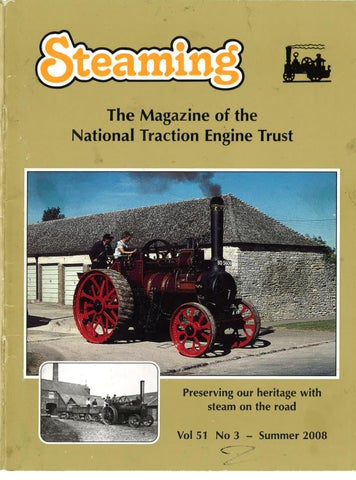
Front cover Still immaculate after a full weekend's rallying at the Fairford, Gloucestershire, event in August 2005 is Marshall 7hp agricultural 65908 of 1914, pictured by John Maund as it left for home past mellow stone walls on the Sunday evening. 115
Trust News R*11:y Orgarasers Cclumn Rally Organisers Section This is advance notice of a Conference for Rally Organisers that will to be held on Saturday 18th October 2008. At the October meeting I shall be launching the updated Rally Organisers Code of
Practice. Invitations and further details will be sent out by the General Secretary (in due course) to those who have attended past Conferences, and all on theTrust's Affiliated groups list. I shall be pleased to make sure a similar invitation is sent to anyone else organising an event involving traction engines who feels that their venture would benefit by gathering together with others to discuss problems and learn from their successes or mistakes. I am confident that newcomers would learn much from attending the Conference. The venue being arranged is in the midlands, at an easily approached location near the joining of the M1 and M6 motorways, and the A14 trunk road from the east. The Section is also working on the organisation of further Safety Officers' Seminars, to be presented after the close of the 2008 season — further details will be in the next issue. (Tim Holt, Head of the Rally
organisers Section — for address see inside the front cover)
Engine Owners COFiLUF11 rt
Engine Owners Section A successful Steam Training and Driving Course was held on the weekend of 10/11th May at the premises of S E Davies at Astwood in Redditch Bank, near Worcestershire. Thirty students took part and the weather during the weekend was warm and sunny — in contrast to the last two years when it 116
has been very wet. On Saturday evening, students and enginemen were entertained by Bob Garnett, who gave a most interesting talk about boiler explosions. The Trust is again grateful to the lecturers and engine owners who ensure that the training course is a success. Above all, the Trust and all those who take part are extremely grateful to Bob Davies and all of the Davies family for allowing us to use their excellent facilities. Next year's course will be held, again at Astwood Bank, on 9/10th of May. I have two further dates of which I would like to make members aware. The third annual meeting between some members of my section and the independent boiler inspectors will be on Sunday 19th October. Looking further forward the 2009 Engine Owners Meeting will be on Sunday 11th January 2009, again at Willoughby; please make a note of that at the end of your 2008 diaries.
(Bob Siddall, Head of Engine Owners Section)
Technical Services Boiler Inspections Audit Scheme As reported in the last issue of this magazine, the Scheme was suspended in order to allow further dialogue to be undertaken with the independent boiler inspectors. So far we have embarked on two initiatives — firstly, to redesign the report forms using input from the inspectors, and secondly to meet the inspectors individually to ascertain what concerns they might have and to identify any changes that they would like to see implemented. These initiatives have made very slow and frustrating progress, partly due to the availability of inspectors, but mainly because not all inspectors have wanted to participate. It is true that four or five inspectors are running with the scheme and giving us useful feed back, but-elsewhere in
this issue Bob Siddall will have reported that he has set up the venue for the 2008 Boiler Inspectors of Meeting in anticipation relaunching the Scheme, and I fear that this date will see only 50% of the inspectors being willing to attend. I should like to ask engine owning members who use an independent boiler inspector to urge their inspector to join the processes and also attend the planned meeting. If we don't hear first hand of their concerns, how can we address them fully?
NTET Website performance In an attempt to breathe new life into the NTET's website, it was given a face lift some two years ago. More recently the management of the site ' has been taken on by David Collidge, better known for his work on the Steamscenes website. Further'= developments are envisaged under David's stewardship. Given that the NTET is often accused of 'not communicating' it came as a pleasant surprise when the website performance report for the year ending 31st May 2008 revealed that we had 70,126 visits. This equates to something like 192 visits a day, every day of the year. The peak average visit count was 283 for May 2008, and the lowest was 131 for each of October and December 2007.
Inquest on David Amette David Amette unfortunately died whilst participating in the 2007 Stotfold Christmas road run. The inquest into his death was held on 13th May 2008 at the Coroners Court at Bedford; it was conducted with witnesses from the family of the deceased, the engine owner, driver, and traffic police. Mr Amette, 68, was a passenger on a flat bed trailer hauled by a Burrell road locomotive owned by the Saunders family, which was taking part in a procession on 29 December 2007. With 12 other people, adults and children, he was seated centrally, on a tarpaulin covering a heap of coal. The engine driver had warned the passengers not to stand
Summer 2008 '477; RIR iT3
A scene from the Steam Plough Club's Great Challenge at Rempstone, Nottinghamshire in September 2006 — Mike Middlewood's Fowler class BB1 ploughing engine 15154 completes its pull of a 1926 built Fowler anti-balance semi digger 4 furrow plough. (Barry Job)
up or place legs over the side of the trailer.The day was dry and sunny but there was a cold strong wind. During the run a child's hat blew off, but it was not retrieved. Shortly after David Amette was seen to stand up on the trailer which was moving at about 6 mph. He then jumped to the road, and stumbled. It is presumed that he hit his head on the road causing a fatal injury. He may have touched the rear of the trailer but was not run over. He was trying to recover his beret that had originally belonged to his father. There was no criticism of the engine driving, and the construction of the trailer was not remarked upon. The coroner recorded a verdict of accidental death. (all paragraphs, David Smith — Head of Technical Services Unit)
Driver Competency Scheme Details of the Trust's Voluntary Driver Competency Scheme, and the request for a review of the Scheme that came from 2007 AGM, were set down in notes in our last issue (page 84/85). This paragraph is a brief notification to members of progress and on what is to happen next. The Review Panel — the members of which are named on the above mentioned pages — are presently STEAMING Summer 2008
working on the assembled documents, and their deliberations will be concluded during the summer. The Report that is to be prepared by the Panel from those findings, and the recommendation of the General Council on their Report, will be presented to the 2008 AGM, as requested by last year's motion. However, to enable the whole of the membership to be aware of the work of the Review Panel before our November gathering, it is intended to publish their Report and the Council's response in the Autumn issue of Steaming, which is distributed prior to the AGM. (John Cook, Chairman, Review Panel)
Steam Apprentice Club The Steam Apprentice Club is still seeking applications for the Technical and Steam Apprentice Awards which are announced at theTrust AGM each November. So, please do put pen to paper and let us know of an Apprentice who you think is worthy of one, or maybe both, of the awards! Display advertisements giving full details appeared in the Winter (page 11) and Spring (page 76) issues of Steaming or you can find them on the SAC pages of our website at
National Traction Engine Trust
Appointment of General Secretary With the notice by Sue Jackson that she wishes to leave her post as Secretary to the Trust, it is necessary to seek applicants for the post and so continue this leading role in the administration of Trust affairs. Applications are therefore invited from suitably qualified persons to serve in this responsible position, which carries a financial amount for the cost of running the office. A knowledge of general administration procedures is essential, and the applicant must be computer literate. The duties include the arranging and notification of meetings, the taking and production of minutes thereof, and handling general correspondence. A job specification giving full details of this important post is available to intending applicants (who do not necessarily have to be members of the Trust). Please apply in the first instance to: Robert Herring, Glebe Court, Fringford, Bicester, Oxfordshire OX27 8RJ. The closing date for applications is 31st August 2008
117
www.ntet.co.uk/sac. Send the applications to me - my contact details being on the inside cover. The SAC, along with clubs and individuals, has successfully held three driving days so far this season. One of the days was held for, regrettably, the last time at Dingles, due to the decreasing number of engines being kept at that venue. I would like to put on record the sincere thanks of my section to Richard Sandercock and the engine drivers for the support they have given the SAC in running the driving days at Dingles over the years. Fortunately, last year we were able to start up another venue at St Stithians in Cornwall, so all being well there will be an ongoing location in the far west for Apprentices to attend. (Kevin Munn, Chairman, Steam Apprentice Club)
Personal Derek Wheeler We offer our congratulations to member Derek Wheeler of Hertfordshire, who was awarded an MBE in the 2008 Queen's birthday honours list for voluntary services to heritage in Hitchin. Derek is known to steam enthusiasts for his wonderful pre-
sentatinn of Victorian fire fighting with his 1896 Shand Mason steam fire engine and a full team of horses and appropriately dressed crew. Over the last forty years Derek has assembled a valuable archive on Victorian fire fighting methods and equipment, as well as carrying out his own restoration work on items of national importance. He has become a leading authority on the subject, with his expertise recognized by many institutions and museums, including the National Museum of Science and Industry. Without his passion and effort this important archive of part of our Victorian heritage would not exist in the form it presently does. Derek's interests also extend to the local and social history of the area around his home town of Hitchin. He has made contributions to published works and helped in restoration of artefacts belonging to the town, and personally written of two Victorian families and their Hitchin businesses. Derek, and his Shand Mason and crew usually display at the Great Dorset Steam Fair, along with similar appearances at many other rallies
each season - notably the Bedfordshire club's Old Walden event in September, there to be found replenishing the water supply for the engines.
Affiliated and ()thew asvoups Raising Pressure calendars I am pleased to say all of the Raising Pressure calendars that we produced last year were sold. From sales at various rallies and through postal orders, one thousand and thirty-two of them now appear in all corners of the world, including many in Trust members' houses we guess! A total of £7272 was raised for Cancer Research UK, so we would like to take this opportunity to thank all of you who bought calendars and those who made donations. The cheque presentation took place earlier this year in Wiltshire, and the Chippenham area representatives from Cancer Research UK were
The things we do for fun. Photographer David Warren captures all the atmosphere of disappointing and miserable hours at a wet and dreary event at Bailey Park, Abergavenny, Gwent on the late May bank holiday, 2008. A damp crew member tends Gibbons & Robinson traction engine 959 of 1891 in the foreground whilst other exhibits cower under their sheets further down the line-up.
delighted with our efforts. Thanks again from all of the Raising Pressure girls, and their families. (Samantha Jones)
NTET Sales The Exhibition and Sales Unit - The travels of the Trust Unit continue through the rest of the rally season. Appearances are scheduled to be made at the following events in the second part of the season. July - 12/13th, Rempstone, Leics; 19/20th, Marcie Steam, Herefordshire. August - 1st to 3rd, Gloucestershire Steam, Kemble; 9/10th, Driffield Steam,Yorkshire; 16/17th, Lincolnshire Steam; 27th to 31st, Great Dorset Steam Fair. September - 6/7th, Haddenham Steam, Cambridgeshire; 13/14th, Old Warden, Bedfordshire. There is further detail of the locations etc, for all of these events in the Trust's 2008 Rally List, which was distributed to members within the Spring issue. (Colin and Val Brown, NTET Sales)
Annual General Meeting The 2008 Annual General Meeting of the Trust will take place on Saturday, 15th November at the Royal Chase Hotel, Shaftesbury, Dorset. Detail of the programme for the whole of the weekend will be published in the Autumn copy of this magazine. These notes give information for the 2008 AGM, and the formal notice regarding the submission of any motions to be debated. Formal notice of the meeting and other information, including the audited Report and Accounts for the year and an Appointment of Proxy form, will be distributed to all then current members with the Autumn issue of Steaming. Any member may submit a motion for discussion at the AGM. All such motions must be in writing and signed by a proposer and a seconder, and state their respective Trust membership numbers. The items for STEAMING Summer 2008
The presentation to Cancer Research UK of the cheque that resulted from the sale of Raising Steam calendars in 2007
discussion, in order that they can be published in the Agenda for the AGM, as required by Article 16 of theTrust's Constitution, must reach the General Secretary, Sue Jackson, on or before Saturday, 20th September 2008 (address inside front cover). The elected General Council for the current year was published on page 5 of the Winter 2007/2008 issue of this magazine. Members who are retiring by rotation at the AGM in November 2008 after their three year period of office are: Richard Sandercock, President Robert Herring, Chairman John Bosworth
John Durling Bill Evans Bob Garnett Richard Hurley StuartTomlinson All of the above are eligible for re election. John Billard resigned from the Council during the year.There are vacant positions on the General Council. A form of Nomination Paper is printed with these notes and may be used - cut from the magazine, in photocopied form or written out on plain paper. Any nominations for the General Council should be sent to the General Secretary, Sue Jackson
The National Traction Engine Trust AGM, 15th November 2008 NOMINATION PAPER
Please use block letters
President, Chairman or a member of the National Council* Name
Membership No
Address I agree to aceept nomination for this office and, if elected, to serve theTrust and abide by its Constitution. Signed: Proposed by SIGNATURE
PRINT NAME
SIGNATURE
PRINT NAME
Seconded by
Membership No
Membership No
Nomination can be made on this form, cut from the magazine: on a photocopy, or on a copy hand written on plain paper. "delete as necessary, but use a separate paper for each nomination.
119
Working showmans Here arc two typical scenes of showmans engines at work in their environment, all hemmed in by the working paraphernalia of a busy fairground. The first photo has its date and whereabouts marked strongly enough on the original not to need repetition in this caption. The engine at the left is thought to be Foster 14403 of 1919, one of the makers' well regarded 65bhp compound road locomotives, and equipped with auxiliary dynamo and a crane tower. To the right is Fowler 10318, belonging to W H Marshall & Sons Modern Amusements, a family that travelled in Yorkshire. The engine was - and still is, for it can be seen on display at the British Commercial Vehicle Museum at Leyland, Lancashire - a class B6 compound, new in 1905 and named SUNNY BOY No 2. This too has a crane tower fitted, and its spark arrester has been left perched at the rear of the awning. By the Fowler's rear wheel the untidy heap of wood 120
and metal is an under-repair water dandy - one wheel of the single axle, which mounts on double elliptical springs, seems away for repair, and the empty barrel, moved to one side, offers a good parking stand for the photographer's cycle. The second picture is at Bridgwater Fair in 1943. The weather here is brighter, showing that the driver of the Burrell, despite the restrictions of
the war period, still bothered to keep the brass clean and shining. The engine is Burrell 2874, a 6hp road loco new to J M Lock of Dorchester in December 1906, and then in 1922 it passed to Amy Lock of Newton Abbott, Devon (surely there was some connection here), who took it to have the show fittings and the name PRINCE OF WALES added. (Jack Turner collection) Summer 2008 SILAMING
(address inside front cover) and must be received on or before Saturday, 20th September 2008. They will not be accepted after that date. The names of the nominees will be included in the published Agenda to be distributed with the Autumn magazine.
topics affecting engines and engine ownership should take the opportunity to talk with members of the Trust National General Council or executive committee who may be in the tent- you will usually find at least one of them present, and if not, a later time can be arranged. But don't leave it until early Sunday afternoon. It is intended to arrange an Open Forum for the early evening of the
Future Dates Great Dorset Steam Fair, 27th to 31st August The Trust will again have a prominent presence at the Great Dorset Steam Fair. Our large marquee will provide suitable services to members and friends as well as portraying the aims of the Trust to those engine enthusiasts from the general public who are not members. The Trust Sales portion of the tent will have the usual excellent selection of road steam reading, DVD viewing and clothing on sale (and remember
the NTET funds gain a welcome boost from the receipts during the five day event). At the other end of the marquee, willing volunteers are again to provide tea and coffee to members, families and friends who need to take a rest, or merely to sit and talk just a little more on engines. Membership renewal facilities will also be present - there is absolutely nothing to stop existing members from dragging their friends or acquaintances along and insisting they join up on the spot. Again, part of the tent will be transformed into an art gallery, showing original works with an engine or rural composition by artists Robin Wheeldon, John Hancox and John Wigston. The paintings have a variety of prices, and if you have only thought about buying in previous years, don't forget to bring your cheque book. Our usual display of a few engines that will be fresh to many visitors include Ted Freeman's immaculate Burrell 6hp road loco THE
Thursday, 28th August. A more suitable location than the Trust marquee is being sought - one in which comment and discussion can be heard above the general noise of our rather public area - please drop in at the marquee well beforehand to learn of the venue that has been discovered!
Rally Organisers Conference This Conference will be held on Saturday, 18th October 2008 at a venue in the midlands - further details can be found in the Rally Organisers Column in this issue.
Annual General Meeting The more formal notes concerning the Trust's 2008 AGM on 15th November are set down in adjacent columns - this is a brief outline of the arrangements planned for what we trust many members consider to be the enjoyable social side of the weekend, alongside the necessary annual business. This year we visit an area about
midway along the most southern counties of England, with the AGM being held at the Royal Chase Hotel, Shaftesbury, Dorset.This is a medium size hotel in its own grounds on the outskirts of the town. Reservations for accommodation at a special rate will be available for Trust members for the Friday and Saturday nights -
full details will be included in the Autumn issue of the magazine. A programme of suitably interesting visits for members is being arranged for both the Saturday and the Sunday mornings - the former to several sites in the Shaftesbury area, and on the Sunday Robert Coles has kindly invited us to his premises to see his collection.
DALESMAN; George's Mick Armstrong Whitworth 10ton roller - it is some years since one of that lesser known marque came to Dorset, and the barn-stored Marshall engine 72808 BRITANNIA, which owner Stuart Smith has kindly agreed to leave in its as-removed condition until after its appearance in the Trust
tent. Members who have concerns on STEAMING Summer 2008
New Members We extend a sincere welcome to the following new members who have joined the Trust during the last three months. We hope they will gain
much friendship, information and enjoyment from their membership over a period of many years. Full addresses are not included, but the Membership Secretary is always pleased to put members in touch with one another by forwarding mail. N Jones, Coleford, Gloucestershire A F Kelly,Ty Croes, Anglesey D Clifton, Whittlesey, Cambridgeshire A J Gunn, Falmouth, Cornwall W Ivy, St Albans, Hertfordshire
M Byerley, Stocksfield, Northumberland C R Flack, Royston, Hertfordshire P J Garrett, Guildford, Surrey Dr R J R Smith,York Llyr Ap lolo, Bow Street, Ceredigon P Dook,Tickhill, South Yorkshire G Hudson, Middlewich, Cheshire S Phillips, Newport, Shropshire M D Bradshaw, Cambridge B Couzens, Sleaford, Lincolnshire Christian Meckbach, Landstuhl, Germany J Flynn, Atherstone, Warwickshire N Bailey, Bridport, Dorset J Spencer, Leatherhead, Surrey S F Garrod, Norwich N Emerton, Luton, Bedfordshire D and B Fleet, Chelmsford, Essex M J Smith, Okehampton, Devon J M Jopson, Ulverston, Cumbria P Baxter, Wareham, Dorset M A Cobb, Retford, Nottinghamshire R F Kew, Boston, Lincolnshire A Waling, Wisbech, Cambridgeshire D Dale,Tywyn, Gwynedd P Imber, London A Joss, Dundee, Scotland B A Nice, Cottenham, Cambridgeshire M G Clark, Hook, Hampshire N Robinson, Southampton, Hampshire R Rivett, Billingham, Stockton on Tees
e arta
There was
a strange and unplanned duality in the Spring issue, whereby McLaren 8hp road loco 1053 appeared as the principal subject of one article (page 74) and also in an incidental role in a second (page 92).
Such are the pitfalls of the Editor preparing some articles well in advance of others. There is no particular conflict of fact, but to clarify matters it may be as well, in the penultimate paragraph of the Liverpool story, to alter the second sentence to read '... or by, Bates
in 1922, and by that time it had been fitted with standard pattern wheels
'For sale - 10 ton steam-roller by Marshall, No 68641 - apply Diwan, . Narsingarh State, Cl.).' (from The Statesman, Calcutta, 18th August 1920) 121
The Corporation of Leicester buy a steam roller Roger West With our magazine having completed 50 years of publication there have been many fine pictures discovered by members and then offered to the Editors so that all members could enjoy them. Many have had potentially lengthy captions extended into articles. The subject of the photograph on the page opposite was realised to be a local authority owned steam roller, so surely it was worth trying to find more from the Minute Books of the time, It was and thus is revealed the tale of how the elected councillors of a midlands city arranged for the steam rolling of its Victorian thoroughfares, and made what must have turned out to be a most economical purchase. The picture The picture's present appearance
in our magazine is due to its appearance on e-Bay, and then being successfully acquired by Alan Walker of Market Harborough (other road steam enthusiasts had also noticed it). The mounted photograph probably dates from about 1910, and
seems never to have moved very far from Leicester, being advertised when on sale from Rothwell in Northamptonshire, but 20 miles to the south. The location of the scene in Leicester is fairly easy to identify From local trade directories. The Aveling & Porter roller is clearly an old one, with the unusual front rolls
immediately catching the eye - but more of that shortly when we explore the maker's records. The merchants' shops behind the roller very
dealer, but from the change in proprietor we can judge the picture most likely to have been taken in the
1879, when it was resolved that the Borough Surveyor, Edward J Stephens, CE, 'be instructed to obtain
years just after 1909. King Richard's Road, Leicester, leads west from the City. The road and many of the surrounding streets
information respecting the use of Steam Rollers for roadmaking from towns where such Rollers are in use.' The Leicester Daily Mercury reported
of modest terraced houses were developed from mid Victorian times, but the particular buildings seen behind the Aveling were erected a little later, about 1880. We are looking
the cost would be £500, and that H&S committee chairman Alderman Chambers said the forming and repair of their macadamised roads had long been a source of great
east towards the city centre, which is less than a mile away, and Tudor Road can be seen going off to the left. However, it is no good thinking about taking a steam roller into Leicester to
complaint, especially to gentlemen who were accustomed to drive into the town in their carriages and traps. The present method was 'an
re-create the scene, albeit not very authentically, for this north side of the road was demolished for road widening around the 1970s. The back of the mounted print
unfortunately offers us no further clues - no names written there of the group of roadmen, though we might guess the photo's survival is due to it having been handed down through the families of one of them who posed for the plate camera, with the image merely to finish as a house clearance item nearly 100 years later. Steam Rollers for roadmaking The Leicester roller was Aveling & Porter's Royalty number 1565, dated to 1880, and the Minute Books of the Borough of Leicester's Highways & Sewerage (H&S) Committee from 1879, handwritten in copperplate in
bright green leather bound volumes, reveal much regarding the decisions made on purchasing the machine. Generally, the skill of the Clerk in taking the Minutes was in setting
exceedingly antiquated one' At the time the Leicester Corporation owned horse drawn rollers - at least one was able to be ballasted up to 9 tons weight. Other
than that it is clear from looking back further in the Minutes that the roads, away from the centre at least, were surfaced with stones that were merely left to be bedded down by the action of the traffic. The Mercury reported that Chambers claimed the horse roller was such a cumbrous and ineffective machine that it was not now used and 'the roads consequently had to make themselves as well they could by ordinary
wear and tear of carriage and vehicles over them ...The purchase of a steam roller had been laid many times before ... it would do the work better and quicker and cheaper'. He was not sanguine that any great financial saving would be effected,
but the work would be better and quicker. The roller would enable roads to be made in summer as well as winter.
conveniently show their owners' names and trades. Wright's 1909 directory shows J & G Bailey & Son to be in business at 45 King Richard's Road as 'plumber and gas fitter'. Next
down in concise form what the meetings of the elected representatives had decided upon, and not the detail of all the debate. So although
door and to the left, at 47, was James Foster, a corn and seed merchant, and the last three letters of his name can just be made out on the shop fascia. The year before, Kelly's 1908
no doubt there had been much pre and post meeting discussions among the councillors on what needed to be done to keep Leicester's streets in better order, there is no minuted
a large amount of detail to impart and the minutes clerk recorded a considerable amount of it. Stephens told the meeting the macadamised
directory showed number 47 was occupied by W Prentice, similarly engaged as a hay, straw and corn
mention of any problems with roadmaking until the meeting at the Town Hall on Friday, 14th December
roads in the Borough extended to 15 miles, 260 yards, with an average width of 8 yards - incidentally, the
122
The Report Surveyor Stephens must have been preparing for his report for some weeks, for at the following H&S meeting, just a fortnight later, he had
Summer 2008 ST0.0,11411\ Ki
population about that time was some 120,000. The surveyors of no less than 43 towns had favoured Stephens with their opinions and experiences with steam rollers — how many had he asked in total? These men had had rollers in use for periods varying from 14 years to a few months, and all were duly listed. Most experienced with the method should have been St Saviour's Vestry in Southwark, London, at the 14 years — though that length of time seems to take us back to about 1866, to the very dawn of rolling by steam and before real steam rollers, when Thomas Aveling was trying a smooth wheeled traction engine trailing a huge roll constructed largely of timber. Would research in the Vestry minute books at Southwark tell us more than has been set down in more recently published histories? Many of the other locations mentioned were the larger cities and towns around the country, though Maidstone was by far the smallest town near the top of the chart, said to have used steam for 10 years. Again, at least for first use about 1869, that could be a case of Aveling providing a machine for
STEAMING Summar 2008
prestigious trial use from his Rochester works to the county town, but ten miles distant. But back to considerations at Leicester. 'All the Surveyors speak highly of the effective value of the Machine ... the surface rolled per diem varies from 5000 to 500 square yards. I find that the mean of the whole 43 towns gives 1180 per diem ... I think 2000 yards which is stated by Smith of Darlington as being the minimum quantity rolled might be assumed as the area which we would cover, as our gradients are not steep compared with other Towns. Allison of Bradford, who is a good practical man ... says it does not cost half as much as Horse rolling and makes a much better road: in fact that is the general opinion expressed. 'The estimated cost for the Rolling varies ... Tell of Birmingham and Ashmead of Bristol give the daily cost of attendance as 12s.6d. .. This divided over the 2000 yards assumed amounts-to a third of a 1/4d [farthing] per yard but allowing for contingencies I will make it half a 1/4 d per yard, then rolling by Steam once over the 204,600 yards of macadam which we have in this Borough will cost
£127 per rolling ... rolled twice during the year will be £254 per annum. 'The reported cost of maintenance of the Roller varies from £113 per annum at Croydon to £20 at Darlington and Maidstone. I think we might fairly take the mean ... say £50 per annum. At Huddersfield, Leeds, Portsmouth and St Helens it is used for stone crushing; at Middlesbrough and Stafford for cutting hay and crushing oats and stones. Of course there are many things which the engine could be applied to including pumping. 'Allen of Bradford says a 12 ton Roller is best size, Croydon says 10 tons. As far as I can learn the 12 tons is the best. I find that rolling with one 9 ton Horse Roller with 4 Horses and 4 Men cost [Leicester] 36/- per diem or with 3 Horses on a more level road 27/- per diem, and three times the cost of Steam Rolling as given by Birmingham and Bristol.'
Resolved and Adopted Surveyor Stephens' professional local authority colleagues had supported him well, responding from all parts of the country — Darlington in the north, Bournemouth in the south 123
and Swansea in the west. They had enabled him to make a good job of his survey, and thereby convince the Councillors the outlay on a steam roller would he worthwhile. The clerk therefore wrote 'Moved by Mr Jessop, seconded by Mr Hart and carried That the Council be to authorize this requested Committee to purchase a Steam Roller of such size and make as the Committee may approve'. To take the matter further an eight man subCommittee was to be formed, consisting Messrs Millican, Gimson, Underwood, Sladen, Hart, Jessop and Windley together with the Chairman, Alderman Chambers. Of the above mentioned gentlemen, both Jessop and Gimson would have been principals of the well known and respected Leicester engineering firms bearing their respective names. Within the space of a mere week, for the H&S Committee meeting on 5th December 1879, much had happened. The sub Committee, 'having considered the question referred to them as to the desirability of purchasing a Steam Street Roller, are of the opinion that this Corporation should be possessed of a Roller and recommend that one be purchased from Messrs Aveling & Porter of 15 tons weight ... that a Shed for the Roller be erected in the Vestry StreetYard so that it may be in a central position in the Borough'. There is no mention of whether competitive tenders had been sought, but in fact, other than Avelings and Thomas Green & Sons at Leeds, there were few manufacturers to approach, for the well-known road steam engine makers only entered the market for steam rollers ten or more years later. Aveling & Porter was by far the foremost provider of the day. Stephens' report was received and adopted, but note that despite him earlier having recommended a 12 ton roller, it was a 15 tonner now being proposed and ordered — as we shall see, it seems likely the change was because Avelings had one ready, and maybe were willing to let it go at an economical price, though no such catchpenny arrangements are hinted at in the Minutes. And there the sub Committee's Minutes cease mention of the new acquisition.There is nothing to reveal when it was set to work, or its successful introduction, or otherwise. Perhaps the space, and the attention of the journalists, was taken by the need to report the aftermath of the Tay Bridge disaster on 28th December, or the breaking news of 124
the Battle of Kabul on the 23rd, during the second Afghan War. However, the maker's records show 1565 was despatched from Rochester on Monday 12th January 1880, so it probably arrived in Leicester, to the Midland Railway sidings, on the following Wednesday or Thursday. The proposed shed at Vestry Street — surely an inappropriate place, being barely 200 yards from the Clock Tower in the town centre — came to naught when a meeting during the same week decided to remove all the H&S Committee's plant to a canalside yard off Soar Lane, in the Blackfriars area of the City. Some years later, in the late 1890s, a small piece of the south-eastern corner of the site was taken for the construction of Jarvis Street and the adjacent high blue brick viaduct that supported the new Great Central Railway station for Leicester. Jarvis Street depot remained highways department premises for many years.
Aveling Royalty 1565 We shall now move on to the detail that the makers of the roller entered up in their works ledgers. Their Royalty Books of the period cram a wealth of constructional and dimensional Information Into headed columns across the pair of leaves of the 18inch wide ledger, with five engines entered down the page, giving some three inches per entry. More and more detail gets included as the years go by, in increasingly small handwriting, until the system eventually changes to each engine being entered on its own page, preprinted with the main headings. In this small space, the customer for 1565 is noted as Borough of Leicester, E L [sic] Stephens, Surveyor; it was a 6hp, 15 tons roller, with a single cylinder 8in diameter x 10in stroke, and the driving wheels were 5ft diameter, and 201/4 inches wide by 41/2 inches thick. A note 'stud holes cast in' had been altered to no stud holes — this refers to the facility to have occasionally fitted scarifying spikes to the wheels. The diameter of the front wheels was 4ft 0in bevelled to 3ft 8in, and they were 26V2in wide by 41/2in to 4in thickness. These are the curious front rolls so prominent in the King Richard's road photograph, and that were fitted to the early Aveling steam rollers, before they came to use a steerage fork. The wheels were assembled onto an inverted T, faintly Y shaped, axle and post. The axle was slightly canted to suit the bevel of the rolls; these came together at the centre in a level plane across the road surface,
and the gap at the top of the rolls, of course, gave space for the post to pass up into the saddle and funnel base. Was the axle and post a one piece forging, or were stub axles bolted to the bottom of the post? Whatever the detail was, the arrangement for the front rolls was geometrically unsound — a moment's play with rolling a couple of (empty) beer glasses along the public bar will immediately illustrate that the roller's wheels, restrained as they were on the axle, would for much the greater part of their width be skidding their way across the work. It is said that the Rochester works blithely claimed this phenomenon was an aid to compaction and consolidation, but the strain on the bearings and other components must have been most severe. And by the time of the Leicester purchase, a better solution had been introduced .... but was Stephens made aware of that? We should note Avelings' use of the word bevelled when recording the front wheels or rolls. In seemingly all published references for more than fifty years (and by Aveling-Barford in the 1940s, and even magazines in 1879) they are described as conical, and whilst the word Is an appropriate and quite understandable description, it seems not to have been the maker's contemporary term. In the final years of the use of such front wheels on Rochester rollers, no other description than bevelled is written into the ledgers. Later on, it became usual to provide a slight inward taper to the rear wheels of Aveling rollers, to account for the strong camber of the roads of the time, and to give a more even wear to the rolls. 1565's seem to have been plain. Returning to the rest of 1565's specification that was entered in the ledger, the wrought iron crankshaft was of 27/8in diameter, and there was no compensating gear or winding drum. The cast iron solid flywheel was 4ft 6in by 5in, and the chimney wrought iron. There was no water elevator, but an injector was on the outside of the tender. Tubes numbered 24, being 4ft 6in long and 2Y2in diameter; the 17 firebars were 2ft 4in long. At this period Avelings make no record of the finished weight of their engines (if indeed they weighed them on completion), so we know not if 1565 was just 15 tons, or considerably heavier than the nominal claim, as was usually the case in later years.
The New Pattern roller None but the smallest manufacturer sent out the completed Summer 2008 STEAMING
engines in a neat works number and chronological sequence, and it is interesting to see what other machines appear on the same pages, or at similar dates. 1566 was a 6hp agricultural sent off to Aberdeen in August 1880, some seven months after our subject, but 1564 was a 10 ton roller and had gone off on 21st October 1879, 21/2 months before the Leicester roller, to the Fulham Board of Works. It was noted as 'New Pattern, double speed, steel gear ... front wheels 3ft 6in x 22in with new designed steering fork'. Here is evidence that 1565 was a rather late example of the bevelled front roll design, and study of the output from the works confirms the Borough of Leicester did take on an end of range machine, but whether the Surveyor or the Councillors happily and knowingly accepted this, or were unaware, seems to have escaped record. 1565 was built up at Rochester about midway through a two year period of fundamental change in the company's roller design. Having apparently acknowledged problems with the bevelled front rollers that had been used since 1871, Avelings set about designing a better arrangement of the front end. In late May 1879 the cast steel steerage fork that is so familiar on steam rollers was introduced by Avelings on Royalty Numbers 1528 and 1538.The fork was not the subject of one of Thomas Aveling's frequent Patents, and, indeed, Thomas Green had already used such a fork on steam rollers he had built at Leeds. Following the above pair, of six further rollers that left the works during the rest of 1879 and before the Leicester machine was delivered, four more were of the 'New Pattern', as they were written up in the books — and had the new fork and 'plain' front wheels, and two were equipped with the old type bevelled wheels. Through 1880 the change became virtually complete — after 1565 in January, another 12 rollers were sent out during the year, but only three of them, 1540, 1583 and 1606, perpetuated the bevelled wheel design. By the time of 1606 in the August the clerk was using the term 'Old Pattern', and at the end of the year it seems it was deemed unnecessary to keep entering 'New Pattern' and such comments cease. Six months later, on 1st June 1881, what appears to be the last of the bevelled front wheel machines, number 1628, was delivered to the Corporation of Plymouth. We may wonder why their surveyor, or maybe
STEAMING Summer 2008
someone of fixed opinion on that city's highways committee, was so insistent on purchasing a relic, though it may have been the roller had been completed but unsold for some time. RLS records are silent on the disposal of 1628, so we know not how many years the Plymouth roads were scuffed by their roller. However, it seems just four bevelled wheel Avelings had left Rochester after the Leicester example.
The dangerous roller Having examined what the new Leicester Corporation roller was in terms of being an end-of-range model, we now return to the Borough's Highways & Sewerage Committee minute books. The practical activities of the roller may not have merited a record, but its social impact caused the clerk quite a bit of extra work. Just ten weeks after the roller started making its mark on Leicester's highways the Town Ckerk, John Storey, had to read a letter to the H&S Committee's end of March meeting. A Mr Owston of Wigston Magna was complaining of the dangers of working the steam roller during daytime. 'Sir, I must again call your serious attention to the danger both to life and limb attendant upon the use of the Steam Roller. I had the greatest difficulty in getting my horse past the roller whilst [it was] at work at eleven o'clock this morning on the Welford road and I am not by any means singular in complaining of the dangerous character of the Roller and the indiscriminate way in which it appears to be used and although I should be extremely reluctant to take any proceedings against the Corporation for the purpose of controlling the use', of what is undoubtedly a public benefit, I must take some steps in the matter unless proper regulations are imposed. I need hardly remind you that as now used the Roller is a nuisance at Common Law notwithstanding the apparently protecting enactments to the contrary, and the recent decisions within the last few days of the Court of Appeal have an important bearing on the subject' The Clerk and the Councillors might have had reason to be wary of Owston from previous experiences — he was a solicitor, a partner in Owston & Dickenson, and despite probably being one of the very gentlemen the Mercury newspaper, back in December the previous year, had thought would be most advantaged by the roller's work as they were driven in their traps to Leicester and their business each day,
he was maybe known as confrontational towards the council. The Town Clerk had done some checking — he informed the meeting that the use of a steam roller having been sanctioned by Law it had been generally assumed, and recently decided by one of the Common Law Courts, that the owners of steam rollers were not responsible for damage from their use if all regulations had been observed and there was no negligence. The Court of Appeal, however, had more recently declined to accept this interpretation, their dictum being tantamount to saying that steam rollers could be used under certain regulations, but at the risk of the persons using them. The clerk advised the meeting that great care should be exercised in using the roller, and thus the wary members resolved 'That the Roller be used early in the morning and late in the evenings and that the fly wheel of the Roller be enclosed in a wooden case, also that a diary be kept of the work done by the Roller.' No doubt Mr Owston was apprised of the decision and was content; nothing further appears in the minutes and the situation seemed to be solved — though our picture shows no sign of any timber casing at the flywheel about 1909!
More great noise Three years later the complaint arose again. A letter from solicitors Owston, Dickenson & Simpson, dated 17th March 1883, on behalf of Mr Drayton Roberts, called attention to serious damage to his horse and carriage 'through the mismanagement and negligence of those professing to have charge of the Steam Roller'. Drayton's coachman was driving into Welford Place from Newarke Street the previous afternoon, a Friday, when the horse caught sight of the roller 'then in full work and making a great noise'. The horse took fright and plunged into railings in front of Leicestershire Club, by which it was much injured, and carriage damaged. There was, the letter claimed, an entire absence of warning or caution signs, and the coachman had no means of knowing he was approaching so dangerous an object. The Borough Surveyor had called his men to his office — Thomas Dunsmore, the roller driver; John Cockerill, the 'looker-out' and Benjamin Liner, the foreman. They said that boards were fixed at the Wellington Street and Welford Road corner. From Newarke Street the roller could be seen from a very 125
The New Pattern roller This engraving appeared in the issue of The Engineer dated 11th July 1879, and shows Aveling & Porter Royalty number 1538, exhibited at the Royal Agricultural Society's annual show at Kilburn, London, held from 30th June 1879.The roller can be considered the prototype for all the maker's 10tun three point rollers that were to come in the next 60 years, for even though the engineering and construction detail changed many times, the roller's wheels, where the work was done, stayed with this principal. The journal's columns reveal that Avelings showed a considerable number of engines at Kilburn, the most noteworthy, they thought, being the new steam roller. But there is only one brief paragraph of description: '... instead of conical rollers hitherto used in front, the great advantage of two cylindrical rollers has been secured by carrying the front end of the engine on a heavy cast iron fork ... A pin reaches up from this fork and passes through a heavy casting above. There is sufficient play in this casting to allow the rollers to accommodate themselves to the shape of the road'. 1538 was recorded by Avelings as '10 ton New Pattern', with steel gearing, a 7in x 10in cylinder, and 'front wheels plain', 3ft 7in diameter by 2ft 11/2in width by 21/2 in thickness. The rear rolls were the same diameter as the Old Pattern Leicester roller, at 5ft, but over three inches less in width, at 17 inches. The Royalty Book makes no mention of the machine being at the Royal Show (or of any special finish that surely would have been carried out, and was often set down in the record), just that it was despatched to Shoreditch Vestry, London, on 28th May 1879 — though we cannot tell if it had been taken to the Show before later arriving in the East End. In the course of time the Overseers at Shoreditch must have found the roller was not for them — it had passed to another owner by November 1889. Another of the new pattern with plain rolls, 1528, was despatched on the same 28th May date, the customer for the 6 tonner being the Corporation of Brighton. The 1879 engraving enables us to study areas that are hidden to us, in the photographs of 1565, by the posed group of roadmen or the dull weather in the 1930s.The steering arrangement can be seen to be very much the same on both the old and the new types, with the chains fixed to steerage shoes at the axle that were half length compared with those of later years. The chains were wound on and off reels at the extreme ends of the steerage shaft; the prominent scraper blade assembly was .also fixed to the outer end of the shaft. The substantial cast fork gave a new opportunity to fix scrapers to the front wheels. Notice that 1538 has had the stud holes cast into the rear wheels — the item that was omitted from the Leicester roller.
126
considerable distance. Liner said he held up his hand to stop the roller as soon as the horse shied — he was midway between horse and roller and about 15 yards from each of them. The coachman whipped the horse freely and worked the reins violently. Liner saw the horse had its fore leg over the front of the shaft and he tried to hold the horse, but the coachman ordered him to stand back. The horse fell four times and then was driven off and flogged violently. Despite the large polished brass insignia that adorned the front of the saddle on the Aveling, the local horses clearly found nothing with which to empathise. The Clerk had requested City's vet surgeon, Fraser, inspect the horse, but when he visited Roberts' stables the following Tuesday the horse was 'out to exercise'. He waited until seven in the evening when it came in from Quorn with a business cart — quite sound and in fact engaged on its usual work. The damage to the carriage had already been made good. But Owstons were still making accusations of negligence — 'the mode and manner of the working of the Steam Roller as seen almost daily must convince everyone that it is calculated to cause the most serious injury to life and property'. Owston re-iterated his call of 1880 for the roller to only be used in the early morning to avoid horses exhibiting 'utmost terror at objects of this character'. This time the Council members showed more strength —they resolved not to acquiesce to any of the terms of the letter.
Summer 2008 STEMMING
And me too Maybe seeing newspaper reports on the above brought forth other complainants who thought they might as well try a claim. At an April meeting the Council considered a letter from Fowler, Smith & Warwick of Friar Lane concerning the injuries received on 5th March by George Henry Johnson, confectioner, West Bridge. Johnson was coming down King Richard's Road with his bread cart when the horse bolted, through the noise of the roller, and ran against a tree, injuring Johnson, and damaging the cart and breaking the harness. The confectioner had ever since been attended by a surgeon, and he wanted a reasonable sum as compensation. At the next meeting the Surveyor reported no negligence on the part of his men in charge of the roller. Johnson's man, the cart driver, now admitted that through 'looking at the Engine' he drove the trap onto the guard of a tree, and agreed the roller was not working at the time.The matter was disclaimed.
Everyday use The decision to spend ratepayers' money and to purchase the roller had been made, so putting aside contentious matters such as related above, the H&S Committee minutes become relatively silent on how the Aveling served the Council. In April 1881, probably by then having managed to account for a full year's expenses, the Surveyor reported the cost per day of the roller as: Driver's wages, 10 hours at 71/2d 6s. 3d 8s. 4d Two attendants, 20 hours at 5d Fuel, 9 bushels of coke at 2d 1s. 6d 3s. 6d Interest on capital, wear, tear Interest on expenditure, Roller Os. 6d House 1d Oil, etc £1. Os. 2d Looking back to the estimates put forward in the Surveyor's report in December 1879, the above daily attendance costs at 14s.7d are about two shillings more than quoted there. The overall per-day figure of just over £1, rather than proving Stephens' claim that steam rolling would be a third of the cost of using horses, is not impressively more economical than the 27s to 36s he had been paying for the latter. If embarrassing questions were asked in Committee, nothing was minuted! The Roller House, with adjoining cart shed, had cost £180 in September 1880, so was presumably of fairly robust brick construction. The April 1881 meeting decided that four shillings an hour be charged for the hire of the roller by adjacent Local Boards or others, but STIFAMING Summer 2008
not for less than half a day at one time, and the charge to be from the time the roller left the yard. That charge, for a ten hour day, works out at a 100% mark up on the Council's costs. In November 1886 the Aveling was a couple of months short of being six years old, and it was agreed to accept the estimate from the makers to 'thoroughly repair' it for £100. The work, however, seems to have been put off, and in the following July the Surveyor's request for repair was repeated — the roller would be away from Leicester for about six weeks — and he also now found a second roller was necessary. A motion to obtain one was defeated. Derby Corporation were prepared to allow their roller to be hired, if required, whilst Leicester's was away at Rochester — £1 per day plus the wages of their engineer, presumably driver, of 30s a week. In April 1888 number 1565 had broken its axle, and the Committee confirmed the Surveyors action in instructing the Leicester engineers Gimson & Co to make the repair. A month later tenders were considered for a new, and second, steam roller. Prices submitted were: 10 tons 12 tons Aveling & Porter £340 Thos Green & Sons, £335 Leeds McLaren & Co, Leeds £320 £420 There was no further mention of this purchase, but Road Locomotive Society records show that Thomas Green were favoured with the business, their number 1373, a 10 ton single, being delivered in 1889, but not until the September. The minutes subsequently refer to it as the Corporation's No 2 roller, and Aveling 1565 as No 1. It was often agreed (and sometimes refused) that the rollers could be hired out for 2 or 3 days to builders and estate developers, and,T Hutchinson & Son's request for use at Knighton was left in the hands of Chairman and Surveyor, but the roller to go only 'at such time as will least inconvenience the Corporation'. Blaby Rural Sanitary Authority's application was not granted — apparently because their contractor already had the Corporation's horse roller on loan. For driving the Stone Breaker in the highways .yard, prices were received in September 1889 for the supply of a 12 ton (should the clerk have written 12hp?) portable engine: Marshall £228-0-0 nett R Hornsby £225-0-0 21/2% off [= £219-7-6]
Robey & £233-15-0 5% off [= £222-1-3] Co Clayton & Shuttleworth £227-18-0 nett Ruston Proctor £219-0-0 nett Ruston's price was accepted; close though the prices were, the ratepayers could not complain their elected representatives were accepting even 7s. 6d worth above the lowest figure!
Through the 1890s In April 1891 the workmen petitioned for an increase in wages, and later the roller driver is specifically mentioned; he was granted a rise from 5d to 51/2d an hour, though ten years before he was quoted as being paid 71/2d, so maybe in reality it was one of the men attending the roller, though not just a labourer. In the decade following the arrival of the first steam roller Leicester's population had increased by almost 50% — to 174,000 by 1891. The attendant increase in roadmaking and repair had the Surveyor asking for a third roller in June 1892 to deal with his problems. His request was rebuffed — he was to make enquiries as to hiring, and arrange for the present machines to be worked double shift. Councillor Bennion went further and proposed that 'steps be taken to work the steam rollers three shifts in the 24 hours', a motion which was carried! Using them only in the early morning and in the evening had long been forgotten. But Bennion also successfully moved that tenders be obtained for another steam roller and for vans for the men, though it seems nothing resulted — the full Council must have refused the sub-Committee's wishes. In November 1894 there was a fine example of the authority supporting one of its employees, however wrong he might have been. The Green roller, No 2, referred to as 'the small roller', had been at work in the north Evington area, when the driver, in changing gear, 'lost control and the engine ran down the hill causing damage to the causeway and fence walls to some houses belonging to Mrs J I Hallam'. The Surveyor did not think, under the circumstances, that the driver could be blamed for the accident. By December 1894 the old Aveling was at Rochester for more attention. The makers had earlier quoted £84 for the work, but on examination had found a further £43 would be needed; the Surveyor and Bennion were to scrutinise the estimate and authorise 127
if satisfactory. By the following March the Green machine was also needing repairs — as with the original Aveling, after about six year's work from new. Charles Bennion, incidentally, was a councillor typical of Victorian times — those were the days when the elected members were able to offer strong personal involvement to the authority's work, and bring to the council chamber the full weight of their business acumen and personal background, all without fear of being suspected of ulterior motives. Bennion is frequently mentioned in the minutes as arranging things for, and reporting on the steam rollers, drawing on his experience as an engineer. He was born in 1857, apprenticed at Crewe railway works and by the 1890s was one of the principals of Pearson & Bennion Ltd of Belgrave Road. This firm of engineers made machinery for Leicester's staple trades of hosiery and shoe making, and later merged with the United Shoe Machinery Co of America to form the giant British United SMCo. In 1928 Bennion purchased Bradgate Park, 850 acres to the north of Leicester, and presented it to the people of Leicestershire.
A third machine Repairs and renewals continued through 1896 — No 1 needed a new piston rod; No 2 some new rolls (£34); a scarifier was mooted for the macadam roads, and the question of the third roller was raised again. Bennion recommended Avelings for the supply of the latter — £355 for a new 121/2 ton machine, which the Committee accepted. The maker's records show what became the No 3 roller as Royalty 3892, of 6hp on an 'agricultural boiler', sent off on 23rd April 1897, having been built up by erector Richens and his men. Its arrival in Leicester, however, was all but five years after the Surveyor had first mentioned his need. The compound cylinder was 51/4in and 81/2in bores by 12in stroke; it had a firebox of Weardale iron (as most Avelings did at the time); hind rolls 5ft 6in by 17inches and front rolls 4ft 0in by 2ft 33/4in, and weighed 13 tons and 2 quarters.The works were noted as 'cased'. Odd that the iron sheets to hide the movement of the engine should still warrant a mention in the ledger every time, for on rollers, many years before, they had become a standard provision to appease the drivers of horses on the highway. The new roller was insured for £500, presumably a figure for public liability rather than value, and indeed 128
It is unfortunate that no photographs have come to light of any of the Leicester Corporation rollers other than Aveling 1565. This picture may be suitable to illustrate what the No 2 roller looked like. It is of Thomas Green 10 ton single cylinder roller 1374, sold to the Ilkeston Local Board, Derbyshire in November 1889. This was, by works number, the machine immediately after the Leicester example, but in the absence of the survival of the Green records we know not if the pair were, in fact, of similar build. The second of the Thomas Green rollers that was purchased by Leicester Corporation, in 1922, works number 2037, may have left some remains. A pair of front rolls, almost 4 feet diameter, and mounted with the original axle within a frame of steel sections and with a suitable drawbar, survive in an agricultural contractor's yard near Leicester. They are said to have come from a Green roller that had been working for a building contractor on large sites around the city in the 1960s, and this could well tie up with the Corporation's second Green roller having had a few more years work after being sold in 1951. The rolls bear no identity or other marks, but certainly look just that little bit different from, say, Aveling wheels; in its current form the trailed roller is thought to weigh about three tons. (F H Gillford, Road Locomotive Society collection)
the Ruston portable, which cost £219, was later covered for the same £500 amount. The previously mentioned scarifier turned up at a cost of £100 in May 1899, and was fitted to No 1 (it was noted as Scarifier No 215 in Aveling's records). Eighteen months later the drivers and attendants realised their task had multiplied, and sought an extra halfpenny per hour when working the attachment, which was granted. About that time it was agreed all the workmen would be paid their wages for the day of Queen Victoria's funeral. The wheels of the rollers needed frequent replacement. The Green roller, new in 1889, had £34 thus spent in December 1896, and £90 in April 1901, though the minutes don't inform whether these were front and hind respectively, as might be guessed. Two new rolls for the older
Aveling cost £60 in October 1901; again we cannot tell if this in-themiddle sum might have been for a pair of bevelled wheels. Around that time must surely have been when the Rochester works were suggesting to customers that a replacement new pattern front end would be a good idea. Several items were agreed for the employees' wellbeing: the steam roller men were provided with oilskins (though the waggoners request for sou'westers and oilskins was rejected) and three old tramway cars were set up as shelters in the various depots. No l's 'pair of new back wheels' of December 1905 cost £50 — an amount adding to our confusion of the cost of the most wearable parts of any steam roller. The differing sums may also depend on whether it was merely renewable rims that were being purchased or Summer 2008 STEAMING
complete wheels. In June 1908 a pointer for the future appears in the Minutes - the Surveyor was authorised to arrange with the Taroads Syndicate Ltd to carry out an experiment of a new method of road tarring, in a suitable road, at an estimate of £25. It was eleven years since the No 3 roller had arrived, and now a fourth was needed, and in July it was carried that provision should be made in the following year's estimates. The next May Aveling's tender of £390 for a 12 ton steam roller was approved, though it was a ten tonner that arrived in August 1909. Royalty 6875 was another compound, but we cannot delve further into its specification, as its build sheet is one of a group of several hundred that seem never to have been bound into the maker's ledgers. Although this was the Corporation's No 4 roller, from now on the Minutes, generally, become more vague on identities the rollers, indeed, had become commonplace items. However, as a now amusing aside, in February 1911 there was mention of an accident for which Joseph Nichols, sewer flusher, was claiming lost wages. He had hurt his back while pulling on his sewer boots - the matter was neatly passed to the Finance Committee.
throw crankshaft for ... Old Pattern Roller' shows in the survival of a small dimensioned drawing, still pinned to the ledger page. It replaced the original wrought iron crankshaft. Another grubby, oily piece of paper similarly survives, no doubt sent from Leicester to Avelings at some time - it had been used to mark the keyway position off the crankshaft. At an undetermined date a new boiler was provided, this time with ten more tubes of lesser size - they now
numbered 34, each of 2in diameter. So despite having purchased the bevelled wheel roller when it was effectively an out of date model, those at Leicester who used and maintained it, and had experience of later rollers, still found it worthwhile to keep it in good order.
one made, and that he complied with this request by surrendering the last purchased roller.' Thus in October 1916, after only seven years work for
the Corporation, did Aveling 6875 leave Leicester following a Government order. The following H&S Committee meeting heard that the Surveyor had 'received an order from the Government to procure a new Roller in place of the one commandeered by the War Office', but in the circumstances of the time that was easier granted than accomplished, and Avelings were to take three years before serving the Surveyor's needs. It would be interesting to know more of the Road Board orders that so swiftly commandeered road plant in 1916 - most local authorities were similarly affected and it seems there was no question of the engines being
The War in France 'The Surveyor reports that during
on loan. What were the financial arrangements?Though the surveyors
the vacation the manager of the Road Board requested him to provide a Steam Roller for the use of the Government abroad, the War Office undertaking to supply a new Roller to take its place as soon as they can get
must have grumbled, it is understandable that the newest roller of any fleet should have to go, for a brand new one was to be the replacement - when the various makers had caught up with other
More on No 1 From the Aveling archives we can learn more of the continuing life of 1565. Cryptic notes were added in red ink around the original entry in the
Royalty Book, among them 'new front wheels' around February 1911. For this work sketches of the gunmetal bearings were sent from the Borough Surveyor's office, and it is clear there were problems in making sure everything was going to fit correctly. 'In reply to your letter of the 2nd inst, the wire gauges were taken from the axle at the points A
and B shown on your [Aveling] tracing No 3791 returned herewith. The longer pair are for the right hand wheel whose boss is 121/4in through. The gauges are made dead to the greatest diameter at these points, and if the bores are made with the usual travel for working fits, the wheels should go on without any trouble'. Quoting all of that here may be a little meaningless, but it does show that, after 36 years, the Rochester workforce had lost its hands-on knowledge of how the front end of 1565 was built up in the first place, and needed information from the engine itself. In January 1916 there is evidence of major work (at Rochester?) with a new 'steel single
STEAIVIING Summer 2008
Aveling 1565 in its later days of use in the 1930s. Nottingham engine owner and enthusiast Fred Gillford took the photograph on an extremely inclement day. Maybe he had had advice that the veteran was currently in use and made a special journey, and had to accept the poor weather. The location is Welford Road, Leicester, with the roller facing towards the city at the junction of University Road, which goes off to the left of the picture. Another, even darker, exposure with the camera in exactly the same position includes a passing tramcar, and the trees do seem to have some leaf, so it is likely to be an autumn or early spring time photograph. (F H Gillford, Road Locomotive Society collection)
129
1880s No 1
1890s
1900s
1910s
1950s
1940s
Aveling 1565
No 2
Green 1373
No 3
Aveling 3892
No 4
Aveling 6875
No 4
Aveling 9058
—
Green 2037
—
Marshall 79530
i
i
Chart showing the length of service of Leicester Corporation's steam rollers. Having taken three decades to build up to the requirement for four machines, the next 40 years seem to have had the same requirement, after which petrol rollers in different sizes made their appearance, and added to the strength of the fleet.
Government orders. Whatever tribulations came upon the surrendered roller whilst it was working in France, it did later return to England. It was acquired, probably from war surplus sales, by the Oxford Steam Plough Co Ltd at Cowley, and received the registration BW4804 in 1921. Later, it moved to John Allen & Ford Ltd's ownership at Wokingham, hut the date of its disposal as scrap is not known. It was not only Aveling No 4 that went to War. In the following month the War Office requested volunteers for military road making and repairing in France, and fifteen of the City roadmen accordingly came forward. Much later, in January 1918, the Committee sent £10 to a fund, started by the Borough Engineer at Bolton, for 'extra necessities and comforts for the men employed in the road construction and quarrying Companies in France. In October 1919 the Chairman reported the Government were supplying a new roller at a cost of £970, to replace the one surrendered in October 1916. Notice that the latter had cost the Corporation £390 when new just ten years earlier in 1909.The fresh arrival was Aveling & Porter 10 ton RC10 compound 9058, despatched from Rochester on 8th October. Erector Kidd had been in charge of the construction of this 'No 2 Standard Engine, with 51/4in and 81/2in by 10in cylinders, fitted with a short firebox and weighing 12tons 6cwt, 2quarters. It was not provided with a scarifier or whistle, nor, apparently, an awning, though one of these, together with curtains, is noted as supplied later in 1929. So, at the beginning of the 1920s, Leicester again had four steam rollers available 130
1930s
1920s
for developing and maintaining the City streets, and the first acquired was now well into its fourth decade of work. A replacement roller It was not long before a further roller was needed, but this time it was to be a replacement for one of the earlier ones, not as a fifth machine. The Chairman reported in December 1921 that he and the Surveyor had recently attended the Road Transport Exhibition held at the Agricultural Hall, London and had invited firms exhibiting there to tender for an additional steam roller required. The councillors may have been bemused to hear 'All the firms have tendered one price viz:£1127.14s.0d: It was resolved that the matter stand over for the present. By July 1922 it was decided that the Chairman, the vice Chairman and the Surveyor should visit Messrs Green & Company's Works at Leeds for the purpose of inspecting the type of steam roller for which that firm had tendered. The Minutes contain no details of the day out at Green's but the September recommendation was to purchase from them 'a steam road roller with a separate scarifier [a trailed scarifier], and an Allen scarifier fixed to the machine, the total cost ... £991, after deduction of £121 allowed in respect of an old steam road roller'. All this was subject to approval by the Finance Committee, and an application to be made to Ministry of Health for sanction to borrow the £991. Was Thomas Green one of the original tenderers back in December 1921, or had Leicester gone to a firm outside the manufacturers' cartel to obtain a lower figure? Greens seem to have
had a roller ready for delivery, for their number 2037, a compound 10 tonner, is dated to September 1922; the 'old' roller as part exchange would have been the No 2 roller, Green 1373. Registration numbers were by now required on rollers, and the new Green bore the index BC4849. The other rollers had needed registering under the new system, if they were to be used on the highway, from the start of 1921. The Road Locomotive Society records show some of these numbers, but not all. Old No 1 received the mark BC4774, and Aveling 9058 (probably bearing the No 4) became BC4835, but the registration of No 3, Aveling 3892 of 1897, is not known, nor is that of Green 1373 — but of course that machine may well have been lying out of use during the time before it went off to its makers as part exchange in autumn 1922. Into the 1920s The 1920s were times when the burgeoning use of motor vehicles on the roads of Britain was making ever increasing demands of highway maintenance and re-construction. Less than three years after Green 2037 appeared, the Chairman and Surveyor were 'authorised to obtain and deal with lenders fur an additional steam roller'. Four, unspecified, firms responded and acceptance was recommended for that of Marshall, Sons & Co of Gainsborough at £850.10s including scarifier. A Ministry of Health loan would be applied for, but the expenditure would in the meantime be taken from the Council's suspense account, which possibly shows some urgency in the purchase. The new compound cylinder machine was one of the maker's S class 10 tonners, number 79530, and delivered in July 1925, registered RY1331. Other road plant that was acquired with the seven year loan was a Coleman tar spraying plant (£251), and several petrol lorries, with a 5 ton Commer, at Summer 2008 STEAllniNG
£1135, notably costing considerably more than the roller. The new Marshall roller was an addition to the fleet, but fourteen months later No 3, Aveling 3892 of 1897, was minuted as needing extensive repairs which would cost about £100. Provision was made for a new replacement, with No 3 to be sold. However, from this time on there is a noticeable absence of the word steam in the mentions. In November 1927 the usual trio vice-chairman and (Chairman, Surveyor) had gone down to London for the day to the Public Works & Transport Exhibition, and had viewed and discussed petrol road rollers. Such a machine had already been authorised and the Committee agreed to the purchase of a 6 ton Barford & Perkins, cost £719. That must have been for lighter duties; by then there was still a sum of £800 in the estimates for a new steam roller to replace the poorly No 3, but in July 1929 the Surveyor had second thoughts on that - 'I do not at present recommend, as we are able to hire at a cheaper rate than we can run our own rollers, and during the winter months our own rollers are not working to capacity'. The reserve money was spent on a new steam crane with grab for handling material dredged from the canal: it had turned out that the Corporation had already acquired its last steam roller two years before. From this time the H&S minutes become silent on the subject of the steam rollers - even when the machines were to be withdrawn as scrap it seems it was a matter to be delegated to the Surveyor, and not something that needed to be minuted. It was just fifty years since the roller that started it all had been written up in the clerk's immaculate handwriting. It was still on duty out in Leicester's streets, surely one of the very last of its type that was working in this country, half crushing, half skidding the road material into submission.Those responsible for its work could not have thought badly of its attributes. Strangely, one of 1565's bevelled wheel type had an even longer existence. The city fathers of Port of Spain in Trinidad, West Indies must have been remarkably forward looking to have ordered Aveling roller 1241 in 1876. It possibly worked for some seventy years, and was photographed, still with its original rolls, out of use in the highways yard in 1952, being scrapped some time after. Another once similar roller that survives is Royalty 1457, a 10 tonner sent off in July 1878 to Oslo in
STEAMING Summer 2008
Steam rollers of the BOROUGH OF LEICESTER, Highways & Sewerage Committee fleet no maker
No 1
number date new
Aveling & Porter 1565
12.01.1880
weight cylinder
registration
15 tons single
BC4774
said to have worked until 1935; disposal unknown.
No 2
Thomas Green
1373
05.10.1889 10 tons single
taken by makers in 1922 in part exchange; possibly scrapped then.
No 3
Aveling & Porter 3892
23.04.1897 121/2 tons compound ?
disposal unknown, last mentioned by fleet number in Minutes, Sept 1927.
'No 4'
Aveling & Porter 6875 26,08.1909 10 tons compound commandeered by War Office, Sept 1916. Later with OSP Co as detailed in text,
'No 4'
Aveling & Porter 9058
08.10.1919 10tons
compound BC4835
a replacement for the original No 4. Sold at an unknown date to Galliford & Son, contractors, Wolvey, Warwickshire.
'No 2'
Thomas Green
2037
09.1922
10 tons compound BC4849
a replacement for No 2. For sale by the Corporation in 1951.
Marshall
79530
23.07.1925
10 tons compound RY1331
sold at an unrecorded date to Dennis Nelson, Orpington. All of the machines were purchased new form the makers. Rollers Nos 1 to 3 are thus described in Minutes, but it is not known if these machine, or the later ones, carried such numbers, or in what form. Question marks indicate that the information is not known.
Norway; at some time it was altered to take a New Pattern fork and a replacement saddle. The roller worked until 1960 when it was retired to the Technical Museum. Avelings continued to note spares that were supplied to Leicester for 1565 - a new steering worm in March 1926 and a new injector the following July. The former needed a sketch to go back and forth to make sure there would be a good fitting, and again, that piece of paper is still pinned to the appropriate page in Aveling's Royalty Book.The Old Pattern roller is said to have worked until 1935 - a remarkable survivor, and an engine around which it is pleasing to be able to construct a reasonable history.
Two archive office deposits have enabled the writing of this lengthy account - that at first thoughts was only intended to be an extended caption to a photograph.
My thanks are due to the staff at The Record Office for Leicestershire, Leicester & Rutland at Wigston, Leicester for access to the Minute Books of the Highways and Sewerage Committee of the Borough, or City, of Leicester from 1877 through to 1935, and also local directories in the collection. Similarly I am grateful to Lincolnshire Archives at Lincoln for reference to the Aveling-Barford Collection, and in particular the Aveling & Porter Royalty Book 1A, numbers 1440 1838, together with the relevant Dispatch Books. Bill Wells, Engine Records Officer of the Road Locomotive Society provided details of the Corporation's roller fleet in later times, and Les Burberry, Photographs Officer of the RLS, searched for appropriate illustrations. And, of course, my thanks to Alan Walker for persevering to conclude his purchase of the picture from e-Bay.
At their meeting on Saturday (sic!) 18th December 1915, the Roads & Bridges sub-Committee of the Northamptonshire County Council had to decide on their action on a couple of seasonal maintenance problems. The Surveyor reported the Kettering to Wellingborough road had been damaged by Messrs Wallis, millers, of Burton Latimer, by the illegal use of frost studs on their motor wagon - it was an early Mann's wagon. Down at the southern end of the county more road surface
damage had been caused at Farthingstone Hill, on the Brackley to Banbury road, by Messrs Bostock's (showmen) traction engine by the illegal use of studs. Whether the extent of the damage was similar in the two cases is not recorded, but perhaps we may judge a little favouritism towards the county ratepayer in the instructions that were given to the Surveyor-to repair the damage caused by Wallis's, and to 'proceed against the offenders' at Farthingstone.
Acknowledgements
131
Discoveries from a nameplate Derek Rayner When, in 2002, I had my Aveling roller 8506 at the Driffield rally in East Yorkshire for the first time, it was perhaps also the first time that Halton Curry from Lincolnshire, another Aveling owner, and I had been at an event together. The occasion led us into conversation, following the necessities of cleaning, lighting up and general engine preparation. Halton wandered along the engine line to look at my WHITE ROSE which, as well as that preservation name, also displays its previous owner's plate, proclaiming JOSHUA RODGERS SOUTH CROSLAND No. 4. I first saw this brass plate on 8506 when I viewed the 1915 built roller in that small village in the hills above and just to the south of Huddersfield in 1964, whilst discussing purchase with the then owner, Joshua Rodgers himself. However, the plate was removed by Josh prior to the roller's subsequent sale to the White Rose Steam Traction Company (which was Lyndon Shearman, John Charlesworth and myself); this partnership lasted for four years and I eventually became the roller's sole owner. After it had been fitted with a new firebox and rebuilt for a second time in the early 1990s, the plate was re-united with LIIC ollei, by couitesy VI Josh's son Harry, by then in his seventies. The interesting thing with this No. 4 plate is that it is an engraved one — but until I got it from Harry Rodgers, I was unaware the engraving had been carried out on the back of a quite normal cast brass plate which had been provided by the engine's makers, the legend on which is SKIPTON RURAL DISTRICT COUNCIL, a body that had had nothing to do with 8506. To suit its new use, the reverse had been brought to a suitably smooth polished state. This prompted my curiosity: consultation with the Road Locomotive Society's listing of the Rodgers' engines showed a likely candidate, purchased by Rodgers in 1951 — Fowler class DN1 roller 15813, which had been supplied new to Skipton in April 1921. Surely this was where my plate started life, I thought — but I was eventually to find I was mistaken. 132
Lyndon Shearman and Ken Foster look over Aveling roller 8506 at South Crosland in early 1964 — pending purchase by the White Rose Steam Traction Company. The Rodgers No 4 plate is evident. (Derek Rayner)
It seems Joshua Rodgers was proud to display his own name on the rollers he operated, but was reluctant to part with money for new cast brass nameplates for them, preferring to re-use those on secondhand acquisitions, as done on my
own roller, by having the backs polished smooth and engraved for further use. I had previously only seen one other Rodgers' brass plate, for his fleet No 6 — this being on Aveling 10 ton single roller 7856 of 1912 which
Fowler 15813 on its way from Skipton to South Crosland in late 1951. The Skipton UDC plate is on the engine covers. (Jim Smith, collection Martin Hallows) Summer 2008 STEAMING
was located in Ernest Lenton's scrapyard at Batley in the Yorkshire Heavy Woollen District in the early 1960s. Josh had sent the roller there in 1960 when its working days were over. Its usual driver was Jim Smith, later President of the Leeds and DistrictTraction Engine Club. Jim had been charged with driving the roller to Batley on its final journey and instructed to remove the plate on arrival and take it back to South Crosland. Jim forgot to do this, which annoyed Josh, but although it was not a problem for the scrapman to return the plate there was a charge involved. Josh wouldn't pay, so it remained on the roller. The machine was subsequently rescued for preservation around 1966 by John and David Carr of Sheffield, and the plate was then returned to Josh. The Aveling was later rallied by the Carr brothers and sold to Geoff Hartwell in Leicestershire around 1970. But to return to Halton and me at Driffield in 2002. I was quite surprised to learn the nameplate HALLAS on his 1918 Aveling roller 8956 also had an engraved legend on the reverse: JOSHUA RODGERS SOUTH CROSLAND HUDDERSFIELD No. 5, together with a Slaithwaite telephone number, which he was unable to recall just then. Like mine, it was also a re-used cast plate - HALLAS was the name on the original obverse. However, it was not the usual style rectangular engine plate; it was of half-moon shape, as though from a traction engine smokebox door, though its relatively small radius was perhaps too tight for that. The late Herbert Gurnhill of Saxilby, steam roller and engine owner and an enthusiastic rally-goer in the Lincoln area in days gone by, had bought 8956 from Jack Beeby; he and Halton Curry had rallied it for five years or so from 1984. Halton explained he had received the HALLAS plate as a gift from Herbert during that time and decided that since they were taking the roller to shows, it really ought to have a name. They agreed to fit the plate to the roller - considered by them to be a suitable name, and of such an unusual shape to make it different from others. Halton bought the roller from Herbert around 1989. This 10 ton roller had gone new to the War Department and, once freed from that work, had done Council service at Loughborough before passing to preservation. Halton was unsure how Herbert had come by the HALLAS plate. After it had been fitted to one of the Aveling's engine covers, hiding the Rodgers' details, he had STEAMING Summer 2008
wondered about its origins - but then left the thoughts. With sight of the Rodgers' No 4 plate on my roller, he'd been reminded, and wondered if I could help him. My interest too was re-awakened and I determined to find out more. I got to see the reverse of the HALLAS plate at Lincoln rally the following weekend. It revealed the previously mentioned details, and the forgotten phone number was '98 SLAITHWAITE'. Detective work in the Road Locomotive Society historic records enabled me to establish the South Crosland to Saxilby connection. Rodgers was set down as having sold two steam rollers to Isaac Timmins Ltd, of Dalton, Huddersfield, a firm of general contractors, later to be absorbed into Readymix at Huddersfield.The first of the transactions was in 1951, involving a Wallis & Steevens 8 ton Special Advance roller, later scrapped byTimmins around 1961, but the firm had also had Marshall S-class 78953 of 1925 from Rodgers in 1957. The latter went for preservation, joining the engine collection of John Crowther of Long Preston (who had business interests in Huddersfield) and later, in 1963, John had sold the S-class to Herbert Gurnhill, seemingly with all its brass plates in situ. A fortuitous look through photographs taken by Brian Shaw resulted in my finding pictures of the Marshall whilst resting from its part in Timmins' road construction works close to Kirkgate Station, Wakefield in
The Rodgers No 4 owner's plate first showing the original obverse with the Skipton RDC lettering, and then the rear, made smooth, polished and engraved to become the No 4 plate. It is still carried by the roller that Rodgers intended it for -Aveling 8506. (Derek Rayner)
August 1959. Brian had taken pictures from both sides, which showed the engine covers were fitted with the makers' usual cast brass roundel with the Marshall name. And there, above the right hand one, fitting neatly round the circumference and as if it had been made to measure, was the plate HALLAS.
Halton Curry's Aveling roller 8956 with its HALLAS nameplate, pictured at the 2002 Lincoln event. (Derek Rayner) 133
Marshall roller 78953 photographed close to Wakefield Kirkgate station on 8th April 1959, whilst working in Timmins' ownership. The radiused HALLAS nameplate is above the Marshall makers' roundel on the engine cover. (Brian Shaw)
That, for me, solved the link between South Crosland and Saxilby, but who or what was HALLAS and why was the nameplate so shaped? Halton, during his earlier periods of curiosity, had recalled seeing an advertising sign for a firm with the name, when driving from Huddersfield and heading over the Pennines for Lancashire, but now he couldn't remember the full name of the business or exactly where it was. A check in the Huddersfield phone directory showed I 'alias was a common surname in the area, with
The HALLAS plate — first the original obverse as it was intended for an unknown application, and then the engraved reverse, as prepared by Rodgers to affix to his No 5 roller. (Derek Rayner) 134
some firms in the vicinity of that name. A more local approach was called for — a phone call to Harry Rodgers, who still lives at South Crosland. He was interested to learn of my story so far in connection with the HALLAS plate but couldn't bring to mind a connection with his father's rollers. He could recall the S class Marshall — though maybe not with a nameplate on it — as it was one of only two of that make which his father had owned. It was a good roller to drive and easily handled — for he remembered driving it on a job on one occasion. He was pleased to know that the roller was still in existence, though disappointed to learn it is now converted to an historically incorrect form as a steam tractor. Harry cave the subject of the HALLAS nameplate further thought — indeed, back to the Festival of Britain year in 1951 when the Marshall was acquired — and he seemed to think it came to his father at that time with the plate on it. However, that roller was purchased through the wellknown Lincolnshire engine dealer, Arthur Cole of Roxholme, and prior to that had been with the Huyton-withRoby Urban District Council near Liverpool. It seems unlikely that such a body would have fitted the name to their roller: with the preponderance of the Hallas surname in the Huddersfield district, the name surely came from somewhere in the vicinity of South Crosland? Had it been attached to a mill engine? My research continued, and through contact with successive steam enthusiasts I came to have access to Geoff Shackleton's book collection. These revealed three possible local sources of the plate, if
indeed it had come from an engine — Hallas Bridge Mill in the Goit Valley near Cullingworth, Bradford; Pildacre Mill at Ossett, owned by Benjamin Hallas, and Elliott Hallas & Sons Ltd at Stoney Battery, Huddersfield. All three had steam engines for powering their machinery at one time, but Elliott Hallas were (and still are!) long established leather belting manufacturers, presently located by the canal, just off the old main road (A62) going out of Huddersfield towards Slaithwaite and over the tops into Lancashire. It was this firm's name board that had been seen by Halton from his lorry cab during journeys to Lancashire. Stoney Battery, as the crow flies, is only a couple of miles from South Crosland, and this could point to the firm being the source of the HALLAS nameplate. But that seems to be as far as I can go with the tale. Despite many more local enquiries, I still don't know why the HALLAS plate was shaped in a curve, and from whence it came. Had it been fitted to the cylinder cover of the stationary steam (or oil or gas) engine that powered one of mills of Elliott Hallas? Was it originally fitted to mark the name of the millowner, and did it become available to Josh, from a local scrap dealer, when the engine was broken up after the leather belting firm moved premises. My almost-by-chance meeting and discussion with Halton Curry at the 2002 Driffield rally led me to a rather lengthy but most interesting investigation on Joshua Rodgers' engine nameplates. In turn, it also revealed much more about the Rodgers firm — and that will be the subject of a future article in these pages.
Acknowledgements I extend my grateful thanks to Harry Rodgers for his considerable help in the compilation of this article; to the Road Locomotive Society's Historic Records Officer for his assistance with engine details; to Martin Hallows for the provision of photographs and to Geoff Hayes,Tom Nuttall, George Drake and Geoff Shackleton. Finally, of course, to Halton Curry, for his curiosity in the first instance. kw* Summer 2008 STEAMING
reflections on our magazine of 25 years ago
Some members may think that the old Club and the more recent Trust's involvement with defending our rights over steam engines with the government is a relatively new aspect. The Steaming Past column in the Summer 1983 issue of Steaming however, shows the vigilance goes right back to the early days, for in what is now 50 years ago Club representations to government had secured provisional exemption to engines undergoing proposed brake and steering tests (presumably the MOT test). With the ongoing discussions on boiler inspections it is also interesting to note that 50 years ago 'professional' engine owners/ operators could deem their engines to be sound and avoid paying around £4 10s for a proper survey! Moving on to the articles in the Summer 1983 issue, Kevin Lockyer had written a detailed engine profile on Fowler showmans number 9393 SIR JOHN FOWLER. For much of its life the engine was owned by Jim Seward of Petersfield, but loaned to the showman Tom Noyce. Coinciden-
tally Kevin has been regular crew of the ex-Seward Marshall traction engine EMPRESS OF INDIA, now owned by a descendant of Jim Seward. The article also recorded an incident at Wickham Fair in Hampshire when it was found the engine was powering the lights for most of the fair. Something similar happened when my parents owned a shop in The Square in that town, and had allowed one of the showmen to plug in his living van electrics — surprise, surprise it turned out they were supplying a number of stalls too. Dick Blenkinsop provided an informative article on Photographing theTraction Engine.This concentrated more on the 'what to take', than 'how to' side of things. What was described as a muddled picture was amongst those illustrating the article. It showed a roller passing a petrol station, with the added comment that the 1982 petrol prices might be of future interest — at £1.75 a gallon for 4-star, £1.73 for 2-star, and with not a mention of diesel, unleaded or LRP, that future time has now arrived. Another short article on steam related postage stamps included a 1968 one from Rhodesia to mark the 15th World Ploughing Contest. It seems hard to imagine the contest returning to that country in the foreseeable future. Finally the poor weather for the Easter holiday that is not long past was mirrored in 1983 — a report on the Road-Rail event at Quorn in Leicestershire recorded that it had snowed at times. (Stuart Gaines)
The Afghanistan Aveling The Implement & Machinery Review, in its January 1896 issue and within its report on the annual Smithfield Show at Islington, London of the previous December, made interesting comment on an engine that had gone to a part of the world which has now become unfortunately familiar to us fromTV news reports. It noted 'The Ameer of Afghanistan did not send his son over to Europe recently to no purpose. Several English firms have thereby benefited, among others, Aveling & Porter Ltd of Rochester. The potentate sent in the first instance a trial order for an engine for moving guns over rough roads, and the firm shipped a new design of road locomotive which so pleased the Ameer that repeat orders have followed .... Messrs Aveling & Porter so long as they continue to turn out goods of this exemplary character, alike in design and execution, will never be without orders'. The trial order engine referred to was probably Royalty number 3403, which was despatched on 3rd August 1894 to 'Allen & Co for Ameer of Afghanistan'. Surviving Aveling registers show no evidence that the repeat orders mentioned in the magazine were actually built. It was probably extended experience with 3403 in Afghan conditions that stopped any further actual sales to the area, rather than the makers' workmanship, which is so glowingly enthused over in the second part of the quotation.
'TORONTO has produced a traction engine for drawing wagons over common roads, and it is said to work well. Brazil also puts in an appearance with a traction engine which runs easily on Macadamised roads, dragging a loaded omnibus up a steep hill with ease and speed, and the Emperor uses it for his country excursions from his summer palace at Petropolis.' (from The Scientific American, New York, 12th August 1868.)
Fowler 7hp single cylinder traction engine 9055 of 1901 in the village of Kirkby in Cleveland, North Yorkshire, whilst on a road run with the Great Yorkshire club in September 2006 (David Warren) STEAMING Summer 2008
135
This is the engine we are doing Mike Jones This story starts with Gwynfor Evans of Garstang in Lancashire finding an interesting old postcard at a collector's fair. Gwynfor comes originally from North Wales and it took him but a moment to realise that the subject of the picture, and the message on the back, had strong connections with that area. It took a while to unravel all the detail, but here it may be as well to introduce the engine straight away — it was owned by Robert W Roberts' of Abergele, Denbighshire and was Burrell road engine number 2187, a 10hp double crank compound spring mounted machine, sent off from St Nicholas Works when new in June 1899. The postcard, and a note of the message it conveyed, has been reproduced in Y Gadlas, a monthly Welsh language community newspaper covering the Abergele area on the North Wales coast, in the hope that the paper's readers might be able to add to the information, maybe give the exact location of the photograph, but for the time being we have been able to get much from within our own fraternity. The postmark on the card records it had been posted sometime before 136
(and we can presume not long before) 8.30pm on 6th February 1905. Addressed to a Mrs A Hare, 11 St Marys Road, Thetford, Norfolk, the card was sent by Dad, who unfortunately, for the moment, remains anonymous. He wrote 'Dear Daughter thanks for your letter, glad to hear you was all well We went mountain climbing yesterday. i think we shall be home Wed or Thursday we are not sure what day yet. From Dad xxxx this is the engine we are doing'. This is a nicely revealing message — here we seem to have evidence of two men, surely Burrell employees, working on a five and a half year old engine. At that age it was probably repair caused by hard work, though the engine was not new to the North Wales area, the first owner having been the Norman Cross Brick Co, near Peterborough. We might reason, if the Thetford men could buy, or were given by the owner, postcards of the engine at work on road haulage, they were engaged on repair, and not carrying out the job of delivering and setting up the Burrell for Roberts at the time he acquired it secondhand, maybe via the makers. The name of the village inscribed on the negative from which the picture
was made, and where the photographer had found it at work, is Llanfair Talhaiarn, a village about ten miles inland from Abergele. The men had obviously been able to enjoy some free time whilst away from the flatlands of Norfolk — the 'mountain climbing yesterday' had been a Sunday. It being the beginning of February they had presumably taken care not to be too ambitious with their ascent, but half a dozen miles or so inland from Abergele there are several 1000 foot summits. From Iwan Jones of Aberystwyth came confirmation for me that Burrell 2187 had indeed been in Roberts' ownership before the works fitters came to attend to it. He has a photograph of the same engine said to be taken at Abergele Station in 1902. And a couple of years later the engine was employed to deliver the dismantled parts of what would be the penultimate Cornish beam engine built in Britain — to work as a pump and drain a newly developed pit at the Dorothea Slate Quarry Co at Nantlle in Caernarfonshire. Manuscript details of the work survive in the National Library of Wales. The beam engine parts had come by rail, from makers Holman Bros of Camborne in Cornwall, as far as Summer 2008 STEAMING
•
■
•
Caernarfon. The last ten miles to Nantlle were to be by road transport, probably because the nearest capable goods yard cranes and facilities were at Caernarfon. To take the heavy parts the Burrell and trucks were hired from Robert W Roberts for 8 days, at a charge of £4.10s per day, plus travelling from Abergele to Caernarfon and return at £10 per day — each of those journeys was just over 32 miles.The whole project must have been a monumental task for all concerned. The work on site had started back in December 1899, and the beam engine was completed to running order only in July 1906. Roberts' engine and men maybe had charge of the largest single item
of the whole construction when they moved the engine beam — 221/2 tons in weight. The engine cylinder was 161/4 tons and even the cylinder top cover was 31/2 tons. As an aside, the Cornish engine is still on site.The slate quarry ceased work at the end of the 1960s. A proposal to turn the area into a tourist attraction came to nothing; though the engine is a protected monument and had restoration in the mid 1970s, it is now rather abandoned, but the adjacent flooded slate pit remains an attraction for divers. It seems Roberts did not keep Burrell 2187 long enough to have to register it under the new statutes in 1921. He is thought to have used the engine on threshing duties in the
area, and I wonder if it ever came near the Brown & May engine now owned by Lyndon Shearman, for that little portable was used on the farms not a stones throw from Llanfair Talhaiarn. The portable would have been a far more suitable machine for the small farmyards and hilly lanes of the area. Most of the Burrell's work must have been on heavy haulage. The postcard shows such a task. The traction wagons well loaded with what is probably bagged grain would have been a challenge for the crew of four at the next downward hill. Note that there are four wagons — the shadow of the one hidden behind the Burrell's rear wheel can be seen on the muddy road surface.
Barnes Bros and the War Effort
(Spring 2002 and Spring 2007), of similarly exported secondhand machines that are still extant in that corner of the world. Can readers comment? Was this a scheme to provide urgent equipment for military progress through north east India towards Burma, a need that could not be sufficiently quickly fulfilled by making new Ruston design Aveling-Barford steam rollers at Grantham? How did Barnes Bros happen to assemble such a quantity of elderly but similar rollers, and manage to swiftly repair them in their much reduced workspace? Were new boilers really made for them — surely there were just replacement fireboxes? And who was or were the CIEME? 114+
Arthur Bullman has recently enjoyed reading the book Spitfire, Portrait of a Legend by Leo McKinstry. As an engine owner, one section which particularly intrigued him and which he thought other members would be interested in concerned the involvement in the story of Barnes Bros, rolling contractors at Trowbidge, Wiltshire. The firm had a large fleet of rollers, with, by the evidence of the accounts, good maintenance workshops. By chance, we had recently found other indication of the firm's doings later on during World War 2, so the items are brought together here. German bombing raids on Southampton in September 1940 destroyed the Supermarine factory at Woolston that had been frantically building Spitfire aircraft for the war effort. Alternative premises had to be urgently found further from the coast, and one of the dispersal sites deemed to be suitable was 'the steamroller works' at Trowbridge, destined for the production of leading edges of the wings. The Barnes proved 'not the easiest of people to get on with', strongly rejecting the requisition of their workshops. The matter went to an arbitration panel, with the outcome that 75% of the premises was allocated to Supermarine, the rest being kept for steamrollers, which the firm had regarded as 'being more important than Spitfires'. A local building contractor had to build a high dividing wall between the two sections. Well, that may have been the situation in the autumn of 1940, but STEAMMC Summer 2008
four years on, in September 1944, those at the War Office may have been rather more agreeable with Barnes Bros' point of view when it came to their need for road making machines to further the war effort in the Far East. The extract below is from Aveling & Porter's Royalty Book 6, part of the Aveling-Barford collection at Lincolnshire Archives. A typewritten note reads: 'Report from Mr Pocock. 13th Sept 1944. Messrs Barnes BroA, Trowbridge. Re my call here, I inspected many New Boilers, on my advice C.I.E.M.E. 'are purchasing and shipping to India the following Steam Rollers nos : 3657, 3168, 3002, 3134, 3141, 3145, 3158, 3306, 3311, 3317, 3330, 3332, 3569, 3630. 'They are all the older type 10 tonner, brought up-to-date, fitted with scarifier, awning, mechanical lubricator, water lifter, and weigh even less than our latest 'Aveling' 8 ton roller. They should suit India admirably. Prices all range round about £400 each, painted and packed.' Carbon copies of the note were gummed against the page entry for each of the listed engines in the book, and the original ledger page was boldly rubber stamped TAKEN OVER BY WAR OFFICE, almost as if the rollers had been consigned to oblivion, and beyond Avelings' ability to carry out future customer attention. The engines concerned were a group of old Rochester rollers from the early 1890s, and we have seen evidence in other recent issues of Steaming
'From Mr ABRAHAM LANSDALE, Wymondham. June 17th, 1851. Sir — The Steam Engine I purchased of you, not only gives my employers satisfaction, by the clean manner it thrashes out the corn, but by the strong and excellent manner it is put together. It has been employed and highly recommended by some of the leading and most influential agriculturalists in this neighbourhood. Your obedient Servant, ABRAHAM LANSDALE. (a testimonial quoted in Charles Burrell's illustrated catalogue of agricultural machiner, portable engines, etc, dated 1851) 'Last week the first steam lurry employed in Ireland by the Great Southern & Western Railway Company was put into service for goods traffic between Dunmore and Tuam. (from The Automotor Journal, 27th June 1903) 137
Research and luck exploring the identities of some early Aveling 10hp engines Derek Rayner My article in the Winter 2005/2006 issue of our magazine on the revelations I found from three small photographs of a 1904 auction at Fulstow in north Lincolnshire included references to a large and ancient Aveling & Porter traction engine belonging to Joseph M Livesey of Stourton Hall, Baumber, about five or six miles north-east of Horncastle, Lincolnshire. The appearance of this article, which also featured a photograph of a somewhat derelict Aveling engine, caused two people, Bill Love and Les Burberry — both RLS members, clearly with long memories — to refer me to an article they remembered that appeared in Model Engineer 'around 40 years ago'. This reference apparently featured the discovery of an album of photographs in a second-hand bookshop in Dewsbury Road, Leeds and a subsequent visit by the author of the ME article to a recluse who lived at Stourton Hall in the early 1950s, one of whose predecessors had an obvious interest at one time in 138
engineering activities. Significantly for my interest, there was a reference in this article to one of the photographs being of a large Aveling traction engine. It became important for me to find that issue of the Model Engineer.The British Library at Boston Spa is fortunately only a twenty minute drive from home and an appointment was made to search through a ten year span of magazines in the hope the article would come to light. Dorothy, my wife, came with me and having reached the inner sanctum, we were shown where the range of magazines was located, and left to help ourselves. It was a task that could have taken all afternoon, but Lady Luck must have been with us on that day for in the second magazine picked up, there was the article I was seeking — or at least the first part of it. The issue, dated 22nd December 1960, included a picture of a majestic traction engine, complete with two trailers, setting off from the Home Farm at Stourton Hall 'for a day in the fields'. From previous researches, I knew the
A splendid posed photograph of agricultural endeavour and development of 130 years ago — Aveling & Porter 10hp road engine 904 of 1873 setting off from the Home Farm at Stourton Hall, near Horncastle 'for a day in the fields (Livesey family collection)
engine to be 10hp Aveling road engine number 904, sent off through Clayton & Shuttleworth at Lincoln to Joseph Livesey in May 1873. Accompanying the article were photographs of engineering models, steam boats on the Hall's lakes, and the horizontal engine that drove the farm's workshops. A photocopy of the Aveling picture was taken, and a scan ordered from the BL reproduction department, but, although that was adequate for recognition, the magazine original had been a relatively poor image on the not very good quality paper of the time. I determined to go on a pilgrimage to Stourton Hall, though not knowing what I would find. A local map from the 1920s gave me the right directions but as I drove up the long sweep of the drive to the house I was a little apprehensive as to what would greet me. What I found was nothing — or more correctly, the remains of a wall and a pile of rubble. Disappointed, I continued round the next corner to seek the Home Farm and the imposing buildings in the Summer 2008 STEAMING
background of the photograph. More disappointment, for there was just a couple of houses. However, I got to talk to Madge who lived in what remained of the Home Farm; she told me Stourton Hall had been demolished around 1954 following the death of the owner, and the substantial farm buildings I was looking for were also long gone. Good news from the visit was the revelation that a descendent of Algernon Livesey, Joseph's son and the recluse who had lived in the Hall prior to its demolition, still lived locally. I was later able to meet the granddaughter of Algernon Livesey at a nearby village, and she kindly told me something of the family history and, very importantly, produced two old family photograph albums that I felt probably contained the same photographs that had appeared in the Model Engineer. My luck was in, for a splendid full plate photograph of the old Aveling was revealed, and of course of far superior quality to the copies I already had, or indeed, the published ME picture. It was a major find, and one that had only came to light following diligent research and more than a slice of luck. I return nnw to nne of the phntns that accompanied my earlier Fulstow auction article - that of the dismantled remains of Aveling 10hp traction number 839. The location of that picture was unknown; it was initially thought that the building shown could have been a railway goods shed. The photograph was from the Road Locomotive Society's collection and had been brought to my attention by Barry Wood who had obtained a copy whilst researching details in connection with the engine of the same 10hp size that he is currently rebuilding. Les Burberry, keeper of the RLS historic photographs, was later able to let me know the inscription written on the reverse of the original: 'Remains of Aveling 8?hp Traction taken at Saxilby, Lincs, 1923 - No 839 built 1872'. This was, perhaps, a further step forward in my own researches. The question mark against the horsepower rating was justified, for the cylinder has four bolts on each side, fixing it to the boiler barrel, which is indicative of an engine of 10hp or above - lesser sized cylinders seem to have had a mere three bolts. There was also the suggestion that the clarity of the photo might indicate it originated from the camera of the renowned Major Ind, but that it could have been one of his 'less than perfect' pictures that he chose not to STEAMING Summer 2008
The second-discovered photograph of the remains of Aveling 839 when it was languishing at Saxilby, Lincolnshire in 1923. (OG archives)
enter into his immaculate records. A check in the Major's notebook, which is in the possession of the RLS, and his record for the 1923 photographic season unfortunately revealed no reference to Saxilhy. However, I still felt that village could be the location, as the caption indicated, and the distinctively dressed man in the picture might have been the Hon Eustace de Yarburgh Bateman, who chauffered the Major around in pursuit of his photographic hobby my speculation, with no hard evidence. I visited Saxilby to check the railway goods shed but it had succumbed to the march of time. Although the station, just outside Lincoln, is still in use, housing development covers the yard and the goods shed site. Later, a picture of the Saxilby shed produced by the Society for Lincolnshire History & Archaeology proved by comparison it was not the location of the photograph. Saxilby village, however, is on the Foss Dyke Navigation, so had the old Aveling been modified for stationary work on pumping duties as I speculated in my caption in the previous article? Someone had spent time and money on the engine to make it suitable for a job of work other than that of a traction engine - stripping it of wheels, gears and tender and moving the flywheel to the right side. Had these modifications been done to enable the engine to belt-drive an existing pump within a building? My next stroke of luck in the
research occurred when another photograph of this same abandoned Aveling traction engine was found in the Old. Glory archives - from the collection of the late Chris Lambert, and now in the possession of Mortons at Horncastle. This secondly discovered picture was taken on the same occasion as the other, for the camera lens is in precisely the same position relative to the engine. The exposure of this photographic plate, however, seems to have been a few minutes before the other, as the ladders and timbers holding the protecting sheets in place on the boiler have yet to be moved. And on the 'new' print we see less of the building on the right side, and more at the left. Here a largish fir tree is in the background, and only a couple of steps away from the Aveling remains, the firebox end of a portable engine appears. Might this be, I thought, evidence of use with pumping machinery for the Foss Dyke. I went off again to view water pumping stations in the vicinity, as well as the area around Saxilby windmill. Many of the stations are now modern buildings or have gone as a result of road improvements, and though a derelict one near Broxholme caused me excitement at first sight, in the end I found no buildings or surroundings to match the one in the photograph. The part of the portable engine seen in the photograph shows its single cylinder with the works plate on the valve chest cover. Further investigations in the Old Glory 139
archives turned up some written details of the print, indicating that the portable was an 'old Foster' dating from 1877 — but still no evidence of the photographer or the location. Detailed portable engine records don't exist, so just where the pictures were taken, and the circumstances on how the old Aveling had been seeing out its days will remain, for the time being, a mystery. I've experienced a fair amount of luck so far in my quest for more information, so maybe one day other important details will turn up.
An Australian connection Whilst these further revelations of Lincolnshire machines are most interesting and have increased our knowledge of the large early Aveling & Porter 10hp traction engines, they have not, however, helped me on another associated quest for information. I had hoped there might be something that would assist in furthering the identification by the maker's Royalty number of Barry Wood's sole surviving example of the 10hp engines that was brought back to this country from Australia many years ago by the late Tom Varley. Barry and I have been investigating the engine's origins since he bought it for restoration in the early 1990s. A lot of fascinating detail has been obtained from Australia through the valuable assistance of enthusiasts and researchers during the time Barry has been working on the rebuilding of the old engine. What, however, might be thought to
be the prime source for original information — the surviving contemporary Aveling records at Lincolnshire Archives at Lincoln — has unfortunately failed to reveal a suitable candidate of a machine exported when new to Australia, despite repeated searches following times when we had had fresh thoughts. We have started wondering if Barry's engine had been shipped there second-hand, via the makers or otherwise, or maybe even taken there by a settler from Britain. Let me first set down the Aveling's known Australian history. It is known to have been at the North Prentice Gold Mine near Rutherglen in northern Victoria in 1894. A newspaper column reports it as being broken down, with a fractured back axle, on the Rutherglen to Howlong road in 1905, and the owner at the time, David Walsh, received a fine of 5 shillings for allowing the engine to block the road! The engine does not seem to feature in the State of Victoria's records of boiler identification and reporting which started in 1913, and it is therefore assumed to have been out of use by then — or perhaps too far away from 'habitation' to have been recorded. It did, however, in more recent times spend time with Paddy Griffiths, a descendant of the infamous Ned Kelly, and was in Plumb's scrapyard in Benalla, Victoria, for a while. Now to return to Britain and the 1870s, and consider 10hp Avelings that could have gone off to another
Barry Wood's unidentified 10hp Aveling, pictured when it was still in Australia. (JoeThomas) 140
working life in Australia. Our recent investigations and discovery of the fine picture of Aveling 904 of 1873 at Stourton Hall has led to that machine being discounted from the possibility of being Barry's engine, for the photograph shows the rear wheels to be straked and, indeed, Aveling records show that all engines from 904 onwards had straked wheels. Barry's wheels feature the diamondshaped depressions in the cast treads, an earlier type of wheel. The Saxilby example, Royalty number 839, is of course discounted by being pictured at the auction in northern Lincolnshire in 1904 — a date when it is known that the now exAustralian engine was in use on the other side of the world — as well as being abandoned in Lincolnshire as just a boiler in 1923. A note of some of the reference points used in our investigations on Barry's engine may be useful for readers. Because it has hornplates, it must have been built after 1870, the year of Aveling's hornplate patent (Patent number 1037). Also, because the original boiler (it has now had to be completely replaced) was of the single lap-riveted seam construction, that must have been built prior to 1874, as construction methods of boilers changed around then, they being fitted with double lap seams from that time. It has a single cylinder, single speed, engine; is not fitted with compensating gear (a differential) and its rear wheels, as mentioned above, do not have 'diagonal Wrought Iron pieces riveted on' — that is Aveling's description, meaning strakes. The engine did not have a steersman's seat, since no evidence exists on the tender of bolt holes for a bracket for a spring arm to hold the seat. The water filler pocket is on the rear of the tender. One other important feature, by comparison with contemporary photographs of other 10hp engines and by counting firebox stays, is that it has a 'longer than normal' connecting rod. Finally, the smokebox door hinges seem to be of a later 1880s pattern rather than those seen on photographs of earlier engines. Within the surviving Aveling records, there are several engines that fit the above features of Barry's engine, but none are recorded as exported when new to Australia. A couple fitted with 'smooth face driving wheels' went to France, but these were fitted with compensating gear, which, even if they had been returned to Aveling's as unsatisfactory and then been despatched to Australia, ruled them out. Another Summer 2008 STEAMMIG
Two recent views of Barry's extensive and ongoing restoration work on his 1870s Aveling & Porter engine. (Derek Rayner)
contender was despatched to Prague, but this also had compensating gear. A further possibly appropriate engine — to the Tyne Steam Cultivating Company — had a grooved flywheel, presumably for single engine work with 'roundabout' ploughing tackle, so this was also discounted, but, of course, the flywheel could have been replaced! Incidentally, it is a puzzlement to researchers that the place of business of this company has not been found — in Britain or elsewhere.The company is not recorded as having any other engine. Aveling's books fail to indicate any overseas customers that were dissatisfied with their engine purchases such that they returned them to be sold again, possibly after being re-worked at Rochester. The latter circumstance, for example, could explain the later pattern smokebox door fittings on Barry's engine. Having eliminated many of the 10hp contenders as a result of the above constraints, six possibilities remain, as tabled. STEAMING Summer 2008
works number 833 834 851 853 854 883
date of dispatch 25th March 1872 9th May 1872 8th August 1872 3rd August 1872 21st April 1872 24th October 1872
customer Mugglestone, Waltham Abbey, Essex Cottam & Morton, Trinidad, West Indies Lutley, Brockhampton, Herefordshire Homer, Wimborne. Dorset Copestake, Knockholt, Kent Brown & May, Devizes for Simeon Ruddle, Knowl Hill, Dorset
There is a maximum period of twenty years or so — 1870 to 1894 — within which the engine could have been built, used, and then landed in Australia. Did something get missed from being entered up in the ledgers by the Rochester clerks, or had a British family emigrated, taking all their worldly possessions, including
the engine, with them to start a new farming life down under. With luck, something to give us a little more information may turn up — eventually. Should any reader be able to throw further light on the topic, the author would be delighted to hear from them. 11674
The Wolverhampton exhibit To add to the illustrations that accompany this article, it will be of interest to show the engravings of Thomas Aveling's '10-Horse Power Traction Engine' that appeared in The Engineer dated 30th June 1871, when the weekly journal covered The Royal Agricultural Society of England's
annual show, that year held at Wolverhampton.The elevation shows the curve of the newly introduced hornplates and conveniently depicts the engine without lagging sheets to the boiler, with the single row of rivets at the horizontal lap seam on the boiler plating (mentioned in the 141
JOUJUBIS AllIAIVAJA3 8000
main text► clearly evident. The compensating, or differential, gear shows on the rear view cross section. The Wolverhampton Show wasn't the first appearance in public of Aveling's use of what we now term the hornplate, for the Patent arrangement (1037 of 1870) had been exhibited a full year earlier at the Oxford Royal Show of July 1870. At Wolverhampton the exhibit got the £50 prize for best agricultural locomotive — but that is a longer tale, perhaps for another time. description The technical presented by Engineering on the same June date in 1871 was a rather more extensive text. The editorial commented that, 'as far as the general arrangement of the cylinder, valve gear, &C, the engine is similar to those which have been built by Messrs Aveling and Porter for some time past: but at the hind end an important improvement has been made in the mode of carrying the crankshaft, counter shaft, and the driving axle bearings. Instead of the usual cumbersome brackets, the engine we illustrate has simply the side plates of the firebox extended upwards and backwards so as the carry the bearing of the crank shaft, counter shaft, and driving axle, as shows in the side elevation [the engravings used in the respective magazines were almost identical]. The upper part of each side plate is stiffened laterally by curved plates which are secured to the top of the firebox casing and between which and the side plates the plummer
I
Further notes show the steam jacketed cylinder was of 10in diameter x 12in stroke, and there was 206 sq feet of heating surface, and about 7.3 sq ft of firegrate surface. The identity of the Wolverhampton engine by Royalty number is not clear, but it seems likely to have been 695. This is the first 10hp engine noted with 'Improved Brackets' — earlier ones of that horsepower were chain drive engines — and even though it is dated in Avelings' records well after the time of the Royal Show, to 21st August 1871, that date is probably when it went away from Rochester as a sold machine, booked to Charles Sutton for Charles and William Gosling, of Fair Oak, eight miles or so north east of Southampton.
ENGINE.
blocks for the crank shaft are bolted as shows in the transverse section ... This method of constructing the brackets for carrying the various shafts, which has been patented by Messrs Aveling, has the advantage of effecting a material reduction in weight, as compared with the brackets previously used, while it also possesses the further advantage of relieving the boiler of much of the strain that comes upon it under the ordinary system of construction. Altogether this mode of constructing the brackets for traction engines makes a thoroughly good job, and we notice that besides being used by Messrs Aveling and Porter, it has been adopted by Messrs John Fowler and Co, of Leeds, for several of their engines now at Wolverhampton.'
SCALE
mD3SRS. AVELING AND PORTER, ENGINEERS, ROCHWITI .I.
ROYAL AGRICULTURAL SOCIETY'S SHOW—to-HORSE POWER TRACTION
Technical Tips — tales of caution and advice
Always beware 'a bit of Good Stuff' Caution from an engineer — My friend, who owns a small engineering works and who had been making conveyor rollers, knew that I needed a new back axle for my traction engine. He pointed to a piece of black bar and asked if it was large enough for the axle. A bit of inspection showed it was about right, about 2 inches too long and with just a nice machining allowance in diameter. I was told that its Brinell hardness indicated a tensile strength of just over 60 tons per sq inch, and that it machined like 'a bit of Good Stuff': A lathe could be made available for my use for a few days, so, with no hesitation the new axle was turned. Doubts about the quality of the material had begun to pass through my mind, hut to avoid delay I carried on and completed the task. Then I decided to find out more about the material and a sample was taken to a material testing company. Their analysis showed that the nearest specification was EN 19 but the hardness, 293 Brjnell, was much greater than it should have been for hardened and tempered EN19 at 6 inches diameter. This suggested that the material was in a brittle condition. A rough test of its ductility was made by pressing a sample strip into a V block in a hydraulic press. With very little deformation the sample broke in a brittle manner. I went off to visit a metallurgist friend. He listened to my tale, gazed at the fractured sample, shook his head and muttered "I don't like it': His suggestion was that I should have another sample re tempered at 600C and Brinell and fracture it. A visit to the heat treatment works resulted in them tempering at 600C for 8 hours but the Brinell had only dropped to 275 (60 tons per sq inch). The test piece deformed slightly more than before and again failed in a brittle manner. Another discussion with the metallurgist concluded that the most likely way to retrieve this axle would be to have it annealed, hardened and tempered. The chance of it remaining straight was remote because the heat treatment works STENVIIINI Summer 2008
could not hang it vertically in their furnace. There were then two alternatives. Either use the axle in its present condition, or buy a new piece of material and start again. The anticipated maximum stress on the axle was calculated. The facts that the engine is on rubber tyres and spring mounted were taken into account to estimate the effect of shock loads. The results were discussed with several knowledgeable people and the agreement was that the risk of failure was very low. However, the thought persisted that however low the risk of failure, how would I feel if the rear wheel became detached from the engine and ran into people waiting at, say, a bus stop. The new material was ordered and another axle machined. The above is the story: now consider the requirements for back axle materials. The required properties are that it should he strong enough to carry the weight of the engine; hard enough not to wear out on its bearing surfaces; be resistant to cracking in areas of stress concentration such as at the ends of keyways and at changes of diameter. In addition to the bending stress due to carrying the weight of the engine it must also transmit the torque to the driving wheels to propel the engine and haul its load. Note that engines such as Burrell and McLaren, when fitted with double drive gears, do not transmit driving torque through the back axle. Additionally an axle has to absorb shock loads, which are caused by driving over hard uneven surfaces. Although we tend to worry mostly about the strength of engine boilers, in fact the stress at times imposed on the rear axle exceeds the permitted design stress of the boiler. It is important to select a suitable steel, one which has a chemical analysis and heat treatment to give the required physical properties, for example tensile strength, hardness, toughness and ductility. On the engine in question, the maker's build sheet specified nickel steel. Not very helpful, for there are many grades of steel containing nickel. It does suggest that the makers had found it
necessary to improve on a plain carbon steel such as EN 8. Fortunately the choice can be narrowed down to several steels, which are used to make heavy duty shafts. Of these my preference is EN 241 At 6 inches diameter its tensile strength is 55 tons per sq inch, elongation 18%, Izod 40 ft Ibs, Brinell number 250 to 300. Another steel widely used for such applications is EN 19, which is a chrome molybdenum steel, no nickel content. At 6 inches diameter its tensile strength is 45 tons per sq inch, elongation 22%, Izod 40 ft Ibs, Brinell number 200 to 255. By comparison a carbon steel, EN 8 at 6 inches diameter is supplied in the normalised condition giving a tensile strength of 35 tons per sq inch, elongation 18%, Izod (only specified for EN 8K) 10 ft Ibs, Brinell 152 to 207. So what happened to the first axle, the 'bit of Good Stuff'? Happily it has been reincarnated, and is now part of a conveyor engaged on the worthy work of transporting coal. lad*
'The War's effect on Merry-goRounds. Engine Driver's wife as Steerer .... the proprietors of a traction engine which is employed in hauling merry-go-rounds about the country asked exemption for a driver of an engine. .... The employer had £30,000 of capital sunk in his business. Prior the war he had 84 men. He had appealed for only four of those, and knowing well that his original business of drawing merrygo-rounds must go by the board he had been advertising for haulage work, on which he had engaged two engines. Four other engines were laid up because the men were away. The scarcity of men was so great that the driver for whom the employer was now appealing had his wife with him to steer the engine. Failing exemption the agent asked that the man be allowed stay till the 4th of January, so that the appellant might recover some of the considerable amount of money he had lost. Sheriff Lee said the hardship was evident in the case, and the man seemed indispensable ... exemption till 4th January granted.' (from The World's Fair, 11th November 1916, reporting part of the proceedings of one of the Lanarkshire Military Appeals Tribunal that had been held at the County buildings, Glasgow, to determine whether men could be allowed exemption from call up for the horrors of the war in France.) 143
Austrian built steam rollers Michael Giindling This article first appeared in Dampfwalzen Info, the magazine of the Dampfwalzen-Club Schweiz (Swiss Steam Roller Club). For permission to repeat it here, we are grateful to the Club, to the article's German author, and to Esther Saladin for the translation. Before World War 1, steam rollers for use in Austria and Germany were mainly imported from English
manufacturers, for they virtually controlled the European market. John Fowler of Leeds was probably the most important firm in this respect and the company had its works in Magdeburg, and offices in Vienna as well as in Prague. During and after this war, deliveries of such machines from England were no longer possible; the few Austrian manufacturers that existed at that time were located in the Bohemian part of the country and consequently, after the war, they were situated in
Table of surviving rollers maker number WLF WLF WLF
date
123 1926 14tons 155 1928 14tons 2178 1931 7
SMW 2145 1928 SMW 2146 1928 WLF 314 1939
16tons 16tons motor roller
weight
present location
Verein Nostalgie-Bahnen, 9028 Klagenfurt, Austria. Strassenmeisterei, 3300 Amstetten-Allersdorf, Austria. Schwabisches Bauern- undTechnikmuseum, Eugen Kiemele, 73569 Eschach-Seifertshofen, Germany. Strassenmeisterei, 3100 St. Po'ten, Austria. Autobahnmeisterei Mitte, 5010 Salzburg, Austria. Motorrad- &Technikmuseum, 3730 Eggenburg., Austria.
Notes: All the above machines are presented as monuments on static display, except WLF 2178 which is in working order.
WLF roller number 155, displayed at Amstetten with a trailed scarifier. (Josef Preuer) 144
the newly formed Republic of Czechoslovakia. As a result of this situation, in 1922, the Wiener Lokomotiv-FabriksAG of Wien-Floridsdorf (WLF), which had been founded 1869 and was very well known as a railway locomotive builder, decided to manufacture steam rollers, later even extending their production to motor rollers and scarifiers. Even after World War 2 steam rollers were part of their manufacturing programme. The Floridsdorf steam rollers did not receive manufacturing numbers from the firm's locomotive programme, but they were issued only with the customer's order number, not a sequential works number, and for this reason, the exact number of the steam and/or motor rollers manufactured by the firm is not known. Around 1930, the firm in Floridsdorf decided that they would like to manufacture the Advance type steam rollers of Wallis & Steevens of Basingstoke under licence. Their research had determined that this three-roll twin-cylinder machine without flywheel performed best on the new asphalt roads. At first, they thought it might be prudent to build the 10ton version of the roller for the local market. The Swiss firm Ulrich Ammann AG of Langenthal, Wallis & Steevens' general agent in Switzerland which had been quite successful in selling this type, was approached and asked to negotiate an arrangement. Ammann proposed a licence fee of £1250 for the plans and construction drawings, and a certain fixed amount to be paid to Ulrich Ammann and Wallis & roller for every Steevens manufactured these under arrangements. It seems that negotiations were not successful, for no steam rollers were made and there are no other references to further such contacts in the records. In 1958, the Lokomotiv-Fabriks AG Floridsdorf was taken over by another company — Simmering-GrazPauker AG. This latter firm came about in 1940 as a result of a merger between Simmeringer Maschinen- & Waggonbau AG (SMW) and the Grazer Waggon- & Maschinenfabriks AG with the Paukerwerk AG of Vienna.The Simmeringer Maschinen& Waggonbau AG firm also manufactured several steam rollers between the two World Wars. As a result, in 1969, the locomotive manufacturing works in Floridsdorf were abandoned by SimmeringGraz-Pauker AG and production was transferred to other work-sites within Summer 2008 STEAMING
•••
DarillACSSthertifikat. •
AI
Besclimibung des —.(4•4••verf•Pci.—Dampfkessels.-/•54,-r•—.4_
------- i.----- .-i /IA, %.--...... 0,........r. ...rd.. $4.....i......4:4-4.- .4:ti..e. • 04.-
.60-.4' • • •
......, I. ..• • 1 • .... . -•-•• 1+.w.... I...v., -.... 1,1-4 ,. 0 k-.-*•••,.. E. I. 11.—..... •V 1....6.11.. • . • .1.-•,••• ...4-4....r...4./...,•.—ixdtp....&•Xi6.-a.hiryl... — '2... 1,,r
•— F.>"' 4141 ....• 4.6. ..1.. ,• ...WM' WO . 4. ''' ...-• o • on., . • ...s.. 51...4.Z.. - ...o . •
_.S../.. • ••• •••
rid,. •
•
...e. •
•'••
^.•
• r A' •
•
•
--
Mudlid and Manhole Joints Packing and Sheet Jointing packings available in 2m cut lengths
- r••• •••Pm ••••
Water Gauges, Glasses and Seals
lba
•••• ▪ I
With over 36 years experience as enthuasists in road steam we are pleased to offer our advice PILOTSEAL, BLUE MAX, TOPOG E
-.v.
,e,..........V.4.1.1.4-4,4a.1.....44....e•-•-,14),......rifk... —
Heritage Steam Supplies
-
-_. w w
Plain, Red line and Reflex
Lubrication Spares Worsted wool wicking kits, vented motion corks, J. Beesley oil bottles and pourers boiler certificate for WLF roller number 123 of 1926.
Tube Brushes and Rods Coco, Wire and Brass
Boiler Water Treatment Multitreat TC, a traditional tannin based treatment. 5 litre and 0.5litre
Pressure Gauges New arid re-calibration sei vice, faces restored and gauges remade
New Heat Resistant Paints Firing and Clinker Shovels Full range of firing irons
Water Lifter Suction Hose Sole Agents for S Redfern & Co
WLF roller number 123 outside the Strassenmeisterei at St Viet a/d Glan, before it was removed to railway preservation premises at Klagenfurt. (Johann Petritz)
Heritage Steam Supplies the company. However, by this time, there were no longer any types of roller in the manufacturing programme and therefore the subject does not concern us here. Fortunately, there are still three Floridsdorf steam rollers in existence today, as well as two made by the Simmeringer company; in addition, there is also a Floridsdorf motor roller in preservation. STEAMING Summer 2008
'A trip between Edinburgh and Glasgow was made by one of Thompson's 12 horse-power road steamers.The steamer, which weighs about nine tons and had attached to it a wagon weighing nearly two and a half tons, left Edinburgh at eleven o'clock in the forenoon and reached the outskirts of Glasgow about midnight.' (from Griffiths Iron Trade Circular, 26th April 1873)
a division of Industrial Boilerhouse Supplies Ltd. Unit 34, Brunel Way, Segesnworth East Fareham, Hants, P015 5SF Tel: 01489 570767 Fax: 01462 431848 Sluart Gray : 01462 431848 Email: sales@heritagesteamsupplies.co.uk www.heritagesteamsupplies.co.uk
145
Compiled from members no reports by It is good to see that portable engines are continuing to reach the shores of Great Britain from the other side of the world — elsewhere in these notes arrivals from Chile are mentioned. Many of this type of English-built engine have been repatriated from places such as
South America and it is good that this continues, now that the price of the once humble traction engine has escalated to a point where a young working man is unlikely to afford a purchase. One cannot, of course, live in a traction engine, but with the recent
On the Saturday at the end of May the Hockley Heath Steam Association held a short road run for members. One of the rollers participating was Paul Atkins' recently acquired FowlerT3 class roller 16392 of 1925. Pleasant spring weather gave those taking part one of the better days of the year up to then, and Barry Job's photograph shows the engine — its paintwork still to be completed — and accompanying living van paused at the roadside.
ifedl
drop in cost of houses, the sums now paid for engines might seem to be coming towards a par with property prices. And even the commonplace steam roller is now getting out of reach of young steam engine enthusiasts. So the portable engine — now reasonably plentiful and therefore relatively cheap — is a good way forward for a youngster to start to learn about steam. When he is old enough and with resources for a down payment, it is his choice as to whether he uses it to buy an engine or a mortgage for a house! There is also more interest in foreign made engines than there was some forty years ago. In parallel with steam railway loco enthusiasts, there was a time when most would not give the time of day to Europeanproduced engines with all their strange and unfamiliar appearances. With the dearth of fresh quantities of English-built engines available here, eyes are turning to Europe and beyond to bring engines to Britain to rebuild and enjoy, some from makers never previously represented in our country.This trend is borne out by the recently published 10th edition of The Traction Engine Register (reviewed elsewhere in these pages), which lists many more overseas makers than ever before. The book has had to increase the number of its pages to cater for the imports of recent years. I am extremely grateful to the relatively small number of people
SW/A ASSOOPILV/1
if,— 264.
146
Summer 2008 :;`;11,FAIVH,
who have taken the trouble to send the various items of information etc to me for this issue and from which the following notes have been compiled. There has obviously been much going on in winter months and maybe work time has been too precious, such that little information about happenings in and around has resulted.Those details that have been received have come from the following groups and individuals: East Riding Engine Club, Leeds & District TEC, Somerset TEC, Southern Counties HVPT, Steam Apprentice Club, Steam Plough Club, Thames Valley TEC, and Keith Brothwell, Sean Cullen, Stephen Daws, Peter Haywood, Mike Jones, David Llewelyn, Stephen Mael, Terry and Niki Munt, Brian Parsons, Alan Porter, John Pyatt, Chris Rose, Trevor Rees, Lyndon Shearman and Graham Smith — and not forgetting the newly published 10th Edition of The Traction Engine Register for the detailed references. The press date for this part of the magazine for the next issue is the last day of July. Information, club magazines, news and letters for this section by then to D A Rayner, Invicta, 9 Beagle Ridge Drive, Acomb, York Y024 3JH. Worldwide contributions can be accepted by fax to + (0)1904 331926 or they can be emailed to derek@invicta1915. marked and freeserve.co.uk Steaming. Press dates for future issues are the last days of October, and of January 2009.
commix An engine to leave the county is Burrell showmans 3423 of 1912 STAR. It has been purchased from Dr John Dyke by Richard Daley of Berkshire, who also owns 1913 Aveling roller 8116 (TA2435).
JURHAIVI Mark Sutherland's 1923 Wallis & Steevens traction 7769 (PD7172) was out around Trimdon and Bishop Middleham villages on the FBHVC's 'Drive it Day' in mid-April. The weather on the day was more akin to winter than spring, and the crew was keener to get back for a cup of tea than to stop for a quick pint on the way round. The Wallis's stablemate, Guy Rutter's lately built 1931 Fowler single roller 18877 (WX6358), was at Beamish Museum's 'Steam Glorious Steam' event in early May, along with many of the North East's active road steam engines. These included Bill STEAMING Summer 2008
Foster steam wagon 14470 of 1921 reluctantly trying its luck in the slow race at the Stoke Row rally in June 2007 (John Maund) Summerell's 1923 Aveling piston valve roller 10575 (PR280), Anthony Lister's now centenarian Clayton traction engine 38742 of 1906 (NL1216), and Stuart Ritchie's Foden 13536 of 1930 (RY9259) — the latter is a tractor now, as Stuart has been busy reverting the machine to the articulated form (or flexible sixwheeler as the makers termed it), in which it worked ai some Lime in die past. A newcomer this year was Malcolm Young's newly-built Foster style tractor, looking very well and now fitted with an authentic awning. Elsewhere in the county, 1894 Aveling 15 ton roller 3315 (NL1309) has been fitted with its tubes, whilst the saddle and funnel base has been sent to Ken Milns for repair, a new set of safety valves is under construction along with a fresh smokebox. A new tender is also being constructed. The mechanical parts have all been dealt with and it is still the Coulls family's intention to have the engine in steam for Christmas — or at least thereabouts — this year. An engine to come into the county is McLaren traction 787 of 1904 (WR6494) which was owned and rallied many years ago by the late Zeke Myers who lived in the Lake District. Since Zeke's death, the engine has remained in Cumbria,
latterly awaiting major boiler attention, but has now been sold by Chris Myers to Ian Craggs.
DERBYSHIRE A recent addition to the ranks of engines in the county is the unusually small 1929 Aveling roller 12450 (PG1711), now is owned by Alan Whittaker. The 6 ton machine was previously with Pete' and hills Brookes in Cheshire.
aWlaCARE — INSPECTIONS — FOR YOUR STEAM BOILER INSPECTIONS Alt equipment statutory inspections carrial out •
Ian Farrance Farncare Inspections
2 Hawkins Close, Poulner, Ringwood, Hampshire BH24 lUQ Tel: 01425 479683 Fax: 01425 473765 Mobile: 07973 697818
147
EIRE The 25th annual Killarney old vehicle rally was held on Easter Sunday towards the end of March, and a good crowd attended. Wet weather during the week leading to the show meant that the three engines attending had to stay on hard ground and therefore could not enter the showfield. Finn Lynch took along his Garrett showmans style tractor 33395 of 1918 (BJ3398), and the Murphy family from Kinsale showed their 1907 Fowler traction 11031 (IF6559). The final engine attending was Billy Mason's 1901 Ransomes traction 13865 (IP727). Fortunately, the weather was dry for the day of the show. The Durrow, County Laois, annual vintage rally was held in mid-April and a good range of vintage and classic vehicles attended. Rory Woolf travelled from Co Antrim with his 1918 Fowler ploughing engine 15223 (CT4290), whilst Eamon McAleen took along his McLaren traction 1244 of 1911. Also from Co Louth was Finn Lynch's 1918 Garrett showmans style tractor. The Lawlor family exhibited their 1899 Burrell traction 2250 (NM94) and the Murphy family took along their 1907 Fowler. The day stayed dry despite a wet morning and a good crowd attended.
An engine change not previously recorded is the arrival of the very vintage 1892 15 ton Aveling & Porter roller 3001 (SA4464) from Scotland. This was sold at the D C Stewart sale in Aberdeen in 1976 to the Lang family and was latterly loaned for display at the Grampian Transport Museum at Alford, although it left some ten years ago. The present owner is Gerry Callan in Co Louth.
HAMPSHIRE In early April, Burrell Gold Medal tractor 3815 of 1919 (BP5757) from the Hollycombe Collection visited Petersfield Market Square, with the object of distributing Collection leaflets to local people. There was a lot of interest in the engine, including from the local traffic warden, wanting to discuss parking regulations with Michael Oldham who was driving the engine. Michael was successful in avoiding a parking ticket, but its not known if he persuaded the warden to enthusiastically the accept Hollycombe publicity during the discussion. A Steam Apprentice Club day was held on 27th April at Bursledon Brickworks. It was a very well organised occasion and thoroughly enjoyed by all participants. Engines in use included John Rackham's
Aveling tractor 6298 of 1907 (D3313); 1913 Fowler traction engine 13140 (Y9955) owned by Dave Freemantle; Dan Finnegan's Fowler roller 19045 of 1931 (TK6141); Elaine Massey's Garrett traction 29764 of 1911 (AC9326); Aveling roller 11215 of 1925 (IY2326) belonging to Stuart Harris and family, and Marshall roller 86104 of 1931 (FW2355) owned by Martin Clarke. In addition, and very thoughtfully, there were also a couple of miniatures for the smaller and younger Apprentices. Also on site but not in use were Malcolm Hudson's 1920 Garrett 4CD tractor 33782 (BL5337); most of the parts — but not the boiler — of Wallis & Steevens roller 7745 of 1923 (ME8584), which belongs to Kevin Stubbs; an unidentified Davey Paxman portable and a Robey portable boiler — the type that was built as such, not reduced from a portable.
ISLE OF WIGHT The traditional Easter Monday Steam-up at Den Phillip's Compton Farm on the island went ahead this year without a hitch, in spite of the wet weather leading up to the weekend. _The turnout for the ploughing match was second to none with the first three places being hotly
NATIONAL TRACTION ENGINE TRUST Preserving ow heritage in steam on the road
From a Burrell to a Sentinel. Rest assured. We'll get you covered. • 1 'Ore at your Jervcce.
FOOTMAN JAMES E M J/1Insurance specialists. At your service.
Call for a quote
0845 458 6788 www.footmanjames.co.uk
Authorised and regulated by the Financial Services Authority. Telephone calls may be monitored or recorded for your protection.
SPECIAL RATES on modern car, motorcycle, home and contents insurance 148
Summer 2008 STEAMING
contested as usual. Local engines present included Isle of Wight club secretary Peter Taylor and wife Jill's 1899 Wallis & Steevens traction 2459 (AL9335), Geoff Parsons with Burrell 8 ton roller 3985 (RX2507), and Tarry and Niki Munt with their relatively newly acquired (Easter 2007) Marshall 8 ton compound roller 74450 of 1921 (CA4258) — the latter in an improving state of preservation. Parts of Den's 1902 Burrell 8hp agricultural 2507 (AH7105) were at the time away for attention at the foundry, so Peter's Wallis & Steevens was used to very competently run the large saw mill, with Ralph Cook and friends on the bench. However, due to the wet ground the Wallis first had to suffer the minor indignity of being hauled into position. Ralph's own 1931 Ruston Bucyrus No 4 face shovel provided great interest during the afternoon demonstrating the moving of a large heap of road making materials, to be steam rolled. Adding to the enjoyment of the day were a beer tent, home produced meats and hot drinks supplied by Jed and Sarah Jackson, whose 1928 Wallis & Steevens Advance roller 7975 (0U228) was unfortunately not at the rally due to a lack of tubes.They were helped by club members, with a Marshall steam generator adding interest in the background. With such a promising start to the season, members then looked forward to the May bank holiday steam-up at Calbourne Water Mill. An addition to the ranks of engines on the island has been a steam roller from another isle — that of Guernsey. For some time Aveling 11849 of 1927 — an E type single — had been there in a park and subsequently, somewhat unloved, at the back of a museum. It has now been purchased by Graham Filer via Michael List-Brain.
LANCASHIRE A first time visitor to May Day Steam at Urmston on the outskirts of Manchester was Richard Metcalfe's Clayton & Shuttleworth traction
Crowds line the footways by Camborne church to watch the passing procession of engines, which takes place annually on the Cornish town's Trevithick Day in April. Colin Coomber took these pictures of two Burrell showmans — long time local engine 3159 GLADIATOR (top) and 2342 VANGUARD, complete with a nicely appropriate load of travelling vans. 149
in working days owned by the contracting firm of Beeby Bros, and then latterly by Reg and cousin Michael. Reg was always willing to show the younger generation the finer points of driving a ploughing engine.
NORTHAMPTONSHIRE The early season event at Rushden in May, the Historical Transport Society's Cavalcade, attracted a number of steam engines, as usual. They included Jonathan Vickery with 1896 Wallis roller 2357 (H06139), Nick Middleton's Marshall traction 34151 of 1900 (TB2649) and Mick Farmer's Wallis Advance roller 8058 of 1930 (0U4737). Also there was Terry Petty's 1913 Marshall agricultural 61970 (BJ5934) and another agricultural was Mike Maskell's 1915 Fowler 14012 (CE7818). Our correspondent comments that overall the event was good, but as in previous years it was considerably let down by the poor quality of information provided on the engines in the programme. For an enthusiast-based organisation he would have expected better. Work in progress in May 2008 at John Johnson's premises in Lancashire on Aveling & Porter GND type compound steam tractor 9354 of 1920. (John Williams)
engine 48232 of 1919 (DS7537). The other end of the engine line was headed by another Clayton traction engine, George Coles' 46059 of 1913 (CE7943). Regular visitors included Alan Porter's 1913 Burrell roller 3535 (TB2710) and Alan Atkinson's immaculate 1925 Wallis Advance 7851 (H06459). Heavy rain on the Sunday meant that conditions on the field on Monday were akin to a mudbath and nothing was able to be moved. It is hoped that everyone got off the field safely, particularly those like Richard Mawdsley with his 1912 Aveling roller 7673 (JH2739) and Peter Walker with Sentinel S6 wagon 8821 of 1933 (BRF200), and others who had roaded to the event.
LEICESTERSHIRE More evidence has come to light concerning Mark Johnson's 1928 Sentinel wagon 7651, which could lead to it obtaining its original road registration number plate — VE 181. Currently the wagon is using an agerelated number BS9215. It is a case of work still pending for 1923 Wallis & Steevens Advance roller 7784 (XP2338) belonging to Barry and Mary Johnson, which has been completely dismantled for major boiler repairs. Barry and Mary 150
celebrated their 40th wedding anniversary and Mary's 60th birthday at the end of April, and a surprise party saw around 80 friends attend, with son Mark's Sentinel wagon in steam and Fred Dockray providing light to the evening's proceedings with his Foster showmans style tractor 14431 of 1920 (FE3217). Work continues on Wallis tractor 7572 of 1917 (H02035) belonging to Ian Lander. The new firebox is ready to drop in and the riveting of the barrel to the throatplate is awaited. Circumstances mean that work on 1911 Fowler traction 12761 (BH8166), owned by Stuart and Hazel Tomlinson, has not moved on as expected. Amongst repairs contemplated on this machine is the fitting of a new backhead and throatplate. A temporarily static exhibit from Leicestershire in theTrust marquee at the Great Dorset Steam Fair this year will be Mick George's 1923 Armstrong-Whitworth roller 10R2 (BD7511). The county's enginemen lost an old friend when Reg Beeby passed away in March. Reg ran the now demolished garage in Rempstone and his major love was the Fowler single cylinder ploughing engines 1641/1642 of 1871 (NR1212/NR1213),
NORTHERN IRELAND The annual Shanes Castle Steam Rally was held on the first weekend of May. A wet start to Sunday morning didn't last long, and over the rest of the holiday weekend the weather was the warmest of the year that far.This was reflected in the huge crowd that attended both days. It was good to see four engines at the event from the north of England and Scotland — all of the showmans type: Burrells HIS LORDSHIP and TERESA, belonging to Graham Atkinson of Scarborough and the Barrack family from Aberdeen respectively. Graham also presented his Garrett showmans tractor PRINCESS MAUD, and also from Scotland were Andrew Cook and sons with their Fowler showmans SIR JOHN FOWLER. From more local parts Peter Wrafter took along his 1908 Garrett showmans BRITISH HERO, and other showmans style engines included Garretts 33395 and 33459 (TC64) of 1919 belonging to Finn Lynch and Paddy Denby respectively. William Carlisle also had his Fowler 18875 in attendance. An engine to make its rally debut at the event was McLaren 1497 of 1917, owned by the Glynn family from Carlow. This engine was purchased from Kent in 2004 and has since had a major overhaul and is a great credit to the Glynns for the hard work they have put in to show the engine in such fine condition. It is pleasing to Summer 2008 STEAMING
see the engine authentically restored with twin circular coal bunkers as the tender, just as it was built in 1917 Major work on this engine included a new firebox, boiler, tender and gears. Three Wallis & Steevens Advance rollers attended — works numbers 8088, 7991 and 8046 respectively belong to Eric Wilson, Gilbert Armour and Matt Bermingham. Driving the saw bench over the weekend was Fred and Steve Jenkinson's 1905 Allchin traction 1311 (HR5059). Other tractions included Tom Herron with Marshall 66134 of 1914 (IR2083), and Paddy McKendry with 1907 Marshall 47576 (IF6088). Another Marshall in attendance was 49865 of 1908 (IF5943) belonging to Eddie Hanlon. Eamon McAleenan took along his McLaren traction 1244 of 1911. William Ellis had his Fowler A9 class traction in attendance, 15313 of 1920 (SX899), whilst another Fowler — an A8 — was 13044 of 1912, belonging to Patsy Connolly. Wesley Glynn also exhibited McLaren road loco 701 of 1901 (ZV163), and William Carlisle had his Foster agricultural 13111 of 1914 (AH5496) present. Unusually for one of the biggest rallies in the country, only one Ransomes Sims & Jefferies engine attended (though the rally proSTF:AMING Summer 2008
Standing for the night by the side of a rural road after day at haulage on dusty highways is Fowler A9 class compound road loco 15323 of 1918 — actually, the scene is at the 2007 Great Dorset Steam Fair. (Barry Job)
gramme listed a couple more). The one attending was 11412 of 1897 (FI 1407) belonging to the Glynn family. Ransomes engines were a very popular purchase in Ireland in years gone by. Other steam rollers at the show included 1925 Fowler 16400 (ES7419), belonging to Steve McDonald, and 1926 Fowler 16783 (SA9876) owned by Tom Tynan. iMOTIENP, HAWIRM.RF Arrived at the workshop of AnthonyThompson in West Bridgford is the 1884-built Aveling & Porter traction engine 1995 (BT3939), belonging to Jim Crane, Andy Best and Peter Hodgkinson. This machine is to be fitted with a complete new boiler, using works drawings.The old boiler was made from Low Moor iron and has been condemned. Work on this project was due to commence in May.
OXFORDSHIRE Robin Greenaway was the lucky purchaser of 1920 Aveling showmans style tractor 9179 (CJ4158) at
Cheffin's Sale at the end of April. The engine had previously been owned in Staffordshire by Tony Wilson.
SCOTLAND Lyndon Shearman, now a resident of Orkney, has acquired a small barn threshing machine to go with his very old Brown & May portable engine. It is of a make probably unknown beyond Orkney, having been constructed by a joiner called Harold Stainger, who made perhaps a dozen of them in the 1940s. It may be the sole remaining example — or there could be others yet undiscovered! The machine is complete and has a drum of about 18 inch width, so the portable will run it easily, although the machine in its working life was driven by a Fowler diesel engine which is still in use driving a corn bruiser. The thresher turns freely, so the woodwork will be given a good drenching in preservative and creosote substitute applied where the woodworms have had a nibble. It was in such good order and needed so little attention, it wasn't fair to let it 151
The Early English style of the 13th Century church of St John the Baptist at Stanbridge makes a fine background for John Maund's photograph of Ruston & Hornsby single cylinder roller 158623. The 1930 built machine was on an evening run away from the Leighton Buzzard rally in Bedfordshire in June 2006.
STEAM ENGINE RESTORATION Marshall 17134 • Boiler repairs, riveting, caulking, flanged plated • Fire boxes, re-tubing, new tenders • Cast iron welding
• Engine alignment problems solved, valve setting, complete rebuilds • Crank refitting, bearing scraping etc • 30 years experience George Hudson, 64 5t James Gardens, Leyland, Lancashire PR26 7X13
Tel: 01772 451383 or 07811 664363 152
be destroyed. Ease of movement will probably call for the provision of wheels at some stage in the future. A copy of the original receipt for the mill, which it came with, interestingly shows its maker Stainger lived and worked at Wrangleha', where Tasker tractor owner Ian Bennett now lives. Lyndon has also bought a corn bruiser, a type of machine often found in barns on Orkney. This machine is Lancastrian in origin, having been made by Harrison McGregor of Leigh in that county; the firm was in business from 1891 to 1955, when they became part of David Brown tractors. A corn bruiser consists of two rollers that crush the corn, and they were used for oats, which was the most popular crop on the islands because the plant tolerates poor weather. Between them, the two machines make an interesting collection, and are typical of the islands. Lyndon has now spotted, lying at a house near his home, what appears to be a saw bench with a wooden frame ...
Summer 2008 STEAMING
SUFFOLK Over 450 people attended the first Open Day for the 2008 season at the Long Shop Museum in Leiston, Suffolk. The museum was opened nn Sun ay 5th April fol the I leVV JCQJVII by ClIr Cliff Cocker, chairman of Suffolk Coastal District Council, and visitors were able lu listen to a free concert by the Leiston British Legion Band.The Museum is now open until the end of October. The highlight of the day was the generous handing over to the Long Shop, by the trustees of theTransport Trust, of the ownership of their 1923 Garrett 10 ton steam roller CONSUELO ALLEN (SV4945), in consideration of the princely sum of £1.00. The Trust brought the roller, works number 34265, back from Spain in the late 1970s, and it was in steam on the handover day. The roller was sold when new to Julio Pena y Martin of Madrid, Spain. It is nowadays named after the wife of the late Sir Peter Allen, former President of the Transport Trust. Sir Peter had discovered the engine in a car park on the island of Ibiza, Spain, where it had been standing derelict for several years. In 1979 he arranged for the engine to be transported back to Leiston (via a brief public appearance at the Expo Steam of that year), and Mervyn Mayes of Yaxham, Norfolk, restored the roller during 1989. In 1991 the engine was named in memory of Sir Peter's wife, who had died a few months before, at a ceremony during the Long Shop Museum's 10th Anniversary. The roller has been an inspiration, in ways possibly not appreciated by steam enthusiasts, in that it has been involved in the and wildlife projects. In 2003 Sue Brinkhurst, a textile artist, used her mark-making techniques with local school children and visitors to the Museum to create an exhibition entitled 'Marking Time' — this included rubbings of the roller. Further, in the summer of 2006, members of Leiston Wildlife Watch Group built a living plant sculpture of the roller in the Museum's picnic garden. SUSSEX An engine to come into the county is the Burrell Gold Medal tractor that so marvellously accomplished the long distance John 0' Groats to Lands End run last year — John Atkinson of Cornwall's 3245 of 1910 (see the article in our Winter 2007/2008 issue). The engine is now owned by Les Searle junior. It carries registration AH 45, but to be completely correct, historically, it STEAMING Summer 2008
should be AH 045, as that is how the number was set down in the commercial vehicle series within which it was originally included. The 47th London to Brighton run of the Historic Commercial Vehicle Society was somewhat disappointing from the steam point of view this year with only two entries, although both steamed to and away from the event. Gareth Jones' 1936 Sentinel DG4 timber tractor 9236 (AAM483) and Stuart Gray's 1937 S4 wagon 9293 (UJ9497) were the only two exhibits, with the latter taking the class prize as it did in 2007.
WALES Some interesting relics to come into the hands of Richard Scourfield are the remains, from South Africa, of what is believed to be Clayton & Shuttleworth engine 45333, dating from around 1912. The components are of what is thought to have been an English-style road crane engine, but the hornplates have been cut behind the motion to form a semiportable type of machine. Research continues into the history of the engine, which will present a severe
The Road Locomotive Society's spring visit in May 2008 was for their members to inspect Robert Crawford's collection at Frithville near Boston. This is Fowler class D5 compound road loco 19338 MONT); built in 1931. (John Cook)
BOILER INSPECTION SERVICES D. J. Wothers Engineer surveyor and boiler inspection service on all types of steam traction engines and loco type boilers of all sizes • NTET compliant • Reports and Certificates issued on site same day • Internal camera inspection of ell areas with colour monitor and recording service available • N.D.T. die penetrant testing carried out • Notification to insurance company same day A professional independent inspection at an affordable price for that peace of mind Tr 07815 771245
email: djwothers@hotmail.co.uk
153
Southbrook Jubilee Spurred on by the knowledge that the British were holding such things as traction engine rallies, Marty Pearson decided that there would be one in the Rangiora area near Christchurch on New Zealand's South Island.The Southbrook Rally, the southern hemisphere's first, duly tool( place in June 1958, and in March this year it was time for a 50 years celebration. A number of British enthusiasts made the pilgrimage, and we thank John Cook for providing these pictures of a few of the engines attending. McLaren 8hp compound 837 is considered a bit of a special engine, it having gone to New Zealand, christened SILVER FERN, for showing at the 1906 International Exhibition at Christchurch, where a gold medal was won. It was one of the engines used on haulage work to the Lake Coleridge power station construction, and has now been with the Mackintosh family for almost 60 years, attending that first Southbrook rally in 1958. Also at the initial Southbrook event was Robey 29530 (centre picture) — another 8hp compound, but this time built in 1910. It was purchased new by a contractor in Southbrook and spent the rest of its working life nearby, before being acquired by Marty Pearson for preservation. Of much less size than the previous two engines is Foster Wellington steam tractor 3456 of 1907, an example of one of the first series of the compound version, and indeed the oldest to survive. It was the first to be exported out of Britain, to drive a pump at alluvial gold workings on the South Island's west coast.
G.W.PEARSON &SONS CONTRACTORS •SOUTHBROOK • •
154
challenge to the restorer. The boiler of Burrell traction 1094 of 1893 (MS3089) has come to Bartlett Engineering for major boiler work. This machine is of an interesting design, for it has one fulllength hut nplate oil the Huai side of the boiler whilst the offside one is riveted on. In mid-Wales, David Black's former playground roller, Aveling 10114 of 1921 (XD8230) which was exhumed from beneath a children's play-mound at Camden's Cumberland Market, close to Euston station, has had its 10 year boiler examination and a retube and is back on the road. Its first appearance following this work was at a 'Bollywood' event at the nearby miniature gauge Fairbourne Railway, where an Indian atmosphere was created around the resident Darjeeling Himalayan railway type locomotive. In the north, Mike Jones has been very fortunate to acquire a genuine traction wagon on solid rubbers. Built by Dyson, the trailer was used for many years by Messrs Robert Bridson & Son of Neston on the Wirral, and has been owned for some years by Will Dakin in Cheshire. It will be nice to see Mike's Marshall tractor 68754 of 1915 (CH2462) towing the trailer, for the engine, whilst in roller guise, worked for Bridsons from 1926 until 1969. It is not known, however, whether the trailer was ever paired up with the Marshall during its 40 years of common ownership, but it is obviously a possibility. Over the winter period, Mike's Marshall has undergone a hydraulic test. It was also steamed on NewYear Day, and for Josie Millington's significant birthday celebration over the festive season. Fortunately, in the north of the Principality, the roads usually frequented with the engine are relatively traffic free. Robert Millington continues to progress with his 1912 HoffherSchrantz-Clayton-Shuttleworth traction engine number 7880. By the time these notes are published, the Hungarian built engine should have reached the stage of being steamed. Boiler work was completed with a successful hydraulic test; the cylinder has been refitted, as also have the crankshaft and flywheel. The rear wheels and axle are presently away having major remedial works carried out. One of the rear wheels had suffered major damage to its hub at some time during its working life, and considerable expertise will be required to repair it. It is hoped the engine may appear in steam in public STFAIVIING Summer 2008
The North Staffordshire and Cheshire Traction Engine Club held a driver experience course from their Klondyke Mill site in Derbyshire in April. Among the engines provided for students was the Whittaker family's Aveling & Porter 6 ton AA type roller 12450 of 1929. Here Steve Arrowsmith supervises as Kathryn Whittaker steers through the streets of Sudbury's village, (Barry Job) towards the end of this 2008 season. Elsewhere, George Bridson's 1919 Fowler road locomotive 15376 (MA5656) continues to be dismantled in preparation for major boilerwork, the scope of which has yet to be determined. At the same location, the
Dave Bower
0
10 1 Steam Power Savage Engineers Ltd
0
Savage Engineers Ltd is the only company dedicated to building NEW English-style steam tractors under the "Dave Bower" brand name. Visit us at: www.savage-engineers-ltd.com
ex-Bridson heavy haulage Dyson trailer has been acquired by Tony Seddon, eventually to accompany his ex-African Aveling & Porter road locomotive when it is restored. Another ex-Bridson (and ex-Lloyd Jones Bros, ex-Denbighshire County
LLEWELLIN'S
Gears
GEARS UP TO 8ft 6in DIA SPLINED SHAFTS UP TO 25ft LONG Broaching and Splining - Spurs , Racks, Holicals Worms and Wheels, Bevels - Straight and Spiral Stock Gears and Splines Wire Cutting - Gearbox Rebuilding
Specialist Supplier of Gears and Splines for all Vintage Vehicles and Traction Engines Telephone Mike Horlick LLEWELLIN'S GEARS KING SQUARE, BRISTOL BS2 8JJ TEL: 0117 942 4026 FAX: 0117 923 2028
info@llewellins.co.uk Web: www.11ewellins.co.uk
155
Council) Fowler roller, T3 class 15489 of 1920 (CA6327) now owned by Hedd Wynn Jones, continues to progress with its rebuilding. The new firebox has been fitted to the boiler and drilling for the fitting of new stays commenced. A new bottom has been fabricated for the water space in the tender. Brian Allison's 6 ton Aveling roller 8794 of 1917 (FX7043) has now been finished in authentic Aveling colours. It is certainly difficult to imagine this little ex-Eddison roller in the condition it was in when Brian first saw it in its playground resting place for many years in South Wales. Only the pump now remains to be fitted when refurbished.
WILTSHIRE David and Michele Goddard have imported a number portable of engines from Chile. Some of these are for their own collection, but others are being or have been offered for sale. Two of the latter group are Marshalls of the S class — respectively 81667 of 1926 at 6hp, and 84922 of 1929 of a much larger 14 hp, with duplex cylinder. Others are 6hp Davey Paxman 12729 of 1905, which is in excellent condition and
A three day event at Smallwood, Cheshire at the end of May, 2008 had a small steam entry. A 'new' engine present was Aveling & Porter C type 8ton roller 10905 of 1924 (NX 6366). This machine was owned by the Leamington Spa authority in Warwickshire, and when the time came to withdraw it from roadmaking service, it was placed in one of the town's parks as a childrens' plaything. (Barry Job)
' DEVON COUNT ' COUNCIL I
Nom FraK -01(•4010
Nicely presented as it would have been in its days in the Devon County Council's fleet of steam wagons is Foden 5 tonner number 7536. The machine was built new for War Department use in 1917 and thus became one of hundreds that were available as war surplus in the time following the Armistice in 1918. B R Owens took the picture at the 2007 Great Dorset event. 156
fitted with Paxman's patent governor, and a small 3hp Ransomes, 25462 of 1913. The latter engine is for sale at the time of writing. Also repatriated last year was the Goddard's 'Chilean' 4hp Garrett portable 35313 of 1929. The engine has now been rebuilt, and Adam Meredith is providing the finishing touches with the lining to the original works photographs. He is also, to complete the job, to reproduce the Chilean flag transfer that was originally supplied on this class of engine. Marshall 81667 portable now belongs to Teresa Nicholas of Bath, but will be remain in Wiltshire for the time being. Also at the same yard is Marshall portable 43643 which belongs to Martyn Blackburn, who bought 1911 Aveling roller 7'195 mentioned in the last issue. Martyn is now offering the portable for sale. James Cummins' presently unidentified S type Marshall portable has been on the rally scene for the last few years in its working clothes. James has taken the opportunity over the winter to undertake the cosmetic finishing of the engine. He has completed a new smokebox and chimney assembly and is now well underway with finishing the rest of the engine. James would be pleased Summer 2008 STEAMING
to hear from anyone else with a 1928 S type Marshall portable engine so that he can compare the boiler numbers, and from this information hopefully find out the works number of his own engine. if anyone can help - please contact via DAR.
WORCESTERSHIRE A vintage vehicle event at Evesham over Easter weekend attracted some early season attendees in the shape of Mark Smith's 1922 Aveling roller 10393 (FX9641) and Duncan Price's Savage centre engine number 692, neither of which was in the programme. Those that were expected to turn up - and were there - were Terry Gibson's 1920 Fowler showmans REPULSE from Derbyshire, and local Fowler roller 15902 of 1923 (KR8728), belonging to Darren Wardell. In addition there were displays of many other types of vehicle such as tractors, horticultural exhibits, fire engines and caravans as well as an Easter Bonnet parade.
Traction Engine Register as being in the Bournville area of Birmingham which is a definite case of mistaken identity somewhere along the linel A showmans engine to recently change hands and identity is Jamie Clarke's Burrell, for many years known to enthusiasts as ISLAND CHIEF, the name it carried when owned by the Arnold showland family on the Isle of Wight. The engine, 3878 of 1921 (BT3997), has been for sale for some time and is now owned by Graham Atkinson - so it remains at Scarborough, within Graham's newly opened museum collection. The Burrell is now in the livery of its first owner, W Payne of Beverley, East Yorkshire, by whom it was christened EXCELSIOR, and that is the name that has been restored.
The stalwart guardian of Foster agricultural 14418. (Paul Bishop)
YORKSHIRE Charlie Dore has received from Newtons boiler works in Bradford the new throatplate for his Davey Paxman portable engine, and has fitted it into position. He is presently engaged in drilling holes for the rivets An engine that was out and about in the county on the FBHVC 'Drive it Day' on 20th April was Graham Towers' 1903 Foden road locomotive 664 (BS8042). Having done mechanical work on the engine over the winter period, Graham decided to take it along to the Smith's Arms at BeckwiLlishaw, a regular venue for Harrogate-based steam enthusiasts. On this occasion he was accompanied by wife Helen in her MG TA car, to add yet another historic vehicle to the tally of those on the road on the day. Heath Darley has sold his Aveling piston valve roller 10905 of 1924 (NX6366) to Gary Hudson of Cheshire, via Alan Painter. This roller was rescued from a park in Leamington Spa by the Smith family from Dalton, North Yorkshire some considerable time ago, and following restoration has been rallied by several owners in and around the area. recently roller similar A 'discovered' in the county has been 1928 DD type 12074 (YV826). It previously belonged to the late Jim Grattan of Barnsley, and was sold around 1998 to Charles Bayram in the east of the county.The roller has been identified in recent editions of STEAMING Summer 2008
Letters Geovge From Richard Willcox, Stonehouse, Gloucestershire I enjoyed looking at the old photograph on page 65 of the last issue of the magazine. However, my close inspection shows it not to be a Marshall engine at all, but a product of Richard Hornsby & Sons Ltd, Spittlegate Iron Works, Grantham. The immediate give-away to me was the circular shape of the chimney base - this had a square bottom on Marshall machines up to around 1896 or so. Then, the crosshead and slidebars did not look right for a Marshall, or the gears on the crankshaft. In the picture the slow speed pinion is on the outside of the hornplates, whereas on a three-shaft Marshall of this period it would have been on the inside. The final confirmation to me of what the engine really was is given by the boiler filling point at the front right hand side of the barrel. Although Hornsbys ceased
making such engines early on, to concentrate on oil engines, the company's traction engines had a good reputation with their owners. (Richard's comments above, and information discovered on what seems to be the driver, enable us to bring together a little more on the picture. By searching Census lists Graham Allen finds a driver George Hobden - he appears in the April 1871 count for the village of Rottingdean, a few miles east of Brighton. Aged 32, Hobden was the head of a family of wife Emma and two young daughters, with the occupation 'Ag Engineer, Driver: At the next Census, ten years on (though by now entered as aged 40!), he is living some five miles further north in York Street, Lewes, and is down as 'Engine Driver at Lime Burners' - and in our picture the engine certainly shows signs of having worked around light coloured mud and dust. By 1881 Hobden's family had grown and now included 157
What happened to this Burrell? Someone deemed Bhp single crank compound 1929 of 1896 healthy enough for rallying in 1956, as this picture of it on 22nd July 1956 at Rempstone rally entrant number 14 shows. Indeed, it steamed a long distance to get there, for the editor can recall watching its northward progress through Kettering - over 40 miles to the south - earlier in the month, and the engine's Essex registration NO1306 certainly indicates East Anglian roots. (Jack Turner collection) sons George (9) and William (5). Having a likely location for the picture it was now not unfair to ask
the Road Locomotive Society Records Officer Bill Wells to see if any suitable owner or engine came up in their Sussex lists. Bill knows the East Sussex area well - the Lewes Portland Cement & Lime Co, just south-east of the town, could be where Hobden worked from (or to) with a traction engine. However, the company is only listed as owning steam vehicles in the 1920s, a Sentinel and a Yorkshire wagon, which presumably in those days merely took away the finished and bagged product. Engine work taking lime to the burners before the turn of the twentieth century is likely to have been a contract job, with driver Hobden's engine maybe being owned locally by a general contractor. The 1881 Census entry reads as if George Hobden was only
an employed driver, not an owner. A total of six fihp or 8hp Hornsby built traction engines are listed by the RLS in the area, three of them with the surname name Hobden attributed to some part of their life. Henry Hobden of Is field acquired two, secondhand at unknown dates, but maybe had Hornsby 5785 when new in July 1885, via agents Allchin,
158
Linnell & Co of Northampton. This machine was with a George Hobden of Spithurst by the early 1920s - but of which generation was that man? At Spithurst, which was about six miles north of Lewes, it seems an engine owning George Hobden died in 1938, and the business was then continued under Mrs E Hobden for a while and, from 1942, with William Hobden. We have already noted the two youngsters in the York Street household in 1881 - were these the latter-day engine owners-in-waiting? These connections may be rather tenuous, and it would perhaps be best left to local historians near Lewes to sort out the detail of this engine owning family and their engines.)
With particular reference to the final paragraph, letters expressing similar sentiments have also appeared in another publication, but if everything else about the engine has been reproduced to a high degree of accuracy, why should it not carry an equally accurate reproduction of the makers' plate? From another perspective if David was building a half size model one would expect to see a faithful copy of the makers' plate, so why should the rules change just because it is 12 inches to the foot? If in years to come the composers of rally programmes are as diligent as they should be there never need be any doubt that people are looking at a reproduction and not an original. In any case, when it comes to 'the general public being very misled as to what they are looking at, what about the scene today, where dozens of pretend showmans engines and similar obscenities desecrate our rally fields? Perhaps this would be a suitable juncture to quote a parable about beams and motes.
Tax Discs From Neil A Jones, 6 Pleasant Place, Beccles, Suffolk NR34 9YD -
I would like to ask readers whether they would be willing to help with my unusual hobby: I collect expired road tax discs. I began collecting in 1984 at the age of eleven, and I now have over 95,000. My oldest example dates back to 1922. People generally regard tax discs, once they have expired, as rubbish and therefore when replacing them, either throw the old one away, or slip the new one over the top of the old sometimes resulting in a wad accumulating in the holder. Rather than doing that, would owners be kind enough to please send any unwanted, expired discs my way, to add to my collection? It doesn't matter how old or how recent the discs are, nor which make, model, age or size of engines the discs are from. I hope you will help!
Viewpoint
Our public image
From David Dean, Hopton-on-Sea, Norfolk -
From John Champion, Gloucester -
On reading Jane Crane's comments in the Viewpoint feature in the Winter issue I was both surprised and saddened that there should be any controversy about David Eves' reproduction of Fowler showmans 19989 ONWARD. Why cannot it simply be accepted as the wonderful example of present day engineering skill and enterprise that it undoubtedly is?
I wonder if any member watched the episode of Heartbeat on ITV on 18th May? I had certain misgivings from the time I saw reference in the programme listings to 'a tractor engine named GOLIATH'. The story opened with a Burrell traction engine being seen travelling with a police escort, only to stop with a declaration that 'the boiler has blown up', depicted by a sudden eruption of steam under the rear Summer 2008 STEAMING
wheels. The police having decided low loaders were too big for the Yorkshire lanes to effect a rescue, the engine was measured at the roadside for new tubes, which duly arrived, to be fitted in no time. A trial run on the repaired engine had viewers watching 'red levers' and the steering wheel coming off in the driver's hand, chicken houses being demolished, and - offscreen - the engine ending up in a lake. The producers of this programme usually get the late 1950s period vehicles and surroundings reasonably correct, but I felt the traction engine scenes a travesty of our hobby - how ridiculous we steam enthusiasts were made to look. I trust the actual owner of the Burrell was richly rewarded for taking part in the fiasco.
An Oki SitOlitirnM1S From Gerry Doherty, Dundalk, Co Louth, Eire Earlier this year, in May, an auction of the engines of the late Willie Smith of Roundyhill, Angus his obituary was included in the Winter 2007/2008 issue - resulted in two Fowler engines changing hands that had an Irish history, and were therefore of much interest to me. A Fowler A9 class traction engine, once
r
The oldest of the surviving steam wagons made by Mann's Patent Steam Cart & Wagon Co at Leeds is number 881. It was built in 1914, and served a useful second life, converted to a small roller by Isaac Ball of Wharles, Lancashire. His large fleet of engines and rollers were gradually retired through the 1950s and early 60s but few were disposed of to the scrapman, and nearly all eventually passed into the hands of preservationists for rebuilding. John Cook took this picture at the Carrington event in May 2005.
Is yoursM-Size or a Miniature? Don't worry - size doesn't matter!
MODEL ROAD STEAM INSURANCE for miniature road engines up to Bin scale
STEAM TRACTION INSURANCE for road going engines above 6in scale including full size
PORTABLE 85 RESTORATION STEAM INSURANCE for portable engines and for road engines which are off the road or undergoing restoration
All include optional cover for home workshops, and personal accident Cover for Living Vans, Trailers, Water Carts and Implements is available on the Steam Traction and Portable 86 Restoration policies For full details call us free on 0800 783 0878 or visit www.walkermidgley.co.uk Rotirrn of post sarvico for policy and cortlficala haws and for ?(TET Want Monthly pmni I rim paying n1 plan ayallab It
UV
Walker Midgiey v.v._ Insurance Brokers
Sturm Traction Inaurance Panetta & Rai to ration Storm Inouronca are MET Endortad Products
Yorkshire Bank Chambers, Fargate, Sheffield S1 2HD Arranond by Vlob.nr hirriplay ',mummer Brokers Ltd b UffiffNot/ilefl by Roystl. Sun Ablarrar Inaurance plc AUthOrbrod sod Rocnitolon by uts Mnanclat Sarvico• Authority
Summer 2008
2008
159
Two views of Fowler 7871 of 1897 at the time it lay abandoned in Laceys Quarry, near Howth in the early 1960s. (Mick Carroll) with Bradleys Quarries in Northern Ireland was re-acquired by the family for £175,000, but it was Fowler 7871, a B4 class compound of 1897 and a former showmans engine, which had an especial affinity for me. Readers may find the following notes of interest. In the early 1960s a friend and I visited Laceys Quarry at Howth, near Dublin, and there found 7871 (registration CC2753), well surrounded by grasses and brambles, as the accompanying photographs show. The engine was later bought by a Mr Ryan, to end up standing outside the steam museum at Stradbally, Co Laois. It was to lay there for a few years, but was then acquired in 1970 for £50 by Patrick King of Navan, Co Meath. The seller was Greg Ryan, who may have been the owner mentioned previously, or maybe a relative. Paddy King was a former steam fitter who served his time with Gilberts, Navan, a well known engineering works; he died but a few years ago. Paddy engaged Coras lompair Eireann to transport the engine from Stradbally to Navan, a task which took two days and, at £75, cost him more than buying the machine. At some stage well before all this, probably in the Howth quarry, the scrapman had got at the Fowler and smashed part of the cylinder and the motion. However, Paddy was progressing with the necessary work 160
when an Englishman called on him and went away after buying the engine. It ended up with Willie Smith in Scotland, and Willie was still working on its restoration when he died. As far as I know the Fowler was owned in Ireland by MacDonalds Amusements and named SHOWMAN. Mollie MacDonald married Harry Toft, and the Toft family may also have used the engine (see my article 'Caledonian Amusements', Steaming , Summer 2000). The remaining vestiges of the engine's dynamo support, still riveted to the smokebox sides, can be seen in the Mick Carroll's pictures. I wonder what the old showland families would have thought to the 2008 selling price of £117,000? The Fowler is now with an owner in the south of England.
The Boiler Inspections Audit Scheme From Lyndon Shearman, Orkney It was good to read in our last magazine that work is still going on to develop the Boiler Inspections Audit Scheme, and credit is due to all concerned for keeping the dialogue going. It seems that the role of health and safety law and its applicability to steam preservation may not be fully understood by all involved, so perhaps I might attempt to offer a little clarity. Most modern health and safety laws, including the Pressure Systems
Safety Regulations, are made under the umbrella of the Health & Safety at Work etc Act of 1974.The Act provides a framework for all the regulations, and defines the limits of their application. The Act, as its title suggests, applies to 'work' situations only. Section 52 defines 'work' as 'work as an employee or as a selfemployed person', and then goes on to explain that an employee is at work 'throughout the time he is in the course of his employment, but not otherwise', and self-employment is similarly explained. 'Work', in this context, has nothing to do with the engineering concept of work - that is, churning out the foot-pounds. So, when I am playing with my steam engine I am not at work, I am at play, and health and safety law has no bearing on me (this does not mean I can do as I like, as I shall explain shortly). When my boiler inspector visits he is at work, and so if he makes a bad judgement or decision on the fitness for service of my boiler, he may be in breach of Section 7 of the Health & Safety at Work etc Act, which requires him, as an employee or self employed person, to 'take reasonable care of the health and safety of other persons who may be affected by his acts or omissions at work'. He could, in fact, be prosecuted. But PSSR itself does not apply to my boiler as it is not used in connection with 'work'. The inspector can, and would be very wise to, use PSSR and its Approved Code of Practice as a basis for his methodology. Indeed, as I understand it, the whole basis of the proposed Audit Scheme is to provide Summer 2008 STEAMING
sound guidance, based around PSSR, to demonstrate that 'reasonable care' has indeed been taken. As for the practicability of the NTET Scheme, I have no trouble complying with its principles out on the green and fertile isles I write from. However, just because I am not at work when playing steam engines, this does not absolve me of all responsibility. There is common law, a whole body of law built around court decisions over many years, and the law of negligence is a part of common law, which is particularly relevant. Basically, this requires that in anything I do, work or play, I shall have regard for the effects of my actions on others, and take reasonable care they should not be harmed. How much care, and how far
my duty of care extends, are issues debated in court by lawyers who earn enough money to pay for my inspector for the rest of the 21st century! I should add that negligence gives rise to civil liberty, in other words you get sued for damages, not prosecuted. If we don't bother to get our boilers examined, or if we get drunk while in charge of an engine on the rally field, or if as rally organisers we allow kids to career around the site on motor bikes, then it is reasonable to forsee that someone is going to get hurt. When they do, that person will be able to bring a claim for negligence against us. Insurance companies also expect us to take care, so it is no good saying 'Oh, they will pick up the bill' —
our failure to take care may invalidate our cover when the crunch comes. This is why theTrust has been putting so much work into making sure rallies are operated safely and engines are maintained and driven safely. The Trust is not trying to spoil the fun — quite the reverse, for it wants to make sure the fun is not spoilt by someone not giving enough thought to the consequences of their actions. I hope the above will help clarify some of the issues, and I would urge all members to join in constructive dialogue and take part in helping to develop, apply and monitor the Trust initiatives, which will be for the benefit of ourselves, our visitors, and future generations of engine men and women.
THE TRACTION ENGINE REGISTER, compiled by John B77-ue
traction engine hobby a great service with their continuing publication of the Register. In a review such as this there may not be much to say on the book that is completely fresh, for the format continues in its established way, and is well known to most of us — the new edition will come to us a regular friend who has acquired a new shiny bright red jacket, and who has learnt a little more on his favourite subject in the last few years. A notable feature of recent times has been the surprisingly large number of former export engines that have come back to Britain, along with others from European countries that were local products. It is these that have made it necessary to add a further four pages to the new edition.
Many of these newcomers will have been absorbed into the long lists that are under the names of the major manufacturers, but others are under builders' titles that are somewhat strange to us. No less than 18 fresh names appear in the index at the front. As well as the extra entries — some 220 of them — there are many other adjustments, alterations and corrections — not surprising considering the many thousands of individual items of information that comprise the listings. Over successive editions TER has come to be an accurate summary of the technical and historical details of our engines, so, of course, it is the inevitable alterations in the right hand location column as engines change hands and
and edited by Brian Johnson. 96 pages, plus 8 pages colour pictures and card cover, 81/21n x 6in (A5), 16 colour and 14 black and white illustrations. Available, price £795, from good rally stands; the publishers SCHVPT at 2c Hevers Avenue, Horley, Surrey, RH6 8DB, or from NTET Mail Order. Also see the special offer detailed at the end of this review. It is probably a sign of old age when you think the latest Traction Engine Register has come along a couple of years early. But in fact the usual four years have elapsed since our now dog-eared 9th editions were published, and to be as wise as our friends we need to have this latest potted record of just what survives of Britain's road steam engines, and where they are. The Southern Counties Historic Vehicles Preservation Trust does the SiTAlliaig(-2i Summer 2008
jrcook books for the traction engine enthusiast we buy and sell traction engine related literature visit our website www.johncooksbooks.co.uk to see our current stock, or send for a catalogue Dolfarni, 74 Church Lane, Kirkby la Thorpe Sleaford, Lincolnshire, NG34 9NU Tel: 01529 303160 - E-mail: dolfarni@btinternet. co . uk 161
move about the country that are the bulk of the changes. A thought by one who uses the Register very regularly as an editorial tool is of a development that might be considered for future editions. Could the makers' titles be expanded to give more detail on the history of the concern - their dates, changes of titles, etc. It would add another 4 pages, but such information is not readily at hand elsewhere, or in such compact format as this excellent publication that all engine enthusiasts should have at hand. (Roger West)
elsewhere in this issue). The reduced price is also available at the Exhibition Sales Unit. The offer closes at the end of August 2008.
For a short time NTET Mail Order is making an attractive special offer to members - a copy of the new 10th Edition Traction Engine Register, plus a copy of its own publication The European Traction Engine Register, for the reduced post inclusive price of £12.00 for the pair. ETER, with listings of similar content to the new British register, itself contains 1800 entries within 30 countries, and is a useful source of information for those venturing further afield. Order via the usual Mail Order address (advert
FARMING AND FORESTRY, ON THE WESTERN FRONT 1915 1919, by Murray Maclean. 11?in x 81/2in landscape hardback, 144 pages, 130 photographs with four maps and several other illustrations. Published in 2004 by Old Pond Publishing, 36 White House Road, Ipswich IP1 5LT price £17.95. This is one you may have missed. Traction and portable engines, steam wagons, agricultural tractors, railway locomotives all feature in this splendid book on the subject of the supply chains and requirements for keeping troops provisioned during the Great War. There are many fascinating images, the majority of them near full page size - of walls of bread in the army bakery, veterinary hospitals for the many horses, and forestry operations for the extraction of timber for trench building, accommodation and road building. All the excellent black and white photographs are from the collection
held at the Imperial War Museum and the author has brought together a number of specialised contributors, so the captions are correct and informative. I was particularly impressed with the busyness of some of the images, such as Foden steam wagons on the docks being loaded with incoming supplies. Others depict traction engines threshing (including both a Wallis & Steevens and a Ruston Proctor Colonial engine), and agricultural pursuits with raw materials for feeding the men being grown in France to lessen the amount to be sent from England. The American influence towards the end of the war manifests itself with the appearance of machines by Emerson Brantingham and International Mogul, plus a Baldwin narrow gauge railway locomotive. A fascinating, highly recommended book full of interesting detail that deserves concentrated study - not only by students of the major conflict. It offers good value for general browsing as it covers a largely unknown aspect of wartime activity. (Derek Rayner)
For Sale, Wanted and Announcement advertisements, appertaining to road steam engines, etc are free of charge to NTET members, with a maximum of 75 words, excluding name and contact details.They must be submitted in writing, with the advertiser's NTET membership number, The rates for non-members, and members wishing to use the columns for trade purposes, are 20p per word, with a minimum charge of £4.00, payable in advance. Cheques payable to National Traction EngineTrust.The publishers retain the right to refuse or withdraw advertisements, and do not accept liability for errors, though care is taken to avoid mistakes. Small Adverts to be sent to the Editor; see title page of each issue for last date.
Wanted - to buy or hire, pattern for a small bevel pinion on the differential for a 6hp McLaren agricultural engine. s 07860 814402. A C Belting - flat and V belting, castors and wheels, Alligator fasteners, JB Weld, chains and sprockets. -A C Belting, 58 Kingsholm Road, Gloucester GL1 3BQ, 17 01452 410968 or www.acbelting.co.uk 52/1 Steaming magazine back issues..Vol 35 No 2 to Vol 41 No 3 (but 38/2 is missing), plus Vol 33 No 4.Total of 26 issues, good condition, £45.00 ono, post free. - z' 01670 772301 (Northumberland). Tube brushes - 2in dia and new, but old stock, so surface rust, two available. £5 each or £9 for both ono post free. — Tr 01670 772301 (Northumberland). Firebars - we can offer a casting service for firebars up to 40in long. Please contact Andrew Semple for details on 12 01588 650105. 52/4 Wanted - to buy, all steam engine spares, tools, lamps, whistles, pressure gauges, etc. Contact - Heritage Steam Supplies, 9 Walnut Way, Ickleford, Hitchin, Hertfordshire SG5 3XT - (v 01462 431848) or e-mail Heritagesteam@aol.com Wanted - a copy of the book The Principles and Construction of Pumping Machinery by Henry Davey. Please contact David Dean 01502 730903. Please, does anyone have recordings of any of the early Fred Dibnah series (the ones when he was still married to Alison) that they could copy for me? Expenses refunded. Please contact David Dean — IT 01502 730903.
John Hancox engine pictures. Original paintings and drawings, prints and cards of traction engines, showmans, rollers and ploughers. - Tr 01788 572967 or check us out at www.hancoxart.com 51/4 Wanted - Aveling & Porter parts and information for the extensive rebuild of our 8hp LC8 road loco. I am in need of all sorts of items including boiler fittings, gear change mechanism, oiler pots etc. if you have anything you think might be of use, please get in touch,-Tony Seddon, Tr 01948 780599 or 07854 226251 or tony_seddon@btinternet.com 52/1 For sale - Goulder Mikron No 1R rolling gear tester. Buyer collects; sold as seen. Sensible offers around £400. Call after 6pm - 77 01462 816757. Driving and Operating Traction Engines, by Mike Dyson. A4 hardback book, 144 pages, 220 pictures. Reviewed in Steaming, Autumn 2007. Price £25, plus £3.50 post and packing from - Haven Books, Nelson's Lane, Haddenham, Ely, Cambridgeshire CB6 3UH. 51/3 The Leyland Society - to promote the study and preservation of Leyland vehicles, from all periods, including the steam wagon years. Subscriptions include quarterly magazine Leyland Torque and an annual Leyland Journal- both produced and illustrated to high standards. Membership details available from - Mike Sutcliffe, 213 Castle Hill Road,Totternhoe, Dunstable LU6 2DA. For sale - one pair of Dietz motor lamps in perfect order; boiler test pump on tripod stand; fire shovel in wrought iron; fire shovel with wooden handle;
162
Summer 2008 Sn':All.na
brass handwheel with leg, for smokebox door; cast iron lift hose strainers for 21/2in bore pipe; Marchant's patent oil pump, all brass for cylinder lubrication, etc; Aveling steam turret shut off cock; Aveling differential bevels, 9 teeth, 61/2in dia, 2 no, new; Fowler back cylinder cover, 111/2in dia; Fowler B4, B5 or B6 chimney base. Tr 01388 772578 after 6pm. Burrell Gold Medal Centenary DVD - showing preparations prior to Woodcote rally, the Road Run, line-ups and presentations, together with historical context and archive pictures. DVD runs for 80 minutes, and can be obtained by a cheque for £14.95 to 'Roger Newbery', addressed to - PO Box 4490, Ringwood, Hampshire, BH24 2XY. Road Roller Association - for all who are interested in steam or motor rollers, road making machines, practices and history. Quarterly journal Rolling. Subscription £16.00 per year. Membership Secretary, Dorothy Rayner (RRA), 9 Beagle Ridge Drive, Acomb, York Y024 3JH. Wanted - for Foden 6 ton boiler: feed water heater; 13/4in x 11tpi boiler stay tap; 13/bin dia tube expanders. - C Garbett, Salt Lodge Farm, Salt Banks, Salt, Staffordshire ST18 OBL. For sale - Steaming Volumes 22 to 50 - complete except for one, in good condition, plus 11 earlier issues. ALSO Light Steam Power, 30 issues in total, various, over years 1960 to 1971. Must be collected (Tring area). £150 or make an offer. 01494 758164.
BROWN & MAY LTD ENGINEERS
DEVIZES ENGLAND
Pride in manufacture, and maybe determination to solicit further business, led many makers to ensure their name was to the fore on their engines. These are the brass and cast iron plates, and the splendid transfer that grace Brown & May steam tractor 8130 of 1909. (Keith Brothwell)
National Traction Engine Trust
Mail Order Books, DVDs and other items for traction engine enthusiasts are available from the NTET's Sales Section. This Mail Order service is post free to UK members, and also benefits Trust funds.
TRACTION ENGINE READING New Ploughs, Chaff Cutters and Steam £17.50 Engines (SLHA) New The Traction Engine Register, 10th Edition £7.95 (True and Johnson) reviewed in 51/3 £9.95 Reprint The Fowler Gyrotiller Story (Southgate) Reprint Steam Locomotive Design and Maintenance £12.50 LI (Walker) £5.00 0 Journeys on George (Lewendon) Lincoln's Excavators, the Ruston Bucyrus £29.95 El Years (Robinson) £15.00 ❑ New Steam Yachts (Smith and Scriven)
0 0 0
New Pennies by the Sea, Bridlington (Laister) Beads of Emerald (Josje Nieuwenhuys) Vintage Fairground Transport (Steptoe) Hancocks of the West (Scrivens and Smith) The History of Mann's Patent Steam Cart & Wagon Co (Pease) Traction Engine Album (Ranieri) Reprint Locomotive Boilers - Design, Construction and Working (Haig) Fodens - a pictorial history (Davies)
STEAMING Summer 2008
El
£13.99 £8.95 ❑ £6.00 LI £15.00 ❑ £24.99 ❑ £25.00 ❑ £10.00 El £24.95
0
Reproduction makers catalogues Ransomes, Sims & Jefferies (RLS catalogue reprint) Wallis & Steevens Ltd (RLS catalogue reprint) Fowler Road Making Machinery (RLS catalogue reprint) Fodens Ltd (RLS catalogue reprint) Marshall Steam Road Rollers (RLS catalogue reprint)
£7.50 ❑ £7.50
0 £9.00 0 £7.50 El £7.50 ❑
The Fairground rv1y "ndwa;ny Family (luatiui a cell) Philip Bradley - Fairground Photographs and Notes (Scrivens and Smith) The Story of Harris's Fun Fairs (Page), special offer
£12.00 ❑ £15.00
George Kilvington, Fairground Photographs (Scrivens and Smith) Roundabout Relics (Barker) The Electric Scenic Railway (Scrivens and Smith)
£10.00 El £26.00 0 £20.00 ❑
0
To claim UK post free purchase, just do the following • Write your name, address, and your purchase order. • Enclose your current NTET membership card. • Make cheques payable to National Traction Engine Trust • Send your order to NTET Sales, 90 Devon Road, Luton LU2 ORL Card purchases can be made on 12 01582 733971 Non-members and non UK members to add 10% for postage r ecant Issues will show further or visit she NTET wobsite of 4:0 ours www.ntet.co.ukJsalos:lists.html- for the lull listing of tracti ding, traction engine viewing, ant! WET brands 61/2 II regalia.
NMI
163
Burrells in New Zealand - The 50th Jubilee celebrations of the Southbrook T E Club on South Island lured many British enthusiasts earlier this year. At the Rangiora celebration in March John Cook photographed (top) Burrell Bhp single 2835 of 1906 - a popular buy for New Zealand customers, for
almost eighty of the type were sold, mainly by Dunedin agents Reid & Gray. A few weeks later, at a private threshing event at Alan Familton's premises just south of Christchurch, Burrell 3142, dating from 1909, illustrates a compound example of an Bhp engine.
ISSN 0260 - 2962