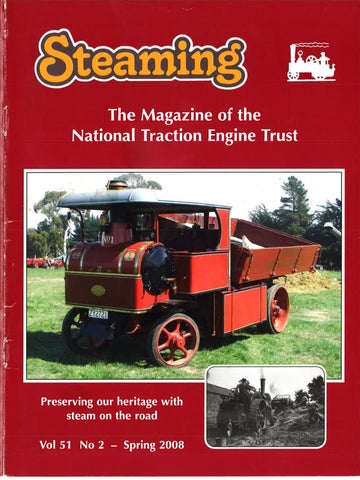
The Magazine of the National Traction Engine Trust
Preserving our heritage with steam on the road Vol 51 No 2 — Spring 2008
THE NATIONAL TRACTION ENGINE TRUST Preserving our heritage with steam on the road The membership of the National Traction Engine Trust is open to all of those who, whether they are engine owners or not, have a genuine interest in the preservation of self propelled steam road vehicles, portable engines etc.
The annual subscription rate is £25.00. The Trust's profusely illustrated colour magazine Steaming is sent free to members during the early part of January, April, July and October, and other benefits of membership include very advantageous terms for boiler and other types of insurance cover as well as access to advice on technical matters. The Steam Apprentice Club is the junior section of the NTET, formed to support youngsters up to the age of 21 in learning about and appreciating road steam. To find out more please contact the Chairman (see right) or view the SAC website at www.ntet.co.uk/sac
President: Richard Sandercock Vice Presidents: Andrew Semple; Len Crane Chairman: Robert Herring, Glebe Court, Fringford, Bicester, Oxfordshire OX27 8RJ (Tr 01869 277410) Vice-Chairmen: John Cook; Bob Siddall
General and Company Secretary: Susan Jackson, 16 Lady Garne Road, West Hougham, Dover, Kent CT15 7BA Membership Secretary: John Cook, 74 Church Lane, Kirkby la Thorpe, Sleaford, Lincolnshire NG34 9NU (( 01529 303160) Treasurer: Julie Smith FCA, Yew Tree Cottage, 98 The Ridgeway, Astwood Bank, Redditch Worcestershire B96 6NA (u 01527 893427) Chairman, Rally Organisers Section: Tim Holt, South View, Hutton Roof, Kirkby Lonsdaie, Carnforth LA6 2PF (IT 01524 271584; fax 01524 2/1 M8) Chairman, Engine Owners Section: Bob Siddall, Stud Farm House, Ossington Lane, Sutton on Trent NG23 6QR (TT 01636 821991) Head, Technical Services: David Smith, Yew Tree Cottage, 98 The Ridgeway, Astwood Bank, Redditch, Worcestershire B96 6NA (re 01527 893427) Head, Membership Services: John Cook (as above) Chairman, Steam Apprentice Club: Kevin Munn, 56 Blacklands Avenue, Hayes, Middlesex UB4 8EX 0208 573 9180) Rally Authorisation/Affiliated Groups: Bill Evans, PO Box 102, Wrexham, Clwyd LL13 OZS (a/fax 01978 781196) Insurance Officer: James Blenkinsop, Forge Cottage, Combrook, Warwick CV35 9HP (c/fax 01926 642016) Public Relations: John Billard, Old Station House, Twyford, Berkshire RC;10 9NA (( 01189 340381)
Patrons Hal Bagot, JP; Robert Goodwill, MP Dr Tony Marchington; The Rt Hon Sir William McAlpine, Bt; Michael Oliver, MBE; Hamish Orr-Ewing; Richard Preston
E-mail: ntet@ntet.co.uk Internet address: http://www.ntet.co.uk A full list of the e-mail addresses of officers can be found on the Trust website - www.ntet.co.uk
Steaming back ... This panel is a selective index to topics from past issues which readers may wish to refer back to. It is confined to items such as legislation, insurance and other subjects which may not be totally absorbed by members at first reading. The index will be maintained on a rolling basis, with topics retained from issue to issue, depending on their currency and association with on-going discussions and announcements.
Back issue references are shown as Volume/number in year (as shown on cover) and page number. Boiler inspection - 49/2, page 68 and 115; 49/3, page 126 and 177; 49/4, page 184; 50/1, page 5 to 7; 50/2, page 68; 50/4 page 186; 51/1, pages 6, 7, 35. Boiler joints - 48/1 page 5 and 52; 48/2 page 85 and 116; 48/3, page 177; 49/3, page 145; 50/4 page 198. Coal - 48/3, page124; 50/1, page 26; 50/2, page 10; 50/3, page 143. Driver competency - 48/3, page 124; 48/4, page 238; 49/1, page 7; 49/2, page 64; 50/1, page 5; 50/3, page 128; 50/4, page 184 etc; 51/1, page 6. Engine insurance - 48/4, page 188; 49/2, page 69; 49/3, page 127; 50/1, page 7; 50/2 page 69; 50/4 page 190. Engines on the road, inc licences - 47/4, page 185; 48/2, page 67 and 69; 48/3, page 126/127; 49/1, page 9; 49/4, page 185; 50/1, page 38. NTET Disc Scheme - 47/4, page 183; 49/2, page 68; 49/3, page 127. Traction Engine Code - 50/1, page 4; 50/2, page 68; 50/3, page 128; 50/4 page 184. Water - 48/2, page 65 and 86; 49/3, page 145.
The Magazine of the National Traction Engine Trust Volume 51 Number 2 Spring 2008 Editor: Roger West, 14 Charles Street, Market Harborough, Leicestershire LE16 9AB (12 01858 467326) e-mail steaming@ntet.co.uk Steaming Around (only): Derek Rayner, 'Invicta', 9 Beagle Ridge Drive, Acomb,York Y024 3JH Display Advertising and Small Adverts: to the Editor Distribution and Change of Address: John Cook, 74 Church Lane, Kirkby la Thorpe, Sleaford, Lincolnshire NG34 9NU (Tr 01529 303160) The Editor is pleased to consider contributions of suitable articles, shorter items or photographs for inclusion in future issues. All material submitted is voluntary and payment cannot be made for any material published, although expenses incurred may be met. The opinions expressed in the magazine, with the exception of those printed asTrust announcements, are those of the contributors and do not indicate the views of the Trust as a whole. All items are held copyright by the contributors and/or the NTET. Next issue:The press date for news items, recent photographs and small adverts is 10th June 2008. For the date for Steaming Around see that section.
From the Chairman These certainly are eventful times. Despite considerable amounts of planning, presentation and dialogue we find ourselves having to rethink how we present the adopted policies of the membership — I refer of course to the introduction of the Boiler Inspection Audit Scheme. Its detail, and the revised information, you will find in the Technical Services columns in this issue; suffice to say here that as with all the other news items in the magazine, please take time to read it carefully and to respond immediately if you feel it will have an adverse effect on you. The future of our interest is much determined by the way we conduct ourselves, now and in the future. I will repeat what has been stated on several occasions throughout this process. The accident in Medina USA which killed five people when a traction engine exploded was real; such an event occurring here would destroy both our hobby and the value of our investment in that hobby. To adopt the attitude that it will never happen is irresponsible. I and several other officers are constantly made aware of inconsistencies that occur within the engine examination process. Let us collectively take this opportunity to put our house in order before we face public scrutiny. Another unwelcome surprise has been the wish of our secretary Sue Jackson to retire. Unfortunately, family matters, with a consequent move of house, have brought about the decision. Fortunately Sue hopes to continue until the AGM. If you feel you could fill the post or would like to be involved, please read the advert elsewhere in this issue. Despite all this seriousness we want to enjoy ourselves, so we look forward to a good season of events. The rally calendar is as large as ever despite last year's horrible weather. Sunshine and drier conditions will no doubt be welcomed by all. If you are able to start the season early remember the FBHVC Drive-it-Day on Sunday 20th April — why not take this opportunity to be out and about. (Robert Herring, Chairman)
This issue 64 70 74 75 78 80 84 89 90 93 95 98 107
Trust News One Day's Work MAGIC at Glovers Technical Topics PRINCESS MARY Wheels for a Foden The Voluntary Driver Competency Scheme What do you think of this? Liverpool after the Blitz A final visit The Gurtelrad Steaming Around, complied by Derek Rayner Letters, Small Adverts
Derek Rayner Graeme Thirkell Jonathan Wheeler Gerry Doherty Derek Rayner Dick Blenkinsop Derek Rayner
ISSN 0260 - 2962
Front cover
Published by the National Traction EngineTrust at 14 Charles Street, Market Harborough, Leicestershire. Printed by AB Printers, Montrose, Crown Hill, Great Dalby Leicestershire LE14 2ER
A noteworthy survivor in very original condition is Yorkshire Patent Steam Wagon Co tipper 1535 of 1926. It was new to Lyttelton Borough Council in New Zealand — the town that is the port for Christchurch on South Island. Graeme Dawson has owned and rallied the wagon for many years from his home at Invercargill, at the extreme south end of NZ. A before-breakfast photograph taken by membership secretary John Cook in March 2008.
STEAMING Spring 2008
63
Trust News Engine Owners Column Engine Owners Section Engine Owners Meeting - the 2008 gathering was held on Sunday 17th February, when over 100 members and guests attended, A report of the meeting can be found inside the back cover of this issue and the full minutes and David Smith's presentation can be found on the Trust website. Since the meeting certain matters regarding the Boiler Inspection Audit Scheme have moved on and are reported in the Technical Services columns. Elsewhere in this issue you will find, as a separate article, the Trust statement on the Voluntary Driver Competency Scheme, and details of the Review Panel that is to consider the Scheme - the result of the Motion that was passed at the 2008 AGM. I would urge members with opinions of the scheme - whether for or against - to offer those thoughts to the Panel. (Bob Siddall, Head of Engine Owners Section)
Rally Organisers Column Rally Organisers Section Members of the Engine Owners Section met on 17th February. Those members of my Section who carry out the inspections relating to the Authorisation of Events are: Bill and Pat Evans, Clwyd Colin Brown, Bedfordshire Norman Douglas, Cheshire Trevor Evans, West Sussex Paul Hemstritch,Yorkshire Lance Jackson, Shropshire Brian and Dilys James, Norfolk Keith Stott, Buckinghamshire JoTilling, Wiltshire Bill and Pat Evans, of course, also deal with the administration of the Authorisation scheme. The team will be visiting approximately 40 rallies 64
this coming season, throughout the length and breadth of the country. We are not trying to 'catch anyone out' with our inspections, for the objective is to ensure, as best we can, that the Code of Practice for Rally Organisers is carried out. This Code is currently subject to a considerable review and it should be re-written in time for the 2009 season. The reason for the review is quite simple. The Code is not going to be altered to any material extent, but where we are dealing with legislation, such rules and regulations are continually being amended, repealed, re-written or up-dated by beaurocrats who, unfortunately, don't seem to have ever attended a traction engine rally. Nevertheless, there seems to be no shortage of official inspectors - from the HSE, local authorities, Weights and Measures, Customs and Excise, Trading Standards, the Police, etc. If any rally organisers have any point that they wish to be considered by the Section, no matter how trifling, please let me know - my address is inside the front cover of every issue of this magazine. As a reminder, if an incident happens at your event, not necessarily an accident, please make a note of it and include it in your event's Safety officers report that has to be returned to Bill Evans. We really do want to know. Importantly, the rally season is starting; enjoy yourself, whether owner, crew, or spectator in this marvellous hobby of ours. (Tim Holt, Head of the Rally Organisers Section)
be undertaken with interested parties, on 9th March the Trust's General Council issued a statement to the effect that implementation of the Boiler Inspections Audit Scheme would be slowed down, and that a revised launch date of 1st January 2009 would apply. The issues that have caused us to delay implementation are quite straightforward: • The inspectors tell us they are 100% for the scheme in principle this is very encouraging but it appears that acceptable and consistent standards are elusive to agree. • The inspectors tell us they do not wish to appear to be working for the NTET - we are not asking them to; but we are asking them to apply our standards. • A number of the inspectors believe that the NTET does not have the authority to introduce the scheme - our legal and professional advisors tell us that the NTET, an accepted authority on steam traction engines and a body corporate, is recognised as the 'competent person' sufficiently qualified and experienced to produce a Written Scheme of Examination as required by PSSR 2000. • The issue of whether an engine is
Important News Important news items and subjects in this issue can be found on the following pages:
Technical Services Boiler Inspections Audit Scheme - Well, I did say it wasn't going to be easy, but who could have of amount the predicted misinformation and myth that has come out of the woodwork since the launch of this scheme? In order to allow more dialogue to
• Boiler Inspectors Audit 64 Scheme • Disc Scheme as affected by 65 BIAS 66, 84 • Driver Competency • Engine Owners Meeting 111 report 67 • Drive-it-Day • A newTraction Engine 68 Register
Spring 2008 STEAMING
,
44
National Traction Engine Trust
Appointment of General Secretary With the notice by Sue Jackson that she wishes to leave her post as Secretary to the Trust, it is necessary to seek applicants for the post and so continue this leading role in the administration of Trust affairs. Applications are therefore invited from suitably qualified persons to serve in this responsible position, which carries a financial amount for the cost of running the office.
This, seemingly, is a mid winter scene of an engine moving to or from its work with a small sawbench loaded onto the trailer it is hauling. The old postcard, from the collection of Alan Walker, gives but one written clue to identification on the rear - the pencilled note 'Mr George Hobden, driving' The engine is a single cylinder Marshall agricultural dating from the early 1880s - a long boilered machine with the front wheels set back under the boiler. Our Summer 2006 issue included a line drawing and report of a similar example exhibited in 1879, but this picture shows the cylinder casting of the three shaft engine to be slightly inclined upwards towards the rear to line with the crankshaft. By the look of the patching to both top and bottom of the smokebox, the engine is well past its early years and the scene is probably in the 1900 - 1910 period. Two of the crew have quite stylish bicycles stowed on the trailer, one with changeable gears and the other with dropped 'racing' handlebars - do these date the picture? And which man had to walk home?
'at work' is a red herring; we fell foul of it ourselves - when a boiler inspector is inspecting he is 'at work' and must comply with the Health and Safety at Work Act and amongst other things must therefore apply regulations 8, 9 and 10 of PSSR 2000. The NTET scheme is 100% compliant with these regulations. We have been asked to review the content of the report forms; too unwieldy some are saying - it is important to know that some inspectors are using the report forms 'as is; and they are slowly getting used to the level of detail required. A few are adamant that they won't now use them. We have agreed to take another look at the layout of the reports, but we are not minded to lower the level of inspection information required. STEAMING Spring 2008
Although we have agreed to delay implementation of the scheme we do not want to lose impetus and therefore invitations have already gone out to the inspectors inviting them to attend meetings hosted by two acknowledged experts in the Health and Safety at Work Act and PSSR 2000. The hope is the meetings will seek to identify the real issues surrounding these two important pieces of legislation, and then we can get on with applying the solutions. I believe that it is important to remember that no matter why these issues have surfaced so late in the day, all of the interested parties will have to work together when the dust has settled and on that basis, and for the sake of progress, we should indulge in accurate and constructive dialogue. (Dave Smith, Head of Technical Services)
A knowledge of general administration procedures is essential, and the applicant must be computer literate. The duties include the arranging and notification of meetings, the taking and production of minutes thereof, and handling general correspondence. A job specification giving full details of this important post is available to intending applicants (who do not necessarily have to be members of the Trust). Please apply in the first instance to: Robert Herring, Glebe Court, Fringford, Bicester, Oxfordshire OX27 8RJ. The closing date for applications is 31st July 2008
Insurance Matters Disc Scheme, 2008 season - With the introduction period for the Boiler Inspections Audit Scheme extended to 1st January 2009, the situation for the issuing of NTET Discs remains the same as in previous years. All those who wish to display a disc can apply for one in the usual manner through their insurers provided they insure with Footman James, or James Campbell Insurance, or Walker Midgley Insurance Brokers. If other insurance providers are used then I can issue a disc so long as I receive copies of all the relevant paperwork. 65
Just to be clear what paperwork is required here is a breakdown: • certificate of Motor Insurance if the vehicle is self propelled and to be used on the road • confirmation of insurance for boiler explosion with a limit of indemnity of not less than £5 million • confirmation of insurance cover for damage caused by sparks and ashes with a limit of indemnity of not less than £100,000 • a copy of the NTET Boiler Inspections scheme certificate or the full boiler report as issued by a corporate inspecting company or an independent boiler inspector using his own paperwork. Please remember that in all cases it is the responsibility of the engine owner to send copies of the boiler certificate/report to their insurer if they want a disc. None of the disc issuing agents will send out a reminder that the disc has expired, as some owners seem to expect. Boiler Inspector's Insurance — At the recent Engine Owner's Meeting at Willoughby, I read out a list of independent boiler inspectors who had lodged evidence of their Professional Indemnity insurance paperwork with theTrust. For many of those who couldn't be there the list is reproduced here: inspection company Alan J. Hines Allan Prout Alan Bulmer ANB Inspections D J Wothers Inspection Services Farncare Inspection Services Ian Farrance Graham Morris Engineering Ltd Knight Engineers (Norwich) Brian Knight Wheeler Steam Jonathan Wheeler Company John Glaze J A Glaze Ltd R&B Inspection Services Hal Richardson As I prepare these notes, I am still
awaiting confirmation from SFP Inspection & Consultancy that they have renewed their PI insurance policy. I have written advising that the paperwork currently lodged with the Trust shows it to have now expired and unless the renewed paperwork is received by 1st April no further discs can be issued against their inspection reports. As soon as the renewed paperwork is received we will post a note on the Trust web site and update the list of compliant inspectors shown under the Insurance Services section on the web site. In addition to the above inspectors, all corporate inspecting bodies are automatically included as they are insurers in their own right. As a guide, the following corporate bodies carry out inspections: Allianz Engineering, Allianz Insurance plc Bureau Veritas Inspection Services Ltd HSB Naughton Engineering Insurance Services Ltd Lloyds Register EMEA Royal & Sun Alliance Zurich Risk Services Although the Trust maintains this list on behalf of its members, I would encourage all engine owners to request sight of their inspector's insurance paperwork just for their (James own peace of mind. Blenkinsop, Insurance Officer)
tary Driver Competency Scheme, which include the arrangements that have been made, following the Motion that was passed at the 2007 AGM, for the setting up of a Review Panel.The terms of reference that the group will work to are within the above mentioned notes. As Chairman of that Panel, I am soliciting the views of members on the Scheme, whether for or against the principles involved, so that the Panel members may take those points into consideration before coming to their conclusions. The Report of the Panel will be presented to the membership at the 2008 AGM. Please take time to read the article in this issue and to contact me in due course. You can write to me, John Cook (address inside front cover), but please make sure to put the word 'COMPETENCY' on the outside of the envelope. Alternatively, use the special e-mail address which will be available shortly via the NTET website. All contributions should be with me by the end of May, but sooner than that would be better! (John Cook, Head of Membership Services)
Membership Survey Driver Competency Scheme Elsewhere in this issue there are extensive notes on the NTET Volun-
The NTET's Engine Owners Section presents its 18th
STEAM TRAINING and DRIVING COURSE
At the time of writing this in mid March, the responses to the Membership Survey that was included in the last issue of the magazine have totalled about 500 — a bit less than 20% of the Trust membership. I thank those members who have returned the forms via the Freepost address.. The information gained from the Survey will take some time to assemble and ponder over, but I hope to be able to produce a summary for the Summer issue of the magazine. (John Cook, Head of Membership Services)
to be held at
Astwood Bank, near Redditch, Worcestershire on 10th and 11th May 2008 A practical and informal course including instruction on boiler management, mechanical operation, care and maintenance, and on driving techniques For further information send a CS (for A5) size SAE to; Stuart Tomlinson, 470 Coventry Road, Hinckley, Leicestershire LE10 ONH. IT 01455 613079 e-mail hazel.tomlinson@homecall.co.uk
66
FBHVC News London Emission Zone — The Federation of British Historic Vehicle Clubs is drafting comments regarding the LEZ that came into force on 4th February 2008, as Spring 2008 STEAMING
reported in the last issue. For any member owning an engine within the zone there is no problem using it on the road; it is diesel lorries post 1972 and pre 2001 that are affected by a £200 a day fee payable every day all year. Clearly this will be a major constraint for those wishing to move engines within the zone. Don't try this at home, but the rules could allow a situation where the traction engine tows its low loader out of the zone! The FBHVC wishes to respond in the light of experience of the zone and would like to submit comments in due course. In the meantime I have had very few reports of members affected by this change. On that basis there may be no point in responding to Transport for London on behalf of theTrust. Please let me know if you have been affected. Drive it Day - Don't forget that Sunday 20th April is Drive it Day. This is the day when we would like as many club eligible vehicles on the road as we can. The aim is to showcase the historical vehicle movement. This year the Federation hopes that those not lucky enough to have their own historical vehicles will be invited to try the driving position (footplate in our case) or even be STEAMING Spring 2008
Ready for action as soon as the punters show is Burrell scenic showmans road loco 4000 EX-MAYOR at the Great Dorset Steam Fair in 2007 (Keith Broth well) given the chance to ride. Public inclusion is important to the future of the movement. The website http://www.fbhvc.co.uk/news/index.h tm gives outline details of a special insurance deal to make it possible to have younger drivers on comprehensive cover for the Drive it Day at just £10.50 before mid April. Alternatively contact Jim Whyman a 01984 656762. The arrangement relates only to cars and light commercial vehicles, but we expect many NTET members will be able to take this opportunity regarding other vehicles that they may own. The idea is that young people are included as far as possible. New FBHVC secretary - After many years service to the Federation, secretary Jim Whyman plans to step down later this year. I am very pleased to report that his successor is Rosy Pugh, who currently edits the FBHVC Newsletter. (John Billard, Old Station House, Twyford, Reading RG10 9NA, 01189 340381 or john.billard@yirgin.net )
Steam Apprentice Club Its the start of a new season and already SAC Apprentices have had experience on engines via the Driving Days that have been arranged for them around the country. As usual we appreciate the time and effort made by the local organisers and the engine owners in bringing their engines to venues for this to happen. And in the majority of cases all involved have an enjoyable time and I have heard it said, from the engine owners, when can we do it again? For those of you taking your engines to Dorset this year, you will find in your entry pack, with the agreement of Martin Oliver and GDSF, an additional form where we, the SAC, are asking in advance if you would be willing to have an Apprentice, whether it be for a half or full day, at your exhibit. Please take the trouble to read it. I know many of 67
you do have children of your own or helpers/friends who want to have a go, but for some of our Apprentices this may be the only chance in the year they can go on an engine. As has quite rightly been said, if we want our hobby to survive, we must encourage the youngsters to participate, and by allowing one of them on your engine you will be helping to achieve that. Do you want to save some money? Well if you are a SAC member approaching, or have just reached 21, and are reading this magazine because it is a friend's, when your SAC membership finishes the Trust has agreed to give you the first year after you are 21, a half price membership of the NTET. Please do take this opportunity to keep informed and be abreast of what is happening within the road steam movement. For those Trust members who kindly indicated in the recent Members Questionnaire that they would be willing to help the SAC, I will be in touch with you in April detailing the kind of assistance we need and to discuss how you can help. Many thanks for taking the trouble to answer. And finally, a reminder not to forget we would like submissions of names for both the Technical Achievement Award and Apprentice of the Year by late July and late September respectively. If you want reminding of what is required please see my notes in the last issue of Steaming or visit the website (Kevin Munn, www.ntet.co.uk/sac Chairman, Steam Apprentice Club) 68
The Bedford club's rally at Old Warden each September is always a busy event, but the steam ploughing area, slightly away from main area, can seem a very natural working-day field. John Maund took this picture of Fowler class K7 engine 14258 of 1916 at work on the Sunday.
NTET Sales The Exhibition and Sales Unit — I he outings of the Trust Unit commence in mid-May—indeed, with a flurry of early season outings on three consecutive weekends before the end of that month. Arrangements have been made to be at the following events in the first part of the season. Details of later appearances will be included in the Summer issue. May - 17/18th, Belvoir Castle, Leics; 24 to 26th, Strumpshaw Steam, Norwich; 31st and 1st June, Leighton Buzzard, Beds. June - 28/29th, Banbury Steam., Oxfordshire. July - 5/6th, Chiltern Rally, Bucks; 12/13th, Rempstone, Leics; 19/20th, Marcie Steam, Herefords. August - 1st to 3rd, Gloucestershire Steam, Kemble. There is greater detail of the locations etc, for all of these events in the Trust's 2008 Rally List which was distributed to members within the last issue. Binders for the magazine — A fresh supply of binders for your copies of Steaming, old and new, is now in stock. A combination of a rise in manufacturing costs, and new postal rates, have resulted in the need to increase prices slightly. Please see the Mail Order advert elsewhere in this issue for further details.
The large size binder caters for the magazines of the last twenty years or so, but binders for the now quite old A5 size issues are still sought by many. We have recently supplied a large quantity to a member who decided the family collection from Volume 1 was worth having at hand in a much more accessible manner, rather than effectively hidden away in boxes. A wealth of traction engine information has appeared in our magazine over its 50 years — why not treat your collection to a bookcase showing, and be able to browse in an evening without clambering into the roofspace? Traction Engine Register —The new, tenth, edition of The Traction Engine Register is programmed for release during May 2008. It will include an additional 220 entries, mainly as a result of the large number of re-imports in the last four years of British built engines originally sold abroad, and a growing interest in foreign built engines. Sixteen continental or North American manufacturers are included for the first time. Further additions are due to a number of 'reconstructions' of engines from parts, and the innovation of totally new-build engines. Over 1500 amendments will also be included resulting from changes of ownership and location, changes Spring 2008 STEAMING
of engine name and additional information arising from research. The book will follow the long established style and layout, with the addition of extra illustrations and eight added pages to take the additions and alterations. Priced at £7.95 the new TER will be available from the NTET Sales and specialist bookstalls, as well as the publishers, Southern Counties Historic Vehicles Preservation Trust. (Colin and Val Brown)
Affiliated and other groups Fred Dibnah Memorial Fund Jim Stevenson, producer of Moonlight videos, advises that purchases from the NTET Sales Team by mail order and from the Trust Exhibition Unit of the twin DVD sets featuring Fred Dibnah and Fowler ATLAS, have resulted in over £470 being presented by Moonlight Productions to the Memorial Fund. The bronze figure depicting Fred, sited on a plinth representing the top of a mill chimney, is planned for unveiling in April on a site adjacent to the town's Trinity Church and near Bolton Trinity Street railway station. (Jim Stevenson)
Once upon a time a few engines gathered on the Dorset hills to attract people to see how they worked in days gone by. Now hundreds of thousands come each year, bringing with them acres of vehicles and tents, but photographer Chris Parker proves that engines can still find solitude Fowler class A8 agricultural 14600 of 7915 is seen here in September 2007 against the steep rise of the Down that is the ploughing area.
New Members We extend a sincere welcome to the following new members who have joined the Trust during the last three months. We hope they will gain much friendship, information and enjoyment from their membership over a period of many years. Full addresses are not included, but the Membership Secretary is always pleased to put members in touch with one another by forwarding mail. A Ferguson, Alfreton, Derbyshire R Collishaw, Wramplingham, Norfolk J Nix, Pontefract, West Yorkshire J H Ginger, Awsworth, Nottinghamshire J E Lewis, Rugby, Warwickshire R Smith, Heckmondwike, WestYorkshire C A Massey, Derby T Ventham, Bryantspuddle, Dorset D Bickerdike, Blyth, Northumberland N Cobb, Wimborne, Dorset D Kirk, Norwich, Norfolk P Wright, Derby STEAMING Spring 2008
J Vernon,Torquay, Devon J Livesey, Newmarket, Suffolk R C Dobbs, Worksop, Nottinghamshire D Hurley, Boston, Lincolnshire P Copeman, Kings Lynn, Norfolk J R Newson, Heysham, Lancashire G D Nelson, St Ives, Cornwall
Poor Steaming Our apologies for a misidentification of one of the engines at the Portland Show, noted on page 44 of the last issue-the Wallis roller was in fact Craig Henderson's 7844 of 1925 (H06442). Further, we have more than once wrongly referred to Burrell 3413THE PHILADELPHIA (pictured on page 45 of the last issue) as being
displayed in the NTET 50 Years marquee at Dorset in 2004. The reality was four years earlier - the engine was shown in its prerestoration condition in the exhibition marquee at the Burrell Millennium Special event in 2000. We apologise to Henry Netherway for editorially introducing an error into his correction of identity for his Foden wagon in the Letters pages of the last issue. The letter heading, the final paragraph and the caption to the nearby picture all quote the wrong number - the wagon is Foden 10320, and not as shown. We should notice too that the title of the owning Board is correctly signwritten on the side plates with the word Highway without a final 's' - that detail was taken from an old photograph of the Foden. 69
One Day's Work Bowman & Sons of York This article first appeared in The Commercial Motor for 31st March 1910. It was No 15 in a 'New Series' of articles by a member of the magazine's editorial staff, and the articles covered the whole variety of road motor vehicles available at that time. Under the sub-heading 'A Yorkshire removal contractor obtains satisfactory results from one of Foster's Wellington tractors' we are able to find out what the contemporary operator thought of his chosen purchase, and have a glimpse of the everyday work of a steam tractor.
One day's work 'Since my last 'day's work', with a Broom and Wade paraffin lorry, described in this journal in the issue of the 25th November last, numerous appointments have prevented my continuing the new series, which, for the greater part of last year, was a regular bi-weekly feature of The Commercial Motor, Time after time I have had to postpone engagements to accompany representative machines on their daily runs in different parts of the country. When, at last, I travelled northwards to keep a longstanding engagement with Messrs J Bowman & Sons, removal contractors, of Monk Bar, York, and Mr Fred Bowman showed to me the photograph of a snowbound road, I
70
felt really thankful that business in London, or in some other part of the country, had kept me away from the bleakYorkshire roads and moors until the weather was more favourable. I do not usually jib at uncomfortable jobs — as readers of this journal well know. I have, among other experiences stuck it through a 24 hour continuous ploughing test, in spite of an almost incessant fall of rain, sleet and snow — but the prospects of
becoming snowed up while crossing Bramham Moor, or some equally dreary spot inYorkshire's broad acres, is far from alluring. The photograph was taken near Leyburn in the Wensleydale; the snow at each side of the track was six feet deep, and through this cutting Messrs Bowman's Wellington tractor, which was engaged on a large furnitureremoval contract at Danby Hall, was driven for some distance, and then, as the cutting became narrower, the tractor and its trailer were completely snowed up: they remained there for four or five days. When I heard Mr Bowman's recital of the experience, and realized what I had escaped, I felt deeply grateful that Providence had found other employment for me during that period. 'Mr Bowman told me that, before purchasing the tractor, his firm took careful stock of the available vehicles, and, to quote his own words, he "was not struck with any motor wagon as being suitable for the furnitureremoval trades' He argued that such a wagon, when loaded with a large lift van full of furniture, might scale anything up to 10 or 12 tons, and, as that weight is carried on four wheels only, great damage might be caused to the carriage drives and drains in
A splendid view of Foster Wellington tractor 12412 (FE559) and van, posed with its crew of driver and van man; could it be one of the Bowmans at the right? Van No 17 was the trailer which took part in the run described inThe Commercial Motor. The driver holds a Kayes type oil feeder — these traditional items can still be found on some rally field tool stalls. Grab one while they are still about. (collection Derek Rayner)
Spring 2008 STEAMING
Fig. 1.
Fosters' Patent Spring Suspension. The 1909 patent covered the design of springs placed over the rear axle and outside the hornplates. Figures 1 and 2 (from the makers' 1912 catalogue) repectively show what they described as 'the old fashioned method adopted by all other makers' compared with their own system which ensured the engines would 'ride smoothly and without that rocking which all other tractors have to endure: The springs were of the plain laminated type, 40 inches between centres of slipper pins. (collection Welland Valley club) private parks, through which his firm's rolling-stock frequently has to travel. "With a tractor;' he continued, "the case is different, as one may have practically the same load distributed over eight wheels:' Then, again, the packing of a load into a furniture van often takes a considerable amount of time, and, in such cases, a tractor, after taking one van to a house, may be driven off to another job — probably to take a loaded van into the depository — returning later for the first van, which, by that time, has been carefully loaded. After weighing up all the pros and cons of tractors versus wagons, and arriving at the conclusion that it was amongst the former class that they must look for one to suit his firm's needs, Mr Bowman visited the Yorkshire and other agricultural shows, but, finally, a description of the new springsuspension system of the Wellington tractor, which description appeared in our issue of the 14th June 1909, led to his decision to acquire one of Foster's machines; Mr Bowman informed me that they have had no reason to regret the selection. 'Compared with the use of horses, this tractor regularly does the work of a team of four, and takes vans weighing from 51/2 to 6 tons up the steepest hills without any trouble; in STEAMING Spring 2008
fact, on many of the journeys which it has undertaken it would be necessary to employ no fewer than six horses in order to negotiate the steep gradients. Then again, the time required for the transportation of the load from one point to another occupies only about half that required for transporting the same load by horsedrawn vehicles. Mr Bowman gave me many examples to illustrate this point, and of these I will quote one — a run from York to Harrogate, a distance of 21 miles: for this distance, the Foster tractor has taken its six-ton load in 41/2 hours, whereas a lighter van drawn by four horses has frequently taken over eight hours, including, of course, the 'baiting' [feeding] of the horses half way. Except on account of heavy snowstorms, which have been fairly frequent in Yorkshire during the past winter, and which storms have temporarily stopped both horsedrawn and mechanical transport on the roads, the owners have had no trouble whatever with the tractor since it was delivered, and its cost of running has been less than was anticipated before purchase, in spite of the fact that the coal bill throughout has been fairly high, a circumstance which is due to the necessity for the purchase of fuel on the road. Such fuel is often of very
poor quality, and it quickly chokes up the fire with dead ash or clinker, and necessitates frequent cleaning of the fire. 'On the day on which I accompanied the machine — Wednesday, the 9th inst, I travelled the last stage (York to Scarborough) of a removal contract from Conisborough Priory to Scarborough. The tractor left Messrs Bowman's yard on Monday morning, the 7th inst., taking with it an unladen van to Conisborough Priory, a distance of 42 miles, and, after being loaded with furniture, a start was made on the first stage of the journey — Conisborough toYork — arriving at the latter town about 9.30 on Tuesday evening.The following morning we made a start for Scarborough at 8 o'clock, and our first stop was at the Spittal Beck Inn, 10 miles out, where a fresh supply of 'black dust' — alleged to be coal — was transferred from the compartment in front of the van to the fuel bunker on the tractor. Up Whitwell Hill, past Castle Howard, and through Malton, and thence to the Pigeon Pie Hotel — about 30 miles out fromYork — the journey was most uneventful. After a substantial luncheon, the journey was resumed, and we arrived in Scarborough a little after five o'clock. As it was then too late to unload that night, both tractor and trailer were put up in a builder's yard, and next morning, after unloading, the van was hauled from Scarborough to Thornton Dale, a distance of 16 miles, there to pick up another load of goods — conveniently destined forYork.The 30 mile journey from Thornton Dale to York was completed in good time on the following day (Friday), and the tractor had then run a distance of 170 miles in five days — an average week's work, and, for 112 miles of that total, a gross load of 51/2 to 6 tons had been hauled behind the drawbar. The fuel consumption for the week's run amounted to 25 cwt, and cost 24s 11d [£1.25]. This is a high rate of consumption, but, as I have already explained, much of the coal is purchased on the road, and the driver must be content with the quality offered. Some of it is so soft as to be almost worthless for steam-raising purposes. 'The regularity and running of the machine was absolutely monotonous, and the only variation I obtained during the trip, except that due to the changing contour of the road, and the nature of the surrounding country, was by taking alternate spells on the tractor and on the front of the van. Comparing this Wellington tractor with other makes 71
EV'
REMI OVA ILSoi. WAR cgAs ANI
• .iTiMaTIMI 11111MT
PM 0) Al PE
.
'73
U)Sil NC, S;., S
ii .16T
77'
AA.
ilk e AM
MIL
i
1 • * t'
Foster 12412 and Bowmans' specially built steel bodied pantechnicon as illustrated in Foster's 1912 catalogue of tractors. One or more of the removal men are quite likely to have travelled inside the van and the effect on their hearing after even a shortish journey incarcerated within are best left to the imagination! (collection Welland Valley club)
on which I have travelled, I was pleased to note that, although with the new arrangement of springs the transmission of road shocks is not entirely eliminated, the riding is much more comfortable than on any other steam tractor of which I have had experience, and there is an entire absence of the unpleasant rolling which I have observed on some machines. I closely questioned the driver on the subject of vibration, and learned that, in spite of the hard work which is inseparable from any haulage undertaking, he did not find that travelling on the tractor tired him nearly so much as did the handling of one of the York Corporation's steam road rollers, one of which machines he used to drive when I first met him nearly ten years ago. 'In my younger days, I have frequently cycled or driven over the road from York to Scarborough, and, like other road men, lamp troubles, etc, were not unknown to me; consequently, I still dislike the look of a North Riding policeman, but Mr Bowman told me that his men have been greatly assisted on this and other roads by constables, who have gone out of their way to direct the men to suitable watering places. The police in the county towns and villages have also shown great willingness, to act as pilots, and in other ways to assist the driver. Only once has a policeman interfered with the men in charge of this machine, and that occurred after the tractor had travelled well over 1,000 miles. The driver was then requested to show his licence, and the constable was greatly surprised to find that 72
both the driver and steersman were armed with the necessary authority — a wise precaution, in view of the present state of the law on the subject. I was much amused to learn that, on arrival of the tractor in a small county town in Yorkshire, with a load of furniture for a new and highly-desirable resident, the Mayor himself turned out and advised the men where they would find comfortable quarters for themselves and suitable accommodation for the machine over night. He expressed his hopes that he would soon see them there again — on a similar errand.'
Some further notes on the James Bowman company and their vehicles James Bowman & Sons owned several steamers over the years, though their business obviously warranted only one or two at any one time. The business had been started about 1760, originally as cabinet makers and undertakers. By the second decade of this century it was being run by Charles Bowman and his brother William, who lived at 24 Monkgate and 10 Brunswick Place respectively. Before the days of steam and petrol, about forty horses were stabled near the Monk Bar premises. The family were very proud of the fact that they had removed the furniture of three Archbishops ofYork — Dr Lang, Dr Temple and Dr Thompson — when they became Archbishops of Canterbury, and also
ik vas "4 -
(The five photographs reproduced with the original article in 1910 included the snow scene, produced by Fred Bowman, which so frightened the un-named reporter; a further pair showed the outfit in the distance in villages, and there were close-ups of the coaling at Spittal Beck Inn and taking water (with the tractor's rear wheels standing on the crown of a culvert running under the road!) near Sherburn on the York to Scarborough road. The old magazine illustrations are not suitable for reuse here, but Derek Rayner is able to provide three pictures of Bowman vehicles from his collection which make very suitable replacements. The mention of the Commercial Motor reporter and Bowman crew taking their substantial midday break at Pigeon Pie Hotel conjures up new images of expense account lunches!)
the trappings of Dr Cyril Garbett when he moved from Winchester to be Archbishop of York. On the death of Charles, and later William, the firm passed to the latter's son James and eventually to his son Phillip, who in course of time sold the business out of the family. As described in the article, Bowmans first looked at steam traction in 1909 and having made their decision, ordered from Fosters one of their latest Wellington tractors. For just over £500 (list price), works number 12412 was delivered in October 1909. The York firm's satisfaction with the engine was confirmed in The Commercial Motor article and later in the year a further report announced that the firm, having found that the tractor 'was more than man enough for the largest pantechnicon, has had a mammoth van built of sheet steel Spring 2008 STEAMING
Another steamer from the Bowman fleet. Rubber tyred Foden 5 ton wagon 4274 (M5897), blowing off and ready to start its journey with a lift van, stands by the porch at Whitwell Hall, a dozen or so miles north east of York. In the mid 1980s the Hall was an hotel, and the then owner Peter Milner related that the Letchmere family left there in 1919 to be replaced by the Brotherstons as occupants; this picture could well be the occasion when Bowmans' removal services were called upon. (collection Derek Rayner) A further view of the ornate frontage of Whitwell Hall gives a good idea how the packing of the vehicles was arranged. In the foreground is Van No 17, perhaps by now assigned to the Foden. This picture hung in the firm's office in Goodramgate, York, for many years. (collection Derek Rayner)
STEAMING Spring 2008
and that the tractor is still master of its load.' The van was made up to the design of Bowmans and said to be entirely of steel, though an accompanying picture showed the wheels to be of the traditional wooden variety. Just how long Bowmans kept the Foster is unknown; in February 1911 they could write to Fosters, in providing a testimonial for a catalogue, and say they were well satisfied with the tractor 'which has done just on 5000 miles without a mechanical hitch' (presumably Fosters' italics). By 1914, however, it seems Bowmans may have had second thoughts on their aversion to steam wagons, for they took delivery of newly built Foden 5 tonner 4274. They were to alternate between tractors and wagons for their motive power for some years. The Wellington tractor may have gone when the Foden arrived, or later, but whenever it was, by 1924 the machine was back in Fosters' possession and being sold by them to Wardle Engineering, a company of import/export agents who specialised in India and the Far East. The Foster is believed to have left these shores for such a destination. The Foden served Bowmans for a decade, eventually being up for sale at York Market on 3rd July 1924, whence it went to E H Mallory of Muston, Filey, for a further three years work. Meanwhile another, secondhand, steam tractor had been purchased, this time from Clayton & Shuttleworth. Number 46494 (FE1248) had been sent new to Ireland in 1914, but returned to its Lincoln makers the following year. Claytons put it on exhibition at the Royal Show at Manchester in 1916 from where Bowmans acquired it. A stable relationship still evaded the engine though, for by October 1917 it had migrated to fresh owners in Scotland. Fosters attracted Bowmans' custom again in March 1921 when 5 ton wagon 14472 (DN4021) was delivered - one of only 60 built by the firm. That vehicle passed to F Allison of Pocklington, east of York, in 1930. One other steam wagon owned by the York removal firm was an otherwise unidentified Sentinel 6 tonner in the 15xx number series advertised for sale by them in 1926. Our thanks are due to The Commercial Motor for permission to reproduce the 1910 article; to Mrs M Delaney (a member of the Bowman family), Peter Milner and Derek Rayner for other information, and to the late Alan Duke for access to his owners 73
MAGIC at Glovers Graeme Thirkell These pictures are two final scenes of Norman E Box's equipment hauling cable drums from Glovers works at Trafford Park, Manchester from a series of views in the Glover collection at the Museum of Science & Industry in Manchester. Other photographs have been used in the Autumn 2007 and Winter 2007/2008 issues of Steaming. For the first view (above) we go further back in time to the early 1920s, but it can seen that, as in the pictures taken of JIX, the local weather was exhibiting the usual traits that the rest of the country believes about that city's incessant rain. Rather than one of Box's Fowler road locomotives, this photo shows a job being tackled by his McLaren 8hp rated engine number 1053, new to him in 1909 and named MAGIC. When new the locomotive was supplied with McLaren and Boulton Patent block wheels. These had cushioned wood blocks in the tread, and were an attempt to improve grip on difficult road surfaces — the saturated granite sett surfaced length of Trafford Park Road we are looking at could well be an excellent example of what the Patentees had in their minds to conquer! Whilst the wheels proved successful, the maintenance costs were heavy and they in any case put 74
excessive weight on the rear of the engine. So MAGIC is seen here after the Boulton wheels had been replaced by a normal pair, fitted with bolted-on rubber tyre sections. Several other alterations and repairs are evident: a patch plate under the bottom of the smokebox reveals where it has become thin with corrosion. Gone is the shapely flared iron top to the chimney that McLarens would have fitted, replaced by a plain iron band. A Fowler whistle has infiltrated the cylinder, and the original McLaren front tank has been changed — that, too, for a replacement from the Steam Plough Works. Like many engines engaged on
haulage work MAGIC has been leading a hard life. It is believed Box sold this McLaren sometime around 1922, and any more details of its demise would be most welcome. Again the trailer is loaded with two very large and heavy drums of high voltage copper electric cable. The vehicle is of substantial construction, with very strong cast iron or steel wheels. Both axles are mounted on springs and there is a locking turntable under the front end. There are what look like contracting band brakes on the rear axle. No date is recorded for the photograph, but unlike on the previous ones, the Norman E Box name is nicely signwritten on the engine covers and the trailer side members, albeit rather stained by wear, and we can presume the scene to be the early 1920s, maybe just before the
Spring 2008 STEAMING
departure of MAGIC from Box's ownership. The position of the photographer is perhaps worth comparing with the other pictures I have made comment on in earlier issues. This view is looking east downTrafford Park Road, and the McLaren has just drawn the trailer clear of gates to the Glovers' works yard and loading area, and has half completed the tight turn to enable it to head off on its journey out of the Estate. We can see evidence of the strong reliance there would have been in the late 1890s, when Trafford Park was first opened, on rail transport. There seem to be no
less than four tracks of the private lines of the Company in the road, and no doubt each of the works that was built on the adjoining sites was provided with a siding for receipt and despatch of commodities by rail. But Norman Box's business was able to profit from the outward transport of something that had outgrown the physical dimensions of the British railway system. As an addendum to the above, but on a lighter note, the final picture is worth including, for it might seem to have a certain steam road engine builder history. Rather than hiring, W T Glover clearly equipped them-
Technical Tips — tales of caution and advice A rather different, and unfortunate, contribution for this issue's columns on member's experiences.
Road Traffic Accident to Burrell traction engine 2426 Colin Hatch On 9th September 2007, whilst roading back from the Great Dorset Steam Fair, the Burrell engine jointly owned by myself and Richard Hurley was the subject of a serious collision with a motor vehicle. The engine was towing a water cart and living van, attended by a crew of five. We had travelled 43 miles, starting at first light, when the collision occurred at 15.50. The road type was classed as unclassified — essentially a country road, between Collingbourne Ducis and the A338 to Hungerford. The weather was sunny and dry, we were about 6 miles from our destination—the premises of Nick Barker, owner of Burrell and Garrett tractors. The engine and trailers were travelling with Ian Hatch steering and Richard Hurley driving. I was on a seat positioned on the offside of the water cart, with a good view over the back offside wheel to the road in front. The other crew members were on my left. The engine was descending a slight downward gradient, STEAMING Spring 2008
the road slightly curving to the righ some 80 to 100 yards ahead. I was looking ahead over the top of the offside driving wheel and saw a Land Rover Discovery travelling at excessive speed coming towards the engine around the slight bend. I saw dust, leaves and chaff blowing up from the wheels and saw the vehicle weave across the road in an uncontrolled fashion. I realised a collision was imminent, and shouted 'No! no! no!' at the same moment as
selves with their own transport for less dramatic loads — the combination of a Fordson industrial tractor and a semi permanently coupled (?) two wheel trailer was probably ideal for taking drums the short distance to the wharves of the Ship Canal docks at Salford. I wonder who constructed the trailer? It appears to have late pattern Foden wagon wheels — did it come from the Elworth works? I reiterate my thanks as set down in the first selection of these pictures to the Museum of Science and Industry in Manchester, and to Anthony Coulls.
Richard made an emergency stop by pulling back the reverse lever. Whilst the engine was stationary (and time seemed to stand still), the Discovery's nearside wheels mounted the grass bank, as it collided with the front offside wheel of the engine, finally coming to rest against the back offside wheel. On surveying the scene, and finding no one was injured, the damage to the engine became apparent. The front forcarriage pin into the perch bracket had sheared off, as had the nearside wheel, completely severed at the thrust ring on the axle. The offside front wheel and remains of the axle, with broken steering chains, had done a 180 degree turn, and had wedged under the (now bent) steering chain shaft, stopping the front of the boiler going down on to the road. This had
75
wedged open the damper, thus making the engine blow off a short time after the impact. The toolbox with footboard were reduced to matchwood, scattering tools and sundries onto the road. The spud rail was severely bent by the impact of the front axle and offside wheel, but more importantly, the delivery pipe from the injector had also been torn off the clack box. The Discovery had finally embedded itself into the back wheel, the driver's open window coming to rest about twelve inches away from the clackbox, which fortunately showed no sign of leakage at 1601bs. Whilst appraising the situation, and speaking to the driver, we found that the Discovery was a V8 petrol version, so were immediately concerned to the risk of fire. Hot ashes were falling from the ashpan, so we immediately ran water from the cart tank onto the road to flush under the engine. In order to get water into the boiler to stop the safety valves blowing excessively, we had to securely chock the back wheels, as we were on a slight gradient, take the engine out of gear and run the pump. Due to causing motion reciprocating movement, this could only be done slowly. The emergency services arrived, and I had phoned Nick Barker asking for assistance. He was able to provide a tractor and trailer, complete with timber blocks, jacks, chains, etc. We were able to block up the front of the engine, remove the vehicle and broken axle, and by resting the perch onto the trailer, we moved the engine about a mile to a wider section of road in order for a larger recovery vehicle to get access. Mike Lewendon, owner of a Tasker tractor who preceded us from Dorset, returned with his crew and moved the trailer and living van. Percy Hinder from Bristol brought his recovery vehicle and moved the engine the final five miles to safe parking at Nick Barker's premises. It was midnight when the sheet was thrown over the engine. During subsequent weeks the crew have deliberated on various points. Could we have done anything differently? The crew members, all with a substantial history of road work, including myself with 37 years with this engine in particular, were at a loss to consider how this eventuality could have been avoided. The police report entirely put blame on the driver of the Discovery. Short of having an escort vehicle in front (which in itself may well have been 76
the victim), no amount of flashing lights mounted on the front would have made any difference. What have we learnt from the experience? Preparation for road work is paramount, which includes enough experienced crew to work as one in an emergency. Tools and fire irons for dealing with the fire, need to be readily to hand, and a tin bath in which to throw the fire and dowse with adequate water supplies were essential. The advent of the mobile phone has made this an important tool, to be able to network with others in the movement, to reach a solution. This, of course, is providing you have a list of contact numbers. It is difficult to imagine how a third party recovery outfit would begin to
understand how to load, let alone move an engine from a country road in these circumstances. The fire service, while very helpful and supportive, were I feel, not able (together with the driver of the vehicle) to appreciate the potential seriousness of an uncontrolled escape of pressure if, for instance, the clack box had ruptured.
'THE TRACTION ENGINE — An enormous amount of money goes up in smoke every year during the threshing season simply because the operator of the traction engine does not understand how to run his engine with the greatest economy. There is a good deal more to running an engine than simply making the wheel go round. Any one who can watch the water and steam gauges, shovel coal, and turn a few valves, can in an hour learn to make the engine run, and some folks make the mistake of thinking that when they can do this they are full-fledged engineers.These made-over-night engineers not only waste a lot of money in firing their engines and wear out the engines through not knowing how to care for them, but are a menace to the life and prosperity of the community as well. It is not reasonable to expect that
every man who runs a traction or farm engine shall have a technical engineering education, but the people of the community have a right to expect him to have a practical working knowledge of the engine he is running. He should understand the construction of his engine, the principles upon which it works and be ready for each and every emergency. A little practical knowledge combined with the excellent books and periodical literature that are now available should enable any man of ordinary intelligence to make a traction engine one of the most profitable of investments.' (Wise words of a century ago in The Machinery Engineering and Chronicle, September 1904. The
Our grateful thanks go to Nick Barker, Mike Lewendon and crew, Percy Hinder, Frank Edwards (for use of crane lorry), and Robert and Claire Bullen (for use of low loader). At the time of writing the engine components are under assessment, as required by the insurance company.
Trust's Training and Driving Course for 2008 is detailed in the Trust News pages of this issue.)
The Steam Apprentice Club Invites entries for its annual
Apprentice of the Year, 2008 To receive the Jack Beeby Cub An Award to recognise an Apprentice who has shown all round enthusiasm with road steam, by hands-on experience with an engine, or helping with maintenance or restoration. There is no particular type of submission we are seeking other than that the Apprentice has made an effort, has learned from the activity, and has shown ability to stay the course. We would expect the Apprentice has been working with an engine or group for at least 3 or 4 years. Submissions should consist of a brief description of what they have been doing, on one side of A4, and why the Apprentice deserves the Award, with photographs or sketches if it will better illustrate the case. Entries to be with the SAC Chairman by mid September — address inside the front cover of this issue or in Raising Steam. Judging will be complete by mid October, the winner to be announced at the Trust AGM, where the award will be presented.
Spring 2008 STEAMING
More on American steam plowing In the closing paragraphs of Derek Rayner's article in the last issue 'Fowler plowing engines in America', there was mention of a very early US Patent covering cable plowing. Jack Alexander has since kindly sent more details regarding Edmund Bellinger and his 'cable plow' Patent of November 1833, information that has come to light from his continuing research on the subject. It seems that Edmund C Bellinger (not Billinger as printed in the last issue) was directly related to Captain Sir Edmund Bellinger, of the county of Westmorland, England. The captain arrived in the Carolina Colony in America in 1674 and settled on James Island. Edmund C Bellinger was born in 1813, and became the sixth langrave (a county nobleman in the Carolina colony ranking just below the proprietary a word derived from the German language.) of the South Carolina Bellinger dynasty. He was described as an architect, engineer and inventor, who (by the 1830s) was a wealthy plantation owner. There is evidence that Bellinger did build his steam plow - as well as designing and building a successful , steam boat THE SERPENT in 1839. His 1833 patent was discussed in both in the Journal of the Pennsylvania Franklin Institute and
STEAMING Spring 2008
in a Charleston newspaper. Neither of these discussions was encouraging to his steam plowing concept. Unfortunately, after achieving so much, Bellinger died young, when just 35 years old. Jack hopes to find more to add to the story. Two further pictures of Fowler engines at work with American sugar plantation owners have also been acquired by Derek. In both cases it is largely a matter of judging any details by what we see - one is a scene on Hawaii, and the second is more likely to be in California. The top photograph shows a Fowler compound engine on a headland well within some sugar fields on one of the Hawaiian islands. Notes on the rear of the card offer the information that the scene is of an
English plowing engine on the Nahau plantation, showing Japanese labourers to the left and the boss, an American named Padget, on his horse at the rear of the engine. The second picture shows the silhouette of another Fowler compound plowing engine with a four furrow plow: it looks a location of wide open spaces, but not that remote, for there are telegraph wires and posts to be seen. Wherever the place is, the photographer discretely captioned the negative, for what at first seems to be a couple of buggies standing by the track about 70 yards away, and appearing on the picture just under the raised end of the plow, is in fact the legend 'New xxxx The spindly script, however, is not quite clear enough for full revelation;
77
PRINCESS MARY further recollections of a fine engine Jonathan Wheeler
Like correspondents who made contributions in the Summer and Autumn 2007 issues, my late father Geoffrey Wheeler also fell for PRINCESS MARY, Burrell showman's road locomotive number 3933. In the mid 1960s, we were introduced to the owner Harry Whipps, then of Woodton, near Bungay in Suffolk, but later of Stuston, near Diss in Norfolk. It was alleged that Harry 'either took to you, or saw you off the premises': well, he seemed to take to our family and kindly sent us invitations to his annual October steaming of PRINCESS MARY. Harry also owned Ruston, Proctor 8hp traction engine JACK, and I think his wife owned Garrett 6hp KATHLEEN, which is now on display in the Thurston Collection. He had stopped rallying these engines, preferring just to steam them occasionally for his annual 'invitation only' steam party. They were very happy enjoyable days, where Dad took many hours of cine film, films which are probably now historically important! Going back a bit, Dad may well be remembered for his many cut-away drawings for the centre and rear pages of the boys weekly paper The Eagle, which depicted the internal workings of subjects ranging from spaceships to motorcycles, and from self-righting life boats to of course steam locomotives and his beloved traction engines. When Eagle folded in the late 1960s, where would his career take him next? What better than a cut-away drawing of Mr Whipps' Burrell? Harry could not have been more pleased at the suggestion, and unwrapped the carefully sheeted up Burrell on many occasions for Dad to sketch. He was assisted by a young enthusiastic son, holding the other end of his tape measure when required! The resulting drawing was first published by another dear friend, Derek Taylor, who reproduced the Burrell cut-away drawing in the 78
Burrell 3933 in the final stages of its repainting - executed to a lastingly high standard despite the work being done in the open. Lining out of the main crimson colour has been completed, and now the engine has been raised on timbers to allow the rear wheels to be turned to ease the sign-writer's task. (collection Wheeler family)
Harry Whipps enlightens his friends on a point of interest on PRINCESS MARY. The group of six enginemen are - unknown; Jack Carter; Billy Jeanes; unknown; Rev Stebbings; unknown. (collection Wheeler family) Spring 2008 STEAMING
programme for the Mammoth Olde Tyme Rally at Sudbury, Suffolk. He also arranged a run of large prints, which along with another ex-Eagle subject, Fowler general purpose traction engine FARMERS FRIEND, we sold at that memorable rally. Dad was particularly humbled by Derek, who unbeknown to Dad, had over the years copied his Eagle drawings and now hung them all round the model tent! To help Dad's work, Harry was generous with copies of photographs of PRINCESS MARY, and some of them accompany these notes. They show the engine with a new coat of paint, showing a finish which must have set new standards in those far off early preservation days of the late 1950s. The wheels appear to be awaiting the attention of the signwriter, and it seems the engine is on blocks to assist the sign-writer with his work, allowing the wheels to be rotated a spoke at a time. As can be seen in the group photograph, the result was breathtaking, and a tribute to Harry's efforts. Fifty years later the engine, in the main, still bears this paint, although the yellow on the wheels flaked off some time ago, to be replaced with crimson which suits the engine well. As a result the engine oozes patina which is a fascination to us all. Yet such a finish is relatively easy to achieve; make a good job of preparation and applying the coach paint, employ a good sign writer and stand back and wait... And of course look after it. So why do so many of us continually repaint our engines with regular monotony to maintain a show finish they hardly ever knew in their working days. Just look what we can achieve if we are patient and look after the paintwork. As a post script I am pleased to add that Dad's efforts in drawing and explaining the inner workings of traction engines are still available and can be purchased in print form. He drew them, in his words '... for others to enjoy'. His cut-away creations, along with a range of coloured traction engine and railway locomotive portraits, produced using then pioneering 'air-brush' techniques, can be found at www.wheeler-prints.co.uk As Geoff's son, I am still as enthusiastic about road steam engines, and as proud today of his drawings as I was intrigued to see them grow on the drawing board all those years ago. I still marvel at them and am immensely pleased to share them with future generations, young and old alike. STEAMING Spring 2008
reflections on our magazine of 25 years ago
The Spring 1983 issue started with a bit of a safety theme. The Club's Rally sub-Committee notes reported the availability of a range of safety posters — just plain paper and printed red and black at that time. Mention was also made of the insurance disc scheme. With the current debate around discs being a mandatory requirement for some authorised rallies from this year it is perhaps a surprise to realise how long the scheme has been going, and how simple the requirements were to obtain one — no specified written scheme, and no restrictions on boiler inspectors. The issue also reported proposals that would lead to significant changes to the running of the Club, and subsequently its conversion to the present Trust. The Charity Commissioners had been contacted, and had indicated that they would look favourably on an application for charity status. In conjunction with this the Club was hoping to acquire and restore an 'unusual steam artefact' that would not otherwise attract a private collector. A couple of interesting proposals
from the Engine Owners subCommittee have probably in more recent years been overtaken by the internet. Firstly, a scheme was being set up for Nick Barker to maintain a list of companies that repaired engines, or supplied goods for them. Members could contact Nick for firms near to them that could meet their requirements. Whilst the Club would not vouch for the companies on the list, they did ask members nominating firms to provide details of a referee. The second item was the setting up of a register of roller saddles, forks, front rolls etc that had been set aside during conversions and which were available to purchase by someone needing a replacement. Nick and the then Engine Owners Section Chairman, John Wharton, are both, of course, still engine owners today. Turning to main articles there were again a couple involving former commercial engine drivers. Percy Dabbs concluded his 'Tar Spraying and Other Tales' with Part 8 covering tar spraying in 1949, and his poststeam career. An article on the late Art Pethick, who some will remember from his preservation involvement with the Gladiator Club ih Cornwall, contained several interesting tips. Not sure what a present-day boiler inspector would make of repairing a crack in a firebox with stitched, interlocking copper studs shielded from the fire with fire bricks, but how about checking if poor steaming is down to the blast pipe not exhausting centrally up the chimney? (Stuart Gaines)
NTET's Engine Owners Section
Code of Practice for Traction Engines and similar vehicles The NEW Code of Practice, endorsed by SAFed (Safety Assessment Federation), is now available, in the following formats — • • •
Downloadable from the NTET website as PDFs, free of charge (approximately 150 pages). From the Engine Owners Section in a binder, the pages in plastic wallets, price of £25 (post and packing free to members). From the NTET Sales Stand in a binder, with pages in plastic wallets, price £25.
To order your hard copy please write to Bob Siddall, with a cheque for f25, payable to National Traction Engine Trust, at — Stud Farm House, Ossington Lane, Sutton-on-Trent, Nottinghamshire, NG23 6QR.
79
Wheels for a Foden Gerry Doherty Readers may remember my article in our Autumn 2005 issue, telling of the time that Craig Bros, steam haulage and threshing contractors of Walterstown, near Dundalk in Co Louth, Ireland, were in trouble with the hind wheels of their Fowler three speed road loco 7645, SHAMROCK. Excessive wear was due to the constant use and the condition of the mud bound roads of the years around World War 1. Craigs also owned two Foden 5 ton steam wagons, acquired secondhand, and by the mid 1920s they were again having problems with wheels on one or other, or both of them, and which seemingly needed replacement, and maybe the axles too. These notes come from the brothers' correspondence files of the time, and I start with a letter dated 6th December 1920 from J & E Ison & Son Ltd, agricultural engineers and merchants of Ashby-de-la-Zouch in Leicestershire — well known dealers of the time. They were responding to what must have been the end of a deal to buy a Foden — the Craigs' telegram,
!sons wrote, had been received that afternoon, and they had subsequently loaded the wagon, 'consigned to Dundalk via Liverpool, carriage forward', which they hoped would arrive quickly. They enclosed the registration certificate for the wagon, 'in our name', saying it should be sent to Chester (why Chester?) asking for a transfer to the Craigs' name, fee 5shillings. Unfortunately the identity of this rodeo is not set down in the letter, neither does it show if this was the Craigs' first or second wagon. Later dated correspondence from Elworth shows the brothers owned Foden number 6598, which would have dated from late 1916, and another. Eight days after Ison's letter, John Kennedy of the Dundalk & Newry Steam-Packet Co's office at Liverpool had to reply to Mr Craig, who must have been whittling for his wagon, with the disappointing news that nothing had yet been received for shipment. The Foden was most likely sitting on its railway wagon somewhere in sidings around Liverpool. One for the Castlebellingham Brewery was on hand with Mr Kennedy,
but the cross channel steamers were running late, and the brewery wagon would in any case have to get preference on the next sailing. Four days later, however, on the 18th December, the Saturday, Kennedy could again write to advise that the Craigs' fresh purchase had been shipped to Dundalk that day, on one of the four sailings there were made from Liverpool to Dundalk each week. Quite a little clutch of steam wagons crossing the Irish Sea that week, but I suppose it was just a coincidence that there were two so close together. I now move on through the papers to the autumn of 1923 and a time when Foden spares were being sought. Although the papers are only the incoming letters of reply, and we shall have to remain largely ignorant of what the Craigs had asked for in their successive enquiries and adverts, the return letters provide a fascinating glimpse of the efforts that had to be made to keep their steam wagons on the road in the 1920s. Money in those now far off days was scarce, and whilst the three brothers would no doubt have liked to buy any necessary spares for the wagons direct from the makers at the Elworth Works at Sandbach, the surplus of road vehicles following World War 1, both steam and petrol, had resulted in the operator being able to pick up spares at a much more economical cost. The extensive
TARE EVERY PRECAUTION AGAINST FIRE BUT DO NOT ACCEPT LIABILITY FOR ANY INJURY WHICH HAY DE CAUSED BY FIRE TO ANY MOTOR WAGON OR PART THEREOF ENTRUSTED TO US FDR ANY PURPOSE. WHATEVER
CUSTOMERS CARS AFTER LEAVING THESE WORKS ARE ONLY DRIVEN BY OUR STAFF AT CUSTOMERS OWN RISK AND RESPONSIBILITY.
iumIETIE Telegraphic Address: -FODEN, SANEDIBACH7 Telephone Numbers: 45 & 46 SANDBACH,(2UNF)
ENGINEERS
lilwarlh I4Lark; IN YOUR REPLY
CODE A.B.C. 5T , EDITION,
PLEASE QUOTE
WR/7342
Messrs. Craig Bros., lyalterstolrnz, Knockbri age , Dund alk, Ireland. 80
SAW_
Cffr.Enpla_n_d.
10th March, 19 22. The upper part of Fodens Limited's notepaper of the early 1920s. (collection Gerry Doherty)
Spring 2008 STEAMING
Its probably true that whoever took this snapshot eighty or so years ago wasn't best pleased with the result, but never mind — it has survived and it is the only picture of one of the Craigs' Foden wagons that can be found. The scene is in Clem Craig's yard at Walterstown, Knockbridge, and Clem is back in the shadows of the cab, the young child standing on the seat beside him is his eldest daughter Gloria. The tall chap in the foreground in the light coloured jacket or smock is said to be the visiting boiler inspector. The Foden however, fails to offer us any visual clues with which to identify it. (collection Mrs G Barrett)
correspondence through 1924 and 25 seems to show the Craigs searching for the cheapest spares available, maybe whilst nursing ever more worn wagons to the end of their particular contracts. But the Elworth Works was approached for parts at times; in March 1922 Fodens' reply to an enquiry for new piston rings explained that it 'was evident that the pistons in Wagon No 6598 have been changed since the wagon was turned out from our Works, as when both your Wagons were new they were fitted with standard pistons with rings 15/16 in wide'. The only way to fit standard rings on the later of the brothers' two wagons (presumably 6598, the one needing attention at that particular time) was to have a new piston — this, of 61/4in diameter and complete with rings, would cost £3.10s.0d.There are no further papers to say if the purchase came to pass or not, but Fodens' invoice dated 16th April 1923, shows that a nearside rear steel wheel of the fixed type had been purchased for £19. Eighteen months later, in October 1924, Craigs sent a telegram to Elworth for a front spring for 6598, which the Spare Parts Dept despatched by passenger train, marked Urgent. However, in October 1923, the brothers might have been judging it prudent to find someone who could sell them a used wheel, more cheaply than a new one from the wagon makers. A letter was sent to C H & L 0 Smith, 'specialists in commercial vehicles and dynamo lighting plants', in Nottingham, who wrote back on Oct 31st saying they had no Foden wagon wheels, but could supply new tyres for £14.7s.6d each, and also Isleworth WD tyres for £2.15s.0d each — the latter would have been Ministry surplus stock, which must have been at least five years old by then. By mid December 1923 the Craigs had placed an advert in Machinery STEAMING Spring 2008
Market for their requirement. A response came from Bason & Condliffe, mechanical transport and consulting engineers, of Longsight, Manchester to say they could supply a right hand steel rear wheel, less tyres, for £21. On the same date the Contractors' Plant Agency of Wallington, Surrey, offered one steel wheel without tyres for £25, forwarded FOR (free on rail) from London or Huddersfield. Later in the month The Standard Steel Co Ltd of Croydon, wrote to offer a 'new type' Foden back axle, complete with wheels, springs, radius rods, differential and axle, but without rubbers on the wheels, all for £48. Moving on to March 1924, C H Preston, a haulage contractor of Penistone Road, Sheffield, wrote offering what seems to be much of the running gear of a 5 ton Foden — 'set of steel wheels with rubber tyres back and front axle and axleboxes, differencial [sic] gear, brake drum, & band'.The wheels were said to still be carrying their first set of tyres, and 'have not done a thousand miles. One back wheel tyre damaged by steel billet leading [that is, carrying] but might run a nice while'. The price was £65, subject to being sold. The Craigs left the matter for three weeks or so, by which time Preston had indeed sold the wheels, but said he had another front pair available at £32.10s. They were in first class condition — 'I don't think they have done the distant of 500 miles'. Early in May is the first of three quotes from G Scammell & Nephew Ltd, the London agents for Fodens, writing from their rambling and cramped premises in Fashion Street, Spitalfields, the historic area where the City and the East End meet. One secondhand hind wood fixed side wheel with rubber tyre in good condition was £10; and new hind cast
fixed side wheel was £19, and then two 160 for 850 Henley or Dunlop tyres could be supplied and fitted for £28.15s less 15%. Craigs must have replied they wanted the loose side wheel, for a week later Scammells regretted they had no secondhand examples in stock, but could send a new one for £21 — seemingly it was £2 more than the fixed side, and, we can note, at a price very much the same as the makers were charging just a year previously. In a later letter the wheel is advised as having six bolt holes for fixing (a rare note of any detail to suggest how any of the spares might accurately and suitably fit the existing Foden at Craigs), but the London firm were still trusting 'to be favoured with your order'! Whether the ailing Fodens at Walterstown had actually received
The hydraulic press that was used for fitting rubber tyres at Scammell's premises in Spitalfields in London, about 1915. The first of the twin tyres, at the top of the press, is about to be forced onto the faced surface of the steel wheel. Despite the firm's claim to be London's Premier Motor Works, the buildings were those that had served their carriage body and wheel building trade through most of the Victorian period, and space for large machinery was evidently at a premium by the time of the motor age. 81
TEL
TELEPHONE:
-FIREBOX.; MANCHESTER.
OPENSHAW 109.
WORKS:
AGENTS AND OFFICIALREPAIRERS FOR POD-ENS LTD.
NWHAC ,
STEAM WAGON & TRACTOR REPAIRS A SPECIALITY.'
Dec. 14th.
19.23. _.
,essrsA Craig trOs! Walterstown, Dundalk.
Dear Sir
Bason & Condliffe used an attractively designed heading to their notepaper, and the illustrations - an Atkinson and Lulller, a Foden Lipper and a Foster tractor - were only a little simplified by the artist. From premises at Pink Bank Lane, the firm claimed they had 'spares in stock for Foden, Clayton, Garrett, Sentinel, Robey, Foster, Tasker, Mann's, Atkinson, etc, etc (collection Gerry Doherty)
shall be pleased to supply you with a Right Hand
any of the replacement wheels, or now needed more attention, is unclear, but on 29th October 1924 there came a quote, following the Craigs' enquiry of two days before, from F & E Goymer of East Ham, London - a set of Foden wooden wheels with axles, front and rear, and tyres nearly new (with the exception of one, merely in fair condition), price £35 the lot. Goymer took the opportunity to list other used spares: chains from £5 each, a set of nearly new gearing, with intermediate shaft and sprocket for £6; chimney base 10s; and bolsters for carrying iron girders £5 each. About a fortnight later a letter from Allen, Knight & Son of Huddersfield ('agents for the 'Atkinson' 6ton Patent Steam Wagon') intimated they could supply two nearly new Foden front wheels, by Bauleys, with rubber tyres, for £20 the pair, FOR. By the same post A H Lockington, a metal agent of Beer Lane, EC3, again mentioning their letter was a reply to an advert by the Craigs in Machinery Market, told that 'Messrs Fodens present price for a new pair of cast steel wheels is about £17.10s', but he could offer a pair from 82
LONGSIG HT,
MANCHESTER
SOLID RUBBER TYRES STOCKED & FITTED. SPARES IN STOCK FOR FODEN, CLAYTON, GARRETT, SENTINEL, ROBBY, FOSTER, TASKER , MANN'S, ATKINSON, ETC. ETC: We
PINK BANK LANE (Off IfIRMANSNOLNE LANE)
stock which have only run a few miles, at £15.155. There was then a series of add on prices for solid rubber tyres, new or 'clearance', in several sizes. The letters now move on to the late summer of 1925, when Arthur Wedgwood, motor engineer and haulage contractor of Cobridge, Staffordshire, noted that he had for sale a rubber tyred fixed type axle for a 5 tonner, complete except (underlined) the centre driving wheel of the differential. The tyres were 'ragged, but quite good for a lot of running yet'.They could be put Free on Rail on receipt of cash £17.10s. The Craigs were probably still trying to spend as little as possible, and only sought one wheel, for Wedgwood ended his letter 'I cannot separate them and at this price they are certainly worth buying as spares'. Just what resulted from any of the above correspondence and quotes is not revealed by the surviving papers. I expect at least one and probably more of the prices had to be accepted and paid to keep the wagons on the road. I notice that the letters rarely mention anything about sizes, and
whether what is being offered as secondhand, presumably often off scrapped wagons, would be dimensionally correct. Were Foden wagons that standard? Could you risk, from Ireland, buying a wheel in London, and finding it completely suitable? If another letter from J & E Ison, dated 19th October 1925, was unsolicited, it might have caused the Craig Brothers a wry smile, for it offered a complete machine - '5 ton FODEN compound overtype steam wagon No 10238, fitted with hydraulic and tipping body, on steel wheels, and on rubber tyres. This wagon came out new in 1921, and is in good throughout. Price condition £410.0s.0d nett cash at Ashby Z'. Again, the files fail to tell us any more.
'FOR SALE - a Thomson Road Steamer - used one month, £350. Apply Bromborough Pool Works, near Birkenhead.' (from The Builder, 1st May 1880) Spring 2008 STEAMING
Baling at Iron Hill Farm Local history interests in village communities often produce photographs of steam engine interest, and we are grateful to Tony Webster of Byfield, near Daventry, Northamptonshire for letting us use another picture that is now safely in the collection of the Byfield Photo Museum - the original negative was literally being thrown out. Only a little is known of the scene, and the identity of the engine, it seems, will evade us. The activity is going on at Iron Hill Farm, about a mile to the north-east of Byfield, on the premises of Edwin Ward, who came to the area from Yorkshire in the late 1880s (between the 1881 and the 1891 census) bringing with him the whole of his farming equipment, livestock and staff. Ward died in the Spanish Flu epidemic that swept the world in 1919. The barns in the background are of local ironstone construction, and much of the area around the farm was later shallow mined for iron ore, tens of thousands of tons being taken away by rail to blast furnaces in the Midlands and the north. The engine is a neatly maintained and not hard-used Ransomes, Sims & Jefferies 7 or 8hp single cylinder agricultural of about 1910 vintage or later, and it is working a Ruston baler. A clue to a date and occasion can be glimpsed between the engine's smokebox and the front wheel - a figure in a military cap who might be in charge. That uniform could well suggest the outfit is engaged on a War Department hay or straw baling contract during one of the summers in the later years of World War 1: by the years 1916 to 1918 the WD was needing vast supplies of fodder for the horses used for transport in France. The WD worked both its own baling teams in Britain with Ministry of Muntions engines and balers, and also used local farmers and contractors. Bill Wells has kindly searched Road Locomotive Society records for Northamptonshire, but there is no entry for Ward with any steam engine, or any other local Ransomes of the World War 1 period, and it seems the engine could be one run by the M of M, or a contractor from out of the area. Can anyone make more comment on this lovely scene?
'SANDGATE. Cost of Steam Rolling - atTuesday's meeting of the Urban District Council, Councillor Funnel! asked several questions as to the cost of steam rolling. He was informed by the Surveyor that it worked out at 24s 6d a day, or £80 a year.' (Information in the local newspaper for local Kentish ratepayers during December 1907 From these figures it appears the Sandgate UDC needed steam rollers for a total of 13 weeks during the year.)
a-N tZ NC ARE - INSPECTIONS FOR YOUR STEAM BOILER INSPECTIONS
•;• • tiquiptiii%nt stAtut* inspections carried nut Ian Fanaiice FarricA re ;1161:ccl i:?ns 2 Hawkins Close, Poulner, RinglAroocl, Hampshire 131-124 11.10 01425 479683 Fax: 01425 473765
Mobile: 07973 697818
STEAMING Spring 2008
83
The NTET Voluntary Driver Competency Scheme What it is all about There has been much discussion by members and others on the Trust's Voluntary Driver Competency Scheme, and it is perhaps true to say that many have become somewhat confused on the aims and development of the Scheme. The subject was well aired at the 2007 AGM, with the topic concluding with the passing of the submitted Motion. The notes below are intended to summarise the current situation, and the following is the prepared statement by the Trust that was presented at the 2008 Engine Owners Meeting; it is repeated here for the benefit of all members. This explanation is followed by a series of short introductions to the Trust members who have volunteered their experience to the furtherance of the aims of the Scheme.
At the AGM in November last year a motion was passed 'That a formal review be made of the Driver Competency Scheme after the 2007 Rally Season and this completed review to be returned to the 2008 AGM for open discussion and acceptance: The Council did not oppose the motion, as the Scheme is under constant review. As a result of that motion the General Council at their meeting in December decided to set up a Review Panel consisting of: John Cook, Head of Membership Services NTET (to be chairman of Panel) Martin Oliver, Managing Director, GDSF
Steven Turner, HM Inspector of Railways, Office of Rail Regulation Graham Mitchell, serving police officer with West Mercia force Len Crane, vice President NTET, engine owner Alan Rundle, member Road Locomotive Society, engineer and owner All the above have agreed to participate. The proposed terms of reference are: • to determine the scope and achievements of the current scheme • to examine the level of awareness of the membership with regard to the Competency Scheme • to determine the need for change • if necessary to develop proposals for
Those who examine In January the seven current examiners under the Trust Scheme, and Bob Siddall as Head of the Engine Owner's Section, met to discuss progress with, and experiences of, running the Scheme. During the meeting we talked about our experience with engines and came to the conclusion that there was over 250 years of road steam experience in the room. Accordingly, it was felt that a brief description of how each of us, in our own words, came to be involved with the Scheme would be useful to others. The following paragraphs are the result. I hope that they will give some measure of the level of experience of those who have come forward to try to make this Scheme work. (John Durling, administrator, NTET Voluntary Driver Competency Scheme)
The road to becoming an examiner of the Competency Scheme. Irvin Barraclough My introduction to steam power occurred at about 11 years old. On rare occasions I was allowed to drive a 21/2in gauge coal fired locomotive. Occasionally on Sunday mornings I would accompany my Dad into work where he would check progress of weekend maintenance work, and I 84
would pester him to let me go on to the works 0-4-0 shunting locomotive where the driver would allow me to drive for short distances. At Metropolitan Vickers Electrical Co I enjoyed a graduate apprenticeship building steam turbines for power stations, industry and the Royal Navy.
change, with associated cost implications The Review Panel will take evidence from the relevant Heads of Section and Officers of the Trust, and any member who wishes to put forward his views.The minutes of the discussions at the February EOMeeting are to be passed to the Panel. Anyone wishing to make specific contributions on the subject should write to John Cook (address inside front cover), making sure to put on the outside of the envelope 'COMPETENCY', or use the special email address which will be available shortly via the NTET website. At this point it may be as well to set down the History of the Scheme. The Trust started to discuss the merits of a voluntary competency scheme late in 1998 and has subsequently operated a scheme for more than seven years. It was originally introduced to assist corporate organisations, such as museums and centres of learning, to be able to demonstrate that operators of vintage steam equipment could satisfy local health and safety policy requirements. It was soon seen by the NTET as a method of encouraging 'hobby drivers' to demonstrate their own competency. The scheme was modelled in some aspects on the Institute of Advanced Driving (IAM) approach,
In 1964 I visited a small steam rally and caught the traction engine disease. Since then I have owned a 6hp Marshall traction engine, a 7hp Fowler road loco and have built a Sentinel powered ERF steam lorry. On behalf of theTrust I set up and ran a training and testing programme at Beamish Open Air Museum for their drivers who were going to operate their Mann's steam tractor. With this experience I was co-opted onto the small team who organised the NTET Certificate of Driver Competency Scheme and was appointed as one of the two examiners to start up the scheme. I intend to take the test this year. Robin Drury I come of a family of village wheelwrights and joiners, undertakers. I however chose a different path, taking an engineering apprenticeship with WorthingtonSimpson of Newark. I was encouraged to have an interest in Spring 2008 STEAMING
1.
that is, optional training by mentors to set standards, and final examination by assessors appointed by the IAM. It differs from the IAM scheme insofar as it uses a weighted score sheet to promote consistency and eliminate bias. Participants may present themselves for Assessment via one of three routes: • as a member of the Steam Apprentice Club — satisfactorily completing all levels in the Apprentices Handbook, leading to sponsorship by a mentor • as an adult with little or no experience of traction engines — satisfactorily completing all levels in the Adult Training Handbook leading to sponsorship by a mentor • as an adult with substantial experience of traction engines — self sponsoring. Irrespective of the chosen route, a common competency assessment is undertaken which, in summary, requires the participant to: • demonstrate a working knowledge of the components found on the pressure systems relating to typical traction engine design • understand the risks associated with operating such systems • demonstrate the setting of a fire and subsequent raising of steam • manage the pressure system under varying conditions • demonstrate safe driving techniques on the rally field and on the road. An assessment generally takes three to four hours to complete. Dual assessments are sometimes undertaken simultaneously by the same
assessor on different engines. These are achieved by moving from engine to engine, especially during the hour or so that it takes to raise steam. The award of a Competency Certificate is based on a point scoring system; the successful participant is required to achieve at least a 75% pass mark. Potential assessors are selected from successful participants in the competency assessment who have attained a score of 90% or higher. New assessors are appointed after successfully completing an additional, points based, practical examination, scrutinised by a senior assessor, and undertaken on a 'live' Competency Test. The successful applicant must attain a minimum 80% score derived from a measure of their ability or conduct in the following elements: attention to detail, communications, demeanour, empathy and fairness. The scheme is administered on behalf of the NTET by the Engine Owners Section. To date there are two Senior Assessors and five Assessors. Some 72 candidates have been awarded a Certificate of Competency. To conclude, all members are reminded that: • there is no Governmental requirement for a Competency Scheme — but it is part of theTrust's strategy to demonstrate self regulation • the Competency Scheme came out of a
request from museums and Local Authorities to be able to demonstrate to their insurers that drivers of their engine(s) were competent, whether employees or volunteers. • it was then extended to all comers on a voluntary basis. It should also be remembered that no exhibitor, even a traction engine owner, has an automatic right to attend a rally, with or without the Competency Scheme, Authorised or not. It is the event organiser who decides who to invite. In 1998 the then National Committee's view was 'The Committee does not support a mandatory system of certification for engine drivers at rallies...'. In 2008 the Council's view is 'The General Council supports the implementation of a Voluntary Driver Competency Scheme, but does not seek to make the holding of a Competency Certificate conditional upon being invited to attend an NTET Authorised Event.' The Engine Owners Section does not support any form of compulsory Competency Scheme. If any member wishes to make a contribution to the Review Panel, he should send it, as mentioned above, to the Chairman of the Panel, John Cook, as soon as possible, and by the end of May at the latest.
steam by my father and grandfather, who had used steam to haul timber and saw. My great grandfather used a Hornsby portable prior to the turn of the twentieth century, progressing to a Ransomes Sims & Head traction engine and finally to a Ransomes compound traction. The last engine was scrapped just after World War 2. My introduction to preservation was through tractors in the early 1970s; in the late 1970s I had custodianship of 8hp Aveling and Porter portable 3338 of 1894 belonging to Aveling-Barford, which we used to drive our thrashing drum. Following from this I started to help Richard Booty with Robey 42675 — and still am doing so some 26 years later. I have also spent time over the years driving Don Robinson's Burrell THE BAILIE 3334 and Foster VICTORY 14502. I bought my own Robey portable in 1996, a 16hp duplex engine 49484 of 1942, and no doubt one fine day I will finish restoring it.
John Dulling
Apprentice Club in 1993 when living in Yorkshire, and was asked to become its chairman in 1996, a role I continued until 2005. I have always been a supporter of the Competency Scheme, taking the test in May 2005, and becoming an examiner under the Scheme soon afterwards. I took over the day to day general administration of the Scheme in 2006.
STEAMING Spring 2008
My earliest involvement with steam was with my Dad, touring the Country looking for the last operating steam locos during the 1960s. My involvement with road steam started when I met Steve Neville and LORD LASCELLES in 1967. Somehow, I thought the opportunity to polish all that brass was attractive! I worked with Steve, travelling to shows all over the country, until he parted with the Burrell; at that point family commitments and building a career in railway engineering reduced the time available for pursuing steam. In the following years I did, however, manage to get a fair amount of road and rally work on friends' engines. In 1979 the family bought Aveling & Porter L type tractor MORNING STAR, which I still own. This took the next fifteen years to restore before rallying could start: the restoration process continues. I joined the NTEC in 1977 and was elected to the Committee in 1996. I became involved with the Steam
Henry Netherway My introduction to steam engines was about the age of 11 at the annual show held on Worcester racecourse. Around 15 I first went to Hartlebury, the home of Eric Middleton and his wonderful collection of engines. For people with engines Hartlebury was mecca at that time, and many were the tales of drivers who had earned a living from them. If you sat and listened, a lot could be learned of how and how not to handle engines. In 1962 I started apprenticeship with the CEGB specializing in control on boilers, steam turbines etc, 85
Engines make their return journey in the late afternoon sun at the end of the GreatYorkshireTEC's road run in September. Aveling & Porter D type 8 ton roller 11145 of 1925 leads Mann's steam tractor 1386 of 1919. (David Warren) associated with power generation, working with differing types of plant with working pressures up to 1500Ibs. In 1982 I moved to a power station at Hereford, supplying steam and hot water to Bulmers, and was later responsible for the operation and maintenance of the four boilers 40,000lbs/hr package operating at 350Ibs, together with one other man, 24 hours a day, 7 days a week. Back in 1968 I bought an Aveling 8 ton roller. I rallied it for many years and used it commercially, together with a Wallis Advance owned for a time in the 1970s. I drove the Wallis on a couple of days following a Barber-Green road laying machine with a professional tarmac gang; an active two days — but most satisfying. Five years ago I had a new firebox and barrel fitted to the Aveling, which was my introduction to riveting. 86
Since then I've been involved in a number of boiler rebuilds, including the one for my 5ton Foden wagon that I have rebuilt. I became involved with the Scheme when, like others, I grew concerned that people I did not know were going to judge whether I was capable of driving my engine. When I took the test I admit to being pleasantly surprised at the content, and soon came to the conclusion the introduction of the Scheme was long overdue. In fact, so long as everyone takes the same test, anyone with the certificate should be justifiably proud of it. Thinking back to those days at Hartlebury, some of the escapades of the old timers were as bad if not worse than those taking place today. Taking the test concentrates the mind on what should be done, rather than what we often do.
Andy Potter I have been with road engines since my early teens, being then involved with the Welland Valley club, and learning about the care, maintenance and running of steam engines from Mick George and his Armstrong Whitworth roller, with roading to rallies, and the odd rolling job. In 1979 I became associated with Foster agricultural 14422, owned by Ruth Groom of Northamptonshire, and I have been looking after the engine since 1985. I try to do as many miles on the road as I can and to work the engine whenever possible. My involvement with showmans engines started with Dan Shorey's STARLIGHT, driving rides several times, and later with Bill Hunt's Foster THE LEADER, being one of the crew when driving a waltzer at the Goose Fair in 1985. In 1993 I moved to Norfolk and became senior driver on the 15in gauge Bure Valley Railway, responsible for training and assessing both full time and volunteer drivers. When new management made paid staff redundant and I moved to the maintenance staff on the North Norfolk Railway, becoming a steam driver in 1995. Five years later I left the NNR to become an Anglia Railways mainline driver at Norwich, becoming a minder driver, teaching and assessing. I now drive the old GE mainline to London, as well as the local lines. More recently I have become involved with steam locos on the national network through my work. I was lucky enough to be able to bring the Foster with me when I moved to Norfolk, and still try to road everywhere within reason, which with an engine on irons is becoming increasingly difficult. Productive work has also come our way, threshing at a local farm and sawing timber for building restoration on the National Trust estate at Sheringham Park. Whilst there has been a lot of railway work in my life I can safely say that my heart is in road steam engines, and the experience I have had from them has been carried over to the railway as a driver, fireman and engineer.
David Smith I started an engineering career with National Coal Board, followed by 33 years as a maintenance and engineer with projects CEG B/PowerGen. I am now a business owner, married, with two grown up (joke) kids and many Spring 2008 STEAMING
grandkids. I own three dogs, two traction engines, an Aveling living van, a Foden low loader and there is a local pub to keep solvent. I have a long passion for music, and play keyboard, guitar, harmonica and CD player - not all at once. I enjoy travel, sailing, climbing, golf and similar fresh air activities, badminton, cricket, darts and dominoes. Much of my youth and formative years was spent rallying beat up Minis and Ford Mexicos. I've been an engine owner for 30 plus years, and still have our first engine - a 6ton Aveling piston valve road roller. For the same 30 years I've been a member of the Road Roller Association, and the Trust - and a committee member of the latter for over 20 years. ! was the NTET insurance officer for 11 years, and am current Head of Technical Services Unit. And the NTET's ambassador to the Innishannon Steam Rally. For twenty years I did all my engine movements exclusively by road; the last ten years they have been mixed with low loader travel. In 1977 I wrote Part 2 of Engine Owners
Code of Practice - 'Driving and Conduct on the Road and Other Public Places'. I am a member of the Institute of Advanced Motorists, and an assessor with the local Redditch Group. As co-founder of Trust's Voluntary Competency Scheme, I still can't see what all the fuss is about! I am passionate about living life to the full, and having as much fun as I possibly can, but safely! Richard Stock My first direct involvement with traction engines was when I was 11 and blagged a ride, then a weekend as crew, on the Foster Little Gem MATILDA at a Hertfordshire rally.This became an annual event, becoming friends with the Vickery family, but as time went on I discovered girls and steam went on the back burner. Just after I married I called in to Albert Fensom's at Friars Wash, where I met Albert and David Philpot. Albert suggested I join the Herts club of which he had just become chairman. I dragged my new wife to many local rallies and club nights. David Philpot asked her to have a steer on the engine, and questioned if she would mind becoming a steam widow - fortunately the right answer was given, and I was invited to become a crew member with David. The learning curve was steep, but what a mine of information, experience and expertise was in that yard. In 1988 I moved to Cornwall and there got in touch with Dennis Warren, helping with work on his Burrell showmans and Foden wagon. I later gained a post on the committee of the WESES and am currently the
safety officer for the rally. In 1998 I was lucky enough to buy BO PEEP, which was then a 5ton roller.The engine was badly worn out and much work had to be carried out, but the engine was made back to a tractor for its 100th birthday. I took the competency test with a view to becoming an examiner, as there was no one down west that had done so, and I thought it would help the Scheme. John Durling examined me, but to this day will not tell me what I was marked down on - I guess I spelt my name wrong. Dave Smith oversaw my first examination and agreed the mark almost exactly, so I guess we are on the same page there. The exam is comprehensive, but is nothing to be afraid of - in fact the examiner has to work quite hard to tease the answers out of the examinee! While the Scheme is voluntary the argument for grandfather rights is irrelevant; however should it become compulsory from outside pressures, such a Scheme would almost certainly be needed.
'Boydell's Traction Engine for British Columbia. - Lt Col R C Moody, Royal Engineers, in charge of a detachment of Sappers & Miners, about to proceed to British Columbia, has shipped a two [twin] 7 inch cylinder Boydell's traction engine of 10 horse-power and endless railway cars adapted for the rough roads of that country, to serve in the erection of Government works to be constructed.' (from the Kentish Mercury 30th October 1858)
jrcook books for the traction engine enthusiast we buy and sell traction engine related literature Concentration and determination shows on the face of this young man as he tries the steering on a Marshall roller during SAC'S Thursday evening session in the arena at the Great Dorset Steam Fair. Looking away from his hand and the wheel, and watching where he is going, can wait for the second stage of his lesson. (Paul Cook) STEAMING Spring 2008
visit our website www.johncooksbooks.co.uk to see our current stock, or send for a catalogue Dolfarni, 74 Church Lane, Kirkby la Thorpe Sleaford, Lincolnshire, NG34 9NU Tel: 01529 303160 - E-mail: dolfarni@btinternet. co . u k 87
Is yours Full Size or a Miniature? Don't worry - size doesn't matter!
MODEL ROAD STEAM INSURANCE for miniature road engines up to 6in scale
STEAM TRACTION INSURANCE for road going engines above 61n scale including full size
PORTABLE & RESTORATION STEAM INSURANCE for portable engines and for road engines which are off the road or undergoing restoration
All include optional cover for home workshops, and personal accident Cover for Living Vans, Trailers, Water Carts and Implements is available on the Steam Traction and Portable & Restoration policies For full details call us free on 0800 783 0878 or visit www.walkermidgley.co.uk Return of post LiorSiGO for policy acrd certificate Issue end for WET Mate
111V
Walker- Midgley
WM- Insurance Brokers
Monthly premium payment plan available
Steam Traction Insurance & Po rtab lo & Pastorallurt Steam Insurance are NTET Endorsed Producte
Yorkshire Bank Chambers, Fargate, Sheffield Sl 2HD Arranged by Walker Midgley Insurance Brokers Ltd & Underwrites by Royal & Sun Alliance Insurance plc Authorised and Regulated by the Financial Services Authority
2008
National Traction Engine Trust a• CLUB ITEMS
Mail Order Books, DVDs and other items for traction engine enthusiasts are available from the NTET's Sales Section. This Mail Order service is post free to UK members, and also benefits Trust funds.
TRACTION ENGINE READING New TheTraction Engine Register, 10th Edition (True and Johnson) £7.95 Reprint The Fowler Gyrotiller Story (Southgate) £9.95 ❑ Reprint Steam Locomotive Design and Maintenance (Walker) £12.50 Journeys on George (Lewendon) reviewed 50/3 £5.00 ❑ Lincoln's Excavators, the Ruston Bucyrus Years (Robinson) £29.95 ❑ New Steam Yachts (Smith and Scriven) £15.00 ❑ New Pennies by the Sea, Bridlington (Laister) £13.99 Beads of Emerald (Josje Nieuwenhuys) £8.95 ❑ Vintage Fairground Transport (Steptoe) reviewed 50/3 £6.00 Hancocks of the West (Scrivens and Smith) £15.00
❑
❑
❑
n ❑
88
❑
E
❑
To claim UK post free purchase, just do the following • Write your name, address, and your purchase order. • Enclose your current NTET membership card. • Make cheques payable to National Traction Engine Trust • Send your order to -
NTET Sales, 90 Devon Road, Luton LU2 ORL
Reproduction makers catalogues Ransomes, Sims & Jefferies (RLS catalogue reprint) Wallis & Steevens Ltd (RLS catalogue reprint) Fowler Road Making Machinery (RLS catalogue reprint) Fodens Ltd (RLS catalogue reprint) Marshall Steam Road Rollers (RLS catalogue reprint)
Magazine binder (12 copies per binder, Vol 24 onward) £7.00 ❑ Magazine binder (12 copies per binder, up to 23) £6.75 ❑ NTET 50th Anniversary badge, boxed £2.95 ❑ NTET Sweatshirts, embroidered logo, choice of four colours, M/L/XL/XXL (XXL - £18.00) £17.00 ❑ NTET Polo Shirts, embroidered logo, choice of three colours, M/L/XL/XXL £12.00 NTETTee Shirts, printed centre chest logo, choice of 4 colours and 4 sizes £6.95 NTET Members Badge - members only £2.25 E NTET 2000 showmans badge (boxed) £2.95 ❑ NTET traction engine lapel badge (boxed) £2.95 ❑ NTET Foden wagon badge £2.95 ❑ Steam Apprentice Club badge - members only £2.25 ❑ SAC embroidered sew-on badge (3in dial £1.50 ❑ Fowler cap badge £2.25
£7.50 £7.50
❑ ❑
£9.00 £7.50 £7.50
❑ ❑ ❑
Card purchases can be made on 01582 733971 Non-members and non UK members will pay 10% part payment. Other Mail Order Thilircent issues will show further selections of our stock, or visit the NTET welpsitewwwntet.co.ukIsales-lists.html - for the full listing of traction engine reading, traction engine viewing, and NTET branded clothing and regalia. 51/2
Spring 2008 STEAMING
The scene — both photographs were taken at the same time and same location — could be virtually anywhere in the uplands of the British Isles. There are no apparent specific features in the surrounding
countryside to set this view apart from one taken in the next valley or even three miles down the road. The roller is a relatively early Green product, maybe from around 1900, with cotton reel steering and a very unusual spectacle plate to the awning with two glazed windows, railway locomotive fashion, which was presumably considered to give
some protection to the driver in inclement weather. Does the feature perhaps give indication the roller worked in relatively high, open landscape? A perusal of the fleet listings of the councils — rural and urban — to which Green rollers were supplied does not, unfortunately,
narrow down the possibilities. Coming from the county of the Broad Acres, I have an inclination to suggest the background has something of a Yorkshire Dales appearance about it, and looking at a
What do you think of this? These photographs (writes Derek Rayner) depict a steam roller built by Thomas Green of Leeds, of that there is no doubt. The two images were in an extremely faded condition when acquired off Ebay, but quite economically — maybe because of their condition. With the subsequent help of a sympathetic
computer operator, the faded photos
list of Green's customers in that fairly wide area, I note the following councils appear. Haworth UDC had 1437 of 1900; Ilkley UDC had 1864 of
have been enhanced to a publishable condition. Unfortunately, the clarity of the all important side view is not sufficient to reveal the actual name on the plate
1914; Otley Local Board took 1505 of 1893 and Skipton RDC 1473 of 1903. But this, of course, is quite speculative. And there will be many other similar vistas in Britain — maybe I am biased!
carried on the engine side sheet, though there does seem to be plenty of wording on it. The identity of the
The dress of the road crew appears to be Edwardian or possibly slightly before. What do you think of
roller will probably have to remain unknown.
this pair of interesting pictures of a imit„ very rural road making scene.
A Purrey five-ton steam-wagon, belonging to a mining company in Algeria, has been requisitioned by the French military authorities for
transport between Turenne, Valle Merguia and Oujda, in connection with the Morocco campaign.' (from Industrial Motor Review, March 1908)
'Mann's Patent Steam Cart and Wagon Co have just despatched a steam wagon to Lagos, where it is
carrying palm oil from the interior. This traffic is at the present carried out by natives rolling casks the 30 miles to the port; two natives rolling a cask to the coast and walking back, occupying six days for the trip: (from Industrial Motor Review, February 1908) STEAMING Spring 2008
89
Liverpool after the Blitz Derek Rayner During the period of World War 2, Liverpool was the most heavily bombed place in Britain other than London.The obvious targets were the city's docks, with the intention of disrupting supply routes and the like. The first raids took place in August 1940, when there was damage to the Liverpool Overhead Railway (locally nicknamed the 'Docker's Umbrella') and the Anglican Cathedral - which has now been re-built. Between that date and January 1942, there were some eighty raids on the Port of Liverpool and its surroundings, including the Wirral. The most concentrated period for these was the 'Seven-night Blitz' that lasted from 1st to 7th May 1941, and when the docks and many areas close to them were damaged, a number of ships sunk and much of the city's commercial centre destroyed. Our large picture shows a remarkable and very striking panoramic image of the dreadful damage caused. The photograph was built up from three separate negatives taken
after the Seven-night Blitz - its makeup just shows on the tram lines loop at the left third, where the rails suddenly appear as an acute angle, rather than a smooth curve. It is a well-published photo, being used in several publications, and then a couple of years ago included in a travelling Imperial War Museum exhibition. At its time at Luton Museum in late 2005 it was seen by member Brian Parsons, who kindly drew our attention to it, having spotted road engine interest among the devastation. Having visited Liverpool in search of background information and further detail, I discovered the original in the care of Liverpool Libraries; the IWM image is only a copy - and seemingly of a slightly poorer quality. The scene is Liverpool's Derby Square - looking south-east down South Castle Street, with the Victoria Memorial in the foreground. The cameraman must have been able to use a safe vantage point, probably one of the several bank buildings overlooking the Square. Below, we can see the many tramlines that
formed a major junction on the city's public transport system. The memorial statue of Queen Victoria, completed in 1904, is under its protective cupola, and seems undamaged - and it is still there today. The road to the left is Lord Street. The large building seen rising above the horizon at the end of South Castle Street is the badly damaged Custom House and Board of Trade offices. It had been constructed in the Grecian style, and the elegant columned portico faces the The somewhat incongruous sight of a showmans engine - a machine usually associated !with fairs and fun - being pressed into service for pulling down unstable buildings with its suitably lengthy wire rope after the 1941 bombings in Liverpool. This is Brunswick Street in the centre of city's commercial district, looking towards Castle Street from the Strand, and showing India Buildings on the left. The engine is one of Arthur Bates' machines: Foster 3664 of 1908 HER MAJESTY, and possibly pressed into service as a result of it being in the Liverpool area at the time, for we may reason his yard at Rode Heath, Cheshire, forty or fifty miles distant, would have been too far away for the engine to have been brought specially for the purpose. (photograph, J E Marsh - courtesy Liverpool Record Office, Liverpool Libraries)
90
Spring 2008 STEAMING
photographer. Considerable internal damage was caused to this building by the bombardment and the domed roof of its cupola destroyed. The building was subsequently pulled down and was not rebuilt. Other important buildings lost in the same blitz were the Central Library, the Head Post Office, the Corn Exchange and the Rotunda Theatre. The view on the photograph is not possible today, for the Queen Elizabeth II Law Courts were constructed over the line of South Castle Street. Beyond, now, is Chavasse Park, formed on the approximate location of the Custom House. Of interest to us is the unidentified traction engine to be seen on the left in Lord Street - it no doubt having been engaged in the wretched task of pulling down parts of damaged and unsafe buildings by means of its wire rope. Over half way down South Castle Street, part way across the left hand pavement, the unmistakable outline of a showmans engine is just visible, its front end facing us. This also looks to be in a position to be working at the same task. Although the engines appear at far too small a size in the general view to offer any chance of identifying them, the Liverpool Library collection also has a further image featuring a showmans engine working on damaged buildings, and noted specifically as being in Brunswick Street. I presume this to be the same fairground engine. Under a glass, the wording on the STEAMING Spring 2008
A large three-section panorama of the horrendous bomb damage in Liverpool city centre after the Seven-day May Blitz in 1941. The picture would have been taken sometime during the following months, when some clearing up operations had taken place. Amongst equipment we can see being used is a traction engine on the left, and a somewhat difficult to identify showmans engine a long way down the street in the far centre. (photograph, Stewart Bale - courtesy Liverpool Record Office, Liverpool Lihraries)
awning side can be read as BATES'S LOOPING THE LOOP.
Reference to Road Locomotive Society records show that showman Arthur Bates had two addresses: Rode Heath, Cheshire, and Deal
Street, Salford, Lancashire. Arthur was the son of Alfred Bates, also of Rode Heath, and who owned four engines. These were Burrell showmans 2444 of 1901 PATIENCE, an unidentified 8hp compound Foden
Foster 8hp LR type showmans road loco 3664 of 1908 seen in close up, and whilst in the ownership of Arthur Bates. (Old Glory archive) 91
showmans, and then a Clayton and a Foden steam wagon. It is, however, Arthur Bates who is the engine owner we are seeking. He at one time wintered at Ardwick Green, Manchester, opposite the Ardwick Hippodrome, and had a number of showmans engines, including Burrell 3817 PERSEVERENCE which had left Thetford in September 1919. This engine evidently spent its whole working life with Bates, part of its time hauling his Jungle Ride, being last licensed in 1942, and subsequently advertised for sale in July 1943. However, nothing further is recorded and the engine is presumed to have been scrapped whilst the war was in progress. Photographs show the engine with BATES'S AMUSEMENTS ON TOUR on the awning side in 1933, and BATES'S SUPER JUNGLE RIDE in 1937. I initially thought it was this engine depicted in the Liverpool photograph. However, I then located a close up photograph of Arthur Bates' Foster showmans 3664 of 1908, which is shown to have BATES'S LOOPING THE LOOP wording on the canopy side — just the same as in the Liverpool Library Brunswick Street photograph. This engine was originally with H J Wallis & Sons of Bootle (and also is recorded with Wools Bros at Erith in Kent about 1926), but it was with Bates from 1937 onwards. It was named HER MAJESTY and carried registration number TB2966. Records indicate the engine was last licensed in 1944, and presumably it too was scrapped soon afterwards. The engine's cylinder in the Liverpool photo can clearly be seen to have a polished cover plate — typical of Fosters' compound show engines — and not the painted cast valve chest cover that would have been less noticeable on a Burrell compound engine. Hence I am sure the showmans engine seen in the wartime photograph is Foster 3664. Another engine owned by Arthur Bates was McLaren road loco 1053, supplied to Norman Box of Ardwick, Manchester in 1909 and fitted with Boulton pattern wheels. It was converted to showmans form for, or by, Bates in 1922, at which time it was fitted with standard pattern wheels. Bates used this engine with his Dodgems, and it left his ownership in 1940. I acknowledge the help given by Roger Hull, researcher for the manager at Liverpool Record Office, for his help in the provision of the two images; to the Road Locomotive 92
Society for information regarding the showmans engines owned by riding master Arthur Bates; to Peter Wells for further details from his own collection, and to Ian Trowel' of the National Fairground Archive, University of Sheffield, for information on Arthur Bates from The Fairground Mercury. Mick Glover of the Rode Heath Community Association provided contact with Joan Hamblet, who, now in her nineties, well remembered Bates's at Rode Heath in the 1930s.
'Messrs Aveling & Porter of Rochester show three very fine engines, the most noteworthy being a traction engine of somewhat novel type. It is an 8-horse power engine — if it not be a farce to apply such an expression to an engine which will indicate 60 to 70-horse power without trouble ...' (Pointed comment on the traditional nominal horsepower rating of road engines from a writer in The Engineer as he described exhibits at the Smithfield Show in their issue of 12th December 1879.)
Sentinel Standard steam wagon 1716, built in 1917 displayed at the Essex Show at Billericay in September 2007 (B R Owens)
Vintage Traction Engine Experience ADVANCED DRIVING COURSES Drive 1912 WESTERN STAR for a day Drive a Fowler road locomotive and gain roading experience on some of our testing routes. Learn to tackle hills of 20 to 25%. Maximum 2 people per course. Courses tailored to your experience. Price £335 per day (total for two people) includes DVD, lunch and refreshments. Discounted second day available. Our 16th year of running courses. Contact: Stuart or Chris Harrison, Itinghouse Farm, Woodland, Broughtonin-Furness LA20 6DG. Tr 01229 716578 web site: www.steam-traction.co.uk
C
Spring 2008 STEAMING
A final visit Dick Blenkinsop writes - The Campion Hills rise up on the east side of the town of Leamington Spa, Warwickshire and the steep gradient
STEAMING Spring 2008
on one of the roads is the setting for the first of my photographs. I seem to recall this was the last time a steam roller was in use in the town and it must have been on contract to the local authority. Aveling & Porter 14129 (WD2760) is a 10 ton machine, built in 1931 and at the time of my picture was owned by Galliford & Sons Ltd of Wolvey,
near Hinckley in Leicestershire.The road is steep enough for the cyclist to dismount and walk, and there is much hard manual work going on in the spreading of the tarmac. A request to the driver for some smoke produced this lovely exhaust which caused comment in the local paper (which printed the photograph) and I recall the word pollution was used! I am sure many of us would have liked to have observed this scene on 14th October 1961, just sitting in the sun on the grass verge and listening to the old girl puffing up and down the hill. Some years later, at theTown & Country Festival at Stoneleigh, the same engine, by now in preservation, is shown whilst engaged at scarifying, with a Fowler roller coming up from behind. (Editorial comment: we cannot resist intervening with a few lines on that lovely moment at Leamington in superb photographic light capturing a social record of an (almost) everyday scene, with the locals walking about their business, and only a few cars and one early JCB type machine to be seen through the Aveling's exhaust. No bollards; no red and white tape! Dick must have, unknowingly, spent his carbon footprint for the rest of the 1960s with his request to the driver, but we are sure he will have offset it many times in the ensuing years.)k, 93
CO
DNIINV3IS 800J Bum dS
potential customers, was 1548 in February 1908. Others came in 1910, 1912 and 1913, but most were gone by 1918, though LANCS LASS appears to have been kept on until 1921/22.
TTA
SANDBACH, England.
Motor and Traction Engine Works,
1906, and then in the following February came the subject of advert, 1256 (M1402), named LANCS LASS. It might be a curved brass nameplate to be dimly seen on the smokebox door. The third repeat order, the one that the makers wished to declare to
Road and Load
according to
to 5 cwt. of Fuel FODENS, L.79'
on
60 miles a Day
the editorial pages, and Thomas Williams was identified as the figure standing by the front wheel of the steam wagon. A six strong fleet of 5 ton Fodens was run by the firm from premises in Bath Street, Hulme, Manchester. First purchased was 1148 in August
a record for any class of vehicle !
only cost £6 in repairs. This is surely
Sundays and Holidays for 3 years, and
A Foden Wagon has run every day except
This advertisement by Fodens Ltd of Sandbach appeared in issues of the monthly trade magazine The World's Carriers during 1909. There, too, the picture was arranged along the depth of the page, presumably to get maximum effect. The same illustration had appeared earlier in
'WEST
TWP WILLIAMS&SO
MOTOR HAULAGE COSTRACTOR
THE FURNITURE REMOVERS' FAVOURITE.
THOS WILLIA1 S &SON
i.t
3rd Repeat Order.
FACTS for FURNITURE REMOVERS!
Re-inventing the wheel —
the Gurtelra Derek Rayner Some of the first road haulage engines built in Britain were fitted with James Boydell's patent wheels described as a patent railway, or endless wheels. The device consisted of several float-like plates or pads attached by pivots to the perimeter of the wheel, which offered a large flat surface to come into contact with the ground as the wheel turned. Such early engines were made by quite a few firms: Garrett, Clayton & Shuttleworth, Tuxford, Bellhouse and Burrell. The patent dates from 1845, the first example having been manufactured by Richard Bach in Birmingham in 1854 - have a look at many of the applications in Clark's The Development of the English Traction Engine. In 1912, Australian engineer Frank Bottrill took out a patent for a broadly similar style of wheel. Steel cables fixed at the outer end of the plates linked through apertures in the wheel
A Burrell traction engine fitted with Boydell Endless Railway, as shown at the International Exhibition in London, 1862.
STEAMING Spring 2008
to anchor points on the rims - there were four plates set around the outer edge of each of the engine's wheels and another four, staggered by 45°, around the inside edge. Fowlers at Leeds fitted this Bottrill-style tracked system experimentally to one or two of their traction engines. The hope was that the fittings would enable the engine to spread its weight on the ground and so make it easier to cross soft ground. The system was known as the Botrail system and was demonstrated on Redcar Sands in 1913, using Fowler class R3 road engine 12745. Photographs of the occasion are reasonably well known to British enthusiasts, and were included (along with a description in the text) by Michael Lane in his History of the Steam Plough Works. A further engine so fitted by Fowlers at the time of construction was a similar class R3 8hp road loco - number 13092 of 1914; however the fittings were removed by the following year
and after having a couple of owners in Britain, the engine went to Sligo County Council around the end of World War 1. As with 12745 it seems the Botrail fittings were not of successful commercial use. Yet another maker to dabble with the idea was J & H McLaren of Leeds. In 1924 they also took out a patent for a very similar style of wheel with pivoting shoes - in this instance for increasing the surface area of the wheel and hence providing improved resistance to slipping. Known as the Sawah wheel, the firm fitted the system to at least one of their engines, which was intended for use in irrigated rice fields such as in the East Indies - sawah is the local word for the fields, hence the name of the wheel. Later, one of McLaren's class K diesel windlass machines was fitted with half-tracks to the design, again specifically for use in extremely soft ground conditions. By exerting a very low pressure on the ground the wheels were prevented from sinking in. John Pease's History of J & H McLaren of Leeds is the reference for this attempt to make heavy steam engines that could cross soft ground. It is surprising and perhaps not generally known that, in the years either side of World War 2, more experiments with similar fitments to wheel rims were carried out by construction machinery manufacturers in Germany, but for quite different and almost opposite reasons - to put compaction weight onto the ground. This was long before the invention of today's 'highperformance' vibratory road rollers, and the thought was that there might be a better way of compacting the ground - for road-making and general site consolidation - than the conventional method of passing and roller dead-weight re-passing wheels. At that time, of course, such compaction was invariably accomplished by a steam roller of the 'three-point' variety. From these German experiments came what was considered to be a far better system - the Gurtelrad method. It was patented under the name of Koppisch, and in advertising referred to as the GurtelradBodenverdichter, or the 'belt-wheel soil-densifier'. The patent seems to have been brought onto the market in the late 1930s and also from the 1950s, latterly (at least) by the firm of Weiherhammer *, which then offered Deutz engined diesel machines of 18 and 25 tonnes service weight. With the Koppisch system, they claimed, compaction was achieved by a static even downward pressure of 95
The Steam Plough Works class R3 compound road engine 13092. The photographic grey paintwork is lettered, on the front tank, 'THE FOWLER BOTRAILTRACTOR; though the engine's weight would, of course, have been far above anything likely to satisfy the Heavy Motor Car Act for classification as a steam tractor. The engine is dated 31st March 1914 in the works ledgers; just what it got up to fitted with the float wheels is not known, but when it left Leeds for its first owner in March 1915 it is likely to have acquired normal traction engine road wheels. (Museum of English Rural Life, Reading)
3.75kg/cm2 (53.31bs/sq in), and by using special plates with raised peaks or hemispheres the figure could be raised by up to a third more. Weiherhammer described the wheel as having ten individual articulated shoes or plates (they were the full width of the wheel), fixed to pivots positioned around the inner circumference of the wheel. The shoes were linked to each other such that they successively became absolutely flat to the soil or material to be compacted as the wheel revolved during both the forward and backward traverse of the machine. As the wheel stopped the axle load acted perpendicularly, like the stamp of a hydraulic press — presumably the machine was to be operated at a very
slow speed. Voids of air or pockets of water in the ground were forced out and the ground compacted to the highest standards of soil mechanics of the time. Absolutely perfect compaction was claimed, quite independent of the skills of the driver! The above details come from undated Weiherhammer trade literature, maybe of the late 1960s. They apply to compaction wheels fitted to what were otherwise standard road rollers of the period, and it could well be that the wheels were also marketed as a form of conversion or adaptation kit for existing road rollers, whether steam or oil-engined. However, our interest is mainly in the earlier examples of
the patent wheels that were fitted to steam engines, and from the few photographs that survive, there seems to be little difference in the construction of their patent wheels to the later offerings by Weiherhammer. Unfortunately, the date is not known of the side view picture of the steam Gurtelrad engine with this article, though I suggest it is post World War 2 rather than before. It is a fine study of the Koppisch wheel in action, the driver intent on his work as the machine slowly reverses its weight across the work. The steering of the machine must surely have been, shall we say, heavy, so it is perhaps as well the usual task in hand was slowly back and forth along the lengths of construction sites, and not the more variable path needed on road maintenance. What of the engine itself? The sun is shining on the engine at a poor angle for our study, but I think it looks to be a single crank compound Ruthemeyer engine — something of a rarity, even before it acquired Koppisch wheels, for I think it would originally have been a traction engine. Note that the plates have the compaction peaks on them. By the lettering on the awning of the engine we might assume this is a makers' picture of one of its products, taken for promotional purposes, and does that give us a clue that not over many Gurtelrad machines were sold by this time? For another picture of the type we shall have to go back to Steaming for Spring 1993. In that issue Zdenek
A traction engine - probably of Ruthemeyer manufacture - fitted with Koppisch wheels, and pictured at work at an unknown location at an unrecorded date. (collection Michael Gundling) Spring 2008 STEAMING
1
Koppisch 'belt wheels' fitted to a motor roller of the 1930s — it is Ruthemeyer Gurtelradwalze number 7015, though branded KOPPISCH on the prominent plate at the front end. The purchaser had been Allgem. Baugesellschaft Lenz at Berlin, and the roller is working on a Reichsautobahn in the summer of 1938. (collection Norbert Hinder)
sophistication of the raised peaks of later wheels. Amazingly, a few issues later, the Bohemia scene was commented on by our late member Lyn Mileham, who had been a prisoner of war at the adjacent Kolumbus Lager camp, and although
he had never sighted the engine itself, could recall looking out at the skyline in the picture from 1943 to 1945. The site was, in fact, a huge
Bauer, in an article on steam engines in the Czech Republic and Slovakia, showed us a fine photograph from
engine itself, beyond the comment that the wheels bore resemblances to Boydell and Botterill's patents, but
his collection of a single cylinder Koppisch-wheeled engine at work in north west Bohemia. The smokebox door bears curved metal plates
their purpose could have been compaction. Well, now we know that is the fact, and from what I have learned of German traction engines in more recent years, I identify the
KOPPISCH NURNBERG, rather in the style of the Steam Plough Works.The scene was known to be the preparation of a site for 'workshops for a mining company', and the date as June 1941, but there was little to
be said in the caption about the
Bohemian engine that has had the Koppisch wheels fitted to it as a Lanz, complete with its original spark arrester. The compaction plates on these wheels are plain surfaced, probably pre-dating the added
preparation plant for making coal into gas fuel. This article has ranged across 130 years, as well as mentioning a handful of patentees around the world who put their minds to what
was essentially the same idea. It is likely the pages of the patents and the photographs are the surviving evidence of the float type wheel, with no examples surviving for us to study, even of the tinal development of the form, fitted to relatively recent site construction equipment. I am grateful, for assistance in
preparing this article, to Busso Hennecke, Michael Giindling and Norbert Hinder, all members of the Freundeskreis Strassendampf — the German Road Steam Club. *The firm takes its name from the town of Weiherhammer in eastern Bavaria, Germany, not far from the Czech border. The town was an ancient iron making centre and indeed its name — literally 'hammer-mill' — was chosen to reflect the trade.The company started building motor rollers under licence in 1925 when the firm of Hamm at nearby Tirschenreuth suffered financial difficulties. When the Hamm company reorganised the following year, motor roller production carried on at Weiherhammer, and continued until around 1970. Nurnberg, the home town of the Koppisch patent, was 70kms to the west.
The Lanz traction engine rebuilt by Koppisch Nurnberg, working in Bohemia in June 1941, as described in the text. (Zdenek Bauer)
STEAMING Spring 2008
97
Steaming Around Compiled from members notes and reports by Derek Rayner Even in the 21st century, engines, or at least major parts of them, continue to be discovered in Britain. This issue reports the discovery on garage premises of a boiler that has been identified as from a Garrett 4CD tractor! It is good that this sort of thing can still happen - it is some time since a 'new' engine was discovered in this country - so we can all be motivated to keep looking, in the hope that other hitherto unknown engines will turn up in unlikely places! Mention is also made of one of the very last 'playground rollers' left in the country - a machine that still tries to sit proudly in a park in Dorchester. It is surprising that Health and Safety regulations have not caught up with this plaything, as they have in many other places. Over the
BEDFORDSHIRE Mention was made in the Autumn issue that John Saunders had purchased a portable engine at the Cheffins sale last summer - it is now known to be Ransomes Sims & Jefferies 14351 of 1902. At Maskell's boiler works, firebox replacement to the ex-Linlithgow District Committee's Aveling 15 ton single cylinder roller 8717 of 1916 (SX923) was nearly complete by the end of last year. Steamed to the works directly from the Old Warden rally last September, owners Mike Thompson and Christine Darby immediately stripped the engine down ready for a rapid start to the work. A Hindley portable that was purchased from Preston Services by Owen Rogers is present, having a totally new boiler. It has a circular 98
years, engines imaginatively played on by a couple of generations of children have been removed from their resting places, deemed to be no longer suitable for that purpose, with reasons of hard and sharp edges to cause injury, the likelihood of falls from a height, and the possibility of asbestos being present. And so the machines have gone 'for good reasons', but usually to the annoyance of local children and their parents. The long-term benefit, however, has been that engine enthusiasts have been in a position to take the chance to acquire and restore the usually quite vandalised rollers, with many of them now exhibited at rallies up and down the country. One wonders how long the Dorchester steam roller will remain in place - and why!
firebox of stayless design, but little history of the engine is known. Other engines at Maskell's include Burrell Gold Medal tractor 3622 of 1914 (N0306), owned by John Goddard, and the Saunders' collection K7 class Fowler ploughing engines 14247/14248 of 1915 (Y61269/1268), one of which was steamed at Stotfold Mill last October. The pair is to have new barrels, fireboxes and tenders. A couple of interesting working-day repairs were found on the engines, with a lead patch found in the bottom of one of the barrels, held there by a strap; the other boiler had been sealed by pouring concrete into the barrel! One of Mike Maskell's men comments that at the moment they have boilers coming out of their ears - for in addition to the above noted
I am extremely grateful for the various items of information etc that have been sent to me for this issue, and from which the following notes have been compiled. As I normally expect for this time of the year, these were fewer than in other seasons, and as space is always at a premium in the previous Winter issue I had held back from that time some items that would not date too much - my apologies to some contributors for that. Details have been received from the following groups and individuals: East Anglian TES, East Riding Engine Club, Friends of the Long Shop Museum, Lancashire TEC, Leeds & District TEC, Sentinel Drivers Club, Scottish TES, Southern Counties HVPT, Steam Apprentice Club, Steam Plough Club, Thames Valley TEC, West of England SES and Peter Haywood, George Hudson, David Llewelyn, Stephen Mael, Vic Makey, Mervyn Mayes, Gordon Newton, Alan Porter, John Pyatt, Sandy Ross, Graham Smith, Michael Watts and Peter Wells - and not for getting The Traction Engine Register (a new issue of which will be published in May) for the detailed references. The press date for this part of the magazine for the next issue is the last day of April. Information, club magazines, news and letters for this section by then to D A Rayner, Invicta, 9 Beagle Ridge Drive, Acomb, York Y024 3JH. World-wide contributions can be accepted by fax sent to + (0)1904 331926 or they can be emailed to derek@invicta1915.freeserve.co.uk and marked Steaming. Press dates for future issues are the last days of July and October.
engines, Michael Watts' Marshall conversion 36258 of 1902 (FU92) is there also for replacement foundation ring rivets and a new ash pa n.
BERKSHIRE Mid-December in Hungerford was again the venue for the super preChristmas Victorian Evening - with all the fun of the fair and steam engines, plus organs for entertainment as well. John Newton was well to the fore with his newly restored 1912 Burrell showmans engine 3413 THE PHILADELPHIA, standing in a prominent position by the Town Hall. Burrell KING GEORGE VI , belonging to John Wharton, was also generating. Barnaby Newton's 1914 Wallis & Steevens showmans tractor 7482 ROYAL STAR and John Spring 2008 STEAMING
Newton's other Burrell — 1927 road loco 4066 (VF589) also attended the event. Plenty of organs were present as well as miniatures and it proved a very enjoyable evening for all concerned.
CHESHIRE For the second year running four steam engines assembled outside the Jolly Thresher Inn at Broomedge, near Lymm, to take part in the Tom Barlow Boxing Day Run of 2007. Exceptionally warm weather greeted the crews and dozens of spectators. Leading the quartet was regular attender George Coles with his 1913 Clayton & Shuttleworth 7 hp engine 46059 (CE7943) proudly wearing the memorial wreath to the late Tom Barlow who started the traditional day out well over thirty years ago. Next in line and on his second run was Nick Parker with single cylinder Wallis & Steevens conversion 2394 of 1897 (6E9345). This engine was built as a 10 ton roller and rescued as a derelict hulk many years later with the front end missing! It was pleasing to welcome the rare 1911 Davey Paxman single 16849 (AF3373) brought from Sandbach by owner Will Dakin. The only roller present was 1923 Fowler DN1 class compound 16078 (SV9427), crewed by husband and wife team Lee and Anne Fisk. Supporting the steam engines was a good turn out of tractors with a handful of cars and commercials adding to the spectacle. After an hour it was time to move along the main STEAMING Spring 2008
Ransomes, Sims & Jefferies 8hp compound agricultural 38088 of 1927 makes a careful Friday evening entry from the highway to the rally field at the Padstow event in Cornwall in June 2006. (John Maund)
A56 road to the Wheatsheaf Inn, before heading down Agden Brow to Ye Olde Number Three for more refreshment and conversation! Enthusiasts had come from all over the north — Lancashire, Staffordshire, Shropshire and even EastYorkshire. It was indeed a grand gathering of like minded people, all enjoying a day out with steam! Shed work going on in the county includes that to 1922 Aveling & Porter D type roller 10072 (YA3783), which has had the cylinder removed to fit a new gasket on the cylinder seating. With the cylinder off, owners John and David Staton took the opportunity to have the cylinders and piston valves rebored and new rings fitted all round. Restoration from derelict condition of Aidie Bailey's FowlerT3B class roller 17071 of 1928 is near complete. This ex-South Africa, exAmerican 8 ton machine had several test steamings during the early part of the year. Remaining work includes fitting a new half-length timber awning and painting. In the same shed is Alan Porter's 10 ton Burrell roller 3535 of 1913 (TB2710), having new big end bearings cast, machined and fitted, and work to the motion. Work on rebuilding 1946 AvelingBarford 6 ton roller AG760 (BTL810), after the fitting of a new firebox and successful boiler test, is coming on
well, although owner Nick Whittaker had a problem removing the differential from the back axle. The axle was such a tight fit in the bore that in the end the drastic action was taken of cutting away the axle from the differential, with a new axle being made! Attention has also been given to the weld seam holding the steel tyres to the rear rolls. Severe cracks along the welds have caused concern, so they have been ground out and re-welded.
LLEWELLIN'S
ears
GEARS UP TO 8ft 6in DIA SPLINED SHAFTS UP TO 25ft LONG Broaching and Splining - Spurs , Racks, Helicals Worms and Wheels, Bevels - Straight and Spiral Stock Gears and Splines Wire Cutting - Gearbox Rebuilding
Specialist Supplier of Gears and Splines for all Vintage Vehicles and Traction Engines Telephone Mike Horlick LLEWELLIN'S GEARS KING SQUARE, BRISTOL BS2 8JJ TEL: 0117 942 4026 FAX: 0117 923 2028 E-Mail: Info@llewellins.co.uk Web: www.11ewellins.co.uk
99
Will Dakin has started the massive job of rebuilding his Davey Paxman 4hp portable engine 15584, new in 1910 to the International Boring Company of Brisbane, Australia. After careful examination of the machine, Will reckons it will be a sensible option to make a complete new boiler, rather than repair the existing. Having new tubes is Andrew Bradbury's 1930 Fowler DNB class roller 18663 (TF1851), and at the
same time, a new set of gears is being made. Although the owner lives in the county, the roller is actually located over the border in Staffordshire.
CORNWALL Christmas was a relatively busy time for some in the Duchy, with engines to steam and places to visit and company to enjoy. Dave and Emma Goodwin's charity steam up at
their yard has become an annual event and was held on the last Saturday in December. Several engines attended including the Stock family's 1904 Aveling steam motor 5541 (PP581) and the Daniels' Burrell traction 3919 of 1922 (BW6030). Dave Tremain and Alan Henwood brought along Ron Higman's 1931 Ransomes traction 42013 (TL1874), whilst the Goodwin's resident Burrell showmans 3159 THE GLADIATOR enlivened the proceedings with the Anderton & Rowland organ. A goodly sum was raised as a result of the day and the organisers would like to thank all for their generosity. On Christmas Day, Charlie and Nickey Daniel drove the Burrell some three or four miles to a local hostelry, the Borough Arms at Dunmere, for Christmas dinner - Nickey said it beats cooking it yourself and a trip on the engine was well worth the apprehension caused by the weather not looking too promising - but it held off and all at the family gathering had a good day. Tom Sawle had an excursion to Mingoose and beyond on New Years Eve with his 1913 Marshall 7hp traction 62121 (TA3624). A New Year Steam Up at Portreath was attended by Jon Eastman with Aveling roller 8301 of 1914 (FX7026), which was driven to the event with living van in tow. Unfortunately on arrival it
These pictures of a Clayton & Shuttleworth 8 ton roller were taken on 28th June 1959, but it being a Sunday there was no activity at the road widening works nearTowyn, Merionethshire - now Gwynedd. Those were the days, when there was no risk to leaving most of the equipment just as it was finished with on the Saturday midday, or if the men had been very lucky, the Friday afternoon. However, member Gordon Brown paused on his journey to use his camera to record, even at that date, what was a rare sight - it is unusual too that the roller subsequently failed to move on to a life in preservation. Clayton compound 49003 was new on 30th May 1927 (FF2507) to Davies Bros of Barmouth, Merionethshire. Road Locomotive Society lists show little else - only that it stayed with the firm until scrapped at an unknown date. It seems 49003 spent its relatively short working life of not much over 30 years with one owner, and although it was a contractor's machine, it probably never ventured very far from its mid-Wales base. Spring 2008 STEAMING
poured with rain for a time, but this did not spoil the enjoyment of the day.
— it is Aveling 10317 of 1922 (FX9412), an E type piston valve roller.
DERBYSHIRE
Due to poor weather in the weeks preceding the annual August Irish Bank Holiday, the steam rally at Stradbally, Co Laois had to be cancelled. For the same reason, the annual Fingal vintage show was postponed until the 30 September. One show that did go ahead, however, was that at Cooley, Co Louth, where tractors were the main theme at the annual vintage festival in early August. It was intended make a world record attempt for the most number of vintage tractors working at the same time and this was duly achieved at around 3.45pm when the Canadian Pacific type locomotive whistle on Peter Wrafter's recently acquired Garrett showmans engine 27160 of 1908 (AD1891) signalled 'the off' and no less than 4,572 pre-1977 tractors set to work. Fortunately, and despite the very wet morning, the rain actually stopped for the tractor record. During the previous evening, Peter's Garrett, together with Garrett tractors 33395 of 1918 (BJ 3398) and 33459 of 1919 (TC 64) belonging to Finn Lynch and Paddy Denby respectively, generated outside the community hall in Cooley. Joining the above three engines at the show were Eamon McAleenan with his 1911 McLaren traction 1244 and Patsy Connolly with Fowler traction 13044 of 1912. A big crowd attended despite the poor weather. The weekend after, the second in August, the annual Moynalty steam threshing festival was held in Co Meath. A great crowd attended, but the ground underfoot was poor. Two engines attended, these being Gerry Doherty's 1920 Aveling & Porter tractor 9317 (ID1345) and Ransomes compound traction 42012 of 1930 belonging to Mike Barry. There has been an increase in the number of engines in Southern Ireland in that Jim Hosey of Co Carlow has purchased 1930 Foden wagon 13716 (RP9208) — known to many as Jack Hampshire's wagon — from Richard Pocock in Dorset. Burrell traction 2250 of 1899 (NM94) has moved from Mark Garrett in Cornwall to Fergus Lawler in Co Laois.
Work continues at the Alton Engineering premises of Ian Howard and Jack Meaker in the north of the county. They are presently working on one of the oldest surviving Foster traction engines, which is having a new barrel, firebox, tubeplate etc. This engine is 2373 of 1899 (D02050), owned by Steve Kearton of Co Durham, before which it was located in Lincolnshire. Also at Alton are Ken Woolley's 1929 Fowler DNB class compound roller 17482 (XCE948)— a Lincolnshire machine which has not been seen out for many years — and the former Beeby Bros single cylinder Fowler DNA class roller 19356 of 1932 (JU1294), belonging to Robin Williamson.The boilers arrived at the works on the same transport and are both due to receive a firebox, barrel and tubeplate. The boiler of Mike Middlewood's Fowler road loco 15462 of 1919 (AD9126) is now complete, but work continues on the engine's bearings. Other work in hand includes a large riveted water tank for Crich Tramway Museum, and a replacement boiler for a 2 foot gauge railway loco for a Staffordshire narrow gauge railway — it arrived for repair work but was found to require much more when inspected.
DORSET The Steam Apprentice Club magazine, Raising Steam carries a very colourful article by Gareth Haase on the present condition of the former Eddison steam roller to be found in a park at Dorchester. This town was, of course, the headquarters of the country-wide Eddison road contracting business which perhaps had over 500 steam rollers on their books at one time or another (plus other road steam engines as well). The roller, fleet No 398, is the last remaining steam roller in England still serving the plaything purpose for which it was installed in the park many years ago. We deliberately describe the article as colourful, for the pictures of the roller show that it has been repainted recently and now features a yellow flywheel and chimney, orange saddle, light green boiler and motion covers, red forks and blue and red rolls — plus, of course, the inevitable graffiti. The article suggests the details of the roller do not appear in Traction Engine Register, but they do
STEAMING Spring 2008
EIRE
ESSEX An engine to change hands in the county is Aveling GND type convertible tractor 9382 of 1921 (AP9437), which has moved from Edna Driscoll to Phillip Clarke.
Heritage Steam Supplies With over 36 years experience as enthuasists in road steam we are pleased to offer our advice
Mudlid and Manhole Joints PILOTSEAL, BLUE MAX, TOPOG E
Water Lifter Suction Hose Sole Agents for S Redfern & Co
Packing and Sheet Jointing packings available in 2m cut lengths
Lubrication Spares Worsted wool wicking kits, vented motion corks, J. Beesley oil bottles and pourers
Tube Brushes and Rods Coco, Wire and Brass
Boiler Water Treatment Multitreat TC, a traditional tannin based treatment. 5 litre and 0.5Iitre
Pressure Gauges New and re-calibration service, faces restored and gauges remade
New
retitmro.rer
Heat Resistant Paints Firing and Clinker Shovels Full range of firing irons
Water Gauges, Glasses and Seals Plain, Red line and Reflex
Heritage Steam Supplies a division of Industrial Boilerhouse Supplies Ltd.
Unit 34, Brunel Way, Segesnworth East Fareham, Hants, P015 5SF Tel: 01489 570767 Fax: 01462 431848 Stuart Gray : 01462 431848 Email: sales@heritagesteamsupplies.co.uk www.heritagesteamsupplies.co.uk
101
GLOUCESTERSHIRE Wallis Advance roller 8005 of 1929 (0U2684) has now been purchased by Jonathan White. The previous owner was Jean Thompson of Middlesex.
HAMPSHIRE The remains of 1935 Sentinel S4 9207 (BYL484) have been bought by Mat Gambrol from Colin Blackwell in Wales, and he has already made a start on its restoration — although a considerable amount of work is needed. Colin also has the chassis of Sentinel 9251 of 1936 (CXW13), which may now be removed from Wales and rebuilt in the county. The second Sunday in October dawned bright and clear in the Andover area and the Pickett Piece Road Run was underway. This wellestablished event starts at Derek and Sandra Marder's yard and travels the local lanes calling in at one or two places on the way. At Wyke Down there was the usual good assemblage of vintage and classic cars, commercials and tractors. A lot of yard residents went on the run and these included Tim Smith's very late (in date) 1944 Marshall roller 89549 (FRX129), Derek Marder's 1918 Ruston Proctor tractor 52453 (0R8501), Dave Miller's rare 1913 Fowell traction 103 (AH5456) and Eric and Ian Best's 1923 Wallis roller 7779 (H06260). Another roller that took part was Ewen Davis' ex-Eddison Aveling roller 10282 of 1922 (FX9005).
There is less than two miles to go to complete its journey to the 2007 Dorset event for Aveling & Porter 15 ton single cylinder roller 8717 of 1916 as it passes the turn to Long Crichel. (Roger Newbery)
HERTFORDSHIRE Although there are no engine movements to report, owners in the area have been hard at work on various projects. We have previously reported on progress with the Herts Steam Club's emblem engine, Garrett 4CD steam tractor 33991 (FK1300), built in 1921, and owned by Pat Burbury of Markyate. The replacement boiler barrel was hydraulically tested and the boiler steamed some time ago. The tractor is now being painted and lined out ready for rallying some time during the summer. New to Martley Rural District Council in 1921, it was taken over by Worcestershire County Council in 1930 and remained with them until being purchased by the present owner's grandmother in 1932. It was used for timber haulage by the late Jack Fensom, the present owner's grandfather, and passed down through the generations to the present owner. An engine not seen for some years is Nick Allen's ex Cambridge 102
r , KI:128?6 MIRDNImi•=.;S_ "..kow•
_
Just a little of the morning's brass polishing remains on show on Fowler 86 class road engine 17106 of 1928 after several, no doubt many, circuits of the dusty demonstration arena at the 2007 Dorset event. (Colin Coomber) Spring 2008 STEAMING
Corporation Aveling 10 ton slide valve roller 9246 of 1920 (CE9188). Nick has been at work for some years re-boxing the boiler, and he now reports the side stays are complete with the crown stays currently being fitted. Some readers will remember that a mileage counter is fitted to one of the rear wheels of this roller. We look forward to seeing this fine old engine in steam again. At Friars Wash the years have finally caught up with Mark and Roger Fensom's Burrell compound traction 4055 (VF1273). Built in 1927, this engine has until now still retained the original Thetford made firebox, but work is now in hand at the yard to replace it. Displayed new on Burrell's stand at the Royal Norfolk show at Fakenham, it was sold there to Bertie Sheldrake, a threshing contractor of Wymondham, Norfolk. At the end of its working life in 1959 it was purchased by the present owner's grandfather and has been in the family ever since. Doug Williamson's Foden 1926 estate tractor 12300 (LG8784) has travelled extensively by road for many years, usually in the company of a fine shovvinans van. However, at the end of last season an external boiler leak indicated the need for significant boiler work, and at the time of writing this was being carried out by Bicknell's in Hampshire.
KENT Last summer's Cheffins sale resulted in Michael List Brain purchasing a plethora of portables well, three, anyway! These were Ransomes 19036 of c1906 and 21638 of c1909; and Marshall 57936 of c1911. A recent import to Michael has been a German-built Ruthemeyer roller which has stood outside the premises of August Quackermack at Brackwede near Bielefeld in Germany for many years. It is works number 299, built in 1919. It was seen at Preston Services open day at Christmas time, and is painted allover blue.
LANCASHIRE Winter activity in the county has included Lee Fisk steaming his 1923 DN1 class Fowler roller 16078 (SV9427) and then having a run around the local Urmston area. He was in the company of Richard Metcalfe on the Clayton & Shuttleworth traction 48232 of 1919 (DS7537) which Richard inherited from his father last year. Richard Fairhurst has removed the tubes from his 1925 Fowler roller STEAMING Spring 2008
16436 (SA8439); on examining the firebox, he has decided that it will not last the life of another set of tubes and so will be replacing it. Eric Marshall is also making progress towards re-tubing his 1920 Ransomes traction 35247 (PU4391), but additional work may first be required with the repair or replacement of the smokebox and maybe the front tubeplate. Hughie of boiler The Winterbottom's 1934 Sentinel S4 wagon 9086 (SE4013) is nearing the end of a routine overhaul, which has included new tubes, a new superheater coil and replacement of all boiler studs. It is hoped the wagon will be in steam later in the year. Over at Banks, near Southport, the workshop of steam engineer John Johnson is full of engines requiring various repairs. Under George Hudson's wing are veteran 8hp single Marshall traction 17134 of 1889 (PY298), belonging to Michael Davidson and in for a sympathetic rebuild, and 1912 Fowler D2 class road loco 12899 (BX1937) belonging to Stuart and Chris Harrison, which is undergoing a partial overhaul of the motion. Work here has included reboring the badly-worn cylinders; providing the crossheads with new bronze slippers; making new low and high pressure pistons and rods and grinding the guide bars true. The valves will also be repaired as necessary, and then set. This engine does a good deal of work during the summer months, being used for driving courses in the Lake District, and following the repairs it will be steamed home in the spring, ready for the new season. In from Ireland are a pair of Ransomes engines owned by Peter Wrafter of Co Westmeath - 7hp single 27548 of 1919 (NL2563) is to have a complete repaint, and 6hp compound 41046 of 1930 (VX7317) requires a new smokebox, barrel, front tubeplate and retubing. Alan Thwaite's 1920 Aveling & Porter tractor 9354 (KE1748) is having attention to the cylinder saddle and is dismantled to its boiler barrel to have new belly tanks and tender fitted, the wheels re-rubbered and a repaint to Johnson's high standard.
LEICESTERSHIRE Just prior to Christmas Peter Jacobs put his 1943 Aveling-Barford roller AE998 (DTM540) to good use when it was used as the motive power to haul Father Christmas' sleigh around Ashby-de-la-Zouch town centre. Boxing Day saw the East Midlands
BOILER INSPECTION SERVICES D. J. Wothers Engineer surveyor and boiler inspection service on all types of steam traction engines and loco type boilers of all sizes • NTET compliant • Reports and Certificates issued on site same day • Internal camera inspection of all areas with colour monitor and recording service available • N.D.T. die penetrant testing carried out • Notification to insurance company same day A professional independent inspection at an affordable price for that peace of mind '27 07815 771245
email: djwothers©Itotinaleu.uk
Steam & Vintage Society hold their annual seasonal gathering at the Station Hotel, Kegworth. Mark Johnson had his 1928 Sentinel Super wagon 7651 (13S9215) present; those who wished for the opportunity of a ride around the block were obliged on a couple of occasions - indeed the wagon proved a very good taxi home for your correspondent! After languishing at the rear of the locomotive shed on Loughborough's Great Central Railway for some time, Wallis & Steevens roller 7539 of 1917 (6E9360) owned by Mike Lee, has moved into an engineering workshop in Warwickshire for repairs to be carried out on it. It was a significant day on 7th November last year for Mick George, as it was 40 years to the day that he passed his Group G driving test on
0
Dave Bower
Steam Power Savage Engineers Ltd 0
Savage Engineers Ltd is the only company dedicated to building NEW English-style steam tractors under the "Dave Bower" brand name. Visit us at: www.savage-engineers-ltd.com 103
'
1925 Marshall roller 79087 (NR6120), which at the time belonged to the late Tom Burton of Market Harborough.To celebrate the fact on the exact date, Mick steamed his 1923 ArmstrongWhitworth roller 10R2 (BD7511) from Harborough on a back-road journey to the nearby village of Braybrooke. Partnering Mick on his celebratory journey was Bob Payne, co-owner of Fowler roller 18882 of 1931 (GS2538) which is currently stripped down awaiting boiler repair in the yard of the Welland Valley club at Market Harborough. The county lost an old friend in December when Ken Sewell passed away. Ken loved steam rallies and years ago had been a regular helper to the late Tim Sage on his 1931 Ransomes traction 42036 (TL2366).
NORFOLK
We are grateful to member John Price, of Nuneaton, for sending these photographs for the magazine - pictures, he says, 'I have been looking at all my life: The scene is the Manor House Farm at Barwell, Leicestershire, the home of Thomas Powers, threshing contractor. The line up of engines was probably taken about 1930; nearest the camera is Foden 8hp compound agricultural number 396 (AY9846). John's great grandfather (also John Price) is on the footplate, and his grandfather, Jack Price, stands to the left. Next down the line, still with the sheets on, is a smaller 6hp single cylinder Foden, 355 of July 1896 (AY9848). We see this engine again in the second picture, which was probably taken a little earlier, with the Foden hard at work in a stack yard, and Jack Price driving. Number 355 worked through the 1940s, being last licensed in November 1951, but the fate of the larger compound engine is not recorded.
104
Although this may be the quietest time of the year for rallying, for engine owners (and the businesses that support them) it is often the busiest, as they beaver away behind the scenes to ensure a good spread of engines at events during the forthcoming season. A 'new' engine to appear this summer will be Wallis & Steevens 8098 of 1936 (LP0122), which was owned by the late Geoffrey Gilbert and has been in theYaxham works of Mervyn Mayes. Although not steamed for over 20 years, this 10 ton Advance roller has needed little more work than a re-tube and a complete repaint. It will be returning to the Gilbert family in Buckinghamshire. Another engine to be outshopped from Yaxham is the well-known Burrell traction 2319 of 1900 (N01086), which rejoices in the name of FINEM RESPICE. Having been reboxed, it has been returned to its Essex owners ready for the 2008 rally season. Also in the yard at the time of writing for a new fire-box is Richard Parrott's Burrell 3695 of 1915 (TB2740). The engine carries a chainworked crane, which once graced the front end of Burrell crane engine 1876 of 1895. The latter (now part of the Hollycombe collection) was for many years the Burrell works yard engine, so the crane on Richard's engine is an important historical artefact. Work currently in hand atYaxham involves Clayton & Shuttleworth traction 32900 of 1899 (HK 9836) owned by the Philp family. This engine, the oldest Clayton traction engine in Britain, is also being reboxed. Another elderly engine present for the same treatment is Rodney Timson's class A4 Fowler traction engine 11421 of 1908 (NT117).
Spring 2008 STEAMING
It was roaded to Yaxham last summer and should again be ready for rallying in this, its centenary, year. From the oldest to the newest! Richard Parrott has taken the plunge and ordered a brand new 10hp replica Burrell from the midlands works of Charles Burrell & Co. It is anticipated that this engine will be completed in time for the Weeting Rally in 2009. Finally, for this report, the stationary engines at the Norfolk Museum of Rural Life at Gressenhall will once more be in steam this year with power provided by the museum's Garrett portable — an unidentifiable machine. The engine was shorn of its top-works before entering preservation, but has now had boiler repairs and will be in the capable hands of one-time engine owner Paul Lewis and a team of museum volunteers. The museum (which for a few years operated with the title 'Roots') is well worth a visit, if only to see the unique verticalboilered Tidman portable engine housed there. This 'peep-show' (or 'model') engine, as the showman called them, is thought to have once been used to power water jets in a fairground shooting gallery. A new engine to the county is
Burrell traction 2239 of 1889.This is a recent arrival from Australia — the previous owner being Graham Clegg of New South Wales, who was involved with the Powerhouse Museum in Sydney for some time. The new owner is Mike Plumb, who also has the formerTom Varley Foden wagon 4086 of 1913 (M4848) that was owned near Hamburg, Germany in recent times. An interesting find has recently been made at Swaffham, with the discovery of a boiler used once for heating purposes on the lower floor of a garage. This is now in the ownership of Dave Ragsdale of Nottinghamshire, and has turned out to be the boiler from Garrett 4CD tractor 33259, new from the Leiston Works on 31st October 1918 — the identity authenticated by Garrett historian Bob Whitehead from numbers found on the boiler.
NORTHERN IRELAND An annual 'Maid of the Mournes' festival is held in Warrenpoint, Co Down, and last August, as part of the week long festival, it was decided to invite the Saunders' family over from England with Fowler showmans 14425 of 1916 CARRY ON.This engine is no stranger to the town, as it spent
many years in the ownership of local showman, Kevin McGivern — whose name is still displayed on the engine's canopy. The engine spent the weekend of 10th to 12th August in the town, and many locals fondly remembered the engine and the McGivern family, and the times when the engine was a familiar sight in Warrenpoint and surrounding towns during the 1940s and 1950s. The engine generated on the Saturday night and again all day Sunday with a road run through the town on the Sunday evening. To add to the occasion, Paddy McKendry took along his 1920 Fowler showmans 15117 HEADWAY and Finn Lynch took his Garrett showmans-style tractor 33395 (BJ3398) of 1918. Fowler 18875 of 1931 (TY8176) belonging to William Carlisle was also there together with 1911 McLaren traction 1244 belonging to Eamon McAleenan. The Saturday night was very wet but fortunately, Sunday turned out to be a lovely day and a big crowd was in attendance.
SCOTLAND As a result of an advertisement in one of our contemporary magazines, Sentinel S4 wagon 8933 of 1934 (WV4705), belonging to Webb,
\• NATIONAL TRACTION ENGINE TRUST Preset sing our heritage in steam on the load
1•1111.=
From a Burrell to a Sentinel.
-
Rest assured. We'll get you covered.
W
/
e're at your Jervice.
FOOTMAN JAMES 11Insurance specialists. At your service. ; :1 1 1
Call for a quote
0845 458 6788 www.footmanjames.co.uk
Authorised and regulated by the Financial Services Authority. Telephone calls may be monitored or recorded For your protection, SPECIAL RATES on modern car, motorcycle, home and contents insurance STEAMING Spring 2008
105
Brocking and Hammond is now owned by Alfie Cheyne junior in Aberdeenshire. Father Alfred owns 1924 Sentinel Super wagon 5407 (FA1803): seemingly the more the merrier!
WALES Richard Scourfield's 1917 Garrett tractor 32969 (BJ3280) has been stripped in readiness for a major mechanical overhaul. Gear train work will include all new bearings, new axle, gears, new rebuilt compensating gear and re-bored back wheels. Attention to the motion will also include all new bearings, a re-built crankshaft and a new flywheel. The Bartlett Engineering boiler team have been commissioned to construct an all-new boiler for a 6hp Burrell engine which has returned from Australia. This will include new hornplates and so will present an interesting challenge. The engine in question is Burrell traction 2239 of 1889, owned by Mike Plumb of Norfolk.
WILTSHIRE Martyn Blackburn from Gloucestershire has recently purchased Aveling & Porter R10 road roller 7195. This machine was originally supplied to South America via agent G T Harrap and worked all its life in southern Chile. After commercial days were over, the roller was placed in a playground in one of the local towns — like many British-based counterparts — but the forks and front rolls were removed for further duty elsewhere. Fortunately these were located, still in use, in a sports field nearby and the whole lot was shipped back to Britain for restoration in late 2007. The roller is to accompany Martyn's Aveling-Barford GA motor roller.
WORCESTERSHIRE Paul Atkins has bought Fowler classT3 roller 16392 of 1925 (MB8144) from Chris Garbett in Staffordshire, via Preston Services.
YORKSHIRE In mid-August, Clayton & Shuttleworth traction 36731 of 1904 (AJ5890) returned to some of its old haunts in Pickering — after 40 years or more — and was based at the Beck Isle museum in the town for a couple of days. Large numbers of people took the opportunity to re-aquaint themselves with the engine, including local resident and longtime enthusiast Frank Carrington, and also Wendy Morley (nee Lazenby) 106
The Road Roller Association, Barry Job reports, held their AGM in Burton on Trent at the beginning of March. During the morning a visit had been arranged to the Statfold Barn Railway nearTamworth, by kind invitation of Graham Lee. Trips on the narrow gauge railway were provided, initially hauled by the newly constructed Kerr Stuart design steam locomotive HOWARD. In the sheds many other narrow gauge locomotives and items were of great interest to the preservation enthusiast, but RRA members found most affinity with Wallis & Steevens 3ton Simplicity roller 7939 and, of particular interest, compound steam roller number 1985 by Thomas Green, recently brought from South Africa. The AGM itself was held in the afternoon at the Coors premises, formerly the Bass Museum. There, Mark Hitchin had kindly brought along Clayton & Shuttleworth 10 ton roller 34980 EXCELSIOR, complete with living van and water cart. The evening arrangements were an illustrated talk followed by a meal and social gathering. For the Sunday there was a return visit to the Coors Museum, and to the Klondyke Mill Preservation Centre. Barry Job's pictures show (top) the Green compound roller al Slalfuld Barn, and the 1902 built Clayton roller at the AGM. Spring 2008 STEAMING
and Les Lazenby junior. Wendy and Les are daughter and son of Les Lazenby senior, who was the owner of OLD GLORY at the time it participated in the first Traction Engine Derby in the north of England at Pickering in 1953. To the surprise and great pleasure of present owner Vic Makey, the family jointly presented the engine with a pewter tankard, a trophy originally presented to OLD GLORY in 1953. This is a further piece of the engine's history, and Vic expressed his grateful thanks to Wendy and Les for their very kind and much appreciated gesture. Long-time resident of North Yorkshire, Aveling roller 6378 of 1907 (PB9581) belonging to Rod Lytton and Malcolm Scurrah, has been sold to Devon and into the ownership of Andrew McKenzie. The machine was restored by the co-owners over a long period of time and when finished, attended the local rally at Masham. Two steam rollers attended the Christmas opening at Wortley Top Forge — that hidden gem of an
industrial archeological site close to the villages of Wortley and Thurgoland, just off the A629 to the north of Sheffield. This relic of the rnid-1600s pre-dates the industrial revolution and the location still retains its three water-powered hammers and many other interesting items from previous ages. It was bought by the Sheffield Trades Historical Society in 1953, and thus became one of the first preserved heritage sites of its type. The vertical compound beam engine ELIZABETH, built in 1887 by Schofield &Taylor of Huddersfield, was running on compressed air from a large but somewhat noisy compressor close by. The rollers exhibited were Les Donn's former Sri Lankan 1923 Fowler DN'I class roller 15981 (SV5862) and Richard Hullah's 1889 Aveling & Porter 2481 (CE9187). Rather than driving home in the gathering gloom, Richard chose to take his roller home the following day and experienced a beautiful but very cold winter's day for the run back to the shed.This was the roller's last outing for a while as the firebox
Letters Replicas and the future From Peter Wells of Norwich — As well as the thoughts expressed in the Viewpoint column in our last issue, there has been much recent debate in various magazines concerning the rise of replica traction engines and their place within the preservation movement. The heritage movement as a whole has no problems with replicas, and they can be seen at museums up and down the country, ranging from dinosaurs and prehistoric artefacts through to full size beam-engines and even ships! The railway world in particular has embraced replicas whole-heartedly with replica locomotives to be seen at museums at York, Beamish, Ironbridge and Didcot. These replica locos help to plug the gaps in the historical railway progression of the locomotive and range from the very STEAMING Spring 2008
first steam railway locomotive (Trevithick's plateway engine) to the most recent main-line express engines (the Peppercorn Al class TORNADO). In the traction engine world we have two early machines from Trevithick, a Hancock steam carriage and the three (not two — there is also a replica centre engine) Savage machines built by Belmec back in the 1970s. Incidentally, if theTrust were to adopt the HCVS's 21 year rule for rallies and road-runs, then the Savage-Belmec replica chain engines would both now qualify for entry! So accepting the fact that replicas are here to stay, what would I like to see at Great Dorset in 2028? Well, the roller line up could be enhanced by one of the gigantic Aveling-Batho three-wheel machines, or how about an early Aveling with the conical rolls? In the general part of the field
has succumbed to the ravages of time and needs replacing. Road steam engine work at Israel Newton's boiler works at Idle, Bradford is rather minimal at present, with railway loco work taking up a major proportion of the activities. Narrow gauge locomotive boiler replacements and repairs are being carried out for such undertakings as the Lynton & Barnstaple and Welshpool & Llanfair railways, and Leeds Industrial Museum. The road steam activity at present is the manufacture of a complete new vertical boiler to the original design for the now unique Fowler steam wagon belonging to Jason Varley in Lancashire. This wagon, 19708 of 1931 (U8660), was restored by Jason's grandfather, the late Turn Varley. The wagon was just one of many rare and now unique steam wagons that Tom, with considerable dedication, sought out from round the world and brought back to life. Without Tom's tenacity, the variety of designs in the preservation world in Britain would have been all the poorer.
what about a Tuxford-Boydell engine or perhaps an example of an agricultural from one of the lesser makes. I see several models of Durham & North Yorkshire engines about, so why not a full size version? In the road engines we really could do with one of the Robey or Ransomes Thompson three-wheelers — perhaps even hauling their doubledeck passenger carrying trailers? As for showmans' engines, a few more Foster LR scenics wouldn't go amiss and certainly we could do with a Wallis showmans for none of these have survived. Moving across the rally field to the wagons, how about a six-wheeler shaft-driven Yorkshire on pneumatics in full Blue Circle Cement livery or even a 'might-have-been' such as the Garrett QL eight-wheeler? At the end of the day, if just one replica stops yet another steam roller from being butchered then I say bring them on ... From Richard Collis of Langport, Somerset — In the last issue, the Viewpoint column contributed by Jane Crane made interesting reading; particularly her final conclusions on the identity of new-build or replica engines. Some members will have read my letter in Old Glory (January 2008 107
Burrell number 4094 was the last made of its marque — though perhaps somewhat incongruously it was built up, almost four years after the St Nicholas works at Thetford had ceased production, at Garrett's works at Leiston in 1932. So the 8hp single cylinder engine, named KING GEORGE V, was still a relative youngster when it was immaculately restored for rallying in the mid 1950s, as seen in this picture taken at the Little Walden rally in Essex in June 1957. The driver and his young steersman, probably wishing to match the smartness of the paintwork, are wearing white shirts and ties — those were the days! (Jack Turner collection)
issue) on this subject and whilst my concern does not go quite as far as Mrs Crane's rejection of an original maker's name being put onto these 'new' engines, I do fear the possibility that some of these newbuilds will carry no clear indication of their true age or manufacturer.
If one builds a new engine (either for road or rail) then it is probable that it is going to be of a proven design, chosen from one of the manufacturers of the past. When creating such a replica, reproduction or whatever, it follows that it will need to be built close to the original
STEAM ENGINE RESTORATION Total steam engine rebuilding service Engine alignment problems sorted out, valve setting Crank refitting, bearing scraping, etc Boiler repairs, riveting, caulking, flanged plates Fireboxes, re-tubing, new tenders built, cast iron welding
30 years experience George Hudson, 64 St James Gardens, Leyland, Lancashire PR26
Tel: 01772 451383 or 07811 664363
108
design in order to produce a machine that will both run well and be recognisable as a particular type of engine so that it 'looks the part'. This in most cases will see the builder wanting replicas of the original maker's badging to be fitted or cast in the components to complete the authenticity being sought. If you are tolerant of new-builds then perhaps you might think this acceptable, but, the fact that the engine is a new-build needs to be clearly indicated on the maker's build plate. In the narrow gauge steam railway sphere the practice of newbuild locomotives has a head start on the traction engine world, with several examples in active service for a few years now. It is the practice of most railway loco builders, past and present, to put the year of manufacture on their works plate, which goes part way to declaring the true age of the machine. Would the builders of 'new' engines be agreeable to putting the year of build on their plates, and if the questionable practice of using the next number in the original manufacturers' numbering sequence is to be used, then surely a mark or letter(s) against this number should declare that the engine is a replica. The letter R or perhaps letters REPL could be used. As the Trust (and the Road Locomotive Society) do not see the identity of new-builds as being a significant issue and can't offer guidance on the matter, we must hope that the makers of these 'new' engines will give their creations a clear, honest identity. The current crop of new-builds is, I think, only the start. In another 25 to 30 years time we could possibly be looking at the number of replica engines on our rally fields being into three figures — as the cost of such machines becomes progressively cheaper than the purchase price of an original. The layman looking at our engines, if sufficiently aroused in his interest, is tomorrow's enthusiast and he may perhaps seek to become an owner. If there is nothing clearly visible on an engine to declare it of recent make, then not only is he being deceived as to the machine's true historical provenance but on finding out he might decide that this steam preservation scene is a somewhat suspect business, in which he'd rather not get involved — let alone risk his money! In reality, people are building replicas or copies of historic artefacts and one could say that they have a duty to mark Spring 2008 STEAMING
mercially
produced
boilers.
Unfortunately the statement to that effect which accompanied the article, somehow got lost on its passage to the printed page. Secondly, a question has been
raised about safety devices, so I would ask readers to note that the article only applies to pressure equipment being built or repaired as part of a business. Further, the statement that fusible plugs should be considered as safety devices may not be true, in which case they would not require CE marking. Further guidance on this point is
being sought and hopefully more information will be available in time for the next issue.
A mystery Fowler From Richard Willcox of Stonehouse, Gloucestershire — Regarding the photograph of the
A recent feature to present itself to the road steam engine interest is the constructign of totally new machines, painstakingly built to the original concept. Rere then, is something that could be suitable for those of lesser aptitudes and ambitions — and it is probably not too late to start on this unusual prototype to have it completed for exhibition at rallies in the 2008 season. The original picture is in one of the Ransomes, Sims & Jefferies photograph albums that were assembled by the Ipswich company as a visual record of their extensive range of manufactures — lawn mowers, ploughs, small and large stationary engines, traction engines et al. The album caption reads '8HP Portable Engine with standard packing for export' The various inscriptions offer information to those involved in loading the engine for shipping, the weight — 5 tons 8 cwts; the size — 12 feet by 4ft 4in by 6ft 8in, and also its sales plate (or works) number 10899. Elsewhere in the Ransomes archive at the Museum of English Rural Life at Reading the latter number is recorded Pi as an 8hp Colonial portable, booked out on 5th April 1897 to A Ransome & Co, presumably agents, but no destination is set down. A strawburner, it had wrought iron road wheels and a 10in wide flywheel. But does the photograph show something rather different to first impressions?The timber packing forward of the rear axle is stencilled 'REMOVE THIS BOARD TO PUT AXLE ON: As the picture clearly shows an axle was present, is the engine mounted on accommodation running wheels, special wheels and attachments that only served to get it from the works to the ship-side and were then removed and returned to Ipswich for further use?Are the engine's real wheels, and indeed its crankshaft and flywheel, neatly stowed and fixed as separate items within the stout timber packing, which, remember, is but 4ft 4in overall width. What do you think? (courtesy, Museum of English Rural Life, Reading)
them as such. The finished products, when in steam, will no doubt give both owners and spectators much pleasure and that's what it's all about
.. from the rallying perspective. But the spectators (and public in general) do need to know exactly what they are looking at, if the hobby is to holdon to what credibility it has left — after the little matter of all of those conversions. STEAMING Spring 2008
Pressure Equipment Directive article From Graham Morris of Daventry, Northamptonshire — Can I ask, please, that members note a couple of amendments regarding my article on the Pressure Equipment Directive in the last issue (page 34). Firstly, the information that I provided only applies to corn-
mystery Fowler agricultural on page 8 of the last issue, reference to Alan Duke's engine lists soon provides a probable answer, following the clues within the accompanying caption. From the look of the engine I judged that works number 9000 would be a good starting point, and so it proved, my suggestion being on
the first page I viewed! Would that all such historical puzzles were so easily solved. Fowler 9091 was an A4 compound, listed as new on 4th June 1901 and delivered to N Cradick & Son of St Dominick, Cornwall — about seven or eight miles north of Saltash. The machine was named DE WET.
When registration became necessary it was given the number AF3540, and when licensed for the last time in December 1947, it was still with the Cradicks. Editor's note — Ron Dawe of Gillingham, Kent has written with very similar information, additionally quoting Burraton near St Dominick as a more precise address for the Cradicks, and later owners as Abraham Cradick of Hessen ford and, about 1927 Leonard Cradick of St Germans — possibly these were sons. But Ron notes the last owners, up to 1947, as Cardiff College of Engineering: can anyone comment further on that, a rather intriguing ownership? We might also consider the original name of the engine is intriguing. Christiaan de Wet was one of the principal opposing generals during the Boer War (1899 to 1902). Although they were militarily untrained, the Boer generals for a 109
long time outmanoeuvred British troops in many skirmishes. The Cornish link may come from the Battle of Paardenburg in February 1900, at which the Duke of Cornwall's Light Infantry fought, on the border of Cape Colony and the Orange Free State. It would be interesting to know the detail of why the Cradick's chose to christen their new Fowler with the name of a high ranking officer on the opposing side of a War that was still ongoing at the time - had one of the family been closely involved in one of the British successes against de Wet?
Small Adverts
For Sale, Wanted and Announcement advertisements, appertaining to road steam engines, etc are free of charge to NTET members, with a maximum of 75 words, excluding name and contact details. They must be submitted in writing, with the advertiser's NTET membership number. The rates for non-members, and members wishing to use the columns for trade purposes, are 20p per word, with a minimum charge of £4.00, payable in advance. Cheques payable to National Traction EngineTrust.The publishers retain the right to refuse or withdraw advertisements, and do not accept liability for errors, though care is taken to avoid mistakes. Small Adverts to be sent to the Editor; see title page of each issue for last date.
Steam Plough Club - for all interested in steam cultivation, offering regular magazine, events, visits, history and technical advice. Subscription £15.00 per year. - Sean Symons, 1 Westcott Cottages, Moretonhampstead, Newton Abbott, Devon TQ1 8SU, or visit www.steamploughclub.org.uk Steam Threshing and Traditional Family Fun Day - Sunday, 4th May, 2 to 5pm, at Croft Church, near Skegness, Lincolnshire. Free entrance, hog roast, games, stalls. Proceeds to St Barnabas Hospice and Croft Church. For more information - 'S 07887 854585. Wanted - Scarab or similar steam 110
atomising oil burner. Also Autokleen oil filter. - Is' 01442 833284 or 07808 049607. A C Belting - flat and V belting, castors and wheels, Alligator fasteners, JB Weld, chains and sprockets. -A C Belting, 58 Kingsholm Road, Gloucester GL1 36Q, 12 01452 410968 or www.acbelting.co.uk 52/1 Firebars - we can offer a casting service for firebars up to 40in long. Please contact Andrew Semple for details on a 01588 650105. 52/4 Wanted - coal fired stove for display in roadman's living van, with cooking and water heating facility. - Ken Ward, 17 01502 733058. For sale - Garrett 4CD showmans tractor for sale, with genuine showland history, number 33486 QUEEN OF GREAT BRITAIN or LITTLE JIMMY (ex Coles of Bristol), in my ownership since 1990. 2008 boiler report available; can be seen in steam. £190k ovno. - 72 01743 860410. For sale - hand test pump, all brass but no gauge; gauge glass guard 123/4 in long, 3'/4 in square; 23/ein tube expander; set of piston rings for 10hp Foster portable; living van, ex Northumberland County Council, offers. - 1r 01665 711137 (Northumberland). John Hancox engine pictures. Original paintings and drawings, prints and cards of traction engines, showmans, rollers and ploughers. - Tr 01788 572967 or check us out at www.hancoxart.com 51/4 Wanted -Aveling & Porter parts and information for the extensive rebuild of our 8hp LC8 road loco. I am in need of all sorts of items including boiler fittings, gear change mechanism, oiler pots etc. if you have anything you think might be of use, please get in touch. -Tony Seddon, 12 01948 780599 or 07854 226251 or tony_seddon@btinternet.com 52/1 Model Steam Road Vehicle Society - annual rally on Saturday and Sunday, 28/29th June 2008 at the Rugby Club, Gander Lane, Tewkesbury, Gloucestershire, GL20 5PG. Seventy engines attended in 2007. Model exhibition area, displays, trade stands, free parking. Details from Tony Wait tr 01242 263026 or www.msrvs.org National Vintage Tractor and Engine Club - caters for all enthusiasts (8000 members nationwide). 35 local groups organise meetings with illustrated talks and help for members. Club magazine VAPORISING with articles of interest and free adverts to members. Basic membership £11. Details from - Mrs P E. Sims, 1 Hall Farm Cottages, Church Lane, Swarkestone, Derby DE73 7GG (sae please, sample magazine £1.00 stamps). For sale - Ruston Proctor threshing drum, poor condition, so suitable for spares or a very brave rebuild. Nominal £25, or will reluctantly have to scrap. - D Palmer, 10 Linby Lane, Papplewick, Notts NG15 8FB. For sale - ERF E series tractor unit, J reg, sleeper cab. Also Tasker Little Giant low loader. Both plated and in excellent condition, used for traction engine transport. Offers to Jim Cook - Ir 01743 860410. For sale - Steaming magazines in first class condition (as new) including
envelopes -Vol 45, Nos 3 and 4; Vols 46 to 50 complete, £25.00 including postage. M Green, 49 Barnfield Road, St Albans, Hefts AL4 9UD or s 01727 860948. Driving and Operating Traction Engines, by Mike Dyson. A4 hardback book, 144 pages, 220 pictures. Reviewed in Steaming, Autumn 2007. Price £25, plus £3.50 post and packing from - Haven Books, Nelson's Lane, Haddenham, Ely, Cambridgeshire CB6 3UH. 51/2 For sale - Clayton & Shuttleworth 4hp portable, 1907, unrestored but 99% complete. Offers - 'e 07855 682944. For sale - metalworking lathe made by Chapman of Ohio, 6'/zin centre height x 30in between centres, BGSC, 3-jaw and 4jaw chucks, faceplate, travelling and fixed steadys, 4-way toolpost, power traverse, changewheels, screwcutting gearbox, 8 speed drive through modern lightweight flat belt, clutch, 240v single phase reversible motor, coolant pump. Robust, accurate and ready to use, £450 ono. 01234 218630 eves and weekend. Tools surplus to requirements: surface plate, Criterion grade B, 18in x 18in, £25.00; Morris chain blocks 11/5 ton capacity, decent condition, £15.00; BSP taps, 25/sin, plug only £5.00; 2in, 1st 2nd and plug, reasonable condition, £15.00; 13/4in, 1st and plug not in really good condition but would be fine for cleaning out existing holes, £5.00; 11/2in, 1st, 2nd and plug, reasonable condition £15.00; 11/4in, 1st, 2nd and plug - reasonable condition, £15.00. - .12 07801 066367. Wanted - gauge cocks for Aveling R series roller, complete items preferred. Please tr Anthony on 07833 194286. For sale - two sets of Pickering governors, 14in high, 4-stud fixing, both require restoration; Burrell Gold medal tractor brass chimney top (heavy gauge) requires some work, recent farmyard rescue. - Tr 01824 704722 (North Wales). For sale - two ex GWR steel toolboxes, 3ft x 2ft x 2ft deep with curved lid, suit ploughing engine or road loco; one ex GWR steel toolbox, 301/2in x 14in x 14in deep with curved lid. 01824 704722 (North Wales). Burrell Gold Medal Centenary DVD - showing preparations prior to Woodcote rally, the Road Run, line-ups and presentations, together with historical context and archive pictures. DVD runs for 80 minutes, and can be obtained by a cheque for £14.95 to 'Roger Newberg', addressed to - PO Box 4490, Ringwood, Hampshire, BH24 2XY. Traction Engine Books - for sale. The Overtype Steam Waggon (Kelly), £25; Steam Engine Builders of Suffolk, Essex and Cambs (Clark) used, £12; Painted Engines (Russell), £12; Kaleidoscope of Traction Engines (Whitehead), £8; Traction Engines Past and Present (Beaumont), £5; A Century of Traction Engines (Hughes), 2nd edition, £5; Steam Lorry Album (Oakwood), £3; Steam atThursford (Starsmore), £5; Traction Engines Worth Modelling (Hughes), £5; Our Agricultural Heritage (Esso), £2. All plus post and packing. - 27 01483 223571. Early Steamings - for sale. Vol 10 No 1 (road loco) £8; Vol 12 No 1 (showmans), £12; Vol 4 No 1 (showmans) £10; Vol 8 No 3, £5; Vul 13 Nu 4, £3. - 'e 01483 223571 Spring 2008 STEAMING
Report of the 2008 Engine Owners Meeting These notes are an abbreviated version of the complete formal minutes taken at the Meeting; the latter will be made available at the 2009 Engine Owners Meeting. The 2008 Engine Owners Meeting, held at Willoughby Village Hall, Warwickshire on 171.11 February 2008, was chaired by Head of Engine Owners Section Bob Slddall. Trust Chairman Robert Herring and 103 members and guests were present. Insurance Matters James Blenkinsop said that the independent boiler inspectors are listed on the website, and will be published in Steaming. Steam Apprentice Club Elaine Massey thanked engine owners for assisting the Steam Apprentice Club last year. The SAC was continuing to work with Alpha (Association of London Pumping Heritage Attractions) and has had steam apprentices working at Kempton Pumping station, Kew, Crossness and Brede. Next year will be the 30th anniversary of the SAC. Boiler Inspections Audit Scheme David Smith delivered a presentation on the scheme. Bob Siddall emphasised that 80% of traction engine inspections were carried out by independent boiler inspectors and the object was to keep them in business, acknowledging that it is difficult for a sole trader to become a UKAS accredited boiler inspector Jonathan Wheeler (boiler inspector) expressed his concerns; he had been at both boiler inspectors' meetings and last year they were presented with the finished article. They had not agreed to use them, but had been told to go away and try. He said he only found them suitable for someone purchasing a traction engine and that the forms were seen through the eyes of the NTET, and not those of a boiler inspector. He was finding them difficult to work with. The inspectors could not understand why they only want 'engines at work' to have PSR 2000 status. What happens if an engine is at a museum and a child puts a finger in it? They will say the engine is at work! (A reply was given that the duty holder is the museum. This places the onus on the duty holder — the museum — to ensure the safety of its exhibits, whether paid or not.) Jonathan Wheeler said that the boiler inspectors viewed their inspection certificates the same as an MOT, and if it did not say PSR2000, it would be as if they were unsigned MOTs. It was explained that if an engine was 'at work' then the law of the country would apply and it would have to comply with a number of Regulations, such as working at height and confined space regulations, hazardous substances regulations and the guarding of all moving parts. It is not advisable to take this route. If the engine is 'not at work' Common Law applies and you can use the Written Scheme of Examination and the Engine Owners Code of Practice to carry out a Common Duty of Care. Bob Siddall pointed out that the Scheme was trying to keep engines on the road, so that owners could go to authorised rallies with their engines maintained to a common standard. This system is to stop the 'self healing' boiler.
STEAMING Spring 2008
Two inspectors, Jonathan Wheeler and Alan Hines, reiterated that they would like to see PSSR 2000 applied to all engines whether or not they were at work, because it means you are covered by the current system. A member said he welcomed the audit scheme. Once a Written Scheme of Examination is created it stays with the engine, but it is reviewed annually or at the next inspection. If there is any change to the engine, it has got to be reviewed. A debate ensued over why the Written Scheme had to be signed by a Chartered Engineer or equivalent only when the engine was at work, when the examination was the same whether the engine was at work or not. This is the same argument as to whether or not PSSR applies to all engines. Bob Siddall stopped the discussion and arranged for a small group consisting of David Smith, Alan Hines, Jonathan Wheeler and Chris Boocock to discuss the debate, and come up with a solution over lunch to decide the best way forward. After lunch David Smith reported that the group had decided that all the paperwork would say PSSR 2000 and there would be a change in the Written Scheme of the Engine Owners Code of Practice that declared 'the system may or may not return to service whether or not at work'. Competency Bob Siddall opened the discussion by making a statement which is published in full elsewhere in this issue. Duncan Marston asked whether the NTET envisage the granting of 'grandfather rights' if a person can prove, say, 10 years competency. Bob Siddall replied that at the present time, because no one is required to hold a certificate, there is no need for grandfather rights. If the DVLA did decide we needed certificates then it would be a different situation. Grandfather rights went against the spirit of the voluntary scheme. Bob Siddall emphasised that the rally organiser is the best person to judge the engine driver; they can decide if they want them to attend. The General Council supports a voluntary competency scheme but does not seek competency certificates before you can attend an event. Bob Garnett thanked Duncan Marston for expressing the views of the group who handed out their musings at the AGM. They suggested applicants for grandfather rights would not just be given the certificate, but have to earn it by filling in paperwork to establish their credentials. Bob Siddall said that all the comments would be taken into account. Any other business David Smith said that the 17th Edition of the IEE Electrical Regulations comes into force on 1st July 2008 and could possibly impact on rallies. Bob Allison asked about smoke on the road. It was illegal to make black smoke on the road. Bob Siddall said he and others had recently dealt with the topic at length in Steaming and it should be possible for rally organisers to provide reasonable coal; he repeated that if you need smoke free coal then make sure to ask for Dry Welsh Steam coal, or its equivalent. Mike Dyson had sent in a letter with suggestions on how we could improve communications. Bob Siddall said that we are putting more information on the NTET website and looking at the feasibility of a members' forum. The Trust could return to inserting a news page in Old Glory, but people are reticent about writing items, so we need volunteers to research and report items. It was asked why the event forms for Authorised Rallies still ask people to sign an insurance declaration. David Smith said you must not sign an insurance declaration — cross it out. The meeting closed at 3.50pm.
111
_
4P4.—
•
f
11.000R:rIAN Sfi euin'Aitifor
Walt 11 a
r,-
Ilk.
• ..
More wagons - Continuing the theme from our front cover, here, are two examples that grace the rally fields of Britain, Foden 6350 was a 19605 restoration by Jim Hutchens when he was in Dorset, but the 1916 built engine has been with Benny O'Gorman in Eire for some years now - John Maund
•
took the picture at the 2006 GDSF Yorkshire 940 was one-of Tom Varley's first restorations from some unlikely salvage, and makes an interesting comparison with the front cover this is a Phil Steer picture at an event at Sawley, Lancashire in 1992,