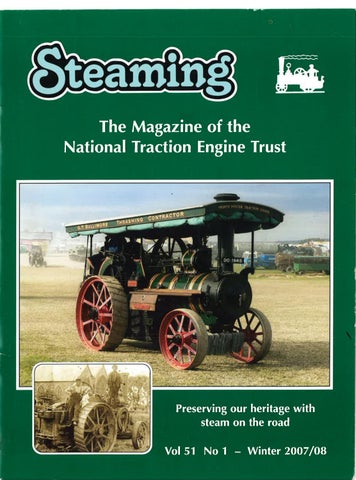
The Magazine of the National Traction Engine Trust
Preserving our heritage with steam on the road Vol 51 No 1 — Winter 2007/08
THE NATIONAL TRACTION ENGINE TRUST Preserving our heritage with steam on the road The membership of the National Traction Engine Trust is open to all of those
who, whether they are engine owners or not, have a genuine interest in the preservation of self propelled steam road vehicles, portable engines etc.
The annual subscription rate is £25.00. The Trust's profusely illustrated colour magazine Steaming is sent free to members during the early part of January, April, July and October, and other benefits of membership include very advantageous terms for boiler and other types of insurance cover as well as access to advice on technical matters. The Steam Apprentice Club is the junior section of the NTET, formed to support youngsters up to the age of 21 in learning about and appreciating load steam. To find out more please contact the Chairman (see right) or view the SAC website at www.ntet.co.uk/sac
President: Richard Sandercock Vice Presidents: Andrew Semple; Len Crane Chairman: Robert Herring, Glebe Court, Fringford, Bicester, Oxfordshire OX27 8RJ (' 01869 277410) Vice-Chairmen: John Cook; Bob Siddall
General and Company Secretary: Susan Jackson, 153 Micklefield
Road, High Wycombe, Buckinghamshire HP13 7HA Membership Secretary: John Cook, 74 Church Lane, Kirkby la Thorpe, Sleaford, Lincolnshire NG34 9NU (0' 01529 303160) Treasurer: Julie Smith FCA, Yew Tree Cottage, 98 The Ridgeway, Astwood Bank, Redditch Worcestershire B96 6NA (0' 01527 893427) Chairman, Rally Organisers Section: Tim Holt, South View, Hutton Roof, Kirkby Lonsdale, Carnforth LA6 2PF (0 01524 271584; fax 01524 271768) Chairman, Engine Owners Section: Bob Siddall, Stud Farm House, Ossington Lane, Sutton on Trent NG23 6QR (0' 01636 821991) Head, Technical Services: David Smith, Yew Tree Cottage,
98 The Ridgeway, Astwood Bank, Redditch, Worcestershire B96 6NA (IT 01527 893427) Head, Membership Services: John Cook (as above) Chairman, Steam Apprentice Club: Kevin Munn, 56 Blacklands Avenue, Hayes, Middlesex UB4 8EX 0208 573 9180) Rally Authorisation/Affiliated Groups: Bill Evans, PO Box 102, Wrexham, Clwyd LL13 OZS (`s/fax 01978 781196) Insurance Officer: James Blenkinsop, Forge Cottage, Combrook, Warwick CV35 9HP (v/fax 01926 642016) Public Relations: John Billard, Old Station House, Twyford, Berkshire RG10 9NA (0' 01189 340381) Patrons
Hal Bagot, JP; Robert Goodwill, MP Dr Tony Marchington; The Rt Hon Sir William McAlpine, Bt; Michael Oliver, MBE; Hamish Orr-Ewing; Richard Preston
E-mail: ntet@ntet.co.uk Internet address: http://www.ntet.co.uk A full list of the e-mail addresses of officers can be found on the Trust website - www.ntet.co.uk
Steaming
Back issue references are shown as Volume/number in ye-ar (as shown on cover) and page number.
back ...
Boller inspection - 49/2, page 68 and 115; 49/3, page 126 and 177; 49/4,
This panel is a selective index to topics from past issues which readers may wish to refer back to. It is confined to items such as legislation, insurance and other subjects which may not be totally absorbed by members at first reading. The index will be maintained on a rolling basis, with topics retained from issue to issue, depending on their currency and association with on-going discussions
Boiler joints - 48/1 page 5 and 52; 48/2 page 85 and 116; 48/3, page 177;
tt.1 d$1111JUI we! tie] ils.
page 184; 50/1, page 5 to 7; 50/2, page 68; 50/4 page 186. 49/3, page 145; 50/4 page 198. Coal - 48/3, page124; 50/1, page 26; 50/2, page 10; 50/3, page 143. Driver competency - 48/3, page 124; 48/4, page 238; 49/1, page 7; 49/2,
page 64; 50/1, page 5; 50/3, page 128; 50/4, page 184 etc. Engine insurance - 48/4, page 188; 49/2, page 69; 49/3, page 127; 50/1,
page 7; 50/2 page 69; 50/4 page 190. Engines on the road, inc licences - 47/4, page 185; 48/2, page 67 and 69;
48/3, page 126/127; 49/1, page 9; 49/4, page 185; 50/1, page 38. NTET Disc Scheme - 47/4, page 183; 49/2, page 68; 49/3, page 127. Traction Engine Code - 50/1, page 4; 50/2, page 68; 50/3, page 128;
50/4 page 184. Waler - 48/2, page 65 and 86; 49/3, page 145.
The Magazine of the National Traction Engine Trust Volume 51 Number 1 Winter 2007/08 Editor: Roger West, 14 Charles Street, Market Harborough, Leicestershire LE16 9AB (Er 01858 467326) e-mail steaming@ntet.co.uk Steaming Around (only): Derek Rayner, 'Invicta', 9 Beagle Ridge Drive, Acomb,YorkY024 3JH Display Advertising and Small Adverts: to the Editor Distribution and Change of Address: John Cook, 74 Church Lane, Kirkby la Thorpe, Sleaford, Lincolnshire NG34 9NU (Tr 01529 303160) The Editor is pleased to consider contributions of suitable articles, shorter items or photographs for inclusion in future issues. All material submitted is voluntary and payment cannot be made for any material published, although expenses incurred may be met. The opinions expressed in the magazine, with the exception of those printed asTrust announcements, are those of the contributors and do not indicate the views of the Trust as a whole. All items are held copyright by the contributors and/or the NTET. Next issue:The press date for news items, recent photographs and small adverts is 11th March 2008. For the date for Steaming Around see that section. ISSN 0260 - 2962 Published by the National Traction EngineTrust at 14 Charles Street, Market Harborough, Leicestershire. Printed by AB Printers, Montrose, Crown Hill, Great Dalby Leicestershire LE14 2ER STEAMING Winter 2007/08
Editorial It will already be noticeable to readers that there is a development in the production and appearance of our magazine — one which we hope will be welcomed by all members, and appropriately marks the completion of fifty yearly volumes of Steaming. The use of colour in printing has, over recent years, become a much more attainable cost, but our own magazine is ever likely to remain caught in the trap of being printed to a high standard, but without a sufficiently large print run to benefit from the lower costs that can be enjoyed by clubs with larger membership. Thus it is that whilst a slightly increased budget for Steaming has been agreed for this year, some adjustments need to be made to the format of each issue. We hope readers won't particularly notice that there will be a few less pages over the year.That potential drawback should be largely made good by space savings that have come about by changed circumstances in recent times (the Small Adverts, for example, have almost dried up), and this will be added to by compacting headings and ceasing to include some information paragraphs that get repeated in every edition. We are confident that with a few changes, the magazine will settle down to present a similar amount of articles, news and pictures as there has been in recent times. There will, of course, still be a presence of black and white illustration, not only with the inevitably monochrome historical photographs, but also in present day scenes. Several of our regular cameramen like working in black and white, a medium which can often produce most satisfying images. We take this opportunity of thanking those members who, at their own expense, continue to send their pictures for use in the magazine for the enjoyment of all.
This issue 4 14 28 33 34
37 38 40 53 55 57 58 59
Trust News Fowler plowing engines in America The Burrell's Jo'G-LE A pocket steam roller Technical Topics The Pressure Equipment Directive The Boiler Inspectors Audit Scheme Viewpoint VULCAN at Glovers Steaming Around, complied by Derek Rayner Around the World Letters Reading and Viewing Small Adverts AGM 2007 Report
Derek Rayner Charles Daniel
Jane Crane Graeme Thirkell
Front cover For the second issue running, a Great Dorset 2007 picture on the cover — this time a longer range view across the arena, with Foster agricultural 2163 passing Roger Newbery's camera. The 8hp single cylinder engine betrays its working origins in that it has one of the generously sized awnings that were often fitted on Lincolnshire fenland engines; when new in 1896 the Wellington Foundry at Lincoln had sent it off to George Bullimore, a fairly local customer at Deeping St James. 3
Trust News From the Chairman The interest shown at the AGM in November brought to me two most important messages — firstly that the membership is interested in how the Trust is run, and secondly that if members feel an issue needs addressing then our annual meeting is the opportunity to let those feelings be known. It certainly was a full house. All the hard work invested in updating and modernising our Memorandum and Articles of Association over the last two years received virtually unanimous support. Good dehate followed over the submitted Motion on driver competency; the Council and its Sections will now review the matter, but, importantly, take into account the views put forward from the floor. We welcome a new Vice President; Len Crane is undoubtedly a man known by many. Two fresh members to the General Council are Tony
Seddon and Neil Williams. Standing down at the end of his three year term was Paul Worbey — he has done excellent service as a Vice Chairman, and I would like to thank him for all the effort he has put into the role of Head of the Rally Organisers section. The latter task will be taken on by General Council member Tim Holt. The position of second Vice Chairman has been taken by Bob Siddall, combining it with his duties as Head of the Engine Owners Section. An issue that tops the agenda in many comments and conversations is that of our communication with members, and in the forthcoming year we hope to address this. Immediate attention following the AGM has turned to our website, and its set up and management. Member David Collidge, who has a wealth of experience in this field, has agreed to assist us with this task, bringing new ideas and a fresh approach.
This was our 2007 ... Al the 2007 AGM al Tel ford, chairman Robert Herring narrated to those present what had come to pass in the management and running of the Trust's affairs since they had last met. We repeat the interesting statistical summary for the benefit of all members. Through the year since the last AGM there have been three meetings of the General Council, and the Executive Committee has met on four occasions. All were well attended, and the Council meetings had also been attended by observers from affiliated groups. The Engine Owners Section, headed by Bob Siddall, had — • had 3 meetings of the section members • a successful one day Engine Owners Meeting • a weekendTraining and Driving Course; 40 students took part and although the weather was not good, the excellent facilities provided by our hosts
4
overcame problems • a r,coond mooting in Oulubur with' Elm 12 independent boiler inspectors, and the subsequent launch of the Inspections Audit Scheme • completed the new Engine Owners Code of Practice, which is now available. • supervised 70 tests for the voluntary Driver Competency Scheme, and 6 examiners have been appointed.
The Rally Organisers Section, headed by Paul Worbey, had — had 2 meetings of the section members • held a Rally Organisers Conference in March • authorised 107 rallies and inspected 15 of them • circulated 90,000 Rally Lists, the large majority of which were distributed via 650Tourist Information Centres • held 5 safety seminars at widespread locations, with 194 attendance certificates presented.
Our financial affairs are overseen by Treasurer Julie Smith, who
Chairman Robert Herring making his address to members gathered at the Trust AGM atTelford last November. (John Billard)
continues to implement strong budgetary controls on our spending, The aims and requirements of our reserve funds have been reviewed and are now grouped under the headings: Exhibition Unit, Legal, Preservation, Scholarship and Education, Technical and General. The Technical Services Unit, headed by David Smith, had — • had 10 meeting of its members, with many benefiting from attendance by persons outside theTrust offering their experience and free time • completed, after 2 years and some 350 man hours, the revision of the NTET's Memorandum and Articles of Association • broug ht to the table the independent boiler inspectors audit scheme • with Bob Siddall held meetings with the Heritage railway group, the Office of the Rail Regulator and other bodies regarding the Pressure Equipment Regulations • taken timely advice from solicitors Harrison Clarke on various matters.
Aspects of Insurance were dealt with by James Blenkinsop.Through the year he issued 2609 NTET Winter 2007/08 STEAMING
Within this edition of the magazine you will find a questionnaire. I would ask you all to take time to consider its contents, but most importantly to complete and return it. From your comments we expect valuable information which will assist us to plan the future. Your opportunity to once again discuss issues that concern you will come about at the Engine Owners Meeting in February-there are more details elsewhere in the magazine. The new year will have arrived by the time you read this, so may I wish you all a belated Happy NewYear and good steaming throughout the season. (Robert forthcoming Herring, Chairman)
Rally Organisers Column Rally Organisers Section I am, I think, pleased to inform members that there is a 'new kid on the block' leading the Rally Organisers Section. My qualifications are fairly brief: I was until retirement one of her Majesty's Inspectors of Health & Safety, specialising in the agricultural and forestry industries. For 30 years
insurance discs; 74 events used the events insurance policy of Footman James; 24 events took advantage of the Trust's pre-event electronic information service. Membership Services, under John Cook, has catered for • a membership of around 3000, with 500 Steam Apprentices, 42 complimentary members, and 51 Affiliated Clubs • published 236 pages of theTrust magazine Steaming • introduced a new look to the design of the website • presented the Exhibition Unit at 9 events — a number reflecting several rallies cancelled due to poor summer weather • organised the marquee at the Great Dorset event with a better than ever array of exhibits. A few figures from the refreshment area: 4000 tea bags, 10kgs of sugar, and 30 gallons of milk were used.
The Steam Apprentice Club, led by chairman Kevin Munn, had • organised Driving Days across the country • linked with the Association of London Pumping Houses to allow Apprentices to be involved with steam during the winter STEAMING Winter 2007/08
plus I have been the organiser of the Cumbria Steam Gathering, and for 20 years, throughout the country, I ran the Trust's Safety Officer training sessions, until the method of presentation was changed by my predecessor as head of the Section, Paul Worbey. So you can see, I have had quite a bit of experience. The Rally Organisers Section is responsible for the Authorisation of the events that are included in the NTET's Rally List. Nearly 90,000 copies of the leaflet are produced each year and distributed to members, Tourist Information Centres and as inserts in the newstand magazine Best of British. Events requiring Authorisation have to comply with and agree to work within the Trust Rally Code of Practice for steam engine events. In return they get certain sections of the RoadTrafficAct lifted, and the widespread advertising already mentioned. Insurance is always a hot topic for events and by being Authorised certain insurers offer discounts, as they know the event is being run to a high standard, therefore minimising risks. The Section arranges an annual Conference for rally organisers; the next will be in October 2008 at a venue still to be decided. I would dearly like to see many organisers, secretaries and safety officers at this Conference. We shall have useful
• improved the SAC magazine and included much colour reproduction • launched a new blue corporate image of clothing and presentation • extended the influence of the SAC activities in the engine ring at Dorset on theThursday evening • made a well-received presentation to the AGM of the FBHVC on encouraging the interest of young people in historic vehicles.
Other items undertaken or achieved were • a contribution to the fund for a blue plaque at the former McLaren works site • Trust representation on a panel to assist the Museum of English Rural Life with their Steam Manufacturers Access Project • Provision of copies of both Trust Codes of Practice to fellow enthusiasts in Australia to hopefully assist them in the task of drafting similar documents to satisfy calls in that country.
The Chairman concluded by extending, on behalf of the membership, his thanks to the very dedicated group of volunteers who continued to take on work for the Trust.
General Council and Officers 2008 This column lists, for the information of members, the General Council and Officers of theTrust for 2008. The addresses/ phone numbers of those with special duties are given inside the front cover of each issue of this magazine; others may be contacted by phone or via the General Secretary or Heads of Sections. Names marked with an asterisk" are appointments by the Council and are non-voting positions. President Richard Sandercock Vice Presidents Andrew Semple, Len Crane Chairman Robert Herring Vice Chairmen John Cook, Bob Siddall General and Company Secretary Susan Jackson* Treasurer Julie Smith, FCA* Public Relations Officer John Billard (+ FBHVC, IT 0118 934 0381) Membership Secretary John Cook (and Head, Membership Services Editor, Steaming Roger West Sales Officers Colin and Val Brown" General Council The above and also: Irvin Barraclough (S. Yorks, 01709 850346) James Blenkinsop (Insurance Disc Officer) John Bosworth (Derbys, a 01332 880405) Michael Davies (Warks, 17 01295 770217) John Durling (Derbyshire, 01283 712818) Bill Evans (Rally Authorisation) Bob Garnett (Avon, 13. 01275 878054) Edward Goddard (Sentinel DC and Salop, 01743 851128) Tim Holt (Head, Rally Organisers Section) Richard Hurley (Wilts, IT 07867758366) Pat Jenkins (S. Wales, Tr 01792 390379) Kevin Munn (SAC chairman) Tony Seddon (Shropshire, Tr 01948 780599) Bob Siddall (Head, Engine Owners Section) David Smith (Head, Technical Services) StuartTomlinson (Training Course and Leics, 22 01455 613079) Neil Williams (Shropshire, ' 01948 830669) Representatives Reg Mattless (NV Tractor & EC)* Auditors: Charles Lovell & Co, Royal House, Market Place, Redditch, Worcestershire BN98 8AA
5
Thanks are due to Mike Salt and Ken Milns for arranging to bring Mike's Wallis & Steevens Simplicity roller 7936 of 1927 to greet members arriving at Madeley Court for the Trust AGM in November. The tiny 3 ton machine is standing by the fine stone gatehouse that was built to front the Court in the late 16th century - it is now a Grade 1 listed building. Thanks are also extended to Anthony and Wendy Thompson for their efforts on our behalf in planning the arrangements for the meeting alTeiruid. (Scut y Jub)
speakers, and there will be the ability to discuss and, I hope, mutually solve any problems. In the meantime, however, I am on the end of the phone and quite happy to endeavour to help anyone with any problems that fall within my remit - my contact details are inside the front cover of each issue. (Tim Holt, Head of the Rally Organisers Section)
Engine Owners Column Engine Owners Section Boiler inspectors meeting - A successful meeting was held with the independent boiler inspectors at the end of October, when the Engine Code of Practice and the Boiler Inspections Audit Scheme were launched. There was a very useful exchange of views and an agreement 6
to share relevant information. Another meeting is planned for Autumn 2008, when the operation of the Code of Practice, and in particular Part 4, I he Written Scheme of Examination and the Boiler Inspections Audit Scheme, will be reviewed. Independent inspectors attending the meeting were: Chris Beason Alan Bulmer John Glaze Alan Hines Graham Morris Alan Prout Tony Reen Hal Richardson Jonathan Wheeler Dave Wothers Apologies from Ian Farrance Alan McEwan attended as an observer, but as yet has not provided evidence of PI insurance, and consequently his reports will not be accepted by NTET. The Trust also announced that as from 1st January 2010, new independent boiler inspectors would have to show they have the necessary qualifications as specified by UKAS under RG2, Accreditation for In-Service Inspection of Pressure Systems/Equipment.
Office of the Rail Regulator As a result of contact with the ORR, David Smith and myself attended their meeting with the Heritage Railway Association, which is redrafting the heritage railways codes of practice for steam locomotives. David gave a presentation on our own Engine Code of Practice and Boiler Inspections Audit Scheme. It was well received and we were congratulated on our endeavours to become a self-regulating body. As a result of the meeting we have been invited to attend the next meeting as observers. Driver Competency Scheme Following the AGM passing of the Article 16 Motion 'That a formal review be made of the Driver Competency Scheme after the 2007 Rally Season, and this completed review be returned to the 2008 AGM for open discussion and acceptance', the National Council at its December meeting, following discussion, decided that an independent group would be set up to review the Competency Scheme, which would report back to the National Council. The group would be chaired by Trust Vice Chairman John Cook and further consist of SteveTurner of the Office of the Rail Regulator; Graham Mitchell, a police driving instructor; a rally organiser, and an engine owner. It was envisaged that there would be discussion at the forthcoming Engine Owners Meeting at Willoughby on Winter 2007/08 STEAMING
17th February, and this discussion would be recorded and passed to the review body. They could also ask for other submissions as required. (all paragraphs, Bob Siddall, Head of Engine Owners Section)
Technical Services Memorandum and Articles of Association - As a conclusion to this lengthy piece of work I can now Charity the that report Commissioners have been apprised of the acceptance of the Motion at our AGM in November. Boiler Inspections Audit Scheme - 1st January 2008 saw the launch of this Scheme. Suffice for me to say here that this is a major step in the history of theTrust and one which I hope will help carry our hobby well into the future.This is new ground for all of us,Trust Officers, owners, users and the inspectors. I sincerely hope that we will all work together to obtain the benefits that such a scheme should bring. Time will tell. Elsewhere in this issue you will find a detailed explanation of the working of the Scheme. Trials of miniature cameras for inspections - For sometime now we have been deliberating about how to make easier the job of examining hidden areas of pressure systems. Indeed, some of you may recall the demonstration by Steve Dean in the Trust marquee at GDSF a few years ago of equipment that he had built for that purpose. Recently I was made aware of equipment marketed by the German firm Mohler and saw it demonstrated. The battery or mains operated kit consists of a briefcase oversized rugged containing a horizontal drum holding a 20 metre length of fibre optic cable, on the end of which is a small, but very powerful camera lens, surrounded by twelve LED's. The camera relays its pictures to a 6inch flat screen, which may be detached from the case to suit the situation. Further output can be relayed to a laptop computer, or any device capable of receiving a video signal. The picture quality is quite stunning, particularly so from such a small lens. I have obtained one of these cameras and put it to work on field trials with engineering members of my team. The objective over the winter months is to determine how easy or otherwise is it to use, and how well can it deliver meaningful information relating to the internal STEAMING Winter 2007/08
components of locomotive type boilers. Assuming a successful outcome to the trials we will consider how best to share and apply this new tool. I will keep you posted. Visit to Office of the Rail Regulator (ORR) - In order that we are able to share experiences and information with like minded organisations I try to find time to take advantage of invitations to attend meetings and seminars. Such an event was a visit in December to the ORR in Birmingham, when it hosted a meeting of a HM Railway Inspectorate working party consisting of representatives of all the major heritage railways, members of the from representatives HMRI, engineering inspection firms and major repairers. This group, chaired by Steve Turner of the ORR, meets fairly regularly, and is working to produce a code of practice for the repair and maintenance of railway locomotives. Bob Siddall and myself were asked to give a talk on how we had produced the Trust's new Engine Code of Practice and to explain the working of the Boiler Inspections Audit Scheme. This talk and slide show, scheduled for half an hour, went to almost an hour and a half with the consequent discussions It was very well received, and the interest shown in our approach and the objectives we set, aimed at protecting the future of our hobby, was substantial. What I found particularly encouraging was the gathering's high praise of our endeavours to ensure that we remain a self-regulating hobby. This was praise indeed from a group that faces the full rigours of PSSR 2000, the Health and Safety at Work Act and a multitude of railway regulations. Pressure Equipment Directive: its application to new and repaired boilers - For some time members of my team have been working on the touchy subject of the application of the PED to our hobby. Elsewhere in this issue of Steaming you will find a comprehensive statement advising on the application of PED to new and repaired boilers. This statement has been drawn up by Graham Morris, who has been the major researcher. (all paragraphs - Dave Smith, Head of Technical Services Unit)
Membership Survey Included in this Winter issue of the magazine, as a loose insert, is a short questionnaire. If the Trust is to
Sections and Services 2008 This column lists the members of the Trust's Sections for 2008. Names marked with an asterisk* are co-opted; others are elected General Council members. Addresses/phone numbers of the chairmen or heads appear inside the front cover of each issue. Engine Owners Section Bob Siddall (head) Nick Allen* Irvin Barraclough James Blenkinsop John Bosworth Michael Davies Sylvia Dudley* John Durling Bob Garnett Edward Goddard Colin Hatch* Andy Hawkswell* Pat Jenkins Kevin Munn Richard Pierce" Tony Seddon David Smith StuartTomlinson Neil Williams Peter Williams* Membership Services John Cook (head) Colin Brown" Val Brown* David Collidge* Roger West Rally Organisers Section Tim Holt (head) Colin Brown* Val Brown* Trevor Evans* Bill Evans Paul Hemstritch* Lance Jackson* Keith Stott" Jo Tilling" Steam Apprentice Club Kevin Munn (chairman) John Durling (president) Elaine Massey (vice chair) Nick Bosworth* Emily Drury* Gareth Haase* Kevin Law* Matthew Lund* Nanette Saunders" Barry Sumsion* Technical Services David Smith (head) Irvin Barraclough John Billard James Blenkinsop Chris Boocock* Bob Garnett Colin Hatch* Richard Hurley Graham Morris* Tony Wood*
7
continue its work on behalf the road steam interest it has to know a little more about its members — why they are members, and what they expect from the Trust. It is a long time since we carried out such a survey and the resulting up to date information will be vital to our plans for the future. Please do your bit to assist those who spend many hours on Trust business by taking a few moments to provide us with your response. To limit the expense of the exercise, we cannot include pre-printed and prepaid return envelopes, but we have arranged a Freepost facility, an address that members can handwrite onto a plain envelope, and post without having to use a postage stamp. We hope you will feel this is a suitable sharing of the costs — you find the envelope; the Trust pays the postage. Details of what to do are set out on the Survey form. It is important that as many members as possible respond with a completed survey form. The information will remain confidential to the Trust and will not be used for any other purpose.The results will be summarised in a future issue of Steaming.
FBHVC News London Low Emission Zone — The London Low Emission Zone (LEZ) is due to be introduced on 4th February 2008. It will cover diesel vehicles over 12 tonnes entering the Greater London Authority area, and as I write road signs are being put up to that effect. Initially the heaviest vehicles will be affected, followed in July 2008 by those that are lighter (3.5 Willies), including coaches and buses. Standards will be increased up to 2012. The scheme will operate every day, night and day, all the year. The M25 is not included, even where it is within the GLA boundary. Vehicles made after 1st January 2001 are assumed to meet the emission standard. Further information is found at www.tfl.gov.uk Transport for London (TfL) has agreed an exemption for historic vehicles, defined as those made before 1st January 1973. The FBHVC has found the consultation difficult and TfL were unable to accept any other exceptions. When the opportunity arises further repre8
Richard Sandercock kindly sends this picture of an unidentified Fowler general purpose engine, which to him has a family interest, for it bears a plate on the rear of the tender that is lettered R. DINGLE & SONS CALLINGTON AGENTS — his grandfather's business. The compound engine's identity is proving puzzling, and the owner's plate on the side of the boiler is, tantalisingly, partly covered by the water lifter hose. The name on the top line seems to end with ...ICK & SONS, and the town or village name also Moles to finish with ick. Who can recognise the church, of which we see the east end across the far side of a typically sunken, stone walled Devon lane? Half a dozen and more figures are to be seen seated and relaxing on the grass of the churchyard, so maybe the occasion was the start of a church outing by engine and trailer.
sentations will be made to extend the historic definition to 30 years or a rolling period. Steam propelled vehicles are exempt but, once again, as far as Trust members are concerned the matter centres not on engines but on the lorries used to transport them. As far as Is known there are no plans by other authorities to follow suit. Once again I will be most grateful if members could pass to me their experience of the new regulations and how it affects their activities. It is important to be able to judge the impact of these regulations as far as our interest is concerned. Paint — The DEFRA consultation on a licensing scheme to use on vehicles traditional paints that do not comply with the Volatile Organic Compound (VOC) solvent limits has been responded to by the FBHVC.The licensing system is simple: the qualifying period is 30 years and
local authorities will be issuing the licences. Licences apply to either individuals or traders. The FBHVC has responded regarding possible variation and complication between local authorities. It should be noted that the restrictions apply to vehicle finishing. Members owning other items such as boats, aeroplanes, lawn mowers, or any other non road vehicle item will be able to paint them with traditional finishes as hitherto, without the need for a licence. Just tell the paint supplier! The Federation is also exploring a possibility that might avoid the need for a licensing system altogether if historic vehicles (those over 30 years old) could be classed under the regulations as 'special finishes'. The VOC limit for this category is high enough to include cellulose paint. Driver Certificate of Professional Competence — The Winter 2007/08 STEAMING
Driving Standards Agency (DSA) has published a consultation on 'further implementation arrangements' for the Driver Certificate of Professional Competence (CPC). This has the intention of raising standards among professional commercial drivers and as such doe not have an impact on the private use of commercial vehicles. Regrettably however DSA proposes to incorporate the training and testing for the CPC within the training and testing for new HGV or PSV licences. This means that a newcomer who wishes to obtain a licence to drive historic buses and coaches will have to train at some expense on modern equipment and to learn of matters of no significance to them. The FBHVC has responded strongly to this unfairness. If any member has any matter to raise of interest to the Federation please contact me at Old Station House, Twyford, RG10 9NA, 01189 340381, or john.billard@virgin.net (all paragraphs, John Billard, FBHVC representative) Drive it Day — The Federation encourages all owners of historic vehicles to take their vehicle on the highway on Sunday, 20th April — Drive it Day. This is not a day of organised events — although some clubs may like to consider a group gathering — but one on which to merely let the public see old vehicles being used on the road. There may just be time to include mention in our Spring issue of further plans by the FBHVC to dedicate the day to the younger generation. The Federation's website www.fbhvc. co.uk will carry more information and list clubs that will be having meets.
Steam Apprentice Club As we are in the depths of winter and looking forward to the warmer weather and summer, it might seem strange for me to write about next November. But that is when we present our awards to the Steam Apprentice of the Year and also the Technical Achievement Award. To assess candidates we need suitable information well before then. I am not asking you to write to me yet, but if you do have an Apprentice who you think is worthy of either of the awards, please consider putting pen STEAMING Winter 2007/08
The NTET's Engine Owners Section presents its 2008
ENGINE OWNERS MEETING to be held at
The Village Hall, Willoughby, near Rugby, Warwickshire 10.30 for 11.00am on Sunday, 17th February 2008 All owners, crews, potential owners and anyone else interested in the working of preserved road steam vehicles are welcome to attend — whether they are members of the Trust or not. Contact Bob Siddall if you wish to have a topic discussed — Tr 01636 821991 or RGSiddall@aol.com
to paper now, making notes that you can send to us later on why your candidate should be considered. To give you an idea of what we are looking for, it may be of help to read the citations written by SAC President John Durling on the Awards that were made for 2007 — Technical Achievement Award. Presented to Sam Henwood — who was nominated for the award primarily for his work with David and Emma Goodwin on their Burrell showmans GLADIATOR. He has been with them for over five years learning the ropes, and assisting with the maintenance during this time. He also played a role in the restoration of Burrell road loco CLINKER, owned by Rob Wing, as the engine was returned to sound condition after many years and many miles on the road. He is now apprenticed to Peter Phillips, working on restoration projects including a Scammell and a living van, and project work with the Bodmin Railway. The Jack Beeby Cup (Apprentice of the Year). Presented to Tom Sanders — who started several years ago at the Klondyke Mill premises on SAC Driving Days, though more recently working with Roger Mills on his Marshall roller JANE. Tom's introduction to the Mills family was via Richard Semple asking Roger if he could take a lad for a few hours; Tom seemed to like the idea and never left. The Jack Beeby cup is awarded to an Apprentice who has stayed the course and Roger is full of praise for the approach that Tom has shown to the engine — and now considers him to be an excellent engineman.Tom is now working with Alan Williams on his new acquisition, LORD LASCELLES. A display advertisement for the Awards appears elsewhere in these pages.
For those of you who are readers of this magazine and have children who are interested in steam, but perhaps not yet members of the SAC, if you have access to the internet, can I suggest you look at www.ntet. co.uk/sac to get an idea of what we are about. Alternatively, you can write — my details are inside the front cover. (Kevin Munn, Chairman, Steam Apprentice Club)
Obituaries John Middlemiss Dr John Middlemiss died peacefully at his home at Godmanchester in November, after a short illness. We have thus lost another of those pioneers who preserved engines in the early 1950s — a time when for a professional man
Trust President Richard Sandercock hands the JT Beeby Cup to Tom Sanders, SAC Apprentice of the Year for 2007 (John Billard) 9
Landrover and caravan, touring England, calling on engine owners and discovering engines. By 1968 the eldest of their five children were leaving home, and John and Maria decided to move
south. In September of that year John was elected President of the Road Locomotive Society, and late in October he steamed the Burrell south to a job near Banbury. In 1969 he took a practice in Godmanchester, in Cambridgeshire. Here he and his wife became valued members of the community. Maria became a
councillor, and the engines took a full part in local engine activities. In 1980 John retired, which meant that he could full time pursue his researches into the history of
to do such a thing was thought little short of madness. John Lionel Middlemiss was born in 1920 in Settle, a market town in north westYorkshire, where his father was the doctor. The family home
engines. His retirement was made all the happier when son Willem and his family settled in Godmanchester. In 1994 Maria died suddenly, and John was devastated. He was, however,
looked over the market place, where the fairs pitched.Thus John became a follower of showmans engines, including Burrell 3555THE BUSY BEE,
somewhat consoled by Friday night sessions in the pub with his grandson Tom, and Tom's teenage friends. John was happy again when
and watched Bostock & Wombwell set up their menagerie in 1930. John was but 12 when his father died, and the family moved to South Newton in Wiltshire. Here, in holidays from
Elizabeth came into the picture, and when she and John married in 2005, Tom was his grandfather's best man. Despite increasing ill health, John continued to be active almost to the
boarding school, he got to know the local showmen, and their engines taking water near the house. Later, when Charing Cross Hospital medical
end. Regardless of the handicap of considerable deafness there was nothing he liked more than to be among engines and owners of all ages, asking and answering
school was evacuated to Glasgow during the war, he again got to know local showmen and their engines. During service in the RAMC John met and married his beloved wife
Maria. They then had a job to find a practice, hut, with their growing family, finally settled at Bellingham in Northumberland. Here John was geographically the last doctor before
questions, and telling stories. When John's death was posted on theTractionTalk website a remarkable number of people added their condolences, and their good memories
pioneering, his researches, and his infectious enthusiasm and friendship. Thus he did an untold amount to encourage the preservation of engines, and to foster those widely
General Practitioners. long Before had John rediscovered THE BUSY BEE on a farm over the hills in Coquetdale.
based friendships which go so far to form the preservation movement. As an instance of the power of John's enthusiasm - Willem once took John to see an unrestored
other passion - steam engines. In the 1970s John began work on a large (for those days) miniature traction engine - a 4in scale Fowler class R3 road locomotive. He devoted his 'non working' time to the project, named on completion in the mid 1980s DOO JUAN (Black John). During this time John had been a
regular visitor to local steam rallies to study full size engines and incorporate many details into his model, making it a very true to prototype miniature. It was excellently built and very powerful and could be found working alongside full size engines at rallies, winching trunks on to a full size rack saw bench. His knowledge of full size engines endeared him to many
engine men. When complete the Fowler was rallied extensively by John, in his bowler hat, from North Yorkshire to Dorset and from the West Midlands to Holland.
engine which he fancied buying. John was so enthusiastic that the owners had second thoughts about selling, and decided keep it and restore it themselves. Willem was not
home. Restoration took place in the open, in all weathers, in the field behind his house, and with the help of other enthusiasts such as Jack Wakefield. John later bought Savage
pleased. We offer our deepest condolences to Elizabeth and to John's family. Some 200 people attended the
electric light engine 761 and restored that under the same conditions. Holidays were taken with the family
memorial service at St Mary's Church in Godmanchester on 17th December. (Bob Allison)
10
Model engineers and miniature engine owners across the country were saddened to learn of the passing in November of John William Sanderson of Oakham. John was born in 1933 and grew up in rural east Leicestershire, then trained as an engineer with Post Office Telephones. His passion for motorcycles and scrambling, and later grass track racing, led to him winning trophies at meetings all over the country. Two bad accidents made him decide it was time to turn to his
of him. Despite the number of engines with which he was directly concerned in preservation, his greatest legacies were his brave
Scotland - and that was over twenty miles away; the practice was the size of a small county, and sparsely populated. He was a founder member of the Royal College of
With generous and patient encouragement from Gordon Smith of Hexham, who was still in business as a rolling contractor, he bought the engine and he and Maria steamed it
John Sanderson
Winter 200//08 STEAMING
John's next project was a 41/4in scale 1901 Thornycroft steam wagon and trailer, the result of his own research and measuring from one of the two prototypes in this country. It was first steamed in 2001 and took part and completed the NTET 50th Anniversary Road Run in 2004. Looking for something different for a further project - something that could do useful winching and hauling - John researched and began work on a 43/4in scale Sentinel roadless tractor, modelled on one of eighteen built from about 1926 (none have survived). From a few drawings and
photographs, sketches were made and then plans made on the drawing board. John made his own patterns and core-boxes, and did his own machining. He analysed the problems, thought them through in a common sense and systematic manner and then got on with the job.
John was an active member of the Peterborough and the Melton Engineering Model Mowbray Societies, as well as our Trust, the NVT&EC and the Sentinel Drivers Club. His coffin was carried to the burial on a trailer behind his Fowler, driven by his great nephew Chris. Over 150
friends joined the family, and Eddie Lancaster and Rudi Michetschlager spoke tributes. John was a very private person but he was popular among people who had similar interests to his own, and had many good friends both across the rally scene and in model engineering. He was very patient and helped many people throughout his
life - one of those stalwarts who will be sadly missed by us all. Our sincere condolences go to his family. (Norman Smedley) Willie Smith With great sadness I report the passing of Willie Smith of Roundyhill, Angus, in October, aged 88. His
The Steam Apprentice Club Invites entries for its annual
Technical Achievement of the Year Award, 2008 for the best technical achievement by an Apprentice in the current year Areas of achievement may include: work on full size engines, modelling, model engineering or other appropriate road steam related subjects — bearing in mind we are a road steam organisation. The purpose is to encourage young people to develop hands-on experience, within
typical engineering skills. Apprentices may enter themselves or be entered by a sponsor for whom they have been working or under the instruction of. Initial submissions should be a brief description on one side of A4 paper with 3 or 4 photographs or sketches, to the SAC Chairman by the end of July. From these, suitable projects will be chosen, and detailed submissions invited for the end of August. The announcement of the winner will be in October, with the award presented at the Trust AGM. Judges will be from the SAC Committee plus invited persons from areas appropriate to the subject.
portables used for driving the mills. A further attraction was Jones's Fowler class A8 road loco 14598, supplied new in 1916 to the Home Grown Timber Committee. Willie's first teenage taste of steering it on public roads included his uncle telling him not to worry about other traffic "they'll soon get oot o' your road!" Leaving school at 14 in 1933, he
started work with Jones and learnt all aspects of the timber trade, both at headquarters and at sawmills. Called to the armed forces in 1939, he served in The Duke of Wellington's Regiment and was among those who landed in Normandy, to be involved in fierce fighting around Caen, at one
stage bringing a wounded comrade back from the front line. Wounded himself, he was sent home, his service abroad over. On demob, Willie returned to the timber industry. In 1947 he opened a new sawmill for Jones near Kirriemuir, Angus. Initially a small outfit, powered by a Marshall portable, improvements in haulage resulted in the timber being brought
one of the Council's last steam drivers, their friendship lasting until Jim's death in 1999. After attending rallies with 18664, serviceable without major work, there was a complete strip down and overhaul of 17273, which made its debut in 1979. The 1990s saw a rebuild of Fowler 15718, an A9 class traction engine
to the mill, and Ladywell became a permanent installation. Bothies and timber cottages were erected for the workers and a community evolved
from Northern Ireland; naturally it was put to use driving a rack bench, with Willie insistent it should run properly on the governor! He joined the Scottish Traction En-
which he continued to manage until retirement in 1987. Electricity replaced steam power in the mill, but the steam
gine Society shortly after formation in 1961, becoming a very active President in 1999; his services to the Society earned him a Transport Trust
sawmills moved around the country to where felling was taking place. His schooling began at Invergordon and finished at Bridge of Earn. Holidays
preservation movement re-kindled his interest, though to lasting regret, the Fowler A8 had been cut up before he found it was being disposed of. However, Angus County Council was
Lifetime Achievement Award. He was also a member of thisTrust and of the Road Locomotive Society. Margaret married Willie Cunningham, who he first met in
were spent with uncles who worked for James Jones near Jedburgh, and it was there that his lifelong interest in steam engines was aroused by the
selling its remaining steam rollers in the 1960s, and Willie successfully bid for three Fowlers. As an added bonus he acquired the services of Jim Laird,
1954, in a surprise ceremony in Gordonstoun School chapel in Moray in 2000. She joined the steam fraternity enthusiastically, becoming
beloved Fowler roller greeted family and friends at Glamis Kirk for the funeral service; it afterwards led the cortege at the start of its journey to Parkgrove Crematorium. Willie was born in the Scottish Borders, the son of a merchant seaman serving on Shell oil tankers. His mother's side of the family was involved in the timber trade, when
STEAMING
Winter 2007/08
11
the Scottish Traction Engine Society's membership secretary A friend and mentor to many, Willie will be sorely missed. We extend condolences to Margaret at this sad time. (Sandy Garden)
Personal Esmond Kimbell We offer sincere congratulations and best wishes to Esmond Kimbell, of Northampton on the occasion of his 100th birthday in December. One of the very few surviving enginemen who earned his livelihood with traction engines, Esmond had footplate knowledge on working engines from an early age. He was later principal of a firm operating both threshing engines and steam rollers, the latter well into the 1950s. Esmond contributed wisdom and experience on the Trust committee for a good number of years in the 1980s and 90s. In the days around his milestone birthday he received visits at his home from family, friends and former employees, and our Chairman Robert Herring was also able to visit and leave a suitable celebratory present on behalf of theTrust.
The Trust Trophies, 2007 Our AGM atTelford last November provided the annual occasion to present some of theTrust's collection of cups, bowls and shields to deserving members, marking the longer term achievements and dedication of some local enginemen enthusiasts, and and the accomplishments during the past year of others from elsewhere in the country. The presentations were made by the President, Richard Sandercock, and the citations were read by Paul Worbey. The BAKER TOC H CUP was awarded to Dick Marsh of Stockport, Cheshire for the determined and dedicated accuracy and quality of work that he put into the restoration of the Burrell showmans LORD engine LASCELLES. The CHOISY & SIMPSON CUP was presented to Richard Hesbrook of Hereford for the restoration of a rare survivor - his Gibbons & Robinson engine - and his continued 12
assistance to other enginemen. The CURTIS BOWL- usually given for outstanding journeys on the road in steam - was appropriately selected for the remarkable achievement of John Atkinson, the Daniel brothers and the team from Cornwall who ran John's Gold Medal tractor from John o'Groats to Land's End in record time. The JOHN CRAWLEYTROPHY was presented to Brian Smith of the County of Salop Club for his drive and enthusiasm in expanding the exhibit range and the working field at the club's annual rally at Onslow Park. The EDNEY SHIELD was chosen for Peter Dunn, again of the Salop Club, for his active roles within that club since its early days, and his freely given knowledge that helped with the major revision of the Trust's Rally Code in the 1990s. The GOLDEN FILM SHIELD was awarded to the Davis family of Astwood Bank, Worcestershire, for their quiet and generous support towards the Trust and its members who wish to increase their knowledge of engines through the Training Courses that are held on their lands. The PERCY HIRONS BOWL went to Tom Henderson of Whitney-onWye, Herefordshire, a man who has over the years assisted many owners with parts manufacture, and generously shares his hobby with old and young who show interest in his agricultural engine. The JACK HOLLOWAY SALVER was awarded to Bob Whitehead of Tonbridge, Kent, for his long term commitment as an erudite author of the history of the Garrett company of Leiston, as well as several volumes that set the scene and times in which our road engines worked. The CONNIE HUTCHENS MEMORIAL TROPHY, awarded annually to a lady in the movement, was selected for Stella Timmis of Shrewsbury, who has proved that the ladies can run and engine and remain a lady, and who has done so much for the Salop club's social scene. The ERIC MIDDLETON TROPHY was presented to Neil Williams, of Whitchurch, Shropshire, who has worked tirelessly for some years to fulfil his ambition to own a steam engine, working his way up through other vintage vehicles to achieve his goal. The ARTHUR NAPPER CUP was handed to Trevor Smallbone, of Reading, Berkshire, for his tenacity of purpose in the splendid organisation of centenary celebrations for the
At the November AGM the Golden Film Shield was awarded to the Davis family of Astwood Bank - here President Richard Sandercock wakes the presentation to Paul Davis. The Shield, a gift to theTrust by Morris Oils of Shrewsbury, was making its first appearance as a Mark 2 version, the original having been filled with the small engraved plaques of successive holders. The new shield is now ready for another twenty years, and lists the names of past recipients at the centre. (John Billard)
Burrell Gold Medal steam tractor at the VVoodcote rally this year. The awards reserved for Steam Apprentice Club members are noted in that section's columns.
New Members We extend a sincere welcome to the following new members who have joined the Trust during the last three months. We hope they will gain mut.:11 Iiiendship, information and enjoyment from their membership over a period of many years. Full addresses are not included, but the Membership Secretary is always pleased to put members in touch with one another by forwarding mail. M Shipton, Stonehouse, Gloucestershire P Richards, Christchurch, Dorset P C Stinton, Bridgend P Jeffery, Watford, Hertfordshire C J Drewitt, Epsom, Surrey R Abram, Southport, Lancashire P G De'ath, Bridgnorth, Shropshire W Carlisle, Co Down, Northern Ireland P Rees, Great Dalby, Leicestershire K R J Harvey, Chigwell, Essex P R Leonowicz, Maulden, Bedfordshire Prof TWatson, St Albans, Hertfordshire Winter 2007/08 STEAMING
Miss DTapfield, Hitchin, Hertfordshire R Cowles, Cambridge E McAleeman, Crossmaglen, Northern Ireland K Brent, Alfrick, Worcestershire P Wines, Glastonbury, Somerset C Herring, Bicester, Oxfordshire R M Seago, South Walsham, Norwich H W Jones, Market Drayton, Shropshire M Young, Jarrow,Tyne & Wear J Shadbolt, Cardiff Mrs S Cleal, Leamington Spa, Warwickshire I Cooper, Shrewsbury F Rawlinson, Preston, Lancashire M K Blackburn, Minsterworth, Gloucestershire
Poor Steaming The review of Bob Whitehead's compact disc treatise on the miscellaneous products from Garrett's Leiston Works had errors in one of the addresses from where copies of the CD can be obtained. We apologise to Bob and to Michael Walters, who is at 236 Halifax Road, Liversedge, West Yorkshire WVF15 6NP.
A considerable number of steam motor wagons regularly come to the docks of the Manchester Ship Canal Co for the purpose of bringing and taking away traffic, and these are, whilst on the docks, under the supervision of Dock Police, and are not allowed to enter any of the Company's transit sheds or storage warehouses.'(from Industrial Motor Review, March 1908)
reflections on our magazine of 25 years ago
The Winter 1982/1983 magazine began with an Editorial on the old chestnut of conversions. A report in The World's Fair on the Affiliated Clubs and Rally Organiser's Conference implied that a debate at the meeting amounted to the NTEC dictating to members that 'thou shall not convert'. The Editorial made clear that whilst many on the Committee had strong views against conversion, at the end of the day an engine is an individual's property to do with as he or she pleased. The piece went on to remind readers that engines are historic items and the portrayal of an object as something that it isn't is not accepted for other forms of historical artefacts - antiques, buildings, veteran cars etc. Another old chestnut - engine prices - was covered in the introductory notes of Steaming Around. It was mentioned that several engines had failed to reach their reserves at a recent auction (at Tom Varley's premises), with the suggestion being made that engine
prices may have peaked. With so many of Fred Dibnah's exploits having been captured for TV over the years it was surprising to see a report in the Lancashire notes of a novel chimney demolition that seems to have escaped TV cameras. Fred had used a push pole on the rear hitch of his roller to loosen the brickwork at the base of a chimney he had partially felled, brick by brick, and then finished the job off with the engine's winch rope. The three winning entries, plus four highly commended photographs, from the Steaming Photographic Competition were spread across four pages. The winner was a very nice photo of Lloyd Jones Brothers' Sentinel 8122 on the road near Long Myndd, which could easily have passed as one from working days. It was however noted that many of the other 80 entries received were of relatively poor technical or artistic standard, with unwelcome modern clutter, passers-by etc. Michael Mason's series of articles 'Boiler Construction and Repair' - the topic for this quarter was stay renewal or replacement-again made interesting reading, as did continuing 'Tar Spraying and Other Tales' from Percy Dabbs, and an article by Esmond Kimbell (who has just celebrated his 100th birthday) on his (Stuart Apprenticeship'. 'Early Gaines) At,
Aveling rollers at the Harewood House event in August 2007 included C type 8 tanner 10905, a thoroughly typical Rochester product of the 1920s, and, at the right, 4698 of 1901, one of the tiny and narrow single speed rollers that had their flywheel inside the hornplates. The lightweight 4 tonner came back to this country a couple of years ago from South Africa, where it had once worked for the City of Durban. (David Warren)
Fowler plowing engines in America Derek Rayner Throughout this article, those works numbers underlined are those known to be the right hand engine of each pair of ploughing engines. Early day ventures My interest in this subject developed from reading the book Steam Power on California Roads and Farms (1858- 1911), published in 1998. The author was Jack Alexander of Gilroy, California, and within the book's pages he referred to an undated article by F Hal Higgins entitled 'A Century of Tractors'. This indicated that a Fowler ploughing engine was first imported into California in 1867 by General Bidwell, who was able to get a joint resolution passed by the Californian Legislature to refund the duty that had been paid on the $10,000 steam plough. It was believed that this was a single engine utilising the two drum and ground anchor system, and it was apparently put to use in the cultivation for sugar beet crops near Sacramento, inland from San Francisco, but was largely
unsuccessful. Unfortunately, Fowler's surviving records at the Museum of English Rural Life (MERL), Reading University, give no clue as to what the engine might have been for neither Bidwell's name, nor an acquaintance by the name of W Wadsworth (who is said to have journeyed to Leeds in connection with its purchase) are mentioned. More recently, Jack researched details for a further book that was published in 2003 - The First American Farm TrartnrR Developments to 1917. This mostly deals with internal combustionengined tractors, but it also contains references to steam road engines, some of which were imported from the UK, others were locally-made products. During the researches in the USA, Jack obtained a copy of the Report of the Commissioner of Agriculture for the year 1867 in which was an article entitled 'Steam Ploughing in Louisiana' by H E Lawrence. This noted that in December 1867, Fowler ploughing engine number 018 (and presumably its twin, 919) were imported into the
FowLER's-Srseht .PLowc., the winner of a-first premium in England,has been tried recently on a farm near Philadelphia, thus challenging comparison with FAIrsas' American invention. The inventor is said to have expended $100,000 in rifecting his machine. It is now being introduced in this laaanisy, ae will be seen by referenee to announcement in air advertising department. 14
US and put to work on the Magnolia Sugar Plantation in the state of Louisiana - though this is shown in the records as being in Mississippi, and today's town of Magnolia is just over the border in the latter state.The report also mentioned an engine at work near Decatur, Illinois. In the same 1867 Report of the Commissioner of Agriculture (published in 1868), an article by Professor J Brainerd, 'History of American Inventions for Cultivation by Steam', mentions two Fowler ploughs - one in Illinois and another in Louisiana, and also a recent Act of Congress 'admitting steam ploughs for importation free of duty for one year'. Michael Lane's The Story of the Steam Plough Works (Northgate Publishing Company, 1980) indicates that from enquiries and by the intervention of German-born Max Eyth in connection with a scheme to haul boats along the Erie canal in New York state, and also on a canal linking New Orleans and the Gulf of Mexico, a Kitson & Hewitson-built Fowler ploughing engine may have been sent to America. However, other indications are that this engine went to Egypt. Max Eyth was Fowler's excellent proponent of their ploughing systems and there is speculation in the records of the Steam Plough Club that Robert Eddison had taken this K&H engine to New York in 1861. According to these records, this was K&H-built number 841, a 12hp engine from the batch 839 to 844, and it was later said to have gone to New Orleans. As well as the possibilities of the use of Fowler machinery by the canals at that time, Eyth was attempting to interest cotton planters in the new style ploughing equipment, and for this purpose a pair of 14hp engines and other equipment was sent to New Orleans in Louisiana directly from Leeds. Eyth records in his book Slearn Plough Stories Money and Experience (translated by Nicholas Geldard, published privately) that he went to New Orleans in the mid-1860s and met with Messrs Longstreet Owen & Co, who had extensive interests in both cotton and banking. Eyth was involved in the re-
This paragraph is probably the first editorial reference to Fowlers' ploughing engines in the USA press. It referred readers to the advertisement that is also illustrated on this page. (courtesy of Jack Alexander) Winter 2007/08 STEAMING
STEANI PLOW ON THE FARM OF' COLONEL W. C. PATTERSON, NEW JERSEY.—[SEE PA,. 478]
Jack Alexander's second book contains this engraving taken from Harper's Weekly of 24th July 1869; the original caption indicates the location was the farm of Colonel W C Patterson, New Jersey. It is likely the pair was 1105 and 1126. (courtesy of Jack Alexander)
This must have been the first advertisement in the US in respect of Fowlers' steam ploughing equipment. It appeared in the 23rd November 1861 issue of Moore's Rural New-Yorker. Although it does not specifically refer to ploughing machinery being available at the time, the likelihood is that Robert Eddison took Kitson & Hewitson engine number 841 to NewYork in 1861. (courtesy of Jack Alexander)
Sbutrtisemento. ADVERTISING TERMS, in Advance — THIRTYFrei' Gloms A. LINN, each insertion. A price and a half for extra display. or 62X cents per line of spe,oe. SMIAL NOTICES, (following reading matter, leaded,) Sixty Cents a Line 6:51r- Its immense circulation among the Producers and Dealers of the Free States, renders the 13:17RAL New-Yos.xxx by far the Best and Cheapest Advertising Medium of its class. This FACT should be borne in mind by all Wholesale Dealers, Manufacturers, &c., who must necessarily depend upon the People of the North for patronage. OWLERIS PATENT STEAM PLOWING MACHINERY.— Patent Rights for States and Counties, •laachines, are now for sale. Descriptive Pamphlets sent. post free. Apply to R. W. EDDrSON, 608 South Delaware 619-10t Avenue, Philadelphia, Pa. STEAMING
Winter 2007/08
erection of the Fowler engines with local help, and also drove them to the Louisiana Agricultural Society's showground, where they were demonstrated to a gathering of interested parties. A prize of 750 dollars for the best steam plough was put up by the Society. At the showground, after Eyth had taught some locals the rudiments of steam ploughing, a demonstration took place before the assembled throng. It ended in chaos when the plough veered some 100 yards off its previously straight course after an untrained plough 'driver', General Taylor, took over by the power of his rank from the slightly experienced local man. Despite frantic whistling from the other engine, the plough didn't stop until it was much too late. And so the demonstration was abandoned, but later, with typical American brashness and to get people interested again in the ploughing, Henry Lawrence, brother of the engines' subsequent purchaser, suggested a race between the two ploughing engines. By this time, Max Eyth had been joined by Jim Parker, one of Fowler's engineers who had been delayed attending to a problem in Scotland, and therefore had not travelled with the two engines on their Atlantic crossing. The race was to be between the pair of engines, by then christened 'Steam Elephants' - the jockey for one being local man Eleazor Stone (in green and yellow colours) for America, and for the other, Jim Parker, resplendent in red and blue. 15
For the purposes of the race, the engines were named JOHNATHAN and JOHN BULL, and each carried the appropriate flag. The race was billed as between America arid England and was thus perhaps the first ever recorded race between two 'traction' engines. There was much betting on the race, which was to be two circuits of a course at the showgrounds, and it was started by the firing of a gun at 5pm on the appointed day, Thursday 4th March. (Note: this day and date, quoted specifically in Eyth's book, equates to 1869, but that year is not consistent with the reference to steam ploughing being carried out by Lawrence in the 1867 Report of the Commissioner of Agriculture, published in 1868, referred to earlier. It may be that Eyth's memory had dimmed between the late 1860s and the 1890s when the book was written.) On the day of the race, according to the contemporary report, 'with eight open cylinder cocks spewing water and steam and both engines whistling shrilly, they started off'. As frequently happens in that locality, during the race it rained very suddenly and Jim Parker stopped to fit spuds (wheel cleats) to help him along — something his American counterpart did not know about. During the time JOHN BULL was stationary, the other engine passed him but was then overtaken when the spuds began to do their work. However, Jim and JOHN BULL then unfortunately managed to find a very boggy part of ground and the spuds acted as spades to dig the engine in — down to the ashpan — as a result of which, at the very last minute, JOHNATHAN went on to win. Eyth's account of the race indicated that this American victory had in any case been pre-arranged by the Fowler team, for political reasons, but not necessarily in such a dramatic manner! Later, the engines were sold to Frederic Lawrence (the brother of H E Lawrence referred to previously) of the nearby Magnolia Plantation, in Plague-mine County, Louisiana. They were numbers 726 and 727; these were specifically referred to as 14hp slanting shaft winding engines. In his book, Eyth does not mention the single cylinder K&H-built engine number 841 referred to earlier and its ultimate fate is not known. It is, of course, possible that it is the engine that Col Bidwell used in California in 1867 — but that is speculation and there are no facts to back up the suggestion.
16
Relief from duty During his time in America, Eyth was instrumental, with assistance, in the American Congress passing a resolution on 1st March of the same year that the race took place, that 'implements and engines intended for cultivation of the ground by means of steam power may be imported [to the USA] free of customs duty or tax for three years to start retrospectively from 1st January, 1866: This action helped Fowlers considerably — for the following year, Lawrence purchased the 14hp slanting shaft set referred to previously, 918 and 919, via Longstreet Owen & Co, and a further set, 1020 and 1021 in 1869. The latter pair were 20hp DSPG (double speed ploughing gear) engines that had been despatched from Leeds in August 1868, and this detail from Michael Lane's book confirms the information obtained in the US by Jack Alexander mentioned previously. With the three years 'free of duty' tariff at an end, stringent import duties were imposed by the US authorities and Fowlers had little further success in exporting engines to America. Numbers 228 and 233(?), 14hp slanting shaft winding engines, had gone to Decatur, Illinois, in March 1864; 1105 and 1126, both 14hp horizontal shaft engines, went to Col Patterson in New Jersey in February 1869, and a pair of 14hp engines, believed to be 2260 and 2261, to an unknown customer in Oregon in 1874. Circumstances only changed when a further visit was made by Max Eyth to America in 1878, this time to California, and some Len years after his first trip across the Atlantic. More on Fowlers' business
in California, therefore, follows later in this article. In the interim, Eyth was instrumental in Fowlers fulfilling an order in 1867 for a tugboat fitted with clip drum equipment to Buffalo, New York. Such a boat was used very successfully for hauling two barges on the Hudson & Delaware Canal at Holmsdale. Later, the company was asked to tender for a large number of similar vessels for rope haulage on the Mississippi, but being unsuccessful the contract went to a French firm. The journal The American Agriculturist sent a reporter to investigate steam ploughing in Louisiana in 1871. He found that additional engines had been ordered since 1867 and put into operation in the Louisiana sugar cane fields.These were obviously 1020 and 1021 referred to previously, The reason given at this time by one planter for using a steam plough was that he found it impractical to plough to the depth needed for sugar cane by any other means. By 1871, steam ploughing was considered to be an accepted system in Louisiana, as reported in The American Agriculturist in December of the same year. Six to twelve acres per day were ploughed, depending on the nature of the land. Mr Lawrence, who bought the first imported
One of the Fowler ploughing engines 266 and 267. It was one of the four engines built to this new design in 1864, with this specific pair sent off to New York. (Old Glory archive) Winter 2007/08 STEAMING
T I L E STEAM-PLOW IN OPER A T
ploughs, indicated that by ploughing 2ft deep instead of bin, as previously, the crop production rate was more than doubled. Unfortunately, in the journal there is no illustration relating to the 1867 engine, but the 1871 reference has an engraving of a pair of Fowler engines working in Louisiana. Steam Plough Club records indicate that 14hp double cylinder slanting shaft 'winding' engines 228 and 233(?) went to a location in Illinois in March 1864, believed to be Decatur. In August of the same year, 7hp single cylinder clip drum engines 266 and 267 - with geared road
motion and 'to work in pairs simultaneously on a common rope' were sent to Wellington Lee of New York [State?]. These were the first of their type to have outside gears. As an aside, a 7hp semi-portable engine, number 268, possibly also went to the USA at the same time, although the destination was not recorded. This was shown as being 'similar to 266/267' and was described as having an iron ashpan pedestal and no reversing gear.
As corroboration of the above, Ploughing by Steam by John Haining and Colin Tyler (MAP 1970), mentions an account in The Engineer that Fowlers built four 7hp ploughing engines in 1864, with cylinders 81/2in diameter by 12in stroke, and
weighing about 7 tons each. These STEAMING
Winter 2007/08
N
awn and
fi , grIVrel ro,
AMC,
ko ,•-•::"Ov•--t.Fe'e pr-ee,th:
1"1.0)
'The Steam-plow in Operation' - an engraving of a pair of Fowler engines ploughing in Louisiana, published in The American Agriculturist of December 1871. (courtesy of Jack Alexander) were some of the first to break away from the traditional portable engine characteristics in that they were fitted with gear drive and the crankshaft
second
and ploughing drum drive shaft were held in a heavy casting bolted to the boiler sides. One pair was shipped to NewYork (which must have been 266
A Patterson, Philadelphia, New Jersey' had engines 1105 and 1126 (sic) in February 1869 (as mentioned previously) and it must therefore be presumed that the engines depicted
and 267), whilst the other was entered for the Royal Agricultural Society of England's Newcastle Trials
towards the end of July. After these trials, this pair of engines (285 and 287) was bought by Lord Vernon, one of the judges, but soon returned to Leeds as unsuccessful. However, one of them at least, was sold on in 1866 for further use. History does not record what happened to the pair that went to America and the natural assumption is that they were also unsuccessful and were eventually forgotten about.
'plow', and the balance plough fills one third of the distance between the two machines! Steam Plough Club records indicate that 'Col
in the engraving were these, as they appear, from available evidence, to have been the only two close enough
to the location specified in the USA at that time.The text in Harper's Weekly tells that the farm in question was some 30 miles south of Camden, New Jersey and other Fowler outfits at the time were said to be in Texas, Louisiana, South Carolina, Illinois
and Kentucky. This same report indicated that Patterson's farm was of 30,000 acres and the engines were of
The pictorial archive
14hp, with a balance plough of 6 shares (bottoms) on each end plus a cultivator and a harrow. Ploughing
Jack Alexander's second book reproduces an engraving taken from Harper's Weekly dated 24th July 1869 - the magazine captioning it as being on the farm of Colonel W C Patterson,
was done at 7in deep with the engines at 370 yards apart - not, of course, as the illustration! - and the best day's work resulted in some 20 acres being ploughed.
New Jersey. The engraver took some license with the scene, for it shows
just the tip of the front wheel of the
Also in 1869, the contemporary
The Iowa Homestead carried a front cover picture of Fowler ploughing 17
engines at work along with the statement that there were five ploughs running in the US at the time; one in Kentucky, one in Texas and three in Louisiana. So, it seems Col Patterson's engines must have started work soon after that report, and Illinois and South Carolina had got Fowler outfits very shortly afterwards. Some of the Fowlers that worked in Greenville, Mississippi, were also used to haul the harvested crops to the banks of the river for onward shipment. The one thing which seemingly held back the wide use of ploughing engines was the initial cost together with the previously noted import tariff, notwithstanding that payment was apparently asked for by the British in gold at the New York dock. An interesting way of doing business! During his researches, Jack Alexander gleaned information from an article in the 1959 Iron-Men Album, publishing the handwritten reminiscences of one William Paterson (not to be confused with the Colonel Patterson mentioned above). These dated from 1929 and told that about 1879, two Fowler ploughing engines were imported by an Englishman to a farm near Tracy, in San Joaquin County, California. Whether they came secondhand from another American state or directly from England remains open to speculation. Indeed, further researches have led Jack to believe that the 1879 date is incorrect, for he has found no other references of ploughing engines around that location in California at the time and questions if magazine had transposed the date to 1879 from 1897.This would be more realistic and exactly match to a photo of a pair of Fowler ploughing engines close by in the nearby Livermore Valley, California - of which more anon. However, it is true that Fowler ploughing engines were never employed in large numbers in the United States, but they were very successfully used in what eventually became the American state of Hawaii, in the Pacific Ocean, where sugar cane operations commenced in the 1880s. As was previously mentioned, Michael Lane's book, on page 74, records Fowler single cylinder engines believed to be 2260/2261 going to the State of Oregon in 1874, but whether these were for use in sugar cane cultivation or for other tasks is not known. Sugar cultivation certainly featured in the requirement for the first pair recorded for 18
Honolulu, which were despatched on their half way round the world journey in December 1881, consigned to Green & McFarlane (W L Green and G W McFarlane). They were a pair of very early compound engines, of 14hp, with flinch and 14inch diameter cylinders, numbers 4291a nd 4292, A pair of 16hp compound single speed ploughing engines, 4474 and 4475, went to the Union Sugar Company in California.These engines are initially recorded by Steam Plough Works clerks as being exported to America in March 1883 for Thomas B Park of Dakota although the index book indicated Canada - with a note they had perhaps been returned to Fowlers from the original customer. The subsequent sale to Union Sugar is recorded as July 1907. To keep references in approximate order of their works numbers, engines 4589 and 4590 appear as 'written-in additions' on the mount of a photograph discovered by Jack Alexander during his researches in Californian records - again, this will be referred to later. From this period Hawaii and Honolulu feature quite strongly as far as engine sales are concerned; 4596 and 4597, from the next batch of 16hp compounds that were laid down, numbered 4595 through to 4607, went to Green & McFarlane, Hawaii in December 1884. The pair later (in March 1902) went to Haiku Sugar Co, Haiku, island of Maui, Hawaii and were fitted with new boilers, 9368 and 9369, at that time. A later pair, 4602 and 4603, were in November 1883 supplied for export to the North American Land Co - but the destination was not put down in Fowlers' books. The last pair in the batch, 4606 and 4607, despatched in December 1883, also went to Green & McFarlane for the Hawaiian Commercial & Sugar Co (J D Spreckels). They were supplied with new boilers (10133 and 10134) via Honolulu Iron Works in October 1904 and rather unusually, at that time the original compound cylinder was taken off each of the boilers and a 'Special' 11inch single cylinder substituted. More sugar-related engines were from the batch of class Z 16hp compound engines 4791 to 4802. 4799 and 4800 went to a new customer, H Hackfeld & Co, Hawaii in November 1885, and 4801 and 4802 were despatched to J D Spreckels for the Hawaiian Commercial & Sugar Co, Hawaii in July 1886. The former pair is recorded as being with the
Honolulu Iron Works in 1912 and, from records, they had replacement boilers 13631 and 13632 supplied from Leeds in December of that year. Spreckels was also named as the customer for 16hp compound engines 5893 and 5894 in November 1889, but it is not known whether these went to Hawaii or to California. 6516 and 6517, a pair of 6hp compounds, verified as correct at 6hp, went to Fowlers Magdeburg works in Germany in May 1891 but it is then presumed they returned to England for some reason, for they are next shown as going to R Catton in Honolulu. Claus Spreckels, presumably for Honolulu, purchased class Z2 compound engines, 7668 and 7669 in October 1896. Another pair of class Z2 compounds - with long boxes - went to J W Spreckels, Salinas, California on 30th December 1898; these were 8152 and 8153. There will be more detail of the Spreckels family and their involvement in the sugar industry a little further on in the article. No less than 53 pairs of engines and maybe others - were listed in addition to those noted above as supplied to customers in Hawaii over the period from 1887 to 1923. Many of these were later recorded as having new replacement boilers supplied from Leeds. It is presumed that these were fitted by the Honolulu Iron Works - the film dial became Fowlers' agents for the islands and a business which must have been kept very busy with that useful type of work over a long period. Soon after Hawaii was proclaimed a republic in 1893 there was a movement it to be incorporated within the United States, which eventually annexed the islands as a Territory in 1898. In 1959, Hawaii became the 50th State of the Union, which entitles the extensive group of islands to be included in this article. A fascinating plItutuyrdph During researches in the Special Collections Archive at the University of California at Davis, Jack Alexander found a fine image of a pair of ploughing engines, the mount of which had been inscribed in pencil handwriting 'Steam plough Tackle at work Livermore Valley California'. The author later received a copy of this from Jack who, with his local knowledge and with what turned out to be a significant statement, referred to it as depicting the Livermore Valley (Tracy), California engines. The area is some twenty miles inland from the east side of San Francisco Bay, and is nowadays best known for being one Winter 2007/08 STEAMING
WI./ 511 Sia
tr
tr/d
111.4188 5
ref
c.")-4-re-•(. e_r•
1
L
$NriTorf g• 'CALI° ft •
r. C-
al-11LILiawriiAL. '44474('
IA
A 5 11.1••.
of the centres of the American wine industry. The photograph's mount had several additional annotations on it, seemingly from different sources at different times.These inscriptions are of considerable interest, and have been retained complete, on the picture as published within this article. Indeed, one note at the top, at least, has been added since World War 2, for it is written with a ball point pen! This latter note indicates the engines were 4589 and 4590 'D/d [despatched] to California May 1889'. Original Fowler records, however, do not corroborate this detail for these particular numbers were allocated to a pair of 8hp single cylinder engines, despatched to Fowlers' Magdeburg factory in Germany on 20th March 1883 - unless, of course, they then came back to Leeds and were subsequently sold on across the STEAMING Winter 2007/08
The Livermore Valley photograph; comment on the inscriptions around the mount, and the author's conclusions, are included within the general text. (courtesy, Special Collections Archive at the University of California, Davis)
Atlantic in an unrecorded transaction. However, as can be seen from other inscriptions, the location is denoted as Pleasanton, California and by way of more precision, Lilienthal Ranch. This German name is the same as that in the records for a later Fowler customer in the United States, who had two pairs of class Z7S engines, 13072 and 13073 and then 13074 and 13075 in 1912. But our photograph has the earlier date of 1897 attributed to it. The titling at the lower centre appears to read '8HP S. C. ploughing engines ex Allen Dakota Overhauled [squiggle, which might be; etc] Per A Pepper 1897'. Many readers will be familiar with the name of Alf Pepper (junior), and
be aware that he was employed by Fowlers for a period of fifty four years. He started work for them in 1895, age 121/2, and retired in December 1949, but kept alive his interest in the firm and its history by his association with the Fowler Veterans Association. He died in October 1964 aged 81. Pepper had followed his father, also called Alf, into the firm and I considered it quite possible that Alf senior journeyed to California in the late 1880s and after, and thus had first hand experience of these engines which he may have passed on to his son. Most of the writing on the photo mount is definitely Alf Pepper's confirmed after checking his personal 19
diaries. However, it is certain there are two distinctly different eras during which the writing was made. The Livermore Valley title at the top appears in pencil, whilst at the bottom, all is in ink and the signature is definitely that of Alf Pepper, junior. Though some of the inscription appears like hieroglyphics, sight of the man's other notes make them clear - what looks like TP is his shorthand for horsepower (probably written in one stroke) and appears many times elsewhere in his 20
Two views - from a contemporary set of numbered commercial postcards of a Fowler set with six furrow plough working on Ranch No 3, King City in California - one of the cards was postally used in 1907 King City is a small town in the Salinas Valley, so the engines are likely to be one of the Spreckels sets. (courtesy of Jack Alexander) writings. The squiggle has defied translation. According to Steam Plough Club records, three other pairs of early Fowler engines also found their way to the USA: 930 and 934 despatched on 25th May 1868 to Longstreet,
Owen & Co, New Orleans for Henry Lawrence were subsequently recorded as being returned to Leeds where they were overhauled and subsequently used in England in the Huntingdonshire and Northamptonshire areas. It was the above business Winter 2007/08 STEAMING
partners in the American south that Max Ey111 had [net in December 1807, but, for some reason, it seems they were not satisfied with the engines which were later supplied to them. 4057 and 4058, were 8hp long box single cylinder engines, from around the time when Fowlers had just started building compound engines. They were sent on 31st January 1882 to J G Allen, USA, with no further details given. Finally, from this era, 4602/4603 was a pair of 16hp compound engines, despatched on 3rd November 1883 to the North American Land Co. The scant details noted above on 4057 and 4058 give little indication of their ultimate destination and use. However, from seeing the same name Allen on the Livermore Valley picture it seems the photograph is most probably of this 8hp pair — 4057 and 4058 of 1882, from Dakota, and possibly after being refurbished in the late 1890s. We might wonder, in the light of other records showing replacement boilers being supplied for various engines at later times, whether this pair had been re-boilered before being sold on, second-hand, to the Lilienthal Ranch in 1897 (as possibly that location's first engines). If so maybe they proved sufficiently successful for the owners there to be encouraged to purchase the further two pairs of 1912, previously mentioned. So it is not impossible that it was Alf Pepper senior who was the fitterin-charge of the engines' overhaul in America — and he may well have been the Englishman recalled by William Paterson in his 1929 reminiscences mentioned earlier. Sadly, it looks as though Alf junior's memory of past events, perhaps handed down by his father, may have got the better of him those 60 years later when he added the engine details with a ball point pen — and he mistook the numbers by a few digits. For this to have happened, I thought it was likely that the original American photograph had crossed the Atlantic on more than one occasion; maybe in the course of
correspondence between American farming enthusiast F Hal Higgins and Alf Pepper in the early 1960s. Also at UC Davis, Jack Alexander more recently found an item in the Higgins Agricultural Engineering Research Collection relating to steam cultivation in the mid-1880s. This appeared in the issue of The Farm Implement News of July 1885, and contained a letter from J G Allen of Mapelton, Dakota, dated 19th
September 1884, in which he was extolling the virtues of steam ploughing using his 8hp Fowler double engine set. He had been using these engines for three years (perhaps a slight mathematical error, for 4057 and 4058 were only despatched from Leeds on 31st January 1882). However, the discovery of this document actually confirmed the specific location of use of the Allen set of equipment.
Two more unidentified pictures of Fowler engines at work in California — they are titled in local museum lists as 'Sugar tractor' and 'Steam tractor with plow, c1900: Apparent are the oil tanks mounted over the back of the tender. (courtesy of Monterey County Agricultural and Rural Life Museum) STEAMING Winter 2007/08
21
Later, a further find by Jack was a paragraph written by F Hal Higgins in an undated draft article titled 'Mechanization of Agriculture'. In Hal's words: 'Cable system plowing in the Livermore Valley in the late 1890s. A Fowler system of two steam engines set at opposite sides of level fields as first one engine and then its opposite partner pulls the balance plow or other tool across the field. Alf Pepper, son of the Fowler service engineer [that is, Alf Pepper, senior] who was out to California to restore some of these old steam plows to working condition, sent over two photos of Livermore Valley sugar beet farming at harvest time'. Remarkably, this paragraph confirmed my previous supposition about Alf Pepper senior being in California and involved with the Livermore Valley engines, and also that, much later, Alf Pepper junior had been in correspondence with Hal Higgins about the engines. More importantly, I now knew the photo that Jack had previously found had actually travelled across the Atlantic. This also accounted for the son's handwriting being the on photograph. Twentieth century developments Steam ploughing engines were used in the Salinas Valley, near
Monterey, in California for Spreckels Sugar, starting in 1897. The Spreckels firm was headed by Claus Spreckels, 'the sugar king'. He was a German immigrant, coming from near Hannover in 1846 as an eighteen year old, speaking not a word of English. He made money in San Francisco in the grocery and sugar trade, then a fortune in cane sugar in the Hawaiian Islands, and by the mid 1860s he had purchased vast tracts of land in California, finding that root beets grew well in the fertile bottom levels of the valleys inland from the Pacific coast. The J D Spreckels we noted earlier as customer for Fowler engines in Hawaii was one of the sons of Claus Spreckels. It may be worth mentioning at this point in my narrative that there was a slight difference in the usage of the ploughing engines that went to the cane sugar company owners in Hawaii, and those intended for the beet sugar fields of California. The development of cane sugar estates often required the clearance of rocky
lands, at which task steam ploughs could be usefully engaged, and then for the bringing of the soil to good growing condition. Planted canes take a couple of years before they can be cropped, following which they can he cut for several years before the plant becomes exhausted. The land then needs to be retilled, replanted, and the process goes on. Thus the cane company engines would only be needed to work the fields in rotation over a number of years. The beet fields, of course, also needed initial development, but then required annual ploughing after the harvest of the root crop. Further, and somewhat unusually to those used to British steam ploughing, it seems the engines also found use in the actual harvest, with cultivators employed to loosen up the beet roots for, presiimahly, hand picking. Another major customer for the Steam Plough Works was the Union Sugar Company of Betteravia, located in the Santa Maria Valley, further south along the coast and
The gear side view of Fowler 13635 - a class 275 engine for Spreckels Sugar Co which went off to Salinas, California, shortly after this photograph was taken at Leeds in December 1973. This engine and its pair were still in existence in California in 1939 when photographed by Hal Higgins at the rear of what was then the world's largest sugar beet factory. They were later scrapped as a result of the wartime scrap drive. (Museum of English Rural Life, University of Reading)
Steam Plough Works pictures of the flywheel side, and the rear end, of Fowler class Z6S ploughing engine 12720, the left hand engine of a pair of oil-burning superheated compounds with long fireboxes. This engine was sent off to Spreckels Sugar Co, California, on 31st December 1911, fitted with two-speed ploughing gear and a 700 yd rope drum. In the interests of, presumably, fuel economy, it benefited from lagged sides to the firebox — an unusual feature to British eyes. Comparison with pictures of Fowler 11664, shipped to the same buyer just over three years earlier, shows that by now a much larger capacity for fuel oil (the high level tank) and water (the tank extended either side behind the wheels) was provided. On the earlier engines the water storage was as usual practice and a separate fuel tank was placed in the coal space, rising to no higher than an adequately filled coal bunker. (Museum of English Rural Life, University of Reading) STEAMING
Winter 2007/08
23
about 80 miles north west of Los Angeles. The name of the place was derived from the French word for sugar beets (betterave — literally 'sweet root'). Another organisation that had two pairs of oil-horning engines in 1917 was the West Sacramento Company and these four engines were supplied via Lilienthal — the same name that is recorded on the Livermore Valley photograph mount. Yet another organisation was the Alameda Sugar Company, located at Alvarado in Alameda County on the east side of the San Francisco Bay, an area which includes the city of Oakland and also San Leandro (where Daniel Best and his son Leo Best both had traction engine factories). From the list, it can be seen that oil-burning engines were quite popular around this time for use in an area which had little or no indigenous coal. The adjacent table shows details of these engines delivered for work in California. In addition to the listed engines, a further pair, class K5 compounds 10459 and 10460, were despatched from Leeds on 24th October 1905 to Iron Works. Their Honolulu destination was the Pacific Sugar Mills, Kukuihaele, and the order was via factor F A Schaefer & Co. This location was at Hamakua, located on the north east coast of the large island, ahnirt 60 miles north of Hilo. One of this pair — 10460 — has now become of more than passing interest, for it has survived. It is believed to be the only surviving class K5 compound engine, and having lasted in Hawaii long after it finished work, the machine was shipped to California some years ago by tractor collector, the late Fred Heidrick senior, to be part of the Heidrick Ag (Agricultural) Collection at Woodland, California. The author had the chance to visit there in the summer of 2004, and was kindly received by Fred C I leidrick junior, president of the Museum.The engine had been steamed since its arrival in California, but was in need of major boiler work to bring it up to local American standards for use for display purposes.The owner said that the restoration would be tackled in due course, but a large Case traction engine was taking priority at that time. Subsequently, in September 2005, 10460 was entered in an auction of items from the Heidrick reserve collection and sold to a Canadian buyer. From that ownership it has since been offered for sale again and in December 2006 returned to its country of origin, and 24
works numbers despatch date class 10306, 10307 31/01/1906 Z5 10754 10755 22/11/1906 Z5 compound oil-burner 10756, 10757 30/03/1907 Z5 compound oil-burner 11664*, 11665 06/10/1908 Z6 compound oil-burner DSPG + 700 yd drum 11666, 11667 06/10/1908 Z6 oil-burner DSPG + /00 yd drum 11668, 11669 19/10/1908 Z5 compound oil-burner DSPG + 700 yd drum 12720*, 12721 31/12/1911 Z6S long box 13072, 13073 31/01/1912 ZZS oil-burner 13074, 13075
24/02/1912
ZZS oil-burner
13635", 13636 Salinas
09/12/1913
Z7S
customer Union Sugar Co, Betteravia Union Sugar Co, Betteravia Union Sugar Co, Betteravia Spreckels Sugar Co Spreckels Sumer Cn Alameda Sugar Co Spreckels Sugar Co Lilienthal & Co for West Sacramento Co Lilienthal & Co for West Sacramento Co Spreckels Sugar Co, — scrapped 1944
* denotes Fowler works photo in existence
These two photographs of a cultivator were sent back to Leeds from Spreckels Sugar, California, by Fowlers' representative Edmund G Pelly. Received at the Works on 24th November 1913, Pelly's accompanying letter and report explained 'The Estate people have added to a cultivator what they called a checker. It consists of 2 long plates, about 12ft across the front, narrowing down to 3ft at the back. This sweeps the soil into a fine level for holding water in the land. They do about 60 acres a day. (Museum of English Rural Life, University of Reading) Winter 2007/08 STEAMING
is now owned by Robert Abram in Lancashire. As a further aside, another ploughing engine is still in Hawaii. 11232 was one of a pair of engines AA2 class compounds, 11231 and 11232, despatched on 10th September 1907 - which was sent off for the same customer as above, Pacific Sugar Mills. After being taken out of service and standing uncared for for quite a while, the surviving engine went first to the Bishop Museum in Honolulu.There it was left outside and deteriorated even more, so was sold to the Grove Farm Museum on Kauai where it still is.The museum has been working to
The original caption inscribed on this picture reads - 'John Fowler & Co. (Leeds) Ld. Steamploughs, London Eng. at Union Beet Sugar Co, Betteravia, Cala:The six engines nearest to the camera, some of which are in steam, appear to be almost identical, and it is presumed they are one or another of the Fowler class Z5 10306 and 10307 and 10754 to 1075Z as these were supplied new to Betteravia, the latter four being oil-burners. The identities of the two engines further away from the camera, and without awnings, are not known. (collection of University of California, Davis) This lovely picture is from a postally-used commercial postcard, its applied title almost lost in the beet tops in the foreground - 'Steam Plow, Union Sugar Co'; the sender has added at the side 'plowing out beets' with his indelible pencil. The card is postmarked Guadaloupe, California, but the date is very indistinct - it could be could be 9th September 1910. The sender, WJV, posted the card to Miss J M Seuter of Hollister, Calif, with the news that he had 'got about too (sic) months job at Guadalupe', seemingly with a team hauling beets. (collection Derek Rayner)
generate funds to restore their three sugar cane locomotives and also a track to run them on, so the ploughing engine is presently not high on their priorities for restoration. The machine is occontially comploto but ncodo an extensive rebuild — including the wheels — which are in very poor condition as a result of long exposure to salt air. In a publication entitled The California Cultivator of 7th October 1916, Jack Alexander found another operation in which steam ploughing engines were used. An article related experiences on growing and harvesting Lima beans (sometimes called 'butter beans') in Ventura County, just west of Los Angeles County in southern California. In the application mentioned, the engines were some half a mile apart in the Lima bean field and were using a balance plough with 5 large mould boards on each end, which were each turning a furrow 18in deep. An illustration (unfortunately not suitable for further reproduction) was included. Engines elsewhere in the USA Other markets for the Steam Plough Works blossomed elsewhere in the United States, with the United Fruit Co, Texas, taking delivery of a pair of compound Z6 class double speed ploughing gear engines 12686 and 12687 in December 1910, followed in July the next year (and via G MacFarlane) by a further pair of 22hp class Z6, 12794 and 12795. The consecutively numbered pair of similar engines, 12796 and 12797, also went to the USA in October 1911 — the customer being J S Pearson for the San Antonio Co,Texas. There is some doubt from records as to the eventual destination of the following three pairs of Fowlers, for they are all shown in the Steam Plough Club lists as for the United Fruit Co, Texas, but a query has been raised if they eventually went to Preston' in Cuba. These were class Z6 13171 and 13172, and 13173 and 13174— all of December 1911 — and Z7 (22hp) 15664 and 15665 of February 1921. The final recorded pair of Fowlers for the USA was 16717 and 16718, which were Z7 class 22hp double speed ploughing gear long box engines. They were written up as despatched in June 1926 to the Warner Sugar Co in Cuba, along with a 6 furrow 'zig-zag' plough. However, Fowlers' boiler records note 'Changed Order' for the pair, and 26
they subsequently went to the Atlantic Fruit & Sugar Co, New York, in August, 1928. Presumably they were not actually destined to work in the city — but whether they were for use in NewYork State, or it was just a headquartcro office address, is not known. Much of the detail found by Jack Alexander during his researches has come from the extensive collection of the late F Hal Higgins, now lodged in the archives of the University of California al Davis. Hal, writing in the Spring 1949 issue of Farm Album Magazine, made reference to the Spreckels house magazine, Honey Dew of 1943. This included a picture of ten ploughing engines 'rusting away at the end of the trail'. Unfortunately, we have failed to trace a copy. Hal wrote that the engines originally cost the firm from $27,000 to $37,000 a set, and were put to one side when Caterpillar and other tractors took over. Finally, as another aside, Hal Higgins, in the same Farm Album Magazine, mentioned that some American engine building companies attempted to design and market a cable plough system. It seems only one of the firms, 0 S Kelly, was even moderately successful, and their products failed to find much favour. Hal was also aware of other British huilders' products in North America, for he saw a McLaren set near Raymond, in the south of Alberta (Canada) around 1912/13, and also knew one or two Aveling & Porter sets made their way to California as early as the mid-1870s, From Aveling records, it is known that none of their ploughing engines went new to mainland USA, but 1499 and 1516 had been sold to R C Jancon in Honolulu in 1880 — but that time was before annexation by the US. Conclusion I cannot leave the subject of this article without offeiing a little food for thought. Referring back to Jack Alexander's first book, he pointed out — in true American style — that although John Fowler was responsible for the development of both the single and double engine systems of ploughing in Britain and Europe, the original patent for use of a cable plough was issued to E C Billinger of South Carolina on 19th November 1833, as indicated in the 1867 Report of the Commissioner of Agriculture, published in 1868, referred to earlier in these notes. Acknowledgements The author is grateful to Jack
Alexander for enabling us to share some of his extensive researches into steam engines used in America in early times; to the University of California at Davis for permission to use the Livermore Valley photograph and others, and especially Joint Skarstad; to Meg Clovis of the Monterey County Parks Dept for her assistance and also Nancy Scala, archivist of the Monterey County Agricultural & Rural Life Museum, San Lorenzo County Park, King City, California; to Dr Robert T Rhode of Springboro, Ohio for his encouragement; to Trust member Dave Anton, a resident of California, who owns two Fowler BB1 class ploughing engines in the UK; to Michael Lane; to Jonathan Brown and the Museum of English Rural Life, Reading for access to the Fowler records; to the Road Locomotive Society for the loan of Max Eyth's book Steam Plough Stories - Money and Experience, translated by Nicholas Geldard; to Robert Oliver, for his help and valued assistance and also to the Steam Plough Club for the use of their comprehensive steam ploughing engine records. 14
'From Mr PALMER, Southacre, near Swaffham. June 17th, 1850. Dear Sir — Having worked one of your Portable Steam Engines nearly two years, it is but just to say, I have found it a most excellent Engine, very efficient and a small consumer of coals.The peculiar construction of the Boiler makes it an easy matter to work, and avoid those sudden fluctuations of water and steam, which I have observed in small Portable Engines. Believe me, Yours truly, W 0 PALMER. (a testimonial quoted in Charles Burrell's illustrated catalogue of agricultural machinery etc, dated 1851) 'Mr Battle, [of] Cranford, called attention to the dangerous practice of traction engines stopping on bridges to take water, thereby straining the structures in a needless and excessive manner. The Surveyor was instructed to issue notices on the subject.' (from the Minutes of the Kettering Rural District Council, dated 8th September 1899. Just whose engine it was that the eagle-eyed Councillor had spotted is not known — about that time ironstone ore was being taken by road from local quarries to the nearby Finedon blast furnaces, probably by a contractor with an engine and traction wagons.) Winter 2007/08 STEAMING
NATIONAL TRACTION ENGINE TRUST Preserving our heritage in steam on the road
From a Burrell to a Sentinel. Rest assured. We'll get you covered. The enthusiasts' favourite for over twenty years, Footman James is one of the leading specialist
ALL our policies include the following as standard
insurance brokers.
Boiler Explosion Cover
With a UK client base of 140,000 owners of classic and vintage vehicles, Footman James consistently uses its enormous influence to arrange the best deal for you.
Motor Legal Expenses
So whatever your pride and joy, you can be confident that with Footman James behind you, you've adopted the best policy.
Personal Accident to include Road Rage and Carjacking Multi-Vehicle options available NTET Disc scheme available Discounted Low Loader
Talk to us soon.
' re
your iervice./
FOOTMAN JAMES Insurance specialists. At your service.
rates available
0845 458 6788 www.footmanjames.co.uk Authorised and regulated by the Financial Services Authority. Telephone calls may be monitored or recorded for your protection.
Competitive rates on Modern Car, Motorcycle, Home & Contents insurance. STEAMING
Winter 2007/08
27
The Burrell's Jo' G-LE A personal viewpoint by
Charles Daniel Many months ago, earlier last year, my brother casually asked if I could find any information on a run that was done in 1964 with a Burrell Gold Medal tractor from John o'Groats to Land's End. Jack Wakefield with his two sons and another man had driven Burrell Gold Medal tractor 3397 COCK OF THE NORTH to Land's End in seven days. Little did I know then that during the last week of June I would find myself setting off as part of a team to set a new record for a traction engine travelling, round the clock, the length of Great Britain, and raising funds for a very worthwhile west country charity.
The cast for the adventure The star, and leading lady, was Burrell Gold Medal tractor number 3245 of 1910. The supporting cast of eight consisted of John Atkinson, who owns the engine, Gareth Buscombe, one of John's regular crew members, Charlie Daniel - who is writing this narrative, Robin Daniel - who may have been the instigator of the adventure, Steve Gunn - one of the regular crew members, Ron Higman - navigator and another of our regular crew members, Chris Killen - navigator, IT expert and sometimes crew member, Chris Sawford - another of the Gold Medal's regular drivers. A continuous performance from Sunday, 24th June to Thursday, 28th June.
28
We left Cornwall on the Friday morning - low loader with the engine, and then a Landrover and caravan, and a minibus. The latter carried four members of the crew who surveyed the route, and I travelled as part of that team. We wasted time through Exeter and Avonmouth; Wigan and Warrington proved slow, and after a short overnight near Penrith we managed quite successfully not to follow the return route for some thirty miles we blamed the rain, the darkness and the fact that all of the roads in the area began with the number 7. However, with the route regained near Edinburgh, we crossed the Tay, sped northwards with a stop past Inverness for a coffee and on arrival at John o'Groats about 2.30 on the Saturday afternoon found the engine unloaded and lit up. John was keen to get started on the journey home! There was much work to do; the water tanks were set up on the low loader and filled from the hydrant, the Burrell's trailer was unloaded and coupled to the drawbar. After posing for photographs on the start line and at the famous sign post we were ready for an early start on the Sunday morning. A good evening meal was enjoyed by the team in the hotel. Those who were not on the early shift took the opportunity of a night in a bed, though at this time of the year in this part of the world darkness never arrives; it was still quite light when we retired. I was to be one of the late starters. Awakened by the sound of exhaust from a steam engine, we watched the little Burrell speeding up the slope beside the hotel at 2.46am, headlights showing up well despite the early morning light. The Landrover crew left after some breakfast while the minibus crew, Chris Killen and I, waited while Chris did an interview for Radio Bristol via mobile phone. We said goodbye to
John o'Groats just before 8 am, and caught up with the engine near our Dornoch Firth water stop. It was time for a new fire - this one had been alight since 2pm on the previous afternoon. With a small and invisible grate the prnnerliire is to shovel the fire out and light a new one. This done, a new crew took over and the Burrell set off again. We went on to fuel up the loader and minibus, and finding a hydrant we filled the tanks on the lowloader. Having noticed roadworks on the big bridge at Inverness the minibus crew stayed behind to pilot the engine through the single lane section, for we didn't want lights changing and the engine meeting oncoming traffic. When I started my shift on the engine that afternoon it had begun to rain, and it continued for much of the evening and up to midnight. We rolled down the Pass of Drumochter, a place that gets mentioned on radio road traffic news as one of the first roads to be closed when winter arrives in the area. Whilst at home we find dead badgers beside the road, we noticed hereabouts it was the carcasses of deer to be seen. The rainy Sunday evening turned out to be the most unpleasant of all on the engine; Steve and I were wet and cold, and taking turns to drive to keep the warm and somewhat drier position. Our shift ended near Pitlochry - 204 miles done, and we fell into the caravan just after midnight and slept for five hours. The following morning we found the engine stopped near Auchterarder with the crew replacing the ashpan. Some tubes had been fizzing and had had attention trom the tube expander. Gareth unfolded himself from the firebox and the show was soon on the road again. Ron and I went ahead in the minibus to fix a route through Dunfermline and Rosyth to get onto the Forth Bridge, avoiding motorways. The road from Gleneagles to Rosyth was probably the worst that we encountered on the journey, and having found a route we returned to lead the engine through to Rosyth. Coming out of one roundabout I said to Ron "Is this the right exit?" There was no answer. I glanced over, and he was asleep. I knew if I had taken our chosen exit to miss the motorways there would soon be a low railway viaduct, and there was. Gareth and John had the honour of being on the engine while crossing the bridge. Water and coal were taken again a few miles south of the bridge where Robin and Chris S took over and for a Winter 2007/08 STEAMING
few miles we had the support of the local police, who escorted the engine along a dual carriageway. Once on the A702 we were again on our own, heading south west. We enjoyed the scenery from the minibus, whilst Robin and Chris S were sharing the engine for much of the journey to Crawford. Here at a truck stop we had our first hot meal since Saturday night - it was now 6pm on Monday with 320 miles completed. We watched theTV news as we ate; much of the country was enduring torrential rain. Steve and I took over again, and as we left the truck stop at 7pm Steve said "You've missed The Archers again!" We followed what used to be the A74 trunk road over
All is ready at John Atkinson's in Cornwall to set out on the journey north to the start point of the Jo'G-LE - Burrell Gold Medal tractor 3245 is safely loaded with its trailer (complete with hazard lighting on a rear board), along with a goodly supply of coal, and other recognisable necessities for the use of the crew during the next six days. the top of Beattock and then our way was downhill towards Lockerbie, reached at 10pm. This turned out to be a wonderfully empty road, although all the lay-bys were full of lorries with sleeping drivers from the nearby and parallel A74M. We were now heading for Gretna Green, still going down hill. At our second water stop of the evening Gareth suggested a detour to avoid using the A74, south of the border, at
this time of night. I wrote the road numbers in the oil on the cab roof with my forefinger. We stopped again near Gretna Green to turn the tank back on, stretch our legs and to oil the crankshaft bearings. While we were here the generator powering our lights stopped, it was nearly out of petrol but we wondered why it had packed up. How quiet it was here not even a dog barked. Steve topped up the petrol and pulled the string, to no avail - we swore at it, and next time it worked, and we had lights again. Although we had the company of a moon it was a noticeably darker night than Sunday; we had come a long way south since Saturday. I took the steersman's seat for the remainder of the shift, but a few minutes later noticed a minibus beside the road with the hazard lights - "whatever is anybody out for at this time of night?" Then I realised it was our minibus, and Ron had come out to pilot us along the revised route. Soon in the bouncing light from the headlamps I saw a white sign beside the road. It marked the English border - we were nearly home! We pushed on till 1.30 when we were only a few miles from Carlisle, and by
Burrell and supply trailer at the official start point at Groats Inn. STEAMING
Winter 2007/08
29
now about 370 miles from John o'Groats. The fresh crew took over and set to cleaning the grate. The Landrover and caravan had been parked a few miles back - it was time for bed even though the first sight of Tuesday's daylight was in the eastern sky. A quick scrub in hot water from the engine, and we drove ourselves back to the caravan to wake Robin and Chris S - we wanted their beds. Waking at 7.45am after a short but solid night of sleep, Steve pointed the Landrover south. We caught up with the minibus and lowloader in Kendal, then a couple of miles further down the road we found the engine making good speed with Chris S and Robin. Our half way point, somewhere on Shap, had been passed in the early morning. John and Gareth took the caravan away for their rest period, whilst Steve and I took our turn on the support vehicle. The changing of vehicles was now getting into a good routine - but you had to remember to take with you each time all the little things like spectacles (though I don't use them on the engine), telephones and chargers, and overalls. Later in the day the tracker began to work, logging our position on an internet site. At a mid morning water stop, where we relit the fire, our clinker shovel began to fall to pieces. Fortunately, John Johnson of the well know engine owning family from Banks, had found our position from the tracker took it away to repair it. Thank you very much.
Ronnie and I took over the engine nearWigan. He had spent some years living in the area so he knew the roads, and it was reassuring to know we were not going to get lost in this conurbation. Ron and I had a good run and developed a technique for not being constantly overtaken approaching traffic lights - it consisted of using as much of the road width as possible while the queue was moving, not easy with a small engine, and then finding a gap ahead of us when the queue stopped again, easy with a small engine! A few hours later, somewhere near Stretton, Steve joined me on the footplate and we shared the driving and steering for a few hours. At one of waterstops, as Tuesday evening's darkness fell, the team presented us with a very welcome meal of fish and chips. The evening was, again, noticeably shorter; now more than 550 miles from John o'Groats we needed a light to see the water gauge from about 9.30, but in Scotland I have no recollection of needing a torch at until 11, despite the rain.This evening we were visited by many steam enthusiasts. Thank you for your support - the tracker was working well. Steve and I crossed the Shropshire border at midnight, and when John joined Steve on the engine at Whitchurch, after a major wash with a bucket of hot water, I joined Gareth in the lowloader. We watered and coaled the engine near Shrewsbury and went off to find another lay-by, this time near Ludlow. I slept fitfully and
Pitstop. The Burrell replenishes its coal supply, and receives attention to its fire, whilst standing alongside the lowloader parked in a lay-by on the main road near Kendal in Cumbria. The weather was still dull, with no sign of any sunshine. 30
uncomfortably in the passenger seat of the ERE When the engine arrived it was in Wednesday's daylight. It seemed an ideal opportunity to shovel out the fire and light a new one. I marvelled that an engine with such a small firebox would steam with so much clinker in it; somewhere on the journey I had pulled out the fire because I found that I was shovelling coal uphill because the clinker was taking up so much space. Steve and I went back to Shrewsbury with the Landrover to replenish our oil supplies. Thanks go to Edward Goddard and Morris's for the oil (and more) that was donated to the charity. Steve and I had a good breakfast before we returned to find the engine near Dymock, stopped in a pub car park with concern about one of the tyres. The backing plate had broken through a bolt hole and the tyre was moving away from the wheel. The welder in the back of the Landrover was fired up and the tyre welded: it would not be the last time that this was attempted. During the remainder of the journey this section of the tyre rolled out to become noticeably longer than the space it had to occupy and by the time we reached Land's End the wheel was decidedly oval. The break here gave some of the crew the opportunity for a meal in the pub. As the little Burrell sped onwards, I went on with the minibus to check out the new bypass at Gloucester, which we had glimpsed on our journey north. The road was eminently suitable and we went on to find a lay-by near Hardwicke. We returned to pilot the engine. This had been a week of rain, although we had seen none of it. The river level was high in Gloucester and the lay-by where we stopped was full of water. Here one of our regular crew members Dave Nash showed up - he said he was on his way home from work! Ronnie and Chris S then took the engine down the old A38 to Almondsbury. Steve and I then took over; he was on home territory now and knew the best route round the west of Bristol. I drove the first bit through the village of Over and then down steep and narrow hills to the Portway, where we stopped to turn the front tank on and to swap over. I took over steering but going up the Portway under Brunel's bridge I began to nod and almost had to get Steve to swap again, but I pulled myself together. I took over the regulator for a while as I steered and this helped my concentration. We made our way through Bedminster Winter 2007/08 STEAMING
Steve Gunn does running repairs to the Burrell's rear wheel in Gloucestershire - one of the few problems on the whole run that needed roadside attention. and stopped in a big lay-by. Another attempt was made to weld the offending tyre while the fire was cleaned and water and coal taken. With a new crew on board Steve and I went off to his home for a meal, a bath and a bed; all three were very welcome! The night was short, for Steve woke me at 3am on Thursday and we set off to meet the engine - he reckoned they would be near Exeter and we soon found the lowloader parked just west of the city. Just after 5.00am they arrived, the little headlights still alight despite the fact that they had been bouncing about on the front of the engine for about 750 miles. For much of the last two days my telephone had been bombarded with regular texts for information on where we were, so I had got into the habit of sending brief answers at major stages of the journey. Here I sent the simple text message to my regular enquirers Exeter. The overnight crews had made good running across the Somerset levels, with consistently high speeds. We watered and coaled, I filled the boiler as the tanks were filling and left with only about 140Ibs on the gauge. In the first two hundred yards I realised the steaming was not right. I ran the bar through the fire but could feel no large amount of clinker, and using the back of the shovel could find no hollows - unless you turn around and put your head between your knees you cannot see the fire - so I threw on several STEAMING Winter 2007/08
shovels-full, but with little effect. We climbed the hill through Pathfinder village with little more than 1201bs pressure, but the engine still pulling well in third speed. We stopped in Tedburn St Mary and swept the tubes. Ronnie had come back with the necessary equipment from the lowloader, but it produced no startling effect, though I had got the water up a bit while we swept. We went away down the hill with the water only just in sight, and I was aware of a long steep uphill ahead of us. We went up slowly with steam still hovering around 1001bs, me firing a few shovels every time the smoke cleared but we were certainly not going well, though this wonderful little engine kept pulling, still in third gear. Suddenly without me doing anything different the pressure came right around and the injector went on until the boiler was full and I was able to drop the lid. We stopped for water and coal just before the new A30 junction at Merrymeeting. Steve and I swapped over here and headed for Sticklepath and Okehampton, the steaming once again rock solid. What I had done wrong from Exeter I don't know. The engine got admiring glances in Okehampton from folks making their way to their Thursday work and we soon found ourselves at Sourton and our next water stop at Jethro's. This was not one of our quickest water stops as Jethro came out for a chat, but we knew we could get to Land's End before the end of the day. Here I took off the pullover that I
had worn under the boilersuit from Scotland; the weather was getting warmer now that we could see Cornwall. It is indicative of the weather we had during the run that I never felt hot or thirsty at any part of the journey, and this was late June. With Cornwall in sight I had a feeling that the journey was nearly over. We had done more than 800 miles and knew the last few miles so well that the challenge had all but gone. At the next stop at Jamaica Inn, the BBC interviewed both John and Robin, and an hour and half went by mainly with the BBC - but the opportunity was taken to renew the fire. Water and coal were taken in the first lay-by on the new Goss Moor road - were we the first steam engine there? Family and friends joined us. A short run to Carland Cross was made where Steve and I took over again for our last section to the big lay-by on the Hayle bypass. From Carland to Chiverton roundabout was the only place on the whole journey that I noticed we were a nuisance to other traffic, but then this road is always busy. It was lovely to see so many people watching and waving from the bridges round Camborne, the enthusiasm from onlookers made our little adventure all the more worthwhile. Gareth and John took over for the last leg of the journey from Hoyle. The remainder of the crew, now accompanied by wives and girlfriends, waited for the engine at Sennen. For the last mile the remainder of the crew squeezed themselves Into the trailer, and we
Most of the Jo'G-LE team were at the Trust's AGM last November for their well-earned presentation of the Curtis Bowl. From the left are: Richard Sandercock, Trust president; Robin Daniel; John Atkinson with the Bowl; Charlie Daniel; Steve Gunn; Ron Higman and Chris Killen. 31
crossed the line at 9.24pm on the Thursday evening. A new record had been set.
The technical bits The star of the run, of course, was Burrell Gold Medal tractor number 3245 of 1910. The valiant old engine steamed about 890 miles over a total of 114 hours and 34 minutes. After the fire was lit at 2pm on the Saturday the pressure gauge never touched zero, even when the tubes were tightened, until the fire went out at Land's End some time on the Friday. The engine gave us no cause for concern.Yes, we had hold ups with the tubes and the tyre, but these sort of things were anticipated. I tightened one valve gland, but apart from attention to tyre bolts I don't think the spanners came out of the box again for the whole trip. We used four and a half tons of coal - sponsored by Old Glory. We stopped for water and coal approximately every 30km, depending on the spacing of the lay-bys: each stop required three or four bags of coal and 70 gallons of water. The tracker produced a print out of our speeds. Chris S briefly touched 17mph near Inverness, I had maximums of 13 and 14 on some
good roads in the Wigan area. Chris S again had some fast running along the Somerset levels on the Wednesday night. Generally we all drove at between 10 and 12 mph. Maximum speed wasn't our major goal - simply keeping the engine moving towards Land's End and being quick with water stops (and not getting lost) kept our average speed up. The first day was our best effort by far. The A9, on which we steamed for more than 200 miles, was rebuilt in 1991 and is a good road. In the 24 hours from leaving John o'Groats we covered 235 miles. How far was the journey? Well, using Google Earth and following our route as far as possible gives 888 miles, a nice round figure. How did we make a new record? The roads we used were certainly better than in 1964, and although they are probably generally busier we had very few hold-ups from traffic. We carried our fuel supplies on a separate vehicle so the engine only had to tow a minimal load, we only changed gear once and that was to go down a steep hill at Berridale in Scotland. We had eight crew members, and so could provide a new, if not exactly fresh, pair on the footplate every eight hours, right
round the clock. Another very good reason for the adventure was to raise money for ROTAG - a charity that provide funds to support the Renal Organ Department at Derriford Hospital, Plymouth. Our efforts in this direction continue as I write. Perhaps the best reason for the adventure was to enjoy a steam engine on the road - a privilege, in the age in which we live. And what an adventure it was. (photographs by Charles Daniel)
A peculiar accident dislocated the Dover tramway traffic for some time on Tuesday. A traction engine belonging to Messrs Yeoman, of Canterbury, was being driven along King-street, when from some unexplained cause it collided with the large iron standard which carries the tramway wires in the centre of this wide street. The standard was almost knocked to the ground and had to be shored up before cars could pass on this section of the line.' (from an untitled newspaper cutting of 1910.)
Is yours Full Size or a Miniature? Don't worry — size doesn't matter!
MODEL ROAD STEAM INSURANCE for miniature road engines up to 6in scale
STEAM TRACTION INSURANCE for road going engines above 6in scale Including full size
PORTABLE & RESTORATION STEAM INSURANCE for portable engines and for road engines which are off the road or undergoing restoration
All include optional cover for home workshops, and personal accident Cover for Living Vans, Trailers, Water Carts and Implements is available on the Steam Traction and Portable Sc Restoration policies For full details call us free on 0800 783 0878 or visit www.walkermidgley.co.uk Reign, or Pest sorvIce for policy mot carting:us issue arid for NM diens. Monthly premium payment plan ayarlmble
lAr
Walker Midgey
Steam Ire anon !neuronal, S Portable & gelhiOralltln .314.1m IiIisuranco
W-#. Insurance Brokers
aro NTET Endorsed Products
Yorkshire Bank ChiribSTSi-Fargatt-littelTleid'S1 2HD Arranged Dy Walker Midainv Insurance Brokers Ltd E UndonYalten by Royal 8 Sun Alliance Mill nck Aolhorfsed and Pagulaled by tRa Fate nolo! Sorvicas ALrth Witty
32
2008
Winter 2007/08 STEAMING
A pocket steam roller
Images of road steam engines have appeared fairly frequently on postage stamps — from many
mainland China. It was in general use from October 1949 until withdrawn in May 1955, so for six years or so many
with quadrant enclosed within the steering head above the tront rolls. It is impossible to say if the original
countries around the world. This however is the first time one has come to our attention on a banknote — on the obverse of a dark olive and purple brown Chinese 50 yuan specimen.
in the country walked around with steam rollers in their pockets! The surviving notes are now treasures for collectors, commanding quite high prices for those interested in such
was a Henschel, or if the banknote is glorifying the Chinese built copies of a similar design that had enabled such victorious progress on the roads of the state around that time. The note was one of a series that included
It is headed on both sides 'China People's Bank' in traditional Chinese characters, and the reverse bears the date 1949. The two red stamps are for
the general manager and his vice manager; the symbols on the bottom border translate as the Republic of China in its 38th year, as counted from 1912, when the last Emperor lost power and the Republic was founded. The note, with no watermark, was issued by the Kuomintang faction, who decamped to Formosa (now Taiwan) around
1949, leaving the Communist Party in
things. The original note is 130mm length — it is reproduced here slightly smaller. The illustrator has done a fair job on the roller, well enough for us to propose an identity. Whether he
worked from photographs taken in China, or material from Europe, is not known, nor indeed whether the design work and printing was done in the east or the west. The image, however, is a very reasonable likeness of a German built Henschel compound machine of the 1930s, a design with the steering arranged through a bevel and worm yearing
illustrations of railway locomotives, ships and other mechanical equipment. After the time, 25 years ago, when
steam enthusiasts started to visit mainland China, we were able to use (in the Spring 1982 and Winter 1985/86 issues) several photographs of locally built rollers of the 1950s then still at work, and these variously had features of Fowler, Aveling and even American manufacturers in their make-up.
Our thanks arc due to Rob Dickinson and his wife Yuehong, and to Dr Dirk Forschner for their comments on the background to the banknote.
For comparison with the Chinese banknote image, here is a Henschel compound roller from an earlier era. Number 2536 of 1929 was photographed by John Williams in August 1959 when owned by the local authority at Beja, a town to the south west of Lisbon, Portugal. The compound cylinder with overhead piston valves is prominent, and the fixing of the front end to the boiler closely matches the British practice of Fowler, Clayton & Shuttleworth and others. The steering however is by the more usual method of chains, rather than the later sector and quadrant shown on the Chinese image. STEAMING
Winter 2007/08
33
Technical Tips — tales of caution and advice I have but one cautionary tale for this issue - please let me have some more instances so that we can pass your experiences on to other engine owners. Write to or contact - Bob Siddall, chairman, Engine Owners Section, ' 01636 82199 or RGSiddall@aol.corn
Observed at a rally With an engine in steam, and with the manhole gasket leaking badly, the crew tried to tighten the manhole door studs using a spanner extended with a scaffold pole - without success. It took some time before the crew decided to start the engine and the pump, and even longer before they put the injector on. Before they found a shovel to get the fire out, someone threw a bucket of water into the firebox. Advice. Firstly, never use undue force to tighten manhole and mudhole joints. If excess force is needed, something else is wrong. Second - if you have a problem, cool down the engine by putting on the
injector and starting the pump. It is worth repeating here relevant paragraphs from the NTET Engine Code of Practice, Part 1 Operation and Maintenance. Paragraph 1.72 .... may result in the need to quickly extinguish the fire. Never attempt to extinguish the fire by throwing water on to it. One gallon of cold water thrown onto a coal fire will immediately flash into 1700 gallons of steam.This is enough to blow burning coal and scalding steam out of the fire door and straight into your face. It could also blow off the ash pan with resulting injury to anyone nearby. Paragraph 1.73 The safest method of extinguishing the fire is to smother it with sand, soil, spent ashes or other inert material and then 'riddling' it out into the ash-pan. If this is not appropriate you may have to resort to shovelling out the fire. A warning! Be very careful in handling the hot embers if you are in a restricted area, and be selective where you throw the burning coals there is no point in starting a bush fire to add to your troubles.
The Pressure Equipment Directive Its application to new and repaired boilers The European Pressure Equipment Directive is implemented in the UK by the Pressure Equipment Regulations 1999 (Statutory Instrument 1999 No. 2001). We hope that the notes below, by Graham Morris, will provide useful information to members.
Construction of New Boilers All new steam boilers with an operating pressure in excess of 0.5 bar, must comply with the Pressure Equipment Regulations 1999. Boilers of up to 2 litres capacity must be designed and manufactured to 'sound engineering practice' and 34
must not carry the 'CE mark'. Boilers of greater than 2 litres capacity must be 'Conformity Assessed' and must carry the 'CE mark'. Conformity Assessment is a check that the boiler complies with the Regulations. The size and working pressure of the boiler dictates the exact checks required and where the operating pressure multiplied by the capacity exceeds 50 bar litres the Conformity Assessment would normally be carried out by a Notified Body, and not the manufacturer. Details for the UK Notified Bodies can be found at http://www.dti. Notified g ov. u k/f I es/fi I e39950. pdf
Bodies from elsewhere in the European Union may also be used. The assessment would typically include checking the design by examining the: • • • •
manufacturing drawings design calculations material specifications compliance with the 'essential safety requirements' of the regulations
and then checking the boiler during manufacture and witnessing the: • qualifications of those carrying out welding, riveting and non destructive testing etc • standard of workmanship • material certificates • non destructive testing reports • hydraulic test It should be noted that these checks are little different to those that would have been necessary prior to the introduction of the Pressure Equipment Regulations.
Repairs or Modifications to Boilers The Pressure Equipment Regulations do not specifically mention repairs or modifications. This is because they are Regulations which transpose a New Approach Directive, and as such are concerned with the creation of a 'single market' in new products. Therefore it is necessary to refer to the Guide to the Implementation of Directives Based on the New Approach or the Global Approach (the 'Blue Guide') which explains how to use and interpret European Directives. Chapter 2 of the 'Blue Guide' states that, in the case of all the Directives, repairs are considered to be exempt provided they do not alter the original product's 'performance, purpose or type' and that replacement parts are 'identical, or at least similar to, the original spare part (for example modifications may have taken place due to technical progress► '. However where there have been modifications that alter the product's performance it may be necessary to consider it as a new product, and CE marking will then be required: 'This has to be assessed on a case by case In particular if a risk basis assessment leads to the conclusion that the nature of the hazard or the level of risk has increased, then the modified product should normally be considered as a new product'. Hence if a repair is not like for like, Continued on page 36 Winter 2007/08 STEAMING
The Boiler Inspections Audit Scheme Rum 1st January 2008 the Boller Inspections Audit Scheme will have become a reality. I have prepared these notes to try and ensure that there can be no misunderstanding about how the Scheme is to be applied. (Dave Smith, Head of Technical Services Unit) 1. The Boiler Inspections Audit Scheme is part of the NTET's Safety Management System, through which the NTET demonstrates its duty of care to its members, members of the public and to event organisers. 2. The main aim of the Boiler Inspections Audit Scheme is to bring consistency and added integrity to inspections undertaken by Independent Boiler Inspectors. 3. The following inspections are not included in the Scheme for the time being: a. Inspections undertaken by inspectors/surveyors working on behalf of a UKAS accredited organisation — see below, in item 7, Some Important Notes. b. Inspections undertaken on steam cars by any inspector. c. inspections undertaken on miniatures and models that are examined according to The Examination and Testing of
Minimum Swam Boilers (2006). 4. So, what does this scheme apply to? a. Engines being examined by an independent boiler inspector and owned by members of the NTET are automatically registered in the Safety Management Scheme; there is no opt-out clause. b. Engines being examined by an Independent Boiler Inspector and owned by non-members of the NTET, unless that owner opted-out of the Scheme. Non-members have the opportunity to opt-out of the Safety Management Scheme within 30 days from receipt of their 2007/08 Disc. The decision to opt-out should be made in writing to James Blenkinsop, the Scheme administrator. 5. The newly published NTET Written Scheme of Examination (WSE) forms the backbone of the Audit Scheme. The WSE acknowledges the requirements of PSSR 2000, it is approved by the Safety Assessment Federation (SAFed), and since October 2007 has been adopted by the Independent Boiler Inspectors. Its main components are: a. A Data Sheet on which to record the system's details and agreed maintenance regime and to
which, on approval, the inspector applies his signature along with that of the owner. b. Inspection guidelines, including preparatory work incumbent on the owner/user. c. Hot and cold inspection lepott templates; providing inspection standards and report templates that ensure inspections results are consistently recorded. d. A supplementary report template for hydraulic tests. e. A single sheet Examination Certificate used by the inspector to summarise the outcome of the Thorough Examination. Instead of the pages of inspectors' reports that previously accompanied disc requests a copy of the Examination Certificate should be used as part of the insurance disc application pi ocess.This may be a photo copy or a fax copy. 6. The Audit Scheme is designed to work as follows: a. As part of a Thorough Examination, both a Cold and a Hot Examination Report are produced using the NTET templates and, at its conclusion, an Examination Certificate is also produced.The reports are the property of the owner. b. Where the outcome of the examination allows further steaming a copy of the Examination Certificate is sent to the disc issuing agent (insurer) in support of a request for an insurance disc. Note — discs will only be issued
This is a picture that came to be mounted into one of the Steam Plough Works' photographic albums about a hundred years ago — and which now survives in the Fowler Collection at the Museum of English Rural Life at Reading. It is not clear if the dismantled ploughing engine boiler was at the Leeds works, or had been taken apart elsewhere, but the image must have surprised and shocked those who saw it, and had them wondering how the water spaces could have become so completely filled with scale and solids, front, back and sides. No wonder the photo was thought worthwhile to keep. It is a pity there is nothing recorded on the circumstances of the boiler's upkeep — it would be nice to be able to write a few hundred words as a caption here. We are looking at something from days long gone by, but would anyone like to make comment from a present day standpoint? (MERL) STEAMING
Winter 2007/08
35
that are supported by an Examination Certificate stating that '...the system may be returned to service...'. c. After an insurance disc is issued the central disc management database is updated-the Insurance Officer notes the updates and includes the engine in the audit selection pool. d. The Audit -Year 1:The Insurance Officer will periodically draw engines randomly from the selection pool and request copies of the examination reports be submitted to him by the owner. e. The Audit -Year 2: In the second and subsequent years a number of engines will be drawn from the pool at random prior to the anticipated examinations dates and a live audit will be undertaken on them at the time of the thorough examination by a SAFed appointed auditor. f. The inspection reports, and eventually the outcome of the live audits, will be sent to the SAFed audit facility for processing, and the results will be fed back to the inspectors at the newly inaugurated Boiler Inspectors Meeting to be held annually in October. 7 Some important notes: a. Those engines that are not exempted from the Scheme and have been opted-out will not be able to apply for an NTET Insurance Disc. b. From 1st January 2008 NTET Authorised Events wit) become 100% disc events. c. The NTET's Written Scheme of Examination allows for the inclusion of systems that
Pressure Equipment Directive Continued from page 34 an assessment of the risk must be carried out. Some typical examples that may be considered are a change in material, for example a copper firebox in place of a steel firebox, or in the constructional method, such as welding in place of riveting. Often such changes would be considered to be exempt, but if the level of risk is increased then the repaired product should be considered as a new product and CE marking would apply. Such decisions must be made by a person or body competent to do so and the decisions and their reasoning must be documented for examination by an enforcement agency later if required. 36
undertake commercial work. However, because the full rigour of PSSR 2000 applies to such engines, the WSE must be approved by an appropriately qualified person. d. The role of SAFed auditors: • As a member of SAFed an auditor is a professional engineer surveyor with UKAS accreditation in the inspection of locomotive type pressure systems. • It is especially important to understand that during a live audit the auditor has no jurisdiction over your boiler inspector. It is the owner's responsibility to appoint and then accept, or otherwise, the opinion of his inspector. • Where a live audit is undertaken it is the role of the auditor to determine to what extent the inspector complies with the examination protocol, and then how accurately he reports his observations. • The auditor may however, in extreme circumstances, feel the need to relate to the owner his views on a particular aspect of the audit which he believes requires further opinion. e. Examinations undertaken by corporate inspecting bodies are currently not subject to the Audit Scheme. Requests for insurance discs should therefore continue to be accompanied by the Company's inspection reports. 1. Dispensation will only be applied when UKAS accreditation has been awarded for the examination of 'Pressure Systems ofTraction Engines and other Steam Driven Road Vehicles with Locomotive type or Vertical Water/Fire Tube boilers'. Organisations making applications for such accreditation will not receive
It should be noted that the maximum extent of a repair is not defined, If everything is replaced, then it is considered to be a new boiler. Conversely therefore, if some part of the boiler (as opposed to its attachments, fittings etc) remains, then it must be a repair. Repairs and modifications that are exempt from the Pressure Equipment Regulations are covered instead by Pressure Systems Safety the Regulations. As such they must be authorised by the Competent Person as defined in those Regulations and be undertaken by persons competent to do such work.
Safety Devices The Pressure Equipment Directive applies to any safety devices fitted to a boiler (safety valves, fusible plugs
dispensation until the appropriate award is issued by UKAS. g. Data Protection -All of the parties involved in the administration of the NTET Insurance Disc Scheme and now the Boiler Inspections Audit Scheme are subject to the Data Protection Act. The NTET is registered under the Act. However, it is also important to understand that for as long as the NTET Insurance Disc Scheme has been in operation there has been a requirement for owner/ keepers to provide copies of the current boiler examination reports when requesting discs; either from insurers or the NTET Insurance Officer. Under current Financial Services Authority (FSA) regulations all paperwork supporting insurance based transactions must be stored for a minimum of 5 years; this includes the Boiler Inspection reports. One of the side benefits of the new Boiler Inspections Audit Scheme is that we are introducing an Examination Certificate which is designed to eliminate the need to submit the entire set of report paperwork to the disc issuing agent saving the owner or keeper time, and the agent from having to store countless pieces of paper. Physical copies of reports will only be requested when a particular engine is drawn from the audit pool and these copies will then be submitted to SAFed. For further details please contact the NTET Insurance Officer who is the Administrator of the Scheme.
etc► in the same way that it applies to the boiler itself. Consequently any new safety devices should carry the CE mark.
In Summary • completely new boilers must be CE marked. • repairs are exempt from CE marking as long as they are 'like for like'. • modifications must be assessed on a case by case basis. Those which consist only of a change in construction method and/or materials might often be exempt, but in all cases the decision and the reasoning should be documented. • a modified boiler where the modifications give rise to increased risk, for example significant changes to the boiler size or operating pressure, must be treated in the same way as a new boiler and hence must be CE marked. Winter 2007/08 STEAMING
Useful References The Pressure Equipment Regulations 1999 (SI 1999/2001) - may be downloaded from: http://www.hmso.gov.uk/stat.htm The Guide to the Implementation of
Directives Based on the New Approach or the Global Approach may be downloaded from: http://ec.europa.eu/enterpriseThewap proach/legislation/guide/index.htm The Pressure Equipment Guideline
1/3. May be downloaded from: http://ec.europa.eu/enterprise/pressu re_equipment/ped/guidelines/guidintro_en.html
Viewpoint
duction piece of engineering, and proves that what was done in the 1930s can be reproduced today. The engine will contribute greatly to the rebuilding of existing preserved engines, for if any have loose spokes acrd hdd hubs, it is now proved
possible for new hubs to be cast in wheels. Similarly, if boilers are scrap, new ones can be constructed from end to end with flanged and riveted plates. New cylinders and
crankshafts are not a problem, as they can be reproduced to save an engine that would otherwise be scrap. The old adage often heard when people are looking at ancient engines 'they cannot make anything
like that today' is completely knocked on the head, for it can be reproduced today, and probably with more accu racy. My conclusions? One thing we must not fall foul of is putting a makers title on reproduced engines, for example Fowler, Burrell, Foster etc. It must be a different name plate, showing it to be a new built pattern to represent the original manufacturers. Otherwise in years to come
the general public will be very misled as to what they are looking at.
'The tender for steam roller of the Eddystone Stone Roller Co, Dorchester, for three weeks or more hire at 22s. (£1.10) per day, the Council allowing one day's travelling
expenses, or for six weeks or more at 21s. per day, was accepted.' (a local newspaper reporting happenings at an Uckfield, Sussex council meeting another case of the reporter being too far back in the room to correctly record the title of the Eddison Steam Rolling Co.)
NTET's Engine Owners Section Jane Crane I would like to pen some lines on what I consider a controversy (dictionary definition - a dispute, and 'to call into question'). My subject is the presentation of ONWARD in the Trust marquee at the Great Dorset Steam Fair last September.
ONWARD, incidentally, was one of the last four Fowler showmans engines that were built and the original was cut up - this is why David Eves chose to replicate it. I
overheard many remarks on the machine from enginemen and others, and these comments can be divided into the two categories of 'for' and 'against'. I start with the latter. It doesn't
belong in the NTET tent, as it is not representative of 'preserving our heritage. It should have been in the model tent because it is 12 inches to the foot. It is not the general
perception of the heritage of traction engines. And where does it fit in the hierarchy; because it is new it has no history. Does it devalue the present preserved engines?
Turning to the 'for' arguments, it is a fantastic example of a reproSTEAMING
Winter 2007/08
Code of Practice for Traction Engines and simirar vehicles The NEW Code of Practice, endorsed by SAFLI (Safety Assessment Federation), was published at the beginning of November and Part 4, The Written Scheme of Examination, including the new inspection report forms, comes into force on 1st January 2008. The Code is available in two forms: hard copy in a binder, and as Acrobat PDF files. You can obtain your copy from the following sources: • Downloadablc from the NTH- website as PDFs, free of charge (approximately 150 pages). • From the Engine Owners Section in the form of a binder, with all the pages in plastic wallets, at a cost of £25 (post and packing free of charge to members). • From the NTET Sales Stand in the form of a binder, with all the pages in plastic wallets, at a cost of f25. To order your hard copy please write to Bob Siddall with a cheque for f25, payable to National Traction Engine Trust, at Stud Farm House, Ossington Lane, Sutton-on-Trent, Nottinghamshire, NG23 6QR.
37
VULCAN at Glovers More cables from Trafford Park Graeme Thirkell Following the three pictures of Norman E Box's engines hauling heavy cable drums away from Glovers works in Trafford Park, Manchester in our Autumn 2007 issue, we can now study two more from the same collection at the Museum of Science & Industry in Manchester, this time featuring the Fowler road locomotive VULCAN. of the photographs One (opposite) shows the engine at the works gates, about to turn into Trafford Park Road, coupled to an Eagle trailer with eight solid tyred wheels. The railway tracks under the front wheels of the Fowler are part of
the 'main line' of the Trafford Park Estate private railway, running the length of the Estate, and the curve round to the right is a trailing connection that was provided to
provide an economical haulage service that enabled drums of 10 foot diameter and more to be despatched
with special tee headed bolts. These tyres were used WI the hind wheels only, with the front wheels retaining the iron bands. At this stage the extra hauling capacity that the solid rubbers provided was the big selling
point for their makers. The fact that this gave a much smoother ride for the engines had not yet been fully appreciated. Here we see VULCAN fitted with wheels shod with endless pressed-on solid rubbers, by
Macintosh, to both hind and front rims, apparently done sometime in
by road. However, the past left a legacy for Box's crews, as the entrance gates to the Glover yard, arranged across the curving rail
1924. Although sold as a 10hp engine, 14844 only carried a cylinder with 634 inch and 111/2 inch bores - just the
connection, partially faced west, down the estate road, and on leaving
same dimensions as an 8hp engine. It would have been classed by Fowlers as a 'Big Lion' type.
the steersman had the task of bringing the engine and load through about 140 degrees to face towards
VULCAN went back to the Steam Plough Works at Leeds for various
the main exit at the eastern end of the Estate. Fortunately the cobbled road was broad!
repairs, and on one of these occasions a front jib crane was fitted - its several attachments can be seen
VULCAN was a little older than some of the other Fowlers in Box's fleet. It had been delivered new on 27th October 1916, a class B6 engine,
in both of our pictures. In February 1929 a new hind tank was provided and in December the same year the
makers number 14844, and was later registered NC2022. The machine was written up in the Fowler Order Registers as a 10hp compound road locomotive on springs with Boulton
engine was back to have a new cylinder. We can again glean a little information on the load from the shipping and other marks stencilled
rear wheels. The wood block tread Boulton wheels were soon replaced,
on the boarding of the drum nearest the camera. The cable is 33,000 volt, 21/2 square inch three core steel wire
1900, the size of cable drums leaving the works was within the loading gauge of the railway system, but by
mainly due to the excessive extra weight they added to the engine. New examples were supplied by
armoured Extra HighTension -typical cable for the distribution of mains electricity. The drum holds 200 yards
the time of our pictures, probably the 1930s, it is likely that Box could
Fowlers, and they were fitted with Macintosh rubber tyre sections, fixed
of the cable and weighs 8tons 3cwt, so for the Fowler this load of three
enable railway wagons to be shunted to enter and leave the cable factory. Maybe when the track was laid about
probably amounts to 25 tons, and thcn there is the trailer weight. The ()icier is bound for Sydney, and in small lettering is the instruction 'stow away from boilers' - a warning to safeguard the cables against damage by heat during the voyage. The picture posed somewhere away from the factory (opposite) I consider is taken on a rather later date. It shows VULCAN nnw has grooves cut across the tread of the Macintosh rubber tyres - quite unusual, I think. The crane fittings show up better in this scene, and we again see some of the owner's special requests to the makers. There are the NORMAN E BOX LTD MANCHESTER nameplates on the smokebox door, rather than the usual ones used by the Steam Plough Works, and, as with JIX and as fpr as I am aware all of Box's road locomotives, no toolbox or spud pan at the front axle. It is said he had a dislike for such fittings. The Glover cable drums in this scene are on two of Box's Fowler built swan neck trailers, with removable rear axles. The necks of both vehicles are well loaded with coal. The drums are marked as 45,000 volt cable, but no shipping detail or instruction is evident, so maybe this job was a non-export one. Notice STEAMING
Winter 2007/08
there appears to be an absence of chains to secure the diunis urilu either of the trailers, the load simply being blocked by timber on either side. We can notice, again, that on both views Box's name has been painted out on the side boards of the awning and the front tank, leading me to the conclusion the dates are in the early 1930s, after the Pickfords takeover.
'From Mr JOHN NEGUS, Crimplesham, Downham. June 17th, 1850. Dear Sir - It is as gratifying for me to inform you as it will be for you to hear, that the Steam Engine you made for me is the most efficient and economical Machine that could possibly be constructed: I defy the world to produce a better, having had it in constant use now four years, I can fairly give you one of the most flattering testimonials you can possibly receive. Believe me, Dear Sir, Yours truly, JOHN NEGUS. (a testimonial - so markedly obsequious by 21st century standards - quoted in Charles Burrell's illustrated catalogue of agricultural machinery and portable engine dated 1851)
However, the picture with the swan neck trailers has been subject to a certain amount of 'cleaning up' by air brush and touching-in work at the photographer's studio (and some cropping at the sides). The lettering on the drums, especially, has been enhanced, probably to make it suitable for reproduction in a company advertisement in contemporary magazines etc.
LLEWELLIN'S
ears
GEARS UP TO 8ft 6in DIA SPLINED SHAFTS UP TO 25ft LONG Broaching and Splining - Spurs Racks, Helicals Worms and Wheels, Bevels - Straight and Spiral Stock Gears and Splines Wire Cutting - Gearbox Rebuilding Specialist Supplier of Gears and Splines for all Vintage Vehicles and Traction Engines Telephone Mike Horlick LLEWELLIN'S GEARS KING SQUARE, BRISTOL BS2 8JJ TEL: 0117 942 4026 FAX: 0117 923 2028 E-Mail: Info@llewellins.co.uk Web: www.11ewellins.co.uk
39
Steaming Around Compiled from members notes and reports by Derek Rayner In the notes below there are a couple of references to vehicle 'Driving Days' — not our Steam Apprentice Club occasions, but events which are organised in various parts of the country in order to raise money for charity. These involve participants, usually those unfamiliar with their chosen steed, driving several different types of vehicle around an arena or such-like, with monies being raised by them being sponsored. It is good to see participation in these events by traction engines, as it gets steam engines into a different sphere of activity, to be seen by people who would perhaps not normally think of attending an engine rally. In some
respects, this can only be good for the movement. Taking part in such a 'Driving Day' must involve the engine owner in sponsorship of his own — for one would not expect the organisers to be providing expenses to enable the engine to be there. This is very commendable and to be encouraged for the wider publicity it gives to the traction engine hobby. However, to build on this for the future, it may be advantageous if publicity on the aims and objectives of theTrust were made available for distribution to the participants, as well as copies of The Rally List and back-numbers of our magazine — then the Trust can also benefit by having its own activities
made known. I am grateful for the various Items of information etc that have been sent to me for this issue and from which the following notes have been compiled. These have been average for this busy time of year. Details have been received from the following groups and individuals: East Riding Engine Club, Hockley Heath SA, Lancashire TEC, Leeds & District TEC, Long Shop Museum, Scottish TES, Somerset TEC, Southern Counties HVPT, Steam Apprentice Club, Steam Plough Club, West of England SES and Keith Brothwell, Syd Brown, Stephen Daws, David Dean, Peter Haywood, George Hudson, David Llewelyn, Stephen Mael, Dave Marsh, Brian Parsons, Alan Porter, John Pyatt, Trevor Rees, Chris Rhodes, Sandy Ross, Brian Shaw, Lyndon Shearman, Bob Smith, Graham Smith, Barry Thirlwall, Wendy Wakelin, David Warren, Michael Watts and Barry Wood and not for getting The Traction Engine Register for the detailed references. The press date for this part of the magazine for the next issue is the last day of January. Information, club magazines, news and letters for this section by then to D A Rayner, Invicta, 9 Beagle Ridge Drive, Acomb, York Y024 3JH. Worldwide contributions can be accepted by fax to + (0)1904 331926 or they can be emailed to derek@invicta1916. marked and freeserve.co.uk Steaming. Press dates for future issues are the last days of April and July.
BEDFORDSHIRE There was the usual huge attendance of engines at the Bedford Club's rally at Old Warden - some of them using it as a convenient staging post whilst return travelling to the north country from Dorset. One engine that our correspondent singled out was Mick Farmer's 1930 Wallis Advance 8058 (0U4737), which he had seen 'all over the country' at many events, it obviously being a well travelled roller. This time, the event featured a gathering of all the surviving engines from one maker something not easy to do. But all seven existing Fowell traction engines, ranging in dates from 1902 to 1922 were present, a notable achievement by both the event organisers and the engine owners. Other engines at the show included Richard Parrott's 1877 Burrell traction 748 (CF3667), the Brothwell family's Ruston & Hornsby traction 115100 of 1920 (D02953) and the Saunders Collection's 1919 Wallis Expansion 7666 (BL8289). Rollers included Luton Museum's Aveling tandem 6530 of 1908 (NM291) and the Higgins family's 1924 Fowler 16235 (AV45), now showing no signs of the front end damage received at Old Warden a few years ago. A good display of steam wagons including Duncan Marston's interesting roden 3510 of 1913 (M4673), still carrying very vintage paintwork, having been in the Henry Ford museum in the USA and returning home in 1980. It was difficult to single out one showmans engine from the many on show, but Arthur Thompson's 1932 Fowler Super Lion THE LION certainly took some beating! Mark Bray's 1912 Fowler D2 class roller 13453 (EP3138), which was taken off the road in 2001 for major boiler repairs, has now been stripped down to 'the last nut and bolt'. A firebox, backplate and tubeplate have been made and are now ready to be riveted together. The tender is also indeed of remedial work. Mark has had new big end bearings cast and machined them himself. At a threshing weekend at Stotfold Mill using Peter Wheeler's Foster drum, several local engines took a turn at driving it. John
In contrast to the many events crowded out with caravans, tents and the other requirements of modern rally weekending, the Salop Club's event at Onslow Park offers a fine, quiet backdrop of trees for the engines to be photographed against. Davey, Paxman 6hp agricultural 16849 of 1911 was pictured by Anthony Coulls at the 2007 show. Forshaw's 1924 Ransomes Colonial 30020 (BS9010), Mark Smith's Wallis & Steevens traction /690 of 1922 (BJ8765) and the Saunders' family Wallis traction were all involved. Fowler class K7 ploughing engines 14247/14248 1915 of (YB1269/YB1268), which had just been retrieved from the Case brothers yard in Gravenhurst, were in light steam at the mill. Also on display was their plough, which looked like a little forest, having become quite overgrown in the yard over a number of years. One of the K7s had not been in steam for some twenty years, but they were ticking over nicely. The annual Stockwood Park Museum one day steam gathering, held in early October in recent years, was cancelled owing to building works at the Luton museum site. However, restoration work progresses in the workshop on the former Luton Corporation E type
A feature of the 2007 Old warden event was the bringing together of all the surviving traction engines from the builder C J Fowell of Cromwell Iron Works, St Ives, Huntingdonshire. The seven single cylinder engines were nicely arranged in chronological order to photographically record the occasion - the newest of them, number 108 of 1922, is nearest the camera, and then we see 103, 98, 97 93, 92 and at the far end the oldest, 91 of 1902. (John Maund) STEAMING Winter 2007/08
10471 of 1922 (NM2570), which had languished fur many years in a Luton playground. Many smaller fittings have now been sourced and fitted, and before too long the team hope to be able to steam the engine; the boiler will require hydraulic testing before this can happen, as ten years have passed since the boiler was rebuilt.
CAMBRIDGESHIRE There were around 40 engines at the 34th Haddenham rally in early September, and it was noticeable that entries No 1 and No 13 were excluded from the programme - are the organisers superstitious? The largest section, perhaps appropriately in this predominantly agricultural area, was traction engines with around a quarter of the exhibits in this category, whilst there were seven rollers - five Avelings and one representative each of Fowler and Wallis. The latter was the widely travelled Advance 8058 of 1930 (0U4737) owned by Mick Farmer from Nottinghamshire. Fowler ploughing engine 14258 of 1916 (KE2495), owned locally by Colin Piggott, met up again with its pair, 14257 (KE2494) brought over specially from Worcestershire by Mark Jones. The agricultural engines 41
Burrell 3886 LORD LASCELLES generates light outside the Leigh Arms during the Saturday evening of the Little Leigh Steam Party in Cheshire in October 2007 (Alan Porter) included Barry Peacock's 1920 Ransomes 31298 (SA4253) and Fowler 14012 of 1915 (CE7818) belonging to Mike Maskell, but the only road loco present was Peter Wyeld's 8hp Foden 3534 of 1913 (MA5502). Engines in other classes included the Holman family's Ransomes steam tractor 36220 of 1920 (UE2496) and Mike Dyson's 1918 Garrett 4CD tractor 33296 (BJ5510).
CHESHIRE Our first report is a catching-up one. Steve Dakin had his Fowler roller for sale a couple of yews ago; the new owner has probably yet to be reported. He is Bob Clark from Derbyshire and the roller is Fowler 15935 of 1923 (NX3268). There was just one fresh face at this year's Astle Park rally, held in mid August — 1920 Aveling & Porter tractor 9354 (KE1748), now owned by Alan Thwaites. Making a welcome return after a four year absence was Tim Clarke's 1924 Sentinel Super tractor 5558 (PD1854), sporting a fresh timber framed cab painted and lettered in the livery of Criddle & Co of Liverpool, the tractor's last commercial owner. Among the eight engines there built by Aveling & Porter were four tractors — Roddy Swain's 6021 (D6028), and 6093 (D2800), a pedigree showman's tractor owned by the Woodward family, were both built in 1906. The other two were slightly more modern, being 9081 (KN5785) of 1919 owned by John Heselwood and the one owned by Alan Thwaites, A successful and enjoyable weekend of steam ploughing and 42
cultivating was hosted by Mike Priestner at Dunham Massey at the end of September. Mike's own 1918 Fowler BB1 class ploughing engine 15148 (CT4663) was joined by Fowler K7 class 14257 of 1916 (KE2494), brought from Droitwitch by Mark Jones, together with 1919 Fowler AA7 15364 (N01236), one of a pair recently acquired by Robert Abram. At the beginning of October, the annual Little Leigh Steam party was held in the car park of the Leigh Arms pub during the first weekend. With glorious autumnal weather the event turned out to be the best ever, with 16 full size engines — several fresh faces — and eight miniatures attending. Some rallies would pay much money for such a turn out, but all came for the sheer fun of it, and there was not a hi-vis vest in sight! The first of the newcomers to arrive on a low loader, late on Friday's afternoon, was 1927 Aveling & Porter F type roller 11788 (CJ9720) owned by Ray Pearson. Burrell 10 ton roller 4069 of 1929 (RL9960) owned by Mark Walker arrived on Saturday morning in Tony Seddon's transporter along with Brian Allison's 6 ton Aveling & Porter roller 8794 of 1917 (FX7043). Next to arrive was Neil Williams with his venerable Aveling & Porter agricultural 2436 of 1889 (KE6281), followed by Will Dakin and 6hp 1911 Davey Paxman single 16849 (AF3373). By afternoon Terry and Des Bostock's 1902 Fowler class R3 agricultural engine 9187 (BS8432) had steamed the 10 miles from a farm near Oulton Park. Also in attendance, having been driven to the event by Dale Riley and Dave
Letch, was Liverpool Museum's Burrell road loco 3098 of 1909 (MA5657).The steam tug KERNE was on the nearby River Weaver though when leaving after the event, she unfortunately grounded just beyond Anderton, having to be rescued by the River Weaver work-boat. As Saturday's daylight was fading, to the surprise of all, Burrell special scenic showman's engine LORD LASCELLES, now owned by Alan Williams, drew up outside the pub with near silence. Within minutes it was generating light along with the Fowler family's Woodward showman's type 14948 of 1918 (EB4999), A special birthday party was held at the Waggon & Horses pub at Eaton, near Congleton on Saturday 13th October to celebrate the centenary of Burrell traction engine 2950 (AF3532). The engine's 'official' birthday was two days before, the anniversary of the date it had been sent out by rail from Thetford to Cornwall in 1907, into the ownership of agricultural contractor William Penna of Helston. After being extensively restored by John Ball of Forton and exhibited at the Royal Lancashire Show in 1959, the engine was acquired by Dave Dale's father Colin in 1961 from John Rowlinson of St Michaels. News on maintenance is that Alan Porter's 1913 Burrell roller 3535 (TB2710) has gone to the workshops of Will Woodward at Buglawton for work to the motion. Particular areas of concern are the big end bearings and journals, and the high pressure link motion and eccentrics. Wallis & Steevens 10 ton Advance roller 7931 of 1927 (0T5350), owned by Andrew Simpson, has had the front end removed at its winter base at Knutsford for the steering quadrant to have the keyway repaired and a new key. We end on a sad note, for onetime engine owner and haulage contractor Phillip Priestner of Moore, near Warrington, passed away in September after a long illness, aged 78. Phil bought his first steam engine, former North Riding County Council Aveling single cylinder roller 8754 of 1916 (VN2370), in 1967 from Philip Ogden and regularly rallied it in south Lancashire and Cheshire. In May 1970 Phil, along with his friend Phil Robinson, successfully tendered for Foden 13764, a tar tank and sprayer fitted wagon then lying out of use in the Reading yard of Mechanical Tar Spraying & Grouting Co. The 1930 built vehicle was soon restored as a drop-sided wagon and Winter 2007/08 STEAMING
rallied for a few years. In 1990 Phil sold his engines but he did not lose interest, regularly visiting rallies and small events in the area to keep in touch with his many friends. All Saints Church in the village of Daresbury was full for the funeral, a fitting tribute to a well liked and respected man.
CO DURHAM An engine to come to the county and into the ownership of Ian Craggs is Ruston & Hornsby portable 163864 of 1931.This large 12hp machine was previously with Bob Whitfield in Leicestershire.
CORNWALL A new engine or two to report here this time, for Graham Vincent has bought two of the engines from the sale of the late Viv Kirk's engines in Oxfordshire. These are Aveling roller 8026 of 1914 (EB4746), and 1899 Al!chin traction 1080 (BD5594). The Aveling seems to be an interesting machine - if not unique - in that it is designated in makers records as an SGND and is a convertible piston valve engine. More details would be of interest; piston valve Avelings were of course produced in profusion
after 1921 but with the roller dating from seven years earlier, was this a prototype? Another recent county arrival is to Stephen Sanders - three speed McLaren 8hp compound 1181 of about 1910, imported from Auslialia to Yorkshire in 2003. Scott Yeo, who has helped a number of people with restoration of their engines recently, took the ownership plunge at the Kivell's auction in early October and bought Aveling roller 11439 of 1926 (DW4737). It used to belong to Mark de Barr.
DERBYSHIRE One of the many cancelled events in what purported to be last summer was the Elvaston Castle show, due to be held in early July near Derby. Because of poor ground conditions it was put back to Septenibei - Ull Llw same weekend as the Great Dorset Steam Fair. Despite the latter being over 150 miles distant, the clash caused problems with the attendance of engines, and many of those in the programme did not actually attend. The programme itself contained nicely detailed descriptions of the engines - which was of benefit to those who bought one - but it was a
National Traction Engine Truqt
DEVON A member with good memory visiting the Torbay steam rally at August bank holiday realised one of the steam rollers present had appeared before him during the same weekend the previous year but at an event much further north. TonyYelland now owns Aveling roller 11496 of 1926 (RM2588); it was attending the Torbay show for the first time, but in the ownership of Kevin Parkin it had been at the Harewood House rally in Yorkshire at the 2006 holiday weekend.
Company Histories
Mail Order Books, DVDs and other items for traction engine enthusiasts are available from the NTET's Sales Section. This Mail Order service is post free to UK members, and also benefits Trust funds.
TRACTION ENGINE READING Reprint The Fowler Gyrotiller Story (Southgate) £9.95 ❑ Reprint Steam Locomotive Design and Maintenance (Walker) £12.50 New Journeys on George (Lewendon) 50/3 £5.00 ❑ New Lincoln's Excavators, the Ruston Bucyrus Years (flobinson) £29.95 D New Steam Yachts (Smith and Scriven) £15.00 ❑ New Pennies by the Sea, Bridlington (Laister) £13.99 0 Beads of Emerald (Josje Nieuwenhuys) £8.95 E Vintage Fairground Transport (Steptoe) reviewed 50/3 £6.00 Hancocks of the West (Scrivens and Smith) £15.00 The History of Mann's Patent Steam Cart & Wagon Co (Pease) £24.99 ❑ Traction Engine Album (Ranieri) £25.00 ❑ Reprint Locomotive Boilers - Design, Construction and Working (Haig) £10.00 0 Fodens - a pictorial history (Davies) £24.95 0 European Traction Engine Register (Toy and Rayner) £5.00 Traction Engine Register (True and Johnson) £6.95 RENOWN History and Restoration (Brian Steptoe) £5.00 0
D
D CI
D CI
STEAMING Winter 2007/08
shame that so many of the engines described were not present, seemingly a reflection that the content matter had not been updated from the earlier postponed date. Engines that were present included Aveling-Barford roller AE998 of 1943 (DTM540) owned by the Jacobs family, the Arrowsmith's 1882 McLaren traction 127 (H05618) and the Crampton family's 1936 Wallis Advance roller 8099 (A0U941). In addition, an engine not in the programme was Colin Brothwell's Ruston & Hornsby traction 115100 of 1920 (D02953).
The History of J. & H. McLaren of Leeds (John Pease) - was £24.95 £21.95 El Ransomes, Sims & Jefferies, Agricultural Engineers (Brian Dell) £19.95 D The Story of St Nicholas Works (Lane), few remaining! £30.00 0 Charles Burrell & Sons Ltd (Gilbert & Osborne) £5.99 ❑ The Rise and Fall of Aveling Barford, 1933-1988 £3.60 ❑
Reproduction makers catalogues Ransomes, Sims & Jefferies (RLS catalogue reprint) Wallis & Steevens Ltd (RLS catalogue reprint) Fowler Road Making Machinery (RLS catalogue reprint) Todens Ltd (RLS tkildluyutt want) Marshall Steam Road Rollers (RLS catalogue reprint)
CI
£7.50 £7.50 ❑
£9.00 0 £7.50 ❑ £7.50 0
To claim UK post free purchase, just do the following • Write your name, address, and your purchase order. • Enclose your current NTET membership card. • Make cheques payable to NationalTraction Engine Trust • Send your order to -
NTET Sales, 90 Devon Road, Luton LU2 ORL Card purchases can be made on Tir 01582 733971 Non-members and non UK members will pay 10% part payment.
, or Orts o ii tr= .ntet.co.uk/sales•lists.html - for the full listing of traction engine reading, traction engine viewing, and NTET branded clothing and regalia. 51/1
43
DORSET The Portland Show, held at the end of July, had five engines taking part. These included Paul Honeybun's 1921 Wallis roller 7742 (CR6315) and Jay Inge's Ruston & Hornsby tractor 52573 of 1918 (TF8240). Also in attendance was Dorset County Museum's Marshall traction 36033 of 1901 (NK2524) and 1910 Robey traction 29333 (AD9899), owned by Paul Antell. A Ladies Driving Challenge held at Bovington Camp in the autumn in aid of Marie Curie Cancer Care raised £20,000. The day involved the opportunity for more than 120 ladies to drive vehicles of many descriptions — tractors, diggers, police cars, lorries, a fire engine and steam engines. In the latter category was 1933 Foster traction 14638 (VL4777), in the capable hands of Richard Pocock. Consensus of opinion between our regular GDSF counters last September resulted in a figure of 221 engines in attendance — at least over the first three days,The total included the three Savage ride engines and the replicas — the latter an ever growing number. The listing by maker always provides interesting comparison and 2007 was no exception. For example, there were 16 Fodens present as well as 10 Fosters and five Taskers. The highest
Foster 5hp general purpose engine 14638 of 1933 steadily makes its way out of the valley at Woodford, near Salisbury, on its way home to Shaftesbury, following a vintage working at Porton last August. (Peter Parrish)
single marque figure was Burrell — with 49 in attendance — followed by Fowler with 41. There were 22 Avelings, 10 Garretts, 14 Marshalls, 8 Sentinels and 16 Wallis's. There was a noteworthy appearance of Burrell showmans 3413
More signs of the times in Dorset. John Maund's camera catches to moment that Bacock & Wilcox 10 ton roller number 95/4013, safety valve lifted, accelerates away from the confines of Horton village, on its way home after the 2007 Dorset event.
PHILADELPHIA, owned by John Newton, on display after restoration. The engine now looks resplendent and a far cry from when pulled from the barn that was its resting place for so many years; those who saw the Burrell in the Trust marquee at the GDSF in 2004 were also quite amazed. Congratulations are due to John on a splendid restoration. More replicas than ever were on show. The Foster single cylinder steam tractor is complete; the re-
creation of Fowler showmans 19989 ONWARD came in for a large amount of admiration and the Hindley wagon is now well advanced. If the trend continues, our correspondent wonders, what will be featuring at events in twenty years time? He continues his thoughts by commenting that the newcomers are a far better way forward than the 'showmans roller' concept - of which there were, once again, many on display at the event. In early September, at a vintage vehicle display as part of the Swanage Steam Gala at Harman's Cross, steam was represented by Fowler class DN1 roller 16134 of 1924 (U9493) owned by Alan White.
1934 (RG4187) belonging to John Pye, and Lloyd and Wendy Wakelin's 1886 Marshall traction engine 14242 (H05913). Also on show were parts from a Marshall 8hp colonial traction engine owned by David Redman. All of the engines took part in the road run on the Saturday afternoon, with a trip to Petersfield and back, and then a procession through the village of Liss on the way back to the Spread Eagle.The organisers were lucky with the weather as it was dry and sunny all weekend - most unusual for the 2007 season. Next year's event will
the cancellation of the three day Hatfield House Country Show, which has included a steam road engine display since its inception a couple of years ago. The route of the annual end of season road run from Friar's Wash followed that of the previous year, the circular route including Redbourn village and Harpenden High Street. Five local engines were active on a sunny fine Saturday, but unfortunately, soon after setting off, the whistle mounting broke away from the cylinder of the Corocoran
EIRE The annual Fingal one day vintage rally was held at Lusk, Co Dublin on the last weekend of September, rescheduled from the end of July due to the weather. The organisers must have felt luck was again against them when it started raining in the early hours of the Sunday morning and continued until midday. However, conditions picked up and it turned out to be a grand evening; there was a good crowd, despite the muddy conditions. Seen roading to the event was locally based 1926 Fowler traction 15659 (FI2088) belonging to Brian and Eamon Keegan. Another Fowler was Benny O'Gorman's class TE2 winding engine 14925 of 1917 (102658), which has been owned in Holland in recent years. William Ellis took along 1920 Fowler road loco 15313 (SX899), arid completing the Fowler quartet was Harry McFerron with Rory Woolf's 1918 ploughing engine 15223 (CT4290). Other engines included Matt Bermingham's 1930 Wallis & Steevens Advance roller 8046 (0U5346) and Ransomes Sims & Jefferies traction 11412 of 1897 (FI1407). Marshall engines were Rodney McKendry's 1907 traction 47576 (IF6088) and Eddie O'Hanlon's 49865 of 1908 (IF5943). This was the last big steam rally of the season, and from the point of view of weekend weather, 2007 was a year most engine crews and organisers will want to forget.
HAMPSHIRE In mid July a vintage gathering and road run was held at the Spread Eagle pub in West Liss, organised by Sewards of Petersfield. Engines present were Michael Lugg's 1910 Fowler road loco 12275 and 1928 Foden tractor 13090 (LG8781), Dave Freemantle's Fowler traction 13140 of 1913 (Y9955), Sentinel S4 8945 of STEAMING Winter 2007/08
One of the fresh faces at the 2007 Dorset event was Burrell showmans 3413 THE PHILADELPHIA - well, fresh in its restoration, for the 1912 built 6hp compound had many visitors admiring its rebuilding, and comparing it with the long abandoned and neglected condition it presented in the Trust's 50 Years marquee in 2004, (Paul Cook) be held on the same weekend in July. One of the rare Babcock & Wilcox rollers, 95/4013 of 1926 (YB5089) has been sold by Andy Selwood to Alf Soper on the Isle of Wight. In another change, Douglas Hynd is now the custodian of his father's Aveling traction 4255 of 1899 (TA1063), so this may result in the engine being seen out in Hampshire in months to come.
HERTFORDSHIRE Despite the Hertfordshire rally calendar having survived the great floods of the summer, later foot and mouth disease restrictions resulted in
family's 1928 Wallis Advance 7967 (0T7256), requiring Fordson power to return the roller to the yard (repairs were made so that later in the day the engine was able to steam off to its St Albans winter quarters). As is tradition, the main activity on the day surrounded David Philpot and team with his Clayton & Shuttleworth 7hp traction engine 48154 of 1918 (NM1161) hauling Albert Fensom's Tasker low loader trailer carrying 1928 Foden D type steam tractor 13266 (VJ1476); the Clayton happily coped with the load in high gear throughout the sometimes hilly 45
The NTET's Engine Owners Section presents its 18th
STEAM TRAINING and DRIVING COURSE to be held at
Astwood Bank, near Redditch, Worcestershire on 10th and 11th-May 2008 A practical and informal course including instruction on boiler management, mechanical operation, care and maintenance, and on driving techniques For further information send a C5 (for A5) size SAE to: Stuart Tomlinson, 470 Coventry Road, Hinckley, Leicestershire LE10 ONH. Tr 01455 613079 e-mail hazel.tomlinson@homecall.co.uk
route. Further Fensom family owned engines present were 1927 Burrell compound traction engine 4055 (VF1273), owned by Mark and Roger Fensom, and Marshall compound traction engine 43560 of 1905 (605414) owned by Sandra Rogan.
KENT A number of engines, some of which were noted in the last issue, have come into the ownership of Michael List-Brain - or are with him for onward sale. These include 1912 Foden traction 3261 from Australia; Ruston Proctor traction 49804 of 1914 (EB3554) from Stuart Hines in Suffolk, and a 6hp single cylinder Garrett portable 17880, dating from 1889 and from South America. On the other hand, sales have included Robey showmans style tractor 41492
Dave Bower Steam Power Savage Engineers Ltd is the only company dedicated to building NEW English-style steam tractors under the "Dave Bower" brand name. Visit us at: www.savage-engineers-ltd.com
46
wW
of 1924 (FE5736) to Stuart Hines; single cylinder 10hp Fowler traction 11983 of 1909 from Australia to David Birch; Aveling roller 10393 of 1922 (FX9641) from Damon Holah to Mark Smith in Warwickshire; Fowler roller showmans conversion 20122 of 1933 (TJ2626) - previously in Holland - to Paul Brown in Sussex; 1903 Foster traction 2728 (V7917) to Terry Hands in Sussex and Wallis Advance roller 8033 of 1930 (0U5185) to John Hughes.
LANCASHIRE In July the Cowell family's 6hp Marshall traction 23885 of 1893 (TB2843), for the first time in over 60 years, moved itself under steam. The engine has been at Johnson's of Banks for a complete rebuild by George Hudson and whilst there has also been painted and lined out. It has now been returned to the Cowell farm; it will be nice to see this fresh engine out on the rallyfield. Taking its place in the Banks workshop is Michael Davidson's 1889 Marshall 17134 (PY298), from Co Durham.This is an 8hp single traction and requires a full rebuild,The engine was owned for a long period by the late Bill Robinson in North Yorkshire, and was seen at early rallies in that area. A major problem that will require remedy is the realignment of the bearing housings at the rear of the hornplates; these seem to have been badly aligned during previous boiler repairs. As well as putting the engine back to steam, it will be having a full repaint.
LEICESTERSHIRE In the south of the county at the end of July, the Welland Valley club
held its annual open weekend at its premises at Market Harborough. In steam were the resident rollers Avelings 4757 of 1901 (TA2300) belonging to Harry Cheeseman, and Roger West's example 10647 of 1923 (PD6727) with Chris Parker in charge, together with 1923 Armstrong Whitworth roller 10R2 (BD7511) owned by Mick George. A visitor was Ransomes traction 42036 of 1931 (TL2366), its rebuilding having been recently completed by the Kirby family. Dismantled on site and awaiting boiler repairs was Fowler roller 18882 of 1931 (G52538) belonging to Bob Payne and Mick Dix. August bank holiday had Stapleford Park open its doors for a miniature and models event. Gatecrashing, by size, were Bill Hunt's 1913 Burrell showmans THE ROVER and Foster traction 14593 of 1927 (FE9179) belonging to Audrey Boston, in the custody of Richard Knight. Early October saw a Driving Day staged at Bruntingthorpe Airfield. Amongst modern vehicles such as fire engines were Richard Millband's Burrell showmans style engine 3894 of 1921 (NX947) and the single speed Aveling roller of Malcolm Pugh, 14017 of 1930 (SV6022). Sentinel Super wagon 7651 of 1928 (B59215), owned by Mark Johnson, completed the 360-mile round trip to the Great Dorset event in fine style in September; later in the month it attended the postponed Cromford Rally, where a small gathering of vehicles produced by the Shrewsbury firm were on display along with the many other rally exhibits.
LINCOLNSHIRE The big rally at Lincoln in midAugust was the right choice for our observer. With a choice of going west to Fairford or east to Lincoln, he plumped for the latter on seeing the weather forecast. He was not disappointed, for it was only when he got to Lincoln he heard that Fairford had been cancelled over foot and mouth restrictions, their field being used for grazing. There were the usual large number of engines on show at Lincoln - around a hundred and these were available for a very good entry price. The programme was excellent value and contained a wealth of information about the exhibits. Star exhibit was the Swissbuilt SLM Winterthur undertype steam roller number 1 of 1923, which had been brought by the Dampfwalzen Club Schweiz (DWCS) Winter 2007/08 STEAMING
from Switzerland. Several DWCS members also attended, along with a model of the same unusual machine, and although the Sunday turned out to be very wet and muddy, they enjoyed the event. Other exhibits included Marshall roller 82842 of 1927 (WW3643) owned by Cliff Rodgers, Ian Houlgrave's 1920 Foster showmans VICTORIOUS, Pat Allen's Fowler road loco 19338 of 1931 (RX8106) and Fowler ploughing engine 1642 of 1874 (NR1213) belonging to the Beeby family. Also there was Harold Smith's 1937 Foster traction 14637 (VL8371) and Tony Ladbury's 1902 American-built Case traction engine 10941. An engine to move into the county from Bedfordshire is Wallis & Steevens 7115 of 1910 (H05815); it is still owned by J and F Slater. An open day at New Bolingbroke in October saw the aforementioned Wallis in attendance, and also in steam were Alan Rundle's 1909 Brown & May tractor 8130 (BP9887) and the unique 1912 Brown & May showmans engine GENERAL BULLER from the John H Rundle & Sons stable. Others there included James Coward's 2hp Tuxford portable 1238 of 1887 and Pat Allen's 1931 Fowler road locomotive 19338, which had towed 6hp Marshall portable 82412 of 1927, belonging to Jason Smith, some 18 miles to the event. Only a few days before departure, the portable was minus crankshaft and smokebox - so it was quite an achievement for those involved to enable its display at New Bolingbroke. Ian Houlgrave has been out with his Foster showmans VICTORIOUS. Trips beyond the county have included Old Warden, and Welland in Worcestershire. SAC member Emily Drury has been a major part of the team involved in the display of the engine. Having a rare outing from Lincolnshire, Richard Booty's 1927 Robey traction 42675 (JU8198) paid a long distance visit to the Cumbria Steam Gathering at Flookburgh in late July.
LONDON Sentinel 8933 of 1934 (WV4705), owned by Webb, Hammond and Brooking, and resplendent in its Hog's Back Brewery sponsored livery, was at the Campaign for Real Ale's 30th Great British Beer Festival at Earl's Court in August. Although not in steam, it attracted much attention, though dwarfed by the vastness of the exhibition building. Unusually for such an event the display casks loaded on the Sentinel were said to STEAMING Winter 2007/08
The venerable Marshall 23885 - the 6hp single left the Britannia Works at Gainsborough in September 1893 - has recently had its restoration completed by George Hudson in Lancashire. George's picture shows the engine, freshly painted, just before being returned to its local home. be full of water.
NORFOLK From deep within the county comes news of Burrell tractor 3195 of 1919 - which appears in Traction Fngine Register with no registration number and the location of Norwich. Really, this is 'no news', for our mention here is that it has been confirmed the entry is not true, and its continuing presence in TER is confusing and incorrect. But if, of course, any reader is in a position to say differently and offer proof of the machine's location elsewhere in Norfolk or beyond, then this section Editor would be pleased to hear from them. A visitor to the Thursford Collection in September was pleased, for the first time, to able to have a look in the museum extension and find a number of the derelicts previously stored outside are now housed there. He indentifed 14 Avelings, including ploughing engines 8890/8891 of 1918 (D01943/1944) and convertible KND engine 8200 of 1914 (AH 0778), plus nine piston valve rollers and 1919 KLD traction 9010 (AP9235). There
was also Burrell convertible roller 3850 of 1920 (AH 0775) and several other Avelings around the premises that were unable to be identified.
NOTTINGHAMSHIRE In September the county lost a true enthusiast, both of road and rail
'a-ATZVAR,E - INSPECTIONS -
FOR YOUR STEAM BOILER INSPECTIONS
!I
14
T
equipment statutory inspections carried out lan Farrance Fa rnearelnspettions Hawkins Close, Coulner, Ringwood, Flampsbire 131-124 ILIQ Tel: 01425 479683 Fax: 01425 473765 Mobile: 07973 697818
47
steam, when Peter Wood passed away. Peter acquired 1925 Marshall roller 78572 (NR6296) from Fred Coombes in Leicestershire back in 1973, and ever since it has been a regular attender at events over a wide area. Peter also owned Ransomes traction 27014 of 1917 (D02043), acquired from Clive Dabell of Gotham in the 1970s, restoration of which has been ongoing. He was also very heavily involved with the in Centre Railway Midland Derbyshire, and was custodian of the Amber Valley Council's Aveling roller - 2957 of 1892 (MA9867) - which is kept there. Following problems at the Lincoln rally, the firebox has been removed from Fowler showmans style tractor 16236 of 1924 (EC5521), only recently purchased by Steve Dorman from the north east. Fred Dockray is assisting Steve and father Ernie with the fitting of a new box. In mid-October Robert and Jacqui Tyler held a road run around country lanes close to their home. Their three Fowler T3 class machines - tractors 15288 of 1919 (U4952); 16365 of 1928 (YC3689) and showmans style tractor 15970 of 1924 (NW6092) were among those that took part. A visiting engine was John Bosworth's 1920 Foster traction 14410 (UP6481).
SCOTLAND In August, Lyndon Shearman took his Brown & May portable engine for display in the Orkney Vintage Club's line up at Dounby Show, in the north of the island. This is a major event on Orkney, and the weather was glorious. The following Sunday was the Club's own rally at Hatston, Kirkwall. It rained, but a good time seemed to be had by all.The portable was burning wood from St Colm's day centre for people with learning disabilities - they collect waste wood and cut it into blocks, thus providing a smokeless, carbon neutral fuel, which also avoids waste going to landfill and provides gainful activity for the people at St Colm's. A two week Science Festival at the end of August had the Orkney club displaying of tractors and engines in the very heart of the city, by the cathedral in Kirkwall. The Brown & May attended on one of the Saturdays, when a wedding took place, so the bride was able to receive a whistle fanfare when she arrived in a vintage car. It was interesting to compare the portable with the various oil engines on exhibition - the portable was using smokeless coal and made neither smoke nor noise, nor vibration, all of 48
Enginemen in the East Midlands were saddened by the passing of Peter Wood of Old Sawley. Peter died in September, but was able to be around his ever immaculate Marshall S class roller 78572 at the Holcot rally during the summer, where he was pleased to have the roller posed by the side of Ransomes agricultural 42036 of 1931 - both engines were owned and rallied in the early days by the late Tim Sage of Leicester, and it was the first time they had been together for maybe 40 years. Peter is to the left; on the right is Keith Kirby, Tim's son-in-law. (Keith Kirby) which the oil engines did! In September, Lyndon took the portable to Corrigall Farm Museum on Orkney where the Club were having a vintage car run, including calling at the museum. On this occasion, the engine was run entirely on peat. Although previously run for short spells on the fuel, this was the first time it had been lit up, steam raised and run using only peat. This was done satisfactorily, probably helped by the large 2 inch tubes, giving good draft for raising steam. With steam up and a forced draft on the fire, the peat fairly roared away. Before anyone says peat is environmentally unsound, it is considered that if harvested by hand on the scale it is on Orkney, and the peat beds are looked after (that the ground is not stripped bare) it is sustainable! It is virtually smokeless and there is that lovely smell of burning peat ... Before draining down, there was one more steam up at home for Lyndon, with the Orkney club invited, as well neighbours - and a couple from Devon, on holiday. The portable drove something new, as a visitor brought a Wilesco model traction engine and organ - a small barrel organ type, with punched card music, intended to be driven by the Wilesco
engine. Never one to shirk a challenge, Lyndon had the organ running from the end of the portable's crankshaft via an elastic bandl A couple of recognisable tunes were heard before the band broke! Another good day.
STAFFORDSHIRE A somewhat derelict engine was advertised on the internet auction site Ebay over a lengthy period. Located in Eire, with identity unclear, it has been identified as 7hp Garrett single cylinder traction 33120 of 1917. The remains have been purchased by Brent Cameron who, it is expected, will now be chasing parts for restoration. The previous owner was Shane Skelton.
SUFFOLK The end of July saw the Norfolk & Suffolk Steam Engine Club's Marshall traction 54486 of 1910 (AH7349) at the club steam up day at its base at Gillingham. It was in the company of Brian Green's 1923 Aveling roller 10487 (FK1650), Clive Fance's 1910 Burrell traction 3201 (BP5919) and David Dean's 1909 Marshall traction 52483 (E5114).The next morning saw a trundle down the lane to the village transport fete. The beginning of September found the N&S Club's Winter 2007/08 STEAMING
engine at Raveningham Country Fair and the next day it was thrashing at Brampton, before going to the Henham Rally later in the month. With some 30 engines present, the thirty-third Henham rally in mid September was blessed with two days of good weather, and with some beautiful Polish coal there was not a wisp of smoke to be seen anywhere much to the delight of visitors. Long distance travellers to the event included Peter Stanier with Fowler AA6 class ploughing engine 13877 of 1917 (N05); Colin Wheeler with 1917 Foden wagon 7536 (T8750); Keith Osborne with Foster traction 14412 of 1920 (AH6098) and Terry Maynard with Burrell showmans No 1 - all of these had journeyed from Kent. Others who had travelled a long way were the Burgess family from East Sussex with Fowler B131 class ploughing engine 14712 of 1917 (N04630) and Caroline Schreiver from the Netherlands with her diminutive Wallis & Steevens tractor 2811 of 1905 (AD7460). From the Henham event, David Dean drove his Marshall traction to Ringsfield, near Beccles, a journey of around eight miles, so that he could engage at thrashing to try out the engine's governor, which has proved a somewhat difficult fitting in recent times, giving problems in working correctly.The Norfolk & Suffolk Club's engine had its final outing to Rougham for their 'Ploughs to Propellors' weekend, before being put away for the winter following a steam up at the Club's base. Anyone wishing to join the club should contact secretary Ted Clarke on ( 01953 788198 - mernbeis can take part in driving or maintaining the engine, or simply socialise!
STEAM ENGINE RESTORATION Total steam engine rebuilding service Engine alignment problems sorted out, valve setting Crank refitting, bearing scraping, etc Boiler repairs, riveting, caulking, flanged plates Fireboxes, re-tubing, new tenders built, cast iron welding
30 years experience George Hudson, 64 St James Gardens, Leyland, Lancashire PRZ6 7KB
Tel: 01772 451383 or 07811 664363
An engine to appear in the county - originally from a long way away - is Case traction engine 14540, which is now with Adrian Taber. It was imported in 2004 and came to Adrian via a local tractor dealer. The Long Shop Museum at Leiston held its Final Fling event in late October with over 600 visitors. Engines in steam were the museum's Garrett roller 34265 of 1923 (SV4945) and Bill Kemball's 1910 Burrell traction 3249 (CT3861).Th ere were, of course, others in the museum itself. The Burrell arrived pulling the Museum's Garrett trailer carrying the firebox for 1913 Aveling & Porter four wheel tramway locomotive SIRAPITE.Thls loco was once shunter for the works' railway sidings, and is being restored by the museum to
working order. A new shed has been erected on the car park for this purpose.
SUSSEX A new August event at the Weald and Downland Museum, Singleton, West Sussex was presented as their Festival of Steam. 20 full-size engines attending included Arthur Thompson's Fowler showmans I ION, Gerald Whittaker's 1890 Wallis convertible 2149 (BP9469), Lloyd and Wendy Wakelin's 1886 Marshall traction engine 14242 (H05913) and Burrell 4019 of 1925 (PW5981) owned by Neil Gough andTracy Robson.The event was affected by bad weather but attracted a good crowd. At the popular vintage harvesting event at Heyshott, a village nestling in the South Downs, there were five full size steam engines - Burrell traction 3657 of 1915 (KE2651) belonging to Derek Gardner; the 1920 Ranaomea crane engine 31066 (PV4943) and Marshall traction engine 70321 of 1916 (UR9369) owned by the Bicknell family; the Wakelin family's Marshall and a Marshall 8hp portable owned by Nigel Redgrove. This is always a pleasant event with space to move around, and tasks for those who want their engines to work. Wallis & Steevens Advance roller 7851 of 1925 seems attracted by a large but shallow pothole, and some conveniently placed stone and rubble at the Cumbria Steam Gathering in July, 2007 (David Warren) 49
The event at Hellingly over Al gust bank holiday had around 25 engines in attendance. Included was the Aveling 5862 (KE7940) belonging to the Burgess family, which was built
the Wakelin family and 1906 Marshall 45872 (BP5819) owned by Simon Tingley. A seven mile road run in the afternoon saw four of the engines taking part.
traction 12394 (BE7638), as immaculate as ever; Hywel Mason's Ransomes 42032 of 1931 (HI2816);
as a convertible in 1905. The engine was engaged in the thrashing area, whilst in the wood sawing area, working a saw bench, was the same family's Burrell traction 3728 of 1916
Two engines arrived in the county from America in October — USA-built machines in the shape of single cylinder Nichols-Shephard 20/70 traction engine 13847, and a Kelly-
(N0806). Other exhibits included Peter Masters' 1912 Wallis tractor 7289 (AA5014), Bruce Frogbrook's 1923 Fowler roller 15854 (WT1568)
roller, presently Springfield unidentified. The former is with John Harffey, whilst the roller has moved on — believed now to be in the
and one of the rare ArmstrongWhitworth rollers, 10R35 of 1925 (NE2271) belonging to the Page family. Also there was Allchin traction 1105 of 1899 (FP1024) owned by Ian McConachie, together with Terry
London area. An engine to change hands is Aveling roller 8097 of 1913 (FX7014), sold by Ian McConachie to Michael Stanbrook in Kent.
Aveling. Croesgoch's village fete had Robert Rees' Marshall on show and later in the month, this Marshall attended the Camrose Vintage Working Show where it was joined by no less than three other engines — Hywel Mason's Ransomes, Jeff James' Foster and the Aveling of Paul Robinson. The Welsh and Five Nations Ploughing Championship had a steam presence in the form of Robert Coles' portable driving a saw bench, which made a most original working display. A gloomy autumn day saw Derek Richards' Burrell traction 3812 of 1919 (AW9198) fired up to provide a steamy atmosphere for a day's thrashing for a number of enthusiasts at Billy Reynish's yard. in movements Engine Pembrokeshire have seen the arrival of 1920 Aveling roller 9074 (FX7061) into Richard Scourfield's ownership. This was bought unseen from a Devon auction, and is ex-Derek Marriott of Devon, the roller having been unused for thirty years. However, a light steaming awoke a machine that is in remarkably good condition, which hopefully will not
Gibson's 1920 Fowler showmans REPULSE, down from Derbyshire, and David Wallis's 1914 Aveling roller 8455 (NM971). A road run and vintage gathering
was held for the first time at the Onslow pub in Loxwood, West Sussex in September, as a fund raiser for the restoration of the Wey & Arun
WALES Agricultural shows in the south west of the Principality saw a strong turnout of engines last autumn with
Paul Robinson's Aveling conversion of 1908 belted to a threshing machine at Pembroke show, whilst at Fishguard Robert Rees' very original Marshall traction 31022 of 1899
Nick Jones' Aveling roller 12442 of 1929 (MY102) and Paul Robinson's
canal which runs past the pub. The event was organised by Kate Russell, daughter of steam engineer Michael Lugg, and attracted seven engines. Three of these were from the Lugg
(DE2506) drove a threshing machine of the same make — something it did all its working life. With animals banned from the Pembrokeshire County Show, the organisers were pleased to see a large vintage
family — 1910 Fowler road locomotive 12275, Foden wagon 13090 of 1928 (LG8781) and 1926 Burrell traction
contingent arrive, including steam for the first time in many years. On display were Jeff James' 1909 Foster
4048 (PW8905). Also present was 1903 Foster traction 2728 (V7917) owned byTerry Hand, the 1910 Fowler road loco 11111 (6E7988) of Paul Brown, Marshall 14242 belonging to
Among the line up of Sentinel products presented at the Langport rally in 2004 was Sentinel S4 model 8843 of 1933, newly re-equipped with a three way tipping body. (Keith Brothwell)
Burrell Gold Medal steam tractor 3355 of 1912, photographed by John Maund at the Stoke Row event in June 2007
take long to put into full working order. Leaving Richard's yard is 6hp Ransomes portable 13235 of 1900, exChile, to Ross Vernal! of Herefordshire, who is restoring the machine as his first engine. Richard and family enjoyed a week at Great Dorset last September, displaying his re-creation of Burrell JOE CHAMBERLAIN, and 2hp Ransomes single cylinder portable 22683 of 1910, a recent acquisition from Chile.
WARWICKSHIRE Adam Marriott has acquired another portable engine to add to his Ransomes, Sims & Head mentioned in the last issue. It is believed to be a Barrows & Carmichael, dating from around 1868. The engine was bought from local enthusiast Dave Paxton, and has now moved the short distance to Adam's premises.There is no identifying number, but the word Carmichael is cast into the wheel hubs. It is presumed to be the portable shown in Traction Engine Register dated c1890, but its unclear where this date has come from. The Barrows & Carmichael firm was in existence between 1864 and 1868 STEAMING Winter 2007/08
from then it was Barrows & Stewart and later, Barrows & Co, before finishing in 1919. Other Barrows survivors are from the later Barrows & Stewart period, with the rest being Barrows & Co. Adam's new acquisition is the only example, other than the smaller one owned by the
late Viv Kirk, to have the traction engine configuration - that is with the cylinder at the smokebox end. A large quantity of paperwork came with the engine, including a potted history of thp company. It seems that the engine was rescued from being scrapped by the late Stan Burgess, having previously belonged to James Thompson of Buckden, agricultural contractors and engineers, who used it for testing thrashing machines. It was sold to Colin Tucker around 1976, and restored at Chatham between 1984 and 1986. Andrew Baldwin bought the machine in 1993 and sold it to Dave Paxton in 1998. Following the purchase by Paul Atkins of 1925 Fowler T3 class roller 16392 (MB8144), a first outing to a local fete was made before tackling the job of re-setting the valves on the engine. This task, along with a few other minor problems, has now been completed and a start made on painting the engine. A pub run finished off the season at the end of October for various members of the Hockley Heath Steam Association, with them enjoying the day behind Dave and Debbie Marsh's Aveling-Barford roller AC604 of 1937 (CPT235). The Association is continuing to strip down their Fowler roller 21629 of 1937 (FF4913) in order to assess the extent of repairs required. A PRISM fund applicaliuu is being prepared and the group are hopeful of a positive outcome.
jrcook books for the traction engine enthusiast we buy and sell traction engine related literature visit our website www.johncooksbooks.co.uk
to see our current stock, or send for a catalogue Dolfarni, 74 Church Lane, Kirkby la Thorpe Sleaford, Lincolnshire, NG34 9NU Tel: 01529 303160 - E-mail:dolfarni@btinternet.co.uk 51
YORKSHIRE The second weekend in August saw the East Riding Engine Club stage its annual Driffield Rally, with little effect from the weather on the Saturday; wetness on the Sunday did not much spoil the proceedings. The usual goodly number of engine entries attended, including Robert Goodwill's 1907 Fowler K5 class ploughing engine 11082 (SV7345), Glyn MacDonald's Fowler N class roller 12530 of 1912 (J7255) and the Rhodes family's 1912 Burrell traction 3385 (SG6600). Also there was David Byass with the family's 1934 Foster showmans SUCCESS powering their Gavioli organ.The famed 100-ton pull again took place, expertly achieved and watched by many. A Burrell single crank compound traction hauled two showmans engines, two showmans style conversions and three traction engines and towed them around the arena, much to the delight of the crowd. Shortly after the event, in mid September, the ERE Club sadly announced the death of its President of long standing, Mrs Patricia Byass MBE, at the age of 82. Pat was the wife of the late Charlie Byass who in days gone by steamed their Foster showmans and organ for many a mile for the pleasure of all. Roller owner Richard Hullah and Kathryn Hobson, who met at events associated with steam activities, were married at All Saints Church at Clayton West, near Huddersfield in September. The reception was held at
Wortley Hall, Sheffield, with Richard's venerable 1889 Aveling & Porter 2481 (CE9187) in attendance. At the end of August, the Leeds & DistrictTraction Engine Club again cooperated with Harewood House Trust to stage an event at the stately home between Leeds and Harrogate. There was a first appearance in the area of John Leonard l'Anson's 1921 Aveling roller 10005 (BB5023) and also Burrell traction 2933 of 1907 (CF3507), now sporting a new awning, belonging to Peter Green from Lincolnshire. It was also a first ever rally appearance for the very derelict Pudsey roller, on loan to the Road Roller Association from the Leeds City Council. This machine, Fowler 15752 of 1921 (WR7508), was shown to raise awareness of its plight and enable Pudsey residents to see it once more before dismantling for assessment prior to restoration. Others present included Andrew Bigland's 1908 Fowler traction 11700 (SV5785), driven to the event from Sheffield and which drove a stone crusher; Barry Wood's Aveling roller 5308 of 1903 (HD1573); Graham Towers' Foden road engine 664 of 1903 (BS8042), and Fowler showmans 11108 DREADNOUGHT owned by Robin Knox, on one if its last appearances in the vicinity before being spirited away to EastYorkshire, where Robin has chosen to retire. An end of season steam-up was held in September in the shadow of the Cleveland hills at the home of Mick Gaines-Burrill, chairman of the
Re-appearing on northern rallyfields last year in resplendent condition was Marshall 7hp traction engine 51483. The 1909 built single cylinder engine is fitted with an unusual full length awning. Anthony Coulls took the picture at the August Pickering event. 52
Great Yorkshire Traction Engine Club. Saturday saw four engines involved in a road run, fewer than usual because of some owners' other commitments. Taking part were Bill Summerell's 1923 Aveling roller 10575 (PR280) with living van in tow; Roy Wakefield's 1919 Mann's tractor 1386 (U4943) and Aveling roller 11145 of 1925 (TN216) owned by Alan Borthwick. These three journeyed along the North Yorkshire lanes to Carlton in Cleveland where they were joined by Nigel Crisp's Aveling tractor 12115 of 1928 (VW5172), with Mick in charge. This engine has creditably reverted from showman's style during a recent rebuild. Several miniatures accompanied the full size suitable after and engines refreshments at the Blackwell Ox, made their way back to the GainesBurrill residence where an evening barbeque was enjoyed by club members, alongside the engines in one of the barns. A further run, plus Sunday lunch, was planned for the following day. October saw the British National Ploughing Championships return to NorthYorkshire, after a gap of over 30 years, with the Society of Ploughmen organising the event at Crockey Hill just to the south of York. A demonstration steam ploughing was in the hands of Mike Middlewood, with his 1918 Fowler class BB1 ploughing engines 15154/15155 (FX6823/6824), and local farmer Alison Rayley brought along 1923 Wallis Expansion engine 7774 (CT6081) to engage at threshing, two diversions for the spectators who had come to witness the twelve keenly contested ploughing classes on offer for national titles. Following the Harewood event, Chris Rhodes and helpers stripped the family's Burrell engine. With the crankshaft out, tender off (with a new one made for later), they then prepared to remove the tubes. New gears and bushes are to be fitted tasks that will keep them busy during the winter months. Alan and Graham Turner from the north of the county have purchased a Fowler steam roller from Kent. It has come from Jock Murray, being T3B class 21636 of 1938 (CS7859). It was theTurner family who brought Fowler roller conversion 18503 of 1931 (G05298) to Yorkshire from the same source a year or three ago.They have recently been engaged in the conversion of 1930 Aveling roller 14070 (VN2094) into a four-wheeled machine.This was a roller well known on the Yorkshire rally scene in days gone by as BILLY BOY. Winter 2007/08 STEAMING
Around the World
' 04
with red rolls, the German built Zettelmeyer single cylinder slide valve roller sits on a plinth behind white posts and chains by the highways depot in Solokata, a town near the centre of the very long but narrow island. It was someone's fleet number 4, but the full details on the maker's plate, particularly the works number, are obscured by excessive painting. It seems to have been supplied by agents Geveke & Cie. Different parts of the wood burning
roller suggest the practices of certain British makers may have influenced the design office at the Zettelmeyer factory at Conz, though not the oddly delicate rolls, for they look only just over the top for a Baker water cart.
ITALY
The Zettelmeyer roller neatly displayed at Solokarta on the Indonesian island of Java in July 2007 (Hugh Ballantyne)
We thank the under-mentioned publishers and clubs for sending copies of their magazines or newsletters: Steam Traction (USA); Stanley Museum Quarterly (USA); Op Stoom (Stoomwalsenclub Nederlands); Dampfwalzen-Club Schweiz (Switzerland); Melbourne Steam Traction Engine Club (Australia); Southland Steam Engine Club (New Zealand).
INDONESIA A preserved steam roller that does not seem to have been noted before in the magazine was found by Hugh Ballantyne on the Indonesian island of Java in July last year. Neatly presented, and probably fairly freshly painted in highways golden yellow
Following on from the report in our Summcr 2007 issue (page 174) of a fresh 'make' of steam roller discovered near Messina in Sicily, another machine bearing the same Emilio Gola title was seen by Deryk Vernon during a visit to the north of Italy last October,This second Gola is again believed to be a 'badge engineered' Ruthemeyer single crank compound machine — and these German rollers themselves were based on Charles Burrell designs.The new discovery stands in the yard of Guerini Concrete Co near Legnano, north of Milan, and it bears a number 761, which is within the Ruthemeyer sequence. If the works number, it would date the build to 1934. The Gola was accompanied by another hitherto unreported roller by the Italian maker Breda, a piston valve compound number 590, and a Gola trailed scarifier. The items had recently been discovered by Italian enthusiast Giorgio Deambrogi. At a road builder's yard near the autostrada at Castellanza another Breda roller had earlier been reported, but the yard was cleared and the roller gone; it has subsequently been reported as moved to Rescaldina, to the north of Legnano, where it will be cosmetically restored and presented outside the Gutherm engineering factory. In the same area of Lombardy, among the many rollers, engines, tractors, cars and other transport items at the Gottard Park Museum near Sesto Calende, two or three new exhibits have appeared. One is a portable engine by Hungarian maker
Breda piston valve compound roller number 590 at a yard at Legnano, near Milan in October 2007 (Deryk Vernon) STEAMING Wirier 2007/08
53
Ansaldo-Garrett roller 2958, seemingly unaffected by health and safety concerns, in the childrens' play area of a park at Busto Arsizio, northern Italy. (Derek Rayner)
Hofher-Schrantz-Clayton-Shuttleworth but with wheels marked EMAG, another Hungarian firm; it has been partially converted to a selfmoving engine but the work has not been completed. A newly acquired roller was a diesel conversion of a steamer, but close inspection could reveal no real indication of original identity. Another museum close by is at Ranco, somewhat grandly titled as the Museo Europeo dei Trasporti Ogliari (Ogliari Museum of European Transport). It displays another roller of obvious steam origin, and quite similar to the new one at Sesto Calende, but again its origins are unclear, though maybe it was built by Italian manufacturer Puricelli; the still-retained tenders of both diesel rollers have a distinct Fowler appearance. A park close to a hospital in Busto Arsizio, also in Lombardy, has Ansaldo-Garrett compound steam roller number 2958, which still acts as a plaything for children. Elsewhere in Italy, on Sardinia, what seems to be a somewhat decrepit but largely complete Wallis & Steevens roller has been discovered in a contractors' yard in the centre of the island. Since the slide valve chest cover to the single cylinder is missing, there must be speculation on the roller's identity and history. The rear rolls are of the cast disc type, so is this another example of a wheel-less tariff-avoiding roller being sent off from Basingstoke to a German builder or agent, and onward sale further south? In the Siracusa area on Sicily, the earliest known Zettelmeyer roller has come to light, number 71 of 1914, a single cylinder piston valve machine. The family who once used the German built machine for work on road construction now wish to sell it — contact can be made with Massimo Carpinteri on +39 931 941276 or Irqman@tin.it
The familiar round cornered shape of a Basingstoke single cylinder casting is clear in Terry Jepson's picture of this derelict taken in Sardinia. But the roller's rear wheels suggest continental involvement in its completion, before being delivered to the user. 54
Zettelmeyer 71 of 1914, surely a quite early example of a single cylinder roller fitted with a piston valve, is available for purchase from Sicily. (Massimo Carpinteri)
A useful tip I had from an experienced man in the 1960s was that one must finish filling the boiler with the injector before needing to hold the engine on the reverser. It only needs a little air pumped back Into the boiler which, being lighter
Letters Smoke and firing From James. Evans of Callington, Cornwall With reference to Ken Myers' letter under the above title in our last issue, criticising my notes on page 106 of the Spring issue, I have to say
than steam, stays at the top, for this to knock-off the injector. Injectors don't work with air! Incidentally I
onto the level, if possible, and removing the fire. Finally Mr Myers has quoted rules (I don't know if these are 'official'
rules) including the use of cylinder drain cocks, and I have to say I don't agree with the reasoning. I would certainly open the cocks just in case
that I think it is a little melodramatic to suggest that losing sight of the water in the gauge glass descending a steep hill 'would be courting disaster'. However, it is good to have some feedback which can promote further technical discussion. First of all, as a trained railway footplateman, I would be the last person to suggest that drivers, even those -thoroughly familiar with their engines, should allow the water to remain below the 'bottom nut' on normal down-hills. Perhaps we have different definitions of 'steep', but the
vacuum under atmospheric pressure of 13Ibs or so. This 'air' has to come from somewhere, and that somewhere is the smoke box via the nice large diameter blast pipe. So, far
hill down to my base was 1 in 4.5 (22,5%), and 1 in 6 is quite common in west country lanes. My old Aveling had quite long gauges but, with the
from reducing 'hot gasses back through the blast pipe', we actually increase this effect, whilst marginally reducing the engine braking by
31/2 inch gauges on my Garrett tractor, the boiler would have to be very full indeed for the water to remain visible on a steep descent. As I said in my notes, one needs to know one's
allowing some of the compression to escape to atmosphere.
engine, and take the precautions I mentioned: shut the damper; blacken the fire (especially including some slack coal if available); open the firehole door; and of course start with the boiler well filled up the glass. However, there are dangers in overfilling the boiler, especially when it comes to that moment when the gradient eases and one opens the
regulator rather gently. Referring to Mr Myers' suggestion that dropping the plug could lead to a runaway due to loss of boiler pressure and thus engine braking, it should be realised that the average fusible plug will discharge through a hole of ? inch diameter or less, and that the time taken for all the steam
generated from the superheated water in the boiler (that is, water well above 100 degrees) to escape and reduce the pressure dramatically, would be considerable. The crew might however wish to kick the firedoor shut especially on an engine with an awning, before pulling off STEAMING Winter 2007/08
any water managed to escape past the regulator valve when intermittently lifted by the engine's compression. However, if one considers the pumping action in the
cylinder, clearly more air will come out of the (small diameter) cocks on the compression strokes (up to boiler pressure), than will flow into a partial
would always have the wheel-rim brakes well screwed on, to reduce dependence on the gear train. Both my Aveling and Garrett had potentially dangerous cracks in their
final-drive ring-gears. A flywheel brake does give fine control of speed, but used too much could overheat the rim. I would always have plenty of braking in reserve with the reverser so as to be able to stop when that child runs out, or that car overtakes and stops just in front of you, like they do!
Foden wagon 10322 From Henry Netherway, of Sutton St Nicholas, Hereford As there seems to be some confusion about the identity of my Foden wagon in several publications - the Road Locomotive Society Journal; Old Glory and Steaming
(notes under the Herefordshire heading in the last issue) - the following details may be of interest to readers.
Fowler class A8 traction engine 11484 of 1909 has an unusual cylinder with an interesting arrangement to the overhead slide valves - as well as the intriguing name Bf?0MYARD QUEEN NANCE. Anthony Coulls took the picture at last year's Holcot rally near Northampton, showing the engine nearing the end of its restoration.
In 1920 the Isle of Man Highway Board took delivery of two 5 ton
a newspaper cutting, to the Steam Plough Club in the 1970s, and I
Foden wagons, numbered by the makers 10320 and 10322. Both vehicles were sold during the 1940s: 10322 went to a sand and gravel
remember the caption did have a date on it. Carleys also owned six sets of threshing tackle, which they carried
company in the north of the island, and subsequently disappeared, presumably scrapped. 10320 was sold to the owners of Strenaby Farm,
on with into the 1960s, selling the steam engine from 1946 to 1950 as they changed over to tractors for power.
Abbeylands and ended its days blocking a hole in a hedge. In the early 1980s the remnants of the
boiler, together with the engine's broken cylinder casting, was returned to the mainland and passed through a number of hands before I purchased the parts in 2001. The wagon has been completely rebuilt in the last six years.
The local registration number of 10322 was MN18, but as all vehicles that are permanently re-registered in this country have to have mainland indexes, I was given the age related one of BS9983.
What do you think of this?
From James Hodgson, Stockbridge, Hampshire — The picture was one of a series of 50 cards circulated by the Steam Plough Club, about 1969. I can add that the second pair of Fowler K class
engines were in fact KKS class — that is they were machines equipped with superheaters.
From Brian Parsons, of Luton, Bedfordshire— ! have the photograph of the sale
From Alec B Desborough, of Magdalen, King's Lynn, Norfolk — The picture was taken in 1929 at Middle Drove, about four miles away
of ploughing engines that featured in our last issue in my own collection. It was issued many years ago by the
from my home, between Magdalen and Emneth. The sale was of William Carley's engines — he had died and
Steam Plough Club as No 1 in their series of postcards for members, and
they sold out and closed down this side of the business. William's wife Leah Carley is
was captioned as being in July 1932 at J W Desborough's, who were I think cultivation contractors in the King's Lynn area.
standing near the Aveling engine, and next to the left is Tom Carley, a nephew, and then my grandfather
However, Desboroughs apparently never owned any Avelings or McLarens that we can see in the picture, but I find that for these
John W Desborough senior. He was married to William Carley's sister. Further to left, the next figure has crutches — he was Walter Carley,
makers the name of W Carley of Middle Drove comes up. He owned Avelings 5658 and 5659; McLarens
another nephew from Chatter's, and with him is my uncleT H Desborough. The last person we can see at the edge of the picture is my father, Jack
From R Howling, ofTerrington St Clement, King's Lynn, Norfolk — The mystery scene of the long line of ploughing engines, shown on page 191 of our last magazine, is a
1544 and 1545; Fowlers 14314 and 14315 (as identified in last issue's caption by Bill Wells) and Fowler K7 class 13756 and 13757. I think these
sale of eight sets belonging to William Carley & Son of Middle Drove, Marshland St James, Norfolk.
could well be the engines in the mystery ,picture, and it seems a mistake was made years ago in
would have been taken just a few minutes before or after, with the camera moved only a foot or so to the left, and most of the figures are
However, I can't say the date. William Carley is the man in the light panama hat we see on the left of the group in the foreground; his son
attributing their identity by the SPC.
standing in the same spot.
I homas is standing next, and Mrs Carley is in front of the wheels of the Aveling engine. I sent this picture, as
W Desborough, junior. There is another photograph of the scene that
Foden 10322 — the 5 ton wagon delivered new to the Isle of Man Highways Board in 1920, and now resurrected and brought back to steam by Henry Netherway. It is seen here at the 2007 Bromyard Gala event, photographed by Paul Bishop.
In 1929/1930 times Wm Carley and J W Desborough & Sons were two separate firms as steam ploughing and threshing contractors, though together the largest in the area. I think William Carley's brother George and his sond Jerry and Walter were also contractors and engineers, and had a corn mill at Chatteris.
F31 W.wE~
:IA
I + [111...,
ret • ri
p
Heritage Steam Supplies From Stuart Gray of Hitchin, Hertfordshire I would like the many members who are my customers that from 1st January my business Heritage Steam Supplies was acquired by Industrial Boilerhouse Supplies Ltd, to become their division that specialises in the heritage market. I started HSS eight years ago, but it had now become too large for me to run efficiently on a part time basis, and still maintain the good service I hope I have become known for. Industrial Boilerhouse Supplies Ltd are an experienced company offering services to boilerhouses throughout the world, and wish to develop their range of products in the heritage sector of the market. Dave Holland, the founder, feels that acquiring HSS will enable new and existing customers to benefit from their sales, stocking, trade counter, and despatch facilities, while being able to Lake hands-on advice from me, for I am to continue to take an active role by offering technical support. As a development, Industrial Bollerhouse Supplies will be publishing a dedicated Heritage Steam catalogue and web site in 2008, expanding the product range which is based on the growing demand from enthusiast owners. With a 10,000sq/ft warehouse at Fareham in Hampshire, and a mail order and online service, most items will be available off the shelf on a next day service basis. When I started in steam preservation 35 years ago, all the major boiler spares suppliers still sold traditional items associated with road steam. Gradually the products and services fell away as did the knowledge at the trade counter. It was my desire to ensure that with HSS we did not lose this vital source of spares knowledge, and I wanted to make this available, particularly, for those entering the hobby. The dedicated products that have been available from me will continue to be available from the new regime. All of the current contact details will remain the same until further notice. STEAMING Winter 2007/08
Aveling & Porter E type roller 10575 of 1923, pictured byAnthony Coulls whilst steaming around the roads at the Beamish Open Air Museum, near Stanley in Co Durham in May 2007
Reading and Viewing
BURRELL GOLD MEDAL CENTENARY, 1907 - 2007. DVD, running time 80 minutes, produced by Roger Newbery Videos and available from PO Box 4490, Ringwood, Hampshire BH24 2XY, price £14.95, with cheques payable to Roger Newbery. This was the one 2007 event that I had particularly planned to attend but then the weather forecast put me off. As seems usual the forecasters got it wrong and the event was blessed with sunshine .... I was therefore pleased to be asked to review the latest offering from cameraman Roger Newbery to see what I had missed. The DVD opens with a brief history of the Burrell Gold Medal steam tractor, and Trevor Smallbone,
the instigator of the gathering, gives an outline of the original RACTrials of 1907. Previous commemorative events both for Gold Medal tractors and the RACTrials are then reviewed, all leading up to preparations for the 2007 Celebration at Woodcote. A comprehensive look at the participating engines is shown, followed by Trevor covering the road run that took place on the Friday of the rally. The run gave Roger the chance to get out onto the leafy lanes of Oxfordshire, where he managed to capture the sight and sounds of the 17 participating engines making their way to a pub for lunch, and then returning to the rally field through pleasant countryside. The presentation of awards is covered and the day ends with the arrival of the very newly restored crane tractor of David Fowler. The programme then moves on to the Saturday rally, concentrating on the engine parade; here Roger has used the public address system commentary to give the short history of all the engines, together with clever usage of archive photographs. Roger and his team have managed to capture the atmosphere of the event in an excellent manner, and this DVD is a must for the many Burrell fans. The lack of commentary should in no way detract one from purchasing this disk, but I feel a little more narration would have helped with the coverage of the event. (John Cook) 57
Heritage Steam ' Supplies With over 36 years experience as enthuasists in road steam we are pleased to offer our advice Mudlid and Manhole Joints PILOTSEAL, BLUE MAX, TOPOG E
Water Lifter Suction Hose Sole Agents for S Redfern & Co
Packing and Sheet Jointing packings available in 2m cut lengths
Water Gauges, Glasses and Seals Plain, Red line and Reflex
Tube Brushes and Rods Coco, Wire and Brass
Boiler Water Treatment Multitreat TC, a traditional tannin based treatment. 5 litre and 0.51itre
Pressure Gauges New and re-calibration service, faces restored and gauges remade
New
tailinovIcr ltoiils
For Sale, Wanted and Announcement advertisements, appertaining to road steam engines, etc are free of charge to NTET members, with a maximum of 75 words, excluding name and contact details. They must be submitted in writing, with the advertiser's NTET membership number. The rates for non-members, and members wishing to use the columns for trade purposes, are 20p per word, with a minimum charge of £4.00, payable in advance. Cheques payable to National Traction EngineTrust.The publishers retain the right to refuse or withdraw advertisements, and do not accept liability for errors, though care is taken to avoid mistakes. Small Adverts to be sent to the Editor; see title page of each issue for last date.
Heat Resistant Paints
Firing and Clinker Shovels Full range of firing irons
Lubrication Spares Worsted wool wicking kits, vented motion corks, J. Beesley oil bottles and pourers
Contact Stuart J Gray Heritage Steam Supplies 9 Walnut Way, Ickleford Hitchin, Hertfordshire, SG5 3XT Tel: 01462 431848 Fax: 01462 436093 heritagesteam@aol.com www.heritagesteamsupplies.co.uk 58
2008 Calendar - young engineladies from the Cotswolds in cheeky but tasteful photographs on engines are featured on a calendar for this year 'Raising Pressure' - see the Reviews in last issue. Proceeds are in aid of Cancer Research UK. Price £8.99, plus £2.00 postage (cheques to 'Raising Pressure'). Lesley Jones, High Dale, The Knapp, Minchinhampton, Glos GL6 9EP or Tr 01453 883202. Steam Apprentices - in Swindon, and Eastleigh, Hampshire, would like to become part of a crew on a full sized steam engine in their respective areas. Please contact SAC Chairman in the first instance - Kevin Munn, address on inside of front cover. Road Roller Association - for all who are interested in steam or motor rollers, road making machines, practices and history. Quarterly journal Rolling. Subscription £16.00 per year. Membership Secretary, Dorothy Rayner (RRA), 9 Beagle Ridge Drive, Acomb,York Y024 3JH. Garrett 4CD showmans tractor for sale, with genuine showland history. 33486 QUEEN OF GREAT BRITAIN or LITTLE JIMMY (ex Coles of Bristol), in excellent condition. ERF tractor unit and Tasker Little Giant low loader also available. - Tr 01743 860410. For sale - 7hp single crank
compound Burrell traction engine for sale, built 1909. Has undetyune some restoration; recently steamed. Photographs can be emailed on request. Viewing by appointment only - no time wasters please. - 'a 07771 926660 or 07860 733340. Firebars - we can offer a casting service for firebars up to 40in long. Please contact Andrew Semple for details on 50/4 a 01588 650105. Wanted - steam tractor; enthusiast requiring a genuine engine, complete or needing parts, boilerwork or repairs. No conversions, please. Discreet attention given. - Tr 01606 854155. John Hancox engine pictures. Original paintings and drawings, prints and cards of traction engines, showmans, rollers and ploughers. -Ix 01788 572967 or check us out at www.hancoxart.com Wanted - person to help with steam roller most weekends. Must be interested in steam, and know about steam. Midlands area, or would prefer Leicester area. - IT 0116 223 5340. Burrell Gold Medal Centenary DVD - showing preparations prior to Woodcote rally, the Road Run, line-ups and presentations, together with historical context and archive pictures. DVD runs for 80 minutes, and can be obtained by a cheque for £14.95 to 'Roger Newbery', addressed to - PO Box 4490, Ringwood, Hampshire, BH24 2XY. The Leyland Society - to promote the study and preservation of Leyland vehicles, from all periods, including the steam wagon years. Subscriptions include quarterly magazine Leyland Torque and an annual Leyland Journal - both produced and illustrated to high standards. Membership details available from - Mike Sutcliffe, 213 Castle Hill Road,Totternhoe, Dunstable LU6 2DA. Steamings for sale -Vol 3, Nos 1 and 3; Vol 5, No 4; Vol 6, Nos 1 to 4; Vol 7, Nos 2, 3 and 4; Vol 8, No 4; Vol 13, No 4, £4.00 each, plus post and packing. — a 01483 223571. Special Steamings for sale -Vol 10, No 1, road loco issue; Vol 12, No 1, showmans issue. £10.00 each, plus post and packing. - im 01483 223571. Driving and Operating Traction Engines, by Mike Dyson. A4 hardback book, 144 pages, 220 pictures. Reviewed in Steaming, Autumn 2007. Price £25, plus £3.50 post and packing from - Haven Books, Nelson's Lane, Haddenham, Ely, 51/4 Cambridgeshire CB6 3UH. Wanted - Genuine makers' plates, in particular the Foden curved smokebox plateTHE FODEN STEAM WAGON. Also a Burrell and a Fowler works plate, preferably from a road loco or a traction engine. Please 'a 01530 271863. For sale - Books: Development of the English Steam Wagon, with dust jacket, £50; The Burrell Gold Medal Steam Tractor, RLS reprint, £25. Postage extra. '27 01530 271863. Wanted - to buy, all steam engine spares, tools, lamps, whistles, pressure gauges, etc. Contact - Heritage Steam Supplies, 9 Walnut Way, Ickleford, Hitchin, Hertfordshire SG5 3XT - (IT 01462 431848) or e-mail Heritagesteam@aol.com Winter 2007/08 STEAMING
Report of the 2007 AGM These notes, which are not the formal minutes of the AGM, should be read in conjunction with the Agenda for the meeting, which was published in Report and Accounts, 31st March 2007, distributed with the Autumn 2007 issue of Steaming. The 2007 AGM was held at The Clarion Hotel, Madeley, Shropshire at 2.00pm on Saturday 17th November 2007. 184 members were in attendance. The minutes of the 2006 AGM were accepted and signed as a true record of the meeting. Chairman's Report Robert Herring made members aware of what had happened within the Trust during the last twelve months and outlined some of the achievements. On behalf of the membership he thanked a dedicated group of volunteers for the position the Trust was now in, but said there was much more to do. He asked for the adoption of his published report - unanimously accepted. Treasurer's Report Julie Smith explained the accounts briefly, saying that the NTET had made a surplus of income over expenditure of £640. A full set of accounts was available from the Treasurer on request. The Accounts were unanimously accepted. Motions in accordance with Article 16 A- That this AGM of the National Traction Engine Trust adopts for immediate application the revised and modernised Articles and Memorandum of Association dated October 2007. Dave Smith described items of the updated Articles: the title of the National Committee was changed to General Council; the sub-Committees were re-titled as Sections, and 12 paragraphs were altered. The document had been accepted by the Charity Commissioners and a copy issued to every member. It was suggested that the Chairman should not have a vote for, in the event of equal voting, he should have the casting vote. The solicitor replied that the suggested form was not unusual; if there was equal voting the Chairman had a second, casting vote. The Motion was unanimously accepted. B - That a formal review be made of the Driver Competency Sclwniu after the 2007 rally season, and this completed review be returned to the 2008 AGM for open discussion/acceptance. A group of engine owners were represented by Bob Garnett and John Wharton. They were 100% in support of the scheme but advocated an amendment to acknowledge experience, proposing a two tier scheme with a basic and advanced course, or 'grandfather rights'. Competent drivers felt their years of experience should not be treated the same way as for someone who has just passed Lie Steam Apprentice Club driving test. A sheet had been distributed to the meeting outlining a scheme allowing operators to receive a certificate of competence based on existing knowledge, and experience. The NTET did not have the infrastructure to put everyone through the test in the next couple of years. Bob Siddall, in reply, made the following points: There is no government requirement for a competency scheme, but it is part of the Trust's strategy to demonstrate self regulation. The scheme originated as a voluntary one for museums and local authorities to demonstrate to their insurers that drivers of
STEAMING
Winter 2007/08
their engines were competent, and was then extended to all, available on a voluntary basis. No exhibitors or owners had an automatic right to attend rallies with or without a competency Certificate - the event organiser invites you to attend. The only right you have as an engine owner with an insurance and tax disc and the appropriate driving licence, is to drive on the road. However, for 2008, the General Council's policy is to support the implementation of a voluntary Competency Scheme, but not seek to make the holding of a certificate conditional to an invitation to attend an NTET Authorised Event. Bob Garnett urged the NTET to put into the review the adoption of a second tier for obtaining competence. The Motion was put to the meeting and there was a majority in favour, with 3 abstentions. Robert Herring affirmed he would ask the General Council to include the document that had been circulated to be part of the review process. Election of Council and Officers The results of the elections to the Council were: Len Crane - elected as Vice President Bob Siddall - elected as Vice Chairman Elaine Massey, Tony Seddon, Roger West and Neil Williams were elected to the General Council. Retiring Council members James Blenkinsop, John Billard, Irvin Barraclough, Michael Davies, Pat Jenkins and Stuart Tomlinson were re-elected. Paul Worbey and Brian James had not sought re-election. Appointment of Auditors Julie Smith recommended Charles Lovell & Co be reappointed auditors to the NTET - agreed. FBHVC John Billard, reporting on the FBHVC, said that presently, in being aware of restrictive legislation, it was lorries that transport steam vehicles that were vunerable. Other subjects being monitored were the government review of the V765 scheme and European regulations for driver hours. A presentation by the SAC to the FBHVC AGM was extremely well received; many of the attending clubs were only just starting to consider such activities; the SAC is 30 years ahead and a credit to the NTET. Engine Owners Section Bob Siddall gave an update on the Engine Owners Code of Practice, now published. SAFed had endorsed parts 4 and 6 of the Code. There had been a second meeting of the independent boiler inspectors, now to be held annually. Technical Services Unit David Smith gave a presentation on the audit criteria for the independent boiler inspectors. 80% of engines are examined by independents and none of these inspectors are accredited. The objective was to apply practical and consistent inspection standards and the scheme is approved by SAFed, who will perform the audit. Any other business Bob Allison said there were misunderstandings due to poor communication between Trust and its members. John Billard agreed that was a valid point and was a topic that was already arranged for preliminary action, immediately after the meeting. Robert Herring thanked everyone for attending the meeting and said that next year's AGM would be on 15th November at Shaftesbury, Dorset. The meeting closed 5.00pm.
59
Working for Fun - Working demonstrations are presented at many rallies throughout the country, and those at the Weeting, Norfolk rally are able to be given against pleasing authentic backgrounds. The 2006 event had organiser Richard Parrott's Burrell agricultural 2948 of 1907 working a
Marshall machine, hard at work every so often, and producing nostalgic sounds, smells, and sights. The 8hp single engine is an example of one of the maker's more prolific designs, over 130 of them having been built, with half being sent off to New Zealand (Roger West)