The Magazine of the National Traction Engine Trust
MI Preserving our heritage with steam on the road Vol 50 No 4 — Autumn 2007
THE NATIONAL TRACTION ENGINE TRUST Preserving our heritage with steam on the road The membership of the National Traction Engine Trust is open to all of those who, whether they are engine owners or not, have a genuine interest in the preservation of self propelled steam road vehicles, portable engines etc.
The annual subscription rate is E25.00. The Trust's profusely illustrated colour magazine Steaming is sent free to members during the early part of January, April, July and October, and other benefits of membership include very advantageous terms for boiler and other types of insurance cover as well as access to advice on technical matters. The Steam Apprentice Club is the junior section of the NTET, formed to support youngsters up to the age of 21 in learning about and appreciating road steam. To find out more please contact the Chairman (see right) or view the SAC website at www.ntet.co.uk/sac
President: Richard Sandercock Vice President: Andrew Semple Chairman: Robert Herring, Glebe Court, Fringford, Bicester, Oxfordshire OX27 8RJ (IT 01869 277410) Vice-Chairmen: John Cook; Paul Worbey
General and Company Secretary: Susan Jackson, 153 Micklefield Road, High Wycombe, Buckinghamshire HP13 7HA Membership Secretary: John Cook, 74 Church Lane, Kirkby la Thorpe, Sleaford, Lincolnshire NG34 9NU ('Zr 01529 303160) Treasurer: Julie Smith FCA, Yew Tree Cottage, 98 The Ridgeway, Astwood Bank, Redditch Worcestershire 1396 6NA ('lr 01527 893427) Chairman, Rally Organisers Section: Paul Worbey, Park Farm, Arlesey Road, Henlow, Bedfordshire SG16 6DF (u" 01462 851711) Chairman, Engine Owners Section: Bob Siddall, Stud Farm House, Ossington Lane, Sutton on Trent NG23 60R Or 01636 821991) Head, Technical Services: David Smith, Yew Tree Cottage, 98 The Ridgeway, Astwood Bank, Redditch, Worcestershire B96 6NA (U 01527 893427) Head, Membership Services: John Cook (as above) Chairman, Steam Apprentice Club: Kevin Munn, 56 Blacklands Avenue, Hayes, Middlesex UB4 8EX (Tr 0208 573 9180) Rally Authorisation/Affiliated Groups: Bill Evans, PO Box 102, Wrexham, Clwyd LL13 OZS (U/fax 01978 781196) Insurance Officer: James Blenkinsop, Forge Cottage, Combrook, Warwick CV35 9HP (IT/fax 01926 642016) Public Relations: John Billard, Old Station House, Twyford, Berkshire RG10 9NA ('IT 01189 340381)
Patrons Hal Bagot, JP; Robert Goodwill, MP Dr Tony Marchington; The Rt Hon Sir William McAlpine, Bt; Michael Oliver, MBE; Hamish Orr-Ewing; Richard Preston
E-mail: ntet@ntet.co.uk Internet address: http://www ntet rn ilk A full list of the e-mail addresses of officers can be found on the Trust website - www.ntet.co.uk
Steaming back ... This panel is a selective index to topics from past issues which readers may wish to refer back to. It is confined to items such as legislation, insurance and other subjects which may not be totally absorbed by members at first reading. The index will be maintained on a rolling basis, with topics retained from issue to issue, depending on their currency and association with on-going discussions and announcements.
Back issue references are shown as Volume/number in year (as shown on cover) and page number. Boiler inspection - 49/2, page 68 and 115; 49/3, page 126 and 177; 49/4, page 184; 50/1, page 5 to 7; 50(2, page 68. Boiler joints - 48/1 page 5 and 52; 48/2 page 85 and 116; 48/3, page 177; 49/3, page 145. Coal - 48/3, page124; 50/1, page 26; 50/2, page 10; 50/3, page 143. Driver competency - 48/3, page 124; 48/4, page 238; 49/1, page 7; 49/2, page 64; 50/1, page 5; 50/3, page 128. Engine insurance - 48/4, page 188; 49/2, page 69; 49/3, page 127; 50/1, page 7; 50/2 page 69. Engines on the road. inc licences -47/4, page 185; 48/2, page 67 and 69; 48/3, page 126/127; 49/1, page 9; 49/4, page 185; 50/1, page 38. NTET Disc Scheme - 47/4, page 183; 49/2, page 68; 49/3, page 127. Traction Engine Code - 50/1, page 4; 50/2, page 68; 50/3, page 128. Water - 48/2, page 65 and 86; 49/3, page 145.
The Magazine of the National Traction Engine Trust Volume 50 Number 4 Autumn 2007 Editor: Roger West, 14 Charles Street, Market Harborough, Leicestershire LE16 9AB (Tr 01858 467326) e-mail steaming@ntet.co.uk Steaming Around (only): Derek Rayner, 'Invicta', 9 Beagle Ridge Drive, Acomb,YorkYO24 3JH Display Advertising and Small Adverts: to the Editor Distribution and Change of Address: John Cook, 74 Church Lane, Kirkby la Thorpe, Sleatord, Lincolnshire NG34 9NU (Tr 01529 303160) The Editor is pleased to consider contributions of suitable articles, shorter items or photographs for inclusion in future issues. All material submitted is voluntary and payment cannot be made for any material published, although expenses incurred may be met. The opinions expressed in the magazine, with the exception of those printed asTrust announcements, are those of the contributors and do not indicate the views of the Trust as a whole. All items are held copyright by the contributors and/or the NTET. Next issue:The press date for news items, recent photographs and small adverts is 11th December 2007. For the date for Steaming Around see that section.
From the Chairman Recent changes have taken place in our side of the overseeing of the DVLA lost registrations scheme. In the Engine Owners columns you will read Derek Rayner's report on his taking over this administrative role. I would like to thank Peter Smart for his long standing work in dealing with the scheme on our behalf, which has spanned many years. At the end of July I joined fourteen other engine drivers to undertake my driving competency test, and perhaps, I admit, a little apprehensively. After some six hours of demonstrating my ability to handle an engine and explaining its make up, I and the rest of the group were pronounced competent. This was not only pleasing for me personally, but I found it encouraging to discover the diverse ages of the others volunteering to the scheme, and embracing its concepts. I feel the Burns family in particular deserve a mention, with father at almost 80 years as keen as mustard — my congratulations to all of them. Following on from this it was disheartening to find the scheme criticised by group assembly of enginemen at a speedily convened member's forum at the Dorset event. I ponder on why we hold annual open meetings for engine men to rionstructively discuss topics of concern to them, when some decide they prefer to deal with their issues almost mob handed — and at a far from ideal location to hold considered debate.The next sensible time and location will be at the AGM in November, so if you are seeing problems on the subject of the competency scheme, I urge you to be there. (Robert Herring, chairman)
This issue 184 196 198 200 202 206 208 214 216 229 232 234
Trust news GraemeThirkell JIX at Glovers Technical Topics Andy Smith Aveling tractor 7898 revisited A Fowler at theTunnel Kaleidoscope The Centenary Celebrations of the Burrell Gold Medal Trevor Smallbone tractor Ken Judkins Tobogganing and freewheeling on the Buxton hills Steaming Around, compiled by Derek Rayner Letters Reading Small Adverts
ISSN 0260 - 2962 Published by the National Traction EngineTrust at 14 Charles Street, Market Harborough, Leicestershire. Printed by AB Printers, Montrose, Crown Hill, Great Dalby Leicestershire LE14 2ER STEAMING Autumn 2007
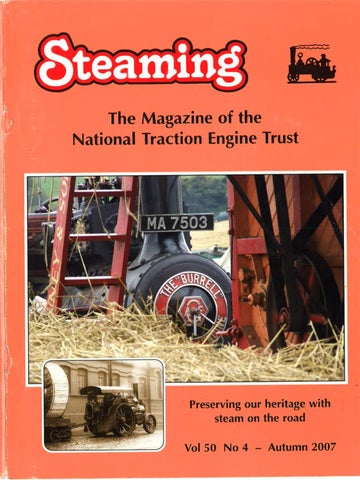
Front cover Not a glance of an engine as you walk across a busy working winter stack yard, but a keenly observed cameo by Paul Cook at the 2007 Dorset event. Burrell 5hp traction engine 3902 of 1921 is the main focus of the glimpse. 183
Trust News Engine Owners Column Engine Owners Section Code of Practice - During the Summer, along with David Smith and James Blenkinsop, I met the Pressure Systems Committee of SAFed (Safety Assessment Federation) and cleared up some final queries regarding the Trust's Code of Practice. The result is that we now have a letter from them commending Part 4 (The Written Scheme of Examination) and Part 6 (Repairs).The Code will be published in two forms - one as a hard copy in a binder and the other as a PDF file (approximately 150 pages) available for downloading from the NTET web site. The cost will be free from the web site, and hard copies will cost £25 to cover production and postage costs. (see the panel advertisement elsewhere in these pages) Competency - Several years ago the Rally Organisers Conference passed a motion that all engine drivers at NTET Authorised Rallies should be examined and have a Certificate of Competence by 2008. The then National Committee charged the Engine Owners Committee with developing a Competency Test. That Committee strongly opposed (and still do) a compulsory Competency Scheme and hence the need for 'grandfather rights' that comes with a compulsory scheme. After a considerable amount of deliberation a scheme was evolved which was based on the advanced driving test of the Institute of Advanced Motorists - a voluntary scheme - which motorists who already hold a driving licence can take if they so wish. The Trust's voluntary Competency Scheme was introduced in 2003/4 and to date 68 engine drivers (11of whom are Apprentices) have volunteered to take the test. The following two paragraphs are a précis of discussions recorded in the minutes of the Rally Organisers Conference held in March 2007, and are set down here for the benefit of engines owners and crews. During 184
discussions under 'Any other business' Rally Organisers Section chairman Paul Worbey told the meeting that, as long ago as 2001, event organisers at Conference had agreed that from 2008 no one would drive a steam engine on the rally field without a driving certificate. Unfortunately, although the mechanism was in place for voluntary certificates, there were not enough people available as examiners and therefore the requirement could not physically be achieved. It was noted that: • it is a voluntary scheme, because by law you can drive a traction engine on a car licence, • the Engine Owners Section do not want to give 'grandfather rights' • the older drivers dislike the thought of taking a test • the SAL memhers enjoy tests Delegates explained that the idea was for them to get something implemented before the government imposed it on the hobby. Suggestions from the meeting included giving a £50 bonus at an event if the driver has a certificate. At the present time it would be necessary to roll forward the earlier agreed date of 2008. Paul Worbey said he would take the suggestions back to NTET Council. Office of the Rail Regulator (ORR) - David Smith and myself recently met with a representative of the ORR to discuss matters of mutual interest in light of the fact that the ORR, the HRA (Heritage Railway Association) inspection bodies and other interested parties are re writing their Codes of Practice. The outcome of the meeting was extremely fruitful and we agreed to maintain contact to ensure that we can provide the correct advice for the maintenance and use of locomotive type boilers in both the traction engine and railway sectors. Boiler Inspectors - A meeting with the independent boiler inspectors is planned to be held at the end of October to discuss matters of mutual interest. Engine Owners Meeting - The next Engine Owners Meeting will be held on Sunday 17th February 2008
at the Village Hall, Willoughby, near Rugby, Warwickshire. All engine owners, crew and other interested parties are invited to attend, whether members of the Trust or not. (all paragraphs - Bob Siddall, chairman of Engine Owners Section)
Competency Scheme In my last notes on this subject I wrote about the invitation from the organisers of the Cumbria rally at Flookburgh to carry out competency tests during their show. Given that I was running the SAC Driving Day on the Friday, Robin Drury was the only examiner in operation on that day, carrying out the first static engine tests so far. Over the next two days, Robin, Dave Smith and myself successfully carried a further 13 tests. I don't want to mention everyone who took part but, given the current focus on questioning why we need this scheme and who should do it, I would like to mention Gerald Burns of Preston, a gentleman of 79 years, who was driving rollers for the Council at the age of 14. It could well be argued that a man such as Gerald has no need of a competency test but he chose to take one, quite voluntarily. It was my considerable privilege to be able to assess him, and his son Michael. Put together there was 110 years of steam experience on their engine that day. Both had the grace to say that they had learned something during the day - I know I did. During the Great Dorset Steam Fair a request was made that the Member's Forum be resurrected and held in the Trust marquee on the Friday evening. This happened, with the main point of discussion being the Competency Scheme. Whilst we are in the 'close season' for engine activities perhaps you would like to know more about what the Competency Scheme involves. Contact me either on Tr 01283 712818 or by email com petency@ ntet.co.uk - for a syllabus and more information. I should also point out that a syllabus for Sentinel and other undertype wagons is in preparation, reflecting Autumn 2007
STEAMING
the considerable differences between and more these vehicles conventional traction engines. (John NTET administrator, Durling, Competency Scheme) Lost Registrations The Trust is pleased to announce the appointment of Derek Rayner as its Authenticating Officer for the DVLA Swansea's 'Lost Registration Scheme' — maybe better known as the 'V765 Scheme' after the designation of the form used for an application. The previous incumbent of this position, Peter Smart, resigned earlier in the year and Derek has kindly volunteered to add the task to his similar role for the Road Roller Association, which he (and Peter) have carried out since the V765 Scheme's inception in the early 1990s. On behalf of members, the Trust would like to extend its sincere thanks to Peter for all the hard and invariably successful work he has put in over the past years. The V765 Scheme relates to vehicles that have been previously registered in Britain but, for whatever reason, with the registration mark no longer on the DVLA computer. Derek will, on behalf of the Trust, deal with all steam road vehicles that come within the Trust's range of interests (this excludes steam cars), and will continue to look after steam and motor rollers on behalf of the Road Roller Association. A fact sheet has been prepared detailing the DVLA forms required, where to get them, and other additional details such as traceable documentary evidence that will be necessary for a successful V765 application.The fact sheet is available by post from Derek on receipt of a stamped addressed envelope, together with an additional and separate second class stamp. The sheet can also be downloaded from the Trust's website. As V765 applications are for the taxation class of 'Historic Vehicle', in view of the recent DLVA definition of a Radically Altered Vehicle (RAV), the Trust has indicated that any applications for vehicles that come under the RAV category, and which bring them out of the Historic Vehicle taxation class category, will be referred to Swansea for them to be dealt with separately. Members are advised that there is a fee involved for the service, set at £15 per application for Trust Members and £40 for non-NTET members. Steam and motor rollers STEAMING
Autumn 2007
A group photograph for those who successfully took competency tests at the Cumbria rally at Flookburgh at the end of July.
will be dealt with as previously, under the RRA's jurisdiction, at £15 and £30 respectively. Cheques should be payable to the respective organisation and accompanied by the appropriate current membership card. Also within the Authenticating Officer's position is the facility to assist with those vehicles never
registered for the road in Britain. These include recent imports and which now require a registration mark for lawful use on the roads. Derek will deal with this aspect by providing a suitable dating letter, on receipt of a fee of £10 together with relevant supporting traceable documentary evidence. This will
NTET's Engine Owners Section
Code of Practice for Traction Engines and similar vehicles The NEW Code of Practice, endorsed by SAFed (Safety Assessment Federation), is due to be published at the beginning of November and Part 4, The Written Scheme of Examination, including the new inspection report forms, comes into force on 1st January 2008. The Code will be available in two forms: hard copy in a binder, and as Acrobat PDF files. You will be able to obtain your copy from the following sources: • Downloadable from the NTET website as PDFs, free of charge (approximately 150 pages). • From the Engine Owners Section in the form of a binder, with all the pages in plastic wallets, at a cost of £25 (post and packing free of charge to members). • From the NTET Sales Stand in the form in the form of a binder, with all the pages in plastic wallets, at a cost of £25. To pre-order your hard copy please.write to Bob Siddall with a cheque for £25, payable to National Traction Engine Trust, at — Stud Farm House, Ossington Lane, Sutton-on-Trent, Nottinghamshire, NG23 6QR.
•
185
enable an age-related registration mark, or otherwise, to be issued — depending on the evidence provided. Members needing to make use of the Schemes should contact Derek Rayner, 9 Beagle Ridge Drive, Acomb, York Y024 3JH.
Technical Services Boiler Inspections Audit Scheme — On January 1st 2008 the NTET's Boiler Inspection Audit Scheme goes live. This long awaited addition to the NTET's Safety Management System (itself part of the Health and Safety Policy) was devised in response to suggestions and requests made by members for improvements to the integrity of boiler inspections. The introduction of the Audit Scheme is a significant step in the history of the Trust and is aimed at demonstrating self-policing capabilities. The Audit Scheme is designed to bring about a more consistent approach to the thorough examination of the pressure systems
associated with road engine boilers. In particular attention has been paid to more clearly identifying the areas included in examinations and also improving the subsequent details included in the attendant reports. Initially the Audit Scheme will be applied to so-called independent boiler inspectors but it is hoped to widen the scope to embrace all boiler inspectors. A major asset to the Audit Scheme has been the commendation in August 2007 by the Safety Assessment Federation (SAFed) of Part 4 Written Scheme of Examination, and Part 6 Repairs, of the Engine Owners Code of Practice, published by the Engine Owners Section. The following points summarise the major aspects of the Audit Scheme: • The Audit Scheme is based on the NTET's Engine Owners Code of Practice Part 4 - Written Scheme of Examination (October 2007), commended by the Safety Assessment Federation (SAFed). • Miniatures and models and steam cars will not initially be included in the Scheme. However, the NTET will be asking bodies representing those interests to demonstrate how they would monitor compliance with their respective Codes of Practice covering examinations
The National Traction Engine Trust's
2007 AGM will be held at 2.00pm on
SATURDAY, 17th NOVEMBER 2007 at The Clarion Hotel Telford, Castlefields Way, Madeley, Telford, Shropshire Please refer to the formal notice in the Report and Accounts which is distributed with this issue for details of the Agenda etc, and to the other notes on this page for the arrangements that have been made for the rest of the day and on the Sunday.
The 2007 AGM The Trust's AGM for 2007 is to be held in the Midlands — at Telford in Shropshire at a location that is not far from the motorway network that will allow a large percentage of the membership a fairly speedy journey, 186
and also close to The lronbridge Gorge Museums for those who may wish to spend a day or two in the area. The arrangements are centred on the Madeley Court Hotel atTelford, where the meeting will be held in the afternoon, and a block reservation has been made by the Trust for those
of the pressure systems. • The Scheme will be administered by the NTET Insurance Officer in conjunction with the administration officer of SAFed. The latter will liaise with those qualified members of SAFed undertaking the audits. • Attendance at an NTET Authorised Rally will only be afforded to steam equipment displaying an NTET insurance disc — including items exempted from the Audit Scheme. • An NTET insurance disc will only be issued to owners/keepers participating in the Audit Scheme. • The NTET will furnish each inspector or inspection company with master templates of the Written Scheme of Examination data sheets, the report proforma and certificates being applied within the scheme. In the first year of the Scheme, in order to allow the new procedures and associated paperwork to beddown, a desktop audit will be undertaken whereby inspection reports will be chosen randomly for detailed examination by the SAFed auditors. Compliance with the reporting protocol will be the main examination criteria. In the subsequent and following years a live audit will be undertaken, that is, at the time of the thorough examina-
wishing to stay on the Friday or Saturday nights; there will be a formal private Trust dinner on the Saturday evening. The 2007 AGM is at 2.00pm on Saturday, 17th November at the Madeley Court Hotel, Castlefields Way, Telford, Shropshire TF7 5DW. From the M54, exit at junction 4 and take the second exit at the roundabout along the A464 toTelford (not Shifnal). At the next roundabout take the second exit and continue to Randlay interchange roundabout, there taking the first exit leading down onto the A442 dual carriageway. Continue on this road (not turning off for Madeley or Kidderminster with the A442) until it narrows into the single lane A4169. Follow this to the Castlefields roundabout and take the first exit for B4373 — the hotel drive is located about 200 yards on the left. Formal notice of the Meeting, the Agenda, and the Annual Report are distributed with this magazine. In the event of voting being necessary at the AGM only current members are, of course, eligible to vote. Members should therefore ensure that they have with them at the meeting their current membership cards as Autumn 2007 STEAMING
tion. The live audit will concentrate on compliance with the Written Scheme of Examination, the examination process and completion of the report pro-forma. The annual, randomly selected live-audit list will consist of 75% of independent boiler inspectors (currently 8 out of 11). Consequently, for each inspector added to the list an engine will also be randomly selected from the list of engines that the inspector normally examines. The owners/keepers of the engines will be notified of their inclusion in the live audit, following which they will be expected to advise the scheme administrator (NTET Insurance Officer) when the inspections for the current year have been arranged. Those inspectors not selected for the current year's audit will be automatically included in the following year. The costs relating to the development and launch of the Scheme will initially be met by the Trust from reserves generated by donations received from some of the insurance disc issuing agents. However, methods of raising revenue to meet the ongoing costs of the scheme are being explored with a
evidence.The names of the nominees for positions of officers or council members of the Trust, together with Motions under Article 16 of theTrust's Articles of Association, will also to be found in the Report & Accounts. At the conclusion of the formal meeting, about 5.00pm, tea, coffee and biscuits will be served. A selection of the Trust's trophies and shields will be presented then, or at other appropriate times during the weekend's activities. Val and Colin Brown will as usual bring a good selection of the more appropriate items from the NTET Sales Stand. If you want to ensure a particular book, DVD or sweater is available, maybe for a Christmas present or a birthday, please pre-order via the Mail Order address and ask for your purchase to be brought to the AGM, when it can be handed over in a discreet manner, or otherwise.
The Saturday morning With the excellent range of interesting museums and locations that make up the Ironbridge Gorge Museums, there will be no specific visits this year, but a special discounted group rate has been arranged forTrust members to obtain STEAMING
Autumn 2007
It is in the nature of things that more and more of our engines become centenarians. This picture by Robin Walker, taken at the Innishannon rally in County Cork, Eire this June, is of Ransomes, Sims & Jefferies 7hp traction engine 19609, which left the makers' works at Ipswich in August 1907 As can be seen from the flanged casting at the smokebox, to which bolted a headstock, the machine was supplied as a convertible for use at hauling or road rolling.
a weekend Passport Ticket (Saturday and Sunday, all day) giving access to all ten of the sites. This is priced at £9.75 per person, or £8.50 for seniors, but you must be able to produce your current NTET membership card to benefit from this substantial reduction on the usual individual admission rate. The Museums are about two miles from the AGM venue and hotel and, in November, are open from 10.00am to 5.00pm (4.00pm at the Blists Hill Victorian Town). The lronbridge Gorge is known as the Birthplace of Industry and is a remarkable and beautiful place to visit. Evidence of the early industry of the 18th century survives as furnaces, workshops and canals in the villages of Coalbrookdale, Ironbridge and Coalport. The Museums offer a wide variety of subject material, and members who plan to visit the sites for the first time are advised to do some planning from the lronbridge website www.ironbridge.org.uk
Staying for the weekend For members who wish to make a social weekend with friends around the AGM, a block booking of rooms for overnight accommodation has
been made for the weekend of the 16th and 17th at the Clarion Madeley Court Hotel atTelford. En-suite rooms are available at a special NTET inclusive rate of £50.00 per person per night with breakfast (Friday and/or Saturday). Members should make their own reservations direct with the Hotel (a 01952 686607) - please mention that you are an NTET member and be ready to quote the reservation code TH161107
The Saturday evening On the Saturday evening there will be a formal dinner, private to the Trust, at the Madeley Court Hotel, at 7.30 for 8.00pm. Tickets for the four course meal, which will an only slightly early seasonal Christmas dinner, are available £26.00 per person (the number is limited to about 100). A vegetarian option will be available. It is thought unlikely the Trust chairman will be white bearded and red robed. Tickets must be booked and paid for in advance please advise your booking and send your remittance by 10th November at the latest (cheques to be made payable to NTET) to our General Secretary, Sue Jackson - address inside front cover or zr 01494 521727 187
view to making the scheme selffinancing as soon as is practicable. In-Steam examinations at rallies — No! During this season I have been made aware that some boiler inspectors are undertaking Part 2 of the thorough examination — the in steam inspection — at rallies or events duiiny times the public die present. This is not a practice that the NTET condones, and it is contrary to its Health and Safety Policy. Event organisers should seriously consider the potential consequences of allowing this practice and the Trust reminds its members, and nonmembers, of the implied duty of care required when operating pressure systems in public. Unfortunately there are still some gung-ho attitudes prevailing that could potentially harm our hobby. It's one thing to exercise our freedom to do as our grandfathers did by showing off our charges, but in these increasingly litigious times we need to do it responsibly. Dorset Engine Owners Forum — You may read elsewhere of the impromptu Forum held on the Friday evening in the Trust marquee at the Dorset event. I was instrumental in arranging this meeting after having many discussions with engine owners during the course of that day — during which many negative opinions were expressed on the working of the Trust and its officers. Of particular concern was the Competency Scheme, but the focus appeared to be on the apparently intransigent opinion of the Engine Owners Section that grandfather rights would not be granted whilst the Scheme was voluntary, as voiced by the section chairman, Bob Siddall. Robert Herring, chairman of the Trust, agreed to convene the Forum at short notice; over 130 enginemen attended and indeed the Competency Scheme was the major source of concern and much loud debate followed. Despite re-iteration to the
meeting that the Scheme is a voluntary scheme, and there is no legislation that forces use to adopt such a scheme, real or imagined, there was an implacable belief that there was a hidden agenda, controlled by the rally organisers and orchestrated by Trust, to the effect that competency tickets would become mandatory at NTET authorised events. The Trust was called upon to guard against such events by granting grandfather rights to all existing engine drivers. Two separate proposals were suggested; the first that we review the working of the Competency Scheme with a view to allowing certificates to be awarded to a second stream of 'experienced' applicants — no need for the test; and the second was that the Trust should exchange the word voluntary in favour of mandatory and that subsequently all drivers should carry a Certificate of Competence. Robert Herring concluded the heated discussion by asking anyone who had suggestions as to how the scheme might be modified to contact him. I don't intend to debate the merits of the proposals here, but I am concerned that despite all the hard work that goes into running and representing the Trust, its officers stand accused of not communicating, of having hidden agendas and of being members of a secret society! I have no idea how many of the 130 plus folk at the meeting were members, but I don't recall seeing many of them at Bob Siddall's Engine Owners Meeting earlier this year. If they had attended they would have heard Bob and myself emphasise the voluntary aspects of the scheme and both of us standing firm against the use of grandfather rights in such a voluntary scheme. Of the NTET members known to me at the meeting I was surprised and dismayed at the beliefs and negative attitudes held by some.
ADVANCE NOTICE
Engine Owners Meeting Next year's Meeting will be held at the Village Hall, Willoughby, near Rugby, Warwickshire on
Sunday 17th February 2008 All engine owners, crew members and other interested parties are invited to attend the open meeting, whether NTET members or not. More information will be published in the next issue of Steaming.
188
'Why didn't they talk to us before things got so heated?' I keep asking myself. The Competency Scheme is under constant review; we have an informal inquest after almost every assessment, so I have no difficulty in considering practical changes as the need da ises. Wlieie I du have difficulty is the concept of a second stream of volunteers to the scheme who don't want to take a live assessment. The voluntary Competency Scheme currently asks for a practical demonstration of basic enginemanship.Two years ago John Durling took over the administration of the Scheme and he works very closely with the small team of assessors who all give their time freely. The assessors are appointed after volunteering to be subjected to a basic assessment on themselves and then, only after attaining a very high score, undertaking a further scrutinised assessment of their ability to fairly and consistently apply the examination syllabus in a live situation. Irvin Barraclough and myself are the two senior assessors responsible for ensuring that the new applicants meet all of the important criteria associated with the Scheme. Collectively these are the guys who risk their own reputation by daring to comment on the ability, or otherwise, of others, albeit in a constructive manner. Engine drivers should be assured that if some government authority or a superior body were to insist on some form of ticket then we would devise an equitable method of ensuring that all comers could be assessed based on previous experience, but today and for the foreseeable future there is no such pressure. Anyway, at the meeting we gave an undertaking to examine any suggestions that we receive to determine if there is scope to modify the scheme to allow experienced folk to volunteer into it and, despite any personal feelings, that is exactly what we will do. My personal endeavour as an officer of the Trust is to try and help set in place policies and procedures that will carry the steam preservation movement well in to the future, safely, within the law, and in as practical and friendly manner as is possible. Where's the hidden agenda in that? AGM motion under Article 16 — Following the recommendations coming from Operation Blastpipe (the Trust's business review of 2005/6), the Articles & Memorandum Autumn 2007 STEAMING
This fine picture shows an early Marshall agricultural engine that seems to have spent its working life only a dozen or so miles from where it was built in Gainsborough, Lincolnshire. The detailed write-up taken from The Engineer of July 1879 which appeared in our Summer 2006 issue was accompanied by a drawing depicting a very similar machine, and it is worth referring to it and making comparison. Whilst the subject of the photograph is largely similar to that Royal Show engine of 1879, it shows some improvements in design, which probably dates it to a couple of years later. The higher• pitched boiler is slightly longer and has a deeper firebox, though the short wrought iron horn plates are still separate components, riveted onto the outer firebox plates. The engine is somewhat different, with a trunk guide replacing the earlier separate slide bars. The altered cylinder, however, is still provided with W Church & Co's circular slide valve, as were many of Marshalls' agricultural engines through the 1880s, and from this left side of the engine we can see the distinctively shaped valve cover. This is a sharply focused print, but the several rows of lettering around the casting are not quite legible. The Marshall was owned by the Havercroft family of Barton on Humber. used at their threshing business in the south Humberside area. Road Locomotive Society records are silent on the identity of such an engine being with George Havercroft of High Street, Barton, though Fowler R class single cylinder traction engine 10834 of 1907 is listed as being acquired by him secondhand in 1922. Our picture is said to date from the 1920s, so was this the old engine having its picture taken before being supplanted by a fresh one?The Marshall is well kept for its age, but who knows the condition of the boiler. The original, taken by local photographer B Parker of Barton on Humber, was kindly made available, via member Dave Crampton, by Norman Havercroft of Cleethorpes - his brother is on the footplate, and his father by the tender.
of Association of the Trust have been revised and modernised in collaboration with our legal advisers Harrison Clark. The updated version has been approved by the Charity Commission, and a copy of the document is distributed to each Trust member with this Autumn issue of the magazine. The new Articles have STEAMING
Autumn 2007
to be approved by members at an Annual General Meeting, and I have accordingly made a formal proposal under Article 16, which has been seconded by John Billard, that they are adopted by the meeting for immediate application. The formal wording of the Motion is set down in the Agenda for the AGM, on page 2 of
the Report & Accounts booklet, also distributed with this issue. Boiler inspections newcomer Alan McEwen, formerly of McEwen Engineering, advises me that he is offering his 40 years experience to engine owners by undertaking boiler consultancy inspections and contracts. He is prepared to travel in the UK and in Eire. I have told Alan the NTET's position regarding insurance requirement and the introduction of the Boiler Inspections Audit Scheme. No doubt we shall see him advertising his trade in this magazine in due course. (all paragraphs - David Smith, Head of Technical Services)
Insurance Matters One of the duties I perform during each rally season is to provide up to date insurance disc information for those event organisers who request it in advance of their NTET Authorised Rally.This is performed by checking a list of engines attending each event against the list of all engines issued with a disc from the disc database held in the Insurance Office. Once completed the organiser's list is sent back to the event organiser/safety officer, showing only the information printed on each disc and whether the 189
The European Traction Engine Register
1111 11 1211.14, 111 II \ 1 111111 1.1 R.1 I'IU RI t.,ISTI 12
Browse now for your next holiday John Toy and Derek Rayner's lists reach all corners of Europe, so don't miss out on seeing that engine in the next town. Reviewed in our Summer 2005 issue. £5.00 post free from Colin and Val Brown, NTET Sales, 90 Devon Road, Luton, Bedfordshire LU2 ORL disc is still valid. The obvious benefit of this to the organiser is that the time consuming task of collecting the disc details is eliminated and frees up the safety officer for more pressing work on the opening day of the event. However, whilst preparing many of these lists, it has become apparent that some engine owners are unaware that their disc has expired for boiler inspection. I'm sure that it is not the case that the inspection has not taken place, but is either the report is slow in coming through from the inspector, or the owner has yet to send a copy of the report to their insurer to get a new disc. As a timely reminder, please be aware that from next year all Authorised Rallies will be disc only events. So it will be up to every engine owner attending these events
G
ears
GEARS UP TO 8ft 6in DIA SPLINED SHAFTS UP TO 25ft LONG Broaching and Splining - Spurs , Racks, Helicals Worms and Wheels, Bevels - Straight and Spiral Stock Gears and Splines Wire Cutting - Gearbox Rebuilding Specialist Supplier of Gears and Splines for all Vintage Vehicles and Traction Engines Telephone Mike Horlick LLEWELLIN'S GEARS KING SQUARE, BRISTOL BS2 BJJ TEL: 0117 942 4026 FAX: 0117 923 2028 E-Mail: info@llewellins.co.uk Web: www.11ewellins.co.uk 190
to ensure their engine carries a valid insurance disc. For those new to the system I should explain that insurance discs are issued by the Trust's agents who provide specialist insurance cover. The discs are usually issued at the time of insurance renewal providing there is a valid inspection certificate for the engine on file. In the majority of cases the insurance renewal date will not coincide with the boiler inspection date as inspection periodicity runs for up to 14 months. This results in the need for another disc during the season, which will be issued when the boiler inspection paperwork is sent to the insurer. NTET Insurance Discs are issued to those insuring with either Footman James, James Campbell Insurance or Walker Midgley. For those who make their own insurance arrangements, discs can be issued through the NTET Insurance Office when an application is supported by copies of the insurance and boiler inspection certificates. (James Blenkinsop, Insurance Officer)
Steam Apprentice Club My intention was that these notes would commence by looking back at the season and to give thanks to those who helped the Steam Apprentice Club. It is therefore regrettable that I have to start on a more serious note. I understand that the SAC coordinator for East Anglia has approached enginemen and others, making agreements and demanding 'assistance' be given for the Apprentices. The person concerned had no authority in making such approaches and certainly not in the manner alluded to. It is not the way the SAC does business. I have apologised, on behalf of the section to those we managed to talk with at Dorset, once we became aware of what was going on, and offer similar apologies to anyone else who may be involved, for we are unsure who was approached. Without the goodwill owners and crews show to the section, the SAC wouldn't exist, and indeed the future of the movement would be jeopardised. The person concerned is now no longer a member of the SAC, or connected
with the section in any way. I must now go back to how I originally intended to open! May I offer my sincere thanks to all of those who made it a successful season for the SAC — in whatever form that took; to those who did the SAC Driving Days throughout the country, and especially the fresh engine owners and helpers who made their services available in the parts of the country where we didn't before have coverage. The support given by the NTET as we expand our activities into other avenues associated with steam is much appreciated and is helping us in many ways, which are both tangible and sometimes less visible. To Martin Oliver and David Allen of GDSF who allowed us to expand our activities and 'experiment' on how we cater for the large number of Apprentices we get at Dorset I make a special mention: more experimentation next year please Martin! As always, if anyone wishes to discuss matters, offer help, or make suggestions for the SAC, I am available through the contact details at the front of the magazine or via the website. (Kevin Munn, chair, Steam Apprentice Club)
FBHVC News Changes on drivers' hours. Further to my earlier notes on the legislative changes to comply with European regulations on drivers' hours, the regulations excluding historic vehicles from the tachograph and drivers' hours regulations have now been introduced, using, as promised, a simple definition of historic vehicles as being those over 25 years old and not used commercially. It would be most helpful if members could share with us their experiences of operating the new regulations while transporting engines etc. This is not to say that we would be successful in obtaining repeal, but it would be good for the Federation to know what the overall effect has been. Members will be pleased to note that there appears to be nothing else new on the legislative front at present that may affect steam users on the roads. However please do not let that stop anyone commenting or Autumn 2007 STEAMING
reporting possible issues. If we don't know about it we can't do anything. The Federation AGM takes place on 13th October and this will include some issues familiar to NTET members — proposed new Articles of Association and Memoranda etc. If agreed this will result in a slimmed down, more functional, board. On that basis I have decided to step down as a FBHVC director. However I will be continuing to attend as vice chair of the Legislation Committee (where much the work is done), so will continue to represent steam interests at that level. (John Billard, FBHVC representative)
From the Treasurer The annual accounts for the year ended 31st March 2007 are enclosed with every member's copy of this edition of Steaming. During this financial year theTrust began the agreed modernisation processes and these have resulted in some planned one-off expenditure, which span this and the next financial year. All of the costs incurred in the year have been planned and managed by robust budgetary controls. At the end of the financial year the Trust remains in a strong financial position and is able to deal with the ongoing costs in the STEAMING
Autumn 2007
What do you think of this? Jim Stevenson kindly lets us have this picture for the magazine, which is a bit of a mystery scene that readers may like to comment on. It is pretty clearly a sale day, with the well prepared engines lined up in the usual fashion with what could be some of the owning family near the camera. The first seven chimneys from the right are of ploughing engines (so there is probably an eighth out of the picture to the right). The other eight, or more, chimneys may be on general purpose engines. Just one clue enables us to elaborate a little. It is an Aveling compound ploughing engine at the right, but the next one, a Fowler class K7, just shows the registration EB2930. That enables Bill Wells, Road Locomotive Society records officer, to identify it as 14315, and it will be 14314 (which was EB2931 — not in sequence) next in the line. There follow another pair of K7s, and two McLaren ploughing engines, before the print becomes rather hazy. 14314/14315 were new in September 1917 to Henry Thompson Ltd of Littleport, Isle of Ely. They were fitted with girdle wheels at the rear — wooden artillery wheels with ten steel framed paddles fixed around the rim had seen successful use on thousands of gun carriages and the like in the muddy conditions in France during World War 1, and it must have been thought worth trying a heavier version on a ploughing engine to be used on the Cambridgeshire fens. As it is recorded by Fowlers that the girdle wheels were removed in November 1917, the innovation must have very quickly proved to be not worthwhile. Our K7s had several owners after Thompson, but it is noticeable that the picture shows them to be the only machines with road registration numbers — the marks EB 2930/2931 were issued on 16th March 1921, not long after registration had become necessary at the turn of the year. This may date the scene to about that time, but where is the location, and whose sale was it?
forthcoming year. The officers of the Trust are involved in substantially increased workloads caused by the modernisation processes. This involves a significant amount of unpaid time. It is impossible to quantify this time and effort, and obviously this is not reflected in the accounts. (Julie Smith, Treasurer)
Obituary David Prout David Prout, of Dymock, Gloucestershire, has died at the age of 63, and on a Tuesday in August his family and 650 of his friends gathered at St Mary's Church in the village to say their last farewells. Dave was a man who never 191
suffered fools gladly and 'what you saw was what you got'. He was involved with the rallies at Much Marcie, and what super rallies they were. It was in 1971 that Len and I first got to know him - in those days we steamed everywhere, and Dave had found us a farm on which to leave the engine. But he failed to tell us of the soft ground, liable to subside, and sure enough, we did. We found it a little hairy, but Dave's humour really came into its own at our subsequent antics. Because his vision was for a bigger event the site at Much Marcie became too small a search for alternatives ended atWoodside Farm, Welland, where his energies and foresight founded the home of today's Welland rally. The move was enhanced by the purchase of the land, making it one of the only Clubs to own its own site, and an achievement that added much to the event's success. Apart from the rally Dave found time to work to restore a fairground jet ride, and his pride and joy the Burrell showmans NANCY. With the engine towing a flower be-decked trailer, he was taken to his final resting place. The service was magnificent, taken by a lady minister, who led tributes along with Mike Phelps. Ft was a fitting tribute to a larger than life character - a big man, big heart and big ideas. Some pass this way unnoticed, not you Dave, you made a lasting impact that will be hard to follow, and as we all joined with you in the laughter of the past that day in August, we joined with all present in their tears. Rest in peace, Dave, we will miss you, your energy and those red overalls. Our sympathies go to Dorothy and her family, Roger, Sally, Allan, Tom and their families. (Jane Crane)
Affiliated and other groups Blue plaque for the Midland Engine Works On Sunday 17th June the Leeds Civic Trust, in conjunction with the Leeds & DistrictTraction Engine Club, unveiled a historic 'blue plaque' on the site of the former McLaren Midland Engine Works in Jack Lane, Hunslet -the final one in a series that the club has arranged to mark all of 192
the road steam manufacturers in Leeds. The provision of this plaque was supported by the Trust, and the Road Locomotive Society, the Road Roller Association, the East Anglian club and by many other personal donations. The unveiling was performed by the Lord Mayor of Leeds, ClIr Brian Cleasbury, attended by Peter Baker, chairman of the Leeds CivicTrust and Derek Rayner, president of the Leeds club. The site is currently the premises of Equinox Design Ltd, a leading international exhibition design and build company, who kindly donated the construction of the plinth upon which the plaque is mounted. The plinth is made from bricks from an original wall dating back to the construction of the Midland Engine Works in 1876. The occasion was enhanced by the presence of two McLaren products - traction engine number 682 of 1899, owned by David Bradley of Ferrensby, and a class H diesel powered windlass, number 1962 owned and cosmetically restored by the Leeds Industrial Museum at Armley Mills. The traction engine is unusual in that it is presented in 'as found' condition, having received the necessary work to make it safe and functional, but receiving no cosmetic restoration. The engine was previously in the ownership of Nicholsons of Faldingworth, Lincolnshire, scrap merchants.
A non-steam product McLarens one of the scores of oil engined windlasses they exported to cotton growing areas of Sudan in the late 1920s. This example was repatriated and restored by the Leeds Industrial Museum some years ago - why is the company name spelt MACLAREN on the radiator casting? (John Durling)
The blue plaque commemorating the Midland Engine Works, Leeds. (John Durling)
fIL
Museum of English Rural Life Conservation and archive work, funded from a Heritage Lottery Fund Autumn 2007 STEAMING
grant, has continued on the makers records at MERL at Reading. Road Locomotive Society volunteers have now catalogued 10,500 Burrell drawings, and have been archive trained to place protective sleeve to the more fragile tracing paper examples. Wallis & Steevens drawings and glass photographic negatives have received similar appropriate treatment, and have been catalogued for publishing on Access to Archive websites. Archive workshops to introduce the potential of the vast amount of road engine history that is held at MERL are being held during the autumn. Two hour sessions have been arranged on four makers - John Fowler; Ransomes Sims & Jefferies; Wallis & Steevens and Marshall, Sons. At the time of writing spaces were still available on the Marshall workshop on Wednesday, 5th December, and it is hoped to repeat earlier sessions in 2008. Anyone interested in attending these, should email their contact details to merlevents@reading.ac.uk or'2 0118 378 8660. Lincolnshire Archives Members will be aware of the Aveling-Barford Collection that has for some time been deposited at Lincolnshire Archives - it includes surviving record books and ledgers of the Aveling & Porter company; similar items from Barford & Perkins of Peterborough and later records of Aveling-Barford of Grantham in Lincolnshire. Much of the archive is presently unlisted and not of easy access, and it is hoped that there will shortly be an opportunity to bid for funds to enable a full cataloguing to take place. Engine owners and restorers, and engine historians who hope to benefit from the use of the archive in the future - on any of the makers mentioned above - are invited at this time to write to express their support for the venture. Letters should be written and addressed to Mr N Kingsley, but sent to Adrian Wilkinson, Lincolnshire Archives, St
Rumbold Street, Lincoln LN2 5AB so that he can forward them in bulk in due course.
Dorset appreciations The Trust's large tent at the 2007 Great Dorset Steam Fair continued its growth, with this year an exceptional newcomer to give shelter to, as well as continuing with the host of activities from previous years. Members from around the country again arrived to help run the marquee, and I thank them on behalf of all Trust members for the time and effort spent. In 2006 there were most interesting engine exhibits to be seen in our tent, and this year there was appreciative interest at the continued progress on Richard Vincent's recreation of a Hindley steam wagon, and the Foster single cylinder steam tractor, newly built by David Sheldon for Ian Gilbert. The latter is now complete, numbered 14739 in sequence from the last Wellington Foundry engine in 1942. Alan Rundle brought along a task for the future - a tiny Tuxford portable, with some fascinatingly creative boilerwork of yesteryear. But the sheer size of the exhibit by Dave Eves took away the breath of many. The fourth of the Fowler B6 showmans engines of the
1930s - ONWARD, the one that failed to survive - is now Dave's creation from nothing. There must have been thousands who came specially to the marquee to stand in awe of his ability and conviction to the task, and to study his dedication to authenticity. This was the one chance to see the half way point - the engine had only recently been built up and won't be seen again in public until it is complete and working. Thanks are due to all the engine exhibitors for the considerable trouble they go to show their machines at our Dorset tent. Elsewhere in the tent, the art exhibition, now in its third year, continued to attract many people to browse the pictures that had been hung by artists Robin Wheeldon, John Hancox and John Wigston. The hard work to produce the tea and coffee in the tent is done by a great team and I thank Wendy Chapman, Christine Giddings, Jan Greenhough, Angie Head, Mary-Lyn Hill, Sally Humphrey, Charlotte Keeley, Irene Kelly, Shirley Manning, Dulcie Stagg, Gill Stoneman, Maureen and John Street, and Val Wingate. There was the usual excellent support from members (and of course their friends) to the donation bowls - there is no charge for the tea or coffee, but the members should know that the coins put into the bowls considerably exceed the cost of the materials used, and then go on to cover other
24 THE CANT SHEPSHED
Sunshine and fluffy clouds in Dave Meredith's picture taken during the Banbury event at the end of June belie the poor weather leading up to the event, which spoilt the potential of much of what had been organised. Foden C type tractor 13196 of 1928 hasn't had the chance to make wheel tracks to and from its space in the line up. STEAMING
Autumn 2007
193
expenses of the tent. Here's an incidental statistic — 92 pints of milk were used over the five days. The Trust's sales area under Colin and Val Brown's care was busy and in exchange for books, DVDs and many other items took appreciable sums from members and the general public — all of which assists Trust funds.The helpers over the period of the event here were Nick Greenhough, Peter and Sue Howard, Fiona Rashleigh, Kathy Smith, Steve Snook and Jane, Peter Stanier and Steve Wagstaff. General help around the tent was given by John Kelly and Paul Shergold, with electric power supplied by Brian Wells and his team. Finally, I gratefully record the many hours that are given before, during and after the event — both directly and in support — by the wives and families of Trust Council members and officers. (John Cook, membership secretary)
New Members We extend a sincere welcome to the following new members who have joined theTrust during the last three months. We hope they will gain much friendship, information and enjoyment from their membership over a period of many years. Full addresses are not included, but the Membership Secretary is always pleased to put members in touch with one another by forwarding mail. A J Matthews, Much Wcnlock, Shropshire A J Marriott, Banbury, Oxfordshire M White, Southampton J W Nemeth, Bristol G R Jewell, Denbigh S Bean, Wymondham, Norfolk C Renshaw, Penkridge, Staffordshire J J Cockayne, Hope Valley, Derbyshire A G Bailey, Congleton, Cheshire A Williamson, Stoke on Trent, Staffordshire T Herron, Co Down, Northern Ireland K J Bakewell, Swadlincote, Derbyshire Bressingham Steam Museum A Steele, Fife, Scotland I Jenner, Middleton in Teesdale, Durham J Smith, Sparkford, Somerset Mrs M Gurney, Weedon, Northamptonshire M J Healey, Stockport, Cheshire G L JTribe, Barnstaple, Devon R Heap, Chapel en le Frith, Derbyshire R C Metcalfe, Newton Abbott, Devon P I Parker, Norwich, Norfolk Mrs V Brain, York N Naismith, Limpsfield, Surrey M Banks, Kidderminster, Worcestershire
194
reflections on out magazine of 25 years ago
The Autumn 1982 magazine marked the 100th issue of Steaming. Whilst some things have changed little since that time one thing that this year did not improve on for the better was the weather. Whilst 2007 has been a year of cancelled and postponed events, 25 years ago it was largely a good summer with excellent attendances for most shows. Looking further back to that issue's 25 Years Ago paragraphs, it's interesting to remember the generosity of the then treasurer (Mr Edney) to buy an engine to be raffled to overcome the club's serious financial difficulties. The engine was of course Wallis & Steevens Expansion 7498, now owned by Roy Herring. A long article covered the 1907 RACTrials, particularly with reference to Burrell's Gold Medal tractors. It included notes on all the known surviving Gold Medal tractors.
L Buckley, Victoria, Australia T Hayter, Malvern, Worcestershire KThorne, Exeter, Devon I Unsworth, Pilling, Lancashire A Bell, Sale, Cheshire M Burns, Carlisle, Cumbria A Hardaker, Keighley, West Yorkshire Mrs RT Gibbons, Knott End on Sea, Lancashire S Snowden, Keighley, WestYorkshire C A Brown, Brandon, Suffolk D R Rice, Bishops Stortford, Hertfordshire M Farmer, Chard, Somerset M J Self, Felixstowe, Suffolk N Lee, Heswall, Wirral Mrs D A Willmott, Gosport, Hampshire D J Sims, Basingstoke, Hampshire F G Pope, Swanage, Dorset P R Burgess, Bathurst, NSW, Australia C Cribbes, Burford, Oxfordshire D M Sherwood, Southampton, Hampshire D Fletcher, Berkhampstead, Hertfordshire L Bonsall, Chesterfield, Derbyshire I R Bell, Haltwhistle, Northumberland G J Bull, Belper, Derbyshire F Lawlor, Stradbally, Co Laois, Ireland J Tyrrell, Swindon, Wiltshire R Stickland, Billingshurst, Sussex I Robertson, Ferndown, Dorset D Whittaker, Chesham, Buckinghamshire R K Prideaux, Chorley, Lancashire S Colbeck, Chorleywood, Hertfordshire W Hunt, Witney, Oxfordshire E Massey, Northolt, Middlesex
Elsewhere, within the Lancashire notes, mention is made of Frank Lythgoe's purchase of Burrell tractor 3397 and it having once completed the .John O'Groats to Lands End run. To bring us to the present, a sister engine, 3245 owned by John Atkinson, has just completed the same run in under five days. Much has been said and written over the years about how working showmans engines only ever had a few bulbs for the driver to see what he was doing. Alan Martin therefore came up with an interesting photo from 1913 of Brown & May tractor 8439 of 1911 working at a fair in Cornwall. Clearly visible are at least nine bulbs on each side of the canopy. Whilst a lesser number than on many engines today, here is some proof that a precedent does exist for the practice. After a break of several issues a return to a topic other than road steam road was made. A couple of pages were given to an article on triple expansion Worthington steam pumps then still in use at Rosyth Dockyard for pumping fuel oil. The pumps were built in 1917, with new boilers installed in 1953. If still in use today they must be amongst the oldest engines still doing their original job on a regular basis. (Stuart Gaines)
R John, Lower St Clears, Carmarthenshire Ms J Williams, Bordon, Hampshire R AYelland, Okehampton, Devon P Wrafter, Co Westmeath, Ireland J Missen, Longstanton, Cambridgeshire K Bieber, Wokingham, Berkshire .1 Hall, Dorking, Surrey A J Davis, Radstock, Somerset J Buchan, Bristol K J Williams, Bridgwater, Somerset
Poor Steaming Martin White kindly points out our mis-identification of one of the illustrations in the last issue — on page 152, bottom picture, the Foden wagon further from the camera is number 12116 of 1925 (TU1215), not as captioned. Apologies to Keith Brothwell for mis-crediting his picture on page 145 of the last issue. On page 167 of the last issue, the caption description of the small portable on the right of the picture should have read, not that it is of questionable horse power, but of 1/2hp. Autumn 2007
STEAMING
NATIONAL TRACTION ENGINE TRUST Preserving our heritage in steam on the road
From a Burrell to a Sentinel. Rest assured. Well get you covered. The enthusiasts' favourite for over twenty years, Footman James is one of the leading specialist insurance brokers. With a UK client base of 140,000 owners of classic and vintage vehicles, Footman James consistently
Policies include as standard
uses its enormous influence to arrange the best
Boiler Explosion Cover Motor Legal Expenses
deal for you. So whatever your pride and joy, you can be
confident that with Footman James behind you, you've adopted the best policy. Talk to us soon.
Personal Accident to include Road Rage and Car/Blkejacking Multi-Vehicle options available NITET Disc scheme available Discounted Low Loader rates available
A)e7r e al your Jervico!
E7
FOOTMAN JAMES Insurance specialists. At your service.
0845 458 6788 www.footmanjames.co.uk
Authorised and regulated by financial Services Authority. Telephone carts may be monitored or recorded for your proter iron
SPECIAL RATES on modern car, motorcycle, home and contents insurance STEAMING
Autumn 2007
195
JIX at Glovers A wet day in Trafford Park
Graeme Thirkell The three photographs around which I have written these notes were taken on a very wet day, probably about 1930, at the electric wire and cable works of WT Glover & Co Ltd of Trafford Park, Manchester. They show the loading and departure of one of Norman Box's Fowler road locomotives with the trailer carrying three drums of high voltage electric cable for export. Box had a long standing contract with Glovers for the haulage of the heavy cable drums on the first stage of their journeys to the customer — to a ship's side when for export, or maybe all the way if it was a British destination. Indeed, it is interesting to note that Box was in on the initial construction of many of the Trafford Park factories that were erected by world renowned names —
196
hauling much of the heavy machinery and construction material to the sites. He then went on to supply transport to the various companies for taking their subsequent products on the first stage of their worldwide markets. What a man! The engine is JIX, the B6 class compound engine bearing the Fowler number 16264, and which had been delivered new to Box on 31st December 1926, registered NE2032. At that time it had been christened AJAX, and the name was carried until sometime in 1928, when it was changed to JIX, the nickname of Box's friend (and company solicitor) William Joynson-Hicks.The latter was a larger than life public figure of the time, a right wing Tory and Member of Parliament for Brentford, Middlesex from 1911. He held office
as Home Secretary from 1924 to 1929. Incidentally, the name AJAX was, I believe, transferred to Box's Fowler 15785, a D5 class road loco he had had new in January 1922. The rear wheels of the Fowler have been fitted with bolted on crossbar solid rubber sections — this was one of the tyre-ing options offered to customers by the Steam Plough Works at the time. The front wheels have the more usual endless bands. Both types, front and rear, were manufactured by Charles Macintosh & Co Ltd, whose works were on Cambridge Street, Manchester. Crossbar rubbers were quite popular with engine owners in the north east for agricultural engines, but in those cases usually home made from cut off segments from steam wagon tyres. How the purpose made ones fitted to road locomotives stood up to the inevitable hard usage, compared with the endless bands, would be interesting to know. The front of the engine shows us a couple of examples of its owner's special requests from the makers. Norman Box, apparently, had a dislike of tool boxes or spud pans at the front axle — as far as I am aware none of his engines had such fittings. The smokebox door has a nickel plated surface, kept in smart condition and highly polished, and it
Autumn 2007
STEAMING
bears the usual pair of Fowler style brass name plates, but lettered in this case NORMAN E BOX LTD MANCHESTER. A small item worth noting is the lack of the link connecting the high and low pressure drain cocks, which passed over the boiler top in front of the back cylinder covers; JIX, along with certain other lately built Fowlers, has separate cylinder cock operating rods on each side of the engine. I find a puzzling point at the lettering on the side boards of the awning, and again on the side of the front tank.The part of the signwriting that gave Norman E Box Ltd as the owner has been painted over, but perhaps only lightly, for on the view of the engine from the rear (opposite), those words can just be seen on the original print. I wonder if it could be a clue as to when this particular job for Glovers was undertaken, and the photographs taken - possibly it was just after the business was taken over by Pickfords, early in 1930. However, if this is so, it seems the new regime deemed it unwise to take off the Box brass nameplates on the smokebox door and the engine side covers - indeed, to show the owner and his address on a road vehicle of this type in the latter manner was a legal requirement, and that was not fulfilled in law by being applied merely with paint. STEAMING
Autumn 2007
One thing is certain, and that is that JIX's driver was very proud of his engine; even on the arduous work of heavy haulage he has presented an extremely clean machine, a credit to him and to Norman E Box. The pictures all show an excessive amount of rain had fallen whilst the task of the loaders and the engine crew was going on, but the Fowler is immaculate. The closer picture taken from the front (above) was taken inside the restricted yard space of the Glover premises, with the last of the three cable drums of that consignment about to be lowered onto the trailer; none of them are yet chained down for transit. The shipping marks on the timber of the drum nearest the engine reveal its gross weight to be 220801bs - just short of 10 tons, so if each of the drums held cable of similar size and length, the total load was 291/2 tons. The destination is marked as Delagoa Bay, one of the principal calling places for shipping on the east coast of Africa - the cables would have been for unloading at the adjacent port of Lourenco Marques (now Maputo), Mozambique, but their onward transit could have been for anywhere in northern part of South Africa, or for Southern Rhodesia. A few lines on the history of the
Glover company may be of interest. As a machinery agent for the Lancashire cotton industry in the 1870s, Walter Glover of Salford saw from machines used for making cotton-covered wire for crinolines for ladies dresses, that similar technology could be applied to the electric cable industry. From lightweight insulated copper wires for bells and signal circuits, the firm progressed on to lead-sheathed cables for underground use and became associated with early electric lighting schemes, and by the early twentieth century they were acknowledged world leaders in flexible cables for use in mines. The Glover cable works was, when the company moved there in 1898, one of the first to be erected at Trafford Park, just inside the Estate's main entrance on Trafford Park Road. We are looking at pictures made in quite close proximity to one used in our Winter 2005/2006 issue, where the Southern Cotton Oil's fleet of Atkinson steam wagons was featured on a posed photograph outside their mills, just a little further inside the Estate, and not much more than a stone's throw away from Glovers. Both premises backed on to the Bridgewater Canal. The Glover company was taken over by Vickers in 1919, but retained its name, as it 197
did when later becoming part of British Insulated Cable Co; the works closed in 1970. (In the Southern Cotton Oil article mentioned above the railway lines are wrongly referred to as belonging to the Manchester Ship Canal — in fact they, and the ones to be seen in these pictures, are the tracks of the Tra fluid Park Estate private railway.) With the engine and load taken out onto Trafford Park Road, and paused by the Lancashire Dynamo factory on the north side of the road, facing towards the Estate gates, we have a better view of the Eagle trailer. I believe it was built to carry 40 tons — notice that it has the tare weight of 6tons, 4cwt painted on it, and Box's name is still prominent. The method of securing the load is of interest — the chains to either side passing through the centre spindle hole of each drum, and then down to eyes on the side of the trailer. Notice the hook on the rear chain is stretched almost straight with the tension that has been applied. The same rear viewpoint also enables us to see all the accoutrements of a working engine that are on JIX. A folded tarpaulin cover is rested on the awning stays, and there are ropes, chains, shackles and a snatch block all hanging at the ready for use, as well as the driver's bag. It has been said that Norman Box would not have steersman's seats on any of his road locomotives, but this is obviously not the case, as one can clearly be seen here on JIX. The third and last view shows half of the solid rubber tyred trailer that has been coupled on behind the Eagle trailer. It is well loaded with 198
large lumps of coal, so maybe the intended journey was the fairly lengthy one to a ship in the docks at Liverpool, rather than the short trip to a vessel at the nearby wharves at the end of the Manchester Ship Canal. The photographs are part of the photographic archive of the Glover company that is held by the Museum of Science and Industry in
Manchester. I am grateful to them for permission to reproduce them here, and to member Anthony Coulls for noticing them (whilst he was with the Museum some years ago) and arranging with the Curator of Images for us all to benefit from seeing them. The Museum also provided notes on the Glover firm, and our Editor has added comment on the Trafford Park location.
Technical Tips — tales of caution and advice
Here are some more cautionary tales and a suggestion about the gear wheel failure mentioned in the last issue. Please let me have some more instances so that we can pass your experiences on to other engine owners. Write to or contact — Bob Siddall, chairman, Engine Owners Section, 12 01636 82199 or RGSiddall@aol.com Mud Hole Joints In the last issue's Cheshire notes in 'Steaming Around' there was a report of a mud hole joint blowing out, and in this issue there are some comments on the Letters page. I have quoted below a couple of paragraphs from the Trust's Code of Practice and
you will notice that this requirement for the clearance around a mudhole door is by no means new; indeed it is laid down in British Standard 931 of 1951. Part 4 — Written Scheme of Examination, 4.12.3; C9. — Visually examine the manhole and mudhole doors and bridges for damage, wastage, cracks, damaged or wasted threads, and correct fit in the boiler in their respective openings. All nuts and studs on mud doors and inspection doors should be physically checked for fit and full depth of thread engagement. Studs and nuts that are wasted, worn, distorted or overstrained should be renewed. Bridges or dogs should be free from Autumn 2007 STEAMING
distortion and should bed closely at the outer end with the shell or ring. The nut should seat squarely on the faced area, compressing the joint evenly all round when load is applied. The door joint face, inside joint seating and surrounding area should be examined for signs of previous leakage and wasting. The door should be visibly checked with the door joint in position to ensure that the locating spigot (a) projects well above the joint to locate the door when fitting, and (b) fits the opening within the limits specified in Part 6.8.8 (repair of mudhole/inspection doors). Part 6 - Repairs - Subject to the provisions of 6.8.4 wastage about the areas of the mudhole/inspection seatings and on the doors may be restored by welding and re-profiling. The Boiler Inspector shall ensure that, after repair, (a) the inspection door beds closely to the corresponding plate surface or ring over the full width of joint face, and (b) the spigot positively locates the door within the limits specified in the latest EU harmonised standards and BS931:1951, paragraph 19, 1.5mm each side or 3mm all round. (See also 6.3.9) Boiler mountings/steam manifolds, seatings or faces should be examined and tested. It is good practice at a major overhaul to replace all studs with new ones of the same thread. All nuts and studs on mud doors and inspection doors should be physically checked for fit and full depth of thread engagement. Studs and nuts that are wasted, worn, distorted or overstrained should be renewed. Inspection openings, bridges or dogs should be free from distortion and should bed closely at the outer end. The nut should seat squarely on the faced area, compressing the joint evenly all round when load is applied. The door joint face, inside joint seating and surrounding area should be examined for signs of previous leakage and wasting.The door should be visibly checked with a new door joint in position to ensure that the locating spigot (a) projects well above the new joint to locate the door when fitting, (b) fits the opening within the limits specified in 6.8.8 (repair of mudhole/inspection doors). Gear Changing - from a correspondent 'I have become aware of people in charge of engines who seem to be totally ignorant of the potential dangers that can arise through incorrect handling of an engine. 'The procedure I have in mind is STEAMING
Autumn 2007
that of taking an engine out of gear. I have witnessed three cases concerning rollers as it happens where the machine was standing on a gradient. On the first occasion the gears were forced out of mesh, but as the machine was on soft ground, it moved back only slightly. On the second occasion, at a rally, a roller was standing on an incline and held stationary because it was in low gear. The driver decided to have it out of gear which he did by brute force in pulling the gear out. The roller then ran backwards, the driver making a futile attempt to get the gear back in which was then impossible. The roller, now out of control and in reverse at a walking pace, was stopped by the tender crushing into a nearby parked car. 'The third happening was at a rally in Cornwall, in recent times, where again a roller was parked on a gradient with the front roll on a right lock. As I approached I noticed the driver was opening and closing the regulator and struggling with the gear lever. His young assistant was standing alongside holding a chock. I said to him, "What is your friend trying to do?" He replied, "Trying to get it out of gear!' I told him to put the chock under one of the rear wheels - but it was too Iate.The roller ran away in reverse, the driver frantically trying to get the band brake on. As it happened he did not run into families sitting nearby on the grass eating ice cream because of the front roll being partly on right lock; the machine came to rest across the gradient. If the steering had been on straight the consequences would have made front-page news. The use of a chock for the wheels does not appear to be necessary to these irresponsible drivers. 'Even with Health and Safety rules and numerous guide lines, any individual, completely lacking in experience of handling an engine safely, can attend a rally. Although it would be difficult without mandatory legislation, there needs to be some arrangement for a driver's competence test on handling engines both on the road and in the midst of the public on the rally field. I know that this at the present time is being done on a voluntary basis and is commendable. It still leaves us with a few irresponsible drivers at large.' Again, it is appropriate to enlarge on the above subject and to quote from theTrust's Code of Practice, Part 2 - Driving and Conduct on the Road. Changing Gear. Choose the right place - don't leave it too late to safely
change gear.Think ahead and look for an appropriate point to stop, preferably on the level. Never attempt to change gear on the move and before changing gear or taking the engine out of gear make sure that the wheels are adequately chocked so as to prevent movement in either direction Technique. The following routine should ensure a smooth and uneventful gear change. Set chocks and brakes - always use scotch blocks of adequate proportions and do not rely solely on brakes, especially on hard surfaces where a slide might be induced. Ensure that the regulator is fully closed and the drain cocks are open to relieve the cylinder(s) of steam. Release any locking pin arrangements and slide the gear shift levers; it may be necessary to rotate the engine motion to align sets of gear teeth. Where engine size permits move the motion by hand by pulling at the rim of the flywheel. Replace and tighten locking pins. Collect chocks and release the brakes slowly. When pulling away uphill from stationary leave the chock in place on the ground until the engine is positively underway, thus eliminating any danger of run back should a stall or steam lock be experienced.
a
'The Pont Royal bridge, in the city of Paris, was macadamised in one night, recently, by means of a steam roller weighing 70,000 pounds.' (from The Scientific American, New York, 7th November 1866.)
Dowv -r ,
COUNCIL OF
DoRstr.,
IAKf NOTICE THAT ThIS SRIOCE RIDGE) i; VaOrl ti 1-8 A CoUN,Y Ili YON', TN! ORQINAR .V -.7,P6A Tee WEI TAA FP If OE TlirDlliinler; AN!, THAr TN ANO PCI1,ntin oN ONARCE 17!'
B
LOGO.StrtvernActY tot+ EliCoNt , AMR [ITN WANNen ArIAIN Dit139erkii11Y IninaL !On rwr vws0.1(2I Or ‘111,14G el.11
Whilst on holiday in Dorset earlier this year Andrew Goddard came across this cast iron notice to owners and persons in charge of traction engines and other ponderous carriages: It is located in Lower Rockhampton, near Dorchester - incidentally in the village where Thomas Hardy was born - where the highway crosses the River Frome. 199
Aveling Tractor 7898 MARGARET revisited Andy Smith I was delighted to open my Summer 2007 edition of Steaming and see Derek Rayner's article 'A painter's lapse', for the subject was my old friend Aveling GND tractor 7898. Unfortunately I cannot explain the change of registration number, but I can fill in some gaps and add a few corrections and illustrations to the article. I am indebted to Peter Turvey, to whom 7898 was sold in 1997, for some of the historical data, as he also researched the registration anomaly. My first picture shows 7898, clearly bearing the registration D7078, in the company of three Essex County Council Foden wagons. It is believed taken at the Council's Torrington depot near Colchester. The wagon nearest the Aveling is Foden 10230 (HK9331), new to Essex in November 1920. The centre wagon is Foden 10434 (NO 3829) new in October 1921. Both these wagons had been sold to Tarfroid Ltd, Mitcham, Surrey by 1934 and, as was stated in Derek's article, 7898 had been sold to Jacksons of Beehive Lane, Great Beddow, Essex by 1930. From that we
can conclude the picture was taken at some point between the above dates; judging by the condition of the wagons, I would guess closer to 1921/22 than later in the decade. The tractor's convertible bracket can clearly be seen on the smokebox, as well as its half-length awning. 7898 passed to G E Rawlinson, agricultural contractor, of Hatfield Peverel in 1931 — direct from Jacksons — so was never owned by Baker Bros of Hatfield Peverel as stated in Derek's article. By the early 1950s the steam preservation movement was starting in East Anglia. My late father, Les Smith, had already built a 2inch scale scenic Burrell to Ronald Clark's design and was looking for something a little bigger. He advertised in the East Anglian Daily Times in 1954 and had several responses. As a result, he looked at a McLaren tractor and a Foster tractor before being contacted by Ted Rawlinson at Hatfield Peverel, who offered him Aveling 7898 for the princely sum of £30! The machine had been standing exposed to the elements in Rawlinson's yard for some years, as a
In this picture Aveling convertible tractor 7898 clearly hears the enigmatic registration D7078 whilst in the company of three Essex CC Foden wagons. The photograph is believed to have been taken at the Council's Torrington depot near Colchester:
The late Les Smith with his prizewinning 3inch scale miniature of Aveling & Porter tractor 7898 MARGARET, along with the AvelingBarford trophy, the Bradbury Winter Cup and Gold Medal from 1990 Model Engineering exhibition. (Andy Smith) small elm tree had grown by the rear wheel and gear case, and there was no sign of the original awning. The front end was seized solid but was soon freed with a dose of diesel oil and gentle rocking with a farm tractor before being towed on an A bar to White Lillies Farm, Downham, Essex. Incidentally,Ted Rawlinson was to go out and purchase for £60 the unique Aveling & Porter winding tractor 8942 of 1919 a few weeks later, direct from
its original owners L P Foreman of Chelmsford - steaming it home and parking in the exact same place previously occupied by 7898! This tractor was to stand in this spot for several decades, exposed to the elements, before eventually being put under cover. My father must have worked hard over the winter for our tractor attended its first rally (also the EATEC's first rally) at Saling Aerodrome on Saturday, 9th July 1955, being roaded over the day before. (The picture on page 140 of the last issue shows 7898 at Saling, not Elham in Kent as captioned.) However, with the exception of a retube, the restoration was more cosmetic than anything more drastic. The fresh chimney cap was purchased at the famous Chris Lambert sale earlier in that year, and this required the chimney to be shortened in order to accommodate the new top. The engine attended the Stisted rally in July 1956 before Dad sold her to Ben and Charlie Taylor sometime in 1957 - on the understanding that if ever they wanted to get rid of her they would give him first refusal. MARGARET, as she was by then called, named after my mother, became part of the Taylor Bros fleet and was rallied extensively across East Anglia until the mid 1960s, having gained a fearsome reputation for speed in the hands of the late George Swann. She was retubed around 1965 and then stood up in the yard at Wimbish. CharlieTaylor passed away in 1974 and Ben was as good as his word, offering MARGARET back to us, as promised. Thus a second period of ownership in the Smith family began in 1974 and was to last until 1997 The ravages of time had, by now, taken their toll on the Aveling, and a major rebuild began, finished off with the fitting a full-length awning and rubber tyres etc. At that time, Taylors had the remains of Aveling convertible engine in their yard, 6568THE JOKER, which had been largely cut up. We therefore fitted the steering wheel and differential centre from this engine and used its awning irons during the re-build. I believe the original small steering wheel that was fitted to MARGARET still hangs in the workshop at Wimbish. The tractor then began a period of extensive rallying throughout East Anglia, always travelling by road, until some of the original tubes fitted in 1965 became life expired in the late 1980s. Then, due to Dad's health, the engine went into another period of STEAMING
Autumn 2007
One of the author's favourite pictures is of MARGARET arriving back home at the family's Battlesbridge yard, showmans van in tow, in the early 1980s. (Andy Smith) hibernation. Following surgery, Dad could not sit for long periods - so what better way to use his time than to pop outside to take measurements from MARGARET and then stand at the drawing board and set down the details in 3inch scale, and to make the odd pattern! The 3inch scale version of the Aveling was completed by him in 1989 and was exhibited at the 1990 Model Engineering exhibition at Alexandra Palace, winning not only the Gold Medal but also, appropriately, the Aveling-Barford Trophy and the Bradbury Winter Cup. of restoration third Our MARGARET began in 1994 - with the
fitting of a new firebox, barrel, tubeplate, smokebox and yet another new awning! The tractor was rallied for a couple of years and then sold in 1997 to Peter Turvey. Peter sold on around 1998 to Geoff Squirrel, and in 2006 the engine passed to current owner Brian Jakes. However, for all my close involvement with Aveling 7898, I cannot add within these notes an explanation of why the registration number was changed, but they do prove that it happened whilst in Essex CC ownership - as well as hopefully filling in a few gaps in the engine's history.
Aveling 7898 shortly after arrival in the yard at White Lillies Farm in 1954. The convertible cast bracket at the smokebox had clearly gone by this time. The group pictured with the engine were from the left the author's aunt, grandmother, mother (Margaret), grandfather and uncle (Jack Massingham) - who was later to help get the engine to its first rally at Saling Aerodrome in July 1955. (collection Andy Smith)
A Fowler at the Tunnel This is a view of one of several unsuccessful nineteenth century attempts to build a tunnel under the English Channel to France. It is the Andy MinS, And we are looking west and down from the heights of Shakespeare Cliff, a couple of miles to the west of Dover. The most interesting object for our attention is the unique Fowler air compressing portable engine, to be seen just a little above the exact centre of the picture — the following text offers a large amount of words to support one of the smallest images of an engine we have used! The Fowler was built to Frederick Beaumont and David Greig's Patent, and the former's name will run through this narrative. But before saying more in these editorial notes it may be as well to describe the circumstances of the not inconsiderable area of level surface that we see between the cliffs and the waters of the Channel. In the early 1840s, as the construction of the South Eastern Railway had come near to its end with the final few miles from London to Dover, along the base of the 202
famous cliffs, it became apparent that the intention to tunnel through projections would at places be thwarted by the poor stability of the chalk. During 1813, at the railway company's expense, the problem was solved by explosive experts from the Army. Just west of the tunnels being dug under Shakespeare Cliff, they used gunpowder filled boreholes to bring down to sea level tens of thousands of tons of chalk from the Round Cliff. Once the mass had been cleared away to the area towards the sea, the railway was completed and opened to traffic in February 1844. The history of serious proposals for a tunnel under the English Channel goes back to 1802, when a French mining engineer made the suggestion to Napoleon Bonaparte, during a period of lessened tension between France and Britain, that it would be a fitting symbol of peace. The bore would have been for horsedrawn traffic. Discussions and tangible efforts in ensuing years fluctuated between the practicalities of construction, and political and defence issues, but by
• June 1881 there came the commencement of our present topic. The South Eastern Railway, with its interests in keeping traffic to France from its rival, the London, Chatham & Dover Railway, acquired powers to allow a further series of experimental works to be started. On the area of levelled chalk by Shakespeare Cliff and i—cdiatcly outside the west end of the tunnel, the Submarine Continental Railway Co from February 1881 dug a No 2 shaft to a depth of 160 feet (100 feet below the water line), there to lead to a 9 foot diameter boring that eventually extended about a mile in an easterly direction, though still close very to the foreshore. The chalk was quoted as being 'not harder than tolerably hard cheese'. The railway company's chairman Sir Edward Watkin claimed that the great work could be completed in three to five years. But by that time military objections to a tunnel had arisen again and in April 1882 the Board of Trade, by High Court order, succeeded in getting the suspension of the tunnelling whilst military implications were considered. Although minor work continued for a time, activity at the site ceased completely in July 1883, though as we shall see, the same area continued to attract the minds of Autumn 2007
STEAMING
those interested in mining and tunnelling. To return to our main picture, we see the two tracks of the 1844 London to Dover line of the South Eastern Railway the right, parting somewhat as they pass through the twin bore
tunnels which are directly beneath the photographer and his tripod, with the almost vertical face of the cliffs at the edge of the picture.The coastline, altered by tipped chalk from the cliffs during the building of the railway and, more recently, the tunnel boring activities, is at the top of the picture. The pair of cottages and the gardens
in the foreground were probably for the railway company's staff engaged on track maintenance and surveillance, but beyond there are the neatly fenced premises and buildings for the tunnel workings.The buildings possibly show the above-ground extent of the tunnel development after the time it was stopped by the
Board of Trade in April 1882, for the whole site is remarkably tidy and even deserted, with not much sign of ongoing, everyday work. The pages of The Engineer during the early part of 1882 offer further information on the scene. The weekly paper seemed somewhat disgruntled that the tunnelling project was
proceeding without the exciting technicalities of its engineering and future operation being made public by the promoters. It presumably would have liked pages of technological inventions, described by extensive text and illustrated with fine engravings, to present to its readers. As it was the editor was
largely scornful of there ever being a successful completion of the project, and doubtful if there was proved technology that was capable of taking viable numbers of railway coaches through to France. Compressed air locomotives were proposed, and in the light of progress, the editor was probably correct in his views. On Tuesday 21st February a large
invited party visited the tunnel borings, led by officials of the South Eastern Railway and Colonel Frederick Beaumont, MR. Although The Engineer was not invited (the participants were chiefly 'representatives of newspapers of all classes' it haughtily noted), someone who was present managed to supply them with enough detail of technical
merit of the goings on at Shakespeare Cliff to fill two of their editorial columns in that week's issue — nearly two thousand words in the close packed, small print style of the time. The machinery for compressing STEAMING
Autumn 2007
the air for the boring machine is listed as two double cylinder
to make the experimental tunnels was the product of years of close
horizontal engines with air compressing cylinders by Greenwood & Batley (of Leeds), and, in reserve, another engine connected to two
collaboration between the Steam Plough Works at Leeds and Colonel Frederick Beaumont (see Michael Lane's The Story of the Steam Plough Works). As well as making time to sit
compressing cylinders. Steam was supplied by two Galloway-built Lancashire boilers. All of those items would have been in the curved roof sheds we see through the smoke and in front of the brick chimney stack. The compressed air was conveyed to the boring machine in the tunnel by 4 inch pipes, leaving the engines at about 35 lbs per square inch pressure, and arriving at the machine at about 20 lbs. That may seem very low, but it was 'found to be sufficiently high' for the task.
in Parliament, Beaumont was a consulting engineer and Patentee of a large range of tunnelling, boring and compressed air inventions — he was a particular advocate of the latter medium for motive power in locomotive form. Beaumontdesigned and Fowler-built boring
machines worked by air were commissioned for the tunnel works by Watkin, and for many years it has been engineering legend that it, or they, remained buried at the end of
The timber head-work to the shaft down to the tunnel workings, with its single rope wheel, and the pitchedroof shed for the winding engine is
the abandoned workings. However, that may refer to borings from other shafts about the same time, for it appears, from research by the
seen nearer the camera. The magazine mentions the latter engine was an adapted locomotive, connected by gearing to a winding drum to bring the chalk spoil to the surface in iron tubs holding about a
Su bterranea Britannica group, that the longer bore from the No 2 shaft was made by a newer and superior machine that had been constructed to the design of Captain Thomas
third of a square yard. The South Eastern Railway had a history of 'recycling' its early locomotives to stationary use, and this was one of
English of Dartford. His protestations in letters to the editor of The Engineer, following publication of Beaumont's name in connection with the boring machine in its issue of
the 'Little Mail' class of six wheel single driver engines that had been built at the company's Ashford works in 1857 and withdrawn from service in November 1881. It is likely that
went 1882, February 24th unpublished and ignored, and Beaumont, although having his letters on other tunnel topics published in subsequent issues, kept
most of the discarded engine was in the shed, with maybe the driving wheels removed and somehow replaced by gear wheels. If it had a
quiet on the subject of the boring machine. The old tunnel was cut through during abortive works in the mid 1970s, but no attempt was made
soul, the little express engine may have been quite demeaned and sad, for it was within 20 or 30 paces of where it could well have once sped by with importance, taking Her Majesty's mails to and from the
to reach the work face; it was then flooded and sealed, presumably, now, for all time. There is no doubt on the Steam Plough Works' origin of the air compressing portable at the tunnel
Channel packets. Also in the shed, The Engineer mentioned, was a portable of about 6hp for running a Siemens dynamo for Swan
site — even the tiny image can be seen to be the same machine in the works photograph we can reproduce from the Fowler collection at MERL,
incandescent lights. As can be seen from the photograph, some activity is going on, by evidence of the smoke from and around the brick chimney stack —
Reading University. Beaumont had in 1880 collaborated with David Greig at Leeds to patent a compound air compressing engine. A little later,
maybe it is evidence of the surreptitious boring that is alleged to have continued after work should have stopped, or merely that the
Patent 5443, dated 27th December 1880, was granted to Frederick E B Beaumont and David Greig for a compact and convenient form of moveable air compressing engine
workings were kept from flooding by steam pumps after work was suspended. Curving across the chalk flat is a small gauge railway line, disposing the tunnel spoil to the sea,
built around a locomotive type boiler. The small sketch attached to the Patent shows the outline of an undertype semi-portable, with compound cylinders under the
but the few wagons are all dumped off track. Some of the machinery required
smokebox and the crankshaft and flywheel placed immediately in front of the firebox. The pistons of the
203
A_11880.11Ec.21.P5443. BEAUMONT&GRIEC;S SPEaFxcnnorz f C.1 .
The sketch of the air compressing engine that was included in Beaumont & Greig's Patent number 5443 of 1880. The undertype engine is mounted on wheeled framing, but it is vague as to whether it was intended to depict a machine for use on tramway rails with flanged wheels, or with smooth treads for a roadway. There seems no candidate in the Fowler registers to suggest such a machine was built. The undertype portable design is very similar to the 25hp Fowler 'Yorkshire' type semi-portable that was displayed at Crystal Palace in spring 1882. This was an exhibition of the latest electrical systems, at which many British engine manufacturers provided SIUdIll engines as the motive power. In describing that compound engine, which was driving a Brush machine feeding arc lights, The Engineer noted it as well made and strong, but 'not remarkable for finish: compound bores continued through the end covers into two further differently sized bores or pumps, contained within a tank, or cooling reservoir. Through a series of valves, atr^spheric air vies first drawn int^ the larger chamber, and once .u:
00000o000400000e40o.aQmocowsm 44000000,0000000006,0.0.000000 06r00000.,00c0085000000w9040000 0.0.0000000000000o09000041 0000 00000000000000000000000000000 e00em00e0e000000eeee0e40a0oo
Figure 2 from Beaumont & Greig's patent 5443 - a cross section through the pumps, the cooling tank and the intermediate air reservoir. The form of the drawing suggests it to be constructed as a casting. 204
compressed there to a certain degree, by the action of the engine, was delivered into the reservoir under the pumps. The second, smaller, pump chamber then received and further compressed the air and delivered it to a suitable receptacle, or to pipe lines which conveyed the air to where it was required to work. It thus worked on a sort of 'reverse nompotind' system, where the air was compressed in two stages, ending up at a higher pressure. The pump bores were largely surrounded by water to keep them cool, and the same water circulated through 150 or more small diameter tubes crossing the reservoir that contained the partially compressed air in its passage between the two pump bores, thus keeping the air cool at that stage. The external appearance of all of what is described above can be seen in the works' picture of the portable though, contrary to the sketch in the Patent, the engine we see is a variant of the usual Steam Plough Works portable, which was distinctive from most other makers by having the crankshaft arranged at the rear, over
the firebox. The riveted metalwork to the reservoir shows no sign of stays or the like, so we might presume that the air compressing was completed at a relatively low pressure, much as described earlier in the report in The Engineer. Sparse notes are available on the tunnel portable in the surviving Fowler records at Reading - just a one line entry in the register. Number 4188 was entered as a 16hp compound air compressor portable sent off on 26th November 1881 to Beaumont & Co. This was a period when the Steam Plough Works produced a wide variety of types of engine, semi portables, winding engines, narrow gauge railway locomotives, Cornish boilers and pumps all appear at nearby dates and works numbers, as well as ploughing and agricultural engines. But 4188 is on its own, with no sign of another example written up, and it seems likely the result of Beaumont's order was, and stayed as, a one-off. There is rather a lack of candidates in the lists for the type of semi-portable described and sketched in Patent 5443, though Fowler 4088 is set down as a semi-portable air compressor, despatched on 26th March 1881 for the Rio Tinto Co, via Matheson & Co. Colonel Beaumont is noted as a customer for several other machines around the same time, and though none of them have specific destinations quoted, some are undoubtedly for underground use in Kent. Works number 4252 was 'Tunnelling Machine No 2', dated 17th July 1882 (but no sign of No 1), and 4260 was 'One comps air loco, 20in gauge, •Nth no date recorded. There is a 50hp boiler in March 1883, but work should have stopped in Kent by then, so maybe that was for Beaumont's use elsewhere. Earlier, in December 1880, there had been 3984 and 3985, a pair of 'compressed air engines'. Much later than our period, there was a further tunnelling machine in June 1886, Fowler number 5047. But what of the presence of the Beaumont & Greig portable compressor at the tunnel site? The notes from The Engineer's clandestine reporter clearly describes the fixed Greenwood & Batley compressors, and these would seem to be, as we might guess would be needed, of much larger capacity than the Fowler is likely to have been capable of. In the 1880s photograph the latter is neatly sheeted against the elements, and clearly out of use, for its wheels are surrounded by chalk to a good few inches depth. It Autumn 2007 STEAMING
appears to have been left in a random position - had it merely been at the tunnel site because of Frederick Beaumont's close involvement with the project, to prove itself to its inventor, but not with the intention of any real work on a job that was beyond its intended capabilities? Later the same area at Shakespeare Cliff returned to life when coal measures were proved beneath that area of Kent. From 1886 the abandoned equipment and workings were used for exploration, but although coal was found at a depth of 1180 feet in 1890, all manner of problems beset the mining venture over the following years, and even when the first coal suitable for sale was loaded for despatch into twelve 10 ton railway trucks early in 1912, it was not realised that that tonnage would be the first, and the last, to come from the pit. It was not until 1987 that the ultimately successful attempt at was France to tunnelling commenced. Between then and the opening of Eurotunnel in 1994 one could stand in the footsteps of the 1880s cameraman, but look down upon a very different construction site. Co-incidentally, many of the diesel locomotives on the extensive narrow gauge construction railway were from the Hunslet Engine Co in Leeds - machines built just a few hundred yards from erstwhile Fowler works. The area is now Samphire Hoe, a 15 acre nature reservation. Thanks are due to The National Archive for permission to use the main picture (and to Boz Oram who drew our attention to its existence), to the Museum of English Rural Life, to the website of Subterranea Britannica, and Leeds City Council's Library and Information Service.
CRUSHED TO DEATH. - 'Ramsgate dealer's fearful end. A rag and bone collector named George Cook, of Central Road, Ramsgate, met with a terrible death on Tuesday. He had been collecting rags and bones at Birchington and was returning home pushing his barrow along the Canterbury Road, when a traction engine emerged from the gateway of the convent and the driver proceeded as far as Skeete Court intending to turn his engine. Hearing the wheel crush over something he stopped the engine and dismounted.To his horror he found Cook crushed beyond recognition.' (a report in an undated east Kent newspaper cutting.) STEAMING
Autumn 2007
Fowler compound portable air compressing engine built to Beaumont & Greig's Patent number 5443 of 1880. The machine is generally considered to be number 4188, supplied in November 1881 to Beaumont & Co. Notice that the upper forward extension of the smokebox is substantially the same as the invention patented by Frederick Burrell - some 13 years later - for use as a dynamo platform on showmans engines. (Museum of English Rural Life, Fowler collection)
In 'A FATAL ACCIDENT. connection with the transport of material by traction engine a sad accident occurred on Monday afternoon, resulting in the death of a young sapper named Cecil Archie Long, who belonged to the Engineer Regulars stationed at Chatham, by whom the transporting was being done. The last piece of road down to Harty Ferry is narrow and is crossed by three gates. When one of the engines with three heavily-loaded trucks was passing through one of these gates the third truck fouled the gate post. To get it clear the truck was detached, and the engine with the other two trucks proceeded slowly down the road. The truck was got clear and was being moved down an incline in the direction of the engine, when owing to its gaining too great a speed the deceased and Sapper Walker, who had hold of the drawbar in front, called out 'Stop her'. The order was meant for the brakesman, but Sapper Clarke, the driver of the engine, thought it was meant for him
and stopped his engine. The result was that the detached truck crashed on to the second one on the engine, and Long got crushed between them, Walker jumping clear just in time. Long was removed to the Coastguard Station in a critical condition and succumbed three hours later. At the inquest on Tuesday a verdict of Accidental Death' was returned.' (from an untitled newspaper cutting of 1910. The scene of the accident was the end of the isolated three and a half mile road to the southerly point of the Isle of Sheppey. Nowadays, the ill-kept single track across the marshes to the defunct Harty Ferry is a surprisingly remote one for southeast England, taken only by those seeking a Sunday lunch at the lonely pub. It certainly isn't suitable for heavy haulage with traction engines, and illustrates the changing times, for a hundred years ago the ferry across the Swale would have given a worthwhile saving of miles on a journey between the military towns Sheerness to Faversham.) 205
This is the Salop club's traditional start to their ring events, pictured by Paul Bishop at Onslow Park in August 2007 The formation starts with showmans engines led by Joe Davis and his cycle, and 85 year old Joe, a former policeman from Wolverhampton, has done this
annual duty for years and years. The impressive two-abreast parade has been part of the Salop club rallies since ... well, almost time immemorial. (Paul Bishop) Debatably the most talked about exhibit at this year's Great Dorset
Steam Fair was Dave Eves' new building of Fowler B6 class showmans road loco ONWARD. The original number 19989, built in 1933, failed to survive long enough to he preserved, and Dave's dream of recreating the engine is now half way to reality. Displayed in the NTET
1
marquee, over the five days of the show thousands of enthusiasts stood and studied, amazed and in awe at the attention to detail and authenticity that is shown in the work of Dave and his suppliers. John Cook, Trust Council member responsible for arranging and
STEAMING
Autumn 2007
managing our Dorset tent, photographed ONWARD just after its arrival on the field, and Chris Parker was up early one morning to catch the scene inside - Richard Vincent's progressing Hindley steam wagon re-creation is on the right, and there is a glimpse of Foster tractor 14739
further down. Our fourth picture, again from Paul Bishop's camera whilst he was at the Onslow Park rally, catches Foden C type 13848 of 1931 in brilliant sunshine.
207
The Centenary Celebrations of the Burrell Gold Medal tractor Trevor Smallbone Over a weekend in July, a little bit of history was made of our world of road steam preservation in the South Oxfordshire countryside. The Chiltern Hills village of Woodcote has held a rally for the past forty-three years, one of its founding members being the late Ran Hawthorne (editor of Steaming in the 1970s), and the event has grown considerably over the years into a most enjoyable rally. Engine owners, crews and enthusiasts knew that one event in 2007 would be the place where preservation history was to be made, and the Burrell Gold Medal Tractor Centenary Celebrations at Woodcote were an outstanding success, following the 18 months of hard work and research that had gone into the project.
The Idea A centenary gathering of Burrell Gold Medal tractors came about from
a conversation between myself and Richard Hawthorne during the winter months of 2005/2006. What is going to be organised to celebrate a Burrell tractor winning a Gold Medal in the 1907 Royal Automobile Clubs Commercial Vehicle Trials we mused. My suggestion was to see if a gathering of them could be assembled at the 2007 Woodcote Rally. We dreamed on - that date was months and months away, but soon we contacted Ron Walker, who has formed a register of surviving Burrell Gold Medals and keeps their owners in touch with each other through newsletters. Previous 75 and 90 year gatherings had been organised by Ron in conjunction with the Weeting Rally in Norfolk, only a few miles from the old St Nicholas Works at
Thetford, but although both were successful, he felt that they could have been better supported with engines; Woodcote might be a better geographical venue. After meetings and discussions at the 2006 Woodcote rally, Richard, Ron and myself had the backing of the committee to press ahead with the proposals, and by the time of the Dorset event, most Gold Medal owners and enthusiasts knew of and were enthusiastic about a centenary gathering.
The Proposals for the Gathering Obviously with any centenary celebration you need to let everyone know what's going to happen, so a
Some rather different motors arranged in the King Charles Head car park. Seven Gold Medals are on the left; 3851 has just arrived at the right. (David Warren)
Autumn 2007 STEAMING
The research for the exhibition
As is often the case with the best occasions, things leading up to the event happened at the last moment - here we see Ron Walker's Gold Medal 4072 having its awning delicately lowered into position, resting on a cleverly suspended cradle. (Ron Walker)
few proposals were set down of what I envisaged. • as many Burrell Gold Medal Tractors as possible to attend. • a road run on the Friday before the rally (similar to the trial). • a special Burrell Gold Medal Tractor and RAC Trial Centenary exhibition in a marquee. • the marquee to look like a Burrell show stand, complete with a company banner outside. • centenary medals to be produced, similar to the original design of 1907, with certificates for each entry. • a presentation evening on the Friday, similar to the 'smoking concert' held at the end of the 1907 Trials. Newsheets of the proposals and entry form invitations went to all Gold Medal tractor owners in October 2006, including four engine owners overseas in The Netherlands and New Zealand. I knew it was not going to be the easiest thing to organise, and that the celebration would have to be quite different to anything previously done in preservation. Attention to detail would make the gathering of Gold Medals the best ever seen. STEAMING
Autumn 2007
For the centenary year, I thought it would be nice to put together a visual history exhibition, not easy to bring together, but the gathering would probably never be repeated, and a pictorial show would make the occasion unique and memorable for years to come. I am much indebted to the Road Locomotive Society, which readily gave permission to use photographs from their collection. A vast amount of interesting information was obtained from the RLS records and portfolios. Then there was the help from owners and crews who provided other photographs and the assistance of the preservation magazines in publishing my requests for information - the exhibition was shaping up at an alarming rate, with material arriving daily. The exhibition would probably be the largest display of photographs and information ever assembled on one particular type of engine. The photographs were scanned and laminated for protection, and, a huge task on its own, the captions written as accurately as possible from research in the RLS owners' records. More than 300 photographs were made ready for the exhibition boards, with my father and brother playing a big part in the preparation - father's car had to be left outside for the next few months, whilst the garage became a Burrell Gold Medal tractor gallery! At the end of June 2007 the exhibition was virtually complete. I was amazed
how many boards there were, but the end result was superb. When our project was getting off the ground, my thoughts were "How many Burrell tractor owners will want to attend?" My initial thoughts perhaps ten to twelve; maybe fifteen, who knows. I knew earlier Gold Medal gatherings in 1982 and 1997 were not that well supported, so there was a challenge to get owners interested in a once in a life time chance to celebrate the milestone. By March this year I had twelve firm entries, and I quietly thought it a fantastic line up. We were planning a recreation of a photograph taken at Maidenhead during the 1907 Trials (see our Summer 2007 issue) and news of that and other publicity over the months ahead, would surely spur other owners to attend. Newsheets went out every six weeks to all owners, to keep them up to date with what was happening. The photo recreation at Maidenhead certainly seemed to have worked, and by the beginning of June eighteen owners had agreed to attend, including Jaap Kuitwaard from The Netherlands with POUS NOUK NOUK. Paul Turver from Kent with GLADSTONE was nearing the end of an exhaustive rebuild and repaint, and David Fowler from Hampshire was finishing a complete rebuild of NOBBY, which included the replacement of the crane which was mounted on the front when new this would be its first time out in over thirty years. The scene was set for the largest ever gathering of Gold Medal
Burrell Gold Medal tractors attending the celebrations works name number 3191 FURIOUS 3245 3355 CHARLIE
registration owner number Ray Meader and sons, Romsey, Hampshire VLJ346 John Atkinson, South Petherwin, Cornwall Al I 054 Mark and Jackie Wingfield, Wokingham, AH5240 Berkshire 3397 COCK OFTHE NORTH AH 095 Mike Dreelan, Blairs, Aberdeen. 3433 PETER PAN AH 0108 the Webb family, Sudbury, Suffolk. 3442 HARRY Sarah Marsh, Horsham, West Sussex. AH 0119 3453 THE MAY AH 0117 John Downs,Tilbury, Essex 3458 DEFIANCE Peter Barker and sons, Hungerford, AB8795 Berkshire. 3540 GLADSTONE AH 0171 Paul Turver, Paddock Wood, Kent. 3554 KING GEORGE V David Wren Davies, Prestwood, AH 0181 Buckinghamshire. 3626 JANE EYRE Richard Hawthorne, Moulsfield, AH 0221 Oxfordshire. 3786 TIGER Richard Pocock, Shaftesbury, Dorset. PB9610 3807 NOBBY David Fowler, junior,Tadley, Hampshire. AH 0563 3846 POUS NOUK NOUK Jaap Kuitwaard, Bergen,The Netherlands. AD7782 3851 THETINKER The JessettTrust, Hadlow Down, East PB9359 Sussex. 3862 LITTLE DOROTHY John Johnson, Banks, Lancashire. MA8472 4071 EMPRESS OF BRITAIN PH1392 Shaun Cox, Turners Hill, East Sussex. 4072 THE CRANLEIGH BELLE PH2900 Ron Walker and Sons, Stanmore, Middlesex. 209
tractors, the previous record being at the 2000 Dorset event, when sixteen had gathered for the Special Burrell Year. Would we beat it?
Part of the Gold Medal line-up at Woodcote after returning to the rally site from the Friday road run. From the left — numbers 3626, 3355, 3846, 4071 and 3554. (Trevor Smallbone)
The remarkable owners and crews All the engine owners and crews went to considerable lengths to ensure their engine would attend. Many hours, in some cases months, of hard work and burning the midnight oil took place. Notable justcompleted restorations were David Fowler's NOBBY, which was finished off on the Friday (road run day),
complete with crane attached to the front; David was determined to be there, but only with that crane jib successfully fitted. Ron Walker and his sons finished THE CRANLEIGH BELLE at 2am on the Friday morning.
Paul Turver ensured GLADSTONE would be finished in the original livery of its first owners — a restoration completed only days before. Some engines travelled to the
Lunch stop over, the Burrell tractors prepare to complete their road run. 3245 sets off showing no sign of weariness from its then recent dash down the length of the British mainland. (Trevor Smallbone)
: 00111.1,114 HU,*
[15110.: ,.[111N1.11_
Three Gold Medals parade the ring on the Saturday - 4071 leads the glitter, followed by 3807 and 4072. (Trevor Smallbone)
event under their own steam - THE TINKER, crewed by Adrian Vaughan and Ben Floyd, had steamed to Robin Greenaway's yard at nearby Stoke Row the previous Saturday; Simon Meader roaded FURIOUS the 54 miles from Romsey to Woodcote on the Thursday and Mark Wilson and Boz Oram steamedTIGER fromTadley the same day, both engines negotiating the toll bridge at Whitchurch and the steep hill up into the Chilterns. More local engines that steamed to the rally were David Wren Davis' KING GEORGE V, Richard Hawthorne's JANE EYRE; the Barkers' DEFIANCE and Mark and
The recreation of the Burrell show stand - awaiting the cheque books of the contractors and hauliers are the immaculately finished tractors 3626 and 3442. (Trevor Smallbone)
Woodcote rally field on the Friday afternoon - on the left is Burrell 4071, against the exhibition tent 3626 and on the right 3862. (David Warren)
Burrell 4072, freshly painted, in close up during the Friday road run's lunch stop. (Trevor Smallbone)
Jackie Wingfield's CHARLIE, crewed as always by Bob Prior and Barry Izzard. Long distance travellers by loader included Jaap Kuitwaard with POUS NOUK NOUK which had made the trip across the channel from The Netherlands; John Johnson from near Southport in Lancashire with LITTLE DOROTHY; John Atkinson from Cornwall with 3245 (he not long before having steamed the John o'Groat's to Lands End Run in a new record breaking time) and Shaun Cox from East Sussex with EMPRESS OF BRITAIN (which I helped him crew on the Friday run - many thanks Shaun). Sarah and Jimmer Marsh's and Paul Turver's engines arrived by lowloader from Sussex and Kent; the Webb family from Suffolk on the Friday morning with PETER PAN and John Downs with THE MAY the evening before from Essex. The longest distance any of the engines had travelled - even further than from The Netherlands - was Mike Dreelan's COCK OF THE NORTH, brought through the night from Aberdeen to arrive at 3.30am on the Friday. Although unable to bring his tractor 3435 from the other side of the world, a special visitor was Brian Rankine who had travelled from New Zealand to be at the event. He was made especially welcome, and was able to have a go on most of the 212
engines attending.
The road run The road run route was about 121/2 miles, very scenic in places, with a backdrop of the Chilterns behind and the Berkshire Downs on the south side of the valley. There were a few inclines for the engines and crews to tackle, and before the start a meeting to explain the route, hand out maps, and point out the hills and the water stop, the lunch time pub stop etc. It was also the chance for owners and crews to meet a very special guest who had arrived to start the run. This was Sir Julian Rose. His great-grandfather Sir Charles D Rose, MP was the chairman of the Royal Automobile Club in 1907, and the very person who flagged off the original Trials from Thornycroft's works at Chiswick, London. He also met all the entrants as they arrived at the Caversham Road corporation yard in Reading for the official overnight stop at the end of the first day. Sir Julian gave a short speech to owners, crews and friends in the marquee, and thanked them for participating in the centenary of the Gold Medal tractors; he felt privileged to be helping to add history to the gathering, in that the trial in 1907 meant so much to his great-grandfather. Sir Julian spent time talking to the crews and at 10.30am waved away the first tractor with a Union flag, before a throng of
photographers. Accompanied by his wife he returned in the evening to present medals and certificates in the marquee. The first part of the route was some nine miles to a lunch stop at the King Charles Head at Goring Heath. This section took the engines on quiet, unspoilt roads in the beautiful landscape of south Oxfordshire through open fields, and then followed the former Great Western Railway for a time before tackling Goring Hill, quite a climb. Into open countryside, the engines passed the small village of Crays Pond, then descended into beech woods before the water stop at Penny Royal, less than two miles to the lunch stop at the King Charles Head. The engines arrived at intervals, and were lined up against the woodland in the car park, which had been specially shut off for the occasion. What an impressive sight, all seventeen side by side. Following lunch and a pint or two, it was time for the engines to head back to the rally site for a photo shoot. The first part of the three-mile route to the field is flat, but then comes a rise through the beech woods up Long Toll - a gradual climb for about a mile, before steepening sharply to the top part of the village of Woodcote.The photographic shoot had been arranged in the next day's car parking field, an ideal spot on the Friday with no rally clutter in the way. The completed line of Gold Medals was a sight we will never probably witness again. To sum up - a truly magnificent run, which everybody thoroughly enjoyed through an unspoilt part of the Chiltern countryside.
The presentation evening Friday evening was another memorable part of the celebrations, and with a superb buffet and drinks provided, it could not have gone better. The chairman of the rally committee thanked owners and crews and their families for supporting the unique occasion, and myself for the hard work in organising the project - well, it had taken eighteen months! Then it was my turn to acknowledge a long list of those who had supported the event or had helped me along the way. If anyone reading this assisted in any way then I thank you sincerely. The engine line up just proved that miracles can still happen in the world of preservation, with a little persuasion! The presentation of the medals and certificates was done by Sir Autumn 2007 STEAMING
Julian and myself. The medals had the respective engine's works number engraved on the reverse, and the certificates also carried the owner's and the engine's names, so were unique to the machine that had taken part. The centenary exhibition of more than 350 photographs was on display around the marquee for all to enjoy, adding yet more sparkle to what had been a superb day. And if that wasn't enough, David Fowler duly arrived about that time with our eighteenth Gold Medal tractor. The just completed NOBBY, complete with the crane at the front, it looked magnificent, and all present gave David a round of applause for his magnificent effort in getting the engine there. The rally weekend On both days of the rally the Gold Medal tractors were given a separate ring parade of their own, with all eighteen linod up. Over the two days there were many more photo opportunities, with an ever-changing mix of the engines parking outside the centenary marquee. With the replica Charles Burrell & Sons Ltd banner above the tent, it made an impressive focal point. Some of the engines were also parked on specially made show stand blocks, so adding an authentic touch. The exhibition gained even more material on the Saturday and Sunday, with patterns and parts of engines, copies of works drawings, and the stand from the Museum of English Rural Life in Reading, where the Burrell drawings are now deposited for future generations to benefit from. The weather for the event was fairly good, the sun shone at times, STEAMING
Autumn 2007
Crane equipped 380Z a really last minute completion for the event, poses against a background of its fellow Gold Medal tractors. (David Warren) the ground conditions stayed firm, and it didn't rain until late on the Sunday afternoon, when everything was coming to an end. In a summer rally season that suffered so much wind and rain, with many events having to cancel or postpone, I can be thankful that the Woodcote rally and our centenary celebrations were truly lucky with their slot in the weather calendar. The most memorable event of the 2007 season? I must offer a big thanks to all the owners, crews and their families that made the considerable effort to attend this unique gathering. I thank too those owners who kindly lent me photographs for inclusion in the
exhibition, and in particular the Road Locomotive Society for its support and use of their photographic archive and portfolios, which were a tremendous help to, me. Finally to Roger Newbery, who kindly offered to film the event from start to finish — this will hopefully be available to purchase on DVD later in the year. And will material from the exhibition be published in book form — well, as they say, watch this space. Trevor Smallbone was organiser of the Burrell Gold Medal Tractor centenary gathering, and coordinator of the associated road run and exhibition, and is steam secretary of the Woodcote Rally.
Gold Medal 3851 is not often seen away from its Sussex home; 3433 is seen at the left. (Ron Walker)
Tobogganing and freewheeling on the Buxton Hills The steam wagons that served the roadstone and tarmacadam industry in the Buxton area around the 1930s must have led a hard, and at times a dangerous, life. Their loads were heavy, and the hills on the roads in the district were challenging to the drivers, whether going up or down. This picture shows one instance of the inevitable result. It is from the collection of the late Ken Judkins, and it has been in the editorial files for some years, stubbornly refusing to yield to further research, with the suggested dates not proving correct. But first, some details taken from an unrelated press report that has been located; it shows our picture was not of an isolated incident. 'Manchester Road Thrills — skidding steam wagon crashes into Union Club' was the headline to a column in the Buxton Herald on 15th August 1929. On the previous 214
Wednesday evening, about 8pm, a heavy steam wagon belonging to Hillhead Quarries Ltd of Harpur Hill (a mile or two to the south of Buxton) came down into the town on its return from Manchester—empty after delivering a load of tarmacadam to the city 25 miles away. A recent fall of rain had made the road surface very greasy and when twenty year old driver Roger Potter applied his brakes the two sets of rear wheels locked, 'causing the vehicle to toboggan'. From that description, we can assume the wagon was one of the six-wheel Fodens owned by Hillhead Quarries. Bystanders were alarmed to see the massive lorry zig-zagging down the hill, and rushed for safety. Potter and his fireman, John Allcock (21), stuck to their posts, but the ten tons of wagon failed to manage the sharp right turn into St John's Road and the
parish church, and broadsided into the Union Club, demolishing a good deal of the stonework. The crew escaped serious injury, but the Foden was badly smashed, the front a mass of twisted metal, the chimney torn off, with a shattered lamp post beneath it. Amid hissing steam and the smell of escaping gas, the startled occupants of the building emerged to see that the severity of the impact had caused the nearside wheels to make a large hole in the stonework to the front of the Club, enabling them to peer down into the cellar. Potter told the reporter the brakes were in perfect order. "I intended to steer round the corner towards the Quadrant, but there were people crossing the road, and to avoid the risk of running into them I did what I thought was best by turning to the right" So much for errors of judgement Autumn 2007
STEAMING
in August 1929 - and we may note, mischievously, that Potter seemed to do his risk assessment rather late on in the course of his journey. Our picture shows the result of a similar predicament that Ken Judkins' brother got himself into a few years later with another Hillhead wagon, as related by Ken some time ago. Although the date was suggested as 1929 we failed to find a press report during that year, and then realised the registration number RB2462 on the unfortunate Austin 7 to the left was not issued until late 1930, so putting the incident after that time. Ken said that Hillhead sold their Fodens about 1933. Tommy Judkins had been given a job as fireman at Hillhead on Ken's recommendation, but Ken didn't like the driver he had been put with Dickey Cook was considered one of the worst at the quarry, an 'out of gear man', and it seems Tommy picked up bad habits for later in his driving career, for he had the Foden out of gear when it crashed into George Mansions. This, too, was the return leg of a
journey that had taken tarmac to Manchester Corporation, a Saturday morning this time. Although Tommy knew the brake pipes to one side of the rear bogie had failed on the Friday, he had 'chucked her out of gear' on Long Hill, down into Buxton, seemingly unaware that the other pipe had also broken! The wagon failed to respond to being steered towards the short rise to the Buxton railway stations, and skidding along the road, struck the nine inch high kerb and jumped onto the grass verge, continuing on to crash into the George Mansions, a hotel on St John's Road. Fred Goddard got an uninjured and luckyTommy out of the wrecked cab, which was half way into the lounge. They sat him down on one of the cushioned seats and one chap remarked "By gad,Tommy, thou come in for a quick 'un, didn'st thou?" The mate was less lucky; he misjudged his intended jump onto the soft grass and landed on his face on the gravel drive. A passing policeman reckoned the wagon was doing 60mph. Our picture shows the scene at
the George some time later, with recovery underway; the Foden may by then have been drawn back from the place where it finally stopped.The owner of the little Austin 7 must have rued the moment he decided to park his almost new car, for there has clearly been a conflagration, probably started by the contents of the Foden's ashpan. The chap is the middle of the group of three is Fred Goddard, who must have had something to do with Hillhead. He was a one time driver for the Foden company, but left there to drive the first of the Foden tippers to go to Derbyshire County Council, though that didn't last long because he threatened the surveyor, and that resulted in the sack. This later incident seems to have had greater consequences than the 1929 one, and it seems unlikely it would not have been covered in a press report the following week, and indeed later on in the magistrates columns, but trawling through three or four year's worth of weekly papers, with no clue on the date, would take much time.
a
'Snow-covered Roads - F. H. (Leicester) sends the following letter: I am driving a 3-ton steam wagon fitted with the 'Goodwin' patent snow shoes. On 9th instant I was sent out with a full load up, a distance of five miles.The road is a hilly one, some of the gradients being as much as 1 in 10, and to make matters worse the ground was thickly covered with snow, in some places being up to the axles for a distance of 50 yards or so. The shoes acted splendidly, and the wagon made good headway, not withstanding the bad running conditions. I did the journey a second time on the same day in 1hr. 10min. I used slightly more coal than when the roads were good, and a considerable increase in water consumption was noticed, but otherwise the wagon ran normally. I am certain that this snow shoe has gone far to make winter running practical.' (from the Motor Drivers News page in The Commercial Motor, 1st March 1906)
Garrett steam tractor 33486 QUEEN OF GREAT BRITAIN has been advertised for sale - after a long time in the ownership of the Cook family in Shropshire. The 4CD engine started life in 1919 as a plain tractor, but does have a showland history. Barry Job took the picture at the Market Drayton carnival in May 2007 STEAMING
Autumn 2007
'MESSRST COULTHARD AND CO, of Preston, have lately turned out a steam overhead wire inspection car for the Liverpool Corporation Tramways Department.' (from The Motor Car Journal, 22nd February 1902) 215
Steaming Around Compiled from members notes and reports by Derek Rayner
Mention is made in the Oxfordshire paragraphs of another record run from John O'Groats to Lands End, this one with 1910 Burrell Gold Medal tractor 3245 belonging to John Atkinson. Home ground in Cornwall being the end of the run may somehow seem to make it easier — but in reality it cannot have been so for the dedicated team, which comprised the owner plus Gareth Buscombe, Robin Daniel, Chris Sawford, Charlie Daniel, Steve Gunn, Chris Killen and Ron Higman — all well known names in the engine movement in the south-west. They did not have an easy journey, for they intended to set a record that will be extremely difficult for anyone to beat on this run with a conventional road engine — and still on metal strakes at that! The crews drove the engine 24
hours a day, with shift changeovers as appropriate. Departure time was scheduled for 3am, but they set off early from the far north at 2.45am on Sunday 24th June and arrived at Lands End at 9.24pm on Thursday 28th June.There was a large crowd of around 200 to greet them with champagne. During the 4 days, 18 hours and 44 minutes that it took the little Burrell to cover the 874 miles, the crews had around an average of 15 hours sleep per person and few proper meals. The journey, which included an unscheduled two hour stop for tube expanding, and a further delay caused by a tyre coming loose, ran up a coal bill of around £700. Congratulations to all concerned on this magnificent achievement. Your run in June 2007 will certainly go
BEDFORDSHIRE
put on the item to get through the season and then the damaged area was machined out of the original roller headstock. Terry Young, who has recently moved to Norfolk, made a new pattern from the old base and a replacement item was cast earlier in the year in time for the 2007 season.
Richard Parrish's 1902 Fowell traction number 91 (CE7856), which has undergone boiler repairs at Maskells, is now back in steam. However, Richard has been having problems with setting the slide valve. John Forshaw was asked to look into the problem and on measuring the valve travel, he found the valve was too long. 80 thousandths of an inch was machined off each end of the valve and this had the desired result and also made the Fowell into a much more powerful engine. John Saunders has added a Ransomes portable to the collection from the Cheffins sale. No details of the engine are available yet. Michael Watts' Marshall conversion 36258 of 1902 (FU92) suffered a cracked chimney base last year. A brace was 216
CAMBRIDGESHIRE The weather at Wood Green rally, not far from Godmanchester, was not very pleasant, with drizzle on the Saturday until early afternoon — when the sun came out. Unfortunately, it didn't dry the field, which seemed to get wetter as time went on. Movement was restricted but engines were able to drive around the hard perimeter road. The programme, at 50p, was cheap but virtually useless — one would expect
down in the continuing pages being written of traction engine history! Once again, I am grateful for the various items of information etc that have been sent to me for this issue and from which the following notes have been compiled. This time, one particular correspondent must be singled out — Brian Parsons — whose contributions on events he has visited (and some he as not!) have by far exceeded those from any others. Thank you Brian! Details have been received from the following groups and individuals: East Riding Engine Club, Lancashire TEC, Leeds & District TEC, Scottish TES, Somerset TEC, Southern Counties HVPT, Steam Apprentice Club, Steam Plough Club, Thames Valley TEC, West of England SES and Ian and Denise Corfield, Anthony Coulls, Dave Davies, Stephen Daws, Peter Haywood, Brian Hope, David LleWelyn, Dick Marsh, Bob Moorman, Brian Parsons, Alan Porter, John Pyatt, Trevor Smallbone, Sandy Ross, Graham Smith, Deryk Vernon, David Warren and Michael Watts — and not forgetting The Traction Engine Register for the detailed references. The press date for this part of the magazine for the next issue is the last day of October. Information, club magazines, news and letters for this section by then to D A Rayner, Invicta, 9 Beagle Ridge Drive, Acomb, York Y024 3JH. Worldwide contributions can be accepted by fax to + (0)1904 331926 or they can emailed to derek@invicta be 1915.freeserve.co.uk and marked Steaming. Press dates for future issues are the last days of January and April 2008.
an event in its nineteenth year to have learnt by now that it is useful to have engine numbers with works numbers in the programme for identification purposes, not just for enthusiasts but to help the public understand what they are looking at. Fortunately most of the engines did carry their programme numbers which helped identification to some extent. Those present included the Coulson family's 1918 Garrett showmans style tractor 33380 (CT4565) and their 1936 McLaren tractor 1837 (AAM801), along with Tony Warwick's 10hp Mclaren road loco 1332 of 1912 (DS7128), the latter out again after major work. Others there were Robert Pumfrey's 1914 Ruston Proctor agricultural 50278 (CE7949) and Ruston & Hornsby Autumn 2007
STEAMING
roller 149813 of 1978 (VF:3186) owned by Nick LeCount. Surprisingly, the event was otherwise rather bereft of steam rollers.
CHESHIRE The seventh Kelsall Rally in May had to be postponed due to a waterlogged field, a circumstance to be repeated time and again around the country in the ensuing months. The organisers did, however, manage to re-stage the event at the end of June on a different site at Aston, close to Kelsall. Only seven full size engines made it, instead of the usual twenty plus. Included in the line up were Alan Williams' brace of Burrell compound traction engines, 2536 of 1902 (CE7825) and 3218 (TB3959), new in 1910; Alan Thwaites' A giant of an engine — Clayton & Shuttleworth 12hp single cylinder portable 50004 of around 1926 receives attention before working a sawbench at the Birdingbury Country Festival in Warwickshire in July 2007 A carefully restored Baker water cart is in the foreground. (Anthony Coulls)
STEAMING Autumn 2007
recently acquired Aveling tractor 9354 (KE1748), new to Skirlaugh RDC inYorkshire's East Riding in 1920, and a pair of Aveling piston valve rollers, 10 ton F type 11788 of 1927 (CJ9720) belonging to Raymond Pearson and Dave Lomas's 8 ton D type 10753 of 1924 (NU3041). A week prior to the above rescheduled rally, over the weekend of 23/24th June, five engines gathered at the Cock 0' Budworth pub in lieu of the 1000 Engine Rally at Astle Park, which had, once again, banned full size steam engines from entry. In the early afternoon a dejected George Coles arrived by car seeking help from engine owners and crews to remove the new piston, which had been fitted over the winter to his 1913 single cylinder Clayton & Shuttleworth traction engine 46059 (CE7943). The component had fractured whilst on the road and it was his intention to replace it with the old one and continue the five mile journey to the gathering. In true tradition of steam enginemen, a rescue party was arranged and set off to the stricken engine, By late afternoon, around four hours late, the Clayton clattered onto the car park of
the pub to be greeted by Allsop, Bolger & Peach's 5 hp Burrell traction 4037 of 1926 (EW4904), Alan Porter's Burrell 10 ton roller 3535 of 1913 (TB2710),Aveling 10 ton roller 9024 of 1919 (NT2019) belonging to Julian Stafford, and Alan Thwaites' Aveling tractor. It is not often that a traction engine piston is replaced at the side of the road with the engine in steam, but that's what happened! Why the failure occurred is not presently known. Eric Marshall's 1920 Ransomes traction 35247 (PU4391) requires retubing and a hydraulic test, but other priorities mean it will not be done in the foreseeable future and the engine is unlikely to be rallied this year. In mid July, Cheshire Steam Fair David Warren's photograph of his newly acquired 8hp class A Robey single cylinder portable engine, seen here on its rally debut at the Duncombe Park event in North Yorkshire in July. The identity of the machine, until recently in Scotland, is unknown, but it is thought to date from about 1940.
217
at Tabley House, Knutsford went ahead despite very soft ground conditions. Some 20 engines attended which included seven rollers from five different makers and five different makes of traction engine, ranging from Herman White's massive 1912 Wallis 7269 (N03343), an 8hp single machine, through to Al[sop, Bolger & Peach's 5hp Burrell. Harold Baker has completed the restoration of his 8hp Foden 2261 of 1910 and the machine has now received the road registration mark BS9516. It was imported from Australia in 2005.
CORNWALL The splendid gathering in Camborne known as Trevithick Day took place again at the end of April. Thirty one traction engines, one steam car, the West of England Steam Engine Society's fire engine, the Trevithick replica and eighteen miniatures took part. Included in the engines were Robbie Richard's Burrell showmans VANGUARD, Fowler class K7 ploughing engine 14694 of 1918 (MA5128) owned by Geoff Westlake, and Chris Griffiths' 1910 Clayton & Shuttleworth traction 43200 (BE8003). John Wakeham's 1917 McLaren 1534 (BS9066) was also there and a good array of rollers included Adrian Menear's 1926 Burrell 4040 (TT7917), Bruce Sandow's 1932 Fowler 19205 (AAF130) and the newly restored Wallis 7247 of 1912 (H06417) owned by Ben Jacka — as well as no less than half a dozen Avelings. The small 31/2hp Ruston & Hornsby portable engine acquired by Francis Hambly has now been identified as 52591 of 1919. It was previously in Dorset.
One of the last newly biult traction engines to leave the Steam Plough Works at Leeds — this is Fowler class A9 6hp compound 21626, seen at the Innishannon rally in Co Cork, Eire in June 2007; it had been shipped off across the Irish Sea in July 1936. (Robin Walker) The Fowler steam roller that suffered damage in a runaway on the journey to the St Agnes rally in 2006 has now been sold. Frank Thompson has parted company with the broken machine 17481 of 1929 (YC7438) to one of its former owners, Ray Hoskin, in partnership with Bruce Sandow, another Fowler roller owner, and so the machine stays local. Following the Cheffins sale in July, two of the late Viv Kirk's engines have come into the county and the
jrcook books for the traction engine enthusiast we buy and sell traction engine related literature visit our website www.johncooksbooks.co.uk
to see our current stock, or send for a catalogue Dolfarni, 74 Church Lane, Kirkby la Thorpe Sleaford, Lincolnshire, NG34 9NU Tel: 01529 303160 - E-mail: dolfarni@btinternet. co. uk 218
ownership of Graham Vincent. These are Allchin agricultural 1080 of 1899 (BD5594) and 1914 Aveling & Porter convertible piston valve roller 8026 (EB4746) of type SGND. It is believed this latter engine is a unique example of its type.
CUMBRIA A rare portable engine has come into the county from the Cheffins sale in mid-July.This 6hp engine was one of the late Viv Kirk's machines — Robinson & Auden 1072 of 1893. The new owner is Michael Burns.
DERBYSHIRE Minimal information was included about the engines in the programme for the Belper event, held at Duffield in early June. Around a dozen engines appeared at the show including Terry Gibson's 1920 Fowler showmans REPULSE, the Jacob family's 1943 Aveling-Barford roller AE998 (DTM540) and Dave Palmer's 1907 Ruston Proctor agricultural 33189 (CT3949). Also there was 1927 Marshall S class roller 82842 (WW3643) belonging to Cliff Rodgers and Dave Cope's Fowler Tiger tractor 14805 of 1920 (UG1496).
DEVON Organised by the Robey Trust, the 17th annualTavistock Steam Fair took Autumn 2007 STEAMING
place as usual on the first Sunday in June.This year's event was one of the most successful in the Trust's history. Nine engines attended, including John Wakeham's McLaren traction 1531 of 1917 (8S9066) and John Atkinson's 1910 Burrell Gold Medal tractor 3245 (AH 054), which provided an interesting comparison to John Turner and Norman Emmett's Robey 'tractor-roller', Both machines are ideally suited to the street-running with passenger-carrying trailers which have always been a feature of the event. Mark Garratt sent his wellpresented 1933 Fowler class T3 road roller 19190 (MVS 854) and Foden brewery wagon 10136 of 1920 (MA4691), ex-Redruth Brewery. John Woodley came yet again with 1916 Sentinel Super wagon 1465 (AW3321) — the fastest steam ride in the West, someone said! The 'home fleet' consisted of Robey tandem roller 42693 of 1925 (FE7490); tri-tandem 45655 of 1930 (VL2773); tractor/roller 40991 of 1923 (FE5373) and 6hp traction 33348 of 1914 (Z200) the latter with matching traction wagon, The annual Tavistock Carnival in mid July enticed two of the Trust's engines to join the procession — tritandem roller 45655 and traction 33348. 40991 was away at the Boconoc rally over the same weekend. The Trust has recently been the recipient of two more Globe Works built stationary engines, types of Robey products which will help maintain the balance of the collection.
EIRE The Shanes Castle May Day rally had dry weather with occasional showers and a good crowd attended to see the twenty or so engines. These included no less than four Marshall tractions and four Wallis Advance rollers. Included in these were Eddie Hanlon's 1908 Marshall 49865 (1F5943) and Eric Wilson's 1933 Advance 8088 (CG4250). Others included 1912 Fowler traction 13044 owned by Patsy Connolly, and Willie Ellis's 1920 Fowler road loco 15313 (SX899), together with Eamon McAleenan's 1911 McLaren traction 1244, ex-Australia. A visitor to Stradbally Steam Museum in May found a number of engines on display. They included Fowler tractions 14925 of 1917 (102658) and 21649 of 1936 (K11973), together with 1915 Aveling roller 8563 (IY1682) and Mann's tractor 1216 of 1917 (U4249). Also present was a Ferguson tractor rebuilt with a turf burning steam boiler. Seen on the outskirts of Stradbally were Burrell traction 2250 of 1899 (NM94) and Tim Nagle's venerable McLaren traction number 60 of 1879 (M12317). In the National Museum of Transport at Howth Castle was a Merryweather steam fire engine dating from 1889, whilst at the Straffan Steam Museum was 1899 Marshall portable 31910. Innishannon rally took place over the Irish June bank holiday on 3-4th
June. The days prior to the show were wet, but fortunately the weather picked up on the Sunday morning and engines were able to move around the field. A good crowd attended to see some 35 engines, including visitors from England. Those present included Cathal Brady's 1932 Fowler roller 19191 (1Y2784), James White's 1907 Ransomes traction 19494 (MI5466). Another Fowler roller, 13627, belonging to Nicholas Tynan is a recent re-patriation, having been supplied to Canada in 1913. Tom Sheehan presented two engines — 1908 Wantage 1522 (BW4415) and 1907 Ransomes traction 19609. Tim Nagle's venerable McLaren was also in attendance. An engine to move to the area is the now unique Garrett showmans 27160 BRITISH HERO, which Bruce Whately and Charles Saunders from Cambridgeshire have sold to Peter Wrafter of Kilbeggan West Meath.
ESSEX A steam roller to come into the county is Fowler 18659 of 1930 (3969DG), previously in the ownership of Garwell and Pond in Buckinghamshire. It was brought back from Portugal some years ago — hence the relatively recent registration mark on the machine. It now belongs to Derek Spearman. Also in the county, dealers J Brock
CO DURHAM Despite the relatively poor weather at the end of May, whether the Barnard Castle event over the Spring Bank Holiday weekend went ahead was really never in doubt for its location at Streatlam Farm just outside the town has plenty of hard standing and concrete roads which remain from the site's use in World War 2. Around fifteen engines were in attendance, including Michael Charlton's 1901 Burrell traction 2421 (EB3051), the l'Anson family's 1921 Clayton & Shuttleworth roller 48793 (J9695) and Mark Sutherland's 1923 Wallis & Steevens agricultural 7769 (PD7172). Organiser John Toulson presented 1919 Burrell Gold Medal tractor 3808 (AH570) and 1933 Foden D type tractor 14084 (AMB300). Another roller in attendance was Heath Darley's 1924 Aveling piston ex(NX6366), 10905 valve Leamington Spa playground and now complete with an awning. STEAMING Autumn 2007
Marshall 72446 is a quite typical and original example of Britannia Works' 6hp agricultural engines, shown by owner David Sixsmith at the June 2007 Innisharmon rally in Co Cork, Eire. (Robin Walker) 219
of Thaxted have been busy. The pair of Fowler ploughing engines from Bressingham Museum have passed through their hands to an as yet unknown customer. The disposal by the museum is said to be to fund the restoration of one of their railway locomotives. The engines are 15236/15237 of 1917 (CF3411/3412). In addition, Nick Hayward of Sussex has bought a North American built traction engine from Brocks. This is Geo E White number 1198 - possibly the first machine by this maker to come to these shores, and was imported from Canada. Earlier, and previously unreported, a single cylinder American-built Aultman Taylor engine, 7085 of 1906, was sold to Leroy Collis of Hampshire.
HEREFORDSHIRE Foden wagon 13020 of 1928, which is undergoing a major reconstruction job in the hands of Henry Netherway, has now been allocated the road registration BS9983. As an aside, it will be interesting to see what series the DVLA utilise for this category of vehicle when they reach BS9999.
HERTFORDSHIRE After a gap of some years, and following a successful one day steam event the previous summer, sixteen steam road engines were at Whipsnade Zoo over the May bank holiday, joining the resident 2ft 6in gauge Kerr, Stuart railway locomotives. This early season event 220
On the open road. With the Cornish hills in the background, Ransomes, Sims & Jefferies 6hp single 42013 of 1931 is seen on the final two miles of its journey to the Padstow rally in June 2006. (John Maund) gives the opportunity for engine owners to thoroughly clean their engines after the winter lay up, while the hard road surfaces allow some gentle activity without any danger of getting stuck. Sadly the weather was rather typical of this summer, and attendances at the zoo did not seem to be as good as previous years. As noted previously in Steaming, Sandy Ross's 10ton Aveling roller 10596 of 1923 (YA5385) is now back in steam and was roaded to the event; it was number 41 in the W W Buncombe roller fleet. A fully equipped nominal 10 ton roller weighs something in the order of 13 tons, so one can only guess the all-up weight of the much travelled exLinlithgow District Committee's Aveling 15 ton single cylinder roller 8717 (SX923) built in 1916 and owned by Mike Thompson and Christine Darby, which was also present. Also in steam was 1910 Clayton & Shuttleworth portable 43151; exported new to Chile as a straw burner, the engine returned to the UK in 2004 via Preston Services and restoration started the following year. The annual Leighton Buzzard rally is held over the first weekend of June and has over the years a history of changeable weather.This year was no exception, and the rally was on the verge of being cancelled part way
through the setting-up week, but good hot drying days followed, fortunately including the weekend period. A quick reorganisation of the field to maximise the use of the hardest ground resulted in an excellent rally with a good public attendance, although some of the heavier engines stayed away and the final count of full-size engines was reduced to 24. A planned absence this year from the rally was of the club's emblem engine, 1921 4CD Garrett steam tractor 33991 (FK1300). Owned by Pat Burbury, as previously reported in Steaming, the tractor was withdrawn at the end of last year for a boiler overhaul. At the time of writing, the replacement boiler barrel has been fitted and riveted in. The cylinder was also refitted and the front tubeplate placed and ready for riveting. Terry Petty's 1913 Marshall traction engine 61970 (BJ5934) was noted fitted with new rubber tyres on the rear wheels and they appeared to be coping well with the soft ground conditions. A very different design of Marshall present for the first time was the Devon County Council S class 12 ton piston valve compound roller 85106 of 1929 (DV4005), on loan to Glyn Collard of the Chiltern Marshall Preservation Group. A roller Autumn 2007 STEAMING
not in the programme was Tomo's 1916 Aveling 8717 (SX923). In addition to the regularly attending single cylinder 1876 Shand Mason steam fire engine 2017, owned by Derek and Rarhara Wheeler, this year saw the Bedfordshire & Luton Fire & Rescue Service at the rally with their twin-cylinder 1908 Shand Mason 2015. Although the early history of this engine is not known, it was on the Duke of Bedford's estate before World War 2, and came into the control of the National Fire Service at Thorney Fire Station, Cambridgeshire during the war. More recently the engine was rebuilt as an apprentice project and restored to full working order, operated voluntarily by members of the Service. The programme for this event was an excellent production with plenty of correct information about the engines and what they were used for. It was provided free to visitors on the basis of one programme per car or family unit. The costs were covered by advertising. The following weekend once again saw 20 engines at the Whitwell Steam & Country Fair near Hitchin, held in the attractive countryside near the St Paul's Walden estate. Most engines travel by road along
hilly and narrow lanes that require great care. Although held during a period of unsettled weather, the weekend itself was fine and a good rally was enjoyed by attenders and was well supported by the public. A newcomer (though not in steam) was Aveling F type 11583 (RP2948); this was new to Brackley Rural District Council in 1926 before being taken over by Northampton County Council. Since purchase at Cheffins sale in early 2006 the engine has been subject to extensive repair work to the cylinder and a new boiler barrel has been fitted. The Saunders Burrell collection presented showmans 3890 MAJESTIC, new to John Herbert of Southampton; also from the north came Richard Parrish's Fowell agricultural number 92 (CE7857), new to the family in 1903 (together with similar engine 91). Rather interestingly, the programme price was 'a donation, please'. Six local engines made a return visit to Redbourn Museum on the third weekend of June, another rare dry and sunny day during the month. New visitors this year included the Luton Museum Aveling tandem roller 6530 of 1908 (NM291), while Sandy Ross presented his 1923 Aveling E type to contrast with Steve Ward's
earlier 1921 R10 9370 (YA1171). Back again after a few years away from the event was Albert Fensom's Foden D type tractor 13266 (VJ1476) built in 1928; this was new to Herefordshire County Council with a tipping trailer, and later used by a threshing contractor in Kent after the fitting of a larger flywheel and governors in 1934 by Fodens. Similar engines were run commercially by Albert's family firm, T C Fensom & Sons, in days gone by. Red bourn-based Steam The Owners and Drivers Club enjoyed a good rally for their 39th year of activities at their site just off the village bypass in July, with fourteen full-size engines being present. Pride of place was given to Jonathan Vickery's 1907 Aveling XAC4 tractor 6319 (BP7501), celebrating its centenary this year. Delivered to the Herne Bay Motor Co as a tractor, like many other similar engines it found an extended life as a roller, before to original being returned configuration in more recent years. Another local engine present was Martin Frampton's 1902 Fowler A4 class road loco 9279 (SY1125) which has been restored to an exceptionally high standard in the livery of Norman Box. Although the weekend was
Is yours Full Size or a Miniature? Don't worry — size doesn't matter any more as following in the wheeltracks of
MODEL ROAD STEAM INSURANCE for miniature road engines up to 6in scale we now have
STEAM TRACTION INSURANCE for road engines above 6in scale including full size £43.00 (inc 5% IPT) for Third Party & Road Traffic Act cover - any driver of any age (inc under 21), boiler explosion, spaiks & ashes, plus Free Uninsured Loss Recovery and £5m Public Liability cover for you and your crew when 'off the engine' is automatically included Optional Accidental Damage Fire & Theft cover - you pick the sum insured you want up to the engine's market value, the sum insured you pick is the maximum amount payable in the event of a claim. Plus you can add cover for Living Vans, Implements (saw benches, ploughs etc), Home Workshops, Personal Accident and Products Liability
PORTABLE & RESTORATION STEAM INSURANCE For full details call us free on 0800 783 0878 or email tonyw@walkermidgley.co.uk R et ur n of post service Tor policy and certificate issue and for NTET discs Premium discount for NTET members
lArW
Walker Midgley
Stearn traction insurance and Portable & Restoration Steam Insurance
Insurance Brokers
NTET E ridarcc a Product s
Yorkshire Bank Chambers, Fargate, Sheffield S1 2HD Arranged by Walker Mldgley Insurance Brokers Ltd & Underwritten by Royal & Sun Alliance Insurance plc Authorised and Regulated by the Financial Services Authority
STEAMING
Autumn 2007
2007c
221
generally fine with good attendance by the public, increasingly dark clouds late on Sunday afternoon prompted the organisers to move the heavy engines off the field closer to the road, and when a torrential downpour hit the site at 4.30 there were no problems in getting off the field. At the end of July, a small first event, the Dacorum Steam & Country Fayre took place at Potten End in aid of the Hospice of St Francis, Berkhamsted. Around ten engines were present and included Chris Griffiths' 1910 Clayton Shuttleworth traction 43200 (6E8003); Steve Ward's 1921 Aveling roller; Tasker tractor 1928 of 1928 (932GRO) owned by David Grover and the 1930 Marshall roller owned by Devon County Council in the care of Glen Collard.
KENT Events overtook some of the content of our last issue's report, resulting in some of the notes being incorrect. Brian Hope did not purchase 1920 Aveling KND tractor 9225 (CJ4160) from Nottinghamshire, choosing to acquire Aveling GND tractor 7271 of 1911 (D5883) from the Cheffins sale in July. This tractor, which had been at Crawford's at Frithville for a time, is in need of work before it can be rallied. It was originally supplied to C F Nash of Tunbridge Wells and is thus a very local engine for Brian. Later it went to Martin Sillett of Strood and then to engine dealers Coles of Sleaford, and to Peterborough Gas Company, their fleet No 1. The engine is understood to have worked there until 1958, and has had two other owners since then, one of whom carried out restoration work. As far as is known, the tractor has never attended a rally and an interesting feature is the marine type big end bearings, with one of the bearing halves incorporating the oil cup. This type of bearing has been seen previously on Foden wagons, but not on a steam tractor. Following this purchase, Brian has sold his 1908 Burrell traction 3034 (AF3580) to Michael List Brain. The KND tractor 9225 has now returned to ownership in Kent and sold to Maynard and Holah. Damon Holah sold his Aveling roller 10393 of 1922 (FX9641) last year. Nick Wood has bought Marshall portable 57506 of 1911; this 3hp example was in steam at the Preston rally in June. Derek Gransden has sold 1930 Sentinel DG6 tipper 8351 (RG1417) to Michael List Brain. Paul Turver has finished working on 222
The Guildhall Yard in the City of London is a strange place to find road steam engines, but four examples were chosen to join forty other vehicles, ancient and modern, to attend the annual cart marking ceremony of the Worshipful Company of Carmen in July. The Company, a Guild of the City of London, traces back to 1517 when Carmen organised themselves into a fraternity to furnish 'the Kings carriages ... to keep clene all the Stretes of donge .. carry fewell, wynne, woads' at a reasonable price. Every summer members bring their vehicles to the Yard for the Master's inspection and to have them ceremonially branded with the current year's alphabet letter - this time Q. The procedure is performed with a red hot iron heated using a special brazier. David Walter photographed (top) the Salveson steam cart of 1896 said to be the oldest vehicle ever to attend: perhaps that means selfpropelled vehicle - and (bottom) Richard Preston's 1913 Burrell showmans 3526 LIGHTNING II, seen quietly passing The Right Honourable the Lord Mayor of London, Alderman John B Stuttard, seated on the raised dais at the right. Autumn 2007 STEAMING
Burrell tractor 3540 of 1914 (AH 0171) and took it to the Gold Medal tractor gathering at Woodcote in Oxfordshire. The rebuild involved new gears, work on the bearings and shafts, a new smokebox and a repaint. Preston Services recently had another delivery of engines from abroad, including single cylinder Foden traction 3261 of 1912; an early Ransomes Sims & Head engine, and a Sentinel portable - as far as known no example of the latter was ever used in the UK, all of them being exported. The design is very unusual in being an amalgam of the familiar Sentinel vertical boiler and horizontal poppet valve engine fitted on a four wheel frame.The Ransomes has been sold to an enthusiast in Yorkshire.
LANCASHIRE Marshall 7hp single cylinder road loco 46276 of 1906 (H05556), owned by Robin Battersby and Phil Steer, is undergoing attention to the motion and its paintwork at its base at Bury Transport Museum - also home to 1921 Thomas Green 8 ton single cylinder roller 1978 (U9647). An engine to come into the county is Foster traction 3710 of 1908 (CJ4222), purchased by Richard Prideaux from Paul Brown in Sussex. In something of a surprise move, a pair of Fowler ploughing engines are now in the ownership of Robert Abram in the county. Robert recently bought the class K5 compound ploughing engine 10460 of 1905 from across the Atlantic. The new pair are 15364/15365 of 1919 (N01236/1235), previously belonging to Jim Lowther in Hampshire, and which have been used by him on occasion on contract ploughing work up and down the country for a good many years perhaps the last such engines remaining in real use after the days of full commercial operation.
LEICESTERSHIRE After last year's disastrous event at Belvoir Castle, this year's decision to go ahead must have seemed at some stage to be wrong, for the organisers were towing vehicles onto the site on the Thursday before the event in mid-May and by Saturday, ruts were being levelled with tractors and heavy rollers, to lessen the risk of trip accidents. Fortunately, the weather improved as the weekend went on. The wellproduced programme was excellent, and good value for money at £2, with plentiful descriptions of the 28 engines, but some of these were not seen during our correspondent's STEAMING
Autumn 2007
visit Thnse present included the Howard brothers Fowler showmans RENOWN, John Bosworth's 1920 Foster agricultural 14410 (UP6481) and John Forshaw's interesting Ransomes colonial engine 36020 of 1924 (BS9010). Rollers included J and P Copeman's 1917 Aveling 8837 (N01221), and steam wagons Steve Plumb's Foden Colonial model 4086 of 1913 (M4848) which spent a working life in Australia.The Beeby's (NR1213) 1642 Fowler 1871 represented ploughing engines. weather wet Unfortunately, played havoc with rallies at Rempstone and Cadeby. Stapleford Park in mid-June suffered a wet Saturday leading to nasty muddy ground conditions. Some engines never came off the low-loaders. First time visitors to the event were Martin Frampton's 1902 Fowler road loco 9279 (SY1125) and Sentinel S4 wagon 9293 of 1937 (UJ9497), steamed to and from the show from its Hertfordshire base by Stuart Gray. From a little nearer the site came Reg and Michael Beeby's Fowler ploughing engine 1642. This unfortunately developed a leaking rivet in the front tubeplate, but all was resolved during the ensuing week, for the engine woo at Gotham Gala the following Sunday. Rather surprisingly, there wore no Aveling & Porter products at all at Stapleford. With so many local events being called off during the so-called summer, Mark Johnson has completed work on the dropsides for his 1928 Sentinel Super wagon 7651 (BS9215). Mark will once again be travelling the Sentinel, on the road, to the Great Dorset event at the end of August. After surviving 95 years on straked wheels, Michael Beeby's 1911 Clayton & Shuttleworth traction 44103 (AL9348) has been fitted with rubber tyres. In contrast, in the south of the county, Ransomes single traction 42036 of 1931 (TL2366), its rebuild complete, has had its rubber tyres removed. This engine belongs to the Sage and Kirby families.
LINCOLNSHIRE The very pleasant event at Brocklesby Park - the North Lincs Vintage Steam Rally - took place in mid-June.The programme, at a mere £1, was excellent value with quite a lot of engine detail. Around seventeen engines paraded during the weekend and these included Glyn MacDonald's pair of Fowler rollers, Harold Bell's 1928 Sentinel Super wagon 7591 (WE3236) and Ian Houlgrave's 1920 Foster showmans
VICTORIOUS. Also present, in the extremely good weather, was Brian Smith's Aveling roller 8815 of 1917 (RF2731), in its first season out; Mark and Judy Riggall's 1923 Marshall roller 76797 (FU132/) and John Selby's Marshall agricultural 79441 of 1925 (FU4677). The 1907 Burrell compound traction 2933 (CF3507) belonging to Rev Peter Green was another engine there. Peter has recently fitted a half length canopy to the Burrell which carries the legend of first owners, E W Bloomfield of Stowmarket. In the south of the county, Foden steam wagon 2876 of 1911 (M3631) was entered in the July sale at Cheffins by owner Albert White and after some very brisk bidding, sold for £144,000. After an absence of 12 months, steam returned to the Lincolnshire Show held on a mid-week date in June. This was a nice boost for the show and also served Lo promote the forthcoming Lincoln rally, being held on the same showground in midAugust. Organiser in this instance was Dorothy Robinson and she brought together David and Peter Ingall's 1908 Ruston Proctor traction 35501 (13E7438); Aveling roller 10556 of 1923 (NU544) belonging to Maurice Forman; Ian Houlgrave's Foster showmans VICTORIOUS and her own family's Burrell showmans THE BAILIE.These were accompanied by one of the new-build Foster single cylinder tractors under the care of David Sheldon.
NORFOLK Strumpshaw Rally took place over Spring bank holiday and our correspondent advises there were over 50 engines. This figure does not include the resident dozen or so engines on display in the museum adjacent to the rally site. With such a large number of entrants to choose from at one of the first events of the season in the area, it was difficult to single out specific ones of interest but included in the local engines were the Wyeld family's 1913 Foden road loco 3534 (MA5502), Natal Taylor's 1916 Wallis agricultural 7497 (N04710) and Richard Seago's Aveling roller 10695 of 1923 (PR1083). From further afield came George Smith's 1914 Foster showmans AQUITANIA, from Lincolnshire; Allan Marchington's Fowler showmans GIRLIE, from Suffolk, and Terry Maynard with 1920 ex-Pat Collins Burrell showmans No 1, from Kent. The engine details provided in the very were programme comprehensive, though a somewhat abstruse method of listing the 223
National Traction Engine Trust
446
The Fairground MyTravelling Family (Eleanor Green) Men at Work - Orton & Spooner (Howell) Philip Bradley - Fairground Photographs and Notes (Scrivens and Smith) The Story of Harris's Fun Fairs (Page), special offer
Mail Order Many books, videos and other items of interest to traction engine enthusiasts are available from the Sales section. Readers are urged to take advantage of this service (which also benefits Trust funds) for troublefree and economical postal shopping. Just tick the box for items you require and fill in the address slip.
TRACTION ENGINE READING Reprint The Fowler Gyrotiller Story (Southgate) Reprint Steam Locomotive Design and Maintenance (Walker) New Journeys on George (Lewendon) reviewed this issue New Lincoln's Excavators, the Ruston Bucyrus Years (Robinson) New Steam Yachts (Smith and Scriveri) New Pennies by the Sea, Bridlington (Laister) New Beads of Emerald (Josje Nieuwenhuys) reviewed 49/4 New Vintage Fairground Transport (Steptoe) reviewed this issue New Hancocks of the West (Scrivens and Smith) reviewed 49/4 New GeorgeKilvington, Fairground Photographs (Scrivens and Smith) reviewed 49/3 New Roundabout Relics (Barker) reviewed 49/3 The History of Mann's Patent Steam Cart & Wagon Co (Pease) Traction Engine Album (Ranieri) The Electric Scenic Railway (Scrivens and Smith) Reprint Locomotive Boilers - Design, Construction and Working (Haig) T. Whitelegg & Sons - Cavalcade of Shows (Belshaw) Bridgwater Fair - illustrated history (Belshaw) Fodens - a pictorial history (Davies) EuropeanTraction Engine Register (Toy and Rayner) Traction Engine Register (True and Johnson) Historic Fairground Scenes (Ware) reprint of 1977 edition RENOWN History and Restoration (Brian Steptoe) Special 30th Rolling (RRA) Squirrels, Nuts and Flying Rivets (Trevis) Bob Whitehead's Garrett histories Garrett Steam Tractors and Rollers (Whitehead) GarrettTraction and Ploughing Engines (Whitehead) Garrett Wagons, Part 1 Pioneers and Overtypes (Whitehead) Garrett Wagons, Part 2 Undertypes (Whitehead) Garrett Wagons, Part 3 Electrics and Motors (Whitehead) Made by Garretts (Whitehead) Glossops - Kings ofTar Spraying (Whitehead)
£12.50 ❑ £5.00 ❑ £29.95 ❑ £15.00 ❑ £13.99 ❑
CLUB ITEMS NTET Sweatshirts, embroidered logo, choice of four colours, M/UXL/XXL (XXL - £18.00) NTET Polo Shirts, embroidered logo, choice of three colours, M/L/XL/XXL NTETTee Shirts, printed centre chest logo, choice of 4 colours and 4 sizes
£8.95 ❑ £6.00 ❑ £15.00 ❑
£24.99 ❑ £25.00 ❑ £20.00 ❑ £10.00 ❑ £15.00 ❑ £12.95 ❑ £24.95 ❑ £5.00 ❑ £6.95 ❑ £9.99 ❑ £5.00 ❑ £2.50 ❑ £7.95 ❑
£18.50 ❑ £18.50 ❑ £18.00 £18.00
❑ ❑
NTET Members Badge - members only NTET 2000 showmans badge (boxed) NTET traction engine lapel badge (boxed) NTET Foden wagon badge Steam Apprentice Club badge - members only SAC embroidered sew-on badge (3in dia) Fowler cap badge
£17.00 ❑ £12.00 ❑ £6.95 ❑ £2.25 ❑ £2.95 ❑ £2.95 ❑ £2,95 ❑ £2.25 ❑ £1.50 ❑ £2.25 ❑
To claim post-free for UK members please enclose current membership card. Non-members please enclose 10% part postage per order. Overseas members please enclose 8% part postage per order (European); 10% (rest of world). PO/Cheques (in sterling please) to be made payable to: National Traction Engine Trust. Visa, Access and Mastercard accepted, please state card number, expiry date and name on card, or phone/fax 01582 733971 (D evenings only). Orders to be sent to: NTET Sales, 90 Devon Road, Luton, Bedfordshire LU2 ORL. Please allow 28 days for delivery. Name
Address
£18.50 ❑ £2.25 ❑ £7.00 ❑ Membership No.
Steam at work Perth's (Australia) First Motor Vehicle (Clydesdale) Steaming Down the Ages (Freeman) Archive Photographs (Leeds and DistrictTEC)
£12.00 ❑ £15.00 ❑
DVDs New Steam Across the Stubble, SPC Great Challenge 2006 (75 mins, Moonlight) reviewed 50/1 This item only, cheques payable 'Steam Plough Club'£18.50 ❑ Burrells ofThetford (110 mins) £9.95 ❑ Fowlers of Leeds, part 1 (115 mins) £9.95 ❑ Fowlers of Leeds, part 2 (50 mins) £9.95 ❑ Dedicated to Garretts (65 mins) £9.95 ❑ Fodens of Sandbach (70 mins) £16.95 ❑ Road Works Ahead (50 mins) £9.95 ❑ Fosters of Lincoln (70 mins) £9.95 ❑ Inside Steam (65 mins) £9.95 ❑ The Steam Road Locomotive (85 mins) £15.95 ❑ DVDs are Old Glory/Morton's Heritage unless noted
£9.95 ❑
£10.00 ❑ £26.00 ❑
£12.95 ❑ £19.99 ❑
£700 ❑ £6.90 ❑ £6.50 ❑
•
Amount Enclosed
please refer to recent issues for other available books videos and club items List 50/4, Autumn 2007
engines was noted for the first time by our correspondent — they were in alphabetical order of the owners' names!
NORTHERN IRELAND A milestone was reached in mid July when theTraction Engine Club of Ulster staged its 40th anniversary rally at the Ballymena Showgrounds in Co Antrim.The club hoped to have 40 engines and it was great to see that 43 attended — four coming from the UK. It was a pity the weather was so bad that no engine could go into the parade ring on either day. Engines present included Paddy McKendry's Fowler showmans 15117 of 1920 HEADWAY, and his Marshall traction 47576 (IF6088) of 1907. Wesley Glynn had McLaren 701 of 1901 (ZV163) and his brother John took Aveling roller 7234 of 1911 (ZA1456). Paddy Denby showed Garrett showmans style tractor 33459 of 1919 (TC64) and Finn Lynch took Garrett 33395 of 1918 (BJ3398). Gerry Doherty presented Aveling tractor 9317 of 1920 (ID1345) and Gerry Caraher had Aveling roller 5312 of 1903 (J11553). Two steam wagons came from the UK — Stuart Ritchie's Foden 13536 (RY9259) of 1930 and Vincent Allen's 1928 Foden 13156 (UR1328). So, despite the weather there was an excellent turn out of engines.
NOTTINGHAMSHIRE A steam roller noted for sale within the county is Aveling 1760 of 1882 (DP3672), owned by Jim Crane, Peter Hodgkinson and Andy Best; the asking price is £50,000. This is the oldest steam roller to survive in Britain and accordingly should have more historic value than others. The same trio also own the venerable Aveling traction 1995 of 1884 (BT3939), which developed boiler problems a couple of years ago. It is hoped that the sale of the former will enable some of the latter difficulties to be resolved. The executors of the will of the late Manny Foster saw fit that his 1919 Ransomes traction 27548 (NL2563) should be offered for sale. The engine was duly entered at the July Cheffins sale and realised £85,000. Manny acquired the Ransomes in the very early years of engine preservation. Although not in steam at the time, its last public appearance was at the 'Ransomes Year' at the Great Dorset Steam Fair some time ago. Colin Brothwell is this year celebrating 25 years of owning 1920 Ruston & Hornsby traction 115100 STEAMING
Autumn 2007
(002953). Nowadays, sons Daniel and Graham do the lion's share of driving the engine.
OXFORDSHIRE Unfortunately, the contents of the nicely otherwise presented programme — price £2 — for the 39th Bloxham rally left a lot to be desired from the public's point of view. The category 'Steam Engines' included steam cars and included a 'McLarren' road loco by the name of GANTIC, whose owner/driver was Mark Hemming. This McLaren engine belongs to Tony Warwick. Steam rollers were a different category. It was hardly a successful event because of the weather. Many engines in the programme were (sensibly) not there and although several were pulled onto the field, two never made it out of the low-loader park. During Saturday the ground started to dry out but in midafternoon there was yet another heavy shower. Despite all this, there was a good attendance and the programme was actually being sold at £1 due to the curtailment of many scheduled events on the field. Road making was one of these, but there was some timber sawing. Engines present included Pete Smith's 1894 Aveling compound roller 3430 (PB9801); Brian and Dennis Smith's 1931 Burrell traction 4093 (DV9252), and NTET chairman Robert Herring's 6hp compound Allchin traction 1652 of 1914 (EB4938). John Wharton's 1913 Burrell showmans KING GEORGE VI also attended whilst another of the same make was David Eansworth's 1907 example PRIDE OF WORCESTER. Despite all the problems, the fact that the show went on was of great credit to the organisers. This year's Woodcote Rally in midJuly saw a special centenary gathering of Burrell Gold Medal tractors in celebration of the well known 1907 RAC trials. A feature article on that part of the event is included elsewhere in this issue, but mention can be made here of some other engines present. Martin Fagg showed the now sole surviving Foster wagon 14470 of 1921 (SV5506); Robert Cox presented Fowler tarspraying roller 17506 of 1928 (UA3582), complete with gritting trailer, and Bob Hyett 1914 Aveling road loco 8471 (AF4478). From Devon came John Dyke with Burrell showmans STAR.The detailed and well produced full colour programme, at £2, was value for money and a fitting souvenir of a very special event. It was, by far, the
best programme sent to Steaming Around from this season.
RUTLAND Foden wagon 13138 of 1928 (AN9568) owned by Richard and Steve Knight has successfully passed its hydraulic test and it could well put in an appearance at the August event at Stapleford Park. After many years of standing in store, an old favourite of the rally scene of the early 1960s and 70s could be back in steam sooner than some might think. Still retained within the Story family, Allchin 7hp traction 2146 of 1922 (FP1259) is currently away from home receiving boiler repairs. The single cylinder engine was a regular attender at the Rempstone and Kegworth events.
SCOTLAND The Scottish Traction Engine Society's event at Balado in May was an excellent rally, notable maybe for the near absence of Aveling rollers — which often form a lot of the engine line ups south of the border. However, the one example was owned by Alfie Cheyne junior, Aveling 6269 of 1907 (V8321). Star exhibit at the show was undoubtedly the northern debut of Andrew Cook & Sons' Fowler R1 class showmans engine 9393 SIR JOHN FOWLER. Sentinel Super wagon 5676 of 1924 (EC5927) owned by the ReesHenderson partnership was another machine at the event.
SOMERSET A somewhat rare portable engine has been sold — but stays in the county.The 3hp Brown & May 3456 of
Dave Bower Steam Power Savage Engineers Ltd is the only company dedicated to building NEW English-style steamtractors under the "Dave Bower" brandname. Visit us at: www.savage-engineers-ltd.com
225
c1880 was previously with Jim Stevens, and is now owned by Tony Beeching.
STAFFORDSHIRE In June at the Shareshill Vintage Rally near Cannock, two local engines greeted visitors — Foster showmans 14153 of 1916 ADMIRAL BEATTY, belonging to Russell Cook, and Robert Bate's Aveling roller 11520 of 1926 (MK5128).
SUFFOLK A visitor to the East Anglian Transport Museum at Carlton Colville near Lowestoft in mid June found three rollers present, these being Aveling 11648 of 1926 (RT2474); Armstrong-Whitworth 10R22 of 1924 (DX4602), and 1924 Ruston & Hornsby 122282 (BJ9644). These are currently owned by or are in the custody of the Museum. Also present was David Dean's Marshall agricultural 52483 of 1909 (E5114) which bears an early form of registration plate indicating 'COUNTY COUNCIL OF EAST RIDING,YORKS. REG NO 270'.
SURREY Marshall portable 84480 of 1929 is now owned by B Lowe, who has obtained it from Kevin Stubbs in Hampshire. It was previously kept at Bursledon Brickworks. 226
This lovely image of a Fowler single cylinder double drum ploughing engine comes to us as something of a mystery picture, kindly loaned by Gareth Rees through John Wharton. Gareth's grandfather is one of those posing — he hailed from North Wales, but is known to have worked on the railway in the midlands. The location, judging by the substantially built and embellished shed or workshop on the left, looks to be Victorian municipal rather than a rural farmer's or contractor's yard. Fowlers provided several engines and ploughs to the Birmingham Tame & Rea Drainage Board. The Board was formed in 1876 to control the sewage disposal of the rapidly enlarging city, operating farms on the lower lying lands between Erdington and Minworth, five miles or more to the east of the centre. Double drum 8hp single cylinder engines and self-acting anchor carriages worked special balance sewage ploughs back and forth, turning over the solidifying matter, which had earlier been run on the surface of the fields, to restore the filtering effect of the lands. One set of such equipment, with engine 3978, dated from 1880; another with number 4082 was from 1881, and then 8203 arrived in January 1899. Fowlers had photographs taken of one of the sets at work, probably the third of those noted above, and that engine appears to be just the same as the one in our picture. So, was grandfather Rees working for the BT & R D Board sometime about the turn of the twentieth century, and is the picture of one of their double drum engines, just outside its shed-cum-workshop?The photo has been with the editor for some time now, waiting in vain for him to make a visit to the Minworth area, curious to see if Severn Trent Water at its hugely expanded and modernised treatment works still has use for the decorated brick built shed we see, and so confirm the location. Can a more local reader comment? Further details of Fowler 3978, and the Steam Plough Works new improvements of 1881 can be found on page 99 of the Spring 2006 issue of the magazine.
WARWICKSHIRE One of the newest members of Heath Steam the Hockley Association, Adam Marriott, has taken the plunge into engine ownership by purchasing a Ransomes Sims & Head portable
engine. The engine was re-patriated from Chile a couple of years ago and was in the hands of Michele Goddard when Adam and a few members of this Association went down to Wiltshire to view it. Having decided that this engine was for him, Adam, a Autumn 2007 STEAMING
millwright by profession, duly collected the engine. Having got the engine home to Warwickshire the tubes were removed and the inside of the boiler pressure washed. The barrel is in excellent condition with no pitting, though the tubeplate has thinning at the washout plug. After cleaning the firebox, hammer tests resulted in the head going through the metal. Work on removing the box by grinding off the stay heads is now on going. The firebox has a Z foundation ring which will be replaced with a conventional one.The cylinder cover plate was removed and revealed the bore, though rusted, is in good condition. While working on the engine various construction numbers have been found, predominantly 5141. Research shows this is the engine number, and reveals its history. It dates from March 1881 and was first sold to George Thurlow, well known engine dealers of Stowmarket, and then returned to Ransomes, who refurbished the engine and sent it to Chile in 1909. Hot on the heels of Adam's portable comes another to the area this one, brought back from Chile, is Marshall Britannia portable 44605 of 1906, acquired by the Marshs. The boiler is of the circular stayless type, though there are four longitudinal stays the length of the boiler. David and Debbie Marsh have been looking for a suitable portable to restore and after trips to see various engines this one was chosen.The engine is mainly for Debbie so that she can fire and drive it, which she is unable to do on their roller. The engine is complete, only missing its pressure gauge, and even the whistle was still on it. It will, however, require a new smokebox, front tubeplate, longitudinal stays, chimney base, etc. The Aveling-Barford steam roller belonging to Debbie and David AC604 of 1937 (CPT235) - attended the Worcester NVTEC event at Astwood Bank in June in aid of the Air Ambulance.This was the first time that Debbie had got back onto the engine after the major accident she suffered. It was an emotional time for all concerned but Debbie steered the roller around the grand parade, accompanied by a great deal of whistling from enginemen to show support for an extremely brave lady. Work has started on the dismantling the Hockley Heath Steam Association's Fowler roller 21629 of 1937 (FF4913), and once this has been done and a report made to the Heritage Lottery Fund, it is then a case of waiting. Prism funding has STEAMING
Autumn 2007
also been applied for.
WALES When Alan Williams acquired Burrell scenic showmans 3886 LORD LASCELLES from Dick Marsh of Cheshire during 2006, he was just embarking on the restoration of his new home near Wrexham, and with the work he had in mind to provide engineering facilities and buildings to house his collection of engines, he decided it was safer to leave the Burrell at its then base at Romiley, Stockport. Now Alan's work is complete and Dick has said farewell to the engine after proudly contributing 26 years to its preservation and care - "all good things come to an end" he comments. His dedication to the LORD LASCELLES and its history was exemplary, to the extent of creating a website for the machine which detailed mechanical attributes that most owners only nod towards - try looking at: www.lord-lascelles.co.uk The Cardigan Town Annual Parade of horses and vintage vehicles through the shopping streets - Barley Saturday - was enhanced by a steam roller this year with Steven Martin roading a few miles from his home with his Aveling & Porter roller 14000 of 1930 (KR477).The Cardigan Vintage Rally saw Steven roading a longer distance, and keeping him company were Hywel Mason's 1931 Ransomes traction 42032 (H12816) and Stewart Soper's 1938 Aveling roller 14186 (ENN173). A few weeks later, Stewart and his Aveling sampled the delights of a distance longer run during Croesbach's charitable tractor run, the challenges and trials of this being thoroughly enjoyed. Also taking part was Robert Rees' recently retubed 1899 Marshall traction 31022 (DE2506); the engine travelled the same roads when it worked with a threshing set in the area. A fresh portable in Pembrokeshire is Richard Scourfield's very original Ransomes 2hp engine 22683 of c1910 - ex-Chile. An unlucky thirteen engines, some might say, were present at the Tom Rolt Vintage Rally over the May bank holiday atTywyn.The event was organised by the Talyllyn Railway Preservation Society and has increased in stature as the years have gone by. Bob Gunn brought along Wallis Advance roller 8030 of 1929 (0U3787), a roller which has local connections as it was bought by the Fairbourne Railway just up the coast for car park maintenance in the early 1960s. Another Wallis roller was also there, this being one of the unusual
Simplicity types - 7036 of 1027 (015187) belongs to Mike Salt. Other engines there included Neil Williams' 1889 Aveling traction engine 2436 (KE6281 ) and Ian Cooper's Aveling roller 8200 of 1014 (E5341), sporting in places some original paintwork, for the former Staffordshire County Council roller has never been restored.There were also a couple of Sentinel wagons - Edward Goddard's 1931 DG 8571 (KF6482) and David Hilditch's DG tar sprayer 8122 of 1929 (0F5783).
WEST MIDLANDS A newcomer to the rally scene appeared at West Park, Wolverhampton in June, when A E Baker presented fully restored Fowler roller 17480 of 1929 (BS9196).This machine was brought back from Portugal some years ago.
WILTSHIRE David and Michele Goddard have been the recipients of a number of portable engines. These originated in Chile: 1929 Garrett 35313; an unidentified Ransomes, Sims & Jefferies (both these of 4hp) and Brown & May 7770, dating from the early 1900s. All came from Preston Services in Kent. Robert and Claire Bullen are now the owners of 1925 Foster tractor 14514 (CA8534), which they have purchased from Dave Ragsdale in Nottinghamshire.
YORKSHIRE The Great Yorkshire Traction Engine Club's rally went ahead at Duncombe Park, Helmsley, in the north of the county in early July, thanks to a lull in the very rainy weather of previous weeks and a site
— INSPECTIONS — FOR YOUR STEAM BOILER INSPECTIONS All pressure vessel and garage equipment statutory inspections carried out Ian Farrance Farncare Inspections 2 Hawkins Close, Poulner, Ringwood, Hampshire BH24 1UQ Tel: 01425 479683 Fax: 01425 473765 Mobile: 07973 697818 227
Traces of mud around its tyres is evidence that Aveling & Porter L type steam tractor 11486 of 1926 has escaped the soggy conditions of the Masham rallyfield during the event's wet July weekend. The engine is parked in the old station yard in the town, with the North Eastern Railway buildings in the background. (Anthony Coulls)
that quickly dries out. Available hard standing meant that most of the larger steam exhibits could be viewed early on Saturday before going to the field later in the day. Making a first rally appearance in England was David Warren's 8hp Robey class A portable, acquired from Scotland during the winter period. Its exact identity remains unknown but the machine dates from around 1940. Also during the winter, Sentinel Super wagon 6079 of 1925 (YL2835) belonging to Robert Goodwill has undergone refurbishment. The tank body, which has been a feature of the wagon for some years, has been replaced by a flat bed, and it is hoped to construct a matching trailer. Harry Lyons' now unique Robinson & Auden traction engine 1376 of 1900 (AD8889) and the Lister family's Clayton & Shuttleworth 38742 of 1906 (NL1216) were on sawing duties. Several booked exhibits failed to appear, mainly rollers, due to weather conditions — also Ken Myers' 1903 Marshall traction 38977 (HR3775) encountered water pump problems enroute which caused its journey to be terminated. It was good to see Barrack's Burrell showmans TERESA down from Scotland again, whilst Tony Hunt's Burrell MARSHALL FOCH was also 228
present, having been driven from its base near Harrogate to attend. The engine has been unrallied for a while and Tony retubed it earlier in the year to enable the journey into the hills to be undertaken. It was touch and go as to whether the organisers went ahead with Masham rally on 21-22nd July. An
inspection a couple of weeks beforehand revealed that the field at Low Burton was reasonable and it was therefore felt no cancellation would be necessary. Unfortunately, heavy rain on Friday evening and through the night presented problems and some engines were requested to remain on low-loaders or not enter the actual rally field. Despite continuing poor weather on the Saturday, visitors came in large numbers on both days and enjoyed what there was to see; although no ring events were possible, engines were on show both inside and outside the field. Graham Atkinson's Fowler showmans THE IRON MAIDEN and Garrett tractor PRINCESS MAUD and other engines were able to provide entertainment in the town square later on the Saturday, along with many other vintage vehicles that took part in the road run to the town centre in the early evening. Fresh exhibits this time included long distance visitor and the first time an Allchin traction engine has appeared — in the shape of Trust chairman Robert Herring's 1652 of 1914 (EB4938). John Durling's 1926 Aveling tractor 11486 (KM7100) also journeyed north from the Midlands. A new roller was Ian Vinton's 1905 former Swiss Fowler 10150 (BS 8347) on which he set off to drive the 60 or so miles to the event, but suffered a bearing problem enroute and went the rest of the way on a low-loader. Harry Lyons' Robinson & Auden traction engine had no problem entertaining visitors whilst operating
The venerable Fowler compound roller 10150 sits on grass far too wet to move about on at the rainy 2007 Masham event. The 1905 built engine spent a working life in Switzerland, before returning to Britain a few years ago. (Anthony Coulls)
Sentinel S4 wagon 8945 of 1934 — proving itself alive, healthy and attending events in Hampshire in July. (Matthew Pye)
the racksaw bench, whilst the line up of showmans engines adjacent to the arena included Brian Dunford's 1911 Burrell No 3285 KING GEORGE V. Tony Hunt's Burrell MARSHALL FOCH was also there, having been driven from Duncombe Park to attend. The continuing poor weather gave rise to comments such as "Its good to be here, despite the weather — much better than stopping at home" from enthusiasts who had experienced cancelled or postponed events earlier in the year. Others likened it to the year of 2001 when many rallies were cancelled or postponed for reasons other than the weather — the year of foot and mouth.
Where are they now? Matthew Pye writes in respect of Sentinel S4 8945 of 1934 (RG4187), listed in the last issue as not having been seen for some time. His father owns the wagon, which is kept in Hampshire. Our original enquirer was clearly out of touch with current happenings for the wagon (it is not a tractor) has been regularly steamed to rallies for the past few years and has, indeed, been to four rallies in Hampshire in the earlier months of 2007. Matthew says a tipping ram is currently being manufactured to return the wagon to a single way tipper as it was when new to Aberdeen Corporation electricity works. It is also hoped to have the wagon painted in its original wet king livery for next year's show season. The two engines mentioned in this column in the last issue at the Kent heading — Aveling converted roller 11840 and Burrell showmans style tractor 3868 — are reported as still being owned by the Clark family, but have not been out for many years. Also from the last issue, the query on whether Aveling roller 9416 of 1921 (NN1958) is still in the county of Leicester — the answer is yes. The roller was acquired by the Wood brothers from the sale of Cyril Grice's engines many years ago. Two wellknown steam characters no longer with us, Jack Beeby and Henry Booth, steamed the roller from Old Dalby to its present resting place. The awning retains Cyril's name and location, which were expertly signwritten by Percy Glover, also no longer with us. The Aveling is well kept and undercover. STEAMING
Autumn 2007
Letters Boiler joints From Darren Curryer of Grappenhall, Cheshire — I feel the need to raise this issue to try and understand why there stems to be an increase in boiler mud hole door joints failing under pressure. Such occurrences used to be very rare and usually led to great embarrassment and chastisement of the owners, yet these days it seems almost a regular thing, and appears to be accepted. I appreciate that there has been long and detailed discussion about how poor modern jointing materials are, compared to the good old asbestos containing gaskets, but surely the bulk of the problem lies in the doors themselves? It is a plain fact that if the door is slack or the boiler plate has lost its edge and has a smooth radius to it, combined with similar deterioration of the door, then there is little chance of any type of
joint lasting, no matter how tightly it is done up. I am amazed that this seems to be passing the attention of boiler inspectors or any moderately competent operator. During the re-build of one of my engines nearly ten years ago, new doors were purchased and fitted into new holes under advice from our inspector. A clearance of /rein around the door was advised by the supplier, which I believe is a bit tight and makes them more than a little difficult to fit. However, there has never been so much as a dribble from them, even with one of the new types of gasket fitted. It is saddening to think that it is inevitable that somebody will get hurt by the failure of a door joint, and that when it happens the implications on the rest of us will be huge. The financial impact of increased insurance premiums will be negligible compared to the enforced 229
tightening of regulations that will no doubt see very many boilers condemned. And while it is a good thing for unfit engines to be removed from service, it is more likely that most will be rendered uninsurable by underwriters not prepared to cover such machines for fear of the unknown. We are generally a self regulating hobby and good at it, so it would be a shame if things change because of a silly situation that can easily be avoided.
Aveling V type rollers From Lyndon Shearman, of Orkney, Scotland — Further to Derek Rayner and Sandy Ross's article on Aveling's V type rollers in the Winter 2006/2007 issue, and in particular the first-built example which was sent to Orkney County Council, I now find there might be a reference to the machine in Sheila Spence's book Old Orkney Tales. One chapter is entitled 'The Road Metaller in Westray', and it describes the breaking of stone by hand. That work was done in summer and the stones were spread on the roads in winter, then covered with clay to bind it together. Compaction was achieved by passing traffic. Large wooden blocks were placed in the road to force vehicles to zig zag over the uncompacted area. Left there for a week, the timbers were then moved to another spot, and so eventually the whole road became consolidated. This technique was neither new nor unique to Westray (an island less then ten miles long to the north of Orkney), for when Aveling was promoting his newly developed steam roller in the 1860s he made reference to the 'bound to turn out' system formerly used, when barriers were erected to force traffic over a freshly made surface. But back to Spence's book; the author continues — 'In 1925, with the coming of the steam roller to Westray, the use of the wooden blocks was discontinued. The steam roller, owned by Orkney County Council, weighed five tons. It had a driver and a mate (always called the cook), both men being employed by the Council. In addition to the roller there was a water carrier, a two handled pump and a hut transported from island to island by boat. As none of the North Isles boats of that time had derricks capable of lifting anything as heavy as a road roller, it had to be completely dismantled each time it was shipped.' Does this give us a reason for the 230
David Hall, of Newport, Gwent, feels this 4inch scale miniature will be of much interest to members. The Burrell road locomotive has been built by Keith Morriss of the City of Newport Model Engineering Society. David notes that although proprietary castings and fittings are now available to assist in the construction of such miniatures, they are often, on close examination, visually near correct, but probably not prototypically correct. With this in mind several full size Burrells were 'gone over' by Keith with ruler and camera, and prototype drawings pored over. Then with the assistance of Society member Eddie Attree many patterns were made up and castings poured — and oft times rejected — until things were absolutely right. The cylinder was made exactly as on full size Burrells, which meant some extremely difficult pattern and core making. At the foundry the craftsmen had their difficulties, for many of them had not worked at such intricate tasks for years. Many cylinders were cast before a good one resulted. When this magnificent model is now steamed it not only looks right but it actually sounds right, which more than justified the many hours of extra work involved. In the picture, which is courtesy The South Wales Argus, the engine is being driven by one of our younger Society members John Doherty.
development of this type of roller, and explain why Orkney CC bought a five tonner? They already had a 10 tonner, number 7444. Certainly the dismantling of plant for shipment around the islands was not uncommon, and the Orkney Vintage Club has in its care a large Campbell oil engine which was similarly treated on its travels to outlying islands to drive stone crushers. There is much more engine history to be uncovered here. The Roads Board, for example, had an early traction engine for hauling roadstone, but they were unable to make a success, and sold it to Robert Garden, whose business enterprise is still well remembered; it was used for years hauling a mobile shop! There's something I have yet to see at a rally.
Smoke and firing From Ken Myers, of Thirsk, North Yorkshire — I write regarding the notes by James Evans in the Spring issue of
Steaming. He says 'When descending steep hills, the water will of course disappear from the gauge glass'. If you were descending a steep hill and lost sight of the water level you would be courting disaster. The chances are you would melt the fusible plug; you would then lose boiler pressure which you need if you are holding back the engine with the reverse lever, as the piston is then compressing air against the boiler pressure. So the rules are, before descending a steep hill, engage low gear, fill the boiler well up in the glass, so that when going down hill you will still have about an inch showing. Don't be short of steam — but try not to let the safety valves lift. Open the cylinder drain cocks, otherwise you will draw hot gases back through the blast pipe and into the cylinder when holding back the engine with the reverse lever. Before there are angry replies from experienced men — who, of Autumn 2007
STEAMING
course, know this drill off by heart, this letter is aimed at the new starter, who, if he or she didn't know all about these things, could easily have an engine run away with them, with terrible results. Regarding management of the fire, I believe 'steam apprentices' are taught that on no account should they leave open the firebox door.This is evident at steam rallies by clouds of yellow smoke made by some of the exhibitors. It is common knowledge that if you starve a fire of oxygen it can't burn. Therefore, if after lighting the fire the door is left slightly open, it will allow sufficient air to the fire to burn off the smoke and the fire will brighten up much more quickly. This will not cause the tubes to leak (as told recently by an 'expert' of about 20 years of age). I was taught these things by good experienced steam men, who sadly are no longer with us. From Allan Lloyd of Colwall, Herefordshire May I add to the discussion about Aveling piston valve rollers in recent issues of our magazine? Twenty years ago I did my first season with lily C type VIATECT, number 11467, and a disappointing struggle it was. The engine seemed feeble, heavy on water and a dismal steamer liable to prime at the slightest invitation. These failings could not be accounted for solely by the inexperience of a novice. Old hands were ever-ready with advice: "Rollers are all poor steamers" or "Piston valve Avelings were never any good": I reasoned they must have been good when new - how else could the firm have sold them in their hundreds? Investigation the following winter revealed a seriously worn engine, so remedial work was put in hand. Both cylinder bores were machined out to true - 100 thou for the cylinder and 60 thou for the valve; a new piston and valve were made to suit and the reassembled engine was timed up carefully. The blast pipe revealed a huge nozzle, so it was fitted with a cast iron reducing bush with a diameter of 11/B inches as an experiment. The result was dramatic; I now had a powerful, free steaming engine capable of being taken on the road with confidence, and run with the glass half to two thirds full with no fear of priming. The only detriment has been that the sharpened blast has made the roller more prone to leaking tubes if the fire is poorly managed. STEAMING
Autumn 2007
Many years ago an old friend and I were sharing the footplate of a steam tractor through the lanes of Wessex when the conversation turned to the subject of priming. "Aveling piston valves are only good rolling railway platforms" my friend opined, to which I rejoined "If you can't drive an Aveling piston valve foi long distances in hilly country with two trailers on, you can't call yourself an engine driver.' But, as with any machine, the engine must be up to it.
More on PRINCESS MARY's owners From Michael Donovan of Kingsbridge, Devon Since the 1960s I have been a member of theTrust - the Club at first - and after such a long period of time it was a pleasant surprise to turn the pages of my Summer issue and be face to face again with a favourite engine of mine - quite splendid photographs of the Burrell PRINCESS MARY, and the accompanying text on page 167. Readers may be interested to read more detail of the engine's first user. John Haslam Anderton and family were based here in Kingsbridge throughout the 1920s and early 1930s, travelling and presenting a variety of amusements independently of his family's much larger concern - the Anderton & Rowland enterprise - and principally employing the services of PRINCESS MARY for haulage and power generation. Additionally, through his previous experience and knowledge gained in
being a projectionist of the bioscope shows presented by the parent A&R undertaking, he was further able to consolidate his ties and roots with Kingsbridge by opening the town's first cinema. Initially, he presented silent movies, followed in due time by the then revolutionary talking pictures shows, thus claiming foi himself two 'firsts' in cinematograph entertainment for the town and its surrounding area. John married Miss Catherine Mary Hiscock. The couple had two sons, John junior (usually known as Jack) and Arthur. Jack attended Kingsbridge Grammar School, later completing his studies at the Hoe Grammar School in Plymouth, whilst Arthur remained a pupil of Kingsbridge Grammar in 1936. Whilst the beauty of the landscape of this part of Devon in particular enjoys an overwhelming appeal for tourists, holidaymakers and those seeking an idyllic retirement location, there is unfortunately a reverse side of the Paradise. The tortuous narrow and twisting roads, frequently with short, steep hills, tax the patience of modern LGV drivers and others with heavy loads.This adverse aspect was probably even there for the Haslam family In the 1930s, and the competition from a second cinema in Kingsbridge, and generally disappointing business of the time, collectively persuaded them by the mid 1930s to seek pastures new, to sever their links with the town and move to a fresh base at Crediton, some 50 miles north, just beyond Exeter. John Haslam Anderton died on
STEAM ENGINE RESTORATION Total steam engine rebuilding service Engine alignment problems sorted out, valve setting Crank refitting, bearing scraping, etc Boiler repairs, riveting, caulking, flanged plates Fireboxes, re-tubing, new tenders built, cast iron welding
30 years experience George Hudson, 64 St James Gardens, Leyland, Lancashire PR26 7><I3
Tel: 01772 451383 or 07811 664363
231
18th November 1939, aged 68, and in deference to his wishes his body was laid to rest in Dodbrooke Churchyard — a part of Kingsbridge separated by a stream known as the Dod. Catherine died on 13th February 1947, aged 65, and was buried with her husband. After World War 2 Jack and resumed travelling, Arthur presenting their shows under the style 'Anderton Bros' but through disagreements the internal partnership failed to blossom. By 1968 the brothers decided to pursue business interests outside showland. Immediately I spotted the prefix FJ on the engine's index plate I knew that, when new, the locomotive had been registered at the Exeter office that covered Exeter and East Devon. When the licensing scheme was first launched in January 1904, the city fathers had chosen the letters FJ as the ones to be issued from their office, as a tribute to their esteemed colleague F J Widgery and in recognition of his services to the city. He had served the Corporation in the office of Councillor, Alderman and
Reading and Viewing
THE TRACTION ENGINE ARCHIVE — Volume 2, by Richard Willcox. 176 pages, laminated casebound, 81/2in x 12in landscape (A4), 171 illustrations. Published July 2007 by the Road Locomotive Society, and available from 2 Ocean View, Polruan, Fowey, Cornwall PL23 10J, price £24.00 plus £5.00 postage and packing (cheques payable to Road Locomotive Society). This is the second volume of the Road Locomotive Society's Traction Engine Archive, and covers the period from just before the dawn of the twentieth century to the end of commercial steam in the late 1950s. 232
From Andrew Black of Morpeth, Northumberland. I was delighted to see the above article in the last issue for it told me a lot I didn't know about the origins of the cast iron service boxes for steam wagons around Merseyside. It was especially appropriate as I blame one of these boxes for much of my interest in traction engines etc. I was born in 1956 and lived in Great Sankey, on the main Liverpool to Manchester road, to the west of Warrington. Our house was between Penketh Lane Ends and Sankey Bridges, and as a small boy I can remember that if I climbed up on the front room window ledge I could just see the steam wagon that occasionally pulled in at a nearby bus shelter, took on water and then did a U turn in the direction of Liverpool.
The bus stop was opposite Rubery Owen's factory and a neighbour told me that there had been a transport cafe there in the 1920s, which I guess may have helped decide the location of the box. I think this one had Warrington Corporation's name on it, and I think it survived until the 1980s. Whilst I was told years later that the wagon that visited us was one of the United Africa examples, it was only on reading the article that I have learnt the date of all this, and of course the fascinating history of the water box scheme. So thank you for solving one of life's mysteries! Although that section of road was by-passed in the late sixties, it was a great place for anyone with an interest in road transport, with a constant stream of commercial vehicles and buses whose makers are all now history — AEC, Atkinson, Seddon, Commer, Leyland etc. And then once a year a flurry of activity as various traction engines made their way the nearby Lancashire Traction Engine Club rally at Burtonwood Airfield!
It is only when one peruses such books that it becomes clear just how many engines were scrapped in the years after World War 2, and also how so many succumbed to the scrapman's torch just before the start of the new age for road steam engines — the preservation era. At the opposite end of years in which the pictures were made, it is remarkable that so many pictures were taken when photography was in its infancy and really the forte of the 'better off'. Richard Willcox is to be congratulated for including for publication some images which must have been very grainy before publication. However, these early images of townscapes still with waterbound roads and haulage by horse and cart are a joy to behold. The detail which the images reveal is astounding. On page 17, for example, the reviewer concludes from the position of the lamps on the roller saddle of the Aveling combined engine, that these are the lamps for the machine when in traction engine guise. One can only wonder at the reaction of present-day health and safety people to the unusual living van shown a couple of pages further on. The photographs are arranged in alphabetical order by maker and cover every aspect of tasks carried out today by diesel engined vehicles.
Hence we see views of steam in the country and in urban environments — the former include ploughing engines, agriculturals with threshing sets on the move between farms, working and at dispersal sales, with no doubt the scrapman as the buyer. In town we see showmans engines, heavy haulage locos, and steam wagons, all in their everyday working appearance, including those who drove and worked with them. A; potted history of the engine in each picture is printed below the scene. If the subject has survived the passing of the years, that is noted. It is surprising to note from the histories of the engine that often, with a change of owner, it could move from one end of the country to the other. This was possible by the railways being well equipped with well wagons and the like specially for moving large machine such as traction engines. The railways of yesteryear were prime transporters of people and goods, and every small town and even villages would be within a short distance of a rail station or siding. Pictures of particular interest to me are the Mann's steam wagon with a charabanc bus body; the Allchin steam wagon with its semi-trailer (shades of things to come!) and the one of Foden 13104 still in use in 1947 and even at that date an unusual
finally Lord Mayor. Further, he made a contribution in promoting the arts, and became a professional artist with the favourite subject of Dartmoor landscapes.
Water for steamers
Autumn 2007 STEAMING
McLaren 6hp traction 1105 of 1912 at the Lambton Park rally near Chester-leStreet, Co Durham, held on Saturday (one day only) 7th July 1956. There perhaps weren't all that many other engines present, so the then young 0 series Bedford lorry in the background seems to have brought a generous supply of coal, and it was probably mined only a few miles away. (Jack Turner collection)
survivor. The steam wagons that worked around Liverpool into the 1960s were lucky machines indeed. Les Burberry, in his excellent foreword to the publication, suggests that people other than enginemen those who study the many aspects of human endeavour - will appreciate the illustrations in the book. I wholeheartedly agree with the view. I believe the book represents good value for money; it is an excellent volume, and I venture to hope Volume 3 is not too far over the horizon. (Mike Jones) DRIVING AND OPERATING TRACTION ENGINES, by Mike Dyson. 144 pages, laminated casebound, 12in x 81/41n, 221 illustrations. Published July 2007 by the author, and available from him at Haven Publishing, Nelson's Lane, Haddenham, Cambridgeshire CB6 3UH, price £25.00 plus £3.50 postage and packing. Within the steam movement in general, and the Trust in particular, there has been a feeling for some time that a book of this title needed to be written. No one would wish to take anything from Michael Salmon's excellent work on the subject, but it is now 40 years old and needed updating for modern road and rally conditions and the current safety STEAMING
Autumn 2007
culture. Mike Dyson's book could be considered to be the answer. The format follows the logical progression from the historic perspective, through descriptions of the various engine types, and includes a chapter on miniatures.The true purpose of the book then starts the operational aspects; water and steam, fuel and fire, lubrication, and then to the all important driving and management. The subject of the laying up for winter, which is necessary for engines only being worked in preservation, is well covered, as is the work and preparation for boiler inspections, and many examples of the routine maintenance needed to keep an engine in good order. The text also gives many pointers to the signs that an engine isn't working at its best. The detail covered by the text and the high quality pictures really bring to life the subject and informs the reader in an interesting and, easily understandable way. I am pleased to see that the author is also prepared to express his own opinions on various aspects of the current movement and the way we are sometimes obliged to operate our engines within irksome constraints. Mike has been an engine owner for some 20 years and the experience
thus gained comes through in his writing. He has also been fortunate enough in recent years to have carried out 'road tests' on many engines of differing type and size. This combination has led to many small tips and pointers appearing throughout the book; items that most of us in preservation driving simply wouldn't have had the opportunity to discover. The style of writing is particularly readable, not dwelling too long on any one area. One aspect I found interesting is the inclusion of snippets of useful information throughout the book, including the captions of many pictures. To gain most from this book, you do have to read it thoroughly. Whilst accepting that most engine owners/drivers enjoy taking their engines on to the open road, Mike has acknowledged that not all are willing or able to do this and a chapter on driving at rallies covers this aspect well, including references to the merits of the Steam Apprentice Club and the NTET Voluntary Competency Scheme. However his descriptions of the joy and satisfaction to be gained from a successfully completed road journey bear testament to the fact that Mike has covered many miles both on his own engine and on others; allowing him to clearly describe how things should be done and what to do if things don't go exactly according to plan. Mike's contention is that his book is not meant as a primer for the total novice, nor is it intended to take the experienced engineman's knowledge to new heights. The target of this book is the man or woman who has some interest and knowledge and a desire to learn more. I would particularly commend this to the older Steam Apprentices who will find much of interest. Having said that, I enjoyed reading Driving and Operating Traction Engines and, as most would agree, there is always scope for learning something new. (John Durling) GARRETT THRESHERS AND OTHER MACHINES, by R A and J E Whitehead. CD-Rom, 191 + 248 pages, 157 illustrations. Published by the authors in August 2007 Copies are available from Michael Walters, 232 Halifax Road, Liversedge, West Yorkshire WV15 61\le price £10.00 including postage, also from Suffolk County Council Record Office, Ipswich and The Long Shop Museum, Leiston. After all the thousands and 233
RAISING PRESSURE, 2008 CALENDAR. A3 size, published by a group of young ladies from Wiltshire, Gloucestershire, Worcestershire and Oxfordshire, and available from Lesley Jones, High Dale, The Knapp, Minchinhampton, Glos GL6 903 price £8.99 plus £2.00 postage (cheques payable to 'Raising Pressure'). This calendar for 2008 sounds just the thing for hanging on the back of the door into the engine shed. Entitled 'Ladettes and Steam Engines', it has been put together by a group of young engine-ladies, and
Small Adverts Displaying well its dark green paintwork in the late spring sunlight is Ruston Pruulur 33189 of 190Z a 7hp class SH single cylinder traction engine. The scene•is at the Belvoir Castle rally in May 2005. (John Cook)
thousands of words that Bob Whitehead and his wife Jean have set down in successive volumes, since 1964, on the history and the products of Garretts of Leiston, we might wonder what there is left to record. They, however, admit to a feeling of guilt that they had not closed the story, for an account of the company's threshers and other agricultural machines, trailers and other products had yet to be told. And it was an important part of the Garrett business. The authors believe that no other maker's records survive in such detail as those from Leiston, and their detailed account of these lesser explored products by an engine manufacturer makes for fascinating reading. The road going steam engines may hold our interest today, but the more mundane thresher must have been the base of the company fortunes, and when the European export markets vanished for ever at World War 1 business had to be searched for in unlikely — and eventually unsuccessful — ranges of products. Ten chapters tell of 234
threshers (early and late); field implements and barn machines; wagons, trailers and living vans; strange products of the 1920s, and marketing and shows. Appendices follow and the list of machines, mainly threshers, runs to 250 pages! The subject matter of the 'book' will, by the authors' admission, attract only a niche market, so they are to be congratulated on publishing their work through the economical medium of CD. The text of the narrative, let alone the inclusion of the lists, would not be viable in traditional book form in the small numbers likely to be purchased by enthusiasts or historians. The reviewer's thoughts on publishing via CD have not altered since Bob • Whitehead's earlier CD on the Garrett portable engines was noted in our Spring 2004 issue — it isn't easy to settle in front of a PC to read a book. But here we have an erudite account of a rarely explored aspect of a well known engine maker's business, and it is impractical to have expected its publication in the more usual manner. (Roger West)
Small Advertisements for private Sales, Wants and Announcements appertaining to road steam engines and associated equipment are free of charge to National Traction EngineTrust members, subject to a maximum of 75 words, excluding name and contact details.They must be accompanied by the advertiser's NTET membership number, and submitted in writing - no telephone entries will be accepted. Non-members rates are 20p per word, and members wishing to use the columns for trade purposes may do so at 10p per word - in both cases minimum charge £3.00, payable in advance. Cheques payable to National Traction EngineTrust. The publishers retain the right to refuse or withdraw advertisements at their discretion and do not accept liability for errors, though care is taken to avoid mistakes. Small Adverts to be sent to the Editor; see title page of each issue for last date. Road Roller Association - for all who are interested in steam or motor rollers, road making machines, practices and history. Quarterly journal Rolling. Subscription £16.00 per year. Membership Secretary, Dorothy Rayner IRRA), 9 Beagle Ridge Drive, Acomb,York 51/1 Y024 3JH. Autumn 2007
STEAMING
features themselves on steam engines in cheeky but tasteful black and white pictures, taken by up and coming photographer Sam Jones. The idea is to raise money for Cancer Research UK, and £6.00 of the proceeds from each calendar sold will be donated to that fund. It is understood gentlemen Trust members, and particularly those on the Executive Committee, will be keenly interested in the month of June. All engine-spouses can expect that already healthy and immaculate engines will need unexplained attention in their sheds during 2008.
2008 Calendar - young engineladies from the Cotswolds in cheeky but tasteful photographs on engines are featured on a calendar for next year 'Raising Pressure' - see the Reviews in this issue. Proceeds are in aid of Cancer research UK. Price £8.99, plus £2.00 postage (cheques to 'Raising Pressure'). Lesley Jones, High Dale, The Knapp, Minchinhampton, Glos GL6 9EP or '' 01453 883202. Steam Plough Club - for all interested in steam cultivation, offering regular magazine, events, visits, history and technical advice. Subscription £15.00 per year. - Sean Symons, 1 Westcott Cottages, Moretonhampstead, Newton Abbott, Devon TQ1 BSU, or visit www.steamploughclub.org.uk 51/1 Wanted - working photographs of Burrell 3385 of 1912 (SG6600) in Edinburgh. We have no photo history of our engine before 1961. Please contact Chris - Tr 01977 518905. Wanted - to buy, all steam engine spares, tools, lamps, whistles, pressure oauaes. etc. Contar.f - Heritagr. St.nry, Supplies, 9 Walnut Way, Ickleford, Hitchin, Hertfordshire SG5 3XT - (12 01462 431848) or e-mail Heritagesteam@aol.com 51/3 For sale - pressure gauge, diaphragm type, by Ransomes, Sims & Jefforios, 2001bs; mechanical lubricator by Ruston, Proctor, type A; water gauge fittings by Hopkinson of Huddersfield, large fittings to suit Lancashire or similar boiler. dia flange mounting, %in glass, 'as new' but it is old and never been fitted. George Hudson - 72 01772 451383 or 07811 664363. Wanted - hand operated boring machine for traction engine cylinders; any condition considered. George Hudson 'z 01772 451383 or 07811 664363. For sale - flat and V belting, castors and wheels, Alligator fasteners, JB Weld, chains and sprockets. - A C Belting, 58 Kingsholm Road, Gloucester (11' 01452 410968) or www.acbelting.co.uk 50/4 Wanted-4 inch scale compound Burrell, part built , or what have you? Please Tr 01980 610346. For sale - 1934 Sentinel S4 steam wagon, excellent condition. Offers over £100,000. Also 1932 built 18 foot living STEAMING
Autumn 2007
wagon to match, £15,000 ono. Please contact Peter - ir 07702 958728. National Vintage Tractor and Engine Club - caters for all enthusiasts (8000 members nationwide). 35 local groups organise meetings with illustrated talks and help for members. Club magazine VAPORISING with articles of interest and free adverts to members. Basic membership £11. Details from - Mrs P E. Sims, 1 Hall Farm Cottages, Church Lane, Swarkestone, Derby DE73 7GG (sae please, sample magazine £1.00 stamps). 51/1 For sale - early Steamings as far back as 1957. All good condition with post and packing included. Also complete sets of volumes from 1966 (Vol 10) to 2001 (Vol 44), each volume of 4 at £14; Special Editions also available separately. ALSO a wide selection of out of print books; Light Steam Power and some catalogues. To see if we have what you are looking for please leave your contact number on IT 01425 483616 for us to phone back. Firebars - we can offer a casting service for firebars up to 40in long. Please contact Andrew Semple for details on Tr 01588 650105. 50/4 John Hancox engine pictures. Original paintings and drawings, prints and cards of traction engines, showmans, rollers and ploughers. 01788 572967 or check us out at www.hancoxart.com The Leyland Society - to promote the study and preservation of Leyland vehicles, from all periods, including the steam wagon years. Subscriptions include quarterly magazine Leyland Torque and an annual Leyland Journal - both produced and illustrated to high standards. Membership details available from - Mike Sutcliffe, 213 Castle Hill Road, Totternhoe, Dunstable LU6 2DA. For sale - Development of the English Steam Wagon - a good copy of R H Clark's definitive book covering all makes and types, £55 plus £5 post. Contact Richard Collis - a 01458 241343. Colour transparruutios of oreservpd engines available for exchange. Does any member have spare or duplicate slides that they might like to swop? Contact Richard Collis - 'Er 01458 241343. Rusty paint and grime removed carefully. A mobile service in the south west. - Tr 07813 860314 or visit www.softblast.co.uk 50/4 Garrett 4CD showmans tractor for sale with genuine showland history. 33486 QUEEN OF GREAT BRITAIN or LITTLE JIMMY in excellent condition. ERF tractor unit and Tasker Little Giant loader also available. - 17 01743 860410. Steam Traction - formerly The IronMen Album, and the American magazine that is the equivalent of Steaming. Subscriptions available at £18.00 per year for six post paid copies. 11 in x 81/4in format, about 40 pages. For further details or subscriptions - contact John Cook, NTET Membership Secretary. Sample copies available from NTET Sales, £3.00 each. 51/1 For sale - Aveling & Porter 10 ton roller number 1760, built 1882. Partly restored, with many new parts, presently dismantled but complete. To view contact Peter 07799 797058.
Heritage Steam Supplies With over 36 years experience as enthuasists in road steam we are pleased to offer our advice
Mudlid and Manhole Joints PILOTSEAL, BLUE MAX, TOPOG E
Packing and Sheet Jointing packings available in 2m cut lengths
Water Gauges, Glasses and Seals Plain, Red line and Reflex
Tube Brushes and Rods Coco, Wire and Brass
Boiler Water Treatment Multitreat TC, a traditional tannin based treatment. 5 litre and 0.5litre
Firing and Clinker Shovels Full range of firing irons
New
101111111Sit'l P411111 ,
Heat Resistant Paints Lubrication Spares Worsted wool wicking kits, vented motion corks, J. Beesley oil bottles and pourers
Water Lifter Suction Hose Sole Agents tor S Hedtern & Co
Pressure Gauges New and re-calibration service, faces restored and gauges remade
Contact Stuart J Gray Heritage Steam Supplies 9 Walnut Way, Ickleford Hitchin, Hertfordshire, SG5 3XT Tel: 01462 431848 Fax: 01462 436093 heritagesteam@aol.com www.heritagesteamsupplies.co.uk 235
Welcome back OLD TIM - After a long and most thorough rebuild by owner Dave Allen, 7hp Burrell road locomotive 3197 returned to this year's Dorset event and carried on where it left off - getting dusty whilst participating in heavy haulage. The 1910 built engine was until recent times
noteworthy for retaining some much worn original paint work- the engine was pictured on the cover of our Autumn 7993 issue. Now we see the colours newly replaced, just as Burrells applied them during a 1926 rebuild. (Paul Cook, top, and Keith Brothwell)
ISSN 0260 - 2962