The Magazine of the National Traction Engine Trust
Preserving our heritage with steam on the road Vol 50 No 3 — Summer 2007
THE NATIONAL TRACTION ENGINE TRUST Preserving our heritage with steam on the road The membership of the National Traction Engine Trust is open to all of those who, whether they are engine owners or not, have a genuine interest in the preservation of self propelled steam road vehicles, portable engines etc.
The annual subscription rate is £25.00. The Trust's profusely illustrated colour magazine Steaming is sent free to members during the early part of January, April, July and October, and other benefits of membership include very advantageous terms for boiler and other types of insurance cover as well as access to advice on technical matters. The Steam Apprentice Club is the junior section of the NTET, formed to support youngsters up to the age of 21 in learning about and appreciating road steam. To find out more please contact the Chairman (see right) or view the SAC website at www.ntet.co.uk/sac
President: Richard Sandercock Vice President: Andrew Semple Chairman: Robert Herring, Glebe Court, Fringford, Bicester, Oxfordshire OX27 8RJ (' 01869 277410) Vice-Chairmen: John Cook; Paul Worbey
General and Company Secretary: Susan Jackson, 153 Micklefield Road, High Wycombe, Buckinghamshire HP13 7HA Membership Secretary: John Cook, 74 Church Lane, Kirkby la Thorpe, Sleaford, Lincolnshire NG34 9NU (IT 01529 303160) Treasurer: Julie Smith FCA, Yew Tree Cottage, 98 The Ridgeway, Astwood Bank, Redditch Worcestershire B96 6NA (' 01527 893427) Chairman, Rally Organisers Section: Paul Worbey, Park Farm, Arlesey Road, Henlow, Bedfordshire SG16 6DF (' 01462 851711) Chairman, Engine Owners Section: Bob Siddall, Stud Farm House, Ossington Lane, Sutton on Trent NG23 6QR (m' 01636 821991) Head, Technical Services: David Smith, Yew Tree Cottage, 98 The Ridgeway, Astwood Bank, Redditch, Worcestershire B96 6NA (' 01527 893427) Head, Membership Services: John Cook (as above) Chairman, Steam Apprentice Club: Kevin Munn, 56 Blacklands Avenue, Hayes, Middlesex UB4 8EX (zr 0208 573 9180) Rally Authorisation/Affiliated Groups: Bill Evans, PO Box 102, Wrexham, Clwyd LL13 OZS (v/fax 01978 781196) Insurance Officer: James Blenkinsop, Forge Cottage, Combrook, Warwick CV35 9HP (Er/fax 01926 642016) Public Relations: John Billard, Old Station House, Twyford, Berkshire RG10 9NA (Tr 01189 340381)
Patrons Hal Bagot, JP; Robert Goodwill, MP Dr Tony Marchington; The Rt Hon Sir William McAlpine, Bt; Michael Oliver, MBE; Hamish Orr-Ewing; Richard Preston
E-mail: ntet@ntet.co.uk Internet address: http://www.ntet.co.uk A full list of the e-mail addresses of officers can be found on the Trust website - www.ntet.co.uk
Steaming back ... This panel is a selective index to topics from past issues which readers may wish to refer back to. It is confined to items such as legislation, insurance and other subjects which may not be totally absorbed by members at first reading. The index will be maintained on a rolling basis, with topics retained from issue to issue, depending on their currency and association with on-going discussions and announcements.
Back issue references are shown as Volume/number in year (as shown on cover) and page number. Boiler inspection - 49/2, page 68 and 115; 49/3, page 126 and 177; 49/4, page 184; 50/1, page 5 to 7; 50/2, page 68. Boiler joints - 48/1 page 5 and 52; 48/2 page 85 and 116; 48/3, page 177; 49/3, page 145. Coal - 48/2, page 64; 48/3, page124; 50/1, page 26; 50/2, page 107. Driver competency - 48/3, page 124; 48/4, page 238; 49/1, page 7; 49/2, page 64; 50/1, page 5. Engine insurance - 48/4, page 188; 49/2, page 69; 49/3, page 127; 50/1, page 7; 50/2 page 69. Engines on the road, inc licences - 47/4, page 185; 48/2, page 67 and 69; 48/3, page 126/127; 49/1, page 9; 49/4, page 185; 50/1, page 38. Engine Owners Code of Practice - 50/1, page 4; 50/2, page 68. NTET Disc Scheme - 47/4, page 183; 49/2, page 68; 49/3, page 127. Water - 48/2, page 65 and 86; 49/3, page 145.
The Magazine of the National Traction Engine Trust Volume 50 Number 3 Summer 2007 Editor: Roger West, 14 Charles Street, Market Harborough, Leicestershire LE16 9AB (Tr 01858467326) e-mail steaming@ntet.co.uk Steaming Around (only): Derek Rayner, 'Invicta', 9 Beagle Ridge Drive, Acomb,YorkY024 3JH Display Advertising and Small Adverts: to the Editor Distribution and Change of Address: John Cook, 74 Church Lane, Kirkby la Thorpe, Sleaford, Lincolnshire NG34 9NU (17 01529 303160) The Editor is pleased to consider contributions of suitable articles, shorter items or photographs for inclusion in future issues. All material submitted is voluntary and payment cannot be made for any material published, although expenses incurred may be met. The opinions expressed in the magazine, with the exception of those printed asTrust announcements, are those of the contributors and do not indicate the views of theTrust as a whole. All items are held copyright by the contributors and/or the NTET. Next issue:The press date for news items, recent photographs and small adverts is 10th September 2007. For the date for Steaming Around see that section.
From the Chairman A major contribution to the success of any organisation must be its ability to communicate, to our own members, to other enthusiasts and also to the public at large. The new look website will, we hope, go towards this and I recommend viewing its news and information — plus the very comprehensive list from the Sales Section — a browse of the site will I am sure create much interest. Visit us at ntet.co.uk In a more sombre vein, I note the recent report of a fatality involving the loading of a diesel tractor at a northern event. Then, disturbing reports surfaced at a recent Trust council meeting of careless and dangerous steam engine loading activities elsewhere. Such occurrences and the consequences may well needlessly bring our hobby to the attention of the media with, inevitably, a slant that will not feature the positive side of our activities. It is no coincidence following this that I mention the success of the recent Driving Course, held at Astwood Bank in far from ideal weather conditions. Many have recently commented how much they enjoyed and learnt' from some excellent tutors. I extend our thanks to all involved, to our hosts the Davis family and Stuart and Hazel Tomlinson who made it a success. It would appear that we are providing for the experience of handling a traction engine, but problems manifest themselves when exhibitors are left to their own devices, particularly when loading and unloading transport. As we fast approach the height of the season I hope it will be enjoyable and accident free. (Robert Herring, chairman)
This issue 128 136 139 140 143 144 146 149 150 152 154 156 158 162 173 175
Trust News I think I have one of the best Accident at Little Compton A painter's lapse Technical Tips Aveling V and AV rollers — a postscript Water for Steamers The Brewer's Dray Taking the last tram From Thetford and Elworth Strange happenings at Finavon Bridge Recreating the scene The Trundle Steaming Around, compiled by Derek Rayner Around the World Letters, Reviews, Small Adverts
Roger West Derek Rayner
Mike Ward Derek Rayner Sandy Garden Trevor Smallbone Dick Blenkinsop
ISSN 0260 - 2962 Published by the National Traction EngineTrust at 14 Charles Street, Market Harborough, Leicestershire. Printed by AB Printers, Montrose, Crown Hill, Great Dalby Leicestershire LE14 2ER STEAMING
Summer 2007
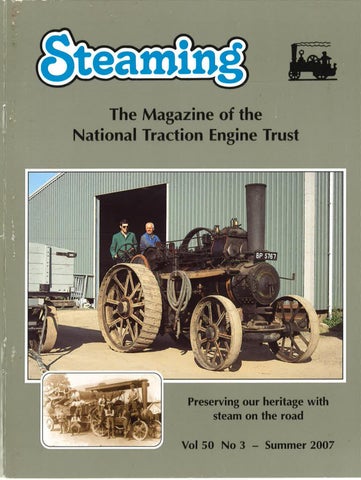
Front cover Fowler 9924, built in 1904, is a nicely original example of the Steam Plough Works' class A4 6hp compound agricultural engines. It has never been regular attender at rallies — Bob Moorman took the picture this April at a gathering to mark the 50th anniversary of the Weald of Kent Traction Engine Society. 127
Trust News Engine Owners Column Engine Owners Section The Engine Owners Code of Practice has now been reviewed by SAFed and several comments were made, the majority of which have been accepted into llie Code. It was suggested that the Trust should meet with the Technical Committee 1 of SAFed and we are awaiting a date so that this can take place. One suggestion that was not taken up was that we should approach the Health and Safety Executive to clarify whether they consider our engines are at work, in which case there would be no need for Part 4 of the Code, as PSSR 2000 would apply. After discussion in the TSU meeting it was decided we should not seek the HSE's view as we already have enough evidence that they do not consider our engines are at work. However, whether or not this would apply to an engine dredging or generating electricity commercially is a different matter and not one that we are considering at the moment. A meeting with the Independent Boiler Inspectors has been arranged for Sunday 21st October when it is hoped that all the Independent Inspectors who hold the necessary PI Insurance will be present. Glyn Amphlett of Allianz and Chairman of SAFed TC1 committee has agreed to attend. (Bob Siddall, chairman of Engine Owners Section)
Training Course A very successful Training Course was held at S E Davies's premises at Astwood Bank over the weekend of 12 and 13th May. A total of 38 students attended and in spite of the very wet conditions they all appeared to thoroughly enjoy themselves and gain benefit. We are very grateful to the Davis family for providing their premises, which means that in the event of wet weather the course can still proceed and the students achieve a reasonable amount of driving experience. 128
The Davis family have kindly offered to host the course again next year and it will take place on 10 and 11th May 2008. Apart from our thanks to the Davis family, we must also thank Stuart and Hazel Tomlinson for their excellent organisation of the course. Finally, we are very grateful to all the lecturers, engine owners and crews who made a very wet weekend into a most successful Course. (Bob Siddall, chairman of Engine Owners Section)
Competency Scheme Interest in the Competency Scheme continued during the closed season at a relatively steady level, until it received a boost from one of the original instigators of the assessment concept. Tim Holt, the organiser of the Cumbria society's rally at Flookburgh, was a champion of the need for a form of competency test back in 1998 when the Rally Organisers called for a scheme to be established. A few of months ago I happened to mention toTim that there would be a couple of competency examiners at his rally this year and perhaps one or two of his exhibitors might care to take advantage of this. Those of you who know Tim will realise that his way is not to quietly mention this to one or two, but to send a letter to every engine owner who was booked to bring an engine to this year's show. The result is that, so far, nineteen people have asked for the chance to take this test. I believe that we will be able to cope with this by bringing in more examiners and by using both days of the show, plus some time on the Friday. Take this in addition to the Steam Apprentice Club driving day, already organised for the Friday, and we have a show which is making the best use of the gathering of many engines in one place. I'll report in the next issue of Steaming how we get on. (John NTET Durling, administrator, Competency Scheme)
Steam Apprentice Club As many members will know, the Steam Apprentice Club arranges, with the help of many volunteers, driving days specifically for Apprentices to enable them to learn how to maintain, operate, and drive an engine. So far this year we have held five events, all of which have gone off successfully — with just the odd hiccup. My thanks go to all those that made these events possible. However, what we would like to do is expand the role of the Club to give the Apprentices more all round knowledge and experience of the activities that go on with a steam engine. To that end, I am asking if any members or readers who are specialists or tradesmen concerned with aspects of engine repair and restoration, would be willing to offer a small event that Apprentices could attend, and be shown the work, have it explained, and maybe even aiiuwed to participate. i have in mind restorers, boiler repairers or sign writers etc, and any offers would be most welcome. No doubt the list could be endless, but anything that is associated with steam would be of interest. The groups can be as large or as small as you could manage, and reasonable expenses will be paid. Even if you're not sure, but feel you could or would like to contribute, contact me for a chat, my details are on the inside cover or at the website www.ntet.co.uk/SAC (Kevin Munn, chair, Steam Apprentice Club)
The Rally List 2007 Apologies are due to the organisers of the forthcoming autumn event at Gloucestershire & Warwickshire Railway for publishing the wrong date in the last issue. The Summer 2007
STEAMING
correct version is shown below; working ploughing engines are planned for the event, which may now become an annual occasion. 13/14th October — Gloucestershire & Warwickshire Railway Steam and Vintage Gala, Toddington Station, Glouccstcrshire. Bernard Dud field, 3 Woolway Bungalow, Aston Magna, Moreton-in-Marsh ("Er 01242 621405, GL56 90L daytime only).
Fowler D2 class 12 ton roller 9005 of 1901 and living van near the village of Ashmore on the Monday after the 2006 Dorset gathering, making their way north west to Berwick St John for an event there two weeks later. (John Maund)
Essex; 15/16th, Old Warden, Bedfordshire. The above titles are somewhat shortened; the full version, and other location and contact details, appeared in the Trust's full colour tourist leaflet 'The Rally List 2007', which was distributed as a loose insert with the Spring issue of the magazine.
RALLY SAFETY SIGNS
The Exhibition and Sales Unit The appearances of the Trust's Exhibition and Sales Unit for the remainder of the 2007 season are noted below. 14/15th, Rempstone, July — Leicestershire; 21/22nd, Marcle, Herefordshire; 28/29th, Cumbria Steam, Cumbria. August-4/5th, Great Bucks Steam, 18/19th, Buckinghamshire; Lincolnshire Steam Rally, Lincoln; 25 to 27th, Hellingly, East Sussex; 29th to 2nd September, Great Dorset Steam Fair (NTET marquee). September — 29th August to 2nd, Great Dorset Steam Fair (NTET marquee); 8/9th, Barleylands, STEAMING
Summer 2007
owned in commercial use by steam thrashing contractors Rowntrees of Kingscourt. Always one for a challenge, Peter purchased Aveling & Porter steam roller 8414 a number of years ago, and was working on it in his own quiet manner. His enthusiasm for
Obituary Peter Taaffe The death occurred in Dublin in January of Peter Taaffe, aged 73. He was a native of Fordstown, near Kells in Co Meath, and the fourth of that name to live in Oldtown House. A lover of nature and well known tillage farmer, Peter became actively involved in forestry on his retirement, planting up to 36 hectares on his farm. Another great interest was the restoration of vintage machinery, which over the years included many tractors including a Lanz Bulldog,
DANGER - beware of moving vehicles etc yellow with black lettering Unauthorised persons prohibited etc red with white lettering FIRE POINT - red with white lettering Printed on rigid plastic boards
each sign Inc VAT, postage added to invoice Can be collected from the Trust Exhibition Unit, by prior arrangement Ring Colin Brown on tr 01582 733971
129
such work led him to acquire a further steam machine in the months before his death — an American built Buffalo Springfield roller, 11197. Sadly, Peter never got to see either machine in steam, but his quiet unassuming way and dedicated research and restoration work will be missed by all who knew him. Anyone undertaking a steam restoration job in the locality with a problem, would always find Peter willing to listen and help out. He is survived by his wife Roisin, daughters Emer and Fidelma and grandchildren Amy and Connor. May he rest in Peace. (Graham Smith)
Affiliated and other groups Museum of English Rural Life - the archives From the early months of this year the Museum of English Rural Life at Reading has been working on the Steam and Manufacturers Access Project, to enable additional cataloguing and conservation work on some of the agricultural engineering company business records that are held at the Museum, which is part of Reading University's Museums and Collections Service. In November 2005 the Museum and the Road Locomotive Society received £50,000 from the Heritage Lottery Fund to enable the 10,000 plus engineering drawings of Burrells of Thetford, and the dozen or so works registers from Wallis & Steevens of Basingstoke, to be conserved and recorded by digital scanning. This will make the archive more suitable for public access and research, and safeguard their future. The Burrell drawings had recently been transferred to the Museum's care by the RLS, and the Wallis archive has been with the Museum for some years, but not indexed. Part of the arrangement within the HLF grant was the forming of a steering group, in which the Trust was invited to partake along with the RLS, Steam Plough Club, Road Roller Association and The National Archives, to ensure the MERL collection would in the future be available to the widest possible sections of public interest in steam and agricultural history. Caroline Gould of MERL was joined in March by a project officer Nicolette Evans and part-time project 130
In May, part way through the volunteer cataloguing work of the Road Locomotive Society's Burrell drawings at the Museum of English Rural Life at Reading, RLS chairman Richard Wilcox invited volunteers and the MERL project officers to his home near Stroud, to savour a surviving, in steam, product of those Thetford drawings. Burrell 5hp road locomotive 3809 of 1919, WINIFRED, is the appropriate companion for the group. (MERL) archivist Paula Pruess, and subsequently they and several RLS members, alongside a professional conservator, have completed the first stage of making an electronic catalogue of the Burrell tracings, with the originals now being stored in archive sleeves. During the summer the project workers will be attending rallies and agricultural shows to show off the facilities and historical information that are available at Reading to a wider public — and that does include engine owners and enthusiasts who may not be all that aware of the vast amount of maker's records that have survived to be in the MERL collection. Later in the year there will be one day workshops, where MERL can introduce a particular firm and its archives to researchers and enthusiasts. It is hoped the project can later expand to include other manufacturers' records within MERL's collection, and to have much of the information more available online. Other engine makers' records within the collection are from the works of John Fowler, Ransomes,
IClayton & Shuttleworth portable 15635, which for many years has been in the collection of the English Museum of Rural Life at Reading, has survived more or less as it was when delivered new in 1877 It has recently been the object of conservation work to ensure the originality lasts for decades to come. (MERL)
Sims & Jefferies and Marshall, Sons & Co. (from information supplied by MERL) Museum of English Rural Life - the exhibtion Following on from its re-opening in new premises in Redland Road, Reading, the Museum of English undertaken Rural Life has conservation work on the Clayton & Shuttleworth portable engine that has for many years been part of its extensive exhibition of agricultural artefacts — indeed it has been there since the collection was founded in 1951 to record the changing face of farming and the countryside. The 7hp single cylinder engine was built at Lincoln, number 15635, in 1877, and was bought from a farm at Adderbury near Banbury for its scrap metal price of £3 per ton. The horse-drawn engine represented Victorian technology that had all but disappeared in the 1950s, having given way to tractor powered threshing machines and combine harvesters. With most surviving steam engines being privately owned and restored to working order, the Museum considered it important to do work to conserve the Clayton in the condition in which it finished work. Roy Brigden, keeper at MERL, and Fred van de Geer, the museum conservator, have carried out treatment to stabilize and prevent further deterioration, which included coating internal boiler surfaces with wax, and adding some replica missing parts to aid interpretation. The challenge has been knowing where to stop when tackling deteriorated areas, such as corrosion under the cylinder's cladding. Trying to fix such problems would have involved taking the engine apart, with loss of the original 'used' appearance, for it would be difficult to re-assemble without having to replace materials and fittings. The present museum has a controlled environment with a constant fairly low humidity, resulting in a slowdown in the corrosion process. Parts replicated because they had corroded badly or were lost included the chimney base, part of the firebox ashpan and several smaller boiler fittings. The new replica chimney base was made using remnants of the original as a pattern, and its provision was contracted to a specialist pattern maker and funded with a £1000 grant under the Preservation of Industrial and Scientific Material scheme. Much useful advice was given by members STEAMING
Summer 2007
of the Road Locomotive Society. Returned to the exhibition in late May, the portable can be seen by visitors belted to a threshing machine drum, demonstrating how it would have been used on a farm in its heyday, over a century ago. The Museum of English Rural Life (gEr 0118 378 8660 and www.merl.org.uk) now has extended opening hours — Monday to Friday from 9.00am to 5.00pm and Saturdays and Sundays from 2pm to 4.30pm. Admission is free. The new exhibition hall and gallery premises offer 22,000 objects relating to work and life in the countryside over the last 200 years. (from information supplied by MERL)
765840 or email burrell@thetfordtowncouncil.gov.uk Admission is free. Pudsey Roller Restoration Fund
Charles Burrell Museum The Charles Burrell Museum at Thetford, Norfolk completed its funded Development Project at the end of March. Improvements have been made to display material and attention given to the most urgent of the building repair work — the Museum is the former paint shop of the St Nicholas Works in Minstergate. Opening times for 2007 are every Tuesday from 10.00am to 2.00pm until the end of October; the last Saturday of the month from 10.00am to 4.00pm until the end of November, and several other dates at Bank Holidays and local occasions — contact the Museum on Tr 01842
Road Roller A
R.R.A.
After many years neglect, the Pudsey Park steam roller — Fowler 15752 of 1921 (WR7508) — has been taken into the care the Road Roller Association, with a view to restoring it to working condition. When this is achieved, the roller will be taken back to Pudsey and exhibited, in steam, for everyone in the area to admire and enjoy. Before the transformation can take place, however, much time and money will have to be spent — money which the RRA does not presently have.The Association needs time and assistance to raise funds, estimated at £20,000 to £30,000, to complete the roller's restoration. This very much depends on a boiler inspection and further assessment of other work, which can be undertaken now the roller is safely housed under cover after many years in the open. At the Annual General Meeting in Leeds in March, chairman Michael Goakes announced the Association had successfully negotiated the loan of the derelict engine from Leeds City Council for an initial term of 25 years, with agreed terms for extension. The
ssociaboo
The Pudsey Park
Roller
The extremely woebegone appearance of the Pudsey Park roller, Fowler 15752 of 1921, is only too apparent in this picture as it starts off on its journey to a new life in the care of the Road Roller Association. The coming months will hopefully give evidence that it's more important mechanical condition promises better prospects. (Derek Rayner) 131
Annual General Meeting
Fowler BB1 class 15145 of 1918 at the 2006 Great Dorset Steam Fair, a ploughing engine that has been awaiting restoration for many years - long, even, before it was one of the lots at the Philp sale of some years ago. Our ongoing activities in restoring engines will, before too long, see the end of sights such as this, of machines at their lowest ebb. Perhaps this Fowler should have been sited, not as it was in the ploughing area campsite, but a little more publicly, so that visitors could have a better idea of the work there is ahead in restoring the engine to working order. (John Maund)
Association has found a willing volunteer member to take on the task of restoration, to be carried out at premises north of Leeds: Ian Fearnley has a long history of involvement in steam preservation, and his grandfather, Arthur Fearnley of Castleford, was one of the first in the West Yorkshire area to own a preserved road steam engine in the mid-1950s. From then, both Arthur and his brother Walter, together with Ian's father Ronnie and uncle Lister were regular attenders with the family's engines at rallies inYorkshire and much further afield. Ian has been driving steam engines since the age of six, and has restored a steam wagon from scrap condition and continues to work on another. The roller was obtained, on finishing work in 1959, by local benefactor Alderman SirWalterWard. This was a time when it was common practice for rollers to be placed in play areas. Presented to the local people and installed in Pudsey Park for the children of the Borough to play on, many have enjoyed the engine over the years - until it became somewhat dangerous and was removed to storage. 132
When the yard was being cleared for housing development, Keith Wear, a former Pudsey resident, heard the roller was to be scrapped, and determined that this should not happen. His intervention saved it from the scrap man. But because of the way the roller was initially gifted to the people of Pudsey, Leeds City Council was unable to dispose of it, and could not sell it. Years of negotiation followed to achieve this, and the result has been a successful way forward for both the roller and the people of Pudsey. The Road Roller Association has set up the Pudsey Roller Restoration Fund. As well as raising funds, the Association needs help in the form of goods and services. Local assistance with fund raising and promoting the awareness of the Association's efforts is being sought. You can help achieve restoration by sending a donation to: Road Roller Association, 5 Dryden Avenue, Balderton, Newark-on-Trent, Nottinghamshire NG24 3QT. Further details and offers of material help can be made to Derek Rayner, RRA vice chairman (17 01904 781519).
The 2007 Annual General Meeting of the Trust will take place on 17th November at the Clarion Hotel Madeley Court, near Telford, Shropshire. A detailed account of the programme for the whole of the weekend will be published in the Autumn copy of this magazine. The notes below give information for the 2007 AGM, and the formal notice regarding the submission of any motions to be debated. Formal notice of the meeting and other information, including the audited Report and Accounts for the year, and Appointment of Proxy form, will he distributed to current members with the Autumn issue of Steaming. Any member may submit a motion for discussion at the AGM. All such motions must be in writing and signed by a proposer and a seconder, and state the respective membership numbers.The items for discussion, in order that they can be published in the Agenda for the AGM, as required by Article 16 of the Trust's Constitution, must reach the General Secretary, Sue Jackson, on or before Saturday, 22nd September 2007 (address inside front cover). The elected Committee for the current year was published on page 5 of the Winter 2006/2007 issue of this magazine. Members retiring by rotation at the AGM in November 2007 after their three year period of office are: Andrew Semple, vice President Paul Worbcy, vice Chairman James Blenkinsop John Billard Irvin Barraclough Michael Davies Brian James Pat Jenkins StuartTomlinson All of the above are eligible for re election; further, the position of second vice President is also vacant, and there is also a vacancy on the General Council. A form of Nomination Paper is printed with these notes and may be used - cut from the magazine, in photocopied form or written out on plain paper. Any nominations for the Committee should be sent to the General Secretary, Sue Jackson (address inside front cover) and must be received on or before Saturday, 22nd September 2007. They will not be accepted after that date. The names of the nominees will be included in the published Agenda to be distributed with the Autumn magazine. Summer 2007 STEAMING
Future Dates Great Dorset Steam Fair, 29th August to 2nd September As has become usual theTrust will have a prominent presence at the annual Great Dorset Steam Fair. A large marquee will provide good services to members and friends as well as portraying the aims of the Trust to the engine enthusiast section of the general public who are not members. TheTrust Sales end of the tent will have the usual excellent selection of road steam reading, DVD viewing and clothing on sale (and the NTET funds gain a welcome boost from the receipts during the five day event). At the other end of the marquee, willing volunteers are again to provide tea and coffee to members, families and friends who need to rest awhile, or merely to sit and talk just a little more on engines. Membership renewal facilities will also be present, and remember that there is absolutely nothing to stop existing members from dragging their friends or acquaintances along and insisting they join up there and then. For the third year, two walls of the tent will be transformed into an art gallery, showing original works with an engine or rural composition by artists Robin Wheeldon, John Hancox and John Wigston. The paintings will have a variety of prices, and if you have been tempted in previous years, don't forget to bring your cheque
A recent import by Preston Services in Kent is this American built vertical boilered tandem steam roller. It is works number 8170 of the Iroquois Iron Works of Buffalo, in New York state. What a superb machine by which to conveniently and simply show off the workings of a steam engine - but good luck to the restorer when he comes to exhibit his completed pride and joy in steam at a Health and Safety inspectors' conference! (Keith Broth well)
book. For the more mundane but essential items that our engines require, Stuart Gray will be present with his stock of spares and supplies. Last year's exhibition of part
The National Traction Engine Trust AGM, 17th November 2007 Please use block letters
NOMINATION PAPER
Vice President, vice Chairman or a member of the National Council* Membership No
Name Address
I agree to aceept nomination for this office and, if elected, to serve theTrust and abide by its Constitution. Signed:
Membership No
Proposed by SIGNATURE
PRINT NAME
Membership No SIGNATURE PRINT NAME Nomination can be made on this form, cut from the magazine: on a photocopy, or on a copy hand written on plain paper. *delete as necessary, but use a separate paper for each nomination. Seconded by
STEAMING
Summer 2007
completed engine restorations and new builds in the central part of the marquee was extremely popular, and several of those exhibits will return to enable us to study the progress since made. The Foster Wellington tractor, newly built by Dawsons of Bicker for Ian Gilbert, has now been finished off to a steamable condition; Richard Vincent's re-creation of a Hindley wagon is now on its wheels and Alan Rundle will bring a small unrestored portable engine that has not yet been on a rally field. Standing high above them all will be the current state of what must be the most ambitious project ever contemplated by a Trust member - David Eves' full size recreation of Fowler showmans road loco 19989 ONWARD, the nonsurvivor of the well known quartet of class B6 Super Lions of the 1930s. Come and judge for yourselves his amazing audacity! No doubt other engine owning members will bring their charges to congregate outside the tent at times during the course of the event. Members having concerns on topics affecting engines and engine ownership that they might wish to bring up with members of the Trust National Council or executive committee should call in at the tent 133
they will usually find somebody in attendance for discussion, and if not, a later time can be arranged. But don't leave it until early Sunday afternoon.
M R Eaton, Dudley, West Midlands DThomas, Pencader, Carmarthenshire M Cain, Knebworth, Hertfordshire Grampian Transport Museum S G Towers, Harrogate, North Yorkshire T J Munt, Calbourne, Isle of Wight J Darbey, Shrewsbury
R K Barnes, Ipswich, Suffolk D J Vaughan, Welford, Northamptonshire K Dyke, Nottingham N Bosworth, Ilkeston, Derbyshire G Westlake, Bodmin, Cornwall D B Coppard, Crowborough, East Sussex R Arthur, Hexham, Northumberland
Annual General Meeting The more formal notes concerning the Trust's 2007 AGM on 17th November are set down in adjacent columns — these notes give a brief outline of the arrangements that are being planned for what we hope many members consider to be the enjoyable social side of the weekend, alongside the necessary annual business. This year we visit the west midlands, with the AGM being held at the Clarion Hotel Madeley Court, near Telford, Shropshire, and reservations for accommodation at the hotel will be available for Trust members for the Friday and Saturday nights — details will be included in the Autumn issue of the magazine. Madeley Court is a restored 16th century country house, retaining many original features, with the Priory Restaurant within the original Great Hall of the house.The location is just a few miles south of the M54, and almost adjacent to the lronbridge Gorge museums—the birthplace of industry. Arrangements will be made for NTET members to have reduced rate admissions to the museums at Blists Hill and Ironbridge over the weekend — again, details in the next issue.
The Summer 1982 Steaming started with issues that are still very much current today — though the possible solutions and choices have seen considerable change. A paragraph listed the different steam coals then available from the National Coal Board. However, of 17 listed only Daw Mill and Thoresby were included in the article on the same subject in the Winter 2006/2007 issue, and 25 years ago there was no mention at all of foreign imports. A few paragraphs on lorry tachometers indicated that if the tractor unit was only used for moving engines no instrument was required as 'vehicles used in connection with cultural events' were exempt — horse boxes were also covered by this same exemption! Also Lupival lot Lire Lime VVdS a section on engines in the South Atlantic region. As well as photos of
various engines in Punta Arenas in Chile there was an illustration of a Marshall 8 ton roller, heavily coated in ice, said to have been taken in the then suddenly well known Falkland Islands. A follow-up article in the Autumn 1982 issue however revealed the identity of the roller and that the photo had been taken in the UK in the severe winter of 1047! The 100th anniversary of the death of Thomas Aveling occurred on Sunday 7th March 1982. It was fitting therefore that several pages of the magazine were given over to a report of the commemorative events organised by the Road Roller Association in the Rochester area. It started on the Saturday with a visit to the local museum, followed by a walking tour of the town and the Association's AGM in the canteen of Messrs Winget Ltd (by then the owners of the former Aveling works). The Sunday saw eight engines travel from Aveling's former home, Boley Hill House, to the Winget factory. There a commemorative plaque was unveiled, and the engines travelled to Hoo St Werburgh church, where a wreath was placed on Aveling's grave. A fitting tribute to a man who had such a large iinpod un Lila development of traction engines and rollers. (Stuart Gaines)
'The above photograph shows one of the Thornycroft wagons which has been in regular use for some time by the Barberton Traction Company of South Africa. It is employed for transporting mealies, coal, dynamite and stores to the various mines in Moodie's Concession, the district being one of the worst in South Africa in respect of the roads, which may almost be said to be conspicuous by their absence. The wagon, which we show carrying a load of 4 tons of gold concentrates which it has brought down from the mines to the railway, is one of the Thornycroft Company's 4 ton special Colonial type of wagon. A large number of similar vehicles have been supplied for service in India,
Mauritius and other parts of the globe.' (fromThe Automotor Journal, 25th April 1903. It is not possible to here include the photograph, which shows the machine to look very similar to the two examples that survive in preservation the Britain. However, the paragraph is worth reproducing, if only to wonder at how manufacturers and customers took new technology to quite remote parts of the Empire, in this case the eastern Transvaal, not far from the Mozambique border. The magazine had earlier included a picture of the pair of Thornycroft wagons on the Indian Ocean island of Mauritius — again, they look very British, but are weighed down by enormous and untidy loads of cut sugar cane.)
reflections on our magazine of 25 years ago
New Members We extend a sincere welcome to the following new members who have joined the Trust during the last three months. We hope they will gain much friendship, information and enjoyment from their membership over a period of many years. Full addresses are not included, but the Membership Secretary is always pleased to put members in touch with one another by forwarding mail. I W Moorhead, London DT Miller, Basingstoke, Hampshire M J Neale, Herriard, Hampshire J Bownes, Winsford, Cheshire A J Baker, Basingstoke, Hampshire D Coultherd, Lancaster M Potter, Luton, Bedfordshire G Jones, Abingdon, Oxfordshire A Lowes, Darlington, Co Durham W Hicks, Maldon, Essex 134
Summer 2007 STEAMING
National Traction Engine Trust
14 '
Mail Order Many books, videos and other items of interest to traction engine enthusiasts are available from the Sales section. Readers are urged to take advantage of this service (which also benefits Trust funds) for trouble free and economical postal shopping. Just tick the box for items you require and fill in the address slip.
•
please refer to recent issues for other available books videos and club items
DVDs New Steam Across the Stubble, SPC Great Challenge 2006 (75 mins, Moonlight) reviewed 50/1
This item only, cheques payable 'Steam Plough Club'£18.50 ❑ Burrells ofThetford (110 mins)
£9.95 ❑
Fowlers of Leeds, part 1 (115 mins)
£9.95 ❑
Fowlers of Leeds, part 2 (50 mins)
£9.95 ❑
Dedicated to Garretts (65 mins)
£9.95 ❑
Fodens of Sandbach (70 mins)
£16.95 ❑
TRACTION ENGINE READING
Road Works Ahead (50 mins)
£9.95 ❑
New Journeys on George (Lewendon)
Fosters of Lincoln (70 mins)
£9.95 ❑
Inside Steam (65 mins)
£9.95 ❑
£5.00 ❑
reviewed this issue New Lincoln's Excavators, the Ruston Bucyrus Years (Robinson)
£29.95 ❑
New Steam Yachts (Smith and Scriven)
£15.00 ❑
New Pennies by the Sea, Bridlington (Laister)
£13.99 ❑
New Beads of Emerald (Josje Nieuwenhuys) £8.95 ❑
reviewed 49/4 New Vintage Fairground Transport (Steptoe)
£6.00 ❑
reviewed this issue New Hancocks of the West (Scrivens and Smith)
£15.00 ❑
reviewed 49/4
DVDs are Old Glory/Morton's Heritage unless noted MOONLIGHT PRODUCTIONS videos Going for Gold - NTET 50th Year Great Dorset & Road Run (VHS 90 mins)
£18.00 ❑
Sentinels on the Move -The Horseshoe Pass £16.95 ❑
(VHS 40 mins) Up for the Cup - the Steam Plough Club's Great Challenge 1998 (VHS 65 mins)
£19.50 ❑
Steam over the Fells - steam through the Trough of Bowland (VHS 115 mins)
£20.00 ❑
New GeorgeKilvington, Fairground Photographs (Scrivens and Smith) reviewed 49/3
£10.00 ❑
New Roundabout Relics (Barker) reviewed 49/3
£26.00 ❑
Sentinels on Parade - road run, Shrewsbury to the Horseshoe Pass (VHS 45 mins)
£15.00 ❑
The History of Mann's Patent Steam Cart & Wagon Co (Pease)
£24.99 ❑
The Big Road ATLAS - the Eastnor Castle heavy haulage road-run (VHS 60 mins)
£18.00 ❑
Traction Engine Album (Ranieri)
£25.00 ❑
The Electric Scenic Railway (Scrivens and Smith)
£20.00 ❑
Up Hill and Down Dale - the 1995 steam car touring rally, Yorkshire Dales (VHS 90 mins)
£18,00 ❑
£10.00 ❑
Sentinels and Scouse - the 400 vehicle cavalcade through the MerseyTunnel (VHS 55 mins)
£18.00 ❑
£15.00 ❑
Sentinels on The March - 1995 Sentinel Drivers Club road run (VHS 50 mins)
£16.95 ❑
Travels with and Old World ATLAS - final stages of overhaul, first test run of ATLAS (VHS 50 mins)
£15.00 ❑
Reprint Locomotive Boilers - Design, Construction and Working (Haig) T Whitelegg & Sons - Cavalcade of Shows
(Belshaw) Bridgwater Fair - illustrated history (Belshaw)
£12.95 ❑
Fodens - a pictorial history (Davies)
£24.95 ❑
European Traction Engine Register (Toy and Rayner)
£5.00 ❑
Traction Engine Register (True and Johnson)
£6.95 ❑
Historic Fairground Scenes (Ware)
reprint of 1977 edition
£9.99 ❑
Non-members please enclose 10% part postage per order.
£5.00 ❑
Overseas members please enclose 8% part postage per order (European); 10% (rest of world),
£2.50 ❑
PO/Cheques (in sterling please) to be made payable to:
RENOWN History and Restoration
(Brian Steptoe) Special 30th Rolling (RRA)
To claim post-free for UK members please enclose current membership card.
National Traction Engine Trust. Visa, Access and Mastercard Pictorial Albums
accepted, please state card number, expiry date and name on card, or phone/fax 01582 733971 (' evenings only).
Norfolk and Suffolk in the Age of Steam (Stephens) £13.99 ❑
Orders to be sent to:
£4.50 ❑
NTET Sales, 90 Devon Road, Luton, Bedfordshire LU2 ORL.
£4.50 ❑
Please allow 28 days for delivery.
- was £14.99
£9.99 ❑
Name
- was £24.95
£21.95 ❑
- was £19.99 Steam Wagons (Rayner) Traction Engines and other Road Steam Vehicles
(Rayner) Traction Engines, A Colour Portfolio
(Arlett and Lockett) Company Histories
Address
The History of J. & H. McLaren of Leeds
(John Pease)
Ransomes, Sims & Jefferies, Agricultural Engineers (Brian Dell)
£19.95 ❑
The Story of St Nicholas Works (Lane), was £30
£27.00 ❑
Charles Burrell & Sons Ltd (Gilbert & Osborne)
£5.99 ❑
Steam Engine Builders of Lincolnshire (Clark)
£10.95 ❑
The Story of the Wellington Foundry (Lane), was £30
£24.00 ❑
The Rise and Fall of Aveling Barford, 1933-1988
£3.60 ❑
Membership No.
Amount Enclosed
List 50/3, Summer 2007
`I think I have one of the best' A Barnsley carrier's new Foden
Roger West A feature of the several weekly and monthly magazines that served the carrier and motor transport trade in the early years of the twentieth century was the editorial article that covered the regular working experiences of certain users. The steam wagon had by then passed its early period of experimentation and development, but its use was yet to be opened to a great many trades and businesses that still had to be convinced on costs and profits. The information in the articles would be carefully read by would-be owners — and also be useful to both the vehicle makers and magazine publishers, for if the reports were glowing enough, further sales, and more advertising revenue, was the likely outcome. These notes are, firstly, based on articles in the January 1908 issue of The World's Carriers, where the regular work of John Walker of Barnsley's Foden 5 tonner was set down, and then, secondly, from the same journal's pages on 16th October 1911, where we have Walker, still responding to editorial requests, continuing his tale of satisfaction. Someone from the staff at the magazine had met Walker at Cordingley's Motor Show in London, where he had promised to send them details of how his seven month old Foden was working. He had received it new on Tuesday, 25th June 1907 — Alan Duke records works number 1364 (M1606) as leaving the makers on the previous day. We can probably therefore take it that the wagon travelled from Sandbach sidings by rail, loaded on a 10 ton flat, to be unloaded at a goods yard in Barnsley, where it was joined by John Walker and a man from the Elworth works, sent out to instruct the customer in the vehicle's proper and economical use. The cost had been £550 — or at least that is the price quoted in Fodens c1906 catalogue for a '5 ton Standard Wagon, with flat platform of ordinary side boards, driving wheels 3ft 6in by 10in on face.' The nature of Walker's business seems to have been mostly furniture 136
removing, but he claimed also to carry out other general hauling. He said he didn't make lengthy journeys, though occasionally ventured further afield — a trip to Manchester involved 74 miles in one day. Before the arrival of the steam wagon he is likely to have run his carriers business with horses and pantechnicons, and trolleys with lift wagons. Certainly the picture accompanying the article shows the new Foden loaded with a less than pristine furniture lift van, the latter until then probably making the longer sections its journeys by rail. Kelly's directories of the time list Walker as a furniture remover at 1 Cemetery Road — off the Doncaster Road, Barnsley — in 1908 and 1917 There was no entry for him in 1897, though intriguingly, that name and trade appears as an entry under Bradford — but not in 1908! The original article largely comprised columns headed 'Itinerary of Journeys'; it would be tedious to repeat it all here, but we can get a good idea of the Foden's working life in its first few months. It went straight into earning its keep for Walker, for although nothing is recorded for the day of arrival (maybe the railway hadn't shunted the wagon to the loading dock until the afternoon), the following morning they did two loads from the station to a house, about 11/2 miles away, and finally loaded up again; 8 miles total. Nothing is set down for the Thursday — perhaps the householder was not ready to go — but on Friday came a trip over the backbone of England, Barnsley to Oldham, including the hard climb over the 1600 foot high Saddleworth Moor. By the time they returned home on the Saturday, 70 miles had been covered. Not bad going for a new owner who was most probably a novice driver, but with a Foden works man present, reassurance would have been at hand and confidence must have been building by the day. From the beginning of July there was a series of short local journeys, 2 miles; 14; 8 and so on.They probably reflect Walker's previous business limitations with horse haulage, and among them were '2 miles to the
station' where the lift van would have been transferred to a flat truck for rail despatch to places beyond even the reach of the new Foden. Walker noted some of the weights he had managed — twice to Ingberchworth, 9 miles, fetching 71/2 and 8 tons (with a trailer). Gradually the distances become longer, as jobs could now be taken on that were beyond the economical use of horse power, but were easily managed by the Foden. On 29th July it ventured to Heeley, south of Sheffield (32 miles), the following day 44 miles were done to Leeds and on 5th August came no less than five different local jobs totalling 25 miles. On the 7th loads were taken the three miles from Barnsley station to theYorkshire Show ground, and once there the six week old wagon stayed as an exhibit for the three day duration of the event. It may have been ioininq other manufactures on a Foden display stand, and could have been just the thing for the Elworth salesmen to persuade potential local purchasers, it having had a reasonable amount of use by a hopefully enthusiastic owner and driver. Can anyone comment — was it common practice for engine makers to exhibit nearly new vehicles at shows, where showing some existing local custom might result in further sales? We can imagine Walker and his men, and Fodens too, setting to and avidly cleaning and polishing the wagon to hide the evidence of its 30 days of steaming and 526 miles of travel. Jobs were being taken on that would have been impossible with horses. On 27th August the wagon went empty to Royston (Yorkshire), loaded to Leeds, and then re-loaded to return to Stairfoot; 44 miles. Three days later there was a similar round trip of 48 miles, and then on Monday 16th September an empty run to Loughborough (68 miles); on the next day to Leicester to load and return as Summer 2007 STEAMING
far as Smithy Houses (47), before reaching Barnsley and unloading on the Wednesday. This last job would have no doubt deprived the Midland Railway of some removal business, together with a Leicester contractor to get the lift van to rail; now Walker could do the door to door service entirely on his own, and to his own profit. The listed itinerary finishes at the end of September and by then the wagon had covered 1235 miles and had been in steam for 55 of the 83 days it could have found use (the Sundays excluded).There had been a maximum period of five days when there were no tasks, but several weeks had been fully worked, including the Saturday. The owner went on to fill in the detail of his experience. He felt he couldn't usefully quote costs per ton mile because 'in removals you cannot get the weight on as with carrying heavy goods'. The fuel consumption had averaged one hundredweight of coke and coal mixed for every nine miles; as much as twenty miles had been done with one tank of water. With coke at 14s.2d (71p) per ton and Welsh coal at 24s (£1.20) it had cost (including lubricants, waste and cleaning oil) well under 2d (.8p) per mile.The condition of the surface of the roads seemed to affect the figures, but under normal conditions, it was found practical to do 30 miles on 3 hundredweights of fuel. After seven months working the wagon Walker claimed it to be running 'as well now or even better than during its first week' - a few shillings was all it had cost, for a broken gauge glass and a drawbar. There had been no extra expense for a garage, as the wagon stood under a shed formerly used for a van. Compared with the previous cost of relying on horses and the Midland railway, the figures were much in favour of the Foden. The wagon would go 40 miles with the same load that five horses could draw 20 miles in about the same time, and at about the same cost. Where it came in most useful was with house removals of say 40 miles. Loading up in the morning could see the goods delivered so that they could be used again the same day, whereas, using horses, the client had the expense and inconvenience of 'going out to sleep' for one or maybe two nights before he could rest under his new roof. On the 74 mile return journey over Woodhead Moor to Manchester, which took 24 hours from Barnsley STEAMING
Summer 2007
yard back to yard, the average speed was not above 3mph, but if the time taken with loading and unloading and stopping for meals was allowed for that might rise to 5mph. John Walker's conclusion was favourable: 'As I go about the country, I see more wagons on the road every month. I think I have one of the best. I have not
had the least trouble with it, and the distance I can go on the water we can carry is much further than can be run by most of the drivers I have met'. From this remark it seems likely that Walker had taken the task of driving the Foden, an item that must have been the principal asset of his enterprise.
These pictures, from Fodens' circa 1906 'Illustrated Catalogue', can show us other wagons from the Elworth Works that went to customers in the Barnsley area. At the top is Foden 979 of 1905, a 3 ton machine delivered to the Barnsley British Co-operative Society Ltd, and specifically, as lettered on the end panel, to the Grocery Department. It would be interesting to know more of this Co-op's business with road steam, for they ran several Fowler road locos, and quite a fleet of Foden and Yorkshire wagons, but that is best left for research another time. Had 979 been the steam wagon that impressed John Walker as he saw it travelling the streets of Barnsley? We can imagine him perched up in the seat on the front of his pantechnicon, cursing his reluctant team of horses that needed attention seven days a week, and then, seeing the sheeted groceries speeding by, have the vision of better business opportunities in removals by running an up-to-date steam motor wagon. By the time his number1364 arrived in 1907 the design had developed slightly a longer cab gave better cover to the engine, but the webbed cast rims to the 3ft bin rear wheels were still fitted. The second picture shows Foden 1403, a 5 tonner for the Barnsley Brewery Co Ltd, at Oakwell, Barnsley; it was delivered in August 1907, just a few weeks after Walkers', and had the same appearance as 1364 apart from the brewers stanchions and chains that were fitted to the body, and the capstan on the flywheel, provided to enable large casks of beer to be safely lowered into the pub cellars by rope. 137
Getting on for four years later The World's Carriers published more of John Walker's experiences with Foden 1364. He instanced a furniture removal journey in September 1911 to Northampton - a seemingly well thought out and organised contract. The wagon with a lift van and a large lurry as trailer were already fully loaded with 6 tons of furniture when a start was made from Barnsley at four on the Saturday morning on the 2nd. Walker and his men (we can perhaps assume he took a couple of experienced removals men with him) had 110 miles to do; all right - we have the M1 and in 1911 there wouldn't have been too much other traffic, but think of the hilly old route through Sheffield city, Chesterfield, Ripley, Derby and so on. By 7.30 that evening the group reached the New Inn, just entering Leicester, where they put up for the night. There may have been a bit of a lie in to mark the Sunday, for it was 8 am before they were away, but presumably it would have been inappropriate to do work on the Sabbath at Northampton, where they arrived at 3.30pm. Monday, from 8 am, was spent unloading what they had hauled by road, but the Foden was needed in steam to fetch from the station 41/2 tons in a lift van that had come by rail (seemingly using the by now empty lurry); all was finished by 6.30 pm. There was a 7 am start on the Tuesday with the empty lifts, and 73 miles were covered by 9 pm, to another overnight stop at the Red Lion at Alfreton. It took from nine the following morning until 6 in the evening to complete the journey back to Barnsley. There was no rest then, for the Thursday involved a nine hour day running 32 miles to Woodseats, Sheffield and back. Then, on the Friday, the Foden enjoyed a washout - but still had to be steamed later to load and run to York (40 miles) by eight in the evening. They were back at Barnsley by 2.15pm on the Saturday, having travelled 335 miles in eight days, including the Monday in Northampton when only three miles were done. Walker seems to have by then gone over to coal, using 24 cwt of Welsh, but only 3/4 cwt of coke for the whole series of journeys, plus 3 gallons of cylinder oil and 2 gallons of engine oil - 14 miles to the hundredweight during this hectic and hard worked week. The four year old wagon had been overhauled in January 1911, when longer springs were fitted, together with mudguards and a new Renolds 138
chain, with the old one done up as spare. All this and some other previous extra fittings had cost less than £90. Walker, still the enthusiastic and proud owner, revealed he drove the wagon himself, and did not care about having a slack time now and then - if he could not make a working profit he refused the work. His business must have remained modest - he never acquired another steam wagon, and kept 1364 until 1925. By that time a petrol engined lorry would have been robust and reliable enough for him. We can perhaps surmise that Walker was the working principal of the small firm, providing a removals service to the Yorkshire town with a couple of longstanding employees, and casual labour as jobs necessitated. The 1911 account must have impressed Fodens at Elworth, for the magazine extract was later used in their catalogue. It joined the often flamboyant appreciations that usually filled the back pages of their
illustrated brochures, and which nowadays help to bring to life the working days of steam wagons. The subject of these notes, Foden 5 tonner 1364, by some strange fortune, is still with us. When in 1925 Walker decided for whatever reason he needed to dispense with the wagon, it went to Brooke Bros in Barnsley, and they, in turn, sent it off to Fodens in the following year in part exchange for a new one. In 1927 it was reported to the licensing authority (not known by whom) as now scrapped. A long, long time passed; the preservation age dawned and flourished, and the remains of 1364 came to light and were acquired by Peter Harris of Organford, Dorset, and then, in 1977 by David Hirst. By 1988 the Foden was complete again and running around with Brian Dunford in Yorkshire, and in more recent years has moved abroad to be part of the Rubens family's collection in Sweden.
At the moment, apart from the 1871-built example held by the Science Museum in Kensington, this is the oldest complete Aveling & Porter traction engine in Britain, and it is good to see it presented in steam at rallies in the midlands. John Cook photographed number 1995, a venerable and rather slight 6hp machine built in 1884, at the Belvoir Castle Steam Festival in May 2005. The Rochester works had a propensity to make some cylinders with the valve chest on the opposite side to the usual, and this is one such engine. Summer 2007 STEAMING
Accident at Little Compton About ten in the morning on Monday 19th March 1923 a Clayton & Shuttleworth steam wagon and trailer owned by removal contractors Pickfords ran away on Little Compton Hill, a few miles west of Chipping Norton.The accident resulted in the death of the steersman and, in the words of the Oxford Journal, 'the almost miraculous escape of his companion'. The appearance a few hours after the smash of photographer Percy Simms of Chipping Norton, and the newspaper's report a couple of days later, enable us to envisage the scene. The steam wagon was from Pickfords Ltd's Oxford depot, itself loaded with a furniture container, and hauling a rubber-tyred pantechnicon furniture trailer. They had passed through Chipping Norton in the direction of Moretonin-the-Marsh on the road which is now the A44, and on descending the steep part of Little Compton Hill, just before reaching 'Hillside', the wagon became out of control. Despite the efforts of the driver, the vehicles began to race down the incline — the road here, just as it enters Warwickshire for a short distance, falls almost 250 feet in little over a mile. The press report gave detail: 'At this part of the road there are two sharp bends in the shape of the letter S.The driver had negotiated the first curve, but at the pace the wagon had attained he could not get round the second, and the vehicle ran on to the bank on the right-hand side of the road, crashing into a telegraph pole, which was cut clean in two.The driver, ArthurTaylor, of Oxford, jumped clear on the righthand side and fortunately escaped serious injury, although he naturally sustained bruises and severe shock. The steersman, a young man named Albert Merchant and a native of Witney, jumped from the left-hand side to the road just as the wagon was over-turning, and fell beneath the trailer as it crashed over, injuring him so badly that he died within a few minutes. 'The driver, although severely shaken, at once went to render what STEAMING
Summer 2007
assistance he could to his unfortunate companion, and with the help of Mr Herman Bartlett and his brother, who were working in a field adjoining the road and had seen the engine coming down the hill at a pace which made the smash inevitable, he was released.They obtained a piece of timber from a fence, and using this as a lever, raised the van sufficiently to enable them to block it up with one of the back doors of the trailer, and they were then able to drag Merchant from beneath the trailer. The man was still alive and spoke to the driver, but expired soon afterwards'. The dead man's body was conveyed to Little Compton, where an inquest was held the next day. He was a single man, and was on his first journey, having only secured the employment the previous week. The Clayton wagon and the trailer were completely smashed — both the front axle and wheels and
the rear axle complete were wrenched from the chassis, as too were the front wheels of the pantechnicon.The container on the Clayton broke from its fixings and was thrown across the road. Both furniture vans were said to be so badly splintered they were beyond repair, and presumably that went for much of the contents, if they were in fact loaded.The 1919 built wagon was works number 48310 (FE2790), and though it could have had a few years useful life ahead of it when at the top of Compton Hill, the extensive damage caused by its unrestrained descent may have meant otherwise.The picture comes from a postcard (JackTurner collection) which must have been sold locally, and we might wonder at the circumstances of the message on the rear, which has the air of an employee writing to his boss — 'Dear Sir, I have sent the Card I promist [sic] you. R Flemming' 139
A painter's lapse Derek Rayner In looking through the many Aveling & Porter engines listed in The Traction Engine Register, some time ago I became curious about the details of two GND type tractors with consecutive Royalty Numbers - 7898 and 7899. Information gleaned from the Aveling & Porter Royalty Books at Lincolnshire Archives was that 7898 had been despatched from the makers on 19th February 1913, and 7899 left a week later - on 26th February. They were to the order of the Essex County Council, where they were no doubt to be used on hauling road material in traction wagons to repair sites. Both machines were convertibles - but neither was noted as being supplied with the additional roller gear, though both were recorded as 'Adapted for roller gear' which meant that they had the flange on the front of the smokebox to which a forecarriage-head bracket could be bolted. Perhaps the Council already had a number of sets of the roller gear and did not require more. According to the Alan Duke lists of the Road Locomotive Society, the tractors were just two of a dozen, including later L and AL types, owned by the Essex Council over the period 1912 to 1944, though not all throughout that time. 7898 initially saw use at the Council's Waltham Holy Cross Depot, and later at Tendring, whilst the other one of the pair was used at Halstead and possibly later at Saffron Walden. The RLS records also reveal Essex CC had sold 7898 by 1930 to Jackson & Son of Great Baddow (or Baddow Road, Chelmsford, wherever the firm was based at that time) and it later passed to Baker Bros of Hatfield Peverel. By 1956, the engine was with L N Smith, who was successively at Downham, Wickford and Battlesbridge, though it is not known where or when the tractor had come to him. The second machine, 7899, went from Essex CC to Taylor Bros of Wimhish in 1933. The Taylors proceeded to order a 'conversion' set of parts from Avelings in order to make the tractor into a steam roller for their own commercial rolling 140
activities.The parts, supplied on 22nd May 1935, were listed as: 'Fork; saddle bracket; upright stem with collar and pin; fork pin; steerage shoes - left and right - and front axle - assembled'. This engine, in roller form, was sold by Taylor Bros to J Jupp of Uckfield, Sussex, in 1961 and, at more or less the same time and perhaps as a result of an exchange deal, Jupp's 1928 Aveling AM type tractor 11997 (KO 6739) went toTaylor Bros. Both these GND convertibles have survived into preservation - hence their presence, of course, as entries in TER. All the above history of the engines shows them to have had a not untypical life for steam tractors purchased new by a county authority, but the point that started my curiosity that was mentioned in the first paragraph was the registration numbers ascribed to them in the
Register. Though they had consecutive works numbers from Avelings, the registrations were D7078 for 7898, and D9079 for 7899. A quick glance may cause one to have it in mind the registrations run on, but concentrate, and something seems wrong - by the two thousand gap, they should have been issued several years apart. Elsewhere in RLS records I found that Spillers Ltd, of Millennium Flour Mills in East London, in December 1911 took delivery of an Aveling & Porter FGP type wagon as a chassis. It was Royalty 7592 - a body would have been added prior to use, and it was later sold on in 1920 to dealer E Maxwell of Bedford. The vehicle was listed with the registration D7078 the same mark now carried by Aveling tractor 7898! It was when I discovered this point that I decided I should seek copies of the Kent CC registers so that I could refer to contemporary records. With the same registration number D7078 having been carried by two distinctly different Aveling vehicles, something, somewhere down the line, did not add up. A further closer look at the RLS records of the Essex CC fleet relating to tractor 7898 shows it initially listed as D9078, but also that Alan Duke had discovered that by 1921 it was being
Aveling tractor 7898 of 1913 with the registration D7078 clearly displayed at the Elham event in Kent in 1955. The background reveals changes in our rallies and in life generally in the intervening 50 years; the then usual hemp sacking screen to the gentlemen's facility and the casually left visitors' bicycles. (RLS modern picture collection) Summer 2007 STEAMING
Aveling 7898 (D7078) at the Woburn Park rally in August, 1958, when owned by the Taylor brothers of Wimbish. (Jack Peirson; RLS modern picture collection)
declared in registration files as D7078. As the wagon D7078 does not have any known Essex ownership connections (though of course it could well have delivered flour in the county) I dismissed the idea that registration plates might have got swopped in error. This sort of exchange did happen in days gone by, but was more likely between vehicles of the same type — Sentinel wagons in a fleet, for example, where cabs, complete with works plates, and other parts could become mixed up during repair and the task of keeping an ageing fleet on the road. The requested copies of the Kent registers duly turned up, and gave some answers to the conundrum. D7078 was indeed given to Spillers' Aveling wagon 7592 in December 1911. The register pages also happened to show (contrary to the RLS lists) that the flour wagon was registered to W Vernon & Sons of London in December 1911 — a seeming anomaly in our knowledge, unless Vernons, also flour millers, were a parent company who acquired the wagon for Spillers, or maybe the other way round. Be that as it may, the wagon in 1920 passed on from the Bedford dealer to an owner in Sheffield and there the trail ceases; presumably it was scrapped in that area, but at least I could see it had no Essex ownership connections to explain the change in numbers. A look at the next Kent registration number entry revealed Aveling 7593, also new to Spillers but a month later, was given D7169.These D index marks, incidentally, were the Kent CC issue for the Strood area, where Avelings' works were situated — until 1921, your purchase price of a machine that came under the Heavy STEAMING
Summer 2007
Motor Car Act included for the initial licence fee being paid by the makers, and executed through their local county council office. Moving on to the Kent registering of the Aveling tractors, I found D9078 and D9079 were, as expected, entered up for Essex County Council (Percy J Sheldon, surveyor at Chelmsford). Both were green in colour, weighed 4tons 18cwt 2qrs and were on strakes — with a maximum speed quoted as 'Five miles per hour' — and the date entered was 17th February 1913.
Avelings clearly applied for the two tractors at the same time, even though one, as we have seen from the Royalty Book entry, was a week later coming out of the shops. Licensing records rarely quote the works numbers of the vehicles being registered (these Kent ones don't), but we can be safe in the assumption that we are considering the same tractors by the co-incidence of the licensing and the despatch dates in the respective papers. From Alan Duke's note that Aveling 7898 was altered from D9078 to D7078 'by 1921' it seems this anomaly is not one that has arisen from preservation days, when the number may have been erroneously re-instated to a once rusty and robbed hulk. Strangely, and coincidentally, the Taylor brothers at Wimbish, having owned 7899 since 1935, came to buy 7898 in preservation days (by 1958) and for the few years until 7899 went off to Jupp in Sussex, they were both at Wimbish. But the 'wrong' registration did not occur then, for we see photographs of the number D7078
Aveling convertible roller 7899 (D9079) at Polegate Rally, Sussex, in June 1966, when owned by Claude Jessett. This shows the engine as it was altered by Taylor Bros, with roller gear purchased from the makers, in 1935, and with its original Aveling short awning, presumably from when it was new as a tractor. (S Clennell; RLS modern picture collection) 141
being sported by Aveling 7898 at Elham Rally in Kent in 1955, and Alan Duke had found a reference to it over thirty years before that. What, then, was the reason for the change? At this distance in time I can only be speculative. I suggest the most likely case is that during a repainting sometime 80 or 90 years ago, the signwriter mis-read or remembered the original 9078 and carefully spent his time creating 7078 — and for a while nobody noticed the neatly painted error. Even when it was noticed, the error may have been assumed to be a clerical fault on the log book, rather than it being physically on the vehicle. Had the
tractor been requisitioned during World War 1, and had it been returned to the county about 1919 needing mechanical overhaul and a complete paint job? The tractor has happily worked with its spurious identity ever since, and with the long passage of time it is maybe not the thing now to start representations about it in official licensing circles! To bring the story up to date, in more recent preservation times, Aveling 7898, the subject of our probable sign-writer's lapse, is presently rallied from Bedfordshire in tractor form (and indeed was illustrated in our Winter 2005/06 issue), but it long ago lost the flange
for the roller conversion gear on the front of the smokebox. In preservation, Aveling 7899 has lost one of its historical identities as a converted roller and now appears as part of the Jessett collection in Sussex as a showmans tractor.
'Builders of heavy steam vehicles in this country have, we understand, just been asked to quote for six wagons, adapted to use liquid fuel, from the Russian Government.' (from The Motor Car Journal, 22nd February 1902)
to £36,000. The county surveyor states that the increasing use of traction engines and motor cars must necessarily increase the cost of maintaining the main trunk roads. He finds as a rule that the inflated tires of the quickly-driven motor car do quite as much damage to the surface of the strong roads as the heavier traction engine.' (from The Engineer, 12th May 1905)
Northern Motor Company in Montgomery Street. The vehicle is one of the production of the Lancashire Steam Motor Company.' (from The Motor Car Journal, 1st March 1902)
'The Highways Committee of the Cumberland County Council have had under consideration the estimate of expenditure on roads and bridges for the year ending March 31st, 1906. Altogether £34,500 will be required. Last year the expenditure amounted
'Some interest has been lately aroused in Belfast by the presence of a motor-lorry on the premises of the
Ransomes, Sims & Jefferies 5hp portable 43030 of 1935 appropriately working ,Ra• n so a-vas threshing drum at the 2005 Dorset event. (John Maund)
My thanks are extended to the Road Locomotive Society for information supplied from their historical records; to John Meredith and the RLS for the use of some of their photographs, and to the Centre for Kentish Studies at Maidstone for copies of pages from the Heavy Motor Car registers.
'For the supply of wheel, rim, and fittings for the steam roller, for the Daventry Rural District Council, the tender of Messrs Marshall, Sons and Co Ltd, of Gainsborough, at £53, has been accepted.' (a press cutting from an unknown source, probably dating from about 1908.)
Technical Tips — tales of caution and advice These are a few further cautionary tales received from members. I'm sure there will be topics that cause concern and discussion from our activities this rally season, so please let me have a report of those instances, so that we can pass your experiences on to other engine owners. You can be assured that the circumstances will be published here in a discreet and anonymous manner — unless you wish to add your name that is. — Bob Siddall, chairman, Engine Owners Section Tr 01636 821991 or RGSiddall @aol.com Plumbing At a large local gathering (writes an observer) I observed a very well restored, newly painted agricultural engine, which had obviously recently been fitted with a Penberthy type injector. My reason for the words 'obviously recently' is that the steam feed valve, water feed valve, and pipe work were not manufacturer's type typical, as a lot of malleable iron screw fittings had been used instead of bronze castings. The horror of this story is that the delivery to the boiler was achieved via a 3/4 inch male iron coupling screwed into the firebox side, a 3/4 inch globe valve fitted to this, a barrel nipple screwed into that and a 3/4 inch check valve threaded to that — onto which was screwed a swept bend. Nothing particularly dangerous in all that, other than the assembly stood off the boiler side some 10inches, and as was proved by the owner as he oiled round the machine, it provided a very convenient foot step between the rear wheel and the boiler side foot board. When I asked him if he thought the assembly was safe to use in such a way, his reply, I think, meant go away. Jottings on coal and combustion Vernon Smith writes in elaboration of notes in the last two issues — In the past there were many options available as fuel for steam engines and we can group them into two broad categories: STEAMING
Summer 2007
• Welsh dry steam coal — very low in volatile (gaseous) matter at around 12% • Yorkshire type steam coal — anything from the high twenties and upwards in volatile content. To make use of this information, we need to understand how combustion occurs, as well as the chemical constituents of coal and air. As mentioned above, coal varies in composition but consists mainly of fixed carbon, oxygen, hydrogen, nitrogen, sulphur and ash. Air consists of 23% oxygen by weight and the remainder is predominantly nitrogen and inert gases. Combustion takes place between elements of fuel and oxygen when the fuel burns. The parts of the coal that produce heat are carbon and hydrogen, and they do so when combined with oxygen. Coal will actually start to burn at 800°F, but to burn efficiently it needs to reach much higher temperatures. If sufficient oxygen is made available for complete combustion, the result is the production of carbon dioxide, from the carbon element, and an amount of steam from the combustion of the hydrogen. If the air supply is not sufficient, carbon monoxide is produced. In this case, only 30% of the potential heat value of the coal is produced, or more importantly 70% is wasted. To move on, we must understand that the ingredients of coal are part of a complex recipe and do not exist separately.The two main parts we are interested in are the volatile (gas) matter and the fixed carbon — volatile matter is present as gaseous compounds which are given off the coal as hydro carbons when it is heated, and the fixed carbon is the coke type material that remains on the fire bed. The hydro carbons produced will show as dense smoke when not burned. Extremely high temperatures are needed (2500°F) to split the hydro carbons into carbon particles and hydrogen, which under these circumstances burn into carbon dioxide and water vapour respectively and reduce smoke production to a pale grey colour.
The sulphur content of the coal provides little heat, but is usually found as a compound known as iron pyrites. When the sulphur burns away, it leaves the iron which at high enough temperatures will melt and fall to the fire bars (the coolest place in the fire), setting and welding the ash together, forming clinker. It is very important to realise that 12Ibs of air is needed to completely burn 1Ib of coal, a vast amount. Of this, nearly 91bs is nitrogen and inert gases which are being heated up and add nothing to the process. They do however effectively restrict combustion. For most road engines, dry steam coal is unsuitable (even if it were readily available) as it has a very high fixed carbon and low volatile content. Carbon can only burn with air passing through it (from the damper and through the fire bars) and few engines work hard enough for long enough to produce a blast sufficient to cause the huge flow of air required. The fixed carbon will remain on the fire bed until sufficient oxygen is available to burn it. Most of the bituminous or gassy coal available now is free burning, but has its problems with smoke.This can be helped to a degree by understanding how it burns and firing accordingly. As mentioned earlier, hydro carbons are given off on the surface of the fire and need an amount of oxygen to burn them. The difference here is that being gaseous they will be ejected whether burned or not. On a locomotive boiler with a brick arch arrangement, secondary air enters the firebox through the fire door and can be regulated to give near perfect combustion. On most road engines, this would, of course be injurious to the boiler, most notably by having cold air directed at the firebox tube plate, setting up thermal stress. The way to keep smoke production down to an acceptable level is by keeping the fire as hot as possible when working and firing little and often rather than adding large charges of coal. Finally, a small amount of ash in the coal is a good thing as it acts as an insulator for the firebars, whereas clinker acts as a conductor and will rapidly promote them burning away. Garrett Tractor Rear Axle A Garrett tractor owner writes — Last winter we decided to have the differential on our 4CD tractor thoroughly overhauled by an engine restorer. We would have attempted this work ourselves, but limited lifting gear and inadequate machine tools 143
meant it was beyond the scope of our small workshop. The engine was despatched and we expected to collect it after about a month. Regular contact was maintained with the engine restorer. When he said he had removed the back axle I suggested this was a good opportunity to carry out a crack test. A few days later I was informed there
was a circumferential crack between the two keyways on the differential side of the axle. It is difficult to estimate the depth using a dye penetration test but a conservative estimate was that the crack was at least 1/2in deep. The axle is 41/2in in diameter, so this was no surface crack. A new axle has now been made and fitted - although this
greatly increased the costs of repair! It is interesting to note that this is not the first instance of an axle fitted to a Garrett tractor fracturing at this point. As our engine travels a good number of miles on the road I can only imagine what might have happened had the axle failed.
machine unrecognized, an enquiry eventually came from Australia to Derek Rayner. obliging Subsequently, an member of staff at Truscott, suitably hripfprl, found the stamped hni1Pr test number 6137 on the front plate (the door plate of the firebox, nearest the footplate, and an unusual location for an Aveling).The research for the tables published with the
Geoff Hayes of Cupar, Fife kindly adds more to the British part of the Aveling type AV story by sending a photograph of another of the Derbyshire County Council's examples - numhpr 141E2 of 1931 He found it in the authority's Peak Forest Yard at Whaley Bridge on 28th August 1955. The small white lettering on the engine cover reads UW 6 - 10.
The Aveling V and AV rollers — a postscript Following the publication of the article on V and AV type Aveling & Porter steam rollers in the Spring 2007 issue of Steaming, the coauthors were delighted to hear, via a very roundabout route, that the abandoned remains of AV type roller 14045 of 1930 (boiler test number 6137) have been located at Mungalalu Truscott Airbase, near Kimberley, in Western Australia. This base, previously known as Truscott Airfield (or simply as Truscott) is an Australian Customs Service airbase. It was constructed in 1944 as a Royal Australian Air Force (RAAF) base during World War 2 and is located on the Anjo Peninsula, at the very northern tip of Western Australia. RAAF Truscott was named after an Australian air ace, Keith 'Rh ipy' Tri isrnit whn had been killed in an accident in 1943. The discovery of the roller arose from an internet search by a contact of American enthusiast James Hefner, complier of a CD series chronicling the world's remaining steam railway locos, road engines and steamships. The revealing website belonged to Keith Collicoat, who had visited the air base and photographed the roller and other items. With the history of the
Aveling AV type slide valve roller 14045 at the Truscott Airbase in Western Australia, seemingly existing in rather abandoned circumstances. The appearance is of a small edition of the makers' larger 1930s steam rollers, complete with the four shafts and the angular fronted saddle (which has a strapped repair), but note the front rolls are plated rather than spoked. (Keith Collicoat) 144
article was still fresh in Derek's mind, with the AV shown with that boiler number a likely identity, and so it proved to be from the lonely survivor. Keith Collicoat kindly agreed the use of the photograph taken in 2004 when he visited Truscott, and subsequently, through Rohan Lamb, an Australian traction engine researcher, further photographs from the base confirm the AV design was a scaled down version of the familiar 1930s 4-shaft slide valve roller. We therefore now know that the 3-shaft V type was very much a one-off design, and that 12826 of that type, currently on display at the Almond Valley Heritage Trust in Scotland, is the sole known survivor. Whether the historical relevance of 14045, now probably the only Aveling AV type in existence (as well as being the last Aveling steam roller to be imported into Australia), is sufficient to ensure its survival is unclear, for the engine has been robbed and is in generally poor condition. Its location, too, does not make the machine easy to move to somewhere in Australia where the traction engine hobby is stronger than the present remote location. We can only hope that someone in realises the Australia who significance of this roller is in a position, eventually, to ensure its survival. (Derek Rayner and Sandy Ross)
a
STEAMING
Summer 2007
Take an active interest .. An old relic in the shape of the Chelsea Vestry water-tank vehicle (No8), built by the Thornycroft Company, was in strong contrast to the later built vehicles, and showed the great advance which has been made since this was originally designed in 1897. It was not acquired by the Chelsea Vestry until 1910, when they purchased it second-hand, and although it has been in constant use ever since it left the works, and is fitted with the old chain drive, the driver reported it as working as well as the day on which it was first put into use. It certainly was a model of cleanliness, and the disappointment of the driver at not receiving one of the awards induced the Judges to allot him a special prize of £1. ...' (from The Automotor Journal, 9th May 1903, part of a report on the May Day Motor Parade that had been arranged by the Thornycroft Steam Wagon Company to take place on London's Embankment between
Westminster and Waterloo bridges. The gathering only assembled for an hour, from 8.00am, and was promoted to 'encourage the drivers of motor vehicles to take an active interest in the condition of the machinery and the general appearance of their wagons in the same way the drivers of heavy horse vehicles are encouraged by the Cart Horse Parade.' The drivers had to have been in charge of their machines for at least three months. There were present 25 Thornycroft wagons (three were just completed examples ordered by the Belgian Government for use in the Congo), five were by the Lancashire company and there was one Straker - a not surprising lack of variety when one realised that 'upon this occasion' prizes were only offered to wagons built by the organisers! The winner was driver A Shewry, of William Whiteley, furnishers. Despite weather that was not propitious, the event was deemed a success and it was determined to make it an annual happening, next year under the Automobile Club.
Burrell 7hp showmans road engine 3871 of 1921 at the 2006 Great Dorset event. The engine bears insignia from two of its showland owners - Sidney Stocks [sic] of Ipswich, whose name is on the awning, was the owner of the engine when new, christening itTERESA. The present name WESTERN PIONEER was bestowed in the 1920s when the Burrell was owned by John Cole of Bristol. (Colin Brothwell)
145
Water for Steamers Schemes from the 1920s for roadside supplies of water Shortly after the end of World War 1, the Engineer to the Liverpool Corporation Water Works, his mind probably clear of matters that might have pre-occupied him during the four years of conflict, started thinking about the provision of water to steam motor wagons. In his Annual Report of 1919 he suggested 'introducing a more suitable apparatus of supplying water to steam motor wagons in the road'. It seems the thoughts had become necessary because of the interference or damage to fire hydrants that was being caused by crews helping themselves to the handy roadside water supply. Generally, water was being acquired from ponds, streams and brooks; from licensed houses (of course!) and private owners; from canals and other private sources, but in urban areas the water company hydrants would have been fair game to most enginemen. Water fountains for the purpose had been provided in 1916 in some Lancashire towns including Bury, Oldham and Rochdale, but the delivery mechanisms were not robust enough for everyday use and suffered user abuse, and the devices -,act fallcn cut of usc. In 1921 an experimental station — a cast iron service box — had been erected opposite the Water Committee's workshops in Pall Mall, Liverpool; a site, no doubt, convenient for the engineers to monitor its use and efficiency. From the experience gained it was proposed to extend the system countrywide, following the outcome of a report by a small Conjoint Committee — representatives of the Ministry of Transport; the British Waterworks Association; the Commercial Motor Users Association; the Agricultural Engineers' Association and several other bodies.The deliberations of the group as published were reported in the issue of Motor Transport on 12th February 1923. First discussed was the access to the water boxes. This was to be effected by a nationally standard key and token, the key stamped with the registration number of the wagon to which it was issued, and used in 146
conjunction with payment tokens to be used on the coin-in-the-slot principle. The tokens would be purchased by the CMUA from licensed manufacturers, and issued to official owners requiring them at 9d (3.75p) each, redeemable by the water authority at 81/2 d, to cover the cost of the water taken, the 1/2d difference being retained by the CMUA towards the working of the scheme. Keys would cost 2s 6d (121/2 p). The Committee recommended it was essential that keys and tokens be standard throughout the country, though the uniformity of the service appliance need not be so — some authorities may prefer an under-
ground tank; others a mains service pipe. Tanks would be somewhat costly to maintain, and even in those days the installation entailed difficulties in finding space among underground pipes and cables, but they did provide an absolute break between the water main, that had to be kept pure, and the dirty water hose and tank of a steam engine. All such machines were judged to have water lifters, and it was thought the tanks would only be affected by exceptional frosts. On the standpipe method, the Committee considered a flexible hose would have to be provided as part of the service, otherwise the vehicles would all have to carry a special hose. It was proposed that hanging up the hose after use and then closing the door of the service box would automatically shut off the supply. Motor Transport had some months before announced that the design of the mechanism was to be the subject of competition, with a £25 prize. It had to provide an easy and robust method of accepting payment, as well as providing security against
MOTOR WA6SI/1 7'2
— •. 171 .1:
IMec crem
rAA4rrr
3.7 4Att ON
!NO ELEVATION rAng
IX 54E1'10 PI
A cast iron service box mounted over a 35 gallon capacity concrete underground tank. When activated by the standard key and fed with a token, the orifice on the front of the box was uncovered, and the water lifter hose could be inserted and lowered into the tank. The tank was refilled by normal ball cock valve and float; the diagonal plate on the end view section is a removable guard between the lifter hose and the ball valve. Summer 2007 STEAMING
An illustration of the Liverpool Corporation Water Works' cast iron water service boxes as installed around the city. This is one of those erected over an underground tank with a ball cock to regulate the supply of water between each use. The driver's key and inserted payment token, introduced to the slot on the right, opened the orifice on the left and enabled the wagon's lifter hose to be dropped into the cistern. (courtesy Motor Transport)
the free use of the company's water. The lock invented by A RW Heath had been chosen and adopted — those taking water inserted the key; turned it clockwise through a small angle, which uncovered a slot for a token; inserted the token, which then acted as the lowest ward of the key and enabled the shutter at the latch to be rotated to full open. When the water had been obtained the key was turned anti-clockwise. This action simultaneously let the token fall into a locked receptacle and closed the slot, and then closed the opening for the pipe and engaged the catch on the door of the box, thus re-locking it. It could only to be reopened by inserting another token. The mechanisms were manufactured and supplied by Rhodes, Brydon &Youatt Ltd of Stockport. The CMUA planned to issue tokens from addresses at sixteen centres: Barnsley, Birmingham, Blackburn, Bristol, Burnley, Dewsbury, Exeter, Liverpool, London, Newcastle-on-Tyne, Manchester, Newport (Mon), Nottingham, Preston, Sheffield and Worcester. These cities and towns are presumably a rough indication of where there was the largest traffic in steam wagons, or maybe the most enlightened water companies. Despite the impressive list, however, it seems few of the plans came to pass, for we shall only find mention of Lancashire and Merseyside in later press reports. By 8th October 1923 Motor Transport could report that Liverpool had had six water boxes in use for the last four months. The Chief Engineer of the LCWW, Col J R Davidson, had the previous week invited water engineers and transport interests to a demonstration.The new boxes had replaced six of eighteen standpipes around the city; the remainder of the latter were to be replaced in the immediate future. Although the press report hints that the still uncontrolled (and free of charge) standpipes were now being 'competed' for by drivers, 50 payment tokens were being collected
daily from the boxes. 400 keys had been issued to 262 owners, who collectively owned 786 wagons. Both the underground tank and the pressure supply version of the service boxes had been installed — the former was said to be favoured by many wagon owners because the water was taken in more slowly, and, moreover, 'gets the chill off' in the process. Other drivers liked better the mains type — it saved them the trouble of unwinding their lifter hose and the filling took about three minutes through the 1 inch delivery pipe. This was carried inside the box on a self winding drum, worked by a cable and weight arrangement, the drum held by a rachet during use. An operator's thoughts on the scheme, following the demonstration, were from Mr C de Gosselin of Messrs H Viney & Co of Preston (extensive users of Leyland wagons) who congratulated the LCWW committee 'on realising the need of steam vehicle users and of saving us the trouble of having to take water from your mains illegally'. The Commercial Motor briefly noted the roadside water points and 'the unique metal tokens, sold at 9d each' in November 1924, but although it reported 'the total grows each week', nothing more specific was mentioned. The LCWW Engineer's report in March 1924 had recorded the scheme had been taken up in neighbouring water authorities — Birkenhead, West Cheshire, Warrington and Bolton. Referring to previous licensing schemes for the supply of water (before 1921) he mentioned owners had been asked to declare the probable number of occasions that water would be drawn —'as might be expected, these were not on the excessive side'! From the Engineer's 1925 report we learn 18 boxes were by then in commission in Liverpool (7 pressure and 11 tank) and some were as far out of the city as Garston, Knotty Ash and Dingle. Each week saw 1000 tokens being collected, or an average of 3235 per box per annum — that's a usage of
about eight times a day, and 30,000 gallons a week. 48% of the 987 tokens now issued were in the hands of operators outside Liverpool. Motor Transport's issue for 12th July 1926 included over a page of text devoted to the 'developing' water supply scheme. The magazine claimed road transport was important for the final delivery of merchandise, and steam wagons seriously contributed to the national prosperity 'in that nearly 20,000 road vehicles in this country driven by that source of power consume nearly 2,000,000 tons of coal, which would otherwise be expended on imported liquid fuel'. There seems to be some gross exaggeration by the magazine in the above figures — even though 1926 may have been the heyday of the British steam wagon, many of the earlier examples would have been replaced by then, and it is difficult to imagine that much more than half the
The key issued for the service boxes; the circular recess at the top was lead filled and carried the official stamp — the registered number of the wagon to which it belonged and the LCWW's own serial number. STEAMING Summer 2007
147
claimed number of wagons would have actually been in use on the roads at the time. By 1926 the cost of the tokens had fallen to 8d, with 1/2d now going to the CMUA for running the scheme and another 1/2d to support a money pool to try to extend the boxes into areas where there were none. The keys were still 2s 6d each. The number of tokens issued had risen to almost 24,000 during the first quarter of 1926 - 1846 collected per week.The implication is that figure was nationally, but most of the boxes were in the east Lancashire or Merseyside districts, with 1300 of the tokens being attributed to those areas. Motor Transport urged the provision of facilities on the new arterial and by-pass roads, for otherwise steamers would not use them and continue to use older and weaker roads. Bays with water mains should be constructed to avoid traffic obstruction. (An article in our Summer 2000 issue, 'Water Replenishment for Steam Vehicles', featured the proposal of roadside water troughs, an unlikely invention from which wagons could take water without stopping!) The text went on at length and in great detail on the bureaucratic ramblings of the Ministry of Transport on the subject, but with hindsight we can see the grand plans were not going to come to fruition, for the steam wagon would in a short number of years become, largely, an anachronism. From the beginning of February 1932, according to Birkenhead Water Dr:part:T=1: thr, pricc of the tokens was reduced to 6d per fill. Indeed, the year to 31st March 1931 had seen the pinnacle of the use of the service boxes: 35699 tokens collected, representing about a million gallons of water. From that time the yearly numbers tumbled -to March 1934 it was 21194; in 1938, 9542 and then a steady decline through the World War 2 years to 3696 in March 1944, and a rather approximate recording of 'c150 tokens, about 1960'. Gradually, as they fell into disuse or their sites became part of road improvement schemes, the boxes must have been removed. Few remained when the Liverpool Daily Post, on 22nd December 1960, featured the last examples and the demise of the steam wagon in the Liverpool area. The Traders' Road Transport Association had conducted a census of wagons. From a total of 1280 in 1926 they claimed there were now but 6 in Liverpool and 5 in 148
This is one of the mains pressure supply boxes in Liverpool - very similar in appearance to the tank variety, but with a self rewinding hose coming from the side of the casting. The crew filling their Sentinel wagon probably posed for the photographer during the demonstration held by the LCWW in October 1923; the wagon's registration AW3600 identifies it as one owned by Rowc Bros & Co Ltd, but the Standard's works number is not known. (courtesy Motor Transport)
Neston. One Liverpool fleet of four (that would be United Africa Co's Sentinels) was to finish work on the 31st December. The paper mentioned an 18mph round trip from Liverpool to Manchester had needed 6cwt of coal, and 180 gallons at the start and another 100 during the day. By August 1961 the CMUA had agreed with the Birkenhead `vniater Doportment that the remaining boxes in their area were of no further use. An example of one of the boxes, from Great Howard Street in the city, has survived in the collection of the
Museum of Liverpool Life, National Museums, Liverpool. It was displayed for many years in the Museum's Transport Gallery, but at present is not on display, being held in off-site storage. These notes have been written from the contemporary magazine reports as quoted, and notes from Birkenhead Watei- rD a pa rt Fr; t fi:as, which also included copies of some Annual Reports of the Liverpool Corporation Water Works. The illustrations are courtesy the publishers of Motor Transport.
'Locomotives in Oundle.The Clerk read a letter dated the 18th October 1902 from the Clerk to the Oundle Urban District Council drawing attention to the narrow streets in the town and to the damage caused to the houses in the town by the passing of heavy locomotives. The Clerk reported he had visited the streets and he produced copies of Notices which he suggested might be placed asking drivers of heavy locomotives to pass by the north or south Backway instead of going through the main street of the Town. The Committee approved of the
Notices and directed that they should be fixed as suggested, and signed by the Surveyor.' (from the Minutes of the Northamptonshire County Council's Roads and Bridges Committee - their meeting of 20th December 1902.)
'Garrett six-wheel steam wagon for sale, side tipping, only used two years, needs some repair, price £75. Maynard & Sons, London Road, Crawley Down, Sussex. (from The Commercial Motor, 6th September 1940) Summer 2007 STEAMING
t''')4Fgr •
•e....1a4;411111111 1-41...
The Brewer's Dray Sentinel 4 ton wagon number 753, presently the oldest working example in Britain, has been with the Grampian Transport Museum at Alford, Aberdeenshire since 2000. As a change from its usual round of local public appearances, the chance to use it to deliver barrels to the newly opening Old Foreigner Brewery, 15 miles away to the west up the valley of the River Don, was not to be missed. And so on the opening day of the one-barrel micro brewery, 16th May 2007, the 1914 Polmadie built wagon, along with museum curator Mike Ward and his crew - a rather large one, for there was no shortage of volunteers (bottom picture) - spent an enjoyable day steaming up Donside to the Glenkindie Arms. As the pictures show, the route is a most scenic one, with plenty of opportunity for good photographs of the Sentinel's spritely progress up the wooded as well as more open hillsides. The wagon bears the livery of William Hay & Sons (now Hays Soft Drinks, who assisted in the painting), the firm it was at first thought were the original owners of the wagon, though it transpires a local haulage contractor was the real purchaser. Brewer and hotel owner Terry Falk will be producing two beers for the Glenkindie Arms, and the premium ale will bear the name Sentinel Ale, with 753 nicely depicted on the pump clip. (photographs, Grampian Transport Museum) STEAMING
Summer 2007
Glenkindie Arms Hotel
Taking the last tram Derek Rayner The building of the electric tramway system in Luton, a town some 30 miles north of London, was much later in the field than many other contemporary undertakings. One of the major reasons for this was the narrowness of the streets. The initial proposals were drawn up in 1900, the time of the great tramway boom in Britain, but it was not until 1908 that services commenced in Luton after many and varied alternatives had been considered. These included electric buses (trolleybuses); various forms of contact stud systems for electrical pick-up (as well as conventional overhead wires), and the use of the narrow gauge of 3ft 6in — this latter because of the street width problem. The proposals put forward to the Board of Trade in November 1904 were for seven narrow gauge routes, with a total distance of 61/2 miles, all within the borough. After authorisation, however, all the lines were constructed to standard gauge, and only one route was built as intended — all the others were somewhat shorter, giving a total route mileage of just 51/4. The system was built and initially operated by J G White & Co Ltd of London. Construction started in Outobei 1907, doci LIIC Indio LIdIllUdI
depot was adjacent to the Corporation's sewage works just off Park Street, to the south east of the town centre. The opening ceremony took place on 21st February 1908. After White's had run the system for nearly 15 years without profit, the Council exercised their contract option and took over the running of the system from 21st February 1923. The original rolling stock had been twelve cars, bodied by the United Electric Car Co of Preston, Lancashire, on 6ft 0in wheel-base Brill type 21 EM four-wheel trucks. They were originally all with open topped bodies but sometime after the Council took over, and towards the end of their life, four were fitted with top covers. The livery was green and ivory. A further car, a single decker, came from Glasgow in May 1923, after the Council had taken over the tramways. It had been built between 1894 and 1898 as a double deck horse car; later changed to electric operation and then before coming to Luton made into a parcels car. It became number 13 in the Luton fleet (no superstitions there!) and was used with single-man operation to reduce costs.The car was usually referred to as 'the new car', despite it being considerably older than the rest of Ulu
By 1930, major renewal of the system was becoming necessary; income was not excessive and after considerable debate, the Council decided to change the operation of their municipal transport system and bought a fleet of Daimler buses to replace the trams. Included in their deliberations had been an offer from the Eastern National company to purchase the whole of the tramway system, but during some acrimonious political wrangling, the offer was withdrawn. The majority of the trams finished operations on 28th February 1932, the last cars running on Saturday, 16th April, with four having been retained for this purpose. It is at this late stage in the history of Luton's trams that the subjcct bccomcs of rather more interest to the road steam enthusiast. The nine trams involved in the initial withdrawal are recorded as having been towed away to their fate by the Aveling & Porter steam tractor owned by Luton Corporation. They were taken from their depot to the adjacent Council owned destructor plant, and two photographs showing this part of the tramway replacement exercise have recently been located by Brian Parsons and Sandy Ross. For our first view (courtesy of The Luton News) the photographer had found an elevated position at the Park Street depot to record the march of progress. A group of workmen, and one or two officials or councillors, stand at the gateway between the depot and the destructor yard to witness the backstage change from LIIC uid to Lhe nelqi I IIUUCJ UI FIUUIIU
transport. One of the doomed tramcars — it is 'the new tram', the single deck one obtained from Glasgow at a late date — is about to be crudely dragged away, off its rails, by the Corporation's Aveling steam tractor. The soon to be redundant tracks of the tram depot can be seen in the foreground, and the similarly near defunct overhead wiring is above. At the right, a brand new freshly delivered Daimler bus awaits its entry into service to continue the Council's transport undertaking. The second picture (courtesy Luton Museum Service) seems to have been taken a few minutes after the first, with the Corporation's Aveling & Porter tractor and tramcar 13 now just a few yards further inside the grounds of the destructor plant. Is that the Council's surveyor, sporting a bow tie, striding forward by the tractor's front wheel? Notice that none of the workmen carry any bars or levers to use to steer the trackless the tram on its last journey — perhaps from experience on other occasions they knew several shoulders bearing on the sides on the slowly moving car was all that was necessary. The Aveling was a GND type compound, supplied new to the Corporation on 30th June 1910, and registered D5441. No further owners of the tractor are given in Road Locomotive Society listings and we may presume it was disposed of as scrap by the authority — at some time after the spring of 1932. Once the trams were gathered at STEAMING
Summer 2007
the destructor plant, attempts were made to sell them for further use, but the efforts were unsuccessful and the cars were eventually sold for scrap. The lower deck of one tram survives and is to be restored by Luton Museum Service. Further details of the Luton system can be found in Luton Trams - the story of a small system, 1908-1932, by Colin Brown (LRTL) Orwell Press, 1999).Thanks are due to Brian Parsons and Sandy Ross for sourcing the pictures, to Luton Museum Service and also to Colin and Val Brown (NTET) for additional local information.
The Farmer's Small Set. Under this heading or title in their 1882 catalogue John Fowler & Co offered a lightly built pair of 6hp single cylinder ploughing engines for farmers who had a lesser need. The text explained the advantages: 'If two neighbouring Farmers buy this Tackle, it will cultivate the whole of both their farms, and when not employed for steam cultivation each Farmer will have one Engine to do his thrashing, hauling, chaff-cutting, and other farm work.' By removing the winding drum and ploughing gear, and shifting the fore-carriage and front wheels back the engines, which were claimed to be small enough to pass through any gateway, could be Agricultural adapted into Locomotives ' in a short time'. We
might wonder: did many of these sets get sold for use in this way? The 6hp pair — no implements included — cost £950 plus £54 for 800 yards of steel rope, whilst a 10hp set would cost (singles) £1270 or £1430 (compounds).
'The Wolverhampton and Dudley Breweries Ltd are about to utilise a steam lorry for the conveyance of heavy goods over the hilly roads between Wolverhampton and Dudley.' (fromThe Motor Car Journal, 8th March 1902)
a'AIMAIZ.E — INSPECTIONS — FOR YOUR STEAM BOILER INSPECTIONS All pressure vessel and garage equipment statutory inspections carried out Ian Farrance Farncare Inspections 2 Hawkins Close, Poulner,
Ringwood, Hampshire BH24 1UQ Tel: 01425 479683 Fax: 01425 473765 Mobile: 07973 697818 151
From Thetford
wtie
I.
-: 6)5C.W.1 _i_..4 '";;;-.: . or ON COUNirt COUNCIL NORMAN rAir i et a :. 4 '..i
Yes, it may be that readers will consider there is a surfeit of Burrell and Foclen illustrations within this issue. Not to worry it will give a chance for closer study of them all, to compare likenesses and differences of machines that were all built, notice, in the relatively short time span of seventeen years. We start with a now vintage picture of Burrell 3886, one of the makers' 8hp showmans road locos that was equipped from new to work a scenic ride - except that it seems when delivered in April 1921 to Harry Gray, a London showman, it was lettered for his Steam Yachts - and Gray never operated a scenic machine. At first un-named the Burrell was later christened LORD LASCELLES, probably marking his marriage in February 1922 to Princess Mary, daughter of King George V. The early years of the engine's preservation were in the ownership of Steve Neville of Saffron Walden, and it is he who would have been taking the engine and his Mark 1 Landrover through Cambridge in May 1972 when the picture was taken by Chris Trumpess (courtesy Phil Steer); this issue's Reading and Viewing column reviews a DVD that featuras St& vas his engine. The next photograph is of Foden 5 ton steam wagon 7536, the first of several attractively painted Elworth lorries on these two pages. Bob Moorman took the picture at the Weald of Kent society's 50th anniversary event at Hadlow in April. It was one of the wagon's first appearances in the freshly applied livery of Devon County Council - the early users of the wagon in their Northern Division. Two more Fodens were recorded by Richard Collis at the West Somerset Railway's event at Bishops Lydeard station last August. Both formerly belonged to local quarry owner W J King, who used them to haul roadstone to sites in Somerset and beyond. The C type 5/6 tonners were very much 'back home', with King's workshops but a few Summer 2007 STEAMING
hundred yards away in the nearby village. Nearest the camera is Foden 13752 of 1930, equipped with pneumatic tyred wheels for further work in the 1930s, and in the background is Foden 12018 of 1925, whose near fate was to be set aside in the 1930s, its solid rubber tyred wheels not replaced, and to become desperately derelict before restoration. Burrell 3489 is another showmans that, by coincidence, also features in a Review in this issue. KING GEORGE VI spent last summer working on the road and the fairground, and you can read of the adventures in Mike Lewendon's new book Malcolm Ranieri photographed the 6hp 1913 built engine at the Banbury rally in June 2002, whilst it was providing power for a Big Wheel ride. Burrell 3833 QUEEN MARY is another engine pictured here (by John Saunders) that has returned home - in this case to its makers' former premises at Thetford, now the Charles Burrell Museum. The 8hp showmans road loco, which is to the same drawings as 3886 (opposite) except that an exciter dynamo platform was not provided, was purchased for pi cow vaiivi I by thy Viv of Oxford in the 1950s, but with advancing years Viv rarely steamed the former Anderton & Rowland engine, despite the boilerwork he undertook in more recent times. Now it is on temporary exhibition at Thetford - a good chance for enthusiasts to spend some time studying a workaday engine that still has something of its working life to show us. Finally we return to Fodens. Crowds again gathered in Camborne, Cornwall at the end of April to witness the annual Trevithick Day, with its lengthy parade of road steam engines. Colin Coomber was standing near the parish church as Foden 10136 of 1920 passed - the 5 ton wagon is neatly painted in the colours of Redruth Brewery Co, and fitted with a typical brewer's body, nicely filled with barrels. STEAMING
Summer 2007
111.141ii'-'2..
HUILDRIenouniop'
Strange Happenings at Finavon Bridge
Sandy Garden 'Owing to the dangerous condition of Finavon Bridge, it was to have been closed to traffic today until it was repaired, but on the Brechin District Committee's road roller crossing on the way to Forfar to do some work, the bridge gave way, the roller falling into the river Esk. Fortunately however, the driver saw what was going to happen and leapt from the engine to a place of safety.' With these few lines, the Forfar Herald edition for Friday, 29th June 1906, reported the accident which had occurred the previous day at Finavon Bridge, on the main road between Forfar and Brechin. If my interpretation of the report is correct, the bridge was already in an unsafe condition and was due to be closed for repair, but the passage of one of the Council's own steam rollers enroute to a job in Forfar put the matter beyond any doubt! A check with the Road Locomotive Society's listing showed two rollers with the Brechin District Committee of Forfarshire (later Angus) County Council at the date of the accident. Both were 121/2 ton Aveling & Porter 154
Finavon Bridge, 1906. As usual with such incidents, the fall of the Aveling & Porter steam roller through the previously graceful stone built arch brought a large number of on-lookers to view the scene and clamber onto the stricken roller- nearly fifty of them, and note they are all men and boys. It is fortunate that no-one was injured, and the roller (only two years old at the time) was not seemingly badly damaged, for it was rebuilt and remained in active service until the early 1950s, albeit with a dent in its boiler.
machines. Both were acquired new number 2967 was in July 1892, and 5608 in October 1904. Unfortunately, from the pictures of the accident, and the position the photographer was able to manage on the banks of the River South Esk, the details of the roller are just insufficient to clearly establish which one of the pair might have been the culprit. There is, however, one piece of circumstantial evidence available which helps to determine the unfortunate machine. Arthur Hendry worked for Angus County Council at their Brechin depot in the 1940s and early 1950s. During that time, he remembers being detailed to assist with a boiler inspection on an Aveling roller - he can't now recall the number - but the machine in question had a dent in the boiler barrel. On querying this, he
was told by a fellow workman that the damage had happened when the roller went over Finavon Bridge. At this time the roller, known at the depot as AULD JESS, was without an awning, as apparently the driver preferred it that way; with typical council parsimony it had been removed and put to use in the depot as the roof of a small oil-store! Arthur was subsequently called up for National Service and on his return two years later he found the roller being cut up for scrap, together with 1919 built Tasker B2 type tractor 1784 (SR1542). The Road Locomotive Society lists show that Aveling 2967 was sold to Fitzgerald in Ireland in 1935. Aveling 5608, however (which by then carried the registration SR2238), was last licensed by Angus County Council at Summer 2007 STEAMING
The large crowds have disappeared but some hardy souls still linger in the hope of seeing something else of interest.
the end of 1949 - as was the Tasker tractor - so this personal evidence points to Aveling 5608 of 1904 being the one involved in the 'Strange Mishap at Finavon Bridge'. I am grateful to David Orr for making available copies of the photographs for our use - a branch of his family farmed Mains of Finavon at the time of the accident, and still have the pictures in an old album.
'A New Road Steamer. On Saturday afternoon (says The Scotchman) a very remarkable sight was seen in this city. A train of heavily laden coal wagons looking exactly like a luggage train, was observed corning steadily up Lhe steep incline leading into Edinburgh from Dalkeith. It was one of R W Thomson's patent road steamers, with india rubber tyres, having four huge loaded wagons in tow. Each wagon weighed when empty 23/4 tons and carried a load of 51/4 tons of coal, making a gross weight of the wagons of 32 tons.The road steamer weighs 8 tons. Thus a total of 40 tons was in motion. The road steamer had drawn the train from Newbattle Collieries, hum CUIIIUUILJ.II uvet very hilly road with rising gradients of 1 in 16. There can be no doubt the invention of the application of vulcanised india rubber to the tyres of road steamers forms the greatest step which has been made on the use of steam on the common roads. It completely removes the two fatal difficulties which have hitherto barred the way to the use of traction engines - viz, the mutual destruction of the traction engine and the roads. The india rubber tyres interpessing [sic] a soft and elastic cushion between the two, effectively protecting them both from every jar and jolt - in fact in as much so as if the engine were travelling over a tramway of india rubber.' (from the Monmouthshire Merlin, June 1868. Just why the Merlin , published in Newport, South Wales, should see fit to reproduce an article from an Edinburgh paper is unclear, but the smattering of technical detail is pleasing for us to read today.) STEAMING
Summer 2007
'STEAM ROLLER BREAKS DOWN. -The Corporation steam roller had an awkward breakdown on Wednesday afternoon while being driven by the engineman Geo. Trice, from Calverley-road into Lansdowne-road. Just at the corner of Lhe roads the axle snapped, and the steam roller settled down for a day's rest. It was not until after many hours of hard work that the roller could be moved yesterday, and then it was only done
by being practically taken to pieces' (an undated cutting, most probably from a Tunbridge Wells, Kent, newspaper, for Calverley Road and Lansdowne Road do meet in that town. Perhaps a local member may like to pop round there and judge for us whether George Trice might have found himself being asked to attend at the Surveyor's office later in the week to explain why he hadn't removed a driving pin.)
An example of Aveling & Porter's C type single cylinder piston valve roller at the Somerset Steam Spectacular in July 2006. Number 1134Z an 8 tonner, was built in 1925. (Barry Job) 155
Re-creating the scene Trevor Smallbone In 1905, the Royal Automobile Club (RAC), proposed to hold a series of heavy vehicle trials, but were unable to find sufficient interest.They tried again in 1906, but it wasn't until 1907 that the Trials came to pass. On 9th September 1907, 56 vehicles, submitted by 34 manufacturers, set off on their test of reliability and economy, and almost five weeks later, on the 12th October, 50 of them returned having successfully completed the trials. The vehicles entered were divided into classes, lettered A to H, the steam tractors being H. Charles Burrell & Sons Ltd of Thetford submitted a tractor, and their engine, hauling a 6-ton load, ran for 22 days covering 686 miles, burning an average of 9.21bs of coal per mile. The results showed it to be the best of the three tractors entered, and the Burrell company was awarded the Gold Medal, together with, for two of the three crew members, silver medals and £5.00 in cash prizes. Subsequently, the Burrell sales office used the title Gold Medal Tractor — a familiar title even today, more than 80 years since the last example was produced. A total of 215 Gold Medal tractors were built between 1905 and 1927, and 36 have survived to preservation.
An RAC Trials class H entry passing Maidenhead — 2007 version. Compare this picture with the photograph of the original occasion in 190Z used on page 113 of our last issue. (Trevor Smallbone)
They mostly remain as originally built, though one was converted into a roller in the 1930s. The majority of them survive in Britain, though one has in more recent years migrated to Holland and three are in New Zealand, two being of the single cylinder design. The stated object of the trials was to demonstrate in a convincing manner the advantage of mechanical
haulage over horse drawn haulage for the transport of freight, and to show the great progress which had been made in the construction of commercial vehicles. The eight classes ranged from light vans, and petroleum and paraffin lorries with dray and pantechnicon bodies, to steam wagons and tractors. The final class H was for the latter, referred to by the Royal Automobile Club as the
Burrell Gold Medal tractor 3626 at Maidenhead on 14th April, with the four wheel trailer which replicating the observer's vehicle taken round the 1907 Trials route. (Trevor Smallbone)
heavy class. It attracted three makers to enter their steam tractors. Charles Burrell & Sons Ltd of Thetford sent a five-ton machine; W Tasker & Sons Ltd of the Waterloo Iron Works at Andover, Hampshire, a 'Little Giant' tractor, and William Foster & Co Ltd of the Wellington Foundry, Lincoln, an example of their 'Wellington' tractor. On the first day of the trials the competitors set off from John I Thornycroft & Co's works at Chiswick in west London. The day's run would be 35 miles, passing through Brentford, Hounslow, Maidenhead and finishing at Reading for an overnight stop in the Corporation yard just off the Caversham Road. En-route on this first day the famous, and by now much published, photograph was taken of the Burrell tractor heading through Maidenhead along Castle Hill (now the A4). The machine was Entry H58, Burrell number 2932, newly built and registered AH017.
Recreating the photograph the idea During the winter months of 2006/2007 Richard Hawthorne and I debated how fantastic it would be, in the spring, to steam his Burrell Gold medal tractor 3626 JANE EYRE to Maidenhead to recreate the famous photograph of 2932 passing through just a century ago. The occasion could be the start of the celebrations for the centenary year of the Trials, and would help to publicise the planned gathering of Gold Medal tractors at Woodcote Rally in Oxfordshire in mid July 2007 — yes, hcrc; I •,,vas 'vvearing n-1•y. 1111,....J,.-.a.. Rally steam entries secretary's hat. We decided to do it. We set to the task of planning the route, driving along it, locating water stops and finding where we could leave the engine — and judging the traffic conditions. Fortunately my cousin lives in the village of Waltham St Lawrence, nicely near to Maidenhead and with a suitable yard to temporarily accommodate the Burrell. He was pleased to help us out, and we decided to steam there on the Easter Saturday in preparation for the following Saturday's trip into Maidenhead for a photo shoot. We anticipated it would take us about four and half hours to do the 27 miles, inclusive of the water stops. And so the first part of our plans came to fruition. Early morning on 7th April found us at Richard's house at Moulsford, preparing JANE EYRE for her star role the following weekend. It was the first time out in the season, so all that was needed
STEAMING Summer 2007
was a bit more of the Brasso treatment, and then, oiled up everywhere, and filled with water and plenty of coal, we set off hauling the 'trials observer's trailer' (which we had worked on to help recreate the historic photograph) and a Landrover on the back as support vehicle. A good run of 15 miles took us to Henley-on-Thames, the weather a superb and warm spring day. Then, having taken water, we passed through the town and headed for the Thames bridge, making quite a spectacle for the visitors that always seem to throng this pretty market town. We now took a route that was up and down in places with inclines that would make JANE EYRE work hard. Then past market gardens growing fruit and vegetables, a nicely quiet road gave us a short cut to turn east along the busy Bath Road, the A4, on which the Trial competitors had travelled westwards in 1907. Another half a mile and we turned off south for Waltham St Lawrence, our destination that day. A rendezvous with my cousin at The Bell produced a well-deserved pint outside the pub, and much interest from the regulars as to why we were there, and then wanting to know more about our recreation of a little bit of history the following Saturday.
Recreating the photograph the day Dense thick fog was all around us as we set off for Waltham St Lawrence in the Landrover at 6.30 in the morning to return to the Burrell, but by Henley-on-Thames there was not a C:OLid in the sky — -vve knew there was going to be a superb day ahead for us. After lighting up we prepared the engine so that it would look the very best in the sunshine, and shortly after nine Roger and Mary Newbery arrived, having travelled from Hampshire to film this unique occasion — it was the start of Roger's video to mark the Gold Medal tractor centenary. (This should be available shortly after the gathering of Burrell tractors at Woodcote Rally in mid July.) By 10.30am we had steam, and, importantly, I had put the finishing touches to the trailer so that it would appear similar to the one in the Trials photograph that we were recreating. It was but five miles to Maidenhead from Waltham St Lawrence, so we had plenty of time for the journey, giving the many cameramen opportunity to get the best positions on the route. The Bath Road produced what seemed a constant stream of traffic both ways, and I guess Richard and I
thought the same thing — 'if it's this busy here, what will it be like in Maidenhead for the photo shoot?' When we arrived near the location, but for the moment on the opposite eastbound side of the road, the traffic was quite light, and reasonably swift. After a few photographs there for ourselves, other photographers and the local press arrived to witness the re-creation. At midday we carried on to use the mini roundabout and then return heading west, with the Landrover removed and parked in a side road to best ensure authenticity for our pictures. I used a copy of the original picture to find the actual spot, which is still with trees and the Windsor Castle public house in the background. The scene has not changed a great deal in nearly a hundred years, apart from road markings and the intrusion of a Mercedes car franchise garage. The latter wouldn't be visible in the photos, obscured by the observer's shelter at the front of the trailer. With the engine and trailer in the exact spot, Richard and I climbed back on the footplate as crew to pose for photographers arid the press, just as the original driver and steersman in 1907. The traffic conditions were quite remarkable, with superb opportunities for the cameramen with no traffic — and this was not far from the centre of Maidenhead on a busy Saturday lunch time. We were amazed to have been able to take some photographs with no modern traffic in the background. Comparing the pictures of 1907 and 2007, our ambition can surely be judyed LV IIGVC VCCII d SULGCbS, dud one we will both remember for many years to come. The engine posed for about an hour at the roadside, and then Burrell Gold Medal tractor 3626 of 1914 headed off on the 32 miles to home. And on that way out of Maidenhead along the Bath road we retraced at least another five miles of the original route taken by Burrell 2932 in the 1907Trial. We had a successful journey home to Moulsford and got back about 6.30pm, having travelled the distance in just over 5? hours. Whilst steaming back, we later found we had used almost exactly the same amount of coal as the Burrell tractor recorded in the RAC Trial — approximately 9.21bs of coal per mile. The day was a remarkable occasion, with the best weather anybody could have wished for in early April, and for us and many others it was a memorable day, and certainly one Richard and I won't forget for a very long time. jiy 157
The Trundle Dick Blenkinsop For those of us who remember the 1972 Expo Steam event at Battersea Park in London, organised by John Crawley on 12th to 14th May, it was to be the largest gathering of engines undertaken up to that time, with the
aim of reaching the magic 100. And John nearly made it — according to our August 1972 Steaming the final figure was 97. My own involvement was through an invitation from John to attend with my engine: transport would be provided.There was, however, a little more to it than just attending, as you will see from the following notes — and these I feel should be recorded, for it was just 35 years ago last May, which seems a good round figure. John, in his usual flair for marketing, had involved the BBC for additional publicity, with the use of the 'Blue Peter' children's television
programme to be shown the same week in which three traction engines would be shown 'racing' up the main avenue of the Park, with the winner (of course) being the one named BLUE PETER. The three engines taking part were Wallis & Steevens Expansion 7155 BLUE PETER (M02015), owned by J Taylor; Goff Radcliffe's Ransomes, Sims & Jefferies compound 41046 (VX7317) IVANHOE, and Jonathan Minns' Foster traction engine 14638 (VL 4777) LITTLE GEM. My first photograph is at the lineup on North Drive before the start of the race, and the second half way down that avenue, with BLUE PETER well in the lead and the camera crew hard at work on the roof of the car — perhaps a Ford Zodiac? My AvelingBarford roller is away in the background, where it had been on stand by in case of an engine failure! Battersea Park in south west London has plenty of open space, and the engines were lined up along the main avenue. The weather was outstanding for all the three days of the event. However, there were drawbacks as far as the enginemen were concerned, as the late Ran Hawthorne, editor of Steaming at that time, commented on in his report for the August 1972 issue. Three days without any real movement, he noted, had become a bit of a bore and so it had come to pass that a number of engines were seen 'going for a trundle'.TheTrundle is what this article is all about. How the escapade came about I cannot now recall but four engines were involved — the Wallis and the Foster mentioned above, together with another Wallis & Steevens —
traction engine 7685 (HO 5587) owned by Steve Hubbuck and driven by Patrick Coxall — and then my own Aveling-Barford steam roller AC624 (CVC 979). No movement was allowed before six in the evening, so there was plenty of time to be watered and coaled for a short Trundle over Battersea Bridge and up to the Kings Road, spending the early evening visiting one or two of the pubs for which this London thoroughfare is well known. It was, of course, Jonathan Minns leading this party and he headed our procession on the Fcstcr ‘vith snci thc Avc!ing taking up the rear. After a few drinks
STEAMING
Summer 2007
we set off east along Kings Road, but at Sloane Square BLUE PETER decided it was time to go home, leaving the three of us to continue towards the bright lights. Communication between us was not possible so I had to follow, although I knew London very well from my days as a music student in the 1950s, when I cycled daily from West Hampstead to Blackfriars and back (would not like to do that today). The evening was now drawing in, and cars had their lights on as we approached Hyde Park Corner and started along Piccadilly. I had concern thrcc cc,unts for ! souk' nct scc the gauge glass, I was going to be out
of water soon, and had no lights for the gathering gloom. I stopped just before Piccadilly Circus to review the situation, and there my saviour for the night smartly pulled up behind in a Morris Minor — the late Dick Martino. Help was at hand; he lent me a torch to see the gauge glass, and offered to fetch a hydrant key for the water problem, but could not do anything about the lights for me, though I recall at least Jonathan had them on the front of the Foster. Perhaps the climax of the Trundle was going round Piccadilly Circus with our whistles blowing and numerous flashes from peoples' Instamatic cameras — an experience I shall never forget.The route now took us onto Charing Cross Road and down to Trafalgar Square where Jonathan decided we should be looking for water — after all there was enough in fountains to get us home! At that moment two police cars appeared from nowhere, one parking in front of the Foster and the other just behind my coal bunker. The negotiations took place with Jonathan, the police telling him that we had been reported as our convoy passed Hyde Park Corner, since when they had been keeping a close eye on us. While this was going on I had taken a few buckets of water from the fountain, not knowing when Dick Martino was going to return. Our party leader's negotiations must have been a success, as the police decided that the poor chaps had got lost in London and must have a police escort back to Battersea! And so the tilo set off down `v^vil-jtehal:, and as Dick Martino had now arrived with
159
the water kit, a stop was made just at the back of the Cenotaph to open a hydrant to fill the nearly empty water tank — the last of my worries was over. The rest of the Trundle was something of an anti-climax; just a most enjoyable run down past the Houses of Parliament and along the Thames embankments with the river glistening in the moonlight on our left — and the police cars front and back. Chelsea Bridge came into sight and was crossed, and as if by magic our escort disappeared into the night and we made our way back to our appointed places on the North Drive of the Park. For that weekend, I was staying with my sister who lived in Hampstead and she had arranged a family dinner party in the evening. I had no way of telling her what was going on — mobile telephones did not exist in those days. What time I got back I do not recall, but it must have been sometime after midnight. Was this a foolhardy expedition for me? Well ... yes, of course it was looking back, but I had no idea how far we were going, and BLUE PETER maybe made the right decision. However I would not have missed this Trundle for anything, as it was by far the most exciting drive I have ever undertaken on my steam roller. Any
160
records broken?Yes, there must have been — have you ever driven round Piccadilly Circus on a steam roller at night without running lights and taken water out of one of the fountains in Trafalgar Square? Oh! — the rest of my pictures that are included here? The long view down one of the avenues shows the engines being attended to before the public turned up in large numbers, and the one from a higher viewpoint
was a little later — the showmans engines were arranged in a circle around one of the meetings of the Drives of the Park. The engine seen closer is my 1938 built AvelingBarford 6 ton roller AC624, then unsuspecting of its West End Trundle, but the view of an engine crew does show Pat Coxall (lower right) and his friends intent on preparing Wallis 7685.
'MESSRS. CLAYTON & SHUTTLEWORTH, LTD, Stamp End Ironworks, Lincoln, fully maintained the reputation which they now have enjoyed for more than half a century, as manufacturers of high-class engines of excellent design and workmanship. Their display on this occasion was one which will undoubtedly confirm the judgment which the farming community have passed upon the very excellent engines and traction wagons manufactured by them. In several of the engines and tractors exhibited, important novelties had been introduced during the past season all tending to give additional strength where most required or to economise in that very important question to all power users, fuel consumption. .... MESSRS. CHARLES BURRELL & SONS, LTD, St Nicholas Works, Thetford, showed the agricultural locomotive and steam tractor for the manufacture of which they hold such a high reputation. The advantages of this design are as follows: Each road wheel being driven independently, there is no driving strain through the axle, and since the latter has merely the weight of the engine to carry, it is
not exposed to any twisting strain, and will not break. Two speeds are provided for travelling, a winding drum with fifty yards of steel wire rope is fitted on the main axle, while water lifter and hose are also included; the gearing is of steel press throughout.' (supportive comment of the day in The Agricultural Chronicle's report of the Smithfield Show, London, in their issue for 15th December 1906.)
'A Thornycroft steam wagon recently came to the assistance of a heavy steam roller in Durham last week. Owing to the recent heavy rains in the district between Middleton and Langdon Beck, the road was under repair, a heavy steam roller rolling in new metal. On a particularly soft piece of road, the roller stuck and sunk a good foot into the ground, when by good fortune the Thornycroft hove in sight, was promptly hitched up by means of ropes and chains to its ungainly sister machine, and without any difficulty steamed away hauling the roller after it.' (fromThe Automotor Journal, 26th September 1903) Summer 2007 STEAMING
NATIONAL TRACTION ENGINE TRUST Preserving our heritage in steam on the road
From a Burrell to a Sentinel. Rest assured. We'll get you covered. The enthusiasts' favourite for over twenty years, Footman James is one of the leading specialist insurance brokers. With a UK client base of 140,000 owners of classic and vintage vehicles, Footman James consistently uses its enormous influence to arrange the best
Policies include as standard Boiler Explosion Cover Motor Legal Expenses
deal for you. So whatever your pride and joy, you can be confident that with Footman James behind you, you've adopted the best policy. Talk to us soon.
Multi-Vehicle options available NTET Disc scheme available Discounted Low Loader rates available
11)1) e're
F7
Personal Accident to include Road Rage and Car/Bikejacking
. our Jervtc
FOOTMAN JAMES insurance specialists. At your service.
0845 458 6788 www.footmanjames.co.uk
Authorised and regulated by Financial Services Authority. Telephone calls may be monitored or recorded for your protection
SPECIAL RATES on modern car, motorcycle, home and contents insurance STEAMING
Summer 2007
161
Steaming Around Compiled from members notes and reports by Derek Rayner One of the major talking points of the last quarter has undoubtedly been the April auction in Cheshire, when a couple of relatively 'common-or-garden' agricultural engines came under the hammer. No-one predicted that one of them, a Foden traction engine in admittedly pristine condition and looking very well, was to be the first traction engine to top a selling price of £200,000 — a figure unheard of a few years ago. It is now accepted that genuine showmans engines reach such dizzy heights of value (plus some more) but perhaps this is to be expected, with their undoubted scarcity value, all the brass work and electrical equipment — and a glamorous image to exhibit to the world. However, those now elderly farmers from the agricultural families
BUCKINGHAMSHIRE Stoke Goldington rally celebrated its 30th anniversary this year with a good quality free programme, which unfortunately had a reduced number of engines described within it than previous years. There were nineteen listed, with some excellent descriptions — although for some reason these did not show works numbers of engines. Five engines did not make the rally, but to compensate somewhat, there were three late entries. These were Savage centre engine number 638 of 1895 in Downs' gallopers, Garth Holman's 1920 Ransomes tractor 36220 (UE2496) and Nick Middleton's 1900 Marshall traction 34151 (TB2649). Others present included Michael Watts' Marshall conversion, Fowler roller 16614 of 1926 (PP5902) belonging to Philip Dickens, David 162
whose forebears sold their traction engines at the end of the war for the then scrap price of £50 or lower, must be dearly regretting those actions of sixty years ago. Hindsight is a wonderful thing! The danger now, of course, is that rather like those much maligned estate agents who value houses above the normal market value, and as a result gradually push up property prices in an ever increasing spiral, there will be many engine owners who now think that their agricultural engine is also worth around £200,000 and engine asking prices in general, in the future, will result in a major all round increase. Whether an auction is a true indication of prices in general is open to debate. It is certainly a measure of who is prepared to pay a given sum
Philpot's 1918 Clayton traction 48154 (NM1161), Mike Farmer's 1930 Wallis Advance roller 8058 (0U4737) and Peter Johnson's Fowler roller 16175 of 1924 (NW8198). Richard Poole's 1910 Allchin traction 1499 (AY9494) also attended. As the weather just prior to the event had been somewhat inclement, parts of the field were very muddy and some engines only made it to just inside the entrance. Fortunately the field did dry out during the day and a few of the exhibits paraded around the ring, but there was no steam ploughing.
CHANNEL ISLANDS The Aveling & Porter 10 ton E type piston valve roller that has been lying derelict on Guernsey for some time is believed to have become available via Michael List Brain in Kent. It is 11849 of 1927 and was located at the
on the day for the particular engine, but whether it reflects general prices of the whole genus is another question. I am very grateful for the various items of information etc that have been sent to me for this issue and from which the following notes have been compiled. Rather surprisingly, these have not been as plentiful as usual for this time of year. Details have been received from the following groups and individuals: East Anglian TES, East Riding Engine Club, Leeds & District TEC, Scottish TES, Sheffield Steam &Vintage Club, Somerset TEC, Southern Counties HVPT, Steam Apprentice Club, Steam Plough Club, Thames Valley TEC, and Keith Brothwell, Mervyn Button, Bob Cook, Stephen Daws, Paul Griffin, Peter Haywood, Mike Jones, David Llewelyn, Mervyn Mayes, Bob Moorman, Chris Munt, Brian Parsons, Alan Porter, John Pyatt, Sandy Ross, Lyndon Shearman, Graham Smith and Peter Wells — and not forgetting The Traction Engine Register for the detailed references. The press date for this part of the magazine for the next issue is the last day of July. Information, club magazines, news and letters for this section by then to D A Rayner, Invicta, 9 Beagle Ridge Drive, Acomb, York Y024 3JH. Worldwide contributions can be accepted by fax to + (0)1904 331926 or they can be emailed to derek@invicta 1915.freeserve.co.uk and marked Steaming. Press dates for future issues are the last day of October and January, 2008.
Folk Museum at Catel on the island, having previously been used as a children's plaything in a park. The roller is in a poor state of repair and will be a good project for someone wishing to restore a playground roller.
CHESHIRE Fowler 10 ton roller 18663 of 1930 (TF1851) will be missing from the rally fields this season as owner Andrew Bradbury has decided a new set of gears are required for the machine, as well as remedial work to the motion. During April, a couple of agricultural engines went under the hammer and fetched what some considered to be astronomical prices. The executors of the late Bernard Jeffs instructed local auctioneers Wright Manley of Beeston to conduct Summer 2007 STEAMING
a dispersal sale of vintage machinery and agricultural miscellany. Stars of the sale were Bernard's two steam engines — Foden 7hp compound 2312 of 1910 (MA7770) and Ruston & Hornsby compound 122300 of 1924 (CJ7207). Bidding started at £100,000 for the Foden, lot 144, and it sold for a staggering £203,000 to Ireland. Bidding also started at the same £100,000 for lot 145, the Ruston, and it soon made a handsome £186,000, being bought by a couple of enthusiasts from South Yorkshire. In the last notes, it was reported that the owner and crew of Burrell roller 3535 of 1913 (TB2710) were hoping for a trouble free season in 2007 Words that were to prove false! Their hopes were dashed when, during a test steaming in late March, a mud lid joint blew out with only 501bs on the gauge. Obviously there was something seriously wrong — which they were sure was not related to the joint. The roller was subsequently sent to John Johnson of Banks for a thorough examination which revealed that all the mud lids were in need of refurbishment and the plate surrounding the opening was in need of building up with weld. The work was brilliantly done by George Hudson of Leyland, whose great uncle, Ernie Cooper, drove the roller for Leyland Urban District Council from 1947 through to 1963. A successful live steam test was conducted at the end of April, enabling the roller to attend the May Day Steam event at Flixton. Roddy Swain's 1906 Aveling & Porter tractor 6021 (D2608) spent a tew months early in 2007 in John Johnson's workshop at Banks undergoing a motion overhaul, renewal of the second shaft and attention to its slide vales. In March, Jackie Briggs, wife of engine owner Bill Briggs, passed away while on one of the couple's regular trips to Somerset. Jackie will be remembered for her involvement with Burrell traction engine 2003 of 1897 (YA509), 1908 Foden 5 ton wagon 1742 (M2128) and the now unique 1883 Wallis & Steevens agriculturalT169 (B58161), as well as her own 4hp Barrows portable engine. For many years, she was the portable engine portfolio officer for the Road Locomotive Society and was also a keen enthusiast with her husband of Series One Land Rovers. She was a true lady of steam and her presence both on and off the rally fields will be greatly missed. In early April, the death occurred of Deric (Dick) Woods of Audlem, who passed away in Leighton Hospital, STEAMING
Summer 2007
These are two exhibits pictured by Barry Job at the 2007 Smallwood Vintage Rally in Cheshire, held on the May Day holiday weekend. The outline of the steam roller will he quickly identified by many as one of the F type piston valve Aveling & Porter nominal 10 ton machines that were popular as purchases by local authority surveyors in the 1920s — this one is royalty number 11788 of 1927 The shape of Foden 8hp single cylinder colonial engine 2261 of 1910, returned to the UK from Australia, will be less familiar, but probably not to the spirit of Edwin Foden should he have been around on the day, for he was born in 1841 in a cottage at the crossroads adjacent to the rally field.
163
Crewe after a short illness, aged 79. Dick Woods owned two rollers — Aveling D type 11463 of 1926 (RF1721), which he acquired from Foden's scrapyard in Longton in 1960, and the last Fowler steam roller to be built at Leeds, 22596 (EJ5535) which was new in December 1937 to Carmarthen contractor W L Williams. In addition, for a short period, he owned ex-Aberdeen County Council 1925 Fowler 16436 (SA8439).
CUMBRIA Glen Martin has taken the challenge of restoring the somewhat derelict remains of an Aveling roller which at one time graced the playground at Aneurin Park, Caer-
LLE WELLIN S Gears
GEARS UP TO 8ft 6in DIA SPLINED SHAFTS UP TO 25ft LONG Broaching and Splining - Spurs , Racks, Helicals Worms and Wheels, Bevels - Straight and Spiral Stock Gears and Splines Wire Cutting - Gearbox Rebuilding
Specialist Supplier of Gears and Splines for all Vintage Vehicles and Traction Engines Telephone Mike Horlick LLEWELLIN'S GEARS KING SQUARE, BRISTOL BS2 8JJ TEL: 0117 942 4026 FAX: 0117 923 2028 E-Mail: info@llewellins.co.uk Web: www.11ewellins.co.uk
164
philly in Mid-Glamorgan. The current edition of TER shows this to be 11207 of May 1925 (DW4218). However, during the restoration work currently being undertaken, Glen found the boiler test number on the usual place on the hornplate — and checked it out with the Lincolnshire Archives. He found the figures on the firebox side — 5310 — relate to Aveling 11512 of May 1926 (DW4873). 11207 had a BTN of 5013. Use of the Road Locomotive Society's historic records shows Aveling 11512 to have also been in the extensive fleet of Richards of Newport — fleet No 49 — whereas 11207 was fleet No 44. Both were very similar C type 8 ton single cylinder piston valve machines. This has obviously been a case of mistaken identity of many years standing.
EIRE The annual Durrow Vintage Rally in Co Laois held towards the end of April was attended by six engines. A new venue this year ensured ample space for exhibits and the good crowd that attended had plenty of room to move around. Those present included four traction engines and a portable, the latter being Seamus Kelly's 1919 Marshall 71728. The tractions were 1907 Fowler 11031 (IF6559) belonging to the Murphy family; Fowler BAA colonial type 10773 of 1907 (SV6619), ex-Northumberland and now with Tom White; Ransomes 41046 of 1930 (VX7317), owned by Peter Wrafter, and Burrell 3771 of 1917 (M11207) belonging to Noel Glynn. Also there was Finn
Lynch's showmans style Garrett tractor. It is with deep regret that we record the passing of JamesTynan of Tullow, Co Carlow in late March. James had owned Clayton & Shuttleworth traction 34060 of 1902 (IP1529) for over 40 years. Sympathies are extended to his wife Martha and sons John, Thomas and Nicholas.
GLOUCESTERSHIRE An engine to come into the county following auction is 1912 Aveling & Porter roller 7641 (FX6996), which has been purchased by Steve Marriott. The engine was with the late Roy Richards in Cornwall for many years.
KENT Two events of significance have happened in the county in recent months,The first was in mid-March in Dartford, when a commemorative blue plaque was unveiled marking the fact that Richard Trevithick lived the last eighteen months of his life there and died in the town's Bull Inn in 1833. He had been working at J & E Halls at the time. The plaque was unveiled by Mr P Hoskin, chairman of the Trevithick Society, who also gave a talk the previous evening on Trevithick's activities in Cornwall. Two steam rollers attended the unveiling ceremony, these being 1922 Fowler 15698 (BW6179) and Aveling 5156 of 1902 (TU874), which had been brought from Chatham dockyard for the occasion. Whilst waiting for the ceremony to take place, an elderly Summer 2007
STEAMING
This trio of snapshots, dating from 1941, show Albert Canton's 5 ton Tasker tractor at work on timber extraction and hauling at Bull Bank at Miserden, near Stroud in Gloucestershire. The A2 class single cylinder engine is works number 1713 (AD9850), and it had been delivered new to the War Department in January 1917 By mid 1921 it was owned by George Hyett of Newent in the Forest of Dean, but just when Canton, of Sheepscombe near Stroud, acquired the tractor is unrecorded in Road Locomotive Society lists. (collection Gordon Jones)
gentleman came up to say that his father worked in the boiler shop at Avelings, perhaps even making the original boiler for the steam roller on display. Tne second event was the bUth anniversary of the creation of the Weald of Kent Traction Engine Society, which is a small club of less than 100 members, mainly consisting of engine owners and their helpers. A gathering of fifteen members' engines took place in mid-April at Goblands Farm, Hadlow and a barbeque and good chat was enjoyed by all concerned. Engines which attended included Aveling tractor 8809 of 1917 (SG2850), Aveling roller 5605 of 1904 (KE9506) and 1912 Burrell convertible 3398 (TD264), all of which are owned by Club chairman Will Day; Burrell showmans No 1 belonging to Terry and Val Maynard; Burrell traction 3739 of 1916 (AF3836) owned by Richard and Marion Francis and, by special request, 1925 Burrell traction 4019 (PW5981) owned by Neil Gough. This latter engine's special status was that it was one of the engines which attended the club's inaugural meeting all those years ago. Other engines to be seen were STEAMING
Summer 2007
Richard Pierce's trio of Fowlers - road loco 14754 of 1920 (N0459), and (jointly owned with Peter Stanier) ploughing engines 2861 of 1876 (AB9451) and 3195 of 1877 (AB9452). Also present was Uoc Romanes' diminutive 1903 Wallis steam motor 2694 (AA2111); Doc attended some of the early club events and has recently moved from Dorset to live in the area. Parts of Paul Ransley's 1873 Fowler ploughing engine number 1908 (HL3666) were also on display; there were not many components remaining when Paul bought the machine in 2005 - the boiler and tender having been scrapped many years ago along with other items. So far in his progress towards the rebuild, Paul has mustered two front wheels (one of which he has made), a front axle, cylinder, crankshaft, some motion parts, winding drum and some gears. It will be a very long job sourcing the remaining parts required. As part of the continuing Club celebrations, most of the engines went on a road run to a pub for lunch the following day (Sunday). Our correspondent comments that it was
nice to see the engines on the road, especially the Burrell showmans, which is not one of the easiest of engines to drive along narrow country lanes. One of the highlights of the day was seeing Doc Romanes bump starting one of Roger Mortimer's large Scammells with his Wallis motor GOLIATH! It is more usual to see Roger towing steam engines out of trouble. An Aveling tractor has come back 'home' - or at least back into the county of its origins - with Brian Hope purchasing 1920 tractor 9225 (CJ4160) from Mark Hadfield of Worksop, Nottinghamshire.
LANCASHIRE After much delay and deliberation, permission was finally given by lawyers for the late Fred Dibnah's estate for his two Aveling & Porter engines, roller 7632 of 1912 (DM3079) and 7838 of 1912 (TA2436), a combined KND tractor, to be moved from their vulnerable position in Bolton to secure and covered accommodation. The move was carried out by Alan Atkinson and John Johnson. Two north-west engine owning families were united by marriage in March when Lee Fisk married Anne Metcalfe at Sale. Lee met his bride-tobe, the daughter of the late Richard Metcalfe and Linda Farrington, at the 2004 Astle Park rally and Lee's 1923 Fowler steam roller 16078 (SV9427) provided the transport for the bride and groom. The roller was driven by Lee, and to make sure the bride arrived on time, she steered the roller 165
the three miles from the groom's home to the ceremony! Afterwards the happy couple donned overalls and drove to a reception at Lee's parent's home at Stretford. When asked why they were not at a posh hotel for the reception, Lee replied "That's obvious, I'm one of your poor steam engine owners!" Best wishes to Anne and Lee for a happy and prosperous future together.
LEICESTERSHIRE A lot of time is being put into work on Ian Lander's Wallis tractor 7572 of 1917 (H02035). All new are the throat plate, backhead and boiler barrel which have been totally re-riveted. The new firebox is now ready to be fitted. Another Wallis in the news is Barry and Mary Johnson's 6 ton Advance roller 7784 of 1923 (XP2338) which has been completely stripped down. The foundation ring has been removed and despatched to Fred Dockray's premises. Allchin traction 1406 of 1907 (KE1985) belonging to Martin Jones of East Yorkshire successfully passed its hydraulic test after having major boilerwork carried out on it at Fred's; the boiler, by now, will have returned home. Another boiler and firebox repair to be completed by Fred is that of 1916
Davey Paxman traction 19413 (KE2701), owned by Bob Holt. In the south of the county, Mick George has fitted another new chimney to his 1923 Armstrong Whitworth roller 10R2 (BD7511). Mick says this chimney is number 4 in the roller's preservation life. A familiar face from the steam rally scene of yesteryear, Ken Sewell, has not been in the best of health recently. Ken was a regular helper with the late Tim Sage on Ransomes traction 42036 of 1931 (1L2366) — recently returned to the rally scene by the Kirby family. Whilst Ken was in hospital in Market Harborough, members of the Welland Valley club took Harry Cheeseman's 1901 Aveling roller 4757 (TA2300) into the car park adjacent to his ward, as a pick-me-up for Ken. Ken is still a regular member of the Welland Valley Club.
LINCOLNSHIRE A new owner in the county is David Hurley, who has acquired a 1906 Marshall 10hp single cylinder portable, returned to this country from South America via Tuxfords of Nottingham. Easter weekend saw part of the old Marshalls works at Gainsborough opened as a shopping complex.
Much of the authenticity of the outside of the buildings has been retained.To add to the atmosphere of the opening weekend, Nottinghambased showman Bimbo Bishton took along his gallopers, which had Anthony and Wendy Thompson's Foster showmans style engine standing alongside them. A Fowler steam roller which has not been rallied since the early 1960s is 16433 of 1935 (UM3917). Some years ago, necessary boiler repairs were carried out at the late Stuart Woodbine's premises near Chesterfield. Now, Andrew Auger is giving attention to the roller's mechanical side — with a view to a reappearance in public in due course.
NORFOLK At the end of last year Mervyn Mayes' newly restored Marshall portable 78227 of 1924 made its inaugural public appearance at a private function in mid-Norfolk, spending a day driving a threshing drum. Also in attendance was G Dann's Marshall agricultural 75077 of 1922 (BJ 7640), on chaff cutting duties. This engine has been looked after for many years by Jimmy Aurtherton of Hockering. In the west of the county, Marshall
Is yours Full Size or a Miniature? Don't worry — size doesn't matter any more as following in the wheeltracks of
MODEL ROAD STEAM INSURANCE for miniature road engines up to 6in scale we now have
STEAM TRACTION INSURANCE for road engines above 6in scale including full size
moo (inc 5% IPT) for Third Party & Road Traffic Act cover - any driver of any age (inc under 21), boiler explosion, sparks & ashes, plus Free Uninsured Loss Recovery and £5m Public Liability cover for you and your crew when 'off the engine' is automatically included Optional Accidental Damage Fire & Theft cover —you pick the sum insured you want up to the engine's market value, the sum insured you pick is the maximum amount payable in the event of a claim. Plus you can add cover for Living Vans, Implements (saw benches, ploughs etc), Home Workshops, Personal Accident and Products Liability
PORTABLE & RESTORATION STEAM INSURANCE For full details call us free on 0800 783 0878 or email tonyw@walkermidgley.co.uk Return or post service for policy and certificate issue and ror NTET discs Proullunt discount for Nter
r"..mbe,%
UV
walker Midgley w •=L nsurance Brokers
at04111 traction Ins ura ace and POtlAbie d Restoration Steam Insurance arc NT ET Endorsed Products
Yorkshire Bank Chambers, Fargate, Sheffield S1 2HD Arranged by Walker Midgiey Insurance Brokers Ltd & UndenNrItten by Royal & Sun Alliance Insurance plc 2007c
Authorised and Regulated by the Financial Services Authority
166
Summer 2007
STEAMING
t:
•
.
• .
• .
•
•• ,
•
i'..I.~ . .•-•
PRINCESS MARY Keith Broth well found plenty of engines to photograph during the spring visit of the Road Locomotive Society to Michael List-Brain's premises at Preston, near Canterbury. Among them were Burrell 7hp showmans road loco 3933 PRINCESS MARY, which Michael has owned for some years, and the tiny ?hp circular firebox portable engine, built by Hindley of Bourton, Dorset about 1900, number 3415. The Burrell was new in April 1922 to one of the Anderton family in Plymouth, but seems to have returned to the makers after a short time, maybe re-possessed, and later sold to G Whittle & Sons of Woking, Surrey. That family continued to use the engine until it was sold for preservation days, and the picture below shows it at work at Ripley in Surrey in July 1933. Notice the legend on the awning, with the name of the ride that accompanied the Burrell announced as JOLLITY FARR .. M, presumably trying to STEAMING
Summer 2007
imitate a rural dialect. It was a reference to what had been a popular comic song of 1929, and a nice local connection, for the songwriter hailed from nearby Surbiton. And there is a further aside and co-incidence regarding the
Burrell's name - surely this must be for the then Princess Royal, who a couple of months before the engine had left Burrells when new, had married Lord Lascelles - see the caption for the picture of Burrell 3886 at the centre pages.
167
conversion 78667 of 1925 (HO 6360) has been sold out of the county by owner T Short of King's Lynn, subsequent to being put in a Cheffins auction.This engine is noteworthy as having completed the HCVS Brighton run a few years ago. Mrs Haistead of Norwich has sold her late son Paul's Burrell traction 3420 of 1912 (AH 5607), in a dismantled state, to Norman Millen in the south of the county. Norman had recently purchased Aveling roller 8766 of 1916 (MNG259V) at the Bill Bird sale, and this ex-Italian State Railways 8 ton Aveling has since appeared on the Preston Services website. The various parts of the Burrell (including a new boiler constructed by Medway Steam) have been removed from suburban Norwich to Mervyn Mayes' premises at Yaxham for re-assembly. Minor traffic disruption caused by the lowloader accessing Mrs Haisteads' bungalow attracted the attention of the police helicopter but not this scribe, who just put the aerial commotion down to some local villains on the rampage! An engine to leave Mervyn Mayes' yard is Foden Colonial agricultural 3534 of 1913 (MA 5502). The engine has had a new box fitted for the owners, the Wyeld family. Also in for re-tubing recently was the late George King's Garrett tractor 168
'End of Camp' was the title used by the photographer for this example of his handiwork - and which he no doubt trusted would ensure he sold a good few score postcards to the Territorial Army volunteers before they returned home from their summer camp in west Wales. The picture shows the somewhat untidy clearing up of the equipment used by the Shropshire Yeomanry'sTA contingent after their stint at Newton Camp, on the western edge of Brecon town in 1911. But the lads must have had times in the previous week when smartness would have been absolute. Assisting with the transport is Burrell Gold Medal tractor 3250 of 1910 GEORGE V and its wood wheeled trailer, both owned by William Powell & Sons, haulage contractors of Brecon. The Powells' task may well have only been to take the Territorials' kit to the railway station, about a mile away.
33141 of 1918 (BJ 7721). Another engine to have attention, this time in the north of the county, is Foster 14422 of 1924 (CT 6708), which is in the Weybourne yard at the North Norfolk Railway receiving attention to the gearing.The custodian of this 7hp agricultural is Andy Potter, a driver on the railway. A surprise visitor to the county is Burrell showmans 3833 of 1920 (BR1498) QUEEN MARY, part of the late Viv Kirk of Oxfords' collection of steam and fairground artefacts. The engine, which was new to Alf Payne of York, was saved by Viv way back in 1950, and it is now on display at the Burrell Museum in Thetford. In the same area of the county, Richard Parrott of Weeting now has Burrell traction 3106 of 1909 (NO 439) from Essex. This engine was reported in our last issue as being bought by J
Brock & Sons from Derek Spearman, and has apparently been subsequently involved in an engine exchange deal - for it was one of several from the Parrott stable being used at a recent Steam Apprentice Club event held at Richards' Fengate Farm. Brock's now have Burrell 2159 of 1899 (BW4424) which was previously with Richard. An eighteen mile vintage tractor run to Hunworth saw an unusual entrant in the shape of 1931 Foden wagon 13802 (VN 2912) from the Strumpshaw Steam Museum. The Dtype tractor was entered by the museum as they sponsored the run, in aid of Holt Medical Practice and Papworth Hospital where the late Jimmy Key received treatment shortly before he died.
Summer 2007
STEAMING
NORTHAMPTONSHIRE As usual, one of the first events of the season took place at Rushden, where the Cavalcade of Historical Transport and Country Show took place in early May. This is a general transport occasion and as far as the non-steam entrants were concerned, these were very good but, as last year, our correspondent pointed out that the steam section of the display was lacking both in numbers and in the programme descriptions. There were around a dozen full size exhibits and a large number of miniatures. The former included Mike Maskell's 1915 Fowler traction 14012 (CE7818), the Smith family's two engines, 1922 Wallis Expansion traction 7690 (BJ8765) and 1926 Aveling roller 11583 (RP2948), as well as Ruston & Hornsby roller 149813 of 1928 (VF3186) belonging to Nick Le Count, and Nick Middleton's 1900 Marshall traction 34151 (TB2649).
LIZEPIRDOVEY
SCOTLAND As part of the New Year celebrations on Orkney, Lyndon Shearman steamed his Brown & May portable engine — perhaps now one of the northernmost engines in the British Isles. The ferry boat HAMNAVOE, which runs to and from Scrabster and Stromness, blew its hooter and Lyndon replied with the portable's whistle, although whether it was heard against the strong winds blowing at the time is perhaps doubtful. The engine was also out in April at the local vintage club'sTractor Working Day at Tankerness, south east of Kirkwall. The weather was lovely, bright and sunny, a change from a hurricane a couple of weeks beforehand, when wind speeds of 102mph were recorded. The engine's covers have to be tightly fastened down in those circumstances!
SHROPSHIRE An engine to change hands in the county is the large 8hp portable engine that has been in the hands of Neil Williams for a year or two now. It is Ruston & Hornsby 52721 of 1919, a type PSG, and has been sold to David Worthington.
SUFFOLK
The arched colonnading of the Brighton seafront again provided the background for the successful entrants on the Historic Commercial Vehicle Society's annual London to Brighton run at the beginning of May. Keith Brothwell's picture is of Foden C type wagon 13316, which dates from 1929.
The annual steam weekend at the East Anglia Transport Museum in Carlton Colville near Lowestoft saw two visiting engines — both Marshall agriculturals. These were 54486 of 1910 (AH7349), owned by the Norfolk & Suffolk Steam Engine Club, and 52'183 of 1909 (E5111), owned by David Dean. Two of the resident
rollers, 1924 Ruston & Hornsby 122282 (BJ9644) owned by Roger Gouldby, and Aveling 11648 of 1926 (RT2474) owned by Messrs Newman and Wells, were showing off new awnings, though the Ruston was not in steam due to a feathered resident (plus -even eggs) in the top of the saddle! The ex-Borough of
STEAM ENGINE RESTORATION Total steam engine rebuilding service Engine alignment problems sorted out, valve setting Crank refitting, bearing scraping, etc Boiler repairs, riveting, caulking, flanged plates Fireboxes, re-tubing, new tenders built, cast iron welding 30 years experience George Hudson, 64 St James Gardens, Leyland, Lancashire PR26 7X13
Tel: 01772 451383 or 07811 664363
On the last day of March, the Long Shop Museum at Leiston held its first open day of the 2007 season. The Museum's 1923 Garrett roller 32465 (SV 4954) was in steam and Garrett 4CD tractor 32944 of 1916 (BJ 3206) was on the parade ground, though not in steam. There were several models in steam and the visitor total for the day was a very creditable 574. STEAMING
Summer 2007
169
A brief pause for discussion on the job in hand — the Daniel brothers engross themselves in using Burrell 6hp road engine 3937 of 1922 to straighten a ploughing cable at the Great Dorset Steam Fair. John Maund took the picture on the Friday evening at the 2005 event.
Lowestoft 10 ton Aveling roller celebrated its new attire (plus a new chimney courtesy of Mayes Engineering) by chasing Marshall 54486 on a road run around the village. Work carried out recently on Mervyn Button's 1923 Aveling roller
Dave Bower Steam Power Savage Engineers Ltd is the only company dedicated to building NEW English-style steamtractors under the "Dave Bower" brandname. Visit us at: www.savage-engineers-ltd.com
170
10718 (NM3825) has been a re-tubing exercise in the hands of Stuart Hines and Ken Kinsey — who took the old tubes out — and Stuart and Adam Alexander — who fitted and expanded the new ones. Also in recent months, thanks to Stuart and Adam, the roller's scarifier has been re-fitted for the first time since major work was undertaken on the roller in 1991. Mervyn has made a new half length awning which has now been fitted with the help of Stuart and Mark Haugh, so the roller has a rather different look from its appearance over the last few rallying seasons. Unfortunately, Mervyn's health does not enable him to do much heavy work on the roller himself, so it is good to hear of local enthusiasts giving a helping hand so that he can continue to enjoy and rally his roller.
SUSSEX This year's 46th HCVS London to Brighton historic commercial vehicle run in early May attracted six steam entries, comprising three Fodens and three Sentinels. The former entries were 1929 Foden 13316 (UU1283), a C type carrying a tanker body and owned by D and J Dovey from
Southampton; 1931 Foden 13746 (WX9030), another C type entered by G Attrill from the Isle of Wight, and the replica of the 1923 Foden works brass band bus, 11340 (M6359), entered by Searles of Horsham. The trio of Sentinels were Gareth Jones' 1936 Sentinel timber tractor 9236 (AAM483) in the livery of Bishops Move; the 1934 Sentinel S4 8933 (WV4705) in the livery of the Hog's Back Brewery entered by Peter Webb and Stuart Gray's 1937 Sentinel S4 9293 (UJ9497) in its original orange livery of the Castle Fire Brick Company. The latter gained pride of place this year, winning the steam class and the British Leyland Truck Challenge Cup, and then taking third place in the overall Concours d'Elegance — although our correspondent thought it deserved to have been the overall winner! There have been several newcomers to the county, including an engine which has come from the north in the shape of Foden import 1308 of about 1906. Willem Middlemiss from Cambridgeshire has been working on the machine for some time but has recently sold it to Alan and James Eatwell. A further addition has been Marshall 7hp portable 86949 of 1933 which has been purchased by Bernard Patience from Robert Freeman in Oxfordshire. Aveling & Porter tractor 11997 of 1928 (K06739) has returned to England after a spell in Ireland with Fynn Lynch.The tractor was used as a basis for a print in the traction engine series which was available in the 1960s and early 70s, and has now reverted to its previous name of LUCY MAY. The engine's new owner is Alex Hume. Another incomer is 1913 Aveling roller 8097 (FX7014), which has moved with Ian Maconnachie from Kent. Ian has also bought Allchin traction 1105 of 1899 (FP1024) from Peter White of Buckinghamshire.
WALES A crisp and sunny day in January saw Jeff James steam his 1909 Foster traction 12394 (6E7638), and later in the day Jeff towed his Foster threshing machine a few miles up the road to his new engine shed and workshop. Stewart Soper has made the most of unusually fine spring weather to have a few runs with his newly acquired 1938 Aveling & Porter roller 14186 (ENN173), and the confidence this has given him has enabled him to book into a few local shows. Workshop news includes the removal of boiler tubes from both Summer 2007
STEAMING
Billy Reynish's 1897 Burrell traction 2051 (CF3638) and Robert Rees' Marshall 31022 of 1899 (DE2506). New tubes will soon be fitted, and these two venerable engines will hopefully then be in good health again. Work on Paul Robinson's Aveling conversion includes a taller front perch bracket, hinged chimney base and a running board. Richard Scourfield continues the resurrection of Burrell engine JOE CHAMBERLAIN, and it is hoped the engine will be on show at this year's Great Dorset Steam Fair. One of Pembrokeshire's last links with working steam days has sadly been broken with the death of Gilbert Symonds of Trehowell Farm, Haycastle. Gilbert's uncle and great uncle, the Morse family, built up a large steam contracting and engineering business in north Pembrokeshire, including thrashing, road haulage and stone crushing. Due to their determination to prevent their engines being scrapped during 1940s scrap drive, a number of their engines have fortunately survived, with two Marshalls still at Trehowell where they spent their working days. These are 24121 of 1894 (DE2698) and 52788 of 1909 (DE3363). Two of their A4 class Fowlers now grace rally fields in England - 8424 of 1899 (DE2453) is resident in north Yorkshire, whilst 8712 of 1900 (DE2439) is in the south of that same county. Gilbert had many memories of working steam, mostly of very hard work, long hours and tough working conditions - far removed from the idyllic rally life of today. In the north of the Principality, Mike Jones has moved his 1915 Marshall tractor 68754 (CH2462) to Robert Millington's premises on the Welsh/English border. Two fourwheeled trailers have been acquired to tow behind the engine. One of these, on pneumatics, came from Jim Cook and can carry some twelve passengers in comfort. On NewYear's Day, Mike ventured out in the local lanes with the engine and trailer on tow.This was part of one of his major birthday celebrations - his 60th. The second trailer is on solids and was obtained from a retiring skip hire contractor based at Hatfield in Hertfordshire. He had saved it in the early seventies but never did anything with it. It is believed to be of American origins and has a wheel track of about 4ft 8?ins, which means it could be hauled on the standard gauge rail system by merely changing the wheels for flanged railway wheels. It is known that two American truck manufacturers, STEAMING
Summer 2007
These two pictures, taken by Barry Job last September at the Steam Plough Club's Great Challenge, make for interesting detail comparison. At the top we see the ancient Fowler 12hp single cylinder ploughing engine number 1368, built as long ago as 1870, and not so different in appearance from when it left Leeds when new, but showing (particularly the chimney) attention by Aliens of Oxford in its later working life. Some parts of the engine in the second picture are just as venerable, probably built at the Steam Plough Works a year earlier in fact, but the engine was effectively made by R J & H Wilder in 1926. This Wallingford, Oxfordshire firm produced the boiler which worked at 2001bs pressure, the cylinder (a piston valve example with 12 inch bore), the crankshaft, trunk guide, motion and gearing. Fowler parts came from scrapped engines - the wheels and flywheel - plus a few new items from Leeds. The engine remained one of its kind.
including FWD, built trailers with such rail use in mind. Another engine has come into Mike Jones' ownership. This has North Wales and Liverpool
connections. The machine is Sentinel Super tractor 7527 of 1928 (MP5939), which Mike has bought from Gareth Rees in Oxfordshire. It has been steamed since arriving at the 171
YORKSHIRE
Among the ploughing engines at the Steam Plough Club's event at Rempstone last summer was an interloper — in the form of the Beeby family's 7hp agricultural 44103. However, the 1911 built engine did have a go at ploughing by direct traction. (Anthony Coulls) Millington's yard. The Sentinel has connections with Mike's Marshall in that George Bridson, from whom the latter was purchased in 1969, worked it for George Davies & Son in Liverpool from 1949 to 1960. George worked for the Sentinel Depot in Liverpool for many years. When the Sentinel ceased to be used for haulage around 1960, it was purchased by David Powell of Mold, Flintshire and hauled from Liverpool to Bridson's yard at Neston on the Wirral by their 1929 Sentinel DG4 tarsprayer 8122 (0F5783) for renovation. It stayed with the Powells for some years and then had a number of owners in preservation before going to Jan Brinksma in Holland where it was very well looked after and remained for some 18 years. Gareth Rees bought the tractor back to the UK in 2005, repainting it in the colours it last had in commercial use and then successfully reclaiming the original registration number, which was still on the DVLA computer at Swansea. The machine's new owner hopes to continue the wagon's restoration and eventually recreate the working years in Liverpool by taking it back to steam the dock road in Bootle. Only ten tractors of this type, known as the Sports model, are believed to have been made at Shrewsbury, and only 172
two survive — 7527 and the one in Liverpool Museum's store, which is not steamable. Mention of Robert Millington gives the opportunity to report progress on his unique 1912 HofherrSchrantz-Clayton-Shuttleworth traction engine.The new firebox is in place and riveting the foundation ring and staying the firebox sides and crown continues as and when time permits. The construction of a new tender has also progressed over the winter months. Some machining work to the cylinder has been completed and further work to the trunk guide is in progress with specialist contractors. As the engine was missing many parts when purchased, Robert continues to acquire spares, as the opportunity arises, that might be usable during restoration.
WORCESTERSHIRE Paul Davies has bought Marshall conversion 78667 which was previously in Norfolk. The engine famously took part in one of the HCVS London to Brighton road runs some years ago. Paul has also brought another engine recently — this one being Merryweather Valiant type fire engine 2577 of 1903, previously with Chris Evans of Inverness, Scotland.
Spending the winter under cover at Graham Atkinson's new purposebuilt museum at the Flower of May Holiday Park at Lebberston, near Scarborough, has been 1934 Marshall traction 87003 (TL3612) belonging to the Rockcliff family. Still resident is 1921 Burrell showmans ISLAND CHIEF belonging to Jamie Clarke. This engine was understood to have been for sale two or three years ago but it still remains in Jamie's ownership. Robert Midgley's small 4-ton Aveling roller 4698 of 1901 — last year's most surprising addition to the ranks of rollers in the county — has now received the UK age-related registration BS8450. This relatively recent import came from South Africa where it had spent its working life and later went into preservation. The single speed Aveling roller, with small diameter flywheel located inside the hornplates, is due to attend the Leeds & District Traction Engine Club's display at Harewood House near Leeds at the end of August. The county lost one of its more colourful characters in May, with the passing of John Alderson. John and his family were very early on the preservation scene in the area. He is perhaps best known for his ownership of Burrell showmans engine DOLPHIN in the late 1950s — in which he was in partnership with the late Philip Ogden for a short time. Around the same time John owned and showed 1910 Marshall agricultural 54587 (AJ5781) and also Foden tractor 13802 of 1931 (VN2912), both of which were sold on to Parky Bates in Co Durham around 1966. Sentinel wagon 8694 of 1932 (YG746) and 1923 Wallis roller 7745 (ME8584) were among other engines he had in the early 1960s. Others engine came later, but John was probably best known in more recent years for ownership of the formerTed Meadowcroft conversion of 1918 Fowler road loco 14948 (EB4999) which came his way when he sold DOLPHIN to Frank Lythgoe around 1975. The Fowler was rallied in a purple livery. After moving from the market garden at Staveley, near Knaresborough, the Alderson family had a fruit shop in Boroughbridge and John rallied a fair organ and a steam-powered shooting gallery, the latter being a very popular and somewhat rare attraction.
Where are they now? There have been several interesting responses to the queries Summer 2007 STEAMING
raised in the last issue under this heading. We are grateful for those members who have submitted information. The replies have been collated to give the last known details as follows: Buckinghamshire - Aveling roller 10348 is with P Smith in the county. Cambridgeshire - Aveling roller 10279 is still 'missing'. AvelingBarford roller AG757 is now with A Waling, following the recent death of Frank Waling, but it had been out in recent times, being part of the birthday display of engines once owned by John Crawley at Old Warden rally in 2005. Barrows portable 2661 is also still unaccounted for. Burrell traction 3422 is with Tommy Mott in the county. Marshall traction 44274 is now with Mr Naylor, in Lincolnshire. Marshall roller 81997 was exhibited at Old Warden in 1999, owned by Charles Roads in Cambridgeshire. Wallis & Steevens tractor 7871 is with Colin Brett in the county. Cornwall - Aveling roller 10045 is with Harvey Lander in the county. Aveling roller 10291 is also with Harvey Lander in the county. Burrell traction 2612 is with Hugh Grenfell in the county. Fowler road engine 12047 is with Harvey Lander in the county. Derbyshire - Aveling roller 8211 is with R A Brown in the county. Devon - Aveling tractor 8624 is with D Shambrook in the county, and was seen at Barnstaple rally in 1996. Aveling roller 10388 is with G Gundry in the county. Burrell convertible 3381 is with D Shambrook in the county. Burrell traction 3455 is with G Gundry in the county. Dorset - Aveling roller 10047 is with AW Plummer in the county. Wantage traction 1389 is with Andrew Filsell and located in Dorset, not Hampshire. Co Durham - Ransomes 31113 is with J Bradwell in the county and under restoration. If anyone can provide any more up to date or additional information on any of the above, please contact Derek Rayner. Below is a further list of engines which have not been seen on the rally fields for some considerable time, and help from readers in resolving these enquiries will be equally welcome. Greater London - Fowler ploughing engine 15162 of 1918 (WR7150); Garrett self moving portable 27013 of 1908; Wallis & Steevens traction 7628 of 1918 (N0296); Wallis Advance roller 8005 of 1929 (0U2684). STEAMING
Summer 2007
Hampshire - Allchin traction 1373 of 1907; Burrell showmans style 1945 of 1896 (CF3355); Clayton & Shuttleworth portable 34986 of 1902; Marshall traction 69274 of 1915 (TA2432); Marshall roller 79260 of 1925 (FG225); Sentinel tractor 8945 of
1934 (RG4187); Wallis roller 7886 of 1926 (MK6762). Kent-Aveling converted roller 11840 of 1927 (AKM980); Burrell showmans style tractor 3868 of 1920 (AH 0824). Leicestershire - Aveling roller 9416 of 1921 (NN1958).
Around ol* 1'-, 4%7 the i World We thank the under-mentioned publishers and clubs for sending copies of their magazines or newsletters: Steam Traction (USA); Stanley Museum Quarterly (USA); Op Stoom (Stoomwalsenclub Nederlands); Dampfwalzen-Club Schweiz (Switzerland); Melbourne Steam Traction Engine Club (Australia); Southland Steam Engine Club (New Zealand).
, f: olio
INDIA These are further notes on Marshall steam rollers in India mentioned in the last issue. The Marshall pictured at the Birla Industrial andTechnological Museum in South Calcutta was noted by Derek and Dorothy Rayner as built in 1925, according to the adjacent display board. However, inspection of the stamped-on makers' works number
CANADA Among the railway exhibits in the locomotive pavilion at the National Museum of Science and Technology at Ottawa, Canada, in July 1985 was this Fowler compound steam roller. Is the engine still there on display? One of the adjacent railway locos is not now listed at the Museum, so maybe things have moved on. (Paul Cotterell)
173
on the cylinder cover was inconclusive — it seemed to read 78863, but the third figure could have been a 2. Enquiries of the Road Locomotive Society were unsuccessful — for when Alan Duke copied the Gainsborough registers to form his Marshall works lists, he only noted products to UK customers, and no export orders. However, Robert Crawford of Frithville in Lincolnshire is able to say that the number 78263 is not entered, or used, in the Marshall records, whilst 78863 was carried by 10 ton single cylinder S class roller, supplied to J H Marshall & Partners, Calcutta on 26th February 1925. The evidence shows the roller at the museum is 78863.
A further look in the Marshall records for the S class roller (also pictured in the last issue) at Cooch Behar, some 160 km from Siliguri, and said by locals to date from 1944, produced a couple of likely candidates built and sent to Calcutta just before that date. These were 89399 of 10th May and 89428 of 9th May, both 1943, but it will be difficult to determine between these two candidates — if, indeed, the roller is either! In search of further road steam in India during their visit in January, having consulted a visitor of some years ago, Derek and Dorothy travelled to Mumbai and in the state of Gujerat, to the north of this
teeming Indian city, a further two steam rollers were found. One of these was Aveling & Porter 7192. The machine is derelict and becoming buried, but retains an identification plate on the side of the firebox, which enabled information to be obtained from Aveling records that its date of despatch from Rochester was 17th October 1910 to J Birch & Company Limited. Its colour was recorded as dark green and the roller was fitted with a long firebox and a half-length awning. The second machine, some distance away, was one of the TataMarshall built rollers, number 1194 of 1948. These machines were constructed for the Indian Stores Department at more or less the same time as the better known AvelingBarford machines were being shipped to India — on the basis that competition in this field was good. However, unlike the A-B rollers which were sent complete, Marshalls at Gainsborough constructed only the boiler and engine, with the rest of the roller made by theTata Engineering & Locomotive Co (TELCO) in Bihar, India, which firm also assembled them.
ITALY
Not a trace of its original dark green paint shows on Aveling steam roller 7192 in its present badly derelict condition in a town in Gujerat, India. (Derek Rayner)
A previously unrecorded name in steam roller manufacturing has been discovered by David Jennings in Sicily. The machine is at a local folk museum at Barcellona Pozzo di Gotto, a small town in the province of Messina — the Museo Etnostorico 'Nello Cassata' is some distance outside the town, and normally open the usual museum hours (closed for two hours at lunchtime) but closed on Mondays. The roller is a single crank compound, and bears plates indicating it was made by SA Ing Emilio Gola & Co, Milan, with
Another severely derelict roller in Gujerat— one of the interesting TataMarshall single cylinder 8/10 ton machines of post World War 2 vintage that were a combination of Gainsborough and Indian made parts, assembled in India. The locally made rear rolls have cast rims that are detachable, when worn, from the plate steel centres. The heavy duty lorry in the background is also Tata built, being a more recent model of Mercedes technology that went to India from Germany thirty or more years ago. (Derek Rayner) Summer 2007 STEAMING
The newly discovered Gola steam roller - without a chimney - on display at the Museo Etnostorico 'Nello Cassata', at Barcellona Pozzo di Gotto, a small town in the province of Messina, Sicily. construction number 1003 and the year 1931. The number 16313 stamped in very small figures on one of the rivets fixing these plates to the hornplate could be the boiler test number. However, in appearance, the roller is remarkably like a Ruthemeyer, made in Soest, Germany. The museum has acquired the roller, recently, from the City of Messina, where it had been lying stored in a yard for some time. The name Gola has been noted in Italy in the past - specifically regarding an Aveling & Porter steam roller in the south of the country; another at Carrara, not far from Pisa, and one in Cagliari, Sardinia. However, these references were to Gola being importers or agents of steam rollers, rather than as the manufacturing company. From this new evidence, it may be a further instance of an Italian firm, with appropriate engineering capability, manufacturing steam rollers under a licence from an established maker in another European country. Garrett's of Leiston arranged this with the Italian firm of Ansaldo in the mid1920s, machines being marketed under the name of Ansaldo-Garrett. The result was the appearance in Italy of Leiston-designed steam rollers of a type never actually made in Britain. It is likely, with the Sicilian machine, the parts were produced in Germany and assembled in Italy, though it could be the roller was sent complete and without identification markings and merely 'badge engineered' in Italy.The number 1003 is an early number - and we might assume the number sequence started at 1001. Could the 'test number' 16313 be a record of the first inspection date, the year 31 in the middle and the other figures somehow showing day and month?
MACCHINE ,STRADAL11Vp-- ,
11\43. EMILIO GOLASI-C. .',r:.C1f0 1ST ,
STEAMING
Summer 2007
Letters Smoke and firing From David Hall of Newport, GwentIt was a pleasure to read the article by James Evans in the Spring issue, with advice on smoke (or lack of it) and firing. James' advice on handling the boiler water level was very apt: it is indeed an art to get it right - novices beware! I was surprised to read that his Aveling piston valve single did not steam well. No two engines are alike, but on the whole the Aveling Belpaire boiler as fitted to the E and F rollers was one of the more free steaming boilers ever to grace a road engine. As one time owner of SALLY, E type 10126, I can vouch for this. In her former working life for Eddisons (from the Brecon depot) in the capable hands of driver Preece, she did the up hill and down dale trip of 45 miles from Swansea to Brecon in one day. I quote Mr Preece - "The boiler was capable of holding a high level of water, she was a very fast engine and would go flat out for hours." That was with the usual living van and water cart in tow. Not all Avelings though were
good steamers, and one dodge resorted to by drivers years ago, if all else failed, was to take the ashpan off and replace it back to front - that did the trick. The damper rod was tied up out of the way, and the damper door worked by a piece of baler wire!
Staffordshire rollers From Alan Lloyd of Tamworth, Staffordshire I would very much like to discover the identity of some of the Staffordshire County Council steam rollers I remember from the days of my youth. Does anybody know which of them used to work from or stay in the Council's depot in Coton Lane, Tamworth in the 1950s? I lived then on the other side of the old LMS railway, and was often allowed into the yard and onto the rollers. My present ownership of Fowler tar spraying roller 17492 must have something to do with those distant days. Please contact me with any information at 7 Comberford Road, Tamworth, B79 8PB. 175
The middle of April saw the official opening of the newly built Engine House Museum at the Middleton Railway in Leeds. The railway is home to several railway locos that were built in the Hunslet area of Leeds, just a short distance to the north. To acknowledge the road steam engine makers' contribution to the City's engineering heritage, two engines were on show in the car park - Les Donn's Fowler DN1 compound roller 15981 of 1923 and John Ward's Yorkshire 2 ton steam dray 117 of 1905. (Anthony Coulls)
Ploughing with the Punch From Margaret Cook of Maidenhead, Berkshire Many thanks for printing that lovely picture of the Suffolk Punch working at Dorset. I haven't got many like that, spending most of my days on the engine as I did. The caption was indeed right; we really did enjoy ourselves down at Dorset when it was dry enough to work properly. Peter Cox was a good ploughman and dear old Ben (no longer with us unfortunately) would let me know when Pete wanted to stop and clear the straw from the plough. It was usually long barley straw down there and difficult to make the finished work look well. Who says the Punch was no good at its job! We could do a decent job with the engine and I enclose a photo of some work we did at a Surrey ploughing match in the early 1980s. I'm sorry I can't tell the name of the photographer, but it was kindly sent to me by a chap who wanted a ride on the engine.
PP or D From Richard Stock of Falmouth, Cornwall My thanks to Derek Rayner for his comments on my Aveling motor tractor in the Letters columns of our last issue. As an answer to his question, the number carried from the works by Aveling 5541 was D1656. It was subsequently registered as PP581 in early July 1923, but I have no record of when it was last registered with its D plate. I 176
do not know when it was sold from its owners at Green Street Green to Henry Lewis at Reading, or when exactly Boughtons' bought it from them to convert, along with another identical engine. When I decided to make the engine back into a tractor, I did enquire if the number was available. It was, but I was torn by abandoning all links to the engine's roller past and decided not to apply for the original. If the DVLA were to insist, then I would have no option, but I do not want to be off the road on a technicality if I can help it. I had a fair degree of problem with verifying PP581 as the log book had riot been changed to a V5 when I first had the engine, and I was unable to obtain a tax disc for several months. I was also worried about was losing the PP registration permanently should some future owner wish to make the engine back into a roller. The front end is stored safely and remains as part of the machine's history. Another thing considered: do I discard the name BO-PEEP and revert it to the earlier known one of HANDY BOY (Boughtons') - how far do you go? The engine originally had an awning - it still doesn't, but I hope to make one for her one day. However, I will have to modify the engine shed before I do as the original awning was higher than the chimney stack and a new one may not fit in. So it all goes on. I take Derek's point that technically D1656 should be on the engine - I hope he will not be too disappointed, but perhaps the next owner will see that through? Summer 2007
STEAMING
Miss Morton and Driver Perkins From Peter Jordan of Bourneville, Birmingham — I found Derek Rayner's article on Maggie Morton's 'steam' roller in the last edition of Steaming very interesting, and I believe I may be able to shed light on the significance of the mysterious man was was billed as 'Perkins, the driver of the Cape Mail Express'. I believe the name 'Cape Mail' was an unofficial one given to Great Western Railway expresses that ran in conjunction with the arrival and departure of ships serving South Africa from Millbay Docks at Plymouth. There were many 'official' named trains in this country, with names that appeared in timetables, and on locomotive headboards and carriage roofboards. There were also many others that were unofficially named and these might well have been mentioned in newspaper reports of accidents if the name was commonly known to the public. I believe this to be the case in this instance. On 11th November 1890, the GWR broad-gauge Cape Mail was wrecked at Norton Fitzwarren in Somerset when it collided head-on with a goods train which had been allowed to shunt into its path, and had then been forgotten about by the signalman. The engine of the goods train should have been showing a red light at the front which would have given the driver of the express some warning of the obstruction. Unfortunately the goods driver was anticipating being crossed back to his right line and had changed the headlamp from red to the then customary green. The accident is briefly described in LTC Rolt's book Red for Danger, though the drivers' names are not given. However, as the Cape Mail was wrecked in early November 1890, and Miss Morton's newspaper advertisement was of little over a month later on 17th January, it suggests the possibility that either Perkins was the actual driver of the Cape Mail on that fateful day, and had briefly become a household name, or that his name was known as a broad gauge driver that sometimes drove the train. However, from elsewhere in my railway library I find the driver of the ill-fated Mail to have been John Scott from Exeter, so I think that perhaps my second suggestion may apply to Maggie Morton's newspaper advert. If this was the case, she was clearly a shrewd lady, using a recent dramatic STEAMING
Summer 2007
event as part of her publicity — and advertising folk these days think they are clever!
Marshall patterns From Terry and Niki Munt, 12 Tennyson View, Elm Lane, Calbourne, Isle of Wight P030 4JS At Easter we became the proud new owners of Marshall 8 ton roller 74450 of 1921, which we understand was restored many years ago by Sam Scutter of Berkshire. The engine is very similar to Marshall 76831 pictured on page 97 of our last issue of the magazine. However you have listed the latter as a single and we are a compound engine. The roller has been named AT LAST until now, but we shall call her SALLIE. We would like to know from your readers what model we have and any other information on the roller's
Reading and Viewing
VINTAGE FAIRGROUND TRANSPORT, by Brian Steptoe. 40 pages plus card cover, 9in x 101/2in, 70 illustrations. Published January 2007 by Jumper Books, 99 McCarthy Way, Wokingham, Berkshire RG40 4UB, price £6.00 plus £1.10 postage. This slim but well designed and presented album is a varied selection of the author's own colour photographs, taken in the last fifteen years. Often asked for pictures of fairground transport, he has intended that generally the album portrays vintage transport in actual use by showmen, rather than vehicles in preservation, and thus we see pictures of a series of older vehicles that are nurtured in the tradition of showland owners, often well decorated and signwritten by the family. However, a series of pictures
history, also have any Marshall owners access to casting patterns, for example the differential gearing pinions etc? us — Please contact 07921 terrymunt@freeuk.com or 043409, or by post. Terry has picked up the unfortunate error made in the caption to Marshall 76831 in the last issue — that roller is, of course, a compound. — Editor.
A Ruston recorded From Tim Keenan of Margate, Kent — I must say that the story in the last two issues on Ruston Proctor 35501, THE MUDDLER, was the most brilliant account of a traction engine's working life I have read in over 30 years of enthusiasm — even if I am somewhat biased as 'a Ruston man'.
of preserved and restored Scammell Showtracs, and a couple of pages of steam activities are also included in the album. The coverage includes the tractors and lorries of a dozen or so firms, nearly all of them taken on the fairground, with the vehicles of the Carter family, travelling in the Thames Valley area, not surprisingly featuring in quantity. As usual with Jumper Books, the quality of the production of the book is first class — and above its economical cover price. (Roger West) JOURNEYS ON GEORGE, by Mike Lewendon. 32 pages plus card cover, 81/4in x 6in, 45 illustrations. Published by the author and available from NTET Mail Order, or from the author at 29 Sandhill, Shrivenham, Swindon SN6 880, price £5.00 plus £1.00 postage. Most readers will be aware of the splendid feat accomplished by Mike Lewendon during the summer of 2006 in using Burrell showmans 3489 KING GEORGE V to haul the loads and then provide the power to run Carters Jungle Speedway for the full six months of its summer season. This compact book, subtitled A Diary of travelling with Carters Steam Fair, is an excellent record of the achievements of Mike and a dozen and more crew members and helpers who 'lived the dream' — carrying out a season's real work on the fairground with a steam engine, with all the trials and tribulations of hard work and lengthy hours. All this was with 177
the blessing of generous engine owner John Wharton (who hardly seemed to be able to get a session on his own footplate), and Joby Carter, who was prepared to trust the success of the venture with a riding machine that is part of his livelihood. The Burrell, built in 1918, only started its time on the fairground in 1936, and two years later, then in the ownership of Teddy Andrews, found itself paired with his freshly acquired Jungle Thriller ark ride. The coincidence that engine and ride both survived seventy years later, and were capable of proper work, gave ideas to re-uniting them. Maybe just for a few weekends, the thoughts first went, but then Mike decided "It's got to be done',' and offered to take KING GEORGE on a summer's travels and fulfil his dream. The author describes the preparations (with a short history of the engine and the ride), and continues with the accounts of the journeys undertaken, mainly in the
Small Adverts
Small Advertisements for private Sales, Wants and Announcements appertaining to road steam engines and associated equipment are free of charge to NationalTraction EngineTrust members, subject to a maximum of 75 words, excluding name and contact details.They must be accompanied by the advertiser's NTET membership number, and submitted in writing - no telephone entries will be accepted. Non-members rates are 20p per word, and members wishing to use the columns for trade purposes may do so at 10p per word - in both cases minimum charge £3.00, payable in advance. Cheques payable to NationalTraction EngineTrust. The publishers retain the right to refuse or withdraw advertisements at their discretion and do not accept liability for errors, though care is taken to avoid mistakes.
178
Thames Valley area 30 miles to the west and south of London, crossing and re-crossing the earlier routes between venues, and with a couple of forays into London - the East End and then Battersea Park. 441 miles with the loaded trailers; 447 hours at generating - and only towards the end a few leaking tubes. The book is nicely produced, and well illustrated, though many of the pictures are reproduced at not much more than postage stamp size, a pity because even within the confines of the A5 format a good number of them could have been larger.This is a fine account of a very notable feat. (Roger West) THE STEVE NEVILLE FILM ARCHIVE - DVD, running time 107 minutes, produced by the East Anglian Traction Engine Society and available from EATES Sales, T Taberer, 1 Dene Court, Chignal Road, Chelmsford, CM1 2JC2, price £16.50 including postage.
Small Adverts to be sent to the Editor; see title page of each issue for last date. Free - a quantity (about 801bs weight) of 1/sin thick sheet gasket in the form of large offcuts. Must be collected as a single lot from theTring area. - Paul Nicholson, `27 01494 758164. Steam Traction - formerly The IronMen Album, and the American magazine that is the equivalent of Steaming. Subscriptions available at £18.00 per year for six post paid copies. 11in x 81/4in format, about 40 pages. For further details or subscriptions - contact John Cook, NTET Membership Secretary. Sample copies available from NTET Sales, £3.00 each. 51/1 Model Engineer - complete set of magazines for years 1939 to 1997 , stored on shelves in a purpose made wooden cupboard, 6ft high with opening doors, £100. - Tr 01579 350447 (Callington, Cornwall). Traction Engine remains for sale: believed to be Garrett single 33139, located in Ireland, (seller in USA). Serious enquiries only, offers of £13,000 plus. a 001(952) 890 9261 or 001(952) 380 8665 - GMT less 6 hours - or claypac@usfamily.net Steam Plough Club - for all interested in steam cultivation, offering regular magazine, events, visits, history and technical advice. Subscription £15.00 per year. - Sean Symons, 1 Westcott Cottages, Moretonhampstead, Newton Abbott, Devon TC11 8SU, or visit www.steamploughclub.org.uk 51/1 Wanted - blow down cock for 7hp Marshall, four stud fitting. - J D West, Chapel Road, Kempsford, Fairford, Glos
New from the East Anglian Traction Engine Society is this DVD compilation of 8mm colour cine film taken by the late Steve Neville. 'The Steve Neville Film Archive', starts with an introduction from Hugh Dyson and Keith Honour, who tell you this is not a DVD about Steve: it is footage taken by Steve, and that his sense of humour can be seen through his camera lens. However, the DVD has been well researched and informs about the people and engines that Steve filmed, making good use of a professional commentator and accompanying music from the sixties. The first shots are of Burrell crane engine HIS MAJESTY when owned by J Hickey & Son. The condition of the engine and trailer suggests Steve filmed them not long after an overhaul. There is lengthy footage of BOADICEA, the famous 10hp Mclaren road locomotive - Steve's first engine. This was a pleasure for your
GL7 4NS (17 01285 810469). Traction engine books - bought and sold. Please send for my current 8 page list. - John Cook, 74 Church Lane, Kirkbyla-Thorpe, Sleaford, NG34 9NU or dolfarni@btinternet.com 51/1 Wanted - to complete restoration of Aveling & Porter living van: brake wheel 91/4 inches diameter with 6 spokes and 3 external handles. Alternatively, loan of pattern for above. Keith Grimsay, 07774 773350. For sale - flat and V belting, castors and wheels, Alligator fasteners, JB Weld, chains and sprockets.- A C Belting, 58 Kingsholm Road, Gloucester (IT 01452 410968) or www.acbelting.co.uk 50/4 National Vintage Tractor and Engine Club - caters for all enthusiasts (8000 members nationwide). 35 local groups organise meetings with illustrated talks and help for members. Club magazine VAPORISING with articles of interest and free adverts to members. Basic membership £11. Details from - Mrs P. E. Sims, 1 Hall Farm Cottages, Church Lane, Swarkestone, Derby DE73 7GG (sae please, sample magazine £1.00 stamps). 51/1 For sale - Manzel XD mechanical lubricator in working order. Also, displacement lubricator to suit traction engine or portable, 1/tin bsp fitting, no frost damage. - George Hudson, 12 01772 451383 or 07811 664363. For sale - BTC single axle 15ft low loader, hydraulic lifting rams and winch, and loading ramps, MOT until Feb 2008. Suitable for transporting traction engine. - 12 01939 260261 or 07989 896671. Firebars - we can offer a casting service for firebars up to 40in long. Please Summer 2007
STEAMING
reviewer for he has spent many hours at her regulator since 1985, then still carrying the awning you see in the clips. Some shots are on a lowloader: a rare occurrence, and with 17 tons of engine on a single-axle trailer, is it a surprise that the bed has quite a bow in it? There are scenes of Jim Sarney and Burrell road locomotive LORD ROBERTS in London, with living van and two Land Rovers in tow. The sequence includes going through the Blackwall Tunnel and when coming out it is clear the crew were not burning best Welsh coal! There follows film of Steve's second engine LORD LASCELLES being prepared at Clapham Transport Museum to go to the Lord Mayor's Show — Steve parked on Westminster Bridge, complete with showmans living van, so he could film his engine and Big Ben. The process of restoring LASCELLES is covered well, and shows what can be achieved in the open air.
Scenes taken at East Anglian rallies, some only one-day events, offer the pleasing aspect of no orange safety fencing or marshals with high-vis jackets escorting engines around the rally field. Perhaps we all had more common sense in the 60s? Steve spent some time working in India and he took his camera with him. There are shots of Indian 'fitters' replacing a steering worm wheel on an Aveling roller in a very unconventional way. We also see unusual methods for watering the front and back wheels of a Marshall roller rolling tarmac. This DVD is a 'must see', because it shows what rallies and engines were all about in the sixties: the engines were presented in a clean condition; some of them in their working clothes, and virtually all were travelled on the road to events. After watching this DVD, one reflects on the rally scene today. Have we progressed? (Martin Fagg)
Heritage Steam Supplies With over 36 years experience as enthuasists in road steam we are pleased to offer our advice
Mudlid and Manhole Joints PILOTSEAL, BLUE MAX, TOPOG E
Packing and Sheet Jointing packings available in 2m cut lengths
Water Gauges, Glasses and Seals Plain, Red line and Reflex
Tube Brushes and Rods Coco, Wire and Brass
Boiler Water Treatment Multitreat TC, a traditional tannin based treatment. 5 litre and 0.51itre
Pressure Gauges New and re-calibration service, faces restored and gauges remade contact Andrew Semple for details on - 27 01588 650105.
50/4
Traction Engine books for sale The Overtype Steam Road Wagon (Kelly), £28; Kaleidoscope of Steam Wagons (Whitehead, signed), £20; Kaleidoscope of Traction Engines (Whitehead), £15; Garrett Wagons, part 1 Overtypes (Whitehead), £10; Painted Engines (Russell), £15; Burrell Showmans Road Locomotives (Lane), £60; Steam Engine Builders of Suffolk, Essex, Cambs (Clark), £20; Steam Lorry Album (Oakwood), £5; Showmans Engines (Pickles, £5; Traction Engines Past and Present (Beaumont), £7; Garretts of Leiston, (Whitehead), 1st hardback ed, £25; A Century of Traction Engines (Hughes), 2nd ed, £8; Traction Engines Worth Modelling (Hughes), hard 2nd ed, £10; Steam at Thursford (Starsmore), £8; Organs and Engines of Thursford, pamphlet, (Beaumont), £3; Fairground Heritage, paperback, £7; The First Hundred Road Motors (Kidner), hardback ex library, £10; Our Agricultural Heritage (Esso), £4. All plus post and packing. Tr 01483 223571. Early Steamings - for sale. These are originals, not copied - July and Oct 1957; Jan, April, July and Oct 1958. £10 inc post. Also Steam Preservation, Summer 1965 Road Mending Special. £4 inc post .- Tr 01483 223571. The Leyland Society - to promote the study and preservation of Leyland vehicles, from all periods, including the steam wagon years. Subscriptions include quarterly magazine Leyland Torque and an annual Leyland Journal- both produced and illustrated to high standards. Membership details available from - Mike Sutcliffe, 213 Castle Hill Road, Totternhoe, Dunstable LU6 2DA. STEAMING
Summer 2007
Rusty paint and grime removed carefully. A mobile service in the south west. - 'r 07813 860314 or visit www.softblast.co.uk 50/4 Wanted Pickering governor, four bolt fixing, the required size has a diagonal measurement across the bolts of 4 inches. Also wanted, an old metal tool box suitable for the rear of a tender, maximum width 32 inches, and two tube expanders, sizes 11/tin, and 15/sin. - Please Tr 01482 887938, any evening. Road Roller Association - for all who are interested in steam or motor rollers, road making machines, practices and history. Quarterly journal Rolling. Subscription £16.00 per year. Membership Secretary, Dorothy Rayner (RRA), 9 Beagle Ridge Drive, Acomb, York Y024 3JH. 51/1 For sale - heavy duty box trailer, 10cwt rated. Built on a Godiva chassis (that used to carry a WW2 Coventry Climax fire pump), the body is of wooden construction. On 16in wheels with a ring draw-hitch, this trailer is in first class condition. Built for transporting coal and water behind a steam tractor, located near Stevenage. Offers - 11 01283 712818. For sale - injector, ?in by British Steam Specialists complete with nuts and tails. This is not a handed injector, so will fit either side of the tender. £275 includes carriage. - Tr 01530 271863. Wanted - to buy, all steam engine spares, tools, lamps, whistles, pressure gauges, etc. Contact - Heritage Steam Supplies, 9 Walnut Way, Ickleford, Hitchin, Hertfordshire SG5 3XT - (72 01462 431848) or e-mail Heritagesteam@aol.com 50/3
New
('+rr fr►u+►aier
Heat Resistant Paints Lubrication Spares Worsted wool wicking kits, vented motion corks, J. Beesley oil bottles and pourers
Water Lifter Suction Hose Sole Agents for S Redfern & Co
Firing and Clinker Shovels Full range of firing irons
Contact Stuart J Gray Heritage Steam Supplies 9 Walnut Way, Ickleford Hitchin, Hertfordshire, SG5 3XT Tel: 01462 431848 Fax: 01462 436093 heritagesteam@aol.com www.heritagesteamsupplies.co.uk
179
i ri HOUTON a SPRING •Ipl- 66
Foden tractors - Steam tractors from Elworth came to have several different appearances. Number 13156 of 1928 maybe started life as a C type wagon, being later altered to a shorter wheelbase - were those wheel centres supplied by the makers as pneumatic conversions? Anthony Coulls'
picture is of the tractor's first visit to Beamish Museum in Co Durham, Paul Bishop's photograph at last year's Fairford Rally is of Foden 12370 of 1926 - one of the long wheelbase timber tractors with a lengthy cab: similar examples were exported for use in India and South Africa.
Nwan AE1 rAwmilis
ISSN 0260 - 2962