The Magazine of the National Traction Engine Trust
Preserving our heritage with steam on the road
THE NATIONAL TRACTION ENGINE TRUST Preserving our heritage with steam on the road The membership of the National Traction Engine Trust is open to all of those who, whether they are engine owners or not, have a genuine interest in the preservation of self propelled steam road vehicles, portable engines etc.
The annual subscription rate is £25.00. The Trust's profusely illustrated colour magazine Steaming is sent tree to members during the early part of January, April, July and October, and other benefits of membership include very advantageous terms for boiler and other types of insurance cover as well as access to advice on technical matters. The Steam Apprentice Club is the junior section of the NTET, formed to support youngsters up to the age of 21 in learning about and appreciating road steam. To find out more please contact the Chairman (see right) or view the SAC website at www.ntet.co.uk/sac
President: Richard Sandercock Vice President: Andrew Semple Chairman: Robert Herring, Glebe Court, Fringford, Bicester, Oxfordshire 0X27 8RJ (' 01869 277410) Vice-Chairmen: John Cook; Paul Worbey
General and Company Secretary: Susan Jackson, 153 Micklefield Road, High Wycombe, Buckinghamshire HP13 7HA Membership Secretary: John Cook, 74 Church Lane, Kirkby la Thorpe, Sleaford, Lincolnshire NG34 9NU err 01529 303160) Treasurer: Julie Smith FCA, Yew Tree Cottage, 98 The Ridgeway, Astwood Bank, Redditch Worcestershire B96 6NA (' 01527 893427) Chairman, Rally Organisers Section: Paul Worbey, Park Farm, Arlesey Road, Henlow, Bedfordshire SG16 6DF (Tr 01462 851711) Chairman, Engine Owners Section: Bob Siddall, Stud Farm House, Ossington Lane, Sutton on Trent NG23 6QR (Tr 01636 821991) Head, Technical Services: David Smith, Yew Tree Cottage, 98 The Ridgeway, Astwood Bank, Redditch, Worcestershire B96 6NA (' 01527 893427) Head, Membership Services: John Cook (as above) Chairman. Steam Apprentice Club: Kevin Munn, 56 Blacklands Avenue, Hayes, Middlesex UB4 8EX (Tr 0208 573 9180) Rally Authorisation/Affiliated Groups: Bill Evans, PO Box 102, Wrexham, Clwyd 1113 07S (v/fax 01978 781196) Insurance Officer: James Blenkinsop, Forge Cottage, Combrook, Warwick CV35 9HP (u'/fax 01926 642016)
Patrons Hal Begot, JP; Robert Goodwill, MP Dr Tony Marchington; The Rt Hon Sir William McAlpine, Bt; Michael Oliver, MBE; Hamish Orr-Ewing; Richard Preston
E-mail: ntetuk@aol.com
Internet address: http://www.ntet.co.uk
A full list of the e-mail addresses of officers can be found on the Trust website - www.ntet.co.uk
atoaftiiiig binder Blotters take np to twelve copies. In royal blue with magazine title rif gold blocked on the and club to any Sf — a fine addir bookshelf and an excelleni way of keeping magazines in good condition tvbitsi near al ham!
7 lib. Price £6.50
17.:•
•
inc. postagn
Available by post from Colin and Val Brown, 90 Devon Road, Luton, Bedfordshire 0)2 ORL, 'Moque' to NTET)
TAX or BOILER DISC HOLDERS in cast brass with a fully polished finish
For long-time members and collectors
Care for the Older Ones
NTET Sales has available from stock a traditional appearance holder, suitable for tax discs or NTET insurance discs. It is waterproof, with improved turned two piece screw thread assembly with '0' ring. Price £37.00 NTET Soles will no longer be stocking the range of holders that have been recently advertised or mailable on the Exhibition Unit - except the above waterproof single holder. Please enquire to the supply source: ps Engineering Solutions, 6 West Lone, Edwinstone, Nottinghamshire NG21 90T Iwilos 01623 823777) or derekscaysbrook@holmail.co.uk
A fresh supply is now available of binders for the Steaming; of years ago. The binders accommodate the smaller size issues of Volumes 1 to 23, twelve copies per binder. They are in black cloth with the title in gold on the spine. Our magazine over the years has become a veritable mine of information. Have it all at your finger tips - get the dusty boxes under the stairs or in the loft, and have the magazines neatly at hand on your bookshelves. Price £6.25 including postage.
Price includes 17.4 VAT and carriage. Make cheques payable to NTET. NTET Sales, Cohn and Val Brown, 90 Devon Rood, Luton 1U2 ORt
Orders to (cheques to NTET) Colin and Val Brown, NTET Sales, 90 Devon Road, Luton, Bedfordshire LU2 ORL
The Magazine of the National Traction Engine Trust Volume 50 Number 1 Winter 2006/2007 Editor: Roger West, 14 Charles Street, Market Harborough, Leicestershire LE16 9AB (12 01858 467326) e-mail steaming@ntet.co.uk Steaming Around (only): Derek Rayner, 'Invicta', 9 Beagle Ridge Drive, Acomb,YorkYO24 3JH Display Advertising and Small Adverts: to the Editor Distribution and Change of Address: John Cook, 'Dolfarni', 74 Church Lane, Kirkby la Thorpe, Sleaford, Lincolnshire NG34 9NU (Tr 01529 303160) The Editor is pleased to consider contributions of suitable articles, shorter items or photographs for inclusion in future issues. All material submitted is voluntary and payment cannot be made for any material published, although expenses incurred may be met. The opinions expressed in the magazine, with the exception of those printed asTrust announcements, are those of the contributors and do not-indicate the views of the Trust as a whole. All items are held copyright by the contributors and/or the NTET. Next issue:The press date for news items, recent photographs and small adverts is 12th March 2007. For the date for Steaming Around see that section. ISSN 0260 - 2962 Published by the National Traction EngineTrust at 14 Charles Street, Market Harborough, Leicestershire. Printed by AB Printers, Montrose, Crown Hill, Great Dalby Leicestershire LE14 2ER STEAMING
Winter 2006/07
Editorial Rather a strange issue this one, with, as usual at the turn of the year, much reporting of theTrust's own business, and then a very long article on a single subject. We hope readers will still find enough variety within other pages. However, Pete Wright's tale of the Ruston he owned until recently is probably one of the most detailed histories to have been set down around just one engine, and it shows the amount of detail that, with luck, can be brought back from the past for many of our preserved engines. It is unreasonable for us to expect that every member carefully reads every word of theTrust News section in each magazine, but this issue has important news of progress on aspects of consistency of standards of boiler inspection, a topic that has been of concern at Engine Owners Meetings for a good many years. Don't gloss over these paragraphs: if any of the subjects concern you — as they should every engine owner and crew member — consider how they affect your part in the hobby. The reports of developing strategies and services by the Trust have been carefully set down by those working on them, but inevitably some aspects might have missed being penned, so should there be points you aren't clear on, do contact someone within the Trust administration to clarify the matter, hopefully through our own magazine, so that other members can also benefit. As in every Winter issue, a full contact list of those who are working behind the scenes appears on pages 5 and 6. No member need hesitate to express concern or puzzlement, or, indeed, encouragement and approval.
This issue 4 15 26 28 30 32 33 37 39 40 54 57
Trust News Strong Enough to do a Little Hauling The coal we use Sharia al-Haram Kaleidoscope The Potter Steam Bus A Fabulous Weekend Technical Tips What do you think of this? Steaming Around, compiled by Derek Rayner Around the World Letters, Viewing, Small Adverts
Pete Wright Bob Siddall
Peter C Wells John Billard
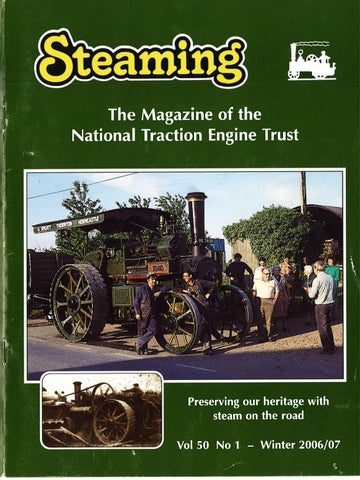
Front cover An article in this issue commences a detailed history by Pete Wright on Ruston Proctor 8hp agricultural engine 33501, which he owned until recent years. Part 1 covers the engine's working days, but with this picture we jump ahead to 1988. Pete Wright, Brian Barber and the 1908 Ruston pause awhile on the site of its former engine shed at Dalderby, near Horncastle in Lincolnshire. Standing at the right are some of the interested local people who turned out to witness the engine's return to its one-time haunts — you will read all about that in Part 2. (Roger West) 3
Trust News The President's foreword At the opening of our 2006 AGM, the retiring President Giles Romanes addressed the meeting: Welcome to this AGM, which will give you the opportunity to endorse — I hope or question the efforts of the new governance organisation. Your Chairman and officers have devoted an enormous amount of their own time to the Trust's affairs and so deserve our thanks.They are only too aware of multiple pressures from regulators of several different breeds who try to impose their influence on our activities. As far as I can see, if we were to concede passively to their pressures both the pleasure and the skills of operating traction engines of all types would be lost. Engines might just as well be in a glass case. I have now done two terms, of three years each, as President of the
Trust, so am standing down, thanking you all most sincerely for the privilege you accorded me six plus years ago.
Engine Owners Column Engine Owners Section Work continues on updating the Traction Engine Code of Practice, with direct contact between SAFed's assessors and ourselves. Meetings with theTrust'sTSU are being held on a regular basis in order to solve some of the technical issues associated with the Code of Practice. At the beginning of December David Smith and myself attended a conference at the Institution of
This was our 2006 ... At the 2006 AGM at Windermere those present heard Chairman Robert Herring describe what had come to pass in the management and running of the Trusts affair since they had last met. For the benefit of all members we repeat the interesting statistical summary. In the further implementation of Operation Blastpipe (see our Spring 2005 issue, page 68, and notes in subsequent issues► : • we formed a General Council of elected members and associates. • the Executive became the Management Committee, consisting of a chairman, five section heads, a general secretary, a treasurer and a public relations officer. • the General Council set the policies and charged the Management Committee with the job of implementing these policies, and the day to day management of theTrust affairs. 4
Through the year the Management has held four meetings, the General Council three meetings and the various Sections (Engine Owners, Membership Services, Rally Organisers, Steam Apprentice Club and Technical Services) have held twenty meetings — and in addition many, many phone calls, e-mails and face to face discussions have taken place. We have made decisions to: • authorise a considerable donation to BESTT (Boiler Engineering Skills Training Trust) • set new membership rates • appoint a firm of legal advisers
and then planned and carried out: • a new SORP style charitable commissioners report • the provision of an improved tent at the Great Dorset Steam Fair • the creation of a new look web-site • the publication of 236 pages of our magazine Steaming
Mechanical Engineers on the Pressure Equipment Directive (PED) and how it affects the repair and sale of second hand pressure equipment. Once we have clarified our interpretation of opinions given at the meeting we may be able to give some guidance on the PED and how it affects the repair of pressure vessels, for example, boilers. You will see quite a large section on Technical Tips in this issue; please do keep them coming in so that everyone can benefit from your experiences. The 2007 Engine Owners Meeting will be held on Sunday 18th February at Willoughby, when the main topics for discussion will be the NTET Safely Policy, the Safety Management Scheme, the Traction Engine Code of Practice and the Boiler Inspections Audit Scheme. Every one connected with the owning, driving, repairing or assisting with engines is invited and welcome to attend,
• the refurbishment of theTrust Exhibition
Unit Other statistics and facts are: • Membership Services enrolled 300 new members and the Exhibition Unit visited 13 rallies • the Engine Owners section ran a fully subscribed Training Course, and has undertaken significant revisions of the Traction Engine Code of Practice including a new written scheme of examination • that section also had a milestone meeting with the independent boiler inspectors, and has issued 15 certificates of competency, and appointed three new assessors • the Rally Organisers section authorised 100 rallies; distributed 80,000 copies of The Rally List; inspected 15 rallies for safety; undertook eight safety seminars involving 150 candidates • in addition, they have re-visited the Rally Code of Practice and presented it to the HSE for endorsement and commendation, and 10 rallies have used the new insurance disc pre-validation service
The Steam Apprentice Club has: • enrolled 300 new members Winter 2006/07
STEAMING
whether or not they are members of the Trust. (Bob Siddall, chairman, Engine Owners section)
Voluntary Competency Scheme I am pleased to give an update on the above Trust scheme. During 2006 we have been able to appoint three more examiners to the Competency Scheme, these being Robin Drury in Nottinghamshire, Henry Netherway in Hereford and Richard Stock in Cornwall. This brings the number of examiners to six, with Dave Smith continuing in his role as senior examiner. In addition we have awarded fifteen people with the Competency Certificate. This represents a gentle start to the scheme, a situation which I believe will change as the idea of assessment gains acceptance. I know there are several engine drivers who have asked for the syllabus, but have yet to come back with requests for arranging a test. If you are thinking that you may be interested in the scheme please contact me for a syllabus and/or to arrange a test. In most cases this will now be taking place further into the year, when engines are brought out of hibernation. (John Durling, Competency Scheme Administrator, Tr 07885 263559 or john.r.durling @uk.transport.bombardiercom )
• held five Apprenticetraining days with a total of 300 students • had the best ever 'playpen event' at Dorset • produced 64 pages of Raising Steam issued three Certificates of Competency • • and implemented a child protection policy
To complete this summary, the Technical Services group has: have issued 2500 insurance discs developed a Health and Safety Policy produced a safety management scheme held a milestone discussion with SAFed drafted a boiler inspection audit scheme is providing an on-going development of theTrust management procedures • is reviewing the Memorandum and Articles of Association • • • • • •
The Chairman thought all members would agree this had been a phenomenal work load, undertaken by a group of volunteers dedicated to maintaining the use of steam traction engines, not only for the owners, but to make them available and safe for the general public at large. The work is ongoing.
STEAMING
Winter 2006/07
Technical Services Health and Safety Policy At the 2006 AGM, on behalf of the General Council, I presented to the members the new Health and Safety Policy. Despite being a potentially heavy subject it was well received. Why a new Health and Safety Policy? I can hear some ask. The answer is simple; we didn't have an old one! As an organisation based on very public activities we need to record our commitment to the safe conduct of events and to the safe undertaking of our hobby. For a long time there have been many arguments based upon whether or not we are at work when pursuing our hobby. Well, even if the Health and Safety at Work Act does not apply, as participants or observers, or as officials, we still have a common law duty of care to the public, to each other and to ourselves. The General Council took the view that we could not ignore the consequences of not having a policy that explained how the Trust and its members would exercise their joint duty of care. A full copy of the Policy will be made available to members in the near future, but if anyone requires sight of it in the meantime please write to the General Secretary with a SAE. Integral to a Health and Safety Policy is a Safety Management System. We have had a Safety Management System for some time, in the guise of the Rally Safety Audits, but we didn't know it. Accordingly the General Council has formalised these arrangements and into them we shall be adding the Boiler Inspections Audit Scheme.
Boiler Inspections Audit Scheme This scheme has been devised with the backing and guidance of the Safety Assessment Federation (SAFed) and following consultation with the independent boiler inspectors. The principal aims of the scheme are • to enable consistent standards of boiler inspection and reporting to be applied via a SAFed approved Written Scheme of Examination. • to underpin the integrity of the boiler inspectors via a random audit scheme administered and undertaken by SAFed approved auditors.
As part of the Safety Management System, from January 2008 anyone applying for an NTET insurance disc, either from their insurance broker or from the NTET's Insurance Officer will have to support that request with
General Council and Officers 2007 This column lists, for the information of members, the General Council and Officers of theTrust for 2007. The addresses/ phone numbers of those with special duties are given inside the front cover of each issue of this magazine; others may be contacted by phone or via the General Secretary or Heads of Sections. Names marked with an asterisk* are appointments by the Council and are non-voting positions. President Richard Sandercock Vice Presidents Andrew Semple Chairman Robert Herring Vice Chairmen John Cook, Paul Worbey General and Company Secretary Susan Jackson* Treasurer Julie Smith, FCA* Public Relations Officer John Billard (+ FBHVC, Er 0118 934 0381) Membership Secretary John Cook (and Head, Membership Services Editor, Steaming Roger West* Sales Officers Colin and Val Brown* General Council The above and also: Irvin Barraclough (S. Yorks, Tr 01709 850346) James Blenkinsop (Insurance Disc Officer) John Bosworth (Derbys, IT 01332 880405) Michael Davies (Warks, '' 01295 770217) John Durling (Derbyshire, 01283 712818) Bill Evans (Rally Authorisation) Bob Garnett (Avon, Tr 01275 878054) Edward Goddard (Sentinel DC and Salop, T2 01743 851128) Tim Holt (Cumbria, 12 01524 271584) Richard Hurley (Wilts, IT 07867758366) Brian James (Norfolk,w 01328 851429) Pat Jenkins (S. Wales, 27 01792 390379) Kevin Munn (SAC chairman) Bob Siddall (Head, Engine Owners Section) David Smith (Head, Technical Services) StuartTomlinson (Training Course and Leics, 12 01455 613079) Paul Worbey (Head, Rally Organisers Section Representatives Reg Mattless (NV Tractor & EC)* Auditors: Charles Lovell & Co, Royal House, Market Place, Redditch, Worcestershire BN98 8AA
5
Sections and Services 2007 This column lists the members of the Trust's Sections and Services for 2007. Names marked with an asterisk* are co-opted; others are elected General Council members. Addresses/phone numbers of the chairmen or heads appear inside the front cover of each issue. Engine Owners Section Bob Siddall (head) Nick Allen* Irvin Barraclough James Blenkinsop John Bosworth Michael Davies Sylvia Dudley* John Durling Bob Garnett Edward Goddard Colin Hatch* Pat Jenkins Kevin Munn Richard Pierce* David Smith StuartTomlinson Peter Williams" Membership Services John Cook (head) Colin Brown* Val Brown* Roger West" Rally Organisers Section Paul Worbey (head) Colin Brown" Val Brown* Trevor Evans* Bill Evans Paul Hemstritch* Tim Holt Lance Jackson* Brian James Keith Stott* JoTilling* Steam Apprentice Club Kevin Munn (chairman) John Durling (president) Elaine Massey (vice chair)* Linda Bate* Sam Bate* Gareth Haase* Kevin Law* Matthew Lund* Nanette Saunders" Barry Sumsion* Technical Services David Smith (head) Irvin Barraclough John Billard James Blenkinsop Chris Boocock* Richard Hurley Lyndon Shearman* Tony Wood*
boiler inspection reports based on a SAFed approved Written Scheme of Examination. The inspector may use his own SAFed approved scheme or the NTET's SAFed approved scheme. Moreover, they will have previously agreed to participate in the random inspections audit process. 6
Engine owning members of the Trust, in accepting the Health and Safety Policy as part of their membership of the Trust, will automatically be included in the audit scheme. Non members applying for Insurance Discs will be required to agree to participate in the audit scheme prior to the scheme going live. These are significant and far reaching changes. Some folk won't like them, others will, but importantly the engine bearing an NTET insurance disc in the future will be displaying a 'Badge of Commitment', not just a ticket that got the engine into the rally. It is planned that 8 to 10 random audits will be undertaken per annum and these will be carried as live audits; i.e. by watching the inspector at work. Simple arithmetic shows that the chances of an engine being included in a particular year's selection is pretty slim but it is hoped that no-one would decline to be included in a particular year's batch. Inevitably we will have to fine tune the scheme, and it may take two or three years to bed down. But this is the first real chance we have as a hobby to demonstrate our willingness and ability to ensure that the hoary subject of doubtful boiler inspections is laid to rest. Web site Yes, I trumpeted the launch of the new look website in the middle of 2006, but then we hit technical problems which prevented us completing phase one and subsequently launching phase two! These problems are now overcome. With our on-line web page editor we are now in a much better position to get updates quickly onto the site and we can develop the other exciting stuff we want to introduce, including the insurance disc access scheme for Authorised Rally organisers. Pressure Equipment Directive (PED) Bob Siddall mentions elsewhere our joint visit to the Institute of Mechanical Engineers to participate in a seminar 'The Supply and Purchase and Re-use of Pressure Equipment'. This was a very useful opportunity to listen to informed presentations and also to meet like minded people - albeit from main-stream industry and to talk first hand with the law makers (the DTI), the policeman (the HSE), the Insurer (Cornhill Allianz) and folk at the sharp end (Kodak selling off their plant, and Pfaudler
Balfour - manufacturers and repairers of pressure vessels). The topics and speakers were: Selling used equipment and machinery - Kevin Wright, Health Safety and Environment Advisor, Kodak. • Consequences of non-compliance with the provisions for the supply, purchase and re-use of pressure equipment Gary Lewis, solicitor, Hammonds. • The Law, the supplier and the buyer Stephen Shaw, Inspector of Health and Safety, HSE. • Used Pressure Equipment, and the requirements of the Pressure Equipment Directive - Rick Holyomes and Mike Dodd, DTI. • The Insurers View - Glynn Amphlett, principal engineer, Allianz Cornhill Engineering • Repairs, alteration and re-rating - Ron Black, quality/validations manager, Pfaudler Balfour.
Our first thoughts - or what we believe we heard! - are that: • sellers must supply all examination and maintenance history paperwork and ensure that the system is in a safe and operable condition, unless there is an explicit statement to the contrary in the sale catalogue. • Buyers must demonstrate that they are competent to operate the equipment! • CE marks are required - where equipment is new into the European Economic Area (EEA), and where equipment is repatriated from outside the EEA, and where equipment is modified to the extent that the method of operation or its performance changes. • CE marks are not required - where a repair is undertaken that does not include replacing any fittings or control devices, or where a repair is undertaken using more modern materials, but the system is to be operated in exactly the same way as previously, i.e. no change to operating or performance characteristics. • The Law makers, the solicitor and the 'policeman' accepted that the PED/PER were very complex in some areas, and in many cases were reluctant to go to law because of the uncertainties in setting out a case and obtaining a judgement.
The Technical Services Unit will deliberate and consult with colleagues on these bullet points through the winter, and it is planned that we will have a definitive statement on the application of PED to our hobby in the spring. Appointment of Law Firm as Legal Advisors The General Council has accepted the TSU's assertion that the position of Honorary Solicitor is not commensurate with making timely progress when dealing with matters that contain a degree of urgency or complexity, and which in any case Winter 2006/07
STEAMING
requires face to face conversations with learned opinion. During the time I have been dealing with the review of the Memorandum and Articles of Association it would not have been possible to have made the progress we have without direct access to legal advisors who dealt specifically with Charity matters. Harrison Clark, solicitors in Worcester, have been appointed as our legal advisors. In particular we have been working with Robert Capper, a partner dealing in Charities and Business Law. Robert made the trip to the AGM at Bowness in November 2006, and introduced himself in fine style. I look forward to a long and fruitful relationship with Harrison Clark. (all paragraphs in this section - David Smith, head of Technical Services)
Insurance Matters Walker Midgley to cover full size engines As many of you will know, Walker Midgley Insurance Brokers have for some years now provided excellent insurance policies for the miniature engine owners in our movement, and the company has acted in this respect as a disc issuing agent for the Trust. I guess it was only a matter of time before they made a move into the full size engine market to offer a range of insurance policies underwritten by Royal & Sunalliance, which I am pleased to announce are available with immediate effect and are endorsed by the NTET. There are two main schemes: one for engines under restoration and portables where RTA insurance is not required, and one for road going engines. In each case the policies are arranged in sections so that the client can tailor the cover to suit their requirements. Common to both types is the option for providing cover for product liability where an engine owner may make a part as a favour for another which then breaks and causes further damage. The policy would then cover the liability for death or injury or cost of the repairs to property. Also available is a policy for your home workshop offering comprehensive cover. In all cases the insurance documents have been very well written in plain English, and laid out in a manner that it is easy to read and understand. STEAMING Winter 2006/07
Albert Canton of Sheepscombe, Gloucestershire owned and worked several Mann's engines in the 1930s and through the World War 2 years - we featured two of them and one of the patching roller versions in our Spring 2003 magazine. This picture shows the 'Miserden Estate tractor', but what we can see from the photo doesn't firmly identify it in Road Locomotive Society lists. The estate owner Alfred James is recorded as having Mann's 1310 of about 1918 (AD9032) in the early 1920s, which later passed to Canton. The tractor in our picture might be 1310, but comparing it with the pictures mentioned above it seems to be fitted with a longer boiler than others of the same make, as well as a larger firebox - there are six stays vertically and six or seven horizontally. (collection Gordon Jones) Trust members who choose to use Walker Midgley will receive a discount over those who are not members, providing they send their membership cards with their application as proof of membership. (for contact details see advertisement elsewhere in this edition) Boiler Inspectors PI/PL With the close of the 2006 season some of us will be planning our annual inspections, so I thought it would be helpful to remind members which independent inspectors have current insurance documents lodged with the Trust. inspection Professional Indemnity and/or Public company Liability insurance P + PL Alan J Hines P ANB Inspections P Farncare Inspection Services Graham Morris Engineering Ltd P P + PL Jonathon Wheeler P + PL J A Glaze P + PL R&B Inspection Services P SFP Inspection & Consultancy In addition to this list we automatically include all the corporate inspection bodies, for example Royal & Sunalliance, Alliance Cornhill Engineering, HSB Naughton, Zurich etc. These organisations are large
enough to self insure and provide insurance to others. I should add that the Trust took legal advice sometime ago as to its liability issuing insurance discs against paperwork from an uninsured/underinsured inspector. The reply given was that the Trust could be implicated in the event of a boiler releasing pressure in an uncontrolled way that caused injury or damage to property. A cynical point of view might say that the disc issuer subsumed the owner's responsibility to 'intelligently read and understand' the related inspection and insurance documents. Of course it is only a record of the expiry dates, but it is now interpreted as a 'Seal of Quality', which implies that all the supporting documentation is in order. From this advice, it became policy to only issue insurance discs against inspection reports from those inspectors who had lodged their documents with the Trust. So if your inspector is not shown on the list, please encourage him to send copies of his insurance paperwork to me. (above paragraphs - James Blenkinsop, Insurance Officer)
7
Steam Apprentice Club The Steam Apprentice Club committee have been meeting to prepare for the 2007 season. As always we are grateful to engine owners and organisers alike in helping us carry out our activities, but like many voluntary organisations we could still do with more assistance. So if you feel you can offer any sort of help, whether as a SAC area co-ordinator, as an engine owner willing to take on an Apprentice, or make their engine available at a particular rally for an Apprentice to 'have a go', please contact me via the details on the inside front page of this magazine or via the NTET/SAC website. At the end of last year the SAC awarded their two major trophies. As neither of the Apprentices could come to the Trust AGM in Cumbria, I went to their home areas to present the awards to them.The first visit was to Simon Beat of Sheffield for the Steam Apprentice of the Year Jack Beeby Cup, and the second was to Christopher Webb of Sudbury, Suffolk for the Technical Achievement award. Both lads thoroughly deserved the accolades given to them. Do you know any SAC member who might be deserving of either of the awards in future? In this issue of Steaming is an advert inviting applications for the 8
Horton village resounds to the rumble of Burrell 3985 and its living van. The 1925 built 8 ton roller was returning towards its Isle of Wight home on the Monday morning following the 2004 Great Dorset event. (John Maund)
2007 Technical Achievement Award. You can also find it on the NTET/SAC website. Please give some thought to entering an Apprentice as we try to encourage them not only to be aware of how to operate an engine properly, but to be able to fix it correctly too. I shall write more about how to enter the Steam Apprentice of the Year 2007 in the next issue of Steaming. (Kevin Munn, chairman, Steam Apprentice Club)
surrounding accidents with steam engines, we must warn that authoratative reports are often the result of formal investigation or even inquests. Accordingly there may be a long delay before an accurate assessment can be set down for members' benefit. A press release on the subject of the new boiler inspection and audit scheme was issued following the Trust AGM. (John Billard)
Public Relations Report
FBHVC News
I have received oral reports from the appropriate constabularies about the serious accidents that occurred in Cornwall and in Northants this summer. The roller runaway near St Agnes, Cornwall was caused by driver inexperience.The fatality to the steersman on the McLaren tractor appears to have been caused by the seat breaking under him; these latter findings are pending an inquest. Whilst understanding Trust members' wishes to promptly know of the circumstances and details
FBHVC survey results — As reported at the Trust AGM, we are grateful to those members who completed the Federation of British Historical Vehicle Clubs (FBHVC) survey forms last year. This is part of a wider project being undertaken by the Federation Internationale des Vehicules Anciens (FIVA) involving eleven other national federations and their clubs. It is noteworthy that the British historical movement represents about a quarter of all historical vehicle activity in Europe.This survey has provided extensive qualitative Winter 2006/07 STEAMING
data relating to road transport heritage, and Trust members have played a significant part in this. The UK data will be essential in informing national and European legislators concerning the importance of the historical vehicle movement to national economies. In summary • historic vehicle related activity is worth over £3 billion to the UK annually. • export trade is worth over £300 million, • over 27,000 people in the UK earn some or all of their living serving the historical vehicle movement. • 81% of the businesses serving the movement have been established for over 10 years. • there are over 400,000 historic vehicles currently roadworthy and licensed. • over 65% of historic vehicles travel less than 900 miles per year. • 30% of historic vehicle owners have a household income of less than £20,000 pa. • in pursuit of their hobby members of FBHVC clubs spend 740,000 nights away from home. • 67% of historic vehicles are valued at less than £10,000. Guide for users of historic vehicles - FIVA became a signatory to the EC Road Safety Charter in 2005. This charter is part of the EC's programme to reduce road traffic deaths by 50% by 2010. FIVA is doing all it can to maintain the existing high levels of road safety achieved by the vehicles. historic of drivers Accordingly a 16 page A5 size guide for historic vehicle users has been produced to encourage and promote safe driving habits among existing drivers and to assist those with less experience. The guide includes a short section on steam vehicles. It is intended that copies of the guide will be distributed to each Trust member. This will encourage road safety awareness and increase knowledge of the work of FIVA and FBHVC. Agricultural waste regulations - These were at long last published in the summer. It appears that there is no restriction on owners storing unused machinery on agricultural land. It only becomes 'waste' when the owner declares it to be so. The exception is if the item is considered an environmental hazard, for example by leaking fluids. FBHVC is Tachographs considering a consultation on drivers' hours.This appears to extend the use of tachographs governing rest periods into the privately operated HGV category. While there is an exemption for historic vehicles this is not sufficiently wide to exclude many lorries used to transport engines to rallies (etc). A particular effect appears to be on professional STEAMING
Winter 2006/07
The NTET's Engine Owners Section presents its 2007
ENGINE OWNERS MEETING to be held at
The Village Hall, Willoughby, near Rugby, Warwickshire 10.30 for 11.00am on Sunday, 18th February 2007 All owners, crews, potential owners and anyone else interested in the working of preserved road steam vehicles are welcome to attend - whether they are members of the Trust or not. Contact Bob Siddall if you wish to have a topic discussed — 'r 01636 821991 or RGSiddall@aol.com
drivers who use a similar vehicle for use. Discussions are hobby continuing with David Hurley who leads the Federation Legislation committee. Drive It Day - Next year's Drive It Day will be on Sunday 22nd April. It is hoped that as many as possible historic vehicles will be on the road, or on show, on that day. Slow moving vehicles - FBHVC has been told of two instances where Highways Agency staff have stopped slow moving historic vehicles. This was because they were considered to have been causing congestion. One was on a motorway, the other a trunk route, and this was despite the fact the drivers were acting perfectly legally. Please let me know of any occasion where drivers of steam vehicles may have been stopped inappropriately. (John Billard, FBHVC representative)
Obituaries Shirley Blagg It is with regret that we record the death of Shirley Blagg (nee Harness) in October 2006. Such was Shirley's popularity that Whitwell church, Nottinghamshire, was full and overflowing at her funeral service. Shirley was born in December 1930, and in 1935 began a lifelong association with education. In 1949 she qualified as a teacher at Thornbridge Hall College and took a first position as an infant teacher at Eckington village - stories to be recounted in later years came from this first appointment. One of the pupils had the bad habit of, shall we say, 'soiling his trousers'. On one particularly messy occasion, Shirley showed her resourcefulness by wheeling the lad home for a change in the school gardener's wheelbarrow.
The NTET's Engine Owners Section presents its 17th
STEAM TRAINING and DRIVING COURSE to be held at
Astwood Bank, near Redditch, Worcestershire on 12th and 13th May 2007 A practical and informal course including instruction on boiler management, mechanical operation, care and maintenance, and on driving techniques For further information send a C5 (for A5) size SAE to: Stuart Tomlinson, 470 Coventry Road, Hinckley, Leicestershire LE10 ONH. 17 01455 613079 e-mail hazel.tomlinson@homecall.co.uk
9
Her teaching career progressed as she taught home economics, later becoming a senior mistress and a deputy head, and then retiring in 1991. Treatment for a sudden serious illness in 1961 had involved radiotherapy, and left her with medical problems for the rest of her life; the casual observer would be unaware of anything untoward as she and John and friends performed a spirited interpretation of The Lancers at local dances. It was in 1950 that John and Shirley started going out together. Theirs was to be a long courtship, culminating in their wedding in July 2002 — an event celebrated by numerous friends for the remainder of that rally season. Shirley's involvement with the steam engine movement started in 1956 when John acquired his first engine, the McLaren road loco CAPTAIN SCOTT. From the beginning Shirley and John were enthusiastic supporters of rallies, and exhibited either the Mac or a Marshall traction for fifty years. In the early years Shirley frequently shared the footplate with John, but later became well known for her hospitality in their living van.The last time Shirley steered the Mac was during the Trust's 50th anniversary road run in 2004. Shirley's generous nature, helpfulness, ready smile and sense of humour will be greatly missed. (Irvin Barraclough) Bernard Emerton It can be truly said that Bernard Emerton, who has died at the age of 72, was brought up in a world of steam. His parents came from a long line of railway staff, with every house where they lived in Camden occupied by a railwayman. By good fortune, Emerton senior had taken a transfer to Harpenden, Hertfordshire, as a guard before the London air attacks of World War 2. In the village surroundings of Wheathampstead young Bernard went to school, and there developed two lifelong interests — music from joining the church choir, and the discovery of steam rollers. Out from afternoon school, the ten year old would watch and 'help' the local council's roller gang. One day, as the gang made their way home, Bernard's curiosity got the better of him. Off came the sheet, chocks moved, brake off and by standing on tip-toe he put the engine in gear. Slowly opening the regulator, the roller moved forward, then back, a few more test runs and then everything was put back correctly. 10
Master Emerton had passed the test; the only bad news was that somebody witnessed it all and told his mum! Further youthful experience of steam came from branch line trips with his father, the guard of the pick-up goods, to Hemel Hempstead. The driver allowed Bernard chances to tend the fire on the return journey. Later, the family took a newsagent's shop, and in the garden shed a modellers' lathe provided Bernard the opportunity to practice all that he had absorbed from reading Model Engineer. On leaving school a promised job as an apprentice toolmaker failed to appear, and it was not until 1956, after he had married Jean at the age of 22, he bluffed his way into a local engineering works as a turner. On a Monday morning he was given a lathe and a batch of parts, and five days later he was judged above standard — despite his un-admitted qualifications being mere magazine reading! In 1970 Bernard acquired a steam roller — an Aveling piston valve compound. From that time he, and Jean, became involved with rallies and running the Hertfordshire club, making lasting friendships. In the 1980s I appeared as a new face at club meetings, fresh from off-road motorcycle racing and newly possessed of an elderly Foden wagon, and Bernard (his roller off the road for repair) quickly became one of my team. One summer the wagon went on tour to Belgium, and then to Holland. Bernard was to take a week off work for the Dutch adventure, and given an air ticket from Luton to Brussels, where one of my motorcycle friends would meet him for the transfer to the Foden, wherever that was. With no phone contact numbers, Bernard became apprehensive on landing, but then amazed to see a uniformed chauffeur holding a card for 'Sir Bernard Emerton', and be whisked off through diplomatic channels to a top-range Mercedes. At the age of 62, there came the decision to fulfil a long held ambition to explore the silent flight world of gliding. Such was Bernard's aptitude that he was passed for solo flying in just a year at the London Gliding Club at Dunstable. When, too soon, it came that he failed his medical, his unstoppable enthusiasm saw that he became a dependable member of the ground support crew. Other involvements in his life centred on helping out at the workshops of the Stockwood Park Museum at Luton, from where the town's old tandem roller was restored and rallied,
Bernard's appearance with the roller at the Bedford club's Old Warden rally last September, a couple of weeks before he and Jean celebrated their 50th wedding anniversary, sadly proved to be a fitting end to 35 years of helping others with his skills. (Christopher Lavery) Jim Newnham MIOSH, RSP, MIIRSM, MIDiagE, MBAE Jim Newnham, from near Chelmsford in Essex, and until recent times the Trust's Safety Adviser, died in September 2006, aged 78. His schooldays were spent at Dulwich College, but he was brought up on a farm in Sussex, where he worked until marriage in 1952. He then spent eight years working for the railways in East Africa, where he was responsible for the engineering on railways and harbours, serving Lake Victoria, and later in Katanga, Tanganyika. On his return to England in 1960, he trained to be a factory inspector working in the Brighton area and later in Essex. He retired when he was 56 to become a consultant, and serve as an expert witness on health and safety matters. All this gave him an excellent background of experience 1.0 be the safety adviser to the National Traction EngineTrust, a post he filled for over 30 years. Many of our members who were involved in rally organisation in the 1970s, and who attended the Trust's early conferences at the GWR Hotel at Paddington, London, will fondly recall Jim's lengthy addresses on matters of rally and engine safety, long before the subject became an industry, all delivered in a witty and sensibly credible manner. We had invited him to join the Engine Owners sub-Committee to take forward the Traction Engine Code of Practice on which he had already made a start. Other committee members made considerable contributions, but this was largely Jim's baby, for he had the ability and the necessary professional contacts for the development of this sort of document. Though always a busy man, he gave his time to theTrust unstintingly and attended meetings very regularly, In the words of Richard Swithenbank, his colleague on the Technical Board, 'Jim absorbed bureaucratic problems and reams of paperwork like a sponge, and without being buried by them. Despite being hampered by dyslexia as a Winter 2006/07 STEAMING
schoolboy, his clear and shrewd ability with the written word was quite remarkable. Jim was always worth listening to and he had a gift of communication that commanded attention'. It was a real shock to hear of Jim's unexpected death and we feel the Trust has lost a true friend, one with strong determination and a great sense of humour. Over a long period he has made an enormous contribution to the Trust's ability to cope with increasing regulation. We offer our sincere condolences to his widow, Liz, on her loss. (Michael Davies and Sylvia Dudley)
The Trust Trophies, 2006 Once again, at our principal yearly gathering of members, some of the Trust's impressive range of Trophies were presented following the AGM or at the formal dinner later that evening. The selection of the recipients was to a great extent made from more local members, marking our presence in the north west. The presentations were made by the outgoing President Giles Romanes, and the citations prepared and read by Anthony Thompson and Paul Worbey. The CHOISY AND SIMSON CUP was received by Dick Ransome of Coniston - formerly a Ribble transport company mechanic, and engineer on the National Trust steamboat GONDOLA. A roller owner and a well known character. The CURTIS BOWL went to Gerry Burns of Wigton, Cumbria - an enthusiast most extraordinary and the exhibitor of a Ruston & Hornsby engine that he drove in its working days. The DACRE LACY CUP was awarded to Granville Oldroyd of Heysham who has been a staunch supporter of north west events for over 30 years. He always roads his engine and van to events, sometimes up to 75 miles distance. The PERCY HIRONS BOWL was handed to Mike Lewendon of Swindon. An engine owner for several years, Mike has just completed a season's run with John Wharton's showmans KING GEORGE VI, moving and running the Jungle Thriller Ark - which the engine was paired with in working days - for a distance of 531 miles and 447 hours STEAMING
Winter 2006/07
generating. The CONNIE HUTCHENS MEMORIAL TROPHY - an annual award to a lady in the movement was presented to Val Brown for her untiring work in the our sales section - she is one of the faces of the Trust known by rally goers all over the country. The ERIC MIDDLETON TROPHY was received by Derek Bouch of in Carlisle near Brampton, recognition of the rebuild of his Aveling roller over two years within limited means. The ARTHUR NAPPER CUP was presented to Mike Beeby of Nottinghamshire; Mike has spent a lifetime in steam and this year organised the record breaking and memorable Steam Plough Challenge in his native village of Rempstone. The TOC H CUP was awarded to of Ilkeston, Cliff Rodgers Derbyshire for the restoration of his Marshall roller - including travelling on the road to the Banbury rally on one of its first post rebuild outings. The J T BEEBY CUP for Steam Apprentice Club members was presented to Simon Beat of diligent for his Rotherham, assistance towards the running of John Carr's Ransomes agricultural engine.
Transport Trust Awards 2007 The Transport Trust invites entries for its 2007 Restoration Awards. A number of cash awards, up to a maximum of £2000 each, are made annually for high quality transport restoration projects which are well advanced, but would be helped towards an earlier completion by a cash injection. The closing date for Restoration Award entries is 30th June next. Projects will be inspected before the end of August, with the declaration of winners made during October. Nominations are also invited for theTransportTrust's Preservationist of the Year and Lifetime Achievement Awards, together with entries for the Young Preservationist of the Year Award, the latter carrying with it a cash sum of £500 to the winner. These three Awards enable the Trust to acknowledge and publicise a wide range of endeavour in the cause of transport preservation, from management or administration to
Presentations at the AGM President Giles Romanes, retiring after six years in the position, receives an inscribed decorative glass from chairman Robert Herring (top); Cliff Rodgers is handed the BakerToc H cup by head of the Rally Organisers section Paul Worbey (bottom). (John Billard; Nicholas Bosworth) work. restoration hands-on Nominations for all three categories are invited from individuals or organisations and should reach the Transport Trust office not later than 1st May next. Award criteria and entry forms for all Awards are available from the Transport Trust office, 202 Lambeth Road, London SE1 2JW. IT 0207 928 6464 or e-mail hq@thetransporttrust.org.uk Alternatively, entry details and forms 11
marked 'McLaren Appeal'. Cheques should be made payable to the 'Leeds & District Traction Engine Club'.
Trust Diary 2007 The diary of Trust events of a business and social nature during 2007 is set out below. It includes, in bold type, dates of Conferences and other members' gatherings and, in italic type, Committee meetings. The timetable has been arranged to avoid clashes in the dates, following consultation with the other nationally based road steam groups (via the Road Steam Forum).
Another from Gordon Jones' collection of pictures of engines in Gloucestershire. This one is William Goddard's Wallis & Steevens 6hp single agricultural /010 - he ran the engine from Wash well Farm in Pains wick, a few miles north of Stroud. A Gloucestershire engine from new, it had been delivered from the makers in September 1908 to Andrewreakle of Bagpath Court, high up at the southern end of the Cotswold Hills. It was therefore a relatively local move to Goddard's ownership sometime before mid 1922, by when it was registered DD1264. See that at least two of the crew wear World War 1 surplus battledress jackets, so that roughly dates the picture to the early 1920s. Goddard ran the Wallis until 1935, but its fate, and the identity of the replacement engine, are unknown to the Road Locomotive Society.
8th February Management Meeting 18th February Engine Owners Meeting 3rd March Rally Organisers Conference 11th March General Council Meeting 15th April Management Meeting 12 and Steam Training and 13th May Driving Course 10th June General Council Meeting during August Management Meeting 14th October General Council Meeting 17th and 18th Annual General November Meeting weekend 9th December General Council Meeting
Future Dates Engine Owners Meeting
for all theTransportTrust Awards can be obtained from www.thetransport trust.org.uk
A McLaren memorial The Leeds & District Traction Engine Club announces an appeal for funds towards the placing of a suitable commemorative 'Blue Plaque' on the site of the former works of J & H McLaren's Midland Engine Works in Jack Lane, Leeds. McLarens were makers of a variety of traction engines, tractors, road locomotives, ploughing engines and steam rollers, and also a wide range of diesel engines - indeed they were the pioneers of this latter type of engine in Britain. Messrs Equinox, display stand contractors, are the present owners of the site, and they have kindly agreed to a plaque 12
unveiling event taking place next summer. It is intended to mount the plate on a prepared plinth with an angled top, using bricks from the original McLaren buildings; the memorial will be positioned within the Equinox boundary fence and visible from Jack Lane. The event is being arranged in conjunction with the Leeds CivicTrust and it is hoped that Civic dignitaries will be involved in the unveiling ceremony. It is hoped to have at least one McLaren steam vehicle there on the day, along with other products of the firm and, in addition, a photographic display is being arranged in conjunction with the ceremony. Any McLaren engine owner wishing to attend with his engine, should please contact the address below, Contributions towards the funding of this event should be sent to the Leeds & District Traction Engine Club Plaque Secretary, Mrs E A Wood, 52 Mill Lane, Ryther, Tadcaster LS24 9EG, the envelope
All engine owners and engine crews are invited to attend the 2007 Engine Owners Open Meeting - it is on Sunday, 18th February, and the venue is the same as for previous meetings - the Village Hall at Willoughby, Warwickshire.The time is 10.30 for 11.00, and refreshments will be available during the lunchtime break. There are further contact details in the display advertisement elsewhere in these pages - so do take advantage of that if you wish to have a topic discussed that maybe requires a bit of preparation prior to the meeting. Rally Organisers Conference The 2007 Rally Organisers Conference is to be held on Saturday, 3rd March at the usual venue in the Village Hall at Willoughby, near Rugby, Warwickshire. The regular at-tenders within our affiliated groups, and those on the event organisers list, will be sent full details and invitations in due course. Winter 2006/07
STEAMING
We again mention that all who may benefit from the meeting are welcome to attend, and if you would like to know more please get in touch with the General Secretary, Sue
Students who attended in 2006 will automatically be sent an entry form for 2007.
Jackson - address inside front cover ortt 01494 527727
Steam Training and Driving Course The Trust's Steam Training and Driving Course for 2007 is on Saturday and Sunday, 12/13th May at Sandhills Farm, Astwood Bank, near Redditch, Worcestershire, by the kind invitation of the Davis family. The course has three different levels - the Foundation level, designed to give a good basic theoretical and practical knowledge of steam engines to inexperienced members, and then the Intermediate and Advanced levels which give a more in depth look at the workings, and also offer practical experience and advice. The course has grown to be a very popular one, and places are limited, so please do not leave it too late to reserve your space. For further details send a SAE (C5 size) to: Stuart Tomlinson, 470 Coventry Road, Hinckley, Leicestershire LE10 ONH, or you can use e-mail to hazel.tomlinson@homecall.co.uk
New Members We extend a sincere welcome to the following new members who have joined the Trust during the last three months. We hope they will gain much friendship, information and enjoyment from their membership over a period of many years. Full addresses are not included, but the Membership Secretary is always pleased to put members in touch with one another by forwarding mail. Miss S G Smith, Oakington, Cambridgeshire ATTaylor, Diss, Norfolk Mrs R Barnes, Riseley, Bedfordshire Miss M Martin, Cambridge D W Helps, Buckingham B Jacka, Camborne, Cornwall N D Parker, Frodsham, Cheshire A Foster, High Wycombe, Buckinghamshire S Durant, Wrexham G J Orchard, Poole, Dorset J R Hughes, Bearsted, Kent S Watson, Arnside, Cumbria C Johnstone, HulI,Yorkshire
L Hayes, Wallington, Surrey S Stearne, Whitehill, Hampshire M Green, Sherburn in Elmet,Yorkshire H Roskilly,Tavistock, Devon P H Deller, Biggleswade, Bedfordshire I C Newman, St Neots, Cambridgeshire R E Gardner, Moreton, Wirral K Jones, Speen, Buckinghamshire Mrs A M Sproxton, Northampton M J Hasker, Newbury, Berkshire P J Potter, Southampton P J Starling, Cambridge P J Newton, Benfleet, Essex Mrs K Hayes, Lincoln Mrs B Owens,Yate, Gloucestershire I Smith, Wisbech, Cambridgeshire A F Leverett, Bungay, Suffolk N Ayres,Thetford, Norfolk P Walton, Barnard Castle, Durham B A Martin, Fairford, Gloucestershire G Bowser, Skegness, Lincolnshire I C Jones, Bromsgrove, Worcestershire D J Lee,Tamworth, Staffordshire S Soper, Narbeth, Pembrokeshire P Stevens,Tetbury, Gloucestershire G Ironside, Ware, Hertfordshire
Poor Steaming The description of colour picture of the smallTuxford portable on page 211 of the last issue should have set down its horsepower as 1Y2. Bill Love draws our attention to an error on page 201 - the village on the edge of Romney Marsh is Bilsington.
Is yours Full Size or a Miniature? Don't worry — size doesn't matter any more as following in the wheeltracks of
MODEL ROAD STEAM INSURANCE for miniature road engines up to Gin scale we now have
STEAM TRACTION INSURANCE for road engines above 6in scale including full size £43.00 (inc 5% IPT) for Third Party & Road Traffic Act cover - any driver of any age (Inc under 21), boiler explosion sparks & ashes, plus Fret Uninsured Loss Recovery and £5m Public Liability cover for you and your crew when 'off the engine' is automatically included Optional Accidental Damage Fire & Theft cover - you pick the sum insured you want up to the engine's market value, the sum insured you pick is the maximum amount payable in the event of a claim. Plus you can add cover for Living Vans, Implements (saw benches, ploughs etc), Home Workshops, Personal Accident and Products Liability
PORTABLE & RESTORATION STEAM INSURANCE For full details call us free on 0800 783 0878 or email tonyw@walkermidgley.co.uk Return of post service for policy and certificate issue and for NTET discs Premium discount for NTET members
YlAV
Walker Midgley
Steam Traction inturanCe and Portable & Restoration Steam insurance
Insurance Brokers
are WET Endorsed Products
Yorkshire Bank Chambers, Fargate, Sheffield S1 2HD Arranged by Walker Midgley Insurance Brokers Ltd & Underwritten by Royal & Sun Alliance insurance Authorised and Regulated by the Financial Services Authority
STEAMING
Winter 2006/07
plc
2007c
13
National Traction Engine Trust
Mail Order Many books, videos and other items of interest to traction engine enthusiasts are available from the Sales section. Readers are urged to take advantage of this service (which also benefits Trust funds) for troublefree and economical postal shopping. Just tick the box for items you require and fill in the address slip.
TRACTION ENGINE READING New Steam Yachts (Smith and Scriven) New Pennies by the Sea, Bridlington (Laister) New Beads of Emerald (Josje Nieuwenhuys)
£9.95 ❑ £9.95 ❑ £9.95 ❑ £9.95 ❑ £16.95 ❑ £9.95 ❑ £9.95 ❑ £9.95 ❑
DVDs are Old Glory/Morton's Heritage unless noted £13.99 ❑ £8.95 ❑ £6.00 ❑
New Vintage FairgroundTransport (Steptoe) New Hancocks of the West (Scrivens and Smith)
reviewed 49/4
£15.00 ❑
New GeorgeKilvington, Fairground Photographs
(Scrivens and Smith) reviewed 49/3 New Roundabout Relics (Barker) reviewed 49/3
£10.00 ❑ £26.00 ❑
New The History of Mann's Patent Steam Cart & Wagon Co (Pease) reviewed 49/1 Traction Engine Album (Ranieri) reviewed 49/1 The Electric Scenic Railway (Scrivens and Smith)
£24.99 ❑ £25.00 ❑
reviewed 49/1
£20.00 ❑
Reprint Locomotive Boilers - Design, Construction and Working (Haig) T. Whitelegg & Sons - Cavalcade of Shows
(Belshaw)
£10.00 ❑ £15.00 ❑ £12.95 ❑ £24.95 ❑
Bridgwater Fair - illustrated history (Belshaw) Fodens - a pictorial history (Davies) EuropeanTraction Engine Register
(Toy and Rayner)
£5.00 ❑ £6.95 ❑
Traction Engine Register (True and Johnson) Historic Fairground Scenes (Ware)
reprint of 1977 edition
£9.99 ❑
RFW1WN History and Restoration
(Brian Steptoe)
£5.00 ❑ £2.50 ❑ £7.95 ❑
Special 30th Rolling (RRA) Squirrels, Nuts and Flying Rivets (Trevis)
Pictorial Albums Norfolk and Suffolk in the Age of Steam (Stephens) - was £19.99 £13.99 ❑ Steam Wagons (Rayner) £4.50 ❑ Traction Engines and other Road Steam Vehicles (Rayner) £4.50 ❑ Traction Engines, A Colour Portfolio (Arlett and Lockett) - was £14.99 £9.99 ❑ Heavy Haulage (Neville/Freeman) £7.50 ❑
VIDEOS Fodens of Sandbach (VHS 70 mins, Mortons Heritage Mission Impossible - restoring 8hp singles
(VHS 100 mins, Steam Plough Club)
£16.95 ❑ £15.00 ❑
Dedicated to Garretts (VHS 65 mins, Mortons
Heritage) Steam Insight (VHS 50 mins, Morton Heritage) Fosters of Lincoln (VHS 70 mins, Old Glory) Road Works Ahead (VHS 50 mins, Old Glory) The Sentinel Steam Waggon (VHS 45 mins, Old Glory) Burrells ofThetford (VHS 110 mins, Old Glory) MOONLIGHT PRODUCTIONS videos Going for Gold - NTET 50th Year Great Dorset & Road Run (VHS 90 mins) Sentinels on the Move -The Horseshoe Pass
(VHS 40 mins)
£9.95 ❑ £9.95 ❑ £9.95 ❑ £9.95 ❑ £9.95 ❑ £9.95 ❑
£18.00 ❑ £16.95 ❑
llp fnr the Cup - the Steam Plough Club's Great Challenge 1998 (VHS 65 mins) Steam over the Fells - steam through the Trough of Bowland (VHS 115 mins) Sentinels on Parade - road run, Shrewsbury to the Horseshoe Pass (VHS 45 mins) The Big Road ATLAS - the Eastnor Castle heavy haulage road-run (VHS 60 mins)
£19.50 ❑ £20.00 ❑ £15.00 ❑ £18.00 ❑
To claim post-free for UK members please enclose current membership card. Non-members please enclose 10% part postage per order. Overseas members please enclose 8% part postage per order (European); 10% (rest of world). PO/Cheques (in sterling please) to be made payable to: National Traction Engine Trust. Visa, Access and Mastercard accepted, please state card number, expiry date and name on card, or phone/fax 01582 733971 (72 evenings only). Orders to be sent to: NTET Sales, 90 Devon Road, Luton, Bedfordshire LU2 ORL. Please allow 28 days for delivery. Name
Company Histories The History of J. & H. McLaren of Leeds
now £21.95 ❑
Ransomes, Sims & Jefferies, Agricultural Engineers (Brian Dell) The Story of St Nicholas Works (Lane), was £30 Charles Burrell & Sons Ltd (Gilbert & Osborne) Steam Engine Builders of Lincolnshire (Clark) The Story of the Wellington Foundry (Lane), was £30 The Rise and Fall of Aveling Barford, 1933-1988
•
This item only, cheques payable 'Steam Plough Club'£18.50 ❑ Burrells ofThetford (110 mins) Fowlers of Leeds, part 1 (115 mins) Fowlers of Leeds, part 2 (50 mins) Dedicated to Garretts (65 mins) Fodens of Sandbach (70 mins) Road Works Ahead (50 mins) Fosters of Lincoln (70 mins) Inside Steam (65 mins)
£15.00 ❑
reviewed 49/4
(John Pease)
DVDs New Steam Across the Stubble, SPC Great Challenge 2006 (75 mins, Moonlight) reviewed this issue
please refer to recent issues for other available books videos and club items
Address £19.95 ❑ £27.00 ❑ £5.99 ❑ £10.95 ❑ £24.00 ❑ £3.60 ❑
Membership No.
Amount Enclosed
List 50/1, Winter 2006/2007
To be Strong Enough to do a Little Hauling The life and times of Ruston Proctor number 35501
'A
'
'O's910r
-
,
,A w4iE0'
This is a tale of local enterprise, and of family and agricultural history, and then of the era of preservation - but throughout there runs the history of an engine that after almost one hundred years, is still with us, as capable as when first made - Ruston Proctor 35501.
Pete Wright Activity at the Sheaf Iron Works During 1908 Ruston Proctor & Co Ltd, of Sheaf Iron Works, Lincoln built their works number 35501. It was an 8hp single cylinder traction engine of their type SH, and I am pleased to be able to record, as the owner of the machine for 32 years, or almost a third of its life, its long and interesting history. We are fortunate indeed that some of Rustons' paperwork from the early years of the last century has survived, including quite a bit appertaining to 35501, which enables us to have a fascinating glimpse of its early days. It is worth going into detail on these records for it should be borne in mind that whilst they are unique to the engine, they are undoubtedly also a fair indication of the contemporary trials and tribulations of running a road engine. The order form from which Ruston Proctor 35501 came into being was dated 26th July 1908, number 8/351. The customer was Uriah Spratt of Thornton Lodge, Horncastle, Lincolnshire, and the paperwork noted 'delivery required 1st week September, from our works by road'. As well as detailing the engine as quoted in my opening paragraph, various other brief STEAMING Winter 2006/07
specifications were set down 1401bs, injector, winding drum and 50yd steel wire rope, differential gear, steam waterlifter, 26ft suction hose and outfit, 2 speeds, springs to hind axle, double firebars, ordinary finish' and then, very noteworthy in view of the life the engine did lead, 'To be built strong enough so that customer may do a little hauling when not thrashing'. The order was also endorsed 'Home Order' which is perhaps not particularly significant except that I was told by Jack Stubbins, the owner when I acquired the engine, that it was built for export to Russia. Rustons did indeed have a considerable business interest with Russian customers, started off by Joseph Ruston's travels in search of sales of portable engines and pumps to drain the Pripet Marshes in 1880; the country's cornfields also provided a good market for the company, and many large straw-burning traction engines were supplied for direct traction ploughing. The brisk business done enabled a Ruston Proctor depot to be set up at Odessa, which was only closed down at the onset of the Revolution. However, any such connection for 35501 does not seem to be the case. It does have a large firebox suitable for burning wood, and was fitted with racks to the coal bunker that could have been assumed were originally fitted for
containing wood. But I think Jack Stubbins knew little about its history - he also claimed that it went new to never certainly and Eptons mentioned to me the name Spratt; indeed the first mention I found of that family name was in Rustons' records. But perhaps the 'Home Order' note in the maker's records was the start of a story - maybe when new it was known by the locals that Mr Spratt's big new engine was of the same sort that had been exported to Russia in previous years, and from that knowledge a somewhat exaggerated tale was handed down. A week after the order was issued the Drawing Office made up their own order.The supervision of the job was placed in the charge of Mr A E Cammell and his task was to carry it through and check all the work required on the drawings. Various standard drawings were to be used, the selection necessary to build 35501 being referred to as List 4 ES 42. New drawings for additional or altered items had to be done and these drawings were added to the Drawing Office Register- in the years to come spares orders for 35501 were often cross indexed to this Register so that the correct drawings could be referred to. Draughtsmen involved by late July were Roberts, Jacklin, Truman and Bramble and among other things they worked up fresh details needed
Heading illustration: One of the decorative sketches that adorned the pages of Ruston, Proctor's catalogue of c1917. 15
The class SH single cylinder traction engine as depicted in Ruston Proctor's agricultural catalogue 360Z probably printed in the autumn of 1917 This is a 7nhp example, and therefore rather smaller than our present subject, 35501, but it is probably a good representation of Spratt's first Ruston purchase, 29908 of 1905. The SH could be supplied in 5, 6, 7 and 8 horse-power (class SC was the compound version). Among the quoted items that could be had 'at an extra charge' to all of them, and which Spratt decided he would have for his purchase, were a coal rack round the tender, a front tank under boiler barrel, a brake acting on rims of the hind wheels, springs (to the hind axle), and an awning over the footplate. Dimensions of the Bhp size were 9in diameter x 12in stroke cylinder; 4ft 6in diameter x 6in face flywheel; 165 rpm; 6ft 3in diameter x lft 6in wide rear wheels. An earlier catalogue, dated 1903, gives more dimensions: width, 7ft 6in; extreme length, 17ft 9in — and weights: with coal and water, 111/4 tons; empty, 10'/4 tons. The net load to be hauled on good roads in fast speed was 16 tons. (courtesy Road Locomotive Society)
for the centre bearer bar to support the double row of firebars, and for the front (belly) tank and its supports. Drawing 24743, for example, was for a rubbing plate to be fitted to the boiler — the position was to be marked off when the forecarriage and front wheels were on and the front wheels could be tilted. From this we might assume 35501 was the first of 8hp SH type to be fitted with a front water tank, or at least of that particular dimension, otherwise the position would have already been known and drawings available. By 19th August, Spratt seems to have added to his requirements. This original paperwork is somewhat torn and difficult to decipher, but a 60ft x 5in endless waterproof leather belt and a large size winch lifting jack seem to feature as well as something on the chimney. It was also noted 'customer will send man and boy for engine ' so Spratt probably expected his engine on time, on the turn of the month. The records continue with inter-department 16
requests couched in terms that nowadays appear most genteel for the factory floor — 'for the above engine we shall require a special injector check valve body to [drawing) SK 355 ... will you kindly put this in hand at once and oblige, Griffin' The something on the chimney was detailed on SK 358 and turned out to be a lamp bracket. Drawing SK 340 probably centred around a draughtsman's error in dimensioning — a fresh set of firebars had to be made to replace some that had already been manufactured too short and the drawing had been 'altered to suit' to take care of its future use. The various drawings had been used or produced at dates between 23rd July and 2nd September, during which time, of course, 35501itself was gradually taking form in the workshops. Not too many days late, and probably finished off in the maker's standard colours of Brunswick Green and dark red wheels, the engine was delivered into the hands of Uriah Spratt on 10
September 1908. We might speculate that he and his son, already engine owners, were the crew who proudly drove away from the Sheaf Iron Works towards Horncastle and the village of Thornton. I have found no record of the price of the outfit, but judging from a competing maker's priced catalogue the extras that were ordered by Spratt must alone have been some £130 above the list price. I believe traction wagons were also acquired at the time. Although Spratt had several well founded businesses, the money was no doubt a hefty amount for him, and it is quite likely (and not unusual) that some sort of a financial loan would have been arranged. At this point in my story it will be appropriate to break off from engine matters and to describe the area of Lincolnshire around Horncastle and to introduce the Spratt family — particularly the latter, for surely it must have been that the Ruston was acquired to add another branch to their existing businesses, just at the time the son of the family, at 19, had reached the age of responsibility, and the father, at 62, the time when he should start handing over. The Spratts of Horncastle Horncastle, a small market town of some 3900 population in the early 1900s, lies 20 odd miles east of Lincoln, at the south west edge of the Wolds and the northern extent of the Fens. Here the River Bain meets the River Wading; the water of the former had been used in the making of the Horncastle Canal southwards to Tattershall about 1800, though the waterway was defunct by 1889. Agriculture was, and still is, the staple trade of the area, and for many centuries until the 1940s the town was well known for its August Horse Fair — 'Horncastle for Horses' was a local saying. The Horncastle Railway came to the town in 1855, a seven mile branch from a junction at Woodhall to the south west, worked by the Great Northern Railway; it closed in 1971. The Spratts were farmers, dairymen and butchers, and the biblical Christian name Uriah (he was an officer in the Israelite army and husband of Bathsheba) was perpetuated and successively used for at least five generations, until the 1930s. It seems no second Christian names were bestowed, and at times it becomes confusing which Uriah is being referred to in surviving records and reports. Census returns, newspaper obituaries and the headstone inscriptions in Boston Road graveWinter 2006/07 STEAMING
The Horncastle area, showing the locations associated with the activities of the Spratt family. yard at Horncastle all confirm there was but one forename. However, for the fairly short period of the family history we need to be aware of in more detail, it was Uriah Spratt, born 1846, who was the principal figure, and no doubt Rustons' customer as far as 35501 is concerned - we shall refer to him where it is clear with the suffix senior. It seems he may have had a first short and childless marriage and then about 1885 married his housekeeper of some years, Sarah Ann Whaler, who hailed from Ingoldmells. By Sarah he had two daughters, and then, born in 1889 and maybe a long desired male heir, an only son, Uriah.The latter will here in this article be junior. It was inevitable, and indeed almost customary in those days, that nicknames were used. Spratt senior was known as 'Coddy' - sprat; mackerel ... perhaps a sort of fish joke! His son, who may have been the young go ahead of the family at the age of just 19 when the 8hp Ruston was purchased, was referred to as 'Ewie' - maybe derived from Uriah, and probably only ever used in speech, so that spelling must be accepted as our version! It is said the family forebears had farmed at Market Deeping, but the land needed too much attention to draining. They had moved 50 miles north to Horncastle at some time before 1840, to continue as farmers and also carry on the trade of STEAMING Winter 2006/07
butchers in the High Street of the town. The family became tenants on farms on the Scrivelsby Court estate, just south of Horncastle. The Dymoke family have been seated there since the time of Edward Ill, and claim the office of the King or Queen's Champion - originally it was the Champion's duty to ride, on a white charger and fully clad in armour, into Westminster Hall during the Coronation Ceremony. At Scrivelsby the Spratts worked the Grange Farm. Across the valley on the west side of the River Bain and the old canal, was the hamlet of Thornton, with hardly more than a few dozen souls in the parish. In 1887 Uriah Spratt senior ('Coddy'), his wife Sarah and their year old daughter Mabel moved from the butchers shop at 5 High Street to live at Thornton Lodge and work the farm. Another daughter, Nellie, arrived the following year and son Uriah was born at the Lodge in 1889. Much later, after marriage to Lillian May Spratt ►sic] of Manchester, 'Ewie' was to live at the nearby West Field Farm, further up the side of the valley by the Woodhall Spa road. From the Thornton Lodge dairy herd there was a milk round in the town, just over a mile away, and the butchers shop, run by Uriah senior's unmarried sister Emma, was still at 5 High Street, Horncastle. The steam engines that were to come were just one part of a quite extensive family business! For use on threshing duty on the farms, on 24th August 1905 Ruston Proctor had supplied Spratt senior with works number 29908, an SH class 7hp single traction engine. This probably started off by being kept at one of the farms but later, when haulage became part of the business, it probably moved from Thornton to join other engines at a yard at Dalderby - another small village over the canal, the river and the railway on the east side of the valley on the Horncastle to Boston road. This yard, hard by the side of the highway, was likely to be that formerly in the occupation of Edwin Jobson, a wheelwright and coach builder; a Uriah Spratt is listed there as a wheelwright in 1913 directories another trade within the family domain, though it is likely that it was a skilled employee who actually did the work. It was at Dalderby from where the haulage side of the Spratts' business was run. By the 1919 Kelly's directory their name is listed with the trade 'haulage contractor' - but not in the 'agricultural machinery operator' lists, though it is said the family did
operate as threshing contractors. Other engines had been acquired by then, but I will return to them later, and now go back to the main subject of this story, carrying on with what is revealed of 35501's working life from the surviving Ruston records. The Ruston's local labours The next details we have are from a long series of spares orders from the Extras Department.The first dates from 20th May 1909; maybe some sort of guarantee period had covered items before that date. In June came a problem with the front axle, serious enough to warrant a new one being made with the caution 'special care to be taken in the hardening ' Spratt was to return the old one; the problem however was not solved, as we shall see. In August 1909 Rustons wrote up .. they have had a very serious smash up... and require parts at once.,. Mr Lewis instructed that these be taken off an engine in stock, or otherwise we could not supply for a day or two. Accordingly, a piston with the bucket and rings complete, as
The premises that were No 5 High Street, Horncastle, the butchers shop run by the Spratt family for nigh on a century. In this picture, taken in 1988, it is occupied as a greengrocers and florists, but seems to retain the overall appearance of eighty years before. (Roger West) 17
well as a back cylinder cover, were taken off the engine in stock and their man [that is, Spratt's] took these parts with him by the 6.10 train last night, together with our man Coulson' A journey from Lincoln to Horncastle, changing at Kirkstead for the fifteen minute trip up the branch, would have taken just under the hour, but the Ruston, of course, could have been anywhere in the district, so we know not where the two men were heading. Seven weeks later, another note, stamped URGENT in large letters, again mentions a new cast steel piston bucket and rings complete, to be fitted to their rod, and later to send a Ruston man to fix to the engine. Was this catching-up paperwork to cover the parts burrowed from the works' stock engine, or (.... surely not!) had 35501 suffered the same rough treatment again? The notes Rustons wrote up on their work sheets and in the ledgers, of course, tell us very little of what their products were up to by way of everyday work; only certain mechanical and generally negative mis-consequences. But it seems fairly sure that Spratt was using his 8hp engine very largely on contract hauling. The inscription we have noted on the original order presumes such work, and comments from those who knew the engine in the 1920s all point to the machine having had a hard life, and one that for the early years at least was haulage work on annual contract, moving stone for road making for the county and rural district authorities. There were few suitable sources in the area for road metal, and supplies came from other areas to railway station yards for onward transport by team labour (horse drawn carts) or traction engine to the roadside. In November 1909 the wire rope on the winding drum was found to be faulty, and was replaced. The matter was to be taken up with the maker of the rope and reported on presumably Rustons would be seeking a contribution! The start of another problem manifested itself at the same time - the cylinder had a leak somewhere on the exhaust side and one of Ruston Proctor's men was to go over 'to pump up the cylinder and find the cause. It was quite a while before anything further came up. Then, in August 1910 the Extras Department received a transcript of Spratt's letter to Rustons - 'Will you please forward at once one new bush for front wheel; the present bush has worn 18
'We build Iractron Wagons, as shewn in the above illustration, in four sizes, viz, to carry 4, 6, 8 or 10 tons; they may be employed for carrying agricultural produce, manure, minerals, bricks, stone or timber, &c. The Wagons are very strongly made of well-seasoned timber, the sides are hinged, and the ends socketed, so as to be readily taken off for carrying timber, &c. 'The Wagons are mounted on improved travelling wheels formed by rolled and welded steel tee rings, with heavy steel tyres and strong tee-ended spokes, hard metal bushes in the naves, best scrap iron axles, casehardened, strong drawbar of improved pattern, and powerful screw brake to the hind wheels as shewn, which can be operated from the side or back of Wagon as preferred. 'The spring draw bar as illustrated above, to prevent shocks when starling, is charged extra. The Wagons may also be mounted on springs at an extra charge.' The above paragraphs come from Ruston Proctor's catalogue of February 1903, courtesy the Road Locomotive Society. By evidence of the photograph of 35501's runaway at Mumby Road Station in 1914, Sore' seems to have purchased two traction wagons to accompany his 8hp engine on its haulage work, and they seem to be identical to this engraving which appeared in the Ruston catalogue. The one piece hinged sides must have taken much effort to put back in place, but there was usually at hand a whole gang of labour on loading or unloading duties, and the sides would have been a minor part of their daily grind. down and is cutting the axle. You will find on reference to your books that the same thing occurred last year and was rectified by your own man. On receipt of the new bush I will forward the old one to you for your report as to cause' It was the left hand side and the office added a dimensional sketch of the bush. In between the more important items mentioned above were a variety of smaller spares - pump valves, gauge glasses, firebars, valve springs etc. In November 1911, with the engine over three years old, came the first mention of anything to do with the boiler; a new stay tube was required. Rustons, as part of their service to customers, were prepared to send a man out on the first train in the morning to fit same, though where the engine was located at the time is not recorded. Soon after the engine must have been showing the cumulative effects
of hard work, and in March 1912 Spratt sent it off to the Sheaf Works for repairs - the hind wheels were to be restraked (that is, after just 3? years work), slide and stop valves re surfaced; brasses on the main crank recollared; a new wheel/pinion on the countershaft; a new reversing lever and several other items amounting to fair wear and tear.Three months later the pump valve caused problems for Spratt - he had ordered a new one which had proved too long and 'in attempting to make it fit, our man filed too much off the bottom and therefore it is of no use to us. We should be glad if you would forward another at once and allow us for the one sent [back] if any use to you' These were the days when the customer was right even when he was in the wrong! In April 1913 came an order for a bush for a wheel on an 8 ton traction wagon - it is not known for certain Winter 2006/07 STEAMING
when Spratt purchased wagons from Rustons, but if they came along with 35501, the work during the ensuing 4? years was plenty enough to account for the above wear. On the same order, a new rim for the smokebox of traction engine 29908 was also supplied. The smokebox front ring of 35501 too had corroded by January 1914 at least the bottom part had, with the owner economically suggesting that since it appeared to be in two parts he only needed the lower one. This order makes mention of the serial number of the boiler on the engine Boiler 28684. A few days later the front axle played up again - axle and bushes were despatched to Lincoln with the workshop instructions 'if a new axle is required, we are to fit same and return at once.' Most, indeed practically all, of the Orders issued at the works were marked 'urgent' in handwriting, and it seems other devices had to be resorted to when the customer really was up against it. Then there was a rubber stamp with half inch letters, URGENT, or a specific description of the engine's plight - 'to be sent off at once as the engine is standing.' It would seem the leaking cylinder which had caused a problem in November 1909, gave up entirely only in 1914. On 11th February Rustons wrote out an order, not marked urgent but 'one week without fail'. It was for 'one new cylinder... Mr Deacon will supply any further particulars needed. We are to send
STEAMING
Winter 2006/07
man to fit'. From those phrases it would seem the makers might have accepted responsibility for a poor casting. Frank Strange's reminiscences include talking in the early 1960s to a retired Lincolnshire engineman who remembered the Ruston coming out new to Spratt. He knew of the errant cylinder and its eventual replacement, and put it down to too much rough use on haulage and not enough care or time allowed for regular maintenance. But the cylinder and piston problems baffled Frank until he put it to Frank Cheffins, who had served his time with Marshalls at Gainsborough, and could give an insight into the casting of cylinders and the subsequent machining. Casting flash that had not been completely cleared, or small pieces of swarf still remaining after machining - careless work that was rare, but which did happen - could
have later caused piston damage. It was no doubt the case that no maker was completely immune from the occasional 'bad 'un'. A moment's carelessness 35501 should have been set up nicely after that, but only a few months later came the incident at Mumby Road Station. The three local newspapers all featured the unfortunate runaway that befell the engine on Tuesday, 7th July 1914. The scene was some twenty miles away from base at Dalderby, and out to the east between Alford and the coast, which was just a couple of miles away. The station was one on the lengthy and sometimes desolate rural line that was the Great Northern Railway's Louth, Mablethorpe and Willoughby loop. The Ruston, with two traction wagons, was engaged on loading gravel for the county council from the
This was the scene at Mumby Road railway station in East Lincolnshire in July 1914, some hours after the crew misjudged changing gear and Ruston 35501 ran away and plunged into the station-master's garden. The pair of Ruston traction wagons clearly display the owner's name and details - U SPRATT HAULING CONTRACTOR THORNTON HORNCASTLE - on the onepiece sideboards. The engine's embarrassing position is being studied by a goodly sized crowd, bearing in mind the station was over a mile from the village. At the left the rescue is about to start - a Fowler class BB ploughing engine brought along to use its rope to haul the road train back onto the access road. The Fowler was owned by Hundlebys of Orby Bank, and it is members of the family on the footplate, with Norman Hundleby, then a youth, standing close to the rear wheel. The background shows the GNR goods shed; the Ruston should probably have been heading to the left of the shed, to line-up the traction wagons alongside railway trucks full of stone or gravel in the sidings to the south of the station. (Norman L Hundleby)
19
station to various road repair sites in the district. The road crossed the railway on an overbridge, with embankments either side to drop back down to the surrounding ground level.The turn into the station yard presented a further fall to the sidings and at this point (to quote the Horncastle News) 'something went wrong with the gearing arrangements. .... Gathering speed the engine crashed through a fence into a garden about 6ft below and almost turned turtle. The two men on the engine had a miraculous escape.' The Boston Standard quoted the driver as Mr U Spratt, and mentioned something going wrong with the steering gear, but local enginemen, in later years, could better recall the circumstances. Norman Hundleby (his family had run threshing tackle in the area for years, and he later set up on his own account with a couple of sets at Mumby) told Frank Strange "with so many experienced enginemen around, we all knew what had happened, so always block up when changing gear on a hill, and never hang fire irons on the brake wheel': Returning with the empty wagons for more loads, the engine had been stopped at the entrance to the station yard to change to the low gear for the slope and then to position its wagons alongside the railway trucks. The crew were not as diligent with the brake or scotch as they should have been. Frantic attempts were made to get the handbrake screwed on, but the fire irons were hanging on the brake hand wheel, and valuable seconds were lost. By the time the irons had been jettisoned things were out of control. Luckily, hurt pride and devastation of the stationmaster's garden might seem the main results of 35501's Mumby tumble, but Rustons' records reveal what needed putting right to the engine. On the 9th July they wrote up 'He has had an accident ... and has sent the spring of the safety valve to Lincoln for repairs or renewal. He also requires a new chimney with copper top etc. It is a taper chimney and as near as he can say about 111/2 inch base'.
Serving the Country In August 1914 came the start of World War 1, though that portentous date is not, of course, marked in the Ruston orders. A wide variety of spares was supplied for the next few years, but there is nothing special to indicate to us that 35501 was specifically engaged on War work, and such work didn't come for quite a 20
while to Lincolnshire. In May 1915, a 'most urgent' slide valve spindle was requested as the engine was six miles away from Horncastle and 'absolutely stopped'. The parts were sent off on the first passenger train to 'U Spratt,Thornton Lodge', which could indicate working practices on the branch were relaxed enough for the train to be stopped briefly on the level crossing a few hundred yards away from the family farm, to enable unloading from the guard's compartment to a waiting cart. In February 1916 a new smokebox door centre was ordered — only a small item, but more on that will come right at the end of my story. Shortly after the above may have come Spratt's contract work at Cranwell Airfield, on higher heathland to the north-west of Sleaford. The contract work is not evident from Rustons' orders, and the detail of 35501 in the following paragraphs is largely from the boyhood memories of the late Jim Proctor of East Bridgford, Nottingham. Jim was born and brought up in the tiny settlement of Roxholme, a little to the north of Sleaford, and it was there that Cole Brothers, owners of steam cultivating tackle and other engines, had their base, with father Proctor employed on one of the sets. Although the construction of Cranwell is generally well documented, I have not much other than Jim's childhood recollections of this particular phase of the Rustons' work. During late 1914 and early 1915 Admiralty officials had been surveying likely airfield sites for a central training camp for pilots. A large stretch of heath three or four miles to the north-west of Sleaford was later identified as a suitable location, and the development slarled of what was to be named, in Naval style, HMS DAEDELUS. Following possession of land in November 1915, the first sod was cut on 28th December. That winter's weather was severe, and proved the roads and tracks to the site from Sleaford station were not up to the heavy and bulky traffic that was using them. A contractor's railway was quickly laid from the town goods yard, and that solution, indeed, served the camp for much of its transport facilities (including servicemen's passenger trains) until 1956.The road engines may well have continued in use on construction work within the site. However, the earliest method of taking supplies to the embryo construction at Cranwell was traction engines and haulage wagons. Jim
recalls these engines leading materials several times a day through the village of Leasingham, whore he was attending the school, about nine years old. Passing daily was Spratt's Ruston, along with several other engines, including another that is still with us — McLaren 1421, now owned by John Blagg. Just who actually owned it at the time has never been certain; years ago John had talked to Mr Whitefield, who said that due to the work he had in hand, he could ill afford to lose his newest and best engine, but nevertheless the McLaren was requisitioned and had to be sent off to Coles of Roxholme there and then, with the compensation for the loss to be sorted out and paid later. As worked by Coles; the engine was driven by Bill Oliver, a steam plough foreman. The circumstances of Ruston 35501's presence at Cranwell are similarly unsure, but as it was eventually returned to Spratt, the engine could well have been taken on hire, with driver, by Coles in their quest to gather a good enough number of road engines to do the job. Jim remembers the loud noise the engines made going up the hill by the Duke of Wellington pub at Leasingham — the pub the crews lodged at whilst in the area — and the excitement as he and his schoolboy friends strove to catch sight of which of their favourites was passing. The other engines recalled were a Foster, and a Ransomes; the latter had a mishap near Cranwell village when trying to pass another on the terrible condition of the road and ended up in a very sorry state in the ditch. Jack Haw (per Frank Strange) recalled that in the early months of the job most of the engines had been driven by
experienced men, but later on the same drivers had been lost to other
jobs, or the almost inevitable call to the Forces. Then, a good many men
appeared who would never have been allowed on an engine in normal times — broken down machines became common, as did men sent out by the makers to repair the damage. The airfield went on to become Royal Air Force College, and the college library is able to produce a few references to the work — or damage! — done by the traction engines. Men to start the camp work arrived from the Isle of Grain in Foden lorries, and before long the local roads were rutted and pot-
holed, and adjoining stone walls were pulled down to enable the road trains to pass. Other servicemen's memories repeat recollections of the everlasting mud, cut up by the 'steam Winter 2006/07
STEAMING
tractors' engaged at hauling the steel girders destined for the hangars, and the angry words exchanged between the Commander's car driver and one of the enginemen when challenged for blocking the way. Later, this 'coal black faced steam driver' was discovered to be Joe Beckett - a notable boxer of the day from Southampton, who went on to be British heavyweight champion in 1920. All of this is, of course, not specific to Ruston 35501, but it shows the conditions Spratt or his men would have encountered during the spell at Cranwell. Not surprisingly, there are some excellent aerial pictures in the College library of the early construction phase, and one. dated May 1916, shows the tiny image of an engine (with no awning) and its load on the main access road through the camp. A steam roller can be seen on a later 1917 shot, by then finishing off areas around the already operational airfield. The use of road engines probably ceased about May 1916, when the Sleaford Gazette seemed pleased to record that there was now less of the disruptive traffic. Only minor items are recorded in Rustons' paperwork during the Cranwell time, except that in February 1916, the piston bucket had broken off and required the makers to again send a man out to attend. Going further afield On 26th April 1918, came another 'Urgent' order, and this one does tell us something about the engine's status. It was for a number of small items, including new rollers for the wire rope and the repair of the pump - 'all to be ready 9am Monday certain. Required for urgent Govt. work. Representative will call for these (parts)! Although 35501 had been used on Government work before then it is likely this was on contracts that Spratt had gained in the usual ways of business, though probably with considerable wartime constraint or obligations. Now however, the engine had been requisitioned. Whether the crew went with the engine we know not, but spares orders now came from Godly & Goulding, English Timber Mills, Saw Kilton Merchants, Worksop, Nottingham - some 50 miles west of the machine's native Horncastle area. It would seem the Ruston was in for a period of heavy timber work probably in Sherwood Forest - for as we have seen, the wire rope roller had been renewed and before long the new users had broken the winding drum. A new one was STEAMING
Winter 2006/07
ordered on 17th July but someone wasn't learning by his mistakes because just twelve days later the order came for another 'to be made stronger ... second one delivered has been broken by them.' An indication of the hectic times at the Sheaf Works during the war comes from a letter dated 16th August 1918 - new pins were needed for the link motion and 'the men are coming through Lincoln on Friday, August 30th, and would bring the link motion with them if you can fit the new pins for them to bring back on the Monday following.' Spares for the engine were still being supplied to the timber merchants at the end of August, but by 18th November, when hostilities had ceased and the Armistice signed, 35501 was in different hands - E W Shotton, an electrical contractor of Church Walk Works, Worksop, Nottinghamshire. It would be interesting to know why he had need of an 8hp road engine - could it have been for generating electrical power from the flywheel? Shotton's only order was for a new malleable iron chimney top (no doubt brass or copper tops were unobtainable by this time►. By now Spratts had been involved with other traction engines, and we need to go back a few years. From the sparse dates known it would seem the machines may have been acquired to join Ruston 35501 on contract haulage work during the War. Burrell 2440, an 8hp double crank compound road locomotive delivered new in December 1901 to Moore Brothers of Bilborough in Nottinghamshire, was bought by Spratt at the Moore's auction in May 1914. Another road loco, class B6 compound Fowler 10142 of March 1905, was with the Spratts by 1919, and maybe well before then. It had probably come from W Harrison of Grantham, but had an interesting history before that, being new to C & F Drakard of Boston. With them it was a frequent cause of complaints by householders whose ornaments and nick-nacks fell off the shelves when it was passing - the local authorities too, complained their bridges were being damaged. The firm moved on to using Foster tractors and in June 1914 the Fowler went to Norman E Box in Manchester. That must have been a short spell, for in 1916 Harrisons were the owners. At an unrecorded date, a 7hp single traction engine by Clayton & Shuttleworth, number 39781, had been acquired from W White of Markby, near Alford in Lindsey (who had taken it when new in October
1907). The onward history of these engines will be covered when we get a few years further on with this story. A return to the Works By the March of 1919 the Ruston had been handed back to Uriah Spratt and on the 12th he wrote to the makers stating his intention of sending the engine to the Sheaf Iron Works for repairs. It had, no doubt, been worked exceedingly hard for the last few years and the endorsement on the original order that it was to be built strong enough to do a little hauling would have been taken full advantage of. The repair order noted the firebox, tubes and smokebox were in very bad condition, the smokebox end of the barrel and the tubeplate being wasted. The tender needed attention, so too the forecarriage and turnplate. The instruction was to renew firebox, tubes, smokebox and turnplate and 'this engine to be generally overhauled'. Spratt had been a good customer to Rustons (the firm had become Ruston & Hornsby on 11th September 1918 on the amalgamation of the company with Richard Hornsby & Sons Ltd of Grantham). Being only twenty miles away from the Sheaf Works Spratt had probably relied on them for spares and attention more than someone further afield would have done, and we have seen that on more than one occasion men urgently caught a train to or from Lincoln with parts to keep the Ruston active. From this time Rustons' records become somewhat sparse and probably reflect the change of ownership for the engine that was just around the corner. However, we have now reached the time to which personal memories stretch - or at least they did in the late 1980s when much of the research for this history was done. It is said that 35501 stood at Lincoln for some time before work was started on its rebuild - maybe Spratt was still awaiting payment from the Government for their use of the engine. The work was apparently completed in 1920 and the engine returned to home, receiving about the same time a Burrell brass chimney cap (could this have been from Burrell 2440?). It looks as if someone took a dislike to the iron one acquired whilst at Worksop. A somewhat unusual task was undertaken by one of the family engines in 1920. One Saturday morning in May it rained continuously at Horncastle, and shortly after 2 o'clock the sky blackened further and a storm of proverbial 'tropical 21
intensity' fell over the town.The small rivers Bain and Wading were quite incapable of taking the water, and property in Horncastle suffered serious damage, the costs amounting to £75,000. Downstream from the town, and only a few hundred yards from Spratt senior's farm atThornton Lodge, a lock on the old Horncastle Canal was holding back the flood waters, and one of the engines was summoned to pull down the gates with its winch rope, and so relieve the problem upstream. Whether there was one in steam, or an anxious couple of hours had to pass after the plea for assistance, is not known, but things were indeed desperate, for it is said the engine travelled the few hundred yards from the Thornton level crossing to the lock along the railway ballast of the Horncastle branch line. Presumably the track was a safe and relatively dry route, elevated some feet above the flooded fields, but what damage was done to the rails and sleeprs? That same trackbed is now the route of the Viking Way, a long distance country footpath. A small advert in the Horncastle News on 26th June 1920 could have had something to do with one of the Spratt's engines. Someone at 35 Foundry Street - was it a driver worried for his job - was offering a reward for a brass nut off a water pipe belonging to a traction engine, lost between High Toynton and Horncastle. Family tragedy Towards the end of the year, unfortunately, the Spratt family suffered a grievous loss. On 19th November 1920 Uriah Sprat junior died, a relatively young man, but 32 years old. It is remembered that much of his illness was said to have been brought about by overwork, and was something that would be readily cured nowadays, though he is recalled as always having been a poorly man. Press notices of his death and funeral reveal he had been seriously ill for nine weeks, and his death, following the best of medical attention, had cast a gloom in the district, especially in the parish of Scrivelsby with Dalderby, 'where he had so many interests'. A well known and highly respected man in the neighbourhood, Spratt junior had been associated with the local National Farmers Union, the South Wold Hunt andThornton Church. One of the wreaths at the 'impressive funeral was from the Machinery and Works Department, Dalderby. He left a wife - before her marriage in 22
Two photographs taken some years after Ruston 35501 had taken to a life of threshing with the Eptons of New Bolingbroke. Rogerrournay took the pictures in the late summer or autumn of 1929, the top one at the farm of George and Robert Lee at East Kirkby, near Spilsby in Lincolnshire. It is probably Ernie Parker on the footplate and in charge of the engine - he drove engines for the Eptons for many years. The second scene is at a different location. At the left is a Lincolnshire farm wagon, its frontboard typically finished with decorative lettering showing the owner, which seems to read John Melts, with the construction date of 1920. The Melts' premises were at Eastville, half a dozen miles east of New Bolingbroke. September 1911 a Miss Spratt [sic] of Manchester - and two sons. One of them, Gordon (Uriah Gordon Spratt), was of great help to me in the 1980s when he was able to reveal much information about his family history, which with further research, allowed me to gain a lot more knowledge about the times in which my Ruston worked. Gordon didn't have a son, and his brother declined to carry on
the Spratt family tradition with the name Uriah for his own sons. What the newspaper of the day didn't record in its report of Spratt's funeral, but was indelibly fixed in the mind of an impressionable hen eight year old, was recalled to me in 1988. Mr Dawson attended the funeral with his Aunt Alice (his father was one of the eight bearers), and had always remembered that the undertaker's Winter 2006/07 STEAMING
horses played up and nearly had the bier in the river or the canal as the cortege leftThornton. Uriah Spratt senior, now in his early 70s, must surely have retired from much active involvement in the family business by this time, and have been too old to take back the responsibilities his son had by then assumed. Other family members wished to take their money out of the business and just over a year after Uriah junior's death, in January, February, March and April 1922 a series of sales was held of what must have been all of the family farming assets. Issues of the local newspaper, The Horncastle News & South Lindsey Gazette, gave details. The Horncastle auctioneers Parrish, Stafford, Walter & Bell and Joseph E Walter (jointly concerned) were to sell horses, shorthorns, long wool and cross bred sheep, pigs, poultry and implements at Thornton Top in January. In February they called buyers to West Field Farm, Thornton 'premises lately in the occupation of Mr U Spratt, junior, deceased, by instructions of U Spratt, senior'. Here were offered horses, bullocks and heifers, 100 ewes and 250 pigs, as well as implements for a 300 acre farm. There, too, was a threshing set - a Clayton engine (presumably 39781) and a Ruston drum. We might wonder whether the sale actually took place (there is no report of it in later papers), for the adverts noted there was a Foot and Mouth Order in force at the time! A third sale was advertised by the same auctioneers for 8th March at Grange Farm, Scrivelsby - the stock (including pedigree beasts bred with care and judgement over years) and implements for a 100 acre farm. And so, in the spring of 1922, the Spratt family name as farmers disappears from the Horncastle area, though the butchers in the High Street continued for some years as S Spratt (probably for Sarah Spratt, the youngest sister, unmarried, of Uriah senior), and then Spratt & Co.The demise of the family enterprise may have been partly financial. When we visited the area with 35501 in 1988 one of the older people who turned up to see us remarked, referring to the farmstock sales and the end of the businesses back in 1922, 'nobody thought anybody could take Spratt'. Unfortunately it seems that mortality had done just that. We should notice that only one of the Spratts' engines had been included in the farm auction sales. The haulage business must have STEAMING
Winter 2006/07
been deemed to be of interest to different buyers, so yet another advert appeared in the Lincolnshire Standard as well as the Horncastle paper. The same auctioneers who dealt with the farming stock had taken instruction from Spratt to hold a sale at one o'clock at the Dalderby yard on 23rd March 1922. Under the hammer were an '8hp compound traction engine by Burrell'; a similarly described one by Fowler and no less than eight haulage wagons, some spring mounted, being by 'the best makers'; a threshing set, and a large quantity of haulage accessories. No mention of the other Spratt engines Rustons 29908 and 35501 - but these had already been disposed of (seemingly by private treaty), as I shall describe shortly. The engines disperse We can be certain Spratt had three engines in 1921 that he wished to be in use. During January of that year agricultural and haulage engines had to be registered or re-registered for road use under the Roads Act, 1920, and be allocated a road index number - the numbers that have become familiar to us on all vehicles. On 19th March 1921 a clerk at the Lindsey County Council offices had allocated the three index numbers to an application from Uriah Spratt. 6E7438 to 6E7440 were given to, respectively, Ruston Proctor 8hp traction 35501; Clayton traction 39781 and Ruston Proctor 29908. The other engines noted above as being used by the Spratts on their wartime haulage contracts were the pair of road locomotives in the Dalderby auction. The Burrell, 2440, was registered FU145 with Lindsey Council later in 1922, in the October, and became one of the engines operated on a threshing round by Arthur Bird of Dalderby. For many years after buying the Ruston I only had one name mentioned to me as a driver with Spratts' engines, and that was Arthur Bird. Here he was taking the opportunity of running one of his former employer's machines - he may have been aged in his early 30s. The B6 class Fowler 10142 was issued CT5212 by Kesteven Council on 3rd May 1922, probably indicating the ownership by Cole Brothers in Sleaford, who certainly had the engine in January 1923. As they had not already been registered in 1922, both these machines are likely to have been standing out of use at the Dalderby yard for a couple of years or so. It seems the new registrations that were necessary during January
1921 had not been bothered with there would have been a lack of contract work for the business in the years following World War 1, and Spratt junior's illness might have affected the engines' employment from mid-1920. Clayton traction 39781, the engine that had been included in the West Field Farm sale, would also seem to have been successfully bid for by Arthur Bird. Road Locomotive Society records show Bird eventually had a small fleet of four engines, and as likely as not sets to go with them, running a threshing round until sometime in World War 2. Charles Epton remembered him as 'a nice fellow, and knew that he was the first driver of 35501 when new. As well as the two Spratt engines, Bird later acquired two more secondhand machines - Fowler single 5916 of 1889, and Foster 7hp single 2595 of 1901. Bird is said to have used engines until about 1943 (the last Burrell 2440) and after that time operated with a Field Marshal tractor until threshing was replaced with combines. Going back to Ruston 29908, the first engine owned by Uriah Spratt, that engine too doesn't seem to have moved far. It was probably sold off, maybe privately, to J Portass of Foundry Street, Horncastle, who certainly owned it in March 1923. Foundry Street is the address we noted earlier, June 1920, from where someone was seeking their lost brass hose fitting. Had that man also been a Spratt driver, and now that the business was being broken up in such a sad and unfortunate manner, had Uriah senior given some of his erstwhile employees the chance to set themselves up with a threshing set, and maybe take on his former customers? Portass, as well as Bird, could have been given these considerations by the old man. Just a few months after the Dalderby sale came the passing of Uriah Spratt, senior. He died at Thornton Lodge, age 75, on 23rd July 1922. It was the end of 35 years of the Spratt family at the Thornton and Scrivelsby farms. For many years Spratt senior had been the largest farmer and employer of labour in the district, and he left a widow, Sarah, and two married daughters. Later, in August, came yet another sale at Dalderby, this time the contents of the yard itself, and its buildings, which the Spratts had presumably only leased. Instructed by 92 year old Mrs F S Dymoke of Scrivelsby Court, the auctioneers listed many items that showed the 23
yard's use as a wheelwright's, blacksmith's and engineer's premises (and included a haulage wagon on springs — a left-over from the Spratt sale?). Among the buildings that were potentially being offered for reerection elsewhere was a 'four-bay board and galvanised engine shed'. In the middle of September, Mrs Dymoke also passed away. Over at Thornton Lodge change may have come about by private treaty. Kellys Directory for 1930 lists a Captain Alfred Rippin there, 'breeder of milk recorded pedigree Lincoln Red Shorthorns, herd established 1887: It seems that, in the sphere of dairy farming at least, the Spratt family's hard work of 35 years at Thornton had not gone in vain and had some continuance, The Ruston changes owner I must now continue with the history of Ruston 35501. From this time, the tale is much clearer, confirmed by the memories of those who owned it for the rest of its working life, and as told to me personally over twenty-five years ago. Charles 'Wag' Epton (the casual title or nick-name is unexplained) was able tell me much, especially the time when we visited him with the engine in 1988 — by then he was in his eighties. It is thought the engine only did a few days threshing with Spratt after returning from repair at the Sheaf Iron Works at Lincoln sometime in 1920. In the spring of 1921, after it had been registered BE7438 in the March, it was sold, together with a drum and elevator, to Herbert Epton of New Bolingbroke, about ten miles south from Horncastle towards Boston, Although not listed as Agricultural Machine Owners in Kelly's of 1913, it seems likely the family was already engaged in such business. Herbert is thought to have been one of the sons of Charles Epton, licensee of the Duchy of Lancaster Arms public house at New Bolingbroke. Charles 'Wag' Epton could recall to me that when he was an 18 or 19 year old his father Herbert read one evening a private advertisement in the Lincolnshire Standard. It was for an engine for sale at Dalderby. He went along with his father, who knew Spratt, to see the engine and tackle. As well as that advert in the press, word on the engine's sale had probably been spread around the district that spring of 1921. Epton considered the Ruston to have been badly used, but also that it had been to Rustons for a new firebox and 24
other work, so would be a fairly good buy. Having satisfied their curiosity, the Eptons carried on over to Thornton Lodge to see the old man, but he wouldn't discuss business on the day, and even declined to take them to view the engine — but they had seen it by then! Nevertheless, business was done later, and the Ruston, and a Ransomes drum, elevator and chaff cutter moved to New Bolingbroke. Spratt was said to be short of money by that time, and the tale was that he had 'not made tuppence out of hauling'. Almost all of the work had been leading road material from station sidings for the Lindsey Council, and the Ruston and the other engines worked to various places over the Fen, as well as further north in the county, as we have seen from the incident at Mumby Road. The first job to do on the Ruston on arriving at its new home was the removal of the half length awning, so that the engine could be properly sheeted over. The awning, incidentally, survived for many years more, for it was made use of to roof a chicken hut for Mr Epton's sister at her property atTattershall. Epton was able to get hold of the bill for the work that had been carried out at Rustons. It was for £620, and he had paid half of this for the whole outfit, so he got a good bargain! Included in the bill was a new spur ring and pinion for the second shaft which had not actually been fitted — this was fetched from Rustons by Eptons in one of their early lorries and later put on the engine. Frank Strange, in relating his knowledge of the history of the engine, also heard Jack Rundle mention the 'badly used' phrase, and that Rustons' repair charges of 1920 were more than it cost new in 1908, and more than the price of an ex-WD engine which could have been bought at a War Disposals sale. Of course, it has to be remembered that prices in the few years just after World War 1 were very inflated, and with sale machines there was often a risk in taking engines 'as seen', with little idea of what mechanical and boiler faults there were. Some thought the Eptons could have bought better, but they had been able to buy an engine which they knew about at half the price of its repair and a full set of threshing tackle included; few men could grumble about that. Well, that might have been local talk of 80 years ago, but 35501 is still with us and very much alive.
The fen threshing days As already mentioned, spares orders in Rustons' surviving records now become few and far between, and although they have not all survived, the apparently lesser number probably reflects the Eptons' ability to repair their own machinery and also the different type of work, now that the engine was largely engaged in threshing. The engine's job would still be hard, but the rough and tumble (literally!) of road haulage was behind it. Some alterations were needed to best suit the engine for its new task, now that its hauling days were over. The belt from the flywheel to the drum was found to catch on the front water tank, so the fitting was discarded. To adapt the steering gear to a new position in May 1922 Rustons supplied Eptons with a new pair of steering bracket castings for the sides of the firebox (Mr Cammell was still named as the one getting out he drawings for the workshops to work from); in May 1934 a new smokebox door was sought, and in December 1934 a new top to the Pickering governor was needed. The latter order also included new piston rings, for which Eptons were to bring in the piston to the works for Rustons to fit up. It was the final item of this most interesting collection of archival material. After 26 years it seems Rustons had finally lost touch with their order 8/351, number 35501. But we are getting ahead of ourselves. Back in 1921 when steering the engine home, the Eptons soon realised that the wobbling flywheel was caused by the crankshaft being bent, and it was impossible to keep the bearing tight. It could well have been the result of the Mumby Road tumble in 1914, but the Eptons were not convinced that was so, and thought it might have happened when in WD service — and believed it should have been put right by Rustons when the engine was at their Works. Be that as it may, the crankshaft went off to Rustons to be straightened, and is running perfectly to this day. Eptons' new acquisition pleased them — it gave trouble free service and was soon found to be very economical on coal and water, though proving on the heavy side by weight for the rich fenland soils it encountered. They used it 'all down the Fen', at Risegate, Wainfleet, serving the Carters and the Tinsleys, and despite its size, with care, the engine got around as well as the others of the four or five sets of Winter 2006/07 STEAMING
threshing tackle that were with Eptons around that time. To reduce the weight, as well as removing the front water tank, the spud pan and the hand-brake were all removed — but there was still over 13 tons in working order! The Ruston settled down to the task of threshing around the area for a good number of years. Once it almost ended up on its side for a second time when one rear wheel started to disappear down into a pit or disused and forgotten well, but the stranded engine was soon on hard ground again when another was brought in to winch it. The boot was on the other foot on another occasion, about 1926, when Ted Fowler inadvertently backed his 5hp Foster into the Medlam Drain at Revesby Bridge, near Mareham. Frank Strange recalls the tale was that the threshing contractor liked, when washing out the boiler, to be as close to the top of the bank of the Drain as possible and do it the easy way, but on that fateful day went a bit too far. The Foster was one of those fitted with Starkey valve gear, and when Tom got too near the edge it was no use throwing over the lever, for Starkey is a gear which does not hold back. The engine ended up with its bunker under water, and the front wheels at the bottom of the bankside. Eptons sent along Ruston 35501 and Burrell 3655, and the pair soon had the little Foster roped out. Frank collected another happy little instance of the engine that is worth re-telling: it was almost at the end of its commercial life that the following happened. 'The Ruston had been at a small place about four fields back from the road and it had rained hard by the time they were ready to pull out, so the wheels had to be fully spudded up to get the tackle away. The engine set off with a full head of steam, and nothing sounds like a big eight horse single in such conditions. She was chucking everything up the chimney in the proverbial square blocks! 'All this took place within earshot of the late Jack Rundle, who was recovering from a dose of flu in his nearby bungalow. He said the sounds did him more good to hear than all the doctor's medicine and wished that they could have been recorded, ready to be played at his funeral when the time came. Of course he would be there on the footplate in his mind, for he knew the engine very well, and at times had done repair work to her.' Threshing by steam lasted well in Lincolnshire and it was the 1950s STEAMING
Winter 2006/07
before 35501's working days were over, a victim of the combine harvester. The engine was put into store with firebox, smokebox and motion all well oiled and being properly sheeted down. Placed out of the way in the yard, it got the sort of treatment very few were lucky enough to receive at the end of their working life. After over thirty years' service to the Epton family, Charles Epton didn't like the idea of parting with one of the best engines he had ever had. Out of all those which had passed through his hands over the years, the 8hp Ruston was one which was trouble free, never even having suffered from a leaking tube. Into preservation Before long Alf Toyne from North Hykeham near Lincoln came along and bought the engine for preservation. He steamed it to its new home, almost within sight of where it was built. Ruston 35501 had started on the second, and rather differently ordered, phase of its history. Frank Strange has wondered how Alf talked the Eptons into parting with it, confirming that the family were very fond of a machine that had served them well, but room may have been needed at their premises for other engines which had arrived for preservation. Alf had started working life on a steam cultivating outfit and made his way up in the steam trade, but by the 1950s had been in business for a good many years as a motor engin-
eer with a filling station in North Hykeham.The Ruston got a fair share of good care in his ownership, and his mate in the hobby was Bill Croft. Both were quite elderly men. Bill had retired from Robeys at Lincoln, but together they enjoyed running the engine. The engine received a new coat of paint and a general tidy up, and was christened THE MUDDLER. I was told this name came from AlfToyne's wife, because she claimed her husband was always in a muddle, but the story came to me from the same source as the tale the engine was built for Russia — so perhaps some of our older readers may be able to tell me differently. The engine attended a number of rallies in the area, with the Rempstone event being the limit of Alf and Bill's travels, and it may have been on the return trip of their last visit there when one or other made a mistake. Neither man ever admitted to doing it — but someone forgot to turn off the pump, and it was left on long enough for the first bit of downhill to cause hot water to gush from the whistle. Since both men had a fair command of Anglo Saxon, it would have been amusing to have heard what was said. In 1965 the Ruston was sold on to Jack Stubbins — he and his son Wally were steeplejacks in Nottingham. With this new ownership, the engine was, apart from its short excursions during World War 1, living out of Lincolnshire for the first time. There
Ruston 35501 as the author first photographed it, at Bob Bramley's yard at East Leake in Nottinghamshire on 14th July 1973. (Pete Wright) 25
was nothing much wrong with the Ruston at the time, but the engine was insured in the same rather simple way which most owners used at that time. Alf advised Jack to continue with the same cover, but instead Jack wanted full comprehensive cover from The Royal, which of course required a visit from their boiler inspector. He listed certain defects which Elliotts, boilermakers at Nottingham, duly rectified. Unfortunately, Jack accused Alf of selling him a pup and the dispute became unpleasant to the point of the Ruston never appearing in the Lincolnshire area again - not until I steamed it back to Horncastle many years later. Jack took the engine to rallies in the Nottingham and Leicester area for several years, before acquiring Foster tractor 14431, which was altered to showmans form. By the late 1960s the Ruston was out of use in favour of the smaller Foster and when Mr Stubbins began to suffer ill health THE MUDDLER was stored, first at Clifton in Nottingham, and then at Bob Bramley's premises at East Leake, Nottinghamshire. Here it was parked alongside Burrell showmans engine 2351 EPHRAIM. It was still standing there in 1973 when put up for sale - and that is when, by purchasing the engine, I came into its history. It was to become part of my life for over thirty years, and be a familiar sight in my home village of West Deeping, a few miles east of Stamford in Lincolnshire. to be continued
BICKTON ENGINEERING LTD
MINIATURE STEAM VEHICLE ENGINEERING REPAIR - OVERHAUL - COMPLETION CAD/CAM DESIGN CNC & MANUAL MACHINING CONTACT
PHIL WHEELER, CORVEDALE, BICKTON, FORDINGBRIDGE, HANTS SP6 2HA.
01425 657983 07789 647131 www.bicktonng.co.uk phil@wheeler.f9.co.uk
26
THE COAL WE USE Bob Siddall, chairman, Engine Owners section A great deal of concern is being expressed today about the lack of the correct qualities of coal available in the UK for firing our steam engines. The most common complaint is that it produces too much smoke. There are two things to understand about firing a steam engine: one is the quality of coal, and the other is the method of firing. It is frequently pointed out, by very experienced engine men, that most smoke is caused by inexperience and inappropriate firing techniques. In these notes I deal with the qualities of coal and their sources, and also, in the last three of these paragraphs, add an extract from Part 2 of the Traction Engine Code of Practice that deals with firing and fire management.
matter, current pit head price (November 2006) £115.00 per tonne. Thoresby Cobbles - 4.0°/0 ash, 7.5% moisture. 34.0% volatile matter, current pit head price (November 2006) £95.00 per tonne. Although neither of these coals is ideal for steam traction engines (because of high volatiles) they are free burning products and used extensively in the UK by steam preservation societies and large rallies. Coal4Energy is able to quote a delivered price for bulk tipped loads (minimum load size 5 tonnes). Contact for bulk sales - Graham Scott, Coal4Energy Ltd, Industrial Coal Sales,'' 07831 837088 or e-mail graham.scott@coal4energy.co.uk Scottish Coal - this company does supply coal to steam railways, but has failed to respond to my repeated requests for information.
QUALITIES The first thing to say about coal is that it is important to understand today's terminology. Steam Coal - refers to any bituminous coal that is used for raising steam, generally in power stations, a's opposed to coking (caking) coal that is used for making coke in the steel industry, and anthracite. It must also be explained that the poorer qualities and smaller sizes of coking coal can be mixed with other bituminous coal and burnt in power stations. Anthracite is also used in power stations that have been specifically design to burn it. Dry Welsh Steam Coal - this is a type of steam coal that was predominately used by the Great Western Railway, who designed their locomotives accordingly, and burns with little or no smoke. Sources of this type of coal in this country (that is, mined in Great Britain) are now virtually non-existent. It is a semibituminous coal with about 14% volatile matter and 80% fixed carbon. Below are listed sources of coal suitable for steam engines, with some of their properties.
2. IMPORTED SOURCES Rudrum Holdings - are major importers of coal into this country but at present they do not have any of their steam engine product 'Brunel Steam Engine Coal', due to the economic conditions in the world coal market. Contact www.rudrumholdings.co.uk R A Fuels/Hargreaves Wholesale are importing coal from Russia and have contracts until 2008. They currently supply around twenty railways throughout the country including the West Somerset and the Great Central, which report they are achieving more miles per tonne with a low smoke emission, which is better than UK produced bituminous coal. The product is not classed as Dry Steam Coal, but is a low volatile Bituminous Housecoal. Through coal merchants it has been supplied to various steam rallies, including Great Dorset Steam Fair. The coal, which is imported and stocked at Immingham, is available in three sizes: 30 to 50mm, 50 to 110mm and + 110mm. The analysis is: moisture 7.9%, volatile 28.9%, ash 4.1%, chlorine 0.01%, sulphur 0.30%, net CV 28,600 Kj/Kg. Prices are available on application for supply in bulk loads from 10 tonnes upwards. Contact - Ian Moulson at Hargreaves Wholesale, 64 London Road, Coalville, Leicester LE67 3JA, Tr 01530 510303, fax: 01530
1. BRITISH SOURCES UKCOAUCoal4Energy Ltd - Two products available for steam engines are: Daw Mill Large Cobbles - 5.0% ash, 8.0% moisture, 36.3% volatile
Winter 2006/07
STEAMING
831885 or e-mail ian.moulson@rafuels.co.uk W A Holmes Coal, Bourne, Lincolnshire - presently have two types of coal available, one from Russia which is high in volatile matter and the other from Poland which is relatively low in volatiles and as near Welsh Dry Steam Coal as possible at the moment. The figures for the coals are: Russian - moisture 7 to 9%, ash 3.08%, sulphur 0.37%, chlorine 0.01%, volatiles 28% and size + 90mm, and Polish - moisture 6%, ash 5%, sulphur 0.3%, chlorine 0.03%, volatiles 20% and size 50 to 150mm. For prices etc contact - Andy Holmes, '2 01778 591200. Managing the fire When coal is added to a fire, energy is released in two distinct phases.The first phase, the release of volatile gases, is evident by the blackness of the smoke. This requires high amounts of oxygen to aid the combustion process and also help disperse the large amounts of unburnt carbon, which can choke the tubes and dampen the fire. But, a balance needs to be found as the volatile gases also provide a significant amount of the heat, which could be wasted if exhausted too early. The second phase, evident by the vastly reduced smoke emissions, requires less oxygen to clear the unburnt carbon; further, excess amounts of oxygen can create a blast furnace effect with possible overheating of firebars and firebox tube ends. Opening or closing the ash pan damper during the burn phases will regulate the fire burn rate by varying the amount of oxygen admitted. Only open the ash pan door sufficiently to maintain a bright fire. Simply stated, the following elements form a firing cycle, which is repeatedly undertaken along the journey: • read the road • clean and build the fire accordingly • burn the coal • generate steam • do the work • replace the steam with water accordingly Each element links to the others in a balanced manner, but the time taken to complete one cycle is influenced mainly by the type and size of the engine, the quality and amount of coal and the terrain being travelled. A mistake that nearly all STEAMING Winter 2006/07
newcomers make is to over-fire. It is best to build up the fire in stages adding new layers only onto established, well burning coals, until the required depth is reached for the job in hand. Until confidence is well established and the working of a particular engine better understood, a good rule to adopt is to keep the fire deep and bright; keep the damper in mid-position; load fresh coal a little at a time but often; keep the water level as high as practical in the glass - also lifting water (injector or pump) a little and often, but remember too much water may induce priming when travelling down hill. With some types of coal clinker may form, especially after a rest period or after a long hard run. It will lie over the grate area like a semiliquid blanket and stop the engine making steam properly. Check for clinker from time to time and remove it by raking aggressively through the fire. In hopeless circumstances when steam can't be generated, the whole fire should be thrown out and re-laid afresh. Smoke Black smoke from burning coal consists mostly of unburnt carbon (mainly bituminous compounds). Whilst the results look very spectacular it is technically an offence to cause emissions of smoke that can't be consumed by the engine - in other words, sufficiently burnt off. This rule is not aimed at the
'The judges consider it questionable whether the substitution of steam for horses as the force employed to move portable agricultural steam engines from place to place will be found either convenient or economical. They cannot, however, but highly recommend the simplicity and effectiveness of the machinery applied by Messrs Ransomes to accomplish this purpose. The engine travelled at the rate from four to six miles per hour, and was guided and manoeuvred so as to fix it in any particular spot with much ease. It also turned in a very small compass.' (The comments of the judges at the Royal Agricultural Society of England's meeting at Bristol in 1842, quoted in The Engineer on 12th December 1889. The engine, the world's first self-moving thrasher (it is depicted in Hughes' A Century of Traction Engines), had a vertical boiler and a primitive nonreciprocating engine. The thrasher
environment as such but is made to protect the rights of individuals and their property, be it bricks and mortar, livestock or items of clothing.The use of rubber tyres, inner tubes and plastics to raise black smoke for photographic effect can lead to the emission of noxious substances, which is an infringement of the Clean Air Act. The NTET advises that the better quality less smokey coals should be burnt where possible, but in any case the simple rule of firing sufficiently early to burn off the carbons, particularly when approaching builtup areas, should be followed. Firing on the move Before firing on the move the driver should advise the steersman of the intent so they can both change stance if necessary and for the steersman to indicate that he has taken full charge of the engine. Do not let cold air onto hot firebox plates more than absolutely necessary. Charge the shovel with coal before opening the firehole door - never feed the fire when the engine is pulling really hard. Do not allow coals to fall off the moving engine; it is an offence under the Road Traffic Act, as is throwing of stone or battings out of the bunker into the hedgerow! Particularly note where an engine is being driven single handed it is illegal to fire on the move.
was taken off the chassis and placed on the ground when being worked, driven by belt from the engine's flywheel; a removable pitch chain drove the rear wheels from the crankshaft when movement was required, but horses retained the task of steering the formidable contraption.) 'Locomotive on Bridges - The attention of the Council was called to the common practice of Locomotive engines stopping on bridges for the purpose of taking water. As this was a contravention of the By-law No 6 of the By-laws made by the county Council under the Locomotive Act 1898, it was resolved to request the Chief Constable to take proceedings against all drivers who offended that By-law'. (from the Minutes of the Northamptonshire County Council's Roads & Bridges sub-Committee, 27th June 1907) 27
Sharia al-Haram an Aveling in the tracks of the Empress Eugenie
These pictures show an Aveling & Porter roller in some distress at a most notable location, adjacent to the Great Pyramids at Giza, the oldest and sole survivors of the group of antiquities known as the Seven Wonders of the Ancient World. The 10 ton machine appears to have broken its rear axle, and is surrounded by a team of ten or a dozen men labouring at some stage or other in the task of putting things to rights - hard manual work under a high and unrelenting Egyptian sun, with human ingenuity making up for the paucity of mechanical aids, just as was done thousands of years before on the monument in the background. The photographs were taken by Ze'ev Aleksandrowicz about 1935, using a Leica camera, and we are grateful to his family in Tel Aviv, through the Ze'ev Aleksandrowicz Estate, for the ready permission to use them in our magazine. Other than the location, nothing is recorded of the circumstances of the images; we must make our comments from what we see. Clearly, from the more distant view, with the roadmen breaking stone in the foreground, the Aveling must have been working in the shadow of either the Pyramid of Cheops or Chephren, which are situated near Giza on the west bank of the River Nile, opposite Cairo. 28
The ancient structures, thought to have been completed about 2600BC, were international tourist attractions in the mid nineteenth century, and the first road, as opposed to a track, from the Nile to the Pyramids is said to have been built in the 1860s so that Empress Eugenie of France, the wife of Emperor Napoleon III, could be driven the 11kms journey in her carriage. Sharia al-Haram - 'the way to the pyramids' in Arabic - was one of a long list of public works projects initiated by Khedive Ismail, who greatly modernised Egypt after becoming ruler in 1863, during a period of French influence in the country. But the Lonely Planet guidebook to Egypt claims the road wasn't paved until US President Jimmy Carter visited the Pyramids in 1979. That may be so in terms of a modern tarmac surface, but with these pictures we have evidence of an Aveling steam roller making an excellent surface for the needs of the time 40 or 50 years before - except that the 10 tonner has temporarily fallen down on the job. The close huddle of local workmen precludes us seeing what stage the repair is at, but at the time Ze'ev Aleksandrowicz made his pictures their task was either removing or replacing the offside hind roll - it is seen, tilted at an angle
and being wriggled off or onto the axle, with the tender presumably blocked up and levelled to just the right height. The nearside rear roll can be seen lying flat on its rim in the close up rear view - perhaps the axle fractured that side - and the wood wheeled trolley probably brought the timber packing. The gear guards that have been removed lie on the stone by the front wheels - notice too the unrolled pitched stone that the latter never got quite as far as working on I If it is an axle replacement that is needed it seems likely the pictures show the beginning of the work, to strip down the back end of the roller to either do the job in situ, or by making it temporarily mobile enough to be moved to a workshop. A replacement axle from the Strood works was a long way off, and if an on-site repair had been decided upon, we might guess the Aveling had to patiently stand for some weeks in its grandly archaeological surroundings before its dignity was restored. The Aveling is a single cylinder machine - a very typical Rochester product that probably dates from the 1895 to 1900 period, and is still in good order and nicely kept. Richard Hullah notes that the curved braces from the awning uprights to the angle iron runners on the underside Winter 2006/07
STEAMING
of the roof were an early feature that had gone by the turn of the century. Also, the roller seems to have slide bars rather than the later fitting of a trunk guide, judging by the two lubricators visible above the motion side cover, and what looks like the top of the 'loop' on the rear bracket not common for this time, but they are seen on some engines of this period, for example, Aveling 4505 of 1900. The roller bears an owner's plate on the engine side covers, but the bright sunlight is just too much to be able to read the wording, even on the original. The owner could be a local Arabic contractor, or it might be the city authority or a Government Department of the British administration of the time; the engine's precise identity is likely to remain a mystery, for it is probably set down in the Aveling archives as despatched to an agent, recorded only as a name. Whoever bought the roller for service in Egypt must have been cursed by the regular driver for having chosen one of the maker's steel awnings any shade it gave would surely have been spoilt by the reflected heat from the sheeting. Additional thanks are due to Paul Cotterell of the Israel Railway Museum for arranging our use of the pictures, and to Richard Hullah and Derek Rayner for commenting on detail which suggests the probable age of the Aveling.
STEAMING
Winter 2006/07
'The [Maidstone Corporation] Highways Committee also reported that the axle of the 121/2-ton roller having broken, a new one had been ordered from Messrs Aveling and Porter, Limited, at a cost of £10: (from an undated press cutting - an easy purchase and solution to a problem when the makers were less than ten miles away!)
'Messrs G H Richards, carriers, of St Alban's Road, Darwen, who have had a Leyland steam wagon in use for nearly 18 months, report the machine has never missed a journey; in the summer months it has taken a trailer, and yet the repair bill has not yet reached f10.' (from the columns of Industrial Motor Review, March 1908)
29
Kaleidosco
vil We start with a big picture of a big engine. Visitors to the Dorset event last year had the opportunity for closely studying the very different sort of engine that is Ruston & Hornsby 128138 - a 10hp compound exported to Argentina in 1925 for use at direct ploughing. Roger West's photograph shows a representative from a now almost forgotten, but
Winter 2006/07
STEAMING
once huge, trade in agricultural machinery to the South American continent. The Lincoln engine building firms did much business in the region and Ruston's sold their products through the Glasgow founded company of commission agents and merchants, Agar Cross, via their Buenos Aires offices and showrooms. A Ruston mechanic who gravitated to the sales side recalled that on his first eighteen month long trip to Argentina in 1905 he sold 160 traction engines and 360 threshing machines - he was not surprisingly pleased with himself! Ruston 128138 weighs 15 tons and is 10ft 6in wide; it returned to England in 2002.
Making its way through patches of sunlight along the well wooded roads of West Sussex is Burrell Gold Medal tractor 3442. Keith Brothwell caught the 1913 built machine as it made its journey away from the Ardingly rally in July 2006.
The Padstow rally last June gave John Maund the chance to take the top picture on this page. Nearest the camera is Ransomes, Sims & Jefferies 6hp traction 42013, builtwell at least dated - as late as 1931, and an engine that is just as immaculate now as when it came to West of England rallies in the mid 1990s, By its side is a Clayton & Shuttleworth roller which has only recently moved to the south west from Yorkshire (and may shortly be on the move again - see the Cornwall notes in this issue). The single cylinder 10 tonner is number 44449 of 1912.
Phil Steer photographed one of the distinctive Andover built chain drive steam tractors at the Malpas rally in September 2006. Wm Tasker & Sons number 1895 is one of their B2 class three speed engines, built in 1922.
The final illustration, by Keith Brothwell, is of an engine of a design going back to Victorian times. Aveling & Porter 6601 was sent out from the Rochester works in 1908, an A7 type agricultural of 7 horsepower, and one of the makers' machines that was built with the slide valve faces of the cylinder arranged on the opposite side to the norm. STEAMING Winter 2006/07
The Potter Steam Bus Peter C Wells A mention in the Hertfordshire notes in the Autumn edition of Steaming prompts me to look up my research on the unique Potter steam bus, now lying in the bushes at the vehicle scrapyard of Rush Green Motors, near Langley. The original chassis of this vehicle was one of four built in 1926 by the Vulcan Motor & Engineering Co of Crossens, near Southport in Lancashire. They were fitted with opensided 'toast-rack' bodies and sold to Skegness Motor Services, for use on the Skegness sea-front service. The subject of this article was registered by Parts of Lindsey (Lints) County Council as FU5946. The Lincolnshire Road Car Co took over Skegness Motor Services in December 1934 and FU5946 received the fleet number 345. All four of the Vulcans were re-built over the winter of 1946/47 with Bedford engines, and they were also fitted with Bedford OB-style bonnets arid radiator grills. The quartet was withdrawn from service at the end of 1958 and purchased for scrap by D Pryor of Yaxham, Norfolk, being driven down from Skegness in mid-winter. This must have been no joke, bearing in mind the open-sided bodies! Three were sold on, for further use as staff buses, to Carters, builders, at Norwich, but ex-Lincolnshire Road Car 345 (FU5946) was sold to the civil engineering company of Potter Bros of East Dereham. David Potter was a fan of light steam power. He had, from about 1950 to 1953, owned Doble steam car number E24 of June 1925, registration UX9826.This car had been the personal transport of Abner Doble when working at Sentinels (hence the Shrewsbury registration) from 1925 to 1936. David also once tried to fit a Merryweather (?) vertical boiler and Locomobile engine into an ex-Post Office Morris Commercial J type van, but the boiler went through the floor! Soon after the Vulcan/Bedford bus arrival at Potter Bros premises in the former Yaxham station goods yard (and only a few yards from Pryor's scrap-yard), an Aveling compound steam roller was stripped of 'rolls, tender and headstock and the remaining boiler and engine craned into the middle of the chassis. One version is that it was a 1926 machine, ex-Richards of Newport, but Roger 32
Garnham, who worked for Potter Bros at the time, has written to me and thinks the roller may have been Aveling & Porter 9095 (BJ6604) an exEast Suffolk County Council 6 ton compound. The smokebox was placed towards the front, with the fire-box at the rear (see sketch sent to me by Roger). It is thought that the final drive from the original axle was by roller-chain to the Vulcan rear axle. The toast-rack seating remained to either side of the boiler and smokebox! David Potter intended using this hybrid vehicle for taking out old folks on day trips from two retirement homes that he owned. Whether it was ever used in this capacity is open to conjecture .... The Potter steam bus FU4956 was rallied at Raynham in 1962, where it was listed in the programme as an 'Aveling-Bedford', although presumably the actual Bedford engine had by then been discarded. It was also seen at one of the early Woburn rallies — though it is hard to believe that it was roaded there all the way from Norfolk. When not in use, the Potter steam bus was housed within a Nissen hut at the Speedway Garage atToftwood, near East Dereham, and was spotted there on 8th July 1962 by Chris Fisher. The vehicle was later advertised for sale in the 1962 November-December issue of Light Steam Power magazine, but seemingly remained unsold. David Potter eventually sold the contraption in June 1966 to a transport preservation group based at the Plumtree station yard at Plumtree, near Nottingham. It had presumably been steamed onto the low-loader atToftwood, for on arrival at the un-loading site, a filling station in Plumtree village, it was definitely in steam. The garage proprietor, who not unreasonably had assumed the new arrival with the group was going
to be a petrol or diesel bus, was not amused at having a live coal fired boiler next to his petrol pumps! The vehicle was steamed off the lowloader and driven down to the station yard. It is believed this was the last occasion that the Potter steam bus was in action. The East Midlands Tram Society vehicles had moved to the Plumtree site in the early 1960s and by 1967 had a collection of twelve stored there. They intended to purchase the railway track-bed from Plumtree to Widmerpool from British Railways on which to run these trams, and exNottingham trolleybuses. Unfortunately BR decided to use the track as a test facility and refused to sell, so the museum project was stillborn. By 1972 only four trolleybuses still remained on site and all had gone by 1974, most being relocated at the National Trolleybus Museum at Sa ndtoft, Yorkshi re. Before that, FU5946 had been sold for scrap in May 1970 to Rush Green Motors in Hertfordshire. There the relic remains, awaiting the day when some enterprising soul will rescue it. Very little of the original Vulcan bus must have survived the 1960 recreation, and the transplanted Aveling boiler and engine was only half of the roller, so it is to be hoped that whoever rescues this unique vehicle will restore it to the condition when David Potter first steamed out of the station goods yard at Yaxham, and not yield the parts to separate restorations. Forty years on the steam bus has earned its own history. In compiling these notes I thank Mervyn Mayes (who as a boy living in the Station Road gatehouse, had the run of Potter's yard and engines), Chris Fisher, and Roger Garnham (one time roller and Sentinel wagon driver for Potter Bros). But one thing has eluded me and my helpers in this article — a photograph of FU4956. Surely someone must have snapped it at either the Raynham or the Woburn rally?
Winter 2006/07
STEAMING
A Fabulous Weekend The Great Challenge and Beeby's 100
John Billard
PICTURES ON THIS PAGE. Title panel - Fowler K7 class 14258 and Fowler 4 furrow deep digger bevel frame plough 16606. Centre - engines at their respective plots can be seen to the far end of the field; in the foreground is Jon Garman's BB class Fowler 14378. Bottom - Steam Plough Club chairman Roger Hales photographed before the event with 15 tons of coal; it was nearly all gone by Sunday afternoon. At the right we see lighting up on the Sunday morning, with Bob Jameson's AA7 class 15257 nearest the camera. (all pictures by John Billard)
STEAMING
Winter 2006/07
Blessed with perfect weather, all our dreams came true for the Steam Plough Club's 5th Great Challenge held at Dales Farm, Rempstone near Loughborough in Leicestershire, on the weekend of 9th and 10th September. The event celebrated 40 years of the Steam Plough Club and 100 years of steam ploughing at the Beeby family's farm and brought together a record 13 operating ploughing sets in one place. It came to a visual climax on Saturday evening, with a stupendous line up of 24 steam ploughers and 3 diesel conversions. "I've come to traction engine heaven!" one onlooker was heard to say in the warm autumn sunshine.Those who saw it will not forget it for a very long time. After some three years of planning the event came together without a hitch.That wasn't to say it was all plain sailing.This was the first paying event most of us in the SPC had organised, and the learning curve was steep. We had willing assistance from many people too numerous to list here. However I would particularly like to thankTim Holt, who most willingly took the continued on page 36
33
PICTURES ON THIS PAGE. At the top - part of what came to be judged as the winning set, to hold the Great Challenge trophy until the next event: Michael Davies' Fowler Z7 class 15670 with anti-balance semidigger 5/6 furrow plough 13689. (John Billard) Centre - Matthew Rawlings grips the wheel of 1929 built Fowler deep digger 4 furrow plough 15130 as it commences another pull. (Malcolm Ranieri) Bottom - Bill Wright and Roger Hales pose on one of the former Beeby Bros 14hp single cylinder set, dating from 1871. The engines are now owned by Reg Beeby and his nephew Michael. Number 1642 is nearest the camera, and was working during the Challenge; 1641 at the rear is awaiting boiler repair. (John Billard)
PICTURES ON OPPOSITE PAGE. At the top - Fowler BB1 class 15147 (once a Beeby Bros machine) made it to the Challenge by dint of much last minute effort, and is seen working with Fowler anti-balance shallow 6 furrow plough, possibly number 13224. (John Billard) Centre - the oldest of the entries was Andy Melrose's 12hp Fowler 1368 of 1870, another machine that was once in the Beeby Bros fleet. (Malcolm Ranieri) Bottom - the 4 furrow semidigger plough completes its pull from Fowler BB class 14378. (Malcolm Ranieri)
L
, • T rA:4 irVA'
hl N4141.1
.1 ._ 1 TIC '
.
44 • • 4)
concluded from page 33 post of event safety officer. The support from those who brought engines and tackle was tremendous. Some travelled long distances, from Cornwall, mid Wales andYorkshire being just examples. All this was without a promise of recompense. Arranging coal and water simultaneously to eleven and a half working steam sets is probably something that had not been attempted before — anywhere. However Mike Beeby had it organised and all went well, with 13 tons of coal being used and at least 20,000 gallons of water. The Challenge Cup, a trophy originally presented to Robert Fowler in 1888 and in more recent years donated to the Steam Plough Club by his grandson Robert Pelly, was awarded at the end of the Challenge to two times previous winners Michael Davies and his ploughman Mike Goodman.The cup for the best shallow plough, donated by Mike Beeby, was awarded to Richard Vernon.The Fowler Gold Medal, for best working plough, went also to Richard.The Joe Challis Trophy for best enginemanship, donated by John and Sheila Billard, was won by Andrew Middlewood. Bob Jeffrey, chief ploughing judge, said that he was extremely impressed with the quality of work, which he felt was getting better with each succeeding Challenge. The winning plots were of extremely high quality, at least comparable with the best output by modern machinery. We are pleased that we were able to celebrate our Club's 40th anniversary and 100 years of steam ploughs at Beeby's .... in the best way possible. 36
PICTURES ON THIS PAGE. At the top, left — Steam Plough Club chairman Roger Hales with Great Challenge judges Derek Jenkinson (centre) and Bob Jeffrey (right). To the right — Michael Davies (right) is presented with the Great Challenge trophy by host for the event Mike Beeby. Below — six ploughing engines line up at Rempstone, all once owned by the Beeby Bros steam ploughing business in the same village. Apart from the McLaren engined diesel conversion at the far end, all the engines have cast iron chimneys that were made and supplied by Aliens of Cowley, Oxford. (all pictures by John Billard) A superb DVD of the event has been produced by Jim Stevenson of Moonlight Productions. A review appears elsewhere in this issue, and copies are available price £18 50 from Colin Brown, clo SPC sales, 90 Devon Rd, Luton, Bedfordshire LU2 ORL. Cheques should be made payable to 'The Steam Plough Club:
'Wantage Engineering Company, Limited, Wantage, Berks have sent us a copy of their new pamphlet, No 5, showing their new steam motorwagons. These are built for different types to suit various industries and purposes' (from Engineering, 16th June 1905)
'For sale — two steamrollers, 6ton by Aveling & Porter; 8ton by Ruston Proctor. Executive Engineer, Khani and Jaintia Hills Division, Shillong.' (from the Calcutta newspaper The Statesman, 25th January 1928. Shillong is in the mountainous northeast states of India.) Winter 2006/07 STEAMING
Technical Tips — tales of caution and advice
Following the page and more of items under this heading in our Summer 2006 issue, here are some more cautionary tales, and this time including a request for further advice. Please let me have further instances so that we can pass your experiences on to other engine owners. Contact me, Bob Siddall, head of the Engine Owners Section — RGSiddall@aol.com or TS° 01636 821991. I repeat that these mentions can be published in an anonymous manner, though I shall wish to be aware of the bona fides of the circumstance and the correspondent in the first instance. Burns and scalds Of recent times it seems to have become the fashion not to protect the person, when operating or riding on steam engines, from the effects of burns or scalds. It is common to see people on engines in shorts and with uncovered arms. A member writes that he has for years been involved with all types of steam and other plant operating at raised temperatures, and during this time has witnessed a number of nasty accidents, the most recent of which has resulted in a colleague being badly scalded from a steam release some distance away from him. The lesson to be learnt from most scalding or burns incidents is that the parts of the body covered by correct clothing are rarely the sites of severe injury; injuries normally only extend to parts not properly covered — hands, arms etc. Remember that exposure to hot water at 155 degrees F, or 68.3 degree C, will take only an exposure of one second to produce a scalding effect on skin. Most industrial cooking plant is arranged such that exposure to temperatures over 80 degree C is barred. However, we in the engine movement seem happy in some cases to potentially expose parts of our bodies to the effect of steam with temperatures in excess of 460 degrees F. Should for instance a gauge glass fracture, the people on the engine will not only be exposed STEAMING Winter 2006/07
to the effects of scalding, but also injury from the effects of ejected pieces of glass. It should also be remembered that the bronze ball fitted to the gauge glass water cock should normally restrict the flow of boiling water; however the steam cock has no such device and will be able to discharge full boiler pressure through the broken glass. Our concerned member does not wish to preach or tell anyone how to act on their engines, but he is in a state of shock over the extent of injuries to a work colleague. More burns This incident involved a Steam Apprentice Club member working with a steam engine coupled to a saw bench. Whilst the other engines could go to the large water bowser for water, a small tank had to be with the engine at the saw bench. While drawing the water from this bowser via the inlet water valve, which runs across the top step on the offside rear of the engine, the Apprentice put her hand on the pipe, using it as a handle to climb on the engine. She did not realise that the pipe was hot with steam when being used for drawing water —the method was not normally used, therefore the pipe was usually cold. Please ensure that your Apprentices are made fully aware of all possible hazards. Flash-back incident A correspondent writes: 'Whilst raising steam at a recent rally we were using up some of the coal and dust in the bottom of the bunker.This led to a somewhat sluggish fire, which made it slow to raise steam. Several attempts were made to make airways through the fire, but to no avail. The fire looked almost black. Eventually it was decided that a little help would be needed.This consisted of dribbling a little paraffin over the front of the fire from the firing shovel. The fire door was then shut to let the paraffin burn, and see if it would brighten things up a bit. 'Four or five minutes later, when the fire door was opened to see what was happening, the result was a
serious flash-back. The paraffin hadn't ignited due to lack of oxygen in the firebox, but when the fire door was opened air rushed in, and the fire rushed out. The ensuing explosion resulted in the driver being taken to hospital for treatment. Despite taking what were thought to be proper precautions he suffered severe burns and needed three weeks off work. I suggest that what we should have done was shovel out some, if not all, of the recalcitrant fire and start again.' Gear wheel failure Several teeth broke off the gear wheel on the rear axle of a steam roller as it was being driven onto a low loader. When the first tooth fractured it started a chain reaction of other tooth failures, which only ended when the roller stopped after rolling backwards from the low loader. If this had happened on a hill the results would have been far worse. Examination of the broken tooth revealed that the material of the gear was cast iron, and that the pitch of the teeth was smaller than the maker's original gear. This cast iron gear and its mating steel pinion had been fitted to the roller by a previous, now deceased, owner. The new owner had no information regarding the material of Lhe gears, which have been running for six years. The question remains — would the gear have failed if either the material had been spheroidal cast iron (S G Iron), or the original tooth pitch had been retained? Comments from knowledgeable people concerning the use of cast iron, and deviation from the original tooth pitch, would be welcome. Duty of Care There have been concerns expressed in Steaming lately of boiler examinations being carried out by people who did not appear to be fully competent. It is useful to remember that the inspector, and their employer, have a duty of care laid on them by the Health and Safety at Work Act 1974, and either or both may be prosecuted by the Health and Safety Executive if they have not discharged that duty. The inspector's duty is to take reasonable care for the safety and health of other people who may be affected by what they do or don't do. If the inspector does not carry out a proper examination, or if they certify a boiler is safe when it is not, they are likely to be in breach of this duty under section 7b of the Act. The inspection company has a 37
duty under section 3 of the Act to 'conduct its undertaking', so far as is reasonably practicable, in such a way that people who are not its employees are not exposed to risk. If it sends out an inspector who is not conversant with loco-type boilers, for example, then anyone on or near that boiler when it is in steam is exposed to risk. The phrase 'so far as is reasonably practicable' simply means that — the bigger the risk, the greater the care required to control that risk. Since boilers that go bang tend to kill people, a very great deal is required of the inspection company. Note that no-one has to be actually hurt for the offence to be committed. If the inspector fails to take reasonable care, or if the inspection company cannot show that it has done all that was reasonably practicable, there may be grounds for prosecution. A prosecution of this type would be brought by the Health and Safety Executive, and this means that if anyone really does feel that the inspector was not competent, or did not carry out the inspection properly, they could refer the matter to HSE and ask them to make their own enquiries. Anyone has the right to refer concerns about work related safety to HSE, and that body does take them seriously. Whether they take action, and what kind of action, is then a matter for them. The HSE's phone number and address are in the phone book. Owner's responsibility Under common law the owner of an engine has the duty to keep it safe, which means in practice employing a competent boiler inspector, An owner who knowingly employs an inspector who is not competent could be negligent and liable for damages after an incident. Tales of an Aveling throat plate In this case the owner is content to identify himself and his engine (see the Staffordshire notes in the last issue). John Durling writes: 'The boiler inspection of our 1926 Aveling tractor successfully took place in May 2006, and with the engine in steam again we took her out for a run. The obligatory stop for lunch was needed, and at this point we noticed a small amount of water running from under the cladding by the throat plate. It definitely hadn't been there for the boiler inspector. However, it was not much more than a fizzle and we still had to get back 38
home — about a mile. When we arrived there was only the tell-tale line of dried scale to show that anything had happened; all was dry again. We put it put down as a small leak from a rivet that had sealed up again, and continued with our season, going to Strumpshaw, and the local Klondyke Mill steam party in June. There were no further problems. Then there was the Belper rally to go to, a distance of about 18 miles. We steamed over on the Friday before, and on arrival the leak had reappeared; during the weekend it just got worse. I saw the effects on the Sunday evening and decided there and then that the boiler wouldn't be steamed again until the cause was found and put right. I was picturing having to replace the throat plate, which would mean a new barrel as well, and no doubt we'd be off the road for several years, not to mention that cost of all the boiler work! This is where talking to others helps. Various people told me that a crack in the throat plate of an Aveling with a Belpaire firebox was not unusual and was just that — a crack — and not evidence of large scale corrosion. It was now time to do some proper investigation. The first thing I needed to know: how thick was the plate in the area of the crack? A simple ultrasonic thickness gauge did the trick. This works by sending an ultrasonic signal into the plate and, by measuring the time the signal takes to come back, reveals the thickness of the plate. The result showed there was plenty of metal left and the crack could therefore be welded. Huge relief! Now to find where, precisely, was the crack (it wasn't visible to the naked eye), and how long it was. To do this we used a technique called magnetic particle inspection (MPI).This uses the fact that a crack in a piece of steel will concentrate a magnetic field.To show this is, in fact, quite simple. First the area must be completely clean, then a thin white paint is sprayed over the area. A large electro-magnet is then used to create the magnetic field.The position of the crack is shown up by using a suspension of fine iron fillings. Wherever there is a crack in the surface of the steel, the magnetic field is concentrated and shows up as a black line against the white paint. Because the crack was in the structural part of the boiler a coded welder was needed to carry out the repair. He started by grinding out the affected area, and found that, in fact, there were two cracks side by side. A
feature of a crack like this, which started from the back, or water-side, of the plate, is that it will be much longer there than on the surface.This crack turned out to be nearly 4 inches long! When the welder was certain that he had got to the ends of the crack and had therefore removed all of the damage, he repaired the area by welding. The finished job was ground back smooth and now looks as good as new. In order to be sure that the weld was sound, we gave the area another MPI test, which was absolutely fine. All this testing and remedial work was done under the supervision of our boiler inspector. Driving Techniques John Billard has received comment from police officers investigating the steam roller runaway in Cornwall in September (see Public Relations Report in Trust News). It is timely to repeat, yet again, the good practice of keeping both drive pins in the rear axles of steam rollers whilst on the highway, and indeed it is essential on hilly routes and with wet surface conditions.The following is an extract from Part 2 of the Traction Engine Code of Practice. 'Reading the road ahead — the new and inexperienced driver will spend much time fretting about the road immediately in front of the engine and this tends to lead to shortsightedness, that is, not being prepared for whatever is around the next bend or over the next hill. Looking ahead and reading the road are very useful techniques to develop; try to be at least 5 minutes ahead in your thought processes thus minimising last minute decisions. Get to know the nature of the road surface; is there a strong camber, are there potholes or raised grates or cats-eyes, are the verges soft and are there kerbstones, how far is it to and what type is the next road junction? 'In wet weather extra caution is required on all engines and on engines without a differential, extra care is needed on tar surfaces during spells of hot weather. The removal of a drive pin may be necessary when turning tight corners particularly with a heavy road roller or engine without a differential. Never go up or down hill without pins in both hind wheels.' Earlier paragraphs in this series appeared in the Summer 2006 (49/3) issue of this magazine.
a
Winter 2006/07
STEAMING
It looked an interesting postcard to Derek Rayner when spotted on Ebay, the international auction site. From what was visible on the small web-page image it was obviously a Fowler-built engine, but the location of the vendor had him intrigued. He was at Barrie, Ontario, Canada. A reasonable bid went in and the picture came Derek's way, but it was not until it arrived from across the Atlantic, he began to wonder on the engine's maker. It is perhaps inevitable one's first thoughts on who built a ploughing engine go towards the Steam Plough Works at Leeds. Unfortunately, one of the most definable items — the cylinder — has one of the crew sitting against it, making it not clearly visible. The angle of the rear wheel strakes and the minimal awning might suggest a Midland Engine Works' product from the McLaren establishment on Jack Lane, rather than the nearby Steam Plough Works. And just because the postcard was acquired from Canada, it did not mean that the engine was photographed in the Dominion. Even if it was, it could have been delivered to there from continental Europe. Graeme Thirkell gave further comments, agreeing with Derek's first thoughts — but then some details left him in doubt if it was a Fowler product. Easily picked out Fowler features were the two-pin rear hubs; the chimney base with front hinge; the front axle tool box; flywheel with what appear to be cranked spokes; gearing; gear splasher and the crank bearing brackets. But then other features conflicted. Did Fowlers ever fit smokebox door hinges on the flywheel side? Further, there was no STEAMING
Winter 2006/07
steam jet cock pipe visible, going into the side of the chimney base. Scrutiny of the area around the cylinder is much restricted by that crewman, but it seems there are superheater pipes from the cylinder to the smokebox, and also a tail-rod guide tube to the back cover. Unfortunately, the area around the motion and boiler barrel is very dark on the card, and equally difficult to study. Many ploughing engines built by Fowlers for export were fitted with Salter pattern spring balance safety valves — such as carried by this engine — but just ahead of these fittings is what appears to be a superheater blow-off valve. The engine must therefore have been a superheated example. By the size of those standing adjacent, the engine is a big one, and, if a Fowler, probably one of the class Z variants. Looking at other features in the scene, the balance plough is very much like a Fowler product, but appears to be fitted up for 'continental use', with knifer style shares. This might beg the question as to whether the photo was taken in North America — had it been photographed in Europe? Perhaps it isn't a Leeds engine, but the only company making engines so close to Fowlers' design was Rheinmetall of Dusseldorf, Germany — most of their implements, too, were very close copies of Fowler products. Notice the long-horned oxen with the two wheel cart and the water tank, and what is probably a (to a local) very distinctive design of horse trap. The style and design of horse drawn vehicles is very often a good indicator of locality. So — what do you think?
'STEAM THRESHING AT DAMASCUS. — There were two threshing machines imported into Damascus in the course of last year, one of which is British and the other American, says the British Consul. The former cost the importing merchant £600. Hitherto he has not been able to sell it, partly because there are very few persons interested in agriculture in this country who can afford to buy such an expensive machine, but it is being hired out by the importer to the peasants of the neighbouring villages. The American machine, which has been imported by a rich Moslem land-owner for use on his own estates, is somewhat larger than the other, and cost £850. This machine is self-propelling, whereas the British machine is not.' (from The Agricultural Chronicle, October 1904.)
.4,1MARE — INSPECTIONS —
FOR YOUR STEAM BOILER INSPECTIONS All pressure vessel and garage equipment statutory inspections carried out Ian Farrance Farncare Inspections 2 Hawkins Close, Poulner, Ringwood, Hampshire BH24 1UQ Tel: 01425 479683 Fax: 01425 473765 Mobile: 07973 697818
39
Steaming Around Compiled from members notes and reports by Derek Rayner
A major achievement by Colin Savage, his team and his Garrett 4CD tractor, is reported in our Cornish notes. Colin is the first person since 1964 to take a traction engine type vehicle (as distinct from a steam wagon) on the 990 or so miles from John O'Groats to Land's End. It is a tribute to him that this should have happened, notwithstanding a major breakdown with a tube problem enroute. Considerable assistance in the preparation was given by Roy Wakefield — who, of course, had done it all before — for it was Roy, along with father Jack and others, who was involved in the speedy run with the Burrell Gold Medal tractor COCK OF THE NORTH over the same course
some 42 years previously. It is somewhat ironic therefore that in the circumstances which dictated repairs to the tractor it was Roy and friends, including Stuart Ritchie, who lowloaded the tractor from Cumbria to Co Durham and then, set to rights, returned it to the same spot where the problem occurred. The team, indeed, could set off again from exactly the same place. Enginemen have a tradition of helping others who may be in need, whoever they may be and wherever they are, and so it was on this occasion. We should all also pay tribute to those concerned with 'Lesley's Jog', in whatever role, for raising money for Cancer Research UK. Perhaps it may not be another
42 years before such a run with a steam vehicle of this nature happens again? As always, I have been very grateful to receive the various items of information etc that have been sent to me for this issue and from which the following notes have been compiled. Details have been received from the following groups and individuals: East Anglian TES, East Riding Engine Club, Leeds & District TEC, Scottish TES, Somerset TEC, Southern Counties HVPT, Steam Apprentice Club, Steam Plough Club, Thames Valley TEC, West of England SES and Brian Allison, Steve Arrowsmith, Syd Brown, Richard Cooper, Ian and Denise Corfield, Stephen Daws, Sandy Garden, Peter Haywood, George Hudson, Brian Johnson, David Llewelyn, Allan Marchington, Brian Parsons, Alan Porter, John Pyatt, Sandy Ross, Lyndon Shearman, Matt Shipton, Bob Smith, Graham Smith, Neil Smith, BarryThirlwall, Graham Towers, Alan Walker and Peter Wells — and not forgetting The Traction Engine Register for the detailed references. The press date for this part of the magazine for the next issue is the last day of January. Information, club magazines, news and letters for this section by then to D A Rayner, Invicta, 9 Beagle Ridge Drive, Acomb, York Y024 3JH. Worldwide contributions can be accepted by fax to + (0)1904 331926 or e-mailed to derek@invicta1915.freeserve.co.uk and marked Steaming. Press dates for future issues are the last day of April and July.
BEDFORDSHIRE The annual Stockwood Park Museum at Luton one day steam gathering held in early October was a less happy event than in some previous years. Early light rain soon turned into a deluge which kept down public attendances in comparison with previous years; more worrying was the possibly over zealous activities of local government employees tasked with imposing
A newcomer to the 2006 Pickering rally was Aveling-Barford single cylinder piston valve 10 ton roller AD073, dating from 1938. Anthony Coulls took the picture — he gathered that the new paintwork had still been tacky when the engine arrived on the field from its base at the Lakeside & Haverthwaite Railway in Cumbria. 40
Winter 2006/07 STEAMING
health and safety restrictions. This informal event has always been intended to support and encourage the continued restoration and preservation of the two surviving Aveling rollers once owned by Luton Corporation, now in the care of the museum service, and some of the restrictions were felt to be out of place. Eight engines were present on the museum site, including the resident Aveling tandem 6530 of 1908 (NM291), which has now been retubed and had minor boiler work carried out; the nearside water tank has also been replaced. The Bedford club's splendid event at Old Warden - home of the Shuttleworth Collection - took place again in mid September and was another major success. Engines not seen previously by our contributor were a couple of Scottish examples: Barrack's Burrell showmans 3871 TERESA/WESTERN PIONEER and William Nichols' 1914 Clayton & Shuttleworth agricultural 47048 (CF7685), both a long way from home. Another was the ex-Major Henry Marshall's Marshall traction 45415 of 1906 (8E7798) which is now in the ownership of Robert Crawford. The remaining two newcomers were both ex-Australia: Willem Middlemiss's Foden traction 1308 of about 1907 and the Fowler traction engine with the probably now unique 'hydraulic' lifting perch bracket, 12754 of c1911 (SV8988), exhibited by Ruth Atkinson.
BERKSHIRE It is with regret that we record the death of Mick Smith from Hurst, near Reading. Mick was a stalwart of the Thames Valley club, in latter years being its vice president. He also supported the Steam Plough Club and was owner of a number of ploughing and other engines. His interest and enthusiasm for traction engines and the like was well known, as was his assistance with such events as Knowl Hill where in the past he organised the working events. It was fitting that his beloved Fowler BB class 15164 of 1918 (WR7185) was present at his funeral.
BUCKINGHAMSHIRE A small steam up held at the Red Lion pub at Marsworth in midOctober had live engines present. These were the Smith family's Burrell road loco 4093 of 1931 (DV9252); Clayton traction 43200 of 1910 (6E8003) belonging to C Griffiths; the 1913 Marshall agricultural 61970 (BJ5934) of Terry Petty, and a couple of rollers - Ruston & Hornsby 158623 STEAMING
Winter 2006/07
Bedfordshire Gold Bedford Steam Engine Preservation Society
Four Events in 2006 to Celebrate 50 Years Birthday Party (with the Iron Maiden); Steam Apprentices; Village Day Road Run; Old Warden Rally and Road Runs.
DVD or VHS Tape £16.95 (incl p&p) (running time 118 minutes)
Roger Newbery Videos PO Box 4490, Ringwood, Hants. BH24 2XY Cheque/PO payable to "Roger Newbery" please state if DVD or VHS Tape wanted list of titles enclosed with order, or please ask of 1930 (UR5657) owned by Simon and Sheila Vickery, and Kevin Flint's 1913 Aveling 8064 (NK1102).The latter was ex-St Albans Corporation and when sold in the late 1950s, the winning bid was a mere £40. Those were the days!
CAMBRIDGESHIRE Early August saw theThurlow and Haverhill Steam and Country Show being held on Horseheath Racecourse - a place which has no facilities or buildings, but is a point to point course used about three times a year. It was excellent weather and there were close to a couple of dozen engines at the event.The programme - at a modest £1 - was good, containing all the required information but, rather interestingly, entries missed out on the number 13! The Pumfrey's Ruston Proctor traction was present, this being 50278 (CE7949), an engine in the family since new in 1914. Another engine from the same manufacturer was Peter Wyeld's 34987 of 1908 (AH5654), whilst Melyvn Camps' Sentinel 3-way tipper 6887 of 1927 (DL5478) also attended. Steam rollers were represented by Andrew Harvey's 1928 Aveling 12103 (5M7013) assisted by Stuart and Bruce; Chris and Cheryl Brighty's 1927 Aveling 11804 (PP7833) and 1935 Fowler 19546 (SR9484) owned by Trevor Ellis. Paul Whipps' 1913 Wallis tractor 7372 (H05608) was also present. A long distance visitor to Cambridge in early September was Richard Hullah's 1889 Aveling & Porter steam roller 2481 (CE9187). It attended the 100th anniversary celebrations of Cambridge City Services' Mill Lane yard where it once was housed - the premises are
still very much in use as a council depot. A display of other appropriate vehicles was also staged for the benefit of council employees and invited guests. Including in this was a small classic Shelvoke & Drewery gulley emptier along with more modern similar equipment.
CHESHIRE Fowler ploughing engine 15207 of 1918 (CE7899), reported in these pages recently as being for sale by TommyTaylor, has found a new home in Hampshire. It now belongs to James Hodgson, who has re-united the engine with its pair, 15206, which his father bought from Charles Roads in 1968.The engine needs a fair bit of work, including a new firebox. Our reporter visited the Astle Park event in early August and was annoyed to find that no programme was available for what he had believed to be a somewhat prestigious show. Some 35 engines were noted at the event and among these were 1924 Aveling roller 10753 (NU3041) owned by Dave Lomas; Alan Williams' Burrell traction 3218 of 1910 (TB3959) and the Woodward family's Fowler showmans style engine 14948. Mike Priestner's 1917 Fowler showmans EVENING STAR was also there along with Alan Thwaites' Ruston Proctor tractor 52329 of 1918 (CT5554) and Arthur and Richard Bridge with 1925 Burrell roller 4004 (Y82010). Another participant, the only ploughing engine, was Richard Metcalfe's 1918 Fowler class BB1 15139 (HR3399). Alan Thwaites - owner of the above Ruston Proctor tractor - has purchased 1920 Aveling tractor 9354 (KE1748) from Graham Atkinson in North Yorkshire. The engine has been shipped to Brian Allison's yard in 41
Shropshire for remedial work. At the same place, Allan Schofield has been busy on his ex-Australian roller, helping Brian with the fitting of a new barrel. Another newcomer to the county is the elderly Wallis & Steevens conversion 2394 of 1897 (BE9345) which has been purchased by Nick Parker. This machine was previously in Nottinghamshire. Mark Walker has finally solved the problem of the crack in the top of the cylinder on his 1929 Burrell 10 ton roller 4069 (R L9960). After a successful hydraulic test, the roller should be out and about for the 2007 season. Likewise, Alan Porter's 1913 Burrell roller 3535 (TB2710) was successfully steamed in October after major boiler repairs and refurbishment of the crankshaft. Malpas rally in mid-September had a section for working steam exhibits. On this occasion, powering Joe Lawley's Davies rack saw was Burrell traction 2536 of 1902 (CE7825) owned by Alan Williams. On the road rolling demonstration, Tony Seddon had borrowed John McDonaldSmith's Aveling E type roller 10594 of 1923 (YA6375) to undertake the task. Belted to a threshing drum was 1910 Foden traction 2312 (MA7770), both of the machines being owned by Bernard Jeffs. Just a few days later, engine owners and preservationists of Cheshire were shocked to learn of the sudden but peaceful passing of Bernard at his home in Oakmere. Fittingly, his coffin was carried to Delamere Parish Church on a trailer pulled by the Foden. The church was packed to overflowing with family, friends and enthusiasts from all over Cheshire and beyond. Bernard will be sorely missed on the rally fields of the county. At the end of the month, two steam ploughing sets were working at Dunham Massey. David Priestner, elder brother of organiser Mike provided a five acre field at his Yew Tree Farm for the event. The engines present were Alex Sharphouse's Fowler AA class 15563 of 1920 (N0373) with Mark Jones' K7 14257 of 1916 (KE2494) — these two had a six furrow anti-balance plough to work with — and Andrew Witney's BB class 13481 of 1913 (N0796) with Mike Priestner's BB1 15148 of 1918 (CT4663), these pulling a newly restored Fowler ring harrow. Early in October, no less than twelve full size engines attended the annual Little Leigh Steam Party held, for the 6th year, at the Leigh Arms pub alongside the River Weaver. At the event were regulars Alan Porter 42
Anthony Coulls took to the back roads near Baschurch, Shropshire to find Wallis & Steevens Simplicity steam roller 7936 on its journey to the Salop Club's Onslow Park event last year. The distinctively designed machine had just had a major overhaul by Ken Milns, and the road trip must have been quite an undertaking for such a small-boilered engine. with his Burrell roller, Wallis Advance roller 7931 of 1927 (0T5350) belonging to Andrew Simpson and George Coles' 1913 Clayton traction 46059 (CE7943). Five fresh faces turned up, the most notable being Burrell road loco 3098 of 1909 (MA5657) which had been steamed from Merseyside Museums, Liverpool by Dale Riley and Dave Letch. This engine was prominent at earlier steam parties in the area when they were held at the legendary Holly Bush Inn. Another newcomer was 1919 Clayton traction 48232 (DS7537), owned by Richard Metcalfe with son Richard in charge. Among other attenders were 1906 Aveling tractor 6021 (D2608) owned by Roddy Swain, and Alan Thwaites' Ruston Proctor tractor. The weather was unseasonably fine and warm on both days and it was an event that was enjoyed by all. It was also pleasing to welcome back the 1913built steam tug KERNE which was moored nearby on the river, brought from Liverpool by its owners, the North Western Steamship Co Ltd. They were kept busy on both days showing people around the vessel.
CORNWALL After a mid-run interruption, Colin Savage's John O'Groats to Lands End run was completed successfully. Our report in the last issue recorded the
attempt as having failed, but very shortly after tube problems had caused the run to be considered abandoned, it was on again. With the tremendous help of Roy Wakefield (who was with his father Jack on the famous 1964 run with his 1912 Burrell Gold Medal tractor 3397 COCK OF THE NORTH) and other northern enthusiasts such as Stuart Ritchie, the problems were solved. The Garrett was loaded to Hetton-le-Hole and then retuned to the spot where the run was temporarily terminated. With renewed spirit, this time the run went to a successful conclusion. On Sunday 30th July, Colin and his crew created a bit of history as being only the second crew to do the 'Long One' on a traction engine type machine — the only other being Jack Wakefield's run. 'Lesley's Jog', as the run was titled, involved 1929 Garrett 4CD tractor 35225 (0U3239) — punningly named LESLEY after Doncaster-born opera singer Lesley Garrett — hauling a pneumatic-tyred living van bearing advertising material for the then forthcoming St Agnes rally. The run was in aid of Cancer Research, and Colin and the crew are to be congratulated on their efforts. Sadly, Vernon Carverth, the president of the West of England club died in September following a stroke some weeks previously. John Vincent Winter 2006/07
STEAMING
also passed away recently. Both will certainly be missed within the Society. The West of England Society's 51st event, held at St Agnes, was the first to be held under the auspices of the Limited Company (WESES Ltd), formed earlier in the year to limit potential future claims against individual society members. Fortunately, the ground had dried out after earlier heavy downpours and a successful event was held, although not unexpectedly crowd numbers were down from the previous year's major milestone of 50. A most interesting exhibit was number 1 in the programme — the Lobb brother's possibly unique 2hp portable by A W Smith and said to have been built in Glasgow during the 1860s. Also there were John Wakeham's 1917 McLaren traction 1534 (BS9066) and Richard and Maureen Eslick's Aveling roller 4747 of 1901 (NX371), along with another rare portable, 5hp Barrows & Co Shp 2506 (ex-Australia) belonging to Ma rga ret Taylor. A piece of history was made with Geoff Westlake and John Boyling bringing along their respective well restored Fowler K7 class ploughing engines, to work together for the first time in preservation. They are 14694 (Geoffs') and 14695 (John's) of 1918 (MA5128/5129). Also there was the Dicker family's 1912 Wallis Expansion engine 7294 (H05601) and Robert Rymer's 1924 Fowler class DN1 roller 16148 (TT1253). An interesting line up of no less than nine former R Dingle steam vehicles was achieved in the arena during the event. To be remembered, out of all the events over the period of the show, for the wrong reasons was the accident to 1929 Fowler roller 17481 (YC7438), owned and driven by Frank Thompson. The machine ran away down a hill on its way to the event and was steered into a tree to stop it. The inevitable impact landed the roller on its side with considerable (but possibly repairable) damage. The show at Morval near Looe at August bank holiday attracted a good entry of engines, with a number stopping off from the St Agnes event the previous weekend. Visitors included Eansworth's Burrell showmans PRIDE OF WORCESTER and the Wingfield's Burrell tractor 3355 of 1912 (AH5240). Other engines there included Colin Savage's well travelled Garrett tractor and a couple of Fowler rollers — Bruce Sandow's DNB 19205 of 1932 (AAF130) and the Garratt collection's ex-Portuguese class T3A2 19190 of 1933 (MVS854). STEAMING Winter 2006/07
John Woodley's 1916 Sentinel wagon 1465 (AW3321) was the only steam wagon present. Early September saw the Bodmin & Wenford Railway holding their annual steam gala, where Kevin Bragg's 1938 Aveling-Barford roller 14186 (ENN173) joined Geoff Westlake's ploughing engine in steam at the station. Also there was ex-Southern Railway West Country class 34007, newly in steam but not quite completed. SMEGMA (the St Mawgan Eccentric Gentleman's Mutual Association) is the fascinating title of the organisers of a steam and vintage rally which took place over a somewhat wet (at times) weekend in mid-September. Exhibits in all categories were present, including tractors, motor cycles and vintage cars and engines, Dave Tremain's 1931 Ransomes traction 42013 (TL1874), and Ransomes agricultural 38088 of 1927 (D06883) belonging to Sam and Steven Hawkins. Also in September, the Chacewater & District Annual Harvest Fair took place at Penstraze. Brian John's 1899 Fowler traction 8282 (AC9321) made a fleeting appearance — due to work commitments — on the Saturday afternoon. Colin Savage's Garrett tractor was also there, as well as a quartet of steam rollers. Included in these was the Menear family's Burrell 4040 of 1926 (TT7917) and Tyrone James's Burrell 4060 (RL5549) of the following year. An engine to come into the area has been Wallis roller 7247 of 1912 (H06417), which now belongs to Ben Jacka. It was purchased through Michael List Brain and will hopefully be going to Scott Yea for some work
before being rallied. In the reverse direction, an engine to leave the county is the extremely derelict Marshall traction 40717 of 1904 (AF4688), which was sold at auction for what was understood to be a large amount of money for a machine in such a condition, it having been out in the open for almost sixty years. It has gone from Charlie Powell to Barry and Matthew Yeoman of Sussex. Another engine to leave is 1924 Marshall roller 77474 (TC6642), located at the Lanreath Farm Museum for many years. It was sold along with the museum contents, but the new owner has not yet been established. Charlie Williams has bought Garrett conversion 34/06 (ex-Phiip's 1995 sale in as a roller and later with Peter Lidgett) and subsequently offered his 1912 Clayton & Shuttleworth roller 44449 (EY1570) for sale. Further possibly unreported engine changes, to keep the record straight, are Chris Sawford buying 1890 Fowler traction 6376 (J6235) from Martin Chedgey of Devon in kit form. Chris more recently purchased Marshall roller 88360 of 1938 (DR0890) from Phil Gregory. Around the same time, Chris sold Aveling piston valve roller 10824 of 1923 (PT3595) to Chris Killen. Mention of Martin Chedgey reminds us to now report that a Burrell traction associated with his name in recent times — perhaps incorrectly — has found a home in Ireland. This was Burrell 2250 of 1899 (NM94).
DERBYSHIRE The Cromford event in August was in its 36th year, and the A4 size
The Steam Apprentice Club Invite entries for its annual
Technical Achievement of the Year Award for the best technical achievement by an Apprentice in the current year Areas of achievement may include: work on full size engines, modelling, model engineering or other appropriate road steam related subjects. The purpose is to encourage young people to develop hands-on experience, within typical engineering skills. Apprentices may enter themselves or be entered by a sponsor for whom they have been working or under the instruction of. Initial submissions should be a brief description on one side of A4 paper wills 3 or 4 photographs or sketches, to the SAC Chairman by the end of April. From these, suitable projects will be chosen, and fully detailed submissions will be invited, Judging will be completed in September with the announcement of the winner in October. The award will be presented at the Trust AGM. Judges will be from the SAC Committee plus invited persons from areas appropriate to the subject entered.
43
programme was excellent, though with some gaps in the details - no doubt caused by lack of information from the exhibitors rather than a fault of the organisers. Around two dozen engines were at the event, including late entries. These included Andrew Hall's 1908 Wallis traction 7008 (IJ3582) and John Bosworth's Foster traction 14410 of 1920 (UP6481), making a welcome return to the fray after some boiler work. Also there was the Amber Valley Council's 1892 Aveling roller (MA9867) in the custody of Peter Wood. Although this roller carries the number 2957 on its (1960s-produced) Royalty plate, research has determined that it is not that machine, but one of several contenders that were in the fleet of Charles Price of Altrincham (Lancashire Road Rolling Company). This company, when refurbishing rollers with new boilers, had a habit of not retaining the original Aveling identity. Just what '2957' was is not presently known - and may never be. The roller stood next to Richard Hullah's similar and only slightly older Aveling roller, 2481 of 1889 (CE 9187) and it was interesting to compare details between the two. Also attending the event was Alan Williamson's Sentinel S4 8884 of 1933 (TJ3319), Colin Brothwell's 1920 Ruston & Hornsby traction 115100 (D02953) and 1943 Aveling-Barford roller AE998 (DTM540) belonging to Pete and Emma Jacobs. Another traction was David Palmer's 1907 Ruston Proctor 33189 (CT3949). Graham Love has fitted a new set of tubes to his 1918 Fowler road loco 15323 (HR3697), although he was conspicuous by his absence from the rally scene during the summer months, due to ill health.
DEVON An engine to move within the county has been 1913 Garrett showmans style tractor 31210 (BJ1643), purchased by Wayne Balsdon from David Boon. It was sold at auction at Dingles Steam Village in October and will require work to enable it to be rallied again.
R. White In researching his family history Simon Ludbrook contacted the Trust seeking details of a steam wagon photograph he has that may depict his grandfather during the time he worked - in a presently unknown role - at the R White lemonade drink works at Camberwell in south London. We thank Simon for allowing us to use the picture in our magazine. The wagon is a Tasker 5 tonner of 1913, one of a fleet of no less than fifteen similar vehicles run by White, which was by that time a very large business. Robert and Mary White had started selling their home-made lemonade in Camberwell in 1845. By the early 1900s R White & Sons Ltd of Cunard Street, SE5 had depots in Barking, Guildford, Watford and as far away as Birmingham, and with them the need to use mechanical haulage to deliver the bottled drinks to shops and homes. Tasker steam tractors were used from 1906, and then after a few years steam wagons came from the same Andover maker. The picture shows Tasker 1551 (AA5035), fleet number 15, which dates from April 1913. It would appear to be posed at one of the company's depots before setting of with another heavy but refreshing cargo. That's probably the driver standing alone, his jacket marked by the road dust thrown up against the nearside steering position. The group to the left could be loaders or delivery men another picture taken at the same time from the same tripod has them missing, but shows the wagon to be drawing a trailer that had once been of the horse drawn variety. The wagon had been sold to an owner at Bexhill by 1924 (replaced at Whites by a Foden), but as it seems the pictures were taken professionally from a tripod it is likely the date is nearer 1913, and the vehicle does appear fairly new. The Tasker, of course, is long, long forgotten within any present day transport section, but the R White's lemonade brand survives, now part of the Britvic group - its advertising jingle 'I'm a secret lemonade drinker ...' scores highly as one of the most remembered TV tunes.
DORSET "The weather not unreasonable this time - but it let us down on the Saturday" was one comment heard from yet another satisfied customer at the Great Dorset Steam Fair. By the time the rain came, most enthusiasts had had three days of enjoyment and didn't seem to mind the onset of the poor weather. It is always a big problem to count the steam engines exhibited at the 44
show for many seem to hide away and emerge but briefly, yet others appear to be constantly coming and going as the days go by. Our joint 'number counters' on this occasion made two separate sweeps of the fields to arrive at a total of 206 including the engines in the rides, the fire engine and the 'new' constructions. Particularly noteworthy this time
were the number of McLarens to be seen (eight), but somewhat depressing was the seemingly ever increasing numbers of 'showmans rollers' and other engines that have no authentic fairground heritage, but which are sometimes put about as having same. The maker with the largest representation at the event in 2006 was Burrell (42), with Fowler a relatively close second (35) and Winter 2006/07 STEAMING
Aveling & Porter third (25) - of which 14 were rollers. Fodens had the largest number of wagons and tractors (13), and there were just 6 Sentinels (one of which had been driven to the event from Nottinghamshire - a splendid effort on the part of the crew!). Sole representatives were there from such makers as Babcock & Wilcox, Barrows, Brown & May, Shand Mason and Wilder, whilst mention must also be made of the recreation of a Dorset-built Hindley steam wagon, on display in the Trust's marquee.
CO DURHAM An engine which has not been reported in these pages for some considerable time is Ruston & Hornsby type 320 portable 163856 of 1932, which has recently been purchased by Ian Craggs from George Woods of north Yorkshire.
EIRE The 42nd annual rally organised by the Irish Steam Preservation Society took place in the grounds of Stradbally Hall, Co Laois over the Irish bank holiday weekend at the beginning of August. There was an attendance of 29 engines and seven completed a 25 mile road run to the show from Glynns garage, outside of CarlowTown. At the event were David Sixsmith's 1920 Marshall traction 72446 (IC1603); Clayton traction 34060 of 1902 (IP1529) belonging to James Tynan; Matt Bermingham's 1930 Wallis Advance roller 8046 (0U5346), looking splendid in a coat of new paint; Fred Jenkinson's 1905 Allchin traction 1311 (HR5059), and from Northern Ireland came Rory Woolf's 1918 Fowler BB1 class ploughing engine 15223 (CT4290). Two new engines have come into the country in recent times, these being Burrell traction 2250 of 1899 (NM94), and a Ransomes portable of 1902 (number unknown). The latter engine belongs to Mike Barry and came via Tuxford's in Nottinghamshire, whereas the Burrell has been purchased by M Lawlor of Co Laois. There is no further news on Martin KeeIan's 1895 Aveling roller 3482 (333XIF), as he has been busy building a house; however, it is hoped that work will resume on the roller during this winter period.
GLOUCESTERSHIRE A well laid out and good quality programme was a welcome feature of this year's Kemble rally in August. The organisers had chosen to list the exhibitors by maker and this resulted STEAMING
Winter 2006/07
in Avelings being first - with no less than eighteen of the make being very well described. The steam section made a feature of this prominent make for 2006 and as a result, products of the lnvicta Works at Strood came from as far afield as Staffordshire, Oxfordshire, Shropshire, Bristol, Leicestershire, Kent, Somerset, West Midlands and Cheshire. One of the furthest travelled was Richard Stock's XAC3 tractor 5541 of 1904 (PP581) from Cornwall. Many enthusiasts were pleased to see the Seddon family's 1903 Aveling LC8 type road locomotive 5192. This impressively large engine has been in the UK now for some time, having come back from Africa. Other engines attending this event, which fielded In the order of 55 extremely varied machines, were David and Michele Goddard's 1908 Burrell roller 3047 (AH6867) - an ex-Doran Bros from Thetford machine; Peter and Elizabeth Jones' (from the Isle of Man) Foden 13848 of 1931 (RB3525), originally a three-way tipper and in the care of Neil and John Boughey; Tony Whitcombe's Garrett traction 33827 of 1920 (IW2731) from South Wales, and Vince Hawkins' 1914 Wallis agricultural 7370 (BL4707).
HEREFORDSHIRE Heavy showers failed to spoil the enjoyment at the 14th Kington Vintage Rally which took place in mid-August. The event is held on the recreation ground which is exceptionally well drained and therefore stands up to rain. On this occasion, the show attracted their greatest number of engines ever - six were to be seen as well as two miniatures. Those present included Richard Heshronk's now unique Gibbons & Robinson traction engine 959 of 1891 (AY9874); 1908 Burrell traction 3017 (KE2739) belonging to Alistair Evans, driving a Garvie threshing machine and Ransomes baler, as well as Barry Price's Wallis Advance roller 7773 of 1923 (X04975) down from Lancashire. The Shearman's Brown & May portable drove a corn mill and for a while was burning peat, brought back from a recent visit to Orkney. Mid October saw Lyndon Shearman's portable at the premises of Weston's Cider at Much Marcie, this being one of its last events prior to the Shearman family's big move north to Orkney.The occasion was an open weekend, entitledThe Big Apple Weekend, and the portable was in use driving Harry Bray's scratter. Weston's used portable engines for
LLEWELLIN S
Gears
GEARS UP TO 8ft 6in DIA SPLINED SHAFTS UP TO 25ft LONG Broaching and Splining - Spurs , Racks, Helicals Worms and Wheels, Bevels - Straight and Spiral Stock Gears and Splines Wire Cutting - Gearbox Rebuilding
Specialist Supplier of Gears and Splines for all Vintage Vehicles and Traction Engines Telephone Mike Horlick LLEWELLIN'S GEARS KING SQUARE, BRISTOL BS2 BJJ TEL: 0117 942 4026 FAX: 0117 923 2028 E-Mail: info@llewellins.co.uk Web: www.11ewellins.co.uk
such tasks many years ago, so Lyndon felt at home recreating such a scene. He has used boiler treatment in the engine for many years and a bystander, seeing him add treatment to the water butt from which feedwater is taken, observed that he liked what Lyndon was doing with the cider! Another observant visitor thought the butt was for the engine's cooling water. Further comment was overheard at another place when Harry was pressing the juice out of the 'cheeses' - the packs of apple pulp. Wasps were all around and a visitor's young son was told by his father "Look, they're pressing the honey out of the hives'
HERTFORDSHIRE August saw a repeat of the threeday Hatfield House Country Show. Although not primarily a steam event, ten engines were present by invitation, including 1895 Savage centre engine 638 driving the gallopers. Also, with two actual (rather than nominal) horse power between the shafts as motive power, Derek Wheeler's Shand Mason fire pump 2017 of 1876 had plenty of opportunities to parade around the park and rush into the display ring at high speed. All the visiting engine owners enjoyed the relaxed atmosphere induced by the generally fine weather and the historic parkland setting. The highlight of the Saturday evening for many of the resident engine crews was a fast tour of the local countryside courtesy of Stuart Gray's newly overhauled 1937 model S4 Sentinel 9293 (UJ9497), painted in the striking orange livery of the Castle Fire Brick Co. Ltd. Sadly the passengers did not see on their 45
Showing itself off among the cable ploughing engines arranged for inspection by Steam Plough Club members at Richard Vernon's premises in Leicestershire in March 2006 was a Steam Plough Works engine of a rather different character. Fowler 1171Z built in 1915, is one of the maker's BAA class or Anglo-Australian engines, a design of 1910 that was intended for economical use in the Colonies, and an offering to the market to compete with the lightly built American engines that were by then attracting customers in Australia and South America - traditionally buyers of British engines. The unusually formed firebox was enlarged for burning wood or poor grade coal, and the hind wheels were mounted on stub axles from the side of the firebox, driven by pinions on the third motion shaft working on a ring gear bolted to the wheels. As the engine was intended for use at direct traction ploughing the drawgear was fitted directly to the firebox hornplates; the water storage was not in the usual place below the footplate but in a front tank beneath the boiler, and a strangely small V-shaped extension could be ordered as an extra (there is one on 11717). The 8 inch diameter single cylinder gave 45indicated hp, and the engine's weight was but 7tons 17cwt. Few examples of the class were built and sold, and it is worth catching up with Richard's nicely presented restoration on the rally field - there is an enjoyable half an hour of study to be had around this survivor of a dead end from Fowler's marketing and design offices. (photographs Barry Job)
tour the purpose-built fire station constructed for the Hatfield steam fire engine, adjacent to the railway goods yard, or Queen Victoria's private waiting room on the London platform of the station, both demolished by a less caring generation in the 1970s. In 2006 the route of the annual end-of-season road run from Friar's Wash was in part determined by the 46
closure of local lanes for bridge rebuilding on the M1 motorway widening project. A circular route was therefore devised including Redbourn and Harpenden High Street. Seven local engines were active, including a brief high speed visit by Stuart Gray's Sentinel during the lunch stop at Harpenden. In fine form after an absence for rebuilding was Simon and Sheila Vickery's
Ruston & Hornsby single cylinder roller 158623 of 1930 (UR5657); this engine always makes an interesting contrast with the more familiar Aveling product of the 1920s. David Philpot with 1918 Clayton & Shuttleworth 7hp traction engine 48154 (NM1161), once again hauled Albert Fensom's Tasker low loader trailer carrying 1928 Foden D-type steam tractor 13266 (VJ1476). This Winter 2006/07 STEAMING
year David had the haulage task unchallenged, for a notable absence was Pat Burbury's Garrett 4CD tractor 33991 of 1921 (FK1300). Leaking tubes in the late summer called for their replacement, so the boiler was quickly stripped down. However, on removing the tubes it was found that the bottom of the barrel had wasted to an unacceptable condition along the lap seam joint, and the engine was dismantled and a start made at cutting out the boiler throatplate rivets to allow for the removal of the barrel. The boiler seam on these Leiston engines lies at the bottom of the barrel, which time has shown to be a less satisfactory practice than that used by those builders who placed the joint to one side. After some ten years in hibernation, the 1923 Aveling & Porter E type 10 ton roller 10596 (YA5385) owned by Sandy Ross is now back in steam following hydraulic testing. Extensively restored in the late 1980s and little used since then, the roller was No 41 in the large fleet ofWW Buncombe of Highbridge in Somerset and still retains all that owner's original classic fittings, including the Highbridge-built Clayton pattern canopy, Morrison's patent 2-tyne scarifier and the White's water lifter, fitted at Highbridge instead of the standard Aveling pattern.The lagging is currently being re-fitted ready for the roller to resume its travels in 2007, which will be the fortieth year since Sandy purchased the machine from the Highbridge yard. Like many of Buncombe's engines, No 41 had been outstationed at Mildenhall, Suffolk during the 1930s; the firm maintained a small depot in Lavenham station yard to service the Suffolk contract, but both rollers and railway have long since gone. 10596 last worked commercially in the late 1950s (together with other Buncombe rollers) on the new site roads and car parks at Hinkley Point nuclear power station in Somerset.
LANCASHIRE Renewal of the gears on Richard Fairhurst's Fowler roller 16436 of 1925 (SA8439) was completed during September. However, Lee Fisk, engaged on a similar task on his own roller, was still awaiting completion of the final drive spur gear and third shaft spur gear and associated pinions in order to complete the work on his Fowler compound roller 16078 of 1923 (SV9427). An engine arriving in the county from across the Atlantic is the recently advertised Fowler K5 class STEAMING
Winter 2006/07
STEAM ENGINE RESTORATION Total steam engine rebuilding service
Engine alignment problems sorted out, valve setting Crank refitting, bearing scraping, etc Boiler repairs, riveting, caulking, flanged plates Fireboxes, re-tubing, new tenders built, cast iron welding
30 years experience George Hudson, 64 St James Gardens, Leyland, Lancashire PI126 7X13 Tel: 01772 451383 or 07811 664363
ploughing engine 10460 of October 1905. It has been acquired along with a balance plough by Rob Abraham. This engine was despatched from the Steam Plough Works to Hawaii and in more recent years was shipped from there to California by tractor enthusiast the late Fred Hiedrick senior, to form part of his collection at Woodland. It was recently sold at auction to a Canadian tractor enthusiast who subsequently advertised it for sale. Scheduled to arrive back in Britain in late November, the engine was intended to go straight to Johnson's works at Banks for refurbishment. It is unusual in being a compound — the only other known examples to survive from around the world are the two single cylinder machines located in North Yorkshire. Also in Johnsons' undergoing repairs is the last remaining Foden showmans engine PROSPECTOR, dating from 1910. Alongside this now unique engine is Marshall traction 23885 of 1893 (TB2843) which is in for a complete rebuild, this being undertaken by George Hudson. This Marshall was the last engine to leave Isaac Ball's yard at Wharles and was saved by the late Harry Carr in the 1970s. After being stripped down for restoration and boiler repairs some 30 years ago, it was bought in this condition by present owner Anthony Cowell more recently; it has not been steamed for at least 60 years. The machine is said to have been Isaac's favourite engine — which must have helped its survival. It is hoped the Marshall will be back in steam in 2007, and the final job will be painting by renowned coach painter Bob
Hawthornthwaite.
LEICESTERSHIRE The Steam Plough Club combined their 40th anniversary year event in September with a celebration of 100 years since the founding of the Rempstone-based firm of Beeby Brothers. The 2006 Great Challenge therefore saw thirteen sets of ploughing engines working land between Rempstone and Wymeswold — and they truly made an awesome sight. The total comprised of eleven steam sets, one diesel pair and the mixed combination of Basil Gibbons' Fowler/Mercedes 15199 of 1918 (AL8510) and Robert Jameson's 1919 Fowler AA7 15257 (BW4637). Another AA7 type that was working belonged to the Chick family — 15363 of 1919 (NK989), which came from the Philp sale over a decade ago. The 1876-built Howard engine 110 (AP9179) owned by Richard Vernon looked a fine sight working with his 1884 Fowler 4223 (AC9061), pulling a Howard 3-furrow balance plough. Regrettably a representative of Aveling & Porter's ploughing engines was not present but there were two McLarens — Ken Hick's 1541 of 1918 (H05832) and the Daniel brothers' 1552 of the following year (BD5504), together with the very rare 1869 Fowler/Wilder rebuild of James Hodgson, which carries Fowler number 1190 (BL 4150). Guy Debens had his partly restored Fowler 2528 of 1873 on show, and another static display was single cylinder Fowler 1641 of 1871 (NR1212) owned by Reg and Michael Beeby; this is in need of firebox 47
replacement. Amongst the four extra road steam engines were 1920 Ruston & Hornsby traction 115100 (D02953) owned by Colin Brothwell and John Blagg's 1913 McLaren road loco 1421 (6E7518). The Beeby's 1911 Clayton traction 44103 (AL9348) was engaged on direct ploughing, and there was also tractor and horse ploughing. All in all, it was an excellent and memorable event. In mid-August, the Cadeby event and, entries eight fielded surprisingly, two were first time attenders in the shape of Graham Lee's 1929 Marshall traction 84679 (WF2657) - it was MARY when attending the first Pickering rally back in 1953 - and from the same owner, Wallis & Steevens Simplicity roller 7939 of 1927 (0T6514), having its first outing since an extensive restoration which has included new boiler and new gears. Older enthusiasts will remember this machine when in the ownership of Frank Smith from Kirton Holme in Lincolnshire. Also present were the two engines from the Henton family - 1948 AvelingBarford roller AH392 (CTL227) and Allchin traction 1261 of 1903 (AY9878). A traction engine moving home, although still retained in the ownership of Audrey Boston, is 1927 Foster 14593 (FE9179). Bob Moore is acting as custodian of an engine that was first preserved by Don Robinson back in early 1957. The Foster
11.•, tea iUht3 past
reflections on our magazine of 25 years ago
The Winter 1981/1982 issue of Steaming marked the completion of the first year of the magazine in the size we are still familiar with. It began with the all too common, at least in club magazines and newsletters, appeal for more articles from members. Other things that never change were concerns being expressed about differing boiler inspection standards and practices. What was surprising was that one member had complained to the Engine Owners 48
attended an opening of the Stapleford Miniature Railway in lateAugust, where Richard Knight cared for it. Mark Johnson completed a busy season of travelling with 1928 Sentinel Super wagon 7651 (BS9215) with a near 400 mile round trip to the Great Dorset event. The outward journey, completed in a day, took sixteen hours with a lot of hills being encountered on the way. A different route on the return journey lowered the time to thirteen hours with the wagon arriving back at home base at 7.30pm. In the south of the county, Burrell traction 3262 of 1910 (AH5278), owned by David Vaughan, has been moved to Alton Engineering to allow refurbishment work to be carried out. This machine has now stood for some 30 years since last rallied. At the Market Harborough premises of the Welland Valley Traction Vintage Club, the jointly owned 1931 Fowler roller 18882 (GS2538) belonging to Bob Payne and Mick Dix lays dormant waiting for boiler work. Mick George's 1923 Armstrong Whitworth roller 10R2 (BD7511) and Roger West's Aveling roller 10647 of 1923 (PD6727) have both steamed and travelled during the summer; the latter needed minor attention to the second shaft when a key came loose. It was easily fixed and the machine was soon back on the road. Another Aveling roller on
the premises, Paul Wood's 9155 of 1920 (N02085), requires only a small amount of work to complete its very thorough restoration. Temporarily stabled in the yard during the summer was Phil Tansley's 1924 Wallis conversion which had a season of rallying in the area. A newcomer is the new acquisition of Steam Apprentice Club member Harry Cheeseman - he has bought Aveling roller 4757 of 1901 (TA2300) in Camps Brian from Cambridgeshire. It is a wonderful thing for an 18-year old to do and he will receive much encouragement, advice and tuition from the older stalwarts of the club. Elsewhere in the locality, Steve Wing's Fowler traction 11594 of 1908 (EW2335) is to have a hydraulic test over this winter.
sub-Committee that his inspector had been instructed to use a thickness tester, which on old plate could under-read, leading to unnecessary repairs.The committee decided not to write to other inspectors, expressing their concerns, for fear that it would make them aware of the device's use and encourage them to follow suit. A far cry from today when I think most owners would consider thickness testing an essential part of the inspection process. An article by Peter Smart recorded the demise of Wallis & Steevens of Basingstoke in August 1981 and briefly set down the company's earlier history. Because the firm originated in 1856, as Wallis & Haslam, it is surprising that the double anniversary of 150 years of the founding and 25 years of the closure were not marked by any rally or event during this last season. Elsewhere in the Steaming Around section the sale of the three engines that the company had still owned
was recorded.The Simplicity number 7940 has, of course, returned to Basingstoke in 2006 at Milestones Museum. Personal reminiscences are always interesting and this issue included two such articles. The first and longer one, by Henry Curtis, recounted tales of the men, machines and incidents connected with his family's haulage company in Oxford. One particular tale was of a house move from Oxford to Hungerford with a Foden wagon that took 18 days after the wagon had got stuck in snow at Wantage. The second article by Lionel G rice recounted his engineering apprenticeship with William Rawlings of Chisledon, Wiltshire.This involved foundry work, as well as agricultural engineering and engine driving. Concluding here on familiar themes, the Steaming Around rally reports seem to include a high proportion of wet events, including Stourpaine.
LINCOLNSHIRE Pat Allen had his new acquisition, Fowler road loco 19338 of 1931 (RX8106), driving a threshing drum at an event adjacent to the racecourse in Market Rasen in mid-September. A local engine here was Don and Dorothy Robinson's 1911 Burrell Showmans THE BAILIE, driven by Andrew Johnson and Norman Warner. The event was one of the last to be attended by the Rev Peter Green with his 1903 Foden road loco 664 (BS8042), as the engine has now been sold into north Yorkshire. Its place has been taken by 3-speed Burrell traction 2933 of 1907
Winter 2006/07
STEAMING
(CF3507), a rare Aberdeenshire type, acquired from Roy McLellan in Gloucestershire. The Burrell arrived in the county in October, courtesy of the Robinson's low-loading trailer. The 8-ton Aveling & Porter DD type compound roller 12257 of 1928 (XU3509) (ex-Ashby Park playground, Scunthorpe) has been sold by Scunthorpe scrap metal merchant Trevor King to Roy Bottamley in the same area. For the twenty or so years whilst owned byTrevor, the roller was kept in his scrap yard with no restoration work carried out. There must be few instances these days when an engine is purchased from a scrapyard by a new owner in the same town. Roy also owns a German-built ploughing engine, which he acquired relatively recently.
LONDON Visitors to the capital to see the Lord Mayor's Show in early November were treated to the sight of Amberley Museum's ex-West Sussex County Council's 1925 Marshall steam roller 79669 (PX2690), hauling the Master Paviors Company's float in the procession. The Paviors support the museum's splendid Roadmakers exhibition and even if it was not possible to see the show personally; it is understood the steam roller looked rather good on the television coverage of the event!
NORFOLK An auction in north Norfolk in late September attracted a considerable number of would-be purchasers. On offer were two of Rill Bird's engines — Wallis traction 7690 of 1922 (BJ8765), and Aveling & Porter roller 8766 of 1916 (MNG 259V), which worked for the Italian State Railways at one time and was repatriated from Pescara by David Gray in the 1970s. The new owners are Mark Smith in Bedfordshire and Norman Millett respectively; the Aveling therefore moves to the south of Norfolk.
NORTHERN IRELAND A couple of engines attended the Fintona Steam and Vintage Fair in mid-September. These were both owned by Finn Lynch and were Aveling tractor 11997 of 1928 (K06739) and the 1918 Garrett showmans style tractor 33395 (BJ3398). This was the first event of its kind held at Fintona, near Omagh, Co Tyrone, a place more famous for its horse one-time tram.
NOTTINGHAMSHIRE A steam roller to come into the county and the ownership of Leonard STEAMING
Winter 2006/07
Fowler showmans road loco 15653 RENOWN made a return to County Durham in June 2006 at the Herrington Country Park rally; the engine was once based in the area when owned by showman John Murphy. Clearly marking the location, on the top of Penshaw Hill in the background, is the monument built in 1844 to honour Lord Lambton, first Earl of Durham. The landmark, in the style of a Greek temple, is well known in the Sunderland area. (Anthony Coulls) Tyler is Fowler classT3 15969 of 1924 (NW6093), moved from the Marder's yawl in Hnrnpchiro. I act steem.d in the mid-1980s, the machine had the misfortune to fall off a low-loader at one time. Leonard's father is Robert, who owns the Fowler showmans style tractor which bears the next Steam Plough Works number: 15970 of 1924 (NW6092), which is also of the T3 class. How long it is since these two stood side by side? The restoration of 15969 will commence when another of Robert's T3 engines is completed — this being 15288 of 1919 (U4952). A quartet ofT3 engines with theTylers is completed by 16365 of 1928 (YC3689), which Robert acquired in 1986. A fine sight at Nottingham Goose Fair was Foster showmans style engine 14564, owned by Anthony and Wendy Thompson. It appeared courtesy of local showman Bimbo Bishton, whose family were celebrating 100 years of attending the Goose Fair with their cakewalk ride. Later, in October, the Foster spent a day at Ilkeston Fair in Derbyshire.
SCOTLAND We regret to record that Alexander Steele died last autumn. Sandy had a long involvement with the steam fraternity and was an excellent self taught engineer, responsible for the restoration of a number of engines. From an
extremely derelict and robbed state, he rebuilt Fowler B5 class road loco Q177 of 1901 to shnwm.ns fnrm DAWN OF THE CENTURY. Another of his projects was the restoration of 1914 wagon Sentinel 753 (V3057),which belongs to the Grampian Transport Museum. Latterly he was the main judge of the engines appearing at the Castle Fraser Steam and Vintage Fair. Sandy will be sorely missed by the steam fraternity in Scotland and elsewhere. The major engine news this time is the purchase by the Cook family of the well-known Fowler R1 class showmans engine 9393 SIR JOHN FOWLER. They are also owners of a pair of Marshalls — venerable traction 30164 of 1898 (MA7510), and S-type roller 79420 of 1925 (BW9028). The Fowler engine was an Openshaw conversion of the 1920s, having started life as a road loco with Lalonde Bros & Parham in 1905. In showland use, the engine worked for Anderton & Rowland and then at various times for Nelson Noyce and Sewards of Petersfield. A special welcome event was held in early October in the Cook's yard, which was enjoyed by all concerned. In the last issue, mention was made about the 1942 Marshall portable at the Highland Heritage Park at Carrbridge, near Aviemore. In addition to 89251, inside the park is Marshall 89203, also of 1942; this is 49
installed in a period sawmill and is steamed regularly to give working demonstrations. Both machines are ex-Willie Smith. 89203 was acquired from Gordon's of Laurencekirk, restored at Kincardineshire, Roundyhill and sold to Landmark Forestry Park about 1988. Some time afterwards, 89251 was bought by Landmark as a source of spares and put on display at the gate, unrestored, and it may remain there until needed. Although the sawmill has operated throughout the tourist season every year since then, the spare engine has not yet been required to yield any major parts.This is an ex-Jones of Larbert machine, which finished up working at Ladywell Sawmill, Kirriemuir, where Willie Smith was manager. He has recalled that Jones operated about fifty mills in Scotland during World War 2 with these portables, which were originally leased from the Ministry of Supply. After the end of the War, he remembers hundreds of them being gathered in from the companies that had used them, to be put up for auction in the Stirling area. At the time, Jones bought around 30 to 40 of the engines reckoned to be in the best condition. Overhauls, where required, were carried out at their main workshops at Larbert before they were put back to work at various locations.
STAFFORDSHIRE Work on the restoration projects at North Staffs & Cheshire Club's 50
Aveling & Porter single cylinder 10 tonner 4505 of 1900 passes the village green and pond at Wrea Green, near Lytham St Annes, Lancashire, in May 2000. (Phil Steer)
premises at Klondyke Mill has been at a somewhat slower pace than rally months due previous commitments, but nevertheless work has proceeded steadily on 1924 Fowler D5 class road locomotive 15787 (EP2398); Dave Harding's Foster tractor 14608 of 1930 (PN5629); Fowler showmans conversion 14758 owned by Steve Hardy; the 6hp Marshall portable 59397 of 1912 belonging to Ian Bromley and Alan Lloyd's 1928 Fowler DNB compound tarsprayer 17492 (U12066). Phil Jeffs and Steve Arrowsmith roaded their machines — respectively Fowler roller 18507 of 1931 (SM8832) and McLaren traction 127 of 1882 (H05618) — to the Cromford Rally in early August and John Durling's Aveling tractor 11486 of 1926 (KM7100) went on a fairly extensive tour including, amongst others, the Great Dorset event and the Bedford club's rally at Old Warden. The McLaren made the short trip to the Colton event and then went on to a steam up at the Foxfield Railway where it was met by Phil Jeffs' Fowler and Mark Hitchen's Clayton roller, 34980 of 1902 (XC9578). The October Steam Party at Klondyke was a huge success, being held in unseasonably good weather. All the steam residents took part in the event, which gives visitors an
opportunity to examine not only the steamable engines but also the ongoing restoration projects. Visiting engines on this occasion comprised Joe Walker's Tasker tractor 1424 of 1910 (AA2356), Alan Lloyd's Fowler roller, Richard tarspraying Greenwood's 1911 7hp Marshall traction 56125 (NT595), Tony Wilson's 1920 Aveling tractor 9179 (CJ4158) and Andrew Bradbury's 1930 Fowler DNB class roller 18663 (TF1851). The line up was completed by Alan Williamson's 1933 Sentinel S4 8884 (TJ3319), crewed as usual by Pete Massey and Matt Swindlehurst.
SUFFOLK With the help of Guy Debens at Allan Engineering, Portobello Marchington spent August frantically preparing for the Steam Plough Club's Great Challenge event in Nottinghamshire. Following Allan's purchase of the ex-Beeby Bros No 10 Set (Fowler BB1 class 15146/15147 of 1918 (AL8508/8507) — at the Cheffins sale in July 2006 — he determined to make every effort to get at least one of them to the event at Rempstone. With much hard late night work by the team at Portobello, and the tremendous help from boiler inspector John Glaze making time for the steam test, 15147 went off on the Friday evening, paired with Julie Winter 2006/07 STEAMING
Chick's Fowler AA7 class 15363 of 1919 (NK989). In addition, Allan's exNicholson Bros set of BB1s, 1919 Fowlers 15416/15417 (BE 7517/7516) were also taken along and it was the first outing for his 5/6 furrow sale shallow Fowler plough. The engines worked extremely well and without a hitch throughout the whole weekend, making the effort all very much worthwhile. Work has already started on Fowler 15146 and this will hopefully be back in steam next year. Since Allan last worked on these engines in the 1990s, a lot of parts have been stolen, including the water lifter, nameplates, oilers and displacement lubricators. If anyone could help Allan locate any of these items he would be most grateful. Contact can be made via the Editor: no questions on how they were come by - Allan would like to just reunite them with the engines to which they belong. On the evening of 30th September, one of the older residents at the East Anglia Transport Museum in Carlton Colville celebrated an 80th birthday. Aveling 11648, an E type roller, was purchased by the Borough of Lowestoft, registered on arrival in 1926 as RT2474. It was therefore fitting that a party be held at the museum, nn the last weekend hefnre closing fur the winter. A special beer was brewed, and the host devoured a wooden cake with plaster icing. Following this fun, the owners, Messrs Newman and Wells, are planning the replacement of the roller's awning, repairs to the tender and, weather permitting, a partial repaint. In late October the Long Shop Museum at Leiston held its Final Fling steam day. Engines attending were Ransomes traction 26994 of 1916 (WT1271) owned by Bill Kemball, and 1919 Clayton agricultural 48215 (PT1916) belonging to Trevor Wrench. The museum's Garrett roller 34265 of 1923 (SV4945) was also in steam. At the end of October, Allan Marchington added another Fowler to his collection - Fowler A8 class showmans engine 13922 (H05630) GIRLIE, built in 1913. It was built as a road locomotive but was converted in 1919 by Charles Openshaw of Reading to showmans specification. Allan purchased it from Dave Maris in Derbyshire who, with the help of Chris and Richard Dobbs, has made a fine job of restoration following its purchase at a Cheffins sale in 2001. Coincidentally, both GIRLIE and Allan's ex-Beeby ploughing engines were owned at one time by the late STEAMING
Winter 2006/07
Jack Wakefield of Hetton-Le-Hole, County Durham; the showmans engine being acquired by Jack directly from Slacks Amusements, Carlisle in 1955.
SUSSEX Two engines to come into the county, both via a Kent engine dealer, have been Foster traction 2728 of 1903 (V7917), now with Terry Hand, and Fowler 8635 of 1899 (1135747).The latter agricultural now belongs to Paul Brown. Another incomer is 1915 Marshall 16hp duplex portable 69222 now with Nick Haywood, purchased from Geoff Foreman of Lincolnshire. This engine carries a dealer's plate which interestingly reads: Wm Allchin, Globe Works, Northampton. The annual Littlehampton Bonfire carnival in late October again became a night-time mini engine rally with nine full size and four miniatures joining in the four mile long processional route through the town. This year, the engines were dispersed among the numerous Sussex Bonfire Society groups who support the event, so the steam engines were surrounded by flaming torches. This produced a spectacular sight as the rising steam mingled with the torch light. Leading the prilf"PCCinr1 Vi/AC 1090 Garrett Arri tractor 33782 (BL5337) owned by Michael Hudson. This accolade is offered to the engine which won the 'best engine' award the previous year. Judged this year as 'best engine' was newcomer James Eatwell with 1911 Marshall traction 57375 (H05581). This recognition of a fine example of a traction engine was all the more commendable because the owner had driven the engine the 30 miles from its home base. It was one of four that assembled at the Amberley Working Museum on the day of the event to tackle the demanding Houghton Hill route over the South Downs via Arundel to Littlehampton. Others on this road run (and the return the following day) were Marshall rollers 79669 (PX2690) and 80608 (FG1191) - both of 1925 from the Museum, and Neil Gough's 1925 Burrell compound traction engine 4019 (PW5981). Hampshire-based engines were well represented at the event with, amongst others, Danny Dovey's 1929 Foden tanker 13316 (UU1283), Dave Freemantle's Fowler traction 13140 of 1913 (Y9955) and John Rackham's 1907 Aveling tractor 6298 (D3313). It turned out to be a further enjoyable event and an end-of-season gathering with a unique flavour.
WALES John Phillips from Holyhead has offered his Fowler T3 class roller 15490 of 1920 (CA6328) for sale, whilst George Bridson has moved his 1919 Fowler road loco 15376 (MA5656) to Tony Seddon's yard just over the border into Clwyd and started the re-boxing job. south, In previously the postponed due to wet weather, Cardigan's Vintage Show took place in August, with steam interest in the form of Hywel Mason's Ransomes traction 42032 of 1931 (HI2816); Jeff James' 1909 Foster traction 12394 (13E7638) and Aveling conversion 6573 belonging to Paul Robinson. With Camrose Vintage Working Day enjoying a long run of successful events, the organisers were pleased to see all the previously mentioned entries attending. All three engines moved on to meet other machines at the vintage show at the end of the month at Llandysul. Engine numbers in Pembrokeshire have increased with the arrival of Garrett 4CD tractor 32969 of 1917 (BJ3280) into the custodianship of Richard Scourfield. Formerly with Steve Dean, the engine is dismantled but most serious work has been done and it should return to steam fairly soon. Richard's re-incarnation of Burrell crane engine JOE CHAMBERLAIN continues, with the front axle fully fitted and cylinder casting completed. When commercial work abates, the next big push will be fitting the flanged and riveted firebox. An engine eagerly anticipated is Aveling roller 14186 of 1938 (ENN173), one of the last built to the Aveling & Porter design, though fitted with rear rolls with Aveling-Barford nameplates. This is ex-Kevin Bragg of Cornwall and is in fine order. Stewart Soper is the new and first time engine owner. Another engine destined for Wales is the late Stan Burgess's Burrell showmans 3979 EARL HAIG from Cambridgeshire, successfully tendered for following press adverts by David Hilditch,
WORCESTERSHIRE The mid August rally at Evesham organised by Keith Shakespeare was attended by nine engines, including Tony Matthews' Aveling roller 10997 of 1924 (M03687), Marshall traction 41151 of 1904 (BH7607) which belongs to D R Swain and Keith Sargeant's ex-Staffs County Council Aveling roller 9139 of 1920 (E5337). Showmans engines from Derbyshire were Terry Gibson's 1920 Fowler showmans REPULSE and the 51
NATIONAL TRACTION ENGINE TRUST Preserving our heritage in steam on the road
From a Burrell to a Sentinel. Rest assured. Welt get you covered. The enthusiasts' favourite for over twenty years, Footman James is one of the leading specialist insurance brokers. With a UK client base of 140,000 owners of classic and vintage vehicles, Footman James consistently uses its enormous influence to arrange the best
Policies include as standard Boiler Explosion Cover Motor Legal Expenses
deal for you. So whatever your pride and joy, you can be
Personal Accident to include Road Rage and Car/Bikejacking
confident that with Footman James behind you,
Multi-Vehicle options available
you've adopted the best policy.
NTET Disc scheme available Discounted Low Loader rates available
Talk to us soon.
V1.)e're
/ • /,spur 3ervice.
FOOTMAN JAMES E)l Insurance specialists. At your service.
^a 0845 458 6788 www.footmanjames.co.uk
Authorised and regulated by Financial Services Authority. Telephone calls may be monitored or recorded for your protection
SPECIAL RATES on modern car, motorcycle, home and contents insurance 52
Winter 2006/07
STEAMING
Eansworth family's Burrell showmans PRIDE OF WORCESTER, the latter back on home ground in the county after which it is named. Engines appearing at the Hanbury event in mid-September included Davies's 1902 Garrett traction 23992 (CF8478), Henri Collings' Aveling roller 8548 of 1915 (AF4442) and Sentinel S4 wagon 9192 of 1935 (CML781), belonging to the Peach family. Keith Sargeant's Aveling roller was also present, along with the Shearman family's Brown & May portable — probably attending its last English rally for some time. Lyndon and family are to move to Orkney before the end of 2006.
YORKSHIRE At the end of August, the event billed as Yorkshire's Steam Weekend took place. The organisers were Harewood House Trading Ltd, and they were assisted by the Leeds & District Traction Engine Club. The most significant newcomer to the show was Robert Midgley's Aveling & Porter 4-ton roller 4698 — a machine which came from South Africa around the end of 2005 and was supplied to Durban Corporation in 1901. Another engine from far-flung shores (from New Zealand) was Peter Green's 1903 Foden road locomotive 664 (BS8042), coming from Lincolnshire for the event and the first of its type to appear at a Leeds club rally. Ian Fearnley's Sentinel DG6 wagon 8803 of 1933 (YD7012) was also present, though not yet completed. Its motive power to and from the show was the Rhodes STEAMING
Winter 2006/07
Rollers lined up at the 2005 Great Dorset Steam Fair — nearest the camera is one of the Aveling company's later products, AC type 14186, an 8 ton single built at Grantham, Lincolnshire in 1938 after the business had moved there from Rochester to become Aveling-Berfurd; Burrell 10 Ion single 4070 of 1927 comes next, largely hiding Fowler 16144. (John Maund) family's 1912 Burrell traction 3385 (SG6600), another newcomer. Another roller was one last at Harewood in 1970: 1927 Wallis & Steevens Advance 7941 (DN2005). It is the sole survivor of steam rollers once owned by the City of York and now belongs to John and Dorothy Knapton and Eric Robinson. Other newcomers were the Aveling rollers belonging to DaveTesseyman — 14125 of 1931 (KJ1871); Kevin Parkin— 11496 of 1926 (RM2588) and Heath Darley — 10905 of 1924 (NX6366). A couple of weeks after the Harewood show, a vintage vehicle event took place just down the road at Otley, mainly featuring commercial vehicles and cars. However, half a dozen engines also participated, most of which, like Robert Midgley's little Aveling, had been at Harewood. Also in this category was Andrew Bigland's 1908 Fowler agricultural 11700 (SV5785), a long way from home in south Yorkshire, for it had been driven, with living van, the 80 or so miles to Harewood from Cromford rally in Derbyshire. Others there included John Smith's ex-New Zealand 1904 Burrell traction 2696 (B58259) and Gary Holder's 1891 Fowler traction 6624 (MA5821), which spent time in recent years in Sweden. A special visitor was welcomed to the Abbeydale Hamlet event to the
south of Sheffield in early October. It was the first public steaming for John Carr's French-built Chataignier roller, made at St Etienne, number 141 of 1913. It now sports registration BF 4053, an 'age-related' mark from a seemingly new series by the DVLA. At the event, the roller was in the hands of Steam Apprentice Club member Simon Beat, who had carried out much of the smartening up required on the single crank compound roller. It was joined at Abbeydale by several local engines, including Jez Leigh and Paul Wainwright's unique RC15 Aveling & Porter roller 6090 (BT8883) — a huge machine which had just celebrated its centenary with a birthday party. Also there was the pair's other engine — the impressive 1914 Fowler A8 class road loco 14100 (J6673), Richard Hullah's 1889 Aveling roller 2481 (CE9187), on one of its last appearances before he starts on the relatively long process of fitting a new firebox to the machine, and Andrew Bigland's Fowler traction. Also in early October, a welcome party was held near Harrogate for Foden road loco 664, which was delivered from Lincolnshire to its new owner, Graham Towers. Graham has crewed on John Bolton and Ian Jackson's 1923 Fowler roller 15851 (NX3974) for some time now and has 53
always had a hankering for a road loco.The 'For Sale' sign on the Foden at the Harewood Rally took his fancy, and a deal was done with owner Peter Green. Others attending the small event at Beckwithshaw were Robin Knox's 1909 Fowler showmans DREADNOUGHT and John Wright's Fowler conversion, brought back to the UK from Belgium, and Tony Hunt's 1920 Burrell 3849 (TA905) with
Tomo and John Marshall in charge. The Fowler roller, 15851, was unable to attend as the owners were part way though fitting a new set of tubes. It is understood that when that exercise is completed, the machine will be sold and John concentrate on finishing the restoration of his 1901 Marshall traction 35554 (N026) which has been on-going for some time now.
Around lc-401r the 'A • World We thank the under-mentioned publishers and clubs for sending copies of their magazines or newsletters: Steam Traction (USA); Stanley Museum Quarterly (USA); Op Stoom (Stoomwalsenclub Nederlands); DampfwalsenClub Schweiz (Switzerland); Melbourne Steam Traction Engine Club (Australia); Southland Steam Engine Club (New Zealand); The Steam Traction Society Inc (New Zealand)
GREECE From Jaap van Pelt, editor of Op Stoom, magazine of Stoomwalsenclub Nederland, come pictures of an interesting survival - a Marshall steam roller he came across whilst on holiday in Greece. The S class compound machine has been, some time ago, set up for display on a concrete base by the roadside near the small village of Metochi, just
south of the tourist town of Argalasti - itself not far from the Aegean Sea coast in the Pelion area, about 40km south east of Volos. With several of its parts now robbed (the missing wooden awning and the safety valve assembly, in particular, will not have helped in the protection of the engine from the elements) the relic might be classed as derelict rather than preserved. The
maker's works plate is not there to offer an identity, but the Marshall is most likely to be one of the 100 examples of the 12 ton compound model delivered to the Greek government to their order of 1925 an order which must have been a very welcome one when it was confirmed to the Gainsborough offices. The rollers were, presumably, part of a national scheme to make highways through country which had previously only been traversed by tracks.
INDONESIA We have noted in the past in these columns that a fair number of steam rollers and portable engines have been preserved on public display in Indonesia, some of them so presented since the time shortly after they finished work. The passage of time has not helped their condition or appearance, and the Fowler roller in a park next to the Sumberhajo sugar mill on Java is now a sad sight, reports Hugh Ballantyne. Back in 1985, these pages set down the works number as 15433 or 15438, and mentioned the roller seemed to be in the course of being rebuilt with a diesel engine to be mounted in place of its cylinder - if that ever was the intention, the project came to naught, and the unfortunate machine now rests beneath trees, gaudily painted in yellow and blue, with a two foot stump of metal for a mock chimney, but still clinging on to some vestiges of its Steam Plough Works awning the shaped cross members, at least, are there. More complete, and still retaining a little of its dignity, is a Marshall single cylinder portable of about 1917 which stands in a small enclosure, festooned with coloured lamps, near Lembuyangan station. The locals seem a little confused over just what the engine did in the past, for it is neatly mounted on light section railway track with ballast between the rails.
PORTUGAL During a visit to railway preservation sites in the country in Spring 2006, Brian Hillsdon came across a number of portable steam engines.
The Marshall S class 12 ton roller displayed at the roadside near Argalasti, Pelion area, in Greece. (Jaap van Pelt) Winter 2006/07 STEAMING
This is the Fowler roller at Sumberhajo, Java, Indonesia. If it ever was the intention to convert the 8 ton (?) machine from steam propulsion, there would have been very little more wear to be had from the metal on the roller rims. (Hugh Ballantyne) In the narrow gauge railway museum at Lousado, north of Porto, is an overtype single cylinder slide valve semi-portable made by Feoder Siegel of Schonebeck — a hitherto unrecorded builder, from a town near Magdeburg. The number is 1189 of 1913, and the engine formerly drove workshop equipment on the site. At the same place is a British product by a rare maker, not a portable but of interest nonetheless — a Robinson & Auden vertical boiler, said to have been made about 1875, in which case it narrowly missed serving for a hundred years, for it bears a last test date of 2nd July 1973. The maker's name appears on the firehole door. Also in the north, at Darque near Viana del Costello, single cylinder Ruston Proctor portable 32972 of c1907 is on show outside a restaurant, tucked in just behind a more noticeable metre gauge 0-6-OT railway locomotive. Much further south, near Torres Novas (100km north of Lisbon), a similarly exhibited engine is at the restaurant Na Cave, on a road leading to the N3 and Al motorway. This is Ransomes 26807 — a 10hp engine dating from 1915.
pair of AA2 class machines dating from April 1902 and are incorrectly recorded in the current issue of the European Traction Engine Register. The AA4 Fowler at Nitra is 11648, despatched to Magdeburg in August 1909; sister engine 11649 is owned by Zdenek Bauer at Hradec Kralove in the Czech Republic. The other Fowler
at Nitre is presently unidentified, and is possibly an AA5 dating from around 1912. A Fowler class Z7S engine that was until recently displayed at Nyrovce in Slovakia, outside an Agricultural Co-operative Company, is now privately owned. It is number 13295 of August 1912. Radek Bednar and his brother, members of a private museum at Mladejov, Czech Republic, now own the other of the pair — 13294. They also own a Clayton & Shuttleworth portable engine that is not listed in ETER. A visit to eastern Slovakia by Brian Johnson and Richard Hullah in October revealed the fire engine in the Natural Scientific Museum's fire fighting collection at Presov is a Vienna-built machine, made by the firm of W M Knaust in 1883. Unfortunately, it was not possible to see the engine for the exhibition hall was closed for renovation. However, German-built Wolf semi-portable engine in the courtyard of the Kosice Technical Museum was identified as 13745 of 1910. At Roznava, the world's third oldest surviving steam roller — Aveling & Porter 1904 of 1883 — was inspected at the Town Museum. Despite being prepared by our earlier report and making close scrutiny (including, again, the Royalty plate
SLOVAKIA Following our recent notes on this country (Winter and Spring issues, 2006) with the assistance of Mike Goodman we can give clarification and an up-date. Two of the Fowler ploughing engines at the National Agricultural Museum at Nitra are confirmed as numbers 9307 and 9308. These are a STEAMING Winter 2006/07
One of the Fowler AA2 class ploughing engines on show at the Town museum atTrebisav, eastern Slovakia. The engine no doubt travelled through the Steam Plough Works' premises at Magdeburg, Germany, on its way from Leeds to whoever was the purchaser. (Richard Hullah) 55
The small, lightly built Kemna engine exhibited atTrebisov, Slovakia. Its principal purpose seems to have been work with a rope — the rope drum can be seen behind the left rear wheel, and the grooved wheel to bring the rope to the right side of the engine shows under the steering gear in the close up picture. The two vertical bosses on the casting probably housed a guide wheel or roller arrangement to cater for varying winching needs. Note also the chain drive. (Richard Hullah) with only the last two figures 04 still present), Brian and Richard found nothing further could be added to Derek Rayner's deductions in the Spring 2006 issue — that it could be number 1904. Also present was a Skoda-Sentinel wagon works plate, stamped with the number 560. The Skoda-Sentinel tipping wagon presently on exhibition in the Transport Museum at Bratislava (along with an example of a steam roller from the same firm) was at one time at Roznava, and it is therefore possible the plate is from that same wagon. TheTown Museum atTrebisov has a pair of unidentified Fowler ploughing engines on display, plus a four furrow balance plough standing between them; they are possibly AA2 class from the same era as the pair at Nitra. A further exhibit is a small
The large Ruston Proctor roller to be seen at the Technology Museum, in Rambla d'Egara, Terrassa, northern Spain — in contrast to the Indonesian Fowler also in this issue, it looks fairly well covered with black protective paint for its open display and has nicely thick rolls. (Chris West) 56
chain driven, single speed, Kemna agricultural engine, type GD number 837 of 1920. It is fitted with a Schmidt superheater. The engine could be a unique survivor — it is not like the more plentiful Kemna type EM 'gun tractor' that was made by several different German manufacturers, of which examples can be seen in preservation.This engine seems to be arranged for light cultivating or winching, with a wire rope from the usual sort of drum (but one of not very great capacity) on the rear axle, inside the left wheel. The rope could be paid out forward through 900 around a rope pulley mounted under a complicated casting that also takes
the steering gear — did the relatively short rope go via a plough to another engine of the same type or to a moveable anchor, or was the engine for another purpose?
SPAIN The report in our Winter 2005/2006 issue of Derek Rayner's visit to northern Spain in search of steam rollers included notes on a Ruston machine which evaded his usually eagle eyes. In May this year Chris West, made a long hot walk from Terrassa railway station to the Catalonia Science & Technology Museum, north of Barcelona. The
class SCR 16 ton Ruston Proctor roller (40462 of 1911) is an impressive machine, having a compound cylinder with overhead valves. Its condition is largely complete and fairly original, without too much sign of hard use and hasty repair. Its working owner was the Foment d'Obres i Construcciones (FOC), with their fleet number 205.
whoever owns it. The Ransomes probably dates from around 1900, a period when this area of Africa was marked in pink on world maps and noted as being of the 'British Sphere of Influence'. Among the brass bits that have gone missing from the engine is the maker's works plate, and with it our chance to find out from the archives
who it was that ordered this large compound portable for use in what was then a virtually unheard of town at the edge of desert Africa. Can any reader say more on the engine? The curved spokes to the flywheel are set the opposite way to what seems to be the norm for similar Ransomes engines, judging from catalogue illustrations.
SUDAN A rare appearance in these pages for this African country is occasioned by an e-mail enquiry to the Trust for an explanation of an engine noted and photographed by a visitor to the area (who has preferred to be anonymous). The name of the Northern Darfur province of western Sudan is unfortunately well known to us from the grim reports on our television screens of the conflict between Government and rebel soldiers and the consequent humanitarian disaster that has unfolded as millions of inhabitants seek refuge away from the fighting. Camps providing the most basic facilities for tens of thousands of refugees lie a few miles to the north of El Fasher, the capital of Northern Darfur, and within the town lies evidence of times when the local population could indulge in a more productive way of life - a Ransomes, Sims & Jefferies compound portable engine. According to its owner, the machine was in use as recently as ten years ago, but that seems a little unlikely from the significant amount of rust that the metal has suffered, for although it does rain on a biblical scale in the area during the rainy season, rust does not form readily. El Fasher is an oasis town on the southern edge of the desert where the land becomes suitable for dry farming and grazing; historically it was important being on the slave trade route to the east coast. Sorghum, millet and groundnuts have been produced, so we might guess the portable was used to power a reasonably important grain mill - it appears to stand, concreted in, amidst (or at least adjacent to) the ruins of what was once a brick building. Most of the brass and other non-ferrous fittings on the boiler have been removed, though the parts more difficult to get at - the crankshaft and engine bearings look to be intact, but the whole machine is no doubt too far away from a suitable demand for scrap metal to make its disposal worthwhile and profitable for STEAMING
Winter 2006/07
The Ransomes, Sims & Jefferies compound portable standing abandoned in the back streets of El Fasher, western Sudan, the desperately unfortunate town that is surrounded by camps for the refugees of the conflict in the Darfur region.
Letters The ending of preservation? From David Foster of Carlisle, Cumbria I well remember from many years ago the happy times I was allowed by some very obliging friends to have a go (well lots of goes actually) at handling and looking after steam engines. Together we learnt the basics of driving, firing and day to day maintenance that would have been second nature to any commercial driver or owner in the
days when steam was a major source of power in transport and agriculture. How reassuring it was when we were able to call on the services of former drivers and engineers who had used these machines. One thing sticks in my mind that applied universally to these old hands - they were always willing to pass on information to novices, no matter how stupid the question or clumsy and inept the action. Their philosophy was based on the realisation that the machinery was more durable than people and they felt a responsibility to pass on 57
their accumulated knowledge so their treasured machines would be cared for and appreciated by future generations. Those of us who own preserved machinery that, in the majority of cases, has outlasted the original designers, constructors and commercial operators, surely have an obligation to make sure the knowledge that has been gained through ownership, however temporary, is passed on to the next generation. Indeed one of the major commitments listed in the articles of association of the Trust is to further the cause of preservation in all its forms. We have read in this journal the concerns expressed in committee as to how young people can be attracted into the movement. If no one is able to look after old equipment it will surely begin to deteriorate and eventually will be of little interest or value to anybody. So — having said all that, we might think that any opportunity to pass on information and skills would be eagerly taken up. Sadly, this did not seem to apply to a number of steam engine owners at last year's Cumbria Steam Gathering, who, when approached by stewards with a view to making engines available for members of the Trust's Steam Apprentice Club to have some training, came up with all manner of reasons why they could not oblige. I heard comments from one or two very disillusioned youngsters over the course of the weekend. I think the refusals will have reflected badly, not only on the engine owners, but unfortunately also on the organizers, who in fairness appeared to have
58
done their utmost to make these young folk welcome at their event. I am told that that this is not an unusual problem around the rest of the country. What a difference to the attitude of the old hands I referred to earlier in this rant!
The presentation of preservation From Barry Job of Newcastle-underLyme, Staffordshire — Congratulations to Stuart Gray and crew for taking the Sentinel S4 model 9293 back to Buckley in Flintshire, where it had worked from the brickworks for 20 years (see Letters, etc in last issue). This special day clearly meant a lot to the local people and was enjoyed by all concerned. It was recorded by the local press and proved to be an excellent public relations exercise. I believe that the day will come when we will need the public's support to keep steam on the road, and occasions such as Stuart's visit must be very beneficial to our cause.
Poor Steaming From James Evans of Callington, Cornwall — I love it! I know we don't think a lot of American traction engines (page 206 of the last issue), especially some features of their boiler construction, but 'boiler expectorate'! Now that's going a bit too far, surely! The Editor comments: 'Mmm cough, cough ... sorry! Perhaps we should ask the Prufe Reeding Inspectorate to check on us.
Aveling steam motor traction engines Richard Stock of Falmouth, Cornwall writes — I was surprised and excited to read the article in the last issue about the early Aveling steam tractors, being the owner of number 5541. Up to now, I have only had the picture, taken from the offside, with the driver standing on the engine at Strood. These new, to me, images would have been of much help during the reversion planning period, but I think BO PEEP is not too far away from how she should look — at least my peers tell me so. I have one picture of 5541 whilst it was in Quinnells ownership in Sevenoaks, Kent. It shows it attached to a pantechnicon, along with an unidentified Yorkshire wagon with a similar trailer. Several years ago — at the 2003 Dorset event — I was lucky enough to buy the pantechnicon that is coupled to the little Aveling. Incidentally, 5541 was first sent out from Rochester works on 8th July 1904 to Lord Ancaster, at Stamford, Lincolnshire, but was shortly returned as 'unsuitable'. The tractor stayed at the Strood works until sent off to Kent that November, as stated in the article, but returned to Rochester again in 1905 to have the side water tanks fitted. I do find curious the claim in The Engineer, presumably conveyed to them by the makers, that the original engine's water tank under the tender was supposed to be sufficient for a run of 12 miles — I am hard pressed to do so with the benefit of side tanks as well! Perhaps Cornish hills were not accounted for in Mr Aveling's advertising boast. My engine weighs
Winter 2006/07 STEAMING
about 3 tons, 111/2 cwt with the boiler and tanks reasonably full, so I can imagine that the plated as built weight of 2 tons, 19cwt, 3 qtrs was not too much of a stretch of the truth.
Last issue's Sentinels From Richard Nixon of Aston Clinton, Buckinghamshire On page 209 of our Autumn issue, the ink-sketch of the Super-Sentinel belonging to William Reith is based on a photograph that appeared in a Sentinel sales booklet, for the then recently introduced Super, entitled A Money Maker. As can be seen, even the driver's pose is the same. The registration is not perfectly clear, but looks to be RS5299 or possibly 5259. By the Reith wagon's inclusion in this
publication (which from other identifiable vehicles that are illustrated, I judge to have been published in late 1923 or early 1924), and its image also being in the mid November 1923 advertisement, it must have been among the first thirty or so Supers that were produced. Referring now the photograph (page 225) of Burrell 3884 and Sentinel DG4P 8571 outside the Crown Hotel at Cricklewood, in north west London, I photographed the DG there on 1st January 1958, with no sign of the Burrell, and on a subsequent visit a year or two later, the DG had gone as well. I now know that the Burrell was being looked after by the late Jack Shuttlewood near Braintree in Essex, and the DG was with the late Tom Ward in
Warrington. I therefore suspect that a more likely date for the photograph in the last issue would be the mid1950s.
A Strange Circumstance From Liz Mason, of 'Le Paradoxe; in Newport, Shropshire I was for many years a member of the NTET, when I owned my two steam rollers, a 1931 Fowler and a 1924 Clayton & Shuttleworth. Unfortunately, following an accident, I could not longer 'play' with them, so they were sold. I was loaned the Autumn 2006 edition of Steaming so that I could read the article by Derek Rayner on Claytons' duplicated numbers, and most interesting I found it to be! However, I hasten to let everyone know that the name PARADOX bestowed on my erstwhile Clayton & Shuttleworth, number 48944 and one of the subjects of the article, is nothing at all to do with the makers' duplication of numbers. At the time I named the roller, I knew nothing of such matters! A number of odd things led to the name. The new piston that I had cast for the engine did not survive its first outing. So we said it was a 'paradox', as it had half a piston from a Smith crane, with two rings in one groove pegged top and bottom. As far as I know it is still running with this piston. Also, my husband has a gun which is a 'Paradox'. Lots of things in our life seem to fit this description hence the name of our house.
Engine paints
The Kennerty Dairy Sentinel in a photograph - one of the illustrations depicting Super-Sentinels in service, taken from a booklet issued by the Shrewsbury company, entitled A Money Maker, in the collection of Richard Nixon. The illustration was captioned as 'carrying milk in the North of Scotland', and the wagon is clearly parked outside one of the Kennerty Farm depots; an adjoining picture had the mention that it was significant that both the Supers were employed around Aberdeen, 'where the folks are "canny:" TonyThomas comments that the Motor Transport advert in the last issue was one of about 120 such Sentinel press cuttings assembled by Alan Martin and sent to his father, Joe Thomas - and it has been one of only six that have defied identification of the subject illustrated! The 'official' company works list of Sentinel wagons failed to survive, and the one that now exists was painstakingly assembled over many years by the efforts of Alan Duke and Joe Thomas - the anonymity of the Kennerty Dairy vehicle seems not helped by the non-survival of Aberdeen registration registers, which may have gone even before the days of Alan's extensive searches of these ledgers. After looking carefully at the 'missing' Sentinel works numbers of the early Supers in mid-1923, Tony considers that William Reith's purchase could be number 5012, maybe of July 1923. That number has never appeared against any subsequent owner's name (implying it was retained by the Dairy until taken off the road), so do any of our Aberdeenshire members have any tales handed down of what happened to the Kennerty Farm Sentinel? STEAMING
Winter 2006/07
From David Dean of Great Yarmouth, Norfolk Heat resisting black paint was mentioned in the last issue. For some years I have been using such a product, manufactured by Witham Oil & Paint Ltd of Stanley Road, Oulton Broad, Lowestoft, NR33 9ND. It is suitable for brush or spray application, and for temperatures up to 340°C, and is available in matt or gloss, but you need their special cleaning your thinners for equipment. Also available from this firm is what I believe to be the correct shade crimson for Marshall engines. Many years ago Wesley Key from Strumpshaw told me that they had asked Marshalls for guidance on the correct colour for their engines, and had been sent a box of paints. I had this copied a few years ago when I repainted my engine. It is Crimson T9100, ref 404SP 59
John Maund photographed this scene at the June 2005 Woodcote Rally in Oxfordshire - Aveling & Porter 8 ton C type roller was No 384 in the Eddison company's fleet.
Viewing BURRELLING DOWN ... DOWN UNDER The official video of the Burrell Special rally at Rangiora, New Zealand, 2006. DVD, 2 hours 45 minutes running time from two discs. Produced by Tom Williamson Productions Ltd in association with Majik Video Systems, New Zealand, and available in the UK from Jeck Films, The Steps, Bridge Street, Sturminster Newton, Dorset DT10 1BZ, price £22.50 including delivery. For those British road steam enthusiasts who travelled to New Zealand in March 2006 for the Burrell rally and road run, it turned out to be a never to be forgotten event. Those who did not make it, and are maybe fed up with hearing about the goings on, will find this DVD an absolute must. It is produced by a professional documentary film maker, born in England but now living in New Zealand. I was fortunate enough to meet him several times, and indeed be interviewed by him, and from that involvement I knew the programme 60
would be good and worth waiting for. The double DVD starts with short interviews that summarise the two events and then moves on to a full catalogue of the happenings, from how the idea was thought up and planned, with pleasing and witty sequences with the men behind the scenes.There is a well filmed account of howTom Mayhew's gallopers were taken to New Zealand, and John Hawkins and Robert Coles (who took Burrell QUO VADIS on the long journey) give a good indication of the great effort that was put into the gathering. The discs last for almost three hours. The first has some stunning filming in magnificent scenery of engines getting to the rally on the road - and even by rail! Except for one or two steam tractors all the engines are large by UK standards, and to hear them barking is great. So too the action at the rally - sawing, threshing, pile driving and haulage. The filming of the rally was
undertaken by a crew with several cameras, so ensuring all the angles were captured that the individual could well miss. The second disc continues with more rally scenes, but quickly moves on to tackle the road run. For this the weather was absolutely brilliant, and the scenery which the engines move through quite stunning. Again several cameras were used to good effect, and we see the engines setting off, on the road and the half way break, and lastly the evening social gathering. There are fine sequences of QUO VADIS and others, on the road with no other traffic, which makes the DVD well worth purchase for this footage alone. I was lucky to be one of the visitors to the New Zealand events, and spent the month there in the company of local enginemen. I find the programme captures the genuine feeling the owners and crews have for their machines. The DVD is well packaged and reasonably priced - a must for those who attended from Britain to have as a reminder of what was a once in a lifetime, never to be forgotten occasion. And for those who didn't go - this is how it was. (Alan Walker) BEDFORDSHIRE GOLD - four events in 2006 celebrating 50 years of the Bedford Steam Engine Preservation Society. DVD or VHS tape, 118 minutes running time. Produced by Roger Newbery Videos, PO Box 4490, Ringwood, Hampshire BH24 2XY. Price £16.95 including delivery (cheques payable to 'Roger Newbery'). A few stalwart steam enthusiasts formed the Bedford Steam Engine Preservation Society on 27th February 1956. Over the years the Society has grown into one of the largest of its type in the country and 2006 saw the Society celebrate its 50th Anniversary in a style that will be hard to match. This video production closely follows the events commemorating the Society's achievements to date. Starting with the magnificent Birthday Party at Old Warden Park, attended by over 400 members and guests, the filming includes the speeches and flashes back to archive photographs from the early days. Then we move on to the Steam Apprentice Weekend in April, where over a hundred Apprentices attended this very successful event. We get a delightful insight into youngsters 'learning the ropes', and the culinary delights of breakfast from the shovel! Moving to the Village Day held in Winter 2006/07 STEAMING
Blunham during the summer, the film comprehensively covers the Society members and the local community enjoying the road run to Tempsford a day of fun for the whole family. The jewel in the Society's crown must surely be the Annual Bedfordshire Steam & Country Fayre. In 2006 the event was the biggest ever, being held over three days. Starting the viewing with Jimmer and Sarah Marsh with their Burrell tractor, roading through London at night to get to the show, certainly builds up the excitement. The events of the three days are covered in a morning to evening format, commencing with the show being set up, right through to the evening road runs and the fairground and showmans engines at night. The 'Made in Bedfordshire' display was impressive, to say the least. There were over 700 exhibits from steam engines to the sheep show, vintage, veteran and classic cars, heavy horses, commercial vehicles, motorcycles, tractors, flying displays, and more, and all these different activities play their part in the film. Watch the much anticipated draw for the magnificent 3inch scale Marshall traction engine, the Society's first prize in the Grand 50th Anniversary Raffle. This production is a must for all enthusiasts, everywhere, and shows the BSPES at work and enjoying preservation to the full! (Clive R. Flack)
STEAM ACROSS THE STUBBLE The Steam Plough Club's 'Great Challenge' of 2006. DVD, 75 minutes. Produced by Moonlight Productions, and available from NTET Mail Order, price £18.50 inc delivery, but cheques for this item must be made payable to 'Steam Plough Club: Steam across the Stubble is a unique recording of what was an historic event - thirteen sets of ploughing engine tackle, working in close proximity at one time. This reviewer feels that except for a few minor points the film is a clear and an accurate recording of the event. For those readers who were present at the event, or have read about it, it was a wonderful occasion weather-wise, and this has certainly helped in the quality of the photography throughout the film, which is approximately 75 minutes long. The one trap the film maker could have fallen into when recording the event and putting the film together, would have been to show the same shots of each set at the time we are being introduced to STEAMING
Winter 2006/07
those engines and the crew taking part. Though some shots are similar, the producer has managed to avoid repeating shots by using different angles and approaches as we are taken from set to set through the various preparations, and the actual work of the ploughing. Probably unique for a film on steam engines, a non steam powered helicopter was used to take aerial shots. This brings into context the scale of the event, as one hovers from one work plot to the next. Throughout the film there is of course a running commentary done by 'the odd job boy' - as the credits
tell us. This explanation I found hit the right balance between informing us of what is going on and detailed information of man and machine, and just letting us observe for ourselves what was happening. If there was one thing that maybe I thought could have been in the film, mainly perhaps for the casual viewer, it would have been an interview with a judge, to tell us what they would be looking for when they judged the ploughing that had been carried out. But altogether the film is a very interesting and well-recorded documentary of a unique event. (Kevin Munn)
Small Adverts Small advertisements for private SALES, WANTS, and ANNOUNCEMENTS, and appertaining to road steam engines and their associated equipment (inc. items suitable for their maintenance and support), are free of charge to National EngineTrust members, subject to a maximum of 75 words, excluding name, address and telephone number. Advertisements should be written clearly and concisely, and on a separate sheet of paper to any other subject. To ensure publication they must be accompanied by the advertiser's NTET membership number. Non-members rates for small adverts are 20p per word, with a minimum charge of £3.00, payable in advance. Members wishing to use these columns for trade purposes may do so at 10p per word, minimum charge £3.00, payable in advance. All cheques to be made payable to National Traction Engine Trust. The publishers retain the right to refuse or withdraw advertisements at their discretion and do not accept liability for clerical or printer's errors, although every care is taken to avoid mistakes. ALL SMALL ADVERTISMENTS TO BE SENTTO THE EDITOR; SEE TITLE PAGE OF EACH ISSUE FOR PRESS DATE.
Steam Traction - formerly The IronMen Album, and the American magazine that is the equivalent of Steaming. Subscriptions available at £18.00 per year for six post paid copies. 11in x 81/4in format, about 40 pages. For further details or subscriptions - contact John Cook, NTET Membership Secretary. Sample copies available from NTET Sales, £3.00 each. 50/1 Amersham, Whielden Street, was the location of my first encounter with traction engines. I would like to recreate and photograph the event. If you are an engine owner in the locality and are prepared to help me, please contact James Hamilton, Tr 0208 680 1688. For sale - flat and V belting, castors and wheels, Alligator fasteners, JB Weld, chains and sprockets. -A C Belting, 58 Kingsholm Road, Gloucester (Tr 01452 410968) or www.acbelting.co.uk 50/4 For sale - Fowler patterns: belly tank
equalising pipe, with valve. ALSO water pocket. -'r 01256 862261 or 07801 042447 (Hook, Hampshire) For sale - 3 inch scale traction engine with sit-on trailer, built in late 1950s or early 60s, fully working, untouched cosmetically since it was built. - Tr 01256 862261 or 07801 042447 (Hook, Hampshire) For sale - Wallis & Steevens 7248, 8hp traction engine, fully rebuilt. ALSO 10 ton trailer, water cart and living van, all Wallis & Steevens make. - 17 01256 862261 or 07801 042447 (Hook, Hampshire) Steam Plough Club - for all interested in steam cultivation, offering regular magazine, events, visits, history and technical advice. Subscription £15.00 per year. - Sean Symons, 1 Westcott Cottages, Moretonhampstead, Newton Abbott, Devon TQ1 8SU, or visit www.steamploughclub.org.uk 50/1
61
Heritage Steam Supplies With over 36 years experience as enthuasists in road steam we are pleased to offer our advice Mudlid and Manhole Joints PILOTSEAL, BLUE MAX, TOPOG E
Water Lifter Suction Hose Sole Agents for S Redfern & Co
Packing and Sheet Jointing packings available in 2m cut lengths
Water Gauges, Glasses and Seals Plain, Red line and Reflex
Tube Brushes and Rods Coco, Wire and Brass
Boiler Water Treatment Multitreat TC, a traditional tannin based treatment. 5 litre and 0.51itre
Pressure Gauges New and re-calibration service, faces restored and gauges remade
New
CiwIlorraeer
Heat Resistant Paints
Firing and Clinker Shovels Full range of firing irons
Lubrication Spares Worsted wool wicking kits, vented motion corks, J. Beesley oil bottles and pourers
Contact Stuart J Gray Heritage Steam Supplies 9 Walnut Way, Ickleford Hitchin, Hertfordshire, SG5 3XT Tel: 01462 431848 Fax: 01462 436093 heritagesteam@aol.com www.heritagesteamsupplies.co.uk 62
Bedfordshire Steam & Country Fayre 50th Anniversary programme, 2006, price £1.50 inc postage from - Brian Sharp, 17 Castle Close, Stotfold, Hitchin, Hertfordshire SG5 4BZ. Wanted - photograph of Marshall roller 74648 (SP6292) taken in Jack Wakefield's yard at Hetton-le-Hole between 1961 and 1979. - 13' 01427 890202. Garrett 4CD - wanted: water transfer plug valve; top manifold for water gauges; second shaft cannon bracket, OR would anyone like new castings if I have them made? - James Evans, Ash Barn, Bury, Callington, Cornwall PL17 8BP 01579 351329). Firebars - we can offer a casting service for firebars up to 40in long. Please contact Andrew Semple for details on 50/4 a 01588 650105. National Vintage Tractor and Engine Club - caters for all enthusiasts (8000 members nationwide). 35 local groups organise meetings with illustrated talks and help for members. Club magazine VAPORISING with articles of interest and free adverts to members. Basic membership £11. Details from - Mrs R E. Sims, 1 Hall Farm Cottages, Church Lane, Swarkestone, Derby DE73 7GG (sae please, 50/1 sample magazine £1.00 stamps). For sale - new steerage worm 5in dia x 41/2in long; Fowler chimney base for class B4, B5 or B6; Pickering governor with square base; Gardner governor for a Ransomes' engine; Powell & Hanmer brass side lamp, right hand; Fowler waterlifter casting; Fowler lifter hose strainer; brass Merchant's cylinder oil pump; Fowler back cylinder cover, 111/2 in dia; Aveling steam turret shut off cock; boiler hydraulic test pump; Fowler big end brasses for 33/ain - 31/2in dia crankpin. - Tr 01388 772578 after 6pm. Wanted - Fowler flat back hose carrier or loan of pattern; Fowler steersman's seat, spring and spigot, or loan of patterns; Marsh horizontal boiler feed pump with single cylinder, approx 24 inches long; Fowler original catalogues and literature. - Tr 01388 772578 after 6pm. Wanted - to buy, all steam engine spares, tools, lamps, whistles, pressure gauges, etc. Contact - Heritage Steam Supplies, 9 Walnut Way, Ickleford, Hitchin, :r 01462 Hertfordshire SG5 3XT - (1 431848) or e-mail 50/3 Heritagesteam@aol.com Model and Hobbies Exhibition at The Michael Herbert Hall, Wilton, Salisbury on Sat and Sun, 17/18th March. Model displays, traction engines, locomotives, fairgrounds, trade stands etc. 10.00 to 17.00 each day, £3.00 adults; £1.50 accompanied children. Free parking adjacent. Nuts and bolts - we have taken the stock from H W Perriam & Son, which includes a tremendous amount of BSF, BSW and BA nuts and bolts, cap screws and set screws. We even have 1inch BSF cap screws. If you are stuck for an odd size please ring Chris Adams - IT 0121 354 4822 or email mail@adamsindustrial.co.uk The Leyland Society - to promote the study and preservation of Leyland
vehicles, from all periods, including the steam wagon years. Subscriptions include quarterly magazine LeylandTorque and an annual Leyland Journal - both produced and illustrated to high standards. Membership details available from - Mike Sutcliffe, 213 Castle Hill Road,Totternhoe, Dunstable LU6 2DA. For sale - quantity of unwanted or duplicate colour transparencies of traction engines at various southern rallies, taken during 2006. Is there a member (perhaps in the midlands or the north) similarly placed, who would like to exchange their spare slides. If interested please call Richard Collis - Tr 01458 241343 (evenings). Wanted - slide valve face planing machine for re-machining by hand damaged or worn slide valve faces on traction engine cylinders. - George Hudson, IT 01772 451383 or 07811 664363. For sale - two cast brass stars, 61/2 inch diameter. ALSO Klinger type gauge glass by Dewrance of London, 6 inch long with 5/8 inch dia tails, size 2. Offers. 01772 451383 or 07811 George Hudson, 664363. Traction engine books - bought and sold. Please send for my current 8 page list. - John Cook, 74 Church Lane, Kirkbyla-Thorpe, Sleaford, NG34 9NU or 50/1 dolfarni@btinternet.com Wanted - information and photos of Burrell single crank compound 3385 of 1912 (SG6600), new toT & R Davidson, Gorgie, Liberton in Edinburgh, Scotland. This engine was known for many years as DANDIE DINMONT. Any information please to 01977 518905 or 07881 715733. The Traction Engine Archive - a photographic album by Richard Willcox. 160 photographs, many full page, horizontal A4 format on top quality paper of engines of all types in their working days. £20.00 post free (cheques payable to Road Locomotive Society) from - Dr P Smith, 2 Ocean View, Polruan, Fowey, Cornwall PL23 10J. For sale - FowlerT3 class 8 ton three shaft roller, number 15490. Has had a new firebox, barrel, smoke box, lagging, tinwork and a new rear axle. Please contact John - Tr 01407 860259 or 07778 414848. Special Showmans Engine issue of Steaming from 1968/69, good copy, £20; A Pictorial History of the Carousel (Fried, NewYork 1963), good clean copy, £25. Prices include postage. Richard Collis a 01458 241343 (after 7.00pm please). Road Roller Association -for all who are interested in steam or motor rollers, road making machines, practices and history. Quarterly journal Rolling. Subscription £16.00 per year. Membership Secretary, Dorothy Rayner (RRA), 9 Beagle Ridge Drive, Acomb,York 50/1 Y024 3JH. Wanted - the following books: Steam Returns to the Royal Highland (STES); Leyland - Seventy Years of Progress (Leyland Motor Corp); German Developments of Steam Road Vehicles (HMSO); Steam Road Vehicles and Railcars in Germany (Walton/Light Steam Power). - Maurice Poole, 89 Glebelands, Pulborough, West Sussex RH2O 2JH. Winter 2006/07
STEAMING
Report of the 2006 AGM These notes, which are not the formal minutes of the AGM, should be read in conjunction with the Agenda for the meeting, which was published in the Report and Accounts, 31st March 2005, and distributed with the Autumn 2006 issue of Steaming.
The 2006 AGM was held at The Burnside Hotel, Bowness, near Windermere, Cumbria at 2.00pm on Saturday 18th November 2006. About 80 members attended. The minutes of the 2005 AGM were accepted and signed as a true record of the meeting. Chairman's Report Robert Herring gave an extensive statistical summary of the recent operations and activities of the Trust; these are set down in full within the Trust News section of this issue. He said that all the milk is dune by volunteers to make working steam available, safe and enjoyable for members and the public at large. The work is ongoing. He asked the meeting to adopt his formal report as issued in the Report and Accounts. Unanimously accepted. Treasurer's Report Julie Smith briefly explained the accounts, saying that the NTET had made a surplus of income over expenditure of £6,284. A full set of accounts is available from the Treasurer on request. The accounts were unanimously accepted. Motions in accordance with Article 16 There were no motions submitted. Election of Council and Officers The results of the elections to the Council were: Richard Sandercock — elected as President John Cook — re-elected as Vice Chairman Paul Worbey — elected as second Vice Chairman Retiring Council members Edward Goddard, Tim Holt and David Smith were re-elected. Appointment of Auditors Julie Smith recommended Charles Lovell & Co be reappointed as auditors to the NTET next year — agreed.
there are some 5000 different loco-type boilers in the UK, but only fifty boilersmiths. Solicitor As part of Trust changes Robert Herring said that we had sought a solicitor who is used to dealing with charitable organisations, and introduced Robert Capper who does work for steam railways, churches etc. Robert Capper said that compared to a lot of charities the Trust is already well organised and managed. He sees himself providing a support role for the Chairman and the Council. Engine Owners Section Bob Siddall explained how SAFed (Safety Assesment Federation) was offering to recognise and commend the Traction Engine Code of Practice, and when this is achieved how the NTET insurance disc will be affected. Dave Smith said the timetable is to have the Boiler Inspectors Audit scheme working by January 2008. Stuart Harrison spoke of problems with suitable coal. Bob Siddall replied that he should seek 'Welsh' Dry steam coal. Daw Mill coal is ideal for raising steam but is smoky. Smallshaws of Shrewsbury supply Polish 'Welsh'. A member questioned the Trust's liability in offering training and assessments of competency. Robert Capper (solicitor) said that you always have to run risks in everyday life and, if you are involved in an incident, you could be liable. However, you have to deal with Health and Safety, audits, training, driver competency. If it is properly set up, if you follow the rules and principles, there will only be a remote chance of a claim, and the NTET is a company limited by guarantee. The solicitor then discussed potential situations that had been put to him from the floor. Dave Smith said that we liken our voluntary driving competency test to the advanced motorist test — where you are already a recognised driver, and demonstrating our own community assessment skills. Bob Siddall said that members of the driver training course, which extends over three years, receive a certificate for attending the foundation, interim and advanced driver training courses. This is not a competency scheme. The latter is a scheme where you have a mentor and an established driver, and you are assessed over six hours of steaming and driving an engine, from uncovering your engine to putting the sheet back on. Rally Organisers Section In answer to a question Paul Worbey said that until we receive commendation from the HSE, we can only use the Rally Code of Practice as a guideline to get all the clubs going in the same direction. He confirmed the process was in place to refuse authorisation and, if our inspectors give a bad report, that rally will not be authorised the following year. He asked for more members to report incidents as they see them, but in the first instance to the rally organiser or safety officer on the day, to give them a chance to rectify the problem, Robert Herring concluded the Meeting by saying he was confident of the achievements that would be realised by the NTET in the coming year. It was planned the next year's AGM would be held in Telford, Shropshire. The meeting closed at 4.15pm, and trophies were presented.
FBHVC John Billard reported that the FBHVC scrutinises legislation which comes from Westminster or Brussels, and represents the historic vehicle movement, endeavouring to keep such vehicles on the road. BESTT Andrew Semple said that he was involved with BESTT (Boiler Engineering Skills Training Trust) and that its mission statement was to preserve and teach skills of boiler making, as
STEAMING
Winter 2006/07
Copies of the Minutes of the 2006 AGM are available from the General Secretary, Sue Jackson — address inside the front cover — on receipt of a stamped addressed envelope.
63
NKI,PZPV0RAPMPWMPVicrirrArycrovi:.•
Engines from Thetford - were synonymous with steam power on the fairgrounds, and John Mound's photographs show two that carry on the tradition. Above, 8hp Burrell 2804 THE WHITE ROSE OF YORK is seen at Dorset in 2006 - it was new to York and Hull showman Alf Payne in 1906 to work
*001.:QAMFIT .
-
";145.
6
.'541F50,11.01r Pii4-7.7:
T. •
his large set of gallopers. The tractor, pictured (below) at the Eastleigh event in 2005, is 2876 of 1907 - this was new to a brickmaker in Surrey, but later went to Wall Bros, showmen of Peters field, Hampshire, the oldest of the Gold Medal tractors to serve on the tobers.
1114
ic e4.• •
4,7,-•;41
ISSN 0260 - 2962