•:t•
The Magazine of the National Traction Engine Trust
THE NATIONAL TRACTION ENGINE TRUST Preserving our heritage with steam on the road The membership of the National Traction Engine Trust is open to all of those who, whether they are engine owners or not, have a genuine interest in the preservation of self propelled steam road vehicles, portable engines etc.
The annual subscription rate is £22.00. The Trust's profusely illustrated colour magazine Steaming is sent free to members during the early part of January, April, July and October, and other benefits of membership include very advantageous terms for boiler and other types of insurance cover as well as access to advice on technical matters. The Steam Apprentice Club is the junior section of the NTET, formed to support youngsters up to the age of 21 in learning about and appreciating road steam. To find out more please contact the Chairman (see right) or view the SAC website at www.ntet.co.uk/sac
President: G.J. Romanes, FRCS; FRCOpth Vice Presidents: R.J. Sandercock, Milford Farm, near Lifton, Devon PL16 OAT (v 01566 783425); A.J. Semple, Inn on the Green, 01588 650105) Wentnor, Bishops Castle, Shropshire SY9 5EF Chairman: R.T. Herring, Glebe Court, Fringford, Bicester, Oxfordshire 0X27 8RJ (v 01869277410) Vice-Chairmen: J.R. Cook; P. Worbey
General and Company Secretary: Mrs Susan Jackson, 153 Micklefield Road, High Wycombe, Buckinghamshire HP13 7HA Membership Secretary: J.R. Cook, 'Dolfarni', 74 Church Lane, Kirkby la Thorpe, Sleaford, Lincolnshire NG34 9NU (v 01529 303160) Treasurer: Julie Smith FCA, Yew Tree Cottage, 98 The Ridgeway, Astwood Bank, Redditch Worcestershire B96 6NA (' 01527 893427) Chairman, Rally Organisers Section: P Worbey, Park Farm, Arlesey Road, Henlow, Bedfordshire SG16 6DF (v 01462 851711) Chairman, Engine Owners Section: R.G. Siddall, Stud Farm House, Ossingham Lane, Sutton on Trent NG23 6QR ('zr 01636821991) Head, Technical Services: D. Smith, Yew Tree Cottage, 98 The Ridgeway, Astwood Bank, Redditch, Worcestershire B96 6NA (v 01527 893427) Head, Membership Services: J.R. Cook (as above) Chairman, Steam Apprentice Club: K. Munn, 56 Blacklands Avenue, Hayes, Middlesex UB4 8EX (12 020 8573 9180) Rally Authorisation/Affiliated Groups: Bill Evans, PO Box 102, Wrexham, Clwyd LL13 OZS (v/fax 01978 781196) Insurance Officer: J. Bier 'kir rsup, FUI ye Collage, Cuiribi uuk, Wdl vvick (;\/3b 9HP (( fax U1926 642076) Patrons Hal Begot, JP; Robert Goodwill, MP Dr Tony Marchington; The Rt Hon Sir William McAlpine, Bt; Michael Oliver, MBE; Hamish Orr-Ewing; Richard Preston
E-mail: ntetuk@aol.com Internet address: http://www.ntet.co.uk A full i,ai UI the e-waii odd, Cbbt.b LIT UI/IuCIJ yell Ile TUU111.1 1.111 iI IC 7; ubi vvebbiiu — vvvvvv.uiet.cu.uk
teare-gt hinder Binders lake hi
11tH! die klharkM1 lily adoli9M5 is :My rxgglicui. Will; 411 IMOICS110.1 MIL) 01'1 kelpi ii miiMaZIM-,Z .20111ditIMI 9 1.41iliki ?War al kalm.l.
911.1 club
Price .£6.50 oc, pculago Avapiable Lryposi from Colin and Val Brown, 90 Devon Road, Lutai. Bodfordaidru LU2 ORL. c•bot,toot, to WET)
TAX or BOILER DISC HOLDERS in cast brass with a fully polished finish NTET Soles has available from stock a traditional appearance holder, sellable for tax discs a NTT insurance discs. It is waierprod, with improyee herred %via piece screw thread assembly With 0' Price ring. NTET Sales will no longer be stocking the range of holders that have been recently advertised or available on the Exhibition Unit - except the above waterproof single holder. Please enquire to the supply source: I5J5 Engineeeng Soluilians, 6 West Lane, Edwinsione, Nottinghamshire NG21 9QT iti/16x 01623 823777] or derekscaysbrook@hotmail.co.uk Price includes 17rsZ mend corkage. Make cheques payable /a WET. NTET Sales, Colin and Val Brown, 90 Devon Road, Luton 1L12 ORL
For long-time members and collectors
Care for the Older Ones A fresh supply is now available of binders for the Steamings of years ago. The binders accommodate the smaller size issues of Volumes 1 to 23, twelve copies per binder. They are in black cloth with the title in gold on the spine. Our magazine over the years has become a veritable mine of information. Have it all at your finger tips — get the dusty boxes under the stairs or in the loft, and have the magazines neatly at hand on your bookshelves. Price £6.25 including postage. Orders to (cheques to NTET) — Colin and Val Brown, NTET Sales, 90 Devon Road, Luton, Bedfordshire LU2 ,ORL
The Magazine of the National Traction Engine Trust Volume 49 Number 4 Autumn 2006 Editor: Roger West, 14 Charles Street, Market Harborough, Leicestershire LE16 9AB (13° 01858467326) e-mail steaming@ntet.co.uk Steaming Around (only): Derek Rayner, Anvictac 9 Beagle Ridge Drive, Acornb,YorkY024 3JH Display Advertising and Small Adverts: to the Editor Distribution and Change of Address: John Cook, 'Dolfarni', 74 Church Lane, Kirkby la Thorpe, Sleaford, Lincolnshire NG34 9NU (' 01529 303160) The Editor is pleased to consider contributions of suitable articles, shorter items or photographs for inclusion in future issues. All material submitted is voluntary and payment cannot be made for any material published, although expenses incurred may be met. The opinions expressed in the magazine, with the exception of those printed asTrust announcements, are those of the contributors and do not indicate the views of theTrust as a whole. All items are held copyright by the contributors and/or the NTET. Next issue:The press date for news items, recent photographs and small adverts is 11th December 2006. For the date for Steaming Around see that section.
From the Chairman Are we playing into the hands of officialdom? It's a serious question and one that I hope engine owners will think about very carefully. With the spate of accidents and incidents that have been reported to me in the last month, and that I am sure many of you will be aware of, we should be concerned. I understand several authorities, including the police and Health & Safety Executive, have been involved in the enquiries. Their reports will be looked at with interest, but not, maybe, their analysis or recommendations. I would urge all owners to be safe in their activities, particularly on the highway, but just as importantly wherever they are in the public eye. There has been considerable comment recently through the media, and particularly via the electronic medium, on the Trust's driver competency scheme. I would suggest that rather than jump to conclusions members should visit our own newly developed web site - www.ntet.co.uk - to get the true facts. It all came together for us once again at the Great Dorset Steam Fair - the NTET marquee was as ever, splendid. I was pleased to be able to talk to many people on several subjects including the events mentioned in my previous paragraphs. Amongst our visitors was a group from the Lake Goldsmith Club in Australia. It was quite enlightening to learn of the qualifications necessary to operate and maintain an engine in that country. I would add that it is all enforced by Government, Perhaps, for the moment, we are more fortunate than we like to admit. With the rally season drawing to a close theTrust's attention turns to our AGM, details of which are set out elsewhere in this issue - if my comments or other issues concern you then the meeting is the opportunity to have your (Robert Herring, chairman) say.
This issue 183 193 194 200 202 205 206 208 210 212 214 216 231
Trust News An earlyYorkshire wagon in Buckinghamshire Aveling & Porteris steam motor traction engines A unique Marshall traction engine Duplicated numbers Miniature Steaming, compiled by Graham Martin Back in the USA Serious accident in Woodhouse Lane Kaleidoscope A heavy decision The Cost of the Rollers Steaming Around, complied by Derek Rayner Letters, Reading, Small Adverts
Tim Keenan Derek Rayner Peter Love
ISSN 0260 - 2962 Published by the NationalTraction EngineTrust at 14 Charles Street, Market Harborough, Leicestershire. Printed by AB Printers, Montrose, Crown Hill, Great Dalby Leicestershire LE14 2ER STEAMING
Autumn 2006
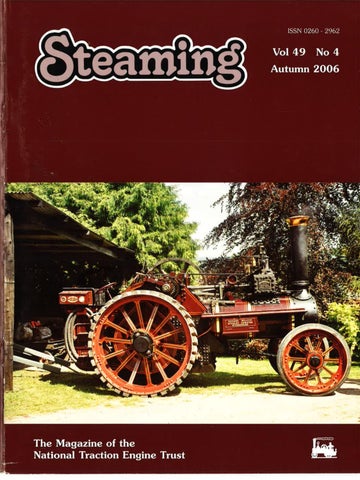
Front cover Burrell 5hp double crank compound agricultural engine 3368 of 1912, pictured by Keith Brothwell at a private visit for members of the Road Locomotive Society to the home of their chairman, owner Richard Willcox. 183
Trust News Engine Owners Column Engine Owners Section For some time the Engine Owners Section and the Technical Services Unit have been updating the Code of Practice for Engine Owners. One of the main sections of the Code is Part 4, the 'Written Scheme of Examination', and as part of this updating process, a meeting has been arranged, to take place in late September, with the nine independent boiler inspectors who hold the necessary Professional Indemnity Insurance, as required by the Trust. The object of the meeting is to discuss Part 4, before it is published. It is anticipated that the Code, either in part or its entirety, will be presented to the AGM in mid November prior to its publication. Another major development has been discussions with SAFed (Safety Assessment Federation) regarding accreditation of the Code. Initial discussions have indicated that they will give serious consideration to the accreditation of Part 4 and if that came to pass they will also present it to the HSE for their 'commendation'. Along with this work on Part 4, if the whole of the Code is to be part of the accreditation, other parts will be revisited to ensure that they are current with present day terminology and standards. In all our work we are attempting to assist all engine owners, from the long standing to the newest, by producing a comprehensive guide to the operation of their steam vehicle. I am still looking for Technical Tips that can be included in further instalments of the feature that appeared for the first time in our last magazine, so if you have had any serious incidents or near misses, please let me have a write up so that the rest of the engine owning members can benefit. All tips published will be anonymous.
Stop Press The above mentioned meeting with the independent boiler 184
inspectors took place on 24th September and was attended by Alan Bulmer, John Glaze, Alan Hines, Graham Morris, Tony Reen and Jonathan Wheeler. Apologies were received from Ian Farrance and Harold Richardson. A Prout did not reply to the invitation. The principal reason for the meeting was to discuss the draft Part 4 (The Written Scheme of Examination) of the Engine Owners Code of Practice, and a very constructive interchange of ideas took place. The Engine Owners Section will now re consider Part 4, and it may be necessary to have a further meeting with the independent inspectors to discuss the document in its final form. It was also proposed by the boiler inspectors that the Trust should meet with them on a regular basis in order to discuss matters of mutual interest. (Bob Siddall, head of Engine Owners Section)
Technical Services During the past tew months much activity has been undertaken by members of the Technical Services Unit, and by others, on the modernisation of the Trust's operations. As you read this we now have a new Health and Safety Policy; we have scoped the all new Safety Management Scheme and the report of accounts to the Charities Commission has been substantially modified to reflect SORP 2005. We have been looking at, and continue to explore, the options available that enable us to add value to being a member of the Trust; the new Rally Disc Register/Schedule has been well received by organisers of Authorised events, and we have launched phase 1 of our new web site. In addition, the new procedures handbook is now beginning to take shape, although there is still some way to go. Also, as you will read elsewhere (a postscript to Barry Curl's points in
the Letters pages), and in order to progress the development of our Safety Management Policy, we have been in discussion with members of the Technical Committee 1 (TC1) of the Safety Assessment Federation (SAFed). TC1 deals with the safe operation and examination and testing of pressure systems, and we are much encouraged by their comments and offers of assistance with the revision and development of the technical guidelines which form the Trust's Engine Owners Code of Practice. Sadly during this same period we have seen two major road accidents occur, one involving a road roller and the other a steam tractor. Inevitably the rumour mill has been running overtime, and in order that the members of theTrust might be made aware of the real causes of these incidents we have asked the Chief Constable's office of both police authorities, in whose jurisdiction the accidents occurred, to consider putting the NTET on their disclosure reports circulation list. This is a bit tongue in cheek, but we have pointed out that theTrust considers that it has a vested interest in learning the outcome of the investigations, and would be better placed to advise its members of any changes in practice or operation that might ensue. And finally I will return to the Trust's new-look web site. I am very pleased with the results of the combined efforts of our editor Roger West and of Ross Vickers of Rhino Limited. Theirs has been a most frustrating journey from drawing board to delivery — Ross is a professional web designer and I hope that you will agree with me that the results of the endeavours are very pleasing. It is quite an art to build an information based web site that is easy to navigate and at the same time is interesting to the eye. This Phase 1 is the precursor to the phased introduction of e-commerce type activities, which in the fullness of time will include membership renewals, breakdown and recovery scheme renewals, on-line sales, access to the Insurance Disc Autumn 2006 STEAMING
Registers by Authorised Events staff, and possibly a For Sale and Wanted section - and even a picture gallery. Please find the time to take a look - www.ntet.co.uk - and if you have any comments about the contents, or the appearance or the design I would be pleased to receive them at tsu@ntet.co.uk (David Smith, head of Technical Services Unit)
Treasurers Report
The end of work Here are two more pictures from Mike Jones' collection of engines standing in Dick Woolley's yard at Bucknell, Shropshire. They were probably taken
about 1956, shortly after he had gone over to using diesel rollers. The top picture shows Aveling & Porter E type 10 tonner 10877 (PR7568). This had been new to the Eddison company as their number 534 in November 1923 (one of a pair ordered, for it came to the firm along with Aveling 10818). Living vans and water carts are also dumped, but the road engine glimpsed at the left was destined to survive - it is FERMOY Burrell 5hp showmans 3090, but seen here in rather stripped down form for threshing duties. The second picture shows the scene a little further round. Well sheeted against the elements is Fowler D2 class roller 14333 of 1914 (AD8773) - the presence of this machine is perhaps the best indicator of the date of the pictures, for it
was sold by Woolley to Don Pritchard in 1956. Next is a small Foster roller 13088 of 1973 QUEEN MARY (FE1125). It had started life as a Wellington steam tractor, and was sent off new to Edward Gwilt in Shropshire. By 1921
its life of haulage appears to have been over, and it was converted to a road roller by E Davies of Atlas Foundry, Shrewsbury. The front roll fork bears witness to the rebuild with its prominent cast plate, bearing the firm's name and the explanatory legend ROLLER CONVERSION, It seems Davies did a number of these conversions - Foster 14046 was another, and survives in preservation in roller form. The Davies concern, which also owned the Cambrian Foundry at Newtown, seems to have run a business that catered for steam engine owners and rural industry in the border counties. Their 1935 catalogue (kindly made available by the Road Locomotive Society) lists practically everything needed to keep steam engines running, but makes no mention of boilermaking or roller conversions. The time for the latter business had no doubt passed, but they claimed to be the 'actual manufacturers' of roller wheels and detachable cast rims, offered re-straking, and had stocks of secondhand portables, tractors and traction engines. Foster 13088 is now in preservation in the West Country, and has reverted to its original guise as a steam tractor.
The accounts for the year ended 31st March 2006 are enclosed with every member's copy of this edition of Steaming. The 2005/2006 accounts have been prepared following the recommendations of the The Charities' Statement of Recommended Practice 2005 (SORP 2005), regarding the format and content of charity reports and accounts. In particular the has been Report Trustees substantially rewritten and reflects a structured approach to the annual report. In particular it explains the link between the Trust's overall objectives and strategies, and its activities and achievements during the year. I remind members of the significant amounts of unpaid time given to the Trust by the members and officers of the General Council (National Committee). Without this commitment the Trust would not be able to operate satisfactorily. I am pleased to report a satisfactory result for the year and this has enabled a transfer of £5,000 to be made to the Exhibition Unit Reserve. However, as explained in detail in the last issue of Steaming, the increasing pressure on the Trust's financial resources, combined with the effects of inflation, resulted in the unanimously Council General adopting the proposal that the subscriptions be increased to £25 from 1st February 2007. (Julie Smith, Treasurer)
Insurance Matters Footman James insurance for mature Steam Apprentices As the numbers of mature SAC members grow, it is very frustrating for them not to be able to drive an 185
Aveling & Porter GND type steam tractor 9183 of 1920 poses on the Much Marcle rallyfield, Herefordshire, in July 2005. (John Maund)
The National Traction Engine Trust's
2006 AGM will be held at 2.00prn on
SATURDAY, 18th NOVEMBER 2006 at The Burnside Hotel, Bowness (off A592 south), near Windermere, Cumbria Please refer to the formal notice in the Report and Accounts which is distributed with this issue for details of the Agenda etc, and to the other notes on this page for the arrangements that have been made for the rest of the day and on the Sunday.
The AGM We continue the Trust's custom of holding its Annual General Meeting in different areas of the country in successive years — for our 2006 meeting we travel to the north west, to near Windermere in the heart of the Lake District, Cumbria. The Burnside Hotel is in the village of 186
Bowness, and as well as being the venue for the formal meeting in the afternoon, will be available for members who wish to stay the weekend, and attend the formal dinner on the Saturday evening. TheTrust's 2006 AGM is at 2.00pm on Saturday, 18th November at the Burnside Hotel, Bowness, near
engine unaccompanied at an Authorised rally, where the only limiting factor is their age. Once these members have a car licence and have already proven themselves to be competent, it seems very unfair to prevent them from enjoying their hard work just because they are not yet 21 years old. It is for this reason we have been recommending that Footman James should open discussions with their underwriters to provide insurance cover for these mature SAC members. Naturally the underwriters fought shy of taking on more risk for young drivers, but when it was explained how the SAC and NTET ran its driving courses in addition to the new competency test, they understood how those risks were managed and therefore minimised. We are now pleased to announce that Footman James are able to provide insurance cover for SAC members to drive Footman James insured engines on the rally field, unaccompanied, providing they meet all of the following requirements: • hold a full class B driving licence (car licence).
Windermere, Cumbria. It is about 20 minutes journey time from junction 36 on the M6 motorway, via the A590/591 to Windermere and then the A592 south to Bowness. The Burnside Hotel is on the left, about 300 metres past the lakeside steamer pier. A rail service is available to Windermere, with a taxi for the few miles to Bowness. Formal notice of Llle 'Heeling, tile Agenda, and the Annual Report are distributed with this magazine. In the event of voting being necessary at the AGM only current members are, of course, eligible to vote. Members should therefore ensure that they have with them at the meeting their current membership cards as evidence.The names of the nominees for positions of officers or Council members of the Trust, together with any Motions under Article 16 of the Trust's Articles of Association, will also to be found in the Report & Accounts. At the conclusion of the formal meeting, about 5.00pm, tea, coffee and biscuits will be served. A selection of the Trust's trophies and shields will be presented then, or at other appropriate times during the weekend's activities. Val and Colin Brown will as usual bring a good selection of the more Autumn 2006 STEAMING
• hold an NTET certificate of competency. • be over 19 years of age. • the event is NTET Authorised. • the engine is insured with Footman James. • the Rally Organiser has given permission to drive at their event. All this is indeed very good news and once again clearly shows that by carefully managing the exposure to risks, we are viewed as a low risk activity. I should add that the only change made to our proposal was that the minimum age was raised from 17 years to 19 years, but we and Footman James are still working on this, (James Blenkinsop, insurance officer)
The Ring Around column Charlie and I have, reluctantly, decided not to stand for re-election to the Trust Council at the forthcoming
appropriate items from the NTET Sales Stand. If you want to ensure a particular book, video or DVD or sweater is available, maybe for a Christmas present or a birthday, please pre-order via the Mail Order address and ask for your purchase to be brought to the AGM, when it can be handed over in a discreet manner, or otherwise.
The Saturday morning Although our visit is in November be aware that Windermere Lake Cruises operate a quite extensive service to both Ambleside and Lakeside on the Saturday and Sunday (and indeed on the weekdays before). Members can check their on excursions possible www.windermere-lakecruises.co.uk Windermere Steamboats & Museum will have closed its 2006 season by the time of our AGM, but we have been able to arrange a special Saturday morning opening forTrust members. If you wish to take part please assemble in the Museum car park, off Rayrigg Road, Windermere, sometime after 10.30am for a guided tour at 11.00am; the party rate admission charge will be £3.75 per person. The Museum's historical collection consists of a large number of most elegant boats, including five STEAMING
Autumn 2006
AGM. We are concerned that the 'Ring Around' (our task on Council) has not been functioning as it should. The intention was that my ring around to the nominated volunteer contacts should pick up on any queries or concerns that members may have had; these would then be discussed at Council and Heads of Section meetings or forwarded to the appropriate committee member for action or advice where necessary. We then hoped to publish the responses in Steaming. However, this hasn't been working — possibly because we don't catch people as things happen or occur to them; possibly because we as a committee don't always respond as swiftly as we should; or probably because the matter has often passed by the time the next magazine comes out and the response is no longer appropriate. We have wondered, in this computerbased age, whether an interactive section to our website would be a swifter and more useful form of contact with members. The Council would welcome any ideas. All of us in this hobby do need the protective umbrella of the NTET, and
although our personal stint on the Council is over, we would like to wish the elected members well in their continued work on our behalf. (Nickey and Charlie Daniel)
examples powered by steam that are over one hundred years old. See the Museum's website — www.steamboat.co.uk
The Saturday evening
Staying for the weekend For members who wish to make a social weekend with friends around the AGM, a block booking of rooms for overnight accommodation has been made for the weekend of the 17th and 18th at the Burnside Hotel and Parklands Country Club at Bowness.The village is in the heart of the Lake District National Park, and the hotel is set in mature gardens with views of Lake Windermere, and only 300 metres from the steamer piers. En-suite rooms are available at a special NTET inclusive rate of £55-00 per person per night with breakfast (Friday and/or Saturday), or £65-00 for dinner, bed and breakfast on the Friday night. Members should make their own reservations direct with the Hotel (12 08700 468640) — please mention that you are an NTET member. If you wish to spend longer in the district, a reduced rate of £50.00 per person per night, with breakfast, is available for the Wednesday and Thursday nights, or £60-00 to include dinner, bed and breakfast.
Steam Apprentice Club Some of you will already know that we have had to put up the cost of annual membership for the SAC to £7.50. Whilst this is a large percentage increase over the recent fee, it is the first increase for many years and I believe it still offers value for money. The SAC committee will be reviewing the fee every two years from now on, so any possible future increases will not be so large. Part of the increase has allowed us to print the Apprentices' magazine Raising Steam in colour — a first! We are also looking to expand and improve the magazine to make it more readable
On the Saturday evening there will be a formal dinner, private to the Trust, in the Silhouettes Restaurant at the Burnside Hotel, at 7.30 for 8.00pm. Tickets for the four course meal are available £26.00 per person (the number is limited to about 100). A vegetarian option will be available. Tickets must be booked and paid for in advance — please advise your booking and send your remittance by 11th November at the latest (cheques to be made payable to NTET) to our General Secretary, Sue Jackson — address inside front cover or 01494 521727
On the Sunday We are welcome to visit, from 10.30am, the Lakeland Motor Museum at Holker Hall, Cark-byCartmel — some 15 miles south of Bowness. Although the Holker Gardens will have closed for the season, the Motor Museum will hold the attention and nostalgia of many members, with thousands of motoring related exhibits to be viewed in the stables and courtyard setting; the re-creation of a 1930s garage is one of the set pieces. Find out more at www.Iakelandmotor museum.co.uk 187
for the whole range of ages that we cover. The Apprentices at the Dorset event had a good time, when the weather permitted, and I offer many thanks to those of you who kindly let the young enthusiasts have experience on your engines. But, and there is often a but, it would be great if more owners could consider having an Apprentice next year, even for half a day. That way the load would be spread around more. Thanking you in advance. Though unfortunately we had to cancel two planned venues earlier this summer (because of causes beyond the SAC's control) we have held several successful driving days for the Apprentices, including a first time at Flookburgh in Cumbria. This was well attended, but regrettably not so well supported by local engineman, with only one offering to assist. If it hadn't been for him and the fact that a visiting engine also helped, it would have been a very poor show. With just two engines and nine apprentices it was hard work to keep the latter fully occupied. Perhaps other local enginemen could write to me and suggest reasons why there wasn't much support, for it is certain that without the fosterage of enginemen today the next generation of footplatemen will not be able to learn and enjoy what we currently have, and therefore bring the engines 'to life'. Finally, there is some good news for mature Apprentices who would like to drive engines at Authorised events — please refer to James Blenkinsop's announcement in his Insurance Matters column. (Kevin Munn, I:hail-Man, SteaM Appleinice Club)
Obituaries John Robins John Robins, who died during the summer, was born in Birstall, Leicestershire in 1942, the only son of William and Hilda. His working career was in engineering, starting as an apprentice for the Metal Box Company in Leicester, later moving to Loughborough University, helping graduates to develop and build new products. He then moved on to the CEGB Scientific Services Organisation assisting scientists investigating power plant problems and failures. After various job changes, including Mechanical Engineering Department at Drakelow Power Station, his final position was with the writer in the tool room of Injection Plastics in early 2000. I always knew John was a good engineer — but he excelled himself during the next few years, with his technical brilliance and practical skills. It was a sad day for us when he decided to retire early, in November 2004. Regrettably, John enjoyed only a few months retirement before ill health set in, but in true style, he battled the illness quietly, determinedly, and positively — right up until his death in June. His bravery and attitude have touched those of us who witnessed this. In the late 50s, as a youngster, he started out as an apprentice with the late Tim Sage of Leicester, helping on his Fowler showmans engine GOLIATH (the former Pat Collins engine DREADNOUGHT) and Ransomes 7hp traction 42036, a late single of 1931. By 1968 John was on the lookout for an engine of his own, and he purchased Burrell single crank compound 3126 from the Fensom family. It was 1970 when I first met John and he asked me to steer the engino from Cadeby to Shackcrotone. I had never steered an engine before and remember John saying "don't let that rear wheel go onto the grass verge, or we'll be in trouble': I avoided the grass, which pleased him, and I was invited to steer on the return journey, and we remained friends from that day. John had extensive boiler work carried out on the Burrell by R and G Wilcox Ltd in the mid 70s, after which the engine attended rallies periodically. The highlight of his ownership came in the year 2000 with the engine's exhibition in the John Robins attending to Ransomes 42036 sometime in the early 1960s.
Burrell Tent at Dorset— a photo of this appears on the front cover of Spring 2001 Steaming. John, Alan Walker and friends had worked tirelessly to complete a detailed restoration, enabling the engine to be exhibited in an 'as new' condition. He kept the engine for 36 years, only selling to David Glanville of Cornwall in 2004. John had some distinctive characteristics, which will never be forgotten. His laugh could be heard over an engine line — you knew he was around even if you couldn't see him! Despite the problem he had with his hands shaking continually, he could knock up an engine part, a beautiful garden bench, or a huge sandwich, skilfully and effortlessly. He always had an amusing story to tell. John had several interests during his lifetime including model engineering (never happier than when working at his Myford lathe). He restored a Triumph motor cycle, taking the two tier test in order to ride it! Vintage cars were another passion; as well as woodwork. John was talented and skilful. For many years, John was membership secretary for the Friends of the Burrell Museum. More recently, he was a volunteer for the North Norfolk Railway, preferring to work at Weybourne Station rather than on the hefty steam locomotives. Norfolk was a place he was very passionate about for he spent most summers there as a child with his parents. He was also a long-standing member of the Welland Valley Vintage Traction Club. The funeral service was held at Gilroes Crematorium, Leicester in July. it was attended by a good number of friends — standing room only! Yet another irreplaceable character from the early preservation days has gone; John will always be remembered, and rightly so! (Steve Hayes)
Dorset thanks The Trust marquee at the Great Dorset Steam Fair continues to grow in size and in stature. This year we were host to an increased number of co mmercial and semi-commercial firms that are serving the road steam hobby at full size and miniature level, with their products and services. The increased length of the tenting also provided room for a greater number Autumn 2006 STEAMING
Member G Brown writes of his memories from these three pictures: 'this is an engine I remember from childhood - Foster general purpose engine 14625, built in 1931. The oldest shot shows it at work threshing in either 1936 or 193Z just by the road near the station at Firsby, a village on the very northern edge of the Lincolnshire fens. The engine was bought new by a Mr Meers of Little Steeping, a village but a couple of miles from Firsby, probably on some sort of hire purchase direct from the makers, as witness a plate fixed inside the tender. This picture is only a box camera shot, made on 'free' paper negative film, so not very good. The location is now occupied by recent housing. I came across the Foster again in 1977 at Hatfield House in Hertfordshire, by then in the ownership of a transport contractor from near Bedford.'
of engine exhibits, which included two exceedingly interesting reproductions in the final and mid stages of construction. Again, members arrived from across the country to help run the tent - some for the umpteenth time, others as welcome new faces. We hope everyone found satisfaction from the time and effort spent, and we thank them on behalf of all Trust members for the work they did. The provision of the always necessary tea or coffee in the tent by now runs as smoothly as the best of our well restored engines. It is a great team that does work and we thank Wendy Chapman, Angela Head, Mary-Lynn Hill and Kim, Christine Giddings, Jan Greenhough, Sally Humphrey, Charlotte Keeley, Irene and John Kelly, Shirley Manning, Fiona Rashleigh, Dulcie Stagg, Maureen and John Street, Gill Stoneman and Steve Wagstaff. Once again there was the excellent support from members (and of course their friends) to the donations bowls - it won't come amiss to repeat that we make no charge for the tea or coffee in the Trust marquee at Dorset, but the members can be assured that the monies in the bowls far exceed the cost of the materials used, and then go on to help with other expenses in the tent. Colin and Val Brown's sales area was again busy with members and the general public spending freely all of which assists Trust funds., For help given over the period of the event at the sales area, we 189
acknowledge the efforts of Nick Greenhough, Peter and Sue Howard, Pat and Caroline Jenkins, Paul Shergold, Kathy Smith. Steve Snook and Peter Stanier. Artists Robin Wheeldon, John Hancox and John Wigston again exhibited their work at the gallery which is the rear wall of our marquee. Under the ridge of the tent, visitors could inspect mechanical arts, in terms of both restoration and creation. Brian Dando's Ransomes portable and Alan Rundle's Brown & May steam tractor were examples of the former, with new construction being exhibited by David Sheldon's replica of a Foster single cylinder tractor for Ian Gilbert, and Richard Vincent's fascinating project of the half completed Hindley steam wagon. All of these gave the public the chance to get really close to study an engine and its components, something they are often understandably reluctant to do when steam is up. Chris Parker's miniature Foster, being of 4 inch scale, made an excellent end to the line up, for it serves to educate the younger person at their own level — and makes a good teaching unit for the Steam Apprentice Club sessions. We thank all these owners, and especially for the time they fre quently gave in answering questions from the public — it is such conversations that greatly help the general image of our hobby, and is something which all Trust members should strive to achieve. Finally, we gratefully record the many hours that are given before, during and after the event — both directly and in support — by the wives and families of those Trust Council members who arrange the GDSF marquee.
New Members We extend a sincere welcome to the following new members who have joined the Trust during the last three months. We hope they will gain much friendship, information and enjoyment from their membership over a period of many years. Full addresses are not included, but the Membership Secretary is always pleased to put members in touch with one another by forwarding mail. C Woolley, Honeydew, South Africa Miss S Williams, Oxford M Brown, Great Kimble, Buckinghamshire M G Jenkins, Ryde, Isle of Wight P E Williams, Goodwick, Pembrokeshire 190
The Autumn 1981 magazine mentioned a couple of topics that could apply just as well to this year. These were the price of petrol affecting visitor numbers at rallies and poor weather over the late spring bank holiday. A brief report by John Wharton, as the new Chairman of the Engine Owners sub-Committee, was followed up by a larger piece in the magazine covering items relating to the welfare of engine owners at rallies. The topics would again be familiar to today, with appearance money, safety and insurance being covered. Conspicuous, today, by its then absence from the safety section was any mention of the now all too familiar risk assessment. An article by Richard and Maureen Parkinson detailed the continued use of two Robey steam wagons in Colombo, Sri Lanka. One of them was an articulated version that had only recently been repainted in a bright blue, as was displayed on the front cover of the magazine. An interesting article by Tam McTaggart covered his associations with Wattle Mair — the original driver
of the well known Burrell CLYDE for Road Engines & Kerr, and who later became Tam's second man on a Scammell. A couple of interesting points were made: in the 1920s four engines would be needed to move a 100 ton load on steel wheeled bogies; in the forties only two engines would be needed on more modern trailers with solid rubber tyres and roller bearings. Also it was found that Burrell 4092 SIMPLICITY performed poorly when working with CLYDE and a Scammell. SIMPLICITY's driver complained that Burrells had built a Fowler, and all engine men knew that Fowlers would not work with Burrells. One has to wonder whether any truth in this assertion has been found in the heavy haulage section at Dorset. Sri Lanka was not the only place steam was still used commercially. In the Wales notes it was recorded that the Lloyd Jones brothers had recently had their Fowler roller on hire to the local council. On a sad note, not only was the demise of the Wallis & Steevens firm reported (including a forthcoming auction of their steam collection, of which the Simplicity roller has recently gone on display at Milestones Museum), but also an obituary of Tommy Woods. Tommy had started as an apprentice with the firm in the 1920s and went on to become foreman fitter. Latterly he was heavily involved with their steam club, and always ready to offer advice and information to Wallis owners. (Stuart Gaines)
C H Brown, Taunton, Somerset J Santoro, Rempstone, Leicestershire A Harper-Bourne, Loddon, Norfolk G Hudson, Leyland, Lancashire I Bunn, Derby R Brown, Worcester A van den Broek, Roosendaal, Netherlands G Leathley, Leyburn,Yorkshire J Spencer, Bozeat, Northamptonshire P F Harding, Chepstow, Monmouthshire A M Rontree, Northallerton, Yorkshire D R Wood,York C Lewis, Sutton Coldfield, West Midlands P Griffiths, Kidderminster, Worcestershire R P Dyson, Bognor Regis, West Sussex M Sheardown, Sheffield, South Yorkshire A PTyrwhitt-Drake, Beccles, Suffolk B Gascoyne, Sheffield, SouthYorkshire Miss L McKerracher, Manchester Miss E Jones, Pembroke Mrs J E Mitchell, Swindon, Wiltshire M J Bradbury, Gloucester B Lowe, Cobham, Surrey J Bennett, Strahur, Argyllshire N Herring, Banbury, Oxfordshire S Dorman, Nottingham
R J Standen, Eltham, London J M Smith, Knutsford, Cheshire R P Hounslow, Salisbury, Wiltshire L Rhodes, Pontefract, West Yorkshire M J Smith, Grove, Carmarthenshire H Cheeseman, Market Harborough, Leicestershire J Hand, Ilkeston, Derbyshire T Roberts, Co Carlow, Ireland B King, Co Kildare, Ireland D Crowley, Cork, Ireland L B Slipper, Waltham Abbey, Essex D Sixsmith, Carlow, Ireland Mrs C Pooley, Redruth, Cornwall J Bailey,Totton, Hampshire P J Walsh, Co Carlow, Ireland B D Smith, Banbury, Oxfordshire E G Jones, Marlborough, Wiltshire J White, Co Wexford, Ireland R Hobbs, Thanet, Kent K Garahy, Birr, Ireland D R Rowell, Sunderland,Tyne & Wear B H Webb, Basingstoke, Hampshire M Bolton, Bembridge, Isle of Wight P Bulson, Chippenham, Wiltshire A Stevens, Reading, Berkshire P F Irish, Sidmouth, Devon
reflections on our magazine of 25 years ago
Autumn 2006 STEAMING
The Great Challenge The prestige event that marked the Steam Plough Club's 40th anniversary and the 100th year since the Beeby family started their steam ploughing activities, held at Rempstone, Nottinghamshire in September, was arguably the steam gathering of the year as far as our seclion of the hobby goes, and we hope to include a report in our next issue. The Trust's Mail Order department is carrying out the marketing of a DVD programme of the event on behalf of the SPC: it should all be ready in late November or early December (the price is not known at the moment), and if you want to be one of the first to view the disk please contact Colin or Val Brown - see the Mail Order page - to ask to them to contact you with the details when available.
Poor Steaming The caption to the pictures of Sentinel 8351 on the rear cover of the last issue referred to 'more in the Kent notes'. Our apologies to those who looked, and found nothing just there - the notes were under the Sussex title, included in the Brighton Run report. There was further editorial confusion in preparing text for the Ashley River Road Run feature on pages 152/153 - Simon Cauldwell corrects two identities in his notes on the Letters pages in this issue. STEAMING
Autumn 2006
STEAM ENGINE RESTORATION Total steam engine rebuilding service Engine alignment problems sorted out, valve setting Crank refitting, bearing scraping, etc Boiler repairs, riveting, caulking, flanged plates Fireboxes, re-tubing, new tenders built, cast iron welding
30 years experience George Hudson, 64 St James Gardens, Leyland, Lancashire PR26 7X13 Tel: 01772 451383 or 07811 664363
'Traction Engine which went at 12 miles per hour. Allen Brown, a motor driver of Newport, did not appear at Caerphilly Police Court on Tuesday to answer a charge of exceeding the speed limit of 8 mph with his traction engine at Caerphilly, on July 21st. P C Zeal said the tractor and the two trailers were going at 12 miles per hour. A fine of E1.10s was imposed.' (from The South Wales Argus in August 1923. We might wonder what method the named police appropriately constable used to zealously and accurately record the rate of 12mph.)
'Messrs. Marshall, Sons, and Co., Limited, of Gainsborough, have sent us flash-light photograph of Mr Chamberlain's meeting, held at their works on the 1st inst, together with a pamphlet showing views of their works and illustrating some of their export contracts. The meeting was held in the new extension of the engineering department at Messrs. Marshall's Britannia Works, when 7000 people were addressed. The new machinery hall will have the following dimensions: - length, 378 ft; width, 167 ft; height, 50 ft: (from Engineering, 17th February 1905) 191
National Traction Engine Trust
Mail Order Many books, videos and other items of interest to traction engine enthusiasts are available from the Sales section. Readers are urged to take advantage of this service (which also benefits Trust funds) for trouble free and economical postal shopping. Just tick the box for items you require and fill in the address slip.
TRACTION ENGINE READING New Beads of Emerald (Josje Nieuwenhuys) reviewed this issue New Vintage Fairground Transport (Steptoe) New Hancocks of the West (Scrivens and Smith) reviewed this issue New George Kilvington, Fairground Photographs (Scrivens and Smith) reviewed last issue New Roundabout Relics (Barker) reviewed last issue New The History of Mann's Patent Steam Cart & Wagon Co (Pease) reviewed 49/1 Traction Engine Album (Ranieri) reviewed 49/1 The Electric Scenic Railway (Scrivens and Smith) reviewed 49/1 Reprint Locomotive Boilers - Design, Construction and Working (Haig) T Whitelegg & Sons - Cavalcade of Shows (Belshaw) Bridgwater Fair - illustrated history (Belshaw) Fodens - a pictorial history (Davies) European Traction Engine Register (Toy and Rayner) Traction Engine Register (True and Johnson) Historic Fairground Scenes (Ware) reprint of 1977 edition RENOWN History and Restoration (Brian Steptoe)
£8.95 ❑ £6.00 ❑ £15.00 ❑ £10.00 ❑ £26.00 ❑ £24.99 ❑ £25.00 ❑ £20.00 ❑ £10.00 ❑ £15.00 ❑ £12.95 ❑ £24.9b ❑ £5.00 ❑ £6.95 ❑ £9.99 ❑ £5.00 ❑
Steam at work Perth's (Australia) First Motor Vehicle (Clydesdale) Steaming Down the Ages (Freeman) Hazy Days of Living Steam (Gooding) Contractors and Factors (Freeman) Steam Locomotive Design and Maintenance (Walker) Archive Photographs (Leeds and DistrictTEC) Bob Whitehead's Garrett histories Garrett Steam Tractors and Rollers (Whitehead) GarrettTraction and Ploughing Engines (Whitehead) Garrett Wagons, Part 1 Pioneers and Overtypes (Whitehead) Garrett Wagons, Part 2 Undertypes (Whitehead) Garrett Wagons, Part 3 Electrics and Motors (Whitehead) Made by Garretts (Whitehead) Glossops - Kings ofTa r Spraying (Whitehead)
£7.00 ❑ £6.90 ❑ £7.50 ❑ £9.90 ❑ £12.50 ❑ £6.50 ❑
£18.50 ❑ £18.50 ❑ £18.00 ❑ £18.00 ❑ £18.50 ❑ £2.25 ❑ £11.50 ❑
Reproduction makers catalogues Ransomes, Sims & Jefferies (RLS catalogue reprint) £7.50 ❑ Wallis & Steevens Ltd (RLS catalogue reprint) £7.50 ❑ Fowler Road Making Machinery (RLS catalogue reprint) £9.00 ❑ Fodens Ltd (RLS catalogue reprint) £7.50 ❑ Marshall Steam Road Rollers (RLS catalogue reprint) £7.50 ❑
The Fairground My Travelling Family (Eleanor Green) Men at Work - Orton & Spooner (Howell) TheTravelling Fair, FairgroundTransport in Britain (Slater), special offer- was £16.95 Philip Bradley - Fairground Photographs and Notes (Scrivens and Smith) The Story of Harris's Fun Fairs (Page), special offer DVDs New Burrells ofThetford (110 mins) New Fowlers of Leeds, part 1 (115 mins) New Fowlers of Leeds, part 2 (50 mins) New Dedicated to Garretts (65 mins) New Fodens of Sandbach (70 mins) New Road Works Ahead (50 mins) New Fosters of Lincoln (70 mins) New Inside Steam (65 mins) All DVDs are Old Glory/Morton's Heritage
£12.95 ❑ £19.99 ❑ £12.95 ❑ £12.00 ❑ £15.00 ❑
£9.95 ❑ £9.95 ❑ £9.95 ❑ £9.95 ❑ £16.95 ❑ £9.95 ❑ £9.95 ❑ £9.95 ❑
CLUB ITEMS NTET 50th Anniversary embroidered sew on badge (31/2 in x 11/2 in) NTET steam roller badge, boxed NTET 50th Anniversary badge, boxed NTET Sweatshirts, embroidered logo, choice of four colours, M/L/XL/XXL (XXL - £18.00) NTET Polo Shirts, embroidered logo, choice of three colours, M/L/XL/XXL NTETTee Shirts, printed centre chest logo, choice of 4 colours and 4 sizes NTET Members Badge - members only NTET 2000 showmans badge (boxed) NTET traction engine lapel badge (boxed) NTET Foden wagon badge Steam Apprentice Club badge - members only SAC embroidered sew-on badge (3in dia)
£1.95 ❑ £2.95 ❑ £2.95 ❑ £17.00 ❑ £12.00 ❑ £6.95 ❑ £2.25 ❑ £2.95 ❑ £2.95 ❑ £2.95 ❑ £2.25 £1.50 ❑
To claim post-free for UK members please enclose current membership card. Non-members please enclose 10% part postage per order. Overseas members please enclose 8% part postage per order (European); 10% (rest of world). PO/Cheques (in sterling please) to be made payable to: National Traction Engine Trust. Visa, Access and Mastercard accepted, please state card number, expiry date and name on card, or phone/fax 01582 733971 ($ evenings only). Orders to be sent to: NTET Sales, 90 Devon Road, Luton, Bedfordshire LU2 ORL. Please allow 28 days for delivery. Name
Address
Membership No.
Amount Enclosed
List 49/4, Autumn 2006
An early Yorkshire wagon in Buckinghamshire This splendid Edwardian scene is inTowersey, a Buckinghamshire village just a couple of miles from Thame and about 15 miles east of the city of Oxford. We are grateful to Mike Miles of Abingdon for making the picture available to us. Exactly why the photographer set up his equipment on a bright day in 1907 (according to a note on the back of the print) has not been passed down, but his preparation to record the steam wagon making a delivery to Mr Nelms' stone-built village shop has created an attraction for what must be a goodly proportion of the village children. The wagon is an early example of one of the distinctive transverse boilered machines by the Yorkshire Patent Steam Wagon Co of Leeds. It is making a delivery of flour from Sheldon & Co's Osney Mills in the county town to the village baker and grocer's shop inTowersey. Of the three adults posing by the shop doorway, it could be Mr Nelms (with arms akimbo), his wife, and at the left, maybe the wagon driver without jacket, and sleeves rolled up to assist in the task of unloading the heavy sacks. STEAMING
Autumn 2006
With the maker's records not having survived, historical details of the early Yorkshire wagons are sparse, largely coming from county licensing records. Alan Duke's lists don't give a works number or date for registration BW25, but the late Alan Martin identified it as works number 19 of 1903. At that time, although it is not apparent from this photograph, the Yorkshire design had its pair of engine cylinders mounted horizontally under the front of the body, one on the outside of each chassis member. The wheel propped prominently on the second man's seat box seems as if it might be off some item of milling machinery - it certainly isn't anything to do with guiding the steam wagon, for the Yorkshire company for many years stuck to using a mere handle to operate the Ackerman steering. Positioned directly in front of the driver, who sat to the nearside, the steering column was topped not by a wheel, but by an L shaped arm, the longer end with a vertical, and the other end made suitably short to avoid catching clothing - or the driver's beer belly.
'At the last meeting of the Borough Council of St. Pancras the question of traction-engines in public thoroughfares was, says the Daily Telegraph, brought forward. An amendment was unanimously carried to a recommendation of the Parliamentary Committee not to urge the promotion of legislation to deal with traction-engines on highways at present. The seconder said the nuisance was very acute in Gray's Inn-road, "where some people had been shaken out of bed:' (from the National Traction Engine Owners' and Users' Association column in Implement and Machinery Review, 1st October 1904.)
'Fowell & Co, Ltd, was registered Feb. 26th, with a capital of £5,000 in £1 shares, to adopt an agreement with T Lax for the acquisition of the businesses of engineer and agricultural machinist carried on by him at St Ives, Huntingdon, and to carry on the business of engineers, ironmongers, machinists, ironfounders, carriage builders, tinplate smelter, toolmakers, manufacturer, &c. No initial public issue. The first directors are T Lax, S Oldman, H W Oldman, and H G Few; qualification 50 shares. Registered by Waterlow Brothers and Layton, Limited, Birchin Lane, London E C: (from Agricultural Engineer, March 1901) 193
Aveling & Porter's steam motor traction engines
Aveling's 'Steam Motor Traction Engine' as depicted and so described in the company's 1905 catalogue. The Royalty plate seen on the left hand side view shows the works number 5447 — the first delivered, in March 1904, of the single cylinder machines that were built to comply with the then current legislation. 194
We are all quite familiar with the term steam tractor, well known from traction engine publications of recent times, and from general usage on the rally field. However, at the beginning of the development of the small road engine, just over a hundred years ago, the engine builders took some time to settle on a title for the type. These editorial notes cover aspects of Aveling & Porter's small number of early examples of the type, with comment centred on two contemporary press reports, and reference to the maker's Dispatch Register and Royalty Books. The weekly journal The Engineer, in its issue for 1st July 1904, reported some of the exhibits at the recently held Royal Show on the ill-fated permanent showground at Park Royal, London. It included the following paragraph on a new offering for hauliers and carriers — something to take the place of one or two heavy draught horses, whose feed and stable care, needed around the clock on seven days a week, were increasingly being cited by modern transport operators as a great expense. 'To counteract the encroachment of the steam wagon, several makers of traction engines and road locomotives have turned their attention to the production of a light engine which shall comply with the Light Locomotives Act. The firm of Aveling Porter, and Limited, Rochester, is one of the latest to take up the manufacture of an engine of this kind — see Fig 6. It has a single cylinder 51/4in diameter by 9in stroke, and, we are informed, weighs slightly under three tons. With a steam pressure of 160 lb the engine will indicate about 12 horse-power. The engine has two speeds, a water tank sufficiently large for a run of 12 miles, and is mounted on springs. William Foster and Co, Limited, Lincoln, is another firm which has taken up the manufacture of these light engines, as well as Wallis and Steevens, of Basingstoke, and WTasker and Sons, Limited, of Andover, The two last named firms have been at work in this direction for some time. Messrs Tasker are also applying these small engines for ploughing direct, and have constructed a four-furrow plough for working in conjunction with them.' The caption to the above mentioned Fig 6 called the machine a 'LightTraction Engine' — the half tone illustration was prepared from the same right hand side photographic view that was later to appear in Aveling's 1905 catalogue, and which Autumn 2006 STEAMING
Aveling 5541, celebrating its centenary year by re-appearing in 3hp steam motor form at the 2004 West of England event at St Agnes. (Kevin Lean) is also reproduced with these notes. The engine was Royalty 5447, for that number can be read on the plate on the valve chest on the left hand side view. 5447, with its single cylinder, was the first of its type from the Rochester works, and the first to be written up as a 'motor traction' -the indication it was intended to comply with the Locomotives on the Highways Act, 1896, and the Motor Car Act 1903.The former, from November in that year had permitted mechanically propelled vehicles of not more than 3 tons unladen weight to be operated by one man. The 1903 Act was concerned mostly with the regulation and licensing of the new-fangled motor car, but it repeated much that was, effectively, to do with small steam engines - the driver now had to hold an annual licence, fee five shillings (25p). As far as most traction engine manufacturers were concerned, this was the legislation which brought about the term 'steam motor'. The tiny Aveling engine 5447 was sent out on 22nd March 1904, registered EN22, the customer was set down as J Byrom of Bury, Lancashire. It is likely that much of the design and some of the components had come from the experience with earlier machines about ten small rollers quoted as 3hp and of 4 or 5 ton weight had been made from April 1902 (practically all for export), and in the August, STEAMING Autumn 2006
number 5071, a '3hp traction engine', compound and on springs, was sold to Robert Neville-Grenville, the wealthy squire of Butleigh Court, near Glastonbury, Somerset. The engine was probably used around the estate where Neville-Grenville was at the time engaged in research on cider making, but being a compound, could well have been too heavy to comply with the 1896 Act. Makers were finding it difficult to produce a worthwhile machine; the heavily built traction engine could stand much abuse from unskilled crews and rapacious, uncaring owners, but it was a different matter to make an engine weighing under three tons, with its inevitably pared down castings and bearing surfaces, sufficiently robust to withstand the rigours of daily work. Following 5071, another ten of the 3hp compound traction engines are recorded in Aveling's Register during 1903, all to export agents, and several specifically noted as sent to the Indian Ocean island of Mauritius, where they would have no doubt seen use on duties associated with the cane sugar growing estates. Aveling & Porter's 40 page general catalogue dated for 1905 contained illustrations and descriptions of 'a few of the classes' they offered to customers. After pages of awards, road locos, agricultural and combined engines, road rollers, portables and ploughing engines and implements there came on page 36
the Steam Motor Traction Engine, 'specially designed to work under the new Motor Car Acts, for hauling one waggon, one man only (the driver) required'. The description is lengthy, but shy on mentioning the actual weight that enabled the engine to come within new Act. Nowhere is a figure stated, and note too that The Engineer was somewhat reticent in its report on that topic - '... we are informed ... slightly under three tons', Two travelling speeds gave 3 and 6 miles per hour, and a wagon with a four ton load on any ordinary good road was possible. Laminated springs were fitted to the fore and aft axles, and a winding drum and compensating gear provided. Under the heading Advantages, it was claimed there was less wear and tear than on the self-contained steam wagon. The designs of that type of road vehicle were still largely vertical boilered under-types, and Avelings could at that time confidently make such statements without risking potential customers, not having a steam wagon design on offer! The steam motor would be particularly suited to contractors, brewers, millers and quarrymasters, and 'can easily' run 40 miles per working day at a cost of 14 to 15 shillings (70 to 75p) including driver, coal or coke fuel, depreciation, and interest on capital. So much for the maker's advertising to customers. The reality was that they had, by early 1905, already sold as many of the small single cylinder engines as they were going to - less than a dozen, all told. The Dispatch Book reveals that around the time of the June 1904 Royal Agricultural Society of England's show, another four (5523, 5550, 5548 and 5551) were being built up at Rochester, to be despatched through June to August - it was probably one of these that appeared briefly at the Show, before moving on to the customer. Another four (5524, 5613, 5541 and 5637) followed in the late autumn, with a further two (5672 and 5654) in March 1905 - all for customers in Britain,Thereafter, a 4hp type began to appear. Time had marched on, and the regulations under which it had proved so hard to construct a workmanlike and sturdy machine of such small size had already been changed. Reports made after the series of three Liverpool Trials of the Self-Propelled Traffic Association in 1898, 1899 and 1901 had concluded that the 'not more than 3 tons' restriction was too low, and the lobbying of Parliament had been 195
successful and secured a revision the Heavy Motor Car Order, 1904 raised the allowable weight to under 5 tons. The real protagonists of this lobbying were the designers and potential manufacturers of vehicles built to carry their own load - steam and petrol wagons - though many of the 'traction engine' makers would be quite happy to take advantage of the relaxation. So from their point of view, from October 1904, a rather more robust, practical and commercially attractive machine could be designed. But we have seen that The Engineer report of July 1904 included mention of small road engines that had already been produced by Wallis & Steevens of Basingstoke and William Tasker of Andover 'for some time', and it may be interesting to back-track to see what those makers had achieved. Arguably, the Basingstoke works was the only completely commercially successful builder of an under 3 ton road engine, and that success had a somewhat hesitant start. A 3hp 'road engine' had been built in August 1897, and a few others followed, but it took a few years of experimenting with different cylinder sizes and other design alterations before a practical engine VVdS available to Wallis & Steevens' customers. The weight of these later 3hp 'steam motors' (Wallis & Steevens seem to have been the first to use the term► was nominally, at least, under the 3 ton limit, and the single cylinder at 51/4in x 9in was exactly the size Avelings used in 1904. Sixty or so of these small Wallis engines were sold in the 1901 to 1904 period, before the design could grow in accordance with the revised regulations. (Half a dozen or so of the motors, including Giles Romanes' GOLIATH!, survive in preservation.) Taskers also had reasonable sales, but the Basingstoke firm was, numerically, by far the greatest builder of 3 ton steam motors. Perhaps it was the company's relative proximity to the metropolitan area of London, where many of the customers were based who needed mechanically propelled transport, that prompted their success over that of, say, the established Lincolnshire and East Anglian builders - who in any case had nicely full order books at that period. But Avelings were no further distance from the London market; perhaps, in 1903, they felt their Hampshire rivals were taking too much of a growing market, but it seems the Rochester company only applied its business and technical 196
mind to the steam motor just before the time the law changed to their advantage. Before we move on to an interesting account of the initial working life of one of the 3hp Aveling engines, it may be useful to mention and bring to the reader's mind a survivor. Number 5541, the eighth example to leave Rochester on 301.11 November 1904 (and so not in the numerical sequence of the Royalty numbers), went into the ownership of Quinnell & Sons at Sevenoaks, Kent. As with many of these small machines, it was later converted for work as a road roller, and as such survived to preservation days. 5541, christened BO-PEEP, has become a familiar and much loved rally engine in Cornwall, firstly owned by Charles Gregory, later by his family, and more recently by Richard Stock. It is Richard who has returned 5541 to much like its original form in the last
few years - the sole survivor of Aveling's 3hp steam motors. Although the commercial viability of a steam road engine built within a weight limitation of a mere 3 tons to comply with the 1896 Act had largely proved to be a wish too far for many makers, an article that appeared in The Industrial Motor Review in October 1907, fully three years after the engine featured had started work, proves that useful and appreciated work could be obtained from the tiny machines. The Perthshire County Council's Surveyor had taken delivery of Aveling & Porter 5548 in July 1904, and with the formal results of a full year's working of the engine during 1906 and 1907 on his desk, he must have felt he could make a public pronouncement on his pioneering venture. 5548 was the fourth example of the 3hp motors to leave the Strood works.
The Economy of Motor over Horse Haulage — a Scottish example 'About two years ago the Perthshire County Council introduced steam motor haulage for the conveyance of road metal from their quarries to the road rolling operations, and Mr W L Gibson, CE (Dunblane), the Surveyor for the Western District of the County, has lately submitted to his Committee an interesting comparative statement showing the cost of haulage for the year ending May 15th last, and at the same time a statement of comparative costs between steam motor haulage and carting on the contract system, ie, it indicates what the same quantity of material hauled by the tractor would have cost in the event of it having to be carted by horses. 'The figures prepared by Mr Gibson are so clearly drawn up that we cannot do better than reproduce the complete statement, from which it will be seen that the cost of steam motor haulage worked out at £217 14s 13/4d [£217.71], as against £514 19s 111/2 d [£515] in the case of the contract carting system, showing a saving in one year alone of £297 5s 93/4d E£297.291. Mr Gibson points out that the figures given in the statement include depreciation and wear and tear at the rate of 15 per cent; also coal, oil, waste, and drivers' wages.The quantities of road metal indicated are hauled direct
from the quarries and railway stations direct to the spot where the steam road rolling operations are in progress without the intervention of roadside depots. An analysis of the statement shows that the tractor was at work 201 days during the year, during which it travelled 5386 miles and hauled 4287 tons of road metal and 544 tons of other material - a total of 4831 tons. The daily averages were 26.8 miles, and 24 tons on a fuel consumption of 1 cwt. 3 qrs. The cost worked out at 14s 6d 172.5p] per day (including the 15 per cent, for depreciations and wear and tear), which is equal to 3d [1 penny] per ton per mile. 'By courtesy of Mr Gibson we give .. an illustration of the tractor and the trailer he employs.The machine is one of Messrs Aveling & Porter's 3ton type, and up to May 15th last it had been at work for about 21/2 years, during which period it had shown a net saving over the carting contract system of £591. As a matter of fact, the cost of the tractor and trailers was fully paid up in September 1906, and as the net saving at 15th May last exceeds the original cost, they have not only paid for themselves, but also for a substantial economy, and in addition they are still in good repair and giving every satisfaction. 'The trailer shown in the illustration weighs empty 20 cwts, Autumn 2006 STEAMING
HAULAGE OF ROAD MATERIAL for One Year ending 15th May, 1907
Also shewing Comparative Statement of Cost between Steam Motor Haulage and Carting Contract System STEAM MOTOR HAULAGE
CARTING CONTRACT SYSTEM
DETAILED STATEMENT OF WORKING EXPENSES for One Year ending15th May, 190'7 Quasas
Leny,
D.41.• *I MOW aal..1 tie. Qom, ... 3 miles
Number al D. Hauling
Barhush,
31
Cralgmore, .. 2 . 31
as
20
Garrick,
King's Park,
•
4
Ardchullarle,
Tor =1.7 ; 253 5004
78d
£7 18 18
Carting Contract Rate,
2/3
... .628 9
28
991 •
6d.
22 so 6
Do,
1/9
.
28 •
595 .
6d.
14 17 6
Do,
1/9
•
28
322 •
. 1/01
16 15
Do,
2/6
32 •
338 364
. ,/,i ..
18 i3 28
Do.,
2/6
40 5 0 405 5 0
9 9 7
Do,
tho
33 7 4
Telal 1111•Joae undid 7.tr we
It days. ., 24 mile?
.
3o •
9
78 16 g
52 I 3
L275 $
.C90 4 4
Railway Stations— Grsenloaning, ... 3 , Dunblane
24
•
••• 315 • ••
954
••• 1 46 .C15 , 101 ••• 41d. 18 17 78
Do.,
2/3
••• 435 8 9
Do.,
1/-
-,•••
47 14 0 83
33 '9 6 Roadside Depots,
•
9
25 .
245
68d.
46
7 71
9 Days of 3 Carts and Horses at 6 7
27/-
2 9
412 3 0 12 3 0
71
Mloollansous Works— Hauling Road Scrapings and Protection Fencing; also removing Stonebreaking Plant between Quarries:21 Days at 14/4 ..
IS
5 41
21 Days of 3 Cuts and Horses at ...
27/-
... 428 7 ti
Filling Metal Into Waggona— 54 0 0
Allow at rate or 6/. per Day
Add—Filling and Carting Metal from Roadsioe Depots to Steam Road Rolling operations, 4287 tons at 68d. per ton,
116 2 th
Washing out Boiler, Cleaning and Repairing Engine and Waggons— Time of Driver-67 Days 015/4...........
••.
17 17 4 La 17 14 if
and is loaded with 4 tons 10 cwts of broken whinstone, so that the tractor is hauling a gross weight of 5 tons 10 cwt. The load of the trailer is, of course, varied according to the gradients of the roads over which it is to be hauled, but on no occasion has the wagon taken a less weight than 4 tons. Finally, Mr Gibson informs us
STEAMING
Autumn 2006
44 19 118
Aveling & Porter number 5548 of July 1904 THE PIONEER and its loaded trailer, photographed whilst employed by the Road Department of Perthshire County Council, and used to illustrate the Industrial Motor Review article in October 1907 By that date, the paper was content to caption the scene as being of a 'tractor; presumably indicating the earlier descriptions of 'light traction engine' and 'steam motor' had fallen out of use. There is no evidence of the steersman's seat supplied from Rochester in April 1906, so the picture must predate that time. The tipping trailer was also from Aveling, and is very similar to an example shown in theit catalogue.
197
that apart from the saving they have effected in the matter of haulage costs, the tractor and trailer have added considerably to the efficiency, efficacy, and economy of the steam road rolling operations. Altogether the County Council of Perthshire is to
be congratulated on the result of its enterprise in adopting steam motor haulage and in possessing a surveyor whose interest in the system is such as to enable him to show the excellent results outlined above.'
Aveling's Royalty Book gives us more information on the Perthshire engine. The '3hp Motor Traction Locomotive', type XA3, was despatched on 23rd July, had a 51/4in x 9 in cylinder and was bestowed with the nameplate PIONEER — actually, a photograph shows that title to have been preceded by the definite article. Erector Billington had supervised the build; the boiler was given the test number 4495, and the engine's completed weight was found to be 2tons 18cwt 2qrs, though
steersman's use in April 1906, somewhat negating the maker's claim that the engines required but one man, though no doubt the whole
the 'tonnage plate' read 2-19-3. The driving wheels were 4ft 0in diameter by 8in wide and the front wheels 3ft 0in by 4inches; the boiler was 1ft 6in diameter with 20 tubes, 13/4in diameter and 3ft 31/4in long, and the safety valves set at 160 lbs. One of the last jobs must have been to fix an 'A&P licence board,
DG214, back & front' — this is how it was duly noted in the Royalty Book. This board was an early version of what came to be known as trade plates — the D probably represented Kent (as it did with the usual owner's index plates) and the G may have been because they were known as General Identification Marks. Aveling
& Porter had been allocated no less than six of these marks by Kent County Council — DG212 to 217 inclusive — and presumably soon after the 1903 Act made such things necessary. The boards would have been attached, temporarily, to steam and motor wagons for the time the vehicles needed to be legal on the highway in the Medway area, whilst
on test from the works. Avelings, incidentally, continued to pay the annual fee for the six index marks until June 1921, after which a fresh scheme came into being. From Road Locomotive Society records, we know that 5548 bore Perthshire's registration ES126 when it was in use in the county — Avelings would have
task of stone carting demanded that a second Perthshire employee be present at both ends of the job. By 1913 the engine had left County ownership for a quick succession of Glasgow owners — firstly King & Co Ltd; then Charles Thomas in 1916; Richard Newsome by 1921, and finally Robert McCarrol at Possil Park in 1924. It was the latter
(or rather Mrs M McCarrol) who on 3rd June 1925 ordered from Avelings a set of front roller gear to convert 5548 into a small road roller. The parts consisted a pair of 2ft 91/2in diameter rolls with renewable rims, axle, forks, shoes, saddle bracket, and a segment drilled for bolting to the smokebox, together with a
separate cast chimney. By this time no registration was being quoted for the engine and, indeed, it disappears from the RLS records without trace of its further history. With hindsight, we may consider that The Industrial Motor Review was guilty of publishing out of date information by featuring THE PIONEER in October 1907. The same
issue contained an exceedingly full report (just one of three in successive issues) on the Royal Automobile Club's Commercial Vehicle Trials that had started on 9th September. Most of the 56 entrants were internal combustion engined lorries (with some steam wagons), but the three compound steam tractors taking part were more or less the full develop-
ment of the smaller steam road engine — indeed the Burrell 5 ton tractor took a Gold Medal, an award which served its makers well in terms of publicity for many years. The days of the delicate 3 ton steam motor had been numbered at the time of the
Aveling & Porter 3hp single cylinder motor traction engines The engines are arranged chronologically by despatch date, and the out of sequence Royalty numbers may reflect a period between construction, and then the confirmed sale or delivery, and include testing, loans to unrecorded potential customers, or exhibition at shows. Royalty despatch customer number date 5447 5523
5550 55/18 5551
5524 5613
5541
5637
5672
5654
22.3.1904 James Byrom, Bury 29.6.1904 J Knowles, junior, Wickersley, Rotherham 14.7.1904 T Ring & Son, Rochester 23.7.1904 Perthshire County Council 9.8.1904 J J Pratt, jnr, Hillingdon [Middlesex] 27.9.1904 B Nowell & Co, Kensington 18.11.1904 Great Western Railway, Paddington Station 30.11.1904 F Quinnell & Sons, Sevenoaks, Kent 24.12.1904 Queenborough Cement Co Ltd, [Kent] 7.3.1905 John Riley, 1 Mill Street, Hanley, Staffordshire 17.3.1905 Borough of Greenwich (supplied with roller gear)
We end these notes with a few details of the trailers that were necessary to accompany the motors. Aveling & Porter, like many traction engine builders, were quite ready to provide wagons to work with any of
their road engines. They advertised traction wagons, with or without springs, to carry from 4 to 10 tons each. Heavy side tipping wagons, in pairs, would have suited roadstone haulage by road locomotives, but the new 3hp engine needed a rather different and lighter type, and so was offered, in Aveling's 1905 catalogue,
arranged and applied the number prior to the motor leaving the works on delivery. The entry for 5548 in the Aveling record books was kept up to date by
Aveling design's debut at the Royal Show at Park Royal in summer 1904; were virtually gone by the time the Rochester salesmen started posting out their employer's 1905 catalogues, and, as far as a trade magazine
the 'specially designed end tipping wagon' for use with the motor traction engines. The design featured an arrangement whereby the centre line of the tipping action was as low
notes being written in the margins — an 'XAC4 type spring seat complete' was supplied to Perth for the
promoting the latest wares was concerned, the breed was history by 1907 — replaced by the steam tractor.
as possible — the body, including the rear springs, pivoted around the rear axle as it was tipped from the
198
Autumn 2006 STEAMING
horizontal by laboriously turning a detachable crank handle, which worked the screw thread shaft at the front body panel, and so raised the load.To facilitate the backing of loads by the engine into tight corners, a push pole could be pinned to the woodwork of the body, and the forecarriage turned by a steersman operating the wheel and vertical shaft, which worked a short steering rack fixed on the front of the turntable. The Heavy Motor Car Order, 1904, which had enabled steam tractors to be built up to 5 tons, also provided that the one trailer or vehicle which was allowed with the engine, should, combined with the latter, weigh no more than 61/2 tons when unladen. Thanks for information within the above notes are due to Derek Rayner, for his scrutiny of the Aveling & Porter records; to Bill Wells, current keeper of the Road Locomotive Society engine records, and to staff at the Centre for Kent Studies at Maidstone.
'The Thornycroft Motor Wagon Company of America is about to be incorporated to acquire and work the patents, improvements and rights in the Thornycroft steam wagon in the United States and her possessions.' (from The Motor Car Journal, 15th March 1902) STEAMING
Autumn 2006
An illustration of an Aveling 3hp motor fraction engine and matching wagon from the maker's 1905 catalogue. The original picture was taken at an oftused spot on the riverside frontage of the Rochester (Strood) works, with the bridge across the Medway in the background. The engine could be number 5548 and its trailer on trial on the highway around Strood, for the letters DG on the maker's 'licence board'(trade plate) can just be seen by the front axle. If it is the Perthshire engine, the short timber awning seen here seems to have found disfavour with its operators and to have been removed fairly quickly.
Aveling's catalogue illustration of their special end tipping wagon for use with motor traction engines. It seems a cumbrously constructed vehicle for use with a small engine, but no doubt needed to be stoutly built for rough loads and roads. 199
A unique Marshall traction engine Tim Keenan One of the more interesting traction engines in the southern hemisphere attended the Burrell Gathering at Rangiora, on New Zealand's South Island earlier in this year. It was Marshall 24273, a 6hp engine completed in 1895 under somewhat unusual circumstances, for it was fitted by the Gainsborough factory with an example of Charles Burrell & Sons' now famous single crank compound cylinders with bores measuring bins and 10 in diameter by 10in stroke, together with associated motion etc. Familiar to most of us, the high-pressure cylinder, using steam at 1401bs, is arranged diagonally above the larger low pressure cylinder and the two piston rods are combined in a single crosshead driven by a single crank. It was the first of two engines so constructed by the Marshall firm. It was Fredrick Burrell who had developed the design, subject of his now famous patent No 3489 filed here in the UK in 1889. Records suggest parts for this Marshall built engine were purchased from Burrells in 1893. Two sets of parts were delivered to the Britannia Works. The second set was for engine number 29065, outshopped on 30th November 1897 with cylinders of 6in and 10in bore by 12ins stroke, and of 8hp. It was sent to the Rhodesian Transport Co and details of both these engines can be found in Marshall'sTraction Register No 3. It is not thought that the African engine survives in what is now Zimbabwe. It is interesting to note that at this period of time Marshalls were only selling an engine every nine days, which was almost the company's slowest recorded sales period, apart from the mid to late 1930s. Marshalls supplied the 6hp engine number 24273 to a New Zealand customer in 1897. It was not the firm's first compound - they had constructed their own design of compound cylindered traction in 1895, after some years of extensive research and development. Our New Zealand subject had an unusually large number of successive owners in the South Island: year owner locality 1898-1902 Robinson Berwick 1902-1907 unknown Allanton 200
The holler, the single crank compound cylinder and tender of Marshall 24273 of 1895 at the Miles family's premises at Fernside in April 2006 - being readied for display at the New Zealand Burrell event. (Tim Keenan)
Just a short time later the engine had been assembled at Fernside ready for public display. (Tim Keenan) Autumn 2006 STEAMING
1907-1908 1908-1917 1917-1918 1918-1920 1920-1924
Snowden Snowden Longford W Oxham McLean
Brightwater Seddon Murchison Murchison unknown
The final recorded owner during the engine's working life was Newton Cole of Kohatu, but it is unclear from the Marine Boiler department records how long it worked for him. Working days ended suddenly when the crankshaft broke, but it is believed that other parts of the motion were also damaged in this accident. A new crankshaft was ordered from England and took two years to arrive in New Zealand. The engine itself had been left out in the back blocks, as it could not be easily moved, and when the new crank was taken out to the paddock it was found that the machine had been severely stripped. So the new crank was taken back to a Brightwater workshop and it
is known it remained there until the early 1980s in its original shipping crate; the other spare parts were sadly scrapped. The engine was now used for river protection, being moved about by bulldozers at the Motueka River near Kohatu, on Barry Higgins' property. It was from there it was recovered by the Miles family, near Rangiora. More recently the engine has been partially reconstructed with many new patterns made to allow parts to be cast, rebuilt and refurbished. Much heavy boiler work still needs to be carried out to enable this unique Marshall to be steamed again. A recent job was the application of a 50 ton jack to remove the bent hind axle from the hornplates. It is hoped that in the not too distant future the engine will be back in steam in the Land of the Long White Cloud,
a
More on the Dimonds ... and the Erith roller The last issue had two topics which caught the attention of Eddie Wood, for both appertained to days gone by in the history of his family's business -Thomas Wood & Sons Ltd, of Crockenhill, near Swanley in Kent. Eddie remembered the Woods firm had employed Dimonds, and Pip Simnor, who provided the pictures in the last issue and started this topic, is able to reveal the family link with those we mentioned earlier, for this another branch of the same family working with steam engines. Tom Dimond, who we have seen moved from Kent with his family to work on rollers in Surrey, left behind in the area his younger brotherTed Edward Brooks Dimond. Ted had been born in 1856 at Brislington, when the family was still living on the northern edge of the Romney Marsh. By 1871 they had all moved north to Darenth, Kent and at the turn of the twentieth centuryTed was working on threshing sets for Thomas Wood at Crockenhill - the two villages were but four o five miles apart. His son John (Jack), who was probably born in the late 1880s, joined him at the task, maybe as his first job. The Woods' employee records only set down Dimonds until 1906; sometime after thatTed and his son left to set up on their own at the threshing business. Road Locomotive Society lists STEAMING
Autumn 2006
give E B Dimond of Sutton-at-Hone as owning a couple of Wallis & Steevens traction engines in the period from 1923. First came secondhand Wallis 2063, an 8hp machine that had been new in January 1887, and, as RLS records officer Bill Wells comments, 'it had a bit of a chequered career'. We will merely cover its Dimond days, for the engine had had two owners by the time it was returned to the makers in exchange for a new machine in 1909. It then spent some years as a hire engine from Basingstoke, before being sold (46 years old) in August 1923 to E B Dimond. At that time it seems to have received some works attention, for there are notes that parts of Wallis 2191, when it was scrapped at the works, were used on 2063. Perhaps that didn't result in too good an engine as far asTed Dimond was concerned, for in July 1924 it was back at Basingstoke (it later ended up sold to Northern Ireland) andTed had taken on Wallis 2154, a 7hp sprung agricultural. This had been new in 1890 to an owner in Hampshire; it had moved to Kent via the makers in 1908. Wallis & Steevens certainly seemed to be able to cater for and keep the business of owners who wanted to 'upgrade' as well as those who wanted an older used engine to start up with. It is not clear for how long the
threshing business at Sutton-at-Hone continued. Ted Dimond died at the age of 74 in 1928, though son Jack may have carried on. Woods have record of repairing a Wallis for the Dimonds in 1933, and 2154 was advertised for sale by E A Foley of Bourne, Lincolnshire in March 1938. The somewhat anonymous press extract that appeared on page 146 of the Summer issue would have served, for most readers, only to show the now tantalising prices of fireboxes nigh on a hundred years ago - a rather academic point after a century of inflation. Eddie, however, from his collection of paperwork regarding the Wood business, can add more to the extract. It was probably taken from an issue of Machinery Mart in the early months of 1911; the quotes had been received by Erith UDC in the February. Despite the recommendation for acceptance it seems at a later meeting of the council certain members considered that Belvedere Engineering should have been given the work, though that resolution was quashed. The aggrieved parties no doubt felt the job, despite the extra £1.4s.0d, should have gone to a business paying local rates, rather than a firm eight miles away. The roller concerned would have been Aveling & Porter 15 tonner 3498 of 1895, the authority's only machine in 1911. Woods continued to gain work from the UDC - later in 1911, the Works Committee at their meeting on 6th December listened to their surveyor explaining the steel plating to the driving wheels of the roller had worked loose, and required to be removed, the joints planed and reriveted. Quite disparate prices had been received - Wm Cory of Erith quoted £23.10s.0d; Aveling & Porter £14.10s.0d but Woods wanted a mere £6.10s.0d. That estimate was accepted. A few years later, in July 1914, the surveyor had been able to seek an estimate from Woods and put the work in hand by his own instruction the small sum of £7.15s.0d must have been within his remit, but just what the 'urgent repair' was is not specified. But the greater expense of supplying new front wheels needed the authority of the committee. They approved the surveyor's completed action over the minor repair and then accepted Aveling's price of £42.10s.Od for the replacement front wheels; the lesser quote from the Oxford Steam Plough Company at £39.10s.0d was probably too far away by distance to appeal to the elected members at Erith. 201
Duplicated numbers Derek Rayner Following a visit in October 2004 to the Gottar Park Museum collection at Castelletto Ticino, to the north of Milan in Italy, and seeing the somewhat rare tandem compound Clayton & Shuttleworth traction engine there, I became concerned over its maker's works number when I returned home. As is my wont, I had noted the number on the smokebox door plate -which I believed to be the works number - and, in this instance, I took a photograph as well, for the plate was both unusual and attractive. In addition to the maker's details it bore a motif in the top centre which appeared to be a stag.
Because of the plate's different format, I felt this may not have been a Stamp End works produced item and this theory hardened in my mind when I referred to Traction Engine Register. The Clayton number I was looking up 'rang a bell' with me as one still in existence in Britain, and I was not disappointed with my memory when I found the number I had noted down - 48944 - was listed in TER as a 10 ton single cylinder steam roller dating from 1924. With the registration number EP 2574, I recalled it was once in the fleet of Corfields of Abermule (Wales). The entry also strengthened my belief that I'd made an error in my notes whilst in Italy.
My films duly returned from processing, I was able to compare them with my notes. The camera never lies (with me); the number on the smokebox door plate was clearly 48944. The full details on the plate read CLAYTON & SHUTTLEWORTH LTD MOTOR N° 48944 LINCOLN INGLATERRA. I had discovered an anomaly which required investigation. An appointment was made at the Museum of English Rural Life at Reading University to view the Clayton & Shuttleworth records held there. I homed in on the number 48944 in the handwritten order register and, amazingly to me, the words used as the title of this article appeared against the ten works numbers 48942 to 48951, with the additional inscriptions (mostly in red ink, probably to highlight the duplication) inter-lined and positioned as best the clerk could manage around the neat and regular entries that had been completed the year before. This double record showed that 10 ton single cylinder road roller 48944 had indeed been despatched to J E Corfield of Abermule, on 13th June '1924, with an Order Book number of S2629. And then, subsequently, another 48944 had been sent to 'Drysdale' on 5th August 1925, having an order book number of E51487 and a description of '55hp Argentine'. There were ten engines in this interloping batch, numbered 48942 to 48951, all for Drysdale, with five sent out in August 1925 and then the second five in October 1927. The ten engines delivered in 1924 with the rightful batch of numbers had included seven portables (4 x 12hp, 3 x 8hp), a traction engine, and another steam roller. Thus, I found that another engine still with us in preservation, the exBuncombe Clayton roller 48946 of July 1924 (YA 9576), also had an identically numbered 'doppleganger' at one time - another Argentine engine despatched from Lincoln on 19th August 1925. Other than the phrase Duplicated Numbers and the additional writing there is nothing in the C&S works Two views of Clayton & Shuttleworth 55hp Argentine traction engine 48944 at the Gottar Park Museum in northern Italy. The recumbent mannequin gives some scale to the illustration, but it is placed at the wrong level for driving and steering - the man-stand should be somewhere near the figure's knee height. (Derek Rayner) Autumn 2006 STEAMING
TER
55 H.P. TANDEM COMPOUND ARCENTINE TRACTION, NO.
e59
4
Fitted with 2" "Pickering" Governor, Friction Clutch, and "Moore" B. C. Steam Pump. I.
9.
1611. Ar 192 o— LaTE'R" AT 414 61 Erected by J. & J. D YSDALE & Co.'s Agency. BUENOS AIRES.
Sent from Lincoln Purchaser Residence REFER. RHOS NUMBERS.
PA,R
.1.r899- Speed 195 /3:0 38.
Genera Ar ngement Arrangement of Piping Centre Line and Plan of
Steerage Cross Section Cylinder
DIMENSIONS DRAWING AND NO. REMARKS.
MARKS.
1:9446/'
H.P. g+er
D
„ Back Cover EP. 19.2.08 6.5.08 „ Side „
546 B
L.P. earkeo
4744B
records to suggest that any action might have been taken to correct what must have been a clerical error on someone's part at Lincoln. Or was the foundry that set out and cast the plates to blame? I presume that as the second ten engines in this mix up were to be sold to work half a world apart from the others, and were of totally different types, it was not felt necessary to take any further action. Whether the discrepancy may have been connected with or revealed by the firm's absorption into the Babcock & Wilcox organisation in 1924 is not known. The most likely occasion for confusion to have surfaced would have been when a spares order came through; the clerk might have found himself perplexed for a while, but a few moments study of the amended ledger would have made the Order Book numbers and other necessary references fairly clear. Reference to another source in the
PARTS,
REFEREDGE NUMBERS
Pump reed Flanges ... 5 3.08 „ „ Plunger ... Rod ... • /7 el 59664/„ Ex Strap (Rod End) 9.1t03 „ (Oil) End 7211 5.308 „ Sheave C.L8rdia. „ Pinion 11t. ... „ Gear Wheel 1, „ Stud Bracket revs. per minute
7271
MARKS. 4290A 4915B
44180 5267
DIMENSIONS DRAWING AND NO. AMMAR/M.
9425D It
1749
5268
4412B 4089B 4307C 4308C
4425D
A reproduction of the top few inches of one of the pages from Clayton & Shuttleworth's Building Book. It shows just a small section of the most extensive detail a thousand references — that was set down as a record of the drawings and parts that went to make up one of their Argentine tractions, in this case the 'second' 48944. (courtesy Museum of English Rural Life, Reading University) Clayton deposit at Reading, the details or building book, provided a little more information on the Argentine engines. A pair of extremely detailed pre-printed sheets record the drawing numbers and dates, materials and other references (almost a thousand of them!) of the parts that were necessary for the erection of a '55hp Tandem Com' In pound Argentine Traction No that space 48944 was filled in by hand; so too were several dozen alterations to the drawings and part numbers which the passage of time probably necessitated. There must have been only one customer Claytons were expecting for these engines, for that company too is preprinted — J & J Drysdale & Co's Agency, Buenos Aires. The machines were fitted with friction clutch drive, a 2in Pickering governor and a Moore steam pump. Bores of the tandem cylinders were 8in and 11'/sin diameter. The straw burning boiler worked at 1601bs, and the words 'welded firebox' have been penned in. Elsewhere in the Clayton books, I discovered that this batch of ten Argentine tractions were not the only
duplicates.The problem had occurred with two of the smaller 30hp tandem compounds, 48668 and 48669, sent to Drysdale on 15th November 1920. A later entry in the book with these same numbers, again in red ink, shows the numbers had also been allocated to two 35hp chain drive rail tractors (shunting locomotives) for Murchi of Liverpool, on 26th July 1928. Now that I knew the Italian tandem compound had been despatched to South America, it came to me that the creature adorning the nameplate on the smokebox was not a stag, or even a deer — it was, of course, a guanaco, more commonly known as the wild Andean llama, the local beast of burden! And it was interesting to reflect on the date of 1894 that is painted on the side of the engine's boiler. The previous Italian owner, in the Bologna area, when he decided on those figures must have had reason for thinking the Clayton dated from that year, but what he based the information on I know not. Speculation by Trust members after a photograph of 48944 appeared in the Winter 1994/95 issue of
The engine's smokebox door, with the unusual works plate showing what I initially thought was the image of a stag, and the duplicated works number 48944 to the right hand side of centre. in Clayton's Building Book entry for Argentine traction 48944, the 'name plate on door' is recorded with the reference number 25.4.08 and the mark 4717B. One wonders whether the appropriate drawing still exists to confirm these details. (Derek Rayner) 203
The first 48944 - the 1924 built Clayton & Shuttleworth roller, pictured at Weston Park rally in 1978, when owned by Liz Mason. (RLS Modern Photograph Archive) Steaming was that the engine was probably built in the first decade of the 20th century. I now found that Claytons had indeed previously manufactured for export to Drysdale many smaller engines of 24, 30 and
40hp - in 1908 no less than 117 of these compound Argentine tractions had been produced. The scale of the photograph reproduced earlier had clearly not indicated its immense size, for at 55hp this is the largest of
its type - these large horse power figures, of course, indicate brake horse power, as was usual for many export markets, rather than nominal. In addition to the sizes noted above, the compounds were also made in 18/20, 30 and 45hp versions in the early 1920s. Incidentally, it is not known when 48944 - the duplicate one that is - came back to Europe, assuming, that is, it did actually go to Buenos Aires when new. So, after some 80 years, someone's error in the allocation of works numbers at Lincoln in the mid1920s is again highlighted. We are fortunate the Stamp End Works records still exist to reveal the detail of the anomaly. Another point of interest to note from the pages of TER is the name recorded for the exCorfield roller 48944. Is its title related to the discrepancies eighty years ago, and was a previous owner aware it had an identically numbered sibling elsewhere in the world? The roller's name is PARADOX, a good reflection on this interesting conundrum of duplicated numbers. I am grateful to Dr Jonathan Brown, business records manger at the Museum of English Rural Lite, Reading University, for access to the Clayton & Shuttleworth ledgers that enabled this account to be written.
'At Spittelgate (Grantham) Police Court, Mr James Coultas, engineer, of the Perseverance Ironworks, Grantham, was summoned for neglecting to carry lights on a locomotive (in front and at the rear► on the 21st ult. It was stated that an engine belonging to the defendant had been left in the road at Ponton at night without any light affixed. Defendant said it was a special case. He had sent the engine to Mr Lee, of Great Ponton, who was about to purchase it. When near the village a breakdown prevented the men taking the engine further, and they left it expecting that Mr Lee or his men would take charge. The Bench held that Mr Coultas was responsible and fined him 10s (50p): (from Agricultural Engineer, October 1901) Engines from the Midland Engine Works at Leeds, especially the older and smaller examples, were invariably beautifully proportioned. This is McLaren 6hp singe cylinder 547 of 1894, pictured at the Somerset Club's 2004 event at Langport. (Barry Job) 204
Autumn 2006 STEAMING
Miniature Steaming Peterborough Model Engineering Society Our Society, situated in Peterborough, Cambridgeshire, provides a meeting point for like-minded members and friends with an interest in model engineering, whether it is steam locomotives, traction engines, boats, aircraft or tools. There are at present approximately 100 members, the last few years having seen the steady increase to that number. Our meetings take place in the grand rooms ofThorpe Hall and are held on the first and third Mondays of the month, with a few exceptions. The first Mondays are usually 'Bits and Pieces' meetings, where members bring along their work in progress or anything else that may be of interest to others. At the other meetings we have talks on subjects associated with our hobby or arrange visits to locations of interest. Throughout the year, we also have coach trips to most of the major model engineering exhibitions in the UK, to see what's new in the model engineering world, and to buy new tools and materials. We have a permanent raised multi-gauge track, covering 3?in, 5in and 7?in gauges, just over 1100 feet in length, and situated in a walled garden in the grounds of Thorpe Hall, a Sue Ryder Hospice. Our annual event, 'Steaming at Scallwell Farm', is always very popular, with model traction engines coming from all parts of the country.This year was the 10th anniversary with well over 100 exhibitors. Battle of the Somme remembered Graham Martin writes:This year is the 90th Anniversary of the Battle of the Somme, during which 60,000 British casualties were taken (the greatest number in British military history) with 20,000 fatalities on the first day. On the 10th of November at Westminster Abbey, just as the clock strikes 11 am, I will carry a wreath of poppies, which will have first been held in silence by the side of the tomb of the Unknown Warrior. It will STEAMING
Autumn 2006
Compiled by Graham Martin
then go to a Range Rover which tows a trailer carrying the miniature traction engine named UNKNOWN WARRIOR. I will be the carrier that 'dispatches' the wreath (in correct military parlance) to those Flanders fields where 'The flower of England was struck down'. There I will lay the wreath in memory of all those who laid down their lives in Defence of the Realm. The trip will need support and sponsorship, and we are hoping to top £4,000, with all of the funds raised going to the Royal British Legion (of which I am a member) and the Last Post Association. Her Majesty Queen Elizabeth will be sent a message outlining our plans, and on our return it will be wonderful to be able to inform Her Majesty of the journey and share our list of sponsors. People ask me "Why do you want to take a miniature traction engine from Westminster Abbey to the battlefields of France and back in
Earlier in the year member Colin Coomber cleared a backlog of model making - a number of white metal kits to 00 gauge or 4mm scale. The illustrations show the completed and the fully painted result of his work on a 30 piece kit of a Wallis & Steevens Advance roller; the makers are Springside Models in Devon (Silverhills Road, Newton Abbot, TQ12 5LZ) and their catalogue also offers an Aveling & Porter roller at the same scale.
order to deliver a wreath?" My answer is that the engine was built around the idea and thought of that unknown warrior; it was built to celebrate the gift of life that he gave, given to us in the defence of our homes, to keep us safe and our Nation free. This little engine was built with all that in mind, in memory of those men, and it seems right that the traction engine UNKNOWN WARRIOR should make the pilgrimage so that we can say that it has been where he has been, that it has been there to those ravaged fields and returned. I hope to take many photos and will write of our journey to the battle fields. UNKNOWN WARRIOR is presently in the paint shop getting the final work done. We welcome any support, and if you know of any past traction engine men that served in the World War 1, I shall welcome any contacts, news and photographs. 6 inch scale Ruston Proctor SD steam tractor Manufactured in the village of Gilmorton in Leicestershire by Graeme Hulls, Rick Gardiner, Richard Mason and Mike Hulls over a 3? year period, GILLIE is a model of one of the smallest steam tractors ever built (3 tons in weight). It was designed for light haulage work, but the design was very quickly made obsolete by a relaxation in law allowing larger steam tractors. The introduction of petrol vans and lorries was the nail in the coffin for these small tractors, which is why so few exist today. To our knowledge only four were ever built by Ruston Proctor, and none have survived to preservation. The construction of GILLIE has been extensively modified for full paraplegic operation, with a new design for the tender, the fire doors, its water pump and with adapted hand controls.The plans are available from Live Steam of Derby. The group will endeavour to operate the miniature in accordance with the NationalTraction EngineTrust Code of Practice-they are all members of the NTET and LSME. I thank all members for items of interest that have been sent in, and give acknowledgements to John Sanders, Graeme Hulls, Rick Gardiner, Richard Mason and Mike Hulls. Please if you have anything to say about your miniature traction engine please send your story to Graham Martin, 22 Saxon Road, Whittlesey, Peterborough PE7 1NP or miniaturesteaming@btinternet.com 205
Back in the USA! oimm, .
Peter Love gives an insight to the USA steam traction engine scene and offers a few pointers.
Frick Eclipse double high pressure (7in x 10in) contractor's engine of 1921 — thought to be the largest Frick engine to survive. At Sussex, Wisconsin, August 2005.
Case 33386 of 1916 being loaded with wood fuel from the pile, at the Buckley Old Engine Show, Michigan, in August 2005.
UK steam enthusiasts often turn up their noses when they look at a foreign engine, especially one from the USA. However for me that is not the case, they are all part of our rich steam traction heritage. To me a J I Case is just as interesting as is a Fowler or a Burrell. In fact the USA has been rallying a lot longer then we have, and you can say that it started to take off with 'threshing bees' in the mid to late 1940s. However, there is one big difference across 'the pond' — they like to use their engines, which is great to see. Over here we always go on about the poor boiler assemblies of USA engines and how they are unsafe, and, yes, I have been to Medina, Ohio and know where the Case 110hp exploded.These events gave a rude awaking, and a number of engines have come off the showgrounds and are now tucked up in barns and museums, perhaps forever. However in many States things have been tightened up, particularly in Ohio, where the boiler expectorate are fully conversant with steam traction boilers, and have the expertise of Bruce Babcock and others to draw on. In most States there is no legislation for lap boiler joints that are carried by certain engines such as the flue return Hubers (most UK manufacturers would be out straight away). However in Indiana, Iowa, Michigan, and North Dakota lap joint Hubers do run with certain concessions. Remember that in the USA each State has its own legislature, not like here where generally it is done nationally. One thing I will say — across the board they all use rubber boiler joints. In the last ten years I have only seen one mud hole joint blow out. However, most USA engines run at 1451bs or below. Some States, particularly Ohio and Minnesota, require that all engine operatives have a certificate before they can drive an engine. This is provided through various ways, particularly steam schools, which have become popular, d ud include a written test. However in some states, such rules do not apply: nothing is very consistent!
Gaar Scott enaines, made in Richmond, Indiana, are well respected in US traction engine circles — number 16643 parades past the grandstand at Mount Pleasant, August 2005. 206
Autumn 2006 STEAMING
This Port Huron built engine, of 1909, is a tandem compound - the cylinders arranged in line on the same piston rod. Also seen at Buckley in August 2005. Most of those involved in USA steam preservation come from farming and haulage backgrounds and have been involved for generations; however it is pleasing to see younger people are coming through, though the heady days of the 1960s have yet to be surpassed, and in many areas things are in decline. The Americans do not know what the term 'appearance money' is and the engines are moved by the organising club or through friends, although fuel costs are starting to hit here as well. In most cases the engines steam no more than 10 or 20 times a year owing to the vast distances between shows. Quite a few stay on the permanent club or rally sites and never leave. Yet many USA shows are over 4 and 5 days, so they do have steam up for some time. In the USA I would guess they have at least 60 permanent sites, mostly the size of the Dorset Steam Fair: it is an enviable position. But there are problems regarding maintaining the sites, for the originators have often passed on or moved away and there are not enough helpers to go round. Many of the sites also feature large steam and internal combustion stationary engines. The larger shows have around 20 to 40 engines, perhaps a few more but not a lot; others just a handful. Don't forget the show scene is huge, and that the tractor preservation movement is vast and dominates the scene, though the two do mix together. The best days to attend a USA rally are any day but Sunday. People in the USA observe Sunday to some degree or other, and many are religious and go to church despite what we are told in the media. Exhibitors pack up and go home on a Sunday, to hit the road by lunch time for the vast mileages to be covered. Having been honoured with visiting something like 35 USA shows over the past ten years I recommend four steam orientated shows for you to visit, and I have listed here their dates for next year. There are plenty of others I could recommend; however these are a good start. Remember we are only talking about the USA, not Canada, where things are completely different - we can talk about that another time. • June 21 to 24, 2007 - 63rd National Threshers Association Reunion, Fulton County Showgrounds, Wauseon, Ohio. • August 15 to 18, 2007 - 59th Rough & Tumble Engineers Annual Threshermans' Reunion, Kinzers, Pennsylvania. • August 30 to Sep 3, 2007 - Midwest Old Threshers Reunion, Mount Pleasant, Iowa. • August 31 to Sep 3, 2007 - 54th Annual Western Minnesota Steam Threshers Reunion, Hawley, Minnesota. STEAMING
Autumn 2006
Off in search of some coal fuel is this Wood Brothers built engine, number 300 of 1914. A picture from the Mount Pleasant Show, August 2005. The New Huber design with its return flue boiler is a strange sight to British eyes, but was by no means a poor selling line in US. This 22hp example of 1921 was at Buckley in August 2005. (all pictures by Peter Love)
Serious accident on Woodhouse Lane In 2004 Dr Kevin Grady, director of the Leeds CivicTrust, along with John Stringer, made an appeal to local people with a view to publishing a book of reproductions of Edwardian postcards of the city. Many cards were offered as a result of the request and the book duly appeared in November 2004. There is but one road steam engine featured, which was loaned for the project by Michel Steel, but there are several other items of transport interest. Dr Grady has, via Derek Rayner, kindly provided a copy of the engine postcard, being sure it would be of interest to members. The Edwardian photographer had recorded the results of an accident in Woodhouse Lane, Leeds on 19th July 1911. On the rear of the original card the sender asked: 'What do you think of the photo?The shopkeepers are selling them as quickly as they can get them'. As with many similar accidents from a hundred years ago that were more spectacular than tragic, the contemporary local newspapers can provide us with more detail.The following day,Thursday the 20th, the 208
daily Yorkshire Post reported on the accident at length. We can do no better than quote the report in full, to explain the problem which faced the luckless engine driver. 'There was a runaway traction engine in Leeds when a serious accident occurred yesterday morning in Woodhouse Lane, Leeds, caused by the breakage of a pin in the gearing of a traction engine belonging to Messrs Arnold & Sons, contractors, of Doncaster. The engine, which weighs 9 tons was driven by Albert Johnson and steered by William Starkless and was proceeding light to Knostrop. The pin broke when the engine was on the slope from College Road down into the centre of the city. The engine, freed from restraint, soon got up a big speed.The men stuck to their posts bravely and avoided all other traffic until they got to the narrow portion of Woodhouse Lane below Carlton Hill, where the steering chain broke.The engine hit the kerbstone and crashed into the shop window of J J Wilkinson, saddler, 118 Woodhouse Lane. The driver sustained shock and bruises
and the steersman was thrown on to the road and badly bruised.The latter was conveyed to the Infirmary by horse ambulance but was not detained.The engine was badly smashed and the front of the shop was wrecked.The damage to the shop is estimated at £150. No one in the shop was injured.' According to the records of the Road Locomotive Society, Harold Arnold & Son — who were public works contractors — had premises at Belmont Sidings, Doncaster. Readers may by now have studied the picture and considered the engine to be a product of the Steam Plough Works. Only one Fowler engine is recorded as owned by Arnolds, this being 6851 of 1892 — a B3 class 8hp single cylinder road engine. It was obtained by them some time before 1905, and was possibly for sale in 1916. The engine in the picture has all the appearance of the B3 described. Even at twenty years old, we can assume that Arnolds would have decided the smashed front end of the 1892 built Fowler was worthy of replacement. Incidentally, although the paper cites 'the Autumn 2006 STEAMING
breakage of a pin', some of us might suspect that to be an excuse by the crew especially for the reporter had they in fact stopped to change In a lower gear to come down Carlton Hill, and not bothered to apply the brake, or a block? Leeds directories show that in 1912, on the north-east side of Woodhouse Lane, Josephus Jesse Wilkinson, saddler, was in business at number 118. It was this hapless tradesman whose premises caught the full impact of the runaway
traction engine; one can see the advert for 'school bags' by what was the shop doorway. The saddlers was flanked to our right by Newton & Co, milliners, at number 116 and John McGregor, a confectioner was on the other side in 120. The latter's shopfront has also suffered damage, certainly more than enough for the baker to have cleared his window display of his overnight labours. Edwardian photographers were well known for their abilities to have picture postcards of accidents on
Coal Cost less than Id. per mile. R. WM. REATH, the well-known pedigree Stock Breeder and Dairy Farmer, of Aberdeen, was one of the first people to take delivery of a " Super Sentinel." At the cad of three months he writes us the following letter :—
M
" At the close of our first three months experience of the 'Super-Sentinel,' we have pleasure in advising you that we are having the very best service from this waggon. It took a load of 6 tons 7 carts. up a gradient of one in five over an inferior road, which speaks for itself. The fuel consumption works out at less than one penny .per mils run, including all standing end starting, god we get 30 miles to the tank of w a ter. It is undoubtedly the imet proposition on the road to-day for heavy week, and we have experience of several makes."
The italics are exactly as Mr. Reith wrote them, "Super-Sentinels " in all parts of the country are whaling glowing eulogies, because users are finding that they do all and more than we claim for them. There is a • Super-Sentinel " exactly made to suit your particular haulage problem, and under our unique Fleet Replacement Plan we make it easy for you to become a "Super.Sentinel User.
sale in local shops within hours of the happening. How soon after the event this scene was made is difficult to judge, but during the exposure, one of the crew has been on to the footplate to deal with some task - its almost as if a ghostly image is working the injector! Edwardian Leeds in Postcards is available from Leeds Civic Trust, Leeds Heritage & Design Centre, 17-19 Wharf Street, Leeds LS2 7EQ, price £11.95 plus postage. Ili
This advertisement, by the Sentinel Waggon Works of Shrewsbury, appeared in the issue of Motor Transport for 15th November 1923. Although there is a goodly amount of detail in the text, there is not much more we can add by way of comment in this caption, and the Super Sentinel will have to remain anonymous. It seems the Reith family were, as the advert claims, principal dairymen and milk suppliers in the Aberdeen area, their farm at Kennerty being Just by the village of Peterculter (Culter), about 10 miles west of the city. The Kennerty Dairy name in later years spread to other areas of Scotland and has only in more recent times become a part of larger national business. Road Locomotive Society records list just one unidentified Sentinel under the name William Reith - presumably an entry derived from this advertisement - and have no mention of the other makes that Mr Reith alludes to in the advert text. The ink sketch of the wagon fails to include a registration number to give us a clue to any later owners. Perhaps we might conclude that whilst Sentinels were keen on using a well respected local name for their advertising, the Kennerty Dairy owners found by experience that steam wagons were not quite as good for their needs as the first three months experience with the Super promised them.
WRITE TO-DAY. Our Works are now Welling our fifteen waggons a. week, but the demand is big and the earlier you investigate the "Super-Sentinel " the sooner it can be earning money for you. All models of the "Super-Sentinel" will be exhibited at the Commercial Motor Exhibition from Nov. 22nd to Dec. 1st. The "Sentinel" Waggon Works (1920) Ltd. Shrewsbury. aim 4
STEAMING
lindty mention Motor Transport" when replying to this odoerlieernent
Autumn 2006
'A White steam delivery van is under trial by the London postal authorities. At present it is operating in the Battersea district' (from The Automotor Journal, 10th January Iwn-prrinf recorder„) in print that the now oft-maligned white van man did indeed start his activity in south London, but many, many years before it is generally recognised.) 209
81.1=1.1E.
CASTLE FIR BRICK C9 LTA
LANE ENO WORKS. WIMP MOt 0 FLINTSH IRE
Kaleidoscope When you take your engine back to the scenes of its everyday work of almost 70 years ago, you take a rather dull day in your stride and get on with enjoying the experience — and the fresh bright orange paintwork can cheer the onlookers. As part of its return to the Buckley area in Clwyd, North Wales this summer, Stuart Gray pictured (top, this page) his 1937 S4 model Sentinel wagon 9293 opposite the lower yard of what was once The Castle Firebrick Co Ltd. That is the main office building of the old company in the background, no doubt constructed of local bricks. For twenty years the Sentinel and its trailer left this yard every day with a load of 4300 firebricks. It is some years since Bill Briggs completed the most
painstaking restoration of Wallis & Steevens 7hp number T169 - an early example of the maker's agricultural engines, sent out from the Basingstoke Works in October 1883. The single cylinder machine had got into a very derelict condition after a long time in the open on the Isle of Man. Phil Steer took the photograph at the Astle Park event in July. The Great Dorset Steam Fair never fails to provide picture chances that don't happen elsewhere owners swopping loads and trailers as they make good of the opportunity to steam around the safely enclosed arena. Here, bottom left, at this year's gathering, is a splendid and authentic combination - a steam tractor and matching all-timber wagon, both from Aveling & Porter's Rochester Works. The tractor - compound XAC class 6021 of 1906 - recently moved to the ownership of Roddy Swain in Cheshire, and has spent the 2006 season travelling widely to rallies; the trailer is a recent acquisition by Bob Hyett. Roger West took the last picture and also the scene at the top of the right hand page, so it is not a village timber merchant's yard of long, long ago, as it might seem. This is a quiet corner at the Weeting Rally in July. The tiny 1?hp single cylinder portable, built byTuxford of Boston in 1888, was saved for preservation by Ronald Clark as long ago as the 1940s. It has now passed to the ownership of James Coward of Whittlesey, near Peterborough, and following a thorough rebuilding, during which evidence of the original paintwork and colours were found to enable its repetition, the engine has proved to be a very sweet running machine. The centre picture, by Peter Love, is of Burrell 5hp traction engine 4019 of 1925 at the 2006 Ardingly event. In the earlier days of preservation and the ownership of Giles Corkran, the engine was a notable long distance traveller on the road, including a 300 mile trip in 1959 along much of the south coast, from Sussex to the West of England society rally - and at that time the two speed engine was on strakes! For our final picture we teature another Shrewsbury wagon that is also nicely lettered in a style appropriate to its working days. The signwriting to the front of Sentinel 6725 recalls an everyday life in haulage to and from the docks along the Liverpool waterfront. The 1927 built Super was pictured by Keith Brothwell at the Leighton Buzzard event back in 2004. STEAMING
Autumn 2006
DV"IARDDERBYSHIRE. CARTING AGENT,
_1111011111 IOVERPOOL .1 et
A heavy decision From the village of Roade, a few miles to the south of Northampton, the firm ofT Roddis Ltd ran a contract steam ploughing business in the early years of the last century, and then, just weeks before World War 1, started adding steam wagons to the fleet — which were largely used on County Council road stone carting. Once the war was over Roddis took the opportunity to acquire from J & H McLaren Ltd at Leeds a pair of 16hp compound ploughing engines, numbers 1552 and 1553. They were delivered in March 1919, and their large size immediately caused a problem that was nothing to do with their capacity to work — only their ability to get to the work. At the meeting of the County Council's Roads & Bridges subCommittee on 3rd May, the clerk told the members that Roddis had applied to register the engines, to be used in the county, under the Locomotives Act, 1898. He explained that a fee not exceeding 2s 6d (121/2 pence) could be charged for an agricultural engine that was up to 14 tons weight, excluding coal and water. Over that weight the decision on what to do, or charge, was left to the Council. Roddis had quite honestly — maybe foolishly — declared the weight of the McLarens as 17 tons each. When he was told by the clerk that because of that declaration the matter would have to be presented to the Committee, he sent a reply that he had heard from the makers that the weight would not exceed 14 tons. An offer had been made that an 'engine of this type could be weighed at the works under the supervision of a representative of the Council'. On hearing this at their meeting the members were seemingly suspicious, and decided on an arrangement whereby one of the engines was to be seen by their Inspector of Weights & Measures at the nearest suitable weighbridge. A month went by, and the next minutes of the Committee reveal that there was not a weighbridge in the county of sufficient strength. No doubt trying to help their customer, McLarens had written that each engine was 17tons 11cwt !quarter, and the ploughing equipment (ropes, drum etc) weighed something over 212
3tons, 1cwt, giving what they considered to be a declared weight of 14tons, 9cwt, 3qtrs and 13Ibs. But even that precisely manipulated lightweight figure had failed to impress the clerk, and he reminded the Committee they could authorise the use of the engines 'under such conditions as to them appeared desirable'. Maybe the members thought their decision would spirit the ploughing set away from the county — for they resolved to accept the registration at the annual sum of £10 each, no less than forty times the fee presumably being charged to Roddis' for his Fowler sets — and never mind what their weight really was! Several more months went by before the subject came up again — were the McLarens in surreptitious use by then? For the Council's October meeting the Steam Cultivation Development Association had written to ask those assembled to reconsider the registering of Roddis' engines, 'in view of its importance in connection with agriculture'. The Committee, how-
ever, resolved to adhere to the earlier dictum, and it was the last time the subject appears in the minutes. We do not know how Roddis got over the problem, whether he paid up or found another solution, but he must still have had the McLarens in early 1921 for them to receive registrations Northamptonshire BD5504/5505. However, sometime later in that year they were sold to Bomford Brothers in Worcestershire. One of the pair — 1552, and now named HERO — is still with us, owned and rallied for many years by Robin and Charlie Daniel from Bodmin, Cornwall. We might wonder at the talk and discussion on the subject which must have gone on between the various County Council officers before the formal meetings. It must be highly likely that someone in 'authority' had seen, or been tipped off, about the sheer size of the ploughing engines, and all of the makers' platitudes were probably seen as an attempt to deceive, but which the Council could do little to disprove. But the principal evidence is still available and Charlie can make comment for us on those weighty problems of the spring of 1919. He writes: The Evidence — The knowledge that the engine is particularly heavy is confirmed by lowloader drivers, who comment that it is a couple of tons heavier than a Fowler class BB1. We have never
McLaren 16hp ploughing engine 1552 is seen here risking annoying the ghosts of Northamptonshire's 1919 Roads & Bridges Committee as it takes part in the Trust's 50th Anniversary Road Run in 2004, passing through Brixworth. (Kevin Lean) Autumn 2006
STEAMING
The two plates for the smokebox door of McLaren ploughing engine 1552 of 1919 - the top one of which has led a loose life, either hidden away in the front toolbox, or indoors, to protect the engine from feeling demeaned. Did the plate originate at the Midland iron Works, affixed as a sop to the Locomotives Act, 1898 / Was it in the hope that any authority would generally be in much the same position as the councillors in Northamptonshire - that if the weight was in doubt, it wouldn't have access to a large enough weighbridge to prove otherwise. (Charlie Daniel)
put it on a weighbridge; in the early days of our ownership lowloaders to carry more than 12 tons were not common, so we refrained from knowing the truth. A driver did once, I believe, weigh his low loader with HERO on board and after deducting the tare weight and something for tackle reckoned the engine was just about 20 tons. Somehow, the weight of about 22 tons has entered history by being printed in rally catalogues.
The Facts - The boiler holds a lot more water than the BB1 type - we know that from the time it takes to fill from a hose, though, of course, the requirements of the Locomotives Act excluded the weight of the water. The boiler barrel is 81/2 inches longer than the BB1 and a couple of inches larger diameter. There is a large cast steel frame that carries the crankshaft, second shaft and the top bearings of both vertical shafts for driving the winch. The second vertical shaft and pinions alone add to the extra weight. The upward extension of the hornplates is very rudimentary, the aforementioned frame taking the place of the conventional arrangement. This frame must be heavier than the normal arrangement of hornplates. To further compare with
Fowler practice, the rear wheels have two more spokes (though all are of lighter section), but the T rings are considerably heavier; the front wheels have heavier spokes and these T rings are heavier too. When we first took over HERO we found in the bottom of the front tool box a small curved cast brass plate that had been well polished and read 14TONS. The plate is in just the same style as the nameplate HERO. We assume that at some time this was attached to the bottom of the smokebox door as a matching pair to the nameplate to the top. We never refitted the plate as its message 'belittled' the engine, but the casting probably dates from the engine's earliest times.
Heat resistant paint Craftmaster Paints have introduced a range of black heat resistant paints to suit most requirements for traction engine smokeboxes, chin-nays and boiler surfaces. There are four basic products in the range - Craftmaster's Gloss Black 150, which will tolerate temperatures up to 150° centigrade; Craftmaster 240, which will tolerate temperatures up to 240° C (but will not fully cure until it reaches 150° C); VHT Gloss Black 500, heat resistant to 500° centigrade (which must first reach a temperature of 180° C to trigger the curing process before it will dry, and finally Matt Black 300 that will tolerate temperatures up to 300°C. Customers are advised to determine which of the gloss heat resistant paints will most suit their application, as the curing temperature has to be reached. All the company's heat resistant paints need to be applied to clean bare metal surfaces. Further information can be obtained by visiting their website www.craftmasterpaints.co.uk Supplies of Craftmaster heat resistant paint can also be obtained directly from their distributor Heritage Steam Supplies on Tr 01462 431848. STEAMING
Autumn 2006
A new steam event, maybe to become an annual one, was held in mid June 2006 at the large and popular Bridgemere Garden World, near Nantwich in Cheshire. Barry Job found ten engines present, including Garrett 10 ton roller 34084 of 1922, standing, not surprisingly, by a background of attractive planting. 213
The Cost of the Rollers STEAM ROLLERS Repairs Waste, Tax and Insurance.
Days Worked.
Total.
No.
Drivers' Wages and Fuel. s. d.
£
s. d.
£
8066
235 7 1
27
9 9
262 16 10
7592
442 19 3
43 10
7742
151 12 11
37 13 3
£
5
Cost per day (Drivers' Wages and Fuel.)
Cost per day (Repairs, Oils, Waste, etc, excluding Interest and Redemption Charges).
Total cost per day (excluding Interest and Redemption Charges).
£ s. d.
£ s. d.
£ s. d.
s. d. 169
1
7 10
3 3
1 11
285%
1 11 0
3 0
1 14 0
189 6 2
92A
1 12 8
8 2
2 0 10
1 6
6
3 8
1 10 2
9 8
486
11975
290 19 6
40 3 2
331
2
8
2191/2
11976
404 9 9
36 11 8
441 1
5
284
1 8 6
12190
62 10 7
56 8 2
118 18 9
421/2
1
8027
225 17 8
107 12 10
333 10
6
1593/4
1813 16 9
349 9 3
2163 6 0
1253
1
1
7
1 11 1
9 6
1 6 6
2 16 0
8 3
13 6
—
—
2
2
1
9
— £ s. d. 130 5 7 1 8 11 1 16 7
Interest and Redemption Charges (not included in cost of £2,163 6s. Od. mentioned above) .. . Average cost per day (Drivers' Wages and Fuel) Average cost per day (including Interest and Redemption Charges) .. MOTOR ROLLERS Drivers' Wages and Fuel.
Repairs, Oils, Waste, Tax and Insurance.
Total.
£ s. d.
£ s. d.
£ s. d.
442 2
6
117
3 0
The above tables come from the 1939 Minutes of the Highways Department of Southampton Corporation, and show the running costs of the City's not inconsiderable fleet of steam rollers — it was seven strong. Fortunately the machines were referred to by works number, so enabling us to identify them and to add a little more comment. Four of the engines were built by Wallis & Steevens at not too far away Basingstoke — 7592 was a compound 10 tonner of 1920 (and acquired by Southampton from Itchen Urban District Council in that year); 7742 was a similar machine of 1921, whilst 8027 and 8066 were of the makers' Advance design — a 6 tonner of 1929 and a 8 tonner of 1930 respectively. The other three were Aveling & Porters, 11975 and 11976 a pair of D type 8 ton compounds, delivered new in 1927, but 12190 was the odd one out, being a 1928 built 0 type vertical boilered tandem. Collectively they were doubtless thought a good modern fleet of machines — indeed, 214
559 5
Cost per day (Drivers' Wages and Fuel.)
Days Worked.
Total cost per day.
£ s. d.
s. d.
£ s. d.
9
3 5
16 2
12
6923A
6
Cost per day (Repairs, Oils, Waste, etc.
STEAM WAGGONS Repairs, Oils, Waste, Drivers' Wages Tax and and Fuel. Insurance.
No.
£ 2000
s. d.
416 5 4 £416 5 4
£
s. d.
185 10 3 £185 10
3
Cost per day Cost per day Days (Drivers' Wages (Repair, Oils, Total cost Waste, etc.) per day. and Fuel.) Worked.
Total
£
£601 15
7 7
£ s. d.
£ s. d.
£ s. d.
313%
1 6 7
11 10
1 18 5
313%
£1 6 7
£0 11 10
£1.18 5
s. d.
601 15
s. d. 1 6 7 1 18 5
£
Average cost per day (Drivers' Wages and Fuel) Average cost per day ...
they had all been new between 1920 and 1930, as befitted the modern developing city of Southampton. The column headed 'days worked' is quite revealing of the use the rollers had. The total for Wallis 7592 and Aveling 11976 represent every weekday of the year and several Saturdays, whilst 11975's tally was not far behind at 80% of the weekdays. The two Advance machines only worked
about two-thirds of the available time and 7742 but one third — maybe it was stopped awaiting workshop attention during the period, as suggested by the figures in the repairs etc column. However, bottom of the table for usage came the Aveling tandem: barely 8 weeks in work during the year, figures which probably reflect the poor popularity of the type with a good many surveyors. Note also how Autumn 2006
STEAMING
the repairs to this engine have pushed up its costs — far higher than any of the others.The columns are otherwise notable for the cost per day of the engines being remarkably similar. The Motor Rollers table probably represents three machines and from their very low costs they would no doubt be pavement rollers. Also under the Highways Department was Mann's steam wagon 2000 of 1928 — a tipping wagon with an interchangeable water tank which must have had a regular 6 day a week task. Even with this more intensive use the wagon costs were not much more than the rollers. All of the rollers continued to serve Southampton through World War 2, but then the Aveling three point machines were sold in 1947, followed by the tandem (for scrap) in 1949.The Wallis's were disposed of between 1952 and 1967. Traction Engine Register reveals that no less than four of the Southampton rollers survive in preservation — Wallis's 7742, 8027 and 8066, and Aveling 11975. Thanks are due for information toT.H. Nicholson, City Engineer at SouthFormer Southampton Corporation roller, Wallis 7742 of 1921, pauses from its ampton (via the late Nevi! Miller) and work on road building at a Dorset Steam Fair whilst the crew confer. to the Road Locomotive Society. a (Roger West)
Marshall 6hp traction engine 37690 11 of 1902 OLDTIMER rests in the sunshine at the threshing area at the 2003 Great Dorset Steam Fair. (John Maund)
Steaming Around Compiled from members notes and reports by Derek Rayner Mention is made in the following reports of an event where all the engines in the working area were portables - in this instance, three of them. Though this is not a great number, could it become the norm for the future? There have been during the past few years very many portable engines imported from South America, and perhaps other locations, and it will not be surprising that when restored, the owners will feel the need to exhibit them at shows. What better way than to display the engine actually doing a job of work - and if the type of work can be similar to that which the engine was originally used for, such as sawing or powering a threshing machine, all well and good. But more imagination may be needed in future, and other appro-
BEDFORDSHIRE A visit to Maskell's boiler works at Wilstead in mid-June found John Saunders' Fowler T3 class Tiger tractor 15629 of 1920 (U7290) and one of his Sentinel wagons fireboxes ready for collection. The Fowler has had a new boiler barrel and tubeplate, and is now ready for the re-assembly work. Recently acquired by the Smith family, Aveling F type roller 11583 of 1926 (RP2948) is also at Maskell's.The engine had primed on a road run and burst the front high pressure cylinder cover, also shearing off three studs and the crosshead key. It has since been found the cylinder has a liner, and is thought repairable. David Piggott has sold 1998 Burrell traction 3017 (KE2739), to Shropshire.The new owners are Alan 216
priate tasks found. We have already reported a portable driving a cider press and even an air pump for an underwater diver (congratulations on your diversification, Mr Shearman!), but further, perhaps more imaginative exhibiting may be needed to capture the visitor's attention in the future. Perhaps we should look to the stationary engine lines and see what else can be done: water pumps, fans, machine tools - the list could be endless. This might have a double effect at shows - in that the portable engines, by their nature static, will be driving equipment and so seen to be 'moving', whilst traction engines previously used for such purposes can be more gainfully employed by the organisers and owners on haulage duties and arena events and so entertain the public. This is what
Evans and family. Willem Middlemiss's Foden Colonial engine 1308, dating from about 1906, is having extensive work carried out, including provision of boiler barrel, firebox, smokebox, perch bracket and new gears. In addition, a new third shaft has been made and the wheels have been rubbered.
BUCKINGHAMSHIRE Sir William McAlpine, a well known and respected figure in the steam preservation movement, has celebrated his 70th birthday. A steam hauled special train on the main line railway earlier in the year had marked his actual birthday, so an unexpected steam party at his home in early June came to him as a major surprise, having been secretly
the latter pay their entrance fee for not to see engines just sitting on an engine line with flywheels turning that is definitely not entertainment. I have been pleased to receive the various items of information - letters, rally marked-up magazines, programmes - dash that have been sent to me for this issue and from which the following notes have been put together. Details have been received from the following groups and individuals: East Riding Engine Club, Lancashire TEC, Leeds & District TEC, Scottish TES, Somerset TEC, Southern Counties HVPT, Steam Apprentice Club, Steam Plough Club, Thames Valley TEC, West of England SES and Steve Arrowsmith, Ian Corfield, Stephen Daws, Peter Haywood, Brian Hillsdon, Martin Johnson, Mike Jones, David Llewelyn, Stephen Mael, Mervyn Mayes, Brian Parsons, Alan Porter, John Pyatt, David Redman, Sandy Ross, Lyndon Shearman, Trevor Smallbone, Graham Smith, Barry Thirlwall, Michael Watts and Peter Wells — and not forgetting The Traction Engine Register for the detailed references. Press date for this part of the magazine for the next issue is the last day of October. Information, club magazines, news and letters for this section by then to D A Rayner, Invicta, 9 Beagle Ridge Drive, Acomb, York Y024 3JH. Worldwide contributions can be accepted by fax to + (0)1904 331926 or they can be emailed to derek@invicta 1915.freeserve.co.uk and marked Steaming. Press dates for future issues are the last day of January and April 2007.
planned over the past year without his knowledge. The birthday present from his wife Lady Judy was a set of gallopers (ex-Jimmy Williams and made by Savage's in 1895), and these were built up for him to immediately enjoy. In addition, Lady Judy, assisted by Martin Fagg, brought together a number of engines that Bill had owned in the past. From Holland, Jaap Kuitwaard brought the now unique No 3 Garrett tractor 25565 of 1906 (BJ2330) and Burrell tractor 3846 of 1920 (AD7782), whilst others from closer to hand included 1918 McLaren ploughing engine 1541 (H05832), Burrell showmans 4000 EX-MAYOR, Aveling tractor 12766 of 1931 (SM9983) and 1928 Fowler crane engine 17106 (KD2826). With several other engines of no direct McAlpine association, the whole array made an Autumn 2006
STEAMING
engine rally on their own.There were also rides on the adjacent Fawley Hill Railway. Held in excellent weather, everyone enjoyed the event - Sir Bill especially! Some very hot weather - with temperatures in the mid-80s - meant that visitors to the Chiltern Steam Rally at Prestwood in early July enjoyed the sunshine, though it was perhaps too hot for some and especially the enginemen! Almost forty engines were present and these included Dave Knott's 1920 Aveling KLD class traction 9096 (AF6001) driving a sawbench, and Chris Griffiths' Clayton traction 43200 of 1910 (6E8003). Bob Hyett's somewhat rare 1914 Aveling YLD road loco 8471 (AF4478) was also present. Among the rollers was Wallis Advance 7863 of 1926 (H06495), belonging to Mike Portlock, and Simon and Sheila Vickery's 1930 Ruston & Hornsby 158623 (UR5657), together with David Davis's 1919 Fowler DN class 14126 (BH8260).
CAMBRIDGESHIRE At the Cheffins auction in the summer were a pair of Fowler BB1 class ploughing engines and a Fowler D2 class steam roller: 15146/47 of 1918 (AL8508/AL8507) and 10386 of 1905 (MA8203) respectively. The new owner of the trio is Alan Marchington of Suffolk.
Mid-June 2006 saw the a vintage fair held at Buglawton Hall, a residential school near Congleton in Cheshire which makes an attractive setting for a rally. Burrell single crank compound 2950 of 1907 makes its way around the grounds beneath an impressive awning of trees. (Barry Job)
CHESHIRE There were five fresh faces in an entry of 35 steam engines at the 2006 Cheshire Steam Fair, held over the weekend of 8/9th July at Tabley House, Knutsford. Attending its first ever rally was Fowler R class traction engine 9187, a 7hp single new in 1902 to a threshing contractor inTasmania, it is now UK registered BS 8432. The engine has undergone a four-year
This rather fine scene of what seems to be the visit of threshing contractor's tackle to a rather large farm needs some comment from readers. It is believed to have been taken near Chipping Norton, Oxfordshire. The engine to the right is a Wallis & Steevens single (and there is a Baker water cart in front of it), but who can say more on the elderly looking engine to the left? This is a very busy day - there are 21 men to be seen on the original, though some on the right have been cropped here to enable the engines to be printed at a larger size. Who is the youngish chap by the water cart, dressed in boater, tie and a stylish striped jacket - farmer, landowner or contractor? (collection John K Williams)
The Smallwood Vintage Rally, held near Sandbach, Cheshire, is an established and successful annual event but which this year became the focus of the commemoration of 150 years of Foden. The celebration this July may have been considered a trifle early and a little contrived by some, but it provided an excellent excuse for the assembly of a large number of Foden products - with not surprisingly, great strength in the commercial vehicles section. The century and a half starts with young Edwin Foden's first job with the Elworth firm of agricultural engineers Plant & Hancock in 1856. Foden had been born in a collage on the cross-loads by the Smallwood show ground in 1841. He later became a partner in the business with Hancock; this subsequently became E Foden & Son, and by 1901 Fodens Ltd. Fifteen steam engines built by the company were booked in to the event and Barry Job's picture shows Foden Shp compound agricultural engine 443 of 1899 the maker's oldest survivor in Britain - passing other Elworth products, the build dates of which span the years to our present century.
restoration from a derelict wreck by owners Terry and Des Bostock. A second engine to have undergone a transformation was Burrell road loco 3098 (MA5657), now resplendent in the original lined-out black livery when new in 1909 to Robert Bridson & Sons of Neston, Wirral. The engine is owned by Liverpool Museums, now National Museums Liverpool. The third newcomer was 1923 Aveling & Porter E type roller 10594 (YA6375), once used by the Somerset contractor W W Buncombe of Highbridge. The roller featured in the TV programme Salvage Squad when owned by Colin Hembury, but is now owned by John McDonald-Smith in Cheshire. Roddy Swain brought along his recent acquisition, 1906 Aveling & Porter XAC tractor 6021 (D2608), its appearance made unusual by a distinctive locomotive-style spectacle plate within the awning and motion 218
covers fitted by its commercial owners. 1910 Foster agricultural 12539 (MA5730) also attended after a long absence from the rally field, having recently been refurbished by Johnson's of Banks. The engine has been owned by Frank Lythgoe since 1976, but is now in the care of Phil and Glen Moston of Holmes Chapel. At the end of the month, Fowler 9187 was also new to the Smallwood Rally, along with 1923 Aveling A type roller 10460 (H06161) owned by Paul Woodcock. This latter machine was purchased from Neil Williams in kit form in 2002. Without a doubt however, the main attraction at Smallwood was the 150th Anniversary Gathering of Foden vehicles, organised by The Foden Society. Local Foden engines on display were Harold Baker's rare 8hp single 2261 (BS9516) and his 6hp compound. 5814 of 1915 (SD5293), along with John Bownes' 6hp compound 443 of
1899 (DJ1143), the oldest surviving Foden traction engine. A long distance traveller from Suffolk was Simon Webb's 1932 D type tractor 14078 (MJ369), complete with Foden drawbar trailer, and also from East Anglia came Duncan Marston with 4-ton wagon 3510 of 1913 (MA4673), which is still in its working livery. On display, but not in steam, was the rare M type, or Sun, tractor 13730 (OFU567) owned by Robert Crawford from Lincolnshire, together with one of the few remaining Foden threshing boxes, number 487, and the part-restored 1911 5 ton wagon 2722 (M3438) owned by Arthur Bridge. A roller probably making its final rally appearance in Cheshire at Smallwood was Fowler 10 ton compound 15935 of 1923 (NX3268) owned by Steve and Karen Dakin.The engine was due to go to a new owner in Derbyshire a few days after the rally. A roller to come into the county earlier in the season is Aveling F type 10025 of 1921 (R8325). This has been acquired by Damien Kelly from Gordon Birch in Lancashire. Alan Porter has seemingly solved recent problems with his 1913 Burrell roller 3535 (TB2710), which gave problems around the time of May Day Steam. The roller suffered a broken crankshaft around 20 years ago, and although that was successfully repaired at the time, the work failed earlier this year and will have to be repeated.
CORNWALL Visitors to the Mabe Shindig at the end of May found ten engines in attendance. It would have been more but for bad weather and domestic emergencies preventing some from attending. Those who braved such things to attend Included Nickey and Charles Daniel's with Burrell traction 3919 of 1922 (BW6030); Terry Axe with 1943 Marshall roller 89543 (FJB990) and Adrian Menear and his Burrell B class roller 4040 of 1926 (TT7917). Also there was Bruce Sandow's 1932 Fowler DNB class roller 19205 (AAF130) and Colin Savage with 1929 Garrett 4CD tractor 35525 (0U3239), just prior to setting off to attempt a John O'Groats to Lands End run. In the event, this was regrettably an unsuccessful mission.
DERBYSHIRE Mention was made in the last issue of John Bosworth's 1920 Foster traction 14410 (UP6481), out of action for boiler repairs. The good news is that part way through the summer, the engine was sufficiently well Autumn 2006 STEAMING
NNW
New to the rally fields — in this picture, at the Smallwood event in Cheshire this July — is Aveling & Porter 10460 of 1923, freshly rebuilt from the fully dismantled condition in which it was acquired. The small A type 6 tonner spent some of its working life with WW Buncombe of Highbridge, Somerset. (Barry Job)
advanced to have a successful boiler test — so now the task of rebuilding is underway. The Belper Steam &Vintage Event was again held in mid-June on Eyes Meadow at Duffield. Around a dozen steam engines includedTony Wilson's 1920 Aveling showmans style tractor 9179 (CJ4158), Terry Gibson's 1920 Fowler showman REPULSE, as well as sister engine and one-time stable mate with John Murphy, RENOWN, belonging to the Howard brothers. Other engines at the show included Dave Crampton's 1936 Wallis Advance roller 8099 (A0U941) and the Durling family's Aveling tractor 11486 of 1926 (KM7100). The Fowler showmans mentioned above were joined at Elvaston Castle in early July by Dave Maris and daughters' Fowler A8 class showmans GIRLY. Another Fowler was Russell Inman's 1927 DNB class roller 17501 (SY3413), whilst traction engines included Wallis 7008 of 1908 (IJ3582) owned by Andrew Hall, and Mike Beeby's 1911 Clayton 44103 (AL9348). The oldest engine at the show was Steve and Chris Arrowsmith's 1882 McLaren number 127 (H05618), whilst Dave Palmer's well restored Ruston Proctor agricultural 33189 of 1907 (CT3949) was one of the working engines — on this occasion working a sawbench STEAMING
Autumn 2006
DORSET The Portland Steam Show in July boasted six engines, the highest attendance to date for an event proving more popular as years progress. They included Dorset County Museum's Marshall traction 36033 of 1901 (NK2524) (ex the late Jack Miles) and Stephen Parker's Wallis & Steevens oilbath tractor 7638 of 1919 (H02621), along with Fowler D2 class road loco 12255 (FX7170), new in 1910, in the custody of Andrew Loader. Alan Fry's 1907 Burrell showmans PRINCESS ROYAL was among others there. The highlight again was the early Saturday evening road run.
EIRE The big event at Innishannon, near Cork, took place over the first weekend of June, with 24 engines attending the show. Exceptionally good weather ensured a good crowd. Attending from Co Antrim in the north was Rory Woolf with 1919 Wallis Expansion engine 7626 (RZ4773). Eddie O'Hanlon had Marshall agricultural 49865 of 1908 (IF5943), whilst Tom Sheenan brought along his two traction — the rare Wantage 1522 of 1905 (BW4415) and 1907 Ransomes 19609. Billy Mason attended with Ransomes 13865 of 1901 (IP727), and from Co Louth came
Finn Lynch with Aveling tractor 11997 of 1928 (K06739) and Garrett showmans style tractor 33395 of 1918 (BJ3398). It was good to see engines attending from the UK, all the trio being Fowlers — agricultural A8 class 14600 of 1915 (H05590), A7 class road loco 13141 of 1913 (H05677) and BB1 class ploughing engine 15183 of 1918 (H05868), belonging to Robert Jameson, Michael Davies and Peter Wilson respectively. Coincidentally, they all carried the HO registration letters, revealing their mutual presence in Hampshire in the early 1920s — though it seems, at that time, the correct title as far as the licensing authorities were concerned was the County Council of Southampton. Noel Glynn exhibited Burrell traction 3771 of 1917 (M11207), and two McLaren engines worthy of note were Wesley Glynn's 1900 traction 701 (D/163) and the ex-antipodean traction 1244 of about 1911 ex-Finn Lynch, now belonging to Eamon and Mary McAleenan. The only roller at the show was 1927 Burrell 4067 (WW1556), belonging to the Halfway Vintage Club. The following month, in early July, the annual Clontibret Vintage Rally saw four engines in attendance. These were Noel Glynn's Burrell, Finn Lynch's Garrett, the veteran Ransomes traction 11412 (FI1407), which dates back to 1897, belonging to the Glynn brothers and Tom Bermingham's Burrell conversion. Later in July, fourteen engines attended the Fingal Vintage Society's annual show at Lusk, Co Dublin. Fowler class R3 agricultural 15659 of 1926 (F12088), belonging to the Keegan brothers, was present, as was Fowler 11031 of 1907 (IF6559), a class A4 compound from the Murphy family from Cork. Also there was Gordon McAleenan who took his McLaren, Peter Wrafter with 1930 Ransomes traction 41046 (VX7317) and Fred Jenkinson with Allchin 1311 of 1905 (HR5059).There were just two rollers present: 1926 Fowler DNB class 16783 (SA9876), owned by Tom Tynan, and Frank Brady's 1932 T3A2 class 19191 (IY2784).
ESSEX At auction earlier in the year, John Murphy purchased a very derelict Aveling machine. It had originated from the Worcestershire village of Naunton Beauchamp, and had lain there for a considerable number of years. (The engine was mentioned in the Worcestershire notes in the last issue.) The current Traction Engine Register records it as unidentified 219
There are but a few survivors in preservation of the traction engines built at Wantage in Berkshire — this is the 7hp single that is works number 1522. The 1908 engine is seen at the lnnishannon rally in July 2006. (Peter Love)
a registration in the Dorset FX series — FX7067. The Culpin brothers have sold their small Fowler T3 class roller 15973 of 1924 (BW7794) to Mrs Heather Retman, and so it remains in the county.
HAMPSHIRE
and having originated from Hardwick's scrapyard at West Ewell near London, and the identity was still not known at the time of purchase. It appeared to have been a steam roller, for there were rear rolls fitted and it also showed evidence of a front end conversion in its perch bracket, axle and two wheels. For a long time both ends of the cylinders had been exposed to the atmosphere and with safety valves removed and the engine completely unsheeted, many critical parts were very rusted.
On stripping the engine, John found tell-tale Aveling markings on the boiler plates and eventually, from its Boiler Test Number and with the help of the Road Roller Association through research at Lincolnshire Archives, John found the machine he had bought is Aveling & Porter BTD 8 ton compound roller 9212 (of the 'Light Belpaire' type), despatched to the Eddison Steam Rolling Company on 20th August 1920. In common with many other rollers belonging to the Dorchester-based firm, it received
McLaren traction 1160 of 1912 (H05570) belonging to Mike and Jenny Hillary was noted sheeted up at Alresford station on the Mid Hants Railway in early August. Its presence there was probably connected to a Thomas the Tank Engine event which was to take place on the line. One of the Marshall traction engines mentioned in the Kent notes in the last issue as recently brought to this country from Australia, has revealed its identity. Now owned by David Redman, the 8hp engine is 27851 of 1897: it is the one of the trio with no cylinder or fittings, and makers drawings are now being sought to enable progress on restoration.
HEREFORDSHIRE At the Much Marcle event in midJuly, all the engines in the working area happened to be portable
Engines at Risk ... - fact or fiction, and are they, or not? From time to time we have all listened to stories about an engine which has not been seen for many a long year — indeed the Trust 50th Anniversary exhibition at Dorset in 2004 brought out several to public gaze. But an auction which was due to take place in the West Country in September, of a Marshall traction engine said not to have turned a wheel since 1946, has prompted a member to pass comment on other similarly placed engines he knows of — or has been told of — in other parts of the country. For example, a Marshall engine is in a shed on a North Wales coast farm after lying there derelict for at least 40 years on the premises to which it was supplied new. An 1884 Marshall engine is to be found on a farm in 220
Pembrokeshire, not having turned a wheel for 60 years or so. At the time our contributor last saw the engine, it was still sadly lying outside; on this engine, the lettering reads 'Marshall's of London and Calcutta'. Somewhere in mid-Wales, a pre-1880 Clayton & Shuttleworth portable engine of around 5hp lies upside down in a river; the wheels and axles were removed in the 1920s and the rest pushed into the river to try to prevent scouring of the bank. Except for the wheels and axles, it is believed the engine is complete, though being partially buried in the river will not have helped preserve the metalwork on the engine. Attempts have been made to rescue this one, although so far they have come to nought. Down in the south of England,
there are said to be up to five engines derelict in a Sussex wood, and on a farm in North Yorkshire there is a Burrell roller that was in poor condition some 40 years ago — and has had very little, if anything, done to it since. Not far away is a Burrell traction engine that is said to be fast deteriorating. Some readers are known to have aspirations of owning an engine in the future, and this information is briefly given to illustrate that not all engines are 'preserved' and in good working order. It is possible that other readers can add to the list. Those interested could well prepare themselves for some interesting and careful searching and negotiating. (DAR)
Autumn 2006 STEAMING
engines — maybe a trend for the future? They were Chris Folly's 5hp Ransomes 43030 of 1935, driving a thresher and a baler; 12hp Clayton 50004 of 1929 belonging to Martin Shepherd powering a sawbench (it was this engine that stood on Portland for some 28 years), and finally, the Shearman family's 1860s Brown & May that was driving some cider making tackle.
HERTFORDSHIRE This summer has seen all local events enjoy good weather and satisfactory attendances by the public, although conflicting football events and the hot weather on some occasions did drag the public (and some exhibitors) away from the real activity later on in the day. Following the decision by the Hertfordshire Agricultural Show at Redbourn not to invite steam engines this year, the annual Herts Steam Rally at the now well established Leighton Buzzard Bypass Rally site was the first real outing for many engine owners. Held on the first weekend of June, brilliantly sunny weather was enjoyed this year and the event went well for all concerned. Among the thirty or so full size engines present (all of which were extremely adequately described in the very commendable, substantial and free programme), Chris Griffiths and family presented two Clayton engines this year. In addition to their 1910 traction 43200 (6E8003), the rally saw, the first appearance of portable 43151 built in 1910. Exported new to Chile as a straw burner, the engine returned to the UK in 2004 via Preston Steam Services and restoration started the following year. Fortunately, this portable has survived the ravages of time rather well, for most of the fittings remained with the engine when purchased and only minor boilei lepairs were required. The engine was presented in the final stages of restoration but not in steam — an objective that was reached later in the month. Now presented fully restored after a complete boiler rebuild, Simon and Sheila Vickery's Ruston & Hornsby 10 ton roller 158623 (UR5657), built 1930, always makes an interesting comparison with the more numerous Aveling product. The roller was owned by contractors A T Oliver of Wanden End, Luton from new until the 1970s, being purchased by the present owners in October 2000. Owned by Luton Museum Service and looked after by Dennis Goodyear and Bernie Emmerton, the now unique Aveling 8 ton tandem roller STEAMING
Autumn 2006
6530 of 1908 (NM291) was making a last appearance at the rally before going to Maskell's boiler works for new tubes and a possible replacement of one of the side mounted water tanks. This year saw a first visit to the rally by the much-travelled exLinlithgow District Committee's Aveling 15 ton single cylinder roller 8717 (SX923), built in 1916. Owned by Mike Thompson and Christine Darby, the roller was accompanied, as always, by their fully rebuilt McLaren ploughmans living van. The following weekend once again saw 18 engines at the Whitwell Steam & Country Fair near Hitchin, most travelling by road along some very hilly and narrow lanes that require great care. An attractive scene at the event was created by Marshall piston valve 8hp portable 84480 of 1929, driving a rack saw bench. A newcomer was Matt and Dan Barklcm's 4hp RC8 Aveling roller 8753 of 1917 (MKP137), now rebuilt following many years disuse while resident with the previous owner. Steamed to the event was Mark and Roger Fensom's Burrell traction 4055 (VF1273), built 1927, which has recently been more active than for several years. The Redbourn-based Steam Owners & Drivers Club returned to their site just off the village bypass for their annual rally in early July, with twelve full size engines being present. This year a feature was made of the Foden 150th anniversary (and the marque's recent demise), with three of their steam products present, as well as several of their later diesel products. Nicola Hemmaway's 1926 C type wagon 12364 (TW4207) was for some years maintained by Albert Fensom of nearby Friars Wash and displayed throughout the country as part of a brewery promotion. Albert now rallies 1928 D type tractor 13266 (VJ1476), so this was present, together with rally organiser Doug Williamson's estate tractor 12300 of 1930 (LG8784). The main centre of interest for the many steam experts present was the inside of the cylinder on Steve Ward's 1921 Aveling R10 roller 9370 (YA1177). In recent months, Steve had replaced the slide valve rod and refaced the slide valve, but a poor journey by road from the previous weekend's rally at Prestwood indicated that all was not well, and following dismantling on the field it was found that both the Clupet-type piston rings, including the inner expansion ring, were broken. This failure meant a push-pole journey back to Friars
BICKTON ENGINEERING LTD
MINIATURE STEAM VEHICLE ENGINEERING REPAIR — OVERHAUL — COMPLETION
CAD/CAM DESIGN CNC & MANUAL MACHINING CONTACT
PHIL WHEELER, CORVEDALE, BICKTON, FORDINGBRIDGE, HANTS SP6 2HA.
01425 657983 07789 647131 www.bicktonng.co.uk phil@wheeler.f9.co.uk
— INSPECTIONS — FOR YOUR STEAM BOILER INSPECTIONS All pressure vessel and garage equipment statutory inspections carried out
Ian Farrance Farncare Inspections 2 Hawkins Close, Poulner, Ringwood, Hampshire BH24 1UQ Tel: 01425 479683 Fax: 01425 473765 Mobile: 07973 697818
LLEWELLIN S
Gears
GEARS UP TO 8ft 6in DIA SPLINED SHAFTS UP TO 25ft LONG Broaching and Splining - Spurs , Racks, Helicals Worms and Wheels, Bevels - Straight and Spiral Stock Gears and Splines Wire Cutting - Gearbox Rebuilding Specialist Supplier of Gears and Splines for all Vintage Vehicles and Traction Engines Telephone Mike Horlick LLEWELLIN'S GEARS KING SQUARE, BRISTOL BS2 8JJ TEL: 0117 942 4026 FAX: 0117 923 2028 E-Mail: info@llewellIns.co.uk Web: www.11ewellins.co.uk
221
Wash, courtesy of Pat Burbury's 1921 Garrett 4CD tractor 33991 (FK1300). Since the cylinder bore was found to be in generally good condition, it was possible to make an early return to steam, and a replacement piston with conventional rings was commissioned from Maskell's, and fitted by the end of July. Although the programme for this event was a little basic, with some excellent detail given, one might have expected it to include the works numbers of the engines. After an absence of steam road engines for several years, fourteen local engines were invited to Whipsnade Wild Animal Park in midJuly for a one day Steam Fair, so joining the resident Kerr Stuart 2ft 6in gauge railway locomotives. As the event was held only on the Sunday, for most crews the highlight of the weekend was the luxury of an unhurried Saturday road run into the Chiltern hills to be in position for the following day. Andrew Harvey's late Aveling roller 12103 of 1928 (SM7013), exDumfries County Council, is currently active, but planned visits to rallies in the west of the county were prevented as a result of low loader problems. Meanwhile the Corcoran's Aveling conversion 10590 is hemmed in by building work at their new house, so Wallis Advance roller 7967 (OT 7256), built in 1928, is their active engine this year. The report above on Redbourn rally in early July reminds our scribe that the site is adjacent to the pre
This is one of the Garrett No 4 compound steam tractors that were supplied new to the Ministry of Munitions in the latter part of World War 1. The powers that be were somewhat slow in making use of road steam during the conflict and it was not until the spring of 1918 that successive orders for just over 80 tractors were placed at the Leiston works. The majority of the machines could never have arrived with the M of M in time to make a contribution to any form of war effort, whether at home or abroad, and indeed the last score or so left the factory after the Armistice. The whole lot would have made attractive secondhand purchases, and whilst Garretts must have been pleased with the Ministry orders early in 1918, the sales office, not many months on, would no doubt have preferred prospective customers to telephone Leiston 16 to seek a visit from a company representative, rather than them avidly scouring the Government disposal notices. This picture seems to show a quite new machine, and since it is clearly lettered WD it was probably still working under government control - but where, and what is its identity? Gordon Jones of Stroud has the picture in his collection, but with no other information than what we see. Bearing the maker's brass G on the smoke box door shows it to be one of the later examples of the Ministry engines. The tractor carries the registration AD3215 (or 3219), a Gloucestershire mark issued about 1918/19, but that is one which fails to appear in Road Locomotive Society lists, either from Alan Duke's scrutiny of the County Council licensing records or from local owners' lists. Close inspection of the number plate reveals it is only loosely wired around the front axle, so we might ponder whether the Garrett, despite being in national ownership, was by some reason working on the Gloucestershire highway in a less than strictly official manner. 222
World War 2 yard of George Taylor thrashing contractor, engine dealer and scrapyard owner. After many changes in ownership, and despite being within the London green belt, the site has recently been purchased by property developers and planning permission granted for the erection
of a gated housing complex, with the Redbourn Parish Council agreeing to the name of 'Meadow View. We can ponder whether the new residents, on digging their boutique gardens, will find bits of the Aveling steam wagons that were scrapped in the fields. This also reminds us that there is still a real scrapyard in the county with an active link to our hobby, for Rush Green Motors has, for many years, been seen as a local Holy Grail for old steam engines. Among the
piles of rusted commercial vehicles found there, it is said to also be the home of three steam engines. One is a 'steam bus' - a creation of the early days of steam preservation from an Aveling F type piston valve roller boiler and engine parts mounted
Autumn 2006 STEAMING
within what is recalled as a Bedford OB bus of the seaside 'toastrack' variety. The contraption only operated briefly, and the reasons for it being in the scrapyard are unknown, but the roller's redundant rear axle and rolls were purchased in the 1970s by a local engine owner and were later sold on. The other items at Rush Green are believed to be Marshall portable 87925 of 1936, and more significantly, Sentinel model S4 wagon 9347 of 1938 (FGC930), once of the Gas, Light & Coke Co's Beckton gasworks in London; the latter is reported (fortunately) to be housed in a shed.
KENT Aveling roller 11695 of 1927, ex-Sri Lanka (many years ago) and Eire, is now with Ray Fagg, having been purchased via engine dealers Preston Services earlier in the year. Robin Monday's former German Henschel roller 5053 of 1953 has now been seen carrying the road registration Q976KKL - it would be interesting to learn why the machine was not issued with an age-related plate.
LEICESTERSHIRE In the north-west of the county, Fred Dockray is working on a number of projects, one of which, Martin Jones' 1907 Allchin traction 1406 (KE1985), has reached an advanced state, having been fitted with a new smokebox, boiler barrel and firebox. Also being worked on and having major boiler work is Audrey Boston's Aveling roller 5163 of 1903 (NR6525). A fresh arrival from Yorkshire is John Carr's German-built Ruthemeyer steam roller number 681 of 1930; this roller stood on a plinth in Belgium for several years and prior to moving to the UK, a couple of years ago, all the asbestos lagging on the boiler had to be removed. The headstock on this roller is interesting; it being similar to that on a Burrell roller - and that is exactly where the design was copied from! Michael Beeby's Clayton traction 44103 of 1911 (AL9348) has had rubber tyres fitted to the front wheels. On the steam rally front, the Belvoir Castle event took place on the county border with Lincolnshire in late May, and suffered considerably from very wet weather. During the Saturday afternoon, some engines moved from the unloading area to the nearest point on the rally field; others, however, remained sheeted over or in their covered trailers all day.The field turned into the veritable sea of mud - almost Glastonbury STEAMING
Autumn 2006
Allchin single cylinder 8hp traction engine 1311 of 1905 pictured by Peter Love as it darkened the sky at the Innishannon Rally in July 2006. Festival style. Amongst the entries here were Steve Plumb's 1913 Foden wagon 4086 (M48/18), recently returned from Germany, and on its first outing following a major tidying up. Steaming in from Derby was 1910 Tasker tractor 1424 (AA2356) belonging to Joe Walker, whilst a representative from Basingstoke was Mick Farmer's 1930 Wallis Advance roller 8058 (0U4737). One engine not in the programme was Savage centre engine number 664 (newly 'discovered' and not in Traction Engine Register) in the Howard brothers gallopers. The programme here was of a very high standard and reflected the professional approach of the organisers to the show. In the middle of June, the Midsummer Vintage Festival at Ashby Magna had nine engines attending, with Allen Eaton's 1917 Fowler R3 class road engine 14888 (H06420) prominent, along with Peter van Houten's 1928 Foden tractor 13196 (GC5832), and Arthur Henton's Allchin traction 1261 of 1903 (AY9878). Also there was Malcolm Pugh's 1930 single speed Aveling roller 14017 (SV6022), originally supplied to Sri Lanka. In July, Rempstone celebrated 50 years of rally operation, as well as John Blagg's 80th birthday. Since 1956 John has been a regular at the event with his 1913 McLaren road loco 1421 (8E7518) or, when The Mac was unavailable, Marshall traction
36575 of 1902 (BT3667) - now with Mick Baines. The only other two entries to make the event from the original 1956 engine list were Michael Beeby's Clayton traction and, from the same stable, Fowler ploughing engine 1642 of 1871 (NR1213) with Reg Beeby at the controls along with Les Kirk. First time visitors here were 1921 showmans style Burrell 3894 (NX947) belonging to Richard Milliband; a similar Fowler, 16236, recently purchased from North Yorkshire by Steve Dorman; Phil Tansley's Wallis tractor conversion (ex-roller) 7802 and the 1860s Brown & May portable belonging to the Shearman family from the West Midlands. The latter was invited, because John Bosworth's Foster traction 14410 was missing on account of boiler repairs, to work in the working area. However, as Lyndon Shearman was not available on the Saturday, the portable drove a sawbench only on the Sunday, converting off-cuts from the racksaw into small pieces for firewood.
LINCOLNSHIRE Our reporter was not alone in turning up at Carrington at the end of May, only to find the rally arranged for the spring bank holiday was cancelled because the field had become waterlogged. It was not the only event to so suffer around that time, for others, as reported 223
GEORGE ROBERTS & SON STEAM ROLLING CONT:RACTOR1.; PHone 7 Li hl " R elsewhere, also had to make hard decisions. A road locomotive to change hands within the county is 1931 Fowler 19338 (RX8106) which has passed from Nigel Musham to Pat Allen. Subsequently, Pat has placed his 1901 Fowler traction 9271 (AJ5819) on the market. After a number of years missing from the rally scene, an old favourite has returned. Ruston Proctor 35501 of 1908 (BE7438) attended the Brocklesby Park event in mid-June in the ownership of David and Peter Ingall. Former owner Peter Wright was on the footplate on the Sunday. With the back wheel strakes on the engine being very badly worn, cross barred rubber tyres have now been fitted. Having its first outing to a rally was 1917 Aveling roller 8815 (RF2731) belonging to Harold Smith, and Bernard Smith took along his Marshall traction 45689 (BT6525) which is celebrating its centenary this year. Two steam rollers, both of which attended the Brocklesby Park event, are up for sale - Dave Pierce's 1928 Wallis 10-ton Advance roller 7962 (018117), and his jointly owned (with Terry Rushby) 8-ton example 7869 of 1926 (0T1489).
NORFOLK Mervyn Mayes and friends have been out with his Aveling roller 5092 of 1902 (DS7144 - previouslyYA2216) during the summer months, mostly to local fetes, but they also attended Weeting steam rally. Engine numbers here were down on previous years and, so it seemed, were members of the public. No doubt the scorching hot weather and dusty conditions (for which Weeting is particularly noteworthy) persuaded many to have a weekend by the pool or on the coast. For those enthusiasts who did endure the heat at the event, they would have seen the usual mixed group of entries. A first time appearance was 1913 Foden Colonial wagon 4086 (M4848), repatriated in recent times from Germany by the Plumb family. It had gone abroad after the Tom Varley sale many years ago. Sentinel tractor 8756 of 1933 224
(VN4294) was roaded in from its current residence at Lowestoft, resplendent in a new livery. The cab front now carries the name of Dick Woolley, probably the best known of previous machine's the all commercial owners, with the body also showing the name of Bressingham Steam Museum, the current owner. Also at Weeting was Aveling roller 10121 of 1921 (E54162), minus its cladding sheets. Owners Frank and Trish Earl, having just completed the ten yearly examination, had no time for finishing off prior to the show.The 10 ton F type roller still has its original firebox, no doubt due to the care lavished during working days with Perth & Kinross Joint County Council. Elsewhere in the county, the White family's 1892 Burrell agricultural engine 1606 (N02533) has been Yaxham the from returned engineering works of Mervyn Mayes to Essex. Since then, Mervyn has started work on a general tidy up of the late Geoff Gilbert's 1936 Wallis Advance roller 8098 (LP0122).This 10 ton roller was fitted with a new firebox 14 years ago, so major work is not anticipated. A set of Hindley pattern steam wagon wheels that lay in a scrapyard at Wymondham for many years have been rescued, and are now in the care of Richard Vincent in Somerset. They will be most useful to him, for, armed with a set of drawings from the Kings Lynn Museum (Dodman's of that same town took over the Hindley business in the 1930s), he is now well on the way to re-creating a Hindley steam lurry. We may wonder how a wagon built in Dorset came to rest in deepest Norfolk, but the wheels appear never to have worked on a road, and it could be that they came to Dodmans in the county as spares and as part of the assets from the Dorset company. On a sombre note, Paul Haistead, owner of Burrell agricultural 3420 of 1912 (AH5607) passed away in June. Paul was known to many people in the Norfolk rally scene, and also at Strumpshaw Museum. After many years of searching for an engine of
Robin Wheeldon provides a follow up to the picture of one of George Roberts' engines that appeared on page 71 of the Spring 2005 issue of our magazine. The caption there mentioned that his activities included steam road rolling, and here we have proof that he thought well enough of that side of his business to advertise his services by investing in large enamelled metal signs from the Imperial Enamel Co of Birmingham. The surviving sign, 12 inches in depth and 48 inches long, and with black lettering on a bright yellow ground (much the same hue as the present day 'highway' and AA yellow), seems to have ended its practical usefulness as repair to a garden shed, and was rescued by Robin from a car boot sale, a little fading to the bottom edge and some rust damage being a concession to its history. Assuming there was more than one sign purchased, how did Roberts use them? Presumably they got fixed to the sides of his living vans, or at his premises - for the rolling business was hardly one for which to hire advertising space on fences of the local railway stations, or prominent buildings in the neighbourhood. his own, he purchased the Burrell in 2004. At the time of his death the engine was still awaiting the fitting of a new firebox and barrel, being made at Chatham Steam. After an 18month battle against cancer, during which he steadfastly kept at work on the engine, Paul was sadly destined never to see his engine back in one piece.
NORTHAMPTONSHIRE Hollowell Steam & Heavy Horse Show was held, as usual, over the first weekend in July.The Saturday of the event, the 1st July, was the 90th anniversary of the first day of the Battle of the Somme, when some 60,000 men were killed or injured in one day. A poignant moment came in the evening when a fair organ played World War 1 tunes - a very sensitive touch. It was a very hot event, as were a lot of other events in July - and a contrast to events just a few weeks previously that were washed out. In the working area, Steve Wing's 1908 Fowler class R type traction 11594 (EW2335) powered an Allchin sawbench, whilst Richard Poole's Allchin agricultural 1499 (AY9494) drove a stonecrusher. The Shearman family's 1860s Brown & May portable was once more driving that palpably Autumn 2006 STEAMING
efficient of rally exhibits, the Snodgrass Elephant Scarer, which was, of course, doing a sterling job of keeping elephants away from the show. The scarer is now completely restored, a task that has taken some time to achieve. It is complete with its 'hypersonic whistle and phonic diffuser' - whatever they are! A splendid display of road making was staged by Julian Skinner, which included his 1964 Wallis & Steevens motor roller. Other engines at the show included Dave Dale's 1907 Burrell traction 2950 (AF3532) from Cheshire; the unusual Aveling tractor 6021 of 1906 (D2608) now owned by Roddy Swain, and John Staton's 1922 Aveling roller 10072 (YA3783). Another Aveling roller there was Brian Camps' 1901 Aveling R10 roller 4757 (TA2300), and Gervase Wyeld from Norfolk brought 1913 Foden road engine 3534 (MA5502) - a rather rare machine.
NORTHERN IRELAND
A pair of engines photographed in the early days of preservation - long enough ago for Stork margarine ('It tastes a treat') to take advertising space on the hoardings in the background between the inevitable ones for alcoholic drinks. The scene is in north west London, probably in the late 1960s, somewhere close by The Crown at Cricklewood, a large Edwardian public house kept by steam enthusiast Edgar Shone for a good many years. In the yard adjacent to the pub he built up his collection - mostly of Sentinel wagons hut also some very worthwhile bits of Shrewsbury built wagons. Here we see Burrell showmans road locomotive 3884 GLADIATOR, and Sentinel DG4 wagon 8571 of 1931, The former has been within the Sandy Bay holiday park collection at Exmouth, Devon, for some time now, but the wagon is extensively rallied by the Goddard family of Morris Lubricants, Shrewsbury. (Jack Turner collection)
The Ulster TE Club's event at Ballymena again took place in the middle of July.There were 22 engines at the show and driving the saw was Seamus Kelly's 1919 Marshall portable 71728. Wesley Glynn took along 1901 McLaren traction 701 (ZV163), and Noel Glynn had 1917 Burrell traction 3771 (MI1207). A couple of Ransomes agriculturals were those belonging to Hugh Kennedy - 43033 of 1925 (MI3719), and James Patterson - 26687 of 1912 (MS3095). Benny O'Gorman had 1916 Foden wagon 6350 (M8681) on display, the other steam wagon being Rory Woolf's 1920 Clayton & Shuttleworth 48637 (M1946). A visitor from over the water was Steve McDonald with 1925 Fowler roller 16400 (ES7419), a machine which has been in Northern
event was seen relatively close by at the Barrow Hill railway roundhouse, which was also visited on our reporter's visit to the northern steam scene. This was Laurie Fletcher's 1916 Aveling roller 8778 (E5349). Mick Hammond's 1874 Fowler ploughing engine 2267 (AL8344) is receiving a new set of tubes and a
Ireland for some time now. Another
new tender.
Fowler was Paddy McKendry's 1920 showmans HEADWAY. Jimmy Doherty's 1930 Aveling roller 14007 (SY4144) was another of the rollers there, the other three being Wallis Advances.
A supporting attraction at the Sport Relief Day held on Nottingham's Victoria Embankment was Foster showmans style engine 14564, belonging to Anthony and Wendy Thompson. It was powering Sam Price's Bruder fair organ and the outfit promoted the forthcoming Riverside Festival. Later in the day, the Foster steamed to a local hostelry, to make an attraction on the car park adjacent to the main road.
NOTTINGHAMSHIRE A potential visitor to the ONCA rally, scheduled to take place over
spring bank holiday, turned up at the rally field to discover the event had been cancelled because of the effects of atrocious weather during the previous week. Such circumstances are unfortunate, but it was not the only event to suffer in that way. Nevertheless, one of the engines which should have been at the ONCA STEAMING
Autumn 2006
OXFORDSHIRE A well produced programme, unfortunately somewhat short on engine information, was a feature of the 38th Bloxham Rally near Banbury at the end of June. Having said that,
all the appropriate technical details were there - what was lacking was some history, which is always useful to read. There were 32 engines in attendance and the event was up to its usual excellent standard.The Road Roller Association staged a splendid working display, fronted by Graham Burbury and his 1923 Aveling roller 10669 (NX7282). Other rollers included Darren Wardell's Fowler D5 class 15902 (KR8728); Burrell 4012 of 1925 (RL1254) belonging to Rob Walker, and the unusual and relatively rare Armstrong Whitworth 10R2 of 1923 (BD7511) owned by Mick George. Traction engines included Robert Herring's 1914 Allchin 1652 (EB4938) and Brian Wallington's Robey 28094 of 1908 (A08932), whilst in the tractor list was Jack Holman's 1920 Ransomes 36220 (UE2496). Wagons included Pat Jenkins' rare Mann's 1365 of 1918 (U4990) and Geoff Peach's 1935 Sentinel S4 9192 (CML781). 33 engines attended the Woodcote Rally in early July, where the theme 225
was a Gathering of Sentinels. The organisers had ten Shrewsbury products on show on the Saturday, a little down on the expected numbers, but it was an extremely good display nevertheless.The programme for this event was excellent and one of the best seen this year. A late entry was Jerry Hawkins from Somerset with his ex-American Sentinel S6 9142 of 1934 (OAS562). An engine not in the programme was Mick Cherry's 1920 Foster traction 14418 (LVN891), and others present included Richard and Tony Waistell with Fowler roller 19049 of 1931 (TK6488), 1910 Allchin traction 1499 (AY9494) belonging to
Richard Poole, and the now unique 1921 Foster wagon 14470 (SV5506) of Martin and Della Fagg. Richard Hawthorne's 1914 Burrell Gold Medal tractor 3626 (AH 0221) was also in attendance. The organisers hope to stage a Burrell tractor gathering at their 2007 event to celebrate the centenary of the type winning the Gold Medal at the 1907 RAC Trials from which the engines take their name.
RUTLAND Foden wagon 13138 of 1928 (AN9568), owned by Richard and Steve Knight, currently has all its
Dick Blenkinsop writes: I took these two photographs at one of the early Woburn rallies, just before the crowds arrived. Sylvia Dudley reminds me that the furniture van was used by her and a crowd of supporters as their caravan for the weekend of the rally. While being driven to a good location it became stuck in the mud and the usual wheelspin made matters worse. Help was on hand with (in the end) no less than three Land-Rovers giving the big pull — but alas to no avail. How grateful all must have been when Wallis & Stevens traction engine 7685 (HO 5587) and crew came along to do the necessary. A perfect example of a nudge to the regulator in forward gear, and problem solved. In front of the lorry we see a hut with GENTLEMEN on the side — a so much better looking structure than the usual blue portaloo seen today on the rallyfields. I wonder if anyone remembers the occasion, and can say who are the various participants?
tubes removed, with other work also being carried out, prior to it receiving a hydraulic test next year.
SCOTLAND There were nineteen engines at the Scottish Traction Engine Society's event at Balado Airfield near Kinross at the beginning of May. Unfortunately that weekend produced poor weather and attendance suffered but, despite losing major sponsorship this year, the Society was later pleased to announce a small profit. Among those taking part was the Sentinel Super 5676 of 1924 (EC5927), owned by the Rees/Henderson partnership (driven from Coatbridge to the event►, Gary Scott's Marshall traction 78312 of 1924 (SW1686) and the Barrack's 5 ton Foden wagon 9580 of 1920 (MA2645). Willie Smith's 1923 Fowler A9 class traction 15718 (SV7046) powered a rack-saw bench throughout the rally. Two Aveling machines were worthy of note, the first being the very well restored RC10 roller 6269 of 1907 (V8321), belonging to Alfie Cheyne junior. This was out for the first time and a credit to all those involved in the restoration. The other was Mike and Des Brown's Aveling convertible M type tractor 10156 of 1921 (SP6369), which was making a welcome return. This also has been painstakingly restored and the Browns deserve a special mention for the lengths they have gone to achieve a correct historic appearance. Summerlee Museum's Fowler T3B class Fowler roller 17251 of 1928 (DS7206) was amongst other engines present. A summer visitor to the Highlands noted a portable engine on display outside the Highland Heritage Park at
Carrbridge, near Aviemore. This was 1942 single cylinder Marshall 89251. All of the boiler inspection doors were out and from a cursory inspection, it looked in reasonable condition - although a fair bit of scale could be seen. It was recalled that in the 1960s, a double-flywheel portable was seen in a timber yard at Muir of Ord, and the thought crossed our reporter's mind as to whether this was the same engine. Perhaps one of our Scottish readers could elaborate. Over the weekend of 22/23rd July, a jointly organised event took place at Boat of Garten. The STES joined with the Strathspey Railway to put on an excellent weekend's entertainment involving steam of road and rail. The show enjoyed warm and sunny highland weather over both days and was well attended. Sandy and Heather Mair had organised a varied display of road engines and miniatures in the old goods yard at Boat of Garten, and a road run through the town included the small and full size engines. There were ten full size engines from a wide area of Scotland, with contributions from the Barracks, Alfie Cheyne (father and son), the Summerlee Heritage Museum and others. Several of the previously mentioned engines were there and others included Andrew Cook's 1931 Sentinel DG4 8454 (UX7958), Willie Smith's Fowler DNA class roller 17273 of 1928 (SA6849), and the Cheyne's 1924 Sentinel Super wagon 5407 (FA1803).
SUSSEX An engine change that may have been previously missed is that of Aveling roller 14090 of 1931 (NG564). 1 his is now with Fred Streeter, having at one time being associated with Old Glory magazine. A Fowler engine to move down country is A4 class traction 9230 of 1902 (NP3049), latterly with the Eansworths in Derbyshire and now owned by Simon Bish. Another engine to come south is the Aveling roller that once stood in Cluny Square in Southend on Sea. This is 5646 of 1904 (HJ1657), previously owned by Patrick Tonks in Yorkshire, who had started its restoration.The machine is described in Aveling's records as a 'Special Roller', and despite it having a combined (convertible) flanged headstock, it has always been a roller. The roller's new owner is Clive Hiscock.
SOMERSET An event held at Yeovil Pen Mill station at the end of July -Yeovil 150 STEAMING
Autumn 2006
Exciting prospects were advertised for visitors to the North Staffordshire & Cheshire Traction Engine Club's Klondyke Mill premises near Uttoxeter on a Saturday in April 2006. It was Prospective Members' Day, and two rollers were in steam, one of which, Fowler DNB class 10 tanner 18507 of 1931, was enticingly parked by the entrance gateway. (Barry Job)
- had Alan Fry's Burrell showmans 2879 PRINCESS ROYAL in attendance. Chris Lawford has bought a roller from North Yorkshire, this being 12 ton compound piston valve 12088 of 1928 (WK5769). The former Coventry Corporation machine is in need of boilerwork. The previous owner was Malcolm Scurrah.The Jeffrey family's 1889 ex-Australian Richard Hornsby traction engine 6759 has now received a British road registration BS8421.
STAFFORDSHIRE At the North Staffs and Cheshire TE Club's premises at Klondyke Mill work continues steadily on Foster tractor 14608 of 1930 (PN5629), owned by Dave Harding; 1924 Fowler D5 class road loco 15787 (EP2398), and Fowler showmans conversion 14758, belonging to Steve Hardy from Yorkshire. The D5 Fowler now sports a motion cover still in original Fowler paint, complete with the lining out. Examples of original paintwork are getting few and far between these days and this is a particularly good example. The wheels for this engine, complete with new rubber tyres, are now back at Klondyke and a lot of effort is being put in to filling the corroded areas before final painting. The Foster tractor has the rear axle and springs re-fitted and, again, much effort is being put in to painting the wheels
prior to putting them back on the engine. Steve Arrowsmith's McLaren traction 127 of 1882 (1-105618) has had the refurbished valve gear fitted and the crew report the engine now runs much more sweetly at low speed when notched.This means that serious hill climbing can now be accomplished without resorting to full gear and this has consequently reduced the old engine's renowned fire-throwing tricks. Good weather and a large crowd combined to produce a successful steam party at Klondyke in June. Most of the regulars were in steam, as well as the following visitors: Richard Greenwood's 1911 7hp Marshall traction 56125 (NT595); Joe Walker's Tasker tractor 1424 of 1910 (AA2356); Ruston & Hornsby 7hp agricultural 115100 of 1920 (D02953), owned by Colin Brothwell, and Alan Lloyd's Fowler DNB class compound tarsprayer roller 17492 of 1928 (UI 2066). Alan Lloyd took the opportunity to complete the hydraulic test on the Fowler roller whilst on site. Although the test was satisfactory, a tube pin-holed at the next steaming, and the engine remained at Klondyke for a few more weeks for re-tubing. Four of Klondyke's resident engines made the trip to Elvaston Castle in July - Phil Jeffs' Fowler roller 18507 of 1931 (SM8832); the Club's 1914 Aveling roller 8316 227
NATIONAL TRACTION ENGINE TRUST
Preserving our heritage in steam on the road
From a Burrell to a Sentinel. Rest assured. Well get you covered. The enthusiasts' favourite for over twenty years, Footman James is one of the leading specialist insurance brokers. With a UK client base of 140,000 owners of classic and vintage vehicles, Footman James consistently uses its enormous influence to arrange the best
POlicies Include as standard Boller Explosion Cover Motor Legal Expenses
deal for you.
Personal Accident to Include Road Rage and Car/BikeJacking
So whatever your pride and joy, you can be confident that with Footman James behind you, you've adopted the best policy.
Multi-Vehicle options available NTET Disc scheme available
Talk to us soon.
Discounted Low Loader rates available
/ We're atvow^ Jervtce. •
FOOTMAN JAMES Insurance specialists. At your service.
'0845 458 6788 www.footmanjames.co.uk
Authorised and regulated by Financial Services Authority.Telephone calls may be monitored or recorded for your protection.
SPECIAL RATES on modern car, motorcycle, home and contents insurance 228
Autumn 2006 STEAMING
(E5335); Mark Hitchin's Clayton roller 34980 of 1902 (XC9578), and Chris and Steve Arrowsmith's 1882 McLaren. Mark surprised the McLaren crew by pinching a tank of water from their trailer in Willington while the McLaren was stopped for a quick oil round. The weather conditions at this rally were extremely hot and most of the crews opted for a very early start for the return on the Monday morning to avoid the heat. However, as Mark Hitchin left on the Sunday evening, Chris Arrowsmith seemed to be suffering from the heat (or just wanted to get his own back for the earlier water pinching incident), when he jumped fully clothed into the cold water in Mark's Baker water cart, much to the astonishment of the roller crew. John Durling's 1926 Aveling tractor 11486 (KM7100) has been in the wars again, this time suffering from Aveling throat-plate affliction, with hot water and steam escaping from an invisible hole. Dye penetration techniques quickly identified the source and the offending metal was ground out and built up with weld.The tractor is now back in working condition and again off on its travels. As simple as the repair sounds, it should be mentioned that a considerable amount of time and effort went into the work, and method and the welder's qualifications were all agreed with the boiler inspector. The short trip to the Doveridge Rally, held about seven miles from Klondyke at Barton under Needwood, was undertaken by several engines — Green roller 2054 of 1927 (RF3309), on loan to the Club from the County Council; Steve and Chris Arrowsmith's McLaren; the Club's Aveling roller; Mark Hitchin's Clayton; Aveling roller 9027 of 1919 (BD5641) ovviiet.1 by Neil Parton, and 1919 Fowler class BB ploughing engine 15337 (D01928) owned by Howard Bolton. It proved a pleasant and relaxed event, the only problem for the engines again caused by the hot weather conditions—the road surface in places sticking to the wheels. On the Sunday evening came excitement for the rally water crew when a hedge and a grass bank were set on fire. By the time the real fire brigade arrived the flames had been extinguished by Ian Harvey and his lads. Later, Steve and Chris Arrowsmith used their McLaren for removing nearly a dozen trees from a farm in Hatton about five miles from Klondyke. Everyone involved in the work found it a pleasant change from STEAMING
Autumn 2006
the rally circuit. The old engine even showed appreciation of being allowed to play with its winch rope by breaking one wire rope sling, and by stretching a fair size chain to the point where it went rigid and is now useless.
SUFFOLK A Steam and Bygones Weekend at the East Anglian Transport Museum near Lowestoft, organised by Roger Gouldby, saw two engines in attendance, both Marshalls. The Norfolk & Suffolk Steam Engine Club sent along their engine, 54486 of 1910 (AH7349), and David Dean brought 52483 (E5114), built the previous year. Also in steam for this event was a resident at the museum — Ruston & Hornsby roller 12282 of 1924 (BJ9644) belonging to Roger Gouldby, assisted by Paul Hemnell. The other full size engine on site, Aveling roller 11648 of 1926 (RT2474) was unfortunately sheeted up — due to a delay in the supply of tubes, the owners spent three frantic days retubing, re-rollering and hydraulicing the 10 ton roller to be ready for the weekend. But during the arranged steam test on the Friday prior to the event, with just 100lbs on the clock, the boiler manhole joint failed — with no spare to hand. Since then owners Newman and Wells have obtained a new batch of joints and the roller has passed its in steam inspection. Much cosmetic work remains to be carried out, but at least the roller will be in steam for its 80th birthday at the end of September. In mid-July, The Long Shop Museum's 1923 Garrett roller 34265 (SV4945) attended a Bygones Day at Ufford, in the care of Ian and Daniel Snowden. Transport was kindly arranged byTrevor Wrench and Kevin Farrington. At the museum, restoration gathers pace on the Aveling & Porter tram engine 6158 of 1906 SIRAPITE, with the old firebox now removed. Old items are being used as patterns for new and some of the replacement pieces have now been received at Leiston. The wheels were grit-blasted off site (so as not to cause annoyance to local residents), and these are now back and being painted.
good turnout of exhibits, and much interest was shown in the thrashing display when the Foster drove the 54in thrashing machine of the same make, the crew making light work of a large load of barley sheaves. Jeff's engine, and Hywel Mason's 1931 agricultural Ransomes 42032 (H12816), have been much travelled in recent months, visiting rallies at Bournemouth and Welland. In mid-Wales at the end of May, the Tom Rolt Rally took place at Tywyn. The entry was dominated by Aveling products, with only Roger and June Mills' 1925 Marshall roller 79087 (NR6120) and the Shearman family's Brown & May portable being otherwise. The former included Brian Allison's 6 tonner 8794 of 1917 (FX7043), whilst the Seddon family showed piston valve 10594 of 1923 (YA6375), a star of theTV programme Salvage Squad. Another Aveling roller was 8290 of 1914 (E5341), recently acquired by Ian Cooper and which was making its rally debut — a feature not often noted in these columns nowadays. Elsewhere in Wales, and following a tip from a friend over a photograph that appeared in a magazine, Neil Thompson from mid-Wales has acquired a pair of front wheels suitable for his 1914 Marshall 5 ton tractor 65650 (BE2227). The photograph, of a Fowler boiler from an engine belonging to Barracks of Aberdeen, showed it to be supported on 'slave wheels', with one of the pair looking like Marshall ones. It transpired the wheels were the front wheels from a Tasker four-wheel timber carriage and had screw-on caps; the 5 ton Marshall tractor was probably the only steam engine which also had this feature. A phone called confirmed the wheels' suitability, and transport arrangements made for delivery from Scotland to mid-Wales via the Great Dorset Steam Fair.
WARWICKSHIRE Garrett portable engine 31878 of about 1914 is now with Richard Renfrew, having previously been owned by J Brock & Sons in Essex.
WALES Cardigan's annual Barley Saturday, traditionally a parade through the town's streets, had a strong vintage theme this year with Jeff James' Foster traction 12394 of 1909 (6E7638) providing an impressive steam display. Pembroke town's agricultural show also had a 229
WEST MIDLANDS At the beginning of June, an event was held at Wolverhampton's West Park. The presence of steam there harked back to a time in 1871 when the Royal Agricultural Society of
Another of John Maund's photographs of engines homeward bound after the 2004 Great Dorset event - this time Fowler class A4 compound road engine 12275 of 1910 is seen passing through Horton Village. Dudley Zoo is but a short distance
Aveling roller, both relatively recent
away and the likelihood of wayward pachyderms quite real. Also present, on Sunday only, was the Tyler's Fowler 16365 of 1928 (YC3689).
acquisitions. Others attending what some describe as the 'conversion rally of the north' (there were seven examples present), included John Toulson's 1933 Foden tractor 14084 (AM8300), Roy Wakefield's Mann's
England's Show visited the same location; until 1880, it was the site of Wolverhampton racecourse. Admission to the event is free, so the show attracts people who would probably never go to a traction engine rally
YORKSHIRE
and as a result, the enginemen find interesting conversations take place! Held in glorious weather, engines
Seventeen engines attended the Sheffield & District Society's 34th event at North Anston at the end of
attending included the Savage engine in Bishton's gallopers; Dave Cope's 1920 Fowler Tiger tractor 14805 (UG1496); Dave Dale's 1907 Burrell traction 2950 (AF3532) and
June. Among these were Ephraim Flear's 1917 Fowler BB class ploughing engine 14375 (8E7548); Les Donn's Fowler. roller 15981 of 1923 (SV5862), ex-Sri Lanka, and
Richard Buck's well-travelled 1920 Aveling roller 9347 (L8953). A Steam Weekend was held at the Black Country Museum, at Dudley at the end of June. Engines which
Alwyn Brettell's 1923 Marshall roller 76913 (PU804). A new face at the show was Derek Rayner's 1915 Aveling roller 8506 (CT5012), whilst Kevin Parkin's Aveling piston valve
joined the museum's stationary engines, all of which were in steam, were Len Crane's Fowler crane engine 17212 of 1929 (RF6092); Preece's 1918 Ransomes traction
11496 of 1926 (RM2588), was also a first time attender. Masham Rally was as usual well attended - this time with very good
27524 (E5123) - set up to Landy Lawley's sawbench - and the Shearman family's c1860s Brown & May portable. The latter drove the Snodgrass Patent Elephant Scarer (see the Northamptonshire notes), an important job at this location, for 230
weather. As usual, the most interesting part for enginemen was the Saturday evening's run up into the town square, enjoyed by participants and spectators alike. Newcomers at the event included the Rhodes family's Burrell traction 3385 of 1912 (SG6600) and Kevin Parkin's
tractor 1386 of 1919 (U4963), and two Marshall tractions - Brian Rockliff's 87003 of 1934 (TL3612) and Chris Peacock's 51483 of 1909 (NL1296). One engine not in the programme was Marshall agricultural 38977 of 1903 (HR3775), owned by Ken Myers. Also there was David Todd's 7hp
Burrell traction 1426 of 1889 (AJ6705), newly acquired but no stranger to the event having attended previous in times several ownerships. A hitherto unreported change of ownership relates to Aveling roller 11200 of 1925 (BT8252), owned by Malcolm Scurrah since the turn of the year, but previously with Ian Craggs
in Co Durham. From the same stable, 12 ton compound Aveling roller 12088 of 1928 (WK5769) has been sold to Chris Lawford in Somerset. Richard Hullah, in early August, decided to gatecrash a vintage vehicle event at Wortley Hall, near Autumn 2006 STEAMING
Barnsley, with 1889 Aveling roller 2481 (CE9187). He enjoyed the run to the event and was made most welcome by the surprised organisers. A surprising addition to the ranks of rollers in the county has been a recent import from South Africa of 4ton Aveling 4698 of 1901, which is now owned by Robert Midgley. The little single speed roller, which has a small diameter flywheel inside the hornplates, was to attend its first UK event as part of the Leeds & District Traction Engine Club's display at Harewood House near Leeds at the end of August. First inspection of the machine has shown several anomalies — it is, for example, easy to see the rear rolls are of slightly different diameters and also of differing construction. They are just 12in wide. In addition, the front roll is
type, 7385 of 1911 (FC4016), has not provided answers to the questions raised. The maker's Royalty Books at Lincoln may provide answers in due course. Robert also has a Mann's engine (997 of about 1915) which started life as a patching roller in Queensland, Australia, and also the unidentified remains of a Yorkshire wagon from a remote island in the South Atlantic — both require considerable work to make them serviceable. Another import, to Matt Childs, has been a roller discovered in Thailand, not far from Bangkok. This is Aveling 9303, an RC8 8-ton compound despatched toThe Borneo Company Ltd on 21st December 1920. It sports an AGE-style worksplate. The machine, which is virtually complete with original
unlike most Aveling practice in that it is a single construction (not two
fittings, has not had much wear and
halves) And of the disc type, rather than spoked. Apropos the article in the last issue of Steaming on Boiler Test Numbers, the roller has two of these on the left hand hornplate. Reference to the only other similar machine in Britain, Sandy Ross's R4
has been dry stored for some twenty years. Not surprisingly, the smokebox has rotted at the base and the tender also holed due to corrosion. Further, the flywheel is cracked and will need to be replaced — though what caused the problem has yet to be discovered.
plete dismantling of the boiler. That inspector was sent on his way, and I shudder to think of what dangers he promoted with other
customers. I now have a reliable independent inspector. I have to have my in faith inspector as I will be the person blown up if he doesn't do his job properly. It concerns me after my experience with inspectors from large companies, that some may assume that they are necessarily better than independent ones. They are not. I have the following three rules I apply — • Always choose an insurance company that will accept independent inspectors. • Always gather a lot of information from people who have used any inspector that you are considering — before employing him. • Always do your own continual
examination of your inspector by following him around your steam plant and asking him a lot of relevant questions and checking that he gives you the correct answers. If you are not an expert then ask someone else who has
sufficient knowledge to do this task, paying that person if necessary. Maybe the answer is for the NTET to set up an examining body to check the ability, reliability, knowledge, experience and competence of boiler inspectors (dependent and independent) and place them on a register, to which members can refer to when wishing to choose one.
Letters
Barry Curl
Independent boiler inspectors I read the notes on boiler
inspection • within the Insurance Matters column in the Summer edition of Steaming (page 126) with some concern. There is some inference in the article that independent inspectors are necessarily less reliable than those employed by large companies. I can refute that suggestion with some evidence. I used to own a Fowler roller, and
with the retirement of my inspector, who I had a great respect for (he was of the 'old school' and employed by a major insurance company), the company sent along the 'new boy' to carry out an inspection. After having had his head in the barrel manhole for a while, he re-appeared and said to me "What are those two steel STEAMING
Autumn 2006
beams lying across the firebox top, and why aren't they welded down at the ends?" They wet e, of course, Oder stays, an essential part of the firebox design. As the force acting is always downwards there is no need to fix them at the ends — it was a 100% flanged and welded boiler. The inspector was also oblivious to the presence of equally necessary roof stays. He then noticed that one of the rivets in the longitudinal seam was covered in a white deposit, and declared that all the rivets in that seam would have to be replaced.The white deposit was only chalk, as it was below the water delivery point into the boiler. The rivets were otherwise perfect. He obviously did not know how boilers were assembled, as this request would have entailed an unnecessary com-
Southampton
(The following response is from James Blenkinsop, NTET insurance officer — Barry Curl makes many valid points in his letter especially those relating lu choosing your boiler inspector. I hadn't intended in my notes in the last issue to infer that independent boiler inspectors are less reliable than those from the corporate companies, as there are, indeed, some very competent inspectors who carry out very thorough inspections. However, none of these inspectors benefit from a head office facility which amongst other things provides an audit facility to ensure standards are maintained. It is this variability which concerns the Trust and is the reason why we have been in discussion with SAFed (Safety Assessment Federation) to explore the practicalities of using their services to benefit the independent inspectors and our 231
members. As Barry Curl so timely suggests, the Trust's TSU has been working towards the goal of setting standards for boiler inspections and is close to finalising a workable solution - there is more on the subject in this issue of our magazine from David Smith: see the Trust News pages.)
Lightning strikes Brian Parsons asks about lightning strikes in his letter in the last issue. I can recount a recent experience - in May 2006 when I was attending the Trust's Training Weekend at Astwood Bank. As one of the foundation level participants I spent the second session on the Saturday on a Robey agricultural (with no awning), under the guidance of Bob Siddall. We noticed the sky getting darker and darker as the afternoon wore on, and then with spots of rain arriving Bob wisely suggested stopping by an adjacent barn and taking cover. Having ensured I had parked the engine safely, Bob left the manstand first, and just as I was getting off the engine, with one hand still on the steering wheel, the whole sky was lit by a sudden flash and simultaneously exploded into sound. A tingle of electricity shot up my arm from the wheel and I definitely did not need tuition on the quickest way to descend from an engine! I am sure the lightning did not strike our engine directly, fortunately for me, but everyone there agreed it must have been very close. The Training Weekend was great fun, and educational too, and I hope to return next year as an intermediate student - let's face it, they say lightning never strikes twice at the same spot! Colin Harris Coalville, Leicestershire
New Zealand corrections May I say how much I continue to enjoy our Steaming magazines and then perhaps offer some corrections to what was published in the last issue. In captions to the second of the colour spreads - Ashley River Road Run on pages 153/153 -the identities of some of the New Zealand engines have got a bit muddled. The top picture on the left is not the McLaren detailed in the text, but is Burrell 3228, a 8hp double crank compound three speed belonging to the Hawkins family. I am reasonably 232
confident about this information as I am driving it in the picture! The 6 hp McLaren single on the opposite page, the centre scene, is not as set down, but number 1174 which belongs to Jaimie Hawkins. Jaimie is steering in the picture. It was a great run, and combined with the rally the previous weekend, made for a most memorable trip to New Zealand. I am hoping to get back again next year, but will have to see nearer the time. Simon Caudwell Cullompton, Devon
Another side to Preservation Having had the Goolds complete the restoration of our Sentinel model S4 wagon 9293 of 1937 back into the livery of its only commercial owner, the Castle Firebrick Co Ltd, we decided to augment our rally debut at the Salop Club's Onslow Park event with a side trip to Buckley in Flintshire, North Wales. From here our wagon had left the brickworks every day for nearly 20 years on a trip to Liverpool docks, loaded with some 4300 bricks on the wagon and the accompanying trailer - mostly destined for export. With little advance publicity, the impending visit was picked up byThe Buckley Society, and I received a phone call from their secretary, Paul Davis, who asked if I would bring the wagon into the centre of the town, as there was quite a lot of interest. He would cone off a part of the main car park. And so, on Saturday 26th August, we set off to drive the forty odd miles up the A5 from Shrewsbury to Buckley, arriving there at around 1.30pm. To our amazement we were greeted by at least 150 people, including the Mayor of Buckley and a small cavalcade of vintage cars, all who had come out to see what they regarded as an icon of a bygone age! We were really overwhelmed at the turn out, and realized how this small community of local people had been born and bred into a way of life based around the local brick works and potteries, sadly now, like the nearby coal mining communities, only history. We had really caught an end of an era - normal down to earth people who had either worked for Castle Firebrick, or merely been kids in the 1940s and 1950s who remembered the 'steamers' every morning, chugging up the slow climb from the lower yard with their load of some 7 or 8 tons of bricks.
A moment of recreated history being enjoyed by Victor, the son of Frank Jenkins, Sentinel 9293's original driver, and Hilary Jones, the daughter of Walter Lewis, the wagon's daily fireman of 20 years and by Stuart Gray, who took the photograph.
We met many individuals, from one man who had rummaged around the old yard to find us a Castle brick, to others with old photos and anything they could muster from the old days. The local press were there to record the occasion and from out of the crowd came the son of our wagon's original driver, and the daughter of our wagon's daily fireman of 20 years. It was a wonderful and humbling experience to see how much our wagon meant to so many ordinary folk who had waited for over an hour to greet us. The brightly coloured orange Castle Firebrick steam wagons were a part of daily Buckley life for many years, and to have one back in the town after fifty years was a momentous day for these people. We enjoyed many stories: one man who used to be pulled up the hill from the lower brick yard by hanging onto the back of the trailer with his roller skates on (only to let go at the top and skate down again); a gentleman whose father signed the cheque to the Sentinel Waggon Works for the wagon, and who subsequently sold it on in 1956; a man who for over twenty years was responsible for loading the bricks onto its back every day. Autumn 2006 STEAMING
We left having taken the wagon back to the old upper and lower brick yard sites, being led by the cavalcade of vintage cars, and feeling honoured to have met so many people who our wagon meant so much to. For the first time in my years of preservation I met another side of what our preservation is all about, in itself that day justifying our decision to restore our Sentinel S4 in the distinctive orange and black livery of The Castle Firebrick Co Ltd. Thank you to the people of Buckley - we felt very privileged by your welcome. Stuart Gray
Hitchin, Hertfordshire
Governor problems For the past 45 years I have owned a 7hp Marshall single with cross arm governor. When I first had it the governing left something to be desired as the valve and its cage
were quite badly worn, resulting in an excessive leakage of steam. I lapped out the cage and made a new valve to suit, which made a marked improvement. At about the same time I fitted new bearing bushes for the vertical spindle and renewed all the pins in the links. A few years ago for no apparent reason the governor started to hunt: it is an intermittent problem, not there all the time, but I do mean hunt. The valve flies wide open and the engine races away, it shuts and the engine slows right down, wide open again, shut again, and so on. It appears something is sticking, but lift the weights up and down by hand and everything is free. The vertical spindle was slightly worn in the area where the slide works, so I machined this true and made a new slide - no improvement. Last winter I fitted a new stainless steel spindle to the valve as the old one was a little rough in way of the gland. At the same time I had the valve out again: it was
David Dean Woodstock, Linen Post Lane, Hopton, GreatYa rmouth, NR31 9BA (Tir 01502 730903)
the family controlled all of the leading fairs and regattas in the West and their rides were considered second to none. The principals of the firm were three of the six children of Richard Hancock, a man who described himself as an 'itinerant showmen'. It is not clear whether he actually travelled rides, but following his early death his wife and offspring continued to travel, and eventually found the Holiday Fairs and Regattas of the West to provide a good living. William was the eldest, hampered at work by a wooden leg; Charles suffered a lifetime of ill-health, but sister Sophie was the undoubted boss of the enterprise, a formidable lady of strong character whose demeanour seems to come through in every press report or notice that the authors have discovered. Steam rides were purchased from 1878, and by the time steam road engines came to the fairground the Hancocks had a wide variety of rides
and attractions. Some of the first Burrell engines sold for fairground use were sent off to the Hancocks large 10hp engines that no doubt saw hard use with over-heavy loads on the poor roads and steep hills of Devon and Cornwall. In their ten years of research for the text and illustrations for the book the authors have worked most diligently. As with any fairground history, the family connections are legion - the threads do need the concentration of the reader, for this book is as much a family history as a business story. Local press reports and The World's Fair have provided much contemporary material, and family and local history collections have yielded a really splendid range of pictures - not every one is of the Hancock equipment, but such images contribute towards showing the splendour that was the late Victorian showman's offering to the punter. Apart from the illustrations, the steam engines feature largely incidentally in the text, but they are covered at length in an extensive Appendix. The reproduction and design of the book is first class, and is excellent value, at the priced asked, for the sheer amount of well researched reading and extensive number and variety of pictures included. It is a pity that this undoubtedly definitive history has not been produced as a fully cased and jacketed book. (Roger West)
Reading HANCOCKS OF THE WEST, by Kevin Scrivens and Stephen Smith. 200 pages, 101/2in x Bin, softback with glazed cover cover, 209 illustrations plus many press advertisement reproductions. Published June 2006 by New Era Publications, Telford, and available from NTET Mail Order, price £15.00. This book on a fairground topic (the history of one of the more noted showland families in Britain) should be read by road steam enthusiasts not specifically for its coverage of the Burrell road engines, but for the diligently researched history of the family, the workmen and the fairgoers that the steam engines served, in much the same way as books on the history of steam ploughmen and threshermen are welcomed. Hancocks of the West -W C and S Hancock - were a legend among the fairground fraternity for forty or more years. In the prime years of their business, the late Victorian period, STEAMING
Autumn 2006
slightly scored, but nothing excessive, and quite free in the cage. This spring I did two days threshing with no trouble whatever, and I thought my problems were over. However, at the Henham rally in September I went on the drum again, with the governor still set exactly as it was in the spring. It ran perfectly for about five minutes, until the sheaves started going in, and then it was back to its old ways. It was so bad the Marshall had to come off the drum. Can anyone suggest what may be causing my problems? I admit I simply do not know where to look next, because apart from the fact it does not work there does not seem to be anything wrong with it. Any suggestions from fellow members will be very gratefully received.
233
BEADS OF EMERALD - about working and living with steam engines, by Josje Nieuwenhuys. 176 pages, 9 1/tin x 63/4 in, softback with glazed colour cover, 80 illustrations. Published (English version) August 2006 by the author and Trust S'Teamwork, The Netherlands. Available in the UK only from NTET Mail Order, price to members f8.95. Jos, the author, has become well known at many events in the south of England in recent years, tending her small Marshall portable engine on its seasonal visits from the Netherlands. Although her home is near Utrecht, the small not quite elderly boilersuited lady with a ready smile, fair hair escaping from beneath a black bowler hat, has become a recognisable and popular figure.This book, an autobiography, reveals to us an eventful life, with episodes that are tragic, poignant, emotional and joyful. It is not a book full of technical engine details, but it is none the worse because of that. A book which, on flicking through, reveals pictures of Giles Romanes' Wallis tractor GOLIATH! and the erupting volcano of Sibayak in Indonesia on opposite pages, is bound to take the reader's interest as one which will offer an interesting and unusual read. Josje's mode of writing is not chronological, but moves backwards and forwards through her story, much, indeed, as our own thoughts can do as we muse on past and present. The sixteen chapters start with an account of recent times and problems, then quickly going back to her early years in north east Sumatra, the young daughter of a Dutch tobacco planter. This potentially idyllic childhood was shattered by the horrors of the invasions and prison camps of World War 2; the post war move to an unknown Holland was scarcely more understandable to a young mind. Steam and old machinery, and the comradeship of those around that interest, came to Jos the time Burrell showmans 3926 was in Holland in the ownership of her partner. Later came the thinking a small Marshall portable engine, to be attended from ground level, was just the thing to continue being with groups of friends she had made in Holland, Britain and Germany. We can also read of other passions that demanded tenacity and skill - long distance ice skating in Holland, and cross country skiing in Norway. This is a very personal and compelling story, set down with candour by a determined and 234
idiosyncratic lady who, despite considerable trials over the years, enjoys life and the company of those around her. She has the capacity to sit to one side in a crowd and to observe, and she has enjoyed her experiences in life. Having been persuaded that her writings should also be published in
an English language version, Jos kindly chose to launch the edition at the Trust marquee at this year's Dorset event, and was delighted with the outcome. Many friends attended - and took away signed copies - and our Mail Order section will be responsible for all UK sales of the book. (Roger West)
Small Adverts Small advertisements for private SALES, WANTS, and ANNOUNCEMENTS, and appertaining to road steam engines and their associated equipment (inc. items suitable for their maintenance and support), are free of charge to National EngineTrust members, subject to a maximum of 75 words, excluding name, address and telephone number. Advertisements should be written clearly and concisely, and on a separate sheet of paper to any other subject.To ensure publication they must be accompanied by the advertiser's NTET membership number. Non-members rates for small adverts are 20p per word, with a minimum charge of £3.00, payable in advance. Members wishing to use these columns for trade purposes may do so atlOp per word, minimum charge £3.00, payable in advance. All cheques to be made payable to National Traction Engine Trust. The publishers retain the right to refuse or withdraw advertisements at their discretion and do not accept liability for clerical or printer's errors, although ever care is taken to avoid mistakes. ALL SMALL ADVERTISMENTSTO BE SENT TO THE EDITOR; SEE TITLE PAGE OF EACH ISSUE FOR PRESS DATE. The Traction Engine Archive - a photographic album by Richard Willcox. 160 photographs, many full page, horizontal A4 format on top quality paper of engines of all types in their working days. £20.00 post free (cheques payable to Road Locomotive Society) from - Dr P Smith, 2 Ocean View, Polruan, Fowey, Cornwall PL23 10J. Wanted - slide valve face planing machine for re-machining by hand damaged or worn slide valve faces on traction engine cylinders. - George Hudson, IT 01772 451383 or 07811 664363. For sale - a selection of quality made patterns for parts to build a full size Foden 5 ton steam wagon; some suitable for 6 ton vehicles. To be sold as a lot or 01432 individually. - H Netherway, 880884 (Hereford). Steam Plough Club - for all interested in steam cultivation, offering regular magazine, events, visits, history and technical advice. Subscription £15.00 per year. - Sean Symons, 1 Westcott Cottages, Moretonhampstead, Newton Abbott, Devon T01 8SU, or visit 50/1 www.steamploughclub.org.uk A further selection of traction engine books and booklets for sale: mostly long out-of-print titles, all at sensible prices. Send SAE for list to Richard Collis, 'Riverview', Long Load,
Langport, SomersetTA10 9JX. Book wanted - Traction Engine Design and Development, 1900 to 1930 by the late Geoff Gilbert. Please contact Richard Collis on Tr 01458 241343 (evenings/weekends). Firebars - we can offer a casting service for firebars up to 40in long. Please contact Andrew Semple for details on 50/4 a 01588 650105. Wanted - cast iron fire hole door to suit Aveling & Porter R10 or R12 steam roller, or loan of pattern. - Richard Mawdsley, 17 01772 813351 or 07775 813431. Road Roller Association - for all who are interested in steam or motor rollers, road making machines, practices and history. Quarterly journal Rolling_ Subscription £16.00 per year. Membership Secretary, Dorothy Rayner (RRA), 9 Beagle Ridge Drive, Acomb,York 50/1 Y024 3JH. Newly made Burrell reversing lever springs, and also Meteor lamp springs, £25 each. Limited quantity available. ALSO - pattern available for Gold Medal tractor flywheel. Contact richard@dinglesteam.co.uk Wanted - good clean copy of the 1980 Great Dorset Steam Fair programme. Sensible price paid. Contact - Steve on 07816 449237. Stirturren 2006
STEAMING
National Vintage Tractor and Engine Club - caters for all enthusiasts (8000 members nationwide). 35 local groups organise meetings with illustrated talks and help for members. Club magazine VAPORISING with articles of interest and free adverts to members. Basic membership £11. Details from - Mrs P. E. Sims, 1 Hall Farm Cottages, Church Lane, Swarkestone, Derby DE73 7GG (sae please, sample magazine £1.00 stamps). 50/1
For sale - approximatly 150 wooden foundry patterns, many relating to steam crane manufacture. Dry stored and in good condition. £120 ono. Contact Keith on 23° 07774 773350 (Norfolk). The Leyland Society - to promote the study and preservation of Leyland vehicles, from all periods, including the steam wagon years. Subscriptions include quarterly magazine Leyland Torque and an annual Leyland Journal both produced and illustrated to high standards. Membership details available from - Mike Sutcliffe, 213 Castle Hill Road, Totternhoe, Dunstable LU6 2DA. Wanted - displacement lubricator; Pickering governor; approximately 30 feet of spiral wire-wound water lifter hose; clinker shovel; steel uprights etc for making a canopy, and a pair of spring type shock absorbers to fit into steering chains. Please contact Graeme on Tr 01482 887938. Steam Traction - formerly The IronMen Album, and the American magazine
that is the equivalent of Steaming. Subscriptions available at £18.00 per year for six post paid copies. 11in x 8'/4in format, about 40 pages. For further details or subscriptions - contact John Cook, NTET Membership Secretary. Sample copies available from NTET Sales, £3.00 each. 50/1 For sale - new copper Burrell chimney top, £80 - phone for dimensions; Colchester Bantam lathe, 12 inch swing, 3 jaw, 4 jaw, face plate, colletts and unused phase converter, £575. - D 01530 271863. Traction engine books - bought and sold. Please send for my current 8 page list. - John Cook, 74 Church Lane, Kirkby-la-Thorpe, Sleaford, NG34 9NU or 50/1 dolfarni@btinternet.com For sale - a pair of Wallis & Steevens front rolls, 24 inches x 421/2 inches dia, £150. - 'r 01264 323186. For sale - flat and V belting, castors and wheels, Alligator fasteners, JB Weld, chains and sprockets. - A C Belting, 58 Kingsholm Road, Gloucester (21r 01452 410968) or www.acbelting.co.uk 49/4 Wanted - Price two tyne-scarifier, urgently required to complete the restoration of my Aveling & Porter steam roller. - Dave Main, 72 07810 835275. Wanted - to buy, all steam engine spares, tools, lamps, whistles, pressure gauges, etc. Contact - Heritage Steam Supplies, 9 Walnut Way, Ickleford, Hitchin, Hertfordshire SG5 3XT - (v 01462 431848) or e-mail Heritagesteam@aol.com
Heritage Steam Supplies With over 36 years experience as enthuasists in road steam we are pleased to offer our advice
Mudlid and Manhole Joints PILOTSEAL, BLUE MAX, TOPOG E
Water Lifter Suction Hose Sole Agents for S Redfern & Co
Packing and Sheet Jointing packings available in 2m cut lengths
Tube Brushes and Rods Coco, Wire and Brass
Gauge Glasses and Seals Plain, Red line and Klinger
Lubrication Spares Worsted wool wicking kits, vented motion corks, J. Beesley oil bottles and pourers
Boiler Water Treatment Multitreat TC, a traditional tannin based treatment. 5 litre and 0.51itre
Pressure Gauges New and re-calibration service, faces restored and gauges remade
New
P(1/11/1(i %IV!'
/inn/A
Heat Resistant Paints Firing and Clinker Shovels Full range of firing irons
Water Gauges, Glasses and Coale Plain, Red line and Reflex
Waiting for the boiler inspector - Fowler class BB ploughing engine 15337 of 1919; McLaren 8hp traction engine 127 of 1882, and Fowler class DNB 10 ton roller 18507 of 1931 in their various states of preparation for inspection at the Klondyke Mill yard of the North Staffs & Cheshire Traction Engine Club. (Barry Job) STEAMING
Autumn 2006
Contact Stuart J Gray Heritage Steam Supplies 9 Walnut Way, Ickleford Hitchin, Hertfordshire, SG5 3XT Tel: 01462 431848 Fax: 01462 436093 heritagesteann@aol.com www.heritagesteamsupplies.co.uk
235
A contrast in steam rollers - from the earlier days of road rolling, when surveyors demanded heavy weight in rollers, is Burrell 2649 of 1904, a single crank compound 10 tonner (a very nominal figure this!). Phil Steer took the picture by the impressive North Euston Hotel in Fleetwood in July this
+MING 0..*VANY
year. A month earlier Bob Moorman had found a greener background for photographing' veling-Barford AG758, a 6 ton example of the simple Ruston single cylinder design that represents most of the final steam rollers built for use in' Britain - the machine dates from 1946.
-44 ....vo.vAio