The Magazine of the National Traction Engine T
THE NATIONAL TRACTION ENGINE TRUST Preserving our heritage with steam on the road The membership of the National Traction Engine Trust is open to all of those who, whether they are engine owners or not, have a genuine interest in the preservation of self propelled steam road vehicles, portable engines etc.
The annual subscription rate is £22.00. The Trust's profusely illustrated colour magazine Steaming is sent free to members during the early part of January, April, July and October, and other benefits of membership include very advantageous terms for boiler and other types of insurance cover as well as access to advice on technical matters. The Steam Apprentice Club is the junior section of the NTET, formed to support youngsters up to the age of 21 in learning about and appreciating road steam. To find out more please contact the Chairman (see right) or view the SAC website at www.ntet.co.uk/sac
President: G.J. Romanes, FRCS; FRCOpth Vice Presidents: R.J. Sandercock, Milford Farm, near Lifton, Devon PL16 OAT (IT 01566 783425); A.J. Semple, Inn on the Green, Wentnor, Bishops Castle, Shropshire SY9 5EF 01588 650105) Chairman: R.T. Herring, Glebe Court, Fringford, Bicester, Oxfordshire OX27 8RJ (D 01869277410) Vice-Chairmen: J.R. Cook; P. Worbey
General and Company Secretary: Mrs Susan Jackson, 153 Micklefield Road, High Wycombe, Buckinghamshire HP13 7HA Membership Secretary: J.R. Cook, 'Dolfarni', 74 Church Lane, Kirkby la Thorpe, Sleaford, Lincolnshire NC-'134 9N1 (27 01529303160) Treasurer: Julie Smith FCA, Yew Tree Cottage, 98 The Ridgeway, Astwood Bank, Redditch Worcestershire B96 6NA (17 01527 893427) Chairman, Rally Organisers Section: P Worbey, Park Farm, Arlesey Road, Henlow, Bedfordshire SG16 6DF (Tr 01462 851711) Chairman, Engine Owners Section: R.G. Siddall, Stud Farm House, Ossingham Lane, Sutton on Trent NG23 6OR (' 01636821991) Head, Technical Services: D. Smith, Yew Tree Cottage, 98 The Ridgeway, Astwood Bank, Redditch, Worcestershire B96 6NA (' 01527 893427) Head, Membership Services: J.R. Cook (as above) Chairman, Steam Apprentice Club: K. Munn, 56 Blacklands Avenue, Hayes, Middlesex UB4 8EX (Tr 020 8573 9180) Rally Authorisation/Affiliated Groups: Bill Evans, PO Box 102, Wrexham, Clwyd LL13 OZS (u/fax 01978 781196) Insurance Officer: J. Blenkinsop, Forge Cottage, Combrook, Warwick CV35 9HP (Tr fax 01926 642016) Patrons Hal Bagot, JP; Robert Goodwill, MP Dr Tony Marchington; The Rt Hon Sir William McAlpine, Bt; Michael Oliver, MBE; Hamish Orr-Ewing; Richard Preston
E-mail: ntetuk@aol.com Internet address: http://www.ntet.co.uk A full list of thc add, ,,f officers con be found 013 the Trust website — wyrrirri.ntat.i;o.uk
8 t-eatri'llg
binder
Binders take up to twelve copies. In meal blue= with magazine title ..1111d a 101! 11111r11 C111111 111111,k(11i un 111e' 1.111111f• —
hue
11111 10
may
hooksliell .-11111 an eXt V110111 11.1 r11) of k01.111014 magazines 111 1!(11(1 1.'.1111(11t\111111S1 IICA1 .11 110101
Price £6.50 00.5sagy
.•
Available by pas( from
Cain and Val Brown, 90 Devon Road, talon. Bedfordshire LU2 ORL. [dwrquos le WEI)
TAX or BOILER DISC HOLDERS in cast brass with a fully polished finish
The European Traction Engine Register
1 III 1 1 101,1 11 \ 11 I IL Sr I PHI I 111,1111 ILI 1,1,1 1 IL
NTET Sales has available horn stock a iraditional appearance holder, .suliable for icrit discs or 1\1IET insitrance discs. h is woterprool, with improved turned two piece screw thread assembly with '0' ring. Price £37.00 NTET Soles will no longer be sticking ihe range of holders Ihrid have been recently advertised or available on the Exhibition Unit - except ihe walerproof single holder. Please esquire to the supply source: OJS Engineering Salurions 6 West Lane, Edwinstone, Noritrighornshire N1021 9QT Nrilax 01623 8237771 or derekscaysbrookaholmaiTco.uk
John Toy and Derek Rayner's lists reach all corners of Europe, so don't miss out on seeing that engine in the next town. Reviewed in our Summer 2005 issue.
Price includes 171.1.4 VAT andtarriage. Moke cheques payable to WEI NTET Sales, Colin and Val Brown, 90 Devon Rood, Luton LU2 OR]
£5.00 post free from Colin and Val Brown, NTET Sales, 90 Devon Road, Luton, Bedfordshire LU2 ORL
Browse now for your next holiday
CPOTIM BY pHot cure AMU DEFIER A. WWI
The Magazine of the National Traction Engine Trust Volume 49 Number 3 Summer 2006 Editor: Roger West, 14 Charles Street, Market Harborough, Leicestershire LE16 9AB (1T/fax 01858 467326) e-mail steaming@ntet.co.uk Steaming Around (only): Derek Rayner, 'Invicta', 9 Beagle Ridge Drive, Acomb,YorkY024 3JH Display Advertising and Small Adverts: to the Editor Distribution and Change of Address: John Cook, 'Do!fern'', 74 Church Lane, Kirkby la Thorpe, Sleaford, Lincolnshire NG34 9NU (Tr 01529 303160) The Editor is pleased to consider contributions of suitable articles, shorter items or photographs for inclusion in future issues. All material submitted is voluntary and payment cannot be made for any material published, although expenses incurred may be met. The opinions expressed in the magazine, with the exception of those printed asTrust announcements, are those of the contributors and do not indicate the views of theTrust as a whole. All items are held copyright by the contributors and/or the NTET. Next issue:The press date for news items, recent photographs and small adverts is 11th September 2006. For the date for Steaming Around see that section.
Editorial Elsewhere in these columns the Treasurer sets down her reasons for recommending to theTrust Council an increase in the annual subscription rate. It will be nearly five years since the last rise - at that time from £20 to £22 and the new amount of £25 should be viewed by most members as reasonable for the facilities and services the Trust is able to provide, and of good value when compared with the benefit offered by kindred clubs and societies. There are many calls on the fund that is provided by the membership fee this magazine is perhaps the most tangible item for each member, but theTrust also financially supports work of the Steam Apprentice Club, the Training Courses and the Codes, as well as the recently formed BESTT boiler engineering scheme - not all of these can be completely self-sufficient in the cost of their operation. With these activities we justify our beneficial position as a Registered Charity. A new feature in this issue (or at least one re-introduced in a slightly different guise) is theTechnicalTips column. We urge members to support and contribute to this section. The way we can receive and send out information has completely changed in recent years, but for some time to come this magazine will remain the medium by which all members can communicate with one another.
This issue 124 134 138 140 141 144 145 147 148 150 152 154 158 161 162 164 175
Trust News Keeping a Record -Aveling's boiler test numbers McLaren's improved steam roller The Dimonds - enginemen The Apprentice's Weekend PRIDE OFTHE SOUTH Technical Tips-tales of caution SLM steam wagons The Rangiora Rally, 2006 Marshall's Exhibit of 1879 Ashley River Road Run Sentinels in southern Africa - an update Miniature Steaming, compiled by Graham Martin TYNE Wolverhampton at the end of the 1920s Steaming Around, compiled by Derek Rayner Letters, Reading, Small Adverts
Derek Rayner Pip Simnor Harry Cheeseman Steve Bailey
Tony Thomas
ISSN 0260 - 2962
Front cover
Published by the National Traction EngineTrust at 14 Charles Street, Market Harborough, Leicestershire. Printed by AB Printers, Montrose, Crown Hill, Great Dalby Leicestershire LE14 2ER
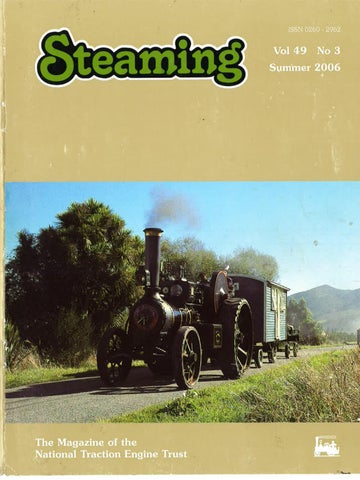
The happenings around the impressive gathering of engines in New Zealand in March this year are featured about our centre pages. Mick George's picture on the cover shows Phil Kerr's Burrell 3229 taking part in the Road Run from Rangiora, below the foothills of the Southern Alps. The Bhp three-speed traction engine was built in 1910, and like many sold through NZ agents Reid & Gray, has spent its whole life in the South Canterbury region.
STEAMING
Summer 2006
123
Trust News From the President Just over six years ago I stepped into the vacant seat of the President of the Trust, as a stand in because of the unexpected early retirement of Eric Fillmore due to very poor health. At the following AGM I was properly elected, for which privilege I am now saying a heartfelt 'ThankYou'. I have felt very strongly that we have a very effective chairman, officers and committee (which I must remember is now the council), so that it would have been out of place to even try to take on an executive role; besides which we all know that Doctors are hopeless as businessmen. We are trained to know that what patients tell us is the truth, so can easily be taken for a ride. Doctors can't organise a p*** up in a brewery, I was told. I also feel that the President's badge of office should be worn by a succession of people. It is a signal honour. I have now done two terms, each of three years, and took part in the Trust's 50 year celebrations, so this Club member Number 2 is standing down at the AGM in November. I hope to meet you there when you have amongst other things to elect my successor. (Giles Romanes)
Engine Owners Column Engine Owners Section Work by members in my Section continues on the Engine Code of Practice, and we are presently considering and getting advice on the Trust's position and the Code's relevance to the various regulations, the Health & Safety at Work Act, PSSR 2000, PED and PER, I am working with theTechnical Services Unit to try and steer a way forward that does not compromise the Trust, but helps the engine owner to properly manage his pressure vessel. It is not as straightforward as some would have 124
us believe - and that includes myself, until recently. To those of you who were at the Engine Owners Meeting in January and read the report of that meeting in the Spring issue, you will find elsewhere in this issue the first appearance of a new section called Technical Tips - tales of caution. These are the first three short cautionary tales that have been submitted to me by owners, so that we can pass their experience on to the rest of the engine owners. Please let me have some more instances of cautionary tales or near misses so that we can pass practical advice on to others. (Bob Siddall, chairman, Engine Owners Section)
Technical Services Visit to SAFed For some time now, in support of the Engine Owners Section's revamp of their Code of Practice, members of theTechnical Services Unit have been exploring options that would allow the NTET to promote its 'Written Scheme of Examination' and attendant 'Boiler Inspectors Report' as the accepted template for the inspection of members' engines. This work is part of a developing strategy aimed at raising the integrity of inspectors and providing more consistent reporting standards. In addition to the support provided to Bob Siddall's team working on the revision of the Engine Owners Code of Practice our endeavours are also a serious response to calls from engine owning members and others who are becoming more and more concerned by the perceived lowering of standards in boiler maintenance and boiler inspections. As part of this work, myself and James Blenkinsop visited the offices of UKAS (United Kingdom Accreditation Services) a few months ago, where we obtained some valuable and encouraging but potentially
costly advice from the staff there. In mid July, myself and James along with Irvin Barraclough will be paying a visit to the London offices of SAFed (Safety Assessment Federation) to talk to members of the Technical Committee which deals with the examination and repair of steam pressure systems (including traction engines). The objective of these visits is to test the NTET's Written Scheme of Examination against the requirements of PSSR 2000 (which the NTET has adopted as its standard) and have the proposed 'control scheme' assessed and commented upon. I look forward to reporting the outcome of this visit in the next issue of Steaming. PED/PER As part of the service offered to members we are often asked to comment on the application of the Pressure Equipment Directive (PED came out of Brussels) and the Pressure Equipment Regulations (PER - our Government's interpretation of the PED) as applied to the repair and rebuilding of traction engines and steam models. Frankly, our experience now shows that these devices are a nightmare to interpret safely and consistently. Whilst we have felt reasonably self-assured in the past, now, as more and more boilers come up for major works, we can no longer trust the judgements that form our 'working templates'. Before we rush off in a panic please remember that no-one has been brought before the courts on these issues but even so we need to provide practical and consistent answers to the questions raised. Currently, the answer you get depends on who you ask. We have therefore decided to take the bull by the horns and ask the Department of Trade & Industry and a number of PER assessment bodies to comment on a range of specific examples of repairs and rebuilds. Watch this space.
Summer 2006 STEAMING
NTET Website For the past few months Roger West, John Cook and myself have been working with a professional web designer who is assisting us in the preparation of a new look web site. Apart from just looking very good this new set of web pages will provide many more features including the potential for on-line sales, on-line membership renewals and access to 'members only' services. The latter will include access by authorised event organisers to the NTET's Insurance Disc database. It is hoped that the first phase of the new website will be live by the end of July.
Introduction of SORP 2005 into Annual Trustees Report The Charities Commission has substantially extended the amount and nature of information it requires to be included in the Annual Trustees Statement to them (this is one of the pages included in the Report & Accounts booklet distributed with the Autumn magazine). The TSU has been working alongside theTreasurer to ensure that the 2005 report is fully compliant.
STEAMING Summer 2006
This scene is outside grocer C H Lewis' shop in Bank Place, Holywell, a small Flintshire town a mile inland from the west side of the estuary of the River Dee, as an early Foden steam wagon delivers flour. Chris Lewis (that may be him standing by the front wheel) is said to have taken a twice weekly delivery, but we can assume only a certain number of sacks were unloaded from the wagon's flat body, the rest going on to other local customers. Notice though, that steam transport is queuing up to offload supplies — just behind is another vehicle waiting its turn by the shop door, and from the little that can be gleaned on the print, it may be a Coulthard steam wagon. However, the Foden, number 753, is well set down in surviving records. It was delivered new by the makers in April 1904, though for some reason the Denbighshire County Council Heavy Motor Car register does not date its entry, as index number CA78, until 28th March 1905, owned by Llanfair Mines Ltd, at Llanfairtalhaiarn, a village five miles or so inland from Abergele on the north coast. The wagon was one of the makers' massively built outside framed 6 ton machines with 4ft rear wheels, and declared as painted chocolate and vermillionette — whatever that latter shade was. The mining company might have found its use of a steam wagon was not what it expected, for on 1st November 1905 the ownership details in the county register were crossed out and E Evans & Co of Victoria Mills, Holywell inserted — the wagon had moved about 20 miles east to transport a rather different commodity, but still a very heavy one. Our picture is thought to have been made about 1908, and a year later the Foden was on the move once more, the County Council clerk again crossing out the entry and on 1st October 1909 entering up The Cobden Flour Mills, Watery Road, Wrexham. By then the wagon had been repainted in green — a visit to the Elworth works for rebuilding and repair maybe?The Cobden concern had earlier experience with Foden wagon 569 (CA29), with manager J Hardwick letting the makers know in 1903 (for inclusion in one of their catalogues) 'We are pleased to say your steam wagon is continuing to do very good work and gives us every satisfactiorK Here at Wrexham, Foden 753 settled down for another twenty years work with the same owner, and by the time it was scrapped in 1930, its long working life would have done nothing to sully the Foden reputation. 125
Operations and Procedures Handbook Following the adoption at the last AGM of the new NTET organisational structure and management team make up the TSU has been busy ensuring that our operations and procedures handbook is compliant with the Charities Commission and Health & Safety Executive requirements. To this end we have a new Health and Safety Policy statement which is now more in keeping with the Trust's activities. In due course this statement will be included on the NTET's website. (David Smith, Head of Technical Service Unit)
Insurance Matters Boiler Inspection Since writing my notes fur the last edition of Steaming, I had a very interesting visit to a boiler repairer, where a number of engines were receiving his expert attention. It was very satisfying to see quality traditional boiler work underway and the skills necessary to repair, rather than build a new boiler. However my attention was caught by the 'black museum' of scrap parts removed from boilers. In particular there was a firebox taken from an engine which I know had been on the rally field until recently.The condition of this firebox closely matched the description of the one involved in the Medina incident in Ohio, USA. How this had held together in service is anyone's guess, as it could have failed due to a number of faults and would have done so catastrophically. Although shocked by its condition, my main concern is that the boiler inspector had allowed the boiler, in such a poor state, to be operated with or without restrictions. I know that this inspector is one of the independent inspectors included on the NTET list of inspectors, and that the entry onto this list has nothing to do with the competency of the inspector. Any independent inspector, on proving he held suitable insurance cover, would be added. It is up to the owner/operator of the boiler to appoint the competent person to inspect their boiler. This sorry story highlights the concern held by many members and officers of the Trust that the competence of some of our boiler inspectors is not of the standard we all imagine and have come to expect. 126
This is Robey single cylinder traction engine number 34252. The 7hp machine seems to have had, for unrecorded reasons, a somewhat false start to its working life. Road Locomotive Society records have it as new un 191h December 1915 to William Bottomley & Sons (Manchester) Ltd, but then as returned to the makers at Lincoln in the following January. In April 1916 it was displayed at the Dublin Show and then, its travels hopefully over, on 20th July was booked out to Lincoln Equitable Co-operative Society, presumably for use on a farm run by the Society. This photograph was probably taken at Robey's behest at the Co-op farm — it clearly shows the engine in as-new condition, and it is positioned as for work at threshing, with a goodly supply of coal dumped by its side, and a large corn stack in the background. The sheeting to the cylinder can just be seen to be signwritten with the words LINCOLN CO-OPERATIVE SOCIETY LTD, LINCOLN and evidence of the engine's newness is the small rectangular Kesteven County Council registration plate (number too small to read), which is only loosely and probably temporarily wired to the bar connecting the cylinder drain cocks. Later the engine was with Forman Brothers, at Branston, a village just a few miles south-west of Lincoln, and given the index number FE4036; after ownership through the World War 2 period by Maurice Poole of Swinderby, the Robey ended up with a scrap merchant in Grantham about 1949. We thank John Billard for arranging our use of the picture. Summer 2006 STEAMING
The work to improve this state of affairs has now been exercising our minds for quite a while and has involved discussions with the corporate inspecting bodies, UKAS (the government accredited auditing body), and the Health & Safety Executive, amongst others. Although it is not an easy matter to address, we most certainly will so that we can continue to enjoy our engines without burdensome control from outside authorities. Some of you may know that the Office of the Rail Regulator (includes the HMRI) is facing the same issues with the heritage railway movement, and is developing a Code of Practice very similar to our own in order to gain control over inspection and repair procedures.This is just the way forward we have been proposing since starting the review process on our own Code of Practice. In a similar vein, the phenomena of 'self healing' boilers is another issue which has been highlighted during our review of inspection practices. For those unaware of this practice, it occurs when an independent inspector advises that without a major overhaul of the boiler it is not fit for further service. Rather than accept his recommendation, the owner moves on to other independent inspectors until he finds one who will give him a ticket to steam. Under these circumstances the insurance company will be unaware of the previous failure report and will provide insurance based on the current 'OK to steam' report. If something should subsequently fail on the boiler and an insurance claim was made, you can be certain the insurance company would look to reclaim their costs from the inspector and probably also from the owner. These third party costs where personal injury is involved would almost invariably exceed, and by quite some margin, the cost of repairing the boiler. There are a number of engines out on the rally field in this condition, some of which may well be in the same state as the one mentioned in my opening lines. Why should we let a minority jeopardise our hobby for their short term financial gain? I don't imagine for one moment that those who employ these practices will fully read these notes, so it is up to every one of us to persuade those who do, to operate in a safer manner and be aware of the consequences of their actions. After all, we all have a 'common law duty of care' in whatever we do and the consequences of failing to underSTEAMING
Summer 2006
stand how our actions affect others, could so easily lead to severe restrictions being placed on us.
Treasurers Report
Low Loader Insurance Policy at Footman James
At the meeting of the General Council held in June 2006 I recommended that subscriptions should increase with effect from 1st February 2007. The proposed new rale was £25, will) a reduced rate for pre-Summer 2003 OAP members of £15. This recommendation was unanimously adopted by the members of the General Council. The policy of introducing a series of small increases in subscription rates over a period of time has been in place for some time now. Subsequently I have been monitoring the financial position of the Trust and have taken into consideration the following important points: • The increase in Retail Price Index and the consequential increase in the costs of running the Trust. • The need to act sensitively and early enough to avoid problems, both financial and emotional. • The effect of the fiscal time lag, which means that around 18 months will pass before the benefits of any increases are really felt. • The business strategy of not placing too much reliance on unearned income. • The need to provide the Trust with sufficient 'financial headroom' to allow it to develop future strategies. I therefore give notice that the subscription rate will increase from 1sl February 2007 from £22 to £25. I also give notice that there will be an increase from £12 to £15 for those members who currently benefit from the now defunct old age pensioner concession. This represents a relatively small increase in the subscription rate, but will ensure that theTrust continues to operate on a sound financial basis for the foreseeable future. (Julie Smith, Treasurer)
Our good friends at Footman James have asked me to point out that the competitive premiums for the Low Loader Insurance Policy cannot provide for 'goods in transit' cover as stated on our web site. It was previously understood that as soon as the chains were attached to the engine on the trailer then the risk relating to intrinsic value of the load transferred to the low loader insurance. Under RTA law this is still true for third party risks, but it does not provide cover for damage to the load. Therefore, if the engine came adrift from the trailer in an accident and caused damage to a third party, then the low loader insurance would cover the costs. However, any damage done to the engine in the process would have to be covered by the engine's own insurance. Should there be only third party insurance cover in place, then the repair costs would have to be met by the engine owner. Insurance Disc issuing This season I have had a number of applications for discs from members who insure through Footman James and act as one of our disc issuing agents. To be able to maintain a completo record, the insurer needs to see the boiler report, so if you insure with any of the brokers listed below please send the reports to them for a disc to be issued. • Footman James • James Campbell Insurance • Walker Midgley When renewing the insurance policy any of the above insurers will automatically issue a disc, so long as the boiler inspection report is still valid. However, if this expires part way through the insurance period, then a new disc can only be issued when the insurer has received the new boiler report. For those who want a disc and make their own insurance arrangements, one can be obtained by sending copies of all the necessary paperwork to my address —see inside the front cover. (James Blenkinsop, Insurance Officer)
Subscriptions — time for an increase
FBHVC News The Federation of British Historic Vehicle Clubs remains active on a whole series of issues affecting the historical vehicle movement.There is nothing dramatically affecting steam at present as far as we can see, but the following items may be of interest toTrust members. Agricultural Waste Regulations — despite promises that the Regulations would be published last year, nothing has been seen. As reported before it is expected that owners of machinery left on agricultural land will only have to remove it if they themselves declare it as waste. An exception may be if the equipment is environmentally 127
In April John Wharton's Burrell showmans 3489 KING GEORGE VI was used to haul between fairs several of the packing trucks from Carters Steam Fair. Passing through Hersham, Surrey, the engine may have felt a little edgy, for this was probably the first time it had travelled in the area since the infamous occasion in March 1936 when it was one of the three engines that came to grief nearby whilst moving the third large transformer from the Hackbridge works, on delivery to Barking Power Station. At that time the Burrell was working as a road locomotive, owned by J Hickey & Sons, and named CITY OF LONDON. Keith Broth well's photograph shows KING GEORGE swiftly passing the present day gates of the erstwhile Hackbridge premises.
hazardous, for example leaking fluids. DVLA fees — in August 2004 DVLA (Driver and Vehicle Licensing Agency) consulted on proposals to levy a fee on all VED (Vehicle Excise Duty — road tax to some) transactions. The FBHVC objected strongly, stating that this amounted to a tax on ownership and that the• costs should be met by general taxation. A petition was raised and presented to 10 Downing St. In April the DVLA responded, and although fees of around £3 are being considered, DVLA said that it will not charge for SORN (Statutory Off Road Notification). This removes the very worst of the proposal. DVLA is now consulting on whether a fee should be collected via VED or with the MoT fee. If the former there is a possibility the nil rate licences will be exempted. This consultation concludes on 21st July. Any comments to me, please, as soon as possible. Motor event regulation — the NTET is an Authorising Body under a series of Regulations for off road events (e.g. steam rallies). The Department for Transport is consulting on combining the Regulations into one and increasing some flexibilities. As there are no changes to the underlying principles we are not objecting. Low emission zone for London
128
— steam as a whole is exempted.The proposals for these changes will apply only to heavy diesel vehicles that cannot meet the current emission regulations, thus encouraging operators to use the cleanest modern vehicles. The proposals recognise the existence of 'heritage' internal combustion vehicles, and proposes to exempt them. The FBHVC is dealing with the meanings behind this aspect. Highway Code — the FBHVC has responded to detailed proposals to amend the Highway Code to include emphasis on possible hazards caused by very slow vehicles on the highway. If you wish to comment on the above, or would like to raise any issue that may be of interest to the Federation and its constituent member Clubs, please contact me, John Billard, Old Station House, Twyford, Reading, RG10 9NA 72 01189 340381.
The Training Course The annual NTET Training and Driving Course was held on 13 and 14th May, the location was S E Davis's yard in Astwood Bank, near
Redditch in Worcestershire. It is the second year that Bob Davis has kindly provided a venue for the course and the location could not have been better. There is a hard perimeter road, ideal for times of wet conditions, plenty of room for camping and also the ideal opportunity to view the fantastic collection of vintage machinery. There were 44 students booked in for the weekend, and they were either studying on the Foundation, Intermediate or Advanced level. For the practical experience there were 16 engines in attendance, which gave a good variety for each of the students. Unfortunately the hard roadway came into its own on Saturday afternoon, when we experienced a heavy thunderstorm, but although the conditions underfoot were slightly dampened, everyone continued with activities as arranged. This has been the third course that I have organised so this year the Foundation Level students that I started off with have now completed their final stage. Therefore if anyone is looking for an experienced crew member, I may be able to assist you. On behalf of the Trust and those who attended on the weekend I would like to thank the Davis family for providing a great venue. I also extend my thanks to everyone who assisted in any way over the weekend — the lecturers, enginemen, catering ladies and all helpers.The success of this weekend would not have been possible without your help. The 2007 course will be held on Saturday 12th and Sunday 13th May at the same location — Astwood Bank, Redditch. Students who attended this year will automatically receive an application form, and any other members wishing to attend should contact me in early 2007 (Stuart Tomlinson, course organiser)
Obituaries Stan Burgess
Stan was born in 1932 at Haddenham in Cambridgeshire, where he lived his whole life. As a boy he eagerly awaited the arrival of the Burrell traction engine from local threshing contractors Fred Peacock & Sons. At seven he started to follow the set wherever it went in the surrounding fens. The driver became friendly with him and by the end of the season Stan was on the footplate. Summer 2006 STEAMING
He became a regular visitor to Peacock's yard, and struck up a friendship with Len Peacock, and for repairs responsible Stan always maintenance. remembered how well the engines ran, and how precisely the governors were set. It was during these years that Stan's fascination for steam engines was formed. He was a blacksmith and engineer by trade. After finishing his apprenticeship and a stint of National Service, Stan set up in business on his own at the age of 23, with just £15 in his pocket. He had married while in the army, and he and Rosella lived in a converted double decker bus. Hard work and effort paid off, and in time a house and yard were purchased in Station Road. Stan's first restoration project was a Burrell purchased from Mr King of West Row for the princely sum of £50. He told how the traction engine was seized, but after towing her to Haddenham he found she had freed herself off. SPARKIE was restored as a showmans and was rallied over a wide area, including at Raynham Days in Norfolk, and Ickleton.While working on the engine Stan was at a loss what to name her — then he Children's heard Uncle Mac's Favourites on the BBC on the workshop wireless. 'Sparky's Magic Piano' was played, and that is how the engine acquired a name. Stan's best-known engine is probably Burrell showmans engine EARL HAIGH. He purchased her from Darbys of Sutton in 1962 in a very derelict condition, and towed her home with a Burrell 7hp single that he owned at the time, a tow truck having failed to move the derelict.
STEAMING
Summer 2006
Many people would have said she wasn't worth restoring but within three years the rebuild was complete. Stan rallied the Burrell far and wide, including Dorset and Pickering, as well as closer to home. In the early years the EARL was often roaded to events, steered by Rosella and pulling Stan's large Mortier dance organ and living wagon. The first engine I remember is the EARL, generating light at a rally one night. At the time our family's Ruston was being re-boxed in Stan's yard. Other engines passing through his hands were the former Doran Bros Burrell roller 3047, Clayton wagon FENLAND PRINCESS, the big Foden road loco MONARCH, and Foden wagon 13120. These were all subject to a thorough restoration by him and remain as testament to his skill. Stan also carried out much work on the Paisley collection of engines. At any given time at least two of Tom's engines would be at the yard in Haddenham, so if there was a hold up with work on one Stan could switch to the other. He also carried out restoration work on Garrett tractor LITTLE BILLY for Robert Finbow, Burrell showmans ISLAND CHIEF for Ken Wood and Burrell scenic NO. 1 for Arthur Beales, as well as many others. Among his other interests were Ford model T cars, of which he restored a number, and old lorries including Dennis, Bedford and Atkinson examples. A Fordson Standard was restored to cut the grass in the meadow, and in that same meadow at one time was a short track for running KIDBROOKE, a 2foot gauge Bagnall railway loco, also restored. In 1971 Haddenham Social Club approached Stan about holding a steam rally in the village. With the help of the East Anglian Traction Engine Club a committee was formed. Stan and my father were the original members along with Reg Brown, Gerald Bailey and Jim Wales. The rally has gone from strength to strength over the years, and although Stan took a back seat from committee work he was still there to give advice and support. He and his engine have always been 'No.1', and the rally will never be quite the same again. Stan was an expert with steam engines in the truest sense of the word. He was always willing to help when somebody was having difficulties. He would always offer advice if asked for it, but was never pushy or wishing to show off what he knew. It's hard to accept we'll not see that cheeky grin, the twinkle in his
eye or hear his 'East Anglian treacle voice' again. But he is here in our memories, and in the engines he restored and worked on. And if the pearly gates need repairing, we know a man who can! (Michael Pumfrey) Jimmy Key The preservation movement has lost one of its most colourful and energetic members with the death of Jimmy Key. As a farmer and as a preservationist, committed not only to steam but also to our industrial heritage and the environment, he lived life to the full. Jimmy died on April 24 after a short illness. He was 58. Strumpshaw Hall and its surrounding park in Norfolk have long been synonymous with the steam museum and the Strumpshaw rally, held there every spring bank holiday. Jimmy had developed the museum into a major attraction for visitors to the region and expanded the rally to become one of the premier events on the steaming calendar. What became known as the Strumpshaw Collection was moved by Jimmy's father Wesley from North Walsham in 1954. From there father and son continued to expand and improve the Steam Museum. The collection includes a magnificent fairground ride, numerous stationary engines, both steam and diesel, and a large collection of related artefacts. There is also a fine collection of traction engines of which Burrell 3789 PRINCESS MARY was Jimmy's pride and joy. With the indispensible help of close friends, including Pip Parker and Chris Spinks, Jimmy had recently overhauled Strumpshaw's showmans engine, as well as the collection's Foden wagon and other engines in recent years. Also housed in the museum is the Christie Organ, which has become a feature of museum entertainment, especially at the popular Christmas parties which have become a annual event. Regular visitors will fondly remember Jimmy wearing his trademark rig of boiler suit or shooting jacket, conducting memorable auctions for charity while skillfully employing his unforgettable wit to relieve revellers of their cash. His interests were not restricted to steam. Jimmy Key was first and foremost a farmer, running the land with his son William. In his early years he also farmed at Honing in Norfolk. His love of the countryside was reflected in his interest in traditional land management — the 129
RSPB have part of the Stumpshaw reserve on the estate. He enjoyed shooting and strongly supported the Royal Agricultural Benevolent Association, often topping the bidding to shoot on other estates in the country. With the support of his sister Kiki he established a livery stable and went on to build a first class cross country course in the park, and although not a horseman, he designed and built an effective series of obstacles. Jimmy was always enterprising. At 14, as a pupil at Duncan House School, he memorably sold an MGB sports car to a teacher. In later life he was often seen at auctions, usually adding to the banter amongst the bidders, always careful not to miss a bargain. He was a great supporter of other steam engine clubs, attending neighbouring rallies and helping with the use of facilities at Strumpshaw. He hosted NTET Training Weekends a few years ago, and also the Sunday visit on the 50th AGM weekend, which was much enjoyed by members. The large number of people who attended Jimmy's memorial service held at this year's Strumpshaw event reflected the high esteem in which he was held. Jimmy, whose wife Sue died about twenty years ago, had
been suffering from heart complications for about a year. He died at Papworth Hospital from another heart attack during surgery. He leaves William and daughter Becky, and his partner Vanessa. We offer them and the rest of the family our heartfelt condolences on their great loss. We shall miss a good and generous man, whose kind friendship and unique humour will long be remembered. (Duncan Marston)
Bill Walker A few days after Easter we gathered at the Worcester Crematorium chapel to bid farewell to 'Big' Bill Walker. It was a very simple service, organised by Jim Smith and his wife, and conducted by a lady Minister — and the amusing irony of this was Bill's lifetime opinion of women. His opening words upon meeting one were 'can you make scones girl? If not get in the kitchen where you belong'. Both Bill and his father were engineers in Worcester, and a commemoration plaque to his father is to be found on the bridge as recognition of his achievements. Bill himself was very involved with steam from an early age, for years taking the late Mr Crabtree's tractor IKANOPIT about. He was also one of
A fine show of exhibits by the Peterborough Farm Machinery Preservation Society was arranged for the Road Locomotive Society at James Cowell's farm nearThorney, Cambridgeshire in May 2005. This close up is of the lately built Ruston & Hornsby single cylinder portable 17503Z a PSD class engine of 1935. (John Cook) 130
the 'Hartlebury Gang' and got to help with Eric Middleton's engines at the house at Hartlebury. Latterly he helped with James Hervey-Bathurst's Fowler road loco ATLAS, and on one occasion at Eastnor Castle both he and the late Fred Dibnah were heard to be carrying out a constructive conversation, with the decibel level above the mellow tones of ATLAS. The sad occasion of Bill's death can't be let to pass without a few words from those who knew him — William Lawrence Carey Walker, a pretentious sounding name for a very big man of 6ft 10ins height, a very direct man when talking to you, a total chauvinist to women, a good friend, and a big, big man with an equally big heart. Another character from the early days of steam preservation has gone — but not to be forgotten, and remembered with affection. (Jane Crane)
Affiliated Groups Steam Plough Club This year the Steam Plough Club celebrates the 40th anniversary of its formation. The precise occasion will be marked by a special day, with lunch, tea and suitable entertainment in between, at the Great Northern Hotel at Peterborough — the very place where Harold Bonnett caused the founding members to gather in December 1966, and it is remarkable that exactly the same room is still available for the celebration. Before that however, the Club is holding another in its series on Great Challenges, with members competing in friendly rivalry with the skills of steam ploughing and cultivating. The date is the weekend of 9th and 10th September 2006, and the venue is on land at Rempstone (A60/A6006), near Loughborough, Leicestershire — very appropriate, for the event will also celebrate the centenary of steam ploughs operated by Beeby Brothers of Rempstone. No fewer than eleven sets of steam cable ploughing tackle should be available for competition, including the largest number of single cylinder engines gathered together since the start of preservation times. Also present will be vintage tractor and horse drawn ploughing, model ploughing tackle, and steam sawing and threshing. It is all intended to be rather different from the usual rally — no traders, but exhibitions of country Summer 2006
STEAMING
Y.
The large amount of wood stacked on the bunker of this Fowler ploughing engine, suggests something unusual about this otherwise typical British steam plough scene of the 1920s. Indeed there is, for the picture was taken during the 1921 coal strike, and no doubt it was a matter of raking or scrounging whatever fuel was on offer to get the job done. The engine is a class BBS superheated 17hp compound — number 13977 one of a relatively small class (numerically: there were but 36 sets sent out), that was built for home and abroad only between 1913 and 1916. They had piston valves and Firth's valve gear, and the superheater was in the smokebox, though few owners, it is said, kept the devices in place for very long. 13977 (EW2509) and its pair, 13976, were owned new by J Jackson & Sons of Sawtry, Huntingdonshire. (collection, late Bill Colebrook)
craft and industry, and local farm produce and ale. Admission will be £5.00 (no concessions); children under 12, £2.50. Seek out more information at www.steamploughclub.org.uk or www.remostone.netfirms.com
Trust Exhibition Unit It came about that the refurbishment of the Trust's travelling exhibition unit took rather longer than planned, so we are sorry if its first few outings gave members and other visitors a less than polished look. However, all is now finished, and the completed work offers a considerably better presentation to the public, and a much more convenient and secure method of working for those who staff the STEAMING
Summer 2006
September— 1st to 3rd, Great Dorset Steam Fair; 9/10th Steam Plough Club Great Challenge, near Loughborough, Leicestershire; 15 to 17th, Bedfordshire Steam Fayre, Biggleswade. The above titles are shortened versions of that which appears in the Trust's The Rally List 2006, which was distributed as a loose insert with the last issue of the magazine. Please refer to the List for more detail on the respective locations and a contact, if necessary.
vehicle. The Unit shows off the Trust's activities and road steam engines with a high profile, and has the bonus of raising funds and providing a service to members and others via the book sales section. Please look out for the display on the rallyfields this summer. Arrangements have been made for the Unit to appear at the following rallies. July — 15/16th, Masham, Yorkshire; 28th to 30th, Welland, Worcestershire. August — 5/6th, Gloucestershire Extravaganza, Kemble; 12/13th, Astle Park, Cheshire; 30/31st Great Dorset Steam Fair. The Trust's Exhibition Unit has recently had refurbishment and improvements to ensure it continues to serve us well for quite a few more years. This view of the much improved book display area is a reminder that the Unit will travel widely to rallies during the rest of the rally season — a good opportunity to catch up on what is new, and if you are a slow reader over what you purchased last year, to buy what is about to become out of print and rare. 131
Thanks We record our thanks to Neil Roberts, of Auckland, New Zealand, for his kind donation of a copy of a scrapbook of cuttings from around a hundred years ago. The original had been assembled by Chris Lambert, steam engine contractor in Kent, during the 1904 to 1910 period — cuttings from local papers on local authority reports of tenders received for road maintenance; similar items from trade papers, and more on many other topics that seemingly caught his interest as something to have a record of in the future. The ledger had been given by Chris Lambert many years ago to Neil's father, W S Roberts of Wickham Bushes Farm, near Lydden, Kent — he owned several engines at the time including Garrett 35461, the last traction engine they built. Extracts from the old book will appear in Steaming from time to time, filling in the spaces when articles finish before the bottom of the page, and hopefully giving brief glimpses of what happened around the working of rollers and engines in their heyday.
Future Dates Annual General Meeting The more formal notes concerning theTrust's AGM are set down in adjacent columns — these notes give a brief outline of what we hope members will consider the enjoyable social side to the necessary annual business. This year we are in the north of the country and the Burnside Hotel, Bowness, has been chosen as the base for the weekend on 17th to 19th November. The AGM will be held in the Ebor Suite, and accommodation will be available in the Hotel on the Friday and Saturday nights at the bed and breakfast rate of £55.00 (or £65 including dinner) per person per night. Bookings should be made direct with the Hotel — Tr 08700 468640, mentioning 'NTET'. Other rates are available earlier in the week (Wednesday to Thursday) for members wishing to arrive in the area a few days earlier. The Saturday evening will feature an NTET private dinner for members and their families in the Silhouette Res.taurant. Members Anthony and Wendy Thompson from Nottingham are making the other arrangements for 132
the weekend, including a programme of visits which will be included in the next issue of the magazine. Make a note of the dates now, and enjoy a weekend away with fellow members in the heart of the beautiful Lake District — the Hotel overlooks Windermere, and is but 300 yards from the steamer piers.
Annual General Meeting The 2006 Annual General Meeting of the Trust will take place on 18th November at Bowness, Cumbria, in the Lake District. A detailed account of arrangements for the whole of the weekend will be published in the Autumn copy of the magazine. The notes below give information for the 2006 AGM, and the formal notice regarding the submission of any motions to be debated. Formal notice of the meeting and other information, including the audited Report and Accounts for the year, and Appointment of Proxy form, will be distributed to all then current members with the Autumn issue of Steaming. Any member may submit a motion for discussion at the AGM. All such motions must be in writing and signed by a proposer and a seconder, and state the respective membership
numbers. The items for discussion, in order that they can be published in the Agenda for the AGM, as required by Article 16 of the Trust's Constitution, must reach the General Secretary, Sue Jackson, on or before Saturday, 23rd September 2006 (address inside front cover►. The elected Committee for the current year was published on page 5 of the Winter 2005/2006 issue of this magazine. Members retiring by rotation at the AGM in November 2006 are: Giles Romanes, President John Cook, vice Chairman Charlie Daniel Nickey Daniel Edward Goddard Tim Holt David Smith Mike Ward All of the above are eligible for reelection, but Giles Romanes has indicated he will retire as President. A form of Nomination Paper is printed with these notes and may be used, cut from the magazine, in photocopied form or written out on plain paper. Any nominations for the Committee should be sent to the General Secretary, Sue Jackson (address inside front cover) and must be received on or before Saturday, 23rd September 2006. They will not be accepted after that time. The names of the nominees will be included in the published Agenda to be distributed with the autumn magazine.
The National Traction Engine Trust AGM, 18th November 2006 NOMINATION PAPER
Please use block letters
President, vice Chairman or a member of the National Committee* Name
Membership No
Address I agree to aceept nomination for this office and, if elected, to serve theTrust and abide by its Constitution. Signed: Proposed by SIGNATURE
PRINT NAME
Membership No
Seconded by. Membership No SIGNATURE PRINT NAME Nomination can be made on this form, cut from the magazine: on a photocopy, or on a copy hand written on plain paper. *delete as necessary, but use a separate paper for each nomination. Summer 2006 STEAMING
New Members We extend a sincere welcome to the following new members who have joined the Trust during the last three months. We hope they will gain much friendship, information and enjoyment from their membership over a period of many years. Full addresses are not included, but the Membership Secretary is always pleased to put members in touch with one another by forwarding mail. A R Parker, Mansfield, Nottinghamshire M J Kirby, Leicester R Sharps, Crewkerne, Somerset G Morrison, Sandbach, Cheshire C J Battye, Bedford J Keighley, Preston, Lancashire M A Maher, Ulverston, Cumbria G D Parkin, Launceston, Cornwall H E Freeman,Tadworth, Surrey M Ankers, Whitchurch, Shropshire A A J Westlake, Dorchester, Dorset N Beaver, Pickering, North Yorkshire I A Broadbent, Blackpool, Lancashire D J Lee,Tamworth, Staffordshire M J Robinson, Nottingham B S Lawrence, Bourne, Lincolnshire DW Smith, Rugeley, Staffordshire M Lund, Southampton, Hampshire A McLeod, Aylesbury, Buckinghamshire Mrs M Vessey, Brigg, Lincolnshire J Graham, Norwich, Norfolk S Clark, GreatYarmouth, Norfolk J Murphy, Maldon, Essex B L Marsh, Cheltenham, Gloucestershire D Brown, Fife, Scotland D Bostock, Congleton, Cheshire A White, Grantham, Lincolnshire B Drew-Smythe, Leighton Buzzard, Bedfordshire DW Burgess, Pulborough, West Sussex D A Wharton, Nova Scotia, Canada Museum of Liverpool Life M J Smith, London P J Loney, Luton, Bedfordshire
Poor Steaming In the article 'A Motor Driver remembers' in the Spring 2006 issue, a couple of paragraphs have, unfortunately, escaped elsewhere into the recesses of someone's computer, somewhere along the way. On page 93, the middle column, just over half way down, you should have read .... .. At times, he recalled having seen at least one vehicle sunk up to its axles in the middle of the road and until it was pulled out, no traffic could get past. During the winter months, it was not unusual to be bogged up at some farmhouse or other for lengthy periods as well. 'With the introduction of the petrol engine, the NER experimented STEAMING
Summer 2006
by converting one of its rubber-tyred passenger-carrying omnibuses into a lorry for conveying goods.This was a considerable improvement on the iron-tyred steam lorries, but the vehicle was of insufficient power to carry heavy loads up the steep hills which abounded in the north Yorkshire area where the initial services operated. 'Driver Wharram later transferred to the Queen Street railway workshops in York, where the Road Motor Services depot was established, and he had a period of maintenance training on petrolengined vehicles
'Early on Tuesday afternoon much excitement was occasioned in the Church Road district by a fire, which out under singular broke circumstances in Somerset Road. A steam roller was being used for scarifying the roadway, when the rear high-end wheel sank into a hole and broke the gas main beneath. Immediately a huge flame rose into the air, the gas having ignited from the coke fire under the roller, and an alarm was received at the Fire Station to which the brigade promptly responded, but were only able to 'stand by'. 'To draw the roller out of the uncapped main it was found necessary to utilise the District Council's motor wagon, which was fetched from the yard in North Lane, but it was impossible to quell the flame until the arrival of the men from the Hampton Court Gas Works, who had the difficult task of cutting the pipe and afterwards plugging it with clay. 'The accident involved of course a considerable waste of gas, but the efforts of the company's staff were carried out with smartness, and there was no injury to anyone concerned. A large crowd assembled to witness the unusual conflagration.' (from the Surrey Comet, 22nd August 1922. The incident would appear to have happened in Kingston-on-Thames — Church Road and Somerset Road lie to the east of the present centre of that town.)
'The Norwich Town Council at the last meeting decided to purchase a steam motor wagon, with interchangeable water tank, at a cost not exceeding £565. They have already one steam wagon in use.' (from The Engineer, 1st December 1905)
reflections on our magazine of 25 years ago
Following the Spring 'Worcestershire Special', the Summer 1981 edition of the magazine returned to the normal style. Again non-road steam articles featured strongly with a three page article by Michael Lane covering the history and technical issues of the Snowdon Mountain Railway (a topic he was well qualified to cover as their then general manager), and a two page article on Somerset riverlands drainage, the latter article covering the present day publicly open Westonzoyland pump, and also Curry Moor and Aller Moor locations. Moving to the Club news it was reported that work was still progressing to achieve charitable status for the NTEC. The Charity Commissioners were not unfavourable — but required further information. Clearly their wishes were eventually met. It was reported that DVLC at Swansea was updating the then dreaded computer, with the aim of making it easier for people to obtain cherished numbers. To make sure they did not loose an original registration number, anyone with a vehicle not taxed in the previous three years was advised to send their log book in to get the number added to the computer files. The first of what was hoped to become an occasional series of articles based on ancient Board of Trade boiler accident Reports covered a fatal incident in Bradford in 1903. A Tuxford semi-portable had been inspected by the insurance company on the Saturday, but on the Monday a mud door failed, fatally scalding the driver. The door had an external seal and it appeared a retaining bolt had failed whilst being tightened. The Steaming Around column reported on an owner whose engine had been passed by one inspector but subsequently failed by another following a rebuild. The Assistant Editor called for training on locomotive type boilers to be a requirement for all inspectors, which would hopefully lead to greater consistency. From recent and ongoing tales and rumours this is an issue that still needs to be resolved. (Stuart Gaines) 133
Keeping a record Some notes on the Test Numbers and rivetter's marks on Aveling boilers Derek Rayner Note - To accord with the spelling and conventions of the time, the words 'rivetter' and 'rivetted' are in this article spelt with a double t, as used in the Aveling record books when they were compiled. As many readers will be aware, Thomas Aveling commenced traction engine construction in 1859, starting with number 1, but the surviving contemporary records of his firm are very sketchy, and sadly are considerably lacking in detail. It was not until the early 1880s, when the production rate of engines increased, that the firm started a system of traceability of engine components. This involved stamping a sequential number — known as the Boiler Test Number — on one of the boiler hornplates. Thus, when the numbered boiler was tested and finished, it was put to one side, and built up at a later time (short or long) into an engine or roller for a customer, or maybe for stock. This numbering system for the boiler construction activity started at a time when the firm had turned out over fifteen hundred engines. Consequently, the boiler test numbers (I shall refer to them as BTNs from now) lagged behind the serial number carried on the brass Royalty Plate fixed on the cylinder (the Royalty Number) by a figure of approximately a thousand, but there was never any direct correlation between the two series of numbers and a 'translation book' was
eventually provided to determine one from another, as necessary.This book survived, and has proved very useful in recent times in identifying derelict or forgotten machines which have been robbed of their brasswork — provided, that is, the BTN has been found on the hornplate side, or even elsewhere on the engine. Some of the early entries (backrecorded by previous keepers of the Aveling records from the Royalty Books) were BTN 175 for Royalty 1830 (an 8hp agricultural of 22nd January 1883), whilst BTN 283 was given to Royalty 1930, a 15ton roller forTasmania on 30th November 1883 — a survivor that is now the world's third oldest steam roller. (The term 'Royalty number', incidentally, was Aveling & Porter's habitual and everyday manner of referring to their works numbers, and peculiar to the firm. It was a practice going back to their very earliest products, built to the proudly won Royal Patents.) In addition, BTN 1000 was on Royalty 2521, a 10ton roller of 26th July 1889. Records in the existing HydraulicTest Books started in earnest with BTN 1600 for Royalty 3032 of June 1892, which was tested the previous March. My further researches revealed that the early references to Testing Numbers in the Royalty Books were very sporadic. The lowest numbers found were 4, which was on Royalty 2005, and also 35, on 1852; 50 on 1910 and BTN 48 was on Royalty 1782, a 10hp 2-speed agricultural dated 19th August 1882 for New Zealand. Thereafter there were many gaps, and it was not until early 1883 The author's 1915 BT-type roller 8506 has BTN 7652 stamped on the hornplate — together with the six pointed star, being used by rivetter Smith at the time. Although some ten years prior to the time mentioned in this article, the possible suggestion for the meaning of the adjacent upside down D5 may still be relevant. The form and imprint of the chisel cuts on this boiler are good; marks on many other Avelings are less so, to the point of being barely distinguishable. (Derek Rayner)
134
BTN 7856 with the herringbone rivetter's marking — from 6 ton BL type roller, Royalty 8794 of 1917 Although this is from a different decade than that mentioned in the text, it is still possible that the adjacent NN5 stamping relates to the type or quality of the steel used. (Roger West)
that these numbers came into something like regular use. The numerical sequence of BTNs continued until the mid-1920s, when number 10000 was stamped on a boiler intended for either an A or B type roller (such boilers were designed to be built up into 6 ton piston valve machines: single cylinder A types, or compound B types). It was tested on 17th February 1925. At that stage someone at the works had clearly planned a re-think of the system, for the company reverted back to a previously used sequence of numbers. The next one to be used was 5000, intended for a C or D type 8 ton roller, and this was tested on the same day. BTN 10000 was subsequently built up as Royalty 11151 — a type AA (6 ton single) roller, despatched on 17th April 1925 to the Crown Agents for the Colonies, though no ultimate destination was given. The next number, BTN 5000, became Royalty 11172, a type D roller new on 25th March 1925 to Grange UDC. They then continued in numerical sequence. The decision to start again at 5000 obviously resulted in many Aveling products carrying a BTN which was already in use, but so different were the machines concerned, at least to the manufacturers, that there would be no confusion among the employees. Only now, in preservation times, is there likely to be some difficulty with the two series of identical numbers that can be found by historians. The amalgamation in the early 1930s of Aveling & Porter and Barford & Perkins companies, the reasons for Summer 2006 STEAMING
TEST NUMBER.
WORKING MARK. NUMBER.
DESCRIPTION.
RIVETTER'S NAME.
Hydraulic PRESSURE PER SQ. IN.
BOILER SHELL.
FIRE BOX.
•
•
6„2, f Ol?
4-‘94 #
:2
I
FEB 2 6 1914 FEB L6
FEB 2 6 1914 FEB 26 1914
a‘y54 a&o
1 #,A-
“4e
Joo
f oa
Part of one of the double page-spreads of the HydraulicTest Book. Notice that whilst, by surviving evidence, Smith's cipher chiselled on the boiler of Aveling 8506 is in the shape of the six pointed Star of David, whoever wrote up BTN 7509 on this page seems to have found it easier to pen a five pointed star. (courtesy Lincolnshire Archives)
R10 roller 2031 has two BTNs - 430 and 2318. When checked against the records, it is revealed that 430 was stamped when the roller was new in 1884. In addition, the roller had been back to Avelings for major repair, and then tested on 29th October 1895, when 2318 was added. At this time, a large patch plate was rivetted to the outside of the throat plate, a repair still present when the roller came to the present owner's possession, though recent major boiler repairs have seen its demise. (Denise Corfield)
the coming together, the transfer of activities from Peterborough to Rochester of some motor roller work, and finally the inclusive factory move to a new site at Grantham and the appearance of Aveling-Barford Ltd has been well chronicled elsewhere. Conventional steam activities carrying on from the Aveling & Porter time were undertaken at Grantham, albeit in decreasing quantities, as evidenced in the comprehensive HydraulicTest Book records which are held at the Lincolnshire Archives in Lincoln. In their 2AB Collection, there are eight of these books, the first one dated 1892. Of interest for this account is a brief look in the last one (Book No 8). This ledger was, by now of course, being entered up with the second series of numbers, covering BTNs 5756 to 6299, and the final details are as follows: • BTN 6291 — a type H (AF modified) boiler by rivetter Hicks, 12th December 1933. Was a replacement for Royalty 11532, an HH roller despatched on 2nd June 1926 to Impresa Tudini-Talenti of Rome as part of an order for five rollers, including two D and two F types and a continental scarifier. The new boiler was ordered by Henri Bon, after only seven
STEAMING
Summer 2006
years, so presumably the roller had suffered some problem; it may also have moved on by then. • BTN 6292 - a ZHND ploughing engine boiler by Springett on 41.11 June 1934. This was a replacement boiler for Royalty 7081, which was one of a pair (7081/2) of 14hp engines supplied to the Paris Office for Louis Billiard, Oran on 25 April 1911.These were returned to the works on 27th March 1912, and subsequently supplied to Garcia et Cie, Blida, Algeria, on 21st December 1912. • BTN 6293 - a new 0 type tandem roller, with oil-fired vertical boiler by Springett on 4th January 1936, for roller 11651. This had been despatched to Pierce & Williams of Westminster, London, on 12th October 1926 destined for Penang (Malaysia). • BTN 6294 - a new boiler for an RC15 roller for J Birch & Co by Springett on 14th February 1936. This was for Royalty 9418, supplied to Bombay with a 3-tine Price Resilient scarifier number 1815 on 25th April 1921. • BTN 6295 - another 0 type tandem roller vertical boiler, by Springett on 25th August 1937.The original roller, Royalty 11295, had been sent to Shanghai Municipal Council (fleet No 19) via John Pook & Co on 20th August 1925. • BTN 6296 - a 6 ton R4 LB (long box) boiler by Springett on 27th September 1937 for Royalty 7918.This had been
supplied to Richardson & Hewitt, Leadenhall Street, London, who were agents - but the machine's ultimate destination was not recorded. • BTN 6297 - a new BSD Belpeire type boiler by Springett on 7th October 1937 for an unrecorded engine. • BTN 6298 - a boiler for an E or F type 10 ton piston valve roller, single or compound, by Springett on 15th February 1937, again for an undisclosed engine. and at the very end • BTN 6299 - a RC10 boiler, replacement for Royalty 5738, by Springett to drawing 10998 on 31st January 1939. This was a 6hp 10 ton compound roller, new on 4th May 1905 to J C Mackinlay, 27 Walbrook, London EC, destined for CapeTown, and ultimately the Woodstock Municipality.
Thus ended a system which had served the Aveling companies extremely well. In parallel with the use of the BTN series of numbers, and the records that were kept of same, there was another system of traceability that was created at the Rochester works. A cipher or cryptogram was used to identify the man responsible for the boiler's construction. This symbol 135
consisted of a series of lines which could easily be incised on the surface of the boiler plate by the use of a flat chisel and a centre pop, tools readily to hand in any boiler-shop. Thus, various patterns in the shape of herringbones, diamonds, triangles, squares, crosses and stars, along with other stampings such as upside down letters and/or numbers can be seen on the hornplates of many Aveling boilers, adjacent to the BTN. Of necessity, the names of the men associated with these ciphers, which Avelings called 'Rivetters Marks' were recorded in the Hydraulic Test Book. Over the years these names changed - presumably because of retirements, deaths and new men becoming promoted and taking over the responsibilities. However, the form of the marks essentially stayed the same from the 1880s through to 1939. Rivetter Hicks, responsible for BTN 6291, used a five pointed star as his mark. Springett, the man identified with many of the last series of Aveling & Porter boilers, is first recorded on 7th November 1910, at which time a man named King was also using his mark (a diamond). Apparently there was a changeover period of around three months for these two, when the same mark was in use by both - perhaps whilst Springett's final training was in progress. The fact that Springett was still rivetting in January 1939 gives us some indication of his length of service with Avelings, at least 29 years, at this senior task - senior because he was the responsible 'signature' for the work that had been completed by himself and others in the gang. (For some reason, on the last two boilers, Springett's mark changed to a square surmounted by a cross over a vertical line.) In addition to the BTN, the Hydraulic Test Book also recorded
other important information, such as the description of the boiler, the shop working number, the hydraulic test pressure and date of test. Also set down were such fascinating and additional details as the material from which both the boiler shell and the firebox were made; the number, diameter and length of both the conventional smoke tubes and any associated stay tubes; the type of roof stays and the style of the boiler seam joint. Unfortunately, for us in preservation times, a specific record of the number of the engine or roller around which the boiler was built up was not generally recorded in the books. However, there are a small number of exceptions to this, and some Hoyalty Numbers are able to be traced from drawing numbers which are given. A check on the difference of time between the hydraulic test date and when the appropriate built-up engine left the works shows periods of between two and six months, in 1914, thus enabling a certain amount of 'rusting up' to have occurred in the newly rivetted seams. This, in the long run, would undoubtedly have helped the boiler's steam tightness. The Hydraulic Test Rook was also used to record types of material used for various boiler components. As an example, in 1927, boiler shells were being made from German steel, whereas the firebox material was specified as 'Steel', with an additional designation also given. This was a letter/number combination such as E4; El; F4; V; K and J4. Looking turther back in the book, these definitions commenced in November 1925, at which time they were Bl; V4; Cl; A3; Z3; R; S; D; D3; D4 etc. Several other letters also appear, so I assume that this code referred to either a quality/grade of steel, or a particular batch of material which was used for the firebox in question another good example of traceability. In conclusion, it should be pointed out that by the time the last BTN was being recorded in 1939 under the old Aveling & Porter system, AvelingBarford were still producing steam rollers; indeed, the company would
These are the marks - 630Z together with a triangle and the upside down J1 - to be found on Royalty 7463 of 1911, a YLD class compound road engine sent off to France when new. (Gary Crutchley) he involved in this activity for the home market up to 1950. However, for the first of their 'new' design of rollers, marketed as the AvelingRuston series, the boilers were bought in, produced by Ransomes Sims & Jefferies at Ipswich. With these machines, Aveling-Barford commenced a new series of numbering - it continued their motor roller series - starting with AC 600 in April 1937. Later, boilers came from both Ruston & Hornsby of Lincoln and Davey, Paxman at Colchester, and the post-war types of rollers were constructed in their entirety, under contract, by Vickers Armstrong at Newcastle-upon-Tyne. All of these firms had their own individual traceability systems with their own systems of numbering and stampings. On these rollers they were marked in a most inhospitable place for us to observe nowadays - above the firehole doors. In the BTN Translation Book, not all entries have a Royalty Number entered adjacent, indicating that the system was also used for newly constructed boilers for existing engines and others, and also for major repairs which were carried out on old boilers. Some boilers,
BTN 5529, and the rivetter's mark of a square with a cross over it and a vertical line below, was found on 7875 Fowler ploughing engine 2620 in Kent, an engine in years gone by fitted with a Burrell single crank compound cylinder. When the mark was published in Steam PloughTimes, with a query as to its origins, it was recognised by the author, who looked it up in the Aveling archives. Adjacent to the entry in the Hydraulic Test Book there is reference to 'Drg No 9654: A copy of this Aveling drawing was obtained, and it depicts what can only be an Aveling-produced replacement boiler for an old Fowler ploughing engine, which was to be topped with a Burrell cylinder! (Richard Pierce) 136
Summer 2006 STEAMING
v.67 used by Rayner in 1903; Jones in 1913; Smith in 1914; Lewis in 1923. - used by Simpson in 1903; Allington in 1914; Vickers in 1929. ▪ used by Allen in 1903; White in 1913; Woolley in 1914; Daines (but placed at 45°) in 1928. used by King and Atkinson in 1903; also without the centre pop O by Hall in 1914 and Norris in 1924. used by Goddard in 1903 and 1913; Smith in 1914; Springett in 1927 used by Hoggart in 1903; also by ▪ Kennard in 1925, but with centre pop only at the central 1 intersection of the marks. NE used by Barrett in 1903. used by Robbins in 1913; Vickers in 1914; Bull in 1923; also by X Holland in 1924, but with centre pop only at the central intersection of the marks. used by Hicks in 1914 and 1929. used by Capper in 1914; also without the centre pops by Hall in 1924 and Follett in 1925.
A
Z used by Hoyle in 1927.
Some examples of the rivetter's marks, and the men's names, which are recorded in the Hydraulic Test Books. This selection is by no means exhaustive, and merely comes from the author's reference to the three periods noted here.
therefore, have two different BTNs stamped on the hornplates, both of which relate to work carried out by Avelings on the boiler at different times, and both of which are traceable in the system. To end this review on a personal note, the boiler of my own 1915 Aveling & Porter roller, Royalty 8506, started life as BTN 7652, which was rivetted up by Smith, whose cipher or rivetter's mark was a six pointed star — a Star of David shape. It was tested to 3001bs (working pressure of 125Ibs) on 24th June 1914, but it was not despatched as a completed BT type (8 ton single) roller to Messrs Free of Marlborough in Wiltshire, its first owners, until 23rd March 23 1915. For me, another amazing steam coincidence was revealed — although
Smith was using this star mark in 1914, this same cipher in 1903 was being used by an Aveling & Porter rivetter by the name of Rayner! To the best of my knowledge, I have no antecedents in Kent, but it does again appear a small world in many things steam, for how else could I now own a steam roller marked with a star which, by admittedly tenuous links, is traceable back to someone of the same name involved in steam roller construction in the early years of last century.
'The Thornycroft Steam Omnibus . has, with the exception of some slight damage caused by a collision with one of the electric trams, and in minor matters, proved a great success. The chief difficulty experienced appears to be to prevent overcrowding and consequent trouble with the police. The Thornycroft Company has several vehicles of the same type in hand, which it is hoped they will be running very shortly.' (from The Automotor and Horseless Carriage Journal, 19th April 1902. Contemporary trade journals recorded that the omnibus had 36 seats on two decks, and operated on a route from London's Oxford Circus to Hammersmith. It ran at 8 miles an hour — 'at which pace it will overtake all the ordinary horse-drawn omnibuses on the road:
'... Messrs Burrell are fully abreast of the times in all that pertains to traction engine building and their reputation of nearly a century and a half is well-sustained'. (Part of the report in Agricultural Engineer, August 1901, on the exhibitors at the Royal Agricultural Society of England's show at Cardiff which had taken place at the end of June. The Thetford firm had shown a 6hp Devonshire compound, a 7hp engine and a 8hp double crank compound special three speed road locomotive, the latter, it was noted, 'being greatly admired by many visitors who were engaged in the road haulage business:'
Ransomes, Sims & Jefferies engines were popular purchases in Ireland a hundred years ago — one of the survivors is works number 13865, a 7hp single built in 1901. Peter Love took the picture at the Innishannon rally at the beginning of June. STEAMING
Summer 2006
'The other day, while a traction engine and some cars were descending Glaishill, Swansea Valley, a connecting link broke. The cars broke away, and one of the men in charge was fatally crushed. The cars were laden with travelling showing Agricultural (from equipment.' Engineer, September 1901) 137
McLaren's improved steam road roller 'The practical abilities of Macadam have earned for him the tribute of a grateful remembrance as one of the most important of our public benefactors. Many a traveller has occasion to bless fervently the memory of that great road reformer of the past century whose macadamised highways have tended so much to increase the comfort as well as diminish the dangers of vehicular locomotion. His idea was to form a bed of fragments of stone small enough to pass through a 21/2in diameter iron ring; for many years, however, these beds of stone were left to be compressed by the ordinary traffic, and it has required the assistance of the modern steam roller to bring to perfection Macadam's good intentions. 'It is not too much to say that the result of these combined efforts has been to render the public roads of the British Islands if not superior, at least second to none in the world. And British engineers are able to extend these modern advantages far and wide by sending out steam road rollers for use in various parts of the globe, thus assisting immensely in the great work of constructing highways which further the progress of civilisation and of commerce. 'We iiiustrate the improved roller of J. & H. McLaren, of the Midland Engine Works, Leeds, which has found extended employment both at home and abroad. It is almost a work of supererogation to dilate upon the advantages of steam road rollers, so universally are they admitted, but it may be pointed out that by their means the cost of constructing and maintaining roads is in many cases
reduced by one-half. The compacting of the small stones, moreover, causes a reduction of grinding action between the portions of stone, and consequently less mud in wet weather and less dust in dry. The term 'steam road roller specialists, if it can be used of any one firm, may assuredly be applied to Messrs J. & H. McLaren, for they have made a speciality of the construction of steam road rollers for many years. Their standard pattern of this class of machine may be said to be a modification of their well-known gold medal traction engine, and is characterised by the same excellent features of simplicity, efficiency, economy, and durability, On the correct, if homely principle that 'the proof of the pudding is in the eating; the good qualities of this firm's steam rollers are well demonstrated by the large proportion of repeat orders which the makers receive; especially from foreign countries, where repairs are expensive and durability correspondingly appreciated. 'These steam road rollers are made in all sizes, from five up to twenty tons weight (when empty), and an average sized roller will compress from 2,000 to 4,000 square yards of 4in metalling in a days work of ten hours, at the very moderate cost of only about 25s. (£1.250 per
day, which low sum includes coal, men's wages, interest on capital, and a fair allowance for wear and tear. It clearly cannot be laid to the charge of English engineers that they fail to supply public authorities either at home or abroad with road constructing machinery at a very reasonable rate. The front rollers are of large diameter, turning easily by the steering gear, whilst at the same time they are free to accommodate themselves to any inequalities in the surface of the road. 'Our illustration shows well the angular position which the front rollers assume, when passing over uneven ground. The front carriage is so arranged that the tube brush can be got into every tube in the boiler without any difficulty.The hind rollers are mounted on the main axle, to which motion is communicated from the crankshaft by means of best quality steel gearing. The gearing is so arranged, and the position and width of the wheels are so adjusted, that the pressure per foot of ground covered by the hind rollers is assimilated as closely as possible to the pressure on the ground covered by the front rollers. Link motion reversing gear is fitted to the rollers so that they can work in one direction as easily as in another, travelling backwards and forwards over the ground without there being any necessity for turning at the ends, time being thus economised.The firm can also supply the engine, if necessary, with a set of ordinary road
The fine engraving by Hare that accompanied the the Review article. The small lump of road metal under the front roll serves to illustrate the manner in which the forks could tilt to accommodate the initial uneveness in the work being done. We have before noted the distinctive way in which Mclarens attached the steering chains at a point well above the axle height on the fork. 138
Summer 2006 STEAMING
A McLaren compound roller from rather later years — 1694 of 1923 is seen here at the Leeds works when new, before delivery to Newbury Rural District Council. An Allen scarifier is fitted and note the maker's transfer applied to the boiler cladding sheets.
travelling wheels, which can be used instead of the rollers, so that this steam road roller may if required be employed as an ordinary traction engine for the haulage of road materials and other services, and in this capacity it will accomplish work at less than half the cost which would be necessary if horses had to be employed. Moreover, by means of a belt from the fly-wheel the engine can be turned to excellent account for driving a stone-breaking machine, or, indeed, any other kind of machinery. 'The greatest care has been taken
'The Steam Roller again. — While steam-rolling was going on in the streets of Cahir (Co Tipperary) recently, a gas-pipe which was broken exploded opposite the new Post Office, and threw up a large flag[stone] weighing about 2 cwt, doing considerable damage. Fortunately, no personal injuries resulted' (from The Engineering and Machinery Chronicle, September 1904.)
The upstanding outline of a Steam Plough Works A8 class agricultural engine. John Maund photographed Fowler 14600 of 1915 at the 2004 Dorset Steam Fair. STEAMING
Summer 2006
in the construction of the boiler, this being made of the best quality steel plates throughout, and tested by cold water to 240 lbs for a working pressure of (if required) 140 lbs on the square inch. All the plate edges are planed up true, and all rivets are closed by powerful hydraulic machinery; the steel spur gearing is very durable, being almost, indeed, practically unbreakable; whilst the rollers are cast of a specially hard mixture of cast-iron, to avoid undue wear. Each roller is fitted with scrapers on both sides, and the
engine is completely furnished with a water-tank, coal-box, water-lifter for filling the tank, and a boiler feed pump, actuated by an eccentric on the crank-shaft. A powerful brake is also provided, and all working parts are thoroughly case-hardened. Each engine, moreover, is equipped with a complete outfit, such as firing tools, a pair of lamps, waterproof cover, and a selection of working tools, including hammer, cold chisels, screw keys, oil can, &c — nothing being forgotten which can add to the engine's utility and efficiency. 'For a small extra cost, Messrs McLaren can supply their steam road rollers on the compound principle, with two cylinders of varying diameter. In the small one highpressure steam from the boiler is employed, and from this it is exhausted into the larger one, where it is used over again, the utmost power being thus taken from the steam before it is allowed to escape up the chimney. This effects a saving of from 25 to 30 per cent of fuel and water; but, as the steam has been expanded down to nearly atmospheric pressure, it escapes without any noise; and as the gearing is very with proportioned carefully epicycloidal teeth, the user has the enormous advantage of knowing that these rollers are practically silent in McLaren's Altogether, work. improved steam road roller is a piece of engineering work which compels admiration alike as to design, construction, and material.' (A glowing editorial account, which must have given much satisfaction to the sales office at the Midland Engine Works, from the September 1899 issue of Implement and Machinery Review.)
The Dimonds - enginemen We are grateful to Pip Simnor of Leicester for letting us use these two fine sepia pictures that have been handed down through her family for, by now, well over a hundred years. Pip has been researching the Dimond family history, and from census returns finds that through the latter years of the nineteenth century the successive fathers and sons, three generations at least, were earning their living by driving engines thrashing engines and steam rollersaround Dartford in Kent, and later from Surbiton, Surrey. And the start of those livelihoods could, just maybe, have been influenced by Thomas Aveling. The 1851 census has William Dimond as farming at Lower Gill Farm, Ruckinge, on the northern edge of Romney Marsh in Kent - 45 acres of land that was adjacent to Aveling's 289 acre Court Lodge Farm. At that time Aveling also had a machinery repair business at Rochester, and he moved away to there in 1858 to start the engine building business that has 140
left such a strong legacy on today's rally fields. By 1871 the Dimond family were living at Darenth, a little to the south of Dartford in Kant, with father John and son Thomas both declaring their occupation as 'driver of thrashing machine'. Rochester WdS but a dozen miles away. Twenty years later, in 1891, Thomas was still in the same neighbourhood at Sutton-at-Hone, now a road engine driver, and his 13 year old son Percy was 'boy with engine. From the 1901 census Pip finds Thomas Dimond had moved, with some of his family, the 25 miles or so across the south of what is now suburban London to Tolworth, near Surbiton in Surrey. He was, by now, aged 49, and an 'Engine driver, steam roller'. Indeed, much of the household income may have been so earned for that was the occupation of two other males at the address Thomas's younger son, 20 year old Ephriam, as well as young George Reed, a lodger who was born in Bristol. It all illustrates the mobility of
the Victorian workforce that we often fail to realise. Ephriam lost an arm quite early on in life, and he appears in later family photographs in a characteristic pose with his false arm in his pocket. It has been presumed a work accident; if so he would not have been the first engineman to have been caught in the motion of his mac":--^ by a momcnt'a lack of care and with such tragic results, and it would surely have been the finish of his time on the footplate. The pictures have, unfortunately, come to the present day with no details such as locations or dates, and indeed the family is even unsure as to whether any of the men in either of the scenes are Dimonds.The attractive thrashing scene (its sepia tone a little faded by now) shows an Aveling & Porter single cylinder agricultural engine built, maybe, in the 1880s, and from the picture's known associations it could be William on the footplate whilst working on a farm in the Dartford area. We can see a lot more of the Aveling roller - a single cylinder 10 tonner of the late 1880s to mid 1890s period, paused from its work on a rural water bound macadam road, and surrounded by the repair gang, with maybe the Surveyor or Summer 2006 STEAMING
Contractor leaning on the hind roll. It looks a tidy machine, and was probably not very old, so this could again be Thomas Dimond on the footplate, in the 1890s and after he had moved to Surrey and taken steady work with a rolling contractor. The brass plate on the engine covers remains tantalisingly illegible, so precluding us knowing the owner, but the number 2 is neatly painted on the forecarriage head. Pip's mother recalls her grandmother (Ephraim's wife) telling that the caravan towed behind the roller was 'kept so clean you could eat your dinner off the floor'. The man they worked for is remembered as a Mr Kavanagh. Stephen Kavanagh was a steam rolling contractor of Ewell Road, Tolworth, Surrey; between 1891 and 1909 he purchased new three 10 ton Aveling & Porter rollers, and these were in use until the mid 1930s. Road Locomotive Society lists give Aveling 2899 of 1891, a single; 3430 of 1894, an overhead valve compound (this survives and can be seen on the rally fields in the south midlands) and 6814 of 1909, another compound. Could our picture show 2899 on contract work for a Surrey rural
authority? Unfortunately, the indistinct nameplate doesn't get any clearer when one tries to read it as bearing Kavanagh's name or Tolworth, so we shall have to leave it
for the moment as a mystery engine. Can any member make any more comment on the scenes, and so help Pip Simnor know a little more of her re family history?
The Apprentice's Weekend
others I have not seen for a while. A chance for a good laugh, with plenty of banter among friends. And it was of course also a good opportunity to find out about all the different engines (different from the ones I know at home) brought to the Course and the history of them, which was most interesting. Saturday morning, with the we improved, weather much gathered at nine o'clock and were given a very informative safety briefing by Stuart Tomlinson, the event organiser. As a Foundation Level member to the Course I then attended a talk on the history of traction engines and their uses - very interesting it was. There followed a short tea break (many thanks to Sylvia), before continuing with a lecture on boiler construction and fittings - another absorbing presentation, this time by Irvin Barraclough. There were on display many different boiler fittings which Irvin explained and demonstrated, illustrating to us the intricate workings. All that went on until 12.30, when we broke off for lunch. Our delicious packed lunches were distributed in the main marquee along with plenty of tea, While sitting
All readers will have noticed the yearly display advertisements in our magazine for the Trust's Steam Training and Driving Course. By now we must have a goodly number of members who have benefited from their own participation at one of the weekends - but others may still be wondering what goes on, and whether to try for themselves. Here is young Harry's story of his weekend. Harry, from Market Harborough in Leicestershire, has been helping and learning with the rollers at the Welland Valley VintageTraction Club's premises in the town for a couple of years now. An 18 year old Steam Apprentice Club member with quite a bit of his Log Book successfully filled up, his local friends felt it was now time he took on experiences and structured learning from other sources, and the Club and a few individuals sponsored his enrolling on the Foundation Level of the Trust Course. And so, on a rather wet - a very wet Friday evening in May, Harry was taken to Worcestershire and abandoned left with his tent by some hedgerow bluebells, so that the next morning he could take on fresh thoughts, experiences and influences in his Steam Apprenticeship.
Harry Cheeseman I was dumped at the Davis's yard at Astwood Bank on the Friday evening. I arrived not knowing quite what to expect - but immediately noticed the turn-out of engines was very impressive. Once I had signed in, I went to the marquee (why so large?), which was surrounded by STEAMING
Summer 2006
engines at one end. I studied the timetable for the weekend - it was all very well composed, and there were to be both talks and practical driving sessions throughout the two days. The next few hours on the Friday turned out to be a very good social evening and a chance to get to join people on the course and meet
141
enjoying my lunch, I got in conversation to Richard Booty, the proud owner of a Robey agricultural traction engine 42675, which he has owned since long, long before my time. Richard passed on very interesting points about traction engines, and particularly his own. Our food was finished, so before starting our next lecture he took me for a short run around Davis's yard — great fun. The earlier part of the afternoon brought a further two lectures, the first being on motion work and drive chains, presented by Colin Hatch.Trevor Daw gave the next one on lubrication and gland packing. Again, both talks were most informative. We then broke for a short tea break, before starting the next session of practical engine driving. We were each detailed our own engines, of which there was a fine array. 'My' engine was Fowler BB1 class ploughing engine 15142, 20 ton machine from 1918. My steersman was Bill Middleditch, but we both took turns steering and driving, and were overseen by the owner. Having never before driven an engine of this size, this was an exciting experience for me; we performed many manoeuvres to get the feel of the sheer bulk of the engine. But I was most impressed at the way it handled — so docile on the regulator. After a couple of hours, it was time to stop and clean down and sheet the engine for overnight. The Saturday evening started with an excellent buffet, again in the marquee — now I knew why it was so large, for it was catering for well over 80 people. I must remark what a wonderful meal it was. It was followed by a slide show by Malcolm Ranieri of many different types of engine in restoration, and on a lighter note there was much jesting on each other's engines and their varying states: we all had a good laugh before dispersing to our various overnight resting places. Sunday morning — no lie-in — started with a briefing by Stuart Tomlinson at nine o'clock, followed by a talk on the safety Code of Practice for steam engines by Dave Smith. Then we were detailed to the engines for a practical session; this time I was detailed to Andrew Hall's 81/2 ton Wallis & Stevens traction engine 7008. During this practical session we were taught to clean the tubes and light up correctly, also to clean the brass and to oil up. Before too long the engine was up to working pressure and blowing off, and the next couple of hours was spent manoeuvring the engine 142
around Davis's yard. It is a very large yard with no shortage of hard surfaced roads, and provided all the obstacles you would encounter in the course of driving an engine. After parking up the engine I spent some time cleaning it before lunch, Then, a further lecture, presented by James Blenkinsop, on engine insurance — another informative session, on modern-day insurance issues. To finish the weekend we all moved into the large marquee for the closing remarks given by Robert Henry, ri uui iiusi ciiam1iaii — anu the presentation of Course certificates. It was time to break up and go home — it hadn't crossed my mind before, but suddenly, I was hoping someone had
Barry Job took this picture at a training course — not the Trust's Astwood Bank one, but the North Staffs & Cheshire Club's driver training weekend at their Klondyke Mill premises in April. Trainee Derek Rowe considers his next move as he goes about his task of oiling round on Howard Bolton's Fowler ploughing engine 15337 of 1919. Happiness is being slightly mucky on an Aveling. From left to right, iviargaret Hackerr, Tina Crowiey and Jayne Jordan — the team in Footman James's specialist vehicle department — at the NTET's Training Course at Astwood Bank in May.
come to pick me up! For me, it was a thoroughly enjoyable and instructive weekend, thanks to the help given so freely by many people. I have named but a few in the article and there were many, many more who put in time and effort to make the Course a complete success. What did I gain from being away from my good friends and mentors in MH, and the two or three engines I have come to know fairly thoroughly? Well, I have learnt a number of different ways of managing an engine, and it has been an experience for me to handle other types. The engine I was taught on at Harborough is Mick George's 10-ton Armstrong Whitworth compound roller, number 10R2 of 1923, at the Welland Valley VintageTraction Club's yard. I am fortunate to belong to such a good club, with so many experienced enginemen who are willing to share their knowledge.
now has more than 180 staff. The company offers a range of insurance products including: classic car and motorcycle, modern private car, modern motorcycle, taxi, motor trade, home and travel and other niche products — as well, of course, as
policies specialist providing developed in conjunction with the NTET for the sole use of Trust members. Further information can be obtained from Emma Bicknell at Footman James on emma.bicknell @footmanjames.co.uk
Experience for the NTET girls at Footman James The Trust's insurance partners, Footman James got fired up for their latest staff training exercise — attendance at the Driving and Training Course at Astwood Bank in May. Three members of the broker's department vehicle specialist undertook the course at Foundation Level to add to their expertise in the field, and give them better knowledge of the traction engine hobby for the times when they are speaking to members on insurance matters. The trio learned vital safety tips, as well as the first stages in how to safely maintain and steam the engines — and to clean the up afterwards. The training means the team, who are the very ones that deal with Trust member's queries and insurance needs, now has more indepth knowledge of the steam engines for which they arrange the insurance cover. The course will have given them added experience, which will be a real benefit to NTET clients — managing director Paul Matthews says "it's vital for Trust members to know their Policy is being handled by an enthusiastic and knowledgeable team:' Footman James, established in 1983, is the West Midlands' largest independent insurance broker and STEAMING
Summer 2006
Parading the ring at Hadlow Down rally al Ihe beginning of June is Fowler 12754, an impressive 10hp compound from the Steam Plough Works. (Peter Love)
Back on the rally field last year for the first time since 1982 was Burrell single crank compound 5hp agricultural 2417 of 1901. Anthony Coulls found the engine in a quiet corner at the 2005 Pickering rally for his photograph. 143
PRIDE OF THE SOUTH Steve Bailey Photographs passed down through the family often mean nothing much when you are under 30 — as was the case with me. My Dad kept on to me about the Bartletts steam fair — Alfred Bartlett was my Nan's uncle — but I just wanted to go out with my mates! Now in my mid forties, I have started to look at the pictures and realised that Bartletts steam fair was a big part of outdoor entertainment all over the south of England. One of the scenes shows the Bartletts first set of gallopers with a fine old traction engine standing in the background. On closer inspection I could see that it bore the name PRIDE OF THE SOUTH, so I decided to find out more about the engine. I decided to visit the Great Dorset Steam Fair in 2005, armed with some photographs, to see what information I could come up with. Knowing that another Bartlett engine was called the MAJESTIC, I confidently went to speak to the owners of Burrell 3890 — it shows how green I was, for this was the former J H Herbert engine. No one had told me that there could well be more than one engine with the same name! Just before Christmas 2005 I put an advert in a local paper requesting information on the Bartletts fair. The response has been really good, especially from local Fordingbridge people. Some can remember the fair and working on the Bartlett machinery. Engines owned by the Bartletts were:
engine to be built by Buriells, and bought new by Bartletts in 1890. I have read somewhere that you could pay for your engine using the small denomination coins acquired in the course of fairground business. Perhaps this is why all the other engines the Bartletts bought were second hand, so they did not have to carry bags full of coppers to St Nicholas works!" Many have got PRIDE OF THE SOUTH and MAJESTIC, number 1909, mixed up. The way to tell the difference is by a Smith's patent 4 inch signal whistle, treble toned.This large tall whistle is a giveaway to the identity of PRIDE OFTHE SOUTH. According to the engine register 1470's tender was fitted with an extended coal rack, and belly tanks were fitted under the boiler, giving the engine a range of 12 to 15 miles without re-watering. I have found out
that Bartletts travelled all over the south — to as far-a-field as Woodbury Hill (Bere Regis in Dorset), Bradford on Avon and Portsdown Hill (near Portsmouth), so these 'extras' to the maker's usual arrangements would have been sensible additions for travelling these lengthier distances. Something that featured on PRIDE that I have yet to see on an engine surviving in preservation is the vertical screen, called a spectacle plate, with a half length awning. The engine remained in the Bartletts ownership for thirty years, and then in 1922 was acquired by Richard Chipperfield. The last reference I can find to the PRIDE OF THE SOUTH is to it being used by the Chipperfields at Amesbury, Wiltshire; they had a yard in the High Street where the Co-operative store stands today. 'Chipperfields the circus people had used a space for their travelling bioscope, a cinema under canvas pulled by an enormous steam tractor called the Pride of the South. rirciiri act., doncoro, organ grinders and others — performed on the veranda to pull in the punters.' A new
Burrell 1470 PRIDE OFTHE SOUTH Burrell 1433 THE RAMBLER Burrell 1909 MAJESTIC Burrell 3413 THE PHILADELPHIA now in preservation Burrell 3621 EXCELSIOR Burrell 3906 EARL BEATTY now in preservation Fowler 14862 EXCELSIOR now in preservation as EVENING STAR I will concentrate now on PRIDE OFTHE SOUTH, Burrell number 1470. I was able to refer to two books by Michael R Lane recording the engine — Burrell Showmans Road Locomotives and The Story of St Nicholas Works. I have picked out a few details from these which have interested me. 1470, a single cylinder machine, was only the second showmans 144
Burrell 1470 PRIDE OFTHE SOUTH, standing alongside Bartletts first set of gallopers at Bradford-on-Avon, not long after the engine was built in 1890. The large patent whistle can be seen against the spectacle plate. (collection Steve Bailey) Summer 2006 STEAMING
cinema was built on the site in 1936, so the quote must relate to a few years before that date. There is a photo of PRIDE OF THE SOUTH in the Hampshire Record Office's collection - you can view it on-line at http://calm.hants.gov.uk/ DServeA/search.htm and entering HPP27/173. The engine is by then fitted with a full length awning; the Hampshire RO's caption tentatively dates the picture about 1900 and identifies Charles Smith in the centre; could he be from the family where Bartletts purchased their second set of gallopers and engines? Was this before or after it was sold in 1922? I am sure that my quest for information on the PRIDE OF THE SOUTH is not over. Perhaps more information will turn up, for I am now building a picture of the fair and people who worked over these long six months of the year travelling through the south. If any readers of Steaming can help me further it would be much appreciated - I can be phoned on 01425 656282 or by e-mail to fordingbridge@ hotmail.co.uk
Runaway Traction Engine 'One killed; several injured. As the result of an accident to a runaway traction engine at Rodley, near Leeds, yesterday, Thomas Bone, 24, a comedian, of Doncaster, was killed, and several other persons were seriously injured. 'The engine was drawing mechanical appliances of an electrical hippodrome, and when descending the hill the driver lost partial control. He avoided a collision with a horse and cart, but a telegraph pole was struck which brought down the wires. The engine then crashed into a stone wall, smashing a portion of it. Caravans were overturned, and the occupants were injured. Medical assistance was obtained, and sufferers were taken to the Leeds General Hospital. 'Inquiries showed that Thomas Bone had fractured the base of his skull, and was dead on arrival at the infirmary. [Others] ... are suffering from concussion of the brain, and are
Technical Tips — tales of caution and advice
To those of you who were at the Engine Owners Meeting in January, or read the report of that meeting in the last issue, these are the first of the promised cautionary tales that have been submitted to me. Please let me have some more instances so that we can pass your experiences on to other engine owners and to the mutual benefit of all. Sentinel safety valves incorrect assembly
The push rod which transmits the force from the safety valve spring onto the wing valve has a cross pin which fits loosely into a slot in the head of the valve. The cross pin was not engaged in the slot, but was assembled resting on top of the valve the increasing thus head, compression of the safety valve spring. When the boiler was steamed it was noted that the safety valve did not lift when the set working pressure was reached. Trying to operate the manual lifting lever on the side of the safety valve indicated that the valve was still solidly held onto its seat. The pressure was reduced and the boiler was taken out of steam. Dismantling the safety valves revealed the incorrect assembly. Klinger or Dewrance type reflex water gauge glasses
Klinger/Dewrance type reflex water gauge glasses are considered by many engine owners to be everlasting devices. The manufacturers make no such claims and suggest an annual renewal for glasses used in continuous process equipment. Some years ago I had a near miss with the glass on my Aveling Colonial tractor. I was on the road and the glass looked fine in its highly polished housing but I suddenly
in a critical condition. Annie Hobson,
found a growing puddle of hot water on the floor. I could not see the
wife of the proprietor of the show, and a Mrs Hunt are also suffering from concussion and bruises ...: (Serious consequences reported in an unknown and undated newspaper cutting.)
was surprised to find that the water seemed to be leaking through the gauge glass. I quickly isolated the gauge and pondered upon my next
STEAMING
Summer 2006
source from the driving position so I pulled off the road for a closer look. I
move. The Aveling was only fitted with one gauge and I was not carrying a replacement glass. I had about a further 20 miles to cover so I set off with the pump on and went many miles sensing when I was about to prime. Once or twice I gingerly opened the valves to get a 'fix' and continued on my way home. The following day I removed the gauge from the engine and started to dismantle it on the bench. As soon as the housing was loosened the whole glass disintegrated like a toughened glass window and fell in a heap on the bench. Having obtained two new glasses (one for a spare) and refitted the device to the engine I was then much more inclined to change the glass every five years or so. Removing the glass before it has broken is quite educational. The Borosilicate glass used for these gauges is prone to corrosion,
particularly when associated with alkalinity. Since this is the situation we try to achieve with water treatment, we are making life much harder for the glass. The reflex grooves in the glass become seriously wasted. My advice is to strip and examine your reflex gauges regularly and always travel with a spare, and a gasket set. The sole UK manufacturer of these glasses is: JB Treasure, 36 Vauxhall Road, Liverpool L3 6DJ (12 0151 236 8314). New material joint gaskets
An owner purchased some of the new non-asbestos type gaskets for his steam vehicle and fitted them to three openings. For the first two he religiously followed the makers' installation instructions, but for the third he was not so careful and the joint blew under pressure. He was fortunate to escape without injury as the one that blew was the most difficult to get at, and he was in close proximity to it, in a tight space, when it happened. Lesson - follow the manufacturer's instructions. t_
continued on next page
145
Re-assembly of Fowler spring mounted front axle This fourth section is not so much cautionary, as a note from experience. Re-assembly of my Fowler class R3 had reached the stage of fitting the axle, forecarriage spring and spring buckle into the forecarriage fork, the latter already fitted into the perch bracket ('forecarriage mounting' - in Fowler spare parts nomenclature). It was thought that this would be a simple task, with the use of a jack under the axle to deflect the spring sufficiently to insert the pin. Not so - the force required to deflect the spring was greater than the weight of the engine onto the front axle, with the engine lifting off its packings, and the spring still needing another 5/8 inch deflection. To increase the force under the axle, a lever was made to be suspended at its rear end from a chain passing over the boiler barrel, close to the rear of the smokebox. The lever passed under the centre of the front axle and its front end was lifted with a jack. The arrangement gave a leverage of 2.5 to 1, but again the engine lifted, the spring still needing 3/8 inch deflection. We decided to make up a subassembly consisting of the axle, forecarriage spring, spring buckle and the forecarriage fork and pin.The whole was built up in a hydraulic press. It was found convenient to do the assembling upside down - the forecarriage placed with its shank downwards; the spring buckle placed into the fork with packings of a suitable thickness between the two
components, to align the holes for the pin. The spring was placed into the spring buckle and the axle suspended above the buckle, then lowered down onto the spring. The whole assembly was lined up by eye to the centre line of the hydraulic ram. The suspension chains holding the axle were eased and hydraulic pressure applied. It was necessary to release pressure and adjust the position of the axle in the buckle several times to achieve alignment of the hole in the axle with the holes in the buckle and forecarriage fork in order to insert the fork pin. The load required to sufficiently deflect the spring was 12 tons. There was no problem mounting the complete assembly into the perch bracket. It is hoped these notes may be helpful to anyone who has to dismantle or assemble this type of spring gear.
Technical Worries We now mention what can only be described as a somewhat worrying circumstance. In the course of re-tubing a roller over the past winter, an owner's boiler inspector looked at the barrel whilst the tubes were out. The barrel had been renewed around ten years ago, but the inspection revealed general pitting with some up to 2mm deep. This is on steel which was apparently sourced from Spain. The owner has been religious in the use of boiler treatment during the ten years service of the new material, and we might ponder the question of
how long this 'new' steel will last at its apparent present rate of decay. Compare it with the product from the British steelworks of the heyday of steam engine production, where the plates used for boiler barrels during that era - 80 years ago and more have often lasted until the present day with few problems. Does any member know of similar situations? Finally, a word or two on the format of the notes that will comprise this column - which I hope will grow in successive issues of the magazine to be useful pages for engine owners and crews to absorb, and to refer back to as time goes by. The notes will generally be anonymous on publication, and I can assure members that I am quite happy to receive their texts that are written in such a manner, and though I do expect, personally, to know the source of what is coming to me, that knowledge will stay with me in confidence. We are only interested in spreading information through tales of experience. The notes may sometimes seem over specific to one type of not very common engine or fitting, and perhaps be considered of little general application, but I believe we can all gain a wider understanding of engine use and maintenance by having a broad interest. Please send further contributions to me - Bob Siddall, chairman, Engine Owners Section - RGSiddall @aol.com or tr 01636 821991.
a
'Erith - For renewal of fire box of steam roller, for the Urban District Council: - T Wood and Sons, Crockenhill* .... £48 103 0; Belvedere Engineering Co, Belvedere .... £49 14s 0; Aveling and Porter Ltd, Rochester .... £55 Os 0; W Cory and Son, Ltd, Erith £75 Os 0. * Recommended for acceptance.' (tenders reported in an untitled and undated local newspaper cutting.)
John Heslewood's Aveling & Porter GND slide valve tractor 9081 of 1919 JOANNE continues to travel widely around the northern rally circuit, always under its own steam. In May 2002, it was caught resting by the near quagmire at the Chipping Steam Fair, near Preston in Lancashire (Anthony Coulls) 146
Summer 2006
STEAMING
SLM steam wagons Manufacturers of steam wagons were not very plentiful in Europe, but the Schweizerische Locomotiv and Maschinenefabrik (Swiss Locomotive and Machineworks) at Winterthur, in the north of Switzerland, not far from Zurich, were tempted by the potential market in 1898. This was very soon after early steam lorries were being built and trialled in England. SLM was a highly regarded maker of railway locomotives, so the company's engineering abilities were not in doubt, but whether the suitability of the design, and the necessary demand by customers were also present was another matter. Few examples seem to have been constructed at Winterthur. The first illustration (reproduced courtesy Dampfwalzen-Club Schweiz) shows 5 ton vertical boilered undertype 'dampflastwagen'. Numbered 98, and recorded as fitted with boiler 2318, it was made in 1898. The wagon went off for use by a brewery at St Gallen, about 50kms to the east - Brauerei Schutzengarten. This may have been a lone example, but it looks a sturdy enough vehicle, and the brewery owners, whether they had bought it or merely taken it on trial, could not have complained about the numbers of casks they were despatching. A few years later, in 1907, SLM had further try at the market, another 5 ton undertype of similar appearance to the earlier wagon, but fitted with a boiler of the 'System Stoltz, Berlin'. Maybe our German or Swiss readers can tell us more of these boilers they worked at the extremely high steam pressure of 50 atmospheres (7251bs). A fresh number series was started, and numbers 1 and 2 had boilers 2672 and 2673, and then, in 1909 numbers 3 to 6 had boilers 2948 to 2951. The two catalogue illustrations, provided by Maurice Poole, show respectively a flat bodied and a water tank bodied version of these Stoltz boilered wagons. There is no evidence of ownership (the tank version could have been a municipal street watering wagon) but tabular information confirms to 50atms pressure, gives the power of the engine as 20 to 25hp, the speed as 10 to 15km per hour, the load capacity as 5000kg and the empty weight as about 4300kgs. STEAMING
Summer 2006
147
The Rangiora rumy 2006
1711 1 1 —
Photographs by Mick George and Alan Walker
For the long weekend of 24 to 26th March, and for the time either side, well over a hundred British enthusiasts had made their way to the other side of the globe to join with New Zealand locals in the 'Burrell Special' Engine Rally at the Showground at Rangiora, about 20 miles north of Christchurch on the South Island. The event celebrated the Southbrook Traction Engine Club's 48th anniversary — and the 140th of the Agricultural & Pastoral Showground. This short photographic feature, with pictures by Mick George and Alan Walker, will give but a brief glimpse of a most ambitious event, with a record NZ engine attendance of nearly 80, including Robert Coles' Burrell showmans QUO VADIS, which had left England on its long sea journey last year. There were several working displays, and as a variation, the chance for some Summer 2006 STEAMING
engines to be tried on a Prony Brake — a type of dynamometer, named after 19th century French inventor de Prony, that reveals brake horsepower from the belt from an engine's flywheel to a friction drum; our picture shows Burrell 3165 of 1909 proving its 8 nominal hp. McLarens of Leeds had much profitable business in New Zealand — through the associated Christchurch firm of W A McLaren — with several hundred engines sold there. Number 1266, a mere 5hp compared to the 8hp example behind, bathes in the sunshine before the rain in our second picture. Robey's of Lincoln sold quite a few impressive upstanding 8hp traction engines to new Zealand customers around 1910 — the picture bottom left shows Robey 29857, a machine that has now been in the Cridge family for over 75 years. Another working activity at Rangiora, one not generally set up on rallyfields in Britain, was a steam operated pile driver, seen in the top right picture being supplied by a Burrell double crank compound, and giving the inevitable display of exhausted steam. Burrell 3130 — 'the Big Engine' — visited the UK a few years ago, and here it is displayed in its home surroundings.The 10hp compound went off to New Zealand when new in 1909, for and direct hauling threshing, ploughing. The Hawkins family have owned it, and used it at their sawmill and bush work, since 1942. Most rallies, here in the UK and in NZ, have their exhibits arrive by a mixture of steaming on the road or by lowloader, but the Rangiora event was unusual in that six engines travelled from the North Island by rail — loaded on three flat cars on the 3ft 6in gauge, and making the train ferry crossing of Cook Strait between the islands. The final picture shows the consignment being shunted for unloading at Christchurch.
MARSHALL'S EXHIBIT of 1879
'STEAM ENGINES AT THE ROYAL AGRICULTURAL SHOW. — We illustrate ... the traction engine by Messrs Marshall, Sons and Co, Gainsborough ...This engine has a single cylinder, 91/4in in diameter. The cylinder and valve chest are one casting with a very strong flange all round, by which it is bolted to the boiler, covering and distributing its strains over a large area.The working barrel ... VI the IIIIGI VI tIIG I.y IIIIUGI, 1. cast separately, of special hard metal, and forced into the shell by hydraulic pressure. The space between forms a jacket open to the boiler, and the stop valve is over the valve chest, the upper chamber for which is thoroughly drained. The top cover gives direct access to the stop valve, and also carries the two safety valves, one of these being a lock-up valve, the other fitted with a spring balance; the lever of the latter is so constructed that sticking and jamming is impossible. The slide valve is Church's patent circular valve. The ports are arcs of circles, and much larger than the ordinary ports. The initial pressure in the cylinder is nearly equal to that in the boiler, and the loss of useful effect by long steam ports is reduced to a minimum. 'This engine is fitted with link motion reversing gear, having the 150
hand reversing lever on the footplate, but the admission of the steam is regulated by Hartnell's patent governor, which is very powerful and highly sensitive; the governor is connected with the reversing link, as shown. The whole of the link motion and the governor, with the reversing shaft and guide bush for the valve rod, are carried by a single bracket; the weigh shaft works in long steel a.c.1 LIIG J I.VVGIIIVI .pii,die 1. provided with an adjustable conical bush and step of gun-metal, the latter being made the toe of the governor spindle in the form of an anti-friction curve, in which every point of the surface in contact and supporting the load has equal wear. 'This engine is designed for working as an agricultural locomotive for general purposes, the automatic gear being specially added to make it thoroughly adapted for driving a large size thrashing machine or other machinery, with the smallest consumption of fuel possible in an engine of this description. The whole of the driving gear is placed at the right hand, the fly-wheel only being placed on the opposite side; a clear space is thus left for the driving belt to lead off forward or backwards. The boiler has the principle seams double rivetted, and the flat surfaces well stayed; the
working pressure is 100lb. The heating surface In the tubes Is 136.83 square feet, and in [the] box 25.5 square feet, or total, 162.33 square feet.The fire-grate is 5.86 square feet, giving a ratio of 27.7 of heating surface to 1 of grate.The diameter of the crank shaft is 31/2in, of the countershaft 4in, while the main driving axle is 5in, and straight throughout. 'The waiik.ilaft uval illy. al c IILLCU with side wedge adjustments with wrought iron caps, and are let down bodily into the wrought iron horn plates, which are double rivetted to the flat side of the firebox. To these are also rivetted wrought iron cross plates, forming a rigid box frame; this frame also carries the countershaft, the main bearing of which is let in through the wrought iron plate in a similar manner. The main brackets forming the bearings of the hind axle are recessed through the strong wrought iron plate lugs, which are also double rivetted to the flat side of the firebox. The brasses for all these bearings are removable, and easy of access for renewing. 'The feed pump is fitted with gunmetal valve boxes, and is continuous in action.The delivery pipe has a feed check valve attached to the boiler, and a drain tap to be used in case of frost. Summer 2006
STEAMING
'The whole of the road gearing is of crucible cast steel, the first motion being 21/4in pitch by 21/2in broad, the second motion is 21/2in pitch by 4in broad. The crankshaft pinions are operated from the foot-plate by a single lever, and have all the adjustments necessary for changing speeds or driving machinery; when the latter is being driven the pinions are both entirely out of gear, consequently no wear takes place in these at such time, while the overhang when in work is reduced to the smallest possible amount. This gear is illustrated in the accompanying engraving. 'The quick and slow speed pinions E D are placed on the end of the shaft F at the right-hand side of the engine close up to the bearing. It will be seen that the slow speed pinion is placed immediately against the bearing when in slow gear — see Fig 1. This slow pinion is made to revolve with the crank by two steel keys let into the shaft, but it is free to slide endwise, and is made to do so when required by a steel jib-headed key K, which is sunk into the crankshaft flush with its periphery, the jib-head taking into an internal groove in the slow speed pinion at one end, and into a circular recess I in the forklever collar at the other end. The quick-speed pinion is free to revolve on the shaft when not driving, and is provided with a hard gun-metal bush, which can be replaced when worn; it also bears upon the flange of the slow-speed pinion, and is retained in position by a wrought iron collar H having a lynch pin G passed through the shaft and secured by a spring steel cotter. sluvv-speed is provided vviiii a clutch face at the outer end, corresponding with another on the inner face of the quick-speed pinion. When in quick gear the slow-speed pinion acts as a driving clutch to the , quick-speed pinion, and is secured in that position by the hand lever being fixed in the central position. Fig 4 represents the position of the crankshaft pinions when thrashing or driving any other machinery, both the pinions being drawn from contact with the spur wheels, the lynch-pin G having been removed to another hole in the shaft end, and thus securing the pinions from being accidentally slipped into gear, both pinions being free to revolve on the shaft. Fig 1 shows the slow speed in gear, Fig 2 shows both pinions out of gear, while Fig 3 shows the quick-speed in gear. 'The main driving axle is fitted with differential gear of great strength, made of malleable iron, and STEAMING
Summer 2006
i&L ;r0 rill111=1 $18.1
.141.1•1•••00
0
0 MI IN P /I'M INN
0
7.7
MIN
row, 1„m,
4.77).;"'' A
V"'
is also provided with a screw brake. The main driving wheels are 5ft 6in diameter, by 18in broad; the leading wheels are 3ft 6in diameter by 9in, all of wrought iron, and furnished with the necessary appiiances for hard or soft ground. The road gear is arranged for two speeds, the slow speed being 11/8 miles, and that of the quick two miles per hour at the nominal speed of the engine.The fore carriage is wholly of wrought iron and fitted with a ball-and-socket turnplate, and wrought iron box for wheel speeds [spuds?], check chains &c. A simple and handy steering gear is arranged to be operated from the foot-plate. The water tank has a capacity of 180 gallons, and 7cwt of coal may be carried in the bunker.' (This detailed account of an Bhp Marshall traction engine is from The Engineer, 18th July 1879. The venue of the Show was Kilburn, in north west London. The outline of the three shaft engine is somewhat ponderous, and indeed its general appearance is quite unlike even the oldest of the engines from Gainsborough that have survived to preservation.)
The clutch gear of the Bhp Marshall traction engine; figures 1 to 4, referred to in the original text, are respectively top left, top right, bottom left and bottom right.
'Traction engine traffic — The clerk reported that the Road Committee had considered the report prepared by him as to the council's power to regulate the passage of traction engines through the town. The committee resolved to ask traction owners not to go through the town between the hours of 10pm and 6am, that the limit of the speed should be two miles an hour, and to avoid passing along High Street. If the owners did not comply with these regulations, the committee would consider the advisability of framing The Forres regulations.' (from Gazette, 14th June 1905. There could not have been a particularly large number of engine operators in that area of north-east Scotland — who were the offenders?) 151
Ashley River Road Run Photographs by Mick George The weekend following the Rally at the Rangiora Show Grounds many of the engines took part in a Road Run. Over 30 set off from the Hawkins family's paddock on a 50 kilometre
excursion across the levels of the Canterbury Plain and westward by the Ashley River towards the foothills of the southern Alps, and then back to the small town of Cust, there to disperse. Among the British visitors who stayed on to see more of the New Zealand traction engine scene was member Mick George, and his photographs of the run give us a good idea of the atmosphere and surroundings. The first shows the Macintosh's McLaren 8hp compound traction engine 837 emerging onto the highway at the start of the Run hauling its 'stinkie' (or living van — no further translation needed). The engine was imported when new byW A McLaren of Christchurch for the 1906 New Zealand International Exhibition, there driving a generator to show the marvel of the first electric light in the area. Its fine
Summer 2006 STEAMING
finish won the Gold Medal. Laying dense smoke trails above the Canterbury Plains and making good headway on the Run is Allan Familton's 8hp compound Burrell 3142 of 1909; the engine makes appearances at many South Island rallies. Later during the Run hills appear in the background as the route turned south and then east. Burrell 8hp single 2835 of 1906, owned by the Gibbs of Ashley, makes its way upwards, the distant hills ranging in the background. At the top right, smokiness pervades the air as Burrell 3142 (again) passes typical roadside trees with its two stinkies in tow, closely followed by one of the group of NZ engines that visited the UK in 2000-2002 — the Hawkins' Burrell 10hp compound 3130. Somewhere neal 1lie last picture we see McLaren 6hp single cylinder traction 1108 of 1910, owned by the Calder family — an engine once used by them for gorse cutting, and then bought back for preservation years later. One of the smaller engines that took part in the Run was the Hawkins' Burrell 3510 of 1913, a Goid Medal tractor (though a single cylinder example, not a compound) and again, another of the UK visitors. The engine scuttles towards the end of its run — the slopes of the ranges in the background lead to 2000 metre high mountains not so far away. The final picture, bottom right, shows Peter Butterick's 8hp Burrell single crank compound 3522 taking water from a stream that flows down to the Ashley River — and this is the third of the NZ engines that came to England that is included in this brief pictorial feature of a most entertaining event staged on the engines' home ground. Lai
STEAMING
Summer 2006
Tony Thomas
Sentinels in southern Africa An identification and — an update
2
154
The two nice colour photographs of Super-Sentinel tractor on page 87 of the Spring issue have prompted me to write this article on the fate of both of the tractors that were featured, and to update readers on the current position of the other Sentinels in South Africa. The tractor photographed by Basil Roberts in working times at Roodeport was, in fact, Shrewsbury works number 7456, sent off new in 1928 to Griffin Engineering Ltd. The last note I had from John Howie of Blairgowrie, near Johannesburg in 1980 said that the unfortunate vehicle had been scrapped 'accidentally', whatever that means, by the Historic Transport Association of Johannesburg in 1971. The notes in the last issue refer to the tractor as a DG model — however, these examples were not true DG tractors using the DG waggon engines, as these came much later; they had Super waggon engines with a separate lay-shaft between the frames with a sliding gear change. The maker's publications referred to these products as 'two-speed SuperSentinel tractors', which is a more correct description. Other Sentinels from the gold mines on the Rand in Transvaal had a better fate. But first I will explain the fate of the Rhodesian tractor 9309, which was featured on page 86. David Howcroft of Honedew had discovered the almost complete Sentinel S6 waggon 9333 in the early 1960s, and also the derelict S4 tipper chassis 9288 in 1962. My first two pictures (1, 2) show respectively numbers 9333 and 9288 as found. It was not until a friend John Nicholson
Summer 2006 STEAMING
got together with David in 1979 that
they began to restore the machines. Work began on the S6, as this required the least work, and was completed in 1980. The S4 was more of a problem and David was able to acquire the tractor 9309 from a company called Rigging & General Supplies in Rhodesia (picture 3). During its working life the chassis had been considerably extended, but it was complete with engine, boiler and cab and came with the large original water tank shown in the photo on page 86 in the last issue. David was therefore able to cannibalise these parts to complete 9288 as a long wheelbase tractor. 9309 was effectively scrapped when all the original parts were used in the restoration of S4 9288. Both the S4 and S6 waggons were acquired by Kelvin Erskin-Levick of Sydney, Australia in 1994, together with four out of five known surviving Sentinel portable engines (the fifth is in
STEAMING
Summer 2006
155
•1; : .
7,110'.;* ,
•
r
•
10 .
RIO
Mozambique). My next two photos show 9333 (picture 4) and 9288 (5) in Kelvin's shed in Berelie Road, Sydney around 2000. Now to describe the other surviving Sentinels in South Africa. The James Hall Transport Museum in Johannesburg was started by Jimmy Hall around 1960, beginning with a former Consolidated Main Reef Mines & Estate Ltd double-geared Sentinel tractor 7222 of July 1929 named TEXAS JACK, which he restored. This carries the local registration TJ 1826 (picture 6). This was followed shortly after by another ex CMR mines doublegeared Super-Sentinel tractor of November 1927, number 7942 (TU 4777) (picture 7). By 1968 there were another five Sentinel waggons in the collection — Super-Sentinel complete • A waggon 6795 (TA 813), dated January 1927, acquired from an unknown source (picture 8). • A nice condition 1935 model S4 waggon (TO 251), ex Van Dyke makers no with Mines identification, but it would be about number 9330 (picture 9). • Three more waggons shown by picture 10, all acquired from the Grootvlei Mines of Middleburg and used by them until 1965. At the far side, on the left in the photo, is DG4 waggon 8415 (TS 2138) of October 1930. This waggon has a home built cab roughly similar to an S4, but without windscreen, and is fitted with pneumatic tyres on the original Sentinel wheel centres. In the centre is Super waggon 7633 (TS 13454) of November 1928; this also has the
:1-
156
Summer 2006 STEAMING
13
'local' S cab and proper Sentinel model S waggon pneumatic tyred wheels. Then on the right is S4 number 9178, exported to Griffin
Engineering Co in 1935 (T53719). The latter has recently been sold to the Sandstone Heritage Trust of Ficksburg, Eastern Free State, and
is currently being restored to steamable order by Keith Stevens. In addition to the above there were also three Sentinel waggons at the Pilgrims Rest Heritage Village in Transvaal. The oldest was SuperSentinel waggon number 5718 (TBJ970G), which was rebuilt about 1990 with a Standard style cab apron, and fitted with seats for passenger carrying on the platform. Picture 11 shows this waggon in use after that rebuild. Then there was DG4 side tipper 8770, ex Dunn's Locomotive and Boiler Works at Witbank, Transvaal, which is shown awaiting restoration (picture 12). Note the similarity of construction of the tipper body to the one fitted on the waggon on page 86 of the original article; this could have been a design built locally by Griffin Engineering for the imported chassis and cabs from Shrewsbury. The last one of the trio was DGG number 8795, ex Rand Leases Mine (13). The fate of these three waggons is unknown, for there has been no news from Pilgrims Rest for nearly ten years. If anyone has up-to-date news or photos of any of the above, I would be very pleased to hear from them.
Brown liveried Seittinel model S4 8980 of 1934 basks in the sunshine at the 'Stoke-in-Steam' event in July 2003. (Barry Job)
Miniature Steaming The Model Steam Road Vehicle Society Trust members may be interested to read a little of the history of what we, the Model Steam Road Vehicle Society, like to think is one of the nation's leading model steam engineering societies. Our aim is 'To promote good fellowship amongst persons having an interest in model steam road vehicles, model engineering, and the construction and use of models of all kinds'. Back in 1984, three people with a passionate interest in miniature steam road vehicles, Graham Gardner, Frank Pockett and Andy Brown, felt that the interests of their hobby were not being met by existing model engineering clubs they were largely railway minded and decided to start a new club to gain the recognition the branch of the hobby deserved. The MSRVS name was important because the new society wished to cater for all steam road vehicles - not just traction engines but also steam wagons, and
Compiled by Graham Martin
even freelance steam vehicles. It was also decided to welcome anyone, even if they did not have a model; an interest in steam modelling was the only requirement for membership. Regular monthly meetings near Staverton, Gloucestershire, saw the membership grow steadily and showed the need for bigger premises. Those in charge of the comfortable clubroom at the Dupont works must have pondered about the, what might have seemed to them, bunch of elderly children intent on playing with steam engines. In 1985 we felt able to again approach the directors for the use of their sports field for the Society's first rally, and spurred by its success, we have had an event every year since, more recently at the Tewkesbury Rugby Club ground. We now have members all over the United Kingdom, and some abroad. We represent the interests of model steam engineering al a in especially level, national connection with new EU Regulations
governing the safe manufacture of pressure vessels. For many years now we have offered an annual boiler testing service to all our members. No engine is allowed to steam in public without a current boiler test certificate. We are affiliated to the Southern Federation of Model Engineering Clubs, under whose rules we operate. We also publish a quarterly newsletter to keep members up to date on matters relevant to our section of the hobby, and meetings on the third Monday of each month are held in Gloucester - up to 60 usually attend to enjoy slide shows, talks, model nights, or just a good talk about steam. We continue to stage our annual rally (usually the last weekend in June), at a location near Tewkesbury Abbey, with easy access from the M5 motorway. By these notes hope we can offer our services and the benefits of belonging to a helpful and friendly club for the miniature engine enthusiast. Contact us via Steve Tidmarsh, 8 High field Road, Gloucester GL4 4LL or steve@ stidmarsh.freeserve.co.uk or look at our website - msrvs@btconnect.com
Spraying oil based enamel The painting of a model, large or small, is often a daunting task; all too often a really nicely constructed model, that may have taken years to complete, is ruined by a poor paint finish. Here is an alternative approach. The method I am about to relate, I came across by accident a few years ago. As a cabinet maker/joiner I rub shoulders with several other professions, one being sprayers. Having to complete some furniture at the spray shop, I was confronted by a newly painted van, resplendent in a deep gloss pillar-box red. Normally the shop would be filled with beautifully made furniture and shop
A different perspective at Dorset. A Foster agricultural pauses whilst Burrells pass on the other side of the enclosure at last year's Great Dorset Steam Fair. It is an engine that those enthusiasts who were seeking Wellington Foundry works numbers around the site must now be thinking they somehow missed out on. The reality is that this is Simon Tansley's imaginative on-site photograph of Chris Parker's recently completed 4 inch scale miniature. 158
Summer 2006 STEAMING
fittings, so the van's presence opened the door to friendly verbal banter on the lowering of standards and such like. However, it seemed the paint used was Woolworth's Household Brand, all done as an economical blow over. Now to the point of this short note: the secret was that the paint was thinned down with standard cellulose thinners. Until then I'd always sprayed enamel thinned with turps substitute (white spirit) obviously this works, but you end up with 'watered down' paint, which without care on application results in unsightly runs. By thinning down with cellulose within a couple of seconds of application the cellulose flashes off, leaving a full bodied but thin layer of paint without runs (unless you really are ham fisted), and most importantly you can spray coat on coat. It doesn't affect the previous paint layer. I've found from experience you don't require too much thinners: approx 25% or so. Red oxide, undercoat, gloss, polyurethane, matt or gloss, varnish - all work absolutely first class. For all my model work, including my 3 inch Atkinson, I've found the blue el-cheapo Badger spray gun more than adequate at 501bs pressure. Its easy to clean and fully adjustable. Because of the long drying time of enamel, if after coating there's a thin patch (sandy appearance), you can go straight back over it to touch-up; leave for half to three-quarters of an hour and apply the next coat, which will then flow into the previous one giving a rich gloss at full thickness. But it still takes the full drying time as printed on the tin. Incidentally all the above
applies to non-drip paint. Do not on any account flood the paint on, as the entrapped cellulose cannot evaporate fast enough and will attack the previous coat. It really is an easy way to spray enamel to get that professional finish. I can visualize sceptics reading this with jaws dropping in disbelief. All I can say is try it - you will be pleasantly surprised. A point to think on is that I understand oil based paint is to be banned in the not to distant future, so get the spray gun out! (Bruce Fleet, MSRVS) For future columns As compiler of these columns I thank my correspondents of recent months, but remember that I need a steady supply of suitable material
from NTET members. Please write about your miniature or model and let me have good pictures - and enough details on the latter to pass on to readers. I have been given good support by the Model Steam Road Vehicle Society this quarter, but I must point out these columns are not for advertising events - they are for the 'nuts and bolts' of building and running miniatures. I am sorry that my letter in the last issue (page 115) was not accompanied by my full contact details and that some found it confusing to refer back to earlier magazines. You can contact me by post - Graham Martin, 22 Saxon Road, Whittlesey, Peterborough PE7 1 NP, or by e-mail - miniature steaming@btinternet.com
BICKTON ENGINEERING LTD
MINIATURE STEAM VEHICLE ENGINEERING REPAIR - OVERHAUL - COMPLETION CAD/CAM DESIGN CNC & MANUAL MACHINING CONTACT
PHIL WHEELER, CORVEDALE, BICKTON, FORDINGBRIDGE, HANTS SP6 2HA.
McLaren 701 of 1901 arrived in Eire from Australia some time ago. Peter Love pictured the three speed 8 hp compound road engine at the lnnishannon rally, near Cork, in early June.
'For sale or hire, DG6 three-way tip Sentinel on pneumatics, fitted economy boiler, first-class condition; also several first-class DG4's otherwise similar to above ... Box 5624, care of The Commercial Motor.' (from The Commercial Motor, 11th October 1940)
01425 657983 07789 647131 www.bicktonng.co.uk phil@wheeler.f9.co.uk
STEAMING Summer 2006
'Mann's Patent Steam Cart and Wagon Co, Limited, of Hunslet, in addition to a 5-ton steam lurry and a
steam tipping cart, show a new wheel for winter use. This has a polygonal steel centre on which are bolted blocks of beech-wood arranged with the end grain to take the wear. The wheels are stated to work well in snow and frost, and, with the addition of a sand-box, enable the motor to climb hills in any weather.' (from a report on the Royal Agricultural Society Show at Park Royal, London in Engineering, 30th June 1905.) 159
NATIONAL TRACTION ENGINE TRUST Preserving our heritage in steam on the road
From a Burrell to a Sentinel. Rest assured. We'll get you covered. The enthusiasts' favourite for over twenty years, Footman James is one of the leading specialist insurance brokers. With a UK client base of 140,000 owners of classic and vintage vehicles, Footman James consistently uses its enormous influence to arrange the best
Policies include as standard Boiler Explosion Cover Motor Legal Expenses
deal for you. So whatever your pride and joy, you can be confident that with Footman James behind you, you've adopted the best policy. Talk to us soon.
're at your ierutc.
Personal Accident to include Road Rage and Car/Bikejacking Multi-Vehicle options available NTET Disc scheme available Discounted Low Loader rates available
le
FOOTMAN JAMES Insurance specialists. At your service.
zr 0845 458 6788 www.footmanjames.co.uk
Authorised and regulated by Financial Services Authority Telephone calls may be monitored or recorded For your protectiofi
SPECIAL RATES on modern car, motorcycle, home and contents insurance 160
Summer 2006
STEAMING
_
.
•
"rf
TYNE Even though the original copy of this photograph is quite badly damaged, we can still see and admire the image of do impiessive heavy road roller from Aveling & Porter's Rochester works. The machine, christened TYNE by a nameplate mounted on the forecarriage head, is the maker's Royalty number 2892, a 15 tonner that was delivered to Northumberland County Council — their first steam roller — in 1891. From the minute books of the Council's Bridges and Roads Committee we find further information; on 11th August 1891, chairman Henry Scott appended his signature to the following resolution. 'PURCHASE OF STEAM ROLLERS. — The County Surveyor having reported with reference to certain details in the construction of the engines for which tenders had been received, the Committee, on the recommendation of the County Surveyor, RESOLVED that the tenders of Messrs Aveling & Porter be accepted as detailed below, and that STEAMING
Summer 2006
:17 4" ,•0
the engines be provided with ordinary rolling wheels, and that separate wheels and axles be ordered with the 10 tons engine for traction purposes. 'That the tender of Messrs Aveling & Porter for the supply of two road wagons at £57 10s. each be accepted. Details of Tenders — One 15 ton steam roller with awning, water lifter, and full equipment ...... £420 0 0 One 10 ton steam roller ... £340 0 0 Traction wheels, axles, differential gear, winding drum, etc, and water lifter ... 90 0 0 430 0 0 Two traction wagons at £57 10s. .. . 115 0 0 Two coal carts . 30 0 0 £990 0 0 Note — The total expenditure authorised by the Council for the supply of two steam rollers and two road wagons was £1,100 0 0.' Thus it was that the ratepayers were saved a goodly amount out of the estimates, and indeed that some of the money was exceedingly well spent, for 2892, in fact, was still in use in the County fleet in 1958. However, the '10 tons engine', an example of what Avelings called their 'combined engine' and number 2913, named TWEED, seems to have been less satisfactory. Whatever the Surveyor said to the meeting in August 1891 to persuade the members of the benefit
of Aveling's method of using the same machine to alternately carry out hauling roadstone to the work-site and then rolling, it looks as if the local experience proved otherwise to him, for 2913 was taken back by the makers in August 1896 and replaced in the County fleet by 3723 BERWICK, another 15 tonner. It could be the combined engine was sold on by Avelings without even returning south, for the next owner was rolling contractor VVilliam VVear & Co, not many miles away across the same county in Hexham. But to go back to the picture. The photograph would seem to be taken sometime in the early 1890s, for the single cylinder roller is still unmarked by hard work. Notice the additional water tank beneath the boiler. The buildings in the background identify the location as Castle Square in Morpeth, Northumberland's county town, about 15 miles north of Newcastle. To the right is the Newcastle Hotel (now Waterford Lodge), an ancient establishment which was once the Bridge Inn, though renamed when the newer Telford bridge had been built further to the right of our picture. Thanks for information and identification are due to Northumberland County Council's Record Office and North Gosforth Library, the late Alan Duke and Andrew Black.
a
161
Wolverhampton at the end of the 1920s These are two pictures kindly made available from their collection by the City of Wolverhampton's Archives and Local Studies section photographs donated by C A Eisenhofer. The low camera angle of the first view accentuates the size of a highwheeled Aveling & Porter road locomotive. It is Aveling number 5322, seen here in a somewhat industrial setting, but the sprung compound 8hp engine had started its working life when new in September 1903 in a more rural area - as part of the fleet of steam vehicles run by George Gale & Co Ltd from the Horndean Brewery in Hampshire. If machines had feelings it might have come as a shock to the Aveling in 1917 to find itself sold to the Black Country, to boilermakers John Thompson Ltd of Wolverhampton. There, the hard granite sett street 162
surfaces would have made its daily tasks that much more wearing witness the missing tyre to the front nearside wheel. The date of the picture is not known, but it was probably taken in the late 1920s, by which time Thompsons had had to register the engine as E5130, though that index number should have been displayed at the front face of the engine, rather than being painted on the engine cover sheets. The latter also carry a couple of the owner's brass makers nameplates of the type usually fixed to the ends of their Lancashire and other boilers.The Aveling is standing on the weighbridge at the boilerworks gates; was it there as part of a loading or calibration test? Notice the pile of cast weights against the gate on the left.There is an illustration that it might not have been a particularly prosperous time, with the stern
message on the board hanging on the wall behind the front wheel - 'No Hands Wanted'. But the Thompson firm was, at the end of the decade, able to afford to buy a brand new engine. In mid 1929 Aveling 5322 is believed to have been replaced by that new engine - Fowler 17212, the B6 class crane loco that most of us are nowadays very familiar with through the years of it being rallied by Len and Jane Crane of Wolverhampton. The line-up of Foden C type wagons shows the five-strong fleet purchased in the autumn of 1928 by J N Miller Ltd of the Old Steam Mill at Wolverhampton, close by the High Level Station. These impressive rigid 6 wheelers were bulk grain carriers probably the first commercially built examples of their type. The special Foden-built hopper bodies had facilities for bottom discharge of the Summer 2006
STEAMING
load at the mill through three zinc lined floor chutes, the grain having been dropped through the sheeted roof of the body 85 miles away at Garston Docks in Liverpool. (If your Steamings go back to Autumn 1991, Ken Judkins in that issue set down his experiences in 1929 of running these wagons when he was a Foden test and delivery driver.) The picture illustrates the considerable investment Millers must have made to economise on the transport of grain to their midlands premises, and the order would have been an important one for both maker and customer. The wagons, fleet numbered 6 to 10, were Foden numbers 13110 to 13118 (remember the Elworth works only used even numbers for most of the time they built wagons). In our picture we see, from the left, 13112 (UK6035); 13116 (UK6139); 13114 (UK6076); 13118 (UK6083) and 13110 (UK6034), and they appear to be quite new - no doubt the reason for the presence of the cameraman. By August 1929 Millers recorded that each one of the wagons had travelled over 13,000 miles, and collectively shifted 6937 tons of grain. The railway rates for that tonnage, they claimed, would have been 11s 3d (56p) per ton and the Fodens had done it, including all the charges for fuel, wages, future repairs and other overheads, at 8s 5314d (42.5p). Thanks are due to the Road Locomotive Society for historical details from the Alan Duke engine lists.
--AV.tats
Burrell 2250, a 7hp single crank compound built in 1899, last worked to earn its keep ensconced in a small sawmill at Kettering, Northamptonshire during World War 2, but in more recent years it has been a stalwart performer at the Great Dorset Steam Fair, carrying out threshing duties, just as it no doubt did in its early life a hundred years ago. This is the engine at the 2003 event. (Roger West)
'Thakeham (Sussex). - For supply of steam tractor and trucks for haulage, for the Rural District Council: - Wallis and Steevens, Basingstoke, tractor £390, two trailers £126; Fowler and Co, Leeds, £405 and £112; Durrell and Sons, Thetford, £442 16s and £103 11s; Aveling and Porter, £438 10s and £130; Foden, Sandbach, combined tractor and trailer, £520: (tenders reported in an untitled and undated local newspaper cutting.)
Steaming Around Compiled from members notes and reports by Derek Rayner One of my benefits in compiling the notes for this section is the large number of rally programmes and traction engine literature that come my way. There are all sorts of magazines from clubs and groups, some very nicely printed in colour and complied with care for a society which has a large number of members, others just as duplicated sheets, but compiled with the same amount of care and equally satisfactory in providing for the needs of a club with a small membership. The programmes I receive from all over the country have this same wide variation in content and style plus an equally wide variation in the detail that is given regarding the exhibits. It never ceases to amaze me how, from the information asked for by the section secretaries and passed to the programme compiler, the end product for the public who buy or are given the item manages on occa-
sions to go so badly wrong. Badly produced programmes are hardly the way to encourage the public to take a greater interest in engines, particularly if they are given too simplistic information and are therefore unable to tell what they are looking at. It is useful to have programme numbers - but (a point here for the owners and crews) if those numbers are not also on the exhibits, they are useless. In some programmes engines are into grouped classes such as agricultural, rollers, etc - which can be helpful, and will help newcomers to compare the differences one to another. But at other events there is no apparent method distinguishing engines, with portables, rollers, steam tractors all mixed together. Such a lack of a system does not educate our public. There is scope for major improvements by some events and a pity that those involved in this major link
BEDFORDSHIRE
identification; one would have expected better from an event held now for 29 years! Perhaps a special effort will be made next year for a special anniversary event? Engines present included Richard Poole's 1910 Allchin agricultural 1499 (AY9494); Clayton & Shuttleworth traction 43200 of the same year (6E8003) owned by Chris Griffiths; Paul and Ian Vickery's Aveling roller (described in the programme as a tractor) 4604 of 1900 (PM2141) and John Forshaw's 1930 Foden steam wagon 13764 (TF3106).
At the Cheffins sale in April, Aveling roller 11583 of 1926 (RP2948) was offered for sale. The lucky new owner turned out to be Mark Smith.
BUCKINGHAMSHIRE Stoke Goldington in early May is one of the new season events that attracts an interesting selection of engines. Many had attended one event already - the Rushden rally the previous weekend. On this occasion, the Goldington programme was free, but in respect of the engines, it was almost useless, for in most cases neither works numbers nor registration numbers was quoted to aid 164
CORNWALL A roller to change hands in the
between our hobby and the public do not seek 'best practice' from elsewhere. Frankly, some programmes are a disgrace to the event they are trying to promote - even when efforts have been put into attractive design. If the information within is incorrect or not instructive, is the programme serving its purpose? As always, I have been very grateful to receive the items of information that have been sent to me for this issue, and from which the following notes have been compiled. Details have been received from the following groups and individuals: East Anglian TES, East Riding Engine Club, Friends of the Long Shop Museum, Lancashire TEC, Leeds & District TEC, Scottish TES, Somerset TEC, Southern Counties HVPT, Steam Apprentice Club, Steam Plough Club, Thames Valley TEC, West of England SES and Brian Allison, Steve Arrowsmith, Keith Brothwell, Richard Buck, Anthony Coulls, Stephen Daws, Charlie Dore, Peter Haywood, Stephen Mael, Mervyn Mayes, Kevin Parkin, Brian Parsons, Alan Porter, John Pyatt, Chris Rhodes, John Selby, Alex Sharphouse, Deryk Vernon and Peter Wells - and not forgetting The Traction Engine Register for the detailed references. The press date for this part of the magazine for the next issue is the last day of July. Information, club magazines, news and letters for this section by then to D A Rayner, Invicta, 9 Beagle Ridge Drive, Acomb, York Y024 3JH. Worldwide contributions can be accepted by fax to + (0)1904 331926 or they can be emailed to derek@invicta1915. marked and freeserve.co.uk Steaming. Press dates for future issues are the last day of October and January 2007.
county is Burrell 4040 of 1926 (TT7917), which has been owned for a number of years by John Wakeham. John now has McLaren traction 1534 of 1917 (1359066) (ex-Ireland) to take up his time, and the Burrell has been purchased by Adrian and Amanda Menear. Two engines have come into the county recently, Marshall conversion 82206 of 1927 (TW8155), arrived from Kent, is now owned by David Brook who obtained it from an engine dealer; Fowler BBlclass ploughing engine 15422 of 1919 (KE2315), which is now with David Brook, was previously with Michael Lugg in Sussex, but it will require a Summer 2006
STEAMING
The last Saturday in April 2006 saw the annual Trevithick Day parade of steam engines through the streets of Camborne in Cornwall. Cohn Coomber caught several of the entrants in the frequent sunny periods - Burrell showmans 3159 GLADIATOR making its way alongside the tightly gathered crowds by the church (top), and Aveling & Porter 10 ton compound roller 6165 of 190Z complete with living van, passing barely blossoming trees. substantial amount of boilerwork before being ready for the rally circuit. Mentioning ploughing engines, it has been reported that BB1 class Fowlers, 15146 and 15147 of 1918 (AL8508/7), together with 1905 Fowler roller 10386 (MA8203), were expected to be offered for sale by Cheffins Auctioneers at their July sale - 'By order of the Receivers'. Early in May these engines were at a STEAMING
Summer 2006
yard in Cornwall, but were later, prior to the auction, stored in Hertfordshire. The latest issue of Traction Engine Register records all three engines as at or near Buxton. Another engine purchased through Preston Services has been 10 ton Clayton roller 44449 of 1912 (EY1570), which was in Yorkshire a short while ago with a price tag of £50,000. It is now in the ownership of
Charlie Williams. It is one of the few rollers by this firm to survive although there is another already in the Duchy in the form of Julian Williams' 1924 example, 48946 (YA9576). From the same source in Kent has come a small 3hp Germanbuilt Flother portable - imported from Chile; the new owner is John Boyling, who has nearly finished work on his Fowler K7 class ploughing engine 14695 of 1918 (MA5129). The portable will make a nice little project for John to continue with his restoration skills. Fellow enthusiasts were sorry to learn of the death of John Williams of Penstraze. He had experienced a stroke before Christmas and appeared to he on the way to recovery, but passed away in January. He had owned Robey tandem roller 42129 of 1924 (RL75) for quite a number of years, having purchased it in many pieces from Paul Richards. After major boilerwork at Roger Pridham's premises, the reassembly of the roller was entrusted to Scott Yeo, who completed the job for the West of England Club's 50th Anniversary rally at St Agnes last year. John thereby fulfilled the ambition of taking his engine to the rally, and it is sad he will not be able to enjoy further outings. At Ponsanooth, Scott Yeo continues working on engines. Much time has been taken up on Andrew Williams' 1919 Garrett 4CD tractor 33353 of (BJ4236); the engine is now complete with boiler lagging sheets and is in the final paint stage, which will include the retention of the star that adorned the flywheel during its Nmo ch-wrn ,.,c tract-r rIthcr major projects presently underway include work on a Robey boiler on behalf of Dave Davies, along with various bits and pieces from the Warren family's Burrell showmans 3103 QUEEN ALEXANDRA. Jon Eastman was hoping to replace the steel plating on the rear rolls of his Aveling roller 8301 of 1914 (FX7026) in time for theTrevithick Day celebrations - and for other long distance journeys in the coming season.
CUMBRIA It is reported that the remaining Garrett semi-portable engine at Staveley woodyard near Ulverston is to be moved - but not far. There were once two of these engines on the premises and although one has been disposed of, the other is to be preserved in an adjacent local craft centre which is becoming a notable heritage location, drawing many 165
visitors to its location on the edge of the Lake District. It is hoped that when the engine is moved, it will be displayed in a sunken area and suitable cover provided; there is a possibility it will eventually run on compressed air for the benefit of visitors. By displaying it in a sunken area, visitors will be able to see the top of the machine and watch the engine turning over - difficult in normal circumstances, given the enormous height of the semiportable.
DERBYSHIRE The end of April saw early outings for Dave Crampton's 1936 Wallis & Steevens roller 8099 (A0U941), Joe Walker's Tasker tractor 1424 of 1910 (AA2356) and Terry Gibson's 1920 Fowler showmans REPULSE. These, along with Richard Buck's presently awning-less Aveling roller 9347 of 1920 (L8953), attended the Derby Industrial Museum's Annual Steam Day. Having discovered that the existing steel awning needed extensive repairs, the new one for Richard's Aveling is nearly finished in Geoff Lamb's premises at Ilkeston awaiting the knocking up of approximately 180 rivets, followed by a thorough painting. A traction engine missing a season for the first time for many years is John Bosworth's 1920 Foster 14410 (UP6481). A new front half of the boiler barrel is being fitted. A newcomer to the county's engines is a recent import - from Germany. Foden Colonial wagon 4086 of 1913 (M4848) was brought back from Australia by the lateTom Varley many years ago, and later went to northern Germany, to a garage owner in the
G
ears
GEARS UP TO 8ft 6in DIA SPLINED SHAFTS UP TO 25ft LONG Broaching and Splining - Spurs , Racks, Helicals Worms and Wheels, Bevels - Straight and Spiral Stock Gears and Splines Wire Cutting - Gearbox Rebuilding Specialist Supplier of Gears and Splines for all Vintage Vehicles and Traction Engines Telephone Mike Horlick LLEWELLIN'S GEARS KING SQUARE, BRISTOL BS2 8JJ TEL: 0117 942 4026 FAX: 0117 923 2028 E-Mail: info@llewellins.co.uk Web: www.11ewellins.co.uk
166
Foden Colonial steam wagon 4086 of 1913 has now returned to British rallies. John Cook photographed it at the Belvoir Castle rally in May - its fresh livery is an attractive mid-brown, a colour often used for steam wagons when they were delivered new in the early years of the last century.
town of Stade, not far from Hamburg. The wagon was on steel tyres (but by now is rubbercd) and was known to have been for sale for a while. The new owner is Stephen Plumb and family; it will be good to see the machine out in the area when inspections and any repairs found necessary have been carried out. Another newcomer to the north of the county is from much further afield. Dave Maris now has a twospeed Sentinel-Super tractor from Australia. When restored, in appearance it will look something like the well-known tractor THE ELEPHANT, now resident in the Netherlands. However, Dave's machine is on metal straked wheels and is believed an early example. Numbers have been found stamped on the crankshaft - one of which appears to be the date of 1925. Research continues on the Sentinel works number, though this is clouded by the lack of original Sentinel information, much of which was discarded on takeovers of the firm many years ago.
DEVON John Dyke's Burrell showmans 3423 of 1912 STAR, along with Brian Wells' fair organ from Oxfordshire, visited Belgium earlier in the year to star at Europe's biggest classic car
show - perhaps the first time the Burrell has left Britain.
Co DURHAM An event staged at Locomotion, the National Railway Museum outpost at Shildon, in mid-March attracted David Walker's 1899 Aveling R10 roller 4307 (NL2561), which teamed up with visiting Aveling tramway locomotive 9449 of 1926, freshly repainted in blue - presumably to reflect the engine's name, THE BLUE CIRCLE. It was previously green, which was appreciated by owner Mick Smith.
ESSEX Essex engine enthusiasts were sad to learn in March of the death of Ken Wright of Wickford, at the age of 79. Ken took his last ride behind Derek Spearman's 1909 Burrell traction 3106 (N0439), his coffin on a trailer for the journey from his home to the church in Ramsden Bellhouse. Ken worked for the Keeling family of Crays Hill for long periods from the late 1940s and started crewing for Derek when he purchased 1922 Burrell traction 3935 (NK4450) in 1991. St Mary's Church was overflowing for Ken's funeral service - a tribute to a man well-known and liked in local traction engine circles.
Summer 2006 STEAMING
HAMPSHIRE The Road Roller Association AGM took place in Basingstoke in early March; also on the weekend agenda were visits to the splendid Milestones Museum and then the Marders' yard. The superb display at Milestones included no less than twelve road steam engines — with the products of the two local makers Wallis & Steevens and Tasker well represented. One of the few remaining Thornycroft steam wagons was also on display. Gary Wragg gave an illustrated talk on both the museum and Hampshire road rollers after the Saturday meeting. Hampshire County Museums Service is to be commended on their stance with regard to the number of engines on display and the way they are featured. Oh, that other similar organisations were so far sighted! The Museum display was, however, eclipsed by the number of machines that confronted visitors to the yard at Andover. Many members had not been before and were unprepared for the dozen or so engines in steam — with many more to be seen around the premises. A total of 27 engines, including derelicts awaiting their call, were
noted by those who make it their business. The organising team had certainly pulled out the stops for the RRA visit, and many of the machines in steam were rollers — including an Aveling with no second shaft fitted but on which the flywheel was turning, so as to be in the spirit of things. One interesting roller was the 6 ton Ruston Proctor 38591 of 1910 (PB9976), probably the only example left of its size. Another rarity was Marshall Universal roller 85060 of 1928 (VX2427), its engine on a separate bedplate over the boiler — almost French fashion. A hearty thanks is extended to all concerned for the magnificent show.
HERTFORDSHIRE Stuart Gray has bought a Sentinel from John Goold in Somerset — S4 model wagon 9293 of 1937 (UJ9497).
KENT As well as fresh portable engines continuing to appear at the Preston Services yard near Canterbury, three unidentified Marshall traction engines have arrived from Australia. One is thought to be a 7hp traction of the 1884-89 period, and there is an incomplete engine, minus its
cylinder; this has found a buyer. The other machine is of a type not previously seen in preservation in England, having a belly tank and a peculiar tender design. However, identification stamping found on the side of the firebox — BIA 7826;TP 210; WP 140; 28.4.30 — appears to be official Australian boiler marking, so anyone down under who may have access to such records may be able to identify the engine from those stampingss.
LANCASHIRE George Coles completed the retube of his 1913 Clayton traction 46059 (CE7943) just in time to attend the Lancashire Traction Engine Club's May Day Steam rally. It was steam tested on the Thursday before the event, and then steamed to Urmston for the show. Sixteen engines attended the rally; George's Clayton not surprisingly under the circumstances was minus its lagging. Aveling roller 7673 of 1912 (JH2739), belonging to Richard Mawdsley, also steamed to the event — over three days — and together with his Marshall roller living van it made a very attractive set up. Alan Porter set off with his Burrell roller 3535 of 1913 (TB2710) with good intentions, having recently undertaken a tremendous amount of boiler work on the machine, but he failed to arrive, experiencing a little end seizure on the journey. Investigations have revealed that the low pressure and high pressure cross heads and guide bars are a slight problem, whilst since fitting a new key to the flywheel, it appears to be running off-centre. Another local engine missing was Richard Fairhurst's 1925 Fowler roller 16436 (SA8439); this has had a new set of gears during the winter but all had not been finished in time. One fresh engine there was Mike Farmer's 1930 Wallis Advance 8058 (0U4737), which from he brought along Nottinghamshire.
LEICESTERSHIRE
An unusual outline on the rails at Locomotion, The National Railway Museum at Shildon, Co Durham in April was Aveling & Porter tramway loco 9449. Although the single cylinder industrial railway loco — it was built in 1929 for shunting at Holborough Cement Works in Kent — has been in the near company of road engines at events before, it is thought this is the first time it has been posed next to one of the Strood works' more numerous products, the 10 ton roller. Aveling 4307 of 1899 provides the contrast on the left. (Anthony Coulls) STEAMING
Summer 2006
'Steam Toys in Action' took place in February at Leicester's Abbey Pumping Station. Aveling roller 3319 of 1894 (HR6013), owned by the museum, was in steam for the occasion, whilst Phil Tansley made the short hop from his home with his newly acquired Wallis & Steevens conversion 7802. In the south of the county, it has been celebration time as Ransomes traction 42036 of 1931 (TL2366), owned by the Sage and Kirby families, returned to steam for the 167
first time in over 20 years, following major boiler work carried out in Norfolk. Although lagging is still to be fitted, it is hoped to have the engine at a rally in 2006. It is indeed a long time in the preservation era since the lateTim Sage first appeared with his newly acquired engine at Kegworth Carnival back in 1954. Staying in the south of the county, prior to the AGM of the Steam Plough Club held in Warwickshire, those members who wished were able to visit Richard Vernon's premises where his latest acquisition was in steam — this being Fowler ploughing engine 4223 of 1884 (AC9061), which came from Lloyd Jackson of Glascote. Also shown was Fowler traction 11717 of 1915, which is of the class BAA, repatriated from Australia. In the north of the county, Mark Johnson has fitted a stainless steel firegrate and carried out alterations to the blast-pipe on his 1928-built Sentinel Super wagon 7651 (BS9215), in a bid to improve performance.The wagon has been the subject of a detailed model by Corgi toys.
NOTTINGHAMSHIRE Prior to the summer season, RobertTyler and son Len have fitted a new set of tubes to Fowler showmans style tractor 15970.
NORFOLK A threshing day in deepest midNorfolk saw Geoffrey Dann's 1922 Marshall traction 75077 (BJ7640) in action. This one day event, attended by local enthusiasts and invited guests, was hosted by Jimmy Arthurton, in whose care the 7hp single cylinder engine has been entrusted for many years. At the Mid-Norfolk Railway's station at East Dereham, a bygones event saw three visiting engines arrive from the same village. Venerable Burrell traction 1244 of 1886 (AH5494), owned by the Venni family, was driven from its Yaxham base by the current custodian, Mervyn Mayes. Mervyn's own engine, Aveling roller 5092 of 1902 (D57144), had Rod Beckingham and Colin Newman in charge — it is an overhead slide valve compound roller, registered YA2166 when owned by WW Buncombe of Highbridge in Somerset. The third entrant to this one-day event wasTrevor King's 1918 Garrett 4CD tractor 33141 (BJ7721). An engine to leave the workshops of Mervyn Mayes is Ransomes traction 42036 of 1931 (TL2366) which has returned to the Kirby family in Leicestershire. This 7hp single has had an extensive rebuild whilst at Yaxham, including a new boiler
A fresh face at the Strumpshaw rally at the end of May was Aveling 8384 (KT2937) DUKE OF NORFOLK. The compound slide valve machine was sent out new from the Rochester works in August 1914, a GND type combined engine. (John Cook) 168
barrel and tubeplate, smokebox, firebox and tender. Also at Yaxham, 1918 McLaren traction 1642 (6E8739) was successfully road-tested, following a new firebox, prior to going north to Scotland to join owner Alex Hayward. This ex-War Department engine will be leaving southern England for the very first time in its history. A new arrival from Essex is Burrell traction 2319 of 1900 (N01086), which has come for a new firebox. Meanwhile, the 'Thursday night gang', having completed work on the steering of 1918 Sentinel wagon 1960 (AW4131), have turned their attention to the vehicle's engine and back axle. Work on 1924 Marshall portable 78227 has reached the stage of an initial steaming — now the chimney is fitted, the whole looks so much larger than the 7hp credited to it. Over in the west of the county, a new arrival is Marshall conversion 78667 which has been purchased from Derek and Neil Gough in Sussex by T Short. This one time S-class roller became noteworthy in May 2004 when it became one of only a handful of road steam engines (as distinct from wagons) to complete the prestigious London to Brighton HCVS run. An engine not mentioned in these notes previously is Aveling roller 6692 of 1908, now owned by Steve Bush. This R10 single was new to Sutton Coldfield Council, where it was registered WD3284.. It later passed through the hands of dealers Coles Bros at Sleaford, Lincolnshire, before being sold to Forman Bros of Branston in the same county. This firm rebuilt the roller with internal combustion engine drive by removing the motion, trunk guide and cylinder and replacing it with an engine from a Bedford lorry. In this guise, it was sold to Nicholson Bros of Faldingworth, before passing to Bill Hambleton at nearby Caistor. The previous owner in Cheshire had managed to obtain a spare cylinder of the correct type for the machine (this had been on a roller scrapped in the Yorkshire/Nottinghamshire area years ago and came with other useful components). However, Steve is still missing a trunk guide. Work done to date has included a new backhead to the boiler. One puzzle is why the nearside rear wheel is a John Allen of Oxford replacement — this is the legend cast into the hub. Does anyone know why this is, please? Elsewhere in the county, Richard Parrott and his team played host to another very successful Steam Apprentice Club weekend at Fengate Summer 2006
STEAMING
Farm, Weeting. At Thursford, Burrell showmans 3200 UNITY has finally gone on exhibition following cosmetic restoration. This 1910 built engine (CL4296) completes the display of four ex-Thurston's engines — the others being ALEXANDRA, KING EDWARD VII and VICTORY. Also here, a new building is being erected to house all the engines belonging to the late George Cushing MBE.
NORTHAMPTONSHIRE One of the first events of the season is that organised by the Rushden Historical Transport Society and at the turn of April/May, they staged their 28th annual Cavalcade of Historical Transport & Country Show. Most of the exhibits on show were not steam orientated but there was plenty to see for someone with an interest in transport objects. Unfortunately, as was mentioned last year, the programme from an engine point of view was abysmal — with the steam vehicle section, class S, having one line entries for each exhibit, though these did include date and registration for identification purposes. That did not much help the uninitiated visitor, with the first item being a Blackstone engined Aveling & Porter motor roller, and a somewhat similar example further down the list. Our correspondent suggests an STEAMING Summer 2006
Dick Blenkinsop writes: For the summer of 1974, the late David Walker needed to find a home in the Midlands for his Burrell showmans engine 384Z PRINCES MARINA. How lucky I was to be able to provide a patch at the back of my house for this purpose and look at the engine every time I got out of bed in the morning. Steve Johnson and a few friends were responsible for all the work involved, and a few trips out to the pub and the local carnival were my rewards. At the end of one such day on a glorious warm summer evening we rigged up some lights and listened to the 1920 built Burrell generating, while the full moon slowly climbed up into the clear sky. Then, and now, this type of occasion must be repeated all over the country — just small and close, with a few friends and for my money is most enjoyable. From left to right in my 1974 pictures are Steve Johnson, Doug Bartlett and your present Insurance Officer James Blenkinsop. The signal came from the south side of Alcester Station on the line from Barnt Green to Evesham, but its rescue is another story. organisation calling itself a Historical Transport Society should at least sort out such confusing anomalies for their public. Among the steam engines that were present were Mike Maskell's 1915 Fowler agricultural 14012 (CE7818), Ian and Gill Clayton's 1903 Aveling roller 5161 (CT6902); Burrell road loco 4093 of 1931 (DV9252) belonging to Dennis Smith, and Peter Johnson's 1924 Fowler roller 16175 (NW8198).
SCOTLAND The Scottish Traction Engine Society and Scotland in general have recently lost two of their stalwarts, both having made major contributions to the affairs of the
Society. Jimmie Webster, an engineer by profession and the Society chairman for a number of years, died in mid-2005. Archie Rennie of Dumbarton was treasurer at one time and owned Aveling convertible 5917 of 1906 (ST3083), and later bought late-build Fowler roller 21636 of 1938 (CS7859). Both men will be sadly missed. An engine to venture over the border and into the Highlands is Aveling convertible tractor 10722 of 1923 (FL3446), now owned by Jim Mair. It was previously with Neil Herridge in Sussex.
SHROPSHIRE Alan Porter's 1913 Burrell roller 169
3535 (TB2710) left Brian Allison's workshop in the spring with new boiler barrel, tubeplate etc. It had been a longer job than anticipated, but the amount of work done should see the machine in good order for some time to come. Wallis Advance roller 7773 of 1923 (X04975), belonging to Barry Price and said to be the prototype of the Advance breed, has been in the same workshop for new tubes and minor repairs.
SOMERSET Andy Melrose's vertical-boilered Marshall tandem steam roller, 87125 of 1933 (VG5715), has been offered for sale.This now unique example (to the UK — there is another in New Zealand) was supplied to Norwich City Council, being No 8 in their fleet.
STAFFORDSHIRE At the North Staffs club premises at Klondyke, a goodly list of engines took satisfactory hot and cold boiler inspections for their use during the summer: Phil Jeffs's Fowler roller 18507 of 1931 (SM8832); Steve and Chris Arrowsmith's 1882 McLaren 127 (H05618); the Club's Aveling roller 8316 of 1914 (E5335); Fowler BB1 class ploughing engine 15337 (001928) of 1919 owned by Howard Bolton, and Neil Parton's 1919 Aveling roller 9027 (BD5641). Dave Harding took the opportunity to get the boiler of his steam launch examined at the same time, and this aroused much curiosity from those present, especially the boiler inspector—who wasn't used to seeing the unusual attributes associated with such craft. The varnished wood, Windermere steam kettles, bilge ejectors, forced draught fans, condensers, air pumps and the like were all a little foreign! The absence of a fusible plug in the boiler also came in for discussion, but this is seemingly normal practice on a boat, for the consequences of losing power at a vital moment are potentially more considered dangerous than those arising from damage to the boiler due to low water. The Staffs County Council's 1927 Thomas Green roller 2054 (RF3309), and Mark Hitchin's Clayton roller, 34980 of 1902 (XC9578), were already 'in ticket' for the forthcoming season as a result of previous examinations. Ian Bromley also took the opportunity to have his recently imorted 1912 Marshall portable 59397 checked over, and it would appear that apart from re-tubing, only building-up at the bottom of the front 170
Aveling & Porter 10563 could not have been very old, judging by its external appearance, when it came to cause driver Charlie Mansell some embarrassment whilst working near Randwick, just to the north of Stroud in Gloucestershire. The A type 6 ton single roller was purchased when new in 1923 by Stroud Rural District Council. That might be Charlie on the extreme left, and we can muse whether it is the Council's foreman — with the tie, in the centre of the picture — taking an apparently relaxed break with the rest of the gang during the task of shoring up the Aveling to stop it dropping even further down the cascaded remains of the stone retaining wall. The engine survives in preservation: we used a picture of it still in roller form in the Autumn 2002 issue, but the small roller was converted to a tractor some years ago. (collection Gordon Jones)
tube plate is necessary. Work continues on 1924 Fowler D5 road loco 15787 (EP2398), Dave Harding's Foster tractor 14608 of 1930 (PN5629), and Fowler showmans conversion 14758of 1920 (WY480) belonging to Steve Hardy. Both the Club's Aveling and Phil Jeff's Fowler rollers have been used to consolidate a new roadway around the site, and all the drivers agreed how satisfying it was to use a roller for its intended purpose. The skills and techniques for this task had been acquired at one of the Road Roller Association's courses given by Lyndon Shearman about twenty years ago and after these attentions, the result has turned out to be a very neat, smooth, and hard-wearing road surface, which has withstood the attentions of a BB1 class ploughing engine — at least so far! Mark Hitchin took his Clayton roller to the Coors Museum event in Burton upon Trent over the Easter break and used the opportunity to collect his living van from home.The parts of the Hutton family's 1926 Marshall S class roller 81427 (PY6079) have been moved from
Klondyke to premises nearer Chris Hutton's home, where they will be reunited with the boiler, currently in-the Isle of Wight for a new fire-box.
SUFFOLK At the East Anglia Transport Museum at Carlton Colville near Lowestoft, the resident Aveling roller 11648 of 1926 (RT2474) has had extensive wastage on both tubeplates built up by Mervyn Mayes. This ex-Lowestoft Corporation roller has also benefited from Mervyn's expertise, with a replacement bottom half to the smokebox. Work is continuing by the owners Newman and Wells to have the roller in steam for its eightieth birthday in September. In early April, the Long Shop Museum at Leiston held its open day, as a prelude to the forthcoming season. In steam were the museum's 1916 Garrett tractor 32944 (BJ3206) and Garrett roller 34265 of 1923 (SV4945). There was one visiting engine — 1919 Garrett tractor 33458 (BJ4242), owned by the Nightingale family, as well as Terry Young's 6in miniature tractor and three smaller Summer 2006 STEAMING
models. A Garrett family gathering had also been arranged. Around 150 Garretts attended among the recorded total of 671 visitors.
SUSSEX Aveling-Barford steam roller AC606 of 1937 (DTM538), mentioned in the last issue as being sold at auction in Kent, is now with Richard Croft in the county and is expected to be rallied later this season. Whilst the rest of the country was trying to keep warm and dry, spectators to the 45th London to Brighton run in early May were being roasted under a clear blue sky! Of the 200 or so vehicles taking part, for the second year running only four were steam propelled. However, but one of these took part last year, this being Peter Webb's 1934 Sentinel S4 8933 (WV4705), liveried for the Hogs Back Brewery. Gareth Jones must have decided a Foden (his steed in 2005) was not the thing for 2006, and elected to use his Sentinel tractor 9236 of 1936 (AAM483) to undertake the 50 mile jaunt. Considering that this year is being celebrated as the
STEAMING
Summer 2006
150th anniverary of the Foden company, it was surprising that only one Sandbach-built steam wagon was entered — Alan Eatwell's C type dropside wagon 11538 of 1924 (PW3767) upheld the company's honour. The highlight of the day for many was Sentinel DG6 8351 of 1930 (RG1417), entered and restored by Derek Gransden and friends. Although this wagon made an appearance on the Glasgow to Shewsbury Sentinel Road run last summer, the chunky looking solidtyred six wheeler was only painted and sign-written (in the second owner's livery) a couple of weeks before the Brighton event, Now named THE ABERDEEN DOCKER, the DG6 and Derek were justifiably awarded the Transport World
— INSPECTIONS — FOR YOUR STEAM BOILER INSPECTIONS All pressure vessel and garage equipment statutory inspections carried out Ian Farrance Farncare Inspections 2 Hawkins Close, Poulner, Ringwood, Hampshire BH24 1UQ Tel: 01425 479683 Fax: 01425 473765 Mobile: 07973 697818
Thomas Green 10 ton roller 2054 featured briefly in our Winter 2005/2006 issue, following its preservation debut at Staffordshire County Council's offices last October. Now, from Barry Job's photograph taken at Klondyke Mill, Staffordshire, we see the flywheel side of the 1927 built engine — showing how Green's three-shaft design results in the crank, the second shaft and rear axle being almost vertically aligned.
171
Challenge Trophy for the best steam vehicle. An aspect of this year's date for the run was that from the vagaries of our calendar, the first Sunday in May was not the normal bank holiday weekend — and this resulted in a noticeable decrease in the usual traffic congestion. Getting though Brighton and onto the sea front was a pleasant breeze. Perhaps the HCVS, as organisers, should consider moving the event to the second Sunday in May in future for these reasons. Another point of note was that all four steam wagons not only roaded into central London during the Saturday but, having completed the Sunday run to Brighton, they steamed home again — not a low loader in sight! A fresh engine noted in the county is 3hp Marshall portable 57506 of 1911.This small machine now belongs to David Davies, purchased a little time ago from Jeremy Martin in Kent. Another newcomer — first spotted on the perhaps unlikely location of
the international auction site Ebay — is 1916 Tasker C-type traction 1709 (PU4724). It was posted with the wrong works number — which had excited some enthusiasts — and was said to have been in the same family for almost 60 years. The claim was it offered a rare chance to own a oneoff engine, but that latter description might not be so, for Traction Engine Register seems to indicate other similar machines. The Tasker was advertised for sale from County Sligo, Eire, where it was located for a short time earlier this year, but the unrestored engine had recently been in Dorset (including appearances at the GDSF), and further back in time was in Berkshire and Cambridgeshire. It was later withdrawn from the auction site; and the new owner is Simon Bish.
WALES In the north of the Principality, Robert Millington has locally sold his recently purchased 1914 Aveling roller 8290 (E5341) to Ian Cooper.
Sentinel DG6 8351 of 1930 has had a lengthy wait for restoration and rallying since it finished its part in placing blocks on the construction of the South Breakwater at Aberdeen in 1965. But on its first outing since being painted and signwritten, 8351 was rewarded with a trophy at the end of the Historic Commercial Vehicle Society's annual Brighton Run. The splendidly presented wagon is seen here parked up on the unmistakable setting of Brighton seafront. (Keith Brothwell)
4̀t ip it
11' ?r It4r4, 4 4 4. 414 414e j74.4:e40.41,4:. *4 t 44,4440 ,
N :4.741.440 1:1:0•1 13 .4. i '4,0 "It
l'1
,#4
4+4+++11.6 4:+:++:01*.. 1
4. 4. ++- 0 '
*.•, frie..9 kr
It
John Phillips from Holyhead has carried out work to the second shaft main bearing housing on his 1918 Mann's tractor 1325 (U4748); the item had been split for some time. Tony Seddon has placed his Fowler class D2 convertible engine 14211 of 1914 (EL1428) to be sold with Preston Services in Kent; in the meantime he will be helping John Macdonald Smith with his recently purchased 1923 Aveling roller 10594 (YA6375), which is to be kept atTony's premises.
WARWICKSHIRE The Fire Services Establishment at Shipston-on-Stour has a number of fire engines on its premises. One of these, Merryweather steam fire engine 1541 of 1890, has been placed with Michael List Brain in Kent for sale.
WILTSHIRE The ex-Australian DT type Aveling & Porter 12058 of 1928, belonging to Michelle Goddard, now to be named SYDNEY in view of the machine's original destination, passed its steam test with the hope of being out later in the year. It sports the two horses and INVICTAs — one pair on the smokebox door and a larger pair on the headstock — as would have been originally fitted when in use in New South Wales. In addition, the agent
•
Waiting to be loaded away from the Tom Rolt rally nearTywyn, Gwynedd in May is Aveling 10 ton roller 8290 of 1914. This had been its first ever appearance in steam at a rally, and the engine is essentially just as it was on finishing work for Staffordshire County Council in 1964. Anthony Coulls' picture gives the impression of a working roller just being shut down for the night at the roadside.
plates NOYES BROTHERS are fitted on the sides of the headstock. Another engine to come back to the UK at the same time is Aveling 10858 of 1924, a DD type roller now belonging to James Cummins. He has done well to find several replacement parts for those that were missing, but still requires the major items of crankshaft and flywheel. If anyone can help, he would be most grateful. INORCESTERSHIRE An Aveling conversion which had lain abandoned in the village of Naunton Beauchamp, not far from Worcester, for many years was put under the hammer at Bristol in early April. The machine, apparently extracted as a derelict from the well known engine graveyard of Hardwick's at West Ewell in Surrey, had had front wheels put under it and received other attention before being abandoned to nature — without safety valves or protection for the cylinder bores! Its identity remains unknown, but the purchaser — who will have something of a restoration job on his hands — will find undoubtedly the Boiler Test Number in due course to reveal the roller's history.
YORKSHIRE Work continues at Israel Newton's boilerworks at Idle, Bradford, on several engines. Tasks include a new STEAMING
Summer 2006
boiler for 1918 Fowler class AA7 ploughing engine 15256 (BW4638), owned by Robert Jameson of West Sussex, and new boilers for both a standard gauge and also a quarry rail locomotive. Almost completed are the repairs to Russell Bulley's Eton Foden wagon 13456 of 1929 (LG2347) — this has received a new backhead, barrel and smokebox tubeplate. The firm at Bradford continue to supply specific parts to engine owners and other boilermakers throughout the country. Ian Vinton continues work on his ex-Switzerland 1905 Fowler steam roller 10150 (BS8347). After a tube problem following the roller's appearance at the 2004 Dorset event, it was decided to renew them all. An inspection of the inside of the boiler found nothing untoward, and the new tubes are now installed and a satisfactory hydraulic test has been carried out. Work on re-assembly and some repainting is now under way. However, this is hampered a little by other restoration work being carried out on Ian's Stanley steam car! Richard Preston played host to the AGM of the Mechanical Organ Owners Society in mid-March. In steam and driving a threshing drum was his Ruston & Hornsby traction 169166 of 1933 (TL3433). In early April, the Fair Organ Preservation Society was the first organisation to visit Graham Atkinson's now almost
completed museum at Scarborough. This will be open to the public later in the year, but only to booked parties. Amongst Graham's three steam engines is Fowler showmans 15657 of 1920 THE IRON MAIDEN/ DREADNOUGHT, whilst also on display on the premises was Jamie Clark's 1921 Burrell showmans ISLAND CHIEF — which is reportedly for sale. Also in the north of the county, Charlie Dore has made a start on rebuilding the boiler of his Davey Paxman portable engine.This work is being done in the workshops of the NorthYorkshire Moors Railway where Charlie is employed. It is currently surrounded by very much larger boilers from mainline locomotives, and when the boiler shop staff study the size of Charlie's machine and the thickness of the boiler plate being used, they refer to it disparagingly as a 'toy'. Incidentally, Charlie is still looking for a flywheel for his engine. Les Donn's Fowler roller 15981of 1923 (SV5862) has been re-tubed over the winter and since passed its hydraulic test for the new season. At the same location, Richard Hullah's 1910 Garrett roller 28408 (A06201), has had the front tubeplate and tubes removed for access to the interior of the barrel. The result of the boiler inspector's comments on remedial work are awaited. In a surprise move to his friends, Chris Rhodes and family have bought a Burrell traction engine. Chris has been working on his 1934 Sentinel S6 wagon 9101 (BMG714) for several years now and is coming towards the conclusion of its restoration.The new engine is compound traction 3385 of 1912 (SG6600), and it has come over the Pennines from Cheshire. In the last issue, comment was made about the possible origins of the underwater engines and components found on the seabed off Whitby. A member recalls, at the age of six, going with his father and uncle to see engines on a dockside — perhaps at Hull — which were said to be destined for the Continent for scrap. Photographs were published in the Spring 1989 Steaming, sent in by Keith Lewis, and Geoff Ellerker of Lockington, Hull, whose father sold one of his engines — the very late Fowler traction 20035 of 1933 — for such scrap. There was doubt at the time whether the full story was being told and it may be that what has recently been found off Whitby could be the scrap remains of engines shipped in pieces and for some reason merely dumped over the side of a vessel. 173
National Traction Engine Trust
Mail Order Many books, videos and other items of interest to traction engine enthusiasts are available from the Sales section. Readers are urged to take advantage of this service (which also benefits Trust funds) for trouble free and economical postal shopping. Just tick the box for items you require and fill in the address slip.
TRACTION ENGINE READING New Hancocks of the West (Scrivens and Smith) £15.00 ❑ New George Kilvington, Fairground Photographs (Scrivens and Smith) reviewed this issue £10.00 ❑ New Roundabout Relics (Barker) reviewed this issue £26.00 ❑ New The History of Mann's Patent Steam Cart &Wagon Co (Pease) reviewed 49/1 £24.99 ❑ New Traction Engine Album (Ranieri) reviewed 49/1 £25.00 ❑ New The Electric Scenic Railway (Scrivens and Smith) reviewed 49/1 £20.00 ❑ Reprint Locomotive Boilers - Design, Construction and Working (Haig) £10.00 ❑ T. Whitelegg & Sons - Cavalcade of Shows (Belshaw) £15.00 ❑ Bridgwater Fair - an illustrated history (Belshaw) £12.95 ❑ Fodens - a pictorial history (Davies) £24.95 ❑ European Traction Engine Register (Toy and Rayner) £5.00 ❑ Traction Engine Register (True and Johnson) £6.95 ❑ Historic Fairground Scenes (Ware) reprint of 1977 edition £9.99 ❑ 'RENOWN' I listory and Restoration (Brian Steptoe) £5.00 ❑ Special 30th Rolling (RRA) £2.50 ❑ Squirrels, Nuts and Flying Rivets (Trevis) £7.95 ❑ Perth's (Australia) First Motor Vehicle (Clydesdale) £7.00 ❑ Norfolk and Suffolk in the Age of Steam (Stephens) £19.99 ❑ Family Affairs - haulage contractors in £24.95 ❑ Somerset and Dorset (Michael Marshall) Lincoln's Excavators -The Ruston Years (Robinson) £24.95 ❑ Pictorial Albums Steam Wagons (Rayner) Traction Engines and other Road Steam Vehicles (Rayner) Traction Engines, A Colour Portfolio (Arlett and Lockett) Heavy Haulage (Neville/Freeman)
£4.50 ❑ £4.50 ❑ £14.99 ❑ £7.50 ❑
Company Histories The History of J. & H. McLaren of Leeds (John Pease) now £21.95 ❑ Ransomes, Sims & Jefferies, Agricultural Engineers (Brian Dell) £19.95 ❑ The Story of St Nicholas Works (Lane), was £30 £27.00 ❑ Charles Burrell & Sons Ltd (Gilbert & Osborne) £5.99 ❑ Steam Engine Builders of Lincolnshire (Clark) £10.95 ❑ The Story of the Wellington Foundry (Lane), was £30 £24.00 ❑ The Rise and Fall of Aveling Barford, 1933-1988 £3.60 ❑ ■ please refer to recent issues for other available books videos and club items
Steam at work Pioneer of the Road (Clydesdale) Steaming Down the Ages (Freeman) Hazy Days of Living Steam (Gooding) Contractors and Factors (Freeman) Steam Locomotive Design and Maintenance (Walker) Archive Photographs (Leeds and DistrictTEC) MOONLIGHT PRODUCTIONS videos New Going for Gold - NTET 50thYea r Great Dorset & Road Run (VHS 90 mins) Sentinels on the Move -The Horseshoe Pass (VHS 40 mins) Up for the Cup - the Steam Plough Club's Great Challenge 1998 (VHS 65 mins) Steam over the Fells - steam through the Trough of Bowland (VHS 115 mins) Sentinels on Parade - road run, Shrewsbury to the Horseshoe Pass (VHS 45 mins) The Big Road ATLAS - the Eastnor Castle heavy haulage road-run (VHS 60 mins) Up Hill and Down Dale-the 1995 steam car touring rally,Yorkshire Dales (VHS 90 mins) Sentinels and Scouse - the 400 vehicle cavalcade through the MerseyTunnel (VHS 55 mins) Sentinels on The March - 1995 Sentinel Drivers Club road run (VHS 50 mins) CLUB ITEMS NTET 50th Anniversary embroidered sew on badge (31/2 in x 11/2 in) NTET steam roller badge, boxed NTET 50th Anniversary badge, boxed NTET Sweatshirts, embroidered logo, choice of four colours, M/L/XL/XXL NTET Polo Shirts, embroidered logo, choice of thrcc colours, M/L/XL/XXL NTETTee Shirts, printed centre chest logo, choice of 4 colours and 4 sizes
£9.50 ❑ £6.90 ❑ £7.50 ❑ £9.90 ❑ £12.50 ❑ £6.50 ❑
£18.00 ❑ £16.95 ❑ £19.50 ❑ £20.00 ❑ £15.00 ❑ £18.00 ❑ £18.00 ❑ £18.00 ❑ £16.95 ❑
£1.95 ❑ £2.95 ❑ £2.95 ❑ £18.00 ❑ £12.00 ❑ £6.95 ❑
To claim post-free for UK members please enclose current membership card. Non-members please enclose 10% part postage per order. Overseas members please enclose 8% part postage per order (European); 10% (rest of world). PO/Cheques (in sterling please) to be made payable to: National Traction Engine Trust. Visa, Access and Mastercard accepted, please state card number, expiry date and name on card, or phone/fax 01582 733971 (' evenings only). Orders to be sent to: NTET Sales, 90 Devon Road, Luton, Bedfordshire LU2 ORL. Please allow 28 days for delivery. Name
Address
Membership No.
Amount Enclosed List 49/3, Summer 2006
In absentia Some time ago in this column, a query was raised on the Americanbuilt White 'model H' steam lorry number K149 of 1907 (WR1006). It appears in Traction Engine Register as being at Caister in Nortolk and enquiry to the Caister Castle Motor Museum had brought forth the answer that it was not there. Enquiries to the Steam Car Club of Great Britain, however, have confirmed that the vehicle is still in store at the museum near Great Yarmouth. At some time in the past the truck body has been removed and a charabanc body substituted. SCCGB Archivist Jeff Theobald, says the engine has also been changed from a 20hp to a 30hp type, with the burners modified to a system more akin to a modern household central
heating device. It is to be hoped that this unique vehicle will one day be restored to its former condition as a steam truck. Derek Rayner additionally notes that the vehicle at one time belonged to the late Len and Wilt Cole in Leeds, and it was they who fitted the charabanc-type body. In that guise, it participated in a HCVC London to Brighton run in the 1960s. Wilf Cole had a vast knowledge on steam vehicles of this type (the brothers had an American Hupmobile car which was fitted with a Jowett engine converted to run on steam, and which also appeared on the rally scene in the north of England), and it is quite likely that modifications to improve the White steam truck's performance were undertaken whilst it was in the brothers' ownership.
• A Fowler of unknown identity, but registered BT 3976 and last licensed in 1937. My great great grandfather George Featherstone of Newport, East Riding, would appear to be the first to acquire a steam engine, and he worked with his son Alfred and younger son Tom George — my great grandfather. They would work the engines around the local farms. George died in 1896 at Hotham in the East Riding, the result of an accident whilst he was attaching the thrashing machine to the engine. He was knocked under the engine, which ran over him. His son Tom George was the engine driver and unaware of his fathers' predicament. A sad day for the family. It would be nice to know if any of the engines survived, or if anyone has pictures or memories of them. Ray Woodall 48 Cliffsea Grove, Leigh-on-Sea, Essex SS9 ?NO
Poor Steaming
Letters Geoff Brutnell Geoff Brutnell was a highly valued member of the Steam Plough Club. He was a particularly skilled photographer, and filmed many early activities of the Club with his 8mm cine camera. Sadly Geoff died suddenly in 1986. While we have been able to locate many of his films, we have seen nothing of his footage of the SPC or indeed of any engine subject. Yet there were very many films Geoff made on these topics. Despite extensive enquiries they are missing. In December 2006 the Steam Plough Club is celebrating its 40th anniversary at the place where it was founded — the Great Northern Hotel at Peterborough. By chance this is where Geoff worked as an engineman for British Railways for many years. We would like dearly to show some of Geoff's ploughing films to help celebrate our anniversary, and would be delighted if a reader of Steaming could help us locate the films, for borrowing or hire, for that occasion. I'm sure that Geoff would have liked that too. STEAMING
Summer 2006
I can be contacted at Old Station House, Twyford, Reading RG10 9NA 12 01189 340381). John Billard Secretary, Steam Plough Club
East Riding thrashing engines I have, courtesy the Road Locomotive Society, a list of the traction engines associated with my maternal family, the Featherstones of East Yorkshire, and I shall be most interested to hear from anyone who has knowledge of them. The engines, all agriculturals, were: • Clayton & Shuttleworth 23866, a 6hp single bought new by the family in 9/1887 and sold by 1908. • Fowler 3733 of 1879, an 8hp single (later BT4677 and last licensed in 1927). • Fowler 3756 of 1880, a 6hp single (later BT 3756 and last licensed in 1926). • Burrell 1330 of 1888, a 7hp single. • Aveling & Porter 3227 of 1893, a 6hp single (later BT 4253 and last licensed in 1936). • Marshall 26865 of 1896, an 8hp single (later BT 4716). • Fowler 7563 of 1896, a 7hp single (later BT 3891 and last licensed in 1932).
Given that the indicator used in our recent tests (my article in the Summer 2005 issue of Steaming) is clearly inscribed 'McInnes Dobbie' it was something of a surprise for me to read in the Poor Steaming column in the last issue that it should have been described as a 'Dobbie McInnes'. There is no doubt that indicators manufactured by Dobbie McInnes Ltd were marketed by them as 'The McInnes Dobbie patent steam engine indicator'. Contemporary publications used this terminology, and that title can be seen in the illustration on page 140 of the original article. On the above basis the Poor Steaming correction is clearly in error, but recent evidence now suggests that about 1909 the name on the products was changed to Dobbie McInnes. Therefore, quite simply, if the instrument was made before 1909 it is a McInnes Dobbie, and after 1909 a Dobbie McInnes. However, just to confuse the issue, some indicators were apparently still turned out after 1909 bearing the pre1909 terminology. Our indicator, supplied new in 1915 (at a cost of f1010s-Od), clearly falls into this latter category and should, strictly speaking, be therefore described as a Dobbie-McInnes. So, yes, Poor Steaming is correct, but perhaps not for the reasons at first envisaged! David Mitchell
Guiseley, Leeds 175
Lightning strikes
The Steam Plough Club traditionally finds an appropriate venue for a morning visit before its afternoon Annual General Meeting, and in March this year Richard Vernon invited the members to his farm near Lutterworth, Leicestershire. Bright sunshine made a fine sight of Fowler 8hp single cylinder ploughing engine 4223 of 1884 — an unusual survivor that was much rebuilt by Bornford & Evershed of Salford Priors when they acquired it in 1921. Although it had previously been paired for work with Fowler 3896, the new owners fitted a vertically mounted side drum for a tail rope, enabling the engine to also work at dredging on its own, via an anchor. However, a replacement boiler, ordered from the Oxford Stearn Plough Co at the same time, still carried the original cylinder, complete with spring balance safety valve and shapely cover. (photographs Barry Job) 176
In Derek Rayner's article on Harrisons of Fulstow (our Spring 2006 issue), he mentions instances of engines being struck by lightning. This is something I have thought about before, and it appears to me that steam ploughs working in large open fields in thundery weather conditions would certainly be at risk during electrical storms. Perhaps, however, work would have stopped under such conditions. Have there been any recorded instances of lightning strikes on engines in preservation days? I cannot recall hearing of any, but maybe other readers have heard of or even experienced a strike on an engine or implement. Brian Parsons Luton, Bedfordshire
Current Topics, 1899 I can make a few words of comment on the photographs that accompanied the above titled article in the Spring issue of our magazine. The first picture shows two class B5 Fowler road locomotives of the Summer 2006 STEAMING
Steam Road Transport Company, Also of note is 8805's chimney top, Royal Engineers. Identifying which which at this period was of heavy particular engines they are would be cast brass, quite unlike the later tops very difficult. However, the engine in which were spun from thin brass the second illustration is a different sheet metal. matter. According to the report on the The photograph shows Fowler work carried out by the 45th Steam number 8805. Its predicament was Road Transport, Major G P Schofield, probably slight, and nothing unusual Fowler 8805 worked out from the given the severe conditions under Pretoria station. Normally, engines which the Boer War engines had to were not sent out alone, so it is work. 8805 was supplied to the War probable that an accompanying Office on 19th February 1900, and machine was there to help haul out after delivery to Aldershot, was the distressed 8805. If not a long hard despatched to South Africa via dig was ahead for the crew Southampton. Built to a special War especially wearing under the Office specification, it carried several scorching African sun. features not usually found on the standard road locomotive. Basically a GraemeThirkell Shildon, Co Durham class A4 6nhp engine, it was listed by the WO as class TE, a letter code that The future of boiler was also used by Fowlers in their inspection shop registers. At this period mechanical vehicles With reference to Jonathan were under the charge of the Royal Wheeler's letter in the last issue, I Engineers, and whilst at Aldershot work as an engineer surveyor for a the engine had its side motion covers large insurance company inspecting lettered URSULA STEAM TRANSPORT lift and crane items. The company ALDERSHOT WAD No 27 - the wording now want us to inspect minor being painted on in white. The name pressure systems, so I have attended URSULA represented military training sessions given by an classification for the 6nhp size of independent engineer who acted as engine supplied by Fowlers, and this an expert witness for the HSE when and other class names were often they were prosecuting companies for used in military paperwork and also breaching the pressure regulations, appeared in the maker's order or when there has been an accident. registers. The main thing that came from As the shop specification sheets training was that in virtually all the are missing from the surviving cases it was the owner of the Fowler archive at the Museum of English Rural Life at Reading, we can only glean information on 8805 from photographs showing it at work, and from similar engines hililt frIr thp \A/ar Office. The engine had a long firebox boiler, with brass tubes and a copper firebox and stays. The crankshaft and hind axle were made from forgings supplied by Taylors Forge in Leeds, and of a special mixture gun steel, oil hardened after machining. Second and third motion shafts would be from the same material but left unhardened. On the photograph we can see the wide front tank: this was also a little ROUNDABOUT RELICS, by John deeper than usual and carried 122 Barker. 160 pages, 10in x 121/2in, gallons. On the road gear side tank landscape format, casebound with top is mounted a single cylinder colour jacket, 345 illustrations. American made Marsh steam pump. Published April 2006 by Jumper This size pump had a capacity of 100 Books, 99 McCarthy Way, gallons per hour and was capable of Wokingham, Berkshire RG40 4UB. feeding water into the boiler, picking Price £26.00. up water to fill the engines, or filling This volume is another fine independent tanks and for other production from Jumper Books, this purposes. time giving elegant coverage of the On the flywheel side tank top can passion of the author John Barker be seen the Fowler waterlifter. This the creations of English wood carvers also had a double discharge cock to for the fairground roundabout. He allow independent tanks to be filled. concentrates on the mounts for the
pressure system that was prosecuted - not the inspection company. Whether the companies later took the inspection firm to court was another matter. In short, as owner of a pressure system, you are responsible, so don't assume your inspection company will take responsibility. The thing to remember is: who spends the most time near your boiler when it is in steam? It is not the public - it is you! So from a self preservation point of view you should keep your boiler in good condition. A visit to a boiler repair shop is always educational, to see the condition of a boiler being repaired. It could well have been one you were standing next to only recently, while it was in steam - quite a sobering experience! Bob Moorman
Dartford, Kent
Thrashing in Bedfordshire The thrashing scene shown on page 66 of the Spring issue was taking place at a farm at Oakley, near Bedford, in 1964. The late Harry Wooding, who owned the engine, gave me a copy of the photograph when I later acquired his Ruston engine - he told me that the drum was also made by Ruston, Proctor. Michael Thexton Cirencester, Gloucestershire
Reading
STEAMING
Summer 2006
larger riding machines of the late Victorian and Edwardian years -from 1870, but also carrying on to the 1930s. Made by dedicated carvers in Bristol, Burton-on-Trent, Kings Lynn and in London, the splendid variety of horses, cockerels, bears - even imaginative centaurs influenced by Boer War generals - are well described and illustrated. The photography is superbly executed by a variety of cameramen, the close-up and colourful detail being presented to a high standard on very heavy paper. Many of the examples of the 177
carved mounts are the result of meticulous restoration and careful decoration. However, although many seem to have been through the vagaries of the antique trade, as well as having had a lifetime of everyday use, and so badly needed attention, it is to be hoped that some tangible evidence of the original paint and workmanship, on some of the relics, will be saved for future study. This, of course, is not a book on traction engines, and most members' interest in the particular subject will be peripheral. Showmans road engines and the riding machines that they attended are both part of the past, now kept alive by preservation. Our engines illustrate the mechanical and engineering skills of a hundred years ago; this book shows the work of the artists and craftsmen that also graced the same fairgrounds. Our review some three years ago of Jumper's offering Vintage Funfairs used the words opulent and sumptuous to describe the book's qualities - they are equally appropriate to the present volume. (Roger West) KILVINGTON GEORGE Fairground Photographs and Notes, 1935 - 1947. Compiled by Kevin Scrivens and Stephen Smith. 84 pages, 101/2in x 8'/4in softbound with glazed cover, 120 illustrations. Published by The Fairground Society, 38 Stratford Avenue, May Bank, Newcastic-undcr Lymo ST5 OJS. Price £10.00. Of late there has been a spate of books covering fairground subjects in depth and to a good standard. Our second review this quarter is this photo album of pictures taken over a rather significant period of British history by a Yorkshire fairground enthusiast - George Kilvington of Huddersfield. His photography centred on the larger rides, so, again, this is not a book for the reader with no interest in the things around the engines on the fairground. But if George was not particularly taken by Burrells and the like, the ones he did capture on film - half a dozen or more are included - are mostly splendid studies of them in their working setting, not close-up portraits. Many of the fairground enthusiasts of the mid years of the last century seem to have come from Yorkshire and Lancashire. The chronologically arranged selection of pictures published here gives an excellent idea of the more ordinary rides and sidestalls of that area, in times that were economically hard. A 178
good number of the scenes are in the Yorkshire 'Heavy Woollen district' around Huddersfield, and the rides are plainly decorated, sometimes not fully built up, and many with a gritty industrial background that has long gone the way of both the rides and the engines. And how did Kilvington manage to acquire the film he seemingly used throughout World War 2? About a third of the pages depict scenes between 1941 and 1944! The production of the album is good, though some of the pictures are rather dark in the shadows. (Roger West)
ALSO PUBLISHED - just as this Summer issue was being prepared a further book on a fairground subject has been published - Hancocks of the West in the Showmen of the Past series by New Era Publications. This 200 page softback volume merits a considered review in the next issue, and this time there is quite a bit of traction engine content, for the Hancock family were among the very earliest of users of steam engines for haulage. In the meantime, the book can be ordered from theTrust by Mail Order, or purchased form the Exhibition Unit - as can the publications mentioned above.
Small Adverts Small advertisements for private SALES, WANTS, and ANNOUNCEMENTS, and appertaining to road steam engines and their associated equipment (inc. items suitable for their maintenance and support), are free of charge to National EngineTrust members, subject to a maximum of 75 worris, excluding name, address and telephone number. Advertisements should be written clearly and concisely, and on a separate sheet of paper to any other subject.To ensure publication they must be accompanied by the advertiser's NTET membership number. Non-members rates for small adverts are 20p per word, with a minimum charge of f3 nn, payahle in advanr•,a. Members wishing to use these columns for trade purposes may do so at 10o per word, minimum charge £3.00, payable in advance. All cheques to be made payable to National Traction Engine Trust. The publishers retain the right to refuse or withdraw advertisements at their discretion and do not accept ;lability for clerical or printer's errors, although ever care is taken to avoid mistakes. ALL SMALL ADVERTISMENTS TO BE SENTTO THE EDITOR; SEE TITLE PAGE OF EACH ISSUE FOR PRESS DATE.
The Traction Engine Archive - a photographic album by Richard Wilcox. 160 photographs, many full page, horizontal A4 format on top quality paper of engines of all types in their working days. £20.00 post free (cheques payable to Road Locomotive Society) from - Dr P Smith, 2 Ocean View, Polruan, Fowey, Cornwall PL23 10J. Road Steam books for sale Modern Manual Steam Road Vehicles (Michael Salmon*); Traction Engines (Philip Wright); My Life in Steam, two vols (Ken Judkins*); Ransomes of Ipswich (Grace and Phillips); Ransomes Steam Engines (Anthony Beaumont); Our Agricultural Heritage (M Oliver and Jonathan Minns); History of the Steam Plough Works (Michael Lane *); Story of Queens Engineering Works, Bedford (Michael Lane*); Hornsbys of Grantham (Michael Pointer); Steam Car Scrapbook (Floyd Clymer); William Allchin (John
Middlemiss and Eric Sawford); Sentinel Works Photographs- Standards/Supers (A R and J LThomas); The Fairground Organ (Eric Cockayne). Copies marked * indicate they have been signed by the author. All books are offered for sale via written offers per title. Post and packaging charged by weight. Contact -Trevor R Dew, Fern Bank, Beausale, Warwick CV35 7NX. For sale - Fowler BB class ploughing engine, 1917 dismantled, many new boiler parts already made, all brasswork; together with its original living van (in good condition). For sale as a pair, £49,000. ALSO - 1937 Austin 10 Lichfield, first class condition, MOT, could be the plough foreman's car?, £4400. Contact Curly on s' 07747 883382 or 01275 464631. Steam Traction - formerly The IronMen Album, and the American magazine that is the equivalent of Steaming. Subscriptions available at £18.00 per year Summer 2006
STEAMING
for six post paid copies. 11 in x 81/4in format, about 40 pages. For further details or subscriptions - contact John Cook, NTET Membership Secretary. Sample copies available from NTET Sales, £3.00 each. 50/1 Wanted - to buy, all steam engine spares, tools, lamps, whistles, pressure gauges, etc. Contact - Heritage Steam Supplies, 9 Walnut Way, Ickleford, Hitchin, Hertfordshire SG5 3XT - (17 01462 431848) or e-mail Heritagesteam@aol.com For sale - Merchant's patent cylinder oil pump; new steerage worms, 4in dia x 6in long and 5in dia x 41/2in long; Fowler waterlifter casting; Fowler lifter hose strainer; Fowler B4/B5/B6 chimney base, and chimney bottom ring; boiler hydraulic test pump; Pickering governor with square base; one pair Dietz side lamps; Fowler back cylinder cover, 111/2in dia; Aveling steam turret shut off cock; one pair Fowler large end brasses for 33/Bin to 31/2in dia crankpin, one Powel & Hanmer side lamp, brass, right side. - IT 01388 772578 after 6pm. Wanted - Fowler feed pump clackbox for 6/7/8hp size, flanged or screwed type, or loan of pattern; Fowler flat back type hose pipe carrier, or loan of pattern; Fowler cast iron toolbox; Fowler steersman's seat, spring and spigot, or loan of patterns; Marsh single cylinder boiler feed pump, horizontal type, approx 26 inches long; Fowler catalogues and original literature. - /2 01388 772578 after 6pm. Firebars - we can offer a casting service for firebars up to 40in long. Please contact Andrew Semple for dotails on - Ti 01588 650105. 49/4 Steaming magazines - complete run from Vol 35 No 2 (Spring 1992 ) to Vol 41 No 3 (Summer 1998), except 38/2 is missing. 25 issues- will post at cost. Offers. - David Walker, Tr 01670 77230 or walker.hartburn@virgin.net (Northumberland). For sale, due to unforeseen circumstances - 4 inch scale Burrell 6hp traction engine in kit torm produced by Model Works of Daventry. The kit is complete in 24 boxes, of which work has commenced on only 3. All other boxes are un-opened. £10,000 ONO (delivery can be negotiated). - 12 01179 862315 (Bristol). Road Roller Association - for all who are interested in steam or motor rollers, road making machines, practices and history. Quarterly journal Rolling. Subscription £16.00 per year. Membership Secretary, Dorothy Rayner (BRA), 9 Beagle Ridge Drive, Acomb, York Y024 3JH. 50/1 For sale - Some Lesser Known Traction Engines by Ronald Clark - a 12 page reprint from Engineering, June 1948, with 31 illustrations. Good clean condition. - Michael Lane, 22 01379 870652. Wanted - photos of 1912 Burrell 3385 (S06600) at work or in early preservation; any information or details please a 01977 518905 or 07881 715733. National Vintage Tractor and Engine Club - caters for all enthusiasts (8000 members nationwide). 35 local STEAMING
Summer 2006
groups organise meetings with illustrated talks and help for members. Club magazine VAPORISING with articles of interest and free adverts to members. Basic membership £11. Details from - Mrs R E. Sims, 1 Hall Farm Cottages, Church Lane, Swarkestone, Derby DE73 7GG (sae please, sample magazine £1.00 stamps). 50/1 For sale - Saga of the Steam Plough (Bennett, 1972), £15.00; Mechanical Traction in War (Otfried Layriz, reprint, 1973), £15.00; Steam Thrashing 1900-1950 (Gilbert), as new, £20.00. Contact Keith on 01842 878500 (evenings) or 07774 773350. Wanted - Sentinel S4 engine spares: set of standard pistons, crankshaft, any original literature. - Please contact S J Gray, 12 01462 431848. For sale - 1 metre lengths of Sentinel rubber steam exhaust hose. 21/4 inch internal diameter. Limited number available. - Please contact S J Gray, °Zr 01462 431848. Steam Plough Club - for all interested in steam cultivation, offering regular magazine, events, visits, history and technical advice. Subscription £15.00 per year. - Sean Symons, 1 Westcott Cottages, Moretnnhampstead, Newton Abbott, Devon TQ1 8SU, or visit www.steamploughclub.org.uk 50/1 For sale - Ruston Hornsby 12hp compound portable engine. Working order, although boiler certificate expired about five years ago, since when I have not had time to do a hydraulic test. For sale as I have too many other projects to devote time to this engine. £15,000 ono Bob Whitfield, 01455 274594 (evenings 8pm to 10pm). For sale - Robey portable, nice engine, runs well and very quietly, lives in back garden, boiler cert for low pressure to July 2007, now needs extra TLC. $' 01337 828826 (Fife). For sale - duplex pump, Hayward Tyler, 3in x 2in x 3in, would suit portable or semi-portable. - Tr 01337 828826 (Fife). For sale - belt pulley, 4ft 6in x 7in, crown face, six curved arms, 3in bore, keyway and key. - 01337 828826 (Fife). Traction engine books - bought and sold. Please send for my current 8 page list. - John Cook, 74 Church Lane, Kirkby-la-Thorpe, Sleaford, NG34 9NU or dolfarni@btinternet.com 50/1 For sale - a Sentinel mechanical lubricator. - G Doherty, Louth Village, Dundalk, Co Louth, Eire (17 042 93 74564). For sale - flat and V belting, castors and wheels, Alligator fasteners, JB Weld, chains and sprockets. - A C Belting, 58 Kingsholm Road, Gloucester (12 01452 410968) or www.acbelting.co.uk 49/4 Books for disposal - Development of the English Traction Engine (R H Clark); A Century of Traction Engines (Hughes); Traction Engines and Steam Vehicles in Pictures (Beaumont); English and American Steam Carriages and Traction Engines (Fletcher); Traction Engines in Focus (Crawley); Steam on the Common Roads (Fletcher); Saga of the Steam Plough (Bennett), Modern Steam Road Wagons (Norris). Best offers including postage in writing please (by 15th August) to - F Jux, 18 Cedar Terrace, Richmond Surrey TW9 2JE.
Heritage Steam Supplies With over 36 years experience as enthuasists in road steam we can offer advice on all packings, boiler seals and boiler spares. Mudlid and Manhole Joints PILOTSEAL, BLUE MAX, TOPOG E
Water Lifter Suction Hose Sole Agenst for S Redfern & Co, Manchester.
Packing and Sheet Jointing Most packings available in 2m cut lengths.
Gauge Glasses and Seals Plain, Red line and Klinger
Tube Brushes and Rods Coco, Wire and Brass
Firing and Clinker Shovels Different sizes available togther with a full range of firing irons.
Lubrication Spares Traditional Worsted wool wicking kits, vented motion corks, oil bottles and pourers.
Heat Resistant Paints Boiler Water Treatment Multitreat TC, a traditional tannin based treatment. 5 litre and 0.5Iitre available.
Pressure Gauges New and re-calibration service, faces restored and gauges remade.
Contact Stuart J Gray Heritage Steam Supplies 9 Walnut Way, Ickleford Hitchin, Herts, SG5 3XT Tel: 01462 431848 Fax: 01462 436093 heritagesteam@aol.com www.heritagesteannsupplies.co.uk
179
Over 40 years; nearly 700 miles - but still beside the sea. Sentinel DG6 wagon 8351 of 1930 spent years moving 20 ton concrete blocks on the protracted construction of the South Breakwater at Aberdeen Harbour. Roger West's August 1965picture shows the wagon in its rudimentary
shelter high on the cliff-top overlooking the North Sea. Acquired by Derek Gransden after many years in storage, the Sentinel has now been rebuilt, and Keith Brothwell's picture shows it on the Brighton seafront after the HCVS's 2006 Run from London. There is more in the Kent notes.