The Magazine of the National Traction Engine Trust
THE NATIONAL TRACTION ENGINE TRUST Preserving our heritage with steam on the road The membership of the National Traction Engine Trust is open to all of those who, whether they are engine owners or not, have a genuine interest in the preservation of self propelled steam road vehicles, portable engines etc.
The annual subscription rate is £22.00. The Trust's profusely illustrated colour magazine Steaming is sent free to members during the early part of January, April, July and October, and other benefits of membership include very advantageous terms for boiler and other types of insurance cover as well as access to advice on technical matters. The Steam Apprentice Club is the junior section of the NTET, formed to support youngsters up to the age of 21 in learning about and appreciating road steam. To find out more please contact the Chairman (see right) or view the SAC website at www.ntet.co.uk/sac
President: G.J. Romanes, FRCS; FRCOpth Vice Presidents: R.J. Sandercock, Milford Farm, near Lifton, Devon PL16 OAT re 01566 783425); A.J. Semple, Inn on the Green, Wentnor, Bishops Castle, Shropshire SY9 5EF (Tr 01588 650105) Chairman: R.T. Herring, Glebe Court, Fringford, Bicester, Oxfordshire 0X27 8RJ (11' 01869 277410) Vice-Chairmen: J.R. Cook; P. Worbey
General and Company Secretary: Mrs Susan Jackson, 153 Micklefield Road, High Wycombe, Buckinghamshire HP13 7HA Membership Secretary: J.R. Cook, 'Dolfarni', 74 Church Lane, Kirkby la Thorpo, Sloaford, Lincolnshire NG34 ONU (73' 01529 303160) Treasurer: Julie Smith FCA, Yew Tree Cottage, 98 The Ridgeway, Astwood Bank, Redditch Worcestershire B96 6NA (o' 01527 893427) Chairman, Rally Organisers Section: P. Worbey, Park Farm, Arlesey Road, Henlow, Bedfordshire SG16 6DF PI 01462 851711) Chairman, Engine Owners Section: R.G. Siddall, Stud Farm House, Ossingham Lane, Sutton on Trent NG23 6QR (7r 01636 821991) Head, Technical Services: D. Smith, Yew Tree Cottage, 98 The Ridgeway, Astwood Bank, Redditch, Worcestershire B96 6NA (12 01527 893427) Head, Membership Services: J.R. Cook (as above) Chairman, Steam Apprentice Club: K. Munn, 56 Blacklands Avenue, Hayes, Middlesex UB4 8EX (73' 020 8573 9180) Rally Authorisation/Affiliated Groups: Bill Evans, PO Box 102, Wrexham, Clwyd LL13 OZS (v/fax 01978 781196) Insurance Officer: J. Blenkinsop, Forge Cottage, Combrook, Warwick CV35 9H P (' fax 01926 642016) Patrons Hal Begot, JP; Robert Goodwill, MP Dr Tony Marchington; The Rt Hon Sir William McAlpine, Bt; Michael Oliver, MBE; Hamish Orr-Ewing; Richard Preston
E-mail: ntetuk@aol.com
Internet address: http://www.ntet.co.uk
A full list of the e-mail addresses of officers can be found on the Trust website - www,ntet.co.uk
SP I"laffillg binder Binders- take up to twelve copies. lei royal blue with inattazine title and club urntil gold blocked MI the spine — n line addition ro any bookshelf and an excellent teat, of keeping magazines in good condition whilst near al 11:11111.
-441111,
Price £6.50
me, por.tve Available by post from Colin and Vat Broom, 90 Devon Road, Lulea, Bedfordshire 1.02 ORL. fcharoms to NTE T)
The European Traction Engine Register
kill +11 vr 1111111 indor RI r.IC"I ir
TAX and BOILER DISC HOLDERS in cast brass with a fully polished finish
John Toy and Derek Rayner's lists reach all corners of Europe, so don't miss out on seeing that engine in the next town. Reviewed in our Summer 2005 issue.
NTET Sales has available from stock on excellent range of traditional style holders, suitable for tax discs and MET insurance discs. single - 3 hole fixing for toolbox or engine covers £10.00 single - as above wilh windscreen or similar mounting plate £21.25 double - Iwo holders on a flat lopped mounting plole £31.00 double - as above wilh curved by mounting plate £32.75 single waterproof - Improved turned two piece screw thread assembly wilh '0' ring £37.00
£5.00 post free from Colin and Val Brown, NTET Sales, 90 Devon Road, Luton, Bedfordshire LU2 ORL
All prices include Via VAT and carriage. Make cheques payable to NTET. NTET Soles, Colin and Vol Brown, 90 Devon Rood, Luton 102 ON
Browse now for your next holiday
a
The Magazine of the National Traction Engine Trust
Volume 49 Number 2 Spring 2006 Editor: Roger West, 14 Charles Street, Market Harborough, Leicestershire LE16 9AB (1:r/fax 01858 467326) e-mail steaming@ntet.co.uk Steaming Around (only): Derek Rayner, 'Invicta', 9 Beagle Ridge Drive, Acomb,YorkY024 3JH Display Advertising and Small Adverts: to the Editor Distribution and Change of Address: John Cook, 'Dolfarni', 74 Church Lane, Kirkby la Thorpe, Sleaford, Lincolnshire NG34 9NU (u 01529 303160) The Editor is pleased to consider contributions of suitable articles, shorter items or photographs for inclusion in future issues. All material submitted is voluntary and payment cannot be made for any material published, although expenses incurred may be met. The opinions expressed in the magazine, with the exception of those printed asTrust announcements, are those of the contributors and do not indicate the views of theTrust as a whole. All items are held copyright by the contributors and/or the NTET. Next issue:The press date for news items, recent photographs and small adverts is 8th June 2006. For the date for Steaming Around see that section. ISSN 0260 - 2962 Published by the National Traction EngineTrust at 14 Charles Street, Market Harborough, Leicestershire. Printed by AB Printers, Montrose, Crown Hill, Great Dalby Leicestershire LE14 2ER STEAMING
Spring 2006
From the Chairman For those members who were unable to attend the Engine Owners Meeting in January, a summary of the day's presentations and discussions is elsewhere in this issue. The offering by Gordon Newton, of the well-known Northern boilermakers Israel Newton & Sons, was of particular interest. Gordon outlined the proposal to introduce the Academy School of Steam Boiler Engineering, to be a charity to preserve boiler making skills into the future under the acronym BESTT— Boiler Engineering Skills Training Trust. The objects are to advance education by provision of a workshop in Yorkshire demonstrating, preserving, practising and disseminating the whole range of skills involved in the inspection, maintenance, repair, design, construction and history of steam boilers for railway locomotives, traction engines and like objects — along with items directly associated with their design, construction and use. Workshops are to be set up to carry out repair, restoration and new construction of steam boilers; to improve and teach industrial and management skills and techniques in that sphere, and to disseminate the results of any research concluded. The steering group is formed of representatives of Keighley &Worth Valley Railway, National Railway Museum, the local authority, Keighley College and the NationalTraction EngineTrust. In view of the importance the NTET Council places on the objectives of BESTT, it has been decided the Trust will give financial support to the new venture. Andrew Semple, our immediate past chairman, has agreed to represent our interests on the group of trustees that has been formed. (continued on next page)
This issue 64 74 79 80 85 86 88 90 92 94 95 96 99 100 112 114 119
Trust News Harrisons of Fulstow, Lincolnshire Jack Fearn, delivery driver Henschel steam road vehicles A Stately Aveling Sentinels in southern Africa CurrentTopics, 1899 Sentinels and Showmans A Motor Driver remembers The gazelle and the elephant Alarming Mishap Watt & Fergusson again A Decided Improvement Steaming Around, compiled by Derek Rayner Around the World Letters, Small Adverts Engine Owners Meeting, 2006
Derek Rayner Arthur Phoenix Bernd Regenberg Derek Rayner
Derek Rayner
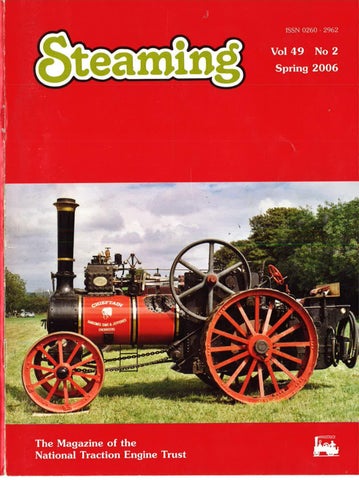
Front cover Typifying the outline of a British agricultural steam engine is Ransomes, Sims & Jefferies number 15278, 7hp single cylinder machine built in 1903. The picture was taken by Roger West at the 2004 Weeting event. 63
Trust News (continued from previous page). I was pleased to send our congratulations to Allen Eaton on his recent award of an MBE. His untiring efforts at fundraising have been duly recognised. Allen's name is synonymous with Hollowell Steam and Heavy Horse rally in Northamptonshire, an event which has been the main vehicle for his fundraising — some £500,000 for charities, and last year's rally alone allowed him to locally distribute no less than £75,000. By the time this issue of our magazine is with members the special event being organised in New Zealand's South Island will be over, and, I am sure, it will have been much enjoyed by all. I earlier sent our best wishes for a successful event to our many friends in New Zealand. I trust they will have been encouraged by the very large number of visiting enthusiasts who made their way from Britain on the long trip 'down under'. All these efforts were, I understand, merely to see some more B engines. (Robert Herring, chairman)
Engine Owners Column Engine Owners Section A very successful Engine Owners Meeting took place at our usual midlands venue at Willoughby in February, with 60 attending. A summary report will appear elsewhere in this issue. At the meeting Gordon Newton of Israel Newton, boiler makers, gave a presentation on the new Trust he is setting up in conjunction with a number of other interested parties to promote boiler making and inspection skills (Andrew Semple is representing the NTET), and a recent meeting he had been called to with Her Majesty's Railway Inspectorate. 64
The latter meeting was over concerns with poor standards of repair on some railway locomotive boilers. Gordon had pointed out there are many more operational road steam engines with locomotive type boilers than operational railway locos, and had emphasised the need to have the NTET represented. Indeed, I had requested that we be invited as observers, to be turned down on this occasion as there was not enough room. The outcome of the meeting was that a group was to be set up to consider the repair of steam railway locomotives, and the HMRI was to call a meeting of boiler inspectors — both independent and those employed by the major insurance companies. The EO Meeting discussed the suggestion that rally field incidents involving engines should be reported to the section, so that practical experience can be passed on to others, lessening the chance of them falling into the same trap. There is more set down on the subject the meeting report: here I would mention that the history of accident prevention has been through looking and learning from incidents that have happened and things that have gone, or nearly gone, wrong. I suggest it is only by publicising these experiences that others can be forewarned. Please let me know and we can pass on your experiences to the rest of the movement — I and the editor assure you it will be written up for publication in an anonymous and discrete manner. (Bob Siddall, Head of Engine Owners Section)
Not content with his elevation the post of Trust Chairman, Robert Herring in March imperiously claimed the right to the lofty driving seat of a Polish railways main line steam locomotive from our past Chairman Andrew Semple, by then relegated to fireman. The pair were pictured taking part in the Wolsztyn Experience, a week of footplate work — driving and firing — on a fleet of steam locos that have been retained for working timetabled passenger trains in western Poland. Other road enginemen on the trip, led by Stuart Gray, included Russell Cook, Ray Pearce and Chris Gray. Stuart notes that the Experience is almost completely booked for some time, but he plans to return with a group in March next year and anyone from the Trust interested in joining in can contact him (zr 01462 431848) or, alternatively, Trevor Jones at The Wolsztyn Experience (a 01628 524876).
Driver Competency Scheme and Rallies I have recently taken over the day to day management of the Trust's Driver Competency Scheme. This will involve me organising the meeting of the examiners with the candidates, etc, but David Smith and Irvin Barraclough are remaining as the custodians of the Scheme. Several of those who Nickey Daniel contacts for her Ring Around column have mentioned they receive
questions from members and others on the Scheme, and iL is clear Mere is doubt on the make up and the purpose of what we are trying to achieve. I trust the following paragraphs will make things clear. I start by emphasing that the NTET Driver Competency Scheme is voluntary; no one is being made to Spring 2006 STEAMING
take it, and there is no hidden agenda to make it compulsory.The subject of how it could be shown that drivers were competent to be in charge of a steam engine first raised its head at a Rally Organiser's Conference about eight or nine years ago. Some organisers were being hounded by local and other authorities to prove the activities taking place at their event were safe, and engine driving, in the eyes of those authorities, was one of the doubtful areas. The Organisers asked for the Trust to develop a system that they, as the rally promoters, could rely on to display safety, and resolved they wanted this to be in place in 10 years time. But the NTET has always stated that it won't and can't bring in a compulsory system, or attempt to police such a system. However, it was incumbent on the Trust to provide a means whereby those members who wished it, could secure a means of proving their ability. Now, years on, one or two rallies are saying that by a certain date engine drivers will need to be able to "'produce a certificate of competence. As organisers, that is their right! It is not the Trust that runs rallies, but the organisers. What we have already done is to put in place a Code of Practice to try to ensure that rallies are run safely. There is nowhere in the Code where it says that driver should be asked for a Certificate. If a rally asks you for one in the future, you have the choice of whether to attend or not.
STEAMING
Spring 2006
The above should cover the vehicles. If your examiner happens history of the reasons for the to know something about steam Scheme, and what might be the most vehicles, then you're lucky. When I immediate effect of the Organisers took my group G the examiner was quite thorough, took me through a resolutions of several years ago. reasonable exercise to demonstrate Now to the Scheme and the test itself. my ability to manoeuvre the vehicle It is not designed to trip anyone up, safely, but he had no concept of what or be super challenging. It is what it was happening in the boiler. These says - a certificate of of the comare the requirements for driving on petence the person tested. If you are already a competent engineman you the road, and long may it continue. If we are seen to be managing our will have no difficulty in passing. activities sensibly 'they' will leave us I know there is concern by some alone. that they already have licences that There is still much to be done to authority considers adequate for use on engines - group G, and HGV tests develop the Scheme, and I will be have been mentioned. The VOSA pleased to describe them as they doesn't make any claim that these appear. Those who are interested in taking a test should contact me in the tests are applicable to steam An (almost) everyday scene of yore on the A5 road between Shrewsbury and Oswestry. A brand new Sentinel steam wagon is undergoing a test run from the works, but although the 'Astons, Oswestry' sign at the junction on the right would once have been able to identify the rural location for us, modern road improvements and widening have put paid to that. We thank Bill Boddy, founding editor of Motor Sport, for sending this picture from his collection. The photographer's primary subject was not the passing car, so we must accept that his shutter has not arrested its progress sufficiently to tell just what make it is - Bill thinks it could be a flat radiator Morris, but is not sure. The speeding wagon, however, is sharply defined, even to the extent of revealing its works number 7444, painted on the nearside of the front frame member. TonyThomas tells us that this DG6 three-way tipper was new to Chittenden & Simmonds of Borough Green, near Maidstone, Kent on 15th June 1928 - presumably the run from the works was only a little time before then. Once back at the Sentinel works, any necessary mechanical adjustments would have been made, and perhaps a brief visit to the paintshop to be lettered for the new owner - certainly the registration KP294 would have been painted in place of the works' trade plates that can be seen here. Chittendens took no less than twelve DG6 tippers between April 1928 and May 1929; 7444 was the eighth.
65
first instance, so that I can send them the necessary syllabus, and to initially discuss suitable times and venue for a test. I look forward to what members have to say to this and also to receiving more requests. (John Durling, Scheme Co-ordinator)
A picture from, probably, the mid 1960s of members of the Bedford Steam Engine Preservation Society hard at work at threshing. The engine is Harry Wooding's 7hp single Ruston Proctor agricultural 33471 of 1907 That's Harry by the engine (with someone not dressed for the part and nearly spoiling a scene that would otherwise be hard to date), and from the left the workers are Paddy Paddison, Alec lbbott, unknown, and Jim Bennie, all no longer with us. The Society celebrates its 50th anniversary this year — can anyone identify the location and the occasion? (collection, late Bill Colebrook)
Lost Vehicle Registrations Our editor, Roger West, has requested that I contribute a brief report on the working of the Lost Registration Scheme, which I administer on behalf on Trust members and indeed any engine owner seeking to retrieve the historically correct road index number to their machine. Apparently there are members who do not realise the existence of the scheme and it is quite some time since these pages carried information about it. Although there have been a flurry of applications during this winter, the numbers now are very small, on average five or six each year. Briefly, if a road steam engine exists that was registered in the UK at any time in the past, it should be possible to have that original registration re-allocated to it. Of course, if the registration is now in use as a cherished number, then there is no possibility of reclaiming it. Generally, those vehicles that missed the deadline for claiming their index 66
numbers when the Swansea (DVLC) computer was brought into use, for whatever reason, can get that number restored. If there is documentary evidence, such as the old style log book or old tax discs, these can be used to support the application.The identity of the engine needs to be established beyond doubt and this is usually through the works number or the boiler test number, which is particularly useful for Aveling & Porter products. In support of any documents the owner can provide I can give a dating certificate and an engine history using the Road Locomotive Society's records. The RLS records have been accepted by DVLA as the authoritative source of information for steam road vehicles. In order to apply for the restoration of a lost registration, two forms from DVLA are required; these are V765 and V55/5, and they are available from Local Vehicle Licensing Offices. DVLA will also provide a list of authorised
clubs and officers who are able to process claims. The V55/5 is designed to be used for first registration of new vehicles and as such, much of it is inappropriate. If in doubt leave it blank and I will complete when processing the claim. When filling in this form remember that the taxation class is 'Historic Vehicle' and the fuel is coal. Be certain to sign the declaration on page 2. The V765 is straightforward. These two forms, any documents that exist, photograph of the engine at the time of application and either a clear photo or a rubbing of the works plate should then be sent to me and I will then create the dating certificate and process the application. However, please talk to me on the telephone before sending papers to me. Much time and aggravation can be saved through a short conversation and I prefer to discuss the application so that some of the usual pitfalls can be avoided. Please do not apply if your engine is not ready, or Spring 2006 STEAMING
imminently ready, for use. It is very likely that an inspector from DVLA will call to see the vehicle and if it is not in a roadworthy condition the application will be rejected. My telephone number is 01430 440118; I am retired and am happy to receive calls during the day but please, not after 9 pm. For those who own a repatriated engine or one that has not been previously registered, it is possible to apply for an age related number. This needs to be done through an LVLO, but I can provide a dating certificate which will be needed for the index number to be issued. We are unable to recover Isle of Man or Southern Irish indexes, and these engines will also be allotted age related numbers. (Peter Smart, Lost Registrations Scheme)
Technical Services These are the first notes to come from the now formally appointed team. This Services Technical consists of Irvin Barraclough, James Blenkinsop, Bob Garnett, Lyndon Shearman, John Billard, Chris Boocock, Tony Wood, Richard Hurley and Colin Hatch; a highly professional line up. One of our first tasks is to write our Charter which, in broad terms, is to provide Legal, Safety, Technical and Business Guidance to the management units which make up the Trust. The final details of the Charter will take some time to evolve, as the extent of the work we are faced with unfolds, but we are using the 'Challenges that face the NTET' diagram (published in our Autumn 2005 magazine) as our model. As enthusiastic as I am to get the team going, I am anxious, as I am sure my co-Section Heads are, to avoid confusion over who does what. In principle my team reacts to requests from the other departments within the Trust. It's makeup is designed to help the Trust find consistent answers, or provide consistent strategies, to questions or topics that impact on the reputation or operation of the Trust. Consider us then as a service to the Trust's business, and therefore when members need to ask questions they should still address them to the relevant Section Head who in turn, because of the wider implications of a particular question, will ask us to get involved. STEAMING
Spring 2006
The Insurance Schemes and Disc Scheme come under the remit of Technical Services and James Blenkinsop, as the Trust's Insurance Officer, is working in my team. The team also has a number of legacy jobs on the stocks, one of which is the control of independent boiler inspectors. So on 24th February myself and James Blenkinsop met with two senior UKAS assessment managers at their headquarters in Feltham. This was a most fruitful meeting where we received many points of guidance with regard to the application of the revised Written Scheme of Examination now being incorporated into the new version of the Engine Owners Code of Practice, produced by Bob Siddall's Engine Owners team. We were particularly pleased to hear UKAS' opinions on the status of Independent Boiler Inspectors relative to UKAS accreditation, and allied to the operation of the Trust's Disc Scheme. We have been looking at the Pressure Equipment Regulations (PER) as they apply to our hobby. These regulations control the application of CE marks on new equipment and here the debate is 'what do we mean by new when applied to traction engine repairs?' There is much well intended but conflicting advice to be found on this topic and frankly we find that the Trust does not now have a considered answer. We thought we did, but such is the variety of opinion available that we have decided to re-assess the Regulations and also talk with the repairers and governmental departments in order that we can make recommendations. The results of the UKAS meeting
and the considerations on PER were fed into the inaugural meeting of my team held on 12th March 2006. The broad topics under discussion were: the role and scope of Technical Services; production of the revised NTET Operations Handbook- the day to day rules by which the Trust runs its business; control of independent boiler inspectors - this hoary old subject is now receiving some serious attention; the Trust's website, working with John Cook's Membership Services team towards a major upgrade; PER - how do they apply to our hobby, and finally Risk Assessments - how do the NTET's generic risk assessments (available on the Trust's website), measure up against the HSE's 'Five Steps to Risk Assessment'. For a first meeting the number of items on the agenda was a bit daunting but we got through all of the business in good time. Of course we didn't have the answers there and then for all of the topics but we have embarked on a research schedule which I am hopeful will give us answers fairly quickly, thanks to the professional makeup of the team. However, before results of our research can be put into practice they will need to be fed to the Section Heads (The Executive) and thence to the General Council. Despite all of this activity it is very important to understand that our decision to research some items further does not impact on any of the Trust's current business. James Blenkinsop and myself have arranged to visit the offices of Footman James in March.This is part of the 'review process' that has been in place for some time. Working on a
The NTET's Engine Owners Section presents its 16th
STEAM TRAINING and DRIVING COURSE to be held at
Astwood Bank, near Redditch, Worcestershire on 13th to 14th May 2006 A practical and informal course including instruction on boiler management, mechanical operation, care and maintenance, and on driving techniques For further information send a C5 (for A5) size SAE to: Stuart Tomlinson, 470 Coventry Road, Hinckley, Leicestershire LE10 ONH. tr 01455 613079 e-mail ha7el.tornlinsonOhomecall.co.uk
67
culture of 'no surprises', I believe that these meetings provide an excellent opportunity to get things off our chest and to have early warning of planned changes, and then to be able to measure the effects on the policies and strategies applied to the Trust's members. I am sure James will keep you posted. (Dave Smith, Head of Technical Services)
Insurance Matters Disc scheme for Authorised Rallies As many of you have been aware for a long time now, the disc scheme provides a convenient way of showing one's engine has both insurance and boiler inspection cover. Until recently the only way a rally safety officer could record these details was to inspect each disc on every engine at their rally, which can be a very time consuming job at the busy start of the event. The Trust is now pleased to be able to offer to Authorised Rally
organisers the chance to have this information from the computerised disc data base available to them before the event starts. This will free up the safety officer or other assigned person to check on only those engines where a disc has been shown not to be valid. Hopefully this will only occur because, for example, a new disc is in the post. As there are around 115 Authorised events throughout the season and the new service needs to settle in, we are initially limiting this service to those events where there will be 25 or more engines present. Assuming all goes smoothly, we expect to be able to roll out the service to all Authorised events by next season. This service can be provided by sending a list of engines to my home address (see inside front cover) or by email to insurance.discs@ntet.co.uk The details required are: • event name and date • contact details • each engine's registration number, or works number if there is not one • name of the keeper • make/type
As long as the list is sent at least a week before the event, I will try to
return the information in time in a format that can be attached to the Safety Officer's report.
Boiler Inspector's insurance During the recent Engine Owners' meeting at Willoughby, I read out a list of boiler inspectors who have lodged their Professional Indemnity/Public Liability Insurance paperwork with the Trust. Although there was one inspector omitted at that time, his paperwork has now been received, so the full list is shown below: inspection company
PI and/or PL Insurance held A G Prout Inspection Services PL Alan J Hines PI + PL ANB Inspections PI Farncare Inspection Services • PI Graham Morris Engineering Ltd PI + PL Jonathan Wheeler PI J A Glaze PI + PL R&B Inspection Services Ltd PI + PL SFP Inspection & Consultancy PI + PL
In addition, the list includes all the corporate inspection bodies, for example Royal Sun Alliance, Alliance Cornhill Engineering, HSB Haughton, Zurich etc. The Trust up-dates this list throughout the year, and passes the information to its disc issuing agents. If a request for a disc comes in and the supporting paperwork is from an inspector not shown on the above list, then we are unable to issue the disc. I would encourage all engine owners to request sight of their inspector's insurance paperwork to satisfy themselves all is in order. As you are the owner/operator appointing the 'competent person' to inspect your boiler, should an accident occur with your boiler, you could be liable for an insurance claim if your inspector fails to carry suitable insurance cover.
Insurance queries
Cottages in the Dorset village of Stubhampton form the background to John Maund's photograph of 1920 built Marshall 4hp steam tractor 73900, as it hauls its trailer across the Cranbourne Chase from the 2005 GDSF on the relatively short journey back to lweme Minster. 68
In recent months I have received a number of enquiries about insurance for engines towing passenger carrying trailers. Both the policies offered by Footman James and James Campbell Insurance provide insurance cover for the engine and attached trailer, so long as they are not being used for hire or reward.The message is — do not take money or your insurance will be invalid. Another question which crops up from time to time is that of insurance for driven machinery, for example a threshing drum used for a working demonstration. Some people haven't Spring 2006 STEAMING
been aware that as soon as the driving belt on the machine is attached to the flywheel of the engine, the third party insurance element of the engine's insurance cover kicks in to cover the driven machine. However if Public Liability insurance is not taken out separately for the machine, the owner will still be liable in the event of someone injuring themselves against it, when it is not attached to an engine either by belt or drawbar. Business Review meeting with Footman James On 15th March David Smith and I had a very fruitful meeting with Footman James to review the insurance business they conduct on behalf of theTrust and its members. It is extremely pleasing to see how supportive they continue to be of our aims and objectives. The excellent relationship built up over the years between David Smith and our contacts within FJ has significant value, as the benefits are clearly demonstrated through the affordable insurance schemes on offer. In the longer term we expect these benefits to continue to flourish as the Trust gets to grips with the new business in hand. Happily, we can confirm that the NTET Authorised Rally Organiser's policies will not see an increase in premium rates this season. This will be the sixth consecutive year FJ have held the rate of these premiums. Later in the season there will be a review of the business to ensure even better value for the smaller charity events. Both the Engine Owner's and Low Loader policies are providing satisfactory levels of business and the premiums can be held at last year's rate for the time being. Since FJ started the low loader insurance scheme it has always lost money due a few heavy claims each season. Whereas it was at risk of being closed down, I'm glad to report things seem to have settled down now to enable this scheme to stand on its own feet. Long may this continue! Low Loader Breakdown Recovery Scheme During a recent meeting with Footman James it was noted there are over 200 low loaders insured through the Trust's scheme. Now compare that to the thirty or so members of the Breakdown Recovery scheme for low loaders and you may wonder how all those others manage so well without joining. Well, as a fairly practical person who manages STEAMING
Spring 2006
Marshall 7hp three speed traction engine 46276 of 1906, pictured at the Astle Park 1000 Engine Rally in June 2004. (Barry Job)
to maintain my own truck, I thought I didn't need to join until it was pointed out just how costly it can be to be recovered if you can't fix it by the roadside. So I duly joined up a few years ago when I upgraded to a more modern truck. I'm glad I did, for last year going to St Agnes, and miles from home, a tiny pin hole appeared in the air line controlling the gear selection — effectively putting me out of action. A phone call to the rescue centre had a breakdown van on the way, and although it took a while to fix, the service was very efficient considering it was an August Sunday afternoon. I got on my way again and pulled onto the rally site alongside another engine owner who had broken down with a similar crippling problem. Whereas it had cost him around £250 to get on his way again, it had cost me £165, being the annual fee of the scheme — and I still had cover for many more outings. I'm surprised at the low take up of our excellent scheme, bearing in mind that our trucks are not in their first flush of youth, and they stand idle for most of the year when condensation and the like attacks from within. If all the low loader owners joined up, I'm sure the annual fees could be significantly
reduced, so if that's all that is stopping you, give it a try. (all above paragraphs — James Blenkinsop, Insurance Officer)
FBHVC News Drive it Day The Federation of British Historic Vehicle Clubs has announced a new initiative to raise the profile of the historic vehicle movement — an annual 'Drive it Day', on which it is suggested all owners of licensed historic vehicles use them on the roads. The date is 23rd April, St George's Day, which this year happens to fall on a Sunday. The day can be a truly national event and one that everyone can take part in wherever they live, and it's absolutely free of entry forms, fees or red-tape. Committee member Tony Beadle explains that St George's Day will be 'an appropriate day to choose to celebrate the glorious variety of mechanised road transport heritage that we have in this country, because on 23rd April 1900, 64 cars set out from London on the first day of the 69
famous Thousand Mile Trial - an incredible undertaking by early motor cars and their pioneering drivers, and one which deserves annual celebration' The FBHVC wants all owners of licensed historic vehicles to use them on 'Drive it Day'. The Club exists to uphold the freedom to use old vehicles on the highway, for without that freedom there is little incentive to preserve them, and if that incentive was lost, so too would be a very large part of our national transport heritage. 'Drive It Day' is part of an ongoing campaign to raise public awareness of the historic vehicle movement. Tony Beadle makes the point that there is little reason to fight for a freedom if we don't make the best possible use of it. The message to old vehicle owners is: it's not necessary to go to a show or take part in an event - the FBHVC just wants you to get your vehicles out so they can be seen by the public. If the vehicle is suitable, use it instead of modern transport for your daily activity: use it to go to work, take a trip to the seaside, enjoy a day out in the country, visit a stately home or just go shopping. Trust members may find it less easy to use traction engines and the like on the day than say, car owners, but many of us have other vehicles with which to give support to the call. (FBHVC)
Ring-Around column We continue to be concerned that the smooth and constructive operation of this column is not as good as we would like it to be. It is often difficult to get suitable response in the short time between asking for questions from the representatives I contact (which I do as late as possible, to be as topical as possible) and the Editor's appointment with the printing press. We shall persevere. Another point is that I sometimes collect queries on a topic or point that has already been set down in the magazine. We realise it is not easy to keep in mind all that has been in the magazine, especially the columns of Trust News, which could be boring until the time comes when you want to know all about the subject. Please do browse back issues. The question has been asked whether it was possible for Council minutes to be sent to representatives, so they know what has been done about their comments. It was decided this was not appropriate, 70
though relevant sections could be made available to those who had brought up the point. (The list of representatives, incidentally, appears in these columns in each Summer issue.) I also picked up (again) concern on the varying standards of boiler inspectors and inspections. This subject is not one to be resolved within weeks, but members can be assured that discussions are continuing with several parties, both independent and corporate, on the best ways to achieve common inspection standards. There is also doubt and confusion on the subject of the Trust's Driver Competency Scheme - I understand there will be something on that subject in the Engine Owner's column in this issue. (Nickey Daniel 1' 07208 831293)
Obituaries George Bettison We record with regret the death of George Bettison. Born in 1912, he worked from the 1930s as an electrical engineer at the Staveley ironworks, near Chesterfield, Derbyshire and later extended his electrical skills to the fairground community, who valued his experience for many years. In 1947 George purchased for preservation the Fowler 8hp showmans engine 15117 HEADWAYone of the first enthusiasts to buy an engine. He made many trips to Hibble & Mellors' winter quarters at Burton Joyce near Nottingham to work on the engine, always accompanied by his wife Sally, who would sit knitting whilst George laboured away! With the advent of rallies he was able to visit Pickering, around 100 miles from his home in Creswell, near Worksop, and also Bishop Auckland rally (150 miles), plus many other more local rallies such as Rempstone, North Hykeham and Kegworth, all steaming on the road. On the way home from one rally, whilst stopped in Newark market square, a diligent constable asked him where his second man was (a requirement on heavy road locos), to which George replied he had just gone to the gents, but as the man failed to return, George was soon issued with a ticket! In 1972 George part exchanged HEADWAY for something smaller, Garrett 4CD 29781 of 1912, which he kept until 1980. He then went on to
build 5 inch gauge steam railway locos, these being Simplex tank engines, to be driven on the track in his garden - something he enjoyed into his 90s! George's son Steve carries on running locos, and also owns and rallies a 3in Burrell engine and a 3in Foden wagon. George was a member of the former NTEC until the mid 1970s, and with his passing we have lost another link with the early preservation scene. The Bettison family thank Chris Dobbs, who used to help with HEADWAY in the 60s and 70s, playing his Gavioli fair organ as a final farewell as George left home for the last time. To son Steve and family, we extend our sympathies. (Mike Farmer) David Carr It is with regret that I record the death in December 2005 of member David Edward Carr of Sheffield, following a long illness. On the Thursday before Christmas the funeral service, a full requiem mass, took place in Sheffield and Chris Keeton's Aveling roller 14029 then led the cortege for a short distance. At the entrance of Hutcliffe Wood Crematorium stood David's own Aveling 12467, driven by his brother John, and the roller led the cortege the remaining distance to the chapel. As the curtain closed around David's coffin a long blast sounded from the whistle of the roller. Friends from as far away as Scarborough and Dorset were present along with many local steam engine owners and friends. David was born in 1941, but I first got to know him and John in 1964. We had both acquired steam rollerseach of us thought we had the only one in Sheffield. Both were subsequently sold, but not before David and I had successfully taken driving Spring 2006 STEAMING
tests on Aveling 7856; John was too young for this at the time. Later, in 1966, David and I looked around for a replacement and eventually tendered for a Marshall roller being disposed of by Denbighshire County Council. Not expecting success, we also looked at an Aveling near Selhy. Although in good condition, we decided the price was too high and our finances limited, and set off home. After a short distance David stopped the car: he thought we should have it. Following a lengthy discussion of a few seconds, we returned and did just that. A few days later we heard our tender for the Marshall had been accepted and so we became the proud owners of two steam rollers. The Marshall's name wasTUTOR - a very apt name, for it certainly taught us a thing or two. We couldn't afford to load the roller back to Sheffield, so we decided to drive it. After checking everything was roadworthy we set off from Wrexham on 27th April 1967. As we were leaving an employee said that the roller had never been out of Wales and wouldn't like leaving. How right he was! Less than a mile down the road the displacement lubricator embedded itself in the canopy. Repairs at the yard saw it replaced by a mechanical one. The English border was reached without further mishap, but shortly after a boiler tube perforated; though replaced, within mile or so another one did the same. We decided that all must be replaced. A local farmer allowed us to park in his yard, and within a few weeks we were again ready for the ruad. But fate intervened with an outbreak of foot and mouth disease. The journey was postponed and not started again until 5th April 1969. The resumed journey to Sheffield was by way of the notorious Cat and Fiddle road from Macclesfield to Buxton, where there was still plenty of snow about. We finally steamed into Sheffield on 19th April, almost two years after first leaving Wrexham! David, who later purchased a Ransomes Sims & Jefferies traction engine with his brother John, was friendly and popular in all he did. He freely gave others the benefit of his knowledge and experience. He was an excellent electrician, and ran his own business. David never married, which did not mean he was unattractive to the opposite sex - he just preferred the freedom to pursue his interests, which included photography, family history, railways and STEAMING
Spring 2006
When Dick Blenkinsop set out for a day's photography in September 7962, it was to record the railway locos and trains that were the Talyllyn Railway Preservation Society's special working from London to their AGM at Towyn. The last part of the train's journey was on the now abandoned route across the Welsh mountains from Ruabon to Barmouth, and Dick went to the loco shed at Wrexham to see locos 7801 and 7314 being prepared to take over on that last stage. But just around the corner was the local roads and bridges depot of the Denbighshire County Council, and steam rollers were still on the books. This pair appeared to he in full working order, and maybe they saw further use. Nearest in the first picture is Marshall 60207 (CA4775), a 10 ton compound dating from 1912, and named TUTOR. Behind it is the Fowler seen closer to in the second picture - Fowler DN class compound 10 tanner 15697 of 1920 (CA4776). Both rollers came to be acquired for preservation a few years later. The Marshall, indeed, is the roller mentioned with happy memories by Bernard Mettam in his obituary for David Carr in this issue; the roller is nowadays rallied in the Hampshire/Dorset area. The Fowler moved to Leicestershire, but although rallied for a few years around 7970, it has since rested. 71
canals. At rallies he enjoyed visiting stalls and ferreting out unusual items, negotiating a good price reduction before telling the stallholder the real worth. Thank you David, for over 40 years of pleasure and companionship, both on and off the footplate. On the footplate we worked as a team, each one knowing what the other was doing. Although on occasions we could have different ideas, the other's view was always considered. We never had a disagreement. Goodbye my friend you will certainly he missed. Our condolences go to John Carr, who has lost a beloved brother so soon after the death of his father earlier in 2005. (Bernard Mettarn)
Affiliated Groups Bedford Steam Engine Preservation Society The Bedfordshire Steam & Country Fayre will this year celebrate the 50th Anniversary of its organisers, the Bedford Steam Engine Preservation Society. The event is held in the magnificent grounds of Old Warden Park, near Biggleswade, with over 100 full size engines attending, and over 500 other exhibits. For the fiftieth year the Society is planning to mark the occasion with a special display theme 'Made in Bedfordshire'. They hope to gather vintage equipment from around the country and bring it back to the county in which it was manufactured - a display that will be remembered for many years to come. Paul Worbey, rally organiser, is looking for vehicles and equipment built in Bedfordshire before 1970: steam, tractors, cars and commercials, horse drawn equipment or caravans. If readers have anything they would be interested in exhibiting (even if the exhibit is still under restoration►, please make contact. What do you have tucked away in the shed - a vintage Vauxhall, a Saunderson tractor or a Howard horse plough? Contact Paul Worbey at Park Farm, Arlesey Road, Henlow, Bedford SG16 12 01462 6DE 851711 or exhibits@ bseps.org.uk
Long Shop Museum The Winter Newsletter of the Friends of the Long Shop Museum at 72
Leiston, Suffolk, gives details of progress on the funding of the repairs to SIRAPITE so that it can steam again. The Aveling & Porter tramway locomotive 6158, famous as the one time shunter at the former Garrett works in the town, needs a new firebox and maybe other repair, and the recent award of a £25000 Heritage Lottery Fund grant will bring that work considerably nearer fruition. This year marks the engine's hundredth anniversary, but its restoration is unlikely to be completed before the end of 2007. When finished the loco will make an excellent exhibit for the Museum as the shunting engine taking Garrett's manufactures to the main linn railway it was an important part of the works, and of Leiston life as it crossed the road on the level; it is also a good example of Aveling's ponderous geared tramway engines, which were built up around the boiler and engine of some of the largest traction engine designs of the Rochester works. The Friends are appealing for further donations towards the rebuilding fund - they can be contacted via the Long Shop Museum, Main Street, Leiston IP16 4ES.
July - 1st/2nd, Elvaston; 8/9th, Ardingly; 15/16th, Masham; 28th to 30th, Welland. The above titles are, as usual, rather shortened versions of what appears in the Trust's The Rally List 2006, which is distributed as a loose insert with this issue of the magazine. Please refer to the List for more detail on the respective locations and a contact, if necessary.
Future Dates Steam Training and Driving Course, 2006 The Steam Training and Driving Course for 2006 is to be held on Saturday and Sunday, 13/14th May at Astwood Bank, near Redditch, Worcestershire. Details were set out in the last issue - by the time this issue of the magazine is distributed there may be a few places left on the course, so if you are interested, please make early contact with Stuart Tomlinson, Tr 01455 613079, or email Stuart at: hazel.tomlinson@homecall.co.uk
Annual General Meeting
The Exhibition and Sales Unit The new rallying season is but a few weeks away, and the Trust's Exhibition Unit is already prepared for its 2006 travels to a great number of rallies and events throughout the country. As usual, it will be attending a goodly spread of them - no fewer than 15 events have been selected, and those taking place before the end of July are listed below. The Unit is intended to show off the Trust's activities and road steam engines with a high profile, and has the added bonus of raising funds and providing a service to members and others via the book sales section. Please look out for the display on the rallyfields this summer. Arrangements have been made for the Unit to appear at the following rallies. May - 6/7th, Stoke Goldington; 20th/21st Belvoir Castle; 27 to 29th, Strumpshaw. June - 3rd/4th, Leighton Buzzard; 24125th, Banbury.
The above meeting and weekend is a full seven months and a whole rally season away, but members may like to note the date - the 18/19th November - and that the venue will be in the Lake District, Cumbria. The Summer issue of the magazine will give further details.
New Members We extend a sincere welcome to the following new members who have joined the Trust during the last three months. We hope they will gain much friendship, information and enjoyment from their membership over a period of many years. Full addresses are not included, but the Membership Secretary is always pleased to put members in touch with one another by forwarding mail. I W Gilliat, Driffield, EastYorkshire A Whittaker, Ilkeston, Derbyshire B Harris, Christchurch, New Zealand A M Menear, Camborne, Cornwall K C Shephard, Warminster, Wiltshire S Whittaker, Preston, Lancashire J Davies, Andover, Hampshire Spring 2006 STEAMING
Museum of East Anglian Life, Stowmarket, Suffolk B D Radbourne, Worthing, Sussex G Debes, Chesterfield, Derbyshire C ATresidder, Redruth, Cornwall F Lock, Bridport, Dorset S G Barry, Kilrea, Northern Ireland N Bailey, Bridport, Dorset R Clements, Coventry, Warwickshire Mrs A J Davies, Buxton, Derbyshire P Attwater, Hassocks, West Sussex H N Roberts, Redruth, Cornwall S M Geeson, Melton Mowbray, Leicestershire R J Bloom, Outwell, Cambridgeshire I Crook, Southampton R G Hedley, Hitchin, Hertfordshire
Poor Steaming In David Webster's article on Indicator Diagrams in our Summer 2005 magazine, and in the letters that followed on in issues since then, the name of Glasgow's most noted maker of steam engine indicators was set down incorrectly. It should have read Dobbie McInnes, rather than the other way round.
Sunshine was rare in the north-east during October 2004, so Aveling roller 4307 takes advantage of a pleasant spell to bask for Anthony Coulls' camera. The 1899 built 10 tonner was preparing for the first rally to be held at 'Locomotion —The National Railway Museum at Shildon:This former Northumberland CC roller displays repairs and replacements of working days, with the non-standard plated front wheels.
The Spring 1981 issue was an extra thick one — a Worcestershire Special. But at the front of the magazine the engine owner's column dealt with two issues that are still with us today — appearance money and coal quality. The minimum recommended appearance money was £30 per day — personal experience is that this has not increased in line with inflation over the years. Coal quality was also commented on, particularly with regard to smoke, and it was probably rightly pointed out that owners would consider having slightly less of a better quality coal. Mention was made of a liquid called Boilerclean that could be sprayed on the soot side and washed off after ten minutes to leave clean plate coated with a corrosion inhibitor. Is this, or anything equivalent, still available? As with previous issues some
non-road steam topics were covered, with reports of the first running of the ex Newmarket Waterworks triple expansion Hathorn Davey (steam initially provided by Ivan Fear's Marshall portable) and the reboilering of paddle steamer WAVERLEY. Presumably in those days before Old Glory and Vintage there were no other Spirit publications to report such items. As might be expected in a Worcestershire special the Bomford & Evershed firm featured prominently, accounting for three of the articles. One covered the history of the firm; another their ploughing engines, and the third was an account by W D E Field of his two years as a driver for the firm in the mid thirties. Other Worcestershire articles covered a selection of engines that once worked in the county, the county council's own rollers and wagons, and an interesting article and list of engines that were preserved in the area in the late 1950s, early 60s. At that time there were 53 engines in the county; 23 of these had moved on by 1981, but been replaced by 22 others. A quick scan in TER of those 1981 engines shows that many have now also moved outside the county. Is this typical of engine movements through
STEAMING
Spring 2006
other counties? The Yorkshire section of Steaming Around reported the Sheffield & District Steam Society had been taken to court by the city council in connection with Sunday activities at their rally; happily the magistrate dismissed the case, but to prevent further problems the 1981 rally was to be held outside the city boundary. (Stuart Gaines)
LLE WELLI N S
G a rs e
GEARS UP TO 8ft 6in DIA SPLINED SHAFTS UP TO 25ft LONG Broaching and Splining - Spurs , Racks, Helicals Worms and Wheels, Bevels - Straight and Spiral Stock Gears and Splines Wire Cuffing - Gearbox Rebuilding Specialist Supplier of Gears and Splines for all Vintage Vehicles and Traction Engines Telephone Mike Horlick LLEWELLIN'S GEARS KING SQUARE, BRISTOL BS2 I3JJ TEL: 0117 942 4026 FAX: 0117 923 20213 E-Mail: info011ewellins.co.uk Web: www.11ewellins.co.uk 73
Harrisons of Fulstow, Lincolnshire Threshing and general contractors Derek Rayner During the investigations into three photographs of a contractor's auction which I discovered at the Yorkshire Farming Museum at Murton,York - a story I related in the Winter 2005/6 issue of Steaming - I chanced to meet Stuart Mitchell at Fulstow. With his help, I was able to take my investigations into the Harrison family's threshing business in that Lincolnshire village somewhat further. I had visited the Welholme Galleries in Grimsby, where I found a better copy of one of the auction photographs in their collection. This was the one depicting the large Aveling engine and the unidentified portable with the strange-shaped smokebox door. They had little information available on the photographs, and I was able to tell the staff both when and where they had been taken, information duly added to the caption in the folder. For me, a bonus was the discovery in the collection of other
photographs related to the Harrisons, including one of their engine workshop, with the chimney stack I had sought on my visit to Fulstow, now seen to be prominent on the right hand side of the building.This is the chimney that features in the background of the long view of the auction, behind the Robey traction engine - one of the original three pictures that started me off on the researches for the earlier article. Now, this new photograph had revealed the location of the paddock where the engines were displayed for the sale. Just to be sure, whilst I was in Grimsby, I went to the Library to check no other photos were in their own Local Studies collection. After a computer search of the system by the assistant, I was pleased to be presented with several traction engine scenes - but the ones from Fulstow turned out to be duplicates of those already seen in the Welholme Galleries collection. However, through Stuart Mitchell
in Fulstow, I was able to contact and visit Peter Harrison, the last remaining male descendant of the Harrison line, who lived locally. Peter confirmed the 1904 auction had taken place in the paddock adjacent to the Lord Nelson pub, which the family had actually owned at one time. More importantly, he said that he didn't know of an antecedent by the name of Luke Harrison, who RLS records had shown as starting the business. His great-great-grandfather was Cook Harrison, and it is this name which appears in the early Lincolnshire directories at both Fulstow and Withern, a village some twelve miles away. Reflection on this anomaly might suggest a misinterpretation of copper-plate writing had taken place, where the loopy scrolls of the rather rare Christian name of Cook may have been taken as the more common and biblical name of Luke. When later checking the Marshall build records for Harrisons' two 8hp engines, the source of this error became apparent.The customer for Marshall 14642, new on 28th March 1887, was recorded as Luke Harrison of Fulstow. The other engine, Marshall 29579, was supplied on 14th April 1898 to R &W Harrison, also of Fulstow, and later went to William Snowdon of Heywood, Lancashire. Peter proudly showed me his great-grandfather's apprentice indenture, in the name of William Wilson Harrison. It was dated 7th May 1880, to expire on 12th August 1884, and indicated that the said William Wilson Harrison was to be apprenticed to Marshalls at Gainsborough as a fitter. The signatures on the document were Cook Harrison (William's father) This picture of the Harrisons' yard at Fulstow, Lincolnshire is from the collection at the Welholme Galleries at Grimsby. Their details have it as having been photographed about 1900 and showing Mr C Harrison, threshing machine owner, in his yard adjacent to Lily Cottage along with various implements. However, it is known that Cook Harrison was a big man and our subject does not appear to be a man of large stature. The chimney stack on the right (probably from the smith's forge) is the one seen on one of the auction photographs published with my earlier article. There are at least two portable engines inside the building. Compare the scene with the next picture, taken from the same spot at a slightly later date. (courtesy North East Lincolnshire Museums)
74
Spring 2006 STEAMING
Another view in the yard at Fulstow; this picture shows William Wilson Harrison and son Herbert along with his younger son, Percy James, standing in front of him. It would be taken around 1905. The engine at the left is a Marshall agricultural - from the outline of its single cylinder and safety valve casting it appears to be an older machine, and could be 14642 of 1887 Several other pieces of the family's agricultural machinery are also visible, and the shape of a portable engine can just be made out inside the building, presumably under repair. (collection Peter Harrison)
and Henry Dickenson Marshall. It was undoubtedly as a result of this placement that William learned his trade and how to look after engines and, from this grew his later affinity for Marshall engines. As well as being the local blacksmith for many years before this, Cook Harrison also undertook threshing contracts using a horse gin, and eventually turned to steam for this type of work. Thus it was that engine repairs came to be undertaken at Fulstow and the Harrisons became well respected and fairly wealthy members of the local community. They also branched out into hiring out equipment to other farmers in the vicinity - tyers, elevators and grass reapers were all available for this purpose. Peter told me that there were two sheds behind
In my earlier article it was noted that the auctioneer at the August 1904 auction was Hand Campion of Moated Grange, Fulstow. The scene below is threshing at Campion's Farm, Fulstow, with what appears to be a preFletcher design Ransomes engine, with its front wheels set well back, a footplate mounted pump and Watt governor. The date of the photograph is not known, but the engine could be Ransomes 9665, a 6hp single new in 1894, and owned by George Maddison of Fulstow from around 1921. It was originally with William Smith of North Hykeham, and was registered BE 7622. (courtesy North East Lincolnshire Museums)
the property adjacent to the Lord Nelson pub, one a blacksmith's shop and the other the engine repair shed. The blacksmith's was demolished in recent times to build a bungalow for one of the family, but planning permission did not materialise and it was never built. The engine shed, however, is still standing and it was the chimney stack of the building that Peter confirmed could be seen in one of the auction photographs, but which I had previously sought without success at Fulstow. Peter produced another photograph of the engine shed, with both William W Harrison and his son Herbert standing in the yard, along with his younger son, Percy James, then aged about three or four. Percy James was Peter Harrison's father, which would date the photo to around the same time as the 1904 auction. Sadly, Herbert Harrison was one of the casualties of World War 1, but a story which has been handed down is worth recording. When aged ten, sometime prior to the above mentioned photograph being taken, he steamed an engine on his own, just as he had seen his father do so many times before. He then drove it from the other side of the road where it was standing, adjacent to the little white cottage with the thatched roof where the family lived, into the yard next to Lily Cottage. This was done at a time, perhaps in summer, when he was not at school, but more seriously, it was done without his parents' permission. His grandmother, Cook Harrison's wife, living in Lily Cottage next to the yard, wondered what on earth was going on with noise so early in the morning. As a result of his little escapade, Herbert received appropriate punishment. As well as the engine and tackle hiring side of the business, bricks and tiles were also produced locally by Harrisons from diggings on their own land. These were used in the construction of buildings for their own use, as well as for selling to others in the area. The engine repair activities led to a number of occasional sales, when surplus items were offered for disposal. This may account for the lack of the Savage chain-drive engine and the big 10hp Robey engines being recorded in the RLS listing for Harrisons at Fulstow, they were perhaps only at the auction 'in passing' and as part of the ever changing business activities. The 1904 sale is believed to have been just one of these sales, although Peter was aware that the Harrison Brothers' partnership, be76
The men on this photograph are not recognisable to Peter Harrison, probably because they were a generation beyond those of whom he had a first hand knowledge. However, the engine is the Harrison's Marshall 8hp engine 29579 of 1898. The condition of the engine shows little sign of wear and the chimney is as new. The identifying feature of the machine is its unusual fore tank (it was so described by Marshalls), seen below the engine's boiler. The location is Fulstow crossroads, opposite the Cross Keys pub. (collection Peter Harrison)
Harrison Brothers' Marshall engine 29579 of 1898 in Ludborough Station yard. At the rear of the engine is Percy Harrison and Arthur Harrison is holding the steering wheel, but the other man is not identified. The engine is work-weary and therefore taken at a much later time than the previous view at Fulstow crossroads. (courtesy North East Lincolnshire Museums) tween William and Robert (Bob), was dissolved somewhat acrimoniously around the time of World War 1. William finished up with the engine part of the business, with two engines and threshing boxes, plus some of the property, whilst Bob had
the ponds from which the sand, gravel and other raw materials for building purposes continued to be extracted, together with the farms and the rest of the business. My presence with Peter at his home continued to jog his memory, Spring 2006 STEAMING
and he told me that as well as the two brothers at Fulstow and the business at Withern, there was another brother, James (Jim), who had a business at Alford which also involved engines, but there is no entry in the RLS records under such a name. Peter also told me that Maddison Brothers of Fulstow had started threshing in the area with a set of tackle bought at one of the Harrisons' sales; this presumably prior to them buying their new Ransomes engine in 1901. Peter recalled another story about one of his antecedents who ordered a Marshall traction engine from Gainsborough and was so desperate for its delivery, because jobs were waiting, that it was collected from the works with the paint still wet as it was driven home. He was not sure, however, which particular branch of the family this was, or exactly when. A further story, from accounts of happenings in days gone by told to him by his seniors, was that when threshing sets were being moved between jobs in the exposed flat lands of north-east Lincolnshire and a thunderstorm occurred, the engine driver would wrap corn sacks around the steering wheel and the levers in order to prevent lightning striking the engine. Although Peter had never seen it himself, there had apparently been instances where lightning had struck an engine and had been seen dancing about on its top-works. Today's enginemen should take heed! In later times, during World War 2, there was another Harrison firm at Fulstow - A & P J Harrison. These were Peter's uncle Arthur and his father Percy who, in addition to owning Allchin 1178 of 1898 (BE 8880), also had a presently unidentified 6hp Marshall engine. RLS records have the Allchin as last licensed in 1945. But Peter recalls it was last used in 1953. By that time he had become interested in the new types of equipment then coming into agriculture, which were to lead to a major transformation in how farming activities progressed. Despite the advent in the area of the tractorhauled combine, and then the first of the self-propelled ones made by Massey Harris, which thrilled him greatly, he was very annoyed when his father, a died-in-the-wool steam man, bought a brand new threshing machine from Ransomes at Ipswich around 1956-57, perhaps one of the last of their machines. The changing times meant his father only ever did eight days threshing with it and, having spent some £1000 on its STEAMING
Spring 2006
purchase, sold it at considerable loss not long after, realising only £100! Time did eventually move on with the business and a Standard Fordson appeared in the yard at Fulstow, causing Peter to realise how much easier it was using a tractor to do the threshing and move the tackle, than with steam. When called around 5am one morning by his father, who was up and about with the engine in steam and ready for the off, he stayed in bed. He'd already told his father he would not go threshing with steam again, and despite various threats and the not unreasonable plea from his father that he couldn't couple the engine to the threshing machine on his own, in bed Peter remained. Despite his mother joining in, he remained adamant that he was not going out threshing again with steam. When he did get out of bed, he would go ploughing with the Fordson, and as far as he was concerned, steam was a thing of the past ... His father, with bad grace, eventually relented and the threshing job was done with the Fordson and soon afterwards, the Allchin was cut up in the yard at Fulstow by a Grimsby scrap firm, Cosalt & Tanning Company, for the sum of £50 - scrap price. It was the end of an era for the Harrison family. Finally on my visit, there came a
photo of what Peter said was one of the biggest traction engines ever owned by the Harrisons. This was needed to pull a huge threshing machine and elevator between jobs machines which they had purchased around the turn of the twentieth century. Because it was such a large threshing set, Peter said that Harrisons had obtained the largest engine they could find locally which was able to pull it. My heart jumped, as I immediately thought it might be an illustration of the big 10hp Aveling, and, if so, what a find it would turn out to be! However, unfortunately, the photo, mounted on card which was brittle with age, had deteriorated over the years and partly broken away, with only part of the engine visible. The front end of the engine, the smokebox and much of the cylinder were missing from the photo - apparently lost many years ago, as Peter said he'd never seen that portion. As I looked closer, I could see a lined-out gear guard and then a cast trunk guide.The latter feature, in particular, meant it was not an Aveling for their engines of the period would have had slide bars. A magnifying glass on the print brought out the words Globe Works on the rear wheel hub.This showed it was Allchin number 812 of 1890, obtained by the Withern branch of the
A portion of the unfortunately badly damaged photograph of a large Allchin engine with the huge threshing machine and an elevator - the original was a fine, sharply focused sepia print, mounted on board. Allchin 812 of 1890, an 8hp engine, is listed as being with the Withern-based Harrisons, and the picture is assumed to show that machine. The men's dress is indicative of the late Victorian era. (courtesy Peter Harrison) 77
family in 1893.The engine had spuds affixed and was towing a large threshing machine and an elevator. The survival of this photograph, despite its incompleteness, together with Peter's reminiscences, had made my visit to see him a very worthwhile exercise. It made a fitting conclusion to the details obtained during my researches, initially into the trio of photos of an auction, and subsequently into the Harrison firm whose auction it was. It truly amazed me how much information I had been able to find from the chance discovery of three anonymous photographs in the archives at my small local agricultural museum at Murton, York.
Acknowledgements Thanks are due to the helpful staff at the Yorkshire Farming Museum at Murton, York; at the public library in Grimsby, and the Welholme Galleries (North East Lincolnshire Museums), also in Grimsby. Also to Robert H Crawford of Frithville, Boston for information from the Marshall records; to Frank Strange for local knowledge; to Tony Brown, the former Historic Records Officer of the Road Locomotive Society and finally to Peter Harrison, who has provided photographs and also elaborated on the history of his family and related appropriate anecdotes to add to the story.
The Construction of the Banbury By-pass 'To ease the traffic congestion in the town of Banbury a single carriageway by-pass was planned in 2000. The contract was put out for tender and after fervent competition was awarded to the Great Banbury Steam Rally Road Makers, with a clause in the contract that there be no date for completion. Work commenced in 2001 at the rally site, with the laying of the road stone base. Good progress is being made considering the road makers work on but two days a year! There has been the odd hiccup such as short drive belts for the stone crusher, no traction engine to drive it, and the tar boiler with more holes in it than a kitchen colander. The road making
gang are now in advanced negotiations to build on the down gradient of the rally field, with talks taking place due to the road gang 'throwing a shovel', the men saying it is easier to go down-hill than up — a lot less shovelling. Suspicions have been aroused that the gang could be heading for the beer tent! Hopefully the drawings will be found so that work can resume as planned.There is rumour that Oxfordshire County Council are planning turning the road into a duel carriageway. Site progress reports will be released in the future issues of The Yardsheet.' (Strange goings on revealed by Graham
A reproduction brass plate, found at a car boot sale, such as was carried by Harrison Brothers' hire equipment used in the course of their business. (Martin Hallows)
Burbery in the Banbury Steam Society's newsletter. Members who have been delayed and frustrated whilst driving through Banbury may find a visit to the Society's rally at Bloxham at the end of June will expose the truth.)
'Clayton & Shuttleworth, the wellknown firm of agricultural engineers, Lincoln, has just been formed into a limited company, and the shares were very largely over applied for.' (from The Agricultural Engineer, January 1901)
Fowler BB1 class ploughing engine 15333 of 1919 at work at the Marcie rally at Ledbury, Herefordshire in July 2005. (John Maund)
Jack Fearn, delivery driver In our Summer 2004 and Winter 2004/2005 issues we featured the activities of the redoubtable Arthur Phoenix, mainly his attempts to promote the preservation of engines in the Thetford area from 1950. David Dean, who gathered those notes together, found that Phoenix continued to write letters to the local papers and had sent this contribution to the Thetford and Watton Times. A press notice of Ronald Clark's recently published Chronicles of a Country Works gave Phoenix the chance to tell, on 20th June 1952, of Jack Fearn, a delivery driver for Burrells. It is a tale worthy of repetition. '... may I say a word about another old steam engineering veteran. Jack Fearn, as he was known throughout many counties in Great Britain, had the distinction of being leading engine driver-mechanic for Burrells for 30 years. During that period he delivered many new and rebuilt showman's engines to scores of fairgrounds, staying for a time with each engine to make certain that it was satisfactory, and to ensure that their new drivers were competent to take charge of two or three thousand pounds worth of magnificent machinery. Sometimes he remained to take full charge. It was on one such occasion many years ago that he met and married Emily Neal, a member of a well-known showland family. At the time he was driving engines for Barker & Abbots, leading eastern counties showmen. 'Others for whom Jack Fearn drove or delivered Thetford-built engines included showmen John Proctor, Lawrence, Murphys, Charlie Barnes, Barker & Thurstons and Stocks of Ipswich (who owned blue Burrell known as PRINCESS MARY which, operated by The Steam Traction Engine Preservation Association, took part in the festival Parade atThetford last June). 'Jack also delivered the splendid little five horse Burrell PERSEVERANCE to James Norman, an engine I personally tended many a time when I was with CharlesThurston & Sons of Norwich. He also travelled the Burrell engines belonging to Bostock & Wombwell's Menagerie, Sanger's Circus and MessrsTwigdon. 'Shortly before his death Jack told me that he was once called upon to accomplish a journey of 75 miles STEAMING
Spring 2006
with a show engine hauling fifty tons to enable the owner to open to the public on the same day. The Burrell did the journey with time to spare, averaging fifteen miles per hour actual running time. I once had to do sixty miles with over forty tons, build up and open at 2.30 pm. The journey was accomplished, the engine smashing along at almost full throttle, while a continuous double plume of thick black smoke poured from the smoke stack like a warship in full blast. Besides deliveries to fairground proprietors, Jack Fearn also delivered Burrell steam motor wagons and other engines to numerous haulage contractors and threshing machine proprietors over a wide area. 'Following the closing of the Thetford works he drove steam rollers for various firms, including Doran Brothers Ltd, the noted Thetford road rolling, threshing and haulage contractors, whose partners were intimately connected with Charles Burrell & Sons for many years. Had my old friend kept a record of his journeys and
experiences, what a wonderful subject for another book it would have made. His mileage withThetford built engines must have reached an amazing figure! 'Jack Fearn spent the evening of his adventurous life peacefully, fishing in the stream which in years gone by witnessed the launching of numerous steam boats from Burrells' works, one of which used to operate between Thetford and Kings Lynn. Some years ago I was shown one of the old barges this steamer used to tow. A relative of mine was one of the crew. 'Jack was unfortunately too old to appreciate the significance of my association's exhibition of Burrell and other engines at Thetford during the [1951] Festival celebrations, or the noteworthy fact that, after a lapse of many years, two Thetford engines once again participated in a local carnival parade through the streets of the ancient borough. He died shortly afterwards at the age of 75 and lies in Thetford Cemetery.' Arthur Phoenix was, by evidence of his correspondence to newspapers editors, keen at self-promotion, so we might wonder just how 'leading' Jack Fearn was in the St Nicholas workforce.
One of the six Burrell 5 ton tractors (numbers 3190 to 3194/3226) supplied to the War Office in 1910, newly completed and painted in service green, and placed for the photographer outside sheds at the St Nicholas Works. Posed with the tractor in their everyday work clothes are three of the works staff— said to be Harry Spencer, erecting shop foreman in the centre, and drivers Harry Parlatt (left) and Walker Battle. The tractors could be fitted with a 2 ton crane jib, mounted on the spigots seen riveted to the smokebox sides, and sported pairs of high level water tanks. (collection Sidney Harrison) 79
Henschel steam road vehicles Bernd Regenberg With the continuing developments and improvements in commercial vehicles in Germany, by the early 1930s thoughts in the country turned to the fact that petrol and diesel oil had to be imported. In consequence, large amounts of money were being spent on these resources - so all the time, different methods were being sought for new energy sources for such vehicles. The firms of Henschel in Kassel and Borsig in Berlin were both organisations with a long-standing steam locomotive tradition and they had experiences of a high pressure steam car with a self-regulating boiler which had been demonstrated by Abner Doble, an American, in Germany in 1931.This demonstration took place with an ordinary saloon car of Doble's type F33, which was based on a Buick chassis. Henschel bought this car and also another one of the F35 type and then used them for development purposes. Later, Reielis-Marshal Hermari Guefirly used the F35 for his staff car during his term in office and thus raised the profile of the steam car in government circles. Early steam cars were already on the road in Germany before Daimler and Benz came into the limelight with their petrol engine powered cars hut lactinn ci irracc ‘ntith thorn woo not to be, mainly because the welding techniques of the time could not contend with the high pressures required in the boilers, and also the stresses placed on the chassis of the vehicles. As time progressed and manufacturing techniques improved, the brothers Abner and Warren Doble built a steam engine in America to run on liquid fuel and considerably improved this to such an extent that it could be installed in an ordinary car. Because of thermodynamic reasons, the fuel consumption of the steam cars at that time was higher than in comparative petrol-powered cars, so steam cars would only have a chance to be competitive when it was possible to use cheaper fuels which were available in considerable amounts from within Germany, rather than being imported. At the start of the 1930s, this fuel was specifically tar oil derived from brown coal - of which there were 80
A Henschel produced diagram of a steam lorry with the boiler in front of the driver - a type which was never built.
plentiful deposits in Germany. It was much cheaper than tar oil derived from steam coal. If engineers could successfully demonstrate the use of such fuels in Doble-built machines, in the mind of the makers, the use of the steam car would be secure especially if the liquid fuel could be derived from local deposits of solid fuels, since this would fully suit the
Trrurirgiriauerei tirluntcri 'a fHiih~4eusan -]fh~n
Key to the diagram 1. boiler 2. burner 3. blower with impulse turbine 4. motor 5. fuel inlet 6. steam throttle - foot operated 7. steam engine 8. crankshaft 9. back axle 10. steam inlet pipe 11. exhaust pipe 12. cooling fan driven by exhaust steam turbine 13. condenser 14. water tank below lorry frame 15. fuel tank 16. boiler exhaust gas outlet - blower
we
A 1934 built Henschel-built 5 ton steam lorry in brewery livery. The legend on the side tells us that it was used by the Thuringia Brewery ('founded in 1849') in eastern Germany and belonged to August Schmidt in Mulhausen, Thiiringen - phone No. 94. The lorry carries a Third Reich registration number IM 61890 on the nearside at the rear of the body. (Henschel works photograph) Spring 2006 STEAMING
Two steam lorries for the Deutsche Reichsbahn (German state railways) in the railway goods yard at Kassel, where they were based. A motor lorry is at the rear. This location today looks almost the same, and is where there is a small operating steam railway known as the Hessenkurier. (Henschel works photograph) current political situation; Germany itself would then be free from ties with foreign countries for fuel. The Doble boiler worked with a single coil water tube which was
STEAMING
Spring 2006
situated in an insulated location under the vehicle's bonnet. The feedwater was pumped from beneath, and the burner was positioned above.The steam thus generated was supplied via a foot throttle which had the function of a normal car's accelerator and was then piped to the engine which was located over and around the back axle. A condenser was provided for the exhaust steam and this was almost 100% efficient, and enabled the water to be used again in the circuit after filtration. The firm of Henschel, with its knowledge of locomotive and boiler construction, was interested in taking
a licence for the construction of the Doble steam vehicles. The firm recognised that opportunities for a relatively slow ordinary car in Germany was not very high, but there were definite possibilities for using the steam engine for lorries A convoy, consisting of a quartet of the German railway's steam lorries at a goods depot - it is also believed to be in Kassel. Some of the lorries are believed to have worked until 1942; they were probably destroyed in air raids in 1943. (Henschel works photograph)
81
One of the later Deutsche Reichsbahn steam lorries, with a more modern cab. (Henschel works photograph)
and buses. In 1931 they therefore started the official contract for cooperation between Henschel and the Doble firm of Emeryville, California, USA. At first, the Doble lorry from America was of around about 100hp and an American steam car with a Doble engine was imported and given intensive trials. Initially, these were with petrol as fuel, but with the Henschel firm they were run on diesel oil. For starting from cold, there was also a small 'helper' tank for carrying the necessary petrol, but when they started to use the cheap brown coal tar oils, they began to have problems. To progress this, the boiler and ignition space had to be totally reconstructed during the years 1932 and 1933, and Warren Doble came to Kassel to assist with the construction of enlarged and more powerful
steam engines. Also, his brother Abner, who was in charge of parallel developments at the British firm of Sentinel at Shrewsbury regularly visited the Henschel works and kept abreast of developments. Again and again, new parts such as throttles had to be developed in order to combat the problems caused by the higher pressures. For their first thoughts, the concept of the lorry design came from the usual petrol propelled vehicles, with the bonnet in the front. In 1933, the Schwebebahn - the suspended railway which runs between Vohwinkel, Elberfeld and
Barmen in the Nordrhein-Westfalen city of Wuppertal - took delivery of a steam bus which the company hoped would solve problems on their services on the hilly roads in the outlying suburbs around the district. These caused difficulties for conventional lorries and buses, and it was hoped the Henschel steam vehicle would show a superiority of performance in such areas. Visually the 24 seat bus was only a little different to its petrol-engined competitors. It was soon realised there was a possibility of separating the boiler and engine units, so the forwardcontrol lorry with the steam engine in the back was born - and it was discovered that the place where the warm air exhausted could be very much better. Buses were constructed on this revised principle in 1935/36 for Kassel, Beilefeld and Bremen, and in the latter year the Ebefelder (Wuppertal) bus was re-designed and very extensively rebuilt to similar form. In a steam lorry, the boiler and condenser were located behind the driver's cab. The steam engine remained over and round the back axle. In 1934 the trials of the steam lorries were considered complete and they were officially put on the market. A further development on one of the newly delivered vehicles,
The large notices proclaim that this is the first three axle steam lorry in the world, though the men of Shrewsbury and Elworth would no doubt have spoken up had they been bystanders. However, together with the three axle trailer, the gross load carrying capacity must have been quite large. The 9 ton vehicle was intended for long distance haulage between Hamburg and Berlin (nearly 300kms) and Bremen. (Henschel works photograph)
TH111061)051
The first Henschel steam bus, works number 8342 of 1933, in Wuppertal. (courtesy of W Reimann) which was a three axle vehicle, was one with a steam engine powering each of the back axles. Test drivers were used to put the vehicles through their paces, since one of the aims of the Henschel organisation was to gain experience and the knowledge which comes from their experience during the use of the vehicles. One of the recorded requirements at that time was to ascertain the optimum solution for the size of the condenser water tank and its relation to the large and very heavy condenser. For example, a small size of the water compartment of the condenser could have given rise to a
bigger and heavier water tank — which may have proved to be counter-productive when it came to the lorry's load carrying capacity. Because the steam engine was running without a clutch and gearbox, it was much easier for the driver to handle the vehicle.This was important for the inner-city and short distance journeys, especially up and down hills. Trials of the Henschel lorries were undertaken to prove they were up to the job and needed minimum maintenance. These were organised for several days by the Deutsche Reichsbahn (the state railways) on a 2000 km (1250 miles)
route through Germany — which included the Harz Mountains — and at their conclusion, these showed the good efficiency and capability of the lorries. For the brakes, however, Henschel had to take a new approach because the steam engines with their uncooled cylinders were not capable of giving a steady brake for the lorries and so after trials, the steam lorries were put on the market with air operated brakes. In the winter, the drivers loved the good heating in the lorry cabs because there was a flow of warm air around them from the boiler, and with very low temperatures outside, the inside working temperatures reached a summery 20°C. Steam lorries were manufactured by Henschel in larger numbers than the buses, the reason being that from 1934 the Reichsbahn was a large customer and took ten 5 ton lorries. However, from 1936 the price situation with fuel dramatically changed and as a result, the continuing sales of steam vehicles received a killer blow with the price of the brown coal tar oil increasing several times. Because of the political situation, methods were being established of producing petrol and diesel fuels from Germany's large resources of the indigenous brown coal. As a result, the by-product (of tar oil) from this process was then used in the ships' boilers of the German navy as they had no diesel oil. It therefore became generally unavailable for other users! From this time, the steam lorries and buses powered by this method became economically uninteresting to would-be buyers. As a result, the Henschel firm carried out further trials in an attempt to change the fuel to coke, but this was not progressed for, in the meantime, purchasers of the vehicles found that diesel engines had become easier to operate and were more simple to run than steam vehicles fired by solid fuel. Further, as a result of the German government's situation at The Wuppertal steam bus in its very much altered later form after 1936, with boiler at the rear. The driver now has a much improved field of vision and indeed, with its fold-away entry and exit doors and underfloor engine, the bus is very advanced in design, almost like one from the 1960s. The destination blind reads 'Dienstwagen' (service car; out of duty). The supports of the Schwebebahn suspended railway are in the background (courtesy of W Reimann)
STEAMING
Spring 2006
83
the time, no further financial assistance was available from them, so the developments relating to steam vehicles by the Henschel firm ceased to be progressed — and the details were archived. To the best of the knowledge of enthusiasts in Germany, no steam powered road vehicles of this type exist in the country today, but the prototype test engine of the Henschel works was kept by the firm as a spare, and eventually found its way to the small museum of theTUV-Nord (the German materials testing organisation) Hamburgat Langenfelde. This article was first published in December 2002 in Dampfwalzen Info, the magazine of the DampfwalzenClub Schweiz (Swiss Steam Roller Club.). It appears here by courtesy of the editors, Markus Ziegler and Ambros Saladin, and our thanks are extended to author Bernd Regenberg for his agreement for the article to be translated, and to Busso Hennecke for his translation skills, and help with additional photographs. Derek Rayner brought the story to our attention and arranged its use in our magazine, providing some additional information. Bernd Regenberg has written a book entitled Das Lastwagen-Album Henschel (The Henschel Lorry Album). It dates from 1999 and was published by Verlag PodszunMotorbiicher, D-59929 Brilon, Germany (ISBN 3-86133-204-3). Henschel steam lorries and buses are also covered in a chapter in The Undertype Steam Road Waggon by Maurice Kelly, published in 1975.
The Wuppertal steam bus again. The boiler location at the extreme rear of the vehicle is hinted at with the in fill panels; the roof-line shows the exhaust aperture. The vehicle is said to have been capable of a speed of 110kph (70mph ), with a range of 110km on a tankful of water. It lasted in regular service until 1942. (courtesy of K.B. Lange)
The prototype axle-mounted steam engine for the Henschel wagons was kept by the company as a spare, and is now to be found in the museum of the TUV-Nord at Grosse Bahnstasse in HamburgLangenfelde. (Busso Hennecke)
'Has Great Idea to Get Rid of Tram Nuisance! — He has found how to get rid of the tramway nuisance, has an owner-driver of Alton, Hants. His great idea, briefly, is this: "Every steam waggon and traction engine should, on a certain day, go out and charge broadside every tramcar on the road. The 'Sentinel' tractor would glory in this work! The same night, waggons could go out with chains and hooks and drag up every mile of track. By the next morning, trams and slippery rails would be gone for ever! We commend this scheme to the new Advisory Committee on London traffic, now sitting' (from The Sentinel Transport News, August — December 1926. By the mid 1920s, street tramways had come to be considered with great objection by motorised transport operators. This is the STN editor's schoolboy-humour solution.)
'To Drivers of Steam Motovehicles. Don't overload the safety valves, or tamper with them. Don't let the water-level sink out of sight. Don't allow the gauge cocks to set fast. Don't open the steam stop valves hurriedly. Don't empty the boiler while steam is up. Don't use unknown scale solvents or compositions'. (Advice in the Automotor & Horseless Carriage Journal, January 1899. Realise that the steam wagon, or moto-vehicle as the magazine called it at the time, was in the first few years of its development. Those in charge of the city-based vehicles are likely to have been new to the care of steam machinery.)
84
Spring 2006 STEAMING
A Stately Aveling
Derek Rayner
Advertised on Ebay - the internet auction house - some time ago were three glass negatives, one of which was described as depicting a steam roller. I could see from the accompanying image on the screen that it showed an Aveling. I spent some time mentally debating whether to bid, in view of the risk in shipping such fragile items to the UK. Eventually, I took the chance and was subsequently the lucky purchaser. The glass arrived well packed and without damage - and this is a print from my acquisition. It shows a 15 ton Aveling & Porter roller, somewhere in the USA. Although I questioned the vendor on the location, he was unaware of the source of the negative collection and therefore didn't know where the picture could have been taken. The background, of a typical American clap-boarded building, gives no clues. The other negatives are equally anonymous, though one does show Maple Avenue on a street sign, leading me to wonder if there was a Canadian connection. The location will no doubt remain a mystery, unless a reader knows otherwise. The negative was water {or otherwise) damaged along the right hand edge but this does not detract from the image, in which the young boy is standing quite proudly in front of the roller, posing for the cameraman. There were many of this style of Aveling roller supplied to cities throughout the USA by Avelings' American agent, W C Oastler of New York. It is recorded that he supplied 15 ton rollers to the USA from number 856 in July 1872 through to 2391 in August 1888, and maybe even beyond that. The full length awning is not likely to be an original fitting from Rochester and there is another local addition in the shape of a low•mounted footboard, just seen behind the chain coming from the early type 'cotton reel' steering. That chain has been repaired by the addition of a double link, and has ridden up over the left hand steerage shoe as the roller has come to rest, suggesting it has just turned a sharp corner. Other points of note are that whoever ran the machine had dispensed with the side engine covers, but added to its livery by lining out the headstock. An unusual feature on the roller - not immediately recognised - is a lever with a typically shaped handle from the earlier Aveling era seen to the front of the flywheel centre. Its purpose is open to speculation; is it to do with the balanced scrapers to the rear rolls, or does it serve some other function? STEAMING Spring 2006 NI
'The Traction Engine and Dairy Work. -Two portable creameries are, we understand, now in use in Ireland - one in County Cavan, and the other in County Waterford.They are used as auxiliaries to large central creameries in their respective districts. The portable creamery is drawn, says a contemporary, by a traction engine, and is fitted with the latest creamery apparatus, and machinery necessarily of the lightest pattern. This creamery travels into the country at a radius of twenty miles from the central concern. It stops at regular stations, to which the milk is carted by the farmers, and where it is churned at regular intervals: (from Implement and Machinery Review,
3rd September 1900. Can anyone tell more of the engine and the apparatus involved?) 'The Corporation of London have just placed a repeat order with the Thornycroft Company for another of their standard municipal combined tipping and watering wagons. The City Fathers are ever cautious, and they have thoroughly tested the sample machine supplied by the same company over a period of eighteen months, before proceeding to more generally adopt the system.' (from The Automotor Journal, 11th
July 1903) 85
Sentinels in southern Africa Makers of steam road wagons did not build up the same high volume of export business that came the way of the builders of threshing or ploughing machinery. Nevertheless, the Sentinel company at Shrewsbury had considerable sales of steam lorries through the 1920s and 30s in southern Africa, particularly through the efforts of their agents The Griffin Engineering Co Ltd of Johannesburg (and Cape Town and Durban). This
selection of pictures shows some of the Sentinels that worked at the southern end of 'the Dark Continent'. The unidentified DG6T wagon seems fairly new at the time the photograph (MuseumAfrica, courtesy Wilf Mole) was taken. A three way tipper, capable of taking 10 or 12 tons, it might date from the mid 1930s. It is signwritten on the front sheet, No 38 of CED/SID, Johannesburg - probably Centrai Engineers
S no* PHODSM.
86
Dept and the Afrikaans equivalent. Steam rollers bore similar initials, so they could be for the highway authority. Below the usual Shrewsbury works plate on the cabside is a smaller plate giving Griffin's details. The wagon would have been shipped from England in crates, and Griffin might have made both the steel tipping body and the cab - the latter shows a few subtle differences to home examples, such as a wider door and an extra curve in the edge beading above the drivers head. Note also the hand-worked trafficator. The S4 model tractor (also MuseumAfrica, courtesy Wilf Mole) was sent out to George Elcombe of Salisbury, Rhodesia for hauling citrus fruits from estates to the nearest railhead - up to ten miles over poor roads. It was the second S4 tractor built (9309 of May 1934) and Joe and Anthony Thomas record in The Sentinel (part 2) that two trailers took 240 cases of fruits, making a 181/2 ton payload. Three trailers loaded with maize weighed almost 20 tons, and on good roads, 25 tons of bales of hay was possible. The vehicle was at one time preserved in Salisbury (now Harare, Zimbabwe), but we might wonder at its present situation. The majority of the Sentinel wagons and tractors sent to Africa were probably destined for extremely arduous work around the gold Spring 2006
STEAMING
mining fields of the Rand in Transvaal.This area is the location of the two colour pictures — the Rand Leases Gold Mining Co at Roodeport. The pictures were taken in February 1969 by the late Basil Roberts (courtesy Richard Pelham),
STEAMING
Spring 2006
but unfortunately no details come with them, despite there being Sentinel and Griffin plates to be seen on the cab sheets. We see a hard worked but clearly still useful DG model steam tractor, adapted for modern use with pneumatic tyres
and well kept by those in charge of the machine's maintenance. It has probably just finished work for the day— the ashpan is dropped and the shovel for clearing away is by the front wheel. Notice the Sentinel boiler lying in front of the tractor.
87
t4 "4".. • ; •
„ • V/ •
• ••••••`..-
R 41 •
a- a.
•
Current Topics, 1899 'A comparatively new field of usefulness for traction engines has come with the war in South Africa and a number of British firms have latterly been busy, day and night, turning them out for that seat of operations. Exactly what they will be expected to do there has evidently not been found expedient to make public, though it is only natural to infer that they will be put to transport service, hauling stores and possibly even guns, and generally supplementing the work of the railway, which may be broken up at any time. During the Franco-German war in the early seventies traction engines were used for probably the first time in military service, but the conditions of operation were measurably different on that occasion, and it is safe to say that nothing even remotely approaching Transvaal transportation obstacles was encountered. 'Of the trials which were carried out a short time ago with the first completed lot of the South African engines previous to their shipment, The Engineer, of London, says that these took place in the Long Valley at Aldershot, and while the broad rivers and the huge stone boulders of the Transvaal were lacking, there were ravines, and sand, and mud in plenty to test the staying powers of the machines, which it should be added came out with flying colours. Some of them were sent across country, 88
and managed to keep up a speed of six miles an hour and more, passing in the way over ditches, hills and watercourses. Many of the ditches had water in them, and the banks were steep. Sometimes the engines were nearly up to their hubs in mud, but they all came through. Others had to traverse deep gullies, which they managed to do.The utility of the crane jib, which sometimes forms part of the equipment of the engines of this type, was amply demonstrated. There was no difficulty in removing from a train of trucks one which was supposed to be injured. The engine simply went and lifted it out of the way. Then it was shown how that one engine might haul another with its train out of a bad place by means of a steel rope, should they stick and remain fast. In fact they were given the hardest tasks to perform which the military authorities could devise, and they successfully carried them out. The largest of the engines weigh some 15 tons, they can draw from 30 to 40 tons, will carry water enough for a seventeen miles run without stopping, and will travel thirty to forty miles a day. They will be provided with coal trucks, and a sort of a living van for the use of the engineers in charge. 'For years traction engines have been at work quietly in the colonies of Great Britain, doing what is very similar to that which will be required
of them in the Transvaal. Take Australia and New Zealand, for examplelThere, up country and away from all possible lines of communication with the outside world, are numberless farms. If these produce nothing else, they at all events rear sheep. Before the advent of the traction engine, the wool had to be laboriously carted down to the nearest railway station or the nearest port in waggons drawn by bullocks. Now however, in a large number of instances traction engines with trains of trucks visit these farms regularly, and it is said that it is by no means unusual to find an engine having behind it a load of wool worth £1500 or £1600. In places the roads are of the most primitive kind, and bridges of any size are wanting. Most likely, if they existed, they would not carry the weight of a traction engine. Fords there are, however, and the traction engines go through these just as a bullock waggon would. The fires of course, are frequently put out; in fact it is not unusual to have the top of the railing round the driving platform under water. Curiously enough, this immersion does not appear to do any serious damage.Traction engines are said to have worked for years under these conditions, and are still at work. Hill climbing power, too, under bad conditions is possessed by them to a marked degree, so that altogether, the engines have a list of qualifications which ought to enable them to give good account of themselves in the work for which they are intended in South Africa.' The above verbatim report is taken from the Current Topics Spring 2006 STEAMING
columns of the November 1899 issue of Cassiers Magazine, and shows editorial enthusiasm, expressed with glowing Victorian prose, for the road engines bound for the South African war, The magazine was a prestigious journal of British and American engineering practice at the turn of the twentieth century. The works of Aveling & Porter, Burrell, McLaren and Fowler all made engines for the conflict, but it is the Steam Plough Works products that went to the 45th Steam Road Transport Company of the Royal Engineers that were the most prolific. Our pictures show such Fowler engines in typical Transvaal 'veldt' country — a couple of compounds, each hauling three heavy but lightly loaded traction wagons and a wood wheeled supplies trailer, seem to be fording a relatively shallow spruit with ease, but there is a harder task in hand for those stuck with the job of getting the bogged down engine back on hard ground. And if you are of higher rank and are able to stand and watch, why not add to your break by taking a pipe? We are grateful to member David Hall for providing the magazine extract, and to John Talbot for the illustrations, which come from the South African War collection at Museum Africa in Johannesburg.The pictures carry no detail of their taking or subject, other than the date 1901 ascribed to the distressed Fowler. g
'Where do they go? A common sight these days in Downham Market are these old steam traction engines making their way to the railway station. Messrs R E P Palmer & Sons, of Wereham, are delivering the old machines to the railway for shipment to Messrs Wards of Sheffield, to be broken up for scrap. So far Messrs Palmers have delivered more than 30 of these engines, none of which is less than 40 years old, some being more than 60. At present there are another 15 at Hilgay waiting to be moved. The towed machines in this picture, taken in Bridge Street, Downham Market, are a Wallace & Clayton [sic] and a Marshall' (a news item from the Thetford & Watton 16th June 1950. The Times, accompanying photograph showed three engines, with the first, registered AH7758, apparently towing the other two.)
'The result of the [Liverpool Heavy Motor Vehicle] trials is a renewed outcry against the present tare limit of three tons, which is proved too low for loads of five tons and upwards on a single platform. The organisers of the trials point out with justice that 10 ton loads are not unusual on horsedrawn lorries and that motor vehicles should not be prevented by legislation from carrying similar loads ...' (editorial comment in The
,kcIMARE — INSPECTIONS — FOR YOUR STEAM BOILER INSPECTIONS All pressure vessel and garage equipment statutory inspections carried out Ian Farrance Farncare Inspections 2 Hawkins Close, Poulner, Ringwood, Hampshire BH24 1UQ Tel: 01425 479683 Fax: 01425 473765 Mobile: 07973 697818
Engineer, 1st November 1901, echoing the opinion of many steam engine builders that it was not possible to produce a workmanlike and reliable tractor or wagon that would comply with the Act.) 'Burrell Compound steam tractor, in good condition, suitable for any work or exchange for a good Bedford lorry. — R Townsend, Market Square, Weymouth, Dorset.' (from The Commercial Motor, 20th September 1940)
Sentinels and Showmans
Popular with members of the Sentinel Drivers Club is their annual autumnal 'Noggin and Natter' meeting, held in the northern home counties. In 2005, five of the Shrewsbury built wagons gathered at Ridgmont, Bedfordshire, including the splendidly and authentically liveried Standard 3549 of 1920. Both Jim Stevenson (right) and Keith Brothwell inevitably found their cameras attracted to the yellow paintwork as it caught the strong
sunlight. Keith Brothwell found a good spot to take pictures at the 2005 Old Warden, Bedfordshire, event that offered all the atmosphere of a showmans engine tucked away, quietly earning its keep, on a fairground of the 1920s. Alongside the former Harry Lee Steam Yachts ride is Fowler B6 class road loco 14425 of 1916 CARRY ON. Several of the showmans engines that attended the Great Dorset
[?.Jaillik141171.111.!17
Steam Fair last year were sporting freshly finished paint jobs. As the bright sun lowered in the afternoon sky Roger West was able to catch the dazzling reflection of the extensive gold leaf that is the wonderful and immaculate decoration on Burrell scenic showmans 3896 of 1921 EARL
STEAMING
Spring 2006
BEATTY. Going back to Sentinels, in August 2005 the Drivers Club celebrated the 100 years of the marque with a road run from Glasgow, the original home of the wagon's design, to Shrewsbury. Jim Stevenson's picture shows several of
the participants at the end of the trip, paying smoky homage at their birthplace — the buildings in the background all formed part of the Sentinel Waggon Works. From the left we see DG4 8122 of 1929; Super 5407 of 1924 and, head on, S4 model 8933 of 1934.
91
A Motor Driver remembers Derek Rayner The basis for this article is a much earlier account of the work undertaken by the author, W Wharram, during a long railway career. The original article appeared in the London & North Eastern Railway Magazine for November 1944, a copy of which is in the library of the National Railway Museum at York. When he wrote his story Wharram was still, after 47 years of railway service, a motor lorry driver, working from Durham.The usual title of the series of similar articles that appeared in the LNER employees' magazine from time to time was My Day's Work, but in this instance it was changed to My Life's Work to more
appropriately reflect the length of employment. Driver Wharram started his railway career with the North Eastern Railway at York on 2nd July 1897 as an engine cleaner, and he continued in the Locomotive Department for another five years. His ambition was eventually to become an engine driver - as was the case with many a young lad at the time - and when the country became involved in war in South Africa, and there were shortages of manpower, he was able to quickly progress to being a fireman, working through the links until he was travelling with the Scotch (sic) expresses. But at the end of the war, loco men were put on
North Eastern Railway steam wagon No 4, on the left, was a Straker wagon and clearly carries the registration AJ275. The other wagon isThomycroft number 415 - lettered North Eastern Railway No 3 - and it is likely the man seated at the steering wheel is Driver Wharram. A similar but different view appeared in the LNER Magazine article, captioned as taken in Northallerton goods yard with 'Driver Wharram at the wheel: There is a close similarity between the appearance of the crews on both photos. No evidence of a
registration mark can be seen on the Thornycroft on either of the two pictures. (National Railway Museum) 92
short-time working and there appeared no prospect of further advancement for a while. This came at the wrong time for young fireman Wharram, for he was now newly married, with greater responsibilities. So, when the NER was selecting loco men to work their newly introduced steam road goods vehicles, he applied for one of the positions, and was successful. He tells in the article that he was appointed to the Thornycroft wagon at Northallerton in January 1905. Steam wagons were first used by the North Eastern Railway in October 1904, when they were introduced to work betweenTollerton station, about 10 miles north of York, and Brandsby, a small village in the Howardian Hills. A garage was built at Tollerton at a cost of £78 Os 3d to house two Bristol-built Straker lorries, a pair of undertype 5 tonners with vertical boilers. It would appear that the reason for this first feeder service being introduced in the Vale of York rather than in the East Riding, as was originally intended, was the existence of a local farmers' organisation - the Brandsby Dairy Association - which was expanding the business of the area. In the hope of attracting more custom from the farmers in the area, the NER directed its lorries to this service. Within a couple of years, the service was altered to start from Easingwold, four miles nearer to Brandsby, at the terminus of the privately-owned Easingwold Railway, as the owners of this line claimed that it was losing traffic to the NER's Tollerton based steam lorries. From March 1906 the NER traffic used the Easingwold Railway, a tiny line not quite 21/2 miles in length that joined the main line at Alne station - the next one north of Tollerton. The change seemingly satisfied the management of both railways, although a further transhipment of goods at Alne would have been necessary in many instances. However, it seems the expected heavy agricultural traffic from the Brandsby area did not come to pass; many of the goods conveyed were smaller items and not of a size to warrant a 5 ton lorry; it was hard to justify using such a large lorry for the job. After a short time, expansion resulted in a further service being introduced to serve Osmotherley at the foot of the Cleveland Hills. This started from Otterington station on the main line to the north between Thirsk and Northallerton, and it was later extended to include the surrounding districts, including Spring 2006 STEAMING
Northallerton. This wagon's duties included the collection and delivery of both produce and freight.The third lorry of the original batch of three that were authorised by the NER in August 1904 was a Thornycroft, an undertype with a locomotive type boiler rather than the maker's usual vertical boiler. It initially joined the two Strakers, but was then transferred to the Northallerton area in early 1905 - and it was this wagon which Driver Wharram was given to drive. Notwithstanding the difficulties in the Brandsby area, the initial success of the services must have pleased the NER board, for they authorised a further batch of three Straker lorries in January 1905 - and these were despatched to join the others at their respective locations. With a larger fleet of vehicles, an extended service was introduced in the northern district - where the base became Northallerton goods yard instead of Otterington - and the places served included Trenholme Bar railway station on the road from Thirsk to Stockton, thus linking Northallerton with the Yarm - Battersby - Whitby railway line. The introduction of the steam wagons helped to develop country services in areas not directly served by the railway and the company's canvassers, who travelled around by bicycle, were generally able to gather an abundance of traffic - but whether this was of the appropriate type is obviously open to question. In his article, Driver Wharram describes how, in the early days of steam wagon operation, he would often set STEAMING
Spring 2006
The original of this photograph is date stamped 5th April 1911 on the reverse, though it could have been taken long before. It shows a wagon being loaded - or unloaded - at Brandsby, presumably at the Dairy Association's promises, prior to delivering goods to Easingwold station for onward shipment. The registration mark BT217 can be made out on the rear of the vehicle, identifying it as one of the six vertical boilered undertype wagons built for the NER in 1906 by the Londonderry concern - this was the Marquis of Londonderry's colliery workshops at Seaham Harbour in Co Durham. (collection Derek Rayner, courtesy Eric Steadman) out on a Monday morning for a 10 mile journey with his charge but not return until the following Wednesday - or even Thursday. Sometimes they would be ingloriously towed home by horses.Thc wheels of the vehicles were fitted with iron tyres and many of the roads were soft - being only of the water-bound type - and quite different from the tar macadam surfaces which later became the norm. At times, he recalled having seen at least one vehicle sunk up to its axles in the middle of the road, and until it was pulled out, no traffic could get past. During the winter months, it was not unusual to be bogged down Motor Services depot was established. He had a period of maintenance training on petrolengined vehicles and later learned to drive them, eventually graduating to take passengers on the summer charabanc outings the NER ran from some of their country and seaside stations. The transfer to York seemingly marked the end of his association with steam road vehicles and he went on to drive a Durkopp bus in Ripon, parcels vehicles in Newcastle, and then NER buses in Durham City. Eventually he qualified for a Gold Medal diploma in the
Railway's safe driving scheme, but he obviously regarded his initiation on steam wagons as something of an experience, if not a trial! Driver Wharram's Thornycroft steam wagon, works number 415, was supplied new to the North Eastern Railway in November 1904, and was registered DN2 at York in September 1905. This period seems rather lengthy, but there is a possibility that as the vehicle worked at Northallerton (in Yorkshire's North Riding) it may have been first registered in the AJ North Riding series and subsequently reregistered at York. The early North Riding CC Heavy Motor Car registration records have not survived, so the detail cannot be checked.The machine is equally likely not to have been registered straight away. Two photographs exist of the wagon, said to have been taken at Northallerton, and on neither can any trace of a registration number be seen. (Those members who have Trust magazines from years past may like to refer to the September 1979 issue, in which appeared a five page article by Derek Rayner on the North Eastern Railway steam wagons.) ly 93
co
DNIIAIV3IS 900Zfiu!- I dS
The gazelle and the elephant
The gazelle - seemingly too delicate for hard work, this steam wagon was an early overtype loco-boilered machine. The design was introduced about 1905 by the Straker Steam Vehicle Co Ltd from their works at St Philip's Marsh, Bristol, a time when only Edwin Foden was producing overtypes, and other 'traction engine' builders we associate with that pattern had yet to realise the potential marker. Straker had earlier built undertypes, and continued with steam for a few more years, but were by 1906 already making
The elephant - the ponderously impressive three axle Dampflastwagen (steam lorry) produced by the German firm of Henschel in 1935, is described in more detail in an article elsewhere in this issue. A pair of enclosed compound engines was located between the rear axles, and produced 150hp at 1500rpm and a speed of 50km per hour. The Doble boiler, located to the rear of the driver's compartment, was heated in 2 minutes with 16 litres of water and 9m2 of heating surface. The pressure was 100bar at 450°C, and the used steam was condensed. It was claimed a journey distance of 100 kilometres used 30 litres of water and 50 litres of brown coal tar oil.
petrol engined lorries. This illustration is of studio artwork, prepared from a photograph, and the extensive use of air brush technique provided an image best suited to contemporary printing in sales literature. If we are surprised by the pastel colours, they may have been appreciated by a miller used to seeing his vehicle return home well coated in road and flour dust. (collection Chris Parker)
From the Chislehurst & District Times, 15th December 1912
Alarming Mishap Steam roller turns turtle Miraculous escape of driver An extraordinary accident befell a powerful steam roller belonging to Messrs Chittenden and Simmons, of Maidstone, on Tuesday evening whilst descending the steepest part of Chislehurst-hill between the Imperial Hotel and the corner of Lubbock-road. 'As the roller approached the particularly steep gradient, the driver, a man named Smith, applied his brakes and was, we understand, at the same time trying to avoid a milk cart. The roadway here is very slippery, especially after inclement weather, and instead of the brakes having the desired effect, the heavy machine commenced to slip and skid. The driver lost all control of it, and the roller catching the kerb, the rear portion of the machine swerved right round and crashed into the fence boundary bordering the grounds of Oakbank, the residence of Mr Worskett. The roller broke away from its fastenings, letting the front portion of the engine down, and the whole machine turned completely over. STEAMING
Spring 2006
'The crash of the impact was heard for a cnnsiriprahle distance away and the sound of the escaping steam brought many people to the scene. 'The driver Smith had an almost miraculous escape. When he saw that an impact with the fence was inevitable he proposed to take his chance, by jumping from the madly rocking and oscillating platform of the engine, but before he could take his spring, the engine turned over, and he was literally hurled clear of the wreck, escaping with more or less slight injuries to his head and a few bruises. 'Portions of the machine, of course, were strewn about in all directions, and the smokestack was broken completely away. The fence of Oakbank was smashed in all directions, and lengths of it were torn down.' The Times reporter, unfortunately, failed to question what might have caused the runaway by Smith's roller, but we can guess that it was
something to do with drive pins and poor judgement. By the time the photographer made his record of the scene, it was presumably the next day, for a night watchman's hut has been put up just beyond the wrecked engine - the steep uphill curve of the road can also be seen behind the young boys, who were maybe on their way to school. Is it Smith, standing with left hand on the rear roll, and a white bandage around his head ,4 beneath his cap? If s^, his suave pose would surely not have impressed Mr Chittenden or Mr Simmons, who would most likely have wished to say a few words to him hack at the Maidstone yard. The identity of the Aveling & Porter roller is, unfortunately, unknown. It is a single cylinder R8 (8 ton) type, and the picture is clear enough to be able to read the owners plate CHITTENDEN & SIMMONS LTD MAIDSTONE No 8 (or maybe 6?) on the engine cover plate. However, Road Locomotive Society records show none of the firm's rollers to have been numbered 8 or 6. The unfortunate machine looks to be one built about 1905 or thereabouts; can anyone comment further?
'For sale -Thornycroft steam lorry, 5 ton. Agra Municipality.' (from the Calcutta newspaper The Statesman, 8th May 1917) 95
Watt & Fergusson again Following on from the picture and notes in the last issue of two of Watt & Fergusson's Yorkshire steam wagons, we can now add some more notes on the firm's vehicles. A picture of a later 1913 built example owned by the Rotherham soft drinks firm comes courtesy of the Leeds & District TEC, and whilst concentrating on this Leeds builder's wagons, we add a couple more photographs from that same year. This Watt & Fergusson wagon was the sixth of nine Yorkshire vehicles to be delivered for use from their Montrose Works. The front view picture shows it new at the maker's premises — works number 585 of April 1913, registered U2173. Alan Duke records it as a 3 tonner with a 5 ton boiler. However, the shape and size of the boiler doesn't look much different to the one on the second of the front views — which is also said to be a 3 ton wagon, but a tipper. This second vehicle is Yorkshire 611 (U2407), new in November 1913 to Hadfield's Steel Foundry Co Ltd at Sheffield, their fleet number 5. The front wheels have been turned to show the wooden wheels — 585 had rubber tyres on six-spoke cast steel wheels. To illustrate what the wagons of that year looked like from the side our third picture shows a tip wagon that must have been made up and sent out from the works at much the same time as the Watt & Fergusson one. This is Yorkshire 587 of March 1913 (U2135) — new to James Robinson & Sons at Park Brick Works, Sheffield ('Miss Clara E Robinson, director' signwritten on the front panelling). The top of the maker's usual vertical two cylinder compound engine can be seen in the back of the cab, the crankshaft immediately below driving by gears to a countershaft and then by chain to the rear axle. All of these 1913 pictures seem to have been taken in an undeveloped and open field, presumably adjacent to the works off the Pepper Road in the Hunslet area of Leeds. The brass works plates on the aprons read THE YORKSHIRE COMMERCIAL MOTOR Co, branch of Deighton Patent Flue & Tube Co Ltd, No xxx , HUNSLET, LEEDS, the numbers being stamped on a raised flat. That title was used only between 1911 and 1922, a period during which the firm also dabbled in the manufacture of petrol engined 96
lorries (advises Michael Walters). The name then reverted to the former 'Yorkshire Patent Steam Wagon Co'. The gilt transfers on the boiler cladding sheets or the apron record the company's success in winning a gold medal in their class F during the RAC Trials in 1907 — the same event that subsequently gave Chas Burrell & Sons the reason to name the Thetford works steam tractors after their own Gold Medal. To go back to Watt & Fergusson's Yorkshire wagons, Michael Walters is able to add further comment. He writes: 'I was interested to see the article on Watt & Fergusson in the last issue. I have known about an artefact from this company for many years — the accompanying photograph is of an enamel sign found by John Butler in 1961 when he was searching for parts and information to assist him in the restoration of Yorkshire 6 ton wagon number 652. He called in at Watt & Fergusson's premises and they were able to help him with a few parts. 'They also pointed out the enamel sign that was fixed to their building, but the accumulated grime had rendered it illegible. Apparently there had been several of the signs placed around Rotherham; they would see if they could find one for him. The search being fruitless, they removed the one from their building and let him have it. The later application of a large amount of detergent and elbow grease revealed a representation of the front one of the two Yorkshire wagons that featured in the article. 'I have been unable to avoid the reflection of the flash in my photograph, nevertheless it does not hide any of the details. Readers will note there is no mention of the
JAMES RO B1NSON & SON 51iFITIEInt F. A. ca
H R1
V4/
SHEFFIELD
WATT &F -ERGUSSON MONTROSEEM WORKS i ‘ ROTHE-RMAM. ya
idakik d
I
_
HADFIELDS STEEL FOUNDRY C' b 1 • — m ara
!..:1770,.t,
112-" SHEFFIELD
al
WATT&FERGUSSON STEAM HAULAGE& REMOV , 258
fi 'At
R
FURNI TURE STORED--
IA:WATT& kiiiitt5SON
.CIORS[EL
Artr
1-kr 'A 258 movAL
r4.4
ROTHERHAM ..4/6m1, -jy •re
—41.11M11ri .
mineral water business on the sign, merely the fact that they were 'steam haulage and removal contractors'. Close inspection of the enamel reveals that the drive gear under the engine has been drawn as a circular saw blade or ratchet, the registration number has been shown as J602 and a number 2 (presumably the firm's fleet number) has been added to the steam dome. 'Moving on to the postcard photograph, John Butler has commented that, as both of us know from experience, a Yorkshire needs two people to drive it along the highway. The gents in the white smocks must have been the steersmen and 'front' to the customers, hence the collar and tie. As steersmen they could keep clear of the worst of the coal dust and oil, and could easily hop down for the door to door deliveries.The man with the second wagon is wearing a leather pouch for collecting the money. Another unusual item that should be noted is the pair of candle lamps mounted on the front wagon, presumably taken from a pensioned off horse dray. 'It is not very clear from the photograph, but the two wagons depicted are of different designs. The two tonner of 1905 at the rear is gear drive to the rear wheels and has the engine mounted horizontally under the body with the compound cylinders mounted either side of the chassis, the high pressure on the offside and low on the nearside. 'The 6 ton wagon is the ninth produced with chain drive and the new design of vertical engine mounted behind the driver and steersman's bench-seat. STEAMING Spring 2006
'Tabooing Traction Engines. — For the improved regulation of heavy traffic in the London streets, concerted action is being urged upon the metropolitan borough councils by the County Council, which is convening a conference. Complaints are increasing of the number of traction engines in the streets, and it is contended that the new by-laws, which prohibit these cumbrous vehicles from using certain crowded thoroughfares, do not go far enough'. (from the National Traction Engine Owners' and Users' Association column in Implement and Machinery Review, 1st October 1904, quoting the Daily Mail.)
'Messrs Burrell, of Thetford, show one of their powerful spring traction engines. They have now, we understand, built forty engines of this type. The springs are helical, under the driving axle, the movement being accommodated by a very simple ball and socket arrangement in the counter-shaft. This [feature] is three years old, so we may regard it as a success. We have been shown, over and over again, the spring wheel; but it somehow happens, that we never see the spring wheel the second time. The true solution of the difficulty seems to be, after all, in arrangements like that of Messrs Burrell, which dispense with elastic wheels.' (from the report on the Smithfield Club Show at Islington in The Engineer, 13th December, 1889 — and dismissive editorial comment on the various efforts of that time to produce a resilient hind wheel that would cope with the shocks of contemporary roads.)
'At Spittelgate Petty Sessions, George Wells, machine owner, of Hough-on-the-Hill, was summoned for not having three men in attendance on his locomotive on March 12th. P C Bean spoke to seeing defendant's traction engine in the village street at Claypole, and there were only two men in charge. Supt Cabourn said he had received several complaints as to the carelessness of engine drivers. Fined £2, including costs.' (from Agricultural Engineer, April 1901)
Merstham Model Steam Show 2006 13th/14th May 2006 (10am - 5pm) St Nicholas School, Taynton Drive, Merstham, REDHILL, Surrey, off Junction 8, M25 Live Steam Model Railways 16mm layouts plus G Scale 71 /tin Narrow Gauge inc train rides Model Boats, Toyshop Steam, Dollshouses, Preservation Societies, many Trade Stands PLUS the renowned Members Sales Stand! Signposted Trade 17 01753 761989 Exhibitors IT 01737 277827 General tit 01737 760400 Members sales TZ 01732 762041 £6.00 adult, £4.00 child 6-16 years, £5.00 OAP, £12.00 family (2 + 2) www.mmss.co.uk
97
S.
a s "4 s 7
NATIONAL TRACTION ENGINE TRUST Preserving our heritage in steam on the road
From a Burrell to a Sentinel. Rest assured. Welt get you covered. The enthusiasts' favourite for over twenty years, Footman James is one of the leading specialist insurance brokers. With a UK client base of 140,000 owners of classic and vintage vehicles, Footman James consistently uses its enormous influence to arrange the best
So whatever your pride and joy, you can be confident that with Footman James behind you, you've adopted the best policy. Talk to us soon.
111
Boiler Explosion Cover Motor Legal Expenses
deal for you.
111.)e
Policies include as standard
• I at your Jerucce.
Personal Accident to include Road Rage and Car/Bikejadcing Multi-Vehicle options available NTET Disc scheme available Discounted Low Loader rates available
FOOTMAN Tr 0845 458 6788 JAMES www.footmanjames.co.uk Insurance specialists. At your service.
Authorised and regulated by Financial Services Authorit3tTelephone calls may be monitored or recorded for your protection
SPECIAL RATES on modern car, motorcycle, home and contents insurance 98
Spring 2006 STEAMING
A decided improvement Fowlers' new arrangement double-drum ploughing engine 'STEAM PLOUGHING ENGINE — In the course of our notice of the recent show of the Royal Agricultural Society at Derby, we mentioned that during the period of the show Messrs John Fowler and Co, of Leeds, exhibited in an adjacent trial field a new arrangement of 8-horse doubledrum ploughing engine. Of this engine we now give a perspective view. 'The engine is of the type suitable for use in connexion with a travelling anchor, the mode of working being clearly explained by the diagram which we annex. It will be =cm bered that in Messrs Fowlers' former double-drum engine, the two drums were placed in the same horizontal plane, the one drum being under the barrel of the boiler, and the other at the rear of the engine behind the driving wheels. In the engine now illustrated, on the other hand, the two
STEAMING
Spring 2006
drums are placed one over the other, direction in which the ropes are coiled being such that in the case of the lower drum, the strain due to the pull on the rope comes for the most part directly on the teeth of the driving pinion, the centre stud on which the drum revolves being thus proportionally relieved of strain. Each of the drums is provided with coiling gear, so that the ropes are coiled correctly. 'The leading wheels are placed comparatively close together, so that the ropes can be led off in any direction through a very considerable angle. The driving wheels are 6ft 6in in diameter. All the cast brackets, gear, &c, of the engine are of steel, while the drums are built up of steel plates to insure strength and lightness. The arrangement of the drums of course causes the boiler to stand higher than usual, but the height is not in any way objectionable, and the whole arrangement is a decided
improvement on that of the former double-drum engines.' (Paragraphs in the issue of Engineering for 2nd September 1881, describing the Steam Plough Works' latest offering to potential customers. The Royal Agricultural Society of England's show had been held from 12th July at Osmaston Park, about a mile south east from the centre of Derby.) m
The diagram accompanying the report in Engineering of the Fowler single engine ploughing system as demonstrated at Osmaston Park. The travelling anchor is to the left, and rope porters support the cable on its way to and from the winding drum on the engine.
The engraving published in Engineering on 2nd September 1881. It was prepared from Fowlers' works photograph of number 3978 of 1881, a machine that was delivered to the Birmingham Tame and Rea District Drainage Board. The Board had been formed in 1876 to control the sewage disposal works that were built in the low-lying areas to the east of the city. (collection M. A. Poole)
99
Steaming Around Compiled from members notes and reports by Derek Rayner
A remarkable aspect reported in this issue is the reversion by Michael Armer of Cockerham, Lancashire of a Marshall roller which his father bought just after it had been turned into a historically incorrect 'traction engine' in 1983. The fact that Michael is intending to present it as a steam roller again is to be commended, and should be recognized as a step in the right direction by all those people who continue to desecrate steam rollers and make them into nonentities. Unfortunately the desecrations continue, undoubtedly for financial gain and perhaps for some perceived but surely non-existent glory within the traction engine rally scene. But the perpetrators are evermore being denigrated, rather than being looked on as achieving something great. It is fascinating to learn that
BEDFORDSHIRE The Sentinel Drivers Club held their regular 'Noggin and Natter' event at Ridgmont in early October. Five steam wagons were there to keep the everybody happy and despite the day's title, there was much natter and not much noggin! The event seems to grow in popularity each year and on this occasion, perhaps the furthest travelled member wasTim Clark from Macclesfield. The gathering is scheduled to take place again on the first Sunday in October this year. Those present were McMullen Brewery's DG4P 8694 of 1932 (YG746); Super 6725 of 1927 (KA5574) owned by Garry Woolley; Malcom Rogers' Super 7954 of 1929 (PG2414); 1920 Standard 3549 (AW8451) 100
ploughing engines have been found by divers on the bed of the North Sea, twenty miles or so off Whitby, North Yorkshire. Underwater photographs of the remains appear to show a couple of engines, wheels and what may have been a cultivator. It was at first assumed they were new Fowlers being shipped from Hull, perhaps destined for Magdeburg in Germany. However, more recently an old local trawlerman has poured scorn on this theory, for he apparently has knowledge of old machinery being dumped on the seabed by people with the sole intention of snagging the lines or trawl nets to do damage and stop fishing taking place. As was pointed out by others, on reflection, why else would the front tubeplate on one of the engines be visible? If the engines had gone down in a complete and new
belonging to Barry Weatherhead and Ian Woollett's unique SDD4P 8448 of 1930 (UX8724). The 1902 Fowell traction number 91 (CE7856) belonging to Richard Parrish is in the process of being restored at Maskell's works. What is thought to be the original firebox is to be replaced and a new back-plate and boiler barrel are also required. At the time of writing, Richard has marked out stay holes and he is to drill them in his own farm workshop. Colin Piggot's Fowler traction 11484 of 1909 (CJ5367) is now well on the way to being finished after some years of inactivity on the job. By the time these notes are being read, it is hoped that the engine will have been in steam. There are many jobs before completion but Colin wants to get the
condition — even dismantled and crated — the engine's boilers would have been complete and the smokeboxes intact. There may be more to this interesting discovery than was at first thought! I have been pleased to receive the various items of information etc that have been sent to me for this issue — sadly, on this occasion, relatively few — and from which the following notes have been put together. Details have been received from the following groups and individuals: East Anglian TES, East Riding Engine Club, LancashireTEC, Leeds & DistrictTEC, Scottish TES, Sentinel Drivers Club, Somerset TEC, Southern Counties HVPT, Steam Apprentice Club, Steam Plough Club, Thames Valley TEC, West of England SES and Steve Arrowsmith, Gerry Burns, Ian Corfield, Anthony Cowell, Peter Haywood, John Hobbs, Peter Jacobs, David Llewelyn, Peter Love, Tim Mayhew, Bob Moorman, Gordon Newton, Kevin Parkin, Alan Porter, Mike Priestner, John Pyatt, Peter Sabin, Michael Watts and Chris Wise - and not forgetting The Traction for the detailed Engine Register references. The press date for this part of the magazine for the next issue is the last day of April. Information, club magazines, news and letters for this section by then to D A Rayner, Invicta, 9 Beagle Ridge Drive, Acomb, York Y024 3JH. World-wide contributions can be accepted by fax to + (0)1904 331926 or they can be emailed to derek@ invicta 1915.fteeserve.co.uk and marked Steaming. Press dates for future issues are the last day of July and October.
engine mechanically right before adding belly tanks, a new awning and rubbering the wheels. The Stotfold Road Run took place on 29th December and included Michael Watt's 1902 Marshall conversion 36258 (FU92) and Stuart Gray's 1920 Aveling tractor 9225 (CJ4160), as well as the Saunders collection's 1929 Fowler roller 17560 (TM4782), which took part towing a living van. Also taken on the run, organised as usual by Dave Roberts, were the Saunders' Burrell showmans EX-MAYOR and Fowler CARRY ON, as well as other engines from their ever-growing collection. John and Ted Saunders keep adding to the number and have recently bought the Fowler Tiger tractor that was owned by Drages of Chrishall, Spring 2006 STEAMING
Hertfordshire, for many years. The tractor, 15629 of 1920 (U7290), had been in a stripped down state after having much boilerwork done some time ago. On a somewhat sad occasion in the autumn, the Fowler showmans CARRY ON was in steam as a tribute to the late membership secretary of the Bedford Steam Engine Preservation Society. Michael Moore had been a stalwart of the group for many years and was the regular driver of the Fowler. The funeral was held at Stevenage Crematorium and CARRY ON led the cortege through Michaels' home village of Gamlingay. John Forshaw junior has nearly got a new Ransomes engine, having had a new drive train of gears made by Llewellyn Gears last year for his ex-African Colonial engine 36020 of 1924 (BS9010); with four new gears on the crankshaft and the second shaft, things are now very much better as a result of the work.
BERKSHIRE The Hungerford Victorian Evening again took place in early December and several engines were in attendance to liven the proceedings. On this occasion, Robert Coles' Burrell showrnans EARL BEATTY from Dorset was joined by similar make EARL KITCHENER owned by David Fowler and these, together with several fairground organs, entertained the many visitors to the event. Also present was John Newton's 1927 Burrell road loco 4066 (VF589) and his Burrell showmans engine PROGRESS. Amongst other engines were the late Peter Whyatt's `No!lis Stccycne Ghown-ians tractor 7482 ROYAL STAR, in the custodianship of Barnaby Newton, and Richard (Turbo) Vincent's Foden wagon 11414 of 1924 (TA9891).
BUCKINGHAMSHIRE The annual end of season event at Honour's yard was held at the end of October and attracted a goodly number of engines, as usual. Several engines were under repair, including the Boughton's 1897 Fowler traction 7788 (BH6971), and Honour's little Fowler class T1 tractor 11661 of 1909 (U1142). Visiting engines included David Wren Davis's Burrell showmans BRITANNIA and Richard Hazell's Sentinel S6 wagon 8928 of 1934 (JG4222) - previously UJT333 with Jim Sarney in charge. Also there was Dave Knott's 1920 Aveling traction 9096 (AF6001 ) and Martin Fagg's now unique Foster wagon 14470 of 1921 (SV5506). An engine to come into the county STEAMING
Spring 2006
The wino' snatches smoke and steam away from rovvell 717p- agricLittural engine 93 of 1905 THE ABBOT at the Hollowell Steam and Heavy Horse Show in Northamptonshire, July 2004. (Barry Job)
is 1910 Ruston Proctor portable 38982, which is now owned by Colin White. Colin has bought the engine from Campbell Sampson in Hampshire.
CAMBRIDGESHIRE An engine to leave the county after a considerable time in residence is Stan Burgess's 1928 Foden wagon 13120 (VM4536). This has gone to Scotland and the ownership of Mike Dreelan, owner of Burrell showmans DOLPHIN. Brian Camps is presently retubing his 1901 Aveling roller 4757 (TA2300) - the previous set of tubes have lasted well, having been in for some twenty years.
CHESHIRE There were two engines in a procession that was part of the Dickensian Festival at Lymm in early December - the Pennington family's 1912 Burrell single crank traction 3385 (SG6600), driven by John Chappell, and Mike Priestner's 1917 Fowler showmans EVENING STAR. After Christmas, despite a cool winter's day peppered with frequent light showers, five engine crews ventured out on the Tom Barlow Boxing Day Run at Broomedge, near Lymm. The engines had come from various parts of the county and first congregated around midday at The Jolly Thresher pub for a warming drink and a natter. About an hour later they trundled off to The 101
Pictured by Dick Blenkinsop at one of the Appleford rallies in the 1960s — probably 1965 — is Wallis & Steevens Expansion agricultural engine 7683 EILEEN THE ERRRING, at that time owned by Frank Upton.
Wheatsheaf, all of a quarter of a mile away, for more refreshment! Later they were on the move again, this time down Adgen Brow on the longer run to Ye Olde Number 3, where problems were encountered, as the car park was already full when the engines and the attendant enthusiasts descended on the place. Leading the engines was George Coles' 1913 Clayton & Shuttleworth agricultural 46059 (CE7943), adorned with the traditional Torn Barlow Run' commemorative plaque affixed to the smokebox door. It was pleasing to see Greg Barlow with Foden traction 2654 of 1911 (E5684) on the run, as this was the engine which started the Boxing Day steamings over 30 years ago. Greg's uncle,Tom Barlow, drove the Foden when his father acquired it in 1924 from Fodens of Sandbach after being repaired. The engine was in use on threshing duties until the 1950s, when it was retired, but Tom then drove it to many local traction engine rallies until his death in 1980. A third agricultural type was the Pennington family's Burrell driven by John Chappell. Also participating 102
was Sentinel S6 tipper 8821 of 1933 (BRF200) in the livery of Tarmac Roadstone of Wolverhampton, and owned by Peter Walker and Diane Carney of Glasgow, though it was not steamed from there for the occasion — merely from its winter quarters in nearby Urmston!The fifth engine was Dennis and Pam Woodward's 1906 Aveling & Porter showmans tractor 6093 (D2800), an engine which was used for a short time on the fairgrounds of Kent in the 1940s. Adding to the proceedings were vintage tractors, classic cars and several commercials and those who attended thought it was an excellent way of finishing off 2005's steamings in the locality. A visitor to a car boot sale near Rixton — not far from Glazebrook — rather interestingly found there was a Fowler ploughing engine sheeted up in one corner of the field. More importantly, it was for sale. It is believed to be the one thatTTaylor of Rixton bought at auction several years ago: class BB1 15207 of 1918 (CE7899). Now, on to restoration news. The
total rebuild from derelict condition of Terry and Des Bostock's former Tasmanian class R Fowler 9187 of 1902 is coming to a successful conclusion. By January, the engine was on its newly rubbered wheels and looking like a traction engine. Only a few jobs were to be completed before a road test was to be undertaken. Progress, in comparison to other restoration projects around the country, has been steady if a little slow on Alan Porter's 10 ton 1913 Burrell roller 3535 (TB2710). By the end of 2005 the new front tubeplate had been riveted up, and the fitting of new tubes followed shortly after. However, the roller put up stubborn resistance when it came to sealing the boiler in preparation for a hydraulic test. The leaks were eventually cured, mainly by fitting new blanking-off plates to some boiler fittings and the target of 3001bs was then reached. At that stage, the only problem was the boiler inspector, who had gone away on holiday and would not be available for three weeks! A fresh engine in the area is 10 ton Wallis & Stevens Advance roller 7947 of 1927 (0T6259), bought by Steve Latham from Berkshire. A lot of work will be required to bring this roller to Spring 2006 STEAMING -
working order, including boiler repairs and the replacement of several crucial missing components, including connecting rods, eccentric rods, safety valves, boiler clack valves and injectors. A second roller to come to the area is 1923 Aveling & Porter E type 10594 (YA6375), which attained fame when featured in the Salvage Squad programme on TV a year or two ago. The new owner is John McDonaldSmith; the roller is likely to spend most of its time based in Shropshire. Yet another newcomer is 1906 Aveling & Porter tractor 6021 (D2608), new to the Rickmansworth Water Co and retained by them until the mid 1970s. The new owner is Roddy Swain, who also owns 1904 Marshall /hp traction 41151 (BH7607).
CORNWALL Last year was a very notable one in the history of steam engine events in the county and indeed in the West of England as a whole. It was in 1955 that the first steam engine gathering took place at Coombe, near Camborne, that led to the formation of the West of England SES. Six engines took part on that occasion and although one of them was scrapped shortly afterwards, it was good that four of the other original machines were able to be re-united at the very special 50th anniversary event which took place at St Agnes in August. Apologies are due for this late report of the event. The four engines were John Treeby's Burrell traction 2662 of 1904 (AF3531), this being the machine which was adopted as the Society's badge; the Stock family's Aveling 3hp motor 5541 of 1904 (PP581); Dave Goodwin's Burrell showmans THE GLADIATOR and 1919 Garrett 4CD tractor 33353 (BJ4236), now owned by Andrew Williams. There were several other engines present which were long-standing regular visitors to the West of England shows, one in particular being James Hodgson's 1894 McLaren traction 547 (BD5448). This was formerly with the late Charles Gregory, the Society's founder, as indeed was the little Aveling. Also dating to about the same inaugural appearance was Mort Betty's Wallis Advance 8095 of 1935 (GOU537). Another steam roller at the event was 1937 Marshall 88096 (DAF560), now in the ownership of the Thomas family, having been purchased from Roy Richards. Cyril Thomas has been a regular custodian of the machine, and it was good to note the fresh ownership. Another roller to change STEAMING Spring 2006
hands in the vicinity is Marshall 88097 of 1937 (DAF499); it has been sold by Richard Sandercock (of Dingles Steam Village), to Chris Smith. A total of eleven former Dingles engines were present at St Agnes. Another erstwhile West Country firm with a good showing of their engines was Anderton & Rowland, amusement caterers. There were no fewer than five of their former engines — Arthur Thompson's Fowler THE LION; John Atkinson's Burrell WHITE ROSE OF YORK; the Chamberlain family's Burrell DRAGON (down from Cambridgeshire and in the custodianship of Bill Gale); Robert Coles' Burrell EARL BEATTY and Dave Goodwin's THE GLADIATOR. There were many other showmans engines in attendance, including long distance visitors from Derbyshire, the Howard brothers with Fowler RENOWN, which was awarded the Lands End Cup for the best showmans engine. In all, 115 engines were listed —the largest ever gathering at a Society event and maybe the largest number ever brought together at one time in Cornwall. It was a very fitting display for a very special once in a lifetime event. An error in the last issue's Cornwall notes concerned the ownership of Burrell traction 3126 of 1909 (BJ7155); it now belongs to Tim Mayhew in Wiltshire.
CUMBRIA A visitor to see Gerry Burns in
early February found work in progress on his 1910 Marshall traction 54492 (CT3859). Gerry and son Michael have built a 'turn-over' jig to enable the stripped-down boiler to be rotated for ease of working on it.The engine is having a new firebox, tubeplate and other repairs and the new barrel has already been fitted. For many years this Marshall lay in garage premises in Long Preston; it was rallied in the late 1960s and early 70s by John Ostle, from whom Gerry bought the engine. John has recently died, aged 92. Another visitor was Kevin Gray, a professional footballer with Carlisle United, who has 1916 Robey compound traction 35548 (D02046), kept in the Midlands. Gerry's other engine, locally used Ruston & Hornsby traction 113143 of 1920 (A06340) was also on site. A recent addition is 8hp Marshall portable 69101 of 1914, which has come from James Long, over the border in Dumfriesshire.
DERBYSHIRE The Howard brothers, Ian and Gary, have recently purchased and are restoring a set of Savage gallopers from amusement caterer Jimmy Noyce. The set were once owned by Midlands riding master Pat Collins, and also Bill Hunt of Smethwick.They came with a Savage centre engine (but without an organ engine). For the record, this centre engine has hitherto gone unrecorded, for it was found to be number 664, which would date it around 1896.
Boiler Water Treatment. Traditional concentrated Tannin based water treatment cornbined,with corrosion inhibitors. 00)1774 ;--4 44'4 Suitable for all steam engine and model *1;05.00 per 5 litre 1 £15.00 per 0.5Iitre i -iire,:-i Incl VAT and Delivery. ,,:,e , ----t
r.i
Heritage Steam Supplies 9 Walnut Way, Ickleford, Hitchin, Herts SG5 3XT. Tel: 01462 431848 Fax: 01462 436093 www.heritagesteamsupplies.co.uk 103
After having mechanical work carried out on his venerable Aveling roller — 2031 of 1884 (ME3918) — Ian Corfield has now moved it from Alton Engineering to a new home a few miles away. It was driven by a Category G licence holder but, initially, the need to negotiate a 1 in 6 hill down a somewhat narrow road caused a degree of concern. However, for safety's sake, Ian Howard kindly agreed to attach his tractor unit to the end of a push-pole behind the roller — and the descent went off without a hitch. Not long afterwards owner Ian drained the water off the Aveling, removed the firebars and cleaned the firebox so that the next step of making the roller 'pretty' can be achieved. This roller is the third oldest roller in the UK, and is currently thought to be the oldest ticketed steam roller. The Marshall roller mentioned in the last issue as having been bought at auction by John Selby, 76795 of 1923 (FU1325), is now with Peter Sabin, who has promptly despatched it to Alton Engineering for work to be carried out. The firebox and foundation ring have been removed, and it is the intention to have a new box made at Woodbines. A new tube plate has been sourced from Yorkshire but since, as often with such projects, another problem appeared with the backhead, also badly worn and in need of remedial work.
DEVON A Dickensian Evening held in Tavistock in early December had three engines displayed on a rather damp evening. The one attracting most attention was John Atkinson's 1906 Burrell showmans 2804 THE WHITE ROSE OF YORK. John was accompanied on the footplate by John Wakeham, who attached his living van to the engine. John Wakeham is well known for his ability to make smoke from the frying pan! Also present was Robin Luff's Robey roller 32387 of 1913 (DE2592), in the hands of Lyall Simpson, and 1923 Robey tractor/roller, in tractor form, 40991 (FE5373) which is currently loaned to the Robey Trust by the family of the late Brian Sismey.
DORSET An engine noted as being offered for sale from the county is the rare Aveling & Porter PC8 type ploughing engine 6547. The machine, built in June 1908, returned from a working life in Africa a number of years ago. It has been offered for sale in a dismantled condition and the advice 104
that there are many motion and other items missing. Contact can be made with the UK agent of owners Pentridge Holdings on Tr 01963 220143.
CO DURHAM An engine to move within the county is Ruston & Hornsby portable 163854 of 1932, a class 320 machine which has been sold by George Vardy to Ian Craggs.
ESSEX Venturing further south is Sentinel S4 wagon 8827 of 1933 (UJ2225), which is now in the ownership of Jim Stanley, having been previously with
Richard Marriott in Lincolnshire. This wagon spent time in the Netherlands in recent years in the ownership of tug boat owner and boilermaker Henny van Duuren. Members of the East Anglian Traction Engine Society arriving for their AGM at Wimbish village hall at the end of October were also able to pay a visit toTaylor'sYard to see three engines in steam. These were Chris Brighty's 1927 Aveling roller 11804 (PP7833), David Gowlett's 1905 Fowler traction 10373 (CE7922) and Sentinel Super tipper 6887 of 1927 (DL5478) owned by Melvyn Camps — all of which are residents in the yard. Also on view were other engines Spring 2006 STEAMING
More of Maffei Our Summer 2005 issue contained an article on some very unusual road engines by German manufacturer J A Maffei of Munich. Several pictures of the steam rollers had to be left on file at that time, and we offer them now. The first (courtesy Dam ptromleklubben) is 15 ton compound roller 8828, which bears interesting comparison with the traction engine shown on page 158 of the original article. The roller bore the name ODIN II (the Germanic god of wisdom, also known as Wotan), and when this picture was taken whilst at work on rolling and scarifying duties in Copenhagen in 1952, was putting on a suitable Wagnerian performance. Having been laid aside on finishing work, and then spending almost 30 years unsheeted in the open, it is now in very poor condition, but safe in the custody of the Danish Steam Roller Club. Ornate railings at a market in Gadang, Indonesia, form the background to Maffei roller 9068 of 7925. The single cylinder machine probably a 6 tonner by British nominal weights - is similar to the drawing on page 160, but lacks the steam dome in front of the cylinder. The picture was taken by Ray Gardiner in August 2002. The gardens to the offices of Franz Vago, a Swiss road-building firm at Mullheim-Wigoltingen, are graced with Maffei roller 9374 of 1928, presented in light blue paintwork with red wheels. The engine's compound cylinders have overhead valves; note the small water tank cradled under the front of the firebox throatplate. Derek Rayner took the picture.
being worked on.
HAMPSHIRE Cider by steam is an interesting combination, and Colin Wait travelled to near Ringwood in mid-October with his 1906 Robey portable 25961 to power a cider press at a small event at the New Forest Cider premises at Littlemead, Burley. (Apologies - Bob Moorman's picture of this occasion in our last issue wrongly sel the scene in Shropshire, a geographical aberration by the editor.) The press was made by the firm of Workman & Sons, of Slimbridge, Glos. Also present was Mike Doherty's somewhat rare 1926 STEAMING
Spring 2006
Babcock & Wilcox roller 95/4014 (YB5088).
KENT There are further corrections to add to the notes that have previously appeared on the Sentinel wagon recently returned to Britain from South America. The present owner, Will Day, knows it was once used from a railway goods depot in Buenos Aires, Argentina. About 1980 a local zoo keeper acquired it, then in 1995 sold to an Italian, who started restoration. He, in turn, sold the wagon due to ill health in 2004 to Flanders Surplus Supplies in Belgium. From there it was
advertised on the internet for some nine months before Will made the purchase in 2005. The Sentinel was never anything to do with Michael List-Brain. The wagon is in remarkably good condition, being virtually complete and not rusty; the boiler has but small corrosion of 1mm depth - not bad for something made nearly 100 years ago! The boiler has the number A711 stamped on it, and various features indicate its building date to be 1907 to 1909, but no exact works number is established for the time being. Restoration has started, but will take time, despite the machine not having done a lot of work in its life. 105
since new, and still travels with an exIsaac Ball living van in tow. Gordon Birch and Anthony Cowell's Aveling F type roller 10025 of 1921 (R8325) is now back in working condition. The firebox has been re-stayed and now carries a current ticket. This engine is now for sale.
LANCASHIRE
latter engine's owner is in Ireland. John is currently building a curtainside trailer to carry both engines. As someone who has been brought up in steam, John has a wealth of experience in the hobby and is looking forward to more steam work coming his way in the form of machining, boiler work and painting. In the latter category, Johnsons of Banks have an extremely good reputation. At Cockerham, Michael Armer has almost finished the reversion of 1923 Marshall roller 76831 (SW1404). Mike's father bought this machine in 1983 as a then recent 'traction' conversion. It is now back as original in roller form, having been re-boxed and overhauled by the team at Cockerham, so it will be good to see this machine back in circulation. Current jobs are lagging the boiler and the reconstruction of a living van to accompany it. Brian Rawstrone's large Burrell roller 2649 of 1904 (TB3779) winters at the same yard and Brian, who is Isaac Ball's greatgrandson, is set for another season of steaming around the Fylde area. The roller has been in the family
George Coles' Clayton & Shuttleworth traction engine 46059 of 1913 (CE 7943) is to have a new smokebox, along with a new set of tubes — the work being carried out in the open during the winter! Two Fowler class DN1 10 ton compound rollers are in the process of receiving new gearing. Their respective owners hope this will make them much quieter and more tolerable when steamed on the road during the summer months; 1925 Fowler 16436 (SA8439) is owned by Richard Fairhurst, and 16078 of 1923 (SV9427) — historically PP928, and then SJN14 — is owned by Lee Fisk. Elsewhere in the county, the late Jack Johnson's premises at Banks are actively back in engine restoration. Currently there is Frank Lythgoe's 1910 Foster traction 12539 (MA5730) for a new tender, a re-tube, general overhaul and tidy up; the engine should be out and about again soon. The former Frank Lythgoe Foden showmans engine 2104 of 1910 PROSPECTOR is also at Banks for boiler work which includes tubeplate refurbishment, boiler wastage buildup and a re-tube, along with an overhaul to make it ready for new owner M Wilkinson. Ownership of Burrell tractor 3862 of 1921 (MA8472) passed to John Johnson following his father's death, and he hopes to rally it next season, along with the diminutive Tasker motor 1296 of 1902 (BY160). It is understood that the
This is the Burrell Gold Medal tractor design built up as a roller. Works number 3622 left St Nicholas Works in October 1914 as a 5 ton tractor, delivered to W C Goddard at Audley End in Essex, but later it was rebuilt by Burrells for use on road rolling contracts. The machine is still in the ownership of the Goddard family. (Barry Job)
There was a steam up at Chatham Dockyard on the Tuesday after Christmas, when snow was on the ground in the surrounding areas. It was cold and among engines in steam were railway locomotives — including Aveling & Porter four wheel tramway engine 3567 of 1895 SYDENHAM. The several Aveling rollers included Mike Fuller's 14044 of 1930 (DW7088) and Martin Conroy's 14072 (DV7077), also of 1930. Sentinel DG6 wagon 8351 of 1930 (RG1417) belonging to Derek Gransden was also in attendance, together with a steam car, motor rollers, tractors and other vehicles. In late February an auction took place at Tunbridge Wells, following the death in November of local owner Jonathan Wheeler. In 1986 he had purchased 1937 Aveling-Barford roller AC606 (DTM538), and had since rallied it for many years. Bidding started at £20000 and the roller sold for £32000 plus buyer's premium (total £33,822) to an East Sussex buyer, who went on to also purchase Jonathan's tractor unit and trailer.
•106
LEICESTERSHIRE Last season 1923 Wallis Advance roller 7784 (XP2338) missed its first rally season since 1981. The roller belongs to Barry and Mary Johnson and although it was thought that another couple of season's steaming could have been achieved, the decision has been made to strip the machine for the fitting of a new smokebox, tubeplate, boiler barrel and firebox. Engines built at Basingstoke seem to be the centre of attention in the county at the moment, for Ian Lander's 1917 Wallis tractor 7572 (H02035) has also been completely dismantled for major boiler work to take place. A further product from Basingstoke to arrive in the county is roller conversion 7802 of 1924
Spring 2006 STEAMING
(H06352) that has come into the ownership of Phil Tansley. In consequence, Phil has sold his Wallis traction engine 7155 of 1910 (M02015) to Cambridgeshire. Receiving attention prior to the summer activities is the injector of 1920 Foster showmans style tractor 14431 (FE3217), belonging to Fred Dockray; his 1862-built Lam pitt portable has been pieced together in the workshop, to get an idea of its appearance. On a cold and frosty evening in late December, Peter Jacobs had the very responsible job of pulling Father Christmas and his 'sledge' around Ashby-de-la-Zouch town with 1943 Aveling-Barford roller AE998 (DTM540). As a result of a magazine article on the roller, Peter received the remains of a Banes & Co owner's plate from Mick George; the plate had been found long ago being used as patching for the tank of Mick's exBanes water cart. The nine broken pieces have now been put together to make a pattern for a replica plate to be cast. The Jacob family's 1879 7hp liobey portable 5637 has had the smokebox and tubes removed and an initial boiler inspection carried out. The firebox has been deemed serviceable, but repairs are required to the front tube plate and the backhead. Boxing Day saw the annual steam gathering of the East Midlands Steam and Vintage Society at the Station Hotel, Kegworth. Road steam was represented by Peter van Houten's 1928 Foden C Type wagon 13196 (GC5832) and Mark Johnson's 1928 Sentinel Super wagon 7651 (BS9215), which gave interested parties a tour around local villages on a couple of occasions during the day.
NOTTINGHAMSHIRE In the north of the county, a traction engine on the move, after a relatively short time in David Ragsdale's ownership, is the venerable Burrell 1212 of 1886 (N028), previously owned for many years by Jack Meaker in Derbyshire. The new owner lives on Teesside. Further south, a new arrival is Fowler showmans style engine 16236 of 1924 (EC5521), which has passed from Maurice Jackson in the north east to Stephen Dorman. A portable being worked on is David Palmer's 1904 8hp Ruston Proctor 29011. A new outer wrapper has been produced along with a new inner firebox, which will require well over 200 stay holes drilling out and tapping. Helping with this current project are Anthony and Ben STEAMING
Spring 2006
Burrell roller 2649 of 1904 makes good progress with its very appropriate steel wheeled living van and water cart near the village of Larbreck, in the Fylde area of Lancashire, on its way from an event at St Michael's on Wyre in July 2004. The single crank compound machine is one of the maker's quite numerous B class 10 tonners, and was worked commercially in the large fleet of rollers owned locally by Isaac Ball of Wharles - the rather ponderous awning on the Burrell is typical of that owner's fleet. The van, too, was from the Ball fleet. (Phil Steer)
Thompson, along with Brian Wright. Following a period of running in painted only in primer, Fowler class T3 tractor 15288 of 1919 (U4952), owned by Robert and Jacquie Tyler is currently being finished in maroon, but the colours of the lining to be applied were causing something of a light-hearted domestic dispute at one time. It is to be hoped that this does not escalate! (Incidentally - our apologies for missing Robert and 15288 off the list in our last issue of those who attended the open day last October at New Bolingbroke, Lincolnshire.) Robert's regular appearance in the Lord Mayor of London's New Year's Day Parade again took place at the turn of the year; for this he took along Fowler T3 tractor 16365 of 1928 (YC3639). Portable engines from South America continue to appear at R C Tuxford's yard at Calverton. One engine previously reported as bought by Davc McNamee from Lancashire Ransomes 23789 - has been wrongly reported. The engine has been sold, but the new owner is not presently known. However, Ian Bromley from Shropshire has purchased Marshall
portable 59393 of 1912. A recent batch of imports included a single cylinder portable from a hitherto unknown German manufacturer Maschinenfabrik Imperial of Meissen, Saxony, number 165 of 1920. Information on the firm is being sought from our German readership. The new owner for Fowler roller conversion 17578, mentioned in the last issue, should have read Mark Hadfield.
STAFFORDSHIRE At the North Staffs & Cheshire Club's premises at Klondyke Mill, work has commenced on winter projects but other owners, perhaps those of an older and more sensible nature, are waiting until warmer weather before starting serious work. After the outing to the Staffordshire County Highways headquarters at Stafford, described in the last issue, Thomas Green roller 2054 of 1927 (RF3309) is back in the shed for a few minor items to be rectified, a new awning made and fitted, and the painting to be completed. The Club's restoration team, which included Graham Barnes, Carl Harvey, Bob 107
Wormington, Norman Harvey, Gordon Hackman, Brain Hack, Ernie Murphin and Pete Cooper, were very pleased with their efforts so far and are sure the roller will be a fine sight when fully completed. Fowler class D5 road loco 15787 of 1924 (EP2398) continues to occupy most of Phil Jeffs's spare time. New bearings have been cast, several new gears cut and others are waiting transport to the gear-cutting firm.The rear wheels are in the process of having the backing pates welded to the strakes before they are sent away to have rubber tyres vulcanised on. In any spare moments, Phil has been busy with the steam cleaner on many of the smaller components. This process has revealed not only the original colour scheme, but quite significant areas of Fowler's photographic grey paint as well. Foster tractor 14608 of 1930 (PN5629), owned by Dave Harding, has had the refurbished spring fitted to the front axle and the wheels replaced. The rear wheels have had new tyres fitted and are awaiting the 108
An early preservationist in the north of England was Tom Alberts of Bolton. He acquired Burrell 3444 HIS LORDSHIP in the 1960s to keep alive the memories of steam on the fairgrounds, and the engine was often taken out, still in its 'working clothes; to be exhibited on fairgrounds that were by then run by mere diesel generators. These pictures are undated, but could well be taken on the same outing - the front view shows the Burrell on a cobbled road surface adjacent to rides and stalls awaiting punters, whilst in the rear view it is parked by the kerb, maybe on its journey to or from the day's excursion. Other steamings saw the Burrell used at Tom Alberts' yard to provide lights and power for his fair organ at the well attended Sunday afternoon recitals. Burrell 3444 was new as a showmans engine in 1913 to George Green in Glasgow, and later came to Lancashire with the Green family in Preston. Silcock Brothers in Warrington ran the machine into the 1950s, before selling it to Tom Alberts for preservation. (collection Chris Parker)
refitting of new and reconditioned transmission components. Steve and Chris Arrowsmith's McLaren 127 of 1882 (H05618) has had the valve gear removed for refurbishment; in addition to a new die block, new holes and pins are required throughout the motion. Two new eccentric straps will have to be cast, as the crew no longer feel confident about the, by now, ancient weld repairs to these components.
Close examination has revealed that in addition to the known repairs to these items, the expansion link had also suffered from some serious derangement during the engine's commercial life. During the Christmas break, Richard Jeffs steamed his recently repatriated Marshall portable 46699 of 1907. The size of this large duplex engine has yet to be determined, but it is believed to be a 16hp engine.This Spring 2006 STEAMING
machine will require a complete overhaul — including much boiler work — before it can be exhibited in public. Another repatriated Marshall portable just arrived at Klondyke is the one belonging to Ian Bromley; this is 1912 built 6hp example 59397, with the maker's famous Britannia firebox. It appears to have a reasonable boiler, despite having half a dozen or so tube blanked off, some of which appear to be by taper bungs merely hammered into the tube ends! Two tubes have been repaired by simply expanding new tubes inside the existing defective ones. The mechanics on the engine have suffered much abuse during its working life, but it is complete with all its brass fittings and the maker's plates are in situ. Steve Hardy's Fowler showmans conversion 14758 of 1920 (WY480) (ex-Germany) has had about a dozen rivets replaced in the front section of the barrel. This was achieved by inserting Chris Arrowsmith through the manhole to position the hot rivets STEAMING
Spring 2006
and operate the pneumatic hold-up from inside the boiler. The boiler has now been re-tubed, and a start is to be made on the mechanical overhaul. Engine movements have been somewhat limited over the winter period, but John Durling took his 1926 Aveling tractor 11486 (KM7100) on a late night Christmas shopping trip to Ashbourne, and then back to his own yard for the winter lay up. The North Staffordshire Club's Aveling roller 8316 of 1914 (E5335) was also in steam for a gentle potter along the local roads over the Christmas break.
giving rides, as did Marshall roller 80608 of 1926 (FG1191), belonging to Graham Chaffer. Earlier in December, rides around the museum grounds had been provided by Andrew Snowdon's 1908 Tasker B2 tractor 1396 (AA2254). Travel was possible behind steam on the museum's narrow gauge railway, and buses were also used to ferry visitors around the site — in particular a very well restored 1927 Thames Valley Traction vehicle made by TillingSteevens, making a pleasant change from the usual Southdown vehicles which are much in evidence here.
SUSSEX
WALES
A somewhat unusual Christmas time event was on offer at Amberley Working Museum, near Arundel, with 'Santa's Underwater Adventure' being the theme. There was plenty more to see and do, and other attractions were rides either on or behind vintage transport. These included Brian Johnson's 1946 Aveling-Barford steam roller AG758 (FRM973), which towed a trailer
Narberth's night-time winter carnival was greatly enhanced, as usual, by the appearance of Hywel Mason's Ransomes traction 42032 of 1931 (H12816) leading the long procession of floats, with much steam and whistling. Also during the festive period, Jeff James fired up 1909 Foster traction 12394 (BE7638) and provided warmth for locals on a particularly cold day; the engine was 109
National Traction Engine Trust
jg
Mail Order
Many books, videos and other items of interest to traction engine enthusiasts are available from the Sales section. Readers are urged to rake advantage of this service (which also benefits Trust funds) for troublefree and economical postal shopping. Just tick the box for items you require and fill in the address slip.
TRACTION ENGINE READING New The History of Mann's Patent Steam Cart £24.99 & Wagon Co (Pease) reviewed 49/1 £25.00 ❑ New Traction Engine Album (Ranieri) reviewed 49/1 New The Electric Scenic Railway (Scrivens and Smith) £20.00 ❑ reviewed 49/1
❑
Reprint Locomotive Boilers - Design, Construction and Working (Haig) New T Whitelegg & Sons - Cavalcade of Shows
(Belshaw) New Bridgwater Fair - an illustrated history
£12.95 ❑ £24.95 ❑
(Belshaw) Fodens - a pictorial history (Davies) European Traction Engine Register
❑ ❑ £9.99 ❑
£5.00 £6.95
(Toy and Rayner) Traction Engine Register (True and Johnson) Historic Fairground Scenes (Ware)
reprint of 1977 edition 'RENOWN' History and Restoration
(Brian Steptoe) Special 30th Rolling (RRA) Squirrels, Nuts and Flying Rivets (Trevis) Perth's (Australia) First Motor Vehicle (Clydesdale) Norfolk and Suffolk in the Age of Steam (Stephens) Family Affairs - haulage contractors in Somerset and Dorset (Michael Marshall) Lincoln's Excavators -The Ruston Years
£5.00 ❑ £2.50 ❑ £7.95 £7.00 £19.99
❑ E
£24.95
❑
Bob Whitehead's Garrett histories Garrett Steam Tractors and Rollers (Whitehead) GarrettTraction and Ploughing Engines (Whitehead) Garrett Wagons, Part 1 Pioneers and Overtypes
£18.50 £18.50
❑ ❑
£18.00 ❑ £18.00
(Whitehead)
❑ £18.50 ❑ £2.25 ❑
Garrett Wagons, Part 2 Undertypes (Whitehead) Garrett Wagons, Part 3 Electrics and Motors
(Whitehead) Made by Garretts (Whitehead) Glossops - Kings ofTar Spraying (Whitehead)
£11.50 ❑
A good mixture was £24.95 Traction Engines (George Watkins) Steam Shovels (Manktelow) Classic An- ark:an Steamrollers, 1871-1935
£12.99 ❑ £3.50 ❑
now £15.95
The Story of RoundTimber Haulage (Sanders) The Portable Steam Engine (Wansbrough reprint) Steam Traction in the Royal Engineers (Preston) Characters of Wood, Wurlitzer and Wesley (Sanders) Steam Wagon Manual 1918 (TEE)
❑ ❑ ❑
VIDEOS Fodens of Sandbach (VHS 70 mins, Motions Heritage Mission Impossible - restoring 8hp singles
(VHS 100 mins, Steam Plough Club) Dedicated to Garretts (VHS 65 mins, Motions
Heritage) Steam Insight (VHS 50 mins, Motions Heritage) Fosters of Lincoln (VHS 70 mins, Old Glory) CLUB ITEMS NTET 50th Anniversary embroidered sew on badge (31/2 in x 11/4 in) NTET steam roller badge, boxed NTET 50th Anniversary badge, boxed
❑ £15.00 ❑ £16.95
£9.95 ❑ £9.95 £9.95
❑ ❑
❑ ❑ ❑ £18.00 ❑ £12.00 ❑ £6.95 ❑ £2.25 ❑ £1.95 £2.95 £2.95
NTET Sweatshirts, embroidered logo, choice of
four colours, M/UXL/XXL NTET Polo Shirts, embroidered logo, choice of
three colours, M/L/XUXXL NTETTee Shirts, printed centre chest logo,
choice of 4 colours and 4 sizes NTET Members Badge - members only NTET 2000 showmans badge (boxed) NTET traction engine lapel badge (boxed) NTET Fodcn wagon badge Steam Apprentice Club badge - members only SAC embroidered sew-on badge (3in dia)
£2.95 ❑ £2.95 ❑ £2.95 £2.25 £1.50 f2.25
Fowler cap badge
❑ ❑ ❑ ❑
❑ ❑
To claim post-free for UK members please enclose current membership card. Non-members please enclose 10% part postage per order. Overseas members please enclose 8% part postage per order (European); 10% (rest of world). PO/Cheques (in sterling please) to be made payable to: National Traction Engine Trust. Visa, Access and Mastercard accepted, please state card number, expiry date and name on card, or phone/fax 01582 733971 (Tr evenings only). Orders to be sent to: NTET Sales, 90 Devon Road, Luton, Bedfordshire LU2 ORL. Please allow 28 days for delivery. Name
Address
£13.95 £14.95 ❑ £4.50 £13.95 £7.95
❑ ❑ ❑
Membership No.
•
❑
£9.95 £9.95 ❑ £9.95 £9.95 £16.95 f9.95 ❑ £9.95 ❑
£24.95 ❑
(Robinson)
(Drake and Rhodes)
❑ £15.00 ❑ £10.00
DVDs New Burrells ofThetford (110 mins) New Fowlers of Leeds, part 1 (115 mins) New Fowlers of Leeds, part 2 (50 mins) New Dedicated to Garretts (65 mins) New Fodens of Sandbach (70 mins) New Road Works Ahead (50 mins) New Fosters of Lincoln (70 mins) All DVDs are Old Glory/Morton's Heritage
please refer to recent issues for other available books videos and club items
Amount Enclosed
List 49/2, Spring 2006
Information: 01273 306817
Cu,VINTAGE VEHICLE PRESENTED JOINTLY BY THE MORRIS REGISTER & HORSHAM HISTORICS
SHOW
8/9th JULY 2006 Sat/Sun 10am - 5pm HARRIS BROS' VINTAGE FAIR TOTALLY DRIVEN BY STEAM! Adult: £8.00, Child/OAP: £5.00 Family 2+2: £18.00 Parking Free later laid up for the winter. A new arrival in Pembrokeshire was also steamed during the period, this being Richard Scourfield's 1900 Ransomes portable 13235 - all the way from Chile. The engine ran extremely sweetly and is in remarkably good original condition, with most of the fittings intact. Richard continues work on his Burrell replica JOE CHAMBERLAIN, recent milestones being the full machining of the compound cylinder and the manufacture of a new flanged and riveted firebox. Work at Bartlett Engineering includes the completion of work on the boiler of a Foden wagon, and the arrival from Ireland of a boiler and other parts from a Marshall traction engine that require serious work to be carried out on them.
WEST MIDLANDS Fowler class D5 roller 15902 of 1923 (KR8728) has been sold by Maurice Alleley to D Wardle.
SOUTH OF ENGLAND SHOWGROUND ARDINGLY, HAYWARDS HEATH, SUSSEX Around 1500 Exhibits, Trade, Craft & Autoiumble Stalls, Model Plane Flying, Radio Controlled Boats, Arena Parades, Punch 'n Judy, Refreshments, Real Ale Bar, owner is Chris Wise who hails from West Yorkshire. There is currently dispute on the year of manufacture, but Chris is hoping to access the maker's records to establish more information on the engine, which was exported to Australia and brought to the UK in recent times by Harold Baker of Cheshire-from whom Chris bought the engine. A roller to change hands in the north of the county is Aveling 14125 of 1931 (KJ1871), which Jim Wood has sold to David Tesseyman - a new engine owner. Another newcomer is Aveling roller 11496 of 1926 (RM2588), purchased by Kevin Parkin from the Cheshire area. Previously with such owners as H Summerscales and Bill Hambleton in Lincolnshire, the roller is seemingly the twin of John l'Anson's Aveling 11558 (RM2950) of the same year. This latter roller, resident in Co Durham, has not been seen out for a number of years, and is understood
to need boilerwork. Elsewhere, near the north of the county but some twenty miles out to sea from Whitby, divers have discovered at a depth of 65 metres (200 feet) the remains of some ploughing engines. Photographs reveal wheels, boilers and other items. It is hoped to feature the finds in a future TV programme and those who discovered the wrecks have been trying to find more on what the engines are and where they were going. Their visit to Driffield Rally in early August was fruitful, for they returned with the knowledge that many Fowler engines were despatched new from Hull to the maker's branch at Magdeburg in Germany. However, it was felt that the location where they were discovered may not have been on such a route and another explanation may be forthcoming. Future dives may yet reveal important brassware - such as a maker's plate - which could enable identification. Another engine to move again indeed, it has not been in the county for long - is Garrett showmans conversion 34706 of 1925 (PU7494), previously the roller LONDON BELLE when it worked for Zachariah Fairclough in Essex. Mark Wareham has passed on the machine to engine dealer Michael List Brain in Kent. Work underway at Israel Newton's boilerworks at Idle, Bradford, at present includes a new firebox and smokebox tubeplate for Cheshire resident Nick Whittaker's AvelingBarford roller AG760 of 1946 (BTL810), and a new backhead, throatplate, barrel, smokebox tubeplate and firebox for Alfie Cheyne's Aveling piston valve KT type traction 11137 of 1925 (S02182) from Scotland. This rare machine will be a fine sight when it is completed.
YORKSHIRE After several years of inactivity, Tony Hunt's Burrell 3849 of 1920 (TA905) took to the local lanes again in February, having had its awning replaced after renovations and also undergoing a hydraulic test and partial re-painting. As an aside, a recent nostalgic regional television programme 'The Way We Were', showed the engine hauling the famous Denby Dale Pie in September 1964. Tony and his late father Tom Hunt were on the footplate bringing back happy memories for those who were also there. An engine to come into the area is Foden 6 or 7hp number 1714 - said to be a 'light compound traction'. The STEAMING
Spring 2006
These are remains of road engines located by divers in the North Sea off Whitby, Yorkshire. The jumbled, tumbled and dismantled pile in which they rest, and the fact that a tubeplate is completely exposed, seems to preclude them being wreck cargo from a ship full of brand new engineering exports. 111
Around olc-40100 the World 41,
We thank the under-mentioned publishers and clubs for sending copies of their magazines or newsletters: Steam Traction (USA); Stanley Museum Quarterly (USA); Op Stoom (Stoomwalsenclub Nederlands); Dampfwalsen-Club Schweiz (Switzerland); Melbourne Steam Traction Engine Club (Australia ; Southland Steam Engine Club (New Zealand); The Steam Traction Society Inc (New Zealand)
ITALY On a visit to the Bologna area in November 2005, members Derek Rayner and Richard Hullah visited several engines in the northern part of the country. At the private museum of Franco Risi they saw the pair of Fowler class BB ploughing engines 14381/14382 of 1917, purchased in the UK in 1995. These now work at least once a year,
sometimes twice, in the locality, along with a single furrow balance plough. To join his ever-growing collection of restored engines-which now amounts to eight, a recent immaculate restoration by Franco has been an Italian made portable engine by Societa ltalo-Svizzera, number 2047, but of unknown date. It is of the very small two-wheeled variety, and about 2hp. Awaiting attention are two Ransomes portables - one of them is 31095 of 1920 - and Umrath portable 1938 of 1911. Further afield at Arezzo, Mario Mantechi now owns Ansaldo-Garrett roller 533 of 1927 This has recently been retubed by Franco at his Bologna workshop; other engines in Mario's collection are a Canadianbuilt White traction engine (previously with Franco Risi) and a couple of portables. The latter are Ruston Proctor 320 class 41707 (sold on 26th
The large compound McLaren roller in Tuscany, Italy. (Derek Rayner) 112
May 1911 to W de Haan, the Lincoln firm's agents for Italy) and an unidentified Hofherr Schrantz of around 1910 vintage. Seen in Modena was an Aveling roller, used in Ethiopia at one time and returned from there to Italy in the 1970s, along with two other rollers, a Breda and a McLaren. The Aveling is 7319 of September 1911 - by reference to the maker's records, a 6hp 10 ton compound roller originally supplied to 'Paris Sales', but the actual customer in France was A & G Brun of Grenoble (Isere).The roller is stored under cover and shares a shed with 1903 Marshall portable 40109 of around 4hp; both of them belong to a Modena scrap dealer. The McLaren roller mentioned above was viewed at a different location in the Tuscan hills. It is a huge compound cylinder machine weighing at least 18 tons - and is only the second known surviving example by this maker in the northern hemisphere, though there are many in New Zealand.The works number is 1148, and that would date the engine to about 1910, but McLaren's records of the time are missing, so unfortunately original details cannot be checked. It has a spoked flywheel and many other features showing that it was based on the firm's 3-speed road loco design, such as John Blagg's 8hp road loco 1421 of 1913 CAPTAIN SCOTT.The rear rolls have the Z type rims, as on early Fowlers, and are 6ft 0'/tin diameter; the front rolls are 4ft 5in. In physical size the roller is almost 23ft long and a staggering 9ft wide. At the same location is a Clayton & Shuttleworth portable of 1910, carrying a plate 42548 of 1911, which is only a replica. Two steam rollers were visited just to the north of Calenzano, outside Firenze, in the yard of the local highway authority. These were somewhat derelict, but identified as Puricelli compound 730 of 1928, built in Italy, and German-built compound Maffei 9367 of 1929. From Brian and Hilary Gatward, who were visiting car museums in northern Italy in November 2005, we learn that in the private collection of Maserati cars owned by Umberto Panini (close to a Parmesan cheese factory near Modena owned by the same family) they found what at first appeared to be an Ansaldo-Garrett single cylinder steam roller, as well as a small portable engine. However, the roller is not quite what it appears to be. Although the rear roller hub bears the name 'Ansaldo-Garrett, Genova' and there is '16 tons' cast on Spring 2006 STEAMING
The portable engine was identified from the makers plate it bore - Hofherr Schrantz model 123, number 7179 of 1911, built in the Austro-Hungarian empire.
SLOVAKIA
German-built Maffei steam roller 9367 of 1929, at a highways yard near Firenze, Italy. Although very rusty (but complete), this and the Puricelli roller standing in front of it look as though they have been moved to their present positions quite recently. (Derek Rayner)
the rim, the cylinder declares it to be 'Marshall Sons & Co Ltd, Engineers, Gainsboro, England - No 59280'. The machine had a spoked flywheel and its cylinder and tender looked to be of a distinctively Marshall pattern. The Gainsborough company's records confirm the Italian connection - that 7hp traction engine 59280 was supplied to their agent in Italy, Riva & Co, on 6th June 1912. Interestingly, it was entered as being
fitted with a ploughing beam at the back of the tender - so was presumably intended for direct ploughing. The Marshall seems to have led an interesting and varied working life. With its days as an agricultural engine over, the engine was at some time turned into a commercially useful steam roller by the firm of Ansaldo-Garrett - or with rolls and a new front end supplied by them - probably in the mid-1920s or later.
The interesting Marshall single cylinder roller 59280 at a private car museum near Modena, Italy. The Ansaldo-Garrett lettering is prominently cast into the rear roll hubs, but evidence of the ploughing beam fitted across the back of the tender, and strapped along the tender to the rear axle, can be seen even on this view from the front. (8 and H Gatward) STEAMING
Spring 2006
Information on an Aveling steam roller at Roznava, a town at the eastern end of Slovakia, is kindly sent by Keith Sergeant. It is exhibited in a mining museum, and is a large 15 ton single cylinder machine, which from first reports suggested a build date around the 1890s. Keith has now provided photographs taken by Martin Varinsky, a Slovak national and an accomplished steam engine enthusiast. Study of the pictures shows the roller to be earlier than the 1890s probably late 1880s. Close-ups of two brass plates from the engine (presently removed for safe keeping) provide clues for further identity. The first, a rectangular plate with cut-out circular corners, is reminiscent of those on French-built rollers manufactured by Chataignier and Albaret. Being fixed on the front of the saddle, the plate takes the place of the familiar rampant horse; it reads 'N. 27 S BOURDIN 53 ms RUE DE BELLAY ANGERS (M & L)' — presumably number 27 in contractor Bourdin's fleet. The Aveling royalty plate has unfortunately suffered (as with other British and continental examples) in that it has been cut away to enable a feed to a mechanical lubricator for the valve chest. Thus, only the last
The Slovakian roller's Aveling Royalty plate with the annoyingly located slot which has been cut to allow an oil feed to be mounted on the cylinder valve chest, taking with it part of the number enabling easy identification. Also missing, seemingly from the time the brass was incised at Rochester when new, is the year of manufacture - it is, curiously, omitted from the usual place on the bottom line, which is thus asymmetrical. 113
The Aveling roller dating from the 1880s under its protective roof at the mining museum at Roznava, Slovakia, in June 2005. The rear rolls are of cast spoke construction and of typical French pattern, suggesting they were fitted as replacements during the roller's working life in France. (photographs Martin Varinsky, courtesy Keith Sargeant)
Letters Grandfather's Fowlers I have been greatly interested to see the article 'Long Lost Fowlers' that appeared in the Spring 2005 issue of Steaming. Our family were long ago led to believe that grandfather Sidney Alfred Flack at some time owned a pair of Fowlers which, whilst in the earlier ownership of Pamplin Bros, had been converted to single crank compounds by Burrells. But we were unsure of the actual identity of the pair and certainly unaware of any photographs. If, as the article states, the registration CE7698 can be read on the original photograph then I can confirm the identity of this pair of 114
engines, for I still have the old log book for CE7697. This document indeed shows it as Fowler number 3048, previously owned by Pamplin Bros at Cherryhinton, Cambridge, and then from March 1936 by Pamplin's Steam Rollers Ltd of Trumpington, the latter 'move' presumably being merely a rearrangement of the company's business. From July 1941 the pages show Sidney Alfred Flack as owner. The engine had been first registered under the Roads Act 1920 (as a 'steam plough') on 7th January 1921, and the last date of registration shown is 15th July 1941, when the annual sum of 5 shillings was paid, but it was only valid for the period to
two digits of the Royalty number remain - 04. A diligent search by Derek Rayner through Aveling build sheets in the Lincolnshire Archives, starting at number 604 (of 1870) and going through to 3304 (of 1894), revealed just five 7hp 15 ton steam rollers had been made with numbers ending 04. Two were for UK customers, one to the USA, one to Norway and the other went to France. The latter was for Th Pilter, Aveling's French agent and was number 1904, dated 12th September 1883. Assuming that the Slovakian roller did not go to Europe second-hand from Britain, nor migrate south from Norway, the presence of the French owner's plate suggests that it is, indeed, the 1883 built roller. Until further identification is found on the roller - which should be possible on an Aveling of this age - it would seem to be number 1904. To place the new discovery in its historical context, older complete rollers which survive are Avelings 1457 of 1878 and 1760 of 1882, respectively in the technical museum in Oslo, Norway, and in Nottinghamshire. Number 1930 of 1883, located in Launceston,Tasmania, was thought to be the third oldest, but that veteran's title now seems usurped by the Slovakian roller.
31st December 1941. We believe 3048 was cut up in 1948, but that 3049 (CE7698), the other of the pair, did not go to the scrapman at this point, and worked until the early 1950s as a sterilisation boiler at Day & Sons nurseries at Gamlingay near Sandy in Bedfordshire, and then scrapped in 1957. I hope this clears up any remaining doubt over the identification of this interesting pair of ploughing engines. If any other readers have any further information my photographs regarding or grandfather's engines I would be delighted to hear from them. Clive Flack
Royston, Hertfordshire
A Burrell in Sheerness? The Winter issue was another very interesting Steaming. Regarding the print of a 'Sea on Land' ride at Sheerness on page 19, could this possibly have been owned by Samuel Shepherd of Old Kent Road, London? He did travel Kent with such a ride, using a 6hp single-crank Burrell Spring 2006 STEAMING
I can at least confirm that this street still exists, and that it is located in the district of Spandau which lays on the west of the city. Berlin, like Budapest, has had a number of street name changes over the years, largely due to the prevailing political climate. On page 52, under the Israel heading, Paul Cotterell hesitates on his translation from Hebrew of the word 'armature'. I saw a piece of film on TV some years ago the spoken words of which were in the Yiddish (Jewish) language, which seemed to me to be much the same as the German language. In German, the word 'armature', besides having the same definition as ours in English the revolving part of an electric motor - also has another meaning. This is 'fittings', as in boiler fittings, with emphasis on ones that display something, such as water and pressure gauges. I suggest this is the derivation of the Hebrew word.
worked engines, but by way of a postscript to the original article, the following letter may be interesting to readers - it stands alone on the subject, for there are no accompanying items, and I suppose the Craigs duly paid up. The letter to John Craig at Walterstown read: 'James Mulholland & Co, Downpatrick, 3rd December 1910. - Sir, The County Surveyor has reported that a Traction Engine and Waggons of yours have damaged over 45 yards of kidney paved channel in Greencastle Street, Kilkeel, opposite Mourne Presbyterian Church Gates. The cost of repairing the damage amounts to £2, and unless within seven days from this date that amount is paid, proceedings will be instituted without further application to you. - Your obedient servant, Beauchamp Johnston, County Solicitor.' Gerry Doherty
Richard Nixon By the way - Occasionally, when least expected, we can catch sight of a familiar engine maker's name on some everyday wayside object. Many engine works provided general castings from their foundries - we have previously featured gulley covers from Savages of Kings Lynn, and now show a chain bollard, clearly marked as made by The Farmers Foundry Co Ltd, Ryburgh. This Norfolk firm built a small number - a few dozen maybe - of quite typical portable engines in the early years of the last century. Eric Robinson took the picture in Guist, a village on the A1067 road near Fakenham, and but three miles distance from the Foundry; the bollard is one of many that surround a triangular patch of grass on which stands a clock tower.
1657 KING OF THE ROAD. Two illustrations of the engine appeared in our Spring 1998 magazine, and a little bit of extra comment is in the following issue. Bill Love
Tonbridge, Kent
Overseas comment I can make brief comment on one item posed in the panel 'Holiday diversions' on page 28 of the Winter issue. For John Fowlers' office in Berlin, STEAMING
Spring 2006
Miniature Steaming After hearing so many miniature traction engine owners complaining, as members, that the NTET doesn't have any thought for them, and then playing hell to the Editor and being given pages for me to cover miniature interests, I am disappointed that it seems to have come to naught. Many times of asking for owners to have a say has had little support. I am shocked, for the pages of the feature Miniature Steaming are for members to contribute to, not for me to think up topics and write in isolation. Without any support, I find myself at a bit of a dead end. So this time - no pages for Miniature Steaming, and for this it's only the fault of miniature section of the Trust membership. Please don't come to me at rallies this season, back biting about the NTET. You asked; the opportunity was provided - use it or lose it. Graham Martin
Louth Village, Eire
Aston Clinton, Buckinghamshire
Peterborough, Cambridgeshire
Further problems for the Craigs I gather my article on the problems of the Craigs' engines around Dundalk during World War 1 (in the Autumn 2005 issue) has been enjoyed by Irish steam men. I have more invoices concerning those hard
The future of boiler inspection Unfortunately, I was unable to attend the Engine Owners Meeting in January. However, subsequently I was delighted to receive a phone call from boilermaker Gordon Newton; I understand a summary of his presentation at the meeting will be included in this issue of the magazine, but having had my own personal 'briefing' of the topics, I would like to set down my thoughts on the subject. Concerns over repair standards must reflect on boiler inspection standards, on which, of course, I have my own personal and professional considerations. Whereas Her Majesty's Railway Inspectorate takes an overall view of safety within preserved railways, including their steam locomotives, there is no such body to overview our equally large section of steam heritage preservation. Yet on any given weekend in the year I'll wager that there are far more road engines in steam, operating within just as densely populated circumstances as any of the railway centres. Railway locomotive physical movements are under strict control of a signalman; we enjoy far greater freedom of movement, being allowed on the Queen's highway to ponderously travel amongst other motorists, all of whom are travelling a great deal faster than we are. I welcome the outcome of Gordon's contributions and the planned future meeting of indepen115
Eight ton Burrell roller 3985 of 1925 and its living van pass the attractive houses in Horton village after the 2004 Dorset event. The engine sports a Hosack's patent 2-tine scarifier. (John Maund)
dent and insurance company surveyors. Why should I welcome such a gathering? As an 'independent' boiler inspector, I am dismayed at the inconsistent approach to our work and the surprising attitudes among us. Since operating in the field of independent boiler inspection (more correctly as an 'engineer surveyor'), I have carried out over 1200 inspections; I currently oversee in excess of 100 boilers. In the last year I have been horrified and frightened with my findings, and heard several rumours of near misses or accidents happening within our movement. • I found an engine with only one of its two safety valves working; the second valve had clearly not been working for many years. • A firebox only one year old with appalling riveting (up to 2mm under poorly formed heads), along with incomplete welding and grossly oversize replacement stays. All carried out by advertised engineers... • Engines with no Written Schemes. • An engine that has been 'condemned' twice by different inspectors, yet is out again this season ... • Repeated rumours of a showmans engine which failed to drop its plug with low water. • Rumours of door joints blowing out and injury to bystanders and operators. 116
How near are we to the big bang? My list above is by no means complete. No one is out to point fingers or apportion blame. But are we not all entitled to learn from these near misses? Why are they just rumours? Why can't we all learn from the facts? One reason is that we don't have an equivalent of HMRI for road engines. Approaches to the HSE have brought the surprising reply 'we can only act after an accident...' There are not many independent boiler inspectors; are we our own worst enemy? Why can't we get together to talk and pass on experiences? It saddens me to think how we seem to deliberately avoid each other, only, it would appear, to risk coming together in court. I welcome the idea of getting together — after all it wouldn't take a very big room! As I understand, there is no specific qualification to become a boiler inspector. I was asked to become a surveyor based on my knowledge and experience of operating, repairing and maintaining a wide range of steam engines and their boilers. However, according to Pressure Systems Safety the Regulations 2000, the regulations which cover 'steam at any pressure', every pressure system requires a
Written Scheme of Examination. Any competent person can draw up this document, but a Chartered Engineer must approve it. I am not thus qualified, so I cannot approve a Written Scheme. To work within the law, I therefore employ the services of a chartered mechanical engineer with relevant experience in our field to sign off my schemes. I am however back at college with the aim of gaining the required status. An alternative to this qualification is accreditation with UKAS (the United Kingdom Accreditation Service — the national accreditation body recognised by government). As far as I am aware, no independent boiler inspector has this status, and furthermore only a small handful of the larger insurance surveying companies are registered. In fact, inspection and approval of new commercially made boilers can only be carried out by these accredited authorities under the Pressure Equipment Regulations 1999, that is, they can CE stamp new work. However, as independent sole traders, we independent inspectors may have difficulty gaining UKAS accreditation; there may well be scope in joining forces to work under one banner. The PSSR 2000 is law. Debate in the past has centred on the claim that our activities are a hobby, with no separate regulations to cover this; the HSE has advised that we work to PSSR 2000 as the benchmark. It is the Spring 2006 STEAMING
responsibility of everyone who owns or operates a pressure system, to be familiar with the contents of the Regulations. In response to poor inspection standards, it is clearly the responsibility of the user to appoint a competent person to examine their boiler as outlined in their Written Scheme. If they choose an incompetent person, who is responsible in the event of a failure? A further document should be read — Health and Safety Guidance, HS(G) 29. Although aimed at locomotive boilers, it encompasses road engines. However, this has recently been superseded by
Management of Locomotive Boilers. Although aimed at preserved railway locomotive boilers, which can differ greatly in construction as they grow in size and pressure from our own road going examples, I look upon the majority of its contents as best practice for both types of what in essence are very similar multitubular loco type boilers. I am lobbying the NTET Council to pursue this amendment, to include us, in principle, within its scope. For instance, the section on materials for boiler repairs and fittings etc. It can be downloaded from http://www.hse.gov.uk/railwayskspg/ locomotiveboilers.pdf
Small Adverts Small advertisements for private SALES, WANTS, and ANNOUNCEMENTS, and appertaining to road steam engines and their associated equipment (inc. items suitable for their maintenance and support), are free of charge to National EngineTrust members, subject to a maximum of 75 words, excluding name, address and telephone number. Advertisements should be written clearly and concisely, and on a separate sheet of paper to any other subjoct.To ensure publication they must be accompanied by the advertiser's NTET membership number. Non-members rates for small adverts are 20p per word, with a minimum charge of £3.00, payable in advance. Members wishing to use these columns for trade purposes may do so at 10p per word, minimum charge £3.00, payable in advance. All cheques to be made payable to National Traction Engine Trust. The publishers retain the right to refuse or withdraw advertisements at their discretion and do not accept liability for clerical or printer's errors, although ever care is taken to avoid mistakes. ALL SMALL ADVERTISMENTS TO BE SENTTOTHE EDITOR; SEETITLE PAGE OF EACH ISSUE FOR PRESS DATE.
Books for sale - A Century of Traction Engines (Hughes); Traction Engines Worth Modelling (Hughes); Saga of the Steam Plough (Bonnett); Steam Traction Engine Memories of Men and Machines (Bonnett); Traction Engines (Wright); The Chronicles of a Country Works (Clark); Steam Engine Builders of Sussex, Essex and Cambridgeshire (Clark); Steam Engine Builders of Lincolnshire (Clark); The Development of the English Traction Engine (Clark); Burrell Showmans Locomotives (Lane); The CompleatTraction Engineman (Kimbell); A Rally of Traction Engines (Finch); The Major R J W Ind Collection; Steam Road Vehicles (Meyrick-Jones); Manual for Drivers of Steam Road Vehicles (Salmon); Working Instructions - Fowler Road Rollers- all are original copies. Also copies of Steaming from early 1960s to date; RLS Journals, early 1960s to 1990, prefer to sell the magazines as one lot. STEAMING
Spring 2006
BTolworthy, Gads Cottage, Forest Green Road, Holyport SL6 2NN ( IT 01628 629377). Firebars - we can offer a casting service for firebars up to 40in long. Please contact Andrew Semple for details on a 01588 650105. 49/4 Steaming magazines for sale Volumes 17 to 45 inclusive (1974 to 2002), all original and in good condition. Prefer to sell as one lot. Offers 01332 880112. Coal - nationwide delivery service for any amount of steam coal; 100kg to 100 tonnes not a problem. -Andy Holmes (W A Holmes Coal), ' 01778 591200. For sale - flat and V belting, castors and wheels, Alligator fasteners, JB Weld, chains and sprockets. -A C Belting, 58 Kingsholm Road, Gloucester ($ 01452 410968) or www.acbelting.co.uk 49/4 Books for sale - Chronicles of a Country Works; The Sentinel Vols 1 and 2;
Whilst a visit from your boiler inspector may last a few hours, the other 13 months, 3 weeks and 6 days before the next inspection is required, your inspector is nowhere in sight. It is the user's responsibility to maintain, operate, and instruct others to operate their boiler in a safe manner. I don't have all of the answers by any means, but I want to see the steam movement we enjoy so much, to carry on for a very long time in a safe and accident free way. I am hungry to learn and pass on that knowledge to others. Jonathan Wheeler
Diss, Norfolk
Century of Steam Rolling; Garrett 200; The Foden Story; Story of the Waterloo Ironworks -Taskers of Andover, Traction Engines in Retirement; Age of the Traction Engine; Fowler Road Steam Vehicles; Fairground Steam; Traction Engines in the North; Saga of the Steam Plough; Ransomes Steam Engines (Beaumont); Ransomes History and Guide to the Records; Age of the Traction Engine; Century of the Traction Engine. Please Tr 0114 255 0788 for details and prices. Wanted - for Sentinel S type: two lubricator non-return valves to fit in the throttle box and steam inlet manifold. — II' 01977 518905 or 07881 715733. For sale - alloy casting no 0950 for Sentinel standard after pneumatic conversion for dynamo and tyre pump fitting. Also alloy casting for S type throttle gearbox housing. - Tr 01977 518905 or 07881 715733. Boiler inspection - independent boiler inspection services for full size and model steam boilers. All types covered. I am fully insured to NTET requirements. Contact Jonathan Wheeler - ' 01379 687795 or jwheeler@wheeler-steam.co.uk Spark Arresters - is your insurance valid without one?Traditional dome type, £99 + £12.00 carriage; balloon type £135 + £12.00 carriage. Other styles made to order, eg Burrell scenic No 1 style, also for portable engines etc. New - internal conical type, £100 + £12.00 carriage. Send chimney internal size and cheque to Jonathan Wheeler, Crown House, Pooley Street, South Lopham, Diss IP22 2JX. Steam Plough Club - for all interested in steam cultivation, offering regular magazine, events, visits, history and technical advice. Subscription £15.00 per year. - Sean Symons, 1 Westcott Cottages, Moretonhampstead, Newton Abbott, DevonTQ1 8SU, or visit 50/1 www.steamploughclub.org.uk For sale - Burrell boiler feed pump; new casting from original factory pattern no C2502, machined to Burrell drawing no 1706. Suitable for 7 or 8 hp engine, complete with valves, eccentric strap and turn-cock; ready to fit. - Mike Ward, 01636 812146, day or Nottinghamshire ( 01623 882856, evening). 117
Steam Traction - formerly The IronMen Album, and the American magazine that is the equivalent of Steaming. Subscriptions available at £18.00 per year for six post paid copies. 11in x 81/4in format, about 40 pages. For further details or subscriptions - contact John Cook, NTET Membership Secretary. Sample copies available from NTET Sales, £3.00 each. 50/1 Sentinel shaft drive steam wagon castings available: throttle box and decompression casting; engine crankcase and cover; engine oil sump;Y shaped wet steam superheat pick-up; bottom half of safety valve; all spring hangers except front rear; front spring to axle spacer; firebars and carriers plus ashpan bars; boiler feed clack; water gauge fitting; engine cylinder blocks; washout plug outside hexagon; blowdown combination valve; water pump bowl; water tank shut off and filter, plus end cover; fork end rod connections; engine mount blocks; brake arms; engine oil sight covers; engine oil filter; water lifter; drag link ends; water pump drive and strap. Also shaft drive engine oil plunger, completely rebuilt; exhaust camshaft; four new stay tubes. H Winterbottom, 27 0161 678 0446. For sale - Edwards box and pan folder, 16swg x 49in length, good clean condition, £850; Edwards treadle guillotine, 40in blade length, good clean condition, £350; Edwards bending rolls, will take up to 40in length, good clean condition, £150; Ingersol Rand air compressor, 2 stage, probably around 7.2cfm, 2001bs working pressure, 1.8Kw, 3ph electric motor, mounted on horizontal air receiver 18in x 58in length, £350; Aveling & Porter cylinder drain cocks, new and unused, £80. 07801 066367. For sale - Morris 11/2 ton chain blocks, £40;Thompson 20cwt/13cwt chain blocks £25; surface plate 18in square, good condition £50. - Tr 07801 066367. The Traction Engine Archive - a photographic album by Richard Wilcox. 118
160 photographs, many full page, horizontal A4 format on top quality paper of engines of all types in their working days. £20.00 post free (cheques payable to Road Locomotive Society) from - Dr P Smith, 2 Ocean View, Polruan, Fowey, Cornwall PL23 10J. MSRVS Annual Rally - Saturday, 24th and Sunday, 25th June 2006 at Tewskesbury Rugby Club, Gander Lane, Tewkesbury, Gloucestershire. Over 60 miniatures in 2005 - model exhibition, arena displays, free parking, trade stands. Contact the rally Co-ordinator - Tr 01452 304876. Road Roller Association - for all who are interested in steam or motor rollers, road making machines, practices and history. Quarterly journal Rolling. Subscription £16.00 per year. Membership Secretary, Dorothy Rayner (RRA), 9 Beagle Ridge Drive, Acomb,York 50/1 Y024 3JH. For sale - Fowler D2 class convertible traction engine no 14211. Ready to rally with current boiler certificate (9 years left on the hydraulic).This is a genuine convertible (with copies of the Fowler records to prove it) and is as far as I know, the only D2 convertible left in its true form. As featured in Steaming Autumn 2005, page 237. I am only selling due to another project. -Tony Seddon, Tr 07854 226251 or evenings 01948 780599. Traction engine books - bought and sold. Please send for my current 8 page list. -John Cook, 74 Church Lane, Kirkbyla-Thorpe, Sleaford, NG34 9NU or 50/1 dolfarni@btinternet.com Wanted - a pair of sprung front lamps and a tail lamp in good condition for a traction engine. If you are thinking of selling your lamps please let me know. - 12 01890 819124. Numerous traction engine books for sale: all sensibly priced and including many out of print titles. For a list, send SAE to - Richard Collis, 'Riverview, Long Load, Langport, SomersetTA10 9JX. National Vintage Tractor and Engine Club - caters for all enthusiasts (8000 members nationwide). 35 local groups organise meetings with illustrated talks and help for members. Club magazine VAPORISING with articles of interest and free adverts to members. Basic membership £11. Details from - Mrs P. E. Sims, 1 Hall Farm Cottages, Church Lane, Swarkestone, Derby DE73 7GG (sae please, sample magazine £1.00 stamps). 50/1 Heritage Steam Supplies www.heritagesteamsupplies@co.uk for all your boiler accessories and valve packing. We have over 30 years experience as enthusiasts in road steam and can offer advice on all packings, boiler seals and boiler spares. Klinger and Beldam Crossley distributors. - Heritage Steam Supplies, Stuart Gray Tr 01462 431848 or e-mail Heritagesteam@aol.com Boiler, mudlid and manhole joints - Pilotseal, Blue Max,Topog E. Sizes made to order or from stock, to 4501bs/650deg C. Phone for advice. Heritage Steam Supplies, see below. Traditional water lifter suction hose - wire bound from the original supplier, all lengths and sizes. Hose
fittings. Agents for S Redfern & Co. Heritage Steam Supplies, see below. Packings and sheet jointing Beldam Crossley 3435 and Klinger K49 GFO/PTFE packing. All sizes from 2 metre cut lengths. Sheet jointing from 1 metre square sheets. Special packings for stainless steel, valve rods and regulators. Diameter pressed rings and cut rings. All types of ladder tape and rope. - Heritage Steam Supplies, see below. Gauge glasses and seals - all types and sizes; Klinger glasses and seals; sleeve packing, graphite tape for packing gauge cocks, etc. - Heritage Steam Supplies, see below. Tube brushes and rods - we offer two types of tube brush from stock, wire and natural coco fibre. Sizes tin to 21/2in diameter, with 1/2inch BSW male thread. New, tube brush rods for traction engines, 6ft x 1/tin standard length with 1/2in BSW socket. Also, short handle and sockets for making up longer rods.Heritage Steam Supplies, see below. Firing and - NEW - clinker shovels - traditional pressings for traction engine, narrow gauge and main line loco shovels. We have a variety of sizes in stock, with woodenT-handles (metal handled firing shovels and special length handles made to order). Steam wagon firing shovels, steam tractors to large 8in x 18in pans. New clinker shovel heads, two sizes available, 8in x 12in and 6in x 10in. Clinker shovel rods 5ft long with D handle from Vain (16mm) bar. - Heritage Steam Supplies, see below. Lubrication spares - genuine worsted wool trimming kits, two different sizes of worsted wool and copper wire with full instructions. New - vented motion corks for big ends and eccentric oilers; 'Ain and 1/tin tapered corks, vented or plain. New - oil bottles and pourers. We supply traditional tinplate pattern 2 pint oil pourers with sliding lid and 2 /2 gallon lopsided oil bottles with cork stoppers. - Heritage Steam Supplies, see below. Boiler Water Treatment - traditional tannin based. 5 litres, £55.00 and 0.5 litres, £15.00 inc delivery and VAT. Heritage Steam Supplies, see below. Heat Resistant Paint - suitable for smokebox, chimney and firebox. Satin black, 2.5 litre and 0.5 litre tins. - Heritage Steam Supplies, see below. Wanted - to buy, all steam engine spares, tools, lamps, whistles, pressure gauges, etc. Contact - Heritage Steam Supplies, 9 Walnut Way, Ickleford, Hitchin, Hertfordshire SG5 3XT - ( $ 01462 431848) or e-mail Heritagesteam@aol.com For sale- four iron spoked wheels and stub axles, suitable for trailer or living van: two x 411/tin and two x 32 in diameter. £200 ono. - Tr 01502 573930. The Leyland Society - to promote the study and preservation of Leyland vehicles, from all periods, including the steam wagon years. Subscriptions include quarterly magazine LeylandTorque and an annual Leyland Journal - both produced and illustrated to high standards. Membership details available from - Mike Sutcliffe, 213 Castle Hill Road,Totternhoe, Dunstable LU6 2DA. Spring 2006
STEAMING
Report of the 2006 Engine Owners Meeting These notes are an abbreviated version of the complete formal minutes taken at the Meeting; the latter will be made available at the 2007 Engine Owners Meeting. The 2006 Engine Owners Meeting, held at Willoughby Village Hall, Warwickshire on 5th February 2006, was chaired by Head of the Engine Owners Section Bob Siddall. Trust Chairman Robert Herring and 59 members and guests were present. Presentation by Gordon Newton of Israel Newton & Sons Gordon Newton described the history of his boiler manufacturing company. He explained the setting up of an Educational Trust and National Centre of Excellence rot bullet repair work. The Trustees (which include Andrew Semple and himself) would have no financial gain, but aim to promote the skills of boiler repair. A recent HM Railway's Inspectorate meeting discussed poor quality inspection and repair on railway locomotive boilers. The meeting had decided to invite inspectors to discuss standards with surveyors. Gordon Newton has requested traction engine boiler inspectors should be included. It was hoped to establish a national standard of repairs and the production of a Code of Practice. It was asked, from the floor, why the NTET had not attended the meeting. Bob Siddall said he had contacted the HMRI but the meeting was full; however, he is now on the circulation list and Gordon Newton will seek to maintain the NTET's interest. Caution was expressed on document HS29, which refers only to railway engines. Gordon Newton said he appreciated this, but wanted traction engine boilers included in debates so they do not get inadvertently included in something inappropriate. Boiler Inspections It was suggested the NTET provide a checklist for new engine owners to ascertain their boiler inspector has covered listed items. Bob Siddall replied that Part 4 of the revised Engine Code of Practice will include more detail to back up boiler inspectors' services. The EO Section has asked the advice of insurance companies on the Written Scheme of Examination as there is no point in taking the subject further with independent boiler inspectors if the companies have different views. All owners with a successfully completed boiler inspection can apply for an NTET disc. The inspector needs to have shown the NTET proof of professional indemnity insurance no such proof: no disc. Discs are property of the NTET and their return can be demanded. Owners are responsible for the safety of boilers, and the onus is on them to employ competent inspectors. James Blenkinsop gave a list of inspectors who had produced their PI Insurance to the Trust, which would be published in Steaming. NTET insurance matters James Blenkinsop reported • Insuring trailer rides - do not collect money for trailer rides, as this is seen as hire and reward. A collection bucket advertised as T1.00 per ride for xyz charity' is viewed as such. • It is now possible for JB to check NTET discs on behalf of rally organisers prior to an event. • Breakdown Scheme for Low Loaders - there are not enough people in the scheme, and ideally more are needed.
STEAMING
Spring 2006
Steam Apprentice Club The SAC logbook, when completed, makes the Apprentice eligible for the adult competency test. However, they have to be 17 or over, and hold a provisional driving licence. They cannot subsequently drive on the road. The SAC is arranging with rally organisers to allow passed Apprentices to drive at their rallies. Footman James has confirmed that they will give the Apprentice cover on the engine owner's insurance, providing they meet criteria, including display of blue A plates. FBHVC John Billard spoke on the Federation of British Historic Vehicle Clubs, its vision and its successes. It represents 360 clubs and 250,000 individuals, and seeks to be the guardian of the right to use old vehicles on the road. The FBHVC has recently taken interest in the Steam Apprentice Club, as it is unique, and other members of the FBHVC need to train young people in skills with their vehicles. Spares and Pattern Registers Colin Hatch was concerned about the lack of suitable contacts to source the more obscure parts, or to get the unusual repaired. He is prepared to build up a list of recommended sources, and asked for details of anyone that could be recommended. On patterns, considering the number made in recent times, he does not have many listed. He still requires information, and emphasised that he is only able to collate and pass on information. Voluntary reporting of incidents Bob Siddall said the Section wished to build up a log of reported incidents and near misses. Most such incidents at authorised rallies are not reported by Safety Officers and Paul Worbey (Head of Rally Organisers Section) had asked organisers to give the information in future. The object is to pass on knowledge of incidents to those less experienced, to prevent them falling into the same trap. It is hoped this knowledge can be discretely and anonymously set down in a technical tips column in Steaming. Please let us know things that have happened that can be a lesson to others - for example: 'my gauge glass broke because ...' or 'if you use ABC joints you must make sure you do X, else Y happens ...' Driving Competency Scheme The scheme is now running on a voluntary basis. The test takes 5 to 6 hours, because it runs from unsheeting through to ready to be sheeted. The scheme is free for NTET members; for non-members, £22.00. We already have some assessors and are looking for more volunteers to take the exams and then become assessors, to be able to cover the whole country. Any other business Bob Siddall replied to a question on water supplies from hydrants: the NTET took the view that the water situation was best left alone. Provided members used a standpipe with check valve, many water authorities may turn a 'blind eye. Bob Siddall said the EO Section acknowledged Jim Newnam's excellent work - he was largely responsible for Engine Code of Practice. This excellent document was now being updated. DVLA registration documents - a software fault sometimes results in scanners at Post Office counters not reading the information printed on the relicensing applications. Completion of a V112G form, declaring a MoT test is not required, should solve the problem at the counter. The meeting closed 3.15pm.
119
Burrells countrywide - A contrast in single crank compounds from Thetford. Anthony Coulls pictured traction engine 3218 at the Tom Rolt event near Towyn in May 2005, the Snowdonia ranges in the background. The 1910 built machine was one of a small number of 7hp double geared examples.
Beyond the mountains, two hundred and fifty miles due east, Burrell 3388 of 1912, a nominal 10 ton roller was pictured at the 2004 Weeting event by Roger West. This type was a popular one, with nearly a hundred being exported to Europe, though 3388 worked for Isaac Ball in Lancashire.