ISSN 0260 - 2962
Vol 49 No 1 Winter 2005/06
The Magazine of the National Traction Engine Trust
THE NATIONAL TRACTION ENGINE TRUST Preserving our heritage with steam on the road The membership of the National Traction Engine Trust is open to all of those who, whether they are engine owners or not, have a genuine interest in the preservation of self propelled steam road vehicles, portable engines etc.
President: G.J. Romanes Vice Presidents: R.J. Sandercock, Milford Farm, near Lifton, Devon PL16 OAT (IT 01566 783425); A.J. Semple, Inn on the Green, Wentnor, Bishops Castle, Shropshire SY9 5EF (Tr 01588 650105) Chairman: R.T. Herring, Glebe Court, Fringford, Bicester, Oxfordshire OX27 8RJ (IT 01869 277410) Vice-Chairmen: J.R. Cook; P Worbey
General and Company Secretary: Mrs Susan Jackson, 153 Micklefield Road, High Wycombe, Buckinghamshire HP13 7HA Membership Secretary: J.R. Cook, 'Dolfarni', 74 Church Lane, Kirkby la Thorpe, Sleaford, Lincolnshire NG34 9NU (IT 01529 303160) Treasurer: Julie Smith FCA, Yew Tree Cottage, 98 The Ridgeway, Astwood Bank, Redditch Worcestershire B96 6NA (' 01527 893427) Chairman, Rally Organisers Section: P. Worbey, Park Farm, Arlesey Road, Henlow, Bedfordshire SG16 6DF (' 01462 851711) Chairman, Engine Owners Section: R.G. Siddall, Stud Farm House, Ossingham Lane, Sutton on Trent NG23 6QR (17 01636 821991) Head, Technical Services Unit: D. Smith, Yew Tree Cottage, 98 The Ridgeway, Astwood Bank, Redditch, Worcestershire 896 6NA (IT 01527 893427) Head, Membership Services Unit: J.R. Cook (as above) Chairman, Steam Apprentice Club: K. Munn, 56 Blacklands Avenue, Hayes, Middlesex UB4 6TZ (IT 020 8573 9180) Rally Authorisation/Affiliated Groups: Bill Evans, PO Box 102, Wrexham, Clwyd LL13 OZS (17/fax 01978 781196) Insurance Disc Officer: J. Blenkinsop, Forge Cottage, Combrook, Warwick CV35 9HP (IT 01926 642016, fax 01926 642059)
The annual subscription rate is £22.00. The Trust's profusely illustrated colour magazine Steaming is sent free to members during the early part of January, April, July and October, and other benefits of membership include very advantageous terms for boiler and other types of insurance cover as well as access to advice on technical matters. The Steam Apprentice Club is the junior section of the NTET, formed to support youngsters up to the age of 21 in learning about and appreciating road steam. To find out more please contact the Chairman (see right) or view the SAC website at www.ntet.co.uk/sac
Patrons Hal Bagot, JP; Robert Goodwill, MP; Dr Tony Marchington; The Rt Hon Sir William McAlpine, Bt; Michael Oliver; Hamish Orr-Ewing; Richard Preston
E-mail: ntetuk@aol.com Internet address: http://www.ntet.co.uk A full list of the e mail addresses of officers can be found on the Trust wcbsitc www.ntct.co.uk
g hinder o_earnin . Binders take up to twelve. copies. In ronal blue with magazine title and club motif gold blocked on the - n line addition to any bookshelf and an excellent way of keeping inaga•zines iu good condition whilst near at hand.
0 f•rIgi5v.m---
•
wPrice £6.50 ifie. postage Available by post kom Colln and Vet Brown, 90 Devon Road, Lwon. Becitratattete L112 f7RL. ttlioquos to NTET)
The European Traction Engine Register
'III I I 12 ,1,1,1 SI1 111' \( 111,111 :1(,1111 (,1, N11
TAX and BOILER DISC HOLDERS in cast brass with a fully polished finish
John Toy and Derek Rayner's lists reach all corners of Europe, so don't miss out on seeing that engine in the next town. Reviewed in our Summer 2005 issue.
NTET Sales has available from stock an excellent range of iraditionol *le holders, suitable for ton discs and NTET insurance discs. single - 3 hole fixing for toolbox or engine covers 910.00 single - as above wiih windscreen or similar mounling plale 921.25 double - Iwo holders on a Hal topped mounling plale 931.00 double - as ainve wtlb curved top mounling pinie £32.75 single waterpool - impoved turned Iwo piece £37.00 vJew thread orIserobly with '0' ring
Browse now for your next holiday
£5.00 post free from Colin and Val Brown, NTET Sales, 90 Devon Road, Luton, Bedfordshire LU2 ORL
All prices include 171/2% VAT and carriage. Make cheques payable to NTET. NTET Sales, Colin and Vol Brown, 90 Devon Rood, Luton LU2 ORL
The Magazine of the National Traction Engine Trust Volume 49 Number 1 Winter 2005/06 Editor: Roger West, 14 Charles Street, Market Harborough, Leicestershire LE16 9AB (Tr/fax 01858 467326) e-mail steaming@ntet.co.uk Steaming Around (only): Derek Rayner, 'Invicta', 9 Beagle Ridge Drive, Acomb,YorkY024 3JH Display Advertising and Small Adverts: to the Editor Distribution and Change of Address: John Cook, 'Dolfarni', 74 Church Lane, Kirkby la Thorpe, Sleaford, Lincolnshire NG34 9NU (Tr 01529 303160) The Editor is pleased to consider contributions of suitable articles, shorter items or photographs for inclusion in future issues. All material submitted is voluntary and payment cannot be made for any material published, although expenses incurred may be met. The opinions expressed in the magazine, with the exception of those printed as Trust announcements, are those of the contributors and do not indicate the views of the Trust as a whole. All items are held copyright by the contributors and/or the NTET. Next issue:The press date for news items, recent photographs and small adverts is 8th March 2006. For the date for Steaming Around see that section.
Editorial You will be able to read elsewhere in this issue — in several places in fact — of the approval that the members present at the November AGM gave to the National Committee's Motion which had proposed some re-organisation of the way theTrust was administered. Many members will no doubt be wondering why there should be so much reporting, debate and more reporting on the topic. Organisations can become a little stale in the way they approach the tasks of running their businesses — in our case the fellow engine enthusiasts who have been voted by the membership to steer the Trust and ensure the future of our engines, in steam and on the highway. That is why last February we undertook 'Operation Blastpipe, seeking a better, clearer way of running our affairs. And it is right that all members are kept fully informed of the proposals. But there was, and is, no intention to diverge from the existing aims of the Trust. Members who are doubtful, confused or merely unused to the jargon of re-organisation must be assured that our principal objectives remain, as ever, the future welfare of live traction engines for all, and to give support to engine owners against outside problems and restrictions. For a while there will be strange new titles to come to terms with (no 'Committees' any more!), but the work done by those you have voted to represent you on the General Council will continue, though by a better arrangement. When there comes the period of quiet on the subject, and there is little mention in this magazine of admin changes, you will know the present re-organisations are working sweetly, and the thousands of words, spoken and written, were just a means to an end. We guess that, in any case, the sceptics and the disinterested kept steadily working away on their engines, and that is as it should be — we shall all come together, each doing what we are best equipped for in the hobby, in our passion for steam.
This issue 4 15 18 21 27 28 30 32 33 34 37 51 54
Trust News An Atkinson assortment Paul Abbott and Martin Clarke Steam in Victorian Kent Derek Rayner Revelations from old pictures Kaleidoscope Derek Rayner History in Budapest Paul Strong Engines in Middle England Botanic Beverages A Pontefract Nuisance Mike Jones Lake dredging in North Wales Steaming Around, compiled by Derek Rayner Around the World Letters, Reading, Small Adverts
ISSN 0260 - 2962
Front cover
Published by the National Traction EngineTrust at 14 Charles Street, Market Harborough, Leicestershire. Printed by AB Printers, 27 Nether End, Great Dalby Leicestershire LE14 2EY
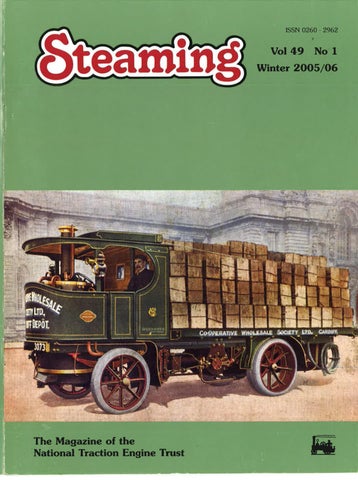
This colour illustration of Atkinson-Uniflow 6 ton steam wagon number 99 appeared on the cover of the firm's brochure, probably of 1922 or 23. The vehicle was supplied new to the Co-operative Wholesale Society Ltd in Cardiff in December 1918. The grey-green colour is probably French Grey, one of the early standard transport paint colours, which was also used by Sentinel at Shrewsbury.
STEAMING Winter 2005/06
3
Trust News From the Chairman My thanks must go first of all to Andrew Semple, who for the last six years as Chairman has been guiding us in a very professional manner. He has overseen our progress with a calm and collected attitude, through our 50th AnniversaryYear, and retires in the knowledge he has served the Trust well. You will realise from the above comments that I am aware he will be a hard act to follow. Nonetheless I am keen to build on both his and the previous chairman's efforts.
Perhaps it is appropriate that a little of the background of my involvement with the Trust should be set down on this occasion. I joined the NTET committee in the 70s, having been sponsored to the Rally sub-Committee by my local club, the Banbury Steam Society, and then progressed on to be a National committee member, followed by Chairman of the Steam Apprentice Club. The last twelve years I have been acting as a Vice Chairman to both Richard Sandercock and Andrew Semple.
Almost fifty Trust members journeyed to Loughborough on the AGM weekend sufficiently early to be able to take part in a morning visit to the John Taylor Bellfoundry Museum. We thank Bob Bracegirdle, the curator, for providing a most interesting couple of hours as he gave us an insight into the world of hells and bellfounding. It was a particularly absorbing half hour and more in the foundry, where work practices and conditions survive that must be very similar to those carried out during the construction of our own engines. The Museum is well worth a visit if you are in the midlands. This picture was taken on the famous journey of the 163/4 ton Great Paul - the largest bell ever cast in Britain - from the Loughborough foundry to Saint Paul's cathedral in London in 1882. There at the front of the trolley is one of the pair of Fowler ploughing engines contracted to carry out the eleven day journey. Much of the rest of the set also went along - the water cart, the living van and even the cultivator, which served to carry boiler plates for use where the road surface proved too soft for normal progress. (picture, courtesy John Taylor Bellfounders)
Enough of the past - let us now look to the future. I take the chairmanship with great expectations, particularly as the AGM had the confidence to agree to the Trust moving forward with a new management structure.This does not mean a deflection from our main aims. It does however indicate that we can create a more efficient advancement and response regime. I know I have the benefit of a dedicated and supportive committee, who are more than capable of delivering for the future. I look forward to 2006 with the anticipation that I will be able to report to you on further progress. (Robert Herring, chairman)
The President's foreword At the commencement of the 2005
AGM at Loughborough, the Trust President Giles Romanes addressed the membership present: Thank you all for taking the time off from your enaine pursuits. and making the effort to get here. It is nice to see so many present, but more than that, to see many friends who obviously enjoy one another's company. We are this afternoon about to take stock of the more serious side of our steam activities, also to try and prepare for the proper future management of the Trust's affairs, its constitution, aims and mode of governance, its relationship with similar or complimentary organisations (such as the Charity Commissioners), and the provision of special services for its membership. A moment's thought shows that we have an important agenda. Our officers and committee members have devoted an immense amount of time to planning a workable set-up which will be presented for our comment and approval - or otherwise. As far as we can see, looking at peer organisations, the proposals should be more Winter 2005/06
STEAMING
Officers and General Council 2006 This column lists, for the information of members, the Officers and General Council of theTrust for 2006.The addresses/ phone numbers of those with special duties are given inside the front cover of each issue of this magazine; others may be contacted by phone or via the General Secretary or Heads of Sections or Units. Names marked with an asterisk* are appointments by the Council and are non-voting positions. President G.J. Romanes Vice Presidents R.J. Sandercock, A.J. Semple
There was popular acclaim from those present at the 2006 AGM on the award of the Dacre Lacy Cup to John and Shirley Blagg; here Giles Romanes presents the trophy at the evening dinner. (J Billard)
efficient, and meet modern conditions. Lastly, I mention that we will at this meeting be losing a most tactful, effective and energetic chairman, who in the last six years has spared no effort on our behalf. His will be a hard act to follow. I do hope that there will be a smooth change to elect his successor. I know the nominated candidate has inside knowledge of the Trust's needs, together with the abilities to meet the challenges which will lie ahead.
extractor, a real electric one, sent from the President of the Society of Drunken Engine Men. So I, too, can now extract juice from anything I please. Score: NTET 1, SODEM 1 but its only half time! I briefly thought that having been elevated to such lofty heights as Vice President, I would be able to retire and hurl comments, a bit like the House of Commons, from the corner of the meeting room. However, I understand from Bob Siddall that I have to report for work on the Engine Owners Section in the new year. (Andrew Semple, Vice President)
Chairman R.I. Herring Vice Chairmen J.R. Cook, P. Worbey General and Company Secretary Mrs Susan Jackson* Treasurer Julie Smith, FCA* Public Relations Officer J. Billard (also FBHVC, Tr 0118 934 0381) Hon Solicitor J.S.A. Palmer" Membership Secretary J.R. Cook (and Head, Membership
Services Editor, Steaming R. E. West* Sales Officers Colin and Val Brown* General Council
The above and also: I.K. Barraclough
(S. Yorks, 117 01709 850346) J. Blenkinsop (Insurance Disc Officer) J.R. Bosworth (Derbys, IT 01332 880405) Nickey and Charles Daniel
From a Vice President's desk The AGM weekend is fully reported by our indefatigable general secretary Sue Jackson elsewhere in this issue. As retiring Chairman I was delighted to see the enthusiastic reception which the members gave to the proposals to modernise the Trust's operations, and to know that we are organising ourselves to face the future challenges. I am confident that the Trust will remain at the forefront in the vehicle preservation world with the enthusiastic management team we have in place. I felt honoured to be awarded the Edney Shield for my efforts on behalf the Trust; my term of office has brought me into contact with so many interesting people who care about our hobby - it has been a pleasure. I received a second presentation on the day, a juice STEAMING
Winter 2005/06
(Cornwall, V 01208 831293)
Engine Owners Column Engine Owners Section Since the 2005 AGM in November I have taken over from Richard Pierce as Chairman of the Engine Owners Section. On behalf of that group and the whole of the Trust membership I would like to thank Richard for the work that he has put into chairing and steering the old committee through the last few years. The next major event, just a few weeks away as you receive this issue of the magazine, is the Engine Owners Open Meeting. This will take place on Sunday, 5th February at the usual venue at Willoughby, a location which is geographically not very far from the centre of Britain, so surely suitable for a great many members.
M.O. Davies (Warks, Tr 01295 770217) J. Durling (Derbyshire, V 01889 591188) W. Evans (Rally Authorisation) R. Garnett (Avon, Tr 01275 878054) E. Goddard (Sentinel DC and Salop Tit 01743 851128)
R. Hurley (Wilts, 07867758366) T Holt (Cumbria, Tr 01524 271584) B. James (Norfolk, IT 01328 851429) P. Jenkins (S. Wales, Tr 01792 390379) K. Munn (SAC chairman) R.J. Pierce (Kent, Tr 01732 850853) R. Siddall (Engine Owners Section
chairman) D. Smith (Head, Technical Services) S.Tomlinson (Training Course and Leics
Tr 01455 613079) M. Ward (Notts, Ts 01623 882856) R Worbey (Rally Organisers Section chairman) Representatives R. Mattless (NV Tractor & EC)* Auditors: Charles Lovell & Co, Royal House, Market Place, Redditch, Worcestershire BN98 (AA
5
Sections and Units 2006 This column lists the members of the Trust's Sections and Units for 2006. Names marked with an asterisk* are co-opted; others are elected General Council members. Addresses/phone numbers of the chairmen or heads appear inside the front cover of each issue. Rally Organisers Section P. Worbey (chairman) Pat Evans. T. Evans* W. Evans P. Hemstritch" T. Holt B. James K. Stock* JoTilling* Engine Owners Section R. Siddall (chairman) N. Allen* I.K. Barraclough J. Blenkinsop J. Bosworth M. Davies Sylvia Dudley J. Durling R. Garnett E. Goddard C. Hatch* R.Pierce A.J. Semple D.S. Smith S.Tomlinson M. Ward Technical Services Unit D. Smith (head) J. Blenkinsop C. Hatch J. Hurley Membership Services Unit J. Cook (head) C. Brown Val Brown C. and Nickey Daniel R. West Steam Apprentice Club K. Munn (chairman) J. Durling (president) Elaine Massey (vice chair)* S. Bate" D. Croser* G. Haase M. Lund" B. Sumsion* S. Taylor* Please see the display advertisemen for more details. In the meantime work is progressing on several fronts, one being the updating of the Trust's Traction Engine Code of Practice and its modification so that it is compatible with the latest legislation. This has involved reformatting and simplifying Part 4, the Written Scheme, and the adding of an Inspection Schedule. The work is now being discussed with two major insurance companies, Royal Sun Alliance and Cornhill, in 6
order to come to a common view about the Code and its implementation. Another project that is about to start is the updating of Traction Engines and the Law, a small book authored by DavidTew and published by the Trust in two editions in the 1980s. Following my request in the last edition of Steaming for volunteers, three people have come forward and will be starting work on the revision shortly. In the Engine Code we metion additional reading and include the book Modern Manual for Drivers of Steam Road Vehicles, edited for the Road Locomotive Society by Michael Salmon. This book was published as long ago as 1967 (21shillings1), and has for a long time been out of print. I have recently been in touch with the Society about updating and reprinting the volume in conjunction with the Trust. However after serious consideration the RLS have decided that it would be better to leave Michael Salmon's book as it is, unmodified. My section will now consider the best way of proceeding with the aim of producing a manual for the needs of today. I look forward to seeing as many as possible at the Engine Owners Meeting on 5th February, when, hopefully we will have one or two speakers, and the opportunity to discuss matters with members of the Section and other officers of theTrust. (Bob Siddall, chairman, Engine Owners Section)
Rally Organisers Column Rally Organisers Section On behalf of the Trust I have over the last six months re-activated the Rally Organisers Section's service of advice and instruction to rally safety officers, and have been able to present our Safety Officers Seminars at half A dozen very successful venues. BetWiled June and early December evening talks lasting about two and a half hours were given to safety officers and rally organisers at Shrewsbury, Bridgwater, Radcliffeon-Trent, Banbury, Copthorne in Sussex and Flamstead in Hertfordshire. The material presented included a resume and explanation of the Rally Organisers Code of Practice and usually went on to discuss aspects of concern to those present.
In total 150 prospective safety officers went away Num the seminars with a Certificate of Attendance, and this included a couple of names that are almost at the top of the list which appears inside the front cover of each issue of our magazine. Aparl from them, it was very pleasing to see many younger members attending. Three further seminars are already planned for this year, as part of an ongoing programme for the future. Anyone interested in attending or having their event's safety team be present at one of the gatherings can get in touch with me for more information — my contact details are inside the front cover. Just a few days away as you receive this magazine is the Rally Organisers' Conference, to be held on Saturday, 21st January 2006 at Old Warden Park, near Biggleswade, Bedfordshire. All the Rally Organisers have received details and invitations from our mailing list, but newcomers are always welcome — you can make a last minute arrangement by contacting the General Secretary Sue Jackson. (Paul Worbey, chairman, Rally Organisers Section)
Technical Services Unit The New Technical Services Unit The NTET's 2005 AGM held in Loughborough marked the beginning of a new era in the organisation of the Trust committees and working groups. Members overwhelmingly voted to adopt the reorganisation strategy that will take the Trust forward into the next 50 years. Part of this strategy is to group together hitherto autonomous activities into new 'units' or subcommittees; the latter title is considered outdated and has now been consigned to the wastepaper basket. The activities covering NTET business management, Health and Safety, legal matters, technical engineering and standards, insurance and EU legislation and government liaison have been grouped together as the Technical Services Unit, of which I have been appointed Head. The role of the Unit is to support the Trust and members in the above areas, either directly through our own skills base or by locating appropriate external resources. Winter 2005/06 STEAMING
I am pleased to report that already this Unit has the services of the following elected members: Richard Hurley - engine owner and business consultant specialising in insurance; James Blenkinsop - current insurance disc manager, and Colin Hatch - engine owner and professional restorer of traction engines. Irvin Barraclough, although a member of the Engine Owners Section, also provides service to this Unit. The Unit also has the service of the following ad-hoc members: Chris Boocock - model engine owner, engineering consultant (Pressure Systems specialist) and Fellow of the Energy Institute and Member of the Institute of Mechanical Engineers; Howard Snowden - Health and Safety consultant; John Palmer - the Trust's honorary solicitor, and Tony Wood - model engineer, proprietor of Walker Midgely Insurance, and our link man to the model engineering community. Enquiries to this unit can be addressed to David Smith, at the address inside the front cover of each magazine or by email to tsu@ntet.co.uk (David Smith, Head of Technical Services Unit) Competency Scheme Once again I offer heartfelt thanks to all those who responded to my plea for assessors. The selection list is now quite impressive, but we still have some empty spots. STEAMING
Winter 2005/06
An interesting comparison in the changes in agricultural machinery designs over a period of eighty years or so, as Foster 5hp single cylinder traction engine 14638 passes a Massey Ferguson 168 parked in the village of Pimperne, Dorset. This Foster is of the maker's Little Gem class, introduced about 1910 (and probably intended to compete with Burrell's Devonshire engines), though it was actually sent out from the works in the rather late year of 1933, no doubt as a relief to the sales office, being well past what we would now term its 'sell-by' date. John Maund took the picture as the engine returned home from the 2005 Great Dorset Steam Fair. I am pleased to report I have recently been able to assess and award Assessor Certificates to recent applicants and others are waiting in the pipeline. The onset of winter has slowed things down, but we shall get moving again in the early spring. For those thinking of taking on the role of Assessor the following should be considered. • You must be a member of theTrust • You must hold a basic competency certificate — if you don't you will be expected to take the 'test' • You must have at least 10 years experience with traction engines of any type • You must be prepared to undertake the Assessor Examination and be able to demonstrate, practically, your ability to communicate and examine candidates consistently and fairly according to the Examination Syllabus for the NTET Driver Competency Certificate • You must be prepared to travel reasonable distances, at theTrust's expense, in order to undertake assessments
To those engine owners, crew and
drivers who are wondering what competency is all about, consider these 10 questions • Do you want to help ensure the continued and safe use of traction engines for future generations? • Can you demonstrate safe methods of raising steam and controlling combustion under widely varying conditions? • Can you describe the function of every component on your traction engine? • Can you confidently negotiate tight gateways or chicanes when moving backward or forward? • Can you drive confidently in the close proximity of spectators at a rally? • On the road, do you concentrate properly and avoid distractions? • In an emergency on the road could you stop quickly and sympathetically? • Are you confident that you could identify and cope with most everyday problems on your engine? • Do you know the safe way to negotiate steep or slippery inclines? • Are you knowledgeable about the working of the ancillary equipment you use?
If you can answer 'Yes' to each of these questions, then come on in and demonstrate your skill; you have 7
absolutely nothing to fear and your success will ensure that you become an ambassador of theTrust's Skills for Life programme.You don't have to be a member of the Trust to apply, but we have a painless way of getting you to join. For a copy of the examination syllabus please contact me at the address shown at the front of the magazine email: or COMpetency@ntet.co.uk . John Durling, who recently retired as the Chairman of the SAC, has kindly offered to take over the administration of the Competency Scheme in the fullness of time. Not too long a time I hope. Finally, Robin Drury sent me the following comments, and I have his permission to reproduce them here. 'Competency Assessment comparison with another 'ticket' - Rough terrain telescopic handlers all have an engine, a transmission and a telescopic boom or arm, and at that point the similarity ends. The direct comparison to our hobby is that all traction engines have a boiler, cylinder(s) and crankshaft - oh, and a means of driving the wheels. 'Rough handlers come in small, medium, large and can be pivot steering or rigid chassis. The rigid chassis ones can be two wheel or four wheel drive and two wheel or four wheel steer and can also be on a turntable like a 360° digger. The pivot steer ones have a central driving position, but on rigid ones the cab can be right or left hand - you can maybe now start to see how widely the equipment varies, just as steam traction engine design. The transmission may be mechanical, torque convertor or hydrostatic. Steering is usually hydrostatic, but the rest of the hydraulic controls depend on age and spec, and can vary enormously. The range of equipment to fit on the end of the arm is endless - pallet forks, manure fork, different types of bale grab, person lifting platform and selections of buckets. 'Significantly, the ticket I hold permits me to drive any and all of the above. In my case it was issued by LANTRA (formerly Agricultural Training Board). The information on the ticket states I can drive 'Rough terrain telescopic (pallet and bulk)'. In order to gain the ticket I had a day and a half tuition on a hire machine and took the test on a different machine on a local farm, because the assessor was set up there for the day, doing those in the area who had applied. The other awarding body is the CITB, covering building site and industrial work, but the training and 8
test are very similar. Another parallel with our hobby is dial I could not have taken this test or been allowed to drive this type of vehicle had I not been the holder of a full motor car driving licence.' I would add that Robin recently took the NTET's voluntary competency examination on a strange engine and passed with flying colours. He makes the above comments at length because he is concerned that those who are unsure of the reasons for us having such an examination should be able to see what is happening elsewhere, outside of steam, and particularly when it is important to be able to demonstrate skill in the use of a machine which is, at best, only typical of its type. (David Smith, Head of Technical Services Unit)
season to see what went right and what we can do better in the future. On the latter point, with my election as Chair of the SAC and taking over from John Durling, I personally feel I have an uphill task! I would like to give you a brief background to myself. I currently work as an aircraft engineer at British Airways. I got into the steam scene back in the 90s - the 1990s, that is! Presently I own a 10 ton Aveling & Porter E type roller. I do hope to be able to build on what John has achieved in his time in the chair. I thank those engine owners, rally organisers and anyone else who has given their time and knowledge in supporting the SAC's aims in the past, and I look forward to working with you in the future training and encouragement of our youngsters to enable them to enjoy and share the passion for steaming that we have. (Kevin Munn, chairman, SAC)
Insurance Matters As this season draws to a close I can report that things on the insurance front are reasonably quiet. However, we shall be seeing increases in the rates of the NTET's Event Organisers Policy in 2006. This will be the first increase for 5 years or so, but be assured I am always looking for value for money, and as far as I can see the scheme still retains its competitive edge over all other offerings. Organisers of Authorised Events can take full advantage of the discounted rates offered in the NTET's Event Organisers Policy brokered by Footman James & Co, whilst non-authorised events are brokered under a separate and more expensive policy. The reason for this difference in rate is that the underwriters acknowledge that Authorised Events are managed according to the NTET's prescriptive Code of Practice and therefore are reckoned to be less of a risk to the policy. We must be getting something right! (David Smith, Head of Technical Services Unit)
Steam Apprentice Club It is the time of year within the SAC when we look back at the
FBHVC News
Good news from the European Parliament. We are pleased to report the European Parliament in September adopted the following: '[the EP] is keen to preserve the cultural heritage represented by historic vehicles; therefore urges that planned legislation should take into consideration any unintentional but potentially negative effects on their use - and thus also the preservation of historic vehicles'. This comes from FIVA (the International version of the Federation), originated by the FBHVC chairman Andrew Burt. The decision will be vital in any future lobbying against Parliament or Commission proposals. ... and so to the House of Lords. On 26th October 2005, the House of Lords considered the Road Safety Bill, where Earl Attlee (lately an NTET Patron), supported by Lord Montagu, tabled an amendment requiring the Secretary of State 'to have regard to the need to avoid retrospective legislation regarding the construction and use of historic vehicles ..' The reply from Baroness Crawley makes it clear that the government does not regard historic vehicles as a problem: '...we know of no European Winter 2005/06
STEAMING
legislation or proposals that adversely affect the private use of historic vehicles ... we would not expect any suggestion for retrospective application of technical standards to vehicles unless there were unusual or robust safety or environmental considerations. It is particularly difficult to envisage any such circumstances that would be considered proportionate for the relatively small number of historic vehicles that are used privately.' EU Driving Licence Directive. I am grateful to our member Graham Massey for some help on this item. It could apply to members who transport engines on trailers. There are new driving licence regulations coming in 2007. These will require LGV (and PSV) drivers to obtain Certificates of Personal Competence (CPC) on a different basis than hitherto. In order to obtain such CPCs, drivers will have to undergo 5 days of training in each period of 5 years. The current regulations exempt trailers in private use. Federation is currently working with the Department for Transport (DfT) to mitigate the position as far as possible. This is another reason why every engine owner and driver should be a member of the Trust, because the legislators are most unlikely to take much notice of an individual making objections on this matter.
Recovery of lost registrations (the V765 scheme). A recent vintage and steam publication refers to a recommendation for a 'staged and timely closure of the V765 scheme. This is true in the sense that hidden in a document Responses to Consultation on the Review of the Inspection Procedures of the DVLA is a recommendation 'To consider a staged and timely closure of the V765 scheme. That does not mean it is policy; it just means what it says — that the idea should be considered. At its 27th November 2005 meeting the FBHVC decided to request that this recommendation be withdrawn. The Federation has worked hard over many years to make sure that the V765 Scheme is a success and any detrimental changes will be strongly resisted. The Agricultural Waste. Federation has been watching out for the publication of the regulations since the close of the waste Framework Consultation earlier this year, but so far nothing has been seen. Just as a reminder (and to cover the question of one of Nickey Daniel's Ring Around contacts►: the
STEAMING Winter 2005/06
Early morning preparations at the Tom Rolt Rally in Tywyn, Wales in May 2005. Andrew Semple's Ruston tractor 52607 (left) and Edward Goddard's Sentinel DG4 wagon 8571 are seen before the crowds entered. A feature of this rally is that the engine line is uncluttered by modern paraphernalia, helping photography in this beautiful setting. (Anthony Coulls) result of the consultation indicates that the directive on waste will only apply if the holder of the waste (for example old or scrap machinery) declares it is not for future use. The only exception is if there is a hazard to the environment by say, leaking fluids. The position will be confirmed when we see the Regulations. If you require further information or wish to raise any matter that may concern the Federation please contact me. (John Billard, FBHVC committee - Tr 0118 934 0381)
Obituaries Cyril Edmonds Cyril Edmonds was a Blandford boy, living his life in and around that town. His interest in steam road engines stayed with him throughout his life. On leaving school, rather than join his father's printing business, he trained as a motor mechanic. During World War II, it being in a reserved occupation, he joined the town's fire brigade, and there met Ruby, his wife to be, working in the control room. In 1952, on the early death of his father, Cyril stepped-in to take over, and ran it successfully until he retired in 1990. He had got to know most like minded steam people in the county, and when the Dorset Club started 'Stourpaine' it was Cyril that secured the job of printing the publicity
material. Many members will recall those early posters featuring the red, yellow and black image of Ted Hine's QUO VADIS. Cyril became friends with Ernie Lucas and was involved with him in keeping his Fowler showmans THE LION in steam. Sharps, the Blandford steam rolling contractors, still had their yard in the town and it was there the ex A & R engine went to reside through the 1950s. Ernie, an ordinary working chap, had little spare money for his engine and on occasions Cyril would buy the bags of coal so it could be steamed. An accomplished model engineer, Cyril spent many years building a superb 11/2 inch scale Burrell showmans that was rarely seen other than by visitors to his home. An outgoing, generous man, with a rich North Dorset accent, many of the business contacts he called on became good friends and if his route took him near one of his steam pals, he would always take time for a natter about engines. At early Stourpaine events he could be found helping Bert Dibben with his Wallis in the threshing section but as the event grew much bigger he gradually dropped out, disliking the large crowds the show attracted. In retirement, the garden and dog walking in the Dorset countryside were his main activities. Problems with eyesight curtailed model engineering activities, but Cyril remained interested, and an NTET member to the end. He died in November, aged 82. His cremation at Poole was attended by a large 9
number of friends, business associates and folk from the Blandford area - true testimony to his popularity. Our condolences go to his wife Ruby. (Richard Collis) Jack Johnson The county of Lancashire has lost one of its dwindling ranks of men who earned their living driving traction engines. Jack Johnson was born in 1921 into a family of threshing contractors at the village of Banks, near Southport.The business was founded in 1871 by Jack's great uncle and later run by his grandfather and father. Jack started to work at 15, carrying chaff on one of the threshing sets; at 16 he was wiring the baler and at 17 the driver of the No 2 set, driving Burrell 4050, an 8hp compound three-speed engine bought new in 1926. Jack worked for his father through World War 2 - they ran seven threshing sets and had 21 balers for hiring. He mainly drove Burrell 4050, but occasionally others, including Foden compound 341. He recalled no one liked the Foden, but he was young and wanting to prove himself, so he took it for a season to show his worth. However, the favourite was 4050 and there were many tales of his experiences. One was of setting off from Banks with seven balers in tow, for dropping off at various farms. Also how with 4050 and a full set behind he had many a time been up and down the notorious Parbold Hill in the dark. As steam diminished Jack used 4050 to tow redundant engines to the Preston Docks for scrapping. In 1955 it too was also sent for scrap by his father, a fate for the engine that Jack later regretted. However, he was now running his own threshing business, and then branched out to tree pulling and recovery work. Banks is situated in an area of moss land and there was recovery work to be had as farm vehicles stuck on the moss. In the 60s Jack had the urge to own a steam engine. He visited rallies and in 1968 bought a derelict engine from Isaac Ball's yard at Wharles. Burrell 3862 was transformed in six months from a rusting hulk to a gleaming steam tractor. Shortly afterwards he restored Burrell 2642 for his friend John Webster, and in 1969 the first Banks steam party was organised. The steam parties were a huge success with thousands of pounds raised for local charities. In the following years more engines were given the Johnson 10
Andrew Goddard, a director of Morris Lubricants, holds the Golden Film Shields presented to the Trust by the Shrewsbury firm of oil manufacturers. The 1958 trophy, on the left, now filled by the many well-known names on the plaques, gives a glimpse of the history of the Trust and its members; the new Shield will uphold the tradition. (Morris Lubricants) treatment - close on 50 have been restored and worked on at the premises. Jack also found time to restore showmans living wagons, tractors and heavy recovery vehicles, all done to a high standard. He rallied his own engine extensively, and also the Tasker steam motor HORSE'S FRIEND on behalf of its owners. In later life Jack suffered poor health. He became partially sighted, but retained a big interest in steam preservation. He had an army of friends to talk to on the phone and liked nothing more than telling tales of days gone by or offering advice to not-so-experienced drivers. He was involved with steam threshing to the last. He and his son John cut corn in 2004 ready for a special rally near Banks the following spring and Jack was looking forward to showing his grandson John how to wire the baler. Sadly this was not to be, for Jack passed away two weeks before the event. His funeral was a fitting tribute - four engines attended, the hearse being a farm lorry pulled by his Burrell tractor HARVESTER, with the coffin simply decorated with sheaves of corn. Banks brass band led the proceedings, and the village bade farewell to a link with a bygone age. Jack is survived by his sons John and Alan, and to them and their families we send our condolences. (Anthony Cowell)
The Trust Trophies, 2005 As is usual at the Trust's principal annual gathering, many of our impressive range of Trophies were presented following the AGM or at the formal dinner later that evening. Following a routine that has become tradition, the selection of the recipients was largely made from more local members, and this year it was to mark our presence in the East Midlands. The presentations were made by President Giles Romanes, and the citations prepared by Robert Herring and Anthony Thompson. The ARTHUR NAPPER CUP was presented to Joe Walker of Derby, a familiar face on the rally scene for many years. Starting with a Field Marshall tractor, Joe progressed to steam, buying his Tasker tractor on which he worked day and night in time to attend our 50th celebrations last year. The CURTIS BOWL went to Mick Kettle and family, who drove their single 8hp Burrell agricultural, to which Mick had fitted a third speed, from home in south Essex to St Agnes in Cornwall and back, via rallies in Somerset and the Dorset event. They towed a fair sized showman's van and a box truck containing everything they would need - even a tumble dryer. And all because Mick lost his LGV on health Winter 2005/06 STEAMING
grounds. At over 800 miles, this must be the outstanding journey of the year on the road. The DACRE LACY CUP was awarded to John and Shirley Blagg of Worksop. This was a truly deserved recognition; after owning and rallying their McLaren road loco for fifty years, travelling to hundreds of rallies under steam, and doing three NTET Road Runs, they are said to be looking forward to the next. The CHOISY AND SIMSON CUP was received by Brian Wright of Nottinghamshire. A former rally organiser and engine owner, Brian has worked on many boilers and has helped the preservation movement in many ways. The GOLDEN FILM SHIELD was presented to Steve Arrowsmith and the Klondyke group for their valued part in the steam preservation movement in this area — helping people who are not fortunate enough to have facilities of their own. The JOHN CRAWLEYTROPHY was awarded to Peter Haywood of Kegworth, an outstanding person within the hobby of engines and organs, not only having organised the late Kegworth Carnival, but also finding the time to be chairman of the Fair Organ Preservation Society and contributing reports for our own magazine arid other periodicals. The ERIC MIDDLETON TROPHY was received by Mark Johnson of Kegworth. Mark has followed in his father's footsteps with miniature engines, and worked hard to purchase his own steam lorry, with many hours of perseverance in its restoration; he has turned out a fine example of a Sentinel steam lorry. The PERCY HIRONS BOWL was handed to Colin Brothwell of Beeston, a working man who fulfilled his dream by buying a Ruston agricultural engine. It is one of the finest agricultural engines on the circuit today, and not content with just showing the engine Colin has a and gives bench racksaw demonstrations wherever he goes. The BAKER TOC-H CUP was presented to the Howard Brothers of Ash bou rne. All road steam enthusiasts were concerned about the tragic story of near destruction of their engine by fire a couple of years ago, and then heartened by the brothers' wonderful renovation of the fine specimen of a Fowler showmans engine. The JACK HOLLOWAY salver went to John Durling of Uttoxeter for his unstinting work over the last nine years with our younger members, the Steam Apprentices. The success STEAMING Winter 2005/06
of that section has been recognised nationally, and is the envy of many preservation bodies. The CONNIE HUTCHENS MEMORIAL TROPHY — an annual award to a lady in the movement — was presented to Wendy Thompson of West Bridgeford. Here is a lady who has known no other life than rallying since being born. On the day after her wedding she went to Hinckley rally, followed by a week at Stourpaine in a caravan with new husband and her father instead of a honeymoon. Even bringing up two children never stopped her. Everyone who knows Wendy will know the kettle is always on at a rally or at home. Engines are a part of her life, and her father Jesse would be proud of her. The EDNEY SHIELD is usually awarded to persons who have given considerable personal service to the club, and with this in mind, it is appropriate that our retiring chairman Andrew Semple should receive it this year for his contribution over the last 20 years in the successive capacity of general committee member, Rally subCommittee chairman, vice chairman and, during the last six years, chairman. The J T BEEBY CUP for Steam Apprentice Club members was presented to Martin Treanor of Duffield, Derbyshire, who had been an apprentice to John Durling since 1998, and shown himself to be a good engineman and a useful member of the crew. The Golden Film Shield The Golden Film Shield
('generally considered to be the Trust's premier trophy') was given to the National Traction Engine Club, as it was known at that time, by Morris & Company in 1958. Inevitably, after so many years, the Shield has now run out of available space to record present and future winners, and has been returned for safe keeping to Morris Lubricants (as the firm is now titled) and hangs in their offices at Castle Foregate, Shrewsbury. The new trophy is a Mark 2 version of the original shield, being much the same size and design, and carries the current NTET logo. The engraved centre plaque on the trophy records the names and dates of previous recipients. It may well be that the trophy was awarded in the missing years; unfortunately no record was kept of whom the winners were. Morris Lubricants are pleased to present this continuation trophy, and wish the Trust every success in the future.
Future Dates Engine Owners Meeting Engine owners and engine crews are invited to the 2006 Engine Owners Open Meeting — it is on Sunday, 5th February, and the time 10.30 for 11.00, the venue the same as in previous years, at the Village Hall, Willoughby, Warwickshire. Refreshments will be available during the lunchtime break. There are further contact details in
Sentinel S4 model 9293 of 1937 when in the ownership of Jim Hutchens, and probably taken at the Weston Park rally, Hertfordshire, in June 1960. Who can recognise who? (G Brown)
Trust Diary, 2006
I he NTET's Engine Owners Section presents its 2006
ENGINE OWNERS MEETING
The diary of Trust events of a business and social nature during 2006 is set out below. It includes, in bold type, dates of Conferences and
to be held at The Village Hall, Willoughby, near Rugby, Warwickshire 10.30 for 11.00am on Sunday, 5th February 2006
other members' gatherings and, in italic type, Committee meetings. The timetable has been arranged to avoid clashes in the dates following consultation with the other
All owners, crews, potential owners and anyone else interested in the working of preserved road steam vehicles are welcome to attend - whether they are members of the Trust or not. Contact Bob Siddall if you wish to have a topic discussed — 117 01636 821991 or RGSiddall@aol.com
the display advertisement elsewhere in these pages -do take advantage of that if you wish to have a topic discussed that maybe requires a bit of preparation prior to the meeting.
Steam Training and Driving Course The Trust's Steam Training and Driving Course for 2006 will be held on Saturday and Sunday, 13/14th May at Sandhills Farm, Astwood Bank, near Redditch, Worcestershire. As usual the course has three different levels -the Foundation level is designed to give a good basic theoretical and practical knowledge
reflections on our magazine of 25 years ago
The Winter 1980/81 issue of our magazine was not only the first issue in volume 24, but the first in the current larger format. Some things never change governments are always looking for new ways to tax us and in this issue 25 years ago there was a report of plans to tax vehicle ownership rather than use, even if the vehicle was derelict. Fortunately the Editorial reported that the proposal had been dropped, certainly, in part, through lobbying by the historic vehicle movement.
12
a
of steam engines to inexperienced members; the Intermediate and Advanced levels gives a more in depth look at the workings, and also offer practical experience and advice. This course has grown to be a very popular one, and places are limited, so please do not leave it too late to reserve your space. For further details send a SAE (C5 size) to: Stuart
Tomlinson, 470 Coventry Road, Hinckley, Leicestershire LE10 ONH, or
nationally based road steam groups (via the Road Steam Forum). 21st January
Rally Organisers Conference 5th February Engine Owners Meeting 12th February National Council 9th April Road Steam Forum 12 to 14th May Steam Training and Driving Course 11th June National Council 1st September GDSF Open Forum 8th October National Council 18th/19th Annual General November Meeting weekend
New Members We extend a sincere welcome to the following new members who have joined the Trust during the last
you can use e-mail to hazel.tornlinson@hornecall.co.uk Students who attended in 2005 will automatically be sent an entry form for 2006.
enjoyment from their membership
On a topical note it was reported that Jim Newnham had become the honorary safety adviser to the Club, a post he has felt the need to relinquish in the current restructure. Also of note was an update on the application for Charity status. The recent addition of a miniatures section in the magazine could
A report on the West of England Steam Engine Society's 25th anniversary rally and road run included reference to the now well known climb of Engine Hill, an ascent that cynics thought would be beyond some of the engines. At the sale of the late Tom Paisley's collection of 27 engines and other artifacts it was
perhaps be seen as a long expected follow on from a three page article by Malcolm Frost on building a 1 /3 2 scale white-metal Foden wagon kit. Keeping with wagons, or should that be waggons, a short article by Joe Thomas included photographs of all five Sentinels that have been owned by Morris Lubricants, including the company's current example. A brief article covered the passing
from everyday use of some impressive triple expansion stationary engines - what was thought to be the final steaming happened at Kempton Park on 4th November 1980. Happily we now know this wasn't to be the case.
three months. We hope they will gain much friendship, information and
stated that over £300,000 changed hands. The most expensive engine was the Foster ADMIRAL BEATTY. No prices of the individual items were given. A humorous 1978 article from The Motor magazine was reprinted. This covered a road test on Denis Brandt's 1922 Foster Wellington tractor 14514. It included 'complaints' that there was no fuel filler lock, and that the steering seat lacked lumbar support. Was this issue unique to include Antarctica in the Around the World section? Mention was made of steam driven Russian tanks being trialled.
(Stuart Gaines)
Winter 2005/06 STEAMING
over a period of many years. Full addresses are not included, but the Membership Secretary is always pleased to put members in touch with one another by forwarding mail. A E Beare, Bournemouth, Dorset W J Middleditch, Clacton on Sea, Essex M D Latarche, Sudbury, Suffolk I Dumville, Salford, Manchester N Hibbitt, Sandy, Bedfordshire E J King, Royston, Hertfordshire B Green, Ongar, Essex K C Brodrick, Ashtead, Surrey K J Spencer, Dilham, Norfolk N Cotgreave, Gosport, Hampshire A D Gibbs, Arreton, Isle of Wight
J L Woodland, Aspley Guise, Bedfordshire P Simmons, Redruth, Cornwall D Rimell, Warwick D Brook,Truro, Cornwall T Harris, Grantham, Lincolnshire R W F Ward, Bury St Edmunds, Suffolk S Atherton, Heswall, Wirral N Wellington, St Neots, Cambridgeshire R Clifton, Haywards Heath, West Sussex K J Henderson, Glasgow G Lee,Tamworth, Staffordshire P A Crane, Norwich P Sabin, Lichfield, Staffordshire S Latham, Stone, Staffordshire B D Edwards, Ballarat, Australia M J Sleaford, Boston, Lincolnshire
Poor Steaming - Readers will have looked in vain for a Mawdsley
dynamo on a Foden wagon in the picture on page 207 of the last issue. The published image was, in fact, of the wrong side of the scene - this time we can see the rest of the same picture, with, just as on the original, the front end of the Foden seen alongside the gallopers.
The NTET's Engine Owners Section presents its 16th
STEAM TRAINING and DRIVING COURSE to be held at
Astwood Bank, near Redditch, Worcestershire on 12th to 14th May 2006 A practical and informal course including Instruction on boiler management, mechanical operation, care and maintenance, and on driving techniques
For further information send a C5 (for A5) size SAE to: Stuart Tomlinson, 470 Coventry Road, Hinckley, Leicestershire LE10 ONH. 12 01455 613079 e-mail hazel.tomlinson@hornecall.co.uk
'In the neighbourhood of the Crystal palace the horse has, at any rate, the best of reasons for entertaining a friendly feeling for the automobile. A small traction engine is kept near the High Level station, known variously as the 'Little Giant' and the 'Horse's Friend' and this machine is employed to assist horsedrawn vehicles up the many steep hills in the Sydenham district. The little traction engine has actually been employed assisting as many as forty horse-drawn vehicles in a single day, consisting of all kinds of heavy traffic from a pantechnicon to a coal trolley. It is interesting to learn that the expenses of the machine are defrayed by the Society for the Prevention of Cruelty to Animals and local contributors. No better way of displaying sympathy with the often over-burdened horse can be imagined than assisting with subscriptions this very excellent undertaking.' (from The Automotor Journal, 24th October 1903. Later, in the issue dated 26th December, the
Journal included an illustration of the engine on its title page. The smartly kept Tasker steam tractor is seen ready to help a rather small and dreary nag, which stands lethargically in the shafts of a wagon. The means of hauling seems to be a chain from the engine's drawbar to the front of the shafts, with the links nearer the horse encased in leather, presumably to reduce the chance of
startling the patient. The 3hp single cylinder Tasker - works number 1296 of 1902 - is still with us, located in Lancashire.)
a
'The self moving vehicle has now attained a commercial position and its practicality has been endorsed by the Royal Agricultural Society. What is now wanted is a lowering of price which, at present, is sufficiently high to deter the class of buyers to whom such vehicles would be most useful' (Editorial comment in Engineering, 7th October 1898, following the publication of the results of the RASE Trials of Self Moving Vehicles at Birmingham in the June. The entrants had been a 1 ton oil engined Daimler, a 3 ton Lancashire steam lurry and a 2 ton steamer from the Steam Carriage & Wagon Co of Chiswick the Thornycroft company. At this stage in the development of such machines the reliability of the freshly invented engines and transmission was the problem for the internal combustion engined vehicle, whilst the steam propelled vehicle makers, using more established technology, struggled to make robust products within the weight limits laid down by highway law.)
'On Tuesday, a heavy tractionengine, drawing a stationary boiler, while passing over a railway bridge in the vicinity of Harewood on the North Staffordshire Railway, a few miles from Crewe, was precipitated together with the boiler, on to a railway, owing to the cross girder of the bridge breaking under the weight. The driver escaped serious injury. The railway was blocked for some time by the destruction' (from The Engineer, 2nd May 1902) 13
National Traction Engine Trust
Mail Order
Many books, videos and other items of interest to traction engine enthusiasts are available from tho Solos section. Readers are urged to take advantage of this service (which also benefits Trust funds) for troublefree and economical postal shopping. Just tick the box for items you require and fill in the address slip. TRACTION ENGINE READING New The History of Mann's Patent Steam Cart & Wagon Co (Pease) reviewed this issue New Traction Engine Album (Ranieri) reviewed
£24.99 ❑
this issue
£25.00 ❑
New The Electric Scenic Railway (Scrivens and Smith)
reviewed this issue
(VHS 40 mins)
(Relshaw)
£10.00 ❑ £15.00 ❑
New Bridgwater Fair - an illustrated history
(Belshaw)
£12.95 ❑ £24.95 ❑
New Fodens - a pictorial history (Davies) New European Traction Engine Register
(Toy and Rayner) reviewed 48/3
£5.00 ❑
New Historic Fairground Scenes (Ware)
reprint of 1977 edition
£9.99 ❑
New 'RENOWN' History and Restoration
(Brian Steptoe) reviewed 48/2 Special 30th Rolling (PIRA) Squirrels, Nuts and Flying Rivets (Trevis) Traction Engine Register (True and Johnson) Perth's (Australia) First Motor Vehicle (Clydesdale) Norfolk and Suffolk in the Age of Steam (Stephens) Family Affairs - haulage contractors in Somerset and Dorset (Michael Marshall) Lincoln's Excavators -The Ruston Years
(Robinson) reviewed 47/4
£5.00 ❑ £2.50 ❑ £7.95 ❑ £6.95 ❑ £7.00 ❑ £19.99 ❑
£16.95 ❑
Up tor the Cup - the Steam Plough Club's Great Challenge 1998 (VHS 65 mins) Steam over the Fells - steam through the !rough of Bowland (VHS 115 mins) Sentinels on Parade - road run, Shrewsbury to the Horseshoe Pass (VHS 45 mins) The Big Road ATLAS - the Eastnor Castle heavy haulage road-run (VHS 60 mins) Up Hill and Down Dale - the 1995 steam car touring rally, Yorkshire Dales (VHS 90 mins) Sentinels and Scouse - the 400 vehicle cavalcade through the MerseyTunnel (VHS 55 mins) Sentinels on The March - 1995 Sentinel Drivers Club road run (VHS 50 mins)
£19.50 ❑ £20.00 ❑ £15.00 ❑ £18.00 ❑ £18.00 ❑ £18 .00 ❑ £16.95 ❑
£4.50 ❑ £15.99 ❑
(Rayner)
£4.50 ❑
Traction Engines, A Colour Portfolio
(Arlett and Lockett) Thornycroft, Ian AllanTransport Library (Towns, n ) Heavy Haulage (Neville/Freeman)
CLUB ITEMS New SAC embroidered sew-on badge (3in dia) NTET 50th Anniversary embroidered sew on badge (3Y in x 11/2 in) NTET steam roller badge, boxed NTET 50th Anniversary badge, boxed NTET Sweatshirts, embroidered logo, choice of
four colours, MILIXL/XXL
£1.50 ❑ £1.95 ❑ £2.95 ❑ £2.95 ❑ £18.00 ❑
NTET Polo Shirts, embroidered logo, choice of
three colours, Mit/XL/XXL
£12.00 ❑
NTETTee Shirts, primed centre chest logo,
choice of 4 colours and 4 sizes NTET Members Badge - members only NTET 2000 showmans badge (boxed) NTET traction engine lapel badge (boxed) NTET Foden wagon badge Steam Apprentice Club badge - members only Fowler cap badge
£6,95 ❑ £2.25 ❑ £2.95 ❑ £2.95 ❑ £2.95 ❑ £2.25 ❑ £2.25 ❑
£24.95 ❑ £24.95 ❑
Pictorial Albums Steam Wagons (Rayner) Glory Days - Paddle Steamers (Williams) Traction Engines and other Road Steam Vehicles
£14.99 ❑ £18.99 ❑ £7.50 ❑
Company Histories The History of J. & H. McLaren of Leeds
To claim post-free for UK members please enclose current membership card. Non-members please enclose 10% part postage per order. Overseas members please enclose 8% part postage per order (European); 10% (rest of world). PO/Cheques (in sterling please) to be made payable to: National Traction Engine Trust. Visa, Access and Mastercard accepted, please state card number, expiry date and name on card, or phone/fax 01582 733971 CB evenings only). Orders to be sent to: NTET Sales, 90 Devon Road, Luton, Bedfordshire LU2 ORL. Please allow 28 days for delivery. Name
now 81,05
Ransomes, Sims & Jefferies, Agricultural Engineers (Brian Dell) The Story of St Nicholas Works (Lane), was £30 Charles Burrell & Sons Ltd (Gilbert & Osborne) Steam Engine Builders of Lincolnshire (Clark) The Story of the Wellington Foundry (Lane), was £30 The Rise and Fall of Aveling Barford, 1933-1988
£1,65 ❑ £27.00 ❑ £5.99 ❑ £10.95 ❑ £24.00 ❑ £3.60 ❑
Address
Membership No. •
£18.00 ❑
£20.00 ❑
Reprint Locomotive Boilers - Design, Construction and Working (Haigh) New T. Whitelegg & Sons - Cavalcade of Shows
(John Pease)
MOONLIGHT PRODUCTIONS videos New Going for Gold - NTET 50th Year Great Dorset & Road Run (VHS 90 mins) Sentinels on the Move -The Horseshoe Pass
please refer to recent issues for other available books videos and club items
Amount Enclosed List 49/1, Winter 2005/06
ERN CQ laito prAr 1141RikiSr
TPAFFOPD MARCHES"'_
3.0.111400T114 GUM DOI.e
OmCO fitkv
oluvia", 'E
TRAFFORDPOK TRAFFOrm PA J. SttR MANCHE5M MAN[
•Ili 11. 4.
This is most of the fleet of Atkinson steam tanker wagons operated in Manchester by the Southern Cotton Oil Co in the early 1920s. These tankers were most likely used to fetch the oils in bulk from ships that had sailed up the Manchester Ship Canal to the city's docks and wharves, and to transport them the mile or two round to the company's premises for refining, just inside the huge and then expanding Trafford Park Industrial Estate. The oil works was situated between Westinghouse Road (now John Gilbert Way) and the Bridgewater Canal. Jim Stevenson, who forty years ago worked at the nearby Metro-Vick factory, thinks the picture is taken looking south to the Southern Oil buildings, in which case the Atkinsons are posed across the sidings and running lines of the Manchester Ship Canal railway tracks that were on Westinghouse Road. Over our left shoulder, on the far side of the canal, lay the extensive Trafford Park locomotive sheds and then, a little further to the east, the Manchester United football ground. Southern Cotton have long departed their site, and in fact its current use is as a car park for the football matches. STEAMING
Winter 2005/06
An Atkinson assortment The main picture of this article, the line-up of immaculate steam tanker wagons, has been passed to us by member Jim Stevenson. It shows four of the five-strong fleet of Atkinson 6 tonners owned by a somewhat ponderously named firm — The Southern Cotton Oil Co (Great Britain) Ltd, of Trafford Park, Manchester. That business was a British offshoot of a large American company that operated cotton oil mills in the cotton growing states across the whole of the southern USA— as indeed it still does.The oil is the result of pressing the seed of the cotton plant, and is nowadays one of the world's foremost sources for vegetable cooking oils and soaps. So here we have evidence that the ingredients of the low cholesterol food products of the 1920s were being transported about by steam wagon! Edward Atkinson, son of a textile engineer and once an apprentice at the Preston works of Coulthard, steam wagon makers, took to the building of steam wagons at a
relatively late date. Before the turn of the twentieth century his company's business at Kendal Street, Preston, had been solely based on the repair of textile machinery, but in 1910 Atkinson & Co ventured to produce some petrol engined van or lorry chassis. The repair of Sentinel wagons followed (by then there were a great many of these machines in hard use in the industrial and manufacturing areas between Liverpool and Manchester), and Atkinson found himself thinking he could make an improved version. He recruited a former Alley & McLellan draughtsman, Joe Haythorn, to design the new vehicle. Perhaps not surprisingly, when completed in 1916, the product bore more than a passing resemblance to the Sentinels that had been coming out of the new Shrewsbury works for the past year. The machines in our picture, however, date from a few years later, and are probably fitted with the Uniflow engine with which the Atkinson company is most associated as far as road steam vehicles are 15
concerned. The engine was mounted under the chassis, had two double acting 7in x 10in cylinders with cam operated steam valves - the valves were simply large, glass-hard steel balls on springs. The firm started work on this development in 1917, but then suspended the matter until the new and larger Frenchwood works in Preston was opened in June the following year. The origin of the design of the engine was the research work of Professor Johannes Stumpf, a German, whilst he was working on large stationary steam engines in Chicago, America with the Allis Chalmers company. The principles had been applied to railway locomotives on the continent and in Britain (experimentally, on the North Eastern Railway, in 1913). The main feature was that the hot steam entered, alternately, each end of the cylinder to do its work, and then exhausted through a ring of ports in the centre of the casting, thus overcoming the constant heating and cooling of the inlets that is usually the case with a double acting piston and cylinder. There seems to be little that outwardly distinguishes the Atkinson wagons fitted with the new engines from their predecessors, and as the four examples in our picture were sent out from the factory between early 1918 and late in 1920, they may be fitted with different engine units. Furthest from the camera is works number 46 (CK3041), new in March 1918; next comes 145 (CK3137) of September 1919, and then 106 (CK3081) of February 1919. Nearest the camera is 251 (CK3342), delivered in November 1920, and that date may also give us a clue as to when the picture was taken, for the tanker looks quite glossy and it may indeed have been recently delivered. The camera-shy (or still to be delivered)
16
fifth wagon, 257 (CK3374), also dated from November 1920. It would be only a few years later that the scene was unrepeatable, for 46 was with another Manchester user by 1924; 106 went to Lincolnshire for scrap in 1928 and the others only just
survived to the 1930s. At the time 251 and 257 were delivered, the Frenchwood works was at its peak of production - one hundred wagons had been built since the previous November, but in the following twelve months but 30 or so machines
An illustration of the twin cylinder Uniflow engine in the Atkinson catalogue, 'showing the complete protection of its working parts A cross sectional drawing of the Atkinson Uniflow engine as depicted in the firm's catalogue of (probably) 1922 or 23. It was noted it had been designed originally for Colonial work, in which the transport of 12 tons over bad roads was specified. Early in 1918 an 8 ton Colonial wagon had appeared with the new unit, the first time such an engine had been used for steam wagons. The sales spread went on: 'The results have been so extraordinary that we have now applied the UN1FLOW principle to the engines of our whole series of steamers. The working parts are reduced in number to an absolute minimum, and run continuously drenched with oil. There is only one cam shaft, and there are no exhaust valves. The great feature, however, is that the hot steam, entering the cylinders at each end, flows in one direction only towards the exhaust ports, resulting in a uniformly decreasing temperature from each end to the middle of the cylinder barrel. It is this physical peculiarity which accounts, to a very large extent, for the high economy of the engine. In ordinary steam engines the ends of the cylinders are alternately heated and cooled, because the cold exhaust has to be expelled from the same end through which the hot steam was admitted; often, indeed, through the same port or channel, with the result that an enormous amount of heat or coal - is wasted. We claim that our Uniflow engine consumes 20 to 30 per cent less steam, or coal, than the best compound engine of equal power.'
Winter 2005/06 STEAMING
The patent boiler fitted to later Atkinson wagons, as depicted in the 1922/23 catalogue. It was certified for 2301bs working pressure. The manufacturers drew attention to the simplicity of its construction, the novel firing method (via a chute at cab floor level) and the door in front for lighting up and removing clinker. It was the two latter features that distinguished the design from the Sentinel boiler — which used a central firing chute from the top of the boiler down on to the firegrate.
were made. There was probably a total of less than 500 Atkinson wagons produced up to the end of the 1920s, and notably, maybe up to half of them were sold to customers in the manufacturing areas in and between Liverpool and Manchester. Atkinsons, in their 1922/23 catalogue, included no less that 24 'appreciations' from actual users. One letter had come from the Southern Cotton Oil Co at Trafford Park; on 27th July 1922 the company director E Cone had written 'We are happy to state that your wagons have given us good service, and we are satisfied that they are the best steam wagons on the market. We are sorry that we have no records of work done. We have never used any other kind of steam wagon, and are therefore, not in a position to compare them with other wagons.' We may feel this a somewhat flippant appreciation, for although the opening sentence might have been received by the makers with satisfaction, the last two comments rather nullify it! A letter from A M Ralli & Son, team and barge owner, and forwarding agent of Oldhall Street, Liverpool, gave rather more soundly based information. 'Last Monday [that would have been one in the middle of July 1922], wagon No. 138, to which you have just fitted a new Uniflow engine, left Liverpool at STEAMING
Winter 2005/06
noon with a load of timber weighing 11 tons 3 cwts, and arrived at Bilston, near Birmingham, at 11 pm the same night. The coal consumption was 7 cwts, and 5 cwts on return journey, which was light, reaching Birkenhead on Tuesday night. I consider this performance very good: The distance would have been about 90 miles. 138 had been delivered in August 1919, and Ralli had also purchased number 161 in March 1920, so was the former fitted with the old engine, and had
the performance of the (presumed) Uniflow engine fitted to 161 persuaded the operator a new unit from the makers would be worthwhile? The technical details of the Atkinson wagon are well documented in published works — there is much further information in Kelly's The Undertype Steam Road Waggon (Goose, 1975) and Atkinson, a short history...(Atkinson Vehicles, c1967).
'NORTH OF ENGLAND NOTES. — This week one of the Londonderry steam motor wagons, built at the Marquis of Londonderry's engine works, Seaham Harbour, has, as a test, undertaken a journey by road under steam from Seaham Harbour to London with a 5-ton load, a distance of over 300 miles, which it was timed to cover in 48 hours, or at the rate of six miles per hour. The Londonderry works are making a speciality of this class of wagon. It is to be inspected in London by one of the War-office transport staff, by an official of the Midland Railway Company, and also by the engineerin-chief of the Western Australian railways.' (from The Engineer, 24th June 1904)
'The Hydroleum Company, of Hythe Road, Willesden Junction, inform us that they have put down special plant for the repair of steam lurries of all kinds. As repairs of this class of vehicle are not always within the calibre of ordinary pleasure car practitioners, the owners of steam lurries will probably be glad to know of a point in the suburbs at which repairs can be effected.' (from The Automotor Journal, 20th June 1903)
a
'The Kensington Borough Council will shortly have one of the Thornvcroft steam vans in use for their district.' (from The Automotor & Horseless Carriage Journal, February 1901)
Remember FRED Remember Atlas? two Classic Videos virELS THE BIG These have been re-issued as a TWIN DVD SET by "Moonlight Productions", 14, Arran Ave, Sale, Cheshire M33 3NQ. at £25.00 incl. p&p.
In aid of the Fred Dibnah Memorial Fund 17
Steam in Victorian Kent Paul Abbott and Martin Clarke A news item on Meridian Television during autumn 2005 mentioned an exhibition of Victorian photographs currently being held at Maidstone Museum in Kent. The photographs had only recently been printed up from a collection of glass plates that were discovered in the attic of a house, when the roof was being refurbished, after the war. Fortunately, the box of plates was donated to the Museum, rather than discarded, and there it remained in the archives until last year, when members of the Maidstone Camera Club were asked if the plates could be developed, and the images restored. Needless to say, most of the work has been done digitally, and the images have benefited from a considerable amount of cleaning-up. However, three of the resultant pictures are reproduced here, as they show steam in use in Victorian Kent, and provide an interesting insight into late Victorian life, even to those not directly relating to traction engines. The original photographs were
taken in and around the Sheerness and Isle of Sheppey area of Kent in the 1880s and 1890s, by Thomas Monk, a professional photographer of New Road, Gravesend. One of his patrons was a Mr Cole, a newspaper proprietor who lived on the Isle of Sheppey. It was Mr Cole's collection of photographs that was found in the attic. Thomas Monk's business card shows a horse and small covered cart which, in addition to providing his transport, no doubt also contained equipment for dealing with the photographic plates on site. The horse and cart appear in the background of a number of his photographs and, in our case, the roof of the cart can just be seen behind the offside front wheel of the ploughing engine, standing in the lane behind the hedge. The first picture emphasises the high quality of Monk's photography. The sharpness of focus enables the Aveling & Porter Royalty number 700 to be identified on the maker's plate in this fascinating record, taken on what is clearly a well-tended farm. Royalty numbers 699 and 700 were the tenth pair of ploughing engines
produced by Aveling & Porter for the home market, another fourteen engines having been exported already.They were the second pair of 12nhp single cylinder engines to be supplied to Chittenden, Knight & Co of Crescent Square, Sittingbourne in Kent, these two arriving on the 15th August 1871. Around 1886, this firm was split up, and ownership of the engines passed to R L Knight & Co Ltd of Crown Quay, Sittingbourne, although that firm wasn't incorporated until 1894. The engines were put up for sale on the 30th July 1906 (see note 1).
Of particular interest on number 700 are the crankshaft brackets, which predate the introduction of Aveling-patented hornplates, and also the tiller, or pilot, steering and the chain drive. Cast onto the pilot wheel are the words 'AVELING'S PATENT NO. 248'. All of these design aspects were to be superseded in the next year or two, so as a consequence very few actual photographs exist of engines constructed in this fashion. The Aveling & Porter company records (note 2) for engines of this period provide quite brief
details when compared with the records for later engines. The following is the complete verbatim account shown for 699 and 700: 'Fitted with 6' 0" x 2' 0" driving wheels with WI (wrought iron) arms. Front wheels 4' 6" x 1' 6" WI arms. Improved brackets. Improved pump boxes. 141-iP, chain with 29 blocks. 5 tooth chain pinion. Large size drums. WI pump rod and plunger. Spur gearing 21/4.'deep. Union joints to pump boxes. WI eccentric on crank shaft for pump. Wood forecarriage.W1 chain covers. Cylinder 11" bore. Cast iron guide bars without governors. WI funnels, WI through pins. WI foot plate. Length firebars 2' 5W.' These details are not particularly descriptive, and don't identify many details which would now be of interest to us, but at the time were no doubt considered to be standard. For example, what was the working pressure - perhaps 110lbs? Was the winding drum built to an Aveling design or one licensed from Fowler, whose design of drum it greatly resembles? Incidentally, what looks like a rod or stay coming from the area of the crankshaft brackets diagonally towards the smokebox is actually a tube cleaning rod, hanging on the lamp bracket. Note that the word 'Invicta' on the smokebox scroll is in Lombardic script, not plain letters as on some of the earlier engines. Unusually, the words Aveling and Porter Rochester' have not been cast into the driving wheel hubs. Chittenden, Knight & Co also owned other Aveling ploughing engines, including a 12nhp pair with Royalty numbers 711 and 712, supplied to them in September 1871. As with 699 and 700, these passed on to R L Knight & Co Ltd. Royalty STEAMING
Winter 2005/06
number 711, whilst working on the Isle of Sheppey on 25th July 1905, sustained a massive boiler explosion (note 3)that killed the driver. Perhaps this had a bearing on Royalty numbers 699 and 700, and the other Aveling sets of R L Knight, being for sale in 1906? The fairground scene was taken at Sheerness, and shows a steam driven 'Sea-on-Land' ride, with a spinning top, of a type introduced in 1880 by Savage of Kings Lynn. This ride had 'yachts' - complete with sails and rigging - that rolled around the central island, drawn by the tierods that come down from the rotating top structure. The motion and cylinder of the centre engine can be seen between the two yachts at the front, whilst the exhaust from the chimney is visible just below the spinning top, directly in front of the lighthouse. As the yachts went round, they were given a fore-and-aft pitching
motion, and a rolling movement that resembled the motion of a boat at sea, by a mechanism under the hull that was subject to Patents of 1880 and 1881. These involved Frederick Savage and William Sanger of Margate, brother of the showman 'Lord' George Sanger. About twenty of these rides were made between 1880 and 1885. One of them brought personal tragedy for Savage. His sonin-law was demonstrating the ride when his wife fell onto the track whilst the machine was in motion, and she had to have both legs amputated. As a result safety canvases were fitted between the tow bars. It may be that someone can identify the precise ride and who it travelled with. (note 4) The final scene was also taken at Sheerness in a part of the docks known as Sheerness Coaling Stage, the vertical boiler crane appears to be unloading a Thames barge. The crane is fitted with travelling gear to enable
self-propelled movement along the quayside rails. Note also the narrow gauge rail wagon on a separate track, directly in line with the camera. It has a coupling, suggesting other wagons were perhaps involved, hut we can only guess at their use. The photographs for use in our magazine have been provided by Ian Wigstori of the Maidstone Camera Club, and have been reproduced by kind permission of Simon Lace, manager of Maidstone Museum. Our thanks are due to them both. The exhibition - entitled 'Out of Shadow into the Light' - continues until the end of January 2006. These notes have been researched and compiled by Martin Clarke and Paul Abbott, who would be grateful for any further information relating to either the subject matter, or the locations, of the photographs. Notes: 1. Road Locomotive Society records of subsequent history. 2. Lincolnshire County Archives, who now care for the Aveling & Porter records, provided these details. 3. Ploughing Engines in Focus, John Crawley, 1985. 4. Fairground Heritage,Volumes 1 and 2, Peter Wilkes (1989 and 1990).
ARMOURED STEAM-CARS FOR SOUTH AFRICA. - Sir, May I suggest the following, as affording a possible means of transport and attack in South Africa at the present time? An armoured car of from 8 to 10 tons carried on six wheels being driven by two separate engines; the other wheels being arranged for steering; and all being under the car body. A boiler of large capacity and power in the centre of the car, leaving room for machine guns and riflemen at either end; the car to be capable of being driven in either direction. I am, &c Alfred A Allen, London Institution, EC, January 2.' (from Engineering, 5th January 1900. At that time during the Boer War the Fowler Steam Plough Works at Leeds were only a few months away from starting the building of Lord Roberts' armoured road trains - each consisted of three bullet-proof traction wagons for troops and ammunition, followed by two howitzer guns, all drawn by a steel plate encased 85 class road engine of otherwise usual construction. MrAllen was a frequent correspondent to the magazine, but did he have any proven practical abilities to encourage anyone to take his more radical ideas to fruition?) 20
Miniature Steaming
Compiled by Graham Martin 1,477:1.- .
1
kill
Miniature ploughing
Maybe it's the case that the sheer For some years now the Steam enormity of the Dorset event never Plough Club has, every few years, will enable everybody to be issued 'The Great Challenge' - an alongside all of their friends, or in an invitation for its members to put a ideal place, but the miniatures, being great deal of time and effort to bring by their very nature small of size, several sets of ploughing engines at ought to have some way of one spot, and then spend the presentation to the public that makes weekend working the fields in them stand out from the surrounding friendly rivalry. Judges pace the mass of support vehicles, tents and resulting furrows with practised eyes, ice cream vans. The visitors would and on the Sunday afternoon those then be able to appreciate them producing the most professional better. The Miniatures do have their results can go away with the awards own Section Manager, so dialogue - to keep until the next time. well before the event seems to be the This coming September is the way forward. next Great Challenge, to be held at Its up to you - Now, if you will Rempstone in Nottinghamshire, to all forgive me I will continue on the celebrate both the 40th anniversary theme of gripes, and briefly set down of the founding of the Steam Plough one of my own. I volunteered to take Club, and 100 years since the Beeby on the compilation of these Miniature Brothers started their steam Steaming columns following my ploughing business in the area. The realisation that many Trust members organiser, Mike Beeby, feels it would with miniature engines felt they were be good for there to be a presence at not getting much from their the event by some examples of membership by way of information, miniature ploughing engines and coverage and acknowledgement in their tackle. There are quite a few this magazine. When I approached such miniatures and models on the the Editor, he readily agreed to rally scene, so here is a chance for support this feature, freely admitting their owners to show off at a rather his scant knowledge of the subject special occasion, away from all those virtually precluded him from taking it common traction engine types on on himself - Roger needed a support ordinary rally sites, and alongside columnist, and I stepped forward. some machines that will be working But I too need support from hard. miniature owners with the provision Members willing to take their of news, questions, tips for fellow charges to the event (remember, owners - yes, even the gripes! There ploughing engines only), and who has been disappointingly little wish to know more should contact coming to me by post or e-mail, and Mike Beeby on 1 2 01509 880343 for I again appeal for material for future further details. magazines from others, because with A Dorset gripe - The final the best will in the world, I cannot be paragraph of my column in the last everywhere to make reports. Don't let issue suggested readers might like to these columns fade away though lack contribute to these columns, even if of contributions - information please they had gripes. Well, a Middlesex to Graham Martin, 22 Saxon Road, owner with a small Foden feels the Whittlesey, Peterborough PE7 1NP or miniatures are not getting a fair miniaturesteaming@btinternet.com showing at the Great Dorset Steam Fair. This year, he complains (and by letter to the Dorset organisers, as well as us), they were split up and scattered around the area for no 'Sentinel Super drop-sided steam apparent reason, with the result wagon, pneumatics. - 5 Servia Grove, neither public nor many of the Leeds, phone 27903, any time.' (from owners got the best out of the The Commercial Motor, 6th exhibits. December 1940) Winter 2005/06 STEAMING
Revelations from old pictures Derek Rayner In the search for photographs to accompany my article 'Derwent Reflections', which appeared in the Spring 2003 issue of Steaming, I visited the Yorkshire Museum of Farming at Murton,York — in the hope of finding something relating to horse-drawn portable engines. Successful in this respect, I was also pleased to find other photos in their collection, three in particular apparently showing an auction sale, with several items lined up on display. Important to me was that one of the traction engines was obviously an old Aveling — for it had a brass horse on the front. This was the only engine I could immediately identify, and solely because of that emblem on the smokebox door. The staff at Murton could only tell me that the photos had come to them from Grimsby Museum in the mid-1980s, and they had no idea what was depicted, or where they were taken,
apart from the obvious, that it was an agricultural auction sale. My curiosity was awakened, and because I have 'a thing' about old Avelings, I decided to try and find out whose sale it was and where and when it took place. As with many such enquiries, and with the Grimsby connection uppermost in my mind, the historic records of the Road Locomotive Society were my starting point. Trawling through the North Lincolnshire sheets (the County of Lindsey back in the earlier years of the last century), I noted all the Aveling engines listed. This was not
such a great task for the make did not appear to be all that popular in the area, and it is perhaps not surprising that Marshalls and other Lincolnshire makers seemed to far exceed all other engines recorded. Discounting rollers, when I counted up the Avelings, there was a mix of some 43 traction and road engines, plus a pair of ploughing engines. Of these, sixteen were 8hp engines, eleven 6hp and the rest were of different sizes or not specified. It was thus not too difficult to narrow down the listing of the Avelings and their owners to five possibilities for the engine shown in the photograph. There were two major reasons for this: the Aveling pictured had four bolts on each side to fix the cylinder, which pointed to it being a 10hp engine (or larger), and secondly the owner had to have had more than one traction engine at the time of the sale, for there were no less than three depicted on the photographs I had found, together with several portable engines. Within the County of Lindsey, I found there were just five 10hp Aveling traction engines noted.
The first of the trio of auction photographs of the Harrison Bros sale at Fulstow, Lincolnshire, and the one that first caught my eye, shows the very recognisable Aveling traction engine with, to the right, driving a root chopper, an unusual and unidentified old portable engine — possibly by Hart of Brigg, orTuxford of Boston. The old man with his two sticks potters gently around, looking at the engines on display. (courtesy of the Yorkshire Farming Museum and North East Lincolnshire Museums)
Griffin Cash at Bilsby (just outside Alford) and then at Hogsthorpe (somewhat nearer the coast) had one in September 1878, second-hand from Robey. In 1895 he bought a new Burrell. John Day, a farmer of Wood Enderby, near Revesby (four miles south of Horncastle) had one (his only engine) in around 1863, which therefore must have been a chain drive engine, and which he still had in June 1878. Harrisons at Fulstow, 12 miles south of Grimsby and in the north east of the county, had one which was for sale in January 1904, although the source of this information was not recorded; they also were noted as having an auction on 9th August 1904. In addition, Joseph M Livesey of Stourton Hall, Baumber, some five miles north of Horncastle, had Aveling 904 new in May 1873 via Clayton & Shuttleworth of Lincoln, acting as agents. However, 1872 White's Directory of Lincolnshire recorded him as the late Joseph Livesey with the Rev Thomas Livesey, MA, JP the resident of Stourton Hall. The engine was later sold to John Taylor of Branston, four miles south east of Lincoln, and further away from the area under scrutiny. Finally, Aveling 839 of May 1872, was bought by Thomas Ashley, engineer, agricultural implement maker, brass and ironfounder of Aswell Lane, Louth, on behalf of John Wilby Preston JP of Dalby Park near Spilsby. This is nine miles east of
Horncastle. Nothing further was recorded on the two latter engines, which were the only ones where the Royalty Numbers were known. The engine at Fulstow caught my attention, since the date of an auction in 1904 coincided with what I felt was the right era for the photographs. Musing on the other details made me wonder if two of these engines may have been one and the same, having been sold from one owner to another without being recorded. I expanded my search in the RLS records to the whole of Lincolnshire, which was, at the time I was researching, divided into three administrative areas. In that part known as Kesteven, there were 60 Aveling traction and road engines listed at one time or another, plus four pairs of ploughing engines, but only one old 10hp engine. The latter
was the one sold by Livesey at Stourton Hall, near Horncastle, to John Taylor of Branston. The relatively high number of Rochester built machines listed resulted from two major engine dealers who operated in Kesteven — Cole Brothers (later A M Cole) at Sleaford, and E A Foley at Bourne. These 'owners' accounted for some two thirds (40) of the Kesteven total of Avelings. In the other part of the county, Holland, the totals were considerably less; just 11 traction engines and four pairs of ploughing engines and none dating back to the 1870s. The information virtually eliminated the rest of Lincolnshire from my quest, thus leaving me to concentrate on Lindsey. I looked more closely at the three photographs under a magnifying glass. On one there is an elevating
The photographer has now moved his camera and tripod to somewhere behind the Aveling in the previous scene. In the shadows on the left, the portly gent wearing a panama hat is intently watching the photographer. From his build, it is thought it could be Cook Harrison. Two other men stand between the engines and the line of threshing machines; perhaps they are discussing the relative merits of the equipment, and how much it all will make at the sale, an age-old occupation at sales. All of these five engines and machines are connected by running belts that the camera has not recorded other than by the absence of the spokes to the flywheels — we must trust everyone went home intact! The wooden punnet or box lying on the grass provides a reference point for the third picture. The Robey engine with the upswept exhaust pipe on the end of the fine is receiving attention or an oiling from a man standing on the steering chains. (courtesy of the Yorkshire Farming Museum and North East Lincolnshire Museums)
sack barrow with a maker's name on it - C T Rushby, Ruskington, Lincs; they were agricultural implement manufacturers, ironmongers and blacksmiths. The engines were in steam and some were driving threshing machines or machinery for the spokes of the flywheels cannot be seen. Common to the three photos is an elderly bearded man wearing a hat and with two walking sticks, who paused for a rest against the wheel of the portable engines as he made his way around the items on display. Four threshing machines are visible with a traction engine at the end of the line of portables; it seems high off the ground and has a long upward-swept exhaust pipe and perhaps a short wheel-base, with the steering chains fixed to guides outside the front wheels. I didn't immediately recognise the make but wondered if it could be a Wallis; it certainly didn't appear a locally built product like a Marshall. However, more interestingly, part-way along the line of portables was a chain drive traction engine, perhaps of Garrett, Aveling & Porter, Clayton & Shuttleworth or Savage ancestry. There is no sign of a horse on the front of this one, so that ruled out a Rochester product, and as the view was relatively close to Lincoln, Clayton & Shuttleworth was probably a better guess. It would also rule out the circa 1863 Aveling engine recorded with farmer John Day of STEAMING
Winter 2005/06
This third view of the Fulstow sale is looking back towards the Aveling traction, the tender of which can just be seen on the far right. The portable on whose front wheel the old man (again) is resting has a very distinctive square base to the chimney and from this feature, it is undoubtedly an early Foster which unusually has its feed water pump mounted close to the smoke box, rather than centrally, as might have been expected. A Savage chain drive engine is next in the line, followed by another portable with a very tall chimney with an elegant flared top, almost Burrell style. (courtesy of the Yorkshire Farming Museum and North East Lincolnshire Museums) Wood Enderby, for it was of more sophisticated design than the earliest Aveling products. At least one of the portables, designated 'Lot 12' by the painted number on the wheel, has a square base to the chimney, so I guessed it an early Foster. Another has a splendidly flared chimney top, almost Burrell fashion. Finally, a smaller portable, belted to a root chopper, has an offset cylinder and an interestingly shaped top hung smokebox door with straight sides. In dating photographs, the dress of ladies is usually a very good clue, but this was obviously an all male affair. The photographer had chosen a good time for his work since there are few people around. The clothes of those appearing seems to date from the Edwardian era I feel, and this led me to conclude the photos were taken in the earlier years of the last century. I decided to concentrate on the RLS recorded Fulstow sale of Messrs Harrison, in the knowledge that their Aveling 10hp engine had been noted for sale in January 1904. If it had not
changed hands then it could still have been with them in August of the Their same year for the auction. entry in the records also showed they purchased two Marshall 8hp traction engines, 14642 in March 1887 and 29579 in April 1898. The first is shown as later being with E H Mallory at Muston in the East Riding of Yorkshire, registered BT 3640, implying a move there prior to 1921 when registrations became compulsory; it was last licensed in 1930.The second engine went to Lancashire at an unrecorded date. There was also another Marshall, registered BE 7299 on 22nd February 1921, and last licensed at the end of 1930 by W W Harrison, but the maker's number of this one is not wholly known, appearing in the records only as 4261. Neither of the other two engines at the sale looked like Marshalls but Harrisons also had Wallis 2087 of 1887, an 8hp traction, which came from the London area and which was registered BE 7800 on 4th March 1921, indicating it was in 23
Lincolnshire by then for registration purposes. None of these engines, perhaps with the exception of the Wallis, corresponded with what could be seen in the photographs. For many years The Yorkshire Post, a Leeds published morning paper, has circulated (as it still does) not only within the county, and has carried advertisements in its Saturday morning edition for auctions and other sales over a wide area. I knew from past experience that these notices were widely read by farmers and others. A trip to the Leeds reference library was called for and I was lucky first time, for a look at the microfilm version of the Post for the Saturday prior to the sale, 6th August 1904, revealed an advertisement for an auction the following Tuesday at Fulstow, near Louth and Grimsby, one mile from Ludborough Station, GNR. Addressed 'To Engineers, Thrashing Machine Proprietors, Contractors, Blacksmiths, Farmers and others', the text announced that auctioneer Hand Campion had been instructed by Messrs Harrisons Bros to sell by Auction, without reserve, on Tuesday, 9th August 1904, the following Machines etc: Three traction engines; five portable engines; one oil engine; 6 x 54in thrashing machines — all been overhauled and in good working order. Screw cutting lathe, 91/tin centre, 16 ft bed with gap, three face plates; 2 pair double blasted bellows 24in dia; sawbench by Marshall of Gainsborough, 3 saws to 36in; 5 self binders by Massey Harris, all in perfect order; 2 straw elevators; 1 stacking machine; several new and second hand driving belts; about 7cwt old brass. Sale to commence at 11.30am. Catalogues can be obtained (gratis) on application to the Auctioneer, Mosted [sic— Moated] Grange, Fulstow, Louth. The advertisement confirmed my hunch that the photos were taken at the sale mentioned in the RLS lists, because so many of the details matched, with the number of traction engines in the sale advert corresponding exactly with what could be seen on the photos, though the portables are not mentioned in the RLS engine list records. Further enquiry took me first to Barry Wood, who has an interest in 10hp Aveling engines from the 1870s, for he owns one. Barry had a copy of a photograph, from the RLS collection, of a 10hp Aveling engine in a part-dismantled condition, the caption indicating it to be the remains of number 839 of 1872, new 24
to J Wilby Preston of Dalby Park. Barry believed the picture to have been taken there, but although he had visited the estate in the hope of finding the somewhat distinctive building seen behind the engine, it was without success. I visited the Lincolnshire Archives Office where, in the first available Aveling & Porter Royalty Book, a comparison of the technical differences between the two Aveling engines 839 and 904 (Livesey's engine at Stourton Hall) revealed they were indeed very similar — as one might have expected, there being only some twelve months between their build dates. From my previous investigations in these books, my conclusion was that the scribe of the time noted only the main dimensions plus anything else that was deemed to be 'nonstandard' at the time. So it came as no surprise to find Aveling 839 was described as a 'Traction Engine' with a 10in diameter x 12in stroke cylinder; CI (cast iron) driving wheels, 6ft 0in dia x 18in wide with WI (wrought iron) arms (spokes); front wheels 4ft dia x 12in wide with WI arms, and a flywheel 5ft dia x 6in wide. The other engine, 904, was described as an 'Agricultural Locomotive' and had the same basic dimensions but a major difference in the rear wheels which were 2 inches narrower, at 16in, and were recorded as having 'diagonal pieces riveted on' (sic).These are what we now know as strakes, and therefore it is likely that the earlier 839 had either wheels with smooth treads or with 'diamondshaped' depressions, similar to the only remaining example of a 10hp Aveling, the ex-Australian traction engine, which is now under restoration by Barry in Yorkshire. Unfortunately, on the clearest photograph of the old Aveling at the sale, our view of wheel treads is obscured by the hopper of a root chopper. One other significant difference in the engines' descriptions was in the chimney, or funnel as it was described lh the Royalty Book. On 839 it Wits Of the 'jointed' type — and this is what can be seen both in the auction pioture and in that of the dismantled engine — whereas 904 does not have the word 'jointed' included in its chimney description. Both engines were listed as having wooden forecarriages, with tool boxes in front, and steps on the tender. 904 had a cast iron seat and step for the steersman 'with steerage from the tender', a reference to it not being a pilot-wheel steer engine.
There was a small wooden tool box on the side of the tender on 904. Unfortunately the auction photographs do not show us these areas sufficiently clearly. I wondered whether anything could be read into the dates associated with engines owned by two of the people listed in the RLS records. John Day's c1863 Aveling (chain drive engine) is shown as still being owned by him in June 1875, and Griffin Cash obtained a 10hp single cylinder (but undated) Aveling from Robey's in September of that same year. Flimsy circumstantial evidence therefore points to the fact that these two engines could have been one and the same and therefore not the engine at Harrisons' sale. The elimination of these two engines from the puzzle, and also of Livesey's 904 of 1873 (because it did not have a hinged funnel, and in any case, after iIs sale by Livesey, had moved further away to Branston, near Lincoln), meant that the only remaining solution to the identity of Harrisons' 10hp Aveling at their sale is that it is 839, and the same engine as the dismantled example depicted in the photograph from the RLS collection. Looking at the photos again, to further the identities of the other engines, it came to mind that the engine at the end of the line may have been a T series Wallis & Steevens, despite it being a long way from the maker's works at Basingstoke. There was such an example, 6hp number T157, recorded in Lincolnshire with George Harrison at Withern, a village 12 miles from Fulstow, on the other side of Louth. It later transpired that these two Harrison threshing concerns were related, going back to the early 1880s, when Cook Harrison appears in the 1882 White's directory of Lincolnshire in both locations, Withern and Fulstow. The RLS records show the business at Fulstow was started by Luke Harrison; then by 1898 run by the Harrison Brothers, William and Robert (Bob) — who were also general contractors — and by 1930 solely by William Harrison. The Withern concern shows George Harrison as the proprietor. However, I felt that the engine in the photograph was bigger than 6hp and it could not have been the one noted in the RLS records as being with the Harrisons at Fulstow, Wallis 2087, for this was still with Mrs Catherine Bird in London in 1910. There was also a 7hp Wallis recorded, acquired by the Withern concern via the Northampton engine building firm of William Allchin in Winter 2005/06 STEAMING
September 1903, and certainly in time to have been in the auction in August 1904. However, its number was not recorded and it need not concern us here. I widened my quest on the other engines to specialists in particular fields. John Middlemiss confirmed the chain drive traction engine was a Savage, and probably one of the very last of the type built by the King's Lynn firm. Those final Savage engines were numbers 308 and 309, new in 1883, but unfortunately the customers' names or locations are not recorded. From Alan Rundle came photocopies of pictures of early Robey engines that revealed the identity of the builder of the traction engine at the end of the line in the second picture. A good catalogue picture exists of 8hp Robey traction 19109 of 1899, now in the ownership of Robin Gibb in Northern Victoria, Australia. It shows a major feature evident on the auction photo - that there are outside chain sweeps, almost steam roller fashion, for the front axle steering. Alan also pointed to pictures of the surviving Robey 19435, also of 1899, and a 7hp engine, presently in Suffolk.This has similar chain sweeps as well as a large manhole in the side of the boiler and a box shaped casting on the cylinder for the governor mounting - just as can be seen on the engine in the auction picture. The exhaust pipe sweep is also the same. A photograph of Robey 18602, a similar 8hp engine dating from 1899, appeared on page 125 in the Summer 2003 Steaming, which readers may wish to compare
with the auction picture. Having established the engine on the end of the line was a Robey, I had a further look through the RLS Lindsey records for engines built by this Lincoln manufacturer, and which may have been in the Fulstow/ Louth/Withern area at the right time. Harrisons' at Withern actually had a 10hp, but unidentified, Robey engine which had been new to them. However, that didn't quite tie up with the RLS Robey engine list which showed 4095, a 6hp engine, new toW Harrison in June, 1876, but no location was given. Unfortunately, there was no W Harrison recorded at either Lincolnshire location at that date, and no 10hp engine has the name of Harrison against it in the Robey engine list (as a first time buyer) prior to the date of the 1904 auction. In any case, an 1876 date
seemed to predate the origins of the Harrison businesses. Farmer H Robert Hewson at North Coates, around four miles from Fulstow, had an unidentified and undated 71/2 ton engine. Present knowledge of 1870/80s Robey traction engines is rather scant, for few if any survive, but my thoughts on the looks of a 71/2 ton engine led me to think the engine at the sale was larger than this. The records showed that C F Paddison had 10hp Robey single, 4253, new to him in early October, 1876, but it was disappointing that no place of residence is recorded, though Edward Paddison is shown at Low Ingleby, a hamlet just to the north of Saxilby and he was active around the same time with engines, having owned three Fowler ploughing engines dating from the 1860/70s. It is possible that Edward
The notes on the rear of this print indicate it to be the dismantled remains of Aveling 10hp traction 839 of 1872; although the location is not stated, it is presumed to be Lincolnshire, for the engine was originally supplied to that county. The smokebox door has conveniently been dumped at the rear of the boiler, so its similarity (even without the Aveling horse) to that on the engine at the auction can be noted. This is just one of several pieces of evidence which indicate this engine and the one at the auction were the same. It may previously have been used in the building in the background - which could be a pump house for which duty the engine had its wheels removed and been altered. The position of the flywheel is now on the right instead of its original left hand side. The engine's water pump, positioned by the driver's left knee, is an early Aveling feature which was later changed to the now accepted and conventional location half way down the boiler side. The style of funnel was referred to at the time by Avelings as 'jointed! The date of the photograph remains unknown, but the engine was obviously past its best and perhaps close to its demise. Who the bystander was is not known, but judging by his dress, perhaps dating from the early decades of the twentieth century, he could have been the gentleman farmer owner or the local squire. (collection Road Locomotive Society)
and C F Paddison were related but Saxilby is a considerable distance from Fulstow. The Harrison, Withern, entry in the RLS listing for the 10hp Robey could not be substantiated and it may be that 10hp single cylinder engine 4253, new to Paddison, was sold on to Harrisons' at some stage for refurbishment, in line with their business dealings, and, rather than being new to them, it was this engine that was in the Harrison 'family sale' at Fulstow in 1904. But this is speculation on available evidence and there is no proof. Another specialist quizzed for information was Lyndon Shearman — on portable engines. He confirmed the identity of the Foster, but said that the old portable in the first of the pictures is unusual, with the flywheel is on the right and the cylinder on the left, similar to his own c1860s Brown & May. Other early makers of similar engines who made overhung crank engines include Hornsby, Garrett, Lampitt and a very local manufacturer, James Hart of Brigg (c1860 to 1880). Of these examples, an engraving of a similar looking Garrett engine appears in The Portable Steam Engine (Wansbrough), but unfortunately it is not too clear. An illustration of a Hart portable appears in Ronald Clark's Steam Engine Builders of Lincolnshire, but the cylinder and flywheel are the opposite hand to the auction engine, and there are several other differences. A study of books and magazines for illustrations of portable engines revealed the majority of early designs were depicted from the obviously more interesting firebox end, so the unusual smokebox door arrangement seen on the auction photograph could not be compared. However, persistence paid off, for eventually I located a photograph of the late Ronald Clark's small Tuxford portable engine, showing a smokebox door of almost an identical design, hinged at the top. This engine, however, is much smaller than the auction engine and the cylinder, again, was of the opposite hand, so no definite match was possible. All the surviving Tuxford portables are of approximately the same small size, the earliest of which dates from 1883. As an aside at this point, it may be of interest to note that RLS records also show Maddison Brothers of Fulstow, threshing contractors, were contemporaries of the Harrison Brothers, operating in the area with 7hp Ransomes, Sims & Jefferies 26
traction 13801 of 1901, which they had from new. In more recent times their descendants, also known as the Maddison brothers, were well known as owners of 1912 Ransomes traction 26475 (E5122), which they rallied extensively. The last of the line, Charles Maddison, died in the last few years, so the opportunity of learning more about the Harrison auction, or other details about the family from that source has been lost with his passing. Out of interest I decided to visit Fulstow, in the hope that I could find the place where the Harrisons lived, and perhaps locate the paddock where the engines were lined up for the 1904 sale. I was to have good fortune on this occasion, for I met Stuart Mitchell at the post office, as I called to start my enquiries. It transpired his mother was a Harrison and he kindly showed me where the family had lived, next to the now redundant Lord Nelson pub, and also pointed out relatively new houses adjacent to it, where one of the firm's workshop buildings had been. At the rear, and to one side of the pub, there had been a paddock, but this was no longer there and the slim chance of seeing the chimney of a house or workshop that appears in the distance behind the Robey seemed to have gone. Although I knew the museum at Grimsby had closed, I made further enquiries at Grimsby Library and a subsequent phone call to Welholme Galleries in the town revealed it was they who had inherited the huge photographic collection which had previously been at the Museum (along with many other items). I felt a visit was essential. Catalogued by village, it did not take long to find one of the auction photos in the Fulstow folders. This was the one depicting the large Aveling engine and the unidentified portable with the strange-shaped smokebox door. There was little information available on the picture and I was able to advise the staff both when and where it was taken. Unfortunately this was the only one of the trio of photos which was present in the Fulstow file. It seemingly originated from the Will Phillips Collection, a point deduced from the fact that many other views which were also in the same folder were from the same source at the same time. He was obviously a local man with a penchant for photography, and I felt grateful to him for his foresight in capturing the contemporary scenes at the auction at Fulstow in August 1904. By now, I was satisfied that I had
gone as far as I could in identifying the engines in the photos. However, through the good offices of Stuart Mitchell, he who I had chanced to meet at the Fulstow post office, I was able to take the investigation further I became quite amazed at the amount of detail which had come to light from my research into what seemed at first to be three rather anonymous little photographs. For the future then, there is another story related to be on the Harrison family and their businesses at Fulstow. Acknowledgements My thanks are due to the helpful staff at the Yorkshire Farming Museum at Murton, York; at the public libraries in Horncastle, Louth and Grimsby, and at the Welholme Galleries (North East Lincolnshire Museums) in Grimsby. Also to Robert H Crawford of Frithville, Boston for information from the Marshall records; to Tony Brown, then Historic Records Officer of the Road Locomotive Society for engine details; to Barry Wood, John Middlemiss, Lyndon Shearman, Bob Whitehead, Alan Rundle and Sandra Marder for their useful comments, all of which have helped to expand our knowledge of these scenes.
'FOR SALE — 6-HP McLaren and Fowler Tractions, £85 each; 8hp Fowler loco, £150; 6hp Wallis spring loco; Several traction waggons, from £30; 8hp Portable, £30; 20hp Semi Portable, £120; Thrashers from £20 — Foley, Bourne.' (from the Yorkshire Post, 16th July 1904) 'A steam motor wagon driver named Charles Newby was last week sentenced, at the Lambeth Policecourt, to one month's imprisonment, with hard labour, for being drunk while in charge of a motor wagon.' (from The Engineer, 16th August 1903) 'It is rumoured that the identifying number plates which the Local Government Board propose to adopt for motor cars under the new Act which comes into force on January 1st will certainly be easily seen. They are said to be half as large again as the number plates used on the cabs in London, and will have to be illuminated at night' (from The Engineer, 6th November 1903) Winter 2005/06 STEAMING
Kaleidoscope
Aveling & Porter GND type compound tractor 7898 of 1913 scampers away down the High Street at Stoke Goldington, Buckinghamshire, following the rally there in May 2005. It has a nicely rural cross country journey ahead of it before reaching home 20 or more miles away in Bedfordshire. (John Maund) Foden C type steam wagon 11538 of 1924 was photographed by Phil Steer some years ago - in May 1999, just after it had been restored after many years off the rally fields - at the Laughton event, near Lewes in East Sussex. A year's progress on the rebuilding of Barrows & Co 2506, following its appearance as one of the Trust's 50 Rarely Seen Engines at the 2004 Dorset event, enabled the single cylinder portable to return and be at work in the threshing area in 2005 - still unfinished, but displaying some nice restoration to its simple engineering. The engine was built in Banbury about 1900, to be packed up for a journey to a working life in Australia. (Roger West)
5..
H.BUCHANAN 1-1 NORDEI •••;
STEAMING
Winter 2005/06
History in Budapest The former offices and showrooms of Hofherr-Schrantz-Clayton-Shuttlewqrth
Derek Rayner A visit with a group of Old Glory magazine readers to Budapest, the capital of Hungary, presented an opportunity for tracing the location of the former showrooms and offices of the Hofherr-Schrantz-Clayton-Shuttleworth firm. An engraving of a sketch in the firm's Illustrated Catalogue No 2, dated 1913, shows the frontage to be No 57 Vaczi korut, a thoroughfare
located in the VI district of the city, but a check through the index of a present day street atlas produced nothing. Much has happened in midEuropean cities in the last 90 years, so I assumed the street was maybe razed to the ground, with no chance of us finding a relic of the past. However, our tour group guide Balazs Kis spoke excellent English, and proffered the information that
The illustration in the 1913 HSCS catalogue, showing the showroom and office frontage about that time. The items on display have the appearance of being added by whoever did the sketch. (collection Derek Rayner)
Holiday diversions This is not the first time we have featured the erstwhile foreign addresses and buildings of British steam engine builders — Marshall's impressively elegant property in Mumbai (Bombay) featured in our Autumn 2000 issue. Clearly, some of our members, when they become travellers, have a penchant for keeping their engine interest in mind during their explorations of diverse cities of the world. So — here is a little 28
something to keep them alert whilst on holiday. The notepaper of John Fowler & Co (Leeds) Ltd that was being used from the Steam Plough Works in 1913 listed no less than nineteen addresses of offices or agents. This isn't a prize competition (we can't offer a free Steam Ploughing catalogue to the best response), but how many of the locations are still there in a recognisable form?
LONDON : 6 Lombard Street, E.C. BERLIN, N.W. 6 : Schiffbauerdamm, 21. MAGDEBURG : Central Guterbahnhof, Westseite.
though many of the streets had disappeared as the result of hostilities, others had been renamed — and he thought Vaczi korut was one of the latter, now called BajcsyZsilinsky utca, and quite close to our hotel. There was a further scrutiny of the map, and this main thoroughfare was found to run from one of the main squares in the city, DeakTer (tire location of the city's three metro lines), northwards in the direction of the Nyugati (Western) railway station. A step in the right direction, but at which end of the street was the sought-after building — it was quite a long one! Our 'guardian steam angel' was looking over us, for whilst visiting the Underground Railway Museum at Deak Ter, a map in a display case revealed the line's alignment when built in 1896. Constructed on the cut and cover principle, the railway was the first metro-type line on the European continent, being completed in time for the country's Millennium celebrations, marking the 1000th anniversary of the arrival of the first Hungarians to the Carpathian Basin. The old map confirmed the location of Vaczi korut was the same as Bajcsy-Zsilinsky utca and, conveniently, gave street numbers of the various blocks of buildings and on which side of the road they lay. So, a simple trip on Metro line 3 to Nyugati Station, and then a walk back along the utca, looking on the east side for a building with four arched openings, one probably with gates to a courtyard at the rear in its frontage. A relatively newly constructed road flyover got in the way of our quest to start with, then there was a false start with a property with just three archways, but just next door, the all important number 57 was spotted on a building with the required four
BRESLAU, I I : NeueTaschenstrasse 21. POSEN 0, 1 :Theaterstrasse 5. PRAG-LIEBEN : Staatsbahnhof. VIENNA, IV. 2 : Alleegasse 62. BUDAPEST, KELENFOLD : Am Bahnhof. BUCAREST : Strada Armasului 6. CONSTANTINOPLE-PERA :Yeni-Tcharohi 58. KIEV : Lutheranskaja 2. WARSAW : ULTrebacka 5. MILAN : Via Cesare Cantu 2. ZURICH I : Gessner Allee 28. MELUN : 2, Rue de La Varenne. SYDNEY : Martin Place. CALCUTTA : 89 Clive Street. BOMBAY : Canada Building, Hornby Road. JOHANNESBURG : Consolidated Building, Fox St. Winter 2005/06 STEAMING
The former HSCS building in October 2004, an elegant survivor of times when the agricultural machinery business was a profitable enterprise. (Derek Rayner/Peter Love) arches. Our objective had been found. What passing locals thought was of little consideration as a, by now, elated group of tourists produced cameras to record the building's frontage. The decorative facade had only suffered a little from the weather over the years, but the building was most definitely that shown on the catalogue. Its use was now an information office. It now it carries the number 57 above a doorway, rather than on the frieze above the windows. The 1913 catalogue sketch merely shows the street level, with various products of the firm (including a single cylinder portable) in the showroom windows, with what might be the garishly coloured stove enamel advertising signs of the time on the stonework at each end of the building. However, we could now see that on the upper storeys there are other, perhaps more interesting, features in the shape of carved stone decorations. On the left side a centre medallion is surrounded by farm tools and implements — a broad wooden hay rake, a pointed spade, threshing implements and scythes and other hand tools, all used in farming and associated industries. On the right there are tools used in industry, in architecture and commerce. These STEAMING
Winter 2005/06
include a protractor, set square and dividers, the items being complemented by masons' symbols. Both decorations are surrounded by leaves and foliage with a stylised bow at the bottom, in the centre of which are the fruits of the earth, ears of corn etc, all something to catch the eye of the visiting farmers who were the potential customers for the equipment that the HSCS firm had on show. And with the satisfying discovery, a contented group made its way to the hotel for dinner. Having described some tangible history still to be seen on the streets of Budapest, a few notes from Peter Love on the later history of the Hofherr-Sch ra ntz-Clayton-Sh uttleworth company might be of interest. From 1925, Lanz of Mannheim, Germany was being funded by the Deutsche Bank as a result of a financial collapse. This firm were also tied in with another German steam engine builder, Wolf, which was also funded by the same bank. In 1938, Lanz was successful in incorporating Hofherr Sch ra ntz-Clayton-S h uttleworth into their concern. HSCS was involved in production of agricultural equipment and hot bulb tractors, but found it difficult to recover from the effects of World War 1 and the firm had become old fashioned in its ways. It was said by Lanz at the time that the 'modern' production machines obtained in the takeover dated from World War 1, and were then at least 20 years old. The Bank of Austria, the then main shareholder of the HSCS concern, was undoubtedly glad to be able to
A close up of the highly decorative and artistic stone motifs at third floor level on the left side of the building. (PeterLove)
find a buyer. The newly acquired firm consisted of two parts; works at Budapest, and in Vienna, Austria. Lanz invested some 10 million marks in the Vienna plant and turned it into the most modern plant for the production of threshing machines. During World War 2, both factories made armaments as well as potato harvesters, threshers and Q and Uboat batteries. After the war the factories were confiscated and continued in their own way.
G
ears
GEARS UP TO 8ft 6in DIA SPLINED SHAFTS UP TO 25ft LONG Broaching and Splining - Spurs , Racks, Helicals Worms and Wheels, Bevels - Straight and Spiral Stock Gears and Splines Wire Cutting - Gearbox Rebuilding Specialist Supplier of Gears and Splines for all Vintage Vehicles and Traction Engines Telephone Mike Horlick LLEWELLIN'S GEARS KING SQUARE, BRISTOL BS2 8JJ TEL: 0117 942 4026 FAX: 0117 923 2028 E-Mail: info@llewellins.co.uk Web: www.11ewellins.co.uk
29
Engines in Middle England •
Two veterans from the 1880s stand at the Banbury Society's event at Bloxham - Savage 7hp traction 474 of 1889 nearest the camera, with Marshall 6hp single 14421 of 1886.
Garrett 7hp traction engine 28410 of 1910, with living van in tow, pauses by the roadside whilst visiting the Fairford rally.
Another scene at Fairford - in the engine lines on the rallyfield are (left) Burrell 5hp road loco 4093 of 1931, and the right McLaren 6hp agricultural 757 of 1904.
A brief appearance of the sun puts highlights on the immaculate black paintwork of Fowler class D2 72ton compound roller at the Hay-on-Wye event. And finally, back to Fairford, where C type Aveling & Porter 8ton roller 10448 of 1922 awaits the crowds.
Pictures taken by Paul Strong of Cheltenham at rallies during 2002 STEAMING Winter 2005/06
Botanic beverages In the very early years of the last century, the newly developed 'steam motor wagon', as it was named by the haulage trade, was a welcome alternative for street deliveries to the then ubiquitous horse and dray. Millers and brewers, in particular, were quick to take advantage of the increased capacity and better speed of the steam vehicle, and it all promised to be so much more economical than looking after and feeding a stable full of horses throughout the week. Other trades also had heavy loads to distribute to their retail customers, and in this picture we see the start of a corner-shop and doorstep delivery run of a commodity that we now grab from the supermarket or service station — bottled fizzy drinks.This was the time when a goodly proportion of houses still lacked a healthy water supply, and hygienically bottled mineral waters, ginger beers and cordials were much in demand as non-alcoholic drinks for consumption in the home. For Watt & Fergusson, 'mineral water manufacturers and botanic beer brewers', of Effingham Street in Rotherham, Yorkshire, the new 32
fangled steam lorry must have been a useful purchase. Trailing one of the former horse-drawn drays, as well as taking its own load, the wagon would have enabled them to more efficiently deliver to customers at the outer edges of their trading area, which probably extended to the colliery villages five and ten miles distant. The company seems to have been founded sometime in the 1890s — there is no mention in White's Directory of 1893, but by 1900 they are listed at fairly newly built premises at 180/182 Effingham Street, Rotherham, a road just beyond the town centre and running north, parallel with the River Don. In the space of a few more years both the Watt and the Fergusson families lived at adjacent addresses; their business was seemingly well established. June 1905 was probably a restless month for any nervous delivery horses in the Effingham Street stables and loading bays. Fresh from theYorkshire Patent Steam Wagon Co at Leeds came 2 ton wagon number 105. The vehicle received a local Rotherham Borough registration number — ET66 — and that mark enables us to identify it as being the second, rearmost, of the two wagons in our photograph. By the time of the picture the horses seem to be comfortable with their place, right at the back of the line-up. Behind the vehicles is Watt & Fergusson's brick
built botanic brewery, the gable wall signwritten in huge letters to advertise their product. The Yorkshire must have satisfied the partners, for less than two years later a repeat order resulted in the arrival in March 1907 of number 179, a much more capacious 6 tonner. By this time the makers were sending the wagons out already registered for the road and the index U602 was a Leeds mark. This machine is the prime subject of the recorded scene, and it is nicely signwritten at the front with the firm's title and their address, Montrose Works.The latter name may give a clue to where the founders of the firm had come from. The high tailboard of the Yorkshire's body doubtless carried more wording, extolling the range of wholesome bottled drinks that were available in the wooden crates or the stone jars stacked on the vehicles. Clearly, it is the driver standing by the side of the cab, the two cylinder vertical compound engine behind him, but the figure to the right of him has a more proprietorial pose — could it be one of the Watts or a Fergusson? And what of the lumpy sacks crammed in behind the cab — a coke supply for the boiler? Our illustration is reproduced from a commercial post-card, but although it has been used, it gives us few clues as to the date of the picture. It bears an April postmark but the year is illegible, and the message Winter 2005/06 STEAMING
doesn't help - a simple note from a Rotherham family to Mrs Freeman in Retford that they would be visiting on the following Monday. Directories show that Watt & Fergusson had fresh premises in nearby Rawmarsh Road by 1909 (and they also later had stores in St Anns Road), but the corporation street tramway lines across 11w cobbled road surface in the foreground show the photo was posed in Effingham Street, for a tram route was never laid in Rawmarsh Road. AsYorkshire 179 is pristine and appears to have little sign of the knocks of everyday use, it may be quite new, and the photograph could date from March or April 1907. The company's trade must have boomed in the years up to World War
1. The fleet of Yorkshire wagons soon numbered no less than nine, and all seem to have been in use through to the 1920s, as well as a Foster steam tractor from 1911. The partner's business had at some time expanded to cater for haulage, and removals and storage. No doubt that trade saw the use of some of the steamers, which were gradually sold off In the 1920s, probably replaced by petrol engined lorries. No trace survives of anything in the picture. Effingham Street, despite once being the main tram route out of the town to the north, has become a backwater, cut off by the Rotherham town centre fly-overs, dual carriageways and roundabouts. Only a few late Victorian houses still stand
amongst more recent redevelopments, adapted as shops, wholesale trade outlets and the like. The Montrose Works and whatever garaging there was for the Yorkshire wagons is probably represented by the bland and sprawling municipal car park. For the information that has gone Into these notes, thanks go to the Road Locomotive Society for details from Alan Duke's county lists, and to Ken Plant and Trevor Lodge of Sheffield. Trevor undertook a most diligent search of contemporary Kelly's and White's directories of Rotherham, the results of which enabled more enlightened comment around the Yorkshire wagons, the main subjects of our interest.
A Pontefract Nuisance
ill and could not be present. 'Mr Kaberry said that during the week in question, Hopkinson had been working for the Knottingley District Council, and was using slack which had been supplied him at Knottingley. - Defendant would tell the Bench that the smoke was not so dense as had been represented, but it was chiefly steam, which, owing to the damp atmosphere, took a longer time than usual to condense. Defendant had been for 16 years in charge of a steam roller, and had had 25 years' experience of locomotives and steam works. - He (Mr Kaberry) felt sure that Hopkinson, who was a very capable man, would not have done anything he should not have done in the management of his engine. - He pointed out that there was no evidence that there were any people about, and he asked the Bench to say that the matter was somewhat trivial. - Defendant gave evidence in support of this defence, but admitted there were houses on both sides of the road, possibly with windows open. 'The Mayor, after consultation, said that this engine was undoubtedly a nuisance to the whole district, for frequently it was seen emitting volumes of smoke for ten minutes or quarter-of-an-hour at a time. - Possibly something might now be done to remedy the defect. The Bench did not think the defendant was responsible, but he would have to pay the costs; probably those responsible would see that they were paid for him' (The above details are from The Pontefract & Castleford Advertiser,
the Road Locomotive Society show Pontefract Borough Council had two Fowler steam rollers. In 1896, they bought new from the Steam Plough Works 7773, a D1 class compound. Another new roller was purchased in 1912, this being 14 ton D2 class 13459, which is shown as being despatched from Fowlers on 7th October - very shortly after this court case. The date of disposal of 7773 is unrecorded, though it is known that it went to A Cochrane & Co of Earlston in Berwickshire, and that they had it for sale in 1918. We can wonder at this distance in time what action the Borough engineer at Pontefract took to 'remedy the defect; as suggested by the Bench. One would expect the coal being burned in normal circumstances would have been produced locally - perhaps at the Prince of Wales Colliery in Pontefract - a colliery which, incidentally, only closed at the end of August 2002. Yorkshire coal can burn 'black; but there was clearly some ignorance on the part of those in the Police court on 2nd September 1912 as to the circumstances of attending to a road steam engine - especially in the case of the Mayor. Maybe, from his position, he should have done something about the problem on which he was so outspoken. The new Fowler roller 13459 turned up just over a month later - it must have been ordered some time before the court case, so it is unlikely that the inexperience of Council members on the Bench in matters of steam had caused them to approve the purchase of a new machine because they considered the old one had a defect, and was a nuisance.)
Corporation employee fined
At the Borough Police Court on Monday, Thomas Hopkinson, engine driver, Pontefract, was summonsed for having failed to cause the engine of the Corporation steam roller to consume its own smoke as far as practicable. - Mr H K Kaberry, deputy Town Clerk defended. At the outset, seeing that three of the four justices were members of the Corporation, the Clerk (Mr W Haddock) said he did not think they were disqualified from adjudicating. - Supt Ackroyd raised no objection, saying he was quite sure they would all do what was fair. - PS Halliwell said that on Thursday 22nd August [1912], in South Baileygate, he was in company with PC Ridley when he saw the defendant driving a locomotive. - He watched him travel between 200 and 300 yards, and during the whole of that distance the engine emitted dense black smoke, so dense that he could not see down the road beyond the engine. Witness spoke to the defendant, who admitted the smoke was bad, and said he could not avoid it, owing to having to use slack and not coal. Cross examined by Mr Kaberry, witness admitted that an engine must emit 'some' smoke in reason but not so much or so dense as on this occasion. - Supt Ackroyd said he had another witness who, however, was STEAMING
Winter 2005/06
Saturday, 7th September 1912. Derek Rayner comments that the records of
a
a
33
Lake dredging with steam in North Wales
34
Mike Jones
Winter 2005/06
STEAMING
Just a couple of miles west of Corwen, in North Wales, is the Rhug Estate, owned and farmed by Lord Newborough.The estate covers some 200 acres. During the 1880s a lake was formed fronting Newborough's mansion, planned to provide water power for generating electricity, which in the late nineteenth century would have been a source of wonder to all who lived and worked on the Rhug estate. Maintenance of such a lake was an occasional necessity, and it was dredged using ploughing engines in 1904 and again in 1934. By the mid1970s the waters were yet again in need of clearing. The then Lord Newborough (now deceased) was a war hero, having been one of the few successful escapees from the infamous Colditz prisoner of war camp in Germany, where troublesome prisoners were sent. Newborough could recall the earlier visits to Rhug of the steam engines, and when the local plant hire company hired to carry out the task using modern machines was seen to be making slow progress, he became disillusioned and eventually terminated the job. Somehow or other the name of R M Woolley of Ducknall had come up. Due to the effects of the then current oil crisis, Dick Woolley had got out of the tar spraying business, and to earn a living had purchased Fowler ploughing engines 15194/15195 from near Tywyn, Merionethshire — one was complete and workable but the other was quite badly damaged. I believe that a previous owner had taken the engines down Gunnislake Hill in Cornwall, one coming to grief in the process. I think the engines were going to be roaded to their new
home at the Talyllyn Railway at Tywyn, but finished the journey by low-loader. After renovating the engines Woolley went off to find work, and thus ended up reading the engines from Shropshire to Corwen during the late summer or early autumn of 1975. During the week he was to stay in a living van near the dredging site, whilst his two employees went home every evening. Neither of these two men had steam experience, and came to Woolley straight off the dole, but he was well pleased with both of them. For going to the bank at Corwen once a week he kept a 'best' coat on one side in the living van. The lake to be dredged at Rhug was long and narrow, with an island to work around at the start of the contract. It took eight months of hard work to clear the lake of the years of accumulated silt.The finish to the job was undertaken during the very hot summer of 1976. The local fishing club were not impressed by the dredging operations and let everyone know how they felt. To assist in the work Woolley had a Foden diesel timber tractor — in wet or inclement conditions it was used as an anchor to hold the front end of the pulling engine. There was also a Weatherall bucket excavator for carrying coal, etc. Woolley was always on the pulling engine, the one hauling the bucket into the silt. The old living van, acquired locally, is thought to have once been with a single cylinder set. It later went to Jonathan Garman, and more recently to someone with a single cylinder Fowler, I believe. I often wondered how such a van came to be in the Corwen area. During the eight months of work one of the engines
The illustrations opposite are from colour prints taken by Mike Jones between autumn 1975 and late the following year. The first picture, top left, shows Fowler BB class 15194 at work during the early part of the job at Corwen. Dick Woolley is driving and this is the engine that was pulling the loaded scoop. Next, top right and on the same day, is the other engine of the pair, Fowler 15195. The first few weeks were taken up dredging around the island at the north end of the lake; the driver on the engine had had a swift introduction to the art of steam dredging, having come straight off the dole. The more distant scene across the lake was taken a few days later; it shows 15194 with safety valves lifted, pulling the loaded dredge from the water and up the steep slope to the bank of silt. The Weatherall loader is standing away to the right. Still on the Corwen site, at the centre right we see 15195 surrounded by mud during the final stages of working round the island. Coal is ready in the Weatherall's bucket, and here the water lifting hose was permanently in the lake. At the bottom left, Rhug House is in the background, although there is not much to see of the lake from this position; it is between the Fowler 15194 and the house, and off to the right. Woolley's young son was the driver at the time. Finally, we see both engines at work at Gwysani during the autumn of 1976, forming the new lake from a marshy tract. 15194 is in the foreground, with 15195 on the other side of the work, partially hidden by the exhaust. STEAMING
Winter 2005/06
needed a new bush for the winding drum. Amazingly, a suitable bush, just needing machining to the finished size, was found at a works in Mold, about twenty miles away. The Lloyd Jones brothers at Llanfair DC did the necessary machining, and fitted it on site. On completion of the Corwen operation another lake dredging contract was secured by Woolley on the Gwysani Estate near Mold in Flintshire. The engines and the tackle were steamed the 30 miles or so to the new location. Here the lake was situated in a steeply wooded valley, so the engines were out of sight of each other. To give some idea of the steepness of the terrain, when either engine started to pull, the cable shot up in the air above the pine trees — and some of the trees were 60 feet tall. Before starting work the dam impounding the lake had to be breached to release the water, and expose the mud for removal. After every half a dozen or so pulls with the dredge, the rope would have to be disconnected and taken around another group of trees so that the work could move forward. Trees had been a problem on the Corwen job, but not as much as this. A big surprise was the size of the eels found in the mud. I can't recall how long the work was going on for at Mold. When it was finished, and the lake refilled, the Gwysani Estate wanted a new lake dredging out of a marshy field below the existing lake. I only visited this contract once or twice as the weather at the time was very wintery. By Christmas of 1976 all the work at Mold was complete, and it was planned the engines would return to Shropshire over a four day period. The entourage started out on a Monday along the A541 towards Wrexham. For the Tuesday, I was to be the steersman on Woolley's engine from the pub at Pontblyddyn — the Lloyd Jones brothers were on the other Fowler. With all the kit we formed a huge road train. The route was along the A541, through Cefn-y-Bedd, and then onto the Wrexham by-pass. In those days that new road was only partly built, so we proceeded through Johnstown and Ruabon to stop for the night at the former Castle Brickworks site at Newbridge, near Chirk. The next day saw us on the A5, through Gobowen and to a lay-by near Montford Bridge, a distance of sixteen miles. There, before running us back to Newbridge in his Landrover, Woolley put a tin of peas to heat up on the stove in the 35
living van. I couldn't manage to help on the following day; it turned out that my journey with Woolley to Montford Bridge would prove to be the last he made as a steam contractor. When the Lloyd Jones brothers turned up the next morning there was no sign of Dick Woolley; there were no fires in the engines either, and the peas in the tin on the stove were untouched - boiled dry and as hard as bullets. On his way back from dropping us off Dick had stopped at a roadside shop for provisions, and in crossing the busy A5 had been hit by a vehicle and severely injured. He was in hospital for a long time, and it is said it took the nurses six weeks to clean the cylinder oil off him, for he had been fairly grubby after a day
driving the engine. With no sign of the boss, the Lloyd Jones lit up the Fowlers and moved the whole lot onto the nearby farm where the Goddards' Sentinel DG wagon was kept. Dick never really recovered from the accident, and he eventually sold the engines to the Aberystwyth area. From there they were later acquired by the Science Museum, and are now kept at the Wroughton store near Swindon. My two days on the footplate of the ploughing engines were an education to me. On the road nothing worried Woolley. We went through a long stretch of single carriageway controlled by lights. Halfway through, of course, the lights had changed, and we met cars coming toward us. The engine was driven on
New and Reconditioned Pressure Gauges We supply a full service to rebuild, or make from new, traditional eccentric dial pressure gauges. We can rebuild yours or just start again utilizing your old brass casing. All work carried out under Quality System BS ISO 9001 and full Certificates of Conformity supplied.
Heritage Steam Supplies 9 Walnut Way, Ickleford Hitchin, Herts. SG5 3XT Tel 01462 431848 www.heritagesteamsupplies.co.uk
Pressure Gauges Heritage Steam Supplies are now able to offer to rebuild pressure gauges, and provide a full calibration service for all types of instrumentation. Pressure gauges call be rebuilt from virtually any brass paSe es long as the integrity of the case and bezel is sound. Any gauge can be rebuilt to provide a fitting with an eccentric dial to the required maximum pressure, and marked in lbs or bar as required. The inscription on the face is in an old style of lettering, and can be made up to customers own specific requirements, including the red line. All the gauges are provided with a full certificate of compliance, and as 36
Example: 5in Bourdon Patent pressure gauge, rebuilt from original 5in case for Sandy Ross, St Albans, Herts
an optional extra, a calibration certificate. Unfortunately, whilst new 4inch diameter gauges are readily available, the 5inch flanged pressure gauge, popular on most engines, is now hard to come by. Heritage Steam Supplies are looking at the possibility of having a number of 5inch brass cases made.This is a long term project; in the meantime old cases can be restored and rebuilt as new, such as the example in the accompanying photograph. If you are in need of an authentic looking pressure gauge, give Heritage Steam Supplies a call to discuss what you are looking for. Contact - Stuart Gray, Heritage Steam Supplies, Tr 01462 431848.
to the part of the road not in use, and then when the flow ceased, we carried on our way. We shall never see his like again. As a post-script - early on in 2005, the Rhug Estate had an open day to enable all to see the spring display of snowdrops. I took this chance to visit the lake again, some thirty years after Dick Woolley's endeavours. The gardener told me that the lake is again in need of cleaning, with the silt being four feet deep in places. He was surprised I knew of the steam dredging. When the lake filled again in 1975 there was one casualty - the lilies that had previously grown in profusion never did return.
"Sentinel' Waggons and Tractors in Demand. - The 'Sentinel' Waggon Works, of Shrewsbury, inform us that they have recently received a large number of orders for their various models, Their rigid six-wheelers - the D.G.6 - have been supplied to many well-known firms prominent amongst whom may be mentioned The Cement Marketing Company, of London (repeat order for 9 D.G.6s), The St. Albans Sand & Gravel Company (repeat order for 2 D.G.6s), and Messrs Hibberts, Limited (2nd repeat order for D.G.6s). Many D.G.4s have also been delivered during the last few months and amongst those on hand are orders for L. F. Briggs, Ltd (repeat order for 2 D.G.4s) and the Cement Marketing Company (repeat order for 5 D.G.4s). 'Super-Sentinel' Waggons and 'Sentinel' D.G.Tractors have also been in demand, many repeat orders for the former having been received whilst Tractors are now being shipped to places as far apart as Poland and Burma.' (A paragraph in Roads & Roads Construction, November 1930, no doubt inserted from a Shrewsbury works' press release and included by the magazine in support of a good advertiser In their pages.) 'While a traction-engine and some cars were descending Glaishill, Swansea Valley, on Tuesday, a connecting link broke.The cars broke away, and one of the men in charge was fatally crushed. The cars were laden with pleasure fair paraphernalia.' (from The Engineer, 20th September 1901) Winter 2005/06 STEAMING
Steaming Around Compiled from members notes and reports by Derek Rayner
It is pleasing to note that long distance traction engine driving is still considered by some to be achievable and, indeed, Steve Arrowsmith and his venerable McLaren traction engine have probably done more miles than most on the road during 2005; with the help of son Christopher they have covered nigh on 450 miles. From the engine's Klondyke base in Staffordshire, Steve has been to Elvaston Castle near Derby,
Cromford and then driven the engine to the Old Warden event in Bedfordshire a month or so later (and back!). This sort of venture is getting more difficult in today's traffic but it is good to see there are engine owners who continue the tradition of the Trust's motto — of keeping steam on the road. In a somewhat different league, through not having the ability to travel on the road, is Lyndon
Shearman's small mid-19th century Brown & May portable — probably the oldest rallying engine. Lyndon comments that on completing his last outing with the engine for the 2005 season that he had taken part in no less than nineteen shows and transported the engine some 2600 miles in the course of doing so. He wondered if this achievement could be the greatest number of miles travelled by a portable engine during the last season. Can anyone better that? I have been pleased to receive the various items of information etc which have been submitted to me and from which the following notes have been compiled. Details have been received from the following groups and individuals: East Riding Engine Club, Lancashire TEC, Leeds & DistrictTEC, Long Shop Museum, Sentinel Drivers Club, Southern Counties HVPT, Steam Apprentice Club, Steam Plough Club, Thames Valley TEC, West of England SES and Steve Arrowsmith, Sam Bozson, Syd Brown, Ian Corfield, Anthony Coulls, Stephen Daws, Steve Denton, Peter Haywood, David Llewelyn, Stephen Mael, Brian Parsons, Alan Porter, Mike Priestner, John Pyatt, D C Robinson, Sandy Ross, Keith Sargeant, Lyndon Shearman, Chris Shepheard, Graham Smith, Richard Tapper, Barry Thirlwall, Ron Walker and Michael Watts — and not forgetting The Traction Engine Register for the detailed references. The press date for this part of the magazine for the next issue is the last day of January. Information, club magazines, news and letters for this section by then to D A Rayner, Invicta, 9 Beagle Ridge Drive, Acomb, York Y024 3JH. World-wide contributions can be accepted by fax to + (0)1904 331926 or they can be emailed to derek@invicta1915.freeserve.co.uk and marked Steaming. Press dates for future issues are the last days of January and April.
.dsp_cfb -V--
CRAWFoRil 04so
Mild expressions of resigned exasperation over something or other show on the faces of those wittpiP the cab ofThornycroft steam wagon 39. Tire 1900 built veteran appeared at the Old Warden event last September, one of the group of engines formerly owned by John Crawley that had been brought together to mark his significant birthday. That's John on the right— he's probably musing that the wagon used to do just the same thing when he first started running it more than forty years ago. (Keith Brothwell) 37
BEDFORDSHIRE It was a superb event at Old Warden in mid-September, with a special display to honour the President of the Bedfordshire Steam Engine Preservation Society — John Crawley. John, who is past-Editor of this magazine, was present as he approached his 80th birthday and the display of very many of the engines that he once owned was a fitting tribute to him and the great deal of good work he has done for the traction engine movement over very many years. There were no fewer than 15 engines on display with which John had once been associated. It is true that without his intervention, and being in the right place at the right time, the rally movement of today would have been all the poorer, for it is likely that several of the engines would have been scrapped had John not been in a position to give them a home when needed. The special display included the Fowler showmans THE IRON MAIDEN and Fowler roller 18843 of 1930 (EXX760) — both stars of the 1960s comedy film in which John himself took part; Steve Arrowsmith's McLaren traction 127 of 1882 (H05618), roaded from Staffordshire; Brian Johnson's 6ton Aveling-Barford roller AG758 of 1946 (FRM973), which once again met up again with Frank Waling's similar AG757 (FRM960), both of which had been in use by Cumberland County Council during commercial days; Mick Baines' 1900 Wallis roller 2524 (BP8585); Aveling tandem roller 6530 of 1908 (NM291) and Thornycroft steam wagon 39 of 1900 (AD115) belonging to Robert Crawford. In addition, there were ninety or more other engines — it was difficult to keep account of them as they moved around the rally site, a feature appreciated by many visitors. One machine making its first complete appearance (rather than just a boiler exhibit) was the Barklem brothers' 1917 Aveling roller 8753 (MKP137). It was new to Berkshire County Council, by whom it was registered M069, and was in the famous Lambert sale of 1955, following which it deteriorated through several ownerships until serious restoration began in 2000. The annual Stockwood Park steam gathering at Luton in early October enabled closer inspection to be made of the ex-Luton Corporation E type roller 10471 of 1922 (NM2570). This refugee from a Luton playground now shows significant progress, with the steering gear in place together 38
with the crankshaft and flywheel, countershaft and many fittings. The restoration team have been able to locate or make new parts to replace items lost or damaged beyond repair when the roller was out of use. More recently, some fittings removed many years ago when the roller was put out on display have been discovered in Luton Corporation's stores. The boiler and tender were rebuilt some years ago by Maskells boiler works at Wilstead. The present target is to get the roller in steam during 2006. The Herts Steam Engine Preservation Society earlier in the year made a contribution of £500 to the funds of the Friends of Luton Museums for the restoration and maintenance of the two surviving exCorporation rollers under their care. The Museum's 1908 Aveling tandem roller 6530 was at the show, whilst Albert Fensom's 1928 Foden tractor 13266 (VJ1476) also attended. Mrs Pat Burbury's 1921 Garrett tractor 33991 (FK1300) was present, having been at the Great Chesterford Steam Up the day before. Also noted at the steam gathering was 1909 Shand Mason steam fire engine THORNEY, now stationed at Biggleswade fire station. Following many years out of use, Bernie Emmerton's exBedfordshire County Council living van is now externally complete and mounted on pneumatic tyres.
CAMBRIDGESHIRE The 32nd Haddenham Rally, held on 10-11th September, was a somewhat damp and dismal event. The weather spoiled the show and it is supposed that several of the nonattenders were absent because of the weather.There were 54 engines in the programme, including a pair of K7 class Fowler ploughing engines, one of which, 14258 of 1916 (KE2495) was owned and driven by Colin Piggott and John Mann, whilst its pair, 14257 (KE2494) had come from Worcestershire and belonged to the Jones family. Fortunately, they did manage some ploughing during the Saturday afternoon. John Forshaw's 1930 Foden wagon 13764 (TF3106) was present and joined locally owned Foden 13120 of 1928 (VM4536) which belongs to Stan Burgess. Stan's 1924 Burrell showmans EARL HAIGH was also there along with Graham Atkinson's Fowler THE IRON MAIDEN and Burrell HIS LORDSHIP. Some eight Aveling rollers included slide valve 8361 of 1914 (PC9151) owned by Darren Swain, and Brian Camps' Aveling 4757 of 1901 (TA2300), together with Chris Brighty's piston
valve 11804 of 1927 (PP7833).The one non-Aveling was Wallis Advance 8058 of 1930 (0U4737) belonging to Mike Farmer, a long way from home in Nottinghamshire. The first Saturday in October saw the end of season Great Chesterford Steam Up take place. Ten engines attended, including Richard Hazell's Sentinel S8 wagon, 9105 of 1934 (UJ3652), a long way from its Oxfordshire home. Another Sentinel was Super 6887 of 1927 (DL5478) which belongs locally to Melvyn Camps. Two Ransomes engines were there — Barry Peacock's 6hp 31298 of 1920 (SA4253) and 7hp 15278 of 1903 (N02009), belonging to Stephen Haylock. Among the rollers was Darren Swain's Aveling, whilst Keith Honour provided 1922 Burrell showman 3926 MARGARET to enliven the proceedings.
CHESHIRE Earlier in 2005, David Dale's 1907 Burrell Devonshire engine 2950 (AF3532) underwent a complete repaint, which delayed its appearance at local rallies until the Astle Park Rally at Chelford in mid August. Amongst several newcomers attending this event was Stafford's class A9 1920 Fowler road loco 15649 (CT3940), all the way from Co Durham. Other newcomers included another Fowler, Tony Seddon's class D2 convertible 14211 of 1914 (EL1428), along with Brian Allison's 6 ton Aveling roller 8794 of 1917 (FX7043), both brought from deepest Shropshire. Also from that county came the Miln family's 8 ton Aveling & Porter convertible 9264 of 1922 (EJ966), in roller form. Yet another Rochester product making its debut was the 8 ton D type 10072 of 1922 (YA3783) belonging to John and David Staton. Roddy Swain brought Marshall agricultural 41151 of 1904 (BH7607), and out for its first rally was the 1917 Stanley model 730 steam car owned by Roderick Robinson from Lancashire. Immediately after attending the Astle Park Rally, Lee Fisk had his 1923 Fowler class DN1 roller 16078 (SV9427) low-loaded home for urgent attention to the gearing. This had become noisy to say the least, and on closer inspection, it became evident that a completely new set of gears was required before the 10 ton roller ought to be roaded again. Work on re-boilering Alan Porter's 1913 Burrell roller 3535 (TB2710) has turned into a bigger job than was first envisaged. By September only 15 new crown stays and the new boiler barrel had been riveted in place. Winter 2005/06
STEAMING
Steve Dakin has advertised his Fowler DH1 roller 15935 of 1923 (NX3268) for sale but by the end of the Malpas rally it remained unsold. There were lots of engines at this event in early September, including P Brookes' 1929 Aveling roller 12450 (PG1711). Another roller from the Rochester works was 10460 of 1923 (H06161), owned by P Woodcock and at its first event since being purchased from Neil Williams. Neil was also there with his venerable 1889 Aveling A8 traction 2436 (KE6281), an interesting old machine with massive gear teeth. Also at the show was Cheshire Fire Brigade's Shand Mason single cylinder fire engine, plus Bill Chorlton's 3-wheel steam car which looked a bit like a Morgan Aero. Fitted with a V-twin engine, building was started by Bill's father in 1947 and it was first steamed in 19971 Others present included the Carney/Walker 1933 Sentinel S6 wagon 8821 (BRF200), Arthur and Richard Bridge's Burrell roller 4004 of 1925 (YB2010), and the Shearman family's Brown & May portable engine. From Northamptonshire came Allen Eaton's 1917 Fowler 14888 (H06420) together with wife Jane's 1912 Allchin traction 1546 (AP7090) — Allen organises the engine entries at this show. Max Cowap's partly restored Aveling & Porter roller was a surprise and very welcome visitor to the 5th Little Leigh Steam Party, held at The Leigh Arms over the first weekend of October. The roller, C type 10486 (FX9966), was bought by Max in 1997 after the tragic death of Alan Wilkinson. It was built in 1993 for the Eddison Steam Rolling of Dorchester, becoming fleet number 445, and after a useful life was consigned to a childrens playground in Southall. Here it stayed for many years until rescued for preservation, Six other engines at the Steam Party were regulars and included George Coles' 1913 Clayton & Shuttleworth 46059 (CE7943), Julian Stafford's Aveling roller 9024 of 1919 (NT2019), with John Hughes (temporarily redundant from the crew of Burrell roller 3535) being borrowed by Julian as steersman. Also from the Rochester works was 3199 (MA7892), Rob Houghton's conversion, built in 1893 as a 10 ton roller. Unfortunately the steam tug KERNE could not join the party due to replacement of boiler stay tubes not being completed. As is usual with this steam party, many other forms of vintage transport attended, including tractors, miniatures and Land Rovers as well as STEAMING
Winter 2005/06
The 1000 Engine Rally at Astle Park is a premier event for stationary engine enthusiasts, but usually also fields a couple of dozen steam engines— here we see Fowler DH1 class 15935, which was new to the local authority at Kenilworth in Warwickshire. Photographer Barry Job was pleased to see the 1923 built roller, for he was brought up in that town, and the machine's later working years were his introduction to steam, it being left for the night, when working at the south end of the town, opposite where Barry lived. classic cars — all adding to the occasion. The same weekend, the steam ploughing event that has become an annual feature of the calendar in the area took place at Dunham Massey. Engines present were Andrew Whitney's BB class 13481 of 1913 (N0796), which worked with a 9/11 cultivator, teamed up with the Priestner family's BB1 15148 (CT'1663), new in 1918. In the same field, Mark Jones' K7 14257 of 1916 (KE2494) worked with AA7 15563 of 1920 (N0373) owned by Alex Sharphouse. These two engines pulled a sixfurrow plough between them. Another engine present, but not in steam, was 1918 Fowler BB1 15149 (CT4664), which Mike Priestner brought back from Canada some time ago. Although major boiler work has been done by Bicknell's, it still requires re-assembly. A surprise arrival was 1912 Burrell traction 3385 (SG6600) owned by the Pennington family. The thoughts of everyone present were with the family as John, who was tragically killed recently, was always a great supporter of the event. The following weekend, despite it being a dismal and damp Saturday, Bernard Jeffs and his Cheshire threshermen friends managed to thresh four acres of prime oats at his
farm in Oakmere. Bernard's 1924 Ruston & Hornsby agricultural engine 122300 (CJ 7207) powered his 54in Foster threshing drum and Davies baler.Though the rain was still falling by mid-afternoon, the job was completed and a good quality crop of oats was then ready for sheep feed, while the baled straw went to the farm next door.
CORNWALL A late report on the Boconnoc event in July indicated they had good weather on this occasion and engines were able to move freely around the site. The largest engine at the show was 1919 McLaren 1652 (WF1864), in the custody of Steve Sanders and Debbie Hughes. Another heavy haulage engine was the 7hp Burrell traction 3257 of 1911 (AH5317), belonging to Robert Clifford-Wing whilst Fowler 11111 of 1910 (6E7988) owned by the Matthews family also put in an appearance. There were a number of Burrell showmans on site, including — from the Bristol area — Alan Sparkes' 1898 8hp engine 2072 THE MASTERPIECE. Out for the first time in new ownership was Andrew Williams' Garrett 4CD tractor 33353 of 1919 (BJ4236); another engine on its first showing in the county was David and Amanda Glanville's 1909 Burrell 39
......,....---_-1
fr .• — „ ..,• . _ : _,. W-.4-.t;-:-1.3'.i.--.
,i
SECTION
.....,.-.—
- :
0101
Messrs Aveling and Porter, of Rochester, exhibited a new tipping wagon, which we illustrate. By lining the body with sheet iron it is found that coals can be discharged at a less angle by 10 degrees than will do when wood is used, and the whole wagon can as a result be kept lower. Links are used to keep the body from tilting when on the road; these are cast loose when the load is to be discharged. Two chains worked very simply by a hand-wheel and axle suffice to effect all the requisite movements. This is one of the very best and simplest wagons of the kind made, and worth the attention of contractors.' This description and the illustration are from The Engineer for 22nd July 1881 and were included in the weekly journal's report covering the miscellaneous exhibits at the Royal Agricultural Society's Show that had been held at Derby earlier in the month. traction 3126 (BJ7155). A long distance visitor was Mike Hynd's 1899 Aveling convertible AC6 traction engine 4255 (TA1063), all the way from Gloucestershire. Among the rollers were the Theobald family's 1931 Wallis Advance 8069 (GN1804), and Aveling 8581 of 1915 (DW2166) owned by Jed Cox. The first weekend in August saw good attendance at the Cornish Traction Preservation Club's event near St Colomb Major at which Dave Goodwin's Burrell showmans THE GLADIATOR was linked up with the De-Vey family's Grand Organ. Other engines included the Matthews family's Fowler and McLaren road loco 1652. Martin Fagg presented the sole steam wagon at the show, this being the now unique Foster 14470 of 1921 (5V5506), whilst traction engines included Brian Johns' 1899 Fowler 8282 (AC9321) and John Wakeham's 1917 McLaren 1534 (BS9066). Steam rollers were represented by Richard Sandercock's 1924 Burrell 3986 (AF9293) and Aveling 4660 of 1900 (NR2393) of the Ellway family, and others. In early August, David Solomon took his 1919 Clayton traction 48279 (TA4561) back to the late Reg Morse's yard at Mawla Well for an emotional farewell. It was the first engine to 40
have taken up residence in the yard back in 1963, and was therefore felt very appropriate the engine should drive into the yard and pose for photographs before being the last engine to leave following forty years of preservation. Also in early August, ScottYeo had John Williams' 1924 Robey roller 42129 (RL75) on the road for the first time in forty years. Following a second test run around the Ponsanooth area, the roller was deemed satisfactory to make its rally return at the West of England Club's event at St Agnes later in the month. During the late summer, Burrell traction 3126 of 1909 (BJ7155) moved to Hampshire and the ownership of Tom Mayhew. An engine to have changed hands within the county is 1923 Aveling roller 10824 (PT3595) now with Sam Killen, having been purchased by his father Chris. Another Aveling roller has moved into the county with the purchase of Aveling 14035 of 1930 (MW8224) by Brian Barker, from Colin Hancock in Hampshire. Winter work to be undertaken on local engines includes a refurbishment of motion work of Charlie and Nickey Daniels' Burrell traction 3919 of 1922 (BW6030), and Colin Savage is to fit a set of tubes to his 1929
.
-4.R.‘;, --,' • -'-'7.--7:—_... --.:-.7- --.., [k..,..,,-7:4".74,...i.A.,, dr:. • 45::"...-_-_,..t.#.0 ,. ,-,-- i_,, . ,, r• ....,.
fi--,-.4r...;.•-...,..„0:_. ,
LLCVA71..11
Garrett 4CD tractor 35225 (0U3239) along with looking at the differential and replacing the second shaft casting, which has meanwhile had a temporary repair.
DERBYSHIRE A couple of dozen engines came to the Cromford event at Tansley in early August. These included Richard Hullah's 1889 Aveling roller 2481 (CE9187), which stood next to the Amber Valley Council's Aveling 2957 of 1892 (MA9867), in the care of Peter comparisons Wood. Interesting could thus be made by the two drivers for the old rollers are remarkably similar. Also at the show was an unusual exhibit in the form of American-built Case 65hp traction engine 10941 (ex-Canada) in the ownership of T Ledbury, together with Mark Johnson's 1928 Sentinel Super wagon 7651 (6S9215) and locally owned 1918 Fowler class A9 road loco 15323 (HR3697) belonging to Graham Love.
DEVON An engine to come over the county border from the west is Burrell traction 2250 of 1899 (NM94) which Martin Chedgy, owner of Fowler showmans LADY BETTY, has purchased from Mark Garrett.
DORSET In the summer, the Portland Steam Show had five engines in attendance. These included the regular appearance of the Dorset County Museum's 1901 Marshall traction 36033 (NK2524); Alan Fry's 1907 Burrell showmans PRINCESS ROYAL; Jason Parker's Robey tractor 41493 of 1924 (MF3946); Wallis & Steevens oilbath tractor 7638 of 1919 (H02621) belonging to Stephen Parker and Wallis & Steevens roller Winter 2005/06
STEAMING
7844 of 1925 (H06442), owned by C Henderson. Following the precedent set in 2004, the Saturday evening saw all five engines on a brief road run around the top of the island — something of a stirring sight on a bright summer's evening. The Great Dorset Steam Fair may have been felt by some as a hit of an anticlimax, following the magnificent show in 2004 involving the . NTET's anniversary, but the 2005 show nevertheless still attracted the crowds in great numbers. As always, it is not possible to list here even a fraction of the engines that attended but our scribes who religiously go round and check the steam engine exhibits report a total of 214, including the Savage galloper and steam yacht engines and the Shand Mason fire engine. A comment was made that the programme continues its improvement — but still has local Fowler roller owned by Mrs Field listed as 18625 rather than its correct number of 18652 of 1930 (TK4285). It seems to have become an unalterable tradition! Also, it does not help certain enthusiasts when certain engines are duplicated in the programme, appearing in different sections. It was also interesting to note some roller conversions in the showmans listings had little or no information — even to the extent of not acknowledging the conversion or showing anything about the engine's earlier life. One wonders what owners are trying to prove by such a slovenly approach when such information is readily available through the Road Locomotive Society. The attendance list bears out the continuing popularity of Burrell engines with no fewer than 53 being in attendance. The re-emerging crane engine 3166 of 1909 JOE CHAMBERLAIN was apparently classified as a rebuild rather than a replica — presumably on account of the fact that it does contain a number of original parts, though possibly a greater proportion of parts from the original engine are now to be found in at least two other engines.There is scope for much discussion, but whatever the merits of the argument, the engine is certainly a nice job and represents amazing progress since the 2004 event. A brief look at the overall listing revealed that in addition to the large number of Burrell engines, there were 41 Fowlers, 21 Avelings, 13 Marshalls and 13 Fodens and smaller numbers of representatives from other makers. Included in the eight Sentinels was Jan Hondema's STEAMING Winter 2005/06
interesting Super tractor 5644 of 192/1 (757CTT), formerly the shunter at Teignmouth Docks, and over from Holland for the Sentinel event at Onslow Park and taking the oppnrh inity of also coming to Dorset. Mike Dreelan may well have contested the furthest travelled exhibit, as he came all the way from Aberdeen with 1925 Burrell showmans DOLPHIN, the restoration of which had just been finished to his high standards. It really stood out head and shoulders above the rest and certainly has set the standard for restoration of showmans engines for years to come.
CO DURHAM John Toulson has sold his 1925 Fowler conversion 16439 (SM5121), obtained from John Slater in
Yorkshire, to relatively local buyer Les Vernon.
ESSEX Edward Carr has purchased a portable imported by Calverts of Nottinghamshire. This is a 6hp Ransomes single cylinder, 20439, dating from 1900.
EIRE The 41st annual Stradbally Rally held in Co Laois took place in beautiful weather over the Irish bank holiday weekend at the end of July/beginning August. A road run of engines, organised by the Celtic Steamers, preceded the event and this started at Bagenalstown, going on via CarlowTown and Athy, arriving in Stradbally on the Saturday evening. Engines on the run included Alec
In October 2005, Wallis & Steevens 7hp single cylinder traction engine 7769 of 1923 made an appearance at the end of season vintage rally at Locomotion —The National Railway Museum at Shildon. Having steamed on the road to the Museum, the engine then was displayed for a week in the hall seen in the background, before driving off to a steam event at Tees Cottage Pumping Station the following weekend. (Anthony Coulls)
Crosse's 1909 Fowell 98 (CE7858) and Noel Glynn's 1917 Burrell traction 3771 (MI1207). Joining the run at Carlow was John Tynan with Clayton & Shuttleworth agricultural 34060 of 1902 (IP1529) and brother Tom with Fowler roller 16783 of 1926 (SA9876). At the event, other engines including David Sixsmith's 1920 Marshall agricultural 72446 (IC1603) and William Carlisle's Foster traction 13111 of 1914 (AH5496), from Co Down.There were 32 engines in total, long distance visitors being Paddy McKendry's 1920 Fowler showmans HEADWAY and Rory Woolf's 1918 Fowler class BB1 ploughing engine 15223 (CT4290). No less than eight examples of Ransomes engines were at the show, the only compound being Peter Wrafter's 41046 of 1930 (VX7317). A good crowd attended on both days and were pleased to see the Cavanagh brothers' Fowler showmans KING CARNIVAL II, and also the only Aveling roller on site — this being 7234 of 1911 (ZA1456), brought along by John Glynn. The following weekend, the one day Ashville Steam Rally took place at Collon and five engines were present. The event was held on a new site three miles north of the previous location, near Dunleer, and attracted a good attendance. Engines present included Gerry Caraher's 1903 Aveling roller 5312 (J11553), Rory Woolf's Fowler ploughing engine and Ransomes traction 26687 of 1912 (MS3095), owned by James Patterson. Also there was Gerry Doherty's 1920 Aveling tractor 9317 (ID1345). Five engines attended the 30th Moynalty Rally in August. A notable absentee this time was Harry Rowntree's 1917 McLaren traction 1447 (AI3164) which requires firebox work. The engine has been the mainstay in the thrashing area for many years, although Harry himself was seen to be enjoying the show to the full on a very hot day. Hopefully it will not be too long before the engine is back at work. At the event, Gerry Caraher's Aveling roller and Gerry Doherty's Aveling tractor were joined by Noel Glynn's Burrell traction 3771 and Mike Barry's 1930 Ransomes traction 42012, whilst Seamus Kelly's 1919 Marshall portable 71728 was also there. A good crowd attended the event at Fenagh in Co Carlow in midSeptember which was graced by the presence of a couple of engines over from England. These were Richard Pocock's 1918 Burrell tractor 3786 (PB9610) and Clayton & Shuttleworth traction 43130 of 1910 (BH5494), 42
Banco okiri ;IV a".
'lirpre e_
fe, _La.v•-)
Burrell A class compound 10 ton roller 304Z photographed on its inaugural outing at the Kemble rally in August 2005. When T Doran of Thetford took delivery of the machine in October 1908 it was recorded at the works as 'no road wheels supplied' — was Doran intent on using some he had in hand as spares for other rollers or engines? (Roger West) belonging to Jim Goddard.The Glynn family roaded their two traction engines the three or four miles to the event, these being McLaren 701 of 1901 (ZV163) and Burrell 3771. Stuart Glynn also drove Ransomes traction 11412 of 1897 (F11407) to the show. Another engine from the same Ipswich maker was the Cavanaghs' 1917 traction 27258 (IR1253). A long distance visitor was Finn Lynch from Co Louth with 1911 McLaren engine 1244. This ex-Australian traction now looks like a road locomotive and has recently been noted for sale. The one roller present at the event was Tom Tynan's 1926 Fowler, whilst a portable was Garrett 33588 of 1919 belonging to Mr Harte.
GLOUCESTERSHIRE It is difficult for us to locate the event held on the airfield at Kemble within these notes for the county boundary passes through the airfield, but seemingly not in a straight line and the event is quite possibly held in two counties. However, it was noted it was the Gloucester police who had a presence at the event — so we include it in this county's notes! At the event, on the first weekend in August, 12 'no-show' engines out of the 56 listed in the programme was
quite a high proportion, nevertheless, it was a fine event with a large number of all types of exhibits. Engines appearing included Paul and Kay Jewell's Sentinel S4 wagon 9075 of 1934 (BEV467), Tony Whitcombe's 1920 Garrrett traction 33827 (IW2731) and Marshall traction 69254 of 1915 (001948) owned by Richard Hall. Burrell roller 3047 of 1908 (AH6867) belonging to Michele Goddard was on display for the first time in her ownership; it was once owned by Doran Bros of Thetford. Other first time attenders were Tony Seddon's 1914 Fowler convertible 14211 (EL1428), and the Aveling rollers belonging to Brian Allison, 8794 of 1917 (FX7043), and the relatively recently acquired 1924 piston valve 10981 (AF9604) belonging to Charles Collier.
HAMPSHIRE Wallis Simplicity roller 7940 of 1928 (0T8512), noted as being for sale recently, has arrived in the care of the curator at Milestones Museum at Basingstoke; an excellent result, for it will be kept in steamable condition and is a type of Wallis product not previously represented in the collection of the Hampshire County Museum's Service. Winter 2005/06 STEAMING
Colin Knight has purchased Robey portable 15598 from Mark Garrett in Cornwall.This 1895 machine is a 3hp engine, and not 6hp as was first thought.
HEREFORDSHIRE Kington is a pleasant town close to the border between England and Wales and in mid-August, the Kington Vintage Club staged their rally on the recreation ground. The four engines present were K and J Watkins 1914 Fowler roller 14333 (AD8773), Richard Hesbrook's 1891 Gibbons & Robinson traction 959 (AY9874), Wallis Expansion engine 2672 of 1903 (AF4740) owned by Lee Miles, and the Shearman family's Brown & May portable dating back to the 1860s. The latter spent Saturday running a Garvie threshing machine and Ransomes baler for display purposes as the threshing crew were at a nearby ploughing match, but on Sunday a tractor took over and they threshed corn. Later in the season, in midOctober, the Shearman's Brown & May portable returned to the county to power a cider press. At the home of some cidermakers, Harry Bray's portable equipment was set up and run by the steam engine. The owners had not used steam power before, preferring to run their own machinery
with a small diesel engine, but they enjoyed having steam power for a change and commented that it was much quieter — undoubtedly the finished cider will taste better, and may perhaps even have a deliciously smoky tinish.
HERTFORDSHIRE A new steam event in the county was provided this year by the organisers of the three day Hatfield House Country Show in late August. Although the Bicknell family from Liphook have presented wood sawing demonstrations at the spring craft fairs for several years, the last major steam events at the estate were the series of Silversteam rallies held in the late 1970s in aid of the parish church. Access to the estate has been made easier in recent years by the viaduct from the old Great North Road being strengthened to take 20 ton vehicles, so avoiding a difficult diversionary route for most steam engines. Lord Salisbury hosted a reception at the House on the Friday evening for all exhibitors, to which engine owners were invited. The following evening saw engines being paraded around the estate and lined up at the front of the house. Steam exhibitors felt that the show had been a great success and hope that the event will
An open weekend at a cider shop at Burley, in Shropshire, provided the opportunity for Colin Wait to use his small portable engine to power a travelling cider press, the latter of the type which presumably was once taken around farms and orchards in apple growing areas. The 3hp portable is Robey 25961 of 1905. (Bob Moorman) STEAMING Winter 2005/06
be held again in 2006. Nine full size engines attended, and it was interesting to note that despite the passage of 25 years, half of these engines (or their owners► had been present at the earlier events. At the previous events Derek Wheeler had been rallying a 1943 Merryweather Valiant steam fire pump, but he sold this soon after in favour of the horse-drawn Shand Mason 2017 of 1876, ex-Sedgwicks brewery at Watford. When last seen at Hatfield House, Aveling XAC4 tractor 6319 (BP7501), now in the ownership of Jonathan Vickery, was dressed as a roller (the 1930s conversion of the tractor to a roller having used new Aveling parts); when the engine was despatched from Rochester in 1907 to the Herne Bay Motor Transport Co, it was sent out in tractor form only, not as a convertible. Another previous attendee was 1911 Aveling 4 ton single speed roller 7385 (FC4016) belonging to Sandy and David Ross, which was steamed to and from the event from its current base at St Albans. When seen at Hatfield in 1979, the engine was in the final stages of a lengthy restoration from a derelict condition and was shown with the new boiler unlagged. Others previously present at Hatfield included Fowler showmans CARRY ON, then owned by Lance Statham of Redbourn but now with the Saunders collection at Stotfold and the 100 year old Marshall traction engine 43560 (BD5414), which was used by the Fensom family on contract work in and around Bedfordshire for many years. It has been rallied since the start of steam rallies in the 1950s and has seen six generations of the family on its footplate, now being owned by Albert Fensom's daughter Sandra Rogan. Another machine in action at Hatfield was Paul and Ian Vickery's 1900 Aveling roller 4604 (PM2141), following the repairs required to the engine as a result of the breakage of the rear axle earlier in the year. By popular request, the end of season road run from Friars Wash repeated the previous year's itinerary via Markyate and Caddington. David Philpott with his 1918 Clayton & Shuttleworth traction 48154 (NM1161) once again hauled Albert Fensom's Tasker trailer which had been loaded with 1928 Foden D type steam tractor 13266 (VJ1476), the challenge being to get up the sharp rise out of the Ver Valley at Markyate in high gear. Keen spectators of steam engine practise, cameras at 43
the ready, gathered at the top of the hill to watch the activity; the other five engines on the run were already parked at the summit of the hill. Safety experts reading this report should note that chocks were ready at all times in the event of a stall. Back in action on the run this year was Mark and Roger Fensom's 1927 Burrell traction 4055 (VF1273), which has been subject to a painstaking overhaul and repaint for them by David Harrower, who is the owner of long dormant 1908 Foster traction engine 3682 (CT3896). Mark and Roger took over the Burrell from their late father, George Fensom. Finally we can report that the rebuild of Simon and Sheila Vickery's 1930 Ruston & Hornsby roller 158623 (UR5657) is now complete; major repairs to the boiler having been undertaken in conjunction with Maskell's boiler works. At the same time, the mechanical parts have been overhauled and repainted and the roller is back at its Redbourn base in one piece for detail finishing off. The roller's commercial owner was the still extant firm of A T Oliver of Wanden End, near Luton, who were perhaps better known for their steam threshing and ploughing business rather than as rolling contractors.
ISLE OF WIGHT It is reported that Den Phillips has bought 1921 Marshall roller 74450 (CA4258) from J Collier in West Sussex.
KENT A correction is needed on the origins of the 3eiitinel JiOIIUGI II wagon mentioned in the last issue. This is now believed to be number
— INSPECTIONS — FOR YOUR STEAM BOILER INSPECTIONS All pressure vessel and garage equipment statutory inspections carried out Ian Farrance Farncare Inspections 2 Hawkins Close, Poulner, Ringwood, Hampshire BH24 1UQ Tel: 01425 479683 Fax: 01425 473765 Mobile: 07973 697818
44
240 — making it the oldest wagon from this maker known to be in existence. It was previously reported as returned to the UK by Michael List Brain from Argentina and subsequently sold to Will Day. As is well known, Sentinel records are sadly lacking in many details, and it is now understood that the wagon came from Belgium, and not as stated previously. Clarification of this would be appreciated — in order to put the record straight. A roller to come back into the county is Aveling overhead valve 5156 of 1902 (TU874) which was owned by Brian Hope for several years. After a period in Sussex with Ian Langley, it is now with Anthony Radford. In a surprise move, the large German-built Henschel steam roller 5063 of 1953, purchased by Dave Hardiman from Michael List Brain, has come back to the county after Dave had done quite an amount of work on the roller and brought it to working order.
LEICESTERSHIRE A showmans style tractor in need of major boiler surgery is Garrett 33419 of 1919 (BJ4201), owned by the Tuckwood family, who acquired it many years ago from Walcroft brothers of Pershore. In commercial days it was used by Harkness of Belfast around the dock area. Since its present ownership, appearances by the Garrett at events have been few and far between. Stripped for major boiler work at the premises of the Great Central Railway at Loughborough is 1917 law 7539 foc0300t, owned by Michael Lee. Repairs should have commenced some months ago at the workshop but other somewhat larger forms of locomotive boilers seem to be in the way in the queque. The expected fitting of a new backhead, along with one or two other jobs, to Fowler traction 12761 of 1911 (BH8166), owned by Stuart and Hazel Tomlinson was not completed in time for the Cadeby event in midAugust, so it was a case of a 'season off' for this much travelled engine. The 1928 Sentinel Super wagon 7651 (BS9215), owned by Mark Johnson, had a fortnight away from its home base when it steamed to events at Cromford, Driffield and Lincoln. At the end of July, the Heart Link event took place at Wymeswold with 15 steamers attending. A fresh face was Richard Millband's newly acquired Burrell showmans style engine 3894 of 1921 (NX347), roaded the ten or so miles to and from the
show. Among the line up on a first time visit was Aveling-Barford roller AE998 of 1943 (DTM540), owned by Peter and Emma Jacobs and which, incidentally, was previously owned by John Wood in Wymeswold village. A regular attender is David Palmer's 1907 Ruston Proctor traction 33189 (CT3949). A very wet Saturday was encountered by those exhibiting and attending the Cadeby event in midAugust. Road steam entries here at the 42nd event were down to nine, amongst which were Alan Lloyd's 1928 Fowler tarspraying roller 17492 (U12066) and Arthur Henton's Allchin traction 1261 of 1903 (AY9878). Others included Peter van Houten's 1928 Foden tractor 13196 (GC5832), the Crampton family's 1936 Wallis Advance roller 8099 (A0U941) and Aveling compound roller 9347 of 1920 (L8953), owned by Richard Buck. Over the August bank holiday weekend, Stapleford Park had its usual opening of the 10V4in gauge miniature railway, with the extra attraction of Bill Hunt's 1913-built Burrell showmans 3471 THE ROVER and the same owner's Wonderland fairground organ. In early October, Michael Beeby had Clayton traction 44103 of 1911 (AL9348) rolling hardcore in a gateway as very early preparation for the Steam Plough Club Great Challenge event this coming September, to be held on land near Rempstone on the county border with Nottinghamshire. This was perhaps something of an unusual job for a traction engine — but when you haven't got a steam roller available, what else should you do?
LINCOLNSHIRE Our reporter at the Lincoln Showground in mid-August considered the programme for the Lincolnshire Steam and Vintage Rally was very good value at £1. It was very informative and included plenty of information about the engines and the many other exhibits. The cup for the overall prize-winner this time was awarded to Peter Wood's 1925 Marshall roller 78572 (NR6296). Other engines at the show included Keith Bygrave with the family's 1910 Clayton traction 43187 (AH5473) and Rodney Timson's Fowler A4 traction 11421 of 1908 (NT117). In the steam wagon category was Chris White's 1926 Foden 12388 (TU3113) and the now unique Yorkshire 3-tonner of John Ward, 117 of 1905 (CA170). The Museum of Lincolnshire Life fielded their 1898 Marshall portable 30169. It was good Winter 2005/06
STEAMING
to see Nigel Myers' 1921 Burrell Scenic GENERAL GOUGH in attendance following a very quick but thorough overhaul after a tube sprung a leak at Dorset in 2004. From Dorset, the engine went straight to Jimmer Marsh's (where it was fortuitously already booked in► and seemingly in no time at all, was stripped and repairs effected along with the other work which had already been planned. After a short period of running in, the engine was ready in time to attend at Lincoln which, with an admission charge of just £5 to see around 100 traction engines and related vehicles plus all the other items on display, was extremely good value for money all round. A joint end of season event took place in mid-October in the yards of the Epton and Rundle families at New Bolingbroke. In steam from the home stables were Foster showmans style tractor 14639 of 1939 (BWV338) from Jack Epton; Brown & May showmans GENERAL BULLER of 1912 from John Rundle & Sons, on its last outing before being stripped for its hydraulic test, and Alan Rundle's 1909 Brown & May tractor 8130 (BP9887).Two guest engines were 1901 Fowler traction 9271 (AJ5819) belonging to Pat Allen, and a very nice Tuxford portable of 1112hp belonging to James Coward. This engine, 1283 from 1888, had previously been in the ownership of Ronald Clark and Richard Parrott. An auction took place near Caistor in the north of the county at the end of July at which 1923 Marshall roller 76795 (FU1325), ex-Lindsey County Council, was the principal lot. This was one of four consecutively numbered Q type rollers formerly owned by this council — all of which are still extant. The vendor was John Linegar and the roller had apparently not been out of its shed for some forty years, and was complete. The purchaser was John Selby, well known around the county as owner of 1925 Marshall traction 79441 (FU4677), and ex-West Riding County Council Fowler roller 21632 of 1937 (BWY847). The Marshall roller has since passed to Peter Sabin of Staffordshire and will be having a new box and front tubeplate in due course. Another engine to change hands in the county is the interesting Ruston Proctor traction engine 35501 (6E7438), which has been in the hands of Peter Wright of West Deeping for many years. The new owners are Peter and David Ingall, and the engine will return close to where it was delivered new in 1908 — STEAMING Winter 2005/06
Alan Rundle completed the restoration of 1909 Brown & May steam tractor 8130 some years ago, but one or two additional finishing touches have been added since we last featured a picture of it — an awning, and a fine recreation by Llew Bedder of the maker's transfer for the boiler cladding, showing the scores of medals acquired by the Devizes firm from its travels to shows and exhibitions, near and far. (John Cook)
to the delightfully named Uriah Spratt at Horncastle. He had ordered the 8hp single to be specially built for contract road work, and in more recent years Peter continued that history by careful restoration and visiting quite distant rallies by road, all on an engine that has always run on strakes, and would indeed, have its character and proportions spoilt by being fitted with rubbers.
NORTHAMPTONSHIRE The 8th Holcot rally took place at August bank holiday — its popularity increasing as the years go by. Some 40,000 people visited in 2005 in glorious sunshine. Many engines were working, one of which was Foster traction 14422 of 1924 (CT6708), owned locally by Ruth Groom, which powered a pre-1940s locally made Allchin saw bench. Graham Burbery put on another superb rolling demonstration which included a narrow gauge tramway with a Ruston & Hornsby loco to take the crushed stone to the new road site for a variety of rollers to lay the surface. Involved in this were Graham's own Aveling 10669 of 1923 (NX7282) and the Clayton family's earlier 1903 Aveling 5161 (CT6902). Star attraction this time was undoubtedly Graham Atkinson's Fowler THE IRON MAIDEN/ KITCHENER which was en-route to Dorset from its Scarborough base
and accompanied by Graham's Burrell showmans HIS LORDSHIP and the Garrett 4CD showmans tractor PRINCESS MAUD. Guest engines came from Holland in the shape of Jan Linders' Garrett showmans style tractor 31193 of 1913 and his Fowler conversion, both of which originated in the UK. Four ploughing engines were working on site, including a couple of Z7s built in 1922, 15670 and 15673, owned by Michael Davies and Dave Adkins. In some respects, the programme was good value and it contained excellent information about many of the engines, but several errors and discrepancies persist and there is a distinct lack of notes about certain conversions. An end of season event was held at Clipston in early October and attending this small show, held by the village green, were Allen Eaton's 1917 Fowler 14888 (H06420) together with wife Jane's 1912 Allchin traction 1546 (AP9079). They were joined by the Wing family's Fowler traction 11594 of 1908 (EW2335), Roger West's 1923 Aveling roller 10647 (PD6727) — which was also at Holcot — and, for variety, Dave Walker's Aveling & Porter DC motor roller 12876 (KJ7198), all roaded to the village,
NORTHERN IRELAND A very good working show was held on the Mount Stewart Estate, 45
cracked wheat at the request of visitors to the 19th century museum — who went away delighted, for they could ferment it in the old fashioned way. Cracked wheat is, apparently, something which is virtually unobtainable today. More information is available on the steam fire engine located at the Fire Station on St Michaels Street in still Although Shrewsbury. unidentified by number, it is a fire pump mounted on a wooden frame, with wood wheels and shafts for one horse. Perhaps readers can say more?
SOMERSET
Organised by Steve Milns on behalf of the Steam Apprentice Club, fourteen apprentices attended a club day at a fresh venue last September — Robert Millington's premises near Whitchurch. It followed the usual formula of a preliminary safety talk, then allocation of engines for tube sweeping (one of the participants is here photographed at the task by Barry Job), lighting up and waiting for pressure. Later there was a brief restoration demonstration, and a short road run. Newtownards by the Co Down Traction Engine Club in mid-August. Wilmer Bryce drove a thrashing mill with his 1920 Ransomes traction 31011 (J14209) and Tom Herron's Marshall agricultural 66134 of 1914 (IR2083) powered a stone crusher. Three Wallis engines attended, J and I Wallace's steam motor 2787 of 1905 (AA2089), Rory Woolf's 1919 traction 7626 (RZ4773) and Advance roller 8088 of 1933 (CG4250) belonging to Eric Wilson.
Dorothy Robinson. Dave Maris' Fowler GIRLY was present along with its new and larger dynamo now fitted. Showmans style engines comprised of the local pair of Fosters belonging to Anthony and Wendy Thompson and RobertTyler's Fowler. An engine to come into the county is 1928 Fowler roller conversion 17578 (UA5597) which has been purchased by Mark Hatfield from Robin Neave in Hampshire.
NOTTINGHAMSHIRE
Blists Hill Museum's Victorian Town had a steam weekend in midOctober with its own Wallis roller 2660 of 1903 (CJ4816) in steam for the occasion — as well as the replica 1804 Trevithick railway loco and visiting engines. A newcomer was Barry Price's 1923 6ton Wallis roller 7773 (X04975), the prototype of the successful Advance type. Another roller was Keith Sargeant's 1920 Aveling 9139 (E5337) which was a first time attender at this event. Ray Matthews' engines were also there — Fowler traction 15710 of 1922 (M0780) and 1931 Fowler roller 19053 (WX7694), together with Roger Mills' 1925 Marshall roller 79087 (NR6120), K and J Watkins' 1914 Fowler roller 14333 (AD8773) and Alan Williams' brought 1910 Burrell traction 3218 (TB3959). Lyndon Shearman, skilled miller that he is, used his Brown & May portable as power to produce
The event promoted by Dave Hoyles on West Park, Long Eaton, attracted 16 entries. First time visitors here were Richard Millband's Burrell showmans style engine 3894 of 1921 (NX347), 1910 Tasker tractor 1424 (AA2356) owned by Joe Walker, and Russell Inman's Fowler roller 17501 of 1927 (SY3413). Two regulars here from Lincolnshire were Dave Pierce's Wallis Advance 7962 of 1928 (0T8117), and the smaller but similar 1926 example 7869 (0T1498) owned by Terry Rushby. One week later, on Victoria Embankment in Nottingham, the annual Riverside Festival was held. Engines with bright lights are the order of the weekend here and after the absence of a year, Bill Gale returned with the Chamberlain family's Burrell showmans THE DRAGON whilst another big Burrell wasTHE BAILIE belonging to Don and 46
SHROPSHIRE
Sentinel S4 wagon 9293 of 1937 (UJ9497), previously owned in Shropshire by the Cox family, is now reported to be with John Goold in the county.
STAFFORDSHIRE At the North Staffs & Cheshire Club's Klondyke Steam Centre premises, during the summer months most people's efforts concentrated on running their engines and so restoration projects continued at a slower pace than during the winter. However, significant progress was made on several engines, and T Green roller 2054 of 1927 (RF3309) was completed apart from lining the wheels, attention to a few leaky gaskets and making the awning. The engine made its public debut by returning to Staffordshire County Council's Highways offices for an official reception, and then took part in the October steam party at Klondyke. Fowler class D5 road loco 15787 of 1924 (EP2398) is now standing on its Sentinel front wheels (these were substituted during its working life for its original Fowler wheels) and the belly tanks are temporarily in place. Just this small amount of reassembly has started to show the classic lines of a pedigree Fowler product. Crankshaft and second shaft are away for gear cutting and by now all four wheels will be away for new rubber tyres. Most of the machining work on the transmission of 1930 Foster tractor 14608 (PN5629) is completed and as soon as Steve and Chris Arrowsmith get their own engine put to bed for the winter, a start can be made on re-assembling the engine. Steve Hardy's Fowler showmans conversion 14758 of 1920 (WY480) is now at Klondyke. The engine is stripped for assessment prior to restoration. The team, led by Colin Brothwell, accept it is a conversion Winter 2005/06 STEAMING
NATIONAL TRACTION ENGINE TRUST Preserving our heritage in steam on the road
From a Burrell to a Sentinel. Rest assured. We'll get you covered.
The enthusiasts' favourite for over twenty years, Footman James is one of the leading specialist insurance brokers. With a UK client base of 140,000 owners of classic and vintage vehicles, Footman James consistently
Policies Include as standard
uses its enormous influence to arrange the best
Boiler Explosion Cover Motor Legal Expenses
deal for you. So whatever your pride and joy, you can be confident that with footman James behind you, you've adopted the best policy. Talk to us soon.
Personal Accident to Include Road Rage and Car/Bikejacking Multi•Vehicle options available NTET Disc scheme available Discounted Low Loader rates available
dre at your iervice!
FOOTMAN JAMES Insurance specialists. At your service. Authorised and iegulated by financial `,eiyices Aliflimity. Telephone calls may be monitored or recorded
err 0845 458 6788 www.footmanjames.co.uk for your protection
SPECIAL RATES on modern car, motorcycle, home and contents insurance STEAMING
Winter 2005/06
47
Neil Parton has attended events at Shackerstone and Caldecote and now has the scarifier fully refurbished and waiting to be attached to his 1919 Aveling roller 9027 (BD5641). During the winter a new awning should be built and fitted to this roller. All the Klondyke residents were displayed at the October Steam Party and visiting engines comprised Alan Lloyd's Fowler DNB tarsprayer 17492 of 1928 (U12066), Joe Walker's 1910 Tasker tractor 1424 (AA2356) and Tony Wilson's 1920 Aveling showmans style tractor 9179 (CJ4158). In addition to these there were two visiting Sentinel wagons, Alan Williamson's 1933 S4, 8884 (TJ3319) and Mark Johnson's 1928 Super 7651 (BS9215). Perhaps the most remarkable happening at the event was Mark Hitchin taking his Clayton roller to a local equestrian centre to collect his son David after a riding lesson.
Without thinking of the consequences, Mark drove inside the yard some of the horses were still remembering it several days later. A portable to come into the county is Marshall duplex 46699 of 1907, now owned by Richard Jeffs and bought from importers Tuxfords of Calverton, Nottinghamshire. Another portable on the move has been one lying uncared for at the Elvaston Castle Museum near Derby for many a year. This previously unidentified engine was known to have worked at the Clay Mills Pumping Station near Burton on Trent, and has now returned there for restoration. It has also been identified as 8hp engine 33681 of October, 1907. Another engine to arrive in Staffordshire is a South American import - McLaren road loco 1434, which has come from Kent to R Greenwood. The wheels on this
T Green & Sons Ltd 2054
Ironworks, Leeds in 1927 at a cost of £699. This was quite a late date for a purchase from other than what might be termed the 'mass-market' roller manufacturers, but the then surveyor probably knew just what he wanted for the specific task of working in the hilly Moorlands District of his county, hearing that the Green product had a reputation for good hill climbing, with low gearing. The single cylinder roller still retains the integral front towing eye which may have been for use with a Thomas Green trailed scarifier on the narrow roads in the Leek area. 2054 worked the County roads almost until the end of the Council's use of steam in the mid 1960s, and was then set aside for preservation, later being put on display at Shugborough Hall. In 1996 it was leased to the North Staffs Club for 25 years, with the proviso that restoration was done within ten years. The restoration work has included a new boiler barrel, tubeplate, tender and gears - with all work except the latter completed at the Klondyke Mill base. Now just a few finishing touches remain to be done - lining the rear wheels and fitting an awning - before the rare machine takes to the rally fields.
but intend to make a thorough job of the refurbishment and on completion it should be identical to the real thing. Also from Klondyke, Phil Jeffs' Fowler roller 18507 of 1931 (SM8832) and Steve and Chris Arrowsmith's McLaren 127 of 1882, (H05618), together made the road journey to Cromford; later the Fowler went on to the Foxfield Railway event and the McLaren in the opposite direction to Old Warden and back. John Durling presented his 1926 Aveling tractor 11486 (KM7100) at Dorset, Haddenham and Old Warden, whilst the Club's Aveling roller 8316 of 1914 (E5335) and Mark Hitchin's Clayton roller 34980 of 1902 (XC9578) made the trip to the Coors Museum in Burton upon Trent. The Aveling towed Richard Jeffs' 10hp Marshall portable to this event and, by all accounts, the crew established a new world record for coal consumption in the process.
A dedicated group of members of the North Staffs & Cheshire Traction Engine Club, led by Graham Barnes, has recently started to enjoy the fruits of almost 10 years of labour on the Thomas Green steam roller that is in the Club's care. It is owned by the Staffordshire County Council, and at a midday presentation at the council's offices at Stafford in
•
•
NTStkr illiVIIMIPI ,...v.lirim . argot, ammIrrozsil .
PaINOIM0 Oa!
ww+www
110.01.10.1111•10 1.••••■11•141.1.0NMINIM
WAt
October the freshly restored engine was shown off to Council LeaderTerry Dix and to highways staff - the latter nowadays have little hands-on involvement with road making plant, for such services are provided under contract. The unusual three-shaft 10 ton roller, works number 2054, was built for Stafford County at the Smithfield
"6"
...=.
2fRALV.0.2.1=grf
Green 10 ton roller 2054 of 1927 (RF3309) shows off its freshly completed restoration in an attractive light green livery at the Stafford County Council's Riverway offices in October 2005. (Roger West) 48
Winter 2005/06 STEAMING
engine were obtained from McLaren 1433, with possibly other components as well.
SUFFOLK In late October the Final Fling took place at the Long Shop Museum at Leiston; in steam on this occasion were the Museum's 1916 Garrett tractor 32944 (BJ 3206) and Garrett roller 34265 of 1923 (SV 4945). Among visiting attractions were several model steam engines and the event was attended by almost 750 visitors.
SURREY The Rural Life Centre at Tilford staged a Steam and Vintage Weekend at the end of September at which the star exhibit was Martin and Della Fagg's 1921 Foster wagon 14470 (SV5506), an engine brought back from Australia by the late Torn Varley. Five other full size engines included a Fowler ploughing engine and John Poulter's 1916 Avelino roller 8752 (TA2662), plus a Brown & May portable and Brocking, Hammond and Webb's 1934 Sentinel S4 wagon 8933 (WV4705), which had been one of the participants in the Sentinel Centenary Commemorative run in August from Glasgow to Shrewsbury.
SUSSEX The Hellingly event on the August bank holiday attracted some 30 engines and had a rather jumbled programme where steam exhibits ranged over several pages, being listed as Steam Engines, Steam Specials (which were showmans engines), Working Exhibits and Other Exhibits. In this last category were Roland Burgess's 1917 Fowler ploughing engine 14712 (N04630) and a laundry display, some toys and garden tools! Identification on the engines was not helped with the engines not carrying programme numbers — so one wonders the reason for them being allocated! On the field, Roland's 1916 Burrell traction 3728 (N0806) drove a sawbench, whilst L McConnachie's Aveling roller 8097 of 1913 (FX7014) was on display, with M Beales' 1925 Armstrong Whitworth roller 10R35 (NE2771), Les Searle's 1920 Burrell showmans PRINCESS MARINA and Terry Gibson's Fowler REPULSE from Derbyshire. Jon Wheeler's 1937 Aveling-Barford roller AC606 (DTM538), Alex Hume's Marshall traction 66001 of 1914 (0S872) and Angus Abbott's 1900 Burrell traction 2298 (AH5662) were also there. On the sales front, Neil Gough has STEAMING
Winter 2005/06
bought 1925 Burrell traction 4019 (PW5981) from Derek Kilburn, and has sold Marshall conversion 78667 of 1925 (H06360) to Travis Short of Norfolk.
WALES The highlight of the Pembroke Agricultural Show last year was a steam threshing display, organised by Jeff James and Paul Robinson, assisted by an enthusiastic crew. Paul had used his binder to harvest a large load of sheaves and on the day, Jeff's 1909 Foster traction 12394 (6E7638) drove his Foster 54in thrashing machine. This method of harvesting contrasted interestingly with a modern 20ft cut combine also on display. Later in the week, Paul took his Aveling conversion to the Fishguard Agricultural Show and the next day, Jeff's Foster were joined by a few more engines at a vintage show at Aberaeron. At the end of August, Paul and Jeff took their engines to the Camrose Vintage Working Day where a lot of money is raised for charity. Jeff's Foster did the honours in the children's Tug of War competition. Richard Scourfield's reincarnation of Burrell crane engine 3166 of 1909 JOE CHAMBERLAIN journeyed to the Great Dorset Steam Fair and surprised many by its advanced state of construction — after which it returned to the workshop where work continues. The engine's appearance at Dorset sparked off discussions on whether it should be described as a re-build, a replica or even something else when it is completed. Steam work at the Bartlett Engineering Works includes a new front tube plate, smokebox, tubes etc for a Foden steam wagon, and the boiler of John Wharton's Fowler showmans SUPREME awaits attention. A fine Autumn day and a small load of sheaves to be thrashed saw Derek Richards' 1919 Burrell traction 3812 (AW9198) lit up and on the move, giving a pleasant day of steam for all. Derek recently met the original preservation owner of the engine, David Bowkley, who bought it from the late Les Lambe in 1962 and the many recollections and old photographs were of great interest. Any working photographs of this engine would be gratefully received. In the north, Robert Millington has added to his collection with the local purchase of Aveling 10 ton roller 8290 of 1914 (E5341) from Norman Duddlestone, and was soon in steam with it. In north Wales, the Liverpool
Museum's 1909 Burrell road loco 3098 (MA5657) was in steam in early November at the Ffestiniog Railway's Glan-y-Pwll depot near Blaenau Ffestiniog. It has had attention to the smokebox, the wooden boiler cladding replaced, and the whole engine re-painted and lined out to original photographs given to the railway by the Museum. Minor repair work was required on the gauge glasses to bring them up to standard and it was anticipated the engine would be ready for steam testing in the following weeks. As an aside, the first coal fired service trains (as opposed to oil-fired) on the Ffestiniog since 1973 have been hauled recently by their single Fairlie locomotive TALIESIN, which has been converted to coal firing and fitted with a spark arrester in the smoke box.
WARWICKSHIRE Mark Smith has bought Americanbuilt Advance Rumely traction engine 14291 from a dealer in Kent. The engine (its build date of 1914 is confirmed from USA sources) has been in the UK for several years and was previously at a museum at Elsecar, near Barnsley, Yorkshire. Since purchase it has been registered for the road with the mark BS9296. Another engine purchased by Mark from the same source is Ransomes portable 23863 of 1911.
WORCESTERSHIRE The Evesham rally in mid-August provided a wide range of exhibits, including a motocycling dog and a world-wide collection of glass cutters. The engines were quite varied too and included Keith Sergeant's 1920 Aveling roller 9139 (E5337), Terry Gibson's 1920 Fowler showmans REPULSE and the Wardell's Fowler roller 15902 of 1923 (KR8728).There were also a couple of Ransomes portables, ex-Chile, for sale, though neither did sell. One was single cylinder number 39082; the other an unidentified duplex with parts missing. This event was organised by Keith Shakespeare, as was the regular Hanbury event held in mid-September — this one possibly being his best ever. There were lots of exhibits of a wide variety at Hanbury which included Henri Collings' 1915 Aveling roller 8548 (AF4442); Wardell's Fowler and Keith Sergeant's Aveling plus, to add something a bit different, Mark Smith's American Advance Rumeley 14291. Geoff Peach's 1935 Sentinel S4 wagon 9192 (CML781) was also there, as was Terry Gibson's Fowler showmans REPULSE. S E Davies' 49
BROKERS INSURANCE Ctntre *Nrie Acocrt .R
An enjoyable feature of a visit to the Driffield rally in Yorkshire is the early Saturday evening run by many of the engines into the nearby town. Here we see a couple of road locos at rest and being admired by the townsfolk in August 2004 — Fowler A9 class 15462 of 1919 and McLaren 1421 of 1973. (Phil Steer) 1902 Garrett traction 23992 (CF8478) drove a 54in Ransomes threshing drum on the Sunday, a machine which on the previous day has been turned over by the Shearman family's Brown & May portable — quite a task for something so small!
YORKSHIRE In early August the Leeds and District Traction Engine Club was again asked by the Royal Armouries to provide an engine-related tableau in conjunction with an event they were staging in Harewood Park, eight miles north of Leeds. This display included John Bolton's Fowler roller 15851 of 1923 (NX3974) and David Mitchell's 1920 Fowler Tiger tractor 15625 (U7148) and some roadmaking tackle. The presehoe Of Club engines in the park again was a taste of things to come, for In 2006, the Harewood Estate, in conjunction with the Club, will stage a traction engine rally in the Park on 27/28th August — Bank Holiday Sunday and Monday. Driffield Rally in mid-August suffered with the weather but it faired up enough for the Saturday afternoon and evening charity run into the town centre to take place in sunshine. This was much enjoyed by the crowds who turned up to watch the 50
engines and other vintage vehicles progress through the streets and stay awhile before returning to the rally field. Engines attending included John Blagg's 1913 McLaren road loco 1421 (6E7518), Maurice Forman's Aveling roller 10556 of 1923 (NU544) and the Rockliff family's 1934 Marshall agricultural 87003 (TL3612). Though not in steam, a machine which created a good deal of interest, and which had not been seen in public for around 40 years, was John Selby's recent acquisition, Marshall class roller 76795 of 1923 (FU1325). He had bought the ex-Lindsey County Council machine at auction at the end of July; it had been complete, right down to the oil cans, and ashes still in the grate. Another interesting roller was the now unique N class Fowler 12530 of 1912 (J7255), owned by Glyn McDonald from over the Humber in Lincolnshire. At August bank holiday weekend, three steam rollers converged on the little village of Cawood to be displayed in conjunction with the Craft Fair. Derek Rayner's 1915 Aveling 8506 (CT5012) was led into the exhibition area on the Sunday morning by a Scottish piper — an interesting experience! His roller was joined by two more Avelings, Barry
Wood's 1903 overhead valve compound 5308 (HD1573) and Richard Hullah's ex-Cambridge R10 roller 2481 of 1889 (CE9187). In September Ian Vinton's 1905 15ton Fowler roller 10150 (BS8347) — ex-Switzerland — was having the bolts removed from the large circular flange on the front end casting to enable its re-tubing. This class D2 roller was not a convertible, and was built like that — this was the method of construction employed by the Steam Plough Works at the time, and it really helps when it comes to such repairs. Later in the month, a number of prospective Category G driving licence candidates had a practice session in the lanes near Cawood aboard the 8ton Aveling roller 8506 which was adorned with L plates for the occasion. In early October, a pleasant and leisurely run around the hills to the south of Harrogate, calling at three hostelries on the way, rounded off the season in an appropriate Manna The Black Swan at Burn Bridge WEIS the first call on a wet Saturday morning, and then on to the Smith's Arms at Beckwithshaw for Saturday afternoon and overnight, before a Sunday afternoon trundle took the three engines to the Squinting Cat at Lund House Green. The participants were Robin Knox's 1909 Fowler showmans DREADNOUGHT, John Bolton's Fowler roller and the Aveling belonging to Derek Rayner. Winter 2005/06 STEAMING
Around ilc4000 d•14g• the World
example, 894 of 1928, has had considerable work done on it in recent years, whilst the second is a somewhat older single cylinder machine, 156 of 1895. The portable, which is in working order, is single cylinder 10hp Brouhot, 5496 of 1929, type L. The Maurice Dufresne museum at Marnay, near Azay le Rideau, has a wonderful display of items of transport and other interest. These include portable engines both under
We thank the under-mentioned publishers and clubs for sending copies of their magazines or newsletters: Steam Traction (USA); Stanley Museum Quarterly (USA); Op Stoom (Stoomwalsenclub Nederlands); Melbourne Steam Traction Engine Club (Australia); Southland Steam Engine Club (New Zealand)
AUSTRIA At the Schwechat Railway Museum in Vienna, reports Derek Rayner, Wolf portable 12116 of 1908 is under long-term restoration. The boiler shell is in the workshop with wheels, crankshaft, axles and inner boiler outside. In another building is Henschel steam roller 1005 of 1924, a compound machine, belonging to one of the members. This is the steam roller that at one time could be glimpsed from Vienna's famous Prater Wheel — far below in an adjacent park. Relatively close by, the Italianbuilt Puricelli steam roller in the yard of roads contractor Teerag-Asdag has been moved from its prominent elevated location close to the main road to the airport to a location more central in the firm's yard. No works number has been established for this roller, but it does carry a Breda boiler plate numbered 4755, showing this component was built by them in 1927.
FRANCE Derek Rayner visited the area of Tours and Le Mans of France in September, but was not expecting to see as many engines as turned out to be the case. A visit to the premises of Bernard Hervot produced a tally of five steam rollers, plus a portable engine — all of French construction. There are three Aillot rollers, number 79 of 1909, a large 15 ton machine, plus two smaller 7 tonners, 181 of 1924 and 227 of 1926, both tandem compounds. The other rollers are by the firm of Albaret. The 17 ton STEAMING Winter 2005/06
Two French built steam rollers awaiting restoration in the Le Mans area of France in September 2005 —Albaret number 156 of 1895 (top), and Aillot 7 tonner 227 of 1926. (Derek Rayner)
Fairly recently moved to under cover storage at the museum at Marnay in France is this Purrey steam wagon, surely a most excellent candidate for careful restoration to working order. (Derek Rayner)
cover and outside; American-built Case traction engine 31145 of 1907, and a presently unidentified Frenchbuilt Purrey steam wagon. Fortunately this is now no longer on display in the open but safely under cover in the museum store. On open air display is Aillot tandem compound steam roller boiler number 427, and a large number of portables, including three by Merlin — 49 of 1920, 120 of 1921 and 191 of 1928, plus unidentified examples by Millot, SFV and Pecard, along with SFV 185 of 1907, and then three Lincoln built British engines. These are Ransomes 26685 of 1915, Ruston Proctor 42012 of 1911 and a Ruston & Hornsby which has had its identification removed. There is also
a Merryweather steam fire pump, 4068 of 1924.
ISRAEL These notes are a further continuation of the story which appeared in our Spring and Summer 2005 issues on the steam rollers used by Palestine Railways, and indeed, appears to be the conclusion of the tale as far as the Marshall numbered S.9 is concerned. Paul Cotterell in Haifa has found more correspondence in Israel Railway Museum archives, which is worth recording here and shows the amount of detail that government departments always seem to want to be involved with, anywhere in the world. Letters in Israel Railways files
from November 1958 cover the disposal of roller S.9 — the Marshall single cylinder 10 tonner that had been acquired secondhand from the government PWD in for £100 in March 1936. The chairman of the interestingly titled IR Scrapping Committee wrote to the Transport Ministry in Jerusalem: 'The railway Scrapping Committee met on 12.11.58 at the Yavne railway station at the request of the Chief Engineer ... in order to recommend the means of disposal of an old road roller which was taken out of use back in Mandate times ... We inspected the roller which carried the number P.R.S.9. [sic] and found that it had been operated by steam and that its condition today is as follows: all the feed water piping, the injector, the piston with the rod and cranks, the flywheel [?] bearings on both sides and the cylinder covers, the smoke box door and the armature [sic] are missing. The steam boiler is old, the metal tubes are still inside (tubes rusty). In light of the above we concluded that repairs to this roller are out of the question, it is of no use to Israel Railways, so we recommend that the above roller P.R.S.9, weighing approximately 8000 kilograms be sold as scrap' We can perhaps imagine a rusty dusty wreck of a machine, relieved of much of its brass and fittings and all of its dignity, dumped by the wayside or in a scrubby corner of a railway yard. Guesses will have to be made as to what is meant by armature — Paul has translated the text from the original Hebrew, and comments that fifty years ago the language was not well adapted for technical terms, and it is evident those present had difficulty in describing some of what they were seeing at Yavne. One wonders, too, how much knowledge they had of steam technology. A memo from the chief accountant dated 28th December 1958 approved the scrapping, and noted the sale 'will be made through the Sales Department of the Security Ministry, HaKiryah, Tel Aviv' — what Aillot steam roller, boiler number 427, on open air display along with many other exhibits at the museum at Marnay. (Derek Rayner) Winter 2005/06 STEAMING
on earth was the importance of this seemingly derelict item of 42 year old machinery such that security was involved? A letter to the Security Ministry in January requested they advertise 'a tender, as customary, to direct interested persons to the place and that you inform me of the results'. Yavne (formerly Yibna), the resting place of the Marshall and presumably near where it last worked, is just south of Rehoboth/Rehovot on the old main railway line to Egypt. And there this file ends. Scrap metal would have been at a premium at the time, but we fail to learn just how much money returned to the government coffers by the sale of the 10 tons of scrap from S.9.
POLAND Richard Tapper, on a visit to a railway museum at Karsznice near Lodz, found a semi-portable by R Wolf of Magdeburg-Buckau as an exhibit. The 1942 built engine, number 26945, stands in the open air with other railway maintenance equipment such as a wheel lathe. The museum is under threat of closure and it is possible that the exhibits will be dispersed, so the engine's future may not be secure.
SLOVAKIA In October a group of Old Glory magazine readers visited to the Agricultural Museum at Nitra in the east of the country. This revealed several traction engine type exhibits - no less than six ploughing engines, plus a traction engine, a self-moving portable and a portable. The latter were Hofherr-Schrantz-ClaytonShuttleworth single cylinder traction 54220 of 1914, EMAG chain-drive engine 3120 of 1914 (fitted with a differential) and Umrath portable 1338 of 1894. These three engines see use on open days and threshing festivals at the museum, held once or twice a year. Judicious inspection of the other engines around the Nitra site revealed the hitherto unidentified portable engine was a Clayton & Shuttleworth, but the number on the boiler backhead does not tie up with manufacturers records in the UK. Numbers obtained from the boilers of the pair of Geman built Kemna engines were 3189 and 3193, whilst one of the Fowler AA2 class engines had 9307 stamped on the boiler backhead. The latter, and its pair, thus appear to be Steam Plough Works numbers 9307/9308 of April 1902, both of which were sent off from Leeds to Fowler's works at STEAMING Winter 2005/06
Magdeburg. One of the other Fowler machines had no cylinder, but there were added brackets above the boiler - probably to receive an internal combustion engine some time in the past. If this had been fitted, it was no longer there. The ploughing engine remains unidentified. At Bratislava, the Skoda steam roller 87 of 1927 and Skoda-Sentinel steam wagon 376 of 1927 were inspected in the Transport Museum, which is located next door to and within easy walking distance of this pleasant city's main railway station and is thus very accessible by public transport. A Moravian built portable, F Wichterle 557 of 1909, is among other exhibits, which include railway locomotives, cars, motorcycles and commercial vehicles.
SLOVENIA When Keith Sargeant visited the country in the autumn, he came across a technical museum at Brisca, close to Ljubljana, though unfortunately at a time when it was closed. However, German-built Lanz semiportable engine 23969 of 1909 could be accessed. Its firehole has been covered by a steel plate, presumably for safety reasons, for the engine is outside the museum fencing and therefore accessible at all times.
SPAIN On a visit to northern Spain in June, Derek Rayner visited the splendid Museu de la Ciencia de la Tecnica de Catalunya (Science and Technical Museum) atTerrassa, to the north of Barcelona. Among the exhibits is the tiny American-built Iroquois 3 ton tandem steam roller number 2544; although mechanically incomplete, it is displayed with a lifesize mannequin driver. Also present is a strange and unidentified portable engine, the nearby caption indicating it had come from the Santa Fe sugar factory in Granada - it is obviously a very old machine. There is also Wolf semi-portable engine 21299 of 1922 from Magdeburg, Germany, and an H3 Locomobile steam car of 1899. Of another entry for the Museum listed in the new edition of European Traction Engine Register, namely the 'boiler only' of a Ruston Proctor portable engine, there was no sign, but high screens hid other items not on display. Further, on return home,
Derek learnt that he missed seeing a steam roller elsewhere in the museum complex - Ruston Proctor 40462. This, according to makers records (courtesy of Ray Hooley), was a 16 ton class SCR road roller, sold on 28th January 1911 to Otto Wolf for an unspecified location. At other locations in the region Derek found more. MTM (La Maquinista Terrestre y Maritima) steam roller 126 of 1919, made in Barcelona, is displayed on the main road from Tarragona to Salou, at a point where the road inland passes under a new highway, just after the chemical works and before Port Aventura. The roller is virtually shielded from sight of traffic passing over the bridge heading for Salou. In the town of Tarragona a previously unidentified steam roller is to be seen on a raised plinth on the outskirts of the city, close to the bus stop on routes 3 or 7 Riuclar. The machine turned out to be a somewhat truncated Aveling, which has had the cylinder removed and a section taken out of the barrel, thus making it very much shorter in the wheelbase. The flywheel rim has been provided with vee grooves suitable for a drive belt, and there is a similarly formed jockey (tensioning) pulley mounted below the flywheel. The tender has been cropped and then extended at the rear, and various brackets on the tender and
Displayed at the technical museum atTerrassa, near Barcelona is this American built 3 ton Iroquois tandem roller. The forward extension of the side channel framing is to support the base of the now missing water tank, which would have been much the same shape as those on Aveling tandems, curving over the driven roll. (Derek Rayner)
53
Aveling K type compound roller 10699 exhibited on a plinth in Tarragona, Spain. The boiler has been cut at a point near the middle of the cylinder, and then welded back in position at the throatplate, hence the machine's chubby appearance. About eight inches have been added to the rear of the tender, and the original maker's drawbar refixed at the bottom. The G and H type Avelings (12 tonners) are not that easy to differentiate from the quite common 10 ton E and F examples - many of the components were just a bit bigger, mostly to provide the extra weight. It seems the even bigger J and K types (nominal 15 tonners) continued that enlargement. The most easily noted changes are the extra row of stays in the height of the firebox, two additional rear wheel spokes, making 16, and a heavier rim to the flywheel. (Derek Rayner) the lack of a bottom to the tank suggest an internal combustion engine had been located there though it has now gone. The drive would have been through vee belts, the flywheel and then the roller's original gearing to the wheels. Once home, Derek established the roller was Aveling & Porter K type 10699, a nominal 15 tonner having a recorded weight of 18tons 10cwt (20,000kg). It had been despatched to Formento de Obras y Construcciones (Development of Works and Constructions) on 14th June 1923, destined for Madrid, although the Despatch Book records Barcelona. Now, the compound K type was the very heaviest of Aveling's piston valve designs of the 1920s, and there is now no example in Britain (was one ever built for the home market?), though the KT traction engine version is represented by number 11137 in Scotland.There will be many among our readers who have examples of other sizes of piston valve era Avelings, and who will find interest in the Spanish survivor - the Editor particularly so because 10699 went off to Barcelona from the Rochester works less than a fortnight before his own E type, 10647, left for Guildford in Surrey. It's a pity this probably rare engine has been altered, for it is now difficult to appreciate its proportions and large size from a photograph. An unexpected find at the Salvador Claret car collection near Sils, to the north of Barcelona, was a well restored 1883 Merryweather steam car. 54
Letters Indicator Diagrams Referring to David Mitchell's article on indicator diagrams in our Summer 2005 magazine, and followup letters from Trevor Daw and R D Boyle in the last issue, the following may be of interest to any members contemplating trying out such practices on their engines. The German Railways at their locomotive repair works at Meiningen, currently still overhauling steam locomotives, make use of such indicators. The main purpose is for the accurate setting of valves rather than measuring power output. This process can be seen on the videos 01 519 - Eine Dampflok Entsteht and RAW Meiningen, both produced by Eisenbahn Kurier Verlag of Postfach 5560, D-7800 Freiburg, Germany. It may be possible to obtain them, as I did, from specialist bookshops in this country, like Motor Books off Charing
Cross Road in London. Richard Nixon Aston Clinton, Bucks.
MONA The picture of John Barlow's Burrell on page 192 of the last issue interested me greatly, for I can recall it in working days. It is handed down that Fred Warren paid cash for it when delivered new from Burrells - it was named MONA then. The engine was virtually identical to my own Burrell THE BAILIE. Differences were that the cylinder was 41/2 inches further along the boiler, giving shorter motion rods etc, and there was a horizontal pump. I remember it came many times to the Feast at Market Rasen, but by 1948 the firebox was worn out, despite attempts by Derrick Peatfield (for years he owned the Marshall Winter 2005/06 STEAMING
agricultural 23803 TEA POT, still with us). He tried to weld up the stays whilst the Burrell was in a yard some 200 yards from where we lived in Market Rasen. Don Robinson
Market Rasen
The Foden at Goodeys I saw the 'mystery' picture of the Foden wagon in the Letters pages of last issue of our magazine with surprise and personal interest. No, it wasn't scrapped; the engine is still around and I have, in fact, owned it for some time, slowly advancing with its restoration. Readers may be interested in its identification and a few notes on my progress. The wagon is Foden 2722, built in 1911, and then delivered to Thomas Osbourne & Co of Norton Woodside, Sheffield, registered M3438. I have found no local information on this firm.The Foden was acquired in 1919 by C H Witherington of Sonning Mill near Reading. This move might have come to pass through the agency of
TRACTION ENGINE ALBUM, by Malcolm Ranieri, FRPS. 128 pages, hardbound with jacket, 11in x 111/2 in, 216 pictures - in colour except for a few historical scenes. Published September 2005 by The Crowood Press, Marlborough, Wiltshire, price £25.00. This landscape format, coffee table sized book works well on many levels, and will appeal equally to newcomers and veterans of the traction engine world. Primarily it is a tour-de-force of the skill of one of the best vintage transport colour photographers working today Malcolm Ranieri. The use of the medium format camera, tight composition, intelligent use of the short telephoto lens, and the positioning of the subject matter in front of a sympathetic background can all be highly commended. Personally speaking, I find this IbUtn is a statement of how satisfaptdf•ily road steam photography has iniPied away from the pictorial chaos of the present day rally field. More photographic reward can be found at the informal road run and working event. The persuasion of engine owners to pose their engines in appropriate surroundings in lower morning or evening light can be used to good effect too. Essentially the bulk of the photographs in the book follow this pattern and are well STEAMING Winter 2005/06
Bauleys, the big London dealers in Foden and other steam lorries. They are said to have rebuilt 2722 at some time, and I assume it was perhaps then sold on to Sonning Mill. We have one photo of the wagon in the ownership of Witheringtons but, unfortunately, it is a rather indistinct head-on shot and difficult to glean any details of, for example, the cab and the body, which are completely missing. We bought the Foden in 1985, more or less in the state seen in last issue's picture, although previous preservation owners in the Birmingham area had dismantled it a little more, and also accumulated further parts to make up what was missing. The most obvious problem was that the chassis had been cut off behind the cab, though sufficient parts had survived and been kept to allow it to be reconstructed. Substantial boiler work was required, but this was mainly due to external corrosion during its 40 years or so exposure to the elements - the firebox must have been replaced
shortly before the end of its working life, for it was like new! Other work we have done to date includes re-machining the cylinder, making new pistons and crossheads, re-boring the trunk guides, building up and machining the corroded crankshaft, making new gears and differential and rebuilding the rear axle, and making a new pump drive mechanism. This still leaves a great deal to be done, but we have given ourselves a target of having a rolling chassis for display at the Foden 150 events at the Smallwood Rally, Cheshire at the end of May this year. Apart from the basic history, kindly provided from Road Locomotive Society records, we don't have much of the story of our wagon, and if any readers know more, from Sheffield, Reading or later eras, the information would be very welcome. (The Editor will be pleased to pass on any letters or messages) Richard Bridge Broughton Astley, Leicestershire
Reading executed portraits complimented with some pictorial work, especially in the ploughing engine chapter. The layout of the book is interesting and pleasing to the eye. Six chapters of readable and accurate text describe each engine type with contemporary colour photographs abundantly illustrating these. A large page size has provided great flexibility in shape, and size of illustration, and when printed full page for maximum impact, good definition remains. A few working days black and white photographs are used throughout to give some idea of how things looked before the preservation era. In addition, a subtext threads its way through the page, giving a brief history of fourteen of the principal engine manufacturers. Chapter 7 covers the preservation scene in words and gives useful information about museums and clubs etc.
More than a decade of hard work and commitment to record the contemporary engine scene has gone into producing this book.The average photographer would have missed the opportunities. Your reviewer can highly recommend what will probably be the definitive work of this period. (Bob Payne) THE HISTORY OF MANN'S PATENT STEAM CART AND WAGON COMPANY, by John Pease, 1b pages, 91 /2in x Tin hardbeyhd with jacket, 141 illustrations, Published December 2005 by Landmark Publishing Ltd, Ashbourne, Derbyshire. Obtainable from NTET Mail Order, price £24.99. As a Mann's engine owner I have been aware for years that this firm was one of the most unresearched pioneers of steam road vehicles, and that very few records remained. I was therefore delighted in 2003, at the 55
Mann's commemorative day at the Pepper Road Works, to learn this huge challenge was being undertaken by John Pease. My expectations were further raised at a Road Locomotive Society meeting in March 2004, when we were given an insight into the history of Mann's and the information already accumulated. Now, almost two years later, I am able to review for our magazine this long awaited book — and it has exceeded all my expectations. The introduction in itself gives a hint of the difficulties the author encountered. He relates that the full story of Mann's Patent Steam Cart & Wagon Company and its predecessor company has not been well researched before, an understatement in itself. In this publication John Pease reveals his talent for searching and unearthing information and detail. His quest to reveal the story, despite few surviving original records, must have taken him far and wide, to, as listed in the acknowledgements, 'a multitude of sources'. In 1894 James Hutchinson Mann and Sidney Charlesworth formed the company Mann & Charlesworth, to produce steam powered vehicles and other related equipment, but by mid 1899 the partnership began to fail. In the September James Hutchinson Mann had formed the more familiarly titled Mann's Patent Steam Cart & Wagon Company Limited. This company was to produce a wide variety of mechanical machines and devices over the next 33 years; the main objective was to engineer a range of compact light weight steam powered vehicles. From humble beginnings the company flourished and their products gained a name for excellence from a wide variety of operators. We see from the book the constant changes and improvements that were introduced by a company who were at the forefront of contemporary technology. An often overlooked part of the history is the number of Patents that the company was granted and John Pease has not overlooked this. The most important, and the one which is included in the company title, was to James Hutchinson Mann — Patent number 13236, registered on 14th June 1898. The important wording from this Patent, which defined the vehicles that we associate with Mann's is: • In a road engine constructed in accordance with my invention the drivers' platform and fuel bunker may be carried to one side of the 56
Engines built by the Mann's Patent Steam Cart & Wagon Co came in a wide variety of designs to suit their customers' needs. This picture is of one of the company's estate tractors, suitable for both direct ploughing and light road haulage. Number 1386 of 1919 was very nicely restored a few years ago by Roy Wakefield in Co Durham, and Roger West took this photograph during the Trust's 50th Anniversary road run in 2004, with the Bricklayer's Arms at Creaton in the background. Roy was inside doing research, enquiring if the elderly locals knew anything of the Mann's tractor that worked nearby in the 1920s for the Brixworth rural council — well, that was his story!
firebox and the tank on the other, the fire door being placed to one side to suit. • The firebox shell sides are extended further back than usual, in order to carry at a suitable distance, the axle boxes or bearings for the hind axle of the engine. • The outer ends of the axle carry two driving wheels, connected by any suitable gearings to the crank shaft of the engine. The last claim was cleverly worded, for it did not specify where the engine was located, and so we find Mann's made vehicles with both overtype and undertype engines. The patent also covered the design and construction of the cart and tipping gear, and a method of demounting the cart, which could be used independently of the engine. The book lists and illustrates the variety of bodies and equipment offered to complement the chassis, and how they met the needs of the country at that time: • Mann's military vehicle, which had a field gun mounted on recoil
cylinders, though it is not known if this was built. • An articulated wagon to carry 12 tons, with trailers up to 25 feet in length. • For councils, equipment for tar spraying, water spraying, gully emptying, side and rear end and multi-compartment tippers, etc. • An area of great success was in brewery vehicles, in part due to their two stage springing — primary suspension fitted to the wheels, and secondary springs under the body. It is apparent from this well researched history that the Mann's company ideas were far ahead of their time. Apart from the fact that their steam wagon was the first designed to carry a load, the notions of demountable bodies, articulated vehicles and other designs are still in use in modern day road haulage.This shows the pioneering strengths of Mann's in the late 19th and early 20th century. During 36 years or so, the company produced almost 2000 road vehicles, thus making a major Winter 2005/06 STEAMING
contribution to the development of steam and becoming an important supplier. John Pease's book has researched the firm's name for reliability, durability and economy — it was an excellent name, and highly respected throughout the industry. However as the internal combustion engine became popular the decline of steam was inevitable, and in 1932 the Patent Cart & Wagon Company was dissolved, This book contains a wealth of factual information in very readable format. The author not only reviews the history of those involved in the Company, but goes into great depths on the products from 1894 to 1929. He tells of the users of the machines, the land registration of the Canning Street and Pepper Road properties, the Company Patents, selling prices and a handbook of instructions for using Mann's vehicles. I found throughout the book the illustrations are excellent and informative. The text demonstrates the integrity and tenacity of the pioneers of our engineering history; in writing the book John Pease has demonstrated the same tenacity in researching one of the best and informative traction engine books I have read. I fully recommend this book to historians for factual information, and it is a must for steam enthusiasts. I feel privileged to have reviewed this excellent publication. (Roy Wakefield)
THE ELECTRIC SCENIC RAILWAY, by Kevin Scrivens and Stephen Smith. 252 pages, 101/ 2in x 81/2in, card thlichori rover :33n illrictratinnc December 2005 by New Era Publications, PO Box 549, Tweedale, Telford, Shropshire TF7 5WA, price £23.00 including postage. This is a book from which many members will improve their knowledge of the working times of the showmans road engine. Although the fairground ride that is the title is, of course, the main subject, much detail is set down that will be fresh to the reader about the life and times of the showmans road loco, and in particular those of the much vaunted Scenic variety. The electrically driven scenic railway was successor to the switchback ride, which was worked by its own centre engine; now the showmans engine had to provide the ride with power for circulating the 120 passengers as well as the lighting etc. The new ride was first built in 1910, and the taste for extravagant decoration that had STEAMING
Winter 2005/06
grown in Edwardian days soon developed the type into some of the most gorgeous and elaborate structures ever to grace the fairgrounds, over 50 feet in diameter and almost 30 feet high, costing up to £12000. Many or all of the riding cars — they started with versions of the still exciting motor car, and then became richly embellished dragons, whales and dolphins — had their own electric motor, making them very heavy to move about as the ride was built up. And so the attendant showmans engines acquired the cranes that facilitated the work. Though the well-established firm of Savages made the first scenic rides, Orton & Spooner of Burton-onTrent soon became the more prominent and sought after builder. The latter had an arrangement with Fosters, and many rides were delivered to be worked with a Lincoln
built engine. The chapters of the book cover the introduction and development of the scenic railway; the two manufacturers; electric current; cranes, and then the War and the untimely but inevitable demise of the type. There follow several dozen short chapters detailing each of the rides built for showmen, specific arranged chronologically. This good value publication is nicely produced (surely it should have warranted being offered as a hardback?) and neatly laid out. The photographs are well produced, and as far as our readers are concerned, a third of them depict showmans engines, either in close up or as a contemporary scene, at work. But it is not just a matter of the book being profusely illustrated, the authors have produced a work that records and informs. (Roger West)
Small Adverts Small advertisements for private SALES, WANTS, and ANNOUNCEMENTS, and appertaining to road steam engines and their associated equipment (inc. items suitable for their maintenance and support), are free of charge to National EngineTrust members, subject to a maximum of 75 words, excluding name, address and telephone number. Advertisements should be written clearly and concisely, and on a separate sheet of paper to any other subject. To ensure publication they must be accompanied by the advertiser's NTET membership number. Non-members rates for small adverts are 20p per word, with a minimum charge of £3.00, payable in advance. Members wishing to use these columns for trade purposes may do so at 10p per word, minimum charge £3.00, payable in advance. All cheques to be made payable to National Traction Engine Trust. The publishers retain the right to refuse or withdraw advertisements at their discretion and do not accept liability for clerical or printer's errors, although ever care is taken to avoid mistakes. ALL SMALL ADVERTISMENTS TO BE SENT TO THE EDITOR; SEE TITLE PAGE OF EACH ISSUE FOR PRESS DATE.
Wanted - Road Locomotive Society Journals-Vol 4, Nos 3 to 6; Vol 5 through
to 12, complete; Vol 13, Nos 1,2,3, 6; Vol 16, No 4; Vol 18, No 6; Vol 22, No 2.- R G Hodges, 19 Westfaling Street, Hereford HR4 OJB. Bedfordshire Steam and Country Fayre souvenir programme, £1.00 inc postage - Brian Sharp, 17 Castle Close, Stotfold, Hitchin, Herts SG5 4BZ. National Vintage Tractor and Engine Club - caters for all enthusiasts (8000 members nationwide). 35 local groups organise meetings with illustrated talks and help for members. Club magazine VAPORISING with articles of interest
and free adverts to members. Basic membership £11. Details from - Mrs P E. Sims, 1 Hall Farm Cottages, Church Lane, Swarkestone, Derby DE73 7GG (sae please, sample magazine £1.00 stamps). 4911 Isaac Ball, Wharles, Lancashire photographs wanted of Ball's engines at work, being restored or in preservation; also memories, folklore stories etc, of early preservation of his engines. Please ring for a chat-Anthony Cowell, Tr 01772 654509. Wanted - one steam traction engine or steam tractor. We are genuine steam preservationists who require an engine to complete our wood sawing display, not 57
engine dealers or get-rich-quick merchants. Please contact Graham or Alec - IT 01403 823778 or 01483 548061. Wanted - for 7hp compound Fowler of 1905, R class traction engine: cylinder covers, flywheel, cylinder valve case top, water pocket, drop links, connecting rod, blast pipe, bearing caps, steering wheel, regulator lever, safety valves, lubricator bracket, boiler fittings, valve rod, eccentric rod, expansion links, lh crankshaft bracket, any parts or patterns. - Paul, 01634 239714. For sale - flat and V belting, castors and wheels, Alligator fasteners, JB Weld, chains and sprockets. -A C Belting, 58 Kingsholm Road, Gloucester (Tr 01452 410968) or www.acbelting.co.uk 49/4 Wanted - to buy, steam tractor or traction engine requiring boiler repairs. 17 01697 351339. For sale - issues of Steaming, volumes 33 to 47 inclusive, in excellent condition and including two official binders. Offers (as one lot) to - J Whicher, Tr 01273 503928 (Brighton). Road Roller Association - for all who are interested in steam or motor rollers, road making machines, practices and history. Quarterly journal Rolling. Subscription £16.00 per year. Membership Secretary, Dorothy Rayner (RRA), 9 Beagle Ridge Drive, Acomb,York 49/1 Y024 3JH. Wanted - The Album of American Steam Traction Engines, 1900 to 1930, (Smith, Joliett, USA); Steam Returns to the Royal Highland, STES; Leyland Seventy Years of Progress (Leyland Motor Corp); Steam Engine Directory (Mrs LeRoy Blaker,The National Threshers Assoc); German Developments of Steam Road Vehicles, HMSO. - M A Poole, 89 Glebelands, Pulborough, West Sussex RH2O 2JH. Steam Traction - formerly The IronMen Album, and the American equivalent of Steaming. Subscriptions available at £18.00 per year for six post paid copies. 11in x 81/4in format, about 40 pages. For further details or subscriptions - contact John Cook, NTET Membership Secretary. Sample copies available from NTET Sales, £3.00 each. 49/1 For sale -Volume 10 to Volume 47 of Steaming magazine. Originals (no copies) but seven issues missing -Vol 10, Nos 1 and 2; Vol 11. No 1; Vol 12, No 1; Vol 13, No 1 and 4 and Vol 14, No 2.- + 01270 524340 after 7pm. Traction engine books - bought and sold. Please send for my current 8 page list. - John Cook, 74 Church Lane, Kirkbyla-Thorpe, Sleaford, NG34 9NU or dolfarni@btinternet-com 49/1 For sale - 6in scale Foden C type wagon.This is a genuine compound, built using the Chris Lord foundry patterns. Completed and road registered in March 2002. Weighing 1200kg it can be transported on a Transit and handled by one person. For photos and full details email erlin@btinternet.com or calla 01761 434208 (Bath, Somerset). Steam Plough Club - for all interested in steam cultivation, offering regular magazine, events, visits, history and technical advice. Subscription £15.00 per year. - Sean Symons, 1 Westcott Cottages, Moretonhampstead, Newton 58
Abbott, Devon T01 8SU, or visit 49/1 www.steamploughclub.org.uk Heritage Steam Supplies www.heritagesteamsupplies@co.uk for all your boiler accessories and valve packing. We have over 30 years experience as enthusiasts in road steam and can offer advice on all packings, boiler seals and boiler spares. Klinger and Beldam Crossley distributors. - Heritage Steam Supplies, Stuart Gray Tr 01462 431848 or e-mail Heritagesteam@aol.com Boiler, mudlid and manhole joints - Pilotseal, Blue Max,Topog E. Sizes made to order or from stock, to 4501bs/650deg C. Phone for advice. Heritage Steam Supplies, see below. Traditional water lifter suction hose - wire bound from the original supplier, all lengths and sizes. Hose fittings. Agents for S Redfern & Co. Heritage Steam Supplies, see below. Packings and sheet jointing Beldam Crossley 3435 and Klinger K49 GFO/PTFE packing. All sizes from 2 metre cut lengths. Sheet jointing from 1 metre square sheets. Special packings for stainless steel, valve rods and regulators. Diameter pressed rings and cut rings. All types of ladder tape and rope. - Heritage Steam Supplies, see below. Gauge glasses and seals - all types and sizes; Klinger glasses and seals; sleeve packing, graphite tape for packing gauge cocks, etc. - Heritage Steam Supplies, see below. Tube brushes and rods - we offer two types of tube brush from stock, wire and natural coco fibre. Sizes lin to 21/2in diameter, with 1/2inch BSW male thread. New, tube brush rods for traction engines, 6ft x 1/2in standard length with 1/2in BSW socket. Also, short handle arid sockets for making up longer rods.Heritage Steam Supplies, see below. Firing and - NEW - clinker shovels - traditional pressings for traction engine, narrow gauge and main line loco shovels. We have a variety of sizes in stock, with wooden T-handles (metal handled firing shovels and special length handles made to order). Steam wagon firing shovels, steam tractors to large 8in x 18in pans. New clinker shovel heads, two sizes available, 8in x 12in and 6in x 10in. Clinker shovel rods 5ft long with D handle from 5/8in (16mm) bar. - Heritage Steam Supplies, see below. Lubrication spares - genuine worsted wool trimming kits, two different sizes of worsted wool and copper wire with full instructions. New - vented motion corks for big ends and eccentric oilers; 3/8in and 1/2in tapered corks, vented or plain. New - oil bottles and pourers. We supply traditional tinplate pattern 2 pint oil pourers with sliding lid and 1/2 gallon lopsided oil bottles with cork stoppers. - Heritage Steam Supplies, see below. Boiler Water Treatment - traditional tannin based. 5 litres, £55.00 and 0.5 litres, £15.00 inc delivery and VAT. Heritage Steam Supplies, see below. Heat Resistant Paint - suitable for smokebox, chimney and firebox. Satin black, 2.5 litre and 0.5 litre tins. - Heritage Steam Supplies, see below. Wanted - to buy, all steam engine spares, tools, lamps, whistles, pressure
gauges, etc. Contact - Heritage Steam Supplies, 9 Walnut Way, Ickleford, Hitchin, Hertfordshire SG5 3XT - Cu 01462 431848) or e-mail 49/2 Heritagesteam@aol.com For sale - copies of Steaming: July and October 1957, April, July and October 1958. Offers to - Tr 01483 223571. For sale - Kaleidoscope of Steam Waggons (Whitehead, signed), £25; The FamousThurstons (Essex), £10; Garretts of Leiston (Whitehead), 1st edition, £15; Painted Engines (Russell), £20; Steam Road Vehicles (HMSO), £7; A Century of Traction Engines (Hughes), 3rd edition, £15; Traction Engines Worth Modelling (Hughes, hardbound,r10; Traction Engines Past and Present (Beaumont), £10; Fairground Heritage - Steam Age (Wilkes), paperback, £7; Organs and Engines ofThursford (Beaumont), 1st edition paperback, £5; Our Agricultural Heritage (Esso), £5; Garrett Wagons, part 1 (Whitehead), £12. All plus postage $ 01483 223571. Collection of traction engine books for sale - including many long out of print titles. A chance to fill the gaps in your library. For a list, send a 9in x 6in SAE to - Richard Collis, Riverview, Long Load, near Langport, SomersetTA10 9JX. For sale - Merchant's patent cylinder oil pump, all brass construction; two new steerage worms, 4in dia x 6in long, and 5in dia x 41/2in long; Fowler waterlifter; Fowler lifter hose strainers; boiler hydraulic test pump; iron firing shovel; wood handle firing shovel; Pickering governor, square base; Aveling steam turret shut off cock; various cylinder oil displacement lubricators; 3/4in Dewrance steam valve; Fowler big end brasses, 3'/Bin crankpins; Fowler back cylinder cover, 111/2in dia; Fowler displacement lubricator mounting elbow; Fowler governor spring, new. -'r 01388 772578 after 6.00pm. Wanted - Fowler feed pump clackbox, flanged or screw on type for 6, 7 or 8hp, or loan of pattern; Fowler hose pipe carrier, flat back type; Fowler forecarriage pushing bracket, early cast type, 7 or 8hp size; Marsh horizontal steam feed pump, single cylinder; Fowler original catalogues and literature. - 12 01388 772578 after 6.00pm. Firebars - we can offer a casting service for firebars up to 40in long. Please contact Andrew Semple for details on 13' 01588 650105. Wanted - a Pickering governor; a Stones turbo generator; good length of lifter hose; brass coupling to fit onto the hose; matching coupling to bolt onto the water tank; strainer for the pond end of hose, and lastly a genuine old clinker shovel or shovel head. Sensible prices paid for any of these items in good condition. - Is 01482 887938. Free - to any preservationist who has a use for them: items which I purchased very cheaply in order to save them from being scrapped when a 3000 lbs/hr boiler was decommissioned locally. Large 3 phase motorised oil burner, complete with control box, solenoid valves, cut-off valve, filters etc and in working order; modern type, tamper proof safety valve; brass blow-down valve. - 17 01482 887938. Winter 2005/06
STEAMING
Report of the 2005 AGM
will be a number of stock-in-trade answers ready in case something happens. The PRO will be the central point for any media enquiry. Andrew Semple asked for a vote on the Article 16. The majority were in favour with one against. Election of Officers and National Committee The results of the elections to the Committee were: Richard Sandercock — re-elected as Vice President Andrew Semple — elected as Vice President Robert Herring — elected as Chairman Five retiring Committee members were re-elected, and in addition Richard Hurley, Pat Jenkins, Kevin Munn and Robert Siddall were elected to the Committee.
These notes, which are not the formal minutes of the AGM, should be read in conjunction with the Agenda for the meeting, which was published within the Report and Accounts for the year ending 31st March 2005, and distributed with the Autumn 2005 issue of Steaming.
Appointment of Auditors Julie Smith proposed Charles Lovell & Co be re-appointed as auditors to the NTET next year, and this was unanimously accepted.
The 2005 AGM was held at the Ramada Loughborough Hotel, Loughborough, Leicestershire at 2.00pm on Saturday 19th November 2005.
Rally Organisers sub-Committee Paul Worbey said that the Rally Organisers conference has been arranged for 21st January 2006 at Shuttleworth Park. Those wanting to attend a safety seminar should contact him direct.
The minutes of the 2004 AGM were accepted and signed as a true record of the meeting. Report by the Treasurer Julie Smith gave a brief explanation of the accounts and said that the NTET had made a surplus of income over expenditure of £12,557 during the year ended March 2005. The accounts were accepted. A full set of accounts is available from the Treasurer on request. Motions submitted in accordance with Article 16. There was one motion listed in the Agenda: 'On behalf of the National Committee, and in order that the National Traction Engine Trust can develop and implement robust strategies for its future opelaLiuns, we LIM Ulideibiyiled pi upuse Ihal the AGM adopts the recommendation as published in the Trust News'ection of the Autumn 2005 issue of Steaming.' Proposed by David Smith, seconded by Robert Herring Andrew Semple explained that the NTET has to be run in accordance with its Articles of Association which were set up a long while ago. He said that due to changes over the years we need to modernise the way the NTET operates; we have been looking at the way forward this year and require the AGM's authority to update the way we operate. He then thanked Lyndon Shearman, John Billard and Robert Herring for their help with this and for giving it momentum. David Smith said a report showing the proposed way forward had been reproduced in Steaming. He then gave a visual presentation of how the Committee envisages the NTET operating in the future; the plan was to create two additional sub-Committees giving a total of five, each of which would have a member on the Executive Committee. The Executive Committee would be nine members made up from the sub-Committee Chairmen, plus General Secretary, Public Relations Officer, Treasurer and Chairman The National Committee meets three times a year — pre AGM, post AGM and at the meeting for the accounting year just closed. At those meetings observers from other related organisations would be welcome. Every member of the National Committee should be a member of one of the subCommittees. He said we will re-write the Operations Handbook and then re-write the Articles of Association which would be brought to the 2006 AGM for approval. David Smith promised the Committee would undertake the work in a timely manner and keep the membership informed of its progress. He said that John Billard had agreed to take on the role of Public Relations Officer. Sue Doncaster asked how the PR Officer would stand in commenting on a critical incident — how would he be backed up? David Smith said that the PRO's first job would be to lay down scenarios, and then to sculpture answers so that there
STEAMING
Winter 2005/06
Engine Owners sub-Committee David Smith said the Trust was looking at quality and qualifications for repairers and inspectors of engines, and trying to work with Royal Sun Alliance to seek their guidance and approval, suggesting that boiler inspectors are accredited with UCAS. Stuart Tomlinson said that there will be a driving course at the Davies's premises on 13/14th May 2006. On Driver Competency, David Smith said a voluntary competency scheme had been put together and he and others had carried out a number of assessments, asking assessors to demonstrate their competence. There were now six qualified assessors. He stressed this is a purely voluntary scheme and there was no hidden agenda. Steam Apprentice Club John Durling said that he was retiring as chairman and Kevin Munn would be taking over. Six apprentices had received their competency certificates and would be able to drive on an A plate, which should mean that they do not need a driver with them on the rally field. FBHVC ,Inhn Rillarri cam that the Ferieratinn ic numerically by
membership dominated by the car clubs, so we are very lucky to have two steam members within their Committee. He said there is nothing that affects us at the moment, but if delegates hear any rumours, to please let him know. Any other business Ian Massey asked how his son could become an engineering apprentice. It was suggested that he considered the Merchant Navy as a career, or gained an HND. Andrew Semple thanked all those present for attending the meeting, which closed at 4.15pm and was followed by the presentation of some of the NTET trophies.
wr Copies of the Minutes of the 2005 AGM are available from the General Secretary, Sue Jackson — address inside the front cover — on receipt of a stamped addressed envelope.
59
Leaving Fairford — Evenings draw in once the middle days of August are past, but there is still time before dark for rallying engines to run off some miles of the next stage of their tour, or to be homeward bound. John Maund took these pictures after the 2005 Fairford event. Passing by the attractive
stone buildings of the town are Burrell Gold Medal tractor 3458 of 1913, pausing before leaving the High Street and turning to Cirencester, and Sentinel Super tractor 7527 of 1928, trailing an abundance of living accommodation as it leaves the town under an barely noticeable trail of smoke.