The Magazine of the National Traction Engine Trust
THE NATIONAL TRACTION ENGINE TRUST Preserving our heritage with steam on the road The membership of the National Traction Engine Trust is open to all of those who, whether they are engine owners or not, have a genuine interest in the preservation of self propelled steam road vehicles, portable engines etc.
The annual subscription rate is £22.00. The Trust's profusely illustrated colour magazine Steaming is sent free to members during the early part of January, April, July and October, and other benefits of membership include very advantageous terms for boiler and other types of insurance cover as well as access to advice on technical matters. The Steam Apprentice Club is the junior section of the NTET, formed to support youngsters up to the age of 21 in learning about and appreciating road steam. To find out more please contact the Chairman (see right) or view the SAC website at www.ntet.co.uldsac
President: G.J. Romanes Vice President: R.J. Sandercock, Milford Farm, near Lifton, Devon PL16 OAT (13' 01566 783425) Chairman: A.J. Semple, The Wood House, Strefford, Craven Arms, Shropshire SY7 8DE ('ir 01588 673056) Vice-Chairmen: R.T. Herring, Glebe Court, Fringford, Bicester, Oxfordshire OX27 8RJ (11' 01869 277410); J.R. Cook
General and Company Secretary: Mrs Susan Jackson, 153 Micklefield Road, High Wycombe, Buckinghamshire HP13 7HA Membership Secretary: J.R. Cook, 'Do!fora, 74 Church Lane, Kirkby la Thorpe, Sleaford, Lincolnshire NG34 9NU (IT 01529 303160) Treasurer: Julie Smith FCA, Yr:WV Tree Cottage, 98 The Ridgeway, Astwood Bank, Redditch Worcestershire B96 6NA (rt 01527 893427) Chairman. Rally sub-Committee: P Worbey, Park Farm, Arlesey Road, Henlow, Bedfordshire SG16 6DF (13' 01462851711) Chairman, Engine Owners sub-Committee: R.J. Pierce, Goblands Farm, Court Lane, Hadlow, Kent TN11 OLT (Zr 01732 850853) Chairman, Steam Apprentice Club: John Durling, Hawthorn Cottage, Stubwood, Denstone, Uttoxeter, Staffs ST14 5HX PI 01889 591188, 0800-2100 only) Hon Safety Adviser: J.M. Newnham, Penlands, High Easter, Chelmsford, Essex CM1 4QW (1r 01245 231283) Rally Authorisation/Affiliated Groups: Bill Evans, PO Box 102, Wrexham, Clwyd LL13 025 (rr/fax 01978 781196) Insurance Officer: D.S. Smith, Yew Tree Cottage, 98 The Ridgeway, Astwood Bank, Redditch, Worcestershire B96 6NA (1:1 01527 893427) Insurance Disc Officer: J. Blenkinsop, Forge Cottage, Combrook, Warwick CV35 9HP (13' 01926 642016, fax 01926 642059) Patrons Hal Bagot, JP; Robert Goodwill, MP; Dr Tony Marchington; The Rt Hon Sir William McAlpine, Bt; Michael Oliver; Hamish Orr-Ewing; Richard Preston
E-mail: ntetuk@aol.com
Internet address: http://www.ntet.co.uk
A full list of the e-mail addresses of officers can be found on the Trust website - www.ntet.co.uk
8teafriirt binder Binders take up to twelve copies. In royal bloc with magazine title and club tit gold blocked on the spine — it tine addition to Silt bookshelf and au exofllent way o f keel magazines in good condition whilsi near at hand.
Price £6.50
--
inc oomen Available by post from Colin and Val Brown, 90 Devon Road, Luton, Bedfordshire LU2 ORL. trncoino 10 Pau)
TAX and BOILER DISC HOLDERS in cast brass with a fully polished finish
The European Traction Engine Register
1-11A Fl 12,1,N, 111 I R \( I HIM I IR,1111 1(1 t.IS Fl It
NTET Sales has available from stock an excellent ronge of traditional style holders, suitable for tax discs and NTET insurance discs. single - 3 hole fixing for toolbox or engine covers £10 00 single - as above with windscreen or similar mounting plate £21 25 double - Iwo holders on a flat lopped mounting plate £31 00 double - on above with curved lop mounting plate £32.75 single waterproof - two piece screw thread assembly will.' Kr ring £77 51)
John Toy and Derek Rayner's lists reach all corners of Europe, so don't miss out on seeing that engine in the next town. Reviewed in our Summer 2004 issue.
All prigs inclutki 171/2% VAT and carriage Make cheques piyable to NTET. NTET Sales, Colin and Vol Brown, 90 Devon Rood, Luton 102 Oh
£5.00 post free from Colin and Val Brown, NTET Sales, 90 Devon Road, Luton, Bedfordshire LU2 ORL
Browse now for your next holiday
The Magazine of the National Traction Engine Trust Volume 48 Number 4 Autumn 2005 Editor: Roger West, 14 Charles Street, Market Harborough, Leicestershire LE16 9AB (IT/fax 01858 467326) e-mail steaming@ntetco.uk Steaming Around (only): Derek Rayner, 'Invicta', 9 Beagle Ridge Drive, Acomb, York Y024 3JH Display Advertising and Small Adverts: to the Editor Distribution and Change of Address: John Cook, 'Dolfarni', 74 Church Lane, Kirkby la Thorpe, Sleaford, Lincolnshire NG34 9NU (Is' 01529 303160) The Editor is pleased to consider contributions of suitable articles, shorter items or photographs for inclusion in future issues. All material submitted is voluntary and payment cannot be made for any material published, although expenses incurred may be met. The opinions expressed in the magazine, with the exception of those printed as Trust announcements, are those of the contributors and do not indicate the views of the Trust as a whole. All items are held copyright by the contributors and/or the NTET. Next issue:The press date for news items, recent photographs and small adverts is 8th Deptember 2005. For the date for Steaming Around see that section.
From the Chairman This will be the last of my ramblings 'from the desk of the chairman' and I have decided to indulge myself with a few reflections on the six years in the chair. Several people have suggested that I could stay a little longer, but I believe that there are others who will take the Trust forward in time and they must have their chance; it behoves people like me to make room for them. Initially, many members see a new chairman as someone who needs help and guidance on how to take the Trust forward, and they approach you. Receptive to ideas you listen carefully and by the end of the day or a week at Dorset, you quickly realise that Solomon had it easy. Being Chairman of theTrust is a great privilege, it gives you the opportunity to listen to so many people in our movement. People who determinedly spend years restoring an engine from a pile of bits, for example - sometimes in their garden under a sheet - are people who earn my respect and admiration and I have always had high regard for their views. Likewise we have members who do not own engines but support the movement equally well, maybe they look after someone's engine, spending their time and money for their pleasure but also for that of others.There are those who provide professional skills to many aspects of the movement - an accountant who keeps the books for a local club; a haulage contractor who moves your engine for the cost of the diesel; the solicitor who writes the club constitution - you will all know someone in this category. Then we have the 'juice extractors': I believe they even have a Society! Pomposity must never be allowed to flourish; they do well in that respect. All are vital ingredients to our steam movement and it reflects the (continued on next page)
This issue 184 197 204 208 210 212 214 217 218 233 234
Trust News Needles in the Forest Miniature Steaming, compiled by Graham Martin The Great Dorset Steam Fair 2005 A Prussian Pioneer Kaleidoscope Never put off until tomorrow Some Devon County rollers Steaming Around, compiled by Derek Rayner Around the World Letters, Reading, Small Adverts
Derek Rayner
Gerry Doherty John K Williams
ISSN 0260 - 2962
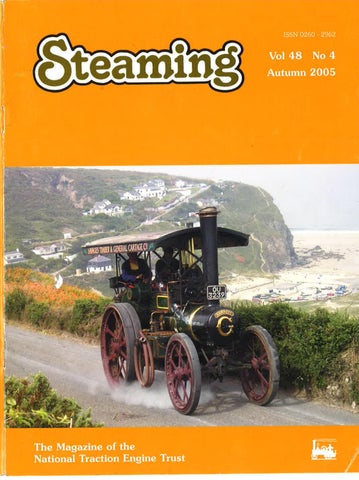
Front cover
Published by the National Traction Engine Trust at 14 Charles Street, Market Harborough, Leicestershire. Printed by AB Printers, 27 Nether End, Great Dalby Leicestershire LE14 2EY
There must, by now, be thousands of images of participants in the West of England club's Road Runs climbing the appropriately named Engine Hill out of Porthtowan in Cornwall. Here we see one of John Cook's pictures from this year's run - Garrett 4CD tractor 35225 of 1929 scampers up the gradient through a brief burst of sunshine, Porthtowan village and beach in the background.
STEAMING
Autumn 2005
183
Trust News (continued from previous page) strength of our hobby. With this extraordinary diversity we will never be defeated by the bureaucrats, as long as these talents and strengths are there. The tougher part comes when you find yourself at the front of the crowd, maybe before a camera for example, and are expected to issue deep thoughts and wisdom on behalf of the steam movement and the people described above. Or to stand up at a dinner and make erudite comments to your companions and entertain them; you see the look of expectation on their faces. You are the chairman! It is expected that you will perform to the required standard. I hope that I have managed to fill some expectations of the membership. It has been a pleasurable experience chairing the Trust; criticism aplenty! But nearly always constructive, and that is gratifying and reflects the support of the members as much as tho occasional compliment. I am grateful for the support given by our president. Giles Romanes is one of the fathers of our movement and remains totally committed to the progress of the Trust, always words of wisdom, usually laced with that special brand of humour that only comes from Doc. I am also grateful to Richard Sandercock, my predecessor, who has also provided many wise words and at times given me confidence to push forward. My thanks go to the officers and committee for their loyalty and support during my chairmanship. I tried their patience more than once, I know. We will be looking forward at the AGM, for the Trust must plan and be ready for the challenges ahead. We all know deep down that we cannot have the largest body of the road steam movement working like an ostrich. The proposed revised structure for the Trust is outlined in this copy of Steaming and will be debated at the AGM. The committee with support from others has developed this plan during the 184
summer; I commend it to you. Robert Herring has devoted much towards the drafting of the plans and has driven them forward. He is standing for the post of chairman at the AGM and I would ask members to consider supporting him to ensure that the re-organised Trust will go forward with continuity, under his leadership, to face the future challenges, of which there will be many. (Andrew Semple, chairman)
From the President The 2005 AGM is looming and because of its unusual potential importance is worth a few extra words on two counts. We shall he saying goodbye to the outgoing chairman, who has completed two terms of office with outstanding dignity, tact, and enthusiasm - thus deserving all our thanks. I would like to see a smooth transfer of responsibility to his successor. There have been huge changes in business practice since the end of the last century, many of which have crept up on us bit by bit, and almost imperceptibly. This alone would have been enough for there to be an occasion to take stock. But any organisation now has to be prepared to answer in court if may be, for every detail of their activities towards any individual - be they a member or an employee, paid or unpaid, at work or at leisure, child or adult etc. Many members of the present committee have devoted much thought and a lot of their own time over the last few years to bringing the late 1900's structure and governance of the Trust up to date to meet the new hidden commitments. Their deliberations have been discussed by the committee, who feel that the report is ready for presentation at the AGM for your constructive comments. (Giles Romanes, president)
Rally Organisers Column Rally Organisers subCommittee Potential delegates for the Rally Organisers Conference which was to be held in late October should note that it will not now be held - though it is hoped to reschedule the event during the spring of 2006. Rally subcommittee chairman Paul Worbey has been concentrating on the organisation and running of regional Safety Seminars for rally safety officers, the scheduling of which had become overdue. Three Seminars have already been held and another three will take place during the autumn. Advices and invitations have been issued via the Trust's existing mailing list of rally organisers, but if any reader wishes to knnw more they can contact Paul or Sue Jackson, general secretary. (addresses inside front cover).
Engine Owners Column Competency and assessors Following my request for contact from members who would like to take on the challenging role of assessor for the NTET Voluntary Driver Competency Scheme, I am pleased to report that I have had a number of encouraging replies. I could, however, still do with a few from up't north, and from the east. In order to become an assessor for the Scheme it is required that you are a member of the Trust, that you take the competency test yourself and if successful submit yourself for further scrutiny as an assessor. Any more for any more, please! (Dave Smith)
Steam Apprentice successes I am very pleased to report that at the 2005 Great Dorset Steam Fair history was once again made. This year, four senior (17 and 18 years old) Autumn 2005 STEAMING
A challenging sight for any motorist to have in front of them — Foden C type wagon 13316 of 1929 settles down to its journey back from the 2004 GDSF to Southampton. John Maund took the picture between Horton and Three Legged Cross on the Monday morning. Steam Apprentices were successful in their competency examination. Of course they could not take their engines out on the highway because of age restrictions but as a result of the help offered by the directors of GDSF we were able to lay out a comprehensive test route in the playpen on Tuesday afternoon. The test route included tight gateways and long chicanes by which the participants could demonstrate their steering and engine management skills. Each of these youngsters, one lass and three lads, performed admirably, with an extremely high pass rate, and, as I said at the Forum in the Trust marquee on the Friday night, they were a credit not only to themselves but to the Steam Apprentice Club. We shall have to wait until the next Rally Organisers Conference before we can hopefully put their achievements into practice. At the Conference we shall ask for the indulgence of event organisers by allowing those apprentices who have successfully taken their competency examination to drive traction engines at authorised rallies, unsupervised, for as long as they display the special A logo on the engine. All of these The Summer issue reported (page 124) the competency examinations that had been held in late spring. Here we see Dave Smith presenting John Durling with his Examiner Certificate after the June committee meeting held at the Kemble rally. STEAMING
Autumn 2005
arrangements are approved by the insurers. (Dave Smith) Traction Engines and the Law There have been several enquiries as to when this book will be updated; it was last published by the Trust as a second edition in 1988. Any member — or anyone with suitable qualifications — who feels they are able to contribute to an update, would they please contact Bob Siddall, vice chairman of the Engine Owners subCommittee — Stud Farm House, Ossingham Lane, Sutton-on-Trent NG23 60R or rgsiddall@aol.com Hon. Safety Adviser Reading, understanding and interpreting Acts of Parliament and Statutory Instruments (regulations) and skill training, requires
experience. Divining the real meaning of long passages, with little or no punctuation, seemingly plain statements followed by a whole string of exceptions, and single words or phrases given definitions entirely different to their everyday meaning requires skill and patience. Furthermore, it is vital to know and understand the whole of any piece of legislation, not to mention obscure judgements of the courts which 'interpret' its scope or meaning. Treating the law like the pick-and-mix sweet counter in Woolworth's can lead to embarrassment at best, and costly legal entanglements at worst. A prime example of a legislative trap for the unwary is to be found in Pressure Systems Safety the Regulations (PSSR). These Regulations split the responsibility for compliance between 'installed systems', for which the user is responsible, and 'mobile systems', for which the owner is responsible. Now, you would think that was plain enough, after all nothing is more continued on page 188
Steaming to the next 50 years The details of the proposal being placed by the National Committee as a Motion to the 2005 AGM Introduction Since the start of 2005 the National Committee, via a select working party, has been examining the structure of the NTET, its aims and objectives and the services it provides to the membership, all with the objective of preparing the management of theTrust for the next 50 years. Following the working party's presentation, and also when reflecting on the increasing number of constraints on the hobby at present and in the future (see the accompanying diagram — 'The challenges facing the NTET'), the National Committee's collective view is as follows: 'Whilst the aims and objectives are fairly easily agreed, and will endure, the structures of the present committees do not lend themselves to effectively managing the affairs of the Trust into the foreseeable future' The National committee agreed that in order the NTET should be the leading authoritative body for the movement the Trust should endeavour to be more professional in its assertions and treatment of topics
likely to impinge on the future well being of the fraternity. Of particular concern was the operation of the National and the Executive committees, and the perceived lack of delineation between the two by lay members. It was noted also that the number of members sitting on the National committee, outnumber the total numbers making up the working or sub-committees. It was concluded that the services provided directly to the membership, whilst wide ranging, would benefit from being managed from a common point. Subsequently the National committee decided that in order to effect these important changes it should make proposals to the AGM. The formal proposal is of necessity a brief statement and in itself cannot convey all of the implied details of change, and therefore the significant features are described here. These notes should be read as the reasoning behind the formal motion under Article 16 of the Trust's Constitution that is included in the Agenda in the Report and Accounts distributed with this issue.
Working detail of the proposals to the 2005 AGM The National committee will continue to consist of the Executive committee, members elected by the AGM, and also holders of honoraria; the latter having no voting rights. However, all existing members of the National committee will be assigned to a sub-committee or management unit of their preference. Any new member being elected to the National committee will automatically be assigned to a subcommittee of their preference. Official observers from other relevant heritage organisations will continue to be invited to sit with the National committee. Observers will have no voting rights, but will be expected to contribute to any relevant business and receive the papers. The chairman of the National committee, and hence the NTET, will be voted into office at the AGM. Tenure will, as now, be for three years. It shall be open to the National committee, or any member, to nominate a candidate for election. There should be two Vice chairmen as now. However, they shall each be a chairman of a subcommittee (working group). The vice chairmen will be nominated by the National committee, and their nominations will be ratified by the AGM. The National committee will normally meet only three (3) times a year at the following occasions: • pre AGM management meeting — October • post AGM chairman's meeting — FAhniary
Leplalarm User Etlucuir.
,
This Is the NTET
186
MLA - oa Road Lisa
Membef ship
• accounts adoption meeting — June A new sub-committee, or management unit — Membership Services — should be created. This would manage the business of the following areas: • membership administration • sales and exhibition unit • Steaming magazine • archives • website A new sub committee, or management unit — Technical Services — should be created. The objective of this unit would be to provide or to locate the source of appropriately qualified expert opinion to assist the Trust in formulating the policies that provide objectives of the sub committees. The areas of responsibility would be: • health and safety • insurance • technical standards • legal • local and regional government Autumn 2005
STEAMING
Poseidon* end Vice Presidents
Patrons
National Committee Observers FBHVC RLS RRA Sentinel Club Steam Plough Club NVTEC
Engine Owners
Rally Organiser.
Steam Apprentice Club
Technical Services
Membership Services
Meet as wombed dements
Vice Chair
Chair
Vice Chair Executive Committee 1 x Chair 5x Heads of Dept (2 VC) Treasurer General Secretary Public Relations Officer
Treasurer
Executive Committee
Oen Sec
Meets every 2 months PR
Proposed NTET Organisation Structure August 2005
The total number of subcommittees, or management units would then be five (5). Each subcommittee or management unit will meet as workload dictates, but not less than twice a year. Formal minutes will not be required to be taken, but notes must be made of any decision reached that modifies existing policy, or requires the introduction of new policy, or impacts upon the work undertaken by another group. These will be referred to as Business Notes. A new post of Public Relations Officer should be established, The appointed person should work closely with the chairman of theTrust, and will be the single point of initial contact in the event of media enquiries and incident management. Membership of the Executive committee will be revised to include the following: • the NTET chairman • chairs of the working groups (5) • the General Secretary • the Treasu rer • the Public Relations Officer The Executive Committee will meet six times a year and its remit shall be the day to day management of theTrust's affairs, as mandated via the AGM to the National committee. However, the Executive committee should also have a watching brief on those matters that are likely to have an impact on the status or the reputation of the Trust and/or impact on the hobby in general. In addition to the working conversations that ensue between the sub-committees and the chairSTEAMING
Sub-Committees Management Units 1 x Chair Members of National Cosurnryee Adopted members
Autumn 2005
National Committee Chairman a 2 VC's + All of Executive + All elected NTET Committee MectIbOre + Holders of Honiraria (Non Voting) o 'Observers' (Non Voting) Meets 3 nine imam" Agin Strategy - Ockber Peal Agrn - February Accounts Adoption - June Members elected at AGM and must become a Member of a working group
man of the NTET, the chairman of each sub-committee shall submit a formal written report to the Executive committee which should be timed to coincide with each of the Executive meetings. The sub-committee report, which must make reference to the Business Notes of that group's meeting, will be re-distributed to all those eligible to attend the National committee. Note:The revised structure and make up of the proposed committees and working parties are shown in the accompanying diagram 'Proposed Organisational Structures', and the chain of command is simply portrayed in the accompanying Structure, 'NTET diagram Relationships'.
Sets Agenda
Membership
ell•kode
Creates Mandate
^own* National Committee
Determines Policy
Executive Committee
Manages Day to Day
farad.; Pokcy Rows back
NTET 81,41CIWO • nalalionships August 0005
A policy log should be created into which those items voted upon at the AGM and National committee meetings, and which constitute a revision of policy or the introduction of a new policy, should be recorded to afford easier referral. The current Operations Handbook should be revised to reflect these proposals and in particular will include: • the aims and objectives of theTrust. • the scope of responsibility and a description of the working of each committee or sub-committee. • a description of the work and procedures adopted by each officer holding a nominated role, e.g. Membership Secretary, General Secretary etc. • the limit of delegated financial authority that is assigned to the chairmen of committees and to holders of nominated roles, • the policies of theTrust. • a bibliography of pertinent reference sources. • a description of the operation of the charitable status within the Trust. Consequently, the Articles of Association should be reconstructed to reflect the outcome of these proposals, and re-submitted to the Charities Commission for approval. Conclusion If adopted by the AGM the National committee recognises that in the light of experience, working modifications to the proposed structure may be necessary and therefore the National committee will keep this under constant review and report back to future AGMs as necessary. 187
continued from page 185 mobile than a traction engine. Not a bit of it; tucked away in the definitions section, we find that mobile system does not include 'a pressure system of a locomotive'. So now you know! James Blenkinsop got caught in this trap when writing for the RingAround Column on page 72 of our Spring 2005, in relation to the requirement to mark mnhile systems 'legibly and durably' with the date when the next examination is due. To put the record straight, portable engines - and only those used at work - are required to be so marked. Traction engines, steam rollers, etc, being locomotives, are not. Changing the subject, there was a new angle on the lead joints saga in Charles Daniel's letter in our Summer issue, where he related the near complete failure of a lead joint in a handhole in the smokebox tubeplate of his engine. This, he tells us, occurred Mills!. climbing the hills of Cornwall. Investigation showed that the upper part of the joint which was above water level had melted, until only a very narrow strip of lead remained. This last piece of information is puzzling. If the tubeplate and door above the waterline got hot enough to melt lead, I would expect the whole lot to have gone, rather than leaving a narrow strip. Could it be that the lead was eaten by some electrolytic or chemical action? Metals behave strangely at the junction between the water and steam spaces - for example the severest pitting usually occurs along the water line. Perhaps it would be worth looking at the makeup of the feed water and to have a review of the water treatment in use. This will be my last report as an officer of the Trust. Following the abolition of the Technical Board in April this year, I had hoped to carry on in my original position as honorary safety adviser, but I am not prepared to be associated with the way in which some of the Trust's activities continue to be administered, and with the policies and administrative systems now being put into place. Consequently I intend to resign all connections with the Trust's activities, other than perhaps to write the occasional article for Steaming. (Jim Newnham, Hon Safety Adviser) Accidents with Road Rollers Something's wrong at the mill. Over the past 30 months we have seen three very serious accidents and 188
one very near miss take place around steam rollers. These have included two runaways (one of which ended in the garage of a house); serious damage to a hand and a leg amputation. Although the statistics don't properly reflect the number of miles covered by engines out and about on the highways, it is not surprising that the insurance companies are becoming concerned at the conduct of crews who take road rollers onto the public highway. It is not my role to seek to apply blame, but I would ask that crews of road going engines take a long hard look at the tools they carry, the techniques and level of teamwork they employ when gear changing, ascending and descending inclines and the degree of general all round traffic awareness they exercise. (Dave Smith)
From the Treasurer The accounts of the National Traction Engine Trust for the year ended 31st March 2005 are enclosed with every member's copy of this edition of Steaming. These accounts include the costs associated with the celebrations held for the Golden Jubilee of the Trust. The display at Great Dorset Steam Fair of 50 Rarely Seen Engines cost us a total of £15,368, and the Road Run at Hollowell cost £12,150. These amounts have been offset in the
advising me that the cost of the low loader insurance policy offered by Footman James & Co Ltd is being substantially undercut by the NFU scheme. Whenever I get advice like this I always try to compare the policies on a like for like basis before I make comment, and I often urge caution because 'you only get what you pay for'. In order to check things out I have been in touch with the NFU; I have, of course, access to the FJ scheme. So far I am still waiting a reply from the NFU, and therefore I have not been able to arrive at any conclusion. (Dave Smith)
Steam Apprentice Club Once again we have had a successful Dorset, forming a prominent part of the NTET marquee. Unfortunately we couldn't have the IT facilities this year following the tragic loss of Graham Tucker, and the transport difficulties with our new web man, Steve Taylor. The activities side of the GDSF this year was very well supported by both Apprentices and the engine owners or drivers. Problems of communication within such a big site caused us to cancel events on the Thursday morning,
accounts by f17,2AR from the
Commemorative Events Reserve, and £2,866 from the Road Run Reserve. A transfer of £5,000 has been made in the current year to the Exhibition Unit Reserve, which will be used to replace the exhibition unit in due course. The operating costs of the Trust continue to rise year on year, but the overall financial position of the Trust continues to be sound as we look forward to the next fifty years. (Julie Smith, Treasurer)
Insurance Notes Low Loader Insurance Value for money - I have received a number of calls from people
Emily Drury from Nottinghamshire, with John Durling and the Antells' Robey, after gaining her Certificate of Competency at the Dorset event. Autumn 2005
STEAMING
perhaps a little hastily. However, I think we made up for it during the cavalcade in the evening, with 23 engines and over 70 Apprentices taking part. Once again the task of placing Apprentices with engines proved to be difficult, with most engines bringing their own crews. We are giving serious thought to alternative activities for the attending Apprentices to take the pressure off the crews - any ideas will be kccnly received. One area which can definitely be described as a success is the Certificate of Competency. Dave Smith and myself between us examined four youngsters aged 17 and 18. We had no hesitation at all in passing the four: Dave commented that the two lads he tested have set a very high standard for others to follow. The successful candidates were Emily Drury from Nottinghamshire, Martin Treanor from Derbyshire, Graham Lynn from West Sussex and Simon Stearne from Hampshire. These four were selected by invitation in order to initiate the certification process within the SAC. It was only made possible by the cooperation and encouragement of Martin Oliver and Dave Allen of the GDSF. I have already received requests from other SAC members to undertake this exam, and will welcome more.The next stage in this process is to allow successful Apprentices to reap the benefits of this certification at rallies. David Smith's notes in the Engine Owner's columns give more details on this aspect. We also presented several of the SAC's annual awards and prizes at the show. • The Sylvia Dudley Anniversary Award for the Best Dorset Apprentice was presented to Peter Sweet, for his work on Dave Smith's Burrell KEELING. We give thanks to Steam Traction Engine magazine for the offer of an annual subscription as a prize. • The Dorset Shield for Photography to Scott Birchfield, with an annual subscription to Old Glory as a prize. • The Colouring Competition was won by Faye Lane, who received a prize from Paper n' Steam. • The Living Vans made to the design published in Raising Steam were judged by Brian Wells and first prize was awarded to Claire, who received a £30 voucher from Forest Classics and a CD from the Wells family. I thank all Apprentices and their families for supporting the section's activities at the Dorset event, and STEAMING
Autumn 2005
An excellent example of the 6hp single cylinder agricultural engines sent out from the Steam Plough Works at Leeds about a century ago - Fowler A4 class 11357 of 1908 poses at the Bedford club's Old Warden event in September 2004. (John Maund)
then especially give my personal thanks to those who made it all work during the five days - Elaine Massey (my vice Chair), Kevin Munn, Graham Chaffer, Nigel Goddard, Gareth Kevin Haase, Robert Kimber, Lawrence, Matt Lund, Jan and Nathan Tucker and Nanette Sanders. To conclude this report I realise that this will be the last chairman's notes that I will write holding that position in the Steam Apprentice Club. I took over from John Bosworth in 1996 and have overseen a growth of the club, both in terms of numbers of members and also the adult team that manages it. Without the latter the club would not be the success it is today. I now feel that it is time I should stand to one side and let someone with some new ideas come forward; this person is Kevin Munn. Kevin will be known to some of you as the man who sorts out who should be where at the NIET Driving Courses. He works as Elh etigineer for British Airways, is chaiirnin of his local school Board of Goyettiors, and owns the Aveling & POrter roller KATE. I hope that you will give Kevin as much support in the future as I have received in the past. (John Durling, chairman, Steam Apprentice Club)
FBHVC News The Federation of British Historic Vehicle Clubs' general committee met on 19th July 2005. The following records the salient points as far as the Trust is concerned. Local Emission Zones - This refers to the creation of zones in traffic areas where certain restrictions might apply to vehicles not meeting a set standard of emission. However, it should be noted that such a restriction is expected to apply only to petrol and diesel fuelled vehicles. Waste Framework Directive The proposed regulations are yet to appear. Lost Registrations - The introduction of the new registration documents (V5C) has caused an unfounded concern that vehicles (engines) may not be able to have their 'lost' registration mark recovered. The effect is that the V765 scheme has been overwhelmed by applications. Accordingly current delays may now be expected for those applying under this scheme. Vehicle Registration Charge Despite the Early Day Motion in parliament, and the petition to No 10, the government has not responded to our post election enquiries. Apprentices Steam Considerable interest was shown by the FBHVC's general committee on the operation of our SAC scheme. I 189
have asked John Durling to provide information to Rosy Pugh, the FBHVC Newsletter editor. (John Billard, Trust representative to the FHBVC) An important FIVAIFBHVC survey The loose insert with this Autumn issue of Steaming is a survey form produced by the FBHVC. This isn't just another piece of junk mail - we are including it to you at the Trust's expense because it's important. Do please take the time and trouble to complete it and return it to the Federation. It is important because we can't just take for granted the freedom to
use old vehicles on the road: in today's world of ever increasing regulation, we have to fight to maintain that freedom - if we don't, we'll lose it. And that's why the FBHVC was set up: the National Traction Engine Trust is one of over 350 clubs in the Federation. FBHVC protects our interests by engaging with legislators and regulators to ensure that nothing is done to jeopardise the all important freedom to use our vehicles. Representation in Brussels is undertaken through the Federation Internationale des Vehicules Anciens (FIVA), and FIVA employs a professional lobbyist to monitor output from EU on behalf of FBHVC and all other EU Federations.
The National Traction Engine Trust's
2005 AGM will be held at 2.00pm on
SATURDAY, 19th NOVEMBER 2005 at The Conference Room, Ramada Loughborough Hotel High Street, Loughborough, Leicestershire Please refer to the formal notice in the Rebut and Accounts which is distributed with this issue for details of the agenda etc, and to the other notes on this page for the arrangements that have been made for the rest of the day c,,rrky.
The AGM We continue our custom of holding the Trust's Annual General Meeting in different areas of the country in successive years - for our 51st meeting we travel to the East Midlands, to the Ramada Loughborough Hotel at Loughborough in Leicestershire. The hotel is in the centre of town, and as well as being the venue for the formal meeting in the afternoon, will be available for members who wish to stay the weekend, and attend the formal dinner on the Saturday evening. The Trust's 2005 AGM is at 2.00pm on Saturday, 19th November in the Conference Room at the Ramada Loughborough Hotel, High Street, Loughborough. High Street is the main thoroughfare leading to the 190
south from the square in the centre of this old market town. Those coming to the AGM by car (the rail station is about 15 minutes walk) are advised to use general pay and display parking in the town centre - the Beehive Lane car park is within a few minutes walk of the Hotel. Formal notice of the meeting, the Agenda, and the Annual Report are distributed with this magazine. In the event of voting being necessary at the AGM only current members are, of course, eligible to vote. Members should therefore ensure that they have with them at the meeting their current membership cards as evidence. The names of the nominees for positions of officers or committee members of the Trust, together with any Motions under
For the last eight years, FBHVC has been supporting its discussions with UK government with data about the historic vehicle movement in Britain that was collected in 1996. No further data has been collected since, and no similar data has ever been collected in any other country, which means that the only figures available to the FIVA lobbyist are both out of date and partisan - distinct handicaps in negotiations with European institutions. FIVA has recognised that it has to put that right, and the survey questionnaire presented now for you to complete as an individual member is the first step in a major project to collect essential economic data about
Article 16 of the Trust's Articles of Association, will also to be found in the Report & Accounts. At the conclusion of the formal meeting, about 5.00pm, tea, coffee and biscuits will be served. A selection of the Trust's trophies and shields will be presented then, or other appropriate times during the weekend's activities. Val and Colin Brown will as usual bring a good selection of the more appropriate items from the NTET Sales Stand. If you want to ensure a particular book, video or DVD or sweater is available, for Christmas or a birthday, please order via the Mail Order address end ask for your purchase to be brought to the AGM, when it can be handed over in a discreet manner, or otherwise. The Saturday morning A visit has been arranged on Saturday morning, 19th November, that will attract the interest of many members - to the John Taylor Bellfoundry Museum in Loughborough. There will be a conducted tour of the Museum (it lasts over an hour) which includes a visit to what is the world's largest working bellfoundry, though casting only takes place on a Thursday. The visit starts at 10.00am; there will be no charge to members, but with a limit of 50 persons, advance booking is necessary. Please advise Robert Herring, using the form (or a copy) below. On the day, follow the brown tourist signs to the Museum that are present on all roads near the centre of the town. Staying for the weekend For members who wish to make a social weekend around the AGM, a Autumn 2005 STEAMING
the historic vehicle movement in this country.The same thing is happening in nine other EU countries, so that by summer 2006 the FBHVC will have up to date information about the historic vehicle movement in UK to back its arguments in Westminster, and FIVA's lobbyist will have data from across Europe to support his case in Brussels. Some of the questions about spending and income may seem over-personal, but they are important and there is no need for respondents to identify themselves. FBHVC guarantees that the individual forms will be treated in total confidence and only anonymised, general statistical data will be published. The FBHVC
committee believes that without new data, based on a wide sample and credible analytical techniques, the struggle to maintain the freedom of the road may prove impossible. Please do your bit to make sure that FBHVC can go on fighting for your right to drive old vehicles on the roads of Britain — and the rest of Europe. (FBHVC)
Ralph Fear Born in 1921 Ralph Albert Fear
was a countryman all his days. His working life started as a gamekeeper and agricultural worker, and during World War 2 he was a tractor driver with the Oxfordshire 'War Ag'. With the end of hostilities he went on to pest control, and during this time met Connie; they married and moved to Nettlebed, which was home for the rest of his days. Soon, along came their only child, Carol. Ry this time Ralph had joined the National Health Service as a laboratory assistant at Peppard Chest Hospital; the Thames Valley Traction Engine Club and the NationalTraction Engine Club had been formed, and Ralph was an early member of both. In 1968 he bought the Fowler roller
block booking of rooms for overnight accommodation has been made for the weekend of the 18th to 20th at the Ramada Loughborough Hotel at Loughborough. Single, double or twin rooms are available at a special NTET inclusive rate of £30-00 per person per night with breakfast (Friday and/or Saturday). Members should make their own reservations direct with the Hotel (17 01509 233222) — please ask for Gary, mention that you are an NTET member and quote reference G207.
ready at Loughborough station to take our seats at 12.45pm for departure at 1.15pm, steam hauled of course, to cover the whole eight miles of the line to Leicester North. After twenty minutes or so we then return to Loughborough, arriving at 2.45pm. As there is a limit of 42 persons, advance booking and payment is essential. Tickets are priced at £32.50 per head, and this includes unlimited first class train travel on the Sunday, and the four course traditional Sunday luncheon — which is considered locally to be a very superior experience. Join your friends in this very old-fashioned pleasure of fine dining, served by liveried stewards, aboard a steam train through the Leicestershire countryside. Alternative vegetarian
requirements can be pre booked, and an extensive range of wines, beers and spirits will be available for purchase from the stewards. All accommodation in the restaurant cars is non-smoking. Please advise Robert Herring, using the form (or a copy) below. For any members not joining the dining train but wishing to travel on the GCR, an arrangement has been made for the Sunday (only) that on production of their current NTET membership card, members can obtain a £5.00 concession (£3.00 for children) on the normal full-line ticket price; this covers unlimited travel on the day. The Committee hopes to see a large number of members at the AGM and over the weekend.
The Saturday evening On the Saturday evening there will be a formal dinner in a room, private to the Trust, at the Ramada, at 7.30 for 8.00pm. Tickets are available £23.00 per person (the number is limited to about 100). These must be booked and paid for in advance — please advise Robert Herring, using the form (or a copy) below. We are pleased that Michael Lee. a former director of the Great Central Railway, Trust member and engine owner, will be our speaker on the evening. On the Sunday On the Sunday morning, 20th November, there is the opportunity to visit the Great Central Railway, one of the country's leading volunteer-run preserved railways. Here will be a chance to see how a different type of steam engine is rebuilt and maintained in working order. The usual visiting public access to the station and running sheds will be available via the Station; platform ticket entrance fee payable on arrival. The Trust has taken the block booking of one of the first class restaurant cars on The Elizabethan dining train. We shall have to be STEAMING
Autumn 2005
Obituaries
The National Traction Engine Trust Annual General Meeting 2005 I wish to be present during the AGM Weekend on the visits or occasions that I have marked below, and enclose a cheque, made payable to the National Traction Engine Trust, to cover the required sums. • Visit to Bel'foundry Museum, Saturday morning, free but booking essential number tick yes • The Trust dinner, Saturday evening, £23.00 per head
tick yes
number
• Sunday luncheon on GCR, £32.50 per head
tick yes
number
Name(s)
NTET number
Address Telephone number for contact if necessary Return this form, or a copy, and remittance to Robert Herring, Glebe House, Fringford, Bicester, Oxfordshire OX27 8RJ by Saturday, 12th November, 2005 at the latest — remember places are limited and it is first come, first served. Please include an SAE for your confirmations.
191
This is Wain fleet, Lincolnshire just after World War 2, and the Burrell showmans road loco is perhaps near the end of its working life. Member G Brown photographed it in 1946 or 47 — the latter most likely — when the engine had been left behind after a fair in the town, and still with an extension chimney in place. He had no time to examine further, but the machine had gone the next time he was able to go there. It was John Barlow's Amusements' Bhp Burrell 3932, which had been new in March 1922 (FE4661) to F Warren of Lincoln, one of the very few examples of this larger size of the maker's showmans engines of the 1920s that was not sent out from Thetford as a scenic. Warren used it for 21 years, and the Burrell then passed to Barlow, based at Metheringham, halfway between Lincoln and Sleaford. Michael Lane, in his books, records that Barlow named it BILL BARONY, but here we see just the Christian name, somewhat lost on the side plate. Neither was it a very imposing appellation for such a grand engine, but perhaps a member of the Barlow family had been proud to take the honour.
UNDAUNTED. Due to a road accident that kept him from the engine it remained sheeted in the garden of his secluded country cottage for nearly two decades. During this time he had taken employment as pest control officer with Oxfordshire council, a job he stayed in until retirement. Outside work Ralph kept chickens and, hearing of the fate of the donkeys at The Pack Saddle public house near Reading, he became a donkey keeper, a task that was to continue for many years. By 1989 his Fowler roller 17506 was restored and 192
on one of his proudest days it was shown to members of the Thames Valley club on their annual road run. The same year he was awarded the Mercury Cup at Woodcote Rally, and the Fowler Shield by the Thames Valley club. In the mid 90s on its debut at the Great Dorset Steam Fair, UNDAUNTED was honoured with the Arthur Field Memorial Trophy for the best working roller at the show. With failing health Ralph parted with the roller but remained interested in what was happening locally and further afield in the world of steam preservation. After a short illness he
passed away in April. He was buried at St Bartholomew's Church in Nettlebed. Ralph is survived by his wife Connie and his daughter Carol, to whom we send our sympathies. (Robert Cox) Ian Muir With great sadness we learned of the death of Ian Muir on 9th May 2005, after a protracted struggle with ill-health. Ian was a founding father of the traction engine movement, arguably doing more than any other individual to rally support for a traction engine society in Scotland. Sadly but inevitably, those with an intimate association with the birth of the Scottish Traction Engine Society are now diminishing in number. Ian's funeral was held in Greenock, where for some years, he had been resident in a seamans home.The address was given by his lifelong friend and fellow steam enthusiast Jimmie Drummond. Jimmie has consented to some of his material being used in this appreciation. Bred on Clydeside, Ian was smitten by the 'steam bug' at an early age — in the 1940s and 50s, steam was to be found everywhere and in all forms! Leaving school in 1950, he Autumn 2005 STEAMING
became an apprentice at the local engineers, G&J Weir of Cathcart, a firm fortunately still with us, holding an international reputation. Here he met like-minded individuals, some of whom remained friends for life. During this period Ian made his first foray into engine ownership, purchasing with two friends, one of the last three Lanark County Council Aveling & Porter steam tractors, token out of service in 1961.The price was £60 — at the time a king's ransom to three impecunious apprentices. It was before the traction engine movement began to grow; a time when the purchase of such apparently useless items was regarded by most as little short of lunacy. The engine was Aveling 9183 of 1920 (KE18).The other two partners shortly acquired their own engines, and Ian was able to buy them out, becoming sole owner of the Aveling, now named THE PIRATE. Ian soon acquired a number of other engines, including former Lanark County Council Foden wagon 11444 (converted to a tractor for threshing work), and the ex-Ayr County Council Fowler rollers 21222 and 21635. These were sold on to other enthusiasts; an endearing feature of Ian being his willingness to assist others in their quest for engines without making a huge personal gain in the process. THE PIRATE, in a dismantled state, was sold to that great north of England engine collector, .lack Wakefield, in 1964. By this time Ian was following the vocation of a sea-going engineer and finding that calling incompatible with restoring and running steam engines at home! The 1950s and early 60s was a period when Ian and like-minded friends sought out and recorded surviving engines, often languishing in yards awaiting the cutter's torch. He became a member of the Road Locomotive Society and was a regular contributor to the Journal, writing under the pseudonym 'Wandering Willie. It was clear from these pieces that Ian had a considerable flair for writing. He possessed a droll sense of humour and was an accomplished raconteur with a photographic memory for engine details, works numbers and the like. What treasures were located at this time — for example, the Foden Speed 6 undertype steam wagon derelict in Aberdeenshire in 1952, which could have been bought for £55! During his wanderings Ian got to know many of the engine fraternity in STEAMING
Autumn 2005
Scotland and beyond, and toyed with the idea of forming a Scottish society along the lines of the Road Locomotive Society. The catalyst in these cogitations was the acquisition in 1960 of a Burrell traction engine 2189 by the Tomkins brothers, garage proprietors of Edinburgh Road, Glasgow. The engine was displayed on the forecourt for publicity purposes and became a magnet for local enthusiasts, including the late Jimmie Houston, then of Motherwell, himself before long to become the owner of a Burrell, As a result of discussions the initial meetings of what was to become the Scottish Traction Engine Society were held in April 1961. Honorary initially was Ian Secretary and at the next AGM became editor of the journal of the Society. His close connection with the journal and the later newsletter continued until the early 1970s. Ties were then loosened, though as the writer of this appreciation can testify, he continued to provide information, advice and the occasional article for the newsletter until ill-health made this impossible. By now, spells at sea alternated with periods ashore, but during one of the seagoing episodes Ian found himself coaxed aboard the paddlesteamer WAVERLEY, shortly after this celebrated vessel had been acquired by the Paddle Steamer Preservation Society. The outcome was that he became Chief Engineer on the ship in 1976, and sailed with her for a number of seasons — no sinecure with the ship's well-worn machinery and shoestring budget. It was a high-profile job and Ian became a minor celebrity, even earning an article in Steaming in the Man of Steam series in 1979. During this period Ian was working on a book of his shipping and sea-going experiences. Dinosaur Down Below was published in 1980. Written in Ian's inimitable style, a thread of dry humour running through it, the book was quite a success — much to the surprise of some, including the publisher! Ian continued to write, finding a job as a technical writer for an Aberdeen engineer at one time. He produced material for the journal Marine and for various Propulsion magazines concerned with industrial archaeology. Ian's passing leaves a void in the traction engine movement. He was one of a dwindling band of pioneers who spanned this period between the demise of steam as a working form of power and its resurgence as a hobby
during the 'preservation era'. His experience, knowledge, humour and generosity will be sorely missed. Our sympathy goes to his family and his friends. (Trevor Rees)
Dorset thanks Following the excitements of our 50th celebrations at last year's Great Dorset Steam Fair, it might have been anticipated the 2005 Trust marquee would be a bit dull, or potentially less well supported by visitors or workers. Not a bit of it! We again presented the usual range of facilities to members and enthusiasts with the Sales Stand and Members Hospitality area. Once more, members came from far and near to help run the tent — some as old hands, others as welcome new faces. We hope all found satisfaction from the time and effort they put in, and we thank them on behalf of all members and friends for the work they did. For satisfying the always-there need for tea or coffee we thank
A fresh feature in the Trust marquee at Dorset this year was an exhibition of art, the subject matter, of course, being road steam engines and the characters around them. Artists Robin Wheeldon, John Hancox and John Wigston together presented a gallery of over 40 original watercolours, oil paintings and pen or pencil drawings. The large sign outside the marquee ensured a goodly succession of visitors, and a surprisingly high number of the exhibits were sold by the time the show closed on the Sunday. It is hoped to repeat the exhibition at next year's Dorset. 193
Wendy Chapman, Angela Head, Mary-Lyn Hill, Christine Giddings, Jan Greenhough, Sally Humphrey, Charlotte Keeley, Irene and John Kelly, Shirley Manning, Fiona Rashleigh, Dulcie Stagg, Gill Stewart, Maureen and John Street, Gill Stoneman and Steve Wagstaff. Thanks must be recorded too for the excellent support that members (and of course their friends) gave to the donations bowl - we make no charge for the tea or coffee in the Trust marquee at Dorset, but the membership in general can be assured that the contents of the bowl do exceed the cost of the materials used and then go on to help with other expenses in the tent. Colin and Val Brown's sales area again proved busy with members and the general public spending well to assistTrust funds. For help given at the sales area, we acknowledge the efforts of Carolin Congreave, Nick Greenhough, Peter and Sue Howard, Paul Shergold, Kathy Smith, Steve Snook and Peter Stanier. In recent years we have had a smaller full-size engine and miniatures within the Trust marquee, and this is seemingly appreciated by visitors who are perhaps a little intimidated by a larger in steam engine when they want to study the construction at closer and lower quarters. Thank you this year to Roy Wakefield, Pat Jenkins and Chris Parker for allowing their machines to
be cooped up in the marquee until the Sunday, and for performing a task of education. Finally, we gratefully record the many hours that are given before, during and after the event - both directly and in support- by the wives and families of thoseTrust committee members who arrange the GDSF marquee.
Future Dates Annual General Meeting - the details of the AGM on 19th November are set down on a separate page in this issue. Rally Organisers Conference, which was to be held in October, will not now be held - see the Rally Organisers column for more detail.
New Members We extend a sincere welcome to the following new members who have joined the Trust during the last three months. We hope they will gain much friendship, information and enjoyment from their membership over a period of many years. Full
Foden C type estate tractor 13484 of 1930 - or is it 13200 of 1926? - pictured at the Chiltern rally in July 2005. (Roger Newbury)
194
addresses are not included, but the Membership Secretary is always pleased to put members in touch with one another by forwarding mail. C Gale, Rothbury, Northumberland S Williams, Redditch, Worcestershire A Davis, Redditch, Worcestershire M Ansell, Birmingham FTedd, Grantown on Spey, Scotland N Seymour, Cranbrook, Kent Mrs B Seymour, Cranbrook, Kent N M Lafford, Wellesbourne, Warwickshire R Kitts, Watford, Hertfordshire S Hudson, Leeds, WestYorkshire I C A Graham, Solihull, West Midlands F E Boshier, Hitchin, Hertfordshire J A Hinman, Moreton Valance, Gloucestershire G F Rudd, Kings Lynn, Norfolk R W Newman, Salisbury, Wiltshire R Garth, Crediton, Devon M L Hadfield, Worksop, Nottinghamshire T Sanders, Wellington, Shropshire T Martin, Bolton, Lancashire A J Thackeray, Sudbury, Suffolk P J Dyson, Bognor Regis, West Sussex D Gynn, Lifton, Devon P J Ede, Liskeard, Cornwall T Nicholls, Penzance, Cornwall S Mattes, Ostrach, Germany S Hawkins, North Canterbury, New Zealand C H Hawkins, Bristol S Rodenhurst, Chippenham, Wiltshire S Denny, Bristol L Morris, Kilgotty, Carmarthenshire RTregidga, Redruth, Cornwall M Reeder, Chilwell, Nottingham J Spenceley,Truro, Cornwall C Killen, Wadebridge, Cornwall J Evans, Callington, Cornwall JThomas, Ammanford, Carmarthenshire A M G Robinson, Leighton Buzzard, Buckinghamshire R DT Mosedale, Broadway, Worcestershire N Moody, Poole, Dorset G Waldorf, Bristol S Marriott, Crediton, Devon S Walters, Chichester, West Sussex P Brown, Rusper, West Sussex D Mansi, Uckfield, West Sussex A J Daniell, London B Floyd, Hadlow Down, East Sussex R G Southern, Bedhampton, Hampshire B G Clark, Ashbourne, Derbyshire ATomlinson, Wrexham S Herring, Phoenix, USA M Bermingham, Rathcoole, Eire S Chapman, Cranborne, Dorset T R Pinks, Gosport, Hampshire MT Bailey, Chideock, Dorset E J Taylor, Chideock, Dorset D P Green, Gt Missenden, Buckinghamshire STraill, Redruth, Cornwall C Alexander, Staines, Middlesex N A J Berbee, Breezand, Netherlands M J Culver, Abingdon, Oxfordshire W A Charlton, Knutsford, Cheshire T May, Stonehouse, Gloucestershire A Milnes, Bicester, Oxfordshire D Freeman, Rugeley, Staffordshire S R and R Beat, Rotherham, South Yorkshire J and K Christensen, DK-8472 Sporup, Denmark Autumn 2005
STEAMING
Poor Steaming The caption to the fine night-time photograph of Burrell 3896 EARL BEATTY that appeared on page 7 of our Winter 2004/2005 issue needs correction. It seems the claimed date of 1921 for the Penzance picture has been published before, so it is as well thatTomo Thompson, in carrying out research for the painting, lining and writing he has recently completed on the engine for Robert Coles, can make the following comment. From the study of other contemporary pictures (many in the collection of Peter Parrish) the engine as shown by our illustration is not presented in the style it left Burrell's works in 1921, but has the paintwork it bore from 1926. The lettering to the awning has been redone in Anderton & Rowland style, somewhat different in detail from the Thetford work. Further, the large headlight at the front does not seem to have been an original fitting. Eric Wilson, owner of Wallis & Steevens Advance roller 8088 which featured on page 167 of the last issue, wrote to say he was pleased to see the picture, but pointed out that it is of 8 tons weight, not 10 tons as mentioned in the caption. Eric, of course, tan see that figure, along with much other information, set out on the front plate casting on the roller, just in front of him as he drives. Our data had come from Traction Engine Register - well respected by us for its accuracy, but
reflections on our magazine of 25 years ago
The September 1980 issue was the last in A5 format. It was stated that the next issue would be to a larger size to better reproduce old photographs. The issue had a strong north of England bias, with most of the main articles relating to that part of the country. An article by George Lea, 'Threshing the Cheshire Way', combined his reminiscences with the history of threshing machines and associated machinery. Who has heard of the peg drums that STEAMING Autumn 2005
in tens of thousands of figure-based facts in its pages there is scope for a lurking error. Derek Rayner recently had the opportunity to look through the Wallis records at the Rural History Centre at Reading University. The relevant pages for 8088 confirm the 8 tons, but also give other history which will be interesting to put down along with this correction. The roller seems to have been built for stock, probably sometime in the early part of 1933, and it went off to be exhibited, on 13th May 1933, at 'Belfast Show'. The word Special bracketed after '8Ton Advance Roller' may indicate special attention given to the finish for this show. But there is a missing year between the exhibition and Wallis's recorded order date for a customer of 4th June 1934. The machine is noted as 'Let on hire to Messrs Mitchell, Nutt & Colgan, Claudy, Co Derry'. Because the whole of the entry in the ledger is written up in one hand, and therefore probably all at the same time, its not clear if this hire was during 1933/34, or starting from the later order date probably the latter, for the roller was not even registered for road use (CG4250 - Hampshire) until 2nd July 1934. Also, there is included the note on the supply of two cast brass plates on the motion guards for the new users (they still adorn the engine), 'these plates were sent free, in exchange for our 2 W&S plates'. It would seem after the Belfast Show
8088 spent nearly thirteen months stored somewhere in Northern Ireland, awaiting a customer, or at least someone willing to pay for its hire or hire purchase. If the roller had come back to Basingstoke, surely the makers would have had no need to note the fresh plates were 'sent free', and that they prudently and their own economically had examples returned. This was the 1930s, and times were hard!
preceded the concave and beater bar type, and why are the peg drums known as ground-hog threshers in the US? Mr Lea also complained about the term 'straw walker', saying they were 'shakers'. Is this another term corrupted in preservation, or just a regional name? Other northern articles were the continuation of Percy Dabbs"Tar Spraying and Other Tales' and the final part of Michael Lane's 'John Fowler and the Company he Founded'. An interesting article reproduced from The Commercial Motor of 1905 'An Early Leyland Motor Wagon' by James Sumner recounted his trials and tribulations with a self built undertype in 1884. He had built it for a particular journey to replace the horse and cart that could do two trips a day, but with the wagon he only ever managed one, not helped by it needing water every couple of miles. The area notes reported
numerous wet rallies through the summer, something that we have fortunately generally been spared in 2005. The notes also reported that Merseyside Museums' Wallis & Steevens roller had taken 8 hours to do the 12 miles to the Haydock rally being restricted to 301bs pressure following the eleventh hour fitting of a new firebox. One has to question what sort of boiler inspection it had to have such a low operating pressure - and the sense of taking it to a rally, let alone by road. The Wales notes reported that Aveling & Porter roller 8794 in Ynys Angharad Park in Pontypridd was continuing to deteriorate, but was still salvable.This machine made its non-steamable debut at Dorset last year, and has been in steam at several shows this year, including Kemble, where it followed the exPontypridd UDC Wallis Advance 8112 round the ring on the Sunday. (Stuart Gaines)
'Worcestershire. - A communication has been received from the clerk of the County Council of Worcestershire, stating that his Council have refused to accede to the request of the Great Western and Midland Railway companies to close a number of their bridges to steam haulage. The result was felt to be most satisfactory in the interests of the Association.' (from the National Traction Engine Owners' and Users' Association column in Implement and Machinery Review, 1st October 1904. The concerns of the railway companies of damage by heavy traction engines to over-railway bridges was the reason for many bridge parapets bearing cast iron plates warning of prosecution to erring drivers or owners. Few of these plates survive in-situ one hundred years on.)
195
Preserving our heritage in steam on the road
From a Burrell to a Sentinel. Rest assured. We'll get you covered. The enthusiasts' favourite for over twenty years, Footman James is one of the leading specialist insurance brokers. With a UK client base of 140,000 owners of classic and vintage vehicles, Footman James consistently
Policies Include as standard
uses its enormous influence to arrange the best
Boiler Explosion Cover Motor Legal Expenses
deal for you. So whatever your pride and joy, you can be confident that with Footman James behind you, you've adopted the best policy.
Multi-Vehicle options available NTET Disc scheme available
Talk to us soon.
Discounted Low Loader rates available
TV e e ctt
111
Personal Accident to include Road Rage and Car/Bikejacking
ur Jervice!
FOOTMAN JAMES Insurance specialists. At your service.
-Tr 0845 458 6788 www.foot man ja mes.co.uk
Authorised and regulated by Financial Services Authority.Telephone calls may be mothered or recorded for your protection.
SPECIAL RATES on modern car, motorcycle, home and contents insurance 196
Autumn 2005
STEAMING
Derek Rayner From my article 'Log Hauling in California in the 1880s' (Steaming, Summer 2002), readers may recall that the origin of the account lay in the discovery of two pictures of Aveling & Porter road locomotives in Butte County, Northern California, not far from the town of Oroville,This community is located about 150 miles to the north-east of San Francisco. The two photographs had been used by American author Jack Alexander of Gilroy in his book Steam Power on California Roads and Farms (1858 - 1911) published in 1998. My subsequent research in the Aveling records at Lincoln had revealed the identities of the two engines as Aveling works number 2146 of 1886 - delivered to the order of George Gable at an unspecified destination - and Aveling 2259 (with under-boiler front tank), which had been supplied by via W C Oastler of New York to the Merrimac Mill Company. It was pictured at the Lumpkin Mill in the same area. Further researches had led me to a book on lumbering: Endless Tracks in the Woods, by James A Young and Jerry D Budy. This referred to an article by Philip Macdonald and Lona LaHore on the commercial activities of one Andrew Martin Leach, and which was said to include a photograph of the Leach residence at Challenge, CA, also showing a traction engine which 'could possibly have been an Aveling'. I followed this up with the book's authors in 1999, but drew a blank on where a copy of the mentioned article might be
STEAMING
Autumn 2005
Needles in the forest — more on Californian log hauling at the end of the nineteenth century (all photographs are courtesy of the Yuba-Feather Historical Association) located, and so the trail went cold, or so I thought at the time. I had long held an ambition to visit California to see one of the earliest surviving Aveling & Porter engines, works number 916, dating from 1873, located near the community of Le Grand. This engine was pictured by Peter Love in the Summer 2003 Steaming.The relic is in Arthur Bright's museum collection,
not far from Merced, some 65 miles to the south-east of San Francisco. Other commitments prevented this visit happening until the summer of 2004, but during the planning of this American break, I decided to include Oroville on the itinerary in the vain hope of turning up something more on the wonderful pair of 10hp Aveling engines of the 1880s in Butte County. I would, if I may adapt a well-known
One of the author's two proverbial needles - the elusive 'third' photograph of what he hoped would be an Aveling engine - showed the Leach residence at Challenge, CA with what is described as Henry South's traction engine in front of it. This image is dated 1892 in the Macdonald/LaHore article. From first glance it is quite obviously not an Aveling. The unusual design, with its inclined single cylinder driving to a crank pin on the flywheel, attached to the side of the boiler, was by the Owens, Lane & Dyer Company of Hamilton, Ohio. An advertisement carried in the Pacific Rural Press in January 1875 illustrated this type of machine, and a slightly different version (said to date from around 1874) survived to be photographed at Angels Camp, Calaveras County, CA in 1948. For belt work the engine had been provided with a shaft across the front of the smokebox, with a pulley at either end, and run by a primary belt from the flywheel. It seems that this engine's task being solely of a haulage nature, the shaft and pulleys have been removed, but the two fixing brackets attached to the smokebox are still there, together with what might be some sort of pump on the far side. The trailer is typical of those used for log hauling in the area.
197
expression relating to haystacks, go looking for needles in the forest. A chance discussion with an British road steam enthusiast in late 2003 revealed a major coincidence that he had a friend in the States who actually lived in Oroville. The friend was asked to help and did so by supplying two very large scale maps of the area, as well as extracts from the local newspapers of 1886/7 from Oroville Public Library. When these arrived in the UK, his message included the information that all traces of the 1880s buildings at Merrimac had gone - there was nothing left, only a sign by the side of the road in the Plumas National Forest! Thus the scene was set for an exploratory Californian visit. With car hire and motel rooms booked, our arrival at Oroville was in blistering heat, so it was good to get inside the library where air conditioning was working very hard. I was disappointed to find nothing for article authors Macdonald and LaHore in their computer system, and a look through the local history shelves brought forth nothing of interest either. I abandoned further searches, pending the planned journey the following day to the spot on the map labelled Merrimac. After a drive of just over 30 miles, on arrival, I indeed found that's just what the place was! A crossroads on the highway to Quincy, where two dirt roads, one from Rogers Cow Camp and the other from North Little Fork, came out 198
Unfortunately cropped at the right edge, but still an interesting scene, this three-wheeled traction engine is at French Creek. The engine is by the Best Manufacturing Company, built in San Leandro, California, and it has two typical trailers in tow. of the forest - no buildings or signs of habitation could be seen at all, just the sign Merrimac. On a sudden whim, I turned the car around, and Challenge, in Yuba County, the home of Andrew Martin Loach, and come 44 miles distant, became the next destination. On the way into the village, down a narrow twisting mountain road, I spotted a sign for a museum, pointing back the way we had come. Stopping outside the store in Challenge, a local sat toying with a cup of coffee. I confronted him with a copy of my Steaming article, plus photos of the Aveling engines and the reference to the Leach residence. He told me that if anyone would know what I wanted to know, it would be Marilyn Devore who was the director of the museum, 'just up the hill'. He gave me her phone number in case she wasn't there, and directions to the museum in Forbestown, which was run by the Yuba-Feather Historical Association and he said to call at the Post Office if all else failed. Back up the hill, we found the museum without problem - but being a weekday it was shut, so the Post Office was the next stop. There, I introduced myself to post mistress Nedra Dubach and explained my quest for the photograph of the Leach
residence and the traction engine included in it. Imagine my surprise when she said "Oh yes, it's a big one, about this big by this big',' gesticulating like a boastful fisherman with hands in the air. Not only did she know of the photo - she knew the size it was. I was over the moon! Nedra looked at the photos of the Avelings in my article and volunteered that the museum had copies of them, and she thought others. My search for that elusive needle in the forest in Northern California had borne fruit. Not only had I found a source of the photograph of the Leach residence, but there were possibly other contemporary photographs! Unfortunately, my elation was short lived as our new friend was quick to tell that there was no way access would be gained to the museum during our unplanned visit to Forbestown. Details were obtained for later e-mail communication, and I would have to wait and see what transpired. Back home, and in the fullness of time, I got in touch with the Forbestown museum, explaining the reasons for my researches. In reply, a letter arrived from Jim Lague, the museum's historian, which contained more photographs and information, Autumn 2005
STEAMING
including a reference to the Macdonald/LaHore article and where to find a copy of it. It had been published in a journal known as The Pacific Historian and a copy would be available from the Library of the University of the Pacific at Stockton, a town we had stayed in earlier on in our 2004 travels. Contact was made with the UoP and, as I waited for a response, the contents of Jim's letter were digested. He had included six photographs, two of an Aveling, three of a huge Best three-wheeled engine hauling lumber, and there was the first of my two needles in the forest — a copy of the picture of the Leach residence, with a most strange looking traction engine outside, but which, unfortunately from my point of view, was definitely not an Aveling. Jim's letter included considerable information about logging on three separate ridges in an area to the north east of Oroville in the late 1880s.These were, firstly, the Bidwell Bar, French Creek, Merrimac and Meadow Valley areas (which were on the road to Quincy); secondly, the Mooretown, Feather Fall and Lumpkin areas and thirdly, in the vicinity of Forbestown, Woodleaf and Clipper Mills. Relating to the first group, Jim confirmed that the first engine to the order of George Gable (called a steam wagon in the local press) arrived in Oroville on 14th June 1886. (The date of despatch from Rochester for road loco 2146 was noted in the Aveling records as 5th March 1886.) STEAMING
Autumn 2005
All over the world timbermen posed for the camera on or around the worthiest specimens of their spoils. But not on their minds for the moment, though seeming impatient to be away, the left background shows a distant view of Aveling road loco 2259, with an empty log trailer behind it. The press described the engins as the 'Great North American traction engine' — despite the machine having been built in England. This is Lumpkin Mill — the capital G painted on the trunks indicates A J Glidden, the contractor who felled the timber and owner of the logs. Glidden is said to be the man on the extreme right. Gable hired a Frank Bean with an eight horse team to tow the machine The bridge at to Merrimac Mill. Bidwell Bar would have presented an obstacle to the progress of the engine weighing 12,0001bs, but it is possible that they forded the river. In May 1891, the engine was sold to Henry South of Challenge, who worked for the A M Leach Lumber Co. On this occasion, during the engine's delivery run to Challenge, when the procession got to the Bidwell Bar suspension bridge, the wheels and some other parts had to be taken off the engine as Ketchum, the bridge keeper, would not allow it to cross in a complete state because of its weight. It had to be drawn in a dismantled condition on well greased rollers and timbers by a windlass — a task which took all day. Moving to the second area, it is recorded A J Glidden's 'Great North American' traction engine arrived at Oroville from England on 30th June 1887. (Aveling's records noted the date of despatch of the second engine, Aveling 2259, from Rochester as 3rd May 1887). Glidden's engineer, H S Curtis, drove it to the Lumpkin
Mill. This mill was owned by Messrs Farnham, Chappell and William Kitrick, the latter being the half owner. Logging was done there by Glidden under contract. By 1892 the lumber market was depressed, and the company was mortgaged for $23,556 and on 10th November 1892 William Kitrick committed suicide. The company was subsequently sold by court order and was purchased by a John Brown. Glidden had assigned his logging equipment to the company, and still owed $4,700. What happened to his traction engine is not known. Regarding the third area, a James RYoung (1876-1923) was logging near Forbestown and was using a traction engine, which may have been what was by now Henry South's Aveling engine. The A M Leach Lumber Company closed in 1892 because of the depressed lumber market. Jim Lague advised that in 1909, the Butte County Pine & Hardwood Company ordered two traction engines for their mill near Clipper Mills. One was to haul logs to their sawmill, and the other to haul sawn timber to Oroville. On 12th April 1910 199
three railroad cars arrived with the two engines and other parts. These came from an engine factory at Oakland, just to the north of San Francisco - namely from the Best company - which only made threewheeled engines. Unfortunately, It Is recorded that these engines continually broke down and the factory had to send up men to make repairs. These engines were very large three-wheelers and as a result, the county road to Oroville had to be widened in places and bridges strengthened to take the weight. They were wood burners and the resulting sparks set off fires along the road, causing them to be altered to oil burners. E A Dickey was the secretary of the company and on 27th
Aveling single cylinder traction ongine 2259 of 1887, in this instance (sec the picture in my previous article) appearing without an awning. This is the Glidden engine at Lumpkin Mill. There are several other detail differences of appearance - notably, the lack of a wooden tool box between the front wheels enables us to see the front axle is made of timber. Being a much sharper view than the one in the Summer 2002 issue, it shows clearly the large size of the maker's brass horse and Invicta scroll on the smokebox door, and what might be a typical Aveling owners plate on the boiler deeding. This photo was originally captioned 'On the way to Oroville. Clipper Mills, Cal. Butte County Pine and Hardwood Co.' Although the engine appears to be the same type as the Best engine at French Creek, comparison with contemporary illustrations indicate it is a smaller machine and of a type made from around 1903 by the D W McLauglin Company at Emeryville, CA, The two major detail differences are in the style of wheel spokes (flat bars rather than round), and a much longer horizontal cylindrical water tank to the front. The accompanying wagons or bolsters - no less than six of them - are mostly neatly loaded with sawn timber and, like the engine, they are also three wheel vehicles.
•
August 1910 he closed the mill for the season, citing too many problems and complaints. Daniel Best, founder of the Best Manufacturing Company, was not reticent on his achievements though totally incorrect - for he is later quoted as saying: "In 1887, I built the first steam traction engine to run successfully anywhere in the world': Perhaps the news had not reached him that in June the previous year, the first Aveling & Porter engine had been delivered to northern California, and was by then working very successfully there, with another on order for the same task. And Avelings, of course, had been building successful traction engines since the 1860s. Jim Lague also sent copies of several interesting newspaper cuttings from mid-to-late 1887, which are worth quoting verbatim. • 17th June - 'A J Glidden and H S Curtis are down from Lumpkin Mill on the lookout for Mr Glidden's steam wagon ordered from England some months ago. A letter has been received saying that it had reached New York some days ago and has been shipped long enough to reach Oroville. It weighs 17 tons and will be used for hauling logs at Lumpkin Mill. John F Rowell, one of the proprietors of the mill went below this morning to see about it'. (This refers to the second engine, Aveling 2259, despatched from Rochester on 3rd May 1887.) • 30th June - 'A J Glidden's 17 ton STEAMING
Autumn 2005
Possibly the same McLauglin engine at Clipper Mills, with logs for the mill. Information supplied by Jim Lague indicated two Best engines were ordered by this firm for different duties associated with the mill - one for hauling logs, the other for planks, so there may have been additional engines around at the time which were not recorded by the photographer. Or it may have been a case of mistaken identity. The clumsy looking wheels are typical of American forest wagons in that the faces were boxed with boards to prevent mud and timber debris accumulating between the spokes.
'Great North American steam engine log hauler' arrived from England last night and will be taken to Lumpkin Mill where it will haul saw logs'. • 29th August - 'The headlight on the engine of the Lumpkin Mill steam wagon blew up on Saturday ... A J Glidden had a narrow escape from being crushed by a large log last week but Glidden and the engine are doing the usual amount of work all the same'. • 7th September - '... on one load, it was reported that the Lumpkin engine had hauled no less than 11,983 feet of lumber, log measure, and it was thought that if trailers could be made to carry it, the engine would probably haul as much as 20,000 feet. The engine is driven through the woods with as much precision as an ox team can be steered and it puffs along as easily as an elephant with a clown on its back'. • 15th November - '... a huge log rolled off a truck, horribly crushing West James and he died instantly'. • 26th November - 'H S Curtis, who was the engineer [driver] on Lumpkin's log hauler, has come down for the winter, the mill having closed
down for the period. Although they didn't start sawing until very late that season, they had piled up about 3 million feet of fine sugar pine. By putting the roads, machinery etc. in good condition and getting an earlier start in the Spring the following year, it was expected that the two mills would saw around 4 million feet each next season'. Some ten years later, on 28th August 1897 there was a newspaper report of an engine weighing nearly 8 tons (between 14,000 and 15,000Ibs that is, larger that the previously quoted weight of the Aveling at 12,000Ibs) being brought from Quincy to Oroville, a distance of some 65 miles, on the very narrow road, and on which there was hardly a level quarter of a mile. Part of the journey was along very narrow mountain ledges, during which the road climbed to over 5,000 feet. Some of the difficulties encountered on the road were chronicled in detail and the three members of crew were much relieved when, after two days, the engine reached its destination. Unfortunately, neither the owner nor the identity of the engine were given 201
rtk _
•r-
'
4-•,1 ti
011.6.
••
-41 slify V
but it was recorded that it was ultimately for shipment (by rail) to San Leandro, which was the location of the Best works, so it may be assumed to have been a Best threewheeler. To return to our 2004 holiday visit, having had the experience of driving along some of the roads in the area, it is clear the area has undergone considerable changes over the hundred plus years since the Aveling engines were in use. There is a huge new dam at Oroville - at 770ft the highest in the USA when built - and this, together with its attendant lake, has dramatically altered the surrounding countryside. New roads have had to be built around the lake and though the area is still densely forested, what is there now is not necessarily in the same place as over a century ago, for the sawmills took considerable acreages of sugar pine in the late 19th century. Eventually, the second needle in my forest, the copy of the MacDonald/LaHore article, arrived from Janene Ford of the HoltAtherton Special Collections in the University of the Pacific Library at Stockton. It revealed the accompanying illustration of the engine outside the Leach residence at Challenge was dated 1892, and it was actually the same image that Jim Lague had already sent me from the YFHA museum collection. The strange looking engine, I found (The
American Steam Traction Engine - a History ofTrans-Atlantic Variety, Kelly, and Encyclopedia of American Steam Traction Engines, Norbeck), was an 202
, — •••• 01471;,711), ••••
A fine scene illustrating the rugged work that must have been the lot of Aveling 2146, though the two empty timber wagons show this is the easy bit. This photograph is at Forbestown, after the engine had been sold to Henry South of Challenge in May 1891. Forbestown is about three miles north-west of Challenge and, at the time, the engine is recorded as being used by James Young. It is not known whether the engine was sold by South to Young, or whether South worked for Young, perhaps on contract. example of the Hamilton traction engine, built by Owens, Lane & Dyer Co of Hamilton, Ohio.The design first appeared in 1873 and was produced ill bind!l liumbeis rim a few years afterwards. Job Owens, incidentally, was born in Wales and had emigrated to Columbus, Ohio in 1824. The MacDonald/LaHore article gave much detail of the business built up by Leach, who generally used ox teams for moving the felled timber from the forest to the mill, but later installed a six mile narrow gauge railway to haul the timber in the Challenge area, with a Baldwin locomotive. The loco was subsequently moved to his mill at Owl Gulch.There is an entry in the diary of one Lizzie Foss from Brownsville dated 7th November 1892: 'Father came home with Mr Leach.The road engine came down from Owl Gulch today for the [railway) locomotive and will move it up to Owl Gulch'. Elsewhere, there is a reference to the wheels being taken off the locomotive and it being towed on a sled or similar to the Owl Gulch Mill. It is not known which road engine was being referred to - but it is likely to have been the more powerful Aveling, rather than the Hamilton engine which was also in the same area at the time. Leach was also responsible for the
erection of log flumes (artificial water channels formed out of timber boards), variously quoted as between fifty and eighty miles in length, to get sawn timber from his mills down to the California Northern Railroad at Moore's Station, where a planing mill was established. Water was redirected from streams and creeks to feed the flume and provide an easy way to transport the wood to markets in the south. Disappointingly, there were no references to traction engines in the article, other than the photograph of the very unusual Hamilton machine, but there were many instances quoted involving fires which razed various mills to the ground. The business was, indeed, a somewhat hazardous one. Janene Ford said there were more photographs relating to traction engines in the collection at UoP, and four images duly came along - one of a Hamilton engine, pictured at Angels Camp, some 55 miles east of Stockton, CA in around 1948, and then three three-wheelers. One of the latter was a Best, the other two being Holt engines, which are of slightly different design, but quite similar to the Best. One of them was captioned as working at Placerville in midCalifornia, some 45 miles south-east of Oroville and not far from Moore's
Autumn 2005 STEAMING
Station. A second letter from Jim Lague containing two more pictures of Aveling 2146 (without its front tank) at work near Forbestown, around three miles from Challenge, and some further information. The letter had been typed by Jim on 29th August and was later forwarded to me by one of his friends, along with a note and a copy of Jim's obituary — for he had died the day after he wrote to me. It was his very last letter on history in the area and I was very grateful to his friend for sending it on to me after his death. His passing was a sad loss to the YFHA and the local historical community in that area of California, for Jim's knowledge of the locality and history skills will be irreplaceable. Thus, with further investigations, and from a bit of luck, more information has been found on some of the traction engines used for logging in California, together with some exceptionally good images of the Aveling road locomotives sent there in the late 1880s. My persistence had paid off in the long run! In concluding, I dedicate this article to the memory of Jim Lague. I also thank the various people named for their assistance — showing a splendid spirit of international cooperation — in the volunteering of photographs and information that has enabled me to write this followup article. Without their considerable assistance, this would not have been possible.
STEAMING
Autumn 2005
The crew and Aveling traction engine 2146 of 1886 pose for the cameraman whilst hauling two loaded timber trucks at Forbestown. The engine seems to have lost both its horse and Invicta by this time.
'C. BURRELL has much pleasure in submitting Testimonials, which he has received from some of the Agriculturalists in the County of Norfolk, who have purchased his Portable Steam Engines. From WYRLEY BIRCH Esq, Wretham Hall, Norfolk. July 8th, 1851. Mr Burrell — As you wish to know whether I am satisfied with the Portable Steam Engine you made for me, I have very great satisfaction in saying that it has surpassed my expectation. It was used in thrashing, with the Thrashing Machine you made for me, and I was quite satisfied with both. The Steam Engine was daily at work for two or three months, under the care of a day labourer at 8s [40p] a week, who would be very glad if you can find him a place to drive one of your Engines, at a small increase. It happened that a professional engineer saw the Engine at work pumping one of my meers dry, he admired it, and I then asked him if he could suggest any improvement, when he said he really could not. A gentleman here, noticed the short time it took to get up the steam, and told me it was less than half the time his Engine took. I remain, &c WYRLEY BIRCH' (from the illustrated catalogue of Charles Burrell, Iron and Brass Founder, dated 1851)
'Here is a traction engine's latest novel use! The sensation caused by the bridal couple who arrived at church on bicycles has been eclipsed in the quiet little Cheshire village of Wimboldsley, where the bridegroom's father was driven up to the ceremony seated on a full sized traction engine. The bridegroom hailed from the neighbouring village of Gadhook, and the bride was the daughter of one of Sir Joseph Verdin's Wimboldsley tenants.' (from The Agricultural Engineer, September 1898)
'The anomalous state of the laws governing the use of 'light locomotives' under the 1896 Act was well illustrated the other day in connection with the War-office trials at Aldershot, when the driver of the Straker steam lorry was fined £5 for travelling at a speed of six miles per hour through the village of Weston, although a higher speed than this was required by the Government, namely, the War-office Committee on Mechanical Transport. Presumably the vehicle was classed as a tractionengine, and as such would only be allowed to pass through a village at a speed of two miles an hour.' (from The Engineer, 20th December 1901) 203
Miniature Steaming Whissendine 2005 Miniature Steam Rally Members of the Melton Mowbray & District Model Engineering Society came up with another great two day show this year with so much to see and do. By 10.00am all engines were in steam — miniature engines as far as the eye could see! My first stop was to see an exhibit named PRINCE, a 4inch scale Aveling & Porter engine built by G Woodcock of Hertford for the London Model Engineering Exhibition as long ago as 1949. Acquired by Ralph Lower of Nottingham in the early 1950s, the model was seen at many rallies and was the recipient of awards between 1960 and 1980, before going into storage in 1988. In 1999 PRINCE was purchased by the present owner, David Wilkinson, who told me it started life as a roller, then being converted to its present condition. I hope David will restore this old engine to its full glory in view of the importance of its age. With exhibitors coming from as far as Germany, and engines of all scales, I was never short of things to see. A very nice 6inch scale Burrell Devonshire traction engine was based on a 1904 prototype; it was built locally and is now owned by Busso Hennecke of the host society. The model has been rallied regularly for twelve years in Germany, Holland and also in this country. With the non stop activity of engines running, and the sounds of the Pell 46 keyless fairground organ presented by Lady Gretton in the background, I met Roy Mosley of the Peterborough Society of Model Engineers. One of my pictures shows him and his very nice 6inch Ruston Proctor tractor. It was so nice to see Roy once more showing his fine engine, accompanied by 011ie enjoying a ride — Roy told me that his dog never misses a change to jump on board. Roy's engine was completed in 2003; he did all of the development work and made his own foundry patterns for the model. I then moved on and met Ivan Houghton of Lincoln & District Model Engineers Society with his 3inch 204
Compiled by Graham Martin
scale Wallis & Steevens Simplicity roller named IVOR, after his father. This is a model with fine detailing, which includes a scale size tin of Brasso polish, and it is well worth looking out for. The Wallis has been shown a number of times, but published pictures have homed in solely on the polish tin, and Ivan was hoping my photograph would feature the whole engine! At the close of the event, Ivan picked up one of the silver cups. The host model railway club was having fun with a full time table on its tracks, adults and children enjoying the rides. The landlord of The White Hart shows great interest in this steam event, and being at the halfway point of the road run held on the Saturday, provides liquid refreshments for both the engines and the drivers. On Sunday I met a number of ladies who prepared refreshments and gave time to support the host members by selling raffle tickets to help the club funds. Later, Lady Gretton, surrounded by well over 230 exhibits, presented trophies and awards, and this was a wonderful
closing to the days' events. Even as we drove out of Whissendine on the way home local residents stood at their gateways waving at us passing by. A few days later I called the Chairman Norman Smedley and we spoke of next year's event. He told me it will be a celebration of 150 years of Foden — imaginative reasoning for an anniversary this one, for it marks the date of 1856, when Edwin Foden started work as an apprentice for the firm that was eventually to bear his name. Whissendine will be welcoming all Foden model builders to attend on the 3rd and 4th June 2006. The society will have a number of fine attractions to see and all model makers are welcome. In the meantime you can visit their website — www.meltonmowbraymes.co.uk Rempstone 49th Steam and Country Show — Once more the Rempstone event, held on Turn Post Farm, Wymeswold, offered the visiting public two wonderful days. With well over 45 miniatures in 3, 4, and 6inch scale, the model tent was packed both days. Here we saw Vicky Marccr's 4inch Foster traction engine alongside her father's 3inch Atkinson under type steam wagon. Combat crime together — I had a letter from Steven Green after reading the sad news of Ron Dawe's great loss — you would think with all precautions taken, locking car doors, setting alarms and the like all would be safe. Steven writes about a small device that may help deter would-be
The 4inch Foster of Vicky Marcer, together with her father's 3inch Atkinson wagon. Autumn 2005 STEAMING
eW— •
Ivan Houghton's 3inch scale Wallis & Steevens Simplicity roller.
criminals, a small alarm system that is attached to your model by a steel wire. Similar alarm systems are readily available from most UK caravan shops, but Steven uses a smart alarm system built by CyCurity. You attach the device to your model at shows or just simply sit it inside or on it, then any movement or touching sets it off, but that's not all, for you can even set it off by key fob remote control, and it is loud. You can see and order the item for yourself at www.cy-curity.com. I have a small number in stock and members are welcome to contact me, Graham Martin, for if I can help members protect models and miniatures even more I shall be happy. I also have the chip data system available. More developments from Serene Paints — The team at Serene Paints have developed a faster drying paint for the steam buffs. In the last issue I mentioned a paint, Crimson Lake code 47/BR/G/MB982 — a fine paint, but I did feel it was taking a long time to dry. So I spoke to Serene Paints and tests were carried out and they have now come up with a wonderful paint that's drying time is most suitable; code 71/G/MB982. I want to share this code information with fellow members for the coach finish look I am achieving is outstanding and I am very happy with i1. I was given a small tip byTerry Gibson, owner of Fowler showmans REPULSE — always, on the last coats of paint, mix 40% of paint to 60% of finishing lacquer. I will say the finish is showmans class; Ian and the staff at Serene Paints are always most helpful. I welcome your comments on bush lines, do you feel fine brush
STEAMING
Autumn 2005
•
tit 4*.
'01c.
1 111
•
lines are acceptable or not? Do engine owners like to see fine brush lines, because as Terry Gibson says, your finish is only as good as your last coat of lacquer.
Roy Mosley and his 6inch scale Ruston Proctor tractor, along with 011ie, momentarily more intent on more interesting things away on the other side.
I am grateful to members and others who have provided items from which this issue's notes have been compiled — Serene Paints, Steven Green, Terry Gibson, and Norman Smedley. Don't forget I started these Miniature Steaming pages as a service to Trust members who also get involved in less than full size engines. They are your pages for you
to contribute to, and it is definitely not the intention that I alone produce all the topics and information. I shall be pleased to receive contributions — requests, tips for others, even gripes — for future magazines, so information please to Graham Martin, 22 Saxon Road, Whittlesey, Peterborough PE7 1NP or miniaturesteaming@btinternet.com
For many a road steam engine, the late 1930s was the end of its working life — replaced by a more up to date machine and then set aside just in case it would be wanted again. The urgent need for scrap metal during World War 2 saw the demise of many such engines, and a notice under the Defence (General) Regulations 1939 that was published by the Ministry of Works & Buildings in The Locomotive in May 1942 gives us an indication of the obligations owners were under. Boldly headed 'Compulsory Disclosure of Scrap Metal', the notice reqUired every occupier of premisee Its specified areas of the United IcIrilcibm to furnish the Ministry with 4 rbturn if they had an accumulation of 3 tons or more of metal suitable for scrap. Metal was deemed scrap if it formed part of any '...machinery, plant or article which is disused, obsolete or redundant, or otherwise serving no immediate purpose'. The specified areas were the counties of Essex, Dorset, Nottinghamshire, Monmouthshire and the Lothians;
the County Boroughs of Bristol and Leeds and the London Civil Defence Region. Returns from other areas would be required in due course. No doubt many a farmer discreetly moved his old engine under the trees behind the barn, but others would have found themselves concerned with patriotism, or the increased price of scrap metal. Can any of our older members recall their family discussing the subject?
'Mr E Holland, MP of Dumbleton Hall, was lately summoned for allowing a locomotive engine of his to travel on the turnpike road between Ashchurch and Evesham without the owner's name and residence being painted on. Mr Winterbottom, who appeared for Mr Holland, admitted the offence, and expressed regret that he should have infringed his own Act of Parliament. The honourable member was fined 2/6d [121/2 p] and 11/- [55p] expenses. The incident created much merriment in Court' (from Iron, 6th March 1868) 205
National Traction Engine Trust
•
Mail Order
DVDs New Burrells ofThetford (110 mins) New Fowlers of Leeds, part 1 (115 mins) New Fowlers of Leeds, part 2 (50 mins) New Dedicated to Garretts (65 mins) New Fodens of Sandbach (70 mins) New Road Works Ahead (50 mins) New Fosters of Lincoln (70 mins) New Inside Steam (65 mins)
Many books, videos and other items of interest to traction engine enthusiasts are available from the Sales section. Readers are urged to take advantage of this service (which also benefits Trust funds) for trouble free and economical postal shopping. Just tick the box for items you require and fill in the address slip.
& Wagon Co (Pease)
(Belshaw) New Bridgwater Fair - an illustrated history (Belshaw) New Fodens - a pictorial history (Davies) New European Traction Engine Register (Toy and Rayner) reviewed 48/3 New Historic Fairground Scenes (Ware) reprint of 1977 edition New 'RENOWN' History and Restoration (Brian Steptoe) reviewed 48/2 Special 30th Rolling (RRA) Squirrels, Nuts and Flying Rivets (Trevis) reviewed 47/4 Traction Engine Register (True and Johnson) Perth's (Australia) First Motor Vehicle (Clydesdale) reviewed 47/4 Norfolk and Suffolk in the Age of Steam (Stephens) reviewed 47/4
£24.99 ❑ £25.00 ❑ £15.00 ❑ £12.95 ❑ £24.95 ❑ £5.00 ❑ £9.99 ❑ £5.00 ❑ £2.50 ❑ £7.95 ❑ £6.95 ❑ £7.00 ❑ £19.99 ❑
Steam at work Pioneer of the Road (Clydesdale) Steaming Down the Ages (Freeman) Hazy Days of Living Steam (Gooding) Contractors and Factors (Freeman) Steam Locomotive Design and Maintenance (Walker) Archive Photographs (Leeds and DistrictTEC)
£9.50 ❑ £6.90 ❑ £7.50 ❑ £9.90 ❑ £12.50 ❑ £6.50 ❑
Bob Whitehead's Garrett histories Garrett Steam Tractors and Rollers (Whitehead) GarrettTraction and Ploughing Engines (Whitehead) Garrett Wagons, Part 1 Pioneers and Overtypes (Whitehead) Garrett Wagons, Part 2 Undertypes (Whitehead) Garrett Wagons, Part 3 Electrics and Motors (Whitehead) Made by Garretts (Whitehead) Glossops - Kings of Tar Spraying (Whitehead)
£18.50 ❑ £18.50 ❑ £18.00 ❑ £18.00 ❑ £18.50 ❑ £2.25 ❑ £11.50 ❑
A good mixture Traction Engines (George Watkins) was f24.95 Steam Shovels (Manktelow) Classic American Steamrollers, 1871-1935 (Drake and Rhodes) now The Story of RoundTimber Haulage (Sanders) The Portable Steam Engine (Wansbrough reprint) Steam Traction in the Royal Engineers (Preston) Characters of Wood, Wu rl itzer and Wesley (Sanders) Steam Wagon Manual 1918 (TEE)
£9.95 ❑ £9.95 ❑ £9.95 ❑ £9.95 ❑ £16.95 ❑ £9.95 ❑ £9.95 ❑ £9.95 ❑
All DVDs are Old Glory/Morton's Heritage
TRACTION ENGINE READING New The History of Mann's Patent Steam Cart New Traction Engine Album (Ranieri) New T Whitelegg & Sons - Cavalcade of Shows
please refer to recent issues for other available books videos and club items
VIDEOS New Fodens of Sandbach (VHS 70 mins, Mortons £16.95 ❑ Heritage Mission Impossible - restoring 8hp singles £15.00 ❑ (VHS 100 mins, Steam Plough Club) Dedicated to Garretts (VHS 65 mins, Motions £9.95 ❑ Heritage) £9.95 ❑ Steam Insight (VHS 50 mins, Mortons Heritage) £9.95 ❑ Fosters of Lincoln (VHS 70 mins, Old Glory) £9.95 ❑ Road Works Ahead (VHS 50 mins, Old Glory) The Sentinel Steam Waggon (VHS 45 mins, Old Glory) £9,95 ❑ £9.95 ❑ Burrells ofThetford (VHS 110 mins, Old Glory)
CLUB ITEMS New SAC embroidered sew-on badge (3in dia) NTET 50th Anniversary embroidered sew on badge (3 1/2 in x 11/2 in) NTET steam roller badge, boxed NTET 50th Anniversary badge, boxed NTET Sweatshirts, embroidered logo, choice of four colours, M/L/XL/XXL NTET Polo Shirts, embroidered logo, choice of three colours, M/L/XL/XXL
£1.50 ❑ £1.95 ❑ £2.95 ❑ £2.95 ❑ £18.00 ❑ £12.00 ❑
To claim post-free for UK members please enclose current membership card. Non-members please enclose 10% part postage per order. Overseas members please enclose 8% part postage per order (European); 10% (rest of world). PO/Cheques (in sterling please) to be made payable to: National Traction Engine Trust. Visa, Access and Mastercard accepted, please state card number, expiry date and name on card, or phone/fax 01582 733971 (rr evenings only). Orders to be sent to:
NTET Sales, 90 Devon Road, Luton, Bedfordshire LU2 ORL. Please allow 28 days for delivery. Name
Address £12.99 ❑ £3.50 ❑ £15.95 ❑ £13.95 ❑ £14.95 ❑ £4.50 ❑ £13.95 ❑ £7.95 ❑
Membership No.
Amount Enclosed List 48/4, Autumn 2005
Dynamos for showmen John Middlemiss Readers with an interest in showmans road locomotives and the fairground may like to see my notes on dynamos that were produced by the firm of Mawdsley's Ltd at their Zone Works, at Dursley, Gloucestershire. Mawdsley's was started in January 1907 by H St Hill Mawdsley; he retired in 1934.The firm was taken over by Southern Areas Electric Corporation. Much work was done for the Admiralty in World War 2, and in 1961 they established an electronic division, hut of course by those days dynamos for use with steam engines had long gone out of fashion. The firm's literature about 1926 offered their Patent Lightweight Dynamo, which, 'without sacrificing other qualities, was specially suitable for showmans road locomotives'. It had large output at very low speed, therefore allowing for a large driven pulley on the dynamo, so avoiding 'belt slip', and use of an excessively tight belt. Because of that, the engine could be run at slow speed, and thus with reduced vibration. A ball
bearing, packed with grease, was provided at commutator end, and ring oil (and later roller) bearing at the other. The dynamo left the factory specially painted and illuminated for mounting on the showmans engine. A full show finish example — presumably the fine engraved brass covering shown in the picture — cost 15% extra on the catalogue price. Some local showmen used to drive their engines to the factory to have the dynamos fitted or serviced. The 100D model 110volt/125amp dynamo in the illustration was fitted to the Foden C-type showmans wagon WORCESTER CITY (number 11400 of 1924), owned by A J Peters of Worcester, and it added 8cwt to the outfit. Mawdsley's would have charged him £69 10shillings. It is said in the earlier days there used to be quite some argument between the showmen and Mawdsley's concerning the price of the dynamos, but seemingly a more or less fixed price was resolved of £1 per ampere.
-
The brass casing show finish to the Mawdsley's 100D dynamo catches the light in this picture of Peters' Foden wagon, working alongside the family's Golden Galloping Horses at the Tewkesbury STEAMING
Autumn 2005
'A Pioneer at Sheffield. Among the flour milling firms at Sheffield, Messrs Pearce and Sons, of theTown Mills, Millsands, deserve recognition as being the first firm in that trade in the great cutlery centre to adopt a motor-vehicle in their work. This is a five-ton dray, similar to that by which the Lancashire Steam Motor Carriage Ltd won distinction in the Liverpool trials. It is not the intention of Messrs Price and Sons to use it for their town traffic, as the first cost is said to prohibit its economical employment on short journeys, but they expect to effect a great saving on country journeys over four miles long, and in working hilly districts, which will, no doubt, be to the mutual advantage of themselves and their customers. It is satisfying to observe that the Sheffield newspapers, in referring to the innovation, testify to its quiet and easy running, and to the fact that 'horses take little notice of it.' (from The Motor Car Journal, 15th March 1902. Despite the firm being pioneers, it seems the Lancashire wagon didn't suit their requirements, for it was advertised for sale in March 1903. The Prices also had Aveling & Porter road engines for short periods about the same time.)
'NEW STEAM MOTOR VAN, with 30HP Compound Engines, Highest Specification, for sale. Price £150 or offer. Patent Rights included. — Address C, 67 Cavendish Road, Ha rringay.' (from the small advertisement columns of The Automotor Journal, 22nd August 1903. The asking sum was similar to the price of several of the smaller contemporary petrol engined cars; was this someone's dream invention that had gone wrong, and needed to be capitalised upon?) 207
The Great Dorset Steam Fair 2005
Autumn 2005
STEAMING
Held for thirty seven consecutive years now, it seems that the Great Dorset Steam Fair never fails to provide photographers with different images of the annual happenings. Here are just some from this year's event. The late afternoon sun and the swirling smoke and dust are always a pull for the cameramen at the side of the haulage arena — everyone else too, of course. Paul Cook pictured Fowler 85 class crane loco 8920 easing the massive locomotive boiler that was one of this year's loads down from the high level. A few hundred yards away, in front of the fairground, the shadows are lengthening towards Burrell Gold Medal tractor 3453THE MAY as it steadily continues its work with Downs' gallopers, the Savage centre engine in the ride adding its own exhaust to the skyline; a photo by Roger West. Also around the fair, Paul Cook noticed this glimpse of Burrell scenic 3865, the wellknown No 1, across the footplate of another engine and against the backdrop of the flying chairs. There are always fresh faces at Dorset — sometimes completely new engines never rallied before and sometimes old favourites just finished in new paintwork. In the centre of Keith Brothwell's picture (top) is Burrell 4030 DOLPHIN, now resident near Aberdeen. The scenic engine was sporting only recently completed paintwork. Over in the sawing area, before many are about, bright morning light falls on one of the agricultural engines, Allchin 8hp single 1311 of 1905; another of Paul Cook's pictures. Finally to another recent rebuild and repaint that was catching the attention of passers-by — Fowler class B6 Big Lion showmans engine 19783 KING CARNIVAL II is another study by Keith Brothwell.
210
Autumn 2005
STEAMING
900Z UUMVIV DNINIV3IS
This fine picture shows what must be one of Germany's earliest road steam engines — constructed in 1864 at the Vulcan shipyard and engineering works at Stettin. That Baltic port and industrial centre is nowadays in the north west corner of Poland, known as Szczecin, but the ancient city on the River Oder has had a turbulent history. At the time our photograph was taken 140 years had passed since the Swedes had been forced to cede the place to Prussians, and it was the capital of their province of Pomerania. The Stettin shipyard was founded in 1851, renamed Stettiner Maschinenbau Aktien Gesellschaft Vulcan in 1857. The construction of railway locomotives started soon after, and then during World War 1 the shipyard made torpedo boats. But what of this 1864 road engine? Unfortunately little is presently known in Germany about the engine or its history, or whether it was successful in its use. It is inevitable, here, that we shall compare it with contemporary British happenings. The machine, indeed, does bear some resemblance to several British designs of about 1860, and it is worth taking Clark's Development of the English Traction Engine and other works from the bookshelf for a browse and a comparison. We can see the early traction engine designs of Thomas Aveling (and others) also had the steering position arranged at the front of the engine. A two wheel tender, coupled at the rear, was a feature of machines built in the very early 1860s by Clayton & Shuttleworth at Lincoln and by Savage at Kings Lynn. But all these machines were quite delicate things, tentative progressions from portable engine designs of the period, and in many cases built in small and old country workshops that been turning out other steam machinery for many years. The Vulcan engine is more massively built, much more so than we might expect after the passing of only three or four more years, and the building in the background seems to be far more recent and substantial than most, probably all, British traction engine manufacturers would have enjoyed in 1864. The Vulcan appears from the photograph to have smooth road wheels, with the outer ends of the spokes riveted to the rim made up from four angle rings and a wide plate for the running surface. Wheels of similar construction were a year or two into the future in Britain, where the norm until after the mid 1860s was for the spokes to be put into a cast rim. Was the Prussian construction the product of their acquired experience and confidence of ten years or so in the riveting of iron vessels at the Stettin shipyard? The drive from the engine to the road wheels is unlike anything seen on British engines, being a strange (and perhaps unique) combination of gear, rod and chain. A second shaft, in front of and slightly below the crankshaft, is driven by the large gear seen above the boiler on the far side of the engine, and then a third shaft is located by the lower front of the firebox, in what we consider to be the traditional position for the chain shaft for the steering.The drive between these second and third shafts is by a vertical connecting rod on the left side of the engine, fixed to
A Prussian Pioneer
the end of cranks. The final drive to the rear axle is by chain, seen on the far side of the machine, disappearing behind the ashpan. The single cylinder engine also seems to show Aveling influence in its slide bar arrangement, and in the location of the water pump, which is mounted vertically on the side of the firebox, beneath the crankshaft. Avelings fitted pumps in this position over many years — a steam roller of 1903 is an example still in existence in Northern Ireland. The wood wheeled tender is a variation of what had been supplied to accompany railway locomotives for their supplies of coal and water since the earliest examples in 1825, but again it seems very much more substantial than those with the Clayton and Savage traction engines of the early 1860s.The latter were intended to be used with the farmers' horses to fetch more water whilst the engines were at work on threshing or whatever, but Pommeranian horses would have had a heavy task with the Vulcan version. As for the steersman, he seems to be in better circumstances than his Aveling equivalent — not exactly a comfortable perch, but there is a sensibly shaped and sturdy plate of metal to protect him from the closeness of the smokebox and chimney. The picture itself was taken in the Stettin works at the same spot chosen for making the record photographs of the Vulcan railway locomotives that were produced in the workshops — the tracks can just be seen in the cobbled yard beneath the traction engine. At some other time during 1864 Vulcan works number 35, a 2-4-0 tender engine for the Berlin-Stettiner Eisenbahn, was posed in almost exactly the same spot, and number 69, an 0-4-2 engine for the Oberschlesische Eisenbahn was standing but a few yards to the right when photographed in 1866.
'The Bournemouth Corporation is the latest municipal authority giving steam-wagons a trial.' (from Automotor & Horseless Carriage Journal, February 1899).
We know not whether our subject was a one-off, or if more road engines followed. As for its nonshipbuilding activities, the Vulcan firm went on to be one of the larger German railway loco builders, but, much later in 1928, being re-formed as Stettiner Vulcan AG. By then, following World War 1 in 1919, much of the eastern part of the earlier Prussian empire had become the newly independent Poland, but Stettin remained part of Germany. The invasions and upheavals of World War 2 created more turbulent history in the area, and by the 1945 Potsdam Agreement, Stettin became part of Poland — and thus Szczecin — with the shipyard taken over by the Polish government. We are grateful to have received the photograph that is the subject of these notes from the archives of the Transport Museum of Dresden, Germany (Dresdner Verkehrsmuseum), through the excellent cooperation of Stefan Mattes of Germany and the Freundeskreis Strassendampf (German Road Steam Club). We would welcome further comment on the engine — perhaps some of our knowledgeable German readers may, in due course, be able to tell us more about this fascinating and historic engine? Surely there must be German engineering books or periodicals contemporary with the Vulcan engine that record its technical features? The Dresden Museum, incidentally, is well worth a visit. Quite close to the Cathedral Square in Dresden, it contains much of transport interest — although unfortunately no road steam of the traction engine variety.
Kaleidoscop j C.1.11-1§/ I .01....Tr^.9-1-Irj'' •Ijih
raggl?
L !:"
n .171.7Z 111
f?.
' 44 ":1k
A trio of Burrells show off their age before a World War 2 era Douglas Dakota military aircraft at the rally on the Kernble Airfield in August 2005. From the left the engines are 2426 of 1901 and 2933 of 1907 - both 6hp single crank compounds - and 3368 of 1912, a 5hp double crank compound. (John Cook) After quite a number of years in the southern counties of England Ruston Proctor 52329 of 1918, after a change in ownership, now finds itself steaming on northern rallyfields. Phil Steer took this picture of the 4hp tractor at the Cheshire Steam Fair at Tabley House, near Knutsford in July 2005.
Burrell 8 ton roller 4061 of 1927 on display at the 2005 Weeting event. The machine is resident at the Burrell Museum in Thetford, and following some reorganisation and receipt of additional funding, the Museum plans to widen the scope of its displays and increase the opening hours. (Roger West) 212
Autumn 2005 STEAMING
, opl
_,. - • ' : 41
... '....4... . 44.... . 1 . .41
:,. --:..,...- -,..1_ ..1
Standing all ready for the punters at the Lincoln rally in August 2005 is Shaw's Moon Rocket ride, attended by Brown & May 6hp showmans road loco 8742 of 1912 GENERAL BULLER. (Phil Steer) Burrell 6hp double crank compound 3739 of 1916 is another engine to have moved the area in which it steams following a change of owner. Bob Moorman's camera caught the engine as it took to Kent roads which were lined with trees in spring blossom in April 2005. Pat and Carolyn Jenkins first showed the restoration of Mann's wagon 1365 at our 50th celebrations at Dorset last year. Since then it has appeared at a surprisingly widespread number of events - here it basks under East Anglian skies at the Weeting rally in July. (Roger West)
,:k• i.
Never put off until tomorrow — a tale of wheels and unforeseen circumstances Gerry Doherty I was recently passed a bundle of interesting letters, invoices and receipts from eighty years or so ago, by the family of the late Clement (Clem) Craig of Walterstown, Co Louth, here in Ireland.The paperwork would have been accumulated in the course of running the family business of steam haulage, and threshing and sawiny.These areas of Co Louth and Co Down that you will be reading of are, nowadays, respectively just to the south and north of the border between Eire and Northern Ireland. The invoices are from the firms of Fowler, Burrell, McLaren, Clayton & Shuttleworth, Ransomes, Marshall and even Wantage Engineering, and others.They date from 1911 and 1912
up to the 1930s. Probably of most interest (for they provide a story we can fairly easily follow, despite having only one side of the tale) are the items from Fowlers. From these I am writing these notes which I hope will be of interest to members. But first, a word or two from my own knowledge of the Craig family and their engines. The last of the Craig brothers was Clem Craig, who died in June 1981, aged 86. He had been the owner of Fowler 7645 of 1895 SHAMROCK, a three speed 8hp compound road loco formerly owned by the Newry Traction Co Ltd, a firm which had been owned by his two older step-brothers. The Company also owned Fowler 7972 PRIDE, a sister engine to 7645. Clem owned McLaren three speed road loco 1010
If any goods arc damaged on receipt, mark the Railway Company's delivery sheet "damaged," and if packages are not opened before signing, mark the sheet "not examined," otherwise we cannot be hold t 0Sp01,1 bl,
ota &C0/44,
Outsitreill.t.<:>. Mn J22,2222.0192121.[ •
FOURS MEM SRAIPleatta LOCOMOIIVE EllyiNFS POna CR? DM,
and a Foden 5ton steam wagon, sold in 1943. Fowler 7972 seems to have gone before 1920, but 7645 and the McLaren survived up to the late 1950s, when they went for scrap. In the years before World War 1, the Craig Brothers, of Walterstown, Knockbridge, a village about four miles south west of Dundalk, Co Louth, were very busy with road steam haulage and the hind wheels on their Fowler SHAMROCK were becoming the worse for wear, due to constant use and the condition of the mud bound roads during those years. In March 1914 we have a reply letter to them from Norman E Box of Manchester, offering traction engine rear wheels for £40, and pointing out that the bush was 6in diameter but
•
ORDER No
14 12
e)7(4-7////i/t1 .2
2 ft
•
• •,,,wt
7
/2 1W.4.
• Yr , •I t
-
,;„. /„..,/,-„/,
/•••V.4 • • •• . .
_2-
(
••_.//1-;/;:w, 140 ;ore irrlr:rrt D#1(r;
•2(4.- /4•42 / 2, 7,
' f.•
el,
r
(
214
„ „ Cl
. /;.•/•
/4•24;...14.-.
PLi
-41-14...t.--42
Fowlers' confirmation of despatch note of 19th May 1916, for the 7ft Oin diameter, 18 inch wide hind wheel for works number 7645, and ancillary items. The detail to the left will be difficult lo read because the redprinted notice on the rear, regarding the importance of stating clear instructions, has leached through.
Autumn 2005 STEAMING
that a cast iron bush could 'easily' be fitted to suit Craig's 51/2in diameter rear axle. It seems the wheels Box was proposing might have been secondhand; certainly if they were new they were already made. This offer does not seem to have been taken up and in May 1914 there is a letter from Fowlers at Leeds discussing repair of the existing wheels. To fit a new T iron ring to the right hand wheel, with new strips (strakes) and 1in rivets to both wheels, repairing five broken spokes and all labour would cost £38. Then there would be the carriage from Dundalk to Leeds and back; there seemed to be an arrangement that if the wheels were consigned 'for repair' it was half rate on the outward journey. The 31/2 tons would cost about £8. Then the Steam Plough Works entered their sales pitch — 'we would strongly advise you to have a new pair'. These would have the new strong section T iron, 41/2 inches deep in the web, and with new pattern brake rims bolted to the spokes of the wheel instead of through the web of the T iron. This would need a slight alteration to the wooden brake block, 'which you will have no difficulty in getting done locally'. The new wheels would cost £92 the pair delivered to an English port, cash with order, less 10% and 21/2%, making a net price of £80.15s.0d. Because the paperwork on the subject carries on into the years ahead, we might assume that the Craigs probably found Fowlers' suggestion too costly, and they seem to have let the matter lie. But this was the eve of the conflict of World War 1, and although they could not have known it, putting things off was to prove very troublesome for them. In the August, Britain declared war on Germany. The wheels on 7645, of course, had not ceased to suffer further wear and tear as it went about its work. During July 1915, John Craig had contacted H T Harris, the Fowler representative at Pembroke, Dublin ('Interviews by Appointment'). Harris replied that he was seeking a specification from Leeds — it was for the same work that had been gone into before. What transpired during the rest of the summer and the autumn is unrecorded, but late in November Fowlers sent bad news. Their letter, boldly rubber stamped UNDER GOVERNMENT CONTROL, stated they could not supply wheels at the price quoted in May 1914 — now it was £112 the pair, with the same discounts for cash. Worse, there were so many traction engine wheels on order for STEAMING
Autumn 2005
This is the engine that was the subject of the correspondence with Fowlers in 1915/16 — compound road loco number 7645 of 1895, SHAMROCK. The small undated snapshot shows the engine at the Craigs' premises at Walterstown, and those present are Clement Craig in the centre, with his nephew Desmond at the left and employee Dan McCabe on the right.
the Government that this order would take nine months to complete, 'and when we could supply you with a new pair it is impossible for us to say'. This was the time when the Steam Plough Works had just completed a large order for class R3 Little Lion road engines and TE2 hauling and winding engines plus wagons, tenders and carriages for the Russian Government via the Ministry of Supply.The company was were probably also aware of other engine orders and government work to come; traction engine type wheels were being supplied in thousands for heavy wagons and gun carriages, no doubt overwhelming the capacity of that department at the Works. However, some arrangement came to be made for the wheels for 7645, with a promise of despatch in 4 to 5 weeks, and a written order went off from Clement Craig, with a deposit of £50. On 8th December a Pro-Forma invoice was sent from Leeds, detailing one new right hand hind wheel, with drilled strips (44) and rivets (180) to repair the left hand wheel; clearly, the Craigs only ordered one wheel and were to undertake repair to the other. There was a slight altercation when Leeds had to write back to point out the how the discounts were calculated. A
money order for £6.8s had been forwarded to clear the balance, but Fowlers pointed out that 121/2% had been deducted from the due amount, rather than 10%, then 21/2%. Two shillings and twopence (now 11p) was still outstanding.The Craigs were admonished: 'We will, in this instance, accept your net amount... In the future ...' In response to Craigs' post-script, the makers were sending by separate post, a copy of their traction engine duplicate parts catalogue. That was not the end of the correspondence, for there was still the delivery. The four to five weeks quoted in late November should have seen the order arrive (at Dundalk via Liverpool per the L&NW Railway) by the turn of 1916, but Fowlers were having to reply to Clement Craig at the end of May, explaining they would make enquiries of the carriers as to where the wheel was being delayed. 'But it is no use your expecting to get anything out of the Railway Companies or Shipping Companies at the present time. They will accept no responsibility during the present war conditions ... [they] are all in the hands of the Government.The road wheel left here on the 19th May'. A flurry of letters and copy letters in mid-June reveal 215
Urgent business Two letters that have survived from Robert Sands of Newry, Co Down, give an interesting insight on the pressures the Craig engines and the crews were under in February 1912, and on the nature of the business of a road steam haulage contractor of the time. Writing from Clanrye Mills, Sands' letterhead sets him down as miller and grain and flour importer, with the rather unlikely additional business of 'proprietor of Newry Reporter Printing Works'. Sands had wired (sent a telegram) to Craig with his instructions and the letter, dated 26th February, was a more detailed confirmation. He wanted - urgently - 60 tons of goods moving to Kilkeel, and 15 tons to Poyntzpass, presumably from Newry, journeys of about 20 and 8 miles respectively. The Craigs' own premises at Knockbridge were sixteen miles away in the opposite direction, beyond Dundalk. Although Sands' order had been given three weeks past, Craig's driver had been unable to oblige owing to the traffic in potatoes he was dealing with at Kilkeel. 'Now that you have the two engines here I hope you will arrange that one of these make a Poyntzpass run tomorrow, and a load for Kilkeel
the Midland Railway (despatch was on this railway for the first stage from Leeds) was being harassed by Fowlers on the 'unreasonable' delay of a month awaiting shipment - it seems the Cheshire Lines Committee at Liverpool had had the wheel on its quay for a month, because the Dundalk, Newry & Greenore Railway in Ireland, the last short link of the journey of the wheel from the steamship at Greenore to Newry, was unable to accept owing to Congestion of traffic. The Midland had boon told the consignee was being put to expense and considerable inconvenience, delaying work he had under contract. Had the unfortunate SHAMROCK finally become completely lame, and quite unable to work and earn a living for its owners? We shall never know, for there the letters cease, but from that fact we can assume the consignment 216
on Wednesday, so that we may get away at least 40 tons ... this week'. Sands was worried about it being on the eve of the seed and manure season. Two days later another letter followed - the men had only taken 12 tons to Kilkeel, and the quantities yet to be transported had increased considerably. Could he have a second engine, for there were now 50 tons for Kilkeel, which the traders wanted in the next five or six days, or they would simply order from Belfast, trade which Sands did not want to be taken away from Newry. The address details across the top of Sands notepaper, incidentally, hint at the contemporary means of communication over the sixteen miles between Newry and Knockbridge - a telegram could be delivered to the Craigs within hours; letters written to them in the late afternoon would arrive without fail early the following morning. The innovative telephone number 32 at the office and mill, however, was useless to speed the arrival of the Fowlers and their wagons without an instrument at the yard at Knockbridge! All of Mr Sands' urgent requirements for his transport (presumably of flour or grain) had to be worked in with the Craigs' other clients, but the tonnages quoted reveal that multiple journeys were necessary.Towing two traction wagons each trip, 12 or 15 tons is the likely load. Sands had little choice but to keep badgering the Craigs for road transport. Although Newry was well served by railways
(he could easily have sent goods to Poyntzpass, a couple of stations away, but that would have meant much loading and reloading onto horse drays), there was no railway at Kilkeel, a small town on the coast, somewhat isolated by its position on the east side of Carlingford Lough. The feared purchases from Belfast may well have had to come around the coast by boat. The Craigs' old account books for 1921 show other aspects of the work. In August they were doing haulage for Phillipstown Co-operative Society Ltd (near Drogheda in Co Louth), drawing coal from a boat in the small harbour at Annagassan on Dundalk Bay and taking it to the Society's depot at Collon, a distance of about 12 miles - if you think the latter place name sounds familiar, a small engine event of more recent times has been noted in our Steaming Around columns. On the 16th one run was booked from Annagassan to Collon with 'engine - 18 tons' and another run 'lorrie - 12 tons'. The same work was recorded for the following day. The 'lorrie' would have been the Foden 5 tonner mentioned at the beginning of the main text. Gerry thinks the engine would have had two wagons, each of 4 or 5 tons empty, making a gross load of, say, 27/28 tons, and he is sure the Foden would have had a trailer behind. Clem Craig told that on the run there were deep tracks in the road surface, and the engine steered herself. No wonder they had trouble with the back wheels.
appeared around the end of June 1916 - well over two and a half years from when the Craigs started seeking prices to keep their engine in good order! Fowler 7645 was indeed restored to health, and when the road haulage part of the business fell away spent its later years on threshing duties with a Clayton mill, before being cut up for scrap in the late 1950s.
system of examination of drivers for ability has yet been adopted, and that licences are granted freely on personal application'. (from The Engineer, 8th January 1904. The number plates were the very first of the registration indexes which have since become so familiar to us. At the time, the only steam engines required to follow the requirements of the Act were the Heavy Motor Cars - steam tractors and steam wagons, Agricultural and ploughing ehginea, rollers and road engines continueq tb be , licensed and registered by the county or borough authority in Which they were kept or used. From this time tractors and wagons were usually registered for the customer by the maker, but, of course, the owners of the very earliest examples that were already at work before January 1904 had to take out licences along with the rest, as noted in the above extract.)
'ALTHOUGH the new Motor Cars Act has been in operation only eight days, scarcely an automobile is to be seen in the streets of London without its two number plates, which are not so unsightly as was predicted. Over 3000 licences were taken out in London for cars in the first two or three days. We understand that no
Autumn 2005 STEAMING
Some Devon County rollers John K Williams At the beginning of 1961 it is believed that Devon County Council still owned about 30 steam rollers. But increasingly, as the drivers retired, the machines were laid aside and, in several instances, they were scrapped. Most were built by Aveling & Porter or by Marshall. It was a pleasant surprise to find, when I was on holiday in Devon on 12th June 1962, two of the fleet at work on a stretch of the North Tawton road near Winkleigh, engaged on surface dressing — rolling a fresh layer of stone chippings to the existing surface. The leading roller, fleet No 138 THE MASTERPIECE, WO3 Aveling 4833 of 1901 (TA6120), a 10 ton compound with overhead slide valves. Her companion, fleet No 123, was Aveling 6889 of 1909 (TA 3522), also a 10 ton compound but with slide valves at the side of the cylinder. (A correspondent writing in the Road Locomotive Society Journal of August 1963 had noted AP 4873 standing 'on the verge of the Bideford to Bradworthy road at Hoopers Water near Buckland Brewer .... [it] has stood in this same spot for at least three years to my knowledge. Plainly the roller had escaped to some 15 miles away by June 1962!) My first two photographs show the pair at their task. Later the same day I chanced upon the Council's sole Thomas Green built roller, fleet No 111, works number 1968 of 1917 (TA2431). The 8 ton machine, with a single slide valve cylinder, was parked at the top of a 1 in 5 gradient in Chulmleigh whilst the crew had their midday lunch break. We see them sitting on the grass verge in the time honoured fashion, a bottle of cold tea at their feet. 217
Steaming Around Compiled from members notes and reports by Derek Rayner
Is it a sign of things to come, I wonder, when engines are invited to attend an event - in this instance, a country show in Hertfordshire - and then spend the time out of steam because the organisers didn't want 'dirty black smoke' blowing about. Even though, from the wind hitting an adjacent trackway, there seems to have been more dust in the air than there would have been smoke! Surprisingly, my recent request for information on engines incarcerated within public or corporate museums and the like, and which really ought to be restored and out and about on display for the benefit of their owners, brought forth but one response. Thanks to the member who advised that Aveling roller 10312 of 1922 (BK6748) 'disappeared' a couple of years ago. It belongs to Portsmouth Museums and had to be moved when its store building was no longer available. Recent enquiries resulted in an explanation it 'had
BEDFORDSHIRE Chris Case has taken over part of his father's and uncle's collection - in particular, Marshall portable 89249 of 1942. In its working days, this large piston valve engine, of 16hp, was at Southhill sawmill near Old Warden, site of the present Bedfordshire club rallies. The engine, which has not been steamed since 1980, passed its hydraulic test in June, and Chris has been readying it for an appearance at the Old Warden event. He has also started dismantling Garrett 4CD showmans tractor 33941 of 1920 (BJ2484), which has been in the family for a long time but is in a poor 218
been loaned to someone to restore', but no local steam men know anything about it. Can anyone say whether it is under restoration, and where? This surely is not the only road engine corporately owned and in danger of never been steamed again, is it? Readers must know more. It is pleasing to note that after fifty years of preservation activities, a member has aspirations of doing something not previously achieved on a rally field. Provided the appropriate components can be acquired and he seemingly is well on the way to doing so - the plan is to undertake the change-over of a convertible engine from one form to another whilst spectators watch. Although this is something which was presumably fairly common in commercial days, the spectacle will illustrate the relative ease with which a steam roller can be changed to a traction engine and vice versa. The
state of repair. K7 class Fowler ploughing engines 14247 and 14248 of 1915 (YB1269/1268) still reside at the Case family's yard pending planning approval of the proposed museum at Stotfold, being created by the Saunders family.
BUCKINGHAMSHIRE We have previously reported the custodianship of 1929 Marshall roller 85106 (DV4005) with the Chiltern Marshall Preservation Group. The roller is owned by Devon County Council and was on a long-term loan to the group, consisting of a number of Road Roller Association members
activity will maybe once and for all bring home to owners of some machines presently described as convertibles, that if they cannot be changed over in a similarly easy manner, they most certainly are not convertibles - they are conversions. I am pleased to have received so much information in the form of magazines, journals, letters, marked up programmes etc for this issue from many contributors, and grateful to those members who have submitted items from which these notes have been compiled. Details have been received from the following groups or individuals: East Riding Engine Club, Lancashire TEC, Leeds & DistrictTEC, North Staffs and Cheshire TEC, the Robey Trust, Sentinel Drivers Club, Scottish TES, Somerset TEC, Southern Counties HVPT, Steam Apprentice Club, Steam Plough Club, Sussex SEC, Thames Valley TEC, West of England SES and Steve Arrowsmith, Ian Corfield, Andrew Hall, Peter Haywood, Brian Hillsdon, David Llewelyn, Mervyn Mayes, Bob Moorman, Brian Parsons, Alan Porter, Mike Priestner, John Pyatt, Lyndon Shearman, Bob Smith, Graham Smith, TonyThomas, BarryTidbury, Deryk Vernon, Michael Watts and Peter Wells — and not forgetting The Traction Engine Register for detailed references. The press date for this part of the magazine for the next issue is the last day of October. Information, club magazines, news and letters for this section by then to D A Rayner, Invicta, 9 Beagle Ridge Drive, Acomb, York Y024 3JH. World-wide contributions can be accepted by fax to + (0)1904 331926, or they can be emailed to derek@invicta1915.freeserve.co.uk marked Steaming. Press dates for future issues are the last day of January and April, 2006.
and others. Resulting from changes in interest, a further long-term loan has been arranged involving Richard Raynham, and the roller remains in the county. The roller attended the Chiltern Steam Rally on the first weekend in July, in the company of 37 other some late including engines, substitutions to the programmed entries. These included the Holman family's 1908 Fowler A4 class traction 11357 of (NM219) and the Greenaway family's Burrell traction 3917 of 1921 (TA2374). Also present were Ian Woollen's 1931 Sentinel SDDG4 wagon 8448 of 1930 (UX8724), Pat Autumn 2005
STEAMING
A contrast in road engines at the Belvoir Castle event in May 2004 - Fowler Tiger tractor 16365 of 1928, running light, overtakes Burrell 5hp road loco 3941 of 1923 with its impressive trailer and load of a Lancashire type mill boiler. (John Cook)
and Carolyn Jenkins' Mann's wagon 1365 of 1918 (U4990), Bob I lyett's Aveling road loco 8471 of 1914 (AF4478), Ron Walker's 1927 Burrell Gold Medal tractor 4072 (PH2900) and the Grover family's 1928 Tasker tractor 1928 (932GR0). Kevin Flint's 1913 Aveling roller 3064 (NK1102) and Tomo Thompson's 1916 Aveling roller 8717 (SX923) were also in attendance. Rather interestingly, the well produced and informative programme had no entry number 13 in it!
CAMBRIDGESHIRE The Wood Green rally, held at the Animal Centre near Godmanchester towards the end of July, was attended by some 23 engines. The Coulson family were there with 1936 McLaren traction 1837 (AAM801) and Garrett showmans style tractor, and Nick le Count his 1928 Ruston & Hornsby roller 149813 (VF3186). It was good to see Geoff Squirrell's 1913 Aveling tractor 7898 (D7078) as well as Peter Wyeld's 1908 Ruston Proctor agricultural 34987 (AH5654). Dr John Middlemiss' THE BUSY BEE was back on the rally fields after major surgery. Other showmans included Fowler CARRY ON from the Saunders family, the Chamberlain family's Burrell THE DRAGON (in the custody of Bill Gale) and 1908 Garrett showmans BRITISH HERO, owned by Whately and Saunders. STEAMING
Autumn 2005
CHESHIRE The generosity of Hazel and David Gleave saw a gathering of engines at their home near Nantwich on the first weekend in July. Those attending included Dave's Foden tractor with showmans fittings, 12782 of 1927 (DF4055), driven by Jason Gleave, and Carl Gleave looking after the other family engine - 1918 Foden wagon 8304 (BY7646). Aveling roller 8794 of 1917 (FX7043), owned by Brian Allison, was on its first outing in steam after a major rebuild. The roller spent years in retirement in a Pontypridd playground before being rescued for preservation. Tony Seddon's 1914 Fowler class D2 convertible 14211 (EL1428) was also on its first outing in his ownership. After spending its working life in Ireland, the engine came toTony from north Derbyshire, and he had done much work in recent months to bring it back to life - the machine had not been seen in public for some 25 years! Musical entertainment was provided by Mike Priestner's newly acquired 1903 Marenghi organ, power being supplied from his 1917 Fowler showmans engine EVENING STAR. Engine owners and preservationists were saddened and shocked to learn of the sudden death in early July of John Pennington, owner of 1912 Burrell agricultural 3385 (SG6600). John frequently gave
demonstrations of the art of threshing at local events by belting the Burrell to his Foster threshing drum and Ransomes baler. He died in hospital from injuries sustained from an attack by a bull at his farm in Dunham Massey. His funeral was held We folluvvilly week al a packed St Werburgh's Church, Warburton, his coffin born on the baler behind the Burrell, and with James Russell's Fowler showman style tractor also in attendance. John had two sons and a daughter and will be greatly missed. Three newcomers to the 5th Kelsall Rally were among a record entry of 19 full size steam engines. They were 1918 class BB1 Fowler ploughing engine 15148 (CT4663), owned by Mike Priestner; Aveling & Porter 10 ton roller 9024 (NT2019) of 1919, owned by Julian Stafford and the veteran Foden agricultural 443 (DJ1142) of 1899, now owned by John Bownes after purchase last year from Frank Lythgoe. A week later, five newcomers were at the fourth Smallwood Vintage Rally near Sandbach, held over the Spring bank holiday. These included a rare ex-Australian Foden single cylinder traction engine 2261 of 1910 owned by Harold Baker, and 1922 Aveling & Porter roller 10072 (YA3783), out for the first time after extensive overhaul by owners John and David Staton. At the 1000 Vintage Engine Rally at Astle Park, Chelford in late June, the massive 10 hp Marshall portable 71396 of 1919 made its rally debut after a five year restoration by owner Robin Battersby. So good is the restoration that the engine looked as 219
though it had just been delivered
1924, have been delivered to the
from the Britannia Works in Gainsborough! A trio of Aveling & Porter engines were fresh faces at the Cheshire Steam Fair which took place atTabley,
depths of Shropshire for the long rebuilding job to take place. Having had 1926 Aveling roller 11496 (RM2588) for about four years, owner Mike Johnson has sold it to Alan Painter.
Knutsford, in early July. These were the 6 ton roller owned by Brian Allison, 10072 owned by John and David Staton, and 8 ton GND type convertible 9264 of 1922 (EJ966)
CORNWALL Earlier in the year, Steve Sanders
over the two days, the parade being on the Saturday and a road run on the Sunday. Making its first public appearance in the county was Rob Wing's Burrell agricultural 3257 of 1911 (AH5317),
and another Burrell was Robbie Richards' showmans VANGUARD. Jon Eastman won the cup with his newly acquired 1914 Aveling roller 8301 (FX7026); Jon had just
parted with his wonderfully restored Burroll agricultural 3739 of 1916 (AF3836). In its place, he has the loan of McLaren road loco 1652 of 1919 (WF1864) from Les Searle in Sussex
celebrated his 21st birthday and passed his roller driving test the previous day. Another Aveling roller— this time a first attender — was Stuart
Progress on the rebuilding from derelict condition of ex-Australia Fowler class R traction engine 9187 of 1902 is progressing steadily.The 8 hp
in order to continue his rallying activities. Some of the work going on in the county has included a new low pressure valve rod and spindle being
and Sue Elway's 4660 of 1900 (NR2393). Other rarities for this part of the world were the McLaren road loco with Steve Sanders, and Clayton & Shuttleworth traction 43200 of 1910
single underwent a successful steam test of its refurbished boiler in April and owners Terry and Des Bostock have now turned their attention to other work, which includes fitting the
fitted to Colin Savage's 1929 Garrett tractor 35225 (0U3239) — as well as a new smokebox door. Graham Viant has started to retube his Aveling roller 10159 of 1921 (N03867). Work
(BE8003) brought from Hertfordshire by Chris Griffiths. The event at Indian Queens was held over the three days, 22 to 24 July, Jim Snell's Wallis traction 8052
new tender and rear axle and the gearing. Progress is also being made on the boiler work on Nick Whittaker's Aveling-Barford 6 ton roller AG760 of
continues on Richard Eslick's 1901 Aveling roller 4747 (NX371); a new tender has been fitted and other mechanical work is also in hand. It was good to again see parading
of 1930 (0U7435) was one of the attendees, whilst others were 1927 Burrell roller 4060 (RL5549), owned by the James family, and from the
1946 (BTL810), due to go to Israel Newton's boiler works at Bradford at the end of July to have the old firebox and front tubeplate replaced. A new engine owner in the area is
engines at the annual Trevithick Day in Camborne — after they were banned from taking part in the 2004 event for 'safety reasons'. A large
owned by Stcvc Milno. Other newcomers were 1930 Fowler roller 18663 (TF 1851) belonging to Andrew Bradbury and John Bownes' Foden traction.
Alan Schofield of the Wirral but his engine, the derelict remains of Aveling & Porter D type roller 11024, exported to Australia when new in
number of marshals were provided, which seemed to satisfy the authorities and allowed the celebrations to go ahead more or less as usual. Around 30 engines took part
Garrett collection came Burrell traction 2250 of 1899 (NM94) and 6 ton Fowler roller 19190 of 1933 (MVS854). Two portables were present — the Shearman family's Brown & May of c1860 from the West
Midlands and derelict Marshall 58922 of 1912, a Britannia fire-boxed example from Chile. It seems as though the boiler feed arrangements on this engine were that that water could be fed into the boiler at the usual point where the pump was mounted and, in addition, via a pipe to the lower part of the firebox.
DERBYSHIRE At the Spring bank holiday weekend, the ONCA (Old and New Testament Charity Association) held their rally on a new site, but still at Barlborough.There was a reasonable turnout of engines, including Laurie Fletcher's 1916 Aveling roller 8778 (E5349) and the Wallis traction
belonging to Fred Jackson and sons — 2489 of 1900 (AD8906) — which steamed to the event. A first timer at the show was Derek Rayner's 1915 Aveling roller 8506 (CT5012). Andrew Bigland's 1908 Fowler class A4 traction 11700 (SV5785) and Richard Hullah's finely restored ex-Cambridge
A great step forward in the restoration of ex-Australian Fowler class R traction engine 9187 was a first test steaming in April 2005. The boiler of the 1902 built engine is seen simmering at the Sandbach Crank & Boiler works. (Alan Porter)
220
roller Aveling 2481 of 1889 (CE9187) were also there. A visitor to the Swanwick road transport depot of the Midland Railway Centre at the end of May noted Aveling roller 2957 of 1892 (MA9867) in the course of restoration. At the time it was surrounded by Autumn 2005 STEAMING
preserved buses, but was later completed to attend various later local events iri the custodianship of Peter Wood. This roller was one of over two dozen road steamers which attended the Elvaston Castle rally in early July, including two steam rollers on their first visits These were Russell Inman's 1927 Fowler 17501 (SY3413), and Aveling-Barford AE998 of 1943 (DTM 540), belonging to Pete and Emma Jacobs and family. A portable engine owned by Robin Battersby was also on show, this being Marshall 71396 of 1919 from Lancashire. Also fresh here was Joe Walker's 1910 Tasker tractor 1424 (AA2356), probably now unique in having the maker's distinctive additional water tanks mounted at top of smokebox level. A regular attender at the event was Foster traction 14410 of 1920 (UP6481) owned by John Bosworth, whilst others there included the Crampton family's 1936 Wallis Advance roller 8099 (A0U941) and Dave Palmer's 1907 Ruston Proctor traction 33189 (CT3949), working a sawbench. On the second weekend of June, the Belper Steam and Vintage Event took place on the Eyes Meadow at Duffield. In attendance wore the twin 1920 Fowler showmans engines — REPULSE, owned by Terry Gibson, and RENOWN belonging to the Howard brothers; the latter steamed the 12 miles or so to the event in around 55 minutes. They were also both at Elvaston. Also present were Peter Wood's 1925 Marshall roller 78572 (NR6296), Dave Eansworth's Burrell showmans PRIDE OF WORCESTER and John Bosworth's 1920 Foster agricultural. Other engines were Joe Walker's Tasker tractor and the Durling family's Aveling type L tractor 11486 of 1926 (KM7100). Our correspondent commented that less than half a page devoted to the full size steam entries in a 32 page (50p) programme — one line per entry with no works number or any history — was hardly sufficient for a show billed as a steam event. The organisers would do well to compare their effort with the excellent programme produced by the Elvaston Rally. In the far north of the county, Dave Maris is to fit a newly acquired 300amp dynamo to his Fowler showmans 13922 of 1913 GIRLY.
DEVON Committed members of the Robey Trust burned some midnight oil and as a result all five engines in theTrust's care steamed at the annual STEAMING
Autumn 2005
Traditional Firing Irons and Shovels We supply a full range of firing irons, pokers, ash rakes, clinker shovels, tube brush rods, tube brushes. Firing shovels suitable for steam tractors to main line locos.
Heritage Steam Supplies 9 Walnut Way, Ickleford Hitchin, Herts. SG5 3XT Tel 01462 431848 www.heritagesteamsupplies.co.uk
Tavistock Steam Fair in June. That certifications were obtained in time is due to the co-operation and flexibility of their boiler inspector, Lew Lewis, to whom thanks are extended. Three of the engines were out again for the Tavistock Carnival procession in July — the conventional roller 32387 of 1913 (DE2592), the on-loan 40991 of 1923 (FE5373) from the Sismey family, and 1925 tandem roller 42693 (FE7490). Insufficient crews were available to present any more engines. The Trust would like to be able to support other rallies and events turther atield. In order to achieve this, the services of a commercial-vehicle fitter to check over the Trust's ERF unit and Tasker trailer would be helpful. Both of these have been worked on recently, but the three, sometimes four, active engineering members of theTrust are fully committed keeping the steam engines up to scratch. Any help in this non-steam direction would be greatly appreciated.
DORSET Mention was made in the Spring issue Cornwall notes of an auction in which Aveling roller 10445 of 1922 (FX9806) did not find a buyer — but was thought to have been sold after the event. The previous owner was Ian Davies of Cornwall, and the new owner is Sean Barrington. Possibly as a consequence of this new acquisition, Sean has sold 1922 6hp single cylinder Marshall portable 75098 to Richard (Turbo) Vincent.
EIRE An early season event was held at Durrow at the beginning of April. Four engines attended the 3rd Castle
Durrow Vintage Show in Co Laois. The Glynn family took Burrell agricultural 3771 of 1917 (M11207) whilst Tom Tynan showed his newly acquired 1926 Fowler roller 16783 (SA9876). Seamus Kelly was also there with 1919 Marshall portable 71728 and from Co Cork came Michael Murphy with Fowler traction 11031 (IF6559). This engine has been in this family since new in 1907. Fred Jenkinson took his 1905 Allchin traction 1311 (HR5059) to the Stradbally Parish Vintage Show held in Stradbally in May. The big event in Eire is, of course, Innishannon. Held in early June, it was attended this year by some twenty engines on the site near Bandon, Co Cork. Persistent rain on the Sunday morning made engine movements almost impossible for the rest of the show, with most engines having to be towed out on the Monday evening. With poor conditions underfoot, the engine activities had to be curtailed, but a good crowd attended on both days. The Cavanagh family took along Fowler showmans KING CARNIVAL II, an engine which has recently spent a considerable time in Wales having a thorough overhaul; they also showed 1917 Ransomes traction 27258 (IR1253). Wesley Glynn showed McLaren traction 701 of 1901 (ZV163) and brother John had 1911 Aveling roller 7234 (ZA1456) in attendance. A long distance visitor was Rory Woolf from Co Antrim with his 1916 Wallis traction 7626 (RZ4773), whilst Benny O'Gorman brought variety to the proceedings with 1916 Foden wagon 6350 (M8681). Other rollers were Cathal Brady's 1932 Fowler 19191 (IY2784) — ex-Drogheda 221
Corporation - whilst Tom Tynan's newly acquired Fowler was also there. Later, in June, the annual Charleville Vintage Show was held in beautiful sunshine in Co Cork. Billy Mason drove a thrashing mill with 1901 Ransomes traction 13865 (IP727), whilst Wesley Glynn brought along his 1901 McLaren traction. Seamus Kelly came from Co Louth with his Marshall portable; this was driving a stone crusher. Heavy showers meant that a smaller than expected crowd turned out for the annual Vintage Day at Clontibret, Co Monaghan, on the first weekend in July. Six engines attended, including Seamus Kelly's Marshall portable powering a saw. Also on a sawbench was the Glynn brother's 1917 Burrell traction, whilst others included Finn Lynch with 1912 McLaren 1244 and 1927 Marshall conversion 82096 (RF2836) belonging to Patsy Connolly. The following weekend, a vintage rally was held at Carrigan, Co Donegal, which was attended by Finn Lynch's 1928 Aveling AM type tractor 11997 (K06739). Towards the end of the month, the 5th Annual Fingal Vintage Society Show was held on a cool but dry day. A good crowd attended this splendid working show. Noel Glynn showed his 1917 Burrell traction, whilst at the same time looking after 1925 Fowler roller 16400 (E57419) belonging to Steve McDonald from Scotland. Jonjo Rochford brought along the family's 1889 Marshall traction 17287 (MI1954). A rarely rallied engine was the Keegan family's Fowler class R3 traction 15659 (F12088), dating from 1926. Rory Woolf brought 1918 Fowler BB1 class ploughing engine 15223 (CT4290), and another long distance visitor, from Co Cork, was Gareth Murphy with the family's 1907 Fowler traction 11031. The roller mentioned in the last issue as being under repair - Martin Keenan's 1895 Aveling 3482 (333XIF) - has had a concerted effort made on it and a team comprising Johnny Dillon, Gerry Doherty, Gerry Caraher, Paul King, Graham Smith and Martin managed to get the riveting completed in a couple of weekends earlier in the year, leaving for later the lengthy job of staying up.
HERTFORDSHIRE Once again, local engines were invited to the annual Hertfordshire agricultural show at the Redbourn showground, held on two days of the late Spring bank holiday. Six local engines attended, four being by Aveling & Porter.These were Paul and 222
Ian Vickery's 4604 of 1900 (PM2141) and the later 1921 roller 9370 (YA1177) owned by Steve Ward, together with steam tractors by the Vickery family - the early XAC4 6319 of 1907 (BP7501) - and Sandy Ross with the younger 1928 L type 12152 (SC1577). A possible sign here of the environmental future was the organiser's request for the engines not to be in steam, though dust blown up from the adjacont site track appeared to be a bigger nuisance than any engine smoke would have been. The following weekend saw the annual Herts Steam rally on the now well established Leighton Buzzard bypass rally site. Although a heavy downpour on Saturday lunchtime affected visitor numbers, generally both weather and public attendance was good. This year a source of near smokeless hard steam coal had been identified; its use met with favour from critical enginemen and the environmentally concerned general public alike. At the event, the dynamometer was exclusively the testing ground for the two Clayton traction engines present - these being David Philpot's 48154 of 1918 (NM1161) and Chris Griffiths' 43200 of 1910 (9E8003). Under test the nominally similar engines did not give an equal output, but your correspondent feels not at liberty to report the comparative figures! In the steam wagon section, there was a welcome return to the rally by Barry Weatherhead's Sentinel Standard 3549 of 1920 (AW8451) in the striking yellow livery of the Cement Marketing Co. Barry rebuilt it from the remains of a farm trailer some years ago, but the wagon has seen less use recently than his Super 5256 (KC5071) of 1924. A new entrant was John Forshaw's Ransomes Sims & Jefferies light agricultural traction engine 36020 (BS9010), built 1924. This export type engine was built for Sena Sugar Estates in Mozambique for general haulage on the estate, and ended its working life as a portable engine driving a saw bench. Following repatriation to the UK, John has spent four years completely rebuilding the engine; during last winter the final drive gears were replaced, which has resulted in a much quieter running machine. Although described as a 'light' engine, it is far from being small, despite the removal of the extended bunker for wood firing and the top length of the chimney that originally supported a spark arrester.
Marshall Michael Watts' conversion 36258 (FU92) was, as usual, driving his 1935 Marshall threshing drum and Maynard chaff cutter. Since conversion, the new fabricated rear wheel rims have been rubbered with vulcanised deep section cross strakes, but these have proved unsatisfactory for continuous road use and were replaced during the last winter by more conventional continuous tractor tyres. The rally programme on this occasion had a reasonable amount of engine detail in it - informative and to the point, and it was free! An unfortunate non-attender this year was Paul and Ian Vickery's 10 ton Aveling roller 4604 - it broke an axle on the road within a mile of the rally site. Fortunately the incident happened without any personal injury and only a small amount of additional damage to the engine; the axle broke just after starting from a lay-by and a full rescue was made by the family, with the help of Elaine and Andrew Burbury's Matador tractor. Following recovery, the roller was dismantled and a new axle made and fitted. It was clear from the break that the axle had been cracked for some time, the fracture occurring on the scarifier side of the engine. The following weekend, 16 engines attended the Whitwell Steam and Country Fair near Hitchin, most travelling by road along some very hilly and narrow lanes that required great care. The event, with a programme available for 'donations, attracted entries from further north, including, on this occasion, the Burrell showmans EX-MAYOR from the Saunders' collection. Also there was the Parrish family's 1903 Fowell traction 92 (CE7857) and John Slater's 1910 Wallis agricultural 7115 (Ho5815), as well as Nicola Hemmaway's 1926 Foden wagon 12364 (TW4207). Following the problems with their Aveling roller, Paul and Ian Vickery have been rallying boiler maker Michael Maskell's class A7 Fowler engine on his behalf and this was a new visitor to Whitwell this year. The engine is 14012 of 1915 (CE7818). It was new to Sinclair's of Abington Pigotts, Cambridgeshire, and spent most of its working life in the Isle of Ely. It was purchased for preservation for £25 in the early 1960s by Harold Darby, later being bought by the current owner in 1986, after having stood derelict for 21 years. Three years ago, the reconstituted Steam Owners and Drivers Club took the decision after more than 30 years to relocate their annual rally to higher Autumn 2005 STEAMING
Around Ripon a hundred years ago
rit-1,411
di
BUR TON LEONARD
LEEDS.
These two pictures were kindly lent to us by Ken Myers, who provided so much of the information in the article on the history of his family's engines that was in our Winter 2003/2004 issue. First, a fine saw bench scene with a Fowler single cylinder traction - possibly Joe Eaddie's Fowler 8664 of 1900. The photograph is thought to have been taken locally near Ripon, at North Stainley or Burton Leonard; it came from Joe Eaddie to Ken Myer's collection. The second view is of Foden compound traction engine 1487 of 190Z belonging to Henry Harper Gill of Burton Leonard - that's his owner's plate on the coal rails on the tender. Bob Gowling from Burton Leonard, a village which is just to the north of Harrogate, was the driver of the engine at the time the picture was taken, which was just after its delivery from Sandbach when new. The owner is also seen in the photograph with his bicycle. The threshing machine is fitted with an early example of a fixed tyer. Ken Myers and his father went to see Bob in 1962 when he was a very old man, but nevertheless still very interesting to talk to.
-
ground a couple of miles away, just off the Redbourn bypass. Since then the event has attracted a much wider public attendance and fine summer weather, in conjunction with improved publicity, helped ensure that it was again successful. Although 2004 saw the appearance of local engine owner Martin Frampton's 1902 Fowler A4 class road locomotive 9279 (SY1125), it soon became apparent that more work was needed and since then the engine has had further attention, following the discovery of loose rivets to the crankshaft and counter shaft housings on the flywheel side. The engine has now been re-assembled and was a major exhibit at the event this time.
KENT Several engines have had work carried out on them at Richard Pierce's farm. Richard's Fowler ploughing engine 2620 of 1875 (KE2322) - the one long ago rebuilt with a Burrell cylinder and a boiler made by Avelings - is having major boiler work including a new box, backhead and part of the barrel. Roger Luck's 1910 Clayton portable 43069 is having a new tubeplate and work on the motion, including remachining of the valve face; his other portable, Davey Paxman 12982 of 1906, has had its firebox removed. Roger is also part owner, with Melanie and Simon Fisher, of former Australian Fowler traction 9691 of 1903. They have worked hard to dismantle the engine so the boiler could be sent away, for most of it will have to be replaced. Another imported Fowler engine, 10242 of 1905, is owned by Paul Stingmore and is being stripped down at Chatham Dockyard. The box is removed and the search for missing parts begun. Another engine being worked on at the Dockyard is David Main's 1930 Aveling roller 14039 (JG999) which has had much boiler work carried out and now requires rebuilding. Derek Gransden has been working on his 1930 Sentinel 0G6 8351 (RG1417) and is nearing Completion, with a new tipping body being constructed at the morlieht. It is hoped to finish it in tirria for the centenary Sentinel road run from Scotland to Shrewsbury at the end of August. Derek's former Sentinel Super 6979 of 1927 (YH5763) is now owned byTony Slingsby, and has had a complete new boiler made in Scotland to a new design. The main difference is that the firebox is coned, rather than being a cylinder with flats 224
pressed into it. It was proved on Tony's first journey from Sellindge to rally held at Preston near Canterbury. Brian Hope has been out with his new Burrell agricultural 3034 of 1908 (AF3580), recently obtained from the West Country. He has made a new chimney and firehole door, along with several lubricators for various parts of the motion. A new tender is on the cards before too long. Paul Turnor hac carried out a considerable amount of work on the mechanics of 1914 Burrell tractor 3540 (AH 0171). Paul is planning to renew the gears this coming winter. The Sentinel Standard discovered by Fabio Campagnucci in Argentina three years ago and subsequently returned to the UK by Michael List Brain has been bought by William Day. Originally, this was believed by Sentinel historian Tony Thomas to have been built around 1912 (therefore having works number about 480) but stampings found on the boiler seem to suggest it was made by the boiler firm of Abbotts at Newark in May 1909. This would suggest a works number around 240 - making it the oldest survivor of its make. It is hoped that confirmation will come from further information exchanged with the new owner, and clues from identification numbers on other parts. As a result of the above acquisition, the remains of 1906 Foden 3 or 4 ton wagon 1478 (previously believed to be 1427) and owned by Will Day have passed to Robert Hobbs. Other recent movements to and from Michael ListBrain's cornucopia of engines have been the sale of American-built Rumely traction 14291 to Mark Smith of Warwickshire, and the acquisition from South America of an unidentified Foster portable, as well as 1906 single cylinder 5hp Ransomes portable 18523. In a further move, Fowler traction 7453 of 1895 (H05911), referred to in the Sussex notes in this issue as now owned in France by Andre Chapel, arrived at Preston Services in May, and Orenstein & Koppel railway locomotive 5745, in poor condition, was sent back to France on the return low-loader. This also carried Germanbuilt Lanz portable engine 41351 for Stefan Mattes in Germany; this machine was originally sold by the agent Gildemeister & Co Santiago, Chile when new around 1924. After working until 2001 in a saw mill in the South American country, it came to England in 2002. A visitor to Sellindge Rally at the end of May went exploring and found
a Ruston Proctor double cylinder slide valve portable engine in a shed close to the rally site. He was told that it had been in the UK for around four years in order to have a firebox fitted. Its number was unestablished but a plate on the smokebox door showed either the French commercial owner's name or an agent. It is said to be presently owned in France. Also at this location is a ploughing engine looking like a large Fowler- cnmplate with a cylinder and drum, but no motion or upright shaft. It is a but no Heucke, German-built identification is yet known.
LANCASHIRE After successfully retubing 1912 Aveling & Porter roller 7673 (JH2739), Richard Mawdsley attended the Rotary Centenary Steam & Vintage Rally at Mere Brow near Preston - an event dedicated to the memory of Fred Dibnah. Other Aveling rollers to attend were Ed Tatham's 1900 single 4505 (A08101) and Dan Taylor's 8 ton 8615 of 1915 (MP8169), all the way in Broughton-in-Furness from Cumbria, Also from Cumbria was Alex Sharphouse's 1920 Fowler AA7 class ploughing engine 15563 (N0373). A long distance attendee from Shropshire was NTET chairman Andrew Semple with his 1918 Ruston Proctor tractor 52607 (HP2201). Gordon Birch has purchased Aveling roller 10025 of 1921 (R8325) from R Shepherd in Lincolnshire. Another engine to come into the county is Sentinel DG4 wagon 8009 of 1929 (YD7509) which has been owned for many years by Brian Kellett of Yorkshire; the new owner is John Dickenson. A further incomer is imported Ransomes portable 23789 of about 1911, which has come to Dave McNamee via dealer R Tuxford of Calverton, Nottinghamshire. Some good news from the county is that Marshall 76831 of 1923 (SW1404) with Michael Armer - listed in Traction Engine Register as a TE has now reverted to its historically correct form as a steam roller. It was converted some 15 years ago. We apologise to Richard Prideaux, owner of 1936 Fowler A9 class traction 21647 (ZB1135) for en incorrect spelling of his name When we reported engine sales from the Frank Lythgoe collection a couple of issues ago. Further, the owner of the now unique 1910 Foden showmans engine PROSPECTOR is Michael Wilkinson.
LEICESTERSHIRE A steam roller to receive a new set of tubes prior to the rally season is Autumn 2005 STEAMING
We have had occasional comment in the magazine from readers who can recall working days of the fairgrounds — reminding us of how, generally, the engines weren't heavily embellished with brass, or lit up at night with lamps. Herr is a case in point. Wallis & Steevens 289.5 THE REPULSE is an impressive and upstanding machine, but the boiler lagging bands seem to be the only decorative brass the driver has to polish. Plain steel supports for the awning, iron caps to the wheel hubs, but time or money has been spent on the paintwork, especially on the lettering and the swirls on the awning. The 8hp compound road engine was new in October 1907 to F Newport at Newbury, Berkshire, but is seen here, by now a showmans engine, in the ownership of GA Whittle & Sons, at Ripley Fair, Surrey, in July 1933. (Jack Turner collection) Malcolm Pugh's ex-Sri Lankan Aveling 14017 of 1930 (SV6022) — unusual in that it is a single speed machine, as specified by the ordering authorities. The Belvoir Castle Steam Festival, held on the third weekend in May, had a rather splendid programme. Although priced at £2 it was extremely good value for money, with lots of interesting information about the engines in it. Some other rally organisers would do well to copy such a well researched effort to improve their own pitiful offerings. Engines present included Len Crane's Fowler crane engine 17212 of 1929, and also from the Steam Plough Works, Rob Tyler's roller conversion in showmans form, 15970 of 1924. Standing together in the unloading area one could notice a coincidence of numbers on these two engines — registrations RF 6092 and NW 6092 respectively. Also there was John Blagg's impressive McLaren STEAMING
Autumn 2005
road loco 1421 of 1913 (6E7518), Ernie Eagle's 1908 Marshall agricultural 49725 (BW4509) and Graham Burbery's 1923 Aveling roller 10669 (NX7282). Richard Marriott appeared with Sentinel S4 wagon 8827 of 1933 (UJ2225), a wagon which spent time in Dutch ownership in the Netherlands recent years. In the south of the county, Richard Vernon has completed the restoration of Fowler 11717 of 1915, one of the class BAA colonial engines designed for export markets and originally sent to Australia. Among the jobs undertaken has been the replacement of the barrel, firebox and tubeplate, as well as re-boring and bushing the back wheels, which are, unusually, mounted on stub axles. It is worth spending time studying the very different design of this engine if you come across it. The Fowler was one of the engines which appeared at the Midsummer Festival organised by
the Midlands Group of the NVTEC at Ashby Magna in June. This is the successor to the old Claybrooke rally. As well as the Fowler, at its first rally, Malcolm Pugh's Aveling roller put in an appearance as well as Peter van Houten's 1928 Foden tractor 13196 (GC5832), and two Allchins — Allen Eaton's 1546 of 1912 (AP9079) and Arthur Henton's 1261 of 1903 (AY9878), the latter engaged in the working display area. The final weekend of the opening of the Boston Collection in Cadeby saw David Corbett's Aveling roller 7798 of 1912 (R7497) and Peter and Pia van Houten's Foden tractor joined resident Foster traction 14593 of 1927 (FE9179) belonging to Audrey Boston. Audrey has taken the decision to retire from the rectory, the home to the collection for 41 years. Still on site (and not moved as previously expected) was Peter Wood's Aveling roller 7856 of 1912 (MD5902). On the steam rally front, Stapleford Park attracted 17 entries, three of which were newcomers to the event. These were John Forshaw's Ransomes light road engine 36020 of 1924 (BS9010), the Coulson family's 1936 McLaren tractor 1837 (AAM801) and Mark Johnson's nicely restored Sentinel Super 7651 of 1928 (BS9215). A traction engine here from within the county was Vaughan Wray's 1906 Ransomes 18504 (N06925), which is in the throes of being painted. The old established Rempstone event saw 33 entrants in mid-July. Bill Wright, steam organiser, had fresh faces in the shape of Joe Walker's Tasker tractor 1424 of 1910 (AA2356) which had steamed the 30 miles or so from Derby; Richard Vernon's newly restored Fowler BAA class colonial type; 1927 Fowler roller 17501 of 1927 (SY3413) belonging to Russell Inman (recently purchased from Tony Seddon in north Wales) and Michael Dawson's pair of Foster tractors — 14066 of 1915 (FE1589) and the same year's 14205 (FE1874). Back on the rally field after a three year absence was another Foster tractor, 13031 of 1913 (FE1456), owned by Pat Parker, and now sporting an awning with the maker's name on it and a fresh coat of paint that was still wet in places on arrival at the rally field. Others there included Don and Dorothy Robinson's Burrell showmans THE BAILIE, as well as Alwyn Brettell's 1923 Marshall roller 76913 (PU804) and PhilTansley'sWallis traction 7155 of 1910 (M02015).
225
Two Burrell 6hp single cylinder engines built more than a century ago stand together at the 2004 Town & Country Festival at Stoneleigh, Warwickshire 2613 of 1903 at the left and 2112 of 1898 to the right. (Barry Job)
LINCOLNSHIRE At the Carrington Park event in May, a new face was 1911 Clayton & 44238 traction Shuttleworth (EW2209) owned by David and Peter Ingall. Also new to the show were John Stephenson's 1930 Marshall traction 85620 (TF2954) and Steve Cambage's 1907 Marshall traction 48341 (TA1488), both fromYorkshire together with Harold Smith's 1933 Wallis Advance roller 8089 (CG4674). Alan Rundle, the steam organiser, had brought together 30 moveable engines and four portables to the show, a creditable performance. In the north east of the county a couple of weeks later the event at Brocklesby Park was attended by two dozen engines. No less than three Wallis Advance rollers appeared Harold Smith's along with Terry Rushby's 7869 of 1926 (0T1498) and Dave Pierce's 7962 of 1928 (0T8117). Harold Bell's Sentinel Super 7591 of 1928 (WE3236) was one of the wagons on show whilst in the bigger league were the showmans belonging to the Maris family - 1913 Fowler GIRLY - as well as Smith's 1914 Foster AQUITANIA and the Robinson's Burrell THE BAILIE. Other rollers included Glyn Macdonald's two Fowlers, 1912 class N 12530 (J7255) 226
and 1934 classT3B 18867 (AFW301). A newcomer was the Ingall's newly restored 1911 Clayton traction, an engine which had been in hibernation in north Norfolk for many a long year in its previous ownership. The Museum of Lincolnshire Life have had only one steamable engine to attend shows this summer - this being 1898 Marshall portable 30169. Ruston Proctor traction 46596 of 1913 (SFE519L), which was brought back from France, is in need of a new firebox and tender.
NORFOLK Entries were down to around 60 engines at this summer's Weeting rally held in the middle of July, but of those that did attend many were working in the threshing yard or timber area. As a result, fewer engines were to be found in the main rally area. First timers at this year's show were Pat Jenkins from south Wales with Mann's wagon 1365 of 1919 (U4990), beautifully restored in its original Beyer Peacock livery, and Jeremy Freeman's Stanley steam car. Other engines included Burrell traction 3399 of 1912 (AH5446) from the Museum of East Anglian Life in Stowmarket; Foden 6-wheel tractor 13008 of 1928 (SS9191) from the
Saunders family and Maurice Foreman's 1923 Aveling roller 10556 (NU544). The unique 1910 tractor John Collings number 2 (AH 047), formerly owned by Ronald Clark and now in the custodianship of Richard Parrott, was also in steam at the event. At Yaxham, Mervyn Mayes has fitted a new tubeplate and smokebox to Alex Hayward's ex-WD McLaren traction-1642-of-1918_(BE8739)._Work has also commenced on boiler barrel repairs to the Armstrong Whitworth roller 10R22 of 1924 (DX4602), owned by the East Anglian Transport Museum at Carlton Colville, Suffolk. The roller came to Yaxham for a new front tube plate but, as often happens, more repairs were required when closer internal inspection was achieved. Meanwhile, Thursday night regulars at the yard have completed the re-build of the steering of Sentinel Standard wagon 1960 of 1918 (AW4131), presently on long term loan to Mervyn. This has involved metal spraying the two stub axles and machining of both front wheels to fit, plus numerous bushes and pins for the drag links and track rod ends. Work will commence over the autumn on firebox and boiler repairs. Elsewhere in the county, Bressingham Museum have sold Burrell road loco 2789 of 1905 (D02067) to new owners in Co Durham. An incoming engine to the county is 1916 Garrett traction 32936 (ER603), latterly with David Nourse; the engine is now a near neighbour of Fowler class BB1 ploughing engine 15347 of 1919 (6E7542), in the ownership of the Barraclough family.
NORTHAMPTONSHIRE A Foden wagon has changed hands which brings it into this county. Kenneth Flemons has purchased Foden 11962 of 1925 (TU219); the previous owner was Brian Undy of Warwickshire.
NORTHERN IRELAND The 38th Ulster Traction Engine Rally was held in beautiful weather in mid-July. The Glynn family had two traction engines in attendance Burrell 3771 of 1917 (M11207) and Ransomes 11412 of 1897 (FI1407). Steve McDonald came from Scotland with 1925 Fowler roller 16400 (ES7419) which was welcome in this its second season on the Irish rally scene. From Co Wexford came Jonjo Rochford with venerable Marshall traction 17287 of 1889 (M11954), whilst locally based Rory Woolf turned out 1919 Wallis traction 7626 Autumn 2005 STEAMING
Concentration on getting mechanical things just right, prior to another session of ploughing with the roundabout tackle. Robey 4hp portable 25961 of 1906 is seen at the 2004 Great Dorset Steam Fair. (John Maund)
(RZ4773) driving a sawbench. From the same stable was a rarity in the shape of 1920 Clayton & Shuttleworth wagon 48637 (MI946). Three Wallis Advance rollers attended, these being Gilbert Armour's 7991 of 1929 (0U704), Eric Wilson's 8088 of 1933 (CG4250) and Steven Barry's 7834 of 1925 (H06399). Another Wallis engine in attendance was Jack and Ivor Wallace's 1905 motor 2787 (AA2089). Three Ransomes traction engines were also at the show: Wilmer Bryce's 31011 of 1920 (J14209), Hugh Kennedy's 1925 compound 43033 (MI3719) and James Patterson's 26687 of 1912 (MS3095) driving a stonebreaker.
NOTTINGHAMSHIRE On the Leicestershire/Nottinghamshire border, a new engine owner is Richard Millband, who has acquired Burrell showmans style engine 3894 of 1921 (NX947) from Preston Steam Services in Kent. The engine arrived at its new home in June and was expected to attend the Heart Link event at Wvmeswold in late July. After extensive plans for another season of steaming with Aveling traction 1995 of 1884 (BT3939), owners Jim Crane, Peter Hodgkinson and Andy Best were dealt a cruel blow when a hole appeared in the firebox crown at the Belvoir Castle event — this after a recent visit by a boiler inspector and fitting of a new set of tubes. Fowler tractor 15288 of 1919 (U4952) has now been fitted with an awning by owner RobertTyler, whilst Ruston & Hornsby traction 115100 of 1920 (D02953) owned by the Brothwell family has been spotted as far north as Haworth in Yorkshire as well as Hollowell in Northamptonshire, making it a well travelled machine. The as yet undated American-built Case portable engine 24477, imported from South America by dealers R Tuxford at Calverton, has been sold locally to Tony Ledbury. Tony has obviously developed a penchant for the 'Eagle breed' for he has also bought Case traction engine 10941 of 1902 — arrived in the UK from Canada — from Richard Pocock in Dorset. STEAMING
Autumn 2005
OXFORDSHIRE The Banbury Steam Society's well presented show at Bloxham continues to attract crowds. The event at the end of June had over 30 engines on show and was well attended despite it being very muddy in places — fortunately it soon dried out. Engines present included the Eansworth family's Burrell showmans PRIDE OF WORCESTER, from Derbyshire, Ted Freeman's Burrell traction 2613 of 1903 (BJ7694) and Martin Fagg's now unique Foster wagon 14470 of 1921 (5V5506). A superb road making presentation was staged by Graham Burbery on behalf of the Road Roller Association and this involved the use of a rock breaker, stone crusher and RB excavator, as well as a number of rollers.These included one of the rare breed of Aveling & Porter motor rollers, 12876 of 1932 (KJ7198) owned by Dave Walker, as well as Rob
Walker's 1925 Burrell roller 4012 (RL1254) and Graham's own Aveling 10669 of 1923 (NX7282).
SCOTLAND The Scottish TES's rally at Balado in May was very successful this year, with 18 full-size engines attending, including several newcomers. Alfie Cheyne junior had the neatly presented Foden wagon 13178 of 1928 (MT4259) in its original Mylon Brothers livery in attendance. Also, their Fowler conversion 17290 was seen receiving attention from father and son at one point in the proceedings. Perhaps another first timer was Derek Bouch's Aveling roller 7857 of 1912 (5E14274) which has recently had a new firebox and lower boiler barrel. Also from south of the border, Derek Hubbuck brought two Fowler ex-rollers — 21222 and 17470 — whilst Willie Smith's Fowler roller 18664 of 1930 (SR7648) looked
A reminder ... Have you completed and sent off the FBHVC's survey form that was distributed with this issue? It may seem complicated, but its important. Please have a look at the FBrilit column if you've passed it over — the information that is being collected really will be important in keeping steam on the road.
227
resplendent. Willie also presented 1923 Fowler traction 15718 (SV7046), powering a sawbench, and from Barrack's steam museum in Aberdeen came Foden wagon 9580 (MA2645), new in 1920, and Burrell showmans Kenny PIONEER. WESTERN Henderson and Trevor Rees, plus crew, roaded 1924 Sentinel Super wagon 5676 (EC5927) from Glasgow, reporting a trouble free journey. Long dislance visilurs were e uudult party from the Somerset TEC, celebrating their 50th anniversary this year, who all very much enjoyed their visit and had called at appropriate exhibits on the journey.
SOMERSET The new owner of Aveling E type roller 12081 of 1928 (RF5715) is Martyn Farmer. The last issue reported the sale by Andrew Hall of Staffordshire of the roller, which he had owned for a long time and which had been extensively roaded to events in the midlands, even making it as far as Tyneside on one occasion. As reported, Andrew sold the roller to Alan Painter — who has subsequently sold it on.
STAFFORDSHIRE Five engines were in attendance at the Catton Hall rally in mid-May. These included Richard Buck's 1920 Aveling roller 9347 (L8953), Dave Cope's Fowler Tiger tractor 14805 of 1920 (UG1496), and Fowler DNB class roller 17492 (U12066), a tarspraying roller of 1928 and now owned by Alan Lloyd. Although Catton Hall is in Derbyshire, it would appear that the was actually in rally site Staffordshire. Locals may beg to differ! Restoration in the NSTEC's Klondyke Steam Museum's workshop continues on Green's roller 2054 of 1927 (RF3309), which is on longterm loan to the Club. Following some leakage during a steam test, the mud lids are being built up and re-fitted whilst the rest of the machine is receiving its final painting and lining out. Mark Hitchin's Clayton roller 34980 of 1902 (XC9578) has received new riveted steel tyres to the wheels. Boiler rectification works on Fowler D5 class road loco 15787 of 1924 (EP2398) appear to be complete and work has now started on the mechanical components. Steve and Chris Arrowsmith's McLaren 127 of 1882 (H05618) has had its little end and slidebar assembly rebuilt, whilst Dave Harding's 1930 Foster tractor 14608 (PN5629) has had its transmission stripped prior to fitting new shafts and suspension linkage. 228
Neil Parton has completed the gearing rebuild, re-tube and repaint of his 1919 Aveling roller 9027 (BD5641), and after a couple of running-in trips it was loaded to the Hollowell event in Northamptonshire in July, a trip enlivened by a front tyre of the unit blowing out on the A50 shortly before returning to Klondyke. The June steam party at the museum had all the usual suspects horn Klondyke in steam plus four visiting engines, three of which arrived under their power. These were Alan Lloyd's Fowler tarspraying roller, Joe Walker's 1910Tasker tractor 1424 (AA2356) and Tony Wilson's Aveling showmans style tractor. For many of the attendees, this was the first sighting of the completed Tasker and very splendid it looked too, with plenty of prominent but authentic signwriting on the tanks and awning. This is reputed to be quite a fast engine; the Foster tractor in the shed felt quite hurt at the attention the Tasker was getting and can't wait to get out and show everyone what a really speedy tractor is like! The fourth visitor was the Brothwell family's 1920 Ruston traction 115100 (D02953); this remarkably original machine was, as ever, immaculately turned out. The Arrowsmiths' McLaren and
Phil Jeffs' 1931 Fowler roller 18507 (SM8832) had pleasant trips to the Bratch pumping station open weekend near Wolverhampton in June. The excursion was made more enjoyable by the interest and enthusiasm on the part of local residents as the engines travelled through the Black Country.The event itself, organised by Len Crane, was held in glorious weather in the grounds of the magnificent Victorian engine house. Mark Hitchin completed fitting the new tyres referred to earlier and also undertook some repainting on the Clayton in time to drive his machine to Elvaston Castle in July.Three other engines from Klondyke also made this trip: Steve and Chris Arrowsmith's McLaren, Phil Jeffs' Fowler roller and the Club's 1914 Aveling roller 8316 (E5335). The McLaren entertained the crowds during the grand parade at the show on the Sunday evening when it took its trailer and living van into the arena, and then promptly left for the run back to Klondyke Mill, closely followed by Mark's Clayton roller. In addition to steaming to the NTET Training Course as reported in the last issue of the magazine, John Durling has also been out to local events with his 1926 Aveling tractor
Basking in the sunshine at the Klondyke Mill site in Staffordshire during the Club's June party is their Burrell single crank compound traction engine 2706 of 1904, TOGO. The North Staffs & Cheshire club is actively raising funds to complete the restoration of the machine. (Barry Job) Autumn 2005 STEAMING
•
•
• •
A splendid addition to the rally fields over the last fifteen months is Joe Walker's Tasker steam tractor 1424 of 1909. Barry Job photographed the very well presented compound machine in June at Draycott-in-the-Clay, during the Klondyke Steam Party. The maker's high level water tanks are a most prominent feature of the engine, though we apologise to the owners for showing it in incomplete form - they must still have been giving the final polish to the brass chimney top.
group has been formed -the Churnet Valley Steam Vintage and Association, which will meet at the Lord Nelson in Oakamoor on the first Friday of the month for a noggin and natter session. All are welcome.
11486 (KM7100). Elsewhere in the rnii nty, ikir, Frlwarrie hne vont..rani forth for a quiet season, getting to know his newly acquired exTasmanian Marshall traction 60136 of 1912 (SV5434). A few pub runs have been the order of the day, with the engine stopping at a friend's yard whilst away from its usual base. Elsewhere, Tony Wilson has been out with his 1920 Aveling showmans style tractor 9179 (CJ4158) with visits to Stoke in Steam at Trentham Gardens, and the Erewash Valley event. The engine was repainted maroon during last winter and is currently being signwritten, whilst more work is planned on the electrical side. We apologise for an error in the caption to the picture on page 171 of the last issue. Andrew Hall's Ruston Proctor 8hp portable 52074 of 1917 was indeed moving to a new home, but not to a new owner. It remains in Andrew's ownership and is awaiting recommencement of work on the
The annual Spring bank holiday event at the Hook Road Arena, West Ewell attracted six engines• which included R Francis' 1912 Marshall agricultural 59435 (PB9888); 1929 Marshall portable 84480 owned by W Lowe and J Poulter, whose 1916 Aveling roller 8752 (TA2662) was also there. Another Aveling roller was Ruth Atkinson's 10994 of 1924 (WT6042), all the way from Essex and W Langley's 1895 Fowler A4 class agricultural 7459 (BW4506). At the end of June, Barry Tidbury took his Tasker chain-drive tractor 1741 of 1917 (H02040) to the Central Southern Vintage Agricultural Club's rally at Kingsley near Bordon, Hampshire. It was the Club's 25th anniversary rally and in memory of Don Tisbury, Barry's father and club member who died in 2004, Barry also took along the nearly-finished new boiler for his 1909 Wallis traction 7103 (M0526), which he had been working on with Don.To show the work done, the old boiler was placed at the side of the new one.
STEAMING
Autumn 2005
stays and also retubing, which jobs were, interrupted by Andrew's purchase in 2000 of 1908 Wallis agricultural 7008 (IJ3582). This engine has now been retubed, the earlier ones were not in too bad condition but had been fitted with the ends flush to the firebox plate. The boiler inspector was concerned that the plate would become eroded and burnt because of this incorrect practice. At the same time, as the engine has no boiler manhole, the opportunity was taken to inspect the interior of the barrel - which, thankfully, is in very good condition, with firebox and stays, fitted in 1988, as new. The above three road engines attended a small event at Cauldon Low over the Spring bank holiday in aid of Village Hall funds. An enjoyable weekend ensued, which it is hoped will develop into something bigger and better, as the ground is just right for that type of event. To this end, a
SURREY
229
SUSSEX Twelve engines attended the annual Cuckoo Spring Fayre at Laughton at Spring bank holiday.The £2 programme was appalling — it had not been competently proof read, and was certainly not good value for money. In the steam vehicles section, for example, was listed a 1963 Cortina mark 1 and an Amanco, whilst the living van section included an OTA tractor and an Austin Ruby car! Engines did not carry their programme numbers and there was very little information given from which they could be identified by anyone wanting to know more. Engines present included Bruce Frogbook's 1923 Fowler roller 15854 (WT1568), the Izzard family's 1923 Aveling roller 10762 (MF4008) and Sean Cox's 1914 Burrell showmans WILLIAM V and Burrell tractor 4071 of 1927 (PH1392). Jon Wheeler's 1937 roller AC606 Aveling-Barford (DTM538) was also there. A hitherto unreported sale has been identified in the European Traction Engine Register — Fowler traction 7453 of 1895 (H05911) is listed with Andre Chapel near Grenoble, France. It was previously at the Engineerium, Hove. Another Fowler in the news is that R class traction 11814 of 1909 (M02909) has been purchased by Paul Brown from a dealer in Kent.
WALES Mention was made in the last issue of the purchase from Derbyshire by Tony Seddon of north Wales of Fowler D2 class convertible traction engine 14211 of 1914 (EL1428). Following this Tony has been exceptionally fortunate in purchasing from Ireland for the Fowler the original headstock and smokebox casting, together with the rear roll rims and chain sweeps. The rear rolls have never been plated and are virtually unused, measuring no less than 35/Bin thick! Each rim alone (with no centre) weighs 1360 kg! The search is still on for the original front rolls and forks and scrapers. It is thought that the fork was used on an Aveling which is still in Ireland and that the front rolls went to Wexford for use as a field roller.These rolls are approximately 4ft 3in diameter and are of the cast zig-zag internal rim pattern.The scrapers are mounted on a round flange bolted to the tender side at the rear and the steering brackets at the front. Any help readers of these columns can give will be greatly appreciated — please see Tony's list of things he needs in the Small Advertisements in this issue. 230
Part way through its restoration, Burrell 8hp traction engine 2297 appeared in steam at the Marcie event in July 2005. When built in 1900 the engine had been sent off to work in Tasmania. (John K Williams) Tony has the notion of eventually displaying the engine as the makers supplied it, complete with the full set of parts to convert as the seasonal from work dictated. Changing traction engine to roller and back will make an interesting display at a rally, perhaps something which has never been done before! One of the first events Tony attended with the Fowler engine was the Tom Rolt Rally atTywyn at Spring bank holiday, although not in steam on this occasion. Also present was 1921 Aveling roller 10114 (XD8230), owned by David and Ritta Black, and Marshall roller 79087 of 1925 (NR6120), belonging to Roger Mills. Two Sentinels were Edward Goddard's 1931 DG4 8571 (KF6482) and the ex-Lloyd Jones 1929 DG4 tarsprayer 8122 (0F5783), now in the ownership of David Hilditch. Also there was Alan Williams with his two Burrell traction engines, single crank compound 3218 of 1910 (TB3959) and double crank compound 2536 of 1902 (CE7825), and Lyndon Shearman's c1860 Brown & May portable. The latter engine has previously been referred to in these pages as having worked near Bala and, indeed this incorrect fact was mentioned over the public address system. In fact it worked near Betws yn Rhos in north Wales. On the Monday of the same
weekend, the two Sentinels, the Marshall roller and the Brown & May appeared at the Mid Wales Vintage Machinery Club's rally at Caersws, thus managing two events on the same weekend. The portable was put to work driving a 54 inch Clayton threshing machine and a Lanz baler, for display only. A 54in machine is big, especially so for a such small engine, and it was thought the little engine coped well. This equipment was owned by Meurig Jones. In the south of the Principality, the Cardigan Vintage Show saw a strong entry this year which greatly added to the quality and atmosphere of the occasion. Present were Ken Hicks with 1918 McLaren ploughing engine 1541 (H05832); Jeff James' immaculate Foster traction engine 12394 of 1909 (BE7638); Hywel Mason's equally shiny 1931 Ransomes traction 42032 (H12816) and Nick Jones' well presented 1929 Aveling roller 12442 (MY102). A weekend of steam tests saw Jeff's Foster, Nick's Aveling roller and Billy Reynish's venerable Burrell traction 2051 of 1897 (CF3638), all pass with flying colours and Billy's Burrell had a trip along the country lanes afterwards to celebrate. Richard Scourfield continues to re-create Burrell crane engine 3166 of 1909 JOE CHAMBERLAIN at an Autumn 2005 STEAMING
exceptional pace, and by the time these notes are read many readers will have seen its present state whilst exhibited at the Dorset event in September; they may have been surprised by how much progress has been made from what was on show in 2004. Richard awaits the delivery of a Ransomes portable engine which he has recently seen in England, imported from South America in recent times.
WEST MIDLANDS At the Wolverhampton Steam Rally on the first weekend in June in the city's West Park, a new visitor was Keith Sargeant with 1920 Aveling roller 9139 (E5337), and something of a stranger to the area - a long distance visitor - was the Antell's 1910 Robey traction 29333 (AD9899). This latter engine travels on a nice old Atkinson low-loader. Regulars included John Wootton's 1920 Garrett showmans style tractor 33987 (BJ5597), Robert Bate's 1926 Aveling roller 11520 (MK5128) and the Mills' Marshall roller 79087 of 1925 (NR6120). The Shearman family's Brown & May portable also put in an appearance, just down the road from home! Huge crowds attended, which is perhaps not surprising, given that entry to the show is free!
about the Devizes firm.The people of the little town took the visitors to their hearts, and one man brought them copies of photographs he had taken and presented them with a copy of the A Devizes Century. The following weekend, the engines attended the Heddington & Stockley Rally where they were joined by Alan Rundle with the family's 1912 Brown & May showmans 8742 GENERAL BULLER, all the way from Lincolnshire. Also in attendance at the event were the Bullen family's 1934 Sentinel busbodied S4 model 9151 (JH9994), Charles Collier's 1924 Aveling roller 10981 (AF9604), Stuart Gaines' 1939 Wallis Advance roller 8112 (DH0364) and Tom Mayhew's 1907 Burrell tractor 2876 (PB9615), together with the Goold family's 1934 Sentinel S4 model wagon 9032 (US5430).
WORCESTERSHIRE On the second weekend in July, Steve and Pat Crump held a new event at Stourport-on-Severn. Much vintage machinery attended, some of it working. There were three steam engines present, these being Peter Griffiths' 1919 Ruston & Hornsby tractor 52766 (AW4996), Roger Mills' Marshall roller 79087 of 1925 (NR6120) and the Shearman family's
c1860 Brown & May portable. The team worked hard to stage the show and it did well for a first time event.
YORKSHIRE Over the early May bank holiday weekend, the Leeds & District TEC held their rally at the National Mining Museum for England, Caphouse Colliery, just outside Wakefield.There was a good turn out of visitors at the event, which was attended by Richard Hullah's venerable ex-Cambridge roller Aveling 2481 of 1889 (CE9187) and the Wallis traction belonging to Fred Jackson and sons, 2489 of 1900 (AD8906). Other participants were Les Donn's 1923 Fowler roller 15981 (SV5862), Peter Green's Fowler agricultural 7942 of 1899 (TA626) from Lincolnshire, and the now local 1916 Aveling roller 8754 (VN2370) belonging to David Hare, the latter both first time attenders at a Leeds club event. For Masham's 40th year celebrations in the middle of July, a special section included a line up of some of the engines which attended the first event. These included Richard Preston's Burrell showmans LIGHTNING II; Keith Collins' 1917 Fowler tractor 14406 (U4171), formerly PANDORA when owned by Arthur Fearnley; the Rockliff family's
WILTSHIRE Roy Harman has recently sold 1908 Burrell roller 3047 (AH6867), previously owned by Steve West, to David and Michele Goddard, and it has subsequently been rallied by the couple. The roller was originally MONARCH, owned by Doran's of Thetford and was fitted with a Burrell-Rutty scarifier. Michele is progressing very well with the restoration of her 1928 Aveling DT type roller 12058, ex-Australia, and is expecting to have it running by the time these notes are read. It will be complete, and historically correct, with two horses and Invictas. At the instigation of Roy Sandford of Potterne, near Devizes, Lyndon Shearman took his Brown & May portable back to its birthplace in Devizes and displayed the engine on the Green, opposite the site of the B&M works (now a supermarket) and the still-standing B&M cottages. The visit was on the Thursday and Friday at the end of July, and on the second day, the engine was joined by David Cooper's c1912 Brown & May portable 8629. Many people came along and shared their memories with the two engine owners, whilst others wanted to know why the engines were there and then more STEAMING
Autumn 2005
Traction engines from the Wantage Engineering Co Ltd had a distinctive appearance and proportioning that belied their size and marked them out from other makes - maybe it's the fact that the boiler is pitched rather lower than the norm. The firebox seems to have less depth below the bottom row of tubes. This is 8hp single number 1389 CONSTANCE, built in 1900, and it was photographed by Dick Blenkinsop at one of the Appleford rallies in the early 1960s. Jim Hutchens, the owner at the time, is to be seen walking around the rear of the tender. 231
1934 Marshall traction 87003 (TL3612); 1937 Sentinel S4 wagon No 9308 (DDC838) then owned by Ted Ashton and now belonging to Peter Sendall; the Harrison family's 1899 Marshall traction 32092 (PY5827); Aveling & Porter roller 8506 of 1915 (CT5012) - still owned by Derek Rayner after all these years; David Mitchell's 1920 Fowler tractor 15625 (U7148) and the Woodward family from Cheshire with Fowler showmans style road loco 14948 of 1918 (EB4999). The last was the engine which graced the very first programme cover when in the ownership of Ted Meadowcroft, just after it had been converted. The organisers were grateful to the Woodwards for making the journey from Cheshire to attend the event. A nice touch was the presentation of a reproduction of the 1965 progamme to the owners of the engines which were actually at the first event. Other engines attending were showmans engines from David Ragsdale, Burrell PRINCESS OF WALES, and Brian Dunford's Burrell KING GEORGE V, together with a first appearance for Chris Peacock's 1909 Marshall traction 51483 (NL1296) and the jointly owned Aveling roller 6378 of 1907 (PB9581) belonging to Malcolm Scurrah and Rod Lytton. It was quite a line up and more engines were on show on this occasion than have ever been seen before at Masham. For the record, the large 1904 Burrell three-speed traction engine (ex-New Zealand) 2696 which is owned by John Smith in the north of the county, is now carrying the registration BS8259. In the same area, the Turner family have purchased Aveling roller 14070 of 1930 (VN2094) from Kent, thus bringing back the machine closer to its old haunts. Originally one of four similar AD type rollers owned by the North Riding County Council, it later was used commercially by Guy Potts of Newbottle, Co Durham, where it acquired its name BILLY BOY. In preservation, it was owned by the late Gerry Proctor and later covered huge distances on the road in the north in the ownership of the Harrison family before going to the Birmingham area. Even in the mid-1960s it was still possible to come across working steam rollers standing by their work - well, at least in Merionethshire in Wales. These are scenes by the Aberdovey road at Towyn, taken by member G Brown as he returned from a weekend working party on the Tai-y-llyn Railway on 31st August 1966. The roller is Fowler DNA class 70ton compound 21698, dating from 1937 Those were the days, when all the oils, firing tools and coal could be left at the roadside - but there is a small padlock on the toolbox mounted on the bunker. The engine survives in preservation in the south of the Principality. 232
In Absentia From Deryk Vernon comes information found in his records following the recent query on the White steam truck K149 of 1907 (WR1006), which was owned by Len and Wilf Cole of Leeds. Deryk says he saw the vehicle at the Bel lamou r Park Autumn 2005 STEAMING
event at Rugeley, Staffs in July 1965 and later, in September 1969, at the Middleton Railway at Leeds. In August 1981 it was in the Caister Castle Car Collection near Great Yarmouth, and that is where Traction
Engine Register has ever since recorded its location. However, Deryk has never made a return visit there, and wonders if any local reader can throw more light on the present whereabouts of the vehicle.
was one of two dozen similar engines sent out to Reid & Gray, the agency used by Burrells in New Zealand; it was purchased by Richard Parrott of Weeting, but will stay in New Zealand.
UNITED STATES of AMERICA
Around oil4frlio0 the 4/ alb, World We thank the under-mentioned publishers and clubs for sending copies of their magazines or newsletters: Steam Traction (USA); Stanley Museum Quarterly (USA); Op Stoom (Stoomwalsenclub Nederlands); Dampfwalsen-Club Schweiz (Switzerland); Melbourne Steam Traction Engine Club (Australia); The Steam Traction Society Inc (New Zealand); Southland Steam Engine Club (New Zealand).
NEW ZEALAND Southland Steam Engine Club, which being based at Brydone near the tip of New Zealand's South Island can claim to be the vvoi id's must
southern such club, reports an engine auction in the Canterbury area in its newsletter Steam Torque. Five traction engines that were the collection of Bob Reynolds drew a large gathering of enthusiasts and prospective owners in June. The engines were thought to be the largest number to be offered for sale at once since preservation started. Two Fowler 7hp R class compound engines, both three speed, were numbers 12696 of 1910 and min of 1912; two Marshall 7hp single cylinder tractions were 39582 of 1903 and 58576 of 1912, and the sole example of Thetford manufacture was Burrell 3-speed general purpose traction engine 2764 of 1905. This 8hp double crank compound
F E Stanley and Fred Marriott with the steam racer at Ormond, probably taken on Sunday, 28th January 1906. The unpainted section of metal sheet at the rear of the car is a repair to damage caused when a cylinder blew out the previous day. (courtesy Stanley Museum Archives) STEAMING
Autumn 2005
Next January sees another of the carefully prepared celebrations organised by the Stanley Museum of Kingfield, Maine. Steam car enthusiasts will gather at Ormond Beach, on the Atlantic coast of Florida, to mark the centenary of the Stanley land speed record. On that beach, on 26th January 1906, the F E Stanley's Rocket racer, driven by Fred Marriott, recorded the then incredible speed of 127.659 miles per hour. The smooth hard packed sands at Ormond had, from 1902, become a favourite proving ground for automobile inventors and drivers, and those first speed tournaments in America earned the location the sobriquet 'Birthplace of Speed'. Gasoline, steam and electric vehicles came from France, Germany and England, as well as from across the States, to set speed records at the annual tournaments. The longest lasting of these records was the Stanley Rocket's achievement of 1906 - it was to be four years before anyone went faster, and then only by /I mph. The Stanley twin brothers had been building steam cars in Massachusetts since 1897, and the following year produced a steam powered tandem pacing bicycle for cycle racing. I he first special streamlined racing car came in 1903, but the Stanleys then became temporarily pre-occupied with the sale of their highly successful dry plate pliutuyiaphit: invention and business to George Eastman of Kodak. In 1906 the specially built Rocket was entered at the Ormond winter meeting. On the withdrawal of the selected driver, and then the objection of F E Stanley's wife to her husband taking the wheel, Fred Marriott, formerly a champion cycle racer, bedtime the auspicious choice. In the heavyweight time trails on 26th January he covered the flying kilometre at 121.6mph, the first time anyone had exceeded the rate of two miles in one minute; two hours later he drove the mile in 281/5 seconds 127.659mph. The intrepid driver's exploits went international later in 1906, when he represented the Stanley Motor Carriage Co in England and Ireland at 233
races and hill climbs. But the following year's Ormond meeting brought problems, with American manufacturers automobile boycotting the races, questioning the Stanley steam car's legitimacy to enter and calling it a freak. Further, the beach was in poor condition, and Marriott's attempt to break his own record ended in disaster - hitting an uneven depression in the surface of the sand at a speed of 150mph, the canoe-bodied car bounced off the beach and then smashed to pieces as it landed, the boiler roaring drama-
tically into the surf. Miraculously, Marriott survived with only concussion, broken ribs and cuts. He vowed to return, but it was not to be, for the tournament rules were later changed to exclude short distance steam racers. Members who may be holidaying in the Ormond or Daytona area in January and who would like to know more can find more information at or www.stanleymuseurn.org www.bi rth pla c eof s peed 2006.co rn Governed by the tide, the beach event itself is to start at 9.00am on
Thursday, 26th January 2006. The rest of the exciting five day event will feature what may be the largest collection of steam cars ever, as well as many gas racers. Three days of touring in the area has been arranged for those attending the celebration with steam cars. A 10hp replica of the 1906 steam car was built during the 1960s by Morris Frost, and ran on the beach in November 1971. It is being returned to running condition for the Ormond celebration in January. (information courtesy the Stanley Museum)
previously unsorted files here in the Railway Museum Archives in Haifa. The two files are in the Hebrew language and date from the early years of the Israel Railways after 1948. They are thin, somewhat muddled and perhaps fragmentary, but do throw us some more bones. I have no doubt that all rollers mentioned are ex-PR, for the new IR did not have the means to buy any, even if it had needed to. On 7th July 1949 the Haifa municipality requested the loan of a roller from Israel Railways. The IR general manager agreed to the loan of 'our roller presently in [Qishon] Workshops out of use'. The roller, identified as Advance 46274, was transferred to the municipality engineer on 15th September. It appears to have worked for the city for an initial period of 50 days, but the loan period was extended, for on 31st May 1950 the General Manager required the roller to be returned 'urgently for railway work'. Haifa was again requesting its use on lease in July 1950 for a period of two months, but there is no correspondence in the file to confirm any later work on behalf of the municipality. (Confusingly, the roller was wrongly referred to as number 46278 in a couple of letters from the municipality but in subsequent paperwork it is again recorded as 46274). I understand from Roger that the roller would have been a petrol or oil-engined machine, relatively new, having been built
about 1946. That year would seem to be too late for fresh plant to have come to the area for British military purposes and indeed, as will be seen from my final paragraph in this letter, it is highly likely the machine was brand new to the PR. At last, the want for a new roller had been fulfilled! On 29th September 1949, and seemingly out of the blue, the manager of the Public Works Department of Israel wrote to the IR general manager: 'I understand that your steam roller No 89 is standing disused at Yavne station. Please inform me if you can loan it to us'. It is tempting to think that someone may have made a wrong sighting here, and that this roller was actually No S.9 which featured in Roger's original article. A week later the PWD manager again wrote to Israel Railways saying that he had heard that the railway had 'a number of rollers operating on steam and fuelled with coal. Because of the existing shortage of rollers we are in need of all the available rollers in the country at the moment, and would be very glad to know if you are prepared, and under what conditions, to alter the fuelling system to oil firing and to make them available to us'. The railway manager asked around but on 14th October his Chief replied Engineer Mechanical desperately: 'I am unable to deal with these things right now'. The General Manager backed up his CME and, more diplomatically, informed the PWD that 'I am very much afraid that we are presently unable to alter the fuelling arrangement of the rollers to oil firing because of pressure of work at Qishon Workshops. We are prepared to loan you the rollers as they are'. Unfortunately for us, there is no further correspondence with the PWD on file, so no more light can be thrown on steam roller No 89 (or S.9)
Letters A freshman's view It will soon be a year since I joined the NTET Committee as a co-opted member, and having attended the meetings I am greatly impressed by what I see - cosy club it is not; it is entirely democratic and run by a dedicated band of able enthusiasts who bring their various talents to the benefit of the membership and steam fraternity at large. It is a chilling thought that one stroke of an unsympathetic pen in Brussels or a UK government department could bring our hobby to an end. The Committees are very much aware of the possible challenges ahead and are currently reorganizing their strategy and working practices to deal with what lies ahead. I firmly believe that the National Traction Engine Trust is in good hands and that it deserves the wholehearted support of the whole membership. Pat Jenkins
Porteynon, Swansea
More from the Israel files I find it strange that, having once begun some research on an obscure topic, the subject can suddenly take off by itself. Roger West's two part article in the last couple of issues based on the steam roller file of the Palestine Railways is a case in point, for I have now come across more 234
Autumn 2005 STEAMING
The sad and depleted state some of our restorations got to. This is the remains of a Foden wagon that one of our readers asks about. (collection A Steevens)
at Yavne station, nor on those other rollers owned by IR. Neither do we know whether or not the PWD did, in fact, buy or borrow any of the railway rollers. In June 1950 an outline agreement was drawn up for the loan of Advance 46274 to the firm of Dahpor [Excavator] Ltd. However, beyond these very basic facts there is nothing else on file, so presumably no loan was made. On 29th January 1952 the firm of Askar Ltd (paint works, asphalt and chemical products) of Harbour Street in Haifa requested the loan of a 'small roller' from Israel Railways for a week or ten days. A formal agreement was drawn up showing this roller to be 'Advance No 46274' also, but Askar were out of luck. A month later the new acting general manager of IR regretfully told them that 'because of lack of certain spare parts we were unable to operate [the roller]. It is possible we shall have to import parts from abroad'. From references within the cumbersome ledger that is the Israel Railways Capital Accounts as at 15th May 1948, I have also found confirmation of the sum of £P100 paid during the year period to the end of March 1934 for 'purchase of steam roller from Public Works Department' - see page 133 in the Summer issue. Also in this ledger, under the heading Machinery & Plant, is expenditure in the year to 31st March 1947 on '1 x 4-ton road roller. £P853', and a further £P55 during the following twelve months. This is likely to have been the Wallis Advance mentioned here, but unfortunately there is no indication of to where, or who, the payments were made. Paul Cotterell
The Israel Railway Museum, Haifa, Israel
Was this really scrap? This photograph from my collection shows a Foden wagon at Goodey's scrapyard at Twyford in Berkshire sometime in, I believe, the 1960s. I call it a wagon, but the remains are really only the boiler, engine and some gearing with the front half of the main chassis steels and perhaps the water tank. What STEAMING Autumn 2005
appears to be the front offside wheel in its correct place is, of course, part of the axle in the foreground. Does any reader know which Foden this was - and did it get rescued for restoration? I would like to know if it is still about, and now parading the rally fields. A Steevens
Reading, Berkshire
Indicator Diagrams The article by David Mitchell in the Summer edition of our magazine was both interesting and timely. Some years ago I acquired a McInnes Dobbie patent engine indicator. This was stored until I could find time to concentrate on using it for its intended purpose. Earlier this year I relocated it, if nothing more than to admire the quality and precision of the device. All this coincided with Mr Mitchell's clearly written article on his experiments. My indicator was originally used on the triple expansion pumping engine at Milford near Stafford. It came with some hand written notes of diagrams taken by the operator of the day; some of these go back to the 20s and 30s. The notes are quite detailed and show what to look for and what corrective action to take by adjusting valve timing or shimming the eccentrics. I assume that indicators were supplied to customers for specific purposes, and the range of pressure springs provided was different between indicators,
depending on that purpose. In my example there are five springs in the range 16, 20, 40, 80 and 100, with complimentary scale rules. I note that David Mitchell did not have a pressure spring less than 1/48th and did not allow him to arrive at a satisfactory recording. If he will continue his experiment, and maybe write a further article, I will be happy to make my springs and rules available to help him develop his theory. He refers in the last paragraph to testing of engines at Fowlers and the off-hand comment 'putting it on the Heenan & Froude'. There is a deeper meaning to this. Heenan & houde were well known engineers in Worcester. If nothing else they were known for manufacturing dynamometers for testing the efficiency of steam diesel and engines, predominantly for the shipping industry. They ranged from the simple water-cooled hollow flywheel, fitted with a brake band so force could be applied and transferred onto the adjacent clock-face indicator. Later they developed an enclosed turbine type, which used water as the braking medium for showing output in brake horsepower. As an aside to the foregoing, I did some business with A B E Diesels Ltd in St Helen's. I asked to have a tour of the works and the last thing I saw was the engine test bay with five H & F dynamometers. The noise of the engines on test was deafening; the results were shown on various gauges and recorded by the test engineer. Ironically, two years 235
later they closed down and I attended the auction sale. No one wanted the dynamometers and all five were sold for £50.00 to a scrap dealer. I regret my lack of foresight in not acquiring one for posterity. Trevor R Daw
Warwick
I found the article on indicator diagrams the last issue most useful, having seen many and not understood what they represented. However, the statement near the top of page 141 has me confused. It states 'the cut-offs chosen for each cylinder should give a smooth expansion'. I have considered the situation in the low pressure cylinder of a compound engine many times, and I finally concluded that there could not be any cut-off of steam along its stroke. Steam is moving, over the same length of stroke, from a small diameter cylinder into a large diameter cylinder, and so the expansive working can work throughout the stroke and does not have to be confined to the end of the stroke, as it does in the high pressure cylinder. Indeed, it would defeat the operation of the engine if it were cut off, because it would create an obstruction that would stop the high pressure cylinder from exhausting. Could it be that this remark is applying to the point when the high pressure cylinder exhaust is closed off, and the low pressure cylinder inlet has to be then closed off? R D Boyle
Windsor, Berkshire
David Mitchell, author of the article, having seen the above remarks, makes the following comments: The efficiency of an engine is markedly improved by 'cutting-off' the steam at some point along the piston stroke. Cutting-off at say, 50% stroke, produces considerably more than half the power obtained when the cut-off is at 100% stroke, but in so doing uses only half the quantity of steam. This rule applies wherever the supply of steam comes from; it might be directly from a boiler or, as in this case, from the high pressure cylinder of a compound engine. To proportion the cylinder dimensions of a compound such that the LP cylinder needed a 100% cut-off to achieve equal load sharing would produce a less than ideal efficiency in that cylinder. Mr Boyle suggests that operating the LP at any cut-off other than 100% would defeat the operation of the engine. Just the opposite is, in fact, the case: contrary to that which 236
applies in a normal 'simple' cylinder, lengthening the cut-off in the LP cylinder of a compound actually reduces the amount of work produced in that cylinder. A lengthened LP cut-off reduces the receiver pressure (that is, the pressure between the two cylinders) and thus transfers work from LP to HP cylinder. Conversely, shortening the cut-off - 'creating an obstruction' to the I IP exhaust - would increase the receiver pressure and transfer work to the LP cylinder. The luxury of independent adjustment of high and low pressure cut-offs is not available on traction engines and we must therefore assume that the manufacturers judged the respective ratios correctly. Certainly they would be aiming for equal load sharing and expansive working in both cylinders, all as illustrated in my sketch (fig 2) on page 139. Most text books on the subject show something similar, but the phrase 'smooth expansion from boiler pressure to exhaust pressure', which puzzled Mr Boyle, was of my own making. Not, perhaps, an ideal description, but one which attempted to define, in words, how the two diagrams should fit together.
A testing time In mid-June, I am pleased to record that seven Trust members satisfactorily completed the Trust's Driver Competency Scheme. These were Mick Ansell, Andrew and Paul Davis, Mark Jones, Darren Wardell, Seb Williams and myself. Our thanks are extended to various people for their support in this relatively new venture so far as the lrust is concerned - to S E Davis, who kindly allowed the use of their land and provided their Garrett traction engine 23992 of 1902 (the oldest in the country) to enable the tests to be taken, and to John Durling and Dave Smith, who both gave up their time on a lovely sunny day to assess us all. Dave also allowed the use of his Burrell and a third engine was Darren Wardell's Fowler roller. To those contemplating putting in for the competency test, and maybe being a bit hesitant, I assure you that the course and the assessment are not set up to trick or insult anyone, and I would recommend it should be taken up by a lot more like-minded people. Phil Hackett Evesham, Worcestershire
Reading 50 Golden Years of West of England Steam, compiled by Kevin Lean. 232 pages, softbound, A5 size, 404 illustrations - 169 of them in colour. Published by the West of England Steam Engine Society, August 2005, and available only from Jenny Thomas, 43 Aneray Road, CamborneTR14 SUB, price £9.95 plus £2.00 postage in a padded bag. This season it has been the West of England Steam Engine Society that has been celebrating its 50 years of supporting the preservation of road engines. The annual rally this August featured one of the Society's much vaunted road runs around the Cornish lanes and hills, but back on the St Agnes rallyfield a most splendid souvenir of the fifty years was available in the form of this prolifically illustrated history of the
WESES. It is a most splendid souvenir, and its sheer size and extent suggests copious amounts of work were put into its compilation earlier in the year. Pictures have been gathered from a wide variety of photographers. They show the large number and miscellany of engines that have appeared at the society's events over the years, from the lamented legend that was the Crofty Fowler road loco (it was later cut up), through to a 2004 shot of BO-PEEP returned to steam motor form - the little Aveling had been there at the beginning in 1955 as a road roller. Interspersed between the adequately captioned pictures is a generous amount of text, broken up by chapters into the five decades, that gives a summary of the WESES Autumn 2005 STEAMING
Fowler class D2 convertible engine 14211 of 1914 pictured at the Marcie rally in July 2005 by John K Williams. New owner Tony Seddon has recently managed to acquire from Eire some of the roller components that were originally delivered with the machine. He is seeking more, to enable rally demonstrations of just how rollers were seasonally changed to become hauling engines; see the Small Adverts if you think you can help.
happenings during each year. A further pictorial section covers 'The Road Run Years' with a series of full page illustrations (a slight criticism here as all the left hand ones are rather annoyingly printed facing the page edge), and the book is completed with a listing giving the usual engine statistics of every one that has attended a WESES rally. The book is a remarkable record for a regional club to have produced, and the result is a reflection of tremendous amount of hard enjoyable effort that, through the years, has been put into the Society's rallies by its members and friends. (Roger West)
Small Adverts
Coming soon — Two books that will
be of interest to members have been promised to be available before the Christmas period. From Landmark Publishing of Ashbourne will come The History of Mann's Patent Steam Cart & Wagon Co by John Pease, the author who a couple of years ago produced an excellent history of another Leeds engine manufacturer, J & H McLaren. The Mann's story barely spans 35 years, from the first traction engines in 1894, through the idiosyncratic steam carts introduced in 1898 to the perhaps under-rated 'Express' wagons of the 1920s.The firm ceased trading in 1929 and with its passing went much primary source material, but John Pease has now researched the first full in-depth study of the Pepper Road works and its products. A pictorial album offering, Traction Engine Album, is a high quality collection of photographs from Malcolm Ranieri, FRPS, a cameraman well respected in both traction engine and preserved railway circles for his considered and imaginative work. Both these books are included in the Mail Order listing elsewhere in this issue, and Colin and Val Brown will be pleased to take orders, or tell you more when they arrive. STEAMING
Autumn 2005
Small advertisements for private SALES, WANTS, and ANNOUNCEMENTS, and appertaining to road steam telgiues end tlieii associeted equipment (Inc. Items suitable for their maintenance and support), are free of charge to National Engine Trust members, subject to a maximum of 75 words, excluding name, address and telephone number. Advertisements should be written clearly and concisely, and on a separate sheet of paper to any other subject.To ensure publication they must be accompanied by the advertiser's NTET membership number. Non-members rates for small adverts are 9Op per word, with a minimum charge of £3.00, payable in advance. Members wishing to use these columns for trade purposes may do so at 10p per word, minimum charge £3.00, payable in advance. All cheques to be made payable to National Traction Engine Trust. The publishers retain the right to refuse or withdraw advertisements at their discretion and do not accept liability for clerical or printer's errors, although ever care is taken to avoid mistakes. ALL SMALL ADVERTISMENTS TO BE SENTTOTHE EDITOR; SEE TITLE PAGE OF EACH ISSUE FOR PRESS DATE.
Steam Traction - formerly The IronMen Album, and the American equivalent of Steaming. Subscriptions available at £18.00 per year for six post paid copies. 11in x 81/4in format, about 40 pages. For further details or subscriptions - contact John Cook, NTET Membership Secretary. Sample copies available from NTET Sales, £3.00 each. 49/1 Wanted - many parts for the restoration of Aveling & Porter D type compound piston valve roller-also flywheel, crankshaft, gears for crank, and many motion parts, fittings, steering gear, etc. Any help much appreciated. Contact James -'r 01454 218594. Wanted - parts for my 7hp single
cylinder traction engine. All boiler fittings, motion parts and some castings, even damaged castings as patterns. Any help at all would be great, for a very sick engine! — 12 01825 766794 or 07976 878920. For sale - flat and V belting, castors and wheels, Alligator fasteners, JB Weld, chains and sprockets. - A C Belting, 58 Kingsholm Road, Gloucester ("Er 01452 410968) or www.acbelting.co.uk 48/4 For sale -Wallis & Steevens water cart, needs work, £400; Pickering governors, £600, whistle (Crane), £350. '' 01256 862261 or 07801 042447. Wanted - for the restoration of my Wallis & Steevens 8hp Expansion: displacement regulator and blow down 237
LLEWELLIN S
Gears YOUR ONE STOP GEAR SHOP
GEARS UP TO 8ft 6in DIA SPLINED SHAFTS UP TO 25ft LONG Broaching & Splining - Spurs, Racks, Helicals Worms & Wheels, Bevels - Straight & Spiral 8tuuk Gears & Splilleb 24 Hour Service - Gearbox Rebuilding Specialist Supplier of Gears and Splines for all Traction Engines Telephone Mike Horlick
LLEWELLIN'S GEARS KING SQUARE, BRISTOL BS2 8JJ TEL: 0117 942 4026 FAX: 0117 923 2028
valve. -'s 01256 862261 or 07801 042447. Wanted - set of front forks and rolls to suit Fowler D2 class convertible 14211. I have obtained the original rear rolls and the smokebox/headstock casting form Ireland, along with chain sweeps, but have to date been unable to locate the front forks and rolls. They are of the zigzag pattern and are approx 4ft 3in dia. I am also in need of a set of scrapers for the above machine. -Tony Seddon, 12 01948 780599. For sale - Marshall items: eccentric oiler lids, spring retaining clips for same, tender footsteps, blast pipes. -12 01427 890202. For sale - traction engine wooden caravan on heavy iron wheels, made approx 1900. - Stent, Park Farm, Avington, Winchester, Hampshire, TT 01962 779341. Steam Plough Club - for all interested in steam cultivation, offering regular magazine, events, visits, history and technical advice. Subscription £15.00
gNincARE
— INSPECTIONS —
FOR YOUR STEAM BOILER INSPECTIONS All pressure vessel and garage equipment statutory inspections carried out Ian Farrance Farncare Inspections 2 Hawkins Close, Poulner, Ringwood, Hampshire BH24 1UQ Tel: 01425 479683 Fax: 01425 473765 Mobile: 07973 697818 238
per year. - Sean Symons, 1 Westcott Cottages, Moretonhampstead, Newton Abbott, DevonTQ1 8SU, or visit 49/1 www.steamploughclub.org.uk Showmans living van for sale sound van, interior requires work, solid roof structure re-canvassed, cut glass in place, fitted with large stove, 24ft long, 10.50 x 16 tyres. Dry stored for 10 years. Racksaw or stone crusher wanted for part exchange, or van £3250 ono. - 'Er 01606 854155, Cheshire. Help an Apprentice - Joshua Elston is 11 years old and lives in Torquay. He is a member of the SAC and is hoping to work with an engine owner in the Devon area. His parents are prepared to travel quite widely to help him. If you can assist Joshua, please give John Durling a call details inside front cover. Firebars cast - to your requirements. Free pattern making; we may have your size in stock. -Andrew on 48/4 Tr 01588 673056. For sale - 35mm colour slides of about 1000 different engines pictured between 1965 and 2005. Approx 2800 slides, boxed and catalogued with date, location and angle of view. Send SAE for sample index page. Any sensible offers considered. - V 01273 503928 after 6pm. Road Roller Association - for all who are interested in steam or motor rollers, road making machines, practices and history. Quarterly journal Rolling. Subscription £16.00 per year. Membership Secretary, Dorothy Rayner (RRA), 9 Beagle Ridge Drive, Acomb,York 49/1 Y024 3JH. Wanted - scrapers from any size Aveling roller, front forks for an 8 tonner, crankshaft for 8 ton pv, any water/brass fittings, steering worm, steering wheel and shaft. Also need some gears (larger ones OK, but need smaller ones). — '17 01963 32711. For sale - 6inch scale Foden C type wagon; this is a genuine compound using the Chris Lord foundry patterns, completed and road registered in March 2002. Weighing 1200kg, it can be transported on aTransit and handled by one person. For photos and full details email erlin@btinternet.com or call 113" 01761 434208 (Bath, Somerset). Information wanted - on Wallis & Steevens 7248 PEDLER. It has been suggested this engine was not at the Fairford pits prior to 1965 - I think it was. Can anyone confirm this please? Any other information on this engine will be gratefully received; its restoration is well under way. Please contact - Ricky Kenway, Hazlefield, South Warnborough, Hook, Hampshire RG29 1RZ (Tr 01256 862261). Steaming magazines -Vols 16 to 23 inc, 32 issues from approx 30 years ago. Great articles etc - £50 + postage. Please Tr 01530 271863. For sale - postage extra or buyer collects: Steam Rollers and Steam Wagons of the Worcestershire County Council (RLS and Rhead), £15; The Age of the Traction Engine (Whitehead), £15; / Worked with Traction Engines (Hampshire), £15; Steam Traction Engines (Bonnet°, £10; Savage, a Short History (Clark), £15; A Century of Traction Engines
(Hughes), £7.50; Steam Threshing in the Cotswolds (Thexton), £7.50; Saga of the Steam Plough (Bonnet), best offer; auction catalogues - Cuthbert, Grenoside, £1.00; Fowler 12366 at Haigh 1985, £1.00; Tasker collection 1969, best offer. Also many industrial archaeology and canal books (SAE for lists). - Tr 01782 388104 (after 7pm). Traction engine books - bought and sold. Please send for my current 8 page list. -John Cook, 74 Church Lane, Kirkbyla-Thorpe, Sleaford, NG34 9NU or 49/1 dolfarni@btinternet.com Wanted - tales and reminiscences of life and work in steam roller and ploughing living vans wanted for compilation of book. Any profits to the Steam Apprentice Club. Please contact John Sawle - Tr 01872 553932. Bomford & Evershed living van owners - I would like to compile a register of B & E vans in use or existing today, and would be pleased to receive details of yours. Please contact John Sawle - Te 01872 553932. Wanted - any photographs, taken from any angles, of Burrell 8hp road loco 3694 LORD FISHER, owned by Bath & Portland Stone Firms Ltd. - please Tr 07714 670824. National Vintage Tractor and Engine Club - caters for all enthusiasts (8000 members nationwide). 35 local groups organise meetings with illustrated talks and help for members. Club magazine VAPORISING with articles of interest and free adverts to members. Basic membership £11. Details from - Mrs P. E. Sims, 1 Hall Farm Cottages, Church Lane, Swarkestone, Derby DE73 1JB (sae please, sample magazine £1.00 stamps). 49/1 For sale - ColchesterTriumph lathe, 3 and 4 jaw chuck, £800; Adcock & Shipley mill, old but very little wear, £150; 2ft Sagar planer with spare blades, £300; 20tonne 6mm steel tow ropes, unused, £100 each; 4ft sheet metal rolls, cast iron frame, £75. Contact Duncan Pittock 13* 01206 385461. Heritage Steam Supplies www.heritagesteamsupplies@co.uk for all your boiler accessories and valve packing. We have over 30 years experience as enthusiasts in road steam and can offer advice on all packings, boiler seals and boiler spares. Klinger and Beldam Crossley distributors. - Heritage Steam Supplies, Stuart Gray V 01462 431848 or e-mail Heritagesteam@aol.com Boiler, mudlid and manhole joints - Pilotseal, Blue Max, Topog E. Sizes made to order or from stock, to 450Ibs/650deg C. Phone for advice. Heritage Steam Supplies, see below. Traditional water lifter suction hose - wire bound from the original supplier, all lengths and sizes. Hose fittings. Agents for S Redfern & Co. Heritage Steam Supplies, see below. Packings and sheet jointing Beldam Crossley 3435 and Klinger K49 GFO/PTFE packing. All sizes from 2 metre cut lengths. Sheet jointing from 1 metre square sheets. Special packings for stainless steel, valve rods and regulators. Diameter pressed rings and cut rings. All types of ladder tape and rope. - Heritage Autumn 2005
STEAMING
The Stoke-in-Steam event was held in mid July at the prestigious location of Trentham Gardens, where in recent years the famous Italian gardens have been restored to their former glory. This attraction was the reason for a rather high entrance price (for those just seeking steam), and next year's event will be held at Barlaston. The July event was held in very hot weather; here we see two entries that had travelled from Northamptonshire - Alien Eaton's Alichin agricultural 1546 of 1912 and Fowler R3 class road engine 14888 of 1917 (Barry Job)
Steam Supplies, see below. Gauge glasses and seals - all types and sizes; Klinger glasses and seals; sleeve packing, graphite tape for packing gauge cocks, etc. - Heritage Steam Supplies, see below. Tube brushes and rods - we offer two types of tube brush from stock, wire and natural coco fibre. Sizes 1in to 21/2in diameter, with 1/2inch BSW male thread. New, tube brush rods for traction engines, 6ft x 1/tin standard length with 1/tin BSW socket. Also, short handle and sockets for making up longer rods.Heritage Steam Supplies, see below. Firing and - NEW - clinker shovels - traditional pressings for traction engine, narrow gauge and main line loco shovels. We have a variety of sizes in stock, with wooden T-handles (metal handled firing shovels and special length handles made to order). Steam wagon firing shovels, steam tractors to large 8in x 18in pans. New clinker shovel heads, two sizes available, 8in x 12in and 6in x 10in. Clinker shovel rods 5ft long with D handle from Vain (16mm) bar. - Heritage Steam Supplies, see below. Lubrication spares - genuine worsted wool trimming kits, two different sizes of worsted wool and copper wire with full instructions. New - vented motion corks for big ends and eccentric STEAMING
Autumn 2005
oilers; 3/Bin and 1/2in tapered corks, vented or plain. New - oil bottles and pourers. We supply traditional tinplate pattern 2 pint oil pourers with sliding lid and 1/2 gallon lopsided oil bottles with cork stoppers. - Heritage Steam Supplies, see below. Boiler Water Treatment - traditional tannin based. 5 litres, £55.00 and 0.5 litres, £15.00 inc delivery and VAT. Heritage Steam Supplies, see below. Heat Resistant Paint - suitable for smokebox, chimney and firebox. Satin black, 2.5 litre and 0.5 litre tins. - Heritage Steam Supplies, see below. Wanted - to buy, all steam engine spares, tools, lamps, whistles, pressure gauges, etc. Contact - Heritage Steam Supplies, 9 Walnut Way, Ickleford, Hitchin, Hertfordshire SG5 3XT - (' 01462 431848) or e-mail Heritagesteam@aol.com 49/2 For sale - Fowler Z2 class ploughing engine 12940 of 1911 - a very robbed engine but boiler seems OK. A challenging restoration project, readvertised due to a time waster. 'a 01963 220143 after /.00pm. For sale - Ruston Proctor 7SHA class colonial direct traction ploughing engine 44180. Reboxed by Stuart Woodbine, reboilered by H Smith of Old Leake, with engineering contributions from Jack
Wharton, Hickeys of Richmond and Mick Smith at Hurst, all during 1988-91. Has not been steamed for three years. - Tr 01963 220143 after 7.00pm. For sale - Volume 1, No 1 to Volume 40, No3 of Steaming magazine. All originals (no reprints), but two issues missing (3/2 and 5/3). - Ir 01963 220143 after 7.00pm. For sale - 34 early rally programmes, including Andover 1957 to 1963; West of England 1956 to 1963; Taunton/Somerset 1957 to 1962, and some 15 others. To be sold as one lot. - IT 01963 220143 after 7.00pm. For sale - cast iron range with single oven and hot-plate, flue damper, in working order, ex Dorset cottage but this range is identical to those in steam plough vans. - 21° 01963 220143 after 7.00pm. For sale - Ruston Proctor clover huller, reasonably good order. If no interest, will dismantle. - 01963 220143 after 700pm. For sale - to best offer: very early Fowler ploughmans living van with front facing door, believed to be number 1923 of about 1876. Still on steel wheels, new road bands recently fitted, and generally in good condition; first restored 1988, but now requiring some re-boarding and fresh paint. Chassis and framework sound. Has cast iron stove. Detailed description and photos can be sent to you via e-mail. Prefer all enquiries and offers to enginetenter@aol.com - but otherwise to 32 Lydgate. Burnley, Lancashire BB10 2DT. For sale - cylinder oil pump, Marchant's patent; two steerage worms, 4in dia x 6in long and 5in dia x 41/tin long; Fowler waterlifter castings; Fowler lifter hose strainers; brass smokebox door handwheel; iron firing shovel; wood handle firing shovel; Pickering governor; Aveling steam turret shut off cock; various cylinder oil displacement lubricators;'/4in Dewrance steam valve; various water gauge protectors; Fowler big end brasses; Powell & Hamner brass motor lamp, right side mount; Fowler back cylinder cover, 81/4in dia, cylinder spigot; iron hose strainers for 21/2in bore pipe; Fowler displacement lubricator mounting elbow. -'e 01388 772578 after 6.00pm. Wanted - Fowler original catalogues and literature. -Tr 01388 772578 after 6.00pm. Wanted - firing irons for a full size traction engine, preferably a complete set but individual items considered. I am also looking for a Pickering governor, a good length of lifter hose and a matching screw coupling to fit onto the water tank, plus a strainer for the pond end. Also, steel vertical supports and roof angle irons for an awning. Sensible prices paid for any of these items in good condition. - /2 01482 887938. Wanted - Celebrating a Century of Engineering Services, 1853-1953- a history of the Frick Co; Steam Returns to the Royal Highland, STES; German Developments of Steam Road Vehicles, HMSO; Steam Road Vehicles and Railcars in Germany (Walton/Light Steam Power). - M A Poole, 89 Glebelands, Pulborough, West Sussex RH2O 2JH. 239
From Glasgow to Shrewsbury - To celebrate 100 years of Sentinel steam waggons the Sentinel Drivers Club organised a 280 odd mile run at the end of August, from the birthplace of the vehicle at Polmadie to the purpose built works of 1915 at Shrewsbury, and then en to a gathering at the Onslow rally.
Keith Brothwell's pictures show two of the participants, both with very appropriate loads. Super 5407 of 1924 scurries towards Shap summit, on the traditional A6 route from Scotland, and S4 model 8933 of 1934 crosses the heavily girdered Manchester Ship Canal bridge in Cheshire.