The Magazine of the National Traction Engine Trust
THE NATIONAL TRACTION ENGINE TRUST Preserving our heritage with steam on the road The membership of the National Traction Engine Trust is open to all of those who, whether they are engine owners or not, have a genuine interest in the preservation of self propelled steam road vehicles, portable engines etc.
The annual subscription rate is £22.00. The Trust's profusely illustrated colour magazine Steaming is sent free to members during the early part of January, April, July and October, and other benefits of membership include very advantageous terms for boiler and other types of insurance cover as well as access to advice on technical matters. The Steam Apprentice Club is the junior section of the NTET, formed to support youngsters up to the age of 21 in learning about and appreciating road steam. To find out more please contact the Chairman (see right) or view the SAC website at www.ntet.co.uk/sac
President: G.J. Romanes Vice President: R.J. Sandercock, Milford Farm, near Lifton, Devon PL16 OAT (7 01566 783425) Chairman: A.J. Semple, The Wood House, Strefford, Craven Arms, Shropshire SY7 8DE (tr 01588 673056) Vice-Chairmen: R.T. Herring, Glebe Court, Fringford, Bicester, Oxfordshire OX27 8RJ (' 01869 277410); J.R. Cook
General and Company Secretary: Mrs Susan Jackson, 153 Micklefield Road, High Wycombe, Buckinghamshire HP13 7HA Membership Secretary: J.R. Cook, 'Dolfarni', 74 Church Lane, Kirkby la Thorpe, Sleaford, Lincolnshire NG34 9NU err 01529 303160) Treasurer: Julie Smith FCA, Yew Tree Cottage, 98 The Ridgeway, Astwonri Rank, Rariditrh Wnrnecterchino R96 6NA (Tr 01527 893427) Chairman, Rally sub-Committee: P. Worbey, Park Farm, Arlesey Road, Henlow, Bedfordshire SG16 6DE err 01462 851711) Chairman, Engine Owners sub-Committee: R.J. Pierce, Goblands Farm, Court Lane, Hadlow, Kent TN11 OLT (' 01732 850853) Chairman, Steam Apprentice Club: John Durling, Hawthorn Cottage, Stubwood, Denstone, Uttoxeter, Staffs ST14 5HX (tr 01889 591188, 0800-2100 only) Hon Safety Adviser: J.M. Newnham, Penlands, High Easter, Chelmsford, Essex CM1 4QW (Tr 01245 231283) Rally Authorisation/Affiliated Groups: Bill Evans, PO Box 102, Wrexham, Clwyd LL13 OZS (17/fax 01978 781196) Insurance Officer: D.S. Smith, Yew Tree Cottage, 98 The Ridgeway, Astwood Bank, Redditch, Worcestershire B96 6NA (ze 01527 893427) Insurance Disc Officer: J. Blenkinsop, Forge Cottage, Combrook, Warwick CV35 9HP (Tr 01926 642016, fax 01926 642059) Patrons Hal Bagot, JP; Robert Goodwill, MEP; Dr Tony Marchington; The Rt Hon Sir William McAlpine, Bt; Michael Oliver; Hamish Orr-Ewing; Richard Preston
E-mail: ntetuk@aol.com Internet address: http://www.ntet.co.uk A full list of the e-mail addresses of officers can be found on the Trust website - www.ntet.co.uk
gidarfal binder Binders take up to twelve copies. In royal blue with magazine title and club motif gold blocked on the spine - a fillet addition to any bookshelf and an excellent way of keeping magazines in good condition whilst near at hand
• Price £6.2516 U1 was.A.. 111111111115' .'5' 4 FC. posmon Available by past horn Cain and Val Brown. art Devon Road, Won, Etedonishire U.12 OM. friteq[16.5 lo WEI)
For long-time members and collectors
Care for the Older Ones A fresh supply is now available of binders for the Steamings of years ago. The binders accommodate the smaller size issues of Volumes 1 to 23, twelve copies per binder. They are in black cloth with the title in gold on the spine. Our magazine over the years has become a veritable mine of information. Have it all at your finger tips — get the dusty boxes under the stairs or in the loft, and have the magazines neatly at hand on your bookshelves. Price £6.00 including postage. Orders to (cheques to NTET)Colin and Val Brown, NTET Sales, 90 Devon Road, Luton, Bedfordshire LU2 ORL
TAX and BOILER DISC HOLDERS I in cast brass with a fully polished finish NTET Sales has available from stock an excellent range of Iradilional style holders, suitable for lax discs and NTET insurance discs. single - 3 hole fixing for toolbox or engine covers 210,00 single - os above with windscreen or similar mounting plate 221.25 double - Iwo holders on a floc topped mounting plate 01,00 double - as above with curved lop mounting plate 02.75 single waterproof - Iwo piece screw thread assembly with '0' ring 07.50 All prices include 171/2% VAT and carriage. Make cheques payable to NTET. NTET Sales, Colin and Vol Brown, 90 Devon Road, Luton 1122 ORL
The Magazine of the National Traction Engine Trust Volume 48 Number 3 Summer 2005 Editor: Roger West, 14 Charles Street, Market Harborough, Leicestershire LE16 9AB (12/fax 01858 467326) e-mail steaming@ntet.co.uk Steaming Around (only): Derek Rayner, 'Invicta', 9 Beagle Ridge Drive, Acomb,YorkY024 3JH Display Advertising and Small Adverts: to the Editor Distribution and Change of Address: John Cook, 'Dolfarni', 74 Church Lane, Kirkby la Thorpe, Sleaford, Lincolnshire NG34 9NU (Tr 01529 303160) The Editor is pleased to consider contributions of suitable articles, shorter items or photographs for inclusion in future issues. All material submitted is voluntary and payment cannot be made for any material published, although expenses incurred may be met. The opinions expressed in the magazine, with the exception of those printed as Trust announcements, are those of the contributors and do not indicate the views of the Trust as a whole. All items are held copyright by the contributors and/or the NTET. Next issue:The press date for news items, recent photographs and small adverts is 7th September 2005. For the date for Steaming Around see that section.
Accidents will happen — but is it that simple? Over the past few weeks two very serious accidents have occurred in the traction engine world. Each was of a different nature, but both have made a significant impact on our community. One, of course, was the horrible accident involving a steam roller that resulted in poor Debbie Marsh losing part of a leg, and being seriously injured in other areas. She now faces being hospitalised for some considerable time. These things are always worse when you know the person involved, as lots of us do in this case, and I sincerely hope that Debbie makes the best recovery she can in the circumstances. We should not of course forget David, her husband, or the driver of the roller for whom she was crewing; both of these guys have had to come to terms with this event in their own way. The second incident was the 'in service failure' of THE LION whilst generating at the vintage fair Pinkney's Green. Quite what happened we are still waiting to hear, but in this case the rumour mill went into full swing and before we knew it we were close to a 'Medina' type accident. Now, despite being spread far and wide geographically we are, thankfully, a fairly close knit community. This is reflected in the expressions of support that Debbie and David Marsh have received, the welcome one gets when meeting relative strangers, or when asking for advice to solve a particular problem. But, when we have an incident in our midst what happens? Folk speculate, exaggerate, spread stories based on rumour and pass them off as statements of fact, and sometimes we even shy away from the truth in order to 'protect' our 'friends'. In our little community we have so many 'experts' (continued on next page)
This issue 124 132 139 143 144 146 148 150 152 156 163 164 174 176
Trust News Roger West Mr Scrivener's unfulfilled want — Part 2 David Webster Indicator diagrams and all that Keeping tradition alive Miniature Steaming, compiled by Graham Martin Things that go bump in the night An Appleford Enigma Kevin Lean 50 years of the WESES Don and Dorothy Robinson A look back .... Michael Gundling J A Maffei, a German engine builder Chris Edmonds Some more of the risky bizz Steaming Around, complied by Derek Rayner Around the World Letters, Reading, Small Adverts
ISSN 0260 - 2962
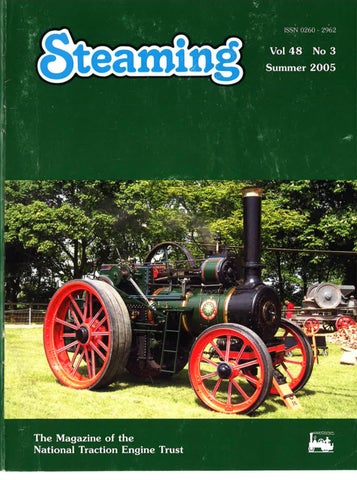
Front cover
Published by the NationalTraction EngineTrust at 14 Charles Street, Market Harborough, Leicestershire. Printed by AB Printers, 27 Nether End, Great Dalby Leicestershire LE14 2EY
The Road Locomotive Society, for their 2005 Spring Visit in May, were invited to a small event at James Coward's farm nearThomey, Peterborough, where an excellent display was put on by the Peterborough Farm Machinery Society. Set to a threshing drum, and offering a good example of a typical agricultural engine, John Cook's picture shows Ransomes, Sims & Jefferies 7hp single 30004, a machine dating from 1919.
STEAMING
Summer 2005
123
Trust News (continued from previous page)
amongst us ready to tell us why things went wrong that I think we should consider asking for an entry in the Guinness Book of Records. Why this happens really does puzzle me — human nature you might say. Why don't we just wait and listen to what the people who were involved have got to say? Obviously this might take more time than some of us are prepared to wait, but if we really do care about this hobby of ours we should curb the tittle-tattle and seek the facts. The latter brings me to the whole point of this piece. I believe that most of us will want to learn from the incidents that took place in order to guard against them in the future, but the fear of being made to look stupid, the risk of weakening an insurance claim or worse, and the risk of being prosecuted, often makes the perpetrators or victims reluctant to tell it 'as it is'. However, as owners and operators of these historical artefacts I also believe that we have an obligation to our 'family' to explain what really happened — in the fullness of time. Competency Examinations a growth industry In late Spring four engine drivers/owners based at the Klondyke Mills Steam Centre asked to be examined under the syllabus of the NTET's Voluntary Competency Scheme. All four passed with flying colours. Since then another owner/driver from the same location has also been successful in attaining a Certificate of Competency. At the moment some 19 applicants around the country are awaiting test and we have received enquiries from several more. This voluntary scheme is currently operated on behalf of the Trust by myself and Irvin Barraclough, but I am very pleased to say that we now have a number of potential assessors; two at least from Klondyke Mills. It would also be good 124
to see new 'assessor stock' coming from different regions of the country, so if you know of any one who you think would make a good and fair examiner please try and convince them to apply for their own test in the first instance. (David Smith)
Engine Owners Column The current review of the Trust's activities and effectiveness is designed to make our unique nrganisatinn a fit body to address the challenges facing us all today — and in the future. This will inevitably entail changes being made, some of which may not be popular, and will put more pressure to deliver in certain areas of the organisation. That being said, the Engine Owners sub-Committee will continue to look after the interests of the engine owner and operator with perhaps a little more urgency than before on specific matters, one of which is the old chestnut of boiler inspections and a common standard between inspectors. How many of you, for instance, are asked to remove the fusible plug from the firebox at each inspection? How many of you have your pressure gauge regularly checked by the inspector? I hope all of you, but I fear not. Jim Newnham has been working on a more comprehensive boiler report, rather than the blanket 'in order where seen'. This will go some way towards our goal, but there is much work to be done. The Zurich Life insurance company has approached the Trust offering a scheme of boiler inspection at an attractive rate. It would apply to a minimum 16 engines, with any one location to have at least four. It may be of interest to groups or others who could get together. If anyone requires further information, please (Richard Pierce, contact me. chairman, Engine Owners subCommittee)
Steam coal Just as we go to press Bob Siddall received advice from Rudrum Holdings that they now have steam coal available at Avonmouth, as follows. EHB New Steam coal — the analysis is the same as the Brunel material that Rudrum have sold until now. The only difference is the volatility, which is close to the old Welsh dry steam coal at 14 to 15%, and should offer a further reduction in smoke: Brunel EHB New Steam Steam volatile matter 21 to 23 14 to 15 7 to 9 ash content 7 to 9 moisture content 4 to 6 4 to 6 sulphur content 0.3 0.3 gross C.:V 30470 kj/kg 30580 kj/kg Smokey coal seems to becoming even more of a problem this season, so we hope this new supply will be of interest to members; trial loads are available immediately. Engine owners requiring further information, can contact — Paul Kirby at E H Bennett & Co Ltd, 0117 982 6781. (Bob Siddall)
Rally Organisers Column Caravan sites and Control of Development Act 1960 Several rally organisers, mainly in the south-east but also in the north, have become concerned over caravans at their events, with the local authority planning officers taking note of the above legislation, and talking of licences being needed for vehicles that are used on any one site for more than 5 days. Organisers have enquired if the Trust can obtain and hold, on their behalf, exemption certificates for the legislation, as an extension of the rally authorisation scheme. One of the conditions that would be imposed by the Act necessitates that 'a member (or officer) of the organisation must be present to supervise the activity on the site. Summer 2005 STEAMING
Steam Apprentice Club
The Trust's annual Steam Training and Driving Course in May had a last minute change of venue, with no less than 17 engines descending on the Davis family's premises at Astwood Bank. Barry Job's pictures show contrasts in their backgrounds. John Durling's Aveling tractor 11486, being prepared for its day, is amongst the heavy construction plant in the Davis' yard, but the rather overbearing vehicle behind was friendly enough, for it too carries the prancing horse, being of Aveling-Barford manufacture. Out in the field, Trust chairman Andrew Semple supervises the sweeping of the tubes of his Ruston & Hornsby tractor 52607 no doubt noticing out of the corner of his eye that safety officer Brian James is diligently checking the dates on the engine's insurance disc. At the present time the Trust would be quite unable to fulfil this requirement, and we therefore suggest organisers apply for an exemption themselves. Details may be obtained by applying to: DEFRA, and Sponsorship, Landscape STEAMING
Summer 2005
Recreation Division, Zone 1/03, Temple Quay House, 2 The Square, Temple Quay, Bristol BS1 6EB or www.defra.gov.uk/wildlife/countrysid e/issues/camping/index.htm (Paul Worbey, chairman, Rally Organisers sub-Committee)
The Steam Apprentice Club continues to go and to grow. The bureaucratic matter referred to in the last issue, the Child Protection Policy, appears to have started its working life reasonably painlessly, albeit early in the season: its real test will come at the Great Dorset Steam Fair. I am pleased to announce that we have received five nominations for the SACTechnical Achievement of the Year Award — three for work on full size engines and two for miniatures. This is an encouraging start for this project. I hope that others are now thinking of putting together a record of their own work for submission next year. The SAC committee now has the task of requesting further information on two or three of the entrants, and finally deciding on a winner. We are pleased to be able to announce that another volunteer has come forward to help with the work of the SAC in the north west. Kevin Lawrence lives in Barrow in Furness and is being 'blooded' at Tim Holt's rally at Flookborough. I hope that several Apprentices will seek him out and introduce themselves. The SAC participation at the NTET Training Course has this year set new records for attendance; a feat I hope will be repeated in future years. It is also worth noting that there are still three more driving days to operate this year. SAC members should be encouraged to read their copy of Raising Steam. Whilst on this subject we are still hoping that a suitable person will come forward to take on the role of editor of our section's magazine; please see the notice in the previous issue of Steaming. Finally, my son Ian and I, along with the North Staffs Club chairman Phil Jeffs, his son Richard and Andrew Hall, have all taken and passed our Certificates of Competence. By the time you read this I hope that I will be accepted as an examiner for this certificate so that more drivers who wish to hold the Certificate can be passed out. Plans are in hand for the first Steam Apprentice Club members to be assessed at Dorset. I look forward to being able to award the first certificates for these youngsters. (John Durling, chairman, Steam Apprentice Club)
125
Many members will recall the Lloyd Jones Brothers' taking their Sentinel tar sprayer, during the time it was still in commercial use, to rallies run by the Salop Club and others. Anthony Coulls photographed number 8122 at the Onslow Park event in August 2003. By then it was in new ownership and freshly repainted — but the livery and insignia are faithful reproductions of the way the brothers presented their wagon.
The Training Course This year's Steam Training and Driving Course was held on the 14 and 15th May at a new location. The Davis family of Astwood Bank kindly offered to stage the event in their fields, due to the relocation from Hatton Country World. It was with regret that the Trust took the late decision to move, but we were extremely concerned over the wet ground conditions and the extensive damage that the Course would have undoubtedly created. The Training Course catered for 43 students, with a good mix of foundation, intermediate and advance levels, and I was delighted that so many students returned this year to further their knowledge. There were 18 engines, and these gave a good mix of steam rollers, agricultural engines, ploughing engines and steam tractors, a selection in fact that would have graced any rally field. The public are not admitted to the event, and this gives the students the freedom of the site, which was large and well positioned. There is a good hard road around the perimeter of the fields and this gave the students good experience of steering within the limits of a roadway. The facilities on site were excellent, two marquees were hired in to accommodate the lecture rooms and also the refreshment tent. The outside caterers did an excellent job of providing lunches on both days, as well as an evening buffet. After the buffet on Saturday night, Michael Davies of Avon Dassett gave an excellent presentation on bringing the Z7 class ploughing engines back from Mozambique, which rounded off the evening perfectly. I would like to take this opportunity to thank the Davis family for their kind hospitality, and for providing an excellent and interesting venue for the weekend. I also thank everyone who took part in the course — enginemen, students, lecturers, marshals, the tea ladies 126
and all of the helpers; the course would not have been the success it was without any one of these people. A meeting will be held in the forthcoming weeks to discuss the further development of the course. The course will return to Astwood Bank in 2006, with the dates to be confirmed in a future issue of Steaming. (Stuart Tomlinson)
FBHVC news The Waste Framework Directive The Federation of British Historic Vehicle Clubs have examined the DEFRA consultation document and have found nothing relating to the storage of obsolete machinery on farm land that it could object to. The worry was that farmers may no longer be able to keep obsolete or disused machinery, or to store vehicles awaiting restoration on farmland. However 'waste' is defined as something the 'holder discards or intends or is required to discard'. The requirement refers to situations including where the machinery is, for example, leaking fluids. The FBHVC has responded to DEFRA urging that nothing should be done to jeopardise the farmer's ability to keep disused or obsolete machinery in the open for possible use and repair, provided it is stored in
an environmentally sound manner. However, an article has appeared in the agricultural press that states that proof of future use is required. FBHVC has found nothing in the consultation that states that the owner has to submit proof, or to whom.The holder 'is required to state an intention to discard' — which is different. The outcome will be confirmed when the Regulations are published, expected this summer. Annual Registration Charge A report in the classic car press that this proposal has been dropped has not been confirmed by DVLA at Swansea. So far 108 MPs have signed an early day motion in parliament. Now the election is over FBHVC will be asking the government for its intentions. Vehicle Registration Documents Engines that have not been licensed since prior to 1998 are not within the current scheme whereby the new V5Cs are issued automatically. However it is important that members are aware that the DVLA will issue new V5Cs for these engines on application. Members with the old V5 for a pre SORN engine (or any vehicle) are advised to obtain a new V5C within the next year or so to avoid the risk of potential complications in future. The old V5 should be sent to DVLA, Swansea, SA99 1BA with a covering Summer 2005 STEAMING
note requesting a new certificate. The old V5 will be returned with the new document if the note so requests. If return is not requested the old V5 will be destroyed. Obtaining a new V5C in this way will not make members liable for SORN and a member deciding not to apply for a V5C (or simply forgetting) will not lose the registration mark or other entitlements.
Amendment to PSV Regulations This proposes a simple amendment to the Regulations that requires the exhaust pipe of a Public Service Vehicle to be shielded and to exit from the rear of the vehicle. The change permits a front mounted vertical chimney in the case of steam powered buses built before 1955. We received this information as a consultation on 1st April and it was treated with due suspicion, but transpires that it is serious. An operator wishing to use a bus built on a Sentinel steam lorry chassis (to replicate the few believed to have been built originally) is prevented from doing so by the current Regulations. The FBHVC has supported this proposal and has applauded the government's willingness to be flexible in such circumstances. Contact me on any matter on which you feel the FBHVC may help. Action will be taken if necessary — John Billard, Old Station House, Twyford, Reading, RG10 9NA (' 01189 340381) or billard@billardj.freeserve.co.uk
Obituary Ewan Lloyd Jones Ewan Lloyd Jones, partner in the Lloyd Jones Brothers steam contracting firm of Llanfair DC, near Ruthin, North Wales, passed away in March after a long and debilitating illness. He was 73. Ewan and his elder brother Murray spent their formative years at Plas Llcha Graigadwy wynt, a small hamlet near Llanfair. Their father was a tenant farmer and threshing contractor, using steam in the form of Tasker B2 tractor 1611 of 1914 and another Tasker of 1911. The former was purchased for £4 in 1934 because of the unreliability of paraffin tractors of the time. An elderly lady in Llanfair
STEAMING Summer 2005
still recalls Ewan driving the Taskers when a boy. As coal became harder to obtain during the years of World War 2, so steam was replaced with a tractor — first a lend-lease Oliver 90, and then by a Marshall 'pom-pom' and a Minneapolis. With the death of his father in 1948, Ewan and his brother decided to continue with the threshing business, though with the tenancy of the farm being given up, new premises were found at Capel y Gloch (Chapel with a bell) near Llanfair DC. A new Foster threshing box was delivered by rail to Ruthin station during 1950. Between then and the early 1960s, threshing continued as before. During the summer months, Ewan worked for the tarspraying firm of Robert Bridson & Son of Neston on the Wirral. During 1956, with encouragement from Mr Bridson senior, the brothers purchased the ex-Neston UDC Marshall roller 77017 and after renovating it, hired the 1923 machine to Denbighshire County Council for their direct labour contracts. As threshing came to an end in the early sixties, the brothers moved premises yet again — to a former blacksmith's shop in Llanfair DC village. Here they developed the engineering side of the business, along with the hiring out of steam rollers. By 1963 these had become two, with the purchase of Fowler T3 class roller 21628 from Merioneth County Council. With the death of George Bridson in 1967, Fowler 10ton roller 17500 and Sentinel DG4 tarsprayer 8122 joined the fleet. The Sentinel was put to work for Denbighshire Council soon after acquisition and applied over half a million gallons of tar to the authority's unclassified roads during its first season. Ewan's last contracting job was a local council car park with the T3 roller during 1982. Ewan and brother Murray were amongst the first preservationists and early members of the NTEC. After a strenuous argument with the scrapman who was clearing Plas Llcha during 1948, they managed to save Tasker tractor 1611, although the 1911 example was not so fortunate. Ewan was at Woburn Abbey during the filming of the classic traction engine comedy The Iron Maiden, and was proud of the fact that both he and his brother were in the background scenes of the film. He became ill during the summer of 1982, gradually becoming worse as time progressed. He was cared for by good friends in Llanfair until more
specialist care was needed. Those of us who knew him were very fortunate people indeed.
The Rally List 2005 Since the publication of the The Rally List 2005, the following additional events sought Authorisation under the Trust scheme, and were accepted — the ONCA Rally on 28th to 30th May and the Blatch Pumping Station event on 18/19th June.
The Ring-Around Column We again draw attention to the arrangement for members to make contact and to seek information, raise points of concern or even air grievances via Nickey's Ring-Around system. Each of the points raised with the area representatives is collected by Nickey on her bimonthly Ring-Around and reported to a following Committee meeting. The items are also sent to the appropriate Trust officer to investigate or explain, and the results are included in the magazine at the earliest opportunity, either under the above section title, or within the various other headings inTrust News. In each Summer issue the list of area representatives will be repeated, updated as necessary. Currently, these nineteen steadfast members are: Mick Smith, Berkshire — 01189 341921. Phil Honour, Buckinghamshire — Tr 01494 762073, day time. Mike Jones, Denbighshire — 12 01824 707719. Richard Stock, Cornwall — Tr 01326 311919. Richard Ransome, Cumbria — 17 01539 441301. Harry Cain, Cumbria — Tr 01697 73625. Dave Dicker, Devon — Tr 01822 820396. Ruth Atkinson, Essex — 01268 414009. Sandra and Derek Marder, Hampshire — a 01264 323186. James Hervey-Bathurst, Herefordshire a 01531 633160. David Birch, Kent — Tr 01303 812293. Steve Hayes, Leicestershire — Tr 01530 271863. Alan Rundle, Lincolnshire — Tr 01205 480630. 127
Jonathon Wheeler, Norfolk - Tr 01379 687795. Andrew Melrose, Somerset - 12 01749 841041. Mick Gaines-Burrill,Yorkshire - Tr 01642 701347. Bill Barrack, Scotland - u 01224 734553. Henri Collings, Gwent - 01873 831946. Geoff and Veronica Mathews, Gwent a 01291 650279. Alternatively you can ring Nickey direct. (Nickey Daniel - Tr 01208 831293)
Trust Exhibition Unit Following on from the more detailed account of the Unit's 2005 travels, set down in the last issue, the list of rallies to be visited during the second half of the season is: July - 15 to 17th, Somerset; 22nd to 24th, Netley Marsh; 29th to 31st, Welland. August 6/7th, Kemble, Gloucestershire; 19th to 21st, West of England; 28/29th, County of Salop; September - 31st Aug to 4th, Great Dorset Steam Fair (marquee); 10/11th, Haddenham; 17/18th, Old Warden, Bedfordshire.
The Sentinel Trust, the drawings have been placed on permanent loan to the SDC, so that work can be done to make sure the images are preserved. In view of the very urgent need to tackle the 21,000 sheets it has been decided, after much investigation of different methods, to copy all of the films onto a modern microfiche system - the fastest and cheapest way to save the information.The next stage will be to digitally record the subjects that are of most use to SDC members - about half the sheets refer to steam wagons and the rest to locomotives and railcars. The Drivers Club has made good progress with the appeal for £6000, with strong support from its members. The NTET has made a donation of £1000 for the work that needs to be started so urgently. Further details are available from the SDC Archivist - Richard Percival, Tr 07850 386143.
An awful theft At the end of May member Ron Dawe of Rainham, Kent suffered a most dreadful loss with the theft of his 2inch scale Burrell showmans road locomotive EXCALIBER, together with its accompanying dragon car. They represent many,
many years work and hobby of a very dedicated engine enthusiast and model engineer. Ron explains - 'The model was packed into my estate car, bolted to the floor and completely covered over. The car was parked inside the gates of the driveway to our house in Rainham on the evening of 26th May, ready to go to the Sellindge Rally the following morning. Between 10 and 10.30 the car was broken into and the models taken. My wife Joan and I were in our lounge not 15 feet away. I have done the same procedure of packing the engine in the car the evening prior to setting out for the past 24 years, feeling sure it was secure as the Burrell weighed well over 2 cwts, and therefore bound to be safe - regrettably, I now know, not so! 'The model was built over a 21 year period, from about 1960 to 1981, taking some 4500 hours of my time, which I enjoyed. Joan and I have exhibited it all over England and have made great friends through those travels. I have had so many letters and calls to commiserate with me on the loss it was almost unbelievable Joan and I thank you all for your concern. 'The models were not insured, as I had never offered them for sale, and did not know how to set a value. A German dealer once offered me an emotive value, despite having to struggle with our language - "It is
Affiliated and other groups The Leyland Society The Society's quarterly magazine Leyland Talk continues the detailed study by IVIike Sutcliffe of the early steam wagons produced at Leyland. Issues 26 and 27 take the story from oil-fired to coke burning machines and the beginning of series production. The annual gathering of Leyland vehicles will take place at the Leyland assembly plant on Sunday, 10th July.
Sentinel Drivers Club The Sentinel Drivers Club recently launched an appeal for funds to enable them to ensure the future well-being of a large number of engineering drawings of Sentinel steam wagons. These remaining works drawings are not originals - they were destroyed after being recorded on an early form of microfiche in 1947. It is these copies which are now time expired, with many of them starting to degrade badly. Until now held by 128
t i f• :1111?
-4 . •Zr
.
v.
.
This photograph of Ron Dawe's 2 inch Burrell scenic showmans engine needs to be captioned here that it is a model, for the skills and patience that have gone into it belie its actual size. Needless to state, any reader who can help with any information which could result in the location of the Burrell can contact us immediately. Summer 2005 STEAMING
worth one hundred litres of your blood, that is what it is worth!' 'If the models are not found within my lifetime, my children and grandchildren will carry on the search. I give a warning to other modellers: be aware that size and weight are no form of security. I hope the Editor will do his bit on these few paragraphs, because I may have got carried away a little. My main point is to thank all those who have shown concern.'
Future Dates Great Dorset Steam Fair, 31st August to 4th September After the Trust's hectic and memorable presence at last year's GDSF it is, perhaps, a matter of back to normal for the 2005 event - except, of course, that Dorset is never completely normal. However, the usual NTET marquee will be there -the sales side will have a large selection of road steam reading and video viewing on sale (and remember the NTET funds receive a welcome boost from sales during the five day event). At the other end of the tent, the willing workers are again to provide tea and coffee to those who need to rest awhile, or merely to sit and talk just a little more on engines. There will be a return of the Friday evening OPEN FORUM, which will commence at 7.00pm. All members who may be on site are invited to attend to take part in open discussion on things appertaining to traction engines and the Trust's activities - no agenda, but Chairman Andrew Semple will be pleased to receive anyone's three pennyworth of puzzlement, gripe, doubt, warning and even praise. It shouldn't take much more than an hour out of anyone's Dorset time, so please do come along and make your voice heard, or take in what others are bothered about. Come to the Trust marquee, Friday evening, 7.00pm, 29th August.
affiliated groups, and on the event organisers list will be sent full details and invitations in due course. We again mention that all who may benefit from the meeting are welcome to attend, and if you would like to know more please get in touch with the General Secretary, Sue Jackson - address inside front cover or Tr 01494 521727
Annual General Meeting The 2005 Annual General Meeting of the Trust will take place on 19th November at Loughborough, Leicestershire. A detailed account of arrangements for the whole of the weekend, with a note of the hotel booking arrangements, etc, will be published in the Autumn copy of the magazine as usual. The notes below give information for the 2005 AGM, and the formal notice regarding the submission of any motions to be debated. Formal notice of the meeting and other information, including the audited Report and Accounts for the year, and Appointment of Proxy form, will be distributed to all then current members with the Autumn issue of Steaming. Any member may submit a motion for discussion at the AGM. All such motions must be in writing and signed by a proposer and a seconder, and state the respective membership
numbers.The items for discussion, in order that they can be published in the Agenda for the AGM, as required by Article 16 of the Trust's Constitution, must reach the General Secretary, Sue Jackson, on or before Saturday, 24th September 2005 (address inside front cover). The elected Committee for the current year was published on page 5 of the Winter 2004/2005 issue of this magazine. Members retiring by rotation at the AGM in November 2005 are: Richard Sandercock, Vice President Andrew Semple, Chairman John Bosworth John Durling Bill Evans Bob Garnett Steve Parrott Richard Pierce Paul Worbey All of the above are eligible for reelection, but Andrew Semple has indicated he will retire as Chairman. There is a vacancy on the Committee - unfilled from last year. Pat Jenkins from South Wales and Paul Blanch of Norwich were co-opted during the year. A form of Nomination Paper is printed with these notes and may be used, cut from the magazine, in photocopied form or written out on plain paper. Any nominations for the Committee should be sent to the General Secretary, Sue Jackson (address inside front cover) and must be received on or before Saturday, 24th September 2005. They will not be accepted after that time. The names of the nominees will be included in the published Agenda to be distributed with the autumn magazine.
The National Traction Engine Trust AGM, 19th November 2005 NOMINATION PAPER
Please use block letters
Vice President, Chairman or a member of the National Committee* Membership No
Name Address
I agree to aceept nornioation for this office and, if elected, to serve the Trust and abide by its Constittitior), Signed:
Rally Organisers Conference The 2005 Rally Organisers Conference is to be held on Saturday, 29th October at the now usual venue in the Village Hall at Willoughby, near Rugby, Warwickshire. The regular attenders within our STEAMING
Summer 2005
Proposed by
Membership No
Seconded by
Membership No
Nomination can be made on this form, cut from the magazine: on a photocopy, or on a copy hand written on plain paper. *delete as necessary, but use a separate paper for each nomination. 129
New Members We extend a sincere welcome to the following new members who have joined the Trust during the last three months. We hope they will gain much friendship, information and enjoyment from their membership over a period of many years. Full addresses are not included, but the Membership Secretary is always pleased to put members in touch with one another by forwarding mail. R J Inman, Worksop, Nottinghamshire R J Wilkins, Bromyard, Herefordshire N Isaac, Salisbury, Wiltshire R Parrish, Shefford, Bedfordshire R Adam, Falkirk, Scotland S Baldock, Poole, Dorset G Barlow, Warrington, Cheshire A F Gilbert,Tring, Hertfordshire S Phillips,Tredegar, Gwent J G Atkinson, Scarborough, North Yorkshire D Gleave, Nantwich, Cheshire Ms S Allen, Yeovil, Somerset TW Southby, Wimborne, Dorset G P Enright, Grimsby, Lincolnshire M J Hedger, High Wycombe, Buckinghamshire C Cook, Newmarket, Suffolk A H Wright, Hatton, Derbyshire DTodd, Northallerton, North Yorkshire R Croft, Robertsbridge, Sussex E C Crow, Royston, Hertfordshire D Watson, Newmarket, Suffolk R Rainham, Great Missenden, Buckinghamshire H Baker, Sandbach, Cheshire I D Davie, Swansea, West Glamorgan C R Williamson, Oakham, Rutland S Morgan, Flitwick, Bedfordshire S O'Neill, Deddington, Oxfordshire J Gilbert, Dartford, Kent S Smith, Boston, Lincolnshire
reflections on our magazine of 25 years ago
Roger West's second magazine, the June 1980 issue, contained a good selection of articles. These were mainly reminiscences, but included the second part of Michael Lane's Silver Jubilee Lecture 'John Fowler and the Company he Founded'. The editorial centred on and photographic standards suggested that with a bit of imagination situations more akin to working times could be captured — 130
S Frost, Norwich, Norfolk P Chant, Midsomer Norton, Somerset D B Gowlett, Newmarket, Suffolk G R Rutter,Trimdon, Co Durham R Pearsall, Glasgow J Bloom, Wisbech, Cambridgeshire H Bishop, Eydon, Northamptonshire R Millband, Cotgrave, Nottinghamshire P Ewing, Stoke on Trent, Staffordshire I W Jerrold, Bury St Edmunds, Suffolk Mrs H L Webb, Romford, Essex J Brockett, Deddington, Oxfordshire A Walter, Moreton Pinkney, Northamptonshire
Poor Steaming A correction is needed to the article 'Beeches to Byfield' in the last issue — well, that is what the title should have been altered to by the Editor before use. Whilst researching the pictures, he guessed he might be looking at elms, but eventually decided to seek proper opinion from those-who-would-know, with the result that the timber was identified as beech. The text was duly altered, but the title was overlooked!
engines on the road, working demonstrations, etc. This seems to have been taken to heart in many of the present day photos in Steaming and the rest of the preservation press. I am sure however that I am not alone in finding that the background clutter in early rally photos often includes vehicles that would now make interesting rally exhibits in their own right. A mix of period type and modern photos would therefore seem to make sense to tell the on-going history of our engines. A short article reported that the unique Trotter 1 ton roller, owned by Gloucester City Museum and on long term loan to Dowty Railway Preservation Society, was in need of fairly major boiler work estimated at £600 — well beyond the Society's means. One suggestion was to find a
Steam Roller in a Hole - Shock for driver in Thetford 'Mr Arthur Pleasance, of Hilborough, at present staying with his daughter in Thetford, has been driving steam rollers for over 20 years. On Tuesday, while rolling Minstergate Street, Thetford, he received one of the biggest shocks of his life. He was rolling the street with one of Doran's 10-ton steam rollers when suddenly the ground appeared to open up beneath him and the giant roller sunk in a deep hole up to its rear axle. At one time the roller was listing about 45 degrees, and it was only the axles resting on the side of the hole that prevented the roller going completely over. 'Mr C W Brown, managing director of the firm, and Mr C JTate, a steam fitter, spent all the afternoon supervising lifting operations. Jacks were placed under the side of the roller and it was gently lifted into an upright position and wood blocks were put underneath the wheels. The operation was finally completed about five hours later. The great danger was that one of the jacks might have slipped, allowing the roller to topple over. Mr Brown told a reporter. The roller had been working for the sewerage contractors. Neither Mr Pleasance nor his steam roller suffered ill-effects from their mishap, and on Wednesday morning were working as usual.' (from the Thetford & Walton Times, 16th June 1950)
second hand serviceable boiler from somewhere. Clearly, a successful conclusion was reached as the engine was in steam as part the Road Roller Association's display at Dorset last year. Three pages were given over to an article on a 450hp triple expansion Ashton, Frost & Co pumping engine at Elkesley pumping station in Nottinghamshire, said to be the second largest triple engine ever built in Britain. The article set down the history of the engine and the arrangements that had been made for its preservation and display at the Welsh Industrial and Maritime Museum in Cardiff. An editor's footnote, however, sadly reported that despite efforts to save and transport it the museum had decided on scrapping. Did this happen?
(Stuart Gaines) Summer 2005 STEAMING
please refer to recent issues for other available books videos and club items
National Traction Engine Trust
•
Mail Order
DVDs New Fodens of Sandbach (70 mins) New Road Works Ahead (50 mins) New Fosters of Lincoln (70 mins) New Inside Steam (65 mins) All DVDs are Old Glory/Morton's Heritage
Many books, videos and other items of interest to traction engine enthusiasts are available from the Sales section. Readers are urged to take advantage of this service (which also benefits Trust funds) for trouble free and economical postal shopping. Just tick the for items you require and fill in the address slip.
TRACTION ENGINE READING New EuropeanTraction Engine Register (Toy and Rayner) reviewed this issue New Historic Fairground Scenes (Ware) reprint of 1977 edition New Traction Engine Album (Ranieri)
£5.00 ❑ £9.99 ❑ £29.95 ❑
New 'RENOWN' History and Restoration (Brian Steptoe) reviewed 48/2 New Locomotive Boilers - Design, Construction and Working (Alan Haigh) reviewed 48/2 New Malcolm Root's Railway Paintings New Special 30th Rolling (RRA) New Squirrels, Nuts and Flying Rivets (Trevis) reviewed 47/4 New Traction Engine Register (True and Johnson) reviewed 47/3 Perth's (Australia) First Motor Vehicle (Clydesdale) reviewed 47/4 Norfolk and Suffolk in the Age of Steam (Stephens) reviewed 47/4 Family Affairs - haulage contractors in Somerset and Dorset (Michael Marshall) Lincoln's Excavators -The Ruston Years (Robinson) reviewed 47/4 MyTravelling Family (Eleanor Green) The History of J. & H. McLaren of Leeds (John Pease) Traction Engines (George Watkins)
was £24.95
Pictorial Albums Steam Wagons (Rayner) Glory Days - Paddle Steamers (Williams) Traction Engines and other Road Steam Vehicles (Rayner) Traction Engines, A Colour Portfolio (Arlett and Lockett) Thornycroft, Ian AllanTransport Library (Townsin) Heavy Haulage (Neville/Freeman) Company Histories Ransomes, Sims & Jefferies, Agricultural Engineers (Brian Dell) The Story of St Nicholas Works (Lane), was £30 Charles Burrell & Sons Ltd (Gilbert & Osborne) Steam Engine Builders of Lincolnshire (Clark) The Story of the Wellington Foundry (Lane), was £30
£5.00 ❑ £10.00 ❑ £19.95 ❑ £2.50 ❑ £7.95 ❑ £6.95 ❑ £7.00 ❑ £19.99 ❑ £24.95 ❑ £24.95 ❑ £12.95 ❑
£16.95 ❑ £9.95 ❑ £9.95 ❑ £9.95 ❑
VIDEOS New Fodens of Sandbach (VHS 70 mins, Motions £16.95 ❑ Heritage Mission Impossible - restoring 8hp singles £15.00 ❑ (VHS 100 mins, Steam Plough Club) Dedicated to Garrets (VHS 65 mins, Motions £9.95 ❑ Heritage) £9.95 ❑ Steam Insight (VHS 50 mins, Motions Heritage) Fosters of Lincoln (VHS 70 mins, Old Glory) £9.95 ❑ £9.95 ❑ Road Works Ahead (VHS 50 mins, Old Glory) The Sentinel Steam Waggon (VHS 45 mins, Old Glory) £9.95 ❑ £9.95 ❑ Bu rrel Is of Thetford (VHS 110 mins, Old Glory) MOONLIGHT PRODUCTIONS videos New Going for Gold - NTET 50th Year Great Dorset & Road Run (VHS 90 mins) Sentinels on the Move -The Horseshoe Pass (VHS 40 mins) Up for the Cup - the Steam Plough Club's Great Challenge 1998 (VHS 65 mins) Steam over the Fells - steam through the Trough of Bowland (VHS 115 mins) Sentinels on Parade - road run, Shrewsbury to the Horseshoe Pass (VHS 45 mins) The Big Road ATLAS - the Eastnor Castle heavy haulage road-run (VHS 60 mins) Up Hill and Down Dale-the 1995 steam car touring rally, Yorkshire Dales (VHS 90 mins)
£18.00 ❑ £16.95 ❑ £19.50 ❑ £20.00 ❑ £15.00 ❑ £18.00 ❑ £18.00 ❑
£24.95 ❑ £12.99 ❑
£4.50 ❑ £15.99 ❑ £4.50 ❑ £14.99 ❑ £18.99 ❑ £7.50 ❑
The Rise and Fall of Aveling Barford, 1933-1988
£19.95 ❑ £27.00 ❑ £5.99 ❑ £10.95 ❑ £24.00 ❑ £3.60 ❑
Steam at work Pioneer of the Road (Clydesdale) Steaming Down the Ages (Freeman) Hazy Days of Living Steam (Gooding) Contractors and Factors (Freeman)
£9.50 ❑ £6.90 ❑ £7.50 ❑ £9.90 ❑
To claim post-free for UK members please enclose current membership card. Non-members please enclose 10% part postage per order. Overseas members please enclose 8% part postage per order (European); 10% (rest of world). PO/Cheques (in sterling please) to be made payable to: National Traction Engine Trust. Visa, Access and Mastercard accepted, please state card number, expiry date and name on card, or phone/fax 01582 733971 (Tr evenings only). Orders to be sent to: NTET Sales, 90 Devon Road, Luton, Bedfordshire LU2 ORL. Please allow 28 days for delivery. Name
Address
Membership No.
Amount Enclosed List 48/3, Summer 2005
Mr Scrivener's unfilled want An account of the use of steam rollers by the Palestine Railways, 1926 to 1947 Roger West Part 2 (continued from page 84 in the Spring 2005) The boiler inspection Quite a while before the two year loan period of S.7 was due to end, engineer Taylor caused a flurry of largely unnecessary inter-department letters. In March 1932 he raised the question of whether the Marshall's boiler should be examined. An inspection had been carried out by the PR inspector a year after the retubing, in May 1931, but the maybe tetchy CME replied that he thought the boiler would be on the PWD inspector's register and that lie should be referred to. Taylor was annoyed; the suggestion was a waste of time, and he was quite certain that an inspection carried out by the PWD would be much less thorough than a PR one. He added a pencil note to the bottom of the letter to his chief 'Personally, I think the least said about this roller the better; the PWD might want it back.' But the CME was oc.lornent, op'-'-g ',tot the boiier must be seen by the inspector who was familiar with its history, and insisting the PWD Director was approached. Fawcett Pudsey responded just as the Ways & Works men had feared - as the roller was due for return in May, leave it until then! Scrivener asked his chief to intervene again and ensure the Marshall remained at his disposal, for he knew there was little prospect of purchasing a new machine. The PWD agreed to leave S.7 until June, but could not guarantee a longer period, and suggested that the PR road work should be completed soon. Advised of all this, Taylor sent his chief another petulant letter, decrying the CME's insistence on the inspection and repeating his thoughts that the PWD wouldn't have remembered if they hadn't been contacted - all this from the man who 132
first broached the subject in writing! Shortly after, the PWD agreed to the roller staying until 31st December 1932, and when it came to arranging for a joint inspection of the boiler at its usual time in May, the owners felt the examination by Railways' own qualified inspector was adequate enough. Morgan, the PR inspector, subsequently reported his appraisal of the smoketubes, the firebox and barrel, the stays (hammer tested), the water spaces and the fusible plug they were all 'condition good' - and followed up by seeing it in steam and with safety valves blowing correctly at 120Ibs. In June 1932 Taylor advised his chief he had arranged for the Tel Aviv municipality to have use of S.7 for a period each day on some of their urgent work near the station. It was adjacent to the railway work, which only needed rolling for some of the day, and the driver was agreeing to do the overtime, being paid by the town. Taylor wanted to develop friendly relations with the Municipality, needing their help in revising an access to the station. Scrivener noted thot PR paid no hire fees for the roller, so could not be said to be suffering any financial loss by lending the machine. Exactly what transpired at the time the Marshall should have returned to the PWD fold at the end of 1932 is not recorded in the file, there being an eighteen month gap in the entries. Perhaps, as there was no stirring of the proverbial pot by written communication, all went on quietly. In September 1933 the Chief Engineer returned to the task of convincing his GM of the need for a road roller of their own, still quoting a price of £P600 FOB. He said the Public Works Department had not asked for the Marshall's return at the expected time, and it had been kept employed continuously (presumably in both the Lydda and Haifa areas, as required), but then suddenly the PWD Director had asked that the roller be
returned at once. Perhaps Scrivener may have been tipped off, for he made the suggestion that as the PWD were standardising on internal combustion engine rollers, the railways might offer to pay them the value of S.7 to go towards the PWD's funds for another oiler. Some rollers had come up for disposal on the completion of Haifa Harbour contract, but they had been allotted to the PWD. The Railways' General Manager was ever reluctant to put forward the case for adding 'such an expensive item to our plant'. No doubt he knew more of the financial constraints of the time than he was likely to reveal to his staff in detail. But he asked his engineers for accounts of how many days in a year a roller would be in full use on railway work, and for a rough programme for 1934/35. He warned that the Government may insist (and he would prefer it) on the PWD continuing to lend a machine, or doing the work for them. How would Scrivener regard the latter course? The Haifa engineer listed six sites he had planned at Haifa, Hadera, ScIrnakh and Tulkorn1; e month here, 10 days there and so on, a mixture of repair and new work, in all totalling 167 days - say, he said, six months. The Lydda engineer had much more. Roads and yards at ten listed stations needed attention. The broken down surfaces he describes were extremely dusty, and a sea of mud in wet weather. Thus there was more than a year's work, apart from new work that was envisaged. The suggestion that the PWD should be employed to carry out work was 'not possible'. Their prices were high, and they were not likely to be able to work together with the Railways' traffic department when doing work in station yards. In the middle of these exchanges, the Lydda engineer had asked for permission to lend the Marshall to the Petah Tiqva Town Committee for one day, probably a Sunday. Scrivener exploded: it was only with the greatest difficulty he was keeping Summer 2005 STEAMING
the roller on loan he said, arguing it was needed continuously, and the precedent of loan to an outside body would weaken the claim. 'If you are able to spare it ... the Haifa engineer has work...' A milestone In February 1934 Mr Scrivener had the news he had been awaiting since he first opened File 118.31/17 seven and a half years previously - a steam roller could be purchased by the PR. There must have been relief at the prospect of permanent ownership, despite the fact that it had taken nearly eight years to achieve - and that the machine was the on-loan Marshall 70046, S.7, an eighteen year old roller that was even by then, a somewhat dated piece of plant. The Government Secretary advised that authority had been given for the transfer from PWD ownership against a payment of £P100. Even that surely small amount could not come from the PR's hallowed Schedule F, but via a Special Warrant with equivalent savings from elsewhere to be shown. The District Engineers were advised of the purchase, and the filed letters again cease. A year later Scrivener approached the PWD's engineer at Haifa to seek his opinion on the specification of 10 ton rollers that had been found best adapted to conditions in Palestine steam or diesel powered - and some idea of the cost.The reply came from the PWD headquarters at Jerusalem. An Aveling 10 ton DC type with a Blackstone diesel had given good results, and cost 36 mils per hour to run, less wages and repairs. Its landed cost (fitted with scarifier, sprinklers and double tropical STEAMING
Summer 2005
Although this illustration of a Marshall roller appeared in our magazine a relatively short time ago, in the Summer 2002 issue, it should bear repetition now there is a more complete tale to tell. A mounted photograph - not much more than a snapshot - appears in the Lydda district engineer's Annual Report for 1937/38, so we can assume it was taken some time during the previous year. The picture is titled 'Road construction in progress at Petah Tiqva station' - nearTel Aviv. None of the photographs of the Palestine Railways steam rollers show the machines in close enough detail to see if a PWD fleet number is present, and it is thus not possible to precisely identify them. As this is likely to be the regular Lydda machine, it should be S.7 Marshall 70046 of 1916. Most of the available pictures are of a roller in the Lydda district, and all seem to show an awning rather wider than the Gainsborough norm, which is probably something to do with the 'air space' noted in the Marshall Engine Register. When S.7 first came on loan to the railway in 1930 the condition of the awning was noted as wooden and good, and covered in sheet iron. We can probably see all these points in this picture, which shows a Marshall at work on typical stone road making. The large shed to the left gives shelter from the sun to boxes of citrus fruit before their onward transport by rail to Haifa Harbour. The outline of another form of local transport, the camel, can be seen over the top of the Marshall's front roller. (The Israel Railway Museum)
awning) was about £P954. Fawcett Pudsey declined to say much on steam, and was dismissive - 'we have no modern steam rollers, those now employed by reason of age and service would not afford any useful data'. But, he said, Marshalls and Fowlers both produced very efficient machines. The Lydda engineer (who often seems to have been the first to be consulted by Scrivener in correspondence - maybe because most of the rolling work was in his district, or possibly because the Haifa engineer didn't need to be sent letters, as he could be talked to just along the office corridor) agreed with his chief that the diesel power seemed excessively expensive. Although Taylor appeared to be coming round to the idea of a nonsteam roller he admitted the 'old' steamer gave them good service, and the railway had very adequate
facilities for maintaining it. Could he have another one, the same, so as to avoid duplication of spares? In May 1935 a letter went off to the PWD at Jerusalem to ask if it was correct they had some old steam rollers for disposal. The reply listed five - a Marshall (against which entry Scrivener had pencilled 'S.9, on loan', presumably meaning to the PR, though the file had been silent on that matter), three Avelings and one by Green & Sons. All were stated serviceable, but not available for sale or loan until the PWD's just-ordered rollers had arrived. PR should wait until later in the year. But the need was urgent and the Chief Engineer persisted - to at least have the Marshall allotted to the railway, to carry out work on the floors and approaches of the new citrus storage sheds at Binyamina, in the Haifa area, before the commencement of the 133
orange shipping season. Six months later these works were still not finished, though a machine was then transferred from Qalqilya in the Lydda district. Heavy rain at that place had caused the engineer to abandon rolling work until the earth dried up as it had 'assumed the consistency of a suet pudding'. Marshall S.9 had been on loan, so providing a second roller through the year and Scrivener now set about negotiating the purchase of it, suggesting to the GM the £P150 cost came from the Minor New Works purse. But the GM was still intending to include £P750 in his estimates for 1936/37 for a 'new steam roller', and again successfully leaned on the PWD Director to agree to the continuation of the loan of S.9. The latter, however, would still not discuss selling it. Scrivener irritably added another of his pencilled notes to the copy letter — 'On 28.11 I observed 7 rollers between Kep [?] and Lydda Village, ie about 7 to the mile and not one was moving'. Confusion In the early months of 1936 there was quite an amount of confusion on how much was being included in estimates, how many rollers were needed to keep the PR roads in repair, and whether the various writers were referring lo new or secondhand machines. The Chief Engineer coveted two more of the soon to be superfluous PWD steam rollers and considered he had work for four altogether. The PR General Manager was worried about taking on old machines that might give trouble, and the PWD Director didn't want to gat rid of his ctoPm rnllars claiming he could use them
continuously and economically. It seems the public roads were every bit as demanding in maintenance and extension as were the Railways' internal roadways, and the PWD were only going to release one machine, at an agreed price, and even then with reluctance. Scrivener had £P200 in his estimates, which by the usual Government fiscal policies would cease to be available if not spent at the year end on 31st March, and, to avoid being inadequately equipped, he urgently pushed for the permanent acquisition of S.9 and another, based on the price paid for S.7 in 1934. On 11th March 1936 the PWD advised that S.9 could be considered transferred, and asked for the £P100; although it was now two years older, the PWD explained it had received extensive overhaul a couple of years before. Nearly ten years after he first asked for the file to be opened the Chief Engineer now had full charge of a second Marshall steam roller, but again, he might have pondered, it was only another well used example. No details were set down on the identity of the machine, so it remains somewhat anonymous, and of undetermined age. It could well have been part of the batch of five Egyptian Marshalls that included 3.7 70046, but as we have seen, only in Lhe case of the latter, following the
joint inspection carried out when it was first allowed on formal loan by the PWD, do we have correlation between a works number and the S series fleet number. Study of the files indicates S.7 was the usual Lydda roller, so the arrival of S.9 probably enabled Haifa to have it as their permanent machine, though the pair were still moved about to cover the workload. The Chief Engineer then pencilled a memo of what he thought his fleet would be in the following year — 2 secondhand rollers; 1 new one (Schedule F) and 1 light roller (New Works Plant). The latter, probably a Barford & Perkins tandem, had sneaked into the story without previous mention in the file, probably because it had been included within the costs associated with the development of the new stations, and had been the responsibility of other departments. It had been specified especially for consolidating the fills between the platform walls, or along the edges of loading bays. Photographs show the heavy Marshall steam rollers engaged at this task and it is perhaps surprising there had not been any mention in the file of problems, by their use, with displacement of the walls. Taylor, the Lydda engineer, set down his requirements at length in a letter to his chief, attempting again to
Rolling the platforms at the new Haifa Central station, built by the Palestine Railways from 1935 to 1937 on land reclaimed from the Mediterranean. Mount Carmel is in the left background. This is one of only two pictures of rollers taken in the Haifa district engineer's area — it is a Marshall, and as S.9 came on loan from the PWD in May 1935, it could well be that machine. The timber awning looks to be of less width, and the chimney rather shorter, than those fittings nn what riarhormri to hn C 7, and shown in fi-rn
illustrations. (The Israel Railway Museum)
PIfiulflrl
lecture him on how construction plant should be acquired and charged, and reiterating the need for a considerable amount of it. He, in his district, now had the prospect of 2034 roller days for development work: that necessitated 12 rollers if the work was to be completed within the year, or with the hoped-for fleet of four the work would drift on for three years. None of the above included maintenance work, so four rollers 'will get us nowhere'.Taylor ended his
mmitoir,
The construction of a citrus shelter and private loading sidings at Rehovot in 1935/36, a picture included in one of the Lydda engineer's reports. It shows some typical work of the time during the development of the citrus fruit industry in the central areas of Palestine. The consolidation of the loading platforms between the railway tracks is being done by a Barford & Perkins motor roller of 5 or 6 tons, which was probably owned by the new works section of the Railways' organisation, rather than the Engineering section that was responsible for maintenance. In the foreground there is the need for much hand labour on the track bed. (The Israel Railway Museum)
A Marshall roller at work repairing the railways' own roadways around Petah Tiqva station in 1938. (The Israel Railway Museum)
`mo..111111R STEAMING
Summer 2005
135
More pictures from the 1937/38 Report. These were taken at Er Ramie, near Lydda. Here there was heavy traffic to the Royal Air Force depot, necessitating the station yard and the nearby main road crossing being put r^!!ing tho etnna c, efaro nrinr to ncphlt int" rooc^nohba being laid — the Report notes a total of 3100 sq metres at the site. The wide awning on the roller again suggests S.7 (The Israel Railway Museum)
paragraphs by claiming it would cost £P8760 to hire twelve rollers for a year. As before, it seems he had probably exaggerated his claims, and Scrivener doesn't appear to have sent a reply. We might wonder how far the knowledge had spread that the Railways still had money in estimates. In April Jos Muller, a Tel Aviv engineer, sent two catalogues of road rollers of the 'well known' firm of Wallis & Steevens. Muller would be pleased to quote prices. Were they respectively for steam and diesel Advance models? Boiler problems But a few weeks after the Chief Engineer might have thought he 136
could clear his mind of the road plant, the boiler of one of the rollers gave problems whilst it was in use at the new, under construction Haifa Central station. Morgan, the Railways' chief boiler inspector, reported lh April 1936 that stays had been removed and found to be at breakihg point. The firebox ought to come otit, and a thorough examination of barrel and plates made. The CME, ever tetchy towards Scrivener, pointedly mentioned that they had no knowledge of the boiler on their system of paperwork, and the roller would need to go to the railway workshops at Qishon, near Haifa for the work to be done. It would take a couple of months in view of the work that was in hand on
railway loco boilers. None of the papers in the file make it clear as to which roller this was; the records of repairs to S.7 four years or so later (in October 1940), suggest that roller's boiler had not been touched since purchased in 1934 (and, by extension, since its retubing at Jerusalem in 1930). But S.9, when it was purchased by PR just a month before, had been noted as having had an 'extensive overhaul' a couple of years before. If S.9 was the ailing machine, and it had only just been paid for, why was all that hut referred lo in lhe file? To replace the errant Marshall attempts were made to borrow a replacement from the PWD at Haifa, but although one was authorised nothing seems to have arrived. Later, it was suggested to try again: 'it is possible in view of The Disturbances this is now possible'. (The ni.t..rhonrac _ ICI, m!Ixt cc rtitn!icod _ were the Arab riots which ' broke out in April 1936 and lasted until World War 2. PR suffered a great deal of material damage as a result of them..) Eventually, it was arranged for a 10 tonner, No 6, to come on a flat from Hadera, but fate again intervened when the PWD engineer in charge examined the roller before dispatch, found the boiler in poor condition, and stopped the loan. By June it had been ascertained that 'light repairs only are required' to the PR roller's boiler, but the Haifa engineer, or at least the regular driver, now wanted a general repair. After more exchanges all the work was agreed. The boiler was being tested in mid July, but there the series of letters finishes. No doubt there were things other than road mending to demand the attention of the railway management, for this was the time when riots and acts of Summer 2005 STEAMING
sabotage in the Mandated Territory worsened to a degree that put great demands on the Palestine Railways. The great boiler tube hold-up The main purpose of the 'Steam Rollers' file was to keep the Chief Engineer's correspondence on the acquisition of the plant, and to take other inter-departmental letters when they were on the subject of the rollers. Generally, the day to day running of the machines must have been recorded locally at the District Engineers' offices. In view of The Disturbances, it is not surprising to find a four year gap in the entries, with but one memo inserted — a 26th August 1938 handwritten note from the foreman at Haifa that the steam roller (which one not stated, S.9 seems by then to have been the usually resident machine) had worked 23351/2 hours since June 1936 — 'until it became leaking during this week'. That amount of hours could represent almost 300 days of 8 hours each. In September 1940 the Lydda engineer wrote to Scrivener 'my steam roller requires retubing and renewal of some stays'. To take S.7 to the main workshops would mean a 30 ton flat being sent from Haifa, and Taylor alternatively suggested the work could be done at the loco shed at Lydda, if the CME agreed.The idea didn't suit the latter, of course, and the machine went off to the Qishon shops. Meanwhile, the Haifa roller was loaned to the Lydda area. It seems it was then discovered that some welding had been done which was defective, and the workshops wanted to know details. Lydda claimed a tube had been welded (presumably to stop it leaking), but the CME's men, probably via the boiler inspector, knew the welding was in the right back corner of the box. They cited it as 'a very bad example of the welder's art ... on odd occasions we used to come across such welds on locomotive parts until we issued strict instructions to Running Superintendents to discontinue the practice ... the untrained welder and even a trained but unsupervised one is as dangerous as high explosive'. Weld repair diagrams, which the District Engineer 'would no doubt have available' were asked for. One gets the impression the CME's department were mischievously requesting paperwork they knew very well did not exist. Later, it became evident the welding was done by the PR Running Department, as a temporary measure to allow the STEAMING
Summer 2005
roller to be steamed in for proper repair! Then, in October, begins the spat over the boiler tubes, which the railway workshops seemed to consider should be provided by the user department. The latter, of course, had none. The locomotive chief's attitude is understandable in the wartime circumstances. Previously, the 2 inch tubes to be used for the steam rollers had come from the stock kept for the 50 strong class of standard gauge 4-6-0 locomotives that had been built by Baldwin in America for the Palestine Military Railways in 1918. Those tubes would have been 14 feet long or more, about 120 to each boiler (below the superheater flues), and with the Marshall roller only needing 32 measured as 128cms length (that's 4ft 3in — it seems there is nothing new in having a mixture of imperial and metric dimensions quoted for the same item), the ten or a dozen needed from the stores were normally of little consequence. Now, in wartime, things were different, and the expectation that spares stocks were easily renewable was no longer normal, and the works was reluctant to cut up brand new tubes.The Chief Engineer was chided for not having stocked his own replacements after a previous problem; he ran to his GM, claiming it would have been folly to have done so as the want was on but rare occasions. Could the works use secondhand ones? The CME had suggested the PWD could supply from their stores, but any remaining stocks there were not suitable. When at the end of October the Lydda engineer enquired of progress on his roller at the workshops, two months after it failed, his chief told him the work had not started — 'there was a long story about the supply of tubes' he admitted. The CME eventually provided tubes from his judiciously ordered stock with 'great reluctance' and commented that his branch felt they had submitted to a form of holdup. For the future Scrivener should order a set or two of tubes to meet the next demand. Indent R 9154 for 65 tubes was duly sent off to the UK at the end of November, and the CME's point about depleting his own precious stocks was vindicated, for it was only in February 1942, fifteen months later, that someone could scribble 'received and available' on the file copy of the order! And it was not until February 1941 that the repaired S.7 was ready for return to the Lydda engineer. In August 1941 the shadow of the
Defence Regulations 1939 fell on the steam rollers. The High Commissioner's Competent Authority sought details of road rollers under the Chief Engineer's control. The ever-alert Taylor quickly replied, noting the final paragraph of the demand, that the Order did not apply to rollers the the property of Palestine Government. The improvident lack of cones The file has its last entries in the autumn of 1941, so the continuation, or the end, of the story of the two Marshall rollers that served the Palestine Railways is unknown. The final subject continues with the barely concealed differences between the Chief Mechanical Engineer, the loco and rolling stock man, and his counterpart on the infrastructure engineering, Mr Scrivener. The former's letters scarcely hide his opinion that the steam roller was being looked after in a less than professional manner. S.7's injector needed repair (despite the machine having left the workshops only seven months before), and a long letter from the Qishon office suggested improvidence by the District Engineers. All injector users should, the CME pompously opined, maintain a supply of spare cones and know enough to tell a supplier how to copy a set. It seems the workshops were having to re-make the cones from new castings, and then by trial and error find the correct alignment of the tapers. The PWD again found themselves unable to help, and could only suggest the engineering firm of Wagner at Jaffa, for the principal of the company had been an expert on injectors. But by this time it was well into World War 2 and the expert was no doubt far away, for he was of German nationality. An apologetic Scrivener offered to stop the Haifa roller, working at Tulkarm station, for a short period to enable the injector to be removed and used as a pattern. After that we may assume the CME's men grudgingly solved the problem, and that the Lydda roller continued to play its part in maintaining the overused road surfaces around the railway properties. The PR steam rollers also feature in a few other files and reports now held in the archive collection of the Israel Railway Museum. It comes as no surprise to read of the difficulty in obtaining coal. In normal times Welsh steam coal had been the usual diet for the Palestine Railways locomotives, and that is what the 137
Two photographs from the 1939/40 Annual Report of what seems to be the Lydda roller S.7 at Sarafand, near Lydda, carrying out works in connection with the British Army base, presumably sometime in 1939. At the top we see it resurfacing the station platform, surely a somewhat risky task if the driver wanted to do a decent job towards the edges? On the tracks to the left is a Palestine Railways water carrying wagon, possibly positioned to be the supply for the roller. The second snap was entitled 'rolling soling stone in a level crossing over new sidings at Sarafancr (The Israel Railway Museum)
Ways &Works section was allowed to appropriate for the rollers. The virtual impossibility of shipping fuel the from Britain through Mediterranean to the Territory had, by 1942, resulted in a decision to convert the Railway's locos to oil firing - a conversion that took a couple of years to yield successful operation. How the Marshall rollers 138
got on for fuel we know not, but alternative supplies could have come from other directions, albeit of lesser quality. Requests for coal from the Haifa and Lydda engineers seem to have been fulfilled until 1947, when, with the fuel being described as little more than dust and 'practically useless', the subject of substituting oil firing was raised. The CME
thought the proposal 'rather difficult technically', but costed it at £P115, plus an allowance of fP50 for possible adjustments after trials. The conversion was ordered for S.7 at Lydda in October, but then the CME declined to do the work because of increased demands on his maintenance staff due to evacuation traffic and newly arrived Army locomotives - that is, ex-War Department locos taken over by PR. By then, the Chief Engineer had found suitable coal in a private yard in the Haifa Port area. I am grateful to The Israel Railway Museum and its deputy manager Paul Cotterell for providing a copy of the steam roller file in the Museum archives from which this arc:mint was written, and for other background information. Reference has also been made to Paul's The Railways of Palestine and Israel (Tourret Publishing, 1984) and to other published works on traction engines, as noted in the text. Robert Crawford of Robert H Crawford & Son, Frithville, Lincolnshire searched surviving Marshall registers and provided information that gives a better understanding of some of the Marshall rollers involved in the story, and Jonathan Brown of the Museum of English Rural Life at Reading University supplied details of the roller on one of Fowler's photographs that might just have resulted in a sale in Palestine. Bob Payne provided comment on another of the many things in this article that never came to pass - the export packing of engines.
Summer 2005 STEAMING
Indicator diagrams and all that David Mitchell We are indebted to James Watt for the introduction of the steam engine indicator, and in spite of modifications to his original design the basic idea remains: to reproduce to a small scale a picture of the conditions under which steam is worked in the cylinder of an engine. Having inherited such an instrument, it seemed sensible to have a go at 'indicating' our Fowler steam tractor. If nothing else it would be an interesting exercise, even if, as we shall see later, the results were not entirely satisfactory. First, a brief description of the indicator may be appropriate: this particular instrument, by McInnes Dobbie, was supplied in 1920 with a new tandem compound mill engine and used regularly to check the power output and general well-being of the engine. It consists of two main components (see sectional view): a cylindrical drum, mounted on a vertical spindle such that it can rotate backwards and forwards and a steam cylinder with a piston rod attached to a recording pen.The rotational action of the drum is provided by a suitable mechanical connection to the engine crosshead such that the movement of the two are in exact step. A pair of clips provides a means of anchoring a rectangular piece of paper (the indicator 'card') to the drum. The recording pen is connected to the vertical rod and piston, which is operated by a supply of steam from the cylinder of the engine under test. Movement of this rod is restricted by a calibrated 'pressure spring', chosen to match the working pressure involved. The two components required to produce a diagram are now in place: pressure plotted vertically and stroke horizontally. But what does a diagram look like and what does it tell us? Figure 1 illustrates a typical diagram for the left hand side of the piston in a single cylinder engine. Starting at point A the inlet valve opens and allows steam to enter the left hand end of the cylinder even though the piston is still moving towards the left. This is the 'lead steam' which helps to cushion the piston at the end of its stroke. Pressure rises and steam continues to be admitted until the STEAMING
Summer 2005
piston, now moving from left to right, reaches point B whereupon the inlet port is closed. This, the point of 'cutoff', is usually expressed as a percentage of the full stroke that the piston has travelled up to this point — about 40 in this particular diagram. The steam, now expanding, continues to push the piston to the right and, in filling the space made available by this movement, experiences a reduction in pressure from B to C. At C the exhaust valve opens and pressure falls rapidly as the steam is now free to escape to atmosphere. The piston continues to the end of the stroke and then, with the exhaust valve still open, returns towards the left-hand end of the cylinder. At D the exhaust valve closes; the continuing travel of the piston causing a rise in pressure back to point A whereupon a fresh supply of steam is admitted and the cycle starts all over again. In the above example only one graph is shown, that for the left-hand side of the piston. In practice diagrams for both ends of the cylinder are superimposed on the same 'card' thus giving an instant check on the valve settings. The diagrams should be a mirror image of each other and have equal enclosed areas. The latter is proportional to the power generated in the cylinder and is used to calculate the 'Indicated Horsepower' (IHP) of the engine. The diagram is divided into a suitable number of vertical sections such that the average pressure over the full length of the stroke can be calculated.This is the 'mean effective pressure' (m e p) which, when multiplied by the area of the piston, gives the average 'push' on the piston over the full length of the stroke. Given that one horsepower equals 33,000 ft lbs/minute, the IHP can be calculated from the following formula: IHP=PxLxAxN
33000 where P = mean effective pressure lbs/sqin. L = piston stroke ft. A = piston area sq ins. N = power stokes per minute lie revs/minute x 2)
If, by way of example, we assume that our engine in Figure 1 had a boiler pressure of 1501bsisq in, a 9 inch diameter piston, a stroke of 1ft and was running at 150rpm, the calculation would be as follows (and assuming diagrams for both ends of the cylinder are of equal area): P = 72 (m e p, averaged from graph in lbs/sq in) L = 1 (stroke in feet) A = 64 (piston area in sq ins) N = 300 (150 x 2) then IHP = 72 x1 x64 x300 = 42
33000 In the case of a compound each cylinder is indicated separately with the sum of the two calculated horsepowers giving the total IHP of the engine. The mechanics of the Indicator are such that both diagrams, HP and LP, are plotted with the same horizontal scale, ie piston stroke.This is fine if the diagrams are treated individually, but to get a better idea of how the two fit together it is necessary to redraw them with the pressure plotted against cylinder volume. This is illustrated in Figure 2 where the HP volume is assumed to be about 35% of the LP volume — a typical figure, given that the HP piston diameter is usually about 60% of the LP diameter. The HP diagram obviously sits on
BOILER
ATMOSPHERIC PRESSURE C11.11.14ERKRUSIE
Figure 1 — Graph of steam distribution on one side of the piston BOILER PRESSURE
LP ARAOS POE. C PRESSURE MURDER YelteWS
Figure 2 — Graph of steam distribution in compound cylinders (for one side of each piston) 139
PER
HELICAL SPRING
PRESSURE SPRING 4* PISTON ROD
PISTON
CORD
CYLINDER
STEAM •PLY FROM ENGINE
Cross-sectional view of the McInnes Dobbie steam engine indicator. 140
top of the LP; the exhaust pressure of the HP being the inlet pressure of the LP. We can now see how well the engine designer has done his job; at rated load the area of the two diagrams should be equal and the cut-offs chosen for each cylinder should give a 'smooth' expansion curve from boiler pressure to exhaust pressure for the combined diagram. The steam in a compound is not 'used twice'; it simply gives up its energy in two stages, albeit more efficiently than in a single expansion. But what of our own tests? Despite being a Fowler our engine was not fitted with indicator plugs. This meant that the only sensible alternative was to use the cylinder drain holes, which is not an ideal position for obtaining a supply of dry steam. The existing drain taps were removed and the two holes connected to the Indicator via a pipe and three way cock (see photo). Replacement drain taps were provided in the connecting pipe. The reciprocating motion of the drum was provided by a cord attached to some convenient system of levers which 'stepped-down' the stroke of the piston to that of the Indicator; in our case a reduction of 3 to 1. The set up can be seen in the accompanying photo. A sector plate, with cord attached, is driven by a lever linked to the crosshead. Some means of loading the engine was obviously essential but this, in the event, was to prove something of a problem. A belt drive from the flywheel would foul any recording gear on the LP side and was therefore ruled out. Some sort of calibrated braking system on the flywheel would have been ideal (see later) but this was not easy to arrange, and so we reluctantly decided to simply use the flywheel brake; at least we would produce some 'cards' and get an idea of what was happening in the cylinders. The actual test operation was a two handed job with one person on the footplate and another operating the Indicator. After a few practice runs the following pattern emerged: run engine slowly to warm-up cylinders and clear condensate, open Indicator tap to atmosphere (see photo), gently swing the pen on to the reciprocating card and record the atmospheric pressure line. Ciose the tap and turn the three-way cock so that the Indicator was connected to the left hand end of the cylinder, speed up the engine and then simultaneously open regulator, apply brake and control speed within the range of 200 to 250rpm. Again swing STEAMING
Summer 2005
pen onto paper, record diagram, instantly turn three way cock to align with other end of cylinder and repeat. Speed of operation is essential to avoid any variation in load between the two sets of readings. Our best attempt on the HP cylinder was with the engine in 'double high', ie with the HP cylinder exhausting direct to the chimney. Diagram 1 shows the first result; more work being done at the chimney end of the cylinder than at the other. This suggested that an insufficient allowance had been made for boiler expansion and/or connecting rod angularity during initial (cold) valve setting. A reasonable balance of power was achieved by shimming-up the forward eccentric rod by 50thou (Diagram 2). A further test with the engine in normal compound operation is shown in Diagram 3. At 250rpm this diagram would equate to approximately 11 IHP. Fowlers quoted a short time IHP rating for their 3nhp* 'Tiger' tractor of 37/42, ie about 20 IHP per cylinder. To achieve this latter figure a fairly 'fat' diagram would be required together with a speed in the region of 350rpm. MP "dame al4a,7 Namur:J(1,, ew do the klgi,A, v4we
--
Fw
1
He • rimot.( idea' (r. r4:,
HP Now. Aft.) (ro 74 fr.-)
:7
46.*
16.16
. (N....Y 3
Diagrams 1 to 3
* In passing, how is it that the Fowler T3 'Tiger' tractors listed in Traction Engine Register have been periodically elevated in stature - from 3 to 31/2, and now 4nhp, with the latter figure apparently gaining widespread contemporary usage?
GP 6164,45.0 N..1.4.-w it, do ds
.P.rn,v6;
C
---- -
-, rw 4
Low pressure cylinder diagrams Nortio or 4re kb 4., (.0 moo lam)
5 High pressure cylinder diagrams
A reasonable scale was achieved for the HP diagram by using a 1/80th 'pressure spring' (ie 1 inch on the vertical scale represents a pressure of 80 lbs/sq in.), but in the case of the LP the ideal of about 1/30th was not available.This meant we had to settle for a 1/48th, which produced rather shallow and therefore ill defined diagrams. Again a 50thou shim was required for best results; Diagrams 4 and 5 show typical before and aftor results. That then was the extent of our exercise, a bit rough and ready perhaps, but well worth doing from and educational an both entertainment standpoint. Perhaps some day we'll have another go under more controllable conditions but in the meantime it may be worth looking at the way the Steam Plough Works tackled the job. The following footnote was written by the late Jack Wilkinson ('Cyclist' of The Worlds Fair, and employee of Fowlers) when he described the Fowler test programme: 'After road testing the engine was run into the shops, suitably supported on jacks, and the flywheelside road wheel removed. A hydraulic brake, which ran on its own tram track, was moved up to the engine such that the brake pads were just clear of the flywheel face. The engine was then run-up to 250rpm, the brake gradually applied and, at the same time, the regulator carefully opened. Once the throttle was wide open and the speed steady at 250rpm, indicator diagrams were taken. At the same time a brake horsepower reading was taken from the brake. Full boiler pressure was held throughout the test. The 141
difference between the BHP and IHP readings gave the mechanical efficiency of the engine. Not every engine was tested; the first of a batch would receive the treatment, and although subsequent engines would have their valves set to correspond with the tested engine they would not themselves undergo the test'. Many years after the above was written I was in conversation with an elderly ex Fowler employee at a small engine gathering in the centre of Leeds. He well remembered the testing and confirmed Jack's description although he couldn't recollect how the exhaust was ducted out of the building. He seemed to think that it wasn't! Testing, to him, was "putting it on the Heenan & Froude" (The Editor was pleased to receive this contribution from David Mitchell, the subject being on the technical aspect of traction engines, and as such, one of a series the topics that seem strangely difficult to source from members. We have previously remarked that most owners are probably happier with the spanner or the regulator in their hand than the pen, but it ought to be possible for us to learn more technicalities from one
another; the Editor would be pleased to receive other contributions on engineering matters, either as standalone articles, or as smaller pieces for the occasional but now almost moribund 'Technical Topics' columns.)
An accident of a most extraordinary nature occurred at Cringleford bridge. While crossing the bridge a traction engine drawing a threshing machine and elevator was precipitated into the river and the two men in charge, having no time to escape, were carried with it meeting their death either by drowning or by being crushed by the piled-up mass.' (from a 100Years Ago feature in the Eastern Daily Press, 5th September 2001. Cringleford bridge was over the River Yare at the village a couple of miles south west of Norwich; no doubt the contemporary report went into much detail.)
'The engines of such well-known makers as Messrs John Fowler and Co Limited, Robey and Co Limited, E R and F Turner Limited, ... Charles Burrell and Son, Brown and May, Richard Garrett and Son Limited, and others, have reached a position which barely leaves room for further improvement' (comment in The Engineer, 24th June 1898, on the exhibitors at the Royal Agricultural Society of England's annual show at Four Oaks, near Birmingham. A year on, the magazine, as ever wanting to describe and pass judgcmont on fresh features, had rather more interesting news to report of Marshall, Sons & Co's display at the RASE Maidstone show. 'A good representative exhibition of highclass work is given on the stand ... but we are informed by the exhibitors that every engine shown was sold before it came to Maidstone, and they are so completely full of orders that it has been impossible for months past to make any attempt to develop novelties of any sort.')
Rallying away from their home patch in Dorset, these two single cylinder agricultural engines were photographed by Bob Payne at the Strumpshaw rally in 1988. At the left is Fowler A8 class 11491 of 1909 DREADNOUGHT and to the right is 7hp Robey 29333 of 1910 WALLY
Keeping tradition alive the manufacture of water lifter suction hose All too often we take for granted the supply of traditional equipment for use with our engines — from tube brushes, pressure gauges to firing shovels. Among these items is authentic water lifter suction hose, supplied for many, many years by the Manchester based manufacturers, S Redfern & Company Limited. It is now the only firm producing this type of hose in the traditional way. Samuel Redfern, who ran a 1910 White steam car in the early years of the 20th century, founded the company 110 years ago. At the time the company specialised in steam packing and industrial leather goods. It later expanded into general industrial rubber products, including hoses, and now specialises in the custom design and manufacture of industrial hoses and flexible pipe-work. The hose range is still manufactured by hand, using traditional methods and skills, and provides flexible hose products in a comprehensive range of sizes and lengths. The company has not lost sight of its tradition, and is proud to have been associated with famous traction engine makers as suppliers of water lifter hose, which is now one of Redfern's special hose products—still manufactured in the original way. Internally and externally wire bound 'water lifter suction hose' is used by engine owners to obtain water supplies from rivers, ponds, or other water sources. It is important with this type of hose that the wire should be correctly finished off at the ends — three of four wrappings and soldered — rather than being left loose to snag, as it does if a length is merely cut from a reel. Preferably, end fittings should be smoothly wire bound into the hose ends with the wire close turns being locked together by solder bands. The production process employs a long mandrel; the outside diameter of this defines the ultimate internal diameter of the hose. The mandrel is inserted in the head stock and tailstock of a making lathe, and
treated with a release agent to prevent any rubber adhering to this metal surface. Thin sheets of unvulcanised rubber compound, rubberized fabrics and steel wires are applied in layers to a composite structure, and then vulcanized to stabilize the unit. In the case of water lifter hose, a steel wire spring is applied over the mandrel and is followed by layers of rubber and fabric. This build up is then wrapped with a tightly-woven nylon strip in a bandage-like fashion, and then a cord, or rope, is also applied under tension between the turns of the spiralled wire. This convolutes, or corrugates, the hose body, locking in the internal wire and providing a base for the externally applied steel wire armouring, which is put on after vulcanisation. The latter process is a necessary part of the manufacture of all hoses and enables a chemical reaction, or 'cure, to take place within the rubber. Internally the rubber softens and flows to become a homogenous mass with the fabric and wire, and this then chemically re-structures by cross-linking of the rubber molecules to form the well organized solid stable mass of the vulcanized rubber. The vulcanization (curing) process is carried out in a steam autoclave. The whole mandrel on which the hose has been built up is placed in the autoclave, from which the air is
evacuated and replaced by steam at around 401bs pressure, which provides the necessary heat (140° deg C) and consolidation for the process. By this method, bespoke hose in any selected lengths up to 60ft can be manufactured on a one-off basis, keeping alive the tradition of water lifter hose that has been seen on traction engines for over a century. It is a process that so far has changed little, and it retains the appearance of this importance accessory. The sole distributor for the Redfern hose is Heritage Steam Supplies, whose proprietor shares an interesting coincidence with the Redfern company's founder. Stuart Gray presently runs a 1910 Stanley steam car and also specialises in steam packing — just like Samuel Redfern did one hundred years ago. If that's not keeping tradition alive, what is?
Water Lifter Suction Hose S. Redfern & Co's Traditional Wire Reinforced Water Lifter Suction Hose. All Sizes Available from 3/4 in - 3in,Bore Made by hand. Don't let other imitations spoil the appearance of your engine or fall in Service. Available only from
Heritage Steam Supplies 9 Walnut Way, Ickleford, Hitchin, Herts SG5'3XT. Tel: 01462 431848 Fax: 01462 436093 www.heritagesteamsupplies.co.uk
STEAMING
Summer 2005
143
Miniature Steaming The Harrogate Model Engineering and Modelling Exhibition It was a wonderful packed day for me at Harrogate, with so much to see - miniatures in steam, locomotives running up and down on the indoor railway track, steam boats, model steam fun fairs, and, to cap the day for me, I met up with Jack, the young son of our old steam pal Fred Dibnah. Jack is always a pleasant young man, he did not mind having his photo taken for this page; indeed, he wishes us well. My picture shows Jack looking at a 41/2 inch Foden steam wagon built by Jason Dowey, a model that has taken five years to build. Jack's brother Roger was also at the show, very occupied in looking around the stalls, just like his dad looking out for odd bits, enjoying his day. Both the lads are a fine example to all up and coming Steam Apprentices, and it was my privilege to meet with Jack. I moved to the JRME stand and met up with John Rex and his father Louis Rex, exhibition manager. Louis told me about a new event planned that will involve miniatures. For information contact Louis at john.rex@tinyworld.co.uk or visit the
Compiled by Graham Martin
JRME website. I look forward to covering this event. I moved to the Whitehead stand to see how their Garrett is coming on; later I will be arranging a visit to Mr Whitehead to cover his work in detail. The winner of the Raymond McMahon Trophy for best road vehicle in Steam was T Halliday's 4inch scale Foster 6hp general purpose engine; second was a 3 inch Atkinson steam wagon by J Walker, and third a 4 inch Dodman traction engine by M Angus. A main talking point of the show for many was the Hornsby chain track tractor built by Steve Baldock. I met up with him and he told me it was built to the steam prototype of 1910 and has taken about 7000 hours over a period of eight years, though it is not quite finished yet. Much of the steel used is older than that which would have been used in the original - it came from a scrap back axle from what I think was a 1903 Fowler. The machine weighs 2860 lbs dry, and measures 7ft long, 3 ft wide and 5ft high. It steers through a wheel that also has a gearbox that tightens and releases band brakes, depending on the direction being turned.The use of dog clutches and a diff-lock enables
drive to be directed to one track, making the engine pivot around the centre of the locked track. The front band brakes are for parking.The only castings used were for the tracks and the wheels within them. The cylinder was fabricated from several machined slices of cast iron. The original weight of the iron was over 300 lbs; it ended up weighing 56 lbs. The history of the original is that it was built in 1910 by Richard Hornsby of Grantham and William Foster of Lincoln for the Northern Power & Light Co in Yukon, Canada. Hornsby had built track laying vehicles powered by gas oil engines, but had not produced steam engines for many years, hence them getting Foster to produce the steam parts. The full size engine weighed 25 tons, and was 21ft long, 9ft wide and 15ft high. Its purpose was to pull coal from Klondyke to Dawson City. There was plenty of coal but no oil, the reason why the engine needed to be a steam powered. Some people say that it wasn't successful in its job, but my research shows that it was used for its original intent for 15 years, so if it wasn't very good then the owners must have been prepared to put up with it for a long time. The remains are still in Canada, though they are mostly the tracks and running gear. They are housed in an open sided shelter at the entrance to a very remote golf course in the north of Canada. A Birmingham venue? - I run a 4 inch scale Foster (built by lony Doyles, boiler by Harry Holt), writes Peter Jordan. An idea I would like to raise is the possibility of using my home area of Bournville in
The Hornsby chain track tractor Jack Dibnah at Harrogate exhibition.
144
Summer 2005 STEAMING
Birmingham as the venue for a rally of miniatures. The area is not really suitable for full-sized engines, but we have a long-established model yacht club in one of the parks and the area has much greenery and many fine historic buildings to form a backdrop to displays and people's photographs of the assembled miniatures. If anyone is interested they could address email my contact or peterjordan@dial.pipex.com ' 0121 459 5184. Good luck with the new feature in our magazine! Register for Miniature Engines - Having received my copy of the Spring Steaming, I was pleasantly surprised, writes Carl Williams, to see the opening feature for Miniature Steaming. As all major steam developments must, first of all, have been models to depict their possible faults, in my opinion miniature steam has a vital role in the development of the steam age. Having a great number of photographs - well over 250 - and details of miniature engines, I am trying to compile a Register for miniatures. I have travelled all over England finding information and photographs on both full size and miniature engines. If anyone would wish their details entered in my Register please let Graham know, and your information will be passed on. Burrell colours and high temperature paints - Wendy Green, after just finishing her 4 inch scale Burrell, asked about paints and colours. Sometime ago I asked my old steam friend Bill Gale (he has for many years been the keeper of the Burrell DRAGON) for information on the subject. Bill told me I would need Crimson Lake. I shared the information with Wendy, and now through these columns with other members; the paint company is called Serene Paints (Tr 01444 870011), a very old and well established company. And I hasten to add - in which I have no commercial interest.The paint for my own Burrell code Lake Crimson was 47/BR/G/MB982, primer code 14/MA701. The company has helpful people, and does all kinds of heat resistant paints gloss, egg-shell, matt 60/E/999, finishing enamel, and clear lacquer 47N. (Graham Martin) A welcome to view internet site - Hans Bernhard Dietz has seen with interest the introduction to Miniature Steaming in the last issue. For many years he has been building an Allchin traction engine and a Fowler road locomotive. His latest project is a Fowler traction wagon in 2 inch scale, built from an original STEAMING
Summer 2005
works drawing. Hans welcomes members to look at his internet site www.dampfdietz.de Hans claims his English is not so perfect, but it would be nice to talk with friends in England. I am grateful to members who
Aveling & Porter D type roller 11145 of 1925 returned to the rally fields in 2004 after extensive boilerwork, including a new barrel. The 8ton compound is seen here at the Weardale Transport Festival at Stanhope in June. (Anthony Coulls)
'The Smithfield Club Show. opened on Monday [9th December 1889] in the Agricultural Hall, Islington. ... The display of engines and of implements is very much smaller than it has been for many years; indeed, some well-known firms either do not exhibit at all, or send very little. Thus, for example, Messrs Ruston, Proctor and Co are conspicuous by their absence; Messrs Howard do not show a steam engine; and Mr Savage, of Kings Lynn, has contented himself with a single portable engine. As regards engines, there is practically nothing novel or interesting to write about.... All the principal engine-building firms are far too busy to think of novelties.' (from The Engineer, 13th December, 1889)
have provided items from which these notes have been compiled Steve Baldock, K R Blake, The Burrell Museum, Hans Bernhard Dietz, Jason Dowey, Ivan Hartshorne, Peter Jordan, Rein en Katia, Louis Rex, Serene Paints, N Smedley, Chris Stubbings and Carl Williams.
Publisher price reduction
1\CII° bleengilles —1
&Itothey
rrp £24.95 OCT 2003
Sale price £12.99 send order, with payment of f12.99 to NTET Sales 90 Devon Road Luton LU2 ORL 145
Things going bump in the night These three pictures of massive girders being delivered in the London area are reproduced by courtesy of the London Transport Museum, kindly arranged by member Maurice Poole. They have something of a common theme in that they were taken - skilfully - in darkness, presumably during the night at a time when the adjacent roads could be closed to other traffic for a few hours. Incidentally, two of the three road engines shown are still with us in preservation, arid should any reader care to visit the locations today, a little more vividly to visualise the bygone scenes in their minds, then it is quite likely the girders are still doing duty, continuing tribute to the hard night's work that saw them put in place. Firstly, we see Burrell road locomotive 2701, BLACK PRINCE. The 8hp compound machine is at work in the ownership of Hickey & Sons, of Richmond, Surrey, a firm that carried out much heavy haulage in London and the home counties in the 1920s and 30s. Hickeys presented the 1904 built engine in a proud manner - the engine's name atop their own on a curved brass plate on the smokebox 146
front, and then the nicely signwritten boards fixed to the sides of the awning. Although the Richmond firm used the machine for a good part of its working life, the Burrell had started its work with J W Harris of Hook Norton, Oxfordshire - maybe delivering beer from the village brewery, for Harris had other engines that were used on that task. Later, when Hickeys sold the road loco, it had a further career as a fairground engine with Hampstead showman Fred Gray. It is now part of the collection at Bressingham Museum, Norfolk. The floodlight scene is in Broadway, London SW1 on 24th February 1928, and the photographer has captured the scene as the assembled workmen were ready to start off-loading a heavy fabricated girder. It is during the construction of what was to become the well known office address of the Underground Group and later London Transport 55 Broadway. The building of the offices had started in May 1927, and by the time all was finished in December 1929 there were nine floors to the award winning building, and 35000 tons of superstructure.
The contribution of the structural girder the Burrell had brought was, according to a note painted on it, 18 tons. It is likely to be part of the construction that was to cover in the below-ground tracks of the District Line, which also formed part of St James's Station. The somewhat complicated fabrication - made up by Rubery Owen & Co of Darlaston, and 50 or so feet in length - has been transported to the site on a pair of cast-wheeled bogies, and the Burrell seems to have been using its rope to traverse the load into a position for the offloading. More girders were delivered to London Transport a few years later, and these are the subjects of the two scenes opposite; unfortunately the date is not recorded, nor the precise location. This time the successful haulage contractor was Coulson & Co, of Park Royal, north-west London, with Fowler road locomotives making delivery of bridge girders to Chiswick. The works were part of the westward extension of the Piccadilly Line to Hounslow in 1931/32. The section of line near Chiswick Park station on the District line was to be made up to four tracks to accommodate the new line, and additional railway bridges were needed to the north of the existing tracks across Acton Lane (85 feet length) and nearby Bollo Lane (72 feet). The top picture shows Fowler 14861, a class R3 engine built in 1917 for the Ministry of Munitions, and it has probably just arrived at the site with Summer 2005 STEAMING
its extremely long load.The steelwork was made by Teesside Bridge & Engineering in Middlesbrough, and the nearest end is signwritten 'this end to [face] London'. Although it looks to be the same eight feet deep girder in the second picture, the end is branded 'east end'(that is, the London end), so it is either the second span of the pair needed, or it is for the bridge over the other road. Whatever, the girder has been shunted into place beneath a set of
STEAMING
Summer 2005
sheer-legs, and the span will probably be lifted direct from the bogies to the required height, and then swung round to the prepared brickwork abutments, Above, the other girder is already in place. The Fowler is 9904, a B5 class engine built in 1904; we might assume both engines had been necessary to coax the lengthy girders on the last miles of their journey from Teesside, and that the latter had been exceptional loads by rail as far as London.
Hickeys have been noted as among the first to have fitted their road engines with Macintosh endless solid rubber tyres. These show up well under the floodlighting in the picture taken in Broadway, and it also appears that Coulsons' Fowlers have similar tyres - 14861 certainly. Is this likely to have been a requirement by the Metropolitan authorities of the time for heavy haulage work into the London area? Can any reader comment?
147
An Appleford enigma Some time last year member Paul Wood made an unusual purchase via ebay - a pewter tankard with a history that is shown to start, from the engraved inscription it carries, at the National Traction Engine Club's rally at Appleford just 50 years ago, on Saturday 11th June 1955. The tankard (it has a lid, and is therefore a tankard and not a mug) measures 5in high and is 4in diameter, and the inscription reads: NATIONAL TRACTION ENGINE CLUB APPLE FORD SETTING TO THRUSHING DRUM 1955
Notice the spelling of the word 'thrashing'. Following his successful bid in the ebay auction Paul contacted the seller, who lives in Sussex, in an attempt to discover more of the vessel's history. The lady had purchased a box of mixed pewter from a local auction room, and in the bottom was the Appleford relic; as it bore an inscription she had no further interest, and with no knowledge of it's origins, chose to place it on ebay. Few clues there then. According to the centre pages of
the Appleford programme for 1955, some 23 engines were entered for what was advertised as the National Rally at Arthur Napper's Bridge Farm, among them eight agricultural engines, any or all of which we might suppose could have left the engine park to compete for the tankard. The five trophies to be awarded are listed beneath the arena programme for the day - they were to be presented to the winners by Airey Neave, then MP for Abingdon. John A Simpson of Choisy & Simpson, insurance brokers, gave a trophy and £5 cash for Engine Elegance and mechanical condition (all types); Curtis Distillery Co Ltd of London presented their trophy to the engine with the highest number of points 'in the three classes' (whatever that meant►, and Alastair Dacre Lacy, then the Club Chairman, offered his challenge trophy for the Best Performance by a Newcomer. Two further awards were from the owners of the newly launched ladies magazine She to the winner of the Ladies Challenge, and the object of this present article - a 'cup' for Setting an Engine to a Threshing
Drum, an award listed as given by none other than our current President Giles Romanes. He was a committee member of the Club in 1955, and listed in the programme as one of the Appleford officials. From several articles by Giles in issues of our magazine over the last couple of years, readers will be aware he has a good recall of the goings on with engines in the early 1950s, but of this tankard, Giles has absolutely no memory. On the editor's hypothesis that the Chairman might have casually mentioned to him that he would be expected to make a cup available for the rally, and that all would be arranged on his behalf in exchange for a round at the bar, Giles confirms Dacre Lacy was that sort of chap. From the above we can see the origins of some of the Trust trophies that are presented at each year's AGMs. The larger ones - the first three mentioned above - seem to have been considered challenge trophies and to have been returned for competition at following Appleford rallies. Just what form the She award took is unknown, but it is now revealed that theThrushing 'cup' is, in fact, a tankard, though we may never know whether it has spent time in the last fifty years doing useful service in a Sussex pub, or boxed in some dark and dusty roof-space. We can glean more of the events of the 1955 summer's day from the press cuttings - in the early days of the Club Davie Lacy, through his business Publicity and Editorial Services Ltd, subscribed to a cuttings service, and copies are now in the Trust archives. 10,000 'country folk' had flocked to Bridge Farm, and the takings amounted to £700, with perhaps £300 to be available for three charities, including Dr Romanes' corneo plastic unit at Grinstead. Sponsorship of the event was by Philishave, and 13 foot long banner adverts for their dry shaver were fixed to the side of the helicopter that brought commentator Raymond Glendenning into the ring.The Didcot Silver Band played, and children could take 6d rides rides, sitting on straw bales on two flat trailers, behind GOLIATH! And the awards are reported. Ron Deamer, all the way from Caxton, Cambridgeshire with his Aveling GND type tractor 8809, took both the Elegance and the Best Performance The pewter tankard presented at the National Traction Engine Club's event at Appleford in 1955. Summer 2005
STEAMING
history of his pewter; it would be good to know which of the general purpose engines entered and who was the first to get lined up and have the belt running.These were the days before Steaming, but the Club had the benefit of a few pages — entitled the Newsheet — that were published at the back of the Bulletin of the National Traction Engine and Tractor Association. The first issue of a New Series, probably dated July 1955, may carry an account of the Appleford event, but no copy exists in the Trust's incomplete collection.
The engine ring at Appleford in June 1955. Trundling by the helicopter hired by rally sponsors Philishave are Wallis & Steevens 7683, entered by Frank Upton, and Wallis tractor 7641, owned byA Kanes of Andover. In the report on the happenings in its issue on the Sunday The Observer summed up its feeling towards traction engine rallying when it remarked it found the helicopter 'a curiously appropriate machine, for it also has an odd air of eccentricity: (NTET) by a Newcomer trophies, and another Aveling tractor, entered by the Royal School of Mines, won the Curtis trophy for the most points. The Manchester Guardian told at length of the Ladies Challenge, which was held for the first time. Nine competitors sought a way through a line of oil drums, and Mr Parris, from Essex, drove Burrell agricultural 4094 that was steered to victory by Miss
Venetia Morrison of Chelsea, a former model and fiancée of Alastair Dacre Lacy. They were to be wed the following Friday. But still we find the tankard to be enigmatic — nowhere do any of the press reports touch on the setting to the threshing drum. Perhaps the event wasn't exciting enough to hold the attention of the pressmen. Paul would like to find out more on the
'A man from Canterbury who stopped to wish a friend a happy New Year in 1898 met with a tragic end when he fell under a steam roller and died. Thomas Lampkin from Canterbury was flagman on the steam train from Faversham to Canterbury, when he jumped off to shake hands with his friend. All was going well until the man ran ahead of the steam train to get back on, tripped on a stone, and fell in front of the train's big roller. Although a doctor was on the scene, there was nothing that could be done for Mr Lampkin, he died instantaneously. The Coroner recorded a verdict of accidental death. He attached no blame to the train's driver.' (from The Canterbury Times, 8th January 1898,
per Tim Keenan. From the mentions in the report of 'the steam train' we can assume the roller was in the course of travelling to its next job with living van and water cart in tow, rather than being at work on road repair.)
Some of the characters of the 1955 event as portrayed in the cartoon style of the period. From the left they are: Esmond Kimbell (he entered his Marshall agricultural at the rally, and still takes a keen interest in engine matters from his home near Northampton); Airey Neave; Alastair Dacre Lacy; J G Fitzgerald, chief steward; Norman Dixon; Frank Stephens, the secretary and J N Maskelyne, chief time keeper and one of the judges. (NTET) STEAMING
Summer 2005
'Messrs Aveling & Porter, of Rochester, exhibited a new tipping wagon, which we illustrate. By lining the body with sheet iron it is found that coals can be discharged at a less angle by 10 degrees than will do when wood is used, and the whole wagon as a result be kept lower. Links are used to keep the body from tilting when on the road; these are cast loose when the load is to be discharged. Two chains worked very simply by a hand wheel and axle suffice to effect all the requisite movement. This is one of the very best and simplest wagons of the kind made, and worth the attention of contractors.' (from The Engineer,
22nd July 1881, describing a traction wagon that had been displayed at the Royal Agricultural Society of England's annual show at Derby.) 149
50 year of the WESES Kevin Lean
Aveling & Porter roller 8301 until recently had but one owner within its preservation life. New to the Eddison firm, the engine was later owned by R Dingle & Sons of Stoke Climsland. Having lain idle in their yard for fourteen years it was purchased for preservation in 1962 and completely rebuilt by Bernard True of St Agnes. After forty years in his ownership, the engine was purchased last year by twenty year old Jon Eastman ofTolvadden, Camborne, who has been working hard to put the engine back in working order•, following four years out of use, to play a full part in the 2005 rally season. The Lello brothers' single cylinder piston valve Garrett portable engine 34659 was new to Cornwall County Council, and spent much time driving stone crushers at Cornish quarries. Until the later 1960s it was still regularly used by its owners to provide steam for soil sterilisation at their extensive nurseries.
This year sees the 50th Anniversary of the formation of the West of England Steam Engine Society-now one of the country's largest regional steam preservation clubs. Although a number of other clubs celebrate their Golden Anniversaries in this year, our club is probably the only one to have held an annual rally each year - with the exception of 2001, due to the foot and mouth crisis. The Society was formed shortly after the first 'traction engine rally' in Cornwall was staged on Saturday 3rd September 1955. The event, at the Coombe Caravan Camp, near Camborne, was organised by the proprietor of the premises Charles Gregory, along with local enthusiasts Jack Trounson, Joe Warren and Mr Haynes. It took the form of a gettogether of engines and enthusiasts; the nearest full scale rally at this time was over 200 miles away at Andover. The event proved extremely popular, with the organisers surprised at the number of enthusiasts and public that had gathered. Six full size engines and a steam car attended. The 1909 Burrell showmans 3159 THE GLADIATOR, resplendent in gleaming paintwork and brass was a great attraction, having been renovated by the Gladiator Club of Redruth. South Crofty Mine sent their 7hp 1910 Fowler road engine 11029 (it unfortunately later went for scrap), and there were two Garrett steam tractors, 33353 belonging to Joe Warren of Carn Brea, and 33987 brought 40 miles to the event by lowloader by Archie Dingle of Kelly Bray, in the east of Cornwall. The two engines took part in a tug-o-war, and one proved just about as good as the other. The other two engines were owned by Charles Gregory and kept at the camp. Both were built in 1904 and therefore celebrated their centenaries last year. Aveling & Porter 5ton steam roller 5541 BOPEEP has been a regular visitor to Society rallies ever since, mainly in the ownership of Charlie's daughter Phyllis, and indeed has only missed one Society rally, when undergoing
firebox renewal in 1973. The single crank compound Burrell traction engine 2662, later to be known as ATTRACTION due to the attention caused by this inaugural 'steam up', was the other engine owned by Charlie and since this time generally recognised as the Society's founder engine. The steam car was a 1906 White; a real credit to its owner, Saxon Littler. During the afternoon all of the engines, with exception of the Fowler, which unfortunately had injector trouble, and the steam car, showed their paces by driving up through the camp. Several models and miniatures included Wearne Pearse's 31/2in scale Burrell traction engine, which caused considerable interest and was busy throughout the day showing its capabilities. Due to the popularity of the event it was decided to stage a full size rally the following year. This would hopefully encourage more enthusiasts to save from the scrapyard some of the many engines that were still in working order within Cornwall. Shortly after the gathering at Coombe, a meeting convened at Redruth saw the West of England Steam Engine Society formed. Charles Gregory became president and treasurer; Jack Trounson chairman and Vernon Carveth (who has since held various top table offices — currently as president) was elected secretary. Between then and the present time the Society has held many successful rallies, becoming one of the few organisers to have put on a show with over one-hundred engines, something that was achieved in the Millennium year. The Society currently has around 900 members and has become renowned for its popular anniversary road runs, something started in 1976, for the Society's 21st Anniversary. This year's rally promises to be the biggest and best yet, with, again, over one hundred engines expected, including a large number of first timers along with many associated with the rally through the years. A book detailing the events making up the Society's history and containing some 400 colour and black and white photographs has been compiled especially for the occasion. It will include a summary of the 366 different engines that have attended Society rallies over the years, and will be available from the weekend of the rally onwards. For this feature, our Editor Roger West has provided me with a quartet of transparencies that he took at our August 1969 rally.
Burrell showmans road locomotive 3159 THE GLADIATOR has been a regular visitor to Society rallies since the inaugural steam up in 1955. It was rescued for preservation by the Gladiator Club of Redruth in 1953, having worked on the fairgrounds with Anderton & Rowland, and laterTWhitelegg & Sons. At the time of the 1969 rally the engine was travelling far and wide in the West Country under its own steam, along with the De-Vey family's Marenghi Grand Organ. Dr Bob Dyke's Foden showmans road locomotive 2104 PROSPECTOR is the sole surviving example of its type, and was indeed built and equipped for use on the fairground. Having been new to the showland family of Walter Shaw & Sons in 1910, it spent all of its working life in the North of England, but after moving to Cornwall in 1959 it became a regular sight on West Country rally fields for many years.
A look back Don and Dorothy Robinson If I look back into the late 1940s, I can see a 6hp agricultural Foster in use in my village of Heighington, near Lincoln. It was number 14593, named MARY, and was complete with a set of Foster threshing tackle. My father's best friend Henry Paulger was the owner; Henry is still alive, now in his late 80s and in a nursing home, but still relating stories of when he owned and worked the set. Unfortunately, the time came when the engine was replaced by a Fordson Major tractor with a Perkins diesel engine. I saw the engine on its last working day — it was so sad; no more sounds, smoke or that wonderful smell.The Foster was kept for a further three years — "In case'; as Henry would say, "we needed it': Eventually, it was sold to 'Shep', an early collector at North Owersby, near Market Rasen in Lincolnshire, for £40, and then in 1957 it moved on again to Herbert Gurnhill of Saxilby. In 1957 I was a new young, mad enthusiast. I wanted the engine back,
152
and with the help of few local enginemen, I found 'my' village engine again. The asking price was £125, and there was a slight problem — I only had £130 in my Post Office account! Further, my father was the village postmaster, so I had to obtain the money from the Lincoln Post Office, and then, three weeks later, inform my parents what I had done. If you love steam engines you are not deterred. Foster 14593 was retubed. That cost me £10. It was taxed and insured for £5 and later in the year was driven to its first ever rally, at Rempstone, and then on the the Kegworth Carnival, a weekend or two later. But other opportunities were to come along, and in September 1958 I sold the engine to Jim Bennie of Hannington, Northampton. After that it became well known in the ownership of the Reverend Teddy Boston at Cadeby, Leicestershire, who bestowed the name FIERY ELIAS. Teddy, of course, had quickly been able to find connotations from the engine's Lincolnshire registration
letters FE, with a suitable allegory in the OldTestament prophet Elias, he of fiery character, who ascended to heaven in a chariot of fire. Teddy's widow, Mrs Audrey Boston, still has the engine at Cadeby. And so we come to my first picture, which shows myself and friends with the Foster on 18th August 1957, when we drove the twelve miles home after I had purchased it. We are at Burton Fen, on the main A57 road from Worksop, about three miles west of Lincoln. We had replaced two of the tubes and steamed up under the guidance of Doug Yarnell, a draughtsman at Robeys. That's me on the footplate — at 23 years of age — and the three standing are, from the left, Ashley Sharp, my tutor; Arthur Shepperdson (Shep), an old time steam ploughing contractor, and John Burgess, a student gas board engineer. Sharp Bros were long established threshing contractors in Lincolnshire. Shep had steamed the Foster from time to time at Owersby in the 1953 to 58 period, assisted by Halton Curry, who nowadays is well known on rally fields with his Aveling roller. But as you have already read, other opportunities came along for me. I had loved the fairground all my life, and my dream was to preserve a showmans engine. In one of the weekly issues of The Worlds Fair during July 1958 the late Rowland Scott, writing in his 'Burnley Cyclist Notes', mentioned that the Lancashire firm of Silcocks wanted to sell their Burrell showmans 3334 THE BAILIE. In 1958 these words meant very little to many ordinary folk, but to me it turned the key. I wrote off to 'Silcock Bros, Warrington' — without a proper address. A month later a reply arrived from Arthur Si!cock, one of the brothers. I had to meet him on Sunday morning near Wigan, and we then went to Hindley fairground to meet 'Big Ted' Silcock. His first words to me were "You don't want to cut it up, do you?" THE BAILIE stood alongside a fairground organ, the ex-Crighton, Silcocks bioscope 89 key Gavioli, in a cart shed. "You can have the two; the engine £500 and the organ £800:' Sadly, I didn't have the money for both, but I could go home with the engine. (I am pleased to say that the organ is now back with our good friend Herbert Silcock at Southport.) The Burrell was complete except for the whistle and the Mather & Platt dynamo. However, it was not ours yet! We had to visit the senior brother Summer 2005 STEAMING
Lawrence Silcock. 'Uncle Laurence', as he was known, didn't want to sell the engine. I promised to keep the Silcock name on the engine, so he relented. It is now forty seven years on, and the name is still there. The deal was done, but back home, sadly, I knew there would now be no space to keep the Foster MARY. I had to sell her; things would have been different today. BAILIE was towed from Lancashire to the Beeby family's yard at Rempstone in Nottinghamshire in two days with a 'tea-pot' Scammell. After retubing, the Burrell was driven to Lincoln, and later attended the first Lincolnshire
STEAMING
Summer 2005
steam rally at North Hykeham in 1959. Many things have come to pass since those days — THE BAILIE has had a new front tubeplate, a new firebox, two smokeboxes, six more sets of tubes, three ashpans, a new awning, tyres, lagging sheets and repaints. We are still on the road in 2005, and the name boards still read SILCOCKS BROS UP-TO-DATE AMUSEMENTS, WARRINGTON. And now to the pictures of THE BAILIE. The close up was taken by Doug Yarnell at the Hindley yard on 21st August 1958. The engine had been used as power tor the Silcock Bros noah's ark — drivers had been
Arthur Pepper, Johnny Cook and Arthur Silcock, who drove standing on a piece of railway sleeper. According to The Worlds Fair scribe Rowland Scott BAILIE was not used after 1943, but I can recall that the nearside of the engine still displayed a 1945 road fund licence. (Laurence Silcock had used Burrell 3444 HIS LORDSHIP until 1946.) THE BAILIE was repainted in 1953 for use in a Coronation parade, but the work was not finished in time and a disappointedTed Silcock returned the engine to its Hindley shed. Notice in the picture the rivet and stay heads have been picked out with aluminium paint and the tyre edges covered with whitening. I guess quite a few older members will recognise the open fronted sheds at the Beeby's yard at Rempstone in the next photograph. It is mid March 1959 by now and the Burrell has been retubed since arriving from Hindley. The late Peter van Houten was using his Foden tractor 13196 (at the time, not all that long out of commercial service with a Fulham coal merchant) to pull my engine out for its first steaming. Later, we went out on the road towards West Leake, and the steam team paused for DougYarnell's camera — from the left in the group picture there is my friend Brian Burrows, me, Mike Beeby, Jack Beeby and Doug's son. Finally, a shot taken on the journey 'home' later in the month — THE BAILIE poses on the A46, somewhere near Lincolnshire county border, and still looking very much as
153
These pictures were taken three or four years into THE BAILIE's rallying days with Don and Dorothy Robinson. Above, the Burrell is seen looking very much a working fairground engine by the side of the Ashley family's gallopers at the North Hykeham event in June 1962. At that time the gallopers made rather rare appearances; the Nottingham Goose Fair, the Kingston flower show and
but one or two rallies each year. BAILIE was still in much the same condition as when bought from Silcocks, with the same 1953 paint job and lettering carefully nurtured and polished. Varnishing kept it all up to scratch until 1976, when the engine was rested for repairs. The picture below is the Burrell a few weeks earlier in the engine line up at the rally at Revesby Park, June 1962. (Roger West)
'MESSRS RUSTON, PROCTOR AND CO, LIMITED. — On Wednesday evening the annual dinner of this firm was given at the Great Central Hotel, Marylebone. About thirty were present. Mr Ruston occupied the chair, and was heartily congratulated on his safe return from active service in South Africa. The dinner was in every respect a success. It was given by the head of the firm to the agents and representatives of the company, coming at this season from all parts of the world, and a few guests. It was mentioned incidentally that the company has nearly completed what will be, we believe, the largest boiler shop in the world.' (Corporate
it would when a working engine on the Lancashire fairgrounds. You may have noticed in the two pictures taken whilst we were at the Beebys that the engine lacked a dynamo — the Silcocks didn't want to part with it. On the way from Nottinghamshire we broke our journey at Henry Challand's garage at Collingham. Whilst there he fitted a dynamo he had in stock — it was not of the correct type but it filled the space. Much later in 1969, we were able to have a rebuilt dynamo from Hunts at Oldbury, one we were told was from T Drakeley's Foster showmans PRINCESS MARINA.
A new steam vehicle company has been incorporated in Indiana [USA], with capital of £20,000. It will be known as the White Steam Wagon Company and will manufacture heavy steam wagons in Indianapolis' (from The Motor Car Journal, 8th June 1901)
The Table Bay Harbour Board, South Africa, have recently placed an order for six steam lorries for use in the delivery of cargo from the docks, the makers being Messrs Simpson and Bodman, of Manchester.' (from The Engineer, 20th September 1901)
jollyings, Edwardian style, as reported in The Engineer, 12th December 1902. The Hotel Great Central, which had opened two and a half years earlier, was highly fashionable at the time, though fifty years later it had become the nationalised railway headquarters that Dr Beeching worked from. Hotel health spas and gyms arc nothing new — facilities at the Central included a cycle track on the roof, and we can ponder on whether Col Joseph Seward Ruston and his salesmen could have been found the following morning, cycling away indulgcncics of the previous evening.)
'Mr McLaren endorsed what had been said about the difficulties thrown in the way of motor-car builders, by the restriction of the tare weight of the vehicle. Some little time ago his firm had been asked to execute an order for vehicles of this natuire hilt they found they nnuilri not
carry it out under the statutory limit of three tons. If they had been allowed four tons they could have produced a satisfactory design. He was of the opinion that the Institution should turn their attention to this matter, the Law being extremely unsatisfactory' (from Engineering, 29th June 1900 — some of Henry McLaren's comments during the discussion following Dr Hele-Shaw's presentation of his paper Road Locomotion to the summer meeting of the Institute of Mechanical Engineers, held in London. At this time both steam wagons and steam tractors were alternatively referred to as motor-cars, especially in the trade magazines. McLaren's remarks explain to us why we fail to find on today's rally fields, any steam wagons or early steam tractors that were built at the firm's Midland Engine Works in Leeds.) STEAMING
Summer 2005
155
Maffei road engine 518, built in 1863 for the firm's own use in moving completed railway locomotives, on heavy trailers, from their works to the nearest rails of the main line companies. It is seen in the Maffei works yard. (collection Michael Gandling)
J A Maffei a German engine builder The use of the 1863-built Maffei road locomotive to haul a large stone statue to the mountain village of Oberammergau was well documented in contemporary newspapers and illustrated magazines. The original of this rough but lively sketch is in the collection of the Starnberger Heimatmuseum in Germany. It captures all the drama being witnessed by the locals in August 1875 as the engine sends smoke to the sky whilst drawing the statue and its trolley by chain across a timber bridge with temporary support beneath it at Starnberg, not far south of Munich.
Michael Giindling Joseph Anton Maffei was the son of a Munich tobacco manufacturer, and in 1838 he founded the firm of Locomotivfabrik J A Maffei in that town. He purchased the iron works known as the 'Lindauer Hammer', which derived its power from a water wheel. In 1841, the firm began to produce railway locomotives - which through the years became the mainstay of production and are now, perhaps, the product for which the workshops are most renowned. In addition, boilers were manufactured, along with stationary steam engines and even complete steam ships, for both the River Danube and the Bavarian Lakes. The first steps into the manufacture of road steam engines were taken in 1863 when a road loco-
,l
1144"•`::?!..*
• ~ •
motive of unique design was made for the purpose of transporting the completed railway locomotives from the works yard to the nearest railway sidings - for ever since in the early days, the works had not been rail connected. It was not until about 1901 that this major step forward was possible, and from that time the delivery of such large items as railway locos was made considerably easier. The early road locomotive had a certain visual similarity to the undertype traction engines built in England to the design of Bray's Traction Engine Company, one of which had been exhibited at the Great
The huge statue of the Crucifixion group that was steam hauled up the Ettalerberg, to Oberammergau, location of the world famous Passion Plays. Before the climb up the mountain was started, the engine was photographed with the statue, which was mounted horizontally within a heavily timbered frame and placed on a purpose-built trailer. The whole procession was magnificently garlanded with floral tributes. Notice that the engine's original water tanks and fuel bunkers, located respectively to the front and rear of the driving wheels, have been removed and replaced by wider examples, presumably to give a greater range on the machine's lengthy journey. (courtesy Oberammergau Archives)
Exhibition of 1862 at Kensington, London. The works number of the Maffei engine was 518. In 1875 it performed a most interesting task the delivery of a huge carved stone statue of the Crucifixion group, 20
tons in weight, to Oberammergau in the Bavarian Alps, over 80 miles south of Munich, It is the tradition of this small town to present, every ten years, a Passion Play based on the life of Christ. The villagers made a
A comparison of two examples of Maffei steam rollers of the traditional three wheel design. The first one dates from around World War 1 — the forecarriage head, which is somewhat Aveling in shape, supports a feed-water heater and the front forks bear the cast legend J. A. MAFFEI & JACOB GMBH, LEIPZIG. The water pump is not in the English style, either in design or location, and the compound cylinder has inclined overhead valves. Notice the additional ballast weight castings bolted to the rim of the rear rolls; the tender is plated at the side to take the thrust of a scarifier, Rochester style. The second is a single cylinder machine, built after 1928 — but with many of the characteristics of an Aveling product of 25 years earlier. However, it has enough detail differences to show that it has never seen the Strood works. (courtesy Bayerisches Wirtschaftarchiv and Wildau Technical University/Archive KraussMaffei AG) vow to the Lord to do this if they were spared the bubonic plague that in 1634 had killed 15,000 in Munich. Perhaps because of Oberammergau's fame, the road engine's unusual journey was well recorded in words and illustrations in contemporary German newspapers and magazines, but in fact it was a remarkable feat in its own right. One of the representations was a fine engraving of the road engine roping its trailer and the statue through the wooded hills on a fearsomely graded hillside road. The weight of the load is being spread on the road surface by timber planks, and surrounding workmen are busy with shovels and the trailer
A Maffei built traction engine of the firm's own design, as opposed to the Kemna EM type which it built under licence during World War 1 to a German government order. The compound cylinder and the arrangement of the engine bears similarity to the roller in one of the accompanying pictures, so the machine probably dates from the same World War 1 period. The water pump could easily be mistaken for an Aveling and the governor drive from the crankshaft on the outside of the pump eccentric is rather novel. The oil can platform in front of the chimney is very European in concept. (courtesy Bayerisches Wirtschaftarchiv and Wildau Technical University) 158
Summer 2005 STEAMING
brakes, whilst locals disport themselves on the roadside retaining walls and nearby hillocks to watch the spectacle. Another spectacular job for which the road locomotive was used was in the overland transport in 1885 of the paddle steamer MAXIMILIAN from Starnberger to the Ammersee. The steamer had been built by Maffei in 1851, with a length of 33.5 metres and a width, less paddleboxes, of 4.57 metres. The engine, boilers and paddleboxes were removed for the journey, and the ship sectioned into two parts. Both parts were hauled separately by the road locomotive over narrow roads with steep gradients and the whole was reassembled at its destination.The road locomotive was in use for special tasks until the 1920s - quite a life span for a machine built in the early 1860s. The first steam rollers to be made by the Maffei firm were constructed in 1880/1 and were given works numbers 1223 and 1261. They were generally to the design of the Frenchmen, Ballaison and Gellerat. This was a two-roll tandem layout and at least one roller to the French design was built in England by Manning Wardle & Co of the Boyne Engine Works, Hunslet, Leeds in the early 1860s. The French design was chain driven, but the Maffei example had a bevel gear final drive. The steering of the roller was somewhat difficult and in order to facilitate ease of operation, the steering arrangement was powered by the main engine. These two rollers were owned by the firm of Maffei themselves, and used for road haulage in conjunction with the load locomotive mentioned earlier, as well as being available for general hire to contractors as a road making tool. For the next twelve years or so, no other steam roller was made by the firm.Then, in 1893, a roller of what is now considered to be the conventional three wheel design was delivered to the Munich City Council (Stadt- and Flussbauamt Woollen). This carried number 1715. In the years leading up to World War 1, 44 further steam rollers were made and these used works numbers allocated to them from the firm's locomotive division. Other Maffei products such as boilers and stationary and ships' engines had their own number sequences. The recorded numbers of the initial rollers are shown in the table to the right. After 1917, Maffei steam rollers were given their own works numbers series. This was as a direct result of STEAMING
Summer 2005
The 1927 design of the 8 ton roller was classified M2. The boiler featured a steam dome - unusual on road steam engines to British eyes, but common on railway locomotives. The single 150mm diameter cylinder is located well clear of the boiler, mounted off the front of the trunk guide casting, which is then supported directly off the boiler plates; notice also that the rear of the trunk guido attaches to the front of a complex- casting that forms a boiler-tap bed for the crankshaft and secondshaft bearings. (courtesy Bayerisches Wirtschaftarchiv and Wildau Technical University)
World War 1, for before that conflict most of the rollers which were used in Germany had been built in England by such firms as John Fowler, Aveling & Porter and others. Even the considerable number of the rollers which were sold under the name of Theodore Ohl, a firm based at Limburg and Diez, and also those of Adam Henninger of Darmstadt, were in fact English engines, built by Charles Burrell and Richard Garrett.
During World War 1, the German importers of British engines were cut off from their suppliers and as a result had to find new ways to supply the need for rollers, which still remained. The obvious alternative was to build steam rollers themselves and not just fit the 'makers' plates, as some had apparently been doing. Up to the time of the War, the Aveling & Porter representatives in Germany were Jacob & Becker of
works number 1223 and 1261 1715 1809 - 1810 2211 2282 - 2287 2496 and 2505 2587
works number 3111 and 3119 3137 - 3139 and 3155 3161 and 3177 - 3178 3270 and 3323 - 3326 3352 - 3353 3487 - 3500
date 1880 and 1881 1893 1896 2 1902 1903 1905 1908
date 1909 1910 1911 1912 1913 1917
notes 1 Early French style of tandem roller 2 These were for the district councils of Regensburg ana Speyer. 159
Another M2 model, this one supplied with corrugated rolls for consolidating clay puddling on the building of a reservoir dam. Such rolls were provided for that task on some British rollers. Surprisingly, the mechanical lubricator is not of the Mollerups type that was popular on the continent, but of a design more in line with British practice. (courtesy Bayerisches Wirtschaftarchiv and Wildau Technical University)
1696, Leipzig and this firm also had to search for a new partner in order to continue their own business. It was known that the firm of J A Maffei had the technical know-how and the capability to produce steam rollers for the home market, so another company was set up—to be known as J A Maffei & Jacob Gmbh of Leipzig. The new firm's role was to sell the Maffei-built rollers. The works numbers series of these rollers appears to continue on from the Royalty number of the last Aveling & Porter roller which had been delivered up to that time to Jacob & Becker — 8219 of 1914. Until then, Jacob & Becker had imported around 250 Rochester-built machines. Later builds of Maffei rollers carried works numbers over 8500 — this being borne out by those which have survived. It is said that on the private estates of the Maffei family at Freiham, in the western suburbs of Munchen, a pair of ploughing engines was used for cultivation purposes. What type these were is not recorded but as there were many well known ploughing engine manufacturers in Germany it is unlikely the engines were produced by the Maffei company. During World War 1, the German government placed orders for road locomotives for military use. The number required was so large that it had to be split into batches and shared with several manufacturers in order to get them delivered in the 160
allotted time scale. Maffei's quota was 100 engines and these were built to the Kemna EM design, under licence. They had twin high pressure cylinders, to the same design as the Hartmann engines preserved now in England and Germany. By the time the engines were completed, the War was over and the firm only managed to sell about 30 in the form in which they were constructed. One became Maffei yard engine and a very short
run of cine film exists of this machine in use delivering a new marine boiler for the lake steamer LUITPOLD, which sailed on the Chiemsee. The remainder were made into steam rollers in the factory so that potential losses could be averted. In this guise, they did find a relatively ready sale. Maffei's standard range of rollers was either single cylinder or double crank compound engined machines. They also made tandem rollers. One type had a conventional locomotive type boiler arranged along the length of the machine, and was fitted with a single cylinder engine. The other, intended for working on bitumen macadam road topping, was an unusual 9 ton machine with a fully enclosed engine with duplex cylinders and a horizontal return flue boiler mounted transversely — not unlike a half of one of the patent boilers fitted to the Leeds-built Yorkshire steam wagon, with only one barrel.
Maffei drawings of the M2 type roller, marked up for serial numbers 9188 to 9207. (courtesy Bayerisches Wirtschaftarchiv and Wildau Technical University) Summer 2005 STEAMING
European examples of steam rollers are located in Germany (12), Switzerland (4), Austria (2) and Denmark (2). Most of these are listed in The European Traction Register, from which publication further details can be obtained. The only three known to be currently active are 9005 of 1924 and 9111 of 1925, owned respectively by road building contractors, Andreas Adam of Sayda/Saxony and Morant AG of St Gallen, Switzerland. 8936 of 1920, owned by the firm of Ernst Frey in Augst, Switzerland made its preservation debut, fully restored, at the 10th anniversary event of the Dampfwalzen Club Schweiz at Lyss in June 2003. Both the machines located in Denmark are in very poor condition, having stood out, exposed to the weather, for many years. One is now under cover and in the custody of the Dansk Damptromleklubben, the Danish Steam Roller Club. This organisation also has a Kastrup roller — built under licence from Maffei (number 95 of 1924). The only steam roller to be built in Holland, by Winschoter, was constructed in 1926 using some parts supplied by Maffei, and this is now active.The remaining rollers are displayed on plinths or semi-derelict at the various locations listed in the Register.
The rear view of a Maffei tandem roller of small size — the locomotive boilered type. (courtesy, Archive Krauss-Maffei AG) From 1926, Maffei responded to the call for ease of use by commencing manufacture of oil engined rollers. In 1930, the roller business was taken over by the firm of Henschel & Sohn of Kassel, shortly before the merger of J A Maffei with another Munich locomotive manufacturer, Georg Krauss & Company; the result of this merger was the firm of Krauss Maffei AG. The total Maffei roller production amounted to some 720 steam powered machines and 307 motor rollers. They were made in weights between 6 and 21 tonnes and scarifiers of either two or three tines could be provided and fitted to the roller — or, if the customer required, an independent trailed scarifier could be supplied. Over the years, the firm exported rollers to such diverse countries as Austria, Switzerland, Turkey, Holland, STEAMING Summer 2005
Denmark, France, Italy, Spain, Portugal, Greece, Russia, Serbia and to Asia, South America and Africa. As far as is known, none came to Great Britain. The Kastrup Maskinfebrik of Kastrup in Denmark built Maffei steam rollers under licence. Today, some 20 steam rollers and three diesel rollers by Maffei are known to be in existence. None of the pre-1917 built machines seem to have survived in Europe, though one of the representatives in Austria, at Dornbirn, is claimed to be a hundred years old, but this has not been substantiated. Two of the later farflung export models are reported to be in existence in Indonesia — 9068 of 1925 has been photographed by Ray Gardiner at Gadang Malang, and there is another unidentified roller seen by Rob Dickinson near Klaten. A third example is believed to have been scrapped in recent times.
Acknowledgements Thanks are extended to Michael aindling for allowing us to repeat this article, containing his original research on the firm of Maffei; to Busso Hennecke for his encouragement; to Dr Dirk Forschner of Wildau Technical University for assistance with the provision of illustrations, and to roller clubs in Switzerland and Denmark for the information which has been added on the current position of Maffei machines in their countries.
The Kemna EM type traction engine It may be of interest (writes Derek Rayner) to append these brief notes on the complicated history of the Kemna EM (Einheitsmachine or standard type) traction engine.The design has featured on several occasions in this magazine — in the Summer 1998 issue in an article on the Kemna firm, and more recently in the Summer 2002 edition, when I 161
mentioned machines in Switzerland and Poland. It is these latter notes that, in the light of further research, require amplification and correction. As well as being constructed by Maffei as described in the above article, EM type engines were built by several other German engineering firms during World War 1 — the Kemna company itself, by MAN, Hartmann, Krauss, and by two firms which normally built rolling mills, Erhardt & Sehmer of Saarbrucken, and Sack & Keisselbach of Ratingen.The concerns of Ruthemeyer, Zettelmeyer and Lanz also built traction engines to their own designs during the War; the Ruthemeyers were to their single crank compound arrangement, and the Zettelmeyers were single cylinder machines, both based on their respective steam roller designs. It has not been proved that the Chemnitz firm of Haubold actually built the two surviving rollers, located in Switzerland, that have been attributed to the firm.The machines are Kemna EM type derivatives, but it is more likely that they were built, along with others in Switzerland which have now been scrapped, by Hartmann — Haubold's near neighbours in Chemnitz.The quoted 'works numbers' for these two existing Haubold rollers are numbers allocated to them by German military authorities.
A Maffei works photograph of one of the smaller tandem rollers with a transverse return flue boiler for work on bitumen macadam road topping. (courtesy, Archive Krauss-Maffei AG) The opposite sides of a pair of Maffei tandem rollers, as supplied to Surabaja, Java, in the Dutch East Indies. The return flue boilers, mounted across the frames, have an affinity with those used by the Yorkshire Patent Steam Wagon Co; the fire-hole is in the side of the firebox, by the feet of the driver on the nearest of the machines in the picture. The boilers are much larger than the one fitted to the tandem roller in the previous picture — they could have enlarged fireboxes for burning wood or other inferior fuels. (courtesy Bayerisches Wirtschaftarchiv and Wildau Technical University)
Further, referring to articles in our Autumn 1998 and 1999 issues, the Polish firm of Cegielski did not come into being until 1920, following the formation of the new state of Poland. It is now believed those engines (and rollers) to the Kemna EM design which were sold by Cegielski as their own (some of which still exist in Poland), were actually Kemna-built machines that were still on the firm's former premises at Breslau (Wroclaw) when the war was over, and that they subsequently passed to Cegielski for disposal.
a
Some more of the risky bizz We complete
Chris Edmonds light-hearted alphabet of rallying risks
KLINGER — A type of water glass that won't go off bang in front of the star from EastEnders. They have a tendency to clog up and the water level becomes indecipherable. You may well then drop the plug, which is much more fun and highly spectacular. In the event of this happening, neither you or the star from EastEnders will appear in the press for obvious reasons. You can't be seen! LAMPITT — In the Richter Scale of Risk Assessment this animal would register Mark 10. There is only one of these beasts still in existence, albeit un-restored and now over in France. The problem is that it is a three and four shaft engine. In low gear it is a three shaft and you drive it in the normal way; put it in top gear and it becomes a four shaft. And then the fun really starts. You have to drive it with the engine in reverse going forwards, and in foregear going backwards. Best enjoyed from a safe distance, if the driver has had a night on the beer. MARSHALLS — Ring marshalls are ever with us. They used to casually wander about in jeans and a tee-shirt, and were quite harmless.These days, however, they march round the arena military fashion and make important STEAMING
Summer 2005
gestures at the drivers. They also wear bright yellow jackets to protect them from insults hurled from the footplate when the driver has had enough. From a distance they look like a hornet's nest, but are not known to sting. NOISE — This is a modern day pollutant made by Fowlers and fair organs. Very soon the H&SE will cotton on to the problem and issue concert-goers with ear defenders. Some organs need them more than others. The hazard is also encountered in beer tents late on Saturday night. ORGANS — A useful source of kindling in an emergency. PUBLIC — These are our 'raison d'etre', and it helps if we don't run them over. At around 10 am the general public shatter our peace and quiet and come charging through the pay-gates armed to the teeth with every conceivable gadget for recording our every move. This can include publicity for Aspirin, and a four-minute-mile dash to the Tardis. The late Jill McAlpine used to survey the scene through a pair of field glasses from the door of her beautiful Orton waggon, and announce 'Look out, buys, batten down the hatches — here come the dreaded GP'. Apart from the usual questions as 'Does it go by steam?', 'What's it worth?' or 'What does your partner think about it?' the GP are pretty harmless. QUEEN — No, not the pop group, but a rather boring little hymn tune played to signify the end of organ recitals and fairs, but may be brought forward if it's raining. It is the only thing we have ever pinched from America, and believe it or not its proper name is not God Save the Queen — it is, in fact, America. We nicked it in the eighteenth century. There are four verses, of which three are politically incorrect, but wily old showmen years ago had eight verses cut for their organs thus getting another round in after closing time. Even today you can get done for treason if you stop anyone playing the Nat Anthem. At some stage in the future enginemen may have to change the name of their engines from LIZZ II to CAM I. Sounds a bit like the football results. ROPES — A veritable cat's cradle at rallies these days.They will stop you in your tracks if out for a late night stroll, or take the windscreen wipers off your car. I once took a trailer load of drunks home to their encampment behind an old Burrell engine. On the
way back in pitch darkness, the engine suddenly started to labour, so I gave her full regulator. After that she seemed alright again, and I thought nothing of it — until the next morning, when there was hell to pay. Apparently I had picked up a rope which wound itself round the back axle. Fifty yards away the end was tied to the front of a caravan which was suddenly yanked through ninety degrees, and proceeded to plough up the field. The elderly occupants were hurled out of hed, the cupboards flew open and showered them in a cascade of cornflakes, tea and washing powder. STEAM — If left to its own devices this stuff is quite capable of bursting a baked bean can, with the resultant need for the interior re-decoration of your caravan. TARRANT — The name of about fifteen villages around the Blandford area in Dorset — when going to the GDSF it helps to sort out your Gunvilles from your Hintons, your Monktons from your Crawfords. If you end up in Tarrant Keynstone, it is best to alert the Keynstone Cops, or you'll miss the show altogether. If a signpost for Stourpaine seems to ring a bell, you are definitely showing your age. UNILEVER — Engines with only one handle to work the regulator. Burrells, of course, have two, so the steersman can join in. VOLTAGE — When the amps get too high, and the volts get too low, showmen swap steam for diesel. WEATHER — Normally comprises nine months rain, and four months bad weather. Global we' ming may improve things, but we won't realise it has arrived until showmans engines start going round topless. XYLOPHONE — Perfect imitation of a telephone exchange fitted to some fair organs, usually half a beat behind the rest of the instrument. Far preferable to sleigh-bells which make other organ owners jealous, and passing reindeer homesick, YODEL — An unmelodious series of falsetto shrieks and guttural growls in imitation of Swiss mountain are Demonstrations dwellers. sometimes given in beer tents on Saturday nights. A Persian engine ZENANAS — driver goes bananas if you invade his zenana 'cos that is where he keeps his women. Some living vans are so fitted, the owners of others wish they were. 163
Steaming Around
Pt
1
4
■
Compiled from members notes and reports by Derek Rayner
It is interesting to note in this issue the brave step taken by a northeastern firm in producing a replica Foster tractor, full size, and in two versions. Helped considerably by David Ragsdale's recent recreation of his own single cylinder tractor, for which many patterns were manufactured, this new venture will undoubtedly be viewed by some enthusiasts with scepticism. Many will perhaps look back to Bill McAlpine's re-creations of the 'missing link' in the mid-1970s when two chain drive traction engines were made at Kings Lynn by Belmec International, using many of the original Savage patterns. Over the years, these replicas have been generally accepted by enthusiasts. Just how the current authorities — after some 30 years have passed — will look upon these newly created Darlington products is open to
BEDFORDSHIRE Richard Parrish has cut out the firebox of his 1902 Fowell traction number 91 (CE7856). It is believed to be the original box, but at this stage he does not know the condition of the barrel. John Forshaw junior has been busy over the winter period boring the cylinder of his colonial Ransomes 36020 of 1925, as the bottom of the cylinder was rough where water had laid. He has also renewed the drive gears on the second and third shafts and the final drive. At the time of writing, John senior had just collected the items from Llewellyn Gears at Bristol — four gears in all, cut from a 2ton slab of steel. They have now been flame hardened. 164
speculation. However, the two that are mentioned above, and ones to come from the same works, will not be the first re-creations of full size conventional engines. In the south of England, there is a replica of an 1898 Wallis & Steevens motor, to be found listed in Traction Engine Register under the heading of Foreman, for it was Mr Foreman who built it, and he has never tried to claim it is anything other than a replica. The major difference with the north-east machines is that they are being built on a commercial basis for sale. There are different regulations on boiler certification (not applicable some 30 years ago, and put upon us by the EU), and probably many others as well.These new engines are most definitely not Fosters, for products from this traction engine manufacturer were built in Lincoln, so perhaps can only be described as
Good progress is being made on the Worbey family's Garrett wagon 30826 of 1912 (BJ1366). Mervyn Mayes has pressed and drilled the front tubeplate and many of the boiler parts are now ready to assemble. Mark Worbey has purchased a Garrett three way tipping trailer, built in 1928 to carry six tons. The wheels are in remarkable condition.The trailer was fitted with a living van body at some time in the past, but this was beyond repair and has been removed.
BUCKINGHAMSHIRE The event at Stoke Goldington in early May had around two dozen engines attending, many of which had been at the Rushden event in
GNS tractors. We will wait and see what happens when the engines are closer to completion. At the time of writing, we are just starting the rally season and for the past month or two not much has appeared on my desk from contributors about close season activities. I am therefore grateful for the relatively few items of information etc which have been submitted, and from which the following notes have been compiled. Details have been received from the following groups and individuals: East Anglian Traction Engine Society, East Riding Engine Club, Hockley Heath Steam Association, Lancashire TEC, the Robey Trust, Scottish TES, Somerset TEC, Southern Counties HVPT, Steam Apprentice Club, Steam Plough Club, Thames Valley TEC, West of England SES and Simon Bass, Ian Corfield, Anthony Coulls, Steve Denton, Peter Haywood, Peter and Emma Jacobs, Tim Keenan, David Llewelyn, Stephen Mael, John Meredith, Brian Parsons, Alan Porter, John Pyatt, Graham Smith, Joe Walker, Ron Walker, Michael Watts and Peter Wells — and not forgetting The Traction Engine Register for the detailed references. The press date for this part of the magazine for the next issue is the last day of July. Information, club magazines, news and letters for this section by then please to D A Rayner, Invicta, 9 Beagle Ridge Drive, Acomb, York Y024 3JH. World-wide contributions can be accepted by fax to + (0)1904 331926, or they can be emailed to de rek @ i nvicta 1915.freeserve.co.uk and marked Steaming. Press dates for future issues are the last day of October and January 2006.
Northamptonshire the week before. A newcomer to the show was Philip Dickens' Fowler roller 16614 of 1926 (PP5902), whilst others there included Brian Ives' 1909 Marshall traction 52367 (NM182) and George Care's 1906 Fowler agricultural 10855 (NK911). Pat Burbury's 1921 Garrett 4CD tractor 33991 (FK1300) also put in an appearance, and another railer was Aydin 5161 of 1903 (C16902), owned by Ian and Gill Clayton. Steam ploughing was undertaken by a pair of Fowler class BB1s, 15182 and 15183 of 1918 (H05869/5868) with the crew including Peter Wilson, David Adkins and Michael Davis.
CAMBRIDGESHIRE At the end of April, a pair of Summer 2005 STEAMING
Fowler ploughing engines was offered at Cheffins sale by the Philp family in Essex. They were complete with plough, cultivator, mole drainer and living van and water cart. They were AA7 class 15362 and 15263 of 1919 (NK985/989). It is understood they were sold to Devon. Also under the hammer was the highly valued Clayton & Shuttleworth roller from Yorkshire-said to have been on offer at £50,000 at an event in August last year. This roller, 44449 of 1912 (EY1570), was also in Cheffins' October 2004 auction, where it failed to reach the reserve price - and neither was it sold at the April auction, despite a top bid of £36,000.
CHESHIRE There has been speculation on the identity of the Foden engine now owned by Alan Williams (ex-Harold Baker), mentioned in the last issue. It had a large part of its barrel removed whilst inTasmania, and has now been confirmed as 2061 of 1908. Another Foden engine brought back by Harold was 2701 of 1911. Comment has been made, following the news in the last issue that the boiler of Mark Walker's Burrell roller 4069 of 1929 (RL9960) has been steamed, that when the machine is finished there will be a builders number run of operable Bufiells hum 4069 tu 4074 - not d bad record almost 80 years after the demise of the firm. It might eventually be possible to gather the half dozen together for a special display, say in the year 2007 What do the owners think? Alan Porter's Burrell roller 3535 of 1913 (TB2710), which is requiring a now hornn! hoc hdan fn. to require a lot more work than first envisaged. A new barrel, smokebox and front tubeplate are under manufacture at Israel Newton's boiler works in Bradford but when the firebox crown stays on the roller were inspected closely, it was found that many had necked adjacent to where they entered the firebox and these too will also have to be replaced. This came as a surprise, since they were new when the firebox was replaced but 15 years ago. Some work on the rear rolls of 1924 Aveling roller 10753 (NU3041) has been undertaken by the owner, Dave Lomas. There was previously a thin layer of wood between the wheel centres and the rolls - presumably for retention purposes and to give some degree of resilience. The wood has now been removed and replaced with a plastic/rubber composition. STEAMING Summer 2005
We are grateful to member G H Brown, of Hitchin, for donating to the Trust for use in the magazine a selection of photographs he took during the 1960s and earlier, many of them of engines in their working environment. To start off their reproduction, we have chosen pictures of one of Lincolnshire's steam rollers - it is Lindsey County Council No 25, Marshall 10 ton single cylinder 87884 (rW8035). Notice that the slide valved machine, despite being built in 1936, is not one of the maker's class S, which was a more modern piston valve design introduced in the 1920s, accounting for the bulk of Gainsborough's roller sales from that time. 87884 was in use on the Bratoft road near Firsby, at the Gunby Lane end, and the scenes are typical latterday working pictures. Coal could be left in the open by the chosen parking spot for the engine - nice big lumps then, but it seems to have produced a large amount of ash to be raked out. The close up shows driver Lowiss; the photographs were taken on 26th July 1965. Thic vync
inorl intn tha non
between the two surfaces in liquid form from a suitable receptacle none other than a beer glass! Once in situ, the compound sets and expands. It will be interesting to see whether this repair method will give a smoother ride on the roller in future.
CORNWALL Firstly a correction - the last issue gave the wrong owner's name for Robey tandem roller 42129 of 1924 (RL75) - this should have been John Williams. The roller appeared at the West of England Club's first rally in 1956, entered by Archie Dingle. An extra special 50th Anniversary rally is planned by the Club for later in the year, from Friday 19th to Sunday 21st August. Aveling roller 8301 of 1914 (FX7026) has changed hands, and is now owned by John Eastman. John 165
is a former crew member on the Aveling and has also worked on other engines. The previous owner, Bernard True had had the roller since 1962.
condition, has had some work carried out, but Joe will have plenty to do to
CO DURHAM
finish it off, as there were several components missing or broken, the result of its long playground sojourn.
DERBYSHIRE
DEVON
An engine to arrive in the county is 7hp Robey portable 5637 of 1879 is one of the oldest by this maker in the UK and is the next project for Peter and Emma Jacobs, following on from their excellent restoration of AvelingBarford roller AE998 of 1943 (DTM540), which made its debut at last year's GDSF.The portable arrived in very derelict condition from David Ragsdale in Nottinghamshire, and came to this country from Australia. First indications are that repairs to the backhead and tubeplate will be required. Meanwhile, the AvelingBarford has had its injector reconditioned by Terry Baxter of Double B Design in Suffolk. A gathering of some of the Road Roller Association committee at the premises of Alton Engineering, prior to a committee meeting in mid-April, gave an opportunity of seeing Ian Corfield's Aveling roller 2031 of 1884 (ME3918) in steam. The roller featured briefly in the late Fred Dibnah's Made in Britain TV series on a couple of occasions whilst in the workshop. Just a week or so prior to the RRA visit, it had been at work, helping to compact a new surface on a nearby roadway. A roller to leave the same yard is Aveling piston valve example 10510 of 1923 (PR509) — formerly in a Stamford, Lincolnshire, playground. This has now gone to Joe Walker, owner of the very nicely restored Tasker tractor 1424 of 1910 (AA2356). The roller, in a very dismantled
As mentioned in the last issue, Robin Luff's conventional Robey roller, 32387 of 1913 (DE2592), has lain almost dormant since he bought it from Dave Davies a few years ago, mainly because of business commitments and the difficulty of getting to Tavistock to do work on it. The timely return of Lyall Simpson from New Zealand — Lyall spent several years learning the trade at Pridham's boiler works before going back home for a few years, and he and his family are now back in the UK for a while — means that he has now taken the roller on as a personal project. The Robey should therefore make its public debut at the Tavistock Steam Fair in June. A second engine in the care of the Robey Trust is the late Brian Sismey's 40991, loaned to the Trust for 12 months. The engine required minor cosmetic attention and it was hoped that this would also be appearing (again) at the fair. It was also hoped a third engine might just make it, this being the tri-tandem, 45655 of 1930 (VL2773). When the rear rolls were removed during the winter, massive wear on the bearings was revealed, along with extensive scoring on the axles. New bearings and axles have been manufactured and the brackets bushed and rebored. The small team of Trust members have worked wonders in order to get these engines into display condition; the other two of the Trust's engines, Robey traction 33348 and tandem roller 42693, were also expected to be at the fair. At the end of April, a pair of Fowler ploughing engines bought by Julie Chick and Shaun Symons at Cheffins sale in Cambridgeshire arrived in the county. These are AA7 class 15362 and 15263 of 1919 (NK985/989), previously with the Philp family in Essex.
The boiler inspector has visited Aveling roller 3315 of 1894 (NL1309) in the care of the Coulls family, and deemed the boiler fit for service, subject to building up of the front tubeplate. Anthony and some friends have begun the task of dismantling the engine ready for this work; a slightly protracted process as his work for the National Railway Museum takes precedence. Missing parts are being sourced or fabricated, a set of tubes awaits, and a local firm is making up a new smokebox. It may be that the roller will steam sooner than had been expected, but this is obviously dependent on practical progress. St George's Day in April saw Mark Sutherland and friends out around Ferryhill on a fine spring day with Wallis & Steevens traction 7769 of 1923 (PD 7172). Mark's only disappointment of the day occurred on the way back to base, when they all missed, by a matter of minutes, the passing of preserved Pacific steam loco DUKE OF GLOUCESTER on the main line to Newcastle! In Darlington, construction is progressing on the manufacture of two full size replica Foster 'Wellington' tractors by the Great Northern Steam Company. The first is a single cylinder engine, which was shown at the Harrogate Model Engineering exhibition.The second is a compound, and is being finished as a showmans tractor. Once completed, the engine is likely to be based in the north east. The Northern Vintage Transport Association held their annual rally at Witton Castle, near Bishop Auckland, in mid-May and featured full size steam for the first time in the form of Bill Renton's showmans style tractor, formerly an Eddison roller — Aveling & Porter 11451 of 1926 (PT 7442). A Fowler steam roller advertised for sale in the last issue of the magazine has found a home in the county. This was Eric Holland's DNA class 18877 of 1931 (WX6358). The new owner is Guy Rutter.
DORSET
EIRE
The gathering of commercial vehicles which takes place around the end of February at Gillingham is organised by Commercial Transport in Preservation (CTP) and was hosted, as usual, by Nick Baker. On this occasion, Nick turned out his 1914 Burrell road locomotive 3593 (KE3865) to watch the comings and goings of the various lorries and vans as they journeyed to and fro.
David,Trevor and Niall Glynn have purchased McLaren 1497 of 1917 from Michael List Brain in Kent. This 5hp three speed engine has immediately been put under restoration, and it is presently hoped that steam can be raised in it around the turn of the year or earlier. The boiler is at Paddy McKendry's in Co Derry, where it is to receive a new firebox. The roller mentioned in the last
g.NMARE
— INSPECTIONS —
FOR YOUR STEAM BOILER INSPECTIONS All pressure vessel and garage equipment statutory inspections carried out Ian Farrance Farncare Inspections 2 Hawkins Close, Poulner, Ringwood, Hampshire BH24 1UQ Tel: 01425 479683 Fax: 01425 473765 Mobile: 07973 697818 166
Summer 2005 STEAMING
issue, Aveling 3482 of 1895 (333XIF), came to owner Martin Keelan with a new firebox as a 'spare'. Martin has been drilling the foundation ring in preparation for the riveting exercise, which will inevitably have to take place sometime. Hopefully, the roller will be in steam by the end of the summer. Gerry Doherty has been getting his 1920 Aveling tractor 9317 (ID1345) ready for its 10 year hydraulic test, whilst Tom Tynan has bought a fully restored Fowler roller from England although its number is not presently known.
ESSEX
Wallis & Steevens 4hp 'Patent Motor' 7289 of 1912 rests on the high slopes at the 2001 Dorset event. (John Cook)
One of the traditional early season events takes place around Easter time in the middle of the county. On this occasion, the Butchers Arms at North End, near Great Dunmow, was the chosen venue and some dozen engines came out of winter storage to attend the event. The Foden wagon which spent many years in the Ford Museum in the USA was present looking splendid in its well nutured original paint. This is 3510 of 1913 (M4673), now belonging to Duncan Marston. Also there was Robert Pumphrey's 1914 Ruston Proctor traction 50278 (CE7949), Barry Freeman's Burrell agricultural 4088 of 1930 (VF9646) and William Childs' Aveling-Barford roller AC621 of 1937 (GMK939). The Saunders family's Burrell showmans 4000 EX MAYOR also attended. The following weekend the Saffron Walden Road Run took place and several of the engines from the previous weekend's activities participated. These included Keith Bull jii siiuwni, ila 3926 MARGARET and Duncan Marston's Foden wagon. Melvyn Camps showed his 1927 Sentinel Super three-way tipper 6887 of 1927 (DL5478), whilst a couple of Garrett 4CD tractors also put in an appearance - Pat Burbury's 1921 example 33991 (FK1300) and Mike Dyson's 1918 version 33296 (BJ5510).
HAMPSHIRE
Wallis & Steevens 10 ton Advance 8088 was one of the later steam rollers to be built - it left the Basingstoke works in 1934. The machine was sent out when new to owners at Claudy, Co Derry in Northern Ireland, and it is seen here at the Ballymena rally in July 2003. (Peter Love) STEAMING
Summer 2005
An event at the Twyford waterworks (the Twyford near Winchester, not Reading) was attended by four steam engines from the locality, out for an early season jaunt.These were Mike Doherty's rather rare Babcock & Wilcox roller 95/4014 of 1926 (YB5088), Stuart Gaines' Wallis Advance 8112 of 1939 (DH0364) and another roller, 1926 Marshall 80608 (FG1191) belonging to Graham Chaffer. Aveling tractor 6298 of 1907 (D3313), belonging to John Rackham, 167
originally a roller in Scotland. Finally, a new engine to the county is 1916 Burrell traction 3739 (AF3836), which Richard Francis has purchased from Steve Sanders in Cornwall.
LANCASHIRE
The neat appearance of Marshall 6hp single cylinder agricultural 15391 belies its years — it was built in 1887 John Maund took the picture at the 2003 Great Dorset Steam Fair. was also there.The pumping station's Hathorn Davey triple expansion engine was not running on this occasion as asbestos had recently been found in the boiler house, and this was out of bounds until the material could be dealt with in an appropriate manner.
KENT An update on the progress of Simon Bass's Garrett QL type wagon makes interesting reading, as the parts that Simon has are not from any one specific poppet-valved machine — as intimated in the TER entry — but comprise components from two early piston-valved wagons. However, the parts by no means make a complete vehicle and there are a number of important components missing. This information has been confirmed by Michael Walters, the owner of the only Garrett wagon presently running, but the lack of parts is not apparently going to prevent Simon from getting a wagon on the road. He recently took delivery of a new 8ton wagon chassis made by Richard Vincent in the west country, manufactured from drawings held in the Garrett Archive at the Suffolk Records Office.This chassis is a most impressive piece of work, and Richard is to be congratulated on making it. Plans over the summer include continuing with work on the chassis and rear axle assembly, and 168
then to look at the cab and footplate. For interested readers, a website has been set up to show progress — http://simon.bass1.users.btopenworl d.com/ To help Simon progress the rebuild, if any reader knows the whereabouts of parts for a Garrett undertype wagon, he would be pleased to hear of them (via the Editor, please). Main items presently missing are the front wheels (which have six massive spokes rather than the eight rather narrower ones on a Sentinel Standard wagon, but are otherwise similar); a front axle, which is a Kirkstall Forge (Leeds) product with Y shaped kingpin yokes, and an engine or any parts from one. Further engines reported as being with Preston Services are a pair of Marshall portables: 6hp 50261 of 1907 and 8hp 82330 of 1927, both single cylinder engines and imported from Chile. There is also an unidentified 6hp Foster portable from the same source. In addition, a very unusual roller has also appeared — possibly the first ever example of a Buffalo Springfield vertical boilered tandem roller to have come into the UK. It is number 3509. An engine sold is D2 class road loco Fowler 12905 of 1913 (KE2838), purchased by Paul Brown in Essex, whilst another incomer is a Fowler chromium-plated conversion, now in showmans form, 21635 of 1938 (CS7852), which has come from Germany, but which was
Another successful May Day Steam event took place at Abbotsfield Park, Flixton in early May. Unfortunately it was marred by poor weather, but not before most visitors and exhibitors had had a good time at the show. Miniature railway rides are a major feature of this little show, for it is jointly organised by the Urmston and District Model Engineering Society and the Lancashire Traction Engine Club. There was only one new engine at the show this time — Martin Robinson's Aveling conversion. Regular attenders that were traction engines included Bernard Jeffs' Foden 2312 of 1910 (MA7770), George Coles' 1913 Clayton 46059 (CE7943) and Ransomes 35247 of 1920 (PU4391) belonging to Eric Marshall, whilst some of the rollers present were Wallis Advance 7931 of 1927 (0T5350), recently re-tubed by owner Andrew Simpson, and Richard Fairhurst's Fowler DN1 class 16436 of 1925 (SA8439). Peter Walker and Diane Carney showed their splendid 1933 Sentinel S6 tipper 8821 (BRF200).
LEICESTERSHIRE Fowler traction 12761 of 1911 (BH8166), owned by Stuart and Hazel Tomlinson, is being fitted with a new backhead. Hopefully the repair will be finished in time for the Cadeby Steam and Country Fair which is to be held in mid-August. With Audrey Boston's decision to leave Cadeby Rectory, Aveling roller 7856 of 1912 (MD5902) owned by Peter Wood, a long time helper at Cadeby, will be moved to a new location within the county. This was planned to be just prior to the final opening of the Boston Collection in Audrey's ownership in mid-May. The 1927 Foster traction 14593 (FE 9179) and narrow gauge Bagnall locomotive PIXIE are to be retained by Audrey, though it looks as if Aveling roller 5163 of 1903 (NR6525), currently at Fred Dockray's premises under heavy repair, will be finding a new home. A couple of museums within the county have been offered the steam roller, but both have declined! Mark Johnson had an early season outing with his 1928 Sentinel Super wagon 7651 (BS9215), with a Summer 2005
STEAMING
NATIONAL TRACTION ENGINE TRUST Preserving our heritage in steam on the road
Your choice is our Speciality We are the appointed insurance brokers for the National Traction Engine Trust and have designed exclusive facilities for members of the Trust. ‘Aie halee ClCVC!OpCd a ♦
u.
co-sle• o,••••••••••,..r. %.01• I
-,‘ .."1.esm WI .31...CLI I I ♦
♦7 IIIt.II 111%.1%.1%.1.7
as standard, motor legal expenses and road rage personal accident cover.
For Over 20 years - The Enthusiast's Choice
Specialist Vehicle Insurance
FOOTMAN JAMES Tel. 0845 458 6788 Web: www.footmanjames.co.uk Authorised and regulated by Financial Services Authority.
E-Mail: enquiries@footmanjames.co•uk
Telephone calls mrei big monitored or recorded for your protection.
enr.i . An cipmalneet nnmpny
Fowler agricultural 14012 (CE7818). Ken Flemon's 1925 Foden wagon 11962 (TU219) was also among the attendees. Mention was made in the previous issue of the purchase of 1935 Fowler conversion 19481 (previously MAN57) by Robert Bailey, and the necessity of it having to be re-registered for the road. The engine has since been noted carrying registration mark 497UXE
NOTTINGHAMSHIRE
Well turned out Foden wagons and tractors have long been a feature of the north eastern rallyfields; here is 13536, a 6ton tractor of 1930, at the Chesterle-Street event in July 2004. (Anthony Coulls)
visit to the Easter event at Coors Visitor Centre (the former Bass Museum), Burton upon Trent. The 20 mile journey took him just over an hour. Mark is hoping to visit a couple of rallies, one in East Yorkshire and one in Lincolnshire, later in the season.
LINCOLNSHIRE May Day weekend in Cleethorpes saw a celebration of a century of seaside miniature railways — but on the town's showground next to the railway was a Classic & Vintage/999 Show (to give it its full title), at which there were two steam engines present. One was the Dawsons' Foster tractor 14066 of 1915 (FE1589) and the other, tucked into the field but on hard standing due to rain, was Aveling & Porter roller 10556 of 1923 (NU 544) belonging to Maurice Forman.
NORFOLK A new engine into the south of the county is a Ransomes, Sims & Jefferies Colonial traction engine from France. At some point in the engine's commercial days, the machine has been converted to diesel power but the new owner, a volunteer at Bressingham Steam Museum, intends to return the engine to a steaming condition. 170
Steam Apprentices were well catered for during the SAC weekend's activities at Richard Parrott's premises close to the Weeting rally site in mid-April. One of the engines they had the privilege of learning on was the very rare Burrell ploughing engine 776 of 1879, and indeed Burrell engines were used exclusively for the occasion — all ten of them! Visiting engines included Barry Freeman's 3923 of 1922 (EW3026), whilst from the Burrell Museum in nearby Thetford came 1904 single crank compound traction 2693 (AH9550), which still remains in the ownership of the Moore family.
NORTHAMPTONSHIRE Our correspondent comments that the programme for the Rushden HistoricalTransport Society must rank as one of the poorer efforts of its type, because it didn't even manage to give details such as works numbers for the engines on display, and included cars and other nontraction engine items in the engine section — and this from an historical transport society! The eleven engines present included Geoff Squirrell's 1913 Aveling tractor 7898 (D7078); long distance visitor Dennis Smith's Burrell road loco 4093 of 1931 (DV9252) and Mike Maskell's 1915
Apologies are due to the Beebys for mixing up family relationships in the last issue. Reg Beeby is Michael's uncle — and not his brother. Our man did know that, honestly! And the report shouldn't have been in the for section, Leicestershire Rempstone village is in the county of Nottingham. A traction engine to move into the north of the county from Derbyshire is Burrell 1212 (N028). David Ragsdale is the new owner of the engine which has been in Jack Meeker's ownership for many years, and was caught up in the disastrous fire at Alton Engineering a little while ago. Jack had carried out much of the restoration work on the Burrell, which included the freezing-in of liners in the cylinder bores carried out by John Jones at Slack & Parr, Kegworth, a job at which you do not have two chances. The engine was built in 1886 — a single cylinder, single drive, unsprung traction engine. Further south in the county, Anthony and Ben Thompson, along with Brian Wright, have fitted a new set of tubes and successfully hydraulically tested for the boiler inspector, Foden wagon 12388 of 1926 (TU3113), on behalf of the White family in south Lincolnshire. Robert Tyler is steadily bringing his latest restoration project, Fowler Tiger tractor 15288 of 1919 (U4952), up to full specification. The lagging has been fitted to the boiler, whilst the fitting of an awning is a further project to be tackled.
OXFORDSHIRE The report in the last issue of the return to UK from the Netherlands of the former Hunt Kennard Sentinel Super tractor 7527 of 1928 (MP5939) has brought forth comment that all that is now left of the HK yard in Harrow, Middlesex, is the entrance wall, through which one now passes to the land which is a car park. It would be nice to get the Sentinel back to Harrow at some stage in the future, in order to visit its former home. Summer 2005 STEAMING
SCOTLAND The Foden wagon parts mentioned in the last issue, including a boiler, and which are now with Alfie Cheyne junior have been identified as being from 12492. This set of parts has been very quickly followed by another addition to the ever growing fleet in the far north, since Alfie has now purchased Foden 13178 of 1928 (MT4259) from John Waynham in the Midlands. As a result, the parts has been put to one side, to be worked on when time permits. An engine to leave Scotland - and perhaps the only one in the particular area - is Fowler class T3B roller conversion 17470 of 1928 (PX9047), which has gone from Roger Dehany on the Isle of Mull to Derek Hubbuck in Northumberland. It had been with the Dehany family since 1993.
STAFFORDSHIRE
The Open Day at the North Staffordshire & Cheshire club's Klondyke Mill premises in April - on St George's Day - was also billed as a prospective members' day. Visitors had the opportunity to talk with some of the committee on the restoration work in hand, and there were three engines in steam. This gave the chance to load Andrew Hall's Ruston portable onto a low loader for its journey to a new owner in the north of the county. Aveling steam tractor 11486 is seen in Barry Job's first photograph, manoeuvring the large engine into a position for winching on board. Club chairman Phil Jeffs is on the footplate of the NS&CTEC's Aveling roller 8316 in the second picture, explaining to a visitor the workings of its engine. STEAMING
Summer 2005
An Easter event at the Coors Visitor Centre, Burton upon Trent (formerly the Bass Museum), realised seven engines, although two, the 1879 Robey portable 5637 belonging to Peter and Emma Jacobs and resident Sentinel 1488 of 1917 (AW3407), were not in steam. The Robey has already been mentioned in the Derbyshire notes, but the Sentinel had encountered safety valve problems just a few days prior to the event. Now resplendent in a black livery advertising White Shield beer, it is hoped to have everything sorted out for the wagon to have a number of outings later in the year. The Great Dorset Steam Fair is an interesting possibility. On its first public outing following complete rebuild after the disastrous fire in September 2003, Ian and Gary Fowler showmans Howard's RENOWN was met with much acclaim. Its new enclosed low loader trailer, fitted out in the form of a huge mock packing case, caused much interest. A brand new driving belt was put to a good test on the engine on this occasion. Among other engines here were David Cope's Fowler tractor 14805 of 1920 (UG1496) and David Eansworth's Burrell showmans 2894 of 1907 PRIDE OF WORCESTER. One of the several McLaren engines which Michael List Brain has brought back to the UK is now with Richard Greenwood in the county. This is McLaren 1434 of 1917. Another engine to change hands, and which has been with the same owner for many a long year, is Andrew Hall's 1928 Aveling roller 12081 (RF5715). Andrew has travelled the roller for 171
LLEWELLIN'S
Gears YOUR ONE STOP GEAR SHOP
GEARS UP TO 8ft 6in DIA SPLINED SHAFTS UP TO 25ft LONG Broaching & Splining - Spurs, Racks, Helicals Worms & Wheels, Bevels - Straight & Spiral Stock Gears & Splines 24 Hour Service - Gearbox Rebuilding Specialist Supplier of Gears and Splines for all Traction Engines
Telephone Mike Horlick LLEWELLIN'S GEARS KING SQUARE, BRISTOL BS2 8JJ TEL: 0117 942 4026 FAX: 0117 923 2028
many miles through the English countryside, at one time even reaching the banks of the River Tyne! It has now gone to Alan Painter. Andrew will now be spending more time with his 1908 Wallis traction 7008 (DZ1626) and his large 1920s Blackstone oil engine which has been extracted, using the Wallis, from a barn in which it had been dry stored for a long time.
SOMERSET Earlier in the year John Goold added another Sentinel to his fleet with the purchase of S4 wagon 9293 of 1937 (UJ9497) from Jeffrey Cox of Shropshire.
SUFFOLK The early season Open Day at the Garrett museum in Leiston in April was a great success.The weather was warm and sunny — indeed like a perfect July day. Some 500 people turned up for the event and the official opening was performed by Lord Cranbrook and Trevor Hawkins, chairman of Suffolk Coastal District Council, and deputy chairman of the Museum. The Leiston British Legion Band played in the Long Shop. There were three engines in steam: 1923 Garrett roller 34265 (SV4945); visiting Garrett 4CD tractor 33468 of 1919 (BJ4242), belonging to Paul Nightingale, and Terry Young's 6 inch scale miniature Garrett 4CD tractor. In early May, the Museum's own Garrett 4CD tractor 32944 of 1916 (BJ3206) passed its 10 year hydraulic test and annual boiler test, and so can be used for events and functions during the year as usual. In the absence of Armstrong Whitworth roller 10R22 of 1924 172
(DX4602) from the East Anglian Transport Museum —this 10 ton roller is currently under repair at Mervyn Mayes' premises in Norfolk — Aveling roller 11648 of 1926 (RT2474) spent a useful day rolling a temporary road across the museum site in April. The roadway will be needed to allow heavy plant to cross the premises for the erection of a new exhibition building, recently acquired from the former Bygones Village at Fleggburgh. The roller is owned by C Newman and P Wells. Roger Gouldby continues to work on his 10 ton Ruston & Hornsby roller, 122282 of 1924 (BJ9644) which, coincidentally, also came from the Fleggburgh museum. The timber boiler lagging has now been fitted to enable the cladding sheets to be replaced. Roger has also acquired a living van to go with his roller and this too is at the Carlton Colville site. The new resident brings the number of vans on site up to three.
SUSSEX It is not often that one sees the name of Savage in these columns, so it is interesting to report James Horton's purchase of Savage centre engine 377 of 1886 from Dave Corbin of Dorset.
WALES The former Lloyd Jones Bros yard at Llanfair DC has now been sold for housing and the last steam engine to be housed at the yard, Marshall single cylinder roller 77017 of 1923 (MB3604), has been towed away and is now located on a local farm. The surviving Lloyd Jones brother, Ewan, passed away in March after a very long illness. With his death passes the tradition of working steam in north Wales. Hopefully, before too long we shall see the other engines owned by the brothers, Fowler rollers 17500 of 1930 (CM9858) and 21628 of 1937 (FF4912), together with Tasker tractor 1611 of 1914 (AA5309), out and about again. Marshall tractor 68754 of 1915 (CH2462), belonging to Mike Jones, developed a few teething problems after its lengthy restoration, and then considerable road work during last summer. Subsequently, the rear axle was dismantled in the winter period; the keys were found to be the problem and the offending items have now been refitted. Whilst the transmission was dismantled, the opportunity also was taken to rebush the differential gear centre. Further, in an attempt to improve the engine's stopping capability, the wooden brake blocks have been fitted
with Ferodo linings. A solid tyred four wheeled trailer has been sourced, and it is hoped to mount a riveted water tank, together with crew seating and coal bunkers, when it has been restored. Amazingly, engine parts and associated items continue to turn up. An Aveling GND tractor flywheel has been found on a local farm. It was purchased by the farmer in the 1920s and never used for the purpose intended — a chance remark led to its discovery. Following a visit to a local show with his Marshall tractor, Mike Jones was in conversation with a visiting farmer who told him of a solid tyred trailer, bought by his grandfather some 80 years previously and still on the farm. A visit confirmed the trailer to have been made by Foden. Remarkably, a further three solid tyred Eagle trailers are still on the same farm! A visitor to the Boston Lodge works of the Ffestiniog Railway found Liverpool Museum's Burrell road loco 3098 of 1909 (MA5657) under repair there. Some painting has been carried out on the awning and the engine now needs work on the smokebox before the boiler inspector will pass it. The engine's last driver was the late Edward PagetTomlinson, who was in charge of road transport at the time, about 30 years ago! Saturday', Cardigan's 'Barley when prize winning stallions are paraded through the town's busy shopping centre, was proudly led on this past occasion by Jeff James' gleaming Foster agricultural 12394 of 1909 (6E7638). A week later, Paul Robinson fired up his Aveling conversion as a test in preparation for the coming show season, and to acquaint his 6-week old daughter with the joys of steam. Richard Scourfield continues with the resurrection of Burrell crane engine 3166 of 1909, JOE CHAMBERLAIN. An all new tender has been hot riveted, and the wheels are completed except for new rubbers. New castings are being machined and the 6hp compound cylinder has been sent away for heat treatment. The remains of rowler ploughing engine 2165, Which Richard purchased a little while ago together with a new boiler, have been sold to Guy Debes in Derbyshire. Boiler work soon to be undertaken at Bartlett Engineering includes some serious work on a Foden 5ton wagon boiler, and, at the time of writing, the arrival is awaited of the boiler from John Wharton's 1934 Fowler showmans SUPREME. Mention was made in the last Summer 2005
STEAMING
issup of Tony Spririnn, in the far east of the Principality, using his Fowler roller 17501 (SY3413) to roll hardcore. Shortly after this, the 1927 roller moved on to a new owner — Russell Inman in Nottinghamshire — after Tony had the opportunity of purchasing Fowler convertible 14211 of 1914 (EL1428) from Tim Moore in north Derbyshire. It isTony's ambition to drive the engine onto a rally field at some stage in the future, and, because he has already obtained or is about to acquire the appropriate parts, demonstrate how a proper convertible can be changed from one form to the other in a very short time At the early May bank holiday event, the Llandudno Victorian Extravaganza and the Transport Festival, there were just over a dozen engines present, as well as a whole host of vintage and classic vehicles. Stars of the show were undoubtedly the Fowler showmans engines RENOWN belonging to the Howard brothers, and THE IRON MAIDEN or DREADNOUGHT owned by Graham Atkinson from Scarborough. Others present included David Gleave's 1918 Foden wagon 8304 (BY7646), Roy Wakefield's Mann's tractor 1386 of 1919 (U4943) and Alan Williams' 1910 Burrell traction 3218 (TB3959). Alan STEAMING
Summer 2005
Pat Collins' No 1 — Burrell 8hp showmans road locomotive 3865. This is a picture from Chris Parker's collection that is lacking both a date and a note of where it was taken. The latter is partially revealed by the glimpses in the background of the distinctively shaped kilns of the Potteries. Collins found yuud business in the North Staffordshire towns during 11w summer, his faits providing a touch of excitement and glamour to the miners and the potters. No 1 was new in November 1920, and used with Collins' also new Scenic Whales ride. This picture probably dates from the 1950s, by which time the Burrell was looking a little weary, but still impressive. Collins kept the engine for quite a while after it ceased work, not selling it for preservation until 1970. Painter's 1914 replica Foden steam bus, 4258 (M5798), was also one of the others which came to the event, along with John Bownes' 1899 Foden traction 443 (DJ1142). This latter was previously in the once large collection of engines amassed by Frank Lythgoe.
has gained much experience from his day job in project management, and also during the renovation of his own Burrell roller from a pile of parts over a period of some six years. Thus, he was felt to be an ideal candidate, and a hand over of the task involving the Fowler took place in March.
WARWICKSHIRE
YORKSHIRE
The plight of Fowler roller 21629 of 1937 (FF4913) has taken a turn for the better. The roller, owned by the Hockley Heath Steam Association, requires extensive internal works, something which the Association can ill afford at the moment. However, following the Association's AGM in February, Rob Walker has volunteered to take over the management of the re-restoration of the roller. Rob
Having completed the necessary tests and resolved the water pump problem which prevented the roller from debuting at Masham in 2004, Rod Lytton and Malcolm Scurrah's Aveling & Porter attended York's National Railway Museum for its February half termThomas event.The roller is 6378 of 1907 (PB9581), which at one time was with Pyes of Lidsing in Kent. Finishing off work on the 173
roller remains to be done, but both the owners are looking forward to enjoying the fruits of their hard work on the roller over the past several years. The selected location for the Road Locomotive Society's winter meeting towards the end of March was York. An illustrated presentation by member John Pease on Mann's Patent Steam Cart & Wagon Co Ltd of Pepper Road, Leeds was the main feature. Members staying in the area for the weekend were able to see several engines in the locality the following day, including the still (despite much research) unidentified 10hp Aveling & Porter traction engine owned by Barry Wood. When completed, this now unique engine, which dates from the early 1870s, will be the earliest operable Aveling in the world. It shares a shed with Barry's excellently restored 1903 Aveling roller 5308 (HD1573). A visit was also made to see Ian Vinton's 1904 Fowler roller 10150 (BS8347), a machine fairly recently bought from Switzerland and which appeared at the 2004 GDSE After a splendid lunch in nearby Cawood, a visit to Alison Raley's farm found his 1923 Wallis Expansion engine 7774 (CT6081) in steam, and ready to give the visitors
Derek Rayner on the K&WVR train along with the birthday cake, with a picture of his absent Aveling steam roller on it, so she would not be forgotten. (Denise Corfield) 174
a trailer ride. A real family occasion took place at the end of March, when three generations of the now widespread Rayner family gathered on a somewhat murky Easter Sunday at Oxen hope station. The purpose behind the meeting was a 90th birthday party — organised by Derek Rayner for a good friend of long standing, but somewhat unusually for such an occasion, the recipient of the birthday celebrations was not present. The party was for Derek's Aveling & Porter steam roller 8506 (CT5012), which left the makers
works at Rochester (Strood) on 23rd March 1915 to start a long commercial life, initially with Messrs Free of Marlborough, Wiltshire. Easter Sunday was as near to the actual 'birthday' as could be achieved and some two dozen of the roller's friends journeyed on the Keighley & Worth Valley Railway to Keighley and back, participating in an excellent buffet meal during the journey. In the north of the county, it is understood that David Humphreys has sold his Waterloo traction engine and that a Case traction engine has been imported into the area.
Around lc-4r the World We thank the under-mentioned publishers and clubs for sending copies of their magazines or newsletters: Steam Traction (USA); Stanley Museum Quarterly (USA); Op Stoom (Stoomwalsenclub Nederlands); Dampfwalsen-Club Schweiz (Switzerland); Damptromleklubben (Denmark): Melbourne Steam Traction Engine Club (Australia); The Steam Traction Society Inc (New Zealand); Southland Steam Engine Club (New Zealand).
machine and, according to the cast-in legend on the front forks, made by J A Maffei & Jacob at Leipzig. A plate on the roller's boiler above the firedoor, and numbers stamped on the end of the crankshaft show it to be 8895 of 1923, and the plate also carries the place name Munchen. The full story of how the machine got to Kythera will probably remain lost in time, but once there the roller presumably had an easy life, for the island is only 20 miles from north to south, and much less in longitude.
GREECE
ISRAEL
From Philip Bekyros comes news of another steam roller find, on the Greek island of Kythera, a quite small island situated off the southern tip of Peloponnisos, and to the north of Crete. Abandoned in dense low undergrowth for many years, and from a photograph taken some considerable time ago, it was believed to be another Aveling, similar to the one on Peloponnissos at Leonidion. It is this incorrect information which is recorded in the new edition of The European Traction Engine Register. However, a more recent expedition to find the roller has revealed that it is a German-built
The Summer 1997 issue of Steaming featured an illustrated article, by Paul Cotterell of Haifa, on a mystery portable at Kibbutz En Shemer near Hadera in central Israel — lengthy appraisal by Peter Love concluded that the machine could be of Marshall manufacture. In April 2005, Paul was invited to the grand opening of 'The Hangar' there, this being a new exhibition hall for many of the preserved items. The centrepiece is the old portable, still operated by a discreetly hidden electric motor and belted up to what is described as a cotton separator. The rest of 'The Hangar' is occupied by a dozen or more vintage Summer 2005 STEAMING
In recent issues there have been notes in the Around the World section on steam rollers built in Spain by Babcock & Wilcox. Allan Baker now sends a copy of the catalogue illustration mentioned in the Winter issue of the Fowler design machine. Members who own compound examples of the earlier DN series may like to compare the 'badged' version of their own Steam Plough Works product. It appears that the picture was taken in the erecting shops, with the machine almost complete - the engines covers are yet to be fitted (if they ever were provided), the front end may only be in undercoat, and the awning lacks the side members were they still with a signwriter?
farm tractors, including a couple of rarities, all of which have been nicely restored. Outside is the short 60cm gauge railway, presently worked by a Ruston & Hornsby diesel loco; a small mill operated by a very smoky single cylinder Ruston diesel engine; a neat workshop and the obligatory junkyard containing some choice items awaiting restoration.
NEW ZEALAND There was a good engine attendance at the Hawkes Bay show, on the east coast of the North Island in 2004, with ten engines on display. As is often the case in New Zealand the McLaren marque featured prominently in the line-up, with numbers 857, 917 and 1425 representing traction engines and 1835 the makers' 4hp compound tractor design. Also present were Aveling & Porter road engine 7806, Burrell compound road engine 2924, Ruston roller 121876 and Ransomes traction 24090, and a couple of machines making debut appearances from nearby Hastings - Aveling 5hp 8524 and Brown & May 4hp single cylinder steam tractor 7530. The Steam Traction Society of Feilding has a new editor for its magazine - Peter George.The Society has recently received NZ$10,000 grant from a local community trust to assist in the repayment of a debt raised a year ago to enable purchase of land for the club. A recent acquisition for future use in providing
Marshall portable 33484 presented outside a motor and tyre business in Kandy, Sri Lanka. (Bob Darvill) STEAMING
Summer 2005
The abandoned steam roller on the Greek island of Kythera has all the hallmarks and appearance of a Rochester product, but markings on the machine seem to indicate it to be built at Leipzig, Germany, as detailed in the text. (Philip Bekyros)
steam to stationary engines is the boiler from an Aveling roller of the piston valve era. It had been more recently used for soil sterilisation; many years agoWin Snell had purchased the machine complete from Stratford County Council for £50, and had it stripped down to the boiler shell. The castings then made £53 as scrap! (Steam Traction Society Inc)
SRI LANKA Several times over the years we have noted in these columns the Aveling and Marshall steam rollers
exhibited at the Roads Museum at Peradeniya, not far south of the hill country city of Kandy, in Sri Lanka. From a visit to the country in March, Bob Darvill found everything much the same at the museum, but travelling along the main high street of Kandy he spotted an engine not reported before - Marshall single cylinder portable 33484. Neatly painted in green and red, it stands as an eye-catcher in the front yard of the rather worryingly named Kandy Tyre Rebuilding Co Ltd. From its works number, the piston valved machine dates from about 1900.
Letters Of Palestine and Kent I found the article in the last issue on the Palestine Railways' quest for a road roller most interesting. Regarding the query as to why the Marshall rollers were sent to Sir Arthur Webb, it could well have been as Roger West surmised - due to Webb's experience with irrigation. When the British Army advanced into Palestine at the time written of, not only did they build a railway but more importantly, a water pipe-line. The basic function of that line was to supply the troops and horses; locomotives were a secondary consideration. The pictures of the Burrell scenics on the rear cover state that they both worked on the tobers in Kent, but in the case of 3610 this is extremely unlikely. True the engine was purchased by John Botton, a showman of Green Street Green, Kent, from Bason & Conliffe of Manchester. But when the engine was sold into preservation in 1954 I gathered from the new owner that Botton had never used it. At this time the engine carried the registration number XG 2010. This rightly belonged to Fowler 19989 ONWARD the Super Lion that got away from presevation. Both engines had belonged to Sam Ingham, and ended up at Bason's. It would be interesting to know if ONWARD was ever seen on the road carrying J 6857, the 176
registration mark for Burrell 3610. Although of no relevance to the above, following the death of John Botton, his two sons had a pair of modern villas built, appropriately named 'Roundabout' and 'Fairfield'! Bill Love
Tonbridge, Kent
Gloucester County's early rollers I was interested to see a picture of Gloucestershire County Council's Aveling roller 3675 in our last issue. I also went to view this roller at May's Mill just outside Yate - I was at Bristol University at the time, and cycled there one Saturday afternoon following lectures. The Aveling was not working by that time of the week, but was standing, just as Colin Roberts saw it, on the new alignment. There was a County Council depot in Chipping Sodbury, adjacent to Yate, and an out of use roller was present, but the yard was locked up. By April 1960, 3675 was working on the A48 road between Lydney and Chepstow, and I again saw the engine one weekend. I caught up with it for the last time at the Council depot at Cromhall, a small village in the south of the county, north of Chipping Sodbury. Here I took a couple of photographs - not in use, and not long afterwards the machine was sold for preservation. The
paintwork was black, though not very clean, with the flywheel, steering wheel and pinion, and the wheel to raise and lower the scarifier all painted bright red. In Colin Roberts' photograph you can just see on the massive headstock - a feature of these early heavy Aveling rollers - a lighter rectangular patch with a darker centre. This was a sheet of metal painted yellow with the Council's coat of arms in the centre. The Gloucestershire rollers at that time had a fleet letter, not a fleet number; 3675 was L in the order. This fleet letter in early days was a small rectangular casting affixed to the headstock, and in the case of Aveling machines, above the usual brass horse. The earliest rollers I can find to come to Gloucestershire were Aveling & Porter 1860, a 15ton single cylinder machine new in 1883 to the Gloucestershire Highways Board (it was later number 126 in the Eddison fleet); Aveling 2210, a 10ton single, new in 1886 to the Cirencester Local Board, and Aveling 2334, another 10ton single, new to the Stroud Local Board in 1887. The County Council started buying Aveling rollers in October 1890, with 2729, a 15ton single becoming the letter A in the fleet, though later the Council had, secondhand, an earlier Rochester product - 2232, a 10ton single that had been new to Burslem Corporation in 1887. Between 1890 and 1897 the Council purchased eleven more 15ton Avelings, and they later came to own two more 10ton singles of the same period - one that had gone new to St Albans Corporation in 1892, and another of 1893 from Richmond Council. When the fleet letters had run through the alphabet, the next lot were simply doubled up, and the Richmond machine, Aveling 3261, became Gloucestershire's EE and the former St Albans one, 2991, was fleet letter FE. It was fairly unusual, as far as I can make out from personal observation from the 1950s and 60s, to have a 15 tonner still at work; most working rollers elsewhere seemed to be 8 or 10 tonners. Gloucestershire sold, in 1960, another 15 tonner, together with a 12 and two 10 tonners to Small & Lewis Metals of Gloucester. At the time in question the Council were still rolling block stone, for which the 15ton machine was very suitable. I was born in the county in Dursley. It was a small country town, Summer 2005 STEAMING
Another view of Gloucestershire County Council's 15ton Aveling & Porter roller 3675 of 1896 (Keith Vigus)
famous for the firms of R A Lister and Mawdsley — the latter's dynamos can still be seen on the front of showmans engines. Eastwards out of town on the A4135 is Whiteway Hill, a three-quarter mile of unremitting climb up on to the Cotswold scarp. After World War 2 the road was in bad condition, due mainly to the use of track laying vehicles by both British and US forces. About 1948 the County began to rebuild the road, banking some of the corners with block stone, rolled in by a large roller. The road was then dressed with tarred stone and finally an asphalt carpet. It was a wonderful surface on which to shoot down on one's bicycle after having been towed up by hanging on the tailboard of a lorry, labouring slowly upwards in bottom gear.The driver could do little about it but shout and swear, as he dare not stop for fear of being unable to restart! Anyway, if he had, by then we would be long gone. The road was finished in the summer, whereupon one Saturday afternoon appeared Edward Box with his celebrated 100ton Scammell, and a massive load. Another tractor was on the front. At the foot of the hill, they stopped, changed down and commenced to crawl up the hill. The multiple solid tyred wheels on the steerable double back axles of the trailer began to sink into the beautiful new road surface, leaving deep wide grooves. The load did not make it to the Lop, stalling about three-quarters of the way up, and there it had to stay until Box arrived with another tractor three or four days later. I don't expect the County Surveyor was overjoyed, as the surface had to be re-instated. I wonder who paid? Keith Vigus Winscombe, Somerset
Boiler door joints While not wishing to prolong the debate on boiler door joints, I feel that I should report on a near total failure of a lead joint. The joint in question was fitted to the smokebox tubeplate hand-hole door; the engine was being driven over the hills of Cornwall when it began to leak. The crew rightly decided to pull the fire, and the cause of the leak was later investigated.The higher section of the joint that was STEAMING
Summer 2005
out of contact with the water had melted, until only a very narrow strip of lead remained. It was apparent that when the engine was worked hard on the hills of this area, the tubeplate had reached a temperature sufficient to melt the lead. When our McLaren ploughing
engine still had a big manhole in the front tubeplate we had occasional problems, even with asbestos joints. I believe that the temperature changes in the plates in this part of the boiler are considerable. Charles Daniel
Bodmin, Cornwall
Reading THE EUROPEAN TRACTION ENGINE REGISTER, compiled by John Toy and Derek Rayner. 76 pages plus card cover, A5 size, 45 illustrations (9 in colour). Published by the National Traction Engine Trust, May 2005, price £5.00. The long awaited third edition of The European Traction Engine Register has major improvements in its content and layout from the 1995 edition. The growing interest in recording road steam in Europe has resulted in over 500 additions to the listings — 1800 engines are now recorded in thirty countries, from over 200 European manufacturers, plus a further 25 from North America. The well chosen illustrations show the diversity of design from European builders of road engines, but also the strong influence of British manufacturers on the European market. Products of Fowler,
Aveling & Porter, Garrett, Marshall, Sentinel and Clayton & Shuttleworth are notable. Some of these firms had local production plants or joint arrangements with local builders. Also of interest are the copies of Burrell and Wallis & Steevens designs from the Ruthemeyer firm in Germany. A register is basically a reference book, but I found considerable interest in just delving into the pages because of the variety it exposes.The predominance of portables and rollers reflects the very different operating conditions but, as the cover picture of the new Register shows, Germany has some splendid ploughing engines. Unlike in Britain, many engines in Europe are held in preservation by museums or by former commercial owners for display (890 recorded). For anyone travelling in Europe the 177
listing of some 270 museums and the locations of 'plinthed' engines is invaluable, for there are very few steam events where engines may otherwise be seen in public. Production of the new Register
has been assisted by Old Glory magazine, whose skills have brought great benefits in the design, typeface and layout. At £5 it is exceptionally good value to anyone with an interest in surviving road steam. (BJ)
Small Adverts Small advertisements for private SALES, WANTS, and ANNOUNCEMENTS, and appertaining to road steam engines and their associated equipment (inc. items suitable for their maintenance and support), are free of charge to National EngineTrust members, subject to a-maximum of 75 words,•excluding name, address and telephone number. Advertisements should be written clearly and concisely, and on a separate sheet of paper to any other subject.To ensure publication they must be accompanied by the advertiser's NTET membership number. Non-members rates for small adverts are 20p per word, with a minimum charge of £3.00, payable in advance. Members wishing to use these columns for trade purposes may do so at 10p per word, minimum charge £3.00, payable in advance. All cheques to be made payable to National Traction Engine Trust. The publishers retain the right to refuse or withdraw advertisements at their discretion and do not accept liability for clerical or printer's errors, although ever care is taken to avoid mistakes. ALL SMALL ADVERTISMENTS TO BE SENTTO THE EDITOR; SEE TITLE PAGE OF EACH ISSUE FOR PRESS DATE.
Wanted - original coat of arms for Foden steam wagon, in good condition. a 01915 208064 after 6pm. For sale - Tasker low-loader trailer, • 21ft in well, knock out axles With ramps and winch, used to haul my two steam engines, but out of use now. £700 ono; part ex possible. ALSO 30ft x 30ft workshop, wooden purlins and pillars, roof and three sides cladding, steel doors, would fit two steam engines, dismantled, £300 ono. - 12 01637 852543 or 07980 987313. National Vintage Tractor and Engine Club - caters for all enthusiasts (8000 members nationwide). 35 local groups organise meetings with illustrated talks and help for members. Club magazine VAPORISING with articles of interest and free adverts to members. Basic • membership £11. Details from - Mrs P. E. Sims, 1 Hall Farm Cottages, Church Lane, Swarkestone, Derby DE73 1JB (sae please, 49/1 sample magazine £1.00 stamps). Wanted - one genuine steam traction engine or steam tractor, for restoration or in working condition. Please 12 Graham or Alec 01403 823778 or 01483 548061. For sale - pair of second (top) speed gears for Garrett 4CD tractor, in used but good condition. Offers to 'a 01672 870223. Steam Plough Club - for all interested in steam cultivation, offering 178
regular magazine, events, visits, history and technical advice. Subscription £15.00 per year. - Sean Symons, 1 Westcott Cottages, Moretonhampstead, Newton Abbott, Devon TQ1 8SU, or visit 49/1 www.steamploughclub.org.uk NTET 50Year Road Run Video or DVD - playing time 88 mins; these comprise 60 mins of the road run weekend, Doc on Tower Bridge and the evening celebrations at Great Dorset. The video tape is £15 and the DVD is £16.50. Please send cheque to 'Roger Newbery', PO Box 4490, Ringwood, Hampshire BH24 2XY. Firebars cast - to your requirements. Free pattern making; we may have your size in stock. -Andrew on 48/4 01588 673056. Wanted - any information or photographs concerning either the rollers owned by WW Buncombe, road rolling contractors of Highbridge, Somerset, or the firm itself. - David Spooner, 114 Barkham Road, Wokingham, Berkshire RG41 2RP (Tr 0118 978 0462) or e-mail • djs.7411@virgin.net For sale - 2 inch scale Fowler three speed showmans road locomotive, complete apart from dynamo. Run on air only. - IT 01980 610346. For sale - flat and V belting, castors and wheels, Alligator fasteners, JB Weld, chains and sprockets. -A C Belting, 58
Kingsholm Road, Gloucester (17 01452 48/4 410968) or www.acbelting.co.uk For sale - a rare concrete sign from Crediton, Devon, railway station, almost certainly cast at Exmouth Junction concrete works, Exeter, Southern Railway. Size 46in x 27in and reads 'Southern Railway. The railway company accept no responsibility should traction engines or steam rollers cross this bridge.' Includes BR receipt and documents and photos of its removal. Would benefit from a re-paint but basically sound. Suit private railway, or engine owner's shed? A unique item, and sensibly priced at £175.00.- R Parkinson, 6 Mill Cottages, Stoke Canon, Exeter EX5 4EQ (V 07803 792736 (evenings best). Road Roller Association - for all who are interested in steam or motor rollers, road making machines, practices and history. Quarterly journal Rolling. Subscription £16.00 per year. Membership Secretary, Dorothy Rayner (RRA), 9 Beagle Ridge Drive, Acomb,York 49/1 Y024 3JH. An engine wanted please -Toby is a 12 year old Steam Apprentice who lives in Caldecott, near Wellingborough. He has a basic knowledge of engines and is keen to learn more. Can you help? If so, please contact John Durling - address inside front cover. For sale -.boiler hydraulic test pump; Fowler BB1 parts - two crossheads, two guidebars, two guidebar covers, boiler turret casting, exhaust pipe, low pressure piston and rod; various displacement lubricators; Pickering governor; cylinder oil pump, Marchants patent; Fowler water lifter castings; steerage worms, 4in dia x 6in long, and 5in dia x 41/2in long; Fowler hose strainers; various water gauge protectors; a/ain Dewrance steam valve; Fowler big end brasses, unused; P&H brass motor lamp, right hand side; brass smokebox door handwheel; iron firing shovel. - 12 01388 772578 after 6pm. Wanted - Fowler catalogues and original literature. - 27 01388 772578 after 6pm. For sale - magnificent 1923 built 10 ton Marshall steam roller, new barrel, firebox and extensive work done in the last ten years, new tubes and hydraulic test this year. Complete with Dyson road trailer and many extras. Immaculate appearance, unique opportunity. Offers around £50,000; seeking old steam cat or carriage with history. - Tr 07778 057969. For sale - low loader trailer, 1967 Thompson, traditional removable single rear axle, bed length 20ft, 18.8 tonne GTW, so payload about 141/2 tons. Not used since last MOT (now expired); hand winch on swan neck. Can be seen in South Yorkshire area, may be able to arrange delivery at cost. £600 ono. $ 07953 582802 or 0114 288 5256. Heritage Steam Supplies www.heritagesteamsupplies@co.uk for all your boiler accessories and valve packing. We have over 30 years experience as enthusiasts in road steam and can offer advice on all packings, boiler seals and boiler spares. Klinger and Beldam Crossley distributors. - Heritage Steam Supplies, Stuart Gray V 01462 431848 or e-mail Heritagesteam@aol.com Summer 2005
STEAMING
Boiler, mudlid and manhole joints - Pilotseal, Blue Max, Topog E. Sizes made to order or from stock, to 450Ibs/650deg C. Phone for advice. Heritage Steam Supplies, see below. Traditional water lifter suction hose - wire bound from the original supplier, all lengths and sizes. Hose fittings. Agents for S Redfern & Co. Heritage Steam Supplies, see below. Packings and sheet jointing Beldam Crossley 3435 and Klinger K49 GFO/PTFE packing. All sizes from 2 metre cut lengths. Sheet jointing from 1 metre square sheets. Special packings for stainless steel, valve rods and regulators. Diameter pressed rings and cut rings. All types of ladder tape and rope. - Heritage Steam Supplies, see below. Gauge glasses and seals - all types and sizes; Klinger glasses and seals; sleeve packing, graphite tape for packing gauge cocks, etc. - Heritage Steam Supplioc, coo bolow. Tube brushes and rods - we offer two types of tube brush from stock, wire and natural coco fibre. Sizes lin to 21/2in diameter, with 1/2inch BSW male thread. New, tube brush rods for traction engines, 6ft x 1/2in standard length with 1 /2in BSW socket. Also, short handle and sockets for making up longer rods.Heritage Steam Supplies, see below. Firing and - NEW - clinker shovels - traditional pressings for traction engine, narrow gauge and main line loco shovels. We have a variety of sizes in stock, with wooden T-handles (metal handled firing shovels and special length handles made to order). Steam wagon firing shovels,
steam tractors to large 8in x 18in pans. New clinker shovel heads, two sizes available, 8in x 12in and 6in x 10in. Clinker shovel rods 5ft long with D handle from 5/Bin (16mm) bar. - Heritage Steam Supplies, see below. Lubrication spares - genuine worsted wool trimming kits, two different sizes of worsted wool and copper wire with full instructions. New - vented motion corks for big ends and eccentric oilers; 3/8in and 1/2in tapered corks, vented or plain. New - oil bottles and pourers. We supply traditional tinplate pattern 2 pint oil pourers with sliding lid and 1/2 gallon lopsided oil bottles with cork stoppers. - Heritage Steam Supplies, see below. Boiler Water Treatment - traditional tannin based. 5 litres, £55.00 and 0.5 litres, £15.00 inc delivery and VAT. Heritage Steam Supplies, see below. Heat Resistant Paint - suitable for cmokobox, ohimnoy and firebox. Satin black, 2.5 litre and 0.5 litre tins. - Heritage Steam Supplies, see below. Wanted - to buy, all steam engine spares, tools, lamps, whistles, pressure gauges, etc. Contact - Heritage Steam Supplies, 9 Walnut Way, Ickleford, Hitchin, Hertfordshire SG5 3XT - (13' 01462 431848) or e-mail Heritagesteam@aol.com 49/2
Wanted - a compound traction engine which is not a conversion. The make is unimportant; must have good boiler and firebox. Required by a private buyer, who is a former engine owner and categorically not a dealer. I wish to buy the engine for my own enjoyment in retirement, and not for resale. Substantial price paid for a good engine. Please Tr 01482 887938 for a confidential discussion, if you are thinking of selling. Steam Traction - formerly The IronMen Album, and the American equivalent of Steaming. Subscriptions available at £18.00 per year for six post paid copies. 11 in x 81/4in format, about 40 pages. For further details or subscriptions - contact John Cook, NTET Membership Secretary. Sample copies available from NTET Sales, 49/1 £3.00 each, For sale - nine 331/2in long firebars for Aveling type C roller; large phosphor bronze billets; two 30ton hydraulic jacks with tooc; two now r11/tin pictonc, linorc; engine for spares; 5ton diesel roller; Whit brass nuts and bolts; ten 3/4in x 12in gauge glasses. - F Whitehead; 13° 01248 600896. Traction engine books - bought and sold. Please send for my current 8 page list. - John Cook, 74 Church Lane, Kirkbyla-Thorpe, Sleaford, NG34 9NU or dolfarni@btinternet.com 49/1
Fowler BB1 class ploughing engine 15164 of 1918 whistles for the plough to be pulled away, back down the hill, at the 2002 Great Dorset Steam Fair. (John Maund)
Working displays - The picture above shows the 1000 Engine Rally at Astle Park in Cheshire, in June 2004, with local ' farmer John Pennington displaying his threshing set - 6hp general purpose engine Burrell 3385 of 1912, belted up to a Foster box and Ransomes baler. Another Burrell single crank
compound agricultural, below, is 8hp example 2425 of 1901, photographed whilst working a small rack bench at the 2004 Weeting event. The working areas at this rally are nicely devoid of modern intrusions such as caravans, tents and plastic bags, (Alan Porter and John K Williams)