ISSN 0260 - 2962
Vol 48 No 2 Spring 2005
:5— kiSNT5
0
ARO 5:"4 •
••14411 "
';
The Magazine of the National Traction Engine Trust
THE NATIONAL TRACTION ENGINE TRUST Preserving our heritage with steam on the road The membership of the National Traction Engine Trust is open to all of those who, whether they are engine owners or not, have a genuine interest in the preservation of self propelled steam road vehicles, portable engines etc.
The annual subscription rate is £22.00. The Trust's profusely illustrated colour magazine Steaming is sent free to members during the early part of January, April, July and October, and other benefits of membership include very advantageous terms for boiler and other types of insurance cover as well as access to advice on technical matters. The Steam Apprentice Club is the junior section of the NTET, formed to support youngsters up to the age of 21 in learning about and appreciating road steam. To find out more please contact the Chairman (see right) or view the SAC website at www.ntet.co.uk/sac
President: G.J. Romanes Vice President: R.J. Sandercock, Milford Farm, near Lifton, Devon PL16 OAT (Tr 01566 783425) Chairman: A.J. Semple, The Wood House, Strefford, Craven Arms, Shropshire SY7 8DE (12 01588 673056) Vice-Chairmen: R.T. Herring, Glebe Court, Fringford, Bicester, Oxfordshire 0X27 8RJ (V 01869 277410); J.R. Cook
tz.n.rnl and Company Secretary: Mrc Stican Jackson, 153 MicklPfiniri Road, High Wycombe, Buckinghamshire HP13 7HA Membership Secretary: J.R. Cook, 'Dolfarni', 74 Church Lane, Kirkby la Thorpe, Sleaford, Lincolnshire NG34 9NU (V 01529 303160) Treasurer: Julie Smith FCA, Yew Tree Cottage, 98 The Ridgeway, Astwood Bank, Redditch Worcestershire B96 6NA (V 01527 893427) Chairman, Rally sub-Committee: P. Worbey, Park Farm, Arlesey Road, Henlow, Bedfordshire SG16 6DF (zr 01462 851711) Chairman, Engine Owners sub-Committee: R.J. Pierce, Goblands Farm, Court Lane, Hadlow, Kent TN11 OLT (12 01732 850853) Chairman, Steam Apprentice Club: John Durling, Hawthorn Cottage, Stubwood, Denstone, Uttoxeter, Staffs ST14 5HX (IT 01889 591188, 0800_9100 only) Chairman, Technical Board: J.M. Newnham, Penlands, High Easter, pQQ0y, CM1 4GW (IT n19.45 31 83) Rally Authorisation/Affiliated Groups: Bill Evans, PO Box 102, Wrexham, Clwyd LL13 OZS (17/fax 01978 781196) Insurance Officer: D.S. Smith, Yew Tree Cottage, 98 The Ridgeway, Astwood Bank, Redditch, Worcestershire B96 6NA (V 01527 893427) Insurance Disc Officer: J. Blenkinsop, Forge Cottage, Combrook, Warwick CV35 9HP (IT 01926 642016, fax 01926 642059) Patrons Hal Bagot, JP; Robert Goodwill, MEP; Dr Tony Marchington; The Rt Hon Sir William McAlpine, Bt; Michael Oliver; Hamish Orr-Ewing; Richard Preston
Internet address: http://www.ntet.co.uk E-mail: ntetuk@aol.com A full list of the e-mail addresses of officers can be found on the Trust website — www.ntet.co.uk
8tea1r11ng binder Binder,, takt iip to twelve chows. In royal hilt,. With magazine title and chili motil gold blocLed oh the to do t spine - 41 lino 110010,111•11 and an excellent Will, of keeping ohuothws iu good condition whi1,1 near ,1,1 band
-44111%,
ePrrl$11 ....- t . Price £6.25 tivieM inc. postage Available by post from Cohn and Val Brown, 90 Devon Road, Luton, Bedfordshire LU2 ORL. (cheques to NTET)
For long-time members and collectors
Care for the Older Ones A fresh supply is now available of binders for the Steamings of years ago. The binders accommodate the smaller size issues of Volumes 1 to 23, twelve copies per binder. They are in black cloth with the title in gold on the spine. Our magazine over the years has become a veritable mine of information. Have it all at your finger tips — get the dusty boxes under the stairs or in the loft, and have the magazines neatly at hand on your bookshelves. Price £6.00 including postage. Orders to (cheques to NTET) — Colin and Val Brown, NTET Sales, 90 Devon Road, Luton, Bedfordshire LU2 ORL
RALLY SAFETY SIGNS DANGER - beware of moving vehicles etc yellow with black lettering Unauthorised persons prohibited etc red with white lettering FIRE POINT - red with white lettering Printed on rigid plastic boards
£6.50 each sign inc VAT, postage added to invoice From: P. Worbey, Park Farm, Arlesey Road, Henlow, Bedfordshire SG16 6DF
The Magazine of the National Traction Engine Trust Volume 48 Number 2 Spring 2005 Editor: Roger West, 14 Charles Street, Market Harborough, Leicestershire LE16 9AB (c/fax 01858 467326) e-mail steaming@ntet.co.uk Steaming Around (only): Derek Rayner, 'Invicta', 9 Beagle Ridge Drive, Acomb,YorkY024 3JH Display Advertising and Small Adverts: to the Editor Distribution and Change of Address: John Cook, 'Dolfarni', 74 Church Lane, Kirkby la Thorpe, Sleaford, Lincolnshire NG34 9NU (12 01529 303160) The Editor is pleased to consider contributions of suitable articles, shorter items or photographs for inclusion in future issues. All material submitted is voluntary and payment cannot be made for any material published, although expenses incurred may be met. The opinions expressed in the magazine, with the exception of those printed as Trust announcements, are those of the contributors and do not indicate the views of the Trust as a whole. All items are held copyright by the contributors and/or the NTET.
From the Chairman Many of you will have read the report of the AGM in the last issue, where under 'Any other Business' I commented that the Committee was reviewing all the activities of theTrust to consider the way forward, and how theTrust should be changing to meet modern circumstances. The first part of this process, a meeting of Trust officers with professional facilitators, took place in February. The National Committee at its next meeting will consider the outcome of this exercise. At this stage I would only say there will certainly be changes to better equip the Trust for working in the present circumstances. One aspect of the changes necessary is to find a way of looking more effectively at the never-ending rules and regulations, which cascade down from either Brussels or Westminster. We have recently seen the proposed local authority licensing charges for outdoor events appear on page 34 of a 38-page consultation document, which on the face of it was about pub licensing regulations. There has been a huge outcry about this, to which the Trust has contributed, resulting in a rethink, and I hope further amendments will appear. It will not in any case, affect this year's events. There has been an issue recently which caused the Trust to review its situation regarding the Steam Apprentice Club and the Protection of Children Act. TheTrust now has a new formal Child Protection Policy; this is as much to protect the adults who support the SAC, as it is the children themselves. It will generate more paper, as all SAC officers and NTET committee andTrustees will now have to obtain Criminal Records Bureau clearance. The Committee discussed this at length and unanimously supported the Policy because, as I have said many times before, our future as a movement is with the next generation. We, as the road steam movement, are the envy on many others, such as the preserved railways, with the growth and success of our youth activities. (Andrew Semple)
This issue Trust News Mr Scrivener's unfulfilled want Boiler door joints More on water treatment Ploughing at Preston An early Burrell Universal ploughing engine Kaleidoscope Memories of Steam Rolling andTar Spraying A really risky bizz Long lost Fowlers Elms to Byfield Beyer Peacock, quicker than a Kwik-Fit fitter? Steaming Around, compiled by Derek Rayner Letters Reading and Viewing, Small Adverts
ISSN 0260 - 2962
64 76 85 86 88 90 92 94 98 99 100 103 104 116 117
Published by the NationalTraction EngineTrust at 14 Charles Street, Market Harborough, Leicestershire. Printed by AB Printers, 27 Nether End, Great Dalby Leicestershire LE14 2EY
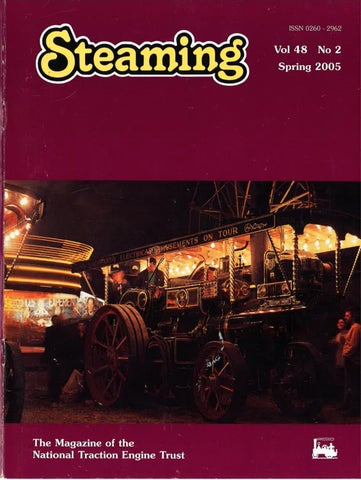
Although the neighbours have packed away for the night, the gallopers are still riding, and there are a few admirers left for Garrett 6hp showmans engine 27160 of 1908 BRITISH HERO at the 2004 Great Dorset show. (John Maund)
Next issue:The press date for news items, recent photographs and small adverts is 6th June 2005. For the date for Steaming Around see that section.
STEAMING
Spring 2005
Roger West Colin Hatch James Blenkinsop Peter Love Ken Myers Chris Edmonds John K Williams Anthony Coulls
Front cover
63
Trust News Management Review Several officers of the Trust recently took part in a management review, a resume of .which iS included elsewhere in these notes. The results will be formed into an action plan to maintain into the future the National Traction EngineTrust's position as the representative body for road steam vehicles and their owners, through its officers, sub-Committees and Codes of Practice. To achieve this will mean commitment and hard work for those on the Committee. Our future lies in the decisions we make, which we will justify to the membership. That which I been achieved over the first 50 years must not be wasted. Andrew Semple, our Chairman, has asked me to head this review, and it is a task that I am pleased to accept. (Robert Herring, vice Chairman)
Rally Organisers Column Rally Organisers subCommittee I am pleased to report that this year a record number of events have been approved by theTrust under our authorised rally scheme. No less than 103 rallies appear on The Rally List 2005, the full colour leaflet that is inserted with each membership copy of this Spring issue of Steaming make sure you keep the List where you can find it for reference during the summer. But of far wider significance than our personal copies, we should realise that the Trust's list will be seen by more people than any other steam rally events listing, for 85,000 are being distributed. As well as those in our own magazine, a copy goes to young enthusiasts with each SAC Raising Steam; one is inserted in each copy of the May issue of the news-stand magazine Best of British, and large bundles are sent off to over 500 tourist information centres nationwide and 120 museums. And, of 64
course they are available from the Trust's exhibition unit throughout the summer. It all adds up to a splendid amount of publicity- for the rally scene in general. My sub-committee intends to review the Trust's involvement in running the affiliation and authorisation schemes, arid we will be producing a document that sets out the benefits of joining these schemes. All authorised events and affiliated clubs will be sent details when available. The sub-Committee has received numerous enquiries and requests from safety officers to organise a Safety Seminar. At our recent committee meeting it was decided that the best way to proceed with this would be to hold a seminar in four different locations around the country, thus allowing as many people as possible the chance to attend. It would help us if clubs or event organisers could suggest suitable locations, so that we can accommodate several safety officers at each venue. We hope to run the Seminars in May and June, and if you can help with location suggestions please contact me - 12 01462 851711, or by e-mail - rallychair @ntet.co.uk It has been reported that certain people are presenting themselves at events as NTET inspectors. I would like to stress that anyone inspecting an event on behalf of the Trust will hold a current identification card, and will introduce themselves to the event organiser on arrival. If they do not do so, they are not part of our inspecting body. (Paul Worbey, chairman, Rally Organisers subCommittee)
Engine Owners Column Some notes on coal for engines The first thing to say about coal is that it is important to understand the
terminology that we use today. STEAM COAL refers to any bituminous coal that is used for raising steam, generally in power stations, as opposed to coking (caking) coal, which is used for making coke in the steel industry, and anthracite. It must also be explained that the pourer qualities arid smaller sizes of coking coal can be mixed with other bituminous coal and burnt in power stations. Anthracite is also used in power stations that have been specifically designed to burn it. DRY WELSH STEAM COAL is a type of steam coal that was predominantly used in days now gone by the Great Western Railway, who designed their locomotives accordingly. It burns with little or no smoke. Sources of this type of coal in this country (Great Britain) are virtually non-existent. It is a semibituminous coal with about 14% volatile matter and 80% fixed carbon. I now turn to sources of coal suitable for steam engines, and list below examples, with some of their properties and the approximate price at 1st January this year. 1. British sources. The company UK Coal will supply Daw Mill Large Cobbles - 5.0% ash, 8.0% moisture, 36.3% volatile matter Rossington Large Cobbles - 3.8% ash, 8.5% moisture. 34.5% volatile matter Although neither of these coals are ideal for steam traction engines (they have high volatiles), both are free burning products and are used extensively in this country by steam preservation societies and by large rallies. The current pit head price (at the time of compiling these notes in January 2005) is £98.50 per tonne. Discounts may be available in the summer. UK Coal is able to quote a delivered price for bulk tipped loads (minimum load size 5 tonnes). Contact for bulk sales - Graham Scott, UK Coal, Industrial Coal Sales 72 /fax 01283 564720, e-mail GScott@ukcoal.com Scottish Coal -this company does supply coal to steam railways, but has failed to respond to my repeated requests for information. Spring 2005 STEAMING
2. Imported sources Rudrum Holdings are major importers of coal into this country and at present they do not have any of their steam engine product, 'Brunel Steam Engine Coal' due to the economic conditions in the world coal market. They are however examining the possibility of importing some coal with the following specification 5% ash, 5% moisture, 0.26% sulphur with volatile matter of 19 to 20% They estimate the price of this product will be considerably over £100 per tonne. Contact - Dave Clayton, Rudrum Holdings 12 0117 982 6781; web site www.rudrum (Bob Siddall) holdings.co.uk Fire hydrant equipment The question of the use of fire hydrants by engine owners is being looked into by several affiliated organisations, and will be coordinated and published when ready. In the meantime those who are concerned about the use of hydrants may be interested to know that the firm of Williamsons, 8/18 Brook Street, Mumps Bridge, Oldham OL1 3HG (ts° 0161 624 5441 or 3525 or 2080; fax 0161 627 1716) will supply STEAMING
Spring 2005
A hark back to the Sentinel Drivers Club 'End to End' run from John o'Groats to Lands End in 1999 - with its taxing ascent to the Shap summit well behind, Sentinel model S6 tipper 8821 of 1933 coasts downhill near Kendal, Cumbria. This year the Sentinel Drivers Club is planning celebrations to mark the centenary of the occasion of the first Sentinel wagon emerging from Alley & MacLellan Ltd's Polmadie works in Glasgow. A group of wagons will assemble in Glasgow on 24th August and take part in a three day road run to the Onslow Park rally near Shrewsbury, to be held over the holiday weekend. (Jim Stevenson)
all manner of fire hydrants and associated equipment, some of which is detailed below. A 21/2in hydrant with 1in stand pipe, 3/4in tap, and double non return valves, will cost approx £50 plus VAT. A 21/2in hydrant aluminium light alloy with 21/2in outlet and double nonreturn valves is approx £160 plus VAT, and the addition of a 21/2in double non-return valve to your aluminium 21/2in standpipe, approx £85 plus VAT (Bob Siddall) Pattern Register The plethora of repatriated engines which abound these shores are producing a need for replacement castings, and missing boiler fittings. If you are a patternmaker, you would do well to make yourself known, and those members holding patterns for
boiler fittings could help others in need. The way the Trust's Pattern Register works is that I put you in touch with the interested party, and you take it from there. I am always glad to receive details of patterns to add to the list. Enquires recently for patterns have included a Marshall single cylinder traction blast pipe, a Fowler class T3 chimney base, and parts for a Clayton & Shuttleworth traction. For details on spares in general, or for information being sought, please contact me. If I am unable to help, I may be able to put you in touch with someone who can. Phone or fax 01793 790378, or write to Colin Hatch, 4 Lotmead Cottages, Lower Wanborough, Swindon SN4 OSN - colinhatch@mech-design.fsnetco.uk 65
Insurance Matters Insurance Disc Officer's notes Since taking over the Disc Scheme from David Smith two seasons ago, gradual improvements have been made with David's help to increase efficiency and control over the issuing system. To this end a programme of auditing our disc issuing insurance agents was started at the end of 2004, and should be completed by the time these notes are read. So far the audit has given us opportunities to enhance our computerised system for issuing the discs, and recording the data collected in a manner which hopefully can be made available to rally organisers and safety officers. I hasten to add that the details available will only be those already shown on the insurance disc. Unfortunately, partly as a result of this audit and a change in regulations, AON Risk Services Ltd at Dudley have decided to cease providing insurance cover for steam vehicles when those policies which they hold come up fur renewal. Il is a great disappointment that the successors to Tennant Budd Ltd and
latterly John Scott & Partners, who helped to set up the original disc scheme with the club, can no longer support our well established hobby. AON will be writing to those concerned in due course to advise on the situation, and give details of alternative insurance providers. One small but significant change to the appearance of the discs this year will be the additional wording around the bottom of the disc which reads BOILER INSPECTION CERTIFICATE TO HS&E PSSR 2000. This is in line with our commitment to comply with the industry standard for steam boilers even though we are not strictly at work with our engines. The disc will also meet the requirement as specified in the regulations for a clearly legible dole I.0 be shown on all mobile pressure systems, beyond which it cannot be operated without a further examination in accordance with the written scheme of examination. As most inspections are carried out to HS&E PSSR 2000 anyway there should not be an issue here, but it is more a case of meeting our obligations to raise standards and be understood throughout the wider world. Following our Engine Owners'
Notes on the Engine Owners Meeting A successful Engine Owners Meeting was held at Willoughby, Warwickshire, in January, attended by about 70 delegates. These notes are a summary of the topics discussed, taken from the minutes of the Meeting. The meeting was chaired by Engine Owners sub-Committee chairman Richard Pierce who explained there was no prepared agenda as he hoped that the meeting would become an open forum from beginning to end, with something beneficial to everyone. Asbestos Jim Newnham said that the asbestos ban applied from midnight 31st December 2004, but it only referred to use of asbestos at work. If you already have asbestos joints you can still use them, but you must not employ anyone else to fit or remove 66
them — you must do it yourself. Loading a low loader Peter Charles gave a presentation on the correct way to load a low loader and the best ways of chaining and strapping the load so that it does not slip. Boiler inspections This subject was debated in some depth. The NTET are able to organise a hot and cold inspection for £140 + VAT per engine per year provided the scheme includes 16 engines, and four of those engines are being inspected at the same time at the same (or very close) location. Delegates asked: what qualifications must a boiler inspector have? Jim Newnham replied that he should be a 'competent person', who knows what he is doing, but that does not necessarily mean that he
Meeting at Willoughby, a request was made to publish the list of Independent Boiler Inspectors who had lodged their Professional Indemnity and/or Public Liability Insurance documents with theTrust. I should explain that it is not always necessary to have both types of cover, but where professional advice is given, especially relating to repairs, then it is more appropriate to hold PI Insurance. inspection company PI and/or PL held A G Prout Inspection Services PL insurance Alan J Hines PI and PL insurance ANB Inspections PI insurance Farncare Inspection Services PI insurance Graham Morris Engineering Ltd PI and PL insurance J A Glaze PI and PL insurance R&B Inspection Services Ltd PI and PL insurance SFP Inspection & Consultancy PI insurance Jonathan Wheeler PI insurance I will endeavour to update this information in the magazine from time to time. (James Blenkinsop)
had to be a chartered engineer. James Blenkinsop said that the Trust checks the Professional Indemnity insurance of the boiler inspectors that most engine owners use. He agreed to produce the list of the boiler inspectors who have professional indemnity, and would be happy to add additional boiler inspectors to the list providing proof of professional indemnity is provided. The outcome, and the lessons to be learned, from two pending court cases on two boiler inspectors over the matter of competence, would be set out in the magazine after the cases have been heard. A boiler inspector at the meeting said that Dave Smith was trying to get boiler inspectors together for a discussion to set a common standard. The delegates asked that this is pursued. Answering a question, Jim Newnham said the onus is on the owner or user to select a 'competent person'. If the boiler inspector is not competent the onus falls on the owner. Richard Pierce asked whether owners would feel more comfortable Spring 2005 STEAMING
Running off the road I recently responded to a member who had asked for clarification on the definition of roads and the subsequent licensing and insurance requirements for self-propelled vehicles. Although the information has been set down here before, I feel it may be worth repeating it for the benefit of all readers. Since 3rd April 2000 Statutory Instrument 2000 No.726 has been law. This instrument has modified the Road Traffic Acts with respect to (RTA Compulsory Insurance Insurance) for any self propelled vehicle used on a road or any place where the public are present. This change in the law applies only to insurance and does not apply to driving licences, road fund licence or to MOT certificates. The situation is simply stated as follows: any vehicle used on a road (a place maintained at the public expense) must have RTA Insurance, a road fund licence, an MOT certificate if applicable and the driver must be appropriately licensed to drive the vehicle. Where the vehicle is used offroad but where the public are present (a rally field, the local supermarket car park etc), then it must have RTA
if the individual inspector was approved by the NTET. The delegates raised various points of view; they were all happy with their own inspector but agreed that new people with engines need to be catered for and in such cases the existence of Trust approved inspectors would be helpful. It was asked what qualifications the NTET has got to assess the abilities of a technical man. Jim Newnham explained that he chaired the Technical Board, which consisted of himself, Harry Pounder (Chief Engineer of Plant Safety) and Richard Swithenbank (a former Royal Navy boiler engineer, and ex Head of the Pressure Section of the HSE). None were members of the NTET so that anyone applying would not feel they were being interviewed by the NTET, but by an independent board. The Board's criteria used to test boiler inspectors is based on those employed by insurance companies when recruiting engine surveyors. It was suggested that as long as there was no inducement to seek NTET approval, there was no need to bother. Those inspectors that were firmly established felt no need to do so. STEAMING
Spring 2005
The museum at Beamish in Co Durham has often featured in the pages of this magazine, but the sight of two Aveling rollers at work among the splendid reconstructed buildings in May 2004 deserves to be seen. Nearest to the camera is 10921, an 8 tonner of 1924, whilst in the background is 10575, a 1923 built 10ton machine. (Anthony Coulls)
The NTET are to progress with the intention of producing a sensible scheme. It values the opinion of the delegates and members whether or not to have Trust approved boiler inspectors. It was asked if boiler inspections could be every 24 months, as our engines were under pressure for much less time than an industrial boiler. This was debated but it was decided that the insurers dictated the length of time between each inspection. A story was quoted of an engine dropping a plug, it being tapped out and a bolt put in it. It was pointed out that if an engine drops a fusible plug this means that there is failure of one of the safety devices, and the engine should have an inspection to find out why the plug dropped. If the insurers were aware of such circumstances, it could invalidate the insurance. Coal A shipment of foreign coal should be arriving in the UK in March. Delegates said that smoky fuel could see calls for engines to be taken off the road, and gave examples of an
accident where it was claimed an engine was not seen because of smoke. Other items James Blenkinsop gave a presentation on boiler water treatment, and a boiler joint questionnaire was distributed. Other matters included fire hydrants, the Driving Course, the FBHVC and the SAC: A number of points were raised from the floor under Any Other Business including: • A suggestion the NTET update and republish Traction Engines and the Law— Richard Pierce said it would be looked into. ■ The question was asked 'Was a person with a rack saw at a rally, cutting wood for a farmer for fencing, working?'. It was suggested that if he was not being paid a wage, and didn't pay income tax, then it was pleasure. Richard Pierce said that as chairman of the Engine Owners subCommittee, he found the meeting extremely useful and would address the issues raised at the next subCommittee meeting. The meeting closed at 3.15pm. 67
insurance cover. But, the law does not require the vehicle to carry a road fund licence or an MOT certificate, and the driver does not need to be licensed to drive. However, the vehicle insurer sometimes might require a licence to be held, and the event organiser or property owner has the right to insist that the driver holds a licence. (Dave Smith, Insurance Officer)
Steam Apprentice Club Can I start my column this time with a couple of reminders? The Steam Apprentice Club is once again taking part in the NTET Driving Course, and we are looking for more applications from SAC members — especially those who haven't attended a course before. This yea' also sees the start of the SAC 'Technical Achievement of the Year Award'. So far, entries are a little thin on the ground. Please take another look at the notice in the last issue of Steaming — page 39. If you know of an Apprentice who is actively involved in a real engineering project, please encourage him/her to enter for this award. Now to matters bureaucratic. The long arm of the Protection of Children Act has caught up with the SAC. This means that, following a prompt from the Charity Commission, we have had to draft, and subsequently adopt, a Child Protection Policy. I believe that we have navigated a fine line between being too prescriptive, and therefore killing the spirit of the SAC, on the one hand, or producing a document that is so woolly as to be meaningless on the other. There will have to be changes to the way the SAC operates, particularly in the area of placing Apprentices on engines at rallies. I fear that this will inevitably result in more paper filling, but do ask that the engine owners and drivers who have helped us in the past will continue to do so, and work with us to prevent this inevitable layer of bureaucracy from killing the SAC. If you want a copy of our CPP please contact me — details inside the front cover. On a happier note, progress is being made towards the point when we can offer Apprentices who have 68
achieved a suitable standard, the opportunity to go for a Certificate of Competence. In order to start to provide assessors for this work, both myself and my son Ian have put ourselves forward to take our 'test', such that we can move on to be able to test others. I trust that I don't repeat the achievement of our current vice President when he took his Group G test some years ago — he didn't pass! Details of how Apprentices can put themselves forward for this will appear in future issues of Raising Stern So, where did I put my copy of the Highway Code for Steam Engines? (John Durling, Chairman, SAC)
SAC Editor Wanted The Steam Apprentice Club has identified a need to appoint a new editor for their quarterly magazine Raising Steam. Interested parties should have good general knowledge of the marl steam movement, nnr1 he computer literate. Time to encourage contributions from Apprentires And. others, and time to research suitable material, both current and historic, and then to edit into an interesting magazine for youngsters of all ages up to 21 will be required. If you think you could do this job, please enquire first of all from the SAC Chairman, John Durling, details inside front cover.
Operation Blastpipe launched After 50 years of successful operation of the Trust it was thought appropriate by the National Committee to review its management and operation to ensure that it remained healthy for the next 50 years. Accordingly, in February a group of Trust committee members and officers (and Jim Whyman of the FBHVC) met for a weekend at the Black Country Living Museum to work hard and to see where theTrust was strong, where improvement was necessary, and to plan for the future. Expert facilitator and NTET member Lyndon Shearman took the Saturday sessions, assisted by national committee member John Billard. These consisted of a grilling of certain national committee members, individually, on a set number of
questions. This took all day. The facilitators then spent that evening preparing a report setting out what they had been told. This was presented back to the group after breakfast on Sunday, and the day spent analysing the responses and producing an action plan. The outcome was very interesting. There was almost unanimity by those questioned on theTrust's strengths and weaknesses. The solutions proposed in discussion were varied but all were agreed on the following plans for the future. • To revisit and reaffirm the Trust's role, purpose, and aims and objectives to ensure the continued use, enjoyment and preservation of engines as hitherto. • To make sure that the Trust's policies were properly determined and reviewed in consultation with the membership via the AGM and the national and executive committees. • Key officers were to identify present and future risks to theTrust (one rally is PxAmpfr, authorisation), and to consider a risk policy draft at the next national committee meeting. • To consider the Trust's charitable status and to make sure that this was correctly understood and operated. • To create a method of measuring how the Trust performs and how successful it is. • It was affirmed that there would be times when the Trust had to lead in difficult or possibly unpopular topics. Examples wore driver competence and boiler testing standards. • A set of agreed job descriptions for all Trust committee and management roles were required. This would assist hand over and aid forward planning. • A membership profile was required so the Trust could understand whom it represented and to deal with the fact that only a third of all engine owners were Trust members. • The Trust web site required modernisation. • The rally sub committee to report annually and to take safety seminars regionally to the membership. There was much to think about and do, but everyone left Dudley on the Sunday evening in good heart. That was the easy bit — now the work starts for the future. Operation Blastpipe? Lyndon Spring 2005 STEAMING
consultation list and found out more or less by accident. The latest position is that the rates local authorities are able to charge for licences has been amended to £1,000 (from £5,000) for events where between 5,000 and 10,000 are expected, but now rising to £64,000 to events expecting over 90,000 attendees. Venues that are permanent and purpose built/altered for the activity are exempt. Stoneleigh is an example, Organisers are advised to liaise closely with their relevant local authorities. Note that these are charges that 'are able' to be levied — not 'must' be levied. In any case, organisers should argue that a charge levied must be proportionate to the cost of the service paid for.
09.15 on a February Sunday morning in one of the meeting rooms at the Black Country Museum, and Lyndon Shearman makes those present think about Risk and how it affects their decisions on the way the Trust should work. Although faces cannot to be seen, readers can be assured that intense concentration was evident.
likened the Trust to an engine that was not in the first flush of youth, and was not steaming as well as it might. A simple but vital adjustment could make all the difference to its future success. (John Billard)
FBHVC news John Billard writes: Having taken over from Mike Ward, I would like to pay tribute to all the work Mike has done on behalf of Trust members over many years. I take over having been elected to the Federation of British Historic Vehicle Clubs (FBHVC) general committee, following Mike's retirement last October. The Waste Framework Directive The FBHVC has been studying a DEFRA (Department of Environment, Food and Rural Affairs) consultation on proposed waste management regulations. This 140-page document relates mainly to agricultural waste, but there are two areas of concern to us — how the disposal of scrap vehicles or machinery might be STEAMING
Spring 2005
affected, and how it might affect the ability of individuals to store equipment and machinery in the open, especially on agricultural land. There appears to be nothing to storing prevent individuals machinery or equipment indefinitely. Only if the individual declares the item scrap or it is leaking fluids does it have to be dealt with in an authorised way. A vehicle or machinery can be left indefinitely if the individual considers that it may have a further use and is not scrap. Annual registration charge 50,000 signatures objecting to the proposed registration charge for vehicles were delivered to 10 Downing Street on 14th December 2004 by a joint FBHVC and Parliamentary Historic Vehicles Club delegation. At the time of writing (15th March) there has been no response. Licensing charges for large events Hidden in a consultation issued by the Department of Culture, Media and Sport (DCMS) was a measure that is causing some headaches for organisers of larger events. The Federation was not on the
Four Wheel Brakes There was a rumour circulating at the end of last year that vehicles without at least four wheel brakes were to be outlawed. If so this would be a major precedent. Up to now any vehicle that was legal when built remains legal despite subsequent changes to the regulations. (That is why Fowler Super Lion SUPREME requires two headlights, unlike earlier engines — it was built after the rules requiring them came in). In the event there was nothing in it. However, that does not stop any Trust member reporting any new stories. It will all be verified, and action taken if necessary. Contact me John Billard, Old Station House, Twyford, Reading RG10 9NA, IT 01189 340381 — e-mail billard@billardj .freeserve.co.uk
Obituaries Maurice Bennett Maurice Bennett, who died in December, was born in 1917 at Cumnor Hill, Oxford. He attended preparatory school in Oxford, going on to Magdalen College School. In his teens he took up ice skating, winning many awards and a gold medal. He was apprenticed with Pressed Steel at Cowley, and after moving to Englefield Green, Egham, took up a position with British Federal Welders at Thorpe, Surrey as a welding instructor, travelling all over the world. He was their technical director until retirement. Maurice had been interested in steam since a child; he would reminisce of the St Giles Fair at 69
Oxford and the engines and rides that attended. I first meet Maurice at The Great Steam Fair at White Waltham in 1964, where he was helping Arthur Clarke with his Fowler showmans. The late Jack Ward of Egham invited Maurice to take charge of the steam section of the Egham &Thorpe Royal Agricultural Association show, and when he left the area, he handed the job on to me — that was 1965. Just before he retired from work Maurice purchased a former Barnes Bros roller from Robin Greenaway, Aveling & Porter 8 ton roller 14001. This engine he rallied for a number of years. Maurice's devoted wife Diana passed away four years ago. My sympathy is extended to his daughters Carolyn, Valerie and Debbie, and to their families. (Ivan Fear) Ruben Blom Swedish enthusiast and major engine collector Ruben Biom died in February, aged 79. He became the pioneer collector of his shores when starting to preserve steam and old internal combustion engines in the first years of the sixties. Being a very locally based man he wanted to preserve a portable steam engine known from his boyhood, without any influence from growing international movement. He started to collect just locally, but his ambitions increased and with help of his sons it soon became a countrywide project. The main interest was the steam engines, very much focused on the portable and traction engines. The collection included in 1969 six portable engines, but was grown to above 80 at the turn of the century. The main part is Swedish-built Munktells engines, although there are no less than 15 other worldwide makers represented. Other types of engine, like internal combustion engines and tractors were by then counted in hundreds. RUBENS Maskinhistoriska Samlingar (historical machinery collection) won national attention whilst acquiring the Fowler ploughing engines at the Tom Paisley sale in 1980, and by bringing the restored Munktells traction engine to England in 1983 — the unusually coloured machine gave a reason for the only matching lavender cover to appear on the Steaming magazine. With a couple of tours to Belgian and Holland in following years, this Swedish collector gained an international attention and put 70
Sweden on the preservation map. Ruben Blom was a member of the Trust for more than a quarter of a century and remained until his death. The collection is continuing within the family and remains safe, although its founder has passed away. (Tore Blom) George Fensom Born on 12th June 1926, George Henry Fensom was the first child of Jack and Winifred Fensom, who were contract timber hauliers using steam engines. At this time the family were living and working on the estate of Lord Carnarvon, of Tutenkhamen's tomb fame, at Highclere, near Newbury, Berkshire. Up to the age of seven George lived with his parents on the road, but he did not take to the nomadic lifestyle, changing schools so often, so it was decided to allow him to live a more settled lifestyle with his grandparents at Roothams Farm, the company base of T C Fensom & Son at Coimworth in Bedfordshire. He attended the local school, situated in the corner of a field surrounded by tall oak trees, a school where his grandfather, father, uncles and aunts and cousins attended over the years. He left school at the age of 14, to work for the family business as the second man on a set of threshing tackle — and this being the early years of the World War 2, a push bike was his only mode of transport to and from wherever they were thrashing. At about 16 he decided to return to his immediate family, now settled permanently at Friars Wash in Hertfordshire, with the timber haulage side of the business. Threshing and timber haulage were classed as reserved occupations during the war, so George was never conscripted into the armed forces, but was expected to join the Flamstead Scouts; however, he was never home early enough to attend meetings as he was now the second man on a Foden steam wagon alongside the late Bill Hall, hauling timber for the war effort. At 17 he became the driver of the company's petrol-engined Latil timber tractor, his second man being younger brother Albert. In the late 40s George met a local girl Queenie, and they married in 1952; they were to bring up a family of five sons in the village of Flamstead. At the age of 19 he moved on to drive a Federal, an ex-American Army tractor unit converted to a timber tractor in the company workshop. This he drove all over the
country hauling timber until 1966. Many years later the vehicle was repurchased by Roger, George's youngest son, who restored it to a high standard, and it remains with him. The Federal had been replaced by an ex-military AEC Matador, which had also been converted for timber work in the company workshops, and George drove this until he retired from the company in 1973. Even after the firm had finished working with steam George, together with his father Jack and brother Albert, continued to be involved with the last days of commercial steam working; the remaining local engines could be seen parked up in the yard at Friars Wash between duties, or on an overnight stop. It was inevitable the Fensom family were enthusiastically involved in the early days of steam preservation, and George was driver or mate for some of the early long distance journeys when freshly purchased engines were travelled to their new preservation homes. in 1964 the Burrell compound traction engine 4055, known as CRilviSON LADY, was purchased from Ron Stanbrook by George's father Jack. After his death in 1966, as part of the settlement of his estate, the Burrell passed to his wife Winifred; later, it passed on to George, at the same time as the Garrett tractor PATRICIA went to younger son Albert. The Burrell was built for Sheldrake's of Wymondham, being displayed when new in 1927 on the Burrell stand at the Royal Norfolk Show. George kept the engine in immaculate condition throughout his ownership, and he continued to rally it extensively until his health started to fail a couple of years ago. He died in December. As one of the last men to have worked commercially with steam, George was qualified to give advice to those less experienced, and he was well known to engine owners and drivers far and wide. As a real countryman, it was fitting that his funeral service took place in the packed village church of St. Leonard's at Flamstead, where several hundred mourners paid their last respects to this man of steam. (The Fensome family) David Gray The steam world, and the Bedford club, lost one its earlier supporting members when David Gray died in January. He had been an active member of the Bedford SEPS throughout the 1970s, rallying Aveling & Porter roller 10346 and Spring 2005 STEAMING
t.t. . :.. ... ,. ..,. -... ,_
. 04.11,1111 CAI Sao.
then Fowler TE2 class 14910 RISING STAR. David, born in 1925, from 1941 became an engineering apprentice at the de Haviland Aircraft company in Hatfield, and was involved in the production of Mosquito aircraft during World War 2. On completion of his apprenticeship, rather than continue into military service in the RAF as a commissioned officer, he volunteered for regular service in the Black Watch, following a family tradition with this Scottish Highland Regiment. David's passion for steam started as a boy, but it was not until he left the Army in 1948 and joined John Fowler & Co in Leeds as production engineer that his interest in steam developed. At Fowlers his responsibilities were with the new Challenger crawler tractor, but he recalled steam repairs continued at the Steam Plough Works throughout the 1950s, particularly with ploughing engines and steam rollers. He also saw a number of engines sent for scrap and was responsible for clearing out many redundant steam tools and production equipment to make way for the Challenger production line. In 1954, David moved to New Zealand, taking a young family with him. There he became general manager for Booth McDonald, a well known firm of agricultural engineers in Christchurch. His interest in steam and Leeds engines was boosted by regularly seeing a Fowler road locomotive on house moving work STEAMING
Spring 2005
_ mow +MA ill Ulf ..0.1,1-11111 .
C .,
.'11.
...
-,
This fine scene was photographed in the Market Place in Caistor, a small market town on the north western edge of the Lincolnshire Wolds. The date is unknown, but a reasonable guess might be the first few years of the last century — 1900 to 1910. The occasion seems to have been a club, school or church outing, for sixty or seventy best-dressed children of varying ages are packed into the two wagons, and the ten or a dozen adults also present include the crew of the traction engine, though no clerical collars are on show. The possibility of inclement weather has been well provided for, with quite substantial timber framing erected over the wagons, and perhaps the sheets are providing comfortable perches for the youngsters. The train has been provided by George Roberts, an agricultural machinery operator, haulier and rolling contractor, who had premises on the Grimsby Road, Caistor and at Nettleton Top. The engine is clearly a Fowler single cylinder agricultural, probably of the 1890s, and indeed, Roberts did own two such 8 hp engines in the early 1900s — B3 class 7096 of 1894 and B4 class 7486 of 1896. The Roberts family's fleet of machines was large, a total of almost forty engines and rollers at different times between 1900 and the 1940s. It included two that have survived through other ownerships into preservation — Ruston Proctor 7hp traction 33189 (CT3949), and McLaren 10hp road loco 1652 (then BE7382) for the twelve year period after it was first sold out of War Department service in 1919. (courtesy North East Lincolnshire libraries) around Christchurch. On return to the UK, the rally scene had started. Living in Hitchin, Hertfordshire, the early local rally activity was at Great Wymondley, and this became an annual event for both David and his son Stuart. The family interest in steam grew, and by 1969 David had joined the Bedford Steam Engine Preservation Society, and with the his son's interest also developing, the chance of an Aveling roller advertised in Exchange & Mart was taken, and with assistance from Reg Saunders from Stotfold, duly delivered to home at Great Shelford, near Cambridge. By 1973 he acquired the Fowler TE2 that
he and Stuart rallied for a number of years. At this time, David was keen to record the rallies on 8mm cine film and he built up a large film archive of local events. Some of this is rare footage — thanks to his foresight at a time when filming and recording rallies was not as complete as it is today. In more recent years, David retired to Scotland where his family originated, but he kept abreast of what was happening in the steam world, following the continuing activities and interest now enjoyed by three generations of son, grandson and great grandson! 71
For the past two years David had suffered illness. He died peacefully at home in January this year, leaving Elizabeth, his wife of 56 years, who spent many loyal and happy times at his side, at many rallies both in the UK and abroad — even an active film maker too. Andrew Hill Andy John Hill ('Woop'), who died in December, was born in July 1959. He grew up on the Bowes Lyon Estate at St Pauls Walden, near Hitchin, Hertfordshire, and was always involved with jobs that arose on the Estate and within the surrounding community. Andy had a passion for working outside; gardening, timberwork and anything lie could lay his hand to. From the mid 1990s he owned and rallied a Denning rack saw bench. He was involved in the running of several steam events, and his main role was Safety Officer at the Bedford club's rallies from 1992. He was always an active committee member and would be seen at the event wearing a brightly coloured suit, with varying themes! At his funeral Andy was described as 'Peter Pan and larger than life' — this was very true. He was a kind and generous person who would lend a hand to anyone, young or old. He will be greatly missed by all who knew him, especially his partner Sue, his Mum Val, sister Sue and the family. (Mark Worbey) Alec Ibboft Alec Ibhott died in December 2004. He was born in 1923 and spent his childhood in Stagsden, Bedfordshire. He attended Bedford School and left to start work at the age of 15. In 1942 he met Daphne whilst working for the War Agricultural Commission — she had volunteered as a Land Army girl, and Alec was involved with repairing tractors. They were married in 1948, moving to Queen's Park, Bedford. During the 1950s Alec worked for the Crawley family as an agricultural representative for Bedfordshire Autocar Ltd. His interest in steam engines was kindled when John Crawley started to purchase engines and Alec helped to look after them. He joined the Bedford Steam Engine Preservation Society in 1958 and was always a keen member, promoting steam wherever he went. Bitten by the steam bug, Alec bought his own ploughing engine in 1965, naming it after his daughter Janet. This engine, apart from his 72
family, was his pride and joy. He became a member of the Steam Plough Club and served on its committee for several years. I first met Alec at Woburn Rally in 1968 — his engine was stuck in the mud up to the back axle and he was refusing assistance from a modern tractor—'I won't have a steam engine pulled out by a modern tractor'. I believe the hole is still there today. Alec believed in steam engines getting themselves out of the mud and didn't mind what size hole was made. At a very wet Stoke Goldington rally he was participating in a game of 'tug of war' with the engine versus the Army Cadet Band (in their smart red uniforms), and proceeded to dig a hole in the middle of the arena with the back wheel of the engine. The cadets got a bit muddy to say the least, especially when the rope broke and they all fell in the mud! After leaving Bedfordshire Autocar in the 1970s, Alec worked for Gates of Baldock, where he was well known and respected amongst the local farming communities. in 1977 he became chairman of the Bedford Steam Engine Preservation Society and held this position for 14 years before retiring from office. He was a very active chairman and was keen to support the young Steam Apprentices. His enthusiasm for steam ploughing was untiring and he spent many hours in muddy fields following this hobby — always resulting in a pint or two following a hard day's work. Alec thoroughly enjoyed steam rallies and reading his engine to events. My mind goes to a Sunday in September and a trip to Stotfold from Roxton Park, when following a lunchtime in the pub at Sandy, Alec, Pete Coulson and Reg Saunders were seen racing their engines down the Al in the fast lane! Not recommended today. Alec's enthusiasm, knowledge and interest in steam engines will be sorely missed, in particular his ability for roadside repairs. His final workplace was Dacre Agricultural Engineering, based in Cranfield. Following retirement Alee continued his interest in steam by looking after Ted Wootton's collection of engines. Alec leaves a loving wife Daphne, daughter Janet and granddaughter Nicola. He will be missed as a good friend to many, by all who knew him. (Paul Worbey)
The Ring-Around Column There were half a dozen or so points that I picked up from my contacts just before the Trust's February Committee meeting. The subject of coal — its availability and quality — seems to be mentioned more often. I understand Bob Siddall of the Engine Owners sub-Committee is asking questions within the industry, and I understand there should be something to set out on the subject in the Engine Owners columns in this issue. Clarification was asked for on a statement in Steaming — if a rally organiser wasn't satisfied with the condition of an engine he could refuse entry or ask you not to steam, despite the owner holding a current disc. Would it work in reverse, with a rally organiser being quite happy with the engine's condition, despite it not being covered by a current disc? James Blenkinsop replies: 'For a rally organiser to be satisfied that an engine is OK to steam, despite not carrying a current disc., he would need to read and understand the boiler report, check the insurance papers in detail and be sure that all documents came from a reputable source, with all the back-up insurance cover and head office facilities normally associated with such organisations. It would be a foolhardy organiser in today's litigious society to sanction an engine to be in steam without a thorough check being made on these details. It is unlikely that the organiser would have sufficient time to carry out a thorough enough job to be entirely satisfied, especially at a weekend when offices are shut. 'In addition it is a statutory requirement of the H&SE Pressure Safety Systems Regulations 2000 for all mobile pressure systems to have legibly and durably marked the date beyond which the pressure system may not be operated without a further examination. This is covered by the NTET disc, and is just another good reason why each engine should display a current disc'. A contact reported his rally have decided on discs in advance only this year due to problems in previous years. Are other organisers facing the same problems and coming to the same conclusion? It would make it more acceptable if all authorised rallies demanded pre-discs. Is there any chance of access to a database to make it easier to check the disc status? Once again, James Blenkinsop Spring 2005 STEAMING
answers: 'It is the long term aim to have an accessible database for authorised rally organisers to check the status of discs for engines invited to their event. At present we have three of the four issuing agents using the NTET computerised disc issuing system. Hopefully, later in the spring, we can look at making the central database available through theTrust's web-site, The information would only be available through a password issued to rally organisers who have joined the affiliation scheme. All this also depends on having a skilled web master who can create the web page, and keep it up to date. Requests for a volunteer for this role have so far failed to find anyone to come forward - it may be some time before we can instigate the system' Another contact had heard that by the end of the year SORNs will be required on every registration document. Can we clarify please? Dave Smith provides comment to this point: 'The January 2004 Statutory Off-Road Notification (SORN) regulations apply what is known as 'continuous licensing', whereby 14 days grace is no longer given between Road Fund Licensing periods. This applies even if the vehicle is being taken off the road. So now, as soon a vehicle's Road Fund Licence expires without immediate renewal, that vehicle is automatically assumed to be 'taken off the road' in which case a SORN (form V890) needs to be filled in on or before the Road Fund expiry date. These rules apply to every vehicle - even zero tax vehicles such as our steam engines. The DVLA's systems track the renewal of Road Fund Licences and failure to submit a SORN leads to an automatic £80 fine, up to a maximum of £1,000, and there is no method of appeal at the moment! As soon as the vehicle is returned to the road a new Road Fund Licence should be applied for (V10 or V11), even for zero tax vehicles, and this application automatically cancels the SORN: The way in which I am trying to operate this column was last described in the Summer 2004 issue; do please make contact if you feel something needs explaining. The list of the contacts will be updated and printed in the next issue. (Nickey Daniel - 01208 831293)
Trust Exhibition Unit By the time members read this notice it will be only a few weeks to a STEAMING
Spring 2005
The National Traction Engine Trust The Engine Owners sub-Committee presents its 15th
STEAM TRAINING and DRIVING COURSE to be held at
Hatton Country World, near Warwick on 14th and 15th May 2005 This practical and informal course includes instruction on boiler management, mechanical operation, and care, maintenance and on driving techniques For further information sena a C5 (for A5) size SAE to: Stuart Tomlinson, 470 Coventry Road, Hinckley, Leicestershire LE10 ONH. 17 01455 613079 e-mail hazel.tomlinson@homecall.co.uk
new season's travels with the Trust's Exhibition Unit. As usual, the Unit will be attending a goodly spread of rallies up and down the country - 16 events have, in fact, been selected. The Unit is intended to show off the Trust's activities and road steam engines with a high profile, and the added bonus of raising funds and providing a service to members and others via the book sales section. Do look out for the display on the summer. this rallyfields Arrangements have been made for the Unit to appear at the following rallies. May - 7/8th, Stoke Goldington; 21st/22nd Belvoir Castle; 28 to 30th, Strumpshaw. June - 17 to 19th, Lister Tyndale; 25/26th, Banbury. July - 2nd/3rd, Chiltern; 9/10th, Ardingly; 15 to 17th, Somerset; 22nd to 24th, Netley Marsh; 29th to 31st, Welland. August - 6/7th, Gloucestershire; 19th to 21st, West of England; 28/29th, County of Salop; September - 31st Aug to 4th, Great Dorset Steam Fair (marquee); 10/11th, Haddenham; 17/18th, Bedfordshire. As usual, the above titles are rather shortened versions of what appears in the Trust's The Rally List 2005, which is distributed as a loose insert with this issue of the magazine. Please refer to the List for more detail on the respective locations and a contact, if necessary.
Affiliated Groups West of England Steam Engine Society This year it is the turn of the West of England society to celebrate 50 years of existence, and no doubt their annual rally at St Agnes in the middle of August will be looked forward to by many - 100 engines are promised. The society is to publish 6 book to commemorate the 50 years, and Editor Kevin Lean asks if any Trust members have photographs (colour or black and white) of engines or engine people that they would be prepared to lend for reproduction. Pictures from the rallies of the earlier years, 1955 to 1980, are especially sought. If you can help please contact - Kevin Lean, 34 Lodge Drive, Truro, Cornwall TR1 1TX.
•
Transport Trust Awards 2005 Nominations are invited for the Transport Trust's 'Preservationist of the Year' and 'Lifetime Achievement' Awards, together with entries for the 'Young Preservationist of the Year' Award, which carries with it a cash sum of £500 to the winner. These three Awards enable the Trust to acknowledge and publicise a wide range of endeavour in the cause of transport preservation, from management or administration to 73
hands-on restoration work. Entries in all three categories are invited from individuals or organisations, and should reach the Trust office, at 202 Lambeth Road, London SE1 7JW, marked for Stuart Wilkinson, to arrive not later than 14th May. The presentation to the winners will take place in early summer on a date and at a London venue to be announced. Entries are also invited for the 'Transport Trust Restoration Awards'. A number of cash awards, up to a maximum of £2000 each, are made annually for high quality restoration projects which are well advanced, hut which need a cash injection to ensure their completion. The closing date for Restoration Award entries is 30th June. Inspection of projects will be completed by the end of August, with the declaration of winners made during October. Award criteria and entry forms will be sent on application to John Butler at theTrust Office. Alternatively, entry details and application forms for all the Transport Trust Awards are available on the Trust's website - hric&thetransport trust.org.uk
Future Dates Steam Training and Driving Course, 2005 The Steam Training and Driving Course for 2005 is to be held on Saturday and Sunday, 14/15th May at Hatton Country World, near Warwick (near junction 15, M40). Details were set out in the last issue - there are just a few places left on the course, so if you are interested, please make early contact with Stuart Tomlinson, 12 01455 613079, or e-mail Stuart at: hazel.tomlinson@homecall.co.uk
New Members We extend a sincere welcome to the following new members who have joined the Trust during the last three months. We hope they will gain much friendship, information and enjoyment from their membership over a period of many years. Full addresses are not included, but the Membership Secretary is always pleased to put members in touch with one another by forwarding mail. 74
Miniature Steaming
Compiled by Graham Martin
This short introduction under this new heading in Steaming will, I hope, be the beginning of the regular appearance of a page or two of news and information for those Trust members who are owners of miniature road steam engines, or maybe just interested in them. Firstly, may I thank the Editor, Roger West, for his warm welcome to miniature steam enthusiasts. My name is Graham Martin, and I am the owner of a 4 1/2in Burrell. I have offered to produce material for pages under the title Miniature Steaming, but shall be relying on members to come up with 'raw material'. So, ! shall welcome contact and correspondence from all steam miniature constructors and modellers - these pages will be your pages and an opportunity to have questions answered, and even see your pride and joy featured in the magazine. The pages will not cover construction, or how to build a traction engine, for there are many magazines and fine books on the market covering this subject. They will involve history and, for example, if anyone is building a miniature of a type of engine that has now passed
into history with no surviving example to be seen on the rally fields, then this will be very welcome as a subject. Miniature owners can benefit from being Trust members by gaining knowledge of history and also have information on insurance matters - which are relating to miniature engines with increasing impact. These new columns are a wonderful opportunity for all steam model engineers to write in -they are your pages. Rally organisers: I welcome any information on your rally, and maybe a pass to attend your event, so that I can cover the miniature engines. Please send me notes and pictures about your engine, and other less than full-size topics, and I will do my best to make up an interesting section of the magazine, devoted to our particular interest. I have no particular thoughts or restrictions on the scales we should cover, for personally I am very interested in all steam. Information then please to Graham Martin, 22 Saxon Road, Whittlesey, Peterborough PE7 1NP or miniature steaming@btinternet.com
C Walker, York Miss A J Siddall, Newcastle on Tyne Miss C E Siddall, Derby Miss E Black, Carnoustie, Angus C Jaques, Hockley, Essex B J Wellington, Bedfont, Middlesex W A Ledbury, Huthwaite, Nottinghamshire R Agent, Ilkeston, Derbyshire D Allen, Leighton Buzzard, Bedfordshire E J Lambert, Potter Heigham, Norfolk R Bottamley, Scunthorpe, Lincolnshire D Higgs, Barnsley, South Yorkshire T Radford, Whitstable, Kent R Gerry, Alton, Hampshire R M Duckworth, Sutton, Surrey Miss S Dod, Banbury, Oxfordshire C E Baker, Sudbury, Suffolk J Bolitho, Helston, Cornwall J Whyman, Taunton, Somerset R B A Robinson, Preston, Lancashire S G Millard, London B Holyoake, Cheltenham, Gloucestershire N Gough, Storrington, West Sussex K Osbourne, Ashford, Kent B Smith, Wincanton, Somerset
Poor Steaming In finalising David Dean's account of Arthur Phoenix's early attempts at engine preservation for use in the last issue, the Editor introduced an error which should be corrected Arthur Napper, though he turned up in person atThetford, did not take an engine to the gathering.
'At the close of last year there were 2866 steam boilers in the town and suburbs of Calcutta [India]. Out of these 2118 boilers were thoroughly inspected, for which certificates were duly granted' (from The Engineer, 10th November 1899. A very large majority of the vessels concerned would have been stationary boilers in industrial use.) Spring 2005 STEAMING
NATIONAL TRACTION ENGINE TRUST Preserving our heritage in steam on the road
Your choice is our Speciality We are the appointed insurance brokers for the National Traction Engine Trust and have designed exclusive facilities for members of the Trust. We have developed a unique scheme for owners of steam vehicles which includes as standard, motor legal expenses and road rage personal accident cover.
For Over 20 years - The Enthusiast's Choice
Specialist Vehicle Insurance
FOOTMAN JAMES Tel. 0845 458 6788 Web: www.footmanjames.co.uk E-Mail: enquiries@footmanjames.co.uk
Authorised and regulated by Financial Services Authority.
enj.1 Telephone calls may be monitored or recorded for your protection An open.dlract company
Mr Scrivener's unfilled want An account of the use of steam rollers by the Palestine Railways, 1926 to 1947 Roger West The Israel Railway Museum at Haifa, by the courtesy of its deputy manager Paul Dotterel!, has kindly made available a copy of an extensive file started in the 1920s, when the Palestine Railways' Engineering Department decided it needed to own a steam roller to develop and repair the roadways that served the various railway properties. The detail to be found in the file is considerable, maybe even tedious, but the copy letters have the merit of being a contemporary working document of a type which is a rare survivor in any country in the world. Setting the scene The running of a railway system clearly involves a lot more than making or acquiring locomotives and carriages, and staffing stations. The aspects of smoothly operating the services, and of maintaining the infrastructure to enable that to happen, are manifold, and all have to be considered as to whether they are done 'in house' or contracted out for others to undertake the required task. One of the less obvious but nonetheless important matters to be tackled by the management of the Palestine Railways in the mid 1920s was the maintenance and construction of roads and hard surfaces around their passenger and goods stations. Railways came relatively late to the Holy Land with the first trains from Jaffa to Jerusalem starting in 1892. During World War 1 the British conquered Palestine (over which, until then, Turkey had had legal authority as part of the Turkish Ottoman Empire) and they laid, or relaid, numerous railway lines as essential to that conquest. After the war, by decision of the League of Nations in 1922, Palestine became a British Mandated Territory, and the railways were upgraded from military to civilian use. No doubt the finished roads around the stations were constructed and maintained by hand during the early years. After World War 1, however, there came the necessity for more up to date mechanised equipment to keep the roads in good order and to construct new surfaces for the developing 76
commercial traffic the railway was experiencing. Constantly increasing, numbers of motorised vehicles were visiting the stations. The Chief Engineer needed a steam roller added to his range of machinery. It is more than likely the Railway had had a steam roller on its property before — directly on hire to them from the Government's Public Works Department (PWD) or a private contractor, or perhaps as part of some works put out to contract as a whole. Whatever, by the mid 1920s repair and development work needed by die then Guveininent owned Palestine Railways (PR) was being carried out directly, and there was the necessity for a roller to be readily available to fit in with schedules arranged around the rest of the railway's day to day operations. There may well have been earlier discussions and correspondence on the matter of procuring a steam roller, but in July 1926 the subject had become important and Mr Rupert F Scrivener, Chief Engineer Ways & Works, asked for File 118.31/17 'Steam Rollers' to be made up to take the forthcoming paperwork. He hoped to acquire a new steam roller that would be used on making and maintaining roads, and.platform and loading bay surfaces. Scrivener reported directly to the General Manager (GM) of the Palestine Railways, and, as his title suggests, he was responsible for the tracks and the built infrastructure of the railway; alongside him the Chief Mechanical
Engineer (CME), who we shall also find featured in the file, had charge of the locomotives, carriages and wagons. All these posts were run from offices in ui near Haifa, a town to the north of the MandatedTerritory. Under Scrivener there were two District Engineers, one for the Haifa area and another for the Lydda area to the south. The latter district covered the busier portion of the railway, and was midway between Jerusalem and the old coastal port of Jaffa. These men will be the principal players in this account, but other persona will be the officers of the Palestine Government and its Public Works Department, boiler inspectors and local engineering dealers and import agents. Many of the posts had changes of tenure as the years passed, but Scrivener and one of his District Engineers (F H Taylor, first at Haifa and subsequently at Lydda) lasted the course, and feature in the very first letters right through the fifteen years to when the file finishes in October 1941. Like any everyday file of correspondence there is much that we will nowadays feel is missing; nevertheless three hundred plus sheets have survived to allow us to learn a little of happenings around some modest steam rolling work away from this country seventy years ago. The opening round In July 1926, in a letter that seems to have the tiresome tone of yet another mention of the topic, the Haifa district engineer, Taylor, pleads that he has 45,000 square metres of road area to be repaired each year. That represented six months employment for a roller — and he could tell his chief that Marshall and Aveling & Porter could quote about £E500* each for light steam rollers. Scrivener had already been advised by higher management that draft provision of £600 had been made for the purchase of a new steam roller in the 1927/28 Spring 2005 STEAMING
requesting the return of the roller (not because of the breakage - that had been repaired by welding), and it seems the agreement had been for the machine to be loaded back to a choice of station decided by the owner. Transport by railway flat wagon (via the station loading ramps) was the usual way of moving between jobs. The District Engineer at Lydda had his ear to the ground, and could write off and suggest to his chief that they buy the Acme roller, which he understood could be had at a very reasonable price. Solel Boneh did not need it returned for any further works they had in view, but because their creditors preferred to sell the machine. The General Manager agreed to ask the CME to give a report on the Acme, which by early December had been moved to work on resurfacing the approach roads at Jerusalem station. The report noted it was an American product, built at Frankfort, New York with a four cylinder 40hp engine by Continental Motors Corporation, with rear rolls noted as 72inch diameter! It was thought to be about six or seven years old - that is, built about 1920. Of 14 tons weight the traditional three wheel, two speed machine was deemed in good Some rollers on hire order, but it had probably worked since arrival in Palestine without Despite the difficulties experioverhaul, and would need such a enced through not having a roller of repair at an early date. As to the its own, it seems the PR engineers value, the CME wrote that a similar had been able to carry out some of new machine of English make would their work by short term hire. In be £1200 to £1400, and that the Acme September 1927 a paraffin engined probably cost £1000, and a 10% Acme road roller had been hired annual depreciation would bring it to from Solel Boneh, a Jewish owned a current value of £P531. Others construction company. Whilst in use thought it only four years old, which rolling next to a siding at Jaffa in gave a £P656 marked down value. November it had been hit by a Meanwhile, Solel Boneh had railway wagon, and one of the cast come up with their price for the roller iron scraper brackets was broken. - £P760. They wanted a prompt Three weeks later, Solel Boneh were answer for (of course!) another buyer was also in negotiation with them. The roller had, they said, come to Palestine at the end of 1921, and * Sums of money are variously since been lightly used - only a few expressed in the file in English days in 1922; about four months in pounds, in Palestine pounds and on 1922/23 and some 450 days since occasion non-specifically, or in a then. The offer of £P531 was rejected combination in the same letter - it and they wanted the machine back. seems to depend on who was By now, the Chief Engineer had been writing. The amounts are quoted here told he had £615 included in the in exactly the same way they are Schedule F estimates for 1928, but shown on the file papers. During the whilst he and the GM were 1920s and 30s the EP may well have exchanging notes on whether to raise been on a par to Sterling. Whatever, their offer to £P600, and how the the Palestine pound, to take account money would be brought forward out of the very much smaller local values, of the following year's sums, Solel was expressed in a decimal manner. Boneh advised in January that they The EP was divided into 1000mils, had sold the Acme to the other party, hence, for example £P1.050. for a higher price. Accordingly, 36 mils was probably The Haifa District Engineer had about 3'/2d - our old pence, that is.
Schedule F estimates, but the figure was deleted in deference to demands for new railway rolling stock. The following March he reminded the then Acting General Manager, G Campigli, that great economy would result from the department having a roller at its disposal for the maintenance of roads, platforms and courtyards. At remote places it was practically impossible to consolidate surfaces except by hand ramming. Scrivener had a plan - as his provision for the cost of a roller had been appropriated by the CME, he proposed the machine's cost should be defrayed partly from his tools and plant budget and partly from the roads and bridges maintenance monies. The Acting GM quickly slapped him down on that - the purchase was a strictly capital item! The Chief Engineer persisted, for he saw nothing wrong in a roller, which would be used for maintenance, being purchased out of that budget, and he thought it should be regarded as a revenue item.The reasoning was to no avail, and the Acting GM in return quoted the relevant Palestine Government regulations, and curtly wrote that his own reasons on the subject were 'to be taken as final'.
STEAMING
Spring 2005
Quishon cu a) co
Haifa
ay (It
Hadera
etah Tlqva Jaffa Lydda Jerusale
as Gaza
kms 20 30 40 50
-a as a) 0
A somewhat simplified map of the area of Palestine of the 1930s that is dealt with in this article, showing the principal towns mentioned in the text, and the railway lines. also managed to have use of a roller. Its arrival and the details of the arrangement are not set down in the file, but late in December 1927 the engineer for the Northern Division of the PWD asked for the return of their 'Steam Roller S.2' as it was urgently required by them at Acre. It was to be railed to Acre station; there is no indication of how long PR had had use of the roller. Months later the Chief Accountant was asking if he should recover the cost of a Lister magneto spare part that was put on Solel Boneh's paraffin-engined roller - notably, he referred to it as a 'steam roller' whilst it was on hire. The flurry of memos ended with the District Engineer sensibly accepting the £2.800mi1s cost as a running repair. Thoughts of something new Following the failure to procure even a second-hand roller for his road repairing activities the Chief Engineer returned to pestering the GM for the wherewithal for a new one. In February 1928 Scrivener had his desk laden down with the clearly voluminous General Catalogue of 77
SINGLE CYLINDER STEAM ROA I) ROLLER with PISTON VALVE ENGINE
AVELING & PORTER, LTD. ROCHESTER, KENT faet r, C1,111,1 Ili.
".\,"1", LONDON own.r.11
W.C. 2.
(J9, 11,24 o :Isl.
IAL
Early in 1929 Scrivener was supplied by S Awad, a Jerusalem firm of engineers, contractors and merchants, with prices of various sizes of Aveling & Porter steam rollers. Illustrations were provided, but they did not find their way to the file. The single page green-tinted leaflet (above) is the somewhat minimal offering the Strood works had for prospective customers in the mid 1920s and probably later. This example is for the smallest of the piston valve range, the type A single 6 tonner, and further sheets depicted the other types up to H. The reverse side gave only a few hundred words of description — perhaps you had to express solid interest before you got more technical stuff in the larger catalogue.
Messrs J Birch & Co Ltd, presumably a firm of export agents or the like. On page 730 he found particulars of new 8 and 10 ton compound steam rollers, manufacturer unspecified but priced, with governors and 'hoods', at £P446 and £P491 respectively. He let the GM know this, appending some dimensions of the 10 tanner, and claiming such a machine would fulfil all of his department's wants. Howe could the Crown Agents for the Colonies obtain a quotation CIF (cost, insurance, freight) to Haifa. He also mentioned the possibility of the 78
boilers using fuel oil rather than coal, a portent of local events 20 years in the future. A fortnight later the CE had received a visit from the local agent for 'the well known lnvicta rollers'. S Awad, an Arab firm in Jerusalem, presented themselves as engineers, contractors and merchants, and as sole agents in Palestine for Ransomes, Sims & Jefferies. From the pencil notes in Scrivener's writing, it seems Awad had been able to give him prices 'off the cuff' for Aveling A, AA and C types landed at
Haifa.The last of these was confirmed in writing — £P624 including all delivery costs, with half of the 10% maker's discount going to Awad as agent's commission. Also included was an interesting list of prices for extras — a compound engine (type D), £P70; water lifter and 26ft hose, £P15; awnings short or long, £P14 or £P20; differential, £P23; water sprayers, £P15.500; a three tine patent scarifier, £P99, all CIF Haifa, but presumably only at that price if they came supplied with the engine. The GM must have found all this within the budgets and asked for the necessary indents and firm prices that would go off to the Secretary of State. He wanted to see the Invicta catalogue, but then it transpired that an illustration of the C type was not included, though all the others, A to K, were. During the piston valve era, Aveling & Porter issued rather sparse single sheet leaflets on each of the types or sizes, en illustration and the firm's address etc on one side, and a none too detailed general specification on the other. In the style of the time a selection of these was then made up into a folder to suit the customer's enquiry. But Awad, in explanation, referred to page numbers, so perhaps he had been able to present a full catalogue; he then forwarded a typewritten sheet of over 30 dimensions for the A to D types that were much more technically detailed than the Strood works usually offered to purchasers. The Chief Engineer was still waiting for a firm price from Birch, though he acknowledged the catalogue price in the £400s was probably lower than the current market price. He also asked for prices from Robey, Marshall, Ruston & Hornsby and Fowler, but if anything did arrive it is not preserved in the file. Various figures were set down for the extra costs over the quotation FOB (free on board — usually to the ship at docks in the UK, but sometimes merely to the nearest railway goods yard to the makers works), ranging from £34 to £57, revealing that much of the shipping cost was based on weight. The outcome of the exercise was that the Chief Engineer, in April, decided he favoured the quotation of Fowlers at Leeds. Now he was looking at a class T3B compound of nine tons weight in working order, FOB Leeds at £494 with extras of water lifter, differential and awning (a total of another £42) and then packing and carriage to an English port (£35) and freight etc by Ellerman Line to Haifa (£42) — a total of £613, Spring 2005 STEAMING
which was very nicely placed against the provision in the 1928 Schedule F of £P615.000mi1s. Rustons had given a price of £543, but that was for an 8 ton single cylinder machine with no differential; all the other quotations were beyond the available funds. Nevertheless the GM had it pointed out to him that Avelings wanted £660 for a BB type (a nominal 6 ton compound with wide rear rolls), whereas Awad could offer a 10 ton C type for £624 - both delivered at Haifa. These sums, incidentally, were all considerably below the 'ring prices' of the British makers for UK customers that Bob Whitehead includes in the Appendices to his A Century of Steam Rolling. There, the basic price of an 8 ton compound is £853 and a 10 ton single £827 Then, by the end of July, the funds had been withdrawn and the whole project collapsed again, 'consequent upon the need for economy'. Begging and borrowing Other ways of solving the problem came to the fore. In July 1928 Awad, acting as an agent, offered a secondhand 12 ton steam roller by Thomas Green of Leeds. It was at Haifa 'in perfect working order', and the price was £P325 - or a near offer. An inspection was mooted, to be carried out at the premises of Baruch Katinke, a man who had been mechanical engineer of the Hedjaz Railway during World War 1. However, it was not until December that the PR CME, after some difficulty getting in touch with the owners, made a report. The machine was standing at Bat Galim, a neighbourhood of Haifa; it was T Green & Son works number 2000, understood to be a nominal 12 tonner. The boiler and firebox, the engine and other parts were noted as in good condition, and it did not 'appear to have done much actual service' and was judged from its design as built some ten years before. That judgement of age was more or less correct; by works number it would date from 1920 or thereabouts. One of the gears was practically worn out, but a spare was to be included with the sale.The CME valued it at £P300 and advised that, if acquired, the roller should be sent to his branch for thorough overhaul and painting. (As an aside to this item, a book on the town of Petah Tiqva contains two pictures of workmen engaged on building the Petah Tiqva to Tel Aviv road, probably in the 1920s.Twenty or thirty men are posed all over a steam roller, but one can just discern the outline of a Thomas STEAMING
Spring 2005
Green machine. Could it have been the one needing a purchaser at Haifa a few years later?) The Palestine Railways' need for a steam roller had by now, in certain circles, become common knowledge, probably because the District Engineers had taken every opportunity to seek hire from contractors, dealers or local authorities. In August, His WorshipThe Mayor of the Township of Tel Aviv begged to inform the Railways that they were now prepared to have their steam roller - 'Marshall trade mark' - hired for a period at reasonable conditions. Scrivener asked his Lydda engineer to find out the charge, mentioning that a private firm in Haifa charged 750 mils per day. From Lydda, Taylor replied that it was a 14 or 15 ton machine, and the charge was 750 mils excluding fuel but including repairs, plus the driver's and assistant's wages of £P1.050. Alternatively, £P1.250 would cover hire and fuel, with £P1.050 for the crew. That information was probably useful for the file, but there was no current railway need for a roller in the Tel Aviv area, and the Mayor was the and thanked politely circumstances noted for a future occasion. At the end of the year, the Palestine Government Secretariat intimated to the PR General Manager that he was unlikely to be able get a steam roller into his budgets. Those in charge of the purse strings cited the cost and delay in moving the machine from place to place, and its inactivity for great parts of the year. The railways, they opined, should continue to obtain loan of a roller from 'the Department of Public Works' - the PWD. This letter effectively explains how the PR Ways & Works Department was managing to get along with its road repair work. It seems the PWD were being instructed by the Government, of which of course they were a department - as were the railways to informally loan rollers and so avoid capital sums being spent from railway monies. Scrivener was not pleased and in January 1929 sent the GM a lengthy reasoning for obtaining the Railways' own machine. Transport between working sites was no problem he wrote; it was a simple matter to load upon a flat and consign by a service requisition to any point.That cost was exceedingly small, and the delay negligible. Obtaining rollers from the PWD just when needed was very difficult, and their programmes of repairs were in full swing when the
railways also had most need. Every year there were more lengths of road to maintain, and treatment should be available when needed, to avoid resetting the soling (the foundations) when too much damage had been caused. Even if the Treasury thought otherwise, Scrivener considered a roller to be a 'reasonable cost'. Other dealers wrote in. Levontin Brothers, a Jewish firm of engineers at Jaffa, were also now trying to sell the Green roller at Bat Galim. The price had dropped to £P275. The correspondence dragged on throughout the year, being batted back and forth between the engineers, the GM, the Government, and all the while being prodded by the dealers asking whether a decision was near. With no resolution likelyTaylor asked his chief if arrangements could be made for the PWD to let them borrow or hire a roller for a full year. In addition to work at Rehoboth and PetahTiqva, he had passenger and goods platforms needing repair at Jerusalem, Tel Aviv and Lydda as well as several level crossings. Scrivener's scribbled note at the end of Taylor's letter hints that the GM would be able to 'pull some strings' at higher level within the PWD. In November, authorisation was received to hire a roller from Tel Aviv municipality, but there is no indication that came to pass. Although not completely clear from the files, it seems steam rollers were owned by both the Government's Public Works Department and by the larger towns of Palestine. Taylor was advised by his chief that when he did get a machine for the improvement works at Rehovot, he should make full use of it whilst it was there, paying overtime to the workforce if necessary. New sidings had been laid for increased traffic but with the start of the orange season only a week away, temporary sleeper roads were being laid to allow motor vehicles to reach the loading area. 120,000 cases of oranges were to be put on rail for the port of Haifa during the season, and the GM complained to the Government that the work around the despatch bays was no less important than that which some of the PWD rollers were doing.The PWD resisted in providing a machine, but in the end it seems the chiefs successfully arranged a short term loan. Back on the merry-go-round In a letter in November 1929 the Chief Secretary to the Government indicated that His Excellency the High Commissioner had approved the 79
Fowler's quotation for a roller to the Palestine Railways Chief Engineer early in 1930 included a glossy print of this photograph. The makers informed PR that it was of a roller they had recently supplied to Malta on the instructions of the Crown Agents for the Colonies, fitted with specially constructed hind wheels 24 inches wide, and it had been photographed on a trial run climbing a 1 in 5 1/ 2 gradient near Leeds. Jonathan Brown, of the Museum of English Rural Life at Reading kindly identifies the machine - it is number 17456, a classT3A of 1929, and the photograph is recorded as being taken on 17th January 1929 at Gledhow (which is a district to the north east of the city, and a less than four mile run from the works for the roller). The maker's Order Register merely states the customer as 'Crown Agents for Malta: (Museum of English Rural Life, Fowler archive)
confessed their own steam rollers were 'for the most part very old and the same models are probably not now built by the makers.' (In spite of that comment about age, it is unlikely that, if the steam rollers were British built, they were dated any earlier than the World War 1 period and the
consequent UK involvement in the region - say twelve or fourteen years.) The Department's experience was that the three wheeled type was better for consolidation than the tandem, which was suited to asphalt
purchase, in 1930, of a steam roller for the use of the railway, and the engineers found they were again mounting the merry-go-round of
have had knowledge of the finer points of rolling stone. For standardisation, they thought, it might be advisable to obtain a roller to the
quotations, specifications and submissions to higher authority. Despite the research Scrivener had done
specification of those of the PWD. The reply came from the Government's PWD headquarters at
eighteen months earlier he sought advice from the PWD on what he should purchase. Maybe his chiefs had suggested that those who
Jerusalem, signed by the splendidly named Fawcett Pudsey, Director of Public Works. It was noted that steam was preferred but 'I must point out
already ran rollers would know best. Steam was favoured by PR because the roller would only work close to
that running costs are very much higher than petrol or heavy oil'. Average figures for a day's work were
on the PWD points, noted that if the figures of diesel against steam were correct, it amounted to an annual
tracks where water and coal were readily available (through the presence of the Railways' steam locomotives), and its working would
offered from experience with the Department's own fleet - 185 mils for a diesel roller (24 mils/gallon); 330 mils for a petrol/paraffin engined one
saving of about £P50 for the diesel, but that would take ten years or more to overtake the initial difference in price. Then the CME made a point
be simpler for railway personnel than a diesel driven machine. Was the driver seconded from the footplate staff? If so, it is unlikely he would
(36 mils/gall), and 420 mils for a coal fired steam roller (3.2 mils /kilo). The cost of a 10/12 ton diesel roller, however, was £P890. The PWD
that the effect of haphazardly obtained poor water on the steamer's boiler would be of greater concern on
80
work.The PR would have to make up their own mind if coal at the trackside and the cheaper first cost of steam would outweigh the more economical running expenses of a diesel.The railways were paying for coal 1.75 mils/kilo, or '2 mils at the outside', largely of course through bulk
purchase of the large volumes they needed for the locomotive stock. The PR CME, asked to comment
maintenance costs than the possible Spring 2005 STEAMING
unknowns of diesel engine technology.That remark caused Scrivener to change his mind and he told his District Engineers he now favoured a 10/12 ton diesel roller - what were their views? The acting Haifa engineer confused matters by suggesting a heavy oil tandem, whilst Taylor at Lydda still called for steam, citing the availability of replacement fittings from the railway stores and cheap coal, and he thought that water, though presenting a certain difficulty, could come in tanks from the better supplies. And, because he seems to have been an outspoken fellow, he pressed the point to his chief that he wanted the machine at an early date, for the yard at Jerusalem was in a bad state. When he brought all the information together to send to the GM, Scrivener changed his mind again and settled for steam, strangely enough appending the exceedingly cheap price of £491 plus freight that he had got from Birch's catalogue in February 1928 -two years previously. At this point the fresh quotes appeared. Informed by Harris & Basson of Jerusalem of an enquiry from PR for a coal burning roller, John Fowler & Co Ltd, writing from Leeds in the middle of January 1930, had pleasure in enclosing prices for class T3B and DNA single and compound rollers. The sales talk in the rest of their letter from the Road Making Machinery Department was no more than that published in their potential all for catalogues purchasers, but a specific item was on delivery. It was explained that rollers were put through in batches of 12 and there were always 20 to 25 rollers of various sizes in course of construction (that was sales talk - it was probably true a few years earlier, but hardly so by 1930). So, if the Crown Agents (who presumably had to be involved as the Palestine Government was effectively the purchaser), would take their inspection on completion, rather than the usual inspection of all component parts as work progressed, the firm could offer a four or five week delivery from receipt of order. In other words they had something lying about at the Steam Plough Works that had kept the workforce going awhile back, but which was not exactly 'rushing off the shelf'. It was the period of difficult times for the Leeds company, as well as their competitors. The Chief Engineer had underlined and added up the prices for the class DNA compound. With the extras of a water lifter and an awning, STEAMING
Spring 2005
•
Straight out of the box! A sight repeatedly denied to the Palestine Railways' fitters. Bob Payne comments: Although this photograph was taken at the Steam Plough Works some 15 years earlier than the might-have-been Palestine Railways order, it no doubt shows us the type of substantial packing cases mentioned by Fowlers in their 1930 quotation. The incumbent in the photograph is a good proportion of class D2 single cylinder roller 13352; the completed engine would have been steamed, tested, painted and then dismantled for shipment. The works would have used one of the well-known shipping lines offering frequent sailings to the same ports on a timetabled service. Typically, the derricks on board these vessels would only lift 5tons, so if the cases had to be worked off a ship at some remote port, possibly onto lighters, breaking the engine into the five or so cases became necessary. In boom times, space may have had to be reserved in advance, thus precluding short delivery times. Studying the picture, we can see how tightly the boiler is packed into the case; indeed, it is built around the engine. Close inspection reveals the timbers have been designed to be dismantled leaving the boiler sitting level, supported only under the foundation ring and the boiler barrel extension. The Salter safety valves and the pump clack have been removed to avoid damage; mudlid and manhole joints have been left in after the boiler has been drained off via the rear corner washout plug, so as to speed up the resteaming process. All bright metal surfaces would be coated with grease to avoid corrosion during the sea voyage. Little has been written on the subject of engine re-erection and commissioning in the field, either by the makers' representatives or by local labour. It was not, however, done in a haphazard manner. Guarantee rectification was costly, and customers' repeat orders were much prized, so nothing was left to chance. The works' or agents' fitters would have been trained to build up the incoming engines in a safe and certain sequence, in as short a time as possible. Carelessness could easily result in boiler leaks or hot bearings in the engine's early life. If any reader has any written documentation on this neglected but once commonplace subject, we would be pleased to return to the topic in future issue of the magazine. (Museum of English Rural Life, Fowler archive)
and £33 for packing for shipment, the total came to £596 loaded at an English port. Again, we should note that the quoted sum is significantly below the 'ring' price for British
customers, £906 for a 10 ton compound. A few days later came a follow-up letter from Fowlers detailing the packing case sizes and weights so that the shipping costs 81
N'22f30
233 -J
Also forwarded with Fowlers' quotation was a printed sheet depicting the sort of thing the Steam Plough Works would like to sell to the Palestine Railways. However, the sheet illustrated a rather out of date product - it is Fowler OH class 10 Ion single 14672, which had been sold to E W Wright of Alton in Hampshire eight years earlier in 1922, and which in fact was one of the final examples of that class to be built. The DNA, DNB and DNC classes were introduced in the mid 1920s, and it was, indeed, one of these types that PR were being offered in the quotation, if they decided on a 10 tonner.
Marshall 70046 In all the letters, reports and memos that make up the Palestine Railways File 118.31/17 on steam rollers, there is only one item - the joint PWD and PR condition report of May 1930 on PWD S.7 - which quotes a maker's works number that enables reference to archives in this country, and so to make more comment on the engine. Marshall steam roller 70046 was one of a batch of three single cylinder 10 tonners that were sent off to 'Sir A L Webb, Military Works, Egypt'. Numbered 70044 to 70046, they were dated 8th June 1916 in the index section of the Build Register; the entry also records two class Q 12 ton single cylinder rollers, 70176 and 70177, ascribed to Webb a few weeks later on 19th and 21st July respectively. The circumstances of the order, and the exact tasks that lay ahead for the rollers in the area would require further research; usually, when engines were being sent off to war, it was the War Office that appeared in the makers' records as the customer. Cairo in Egypt was the headquarters of the British operation in the region in World War 1. Early in 82
1915 the Turks and Germans had set out from Palestine across the Sinai Desert in an attempt to incapacitate the Suez Canal. They failed, but later in the year began preparations for a second expedition. When the British in Egypt discovered this repeat intention, it was decided to invade Palestine and drive north into the heart of the Ottoman Empire. The only way to get across the 250kms of the north Sinai Desert was to lay a railway from Kantara, on the Suez Canal. These standard gauge tracks started eastwards in early 1916, and had reached Romani, 40kms, by May. A major battle near there in the August saw the Turks/Germans defeated, and this proved the turning point in the campaign. Heavy equipment would be needed to advance the railway tracks towards Haifa (though that place was not reached until 1919), and, perhaps more importantly from the point of view of our story, to build military roads to the front line areas. It seems quite likely that the Marshall rollers had been ordered to be used in this confrontation by British forces. But there must have been some subtle difference in the procurement process, Sir Arthur Webb was a civil
could be calculated. It seems the DNA would travel broken down and packed into five or more separate timber cases - the boiler; the tank; the gearing; the fork; the awning, and then the two hind rollers and the two front rollers, though these latter items are not specifically mentioned as being cased. Around these basic components, presumably, would be carefully packed the remainder of the loose parts and fittings. About the same time Aveling & Porter again had their product brought to Scrivener's attention. This time the approach came from A I Graham. He was the resident representative in the region for all of the companies in the Agricultural & General Engineers Ltd group - in Egypt, Sudan, Cyprus, Syria, Palestine and Iraq, and worked from offices in Alexandria, Egypt. Graham had called on the PR Chief Engineer in June 1929 and again in December; now he followed up the visits by advising that Avelings had at the time two rollers of the size required, a single and a compound, both ready for prompt despatch. No prices were mentioned, but should he reserve one of them? The road repair work was still not getting done expeditiously. PR now
engineer, with long experience in irrigation works in both India and Egypt, and he served in public office as a Government adviser and procurer of engineering supplies in Cairo. He was presumably, in 1916, a suitably appropriate and experienced person in the area to be responsible for securing the necessary plant and equipment. We can only guess how 70046 came to be acquired by the Public Works Department of the newly founded Palestine Protectorate sometime after its founding in 1922. The other two of the trio and the Q class rollers of Webb's group of five could also have accompanied 70046 to Palestine in the same circumstances. As we see from the file the PWD had other Marshalls to hire to the Railway, and the Tel Aviv township sought to offer another of the marque in 1928 - this latter machine is also likely to have been acquired second hand, and certainly there is no mention of the city in the Marshall customer order index. Pages 114 to 116 of the Build Register for the period show us the details that were recorded on 70044 to 70046. Ellis is recorded as the Erector. The cylinder was 8in bore by Spring 2005 STEAMING
had the equivalent of some 25 kilometres of roadway, and the PWD were again asked to help out with a loan, a request they declined. Scrivener wrote to the GM asking to 'be informed when the roller which has been ordered for the railway may be expected to arrive'. The file contains no written response, but the happenings of the next few months show that the Ways & Works Department's desire for a new steam roller of their own had yet again been seen by higher management as an expense too far. A nicely economical alternative was being planned.
This and most of the remaining pictures that illustrate this account come not from File 118.31/17'Steam Rollers', but were included in various reports prepared by the Lydda or Haifa district engineers for use in the PR General Manager's Annual Report, though the photographs themselves failed to make it into that no doubt very heavy document. The prints are generally of small size, not professionally taken and indeed probably snapped by the engineers with their own cameras. Although captions were provided to show the work and the location, there was, of course, nothing set down on the identity of the rollers. This first picture shows a Marshall roller engaged on the early construction work for the new Qishon workshops of the Palestine Railways, near Haifa. Mount Carmel is in the background. The picture was taken in 1931, at the time when roller S.7 was on its initial two year period of free loan from the Government Public Works Department, but the machine shown could be another on hire example — it does not seem to have the wide awning and long chimney apparently carried by S.7 a few years later. (The Israel Railway Museum)
10in stroke; the flywheel (noted as 'blind', that is, solid) was 3ft 6in diameter. The boiler, with a working pressure of 1501bs, had the makers' Patent camber top to the firebox and a joggled front tube-plate, and 32 tubes of 2in diameter and 4ft 21/2in length. Probably to account for local law, the right hand side of the firebox bore a 'pressure plate' recording the 1501bs. The rear rollers were 5ft 4in diameter x 16in (the joint inspection recorded 5ft 2in diameter and the then remaining thickness of the renewable rims was 11/2in — a by no means unreasonable amount of wear in 14 years). 24 frost tines were sent. A Harmony whistle was fitted on the cylinder and the chimney had a brass top and a beehive spark catcher. The awning was 'long, with air space' — which possibly accounts for the unfamiliar outline we see from the available pictures of what might be S.7 — and the 'footplate' (presumably the footboard by the cylinder) was polished wood. To finish off the roller's appearance the works finished it in black paint, red and white lined and with aluminium hoops to the boiler sheeting (but no transfer) and the Marshall nameplate on each side guard.
Although we know not whether the two Q class 12 tonners that also went to Egypt became part of the Palestine Railways story, a few of the differences noted on the Build Register are of interest. There was a completely differently numbered set of drawings listed as required for the erection; understandably — to account for the different class of roller being built, the design of which was relatively new, dating from about 1913. No doubt in accordance with the standards of the time, there was a mere handful of minor items that were common to the 10 and the 12 ton machines; the arms to the scrapers at the rear rolls, and the elbow for the injector at the tender are two. Irving is written up as the Erector. Although the cylinder was the same 8in x 10in dimensions, the working pressure was increased to 1801bs and there were 35 tubes. In buying a larger and slightly more sophisticated engine the customer benefited from brass hoops to the boiler sheeting! Finally it was noted 'drawing showing arrangement of keying up axle sent with engine' — was this to account for a perceived complication in a different design on the 12 ton example, or were all
STEAMING
Spring 2005
engines provided with such instruction for the fitters, hundreds of miles away, who had to re-assemble them from the contents of the packing cases? The May 1930 PWD/PR condition report, made 14 years after 70046 left the Britannia Works, adds a little to our knowledge of the roller, mainly a few alterations from its years of use. We have already noted the wear on the rollers; the Ramsbottom safety valves were now set at the low figure of 115Ibs, and its working pressure recorded as 120Ibs, though the heading to the report notes 1501bs standard pressure, perhaps indicating that the makers' pressure plate was still on the side of the firebox. But interestingly, somewhere along the road since Ellis and his team built up 70046 as a one of his employer's 10 tonners, it had grown up to be presented as being of 12 tons nominal weight. Nominal and actual weight must always have been a bit of a conundrum to operators, and perhaps the Public Works Department couldn't tell the difference, or at least those in the offices weren't bothered about such niceties.
83
A longer term loan In April 1930 the Municipality of Jerusalem had allowed the hire of their roller to repair the goods yard at the city's station. The charge was considered high - £P1.750 a day and no fuel provided - and the machine could be recalled whenever the municipality needed it. With the PR's repair work not complete, that recall had come to pass and the District Engineer was desperate. Appraised of the situation, the GM went into urgent action, and by the middle of May was able to tell Scrivener that the Director of PWD had agreed to loan a steam roller to the Railways for two years, and 'this will obviate the incurrence, during that period, of capital expenditure by the Railways on the purchase ... from the Crown Agents'. The accountants had won. With a bit of juggling at higher level in the Government offices, a potential expense had been spared out of the running costs of the Railways, merely by instructing a reluctant PWD chief to release one of his machines, whether he needed it for his own work or not. The selected roller was at Jerusalem PWD yard, to be available from 10th May 1930, for use around the Lydda District. A joint inspection of the machine at Jerusalem on 28th May recorded its condition at the start of the loan, and the Railways CME's boiler inspector, Morgan, was involved. From that report we learn the identity of the roller. It was a single cylinder Marshall of 12 tons (sic) nominal weight, works number 70046, built in 1916, and was allocated the PWD fleet number S.7. The details set down recorded that the roller's boiler had only just been reconditioned, with 32 new tubes, and the firebox, following an external and internal examination, was noted as 'very good', but the boiler pressure had by then been set at 1201bs. Two crankshaft bearings were in bad condition, and the flywheel 'not correctly balanced'. The rear roll treads were worn down to 11/2 inch thickness. The tools, shovels, oil cans and lamps were carefully listed, and the absence of spares noted.The PR's liabilities at the end of the loan were that the engine should be overhauled and handed back in the same condition as when handed over, with the boiler retubed; all running charges and repairs to be borne by the Railways. Scrivener remarked that he hoped the words 'fair wear and tear excepted', although not mentioned, were implied. The CME estimated it would 84
Although the pictures used to illustrate the PR annual reports survive to give us an excellent idea of the work done by the PR steam rollers, only one of them gives anything more than an outline of the Marshall company's engineering. However, the 1937 scene by the new citrus sheds at Petah Tiqva station shows the roller to have its forecarriage casting fixed by twelve bolts that distinctively follow the extended upper edge of the smokebox, a style favoured by the Gainsborough firm on some machines before it moved on to the completely redesigned S class in 1924. The feature clearly shows on Marshall 76913, a 10 tonner built in 1923, and this picture (taken at the Saling, Essex, rally in July 1955) serves to better illustrate how some of the Public Works Department/Palestine Railways rollers would have looked. (Jack Turner collection)
cost £P15 to retube the boiler, and £P55 to carry out the overhaul. It was a free loan to the Railways, with no hire charges involved. With that, the file went onto the shelf for a few months. By early 1931, however, Taylor was worrying his chief again - 'there really is work for two rollers'. Scrivener advised him to try to arrange hire as in the past; if funds were not available for a new roller when the loan period ran out,
he proposed that they should take up the attitude it could not be returned. Opportunities still arrived in the post - in July 1931 Edward Barford sent half a dozen leaflets and a price list for Barford & Perkins motor rollers. This was the time when Barford was Acting General Manager of the B&P and Aveling companies, following the fall of the A&GE combine.
'Hill Climbing Wagon - The reputation which the majority of steam wagons have established for themselves as hill climbers is one of the strongest arguments in support of their substitute for draught horses. Some of the heaviest grades in South Wales are regularly taken by steam wagons of different makes, amongst which we may quote those of Mann's Patent Steam Cart and Wagon Co Ltd of Pepper-road Works, Hunslet, Leeds. An illustration of a wagon of this make .... taken at the top of the
famous Nant Yarw Hill with a full 3ton load aboard. This hill is fully a mile long and has a gradient of approximately 1 in 10 over the greatest proportion of its length.' (from Commercial Motor, 1st August
(to be continued)
1907 The wagon was in the ownership of Pickup Bros of Pontypridd - botanical brewers and purveyors of hop ales, stone ginger beer, sarsaparilla and burdock stout. The undertype wagon was registered from the makers as U680, but its works number is unknown.) Spring 2005 STEAMING
Boiler Door Joints — a summary of the asbestos replacement information from recent magazines Colin Hatch, Trust Spares and Supplies Register It's the time of year when owners are putting their steam vehicles back into service, and with this in mind, and the continuing appearance in our magazine of notes and correspondence about mudlid door joints, I reflect on the last five years or so concerning this subject. I hope the information I have summarised will be useful to engine users, and enable them, if they wish, to refer back to the original text for greater detail. The Spring 2000 issue, and the Engine Owners Meeting in that January - following significant research, I was able to report on a sample selection of seven companies offering asbestos substitute products.The differences were described between the materials and construction used, and the condition known as 'latex detachment', aided by the addition of 'wire reinforcement', used to stabilise the joint at elevated temperatures, a significant problem due to the low coefficient of friction of the manmade fibres. The only non woven joint offered at this time was theTopog-e with a pressure limit of 1801bs. The four important points to be taken into consideration are reproduced here: • the fit of the door to the plate and the condition of the surfaces • location spigot dimensions to be within tolerances as specified in the NTET Engine Code of Practice and BS931:1951, paragraph 19 • use and type of gasket sealant — if any • the experience of the person fitting the door The points were followed by the first appeal for members to trial some of these alternatives to access suitability. This prompted a response in letters pages in Summer 2000 edition. Autumn 2000. Following on from members' feedback to the previous report, I wrote that lead joints 'need to be treated with caution, and were not recommended for use by the novice engine owner.' (This was a quote from a person responsible for a large collection of engines, who was using lead joints). The proceedings of the 1999 Steam Locomotive Maintenance Conference STEAMING
Spring 2005
recorded that 'lead joints are only partially successful due to the reliance on loco crews nipping them up' Importantly, railway loco washout frequency can be as little as 14 days, when the joints are changed for new. See also the letters page in this issue. In the Summer 2001 issue I reported on the Engine Owners Meeting where two presentations had been made on asbestos alternatives. One was by Duncan Smith of James Walker & Co, the other by Stuart Gray, agent for the then Beldam Crossley. The former speaker suggested graphite materials would be the most likely to be suitable, the latter speaker offering samples of a braided graphite door joint for trial by the members of the NTET. Subsequently, ten owners agreed to partake in this trial, but it was frustrated by the Foot and Mouth outbreak at that time and late delivery of samples, which were too late for the start of the 2001 season; the trial was not complete until the end of 2002. There was correspondence in the Winter 2001/02 issue. In my report in the Summer 2002 magazine on the Engine Owners Meeting in March, I was able to outline the progress so far on the Beldam Graphite mudlid trial, and make mention of the Belgian made product Prekev (based on Kevlar), which was becoming more commonly supplied, and was popular with engine owners in Cornwall. There were more letters on the subject in the Winter 2002/03 pages. About this time all the results of the mudlid trial were received.The ten engines had been situated nationwide, including Ireland, and varied in boiler pressure from 100 to 3001bs. Out of the 10, on one engine (a tractor) the joints were physically too wide to install in the openings. Two out of the remaining 9 had limited usage of the joints due to mid term inspections. The general observations were as follows: • Mostly satisfactory usage with no post fitting problems, joints compressing to a solid feel.There had been one door joint (manhole) failure during initial steaming. • The joint widths for all sizes of door were wider than necessary, which made
fitting and removal difficult.This type of joint was found to be fragile, and easily damaged with rough handling. • Small boilered engines, where access is obscured by bellytanks etc, found to be especially difficult and, in one case, impossible to fit. Spring 2003. In this magazine I updated the information using the original suppliers list printed in Spring 2000. It featured Prekev, Topog-e, and Pilotseal (a similar product to Topoq-e). There are also letters in this issue. In the Summer 2003 edition an article Life after Asbestos, contributed by Stuart Gray, discussed products such as Prekev, Kevox, Topog-e, Pilotseal, and Pilotgraph BDJ. It was followed by an update in letters page, Autumn 2003, detailing the American made Blue Max door joint. Jim Newnham (Technical Board) wrote in the Winter 2003/2004 issue on the derogation extension, alternatives to asbestos, and excessive spigot clearances on mudlid doors. An appeal was made to members to tell of their experiences on use of any substitute materials. In Spring 2004 there was more in the letters pages, this time from Roger O'Malley of Ram Supplies, who wrote of PTFE sealing tape with a self adhesive strip on one side, and its method of application to mudlid doors. At the Engine Owners Meeting, I had been passed correspondence from engine owners in New Zealand (where asbestos has been banned for several years); these owners had been using this PTFE tape for six years. During 2004, Engine Owners subCommittee vice Chairman Bob Siddall has been appealing for information from members who may have trialled any of the substitutes. The appeal was also made in the Trust's column in Old Glory. It appears that neither Anthony Coulls or Bob have received any response! Also in the last few issues of Steaming, there has been debate and letters between the Trust News columns and the letters pages regarding lead joints. The aim of my text, above, is to remind members of what has transpired during the last five years or so, and below is my summary of the relevant points at this time: • when ordering mudlid rings, ask for a datasheet, and a fitting instruction sheet, so that you can read and understand the limits and the procedure of fitting, including whether any sealing compound is required. 85
• on the datasheet, the maximum parameters will be shown for the product. This 'manufacturers claims for service' prediction does not necessarily mean the high temperature and high pressure parameters can be achieved at the same time. • if your boiler inspector is not insisting that all the doors are removed, and he is not trying all of them into their respective holes during the cold inspection, he is not doing his job properly. • to check the fit of the door to the plate, and the condition of the mating surfaces, a soft medium such as modelling clay, Plasticine, or lead solderwire, can be assembled as a joint. When removed carefully, examine the compressed material for varying thickness or finish. At the same time, a check can be made to ensure that the spigot clearance conforms to BS 931. Now, a summary of the products in current usage: Topog-e and Pilotseal. Similar in appearance and performance — smooth, homogeneous polymer compound, endless gaskets. Both limited to 1801bs and 190°C. The products perform well on flat mudlids, but can be more troublesome on corner doors. Lead, mould cast. Joints made in moulds were used extensively by the GWR, and are still used on heritage railways, although, I'm told, not so much on high pressure locos on mainline workings. Boiler washout routines, and therefore door joint changes, are much more regimented than with road steam vehicles. These joints require regular nipping up, and are not recommended for use by novices. Prekev. The base material, a 'multiconstruction Carbon Preox/Aramid fibre' reinforced with stainless steel wire, originates from Belgium. It is impregnated with natural rubber and looks exactly like an asbestos joint. Max pressure 5071bs, and max temp 250°C. This product is one of two choices over the Topog-e and Pilotseal to cover a boiler pressure of 2001bs for compound traction engines etc. Some issues have been noted with these when more arduous in-service conditions exist. Blue Max. A 'proprietary tacky cloth of glass, synthetic fibres, reinforced with brass wire, impregnated with a blue elastomer compound, coated with a Teflon material'. Max pressure 4501bs, and max temp 260°C. This product seems to have the edge over Prekev on the higher pressure, and more arduous service conditions, such as mainline locomotive boilers at pressures of 2201bs. And now to the important Small Print. As stated above, the maximum 86
pressure and maximum temperature parameters are not necessarily attainable at the same time. Other datasheet quotes include 'since conditions of use are beyond our control, users must satisfy themselves that this product is suitable for the intended process',
and 'your specific application should not be undertaken without independent study and evaluation for suitability'. What's your get out clause when the boiler inspector you have employed has failed to examine the fit of your mudlid doors to the openings?
More on water treatment the alternative to dissolving your boiler James Blenkinsop At the engine owner's meeting in January I gave a presentation on water treatment of the type used by the Severn Valley Railway (SVR), and was asked to follow it up with an article for Steaming. Hopefully many of you will have read Stuart Gray's excellent article in the last edition on water treatment, so I shouldn't need to cover the same ground except to say that no matter what type of steam plant you run, boiler water treatment should always be used. Since I am one of the few engine owners to operate in the Leamington Spa area where the water is exceptionally hard there is an even greater need for me to use water treatment. Over a number of years now I have used 502 Heatreat Solution with some success, but have never been able to eliminate scale and corrosion.This is mainly down to the fact that the boiler water is never monitored to ensure the initial dosage at the beginning of the season is correctly maintained, other than by the colour in the gauge glass. Without testing it is impossible to know the quality of the boiler water or the feed water, that is, the pH; what the total hardness is; the level of total dissolved solids, and the concentration of tannin. In essence the success of water treatment revolves around regular monitoring of the feed and boiler water quality, adjusting the treatment cycle, and a regular blow down or boiler washout to remove suspended solids and sludge. Not only have I been looking for a more effective treatment method but also one which is cheap enough to use without needing to consider the cost every time a dose is applied, and has a good shelf life. All these considerations have been met in the treatment on offer from the Severn
Valley Railway — and I hasten to add, in which I have no commercial interests. Before describing the treatment method in detail it would be appropriate to explain what effect raw feed water has on the boiler. Firstly all water contains impurities which may vary considerably depending on the location of their source. The impurities make water alkaline or acidic, and dependent upon the dissolved or suspended mineral content, will form sludge and scale with widely varying effects. Acidity will cause corrosion problems especially with steel tubes and steel plates. If the boiler has any amount of scale in it, then the first signs of acidic water will be the loosening of this scale from the plate work. Dissolved or suspended mineral content includes the salts of calcium and magnesium which leads to 'Total Hardness'. This can be divided into 'Temporary Hardness' (Calcium bicarbonate breaks down on boiling with precipitation of calcium carbonate and liberation of carbon dioxide — recipitation is heaviest at heated surfaces) and 'Permanent Hardness' (Calcium sulphate only precipitates when concentrated beyond its solubility, which decreases with increasing temperature). Both types of hardness lead to scale formation on the heating surfaces, particularly on fireboxes and tubes, which will become burned, thinned and mechanically weakened due to the insulating properties of the scale. An eggshell thickness of scale on the heated surfaces will raise the temperature of the plate. If it becomes hot enough this may weaken it, which can lead to distortion under pressure. So how can water treatment solve these problems? Well, firstly it keeps Spring 2005 STEAMING
the internal evaporative surfaces clean and free of scale by holding the scale forming impurities in suspension and therefore mobile. When cold these impurities eventually settle out as sludge, usually on the foundation ring, and can be flushed and raked out during boiler wash out. Also the treatment provides a protective coating that is gradually built up on the evaporative surfaces, preventing scale adhering to them and giving protection during the winter lay-up period. Suspended solids in the boiler water are the main cause of the formation of foam. By controlling the Total Dissolved Solids level through regular testing and blow down, water carry-over in the steam is prevented. The first sign of 'foaming' in the boiler will be bubbles in the top of the gauge glass when the engine is working. This may rapidly lead to priming if the demand for steam increases, causing the pressure to drop, so increasing the volume of steam, and hence the volume of foam. Water treatment prevents corrosion by controlling the levels of alkalinity and reduces the levels of dissolved oxygen in the water. For the electro-chemical action of corrosion to take place oxygen must be present, so by using tannin to absorb this key element, corrosion in the boiler can be controlled and the metal life extended almost indefinitely. treatment the is How administered? Firstly an analysis of the feed water can be made by the Severn Valley Railway to determine the quality of the feed water. Based on this the balance between the quantities of tannin powder (removes dissolved oxygen and chlorine) and soda ash powder (controls acidity and dissolved/suspended solids) can be advised for the initial dosage. A first estimate based on 100 gallons would be 150g of tannin powder and 50.400g of soda ash powder (the large range is due to the unknown acid/alkaline levels and hardness). In daily service the quantities would be 15g tannin powder and 5 to 40g soda ash powder. So it can be seen that the quantities required are not great but, with careful monitoring will keep the boiler free of scale and corrosion, life the increasing thereby expectancy of old and new boilers. One important point to remember is to ensure that the concentration of solids held in suspension will increase each time the boiler is steamed whether water treatment is used or not. When water treatment is STEAMING
Spring 2005
used a greater concentration of solids will build up, which if not regularly removed, will cause foaming and lead to water carry-over in the steam, or priming. Foaming in the boiler on the evaporative surfaces also has the same insulating properties as a coating of scale. To remove these solids it is usual to blow down approximately half a gauge glass of water. Not many engines undergo this procedure so it might be helpful to explain the process. Firstly ensure there is a good level of water showing in the gauge glass, and also there is a good fire to maintain sufficient pressure to work the injector. The operation of the injector must be checked before blow down is commenced. Then the safety blanking plug should be carefully removed from the blow down valve outlet to release any pressure built up through leakage. Firmly connect a pipe to the blow down valve outlet and secure the other end of the pipe away from the engine. Then carefully open the blow down valve in short bursts until the water level is showing at the bottom of the gauge glass. Refill the boiler and test forTDS which should not exceed 5000 ppm (parts per million); if it is above this then repeat the procedure. If all this sounds to be too much
effort just remember that not to use boiler water treatment will significantly reduce the life of your boiler, will consume more coal to raise steam, lead to leaking tubes, stays and riveted joints, and cause thermal cracking in plate-work. By all means use water treatment solutions if you find it easier, but it is equally important to know on a regular basis the effect these solutions are having on the boiler water as incorrect treatment can be as damaging as no treatment at all. Now the sales pitch. You may be surprised to know that 25kgs of tannin powder costs £75.00 and 25kgs of soda ash powder costs £45.00, plus delivery and VAT. For the average engine owner this would last a lifetime based on the typical dosage. The cost of the test kit comprising a pH meter, a meter for TDS and a titration kit for testing the tannin levels costs approximately £160.00. This could easily be shared between a number of engine owners to help offset the cost. If anyone is interested in taking up the offer then please make direct contact with Graham Nangreave at the Severn Valley Railway one 01746 764361. I would like to acknowledge the help of Mike Heintzman of the SVR in preparing this article.
'Messrs Aveling and Porter, and Fowler, of Leeds, sent nothing particularly new .... The veteran firm of Messrs Charles Burrell and Sons Limited, sent an example of their 8horse power road locomotive, fitted altogether with steel gears, varying to two speeds on [the] road gear. The 7-horse power traction engine of the same firm is an old favourite, at any rate for the last five years, and it is said Messrs Burrell are sending out as many as 100 per year.' (from The Engineer, 3rd June 1898, in their report of the exhibits at the Bath and West of England Show, recently held at Cardiff)
from the axlebox to the end of the tender, where it takes the cross transome as usual. It lies close along the side of the tender, and, being painted the same colour, is barely noticeable ..' (from The Engineer, 22nd June 1900 — part of their report on Aveling's exhibit at the Royal Society of England's annual show at York. The 8hp compound had been 'so recently completed that we are not able to put a picture of it before our readers: However, a more important technical feature was that the hornplates had been pressed to joggle outwards to give an important extra 61/2 inches of space between the bearings.)
.. One of the striking features about this engine is the apparent absence of a draw-bar. It is customary, in the Show at any rate, to present the draw-bar some dark colour, so that its properties may be grasped by the spectator. In Aveling and Porter's engine there seems to be no draw-bar at all.The fact is that it is a plate nearly 3ft wide and 3/8in thick, extending backwards on each side
'CARRIAGE OF FARM PRODUCE. — Experimental runs with motorwagons are to be made shortly by the North Eastern Railway Company between Kirkham Abbey and Marske and Westow. The experiment has been undertaken with a view to the collection of agricultural produce en route' (from Engineering, 24th March 1905) 87
Ploughin at Preston
That Michael List-Brain of Preston Court, near Canterbury in east Kent, has brought back many steam engines from South America is well known. Last October he held another open day, where many of the British built repatriations could be inspected, with the added attraction of 'The first Preston steam ploughingTrials:The work of the still familiar cable ploughing by Fowler sets was to be compared with rather less known about the method of drawing a plough directly behind the engine. Lincoln and Ipswich builders had a brief period soon after the beginning of the last century when there was good trade to be had in such engines from the developing agricultural countries of the Argentine and Chile. The type of engine required was quite different from that sought by the domestic market, or indeed, the needs of Australia. So the return of examples of these large machines gives us our first chances to view them, and the October weekend was a welcome opportunity to see two at work. Although some excellent cable ploughing work, over a 600 yard pull, was done by Fowlers 13877 and 1525Z we will concentrate on the direct ploughing attempts that were made with Foster 10hp single cylinder engine 3084. A style of cultivation never successfully accomplished or persevered with in Britain, it has to be said that the weekend's achievements with the Foster and a Ransomes five-furrow trailed plough failed to prove history is wrong. The steersman had a particularly difficult job, for the steering on the Foster is on the left, the opposite side to the furrow! Nevertheless, a fair attempt was made to provide a reasonable job of work, and there was much interest in 88
Spring 2005 STEAMING
the Trial by crews and spectators alike. Our pictures show (top left) the 1905 built Foster making steam on the Saturday morning, the plough ready for attachment in the foreground. Notice the lack of tender; the driver's and steersman's footplate above the level of the firebox door, and the low drawbar. On this page we see the action, the work in progress being carefully scrutinised by followers. Trust Engine Owners sub-Committee chairman Richard Pierce is in charge on the plough. A strange sight in the English countryside - a machine designed for use on the pampas grasslands of South America, with the distinctive hollow puff from its long chimney echoing off the 13th century walls of the Church of St Mildred's, Preston. Whilst the Foster was being steamed on coal, another of the returned engines (opposite) was consuming large quantities of straw, just as it would have done when in use in Argentina. Ransomes, Sims & Jefferies compound traction engine 25781 had been set to a sawbench, a task which, along with direct traction ploughing and threshing, would have been what Ransomes' sole agents in Argentina, Robert, Pusterla y somebody (the plate on the smokebox is broken off) would have been selling the 60bhp machine for when it landed in Buenos Aires or Rosario about 1913. The rear view shows how feeding the straw to the firebox is a feet-on-the-ground job; see also the pressed steel cleats to the hind wheels and the flanges for fixing additional width to the rims, thus spreading the weight over just a little bit more of the land that was being ploughed. It is hoped this engine will prove capable of drawing 10 furrows. (photographs by Roger West) 89
An early Burrell Universal ploughing engine This photograph was acquired by Peter Love — some time ago — from a dealer, who thought it showed a Norfolk County Council steam roller! The machine is more interesting than that, however, it being one of, the early side drum ploughing engines built by Charles Burrell in 1882/83, a type that came to be named by the makers, the Universal ploughing engine. Unfortunately, the photographer, has, for us, chosen the wrong side of the engine, but we can make out the vertical drum on the far side of the machine can be glimpsed under the boiler, and the rope running off to the plough is at the bottom left, emerging from the pulley under the tender. The principle of the design had been patented by Percival Everitt and
90
William Evans of Everitt, Adams & Co of St Andrews Works, Ryburgh, Norfolk, and their new invention appeared on Stand 392 at the Royal Agricutural Society's Kilburn Show in July 1879. Of 10hp, it was fitted with two vertical wrought iron rope drums (one on each side of the boiler), and the Show catalogue claimed it suitable for any system of steam cultivation, and also for general farm and contract work. It was intended for use as a single engine, the cable working the plough on the roundabout system via anchors. The price was £580. Within a couple of years Everitt, Adams had transferred their rights to the Burrell company, to receive in return a £5 fee per engine built; indeed, the St Nicholas Works had built such a machine, 888 of
1879, and exhibited it at the RASE Carlisle Show in 1880. You can read much more in Clark's Chronicles of a Country Works and Lane's The Story of St Nicholas Works. The Thetford engineers and their customers seem to have quickly come to the conclusion that the single engine system, with its cumbersome necessity of setting up and moving the anchors and rope porters, was not good, and that hauling the plough between a pair of engines was a better method. Burrells had already built many such sets with under-boiler rope drums. Burrell 894, the second Patent engine they built with twin drums, was sent off in September 1882 to W C Cazalet of Greenehurst, near Capel, and midway between Dorking and Horsham in Surrey. It was a 10hp single cylinder engine. But six months later, in March 1883, when it had been joined by Burrell 895, it had become one of a pair of single vertical drum engines. Lane records that 894's right hand drum had been removed and the flywheel and steering gear repositioned in that place — we might presume that meant taking the engine back to the works. The discarded drum was used in the construction of 895, and this machine had its gearing etc, arranged on the left side; thus 894 and 895 became a
Spring 2005
STEAMING
CHARLES BURRELL & SONS, LIMITED
it
?ATENT COMPOtn
PLOUG -ZING -J11 - 1\T GL\ E I
ST. NICHOLAS WORKS, THETFORD, NORFOLK
pair. The new system must have found favour with Burrell customers for the firm subsequently built only a handful of ploughing engines with the rope drum under the boiler. However, the great majority of the Universal sets, when they did appear, sold to customers in Saxony (Germany), and were fitted with single crank compound cylinders. Cazalet continued his use of the pair of engines for a few years, but by August 1891 they had moved fairly locally to P Everitt of East Moseley in Surrey, and then in 1893 they were taken back by the makers, to be resold to Edward Mornement of Rousham, Norfolk — it is the nameplate of Mornement & Ray Ltd of East Harling that can be seen on the tender of the engine in our picture. This dates the picture to some years either side of 1900, for by 1910 the set had moved to its final owners in Essex, Blyth & Squire of Stanford-leHope, who worked them until 1917. The photograph is of a right hand engine, and shows the gear side, so it STEAMING
Spring 2005
will be of interest to include here an engraving of the succeeding machines that appeared in Burrells' catalogue dated April 1894, illustrating the left hand side view of a Patent Universal Engine', and showing the vertical winding drum. The large diameter grooved pulley to feed the rope to the implement can be seen mounted under the tender; the latter was substantially strengthened for the purpose. The catalogue claimed the advantage of the Patent system to be that intermediate bevel gearing between the crankshaft and the drum was avoided, and that no coiling gear was necessary, hence a great saving in friction and wear and tear. Four 12hp single crank compound engines, 1716 to 1719, were built in October 1893, and sent off to the newly opened Burrell agency in Magdeburg in Germany. It was probably a photograph of 1716 or 1718, the left hand engine, that was used to make the engraving. The above quartet were the first to be made since the Cazalet pair ten
years or so before, but the catalogue brazenly noted 'We have been manufacturing the Patent 'Universal' engines for the last twelve years with the greatest success ...' Mmmm... Why did 894/895 return to Thetford from Surrey in 1893? Was it so that the design could be 'picked over' before going on to an improved product, or did the engines need substantial work and even alteration before they could serve another owner? We thank Peter Love for letting us use the postcard from his collection, and acknowledge reference to the books mentioned and the catalogue of the RASE 1879 Kilburn Show.
'Messrs Charles Burrell and Sons (Limited) of Thetford are likely to enter a vehicle for the Liverpool SelfPropelled Traffic Association 1901 Trials' (from The Automotor & Horseless Carriage Journal, October 1900) 91
StACKHORE YALE HAULAGE CA
Kaleidoscope
Its the top of the frill at the 2004 Dorset event, and engines stand amid steam and smoke, raring to be off again or maybe out of breath for just a minute or two. Jim Stevenson's two pictures (top) show Burrell road locomotives 3633 LORD KITCHENER and 3593 DUKE OF KENT with a Sentinel and a Fowler in the background either side; and then a closer view of Fowler 86 class 17705 ATLAS against a medley of chimneys, crane jib and smoke.
More serene surroundings at the Old Warden event, 2004, where John Maund recorded the compact proportions of the unusual Tesker 411p Chain drive tractor this is the one where the maker's works number is just the same as the year it was built: 1928.
I
The arrival in the UK of two large compound ploughing engines is reported in the Kent and the Wales notes. They are not a pair, though both were subject to being very heavily reconstructed and rebollered in the 1950s from, than, forty year old machines built by Kemna of Breslau. This picture is of the
l ip
machine that was on display at Michael List-Brain's open day m October last year - probably one of a pair originally built in 1918. The Ottomeyer company had the engines rebuilt as 310hp machines to work as double pairs (two engines to each end of the rope) at deep ploughing the pearlands in the northern areas of what was then West Germany, and many of the original parts that ware reused were strengthened the wheels, for example, have straps welded to the spokes, and bands and flanges were fixed around the hubs. The 'Mammur plough was truly huge, creating a furrow 9ft deep and 8ft wide. (John Toy) 111 the middic, pictarc
SCMC
years ago. Phil Steer photographed Alan Porter's Burrell 3535, a 10 ton roller, at the Astle Park rally of 1991, but the 1913 built machine is presently in the news because it participated in a road bridge opening lest November, but has now gone off for boiler work - you can read more in the Cheshire and the Shropshire notes. Finally, another of John Mound's photographs. it is Tomo end his 15 ton single Aveling, maicing their Way homeward from last year's Dorset event, and just completing the crossing of the main road at the Horton inn. The roller is a large engine, so note the equally generous proportions of the McLaren living van that it tows - a th.,uutirri rtiLadid;iii4 iiiat itAin add awful lot of work this dme last year.
Memories of Steam Rollers and Tar Sprayers Ken Myers Having reminisced to Derek Rayner on the threshing experiences and history of his family's threshing businesses in an article that appeared in our Winter 2003/2004 issue, Ken Myers turns his attention to steam rollers and road making activities around his village of Carlton Miniott in North Yorkshire. The first steam roller I can remember seeing was an Aveling & Porter single cylinder. It had previously been owned by Thirsk Rural District Council but by the time I am writing of it was North Riding County Council's, and driven by George Dixon. According to the records, it was probably Aveling E type 10554 of 1923 (AJ 9222). The cleanest one I ever saw was another NRCC Aveling, a compound, which could have been one of the two 1930 Avelings that have been preserved — 14070 or 14071. The driver was Harry Lamplugh and he was working near
Thirsk about 1950. But most of the rollers I saw were owned by D Wood & Co Ltd of Yeadon, near Leeds, as that firm was on a long term contract to the County Council for maintaining the roads in the area. A driver by the name of Jim Marshall was the one I became most involved with. He was a man of great patience and had a broad Yorkshire accent. I would say that his roller was probably the best maintained in Wood's fleet, and he did many of the necessary repairs on it. Looking back, I think that he ought to have been a mechanic or a heating engineer — when he bought his own house, he installed the central heating himself. I spent quite a bit of time with Jim and on one occasion he told me that he'd learned to drive on a Mann's patching roller, probably the one that belonged to Thirsk Rural District Council. Records show this to have been Mann's 1431 of 1919 (U5256). The rollers I remember Jim driving were Fowler 8591 of 1900 (U 8708) MONMOUTH, and DOROTHY,
which I think was Fowler 15589 of 1919 (U 8709).This is the roller that is now owned in preservation by Andrew Craske. I'm pretty sure it was this, because it was the only one in the Wood's fleet I remember seeing with 'coal rails' around the bunker. This roller was the first one I ever had a ride on. Then there was Fowler 15853 of 1923 (NW 3329), which had no name. Jim would have had MONMOUTH for many years, until about 1950, when it was scrapped after the firebox became cracked. I rode around with him on this roller quite a lot and in the latter days of its life, I can remember when he fired up, I could hear the hissing of steam from the crack in the firebox. For quite a long time, somewhat religiously each Saturday morning, Jim would drop the ashpan and firebars to close the crack with a punch by caulking. Unfortunately, after a further week of the roller working, it would be as bad as ever. He only had DOROTHY for a short time about 1948. I remember Jim tar spraying with the engine in our village and managed to get a ride with him. Albert Barugh was following up doing the rolling with an NRCC Aveling compound after the chippings had been spread on the hot tar. From 1950 to 1960 Jim had Fowler 15853 which he kept in lovely order. During a slack period, he repainted the roller in green with red lining, and it looked lovely. When my brother Tony asked him how he had done the lining, Jim told him, with a typical understatement "with a brush!" He also made a cover over the top of the motion to prevent the oil splashing about too much. If he was working in the village where I lived, I would rush home from school so that I could steer the roller the length of the village when Jim had finished work for the day, as he often parked it in our yard.The last time I saw it working was in March 1960 when the Skipton Bridge to Busby Stoop road was re-surfaced. The spraying was done with a modern sprayer and Jim Marshall and Ted Close did the rolling.Ted was 70 years old by that time and he was
Marshall 10 ton roller 76890 (PY 272) photographed by Derek Rayner in the early 1960s in Sunter's yard at Northallerton, North Yorkshire, close to the main railway line. It was around this time my late brother Tony and I went along to see about buying the machine. 94
Spring 2005 STEAMING
driving Fowler 13934 of 1914 (U 8710). After that job, Fowler 15853 stood by the side of the road between Skipton Bridge and Busby Stoop until October 1960 when one Saturday morning, a driver called Hardy (I can't remember his first name) drove it to Bagby. This was the last time I saw the roller in steam, though it then stood at Bagby for quite a time, but wasn't used. I believe it was eventually driven back to the Wood's base at Harmby Quarry near Leyburn. No doubt the roller met its end there with the rest of the fleet, apart from Andrew Craske's 15589. It was a great shame that that roller D Wood's Fowler tarspraying roller 15853 sheeted over and left overnight at the side of the road just as the drivers did in the 1950s, ready for work in the locality the following day. This was the roller I remember Jim Marshall having charge of for most of the time. (collection Derek Rayner)
Driver F Farling on Fowler 16223 at Wild Wood, Constable Burton. This was in 1956, shortly after his miraculous escape from the footplate of another of Wood's rollers when it slipped off the edge of the road near Hawes. (collection late Percy Dabbs)
was cut up, as it was in very good order at the time. I remember a chap by the name of Bertie Lilley driving DOROTHY when it was working with a Yorkshire tar sprayer in 1951. The sprayer passed through Carlton Miniott about midafternoon and then, about 7 o'clock, the roller came by with a living van and water cart. This resurfacing work was very rough on the rollers as the drivers really had to thrash them in order to keep up with both the sprayer and the chipping gang. Another of Wood's drivers who comes to mind was Bert Brown who drove ENA (Fowler 13934 of 1914), and he was usually following a Foden sprayer. In March 1954, Wood got the job of resurfacing a private road near Thirsk station for Calverts, scrap merchants, who had a yard by the railway line. The roller, Fowler 13934, had been standing there for months in fact I thought it was going to be scrapped - then one day, 'Tim' Brown arrived with 1926 Foden tarsprayer 12412 (WU 8959), along with Tom Kirkbride, another of the old school who was over 70, who
The rather dark snapshot, taken by my late brother Tony in 1958, of Sentinel tarsprayer 854Z after its back end had caught fire at Kilburn. (Tony Myers) STEAMING
Spring 2005
95
This is Fowler 13934, the roller that was later involved in the Howgate Edge incident near Hawes. Here, in March 1954, it is engaged on a small roadmaking contract at Calvert's scrapyard atThirsk. Wood's Foden wagon 12412 (WU 8959), to the right, was the tarsprayer involved in the job. Harold Welsh, who was working there at the time, is standing in front of the roller. (Tony Myers)
came to drive the roller. He lived in the van with Tim Brown's mate, but Tim lived at Newton-le-Willows near Bedale, and was privileged to be taken home every night! At this time, I was signal lad at Thirsk signal box (my older brother was a signalman). I worked shifts, as I did for most of my working life.This was very handy, for having some 'time off during the day it was possible to gel lu know these steam engine drivers fairly well. Tim Brown was a very friendly chap and I rode around with him quite a bit on the Foden. I found the tar sprayer quite noisy to ride on and knowing what I do now, I would say the bearings on the engine were getting quite rough. One Saturday morning in August 1958, I saw a Fowler compound roller being driven through the village by a man called Parling. I would think it was owned by Wood but it seems odd that I only saw it the once. Just which one the roller was, I don't know at this distance in time and the records don't help much as there are several candidates in the listing. I recognised the driver as being the same man who appeared on a photograph taken in June 1956 with Fowler 13934 in difficulty near Hawes. The photo was in the local paper at the time with the caption 'Steam roller in difficulty at Howgate Edge, near Hawes'; the roller had sunk into soft ground at the side of the road and nearly slipped away down the hillside — I still have the newspaper cutting. Also in 1958, Wood's Fowler 15841 of 1923 (NW 2804) and Sentinel tarsprayer 8547 of 1931 with driver Hardy were working near Kilburn, about 8 miles from Thirsk. Somehow the sprayer got on fire.
The author, aged 16, on the footplate of Jim Marshall's Fowler 15853 near Carlton Miniott in May 1954. (Tony Myers) 96
Jim Marshall poses on the footplate of 'his' Fowler roller 15853 near Carlton Miniott in May 1954. The roller was scrapped sometime between 1963 and 1965. (Tony Myers)
This was a write-off but luckily, my brother Tony and I went to Kilburn and managed to get a photo of the derelict wagon. Unfortunately this was taken on somewhat inferior (free) film and turned out to be of poor quality. Going back to Jim Marshall, in 1959 he was working near Sinderby station when the main Al road (the Great North Road) was being altered. I went to see him and found Jim with his roller, which was out of use as it had its front end off. When I asked him what had happened, he said, "We've cracked t'elephant 'ead and its away getting welded': He told me he'd removed the Fowler scroll from
Une of D Wood's Fowler rollers and crew in the Yorkshire Dales, near Hawes - in what is now widely described as 'Herriott country: The machine is believed to be Fowler 13934 of 1914 (U8710), largely because that roller spent a lot of time in the area, and also as some of its known mechanical characteristics can be noted - the pictured engine has no gearing visible on the crankshaft end, for both gears are inside the horn plates. The picture was taken on 27th May 1958 by F D Woodall. (collection Road Roller Association)
STEAMING
Spring 2005
Fowler rollers owned by D Wood & Co Ltd of Yeadon, near Leeds. Fowler number date 8591 1900 scrapped 1950/51 10083 1904 scrapped 1941/43 10524 1907 last licensed 1930 10809 1913 scrapped 1956/59 13934 Oct 1914 scrapped 1963/65 13935 June 1916 scrapped 1957/59 14130 Sept 1920 sold on by 1922 14295 1915 sold on by 1921 16589 April 1921 sold post 6/60 15690 Aug 1921 last licenced 1953 15841 Jan 1923 scrapped 1963/65 15853 Mar 1923 scrapped 1963/65 16004 1923 sold on and then scrapped 16223 May 1925 scrapped 1963/65 16241 1924 sold on and then scrapped
type class D2 10ton single tarsprayer
reg no U8708
class D2 12ton compound TS
NW1838
see note 1, below
U773
class D4 10ton compound
WY6015
class D4 10ton single tarsprayer
U8710
class D4 10ton single
U8707
class DN 10ton single class D2 12ton compound tarsprayer class DN 10ton single tarsprayer
U8709
class DN 10ton single tarsprayer
NW174
class DN1 10ton single tarsprayer
NW2804
class DN1 10ton single tarsprayer
NW3329
class DH 10ton compound tarsprayer
NW3276
classT3 8ton compound tarsprayer
UM895
class DH 10ton compound tarsprayer
NW6771
Notes 1.Fowler 10524 was built as a triple expansion 3 cylinder compound tractor, but was converted to a roller whilst owned by D Wood. 2. There were also in the fleet rollers by Thomas Green (4), Aveling & Porter (2) and Tasker (1).
97
the roller's front end for safe keeping whilst the casting was being repaired. Whilst this was being done and the roller was out of action, Jim took the opportunity to re-face the regulator valve. I watched him for a while as he worked on this with a flat plate, some red lead and oil (to show the high spots) and a scraper. It took him several days to complete the job to his satisfaction and it certainly said a lot about his patience with the way he stuck at it. Unfortunately, the roller only did another year's work after this episode, so it was rather a lot of wasted effort. Strangely enough, most of the Wood rollers appeared to have suffered the same sort of damage to the front end, and I can remember noticing the weld marks in the same place on a lot of them. Jim was all for a steady time with the rollers he drove. Not for him chasing tar sprayers on the chipping jobs, if he could avoid it. He did one job very close to my home, between Carlton Miniott and Busby Stoop, when he made the cambers on the corners by banking them up. In the early 1960s, my brother Tony and I approached the contracting firm of Sunters at Northallerton with hopes of purchasing a steam roller, as they had had two standing in their yard for five or six years. One of these was Marshall 81427 of 1926 (PY 6079), the other PY 272, Marshall 76890 of 1923. The latter is still around in this area but it is now sadly converted to a traction engine. Both were ex-North Riding CC rollers. Unfortunately, at that time, Sunters didn't want to sell - so I never managed to become a steam roller owner. Only one roller from the 'Wood' fleet is still in existence, this being Fowler 15589, owned by Andrew Craske. It has been laid up for a while now, having major repairs carried out. Over the years, his interest in the firm (whose rollers and sprayers I so well remember) has meant that he has collected quite a range of memorabilia associated with D Wood & Co. I would like to thank Derek Rayner for his patience and assistance in setting down these memories which I dedicate to my brother Tony, who died in 1985. Tony and I shared many interests in the road steam world and he would have been delighted, and perhaps amazed, to learn of my relatively recent venture into owning the Marshall traction engine I now have. Thanks are also extended to Tony Brown, the Historic 98
Records Officer of the Road Locomotive Society, for details of the rollers owned by Woods of Yeadon, etc. Finally may I say what a great pleasure I have had over the last few years, being able to take my own
engine to the local rallies (something I thought I would never achieve). As my wife often says, everyone with an interest in steam preservation is so friendly and helpful. Thanks again to Mark for transporting the engine all the way from Kent.
A really risky bizz Chris Edmonds Being a light-hearted A to Z of the Assessment of Risks in Rallying ACCIDENTS - In days of yore, these were things that simply happened, but were never caused. The most usual response then was 'Oh dear'; if religious 'Oh Lord', but mainly 'Oh what a mess - wish I had a camera'. Today, however accidents are caused, and somebody has to foot the bill, or carry the can, or both.This in turn provides meaningful employment for thousands of ex grammar school boys (and girls) who become experts overnight as to why your engine gave the woman in the Mini a nasty bump up the boot. It rarely goes as far as ascertaining why she jammed her brakes on in the first place. BLOCKS - These are triangular pieces of timber which should be placed fore or aft of your back wheel, depending on the lie of the land. Failure to do so may result in your engine overtaking you at high speed (backwards), and getting into the beer tent much quicker than you do. A certain amount of death and destruction is possible. CULTIVATORS - A tug of war between two Fowlers. They can be used to make a fine mess of your local golf course after you have been refused membership. Not the ideal machine to cultivate romantic liaisons as your excuse of 'I was only doing a bit of cultivating, my Lord' is no legal defence against actions for breach of promise or paternity. DRIVERS Invariably get the blame for anything that goes wrong. The fact is that a bad steersman can do far more damage than a bad driver, and they don't need a licence to do it. ENGINES - Together with showmen and beer tents, these are the one item at a rally that the H&SE brigade do not want to ban. Where would they be with no Risk Assessment to
consider, no Rally organiser to pursue, and no pretty plastic fencing or notices proclaiming that 'You are entering a Danger Zone' when there is no engine in sight. FAILURE - Boiler inspectors cry crocodile tears and heave sighs of relief. Boiler engineers rub their hands with glee and book up foreign holidays. GAUGES -These are designed to tell you whether you will, or will not, ascend or descend the Dorset Watford Gap with any degree of safety. The pressure gauge doesn't normally cause any trouble unless the needle gets round to the wrong side of the pin. Water glasses can fail with a loud report like a starting pistol - very embarrassing when being interviewed by a lady soap star from EastEnders. Nothing to worry about really, unless you are only wearing a swim suit and impervious to a jet of boiling water. A slight tingling sensation may occur. HYDRANTS - Very naughty if you use one, but everyone else does, so what the hell. Standard excuses range from crying 'Its going to blow up' whilst looking agitated at the crowd of kids that has hopefully arrived in the nick of time, to 'This is a steam engine, so it can't possibly be illegal'.The officer and water board inspector will usually withdraw because they don't know whether that is so or not. INJECTORS - Very useful for fogging up breathalysers and repelling bores. A quick flick of the injector will immediately tell who are the steam men and who are not. JOHN - Jack or Jim are favourite names for engine drivers. Charlie and Tom are also favoured. Tarquins and Cecils take part in musical chairs. The Editor is presently undertaking a risk assessment on the correctness of carrying on to the end of the alphabet in the next issue. Spring 2005 STEAMING
Long-lost Fowlers This miscellany of photographs of Fowler ploughing engines is kindly provided from his collection by John K Williams. Just when they were taken is not known, but the dates seem likely to be the late 1930s. The first is at the Norman Works of the British Portland Cement Manufacturers at Cherry Hinton, to the east of Cambridge. The Fowler class Z7 is not engaged at ploughing but in using its rope at the workings - it may be the chalk or clay being removed for the cement-making process, but more likely the scraping away of the overburden to enable the raw material to be dug out by excavators. It is also unclear whether the other engine of the pair is participating; if so there is not a very long pull between the engines, judging from the fencing at the far side of the gullet being formed. BPCM are recorded having Fowlers 13997 and 13998 at their Cambridge works by 1922 - they had been new to the War Department with others in 1914/15, described as 'hauling engines', so there was probably a specific use envisaged by the WD. The rather more venerable single cylinder ploughing engine is in George Taylor's scrapyard at Redbourne in Hertfordshire. The registration CT4499 can be read on the toolbox, but it isn't known which ancient Fowler this is, or its pair. Taylor had acquired them in February 1932 from the previous owner P and C E Harris of Great Hale Farm, Heckington, on the western edge of the Lincolnshire Fens. The third picture shows engines rebuilt for Pamplin Bros by Burrells with single crank compound cylinders and some other fittings. They are in Pamplin's Cherry Hinton yard at Cambridge. One registration number - CE7698 - can be read; although there is no positive identification, they are probably Fowler 3048/3049, 14hp singles new in 1876 to Henry and Charles Roberts of Haynes in Bedfordshire. Pamplins had them by 1921, when registration was necessary, and they later moved to S A Flack at Orwell, Cambridgeshire, and were disposed of after World War 2. Thanks are due to Tony Brown of the Road Locomotive Society for helping with the identity of the featured engines. STEAMING
Spring 2005
Elms to Byfield These pictures are from the Byfield Photo Museum — an excellently arranged and catalogued collection of local pictures assembled by historians in the area of that south
100
Northamptonshire village. We are grateful to member Tony Webster for arranging for us to show these fine scenes from just over a century ago — it is thought locally they were taken in the 1890s, but as we shall see, it is likely the engine views are circa 1900. Not much is recorded about the circumstances that are depicted, so it is a matter of searching for clues. The photographer was W C Kingham of Tingewick, near Buckingham — his professional stamp is on the rear of the mounts. He made and printed two exposures of the
Fowler traction engine and three timber carriages. For one, he set up his plate camera some way back to capture the whole scene, but for the other he moved a little further forward, and we are able to see the crew in more detail. The heavy pole wagons all differ. The two rear carriages are venerable vehicles of timber construction, including the wheels; the one behind the engine appears of later construction, with substantial cast wheels. It also bears the owner's name painted on it — John Hutt, Byfield RSO. This would
Spring 2005
STEAMING
have been a mark of his postal address for potential customers, RSO
Byfeld had engines about the turn of the century, including Fowler
Herring brothers think the three butts that are the loads are most probably
being Railway Sorting Office or Rural Sub-Office, which would presumably have sufficed in the relatively small area in which he would have worked
compound B5 class road engine 9420, new in June 1902. Clearly, our subject is not this machine, so maybe, bearing in mind the
beech, being light in colour, with heavy buttress roots and smooth bark. They may be from one tree — if so a giant specimen, and probably
his timber trade. The engine also carries the same name (with the addition of the words Timber
nameboard that is only hung on the engine, John Hutt had to hire motive power for his timber hauling from
the reason that it was worthwhile to have the photographer attend to record the endeavours of both the
Merchant and Northamptonshire), but all this is painted on a timber board that is merely hung by eyes and wire hooks from the water
further away. One final observation on the engine — it looks as though the crew, tackling this awkward and heavy job, are travelling without a
fellers and the hauliers. With the third picture, we come to the timber yard at Byfield Station, photographed by an unknown
delivery pipe to the clack box, and under the water hose bracket. Perhaps it wasn't Hutt's machine.
water hosel But there it is, on the grass by the front wheel of the rear timber wagon, no doubt to be retrieved once Kingham had success-
cameraman in, it is believed, the 1890s. Northamptonshire directories between 1867 and 1902 show John
The engine is, of course, a Fowler single cylinder agricultural. Bob Payne observes it is a B4 class 8hp machine, almost certainly dating
fully recorded the scene with John Hutt's name on show. If the identity of the engine is
from the years 1897-1899, and still fairly new. It is very similar to a few examples that survive and are or have been rallied — 7788 of 1897
mysterious, the location too is unrecorded. It seems more likely the pictorial record would have been obtained closer to the photographer's
BLACK JACK, and 8282 of 1899 BERKSWELL, upstanding engines with 6ft diameter rear wheels and 5ft
village than to Byfield. The latter is some 20 miles north-west of Tingewick, and a tedious cross
flywheels. Firmly bolted to the footboard of our subject is a County Council of Northamptonshire cast
country journey along rural lanes. The surroundings have the look of an estate, with some fine trees as a
iron plate (Locomotive Act, 1878), with the number 5.That much is clear, but its smaller lettering, another number and dates are not legible
backdrop, all undoubtedly long gone, either to the fellers or disease. The engine is blowing off, so was probably ready to start on its journey
from the photograph; the plate doesn't seem to be a registration one, to declare it was owned or kept
to Hutt's timber yard at Byfield, if indeed that was its destination. Could that be Jack Hutt with the quite sporty bicycle, ready to set off home having
in the county, and perhaps it is one of the licence variety, issued to permit occasional use in Northamptonshire. The Road Locomotive Society
satisfied himself the felling and loading part of the job was properly complete? This was before the days
Northamptonshire lists offer no suitable Fowler B4 class agricultural engine, though William Hutt of
of the motor car, and a horse, or horse and trap, would have been the only other alternative for him. The
(Jack) R Hutt as proprietor of the timber mill, and he is also entered as farmer, and timber and coal merchant. The station, incidentally,
was the one on the Stratford-uponAvon & Midland Junction Railway, not the later Great Central Railway. The scene shows a sawbench which could be an ordinary saw table with roller feed, and not a rack bench. Inside the rough timber shedding is a portable. Here we go back to the
unknown, because the workmen obscure our view, almost totally. However the dim outline shows the engine to have its flywheel and crankshaft over the firebox — a not common arrangement. There is, of
course, no shortage of wood for fuel for the engine, with a supply piled against the shed, almost as high as the top of the boiler. For the information in these notes thanks are due to those already mentioned, and to Mr and Mrs V
Perry, who allowed the picture to be copied for the Byfield collection.
National Traction Engine Trust
•
Mail Order Many books, videos and other items of interest to traction engine enthusiasts are available from the Sales section. Readers are urged to take advantage of this service (which also benefits Trust funds) for troublefree and economical postal shopping. Just tick the for items you require and fill in the address slip.
TRACTION ENGINE READING New 'RENOWN' History and Restoration (Brian Steptoe) reviewed this issue New Locomotive Boilers - Design, Construction and Working (Alan Haigh) reviewed this issue New Malcolm Root's Railway Paintings New Special 30th Rolling (RRA) New Squirrels, Nuts and Flying Rivets (Trevis) reviewed 47/4 New Traction Engine Register (True and Johnson) reviewed 47/3 New Perth's (Australia) First Motor Vehicle (Clydesdale) reviewed 47/4 New Norfolk and Suffolk in the Age of Steam (Stephens) reviewed 47/4 New Family Affairs - haulage contractors in Somerset and Dorset (Michael Marshall) New Lincoln's Excavators -The Ruston Years (Robinson) reviewed 47/4 New My Travelling Family (Eleanor Green) The History of J. & H. McLaren of Leeds (John Pease) Men at Work - Orton & Spooner (Howell) was £24.95 Traction Engines (George Watkins) Archive Photographs (Leeds and DistrictTEC) Bob Whitehead's Garrett histories Garrett Steam Tractors and Rollers (Whitehead) GarrettTraction and Ploughing Engines (Whitehead) Garrett Wagons, Part 1 Pioneers and Overtypes (Whitehead) Garrett Wagons, Part 2 Undertypes (Whitehead) Garrett Wagons, Part 3 Electrics and Motors (Whitehead) Made by Garretts (Whitehead) Glossops - Kings ofTar Spraying (Whitehead) Reproduction makers catalogues Ransomes, Sims & Jefferies (RLS catalogue reprint) Wallis & Steevens Ltd (RLS catalogue reprint) Fowler Road Making Machinery (RLS catalogue reprint) Fodens Ltd (RLS catalogue reprint) Marshall Steam Road Rollers (RLS catalogue reprint) The Fairground Vintage Funfairs (Steptoe) TheTravelling Fair, Fairground Transport in Britain (Slater), special offer- was £16.95 Fairground Strollers and Showfolk (Frances Brown) Philip Bradley - Fairground Photographs and Notes (Scrivens and Smith) The Story of Harris's Fun Fairs (Page), special offer
£5.00 ❑ £10.00 ❑ £19.95 ❑ £2.50 ❑ £7.95 ❑ £6.95 ❑ £7.00 ❑ £19.99 ❑ £24.95 ❑ £24.95 ❑ £12.95 ❑ £24.95 ❑ £19.99 ❑ £12.99 ❑ £6.50 ❑
£18.50 ❑ £18.50 ❑ £18.00 ❑ £18.00 ❑ £18.50 ❑ £2.25 ❑ £11.50 ❑
£7.50 ❑ £7.50 ❑ £9.00 ❑ £7.50 ❑ £7.50 ❑
please refer to recent issues for other available books videos and club items
VIDEOS New Fodens of Sandbach (VHS 70 mins, Mortons £16.95 ❑ Heritage Mission Impossible - restoring 8hp singles £15.00 ❑ (VHS 100 mins, Steam Plough Club) Dedicated to Garretts (VHS 65 mins, Mortons £9.95 ❑ Heritage) £9.95 ❑ Steam Insight (VHS 50 mins, Mortons Heritage) £9.95 ❑ Fosters of Lincoln (VHS 70 mins, Old Glory) £9.95 ❑ Road Works Ahead (VHS 50 mins, Old Glory) The Sentinel Steam Waggon (VHS 45 mins, Old Glory) £9.95 ❑ £9.95 ❑ Burrells ofThetford (VHS 110 mins, Old Glory) Fowlers of Leeds, Part 1 -The Steam Era (VHS 110mins, Old Glory) Fowlers of Leeds, Part 2 -TheTwilightYears (VHS 65mins. Old Glory) Mozambique Adventure -Z7 ploughing engine repatriation/VHS 90 mins, Steam Plough Club) CLUB ITEMS NTET 50th Anniversary embroidered sew on badge (31/4 in x 11/4 in) NTET steam roller badge, boxed NTET 50th Anniversary badge, boxed NTET Sweatshirts, embroidered logo, choice of four colours, M/L/XL/XXL NTET Polo Shirts, embroidered logo, choice of three colours, M/L/XL/XXL NTETTee Shirts, printed centre chest logo, choice of 4 colours and 4 sizes NTET Members Badge - members only
£9.95 ❑ £9.95 ❑ £15.00 ❑
£1.95 ❑ £2.95 ❑ £2.95 ❑ £18.00 ❑ £12.00 ❑ £6.95 ❑ £2.25 ❑ £2.95 ❑ £2.95 ❑ £2.95 ❑ £2.25 ❑ £2.25 ❑
NTET 2000 showmans badge (boxed) NTET traction engine lapel badge (boxed) NTET Foden wagon badge Steam Apprentice Club badge - members only Fowler cap badge
To claim post-free for UK members please enclose current membership card. Non-members please enclose 10% part postage per order. Overseas members please enclose 8% part postage per order (European); 10% (rest of world). PO/Cheques (in sterling please) to be made payable to: National Traction Engine Trust. Visa, Access and Mastercard accepted, please state card number, expiry date and name on card, or phone/fax 01582 733971 (17 evenings only). Orders to be sent to: NTET Sales, 90 Devon Road, Luton, Bedfordshire LU2 ORL. Please allow 28 days for delivery. Name
Address £26.00 ❑ £12.95 ❑ £19.95 ❑ Membership No. £12.00 ❑ £15.00 ❑
Amount Enclosed List 48/2, Spring 2005
Beyer, Peacocks quicker than a Kwik-Fit fitter? Anthony Coulls In 1902/03, the well known Manchester railway locomotive builders Beyer, Peacock & Co Ltd were becoming concerned with the influx of internal combustion powered machines and decided to branch into the market of road vehicles. In March 1905, their first steam lurry was shown at the Agricultural Hall, in London, and sold that month to E W Rigby, a haulage contractor local to the makers in Gorton, Manchester. Carrying the registration number N927, the vehicle featured on a works photograph with a load of packing crates on its flat bed body. It was of 5 tons payload, had a maximum speed of five miles an hour and a duplex horizontal engine mounted under the chassis. Further technical details, and the above mentioned picture, can be found in Clark's Development of the English Steam Wagon, but in the course of my work at the Museum of Science & Industry in Manchester the accompanying photographs came to light, and I am sure they will be of interest to members. The exact purpose behind the photography is now unknown, though it can be surmised that they were to be used as a sales aid to demonstrate ease of maintenance. However, sales were slow; indeed very few Gorton lurries ever made it onto the market and the English streets. Tony Brown of the Road Locomotive Society has only found reference to 16 being made, and 10 of these were to a slightly later design. The date of the photographs is also unclear; the oft-published works offside image of the lurry is of when it was new, but these three show the vehicle now bearing the dirt, scuffs and scars of a working life. However, it is of great interest to see the sequence, depicting the changing of an engine unit on that very first wagon. The speed of the operation is really quite amazing, less than twenty minutes from arrival at Beyer, Peacock's Gorton works to departure with a new engine fitted, Note that the photographer left his plate camera in position on its tripod throughout the twenty minutes. The gentleman in the bowler hat can be assumed to be a Beyer, Peacock foreman, giving his instructions to and keeping his eye on the fitters vvliu tee carrying out the work. It a diesel lorry had to have an engine change in this day and age, how much longer would it take? In all they are an unusual set of photographs to have survived to be in the MSIM's Beyer, Peacock Archive. Our thanks no to Dr Amanda Draper, Curator of Images at the Museum, for allowing them to be reproduced here, and to Tony Brown for advice on the historical background of N927 STEAMING
Spring 2005
h The. A r
al I a,truatoyti
2... Eqht mi-rwtes Later, The engine clown...
e ven 7.44 esV,,,bat ta up , attjus tea Arita tit wo-rKi•Kg order,
3. 'Reads/
Steaming Around
It SI
Compiled from members notes and reports by Derek Rayner
It is encouraging to learn of the initiative of Northampton Borough Council, which is considering the loan, on a long term basis, of their Allchin steam roller that, in its present condition, is perhaps a bit of an embarrassment to them.There are only two rollers by the firm of Allchin still in existence - and neither are operable - so it would be good to hear of the restoration getting under way and hopefully to see it out and about again. More of these long term loan arrangements are being established, and it is hoped that even more council and similar museum authorities can be encouraged to go along
these lines with appropriate groups or individuals, so that steam engines in their care can be put back into working order. It is surely much better to have a museum exhibit, run down and not in working order, the restoration of which is unlikely to be funded by the corporate owner, placed with someone who can and is able to restore and care for it. Councils and such owners will be thought much better of under these circumstances, rather than leaving the machines to deteriorate even further in their care. It would be useful to have a list of such known engines in need of care and attention. Perhaps readers can send details of
BEDFORDSHIRE
Stuart Gray's Aveling & Porter tractor 9225 of 1920 (CJ4160) and, a long distance visitor, Tom Mayhew's 1907 Burrell tractor 2876 (PB9615), up from Hampshire for the occasion, and back close to its old haunts. Over at Maskells, the Saunders' Fowler class DNA roller 17560 of 1929 (TM4782) is having a new firebox fitted.The boiler barrel has been built up with weld, and girder stays welded to the top of the box, the original having a rolled corrugated top. Mark Bray has sold his Fowler conversion which he purchased from Cornwall in 2000; it went off to a new owner in Scotland following the Stotfold road run after Christmas. Two Marshalls in the county are having rubber crawler tracks fitted to their rear wheels. Paul Worbey acquired the tracks from an International quad crawler. They are 30 inches wide; Paul has cut them into 16 and 14 inch strips, and is to
Some interesting items have been recently added to the Saunders collection, in readiness for their steam and organ museum opening on the outskirts of Stotfold. These include a 1909 White steam car and the Phoenix Palais de Danse cake walk from the Fleggburgh sale. A further acquisition is the Case brothers' pair of 1915 Fowler K7 ploughing engines 14247/14248 (YB1269/Y61268); the set came complete with a plough, harrow, mole drainer and living van. The Stotfold road run on 29th December was again an excellent event. Organised by David Roberts, ten engines attended at various times, with his charge - 1914 Burrell road loco 3057 of 1908 (BE7217) well to the fore. Also present was Burrell showmans EX-MAYOR and Fowler CARRY ON from the Saunders collection, as well as several others 104
engines they are aware of to the address below. I am grateful to those members who have submitted items of information, letters, newspaper cuttings etc from which these notes have been compiled. Details have been received from the following groups or individuals: East Anglian Traction Engine Society, East Riding Engine Club, Hockley Heath Steam Association, Lancashire TEC, Leeds & District TEC, Friends of the Long Shop Museum, the Robey Trust, Somerset TEC, Southern Counties HVPT, Steam Apprentice Club, Steam Plough Club, Thames Valley TEC, West of England SES and Brian Allison, Andrew Bradbury, Richard Cooper, Ian Corfield, Richard Fairhurst, Peter Haywood, Brian Hillsdon, Martin Keelan, David Llewelyn, Stephen Mael, Mervyn Mayes, Richard Metcalfe, Robert Millington, Brian Parsons, Alan Porter, Mike Priestner, John Pyatt, Trevor Rees, Chris Rhodes, A Stevens, John Toy, Joe Walker, Michael Watts and Peter Wells — and not forgetting Traction Engine Register for the detailed references. The press date for this part of the magazine for the next issue is the last day of April. Information, club magazines, news and letters for this section by then to D A Rayner, Invicta, 9 Beagle Ridge Drive, Acomb, York Y024 3JH. Worldwide contributions can be accepted by fax to + (0)1904 331926 or be emailed to derek@invicta1915. freeserve.co.uk marked Steaming. Press dates for future issues are the last day of July and October.
bolt the wider ones to Marshall 76751 of 1923 (BT6447). A second Marshall, receiving the 14 inch widths, is Michael Watts' conversion, which was previously fitted with rubber strakes obtained some time ago from Dave Davies in Devon. Michael is cutting these off - if anyone requires spare strakes of this type for their own use, then please contact Michael on ' 01462 813543.
BERKSHIRE Another successful event was held at the Englefield Estate yard in October - in very changeable weather: rain on Saturday and sun on Sunday! Engines there included Dave Freemantle's 1913 Fowler A8 class traction 13140 (Y9955), back on home territory once more, having been owned by Fred Simmons and John Newton in the past. Rollers present were Tony and Richard Waistell's Fowler 19049 of 1931 (TK6488); Spring 2005 STEAMING
Aveling 8489 of 1915 (0K58) belonging to Fred Cooper, Stuart Gaines' Wallis Advance 8112 of 1939 (DH0364) and the Elliott family's 1921 Aveling 10217 (MV763). The resident stationary engines were in steam and another visitor was Dave Cooper's Brown & May portable 8629, dating from around 1912. A new arrival to the county is 1911 Marshall conversion (ex-roller) 56187 (TA2438), which has been bought by Tony and Hichard Waistell trom Stanley Smith in Middlesex.
CHESHIRE It was pleasing to see John Millington's 1922 Garrett roller 34084 (BJ7045) out and about towards the end of last season, following fitting of a new firebox, boiler barrel and tubeplate. Reminiscent of similar happenings in days gone by, a steam roller was the first vehicle over a repaired bridge in Northwich in early November. When Hayhurst Bridge was opened on 3rd November 1898, two steam rollers were run over it as a test. Exactly 106 years later, last November, Alan Porter's 1913 Burrell roller 3535 (TB2710) accompanied a 40 tonne articulated trailer unit across the bridge in an historic reenactment. The opening ceremony was undertaken by Cheshire County Council's CIIr Andrew Needham and Derek Cochrane of British Waterways. Along with other engines, Harold STEAMING
Spring 2005
Here's an engine that will join the always growing ranks of centenarians this summer - Burrell 2693, a 7hp single crank compound, celebrates its hundred years in July. John Maund took the photograph as the engine left the parade ring at the Bedfordshire club's Old Warden rally in September 2003. Baker has imported a couple of Foden single cylinder traction engines from Tasmania; one is really desperate in that it has had a very large portion of plate cut out of the barrel, presumably because the redundant engine was a ready source for someone who just happened to want such a piece. Parts of the engine's motion are also missing, having been cut through, and there is other damage. This so far unidentified engine has already been sold to Alan Williams in Clwyd to increase his collection. It is understood that the other engine was incredibly complete - both have the correct paperwork. The Dale family's Burrell traction 2950 of 1907 (AF3532) is presently at Will Woodward's for painting to be carried out. Also here are the remains of a Fowler road loco, which has 9809 stamped on the end of the crank; this also came via Harold Baker. The village of Lymm staged their annual Dickensian Day on 11th December. A procession through the village comprised of a number of floats and two steam engines. 1912 Burrell traction 3385 (SG6600), owned by John Pennington, was followed by Mike Priestner's 1917
Fowler showmans EVENING STAR, with Mike and son Simon on the footplate.The village is situated at the bottom of a 1 in 10 gradient and has a weight restriction to keep away heavy traffic - so the sight of such large engines on this occasion was an interesting difference. Andrew Bradbury's Bomford living van is coming along well atWill Dakin's yard - externally it is complete, apart from one window, and it was hoped to start paint stripping on the inside during January. This task would be made easier by the fact there is no furniture fitted; construction of the required items will be helped by measuring up the inside of Phil Jeffs' van at Klondyke. Five engines and crews braved sub-zero temperatures and snow to turn out for the annual Tom Barlow Memorial Run on Boxing Day in the Broomedge and Agden areas of Lymm. Present were two traction engines, two rollers and one wagon as well as numerous other vintage and classic vehicles. The day was bright and dry, though bitterly cold. The traction engines were Clayton & Shuttleworth agricultural 46059 of 1913 (CE7943), owned by George 105
Coles, and John Pennington's Burrell, whilst the rollers were Raymond Pearson's 1927 Aveling F type 11788 (CJ9720) and DN1 Fowler 16436 of 1925 (SA8439), belonging to Richard Fairhurst. The Sentinel wagon was Diane Carney and Peter Walker's S6 8821, built in 1933 (BRF200). A Burrell roller undergoing major boiler repairs is class A 10 ton single 4069 (RL9960), built in 1929. After many months of hard labour renewing the boiler barrel, firebox and front tubeplate, owner Mark Walker was able to light a fire in the completed boiler at the end of January — a very satisfying experience. All that remains to be done now is the rest! Work on the rebuild of ex-
reflections on our magazine of 25 years ago
It can come to pass that time catches up with us on occasion, and so it is for the Editor's years of preparing this column, which looks at what we were up to 25 years ago as set down in the pages of our own magazine. He found himself about to reprise his scribblings during the spring of 1980, and felt that ought not to happen. We are pleased, therefore, to welcome Stuart Gaines of Berkshire as the new compiler of these reminiscent and comparative notes. Stuart will be well suited to the task, being a Trust member who has during the past twenty odd years developed his interest through a long period in the Steam Apprentice Club, and then gone on to being an engine owner, taking on all the responsibilities and delights of rallying. Looking at the front pages of the first Steaming to be edited by Roger, the March 1980 issue, I note with interest that the list of officers inside the front cover shows only two people involved with the Club (as it then was) are still in the forefront of the Trust — Roger and Derek Rayner. The reasons for Committee changes and retirements over the last 25 years will have been quite varied, but 106
Foden showmans engine, 2104 of 1910 (WR6985) PROSPECTOR. The new owner is a Mr Wilkinson. The Fowler is now stripped for repairs, so hopefully both of these engines will be rallied again very soon.
Tasmanian Fowler class R traction 9187 of 1902, from the same source as previously mentioned and belonging to father and son Terry and Des Bostock, is pressing on. Boiler repairs are almost complete and once new tubes are fitted, the hydraulic and live steam tests can be conducted, ready for the re-assembly of the rest of the items. An engine to change hands is Fowler 21647 of 1936 (ZB1135). This large machine, one of the last traction engines built by Fowlers, has been in Frank Lythgoe's hands for a considerable time and has now been sold to a new enthusiast, a Mr Pridoe, in Lancashire. Another of Frank's engines has also gone into the Red Rose county — the only surviving 'pedigree'
Several new engines have come west — including Burrell traction 3126 of 1909 (BJ7155), purchased by David Glanville from John Robins in Leicestershire. This machine was greatly admired by many visitors to the Burrell display marquee at the GDSF in 2000. The acquisition led to the sale of David's 1898 Aveling traction engine 4157 (MA5525) to the Axe family in the locality. Another Burrell to come west is road loco
clearly the membership has been more than happy with the content of its magazine for the production team to have remained intact for such a long period. Elsewhere in that issue, the name of another gentleman who has done much work for the Trust, particularly engine owners, appears for the first time. When Jim Newnham was listed in the New Members section, I doubt he foresaw he would be writing columns for the magazine a quarter century later. An interesting advert was for The Australian Steam Engine Listing. It listed 974 engines; this is a people to engine ratio of around 15,000:1 in Australia, against 20,000:1 in the UK. Some Australian enthusiasts use the argument against repatriation of engines that we have plenty to go round here already. These figures would appear to contradict this claim. Surely the main considerations should be where will the engine be best looked after for future generations and where has the greatest historical claim; neither are easily determined, for both countries have strong title. Mike Farmer's Wanted advert for parts for a Wallis & Steevens Advance obviously proved successful, for the machine was the only Wallis roller to take part in last year's 50th anniversary road run. We often debate how much engine prices have gone up, with various comparisons being made. The 1980 Traction Engine Register was advertised for 90p; the latest edition is £6.95. This is probably not too far away from the relative increase in engine values. On the other hand The Story of the Steam
Plough Works had just been published at £17.75. A recent equivalent could be considered The Story of the St Nicholas Works, at £30. So why has the cost of a large hard backed publication only doubled, when a small booklet has gone up sevenfold? An interesting article first written by W Michael Salmon in 1958 was reprinted. He commented how the rally movement had grown to the extent the there were not enough summer Saturdays to avoid date clashes. Looking at The Rally List in that same issue it is interesting to note that all except two had become two day events by 1980, and there were up to half a dozen events some weekends. Michael ended with his concerns on the way the steam preservation movement was going. Firstly, that the standard of work being carried out professionally on some engines, mechanical and painting, would put off people working with limited resources in their backyards. Fortunately, this fear seems unfounded and in some cases, without knowing, it is difficult to tell a professional from a d-i-y restoration. His second point was that in the desire to maintain cleanliness and immaculate paintwork owners would tend to use low loaders rather than roading. Again, there are many owners who still enjoy taking to the road, even if it does mean much cleaning of paintwork. Michael's final concern was that the cost of maintaining high standards would go beyond most people's means. This has sadly come true in part, with the purchase and running costs being stumbling blocks, the more so than maintaining appearances. (Stuart Gaines)
CORNWALL
Spring 2005 STEAMING
3257 of 1911 (AH5317), purchased by Rob Wing and family from Mike Ward in Nottinghamshire. Again, this has led to an engine passing to a new owner, for Rob has sold the family's Ransomes traction 42013 of 1931 (TL1874) to Dave Tremaine, a first time owner. Dave, however, is no stranger to handling an engine, as he has crewed on locally-based Burrell showmans engines for some time. In the reverse direction, a Burrell to leave Cornwall has been 3034 of 1908 (AF3580), which has been owned for many years by Bert Camp, and kept just over the border at Dingle's Steam Museum in Devon. This has gone to a new owner in Kent, having been sold at the Dingle's auction in the autumn. Also on offer at the same sale was Aveling roller 10445 of 1922 (FX9806) belonging to Ian Davies. This ex-Eddison roller did not reach its reserve at the auction, but is understood to have found a new owner after the sale. An engine due to receive a complete overhaul during the coming months is John Woodley's Robey tandem steam roller 42129 of 1924 (RL75). This has been all its life in this area, having been new to Dingles. It first appeared at a rally in 1956, this being the first event organised by the West of England SES and hopefully it will be up and running again in time for the Society's major 50th anniversary event. The overhaul is to be undertaken by ScottYeo in his works at Ponsanooth.
CO DURHAM An engine to return to County Durham for continued restoration is the 15ton Aveling roller 3315 of 1894 (NL1309), in the care of Anthony and Kathryn Coulls. It has been in West Yorkshire for some 18 months since it left Beamish Museum, and it now awaits the boiler inspector before restoration begins in earnest. An engine to change hands within the county is Foster traction 2373 of 1899 (D02050), now with Keartons Plant Hire. This firm also own the Aveling E type roller purchased at auction from Welwick, East Yorkshire, in the summer of 2003 — 10991 of 1924 (BC9483), which owned in its commercial days in Leicestershire. The Foster's previous owner was Jeffery Bennison.
DEVON The RobeyTrust has much news of its activities of late. Its Robey tandem roller 42693 of 1925 (FE7490) had its boiler tubes removed and new fitted last year. Surprisingly, a recommendSTEAMING
Spring 2005
Recently moved to new ownership in Cornwall is Burrell 7hp road loco 3257 of 1911. The three speed engine has been extensively rallied, and roaded, for many years by Mike Ward of Southwell, Nottinghamshire; John Conk took this picture of the Burrell at the 2004 Belvoir Castle event. ation from various sources was that the tubes needed to be welded into the boiler; this is of the 'thimble' circular stayless type. One was from an ex-Wirksworth Quarry worker, declaring that they would work their way out if not welded! After expanding, a suitably coded welder was employed to weld the tube ends and a good job he did. There were three small weeps from the firebox end after welding had taken place and these stopped when the tubes were re-expanded. After a hydraulic test to check, a slow fire was lit in the firebox. About two hours later, pressure started to rise and apart from a leak from the front tubeplate mudhole door, all was well. It actually took four attempts to stop the door joint leaking — but that is another story!The roller was back in action for the Tavistock Steam Fair in the summer, and this was a very good time because the Robey Trust celebrated its 21st Anniversary in 2004. The Robey tri-tandem roller 45655 of 1930 (VL2773) has also been retubed — and the tube ends in this firebox were also lightly welded. The machine now requires a number of mechanical repairs to be attended to, including wear in the rear roll axlebrackets and crank support brackets. These are winter jobs, and it is hoped that they will be complete prior to the
2005 Steam Fair in June. Following the death of Brian Sismey, the Robey Trust records their grateful thanks to Martin Sismey and family, for his late father's unique Robey 10-ton tractor road roller (it is so described in the Robey Engine Books) 40991 of 1923 (FE5373) is to be loaned to the Robey Trust for 12 months.TheTavistock Steam Fair was one of the events both Brian and his regular crew enjoyed enormously and it is to be as a tribute to Brian,
iik.R,(1\tCAW — INSPECTIONS — FOR YOUR STEAM BOILER INSPECTIONS All pressure vessel and garage equipment statutory inspections carried out Ian Farrance Farncare Inspections 2 Hawkins Close, Poulner, Ringwood, Hampshire BH24 1UQ Tel: 01425 479683 Fax: 01425 473765 Mobile: 07973 697818 107
therefore, that 40991 will appear at the Tavistock Steam Fair again this year, on 5th June. The Trust is doubly fortunate that on his repeat visit to England from New Zealand, Lyall Simpson, onetime employee at Pridham Engineering, has joined them. Together with young son Francis, he has immediately taken on board the Trust's conventional roller, the first one built by Robey in 1913. This is 32387 (DE2592). It is hoped that the machine will be running by the rally season, for it was only a couple of years ago that it passed a hydraulic test. Following the departure of the Trust's regular steam apprentices (they left school last July and have now departed to pastures new; one to the Navy, two to college), the Trust has been fortunate to recruit two more youngsters, both already skilled and knowledgeable. Jack Ayland is as keen as anyone could be and Francis Simpson is following in his father's footsteps very closely. The main activity at the Trust's New Perseverance Ironworks over the past year has been on Robey stationary engines. After making no new acquisitions for some years, 2004 saw five engines offered to the Trust, and they managed to acquire all of them for preservation. Mentioned in the Cornwall notes in the last issue was the sale by Steve Parrott of Aveling-Barford steam roller AC601 of 1937 (CPT233) to a new enthusiast in Devon, The owner is now reported as A MacKenzie.
EIRE Martin Keelan has purchased Aveling R10 roller 3482 of 1895 (333XIF) from Tom Tynan in Co Carlow. The roller is in several pieces, but most of the components have already been refurbished, so it is a question of re-assembling the machine and testing it. Martin has sold his Robey portable 11703, mentioned in the last issue, in order to achieve his roller owning ambition, and is delighted with his new purchase. He hopes to have it back together and out later on in 2005.
HAMPSHIRE A small event organised at Holbury at the end of October attracted a large crowd, with several miniatures being complemented by full size engines. John Wharton's Burrell showmans KING GEORGE VI of 1913 was one of those, with Robert Coles' superb Burrell QUO VADIS and Robin Neave's Fowler roller 108
conversion also in attendance. Richard Vincent's Foden wagon 11414 of 1924 (TA9891) was there, as well as Danny and Joe Dovey's 1929 C type wagon 13316 (UU1283). Simon Blaker brought along 1900 Fowler traction 8781 (NK5309), whilst 6hp Marshall portable 85246 of 1930 owned by Sean Barrington also put in an appearance. It was a pleasant and friendly late season affair, concluded with fireworks. A steam up in the village of Wickham on Boxing Day was well attended by local enthusiasts and some engine owners. There were several other exhibits, including miniatures, commercial vehicles, cars and motor cycles, whilst full size engines in the Square were the late Brian Sismey's 1923 Robey engine 40991 (FE5373), Daniel Finnegan's 1931 Fowler roller 19045 (TK6141) and the Garrett showmans style tractor 32981 of 1917 (BJ3282) belonging to Stuart Maggs. Fowler BB1 class ploughing engine 15230 of 1918 (AC9510), purchased from the Philp sale back in 1995 by Frenchman Alain Babion, is now at Bicknells at Hollycombe for boiler work. An engine to change hands after being in the same ownership for many years is Wallis 8hp Expansion traction 7248 of 1914 (HR3555). It has belonged to E N Campbell Sampson for some considerable time and was dismantled several years ago. A rebuild was started, but for various reasons never progressed to a conclusion, and the engine has lain dormant in the county until just recently, when a decision was taken.
As a result, the engine has changed hands - the new owner being Ricky Kenway, who recently completed the rebuild of Fowler class B5 road loco 9177 of 1901 (AD8930), turned from a psuedo-showmans engine back to its historically correct form of a road locomotive. It will be good to see the Wallis back in working order again.
KENT There is more information on the Kemna ploughing engine bought at auction in Germany by Michael ListBrain, mentioned in last issue's Hampshire notes along with the Henschel roller which came to the UK at the same time. Although the engine has not yet been positively identified, it was apparently built in Breslau in 1918, and re-boilered by Groenemeyer & Banck of Brackwede for Ottomeyers in 1956, being given the boiler number 4830 by G&B. It is therefore said to be one of the pair of Kemna engines 785 or 786 of 1918, both of which carried the name of ZEVEN - this duplicity of identity was a feature for German ploughing engines. In many respects the machine is similar to the one brought to the UK recently by Robert Millington, though the latter has been derelict at Ottomeyer's Bad Pyrmont premises (near Hameln) for some time, whereas the Kent example has latterly been on a plinth at Firma Baumeir GmbH at Elbrinbxen (Lugde) - not far from Bad Pyrmont. Robert Millington's machine has G&B boiler number 4973, and from that known to be Kemna 338 of 1911, one of the pair known as BERLIN, the other of
vtir: .
A MOONLIGHT production - the Trust's offical video filmed by
,
'rmerphers Jim Stevenson and
f';'.
iti rt. Gold
Edward Banks
:1131#441 ,4'
running; [ink,
throughout the-anniversary year, lion Stevenson and Edward Banks filmed the engine activities arranged for the celebrations - Giles Romano' Tower Bridge jaunt in London; the SO 'Rarely Seen engines al Dorset and-Ow Northamptonshire Road Run ih September
AD
Send your er 01 ti4": NTEr Sales, 90 000110
nr
the 50th Anniversary celehrat 11 Jr . '
Spring 2005
STEAMING
which (337 of 1911; G&B 4972) is, quite appropriately, in the Berlin store of the German National Technical Museum. Also noted in the last issue was 1912 Wallis tractor 7289 (AA5014), which had left Cornwall for Kent. The new owner is Peter Masters, and the change of ownership of Wallis Advance roller 8047, also noted, was a direct result of the purchase of the tractor. At a new year open day at Preston Court visitors were amazed to see the number and variety of engines, of all types and sizes, on display. It is not possible to list all of them, but recent newcomers were the huge Kemna ploughing engine mentioned above and an early Marshall traction, believed to be 12715. In addition to the road engines, many of which come from South America, there were also a number of marine steam engines. Some of these were previously in the George Milligen collection, auctioned last summer. The large number of stationary steam engines included a horizontal twin enclosed Japanese-hiiilt Daihatsu steam engine, which had been on a Japanese railway locomotive at Rio Turbio in Argentina (where the 1950s Sentinel 6-wheel wagons worked), used to drive a coal conveyor in the loco tender. A January addition at Preston Court is Clayton & Shuttleworth portable 27510. dating from the late 1880s, an import from Chile. Further late news concerns another batch of engines that arrived from South America in late February. These were Buffalo Springfield vertical-boiler tandem roller 3509 (possibly the first of it type to be found in the UK); two Ruston Proctor type SCLA direct ploughing engines — 34599, and the other unidentified — together with a similar Ruston & Hornsby product, 128123 of 1925. There are also the remains, sufficient only to load a pallet, of a 4hp Aveling tractor 6781. The latter was originally exported to Buenos Aires.
LANCASHIRE On New Year's Eve, Lee Fisk steamed his 1923 Fowler DN1 class roller 16078 (SV9427) to the Urmston Hotel for the turn of the year celebrations. Apparently one of the neighbours complained about him blowing the whistle at midnight — spoilsport! After the Boxing Day run in Cheshire, George Coles steamed his 1913 Clayton traction 46059 (CE7943) to the Bolton Steam Museum where he and Neil Carney have been able to STEAMING
Spring 2005
Robey 5 ton tractor 37657 has recently returned to steam after many years away for the rally scene — indeed, it was one of our Rarely Seen engines at Dorset last year. This is the 1918 built machine in the early 1960s, pictured at an Appleford rally by Dick Blenkinsop. work on it under cover, on the fitting of new solid rubber tyres to the rear wheels. A spate of tube replacement jobs has hit engine owners in the area. Richard Mawdsley's 1912 Aveling roller 7673 (JH2739), Andrew Simpson's Wallis Advance 7931 of 1927 (0T5350) and Rob Horton's Aveling conversion are all having new tubes fitted as part of their winter maintenance programmes. Andrew drove his Wallis to Davyhulme after being at the Acton Bridge steam party and had a somewhat difficult trip, for there were twelve tubes leaking and the spindle on the high pressure injector broke. With the old tubes out, it was necessary to ream the holes in the firebox tubeplate to make good the damage caused by the leaking tubes. As reported in the last issue, both of the late Fred Dibnah's engines were present at his funeral in Bolton. Aveling roller 7632 of 1912 (DM3079) had not been steamed for a while and will now require tubing before further use. It is understood that both engines will be inherited by Fred's
two sons, and they are likely to be based at premises, still in the county, in the future Engine owners in the area were saddened to learn of the death in December of Harry Carr of Morecambe, who, along with his wife Francis and close friend Dennis Clark, were involved in the running of the Morecambe BayTraction Engine Club for many years. Harry purchased Aveling roller 4505 of 1900 (A08101) in 1972, but sold it six years later in order to acquire the last remaining engine of the Isaac Ball fleet.This was the very derelict Marshall 6hp traction 23885 of 1893 (TB2843). Harry's engineering skills and jovial manner will indeed be sorely missed in the area, and further afield.
LEICESTERSHIRE Early in 2004, Michael Beeby had it confirmed that the pair of single cylinder Fowler ploughing engines which he owns, along with brother Reg, carried the makers working numbers of 1641 (NR1212) and 1642 (NR1213), and not as thought for many years, 2693 and 2479 109
respectively. They went new in 1871 to Bomford, before passing to Tom Powers of Barwell in Leicestershire. 1641 is currently awaiting major boiler surgery, whilst 1642 which was fitted with a new firebox in 1980, and has recently re-emerged after the fitting of a new bottom half to the boiler barrel. After gentle breaking in at a couple of mid-summer rallies, 1642 was worked very hard, paired with Mick Hammond's Fowler single 2267 of 1874 (AL8344), at a ploughing match near Newark. As a result, a tightening up of the boiler tubes was required. Despite freezing temperatures, road steam was well to the fore at the Boxing Day event run by the East Midlands Steam & Vintage Society at the Station Hotel, Kegworth, with Barry and Mary Johnson's Wallis Advance roller 7784 of 1923 (XP2338) suitably garlanded with Christmas decorations, and son Mark Johnson's 1928 Sentinel Super in attendance. This wagon is now confirmed to be works number 7651, but it has been an with age-related issued registration mark of BS9215, for it has not yet been possible to satisfactorily prove to the authorities the vehicle's entitlement to the original mark of VE181. Mark would welcome any help and assistance from readers in finding further suitable proof of identity. Robert Tyler's Fowler tractor 15288 of 1919 (U4952) was present as well. Also on Boxing Day, the Boston collection had an open day at Cadeby Rectory, with Foster traction 14593 of 1927 (FE9179) in steam. In midDecember, Phil Tansley steamed his 1910 Wallis traction engine 7155 (M02015) from its temporary home at Wymeswold to a new one near to Leicester. An engine to change hands is Lloyd Jackson's single cylinder sidedrum Fowler ploughing engine 4223 of 1884 (AC9061), which has now passed to Richard Vernon, so it remains in the county. This engine was with Bomford & Evershed during its commercial life and has vertically mounted drum for single engine dredging. With his Howard ploughing engine and Savage traction, Richard is seemingly specialising in acquiring examples of rather interesting, if not unique, machines!
LINCOLNSHIRE Don and Dorothy Robinson steamed their Burrell showmans 3334THE BAILIE on Christmas Eve for their annual trip into Market Rasen market place together with their 89key Gavioli organ. The front and back 110
wooden awning supports now carry the Green's name, which was found during a recent rubbing down session prior to re-painting. Ian Houlgrave is now the owner of Garrett 4CD tractor 34461 of 1924 (PM4795), which was previously in Sussex.
NORFOLK A grant of over £200,000 has been awarded to the Charles Burrell Museum at Thetford, which will be distributed to the museum over a period of three years.This will enable the opening of a new chapter in the history of the museum and of Thetford. Having completed the firebox for Jimmy Key's Burrell showmans conversion 3789 of 1918 (SW742), ready for the Strumpshaw Museum volunteers to fit, Mervyn Mayes of Yaxham has turned his attention to Burrell roller 3993 of 1924 (CF5646), which belongs to Bressingham Museum. This has a new tubeplate and smokebox and has been steamed for the first time in 20 years. Also at Mayes Engineering is 1892 Burrell agricultural 1606 (N02533) for the fitting of a new firebox. The engine has been owned by the White
family from Essex for many years, but spent a little time (from 1896 to 1898) working with Ashton's circus in the Hull area. A new arrival at Yaxham is Armstrong Whitworth roller 10R22 of 1924 (DX4602), from the East Anglia Transport Museum at Carlton Colville in Suffolk. This is to have a new tubeplate. The 'Thursday crew' have also been busy at Yaxham with Marshall portable 78227 of 1924, which has had its crankshaft, flywheel and front axle assembly reunited with the boiler and firebox. The inner firebox, having had extensive repairs, has since also been refitted. Sentinel wagon 1960 of 1918 (AW4131), on loan to Mervyn from the North Yorkshire area, has had its boiler removed and the old tubes taken out. Many evenings have been spent cleaning the areas in and around the boiler that are normally inaccessible. An engine addition to the county is Garrett traction 32936 of 1916 (ER603), which has been purchased by Ian Stephens from the Nourse family of Cambridgeshire, in whose ownership the machine has been for a long time.
Awaiting its next call to duty during 1951 in the cavernous shed at the Northampton Corporation Highways Department yard in Bridge Street, is their No 2 roller, Allchin 1187 of 1901 (NH3417). Now ... that tank over the back of the 10 tonner's tender - is it to hold fuel oil in an attempt at oil-firing during the post war coal shortage, or is it to carry a supply of heated tar for use on patching jobs?The roller forward of 1187 is probably Ave ling 7639, a convertible 10 tonner, and the Corporation's other Allchin machine - the one that is presently having its future decided by the current Council - is further back in the shed, its chimney just showing over the driver's position of No 2. (collection Roger West) Spring 2005 STEAMING
NORTHAMPTONSHIRE In an interesting departure, the Executive of Northampton Borough Council decided that its Allchin 10 ton steam roller 1131 (NH3416) is to be made available to interested enthusiasts, or groups, for restoration. The Council will retain ultimate ownership of this rare make of steam roller, but are now offering a third party, or parties, the opportunity to take on board the restoration of the 1900 machine on a long term loan agreement, and to look after it for them. 'Expression of Interest' forms had to be returned to the Council by 28th February, and it will be interesting to learn of the outcome. A recent description of the roller was that it is in dismantled condition, having been with a private firm for major works to be carried out, which unfortunately did not come to fruition. As a machine that was built in the town, the Council have kept possession of the roller since it completed its working days with the town's Highways Department about 1960.
NORTHERN IRELAND An interesting excursion was undertaken at the end of last summer byTom Herron, when he took his 1914 Marshall traction 66134 (IR2083) by ferry to Rathlin Island, off the northern coast of Ireland. The island is very close to Scotland's Mull of Kintyre, and the engine was steamed onto the ferry. Keeping it in steam for the one hour ferry crossing was not a problem, but on the way back, Tom wished he hadn't picked that particular day for the Irish Sea was very rough and he had to brave a storm to look after the fire so the engine could be driven off. He found the islanders had no concept of the steam engine — they only really knew about fish — but for him it was an interesting exercise. Tom also owns Aveling roller 11565 of 1926 (TVV3931). Ian Grear, who owns Fowler road loco 14869 of 1917 (CB3054), is restoring the engine. Parts have been sent to Richard Metcalfe's firm in Cheshire for refurbishing. This work has included re-boring the cylinder and making new pistons and rings, piston rods, neck rings and cotters. It was found that the valves were worn and the faces in the cylinder damaged — mostly through poor lubrication. In consequence, new valves and carriers, or 'nuts' as Fowlers referred to them, were made, along with new valve rods. A new regulator rod valve and carrier was also produced, along with new safety STEAMING
Spring 2005
valves and seats. The whole of the safety valve mechanism was overhauled. Work currently under way is related to the valve linkage, most of which was beyond repair, so is being replaced, along with pattern making for castings for the main, big end and small end bearings, and their subsequent machining.
NOTTINGHAMSHIRE A visitor to Richard Tuxford's yard at Calverton in early December noted 27 engines present during two hours spent wading through the muddy grounds. The portable engines were mainly single cylinder examples, with four exceptions. Several were unable to be identified but those which were, for the sake of completeness and to enable those who wish to up-date their copy of Traction Engine Register, were as follows: Clayton & Shuttleworth 24917 and 29680. Marshall 25746M, 41459, 41469, 41806, 42609 (with Britannia firebox), 44110, 46649 (duplex), 4"*31, 57119 (with Britannia box), 58489 (duplex with Britannia box) and 72786, plus four unidentified Ransomes 10321, 12531, 19633 (duplex), 22720 and 24648. Robey 15398. Ruston Proctor 37316, 38587 and one unidentified. and an unidentified American-built Case. Robert Tyler took his Fowler engine 16365 of 1928 (YC3689) to take part in the Lord Mayor of London's New Year's Day Parade. In the north of the county, Mick Baines' 1900 Wallis & Steevens roller 2524 (BP8585) and Marshall traction 36575 of 1902 (BT3667), are both in need of major boiler surgery — so will be off the rally circuit for a while.
LLEWELLIN'S
Gears YOUR ONE STOP GEAR SHOP
GEARS UP TO 8ft 6in DIA SPLINED SHAFTS UP TO 25ft LONG Broaching & Splining - Spurs, Racks, Helicals Worms & Wheels, Bevels - Straight & Spiral Stock Gears & Splines 24 Hour Service - Gearbox Rebuilding Specialist Supplier of Gears and Splines for all Traction Engines Telephone Mike Horlick LLEWELLIN'S GEARS KING SQUARE, BRISTOL BS2 8JJ TEL: 0117 942 4026 FAX: 0117 923 2028 some respects it is sad to see it return to Britain, having given so much pleasure to so many people during the time it has been abroad. The tractor originally worked for Hunt, Kennard & Co of Harrow in Middlesex, before going to Liverpool Warehousing Co, and subsequently George Davis & Son, also in Liverpool, where it worked around the docks.
SCOTLAND An engine to move to the Grampian region is Fowler con-
Publisher price reduction
TE
OXFORDSHIRE Perhaps disappointingly for some, at the British National Ploughing Championships held at South Stoke, not far from the River Thames, the only steam engine present was a Burrell traction engine, which had little relevance to the purpose of the gathering. It was Noel Greenaway's traction 3917 of 1921 (TA2374), powering a baling press made by the firm of Powell. There were, however, several very old tractors at the event, including Robin Greenaway's 1918 Titan. It's a welcome back to the UK for Sentinel Super tractor 7527 of 1928 (MP5939), which has been recently purchased by Gareth Rees from Jan and Gretha Brinksma in the Netherlands. This tractor has been very widely travelled in Europe by the Dutch couple since 1988 and in
11-644 -Yj neSs
othelfir
‘Sz
le"
rrp £24.95 OCT 2003
Sale price £12.99 send order, with payment of f12.99 to NTET Sales 90 Devon Road L
LU2 ORL
111
version 17290, which originally worked as a roller for Aberdeen County Council. The new owner is Alfie Cheyne, whose 1925 Aveling KT type traction 11137 (S02182) is presently at Newton's boilerworks in Bradford for major attention. Another newcomer to the Cheyne fleet is the remains of a Foden wagon which has come back from Chile. Not much is left of this hulk, and the identity is presently unknown. Another newcomer to Scotland is Marshall traction 78312 of 1924 (SW1686), now owned by Gary Scott. This has come from Essex and the ownership of Paul Brown. The Sentinel Super wagon 5676 of 1924 (EC5927) belonging to Trevor Rees has now moved into joint ownership, with Ken Hudson now 'coming on board'. An apt phrase in this instance, as Ken is the Chief Engineer of the paddle steamer WAVERLEY which is based on the River Clyde in Glasgow.
SHROPSHIRE Alan Porter's 1913 Burrell roller 3535 (TB2710) went to Brian Allison's workshop for a new tubeplate to be fitted. However, when the inspector could see inside the boiler with the tubeplate removed, he condemned the barrel! So Alan's job for this spring is to replace it, and it is hoped to have the roller back out and operating later in the season. Further boiler work found necessary by the inspector, having been able to gain access to the inside of the boiler, entails the renewal of all 15 crown stays which are severely necked. At the same time, the roller's off-side rear roll was removed and taken to the Colwyn Bay premises of crew member and master joiner John Hughes, who removed what remained of the wooden wedges and fitted new ones, this time with the harder timber of kapur.
SOMERSET There was an excellent turnout of historic vehicles for theTaunton Road Run on New Year's Day, with more than the 200 vehicles taking part. Only one steam vehicle put in an appearance — Richard (Turbo) Vincent's well restored Foden wagon 11414 (TA9891), which dates from 1924. A few days before, a glimpse of the Foden had been seen on television in the Christmas edition of Channel 4's Scrapheap Challenge. Among the other exhibits on the run, lorries, vans, tractors and buses gained the attention of many of the spectators and the event was a most enjoyable affair to start the NewYear. 112
The records of the steam wagons built by the Sentinel Waggon Works Ltd at Shrewsbury have not survived in their original form. For the lists we can now refer to for the identification of old photographs etc, we owe an enormous amount to the dedication of the late Alan Duke and the late Joe Thomas. A large proportion of what is known comes from county registration documents and old pictures, but it isn't always possible to tie them together and this picture is a case in point. Tony Thomas, who continues his father's deep interest in the Shrewsbury marque, finds the Purnell's wagon to be a mystery — we know more about the men seen here standing for the camera than we do its history. We thank Mrs Joan Seville of Fishponds, Bristol for letting us use the snapshot picture; her father Tom Barnett worked for Purnell's from 1922 until about 1931, and was the driver of the steamer at one time — he stands in front of the cab door. The company was based in Houghton Street, St Fouls, Bristol and sent pickles and vinegar all over the south-west, until the premises were bombed out in the first blitz on Bristol in November 1940. By then the Sentinel would have long finished work, but Mrs Seville recalls one of her father's stories — whenever they took him out for a ride, and went on the A38 towards Gloucester, the tale from 1930 would be repeated of an incident on the return journey with the Sentinel. They came across a brokendown car, and, ever helpful, asked if they could give a tow out of the ditch the car was in. A rope attached to the wagon soon had the problem solved, but gave the poor chap a worse situation, for the bumper pulled right off the car! Returning to the identity of the machine, unfortunately the registration number is not legible on the photograph —AW4**7 is as much as we get. Tony has no note from Alan's lists of a Sentinel owned by the Purnell company. Many firms bought up secondhand Sentinels from the Air Ministry and Royal Navy in 1919 after World War 1, though our example has a pre1921 Shropshire registration put on at the works, so is unlikely to be an exservice one. This picture and Mrs Seville's memory of the driver's tale might be all we shall ever know of the Sentinel, which seems to be engaged in transporting not vinegar in barrel or bottle, but maybe knocked down cases, at a Great Western Railway goods yard.
SUFFOLK Exploratory work has been going on at the Leiston Long Shop Museum on the 1906 Aveling & Porter tramway locomotive 6158 SIRAPITE, which returned to the museum recently as result of an appeal by the Friends of
the Long Shop Museum. The engine worked the railway sidings at Garrett's from 1929, finally retiring to standby duties in 1962, and then being sold for preservation in 1966. Trevor Wrench has removed the front tubeplate so access can be gained to Spring 2005 STEAMING
the boiler barrel and an assessment of the firebox condition can be made. The cab and other parts have been removed and are in the workshop in preparation for repair work to be carried out. It is hoped that, eventually, the locomotive can be brought back to steam and demonstrated on a short stretch of railway laid on the Museum's Parade Ground. The Museum's Festive Frolics took place in early December, when Garrett roller 34265 of 1923 (SV4945) carried Father Christmas down [piston High Street. In order to take part in this event, the roller's boiler test took place during the afternoon, and thankfully the engine passed.The Museum's 1916 Garrett tractor 32944 (BJ3206) is due for its ten year hydraulic test this year and this will involve a complete strip-down and boiler inspection. The crane in the workshop has had an insurance inspection in readiness for the necessary work on the tractor to be rionR. The tractor is wintering in the workshop lobby to where it was moved to make room for craft stalls set up at the early December event. The county suffered a sad loss in mid-January when engine owner Richard Webb died, aged 63. Mindful of his wishes, Richard's coffin was borne to Long Melford church on a trailer towed behind his Foden tractor 14078 of 1932 (MJ369). This was crewed for the occasion by Richard's son Simon and grandson Christopher. The Service of Thanksgiving was extremely well attended and our condolences are extended to his wife Marion and family.
SUSSEX The Littlehampton bonfire celebrations attracted a record eleven full size engines plus two miniatures for the event on the last Saturday of October. Leading the contingent was the winner of the previous year's best presented steam engine award — Neil Gough and Tracey Robson's Marshall conversion. The 2005 winner was well deserved and went to the Marshall roller owned by West Sussex County Council, which is normally to be seen at Amberley Working Museum — 79669 of 1925 (PX2690) was entered on this occasion by Norman Flexman on behalf of the museum. Other engines taking part included the Whittaker family with 1890 Wallis convertible traction 2149 (BP9469), and Elaine Massey's 1911 Garrett agricultural 29764 of 1911 (AC9326). Also there was HMS SULTAN's Sentinel Super wagon 8393 of 1930 (DX9048) and
STEAMING
Spring 2005
Fowler A8 class traction 13140 of 1913 (Y9955), recently into the ownership of Dave Freemantle. The organisers are looking for even more engines to attend this year's event; entry forms can be obtained from Richard Cooper on 01903 725149.
Merstham Model Steam Show 2005 14th/15th May 2005 (10am - 5pm)
WALES Fine autumn weather saw Jeff James' Foster traction 12394 of 1909 (6E7638) and Paul Robinson's Aveling conversion entering a pleasant road run to take up residence in Paul's new shed. A busy threshing day took place here soon after with the Foster driving his fine looking Foster 54in threshing machine. The event was repeated over the Christmas period with Jeff taking the opportunity to stage a road run towing the machine, the whole outfit making a fine sight on the open road. Threshing was the working theme last autumn, with Billy Reynish staging his regular working day using his Burrell traction 2051 of 1897 (CF3638), now in its 108th year, to thresh a crop ofTriticale New Popular, for thatching, Also at these premises, sunny autumn weather saw Derek Richards' 1919 Burrell traction 3812 (AW9198) in steam for the first time for a while. Christmas charity functions saw Hywel Mason's Ransomes traction 42032 of 1931 (HI2816) and Jeff James' Foster attend Narberth's winter carnival and Richard Scourfield's 1924 Robey 41492 (FE5736) visit Kilgetty's switching on ceremony, both functions taking place on the same very wet and wintry night. In woet Walec, John Wharton'e Burrell showmans engine KING
Information: 01273 306817
4 114 4 0 • A
St Nicholas School, Taynton Drive, Merstham, REDHILL, Surrey, off Junction 8, M25 Live Steam Model Railways 16mm layouts plus G Scale 774in Narrow Gauge Inc train rides Model Boats, Toyshop Steam, Meccano, Dollshouses, Preservation Societies, many Trade Stands PLUS the renowned Members Sales Stand! AA signposted Trade tr 01753 539001 Exhibitors 01737 277827 General 01737 760400 Members sales Tr 01732 762041 £5.00 adult, £3.00 child/OAP, £12.00 family (2 + 2) www.mmss.co.uk
GEORGE VI has been delivered by David Williams to Bartlett Engineering atTenby, in order to help Richard Scourfield's efforts to continue apace on raising Burrell crane engine 3166 of 1909 JOE CHAMBERLAIN from the grave. Richard is to copy items in order to provide additional parts to add to the various left-over components etc, that he purchased at the GDSF. (Incidentally, John Wharton's Fowler showmans SUPREME is to be re-boxed before it can be steamed
Gip
pilt ,4, 1...11: 3 4.
PRESENTED JOINTLY BY THE MORRIS REGISTER & HORSHAM HISTORIICS
VINTAGE VEHICLE
SHOW SOUTH OF ENGLAND SHOWGROUND
9/10th JULY 2005 ARDINGLY, HAYWARDS HEATH, SUSSEX Sat/Sun 10am - 5pm
HARRIS BROS' VINTAGE FAIR TOTALLY DRIVEN BY STEAM ! Adult: £7.00, Child/OAP: £5.00 Family 2+2: £18.00 Parking Free
Around 1500 Exhibits, Trade, Craft & Autolumble Stalls, Model Plane Flying, Radio Controlled Boats, Arena Parades, Punch 'n Judy, Refreshments, Real Ale Bar,
113
again.) Richard now has the front and rear wheels for the Burrell rolled and hot riveted, tender sides formed, hornplates and crown ready, along with other boiler plate. Some major castings have arrived, with the rest on order. After extensive steaming, generating and road testing, including a visit to the local primary school, Fowler showmans KING CARNIVAL II has returned to Ireland from Bartlett Engineering in virtually ex-works condition. A huge Irish welcome was organised by her owners, Joe and Charlie Kavanagh. Other mechanical work for Bartlett's is to Hywell Mason's Foden road loco 4752 of 1914 (SN1647), and with the rebuilt boiler painted a striking shade of blue, no one will forget that it is in the workshop for the moment. An engine to come into the area is 1935 Marshall portable 87516, which has been purchased by Robert Rees from RobertTombs of Hampshire. In the east of the Principality,Tony Seddon has been busy with 1927 Fowler class DNB roller 17501 (SY3413), having had 100 tons of hardcore delivered to form a new 114
Burrell 3489 KING GEORGE VI is usually considered to be the first showmans engine that was taken to a traction engine rally. Jack Wharton of Witney restored it to join in the early gatherings at Appleford along with traction engines, steam tractors and wagons — but not, at first, rollers. This picture, however, shows the 1913 built engine quite a few years later, standing under the trees at a Woburn Abbey rally, in whichever year it was allocated the display number 12. (collection Chris Parker) yard on which to park the low-loader. This has been spread, and he has had the Fowler flattening it out. On Anglesey, John Phillips is replacing the cladding on his Fowler class T3 roller 15490 of 1920 (CA6328), as well as splitting the low pressure piston rod from the crosshead in order to make a new gland follower to replace the original. It was this latter item which came loose on the NTET road run and got damaged. Also in the area, near Whitchurch, the sister roller 15489 of 1920 (CA6327), belonging to Hedd Jones, is having its new boiler barrel riveted in and as soon as this is finished, the new box made in Bradford by Israel Newton can be fitted. Robert Millington has bought German built Kemna built ploughing
engine 338 of 1912, which was reboilered and much rebuilt in 1958 — see the Winter 1999/2000 and Autumn 2000 issues of Steaming for more details. The engine worked for the large German ploughing concern of Ottomeyer at Bad Pyrmont and came to the UK via Holland. Robert quickly sold it on and the Kemna is now owned by Roy Bottomley of Lincolnshire.
WARWICKSHIRE Progress continues with David and Debbie Marsh's 1937 AvelingBarford steam roller AC604 (CPT235), which is now 95% painted, with just the important awning sides and some touching up to be left until better weather returns. All the lining has been completed and the cladding needs a coat of varnish to finish it off. Spring 2005 STEAMING
The rear rolls have been replaced and it now looks like a roller again! The main work presently going on is to the pipework to the injectors; the brake handle and bush have also been removed for repairs as they were badly worn. Fowler roller 21629 of 1937 (FF4913), belonging to the Hockley Heath Steam Association, was open to the elements for a while as a result of its sheet being destroyed in gales. A previous occupant of the Association's stores has now removed his last items, and the roller has been moved inside to stop further deterioration. To achieve this, Association members removed the awning and chimney and push-poled the machine into the building, there to await funds to accumulate for the necessary boiler work some time in the future.
WEST MIDLANDS Ray Preece now has his Ransomes traction engine back together after fitting a new firebox. This is 27524 of 1918 (E5123). The Nottingham-based boiler team Iebponsible for the job, comprising Anthony and Ben Thompson along with Brian Wright, were all present at a special event organised by Ray to celebrate the happening.
WILTSHIRE Work on Dave Hardiman's German-built Henschel steam roller 5063 of 1953 has gone on apace, with a new set of tubes being fitted and a hydraulic test being carried out. It is hoped to have the roller ready for the forthcoming rally season. As stated in last issue's Kent notes, three somewhat derelict Aveling rollers have come to the UK from Australia, along with some Fowler engines. These rollers originated in New South Wales and are now undergoing exploratory work and dismantling. Many parts are missing on two of them and will have to be sourced (including front forks and rolls) and a lot of motionwork will also be required to make them operable again. Major boilerwork is inevitable. Since their arrival, the rollers have been dispersed and their owners are now as follows — DT type 12058 of 1928 with Michele Goddard; DT type 12470 of 1929 to Bryan Smith and DD type 10858 of 1924 with James Cummins.
YORKSHIRE The acquisition by Steve Hardy of Fowler showmans style engine 14758 of 1920 (WY480) from Phantasialand at Bruhl near Köln in Germany was STEAMING
Spring 2005
mentioned a couple of issues ago. As a result of this, Steve's Fowler converted roller 19481 of 1935 (MAN57) has now been sold to Robert Bailey in Northamptonshire. Apparently the latter machine is going to have a fresh registration as it cannot be used with its existing Isle of Man index, as these are only available now to Isle of Man residents. The information has come to light recently as a result of this sale. The roller was converted to showmans style in north Yorkshire several years ago. A foreign iiiipuil is ell es yet unidentified 1911 single cylinder Waterloo traction engine (from Canada), which is now owned by David Humphries, also in north Yorkshire. Other engines to arrive In the north of the county, to Graham Whitwell, are a couple of Fowler traction engines from Australia; 9055 of 1901, a 7hp single cylinder, and 11352 of 1908, a 6hp single. Both are two-speed machines. An engine out during the winter months has been Dave Bradley's 1899 McLaren traction 682 (BE7494), which first appeared at the GDSF last September. Dave had the engine sawing wood at Knaresborough for a couple of weekends in early December, at an event associated with an Edwardian and Victorian street fair.
In Absentia Further to the sagas of the present whereabouts of Aveling roller 11527 and Wallis Advance 7889, which were both early rally attendees but which now seem to be no longer with us, Brian Parsons writes that he recorded the Aveling at Wimbish Rally in June 1960 and at Albert Dean's garage at Baldock on 29th April 1962. Also, he saw the Wallis at Hardwick's scrapyard at West Ewell in Surrey in February 1960 and on 6th January 1962. Can anyone add more to this, please? On a recent visit to the Caister Castle Car Collection near Great Yarmouth, a visitor noted that neither Doble steam car 10 of 1924, nor the American-built White steam truck K149 of 1907 (WR1006) were on display. A letter to the museum elicited the response that although the Doble was 'alive and well' (possibly one of only two in the UK?), the late Dr Hill, the founder of the museum, had 'never owned a White steam lorry. This led the enquirer to wonder what had happened to this unique vehicle. it has been listed in Traction Engine Register at Caister for many years, since being sold by the Cole family of Leeds — it was owned by brothers Len and Wilf for around 30 years. The vehicle was bought by them from the Fearnleys of Castleford in 1942 and before that
This is one of Gloucestershire County Council's steam rollers engaged on road improvements on the A432 Swindon to Bristol road on 23rd April 1959 — Aveling & Porter single cylinder 15 tonner 3675 of 1896 (AD8752). The picture was taken by member Colin Roberts, who comments 'The site was about one mile west ofYate, at the foot of the short climb to Mays Hill. The right hand curve was being taken out to straighten the road, and the roller is standing on the new alignment it had constructed to a higher level, an alteration that was going to lessen the length of the climb. The driver Mr Preece, had finished work for the day, but kindly climbed back on to the footplate for the photograph on that Thursday afternoon. Some years later I met him at a local rally, and during our conversation he told me that he tried to encourage the Council to keep the machine, but they were set on change.' The roller survives in preservation, in Lancashire.
Len (left) and Wilf Cole with their 1907 White steam truck, by then converted to carry passengers in a charabanc type body, at a rally in the 1960s possibly one of the Hykeham events just south of Lincoln. (Derek Rayner)
was used commercially by a firm in Goole in Yorkshire - hence the West Riding registration. On a somewhat related topic, can any reader throw light on the whereabouts of the Clarkson steam bus also listed in TER. As far as is known, the entry originally consisted a Hurst-Nelson body and various chassis parts, and they were, at one time, owned by the late Prince Marshall (of Old Motor fame). He had premises in Nunhead Lane in south London which probably accounts for the London location in TER, but his collection based there was sold off after his death - so where are the remains now?
From Brian Hillsdon comes a response regarding a query in this column in the Spring 2001 issue.This related to a Marshall portable engine, quoted as possibly 15011, which was sold at the GDSF in 1994. Brian recorded its poor condition at the time, and that it had a 9in diameter cylinder, 62in diameter by 8in wide flywheel, with the number 9680 stamped on the end of the crankshaft. It is known that Marshall's often stamped the end of the crankshaft with the engine number; if this is the case in this instance, it would date the engine as very early - possibly 1882. Can anyone comment further, and advise where it is now?
Letters Lead joints I have read with interest the articles in Steaming last year (Summer 2004 page 120 and Autumn page 235) referring to the use of lead as a seal for mud door joints. The Severn Valley Railway has been using lead for more than 10 years and there is no recorded incident of a joint 'blowing out'. The gaskets are cast using 99.5% lead, and are supplied to a number of other steam users throughout the 116
country. The one potential problem referred to, concerning the weeping of a joint after steaming, has been overcome by using two 'back to back' belleville spring washers which maintain the pressure on the door when the boiler cools down. The most important factors for a steam tight mud door joint are that it is a good fit, has good faces, and the gasket is fitted correctly. The use of lead as a gasket material has been recorded over many centuries.
Modern legislation regarding the use of lead can be adhered to by ensuring that the old gaskets are not discarded, that fume extraction is adequate and the lead dross from the melting pot is properly disposed of. I have also noticed that alternative gasket material is safe to use to a pressure of x bar or a temperature of y°C. It is most important when checking data sheets about alternative materials that the small print is properly read and understood - that is, at what temperature is the material safe to use at x bar pressure, and at what pressure is the material safe to use at y°C.To assume that the new material can be used at x bar and y'c can cause the gasket to fail. I hope this information will be of use to fellow steam users. Mike Heintzman Severn Valley Railway Elsewhere in this issue there is a summary article by Colin Hatch on boiler door joints, and it includes a couple of references to the use of lead.
A question of age - 2 In the last issue Lyndon Shearman quoted information I had passed to him regarding the age of his Brown & May portable, LITTLE DRAGON; he also referred to the engine sold by the auctioneers Bonhams recently. In the Sussex notes further reference was made to the latter machine. There appears to be a conflict of opinion of age, and I feel I should try and clarify this. As Lyndon stated, his engine originally had a counterweight cast into the root of the flywheel spoke that was opposite to the crank, this being like a growth of the spoke which merged into the hub. The 'Bonhams' portable, and the portable which was owned by Chris Lambert, actually had a counterweight which can perhaps best be described as like a slice of cake wedged between two spokes. Brown & May at that time considered the counterweight should be as near to the crank and crosshead as possible and disagreed with the weight being on the rim. As Lyndon stated they changed their minds in 1862. Referring to the Sussex notes it states that the boiler mounted pump was introduced in 1868; should this be 1858? A Brown & May advertisement dated 1859 shows a boiler mounted pump on the opposite side to the flywheel, also the engine they exhibited at the Great Spring 2005 STEAMING
The water bottom firebox design as used by the Devizes firm of Brown & May — this example, photographed by Llew Bedder in Australia, is on one of the builder's two-wheeled portable engines. portable engine industry. I therefore am of the opinion that Lyndon's engine is of around 1859 to 1860 and the other two are around 1861 or 1862. To add to the mystery, the 'Bonhams' engine is quoted as having a cylinder of 53/8in bore and
Sin stroke. At that time Brown & May
Exhibition of 1861 had a boiler mounted pump in the seine position. Another point is that all of the above three portables have their flywheels on the right hand side of the engine. However by 1867, when the patent feed water heater was introduced, the flywheel had been changed to the left hand side, which appears to have been adopted as standard for the
quotes 43/4in bore and 8in stroke for 21/2hp, and 53/4in bore and 9in stroke for the 31/2hp portables. Has the 'Bonhams' engine been bored out at some time? I have In the past seen the above portables referred to as 2 hp, but Brown & May did not make the 2hp portable until the early 1880s — and incidentally Lyndon has checked his engine and found it is a 31/2hp portable. As mentioned, the 'Bonhams' engine has a water bottom firebox, and an almost identical design was used on their two-wheeled portables introduced in the early 1890s. The accompanying photograph is of a two-wheeled portable boiler stripped for restoration, which clearly shows the water bottom layout. Llew Bedder Coventry, Warwickshire
Reading and Viewing THE DESIGN, CONSTRUCTION AND WORKING OF LOCOMOTIVE BOILERS, by Alan J Haigh, CEng, MIMechE. 116 pages, A4 size, 101 diagrams, etc. Published by the author, and available from NTET Sales, price £10.00. This is a book to be highly recommended for the technically minded reader—no photographs, but many drawings, tables and formulae. The author states in his Introduction 'I have always had a keen technical interest in the steam locomotive boiler and, as a boiler design STEAMING
Spring 2005
engineer, wish to put on record the important aspects of boiler design and construction for those who wish to study the subject, or perhaps consider the re-design of an existing boiler'. Although the book concdntrates on railway locomotive boilers, the information is directly applicable to the traction engine boiler (caution — traction engine examples have to carry additional stresses imposed by the mechanical components, and road-induced and haulage-induced loads). The reader is taken logically
through the construction and design of riveted boilers, including calculating the strength of riveted seams. Then on to the sizing of a boiler to meet the required rate of steam generation, starting from cylinder size and the power needed. The mechanical design of welded boilers is covered and followed up by a possible application to construct a welded LNER 110A boiler. There is a section devoted to the prediction of boiler performance by calculation (computer), and the results are tabulated for various types of locomotive. The history of boiler development starting with ROCKET, and then progressing to modern power station boilers and including the unusual locomotive boilers such as Gresley's water-tube boiler, the Crosti boiler and those on Bulleid's Leader locomotive is all covered.The book concludes with an explanation of the 1930 Doble steam car, some information about oil firing, and then finally a table of imperial to I etre conversion factors. (Irvin Barraclough) RENOWN, by Brian Steptoe. 36 pages plus card cover, 8in x 81/4in, 60 illustrations. Published by Jumper Books, 99 McCarthy Way, Wokingham RG40 4UB, price £5.00 plus £1.30 postage, or from NTET Mail Order. This slim volume is a rather rare offering — a book devoted entirely to the happenings around one particular engine, in this case the well known and much admired Fowler showmans road engine RENOWN. The engine already had a history deserving of permanent record from both working days and its preservation life, but a cruel twist of fate in the autumn of 2003 had the machine most severely damaged by a fire at owners Ian and Gary Howards' premises in Derbyshire. The remarkable efforts that the brothers made in the following 16 months to bring RENOWN back to pristine order, from what many thought to be an impossible state, deserves the recognition of this timely publication, which by its subject matter, and its quality and extremely reasonable price, must surely become a best seller to engine people this season. It is fitting that the opening pages feature pictures of the devastation caused by the fire. There follows a brief general account of the Leeds works where the engine was first built, and its ownership by John Murphy of Tyneside, and the fairground machines it worked with. A section follows on the Fowler's first 117
real restoration by the late Ran Hawthorne, and then a longer account of the extensive work and widespread travels that the Howard brothers accomplished between 1979 and 2003. The final half dozen pages record the quite amazing amount of dedication the Howards and their friends have put into the successful recreation of this most renowned of rally engines. This book is a most worthy tribute to the high standards that have been accomplished by a well-respected and popular pair of engine owners. The publication itself matches the dedication of the brothers, for it is to the usual immaculate and elegant style of presentation that has come to be the hallmark of Jumper Books. Highly recommended. (Roger West)
NTET 50 YEARS ROAD RUN. VHS/Pal video, or on DVD. 88 minutes running time. Produced by Roger Newbery, and available from him at PO Box 4490, Ringwood, Hampshire 8H24 2X1' price — video £15.00 post free or DVD £16.50 post free. For three-quarters of its running time this production concentrates on the NTET's 50th Anniversary Road Run from Hollowell at the end of September last year. But earlier, to get the review of year underway, we have an opening sequence showing 'Doc' Romanes crossing Tower Bridge with his Wallis steam motor on a dull February day, with a brief interview together with 'Doc' explaining the reason behind this happening. The location then moves to the Great Dorset Steam Fair, where we see the exhibits arriving for theTrust's special 'Rarely Seen' display. And here, for me, are some of the best features of the production — the scenes from the 50th celebration evening. They bring back happy memories, and in years to come it will be like watching a 'who's who' of the steam world, with many well known faces to pick out as Roger moved through the crowded tent with his camera, recording brief glimpses of many of those present. We then come to the main content, which is the Northamptonshire Road Run. Roger and his team open this section with shots of engines arriving at Hollowell by various means on the Thursday and Friday. The film then shows early morning activity on the Saturday morning, including a tawdry scene of our vice-President in that now familiar dressing gown. Once out on the road, the cameras have worked overtime, because I think that 118
virtually all of the participants, including miniatures, are shown at least once as they travel through the delightful countryside. Although there is no continuous commentary to the film this in no way detracts from the excellent quality of its production, and it
enables one to enjoy the sounds of engines at work on the road. The production team must be congratulated in their efforts to get the overall atmosphere of the event onto film. I am sure, in years to come, it will be another excellent reminder of the happenings of 2004. (John Cook)
Small Adverts Small advertisements for private SALES, WANTS, and ANNOUNCEMENTS, and appertaining to road steam engines and their associated equipment (inc. items suitable for their maintenance and support), are free of charge to National EngineTrust members, subject to a maximum of 75 words, excluding name, address and telephone number. Advertisements should be written clearly and concisely, and on a separate sheet of paper to any other subject. To ensure publication they must be accompanied by the advertiser's NTET membership number. Non-members rates for small adverts are 20p per word, with a minimum charge of £3.00, payable in advance. Members wishing to use these columns for trade purposes may do so at 10p per word, minimum charge £3.00, payable in advance. All cheques to be made payable to National Traction Engine Trust. The publishers retain the right to refuse or withdraw advertisements at their discretion and do not accept liability for clerical or printer's errors, although ever care is taken to avoid mistakes. ALL SMALL ADVERTISMENTS TO BE SENTTO THE EDITOR; SEE TITLE PAGE OF EACH ISSUE FOR PRESS DATE.
Foster 54inch thrashing machine number 8297. I wish to know when this machine was built; it has been in my family since 1952. Can somebody help me with any details? I need instruction and parts manual for same. - Hayden Davies, ' 01752 690221. Wanted - has anyone got a pattern fora blast pipe for an Aveling & Porter AD type roller? If I cannot find one I shall be having one made, so if other AD owners would also like one please contact me. ALSO still looking for a two-tine Price scarifier. - Dave Main, Tr 01634 363911 (Kent). National Vintage Tractor and Engine Club - caters for all enthusiasts (8000 members nationwide). 35 local groups organise meetings with illustrated talks and help for members. Club magazine VAPORISING with articles of interest and free adverts to members. Basic membership £11. Details from - Mrs R E. Sims, 1 Hall Farm Cottages, Church Lane, Swarkestone, Derby DE73 1JB (sae please, sample magazine £1.00 stamps). 49/1 For sale -Wallis & Steevens Simplicity 3 ton road roller, engine number 7940, built 1924. One of only six remaining. Recently recommissioned after a few years absence from the rally scene.
Re-tubed, safety valves overhauled etc. Full hydraulic test certificate and boiler ticket. Ready to rally. Serious enquiries only please. Oiro £40,000. - Tr 01562 851489. Steam Plough Club - for all interested in steam cultivation, offering regular magazine, events, visits, history and technical advice. Subscription £15.00 per year. - Sean Symons, 1 Westcott Cottages, Moretonhampstead, Newton Abbott, Devon TQ1 8SU, or visit www.steamploughclub.org.uk 49/1 NTET 50Year Road Run Video or DVD - playing time 88 mins; these comprise 60 mins of the road run weekend, Doc on Tower Bridge and the evening celebrations at Great Dorset.The video tape is £15 and the DVD is £16.50. Please send cheque to 'Roger Newbery, PO Box 4490, Ringwood, Hampshire B H24 2XY. Firebars cast - to your requirements. Free pattern making; we may have your size in stock. -Andrew on Tr 01588 673056. 48/4 For sale - Sentinel shaft drive castings: throttle box and decompression casting; engine crankcase cover; engine oil sump;Y shaped wet steam superheat pickup; bottom half safety valve; all spring hangers except front rear; front spring to Spring 2005
STEAMING
axle spacer; firebars, plus carriers, bars ashpan etc; boiler feed clack; water gauge fitting; engine cylinder blocks; engine oil pump; washout plug outside hexagon; blowdown combination valve; water pump bowl; water tank shut off and filter, plus end cover; fork ends rod connections; engine mount blocks; brake arms; engine oil sight covers, and many other items. - Winterbottom, 484 Ripponden Road, Moorside, Oldham, Lancashire OL4 2LL (17 0161 678 0446). For Sentinel shaft drive - one exhaust camshaft, £250; four stay tubes, threaded, £140; one completely rebuilt engine, sensible offer. - Winterbottom, as above advert. For sale - 1916 Stanley steam car, 735 model roadster, double seat and dicky, all complete with new boiler; requires finishing - upholstery, hood, pipework. With some spares. Winterbottom, as above advert, after 6pm. For sale - flat and V belting, castors and wheels, Alligator fasteners, JB Weld,
chains and sprockets. - A C Belting, 58 Kingsholm Road, Gloucester (Tr 01452 48/4 410968) or www.acbelting.co.uk For sale - Fowler DNA class steam roller 18877 of 1931 (WX6358), in both excellent rally and original mechanical condition. See Steaming Spring 2004 issue, pages 99,100 and 104. This engine will he on view on the weekend of 7/Rth May. For further details please contact 12 01539 563231.
Road Roller Association - for all who are interested in steam or motor rollers, road making machines, practices and history. Quarterly journal Rolling. Subscription £16.00 per year. Membership Secretary, Dorothy Rayner (RRA), 9 Beagle Ridge Drive, Acomb, York 49/1 Y024 3JH.
Wanted - compound Fowler governor and Fowler displacement lubricator, also a riveting hold-up, hammering type, and a Fowler water cart, any type. Please Alan Stiller 01825 830438. Wanted- portable engine wheels in reasonable condition for 12nhp Clayton & Shuttleworth, approx 42in dia front; 54in dia rear, with 8in tyre width; any make considered. ALSO Salter type adjustable brass safety valve for same engine (approx 120Ibs working pressure range). Martin Shepherd, Tr 02476 540095
(Warwickshire) or 07710 613260. Wanted - fire hole doors for Lancashire boiler; one pair of complete cast iron D shaped left and right hand doors, approximately 20in x 15in (to fit 33in fire hole apertures); D shaped brass maker's plates (again to fit approx 33in fire hole apertures) also required; good prices paid to complete the restoration project. - Martin Shepherd, Tr 02476
540095 (Warwickshire) or 07710 613260. The Traction Engine Archive by Richard Willcox, 160 pages, A4 landscape, hard covers. Contains 161 photographs, many full page, of a variety of engines in their working days, all pictures are from the Road Locomotive Society archives. Price £17.00 plus £5.00 postage and packing from - RLS Sales, 2 Ocean View, Polruan, Fowey, Cornwall PL23 1QJ
(please make cheques payable to The Road Locomotive Society). STEAMING
Spring 2004/05
Wanted - a compound traction engine which is not a conversion. The make is unimportant, but must have a
Heat Resistant Paint - suitable for smokebox, chimney and firebox. Satin black, 2.5 litre and 0.5 litre tins. - Heritage
good boiler and firebox. Required by private buyer for own enjoyment, not for resale. Good price paid. - IT 01482 887938. Heritage Steam Supplies -
Steam Supplies, see below. Wanted - to buy, all steam engine spares, tools, lamps, whistles, pressure gauges, etc. Contact - Heritage Steam
www.heritagesteamsupplies@co.uk for all your boiler accessories and valve packing. We have over 30 years experience as enthusiasts in road steam and can offer advice on all packings, boiler seals and boiler spares. Klinger and Beldam Crossley distributors. - Heritage Steam
Supplies, Stuart Gray Tr 01462 431848 or e-mail Heritagesteam@aol.com Boiler, mudlid and manhole joints - Pilotseal, Blue Max, Topog E. Sizes made to order or from stock, to 450Ibs/650deg C. Phone for advice. Heritage Steam Supplies, see below.
Supplies, tr Stuart Gray 01462 431848 or e-mail Heritagesteam@aol.com 48/2 Steam Traction - formerly The IronMen Album, and the American equivalent of Steaming. Subscriptions available at
£18.00 per year for six post paid copies. 11in x 8'/4in format, about 40 pages. For further details or subscriptions - contact John Cook, NTET Membership Secretary. Sample copies available from NTET Sales, 49/1 £3.00 each. Wanted - 2 inch scale Burrell scenic THETFORD TOWN, part built, boiler, motion, etc. - 12 07714 670824.
Traditional water lifter suction hose wily bound from the original supplier, all lengths and sizes. Hose fittings. Agents for S Redfern & Co. Heritage Steam Supplies, see below. Packings and sheet jointing -
Traction engine books - bought and sold. Please send for my current 8 page list. - John Cook, 74 Church Lane, Kirkbyla-Thorpe, Sleaford, NG34 9NU or dolfarni@btinternet.com For sale - nine 331/2in long fire bars
Beldam Crossley 3435 and Klinger K49 GFO/PTFE packing. All sizes from 2 metre cut lengths. Sheet jointing from 1 metre square sheets. Special packings for stainless steel, valve rods and regulators. Diameter pressed rinas and cut rings. All typos of ladder tape and rope. - Heritage
for Aveling & Porter type C roller; large phos bronze billets; two 30 ton hydraulic jacks with toes; two new 41/2in piston liners; engine for spares; 5trin diesel roller; Whit brass nuts and bolts; 6in Wolf portable grinder. - F Whitehead, Gurwel Deg, Tregarth, Bangor, Gwynedd LL57
Steam Supplies, see below. Gauge glasses and seals - all types and sizes; Klinger glasses and seals; sleeve packing, graphite tape for packing
4AL. Boiler inspection - Independent boiler inspection services for full size and model steam boilers. All types covered. I
gauge cocks, etc. - Heritage Steam Supplies, see below.
am fully insured to NTET requirements. Contact Jonathan Wheeler - Zr 01379 687795 or jwheeler@wheeler-steam.co.uk Spark Arresters - is your insurance valid without one? Traditional dome type, £99 + £8.50 carriage; balloon type £125 +
Tube brushes and rods - we offer two types of tube brush from stock, wire and natural coco fibre. Sizes tin to 21/2in
diameter, with '/2inch BSW male thread. New, tube brush rods for traction engines, 6ft x 1/2in standard length with 1/2in BSW socket. Also, short handle and sockets for making up longer rods.Heritage Steam Supplies, see below.
Firing and - NEW - clinker shovels - traditional pressings for traction engine, narrow gauge and main line loco shovels. We have a variety of sizes in stock, with wooden T-handles (metal handled firing shovels and special length handles made
to order). Steam wagon firing shovels, steam tractors to large 8in x 18in pans. New clinker shovel heads, two sizes available, 8in x 12in and 6in x 10in. Clinker shovel rods 5ft long with D handle from Vein (16mm) bar. - Heritage Steam Supplies, see below. Lubrication spares - genuine worsted wool trimming kits, two different sizes of worsted wool and copper wire
with full instructions. New - vented motion corks for big ends and eccentric oilers; 3/sin and 1/2in tapered corks, vented or plain. New - oil bottles and pourers. We supply traditional tinplate pattern 2 pint oil pourers with sliding lid and 1/2 gallon lopsided oil bottles with cork stoppers. - Heritage Steam Supplies, see below.
Boiler Water Treatment - traditional tannin based. 5 litres, £55.00 and 0.5 litres, £15.00 inc delivery and VAT. Heritage Steam Supplies, see below.
£8.50. Other styles made to order, eg Burrell scenic No 1 style, also for portable engines. New - internal conical type, £99 + £8.50 carriage. Send chimney internal size and cheque to - Jonathan Wheeler, Crown House, Pooley Street, South Lopham, Diss IP22 2JX.
Traction Engine Driving and Experience Days - Steam up the 1920 Ruston general purpose engine OLIVER and take it for a 61/2 mile road run in rural
Suffolk. One-to-one tuition, fully handson; the armchair enthusiasts dream. Gift vouchers available. - Tr 01379 687780 (24 hr answer► for leaflet and booking form. Engine(s) Wanted - for SAC members brother and sister Philip (17) and Vicky (15), who live in the Chalfont St Giles area of Buckinghamshire. They have both been members for some years and both attended the NTET Driving Course. They now want to take their
involvement further by working with an engine based in their area. Can you help? If so please contact John Durling in the first instance - details inside front cover. Wanted - steam manifold for Aveling & Porter tandem vertical boiler; safety valves for same; spring loaded cylinder drain cocks and any other items that might be available for the completion of the restoration of my tandem. - Gerry Doherty, Artoney, Louth Village, Dundalk,
Co Louth, Eire (TT 00 353 429 374564). 119
or
Southdown Scenics - these two 8hp Burrell showmans
road locos were photographed by Keith Broth well at Great Dorset events. Above is 3610 of 1914, WILLIAM V sent off when new to William Murphy of Newcastle; it had just been freshly painted to Burrells' practice in this 2002 picture,
3285 KING GEORGE V is shown at the 2000 Fair. Delivered to Abbott & Barker of Norwich in 1911, the machine was not converted for scenic use by the makers until 1920. Coincidentally, both engines finished their working lives on the fairgrounds in Kent, before passing into preservation.