ISSN 0260 - 2962
Vol 47 Not I It
Winter 2003/04
The Magazine of the National Traction Engine Trust
• ; 5
THE NATIONAL TRACTION ENGINE TRUST Preserving our heritage with steam on the road The membership of the National Traction Engine Trust is open to all of those who, whether they are engine owners or not, have a genuine interest in the preservation of self propelled - steam-road vehicles, portable engines etc.
The annual subscription rate is £22.00. The Trust's profusely illustrated colour magazine Steaming is sent free to members during the early part of January, April, July and October, and other benefits of membership include very advantageous terms for boiler and other types of insurance cover as well as access to advice on technical matters.
President: G.J. Romanes Vice Presidents: Mrs Sylvia Dudley, 33 Weathercock Lane, Woburn Sands, Milton Keynes, Buckinghamshire MK17 8NP
(1r/fax 01908 583283)
R.J. Sandercock, Milford Farm, near Litton, Devon PL1G OAT (12 01566 783425). richard@dinglesteam.co.uk Chairman: Al. Semple, The Wood House, Stretford, Craven Arms, Shropshire SY7 8DE (15' 01588 673056) Vice-Chairmen: R.T Herring, Glebe Court, Fringford, Bicester, Oxfordshire OX27 8RJ (zt 01869 277410); J.R. Cook General and Company Secretary: Mrs Susan Jackson, 153 Micklefield Road, High Wycombe, Buckinghamshire HP13 7HA Membership Secretary: J.R. Cook, 'Dolfarni', 74 Church Lane, Kirkby la Thorpe, Sleaford, Lincolnshire NG34 9NU (Ts 01529 303760) Treasurer: Julie Smith FCA, 21 The Hidgeway, Astwood Bank, Redditch Worcestershire B96 6LS (tt• 01527 893427) Chairman, Rally sub-Committee: B. James, 41 Heath Rise, Fakenham, Norfolk NR21 8HX ('II' 01328 851429) Chairman, Engine Owners sub-Committee: R.J. Pierce, Goblands Farm, Court Lane, Hadlow, Kent TN11 OLT (IT 01732 850853) Chairman, Steam Apprentice Club: John Durling, Hawthorn Cottage, Stubwood, Denstone, Uttoxeter, Staffs ST14 5HX (17 01889 591188, 0800-2100 only) Chairman, Technical Board: J.M. Newnham, Penlands, High Easter, Chelmsford, Essex CM1 4QW (IT 01245 231283) Rally Authorisation/Affiliated Groups: Bill Evans, PO Box 102, Wrexham, Clwyd LL13 OZS (1r/fax 01978 781196) Insurance Officer: D.S. Smith, 21 The Ridgeway, Astwood Bank, Redditch, Worcestershire B96 6LS (Tr 01527 893427) Insurance Disc Officer: J. Blenkinsop, Forge Cottage, Combrook, Warwick CV35 9HP 01926 642016, fax 01928 642059)
The Steam Apprentice Club is the junior section of the NTET, formed to support youngsters up to the age of 21 in learning about and appreciating road steam. To find out more please contact the Chairman (see right) or view the SAC website at www.ntet.co.uk/sac
Patrons The Earl Attlee; Hat Begot, Jr; Robert Goodwill, MEP; Dr Tony Marchington; The Rt Hon Sir William McAlpine, Bt; Michael Oliver; Hamish Orr-Ewing; Richard Preston
E-mail: ntetuk@aol.com
Internet address: http://www.ntet.co.uk
TAX and BOILER DISC HOLDERS in cast brass with a fully polished finish ‘,111ple
CurtafTomuNr.moke wrchasacpw4i.u•
e` 4rmfetaxTypt IT • - l JO • p Mai)
NTET Sales now has available from stock an excellent range of traditional style holders, suitable for VED tax discs and NTET insurance discs. single — 3 hole fixing for toolbox or engine covers £825 single — as above with windscreen or similar mounting plate £1800 double — Iwo holders on a flat lopped mounting plate £26 50 double — as above with curved lop mounting plate £28 00 single waterproof — Iwo piece screw Ihread assembly with 'a ring £26 00 ALSO newly available — Manzel mechanical lubricator lop cover in polycarbonote prices include postage and packing — cheques to 'C. Brown'
NTET Sales, Colin and Vol Brown, 90 Devon Rood, Luton 102 ORL
220 00
The Magazine of the National Traction Engine Trust Volume 47 Number 1 Winter 2003/2004 Editor: Roger West, 14 Charles Street, Market Harborough, Leicestershire LE16 9AB (' 01858 467326) Editor, Steaming Around: Derek Rayner, 'Invicta', 9 Beagle Ridge Drive, Acomb,YorkY024 3JH Display Advertising and Small Adverts: to the Editor Distribution and Change of Address: John Cook, 'Dolfarni', 74 Church Lane, Kirkby la Thorpe, Sleaford, Lincolnshire NG34 9NU (Tr 01529 303160) The Editor is pleased to consider contributions of suitable articles, shorter items or photographs for inclusion in future issues. All material submitted is voluntary and payment cannot be made for any material published, although expenses incurred may be met. The opinions expressed in the magazine, with the exception of those printed asTrust announcements, are those of the contributors and do not indicate the views of theTrust as a whole. All items are held copyright by the contributors and/or the NTET. Next issue:The press date for news items, recent photographs and small adverts is 2nd March 2004. For the date for Steaming Around see that section.
Editorial This year sees the 50th Anniversary of ourTrust - though until 1985 we were the National Traction Engine Club. Readers will already be aware that we shall be celebrating the occasion at the Great Dorset Steam Fair, with a specially arranged gathering of unusual and rarely-seen engines, and then at the end of September with a spectacular outing of engines on the road in Northamptonshire. As the plans develop, we will to set down more detail in the next two magazines, but do make a note of the dates, which are noted at a couple of places in the Trust News pages. We hope that all members will wish to make the effort to come to at least one of the gatherings. To start off the celebratory year, this issue has a few pictures and paragraphs of activities in the 1950s.We would like to feature more, and welcome the chance to rekindle memories by printing any suitable photos members may let us have for reproduction, especially if they can be matched with reminiscences.They don't have to be of 1954 - just from the early years of the Club and some of the first rallies around the country, and let us for this year focus less on the engines and more on the personalities around them. Stop Press - the flippant suggestion in the editorial footnote to the Court case paragraph at the end of theTrust News section in this issue has, in fact, come to pass, and with official sanction. Weather permitting, our President and his Wallis are to be transported to London, by kind arrangement with the Antell brothers, to disport themselves aroundTower Bridge on Sunday, 15th February. Quite what will happen is anyone's guess, but we hope some members may like to assemble in late morning in Tooley Street, at the south end of the bridge.
This issue 4 16 23 24 27 28 30 32 34 37 38 51 54
Trust News Derek Rayner and Ken Myers Myers ofThirsk Michael F Oliver, MBE Boz Oram I meet the DUKE OF KENT again Peter Love Australian Events The Challenge Cup, 1913 Kaleidoscope Some brave Welsh lads Strawburners for the Argentine Republic A trio of steam tractors Steaming Around, compiled by Derek Rayner Letters Reading, Small Adverts
ISSN 0260 - 2962 Published by the National Traction Engine Trust at 14 Charles Street, Market Harborough, Leicestershire. Printed by AB Printers, 27 Nether End, Great Dalby Leicestershire LE14 2EY STEAMING
Winter 2003/2004
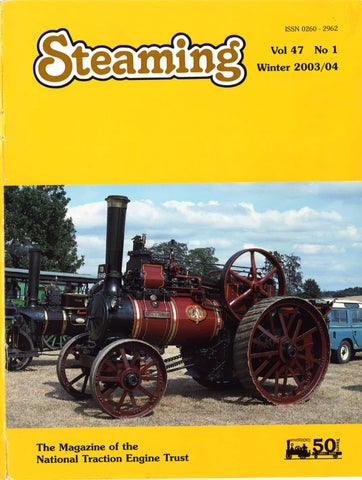
Front cover Marshall 6hp compound traction engine 34151 was despatched from Gainsborough in 1900 to the Royal Show at York, with appropriate extra care to the paintwork and bright metal. Its working life over it spent many years declining beneath a tree in Northamptonshire, but its fine finish is once more available for inspection - Phil Steer pictured the machine at the Ecton event, near Northampton, in August 1995. 3
Trust News The President's welcome ... The 2003 Annual General Meeting opened with this address from Giles Romanes, the Trust's President: Welcome to you all who have taken the trouble to attend this AGM. It is particularly gratifying to those who have put in a lot of effort in making the arrangements for it. We are all practical people whose thinking is along the lines of how best to do something physical — like drill a hole in the right place, and of right size and so on. We deal with the actual and our forte is not coping with the abstract, the theoretical and the virtual. Living in this society, which is catching the American disease of litigation, forces us to consider these latter subjects and the effects of failing to do so, or not taking the proper steps, would be ruinous. One of the major advantages of membership of theTrust is the knowledge that the committee and officers are negotiating with authorities such as the HSE, with the legislation and judicial pundits, also the insurance industry, all on our behalf. They are doing a job which would be impossible for an individual to take on without floundering.
the country, amateur or professional, who continually enrich the rally field with restoration projects such as those I have mentioned. We have come a long way from the days that I can remember, when engines were being cut up because the firebox had gone. In this issue of Steaming we are publishing for the first time in the Ring-Around column comments which have come via Nickey Daniel from local clubs and contacts. This is a programme we initiated some time ago as a way of keeping in contact with the membership. The comments, and the replies from Trust officers, will no doubt be of interest.
It remains for the Editor to see how much debate and discussion we can accommodate from this exercise, bearing in mind that a quarterly publication is not ideal for fast response. In case it has escaped anyone's notice, this year will be the 50th year of the Trust, and its predecessor the Club. I think all of you connected with the traction engine hobby should take time to celebrate how much has been achieved in our world in this time, not just in the Trust but in the movement as a whole. It was most fitting that at the AGM in November Giles Romanes was re-elected President of the Trust with much
It was, literally and colloquially, a brilliant Sunday morning visit after the November AGM to Russell Cook's collection, near Bridgnorth. Russell had gone to great lengths to make sure everything was on view, with several engines outside and in steam, including the Savage centre engine in the stillto-be-completed gallopers. These are the subject of some painstaking restoration. Anthony Coulls took the pictures of Foster 7hp showmans 14153 ADMIRAL BEATTY, with some of the extensive range of more recent showland transport to the right, and Foster agricultural 2775, an 8hp single that had celebrated its centenary last July.
From the Chairman I write this as we approach Christmas, and as ever one tends to look back at the year that is closing and think of how have we done in our world of steam. Speaking personally, I enjoyed being re-united with MARGARET, the old Fowler single ploughing engine, at Langport rally as it returned from a major rebuild; also present at that event was Dave Allen with his Burrell crane engine, back on the road after ten years of the proverbial blood, sweat and tears. We should be proud of our hobby and the achievements of so many individuals, the length and breadth of 4
Winter 2003/2004 STEAMING
popular acclaim. He was one of the founders of our hobby and will lead us in celebrating the 50 years. I understand 'Doc' has latched on to some sort of celebratory escapade, planned for February in London, so I hope we may be able to find some detail of where and when elsewhere in this issue. (Andrew Semple, Chairman)
Rally Organisers Column Rally Organisers subCommittee Hello, once again. Since my last jottings the Autumn Rally Organisers Conference has been and gone. The event was held on October 25th, and was very well attended with some 60 delegates present. The main topic of the day was an in-depth look at insurance matters.
Dave Smith enlightened us with his expert advice on all types of insurance which the organiser may come up against when operating a rally. He also answered many questions put to him from the floor. We also had the usual Officers reports, and finished the meeting with our open forum session, where delegates put forward the problems and other interesting items that have arisen at their particular event. These are then discussed — we hope the findings are of some help to those concerned. Last season when attending rallies I noticed there appeared to be quite a few low powered scooters and bicycles moving around, and also traders selling them. This concerned me, because there was a notice on the packaging stating that no insurance or road tax was needed. More recently, I have heard a police inspector on Radio Suffolk advising that the small petrol versions are classed along with mopeds, and those driven by other means are classed as mechanically propelled vehicles and require Road Traffic Act
Officers and Committee 2004 This column lists, for the information of members, the Officers and Committee of theTrust for 2004. The addresses/ phone numbers of those with special duties are given inside the front cover of each issue of this magazine; others may be contacted by phone or via the General Secretary or sub-Committee Chairmen. Names marked with an asterisk* are appointments by the Committee and are non-voting positions in Committee. President G.J. Romanes Vice Presidents Sylvia Dudley R.J. Sandercock Chairman A.J. Sample Vice Chairmen R.T. Herring, J.R. Cook General and Company Secretary Mrs Susan Jackson" Treasurer Julie Smith, FCA* Hon Solicitor T. Driver* Hon Safety Adviser J.M. Newnham* Membership Secretary J.R. Cook Editor, Steaming R. E. West* Sales Officers Colin and Val Brown" Committee
The above and also: I.K. Barraclough
(S. Yorks,v 01709 850346) J. Blenkinsop
(Insurance Disc Officer) J.R. Bosworth
(Derbys, IT 01332 880405) Nickey and Charles Daniel
(Cornwall,v 01208 831293) M.O. Davies (Warks, IT 01295 770277) J. Durling (SAC Chairman) W. Evans (Rally Authorisation) R. Garnett (Avon, IT 01275 878054) E. Goddard (Sentinel DC and Salop Tr 01743 851128) T Holt (Cumbria, irr 01524 271584) B. James (Rally sub Chairman) S.J. Parrott (Cornwall, Ir 01288 355310) R.J. Pierce (Engine Owners chairman) R. Siddall (Engine Owners v/chairman)* J.R. Smith (Training Course)* D.S. Smith (Insurance Officer) S. Tomlinson (Leics, Tr 01455 613079) M. Ward (FBHVC and Notts, Tr 01623 882856) P Williams (Chiltern, IT 01923 263436) P. Worbey (Herts, 17 01462 851711) Representatives R. Mattless (NVTractor & EC)* Auditors: Charles Lovell & Co, Royal House, Market Place, Redditch, Worcestershire BN98 8AA
5
Sub-Committees 2004
Engine Owners Column
This column lists the members of the Trust's sub Committees for 2004. Names marked with an asterisk* are co-opted; others are elected Committee members. Addresses/phone numbers of the Chairmen appear inside the front cover of each issue.
Engine Owners subCommittee
Rally sub Committee B. James (chairman) C. Brown* J.R. Cook T. Evans* W. Evans P. Hemstritch* R.T. Herring T. Holt K. Stott* JoTilling* R Worbey Engine Owners sub Committee R.J. Pierce (chairman) R. Siddall (vice chairman)* I.K. Barraclough J. Blenkinsop M.O. Davies Sylvia Dudley C. Hatch* J.M. Newnham R Rensley* R.J. Sandercock D.S. Smith J.R. Smith* M. Ward P. Williams Technical Board J.M. Newnham (chairman)* H. Pounder* R. Swithinbank* G. Tennet* Steam Apprentice Club J.R. Durling (chairman) Elaine Massey (vice chair)* Nanette Sanders (editor)* S. Bate* G. Chaffer* D. Croser* M. Lund* B. Sumsion* S.Taylor* G. Tucker* G. Haase (apprentice)*
insurance if used in any public place. Bearing this in mind, I suggest that all safety officers and rally organisers who come across these little machines should make sure that they have the proper insurance cover. The next rally sub-Committee will be held in early March, so if anyone as any item which they would like us to look into please let me know in advance. That's all for this quarter; I thank you all for your support and wish you, if it is not considered too late, a happy and prosperous new year. (Brian James, Chairman, Rally sub-Committee) 6
Things often move quite slowly in the Steam World. Restorations that we all think will take weeks, or at the most months, can sometimes take years. How often do we hear the words "Oh well, while we've got this far - we might as well do the lot!" All of which inevitably involves time and money. A balance has to be reached on both these counts to satisfy different demands and expectations, which is only right and proper. Many of those doing restoration on engines cannot or indeed do not wish to have a finished product that is better than it was when it left the factory. A compromise has to be reached. It is a similar scenario when it comes to another aspect of engine owning, that of boiler inspections, safety matters and legislation generally. Things move at a slow pace in this department too, which may be a good thing. Whereas many people either want no change, or at least very slow change, there are those in the movement who would rush new ideas through with indecent haste. As with restoration, there is a balance to be found. The difference in boiler inspection standards is an area of which we are very much aware, but it is not something that can be righted overnight. The Committee has some ideas on how to progress, but it will take time. One area where it would be nice to see a little more haste is with the HSE, who we hope will commend our own Engine Code. Jim Newnham is working towards this hoped for goal, but progress, once again, is slow. The upside of it all is that despite the frustration at the speed, or otherwise, of progress we usually finish up with a result near to what is sensible -just like the restoration job. Don't forget the Engine Owners Open Meeting on 31st January at Willoughby - please see the display advert for details. I shall be away out of the country at the time of the meeting, so if there are matters that that you would like to have mentioned at Willoughby, please contact my sub-Committee's vice Chairman, Bob Siddall - you will find his contact detail in the panels on these pages. (Richard Pierce, Chairman, Engine Owners subCommittee) Technical Board As most readers know, regula-
tions banning the use of asbestos came into force several years ago but, because of the difficulty in finding an alternative to impregnated woven asbestos joints for boiler manhole and mudhole doors, a derogation (a partial repeal of the law) allowed their continued use until the end of December 2003. During the run-up to this ban various new materials have come onto the market, and even lead is making a comeback for mudhole dour joints. Trials of the new non-asbestos materials by industrial users, as well as the heritage organisations, have produced variable results, with some materials so far appearing to perform satisfactorily and others failing miserably. Long term reliability and re-usability has not yet been established. The Health & Safety Executive has responded very positively to representations by the Heritage Railways Association and ourselves and has provisionally agreed to grant an exemption until 31st December 2004 to allow further trials and evaluation of alternative materials to be carried out. At the time of writing (10th December 2003) I have not yet seen the final document - the draft still has to be agreed by the legal eagles - but I understand that it will cover the importation and manufacture of impregnated joints as well as their continued use. Readers should note that any exemption will only be for one year. On 1st January 2005 an EU directive comes into torce which mirrors the UK Regulations banning asbestos, and after that no further exemptions will be possible. Traditional rubber impregnated woven asbestos joints are extraordinarily tolerant of eroded and pitted surfaces and, up to a point, excessive spigot clearance. Often, with no more than a light wipe over with a mixture of graphite and cylinder oil, they can be used over and over again. The same cannot yet be said for the alternative materials which still have to prove their long term reliability. I understand that some of the alternative joints are also fiendishly expensive. This might be an appropriate moment to remind engine owners of the tragic accident some ten years ago in which Dick Martino and his nephew were killed when a traditional boiler door joint blew out in the stokehold of the steam yacht KAROLA. The cause of the blowout was grossly excessive spigot clearance between the door and the bdiler end plate. I suspect that some Winter 2003/2004 STEAMING
of the failures of new alternative materials may have been partly or wholly due to excessive spigot clearance and the joint itself may not have had a fair chance. So, if you are minded to try alternative materials do make sure that the spigot clearance is not more than a sixteenth of an inch and please let us know what you have used, and how you have got on with it. Sooner or later we are going to have to come to terms with something other than asbestos, so the wider evaluation we have of the alternatives the better. During the course of my discussions with the HSE, my contact pointed out that the prohibition of asbestos only applies to the workplace, and confirmed that, under current legislation, there is nothing to prevent the owners of engines, etc, used only for leisure purposes, continuing indefinitely to store and use as required, stocks of asbestos based joints and jointing materials. Thus, if you want to continue using traditional materials, now is the time to ensure that you have sufficient in stock to last for the next 100 years. Remember, though, you cannot employ someone to fit or remove them for you, as this is counted as work. Lastly, although this is not a household hints magazine, it will do no harm to remind readers that the Regulations do not require the removal and disposal of asbestos STEAMING
Winter 2003/2004
Our 50 years. The exact date of this picture has become lost with the passage of time, but was taken in Leicestershire in the early 1950s and certainly before the Rempstone rallies started. It shows Jack Beeby and Tim Sage with their engines attending a college rag procession al Loughborough — Jack's 7hp Clayton & Shuttleworth 44103 ENTERPRISE is at the left and Tim's 7hp Ransomes, Sims & Jefferies 42036 the right. To put things into perspective, the Ransomes, built as late as September 1931, was barely old enough to be out on its own by the moral standards of the time, being only just past its 21st birthday. The top hatted crews attending the engines are, from the left: Jack Beeby; Noel Ayres; a youthful Mike Beeby; Bob Rutledge and Tim Sage. The brass bell seen temporarily fixed at the front of the Clayton was rung by one of the students as the engines led the procession; it had been borrowed from Taylor's, the famous bell-foundry in the town. A contribution from the college had been the curved ENTERPRISE nameplate at the chimney base of the Clayton, which had been cast at the college from patterns made by the students; the plate is still with the engine. Thanks are due to Keith Kirby, Tim's son-in-law, for providing the picture, and to Mike Beeby, for recalling the Loughborough details. and asbestos products that are in use. Provided its presence is known and it is not discharging asbestos fibres into the world at large, it can stay where it is for ever. So if some smart Aleck appears at your door telling you that you must have the asbestos cement roof removed from your garden shed by a registered contractor (him ... for cash), boot his backside off your property! Having said that, do be responsible about asbestos: like alcohol and dynamite, it is a good servant if treated properly but, carelessly handled, it can do terrible harm. When your boiler door joints finally come to the end of their useful life, follow the advice in the NTET Engine Code — don't throw
them on the workshop floor or under the bench, seal them up in a strong polythene bag and label it, then contact your local council, most of whom will take small quantities of toxic waste free of charge from nonindustrial users. (Jim Newnham, chairman, Technical Board) Steam Training Weekend We are delighted to announce that the Trust has arranged to hold this year's annual Steam Training Weekend at the Hatton Country World in Warwickshire. This location is some five minutes journey from junction 15 of the M40. The dates are Saturday and Sunday 7
The National Traction Engine Trust Engine Owners sub-Committee The 2004
ENGINE OWNERS MEETING will be held at
Willoughby Village Hall, Willoughby, near Rugby, Warwickshire at 11.00am on Saturday, 31st January 2004. All owners, crews, potential owners and anyone else interested in the working of preserved road steam vehicles are welcome to attend - whether they are members of the Trust or not. Contact Bob Siddall if you wish have an item discussed e 01636 821991 or e-mail RGSiddall@aol.com
15th/16th May 2004. For a weekend of instruction on the use and maintenance of engines, with plenty of practical driving experience, this site is ideal with its large open areas. It also has hard roadways nearby, in reserve, in case of wet weather. The Hatton Shopping Village, part of the Country World, make this an added attraction for all the family. Participants can arrive from the Friday afternoon. There is ample space for caravans and tents on the site and plenty of local accommodation. If you think you would like to join us please send an A5 stamped addressed envelope with your request for full information to - J R (Smudge) Smith, Beech House, School Lane, Milton, Abingdon OX14 4EH (v 01235 820338). Are you licensed? We draw to the attention of engine owning members new laws on licensing that came into force on 1st January - an attempt to have continuous registration of all road vehicles. Now, all vehicles are required to be re-taxed within a month of expiry of the old licence, and unless this has happened, or a Statutory Off Road Notice submitted, the DVLA computer will automatically issue to the keeper a penalty fine of £80 (£40 if paid within 28 days). The change in the law is aimed at the owners of the estimated 1.75 million untaxed vehicles on the road, and should also help to reduce the large amount of vehicles without insurance and MOT, a laudable aim. Although all of our engines, through their age and status as 8
historic vehicles, presently enjoy a nil rate of road tax, it is still a requirement to obtain a current licence. It needs to be displayed when on the road, and now must be continued in sequence, even if the vehicle is not on the highway. Members are urged keep up the DVLA registrations on their engines through winter lay-offs or longer repairs by promptly renewing their licences or completing a SORN neither bear any cost to you! We shall be wise to assume the Swansea computer will not cease its automatic dispensing of penalties just because our engines are free.
Insurance Notes 1. From the Insurance Officer Review of NTET Insurance Policies: Since the introduction of the NTET suite of insurance policies, brokered on our behalf by Footman James & Co Ltd almost 6 years ago, there have been no changes made to the premium rates for the three 'standard bearer schemes' relating to steam exhibits, to rally organisers event cover and to low-loaders. It is true to say however, that the Specialist Club Scheme policy, over which the NTET has no influence, has seen a substantial increase in premium rates (60%) in the past two years, which has reflected the general rise in the cost of property and public indemnity insurance world wide. Now, as I have warned for some
time now, the underwriters of the three primary schemes are seeking to modify their insurance premium rates. Whilst it would be foolish to suggest that any proposed increase in rates are negotiable, nevertheless we have been asked to comment on the proposals and to offer alternative strategy if possible. At the same time that the premiums are under scrutiny we are also reviewing the scope of the individual policies with a view to closing loopholes and extending, where possible, the cover on offer. The various teams at Footman James are most co-operative in this work. For our part we shall continue to ensure that the membership gets the maximum value for money commensurate with the widest possible cover that can be obtained; objectives that I think we can justifiably say we have delivered so far. Club Scheme versus Event Cover: In light of the fact that some of the Trust's affiliated clubs and organisations are using their club's annual policy to cover events attended by the public, I reproduce here parts of my correspondence to a well known club on this subject. 'The Specialist Clubs Scheme brokered by Footman James, which some clubs use, is a general scheme not influenced by the NTET. Increases to Club scheme premiums have been imposed by the underwriters because of the global increase in the cost of public liability insurance. The NTET's Rally Organisers policy is designed to cover the specific requirements of a traction engine rally and is available only to the organisers of authorised events at a substantially reduced premium. To ensure that full and adequate cover is obtained it is important that the differences between the two schemes are understood. 1.The Clubs policy: • provides year round cover - one of the reasons it appears expensive. • in future will have a limit of 1,000 attendance at club events imposed by the underwriters. • does not include equipment hired in, or not owned by the club. • does not include cost of cancellation of an event or loss of expenses due to cancellation of an event. • has a products and public liability ceiling of £5m but this can be reduced. • does include protection of the clubs property, money and Winter 2003/2004 STEAMING
trophies, goods for sale, injury caused by goods sold by the club - products liability, officers and volunteers employees liability, misrepresentation, slander or libel resulting from articles in programmes or club magazines. 2.The Events policy: • provides optional levels of public liability cover over a specified number of days. • includes mandatory employees liability for all members and adhoc volunteers for the specified number of days up to age 75. • includes optional accidental injury protection for nominated persons or roles. • includes loss of money by theft or fraud. • includes optional cover for hiredin equipment for specified values over a specified number of days, which do not necessarily have to be the same number of days as the entire build-up, show days and knock-down period. • includes loss of expenses due to cancellation. • includes cost of cancellation payment of sunk costs etc. My preferred strategy would be to take out the 'Club' policy for the appropriate amount of public/ product liability cover and then take out separate Event cover. This may result in a slight modification to the total premiums (either up or down, depending on the options taken) but would certainly ensure that the club was more adequately protected' Traders' Policies: Increasing concern about the insurance cover held by professional and casual traders prompts me to make these observations. The onus on the organiser to examine all traders insurance documents arises from the underwriters of PL insurance who are getting twitchy about the increasing level of claims due to poorly constructed or poorly performing goods, or goods recovered as stolen property. Whether or not you subscribe to the 'examine all documents' school of thought it is very important that products liability insurance, not simply public liability insurance, is held by traders, otherwise the club/organiser could become liable in the event of a default by a trader. What ever technique you use to police this rule I'm afraid to say that the phrase 'best endeavours', which I personally have used to advantage in the past, will be sorely tested in the future. Buying something from a trader on a rally field should carry the STEAMING
Winter 2003/2004
Norman Pearson kindly sends this picture of an old Foden - the image is somewhat worn with age, but the original was a sharply focussed professional print and we can enjoy studying a neatly kept working wagon. T STownshend & Sons had the 5 tanner new in March 1907, works number 1298, registered M1484. It was their first wagon, and no doubt replaced at least some of the horses previously in use at the Albion Flour Mills at Worcester. The photographer has caught three of the Townshend workers: the Foden driver, the lad sitting atop the load of sacks, and the chappie at the right, under his layer of flour dust. He looks to be the one who stayed at the mills, with the driver and his mate being responsible for taking off the sacks as they progressed on the delivery round. The wagon seems fairly new, with little wear or knocks to the paintwork, which shows the main colour to be lighter than the black edging - maybe it was a mid or darkish green. Note the front wheel spokes are lined on the inside face. The flat body has no tailboard, but an overhead gantry or sheet rail runs its length. The Foden was scrapped in 1932.
same safeguards as if it were bought in the high street. General Comments: Both of the NTET's Codes of Practice are being reviewed in the light of changes to legislation, impositions by examining bodies and the requirements of the insurers - times they are a changin', ask GDSF Limited! With regard to the proposed modifications to entry forms muted by some organisers, it may be appropriate to include the name of the insurance company, policy number and expiry/reneWal date of any policies that the exhibitOr claims to hold. I also suggest that organisers could insist on proof positive that RTA insurance, backed by a certificate of motor insurance, is held for all mobile exhibits, NTET Disc holders excluded. Membership of a club per se does not prove RTA insurance is held. (David Smith, Insurance Officer)
2. From the Insurance Disc Officer As another rally season comes to a close, I look back with some satisfaction at having completed my first season without too many problems. However, a couple engine owners' feathers were ruffled when boiler reports failed to come up to standard; I make no apology for this, as it is well meant and is necessary to ensure a high quality service is provided which, incidentally is free of charge to members. For those using this office for their discs, if any issues are raised, you can be sure that the intention is to help protect you against the shortcomings of others. With the 50th Anniversary year upon us, we have decided to print the NTET logo on the insurance disc in gold foil. This has the added advantage of being more difficult to copy, and so reduces the chance of misuse. To help protect the disc from 9
Arthur Brunsdon's road engine posed for photographs with two sizeable trees at a yard next to the Midland Railway station at Rye ford in Gloucestershire, some time before the 1920s. The Fowler is 85 class compound 9177 built in 1901 - Brunsdon acquired it secondhand three or four years later. The machine survived to be acquired for preservation in a poor state, and after restoration as a pseudo showmans engine in Scotland some years ago, it is now being restored to its original state. (collection Gordon Jones) the weather, you will now find that it is laminated inside a pouch, which will have to be trimmed for it to fit the normal disc holder. Trimming it is unlikely to damage the lamination so long as the edge of the disc is not cut. In the past members have commented that the hand written details on the discs have faded over time and have caused a few problems when safety officers on the rally fields have not been able to read them. To help overcome this all discs issued from Footman James will be printed off a new computer system. This has been developed by David Smith and trialled by this office. A number of the other disc issuing agents are also interested in using this system to simplify and speed up their process. The added advantage of computerising is to be able to keep an up to date record of discs that have been issued on a central database for easy reference, should a query arise out of normal office hours. I stress that the details kept on this centralised system will only be those which are readily seen on the disc, so don't think this is 'Big Brother' coming to the NTET - it certainly is not. There have been a number of enquires during the season about the transfer of discs with engines that have been sold on to new owners. I would point out that a disc is issued against a specific insurance policy taken out by an individual. As the 10
insurance policy is non-transferable so is the disc, which should be surrendered with the policy documents and returned to your insurer. Footman James has stated that when requesting a refund on the remainder of the policy, the disc must be returned before they can make any such payments. (James Blenkinsop, Insurance Disc Officer)
Steam Apprentice Club A Happy NewYear to you all! Now is the time to look forward to the season ahead of us, this time a very special year, being not only the fiftieth anniversary of the NTET but also, and of course just as importantly, the twenty-fifth anniversary of the Steam Apprentice Club. What better time to follow your inclinations and become involved with tomorrow's engine drivers and owners. In the last SAC magazine Raising Steam we welcomed 154 new members to the section. That is an incredible number, due mainly to the hard work and commitment of the strong team I now have behind me.
It is a very exciting time to be part of this youth organisation, to see the development of responsible young people in the steam world, and nurture their interest. We are working hard to foster links with other organisations, museums and railways in the hope that not only will we be able to have more activities for our members but that we can introduce more youngsters to the SAC. Several museums and trusts have 'unofficial' links with the SAC and we are beginning to formalise these and form new connections. Hopefully this will blossom into most museums having older apprentices attached to them. The introduction of the new vocational GCSEs should help to engender interest as well. It is becoming difficult to cover enough rallies during the summer with our adult team; more help is essential. Can you help? Would you be prepared to assist at just one rally or activity for the SAC? I can promise you would not be deluged! Ideally, with fifty odd volunteers each one would only be asked to cover one rally. Now is also the time to remind you that the established activities of the Club are continuing; the driving days will take place during April and May and I hope that we will be well represented by some SAC members at the NTET Driving Course. If you feel that you can positively respond to the above comments please contact either me (details in the front of this magazine) or the SAC Vice-chair Elaine Massey (Tr 0208 248 6570). (John Durling, Chairman, Steam Apprentice Club)
The AGM motion For the benefit of those who did not attend the meeting Anthony Coulls offers a brief explanation of the motives behind his Motion on engine imports and exports published in the Agenda within the Report &Accounts circulated with the last issue - that was put to members last November. At the AGM a Motion was put forward that the Trust recognise the UNESCO Convention on The Prevention of the Illicit Import, Export and Transfer of Ownership of Cultural Property. Now that title might sound a lot of pretentious words to many, but it does have an implication within the steam fraternity. In recent issues of Steaming and the general Winter 2003/2004 STEAMING
enthusiast press there has been much debate over the import and export of engines, and indeed Phil Retman in the last issue of this journal called for some form of regulation. In UNESCO it already exists. Put simply, the Motion was not intended to stop import and export of engines, merely to say that if it is going to continue then the Trust accepts that proper paperwork is in place and that the historic significance of the engine is checked before any physical movement takes place. By encouraging good practice, there should be no difficulty with engines arriving or leaving countries without paperwork. The British Government signed up to the above convention in 2002, and it applies to any heritage item, be it a painting, sculpture or steam engine. At the AGM after much discussion and some amendment to the proposal which included the removal of the proposal that sanctions be applied by the Trust (after all, the convention is National law and subject to the jurisdiction of the land), the motion was carried and adopted. The NTET is therefore now in a position of upholding best practice in not just the operation but the movement internationally of steam engines — always a contentious issue.
The Ring-Around Column For some time now my task within the Trust Committee structure has been contacting nominated Trust members in an attempt to discover concerns and unease that may be bubbling away within the road steam interest, but beyond the knowledge of the Committee. The comments I collect — the grumbles, worries, suspicions, alerts and praises alike — are duly presented at National Committee meetings, and usually taken away for consideration by the appropriate officer. For some while I have felt that, whenever possible, it must come about that the follow up be made known to both the individual or group that brought up the point, and to the membership in general. Through the pages of our quarterly magazine this response will inevitably be somewhat slow (some of the items here are from four STEAMING
Winter 2003/2004
The National Traction Engine Trust
The Engine Owners sub-Committee presents its 14th
STEAM TRAINING AND DRIVING COURSE to be held at
Hatton Country World, near Warwick, Warwickshire, on 15th and 16th May 2004 The practical and informal course includes instruction on boiler management, mechanical operation, and cam maintenance and driving- techniques For further information send a C5 (for A5) size SAE to:
Smudge Smith, Beech House, School Lane, Milton, Abingdon OX14 4EH. IN 01235 820338.
months ago), and we may not get the format right straight away, but let's try. And, of course, the nonappearance of an item in this section does not mean it has been ignored; it may be because, after research or discussions with outside bodies, the topic is addressed by officers within their own columns. An event stipulated that engine movement was only allowed when accompanied by their stewards — who then, when escorting, wandered out of sight of the crew. David Smith, Trust Insurance Officer, comments: Organisers who, for whatever reason, decide to have marshals accompany each engine when it is moving must make absolutely sure that the marshals and the engine drivers understand what is required of them. Not doing so could render them, the organisers, liable, as the 'employee' of the marshals. Whilst it is easy to agree that spectators should be kept away from passing wheels it is quite another matter to interfere with the drivers' ability to manage the machine by causing unnecessary distractions. I have not yet had a clear rationale from any event who claim they are being pushed into such marshalling by their insurers. There had been regret expressed at the damage to RENOWN, and a question on the knock-on effect on everyone's insurance. David Smith, Trust Insurance Officer, responds:The tremendous damage caused to RENOWN must have saddened all and it is difficult to comprehend the degree of damage caused. However, in answer to the question on the effect of any similar accident to the
Trust insurance scheme, my opinion is that it will probably be minimal and quite possibly none. I say this for a number of reasons that may, in time, all act together. Whilst enjoying our own policy wording with special provisions, the combined risk of our 'Steam Policy' actually forms part of a much larger vintage vehicles policy (cars, buses, bikes, tractors, etc) and 'our' risk is very small when compared with the tens of million pounds worth of risk represented by these vintage vehicles. The cause of the accident, and therefore which insurer pays what, will need to be determined before settlement is reached, although the net result should be the same to the owners, up to the limit of their cover. A request that the reports in the Steaming Around section in the magazine should be identified by author as the notes sometimes upset people. Roger West and Derek Rayner reply: The clubs and individuals who provide the content of that section's columns are, of course, collectively acknowledged in each introduction. The compiling of the notes is a matter of blending together diverse reports, sometimes duplicated by different sources, into a readable text that flows in a reasonable manner. The identity of each engine has to be set down so that everybody understands it (we all tend to bring them to mind by different numbers), and we are aware that the method is inevitably tedious and not conducive to easy reading.To introduce a credit to every item is not practical, and would greatly exacerbate the situation. Comment that it was a good AGM. Andrew Semple makes the point that 11
such appreciation results from a combination of several things - a good venue; a good team of officers who organise and run the affairs of the Trust, and enthusiastic and supportive members. The list of contacts that I approach on a regular basis was set out in the Winter 2002/03 issue, with amendments in later issues. It will be repeated in the Summer issue; in the meantime members with concerns on the running of the Trust and any other subjects around steam engines on the road are urged to contact a Committee member, or, if the method outlined in this particular column is preferred, one of the Ring-Around contacts. (Nickey Daniel, IT 01208 831293)
Our 5OYears The arrangements for celebrating the Trust's 50th anniversary are progressing well. Richard Sandercock outlined his early thoughts on what should be done to mark the occasion in our Spring issue last year; since then an active sub-Committee has worked at bringing the ideas to fruition. The events will be very much as first suggested - a showing of the Trust's achievements at the Great Dorset Steam Fair at the beginning of September, much in the style of the successful 'one make' gatherings of recent years, and then at the end of that month a celebration Road Run in Northamptonshire. Our two viceChairmen have taken on the tasks of heading the negotiations - Robert Herring is liaising with the GDSF organisers, and John Cook with the Hollowell group. John is also acting as the contact for entries for both events. At Dorset, the usualTrust marquee will be augmented by a large tented display showing the Trust's history, and a special exhibition of '50 Unusual or Rarely Seen Engines'.This collection will represent all types of road steam engines from portables to showmans, and will show the whole orbit of restoration, with some derelict, others half completed, and some newly finished. They will all be in addition to the usual Dorset entries, and so be a big draw to members and outsiders alike. The list is coming on well, and from the support that has already been offered by engine owners, John feels the project is highly likely to be successful; do contact him if you feel 12
you have something that would add to the occasion. Many will recall the excellent Road Run that the Trust organised in Northamptonshire a few years back. Much thought went into the several alternative venues that were put forward for our 50 Years event, but practical considerations came to the fore, and we shall again set out from the Hollowell field on Saturday, 25th September; two slightly different routes, and up to 100 engines. Again, the provisional list of entries is growing, so interested owners are invited to contact John Cook. Although the Hollowell field will be open to the public at the weekend, the whole event is essentially arranged as a celebration by Trust members of the 50th birthday, so it is hoped many members will wish to come and stay for the weekend to be with all those acquaintances who, over the years, have become friends. We shall assemble on the Friday, and disperse on the Sunday about lunchtime. There will be the opportunity for socialising on the two evenings in a marquee on the field and the entertainment will be selfprovided, and not of the disco type. A final note to our older readers, or maybe the families of those who used to be members. We would like to make contact with early preservationists or enginemen - no matter if they have not kept up membership - with the idea of inviting them to Dorset or Hollowell. If you can make us aware of such folk, please contact John Cook - address inside the front cover and on 'page 3' of every issue.
The Trust Trophies After the Annual General Meeting at Dudley in November the Chairman read the following introduction and citations at the yearly distribution of the trophies and other awards. The Trust has quite a number of trophies, several were given by people closely associated with the Trust in its formative years. Being a national body it is difficult to reflect countrywide trends and achievements, so as the AGM moves around the UK the awards reflect achievements in the area in question. The awarding of trophies is usually a result of recommendations and suggestions from people with local knowledge. The donors of several cups made quite specific guidelines
regarding their use, and we adhere to these wishes. DACRE LACY CUR. This was given by Alastair Dacre Lacy, an early chairman of the Club, and normally awarded for an outstanding renovation.This year the recipient is a well known engine owner who has over a number of years made an outstanding job in restoring his Burrell showmans engine - the cup went to Allan Lloyd for the restoration of STARLIGHT. CHOISY & SIMPSON CUP. CholSey & Simpson were the first insurance brokers to work with our organisation, Alan Simpson being a keen engine enthusiast. The cup is awarded for outstanding engine preservation. This year it was presented to Alan Stevens for his work in restoring 1898 Burrell OLD LYTHAM; the work has been done virtually single-handed which included reboxing the engine, a fine achievement. ARTHUR NAPPER CUPS. These are identical cups presented by Arthur to the Club for classes of engines appearing at Appleford rally. When those rallies finished Arthur agreed to widen their use. Cup number one went to a man who has walked to the front before but who richly deserves to receive another reward - to Geoff Peach for the immaculate restoration of his Sentinel S4. The second of the cups was awarded to a man who as a schoolboy spent time with Arthur Napper. Indeed he suffered detentions at school when seen by a schoolmaster steering Arthur's engine through Abingdon in 1956. He started his own contracting business in 1959 with a Marshall roller and went on to buy a pair of ploughing engines for dredging work, and has since continued to use engines commercially whenever possible, as well as actively rallying the machines. The cup went to John Garman. CURTIS BOWL. This small vase originated from the Curtis family and is usually awarded for taking engines on long road journeys under steam. This year the vase went to a young man who has over the last fifteen years amassed a huge mileage with his engine. He is never one to make a great fuss about his journeys; the cup is awarded to Stuart Tomlinson for his many miles with the Fowler agricultural ELSA. THE GOLDEN FILM SHIELD. Now regarded as the Trust's premier trophy, it was originally awarded for musical chairs at Appleford, but later directed by Arthur Napper to its Winter 2003/2004 STEAMING
present role, which he considered more appropriate.This year it goes to a man widely known in the movement for another outstanding role. He has been diligently working for some years now assisted by a team of friends on the restoration of his Aveling & Porter roller, and the results were there for all to see in the last issue of Steaming, with the engine being re-delivered to its original owners. The Shield was awarded to Roger West. JOHN CRAWLEY TROPHY. A fine rose bowl presented to the Club by John, originally won by his father in a motorcycling event. John requested the trophy be used to mark outstanding service to the hobby, but not necessarily connected directly with engines. This year a name came into the frame very quickly. This man has been the chairman of not one but two rally committees for 20 years now, as well as rebuilding his roller in his spare time. The recipient of the trophy was Dave Corbett. PERCY HIRONS BOWL. This lovely bowl was given to the Trust by John Hirons, with the wish it be awarded to the owner of an agricultural engine, preferably one used in either serious use or proper demonstration. This year the bowl goes to the owner of an engine with a unique record, having been owned by the family from new 100 years ago, and still being actively worked by the present generations. The name is known throughout the Midlands and was proposed by several different sources as being worthy of recognition — Arthur Henton. BAKER TOC H CUR This enormous cup was presented by the Baker STEAMING
Winter 2003/2004
Our 50 years. Part of the engine line-up at the June 1954 Appleford event. Under inspection by raincoat clad admirers (no ladies and only one youngster) are, from the right: Marshall 37690 OLD TIMER; Garrett tractor 32048; Foden tractors 13358 and 14078 and in the distance Fowler showmans 19782 THE LION. (JackTurner collection) transport family of Southampton; a Grecian urn engraved with a showmans engine, and easily our largest trophy. It has been traditional to present this to an owner of a big engine — not necessarily a showman — and the cup went to Russell Cook, not just for his showmans engines, but in recognition of his wider preservation activity including artefacts closely related to our hobby. The cup was presented to Russell during a visit to his premises on the Sunday morning. JACK HOLLOWAY COMMENTATORS SALVER.This year this award went to a man well regarded for his rally commentaries. One who put the name forward remarked that a lot of homework was done before the event. Many of us have cringed at a rally when asked by the commentator to blow the horn on the engine, so it is a pleasure to recognise a professional presentation. The award goes to Peter Coulls for his commentary at Fairford rallies. CONNIE HUTCHENS MEMORIAL TROPHY — purchased by the committee of the time in memory of Connie Hutchens, the membership secretary in the early 1960s, well liked and loved by all who knew her. It is awarded annually to a lady in the movement. A great many of us are supported in our hobby by wives and girlfriends — many ladies have found themselves heading for a rally on a
Friday afternoon, car loaded down with the kids, caravan in tow, and husband somewhere down the road with his engine. Without such support many would find rallying hard work. This year we recognised a lady who has done all of that and much more, and by some miracle she is still married to a man well known in the movement. It has been a tough year for her, but she has come through it smiling. The Connie Hutchens trophy was presented to Jane Crane. J.T. BEEBY CUP for steam apprentices was given in memory of that great character Jack Beeby, well known for his exploits with engines. The Beeby family and their engines represent part of the rich heritage associated with our hobby. The Trust puts great emphasis on encouraging the young and passing our knowledge and skills on to the next generation, and the young man who received the award is good company, he listens a lot, and when asked to do so drives an engine with skill and maturity beyond his years. The trophy was awarded to Darryl Cave. Stuart Gray kindly donated a Steam Apprentice shovel for Darryl to keep. THE EDNEY SHIELD. This is the only trophy actually purchased by the Club. It was in memory of the late EW Edney, the Treasurer at a financially difficult time for the Club, who is often regarded as its saviour at that time. It is awarded to someone who 13
has given great personal service to the Trust and the committee was pleased to honour its longest serving member. It was in 1967 he joined the committee - 46 years of service, a record, which cannot be broken for some time.The Edney Shield went to Norman Boyes.To help him keep in touch with the hobby the Committee bestowed life membership, whilst a further token of appreciation was an engraved bowl. THE ERIC MIDDLETON TROPHY was the final presentation of the afternoon. Of all the trophies distributed at this AGM, this was regarded as the local award, for Eric Middleton lived a short distance away from Dudley at Hartlebury. He encouraged many engine enthusiasts and owners, and on his passing locals presented this trophy to the Trust in his memory, to be given to a well restored exhibit undertaken with limited budgets and minimal equipment. This year it goes to Mick Tromans for many years of work on his Fowler traction engine. A further presentation was made by the Trust to a member of the team who have in recent years worked hard to build up the Steam Apprentice Club. The editor of their magazine Raising Steam has now retired from the post, and in appreciation of his work an engraved cut glass tankard was handed to Barry Sumsion.
Affiliated and other groups Transport Trust In December the Transport Trust invited entries and nominations for their 2004 Awards. Any category of vintage transport qualifies for the Transport Trust Restoration Award, which recognises high quality restoration projects that are well advanced, but need additional funding to help completion. Last year's ten awards included a Lagonda car, two railway locos and a steam tug. The closing date for 2004 entries is 30th June, but earlier submissions are welcome to allow the volunteer judging panel good time to complete their task before the announcement of winners in October. Preservationist of the Year receives a silver trophy to mark the outstanding contribution to the cause of transport preservation during the 14
previous year - a wide range of achievements will he taken into account, from management and administration to practical restoration. Introduced last year, the award for the Young Preservationist of the Year is a cash award of £500 to recognise a preservation initiative by someone under the age of 20. A presentation will also be made to honour Lifetime Achievement. Nominations for these three categories are invited from individuals and organisations by 30th April, and should include brief detail outlining the nominee's achievement. Contact The Transport Trust, 202 Lambeth Road, London SE1 7JW 'r 020 7928 6464; fax 020 7928 6565 or their website www.thotronsport trust.org.uk
the month. The next LASM is on 27th January when there will be an illustrated talk by Alan Denney on steam railways in China, entitled 'A Chinese Adventure'. On 24th February, Ray Rowe will speak on 'Acquiring engineering skills for the steam traction Engine Owner'. Finally, on 23rd March, Robert Oliver, chairman of the Steam Plough Club, will present 'An Evening with the Steam Plough Club'. Meetings are held at the Henry Holland public house, 39 Duke Street, off the north side of Oxford Street, London. The nearest tube station is Bond Street on the Central Line. The room is available for Trust members and friends from 7.30pm, with the meetings starting at 8.00. Non members are welcome to attend. (Dr Raymond Rowe, LASM organiser)
Marie Curie Cancer Care Many members will be aware of the Ladies Driving Challenges that are run by Marie Curie Cancer Care, where ladies are able to take control of a wide variety of, for them, unusual vehicles - fire engines, combines, LGVs and dump trucks. Several of our engine owners in the south and the west have supported the events by taking engines along to the Challenges, and in that region alone £128,000 has been raised through the sponsorships of the ladies taking part. Challenge events are held throughout the country, and with the steam engines proving to be particularly popular vehicles, the organisers are seeking further owners who would be prepared to take their engines along to support the charity, having an enjoyable Saturday or Sunday out into the bargain. If you are interested please make contact in the first instance with Mark Bailey, Tr 01884 703540 or www.mariecurie.org.uk
London Area Social Meetings We are grateful to Alan Denney and Richard Hardy for their enthusiastic talks delivered in the first half of the 2003/2004 season.The London Area Social Meetings are an ideal opportunity to meet and discuss other people's experiences with road steam. The calendar for the rest of the season is set for the 4th Tuesday of
Future dates Engine Owners Meeting This meeting will take place at Willoughby, Warwickshire, on Saturday 31st January. Details can be found on the display advert in this section of the magazine, and also in the Engine Owners sub Committee column. Steam Training Weekend Details of the weekend, to be held on 15/16th May in Warwickshire, can be found in the Engine Owners Columns, a few pages nearer the front of this magazine. Trust Diary 2004 The diary of Trust events of a business and social nature during 2004 is set out below. It includes, in bold type, dates of Conferences and other members' gatherings and, in italic type, Committee meetings. The timetable has been arranged to avoid clashes in the dates following consultation with the other nationally based road steam groups (via the Road Steam Forum). 31st January Engine Owners Meeting 8th February Executive and National Committee 4th April National Committee 15/16th May Steam Training and Driving Course 13th June Executive and National Committee National Committee 8th August 1st to 5th NTET50 at GDSF September 3rd September GDSF Open Forum Winter 2003/2004 STEAMING
25th September NTET50 Road Run Executive and National 10th October Committee Rally Organisers 30th October Conference Annual General 20th/21st Meeting weekend November 12th December National Committee
New Members We extend a sincere welcome to the following new members who have joined the Trust during the last three months. We hope they will gain much friendship, information and enjoyment from their membership over a period of many years. Full addresses are not included, but the Membership Secretary is always pleased to put members in touch with one another by forwarding mail. P D Woodcock, Market Drayton, Shropshire Mrs N Newnhams, Rhondda Heritage Park R Clarke, Hatfield, Hertfordshire B D Luxford, Barnet, Hertfordshire C R Coombes, Dawlish, Devon C Webb, Leavesden, Hertfordshire W Hawkins, Wadebridge, Cornwall B Foot, Blandford Forum, Dorset S Hardy, Selby, North Yorkshire P J H Philpot, Billericay, Essex A Roberts, Chandler's Ford, Hampshire T England, Chester R F Darvill, Birchington, Kent M J Thorne, Aldershot, Hampshire A Seddon, Whitchurch, Shropshire R Drury, Newark, Nottinghamshire R W Palmer,Tewksbury, Gloucestershire DAB Hedgeman, Wareham, Dorset M R Ellis, Bournemouth, Dorset P M Stearne, Bordon, Hampshire Wolfgang Voglmeier, Oesterreich, Austria D Gilham, Wilmington, Kent W S Love,Tonbridge, Kent B Coyston, Southampton, Hampshire B Coombes, Exeter, Devon R J Barwick, Sandwich, Kent A Craske, Leyburn, North Yorkshire B Coombes, Exeter, Devon D Schramm, Luckey, Ohio, USA Z Johnson, Perrysburg, Ohio, USA
Poor Steaming There were two brief mentions of Thomson road steamers in the last issue, and we hasten to correct the spelling within the caption on page 218 - there is no 'p' in the name.
Furthermore... Tony Brown of the Road Locomotive Society sends additional information on the Foden wagon pictured on page 125 of our Summer 2002 issue. The machine is works STEAMING
Winter 2003/2004
Tasker B2 class Little Giant compound tractor 1513 of 1912, pictured by John Cook at the 2001 Great Dorset Steam Fair.
number 11622, a 6 ton three way tipper new to the Kent County Council in November 1924. The Council's No 16 wagon was Foden 11620. After the pictures of Dick Woolley's Sentinels had been published in the last issue (page 196) Mike Jones was able to glean further details of one of the figures who appeared on them. Standing by the cab door of the S6 tar tanker is not Cliff James but Jock Walker, Woolley's father-in-law. When the S6 later passed to Potters at East Dereham, Jock took the machine across to Norfolk - and stayed there to work. The pictures were, as suggested in the notes, taken in 1956.
Our 50 years. 'We are pleased to tell you that there are now over 130 members of the NTEC.We have many distinguished persons among our members ... Mr R H Clark author of Chronicles of a Country Works ... Mr J N Maskelyne, technical editor of the Model Engineer ... also on the Committee are Mr S J Wharton, organiser of the Witney Rally and Mr Arthur Napper to whom we all owe a great debt for the foundation of the Appleford Rally.' (editor Alastair Dacre Lacy writing to members in the second of the Club's News Sheets the precursor of Steaming.)
At the City of London Summons Court, last Friday, Sir Marcus Samuel fined George Munroe, jun, £5 and costs for causing a light locomotive to be used on Tower Bridge without breaks on a trailer attached. The driver was fined 10s [50p] and costs for driving it in that condition.' (from The Engineer, 19th February 1904. Light locomotives - the contemporary term for small steam tractors - were at this time in their early development, and not too prolific on the streets, but Wallis & Steevens had by then built more than most, including a dozen or so delivered to London area users. George Munroe's engine could, therefore, have been a 3 ton Wallis motor. With that in mind Trust committee members planning arrangements for this year's 50th anniversary, and wanting to attract media publicity, thought of persuading our President Giles Romanes to go to London to re-enact the Tower Bridge transgression with GOLIATH!, his Wallis tractor, just one hundred years on. However, second thoughts prevailed, for Giles had experienced the power of the law back in 1951, when he appeared before the bench at Henley - charged with contravening the agricultural licence on his traction engine by transporting his motorcycle in the accompanying trailer. He was fined £25. It didn't seem right to ask him to risk becoming a serial offender.) 15
Myers of Thirsk
All of the photographs are from the collection of Ken Myers.
NORTH YORKSHIRE THRESHING CONTRACTORS
If one looks at the map of North Yorkshire, the interestingly named collection of villages of Sandhutton, Carlton Miniott, Skipton-on-Swale and Kirby Wiske are to be found to the west of Thirsk, a town now best known for its associations with the legendary TV vet James Herriott. Indeed, the area is publicised as Herriott Country, and there is even a Herriott Museum in the town. But years ago, it was around these villages, about a five mile radius of Carlton Miniott, that the farms lay which were worked by various members of the Myers family with their threshing sets. Just along the road are Baldersby and Ainderby Quernhow - and then there is that natural 'boundary' of the area, the Great North Road. The Skipton mentioned, incidentally, should not be confused with the better known Skipton in Craven, some 35 miles to the south-west. Ken's g reat-g reat-g randfather, Anthony Myers (for purposes of easy identification in this account, he will be Anthony (I)), was a farmer at Skipton-on-Swale and started in business using portable engines and threshing machines. Originally there were two teams of horses, one for the steam engine and another that hauled the threshing machine. At that time there were also self-binders and cutting machines. Referring to the Clayton & Shuttleworth company's records now at the Museum of English Rural Life at Reading University, we find A Myers of Skipton-on-Swale was written up as purchaser of 6hp Clayton & Shuttleworth portable engine number 762 on 28th November 1853. Prior to that, J S Rob, also of Skipton-on-Swale, purchased a larger 7hp portable 425 in 1852.These must have been some of the first agricultural steam engines in this part of North Yorkshire, certainly well before the advent of
Derek Rayner writes of his meeting with Ken Myers, who has an interesting story to tell. Towards the end of 2001 / was on a short journey with my steam roller from Harrogate in North Yorkshire to Pool in Wharfedale - on the fringes of the Yorkshire Dales - and stopped to take water in the village of Huby, where there was a convenient location adjacent to a road junction. Whilst the crew and I were waiting and enjoying a drink, a man who lived nearby approached us; whilst tidying his garden he'd heard the unusual noise as we passed by and had caught a glimpse of the roller. As he said, it is not something you nowadays often see, so when the noise stopped a minute or two later, he decided to come along to investigate. He thought the machine might have broken down and in need of assistance! I assured him that this was not the case, and I thanked him for his concern. As the conversation continued, our new friend went on to express his interest in engines and mentioned that he had a cousin who lived nearThirsk whose family had been threshing contractors in days gone by. I needed no excuse to ask the gentlemen - who introduced himself as Martin Thorpe - for contact details for the relation to find out more. In due course that contact was made, and the cousin turned out to be Ken Myers of Carlton Miniott, descendant of a long line of steam threshing men who had all worked in the area around Thirsk in North Yorkshire. Ken had been involved with traction engines as a child during World War 2, although he'd not actually worked with them, being too young at the time for that 'pleasure: He had, however, seen the machines disappear from use and be replaced by tractors and combine harvesters, and then he had watched as the same thing had happened to the steam roller as these, in their turn, were replaced by motor rollers. Since then he has liked to visit the traction engine rallies that have been held locally since the 1950s, satisfying his nostalgia for those dirty and very dusty days from times gone by. He also had a fascinating story to tell about them.
The Myers' 1888 four-shaft 6hp Marshall at the side of the road at Breckenbrough, between Busby Stoop and Northallerton, just to the north of Sandhutton. The engine is not identifiable by works number. The driver is William (II) Myers and the steersman Sam Bell, with flagman John Seaton standing in front. The picture was taken around 1894.
16
Winter 2003/2004 STEAMING
traction engines, and the Myers' investment set the family on a successful venture which lasted for over a century, indeed until 1961. When Anthony (I) Myers retired, his son Thomas kept the house and yard at Skipton, but his other son William (I) moved to Sandhutton. Both initially used portable steam engines, but for general agricultural use these in due course gave way to traction engines. For contractors, the latter were much easier to use and to move from farm to farm than were portable engines. There was a reluctance to change, even in those days, but the Myers' had to, as the farmers refused to send their horses to move the portable engines to and from the jobs. According to the local Kelly's directory of 1909, the thrashing machine proprietors at Skipton-onSwale were the Executors of Thomas Myers, indicating that he had lately passed away. William (I) gave his eldest son William (II) a full set of threshing tackle as a wedding present around the late 1890s, thus enabling him to set up in business on his own and to support his new wife. At that time, the threshing machines were 54in size with a 22in diameter drum. Much earlier, at the beginning of the nineteenth century, the machines had wooden bearings — lignum vitae — which served very well for the purpose, as it was extremely hard wood. greatKen's (I), William STEAMING
Winter 2003/2004
Marshall 6hp single 34057 of 1900 with threshing drum and tyer (with bicycle) at the rear — taken near the old workhouse in Thirsk in 1928. The driver is William (Ill) Myers (Ken's father), the steersman John Foxton, and George Holt of Sandhutton leans on the back wheel. The brass plate fixed to the boiler cladding is an old North Riding County Council licence or registration plate — it might read No 11. The engine, however, had received the index number AJ5780 in 1921, though the plate at the chimney base is barely legible. grandfather, moved from Sandhutton to Carlton Miniott in 1895. He was, without doubt, a good business man and well educated — for by this time, he owned seven threshing sets, all of which he had bought new (just where the money came from is not known). He was also a farmer, and an implement agent for various manufacturers. When he died in 1900, age 60, the business was taken over by his eldest son, William (II) at Sandhutton. He too was a very clever man and a good engineer — but he was only 27. Things went well for a few years; he had bought a 7hp Marshall engine new in 1905, but by
1912 he had become an alcoholic and as a result, the business was suffering. All the threshing sets were sold at auction on 20th September 1912 and William (II) died, age 40, on 12th March 1913. Ken Myers' grandfather (Anthony II) had foreseen the sad demise and started his own business at Carlton Miniott in 1912. He borrowed money from the village blacksmith, Tom Soddy, and bought an old Burrell engine (made about 1882) plus a threshing machine; this set was followed by an 1885 three-shaft Marshall, and then by an 1895 single crank compound Burrell. In 1928 this
The Myers' family tree Anthony (I) William (I) Sand Hutton
Thomas Skipton-on-Swale
William (II)
Anthony (II) William (Ill)
Ernest Ken
Tony 17
latter engine went to F & S Holliday at Dalton in exchange for 1900 Marshall 34057. Ken Myers' father, William (Ill), left school in 1918 and went to work with the machines - he was not at school much after the age of 12, if the truth be known! As time progressed, it became increasingly difficult to get work. Threshing was essentially a winter task and there was not much other work in the engine line to be had, especially during the summer. However, in order to keep his family, something had to be found, and during the late 1920s William (Ill) would take more or less any enginerelated jobs that came his way. These included leading round oak tree trunks from Mount St John near Felixkirk to Thirsk with an early 1880s Hornsby traction. This had both gauge glasses missing, and no injector - just a pump. In all the time he had the engine it was like that, and William never melted the plug, for he checked the water level by opening the bottom columns and using them as try cocks. Leading timber from Haxby, near York, to Thirsk with a McLaren steam tractor for a while was another job; both tasks were carried out for Willie Pollard, a joiner and builder who had the Victoria Sawmills in Thirsk and a yard at Bagby, a village just to the south of
the town. It is likely the two engines were hired by Willie for a time. William (Ill) also led stone for roads with a McLaren single traction belonging to J B Souter of Kirkleavington, and drove one of the dozen or so Clayton & Shuttleworth wagons the North Riding County Council owned. He ventured further north to drive various steam rollers for Durham County Council, and Ken thinks that at one time he must have worked for David Wood & Co of Yeadon, for he knew all about their steam rollers and could name most of the drivers. Ken has a photo of his father with Dick Morrell, one of Woods' drivers. Ken's uncle Ernest (William (III)'s brother) left school in 1924 and was told by his father not to go into the threshing machine business as there was no money in it. He was apprenticed to the aforementioned Willie Pollard, and subsequently became a joiner but for various reasons, some perhaps associated with the general depression which hit the country about that time, his business failed, and as a result he became involved in the threshing world after all. Back in the 1920s, work was in short supply for many threshing contractors and Ken's grandfather (Anthony (II)) heard that some
Ken's uncle Ernest on Marshall 6hp traction 34057 in 1931. The engine is in the yard used for the threshing business just opposite the school in Carlton Miniott village. By now, there is no sign of any registration number at the front. 18
farmers at Kilburn were desperate to get their threshing done. This was outside his normal area and also during the winter, with snow and ice giving bad travelling conditions. However, it was work, and he agreed to go, providing the farmers would put up both him and his son (Ken's father) for the week. This was agreed, and they moved the threshing set on the Saturday, coming home on their bikes. Over the weekend the weather continued to deteriorate and on the Sunday night it was obvious the roads were too bad to return by bike, so they got up at some unearthly hour on Monday morning and walked through the snow - a distance of about 9 miles, loaded with provisions, not for themselves, but for the engine, for they each carried a can of oil! When the pair arrived at Kilburn, they were well treated and Ken guessed they wouldn't be too fussed about where they slept, so long as they were warm. There would be plenty of home-cured bacon and eggs to eat, so they certainly wouldn't go hungry. For a short period around 1930, Ken's father also worked for Barley of Langthorpe near Boroughbridge, driving Fowler 7hp engine 14758 of 1920, which, incidentally, now masquerades as a showmans engine in Germany. His threshing round at that time was from Sinderby Station (on the A1) to Masham, and he cycled the 13 miles from Carlton Miniott to Masham before 6am each morning. About 1928, Ken's grandfather (Anthony II) bought an 1886 Marshall traction engine which had been supplied new to Thomas Myers at Skipton Bridge. Number 13545 was a three-shaft engine with the steering on the 'wrong side', a layout which came out in 1881. Thackrays at Brawby, near Malton, did a lot of mechanical work on this engine, including re-boring the cylinder.They also fitted a new firebox, smokebox and chimney, and re-straked the wheels. The engine was known as T'OAD COFFEE POT and was popular with all who drove it, being very economical and a good steamer. Anthony (II) Myers was obviously sentimental about the engine for it had been in the family since new; he bought it from his cousin Robert Myers at Skipton on Swale, and it is now obvious that he only purchased it in order to prevent it being scrapped. Ken recalls the afternoon when it was eventually towed away to be put on rail. His grandfather let the water out of the tank for the last time and then, very sad to part with Winter 2003/2004
STEAMING
This group had no doubt earned the brief respite of the photographer's call whilst on a threshing job at Sowerby Parks, nearThirsk, in 1938. The engine is 6hp Marshall 47245 of 1907 (AD9963), which had been bought for £200 in that year from Thackrays of Brawby, having been overhauled by them and repainted like new.
the old engine, went into the house in tears. Ken recalls a plate on the engine's bunker read SUPPLIED TO THOMAS MYERS, SKIPTON BRIDGE 1886. The engine went for scrap in 1945, as did so many other fine machines in those days. The reason for taking it out of use at that time was because the differential gearing was worn out; otherwise it was a good engine and would easily do a day's threshing on 4 cwt of coal. In Ken's family archives there is a letter about this Marshall dated 27th July 1945 - from a Mr Bainbridge of Thornaby on Tees Ironworks, offering the sum of £12 10s Od for the engine: this was the price for which it was eventually sold! On another occasion, a summer late in the 1930s when there wasn't much work, during a conversation between the two of them, Ken's grandfather told his son they had some sawing to do.This cheered him up a bit as it would bring some money in. He enquired where the job was - to be told that it was at Minskip, almost as though it was just down the road. It wasn't, of course; it
Marshall single cylinder agricultural 13545 of 1886 and Anthony (II) in 1945, at the Carlton Miniott yard. STEAMING
Winter 2003/2004
19
was around 13 miles away! The engine and racksaw bench were taken there to start the job and it was a matter of biking there and back each day until the job was done. A contrast to the present day when it seems necessary to use a car to go a mile or so down the road to work! Ken remembers his grandfather as a quiet man whose main interests were his work and his garden. He was very religious and would not do any business on a Sunday, a day on which he would go to Chapel both morning and evening. In between, he might go for an afternoon walk, but that was about all. He didn't suffer fools gladly, but was a very kindly man. A good example of this was during the depression, when many of the smaller farmers were going out of business. One of these, who was having a continual struggle to make a living, came to ask if some threshing could be done for him — to which Anthony agreed. When the man had gone, Ken's father said, "He won't be able to pay us, you know': Granddad replied, "Well somebody will have to do the poor fellow's threshing'! So they went and did the job. Doubtless there was no payment in cash, but the farmer would maybe 'pay' by giving them some potatoes, bacon or corn for the hens. That sort of thing often happened in those days. Anthony (II) obtained an engine from Thackrays of Brawby in 1938, this being Marshall 6hp 47245 of 1907. Dick Preston at Potto, recorded under the name of Preston &Thomas (for he was working with William Thomas of Stokesley at the time), had actually exchanged it with Thackrays for 8hp Marshall engine 41446 of 1904 (WY5771). Some time later Dick told Philip Ogden, a farmer and well known engine preservationist, that he had done the wrong thing in making the deal. After the 6hp Marshall he certainly would not have found the 8hp engine as handy. However, there is no doubt that Marshall 47245 was the best one Ken's grandfather ever owned, and indeed the late Dick Preston also said it was the best one he'd had for threshing. Sadly, it eventually went the way of most engines, and was scrapped. Ken remembered that one of his father's favourite sayings was in connection with sledgehammers cracking nuts — referring in this instance to using 16 tons of engine and threshing machine to get such a tiny thing as a grain of corn off a stalk of wheat ... In 1941, his father gave him the threshing set which they had 20
The Marshall 6hp engine of 1888 that Ken's grandfather bought for £60 from Willie Whitfield of West Auckland, Co Durham, in 1936. Two years later, when it was found to have a crack in the tubeplate, it was traded in to Thackrays of Brawby in part exchange for Marshall 47245. This photo was taken in 1936, and has Anthony (II) Myers (right) with his two grandsons, Robert Turner (age 3) and Ken's brother Tony Myers (6). At the left is William (III) Myers, Tony's father, and Jack Thompson of Sandhutton. been working with at the time, the 1900 Marshall 34057 and machine. Brother Ernest got the other — Marshall 47245 and its machine. Ernest, Ken's uncle, married in around 1942 and lived for a time with his wife's family at Sutton under Whitestonecliffe, between Thirsk and Sutton Bank. They moved to South Terrace, Sowerby, Thirsk in 1943, and then back to Carlton Miniott in 1959. Before that, Ken's father (William (III)) had gone to the sale at Melton of John W Baker of Slingsby and for some reason had got rather carried away, as is sometimes the case at such events.This was in 1943 and the £200 worth of over-enthusiasm was represented by 7hp Marshall traction engine 52444 of 1909 (AJ5802). William used this engine for only a year or two and it is recorded as being last licensed in 1945, although it was used until December 1946. In that month, William (III) and his brother Ernest each bought a Fordson Major TVO tractor to replace their respective steam engines, at the same time putting the threshing machines on pneumatics to make them easier to tow around. Just after World War 2 developments were fast and furious in the agricultural
machinery business and the almost universal use of combine harvesters was not too far away by then. All the family's remaining traction engines went for scrap in 1948, having by then been out of use for a year or two. In 1949, Ken's father exchanged the TVO Major for one of the same type but fitted with a Perkins P6 diesel engine. He said this was a lovely tractor and it also had, as an extra, a winch plus additional weights to the back wheels. Grandfather Anthony (II) died in 1953, aged 75, and as time progressed William (III) sold out in 1955, the result of combines becoming plentiful. In 1961, Ken's uncle Ernest sold the last threshing machine in the family — and the business closed down. As a child aged five, Ken clearly remembers Fowler 8432 of 1899, a 7hp traction, with brass chimney top and an awning right up to the chimney. The engine came by rail to Thirsk station in 1942 and on arrival did half a day's work to prove it was OK. It was nice and it was green and is a specific boyhood memory for Ken because it was so very different, for most, if not all the engines the Winter 2003/2004 STEAMING
business had before were Marshalls and had therefore been either brown or red. Ken's grandfather (Anthony II) bought the Fowler for £60 and it turned out to be a good purchase. It was spring mounted and therefore travelled well on the road. Subsequently sold to someone in the
York area, Ken's grandfather did a deal that it would be delivered halfway, and the new owner would drive it home from there. Although Ken could not recall the name of the buyer, records indicate the engine
•
went to Charles Horsley of Seaton Ross, a village some 12 miles to the south-east of York in the East Riding. Horsley disposed of the engine during or just after World War 2. In 1950, Ken's father (William III) visited Joe Eaddie at North Stainley
near Ripon. Joe had retired by then, but he still had all three of his engines in his yard - an 8hp Ransomes; a 6hp Fowler single and a 6hp compound Fowler. He told Ken's father that he could have which ever one of the engines he liked, for
nothing, provided he did not sell it for scrap. Ken and his brother Tony also went to see the engines, which were sheeted over and in good condition, as the Myers' own engines had been
Fowler compound agricultural 14758 of 1920, belonging to Barleys of Langthorpe at Thornton Watlass, not far from Bedale. Ken Myers' father is on the left and Bob Parker to the right. This engine was bought by Joe Eaddie from Barleys when they sold up around 7942. It was seen by Ken's brother Tony shortly afterwards when it went into Harrison's Lire Bank Works in Ripon for work to be carried out to make it suitable for further service. It was later fitted with an awning and has survived into the preservation era, but a dynamo and those sort of things were added in Co Durham many years ago. It is now in Germany. when they went for scrap two years earlier, but unfortunately Ken's father didn't take advantage of what Ken felt was quite a generous offer. The
Fowler single was 8664 of 1900 (WY693), whilst the Ransomes survived into the preservation age and is now rallied from the South
former North Riding County Council Marshalls in their yard, one being 81427 of 1926 (PY6079) and the other 76890 of 1923 (PY272). The latter is still in the Thirsk area, now converted
to a traction engine.The two brothers approached Sunters to see if they would sell one, but at that time the
Yorkshire area, it being 27596 of 1919 (WR6553).The Fowler compound was the previously mentioned 14758
firm didn't want to - so Ken never managed to become an engine owner then. He says he has often
(WY480). Ken also recalled many of the other engines which worked around
since wondered what would have happened if he had been able to have one at that time.
the area, especially the steam rollers, some of them owned by Woods of Yeadon, on hire to North Riding County Council, and others such as
When the 1900 Marshall traction engine got its last new chimney around 1942, Thackrays of Brawby, who supplied the new item, wouldn't bother to change the top over, so
the NRCC's own 1930s Aveling compounds. He also recalled the occasion in 1958 when the Sentinel wagon belonging to Woods got on fire at Kilburn, near Thirsk. The driver was a man called Hardy, and the wagon was a write-off. This was 8547
of 1931 (LG6919), a DG4 obtained from the Box Steam Rolling & Grouting Co in 1944. Ken also told me that having seen all those steam rollers working for a living, he and his brother Tony had a hankering to buy one. In the early
1960s Sunters at Northallerton, about 10 miles to the north, had a couple of
luckily Ken's brother rescued the brass top from the old chimney and brought it back to Carlton. There it remained after all the engines had gone; Ken so liked the brass top that he kept it at home, well polished, along with several items from his
working days as a railway signalman. After starting to work with the author on this article, Ken's latent interest in engines was awakened to the extent that he went out and bought 1903 Marshall 38977 (HR3775) in the autumn of 2002, with
the intention of rallying it in 2003.
Ken's father William (Ill), on the left, along with Dick Morrell, one of the Woods' drivers, taking a rest by living van belonging to Woods of Yeadon. They are not dressed for work! STEAMING
Winter 2003/2004
21
And so the Marshall chimney top which has been so lovingly polished at home for many a long year has found a new use— instead of being an ornament, It Is now elevated to its rightful place on the top of a Marshall traction engine chimney, serving as a fitting memorial to Ken's brotherTony who rescued it, and who sadly died in 1985. If Tony is looking down on us now, Ken would like him to know how grateful he is for its rescue, for having fitted it to his own Marshall
chimney, Ken has not only fulfilled a 40 year ambition of owning a traction engine, but also has I et! t.,ye..tively done the same for his brother. It really is strange how one thing can lead to another, and equally strange how things eventually work out for the best! In conclusion, most of the engine details included in this article have been researched from the records of the Road Locomotive Society, and I am grateful to RLS Records Officer
Tony Brown for his assistance with the preparation of the article. However, Ken Myers' memory has added to those records, for he was there at the time and recalls specitic happenings, and his father and others talking about who owned which engine and when. Thus, it has been possible to add to and correct some of the details in the records which the late Alan Duke had noted from official sources.
The Kithead Trust holdings My article (writes Derek Rayner) with the title Pudsey's Public Pride appeared in the Summer 1990 issue of Steaming. Of the town's Fowler DN class tar-spraying roller 15816 of 1921, I mentioned that it had the registration C 2168, and was a reissued mark. The registration plate was a cast one, nicely shaped in a curve to match the profile of the Fowler roll-head. At the time I was curious to know why it should have been that unusual shape, speculating it may have been previously attached to another vehicle for which it had needed to be a specific shape. That conundrum about the curve remains unanswered, but it has recently come to light that my assertion the mark was a re-issued
one was incorrect, and on that I must make corrective notes. The Yorkshire West Riding registration authority that issued the C series of indexes for some reason chose not to issue in a following sequence a batch of numbers from C2100 onwards. Subsequently the numbers were issued within a series then currently in use. We know this because the original registration books are now in the custody of the Kithead Trust. The volumes reveal that C2168 was issued to 'The Mayor, Alderman Burgesses of the Borough of Pudsey' on 20th June 1921. Unfortunately, no record was entered in the particular book of the nature of the vehicle being issued with the mark, but we know that anyhow. The Kithead Trust is a registered charity and comprises an archive of mainly public transport material. For
those interested in the history of traction engines and other steam vehicles, the Trust has very many registration details, some going back as far as the earliest issues of the registration marks in 1904. A listing of their holdings, plus a comprehensive catalogue of all known holdings of similar surviving Local Taxation Office records (registration marks) in Great Britain (and the Republic of Ireland) is available from the Trust price £3.00 (including postage). Leaflets on the other holdings managed by the Trust are also available on request to The Kithead Trust, De Salis Drive, Hampton Lovett, Droitwich Spa, Worcestershire WR9 OQE. If entering into correspondence with theTrust, please include an SAE.
'LEYLANDS for BOMBAY. — We understand that for scavenging purposes, three Leyland steam wagons were recently delivered to the municipal authorities of Bombay. In so warm a climate the substitution of steam vehicles for the slow-going bullock carts with their little loads should prove successful, both from the commercial and hygienic stand point.' (from The World's Carriers, December 1909)
The unusually shaped registration plate on C2168, Fowler roller 15816, photographed when the machine was in the yard of Claude Richardson at Hensall, Yorkshire after being sold out of service from Pudsey Council. (Brian Shaw)
'Interesting Licensing Point Chris W. R. Craggs, Ebberston, summoned under the Road Act, was fined £1 and costs at the North Riding court on Thursday for using a tractor licensed for agricultural purposes only for haulage on the road. 'Inspector Letty, prosecuting, said a locomotive tractor used for agricultural purposes only was licensed for 5/- [25pence] a year, while one used for haulage purposes had to pay a licence duty of £50. It was obvious that anyone who contracted to do haulage with a vehicle licensed for 5/- could do it much cheaper than a man who was paying £50. 'Sergt. Wilson gave evidence of seeing defendant using the tractor on the road. Defendant, who pleaded guilty, said he was hauling a portable engine, which had been bought at a sale at Malton, to Highdales for the convenience of the owner, and he did not think he was doing any harm.' (from the Scarborough Mercury, 2nd May 1930)
22
'Some experiments will shortly take place at Shooter's Hill with the Thomson road steamers for transporting and bringing heavy field artillery into position, with a view to its introduction into the Army Service Corps. One of the smaller engines has been purchased for the Royal Arsenal, where Mr Stanger has been engaged in giving instruction to the men of the Army Service Corps in the method of handling it' (from Kentish Mercury, 7th January 1871.) Winter 2003/2004
STEAMING
Michael F Oliver, MBE
attracts visitors and entries from all over the world. It is the largest annual gathering in the county with consequent benefit to tourism and the community as a whole. Under Mike Oliver's leadership it has been running for over 30 years.
Everybody involved in traction engine activities should join with us in congratulating Mike Oliver on being appointed a Member of the Order of the British Empire in the NewYear Honours list. The citation is for services to the Great Dorset Steam Fair, and the award will also,
of course, be seen as recognition of the part he has played in the preservation of road steam engines. In the 1950s the surplus of agricultural tractors that had been imported and developed during the
previous decade became so easily available that the traction engine became obsolete almost overnight. A few people got their hands on one and a few gatherings took place. We really only played with engines. We
raced engines - be it fast, slow, obstacle, beer-in-the-bucket, or challenge. The best known is the race between Arthur Napper and his ChetwyndMiles challenger Stapleton. This was followed by this writer's loss to Arthur, who later
1960s. The public appreciated the change of direction and came in their thousands to see 'How their fathers had done it', as the event was billed. The show, popularly known as, 'Stourpaine' became the pattern for many other rally organisers to follow. The owners of engines were glad to once again put them to work at their original tasks.The show enabled owners and drivers to retain their skills and enabled them to pass on some of their experience to younger
generations. The same applied to the know-how to keep the engines in working order. Thus an industry in repair and maintenance was generated. This was much helped by a similar big demand from the regenerated railway movement.
Gradually the man in the street realised that he could own, restore and operate a machine which had often played a significant role in the commercial development of the that time nation. Up until preservation was largely a museum,
trounced Esmond Kimbell. We drove engines to the pub(s), and with few exceptions that was it. Michael Oliver was not happy
archival or academic activity. The historical and technical aspects of our steam heritage on the roads was being collected by the Road
with that sort of activity. He wanted to see engines used properly. He started 'The Great Working of Steam Engines' almost single handed in the
Locomotive Society, whose records were available to their members, otherwise little was available. The Great Dorset Steam Fair now
Michael was born on 7th January 1934 to FarmerTom of Child Okeford,
where the family have lived for over 300 years. He went to school there and later to Blandford Grammar School. He did his National Service as a Private with 17/21 Lancers serving
in Catterick in Yorkshire and Munster, Germany. He drove tanks and became a Corporal. After his discharge from the Army he worked on the farm and drove heavy goods vehicles. He married Jean (nee Martin) in 1955 and they had two
children. His son, Martin, is now General Manager of the Great Dorset Steam Fair Ltd. The benefits to the community alone make Mike's MBE a worthy award. When we consider the consequences for the preservation of
steam engines in the country over the last 25 years it is more than well deserved. (Giles Romanes, President)
Frederick Dibnah, MBE We also offer congratulations to member Fred Dibnah on his award of a MBE in the New Year Honours list, for services to heritage and broadcasting, in his role as a television presenter.
'For Sale Sentinel 6 ton, 1919, No AS2250, platform body, rubber tyres, machine equal to new, not run 11,000 miles, will be painted and lettered to
suit purchaser, price £950 or near offer. Bromilow and Edwards Ltd, Bark Street, Bolton.' (from The Commercial Motor, 7th December 1920) 'A quotation from Messrs Fowler and Co for a 12-ton compound road roller was obtained by Bowland Rural District Council. The price was £475 net cash or three instalments of £166 over 2 years, but might mean a
twopence in the £ increase in rates. After some discussion regarding the necessity of the purchase of the roller
Michael Oliver listening carefully to an important point being made by the late Gerry Burr at the 1997 Great Dorset Steam Fair. STEAMING
Winter 2003/2004
it was decided to offer £455 cash down for it.' (from The Clitheroe Advertiser and Times, 15th March
2001, in the 100 Years Ago column.) 23
I meet the DUKE OF KENT again Boz Oram The first time I came across Burrell road locomotive 3593 DUKE OF KENT was when it was in the ownership of Steve Neville, the wellknown Mayor and sometime ex Mayor of Saffron Walden. Steve had been the owner of the Special Scenic showmans LORD LASCELLES; fortunately for the rest of us, he then bought the DUKE — I say fortunately, as this meant that he would continue to make his presence felt nn the road with steam over many remarkable distances. In fact, I guess that he is likely to have been one of the most travelled modern day enginemen, and I feel privileged to have travelled with him on more than one occasion, either steering or following behind in a trailer. It was from here you got a bird's eye view of a skilled driver in his element.The engine was really an extension of his body and it was just magnificent to watch it all happening before your very eyes. Yes, when Steve died, the engine did die with him — both were totally shot through, and only one could be mended, which turned out to be the Burrell. I remember going to Steve's funeral at Saffron Walden and seeing what can only be described as the nearest to a State Funeral that I was ever going to be part of. We all filed past one of our greatest statesmen of the preservation world, and THE DUKE. There it was in all of its final glory, bedecked with flowers and black ribbons and, of course, the customary pair of Union flags gently blowing in the breeze just over the smokebox. Following the funeral, we adjourned to the local pub, told stories of the past and then left for our respective homes, leaving those in Saffron Walden to their own thoughts. The engine was left to the devices of Squigit, Kenny and KMH, who were going to take it to bits, renew the boiler and firebox and then put it all back together so that the memory of Steve Neville could be continued ad infinitum. Few of us thought that we would see the engine back on the rally fields in a few years, but somehow the group managed to do it in one of the shortest rebuilds in recent memory. Keith Honour in the meantime had bought the Page & Howard mech24
anical organ from Chris Edmonds, and was now travelling that and the DUKE around the country. I must admit that I do take my hat off to him, fur raking two labour intensive machines to any show is taxing to say the least! I know that Keith was also looking for something to compliment the organ, so I guess the organ trips that Linda Hardiman and I had organised, cemented a friendship that would allow a change of engine in the future. I now introduce another Burrell. Nick Baker had bought showmans engine 3926 MARGARET from Ge van der Pol over in Holland. In tact, I have never seen such a well looked after machine in my life. All of the paintwork was polished and that included under the tender and behind the spokes. We are all lucky to have in our midst one of the most gifted steam and general engineers around, Jimmer Marsh. He was set loose on the Burrell. Any mechanical problems were ironed out, new gears put onto the engine and the whole thing set up and made to run properly. Now showmans engines are handsome but road locomotives just seem to have the edge. Nick and Keith had made a friendship on one of our Glajd tours I mentioned, and I guess
a couple of telephone calls and a few enjoyable moments al the Dorset Steam Fair gave an opportunity to do a deal. Keith took on MARGARET and Nick took on the DUKE. I caught sight of the latter in the shed in Dorset, and thought "didn't the engine have a dynamo on the front the last time I was here? Silly me, it was a different colour too!" Last year I heard the DUKE was down in Sussex with .limmer and the engine was being totally rebuilt — all the bearings, even the flywheel bush was done, the whole gear train renewed and mechanics plus the pistons and anything that moved was sorted out. I just happened to be over with Nick Barker at a birthday and topping out party for the house, when who should I see but Jimmer saying that he was bringing the DUKE back to Gillingham on the following Wednesday. When I asked if I could join him along the journey, the answer was "by all means': He told me that they had already done a journey of 7 miles, when the injector had got a bit of muck stuck under the valve and they had had to withdraw the fire, so no real testing of the engine had been done, but it ought to make the journey so long as everything had been put back
Burrell 3593 DUKE OF KENT, still immaculate on arrival at Gillingham, Dorset. (Boz Oram)
Burrell 3593 DUKE OF KENT pictured towards the end of its East Anglian sojourn, at Great Chesterford, Essex in 2001. (Keith Honour)
dumper truck — the thing had kicked back and almost broken bones. It was touch and go whether he actually drove the engine back to Dorset; the wrist was in plaster! I decided catch him up in Wilton in an hour and a half, and Linda would take me to the engine and then pick me up at the other end. Salisbury in the rush hour is not the best place to be, so we found a lay-by and a few moments later, along came the DUKE. Engine drivers who are moving from one place to another just don't stop for you, so with knapsack in one hand running like the clappers, I managed to hop onto the Landrover being towed behind. It just so happened that Nick and Kevin were in another vehicle and saw a figure running like a demon possessed, thinking that it was some New Age hitch-hiker. They then saw the look of achievement from the person (who suffers from gout) throwing himself like a sack of spuds on the back of the vehicle! A short time later, we stopped to pick up water from the river in Wilton. Far too much laughter was being given to the hobbling man, but who cares — at least I can still do it. Nick and I stayed in the Landrover,
together properly. Wednesday morning came, and could I find my address book to check where to turn up? However, I could remember the place in Sussex where Jimmer lived, so with a number from the operator, I got in touch with his wife Sarah, who told that he and Steve Paxton had left at 5am that morning and were on their way along the A272 to Winchester, then to Stockbridge, Salisbury and Shaftesbury and finally to Gillingham. I got on with some work to do, guessing that if they were to arrive in Gillingham at 7pm, then I ought to pick the engine up somewhere between Stockbridge and Wilton around three. I left home and went to our office in Shrewton via Stockbridge and there was the DUKE
Excellent timing — there was the engine chuffing along the road at a steady speed, hardly any smoke and the whole machine glistening in the sunshine. Talking of glisten, the engine had changed in shape as well; the awning was lower, the colour different, the whole machine looking quite fantastic, and all you could hear was a bark out of the chimney. Looking a bit like LORD ROBERTS when Jim Sarney used to own it, the engine was a real credit to the Burrell factory as well as the engineer who had just put it together, plus of course the painting qualities ofTomo. After overtaking the machine a couple of times and taking a few moments of video, I found the water stop and discovered that Jimmer had mangled his wrist a couple of days
in front of me!
beforehand whilst hand-starting his
the left hand side I learnt that this was
DUKE OF KENT
again for general haulage, and in 1935 to C Croucher for haulage and agricultural duties. Laid aside in 1953 and purchased for preservation in 7956 by Robert Whit!? Of Ouildford; it was then moved to Dorsal when the owner changed his addfess; at this time the engine carried the name FIDUS ACHAETOS. It was then purchased by a Mr Munxworthy of Devon, who subsequently sold to a Mr Hazell of Dulverton, Somerset in 1972. Following an accident the next year, the engine was sold to Mr Day who carried out the repairs and named the engine DUKE OF KENT. It
was purchased by Steve Neville of Saffron Walden in 1980; he rallied it extensively both in the UK and on the Continent, roading it many miles. Purchased in 1996 by Keith Honour of Stansted, who carried out an extensive rebuild, including a new firebox. Sold in October 2002 to the present owner Nick Baker of Gillingham Dorset, who has had a major refurbishment carried out, including a complete set of new gears, by Jimmer Marsh, a complete Tomo repaint and livery change — from Amalgamated Heavy Haulage to Blackmore Vale Haulage Co.
Charles Burrell works number 3593 was a 6hp compound road locomotive. It was built in 1914 and supplied new to CTassell of Luton, near Chatham in Kent for general heavy haulage; sold after World War 1 in 1919 to Scotts Sawmills at Chatham. There it was used for driving a sawmill during the day, and then hauling the finished timber to London overnight. In this ownership it acquired the registration number KE3865. In 1927 sold to Kemp Bros of Rainham, Kent, STEAMING
Winter 2003/2004
leaving Jimmer and Paxo to carry on
with the journey. Past the demure Wilton House, and on up hills and down dales into the wilds of Wiltshire and Dorset — just the sort of thing that these long legged Burrells like. After the Dinton turn, a couple of miles down the road, most of the traffic left us, taking the drivers back to their homes for tea. Its funny, but people can sniff out a steam engine from 50 miles and we saw quite a number of people wishing to see the engine back in Dorset, one being Paul Griffin, others Colin and Jay as well as Peter and Bridget, waving and flashing lights. Going past the Emblems on
25
where the troops had been stationed during the war, and that there had been a railway linking the whole place together. Nowadays all that is left are the chalk badges cut in the side of the hill and arable fields. A bit further we saw a house called Koppergon - it used to be a police station! Now we were going towards the mighty Ludwell Hill, with Jimmer filling up the firebox. Surely we'd have to change gear? Not a bit of it, just open up the regulator, watch the rear of the engine dig itself into the road and let rip out of the chimney and what a sound out of that chimney (stack music for our cousins in the United States). Bloody marvellous stuff; the sort of things that dreams are made of, and the engine did it without missing a beat. After a short burst of speed, we were in Shaftesbury and it was time to try out the Ferodo brake pads on the down hill home stretch to Gillingham.
OUR MAGAZINE 25 YEARS AGO At a recent Club committee meeting, approval had been given to the launch of the Steam Apprentice Club. Put together through the efforts of John Wharton (chairman), Sylvia Dudley (secretary) and Margaret Joachim (editor) the new section was to cater for 12 to 18 year olds. Right from the start one of the principal objects was to put an Apprentice in touch with a nearby engine owner. Subscription was £1.00. Last year the Leeds & District Traction Engine Club led the fixing of commemorative blue plaques to two former engine building works in Leeds. Back in 1979 they had worked towards securing a lasting recognition for the Fowler company on an area of the Steam Plough Works that was being redeveloped for light industry. A descriptive panel was to be placed by the premises of E J Arnold - alas, the enterprise had far less longevity than John Fowler's did, and the memorial has already been moved to another site. Arnold's trade was printing stationery, so their products of but a few years ago will be quite forgotten, unlike the steam ploughs.
One of the main articles was by former editor Ran Hawthorne - it was 26
Remember, Shaftesbury is the place which has Gold Hill, made famous by the Hovis advert, so it's steep Lo say the least. Well, the brakes work fantastically, but I must admit the smell of the pads burning into the metal reminds me of another journey I took a few years ago with my own lighting engine being towed behind a rather fast Foster, but that's another story. The journey now was just plain sailing and when we arrived in Gillingham, there was a welcoming committee of grown ups, as well as plenty of children to clap and cheer as the intrepid team took a very well earned shout of approval. You see doing a long journey in just one day is so rare for people to do nowadays, that you just have to go out and experience the moment. Drawing into the yard, the two boys had dorm it. The distance? - 106 miles, and the time was just gone 7pml My word, I've just plopped that into my
calculator and it averages out to 71/2 mph, including water stops and clinkering out once. Just shows you, it can be done and really it ought to be. The interesting thing though, is that to rebuild an engine and then trust to your own ability to deliver it to the owner without anything falling off, no leaks of steam from the engine at all except out of the safety valves, and all after only a rather dubious seven-mile trial run, is a remarkable feat from a remarkable engine and a damn fine engineer. I hope you have a good time with the DUKE, Nick. At least you'll drive it on the road and keep people aware of traction engines, rather than putting it on a bath chair and being frightened of it. Thanks for a lovely day - look forward to doing it again sometime soon.
another in his Man of Steam series, and a young Derek Rayner was the
'Charles Kelly ROBERTS. On considering the application of Mr E
subject. Even in 1979 Derek must have contributed many thousands of words to the magazine; by now the total must be far ahead of anyone else's efforts. But Ran's story concentrated on Derek's interest in steam, his association with the Leeds club's rallies and his Aveling roller
W. Hoole of Alvediston, for the placing in the reserve and retention on the farm of Charles Kelly Roberts, Engine Driver, Milker and farm worker. RESOLVED; That the Committee are not prepared to recommend the Board to apply to the War Office in respect of this man.' (This seems to be the decision that would have resulted in Mr Roberts going off to fight for King and Country in World War 1, as set down in the minutes of the Wiltshire War Agricultural Committee on 11th August 1916.)
WHITE ROSE. Worth re-reading. In among the Small Adverts was a rare example of an engine for sale with a price quoted - and so as a benchmark from 1979 we note an 8 ton Aveling & Porter roller was available for £3500. Information: 01273 306817
My grateful thanks go to all who helped in writing this short article.
aigGtp
VAT
PRESENTED JOINTLY BY THE MORRIS REGISTER & HORSHAM HISTORIICS
VINTAGE VEHICLE
SHOW SOUTH OF ENGLAND SHOWGROUND
10/11th JULY 2004 ARDINGLY, HAYWARDS HEATH, SUSSEX Sat/Sun 10am - 5pm
HARRIS BROS' VINTAGE FAIR TOTALLY DRIVEN BY STEAM! Adult: £7.00, Child/OAP: £5.00 Family 2+2: £18.00 Parking Free
Around 1500 Exhibits, Trade, Craft & Autojumble Stalls, Model Plane Flying, Radio Controlled Boats, Arena Parades, Punch 'n Judy, Refreshments, Real Ale Bar,
Winter 2003/2004
STEAMING
Australian Events Peter Love In March last year I visited the 9th biannual Australian National Machinery Rally, at Heyfield, Victoria, about 100 miles east of Melbourne the rally is held in a different state each time. The event had a fine selection of engines, not an easy thing to arrange in a country the size of Australia. A traction engine always likely to catch the eye is the now unique Cowley single cylinder machine, locally built in 1976 at Ballarat. A few notes on it appeared in our Summer 2003 issue, so I will only add that the 8hp engine has had a new boiler, and a crankshaft, among many other items. It is not the easiest of engines to steer, for the shaft is set very low on the footplate. The unusual wheels are built up from the flanged boilerplate ends used on Cowley underfed multi-tubular stationary boilers. Scienceworks in Melbourne, where the engine is based, is well worth a visit. I was much taken with the impressive Robey compound shown at Heyfield (bottom picture), though I was sidetracked at the wrong moment, for I failed to make a note of its number. The steam commentator at the event described the upstanding engine (which had come from New South Wales) as of 10hp. However, Alan Rundle has kindly checked the maker's records for me, and finds that the Lincoln company never exported a 10hp compound to Australia - can any reader tell me the serial number? The engine makes an interesting comparison with Robey 28038, featured in our last issue, and the Spring 2002 one. Moving north to the Campelltown Steam Museum, near Sydney, I saw a rather nice and very tidy Clayton & Shuttleworth traction engine (middle picture). The 6hp compound is 45127 of 1912, named THE WARRAGAL, and was supplied new through Clayton's local agents Dalgety & Co in New South Wales. I gather it spent much of its time working for a council on road maintenance work. Jiirr STEAMING
Winter 2003/2004
ND CO
Winter 2003/2004STEAMING
For several years early on in the last century the Commercial Motor Users Association arranged a parade of members' vehicles in London, both in the interests of encouraging diligence and good practice from drivers in what was at the time a burgeoning trade, and also as an exercise in public relations, though that particular phrase was not mentioned at the time. On the Whit Monday each year many owners allowed — and no doubt encouraged — the crews to present their charges on the Grosvenor Embankment, next to
theThames and near theTate Gallery. The seventh annual gathering took place on 15th May 1913, and in the weeks leading up to the event the pages of The Commercial Motor give much detail of what was planned.The weekly magazine provided a splendid silver Challenge Cup as the principal team award, and it appears in the foreground of the accompanying photograph, kindly loaned to us by member Norman Pearson of East Grinstead — but more of the picture later. Steam and petrol vehicles took part in the parade,
The Challenge Cup, 1913 though we shall only note the former. Interest by owners and drivers must have been very keen, for two months before the Whit holiday there was published a list of the entrants, their machines, and the recorded mileages to the end of September 1912. Owners included the GPO; Idris, bottled drink makers; W J Lobjort, market gardener; Pickfords; Westminster City Council and the Eastern Motor Wagon Co. Makes represented included Aveling & Porter, Foster and Wallis & Steevens tracto-s (some with vans), and then
ERITI
FLOUR Y.
Aveling, Foden and Thornycroft wagons. The mileages ranged from below 20,000 for the newer engines up to 110,300 by one of the Westminster Thornycrofts, presumably one that had by then worked for ten years. The Council entry had secured the Challenge Cup in 1912. In April there was a note of contributions to the parade's Prize Fund — the Foden company had sent 20 guineas (£21.00), and Avelings and Garretts each forwarded 10 guineas. In the magazine's issues leading up to the Whitsun holiday
LGA-21e PCANNO ER ITH.
CD
STEAMINGWinter 2003/2004
there were reproductions of the examination papers to be completed by the crews, all for the £10 and £5 prizes. After the event, specimen answers were published. Scrutiny of the papers, and an examination of the condition of the vehicles on the day, enabled the Judges' Committee to decide the prizewinners. T B Browne, president of the Institute of Automobile Engineers was the Chairman, but among the rest of the judges only W G Lobjoit stands out as a steam man — he owned market gardens in West London and at night ran Wallis and Foster tractors and carts to Covent Garden. For his duties around the parade, the chief marshal had been loaned a steam car by the Stanley Steam Car Co. The Whit bank holiday turned out some awful weather — dull and very showery. Nevertheless, spirits must have been high in all those present. No less than 360 machines were in position by 10.00am, and Commercial Motor estimated their combined value at £200,000. The vehicles overflowed into the surrounding streets, and the London General Omnibus Co had arranged to divert their services away from the parade. The magazine thought the site had become too small and should be moved to, say, Crystal Palace. With the judging completed it was announced the mixed team of four Foden steamers and two Hallford petrol lorries entered by Cannon & Gaze, flour millers of Erith, had proved to be the winners of the CM Challenge Cup — 'the win was a distinctly popular one with the other contestants' wrote the editor coyly. The cup was presented to Mr H Cannon, 'who made a very happy speech, and entertained his hearers with amusing reminiscences'. H Cannon's father, presumably principal of the firm, had by then left the gathering, as he was not feeling well enough to stay longer 'by reason of his advanced age'. The magazine diligently listed all the prizewinners. Champion steam driver (£10 prize) was H White, in charge of the Rickmansworth & Uxbridge Valley Water Co's splendidly groomed Aveling & Porter tractor 'which has for several years evoked admiration'. White himself wore his employer's uniform, complete with a yachting type peaked cap. He also took home a further £2.10shillings, by securing the Aveling & Porter prize. And so finally we come to the photograph itself. Can anyone identify the location? By the look of the adjacent buildings it doesn't appear to be around the Embankment in London, so could it have been taken the following day when the wagons were back home at Erith with the rest of the fleet, posed for the local photographer to record their prowess. It isn't Erith station yard, which might have been a suitable place to gather wagons and crews. Tony Brown, RLS Records Officer, kindly provides details of the Fodens. All the wagons show signs of decorations and names (unfortunately, none of them quite visible enough to read) added by the crews, and most have the iron rolled ring to the front of the smokebox in a highly polished state. They have been lined up in fleet number order from 3 on the left, through to 9, above the cup. The first five are 5 tonners — No 3 was Foden 989 (M974), new in October 1905; No 4 was Foden 1186 of September 1906 (M1328); No 5 Foden 1346 of June 1907 (M1603); No 6 Foden 1789 of February 1909 (M2189), named PRIDE OF something, and No 7 Foden 1895 of July 1909 (M2398).The next wagon can be seen to be rather smaller and it is in fact a 3 tonner — .Foden 2050, delivered in January 1910 (M2529), and the last Foden, another 5 ton model, is 2218 of July 1910 (M2679). 'Heavy Motor Vehicle and Traction-engine Builders. 'Observer' in his Heavy Motor Notes in the Liverpool Journal of Commerce draws attention to the apparent lack of interest exhibited by traction-engine builders regards the Locomotives on Highway Act, 1896, under which motor-wagons live, move and have their being. The reasons why the new field has been left to enterprising firms previously engaged in other branches of engineering are, considers 'Observer', two in number. First, that there has been a very large business doing in traction-engines for agriculture, export, and recently, the war. Second, that tradition, custom, practice, or what you will, has made great weight part of the tractionengine builder's creed. These two factors have caused the construction of not a few promising vehicles to be abandoned for work of more immediate urgency and profit. Traction-engine builders as a body are, however, slowly beginning to realise that newcomers are finding a lucrative trade in the lighter types of road engine. That they are not, after
Just which four journeyed the 15 miles up to the West End and the parade is not known. Despite the company's purchase of the Hallford wagons (and the newest right hand one bears the name THE PROGRESS) they stuck with steam into the 1920s and beyond, though the 3 ton wagon was sold in 1919, maybe found too small for its work. Two of the Fodens went to Sentinels in part exchange for new Shrewsbury products in 1926, and even the trusty No 3 Foden was still licensed for use during 1922, by then seventeen years old. To go back to the beginning of their steam fleet, Cannon & Gaze first bought a Thornycroft and a Mann's.
'Distance No Object. Thrashing, Hauling, sawing, etc. By latest improved TRACTION TACKLE with Chaff Cutter, Elevator and Straw Trusser, Thrashing & Cutting at One Operation a Speciality. Apply S. W. Morris, Machine Owner, FARINGDON, Berks.' (from North Wilts Herald, 10th May 1912. The traction engine concerned was almost certainly McLaren 8hp single 1162 of 1912, which was delivered new to Mr Morris in the January of that year. By the July, his first engine, Aveling & Porter 7hp 7261 of 1910, was probably with Briggs & Son of Stamford in Lincolnshire. The McLaren, in turn, had moved on to the Sutton Scotney Steam Ploughing Company by 1921. — PD)
all, the only wise people in the world, and that there is, notwithstanding their pessimistic prognostications, a demand for the motor wagon. One firm, at least, Messrs Charles Burrell and Sons, Limited, of Thetford, Norfolk, who have had the question before them for several years, but have been unable to prosecute its solution through pressure of their standard work, intend to enter a vehicle in the 1901 heavy motor vehicles trials in Liverpool! (fromThe Motor Car Journal, 13th October 1900. A vertical boilered steam lurry design by Burrell, dated 1900 or 1901, is described and illustrated by both Ronald Clark in Chronicles of a Country Works, and Michael Lane in The Story of St Nicholas Works. However, it is doubtful if the machine was built, especially as no photographs are known, when images of so many other Thetford products of the time do survive. Certainly Burrell's name was not in the list of entries to the Liverpool trials when they started in June 1901, even among the recorded nonstarters. It seems many of the points in the above paragraph were the very reasons the project was stillborn.)
Kaleidoscope
Those who, each year, willingly bring engines out on the shortest days to brighten the Annual General Meetings are due our grateful thanks. Len Crane's Fowler 17212 (above) adds to the already splendid scene of the canalside village at the Black Country Living Museum. All around are attentive members with their lunchtime fish and chips, though it has to be said others are paying more attention to the ale in the Bottle & Glass Inn. (Roger West) Earlier in the year, leaves were barely on the trees when David Walter photographed (left) at the Medway Festival of Steam in April. Aveling roller 10399, a C type tonner, presents a spring green livery. The Austin and Ford cars to the side would have been just the models that passed the 1922 built Aveling as it kept the road surfaces in good order. Fresh from an extensive 31/2 year long overhaul Burrell compound 4037 was photographed (opposite top) on its way to the October steam party at Acton Bridge, near Northwich in Cheshire. The 5hp machine was new in 1926 to Squire Fielding of Holme Fen near Peterborough, and it spent its working life in the area. Present joint
30
Winter 2003/2004 STEAMING
owners Steve Allsop and Russ Bolger have had the Burrell since 1966 (and have since been joined by Steve Peach).The recent overhaul included a new firebox, tube plate, doorplate insert, smokebox and then bearings and other items. Final touches were the Quaker green and brown paintwork to the makers details. The living van, incidentally, is a local product - by Jacksons of Wistaston, Crewe, rolling contractors. The impressive façade of Old Warden House, location of the Bedford club's annual rally, has become a familiar backdrop to many engine pictures. Last September's event offered the opportunity to arrange this scene of relative proportions that even Aveling & Porter may not have had the chance to photograph. We can see why size did matter to some local surveyors the Linlithgow chap still considered heaviness mattered when he ordered 15 Conner 8717 in 1916; the Guildford man thought the nominal 10 tons of 10647 enough for his town in 1923, but the Oxford engineer felt 4 or 5 tons best for patching and tarmacing the streets around the colleges when he ordered 7385 in 1911. Roger West's picture illustrates the differences.
Some brave Welsh lads The picture of this most unlikely load comes from Pat Jenkins of Swansea. Tucked away under a sizeable locomotive type boiler is a 5 ton Mann's overtype steam wagon, and, as Pat remarks, it's driver must haye been a brave Welsh lad. The date is unrecorded (though it is likely to have been in the 1920s) but the compound engined chain driven wagon is one of five Mann's owned by William Bater & Sons Ltd, of Lonlas Yard, near Skewen in South Wales, about midway between Swansea and Neath. The load was being taken from Lonlas or somewhere nearby to a colliery in the Dulais Valley, maybe the Graig Merthyr pit, about a ten mile journey. The boiler, destined for stationary purposes, can be measured as 31/2 times the length of the one on the wagon! On the far left is Walter Bater, and Reg Bater, his brother, is on the extreme right. According to an article in The Commercial Motor in November 1940, William Bater started his transport business before 1900. The magazine claimed that the firm's early days were 'lost in the mists of antiquity' — a mere 40 years later! Steam wagons were acquired well before World War 1 and carried on 32
until 1936, but by then largely replaced by diesel Albions, Fodens and Scammels. CM noted that three steamers of the old Bater fleet had 'recently been recommissioned to operate with considerable success under wartime conditions'. By then the firm had joined, in 1938, with Freeguard Bros, Somerton Transport and G C Wadsworth to form All British Carriers Ltd with headquarters at Newport, Monmouthshire. Road Locomotive Society lists for the Bater firm start with a largely unidentified Wallis motor for a short time in the early in the 1900s, and then two Mann's overtype tipping wagons (788 and 950 of 1914) at an unrecorded date and of unknown origin. Next, a couple more Mann's purchased new by Baters — 1332 (U4180) in December 1918 and 1442 (U5449), another tipper, in October the following year. One more tipper of the same marque came secondhand shortly after — 1409 of 1919. Through the 1920s eight new Sentinel wagons arrived, and several others secondhand. The fleet of Shrewsbury built vehicles at one time or another amounted to 29 and it included what is now the survivor of the eight wheeled S8 Sentinels, 9105 of 1934, obtained from
Freeguard Bros in 1937. Our picture appeared in the South Wales Evening Post some years ago accompanied by reminiscences from Alf Addison, a former driver for Baters. Starting work as a collier he courted and then married a Skewen girl, the sister of one of the Bater brothers. Soon — no date is mentioned in the Post but it was probably the mid 1920s — he was invited to join the family firm, and taught to drive 'a small wagon that carried sand, cement and chippings...; presumably one of the Mann's. Sand loads were taken from boats that came up the River Neath. Addison mentions the purchase of an old Leyland steam lorry from Cranfields, the local fruiterers, not long after he started to drive. His brother-in-law had finalised the deal and then turned to him and said: 'Well, jump in. Lets see how good you are. Alf was surprised, for he had never driven anything as large before. The wagon was then fitted with a tipping back and used for moving sand. That was the time when he started driving steamers (presumably the Sentinels by then) all the way to London, starting from the yard at Skewen at midnight on a Sunday on the 12 hour journey with tinplate from Swansea, copper from Landore and tubes from the Mannesman works. The route was through Winter 2003/2004
STEAMING
Gloucester and over the Cotswolds 'it didn't matter what the weather was like, it was very uncomfortable. There were no real cabs with windows in. In the summer it was drier, but with the boiler between the driver and the stoker it was always
and say that that was the equivalent of another week's wages down the drain. The provision of flat bed trailers helped to get over the problem and gave the steamers an added lease of lite. Exactly which Mann's wagon the picture shows is not completely clear,
'Saving by Steamer. The surveyor of the Leyton Urban District Council reports that the haulage of clinker was now being done at the cost of 5s [25p1 per ton by a five-ton iron-wheeled steam lorry, as compared with the previous cost of
6s 5d [32p] per ton by horsed vehicle' (from The Commercial Motor, 11th January 1921)
cooking in the cab. Your body didn't know what was happening in winter with one side next to the boiler and the other open to the elements, frozen stiff.' Return loads were goods
but the machine isn't a tipping model - see that it has its water tank behind the rear axle and under the rear of the platform - and from RLS lists it
from London warehouses for the local Star Supply Stores, a long gone chain of grocery shops; 561bs tubs of butter, huge blocks of lard and large cheeses and sides of bacon.
seems 1332 was the only one with Baters that was a flat. All of these Leeds built wagons were of compact design for a 5 ton loading, when compared with the Foden overtype or
'Noisy Wagon - Horace Joseph Elliot, haulage contractor, Standon House, Standon road, Anstey, was summoned for permitting a steam wagon to be used in Watling street,
Overloading was a risk the firm's bosses thought was worth taking.The legal load was uneconomical over the long distances involved, and the
even the Sentinel, and it is not surprising Alf Addison retained the memory of a 'small wagon' in his mind. Notice that some modifications
Wilnecote, and which caused an excessive noise either directly or indirectly as a result of defective tyres on August 11. Thomas Henry
rules were ignored and loads of eight and ten tons taken.The drivers would sometimes get stopped around Cheltenham for having an excessive weight. One time in ten there would
had been necessary to carry out the contract-the removal of the cab and supporting ironwork, of which the front stays remain. Have a look at the
Harrison steam wagon driver, 38 Standon road, Anstey was summoned for using the vehicle. R.C. Smith said one tyre was
top picture on the rear cover of our Winter 2001/2002 issue.
practically worn out. - Elliot was fined £1, and Harrison 5s.' (from the Tamworth Herald 4th October 1930)
be a fine - on returning to Skewen and telling the boss he would sigh
Asbestos - before the recognition We thank Joe Powell of Ashton Keynes, Swindon for sending an advertising page from the early 1930s - the days when manufacturers using asbestos could claim it 'A Great British Industry'. In view of the fact that we are now precluded from using the fibrous mineral product
around the boilers of our steam engines, it is interesting to note Turners Asbestos Cement of Manchester, makers of Everite asbestos-cement pressure pipes, included on their leaflet details of their tests of mains water pipes laid in the ground - by running engines over the backfilled trench. Said to be 'an arduous test', a Chief Engineering Inspector of the
Ministry of Health (sicl) arranged for a 16ton roller to spend several hours rolling a trench containing Everite pipes, and then for a 15ton 'tractor' (the picture shows it to have been a Foden compound traction engine) to also repeatedly cross it before standing for two hours with its rear
axle over the top row of 6 inch pipes. These had a 9 inch clay soil covering only, and were undamaged by the test, In 1929, one local authority alone had ordered or laid 150 miles of the asbestos-cement service mains. STEAMING
Winter 2003/2004
Straw burners for the Argentine Republic
One of the more interesting engines to study at last year's Dorset event was Foster straw burning agricultural engine 3084, brought back from Argentina in 2002, and exhibited at the Preston Services display of machines on sale. The engine dates from 1905, a time of great opportunity in South America for many British agricultural machinery makers, but there was also much competition from home and abroad. Several firms - Clayton & Shuttleworth, Ruston, Proctor being the most prolific - offered an engine design specially developed for this export trade, and the Wellington Foundry could not afford to miss out. Foster 3084 was one of a couple of hundred single or compound cylinder machines designed and built specifically for the market from 1899. The sales ceased in 1914, perhaps by reason of World War 1, so pages 36 to 39 in Fosters' 1921 catalogue were completely wasted. The text read 'TO ESTATE OWNERS AND FARMERS IN VAST AGRICULTURAL CENTRES SUCH AS 34
Winter 2003/2004 STEAMING
THE ARGENTINE REPUBLIC. Our Standard-type Straw-burning Traction Engines ... have been designed to drive with ease, at its full output, a 5' 0" or 5' 6" 'Foster' Thrashing Machine, and will haul such a Thrasher, together with a Sleeping Van and Water Cart, across country at a speed of about three miles per hour, the speed varying according to the condition and nature of the ground. These Engines are supplied for use in the Argentine and Countries where straw and other vegetable refuse is the only fuel available.' These are large machines, 20 feet long and over 10 feet wide, and the elevated driving platform and ground level firing position of the design immediately catches the eye. The single speed drive to the gearing is via a friction clutch acting on the inside of the flywheel. Roger West's pictures show 3084 at Dorset; there it used coal, but straw bales have been successfully used as a fuel in Kent. Although the single cylinder examples were intended for use at threshing, the largo,- 55hp compound design was also put forward for direct haulage ploughing, with rear wheels of 36inch width 'to enable easy
passage over soft or sandy soil: Catalogue pictures show three seven furrow ploughs being pulled, and notice that the fuel box has FOSTER banners attached to the sides maybe this was a trade demonstration of the engine's capabilities. Spark catchers were an essential fitting, and the ash pan, which could be water-filled, extended in front of the firebox to ease the task of clearing the large amounts of near dust.
STEAMING
Winter 2003/2004
35
National Traction Engine Trust
ke
Mail Order Many books, videos and other items of interest to traction engine enthusiasts are available from the Sales section. Readers are urged to take advantage of this service (which also benefits Trust funds) for trouble free and economical postal shopping. Just tick the for items you require and fill in the address slip.
TRACTION ENGINE READING New The History of J. & H. McLaren of Leeds (John Pease) reviewed this issue New Men at Work - Orton & Spooner (Howell) New Traction Engines (George Watkins) reviewed this issue New Archive Photographs (Leeds and DistrictTEC) reviewed 46/3 New Steam Wagons (Rayner) reviewed 46/3 New Beam Engines (Hayes) New Richard Trevithick (Hodge) Vintage Funfairs (Steptoe) Malcolm Root'sTransport Paintings (Root) Steam Shovels (Manktelow) Pioneer of the Road (Clydesdale) Glory Days - Paddle Steamers (Williams) Steam Tugs: a colour portfolio (Williams)
£6.50 ❑ £4.50 ❑ £3.50 ❑ £4.50 ❑ £26.00 ❑ £19.95 ❑ £3.50 ❑ £9.50 ❑ £15.99 ❑ £14.99 ❑
Traction Engines and other Road Steam Vehicles (Rayner) Steaming Down the Ages (Freeman)
£4,50 ❑ £6.90 ❑
Traction Engines, A Colour Portfolio (Arlett and Lockett) TheTravelling Fair, Fairground Transport in Britain (Slater) Hazy Days of Living Steam (Gooding) Ransomes, Sims & Jefferies, Agricultural Engineers (Brian Dell) Classic American Steamrollers, 1871-1935 (Drake and Rhodes) Traction Engine Register 2000 (True and Johnson)
Pictorial Albums Thornycroft, Ian Allan Transport Library (Townsin) Glory Days: Foden (Watson) Heavy Haulage (Neville/Freeman) Steam Wagons in Colour (Sawford)
£24.95 ❑ £19.99 ❑ £24.95 ❑
£14.99 ❑ £16.95 ❑ £7.50 ❑
Fowlers of Leeds, Part 1 -The Steam Era (VHS 110mins, Old Glory) Fowlers of Leeds, Part 2 -TheTwilightYears (VHS 65mins, Old Glory) Mozambique Adventure -Z7 ploughing engine repatriationNHS 90 mins, Steam Plough Club) Inside Steam - Old Glory/NTET the workings of a steam engine (VHS 65 mins) Marshalls of Gainsborough - look at all of Marshall's products (VHS 110 mins, Old Glory) Farming with Steam - traditional working of a farm by steam (VHS 48 mins, Farming Press)
please refer to recent issues for other available books videos and club items
£16.95 ❑ £16.95 ❑ £15.00 ❑ £14.95 ❑ £16.95 ❑ £14.95 ❑
CLUB ITEMS NTET Sweatshirts, embroidered logo, choice of colour £17.00 ❑ five colours, in four sizes NTET Polo Shirts, embroidered logo, £12.00 ❑ choice of two colours, in four sizes NTET Tee Shirts, printed centre chest logo, £6.95 ❑ choice of 4 colours and 4 sizes £2.25 ❑ NTET Members Badge - members only £2.95 ❑ NTET 2000 showmans badge (boxed) £2.95 ❑ NTET traction engine lapel badge (boxed) £2.95 ❑ NTET Foden wagon badge £2.25 ❑ Steam Apprentice Club badge - members only £2.25 ❑ Fowler cap badge £2.95 ❑ New NTET steam roller badge, boxed £2.95 ❑ New NTET 50th Anniversary badge, boxed
£19.95 ❑ £5.99 ❑
£18.99 ❑ £15.99 ❑ £7.50 ❑ £12.99 ❑
To claim post-free for UK members please enclose current membership card. Non-members please enclose 10% part postage per order. Overseas members please enclose 8% part postage per order (European); 10% (rest of world). PO/Cheques (in sterling please) to be made payable to: National Traction Engine Trust. Visa, Access and Mastercard accepted, please state card number, expiry date and name on card, or phone/fax 01582 733971 (22 evenings only). Orders to be sent to: NTET Sales, 90 Devon Road, Luton, Bedfordshire LU2 ORL. Please allow 28 days for delivery. Name
Address
£3.60 ❑ £12.95 ❑ £3.00 ❑ Membership No.
•
£15.95 ❑ £9.95 ❑ £16.95 ❑ £9.95 ❑ £16.95 ❑ £16.95 ❑ £16.95 ❑
£19.95 ❑
Company Histories £30.00 ❑ Reprint The Story of St Nicholas Works (Lane) £5.99 ❑ Charles Burrell & Sons Ltd (Gilbert & Osborne) Reprint Steam Engine Builders of Lincolnshire (Clark) £10.95 ❑ £30.00 ❑ The Story of the Wellington Ogtin'clry (Lane) Revised 4th edition, Doble SWAM Cars, Buses, £27.50 ❑ Lorries and Railcars (Walton) The Rise and Fall of Aveling Barford, 1933-1988 Lokomobiler Frank Munktells (s/back): with English translation) Aveling & Porter Ltd (Preston)
VIDEOS Steam at Hohenheim (VHS 40 mins, Traktortotal) Full Steam Ahead (VHS 55 mins, Old Glory) Fosters of Lincoln (VHS 70 mins, Old Glory) Ploughing Power (VHS 40 mins, Old Glory) Road Works Ahead (VHS 50 mins, Old Glory) The Sentinel Steam Waggon (VHS 45 mins, Old Glory) Burrells ofThetford (VHS 110 mins, Old Glory)
Amount Enclosed List 47/1, Winter 2003/2004
A trio of steam tractors
STEAMING
Winter 2003/2004
A chance here to compare the design of three compound steam tractors - all of about the five ton size. First is Aveling & Porter 8545, a slide valve machine of 1915. When photographed it was owned byTaroads Syndicate Ltd, a London company run from Victoria Street, Westminster.The tractor is parked by us unrecorded workplace, and a tar tank is likely to be nearby - see the steam take off on the cylinder and the flexible pipe running under the awning to the tender that would have supplied the heat to bring the tar to a workable temperature. Wallis & Steevens 'Oilbath' tractor 7483 (AA5463) started life in 1914 with the War Department, but what of J Norton Griffiths in London (whose name the makers also recorded in their books) - was he the officer in charge at the engine's destination, or a contractor who was to undertake WD work with the tractor?The machine stayed in what might be deemed public ownership, in the 1920s being with the Ministry of Transport's Roads Department at RAF Halton Camp, Buckinghamshire, and other airfields. Our picture shows the Wallis at its last resting place - George Taylor & Son's premises at Redbourn, Hertfordshire. Taylors' yard is also the location of the Robey tractor - works number 41491 (MF3944). This is another engine supplied new to the War Department, but on this, opcesion in a time of peace, it being delivered in 1924. What was its job? A fairly easy one, maybe, for there was still a good amount of rubber on the endless tyres by the time it was languishing in Taylors' yard (recorded as there by August 1933). Indeed, the Robey later saw further use, being with an owner in Northamptonshire in 1941. Thanks are due to John K Williams for letting us use these photographs from his collection. 37
Steaming Around Compiled from members notes and reports by Derek Rayner
The most horrendous of occurrences — a major fire — at the premises of Alton Engineering in Derbyshire in September caused severe damage and the potential loss one of the UK's best known and well travelled showmans engines, Ian and Gary Howard's 1920-built Fowler RENOWN. The machine is one of the 'twins' worked by John Murphy, the Tyneside riding master, the other being REPULSE. The scenes of devastation seen in local TV and press reports, quickly networked via the internet, sent shockwaves through the minds of enthusiasts everywhere. The circumstances raised some eyebrows, coming relatively soon after a fire at another major preservation centre at Stotfold in Bedfordshire, and the loss of many vintage and classic motor cycles in a fire at the National Motorcycle Museum near Birmingham. Despite wild suggestions by some, the three were one-off occurrences; it was coincidence that all happened at locations. preservation-related However, those with a superstitious bent will be mindful of the adage that that bad news comes in threes! An electrical fault on an air compressor was blamed for the Derbyshire fire, and the fact that a large quantity of coal was stored in the same shed did not help. It was a day-time fire, and some equipment, including the centre engine from Frank Lythgoe's gallopers, was therefore rescued, albeit with damage. The consequences of such a fire happening at night do not bear thinking about. The heat generated was sufficient to melt the RENOWN nameplate and Fowler works plate on the engine, and it is said the 38
fierceness of the fire raised steam in the water-filled boiler, such that the safety valves were blowing off! Our sympathies go out to the Howard brothers and also to Jack Meaker, whose 1886 Burrell traction engine 1212 was also badly damaged. It is difficult to know what to say in these circumstances, but it was typical of the camaraderie which exists within the traction engine community that offers of help poured in, and a small team from Yorkshire travelled down to Kirk Ireton soon after the fire to assist the Howard family members with their heart-
rending clearing up operation. Fortunately the 'business shed' where engine repairs are carried out was not affected, so work will continue. The centre engine has already gone away for repairs which will be completed for them to be operating this year. Repairs to RENOWN however, even if possible, will take considerably longer. On another topic, the mention in our Buckinghamshire notes of a Southampton-based group which had wanted to purchase a rare Aveling & Porter compound tram locomotive in order to turn it into a road locomotive somehow beggars belief. The reason given was that someone had seemingly discovered 'its design was based on the firm's 10hp ploughing engine' and it would therefore make into a good road locomotive. The owner of the Aveling locomotive — there are only six examples of the breed known to survive — turned down the bid, even when it was increased to a 'substantial' amount. The machine has now moved to another private railway, and presumably, a future where its history is secure. It is good that there are some people in the railway preservation world with the principles to protect us from the worst excesses of the conversionalists. We might ask what it is in the minds of some so-called road steam
Winter 2003/2004
STEAMING
preservation enthusiasts that makes them determined to turn everything in sight into historical non-entities. it is pleasing to record that another of these unlikely looking Avelings, well known to Garrett historians in particular, has been the subject of a successful appeal by the Friends of the Long Shop Museum at Leiston. SIRAPITE, Aveling 6158 of 1906, will eventually return to the place where it worked, shunting at Garrett works, for many years. May I take this opportunity of thanking all members and others for their contributions during the past year, and wish everyone a good season's steaming to come in 2004. Details, from which these notes have been compiled, have been received from the following groups or individuals: East Anglian TES, East Riding Engine Club, Hockley Heath Steam Association, Lancashire TEC, Leeds & District TEC, Scottish TES, Sentinel Drivers Club, Somerset TEC, Southern Counties HVPT, Steam Apprentice Club, Steam Plough Club, Sussex SEC, Stroud Vintage Transport & Engine Club, Thames Valley TEC, West of England SES and Syd Brown, John Clifford, Bob Cook, Ian Corfield, Anthony Coulls, David Dean, Andrew Hall, Peter Haywood, John Hobbs, David Llewelyn, Allan Marchington, Brian Parsons, Alan Porter, John Pyatt, Derek Robinson, Sandy Ross, Lyndon Shearman, Graham Smith and Barry Thirlwall — and not forgetting Traction Engine Register for the detailed references. A new edition of this listing is planned for the Spring of 2004. The press date for these notes in the next issue is the last day of January. Information, club magazines, news and letters for this section by then to D A Rayner, Invicta, 9 Beagle Ridge Drive, Acomb, York Y024 3JH. Contributions can be accepted by fax to 01904 331926 or they can be emailed to derek@invicta1915. freeserve.co.uk marked Steaming. Press dates for future issues are the last day of April and July.
BEDFORDSHIRE The event at Old Warden in early September was a burster. The Bedford Steam Engine Preservation Society, in line with many other event organisers in 2003, had some of the excellent weather that blessed many through the summer and well into the autumn.There was a huge engine turnout, over 110, including some rarities. It was a first time appearance for newly acquired Fowler A8 class traction 11484 of 1909 (CJ5367), owned by Colin Piggott, still in need of further rebuilding, and another first timer was Roger West's 1923 Aveling roller 10647 (PD6727) fresh from its return to Guildford as featured in our last issue. Three Fowell tractions were something few organisers can boast of, whilst Elaine Massey's 1911 Garrett superheated traction 29764 (AC9326) was also in the line up, and spent time ferrying Steam Apprentices and others around the site in a trailer. Tomo Thompson's 1916 Aveling roller 8717 (5X923) was in attendance, as was Paul Fowler's 1920 Foster showmans VICTORIOUS. Rack in its previous territory was Burrell road loco 3593 of 1914 (KE3865), now owned by Nick Baker in Dorset. In the ploughing area, Mark Jones' 1916 Fowler K7 class ploughing engine 14257 (KE2494) linked up with its pair, 14258 (KE2495), owned by John Mann. Of the many traction engines on the field, Rodney Timson's 1908 Fowler class A4 11421 (NT117) looked excellent, in virtually original condition. Featured at the event was a display of 6inch scale engines, and a line up of these in front of the house looked quite superb.
BUCKINGHAMSHIRE Although not strictly within the road steam interest of readers of this magazine, it should be recorded that Aveling & Porter compound four wheel tram engine 8800 of 1917 SIR VINCENT has left the Buckingham Railway Centre for a private railway near Windsor in Berkshire, following its sale by owner Mick Smith. Mick
Fowler 11484 of 1909 BROMYARD QUEEN NANCE has changed hands recently, and its appearance at the Bedford club's Old Warden event last September was a first public showing. Most visitors are likely have been intrigued by the sight of a part completed restoration, and full of wonder of what has to be done to return machines to steam. Enginemen would have paused a little longer to note the meticulous work on the boiler and wheels that has been done by the previous owners to this rare Steam Plough Works product - it has several unusual features. The cylinder is of the 'new type' that, by evidence of its singularity, failed to become a fresh standard. Refer back to our Autumn 2000 issue to read more on this 'sort of' A8 class engine. (Roger West) STEAMING
Winter 2003/2004
has two other steam locos at the centre and he was finding attending to all three a bit of a handful. He also owns another industrial tramway loco, Aveling 9449 of 1926 BLUE CIRCLE, a single cylinder machine with large driving wheels at the rear, and small carrying ones at the front a 'road engine on rails' at a quick glance. The road/rail event at Quainton Road, the home of the BRCentre, grows in stature each year.The end of September gave visitors the opportunity of seeing railway exhibits and road steam engines for the same admission charge. Among the engines at the event was Terry Petty's 1913 Marshall traction 61970 (BJ5934) which had the honour of taking the local Mayor and Mayoress around the grounds, whilst one of the items on display on the rails was organiser Mick Smith's 1926 Aveling tram engine, which many visitors found of great interest. Other engines at the show included Alan Stevens' 1898 Burrell traction 2112 (TB2849), Graham Burbery's 1923 Aveling roller 10669 (NX7282) and Burrell road loco 4093 of 1931 (DV9252) owned by Brian and Dennis Smith.
CAMBRIDGESHIRE A correction is required to notes in recent issues.The Fowler engine now owned by Allan Marchington is 6771 of 1892 as set down in the Suffolk notes in the last issue, and not as stated in the Summer magazine. The former South African B5 class Fowler road loco sold at the Cheffins sale in early March is now with Simon Blaker in Sussex. At the end of July, the Wood Green Animal Shelter Rally near Godmanchester was one which, unusually in 2003, suffered from the weather, after good rainfall on the Friday evening; however by Sunday things were much better. Willem Middlemiss' Burrell showmans NERO attended and another showmans was the well restored and unique Garrett BRITISH HERO, owned by Bruce Whatley and Charles Saunders. Rollers included the Culpin brothers' 1924 Fowler 15973 (BW7794) and Paul Jennings' 1904 Aveling 5598 (XD8052), whilst a road loco at the event was Allan Eaton's 1917 Fowler R3 14888 (H06420). Jane Eaton also brought along 1912 Allchin agricultural 1546 (AP9079). Early September saw Haddenham Rally take place in the village not far from Ely. A record crowd enjoyed fine weather and saw several engines down from Yorkshire - Jamie Clark brought Burrell ISLAND CHIEF, and 39
from the North Yorkshire coast came Graham Atkinson's Garrett showmans style tractor 33284 of 1918 (DX3099). Of more local engines, the Garrett BRITISH HERO was here, as was Stan Burgess' 1924 Burrell EARL HAIGH. Traction engines included Steven Haylock's 1903 Ransomes 15278 (N02009) and one of the many rollers was Darren Swain's Aveling BT type 8361 of 1914 (PC9151). A downside to the excellent weather was that despite having ploughing engines in attendance, they were not able to work when it was thought not sensible to risk damage to equipment from to the hardness of the ground.
CHESHIRE In mid-July, the Cheshire Steam Fair was held in the grounds ofTabley House, near Knutsford. It took place during a glorious summer heatwave and attracted thirty steam engines. One of several newcomers was Fowler class T3 roller 15490 of 1920 (CA6328), owned by John Phillips; another was the impressive recent acquisition of Mike Priestner — Fowler showmans 14862 EVENING STAR. Another similar Fowler wasTHE IRON MAIDEN/KITCHENER, belonging to Graham Atkinson from North Yorkshire and in the care of Steve Denton, whilst a third was RENOWN, owned by the Howard brothers, hard at work all weekend alongside Frank Lythgoe's Savage gallopers. Others included Alan Thwaites' Ruston Proctor tractor 52329 of 1918 (CT5554), newly repainted, and Lee Fisk with 1923 Fowler DN1 roller 16078 (SV9427). At the mid-August event at Astle Park, Tony Deeley was a newcomer with his 1927 Fowler roller 17501 (SY3413), purchased earlier in the year. However, the roller was soon to change ownership again, being sold that weekend to Tony Seddon of Shropshire who also owns Aveling E type 10906 of 1924 (MB5846), firebox undergoing presently replacement. October saw end-of-the-season gatherings taking place, the first of which was the Little Leigh Steam Party at Leigh Arms pub. Now in its third year at this venue, the event attracted eight engines along with the steam tug KERNE, moored on the adjacent River Weaver. A pleasing aspect of the gathering was that all eight engines arrived under their own power from various parts of Cheshire, and then steamed home again. There was not a low-loader in sight. Out for the first time after a new firebox and rebuild was Burrell traction 4037 of 1926 (EW4904), 40
Burrell 8 ton roller 4025 is very correctly presented in its maker's plum paint colours. It was equipped when new in April 1926 with a Price 2-tine patent resilient scarifier. Most of the later Burrell rollers were so fitted (rather than having the maker's earlier-favoured Hosack scarifier), presumably a consequence of the corning together of the companies that formed the Agricultural & General Engineers group. Geoff Gilbert in Burrell Style records that Aveling & Porter, who had held the sole manufacturing rights for the scarifier since 1927, often resisted supplying them to others. Note [hart the patent plate on the tool includes the Burrell works number of the roller, 4025 — was this the case with all Thetford fitted examples? (John K Williams) owned by a trio headed by Russ Bolger. It was looking very smart in a new coat of green paint, fully lined out to Burrell specification. Four different makes of rollers were on Nick from display, ranging Whittaker's 1946 Aveling-Barford AG760 (BTL810) through Alan Porter's 1913 Burrell 3535 (TB2710) and Lee Fisk's Fowler to Aveling 9024 of 1919 (NT2019), recently acquired by Julian Stafford. At the end of the month, four engines gathered at Middlewich by the Big Lock Inn. These were Will Dakin's 1911 Davey Paxman traction 16849 (AF3373), Steve Dakin's Wallis Advance roller 7931 of 1927 (0T5350), Mike Priestner's Fowler showmans and Nick Whittaker's roller. Over the same weekend at Delamere, Bernard Jeffs and his band of threshermen were hard at work on a stack of oats, with Bernard's 1910 Foden traction 2312 (MA7770) driving a Foster drum.
CORNWALL The Liskeard Steam and Vintage Rally at Boconnoc in July had so many former Yorkshire engines in
attendance that our reporter thought he had been transported to his home county. Among the forty engines present there were 1929 Garrett tractor 35225 (OU 3239), ex Andrew Hawkswell and now owned by Colin Savage; 1931 Wallis Advance roller 8069 (GN1804) ex-Nigel Crisp, and 1924 Clayton & Shuttleworth roller 48946 (YA9576) previously with Graham Whitwell and mischeivously known as GHOSTBUSTER following an incident involving a GhostTrain at an event at Temple Newsam near Winter 2003/2004 STEAMING
Leeds a few years ago. Heavy showers mixed with sunshine made things interesting underfoot for the public, and also restricted engine movement. One of the highlights at the show was the sight of Michael Pierce's Burrell traction 3676 of 1915 (HR3736) on a rally field for the first time in 46 years. This more than made up for the non-appearance of Robbie Richards' Burrell showmans 2342THE VANGUARD. John Wakeharn was very proud of his 1926 Burrell roller 4040 (TT7917). The star of the show at the West of England club's rally at St Agnes in August was, in fact, Robbie Richards and family's 1900 Burrell showmans THE VANGUARD, the restoration of which was completed just in time for the event. The hard work was rewarded by the engine receiving the Lands End Cup for the best showmans engine. A long distance visitor was Howard brothers Fowler showmans 15653 RENOWN, down from Derbyshire for a second visit. One of four Ransomes engines at the show was the Bicknell's crane engine 31066 of 1920 (PV4943) whilst Mrs Pat Wines' Yorkshire wagon 2108 of 1927 (UA1788) was also present. Making a first appearance at the event was Richard Sandercock's 1924 Riirrell roller 3986 (AF9293), and another roller was the very late build Marshall owned by the Axe family — 89543 of 1943 (FJB990). Another first timer was Burrell road loco 3593 of 1914 (KE3865), now in the ownership of Nick Baker, whilst David and Amanda Glanville's 1898 Aveling 4157 (MA5525) stood out among the agricultural engines. This time, there was some good rally weather for the event, it being overcast but dry and warm, leading to a good number of visitors on all days. At the 27th Morval Rally over the August bank holiday weekend, several engines attended. They included Phil Williams' 1912 Wallis tractor 7289 (AA5014); Fowler roller 19205 of 1932 (AAF 130) owned by Bruce and Sandy Sandow; Fowler Z7 class ploughing engine 14367 (SV9465) (ex-Tony Marchington) and now owned by the Garratt Collection at Roche, St. Austell; the same collection's Foden wagon 10136 of 1920 (MA 4691) and 1929 Robey Express tractor 43388 (VL 983); 1912 Burrell tractor 3355 (AH 5240) belonging to the Wingfield family; the 1898 Aveling traction owned by David and Amanda Glanville and Richard Stock's little 1904 Aveling roller 5541 (PP 581). A recent change of ownership has STEAMING
Winter 2003/2004
been of Bill Hunt's well known Burrell showmans 2804 of 1906THE GRIFFIN. This has been at Richard Sandercock's Dingles Steam Museum for a while, and has now passed to John Atkinson who is intending to restore it. When completed, the engine will regain its original name ofTHE WHITE ROSE OF YORK; it was named thus when first supplied to fairground riding master Alf Payne of York. A roller to come to the county is Aveling 9008 of 1919 (BH7167), now owned by Geoff Harding, having previously been with D Harding in Hertfordshire. One to leave is David Cowling's Aveling showmans style tractor 9179 of 1920 (CJ4158), gone to the Midlands.
DERBYSHIRE The event at Cromford, the 33rd, took place in early August. Allan Marchington's Fowler class B6 road loco 12226 of 1911 (HL930) was an impressive exhibit whilst another Fowler was Andrew Biglands' exAustralian A4 class traction 11700 of 1908 (SV5785). There was a good selection of rollers, including Richard Hullah's 1889 Aveling 2/181 (CE9187), Barry Johnson's 1923 Wallis Advance 7784 (XP2338), Marshall 82842 of 1927 (WW3643) belonging to Cliff Rodgers, Les Donn's ex-Sri Lankan Fowler 15981 of 1923 (SV5862) and Laurie Fletcher's 1916 Aveling 8778 (E5349).
DEVON The Crashbox and Classic Car Club of Devon staged an event at Powderham Castle, near Exeter, in July. 15 engines were in attendance at what was mainly a gathering of cars and motor cycles. A very good crowd was present on the Sunday. It was nice to see Burrell showmans 3884 GLADIATOR from Sandy Bay Museum out and in steam. This had only previously been seen by our reporter within the confines of the museum. It was also good to seeTony Yelland's 1910 Marshall portable 56555 in steam. A roller present at the event was Aveling 8241 of 1914 (BH7170) owned by Mrs Pat Wines, which went on to Langport for the following week's show. August bank holiday saw another successful event held at Chapelton Barton by the Devon Club. Located just off the A377 Exeter to Barnstaple road, engines at the event included John Woodley's lightweight Sentinel wagon 1465 of 1916 (AW3321) and Martin Chedgey's 1902 Fowler showmans LADY BETTY. Another engine present was Burrell showmans THE GLADIATOR owned by
,k(k_q\CARE — INSPECTIONS — FOR YOUR STEAM BOILER INSPECTIONS All pressure vessel and garage equipment statutory inspections carried out NTET Approved Ian Farrance Farncare Inspections 2 Hawkins Close, Poulner, Ringwood, Hampshire BH24 1UQ Tel: 01425 479683 Fax: 01425 473765 Mobile: 0973 697818
Dave Goodwin. This year marks the 40th event, and it is planned to hold a three-day show as befits such a milestone in the history of the Club. Burrell showmans engines in steam at the Fairground Heritage weekend at Richard Sandercock's Dingles Steam Village at the end of September were Robbie Richards' 2342 (E5380) THE VANGUARD, John Dyke's 3432 (CJ 4152) STAR and 3509 RAJAH belonging to Clive and Marion Gibbard. Engines at the North and East Dartmoor Working Day near Okehampton at the end of September 2003 were Kevin Bragg's 1938 Aveling-Barford roller 14186 (ENN 173), TonyYelland's Marshall portable and Ruston Proctor traction 51737 of 1917 (EB 8164) owned by George Train.
LLEWELLIN'S
Gears YOUR ONE STOP GEAR SHOP
GEARS UP TO 8ft 6in DIA SPLINED SHAFTS UP TO 25ft LONG Broaching & Splining - Spurs, Racks, Helicals Worms & Wheels, Bevels - Straight & Spiral Stock Gears & Splines 24 Hour Service - Gearbox Rebuilding Specialist Supplier of Gears and Splines for all Traction Engines Telephone Mike Horlick LLEWELLIN'S GEARS KING SQUARE, BRISTOL BS2 8JJ TEL: 0117 942 4026 FAX: 0117 923 2028 41
DORSET An August carnival procession in Weymouth again featured John Down's Burrell showmans tractor 3453 of 1913 THE MAY, with a characteristically lively performance on the whistle. In the same month, the Portland Steam and Vintage Show had four engines in attendance, these being Dorset Museum's 1901 Marshall traction 36033 (N K2524), left to them by the late Jack Miles of Charminster; Alan Fry's 1909 Burrell showmans PRINCESS ROYAL; single speed Ruston Proctor traction 51737 of 1917 (EB8164) owned by GeorgeTrain, and an unusual Aveling roller — 10955 of 1924 (Ml1699) — converted to diesel by AvelingBarford in 1952. The machine worked for Wexford County Council in Ireland, and now belongs to Ian Mackin. The 2003 Great Dorset Steam Fair produced a count of some 228 engines, including the Shand Mason fire engine, but not the Savage ride engines. It is not possible for the full analysis to be printed here, but it was interesting to note that some of the less prolific makers were well represented. For instance, there were five Allchins, six McLarens and, perhaps most remarkable, four Mann's. It has been commented on by several that they were somewhat disappointed that some of the more interesting exhibits were ensconced within marquees, for example Pat Jenkins' Ransomes Sims & Jefferies wagon 34270 of 1923 (SV9177) and Roy Wakefield's Mann's tractor 1386 of 1919 (U4943) in theTrust tent, and the unique 'Autocrat' type Garrett roller 34594 of 1924 (IT644) from Ireland in the Old Glory tent. However, the will a have organisations responsibility for security to those good enough to loan them for closer inspection and if its a choice between them being in a tent, or not there at all, we might expect the vote to go for the former. It was good to see Richard Vernon's now unique Savage traction 474 of 1889 (AH5955) at the show, as well as John Blagg's 1913 McLaren road loco 1421 (13E7518) — both down from the Midlands.
EIRE A record crowd turned up at the 28th Moynalty steam threshing day in early August — held in most beautiful weather. Harry Rowntree drove a Ransomes mill with 1917 McLaren traction 1447 (AI3164) and Peter Wrafter roaded his S class Marshall the 20 miles to the event on the previous day. This conversion, 42
82096 of 1927 (RF2836), drove a Ruston baler. Mike Barry took along 1930 Ransomes compound traction 42012, and Gerry Doherty had his Aveling tractor 9317 of 1920 (ID1345) — he had also roaded in around 20 miles to be at the event. Credit goes to the Kelly family for the impressive display staged by their horizontal saw made by Kirchener of Leipzig, Germany and powered by Marshall portable 71728 of 1919. Another exhibit was Gerry Caraher's 1903 Aveling roller 5312 (JI1553), in its first year of rallying. A month later, the 32nd Fenagh Village Steam Rally took place. The Glynn family roaded their four engines the four miles to the show. These included McLaren traction 701 of 1901 (ZV965), a recent import, and 1917 Burrell traction 3771 (MI1207). From across the water and Dorset came Richard Pocock with his recently acquired 1917 Burrell tractor 3786 of 1918 (PB9610), and Jim Goddard with 1910 Clayton traction 43130 (BH5494). Tom Sheenan had his unique convertible Ransomes at the show, this being 19609 of 1907. Nicholas Tynan's 1925 Fowler roller 16355 (YB1226) was also present. Later in August, the Fingal Vintage Society held their annual show at Lusk, Co Dublin and the Kellys were present with their sawing display.The Glynn family were also there in force, together with Finn Lynch with 1928 Aveling tractor 11997 (K06739) and Garrett showmans style tractor 33395 of 1918 (BJ3398). A great crowd attended in exceptional weather. At the end of September, the Annual All Ireland Ploughing Match took place. Seamus Kelly's 1919 Marshall portable had a different job at this show for it was driving Martin Keelan's 54inch Foster thrashing mill for the three days.
ESSEX There were changes to the layout of the Barleylands event for 2003, brought about by the re-location of the museum and moving some of the tentage. Nevertheless, it was still the huge event it has grown to, with around 100 engines on display (possibly slightly down on previous years) and many other exhibits as well. A first time attender and a long way from the engine's normal residence but relatively close to its Essex birthplace of Colchester was Will Dakin's 1911 Davey Paxman traction 16849 (AF3373). Another agricultural was the Francis family's 1912 Marshall 59435 (PB9888) from the other side of the Thames in Kent,
and Mike Fuller also came from 'across the water' with his 1930 Aveling roller 14044 (DW7088). Aveling-Barford roller AC606 of 1937 (DTM538) belonging to Jonathan Wheeler came from Sussex, whilst another Aveling new to the show was Ken Vine's 8 tonner 5636 of 1906 (CW3614 — previously CWB285). Another newcomer was Paul Brown with 1924 Marshall traction 78312 (SW1686). The oldest machine at the event was 1891 Aveling roller 2941 of 1891 (AL9463), now owned by Matt Garwood and Liz Balding, in their ownership since early in 2003. Terry Maynard's splendid Burrell showmans engine No 1, ex-Pat Collins, came in for more attention than other similar engines because of its high profile auction appearance last year.
GLOUCESTERSHIRE The event held on Kemble Airfield in early August, staged by the Stroud Vintage Transport and Engine Club, saw 32 engines present including the Gloucester Folk Museum's unique 1933-built Trotter garden roller. There was an excellent selection of different makes of steam wagon there, including rarities from Garrett, Mann's, Ransomes and Foster as well as the more usual Sentinel and Foden. Organiser Matt Shipluil was thwarted at the last minute by the non appearance of a Yorkshire due to technical problems, otherwise, there would have been a nap hand of wagon types available today. Other engines present included the immaculate 1893 McLaren traction 510 (NM54) owned by Richard Willcox, the Hatch and Hurley Burrell traction 2426 of 1901 (BL4843) and Alex Tanner's new acquisition, 1902 Clayton roller 34980 (XC9578). In addition to the engines and other interesting vehicles, a splendid selection of vintage aircraft was also to be seen. In mid-October, the Gloucestershire & Warwickshire Railway staged their Annual Gala at Toddington and eighteen road engines attended. Included in these were Mike Hynd's 1899 Aveling convertible 4255 (TA1063), Nigel Heath's 1901 Aveling roller 4872 (BW6965) and Hornsby traction 6557 of 1889 (FL2598) belonging to Clive Hartwright. Arthur Thomson's Fowler B6 class showmans THE LION was also there, as was Geoff Peach's 1935 Sentinel S4 wagon 9192 (CML781). It was rumoured that this may be the last such event the Railway will hold, now they have completed the track extension to Cheltenham Racecourse Station. Winter 2003/2004 STEAMING
HAMPSHIRE Netley Marsh rally at the end of July suffered more than most with the weather, but a wet Friday was followed by drying winds and conditions were quite reasonable by the Sunday. Engines attending included Robert Coles' 1922 Burrell scenic showmans 3938 QUO VADIS and Joe and Danny Dovey's Foden wagon - with tanker body - 13316 of 1929 (UU1283). An event held at the Hollycombe Steam collection near Liphook towards the end of September, their Agricultural Day, had the resident engines in steam to delight the visitors. These included Aveling KP class traction 8653 of 1915 (KE6455), belted to a threshing machine, whilst the sole Allen ploughing engine, No 67 of 1913 (BW4613) - a rebuild of a Fowler-was paired with 1917 Fowler BB class 14383 (NM1284) on ploughing duties. Burrell tractor 3815 of 1919 (BP5757) hauled a trailer around the woodland giving rides for visitors.
HERTFORDSHIRE The period of fine late summer weather fortunately included the annual end of season gathering of engines at Stockwood Park Museum in Luton; this hilltop site can be cold when a north wind blows. The museum is home to the now unique 1908 Aveling tandem roller 6530 (NM291) and the former Manor Road STEAMING
Winter 2003/2004
Ransomes, Sims & Jefferies agricultural 42035 was one of the last machines to leave the Ipswich works in 1932. The 6hp compound machine is seen here at the 2002 Dorset event, awaiting its next spell on one of the threshing demonstrations. (John Maund)
playground Aveling E type single roller 10471 of 1922 (NM2570). Both these engines (and there were others) were new to Luton Corporation. Although the boiler and tender of the E type has been rebuilt, much mechanical and cosmetic work needs to be done to complete the restoration and the Friends of Luton Museums would welcome any financial contributions to speed the process. The rollers can be viewed during museum opening hours. In the early 1970s the Bedfordshire County Council sold off its remaining steam roller living vans, some of which have since been seen in public at steam events over the intervening years. One van which has remained hidden, however, is the ex-Riseley depot van, purchased at that time by Bernie Emerton. Now, serious restoration is in hand at Stockwood Park and the handiwork was on show to visiting enginemen. The Luton gathering provides a useful stopping off point for engines being roaded from the Old Warden rally back to their Hertfordshire bases. Once again this free event enjoyed a good attendance by the public-the museum contains a good selection of Luton-built vehicles,
horse drawn vehicles, information on trams and local steam road engines, and is worth a visit. Rebuilding of the Emerton family's Aveling & Porter F type roller continues at Maskells works. This 10 ton piston valve compound is 11542 of 1926 (RP2925). The work includes manufacture and fitting of a replacement barrel and front tubeplate, in addition to installing the new firebox made some years ago. This year's late October road run from Friars Wash in the north of the county again featured Albert Fensom's low loading trailer by Taskers of Andover, so it was not possible to use some of the narrow local lanes. A circular route was therefore arranged including the wide High Street at Harpenden. The trailer load on this occasion consisted of Albert's Foden D type timber tractor 13266 of 1928 (VJ1476). David Philpot's Marshall class S ex-roller 77876 of 1924 (PU4053) was the initial haulage engine for the load and managed the climb from the Ver valley with no problem, though David's preference for burning wood resulted in a trailer sheet being set alight by a stray cinder. Incidentally, at David's Luton base, his 1918 43
SOLID TYRES for TRACTION ENGINES All sizes and tyres supplied, full size and models Unit construction or sectioned for easier fitting V-Thane materials, much stronger than conventional rubbers Resist the hardest abrasive conditions, impact, freezing temperatures, oil and grease Proven highly successful for use on roads
Hallam Polymer Engineering Ltd Traso House, Callywhile Lane, Dronfield, near Sheffield S18 2XR Tr 01246 415511 fax 01246 414818 E-mail info@hallampolymer.com
Clayton agricultural traction engine 48154 (NM1161) is currently being refitted with replacement rubber tyres and is scheduled to return to service in 2004. For the later part of the October run, Albert's daughter Pat Burbury's Garrett 4CD 33991 of 1921 (FK1300) took over the haulage of the trailer for the run back to Friars Wash. Two rollers on Llie road run were Steven Ward's 1921 Aveling roller 9370 (YA1177), together with Sandy and David Ross' older 4 tonner 7385 of 1911 (FC4016)• All the above engines travel extensively under their own steam by road during the summer months, so this beautiful autumn day brought about a fitting end to the season.The irksome thing is that after seven months of adjustments and tinkering to get everything running sweetly and steam tight, all those fickle joints have to be broken again for the winter lay up!
LANCASHIRE The thirteenth Haigh Vintage Rally, held at the August bank holiday weekend, attracted a record number of steam engine entries which included 1921 Burrell tractor 3862 (MA8472), owned by Johnsons of Banks, who also brought along the rare 3 ton Tasker tractor 1296 of 1902 (I3Y160). Other engines Were Alan Porter's 1913 Burrell 3535 (1B2710), event owner Jim Waterworth's recently re-boxed Burrell traction 3307 of 1911 (AH7457) and Richard Metcalfe's 1919 Clayton traction 48232 (D57537). Richard Mawdsley steamed his 1912 Aveling roller 7673 (JH2739) to the event from home, and also there was Foster showmans 44
style tractor 14044 of 1914 (FE1469), owned by Eddie Fairclough and being looked after by Andrew Shorrock. In March, Tony Deeley purchased Fowler roller 17501 of 1927 (SY3413), which he then retubed. He took it by road to the Slaidburn event during the summer and although he now lives near there, he discovered that roading a roller is not easy in the locality, with its very steep hills. As a result, on taking the roller to a Cheshire event in August he did not bring it back, having sold it locally to Tony Seddon, who lives in Shropshire.
LEICESTERSHIRE A job completed by Fred Dockray and team is the fitting of a new firebox and building-up work on the backhead to the boiler of Burrell roller 4004 of 1925 (YI32010) belonging to Arthur and Richard Bridge. After a hydraulic test, the boiler was returned to its base in Cheshire. Also at Fred's, new rims have been rolled and spoke ends fitted to Ian Lander's 1917 Wallis tractor 7572 (H02035). Work continues on Mark Johnson's 1925 built Sentinel Super wagon. The boiler has passed a hydraulic test and the boiler is now lagged and mounted in the chassis. A new chimney base has been cast and machined, and new firebars acquired. A chance conversation in the bar at the Bass Museum led to the purchase of a new superheater for the wagon. New forward and reverse levers have been made, along with a quadrant. Thanks are extended to Geoff Hopkins over the spinning of a new ashpan. This wagon is still unidentified. Spotted in the yard of the Great Central Railway at Loughborough was Wallis & Steevens roller 7539 of 1917 (6E9360) belonging to Michael Lee — who is associated with the Railway. This machine was owned by Brian Wright in Nottinghamshire for many years. The Cadeby event, formerly the Market Bosworth Steam Engine Rally, celebrated its 40 years in August 2003. Two original attendees in the 14 strong line-up were present — these being Arthur Henton's Aveling tractor 9267 of 1920 (KE1290) and 1928 Foden tractor 13196 (GC5832), belonging to Peter van Houten. A showmans engine here was Terry Gibson's 1920 Fowler REPULSE, whilst a dismantled engine was displayed by Geoff Goodall — the boiler and barrel of 1902 Aveling traction 5065 (SA4835). He assures all that bits will start to be replaced,
rather than removed, during this winter period.
LINCOLNSHIRE Ringing Roadshow was the title of a church bell event held on the Lincolnshire Showground at the end of July, and with Dorothy Robinson being one of the organisers, steam had to feature in it somehow. Doing the honours was Richard Booty's 1927 Robey traction (JU8198), driving Robin Drury's threshing drum. In August, another excellent show was held on the Lincolnshire Showground.The Steam and Vintage Rally had over 130 engines in attendance and in addition, perhaps the first time at an English event, over 100 miniatures in the arena on both days. There was an impressive line up of showmans engines, includingTerry Maynard's newly restored Burrell 3865 No 1, Graham Atkinson's Fowler THE IRON MAIDEN/KITCHENER and Nigel Myers' Burrell GENERAL GOUGH. Gary Crutchley drove in with his newly acquired Aveling YLD road loco 7463 of 1911 (SV9191), a machine that spent its working days in France. Another interesting engine was l'Anson's 5hp Burrell showmans 3195 COUNTRY GIRL. Rollers included Ian Brackenbury's Avoling 11171 of 1925 (PU6775) and the last example built for the home market — Aveling-Barford AH425 of 1950 (JRM966), owned by the Goakes family, who also had their Aveling road loco 4561 of 1900 (KE3775) at the event. Steam threshing took place on ground opposite Market Rasen's racecourse in late September. This event was attended by six steam engines, amongst which was Peter Green's 1899 Fowler traction 7942 (TA626) — with Frank Strange lending a hand — and Glyn Macdonald's now unique Fowler N class roller 12530 of 1912 (J7255). The local engine here was Don and Dorothy Robinson's Burrell showmans THE BAILIE.
NORTHAMPTONSHIRE Holcot Steam and Country Fair was held at the end of August and some fine examples of steam power at work could be seen at the show. Steam ploughing was undertaken by the 1922 Fowler class Z7 engines owned by Michael Davies, these being 15670 and 15673. Graham Burbery's 1923 Aveling roller 10669 (NX7282) drove a crusher, and the stone produced was rolled by Aveling roller 10372 of 1922 (ME5769) owned by David Viewing. A working demonstration of threshing took Winter 2003/2004 STEAMING
place using a Garrett drum powered by the Middleton's 1900 Marshall agricultural 34151 (TB2649). Also being used was a Tullos drum, made in Aberdeen, driven by Steve Wing's 1908 Fowler R class traction 11594 (EW2335). Towards the end of September, the Kettering event again impressed. Garth Holman's Ransomes tractor 36220 of 1920 (UE2496) attended and Nick Le Count displayed 1928 Ruston & Hornsby roller 149813 (VF3186). Another from the same Lincoln engine builder was the Brothwell family's traction 115100 of 1920 (D02953), and a further agricultural was George Middleton's 1900 Marshall.
NOTTINGHAMSHIRE Nottingham Riverside Festival in August attracted many thousands of visitors with steam being represented by two Foster showmans style engines, 14564 and 12509 belonging to Anthony and Wendy Thompson along with Burrell showmans 3912 DRAGON, owned by the Chamberlain family and cared for by Bill Gale. A visitor to the premises of Tuxford Exports at Calverton at the end of August recorded nine portable engines present, all having come from Chile. There were five Marshalls: 24803, 33527, 47118 and two unidentified, plus Ransomes 22720 and 24447, Ruston Proctor 39664 and an unidentified Ruston Proctor. On a previous visit in May, Foster 13163, Marshall 47057 and Ransomes 25460 were present. Then, access was freely agreed - however, on the August visit, a fee of £5 was
levied to look at the recent arrivals! The firm are also reported to have Marshall 81494 (twin cylinder, c1926) and Ransomes 25494 (twin cylinder, c1913). An unidentified Marshall and 47118, together with Ruston 39664 are now with Mark Garratt in Cornwall.
OXFORDSHIRE There was another open day at Viv Kirk's yard in mid-September and those lucky enough to attend saw a feast of engines not normally seen by the public. They included Viv's 1920 Burrell showmans 3833 QUEEN MARY standing outside and generating, and inside one of the sheds could be found 1899 Allchin traction 1080 (BD5594) just ticking over. Two Aveling rollers were there, one of which was 2760 of 1890 (NT2017), in the process of being fitted with a new smokebox. Viv's 1918 Garrett tractor 33370 (BJ2913) was also in steam, having only recently returned to the rally scene after major repairs. A couple of rare portables, one a Robinson & Auden and the other a Barrows & Co were also unsheeted for the benefit of visitors. Thanks were extended to the Lewendon family for their contribution to the day's proceedings. There were also some visiting engines, including John Wharton's 1913 Burrell showmans KING GEORGE VI and Chris Barber's 1920Tasker showmans tractor 1822 (H02930). Another 1890s Aveling roller, that of Darren Curryer, 3278 of 1893 (DW 357), is now being overhauled after many years of storage. The engine last steamed in the early 1980s and
Steven Wing concentrates on the task of fitting the belt prior to working the Allchin sawbench at the 2002 Steam and Heavy Horse Show at Hollowell, Northamptonshire. The engine, a most workmanlike restoration, is Fowler R class 7hp single 11594 of 1908. (Barry Job)
will certainly need a new firebox. Darren and his father Joe began to strip the engine after their open day in September and a later visitor was able to inspect progress with the rear wheels and tender removed. The mechanics of the engine were tried out on compressed air before the overhaul began and this showed little work is needed. Darren hopes that he may be able to have the roller in some serviceable form for its 111th birthday in late 2004.
SCOTLAND A very long distance traveller to the Glamis event in July was Mike Hynd with his 1899 Aveling convertible engine 4255 (TA1063), all the way from Gloucestershire. The owner has family connections in Scotland and was fulfilling a promise to take it there on completion. Another English visitor was John Toulson from Co Durham with Foden tractor 14084 of 1933 (AMB300). Later in the month, a new event at Dundee Docks had Willie Smith's 1928 Fowler DNA roller 17273 (SR6849) and Sandy Mair's conversion in attendance. The show took the form of a static display but to relieve boredom, Sandy took his charge for a trip over theTay Bridge and back! Another steam wagon has come into Scotland, this being 1931 Sentinel DG4 8454 (UX7958), which has been purchased by the Cooks from Norman Sixsmith of Co Carlow, Eire. This machine was in the Marchington sale of March 2003.
SHROPSHIRE After the 40th anniversary celebrations of 2002, the County of Salop Steam Engine Society's 2003 show at Onslow Park was no less a spectacle at the end of August. This time the arena had been moved and a much larger working section set up near to the ploughing area - prompting comment that it was almost like two rallies. As well as a large number of local engines that regularly appear, there were several newcomers. Most notable, by its size, was Rob Millington's Clayton & Shuttleworth colonial traction engine 40582, complete with tree trunk - the machine has recently come from South America. As befits a rally in Shrewsbury, there was an excellent selection of the local Sentinel products. It was a real pleasure to see D Hilditch's 1929 Sentinel tarsprayer 8122 (0F5783) in immaculate order, its restoration completed only the day before the rally.The DG4 was one of the engines sold at the 2002 45
Fowler class 86 traction engine CHALLENGER is able to be rallied again after receiving a new firebox and much other work. The single cylinder machine of 1914 was photographed by Peter Love at the Hadlow Down event in May 2003. Marchington sale and was previously run commercially by the Lloyd Jones brothers of Ruthin, in whose livery it has been restored. Barry Price, having recently moved into the area from Lancashire, showed his 1923 Wallis Advance roller 7773 (XO 4975) - the prototype of its class -for what is believed to be the first time at Onslow; it was owned by the late Rufus Carr before Barry bought it in 1996. A well travelled engine this summer has been Andy Melrose's 1870 Fowler ploughing engine 1368 (AL8468), following its television exposure in Salvage Squad. It was to be seen taking its turn in the working arena with the other ploughing engines that attended. More working engines were Steve Milns' Aveling convertible roller 9264 of 1922 (EJ966) on its usual stone crushing duties, and Alan Williams' 1902 Burrell traction engine 2536 (CE7825) on the saw bench. Elsewhere in the engine line, it was also good to see the Leadbeater family's Burrell showmans 2625 LADY PRIDE OF ENGLAND making a first rally appearance since its owners moved to Worcestershire. Long distance travellers were the S model Sentinel wagons of Peter Walker (8821), Vince Goold (9032) and Peter Wareing (9003). Once again Onslow was an excellent show, blessed by good weather and 46
attendance. A roller to move into the area has been Fowler DNB class 17501 of 1927 (SY3413), bought by Tony Seddon from Tony Deeley in the Lancashire area. Blists Hill Museum had a steam weekend at the end of September to which the Matthews' two engines were brought. These were 1922 Fowler A9 class traction 15710 (M0780) and DNA roller 19053 of 1931 (WX7694). Lyndon Shearman's c1860s Brown & May portable attended as also did the Museum's own 1903 Wallis roller 2660 (CJ4816), and Mark Jones' Fowler ploughing engine 14257 of 1916 (KE2494).
SOMERSET The Somerset Club's Steam Spectacular and Country Fair at Langport in July had around 30 engines present. Overall it was a rally for the family, which was enjoyed immensely and had a very friendly atmosphere. Making a first time appearance were Robert Coles' Burrell showmans 3938 QUO VADIS and John and Brenda Newton's 3950 PROGRESS, together with Burrell road loco 3593 of 1914 (KE3865) belonging to Nick Baker, and Burrell traction 2512 of 1902 (TB2846) owned by A Goddard. Star attraction was the appearance of Burrell crane engine 3197 of 1910 (AB8904) OLDTIM, belonging to Dave
Allen and family. This engine is close to completion following a ten year restoration programme and it was amazing how quietly it ran. Some engines that had been at Powderham Rally in Devon the week before ventured over the border to attend this event. One disappointment at the show was the non-appearance of Jerry Hawkins' 1934 Pocohontas Coal Sentinel S6 wagon 9142 from America, which was expected to be there. Incidentally, this wagon has now received the age-related registration OAS562. Among rollers at the show were two ex-Mechanical Tar Spraying & Grouting Company machines - Alan and Jean White's Fowler 16134 of 1924 (U9493) and Frank Scrace's Fowler 15941 of 1923 (NW5265), the latter with its Fowler-Woods tar spraying equipment still fitted. Brian Dando's 1926 Wallis Advance roller 7878 (H06482) has now moved into the north of the county to the ownership of R Tucker.
STAFFORDSHIRE The Tern Valley event in midAugust had fourteen full size engines present which included the Woodward family's Fowler showmans style road loco 14948 and the Burrell family's Eansworth showmans 2894 of 1907 PRIDE OF WORCESTER. Others there included Aveling roller 9093 of 1920 (NK9344), owned by the late Eric Croall and being rallied on behalf of his widow; Allen Eaton's 1917 Fowler road loco 14888 (H06420) and Alan Painter's replica Foden bus 4258 of 1914 (M5798). At the North Staffs & Cheshire Club's Klondyke Steam Museum, much progress has been made with the Staffordshire County Council's T Green roller 2054 of 1927 (RF3309). A new barrel, smokebox and tubeplate have been fitted and riveted up in the workshop and successful hydraulic and steam tests have also been undertaken. A complete new tender has also been made and fitted. Some of the gears were found to be badly worn and have been replaced - but much still remains to be done. Another roller in the workshop is the Club's own Aveling, 8316 of 1914 (E5335). With the return of the overhauled boiler from the Isle of Wight, much re-building has been carried out; the rear rolls have been fitted, motion work and pump reassembled and the headstock is mounted on the new smokebox. Painting has started and lining out is about to commence. A smaller Aveling in the workshop Winter 2003/2004 STEAMING
RAM SUPPLIES
Ram Supplies is an independent company specialising in the supply of consumable components for the Steam Traction Engine fraternity. All products are produced to ISO 9002 quality and carry a 12 month unconditional manufacturing warranty. Our prices are very competitive with prompt service and delivery. Our range of products includes; mudhole and manhole joints, gauge glasses (reflex or tubular), gauge glass rubbers or cones, gauge cock packing sleeves, gauge cocks, straight or bent nose cocks, steam valves, valve or slide packings, boiler tube brushes and cleaning tools, expanded virgin PTFE sealant, TOPOG-E joints, cut gaskets and sheet jointing, packing extractors, pure graphite 'Loosefil' packing, anti-seize compound. We also supply pressure gauges, new or we can refurbish your own. Our product list is too great to show in full here but please contact us if you cannot see what you need. We can be contacted at RAM SUPPLIES 7 Lonsdale Close, Ipswich IP4 4HB Tel: 01473 422523 Fax: 01473 421465 Mobile 07748 107323 or e-mail us on ramsup@ntlworld.com Some references received from customers: "I received the jointing the day after I spoke to you, for which I am very grateful" — David Fox, Colchester "Record delivery time and excellent fit" — David Scott, Leighton Buzzard "Your service is much appreciated. I have no hesitation in recommending your services which are prompt, personal and based on experience — a service which is seldom found in this modern world" — Jonathan Wheeler, Diss, Norfolk
STEAMING
Winter 2003/2004
47
is John Durling's dismantled 1926 tractor 11486 (KM7100). The boiler and cylinder remain inside whilst the rest of the engine is stored outside under a tarpaulin. It is intended that the tractor will have a thorough overhaul and will emerge with new awning to the Aveling original drawings. It is hoped to have all this complete in time for the Trust's 50th in run road Anniversary Northamptonshire in September 2004. Steve and Chris Arrowsmith's 1882 McLaren traction 127 (H05618) is still dismantled, with engineering work being undertaken on shafts and bearings at Baguley Engineers, Burton on Trent. The crankshaft has also been straightened, having been bent for some considerable time. Much progress has been made on Andrew Hall's Wallis traction 7008 of 1908 (now IJ3582, until recently DZ1626), the machine having been out and about during the summer. It has proved a free steamer and a delight to drive. A new brake band has recently been made to the original Wallis drawing but it has been lined with modern friction material. Many other jobs have been done since purchase — including boiler work, and a new tender and rubber tyres. A full repaint is planned.
SUFFOLK One of the better programmes purchased by one of our correspondents this year was that from the 48
The North Staffordshire & Cheshire Traction Engine Club was founded in 1958, with their early rallies being held at Alton Towers. But expansion at the amusement park resulted in 1963 in a move to fields at Bellamour Hall, Colton, near Rugeley. The proceeds from these rallies went towards the building of the village hall at Colton. Thus in 2003 it was decided to hold a 'Ruby Run' to commemorate the 40th anniversary by inviting past and present club members to a gathering at Colton with a road run to Brindley Bank Pumping Station, on the oulskirls of Rugeley. On 20th September thirteen steam vehicles collected on the attractive village green at Colton, setting off at half hourly intervals to Brindley Bank. The South Staffordshire Water Board enthusiastically supported the event and opened the pumping station so the public had the rare opportunity of viewing the 1906 Hathorn Davey compound steam engine within. Engines posed against the elegant 1905 building; the accompanying picture shows Fowler DNB roller 18863 of 1930 and Burrell single crank compound 2950 of 1907 It was a grand day out — the weather was ideal, the engines gathered at an attractive location at Colton, without trade stands or marquees, and there was an excellent road run. Indeed, just like the events of the 1960s. (words and pictures by Barry Job) Thurlow and Haverhill Country Show held at Little Wratting at the beginning of August. 21 engines were noted as attending on the Saturday and these included Paul Brown's 1924 Marshall traction 78312 (SW1686), Barry Peacock's 1920 Ransomes traction 31298 (SA4253) and the Culpin brothers' Fowler T3 class roller 15973 of 1924 (BW7794). Also at the event was Darren Swain's Aveling roller 8361 of 1914 (PC9151) and 1927 Sentinel wagon 6887 (DL5478) belonging to Melvyn Camps. It was noted that entry 13 in the programme was deliberately left blank! An engine to move into the area and the ownership of K Curtiss is
Aveling 10563 (DD2068). This conversion started life as an A type single cylinder roller in 1923. Another newcomer will be McLaren tractor 1663 of 1919 (U2689), which will move with owners Michael and Sarah Gull to the county from Cumbria. The Long Shop Museum's Final Fling at Leiston took place in October and was attended by the Museum's 1916 Garrett 4CD tractor 32944 (BJ3206) and Garrett roller 34265 of 1923 (SV4945), in steam, and 1919 Suffolk Punch Tractor 33180 (BJ4483) on the parade ground, but not in steam. Visiting engines which arrived during the afternoon were Mervyn Button's Aveling roller 10718 of 1923 (NM3825), Bill Kemball's 1916 Winter 2003/2004 STEAMING
Ransomes traction 26994 (WT 1271), Burrell agricultural 3126 of 1909 (AF4574) belonging to Mrs S Mead and 1919 Clayton traction 48215 (PT1916) owned by Trevor Wrench. There was a pleasing total of 669 visitors on the day.
SUSSEX The Littlehampton Bonfire celebrations again took place at the end of October and were attended by a number of engines. Regulars included Dave Freemantle with his 1916 Aveling roller 8754 (VN2370) and Derek Kilburn with Burrell traction 4019 of 1925 (PW5981).There for the first time were Danny and Joe Dovey with their 1929 Foden wagon 13316 (UU1283). The cup for the best presented engine went to Neil Gough and Tracey Robson, who showed their Marshall roller conversion 78667 of 1925 (H06360) here for the first time, following six years of restoration work. The benefit from this is that at the 2004 celebrations, to be held on 30th October, they will be invited to lead the parade.
WALES Since acquiring Robey showmans style tractor 41492 of 1924 (FE5376), Richard Scourfield has been keen to try it out on the local roads. He has therefore visited Pembroke Agricultural Show and St Florence Carnival, and during these trips the engine proved to be well suited for roading to local events. Richard John has steamed his
1931 Aveling roller 14102 (4132DG) locally and is restoring a living van so that the whole family can go along with him in future. Hywel Mason and 1931 Ransornes traction 42032 (H12816) made the most of the fine summer by attending many shows and events. At the Camrose Vintage working day he was joined by Jeff James' Foster traction 12394 of 1909 (13E7638) and Paul Robinson's recent Aveling conversion.They travelled on to Oorwyn Dyffryn vintage rally that evening. There many other engines were present, including Nick Jones' 1929 Aveling roller 12442 (MY102) and the rarely seen Fowler roller 16003 of 1923 (AF6190), previously with the late Geler Jones and now owned by the National Trust. The autumn threshing day took place at Billy Reynish's yard and among local enthusiasts were two men in their eighties who had both worked steam threshing sets for a living - Len Edwards and Howard Gibbon. Howard showed no loss of his driving skills by manoeuvring Billy's 1897 Burrell single agricultural engine 2051 (CF3638) around the crowded contines of the yard and
said the experience took him back 50 years. Work on Fowler showmans KING CARNIVAL II, over from Eire, continues at Bartlett Engineering with the boiler assembled, smokebox fitted and cylinder attached. Major refurbishment of the springing system is underway and it should soon he looking like a steam engine again. An engine to come to mid Wales is Marshall rollor 70087 of 1925 (NR6120), which is now with R J F Mills. It was previously with Jane Crane of Wolverhampton.
WARWICKSHIRE After nearly five years of restoration work, and over 20 since the last time, Rob Walker's Burrell class A roller 4012 of 1925 (RL1254) made a return to steam in July. The engine has had boiler work, a new tonder and much other work to get it to a steamable state. The first firing followed the usual course of events with mud hole lids requiring tightening and small water and steam leaks. Once 70 lhs was reached, the reversing lever was put forward, the regulator opened, and
Our 50 years. John Middlemiss lets us see this all-smiling group posed for photographer F C L Stokes in the Lugg family's yard at Gore Farm, Billingshurst, Sussex in August 1960. From the left are: Miss Corkran; Major Giles S Corkran; Willem Middlemiss; John Middlemiss; Gordon Lugg; the Lugg twins with Mrs Lugg; Michael Lugg and Jack Hampshire. And the engine making the background? It is Fowler 15652 of 1920 REPULSE, at that period owned by Bernard Mattimore.
Fowler BB class ploughing engine 15337 of 1919 poses by Sudbury Hall whilst on a run from the North Staffs Club's premises near Draycott-in-theClay. Barry Job took the picture in April 2003. the crank turned with a resounding chuff from the top of the chimney. At this point, a bottle of champagne was shared with family and the restoration crew to celebrate the milestone. At the Town & Country Festival at Stoneleigh at the end of August, Trevor Daw was delighted that the steam section won the Show's award for the best interpretive display. A new engine there was Herring brothers' Allchin compound traction 1652 of 1914 (EB4938), powering their cross cut saw in place of their former Lyndon portable. Marshall Shearman's Brown & May portable drove an apple milling machine. With the rally season now over, the Hockley Heath's Fowler classT3A2 roller 21629 (FF4913) has now returned to its compound. The major winter job is the removal of the tubes so the inspector can have a good look inside. The roller's attendance at the Town & Country Festival at Stoneleigh at the end of August was another success and more valuable funds have been earned towards the upkeep of the Fowler. An engine to leave the area is Hedd Wyn Jones' Fowler roller 15489 of 1920 (CA6327). The result of a change in job, he has moved some of the parts closer to his new 50
employment and these are now at Millington's yard in Shropshire. The rest will follow as and when convenient.
WORCESTERSHIRE An engine sold at the Hanbury Rally in September was Marshall portable 42303 of c1905, a twin cylindered engine of about 10hp, and recently to the UK from Chile. The firebox had corrugations which were not put there by Marshalls, so there will be some work needed to repair these. The new owner is a scrap merchant from the county, who intends to restore the engine over a realistic period of time. The Hanbury event had fourteen engines present including Terry Gibson's 1920 Fowler showmans REPULSE, Russell Cook's 1916 Foster ADMIRAL BEATTY and a Garrett tractor making its first showing at an event since 1964, this being John Selway's 27673 of 1909 (HP2200). David and Debbie Marsh were there for the first time with their newly acquired Aveling-Barford roller AC604 of 1937 (CPT235).
YORKSHIRE Eighty engines were in attendance at the Pickering Rally at the end July. Excellent weather and record
temperatures (in stark contrast to the rain sodden event of 2002) brought in record crowds. The show seems to get bigger and more spectacular each year. This time there was a tremendous line up of showmans engines and it was good to see Fowler 14862 EVENING STAR back at Pickering Rally, having been previously owned by MontyThackray from nearby Old Melton - it is now with the Preistner family. Two items from the 2002 Coupland auction were present: Burrell No 1, now owned by Terry Maynard and the former Harry Lee Steam Yachts, now with the Saunders family. The Saunders also had quite a few engines present. Entries from either end of the country came to the event: the Barracks were down from Scotland with Burrell showmans TERESA/PIONEER, and the Fowler family came up from Hampshire with David's Burrell 3651 EARL KITCHENER and Paul's Foster 14501 VICTORIOUS. Martin Robinson's Aveling roller 6091 is now in altered form and looks much like a Burrell showmans. Sadly, the conversion of this compound engine leaves 6090 of 1906 (BT8883), owned by Paul Wainwright and Jez Leigh, as the only Aveling RC15 type roller left in this country in its original state. Following a visit to its hometown of Withernsea, Barry Wood took his Aveling roller 5308 of 1903 (HD1573) to Driffield Rally in August and was asked, as guest of honour, to lead the Winter 2003/2004 STEAMING
Saturday evening parade into the town centre. Others present at the event included Brian Rockliff's 1934 Marshall agricultural 87003 (TL3612), John Bainbridge's 1889 Burrell traction 1426 (AJ6705), down from Co Durham, and Colin Brothwell's Ruston & Hornsby 115100 of 1920 (D02953). Nigel Crisp was present with his 1928 Aveling tractor 12115 (VW5172), now looking much better, in its original form, than it did a few years ago when fitted with a dynamo, etc. Glyn Macdonald's unique Fowler roller 12530 of 1912 (J7255), an N class, was also there as was J Johnson's newly acquired Clayton roller 44449 of 1912 (EY1570). At the end of August, a Craft Fair at Cawood had four steam rollers on display. These all steamed in from their bases in the area - Barry Wood's Aveling, Ian Vinton's ex-Swiss Fowler 10150 of 1905 (BS8347), Derek Rayner's 1915 Aveling 8506 (CT5012) and Richard Hullah's venerable Aveling 2481 of 1889 (CE9187). The small event at Hunton in the North Yorkshire Dales in early September attracted engines from both that area and also fruiii Cu
Durham. Roy Wakefield's 1919 Mann's tractor 1386 (U4943) was there, and a surprise visitor was Graham Atkinson's Fowler showmans THE IRON MAIDEN/KITCHENER, with Steve Denton in charge. Incidentally, Steve has recently advertised his 1901 Fowler roller 8889 (WR6554) for sale; it has had most of the heavy work carried out but still needs reassembly. Other engines at the show included H. Darley's new acquisition, 1924 Aveling roller 10905 (NX6366); the surviving Robinson & Auden traction 1376 of 1900 (AD8889) owned locally by Harry Lyon and Ken Myers' 1903 Marshall agricultural 38977 (HR3775). An engine of a similar age was David Robinson's 1902 compound Marshall 38024 (TA629). An opening of the Abbeydale Hamlet at Sheffield in early October saw Jez Leigh and Paul Wainwright venturing through the streets of the city with their Fowler road loco 14100 of 1914 (J6673). Chris Keeton was also there with his 1930 Aveling roller 14029 (TM6672), and the Carrs' Ransomes traction looked well, this being 27596 of 1919 (WR6553).
to meet, and tireless ambassadors for steam. Their capacity for really hard graft is legendary, and it is unthinkable that RENOWN and the Burrell WHITEHALL will not be restored. It will take time, expertise, and money to do it - a lot of money. We learn that part of the equipment that was damaged in the fire was, quite understandably, uninsured, and I know from personal experience that even if it had been, insurance companies will haggle over the smallest detail, and there will be a thousand and one little details that they will conveniently overlook. This steam preservation fraternity of ours is, at its best like a large extended family, and over the past fifty three years has raised billions of pounds for every conceivable charity. Isn't it time that we invoked the old adage that 'charity begins at home' and put our money where our mouth is. I therefore appeal to all steam clubs and rally organisers to devote part of the sums that they raise annually for charity to be donated to a 'RENOWN Restoration Fund'. I would be quite prepared to take a leading part in such an appeal, but I feel it would be preferable if the NationalTraction EngineTrust and the Road Locomotive Society were to ratify such a proposal and to give it a united identity. What do other readers think? Chris Edmonds St Agnes, Cornwall
Letters Authenticity In his letter in the Summer issue of Steaming, John Champion mentions the Garrett overtype wagon that now resides in Canada. Readers may like to know that its fate is not quite as bad as it might seem. It is not steamed nor on public display, but it is kept in a heated building and is well looked after. It is perfectly preserved in fact, and awaiting the day when it can be on display again. Unfortunately it no longer carries its original Devon County Council livery. This was replaced (when first preserved in the UK) by fictitious colours and the large slogan 'GARRETT WAGGON' on the side. Why is it that so many owners feel the need to tell us what their engines are, rather than display them in an authentic livery? Had it gone directly to Canada STEAMING Winter 2003/2004
The Avelings at Leipzig and Burrell's German agents from DCC, it might still be in its original condition and what a wonderful sight it would now be, its appearance unchanged since it finished work some 50 years ago. Graham Morris Daventry, Northamptonshire
The tragedy of RENOWN I was shocked, and appalled to learn of the disastrous fire at the Howard brothers premises in Derbyshire recently. Without any doubt this is the worst and most destructive tragedy that has happened to the preservation movement in this country. The only blessing is that nobody was killed or injured. Ian and Gary Howard are two of the nicest people you are ever likely
The Summer 2003 issue of Steaming published (on page 160) a testimony of the City of Leipzig about their Aveling rollers. I now send from Germany some additional facts on this and another subject which I hope will interest readers. The three Aveling & Porter rollers mentioned are works numbers 1728 of 1882 (15tons), 1980 of 1884 (10tons) and 2611 of 1891 (10tons). All were delivered through Aveling's German agent Jacob & Becker of Lindenau-Plagwitz, now a suburb of Leipzig. Jacob & Becker operated as (engine Maschinen-Gesellschaft dealers), and were also agents for Shand Mason fire engines. From 1878 up to the start of World War 1 they delivered about 250 Aveling rollers and one steam wagon (6863 of 1909) for onward sale to customers. In addition to the dealer business they were also road rolling 51
contractors and the first roller imported by them was 1513 for their own contracting business. Among their clients were firms which later built steam rollers for their own purposes. Julius Kemna of Breslau received numbers 1950 and 1953 of 1884 and the MaschinenbauGesellschaft Heilbronn got 2097 in 1885. The first rollers later built by both of these firms were clearly influenced by the constructions of Aveling & Porter. With the outbreak of World War 1, the English rollers were no longer available to Germany and Jacob & Becker were forced to change their supplier. In the old established locomotive builder J A Maffei of Munich they found a new producer for their steam rollers. Elsewhere in the same issue of Steaming is also mentioned (page 164) Burrell roller 2551. This roller was also delivered to Germany, and has now found a home in England via Belgium. It was sent when new in 1903 through Burrell's German agent Meissner & Dietlein of Magdeburg. They were the agents from 1896 on, but before this date, theThetford firm was represented by Franz Schulte, also of Magdeburg. In 1893, Franz Schulte delivered the first roller to the contracting business of Theodor Ohl (number 1681) who later sold Burrell rollers under his own name. Theodor Ohl had also started his business with rollers of Aveling & Porter (numbers 2152, 2245, 2320, 2805 and 2845), but from 1893 he changed to Burrell products, and their single crank compound system. Theodor Ohl must have been content with his
new Burrell machinery because he printed a picture of 1681 on his official notepaper, this roller being recognizable by the headstock, for all the later engines have Burrell's patent headstock. From 1896 onwards, Theodor Ohl imported 74 rollers directly — perhaps Franz Schulte was not amused about this, and this may be the reason for the change of Burrell's German agent in the same year. Fortunately some of the German boiler certificates of these rollers still exist. They show a strange way how Ohl dealt with the Burrell works numbers. From 1893 to 1897, he purchased five rollers from Thetford and licensed them on certificates as Burrell products with their original works numbers. From 1897 to 1900, Ohl added 3300 to the Burrell numbers but still licensed the rollers as Burrell products (for example roller 2020 of 1897 became 5320). 18 rollers were licensed in this way. In the years 1901 and 1902 a further seven Burrell rollers were licensed with similar 'enhanced' numbers, but they were named as products of Theodor Ohl. From 1902 onwards, Ohl sold Burrell and also Garrett rollers under his own name with his own series of works numbers beginning with 101. In total, 45 Burrell, 19 Garrett and 2 Wallis & Steevens rollers were numbered in this way. After the war Ohl started his own roller production with boilers made for him by the railway locomotive construction firm of Lokomotivfabrik Jung. Today, five English-built rollers made by the
Burrell single crank compound roller 1681 of 1893, as depicted by an engraving on the notepaper of Theodor Ohl of Diez in Germany. The letter is dated 1896 — by 1908 a different image was in use on the paper, showing a later Burrell outline.
Theodor Ohl firm from this era survive; their works numbers are 105 of 1903 (built by Burrell), 118 of 1905 (built by Garrett) and 144, 145, 152 of 1909 (all built by Burrell). In addition, 186 and 192, both with Jung boilers, also still exist. Michael Gundling Frankfurt, Germany
The engines showmen used The letter from Peter Parrish in the last issue concerning showmans engines, should be studied carefully. He reminds us that the dynamo was to light the fair, not the engine. This nowadays seems to have been reversed — a hundred 150w lamps on the engine can be seen, in some instances. When generating, the engine was always tucked away, as a workhorse. Good Examples were the two Bostock & Wombwell engines, NERO and RAJAH, which had only two or three lamps under the canopy. One of the few advantages of being elderly is that one remembers things as they used to be. Obviously, engines nowadays cannot look workworn, as they steam on and off lowloaders. From the past, I remember engines on the road with two or three huge loads behind, and very impressive it was, to see and hear. In the narrow street of Settle, two road trains are remembered vividly — in 1927 Marshall's Proud Peacocks with Fowler ENVOY in charge, and NERO and RAJAH pulling out the Menagerie loads, when it was hardly light, in 1929. The tendency, nowadays, is to make the engine as shiny as possible. The more brasswork, the better, but the engine runs no sweeter for that.
TEEMPAPA, Diez a. d. Lahn Dampfstrassenwalzenbetrieb. Ausfiihrung von Strassenwalzarbeiten mittelst Dampfwalzen von
10 —20 000 kg. Dienstgewicht. -------Maschinenfabrik und Eisengiesserei zu Diez und Limburg a. d. Lahn.
52
Winter 2003/2004 STEAMING
but I seem to have cured this by fitting a Viton 0 ring under the nut. I have used the Pilot jointing for a couple of years in various places without problem. Among the maker's recommendations that are worth noting are the thinner the joint, the better the performance (I use lAsin), and that jointing compounds should not be used, and only re-tighten after one cycle, or up to 24 hours use. David Dean Great Yarmouth, Norfolk
Engines from Australia
Burrell 3441 of 1913, WILLIAM IV, pictured when working for William Murphy of West Hartlepool. (collection John Middlemiss)
My engine, THE BUSY BEE had none. She cost £850 when new. It has been said that in 1914 the purchaser did not have the money to add adornments. Many others had no decorative brass at all, for example, the huge Fowlers of Jacob Studt, and the Burrells GENERAL FRENCH and MORNING STAR. Surely, there is enough brass on a set of gallopers to be getting on with! The showmen simply did not have the time to deal with it. Two or three oversize whistles spoil the classic lines of, say, a Burrell cylinder, and were never fitted in the past. An old friend, a rolling contractor in Hexham, used to say, of an engine arriving nn site — "When it arrives, they want to see you getting on with the job, not hanging around with the Brasso." My remarks are not intended to offend or displease anybody.They are based on 70 years observation. John Middlemiss Godmanchester, Huntingdon
Risk assessment and non-asbestos The article on risk assessments in the Summer edition of Steaming (page 126/127) made me realise how lucky we are to have such an organisation as the NTET to give guidance on these matters. However one thing worries me — if I make out STEAMING
Winter 2003/2004
an assessment in the suggested manner and the worst then happens resulting in an insurance claim, is there any risk of the insurers saying it was obviously a high risk activity, and by declaring it low risk I constituted a false declaration which has invalidated my cover? Stuart Gray's article 'Life after Asbestos' makes interesting reading. Up to now I have only fitted asbestos joints to my boiler doors and am therefore used to 'trying my strength' when tightening the nuts. Writing about Pilotseal joints, Stuart says you only need to tighten enough to provide a watertight seal, and then add perhaps a quarter turn to tighten. Is this sufficient for the nut to resist vibrating loose when travelling on the road, or is it now advisable to fit lock nuts? So far nothing has been published about the other non asbestos materials we now have to use such as sheet jointing and gland packings. It would be interesting to hear of members' experiences of these. So far I have used James Walker Supaplas packing and Beldam Crossley Pilot jointing. I have used the former in a blow down cock and a set of gauge glass cocks; it has only had one season's use, but so far I am very pleased with it — the cocks are steam and water tight and move easily, but are stiff enough to stay put and resist the effects of vibration. The only slight problem was a tendency for the packing to extrude from the gap between gland nut and spindle,
I am writing to offer a full apology to the Retman brothers of Essex. In my quest to highlight the illogal export trade of traction engines from Australia (my notes published in Viewpoint in the Spring 2003 issue) I asked Environment Australia, the government department in charge of the Moveable Cultural Heritage Protection Act, of the legitimacy of several engines being rallied in England. The Department informed me, amongst other things, that they had no record of giving permission for a Clayton traction engine to leave Australia.Thus I wrote my comments based on this information. After much carry on it turns out that the Department did indeed give this particular Clayton a 'Letter of Clearance' back in the 1990s but had failed to search their records far enough back when I approached them for information. In fact, they were even going to contact the Retmans to ask for the document reference number so they could find it themselves in their own records. The outcome is that the Retmans have cracked it at me (their letter in the last issue), and I have cracked it at the Department. So again I apologise to the Retman brothers, who have done nothing wrong. However, don't forget there are still many engines in the UK that have left Australia without the appropriate paper work, including the Fowler I mentioned in my initial letter. I am still opposed to engines being sold illegally out of Australia as this unregulated trade deprives our country of rare and significant objects. Andrew Gibb
Victoria, Australia
An early McLaren The splendid picture of an early McLaren traction engine at work in the last issue of Steaming prompts me to make a few comments. The 53
engine illustrated is identified as 8hp single number 57, built in 1880, but I would suggest the date is actually a couple of years later than this for the following reasons. The machine appears to be identical to our engine, 127 of 1882. EMPRESS OF INDIA in the Science Museum collection is number 112 and was built in 1881; 127 and was delivered on 26th August 1882. Now although both of these are 8hp traction engines ours is clearly a much more heavily built machine than 112. Everything on it seems to be heavier - the castings, the plate thicknesses, shaft sizes and gears are all noticeably bigger. 112 is more typical of a lot of early McLarens which were of fairly large overall dimensions, though the actual components were quite skimpy. Another point is that our engine, like the one in last issue's picture, has Ramsbottom safety valves, while EMPRESS OF INDIA has the older Salter valves. I am sure that the engine you feature is one of the slightly later pattern engines, as 127. The caption for 'No 57' notes that the shadows hide many of the engine's details. Nevertheless we managed to use the picture to solve a minor mystery regarding 127. If you look closely you will see a support bracket for the regulator rod bolted to the front spectacle plate. Our engine has two 'mystery holes' in that area, and now we know what they are for a suitable bracket will be fabricated and fixed in place. The chap with the 'red flag' is quite a common sight in early traction engine pictures; apparently many engine operators felt the man and flag were still necessary long after there was no legal requirement. The picture itself is an absolute delight, a wonderful snapshot of the working days with steam engines. Note that the engine is in bottom gear although it only has two trailers to handle. Many early engines had a surprisingly high top gear and bottom gear was nearly always used for anything but the smallest of loads. Finally have a second look at the grim faced lady with the shopping bags, forced to stand still while the photograph was taken - she doesn't seem very impressed with all the activities. I know life was hard in the old days but I wouldn't like to have met her on a dark night. Steve Arrowsmith Barton-under-Needwood, Staffordshire
54
Reading THE HISTORY OF J & H McLAREN OF LEEDS, Steam and Diesel engine makers, by John Pease. 240 pages, 93 /4in x 7in, laminated casebound, 197 illustrations. Published October 2003 by Landmark Publishing Ltd, Ashbourne, Derbyshire. Obtainable from NTET Mail Order, price £24.95. J & H McLaren are known to us as builders of simple, robust traction engines. John Pease in his history of the McLaren family and the firm takes us much further. The Leeds company must be one of the last of the major engine manufacturers to have its history written, yet they were so much more than traction engine builders; by 1943 only 20% business had involved steam engines. The story of that business and the family is well presented with words drawings and photographs. John McLaren had been manager of the Raventhorpe Engineering Co, which amongst other things made steam ploughing equipment for Fiskens, and pumping engines, until John and his younger brother Henry founded their traction engine building firm in Jack Lane, Leeds in 1876. The site had previously been part of the E B Wilson Railway Foundry estate. It was a bold move, for nearby Fowlers had been offering traction engines for sale for twenty years, albeit built by others until 1860. McLarens became a major producer of ploughing engines, though never reaching anywhere near the level of the production of Fowlers. They sold 39 ploughing engines to British farmers and a further 151 were exported. The company was sufficiently adventurous to build specialised engines to meet their customers' requirements. One of the few photographs in John Pease's book that I have seen before graces the front cover, and the story behind the photograph occupies five or more pages within. The company built a number of large engines specifically for the export market for direct ploughing - one photograph shows multiple ploughs behind an engine, and can I count eighteen plough bodies behind the engine? The problem of getting all the
ploughs doing the same work is not addressed! One hundred and sixty seven of these engines were built; one hundred and fifty eight were exported. These engines must have been worked hard, the P2 100bhp type was not as big in the cylinder as an existing McLaren cable ploughing engine - feedwater heating and superheaters must have pushed the efficiency and power to higher limits. The fascinating story of the high speed engines for the Fourgon Poste, a nightly mail service between Grenoble and Lyon is told. Three engines, a 10 and two 12hp machines, ran the 110km service overnight, covering the distance in about 12 hours. The engines were fitted with steam brakes 'to pull the engine up under full steam'. A wide range of road engines was built, but in smaller numbers than many of their competitors. We are fortunate that we still have examples of their products to see. In 1919 McLarens moved into the internal combustion engined machinery market with a new ploughing engine, the cable windlass, and in 1926 they entered into an agreement with Daimler Benz for the manufacture of that company's automotive diesel engine. As well as building a wide range of diesel powered machines McLarens became a major supplier of diesel engines to other famous steam engine manufacturers who were now looking for new markets: Kerr Stuart, Hudswell Clarke and Garrett all used McLaren built engines. By 1939 they were building the famous Ricardo diesel engine. At this time the firm had 300 employees and in this same year Fowlers transferred their steam spares business to McLaren, the final foray with steam engines. The firm continued to exist with production of the well known diesel engine manufactures and by 1951 they had 1900 employees. In 1965 McLaren Fabrications closed for business, and the last vestige of the company started by John and Henry in 1876 disappeared. This book is not a lighthearted read, neither will you find that it contains a complete list of the engines Winter 2003/2004 STEAMING
that were built. It is however a very readable book containing a wealth of information and will appeal to those with interests in steam engines, the development of the diesel engine and those seeking to improve their knowledge of industrial manufacturing history. A comprehensive bibliography and list of references will lead the serious historian towards further sources of information. The McLaren history has been a long time coming, but like all good things it is well worth waiting for. It is a book that will not get forgotten on the shelves of your bookcase. (Charles Daniel) TRACTION ENGINES and other portable engines, by George Watkins. 240 pages, 93/4in x 7in, laminated casebound, 188 photographic illustrations. Published October 2003 by Landmark Publishing Ltd, Ashbourne, Derbyshire. Obtainable from NTET Mail Order, price £24.95. This is a strange book. It comprises reproductions of field book notes and sketches and photographs of traction and portable engines by George Watkins, the doyen of students of the stationary steam engine.There have been many volumes published on the latter subject from the impressive records made by Watkins since the 1930s; his extensive collection is now housed at English Heritage's National Monuments Record at Swindon. The caution over the present volume centres on the lack of understanding in the editing and presentation of the undoubtedly interesting material. Traction engines were not by any means George Watkins' main interest, and indeed this is shown by the concentration of portable engines featured in the book — a subject by its employment more akin to the fixed steam engine in industry. Starting on page 1 the work has been edited in a manner which introduces quite basic errors of transcription and misidentification of the archive material. It almost gives the impression that Watkins' notes are all that survive on a type of steam engine that is completely extinct, with no survivors. Many of the pictures are wrongly captioned, or have no title at all; some are printed in reverse, others anonymously included pages away from the relevant text .... it will be tedious to go further. What can be said that is positive? The great majority of the notes and STEAMING
Winter 2003/2004
pictures are from site visits in the very early 1950s, when the machines were, at best, standing, and often quite well abandoned. They accordingly show many that are no longer with us, and many of the portables depicted are of makes rarely recorded elsewhere. Watkins' first interest was in the mechanical design of the engine on the machine, his desire to understand and record the other features that made it a vehicle coming second. His sketches are full of interest and the photographs stand out from the usual traction engine views. From the experience of his need to picture stationary engines within buildings,
his wide angle camera work on road engines is excellent and informative; often the viewpoint of the subject's engine seems to be from the chimney top. There is much to be gleaned from that facts and photographs in this volume; if you know traction engines you will find much of interest. Several members of the Road Locomotive Society have already made a detail study of the book and produced a listing of corrections, identifications and other useful comment.They have kindly agreed that this sheet will be included in all copies of the book purchased from NTET Mail Order. (Roger West)
Small Adverts Small advertisements for private SALES, WANTS, and ANNOUNCEMENTS, and appertaining to road steam engines and their associated equipment (inc. items suitable for their maintenance and support), are free of charge to National EngineTrust members, subject to a maximum of 75 words, excluding name, address and telephone number. Advertisements should be written clearly and concisely, and on a separate sheet of paper to any other subject. To ensure publication they must be accompanied by the advertiser's NTET membership number. Non-members rates for small adverts are 20p per word, with a minimum charge of f3 no, payable in advance. Members wishing to use these columns for trade purposes may do so at 10p per word, minimum charge £3.00, payable in advance. All cheques to be made payable to National Traction Engine Trust. The publishers retain the right to refuse or withdraw advertisements at their discretion and do not accept liability for clerical or printer's errors, although ever care is taken to avoid mistakes. ALL SMALL ADVERTISMENTS TO BE SENT TO THE EDITOR; SEE TITLE PAGE OF EACH ISSUE FOR PRESS DATE.
For sale - lamp by Merryweather, square bezels, 6in x 7in, very good condition, £300; auto-positive'/tin Penberthy injector, left or right hand fitting, £300; loco firing shovel, new, 6in x 10in,T handle, £20. - 27 01491 612781, evenings. Wanted - blow-down valve, screw down type (Aveling or Foden), three stud flange mounting. - u 01491 612781, evenings. Wanted - large road locomotive, must be genuine, no dealers please. a 01260 252329 or fax 01260 253413. The Friends of the Burrell Museum - caters for those who are interested in the activities of the Museum, and the preservation of the remaining part of the Burrell works, and of the history of the machines made there. If you want to know more, please write and enclose SAE to - Membership Secretary,
John Robins, 14 Merrylees Road, Newbold Verdon, Leicester LE9 9NR. 48/1 Wanted - German Developments of Steam Road Vehicles (HMSO); The Steam Directory (NTEC); The Portable Steam Engine Cinderella (J C Hoadley, USA, 1870); Steam Road Vehicles and Railcars in Germany (Walton/Light Steam Power) and The Portable Steam Engine (Wansbrough, 1887). - M A Poole, 89 Glebelands, Pulborough, West Sussex RH2O 2JH. For sale - Traction Engines on Parade, a steam enthusiast's full length documentary, Rochelle Film Studios, VHS/Pal, 55mins, £22.00 plus £1.25 postage. - M A Poole, 89 Glebelands, Pulborough, West Sussex RH2O 2JH. For sale - two safety or steering chain springs, 6in long, 'bin square section; remains of large Pickering
55
governor, 6in diameter base; one cast iron volt meter 80 volt; one cast iron amp meter, 30 amp; 4ft 6in dia x 6in wide spoke flywheel; oblong brass '11 ton' plate; pair of Pickering governor bevel gears; Hornsby threshing machine ladder; brass dome flange for end of valve; rod and cap for end of crankshaft, ex Clayton roller; 9in dia cast iron brake wheel; various secondhand solid rubber tyres, 5in and 6in wide, - 13. 01209 719185. For sale - wood wheeled traction wagon, ex Midland Railway, approx 100 years old, very sound and original, £1000; Parker stone crusher on original iron trolley powered by Lister CS diesel (rad cooled), £1000 ono; two 1/2in Buffalo and one 3/4in Penberthy injectors, £250 each; various heavy brass spring loaded grease Stauffers, suit showmans engine wheels etc. - Phil Cherry, Boarstall, Bucks, e 01844 238073. Wanted - pair front lamps to suit steam roller. - Phil Cherry, Boarstall, Bucks,'' 01844 238073. Traction engine books - bought and sold. Please send for current list. - John Cook, 74 Church Lane, Kirkby-la-Thorpe, Sleaford, NG34 9NU or dolfarni@btinternet.com Wanted - Foden steam wagon rear brake drum, 10in stud, 20in dia, to suit 41 /2 in wide internal expanding shoes, as used on pneumatic tyred C types and Whitlow (diesel) timber tractors. - Jim Calder, '' 01543 480983, or e-mail calder.j@btopenworld.com National Vintage Tractor and Engine Club - caters for all enthusiasts (8000 members nationwide). 35 local groups organise meetings with illustrated talks and help for members. Club magazine VAPORISING with articles of interest and free adverts to members. Basic membership £11. Details from - Mrs 1--1 E. Sims, 1 Hall Farm Cottages, Church Lane, Swarkestone, Derby DE73 1JB (sae -:dease, sample magazine £1.00 stamps). , 48/1 For sale - flat and V belting, castors and wheels, Alligator fasteners, JB Weld, chains and sprockets. -A C Belting, 58 Kingsholm Road, Gloucester (Tr 01452 47/4 410968). Sentinel shaft drive castings, for sale - throttle box and decompression casting; engine crankcase cover; engine oil sump;Y shaped wet steam superheat pickup; bottom half safety valve; all spring hangers (except front rear); front spring to axle spacer; firebars, plus carriers, bars, ashpan etc; boiler feed clack; water gauge fitting; engine cylinder blocks; engine oil pump; washout plug, outside hexagon; blowdown combination valve; water pump bowl; water tank shut off and filter, plus end cover; fork ends rod connections; engine mount blocks; brake arms; engine oil sight covers; engine oil filter; water lifter, drag spring ends - and many more. ALSO S model engine completely rebuilt, ready for use, offers. H Winterbottom, 484 Ripponden Road, Moorside, Oldham, Lancashire OL4 2LL. For sale - Davey, Paxman agricultural engine, 1908, single cylinder, clutch drive from flywheel, originally a straw burner, new firebox and retubed plus repaint in 2002. Current certificate - a very big 56
engine and only one existing. All the old papers, plus daily records of working. Worth looking into. - H Winterbottom, 484 Ripponden Road, Moorside, Oldham, Lancashire OL4 2LL. Steam Plough Club - for all interested in steam cultivation, offering regular magazine, events, visits, history and technical advice. Subscription £12.00 per year, £5.00 for unwaged. - Richard Semple, The Wood House, Strefford, Craven Arms, Shropshire SY7 8DE, or 48/1 visit www.steamploughclub.org.uk For sale - Powell & Hanmer acetylene headlamp; Pickering governor, square base; cylinder oil pump, Marchant's patent, all brass; Sentinel oil pump; Penberthy 3/4 in injector; Fowler class BB1 parts - crossheads, guide bars; steam turret casting; low pressure piston and rod, exhaust pipe; iron door ring RUSTON, LINCOLN, 12in; new steerage worms, 5in dia and 4in dia; Fowler water lifter; Fowler lubricator mounting elbow; Fowler lifter hose strainer; firing shovel, wrought iron; various displacement lubricators; cast sawbench, 38in wide x 74in long, 36in blade. - Tr 01388 772578, after 6pm. Wanted - Fowler catalogues and original literature. - irr 01388 772578, after 6pm. Traction engine wanted - Over two years have passed and I am still looking for a good engine of any make. Ideally, I would like to buy an engine with a good boiler and recent firebox, preferably a compound. Mechanical and cosmetic condition are less important, as I have a good mechanical workshop. However, major restoration projects are definitely out. This is a genuine advertisement from a private individual wanting an engine for his own enjoyment. If you are thinking of selling your engine, and are not a dealer why not give me a call. - Graeme, ' 01482 887938 (Yorkshire). For sale - Wallis & Steevens transfers, £55.00 each plus postage. a 01909 732535 (Worksop). Wanted - steam engine transfers, any make or model. - IT 01909 732535 (Worksop). Road Roller Association - for all who are interested in steam or motor rollers, road making machines, practices and history. Quarterly journal Rolling, Subscription £12.50 per year. Membership Secretary, Dorothy Rayner (RRA), 9 Beagle Ridge Drive, Acomb,York 48/1 Y024 3JH. For sale - Instructions for Working Traction Engines &c, John Fowler (Leeds) Ltd, 1898. Bound in: Traction Engine Law, coming into use force 1st January 1899. Best offer. Please phone for details ' 01749 880310. Wanted - one genuine steam traction engine or steam tractor, for restoration or in working condition. Please phone Graham or Alec - IT 01403 823778 or 01483 548061. For sale - 3 tyne scarifier; four solid tyred wheels, 33in dia, with axles; new threshing machine bucket belt and buckets; Hornsby buncher parts; Marshall conical steering winding drum; Marshall roller smokebox weights. -W P Thompson, Bridge Street, Warkworth,
Northumberland NE65 OXA )' 01665 711137). Heritage Steam Supplies - for all your boiler accessories and valve packing. We have over 30 years experience as enthusiasts in road steam and can offer advice on all packings, boiler seals and boiler spares. Klinger and Beldam Crossley distributors. - Heritage Steam Supplies, 'Er Stuart Gray 01462 431848 or e-mail Heritagesteam@aol.com Boiler, mudlid and manhole joints - Pilotseal, Blue Max,Topog E. Sizes made to order or from stock, to 450Ibs/650deg C. Phone for advice. Heritage Steam Supplies, 1:r Stuart Gray 01462 431848 or e-mail Heritagesteam@aol.com Traditional water lifter suction hose - wire bound from the original supplier, all lengths and sizes. Hose fittings. Agents for S Redfern & Co. Heritage Steam Supplies, '' Stuart Gray 01462 431848 or e-mail Heritagesteam@aol.com Packings and sheet jointing Beldam Crossley 3435 and Klinger K49 GFO/PTFE packing. All sizes from 2 metre cut lengths. Sheet jointing from 1 metre square sheets. Special packings for stainless steel, valve rods and regulators. Diameter pressed rings and cut rings. All types of ladder tape and rope. - Heritage Steam Supplies, 13. Stuart Gray 01462 431848 or e-mail Heritagesteam@aol.com Gauge glasses and seals - all types and sizes; Klinger glasses and seals; sleeve packing, graphite tape for packing gauge cocks, etc. - Heritage Steam Supplies, IT Stuart Gray 01462 431848 or e-mail Heritagesteam@aol.com Tube brushes and rods - we offer two types of tube brush from stock, wire and natural coco fibre. Sizes lin to 21/2in diameter, with 1 /2 inch BSW male thread. New, tube brush rods for traction engines, 6ft x 1 /2 in standard length with 1 /2in BSW socket. Also, short handle and sockets for making up longer rods.Heritage Steam Supplies, Tr Stuart Gray 01462 431848 or e-mail Heritagesteam@aol.com Firing and - NEW - clinker shovels - traditional pressings for traction engine, narrow gauge and main line loco shovels. We have a variety of sizes in stock, with wooden T-handles (metal handled firing shovels and special length handles made to order). Steam wagon firing shovels, steam tractors to large 8in x 18in pans. New clinker shovel heads, two sizes available, 8in x 12in and 6in x 10in. Clinker shovel rods 5ft long with D handle from 5/ain (16mm) bar. - Heritage Steam Stuart Gray 01462 431848 or Supplies, e-mail Heritagesteam@aol.com Lubrication spares - genuine worsted wool trimming kits, two different sizes of worsted wool and copper wire with full instructions. New - vented motion corks for big ends and eccentric oilers; 3/ein and 1/2in tapered corks, vented or plain. New - oil bottles and pourers. We supply traditional tinplate pattern 2 pint oil pourers with sliding lid and 1 /2 gallon lopsided oil bottles with cork stoppers. - Heritage Steam Supplies, Stuart Gray 01462 431848 or e-mail Heritagesteam@aol.com Winter 2003/2004 STEAMING
AlePtel ;e31441 WU
Your choice...
NATIONAL TRACTION ENGINE TRUST
FOOTMAN JAMES Services for you
...our Speciality Exclusive to members of the National Traction Engine Trust, a unique scheme from the NTET appointed insurance brokers Footman James. Designed for owners of steam vehicles with motor legal expenses and road rage personal accident cover. Let us select the right insurance to suit all your specific requirements For Individual Service and Complete Peace of Mind
Contact us Today quoting `NTET'
The Specialist Insurance Broker
FOOTMAN JAMES Tel. 0845 458 6788 Web: www.footmanjames.co.uk E-Mail: enquiries@footmanjames.co.uk
For full details of our comprehensive range of other services, call the appropriate telephone number between 9am and 5pm Monday to Friday or use our E-Mail or Web facilities Classic Car 0845 458 6781 Modern Private Car 0845 458 6782 Classic Motorcycle 0845 458 6798 Modern Motorcycle 0845 458 6799 Kit/Replica Vehicles 0845 458 6783 Buildings & Contents 0845 458 6784 Caravan Static or Touring 0845 458 6785 Travel Annual Single trips 0845 458 6786 Commercial Insurance 0845 458 6787 Wedding/Executive Hire 0845 458 6789 Public or Private Hire 0845 458 6720 All Other Enquiries 0845 330 1662 Telephone calls may be monitored or recorded for your protection. Gilera1272nce ,
."-111Th An open direct company
Wanted - to buy, all steam engine spares, tools, lamps, whistles, pressure gauges, etc. Contact - Heritage Steam Supplies, Isr Stuart Gray 01462 431848 or 48/1 e-mail Heritagesteam@aol.com For sale - back issues of Steaming: vols 24 to 38 complete in binders, plus a load of loose ones following on to date; Road Locomotive Society Journal, loose, vol 42 (Feb 19890 to 51 (Nov 1998), complete, plus loose ones virtually to date; Steam Boat Association magazines in binders from 1970s/80s. Offers? Phone or SAE for full details. - R Parkinson, 6 Mill Cottages, Stoke Cannon, Exeter EX5 4EQ (12 01392 840006). Wanted - volumes 1 to 5 complete of Steaming, and vol 6 no 4. Will consider larger quantity if necessary. - Is' 01530 271863. Wanted - nice set of Eli Griffiths or similar engine lamps, also interesting original engine manufacturers catalogues, worksplates, etc. -'Ir 01530 271863. Wanted - photos of engines during their working days. Also, does anyone have the small booklet advertising stoves, lamps, etc for living vans, to sell, or allow me to copy. - Steve Hayes, 22 Francis Lane, Newton Burgoland, Leics LE67 2SD. )' 01530 271863). Steam Traction - formerly The IronMen Album, and the American equivalent of Steaming. Subscriptions available at £18.00 per year for six post paid copies. 11in x 8Vain format, about 40 pages. For further details or subscriptions - contact John Cook, NTET Membership Secretary. Sample copies available born NTET Sales, 48/1 £3.00 each. For sale- traction engine/steam lorry 4wheel wagon, pre 1914, Bristol Wagon & Carriage Works, 12ft x Oft, wooden wheels, sprung all round, all original fittings, rally condition, £2750. - 12 01208 821195. Firebars cast - to your requirements. Free pattern making; we may have your size in stock. -Andrew on 47/4 13. 01588 673056. For sale - Aveling & Porter R10 steam roller for restoration. Roller once converted to diesel power. Most parts for return to steam are with roller. - IT 01606 889415 or 07754 418211 (Cheshire). Now available - The Illustrated Supplement for Traction Engine Design and Construction, Geoff Gilbert's new book, is available fromThe Friends of the Burrell Museum, c/. John Palmer, 17 Birch Close, Broom, near Biggleswade, Bedfordshire SG17 9NR. Price £24.00 per copy including post and packing; £34.00 overseas. Please make cheques payable to 'The Friends of the Burrell Museum'. For sale - 72 issues of Steaming between 1981 and 2002. Offers - lr 01296 748579 (Bucks). For sale - Eddison living van, refurbished on original frame, stove, new steps, £3750 ovno. - Tr 01529 306544. Wanted - set of iron wheels to fit roller living van, two at 2ft 6in dia, two at 3ft dia. ALSO Pickering governors, 11/2in, round flange fitting, for Ruston & Hornsby roller, believed standard Pickering type. IT 01502 573930. Wanted - a set of three Eli Griffiths spring mounted oil lamps to suit steam tractor; small showmans living wagon, an 58
1'
FRIENDS FOREST ROW REMOVALS Tel: 2608 Established 1860
STORAGE-SHIPPING LOCAL- LONDON - LONG DISTANCE This advertisement by a Sussex haulage contractor appeared in the East Grinstead Observer in the 1920s, and has been sent to us by Norman Pearson. J & H Friend of Forest Row offered removals, storage and shipping services and illustrated their abilities with a printing block of a Foden tractor. Road Locomotive Society lists show the Friends, of Wall Hill Farm, had a 2speed tractor new in September 1923, works number 10992, registered PM376Z There is no letter coding shown to distinguish the unusual type, so is the illustration of the Sussex tractor, or merely a generic one with the owners' name added? Foden tractors such as this were illustrated in their catalogues of the late 1920s on timber work, one example being used, with a Foden trailer, by the Forest Engineering Dept of the Bombay Presidency in India. Twelve others went to the South African Railways in 1921, for town cartage around Johannesburg. 10992 was last taxed by J & H Friend in 1932, and by the following January the vehicle, by then converted to three speeds, was with William Brown of Crowborough, a town not far away across the other side of Ashdown Forest. Despite the theme of the newspaper advert, it seems likely the Foden's main work could have been at timber hauling.
early van that retains its original features preferred; a 5/6 ton traction wagon, an original wagon with a wooden chassis would be nice, but anything reasonable considered, perhaps a kit of parts for rebuild. - PaulTurver, Tr 01892 833896.
Burrell cast iron chimney - I am considering getting one cast: class C to drawing no 187, 4ft 6in for 6, 7 and 8hp. Does anyone want one to join in to share the pattern cost? - Charlie Daniel, Tr 01208 831293
Winter 2003/2004 STEAMING
Report of the 2003 AGM
publish notice of illegal movements to and from the UK issued by appropriate governments by the above convention'. At a vote, the majority was in favour; there were two abstentions and one against. Appointment of Auditors Julie Smith proposed Charles Lovell & Co be re-appointed as auditors to the NTET next year and this was unanimously accepted.
These notes, which are not the formal minutes of the AGM, should be read in conjunction with the Agenda for the meeting, which was published in the Report and Accounts, 31st March 2003 and distributed with the Autumn 2003 Issue of Steaming.
50th Anniversary Road Run and Dorset Party Richard Sandercock confirmed that the Road Run will be held in the Northampton area on 25th September and over 60 engines had already been invited. He also said that it was not intended to invite conversions. John Cook said that 48 of 50 'reclusive' engines had already been invited to the Dorset Steam Party and these engines will not have been seen at rallies during the previous year.
The 2003 AGM was held in the Conference Room at the Black Country Museum, Dudley at 2.00pm on Saturday, 15th November 2003.
Rally Organisers sub Committee Brian James said that the Rally Organisers are updating the safety pnlicy as rallies are having numerous visits from HSE and ENO officials.
With correction of minor spelling errors, the Minutes of the 2002 AGM were accepted and signed as a true record of that meeting. The results of the elections to the Committee were: • Giles Romanes, President - re-elected. • John Cook, Vice Chairman - re-elected. Retiring Committee members were all re-elected with exception of Norman Boyes, who did not seek re-election due to poor health. No new Committee members had been proposed. Report by the Treasurer Julie Smith gave a brief explanation of the accounts and said that the NTET had made a surplus of income over expenditure of £5,850 during the year ended March 2003. A full set of accounts is available from the Treasurer. The accounts were unanimously accepted.. Motions submitted in accordance with Article 10 There was one motion listed in the agenda which had to be split into two parts. Part 1 - That the Trust recognises and upholds, in respect of steam engines, the UNESCO Convention 'Means of prohibiting and preventing the illicit import, export and transfer of cultural property! Part 2 - That the Trust will retain and publish notices of illegal movements issued by appropriate governments by the above Convention, and initiate sanctions against any members concerned, as deemed by the Committee. Proposed by W Dickins (13607), seconded by A J Coulls (12371). Bill Dickins and Anthony Coulls explained that the British Government had signed the UNESCO treaty two years ago. The document mostly effects museums and means that anything of cultural heritage is only allowed out of the country on loan or to be repaired etc. but it had to be returned to the country of origin. They outlined their reasons for preventing the illicit import and export of engines emphasising the word illegal and explaining that they were satisfied if the engines had the correct paperwork, but did not want engines coming in 'by the back door'. They wanted the NTET to uphold best practices when items were imported or exported. The motions were discussed by the meeting in some depth. Part 1 was unanimously agreed with one abstention. Part 2 was amended ... deleting 'and initiate sanctions against any members concerned, as deemed by the Committee' and inserting 'to or from the UK'. The second part of the motion now read 'The Trust will retain and
STEAMING
Winter 2003/2004
Insurance matters Dave Smith said that the NTET insurance discs were now to be computer printed and would be laminated. Peter James said that the insurance costs Were generally rising and that there would be an increase in insurance premiums in the near future. He was pleased to be able to announce a contribution f7,590.80 to the NTET Funds. Dave Smith said that there were still major concerns where a self propelled item turns up at a rally covered only by public liability insurance. Self propelled vehicles should carry RTA insurance. Engine Owners sub Committee The Engine Owners Open meeting will be held on 31st January, when there will be an informative talk on cracks in metal, and metal stitching. J R Smudge Smith will take over the organisation of the 2004 Training Course, which will be held at Hatton Country World on 15/16th May. Steam Apprentice Club John Durling thanked everyone for allowing Steam Apprentices free entry to rallies and said that 150 new members were listed in the last issue of Raising Steam. Andrew Semple brought the meeting to a close by thanking Committee members for the year's work and also local members for bringing engines to the AGM. He thanked all those present for attending the meeting. Tim Holt asked for appreciation of Andrew Semple's chairmanship of the meeting. The meeting closed at 4.30pm when Trust trophies were presented.
Aft Copies of the Minutes of the 2003 AGM are available from the General Secretary, Sue Jackson - address inside the front cover - on receipt of a stamped addressed envelope.
59
A Fowler contrast - the Steam Plough Works at Leeds turned out most types of road steam engine, and a goodly selectidn survive for us to see today. Here are two examples nicely presented in their original colours. Phil Steer photographed Tiger class T3 tractor 15625 of 1920 by typical
Pennine stone buildings at Israel Newton's boilaiwocks near Bradford in September 2003. The previous weekend, at the Bedford club's Old Warden event, John Maund caught K7 class ploughing engine 14258 of 1916 L1NKEY al rest, whilst the crew took a break from their work