'A: '4
•,: '..,
'• 4.-4
t .......\. . . •Vir: a '41........,..
. . .il.
_
.1•-
.... ....Yip
.
4.
N .,-.
. - -' l'‘':• ‘'...7' .. 1•....Wsi '•,...,... -, 0.
-•
., •
.- MI
; ... ••
1...'...".T...,..,
The Magazine of the National Traction Engine Trust
Votlee.5.
THE NATIONAL TRACTION ENGINE TRUST Preserving our heritage with steam on the road The membership of the National Traction Engine Trust is open to all of those who, whether they are engine owners or not, have a genuine interest in the preservation of self propelled steam road vehicles, portable engines etc.
President: G.J. Romanes Vice Presidents: Mrs Sylvia Dudley, 33 Weathercock Lane, Woburn Sands, Milton Keynes, Buckinghamshire MK17 8NP (Tr/fax 01908 583283) R.J. Sandercock, Milford Farm, near Lifton, Devon PL16 OAT ('s' 01566 783425). richard@dinglesteam.co.uk Chairman: A.J. Semple, The Wood House, Strefford, Craven Arms, Shropshire SY7 BDE (' 01588 673056) Vice-Chairman: R.T. Herring, Glebe Court, Fringford, Bicester, Oxfordshire 0X6 9RJ (re 01869 277410)
The annual subscription rate is £20.00 for individuals and £10.00 for Oid Age Pensioners. The Trust's profusely illustrated colour magazine Steaming is sent free to members during the early part of January, April, July and October, and other benefits of membership include very advantageous terms for boiler and other types of insurance cover as well as access to advice on technical matters. Membership of the Steam Apprentice Club is available to young people under 21; details can be obtained from that section's Chairman (see right).
General and Company Secretary: Mrs Susan Jackson, 153 Micklefield Road, High Wycombe, Buckinghamshire HP13 7HA Membership Secretary: J.R. Cook, 'Dolfarni', Church Lane, Kirkby la Thorpe, Sleaford, Lincolnshire NG34 9NU (IT 01529 303160) Treasurer: Julie Smith FCA, 21 The Ridgeway, Astwood Bank, Redditch Worcestershire B96 6LS (Tr 01527 893427) Chairman, Rally sub-Committee: B. James, 41 Heath Rise, Fakenham, Norfolk NR21 8HX ('s' 01328 851429) Chairman, Engine Owners sub-Committee: R.J. Pierce, Goblands Farm, Court Lane, Hadlow, Kent TN11 OLT (IT 01732850853) Chairman, Steam Apprentice Club: John Dimling, Hawthorn Cottage, Stubwood, Denstone, Uttoxeter, Staffs ST14 5HX (13' 01889 591188, 0800-2100 only) Chairman, Technical Board: J.M. Newnham, Penlands, High Easter, Chelmsford, Essex CM1 4QW (Tr 01245 231283) Rally Authorisation/Affiliated Groups: Bill Evans, PO Box 102, Wrexham, Clwyd LL13 07S (it fax 01978 781196) Insurance Officer: D.S. Smith, 21 The Ridgeway, Astwood Bank, Redditch, Worcestershire B96 6LS re 01527 893427) Patrons The Earl Attlee; Hal Begot, JP; Robert Goodwill, MEP; Dr Tony Marchington; The Rt Hon Sir William McAlpine, Bt; Michael Oliver; Hamish Orr-Ewing; Richard Preston
E-mail: ntetuk@aol.com
RALLY SAFETY SIGNS DANGER - beware of moving vehicles etc yellow with black lettering Unauthorised persons prohibited etc — red with white lettering FIRE POINT - red with white lettering Printed on rigid plastic boards
Internet address: http://www.ntet.co.uk
Your guide to all aspects of owning and running an engine ... including construction, operation, maintenance, transport, inspection, repairs and storage are covered by The Trust's
CODE OF PRACTICE for Traction Engines and similar road vehicles
£3.00 each sign inc VAT, postage E6 per order From: A.J. Semple (NTET) Unit 6, Mynd Industrial Estate Church Stretton, Shropshire SY6 6EA
The Code is available to NTET members only and is published in two versions: • The basic Code, at £25.00 • The basic Code plus British Standards applicable to locomotive type boiler repairs, with Scheme of Examination records, at £35.00 (prices include p&p, cheques to NTET) Orders please, quote membership no, to Mrs Sylvia Dudley, 33 Weathercock Lane, Woburn Sands, Milton Keynes, MK17 tiNP kik
For long-time members and collectors
Care for the Older Ones A fresh supply is now available of binders for the Steamings of years ago. The binders accommodate the smaller size issues of Volumes 1 to 23, twelve copies per binder (rather than only eight in the past). They are in black cloth with the title in gold on the spine. The content matter of our magazine over the years has become a veritable mine of information. Have it all at your finger tips — drag out the dusty boxes under the stairs or in the loft, and have the magazines neatly at hand on your bookshelves. Price £5.75 including postage. Orders to (cheques to NTET) — Colin and Val Brown, NTET Sales, 90 Devon Road, Luton, Bedfordshire LU2 ORL.
The Magazine of the National Traction Engine Trust Volume 44 Number 4 Autumn 2001 Editor: Roger West, 14 Charles Street, Market Harborough, Leicestershire LE16 9AB PT 08158 467326) Editor, Steaming Around: Derek Rayner, 'Invicta', 9 Beagle Ridge Drive, Acomb,YorkV024 3JH Display Advertising and Small Adverts: to the Editor Distribution and Change of Address: John Cook, 'Dolfarni', Church Lane, Kirkby la Thorpe, Sleaford, Lincolnshire NG34 9NU (Tr 01529 303160) The Editor is pleased to consider contributions of suitable articles, shorter items or photographs for inclusion in future issues. All material submitted is voluntary and payment cannot be made for any material published, although expenses incurred may be met. The opinions expressed in the magazine, with the exception of those printed asTrust announcements, are those of the contributors and do not indicate the views of theTrust as a whole. All items are held copyright by the contributors and/or the NTET Next issue:The press date for news items, recent photographs and small adverts is 30th November 2001. For the date for Steaming Around see that section. ISSN 0260 - 2962 Published by the National Traction Engine Trust at 14 Charles Street, Market Harborough, Leicestershire. Printed by AB Printers, 27 Nether End, Great Dalby Leicestershire LE14 2EY STEAMING
Autumn 2001
From the Chairman There can hardly be anyone in the movement who has not discussed the recent boiler explosion in Ohio, USA. My report of the facts that I was able to glean on a fortuitous visit to the States in August has been widely published in the preservation press. I was careful not to put any findings in the report, but since then Jim Newnham has made technical comment and drawn conclusions that are published in this edition of Steaming. Recently, I received a copy of an e-mail which had its opening comment attached to a media report on the explosion. I quote: "It appears that the owner of the steam engine - 1. knew that there were problems with the crown sheet; 2. attempted some partial repairs, and 3. proceeded to ignore the very real problems that existed, and continued to operate the machine with the knowledge that it was unsafe to do so. Could this happen here?" The answer has to be yes. Why? Because we still allow a small number of irresponsible people to appear at events with doubtful boilers. Some of them only attend events that are known to be lax in their examination of paperwork. There are even people reported to be forging NTET discs. During our time at the Dorset event I was asked - "what is the Trust going to do about this problem?" The answer is nothing. We have no powers to deal with these irresponsible people. You have the power, fellow engine owners and enthusiasts: it is time to tell them to stay at home. Do not attend rallies that allow these stupid people to endanger lives.The engine owners in Ohio would support you to a man, for they now have no events to attend. People do not want them to exhibit. I met a number of responsible owners and their (continued on page 184)
This issue 184 194 200 206 207 208 210 212 230 232 239
Trust News Fowlers for the Rescue, Part 2 The Ohio Boiler Explosion Bristol Runaway Beyond our shores Mafficking Kaleidoscope Steaming Around, compiled by Derek Rayner Around the World Letters, Small Adverts A glimpse of the 1860s
Derek Rayner Jim Newnham
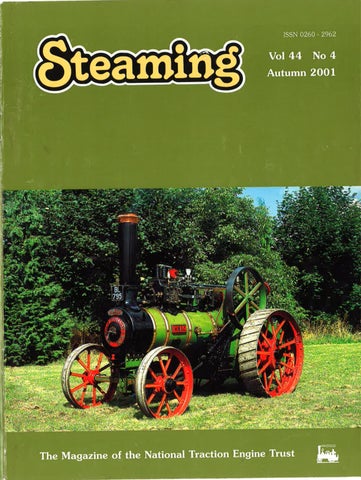
Front cover Wallis & Steevens 7hp traction engine 7683 basks in the sunshine at the Appleford re-union event in July 2000, photographed by Paul Stratford. The engine was exhibited by the makers when new in August 1919 at the Newbury Show in Berkshire, and spent its working life just west of there with A. C. Cole of West Woodhay. Our President Giles Romanes owned it in 1951 when it raced at Nettlebed, Oxfordshire and the Expansion gear machine has been a familiar sight on rally fields ever since, now being owned by Ray Osborne of Tilbury, Essex. 183
Trust News (continued from page 183) boilermaker on my visit, and they now face an uphill task of trying to convince the man in the street that their engines are safe. During our visit to the investigating officer we were invited to view their video of the scene to show the level of destruction caused: it was awe inspiring, and it was also most harrowing, for the footage contained sights of bodies, a scene I will be able to recall for a long time. In our hearts wo all know that if such a thing happened here the reaction of
authority would be draconian, just
look at the reaction of the press to a fairground accident. MPs would ask questions, and our wonderful hobby would disappear overnight. A massive majority of the owners now display NTET insurance disc on their engines; the men in Ohio could hardly believe that this was a voluntary scheme that we operate. All of you who participate in the scheme should feel proud of our achievement in this self-regulation of our hobby. The Ohio engine owners and crews
would love something similar. We must uphold the highest standards to ensure th- futur- of --r
movement. This Steaming contains details of the AGM to be held at the Milestones Museum at Basingstoke. Hampshire's magnificent new museum is well worth a visit. Please come and support the Trust, for it is yours and we need your input. The Committee are all people like you. (Andrew
Semple, Chairman)
Rally Organisers Column
numbers were up on last years attendances - this may be because the punters have not had many events to go to. Unfortunately, just as things were improving we find ourselves with a new series of I-MD outbreaks in the north east. Let us hope that it can be contained to this ores, and completely eradicated in a short time. Our Editor tells me this edition should drop through your letterbox about the 12th October, which is the day before the Autumn Conference. It is almost too late to invite you along, but not quite - if you are reading this
in time, you are most welcome to
attend (details were included in the last issue). Please accept my apologies for not attending the Great Dorset Steam Fair this year, but I promise to be there in 2002 to meet as many of you as possible, and to maybe talk over problems you may have. Before then, of course, I am only a phone call away. (Brian James, Chairman, Rally
sub-Committee)
Rally Authorisation Commisefations to all die rally organisers who had to cancel their events due to the effects of the foot and mouth disease cases of this summer. This is a reminder to those who were lucky enough to be able to hold their events, but have not yet sent in their safety officers reports - I would, please, like them in as soon as possible. Next year's authorisation forms should be sent out from here in October. If any organiser does not receive them, or knows of any other event which would like to become authorised , please let me know at NTET, PO Box 102, Wrexham, LL13 OZS, Tr 01978 781196. (Bill Evans,
Rally Authorisation Officer)
Rally sub-Committee As anticipated in the last issue of the magazine, some of the late season rallies managed to get under way with good results. I visited some of the luckier ones and found that the 184
Coal for rallies and the Climate Change Levy The subject of the newly introduced Climate Change Levy on
coal supplies was raised at theTrust's Engine Owners Meeting earlier this year and has also been discussed, with some confusion, at subsequent Committee meetings. We are therefore grateful to Jane Heginbotham, general secretary of the Coal Merchants Federation (Great Britain) Ltd, and tu Edward Goddard, for the following detailed explanation of the Levy, and how it will affect rally organisers and engine owners. The Climate Change Levy was introduced on 1st April 2001 with the objective of persuading business and industrial users to reduce their use of energy. Ordinary businesses pay the whole levy. Some industrial users and other sectors only pay a percentage, as their trade association has negotiated a reduced rate because they have demonstrated energy efficiency savings or potential savings within the industry. The energy sources being taxed are gas and LPG, electricity and solid fuels coal, coke and smokeless fuels - but not wood. Not taxed are renewables, including wood, and oil which is already subject to a different form of tax. There are exemptions and supplies defined as being wholly outside the scope of the tax, and these largely follow the rules for VAT. In the case of coal and other solid fuel, domestic grade products can be delivered in amounts of one tonne or less to any individual business or industry and there is no levy to pay. VAT need only be charged at 5%. The supply comes under the de minimus rules and is deemed to be a domestic supply. Supplies of any amount to a domestic user are subject to VAT at 5%, but no Climate Change Levy. Domestic use is outside the scope of the tax. Supplies for mixed use, that is for both domestic and business use can be charged at 5% VAT and no levy if 60% or more of the supply is for domestic use. However, the purchaser must give the supplier a certificate to verify this. The tax on solid fuels is presently £11.70 per tonne. Unless a supplier is making a supply to a domestic customer, if he delivers over the one Autumn 2001 STEAMING
tonne he must charge this levy unless the purchaser certifies to him that he should not be charged. Supplies for resale are exempt, but the purchaser must confirm via Certificate PP11 or a letter on business letterhead that the supply is for resale prior to the first delivery over a tonne. This certificate remains in force until the situation changes for example, that the supply is not for resale. In the case of supplies for steam traction engines, the individuals who run the engines will be taking coal as a domestic supply. Deliveries will usually be of one tonne or less. They are using the fuel in pursuit of a hobby. There is a difficulty in that usually the supply from a rally organiser to engine owner is in consideration of attendance at the rally, and does not constitute as invoiced resale. But neither is it a gift. Unless the purchase by the organiser can be evidenced an for resale then he will have to be charged for the Climate Change Levy. Rally organisers therefore need to submit a form PP11 or a letter to their supplier stating that the purchase is for resale. Customs and Excise have agreed that the organiser, by ensuring that he has, and keeps, a complete record of the names and addresses of those engine owners who attended the rally will constitute evidence of a supply to those who attended. You
STEAMING
Autumn 2001
should send a copy of this certificate or letter that you gave to your supplier to Customs and Excise at CCL COPE (Certification), Custom House, Furness Quay, Manchester M5 2XX. As far as steam railways are concerned, the proprietors can avoid the levy if they run a proper timetable and are not required to levy VAT on the fares they charge. However, any delivery over one tonne for purposes other than operating trains - that is, heating of waiting rooms, offices, workshops etc - then there is no exemption for the Climate Change Levy, unless the delivery is of one tonne or less. If a railway is being part of a money raising business, that is within an amusement park or for excursions rather than to a timetable and VAT is charged on the fares or the entrance fee, then there is also no exemption and the supplier of that fuel to the business will have to collect the levy.
Engine Owners Column Technical Board Just at the time when I would normally be writing about fairly mundane things to report in Steaming, the tragedy in Medina, Ohio sent its shock waves through the traction engine world. By the time this magazine reaches our readers, no doubt the aftershocks will have died down a little, but there is no doubt that it will change our attitudes and have some effect on our activities for ever. To begin with, our Health and Safety Executive is taking an interest and is asking whether steam fairs (as they call them) need to be 'regulated'. It seems that, no doubt prompted by the local authorities who seem to see traction engines as fire breathing killers which must be caged or better still killed off, the HSE was already looking in our direction. The Medina explosion has simply lent urgency to
This fine scene has the backdrop of the distinguished facade of the Lansdowne Arms Hotel in Caine, Wiltshire. Drawn up on Derry Hill by its crew for a photographic record is Foden 5 ton wagon 2112 of 1910 (M2589), well loaded, and a trailer as well. The outfit is owned by Pound Brothers of Quemerford Mills, about a mile out of Caine. There, according to the lettering on the wagon, they made artificial feeds, cakes and meal for livestock. The livery of the side sheets, the wheels and the body seems a very light colour. (collection Mike Tozer)
185
the matter. My writings on the information presently available appear elsewhere in this issue. Fortunately the HSE is not one of those government bodies that rush into ill-conceived regulation at the drop of a hat, and I am already in discussions with them, the primary objective being to reassure them that we have already quite effectively regulated ourselves. In the end good may come out of it in the form of greater official recognition of our Codes of Practice, which in turn just might lead to local authorities taking a more rational view of our activities. My apologies again to those who sent me information about spark arrestors whose help I have not yet acknowledged - events in the USA have rather overtaken me - but I will get around to it when the dust (or should I say shattered fire bars) have settled a bit. (Jim Newnham, Chairman, Technical Board) Engine coal and the Climate Change Levy The effects of the above Levy on supplies of coal for use with steam road engines are described in some detail in the Rally Organisers Column in this issue. There seems to be little effect for the owner purchasing his own supply in small lots. However, as usual with such impositions, it is not a light subject, and engine owners and crews wanting to know more may like to note where to find the explanation in the future. FBHVC News The aood work of the Federation of British Historic Vehicle Clubs covers many sorts of road vehicles, and the organisation provides a variety of benefits to its subscriber
clubs and members - all for a per capita sum of 27p a member each year. The NTET subscribes to ensure we, as a special interest group, are able to be aware of and have access to: • the monitoring of legislation in London and (through FIVA) in Brussels. • lobbying facilities as necessary. • liaison with DVLA, DTLR and DTI. All members of subscriber clubs also have access to discounted ferry travel: it is open to individual members travelling alone or in groups in any vehicle, ancient or modern. Big savings are possible, and there is a commission to be earned by clubs. Details are available from MST, ' 01295 278748, quoting 1-BlIVC, the NTET's name and your Trust membership number. Registration numbers Although few of the items covered in the FBHVC Newsletter are directly attributable to road steam engines, one paragraph in the June 2001 issue may be of interest to restorers with a care for historical accuracy. The Statutory Instrument regarding vehicle registration number plates has now been published and it does 'allow historic vehicles to continue to use plates of a style appropriate to the period of manufacture of the vehicle'. Of course, many of our engines - perhaps we would find the majority, if someone cared to count predate the 1921 necessity for heavier engines and rollers, etc to carry the motor index marks we are so familiar with, and which for new vehicles have recently changed radically in character. For the working period of most of our engines, the historical legal requirement was for a plate
The National Traction Engine Trust's
2001 AGM will be held at 2.00pm on SATURDAY, 17th NOVEMBER 2001 at The Education Room, Milestones Museum, Churchill Way West, Basingstoke, Hampshire Please refer to the formal notice in the Report and Accounts which are distributed with this issue for details of the agenda etc, and to the Future Dates column for notes on the arrangements that have been made for the rest of the day and on the Sunday. 186
displaying white, silver or light grey letters and numbers on a black surface, having every character indelibly inscribed on the surface or so attached that it could not be readily detached. The plate could be made of cast or pressed metal with raised letters, or a plate with separate characters attached - some Leicestershire County Council rollers had their marks made up from the cast letters made for use on rural signposts! Most index numbers on road steam engines, however, were painted on a plate fixed at a suitable location, or on a flat surface. The Statutory Instrument allows this to continue, and states that an unbroken rectangular area on the surface of the vehicle may be used, or if these is no flat died, an died which is almost flat. That, surely, can properly include spud pans, steering rings, tender tops and the like. FBHVC AGM Finally, on FBHVC topics, the Federation's AGM will be held on Saturday, 13th October 2001 at Paulersbury, near Towcester, Northamptonshire. Subscribing club members wishing to attend should contact The Secretary, Elton House, Church Lane, Tydd St Giles, Wisbech, Cambridgeshire PE13 5LA before the end of September. Lunches are available at £12 each if booked in advance.
insurance Officers notes Breakdown Recovery Scheme The Trust Breakdown Recovery Scheme was launched at last year's AGM and is now well under way. Whilst the number of members expressing interest and requesting details was and still is very high, the actual take up has been modest, due mainly, I believe, to the effects of the foot and mouth problems this year, and the limited number of outings people have been able to make. Those members who have joined the Scheme have all received their membership cards and many of them have told me recently that they rest more easily when their equipment is out and about on the roads. I am pleased that once again the NTET has been able to provide its members with another 'value-for-money' Autumn 2001 STEAMING
service. To date I have not had any reports of the need for the AA's Commercial Rescue Service to attend or to recover, so I can't comment on the quality of the service. However, I am assured by both PRP Ltd, who administer the Scheme, and by senior staff at the AA headquarters at Halesowen in the West Midlands that should the need arise, members will be attended to promptly and professionally. Another run-away roller Whilst at the Barleylands rally I learnt that a steam roller had recently run away down a substantial hill, somewhere in the home counties, being pushed by a large, loaded trailer. And guess what? Only a single drive pin fitted and the driver well experienced! Apparently the roller turned over and was substantially damaged - broken headstock, smashed flywheel and bent crankshaft, amongst other things, but mercifully no one was injured. It is said the driver of an oncoming car will never forget the experience. The owner of the roller is reported to have said that all of the broken and bent bits will be repaired and the engine will be back on the road as soon as possible. Well, lucky him, is all I can say. Things might have been so very different. In the words of that old CND song, 'When will they ever learn?' Implications of the USA explosion The explosion in Ohio, USA, of the boiler of the Case tractor, and the deaths and injuries that followed, is very sad indeed. Whilst here in the UK we have inspection regimes and generally good standards of maintenance, the implications of such an accident should not be underestimated. We simply cannot afford to be complacent and to say such a thing could not happen here. I am constantly amazed, and very disappointed, when I hear prominent people in our movement telling of engines that they know which simply shouldn't be in steam because of lack of repair or the non-existence of inspection certificates. Why don't folk have the bottle to be open and to 'out' the offending parties. God knows, if we had to endure a catastrophe on the scale of Medina we can be assured that our hobby would never be the same again, with extreme and severe restrictions being applied. STEAMING Autumn 2001
THE BADGER, Burrell 5hp road loco 3941 of 1923, receives just a little extra grooming during its visit to the Stoke-in-Steam event at Burslem, Stoke on Trent, in July 2001. (Barry Job)
The NTET's Insurance Disc Scheme has gone along way to ensuring that appropriate insurance is carried and that current test certificates are in force, but this simple device cannot count for the lack of scrutiny by a rally organiser, or for the fact that the owner simply doesn't apply for a disc, thus hiding his misdemeanours. And what of the self-healing engine, whereby known miraculously have problems disappeared when an inspector was changed, or the engine went to a different owner. Whilst not wishing to
frighten anyone about the condition of the average exhibit, or the propriety of the average owner and inspector, as in all walks of life we have our rogues, and I believe that it is time they were publicly identified and challenged, as an act of selfpreservation. It is said that the NTET, as an organisation, does not have the teeth to impose conditions upon the engine owning community. Well, this might be the case, but I believe that the lay members of the Trust have a duty to report on engines that they 187
consider are in an inadequate condition. Who does the member tell? Obviously the rally organiser in the first instance, but I would be pleased to receive comments, as long as they are factual and not scurrilous or nit-picking in nature. (above items — Dave Smith, Insurance Officer)
From the Treasurer The Accounts for the year ended 31st March 2001 are enclosed with every member's copy of this issue of Steaming.
I am pleased to be able to report another successful year, financially. However, it must be noted that the retained surplus for this year is lower than that of previous years. The operating costs of theTrust are rising, year on year, but our overall financial position continues to be sound. I have again reviewed the requirement for an rise in the annual subscription fees by applying the formula that an increase would be triggered by an aggregated 15% lift in the Retail Price Index since the previous subscription revision. This was in May 1993. Since then the RPI has risen by 23%, and this takes us well over the agreed threshold. However, after reporting another financially successful year, I do not feel it is appropriate to implement a rise at this time. Nevertheless, the pressure on the Trust's financial resources, combined with the effects of inflation, means that a higher subscription rate in the near future cannot be ruled out. I do not feel that there is a requirement to fully match the effects of inflation, and hope to devise a strategy which will provide for a smaller, incremental rise. (Julie Smith, Treasurer)
Steam Apprentice Club This time last year I was reporting on a very successful Dorset event at the end of a busy season. This year the Dorset gathering was equally successful from the point of view of the SAC, but it was at the end of a much quieter season. Our driving cavalcade again took 188
place in the haulage ring — at the request of the enginemen! This must say something about the dedication of the engine driving fraternity — or was it an excuse to play? At the third attempt (the Thursday and Friday tries got rained off► we had a dozen engines and hordes of Apprentices in the ring for nearly two hours. I know that the Apprentices thoroughly enjoyed themselves, and I think the crews did too. I am pleased to report that since the GDSF last year, the adult component of the SAC has been considerably strengthened. Those who put their names forward have now settled in and are taking an active role in promoting the SAC at rallies across the country. They are Graham Chaffer, Sam Bate, and Duncan and Jayne Croser who join Elaine Massey, Steve Taylor and myself. These are the people who represent us on the rallyfield, but I must, however, not forget Barry Surrision, our Editor, who produces the excellent magazine Raising Steam each quarter. There are many others, usually engine owners, who help at rallies by taking an Apprentice or two under their wing and try to teach them the fun that can be had from 'playing with engines'. Again, can I take this opportunity to say thank you to all who help the SAC. If you are involved in the organisation of a rally and come across any of these people, please give them your support. Last year I commented on the fact that our Apprentice placement scheme might be becoming too successful, and thereby wearing out our welcome with some owners. I don't think that this has happened yet, although I am conscious that crews take their engines to rallies for fun and not just to help us train numerous youngsters. If you have any comments on how this placement scheme is working, or how it might be improved, then I would very much like to hear from you. Once again we are planning a series of Apprentice Driving Days for next spring, and for which we are seeking new venues to augment the existing ones. A part of the country which is being neglected at the moment is the north east. In April this year I thought that we would be able to run a course, possibly at Beamish in Co Durham, but nothing actually materialised. I can't believe that there isn't somewhere north of the Trent where a SAC day can be held! All we need is an area of suitable land away from the public, where four or five
local engines can reasonably gather. If you can help, then please contact the SAC now! My phone number is inside the front cover of each Steaming. (John Durling, Chairman, Steam Apprentice Club)
The Clearing House The Trust notes in Old Glory continue to draw a small but steady response. The enquiries tend to be specific to those seeking information or help, but of little interest to a wider audience. It is worth repeating that the Trust notes are open to any member or any affiliated club or gi oup within Ole Trust. Remember, however, that the notes appear quarterly. So, for example, news for April, which would appear in their March issue, needs to be with me in time for the copy I submit by the 15th January, and so on at three monthly intervals through the year. Most enquiries to me come via email, where enquirers who do not receive a reply may reasonably assume that for whatever reason, their e-mail box is not receiving. Heritage Engineering, Glasgow, were such an enquirer whose e-mail address was not returnable. If they, or anyone knowing of the firm, make contact, the original enquiry will be dealt with. My own e-mail address is being attacked daily at present, but is still functioning. The address only receives widespread publicity through Steaming and Old Glory. Althougli i do not think this is the source of the 'spammer', anyone reading this paragraph who receives e-mails from DMULDERI should delete them immediately and on no account open the attachment. (Peter Donovan, 57 Halls field, Cricklade, Wiltshire SN6 6LR. e-mail: peterdonovan@traction.freeserve.co .uk )
Road Steam Vehicle History Scheme The re-titling of the above scheme was explained in these pages in the last issue. As a result of much behind the scenes work by several NTET members involved with the Road Steam Forum, the majority of engine owning members will by now have received copies of the application Autumn 2001 STEAMING
rO yl
THr 7qr[oNA
ritAcTION ENGINE TRUST 1.0
41,111.1 41 1. 11.0
It's ten in the morning and already engines are starting to gather outside the Trust's marquee at the GDSE This picture hardly shows one half of the tent, as can be seen from the banner on the ridge.
forms for the Scheme. Completion of these forms is heartily recommended by the Trust Committee as it will serve to validate the history of engines — whether they be authentic or otherwise. This information has to be correct for future generations, and not to be bogus, as is seemingly happening on some occasions where 'creative' histories are being produced for engines. As Scheme Co-ordinator, I have up to yet received only a few of the completed forms. I wonder if the reason is the time being taken for research into the engine histories, or whether owners are waiting for the longer winter nights to come round to get down to the task. Many members are merely filling in the form and returning it — this is certainly not enough to satisfy the panel that vets the applications. Can I take this opportunity to remind intending applicants that it is not just a matter of filling in the form, for there is the requirement to provide substantiating documentary evidence along with the form, where this is available. Details of where to obtain the necessary additional details are given on the information sheets which accompany the application forms. I would urge diligence in this respect. Applications will be dealt with as soon as possible; please be patient. Anyone requiring further forms, or who may wish to make enquiries or comments, should get in touch STEAMING
Autumn 2001
John and Angela Head, Christina Hill, Heather Price, Jo Tilling, Val Wingate, Elen Wyn Jones (hospitality area). The Steam Apprentice Club area was staffed by Graham Chaffer, Jayne and Duncan Croser, and Elaine and Ian Massey. And then there were also the various Trust Committee members and their wives and families. In front of the marquee, we were pleased to welcome the ever changing assembly of engines that advertised the whole area as one dedicated to the road steam engine — the Road Locomotive Society, the Steam Plough Club, the Road Roller Association and the Burrell Museum all have presence in the same vicinity. As usual George Chiverton and his Ruston tractor stayed put by the tent for the whole time, and Brian and Christine Wells provided us with electric power. There was a welcome this year for the West of England club's Merryweather fire pump which was parked outside and gave many visitors the opportunity for an eyelevel view of a working steam engine. Thank you all!
with me, Derek Rayner, RSVHScheme Co-ordinator; my address is on the title page of every issue of
Steaming.
Obituaries Alastair Dacre Lacy
Dorset thanks Another annual gathering on the Dorset hills has come and gone, and if there might have been a slight expectation of anti-climax following last year's Burrell gathering it didn't really show in the event, for there was an excellent variety of engines, probably ideal weather, and the usual opportunities for meeting friends old and new. The Trust again promoted a large marquee, accommodating both the sales stands, and the hospitality area where members and friends could rest awhile with tea or coffee. The former yet again had excellent takings from members and the public on books, videos and clothing sales to go towards Trust funds, and the rest area was nicely crowded with members and friends fO"r hours at a time. There was an encouraging increase in new memberships taken out over the five day event. Many members assisted in the running of the marquee, and we record our grateful thanks to Carolin Congreave, Paul Cook, Les and Rita Dickens, Peter and Sue Howard and Steve Snook (sales stands); and to Wendy Chapman, Janet Greenough,
Alastair Lacy asked me to provide a traction engine for him to service a client of his advertising business in 1953. He also helped in the running of an early rally on Arthur Napper's farm at Appleford, by the Thames. This experience led him to suggest that we form a club to provide stewards for subsequent events. This is how the National Traction Engine Club started, with Alastair as member number 1. In those early days of the Club he gave a cup to be awarded annually for the outstanding restoration of an engine by a newcomer. Alastair de Saumarez Dacre Lacy, born in 1928, was a quiet and very modest man who tried his hand at many things, never flaunting his achievements in any way. This dark horse had many bright patches. He enjoyed school life at Bradfield but revelled at his ability to 'buck the system' without being discovered as the cause. He was told that he could have building material from the dismantled Newbury racecourse stands, so he turned up with borrowed lorries and Bradfield School had its first rather impressive assault course. During the war years he chatted 189
up the American Airforces stationed locally to such an extent that he was taken on reconnaissance flights over Germany. He took up farming and made money raising ducks, until one day they all walked out of his yard — ending the enterprise. His career included training as a naval pilot, running an advertising agency (the source of the Club's wellknown logo), the introduction of Webb Offset printing in the provinces, management and the liquidation of the computer arm of Rolls Royce. He then had an employment agency that supplied contract staff to oil rigs and mines, which won the Queen's Award for Export on two occasions, and took great pleasure in his appointment as an OBE for Services to Export. He was a member of the Worshipful Company of Gunmakers, and chairman of the International Committee of the London Chamber of Commerce; he was a freeman of the City of London. Alastair's leisures were sailing on his own yacht in the Mediterranean and motor rallying. His family had roots in Berkshire going back to the twelfth century and with strong naval connections. He died peacefully from a cerebral tumour in June and left a widow, Avril, and two daughters, to whom we extend our sincere condolences. (Giles Romanes)
Wharton and my wife and I used to travel to the Great Western Hotel at Paddington for the Club AGMs and Rally Organisers meetings. There, appearance moneys, the amount and cost of coal, and many other rally matters would be discussed at some length. John also served the Club and Trust as Insurance Officer, from the time the post was introduced in 1981 until 1989. John's understanding of steam engines, tractors, cars and motorcycles served him well in the commentary box at rallies. It was always a pleasure to be welcomed by him when appearing in the arena to give my own inadequate commentary on the parade of motorcycles at the Bloxham event. Looking back over the many years that I have known John Hirons, I can only remember a kind, good natured person that I was privileged to call a friend. (Ted Sutton)
Joseph Kuester We regret to record the death in July of Joseph N. Kuester of Clintonville, Wisconsin, USA, aged 88 years. His membership dated back nearly twenty years, to the days when George Beck was the Club secretary. At that time approaches from road engine enthusiasts beyond these shores was unusual, and George relished the contact he formed with Joe, and kept up a regular correspondence, which was duly reported to Committee as evidence of the ever expanding world-wide circle of traction engine enthusiasm. The Kuesters were a pioneer family in Wisconsin, and their home is now the I listory House, a local museum. Joseph lived all of his life in Clintonville, working in the family farm implement business and later owning Joe's Boiler Service. His work
John Hirons On a Wednesday in July, the parish church at Hailey was filled to capacity with relatives and friends of the late John Hirons. They had come to say farewell to a man who had touched many people's lives in many ways. I first got to know John through the steam engine movement back in the 1960s, when rallies were really taking off, and most of all towards the end of that decade when we were working hard to get the late Jack Wharton's Fowler showmans engine SUPREME finished and ready for the Banbury Steam Society's rally at Bloxham Fields in 1970. It might be worthy of mention that at this rally, John Hirons put up a trophy to be awarded for the best turned out tractor. It was by way of an incentive to encourage agricultural tractor owners to strive for improvement in the cosmetic appearance of their exhibits. John had a great interest in the well-being of the National Traction Engine Club (now the NTET) and for a number of years he, and Jack 190
The long distance run by engines from Aberdeenshire to attend the Lambton Park traction engine rally near Chester-le-Street, Co Durham in July 1957 not surprisingly bought coverage in the local press. Bill McConachie was prevailed upon to take up the pose so loved by press reporters when confronted by a steam engine - a bit of gentle ineffectual wiping of the engine with a rag, whilst looking directly to the camera. The 5hpTasker 82 class chain drive tractor is number 1911, built in 1924, and it is still with the McConachies inTarland. Also making the marathon mile journey was James Barrack's 1924 Foden tractor 11444 HIELAN' LADDIE. As son Bill was 'putting a final polish on the brasswork' he told the reporter "we did the 277 mile journey comfortably in two days: (courtesy Newcastle Chronicle & Journal) Autumn 2001 STEAMING
as a youth on area steam threshing crews led to a lifetime hobby with steam engines. His Case, Peerless and Nichols & Shepard engines were familiar attenders at local parades. (The Kuester family)
Gordon Williams It is with deep regret I record the untimely death of Gordon Williams of Hay-on-Wye in June, at the age of 49, the result of a local road accident. Gordon had always been interested in old vehicles and machinery. His father Frank was an agricultural contractor in the 1950s and as a boy Gordon would sometimes stow away on the top of the straw walkers on a Massey Harris combine as his dad drove to the next farm. Contracting faded out, and Frank set up a small building business centred in Hay, also selling building products. Gordon joined the business at a young age, but Frank died unexpectedly early, leaving the business to be run by 17 year old Gordon, who was later joined by his younger brother Gerald. They soon dropped the building side and concentrated on the builders eventually business, merchant purchasing the saw mills in the town. Gordon's love of old machines stayed with him, and he eventually bought an Aveling steam roller with which he and his brother won the
Aveling Shield at the County of Salop Rally at Bishop's Castle in 1981. This engine was followed by a Clayton roller, another Aveling and then over
the years Gordon acquired a Ransomes traction, a Burrell agricultural, a 'Russian' Fowler and a BB class ploughing engine. There is also a collection of farm tractors and other heavy road vehicles. For the past twelve years he has travelled a rack saw bench, mostly powered by the Burrell. Gordon was a workaholic, but loved every minute of his too short life, and would always find time to talk, and his advice was freely given. There ought to have been 48 hours in every day with what he packed in. He will be greatly missed by all. He had recently nearly completed the restoration of a water mill for his daughter Sarah. He also leaves his wife Jen, son David, and daughter Ruth, who between them are carrying on the business, and will continue to restore the collection in Gordon's name. (Tom Henderson)
STEAMING
Autumn 2001
Not to Derek
geared towards these interests. The firm is also dedicated to promoting
A seemingly growing number of members have been sending items that are usually included in the rear part of the magazine - the Letters pages, the Around the World columns, and Small Adverts - to Derek Rayner rather than the correct Editorial address. This can cause delay in the production of the magazine, and indeed has done this quarter when correspondence arrived atYork whilst Derek was away
UK events and locations to overseas visitors. For bookings or more details of the tour, or any other, or to advise the company about your own event, please contact: s' 01980 621418, or www.glajd.co.uk
on holiday at the crucial time. Please remember that only reports intended for compiling into the text of the area notes that comprise Steaming Around should go to Derek. All
other contributions for the magazine should be sent to Roger West at Market Harborough - even comment and follow up (which is always welcome) on the old photographs that often appear within the Steaming Around section.
All aboard the NTET tour This visit to Germany in November combines the stunning scenery of the Rhine Valley with fascinating visits to museums dedicated to nostalgia and specialist modes of transport. The Auto and Technik Museum at Sinsheim, and Speyer offer an array of railway impressive locomotives, road engines (a showmans engine, steam rollers, portables and ploughing engines), military vehicles, commercial vehicles and aircraft, etc - the list goes on! Visitors also get the chance to see and hopefully listen to a collection of mechanical musical instruments in the Wilhelmsbau Museum. And if this isn't enough, the trip also involves a visit to a steam engineer's restoration yard where a road loco and other engines will hopefully be in steam, and others under restoration. The short break holiday, from 1st 5th November, comprises four nights half board in good quality hotels, all travel from London (other pickups may be arranged), and one excursion/entrance charge per day. A full page advert for the excursion appeared in our Summer issue refer to that for more details. Glajd UK brings followers of niche hobbies together to share interests through tours, events and exhibitions
Future Dates AGM 2001 The Annual General Meeting will this year be held at Basingstoke, Hampshire. Special facilities have been made available by Curator Gary Wragg at Milestones, Hampshire's Living History Museum, to enable us to hold the AGM on their premises in the afternoon, with members able to visit the Museum during the morning at a concession rate. The Trust's Annual General Meeting will take place at 2.00pm on Saturday, 17th November in the Education Room at Milestones Museum, Churchill Way West, Basingstoke. The Museum is well signposted off the west side of the town's ring road, and there is adequate parking. Basingstoke rail station, with good connections, is about two miles away, with bus services to the Museum. Formal Notice of the meeting, the Agenda and the Annual Report will be distributed with this issue of the magazine. In the event of any voting being necessary at the AGM only current members will, of course, be eligible to vote. Members are therefore reminded to make sure that they have their membership cards with them at the meeting as evidence.The names of the nominees for positions of Officers or Committee members of the Trust, together with any Motions under Article 16, are also to be found in the Report and Accounts. Tea, coffee and biscuits will be served at the conclusion of the AGM at about 5.00pm. A selection of the Trust's trophies and shields will be presented after the meeting, or at other appropriate times during the weekend's activities. Other arrangements have been made for the Saturday and Sunday for members wishing to make a social weekend. On the Saturday morning there is a chance to visit Milestones, the innovative and much acclaimed living history museum, where many of the Hampshire
191
This is an undated photograph, but it comes from the days when, if you needed to move the engine you had acquired for preservation from Hampshire to Essex, it was a matter of finding a suitable trailer for supplies, and steaming off along the high road. The engine is Fowler class A4 compound 8337 of 1898, then named THALIA, and its owner, Dr A. Fairrie, is taking a turn at steering. Judging by the destination blind of the overtaking Dennis bus, the engine is on the Hogs Back, between Farnham and Guildford, and about thirty or so miles into its journey from Winchester, but still a long way to go to Corringham on the Essex marshes. The 6hp engine is one of the Steam Plough Works machines with an overhead valve cylinder, and was at one time owned by the Wingham Engineering Co Ltd - brass plates on the smokebox door proclaim that fact. The Fowler is still around, and for the last twenty years and more has been in Devon. (Jack Turner collection)
Museum Service's locally built road steam engines are shown in reproduction street and workshop settings. Admission has been arranged at the r•.nnnessinn rate of £4.95, but as members will be arriving at different times, it is essential you are able to present a Trust membership card at the pay point. There is at least a couple of hours worth of entertainment and edification at the Museum, apart from the chance to socialise as members arrive and meet around the streets inside the exhibition. No need to leave for lunch either, as there are the Speedwell Cafe, and the Baverstock Arms public house, serving Gales ales. During the Saturday evening an informal dinner has been arranged at The Ringway Hotel, Aldermaston Roundabout, Basingstoke —that is the A340 Tadley exit from the ring road. This will be at 7.30pm. We are very 192
pleased to welcome as our guests for the eveningThe Right Honourable Sir William McAlpine, Bt and Lady McAlpine, and Sir William has kindly agreed to speak after dinner. Prior booking for the evening will be necessary and should be made through the Trust General Secretary, Sue Jackson, by. 2nd November at the latest (address inside front cover). The cost is £25.00 per head for the three course meal. For those wishing to stay in the area over the weekend, the Trust has made a block booking of rooms at The Ringway Hotel, Basingstoke. Twin or double rooms are available at £70 per room per night. Members should make their own reservations direct with the hotel (17 01256 796700) — please quote reference NTET and mention that you are a Trust member. Other 'travel-lodge' style accommodation is available locally. It is most kind of Sandra and
Derek Marder to have invited us to visit their most interesting engine collection near Andover on the Sunday morning from 10.00am onwards. Several engines — Derek and Sandra's or their friends — should be in steam weather permitting, and refreshments will be available. The premises are at Ox Drove, Andover (parking on the opposite side of the road). Its about twenty miles west of Basingstoke, and probably best approached from that direction on the B3400 through Overton and Whitchurch. Turn back along Ox Drove at a garage jusl. berme llre Andover ring road, and its about half a mile more.
Engine Owners Meeting
In recent times the annual Engine Owners Meeting has been held in the first few weeks of the new year. At the popular request of members, however, the next in the series will take place rather later in the close season, in March 2002. It is hoped this will be considered a more suitable time by the majority of those wishing to attend.The exact date is as yet undecided, but the venue will continue to be the village hall at Willoughby, Warwickshire, which seems agreed to be a good central location in the Midlands. Further details will appear in the Winter issue of Steaming, which will be with members in mid January.
Autumn 2001 STEAMING
New Members A sincere welcome is extended to the following new members who have joined the Trust during the last three months. We hope they will gain much friendship, information and enjoyment from their membership over a period of many years. The Membership Secretary is always pleased to put members in touch with one another by forwarding mail. S. M. Orchard, Dursley, Gloucestershire A. W. M. Love, Stratford upon Avon, Warwickshire J. E. G. Mann, Cambridge C. A. Piggott, Cambridge P. Piggott, Stevenage, Hertfordshire S. A. Copley, Huddersfield, West Yorkshire D. J. Gray, Kings Lynn, Norfolk J. L. Woodland, Brogborough, Bedfordshire R. J. Baseby, Sevenoaks, Kent M. L. Fellows, Hayle, Cornwall R. W. Wise, Southminster, Essex P Johnston, Poynton, Cheshire M. Johnson, Burton Latimer, Northamptonshire G. L. Hardy, Beverley, EastYorkshire P. Jacobs, Swadlincote, Derbyshire A. Birdsall. Leeds, West Yorkshire D. Foster, Carlisle, Cumbria J. A. Williamson, Selby, NorthYorkshire V.Thomas, Dereham, Norfolk C. Mitchell, Harrogate. West Yorkshire C. N. Douglass, York A. P. Desborough, Hitchin, Hertfordshire N. Rowswell, Crawley, West Sussex A. Bickers, Watton, Norfolk K. Blacker, Wythall, Worcestershire K. R. Greaves, Littlehampton, West Sussex R. E. Martin, Burton on Trent, Staffordshire A. Williamson, Endon, Staffordshire D. Mobbs, Didcot, Oxfordshire Mrs V. Vincent. Salisbury, Wiltshire J. R. Patten, South Petherton, Somerset Mrs M. Watts, Southampton, Hampshire J. Dovey.Totton, Hampshire G. Bland, Barnsley, SouthYorkshire Mrs C. Goodwin, Strumpshaw, Norfolk G. Warham, Exeter, Devon G. S. Cowsill, Manchester H. Newcombe, Wellingborough, Northamptonshire J. M. P Stratford, Newbury, Berkshire H. J. Edwards, North Harrow, Middlesex M. Lawless, Birmingham A. D.Todd, Hatherstone, Derbyshire C. P. Craddock, Westbury, Wiltshire N. Austin, Earls Barton, Northamptonshire Mrs D. E. Parker, Spalding, Lincolnshire B. Westmore, Shanklin, Isle of Wight A. Gross, Aston Clinton, Buckinghamshire I. K. Morris,Tavistock, Devon C. Swaffield, Crewkerne, Somerset B. J. Foord, Newhaven, East Sussex R. Coles, Chipping Sodbury, Bristol C. E. S Barthorpe, Stotfold, Hertfordshire B. Brooke, Ormskirk, Lancashire T. J. Vincent, Salisbury, Wiltshire V. J. Stoneman, Pewsey, Wiltshire J.T. Price, Nuneaton, Warwickshire R. J. Garrett, Cullompton, Devon Heinz Glattkowski, Schoenow, Germany W. Borland. Ramelton, Co Donegal R. H. Richards, Redruth, Cornwall
G. J. Gratwick, Crediton, Devon G. E. Caswell, Great Shelford, Cambridge S. J. Richards, Berkeley, Gloucestershire G. Albert, Rathoe, Co Carlow D. C.Toyne, Greenhills, NSW, Australia J. R. Hoare, Salisbury, Wiltshire Jaap Kuitwaard, Bergen, Holland E. Brouwer, Eemnes, Holland P. R. Atkins, Evesham, Worcestershire R. Hughes. Ashford, Kent G. Lovering, Barnstaple, North Devon M. Harvot, St Germain de la Coudre, France G. E. Shalkle, Bolton, Lancashire S. C. Sullivan, Gower, Swansea M. D. M. Frampton, Berkhamsted, Hertfordshire D. Bradley, Knaresborough, North Yorkshire E.W. Teague, Pontypool, Gwent M. R. Ellis, Bournemouth, Dorset R. J. Hill-Cottingham, Bath, Somerset R. W. Smith, Andover, Hampshire A. R. Lang, Dunstable, Bedfordshire R. H. Mayo, Bath, Somerset
.,4VWCAR., (E
— INSPECTIONS — FOR YOUR STEAM BOILER INSPECTIONS All pressure vessel and garage equipment statutory inspections carried out NTET Approved Ian Farrance Farncare Inspections
2 Hawkins Close, Poulner, Ringwood, Hampshire 6H24 1UQ Tel: 01425 479683 Fax: 01425 473765 Mobile: 0973 697818
'For Sale - 5-ton St Pancras Steam Wagon, in good working order, not suitable for present user's trade, a bargain. - Box 389, WORLD'S CARRIERS, 25 Pilgrim-street, London, E.C: (from The World's Carriers, March 1910. This was a type of machine that, however much a bargain, was already beyond it's sellby date, but it would be a crowd puller on today's rally fields.)
'Tom Bridson and his sons at Neston, Wirral, Cheshire, are preparing for a further tar-spraying season with their Sentinel steam wagon carrying the sprayer and their Fowler steam roller. The Bridsons are probably the last firm in the area to have a steam wagon in commercial use (from the enthusiast magazine Old Motor, May 1967 The Sentinel was 8122, a DG4 of 1929.)
In the August 1976 issue the Editor was full of praise for those who indulged in active preservation and the use of engines on the road. He cited the example of Edgar Shone and his crews. They had left Cricklewood, London with the Sentinel S8, bound for John O'Groats, and then to Lands End (with a run organised by Tom Varley), and finally back to London - a round trip for them of 1885 miles. There was a nice lengthy account by Derek Rayner of the life and engine times of FrankYoung of Lincolnshire, Hampshire, Warwickshire and Yorkshire. Those were the days, now sadly almost gone, when old gaffers could be sought out to set down their histories at first hand. Joe Thomas wrote of his 41/2 month visit to Australia, where he covered 5000 miles and saw many, many engines.
An open day had been held at Hampshire County Council's museum store at Chilcombe House, Winchester. There, the Tasker Collection was on view. These were the dozen and more road steam engines that had been acquired by a specially setup Trust at the dispersal sale of the Tasker company's collection in 1969. It was claimed 'the main objective Bs] to have them on display to the public in a new museum at some future date'. Well, it comes to those who are patient; the engines form part of the remarkable Milestones exhibition at Basingstoke opened last November, the culmination of thirty years of planning. The paddle steamer WAVERLEY had completed a second season sailing in preservation. Here is another triumph of enthusiasts successfully running vintage machinery and transport, for more recently the former Clyde steamer missed only part of the 2000 season whilst it was receiving a lottery-assisted refit costing over £4 million! 193
STEAMING
Autumn 2001
nationwide in a semi-governmental official capacity, rather like the quangos we know today It transpired that the Association had requested colliery owners' organisations throughout the country to report on the provisions being made for the rescue of miners in the event of the destruction of the pithead gear by an Act of War. Hard on the heels of this, in October 1939, information was received by the South Derbyshire organisation from Walker Bros at Wigan on their purpose-built Derek Rayner dim! equipment, but they decided not to pursue the acquisition of any The second part of an article, which started in the Summe r 2001 issue. Walker equipment at that time. The Association was somewhat slow on Delving into the archives the uptake on the issue, for it was not At this stage in my researches into So, why was the card for UA1876 until August 1940, some five months the Fowler ploughing engines that in almost pristine condition with after the pioneering activities of the had been acquired for use as apparent contemporaries quite dogWest Yorkshire Association with their emergency colliery winding duties in eared - and why was the card for McLaren, that they acted. Following a World War 2, I had established the UA1875 missing? Further, why had request from the His Majesty's involvement of both 15528 and 15529, UA1876 remained in the system for so Inspector of Mines at Nottingham, and the former definitely un standby long when the number was not used they decided on the provision of duties. I now wanted to do some after 1928; in any case,15529 was reequipment for four collieries which checking of original registration registered EJW510 in 1946. Answers came within their jurisdiction. These number records (if they survived) to to these questions came from Charles were Donisthorpe, Swadlincote (for see if anything useful could be Roads, for when he owned the the Kilburn seam), Netherseal and gleaned from dates registered or engine, he prudently obtained a log Granville, and a quotation from J. cancelled. Documents at the Lincolnbook for the original registration Pugsley & Sons of Bristol was then shire Archives Office for CT4291/ 4292 mark, prior to the cut off date initiated brought to notice. This offered 'steam show the last recorded owner of by DVLC Swansea. At the time, it was ploughing engines' - note the plural Fowler 15184 (CT4291) was South not foreseen that we would be able at a price of £300-0s-Od each, free on Essex Waterworks Co, Romford and one day to retrieve 'lost registrations'. rail at Colchester. One of these, it was the engine's type, on the card, was Here was the answer to the crisp noted, had recently been supplied by 'Steam Plough'. It was last licensed for piece of card, and when the engine them to the Somerset Coal Owners road use on 31st December 1937 For finally takes to the road it will have its Association. Fowler 15185 (CT4292), the last original registration, UA1876. After some deliberation, which recorded owner was South Charles' action was laudable, for the included the confirmation that the Derbyshire & District Colliery Owners engine is believed to be one of the local Inspector of Mines in Somerset Association, 84 High Street, Burtononly pair of all of the thousands of had approved the arrangement there, on-Trent. This was declared as an Fowler built steam ploughing engines Fowler 15185 was recommended for Agric Steam Engine', and was last to have been registered in Leeds in purchase at the above price. In the licensed on 31st December 1946. All their name. event, Eastern General Transport Co this only confirmed what I already Having visited several county were recorded as being paid knew, but it did give a specific archives in search of original regist£45-0s-Od for the engine's delivery to address for the South Derbyshire ration documents, a round of similar Linton, Derbyshire. This occurred, organisation. My visit there revealed visits to search for records of the Coal presumably by low loader, on 27th nothing of interest, nor was anything or Colliery Owners Associations November 1940. It was originally forthcoming in the local library's became a priority. The first to be intended to house the engine near archive collection, or at the Derbyenquired of was the South Derbyshire Netherseal Colliery, and £29-5s-1d shire Archives at Matlock.The Lincoln& District Colliery Owners (£29.25) was paid for excavating the shire registration records didn't mark Association. My initial enquiries foundations for a building at 15184 as having its details transferred failed, but after a second try the Rickman's Corner. Later, however, an to the equivalent Cumberland office, minute books for the SDDCOA were existing building in the Moira Bath so presumably the engine was not traced at the Derbyshire Record Office yard was deemed to be more suitable used on the road there. at Matlock. I was delighted with this and the engine was subsequently All that was revealed during a news, the more so as the records told housed there. Insurance of the search of the registration records at me that the initiative for the provision engine, boiler and driver was West Yorkshire Archives office at of emergency winding equipment arranged locally with John German & Wakefield was, initially, more constarted with the Mining Association, Son of Burton-on-Trent at a cost of fusion. I found a newish looking card apparently as a Government require£17-4s-3d (E17.21). for UA1876 - which was the original ment, in the July prior to the start of Notes survive on the alterations 1928 registration number for 15529. It World War 2 in September 1939. The necessary for the engine to do its bore a stamp showing that the files Mining Association of Great Britain required task. A locked coil rope for this number had been sent by was based in London and, having together with cap was ordered, and a Leeds City Council to the licensing been founded in 1854, co-ordinated contract was let with the local repository on 19th December 1975. the activities of colliery owners engineers Thornewill &Warham, who
Fowlers for the Rescue
194
Autumn 2001 STEAMING
built mill type engines in the past, for modifications to the clutch and brake. These were completed by 22nd April 1941 and interesting and unusual correspondence resulted. This firm's original estimate, which had been accepted, was for £146-7s-6d (£146.37); they had completed the job, irrespective of profit, at the actual cost of £180-17s-9d (£180.89) — this being due to increases in wages and overtime changes since the quotation was submitted. In view of the special circumstances, Thornewill & Warham suggested payment on the basis of actual cost plus 10% profit which amounted to a total of £200-7s-0d (£200.35). The Association members were sympathetic to the problem, for after deliberation they agreed the higher account should be paid. The records show nothing more relating to the Fowler during the ensuing war years; can we deduce it was not called upon to perform in the line of duty? However, with the end of hostilities in May 1945 the subject of the engine was again raised, when it was no longer required for the purpose for which it was originally purchased. It was decided to retain it a little longer, pending other arrangements, presumably for emergency cover, which may be made with other adjoining Districts. In March 1946, the life of 15185's rope gave cause for concern to HM Senior Inspector of Mines, and rather than purchase a new one the
Association then decided to dispose of the engine. However, at the next month's meeting, after the intervention of the Divisional Inspector of Mines, the decision was reversed pending enquiries about another and more efficient mobile winder in the adjacent Cannock Chase District, presumably with a view to combining the requirements of both areas. It will be recalled that earlier in this account I set down that one of Walker Bros 1940 diesel powered winders was supplied to the Cannock Chase District. No doubt by now, this type was considered preferable from an operational point of view to a steam powered machine. There are no further references to the Fowler in the SDDCOA minutes after the meeting on 25th June 1946; presumably the machine passed to the ownership of the National Coal Board at vesting day on 1st January 1947, after which the Association would have been disbanded. However, as is known, the engine survived long enough to be photographed in 1951 at Willesley, Leicestershire, not far from Moira. This site was a working colliery at one time (Oakthorpe) and said to have been the location of a drift mine during the early part of the war, and possibly later. According to the notes on the reverse of the photograph, the engine was put to work at one stage hauling tubs at this mine. At the time of the picture, the engine was presumably
Fowler BB1 class 15185 (CT4292) at Willesley Colliery, Leicestershire in 1951. Notes written on the back of the photograph indicate the engine had been used for hauling coal tubs from a pit. (collection Alan Martin) STEAMING
Autumn 2001
in store or perhaps abandoned, but the date of ultimate disposal has not been established. An Antipodean aside A curious twist to this tale now emerged. Charles Roads told me that Fowler 15185 was still in existence on the other side of the world, in Tasmania. It was known that six Fowler ploughing engines were sent to Tasmania in the early 1950s, in connection with a contract for the dredging and construction of a tail race for the Trevallyn hydro-electric power station on the Tamar river. Unfortunately the application of ploughing engines was not particularly successful, probably because of the size of scoop being used. As a result most of the engines finished up being used in the timber business. The machines included a pair of Z7s (16719/16720) from Bomford & Evershed; a pair of K7s (14046/14047) from Waller Bros of Rousham, Oxfordshire, and a pair of BB1s (15140/15141) from Wright of Alton. They were exported via Lunnicks Ltd of Reading, and were noted in their yard at Purewell Cross, Christchurch, Hampshire before they left. Also, another single unidentified engine was sent out, probably some time later, as a source of spares. Despite the passage of time, all of these exported ploughing engines still exist. Three of them at one time were in the Pearn brothers collection in Westbury, Tasmania, two of which have been positively identified as Fowlers 14047 and 15141. The other four of the batch of six are to be found elsewhere in Australia. Bob Butrims, an Australian enthusiast of long standing, in an attempt to sort out the identity of the mysterious seventh engine, replied to my enquiry: 'I visited the Pearns at Hagley; they did not know this engine's works number, and I spent many hours going over it but could not find anything. Years later, Pearns set up their museum at Westbury, and the two going engines went inside. The 'spare parts engine', by now very incomplete, had recently been spray-painted red and was parked near the front gate. In 1991, I visited Tasmania and dropped into Westbury late one afternoon. With the sun shining on the new paint on the tender, I could make out the outline of what was obviously an number. registration English Knowing that if I could clearly establish that number, I would be able to find out the identity of the engine, 1 undertook a little bit of paint 195
scraping and found CT4292. On checking in the list of BB1 class engines with the Steam Plough Club, the engine came up as 15185: It was as a result of this enquiry to the Steam Plough Club by Bob Butrims that Charles Roads' comments were made. Even more of a coincidence was when I followed up an appeal on the Internet around Easter 1999 about a dismantled ploughing engine recently acquired by the enquirer from the Pearns in Tasmania. I discovered that this engine had been shipped to New Zealand in late 1998, with the intention of rebuilding it, provided sufficient spares could be sourced. The engine had been partially dismantled in the bush in Tasmania prior to being rescued by the Pearn brothers, and a passing bulldozer working in the area had covered over a number of items removed from the engine that were lying nearby; they are now lost for all time. Following on from these more recent enquiries, I now know that the UK registration number is still there on the engine's bunker, and that 15185 has been found stamped on the engine's bearing caps. More Records Office visits My visit to the Somerset Archives atTaunton was with high expectation, for I knew beforehand that several potentially interesting documents were lodged there, including the minutes book of the Somerset Colliery Owners Association. I hoped that confirmation of purchase of the engine from Pugsley's would be found, along with further details. Unfortunately, the records merely spanned the period 1941 to 1946, that is, after the acquisition of 15528, but it was pleasing to find reference to their emergency winding engine (proving that they had one) in a minute dated 24th August 1945.This, of course, was after the end of the war and related to a decision which the Association had already taken on the engine's disposal. But following receipt of a letter from the Ministry of Fuel arid Power, they had agreed to take no further steps on disposal, and an examination of the winding rope was carried out. That was as much as I could find; the Archives also failed to provide anything on the West Buckland Reservoir construction contract. I had earlier visited the Rural History Centre, Reading to refer to the Wallis & Steevens records regarding Fowler 15528 and work they may have done on behalf of the Somerset Colliery Owners Association - an 196
Many of the engines that survived to preservation have intriguing histories, but that of Fowler BB1 class ploughing engine 15185 will be amongst the most varied. First owners Briggs of Stamford were well known and respected ploughing contractors, but after that 15185 embarked on a life of using its rope drum for slightly different tasks - reservoir construction, wartime standby emergency duties, coal tub hauling, and finally to Tasmania on the other side of the world for more reservoir work. Here we see the engine when on display in Tasmania at Pearns Steam World, and prior to its shipment to New Zealand for restoration. Although looking substantially complete, it has many of its smaller fittings missing. (Bob Butrims) attempt to firm up the Basingstoke connection mentioned by Mr Maggs. I had had no success, but it then occurred to me that whatever alterations to the engine(s) there were, may have been carried out for Pugsleys of Bristol, who had obviously been involved in the supply of at least some of them. Another visit to Reading was called for, and on this occasion, in one of the large Wallis & Steevens account ledgers, I found a couple of pages devoted to Pugsleys. But nothing pertinent to my interest was there - the sums of money involved in each account were relatively small, and nothing was logged in connection with ploughing engines: Recbid8 from the Baggeridge Colliery were traced to Dudley ArchiVas knit these were unclassified, and the only way to find if there was anything relevant to Fowler 15529 was to look for myself. Colliery accounts and maintenance records were available for periods in the 1930s and also 1941, but these were incomplete. Nothing was found on the provision at the colliery for mines rescue facilities, or even reference to a Colliery Owners Association. There
was a helpful suggestion by the archivist to try Stafford Archives, and also the mention of Mr R. J. Griffin, who lived locally and was at one time a 'Bevin boy' at Baggeridge Colliery. Following up the latter, Mr Griffin attended a re-union of ex-miners from the Baggeridge Colliery, the site of which is now a country park. He found an engineer who had worked on the surface at the colliery, and could recall an engine being there. Regrettably, it hasn't been possible to progress the enquiry, and no other evidence has come to light, despite letters to several local newspapers in the area. My visit to Stafford Archives revealed nothing of 15529 or any ploughing engines in the papers of the South Staffordshire and East Worcestershire Coal Masters Association - which was based at Ednam House Dudley. The Baggeridge Colliery was in their area.The visit was not wasted, however, for reference was found to the start of the whole story of ploughing engines being used as mines rescue standby equipment. A letter from the Mining Association of Great Britain (MAGB) dated 28th July 1939 before the start of the War Autumn 2001 STEAMING
contained a summary of a discussion that had taken place relating to the Civil Defence Act and Air Raid Precautions at a meeting of the Lord Privy Seal and the Secretary for Mines and the MAGB's Central Committee on 19th July 1939. The summary specifically referred to the 'supply of portable winding machinery which would be available to collieries in different areas. These areas might correspond to those of rescue brigades'. It was evident that the provision of the equipment which forms the basis of this article and the previous one on McLarens, was initiated at the highest level in Government. In other papers, there was reference to the Walker equipment that the North Staffordshire Coal Owners Association agreed to purchase on 8th September 1939. This cost the sum of £4,400 (minus rope). It was delivered in July 1940 and a rope was purchased at an additional sum of £196. The NSCOA declined Walker's offer of a tractor unit to haul the winder, preferring instead to find a friendly contractor, who hired his Foden tractor unit when required.This equipment was eventually located at Berry Hill, and was subject to a 35% grant from the Government on
delivery. From the above prices, I now found it easy to see why some Owners Associations chose the much cheaper option of an adapted ploughing engine! The last of my extended series of research visits was to Whitehaven. This also started with high hopes, for I knew the NCB collection in the Record Office had minutes of the Cumberland Coal Owners Association from the correct period. Unfortunately, the index did not note that the records for the period 1939-45 were only for the Coal Sales Committee, and thus not relevant to my quest! I had hoped there would be records from the mines rescue station, but other than confirming that this was located at Brigham until 1951, and the superintendent from 1920 to 1953 was one Jack Charlton, there was nothing to further the reason for Fowler 15184 being at Risehow Colliery, or anywhere else in the vicinity. Much of the coal mined in the south of this area of Cumberland came from beneath the sea, and several of the pits around Whitehaven — William and Haig — were linked underground and would not have required the services of an emergency winder, as there were
Fowler BB1 class 15529 whilst owned by J.B. Carr, and engaged on a
dredging contract at Grimwith Reservoir, Grassington, North Yorkshire in September 1955. Note the steam take-off valve and pipe on top of the cylinder — evidence of former standby duties. (Frank Woodall — courtesy Ken Ellwood)
other shafts available to wind men from underground if one, or even two, sets of pit head gear were lost as a result of enemy action. My visit did, however, lead to contact with a number of ex-miners in the area, via John Greasley of the Haig Pit restoration scheme. A response to letters in the local newspapers came from Mr R. Carruthers, who once worked in Clifton Pit. He recalled a ploughing engine standing at the mines rescue station at Low Brigham during the war years. An anonymous response confirmed this, in that the engine was delivered to the Brigham location along with a large steel bucket known as a kibble. It stayed there for a time before being transferred to Risehow, but was never used for the purpose intended. This was just the information required — it confirmed the engine as being at Risehow Colliery, and I already knew that it went from there to Thomas' yard at Moss Bay, and was ultimately scrapped. Other engines at collieries Changing locations completely, Mr F.J. Finn, a Kent reader of our contemporary Old Glory, seeing a reference in that magazine to the winding emergency Walker equipment at Astley Green Colliery, wrote to me recalling a Fowler ploughing engine that was steamed to Betteshanger colliery in the Kent Coalfield in June 1940, after a lone bomber had dropped a bomb on the
pit head. As bad luck would have it, this was a location where the local Colliery Owners did not appear to have deemed it necessary to provide standby emergency equipment strange, bearing in mind the area's greater proximity to the conflict! The damage caused by the 1940 bomb included the fracture of pipework from the boiler to the colliery winding engine, rendering the latter inoperable. Mr Finn recalled the incident well, for his late brother was trapped underground for four hours until the winding engine could be got back into service again.The ploughing engine that came to the rescue was from the Wingham Engineering Company in the village of Wingham about six miles east of Canterbury. It was one of a pair of Fowler singles of the 1877-1880 era, named SUNSET and SUNRISE. Whichever one it was would have had to steam about seven miles to the pit (assuming it was not working closer to hand), and then be suitably coupled up to supply steam to the winding engine. Mr Finn thought it would have been the right hand one of the pair so as to get as near as possible to the winding engine to minimise the length of temporary steam pipe. At the time, Wingham, along with many other contracting firms in Kent, used locally produced coal from the East Kent mines.They considered it to be the best steam coal around. The firm had several sets of ploughing engines in the 1940s, along with other engines - some of which lasted until rallying came along. Unfortunately. RLS lists have no names attributed to any of the single cylinder Fowler ploughing engines owned by Wingham, some of which were fitted with Church valve gear. The firm owned six such sets over the years, and we will probably never know which engine came to the rescue at the colliery. Surprisingly, despite the closeness of the Kent Coalfield to the English Channel, Mr Finn believes Betteshanger Colliery was the only local one affected by enemy action during the war. Alan Martin suggested two other Fowler engines with colliery connections worthy of further investigation. These were AA7 class 15245 (BD5579), noted at NCB Manvers Main, Wath-on-Dearne in Yorkshire in August 1954, and K7 class 14701 (NL1043), which was photographed at Hartley Main Collieries Ltd, Northumberland. SPC records show that the latter and its pair, 14700 (NL1042), were double-speed K7 ploughing engines, new on 3rd July 1918 to W.W. Younger of Burradon, 198
Fowler ploughing engine 15244 (BD5530) rather bogged down at Manvers Main Colliery in Yorkshire in 1953. (WD. Hollings - courtesy Martin Hallows)
Northumberland. By 1920 they had passed to the Cramlington Coal Co Ltd, which in 1929 became part of Hartley Main Collieries Ltd. The pair were shown as being scrapped in 1939, and are therefore outside the scope of use for mines rescue operations. The other engine, 15245, was part of the pair 15244/15245 (BD5580/ 5579), new in 1918 to J.P. Grundy of Barton Seagrave, Kettering, whose business was taken over by Lloyds Construction Co around 1942.The pair must have worked for a while at Manvers, as 15244 was pictured by Yorkshire photographer Dan Hollings, secretary of the West Riding Small Steam Locomotive Society, in 1953, rather bogged down on dredging duties. Prior to this,15244 was photographed dredging not far away at South Kirkby Colliery, Hemsworth, in June 1952. Both engines were scrapped by December 1954. Another pair of Fowlers, 15192/15193 (CT4345/ 4347), new in 1918 to E. Morley of Grantham, Lincolnshire had, by 1942, also gone to Lloyds Construction Co Ltd. These, too, were used for a time for work associated with a colliery (Kilnhurst, near Rotherham), and were scrapped by G. L. Swann of Doncaster in 1953. Yet another pair found to be with colliery connections were 12 hp McLarens 1618/1619 (WR6357/6356) which were new in 1919 to the Houghton Main Colliery near Barnsley, Yorkshire; these were offered for sale on 27th March 1922, and by 1928 were recorded with R.L. Walker of Goole. However, no evidence has come to light to connect any of these particular engines with mines rescue standby activities;
again, they are outside the scope of my article. It is more than likely that all eight of these engines, and maybe others not mentioned, were used for the mundane task of dredging on colliery waste tips and lagoons - a job for which they were undoubtedly ideally suited. In summary More than twenty years ago, my interest in this subject was sparked by the late Jack Hardy's reference to his ploughing engine, McLaren 1559 (CET541), being used for mines rescue standby operations. I had initially thought there were probably just a couple used for the purpose. Now, at what is perhaps the end of my protracted enquiry involving both McLaren and Fowler engines, the number has become eight. Were there any more, I wonder? With the absence of McLaren's records of the period, it is unlikely there will ever be proof that any of the Fowler engines were converted by McLaren in the same way as those of their own make the ones fitted with fairly sophisticated depth of rope measuring equipment and other alterations and the subject of the earlier article in Steaming. However, my further researches presented here show that at least two of the Fowler engines saw actual use for mines rescue standby purposes, and one was actually used for winding men in Somerset. The latter, 15528, had a brake band around the flywheel to aid this task. Charles Roads recalled that when he purchased 15529 from John Carr not from the firm of Bomford & CarrAutumn 2001
STEAMING
there were welded on brackets near the flywheel, which puzzled him. It was the only ploughing engine he had seen with the feature, and until he more recently saw Alan Martin's picture of 15528 with the complete flywheel brake assembly in position, Charles had no satisfactory answer to his puzzlement. The new pictorial evidence now confirmed 15529 seemed to have had a similar flywheel brake. This would not have been required for dredging with Carrs, and indeed would probably have been an encumbrance, hence its removal with a return to more normal working.Thus we see that both 15528 and 15529 had modifications carried out for colliery rescue duties. The South Derbyshire engine Fowler 15185, also saw local modifications to the clutch and brake to make it suitable for occasional manwinding, in addition to which a new locked coil rope was fitted. It is not known whether the Cumberland engine, 15184, was similarly dealt with. The reasons behind the coincidences which gave apparent links between the two pairs of Fowler ploughing engines on the same Essex reservoir construction contract, and then found these same four engines recorded at four collieries at widespread locations, were partially resolved when the South Derbyshire DCOA minute books were found. The reference therein to J. Pugsley of Bristol, well known second hand engine dealers, having engines available at £300, was the key to solving a conundrum which had bothered me for some time. Those minute books also told me why so many ploughing engines were used for standby purposes at different locations: the provision was coordinated at national level through the Mining Association of Great Britain. I found it intriguing that the name of Pugsley should crop up so often in my researches; there seemed a thread woven deeply into the story, and it made me wonder whether there were any other leads to be discovered. From the above notes we can see that it seems likely that Pugsleys bought several of the engines from the Abberton Reservoir project, with evidence in the SDDCOA minutes showing they were offering ploughing engines 'free on rail at Colchester', a location very close to Abberton. Whether Pugsleys were involved in the transfer of ploughing engines or the vertical boilered Marshall embankment roller from Abberton to the abortive Quants Reservoir STEAMING
Autumn 2001
Fowlers 15192 and 15193 (CT4345 and CT4357) at Kilnhurst, near Rotherham in 1952. They had probably been used on a dredging or scraping job involving the colliery waste tips, and there is no suggestion of any earlier mines rescue duties. (WD. Hollings — courtesy Martin Hallows) contract in Somerset is another matter — maybe there was a connection here as well. I had discovered that Pugsleys had sold one ploughing engine, 15528, to the Somerset Collieries in 1940, and now wondered if the 'motor lorry which was coming empty to Bristol', referred to by Mr Maggs, was one owned by Pugsleys for use in the course of their heavy machinery dealing. A further interesting coincidence came to me. A long time ago, when I commenced my writings on this subject in Steaming in 1978, a follow-up photograph was sent in of McLaren ploughing engines 1552 and 1553. It had been taken in June 1949 at the Beaufort plant depot of J. Pugsley & Sons at Stoke Gifford, near Bristol, the engines having come from Bristol Corporation. (One of these engines, 1552 (BD5504) of 1919, is now in preservation with the Daniel brothers in Cornwall.) Although the Pugsley name is still found in the Bristol area, and contact has been made with the remaining family, no business records of the wartime period now seem to exist to help researches. A family photograph survives which shows a young Michael Pugsley — he was born in 1944 — standing on the footplate of a Fowler ploughing engine, but this would have been taken in the early 1950s. It is clearly not of the rescue engines era, and the machine is unidentified. RLS records indicate that in addition to the McLarens mentioned above, Pugsleys bought three Fowler ploughing engines from the Bridgwater area (from the Somerset Rivers Catchment Board's Huntspill River contract) and it is
possible the family photograph shows one of these — but again, I find all this is outside the scope of this article. After so many years of trying to discover more of the story of the ploughing engines that became mines rescue machines, I think the trail has now perhaps gone cold. It is time to conclude the search and share the result — in the hope that perhaps more may be forthcoming when it is seen in print. Acknowledgements My thanks are due to staff in the following archive or record offices etc, who have patiently dealt enquiries from the author during his searches for the information which has led to the publication of this article: West Yorkshire archives at Wakefield Derbyshire archives at Matlock Lincolnshire archives at Lincoln Cumberland archives at Whitehaven, Dudley archives at Coseley, Wolverhampton, Staffordshire archives at Stafford; Bristol archives and Bristol library; Burton-on-Trent library, the Rural History Centre at Reading and also Wessex Water; the Steam Plough Club; Robin Harding and Tony Brown, records officers of the Road Locomotive Society; Bill Smith, Bob Gunn; Piers Calvert; John and Vince Goold; John Reeves; David Stephenson; Mrs D. Pugsley and Michael Pugsley; the late Alan Duke; the late Alan Martin and others mentioned individually in the text. If any reader is able to add to these histories, or those of the McLaren engines, do please contact Derek. 199
The Ohio boiler explosion The Chairman's foreword The Editor has suggested that I, as Chairman, make a short introduction to Jim Newnham's report on the boiler explosion at Medina, Ohio, in the United states of America, because of the personal encounters and visits I was able to arrange. Following the accident press reports began to flow in. The internet was alive with stories. Much of the information was contradictory. Jane and I were already booked to travel to Pittsburgh in August for a wedding, and as Medina is less than 200 miles from Pittsburgh we decided to see if we could obtain some first hand information of the disaster. I contacted the Sheriff of Medina County, Neil Hassinger, who responded by return, giving us permission to view the wreck and inviting us to visit his office. I also contacted a boilermaker in Youngstown named Hank Marsilio, who is the leading light in the local engine club. The local owners group
had also gained permission from the Sheriff to make a similar viewing, so we accompanied the members to Medina to see the engine. Afterwards We had an evening meal, when our companions bombarded Jane and I with questions about how we operate over here with insurance, inspections, repairs and whatever. The following day we visited the Sheriff's office and met Lieutenant John Detchon, a senior detective who had been put in charge of the investigation. It soon became apparent that he had read and absorbed a great deal of knowledge on locomotive boiler construction. We talked for three hours, and during this time we were given all the facts that were available — nothing was withheld. We returned home armed with this information which, along with several other reports that have since come to light, were passed to Jim Newnham, who has now produced a report with his conclusions.
Members will hardly need me to point out that we are fortunate to have Jim's services for this work. As the former H. M. Principal Inspector of Factories, Jim is very experienced in accident investigation and situations of this kind. Jim's report has gone to the investigating officer along with other information, as we continue to assist with their work on the incident. During the course of this exercise a great many concerned steam enthusiasts contacted me and other members of the Committee, taking much trouble to provide copies of Internet and press reports, cuttings from American newspapers and so on: I thank them most sincerely for their time and trouble. We owe thanks to Sheriff Hassinger and his remarkable Lieutenant John Detchon for sharing all their evidence with us on our visit. In Ohio this disaster has resulted in the State Governor promising that a statute will be enacted to bring riveted construction boilers into a mandatory inspection scheme. Many of you kindly drew my attention to a request for information on the internet from Dean Jagger, Head of Boiler Inspections for the State of Ohio. We have been in touch, and Jim Newnham is co-ordinating our response to him with details of our Codes of Practice, inspection schemes and, interestingly, driver training, which they are most concerned about. Whatever the final outcome of the investigation, operator knowledge or lack of it must be a contributory factor.
Preliminary report by the Chairman of the Trust's Technical Board on the explosion of a Case traction engine boiler at Medina, Ohio, on 29th July 2001. This report is compiled on behalf of the National Traction Engine Trust. It is based upon information available at the date of writing 22ndth September 2001) and therefore any conclusions drawn or opinions expressed may have to be revised in the light of further evidence that may come forward at a later date. Much of the factual information has been gathered by Andrew Semple (Chairman of the NTET), who visited Medina in August 2001, and from a report by John D. Payton, Director of the Certified Boiler Engineers for the Commonwealth of Pennsylvania. Further information has come from press and other reports posted on the internet. 200
The explosion in Medina has caused widespread concern and the primary purpose of this report is to inform and reassure engine owners and other interested parties in the United Kingdom. THE ENGINE involved is a Case traction engine, said to have been manufactured in 1918 and to weigh around 18 tons. It was designed primarily for direct ploughing and haulage. The boiler appears to be of conventional locomotive type, designed to operate at 160 pounds per square inch pressure (psi) and having a large firebox with a rocking grate of 12 square feet area. A single fusible plug is fitted at the rear end of
the crown of the firebox, above the firehole. A single 'pop' type safety valve was located on the steam dome. It is understood that the safety valve was new in 1993, was factory set at 160 psi (the Payton report states 125 psi), and still carried the manufacturer's seal. It appears that it was fitted with a test lever, but there is no indication whether it was operable. The pressure gauge was operative but is reported as reading 25 psi below the actual pressure in the boiler, but it is not clear whether the late owner was aware of this. The crown sheet of the firebox is thought to have originally been 3/B inch thick and was supported by 1 inch diameter screwed stays at 41/2 Autumn 2001
STEAMING
inch pitch. These stays were screwed 11 threads per inch (tpi) through the crown sheet but were not nutted on the fire side. Whether they were originally riveted-over is not known. THE INCIDENT. On 29th July 2001 the owner, accompanied on the footplate by another man, drove the engine a distance of 1.2 miles on a public road to the Medina Showground. At some point on the journey the engine was observed by the crew of a police patrol car to be damaging freshly laid asphalt on the road. The only significance of this is that the officers noticed that what seemed to be a great quantity of fuel was being shovelled into the boiler. On arrival at the Showground, at about 6.30 in the evening, the engine was driven to a position near to where it was to be exhibited, and was being reversed into its final position when there was an explosion in the firebox. The force of the explosion blew the fire and fire grate downwards into the ashpan, which tore away, hitting the ground and flattening out. At the same time, the engine was lifted into the air to a height variously reported as between 10 and 16 feet. Most of the fire, steam and the shattered cast iron fire grate were discharged outwards in all directions from the bottom of the firebox, to distances reported as up to a hundred feet. One piece of 'shrapnel' brought down a captive balloon some distance away. Early reports of the injured being covered by hot oil are misleading — the engine was not oil-fired, and was carrying only a nominal amount of lubricating oil. Of the remainder of the fire and steam, part was discharged through the fire hole, blowing the two men off the footplate and killing both instantly (one of them is reported as having hit the cab of a lorry 30 feet away). The remainder discharged through the boiler tubes, blowing off the smokebox door, which struck and killed the third man who was guiding the engine as it was reversing. One other man was killed and some 30 or more other persons were injured to varying degrees of severity. A fifth victim died of his injuries after six days. INVESTIGATION. There have been many reports as to who did what, and when. I do not propose to record them in detail, other than to comment that the various investigating officials all seem to have acted in a very professional and STEAMING
Autumn 2001
Views of a fallen giant. (Andrew and Jane Semple)
competent manner. From the information at present available, it seems that the sequence of events was as follows:• On the journey to the Showground it appears that a big fire may have been built up and with the induced draught from the blast pipe, it was probably very bright and hot. It is not known what the boiler pressure was at any time. • When the engine stopped on the Showground, the pressure would quickly have built up and would not have fallen significantly when the engine started to move again. • The failure of the firebox crown sheet seems to have started when it was forced by the boiler pressure off one of the crown stays towards the front, throwing the load carried by it on to the adjoining stays and propagating the progressive failure of its connections with all the other crown stays. It is reported that witnesses heard sounds 'like
pistol shots' just before the major explosion. This seems consistent with the first crown stays coming out of the crown sheet. This would have begun the discharge of water onto the fire, which would have progressively increased the as the rest of the crown stays gave way. • It seems that the whole crown then continued downwards, taking with it the tops of the sides, tube plate and firehole plate until it tore free, detaching itself completely from the upper tubes and around the sides and back at about the level of the top of the firehole. By this time the whole top of the firebox was probably nearly, if not actually, on top of the fire. • Continuing downwards, and no doubt assisted by steam from the water space together with more steam generated by water coming into contact with the fire, the firebox top, fire, fire grate and ashpan were all projected out of the bottom of the boiler with the results already described above. • At the same time, the force of the discharging steam lifted the rest of the engine into the air to a height variously described as between 10 and 16 feet. • The remains of the engine and all debris, including 12 buckets of 'shrapnel' were subsequently removed from the site and placed in safe storage. • The safety valve was sent to the National Board for examination and testing. I am informed that pressure testing of the valve was carried out under steam, and it was found that it did not lift at the set pressure of 160 psi. The pressure was then increased to 250 psi and it still did not lift, but no further pressure increase was made for fear that the valve body might burst. I understand that further examination and tests were to be carried out to establish whether the failure to lift under test could have been the result of distortion caused by the explosion, but I have not heard the outcome. I do not know whether the operation of the test lever was checked. • It is reported that the fusible plug (which had not melted) was sent to Case Western Reserve University for examination, and was found to be intact and filled with the correct tin alloy, although they are said to have reported slight signs of overheating. • The pressure gauge was also tested and found to be reading 25 psi low, throughout its range.This 202
suggests two possibilities — that at some time in the past it had been taken to pieces and re-assembled with the quadrant and pinion 'out of snyc', or that the quadrant and pinion were momentarily disengaged by the shock when the engine hit the ground after being lifted by the explosion. both would seem to be equally possible. In the case of the former, the condition of the slots in the heads of the screws which secure the back plate of the gauge might give a clue to previous tampering. • Examination of the firebox crown sheet revealed that it had torn away from the crown stays, in some cases pulling away from the threads and in others leaving a iiiiy of metal flow the cruwri sheel on the ends of the stays. A number of the crown stays at the rear end of the firebox were seen to have been welded around on the fire side. As previously noted, the crown stays were not nutted on the fire side, relying entirely upon the screw threads in the thickness of the crown sheet and possibly, originally, some riveting-over. • The crown sheet itself is reported as being very severely corroded, its original thickness of 3/B inch being reduced to between 0.210 and 0.085 of an inch. There is also reported evidence of 'moating' around stay holes on the water side. CONCLUSIONS. Subject to the caveat that I have not personally examined the boiler and that further
evidence to the contrary may come to light, it seems clear that the explosion came about as a result of the severely wasted state of the crown sheet, and was solely due to pressure on its water side surface. It has been suggested that the crown sheet collapsed due to shortage of water and consequent overheating. In my opinion the available evidence does not point to that, particularly as the fusible plug had not melted. Furthermore, if all or part of tho crown sheet had overheated, it would have stretched and torn in the overheated area and not carried away with it the upper parts of the tube plate, sides and fire hole plate. There may have been some localised overheating, particularly In any heavily scaled areas, but I do not believe that it would have been the primary cause of its failure. In his report, Mr Payton refers to a build up of scale in areas of 'bagging' in the crown sheet leading to overheating and eventual failure.This is a situation that I have never encountered, probably because the countries in which I have worked have inspection regimes which ensure that a firebox would be replaced before its crown became so thin that it bagged (or sagged) significantly in the areas between the stays. Mr Payton calculates that the firebox crown could have failed at 90 psi and expresses the opinion that its eventual failure was not due to excessive pressure. Whilst it would have been possible for the engine to
An American engineman looks at the inside of the firebox, torn asunder by the explosion. (Andrew Semple) Autumn 2001 STEAMING
travel 'light' to the Showground on little more than half its design pressure, there is evidence that it was used two weeks previously for direct ploughing. Depending upon the size of the plough being used it is unlikely that the engine could have fulfilled the task at much less that its 160 psi design pressure. Whilst I do not question Mr Payton's ability, the evidence that the boiler may have been worked at a pressure much greater than 90 psi, may cast doubt upon his calculations. Mr Payton does not appear to have calculatedlor if he did, he does not mention it in his report) the quantity of water that would have been in the boiler at various levels These figures would be very relevant to the energy discharge when the firebox crown failed. It has been suggested that the explosion could have occurred as a result of a sudden rise in pressure due to 'flash' steam generated after the firebox crown had first become overheated due to low water and then being doused with (relatively) cold water, either from the injector or from other parts of the boiler. I do not subscribe to that proposition because:• The engine had been travelling on more or less level roads and was moving on reasonably level ground when the explosion occurred. I therefore cannot envisage how the crown could have become hot enough to cause such an event without the fusible plug melting. • For the front of the crown to become so overheated but the fusible plug to remain covered with water (and therefore not melt) it would have been necessary for the engine to be reversing down a very steep slope and to have been in that position for quite a long time - which evidently it had not. There are records of an experiment carried out many years ago, in which the water in an industrial (Lancashire ?) boiler was lowered so as to uncover the crown of the furnace tube and allow it to overheat. Cold water was then introduced so as to pour on to the heated surface. The only result, apparently, was that the pressure in the boiler actually fell, rather than rising as might have been expected. At the time of writing, efforts are being made to obtain more information about the experiment. Other than Mr Payton's reference to corroded hand hole plugs, I have not seen any evidence as to the STEAMING
Autumn 2001
Andrew Semple took this picture on the visit with American enginemen to the yard where the damaged engine was taken for investigation. He comments that on arrival there were poignant minutes as everyone stood around the wreck in silence, and in awe of the devastation. The quiet was not planned or rehearsed; no one spoke for quite a time.
condition of the rest of the boiler and do not know whether it has formed part of the investigations or not. The condition of the parts of the boiler other than the firebox, for example, corrosion, grooving, cracking, caustic embrittlement, wasted and broken rivets and/or stays, etc is certainly relevant to establishing its overall condition. It is not yet clear whether the safety valve was capable of lifting at 160 psi at the time of the explosion, but if it was not, and all the evidence seems to point that way, the pressure in the boiler could have been substantially in excess of 160 psi. It appears that the safety valve was
fitted with a test lever but I have no information whether it was operable or not. I have not seen a full report of the tests on the safety valve and do not at this stage know whether the test lever was used to see if the valve could be lifted by it at various pressures. In operation the test lever should be used at regular intervals, firstly to check that the safety valve lifts freely and secondly, by lifting the valve regularly, to ensure that it will lift when the boiler goes above working pressure. Such tests also verify that the valve is seating properly. It is surprising that there was only one safety valve, normal traction
Medina County Fair The County Fair at Medina, a city located about 25 miles south west of Cleveland, is typical of the community led annual shows that are so popular across America. It is one of Ohio's oldest - this year's was the 156th - and largest.The Sunday when the boiler tragedy occurred was the set up day, with the event open from the Monday through to Sunday, 5th August. The show did go on, with the total attendance at about 112,000, slightly down on last year's, thought to be because of temperatures in the 90s on four of the days. Like many other such American shows, working vintage farming equipment of all types has come to be part of what there is to be seen, just as here in Britain. And the exhibition and
operation of engines at shows has a longer history than in this country, dating from the late 1940s. The engine that exploded at the Showground was owned by Cliff Kovacic, the proprietor of an excavating plant business. He was on the footplate with Alan Kimble; both died, as did Kovacic's son William and Dennis Jungbluth, who were both adjacent to the machine at the time. All four men were steam engine enthusiasts and part of the crew, as was Bryan Hammond, who died of his injuries after six days. Other Kovacic family members were among the injured. We offer our condolences to the relatives of all the deceased, and sympathies to all the injured.
203
engine and railway locomotive practice being to have two. I do not know at this stage what the Case company's practice was, but I have a photograph of a Case steam roller which clearly shows two safety valves on a Y fitting attached to the top of the boiler barrel. Perhaps the single safety valve was a later modification. The failure of the safety valve to lift under test might have been due to it having been distorted by the explosion. However, within my own experience I have known safety valves so corroded that the valve had to be driven out of the body with a hammer and drift. Apart from its journey to the Showground, the engine had been used a couple of weeks previously for direct ploughing. A number of persons who had witnessed one or other of these events were interviewed by Lieutenant Detchon of Medina Sheriff's Department, but none could recall seeing or hearing the safety valve 'blow'. Pop safety valves open and blow very noisily, so it likely that someone present would have been aware if it had done so. It is reported that the late owner had purchased some type of sealant, so he must have been aware that there were leaks, and that they were bad enough to prompt him to attempt to stop them. The important question is "where were they?" Some leaks, for example a slight weep from an external stay head, may not matter very much but others, such as in a line above the foundation ring or adjacent to the tube plates or, most ominous of all, along the line of the boiler barrel longitudinal seam, matter very much indeed. Had attempts been made to stop leaks by welding or welding on patches on the outside of the boiler? It is not widely recognised that, when a boiler explodes, it is not merely the steam in the steam space that is discharged. Because all the water in the boiler is also heated to a temperature far in excess of boiling point, it immediately flashes into steam (one cubic foot of water producing 1700 cubic feet of steam) when pressure restraint is removed. It is the steam thus produced that usually causes so much damage. In the present case it would have been the 'fuel' that projected the engine 10 feet or more into the air and scattered the fire and grate with such devastating effect. The available evidence clearly indicates that the firebox crown collapsed due to its weakened 204
condition, and pressure on the water side.This appears to be normal wear and tear and would have taken many years to reach the condition in which it gave way — it simply should not have been allowed to go so far. That leads to the so far unanswered questions about the condition of the rest of the boiler. If the state of the
firebox is anything to go by, the rest of the boiler could have been in equally bad condition and it was only a matter of chance which part failed first. Having said that, a good boiler shell will usually outlast two or more fireboxes but that would very much depend upon the original design specifications. It does not appear to
The Case 110 The 110 horse power Case traction engine is of typical American design, but one of the very largest and most powerful, a veritable giant by British standards.The type was, and is, one of the most revered engines in north American steam circles, much as we might boast best-engine claims for a Fowler B6 — though there would of course be heated debate and dispute on any such claims in either country! The J. I. Case Co Ltd 110 was designed for heavy plowing (the American spelling, and It meant, of course direct traction haulage across maybe virgin land with anything up to 14 bottom plows), and also freighting. Gold Medals were won by the makers in contests, demonstrating 'that there is no other steam engine made that is in its class'. The engine had a single 12in x 12in cylinder. The firebox measured 491/ 2 inches in length, 35 1/4 inches wide, and was 36 inches above the grate, which was of 12.06 square feet, and had a rocking mechanism. The 76 tubes of 2 inch diameter had an 8 foot 41/2 inch length.
The flywheel was 481/2 inch diameter with a face of 16 inches, and worked at 230 revolutions per minute.The rear wheels were 7 feet x 36 inches (extension rims if required), and the front 53 inches x 14 inches. The single speed gave but 2.37 miles an hour. Overall dimensions vveie a width of nearly 11 feet; a length of almost 22 feet, and a height 101/2 feet. Weight, with boiler empty, was over 34,000 pounds. For the curious reader, various British published works and reproduction makers catalogues will provide comparison with the products of Fowler, Burrell, McLaren, et al. Special attachments available included a straw burning facility, the extension rims and a locomotive cab — most engines built seemed to have the latter extra, probably on account of the work they were going to do across bleak, windswept prairies. Price, if you can make relative values to 2001, was $3055, free on rail from the makers' works at Racine, Wisconsin. Many readers will be surprised at the huge numbers of machines that
The Case 110hp traction engine as pictured in the makers' 1913 catalogue.
Autumn 2007
STEAMING
be known whether it was the original firebox. There are other questions, such as when and by whom was the boiler last inspected; how long had the late owner owned the engine and from whom did he acquire it? Was he a totally irresponsible rogue, who knew perfectly well that he was riding
were built. The Case 110 engine was first catalogued in 1906, at that time designated of 32hp on a nominal horsepower scale. From 1910 the company re-rated their engines, changing to a belt horsepower figure — thus the 110. By the time the last example left the shops only a short time later in 1913, no fewer than 917 examples had been built, 288 of them in 1911 alone! Additionally, another 70 or so machines were sent out as skid engines (boilers and engines mounted on a base suitable for, say, moving about in the woods by winch) and a hundred as skid boilers. These were the days of high demand, and in 1913 the Case company sent out the colossal number, to us, of one thousand, nine hundred engines of various sizes. It was their fourth highest yearly total, but soon after came an amazingly rapid downturn — in 1918 but four engines appeared. It seems nearly thirty Case 110s survive in preservation, including some in Canada. Cliff Kovacic's engine was built up in more recent years in the state of Iowa from parts of several different machines, some from the earlier 32hp model, others from the later 110. It is possible much came from a skid engine from Montana.The age of the machine that has been much quoted in press and official reports (1918) would seem to be in error, the Case company having ceased manufacture of the type some five years before that date. The boiler is proved to be of pre 1910 build by evidence of the position of the lap seam on the barrel — it is on the lower right side when viewed from the front, rather than the upper left on later models. A construction date of 1908 has been suggested.The engine had changed hands on a number of occasions in recent years, and had been reassembled by Kovacic, to be ready for showing, during the last twelve months or so. (This information is courtesy Road Locomotive Society records, The Heritage Eagle and contacts in America.)
STEAMING
Autumn 2001
around on a bomb and cared nothing for the danger into which he was putting himself and others? Or was he an innocent enthusiast with little or no knowledge of steam boilers, who was duped by an unscrupulous seller? After all, it happens often enough with motor vehicles. It is not the purpose of this report to assess culpability, nor is it any of our business, but the chain of responsibility for the condition of the boiler may well go back a long way beyond the owner at the time of the explosion. Possibly for historic reasons, the laws on boiler inspection in Ohio do not apply to agricultural boilers. Apparently, until last year, boiler inspection was available on a goodwill basis, but obviously the boiler in this case had escaped competent inspection for a very long time. In the United Kingdom traction engines must have suitable insurance cover and a current certificate of safety from an approved boiler inspector or company. Unless they have both, they are not permitted to be steamed at an
approved rally or similar public event. Engine owners are free to achieve this in any way they choose, but most use the scheme operated by the National Traction Engine Trust under which, on production of the correct documents, the owner is issued with a disc (like a vehicle tax disc) which is displayed on the engine as evidence of insurance and boiler safety. A further safeguard is provided in that the insurers will not provide cover unless a valid boiler safety certificate has been produced. The above regulation cannot absolutely guarantee that a tragedy such as that at Medina could never happen in the UK. It is theoretically possible for an irresponsible owner with a dangerous engine to get into a small local event where the organiser is not aware of the potential danger. In view of recent events, the Trust, in conjunction with the Health and Safety Executive, will no doubt be looking at the matter again. Jim Newnham Chairman, Technical Board National Traction Engine Trust 22nd September 2001 kJ-
'Steam Wagons in Wisconsin. Some time since the legislature of the State of Wisconsin offered a prize of 10,000 dollars for the best steam wagon for general agricultural and hauling purposes. The conditions provided that the prize wagon should be able to plough, and run threshing machines, and that it should also make a 200 mile trip along the country roads of the State due north and south. The 'Green Bay', made by Messrs Cowles Bros of East Green Bay traversed the district of 201 miles in 33 hours and 27 seconds, or six hours less than the time named in the specification. At various points along the road the wagon attained a much greater speed, doing 21 miles in 2 hours 10 minutes. At Fort Atkinson it was attached to a gang of the ploughs and turned over part of a 2 acre field. The machine also hauled throughout another wagon weighing about 35 cwt.' (from Engineering, 30th August 1878.) 'Explosion of a Traction Engine boiler. — The boiler of a traction engine belonging to Messrs Yates, Canal Foundry, Blackburn, burst on the morning of Wednesday the 10th inst, in Salmon Street, Preston. The
boiler was of vertical multitubular construction, having a spherical copper globe about 24 inches in diameter, depending from the crown of the firebox, and was technically known as a 'pot' boiler. The bottom of the copper globe or 'pot' was blown out, forming a hole about 12 inches in diameter, and the attendant, in preparation to start, was dreadfully scalded. It appears that the boiler had been fed with very dirty water, and in consequence of the engine having been standing for some time, a of sediment had quantity accumulated in the bottom of the 'pot' and caused it to become overheated.' (from Engineering, 19th February 1886.)
'RUNAWAY LOAD OF BEER BARRELS. —A Burton on Trent steam lorry with trailer conveying a heavy load of full beer barrels got into difficulties at the top of a steep hill near Ashby de la Zouch. The trailer became detached and ran down the hill at a furious pace, landing in a ditch. The barrels were hurled over a hedge into a plantation.' (from The Tamworth Herald, 1st February 1930. — David Dean) 205
Cox & Cox's Fowler road loco 11125 after its disastrous descent of Butcher's Hill, near Stoke Bishop, Bristol on the evening of 29th August 1911. The force and speed with which the ten tons of loaded wagons took the engine to the unyielding bank is only too apparent, and the grim face of the bystander adds testament. (collection M. J. Tozer)
BRISTOL RUNAWAY According to the Burnham Gazette in the issue of 2nd September 1911, rumours had spread about the Somerset town the previous Tuesday evening that an accident had happened to the 'great traction engine' belonging to Messrs Cox & Cox, hauliers and removing contractors, of Burnham, and that some of those in charge of it had been injured. The stories unfortunately proved true, when it transpired that 'the powerful locomotive we all know so well' had overturned in going down Butcher's Hill, at Stoke Bishop near Bristol. The engine was a Fowler, a compound class R2 road locomotive (not a prolific type by Steam Plough Works standards), number 11125, and new to Cox & Cox in July 1908, named SHAMROCK. It was driven by Charles King of Burnham, and Thomas Hawkins, aged 25 years and also from the town, was steersman. Frank Rabbits of Highbridge was there as brakesman. Cox & Cox had been contracted to convey a quantity of grain — two traction wagons 206
formed the load — from Avonmouth Docks to Brent Knoll, a village just outside Burnham, and a distance of 35 miles or more on the contemporary roads. It seems the crew were not all that familiar with the roads they were travelling, and on their way from Avonmouth into Bristol, to cross the River Avon, they made bad judgement on the safest route, despite being told of the dangers and of an accident that had befallen an engine just one week to the day before. Rather than journey the longer alternative way by Perry's Well Lane, driver King took the shorter and much steeper drop on the Stoke Bishop road — the Gazette described it as a violent descent. At the top the brakes received proper attention, and, just as day was fading, the driver made his start 'having confidence in the ability of his 17-ton engine to keep back the two wagons, which aggregated about ten tons'. All was well for a time but then an eye witness saw the wagons master the Fowler, swinging round and lifting the engine off the ground
on one side and turning it completely round. At the sharpest bend the machine and the first traction wagon toppled over against a green bank below the wall of a market garden, less than ten yards from the spot where an engine had come to grief the previous week. This time the runaway resulted in a fatality. Rabbits, walking behind when the rush occurred, ran to the smash and found his companions pinned beneath the awning of the engine. The noise of the impact drew people hurrying to the spot and help was quickly at hand; someone attended to the boiler, and 'the steam pressure was reduced'. No difficulty was experienced in getting King out of the debris, whence he was despatched by St John motor ambulance to the Bristol Royal Infirmary with back injuries, though doctors did not consider his condition serious. The steersman Hawkins, however, was badly trapped by the ironwork of the awning, and men set to work to try to remove as much of the structure as they could with saws. At first they were encouraged in their task by a few words from the unfortunate man, hut two hours elapsed before all the obstructions were clear and towards the end of that period the indications that Hawkins had succumbed were only too real. The realities of heavy haulage in Edwardian times were that, on occasion and with a slight lapse of care, the task could indeed prove a dangerous one. Autumn 2001
STEAMING
Beyond our shores These three pictures have been sent by Peter Love, taken on recent overseas excursions. First are two from the Tractor and Machinery Holiday Club's visit to New Zealand in March 2001. The Steam Traction Society at Feilding, North Island, were wonderful hosts to the group and could provide the sight of three McLaren road engines - all in steam. Nearest the camera is 917 of 190Z a 7hp compound convertible; you can just make out the style of the chimney base casting that encircles the top half of the smokebox and provides a flange on which to bolt the fore carriage when the engine was required to be a roller. Next is 8hp compound 1425 of 1912, and furthest away is 79Z another Bhp example, this time dating from 1903. Still at Feilding, the visitors found the restoration work on Aveling & Porter 7806 had recently been completed - indeed the slide valves had only just received some
adjustment and the covers put back on. The 6hp three speed compound road engine was new in 1912, supplied by Andersons Ltd of Christchurch. The engine features an interesting water pump arrangement, it being fitted on the outside of the nearside hornplate, working back towards the tender. An Aveling road roller from the same era seen by the party in New Zealand was also seen to have the same type of pump. The third picture was taken a little nearer home. Its not a British export to a former colony this time, but a German built engine in being rallied in Germany. Parading at the Oldtimertreffen event at Hann Munden in March 2001, is a Heinrich Lanz traction engine. The single cylinder piston valved machine does now have some UK connection however, for it was rebuilt here a few years ago by Alan Fry, with boilerwork by Bicknells at Liphook. The Oldtimertreffen show only takes
place every three years, and this year had over 600 exhibits of all classes. 207
208
Autumn 2001
STEAMING
9NIINV3IS
CD
Ni
LO OZ uum,inV
We are grateful to member Frank Millward of Saltash and to Graham Smart for arranging for us to be able to reproduce this fine photograph from the collection of the Essex Record Office. It shows an occasion in 1900 in the yard of the Standard Ironworks at Colchester, the premises of engine makers Davey, Paxman & Co Ltd. It was the time of the second Boer War and the Relief of Mafeking. At that small town in the north-east corner of the Cape Province in South Africa the British garrison had been under siege for no less than seven months, and its relief by Commander Baden Powell on 17th May 1900 gave rise to notorious displays of jingoism when the news got back to Britain. Boisterous crowds took to the London streets on the Saturday evening, and their wild actions coined the word 'mafficking: Celebrations were still taking place in Colchester on the following Monday afternoon, when, the Essex Chronicle reported, 'a number of reservists employed at Davey, Paxman & Co left ... to join the Essex Regiment. They were played through the town to the station by the Standard Ironworks' band and were greatly cheered: It is thought that our picture may be the start of that parade. The scene is outside the company's main office block, and the building looks very much the same today, though no longer used for the same purpose. The short man in the foreground is Harry Plane, works manager, and the tall one to his left is George Phillips, foreman. Union flags flutter in the breeze, the one on the left held by a lad wearing a token bush hat. Aboard the traction wagons a score of men pose with rifles at the ready, presumably not loaded. Colchester was, and still is, a military town and James Paxman was heavily involved with the local Militia, so the involvement of his employees and works equipment is not surprising. But what of the engine, our principal interest? Earlier that year, late in January, Aveling & Porter had delivered to Davey, Paxman works number 4435, this impressive 8hp crane engine for use around the Standard Ironworks. The unusual overhead slide valved cylinders were of 7 and 111/2 inch diameter. Note the crane jib made up from two substantial Tee sections held apart by spacers. Some of the works' principal products of the time were large stationary engines, horizontal and enclosed types, and the new machine would have been used for moving components, the heavy bed and flywheel castings (several large half castings can be seen at the left), within the 7/2 acre yard. It would have also hauled finished products and raw materials to and from the railway station and the river in the traction wagons. The latter seem to have been mocked up for the occasion to represent siege wagons, with the addition of timber panels with imitation rifle loops fixed to their sides. Mafficking there may have been at the time, but the war in South Africa dragged on for another two years before, through sheer force of numbers the British could deploy, the Boers surrendered. As well as to the Essex Record Office, thanks are also due to Michael Johnson of MAN B&W Diesel Ltd, Paxman and to Pat Freeman for information.
Mafficking 'Why farmers fight shy of steam cultivation is quite inexplicable to a certain class of critics. It is attributed to stupidity, or reluctance to adopt new methods. The real reason is the actual expense of steam, added to certain drawbacks and difficulties which appear to be inseparable from it. 'Steam cultivation is most satisfactorily employed on stiff land, where horses injure the land by treading on it, and when the times suitable for cultivation are more limited in duration. On light land depth of tilth is of less importance, and the treading of horses is beneficial. 'On such lands tillage operations can be carried out at almost any time, and hence pushing on the work of clearing is less urgent as a vital consideration. As to the actual cost, there is always a great deal of incidental cost and labour connected with steam cultivation which must be incurred, such as coal, water, carting, and assisting in shifting the tackle. These involve a good deal of horse labour, and it soon becomes evident that steam does not dispense with horses. While horses are carting coal and water they might have been ploughing the land, and this fact impresses itself upon the mind of the farmer. 'Now that coals are very dear and oats are cheap, the expense of fuel is a great drawback to the use of steam. By judicious management, the teams may be so managed as to render the further expense of steam unnecessary, and if this can be contrived, the saving will be very considerable, while, therefore, it may be shown that a complete system of steam cultivation instead of horse cultivation is more economical than horse
Why Steam is not more Generally Used
'BOYDELL TRACTION ENGINE. One of Boydell's patent traction engines, as employed in Woolwich Arsenal, was received on Saturday at the Royal Carriage Department from the manufacturers at Thetford to be forwarded to Cairo at the request of the Egyptian Government. The new engine is built on an improved principle, is fitted with numerous additional appliances which were suggested from time to time during the various experiments whicn took place in the presence of the select committee of Woolwich Arsenal, and has come out under an entirely new exterior. The huge ungainly looking flaps or slippers forming the endless railway, which formerly gave the invention so ponderous an appearance, are now hidden under a light and neat looking casing similar to the paddlewheel boxes of a small lake steam boat.' (from The Kentish Mercury, 17th September 1859. The engine was one of the later developments of the Burrell Boydell design, and is well described in both Ronald Clark's Development of the English Traction Engine and Michael Lane's more recent History of Saint Nicholas Works. It was one of two purchased by Muhammad Said Pasha, the Viceroy and ruler of Egypt, which was at that time part of the Turkish empire. Muhammad had a strong interest in modernising his country by means of the steam engine, and although he was said to be much more friendly to the French than the British, he clearly knew where to shop for the latest in hauling machines.)
labour on strong land, it is less clear as regards light and where horses can be cheaply maintained, and are able to work 300 days out of the 365.' (a small feature article in The Marlborough Times, 6th October 1900. — Peter Donovan)
Kaleidoscope DRAGON, Burrell showmans road loco 3912 of 1921, has been a familiar part of the rally scene for more years than most of us can recall. This is the former Anderton & Rowland 'Scenic' at this year's Dorset, with the crew busy preparing the fire and burnishing the brass in the morning sunshine. Their friends with the White Bros 98 key Gavioli fix the gilded topworks on the organ's proscenium. (Roger West) A fresh appearance for Sentinel S4 model 9192, on its first outing for some years, with an immaculate paintwork setting off a rebuild by new owner Geoff Peach. The 1935 built wagon was photographed by Anthony Coulls at the Warwickshire Country Show at Wellesbourne Hastings in July. Garrett 32762 is an engine that has been off the rallyfields for many years. The 1915 built tractor took up a showland career in 1919 with George Rogers & Sons of Chipping Sodbury in Gloucestershire. Paul Dun ford's recent restoration of the engine occasioned a return in June to its birthplace at Leiston, Suffolk, and an appearance at the Long Shop Museum's 20th anniversary celebration. (John Cook) Autumn 2001 STEAMING
Another Garrett 4CD tractor - this is 33219 of 1918, presently painted in the style of Newport, Monmouthshire contractors Robert Wynn & Sons. The accompanying trailer makes a nice combination, and the outfit is seen here at the top
of the hill at the 2001 GDSE (Roger West) The Weeting rally is one that despite the large number of engines attending, still manages to arrange a line up in the ring. In July Chris Parker caught the assembly in
sunshine before the dark skies took over. From the camera, we see a Burrell Devonshire, two Wallis & Steevens Expansion engines, a Burrell road loco, the Brown & May tractor, another Burrell .... and on into the distance.
Steaming t„l Around Alf
Compiled from members notes and reports by Derek Rayner
The dreaded words - Foot and Mouth Disease - continue to crop up throughout the reports which have come in for this last period. I don't think that anyone could have envisaged, when the first problems were reported back in February, that we would still be embraced by the virus as these notes are being prepared. General opinion was that it would go away when warm weather came but this has clearly not proved
to be the case. Even some of the shows postponed from the early season - perhaps on the basis of the foregoing premise - have had be to put off again or even cancelled because of the continued efforts to stop the disease. The count of over
2,000 cases, as it has now become, could not have been contemplated by anyone and there are obviously now widespread implications for many people in many directions for next year as well. During the last quarter, however,
there have been rallies and shows at which engines have appeared and as a result, I am pleased to say that there has been a much better response and selection of reports from readers for this issue. The last three months have not
been without incident. In fact one of the most serious in recent times in the world-wide rallying movement occurred in Medina, Ohio, USA at the end of July when - as has been widely reported elsewhere and followed religiously by many on the Internet - an American Case traction
engine exploded, killing four people at the scene - including the engine's owner and his son, plus two helpers - and another person subsequently died in hospital. It was quite astounding to quickly find that there were seemingly no
212
ito
Federal laws in the USA involving boiler inspection and that two States in America have no requirements for what they term 'Hobby Boilers' to be periodically inspected. One is Indiana, and the other Ohio - where the explosion occurred. quite Chairman, Our coincidentally, was in America about the time it happened and visited the scene shortly afterwards. I was elsewhere in the USA and Canada
soon after that and was able to obtain report. official preliminary a Members will, I am sure, take much interest in the pages in this issue that are devoted to the details of the awful happening. Another incident, this one closer to home, has involved a steam roller runaway - seemingly caused by the driving pin on the scarifier side
holding in many instances will be much better when climbing and descending hills - but the potential 'downside' of the arrangement will be the roller's performance in wet conditions and also the possible damage to the rubber caused by sharp objects on the road with hard items embedding themselves in the rubber and then maybe causing the roller to skid when in contact with other hard things on the road surface. No illustrations have yet been seen of this roller in its new guise. Further reports about this departure from the norm (and some pictures) will be gratefully received and followed with interest. Thanks are expressed to all the various contributors, be they groups or individuals, who have sent information from which these notes have been compiled. Details etc have been received from the following:East Anglian TES, East Riding Engine Club, Hockley Heath Steam Association, LancashireTEC, Leeds & DistrictTEC, Road Roller Association, Scottish TES, Southern Counties HVPT, Steam Apprentice Club, Steam Plough Club, Sussex SEC, Thames Valley TEC, West of England SES and Andy Cobb, Anthony Coulls, Stephen Daws, Gerry Doherty, Pat Freeman, Chris Gooch, Stuart Harris, Ran Hawthorne, Peter Haywood, John Hobbs, David Llewelyn, Bob Moorman, Alan Porter, John Pyatt, Sandy Ross, Colin Savage, Lyndon Shearman, Graham Smith, Barry Thirlwall, Deryk Vernon, Michael Watts and Bill Wells — and not forgetting Traction Engine Register for the detailed references. The press date for the next issue
is the last day of October. Information, club magazines, news and letters by then please to D.A.
coming out and locking the wheel on that side when the pin came into contact with one of the stays to the axle. The efficiency of the split pin
Rayner, Invicta, 9 Beagle Ridge Drive, Acomb, York Y024 3JH. Worldwide contributions can be accepted by fax to +(0)1904 331926 or
which should have been in position to hold said pin in its location is therefore open to question.The result of the accident was a broken forecarriagehead and other damage to the engine but, fortunately, no injuries to the crew. The owner had not had the roller very long. Another steam roller related happening is an interesting report of one in Kent having had its rolls
they can be e-mailed to derek@invicta1915.freeserve.co.uk marked Steaming. Press dates for future issues are the last day of January and April 2002.
rubbered, in much the same way in that rolls were replated. We have seen such an arrangement on
friction-powered toys but this is, as far as is known, a first for a full size machine. Apparently around an inch thickness of flat rubber has been bonded to each roll which will undoubtedly make for a much better ride both for the machine and also the crew. It is also expected that road
BEDFORDSHIRE Over the winter period, Richard Parrish has rubbered the hind wheels of his 1903 Fowell agricultural 92 (CE7857) with crawler tracks heavily reinforced with high tensile wire. As a result of this construction, it took many cutting discs to trim off four inches each side in order that the tyres would fit the wheels. They have
been bolted through the spud holes, Autumn 2001
STEAMING
making a neat job and also making the process reversible if needs be. Paul Worbey is in the process of restoring a ploughing van which has been derelict for many years. The van, which has no maker's name on it, has unusual spring gear. The back axle is carried in heavy castings with volute springs. The front turntable/drawbar arrangement has the centre pin and a volute spring down the centre of a two-piece casting. Michael Maskell has been making new big end bearings for 1902 Marshall conversion 36258 (FU92) belonging to Michael Watts, and new tubes have now been fitted. The boiler from Fowler K7 ploughing engine 14258 of 1916 (KE2495) belonging to Colin Piggott and John Mann came back from Bicknells in Sussex at the end of June. This has had a new barrel, firebox, tube plate, outer horn plates and backhead. The annual run by the Bedford Steam Engine Preservation Society was held at the end of April and several engines took part. Since it took place on roads, there was no problems with FMD restrictions and those enjoying the event included Michael Maskell with his 1915 Fowler traction 14112 (CE7818), Doug Cooper with 1927 Sentinel Super wagon 6725 (KA5574) and the Culpin brothers with Fowler roller 15973 of 1924 (BW7794). The route took them from the White House Inn at Broom, via one or two other hostelries including the Green Man at Stanford, before returning to the starting point for an evening's entertainment by the Saunders' family Gavioli organ. Later - in mid May - some engines attended the annual rally and model show of the Bedford Model Engineering Society at their headquarters at Haynes. These were John Forahaw's 1930 Foden vvaguil 13764 of 1930 (TF3106), a one time tar sprayer, Mick Maskell's Fowler traction and Burrell showmans MAJESTIC of 1922 owned by the Saunders family. At the Weeting event in July, the Bedford Steam Club's rally secretaries, Paul and Lin Worbey, celebrated their silver wedding. A grand buffet was laid on for their many friends and a most enjoyable evening was had by all.
engines turned out once more to make it an event to remember. Included in these were the Saunders family's 1925 Burrell EXMAYOR, John Wharton's 1913 Burrell KING GEORGE VI, Les Searle's similar 1920 PRINCESS MARINA and Arthur Thompson's 1932 Fowler LION. Jim Sarney's extremely well restored Burrell road loco 3057 of 1908 (13E7217) was also there and other steam engines were the Tidman centre engine on the gallopers and the Savage 1901 centre engine 793 in the steam yachts. At the end of June, the annual road run took place at Stoke Row not blighted by FMD since it was a road-based event. Around a dozen engines participated and these included Bob Staunton's 1913 Aveling roller 8116 (TA2435), Mark Wingfield's Burrell tractor 3355 (AH5240) new in 1912 and Jim Sarney's Burrell road loco. Noel Greenaway's 1925 Foden Wagon 12018 (EU2683) also took part as well as Ben Brown's Marshall traction engine 37690 of 1902 (BH7373) OLD TIMER (ex-Arthur Napper). An evening barbecue was held and enjoyed by all concerned.
BERKSHIRE
BUCKINGHAMSHIRE
The Fair held at Pinkney's Green is perhaps now the only true steam fair in the world - a continuing tribute to its founder - John Carter - who died late last year. That the family is still continuing Carter's Steam Fair is splendid and several showman's
The planned event at the end of May went ahead at Winchmore Hill Cricket Club, despite potential problems caused by the FMD restrictions. A minibus was used to ferry people in from a hastily arranged new parking venue so that
STEAMING
Autumn 2001
The distinctive lines of an Edwardian road locomotive from the Rochester works. Roger Newbery photographed Aveling & Porter 6hp YLD type at Knowl Hill in September 1999.
cars did not have to use farmer's fields etc. Engines at the event included Tommo Thompson's 15 ton 1916 Aveling roller 8717 (SX923), Burrell traction 3554 of 1914 (AH0181) owned by the Wren Davis's and the Grover family's 1928 Tasker tractor
Not to Derek A seemingly growing number of members have been sending items that are usually included in the rear part of the magazine - the Letters pages, the Around the World columns, and Small Adverts - to Derek Rayner rather than the correct Editorial address. This can cause delay in the production of the magazine, and indeed has done this quarter when correspondence arrived at York whilst Derek was away on holiday at the crucial time. Please remember that only reports intended for compiling into the text of the area notes that comprise Steaming Around should go to Derek. All other contributions for the magazine should be sent to Roger West at Market Harborough - even comment and follow up (which is always welcome) on the old photographs that often appear within the Steaming Around section.
213
1928 (932GR0). Another Aveling was Phil Honour's 1921 10 tonner 9314 (HR4399). In early June, a new event was organised at Milton Keynes in conjunction with the local Rotary Club. This rally provided an opportunity for owners to show their engines in an otherwise somewhat barren early season. The cancellation of the Whitwell event in neighbouring Hertfordshire, planned for the same weekend, resulted in most engines travelling to the rally for the event — some of these engines which had travelled by road had met at Ridgmont for a gathering at a local pub. Unfortunately overcast and wet weather, with reportedly little marketing effort, resulted in a poor attendance by the public — and if the event is to be held in future years, it should avoid a conflict of dates with other local events or exhibitor attendance could be materially effected. For the record, a long distance visitor was the Howard brothers' Fowler showmans 15653 RENOWN, which was presented with the exDormans Savage set of gallopers from Frank Lythgoe's collection. Two Foden tractors were present, these being Albert Fensom's and Doug Williamson's whilst the Forshaw family presented their ex-Reading Mechanical Tarspraying & Grouting Co Foden wagon 13764 of 1930 (TF3106). Others present included Barry Weatherhead's 1924 Sentinel Super wagon 5256 (KC5071) and the Holman family with Ransomes 214
Traction engines waiting for steersladies to volunteer in the event ring at the 1997 March Marcie rally are Burrell 6hp 2122 of 1898, Davey Paxman 6hp 16849 of 1911 and Fowler A9 class 15710 of 1922. (John Maund) tractor 39149 of 1928 (UE7213). A definite newcomer to the area was 1922 Burrell traction 3935 (NK4450), now owned by Paul Harrison. It is recorded as being built using a 7hp road locomotive boiler as the basis for the engine, there being no traction engine boilers in stock at the time of ordering. The recent purchase of this traction engine has been the fulfilment of a long held dream by Paul. The only roller on display at the show was the recently acquired Ruston & Hornsby 10 ton 158623 of 1930 (UR5657), owned by Simon and Sheila Vickery. Other items completing the steam line up were a couple of Merryweather steam fire engines, these being Derek Wheeler's early (1876) ex Watford engine 2017 and Allan Huddle's younger 1899 model NEWBURY. At the end of June, the new Quainton and Banbury Traction Engine and Vintage Vehicle Rally was organised at relatively short notice on railway grounds at Quainton to fill the gap caused by the postponement of the Banbury Club's Bloxham Rally. Because it was held at the railway, it was different and also unusual in that there were no steam rollers on display. This deficiency was compensated for by a couple of Aveling & Porter products on the rails, but it was certainly unusual for no rollers to be at a large event.
Allen Eaton brought along a couple of the engines, these being 1917 Fowler road loco 14888 (H06420) and 1912 Allchin 1546 (AP9079), whilst Mick Maskell contributed his 1915 Fowler 14012 (CE7818). Dennis and Brian Smith showed the former Arthur Napper 1931 Burrell road loco 4093 (DV9252) whilst another engine was 1886 Marshall 14421 (BP9045) previously with Jeff Shackell but now owned by Rob Freeman. Several miniatures were also at the event.
CAMBRIDGESHIRE The French-built portables mentioned in the last issue as offered for sale at the Cheffins auction in April belonged to Hughie Powell of Warwickshire and were part of a consignment which had come from France. One of these was Breloux 1712, the other being a Brouhot and the final one a (Societe Francaise) Vierzon. Brown & May portable 6226 of 1899 from the same auction (exBygones village, Fleggburgh) was sold to the Laycock Agricultural Chippenham, near Museum Wiltshire, and so returns to within a dozen miles of its birthplace. Another engine change relates to the import, by Mike Goodman, of Fowler Z7 ploughing engine 15267 of 1919 from Belgium ex France. There have been a couple of events where engines have been exhibited during the previous Autumn 2001
STEAMING
months. The first of these was at the East of England Show held at Peterborough in mid June.There was a lack a animals for obvious reasons but the organisers chose to 'substitute' for these with traction engines — a quite wise choice, as it happens. Around a dozen engines took part in the event, ably supported by several vintage tractors. Alan Rundle's 1909 Brown & May tractor 8130 (BP9887) drove a thrashing machine and James Coward's 1901 Burrell traction 2425 (AH5319) was belted to a stone crusher. Another tractor was Richard Coulson's McLaren 1837 of 1936 (AAM801), whilst two Aveling rollers were the Jennings brothers' 1904 R10 class 5598 (XD8052) and 8585 of 1915 (FH2253) owned by Julian Smith. Showmans engines included the Whatley and Saunders owned Garrett BRITISH HERO of 1908 and Stan Burgess brought along his 1928 Foden wagon 13120 (VM4536). Other vintage vehicles and some miniatures made up for the lack of animals for many visitors and created much interest. A month or so later, the Wood Green Animal Shelter event took place near Godmanchester in somewhat changeable weather conditions. Saturday was wet and drizzly but Sunday was quite delightfully sunny. Richard Coulson brought along the family's Mclaren tractor whilst also there was their Garrett showmans style tractor 33380 of 1918 (CT4565). Brian Camps showed his Aveling R10 roller 4757 (TA2300) which was proudly celebrating its centenary year and another roller was the Culpin brothers' 1924 Fowler T3A 15973 (BW7794). Ian Berne's 1934 Sentinel S4 9074 (BEV466) put in an appearance and another engine at the event was John Middlemiss' Burrell 5hp showmans 3555 BUSY BEE, joining up with son Willem's similar engine 3669 NERO.
CHANNEL ISLANDS. The only engine on Jersey, other than those in the excellent Pallot Steam Museum, is 1914 Taker tractor 1625 (J83098 — a Jersey registration). This was in steam undertaking three days work on a saw bench in early August at the Hamptonne Fair, a restored rural farm complex in the centre of the island.
CHESHIRE After the May Day steam event at Urmston, Lancshire, reported in the last issue, Cheshire-based engine owners had only to wait until the end STEAMING
Autumn 2001
of the month for their next outing. At spring bank holiday, Ted Fisher, landlord of the Bull's Head pub in Mobberley had organised the Mobberley Steam Party and Beer Festival, an event which attracted George Coles and his 1913 Clayton traction 46059 (CE7943), Alan Porter's 1913 Burrell Roller 3535 (TB2710), Bill Briggs with Burrell traction 2003 of 1897 (YA509) and others. Tom Brogden presented his replica of Hancock's steam carriage of 1833 which was in steam and fully operational. A month later, toward the end of June, a midsummer vintage gathering was held at the Horns Inn, Little Leigh. This was staged by local enthusiasts as a direct result of larger events being cancelled due to FMD. Alan Porter's Burrell, George Coles' Clayton and Peter Walker and Diane Carney's 1933 Sentinel S6 8821 (BRF200) were all in attendance and others to take advantage of the occasion were Nick Whittaker with his 1946 6 ton Aveling-Barford roller AG760 (BTL810) whilst John Heselwood from north east Lancashire also paid a visit — not by car — but driving his 1932 Sentinel DG4 wagon 8714 (KG1123). 'Just a run out for the day' he said! Alan Thwaites joined the party on the Sunday morning, steaming his 8 ton Aveling roller 8361 of 1914 (PC9151) from nearby Stretton. This pleasant little event was the perfect stopping off point for those engines going on under their own power to the new event in the area in early July at Oulton Park. This was held on one of the car parks at the famous Cheshire Motor racing circuit. As it turned out, only six of the seventeen steam entrants came under their own power and only two from the Horns Inn event, namely Alan Porter and George Coles. Nick Whittaker steamed in from Winsford with the Aveling-Barford and Peter Walker made a rapid trip from Urmston with the Sentinel S6 whilst Dave Gleave came with his brace of Fodens, the 4 ton wagon 8304 of 1918 (BY7646) and showmanised tractor 12782 of 1927 (DF4055). Notable amongst the engine line up at this event was the interesting assembly of no less than four of the Basingstoke breed. The oldest of the quartet was the venerable 8hp T series traction — and the sole example surviving — T169 of 1883 (BS8161) owned by Bill Briggs, which was joined by Herman White's immense 8hp traction 7269 (N03343). This engine, built in 1912, was shown without boiler lagging
and was attending its first rally after the fitting of a new firebox and gears. Two Advance rollers, Steve Dakin's 10 tunnel 7931 of 1927 (0T5350) and the immaculate 7851 of 1925 (H06459) owned by Alan Atkinson, completed the group. At one point during the event, several people were seen gathered together in a furtive huddle, an assembly which turned out to be an impromptu meeting of the unofficial Wallis & Steevens Steam Owners Club (WASSOCS)! What was discussed, if anything remains a mystery! Another quartet of engines, all from the same maker, were from Rochester, and these were 8 ton single roller 8361 of Alan Thwaites and the similar 9093 of 1920 (NK9344) belonging to Eric Croall, whilst a younger model was D type 10753 of 1924 (NU3041) owned by Dave Lomas. John Heselwood's tractor, 9081 of 1919 (KN5785) completed the line up. One change of ownership in the area relates to the sale of 10 ton Clayton & Shuttleworth roller 44449 of 1912 (EY1570) from the late Colin Stevenson. It has gone to Harold Baker. In early August, the 36th Astle Park rally at Chelford attracted some 33 engines, of which only two were newcomers to the show and both were long distance travellers. From Cumbria came Bob Martin's 1915 Aveling roller 8615 (MP8619) and from even further afield, came Will Dakin's latest acquisition — a 4 hp single Davey Paxman portable 15584. He has bought this to accompany his rare 7hp traction engine of the same make, 16849 of 1911 (AF3373).
Steam Packings, Jointings, Seals and Gaskets ■ PTFE and graphited packings. Piston rods, valve rods, water pumps and valve packings • Sheet jointings used in preserved vintage steam, oil and petrol engine vehicles • Asbestos boiler manhole and mudhole door joints • Flange joints made to order • Sentinel boiler joints usually in stock • Short length cutting service For advice and sales contact — STUART GRAY 9 Walnut Way, Ickleford, Hitchin, Herts, SG5 3XT BELDAM Tel: (01462) 431848 CROSSLEY Fax: (01462) 436093 e-mail:SteamPacking@aol.com Appointed Stockist
215
Though the motion of the exAustralian portable was in action via a steam line from the traction engine, its boiler is in need of repair. In previous years at this event, up to a dozen showmans road locos and tractors have been on display and working — but this time, there was a real shortage. As usual, Fowler 15653 RENOWN owned by the Howard brothers was hard at work all weekend, whilst generating for their canopy lights were David Ragsdale's 7hp Burrell 3118 DREADNOUGHT and Dennis Woodward's Fowler conversion 14948 PRINCE OF WALES. Two showman's tractors, Dennis Woodward's Aveling 6093 of 1906 (D2800) and Jimmy Russell's Fowler conversion 21221 of 1937 (CV0734), remained in the engine line up. As a contrast, the roller enthusiast had plenty to admire; not surprisingly, most numerous were products from Rochester — Eric Croall's 8 ton single, Alan Thwaite's similar and Tony Deeley's later slide valve 10 ton 14073 of 1930 (FV1326) were included in these.There were a couple of Wallis Advance rollers and Alan Porter's Burrell. Richard Fairhurst brought along the exAberdeen C.C. 16436 of 1925 (SA8439). At the same Astle Park venue, during the early summer, the 1000 engine rally took place. This traditional stationary engine event has usually been held at Tatton Park, but moved in 2000 to the new venue and a new June date. The extremely well restored Burrell compound traction 3385 of 1912 (SG6600), owned by John Pennington, was on display at this event and created a considerable interest. An Aveling roller has come in to the area and the ownership of Mike Johnson. This is an ex Cumberland machine, 11496 of 1926 (RM2588) which had been in Lincolnshire for quite a time. It was stripped down for major attention whilst in Bill Hambleton's ownership and Mike has recently bought it from the Isle of Wight. It may be recalled that Mike owned the huge 15 ton Aveling roller 6090 of 1906 (13T8883) for a time, so it is nice to welcome him back into the ranks of steam roller owners.
CORNWALL Firstly a whole hearted apology is due to Colin Savage for an erroneous note in the last issue indicating his 1929 Garrett tractor 35225 (0U3239) was requiring a new fire box. To set the record straight, following a successful ultrasonic test and 216
thorough examination of the boiler internals and the installation of a new set of tubes earlier this year, the Garrett is now set for a few years of further use by Colin, with no major boiler work envisaged for some time. The above overhaul was carried out in Graham Viant's yard and Colin was helped by Jim Pengilly — who drove a 4CD Garrett tractor for a living, Joe Dodd and Tim McGregor (Steam Apprentice), to whom grateful thanks are extended. An early season event took place in the county at spring bank holiday. The 21st Mabe Steam-up and Shindig was held and attended by eleven engines, including Colin Savage's Garrett tractor. Others were Richard Stock's 1904 Aveling roller 5541 (PP581), Brian John's Fowler traction 8282 of 1899 (AC9321) and another Fowler, BBI ploughing engine 15436 of 1920 (N01364) belonging to Steve Saunders. A ploughing engine to leave the county is AA7 class 15256 of 1918 (BW4638), which has been sold by Harry Gotts to Robert Jameson in Sussex who owns the other engine of the pair,15257. This ploughing engine was never rallied in Cornwall but provided the transport at son Geoffrey's wedding at St. Uny Church last summer. Another departure, in early June, has been Tyrone James' 1922 Aveling roller 10445 (FX9806) which has found a new home in Devon. The engine came into the county in 1979 to the ownership of Mark Garrett and later passed to the James family who restored it. In recent years, it has been in the custody of Darren Pearce and Jane Easton who earlier purchased their own engine, Aveling roller 11804 of 1927 (PP7833) from an auction in Oxfordshire. They have done sufficient work on this engine recently to have it out and about following a successful boiler test. Graham Viant is progressing with work on his 1918 single cylinder Robey portable 37958.The engine has had a new smoke box and a new set of tubes fitted. Mark Garrett has recently acquired another engine in the shape of 1920 Foden wagon 10136 (MA4691) from Jim Cook in Shropshire. This will make an extremely nice addition to the county's engines, especially as it is an original Cornish wagon, being owned by the Redruth Brewery, in whose livery it is now finished. An event which did not succumb to FMD in the county was the Boconnoc Steam Fair, organised by the Liskeard Steam and Vintage Club. This took place towards the end of
July. It was the third such event and turned out to be a very successful affair, despite the weather being unkind at times. Around thirty engines attended and ploughing was undertaken by the Daniel brothers' machines — McLaren 1552 of 1919 (BD5504) and 1918 Fowler BBI 15163 (WR7151). Others present included the Vincent family's 1920 Fowler road loco 15463 (DW2121), Brian John's Fowler agricultural, Jim Snell's Wallis traction 8052 of 1930 (0U7435) and Dave Goodwin's splendid Burrell showmans 3159 GLADIATOR. The Trevithick replica PUFFIN' DEVIL was also present and in steam and Martin Barnecutt's 1934 Sentinel DG tractor 9097 (ARE195) was also there, being put to good use on one occasion in rescuing a stranded vehicle. Avelings were present — AC6 class 6407 of 1907, a compound traction, (TA2759) is in the course of complete rebuild by George Tribe and was making its first public showing since 1965. The other was Richard Stock's little 5 ton roller. Controversially, he is intending to re-fit tractor wheels to this machine. Attending its first event in new ownership was another Aveling, this being roller 11804 belonging to Darren Pearce and Jane Easton.
DERBYSHIRE A fresh engine in the county is Aveling showman's style tractor 7612 of 1912 (F5218) which has come from Somerset and is now with S. Moss. Despite being offered for sale at auction earlier this year, 1911 superheated Garrett traction 29764 (AC9326) is still with Terry Gibson. The Elvaston Castle rally went ahead in early July with several new exhibitors this year. It was well attended — probably because it was one of the few events in the East Midlands not to succumb to the FMD problem. Allen Eaton brought 1917 Fowler road loco 14888 (H06420), and being kept busy signing autographs was star attraction Fred Dibnah, who had brought along his Aveling roller 7632 of 1912 (DM3079). Another Aveling was 1929 6 ton single 12450 (PG1711), belonging to Peter and Chris Brookes, whilst Russell Cook's 1916 Foster shoWrhans 14153 ADMIRAL BEATTY also put in an appearance. Another newcomer was Burrell showmans 3890 MAJESTIC from the Saunders' collection, which had Ruston & Hornsby traction engine owner Colin Brothwell at the helm. Perhaps Colin has changed his spots? As well as the Foster showmans, there was a notable collection of other Wellington Foundry products Autumn 2001
STEAMING
attending — no less than eight, which included a traction engine and several showmans style tractors. Regular supporters at Elvaston included Richard Buck's 1920 Aveling roller 9347 (L8953) and Fowler tractor 14805 of 1920 (UG1496) owned by David and Sue Cope. Another roller which caused great interest was Dave Crampton's Wallis Advance 8099 of 1936 (A0U941) which was exhibited in an incomplete rolling chassis form. The fact that it was so obviously still undergoing rebuilding found great favour with many visitors, who were fascinaled by the amount of work so obviously necessary to restore an engine. There was doubt up to the eleventh hour whether the ONCA event would go ahead at spring bank holiday but the show, at Eckington, did so and was enjoyed by the many spectators who went to it. There was a bit of rain but this did not really spoil the proceedings. Wallis & Stevens engines featured quite heavily, with one attending its first ever event and another coming back to the rally fields after an absence of around ten years. The former was Chris Frampton's 2394 (8E9345), which was new in 1897 and spent most of its life as a roller. This stood next to Mike Farmer's Advance roller 8058 of 1930 (0U4737) and Mike had helped considerably in the rebuild of 2394. The engine returning STEAMING
Autumn 2001
Shadows of the trees dapple Aveling & Porter slide valve single roller 14002 as it runs through Clifton Hampden village in Oxfordshire, whilst moving from Shabbington to Wantage in August 2000. (John Maund) to rallies was Fred Jackson's 1900 traction 2489 (AD8906), which also has undergone considerable rebuilding over a long period.
DEVON There was an excellent turn out of both spectators and engines at the Tavistock Steam Fair in early June, organised by the Robey Trust. This year's event, held as usual in the town centre, was the eleventh, and naturally it featured the Lincoln built machines quite strongly. The Robey Trust's two rollers tandem 42693 of 1925 (FE7490) and tri-tandem 45655 of 1930 (VL2773) were in attendance and they were joined by Brian Sismey with his 71/4 ton tractor 40991 of 1923 (FE5377). This design, made after the legislation changed allowing higher weight tractors to be one-man operated, was advertised by the firm as a tractor/roller, and this one spent much, if not all, of its working life as a steam roller. Other engines present included John Woodley's 1916 Sentinel 1465 (AW3321) which was heavily rebuilt by the Shrewsbury firm during World War 2 and John Wakeham's Burrell roller 4040 of 1926 (TT7917), the latter having been roaded to the event both
up and down some tricky Devon hills. A newcomer to the show (as well as this latter engine) was another roller, Ian Davies' newly purchased Aveling 10445 of 1922 (FX9806), which he had just obtained from Tyrone James. Another change in ownership relates to Simon Cauldwell who has purchased Burrell road loco 2646 of 1904 (AD8923). This single crank compound was latterly in Northamptonshire and had boon turned into a pseudo showmans engine. It will be interesting to see what the new owner intends to do with it. Simon has previously owned engines — one in particular being Sentinel DG timber tractor 9097 of 1934 (ARE195).
DORSET Seven engines attended the Moores Valley steam gala at the beginning of June. These included Paul Antell's 1910 Robey traction 29333 (AD9899), the Cobb family's Marshall roller 60207 of 1912 (CA4775) and Robey tractor 41493 of 1924 (MF3946), owned by the Parker family. Also there was David Loader's 1922 Wallis roller 7751 (HR6354). Also in June, at the Dorchester 217
Carnival, 1901 Marshall traction 36033 (NK2524) was in steam and took part in the procession. This engine was owned by the late Jack Miles for many years before being bequeathed to the Dorset County Museum. In mid August, the third Portland steam and vintage show was able to muster four engines. Unfortunately a somewhat showery weekend meant that the machines were unable to move around the show area, although they were in steam. Those taking part were the Parker family's Robey tractor, Fred Thomas's 1919 Fowler K7 ploughing engine 15278 (FA1301), George Train's unusual single speed 1917 Ruston Proctor traction 51737 (EB8164) and finally, Alan Fry's 1907 Burrell showmans 2879 PRINCESS ROYAL - called LORD NELSON when owned in showland times by Henry Thurston.
CO DURHAM Sentinel S4 wagon 9308 of 1937 (DDC838), at one time with Keith Collins in Yorkshire and Ken Frost in Norfolk, has been purchased by Peter Sendall. It was more recently with the late Duncan Price in Worcestershire.
ESSEX In early July, the rally at Gosfield did not fare too well with the weather. The usual appearance of
animals at the event, organised by the Farm Machinery Presentation Society, did not take place because of FMD restrictions. However, a reasonable selection of engines was present at the show. Wood sawing took place, powered by the Retman brothers' 1907 Foden road loco 1294 (110JLB), and William Childs showed his 6 ton AvelingBarford roller AC621 of 1937 (GMK939). Others there included Ernie Eagle's 1908 Marshall traction 49725 (BW4509) and Wallis agricultural 7497 of 1916 (N04710) belonging to Natal Taylor. Two rollers at the rally were Trevor Ellis's 1935 Fowler DNA 19546 (SR9484) and Philp's 1920 Aveling 9146 (N01224) restored by and in the hands of Matthew Garwood. Engine movements have included Burrell traction 2921 of 1907 (N0440) which has recently passed from J. Road of Cambridgeshire to J. Brick & Son in an arrangement involving internal combustion engine tractors. It has subsequently been sold on to Edward Carr. Aveling roller 11493 of 1926 (MK4299) has returned to these shores from Sweden - it was formerly known as GREEN ARROW and was very prominent in the Hertfordshire area prior to going abroad. The roller, along with Sentinel wagon 3899 of 1921 which
Strong light and dark skies show off the impressive outline of Fowler 86 class showmans road loco 14425 CARRY ON at the 1998 Weeting event. (Phil Steer) 218
has also returned to the UK, was at the Reftele Automuseet which closed some time ago. The new owner is R.W. Wise. Further imports are with Roy Chapman - these being reported as Garrett traction 27351 and an unidentified Allchin traction, together with an unidentified Ransomes portable.
HAMPSHIRE The first open air event held at the Milestones Museum at Basingstoke was a very successful affair. Nearly twenty engines attended and naturally Wallis & Steevens-made examples featured strongly, having been built in the town. Included in these was Dave Marriner's 10 ton Advance roller 7933 of 1927 (0T5326), Stuart Gaines' similar 8112 of 1939 (DH0364), Expansion traction 7090 of 1909 (DL2846) belonging to Ken Honeybun and Gerald Whittakers' 1890 convertible traction 2149 (BP9469). The latter engine had been on display within the museum. An engine making its first appearance in new ownership was 8 ton Aveling roller 10217 of 1921 (MV763) owned by Dave Elliott, whilst also present was Martin Barnecutt with his 1934 Sentinel DG tractor 9097 (ARE195). The Sunday evening of the spring bank holiday saw most of the Wallis engines - and a few interlopers - go for a short road run to the railway station and back. The route took the engines as close as now possible to the site of Wallis's North Hampshire Ironworks on Station Hill - the area is somewhere beneath the town centre shopping complex. In early June, a very pleasant evening was spent at the Sun Inn, Dummer, when Thames Valley TEC members were invited to an informal gathering organised by engine owner Paul Fowler. His Foster showmans 14501 of 1920 VICTORIOUS had been joined by David Fowler's Burrell 3651 EARL KITCHENER and, all the way from Hungerford, Burrell 3950 PROGRESS, owned by John Newton. Boz Oram's Hooghuys organ SHARAZAD was in fine tune and the gathering was joined by Ian Best's 1923 Wallis Advance roller 7779 (H06260). Others there were Dave Hardiman's excellent Mann's wagon 1120 of 1916 (U3781) and Ewan Davis's 1922 Aveling roller 10282 (FX9005). In July, Burseldon Brickworks museum held one of its monthly open days. Engines in steam at the event included Brian Sismey's Robey Autumn 2001 STEAMING
The MarketLeader NATIONAL TRACTION " ENGINE TRUST
Whatever you Drive Whenever you Drive it Exclusive to members of the National Traction Engine Trust, a unique scheme from the NTET appointed insurance brokers Footman James. Designed for owners of steam vehicles with motor legal expenses and road rage personal accident cover. FOR INDIVIDUAL SERVICE AND COMPLETE PEACE OF MIND CALL US TODAY
The Enthusiast's Insurance Broker
FOOTMAN JAMES The Market Leader STEAMING
Autumn 2001
0121 561 621. 8 A rricloor, of the norm, direct
219
National Traction Engine Trust
Fodens Ltd (RLS catalogue reprint) Marshall Steam Road Rollers (RLS catalogue reprint) J. & H. McLaren catalogue, 1914, facsimile
Mail Order
•
Many books, videos and other items of interest to traction engine enthusiasts are available from the Sales section. Readers are urged to take advantage of this service (which also benefits Trust funds) for troublefree and economical postal shopping. Just tick the for items you require and fill in the address slip.
TRACTION ENGINE READING New Ransomes, Slms & Jefferies, Agricultural £19.95 ❑ Engineers (Brian Dell) New Thornycroft, Ian Allan Transport Library (Townsin) £18.99 ❑ New Fairground Strollers and Showfolk £19.95 ❑ (Frances Brown) New Classic American Steamrollers, 1871-1935 £19.95 ❑ (Drake and Rhodes) reviewed 44/3 New Davies & Metcalfe Ltd, Railway Engineers £30.00 ❑ to the World (Metcalfe) reviewed 43/3 £15.99 ❑ New Glory Days: Foden (Watson) £5.99 ❑ Traction Engine Register 2000 (Toy and Johnson) £9.90 ❑ Contractors and Factors (Freeman) £11.50 ❑ Glossops - Kings ofTar Spraying (Whitehead) Pictorial Albums Heavy Haulage (Neville/Freeman) Steam Wagons in Colour (Sawford) Steam Tractors (Halberstadt)
£750 ❑ £12.99 ❑ £15.95 ❑
Company Histories £30.00 ❑ Reprint The Story of St Nicholas Works (Lane) £5.99 ❑ Charles Burrell & Sons Ltd (Gilbert & Osborne) Reprint Steam Engine Builders of Lincolnshire (Clark) £10.95 ❑ £30.00 ❑ The Story of the Wellington Foundry (Lane) Revised 4th edition, Doble Steam Cars, Buses, £27.50 ❑ Lorries and Railcars (Walton) £3.60 ❑ The Rise and Fall of Aveling Barford, 1933-1988 £3.00 ❑ Armstrong Whitworth & Co Ltd (Ward) I okomohiler Frank Munktells (s/back): £12.95 ❑ with English translation) £3.00 ❑ Aveling & Porter Ltd (Preston) Steam at work Maintenance of Locomotive Boilers (Garraway) A Life with Steam (Challis) The Lyelldale Waltz (Thompson) The Steam ThreshingTrade (Thexton) Bob Whitehead's Garrett histories Garrett Steam Tractors and Rollers (Whitehead) GarrettTraction and Ploughing Engines (Whitehead) Garrett Wagons, Part 1 Pioneers and Overtypes (Whitehead) Garrett Wagons, Part 2 Undertypes (Whitehead) Garrett Wagons, Part 3 Electrics and Motors (Whitehead) Made by Garretts (Whitehead)
£9.99 ❑ £24.00 ❑ £15.00 ❑ £7.50 ❑
£7.50 ❑ £7.50 ❑ £6.95 ❑
please refer to recent issues for other available books videos and club items
MOONLIGHT PRODUCTIONS videos Up for the Cup - the Steam Plough Club's Great Challenge 1998 (VHS 65 mins) Steam over the Fells - steam through the Trough of Bowland (VHS 115 mins) Sentinels on Parade - road run, Shrewsbury to the Horseshoe Pass (VHS 45 mins) The Big Road ATLAS -the Eastnor Castle heavy haulage road-run (VHS 60 mins) Up Hill and Down Dale - the 1995 steam car touring rally, Yorkshire Dales (VHS 90 mins) Sentinels and Scouse - the 400 vehicle cavalcade through the MerseyTunnel (VHS 55 mins) Sentinels on The March - 1995 Sentinel Drivers Club road run (VHS 50 mins) Travels with and Old World ATLAS - final stages of overhaul, first test run of ATLAS (VHS 50 mins) Steam Amongst theTraffic - British Steam Car Club's touring rally through Wales (VHS 75 mins) Norfolk Ninety '96 -The Steam Car Club's 1996 touring rally (VHS 90 mins)
£19.50 ❑ £20.00 ❑ £15.00 ❑ £18.00 ❑ £18.00 ❑ £18.00 ❑ £16.95 ❑ £15.00 ❑ £18.00 ❑ £19.00 ❑
CLUB ITEMS NTET Sweatshirts, embroidered logo, choice of colour £17.00 ❑ NTET Polo Shirts, printed logo, £10.50 ❑ choice of three colours, in four sizes NTETTee Shirts, printed centre chest logo, £6.50 ❑ choice of 4 colours and 4 sizes £2.25 ❑ NTET Members Badge - members only £2.95 ❑ NTET 2000 showmans badge (boxed) £2.95 ❑ NTET traction engine lapel badge (boxed) £2.95 ❑ NTET Foden wagon badge £2.95 ❑ Steam Apprentice Club badge - members only £2.95 ❑ Fowler cap badge
To claim post-free for UK members please enclose current membership card. Non-members please enclose 10% part postage per order. Overseas members please enclose 8% part postage per order (European); 10% (rest of world). PO/Cheques (in sterling please) to be made payable to: National Traction Engine Trust. Visa, Access and Mastercard accepted, please state card number, expiry date and name on card, or phone/fax 01582 733971 (72 evenings only). Orders to be sent to: NTET Sales, 90 Devon Road, Luton, Bedfordshire LU2 ORL. Please allow 28 days for delivery.
£18.50 ❑ £18.50 ❑
Name
£18.00 ❑ £18.00 ❑
Address
£18.50 ❑ £2.25
❑
Reproduction makers catalogues £7.50 ❑ Ransomes, Sims & Jefferies (RLS catalogue reprint) £7.50 ❑ Wallis & Steevens Ltd (RLS catalogue reprint) Fowler Road Making Machinery (RLS catalogue reprint) £9.00 ❑
Membership No.
Amount Enclosed List 44/4, Autumn 2001
40991 of 1923 (FE5377), Kevin Stubbs' Marshall portable 84480 of 1929, Stuart Harris's 1925 Aveling roller 11215 (IY2326) and Garrett showmans style tractor 32981 of 1917 (BJ3282) belonging to Stuart Maggs. Dave Freemantle also put in an appearance with 1916 Aveling roller 8754 (VN2370) but left part way through in order to steam to Netley Marsh for the event there the following weekend, A number of engines attended the one day Copythorne vintage vehicle and steam rally held in mid July at the end of the week-long carnival. These included Don Cully's 1921 Burrell traction 3902 (MA7503) and Ransomes tractor 39127 of 1928 (PN1903) belonging to Barney Biddlecombe, together with three rollers. A roller advertised for sale is one from the Hollycombe Collection —this being Fowler T3 16395 of 1925 (MB8481), which is part dismantled and needs minor repairs. Details regarding a new owner are not yet to hand.
HEREFORDSHIRE The remains of a 5 ton Foden wagon are reported to have arrived at Henry Netherway's premises from Beamish Museum in Co Durham. There is very little left of this once fine vehicle and even the cylinder has suffered an attack by a scrap man or whoever in the past, resulting in a large piece missing from one corner. STEAMING
Autumn 2001
Elsewhere in these Steaming Around notes we record the return home from a time in Sweden of Aveling & Porter C type roller 11493. The 1926 built machine is seen here (left) in a photograph lurking in the Road Roller Association collection. Probably taken somewhere in the Hertfordshire area, the roller's former territory in preservation days, and accompanied by Aveling convertible 6319, we shall have to leave it to local members to tell what on earth was going on. The picture was presumably taken in the 1960s, judging from the fashionable display of miniskirts. The wagon has not yet been identified and will certainly be a challenge both to make it into an operable machine and also to identify it.
HERTFORDSHIRE With so many steam events cancelled this year, an invitation by the trustees of the newly opened Redbourn Museum for local steam engines to visit for a spring bank holiday open day was an opportunity not to be missed. This was taken up by several owners, it being the first real outdoor gathering of the season for many engine men. A pleasant day was had both by drivers and their families as they caught up with the gossip. Simon and Sheila Vickery made a very first appearance in public with Ruston & Hornsby 10 ton roller 158623 of 1930 (UR5657) which they had recently purchased from Gravenhurst after a working life with local contractor A.T. Oliver ofWandon End, Luton. Well known local enthusiast Betty Vickery brought along 1896 Wallis roller 2357 (H06139) which was in the hands of
her son Jonathan and grandson Paul. From nearby Friars Wash came Albert Fensom with his Foden D type timber tractor 13266 of 1928 (VJ 1476), whilst Ian Hodgson presented his half size Foden wagon built by Maskells of Bedford. The previous weekend, David Philpot had steamed his Marshall class S conversion 77876 of 1924 (PU4053) from Luton to Friars Wash and this also attended. It has been rested during the last few years whilst David's Clayton Shuttleworth traction held centre stage. An engine only recently moved into the area was Brendan Corcoran's 1923 Aveling showman's conversion 10590 (BB6961) which was originally a C type piston valve roller. This travelled to the event from St. Albans. Steven Ward's well restored 1921 Aveling roller 9370 (YA1177) was also there whilst the first to arrive — and last to leave — was 1928 Aveling tractor 12152 (SC1577) owned by local resident Sandy Ross. As forecast in the summer edition of Steaming the Herts Steam Club's 221
Leighton Buzzard bypass rally was cancelled as well as the local Steam Owners and Drivers Club event at Red bourn. However, the latter organisation did manage to arrange a low-key event at Gaddesden Row on their usual rally weekend in mid July, and four local engines spent the weekend at the Old Chequers Pub. The common at Sarratt has seen many engine gatherings over the years and following the cancellation of the Chiltern Club's annual rally at Prestwood, just over the border in Buckinghamshire, a substitute gettogether was arranged at this attractive village for the Saturday of the rally in early July. Representing the Herts Steam Preservation Society were Pat Burbury's 1921 Garrett 4CD tractor 33991 (FK1300) which had towed Alan's Aveling six-man living van, Dougie Williamson's Foden tractor 12300/13484 of 1926 (LG8784), which was also complete with his extensively rebuilt showmans van and Albert Fensom's Foden D type tractor. Aveling tractors old and new were represented by Jonathan Vickery with XAC class 6319 of 1907 (BP7501) and Sandy Ross with his 1928 L type. All these engines arrived by road - there were no low loaders tucked around the corner! From the more immediate Chiltern area came Ian Woollett with
his 1930 Sentinel SDDG4 8448 (UX8724), Jim Sarney's 1908 Burrell road loco 3057 (6E7217) and Tommo Thompson's 1916 Aveling roller 8717 (SX923). Sadly, we have to report that one engine did not complete the journey home. Aveling roller 8064 of 1913 (NK1102) owned by Kevin Flint left the site on Sunday morning hauling a heavy trailer. Not far from the village, this ex-St. Albans roller was caught out by one of the many short but steep descents which abound in the Chiltern Hills. It appears that the offside driving pin came out from the wheel centre and fouled the bars that stay the Morrison scarifier to the rear axle. This resulted in a complete locking up of the engine, and with a wet downhill road with metal cats eyes on the crown, the sudden stoppage of the transmission resulted in a catastrophic skid. The roller ran out of control with the subsequent breakage of the roll head, bending the crankshaft and other damage. Thankfully the crew were unharmed and local engine owners came to the rescue by providing lifting tackle and a low loader to clear the bits away.
KENT Along with most of the country, the county also suffered with FMD and the major rally at Sellindge was
This issue's notes tell of several welcome returns to Britain of engines taken abroad in recent years. This is Wallis & Steevens oil bath tractor 7572 of 1917 being paraded, out of steam and with the boiler tubes removed, at the Lincoln event in August. (John Cook) 222
cancelled at the end of May. However, the usual small event at Wrotham went ahead in early June amid stringent precautions against the spread of the virus. Engines attending included Richard and Marion Francis's 1912 Marshall traction 59435 (PB9888) which was driven about 10 miles to the event on the Friday - leaving around 4am to avoid other traffic and lessen the inconvenience to road users. There were three Aveling rollers in the county of their origin - the Jones family's 1913 single 8097 (FX7014), Damon Holah's 1922 piston valve 10393 (FX9641) and Roy Atkinson's 10994 of 1924 (WT6042) from over the water in Essex. Fowler road loco 14754 of 1920 (N0459) belonging to William and Richard Pierce appeared after an absence of several years during which time it has received major boiler repairs. All that is left to finish the engine is to line out the front wheels. Also owned by Richard Pierce was the venerable 1876 Fowler ploughing engine 2861 of 1876 (AB9451) whilst Peter Stanier's 1917 Fowler AA6 class 13877 (N05) also attended, as didTerry Maynard's 1910 Ransomes tractor 23266 (DX792) which has also had recent major boiler work and a repaint over the winter. This small engine, which at one time was the maker's yard engine, awaits re-instatement of its canopy. A Foden wagon which has been in the county for a number of years and which changed hands last year is 7536 of 1917 (T8750). It is now owned by Colin Wheeler who drove it to a recent open day at Crossness Pumping Station, where volunteers are restoring one of the four beam engines which were built in 1865 to pump sewage. It is hoped to steam this later in the year for the first time since the 1950's. The Kent Show saw a good selection of engines including Peter Fordham's 1925 Allchin traction 3251 (NU7483) ROYAL CHESTER. He was helped to drive it to the show from Hadlow by Brian Hope. The engine was owned in Kent back in the 1950s and so it was a welcome return. The Allchin is now based in Suffolk and has had major boiler repairs recently. Others at the show included Julian Hopper's 1935 Sentinel S4 9208 (BYL485) which has recently had its engine overhauled and been repainted. An Aveling roller was Colin Hazlehurst's 10399 of 1922 (BH9624) which looked very smart, having been repainted over the winter when it also had several mechanical Autumn 2001 STEAMING
repairs. It was driven to the show from its base at Chatham Dockyard and sounded very good as it came up the hill behind the show ground. Later, in early August, the Detling Steam and Transport Festival had John Monday's Aveling roller 10784 of 1924 (PU3094). This latter was appearing in public for the first time since reassembly with new tyres fitted - rubber tyres. These are flat and bonded to the existing rims, looking very much like conventional reploting which was carried out in days gone by - except, of course, they are rubber. Brian Hope has bought 1904 Aveling roller 5467 (PB9619) which he used to own some years ago and in consequence is selling his other iuller, 10190 of 1922 (FX8654) which he has had for a relatively short time. An engine to come into the county is Aveling roller 5636 of 1906 (CWB285), ex- John Maddrel on the Isle of Man. Its new owner is Kenneth Vine. Another engine to change hands is Wallis oil bath tractor 7487 of 1915 (ME6356) which was previously with John Ullman and has now passed to Tom and Steve Casey.
LEICESTERSHIRE During May, Dave Corbett had water in the boiler of Aveling roller 7798 of 1912 (R7497) which has had major work done on it. Dave is also giving attention to the motion work which he says is needed after many years of travelling on the road. Just to keep his hand in, Dave was looking after Audrey Boston's 1927 Foster traction 14593 (FE9179) at the May opening of the Boston Collection at Cadeby. Arthur Henton has put a new set of tubes in his Aveling convertible 9267 of 1920 (KE1290). Arthur was one of the exhibitors at one of the few events to go ahead in the county this summer. This took place at the Snibston Discovery Park in late May and was staged in connection with the opening of the Snibston Colliery Railway, or Coaltracks as the project has been known over the years. In attendance at the event was Arthur's 1947 Aveling-Barford roller AH392 (CTL227) in its unusual maroon livery: another AvelingBarford AC605 of 1937 (DTM537), owned by Phil Tansley, Stuart Tomlinson's 1911 Fowler traction 12761 (BH8166) and Peter van Houten's 1928 Foden tractor 13196 (GC5832). Completing the line up was the Leicester Museum Services' 1915 Marshall tractor 68823 JINGLING GEORDIE. The new acquisition of Ian Lander,
STEAMING
Autumn 2001
A Steam Legacy media 2000© Buena Vista, Marston Road, Sherborne, Dorset DT9 4BL The Producers of Burrell 2000Q - The Official Video
Wallis & Steevens oil bath tractor 7572 of 1917 (H02035), arrived back in the UK somewhat earlier than expected. Ian had recently purchased this engine from the USA. Early June saw a successful steaming but since then, all 42 tubes have been removed. Ian says that the tractor is rather potent compared with his other engine, an ex-Sri-Lanka single speed Aveling roller. Mark Johnson is still no further forward with identifying a works number for his Sentinel Super wagon. This is believed to have been built around 1925. Various leads have been followed up but so far without success. He appeals for help from anyone who may be able to shed more light. The wagon was purchased from Yorkshire but before that had been in the Sussex area. It was rumoured at one time that it was from Lincolnshire or even Cambridgeshire, but these suggestions have, as yet, proved unfounded. Meanwhile, Mark continues to work apace with the back end complete, the front end is now stripped to the channels. A new front axle, slider blocks and front springs are to be sourced.The other engine in the family, father Barry's 1923 Wallis Advance roller 7784 (XP2338) has had new big and little ends made and fitted.
NORFOLK Strumpshaw, just outside Norwich, features heavily in the first part of this report whilst the other side of the county - at Weeting concludes it. Both shows have fortunately not suffered from FMD problems and the first event to go ahead, in early May, was the Trust's
Driving Course which brought to the event several engines from out of the county. Included in these were Mike Dyson's 1918 Garrett 4CD tractor 33296 (BJ5510) and Natal Taylor's 1916 Wallis Expansion engine 7497 (N04710) as well as Peter Williams' Aveling KND tractor 9225 of 1920 (CJ4160). Keith Honour's 1914 Burrell road loco 3593 (KE3865) was also there and some of the Strumpshaw Museum's engines also took part., courtesy of host Jimmy Key. Many of the engines then appeared at the Strumpshaw rally, a fortnight or so later, over the Spring bank holiday. A long distance visitor to the event - all the way from Dorset - was Robert Coles' 1922 Burrell showmans 3938 QUO VADIS which joined the Frost family's Burrell 3343 PRINCESS MARY of 1911. From closer to hand came Clive Fence's Burrell agricultural 3201 of 1910 (BP5919), whilst making a first appearance at the show was the Philp family's 1920 Fowler A9 class road loco 15467 (AD9200). Colin Piggott brought along his Fowler K7 ploughing engine 16646 of 1926 (R04520) whilst steam rollers included Fowler 16235 of 1924 (AV45) owned by the Higgins family from Essex. The appearance of the Burrell QUO VADIS from Dorset was perhaps eclipsed in so far as long distances are concerned by the visit of the Hawkins family's Burrell Gold Medal tractor from New Zealand. This unusual single cylinder engine, 3510 of 1913, was one of the quintet of engines which came round the world for the 2000 event at GDSF's Burrell year. Several of the museum's engines also were listed in the programme which, along with late 223
entries, totalled 38 steam engines. This number included, for some reason, Cliff Aldrich's Aveling-Barford DX motor roller, said to be built in 1924 - but that was before AvelingBarford existed. It was actually constructed in 1946. The happening which probably caused most interest at the show was 'The Great Challenge'. This was a timed competition on the sawbench between Duncan Marston, who fielded his 1917 Ransomes 4 hp portable 27268 and Billy Birds' Allchin traction 1527 of 1911 (CF3650). A fiercely contested affair, the winner turned out to be Bill Bird. In Mid July, the county's attention turned toThetford and the visit of the five New Zealand engines to the Charles Burrell Museum, a prelude to this year's Weeting rally, held the following weekend. The engines travelled from Weeting to Thetford where they and the crews enjoyed a civic reception - and there was a strong TV presence as well. They posed for photographs at the Council Headquarters - the Kings House and then made the short journey to the works site and the Burrell Museum. At this location, there was a further photo opportunity before the engines took part in a road run to Croxton - a path which they had probably travelled before, for it was the Burrell company's test run for new engines. The engines included were 8hp 3529 of 1913 - George Winter; 3229 of 1910, an 8hp belonging to Philip Kerr; 3148 of 1909 - Alan Familton; 8 hp 3522 of 1913 Butterick family and the Gold Medal tractor belonging to the Hawkins family. The Weeting rally itself had some good weather and good crowds. As well as the aforementioned Burrell quintet, there were several other rare engines around - including a long distance visitor in the shape of Mick Walters' 1926 Garrett wagon 34841 IRT1940).This was on its way home to Yorkshire, having already been driven from there to Leiston to attend the Garrett gathering earlier in the month. Tasker showmans tractor 1822 of 1920 (H02930) owned by the Reed family was also present as was the unique John Collings steam tractor No2 of 1910 (AH47) owned for so long by the late Ronald Clark and now belonging to Richard Parrott.The only surviving pair of Burrell ploughing engines, 776/777 of 1879 which belong to the Museum of East Anglian Life at Stowmarket were also there, as was Alan Rundle's 1909 Brown & May tractor 8130 (BP9887), 224
now complete with awning. The oldest operable Burrell in existence Richard Parrott's 748 traction of 1877 (CF3667) was also featured well at the event.
NORTHERN IRELAND The 34th annual Ulster Traction Engine Rally was held in mid July at Ballymena and 21 engines attended. James Patterson took his two tractions to the show: 1912 Ransomes 26687 (MS3095) and Marshall 74746 of 1921 (TA2442). Gerry Doherty drove his 1920 Aveling tractor 9317 (ID1345) from Paddy McKendry's yard to the event, whilst a long distance and regular visitor was David Sixsmith with Marshall traction 72446 of 1920 (IC1603). From Co. Kildare was Benny and son Bernard O'Gorman with Fowler TE2 hauling and winding engine 14925 of 1917 (102658). An engine not seen in public for some time was William Carlisle's 1914 Foster traction 13111 (AH5496). This engine has recently had boiler work carried out. Finn Lynch took along 1928 Aveling tractor 11997 (K06739) and Rory Woolf had his Fowler ploughing engine, 15223 of 1918 (CT4290) on display. Only two rollers were present at the event - both Wallis & Steevens Advance models. The earlier one was James Mcllfaterick's 7834 of 1925 (H06399) whilst the later 1929 version, 7991 (0U704) was owned by Gilbert Armour. Gerry Caraher's 1919 Marshall portable was also present and a good crowd attended on both days.
NOTTINGHAMSHIRE The south Nottinghamshire village of Gotham held its annual Gala in early July with steam being represented by Michael Beeby's 1911 Clayton traction 44103 (AL9348). This place name may well ring a bell with some of the older rally enthusiasts (as well as fans of Superman) for in the late 1950s and through to the early 80s up to five road steam engines could be found at the South Notts bus garage when owned by proprietor Chris Dabell and latterly by son Clive. These comprised of Aveling roller 10991 of 1924 (BC9483), Fowler roller 14342 of 1915 (AX3512), Ransomes traction 27014 of 1917 (D02043) and a pair of Fowler ploughing engines dating from 1920 - 15426/15427 (WR7181/7182). Although Rempstone rally failed to take place this year as a result of FMD, a small steam get together at Ruddington was attended by three engines. These were Michael Beeby's Clayton traction, Jim Crane with 1884
Aveling traction 1995 (BT3939) which a few weekends earlier had travelled nearly 40 miles on the road to attend the Long Eaton and the Elvaston events, and also Anthony and Wendy Thompson's 1926 built Foster showman style engine 14564 (FE8055). A newcomer to the county is a Clayton & Shuttleworth portable 46995 which is from Australia. This belongs to Andrew Parker and was recently seen in a yard near Retford awaiting some attention.
OXFORDSHIRE On what would have been the Saturday of Woodcote Rally in mid July (the event was moved to September because of FMD), Robert Cox organised a happy little gathering as a 70th birthday surprise for his father, Alan. Alan was curious why Robert steamed the 1928 Fowler roller 17506 (UA3582) that morning but was not enlightened. He found out in the early afternoon though, when at one o'clock, Ran Hawthorne and grandson Jonathan arrived with 1922 Fowler roller 14674 (BW9937) carrying a placard HAPPY 70 ALAN along the canopy. Geoff Manning with Aveling 11583 of 1926 (RP2948) followed close behind and over from Moulsford came Richard Hawthorne with Burrell Gold Medal tractor 3626 of 1914 (AH0221). Being the faster engine, Richard then led the way on a road run to the Dog and Duck at Highmoor. On the return journey, Alan steered BUSY BEE, the Hawthornes' roller - an engine he first saw when he was a toddler and has known ever since, as it regularly worked in Stoke Row and, of course, in preservation is based in nearby Woodcote.
SCOTLAND Chris Hutchinson, builder of the replica Sentinel tractor (SV5525) based around a railway locomotive engine and a brand new boiler, has acquired an S4 wagon, 9198 of 1935 (BYK744), after many years of dreaming of owning one. It is dismantled and has been so for many years in Derbyshire but is substantially complete. Some items are missing but these are being sotted. Chris's experiences in building the replica will stand him (and his son Jim and brotherTim) in good stead as the rebuild progresses. It is intended to finish the wagon off in the Gas Light and Coke Company's livery of black and brunswick green - so it will look very smart in completion, a job which could take up to two years to finish. Autumn 2001 STEAMING
A Scottish owned example of the Sentinel marque, S4 9213 of 1935 (UJ5862) which was operated by the Glendronach Distillery between 1936 and 1954, is reported as being available for sale. It was acquired by Teachers, the distillers, in 1984 and is beautifully restored in the Glendronach livery. Aveling roller 7307 of 1911 (M067) owned by Kerr's was reported as being for sale but has apparently been retained by the family. Another roller on the for sale list is Fowler DNB 16783 of 1926 (SA9876) which was owned by Eric Ingram. At one time it was with James Craig of Drumoak. Venerable Burrell traction 1694 of 1893 (MS3089) has been advertised for sale by owner Eric Lipski but as far as is known has not yet found a buyer.The engine has had a new tube plate fitted in recent times. It has previously been reported that the Grampian Transport Museum at Alford in Aberdeenshire was taking a close interest in Ken Senior's Sentinel wagon, Standard 753 of 1914 (V3057). In the event, this went from Surrey to Scotland during last winter and has subsequently been acquired by the Museum, who have undertaken substantial research into its history. There is sufficient local detail available to have established that the vehicle worked in STEAMING Autumn 2001
Fowler DNB compound roller 17492 survives in preservation with very complete and excellently restored tar spraying gear. John Maund photographed the 1928 built 10 tonner leaving the ring after parading at the Duncombe Park event in North Yorkshire in July 1998.
Aberdeenshire, and its last owners were a haulage contractor near Huntley. It has been re-liveried for William Hay & Son, Aberdeen who were mineral water makers and following some remedial work, it has been seen out and about around the Alford area promoting Scottish made vehicles (it is the sole surviving Polmadie-built Sentinel), and the museum.
SHROPSHIRE Spring bank holiday saw another Market Drayton Carnival and several engines were able to take part as a result of the event being held on public roads and not therefore subject to FMD restrictions. Nine machines were present and assembled along with many other attractions such as cars, motor cycles, tractors and commercial vehicles on a large car park adjacent to the bus station. Among those taking part were David Gleave's two Fodens — 12782 of 1927 (DF4055), a tractor with showland fittings, and wagon 8304 of 1918 (BY7646) as well as the Dale family's 1907 Burrell traction 2950
(AF3532) and the Allison family's rare Mann's tractor 1325 of 1918 (U4748). Also there was Peter Walker and Diane Carney's 1933 Sentinel S6 wagon 8821 (BRF200), still looking immaculate in its black TARMAC LIMITED livery.
SOMERSET Sentinel standard wagon 3899 of 1921 (ET1969), an ex-Brown Bayley machine, was sold by John Crawley to Sweden in 1989. It was displayed at one time at the Reftele Motor Museum at Bruksgaten but, as with a lot of engines exported in recent years, it has now come back home after the museum closed. The new owner is Jerry Darch and it will be interesting to see how long it takes for the wagon to be back on the rally fields.
STAFFORDSHIRE At Spring bank holiday at the end of May, the now traditional steam into Lichfield from Klondyke Steam centre took place. This was in order for a number of engines to attend the annual Lichfield Bower Carnival procession, which was followed by 225
specialist precision nut and bolt manufacturers
We manufacture boiler studs any size and thread pitch. Heavy series nuts &b in olts material. any Turnedcomponents from drawin gs or samples. Full certification on Eye Airfield Industrial Est, Langton Green, Brome, material we Eye, Suffolk IP23 7HN Fax: 01379 872915 supply if it is required.
ALLBOLTS
TEL: 01379 872910 an afternoon display in the city's Beacon Park. On this occasion, engines taking part included Steve and Chris Arrowsmith's venerable 1882 McLaren traction 127 (H05618), Aveling roller 9027 of 1919 (BD5641) belonging to Neil Parton, the Durling family's 1926 Aveling tractor 11486 (KM7100) and Fowler roller 18507 of 1931 (SM8832) owned by Phil Jeffs. Another engine on display was the Burrell Gold Medal tractor 3786 of 1918 (PB9610) owned by Steve and Linda Hayes. Now in short-awning tractor form, in contrast to showland guise, it did work on the fairs in commercial use and has appeared in preservation in both forms.
SUFFOLK Mid July saw a big celebration taking place at the Long Shop Steam Museum, Leiston. The organisers gathered together a large number of Garrett products to commemorate the 20th anniversary of the Long Shop Project Trust. Many engines which had been built at the works returned, some for the first time. It was a first time appearance in the UK for a self-moving portable 27013 of 1908, now owned by Mike Retman of Essex. The engine was originally exported to Latvia as a portable and was modified by agents in the Baltic State. It has only recently returned to Britain, coming back in 1997. Garrett portable 35425 of 1930 owned by Vic and Eve Chennell from Kent was also on display and a long distance visitor - which had steamed all the way from Yorkshire - was Mike Walters and family's 1926 steam lorry, 34841 (RT1940). Other notable exhibits were the only surviving Garrett showmans road engine 226
27160 of 1908 (AD1891) BRITISH HERO owned by Saunders and Whatley, and the sole surviving road loco, 27946 of 1909 (016818) belonging to Peter Haining from Kent. There were also several tractors, the Museum's roller and the now unique Suffolk Punch - 33180 of 1919 (BJ4483) - also on display, as well as many other artefacts. On Saturday, several of the engines left the parade ground for a four mile run to the Old Checkers pub at Friston where the landlord had arranged a fair organ and a jazz band for the evening entertainment. They stayed until around nine and then steamed back. Sunday turned out to be very hot and a photo shoot at the old top works was on the agenda before a presentation to all by Lord Cranbrook, Chairman of the Trustees. The Museum is hoping for more Lottery funding in order to restore the Water Tower, Loggia and Link Block buildings. This will enable a considerable re-arrangement of exhibits and enable the collections to be presented in a more logical and coherent manner. It may also pave the way for further special examples of the Garrett marque which are around to be acquired and displayed.
SUSSEX The 40th HCVS London to Brighton Run took place as usual in early May - an event which was certainly never in doubt over FMD as it is held entirely on public roadways. Several steam wagons made the journey of fifty miles or so to the finish on Madeira Drive. Many of the competitors were delayed this year by road works en route and also an
accident near Brighton. However, those recorded were Gareth Jones' Foden wagon 13624 of 1929 (WX2682) and P. and E. Jones 1930 version 13848 (RB3525), both with box bodies, the latter featuring on the front cover of our last issue. Jim Hatfield entered his Sentinel DG6, 8213 of 1930 (GF8655). Neal Herridge has unexpectedly put his whole rallying outfit up for sale. Having restored Aveling M type tractor 10722 of 1923 (FL3446) to an extremely fine condition and extensively rallied it - including several visits to Holland, this event may have come as something of a surprise. The Aveling has been described by some as a conversion, for it worked as a roller. However, Aveling records indicate it to have been supplied as an M type tractor with 'angle segment' for roller gear (this is the flange on front of the tractor smoke box) on 21st June 1923 for the Soke of Peterborough Council. Later - on 22nd July 1931 - the makers supplied a set of roller gear, including saddle and front rolls, but no hind rollers as the tractor wheels were merely plated, presumable first having had their strakes or rubber tyres removed. It was then used by Groby Granite Co in Leicestershire as a roller. Other engine movements involve Fowler ploughing engine 15256 of 1918 (BW4638) which has been purchased by Robert Jameson to join his 15257, the other of this pair of class AA7s. Also, a previously unidentified Marshall portable has come to Hollycombe in the ownership of Robert and Joanne Gambrill. This was ex Roy Ward, Bedfordshire and has now been Autumn 2001
STEAMING
confirmed as 49893 of 1907. Harding of Edenbridge), Guy and riveting techniques at Richard A very hot late July Friday Osbourne's Fowler roller 16519 of Scourfield's Bartlett Engineering evening saw Worthing burst into life 1925 (8W9211), Aveling AC type roller works atTenby. for the annual funfair and torch light 14090 of 1931 (NG564) belonging to Also here, being dismantled for a procession which took place from Fred Streeter - the latter now partly new firebox and front tube plate, is one end of the seafront to the other. repainted in authentic 1930's Aveling an imposing 10hp Ransomes As in previous years, the parade was green - and the Langley family's portable 40036 of 1929 belonging to graced with a steam vehicle - local veteran of Southern rally fields, 1895 Michael Hogan in Ireland. Some resident Derek Kilburn's 1925 Burrell Fowler 7459 (8W4506). From slightly extremely interesting patching and traction 4019 (PW5981), normally further afield, Andy Caldow brought welding work was found on this kept at Amberley Museum, towed his Aveling roller 14113 of 1931 when the old firebox was removed. their Tasker-built traction wagon to, (TM8871). Another engine which has just from and during the festivities. arrived in the area is 1927 Fowler AA7 Earlier in the month, the Arrfingly WALES ploughing engine 16U134 (U07036). event suffered from quite different An historic occasion took place in This belongs to S. Phillips and will weather - pouring rain. Regular May when Robert Rees used his 1899 require a new barrel, front tube plate attenders such as Brian Downey's Marshall traction 31022 (DE2506) and etc and the replacement of the 1909 Fowler R class traction 11814 Tasker traction wagon to move a winding drum brackets. (M02909) and Marshall traction large boulder five miles or so for it to Spring bank holiday weekend saw 66001 of 1914 (08872) belonging to take its place in a stone circle a steam event taking place in Alex Flume were joined by visitors involving next years Welsh National Abergavenny in the pleasant from further afield. From Derbyshire Eisteddfod at the ancient city of St. surroundings of the local park. came Fowler showmans 15652 David's.The bishop was seen steering Engines at the show included Henri REPULSE owned by Terry Gibson; the Marhshall as it hauled its load Collings with his 1915 Aveling roller from Hampshire, Burrell 3651 EARL through the crowded streets. 8548 (AF4442) as well as the KITCHENER belonging to Paul Fowler A few weeks later, Robert's engine Matthews' Fowler traction engine and Mike Hillary's McLaren led a vintage tractor run around the 15710 of 1922 (M0780) and BB1 agricultural 1160 of 1912 (H05570). local villages, including the interestFowler ploughing engine 15231 of Brian Hope also made an appearance ing location of Porthgain, once a 1918 (AC9511) belonging to Rob with his recently purchased Aveling stone crushing and brick making Henderson. Among others in the R12 roller 5467 of 1904 (PB9619) seaport and now prettily preserved. sixteen or so present were a which after a spell with other owners, A load of wheat sheaves held over contingent from the East Midlands is now back with Brian - and looking from last year was threshed at Billy and these included Fred Dockray's as healthy as ever. Reynish's farm using his nicely 1920 Foster showman's style tractor The Tinkers Park event in June restored Burrell 8hp traction 2051 of 14431 (FE3217). was the usual jolly gathering of 1897 (CF3638), and this provided a An engine to come into the north engines, their crews and families and most enjoyable day for local of the area is Garrett 4CD tractor among the local entries were Dave enthusiasts. 33373 of 1918 (BH8009). The new Skinner's 1929 Marshall traction With the cancellation of most local owner is David Broatch. David Black's 84562 (DP6969), for many years shows as a result of FMD, more time 1921 Aveling roller 10114 (XD8230) known as DAPHNE ANN but now is being spent in the workshop where was out at the Dolgellau Lions Club responding to the name of HENRY (in Derek Richards' 1926 Burrell roller show in early August. This machine honour of its previous owner and 4058 (PX5192) makes good progress. now carries the names long time rallyer, the late D.H. The current job involves Derek, Julian CUMBERLAND and HAZELTEASE on Thomas and Billy Reynish getting to opposite sides. grips with the lining out. Paul Robinson continues refurbishing WARWICKSHIRE parts of his Aveling roller 6573 of Work has progressed sufficiently 1908 (CA63331 whilst patiently on the Hockley Heath Steam looking forward to the return of the Association's 1937 Fowler roller repaired boiler. Hywel Mason's 1914 21629 (FF4913) for it to have been Foden road loco 4752 (SN1647) is steamed and taken on an outing. The ready for re-assembly with current cladding has been completed - apart attention being given to the fitting of from lining out - the front rolls were new tyres. painted and replaced and a new The skills of boiler making filling plug machined and fitted. continue to gruw in Pembrokeshire Some slight adjustments were with the successful hydraulic test of a required to packings etc when the totally new boiler for a Hunslet roller was first steamed and also the narrow gauge locomotive. This was big ends were tightened up. The next constructed using traditional flanging weekend the roller ventured out onto The efforts of the Hockley Heath Steam Association in Warwickshire on the rebuilding of their Fowler roller 21629 have been mentio ned from time to time in the county notes of our magazine. Restoration had reached the point of the T3 class machine being able to attend the Wellesb ourne Watermill event in July. The former Merioneth County Council 8 tanner had just been repainted in Fowler purple brown - it now awaits the lining to finish off the work. (Anthony Coulls) STEAMING
Autumn 2001
227
LLEWELLIN S
Gears YOUR ONE STOP GEAR SHOP
GEARS UP TO 8ft 6in DIA SPLINED SHAFTS UP TO 25ft LONG Broaching & Splining - Spurs, Racks, Helicals Worms & Wheels, Bevels - Straight & Spiral Stock Gears & Splines 24 Hour Service - Gearbox Rebuilding Specialist Supplier of Gears and Splines for all Traction Engines Telephone Mike Horlick LLEWELLIN'S GEARS KING SQUARE, BRISTOL BS2 8JJ TEL: 0117 942 4026 FAX: 0117 923 2028
the road for a brief bedding down run. At the end of June, the Fowler went to the Chadwick End fete and performed very well, the crew having an enjoyable day. Unfortunately their work in the early part of the season had been hampered by a ban on entering farmland in the area due to FMD - and later meant the cancellation of early events in the vicinity. A later run saw the roller head off in readiness for the Warwickshire Rural Show at Wellesbourne Watermill. Apart from a little difficulty with the simpling valve blowing by during the initial steam up and a hot big end on the way, the run went off satisfactorily - even negotiating a somewhat busy Stratford-on-Avon in the process did not cause problems. At the Wellesbourne event, five other steam engines appeared. Making its debut in the county was Geoff Peach's 1935 Sentinel S4 wagon 9192 (CML781), now resplendent in blue livery, and nicely presented in dropsided body form. Also there was David Paxton's 1914 Wallis Expansion 7370 (BL4707), Martin Shepard's 1923 Burrell road loco 3941 (BP9547), Jim Calder's bread van and the 1890 Merryweather fire engine 1541 BLENHEIM from Shipston on Stour fire station.
WEST MIDLANDS The steam and vintage fair in the centre of Wolverhampton continues to prove popular, and this year ten engines attended. The event is very easy to access, the park in which it is held being so close to the city. As would be expected with an event on their doorstep, the Cranes' engines 228
were in attendance with Len's magnificent Fowler crane engine 17212 of 1929 being well admired, whilst wife Jane's 1925 Marshall roller 79087 (NR6120) also received considerable attention. Another roller was Richard Buck's 1920 Aveling 9347 (L8953), whilst also from the locality, Russell Cook brought along a couple of engines from his growing collection. These were Burrell showmans 3090 FERMOY of 1909 and his relatively recently acquired 1937 Sentinel S4 wagon 9307 (DYY134). Lyndon Shearman's diminutive Brown & May portable, which dates from the 1860s was also present.
with 1923 Burrell showmans 3950 PROGRESS. Martyn How's 1912 Aveling roller 7771 (PC9014) passed her 10 year hydraulic test with flying colours and the lagging and cladding was soon back in position ready for the anticipated annual holiday to the Great Dorset Steam Fair. The Aveling playground roller at Seagry, 11446 of 1926 (TU1182), was advertised for sale by tender in mid August. Developments are awaited and it will prove an interesting exercise for the lucky purchaser to without remove the machine damaging the playing fields.
WILTSHIRE
WORCESTERSHIRE
An engine to come into the county Among the first time attenders at from further south is Aveling roller the Castle Combe Steam Rally at the 10625 of 1923 (YA5592). The new racing circuit in May was Dave owner is T Hayter. Hardiman's recently acquired Mann's The splendid restoration of Geoff wagon 1120 of 1916 (U3781) and 1884 Burrell traction engine Tyler's e Advanc Wallis 1939 Gaines' Stuart 88) has already been (AD89 s Cooper' Fred ). (DH0364 roller 8112 in these pages. This ned mentio was (0K58) 8489 1915 Aveling roller engine, LORD BURRELL, waited a also there. long time for a thorough restoration Among visitors to the rally on the and during that period Geoff Saturday was Harold Lewis from undertook considerable researches Pontypridd. Harold used to drive into its history. Pontypridd UDC's Aveling roller in A note in Traction Engine Register everyday service and occasionally that the works number may cautions the when Wallis drove Stuart's t from the one by which differen be had He off. regular driver was the Burrell has been known for many previously been in contact with a year. It is now confirmed that the Stuart as a result of an article in the correct Burrell number for the 6hp local paper about the roller. There single cylinder engine is 1144 of was a chat with the arena November 1884, not 1127. The latter ces experien his about tator commen was a 7hp machine - both are well was Harold and days during working d in Michael Lane's History of describe the drive to eventually persuaded Works. Nicholas St he h Wallis around the park. Althoug hadn't driven it for nearly 50 years, it YORKSHIRE was obvious he had not forgotten Towards the end of 2000, the what to do! Leeds and District TEC announced Late May saw Stuart and two that they would not be organising a friends successfully pass their Group in 2001. However, in conjunction rally not, were ey G (roller driving) tests.Th with the Middleton Railway, and with however, the first to do so on the the co-operation of Leeds City Wallis, for Harold apparently took his Museum's Thwaite Mills- a watermill test on the roller a long time ago! on the outskirts of the city - a three Stuart also took the roller to the gathering took place in early centre at event m Museu nes Milesto included traction engines This June. reset has he when since Basingstoke, Armouries in the centre Royal the at of trip round the valve timing. A later of Leeds, close to the canal, and cars over 30 miles to the Shalbourne and commercials and tractors etc at Country Fevre, revealed minor probThwaite Mills - whilst the Middleton lems with injector valves, but the Railway ran trains from their performed otherwise roller terminus in Hunslet. ly. faultless It was basically free to spectators Four other engines attended the visitors to the attractions were but being these Castle Coombe event required to pay and there was also a Nick Barker's 1918 Garrett showmans round trip ticket - involving a train style tractor 33374 (CE8250), Peter ride, classic bus shuttle and a canal Wyatt's Wallis showmans tractor 7482 boat trip between the three sites, of 1914 (AA5459) ROYAL STAR and which were also linked by a regular of 3458 tractor Medal Gold Burrell the bus service. Peter to ng belongi 5) 1913 (AB879 The arrangement worked quite Barker. John Newton was also there Autumn 2001 STEAMING
SMITHFIELD IRONWORKS Built as the Smithfield Hotel in the 1860s to serve Leeds Cattle Market opnosite,it later became the imposing frontage of Thomas Green & Son Ltd. Green's made steam and motor rollers. traction engines. steam trams, railway locomotives and grass totting equipment,
The Lord Mayor of Leeds, Councillor David Hudson, and Derek Rayner, vice-chairman of the Road Roller Association, stand in front of Thomas Green 10 ton roller 2007 after the unveiling of the commemorative blue wall plaque on the former offices of the Leeds engine builder in July 2001. (H. Snowden) well and around 15 engines were present at the Armouries together with Frank Lythgoe's steam gallopers, vintage fairground attractions and an organ. Among those taking part were Trust patron Robert Goodwill with his 1907 Fowler ploughing engine 11082 (SV7345) and 1925 Sentinel Super wagon 6079 (YL2835), Barry Wood who steamed there with his 1903 Aveling roller 5308 (HD1573) and John Bolton, who steamed from a little further away with his 1923 Fowler roller 15851 (NX3974). Mike Walters also drove to the event with 1926 Garrett wagon 34841 (RT1940) whilst another roller was Roger Drury'sT. Green 2007 of 1920 (U8432). The latter engine was a supporting attraction six weeks later when a Blue Plaque was unveiled by the Lord Mayor of Leeds, Gift. David Hudson, on the wall of the original premises of Thomas Green & Sons, Smithfield Ironworks, in North Street, Leeds. The ceremony, in mid July, was at the initiative of the Road Roller Association, who successfully organised a subscription for the cost of the plaque. Arrangements for the day were in the hands of the Leeds Civic Trust who provided their standard plaque - with appropriate lettering for the location. Derek Rayner, vice chairman of the RRA responded to the Lord Mayor's remarks by thanking both him and the Civic Trust and all those who had STEAMING
Autumn 2001
contributed to the appeal - including the NTET - before going on to outline the history of the site and the contribution that the firm of Green had made to the steam engineering heritage of the city of Leeds. As well as the steam roller, Leeds Armley Mills Industrial Museum contributed a 1938 Green motor roller to the proceedings whilst RRA member Eric Smith brought a somewhat earlier model and the Hall and Duck Trust displayed a selection of grass cutting machinery which was also produced by the Leeds firm. One rally which did take place in the early season was held at North Anston on the outskirts of Sheffield, organised by the Sheffield & District club. Mick Farmer showed his 1930 Wallis Advance 8058 (0U4737) whilst Mick Baines was there with 1902 Marshall traction 36575 (BT3667). There was a good selection of road locos-Aveling 4561 of 1900 (KE3775) belonging to Dave Maris, Jim Smith's similarly dated Fowler 8712 (DE2439) together with 1914 Fowler A8 14100 (J6673) owned by Jez Leigh and Paul Wainwright - and these undertook a heavy haulage demonstration, something which had not been seen here before. Also there was Les Donn's 1923 Fowler roller 15981 ISV5862). Sadly, the Masham rally in North Yorkshire was cancelled as a result of FMD but a steam up and gathering was held in the Market Place in the
small Yorkshire town on the Saturday night of the rally weekend -The Spirit of Masham - to keep the purpose of the event alive. Locals and those participating enjoyed the atmosphere. An engine whose restoration was completed in the summer is 1915 Garrett showmans tractor 32762 (AD8954) PRINCESS MARY. It was bought in June 2000 by Paul Dunford and was steamed in the early summer for the first time in around 50 years, being finished just in time to attend the special Garrett event at Leiston in July. Another showmans tractor in the news is Aveling conversion 12115 of 1928 (VW5'172) which has recently been purchased by Nigel Crisp, owner of 1931 Wallis Advance roller 8069 (GN1804). A Foden 'wagon' to come into the county - and one which is not listed in Traction Engine Register- is 5 ton 10734 (MF3643) which went to the War Department on 7th October 1922, fitted with a hydraulic tipping body. The parts have come to the north of the county and into the ownership of Malcolm Scurrah from the Sandbach area of Cheshire. It is certainly not a complete machine but there is a chassis, boiler, back and front axles and other components though not all items have originated from the above mentioned wagon. There is no crankshaft and Malcolm regards the rebuild as a very long term 229
restoration project. David Broadley, in the east of the county, has bought an Aveling roller from Leicestershire. This is 8920, an ex-Eddison 10 ton single (FX7058), which was new in 1918.The previous owner was Fred Dockray. Another roller making the news and another engine not in Traction Engine Register, caused quite a stir in the summer. Fowler D2 10150 of 1905 was brought by Ian Vinton from Switzerland, the first such machine to
come out of Switzerland on a permanent basis. It previously worked in the St. Gallen area and was laid up in the late 1960s, having been dry stored since then near Zurich.The 15 ton machine appeared to be in reasonable condition and a boiler inspection confirmed this - following which it was hoped that it would make its first public appearance at a local event at the end of August. The been subsequently has roller registered BS8347.
Around l' 7-Apip the "Vrtie v World We thank the under-mentioned clubs and publishers for sending copies of their magazines or newsletters: Iron Men Album (USA); Stanley Museum Quarterly (USA); Op Stoom (Stoomwalsenclub Netherlands); Dampfwalsen-Club Schweiz (Switzerland); Southland Steam Engine Club (New Zealand); Melbourne Steam Traction Engine
Club (Australia); Lake Goldsmith Steam Preservation Association (Australia).
AUSTRALIA Among a nicely varied line-up of engines at the Melbourne Steam Traction Engine Club's 2001 rally was Stuart Rose's Fowler agricultural 11259 of 1908. It was the first outing
The unusual single cylinder semi-portable in Victoria, Australia. (Tim Keenan) 230
since restoration for the 8hp compound engine, which has had the bottom half of the barrel replaced, a retube and a new pump. Stuart has owned the machine for about nine years, and although it was steamed four years ago this was its first trip beyond his front gate, with the final inspection and the boiler ticket being achieved on the morning of the rally. Another last minute success story was Sam Newman's Aveling & Porter roller, which also completed its paperwork at the Club premises on the morning.The roller has had much work done on it since rescue from the clutches of children in a Moorabin park play area. Unfortunately, the pleasures of the occasion were marred when one of the rear rolls cracked as it made its first run - Sam knew he would have to re-tyre them shortly but hoped to last through a few steamings. (Melbourne STE Club newsletter) Member Tim Keenan sends a picture and some details of an unusual undertype semi-portable steam engine rescued in Australia. The single cylinder machine's working history is rather unclear - it was recovered from the banks of the Murray River, which forms the border between Victoria and New South Wales. The boiler had been parted from the engine base casting, and they were found over a hundred miles apart. Nothing on the boiler or the rest of the machine gives any clues to an identity. Among notable features is the cast steam dome over the firebox end of the boiler. Tim reports that the engine is workable, and guesses the size at no more than 2 or 3 horsepower. Can any reader add more on this interesting machine, which could well have been made by one of the smaller British traction engine builders. In May 2001 the 77th Lake Goldsmith rally, Victoria, produced the sight of Philip Hayes at the regulator of his 8hp Foden traction engine 2262. The single cylinder machine was giving an impressive display of hauling the very large 20hp Marshall portable 56252, and it was a surprise to local members to see it mobile, for the Foden has not breathed steam for some time, a situation enforced by the need for boiler repairs.The reality was that the Marshall was in fact supplying the steam - a high pressure flexible steam line fed the traction from the former saw-mill portable. The arrangement, although unconventional (but within the parameters of safe operation), tricked a few observers on a last appearance Autumn 2001 STEAMING
before the engine starts its boiler overhaul. (Lake Goldsmith Gazette)
LIBYA
One of the German built Heucke ploughing engines on display at a contractors yard in Libya.
EGYPT - Our last issue contained a note on a portable engine displayed at Aswan in Egypt, and now Robert Mansfield kindly sends a picture he took during a visit there last November. Lettering cast on the rear wheel hubs confirms that the engine was built by Marshall, Sons & Co of Gainsborough. The machine has been painted gloss black with all rivets and the edges of the wheel rims and spokes picked out in white, though the local pigeons (which the Editor can attest to being available in the town's restaurants in stuffed-with-rice form) have added to the effect by perching on top of the chimney and flywheel.
We thank Les Dickens for passing on details of a pair of ploughing engines recently discovered in Libya. They were seen by one of his neighbours whilst in the country on contract work - knowing Les's interest in engines, from the NTET Exhibition Unit Land Rover sometimes being parked at huirie, lie had the car he was travelling in stopped for a few brief pictures. The engines stand in a large plant contractors yard on the road from Tripoli to Benghazi (allow plenty of time if undertaking further searches it is 6UU miles between the two cities). The way they are positioned and painted up indicates they have been intentionally placed on display, and are not just dumped.They would seem to be of Heucke manufacture, in Germany. Although largely complete, some of the engine parts are missing, one machine has no chimney, and the ropes are absent, no doubt used for other purposes. The compound cylinders are piston valved, and smokebox superheaters are fitted.
NEW ZEALAND The Newsletter of the Southland Steam Engine Club reports that recently introduced Government regulations on 'smokey' road vehicles have excepted steam engines. Club Editor Lyall Simpson, concerned that engines might be caught up in the legislation intended for poorly maintained cars and trucks, received assurance that steam propelled vehicles in New Zealand were exempt from the new regulation. It is reassuring to know that officialdom all around the world can, when suitably prompted, accept that steam engines are an important enough part of history to be exempted from unnecessary and sometimes impossible restrictions. However, it is up to all enthusiasts to be aware of the problems and be ready to sensibly forestall restrictions, wherever we live. The Queen's Birthday weekend celebrations at Gore include a Truck Parade. To add a bit of steam to the occasion Tim Shanks and Lyall Simpson fired up Burrell 2686 from the Hokonui Pioneer Park Museum, and took it to town. An American three chime whistle on the engine outdid the air horns on the trucks during the parade! 231
USA Offered for sale in the July/August issue of Iron Men Album was Fowler 10 ton steam roller 17071 of 1926, set down as being 'dismantled but complete, with canopy, new boiler and flues certified to 1501bs. Water
tank and coal box in bad shape' The price was $15000 (about £10750) from Metal Man in the Seattle, Washington area - that's right over the other side of America, in the north. Contact, if anyone feels curious, is Tr 00 1 425 787 1075.
Letters Red paint and red faces The Summer issue of Steaming was interesting - perhaps I can add a little to two items that appeared. First, the London County Council tramway steam wagons. I was a bit dubious as to whether they were ever in London Transport red. Many of the fleet of pre-war service vehicles were so adorned, but the steam wagons? However, all is now revealed, for yesterday I was in London and visited
a transport bookshop. On reaching the tramway section there stood a mighty tome London Transport Tramways. The price was in keeping with its weight, so there was no sale. A quick shufty through the service vehicle list showed that the Claytons and Fodens were painted green, whilst the two conduit flushers were grey. Naturally, I was unable to make notes, but the Claytons were disposed of first, and some of the Fodens remained until the late 1930s.
Number 1300 was the last to be struck off, and by that time it had a crane. It would have been nice to know that a wagon could genuinely be painted bright red, for bright colours were the exception in the old days, the odd ones out being the bright yellow Blue Circle fleet. Secondly, I mention the extract from the Rochester newspaper on page 154, where the Dover Harbour Board's weighbridge was destroyed by what is quite precisely reported as an Aveling engine. Two photographs in my collection, taken at Dover harbour on 13th April 1907 show one of Arnold's single crank Burrells in a spot of bother. My pictures and the description in the press report both tally, so it is more than probable that they both refer to the same occasion. I discussed the photos with the late Alan Martin, and we agreed that the engine was Burrell 1878, a 6hp single crank compound of 1895. At the date in question this engine was a member of the Arnold fleet. I suggest that the reporter probably suffered from Hoover syndrome - Hoovers made vacuum cleaners, therefore all cleaners are Hoovers. Tommy Aveling was the father of the traction engines built at Strood, therefore all tractions are Avelings, and all the more so to a Rochester reporter. Further, the company was one of the largest employers in the Medway towns. Bill Love
Tonbridge, Ken444
The LCC's steam wagons
There are many photographs of engines that have broken through weighbridges - and a fair few have appeared in this magazine over the years - but Arnold's Burrell compound number 1878 looks to have wedged itself into the Dover Harbour Board's pit in a more thorough manner than most. The usual crowd, neatly arranged by the photographer, dutifully stare at the camera, and are seemingly not very interested in the chance to examine the way the Thetford perch bracket castings haven't stood up to the accident. (collection Bill Love) 232
I agree that the pages of Steaming are not the place to cover the history of the London County Council tramways, but a brief understanding of their development is necessary to appreciate the role played by the steam wagons. The 1907 article from Commercial Motor was written at a time of major developments, and the practices that were described in our Summer issue changed fundamentally within a very short time. There are also some inconsistencies in the comments that followed the extract. The LCC Tramways took over a collection of horse tram companies and embarked on a major electrification programme from 1903. The City and West End authorities had successfully opposed tramways in central London, with the result there was no surface connection between the northern and southern sections of the systems - hence the Department's need for road vehicles Autumn 2001
STEAMING
to convey stores, parts and equipment across the gap. Later, an underground connecting link was provided, the famous Kingsway subway. South of Aldwych station, within the subway, and before complete opening, parts of the new tunnels were used as a temporary depot, hence the article's reference to delivering sand to 'the depot at the Kingsway subway'. By the time the more difficult to construct southern portion of the subway opened in spring 1900 there was a considerable mileage of electric tramways on both sides of the Thames. But even then there was still no way of sending the Council's ubiquitous fleet of double deck cars to a central repair works, as the tunnels then only took single deck The need for carrying stores etc increased rapidly, but soon after the Commercial Motor article, in 1908, the Council provided special stores cars on its system and thus replaced the inter-depot steam wagon movements. The references to Camberwell, Rye Lane and Old Kent Road depots need clarification. The LCC had inherited many small horse tram establishments. Larger car sheds for the electrification projects took a while to construct, so some old horse depots continued in use, including Rye Lane at Peckham. It was on the south side of the High Street, just west of Rye Lane, and it eventually saw other uses, including stabling the Tramway Department's road vehicles. A sand drying plant there supplied the whole network, distributed at first by Foden wagons, but then by the stores trams. The incredulity of the amount of sand used is, I think, a little exaggerated, and the 60 tons per week worked out at under 201bs per day for each tramcar. The Old Kent Road depot was quite separate from Rye Lane, being on the south side of the Road, adjacent to Leo Street. After temporarily housing electric cars, it was much used by the steam wagons serving a central store, before the stores cars were introduced. Mention of wagons being housed at Camberwell I find a little surprising; no suitable accommodation seems to have been provided, but Fodens may have been temporarily housed in the old horse tram premises whilst the new car sheds were built in stages. Although steam quickly lost out on the carriage of materials to depots, track maintenance was another matter, and here the wagons really came into their own. When the STEAMING Autumn 2001
first five Fodens arrived in 1907 the tram tracks were new, and it was hoped they would require little maintenance, hence trackwork did not feature in the Commercial Motor article. In contrast, all the later wagons (except the Yorkshire ones I shall mention shortly) were used by the permanent way section and were equipped with cranes for loading lengths of rail. Unlike other British tramway undertakings run by municipalities, which usually enjoyed cosy relationships with their road maintenance colleagues, the LCC Tramways was on its own. The Department had to look after its costly conduit track and the associated road surfaces with no assistance from the London Boroughs who looked after the rest of the highways. There seemed a state of hostility with Boroughs, the Police, the bus operators and other road users. All this could account for the apparently large number of vehicles required on the permanent way fleet — no less than thirteen steam wagons. Aside from the LCC there were ten other municipal operators of electric tramcars in the London area, but none appeared to own any steam wagons. There were also three company owned operators and two — London United Tramways and Metropolitan Electric tramways —
owned two Foden wagons apiece. The three companies were grouped under a common management well before the London Passenger Transport Board was formed in 1933, and the wagons could be seen in each other's territory. In fact the photo of the LUT wagon on page 158 is not in Lea Bridge Road as stated (that would have been Leyton CouncilTramway's territory) but three miles away in Lordship Lane, which was an MET route. The vehicle lists in the Summer issue need three additions to make them complete. Another Foden wagon, works number 6426 (M8759), was purchased second-hand in 1919/1920 from the National Projectile Factory, Dudley. It was fleet numbered 36PW, tollowing on trom the six 1914/1915 Fodens which were 30PW to 35PW. The six Claytons became 37PW to 42PW, but the original 1907 Fodens were numbered 10 to 14 in the general road vehicle fleet. The cranes fitted to 30PW to 35PW prior to delivery were supplied by Herbert Morris of Loughborough, whilst Foden 36PW and the Claytons were in due course equipped with cranes by J. W. Flowers. The final two steam road vehicles in the fleet were specially designed to flush out debris that accumulated in the LCC's distinctive conduit track — the debris no doubt including much of the specially dried sand which
A pair of Yorkshire Patent Steam Wagon Co flushing tankers were the final steam road vehicles to be acquired by the London County Council for use in servicing their tram system. This is works number 1510 of 1925 (XX780) in LPTB grey livery at Poplar in August 1934. (B. D. Stoyel) 233
aided the trams' acceleration and braking. The two were Yorkshire wagons 1510 and 1511, registered XX780 and XX781, and delivered in 1925. They carried fleet numbers 17 and 18 and although the former was disposed of in 1939, 18 was the last steam vehicle to be owned by the LPTB and survived until 1948, the year of nationalisation. As for the change from steel shod wheels to solid rubber tyres, the photo of Foden 4682, which had been reproduced in the Foden 1920 catalogue, was previously used in an advertisement for Avon India rubber tyres in the January 1915 Tramway & Railway World.
There, in recording the late Norman MacDonald's memories of Fowler 15713 PRIDE OF THE SHANNON, I told how he recalled that large boards were placed on the side of the awning of the engine when at a fair, and that he referred to them as 'percimones'. No one came up with a solution to my curiosity about this word, but on reading a recent article in Old Glory on White's Mammoth Gavioli fair organ, part of the front decoration was described as the proscenium (dictionary definition - the part of the stage before the drop scene). I feel this must be the word that Norman was trying to recall.
John Meredith Copmanthorpe, York
Gerry Doherty
Dundalk, Co Louth, Eire
December Smithfield Show. The engine, as can be seen from the build sheet was new to J. Burch ofTaunton and was furnished with polished gears, twisted brass supports to the other various and awning embellishments. The small piece in Steaming prompted me to contact The Rural History Centre at Reading University, and through the efforts of Jonathan Brown I am able to confirm that the engine mentioned in the paragraph is indeed my engine. The catalogue, or Description of Exhibits, for the Show also includes a page devoted to number 11108. I would like to thank you for allowing me to confirm and fill in another piece of history of my engine. Robin Knox
Engines by rail I was most interested in the picture in the last issue of Garrett tractor 33632 on a railway wagon at Huddersfield. I hadn't realised that some transport of road engines by rail was still taking place as late as 1964. In the past many thousands of new steam road vehicles and portables were taken across the country on rail, both on delivery to home purchasers and to the docks for export, the latter examples probably dismantled and crated. This traffic would have declined in the 1920s as the internal combustion engined vehicles took the steamer's place, but many traction engines were still moved by railway to scrapyards until the 1950s - now it seems that some preserved machines were so moved at an even later date. However, photographs of engines in transit by rail are not at all common, and I have seen very few published apart from some publicity shots in manufacturers' catalogues of trainloads about to depart the sidings at the works. I am hoping therefore, that members may be able to provide the Editor with some further examples that can be used in the pages of our magazine, though I guess there will not be very many. Brian Parsons Luton, Bedfordshire
PRIDE OF THE SHANNON's decoration I write to comment further on a question I posed in my article on Caledonian Amusements in the Summer 2000 issue of the magazine. 234
The Smithfield Show 1909
Harrogate, North Yorkshire
Asbestos mud lids
Further to the information on I read with interest the snippet on boiler mud lid and manhole cover page 89 of our Spring issue, joints, featured in Engine Owners regarding the London Smithfield Club Show 1909, and the mention of Column in our Summer issue, I think a Fowler road locomotive being members should be aware of another source of excellent and inexpensive exhibited. mud lid joints. I own Fowler 11108, an A5 class Earlier this year I ordered a batch compound road loco new via the
Although much of this copy (opposite) of a leaf from one of Fowlers' ledgers will not reproduce clearly at our page size, it may be of interest to those who have not had the opportunity of seeing a full size example. It shows the sort of information that was recorded and also how the makers made extra effort to the appearance of a machine destined for a prestigious show. This is the Paint Shop Specification sheet for A5 class road loco 11108, dated on the 13th October 1909 - hopefully well in time for the engine to be on Stand 26 at the Smithfield Club Show at the Royal Agricultural Hall, Islington, from 6th to 10th December. To pick up on detail which even on the original is written in quite small hand, the livery details are noted as of 'Show Style' and the front wheel spokes were lined inside and outside. The purchasers name was to be painted as shown on each side of the awning, in gold shaded letters, presumably meaning gold leaf. Unusually, there was a 'Transfer of medals or cups (one on each side of engine): Several makers (Wallis & Steevens, Ransomes, Robey, et al) applied such transfers to all of their products, but it seems Fowlers reserved them for engines sent off to shows. The notes do not reveal where the transfers were mounted, but surely they were on the boiler cladding sheets. The comment on the brass nameplate DREADNOUGHT seems to indicate it was dispatched to Smithfield later, there to be fitted on the engine. There was also noted 'A loose cast iron weight plate to be sent with the outfit 10 TONS.' Would we be suspicious in wondering why it should be loose? Among the extensive remarks at the bottom of the sheet are notes of the provision of a flywheel brake; splashers over the cranks; spiral springs to the steerage chains; double watergauges; long awning with brass twisted casings on standards (not on cross stays); brass beadings round edge of awning; brass funnel from safety valves; pins and cotters in spud bolt holes to keep mud out of inside of wheels; no waterproof cover but hooks around the awning and curtains supplied; rope guide rollers and second motion wheel polished & engine show finished; brass stars on front tank ends. Many of these eye catching items would have been fitted for the benefit of the Steam Plough Works and presumably at little or no charge to the customer Burch. (courtesy The Rural History Centre) Autumn 2001
STEAMING
I
PAINT SHOP SPECIFICATION.
K. /
gy.12/
A.E. 4-9/ 3.3
St1.-,//, Plough Trurhs, ,(1AL,iny /Nat, feoad *.c. ENGINE.
CLASS /47- L, ,771/
kleA,
)
t.„1 ,44,
Pioked out:—
Lined:-- itC‘t k
No. /i/0
/4444.6.
For iirizers,
Painted:—
/3//90.9
clluvre/
.,Z11041
eta/4,
SP1 . /Lietkvic GC f:PlteA • 6-'1
ti“.4, col&
ed Lettering:—On Tank Back— ,1,0 .4/,..ni
JOHN F BURCH, HIIUL.A GE 6W TR R T 6 R, BRADIORD,TRONTON 4.764 4,ti A C0.148,,,s
Name Plates (J. F. & Co.'s) .—Oval Name Plate
NO Wel! L maw. t4una. amo,"
c ol on Boiler Barrel left side, ordered oat
Cmoisok...NesuaPlatt. On Smoke Box— do-or-p-A, n,cgo-w-let. 6- ei,'(4.a.eid
Name Plates (Customers'}:--
4204#
40 4444 .4214 1$1/144 lt0Antliddrale 11 " ..:6441[A4,4644=e4164,4'
1.2nica.oard4,1-4P1.1
au2,774801,22
BURGH.
_
11RADF GRA, !AI/ TON. 14---7•41‘ "- 1.07.0
12.1.9-ae 6,0.46 .t:4471,44,wiy1..,6 12-late
„wilt old ri ,
Hoec Pipe '4
Hone Pipe (Water-lift suction)
•I
ree-., •
!t1IJ Iv
•
f diameter x
TONS.1
01. ,2 6j feet long—Goosiims,—Special.Ifilicilx
Date of Deliver7:— 47 4414/ .194,41.16 CIAOLLC .1 ke_zaarki :-1,11A,o4 ,:frea 14,11014 etia,,,, & 7,1444,, /10,444
.
- ---rt.rrthe'z ni: al.;4.1-i) foeigah,,,,,,,i,egay.,10/4 i
:9,,,,,o kicazei_r alueo-re, .46.44444de ,14.4.44., ..ft.. c 0., 4, .4.1.4.0,44 .....,4,_ 444AIL a-A-11 . 4224.6 ride. uoniroteXckeZe ° R .,...&. 60(1.4.4- ....5.,...= wiz.,. ,. 1 4 ) 4.,: 44444 .b. .41,444434 44.444 ~64 04•64.,-1,4• •!':'-'44'i 4/"...- , ...- '-a444 4- ''''''''. -47` , Zb-m61•4€L ...64d.c..,. • 4.4.4 Aadia.m. 4 6f.:. 4i.i..44.4t.444 4.4644,34: 41.-ad. tf.a.4. .0 e/44.444.-4-4,7 4, .1----=.1 z, -4.44, ....0.4... /-.1/4,- 411-ely ..44.€4 Alb.o. 7, 4 a..,,...i. Z 0-1 i
'0
&fad .C44446
•
'•ia • b
".....-a-.. . 4, .
.06.. 4
'
-
4.n.datd.4 a t a6 Av. nr#0.1.1 aud. AWL, Art...u4•110 lacol...07• 4 4 Ault 44.44...644 ..4-C -4.4.4.444 or ...44.441.. & is 4,0,44 . ea ,A6,..ir..,e,,.....44 awy.,:,,..,7 a- ,. .. ..a..-,..,4 y...4.444t. y. veal 444444 4d5 .46 / .9le.:0.4464i .: eta 6.--.4 4..7....,....‘„4.,..1„.§ eh. 44:4 k .[..44,,,, Arkw ii.a, .avto.../.0.2". AAA, +44.4 ;kr AU t41-4,... .1..44.a....,644. .&.#.6.x- 4 .6c4.x44:L 417- -ye 24.44 464 AV4644,w, 446 6.44 4 .64.44,..44A:-.4!.....444.4.46. .41.'001- 4,4-riv• in...../te 7reaLaor*, Ze.,14.• 4.4.4 o-... to.c.1.4 .61.4.44 A...6 6.14.6,4 4,-,. 1,....67+.,i .44i.d.a. ..,c .fi. ,11,..454,ea ...a. .roz.I. (i'4-C. /0 1" ./., y al
.4-
i
STEAMING
Autumn 2001
235
of various sized joints for my Burrell 10 ton roller from Close Gasket & Rubber Co Ltd, Units B2 and B3, Wakefield Commercial Park, Horbury Bridge, Wakefield, WF4 5NW (z% 01924 271251). The set fitted to the roller in April has proved to be totally satisfactory, with no leaks of any kind, and far superior in quality and much cheaper in price than other makes of joints used in the recent past. These joints from Close Gasket cost only £1 each, as opposed to an extortionate £5.60 each being asked by another supplier. They are made from graphited asbestos, traditional constructed to individually measurements supplied by myself. They were a perfect fit on each mud lid and delivery was within seven days, unlike the weeks previously experienced from elsewhere. I feel that a company offering this quality of product and such a good service should be brought to the attention of fellow engine owning members. The firm is worthy of our patronage. Alan Porter
Burrell 8hp showmans engine 1907 of 1896 EXCELSIOR at Wilton, near Salisbury in 1915. The dynamo has been removed, and the awning inscription seems to read 'Amusing Helter Skelter Notice the wet and muddy condition of the road surface. (collection Peter Parrish) n -
Altrincham, Cheshire
THE MASTERPIECE The photograph that appeared in our Spring 2001 issue of John Cole's Burrell THE MASTERPIECE was taken on what is now the A36 main road between Salisbury and Wilton in the winter of 1915.The notice fixed to the motion side cover reads FOR WAR DEPLOYMENT URGENT. I enclose for readers interest another scene taken by the same (Rosener of photographer Durrington, Wiltshire), at the same time and on the same part of the road.The engine, owned by Marshall Hill or Hill Bros of Bristol, is Burrell single crank compound showmans road loco 1907 of 1896 EXCELSIOR, and it is hauling stone from Somerset! The man on the left is a young member of the Cole family. Like many road engines during World War 1, the Burrell had been requisitioned complete with driver for war work. In many cases the machines were involved in hauling gravel, stone and many other materials from local railway stations, for road making and camp building. Most of the showmans engines had the dynamos removed in the interest of lightening the front end. My second picture comes from the same year of 1915, and extends the reference on page 153 of the last issue on Fowler 14119 THE GREAT 236
This photograph of B6 class Fowler 14119 of 1915 in War Office ownership makes for interesting comparison with the picture of the same engine in our last issue. It is notable that its name, THE GREAT BEAR, comes from the machine's very earliest days in Army use and not from later showland ownership (as we might nowadays guess). Also that the appellation survived to be repainted, in slightly different form, during Openshaw's rebuilding of the engine for showland purposes. (collection Peter Parrish)
BEAR. The photograph shows the engine when only a few months old at Warminster, Wiltshire, whilst serving, according to the lettering on the awning, with WILTS. SECT 1. W D X178. Peter Parrish
Salisbury, Wiltshire
The good and the bad Anyone who visited 'the North's Biggest Steam Fair' at the beginning of August this year could not have been but impressed by Simon Boak's Pickering Traction Engine Rally. Admission was only £5 for adults and Autumn 2001 STEAMING
under 16s free - where else could an hours I was there. Rally, has brought thousands of average family be entertained for just I do not have a problem with Mr pounds into the local economy and £10? Throughout the day something Boak making money by putting on created jobs, albeit casual. He has not was happening on one or the other of excellent events such as Pickering, always had the support of the council Preston, Saunders or Atkinson but I begrudge him one penny when or the folk of the town. However, his stages, and there was further live his actions have a derogatory effect other events at Grappenhall, entertainment in the bars and a mini on the traction engine movement. Roundhay, Harewood House and road run to Pickering, all topped off Believe me it is not you who are Astle Park have seen a dramatic drop by a fireworks display on the reading this that keep the rally in the quality of organisation in the Saturday. movement going; it takes the general last few years, and they are now in However, I felt unlucky to be public coming through the gates as my opinion having a detrimental cheated of £2 by buying the well. effect on the perception of steam programme. The cover announced I get no enjoyment in writing rallies by Joe Public. the 49th Annual Pickering Rally. I am these words, for over the years not sure how many there have been, Simon, in resurrecting Pickering Bob Cook Pickering, North Yorkshire but it is not that many. It seems the organiser knows not the exact amount either; from the last few years the 1997 and 1998 programmes were both titled the 44th; the 1999 one was the 46th and the year 2000 brought us the 48th1 In reading the list of exhibitors I was amazed to find Stuart Ritchie's Marshall entered three times, each description slightly different. Others were also listed more than once, some engines listed did not appear, and although there was compensation with extra engines not in the programme, it all added to the inaccuracy of the thing. Small advertisements for private SALES, WANTS, and ANNOUNCEMENTS, and Surprisingly, there is no numbering appertaining to road steam engines and their associated equipment (inc. items suitable of the engines at the event, either in for their maintenance and support), are free of charge to National EngineTrust the programme or on the engine, members, subject to a maximum of 75 words, excluding name, address and telephone which surcly is what the vast majority number. Advertisements should be written clearly and concisely, and on a separate of the spectators need to find out sheet of paper to any other subject.To ensure publication they must be accompanied something of the engines and their by the advertiser's NTET membership number. history. I managed to account for 78 Non-members rates for small adverts are 20p per word, with a minimum charge of £3.00, payable in advance. engines present, but this is far short Members wishing to use these columns for trade purposes may do so at 10p per of the more-than-one-hundred figure word, minimum charge £3.00, payable in advance. All cheques to be made payable to that the organisers Eventex will National Traction Engine Trust. claim. Such claims just mislead the The publishers retain the right to refuse or withdraw advertisements at their paying public. discretion and do not accept liability for clerical or printer's errors, although ever care is Other Eventex rallies were listed taken enavoid rnistakcc.. in programme, with the same ALL SMALL ADVERT1SMENTSTO BE SENTTO THE EDITOR; SEE TITLE PAGE reasonable charges as Pickering OF EACH ISSUE FOPR PRESS DATE. stated, so the following Saturday I travelled the 120 miles to Astle Park, Cheshire. At the gate I gave £5 for For sale — 1924 Aveling & Porter 10 exhaust, quiet gearing, all complete, nice myself and my 3 year old son (free), ton roller 10890 (SW1558). Once brasswork. Has been out of use about 14 converted to diesel, now with piston valve but was told admission was £6 for years, stored indoors, needs retubing, can cylinder for restoration. Reasonably adults. Arguments that the lower be ticked over on compressed air. priced. Exchange for P6 Fordson E27N or amount was advertised in the Economic delivery can be arranged. County tractor with loader. ALSO four Pickering programme and the Old £15,000. — a 01884 860087 (Devon). wheel Dyson trailer as new; pair of Glory supplement (unfortunately I showmans caravan axles with 6 stud Road Roller Association — for all had neither with me) were to no avail 10.50 x 13 wheels, turntable arid drawbar; who are interested in steam or motor - if I did not like it I could leave. 25D David Brown and Series 1 Landrover, rollers, road making machines, practices Having paid up, I was told both for restoration. — 17 01606 854155. and history. Quarterly journal ROLLING. (Cheshire). programmes were on sale on the Subscription £12.50 per year. — Membership Secretary, Jennie Bowie, field, but I never found a sales point. The Iron-Men Album — the American Dragons Lair, Moor Lane, Wincanton, equivalent of Steaming. Subscriptions I find it deplorable (and probably Somerset BA9 9EJ. available at £18.00 per year for six post 45/1 illegal?) that an organiser can paid copies. 103/ain x 81/2in format, about increase admission fees from that For Penberthy sale — type vertical 40 pages. For further details or advertised. From my visits to rallies injector, 1/4 inch bsp, £250; Gresham & subscriptions — contact John Cook, NTET generally I know such practice to be Craven horizontal 4mm injector with 31/4 Membership Secretary. Sample copies inch flanges, £150; Foden/Sentinel type an isolated case, but less regular available from NTET Sales, £3.00 each. flanged injector, £400; large brass attenders, or first timers, may be put 45/1 nameplate from firedoor surround and off for good. Further, there were no For sale — 1909 Marshall convertible door, overall size 33in x 21in DAVEY, announcements as to what was steam roller, 5hp overhead slide valve PAXMAN etc, £300. — 72 P. Bowers, 01344 happening at any point in the three compound, excellent mechanically, crisp 621286.
Small Adverts
STEAMING
Autumn 2001
237
Wanted — motion and crankshaft for Aveling & Porter R10 roller. — 12 01606 854155. Wanted — Books: The Steam Directory (NTEC); Damptromler & Lokomobiler i Danmark by Svend Jorgensen; The Portable Steam Engine Cinderella by J. C. Hoadley and John Fowler and the Business he Founded. — M. Poole, 89 Glebelands, Pulborough, West Sussex, RH2O 2JH. For sale — early issues of Steaming, volumes 3 to 20 inclusive. Our stocks fluctuate rapidly, dependant on incoming material. We may have the elusive issues you require. Contact Colin and Val at NTET Sales, 90 Devon Road, Luton, Bedfordshire LU2 ORL (v/fax 01582 733971). Wanted — Steam tractor, traction engine or roller wanted by genuine enthusiast. Pressure of work forced the sale of my previous engine — now, semiretired, I at last have time to enjoy maintaining and running an engine. I can do mechanical work, but not boiler making, so a good boiler is essential; paintwork and general condition is unimportant, if fact I would enjoy doing some restoration. If you are a private seller with a suitable engine do please get in touch but sorry, no dealers. — Please Graeme 01482 887938 (Yorkshire). For sale — living van 20 ft long, wooden frame, double boarded, pneumatic tyres, brakes, electric rear brake and indicator lights, coal racks, tool box and 180 gallon water tank, four bunks, separate wash room, propane cooker, lights and heater, stainless steel sink unit, £1250 ono. — 13' Irvin Barraclough, 01709 850346. For sale — 250amp DC welder with integral 400v 3phase electric motor. Could be converted to an engine driven welder, £90. — 2r Irvin Barraclough, 01709 850346. Steam Plough Club — for all interested in steam cultivation, offering regular magazine, events, visits, history and technical advice. Subscription £12.00 per year, £5.00 for unwaged. — John Billard, Old Station House,Twyford, Berkshire RG10 9NA, or visit 45/1 www.steamploughclub.org.uk Wanted — unrestored or derelict steam tractor. Any make considered, but an Aveling & Porter would be preferred. I am looking for a machine that has major parts missing — just a boiler and cylinder would be nice! Anything considered, no matter how bad. — 17 02392 324896. Wanted — springs for a Crosby indicator, specifically a 2001b one. Also the small box spanner for changing the 02392 spring and the test cock. — 324896. Wanted — for 1904 Aveling & Porter R10 roller — chain sweeps/guides for front forks; one displacement lubricator. — Nigel Keene,'' 01793 763787. Wanted — photographs and history of 1904 Aveling & Porter 10 ton roller 5590 (CH3282) when with G. ETomlinson of City Road, Derby, or later with Barnes Bros,Trowbridge, Wiltshire. All expenses met. — Nigel Keene, 01793 763787. 238
Fifty Years On — the Appleford Reunion in July 2000, and how steam rallies started. A 53 minute video, £13.75 from Roger Newbery, PO Box 4490, Ringwood, Hampshire BH24 2XY. Firebars cast — to your requirements. Free pattern making; we may have your size in stock. —Andrew on Tr 01588 44/4 673056. For sale — to suit Fowler A class road loco: tool box, chimney base, right and left Fowler gauge frame fittings; slow speed spur and constant mesh pinion from second shaft; large spur complete with bush from third shaft (the gears have been reconditioned); Pickering governors, plus valve. ALSO four no. 12-spoke wooden wheels, steel centres bored to 3'/4 diameter; two no. 31 inch diameter and two no. 34 in with 31/2 inch wide rubber tyres, all in excellent condition. — /2 01423 871494 after 7pm. For sale — Barrows & Stewart 4 inch scale portable engine, working pressure 50Ibs, expired boiler certificate 22/7/00, needs finishing, £1950; one part built boiler, 10 inches with various castings, £650; one part built boiler, 9 inches with unfitted tubes, £500. Unfinished projects — details at'r 01202 575750 (Bournemouth). The Friends of the Burrell Museum — caters for those who are interested in the activities of the Museum, and the preservation of the remaining part of the Burrell works, and of the history of the machines made there. If you want to know more, please write and enclose SAE to — Membership Secretary, John Robins, 14 Merrylees Road, Newbold Verdon, Leicester LE9 9NR. 45/1 For sale — rear lamp, good condition, suit roller; Wallis Advance injector; tube expanders, Foden size, unused; Marshall chimney top, 1131/4 inch bore, well used; gauge frame blow down valve; injector water control valve, VA bsp, taper plug 0121 501 3190. type. — For sale — as one lot, surplus to requirements. Merryweather boiler approx Sept 1945, about 4ft high, including fittings, 16in diameter (no chimney); 1840s/1850s horizontal steam engine, 13/4in bore x 31/4in stroke, overhead slide valve; vertical steam engine (believed marine), 21/4in bore x 41/21in stroke; horizontal model steam engine on brass base, maker A. J. Ralph, Valparaiso, 1914, 11/2in bore x Sin stroke. All unrestored, sensible offers — would consider swap for something like a full size hot air engine. — '13* 01903 742760 (Sussex). Wanted — castings, gears or part built parts for 2inch scaleTHETFORDTOWN. a 01980 610346. Hollycombe Working Steam Museum Ltd, Liphook, Hampshire GU30 7LP — operates up to 35 steam engines, 2hp to nearly 2000hp, every Sunday and bank holidays throughout the season, commencing Easter weekend. Adults £6.50, children/OAP's £5.00, saver ticket £20.00. Please apply to Membership Secretary for membership details 44/4 (12 01428 724900).
Wanted — information on Sentinel model S6 9101 (BMG714). I require livery details when it was owned by Houlders Chemicals at White Street, Southall, Middlesex in 1934. Can anyone help me with the correct colours? — Tr 01977 518905. National Vintage Tractor and Engine Club — caters for all enthusiasts (4000 members nationwide). 28 local groups organise meetings with illustrated talks and help for members. Club magazine VAPORfSING with articles of interest and free adverts to members. Basic membership £10. Details from — Mrs P. E. Sims, 1 Hall Farm Cottages, Church Lane, Swarkestone, Derby DE7 1JB (sae please, sample magazine £1.00 45/1 stamps). For sale — A Hundred Years of Road Rollers (Aveling-Barford/Oakwood Press), good condition, damaged jacket, £9; The Story of the Steam Plough Works (Lane, 1980), very good condition, £30; A Century of Service (Eddison Plant), (Whitehead), book goad, jacket torn, £10; Wherever the Sun Shines— 175 years of progress by Ransomes (RSJ 1964 — commemorative hardback, 36pp), very good condition, £7; Ransomes Steam Engines (Beaumont, 1972), good condition, £11. Prices include postage. — F. Jux, Tr 020 8948 4015. For sale — second hand/out of print books are often available from NTET Sales. At any one time our stock varies considerably in size and range, but we may have just what you have sought for ages. Get in touch with Conn or Vat to find out — NTET Sales, 90 Devon Road, Luton, Bedfordshire LU2 ORL (v/fax 01582 45/1 733971). Wanted, please help! — parts for 1922 Aveling & Porter 10 ton E type roller 10471, to complete restoration. What have you? —IT Dennis on 01582 750232 evenings. Steam Engine Spares — Preston Services provide a comprehensive range of new fittings, parts and supplies for steam road vehicles including: whistles, sirens, injectors, valves, cocks, level and pressure gauges, pipe fittings, lubricators, oilers, governors, packings, lifter hoses, roses, lamps, boiler tubes, rivets and bolts etc. — 01227 722502; fax 01227 720887; e-mail MLB@steamservices.co.uk ; web site www.steamservices.co.uk For sale — Clayton & Shuttleworth agricultural traction engine, 7hp single no. 36336, built 1904, in good condition and with current boiler certificate. — Tr 01227 722502. For sale —Aveling & Porter 8hp traction engine, no 2436, built 1889, restored and with new firebox, etc. In excellent condition. — 17 01227 722502. For sale — CLEMENTINE, Aveling & Porter 1920 KND Colonial tractor in superb condition. See Steaming for Autumn 1993. Fast, reliable and pretty. — Peter Williams, Tr 01923 263436 (Herts). For sale — 1926 Birkby showmans living wagon in excellent condition. Fully restored and discretely fitted with all 'mod cons'. Supreme comfort on the rally field. — Peter Williams, Tr 01923 263436 (Herts). Autumn 2001
STEAMING
A glimpse of the 1860s One of the surprises and delights of this year's Great Dorset Steam Fair was the first appearance of Colin Wait's lovely restoration and recreation of a roundabout ploughing set of the 1860s, worked by a windlass made by Hayes & Co of Stony Stratford, Buckinghamshire. It was a wonderfully quiet spectacle, and one could easily stand and wonder at what the local villagers would have thought 140 years before, as they saw mechanical power used on the land for the first time. Colin ploughed a flat area below the big slope at Dorset - here we see the portable belted to the windlass, and which is drawing in the wire rope on the left hand drum. This can be seen to be in gear by the lever facing to the left. Behind the
windlass (those are the horse shafts for moving it about, nearer to the camera), Colin is standing directing the incoming rope with a timber baulk used as a lever in a pit dug in the ground, for there is no coiling
mechanism. The rope goes off to the left to the far side of the area being
ploughed, then through 90° at an anchor point and pulley to the flagman at the left end of the furrow, and via another 90° pulley to the
two furrow plough. The implement is seen soon after leaving the right hand flagman who is standing at the edge of the picture. The rope is pulling out from the right hand drum of the windlass around the pulley at the latter's anchor position, and thus completes its 'endless' circuit. Moving the lever to the right brings
the belt over to that pulley, and so starts the rope in the opposite direction. Dut IIICaIIVVIIIIC LIIC VVUl will have been stopped when the plough reaches the end of the furrow by the simple expedient of the flagman pulling on a long length of heavy twine to bring the windlass out of gear, with the belt running on the centre, loose, pulley. The ploughing set could be placed in a position to cultivate four different fields. By judicious arrangement of the anchors the rope could be led off through hedges and gateways to the left, to the right, behind and so on, without the engine and windlass being moved. Three fields were ploughed and one left fallow in yearly rotation. Power for the work at Dorset was provided by Robey 3hp portable 25961 of 1905. The former Australian engine, however, was rather smaller than would have been the case with early portables available to Hayes when he started his developments in Buckinghamshire all those years ago. (Roger West)
;
Contrasting profiles - Marshall Bhp agricultural 38024 of 7902 (top) shows the classic outline of British traction engines of a century ago - the overhead slide valve compound is seen at the Lincoln rally in August 2000. A very different profile is offered by Mann's tractor 1425 of 1920. The distinctive design
was for direct ploughing, just the task the machine is seen engaged at during the 1972 Stourpaine event. The view shows the disposition of the gear drive to the centre of the rear axle, and the useful way the water capacity adds to the adhesion (photographs, Roger West)