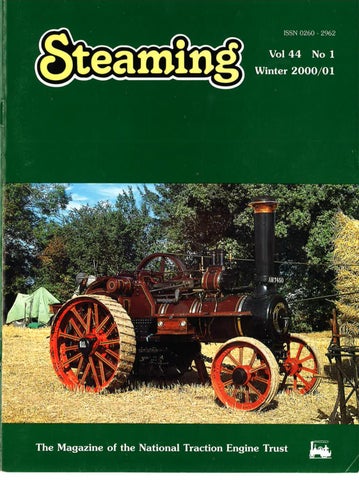
The Magazine of the National Traction Engine Trust
THE NATIONAL TRACTION ENGINE TRUST Preserving our heritage with steam on the road The membership of the National Traction Engine Trust is open to all of those who, whether they are engine owners or not, have a genuine interest in the preservation of self propelled steam road vehicles, portable engines etc.
Thp annual ciihorriptinn ratio
is £20.00 for individuals and £10.00 for Old Age Pensioners. The Trust's profusely illustrated colour magazine Steaming is sent free to members during the early part of January, April, July and October, and other benefits of membership include very advantageous terms for boiler and other types of insurance cover as well as access to advice on technical matters. Membership of the Steam Apprentice Club is available to young people under 21; details can be obtained from that section's Chairman (see right).
President: G.J. Romanes Vice Presidents: Mrs Sylvia Dudley, 33 Weathercock Lane, Woburn Sands, Milton Keynes, Buckinghamshire MK17 8NP (Tr/fax 01908 583283) R.J. Sandercock, Milford Farm, near Lifton, Devon PL16 OAT (IT 01566 783425) Chairman: A.J. Semple, The Wood House, Strefford, Craven Arms, Shropshire SY7 8DE (Ts 01588 673056) Vice-Chairman: R.T. Herring, Glebe Court, Fringford, Bicester, Oxfordshire OX6 9RJ (Tr 01869 277410)
General and Company Secretary: Mrs Susan Jackson, 153 Micklefield Road, High Wycombe, Buckinghamshire HP13 7HA Membership Secretary: J.R. Cook, 'Dolfarni', Church Lane, Kirkby la Thorpe, Sleaford, Lincolnshire NG34 9NU (tr 01529 303160) Treasurer: Julie Smith FCA, 21 The Ridgeway, Astwood Bank, Redditch, Worcestershire B96 6LS (Tr 01527 893427) Chairman, Rally sub-Committee: P. Cooper, 17 Uppertown Lane, Felton, Somerset BS40 9YA Iv 01275 474407, fax 472256) Chairman, Engine Owners sub-Committee: R.J. Pierce, Goblands Farm, Court Lane, Hadlow, Kent TN11 OLT (Tr 01732 850853) Chairman, Steam Apprentice Club: John Durling, Hawthorn Cottage, Stubwood, Denstone, Uttoxeter, Staffs ST14 5HX (Tr 01889 591188, 0800-2100 only) Chairman, Technical Board: J.M. Newnham, Penlands, High Easter, Chelmsford, Essex CM1 4QW (Tr 01245 231283) Rally Authorisation/Affiliated Groups: Bill Evans, PO Box 102, Wrexham, Clwyd LL13 OZS (Tr fax 01978 781196) Insurance Officer: D.S. Smith, 21 The Ridgeway, Astwood Bank, Redditch, Worcestershire B96 6LS (Tr 01527 893427) Patrons The Earl Attlee; Hal Begot, JP; Robert Goodwill, MEP; Dr Tony Marchington; The Rt Hon Sir William McAlpine, Bt; Michael Oliver; Hamish Orr-Ewing; Richard Preston
E-mail: ntetuk@aol.com
binder Binders take up to twelve copies. In royal blue with magazine title and club motif gold blocked on the spine — a fine addition to any bookshelf and an excellent way of keeping magazines in good condition whilst near at hand.
Price E.6.76
•-• -
.11C. palrngn
Available by post from Colin and Val Brown, 90 Devon Road, Luton, Bedfordshire LU2 ORL !cheques to NTET)
Internet address: http://members,aol.com/ntetuk/
Your guide to all aspects of owning and running an engine ... including construction, operation, maintenance, transport, inspeOon, repairs and storage are covered by The Trust's
CODE OF PRACTICE for Traction Engines and similar road vehicles The Code is available to NTET members' only and is published in two versions: • The basic Code, at £25.00 • The basic Code plus British Standards applicable to locomotive type boiler repairs, with Scheme of Nomination records, at f35.00 (prices include p&p, cheques to NTET) Orders please. quote membership no, to Mrs Sylvia Dudley, 33 Weathercock lane, Woburn Sands, Milton Keynes, MK17 8NP
Tax Disc Holders in polished cast brass Single (3 hole fixing)
£6.75
Single (back of windscreen mounting plate) £16.00 Double (flange back mounting plate)
£24.00
Prices include post and packing These holders are displayed for inspection on the NTET Exhibition Unit Orders to: Colin and Val Brown, NTET Sales, 90 Devon Road, Luton, Bedfordshire LU2 ORL
a
The Magazine of the National Traction Engine Trust Volume 44 Number 1
Winter 2000/2001 Editor: Roger West, 14 Charles Street, Market Harborough, Leicestershire LE16 9AB (Tr 01858 4673261 Editor, Steaming Around: Derek Rayner, 'Invicta', 9 Beagle Ridge Drive, Acomb, York Y024 3JH Display Advertising and Small Adverts: to the Editor Distribution and Change of Address: John Cook, 'Dolfarni', Church Lane, Kirkby la Thorpe, Sleaford, Lincolnshire NG34 9NU Ole 01529 303160) The Editor is pleased to consider contributions of suitable articles, shorter items or photographs for inclusion in future issues. All material submitted is voluntary and payment cannot be made for any material published, although expenses incurred may be met. The opinions expressed in the magazine, with the exception of those printed as Trust announcements, are those of the contributors and do not indicate the views of the Trust as a whole. All items are held copyright by the contributors and/or the NTET. Next issue: The press date for news items, recent photographs and small adverts is 16th February 2001. For the date for Steaming Around see that section. ISSN 0260 - 2962 Published by the National Traction Engine Trust at 14 Charles St, Market Harborough, Leicestershire. Printed by AB Printers Ltd, Leicester. STEAMING
Winter 2000/2001
From the Chairman The report of the Annual General Meeting appears elsewhere in this issue for your information. As well as from transacting the Trust's business we had a most enjoyable weekend down in Launceston. On the Saturday we were all entertained at the Launceston Steam Railway by Nigel and Kay Bowman, a visit which I heartily recommend to you all if you are in Cornwall. Coupled with that, a visit to our Vice President's Museum, Dingle's Steam Village, must also be included on your list of things to do in the West Country. Every year people retire from the Committee and finding replacements is tricky — there are many able people, but with the traditional British way of not pushing oneself forward, people do not normally stand on a chair at the AGM, shouting 'pick me please'. I was delighted that Brian James, who had retired at the AGM found due to changed circumstances that he was able to continue, so he has been co-opted for another term. However, we did have several vacancies on the Committee, so we were very happy to receive an expression of interest from Nicky Daniel. Nicky is well qualified to join the Committee, for her parents David and Judy Walker were pioneers in engine restoration and of course she married Charlie Daniel, a member of another well-known engine family. Nicky felt the considerable distance to attend meetings will be a challenge for her so the Committee has invited Charlie to accompany her to meetings and we will enjoy their views. Some may feel this is unusual, but it brings another area and group of people into close contact with the Trust Committee, so helping to reflect more people's views on our decisions. It is my intention that we continue the work of recent years in dispelling the notion that we are, as the Committee, remote from the aspirations and concerns of the members. There are still vacancies; I would love to find some younger members coming forward to help with the future of our Trust. If you feel you can help, please call me in the first instance. This magazine will reach you after Christmas, so may I wish you all a 'good New Year.' (Andrew Semple, Chairman)
This issue 4 14 18 21 24 26 27 30 32 34 35 51
Trust News A Norfolk Engineer Ronald Clark Arthur's Engine Richard Hesbrook Steam at the Front Three Swiss Rollers Ernst Huwyler Upside Down Under John Norris 1960 and All That — a year on solids Peter Wells Survivors from a Steelworks Arthur Bullman Dorset's Burrell Millennium Special Ruston Extravaganza Steaming Around, compiled by Derek Rayner Around the World, Letters, Reading and Small Adverts
Front cover With that most impressive assembly at the Great Dorset Steam Fair, 2000 must
undoubtedly be considered, in our corner of the preservation world, the year of the Burrell engine. Here's one — though not at Dorset, for they are in the centre of this magazine. Bob Moorman took this nicely vintage picture at the Barleylands event in September, with Burrell 7hp agricultural 2963 of 1908 set to a threshing drum. 3
Trust News The President's thoughts The recent AGM was a resounding success. Just like a meal, it consisted of a 'starter', which was the private opening and operation for us of the Launceston Steam Railway. The experience left you really wanting another helping! Then came the 'main course', which was the AGM itself, admirably conducted by our Chairman Andrew Semple. Serious matters were discussed and decisions made after many people had had a chance to contribute their ideas. The office beavers have a clear way forward, with much detailed work, to enable them to find a proper path through the maze of regulations which surround us. The 'sweet course' was the Dinner. It was good fare, well cooked and served with such a good and friendly atmosphere. It provided me with the opportunity to thank everybody for supporting me as your President. I should like to extend these thanks to the wider membership, and to remind us of some of our past achievements. When I started my traction engine
or individual opportunities — all in spite of the rising tide of regulations. These regulations are drafted by 'experts' in offices, who have to possess a blinkered view of their subject; that might be road safety, pressure vessel requirements, health and safety limitations, to name but a few. Also the concept of risk management has crept into aviation, medicine and above all, the insurance industry definitions. It is patently obvious that
schemes based on both experience and theoretical knowledge which will be convincing to both the courts and the insurers. Much work is needed,
we all need a certificate of competence for almost anything, and the certificates are becoming more detailed as time goes on. I passed the early driving test (soon after its intro-
text might need asterisks. Romanes, President)
duction) for any motor vehicle, but now you need a test for all the categories in the encyclopaedia. Thus the Trust must remain ahead of the game. It has to consult with the drafters of regulations to achieve workable and acceptable agreements for incorporation into legislation. Where competence is concerned the Trust's responsibility is to have
and we all must thank those who do it for us to enable us to go on enjoying ourselves. The coffee and sweet course,
perhaps, were the yarns with which I started and finished the dinner speech. They were strictly for the audience there, because in print some of the (Giles
Engine Owners Column Engine Owners sub-Committee The 2001 Open Meeting for engine owners will be held at Willoughby Village Hall on Saturday, 27th January, starting at 11.00am. Apart
ownership in 1947 the only thing you could do with one was to go to the local(s) or, like Arthur Napper later, to go racing with one. Otherwise engines
were being cut up. The activities of the membership and the NTET have changed that potential total loss into a heritage discipline for both the engines and the know how to operate them. Further, just because we with road steam engines were early in the game just after World War 2, many people with other major interests saw that private ownership of tug boats, pinnaces, locomotives, military hardware
and later installations like railways and pumping stations etc was an acceptable pursuit rather than the demonstration of an eccentric personality. I think we can all enjoy a pat on the back for that. For the present we want two main freedoms. First to continue to operate and own traction engines, and second to be able to see and smell them (something at present not possible on the television) at rallies, workings 4
The Trust's Chairman, Andrew Semple, congratulates our new President, Giles Romanes, after bestowing him with the badge of office at the 2000 Annual General Meeting in Launceston. Winter 2000/2001
STEAMING
Officers and Committee 2001 This column lists, for the information of members, the Officers and Committee of the Trust for 2001. The addresses/ phone numbers of those with special duties are given inside the front cover of each issue of this magazine; others may be contacted by phone or via the General Secretary or sub-Committee Chairmen. Names marked with an asterisk* are appointments by the Committee and are non-voting positions in Committee. President G.J. Romanes Vice Presidents Sylvia Dudley R.J. Sandercock Chairman A.J. Semple Vice Chairmen R.T. Herring, J.R. Cook General and Company Secretary Mrs Susan Jackson* Treasurer Julie Smith, FCA Hon Solicitor T. Driver* Hon Safety Adviser J.M. Newnham' Membership Secretary J.R. Cook Hon Editor, Steaming R.E. West Hon Sales Officers Colin and Val Brown* Press Liaison Peter Donovan Committee The above and also: I.K. Barraclough (S. Yorks, a 01709 850346) J.R. Bosworth (Derbys, .ze 01332 880405) N. Boyes (W. Yorks, ir 01253 811876) P. Cooper (co-opted) N. and C. Daniel (co-opted) M.O. Davies (Warks, Tr 01295 770217) J. Durling (SAC Chairman) W. Evans (Rally Authorisation) T. Holt (Cumbria, a 01524 271584) B. James (co-opted, Norfolk, Tr 01328 701417) S.J. Parrott (Bucks, a 01844 201282) R.J. Pierce (Engine Owners chairman) J. Shackell (Oxford, a 01993 773088) D.S. Smith (Insurance Officer) M. Tuxworth (East Anglia) R. Vickery (Devon) M. Ward (FBHVC and Notts, a 01623 882856) P. Williams (Chilterns, -a 01923 263436) Representatives D. Jennings/L. Parker (NV Tractor & EC)* Auditors: Charles Lovell & Co, Royal House, Market Place, Redditch, Worcestershire BN98 8AA
STEAMING
Winter 2000/2001
from the usual topics of interest, we are hoping for at least one speaker on the subject of boiler joints, which, after various letters in this magazine, the sub-Committee feels needs an airing. The meeting is open to both members and non-members, and refreshments will be available for a modest fee. Please come along with any problems or ideas. We are very fortunate that Peter Williams has agreed to run the next Driving Course (see separate item by Peter below). He is full of ideas, which is very refreshing, but also blessed with much common sense, and I am sure that under his guidance, the Course will go forward in the right direction. Thanks must go to Paul and Jan Rensley for running the event for the past two years. Pressure of work, and not lack of interest, forbids them to continue. A happy and troublefree New Year to you all. (Richard Pierce, Chairman, Engine Owners sub-Committee)
Engine Driving and Management Course The Trust is intending to hold its 11th Engine Driving and Management Course at the same venue as last year, the Strumpshaw Steam Museum, near Norwich in Norfolk. The dates are 12th and 13th of May 2001. This is an ideal site with plenty of space both inside and out, and paved roads available if the ground is still soft. This year we are hoping to widen the scope of the syllabus and the structure of the course to include more topics related to the care, maintenance and refurbishment of engines, and also to provide some practical training on aspects of engines at work. By this means the Course should have greater appeal for those who have attended earlier events, but would now like to develop their knowledge and skills beyond the fundamentals that have previously been addressed. Obviously our ability to extend the Course content depends on the number of people who are interested, either as potential participants or as instructors. So, if you would like to learn more, or feel able to help, please see the display advertisement elsewhere in this issue for further information and contact details. (Peter Williams, Course Co-ordinator)
Technical Board Just as we all thought that EU bureaucracy might be off our backs for a while, the Brussocrats (if the newspapers are to be believed) are conspiring to meddle. with driving licences. Meanwhile politicians, with an eye to a coming election, and
Sub-Committees 2001 This column lists the members of the Trust's sub Committees for 2001, Names marked with an asterisk* are co-opted; others are elected Committee members. Addresses/phone numbers of the Chairmen appear inside the front cover of each issue. Rally sub Committee P. Cooper J.R. Cook T. Evans* W. Evans R.T. Herring T. Holt* B. James* K. Stott* Jo Tilling* Engine Owners sub Committee R.J. Pierce (chairman) I.K. Barraclough M.O. Davies Sylvia Dudley C. Hatch* J.M. Newnham* R.J. Sandercock R. Siddall D.S. Smith M. Ward P. Williams Technical Board J.M. Newnham* (chairman) H. Pounder* R. Swithinbank* G. Tennet*
others with more honest motives, are pressing for ever stricter controls on emissions. Experience with the Pressure Equipment Directive has shown how easily our hobby can get sucked into damaging legislation because nobody thought about us. That same experience has taught us that it is possible to influence legislation, so long as we get in early enough — but that can be a problem. I can get early warning of pending Euro-legislation where the HSE is the lead body in this country, but I have no way of knowing what other ministries are cooking up. All that we can do is be vigilant, and try to pick up any early warnings. If any reader hears of anything likely to affect our activities, please let me or any other Committee member know and we will follow it up. Turning to more interesting matters, an enquiry from a member in New Zealand has led me to take an interest in spark arrestors. It is surprising how we all take these mundane bits of ironmongery for granted. A look around at a rally last summer turned up a motley collection of chimney top arrestors, some with mesh so fine that it would hardly let any smoke out, let alone bits of burning coal, and then 5
others with bars so far apart that a whole firebox full of nutty slack could pass through without let or hindrance. Most of them were liberally coated with a black paste made up of soot, condensed exhaust and cylinder oil, guaranteed to stay on skin for weeks and on clothing for ever. It seems to me that the best place to catch sparks is in the smokebox before they get all gooey with oil and condensate. Richard Sandercock has produced a drawing for an in-smokebox type spark arrestor and I am looking for others. If any reader has designed, or knows of other types, please let me know and I will put it all together for inclusion in a future edition of Steaming. Lastly, my apologies for being unable to attend the Engine Owners Meeting on 27th January. I enjoy these meetings tremendously, but a long planned trip to New Zealand has got in the way. (Jim Newnham, Chairman, Technical Board)
Insurance Officers notes Road Traffic Act cover for mobile exhibits Yes, I am going to bang the tub again, but only to help remind the rally organisers that 'if it moves under its own power' then it must have RTA third party insurance cover. If the 6
Here's another interesting picture from our files that we haven't got very far with. Member Tom GwiIliam of Pontesbury, Shropshire kindly sent it in some time ago — he was given it by a friend who at one time lived in Westbury, Wiltshire. It is said the crash happened on Warminster Hoed there. But despite asking around locally (and thanks to Peter Donovan for trying this), we seem to be stuck on just when the incident happened; that information would very likely enable a press report to be looked up, for surely the crash must have been the talk of the neighbourhood for a few days. What we can see from the picture is that the driver of W.E. Humphreys & Son's Foden wagon has misjudged his descent of quite a steep hill, and lost control of the vehicle such that it has run off the road, demolished a wall and ended up in a front garden. Besides the damage to the wall and railings, it seems the Foden's front end has suffered considerably, and that the two living vans in tow are going to require repair work on them. Humphreys, as can be seen from the sign writing on the wagon, was a showman travelling with small side stuff — the sheet over the back of the Foden is lettered Novelty Shows. Road Locomotive Society lists show him to have addresses in Birmingham and Shirley, Southampton (but could that be an error for the Shirley in Birmingham?) and be the owner of two Foden steam wagons. He had 5 tonner 2908 of 1912 (M3624), purchased in 1922 and sold by 1931, probably earlier, and also a 3 tonner — 3598 of 1913 (M4790). It is the former we shall be looking at. So, can any reader tell us more: is this the Warminster road in Westbury? Knowledge of the date is likely to be more elusive.
exhibit, or whatever, is to be driven off-road and anywhere that the public might be present, then since 4th April 2000, this rule applies. In order to be allowed on to the rally field amongst the public, a mobile exhibit does not have to be taxed, as if to go on the road, or even have an MOT certificate, but if it is to be moved under its own power than the RTA applies to the insurance requirements. Some insurers are issuing blanket RTA cover insurance to clubs and associations for their members. I
strongly believe that this form of insurance is of the variety known as Contingency Cover, and as such is meant only to cover the officers of the organisation and not the individual mobile exhibit. I have recently asked those insurers and brokers that issue club RTA cover to provide me with details of the scheme, as allowed by their underwriters. So far only the NFU Mutual has replied, via Charlotte Molineaux. She advises me that the NFU Mutual acknowledges that the policy currently offered to clubs is of the Contingency Cover variety, and Winter 2000/2001
STEAMING
that's all it was ever intended to be, and should not be used to cover an individual's exhibit. Charlotte went on to advise me that the NFU Mutual does issue RTA cover, at very competitive rates, to individuals who own vintage agricultural equipment. Breakdown Recovery Scheme for members After nearly two years in the melting pot, I was very pleased to be able to announce the launch of the NTET's Breakdown and Recovery Scheme at the AGM held at Launceston. Somewhere inside this edition you should find inserted a small leaflet that is designed to provide details of the Scheme. If you do not have the leaflet, or have misplaced it, please let me know and I will get a copy to you. At the AGM I gave a brief description of the Scheme that is designed, and priced, to assist those who have broken down whilst on the road (but not on the rally field, or on site at an event). The scheme is described fully on the reverse of the Scheme's membership application form, but I was pleased to be asked some questions of detail at the AGM, to which I hope I gave full answers. As the Scheme is brand new there will no doubt be issues arising which will make us scratch our heads for a while. However, there was a question from the floor relating to the proposed exclusion of cover for small-bore pipework on steam vehicles, and also to the extent of the cover that applies to steam vehicles nominated for carriage under the 'transporters' (low loader) membership. On these two issues I felt it better to take counsel
from John Phillips of PRP Rescue Services Limited, who are effectively underwriting the Scheme. Following discussion, John agreed that all smallbore pipework is to be included. This takes away the doubt about failures in injector pipework, steam car fuel and control systems, and also superheater steam lines on steam wagons etc. We then agreed that the extent of cover for vehicles nominated for carriage under the 'transporters' membership be limited to within one mile of the transporter. Even so, the transported steam vehicle is covered only when manoeuvring to or from the transporter and when the transporter is at its remote destination. The extent of the recovery would be to effectively get the broken-down load back to the transporter itself. In any case, the cover does not apply if the transported vehicle or the transporter is already on the site of the event, or on the premises of the owner. In summary, therefore, individual steam vehicles should be covered in their own right if it is intended that they are to make regular journeys on the road under their own power. The individual transporter is covered whilst carrying any of its nominated loads or running empty, but in any case not undertaking a journey for any type of reward. I am told, as indeed those at the AGM were told by Peter James of Footman James, that the value for money this new Scheme offers is exceptional and without precedence. I wholeheartedly commend it to any member who regularly moves their vehicles by road. I don't expect a rush for membership — it is early days yet
The National Traction Engine Trust Engine Owners sub-Committee The 2001
— but I am confident that those who do decide to subscribe will benefit from the peace of mind it should bring. (Dave Smith, Insurance Officer)
Treasurer's Notes The Accounts for the year ended 31st March 2000 were enclosed with every member's copy of the last edition of Steaming. I am pleased to be able to report another successful year, financially, with all the cost and profit centres performing according to plan. However, it must be noted that the results for the previous year were exceptional and whilst the retained surplus for this year is lower, it does reflect the level of operation that the NTET can plan to sustain. Whilst the operating costs of the Trust are rising, year on year, the overall financial position, based on the targets and controls that have been put in place, continues to be sound. Accordingly, I have reviewed the requirement for an increase in the annual subscription fees. I have applied the formula that a subscription increase would be triggered by an aggregated 1 5% increase in the Retail Price Index since the previous subscription revision in May 1993. Since that date the RPI has increased by 21%, which takes us well over the agreed threshold. However, after reporting another financially successful year, I do not feel that it is appropriate to implement a subscription rise at this time. Nevertheless, the combination of rising costs and the increase in RPI will inevitably put the under affairs financial Trust's pressure, and I will be assessing for how much longer we can maintain the current subscription rate. (Julie Smith, Treasurer)
ENGINE OWNERS MEETING will be held. at
Willoughby Village Hall, Willoughby, near Rugby, Warwickshire at 11.00am on Saturday, 27th January 2001. All owners, crews, potential owners and anyone else interested in the working of preserved road steam vehicles are
welcome to attend - whether they are members of the Trust or not. Please see the Future Dates column, and the next issue, for further details.
STEAMING
Winter 2000/2001
Steam Apprentice Club It is the time of the year when SAC activities are constrained to indoor work and planning the coming season. Once again the Driving Days will start off our season in April, with repeat offers of venues of previous years, and one or two new ones as well. The NTET Driving Course, at 7
Strumpshaw for the second year, is also being offered to SAC members of 16 years and over at a handsome
discount. If you know of anyone who would like a mixture of hands-on experience coupled with good quality theory work, then ask them to contact me. The feed back from the Rally Organisers Conference in October was again encouraging, and our plans outlined at the Conference were well received. We are working on these with a view to raising the profile of the SAC in areas away from the traditional 'steam' orientated activities. The idea is to introduce steam to youngsters
who are not aware that such things exist. During the course of the last year we have had several new 'volunteers', who I hope will be taking the SAC out to even more events next year. (John Durling, Chairman, Steam Apprentice Club)
Obituaries Eric A. Fillmore
In its very early days the Committee of the National Traction
the developing Club — he was indeed the 'anchor man', and served for no less than nine years. The Committee did the talking; Eric did the work. He held a senior position in insurance in London, and had little, if any, practical steam experience, but he must have had some residual steam genes within him for, together with the late Bill Tame of Wallingford and myself, he became an engine owner when the three of us bought a pair of single cylinder plough engines from Beebys in Nottinghamshire. These were kept at Appleford, looked after by Bill and named MARGARET and NOREEN. Eric was 'allowed' to steer by Bill. On one occasion Albert Main was driving MARGARET, and having left Eric for a while with the engine, returned to find her blowing off vigorously. "You should have put the injector on" he said. "I don't know how" Eric replied. He was promptly instructed, and eventually became a proficient, reliable engineman.
Engine Club was made up largely of men with forty or more years of practical road steam experience. They
The term 'anchor man' seemed even more appropriate in the autumn of 1989 when internal politics caused
loyal member of the team of helpers in the•Trust marquee at Dorset. He was
brought with them their hard earned knowledge of engines, but had little to offer by way of running or administering an organisation such as the Club was at that time. It was into the job of
upsets within the Trust. Eric became Chairman and steadied the ship, eventually getting things back on to an even keel from which the organisation has never looked back. His failing health lead to a move to the coast at Eastbourne, and to a reduced involvement with the NTET.
the 'do anything' man, and helped wherever needed with no complaints or concessions asked for the disability he had since boyhood. To many Tony's name will not be known, but come next rally season many will be asking the whereabouts of Tony ' the spannerman'. (John Cook)
Secretary that Eric Fillmore stepped 1959, his quiet, methodical administration proved to be the backbone of 8
Eric was elected to the position of our President in 1994, fitting acknowledgement of many years devoted service to engine preservation. He maintained his interest in the Trust, his wise counsel being available whenever required. His health deteriorated
further and he died in October. We offer our sincere condolences to his wife Joan and son Richard. (Ran Hawthorne)
Anthony Flowers It is with regret that I record the death of Tony Flowers of Charlton, Oxfordshire. Tony had always lived in the Banbury area and grew up on his father's farm at Kings Sutton. It was here that his continuing passion for farm life was established — he will be remembered by many for his passion
of collecting spanners, rally plaques, coins in fact almost anything! He had been a member of Banbury Steam Society for many years, and was a keen photographer. Over the years Tony had been a
Winter 2000/2001
STEAMING
Suffolk ploughing
John Maund spent a whole Saturday following Fowler ploughing engines at the 'Power of the Past' working rally at Wantisden, Suffolk, last September. Early on he was able to catch two AA class examples arriving — 14728 of 1918 gently making its way down the narrow track, 14729 behind. At the end of the day's demonstration work the 5-furrow plough is pulled away from BB class engine 15335 of 1919 for the final time, and a few minutes later the Fowler's driver oils up and makes his preparations to return it to the main rally area for the night.
STEAMING
Winter 2000/2001
9
Philip Ogden Philip Hoyles Ogden was born in the West Riding of Yorkshire in 1923. Despite pressures from his family to join them in the textile industry, he became a farmer. During World War 2, he piloted bomber and fighter planes and married his wife, Vivienne, during embarkation leave. His family grew up on a farm just to the south of Thirsk and there his other interest developed — traction engines and rallies. He was first on the scene helping to organise rallies — Chester-le-Street, Pickering, and then later Duncombe Park. In the mid-1970s there was even a steam working event held on his own premises at Birdforth. He was instrumental in saving several machines from the scrapman, and restoring them. Over a long period, ten traction engines and the like passed through Philip's hands. The list includes a Fowler road loco; tractors by Robey, Foden and Burrell; a Burrell showmans, a Marshall and a Foster traction and an Aveling and a Fowler roller. Perhaps he will be best remembered, however, for his 1925 Burrell single 4032 FIREFLY. It was fitted with a huge Canadian whistle which could be heard for miles around when blown, and that seemed to almost empty the boiler! Philip was a well respected leader of people, and a truly kind man who shared his passion for engines with Vivienne right to the end. A true gentleman, he acted as an engine judge all over the country and when
advice was needed he freely gave it to all who asked. Philip also had a love for oil, gas and diesel engines — and for motor rollers — and meticulously restored them in his workshops, with no outside help but from Vivienne. The auction sale which took place in October 1995 was a result of him being diagnosed with lymphoma, and sadly he passed away in September 2000. His funeral at Thirsk Parish Church was particularly poignant for it was there he married his wife some 56 years before. Local engine owners were present to pay their respects, along with many family and friends. We extend our sympathies to Vivienne and also to son and daughter, Peter and Patricia, and his remaining family. (Derek Rayner)
The Clearing House The quarterly notes on the Trust's activities that I have been providing for Old Glory appear to have settled in well. To date only the Steam Apprentice Club have made use of the facility to reach a larger audience. The Trust notes are open to anyone or any club or group within the Trust, to promote their cause to a wider audience. The response so far appears to indicate that the notes will serve as a useful contact point, especially for those outside the Trust. Nothing of great moment has taken place, the most important item being the prob-
The National Traction Engine Trust Engine Owners sub-Committee presents its 11th
Practical Engine Driving and Management Course to be held at The Strumpshaw Steam Museum, Strumpshaw, near Norwich on 12th and 13th May 2001. A practical and informal course to include instruction on boiler management, mechanical operation, care, maintenance and driving techniques For further information send SAE to: Peter Williams, Chipperfield Lodge, Langley Road, Chipperfield, Hertfordshire WD4 9JQ. 'Er 01923 263436 Email: pgw@chiplodge.freeserve.co.uk
10
lems which owners of miniature engines, in particular, are experiencing under the Off Road requirements for insurance. This is further affected by some rally organisers making a requirement for documents which the law does not require. A question from America on injectors was quickly answered with the assistance of Colin Hatch. Other enquiries have ranged from prospective members asking about local clubs; complaints on quality of goods bought from us at Dorset, and the longest established rally. The latter, which should be within many members knowledge, has so far drawn only one reply, and that from an exmember. Trivial as it may seem, it is part of the history of the movement and deserves to be accurately answered. There has also been a request for more information to be provided on the Trust to new members at the time of their joining us. I would welcome any ideas or thoughts from members, and especially recent members, as to what information they would have liked to receive when they joined the Trust. The intention is to put together a small booklet, but what should it contain? (Peter Donovan, 57 Halls field, Cricklade, Wiltshire SN6 6LR. e-mail: peter. donovan@traction.freeserve.co.uk )
Trust Trophies The Trust's AGM weekend at Launceston in November once again afforded the opportunity to honour members for their work in furthering the cause of road steam preservation. As usual, the selection of suitable recipients had been deliberated upon locally. It was John Wakeham who introduced the proceedings and read the citations to a gathering of about 120 members and friends who had assembled in the very appropriate surroundings of Richard Sandercock's Dingles Steam Village at Lifton. Our new President, Giles Romanes, presented the awards. John remarked that some of the trophies went back a long time, to the very start of the National Traction Engine Club, and to be awarded one was to join a band of people who had been held in the highest esteem in our field. • First presented were the two ARTHUR NAPPER cups, originally awarded at the early Appleford rallies. In 2000 the first had to go to Jeff Shackell for putting on the 50th Anniversary show at Appleford in Winter 2000/2001
STEAMING
July. The second cup was given to Ben Brown for exhibiting the flagship engine OLD TIMER. • The CURTIS BOWL, given by the Curtis family, is usually awarded to somebody who travels his engine far and wide on the road. There was only one man for this prize, Dave Goodwin — who it seems knows every hydrant in England. • The DACRE LACY CUP was donated by Alastair Dacre Lacy, an original member of the Club and with the number 1 on the membership roll. It is awarded for the outstanding renovation of a particular engine. Here again there was an obvious winner — to the owner of the engine the New Zealanders at Dorset most wanted to take back. The engine was rebuilt with attention to all the things that mattered, since when all the things that do not matter have been seen to, and now attention has moved to things that do not matter at all. The engine is Burrell showmans RAJAH, and the man Clive Gibbard. Clive could equally well be recognised for the help he gives to others in the preservation movement. • The CHOISY & SIMSON CUP. Not from a cat food company, but the Trust's early insurers. It is also awarded for preservation but on a wider remit, and often for restoration in less than ideal circumstances. The recipient is a quiet star in Cornwall, universally liked and respected. He was once an engine owner, and on return to the county had to have another engine. Times had moved on and they had become expensive, so Raymond Hoskins bought a wreck of a roller — and it is now perfect. • The GOLDEN FILM SHIELD was presented to us by Morris's of Shrewsbury and is awarded for outstanding work in the traction engine movement. The family of the man to whom we are awarding the shield this year was responsible for the operation and then preservation of a large number of engines. Richard Sandercock has been our President for the last six years, and has done a great deal to further the cause of engine preservation. And the shield was also awarded for his skilful Matbro driving. • The JOHN CRAWLEY TROPHY is awarded for service to the movement not connected with engines, although the receiver has steam machines, some of which are the industrial exhibits at Dingle's Steam Village. Jim Newnham is Chairman of the Trust's Technical Board, and a man who has worked tirelessly to ensure that the movement is not submerged in a tide of bureaucracy. To do that he has stalked the corridors of power, STEAMING Winter 2000/2001
There is much of the aura of working days gone by around Gordon Bruce's 5hp Burrell compound 4014. Worn makers paintwork is carefully nurtured, and running a sawbench is a job done efficiently. For his efforts, Gordon was awarded the Percy Hirons Bowl at the Trust's AGM weekend last November. (Roger West)
demonstrating the responsibility of engine owners and restorers. • The EDNEY SHIELD was purchased by the Club in memory of the late E.W. Edney, our one-time Treasurer who saved the club, as treasurers sometimes have to do. Sylvia Dudley may also be doing the same, for she has served 25 years on the Committee and inaugurated and nurtured the Steam Apprentice Club, thus ensuring the future of the movement. • The PERCY HIRONS BOWL was donated by John Hirons, having once been won by his father, an agriculturist. It is presented to the owner of a straight agricultural engine who demonstrates it as such. There was a perfect recipient — Gordon Bruce, who works his Burrell engine PRIDE OF DEVON pulling stumps or on the belt, letting it retain an oily rag finish of working days that many prefer to see. • The BAKER TOC H CUP came from the Baker transport family of Southampton. It is engraved with a showmans engine, and is normally awarded to the exhibitor of a showmans engine. But the Cup went not to an owner, but to a man who has shown to the public more showmans engines than anybody else — to Michael Oliver and his team for the
incredible Great Dorset Steam Fair. • The JACK HOLLOWAY cup is for portables or for commentators. This year it was for the former, and for a man who has helped many with his ability to find anything, and who himself has saved and restored many unique engines. He is David Hirst, who presented the superb Burrell portable at Blandford this year, described by Richard Sandercock as 'the scrapman with a soul'. • The ERIC MIDDLETON TROPHY was presented in his memory in 1974 by Eric's 'Thursday night club' members from Hartlebury, Worcestershire. It is presented for excellence in vintage restoration, and this time to Stephen Sanders, a young man who has carried out two major rebuilds to very high standards, including the lovely green Fowler ploughing engine, PRINCESS MARY. • The CONNIE HUTCHENS MEMORIAL TROPHY was purchased many years ago with donations from the then Committee to recognise the support of the distaff side. This year's chosen lady has been tireless in looking after the recent Committee and providing mountains of food at meetings and conferences — Dilys James. 11
Leeds Civic Trust are keen to provide one of the familiar circular blue plaques with appropriate wording, and to maintain it for the future, but the initial funding needs to be raised from outside sources. The RRA are therefore seeking donations from road steam enthusiasts towards the £500 cost. The National Traction Engine Trust has already agreed to make a sum available, and members who may also wish to contribute can send sums to Dave Crampton, 6 Norwood Crescent, Mackworth, Derby DE22 4GA (cheques payable to the Road Roller Association). It is hoped to have the plaque unveiled at a small ceremony later this year, attended by a representative selection of Green products — a steam roller, a motor roller and some lawnmowers.
Steam Apprentice Jason Ellway proudly shows the J.T. Beeby Trophy that he had just been presented with during the Trust's AGM weekend last November. (Richard Semple)
• The final award is the J.T. BEEBY TROPHY for Steam Apprentices. This young man contrives to be filthy from breakfast time to bed, but he also has the skill to be helpful without being intrusive, thus avoiding a fault for many owners who do not want competition for their toys. He seems to have been everywhere last season and was present to receive his award Jason Ellway. John Wakeham ended the presentation by thanking the Committee and officers of an organisation that had brought him some wonderful friends and a very great deal of enjoyment.
A Green blue plaque The Road Roller Association is the instigator of a plan to place a suitable commemorative plaque on the building in Leeds that was once part of the works of Thomas Green & Sons Ltd. At their Smithfield Ironworks in North Street the firm produced steam rollers, steam tractors, small railway locomotives and steam tram engines, and in more recent times motor rollers and grass cutting machinery. The formes office buildings, now owned by Leeds City Council, have recently been attractively refurbished to serve 21st century uses.
12
London Area Social Meetings Further to the notes in the last issue (page 187) on the future of the social meetings in London, a fresh venue has been arranged, and it is hoped the meetings will be able to continue into the future. The new meeting place is 'The Henry Holland', a public house in Duke Street, off the north side of Oxford Street, London W1. The nearest tube station is still Bond Street (Central Line), but much nearer than the old venue — turn left on leaving the station, cross over Oxford Street and right into Duke Street. The pub is then a short walk, opposite the staff entrance to Selfridges department store. The room will be available for Trust members and friends from 7.30pm, with the meetings starting at 8.00. Non members are welcome to attend. Unfortunately, at the time this issue had to be complete for printing, the programme of speakers for the early months of 2001 had not been finalised, but the meetings will take place on the second Tuesday of the month in February, March and April. (Bill Timmings, London meetings organiser)
place at Willoughby Village Hall, Warwickshire on Saturday, 27th January 2001. It will start at 11.0am. An outline of the proposed agenda items can be found in Richard Pierce's notes in the Engine Owners Column. At lunchtime, light refreshments will be available at the hall. There is a pub next door, but although meals are served, be aware they are likely to be swamped if everyone goes there for lunch! Willoughby village is immediately to the south side of the A45, about five miles north of Daventry. The important junctions of the M1 and M6 motorways and the A14 trunk road from the east are but a few miles further away; a couple of minutes study of a good road atlas will reveal all. Approaching Willoughby from Daventry and the south, turn left into the village opposite the cafe and garage. The hall is about 500 metres into the village, on the right hand side, just before the pub. We again appeal to those attending to be considerate when parking their cars in the village, even if it means a couple of minutes of walking back to the hall. Please keep off the grass verges, and clear of the bridge and residents' accesses. (Sue Jackson, General Secretary, Tr 01494 521727)
Rally Organisers and Affiliated Clubs Conference The annual Spring Conference for Rally Organisers and Affiliated Clubs will take place on Saturday, 10th March 2001, at the regular venue, the Village Hall at Willoughby, Warwickshire. Notifications and invitations will be sent out shortly by Sue Jackson in the usual manner, but newcomers are always welcome — please contact Sue for details if you or your club are interested in attending. (Sue Jackson, General Secretary, 01494 521727)
Driving Course The 2001 Engine Driving Course will be held on the weekend of 12th and 13th May, at Strumpshaw Steam Museum, near Norwich. Further details can be found in the Engine Owners Column in this issue, and in the display advertisement.
Trust Diary
Future dates Engine Owners Meeting Another in the series of Open Meetings for Engine Owners will take
The diary of Trust events of a business nature during 2001 is set out below. It includes, in bold type, dates of Conferences and other members gatherings and, in italic type, Committee meetings. The timetable has
Winter 2000/2001
STEAMING
been arranged, through the auspices
of the Road Steam Forum, to try to avoid clashes in the dates of meetings that are arranged by the nationally based road steam groups. Executive and National Committee Engine Owners Meeting 27th January 18th February National Committee Rally Organisers 10th March Conference Executive and National 8th April Committee Engine Driving Course 12/13th May National Committee 10th June 7th September GDSF Open Forum 23rd September National Committee Rally Organisers 13th October Conference Executive and National 28th October Committee 17th November Annual General Meeting
7th January
Poor Steaming The Editor apologises to John Hirons for missing his name from the list of Old Timers posed in front of the
Marshall OLD TIMER at the Appleford Anniversary gathering, illustrated on page 207 of the Autumn issue. John is to the right of the picture, in check shirt and cap, and sporting a carefully looked after example of the original National Traction Engine Club's tie.
New Members A sincere welcome is extended to the following new members who have joined the Trust during the last three months. We hope they will gain much friendship, information and enjoyment from their membership over a period
of many years. The Membership Secretary is always pleased to put members in touch with one another by forwarding mail. G.C. Calder, Christchurch, New Zealand L. Andrews, Chippenham, Wiltshire J.H. Davies, Sheffield, Yorkshire J, Duffie, Stockton, Cleveland G.C. Skuse, Stockport, Cheshire D.H. Harrison, Fleet, Hampshire C.J. Jeffery, Watford, Hertfordshire R.W. Brown, Awsworth, Nottinghamshire G.J. Skinner, Pangbourne, Berkshire C.A. Moss, Old Windsor, Berkshire E.K. Blakeley, Romsey, Hampshire P.J. Kerr, Christchurch, New Zealand R. Anderson, Woking, Surrey J. Littlewood, Stockport, Greater Manchester D.A. Parslow, Oxford P.J. Jordan, Birmingham B. Ryder, Mitcham, Surrey M. Johnson, Chelmsford, Essex STEAMING
Winter 2000/2001
The March 1975 issue of our magazine was a Lincolnshire Special, with all the content except a few reviews and small paragraphs having relevance to that county. It was, of course, an area of arable rather than livestock farming, and the great
the cost of paper and printers wages for Steaming had gone up by 15%. The NTEC's coming of age was to be celebrated with a twenty mile road run in July. The Club had a new Secretary, Fay Wood of Huntingdon having just started what was to be a long spell in the post. Sales officer Vic Burroughs was advertising, to order only, Clark's Development of the English Traction Engine at £12.30, but that was still a
high price, for the most expensive of any other titles mentioned was £3.00. A short but erudite article by the Solicitor considered whether steam engines could be taken on motorways
engineering works in Lincoln and Gainsborough were well set to provide the means to mechanically work the land, but why, wondered Editor Ran Hawthorne were few, if any ploughing
— regulations were not specific, but pneumatic tyres were necessary, and the ability to maintain 25mph. So unless you had a suitable Foden or
engines built by the local makers? There was an excellent and lengthy (but uncredited) article on Lincolnshire threshing contractors, and contributions from or on well
Sentinel the answer was, don't. One news item in the issue concerned the donation by Ian Fraser of his Marshall tractor 68823 to the Museum of Technology in Leicester,
known names such as John Rundle, Frank Cheffins, Macdonalds of Louth and Cole Brothers of Roxholme. All worth re-reading, if your collection of
following the latter's appeal for an engine. In the small advertisements, Monty Thackray offered a quantity of Fowler and McLaren patterns to anyone prepared to preserve them: do
magazines goes back that far. These were inflationary times, and
Mrs S. Williams, Hay on Wye, Herefordshire C. Tomlinson, Driffield, East Yorkshire I.L. Prince, Billericay, Essex D.W, Ferguson, Gillingham, Kent Mrs P. Evans, Bangor on Dee, Wrexham J.G. Mair, Dunmore, Inverness A.C. Chinn, Benson, Oxfordshire W.J. Hatton, Parkgate, Wirral Mr Dilley, Hitchin, Hertfordshire C. Armstrong, Linkinhorne, Cornwall Mrs M. Worrell, London J. Low, Oldmeldrum, Aberdeenshire J. Lawton, Ongar, Essex J.M. Pinks, West Mersea, Essex W.A. Lewis, Paignton, Devon S. Culham, Manningtree, Essex I.G. Stevens, Wymondham, Norfolk N.J. Edwards, Halstead, Essex K.G. Nurse, Edinburgh Jean Chapotel, Paris, France P. Gillam, Farnborough, Hampshire W. Rochford, Bridgetown, Co Wexford, Eire M.L. Barr, Daventry, Northamptonshire D. Hewlett, Lower Halstow, Kent Mrs D.M. Colguhoun, Waltham Abbey, Essex E. Osman, Wimborne, Dorset Mrs H.A. Campbell, Bedford K. Lloyd, Gillingham, Dorset C.F. Roberts, Bristol M.J. Belsom, Maldon, Essex M.K. Smith, Stroud, Gloucestershire
they still exist?
'To be sold at less than half its cost, a complete Set of Steam Cultivating Apparatus, comprising 12
horse Engine, 4 wheel windlass, 2000 yards steel wire rope, Cultivator, plough, steam drags, moveable anchors &c. Also 8 and 6 horse portable engines and threshing machines complete. Apply to Mr T. Jones, 3 John Street, Bath.' (from Devizes and Wiltshire Gazette, 24th August 1882. — PD)
ed f t ,
ial.
g
AFP, Luanda
Steaming :I drunken Pole tried to
run down police with a steamroller yesterday after they tried to detain him. He was caught after he failed to outrun them and fled on foot. AFP, Warsaw
An extract from the Daily Telegraph for 5th October 2000 — perhaps the Trust should be sending copies of our Codes of Practice out to Poland for errant steam roller drivers.
13
A Norfolk Engineer John Maris Benjamin Collings (1882-1950), Steam Engine Builder Michael Lane introduces Ronald Clark's writings on a noteworthy Norfolk engineer. Following the death of Ronald Clark in November 1999 / was privileged to help catalogue his extensive library and papers. Several valuable and little known archives were found, including those of William Foster of Lincoln, Allchin of Northampton and Alfred Dodman of King's Lynn, together with those of the latter's subsidiary E.S. Hindley & Sons of Bourton in Dorset. The collection included engine records, drawings and photographs of the products. Of special interest was a draft paper written by Ronald Clark dealing with John Collings of Bacton, in Norfolk. Many readers will recall that the sole surviving Collings tandem compound traction engine, once owned by Ronald, has made appearances at the 1999 and 2000 Weeting events.
This is Collings' first engine, the one built in 1905 that had the duplex cylinders set over the firebox. Here we see the engine, presumably late in its life and in a rather poor and depleted state, with its smokebox missing.
John Maris Benjamin Collings, the only son of John Collings and his wife Margaret, was born at Bacton, near North Walsham in Norfolk in 1882. The family had long been established in the county and memorial slabs to the Collings family are to be found in three Norwich churches and in Walcot church, dating from the 17th century. Collings' mother, Margaret Stannard, also came from a well-connected family and was related to Anna Sewell, the authoress of the immortal children's book Black Beauty. Further back she had connections through the Quaker Buxton family with the Parr family. It will be remembered that Katherine Parr ultimately became the last of King Henry VIII's wives in 1543. She was described as a gentle and learned woman who nursed the King in his declining years. John Collings junior's father was a threshing contractor, land owner and merchant, who had taken up residence at Bacton Hall. At an early age his son had become familiar with the mechanism of the threshing machine, the binder, the elevator and the portable steam engine which powered them. Gradually young John built up his own small works and drawing office in the precincts of the Hall, soon adding one of the largest wheel lathes in Norfolk, and a small ferrous and non-ferrous foundry. Later he is said to have been one of the first people in East Anglia to drive his machinery by electricity, using a small Fairbanks Morse oil engine to drive a 2-pole Edrnundson dynamo. He became a skilful draughtsman and established his drawing office in a shed adjacent to the Hall. Between
The second engine, built at the Bacton Hall workshops in 1910, is pictured here at work with two Hornsby reaping machines in 1918, probably on the occasion of the trials mentioned in the text.
1907 and 1920 he filed ten Patent applications of which seven were sealed. He employed Carpmaels & Rainsford of Chancery Lane as his Patent lawyers, and it was they who handled most of John Fowler's early Patent work, as far back as 1850.
operation having the same advantages as the self-lift plough. The tynes were set in irregular rows to prevent clogging and could be arranged at any predetermined width. The implement, after being lifted out of work at a given depth, always returned to the same
date Patent number 26.4.1907 9750 19.11.1907" 28909 19.11.1912* 26516 24.12.1912 29729 17.1.1913* 1350 17.7.1914 17013 105671 (8621 of 1916) 128321 (12738 of 1917) 146592 (8656 of 1919) 169296 (17454 of 1920) " these patents were not sealed Initially Collings concentrated upon designing and manufacturing ploughs and cultivators for direct traction. The latter could be fitted with either nine or eleven tynes, either spring or rigid type and were arranged for one man
description sowing and harrowing scissors and sharpener petrol pourer and strainer multiple ploughs closing tyre punctures improvements in locomotives multiple ploughs tractors ploughs ploughs
depth. The direct traction ploughs could be fitted with from two to seven shares and were fitted with his patent auto-lifting gear where the power of the tractor was used to lift the plough
Collings' third tractor of 1915 — the tandem compound machine was superheated, with the elements placed in the high in the flat topped smokebox. Other detail differences distinguish the engine from its predecessor, notably, the construction of the front wheels; the shape to which the metal has been cut at the front of the hornplates, and the provision of additional water capacity under the boiler barrel.
STEAMING
Winter 2000/2001
when arriving at the headland. Regulating the depth of work would be done with the implement in motion. This was independent of the lifting gear and the plough automatically returned to its proper depth after turning at the headland. The plough had provision for the attachment of a harrow, roller or seed drill. The harrow was always attached next to the plough and was of sufficient width to cover three fresh furrows plus one from the previous pull. The harrow, roller and drill were made in a single self-contained unit, the drill having seven coulters designed to cover exactly four furrows. Only one man was required to operate the outfit. Since childhood steam engines had always been Collings' great passion in life, and he constructed at least three traction engines in his small workshops. The first was a small light steam motor tractor, completed in February 1905. This had duplex cylinders mounted on the firebox end of the boiler. The counter shaft was mounted beneath the barrel and the final drive was by chain to the hind wheels. The second engine, which survives today, was completed in 1910 and was less than five tons unladen weight
15
In order to save paper a limited quantity only has been printed, so please hand this to anyone in your neighbourhood who may be interested.
Converting Horse Ploughs to Self-Lift Tractor Types Reprinted from Farm Implement ouch Machinery Review, August 1st, 1,943. Mr. J. M. Collings, engineer, Tiacton, Norfolk, is responsible for the device illustrated on this page for converting two-furrow horse ploughs into self-lift tractor ploughs. The idea arose out of a conversation an the shortage of tractor ploughs between Mr,. Collings and an official of the county war agricultural executive committee_ The former made the suggestion that the conversion of idle twodnrrow horse ploughs into self-lift tractor ploughs
This cord is directly connected to an arm actuating a lever on the hub of the oval wheel. When the cord is pulled, the wheel revolves and brings either its smaller or larger half underneath, as the case may be, to lower or raise the plough. The wheel is then locked in position, and slides along the ground until the trip cord is again pulled, when the reverse half of the wheel is in the effective position.
A Sketch Showing How the Conversion is Carried Out. Working Position should be carried out. Experiments were initiated forthwith, and to such purpose that, by the end of Vebruary, a converted plough was actually at work, More have been adapted since, and are all working satisfactorily, so that arrangements have now been made for the prodnclicin of the conversion unit on a commercial scale.
The Oval Wheel is in the
There is a depth adjustment lever within easy reach of the tractor driver which :Cots on the wheel through the same arrangement, The drawbar• is 11X0d to the front of the plough in the manner shown 'tad, when the ',lough is in work. the line of draught is correctly maintained. Mr. Collings writes that this is "by no means a make-
A Converted Horse Plough, With the Oval Wheel in the "Out of Work" Position, The invention needs yen little explanation, as its main features can be quickly appreciated from the photo• graph and drawing we reproduce. It will be seen that the self-lift device has been engenionsly contrived through an oval wheel at the back controlled by a lift cord from the
tractor seat.
16
shift job. It has been fitted to a ' Ransome ' plough and is quite convenient in use; coming out of work, turning, end entering again, without trouble or delay." The cou. version set costs about £15. A point that will appeal to the actual farmer is that shares for these horse ploughs are cheaper than those for a tractor• plough, and this should be set against the cost of conversion.
Winter 2000/2001
STEAMING
The gear side of the 1910 built machine, a photograph from its early preservation days.
in conformity with the 1904 Heavy Motor Car Order. It had tandem compound cylinders mounted in the, by then, conventional position behind the chimney. The high pressure cylinder was arranged ahead of the larger low pressure cylinder, using a common piston rod. The engine was gear driven to the hind wheels and was ahead of its time by employing 250 lbs per square inch boiler pressure, which gave the little engine a remarkable performance. In 1915 Collings completed a third engine, similar to the second, but fitted with piston valves, a superheater mounted in the smokebox and a feed water heater. The boiler working pressure was 2601bs. The cylinders measured 5in diameter high pressure and 8in low pressure x 8in stroke — these dimensions were used on both the second and third engines. Piston
John Collings, despite his three score years and reduced circumstances, retained an active and inventive mind, and during World War 2 was able to interest the War Agricultural Executive Committee in plough conversions, as featured in this article (opposite) which was originally published in Implement & Machinery Review in August 1943. STEAMING
Winter 2000/2001
valves were deemed necessary on the third superheated engine in order to ensure adequate lubrication to the cylinders, due to the higher temperature of the steam. In September 1918 the Eastern Daily Press reported at length on the successful trials carried out on Mr G. Gowan's farm at Paston, near Peterborough. It especially congratulated Collings for the labour saving devices incorporated in his system and for his use of fully interchangeable parts, a feature still ignored by many of the larger agricultural machinery manufacturers. With the exception of the boilers and the cylinder patterns, the engines were made at Bacton Hall. Dodman of King's Lynn made the boilers, and it has been suggested that Charles Burrell made the cylinder patterns. John Collings was quick to realise the advantages of light alloys, and at an early date he employed aluminium castings in his saw benches, of which a fair number were produced. His patent 17013, sealed in July 1914, described a tandem compound cylinder arrangement applicable to railway locomotives. This was a development of the American Samuel Vauclain's single crank compound locomotive cylinders used by the Baldwin Locomotive Company. Collings used tandem high pressure and low pressure cylinders, whereas
Vauclain and Frederick Burrell used cylinders arranged one above the other. In addition Collings' cylinders were steam jacketed by extending the bottom of the smokebox such that the hot gases from the smoke tubes reduced heat radiation and condensation in the cylinders. There is no evidence this design was ever used. Collings was a designer and a craftsman, and appears to have had little business acumen. His business suffered badly in the great depression of the 1930s and he was reduced to working entirely on his own. By perforce he neglected the Hall and its beautiful gardens as well as his own creature comforts. He was found dead in his home on 23rd January 1950, aged 68 years and was laid to rest beside his mother, close to the site of his beloved works. He died intestate with no next of kin, and Ronald Clark was retained by the estate solicitors to value and catalogue his engineering artefacts. The appointment was good fortune for those of us interested in the history of our engineering heritage. Otherwise the life of this rather eccentric, clever engineer, a large man with a soft voice and penetrating dark eyes, boundless energy, may have been lost for ever. Undoubtedly his contribution to the history of the steam engine is worthy of a place in our archives.
'For Sale — Lady Meadow, Tamworth, comprising in all about 18 acres of land, one cottage and garden. Portion at present used as Fair Ground, approximately 3 acres, would be retained. Possession of land can be given at March, 1931. Apply Pat Collins, Gondola Works, Walsall.' (from The Tamworth Herald, 29th November 1930. — David Dean)
'... at Chester Moor, there is a small stream running alongside the main road; this will easily be recognised by the ashes lying about the bank. ... a hydrant beside a public house, known as 'The Travellers Rest', will be found a convenient source of supply. I may mention, however, that a charge of 3d is made here on such occasions ....' (Reader and steam wagon driver J.S. of Newcastle sharing his knowledge of water stops between Durham and Tweedmouth in the Drivers and Mechanics pages of Commercial Motor for 13th February 1913. Three pence equates to just over one penny in our present coinage.) 17
Arthur's engine Richard Hesbrook This is Arthur Symonds' venerable old Aveling — well, venerable to us in 2000, but when the picture was taken in 1908 the engine was just thirty years old, and had twenty more to go. No doubt a lot of other agricultural engines of similar vintage were still earning their keep at that time. The scene is outside The Crown — apparently the engine had trouble passing pubs — at Dilwyn, a few miles west of Leominster in Herefordshire. Symonds was a threshing contractor living at The Hennings in the nearby village of Hardwick, just to the north of Dilwyn. That's Arthur, his thumbs under his lapels and standing by the rear wheel of the engine. By all
18
accounts he was quite a character, and his hobby was bare fist fighting. Ile would often walk eight or ten miles to another village for a match on the green, properly set up with a ring, but no referee. Apparently he was never known to lose a fight, and always walked back home for supper. Threshing next day, presumably! These tales are handed down through the family; Arthur's son Bert is now 80 and it is grandson Keith we thank for letting us have sight of the picture and gathering the story together. The engine is said to have been acquired for £9 10 shillings, but just when is unknown. Tony Brown, Road Locomotive Society records officer, kindly identifies the Aveling as works numher 1470, a 6hp single cylinder traction engine new in August 1878. Its early history is obscure — working backwards on what is recorded, we find Symonds had the engine in September 1921 at the time it was declared and first registered CJ4724; and we can see from this picture he had it in 1908. RLS notes have the engine coming to Symonds via the agent Banff, which could have been when it was new, hut seems more likely to have been secondhand,
bearing in mind the less-than-ten-quid figure mentioned above. The Aveling seems to be single speed, and it has a wooden front axle. Bert Symonds recalls his father also had an even older horse drawn portable, and that and the Aveling went for scrap when Arthur died from pneumoconiosis in 1928 at the age of 58, the result of breathing in too much dust. He had been the first to offer contract threshing in the area, and within a ten mile radius of Hardwick, near Pembridge, he covered the farms around Dilwyn, Broxwood and Weobley. During the 1 920s the charge is remembered as about 10 shillings (50 pence) an hour, with an extra shilling for the straw tier. Arthur made a do'en or so hogsheads (that's a barrel of 120 gallons) of cider each year, and everyone was welcome to try it, so at threshing time there was no shortage of volunteers. The threshing business at one time employed thirteen, including the 'red flag man', a Mr Duberley, who would call to any approaching car or vehicle "get over on the side, Arthur's engine's comin'" One other engine is attributed to Symonds in RLS lists — Fowler 6hp agricultural 4498 of 1883.
Winter 2000/2001
STEAMING
TRACTION ENGINE ANICE INS
'‘4..._. Footman James is the most progressive innovator for Classic, Veteran, Vintage and Historic cars, motorcycles, military, commercial and steam vehicles. Our policies ensure peace of mind with top quality cover at competitive premiums.
Contact Jayne Jordan or Vicky Griffiths for a quotation from the N.T.E.T. appointed Insurance Broker FOR COMPLETE PEACE OF MIND AND INDIVIDUAL SERVICE
CALL US TODAY
The Enthusiast's Insurance Broker
( j---: FOOTMAN JAMES TEL. 0121 561 452 113 FAX.0 1 2 1 5 5 9 COS I 4 WATERFALL LANE CRADLEY HEATH THE MARKET LEADER WEST MIDLANDS B64 6PU STEAMING
Winter 2000/2001
19
National Traction Engine Trust
Mail Order Many books, videos and other items of interest to traction engine enthusiasts are available from the Sales section. Readers are urged to take advantage of this service (which also benefits Trust funds) for troub/efree and economical postal shopping. Just tick the box for items you require and fill in the address slip.
TRACTION ENGINE READING New Davies & Metcalfe Ltd, Railway Engineers to the World (Metcalfe) reviewed 43/3 £30.00 ❑ New Glory Days: Foden (Watson) £15.99 ❑ New Tiiiiction Engine Register 2000 (Toy and Johnson) £5.99 ❑ New Contractors and Factors (Freeman) £9.90 ❑ New Earth and Tree Moving in War and Peace Volume 2 (Sanders) £9.95 ❑ New Glossops - Kings of Tar Spraying (Whitehead) (reviewed 43/2) £11.50 ❑ New Maintenance of Locomotive Boilers (Garraway) £9.99 ❑ New Philip Bradley - Fairground Photographs and Notes (Scrivens and Smith) £12.00 ❑ Reprint The Story of St Nicholas Works (Lane) £30.00 ❑ Pictorial albums Road Locomotives and Tractors (Sawford) £18.99 ❑ Steaming On - Engines and Wagons from the Golden Age of Steam Power (Sawford) £18.99 ❑ Heavy Haulage (Neville/Freeman) £7.50 ❑ Steam Wagons in Colour (Sawford) £12.99 ❑ Steam Tractors (Halberstadt) £15.95 ❑ Company histories Charles Burrell & Sons Ltd (Gilbert and Osborne) £5.99 ❑ Reprint Steam Engine Builders of Lincolnshire (Clark) £10.95 ❑ The Story of the Wellington Foundry (Lane) £30.00 ❑ Revised 4th edition, Doble Steam Cars, Buses, Lorries and Railcars (Walton) £27.50 ❑ The Rise and Fall of Aveling-Barfurd, 1933-1988 £3.60 ❑ Armstrong Whitworth & Co Ltd (Ward) £3.00 ❑ The Fowler Gyrotiller (Norman Southgate) £8.50 ❑ Sentinel Works Photos No 1 (Thomas) £11.95 ❑ Jesse Ellis and the Maidstone Wagons (Whitehead) was £11.50, now offered at £5.00 ❑ Lokomobiler Frank Munktells (s/back; with English translation) E12.95 ❑ Aveling & Porter Ltd (Preston) £3.00 ❑ Reproduction makers catalogues Ransomes, Sims & Jefferies (RLS catalogue reprint) Wallis & Steevens Ltd (RLS catalogue reprint) Fowler Road Making Machinery (RLS catalogue reprint) Fodens Ltd (RLS catalogue reprint) Marshall Steam Road Rollers (RLS catalogue reprint) J.&H. McLaren catalogue, 1914, facsimile
£7.50 ❑ £7.50 ❑ £9.00 ❑ £7.50 ❑ £7.50 ❑ £6.95 ❑
The Fairground The Travelling Cinematograph Show (Smith and Scrivens) £20.00 ❑ The Story of Harris's Fun Fairs (Page) £20.00 ❑ Everybody's Favourite - R. Edwards & Sons Ltd (Mills) £7.50 ❑ Gallopers (Smith and Scrivens) £10.00 ❑ Roundabout People (Steptoe) £19.95 ❑ Some Notes on the Development of Fairground Machinery (Bradley) £8.50 ❑
Midland Fairground Families (Williams) The Harry Lee Story (Smith and Scrivens) The Circular Steam Switchback (Scrivens and Smith) Jump On, Jump On (Steptoe), traditional fairs and showmen •
£21.00 ❑ £11.95 ❑ £12.99 ❑ £19.95 ❑
please refer to recent issues for other available books, videos and club items
VIDEOS Road Works Ahead - VHS 50 mins, Old Glory) £16.95 Timber Work - (VHS 35 mins, Old Glory) £9.95 0 Pulling Power - (VHS 35 mins, Old Glory) £9.95 Sentinel Steam Gems - (VHS 35 mins, Old Glory) £9.95 0 Marshall Steam Gems - (VHS 40 mins, Old Glory) £9.95 0 The Sentinel Steam Waggon - (VHS 45 mins, Old Glory) £16.95 Burrells of Thetford - (VHS 110 mins, Old Glory) £16.95 Fowlers of Leeds, Part 1 - The Steam Era (VHS 110 mins, Old Glory) £16.95 Fuwlers of Leeds, Part 2 - The Twilight Years (VHS 65mins, Old Glory) £16.95 Up for the Cup - 20 ploughing engines in contest (VHS 65 mins, Moonlight) £19.50 Mozambique Adventure - Z7 ploughing engine repatriation (VHS 90 mins, Steam Plough Club) £15.00 Steam on the Road - the NTET Anniversary Road Run (VHS 85 mins, Moonlight Productions) £18.00 A Dream of Steam - Hollycombe (VHS 60 mins, Old Glory) £14.95 CLUB ITEMS NTET Sweatshirts, embroidered logo, choice of colours £17.00 ❑ NTET Polo Shirts, printed logo, choice of three colours, in four sizes £10.50 ❑ NTET Tee Shirts, printed centre chest logo, choice of 4 colours and 4 sizes £6,50 ❑ NTET Members Badge - members only £2.25 ❑ NTET 2000 showmans badge (boxed) £2.95 ❑ NTET traction engine lapel badge (boxed) £2.95 ❑ NTET Foden wagon badge £2,50 ❑ Steam Apprentice Club badge - members only £2.00 ❑ Fowler cap badge £2.00 ❑
To claim post-free for UK members please enclose current membership card. Non-members please enclose 10% part postage per order. Overseas members please enclose 8% part postage per order (European); 10% (rest of world). PO/Cheques (in sterling please) to be made payable to: National Traction Engine Trust. Visa, Access and Mastercard accepted; please state card number, expiry date and name on card, or phone/fax 01582 733971 (12 evenings only). Orders to be sent to: NTET Sales, 90 Devon Road, Luton, Bedfordshire LU2 ORL. Please allow 28 days for delivery. Name Address
Membership No
Amount Enclosed List 44/1, Winter 2000/2001
Steam at the Front In our Winter 1998/1999 issue we included illustrated accounts on the role of steam wagons in World War 1. Several other photographs of engines at the Western Front, or in Army service, came to us from the same sources and we now present them, with extended comment.
Stuck by the Scarpe Most readers will be aware of the fact that some of the Fowler road engines to be seen on the rallyfields today have a history of going to War in 1917. These pictures show only too graphically the awfulness of the situation that men and machines had to endure. Careful scrutiny of the prints — of the marks and scuffs on the gun hauling engine — seems to show that they are both of the same scene and taken on the same day, despite the fact that Imperial War Museum catalogue details list one as taken in April 1917 and the other in May. If someone made an error in recording those dates at that horrendous time, who are we to cast blame? The occasion is set down as the Battle of Arras, between Blangy and Feuchy, with the River Scarpe in the background. That location is just to the east of Arras, south of the river, in an area nowadays industrial, and only four or five kilometres from the inter-
Stuck by the Scarpe. (courtesy Imperial War Museum) STEAMING
Winter 2000/2001
21
section of the A26 and Al autoroutes that British travellers use if heading by road to Paris. The Battle of Arras started on 9th April 1917, when the British opened an offensive in order to distract the Germans from noticing the preparations elsewhere for other attacks. It was a success — the Canadians took Vimy Ridge — but the diversion was pushed on too long and the Germans were able to bring up reserves. The casualties were enormous; 150,000 British and 100,000 German. If the chalky upland ground around the Somme favoured the use of tanks and other mechanised vehicles, the low lying areas by the Scarpe clearly had no merit for steam road engines. This Fow ler is well and truly qtnPle., and in need of packing, jacks and assistance from another engine to free it from a precarious position, which was possibly attained whilst trying to move the huge 6 inch gun in front of it. Just what had happened to produce the situation is now lost in time, but the blasted trees, the devastated ground and the shells in the right foreground of the river picture tell us that harrowing hours have passed. Despite the predicament, the engine could be in the first few weeks of its life. It is one of the Steam Plough Works' class R3 'Little Lion' road engines built to the order of the Ministry of Munitions — a batch of fifty given works numbers 14858 to 14907, and turned out from Leeds between February and June 1917. Eighteen months earlier 32 others of the same design, and no less than 84 similar sized hauling and winding engines of class TE2, had been supplied to Russia through the Ministry of Supply. Indeed, the above batch of Munitions R3 engines was immediately followed by a 75 strong batch of TE2s. The brass works plate on the boiler lagging of the Fowler in our picture is not quite clear enough to read from the photograph. It might be 14868. That engine was booked out of Leeds on 9th March 1917, so was there enough time for it to have been taken to the thick of the action in France, to have received the odd dent or two to the lagging, and got itself bogged down in the morass that was the banks of the River Scarpe just over a month later? The machine certainly gives no sign of any wear or nicks to its wheel rims, and must be virtually new. The front water tanks bear the legend S.803, but such numbers that are seen in pictures of any World War 1 engines or wagons seem to have been of a local, or regimental level, and no records are known to survive. 22
Under Instruction. (courtesy Imperial War Museum)
Even when engines were ordered from Fowlers to go off on war work it seems that brass boiler bands and chimney caps were fitted; only the paintwork appears to have been left matt in deference to the conditions. Of the 50 class R3 engines supplied, at least 31 are recorded with post war British owners (some to be converted for showland use). However, 14868 is not among them, if, indeed, that is what our picture shows.
Steevens Oilbath compound tractor. The War Office had taken half a dozen Fowler class D2 singles in January 1917, but although it looks a tidy machine to be undergoing repair, the inside of the smokebox has had lining put in at its lower half, so perhaps this isn't a less-than-year-old engine from that batch. Can our Fowler experts comment?
'Somewhere in England' Under Instruction It is difficult to make much comment on the picture of a group of ten men under instruction around a couple of engines. The scene is obviously posed, with many of the soldiers merely holding spanners to appropriate places in the way press or official photographers are requesting to this day. The official caption is 'A class under instruction on the workings of the steam engine, Army Service Corps, Mechanical Transport Section, 26th November 1917'. From the evidence of the buildings in the background the location is likely to be Aldershot, or somewhere similar in Britain, rather than in France; in any case, there was hardly the place to learn fresh skills. The nearest machine is a Fowler single cylinder agricultural engine, whilst the second one is a Wallis &
This is another largely unidentified scene, and again probably taken in the area around Aldershot, Surrey, where some of the build up of men and materials destined for France was concentrated. With the newish ironsheeted gatehouse and the large signboard it looks to be the entrance to an Army Camp, and the young soldier in the foreground probably confirms that supposition. It's a Wallis & Steevens steam wagon that has halted briefly, with a civilian crew of two, and a working party of half a dozen recruits or volunteers seemingly assisting with the transport of fodder. The wagon is works number 7253, a 5 tonner new in October 1911 to A.W. Wood of Leatherhead, Surrey, and registered AA2450. As the crew are not military men, the machine is likely to be on contract, rather than have been requisitioned.
Winter 2000/2001
STEAMING
'Somewhere in England'. (courtesy Surrey Industrial History Group)
And now we've got a roller stuck. (courtesy Imperial War Museum) STEAMING
Winter 2000/2001
And now we've got a roller stuck If the Brigadier's car is expected on the way to the front, you've no doubt been told to pull over from the work of repairing the road for the incessant convoys ... but not this far. And when the important vehicle does come careering down the road ahead of a cloud of dust, the top man doesn't expect to catch a sight like this. The chap on the footplate of this Aveling & Porter 10 ton single roller has a grin on his face, his mates on the timbers as well, but that was no doubt for the cameraman, and there is much toil ahead for these men from a Scottish regiment before the real task can be resumed. The official caption is 'Steam roller in difficulties, Western Front. October 1918'. The supply routes to the front took a tremendous amount of wear and were in almost constant need of. repair. However, there was always a scarcity of steam rollers; few could be borrowed locally and many examples were withdrawn from local authorities in the United Kingdom, much to the chagrin of the county or borough surveyors. This anonymous and temporarily disabled machine could have been more used to the genteel streets of a shire county town than the stark and ravaged French countryside to be seen in the background. 23
Three Swiss rollers The archivist of the Dampf walzenClub Schweiz, Ernst Huwyler, has put together, with assistance from many members and other sources, a record of all steam engines still existing in Switzerland. This is available or CD-ROM (in German) and is a very valuable item for Swiss enthusiasts who are looking for rollers and their history. It has also been possible for Ernst to have access to the files of SVDB, the Swiss boiler inspectorate, and to build up a record of all registered steam road engines that worked in the country. Some of this information has been incorporated into the Swiss Steam Roller Listing — and it also assisted in the production of the
recent article in our magazine on the Swiss steam roller manufacturer Edward King (Spring 2000 issue). The files have led to some extremely fascinating historical discoveries, some of which are mentioned here in the notes accompanying three interesting and varied photographs of steam rollers at work in Switzerland. The first picture shows the only vertical boilered steam roller manufactured by the German firm
of Maschinenbau-Gesellschaft Heilbronn, perhaps more known for their narrow and standard gauge railway locomotives and steam ploughing engines. It was their build number 414 (steam roller 77), constructed in 1914 for a customer who required an asphalt roller similar to the models available from the Pioneer Iron Works at Brooklyn, USA. These were tandem models with a two-cylinder twin high pressure vertical engine and bevel gear
110
• s•
--A '11
I
•
1
.
drive to the driving rolls. The 10 ton Heilbronn roller was supplied to dealer RUBAG of Zurich, and then passed to Schweiz Strassenbau-Unternehmung AG at Bern, for whom it is seen in our picture working as their fleet number 2 in 1919. This firm was later to become STUAG (a shortened version of the same name) which is still in existence as Batigroup. However, according to the Heilbronn's records, no more of
this interesting type of machine were constructed. It was similar in many respects to the American Iroquois type roller, and the later Marshall-Millar — one at least of the latter saw use in the UK. The particular Swiss example had a new boiler registration in 1928 (just a fresh number assigned; not a new boiler) — and it went out of
came to light, they confirmed its suspected American origin as a 5 ton
model by the Kelly Springfield Road Roller Company of Springfield, Ohio. With this information, further reference in Switzerland to the SVDB records revealed the roller in our picture as Kelly Springfield 367 of 1913. The roller originally worked for Kalt-Asphalt Suddeutsch-Schweiz AG, Zurich and in 1916 was with
that the Mann & Charlesworth roller has much of contemporary Wallis & Steevens or even the local Thomas Green of Leeds design about it, particularly as far as the forecarriage head
STUAG in Bern. It was out of SVDB control in 1929. The third photograph of a steam roller discovered in Switzerland has turned out to be of a Mann & Charlesworth roller, built in Leeds in 1898. As
is concerned. The discovery of the picture has considerably increased our knowledge of the machines built by this Leeds manufacturer. James Mann and Sidney Charlesworth both left employment with the McLaren firm in
far as is known, no other photograph of a roller built by this firm has yet been found anywhere, and its rarity
the early 1890s to start on their own. Little is known of their output, though trade literature advertised, among other engines, 8, 10 and 12 ton rollers.
registration in 1955, after which time it is presumed the roller was scrapped. The second of our illustrations shows another vertical boilered steam roller, this time working in Bern's Hirschengraben. When this 1915
was only realised when it was shown to Derek Rayner. Ernst Huwyler has subsequently found in the SVDB records, a tracing copy (maybe a rubbing) of the roller's works or boiler plate — this again is something which
picture came to light, it was assumed by Swiss enthusiasts that it was an Aveling & Porter machine — for that was the only type of vertical boilered
has never been seen in English preservation circles — with the number 28 and the date 1898. The records also show a weight of 12 tons, and a pressure of 12 atmospheres (or 174
roller known to them at that time. But if the date was correct that could not be, for Avelings only started to make such machines in 1920. Derek Rayner had been researching a similar looking roller on behalf of an owner in the Netherlands, and when the registration papers of this particular roller
down the builders' Dewsbury Road, Leeds address, which they had before moving to Pepper Road a few years later. Despite the attractive but unfortunate grouping of the congregation of workmen and bystanders we can see
The partnership later evolved into Mann's Patent Steam Cart & Wagon Company, a company better known for their distinctively designed carts and wagons, and who also built conventional tractors. Only one roller by this latter firm survives in the UK, and this is one of the type the company described as a 'light steam roller for
lbs), which, if the working pressure, seems rather high for a single cylinder machine. It may have been the hydraulic test pressure. The detail of the
patching macadam', based on the unusual steam cart design. It is currently under restoration in the West Country. The photographs are reproduced
location of the makers' works was set down by SVDB as Dewsburg — Leeds, presumably the local way of putting
by courtesy of Ernst Huwyler and the Archive of Dampfwalzen-Club Schweiz,
UPSIDE DOWN UNDER Following the mention in the Around the World columns in our Summer 2000 issue of the remains of an engine on display at Port Moresby, Papua New Guinea,
John Norris of Victoria, Australia kindly sends more detail. Not surprisingly, visitors from Australia discovered the object some years ago, and research by Bob Butrims enabled a short article to appear in the Lake Goldsmith Steam
Preservation Association's Newsletter in September 1993.
Some years before 1993, the late Geoff Wishart found the relic, located in the Rotary Park at Boroko, and presented upside down on a couple of concrete blocks. Getting a photograph had to wait until a later visit, but once secured, the picture showed Bob that the machine had been a Fowler ploughing engine, and gave him enough clues to try to identify it by sifting the lists of examples that had been sent out from the Steam Plough Works in Leeds to agents in Australia. He wrote: There is no doubt that it is the remains of a Fowler ploughing engine. The mounting plates for the winding drum under the boiler barrel, and the drum drive gear on the left side of the boiler can be clearly seen. Since the crankshaft is still mounted on the engine a definite identification could be obtained by establishing the number which will be stamped on the
end of the shaft. Although this information is not presently available, we can establish various facts from the photograph. The crankshaft brackets are of a later design to those of the 1882 compound engines, which were common in Queensland, and the steering shaft is in front of the firebox, whereas the early compounds had their steering under the tender. Almost all the Fowler ploughing engines of the later type that came to Australia were of the Z class, and the New Guinea boiler looks about the right size for that type. If the test date of 1911 that is quoted on the display board attached to the exhibit is to be believed, it will eliminate all of the Z7 class engines that came to Australia, so the engine is likely to date between the introduction of the Z1s in 1890 and 1911. The engine can be seen to have a short smokebox and the old design of
A view of the remains of a Fowler ploughing engine at Port Moresby, Papue New Guinea — we will leave readers to turn the page around to visualise the thing 'right way up'. The board fixed to the side of the firebox gives credits and notes the circumstances of the unearthing of the buried boiler when flats were built nearby. It mentions an original owner of 'Toowong Town Council, before the development of Greater Brisbane' and quotes a boiler number B 317, and a first machinery test in 1911, but admits the history and specific function in New Guinea is a subject of conjecture. Who decided to place the boiler in this inverted position? If you had never known of a road steam engine, maybe the cylinders and 'axle' down near the ground was the best guess. (photograph by the late Geoff Wisher° 26
boiler with a riveted ring joining the two sections of the barrel. By 1911 the later style of boiler was well in use. The only ploughing engines that came to Australia in 1911 were 12798 and 12799. Our suspect is not one of these, as 12798 still exists at Meredith and 12799 is recorded as scrapped at Griffith in New South Wales. The only other ploughing engines sent here in the period were two Z1s to Welch Perrin, Fowler's Melbourne agent, and eight Z2s to the Colonial Sugar Refinery. The Z2s have always been assumed to be the machines that went on to CSR's Fiji plantations. This leaves the Z1s works numbers 6805 and 6806 of October 1892. These were despatched to Welch Perrin, but do not show up in that firm's sales list. It is quite possible that they were ordered by Welch Perrin and sent direct to Brisbane, and possibly sold through Cribb & Foote, the Brisbane agents. All the Fowler agents in Australia worked very closely together. Z1 class engines 6805/6806 are two of the few later model ploughing engines that came to Australia which have not been tracked down as yet, so I would guess that the engine at Port Moresby is one of this pair. Perhaps a final observation is in order. The engine in the photograph gives the impression of having been stripped and used in portable engine form. All the cable winding gear has been removed and the front perch bracket has been moved to under the boiler barrel, attached below the rubbing blocks for the front wheels. In ploughing engine form, the perch bracket would have been on an extension plate out from the front of the smokebox. The machinery test date of 1911 quoted on the notice on the boiler approximately coincides with the time the Queensland machinery inspectors were registering a lot of agricultural machinery. Many old engines have such inspection plates dated well after construction dates. Once registered, a small brass plate authorising the use of the machine was attached. If any reader visits Papua New Guinea, and has the time and inclination for an historical scrape, an inspection of the relic should reveal numbers stamped (rather than cast) in a number of places, in particular on the end of the crankshaft. The knowledge of such a number would confirm the identity of the old Fowler. Thanks are due to John Norris and Bob Butrims for their agreement to the use of these notes in our magazine. Winter 2000/2001
STEAMING
FOR THOSE NEEDING ECONOMICAL REPAIRS ON THEIR TRACTION ENGINES
B. & C. Reconditioning (Gears) Ltd ESTABLISHED 1967
PINIONS - SPURS
BEVELS
Quality reconditioning of all types and makes of bevel gears, spur pinions, spur wheels, helical gears etc
ISO 9002 REGISTERED COMPANY
Certificate No. 6293
B & C Reconditioning (Gears) Ltd, Amesbury Business Park, London Road, Amesbury, Wiltshire SP4 7LS Telephone: 01980 623210, Fax: 01980 625176
1960 and all that A YEAR ON SOLIDS Peter Wells Standard model Sentinel number 1960 (AW4131) was built in 1918, and sent off from Shrewsbury to Owen & Dyson of Rotherham, South Yorkshire. In 1970 the 5 ton steam wagon ended its long and hard working life at Brown Bayley's Steelworks at Sheffield — it had probably moved there in the first few years of its life. It was the last of their steamers to leave the works, and was run for Yorkshire Television on Good Friday 1970, appearing in their news slot. The Sentinel was purchased direct from Brown Bayley's by John Richardson of Filey, North Yorkshire, and in 1991 came to Norfolk for completion of the restoration project. It is on loan to Mervyn Mayes and Paul Hemnell, and the regular restoration team and crew also include Colin Newman, my wife Susan and myself. 1960 was first rallied at Weeting in STEAMING
Winter 2000/2001
July 1996, and has since become a quite well travelled machine. Let me tell of last year's happenings. As usual, the season kicked off with our New Year outing, this time a short jaunt from our home base at Yaxham to a pub at Caston. All of us being real ale enthusiasts, for some reason most of our journeys include a pint or two! I remember enjoying the Eds Ale (brewed by Wolf Brewery), but being beaten by the 'whale' and chips! Following that excursion, however, we drained the boiler ready for the winter lay-up, and tackling the long list of 'jobs pending'. We had two further trips in April, the first to check the replacement front wheel shims that had been the task of several of our weekly Thursday evening sessions. The second outing was to the Breckland Family Day at Watton Airfield, where, for the second
year running, we were the only steam entrant. This time we headed the parade into the ring providing transport for the Watton Town Band — another first for us! The tug-of-war again seemed to be enjoyed as much by the kids who took part as the adult on-lookers. It's quite amazing how much traction solid tyres can actually obtain! The real rally season started with the late May Bank Holiday, and our annual dash along the Norwich southern by-pass to Strumpshaw Hall. Due to the poor and wet weather, the rally was all but cancelled on the Saturday. We arrived to be pushed onto some timbers by Andy Potter with Foster traction engine 14422 — and there we sat for the rest of the weekend. Despite the conditions during the event, we actually made it there and home again in the dry! Tuesday evening 11th July saw me leave work (in suit) and journey to Yaxham, there to change to more suitable clothing for firing (with Mervyn driving) on the 25 mile trip to Weeting. One of the reasons we enjoy going to Weeting is that instead of standing about on a peg, we are given the task of delivering water to the engines on the main field. We sheeted up 1960 at 27
Richard Parrott's farm, and the next day Richard craned a 1000-gallon former milk tank onto the back ready for us on Friday morning. Although the ground was a bit soft (we had to be rescued by Nigel Underwood and EX-MAYOR at one point) and considering we reckoned we were carrying about six tons of water, 1960 performed well. We also had our usual trip into Brandon for fish and chips on the Friday evening, washed down with a pint at The Ram. The trip back from Weeting to Yaxham (with Paul driving and yours truly firing) was uneventful. On the Saturday of the second weekend in August Mervyn and I steamed 1960 the forty odd miles over to Wisbech for the annual road-run of historic vehicles the following day. This event is organised by the Wisbech & District Historic Vehicle Club, and it is the only road run of the year we attend, but at over 70 miles around the Fens, we elect to complete a much shorter 30 mile section. Once again we were the oldest commercial vehicle entrant — and the only steamer — but the enthusiasm and interest of the other 'oiler' entrants (plus the public's reaction) compensates for that. In the evening we steamed the fifteen miles to Roy Pratts' farm near Long Sutton, and parked up next to his 1914 Mann's steam wagon ready for our most challenging journey yet. On Friday 18th August, Susan and I left Norwich at 6.30am, collected Colin in Dereham and drove over to Long Sutton to steam up the Sentinel ready for the 55 mile trip to Lincoln. This we completed in fine style (six hours), and after putting the engine away made up for our lack of beer enroute with an evening trip to The Victoria, Lincoln's finest real ale pub. The Lincoln rally was superb, but best of all for us was to have finally made it with 1960 to a Sentinel Drivers Club event. Colin and I debated about taking part in the Saturday evening road run, and took the decision to 'go for it.' I must admit that when we turned off the A1133 towards Sturtonby-Stow and were confronted by a 1-in-10 rise with only 1201bs on the clock, I questioned our judgement. Needless to say 1960 made it to the top without a drop in pressure — we are not worthy, Mr Alley! At The Red Lion, with car park and main road jammed full of Sentinels, plus a pint of Everards Beacon bitter in hand, it was the nearest thing to heaven on earth. I also recall throwing myself around in the rally field disco in the small hours of Sunday morning a terrific weekend. At 3.45am on the Monday morning 28
'Three cheers for bringing us our beers' was the headline to this picture in Norwich's Evening News on Saturday, 16th September, the day after Sentinel 1960 had come to the rescue of the Wolf Brewery's drays, worryingly low on diesel during that month's fuel distribution problems. Wolfe Witham raises a glass with landlord Roy Cole, following a successful delivery for regulars at The Coachmakers' Arms. (courtesy, Eastern Newspapers Ltd)
I was awake and ready to fire up at 4am. We left at 6am (Colin driving, yours truly firing and Susan following in our trusty Landrover) for the 98 mile trip hack to Yaxham. At the lunchtime stop at Sutton Bridge, Paul and Mervyn (plus Paul's wife Sue) met us for a crew change. I decided to sit it out on top of the coal for the remainder of our journey, but Colin had had enough and went with Susan in the (comfort?) of our Series III
Landy. Considering that Colin had, up until then, driven all weekend I think that he deserved the rest — well done Cohn. Shortly after leaving Lincoln I had noticed that we were leaking steam from the main steam pipe (the copper washer was later found to be the culprit) but nearing home we also developed a leak in the feed-water heater. This turned out to be (not for the first time) the nut at the end of the coil coming loose. With this latter Winter 2000/2001
STEAMING
Sentinel 1960 has a full head of steam ready for the day's work of delivering beer from the Wolf Brewery at Attleborough. (Wolfe Witham)
, problem we began to use more water than usual, so we finally arrived back at Yaxham 13 hours after leaving Lincoln (I had reckoned on ten). In two weekends we had covered 300 miles at between 15 and 20 mph — not bad for an 82 year old! Monday 11th September found me quietly sitting at work (re-arranging paper-clips — that sort of thing), when the phone rang. A panic stricken Wolfe Witham of Wolf Brewery at Attleborough revealed that he had calculated his drays would have no fuel by Friday (the fuel depot blockades had started the previous week). Could we help? The lure of free beer and the chance to use 1960 at some real work was all we required to say — Yes! Mervyn asked his governor for the day off (he is a self-employed steam engineer), and Susan and I hastily arranged a day's holiday. By 10.30 on Friday we were outside the brewery on a industrial estate at Attleborough, posing for the TV cameras. What the subsequent newspaper coverage didn't record was how many free pints I turned down (contrary to William Hague's confession, it wasn't, for me, going to be 14 pints whilst making the deliveries!). But we all got very wet outside — it tipped down with rain throughout the day. But the next morning we were off again — for the 44 mile trip to Henham rally. This is a fairly static event, so Paul, Susan and I busied ourselves with our Aveling roller (11648 of 1926), and left Mervyn and his partner Jan with 1960 to watch us get stuck! After the event we sheeted the wagon ready for Paul and me to steam to Wantisden on the Tuesday for the following weekend's rally. As at Weeting, the Power of the Past event at Wantisden, near Woodbridge, gives us the chance to work 1960, in this case delivering coal to the other working engines. The ground here is always a bit dodgy (a thin crust
..riktet
A wider view of the brief stop to drop off supplies to The Coachmakers' Arms. (Wolfe Witham)
These are warmer summer days at the Weeting rally in July 1998. The water delivery job is well in hand, and a spot of snoozing is not out of order for one of the crew! (Roger West) STEAMING
Winter 2000/2001
29
of earth over sand), but surprisingly we only once had to be towed out. Always on the lookout to take the wagon onto the Queen's highway, on the Saturday evening we steamed up into Butley to the renowned Oyster pub for a couple of pints of well-kept Adnams bitter. Finally, on Saturday 30th September, Paul and Mervyn steamed up and drove 1960 the 55 miles back to Yaxham, with your scribe as back-up in the Landy. This last run usually sees us calling in at Stradbrooke Queens Head and this year was no exception. On this trip we developed a steam leak from the engine, so at the time of writing we have all the valves out trying to find the cause of that problem. Once again we had travelled over a wide area, all without the aid of a 'pram', a tribute to Mervyn Mayes' engineering skills and to those unnamed craftsmen in Shrewsbury. Whether 2001 will equal or better last year in terms of miles steamed remains to be seen.
Lamps are alight as the Sentinel makes its way back into the stream of traffic after a call at the Griffin Hotel. (Wolfe Witham)
Survivors from a Steelworks Just over four years ago we were able to restart using colour pictures on a more regular basis, and one of the first rear cover shots was a still-at-work study of Sentinel Standard 1716. The preservation owner was pleased to see it, and dashed off some notes for us on the wagon's more recent history, as well as the story of trips to St Paul's Cathedral in London in the 1930s. We tried to locate pictures of the latter adventure, but to no avail, and the notes got a bit far back in the files. The Editor apologises to Arthur for the long pause, and hopes the article couples well with the previous one of another Brown Bayley's Sentinel still game for a long day's run.
Arthur Bul!man It was nice to see Sentinel wagons from Brown Bayley's Steelworks pictured in the magazine (Winter 1996/1997), especially the back cover one in colour showing my own example AW3833 when it was still hard at work at Sheffield in 1965. This is actually the best colour photo I have seen of the old girl when she was working in anger. Looking closely at the tyres, I see they are well cut about, so the steelworks must have later reshod her for the last few years of work. The machine was purchased by Peter Elms, a friend of mine, in 1970, when all the wagons were disposed of. I believe Brown Bayley's had been taken over and the new management couldn't believe their eyes when they saw what was still being used for internal transport around the works. The steamers were replaced with the modern counterpart — large diesel 30
dump trucks, which apparently had to be scrapped after a couple of years because they couldn't stand up to the hard work. So much for modern technology, for some of the Sentinels had done the job for over fifty years, and they are still going now in preservation. The last boiler ticket for 1716 was issued in 1969, so the engine must have been one of the last working at the steelworks. I'm sure no other vehicles could have continued to work under such atrocious conditions as did the Brown Bayley's fleet. I understand they often had loads exceeding thirty tons on them, and no wonder 1716 was so badly bent. It was only built as a 5 ton tipper! Having said all that, when it first arrived here, we connected our 7cfm workshop compressor to the engine, and it still turned over on 80 lbs. I purchased the unrestored wagon from Peter in 1973, and it was towed
home from Stapleford Abbotts to Wickford, about a twenty mile journey, by Mike Kettle with his 8hp Burrell 3882. I have film of that great occasion. There were three crew for the Sentinel on the day — myself, son Stephen and Terry Taberer, who took over the steering when I was off filming. In my opinion there is nothing to compare with the excitement of recovering and towing a derelict steam engine on the road with another. Rebuilding started right away and by 1978 the wagon was in steam again and ready for the road. I was fortunate enough to get a Standard tipping cylinder from the late Edgar Shone, the great Sentinel scholar and collector. So the wagon was put back to a tipper, as original. The chassis of the tipping model was much shorter, finishing at the rear spring bracket, with the tipping hinge immediately on top, allowing the body frame to pivot at that point. Further, because the usual water tank position behind the rear axle would have precluded the body being tipped, the water tank was mounted vertically behind the cab. This, as many of you will have noticed, causes 1716, now named UNREPEATABLE, to sink down to the front axle at the least sign of rain. Incidentally, the name UNREPEATABLE was innocently and unwittingly given to the wagon at the Winter 2000/2001
STEAMING
Harlow Town Show some years ago by the commentator, who before the parade asked us for its name. I hadn't thought about that, but told him due to bruises and broken fingers during restoration, some of the names I had called it were unrepeatable. Going round the parade, we heard him saying the Sentinel's name was unrepeatable, so we had the nameplate cast and fitted in time for the Ford End steam up. Sentinel DS1960, another former Brown Bayley's machine, was also pictured in the same issue, steaming on one of its first preservation trips. This was also a tipping wagon and would not have been built with the long chassis members or the water tank mounted at the rear, which it now has. There should also be two cross members for the tipping cylinder mounting. I was told most of the Brown Bayley's fleet lost their water pumps through frost damage, so an extra injector was bracketed to the steering box casting, and ours was fed with superheated steam! Brown Bayley's certainly did
'A portion of a Sheffield Steel Works Fleet of Sentinels' is the caption to this illustration in the makers' promotional book issued in (probably) 1919. The 6 tonners have been lined up right to left in Brown Bayley's fleet number order 1 to 6 — respectively works numbers 1127 (AW2547), 1173 (AW2678), 1187 (AW2729), 1196 (AW2752), 1252 (AW2896) and 1286 (AW2964). 1127 was one of the first built at the new Sentinel factory at Shrewsbury, soon after the move of the Alley & MacLellan company from Polmadie, Glasgow in 1915. All in the picture were built in 1916 and, as might be expected are identical in appearance, except for No 6, which lacks side boards to the cab roof — it had been acquired from Sheffield Forge & Rolling Mills secondhand, and seemingly when very new. Even some of these earliest examples in the Brown Bayley's fleet lasted until the end; No 4 missed preservation when scrapped in 1963, but No 6 was donated by the steelworks to Glasgow Transport Museum, a fitting destination.
manufacture two giant stainless steel chains to arrest the decay of the dome of St Paul's in London, but it was in 1930 and 1931, not during World War 2. The company had the details of the chains they supplied set down on eight pages of handwritten script, which are now held in Sheffield Museum. The first chain was supplied in 1930, made up from stainless steel links some twelve or fifteen feet long into an articulated girdle that surrounded and braced the bases of the drum wall of
the famous dome. The total length was nearly 450 feet and the weight about 35 tons. A second series of links was provided in 1931, and fixed in a position a little lower in the structure of the dome. The detail of the transport of the links to London is not mentioned on the sheets, but what a grand sight it must have been with the fleet of Standards carrying their loads south from Sheffield — quite a journey at 8mph.
A scene at Brown Bayley's Steelworks at Sheffield in the 1960s, with a swarm of Sentinels resting from their labours. Their distressed condition is self-evident, but a few more years work lay ahead for several of them. In the left foreground is No 9, Sentinel 1716 (AW3833) — Arthur Bullman's wagon featured in the article — and to the right is No 8, Sentinel 1488 (AW3407), now preserved at the Bass Museum of Brewing at Burton-on-Trent. Both of these machines were built in 1917, and delivered new to Brown Bayley's, an acquisition probably allowed by Government as part of the war effort at the steelworks. (A. Windle) 31
Dorset's Burrell Millennium Special Many of the specially arranged events held in Millennium year were somewhat less than exciting — they were maybe doomed to be so. However, many of us knew one particular gathering was going to be well worth its title, but even then Michael Oliver, his son Martin and Robert Coles, along with a whole host of Burrell engine owners and crews, had us in awe at their Burrell Millennium Special at last year's G.reat Dorset Steam Fair. These are just a few of the images that went to make up a most celebratory occasion. Dorset is well known for its line ups of showmans engines, and on the Sunday morning surpassed that reputation when no less that ten Burrell scenic showmans engines left their various stands to come together side by side. It was a sight the maker's salesman would have loved to see. (Roger West) The tales of the efforts put in to ensure exhibits appeared at Dorset would fill several of our pages, but some of the most remarkable visitors 'were the five New Zealand families from the Canterbury areas of South Island, who brought engines back the country of their making for the Burrell celebration. Big, swift and seemingly alWays on the move, the engines provided much interest for the spectators. Graham Winter's blue painted 8hp double crank compound 3529 of 1913 spent all its life, like many New Zealand machines, on threshing duties — Peter Love took the picture. The Buttericks presented 8hp single crank compound 3522, preserved in the family since 1958 (photo Keith Broth well). This was also built in 1913, a threshing engine through several ownerships — though it indulged in a little house shifting in latter working days. We hope all the Kiwis enjoy their time here in England. 32
The assembling of so many Burrells in varying condition in and around the Charles Burrell Museum display was a master stroke. It is always a good idea to let the public see the extent of the work that goes into restoration. Here in the marquee everyone could see just what was involved, from machines held back by their owners in as yet untouched state, through many of the stages of rebuilding work, to examples that looked just ex-works and seeking a buyer. The tent was thronged with people throughout the week, and enthusiast and layman alike could be enthralled. This picture by Roger West is of THE PHILADELPHIA, 6hp Burrell 3413, sent out in 1912 to showmon Jos. Smith at Southampton.
The engine worked at threshing from World War 2, but the new owner fortuitously retained the front end fittings, even when he later put the engine away in a Nissen hut. There it stayed for no less than 48 years, tucked away some three miles as the crow flies from the Dorset showground — and the thousands of
engine lovers who have visited the Fair over the years. John Newton acquired the Burrell recently, delaying his start on restoration to show the Millennium Special crowds the task that he has ahead of him. All other makes of engine were outnumbered in the running enclosure — so it was no lucky shot that Peter
Love took that included two Thetford products. The 8 ton roller is 3956 of 1923, a machine new to a Bristol contractor, and equipped with one of the distinctive Hosack six tine scarifiers (it is on the far side, unfortunately out of sight). Through the dust we see Burrell 6hp road loco 3937 of 1919, waiting to carry
on with its timber hauling effort. (Peter Love) The frontage to the Char/es Burrell Museum marquee featured a most splendid company banner, a reproduction of ones that would have graced the company's stands at county shows a hundred years ago. Early on the Saturday morning
a shadowy figure could be seen standing under the banner, by Richard Parrott's CENTURY, wearing an Antipodean style hat and using a mobile phone. Could it have been the ghost of one of Reid & Gray's agents, excitedly ringing his office in New Zealand to report that Burrells were indeed still in business, and offering
engines for sale? Keith Brothwell's photo shows 5hp road loco THE BADGER 3941 adding to the scene. STEAMING
Winter 2000/2001
Ruston Extravaganza
A reunion of many types of machinery and memorabilia produced by Rustons, one of Lincolnshire engineering's most famous names, took place on 30th September and 1st October last. Organised and hosted by Lincolnshire County Council's Museum of Lincolnshire Life, it proved a great success with both exhibitors and spectators. The firm originated in 1857 when Joseph Ruston joined the small engineering company of Burton & Proctor, to form Ruston, Proctor & Co. By 1911 it employed over 5000 workers, and exported material all over the world, giving Lincoln an important place on the industrial map. During the event, the Museum was full to capacity with all types of Ruston machinery. There were visiting traction engines, road rollers, steam tractors and stationary engines, and these joined the resident exhibits which range from ploughs and railway locomotives to steam and diesel engined navvies for quarry work, truly reflecting the incredible range of products manufactured by the firm during its lifetime. The response to the Museum's invitation to Ruston owners had been overwhelming, with engines coming from as far afield as Kent, Exeter and Much Wenlock. The enthusiasm generated demonstrated
Products of the Ruston company at Lincoln crowd the Museum yard during the weekend gathering in September/October 2000. The steam navvy towers over the barn engines, whilst visiting road engines stand in front of the Museum's exhibition building.
the unique position held by the Ruston company's products — described over the weekend as 'the Rolls Royce of the steam engine world'. There were many highlights over the two days, and probably the most spectacular was the road run from the Museum to the Alstom premises. Eleven engines made the short trip down the hill to what used to be the Ruston works site, along streets crowded with well wishers. The sun shone as the engines lined up in their place of manufacture, in front of the original Ruston, Proctor chimney. Another high point was a visit by the great, great granddaughter and grandson of Joseph Ruston himself. Mandy Fyfe, from the Forest of Dean, and
James Hodgson, from Shropshire, attended the Museum on the Sunday and provided a direct link with the great man who started it all one hundred and fifty years ago. They kindly presented plaques to the exhibitors, and took an enthusiastic part in the convoy to Alstoms. The event caught the imagination of the local public, with well over 1000 visitors coming to the Museum during the weekend. Many were old Rustonians, or had a father or grandfather who had worked for the company. The event was supported by the Made in Lincoln Project, Lincolnshire County Council, and several local businesses. (Museum of Lincolnshire Life) it*
specialist precision nut and bolt manufacturers
We manufacture boiler studs and thread any size pitch. Heavy series nuts bolts in any material. Turned components from drawings or Full samples. Eye Airfield Industrial Est, Langton Green, Brome, certification on all m Eye, Suffolk IP23 7HN Fax: 01379 872915 aterial we supply if it is required.
ALLBOLTS
TEL: 01379 872910 34
Winter 2000/2001
STEAMING
I am pleased to be able to include reports from some county locations which have not featured much in recent past issues of the magazine. One of these is Britain's smallest county — Rutland — and the other is far to the north — Orkney. The Orcadians are a fiercely independent people and a Brown & May portable engine in their midst is an unusual happening, so we for once allow the island its own heading in these notes, rather than be included in Scotland. There have been many accolades heaped upon the organisers, the exhibitors and the many other people involved with last year's 'greatest ever' Dorset Steam Fair, and what a splendid week it was. We should not forget that the steam engine interest is a hobby to enjoy. In many instances it has to be taken seriously — and safety is an aspect which is very important, for our engines are potentially lethal and must always be looked after with that in mind. But it is also nice when we can enjoy and even poke fun at ourselves in the course of our hobby. The Society of Drivers and Enginemen (SODEM) is a loose association of enthusiasts who are at the same time irreverent and respected (in some quarters). It is reported they have expelled one of their members for having a relatively rare make of steam roller which has been made into something with a dynamo on the front. (Incidentally, this machine has recently been advertised for sale — being blatantly described as a showmans engine. Does the Trades Description Act apply?) Then there is The Red Roller Display Team from the West Country — after the fashion of the famous Red Arrows aerobatic team. Can these Burrells provide red, white and blue smoke, one wonders? Now there comes a suggestion for the formation of the Light Prancing Horse Brigade, Avelings all — which would undoubtedly charge in military formation across the rally field, with enemy fire (black smoke?) coming at them from all sides. However, going back to the magnificent Millennium Burrell gathering at Dorset, casual visitors could not have been more amazed and impressed than to find exhibitors parading their charges all the way from New Zealand (and this was not a spoof!) The local paper captured on film a steam car driving around the site — the one with a hand-written notice on the front declaring it THE BURBELL STEAM CAR. The paper's caption writer had got it into his head that it was the big Burrell year at the event and strenuous efforts had been made to display as many Thetford products as possible — thus STEAMING
Winter 2000/2001
Steaming t,, Around Compiled from members notes and reports by Derek Rayner
a splendid photograph was published in the Dorset Echo with the notable caption 'The Burrell steam car turns heads at the steam extravaganza'. Congratulations to those concerned for giving Charles B another product to add to the goodly range of items that were actually manufactured at St Nicholas Works in Thetford. If it is not considered too late, I wish all contributors all the very best wishes and good steaming for the New Year, the first year proper of the new Millennium — 2001. I am grateful to all contributors, whether they be groups or individuals, who have sent in items from which these notes have been compiled. For the next issue, more on work being carried out on engines would be welcome — please note! Details etc have been received from the following: East Riding Engine Club, Hockley Heath Steam Association, Lancashire Traction Engine Club, Leeds & District TEC, North Staffs & Cheshire TEC, Somerset TEC,
BEDFORDSHIRE The Bedfordshire Steam & Country Fayre at Old Warden was a very good show with a great atmosphere but because of the fuel distribution problems in mid-September, the Saturday was very quiet. Sunday saw a stronger crowd. They were able to enjoy the centrepiece of the event for this year, a Clayton & Shuttleworth trade stand, built to capture what an agricultural show stand would have been like at the turn of the century. The furthest travelled engine to the show was Peter Thompson's Clayton tractor 49008 of 1920 (VJ5861), all
to
Southern Counties HVPT, Steam Apprentice Club, Steam Plough Club, Thames Valley TEC, West of England SES and Martin Brown, Richard Buck, John Clifford, Anthony Coulls, Anthony Cowell, Roger Dehany, Ran Hawthorne, PeterHaywood, John Hobbs, Richard Knight, David Llewelyn, Kevin Mills, Bob Moorman, Alan Porter, John Pyatt, Chris Rhodes, Sandy Ross, Lyndon Shearman, Graham Smith, Martin Stubbins, Barry Thirlwall, Tony Thomas, Francis Titmarsh, John Toy, Peter Turvey, Michael Watts, Bill Wells, R.A.V. Whitby and Christine Wilson — and not forgetting Traction Engine Register, for the detailed references. The press date for the next issue is the last day of January. Information, club magazines, news and letters by then please to D.A. Rayner, Invicta, 9 Beagle Ridge Drive, Acomb, York Y024 3JH. World wide contributions can be accepted by fax to + (011904 331926 or they can be e-mailed to derek@invicta1915.freeserve.co.uk marked Steaming. Press dates for future issues are the last day of April and July.
the way from Northumberland, whilst other products of the Lincoln firm were David Scott's steam wagon 48510 of 1920 (FE3344); 1923 roller 48835 (YA7417) belonging to Tarmac Ltd and in the hands of Harry Cain; the Philp family's 1899 traction 32900 (HK9836); David Philpot's 1918 traction 48154 (NM 11611 and Trevor Wrench's newly restored agricultural 48215 of 1919 (PT1916), together with a traction wagon brought by the club from Michael Hibble of Cambridge — which is in need of restoration. There was also a 1935 built Hoffherr Schrantz single cylinder diesel tractor. 35
With the death of Roy Ward of Houghton Conquest, his engine collection joined those of the Saunders temporarily. Aveling 8 ton compound roller 8753 of 1917 (MKP137), which was in fair condition, has been purchased for restoration by Matt and Dan Barklem, whilst another engine — an unknown Marshall portable in a very poor state — remains in the
Saunders' yard. The third engine in the collection, which is believed to have been in Maskell's boilerworks yard for some 25 years, is Aveling 10 ton compound roller 5446 of 1904 (CA 5156). It still retains some of its multicoloured paintwork, from duty in a children's playground at Ilford in Essex before coming into Roy's ownership. The roller was later sold —
as a late entry — after the Cheffins sale in Cambridgeshire in late October. Its new owner is Andrew Jackson, who lives close by to where the sale took place. Another engine to change hands is Ransomes Sims & Jefferies colonial traction 36020 of 1925, ex-Mozambique, which is now with the Forshaw
family. The annual gathering of engines at Stockwood Park Museum, Luton, in aid of the Friends of Luton Museum, once again provided a convenient stopping off point for some engines being roaded back home from the Old Warden event. Aveling tandem roller 6530 of
1908 (NM291) initially owned by Luton Corporation and normally housed at the museum was in steam and in the care of Dennis Goodyear and Bernie Emmerton. The ex-playground Aveling E type roller 10471 (NM2570) of 1922 is now located in the restoration workshop within the Mossman Collection building but can be seen by visitors. The boiler has
been refurbished as necessary but a great deal of mechanical work remains to be completed. Further Aveling engines were presented by Jonathan and Paul Vickery with Betty's Aveling tractor 6319 of 1907 IBP75011, Sandy and David Ross's single speed Aveling roller 7385 of 1911 (FC4016) and Steven
Ward's Aveling 10 ton roller 9370 of 1921 (YA1177). All these had travelled by road to the museum. A newcomer this time was G. Woolley's Sentinel Super 6725 of 1927 (KA5574) which has seen
What a difference an awning makes! Last summer the Leicestershire Museums Service completed the return to steam of Marshall 5 ton tractor 68823 at their Snibston Discovery Park workshops. Famous in the ownership of the late Ian Fraser in Scotland, and its part in 'The Arbroath Affair', the
1927 built engine ventured forth for the first time in more than a decade to the local Cadeby rally in August (top). Only a fortnight later, at the Shrewsbury event, the Marshall is seen to exhibit a rather different appearance, with side sheets to the motion and an excellent maker's pattern
extensive rebuilding during recent years. Two Foden steam tractors were Albert Fensom's D type timber tractor 13266 of 1928 (VJ1476) and Doug
awning added to the long list of jobs completed. Still to be done during this winter is the lining out of the paintwork. The second of the photographs shows the tractor awaiting its road transport back to base from Shrewsbury — it had been steamed the 65 miles to the rally from its base at Coalville, Leicestershire, but it was thought kinder to allow a ride on the return.
Williamson's 12300/13484 of 1926 (LG8784). Paul Harrison has bought another
Anthony Coulls of Leicestershire Museums took the pictures — and did much of the work to bring the Marshall back to life; he was a Steam Apprentice of some years ago.
36
Winter 2000/2001
STEAMING
engine. He now owns Burrell traction 3935 (NK4450) which was built in 1922.
BERKSHIRE The Knowl Hill rally was its usual excellent self — staged in 2000 in accordance with the wishes of the late John Keeley who, had he been in attendance, would have thoroughly enjoyed it. An excellent collection of engines attended, there being no less than fourteen showmans of various types. Included in these was Paul Fowler's 1920 Foster 14501 VICTORIOUS (minus its showland fittings) and John and Brenda Newton's 1923 Burrell PROGRESS. Of note in the other sections were Phil Johnson's 1915 Clayton & Shuttleworth traction 47216 (CT4817), and a newcomer to the area — Garrett 4CD tractor 33219 of 1918 (BJ6180), now belonging to Debbie Taylor and previously in South Wales. A roller at the show was Eric Best's 1923 Wallis Advance 7779 (H06260), whilst ploughing engines included Mick Smith's 1918 Fowler BB1 class 15164 (WR7185). Incidentally, the well produced programme, with lots of correct engine information was the usual excellent value — at £1.00 for 40 pages with plenty of illustrations.
BUCKINGHAMSHIRE The Great Bucks Steam Working was lucky with the weather in early August, when the event took place on a warm and sunny weekend. Newcomers to the event included Nigel and Stephen Lewendon's Aveling roller 14002 of 1929 (KR479) — originally with Barnes Bros of Southwick — and Tasker tractor 1765 of 1918 (SR1252) which was in the capable hands of Willie Tomlins and Kirsty Bamber. It was good to see David Wren Davis's Burrell Gold Medal tractor 3554 of 1914 (AH0181) out and about again after an extensive overhaul and repaint, whilst also there was Phil Cherry with 1906 Garrett traction 26046 (PU3157) which he purchased only recently — it having been in Honour's yard for a considerable time under gentle restoration. Also there was Ted Gale's 1920 Garrett 4CD tractor 33782 (BL5337) crewed by Derek and Marion Farrow together with another Tasker tractor — 1666 of 1915 IAA 5639) in the ownership of Dave Last. The highlight for photographers was the Saturday evening road run to lckford. No less than nineteen engines took part on this occasion, including all four Aveling rollers present. Our correspondent remarks that a STEAMING
Winter 2000/2001
few years ago, when the event was held at Shabbington, every engine on site would have-been working; it was noticeable that this year only three of the 24 present were working. Perhaps the event's title should be revised!
CAMBRIDGESHIRE Around three dozen engines were on show at the 27th Haddenham rally near Ely in early September. They came from as far away as North Yorkshire and took advantage of the two days of good weather to enjoy the show — which attracted a considerable number of visitors. Local attenders were David Gowlett with 1916 Garrett traction 32936 (ER603) and Stan Burgess who fielded two engines — his 1924 Burrell showmans 3979 EARL HAIGH and 1928 Foden wagon 13120 (VM4536). The North Yorkshire contingent included Graham Atkinson's Burrell showmans 3444 HIS LORDSHIP and Wallis & Steevens Advance roller 8069 of 1931 (GN1804) owned by Nigel Crisp. A new roller to the event was Maurice Foreman's 1923 Aveling 10556 INU544), down from Lincolnshire to attend. Also present was the Wyeld family's 1913 Foden road locomotive 3534 (MA5502).
CHESHIRE Further to the saga of 1906 Marshall road loco 46276 (H05556) getting to the Cheshire Steam Fair at Grappenhall in July, highlighted in the previous issue, the day after the rally ended, the stricken engine was lowloaded back to base in Lancashire. The cause of the mishap was determined to be the third new shaft bearing, made from the wrong material. It was soon replaced, enabling the engine to steam all the way back to Cheshire again to attend the Astle Park rally at Chelford in mid-August. At Chelford the Marshall joined 35 other steam engines including several first time attenders. These included 1923 Fowler DN1 roller 16078 (SJN14) owned by Matthew Healey and Lee Fisk; 1933 Sentinel S4 wagon 8843 (UJ2112) in the guise of a timber tractor, owned by John Goold from Somerset; Wallis Advance roller 7931 of 1927 (0T5350) belonging to Steve Dakin and Aveling 14073 of 1930 (FV1326) which had steamed all the way from north Lancashire to attend by Tony Deeley. Congratulations were the order of the day on October 20th when that doyen of Cheshire steam, Walter Fitter of Appleton, reached his 80th birthday. Well done that manl Until around ten years ago, Walter was the owner of 1910 Foden traction 2312
Steam Packings, Jointings, Seals and Gaskets • PTFE and graphited packings. Piston rods, valve rods, water pumps and valve packings • Sheet jointings used in preserved vintage steam, oil and petrol engine vehicles • Asbestos boiler manhole and mudhole door joints • Flange joints made to order • Sentinel boiler joints usually in stock • Short length cutting service For advice and sales contact — STUART GRAY 9 Walnut Way, Ickleford, Hitchin, Herts, 805 3XT BELDAM' Tel: (01462) 431848 CROSSLE Y Fax: (01462) 436093 e-mail:SteamPacking@aol.com Appointed Stockist
(MA7770) which he had restored from scrap condition in the late 1960s. The engine is still in the area, in the ownership of Bernard Jeffs. During the summer, Alan Edgar sold his Fowler conversion 21222 to Derek Hubbock in Northumberland. Another engine to change hands is Foster showmans 14153 of 1916 ADMIRAL BEATTY; this has gone from Frank Lythgoe to Russell Cook in Shropshire. It is confirmed that the Wallis Advance roller bought by Stephen Greenwood is 1927 10 ton model 7920 (0T4606). It came from Llangollen. The Malpas event in early September was down in engine numbers on this occasion — perhaps caused by the fuel problems. Some of those present included Tony Deeley's Aveling roller, the Burrell roller 4004 of 1925 (YB 2010) owned by Arthur Bridge, and Brian Allison with the family's 1918 Mann's tractor 1325 (U4748). Irvin Barraclough had made the journey over the Pennines from Yorkshire with his SentinERF — or 'steam shed' as the commentator called it. Rollers noted being busy in the new field entrance included Steve Miln's 1922 Aveling convertible (in roller form) 9264 (EJ966). Also there was regular George Coles with his 1913 Clayton & Shuttleworth 46059 (CE7943).
CORNWALL The Cornish Traction Preservation Club's annual event took place in early August and was preceded by a road run on the Friday. A dozen engines and a Stanley steam car took part — over a route of six or seven miles along rather narrow roads. There were plenty of Fowler engines on the run, 37
including road loco 11111 of 1910 (BE 7988) owned by Geoff and Veronica Matthews and Raymond Hoskin's 1929 roller 17481 (YC7438). Other engines included John Atkinson's newly acquired Burrell Gold Medal tractor 3245 of 1910 (AH054) which he bought from John Cooper in Devon, and Martin Barnecutt's 1934 Sentinel DG tractor 9097 (ARE195). The Matthews family from Shropshire contributed two engines to the show, these being Tony Matthews' 1924 Aveling E type roller 10997 (M03687) and Ray's delightfully restored Fowler traction 15710 of 1922 (M0780). More local engines were Richard Stock's diminutive 1904 Aveling roller 5541 (PP581) and 1929 Marshall traction 84921 (UP3325) owned by Willy Alford. Later in the month, the St Agnes rally was staged by the West of England Society and this was preceeded on the Thursday by the road run dedicated to that tireless worker for the Society, the late Alan Thomas. No less than 62 engines or steam cars took part and the whole was a wonderful tribute to Alan by all concerned. The rally itself achieved what Alan had been striving for for a number of years — the 100 engine mark. Amongst those present were the Saunders' family collection from Bedfordshire, Len Crane's Fowler crane locomotive 17212 of 1929 and Jim Sarney's 1908 Burrell road loco 3057 38
This picture comes from the collection at the Denbigh Record Office — there is not much detail recorded in their files, just 'Thrashing machine and farm workers at Llanelidan, 1910'. However, it is a very nice study, and with a wider viewing, perhaps someone may be able to make more comment as to the owner of the engine, and identify the Fowler single cylinder agricultural. Llanelidan is a village some six miles south of Ruthin, of about 700 population a century ago.
(6E72171, whilst another Burrell road loco was 3257 of 1911 (AH5317) owned by Mike Ward from Nottinghamshire. Ted Hopkins showed his 1919 Mann's steam tractor 1343 (U4891) and also brought along the unidentified late-built Marshall portable that was once owned by John Crowther from Yorkshire. Bicknell's Ransomes, Sims & Jefferies crane engine 31066 of 1920 (PV4943) was an unusual engine to many of the visitors, whilst it was a first appearance for Robert and Chris Gliddons, who showed their 1912 Tasker B2 tractor 1513 (161597), and also for Colin Savage with his Garrett 4CD tractor 35225 of 1929 (0U3239). An interesting line-up of Burrell rollers was staged on the Saturday evening — with Tom Andrews' 4070; Tyrone James' 4060; Steve Buscombe's 4041; John Wakeham's 4040 and 3999 of Brian Sanders all participating. Some wag chalked on the front rolls whilst they were all in line 'The Red Roller Display Team', and indeed a fine spoof newsletter has since appeared relating to the antics of the crews and associates. In all, there
were 26 rollers at the event, the greater proportion, not unnaturally, being produced at Rochester. Two newcomers to the county have already been mentioned in the shape of Colin Savage's Garrett tractor and John Atkinson's Gold Medal tractor. As a result, John's Aveling conversion in showmans guise, 10590 of 1923 (1366961), has left the area and found a new owner in Hertfordshire. Another engine to arrive is 1927 Yorkshire tractor 2118 (UA 1163) which originally worked for the Electricity Company in Leeds as an articulated vehicle. It was restored in Yorkshire before coming south some years ago into Dorset. An engine which has been the subject of a long term restoration project emerged at the end of July — not to attend a rally — but to go to a wedding. 1918 Fowler AA7 class ploughing engine 15256 (BW4638) owned by Harry and Geoffrey Gotts came to Cornwall in 1992 and has been receiving attention since then. It has been fitted with a new firebox and tender and restoration was sufficiently far advanced for the machine to proWinter 2000/2001
STEAMING
vide suitable transport for Geoffrey's journey to St Uny Church, Redruth where he was joined by his bride-tohe, who arrived somewhat more sedately in a horse drawn carriage.
CUMBRIA At the end of June, the cancer
charity Marie Curie organised a nationwide Ladies Driving Challenge, a local heat of which was held at Carlisle Airport. Taking part in this on this occasion were Derek and Heather
Bouch's 1912 Aveling roller 7857 (SH4274), Brian Jackson's Marshall agricultural 49222 of 1908 (3E7797) and the Foster wagon owned by Tom
Cragg — 14470 of 1921 (SV5506). In addition, Derek Hubbuck participated with 1924 Fowler roller 16157
(DD6490) and, down from Scotland, the previous owner of this roller, Roger Dehany, brought his Fowler conversion 17470 of 1928 (PX9047). Over 280 ladies were involved in the Challenge and some £40,000 was raised for Marie Curie and Macmillan Nurses funds. A very worthwhile effort. Whilst on holiday in the Lake District, a visitor to the Lakeside and Haverthwaite Railway found three road engines in residence. Two are based here, Aveling-Barford type W AD073 of 1938 (CUP396) and Fowler compound roller 18877 of 1931 (WX6358), undergoing boiler work. The third engine was there in passing — Dale Riley's conversion of a 1915 steam roller into a showmans style engine. This later went to a new owner in Co Durham. Also present at
Council's 1892 Aveling roller 2957 IMA98671, Andrew Bigland's exAustralian A4 Fowler traction 11700 of 1908 (SV5785) and the finely restored 1907 Ruston Proctor traction
33189 (CT3949) belonging to David Palmer. An engine seen in the locality for the last time before departing to its new owner in Cornwall was
Garrett 4CD tractor 35225 of 1929 (0U3239), which is now owned by Colin Savage and purchased from North Yorkshire earlier in the year. Another engine previously based in Yorkshire is Wallis conversion 7802 (H06352), which was supplied by the
Basingstoke firm to James Penfold of Arundel, Sussex in 1924. This is now owned in the north of the county by Richard Gregory and was delivered in extremely pool weather at the end of October.
DEVON The annual rally of the Devon Club was held at August bank holiday on its regular site at Chapelton Barton in the north of the county. There were plenty of vintage and veteran vehicles, tractors and stationary engines on show as well as some steam engines. Included in the latter category were long distance visitors Robert and
Jacqui Tyler from Nottinghamshire with their Fowler conversion whilst David and Gordon Williams put in an appearance with their 1919 Burrell
traction 3794 (TA2130) and also there was Foden wagon 12116 of 1925 ITU12151 belonging to Tom Mayhew. Aveling roller 7583 of 1912 (TF395) is reported to now be with George Pearce in the south of the county.
DORSET So many superlatives have been used to describe the Great Dorset Steam Fair over many years — it has been the focus of so much attention from enthusiasts not only in Great
Britain but from round the world — that it is difficult to find further words to describe the 2000 Burrell Millennium Special. Burrell owners
certainly pulled out the stops. They came from all over the UK to attend, but the support of the five New Zealand families and friends who
brought their machines from the other side of the world to attend was truly magnificent. The display both inside
and outside the Burrell pavilion was superb, offering examples of perfectly restored engines as well as those just 'as found' and undergoing restoration. Surviving examples of many of the
Haverthwaite is an interesting Ruston & Hornsby oil engined roller, number 159737, class SCR (TL17631.
Driving past Dick Ransome's premises, the front end of his 1922 Marshall steam roller was noted in his yard — presumably some heavy work is in progress on this award winning
machine, 75332 (A07452). An engine to leave the county — and the country — is Aveling tractor
8910 of 1918 (KN1140), which has been sold to Holland.
DERBYSHIRE Cromford Steam Rally celebrated its 30th anniversary last August with its event on the Tansley site near Matlock. A long distance visitor to the show was the Royal Navy's Sentinel
DG4 wagon 8393 of 1930 (DX90481 HMS SULTAN whilst from closer to home, came Terry Gibson's 1920 Fowler showmans REPULSE (just back
from an outing to Switzerland) and the Eansworth family's Burrell showmans 2894 PRIDE OF WORCESTER. Others present included the Amber Valley STEAMING Winter 2000/2001
Our Summer 2000 issue included a picture of Burrell 4092 SIMPLICITY, and member G. Jones of Stroud kindly sends this copy print of the next numbered and penultimate Burrell, 4093. The 5hp compound road locomotive was another example of a Burrell engine built up at Leiston by Garretts. It was sent out from there in May 1931, supplied through Stenner & Gunn of Tiverton to C. Singerton at Reckon ford, Devon. The photograph was taken just after it had arrived at the new owner's yard — that is the delivery driver on the footplate. The engine, named DOROTHY, was finished in Garretts' show livery with gold leaf lining. It is still with us, now rallied from the Banbury area.
39
varied products of the works had been brought together by Robert Coles and his team of helpers — they included ploughing, portable, traction, road loco and showmans engines — not forgetting the parts of the only remaining Burrell wagon, which still requires a tremendous amount of work to make it complete again. One disappointment was that the sole surviving threewheeler from Germany (540 of 1872) could not be released by its owners to attend — they were unfortunately in the process of a business takeover involving considerable redundancies. It is doubtful whether the 2000 display at Tarrant Hinton will ever be bettered. One listing received gave a total of 241 engines attending (that excluded portables, centre engines etc) of which over half — 122 — were products from the Thetford works! There were so many rare, notable and seldom seen engines, it is impossible to list them all but special mention must be made of Mrs Eileen Edwards' Foster showmans engine 3642 of 1908 (PB9832) MAUDE, which is still in showland ownership. By a last minute arrangement, it was on static display in the Old Glory marquee. On the Saturday evening the engine was hauled by Len Crane's 1929 Fowler crane engine to stand alongside her sisters and cousins in the showmans engines line up by the enterprising The fair. Foster's custodian, Ross Anderson, even arranged an electrical feed for the awning lights, for the boiler needs attention before it can be steamed. The road making display involving the Chiltern Marshall Group's Marshall roller 85106 of 1929 (DV4005) which belongs to Devon County Council — was greatly admired, and the roller itself has recently been repainted and lined with the correct insignia added. Much towing and heavy haulage was undertaken in the enclosed 'playpen' by a multiplicity of engines and in various combinations and the important thing was that everyone enjoyed the show and agreed it was certainly the best ever. Michael and Martin Oliver deserve our grateful thanks for making it all happen and for giving us some wonderful memories of a truly great show. In mid August, John Downs was present at Weymouth Carnival day with Burrell showmans tractor 3453
Great Dorset Steam Fair, 2000. The winner of the 100 prize in the Lucky Programme Draw was F. Parsons of Wick St Lawrence, near Westonsuper-Mare, Avon. 40
THE MAY. The engine did not take part in the procession on this occasion but spent the day on Weymouth Esplanade generating for the owner's 89-key Marenghi organ. Later on in the month, the second Portland Steam and Vintage Show managed two engines — a hundred per cent increase on the previous year. The attenders were Alan Fry's Burrell showmans 2879 PRINCESS ROYAL and 1919 Fowler K7 class ploughing engine 15278 (FA1301) belonging to Colin Wait. The same weekend as the big Dorset event the County Agricultural Show was held at Dorchester and, maybe surprisingly, they were able to field a traction engine. This was 1910 Clayton & Shuttleworth 43130 (BH5494) owned by James Goddard. An end of season event was held at Shillingstone in mid October, attended by ten engines in the Antell's yard. The display was dedicated to the memory of Peter Ante!l who had died just a year ago. The Antell brothers' engines were strong in evidence, with Wallis Advance roller 8100 of 1936 (BAA432) and 1910 Robey traction 29333 (AD9899) being present. Also there was Mrs Norah Field's 1930 Fowler roller 18652 (TK4285).
Co DURHAM An engine was noted in the Museums Journal as being available for disposal from Beamish — the North of England Open Air Museum. This is Fowler roller DN1 class 16615 of 1925 (UM3296); the boiler was said to be in poor condition. It has subsequently moved locally to the ownership of road surfacing contractor George Vardy, who has other steam engines, including the Sentinel replica bus 9151 of 1934 (JH9994). Another roller in the same area is that owned by Eric Maxwell — who has interests in Tanfield Railway and its rolling stock. This is where Aveling piston valve roller 10419 of 1922 (BR2303) currently resides in a dismantled state, and where it will be restored in due course. An engine to come into the area is the converted roller Aveling 8601 of 1915 (0T4239), previously in northeast Lancashire. The new owner is Pete Bowron. The north-east lost one of its leading exponents of roading steam rollers when Bob Baker of Ferryhill died at a relatively early age in the autumn. Bob had restored and roaded his 1923 ex-Eddison Aveling roller 10575 (PR 280) uphill and down dale for many a year and was about to start on the rebuild of his 6 ton Wallis Advance roller. He had obtained this, 7861 of
1926 (H06496), a few years ago in a dismantled state from a training school in York: it needed a new firebox and other boiler attention. Always willing to give advice, especially to the youngsters, Bob's cheery face will be missed and our sympathies are extended to his wife Carol and family.
EIRE Not previously reported is an import from South Africa in the shape of Fowler road loco 10184 of 1904 by the O'Gorman family. Apparently certain enthusiasts in South Africa were unhappy about the engine being sold by the University which was its custodian. The Annual Steam and Vintage Rally organised by the Monaghan Vintage and Veteran Club took place in early July. Finn Lynch roaded his three engines the six miles to the event. These were joined at the rally by, amongst others, James Glynn's two agriculturals — 1897 Ransomes 11412 (F11407) and Burrell 3771 of 1917 (MI1207). David Sixsmith took along 1920 Marshall traction 72446 (IC 1603). The weather was very showery and it was also not very pleasant on the following Sunday when the Colton Steam Rally took place in Co Louth. On this occasion, David Sixsmith's Marshall drove a Ransomes mill whilst Gerry Caraher's Marshall portable 71728 powered Kelly's saw bench. Other engines included Gerry Doherty's 1920 Aveling tractor, 9317 (ID1345) ex-Cavan County Council, and Finn Lynch's similar AM type, 11997 of 1928 (K06739). The Tynan family showed Fowler roller 16355 of 1925 (YB1226). In early August, there was a
G
LLEWELLIN'S
ears
YOUR ONE STOP GEAR SHOP
GEARS UP TO 8ft 6in DIA SPLINED SHAFTS UP TO 25ft LONG Broaching & Splining - Spurs, Racks, Helicals Worms & Wheels, Bevels - Straight & Spiral Stock Gears & Splines 24 Hour Service - Gearbox Rebuilding Specialist Supplier of Gears and Splines for all Traction Engines Telephone Mike Horlick LLEWELLIN'S GEARS KING SQUARE, BRISTOL BS2 8JJ TEL: 0117 942 4026 FAX: 0117 923 2028 Winter 2000/2001
STEAMING
splendid turn out of 35 engines at the 36th Stradbally Rally in Co Laoise, organised by the Irish Steam Preservation Society. Benny O'Gorman roaded his 1917 Fowler TE2 hauling and winding engine 14925 (1026581 from Naas with a number of traction wagons in tow, whilst a number of engines roaded the 25 miles to the event from Glynn's Garage — including James's own pair of agriculturals. Also on this run was the Rochford brothers' 1889 Marshall traction 17287 (M119541. Furthest travelled to the event was Mike Dreelan from Scotland, who brought along 1902 Burrell traction 2505 (CF3354) and 1908 Fowler 11695 (SA4155). Also there was Pat Keating' s 1904 Burrell traction 2644 (IY361, the Mann's steam cart 1216 of 1917 (U42491 belonging to the Society and 1914 Fowler 14332 owned by David Southern. This is listed in Traction Engine Register as a road roller, but it sadly no longer appears in its original form. Visitors from Northern Ireland included John and Ivor Wallace with their Wallis 3 ton steam motor 2787 of 1905 (AA20891. The week after the big show, just six engines attended the Moynalty Rally in beautiful sunshine. The weather meant that a huge crowd turned out and Benny O'Gorman's Fowler TE2 14925 was joined by the ISP Society's Fowler traction 21649 of 1936 (K119731 as well as John Dillon's 1930 Ransomes traction 42012 which was threshing. Gerry Caraher's 1919 Marshall portable drove a saw bench whilst another engine to make the journey to the event was Gerry Doherty's Aveling tractor.
ESSEX The Barleylands event near Billericay in early September enjoyed its best weather for many years and as a result, the crowds thronged to the show. Major attractions, were the quintet of Burrell engines presently in the UK from the Canterbury province in South Island, New Zealand, and hard on the heels of their triumphant first UK appearance at the GDSF the previous weekend. The long distance visitors comprised the Hawkins family's rare single cylinder Gold Medal tractor 3510 of 1913; Paul Butterick's 1913 single crank compound 3522; the similarly dated compound 3529 belonging to Graham Winter; compound 3229 of 1910 owned by Philip Kerr and 3148, a 1909 single in the ownership of Alan Famington. Other notable engines at the event STEAMING Winter 2000/2001
LIVE SHAM MODELS Drawings, Castings or Machined Castings for a proven range of Traction Engines
Marshall Sin scale S-type convertible Foster 3in scale single cylinder Foster 4in scale single cylinder Foster 5in rope hauling engine Fowler 6in road locomotive
Burrell 4in scenic showmans Burrell 4in single crank compound Burrell 4in single cylinder Burrell 41/2in single cylinder Burrell 6in scenic showmans
Full engineering services and technical support available Finished & Tested Boiler or Boiler kit, Horn plates, Tender Sides & Spokes all laser-cut, Machined parts, Gear Cutting, Crankshafts, Oil Pumps and accessories to include Whistles, Lamps and Firing irons
Please send £3.50 (overseas - £4.50) for full catalogue and price list: LIVE STEAM MODELS LTD, UNIT 7, OLD HALL MILLS, LITTLE EATON, DERBY DE21 5DN Tel. (01332) 830811 Fax. (01332) 830050 Email: livesteammodels@zetnetco.uk Visit our web site at www.livesteammodels.com All Major credit cards and Switch accepted
DESIGNED & MANUFACTURED BY ENGINEERS included Garrett 4CD tractor 33458 of 1919 (BJ42421 owned by Stuart Nightingale — an engine which has not been seen in public for some forty years and said to have been making its first public appearance — Peter Haining's unique Garrett road loco 27946 of 1909 (0168181 which used to work for Harkness's in Belfast, and an exhibit from Holland in the capable hands of new owner Caroline Schriever — 1905 Wallis tractor 2811 (AD74601. Two rollers made inaugural appearances at the event, these being 1930 Aveling 14077 (VC6120) owned by Dennis Letch and Craig Fosh, and the Higgins family's Fowler 16235 of 1924 (AV34) which worked in the
Aberdeen area but has spent some of its preservation life in Yorkshire and the Home Counties. The weekend following the Barleylands event was the Brentford County Show at which Francis Titmarsh's 1914 Clayton traction 46823 (KE 4173) was present, along with Ray Osborne's Wallis traction 7683 of 1919 (BL795) — crewed on this occasion by Mick Ashdown and son, together with 1925 Aveling roller 11236 (NX 88871 belonging to Jim Thompson. Mike Kettle brought along 1906 Burrell traction 2855 (NO 1463) which is owned by the Keeling family. It is reported that this is to be the last show at Brentwood, which is a pity 41
because it nicely finishes off the season in the area and has been enjoyed over the years by many of the local engine owners and enthusiasts. In early October, a road run was organised for local engines around Colchester. The run was an impromptu end of season outing to finish off another rally season. Among those taking part were Richard Hemington's 1916 Ransomes traction engine 26995 (EW2320), Graham Austin's Marshall roller 74399 of 1921 (NR180), 1924 Fowler DN1 roller 16235 belonging to Kevin and Simon Higgins and Aveling & Porter roller 12462 of 1929 (VB7301) belonging to Martin Stubbins. The round trip from Ardleigh, took in Dedham village (where lunch was taken) and then back to Ardleigh, a trip of some eight miles; the route was on various gradients as well as taking in main roads and country lanes. It is hoped to repeat it next year, perhaps with a few more engines. Earlier in the season, Martin had an interesting conversation with the son of one of his roller's previous owners. Apparently when the engine was owned by Herbert Smith, a rolling contractor from Thurrock, the engine was named EMMA and since the engine has had no name in this ownership, it is intended to carry the name forward.
GLOUCESTERSHIRE The annual event at the Toddington premises of the Gloucestershire Warwickshire Railway took place in mid-October. Some considered the £1.50 price asked for the 20 page programme as poor value, for it lacked adequate information on many of the engines. There were 23 road engines present together with four locos in steam on the railway. Martin Shepherd brought along his 1923 Burrell road loco 3941 (BP9547), whilst a similar engine was exhibited by Dennis and Brian Smith, this being their newly acquired 4093 of 1931 (DV9252) formerly owned by the late Arthur Napper. James Blenkinsop's 1920 Garrett tractor 33981 (KE71241 was also there, and Graham Burbery's 1923 Aveling roller 10669 (NX7282).
HAMPSHIRE Fowler showmans conversion 9177 of 1901 (AD8930) is now reported with Ricky Kenway in the county. The third Cavalcade of Transport held at Mytchett, just outside Basingstoke, in early September had a small but interesting selection of engines accompanying the many other vehicles at the event. Included in these was Alan Fry's 42
We've remarked before on the excellent glimpses of working days that can be found in the working areas at the Weeting rallies. At last year's event Dave Bagley's camera caught Ruston Proctor 7hp agricultural 50278 of 1914 ready for work on the belt in the top demonstration area, and Roger Newbery spotted Burrell 7hp single 2159 of 1899, also seemingly waiting to start up.
magnificent Burrell showmans 2879 PRINCESS ROYAL together with Martin Fagg's 1921 Aveling roller 10048 (FX8307) — in the livery of Eddison's, for whom it worked — and the splendidly restored venerable Wallis & Steevens traction 2149 of 1890 (BP9469) owned by Gerald Whittaker. An open day at Bursledon Brickworks near Southampton in October attracted nine engines, some of which are actually resident there. These were
Martin How's 1912 Aveling roller 7771 (PC9014) in the capable hands of Kevin Mills: Dave Bird's C type Aveling 11640 of 1926 (TW5338); Aveling 4932 of 1901 (FX6932) owned by Ian Whittington and Philip Tracy and Aveling DD type 11215 of 1925 (IY2326) belonging to Stuart Harris. Also there was Brian Sismey's 1923 Robey tractor 40991 (FE5377) and 1926 Babcock & Wilcox roller 95/4014 (YB5088) belonging to Mike Docherty. Winter 2000/2001
STEAMING
KENT The long established gathering at Offham took place in late October in a relatively dry day — compared to some the county had experienced in the previous weeks. Vehicles of all shapes and sizes support this event and on this occasion, they included seven engines with two steam cars. Two engines appeared that have been out of circulation for a while — the first being Richard Pierce's 1920 Fowler road loco 14754 (N0459), which was steamed for the first time after major boiler work — including a new box, barrel, tubeplate and smokebox — and other general repairs. The other was David Ruston's 1909 Aveling convertible 6943 (D4889), which was seen for the first time in around 20 yea's, following llie owner's completion of house restoration. It appeared in tractor form although the owner has actually got the genuine roller conversion parts for it as well. Other engines present at the event were Peter Stanier's AA6 Fowler ploughing engine 13877 of 1917 (N05); John Bailey's 1906 Burrell traction 2819 (BP5913); Marshall agricultural 59435 of 1912 (PB9888) owned by Richard and Marion Francis; Will Day's Aveling GND tractor 8809 of 1917 (SG2850) and a Fowler conversion. Other engine news relates to David Birch's Foden 1423 of 1907 (recently from Australia) which has had the boiler steam tested — but there is still a lot of work to be done on the engine. It is hoped to have it out in some form or another in 2001. Derek Gransden has sold Sentinel Super 6979 of 1927 (YH5763) to Tony Slingsby, who has sold his 1917 Foden 5 ton wagon 7536 (T8750) to Colin Wheeler, also in Kent. Engine dealer Michael List-Brain is reported to have sold the remains of Foden Speed 12 wagon 13976 of 1931 (M13304) to Robert and Clare Bullen and their son Richard Lucas in Wiltshire. At the same time, the Bullen family have also taken the remains of the Speed trailer for rebuilding, as an appropriate addition to the wagon. Robert subsequently went to the Devon auction where Richard Parkinson's part restored Foden Speed 6 wagon went under the hammer. He hoped to gain tips for the long restoration task ahead of him on the Speed 12. At the Devon auction, the Speed 6 Foden 13750 of 1930 (LG48151 did not sell, but was subsequently bought by David Hirst, so hopefully both these interesting steam wagons will now have their restorations completed. With the two new owners living STEAMING
Winter 2000/2001
A splendid portrait of Aveling & Porter 10 ton roller 4584 of 1900 — and a splendid tribute to the former driver, for here is an engine that has been kept in meticulously fine external condition. It's just as it would have been when new, with paintwork clean, and the bright steel polished in all the places that Avelings intended. The caption 'Our Chipping Sodbury steam roller under new management!!' probably indicates that the picture was locally sold as a postcard, to show off the Gloucestershire town's contribution towards the nation's efforts during World War 1. The background to the scene, with tented billets, doesn't reveal whether the location is a camp in southern England, or somewhere near the front in France. The usual driver must have been annoyed at losing his charge to requisition by the Government — unless he joined the colours, and that is him, hand on regulator and reversing lever. (collection M. J. Tozer)
relatively close to each other, some degree of co-operation may speed the tasks along. Another departure from Michael List-Brain is the relatively poor conditioned Foster traction 14412 of 1920 (AH6098) which, along with a Wallis traction in a similar state, came from a scrapyard in Norfolk. These were pictured on the rear cover of last Autumn's Steaming. The Foster is now with Keith Osborne, and thus stays relatively locally in Kent. An incomer — presumably to be sold on — is 1907 Wallis traction 2959 (HR 5110), which has recently been re-assembled and well restored by David Hardiman in Hampshire.
LANCASHIRE John Ball, the last surviving grandson of Isaac Ball and the man who sold all the firm's remaining engines into preservation, has recently died, aged 84. Ball's yard at Wharles near Blackpool is now built on with houses, one of which is suitably decorated with a cast iron plate showing a steam roller and the legend 'The Old Steam Roller Yard'. Philip Cowell's 1927 Burrell roller
4067 (WW1556) and David White's Burrell traction 3918 of 1923 (PU578) shared a low-loader to attend the Great Dorset Steam Fair. As reported in the last issue, David's engine was completely stripped for a new firebox this spring. With realisation that he was unable to complete the job before the special Burrell event, he reassembled it. On return it has now been stripped again to continue the renovation. Also prior to the Dorset show, David had Robert Coles' Burrell showmans 3938 QUO VADIS in his works for major repairs to the top works and some tidying of the paint with re-lettering of the awning sideboards. As mentioned in the 'In Absentia' notes in the last issue, Burrell traction 1687 of 1893 (MS3090) is still with Anthony Cowell. This engine is now a good 80% complete, many items having been sourced from different locations. It still requires major restoration and remains for sale. One engine to leave the area is the much converted Aveling 8601, which was once a 10 ton roller but much modified in recent years by owner Dale 43
This is Foster showmans road loco 14153 of 1916 ADMIRAL BEATTY. The 7hp engine was works converted for showland and Henry Thurston in 1921, and then started in preservation in Tom Paisley's collection at Holywell, but here we see it photographed by Eric Sawford at the 1994 Pickering rally when in the ownership of Frank Lythgoe. The engine has recently moved on to Shropshire.
Riley of Darwen. The lately fitted oil firing apparatus — based on Ffestiniog Railway principles — was removed prior to sale. The new owner is Pete Bowron from Co Durham. September's Lancashire Vintage & Country Show, the fourteenth in the series, had to be cancelled at the last minute after 12 hours of rain flooded parts of the show site. Many exhibitors were saved wasted journeys by the diligent telephone efforts by the organisers. Due to changed farming arrangements the site is not now suitable for use, and the organisers have reluctantly decided to end the event — it has raised considerable amounts for local charities.
LEICESTERSHIRE A new angle to the Cadeby Steam and Country Fair in August was a working area, which aroused considerable interest. Driving a sawbench was Arthur Henton's 1903 Allchin agricultural 1261 (AY9878) whilst Stuart Tomlinson's traction — Fowler 12761 of 1911 (BH8166) — powered a threshing drum, 44
Leicestershire Museum's 1915 Marshall tractor 68823 (BE3044) passed its steam test at the end of July and also appeared at Cadeby. Whilst at the rally, David Fraser, son of the late Ian Fraser, who was first preservation owner of the engine, came to see the engine again and was pleased with the restoration. The engine was at that time running without awning and motion covers but by the time it was roaded to the Shrewsbury rally at Onslow Park at the end of the month, these had been fitted. This engine has subsequently taken part in the Loughborough Carnival in mid-October and will appear at Snibston Discovery Park events in Coalville as well, after lining out and completion of other details. Also making its return to the rally fields at Cadeby was Audrey Boston's 1927 Foster traction 14593 (FE9179), following extensive boiler work. A good selection of other local engines made for a most enjoyable rally. Peter van Houten was also displaying his lovely vertical stationary engine which he ran off steam provided by his Foden tractor 13196 of 1928 (GC5832). The
small engine had been acquired by Peter at the Weeting auction of the collection of the late Ronald Clark, and was a delight to see in operation. The Cadeby event, now in its 37th year, was formerly known as the Market Bosworth TE rally and is the longest consecutively running rally in the East Midlands, as Rempstone missed a year in 1975. Elsewhere in the county, Trevor the Traction Engine and George the (grumpy) Steam Roller were respectively played by Michael Beeby's 1911 Clayton traction 44103 (AL9348) and Marshall roller 82517 of 1927 (RR7519). This was at a week-long 'Thomas the Tank Engine' event held in the goods yard of Quorn and Woodhouse station on the Great Central Railway in late August. Two gatecrashers at the Models and Miniatures event over August bank holiday at Stapleford Park were Bill Hunt's 1913 Burrell showmans THE ROVER, and Sentinel Super 5407 of 1924 (FA1803) owned by David Crawley. An end of season steam up at Barrowden offered Bill Story's 1929 Aveling roller 12468 (LJ322), fresh from a visit to the Aveling gathering at the Lincoln rally in August, together with Frank Knight's 1928 Foden 13138 (AN9568) and Robin Williamson's 1902 Fowler showmans style engine 9475 (B58015). An engine under repair at Fred Winter 2000/2001
STEAMING
Dockray's premises is Aveling traction 5065 of 1902 (SA4835) owned by Jeff Goodall. This is having major boilerwork undertaken, whilst well on the way to completion is Robert Holt's 1916 Davey Paxman traction 19413 (KE2701); this is being fitted with a new smokebox, barrel and firebox. Two Burrell engines from the county to attend the Burrell extravaganza at Dorset in early September were John Robins' 1909 Burrell 3126 (BJ7155) absolutely resplendent with a fresh coat of paint applied by Alan
1926 IRM29501 belonging to the ('Anson family from Co Durham; Barry Wood from Yorkshire with 5308 of 1903 (HD1573); Derek and Heather Bouch with 1912 built 7857 (SH4274) from Cumbria and Dickie Bird from Hampshire with 11640 of 1926 (TW5338). There was also a good display by the Sentinel Drivers Club, which also
Coupland's 3865 of 1920 NO.1, prevented it steaming on the last two showdays. An engineman who has not been in the best of health in recent times is Peter Auger, who owns Sentinel S6 9084 of 1934 (FH8870). This has meant that only a couple of outings have been possible for the wagon this
attracted countrywide participation with wagons such as Vince Goold's S4 9032 of 1934 (US5430) from Somerset; Sue Doncaster's 1920
year. A Sentinel to leave the county is Richard Marriott's Super 6079 of 1925 (YL2835). This is now with Trust Patron Robert Goodwill in North
Walker and lined out by Tommo Tomlinson, along with Burrell Gold Medal tractor 3786 of 1918 (P89610)
Standard (V513); Peter Walker and Diane Carney's S6 8821 (BRF200) of 1933 from Glasgow and HMS
owned by Steve and Linda Hayes, another engine always presented to high standards. Back in July, Colin Brothwell steamed his 1920 Ruston & Hornsby agricultural 115100 (D02953) at a Millennium event in Rempstone village. It seemed strange that the name of Beeby was missing at this one but other commitments had played a hand.
Yorkshire; the vehicle currently sports a tanker body. Despite the problems caused by
SULTAN's Super 8393 of 1930 (DX 9048) from Portsmouth. The excellent collection of engines
the fuel distribution problems in midSeptember, the World Ploughing Contest took place close to the
was complemented by a superb display 'Made in Lincoln', showing locally made engines and items — and a credit to the organisers involved.
showground at Lincoln and included the Steam Plough Club's Great Challenge. It was sticky underfoot for some and there was a good walk from
Two Burrell showmans engines travelled from the county to Dorset. One — Don and Dorothy Robinson's 3334 of 1911 THE BAILIE — although
the car parks to the site of the steam ploughing, but most agreed that it was worth it. All eight pairs of ploughing
LINCOLNSHIRE
much travelled and exhibited over a wide area during the last forty years — was making its debut at the event.
engines made it to the event and the winning set comprised a pair of Z7 class engines, 1922-built and exMozambique; these being 15670 and
Tube problems with the other, Fred
15673 entered by Dave Adkins and
The rally at Lincoln in the middle of August was a bumper affair in more ways than one. The disappointment of not making 200 engines for 2000 — or a line of 50 Avelings, even — was compensated for with two glorious days when the weather was perfect. Over 150 engines turned up and
included about 35 Avelings, but for some reason, several regulars did not attend. The furthest travelled engines were a couple of rollers brought to the event from Switzerland. Not surprisingly, for Aveling & Porter 3302, owned by Ambros Saladin, it was the first time it had returned to these
shores since despatch to agent Jacob & Becker when new in 1893. The second visitor was the unique to Europe Aveling-Barford type W compound roller belonging to the Ziegler concern, AC 607 of 1937 (CPT236).
This is a former British roller, previously in Co Durham. An interesting photo line-up was possible during the show when the Swiss roller lined up with two other Barfords to give a row of three consecutive works numbers. Single cylinder rollers AC 605 (DTM 537), belonging to Phil Tansley from
Leicestershire, and AC 606 (DTM538) owned by Jon Wheeler from Kent, joined the compound 607. The Lincoln event certainly attracted many Avelings never before seen there, some frnm long distances.
These included Bob Martin's 1915 roller 8615 (MP8169) from Cumbria; Dave Freemantle's 8754 of 1916 (VN2370) from Hampshire; 11558 of STEAMING Winter 2000/2001
It was a welcome return to the rallyfieids last August for FIERY ELIAS, Audrey Boston's freshly overhauled Foster agricultural 14593 — it has had another new firebox. Anthony Coulls photographed the 1927 built 8hp engine at the Cadeby rally, it having travelled the short distance from its home at the Old Rectory.
45
Michael Davies respectively. They had respected plough person Mike Goodman riding the plough. Also there was the venerable pairing of Richard Pierce and Peter Stanier's engines — Fowlers 2861 of 1876 and 3195 of 1877, whilst the most unusual combination was probably that of Richard Vernon's 1876 Howard Farmer's Engine, which teamed up with McLaren 12hp engine 1541 of 1918 (H05832), owned by Ken Hicks. An engine to move into the area is Aveling roller 7080 of 1911 (E5346) whose owner, Douglas Corvin, has moved to the county from Northamptonshire.
MIDDLESEX At Enfield in early August, the ground conditions allowed the Steam and County Show to go ahead unhindered — unlike another event earlier in the season which had to be called off at the last minute because of weather problems. Around ten engines were at the event in brilliant sunshine and these included Ray Chapman and Ruth Atkinson's 1924 Aveling roller 10994 (WT6042); Aveling 14113 of 1931 (TM8871) belonging to local man Andy Caldow and Ray Osborne's 1919 Wallis Expansion engine 7683 (BL795) EILEEN, THE ERRING — fresh from celebrating the 50th anniversary at Appleford the previous weekend. (Incidentally, at that gathering the namesake Eileen actually came out of the crowd and made herself known to the present owner of the Wallis.) On the other side of London, out to the west, the old established Egham and Thorpe Royal Show was held at August bank holiday on the Runnymede showground near Staines. There were five engines at the event, including a couple from Hertfordshire, and Peter Lyons with 1920 Wallis tractor 7637 (H02779) and local owner Andy Filewood with 1924 Aveling 6 ton roller 10662 (PR2045). This roller he returned to its original form a couple of years back, the machine having been converted into a very poor looking tractor in North Yorkshire at one time. Another attendee was Doug Williamson's 1926 Foden C type tractor 12300/ 13484 (LG8784).
NORTHAMPTONSHIRE A small working event took place at Holcot over August bank holiday where several engines were kept busy driving items for the general benefit of the visiting public. As well as tractors and a tractor pulling event, plenty of steam was in evidence but the Saturday suffered considerably with an almost constant downpour. Sunday 46
was a much better day and Richard Poole's 1910 Allchin traction 1499 (AY9494) was noted powering a threshing machine, whilst a rack saw bench by the local Northampton maker of Allchin was being driven by Don Wing's Fowler agricultural 11594 of 1908 (EW2335). An unidentified Clayton & Shuttleworth portable owned by Charles Clarke also drove a threshing machine. Jim Rochester's 1914 Burrell Gold Medal tractor 3626 (AH0221) drew a trailer around the site offering transport to visitors, who were thus able to get around the area better. Stan Burgess's 1924 Burrell showmans 39/9 EARL HAIG was in attendance from Cambridgeshire. In early September, a first event was staged at Kettering under the title of the Kettering Vintage Rally and Steam Fair. Held in Wicksteed Park it was graced with two well known Fowler showmans engines, Tony Marchington's KITCHENER or IRON MAIDEN and Terry Gibson's 1920 REPULSE. Richard Poole's Allchin was there, as was Jim Rochester's Burrell tractor and Nick le Count with his 1928 Ruston & Hornsby roller 149813 (VF3186). Geoff Squirrell brought along 1913 Aveling GND tractor 7898 (D7078).
NORTHERN IRELAND Nineteen engines attended the 33rd Annual Ulster Traction Engine Rally in mid July. Paddy McKendry showed his Fowler R3 class showmans 15117 HEADWAY, whilst up from the south came David Sixsmith with 1920 Marshall traction 72446 (IR 1603(. Simon Dundee took along his 1922 Ransomes agricultural 33156 (IJ5747), and also there was Jimmy Doherty's 1930 Aveling roller 14007 (SY4144). Two very interesting and rare machines were Rory Woolf's 1920 Clayton & Shuttleworth wagon 48637 (MI946) and Jimmy and Ian Duff's 1927 Aveling & Porter tandem steam roller (an 0 type with vertical boiler) 11656 (Y19040) which was presented in steam for the first time at this event. Earlier in the year, the Traction Engine Club of Ulster lost one of its most popular and keenest supporters when secretary George Little passed away suddenly. As a friend, adviser and helper to many, he will be sadly missed. Our sympathies are extended to his family.
NOTTINGHAMSHIRE A new event was held at the end of July at Stoke Bardolph, on a site next to the River Trent. A total of 26 engines took part, not to mention five working narrow boats and a steam
launch! A long way from home was Phil Retman's 1907 Foden traction 1294 (110JLB), whilst among those from closer to hand were Mike Ward's Burrell road loco 3257 of 1911 (AH5317), Mike Farmer's 1930 Wallis Advance roller 8058 (0U4737) and Sentinel S6 wagon 9084 of 1934 (FH8870) belonging to Peter Auger. Returning 'home' on a pilgrimage was Fowler ploughing engine 17756 (VO 8988). This 1929 engine, now based at Nottingham Industrial Museum and cared for by the Arkwright Society, is one of a pair of engines that previously worked on the Corporation estates at Stoke Bardolph. The history of engine use on the sewage farms was covered in an article in Winter 1995/1996 issue of this magazine. Moorgreen Show had a small number of steam entries including Marshall traction 49725 of 1908 (BW4509), owned by Ernie Eagle, who was returning to his Essex base from the Pickering and Driffield events in Yorkshire. Also here was Brian Wright's 1917 Wallis roller 7539 (6E9360).
ORKNEY In early August, Lyndon and Barbara Shearman and their 1860s Brown & May portable paid a visit to Orkney, as part of their holiday. The first show was the Millennium event at Dounby, the portable being the only steam engine present. They ran a Garvie threshing mill — and steamed on peat for a while, in a surprisingly satisfactory manner. The following Saturday, all moved to the island's major agricultural show at Kirkwall, held in Bigwald Park. At this county show the engine ran light, admired by about one third of the island's population who usually flock to this popular event. Whilst there, the sailing ship STAVROS S. NIARCHOS came into Kirkwall; quite an interesting sight. On the day after, the portable attended the Orkney Vintage Club's annual rally at the Auction Mart, Kirkwall. There were over 100 tractors and a very wide range of vintage equipment on show. But again, the Brown & May was the only steam engine present; it was put to work driving a very small Garvie threshing mill — with a drum which measured only 18 inches.
OXFORDSHIRE An end of season road run in early November saw six full-size engines, a half size and a miniature in steam at the Dog and Duck at Highmoor. Those present were Ben Brown's 1902 Marshall traction 37690 (BH7373) OLD TIMER; Robin Greenaway's 1919 Winter 2000/2001
STEAMING
Fowler compound road engine 8473 of 1900 JESMOND at Sacriston Colliery, Co Durham in May 1912, having delivered, with the assistance of sister engine 8192 ALICE (in the background), a new shunting locomotive. The Peckett four wheeled saddle tank loco sits on a Fowler trailer. It would have been brought to the north east from Bristol, where it was built, out of steam in a succession of slow goods trains, but the colliery at Sacriston was high in the Durham hills, connected to the main line railways only by ropeworked inclines, the construction of which would not have been suitable for the final stage of delivery of the 30 ton loco. Hence, William Bland of Gosforth's Fowler road engines were needed for the final few miles up to the colliery yards. The workmen are about to prepare a ramp at the rear of the trailer to enable the Peckett loco to be off-loaded. (collection Beamish Museum)
Fowler tractor 15293 (BN2788); Noel Greenaway's Burrell traction 3917 of 1921 (TA2374); Fowler roller 17506 of 1928 (UA3582) owned by Robert Cox and Steve Parrott's 1920 Clayton & Shuttleworth showmans style engine 48656 (AF3573). A newcomer to the area was 1914 Burrell tractor 3626 (AH0221) which was appearing at its first event in the locality, having only recently been purchased by Richard Hawthorne from Jim Rochester in Northants. Richard and Lisa had roaded the engine to their home, some 90 miles, in atrocious weather conditions the previous weekend — a baptism of fire for someone who has been a Fowler man all his life. (One wonders whether someone up there was trying to tell him something for getting involved with a B engine! — DAR) STEAMING
Winter 2000/2001
An auction took place close to Bicester at the end of October where the late Bob Long's collection was put under the hammer. Included in the large number of agricultural machines available was ex-Buckinghamshire County Council Aveling roller 11804 of 1927 (PP7833), looking very much as it came out of service. The selling price was £8,100 and it is understood to have been sold to the West Country.
RUTLAND In early October a steam gathering was held at Morcott at which four engines and several miniatures took part. The full size machines were Jack Epton's Foster showmans style tractor 14639 of 1939 (BWV338), Frank Knight's 1928 Foden wagon 13138 (AN9568), Bill Story's 1929 Aveling roller 12468 (LJ322) and Fowler
showmans style engine 9475 of 1902 (BS80151 belonging to Robin Williamson. Two organs were also in attendance at the event, the Saturday of which turned out to be very wet though, in contrast, the Sunday was a very good day. The event raised a considerable amount for charity.
SCOTLAND Roger Dehany's Fowler roller conversion 17470 of 1928 (PX9047), which is normally resident in the Isle of Mull, has had a busy year. The engine left the island in April for Carlisle where it attended the Heathersgill Rally and then, in tandem with Derek Hubbock's Fowler roller, journeyed by low-loader to Cork, Eire, for the road run from Cork City to the Innishannon Rally. They later returned to Carlisle where they took part in the Marie Curie Ladies Driving Challenge at the end of June. Later on in the year, with the hydraulic test on the engine due, the machine finished up in Johnson's yard at Banks for attention. Following a successful test, the engine is due for a repaint. As a result of all this journeying, the engine has been driven during this season on three islands (Mull, mainland Britain and Eire), making three countries, and all within three months. Can any other UK based engine boast such a feat? 47
gARI‘t_CNIZE — INSPECTIONS — FOR YOUR STEAM BOILER INSPECTIONS All pressure vessel and garage equipment statutory inspections carried out NTET Approved Ian Farrance Farncare Inspections 2 Hawkins Close, Poulner, Ringwood, Hampshire BH24 1UQ Tel: 01425 479683 Fax: 01425 473765 Mobile: 0973 697818
SHROPSHIRE The steam line at the County of Salop Society's rally at Onslow Park at August bank holiday had new engine secretaries in 2000, Richard Semple and Edward Goddard. Between them, they managed to attract seven new engine entries to the event, which made for a most interesting rally. Of the local engines it was very pleasant to see, in this year that celebrated 50 years since the first Appleford rally, Ray Matthews' resplendent Fowler traction 15710 of 1922 (M0780), for this engine was formerly in Arthur Napper's ownership. Among the newcomers were Andrew Bradbury's Aveling single roller 8842 of 1917 (R02590); Wallis Advance roller 7931 of 1927 (0T5350) belonging to Steve Dakin, Mike Hynd's lovely old Aveling convertible traction engine 4255 of 1899 (TA1063) and Leicestershire Museum's 1915 Marshall tractor 68823 (BE3044) which had roaded from Coalville to the event. Another fresh engine was E.H. Hodgkins' 1931 Foster agricultural 14622 (FW1917) and Irvin Barraclough also put in an appearance with his SentinERF. The Shropshire Mines Trust put on an exceptional display of working mines equipment — including an Eimco rocker shovel, which was kept supplied with stone from a crusher powered by Steve Miln's 1922 Aveling & Porter convertible engine (in roller form) 9264 (EJ966). A further new visitor was Burrell traction 3068 of 1909 (AH5978) now owned by the Davis family (on its way down to Dorset) and in the care of the Semple family. A nice touch is that the engine now carries the name of a former owner, Doug Smith, on the cylinder cover. 48
An engine noted for sale in the county is 1920 Foden wagon 10136 (MA4691) which is in the green livery of Redruth Brewery, and complete with a correctly styled brewers dray body. Its owner is Jim Cook.
STAFFORDSHIRE More Group G driving tests were undertaken at the Klondyke Mill Preservation Centre in the summer. The roller used was 1919 Aveling 9027 (BD5641) belonging to Neil Parton. On a steamingly hot day, almost hot enough to melt the tarmac under the rolls (was there such a day last summer? DAR), not only did owner Neil satisfy the examiner but also Tim Booth, and the first lady of Klondyke to hold such a category on her licence — Vikki Wright. Early October saw the final steam event at the Bass Museum at Burton upon Trent. This coincided with their Octoberfest — beer and food event. In addition to the resident Standard Sentinel 1488 of 1917 (AW3407), Steve and Linda Hayes were there with 1918 Burrell Gold Medal tractor 3786 (PB9610) and a Phillips living van, Tony Wilson with Fowler roller 15935 of 1923 INX3268) — still without its awning and decidedly uncomfortable in Saturday's rain — and Richard Buck with 1920 Aveling roller 9347 (L8953) and Eddison living van. A roller to move to the area from Surrey is 1924 Ruston & Hornsby 122338 (XU5721) which was originally used by Henry Woodham of Catford. It is now with Luke Edwards and requires firebox repairs before being steamed. Another incomer is the boiler and some parts of Foden wagon 4258 (M5798) which was new in 1914. This has come from Kent to Alan Painter and presumably will require considerable sourcing of more parts and extensive rebuilding before being capable of running.
SUFFOLK The 'Power of the Past' event at Wantisden was its usual splendid show with much to see for the many thousands of visitors who attended the event towards the end of September. Ploughing took place — with two sets of Fowlers in evidence, these being the Barleylands AA7 class pair 14728/14729 of 1918 (D01918/ 1919) belonging to Peter Philpot, and BB class 15334/15335 of 1919 (NO 2045/2044) owned by Bill Kemball. Natel Taylor's 1916 Wallis Expansion engine 7497 (N04710) powered a chaff cutter, whilst the Garrett Long Shop Museum brought along 1916 Garrett 4CD tractor 32944 (BJ32061.
An unusual engine was the exScottish Robey traction, 19435 of 1899 (A08122); this is also owned by Bill Kemball — who provided many of the other exhibits at the show. A large sandpit is a major attraction here for some as earth moving on a grand scale can be demonstrated by appropriate plant and equipment, and many military vehicles were also put through their paces. An engine recently bought by Bill is venerable Ransomes, Sims & Jefferies portable 8318 of 1890 from Lincolnshire. However, he has sold Fowler A4 traction 10590 to a new owner in Cardiff; this engine was imported from New Zealand a year or two ago by an enthusiast on the Cambridgeshire/ Essex borders and subsequently purchased by Bill. It is understood that restoration is now underway.
SUSSEX The Steam and Country Show at Rudgwick had eight full size engines in attendance — plus two steam cars. Of special interest were Gerald Whittaker's Wallis & Steevens traction 2149 of 1890 (BP9469) in superb condition, and Fowler agricultural 8635 of 1899 (1135747) owned by Terry Hands, a recent import from Ireland. Rollers present were Avelings 8752 of 1916 ITA2662) belonging to John Poulter and 1924 piston valve F type 10893 (NX6283) of Alec and Graham Avery. At the Horsham Town Centre Festival at the end of October, Nick Baker's Burrell showmans engine 3926 of 1922 MARGARET put in an appearance, much to the delight of the crowds who attended the event. Aveling roller 10043 of 1921 (FX 8240) is now with L.C. and Mrs P.A. Page, ex Martin Conroy of Kent.
WALES Out to the west, the vintage car show at Scolton Manor was enriched by the appearance of Billy Reynish's venerable 1897 Burrell traction 2051 (CF3638), which was roaded in from its owner's local base. Later in the summer, Billy was pleased to be able to take the engine to Dorset and was most fortunate to spend five days driving a saw bench — at which the engine performed extremely well. Richard Scourfield's 1921 Marshall roller 75015 (DE2929) has had a number of excursions during the summer, steaming along the roads it rolled during working days. The machine attended Pembroke Agricultural Show; Carew Carnival and Kilgetty Gala in the custodianship of her faithful crew — Julian Thomas and Winter 2000/2001
STEAMING
Derek Richards. Another roller in the west about which little has been heard of late is 1936 Marshall 87884 (FW8035). This was previously in Yorkshire, at one time in the ownership of Norman Boyer and then Ernest Whitehead — who restored it. It is currently understood to be in the ownership of H.R. Harveson in Carmarthenshire, but the present status is not known. Boiler work proceeds well at Richard Scourfield's Bartlett Engineering Works at Tenby where the boiler of Hywel Mason's 1914 Foden road loco 4752 (SN 16471 is fully assembled and riveted and awaiting a hydraulic test. John Cole's 1918 Aveling roller 8906 (DW5880) is due a cosmetic restliftltiUll and has been steamed and driven around the yard. Preparatory work has begun on the boiler of Derek Richards' 8 ton Burrell roller 4058 of 1916 (PX5192), prior to fitting a new flanged and riveted firebox and front tube plate. An engine which has been resting in a field for over 60 years since the end of its working days has recently been moved and hopefully will receive symparhelie case and attention in the
near future. Believed to be Marshall traction 24121 of 1894 1DE26981, it will present a major restoration challenge, having been used as a source of spares for other engines in the past. Elsewhere in South Wales, it has been reported that Clive and Linda Purnell have bought 1910 Aveling roller 7095 (TA2661), an R10 machine.
WARWICKSHIRE The Town & Country Festival at Stoneleigh Park at the end of August had a good selection of engines present. Dave and Jo Wothers were there with 1926 Wallis Advance roller 7905 (0T3191) and did sterling work giving trailer rides. The Prout family brought along Ransomes traction 15609 of 1904 (CJ4220) and the rebuild of Burrell showmans 3288 of 1911 NANCY. Working a big Robinson cross-cut saw was Robert Herring's Marshall portable, whilst Peter Griffiths drove a corn mill with 1919 Ruston & Hornsby tractor 52766 (AW49961. Lyndon Shearman helped Harry Bray with his aged Brown & May portable and enabled Harry to make around 100 gallons of apple juice, as
Road engines continue to assemble at the Bratch Pumping Station, near Womborne, Wolverhampton, in support of the occasional open days. They find themselves by impressive buildings that house equally impressive pumping engines. The site is well worth a visit, for the events have an oldfashioned air about them — lots of interesting machinery to look at and very little else to distract. Len Crane of Wolverhampton has had much to do with the restoration of the Bratch pumps, and here we see wife Jane's Marshall class S roller 79087 of 1925 at the rather damp October 2000 gathering, the atmosphere made gloomier by the large quantities of steam put out by the non-condensing engines. (Barry Job) STEAMING
Winter 2000/2001
the engine drove a cider press for part of the time. It was also noted driving a small saw bench. A new owner is presumed for Fowler single cylinder roller 18279 of 1930 (CV1503) as the engine has been noted on several occasions during the summer, stored in the open, not far from Coventry Airport. Work has continued on Fowler 21629 of 1937 (FF4913) despite the distraction of summer events and the nearby T&C Festival. The members of the Hockley Heath Steam Association, to whom the roller belongs, have concluded the work on the boiler stays. The pump clack seating and the clack itself have received attention and have been refitted. The pump has also been re-installed and is now piped up. Other items requiring repainting have also seen progress on stripping, cleaning and priming, prior to undercoating and the finishing top coats.
WEST MIDLANDS It has been well known for some time that the road surfacing firm of Tarmac based in Wolverhampton still lied Iwo steam rollers in their custody. The ownership of the company has recently changed — it was acquired by Anglo American plc in March 2000 and the various businesses such as Tilcon and Nash Rocks are all now trading as Tarmac. The fortunes of the rollers have also changed. From previously being in store in the West Midlands the 1923 Clayton & Shuttieworth 48835 (YA7417) has now gone on loan to an enthusiast in Cumbria, who will be bringing the machine back to a steamable condition and displaying it at events, whilst his own steam roller is undergoing longterm refurbishment. The other roller, Fowler 15965 of 1923 (IA6195) has gone to Nash Rocks at Kington, Herefordshire (where there is already a steam roller in residence): it is also the intention to restore this one to running condition in due course. Both rollers will remain within the Tarmac group and it is not the intention to dispose of them in the foreseeable future. An event at the end of September was organised by the Bratch Trust and held at Bratch Pumping Station near Wombourne, Wolverhampton. There was a pleasant display of engines including Ray Matthews' 1922 Fowler agricultural 15710 IMO 780), which drove a saw bench; the Davis family's 1930 Foden tractor 13832 (HX2197) and Jane Crane's Marshall roller 79087 of 1925 (NR6120). Also there was E. Hodgkin's 1931 Foster traction 14622 IFW19171 which powered a 49
German-built high speed horizontal log frame.
WILTSHIRE An engine to come into the county, ex-Eire, is 1929 Ransomes, Sims & Jefferies 10hp portable 40036 to Chris Craddock. Chris also owns Wallis traction 2918 of 1906 (TA351).
WORCESTERSHIRE The rally at Hanbury in mid September was a pleasant affair. Martin Chedgey's 1902 Fowler showmans 9381 (WR6770) LADY BETTY was in attendance, as was Dave and Julie Smith's Burrell traction 3121 of 1909 (N013101. Also present was Fowler D5 class roller 15902 of 1923 (KR 8728) belonging to Alleley and Davis and Lyndon Shearman's Brown & May portable of the 1860s. In early October, Lyndon progressed to the Morville Vintage Ploughing Match near Bridgnorth. Also at the event was Peter Griffiths's 1919 Ruston & Hornsby tractor 52766 (AW4996). The portable milled apples for Harry Bray, to produce apple juice, eventually be turned into cider. The steam crews had a somewhat relaxed day though competitors in the various tractor matches and the horse ploughing were intense at times. An engine was noted recently adjacent to the church in the village of Naunton Beauchamp, in the ownership of Mr Skinner. It came to the county around twenty years ago as a boiler and tender from Hardwick's of Ewell, minus front end and with differing rear rolls. Mr Skinner's intention was to make it into a tractor and to this end, a new smokebox, perch bracket, chimney base, front axle and wheels were fitted. Much of the engine was stripped and the pistons removed from the compound engine, but it has been exposed with little or no covering for perhaps fifteen years or more. On one side the encroaching brambles and nettles have almost engulfed the engine, which remains unidentified. It was available for disposal — at the right price!
A gang of madmen pose stiffly for the camera in front of a 10 ton Aveling & Porter single cylinder roller, probably dating from the late 1890s. Notice the repair carried out to the flywheel — a riveted-on ring at the inside circumference. The machine is owned by Born ford & Evershed of Salford Priors, Evesham, and is at work somewhere in Worcestershire or south Warwickshire. The driver is George Wright, whose grand-daughter Cherrill Illingworth kindly lent the print to Paul Stratford for our use in the magazine.
showmans 3979 EARL HAIG. Nigel Myers brought along 1921 Burrell scenic GENERAL GOUGH, and also from Yorkshire came a little variety by maker in the shape of David Byass's Foster SUCCESS. Other engines in the very strong line up included Keith Bygrave's 1910
Clayton traction 43187 (AH5473), the Siddall family's 1926 Babcock & Wilcox roller 95/4009 (Y137976) and Peter Walker and Diane Carney's very well presented 1933 Sentinel S6 wagon 8821 (BRF200), all the way from Scotland. Another Scottish engine, from Aberdeen, was Bill
YORKSHIRE The big event in the county took place at Pickering in early August — so popular has the event become that there are plans to extend the usual three days to five in 2001, thus rivalling the Dorset show, at least in its duration. Last August engines came from far and wide, some no strangers at long distance travelling to the show. David Fowler showed his Fowler showmans EARL KITCHENER from Hampshire, whilst from Cambridgeshire came Stan Burgess's Burrell 50
may,,,, IOW
••
There was a new look for Aveling & Porter road loco 4561 as it passed its one hundredth birthday last June. The 6hp compound is seen in a quiet corner at the 2000 Great Dorset event. (Roger West) Winter 2000/2001
STEAMING
Barrack's 1920 Foden wagon 9580 (MA2645); from the same stable came Burrell showmans 3871 TERESA. The following weekend was Driffield, an event organised by the East Riding Engine Club. Several engines moved on to this show from the previous event, making a creditable number of around 30. Siddall's Babcock & Wilcox railer was to be seen here, as was a very similar, but larger, Clayton & Shuttleworth roller 48835 of 1923 (YA7417), owned by Tarmac Ltd and presently rallied by Harry Cain whilst his own Aveling roller is off the road. Maurice Foreman from Lincolnshire brought along 1923 Aveling 10556 (NU544) and Richard Gillam showed 1910 Wallis Expansion engine 7155 (M02015). It was a transformed appearance for Dave Maris's 1900 Aveling road loco 4561 (KE3775), which was celebrating its centenary. As a major present, the engine had received attention to the gearing, was fitted with a new awning and had a complete repaint and rubber tyres on the rear wheels — all in a
period of around six weeks since the previous event. A credit to the owner and the team involved. John Blagg's 1913 McLaren road loco 1421 (BE7518) and Glyn MacDonald's unusually squat N class Fowler roller 12530 of 1912 (J7255) were also attending the event, as was Robert Goodwill's 1907 Fowler ploughing engine 11082 (SV7345) this engine came back to the UK a few years ago from the Czech Republic. Robert, along with several other local engines went to another Simon Boak presented event — at Harewood House, between Leeds and Harrogate — at August bank holiday. This had been the traditional stamping ground for the Leeds & District Traction Engine attb Rally until financial considerations caused their move to Harrogate. Robert has subsequently added another engine to his collection in the form of Sentinel Super 6079 of 1925 (YL2835), obtained from Richard Marriott in Lincolnshire. After testing, he considers it performs really well in
the steep Howardian Hills near his home — but he remains unsure about the tank OH the back, despite its usefulness in housing water, coal and living space. A couple of engines to change hands are 1924 Clayton & Shuttleworth roller 48946 IYA95761, which is now with Chris Douglas and Joanna Ableson near York and rather a surprise, the remains of a Mann's wagon 997 of around 1915, which has come from Pat Jenkins in South Wales to Robert Midgley. This will be an interesting long term restoration project. We end on a sad note in recording the death in October 2000 of the Leeds & District Traction Engine Cl, h'Q President Wrmnn neon a t the age of 88. Norman became President six years ago, succeeding the late Philip Carter, another long time member and engine owner. Norman has been an inspiration to others with his service to the club. At one time he owned Fowler converted roller 15732 of 1923 IPT8321.
Around 1;41111/P the World We thank the under-mentioned clubs and publishers for sending copies of their magazines or newsletters: Iron Men Album (USA); Stanley Museum Quarterly (USA); Op Stoom (Stoomwalsenclub Nederlands); Dampfwalsen-Club Schweiz (Switzerland); Steam Traction Society (New Zealand); Southland SE Club (New Zealand); Melbourne Steam Traction Engine Club (Australia)
AUSTRALIA The 75th of the twice yearly rallies of the Lake Goldsmith Steam Preservation Association in Victoria attracted a large entry last May, and the results of the milestone event were judged to be highly successful, despite wet and muddy ground conditions. The day before the rally saw the culmination of eighteen months hard STEAMING
Winter 2000/2001
work by members at their extensive premises. This was the official opening of the new Founders Building by Australian Government Parliamentary Secretary Bruce Mildenhall. The exhibition and amenity complex has been supported by Government funds. Over forty road steam engines took part in the rally — a new record for the Southern Hemisphere — and three thousand and more spectators stood four and five deep around the parade ring. Working demonstrations included Fowler 17210 providing power for a semi-portable saw mill, and single
Tim Keenan photographed this rare survivor at a museum at Clyde on New Zealand's South Island during his visit early in 1996. It is one of Ruston, Proctor's 'Colonial' portable engines, a small 3hp machine built around a return flue boiler. They were quite popular in their time; this example, makers number 6642, was sent off to New Zealand on 13th December 1888 for B.K. Morton. 51
crank compound Burrell 3065 on a threshing mill. There were exhibits from no fewer than sixteen different manufacturers, and the types included agriculturals, road engines, a steam tractor, rollers, wagons and portables. Interesting locally built machines were present. Rohan Sinclair owns a 14 ton roller made in Castlemaine by the Thompson company. Dating from 1929, it seemingly owes much to the Marshall S class design of steam rollers, and was new for the Country Roads Board. Cowleys of Eureka Ironworks, Ballarat were represented by two machines — a roller, of which the firm built several examples, and a traction engine, a rare survivor. The 6hp single cylinder traction engine was on its first outing following restoration to working order by Scienceworks, the Museum of Victoria, Melbourne. It was built about 1916, and features a Belpaire firebox and steel plate constructed rear wheels that can be used as auxiliary water tanks, but which unfortunately give the machine a rather gigantic toy-like appearance. The museum acquired the traction engine in 1985, and have provided a new boiler, gears and tender. The Scienceworks also have for restoration a compound engined Cowley roller, built in 1939 for Rockhampton City Council and the last steamer made by the firm. The motion of the engine is said to have come from the UK. Another Cowley example is compound roller number 12, owned by Andrew Reynolds. It was built for Ballarat City Council, and in passing through the City on its way to the Lake Goldsmith event, briefly revisited its birthplace. Other notable engines shown at the 75th rally included the Melbourne Steam Traction Engine Club's Fowler Z7 ploughing engine; a similar local example; Dave Mickle's Yorkshire wagon; the Lloyd's Marshall road loco; a Ransomes steam wagon; a Hornsby traction engine and two American traction engines — a Kelly and a Buffalo Pitts. Despite having had much work done on it and being presented to a good standard, it seems the latter was, unfortunately, of little interest to the local enthusiasts, to the owners disappointment. (courtesy Steam Supreme and the Goldsmith Gazette)
NEW ZEALAND At the southern end of South Island in May 2000, Alex and Roger Brock were pleased to be able to use their Burrell 3144 to work a chaff cutter at Merino Downs. A fine autumn afternoon yielded 108 bags of 52
chaff, and proved the work previously done on the engine's governor. In June, work was completed at Bluff on the restoration of Alwyn McKenzie's Marshall 8hp agricultural 54246 of 1910; the two speed single still required lagging and rubber tyres to complete, but this was finished by October, ready for a steam weekend at Wrights Bush. Awaiting restoration at this location is Fowler compound agricultural 7054 of 1892. As in Britain, New Zealand can support preserved steam railways, and the Southland Steam Engine Club contributed in September to the opening weekend of the 2000 season of the Kingston Flyer. It was a special event, with the first appearance of a finely restored American built loco of
the type that hauled trains a hundred years ago. Keeping the Yankee company in the loco yard were Marshall single portable 10969 of 1886; Garrett single cylinder tractor 26432 and Fowler compound roller 14288; the latter steamed in by road. (Steam Torque)
SWITZERLAND A long weekend visit to Switzerland — the prime purpose of which was to visit the Dampfwalzen-Club Schweiz (Swiss Steamroller Club) event at Rheinfelden in mid September — also gave the opportunity to seek out some of the other road steam engines that exist in the country, reports Derek Rayner. Some of these engines are parked up at the side of
Allan Baker, from Kent, recalls the taking of this picture: 'Dad and I (... and the rest of the family) found this splendid Fowler compound roller during a continental camping holiday in Switzerland in June 1962. The machine still carried its maker's works number plate 10959 and had another plate on the rear of the tender W. THIELE, ZURICH, though appearing, by then, to belong to A. Kiesel, a contractor of Winterthur and Zurich. The roller was engaged on the construction of National Highway No 4, a new route alongside the existing route between Winterthur and Schaffausen. Extra weight had been added by castings fixed to the rear rolls, but the front end had been made light of with the decorative pin-up! The driver was so pleased to see us, despite the language difficulty, and proudly cleaned the brass plate to reveal the Fowler name, and England. I see the engine appears as a survivor in European Traction Engine Register, recorded as a 16 tonner built in 1907, and kept in working order in Winterthur.' Winter 2000/2001
STEAMING
the road, or in builders or council yards, but others are stored ready for restoration — when the right moment comes along. In addition to the fifteen entries steamed at the Rheinfelden event which was based at the Feldschlossen Brewery, a further 43 engines were seen in many different locations. These included a pair of ploughing engines, and a couple of portables — but mainly they were rollers. Three of these had only recently come to Switzerland from Germany. These were the remaining examples from the fleet of Ludwig, Nickel & Seitz of Mannheim. Several rollers from this firm are currently displayed at the German museums of Sinsheim and Speyer. All three of the rollers moved to Switzerland are in poor but complete condition and one will be of special interest to British readers. The Henninger plate on the firebox side indicates it to be their number 30043 of 1912. It is, however, a machine
built by Garretts of Leiston, and the number is the Garrett works number for the 8 ton single cylinder roller — it was sold to the German firm by Garretts with the Henninger name on the valve chest cover and the wheel centres — no rims to the rolls were supplied. The roller has been acquired by Daniel Brack and is in the course of being stripped, prior to restoration commencing. The other two rollers are still in German ownership, but proved to be less easily identified at first. One is Theodore Ohl number 152 of 1909, a single crank compound roller looking remarkably like an 8 ton Burrell (Ludwig's number 22); the other is another 8 ton Garrett single cylinder machines thic one Oh! nurnhar 119 of 1905 (Ludwig's 91. Research on returning home has identified the former as Burrell 3171 of November 1909, whilst it is believed, by process of deduction and with the assistance of Bob Whitehead, that the Garrett is
Letters Not a Ransomes? I would like to comment on two items that featured in the Autumn issue of our magazine. Firstly, I believe there are some clues to the identity of the agricultural engine pictured on page 183. Various features point to it being a product of Aveling & Porter: • The chimney has a square base, mounted on a short smokebox. • The style of the lamp brackets is also distinctive — they appear to fit into the rear of the lamp and not the side, which was a feature of early Avelings. • The shape of the cylinder, with the cast boss on the top surface. • The steering on the gear side. • The wheels appear to have the spokes cast into the rims, • While I agree that a Ransomes would have the water pump where shown in the photograph, the space to the rear of the eccentric on that make would be occupied by a gear pinion. However, the casting STEAMING
Winter 2000/2001
shown is hollow, and provides a space for the double sliding pinion to occupy when the engine is in gear, as found on an Aveling. • The gear change linkage, of which a little can be seen, is the same as that on Rochester rollers of the period. The machine definitely has an Aveling feel about it. Its a pity we can't ask the chap obscuring the front wheel to step around the other side and tell us what is lettered on the steam chest! Next, a couple of points on conversions — oh! no, I hear you say. I own a steam roller because it is the best steam vehicle that I can afford. Yes, I would love to own a road loco, or an agricultural, but at the moment that's a dream. I often feel that there is a rather unnecessary divide caused at rallies by the attitude of some engine owners and rally organisers. Unfortunately, they seem to forget that there is plenty
25571 of 1905. Other rollers seen during the visit were from such makers as Maffei, Haubold, Henninger, Zettelmeyer, SLM and Heilbronn, as well as some familiar English products, including four other Garretts. One of these, 29008 of 1911 belonging to A. Kapelli's Sohne, was in operation at the Rheinfelden event; another was on display inside the Lucerne Transport Museum. The third — 29011 of the same year — looked very sad in a road construction yard, obviously in need of some care and attention and the final one was awaiting restoration in the hands of an enthusiast. Also seen at Rheinfelden was the sole example of a Henschel roller in the country 2900 of 1934 — also owned by '<apeIli's. The diminutive 1898 built Wallis & Steevens roller (ex-steam motor) 2451, belonging to Walo Bertschinger company, was noted at Schlieren, still positioned high on its plinth outside the company offices.
of room in our shared interest for all steam vehicles. There is a tendency to treat roller owners as the poor relation, at best, and with ill-disguised contempt in the worst cases. I wonder whether this has any bearing on why conversions seem more attractive, especially to the novice buyer. Of course, the owner of the conversion then discovers that he is even more ostracised than the roller owner, and that ignorance of what he has purchased is no excuse! Here's a point to ponder. If, by some change of governmental policy, vintage iron-wheeled vehicles were banned completely from our roads, how many of the anti-conversionists would suddenly hop over the fence, and how quickly would they do it? That's it — I've said my bit. It will be interesting to see if the Trust's new statement helps to clarify the situation and dissuade future conversions. Only time will tell, and in the meantime perhaps we should all just get on and enjoy our hobby — whatever engines we drive. Stuart Harris Portchester, Hampshire
Driving competence Health and Safety case law suggests that competence requires both training and experience. I have put together a summary of my own training and experience relevant to the operation of steam engines, from loco53
Driver Competence l'orlfollo
The contents of this document are offered as evidence ofthe competence of the signatory to operate PORTABLE STEAM ENGINES and ROAD ROLLERS (STEAM & 1 C) .1 steam rallies and similar events
Element
Training/Quelificalions
Experience
Locomotives
I week training course on locomotive firing, boiler operation, railway nee,, British Railways, Normanton, 1966 Followed by oral end practical exam
Loco cleaner/fireman h1ay - Nov 1966
Road Rollers
CITE I week course for roller drivers Bircham Newton 1967
Road roller driver 1966 - 1984 Road rolling contractor 1974 - 84
Poneble engines
Owner Brown & May portable 1981 - date Widely rallied, driving . range of machines
Steam winding engine
Al Bliats !fill Museum 1992, including test and certificate of competence
Steam winding engine driver Eilig, Dill, volunteer, 1992 - dale
Safely
Fellow, Inn of Occ safely & Ilealib, Fellow, International Ines of Risk & Safety Mgt Fellow. Inst Personnel & Development Figgisteed Seely Practitioner
Safely adviser/trainer/consultant 1985 -date
Signed
Date
Name
motives to winding engines. I have sent it to a couple of rally organisers along with entry forms (so far without response). It does not say that I am competent, but is an assessment of competence, and could be incorporated into a rally organiser's risk assessment. At the end of the day, a court would have to decide if the assessment was valid, but at least one has been made. Similarly, picking up the point about engine owners giving good value at rallies, I have produced a kind of service level agreement setting out
The Appleford Reunion Anniversary Rally video
Fifty Tears On •
Discover the start of traction engine rallies
•
Hear how the first races started in 1950
•
Join the celebration event in July 2000
•
Stories of fun and adventure
•
from the past Many archive photographs
53 min VHS video in Digital Hi-A Available from: PO Box 4490, Ringwood, Hampshire BH24 2 XY 612.50 + 61.25 post (ex UK add 61) cheques in sterling to Roger Newbety
54
what my engine can or cannot be expected to do. It says, for example, that the engine will be on display when the rally opens, but the fire will not be lit until llam — so that I can have a look round the rally, and then visitors can see the firelighting process, something they are usually denied. I now routinely send this in with rally entry forms. Lyndon Shearman
Wolverhampton
Convertibles, conversions ... In replying to John Hobbs' letter (Steaming, Summer 20001, I must first define what I understand by the three words convertible, converted and conversion. A 'convertible' was a specialist machine, built to be used as either a roller or a tractor. To this end it was supplied with two sets of wheels (roller and traction), and all the necessary attachments to enable either set to be fitted with the minimum of work. Whichever form it was in, it was readily apparent that it was a convertible — when working as a roller there would still be a traction engine style perch bracket under the smokebox; when working as a traction engine it would still have the roll head in place, or at least a large angle bracket to bolt one on to. Such machines were made by most of the major makers; most left the works fully equipped as convertibles, but there are records of kits of parts being supplied to engines during their working lives to bring them to full convertible specification. Other engines were indeed altered from one form to another in their working days (usually tractors altered
to rollers to extend their useful life), which involved major engineering and permanent change. These engines did not become convertibles, they were simply converted engines. Engines have also been altered in preservation to things they never were in their working days. I refer to these as conversions. (As, indeed, has this magazine for very many years. — Hon Editor) With reference to Mr Hobbs' question 'can we now accept that a convertible engine is one that was specified as such when delivered new, or was constructed in such a way as to be easily convertible at a later date?' I can accept that an engine is a convertible if specified as such by the maker at some stage, indeed I cannot see how it can be considered to be anything else. However, I regret I am unable to perform the necessary mental gymnastics to accept that an engine which is not a convertible, is a convertible, simply because it can be made into a convertible (I think that is the gist of Mr Hobbs' statement). A similar argument to Mr Hobbs' has been used in recent years to justify conversions (usually rollers made into pretend tractors► , which goes something like 'my roller has a bolted on smokebox so it must be a convertible, therefore it is a tractor.' Indeed engines are now being described as convertibles in rally programmes and for sale advertisements, when it is obvious they are anything but. I may take an over simplistic view of things, but I firmly believe the only way to preserve an engine is to keep it as near as practically possible to the form it was in at some time during its working life. There is only one question that needs to be asked to determine if a surviving roller qualifies for the title convertible: 'is there any evidence it was ever operated as such by any of its commercial owners?' If the answer is no then despite the fact it may have a ring of bolts round the smokebox, it is, quite simply, just a roller, and should remain as such. About 57 genuine convertibles survived into preservation, but very few are still complete with two sets of wheels and all the other attachments, indeed hardly any of them are now in a form they were in when working. With reference to Michael Watts' letter, I must confess I was somewhat disappointed with the Trust's statement about conversions; rather than 'does not support in any way' I would have much preferred to see a form of words such as 'utterly condemns.' However, I can assure him there is nothing divisive about the statement, the only divisive factor within the Winter 2000/2001 STEAMING
Convertible Traction Engine and Road Roller. The illustration below represents one of our Improved Traction Engines with additional parts fitted for Road Rolling. The Engine is the same as described on page 9; it is equally efficient as a Traotion Engine or Road Roller, and to obtain this combination no useful point has been sacrificed. FOR PRIOEB, BEE INSIDE FRONT OOVER.
Snag
This is a page from William Allchin's catalogue number 44 (not dated, but of some time between 1895 and 1900). He claimed the machine to be equally efficient as a traction engine or road roller, but despite his sales patter, surely the chosen gear ratios would have been a compromise for one of the tasks. And what of the rather lengthier wheelbase, caused by the full sized smokebox — did that concern the driver one way or the other as he steered his way through his work? The cast pedestal for a front axle can just be seen under the smokebox. The machine depicted in the fine Swain engraving is probably works number 841, the first convertible that Allchin built in November 1893, and sold to Henry Cowley, of Allington, Wiltshire.
movement is the continued destruction of good engines, by a minority of members to the dismay of the majority. David Dean
Great Yarmouth
I read with interest David Ragsdale's letter about conversions in the Autumn Steaming, and I agree with much that was written. The late Jesse Swingler and many others in the early days of traction engine preservation did an enormous amount of good work in saving and restoring engines, and in encouraging younger people to do the same and take an interest in the mechanical heritage of our country. The conversions that were done were chiefly STEAMING
Winter 2000/2001
tractors and road locos to showmans guise — easily returnable to their original specifications if so desired, as indeed has recently been done for one or two engines. The present generation of owners and enthusiasts owe people like Jesse an enormous debt of gratitude, for without them and their ilk, there would not be the movement we have today. To misquote slightly the final prayer of the Communion service, we should 'weigh their merits, and pardon their offences.' However, over forty or so years things have changed and, it would appear, so has the outlook. What we have to realise is that whilst we may own an engine, we are also custodians, for future generations, of an historical artefact.
When engines were in commercial use they were sometimes altered or converted for the use and convenience of the operator — they were earning his living and were sometimes altered or adapted to give a better return on his capital outlay. The same thing happens today, with anything that is purchased for the use of, or to work for, the purchaser. The items sometimes end up being adapted or converted to suit his needs. When they have finished their useful life they are discarded and then to a degree become an historical object. If it is not disposed of it may then become a museum piece. Day to day items in use when many of us were children are now to be seen in collections. Nearly all such things so cast aside and later saved, are preserved or restored in the condition they served their purpose. A lady collecting Victorian dresses would not dream of altering them into some other item of attire, neither would a collector of antique furniture contemplate trying to turn a chaise-longue into some sort of one seat chair. What then motivates people into altering an historic engine, and why does it seem to haunt our hobby. The chief object seems to be to convert 55
something into a showmans engine. As I have already stated, traction engines, road locos and tractors, thankfully, can be put back to their original form without too much harm being done, but the tragedy lies in the steam roller. Why convert a steam roller? The gearing is wrong, the engine is unsprung, and, what is more, it often looks wrong. On reflection, I don't think that Jesse Swingler and his contemporaries did much roller conversion — although I do stand to be corrected on this point. Unless the original forecarriage, headstock and rolls of the roller conversion are retained, it is a dreadful job to convert back. As an aside — what happens to all these parts on conversion? Are they scrapped or carefully preserved? Another thing that is wrong, to my mind, is the subtle re-classification of conversions. I have seen Clayton & Shuttleworth 46817 (YA2095) branded as a convertible. I knew this engine well as a compound roller when owned by Buncombes of Highbridge. I was very tempted to buy it at the time — I wish I had — and Norman Buncombe never mentioned to me that it was a convertible. The Road Locomotive Society records show it as new to Stockton-on-Tees Corporation as a roller, and there is no mention in their records of it being a convertible. Similarly I have seen the last but one engine built by Allchin described as both a traction engine and a road locomotive, although it was turned out as a 10 ton compound roller — the only compound Allchin roller to survive. There seems to be conflicting evidence that it was intended to be a traction engine, but the fact is, it was sold by Allchin as a roller, and so it existed until the early 1990s. Every right-minded person throws up his hands in horror when a country's history is re-written to suit the political complexion of the ruling clan. Are not some people in our own movement guilty of the same crime when they convert an engine into something it manifestly was not in its working days? The difference is, I suppose, that it is not done for political ends! Keith M. Vigus
Winscombe, Somerset
(A full year, and four issues of our magazine, have passed since this emotive topic was the subject of formal discussion at the Trust's 1999 Lincoln AGM. The discussions, even arguments, will doubtless go on, but for a while we feel the matter should be given a rest from the pages of Steaming. — Hon Editor.) 56
J. & H. McLaren's 'Improved Steam Road Roller, as illustrated in their catalogue dated 1909. It is captioned as having 'detachable front end to facilitate conversion into a traction engine' and, as can be seen, is very similar to the Allchin design. This is the description in the text — 'The bolts connecting the fore-carriage to the front end of the boiler, when removed, allow the whole carriage to be taken away.' It then continues, rather oddly, 'A new smoke-box with necessary attachments is then bolted in its place. The hind rollers being removed, proper travelling wheels for both back and front axles are then fixed in their place, and the Engine becomes an up-to-date and handy Road Traction Engine, suitable for hauling road metal ... driving stone breakers The McLarens' copy writer appears a little confused, for the whole point of the flanged casting arrangement was that it was set over a quite normal and complete smokebox, firmly riveted on, but our readers will understand easily enough.
Decaying engines and dormant interest In a letter published a number of issues ago (Winter 1997/98), I raised the plight of decaying engines, and tried to encourage the Trust to honour one element of its charitable commitments, and seek out the owners of such engines in the hope that something might be done to save them. The outcome? Silence — total, I believe. Now that Lyndon Shearman has sought to allocate souls to rollers, may I suggest that he leads a mission to a certain location in the West Country, where a minute's silence of respect might be held for engines that are seemingly rotting there on their wheels. To my way of thinking, those engines are far more important than the conversions that are already in caring ownership, but about which so much anxiety is being expressed. Some may not have affection for the latter, but they are well, albeit deformed, whereas other engines are probably terminally ill. Some thought that the Exeter engines were owned by Gordon Glover, who passed away recently, but he always assured me that he did not have the freedom of action that normally goes with ownership. He said
no more than that, but it does seem possible that the engines might be owned by someone with more than a passing interest in road steam. One final thought on the first of Lyndon's letters in the last issue. Whilst a majority of those present at the 1999 AGM supported the resolution that he proposed, that was, of course, far from a majority of members, and the NTET membership constitutes, I believe, a minority of engine owners. That prompts me to wonder why the majority of owners are not inclined to join the Trust, if that is the case. As those are unlikely to read this we will never know, unless marketing research has been undertaken. When a list of new members is published in Steaming, may we be told please who amongst them are engine owners. John Hobbs
Tavistock, Devon
(Perhaps a spot of number crunching will not come amiss. John writes: 'the Trust membership constitutes a minority of engine owners'. Yes, it does, if he means the ratio of engine owners to those not owning an engine. From John Cook's membership lists we can be reasonably accurate on that one, with some 700 Winter 2000/2001
STEAMING
owners (22%) out of the total of about 3100. If its the percentage of people who own engines that are members of the Trust, it is a majority — but clearly not as big a majority as we would like. A best guess is that there are currently about 1000 to 1200 owners of the 2500 road steam engines of various types that are in preservation (that figure excludes portables). So it seems 65% or so of engine owners do choose to join the Trust. No doubt the interest of a lot of the others is quite dormant at the moment — witness the early paragraphs of Mr Hobbs' letter. As to the last point, it has in the past been considered that the specific noting of owners of engines in the New Members lists is being a little too public on details that some may wish to keep private. Such information is, however, requested on the membership application forms. Perhaps we should in future ask new members if they mind their owning status being revealed. — Hon Editor and Membership Secretary)
Fowlers in Brabant I hope readers will find interest in this picture — Fowler ploughing engines in Europe having featured in recent issues. This engine was working on the land of my late wife Maria's relatives, sometime in the early 1920s. The scene is near Oploo, in the Peel district of North Brabant, near Boxmeer, and the land of the van Sasse van Ysselt family was being developed from heather and marshes. The picture has been captioned on the rear that the engine was owned by the Dutch Forestry Commission, but I am not sure — it was probably a sub-contractor's and, indeed, the accompanying living van is lettered STEAMING
Winter 2000/2001
F. Ottomeyei, Sleinheim i Wes1.1. Utrecht. The ploughing engine is a Magdeburg Fowler, compound AA5 class. The photograph was taken on a Sunday, when no work was being done, and the ladies were in good dress. John Middlemiss
Godmanchester, Cambridgeshire
Thank you to Footman James I would like to put on record through the Trust my thanks to their insurance company Footman James. I have a low loader insured with the company which was damaged while parked well out of the way on a rally field — late on Friday afternoon, and at my busiest time of the year. I found the phone number on the Trust stand, and at 4.45pm was told to carry out temporary repairs at once to hopefully get the lorry back on the road, and then to fill in the report and get proper repair estimates later. I was very upset at the time and found Footman James' staff most helpful and calming. Later they dealt very efficiently with my claim and it was settled and the cheque paid within a month of the accident. What more could members want of a service? Alan Hen wood Newquay, Cornwall
Accuracy of reporting It would seem to me that not enough attention is paid to accurate reporting and photograph captions. Take for example the Autumn issue, reporting the Appleford event. Burrell 2933 is correctly described
as an 'Aberdeenshire' engine, but was not one of only seven built, but of nine, one of which was a double crank compound and only two speed. The engine does now have a black livery, but is most certainly not lined out 'Fowler style', as reported, but lined out in Burrells' black livery, as advised by Richard Willcox (Road Locomotive Society, Engine Liveries Section). I think very few people still around, if any, will have seen the original black colours. As the owners of engines are invariably present at events, all the reporter has to do is have a friendly chat to glean the relevant information. Another error was to be found in the Gloucestershire report in Steaming Around, where Fowler roller 15813 is recorded as of 1931 build, when in fact it is dated 1921. I know, because I owned it until recently and now own Burrell 2933. This all might seem petty to some members, but it is future members (hopefully) that get to read the magazine who will be misinformed and consequently misled about our much loved hobby. So lets all try and get our facts together before we go to print. Roy MacLellan
Stroud, Gloucestershire
(The caption to the picture of Burrell 2933 was written editorially. Dick Blenkinsop gave us the opportunity to use his photograph some time after the Appleford gathering, so it was a matter of seeking out a few details well after the event. We took the figure of only seven Aberdeenshire engines from a published source. That's not necessarily correct, of course, but equally, the number constructed may be a matter of interpretation of just what the Aberdeenshire class is. With makers always willing to produce what the customer 57
wanted, it can be difficult for authors to categorise as neatly as we might wish them to. Roy is clearly keen on the history of his rare engine, so it is a pity that in calling for accuracy, he has not shared with us more detail of what he knows, both on the fellow class members and the unusual colour of 2933's paintwork. Much of the time devoted to the production of the magazine goes in checking and proofreading — all of the text by two different readers, and some bits by three. We can claim that Steaming has, over the years, gained a high reputation for accuracy, but are always ready correct any errors in the Poor Steaming column. — Hon Editor)
The Aveling horse and motto Reading Derek Rayner's interesting letter in the Summer edition of Steaming led me to wonder whether many readers are aware of the origin and significance of the white horse rampant and the Invicta motto. After the battle of Hastings (1066 and all that) the victorious William and his depleted army set out to take
London. Thinking he had a clear run he was, by all accounts, dismayed to be met by the combined armies of the Kentish Men and the Men of Kent" at a point about two miles east of Dartford. In no position to suffer further casualties, William was glad enough to conclude 'an honourable peace', one of the terms of which was the right to the white horse symbol, and the Invicta (unconquered) motto. This right was more important in those times than it would seem today, because it marked them out as 'unconquered' people with greater rights and liberties than the 'conquered' peoples of the rest of the country. The place where the peace was concluded is marked by a stone — the Invicta Stone — and the village of Stone grew up around it. The emblem and motto were adopted by the County of Kent and by many others who had the right to do so, including the firm Aveling & Porter, who proudly displayed it on their excellent products. Jim Newnham
a Kentish Man
*The Kentish Men come from west of the River Medway, and the Men of Kent from east of it.
Reading and Viewing CONTRACTOR AND FACTOR, by Pat Freeman. 108 pages, card cover, 7 3A in x 8 %in, 105 (including 9 colour) illustrations. Published July 2000 by East Anglian Traction Engine Club, price £9.90. The East Anglian club has a good record of publishing small books on local engine owners and users, and here we have another excellent example, the work of Pat Freeman, who has written several similar accounts in recent years. This time we learn of the business histories of W.G. Smoothy of Rochford, Essex and of M. Bloomfield & Sons Ltd of Debenham, Suffolk. William Smoothy developed his agricultural machinery repair works by acquiring ploughing engines and steam rollers from the 1890s. From 58
that time until 1946, when the business closed, the firm operated ten plough engines and up to thirty rollers. The latter's contract work with local authorities covered a large area — including parts of London and most of Essex county. Malcolm Bloomfield — he was an apprentice at Garretts in the early years of the last century — started with a forge at Debenham before the World War 1. By the 1920s road steam engines were being repaired in his yard, and the concern was expanded further by acquiring agencies for many of the well known names in agricultural engineering, hence the Factor part of the title. The firm continues to serve farmers and contractors with modern technology in this new century.
The histories of both firms are covered in detail — the development of their operations, the machines they used or came into contact with, and the personnel involved. There are fleet lists for the Smoothy engines. A very good selection of pictures has been assembled, in particular many excellent working day prints of the beautifully kept Smoothy rollers. The author has chosen to fill out the book a little with a few short chapters introducing engines, with typical illustrations. This will be of benefit to the lay reader, but the reviewer feels the space could have been better used to reproduce more of the best of the older pictures to a larger size — their crisp detail merited a full page, and perhaps rather fuller captions. (Roger West)
FIFTY YEARS ON — How steam rallies started and the 50th anniversary traction engine rally. VHS video by Roger Newbery. 53 minutes running time. Produced by and available from Roger Newbery, PO Box 4490, Ringwood, Hampshire BH24 2XY, price £13.75 post free; overseas £15.00 (cheques, in sterling, payable to Roger Newbery.) Arguably the most important traction engine rally during the year 2000 was that held at Appleford in Oxfordshire, on Saturday 29th July. A celebration of fifty years of the traction engine rally. Roger Newbery, a regular photographic contributor to Steaming, has put together a video of the events at Appleford 2000, together with flashbacks using old photographs. A very nice feature of the programme is the interviews with people who were involved in those early years. Giles Romanes gives a clear explanation of his involvement and the Nettlebed event. He makes the point that much of present day preservation, not only with traction engines, stems from Appleford. He includes aircraft and railways in his assessment, and here the Shuttleworth Trust and Talyllyn members, amongst others, may offer a wry smile. Unintentionally the point is amplified in the tape, when a de Havilland Tiger Moth, which flew low over the rally field, is clearly heard but remains unseen, whilst the camera pans along a line of present day vehicles and caravans. As the video runs, there are interviews with many of the men and women who were present in those early years. Freddy Owen, Viv Kirk, Gordon Howell, John Davis, Albert Fensom, Ann and Hamish Orr-Ewing, and Joe Powell, all offer snippets of Winter 2000/2001
STEAMING
interest. In this respect the tape is of great value, for this is social history. It would have been of interest to have heard more from these people. There are some criticisms. Tighter cropping on still photographs, would in most cases have kept only the picture within frame. There are scenes where the camera is clearly not horizontal, when it should be. Editing of some of the general views may have eliminated the small amount of modern features, which in general, were pleasantly absent at Appleford 2000. Roger Newbery makes it clear in the introduction, that the video has been made, 'as a record of history for personal enjoyment'. This seems a fair assessment. It will appeal especially to those who know or know of the participants, both people and engines. Members of the Trust who consider the history of their interest as being important will also benefit. I have doubts as to the video's appeal to the faintly interested and non-committed. The price may also be too high for them. World's Fair — and Steaming, using the same report — gave good STEAMING
Winter 2000/2001
A fine study of the detail on Fowler side drum ploughing engine 4223, a single cylinder 8hp machine built in 1884, and meticulously restored some years ago by Lloyd Jackson. (Bob Payne)
coverage on Appleford. If you seek a further authentic record of Appleford 2000, this video should go some way to satisfy that need. It allows the viewer to see the participants and engines at this year's event, and hear some of the history, all neatly packaged into one tape. (Peter Donovan)
BURRELL 2000. VHS video by The Charles Burrell Museum, Thetford. 64 minutes running time. Produced by Michael Spitler of Media 2000 in conjunction with The Friends of the Charles Burrell Museum, and available from the Museum's sales shop at Thetford (closed during the winter months) or from John Palmer, 17 Birch Close, Broom, Biggleswade, Bedfordshire SG18 9NR, price £12.95, postage and packing £1.00 extra. This video has been produced to mark not only the Millennium, but also the tenth anniversary of the formation
of The Charles Burrell Museum at Thetford. During those ten years the Museum has struggled with slender resources to present a praiseworthy exhibition of the life, times and products of a firm that was of great local importance. Now, the Museum's fortitude has been acknowledged with the award in July 2000 of a Lottery Grant of £555,000, which will enable the next stage of the conservation and development of other surviving buildings of the former St Nicholas works, the carpentry and pattern workshops. The video gives a good all round introduction to the Burrell firm — both its place in the Thetford area and just what its engines and machinery were able to do for its customers. I found the opening few minutes a little weak in direction, but the tape soon gets into stride and develops into a strong and authentic historical account. This is no stringing together of a series of rally shots — the sequences are practically all taken in front of engines 59
or equipment set to work especially for the film, and being used as a background and example for erudite commentary by knowledgeable speakers. It is the latter who are the important part of the programme. Speaking to us as Burrell owners and users are Geoff Gilbert, John Middlemiss, Richard Parrott, Ron Walker and Richard Willcox, and their great knowledge of and enthusiasm for the Burrell company comes over that much better than if it had been spoken, say, by a celebrity presenter. Not that they are the only figures to appear on the screen — you will find a dozen more well known 'engine' faces explaining their speciality. I was particularly amused by Geoff Gilbert's withering
judgement of some of the works' drawings, and his wonderment that machines were ever successfully built from them. But then, their drawings were largely a means to the end — and there survives a greater percentage of Burrell engines than any other major make! The film covers Burrell's history, the types of engines they built, and by roaming around the Museum and the local area, lets us know what is left of the St Nicholas Works' heritage. The engine scenes are both local and countrywide, and archive stills show times gone by. A rather different video, put together with more historical thought than usual. Well worth acquiring. (Roger West)
Small Adverts Small advertisements for private SALES, WANTS and ANNOUNCEMENTS, and appertaining to road steam engines and their associated equipment (inc. items suitable for their maintenance and support), are free of charge to National Traction Engine Trust members, subject to a maximum of 75 words, excluding name, address and telephone number. Advertisements should be written clearly and concisely, and on a separate sheet of paper to any other subject. To ensure publication they must be accompanied by the advertiser's NTET membership number. Non-members rates for small adverts are 20p per word, with a minimum charge of £3.00, payable in advance. Members wishing to use these columns for trade purposes may do so at 10p per word, minimum charge £3.00. payable in advance. All cheques to be made payable to National Traction Engine Trust. The publishers retain the right to refuse or withdraw advertisements at their discretion and do not accept liability for clerical or printer's errors, although every care is taken to avoid mistakes. ALL SMALL ADVERTISEMENTS TO BE SENT TO THE EDITOR; SEE TITLE PAGE OF EACH ISSUE FOR PRESS DATE.
Road Roller Association — for all who are interested in steam or motor rollers, road making machines, practices and history. Quarterly journal ROLLING. Subscription £12.50 per year. — Membership Secretary, Jennie Bowie, Dragons Lair, Moor Lane, Wincanton, Somerset BA9 9EJ. 44/1 For sale — 4 inch scale Foster single traction engine, completed 1998, boiler
built by Franklin & Bell . Good steamer, £9250. — a 01726 815144 (Cornwall). For sale — Wallis & Steevens 4% ton oilbath tractor, number 7572, reg H02035, built September 1917. Full history; running but not UK inspected, lying in USA. £27000 ono. — Bruce Waterworth, PO Box 514, Pittsfield,
60
Vermont 05762, USA. For sale — short wheelbase Carrimore drawbar trailer, fully overhauled, new bearings, springs, bushes and wooden body. Fitted with steam brakes, on good 9.00 x 24 tyres, suitable for Sentinel. Offers. — sr 01324 483865. Wanted — 22 or 26 foot showmans living van with mollycroft roof. Would prefer one with original layout, in good to excellent condition, Will travel anywhere to view the right van. ALSO an original sales catalogue of the late Chris Lambert, Horsmonden, Kent, dated 15/16th June 1955. — Tr 01455 890880. For sale — a pair of 4 inch scale Fowler BB1 class to exhibition standard,
complete with cultivator, mole drainer, 4 wheel water cart and a 6 furrow plough. 70% built, with materials to finish. Boilers certified by Cornhill. A twenty year project, unable to finish. Offers over £40,000. — G.E. Stubbs, 6 Eagle Close, Beeston Fields Drive, Beeston, Nottingham NG9 3DY (tr 0115 925 2633). For sale — redundant boiler tube, 40no x 10 foot lengths remaining, approx 1% od x 10swg. Good condition, with light surface rust overall. Ends have been collapsed to effect withdrawal. This material has been subject to seven steamings prior to removal. £6.00 per tube, buyer to collect from West Midlands. — T.R. Daw, Fern Bank, Beausale, Warwick CV35 7NX. National Vintage Tractor and Engine Club — caters for all enthusiasts
(4000 members nationwide). 28 local groups organise meetings with illustrated talks and help for members. Club magazine VAPOR/SING with articles of interest and free adverts to members. Basic membership £10. Details from — Mrs P.E. Sims, 1 Hall Farm Cottages, Church Lane, Swarkestone, Derby DE7 1,JB (sae please, sample magazine £1,00 stamps). 44/1 For sale — 25 Leeds and District Traction Engine Club rally programmes in good condition, 1964 to 1998 (1967, 70, 73, 83, 84, 89, 90, 93 and 95 missing) — £1.00 each or £20 the lot, plus 40p or £4.00 postage. Would prefer to swap for 1960s and 1970s Yorkshire rally programmes. — Andrew Spriggs, Shieling, Turbury Lane, Greetland, Halifax HX4 8PU (Tr 01422 373632) For sale — two 9 inch Aveling brass horses which were used on Council rollers, excellent condition, £50 each; one 8 inch Aveling-Barford brass horse (more detail on mane and tail), slight repair on tail, £20; one 6 inch Aveling-Barford brass horse, excellent condition, £20; curved Pioneer brass nameplate, 10 inch diameter, excellent condition, £20. — Tom Gwilliam, 01743 790558. Wanted — The Steam Directory, NTEC; John Fowler and the Business he Founded; Dampfromler and Lokomobller i Denmark (Svend Jorgensen); NTEC steam tractor and general purpose engine badges. — M.A. Poole, 89 Glebelands, Pulborough, West Sussex. RH2O 2JH. Steam Plough Club — for all interested in steam cultivation, offering regular magazine, events, visits, history and technical advice. Subscription £12.00 per year, £5.00 for unwaged. — John Billard, Old Station House, Twyford, Berkshire RG10 9NA. 44/1 For sale — for Aveling steam tractors (all types). Unmachined casting for swivelling sprung seat, together with drawings to make up the complete assembly. — Sandy Ross, ir 01582 794453 (Hertfordshire). For sale — 40 x 8 wheels and tyres; will fit Sentinel and Scammell. — D. Marder, a 01264 323186. Wanted, books — A Century of Service — Eddisons and A Century of Steam Rolling both by R.A, Whitehead. — Winter 2000/2001
STEAMING
For sale — Allis Rotabaler, first round balers made, ex -farm condition, complete and dry stored, £250. — v 01637 852543. For sale — Aveling & Porter 8 ton C type, a very nice complete roller, current certificate, not spoilt by preservation; confines of space necessitates sale, £14500. — v 01637 852543. For sale — Wallis Advance 1/2 in self lifting injector, complete with pipework; Wallis Advance transfer; hydraulic test pump, still in original box; engine sheet, heavy gauge plastic, approx 30ft x 20ft, never used. — v 0121 501 3190. For sale — steering gear wheel; Aveling gear; Clayton gear; Burrell gear; Burrell lower headstock bearing; roller rear wheel hoops; 5no circular saw blades; 5no ratchet bottle jacks; 5no firebars; Pickering governor parts; thresher jack. For sizes and prices — Tr 01524 791587. For sale — Marshall 6hp traction engine, built 1886, three shaft, current boiler certificate. A very interesting and fine working engine. £37500. — v 01993 773088 evenings.
Burrell 5hp traction 4037 of 1926 relaxes at Little Leigh after the 1991 Holly Bush steam party. (Jim Stevenson)
Ran Hawthorne, 69 West Chiltern, Woodcote, Reading RG8 OSG (v. 01491 680484).
Wanted — Fowler catalogues and original literature. — v 01388 772578 after 6pm.
For sale — back numbers of Steaming, many from Vol 17, No 2 onwards. — Ran Hawthorne, 69 West Chiltern, Woodcote, Reading RG8 OSG (Tr 0191 680484).
Wanted — displacement lubricator for Burrell 6hp traction — Shiphams of Hull type that Burrells fitted. ALSO any photographs etc of Burrell single crank compound 3126 (BJ7155) in early rally days or in working condition. All expenses covered. — Alan Walker, 50 Rainsborough Gardens, Market Harborough, Leics LE16 9LN (Tr 01858 4671601.
For sale — bell type steam whistle, with or without valve, 'Ainch bsp female. — Richard Buck, v 01332 347986. For sale — three lamps by Powell & Hamner, glass sizes 7in x 61n x 4 'Ain; all need attention — IT 01332 880405. For sale — flat and V belting, castors and wheels, alligator fasteners, J B weld, chains and sprockets. — A.C. Belting, 58 Kingsholm Road, Gloucester GL1 3BQ 44/4 (Tr 01452 410968). For sale — two tube drawing rods with some fittings, £20; Morrisflex grinder with 6 ft flexible drive, £20; eight steam gauges, some require attention, £30; set of Morris chain blocks, £15; cast iron volt and amp gauges, £10; cast brass name plate HEADBROUGH, £20; globe wheel valves, 1/2 , % and 1 inch; two glass lubricators, £5; belt fasteners, £10. — L.J. Lambe, 84 Redditch Road, Bromsgrove B60 4JR (Tr 01527 831398). For sale — Penberthy injector, %in size; Dewrance %in steam valve; cylinder oil pumps, various types; 2%in dia brass oil pots, steerage worm, 4in dia x 6in long, new; boiler feed pump from portable; rivet hammer, size 60; Schaffer pressure gauge for Fowler single; brass handwheel for smokebox door; cast hose strainer for 21/2 in pipe; various steam and motor books; Aveling steam turret shut off cock; Fowler awning stays for DNB. — a 01388 772578 after 6pm.
STEAMING
Winter 2000/2001
The Friends of the Burrell Museum — caters for those who are interested in the activities of the Museum, and the preservation of the remaining part of the Burrell works, and of the history of the machines made there. If you want to know more, please write and enclose SAE to — Membership Secretary, John Robins, 14 Merrylees Road, Newbold Verdon, 44/1 Leicester LE9 9NR, For sale — Development of the English Steam Wagon (Clark, 1963), very good condition, £45; The Undertype Steam Wagon (Kelly,1975), vgc, £40; A Review of Steam Tractors (Whitehead, 1986), mint; Foden brass nameplate MORNING STAR, ex W.J. King 6 tonner, £175. — R. Parkinson, The Coach House, The Grove, Fore Street, Seaton, Devon EX12 2LE Iv 07803 792736). For sale — complete threshing set — Foster machine with binder, Ransomes baler. Drum on pneumatics, baler with new bale chamber, tinwork and wood. Excellent working condition, worked four or five times a year. £3000. — v 01637 852543. For sale — Ruston clover huller, 1912, on steel wheels, complete and painting started, £900 ono. — v 01637 852543.
For sale — Penberthy %inch injector, new; Menzel oil pump, good condition; Fowler type oiler; displacement lubricator; pair of lamp brackets; chimney for Burrell Gold Medal tractor. Offers to — v 01993 773088 evenings. For sale — many copies of Steaming. Full set from 1977 to 2000, plus others including Vol 9 to Vol 38. 75 copies of Old Glory magazine. Offers to — v 01993 773088 evenings. For sale — many steam books by Clark, Whitehead, Crawley, Sawford, Blenkinsop, Beaumont and Finch. Please phone for list. — v 01993 773088 evenings. For sale — Marshall eccentric oiler lid retaining spring clips. — Tr 01427 890202. For sale — 4 inch scale Fowler showmans engine, boiler certificate, £15000. — v 01962 714592, For sale — Aveling & Porter 810 compound road roller in need of restoration, 1907. — v 01888 551254, after 7pm (Aberdeenshire). Information wanted — have recently bought a c1929 16 foot showmans living van by Chas Phillips Ltd, Newport, Mon. 'T. MANNING LIVING CARRIAGE' is cut into the door glass. Can someone offer information, and did T. Manning have any engines? — Steve Hayes, 22 Francis Lane, Newton Burgoland, Leics LE67 2SD lv 01530 2718631. Wanted — photograph of our Burrell tractor 3786 (PB9610) when in the ownership of E. Longhurst & Sons of Epsom and Dorking, and any other Longhurst engines, to help illustrate an article for Steaming. Will pay copying costs etc. Please help. — Steve Hayes, 22 Francis Lane, Newton Burgoland, Leics LE67 2SD Or 01530 2718631. Information sought — in the years before WW1, Arthur Travers ('Bomber') Harris was working on an estate in Rhodesia, using road steam engines. Any information, however tenuous, will be appreciated. Would any Trust members or 61
their friends, male or female, who during WW2 served with Bomber Command in any capacity, or with the Air Transport Auxiliary and who would be willing to share their memories, please make contact. — Peter Donovan, 57 Hallsfield, Cricklade, Wilts SN6 6LR (13. 01793 750017, or e-mail: peter.donovan@traction.freeserve.co.uk) Traction Engine Club of Ulster — commemorative rally video, capturing the sights and sounds of the 33rd annual rally in July 2000, this video gives excellent footage of the best of vintage preservation in Northern Ireland. A special attraction at the rally was the collection of pre 1920s tractors, some of which are very rare. For details and copies of the video please contact — Lawrence Woolf, 33 Sourhill, Ballymena, County Antrim, Northern Ireland BT42 2LG (Tr 02825 6559031. Very readable, and user-friendly text book — STEAM LOCOMOTIVE DESIGN AND MAINTENANCE FOR ROAD AND RAIL. Now with an appendix on fitting, it has been written to help present day engine owners with the running and upkeep of their machines by David Walker, who has sixty years experience of the subject. Available at the same price, £13.50 including post and packing from — D.L. Walker, Staindale, Michaelstow, St Tudy, Bodmin, Cornwall PL30 3PD; Firebars cast — to your requirements. Free pattern making; we may have your size in stock. — Andrew on 21. 01588 673056. 44/4 62
"Its the boring thing about coming to this Great Dorset Steam Fair — always someone over there he spends ages talking to". (John Maund)
A Traction Engine called Susie — a book for children with twelve true stories, each with a full page colour picture. Has been very well received. Price £4,00 including postage from — J. Walker, Staindale, Michaelstow, St Tudy, Bodmin, Cornwall PL30 3PD. Wanted — any historical information, photos etc of Burrell 5 ton tractor 3626, prior to 1980. — Richard Hawthorne, 27 Underhill, Moulsford, Oxfordshire OX10 9JH ltr 01491 652459, home; 01491 875789, business). The Iron-Men Album — the American equivalent of Steaming. Subscriptions available at f15.00 per year for six post paid copies. 10%in x 81/zin format, about 40 pages. For further details or subscriptions — contact John Cook, NTET Membership Secretary. Sample copies available from NTET Sales, £2.50 each. 44/1
For sale — Steam Scene Vols 1 to 5 (signed); catalogues for Beaulieu 1975, Wessex 1976, Chilbolton 1977, Paisley's 1980; Wallis Advance Descriptive and Illustrated AS3O/a and b; Steaming Vols 16 to 23 and 29; rally plaques; badges; tiles; books. Send SAE for full list — Clark, 1 Templestowe Hill, Leeds LS1 5 7EJ.
Hollycombe Working Steam Museum Ltd, Liphook, Hampshire GU30 7LP — operates up to 35 steam engines, 2hp to nearly 2000hp, every Sunday and bank holidays throughout the season, commencing Easter weekend. Adults £6.50, children/OAPs £5.00, saver ticket £20.00. Please apply to Membership Secretary for membership details (Ts' 01428 724900). 44/4 Fairground Steam Engines, 1864 to 1934 — A 72 page book full of detail of the steam engines used in fairground rides and the like. Well illustrated, and written by John L. Middlemiss. Stocks diminishing fast (and no reprint) but still available from the author at 25 West Street, Godmanchester, Huntingdon PE18 8HG, price £11.55 including postage. Photographs — I have photos/ negatives of the following engines at work or in early preservation days — Allchin 1652; Aveling 2018; Foden 13832; Fowlers 11594, 14412, 15117, 15698; Garrett 33782; Green 1968; Marshall 78100; Wallis 7248, 7482, 8033, 8095. Interested owners, keepers or crews please contact Ran Hawthorne, 69 West Chiltern, Woodcote, Reading RG8 OSG (Tr 01491 680484). Winter 2000/2001
STEAMING
Report of the 2000 AGM These notes, which are not the formal minutes of the AGM, should be read in conjunction with the Agenda for the meeting, which was published in the Report and Accounts, 31 March 2000 and distributed with the Autumn 2000 issue of Steaming. The 2000 AGM was held at the White Hart Hotel, Launceston at 2.00pm on Saturday 18th November 2000. Having been circulated to the members at the meeting, with some minor typographical changes, the minutes of the 1999 AGM were accepted as a true record of the meeting. Changes to the Committee were: • New President — Giles Romanes. • New Vice Chairman — John Cook. • Retiring Committee members Norman Boyes, Dave Smith, Mick Tuxworth, Tim Holt and Mike Ward were re-elected. Report by the Treasurer Julie Smith gave a brief explanation of the accounts and said that the NTET had made a surplus of income over expenditure of 13264 during the year ended March 2000. A full set of accounts is available from the Treasurer on request. The accounts were unanimously accepted. Motions submitted in accordance with Article 16 There were no motions submitted. Appointment of Auditors Julie Smith proposed Charles Lovell & Co be re-appointed as auditors to the Trust next year and this was unanimously accepted. Honoraria Dave Smith said the Committee had been reviewing the honoraria, which they last reviewed in 1993. He explained that the dictionary definition of honoraria was 'a voluntary fee paid to a professional person for their services', Three members currently receive honoraria to a total of £4000. It was proposed that two new honoraria were added to these — to the Editor and the Sales Officer of £1000 each. The Membership Secretary and the Treasurer should receive an increase of £200 each. These proposals had been accepted by the Committee. The Trust's Memorandum and Articles of Association Dave Smith said the Executive Committee had recommended that the Trust should carry out a review of the Memorandum and Articles of Association as the organisation has changed considerably from the time when they were drafted (1977). The Committee will take Counsel and the review is expected to be a lengthy process. The Committee will report to the AGM next year. Breakdown Recovery Scheme Dave Smith outlined a Breakdown Recovery Scheme which would be managed on behalf of the NTET by PRP Limited. The details would be included in full detail in an insert with the next Steaming.
STEAMING
Winter 2000/2001
Road Traffic Act Dave Smith said that the Road Traffic Act now required self propelled vehicles in any public place to have RTA insurance cover, A rally field with the public present is deemed to be a public place. Club cover applies to a situation where a road runs through a (private) club rally, where the public are not present and vehicles cross that road. It does not cover driving on the public road. He reminded the delegates that if insurers say a vehicle cannot be driven, you have to abide by their ruling. Also that Public Liability Cover is required for static exhibits. He devised that the NTET has been able to agree a policy to allow Apprentices and unlicensed juniors to drive at rallies with the rally organisers' permission, If a rally organiser says juniors cannot drive, then they cannot drive. John Durling said that the Apprentices now have such a high profile within the NTET that they expect to be able to drive at rallies. If a rally would prefer not to let them drive it would be appreciated if they could let the NTET know in advance so that those affected can be notified before the event through their magazine Raising Steam, 50th Anniversary Road Run Peter Cooper reminded members that this event will be held in 2004 in the Bristol area. There will be one hundred engines and the gathering will be self-financing. It will be a high profile event and every engine will be taxed, insured and bearing NTET discs. Insurance Peter James said the NTET Insurance Scheme was running successfully and was a benefit for everyone, as it is a good, attractive low oust deal. Dave Smith said that in the year ended March 1999 Footman James donated £3000 to the NTET. This year it was in excess of £5000. He recommended the scheme whole heartedly. It is working well and the claims have been handled efficiently. Bob Garnet asked a question on boiler insurance, explaining that he had two policies running on explosion cover and asked whether this could be excluded. Peter James said. that he had looked into this last year and that explosion cover could not be excluded, Training Courses John Sawle asked if his club could run a driver training scheme similar to the NTET scheme. Peter Williams said that the NTET is going to broaden the scope and upgrade their current training course, and it would be an ideal time for other clubs to become involved. John Durling said that he will be running SAC driving days again, and as in other years he asked for help to put on the courses. Closing remarks Chairman Andrew Semple thanked Robert Herring, Richard Sandercock, John Wakeham and Peter Cooper for their assistance in organising the weekend, and Nigel and Kay Bowman for entertaining the NTET during the morning at the Launceston Steam Railway, He thanked all members for attending.
The meeting closed at 4.40 pm.
Copies of the Minutes of the 2000 AGM are available from the address inside the front General Secretary, Sue Jackson cover — on receipt of a stamped addressed envelope.
63
Ruston Rendezvous - The highlight for some engine owners who made the pilgrimage to the recent gathering of Ruston products at the Museum of Lincolnshire Life was the excursion through the city streets to the former works, latterly Ruston Gas Turbines and now Alstom. Bob Payne's
photographs show 10 ton roller 114059 of 1921 at the works in modern surroundings that Joseph Ruston would have found strange, but no doubt professionally interesting, and a line up of ten Ruston products including a portable, six agriculturals, a roller and two steam tractors.
IN101,0111filifIl
/"0"/"1--41!:',;741;;.$1/01:- Ilil il il eat *1•-+=i (
1 II tZi4 .
Jr
-el ....ir '
.- r
--.
" 'SVAP-44111 tijAfr;,: --., - . _
'1)
Ia
mal111111111111V
.
,aia, `mow.