ISSN 0260 - 2962
Vol 43 No 1 Winter 99/2000
—,——,•cii,_
The Magazine of the National Traction Engine Trust
--
THE NATIONAL TRACTION ENGINE TRUST Membership of the National Traction Engine Trust is open to those who, whether engine owners or not, have a genuine interest in the preservation of self propelled steam road vehicles, portable engines etc.
President: G.J. Romanes Vice Presidents: Mrs Sylvia Dudley, 10 Wood Street, Woburn Sands, Milton Keynes, Buckinghamshire MK17 8PJ (IT/fax 01908 583283) R.J. Sandercock, Milford Farm, near Lifton, Devon PL16 OAT (Tr 01566 783425) Chairman: A.J. Semple, The Wood House, Strefford, Craven Arms, Shropshire SY7 8DE (72 01588 673065) Vice-Chairman: R.T. Herring, Glebe Court, Fringford, Bicester, Oxfordshire 0X6 9RJ (Ts 01869 277410)
The annual subscription is £20.00 for individuals and £10.00 for Old Age Pensioners. The Trust's magazine Steaming is sent free to members during the early part of January, April, July and October, and other benefits of membership include advantageous terms for boiler and other insurance as well as access to advice on technical matters. Memhership of the Steam Apprentice Club is available to young people under 21; details from that section's Chairman (see right).
General and Company Secretary: Mrs Susan Jackson, 153 Micklefield Road, High Wycombe, Buckinghamshire HP13 7HA Membership Secretary: J.R. Cook, 'Dolfarni', Church Lane, Kirkby la Thorpe, Sleaford, Lincolnshire NG34 9NU Treasurer: Julie Smith FCA, 21 The Ridgeway, Astwood Bank, Redditch, Worcestershire B96 6LS (IT 01527 893427) Chairman, Rally sub-Committee: P. Cooper, 17 Uppertown Lane, Felton, Somerset BS40 9YA (le? 01275 474407, fox 472256) Chairman, Engine Owners sub-Committee: R.J. Pierce, Goblands Farm, Court Lane, Hadlow, Kent TN11 OLT (12 01732 850853) Chairman, Steam Apprentice Club: John Durling, Hawthorn Cottage, Stubwood, Denstone, Uttoxeter, Staffs ST14 5HX (.22 01889 591188, 0800-2100 only) Chairman, Technical Board: J.M. Newnham, Penlands, High Easter, rhelmsfnrd, Fssex rM1 40iv (Tr 01 245 231283) Rally Authorisation/Affiliated Groups: Bill Evans, PO Box 102, Wrexham, Clwyd LL13 OZS (Trfax 01978 781196) Insurance Officer: D.S. Smith, 21 The Ridgeway, Astwood Bank, Redditch, Worcestershire B96 6LS (Tr 01527 893427)
E-mail: ntetuk@aol.com
Internet address: http://members.aol.com/ntetuk/
•I
Classics on CD
Your guide to all aspects of owning and running an engine ...
Now available - electronic publications of long out-of-print traction engine books by Ronald H. Clark.
including construction, operation and maintenance, transport, out-of-season storage,
CD-rom, print enabled, fully searchable,
boiler and mechanical inspection, and repairs,
in Adobe Acrobat format for a Windows PC, Twin Volume •
The Development of the English Traction Engine
•
The Development of the English Steam Wagon £24.50 inc VAT and packing and postage.
•
are all covered by
The Trust's
CODE OF PRACTICE for Traction Engines and similar road vehicles
Chronicles of a Country Works £14.00 inc VAT and packing and postage.
The Code is available to NTET members only and is published in two versions:
REPRODUCTION BOOKS
• The basic Code, at f25.00
taken from the above CD-rom, in A4 format with soft
• The basic Code plus British Standards applicable to locomotive type boiler repairs, at £35.00 prices include postage and packing
plastic cover. Laser print quality, but good for reading if you don't have the originals (or can't afford a pricey secondhand copy!) The same titles as above, all one price, £23.00 each inc packing and postage. Available from - NTET Mail Order, Colin and Val Brown, 90 Devon Road, Luton, Bedfordshire LU2 ORL.
Please send your order, quoting your NTET membership number, and cheque payable to National I raction Engine Trust to: Mrs Sylvia Dudley, 10 Wood Street, Woburn Sands, Milton Keynes, MK17 8PJ
The Magazine of the National Traction Engine Trust
Volume 43 Number 1
Winter 1999/2000 Editor: Roger West, 14 Charles Street, Market Harborough, Leicestershire LE16 9AB (Ts 01858 467326) Editor, Steaming Around: Derek Rayner, 'Invicta', 9 Beagle Ridge Drive, Acomb, York Y024 3JH Display Advertising: to the Editor Small Ads to the Editor Distribution and Change of Address: John Cook, 'Dolfarni', Church Lane, Kirkby la Thorpe, Sleaford, Lincolnshire NG34 9NU The Editor is pleased to consider contributions of suitable articles, shorter items or photographs for inclusion in future issues. All material submitted is voluntary and payment cannot be made for any material published, although expenses incurred may be met. The opinions expressed in the magazine, with the exception of those printed as Trust announcements, are those of the contributors and do not indicate the views of the Trust as a whole. All items are held copyright by the contributors and/or the NTET. Next issue: The press date for news items, recent photographs and small adverts is 18th February 2000. For the date for Steaming Around see that section. ISSN 0260 - 2962 Published by the National Traction Engine Trust at 14 Charles St, Market Harborough, Leicestershire. Printed by AB Printers Ltd, Leicester. STEAMING
Winter 1999/2000
From the Chairman Richard Sandercock returns to Cornwall with our thanks, after six years in the Chair. Formal recognition of his work will be made in due course. During his period of office Richard has 'moved the Trust out of London', and brought it nearer to its members. The Trust is now a much more pro-active organisation, and is working hard to protect the right to use engines, and to provide more facilities to enable members to do so. Our principle mission statement is quite clear and will be found on our stationery — Preserving our heritage with steam on the road. The last three words remain the greatest challenge in the long term. I am delighted to welcome our new acting President, Giles Romanes. 'Doc' Romanes is one of the founders of our movement, a very well known and respected engine owner, and I know we will benefit from his wise counsel. He introduces himself elsewhere in these columns. I feel honoured to be the Chairman of the Trust and will endeavour to maintain its momentum and direction; however, this will be much more as a result of the efforts of your Committee members, many of whom are very generous with their knowledge and time. Geographically speaking the Committee members are quite wide spread, and are backed up by our area representatives, so communication with us by word of mouth, 'phone, fax or e-mail has never been easier. We want your input, because it is your Trust. Richard Sandercock suffered a fall in November, resulting in a badly dislocated shoulder. I am sure I can speak for all members in wishing him a speedy return to mobility. (Andrew Semple, Chairman)
This issue 4 14 19 22 24 28 30 32 34 50 54 56
Trust News The Turn of a Century Local Content — Aveling rollers in Australia Foden wagons of the early 1920s The Last Days of Steam Ploughing in Germany Hampshire Runaway New home for THOMAS HARDY A Glasgow Portable? Steaming Around, compiled by Derek Rayner Letters Reading and Viewing Small Adverts
Graham Clegg Laurence Wakefield Jurgen Laege John Maund
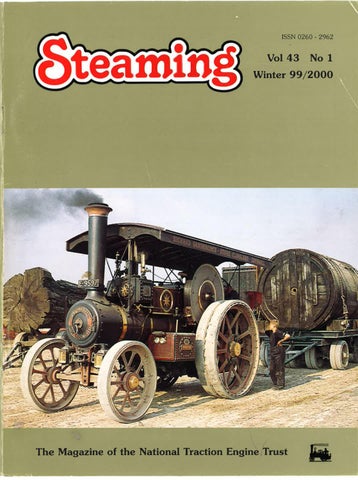
Cover Burrell 3996 CONQUEROR has featured quite a lot in these pages recently — its detail history appeared in the second part of articles on Henton's of Hop was, Staffordshire in the Spring 1999 issue. However, we hope our recently retired Chairman won't mind seeing his 5hp road locomotive illustrated again, with a scene of engine and loads that could be a near likeness of its working days in the late 1920s. Roger West took the photograph at the end of last year's Great Dorset Steam Fair. The day's dust has covered the wheels and much of the rest of the Burrell, spoiling the efforts of the crew when they prepared it in the morning — just the same as the dry waterbound roads of the twenties would have done. 3
Trust News Patrons, and a new President
considering and contacting a number of steam engine supporters who were felt to have expertise in various fields, and to have suitable influence with associates in high places. I can now let you know that the following have kindly consented to become Patrons to the National Traction Engine Trust. • The Earl Attlee • Hal Bagot, JP, FRICS, of Levens Hall, Cumbria • Robert Goodwill, MEP • Dr Tony Marchington, Buxworth Steam Group • The Rt Hon Sir William McAlpine, Bt • Michael Oliver, organiser of the Great Dorset Steam Fair • Hamish Orr-Ewing, present President of the Road Locomotive
Richard Sandercock writes: For some time your Committee has been considering the appointment of Patrons to the Trust — honorary appointments bestowed on individuals who are prepared to demonstrate strong associations with the aims and objectives of the Trust. A major requirement of a Patron would be to ensure that our activities and policies are adequately communicated to those most able to influence the political or public environment in which the Trust and its members find themselves from time to time. As Chairman during the last year, I was pleased to take on the task of
This picture of a threshing gang at work comes from the collection of Steve Arrowsmith. It is largely unidentified, though it seems to have appeared in print somewhere before, so maybe a reader can recall that appearance and tell us more on the location and occasion. Judging by the engine, the scene is of some antiquity, for the machine is a Savage built chain drive traction engine of the 1860s, with cast wheels and steerage via a 'ship's wheel' at the platform in front of the smokebox.
Society, and former Chairman of Jaguar Cars • Richard Preston, of Potto, North Yorkshire (and who proudly mentions that his birth certificate has the entry 'steam engine driver' for his father's occupation.) I look forward to a first meeting with our new Palrons arid to the successful work I am confident will be achieved in the future. Our President Eric Fillmore has suffered poor health for the last couple of years and is regrettably unable to take much part in our activities. In this, the last of the three years of his elected term of office, I have suggested that we ask a well known figure, from the very earliest days of traction engine rallying, to agree to become our acting President. I am pleased to say that Giles Romanes of Dorchester, long time owner and rally entrant of the Wallis steam motor GOLIATH!, has agreed to accept my invitation. Giles Romanes writes: I am encouraged by the confidence of those members who attended the AGM of the Trust. They accepted the
a I
NV,
•• •••,;
.3 • Att
•
L
•....,
1.11.• °eft-
,fit-* • •
.0!
y
71%., .
Officers and Committee 2000 This column lists, for the information of members, the Officers and Committee of the Trust for 2000. The addresses/ phone numbers of those with special duties are given inside the front cover of each issue of this magazine; others may be contacted by phone or via the General Secretary or sub-Committee Chairmen. Names marked with an asterisk" are appointments by the Committee and are non-voting positions in Committee. President G.J. Romanes Vice Presidents Sylvia Dudley R.J. Sandercock Chairman A.J. Semple Vice Chairman R.T. Herring
suggestion of Richard Sandercock that I be nominated as acting President to fill the gap left by the continued indisposition of Eric Fillmore. I have been a member of the national traction organisation since the very start. I was the person who began the magazine Steaming and gave it that title, but I have not played an active part in the affairs of the nownamed Trust since then. I congratulate Andrew Semple as Chairman. I look forward to helping to defend our activities against the onslaught of directives intended to protect workers in industry, members of the public at rallies, so called 'green minded' people who use their cars to attend protest meetings etc. The Trust exists not only to enable its members to be free to enjoy themselves with unique vehicles, but also to keep alive the heritage skills of operating and maintaining them. (Giles Romanes)
General and Company Secretary Mrs Susan Jackson" Treasurer Julie Smith, FCA Hon Solicitor T. Driver" Hon Safety Adviser J.M. Newnham* Membership Secretary J.R. Cook Hon Editor, Steaming R.E. West Hon Sales Offiders Colin and Val Brown" Press Liaison Russell Bulley Committee The above and also: I. Barraclough (S. Yorks, Tr 01709 850346) J.R. Bosworth (Derbys, Tr 01332 880405) N. Boyes (W. Yorks, Tr 01253 811876) P. Cooper (co-opted) M.O. Davies (Warks, Tr 01295 770217) J. Durling (SAC Chairman) W. Evans (Rally Authorisation) T. Holt (Cumbria, Tr 01524 271584) B. James (Norfolk, Tr 01328 701417) S.J. Parrott (Bucks, a 01844 201282) R.J. Pierce (Engine Owners chairman) J. Shackell (Oxford, Tr 01993 773088) D.S. Smith (Insurance Officer) M. Tuxworth (East Anglia, Tr 01799 599555) R Vickery (Devon, 12 01684 569292) M. Ward (FBHVC and Notts, IT 01623 882856) P. Williams (Chilterns, Tr 01923 263436) Representatives D. Jennings/L, Parker (NV Tractor & EC)* Auditors: Charles Lovell & Co, Royal House, Market Place, Redditch, Worcestershire BN98 8AA
STEAMING
Winter 1999/2000
Engine Owners Column Engine Owners sub-Committee Our Open Meeting for Engine Owners is to be held on Saturday, 29th January 2000 at Willoughby Village Hall, near Rugby in Warwickshire (for more details, see the adjacent display advert). This is a change of venue, both in location and style. The comfort of the facilities within a modern hotel, however attractive, is expensive, and in an effort to contain costs we have opted for the more basic, but in our view acceptable, surroundings of a village hall. It is a location that is being presently used for Trust committee meetings and by other engine clubs. I again point out that the meetings are open to all engine owners and crews, whether members of the Trust or not. For the meeting Colin Hatch has arranged a presentation on boiler treatments, which is another new innovation for this event, and a topic which I personally find full of mystery and prejudice. Other agenda items will be the on-going matters such as driver training, recovery insurance, boiler inspectors, the Code of Practice etc, but we encourage the discussion of other subjects raised from the floor on the day. I look forward to seeing you there with your views and ideas. It is encouraging to see the Steam Plough Club running 'hands on' weekends, which offer instruction to those interested not just in driving engines, but in the skills of handling
Sub-Committees 2000 This column lists the members of the Trust's sub Committees for 2000. Names marked with an asterisk* are co-opted; others are elected Committee members or appointed Trust officials. Addresses/phone numbers of the Chairmen appear inside the front cover of each issue Rally sub Committee P. Cooper (chairman) J.R. Cook T. Evans" W. Evans R.T. Herring T. Holt* B. James K. Stott" Jo Tilling" Engine Owners sub Committee R.J. Pierce (chairman) I.K. Barraclough M.O. Davies Sylvia Dudley C. Hatch* J.M. Newnham* R.J. Sandercock D.S. Smith R.M. Vickery M. Ward Technical Board J.M. Newnham (chairman) H. Pounder" R. Swithinbank* G. Tennet*
the implement as well. When I see log sawing, threshing, stone crushing and other steam powered demonstrations at shows I am concerned over the ever increasing restrictions imposed upon us. Where will the new entrants to the traction engine interest, and especially the young drivers, get their experience in these activities? Learning to drive an engine is just part of it; the other skills are sometimes harder to come by. That is why practical sessions such as 'hands on' weekends are so good. How about some devoted to threshing or log sawing? Happy millennium year. (Richard Pierce, Chairman, Engine Owners sub Committee) Technical Board Not very much to report this time! A meeting with the DTI and the HSE was held in September to discuss the implications of the Pressure Equipment Regulations, particularly whether it would be possible for the NTET, Heritage Railways and possibly other steam preservation organisations to form their own body to carry out conformity assessments of new pressure equipment for historic road 5
The Editor has arranged to leave the country on holiday (searching for working steam engines) at the very time he should be deeply involved with the next issue. Please note, therefore, that the press date shown on page 3 is one week earlier than usual.
and rail vehicles. This looks like a positive way to tackle the problem if, in the end, we are unable to get replacement pressure equipment for historic vehicles excluded altogether. Our next meeting with the DTI and HSE will be on 13th December (too late to meet the deadline for this edition of Steaming), when we will be trying to determine at what point a repaired boiler becomes a new boiler. Much of our future strategy will depend upon the outcome of this meeting, which I will be able to report to those attending the Engine Owners' Meeting in January. (Jim Newnham, Chairman, Technical Board)
Spares and Pattern Register In the last Steaming (page 182) members will have read of the four year dispensation for chrysotile asbestos in the use of mudlid joints, and I am canvassing manufacturers to ascertain the extent of supply for the future. I will aim to report the findings at the Engine Owners' Meeting on the 29th January 2000. At this same meeting there will be a presentation by a representative of Aquazur (formerly Housemans) on the use of boiler treatment, followed by an opportunity to ask questions. Following an enquiry from two
members, I find there appears to be little knowledge of spark arrester manufacturers, and considering that this item is a requirement of the insurance, I am surprised this is the case. I would be interested to hear from anyone concerning manufacture, and also any experiences of fitting mesh screens inside the smokebox. I have three members who require information, drawings etc, for Watt type governors, or failing this, sight of a specimen to take measurements and photographs. If you can help please make contact with me, in the first instance. On the subject of the Pattern Register, after the initial steady supply of information about patterns during the last 12 months, things have gone a bit quiet, but I'm sure there are many still not accounted for, so now, during the dark nights and in front of a nice warm fire, why not write to me about your patterns, so I can enter them on the register? Any queries on spares or patterns, or useful feedback, please contact me
on 01793 790378 Tr or fax, or write to Colin Hatch, 4 Lotmead Farm Cottages, Stratton Road, Wanborough, Swindon SN4 OSN (e mail address in next issue).
FBHVC News Elsewhere in this section of the magazine you can read of the Trust's new Patrons, and a brief outline of the conception of having friends of road steam engines in positions where they can speak for us. The October/ November 1999 Newsletter of the Federation of British Historic Vehicle Clubs includes the following message from Lord Montagu of Beaulieu, who has had close association with traction engines and rallies since the 1950s. 'Carrying on the Task. Over many years, together with like minded peers, I have taken full advantage of my privilege of sitting in the House of
A fine view of a road making gang in the early years of this century. The Avelfrig 10 ton single cylinder roller, and indeed the van and doubtless the water cart too, are owned by R. G. Smoothy of Rochford, Essex. The post card from which our illustration comes was published by Hammond of Great Totham — this is a village about twenty miles north of Rochford, so the scene is most probably in Essex. Smoothys had a large fleet of steam engines for their business, built up from around 1900 — sets of ploughing engines, tractors and steam wagons, but mostly rollers, with a score or so of Avelings leading other makes. The brass owners plate on this one is just illegible, and the machine remains incognito — it might be No.3, or No.7. The East Anglian club have a book in preparation on Smoothys' business, written by Pat Freeman, with input from Jim White of Great Leighs, who once drove for the firm. A good tale will no doubt result. Thanks are due to Liz Mason for letting us have the card for reproduction.
Lords to raise matters pertaining to the Veteran and Vintage Movement. I naturally was very apprehensive that I would be one of the casualties of the new reforms, which would have resulted in my exclusion from the House and thus prejudiced my ability to champion important matters relating to the Movement. 'I am delighted to say I was duly elected as one of the 42 Conservative hereditary peers and hence will be in a position, at least until the Government brings in another bill, to carry on with this task. There are, alas, several peers whose support I will no longer have, particularly Lord Strathcarron who will be sorely missed, but once the new House settles down, I will determine who can be relied upon to give me support when needed. 'In the meantime, if there is any particular matter which you feel is deserving of being raised in the House, please get in touch either with me direct or with the Secretary of the Federation, so that it can be discussed with members of the General Committee. (Lord Montagu of Beaulieu)'
Steam Apprentice Club As we are now firmly in the closed season for engine-based SAC activities, thoughts turn to next year's events and how to best promote things steamy to our younger members. The most successful happenings last year were, without doubt, the SAC driving days, and we are now planning a further series for the coming season — bigger, and more of them so that a larger number of youngsters can have the opportunity to learn the basics of driving and engine management in a safe manner. The feed back from the Rally Organisers Conference in October was encouraging, as it showed that more rallies are able to offer some level of support to our members, and SAC members are turning out to take advantage of the offers. I hope that this level of activity can continue during 2000 and look forward to more youngsters doing more things, with more engine owners offering their help. As I have said before, without the latter assistance, nothing can happen. (John Durling, Chairman, Steam Apprentice Club)
STEAMING
Winter 1999/2000
AGM Motion — The Conversion of Engines At the Trust's AGM in November the following Motion was put forward: 'That during the year 2000, the National Traction Engine Trust shall publish a definitive statement confirming its opposition to the conversion of traction engines, steam rollers and similar vehicles into a form which any particular machine never had during its working life'. After discussion by those present, the Motion was passed. In order to guide the Committee in its implementation of the Motion and in the preparation of the statement, the thoughts of the members are solicited. Reproduced are here the thoughts that proposer Lyndon Shearman presented to the Lincoln meeting. Comments are invited via the pages of the magazine, or, if preferred can be sent in writing to the General Secretary. First let us understand what this Motion is NOT. It is not about banning conversions from rally fields, nor is it about ostracising those who carry out conversions. It is a positive motion, with positive intentions. Many years ago, when I first became involved in steam preservation, there were lots of people around who had spent their working lives with engines, and who could, and did, pass on the best practices that they had learned in caring for and running engines. Their ranks are thinner now, and the Trust has taken upon itself the role of 'curator of best practice'. To this end, it publishes Codes of Practice on the care of engines and the conduct of rallies. This is an entirely proper role. It is no use simply preserving engines, we have to preserve best practice too, and pass it on to future generations, for them to adopt or not as they see fit. This motion seeks nothing more than that the Trust continues in this role and makes a pronouncement on whether it considers the conversion of engines to be good practice. Once it has done so, there will be no compulsion for anyone to agree, just as there is no compulsion to agree with the Trust's present Codes of Practice. One can choose whether to run one's rally according to the Trust's Code lone may not get authorisation to run as a Trustaccredited rally, but one has the choice), and there is no compulsion to follow the Trust's Code of Practice on the care and running of engines. But a standard will have been set, and one can choose whether to follow it or not. This setting of standards is important. When, as individuals, we set standards for our own conduct, it seems that we do not do so in isolation, but by reference to someone or something else. Thus we might follow a particular football team because our father did, or our best mate at school did. We might like a particular make of car, or engine, because the family once had one. We can, equally, oppose something for the same reasons. So the setting up of standards is important, perhaps more than we realise. (continued on next page)
A Coming Anniversary The National Traction Engine Club, forerunner of the Trust, was formed in May 1954. By way of celebration, it is proposed, among other events, to organise a Road Run for sometime during the late summer of 2004. This will only be possible with the support and willingness of the membership and our many and varied friends who are fond of steam traction engines. Just now, four and a half years may seem a long way off, but much will need to be thought of, and a plan of work should be set down now. A brief note of the preliminary headings will allow members to be aware of the initial thoughts, and to enable those who wish to be associated with the event to know the
planning processes that will lead to the celebration. • President/Patron — Richard Sandercock, immediate past Chairman, has agreed to accept this position for the event. • Initial organisation — by the Rally sub-Committee. • Date — provisionally September 2004. • Location — an area with good co-operation with police, local council and water company etc, and with support from a local rallyorganising club. Near a motorway; good amounts of hard standing. Suggestions presently centre on the M5 corridor between Birmingham and Bristol. • Approximate entry, 100 engines. Requirements for entries: in-date 7
(concluded from previous page) How does this work in the context of conversion? I recently heard of an engine owner, new to the movement, who bought one of those nice old Fowler rollers with the smokebox attached to the boiler by a ring of bolts. He promptly set about unbolting them and converting the roller. When he was asked why he had done this, the question puzzled him, for he had not considered whether what he was doing was 'ok' or 'not ok.' There was no standard to refer to. It simply never crossed his mind that there might be any kind of 'rightness' or otherwise about what he was doing, and he had never asked himself that kind of question. And so another roller was destroyed, and the history that had ridden on its back is lost. So the setting up of a standard, by accepting this proposal, is important, whether one chooses to agree with it or not. Now, some would say that the Validation Scheme will serve this purpose, but that is not what the Scheme is for. Its purpose is to record an engine's history, not to set a standard. If the Trust cannot accept and adopt this proposal, then it will, by implication, be saying that conversion is 'ok.' If that is the case, if conversion is considered good practice, then by sheer force of logic, a number of questions will ((Ace themselves forward to be answered. For example, if it is 'ok' to convert a steam roller into something else, then that implies that a steam roller is in some way an inferior class of engine. In what way is it inferior? In what way is it of less value historically; in what way is it any less worthy of preservation as a steam roller? In what way is its provenance, the history that it represents, any less important than that of any other class of steam engine? Equally, if conversion is 'ok,' then how many steam rollers shall we convert? Shall we convert them all? Already over a hundred have gone. Or shall we keep just a few back so that future generations can see what a steam roller used to look like? And if so, how many shall we keep and which ones, and who will decide? These questions are, I believe, unanswerable, and so logic dictates that conversion cannot be 'ok.' But this is not a Motion about logic. This is about the very future of the preservation movement. We can look back on the destruction of the broad gauge locomotive NORTH STAR in 1906, and ask 'how could they?' But what will future generations say of us, that we stayed silent while engines were converted, and by being converted, lost their history, their character, their provenance, their authenticity? Will they say 'how could they?' Those who follow us in the preservation movement will look back on us here, now, in this room, and they will judge us by what we do with this motion. Whether we accept it, or whether we do not, they will judge for us, or against us.
NTET and road tax discs; roadworthiness; a tidy, presentable appearance. Preferences for entries are appropriate trailers, implements or loads. All entrants will be self financing. • Routes on the run — three distances of 12 to 15 miles; 25 to 30 miles and 55 to 60 miles. Capability of any engine for the route chosen to be monitored by the organisers. Back up assistance in the form of water tankers, recovery vehicles and patrol riders to be provided. • Media coverage — local TV, BBC motoring programmes, papers, magazines, internet. • Sponsorship — anyone we can think of, and successfully persuade to support us to mutual benefit. The Rally sub-Committee will be
8
pleased to hear from any member with offers of support, or with bright ideas that will help with the organisation of what will be a very important occasion in the history of the Trust. We intend to put on a well organised and highly professional event that will show off road steam engines to the best possible effect. (Peter Cooper, Chairman, Rally sub-Committee)
A New Public Face for the Trust Six years ago the Trust took what was then felt to be the very bold step in purchasing an Exhibition Unit. Since then, the Unit has travelled many
miles, and visited thousands of numerous rallies the length and breadth of the country. The Unit's main purpose has been to promote the continued use of steam engines both on the rally field and on the highway, the recruitment of new members, and the promotion of Affiliated and other club events with the aid of posters, handbills, and the much sought after Rally List. Circulation of the latter now exceeds 25000 copies. The presentation of a comprehensive selection of sales items ranging from books to exclusive NTET clothing, has been very successful. These sales, together with the excellent support from rally organisers in providing free space at their events, have provided the income for keeping the Exhibition Unit viable and active. With the life span of the old vehicle time-expired, a snitahle replacement was badly needed. Now, a secondhand mobile exhibition unit has been successfully identified and acquired. The budgeted cost of purchase and adaptation for our use for the coming season is £15000. To make this new Trust Unit possible, we have launched a funding appeal, seeking donations from Affiliated Groups and other bodies, and finding commercial sponsors. These subscriptions will be permanently recognised by the inclusion of graphics on the new unit. I am pleased to say that the appeal has already borne fruit and early indications are that our target will be achieved. The sale of the old Unit and some of the pictures displayed in it have played their part. Modifications to the fresh vehicle are at drawing board stage and the livery and graphics under discussion. At the press date for this issue I acknowledge generous donations from: Barleylands — £100; Banbury Steam Society — £500; Cumbria Steam — £1000; GDSF — £250; Lancashire V&CS — £200; Lancaster TEC — £250; Malpas VMA — £250; Netley Marsh — £200. If any individual member, or group or club, would like to be associated with the appeal, and be involved with the only Charitable Trust that represents continued and active use of steam engines on the road, then
The end of the rally on the Sunday evening of the 1998 Cadeby event. Foster 8hp traction engine 14593 heads a group of exhibitors through the gate, and prepares to turn right on its own short run down to the village and home. (John Maund) Winter 1999/2000
STEAMING
please send donations to the undersigned. I will be pleased to give further information on the project. (Robert Herring, Vice Chairman, IT 01869 277410 or address inside the front cover)
Meanwhile, Peter had become a behind-the-scenes stalwart for the Great Dorset Working of Steam Engines at Stourpaine Bushes. He was a quiet, unassuming man but his wealth of knowledge will be sadly missed by all who knew him. May he rest in peace. (Paul Antell)
Ronald H. Clark
Obituaries Peter Antell Peter Ante!l recently died of a heart attack at the age of 82 years. He became a member of the NTEC in the fifties, taking his sons John, David and Paul to the pioneer rallies of the day — Appleford, Andover, Taunton and Redruth. Born a farmer's son in the north Dorset village of Lydlinch, Peter became interested in vehicles, and took up an apprenticeship with Arthur Conyers of Blandford Forum. He joined the Forces in 1940 — first the Devon and Dorset Regiment, and later the Royal Electrical and Mechanical Engineers. After the war he moved to Shillingstone and worked in the garage of E. Sloper & Son, helping build up the business, and eventually taking over in the early seventies. With his help and enthusiasm in later years the Ante!l family restored DREADNOUGHT, John's Fowler agricultural, David's Wallis Advance roller and Paul's Robey traction WALLY.
R.H. Clark was undoubtedly one of the most remarkable people it has been my privilege to know. He was one of a dying breed of eccentrics with a great intellect and charm. His many interests covered an extraordinarily wide spectrum. He was an English — very English — gentleman, beloved by a wide and diverse circle of friends. Ronald Harry Clark was born in Norwich on 13th November 1904, the eldest son of Harry Osborn Clark, chief engineer of the old-established Norwich engineering company, Laurence Scott & Co Ltd. The Clark family came from Halstead in Essex, where Ronald's grandfather was a well-known landscape painter. During the past forty years I remember taking Ronald to see the Clark family tombstones in the churchyard on several occasions. H.O. Clark, Ronald's father, was a mechanical engineer of distinction and acknowledged as a superb model maker, which set the scene for Ronald's lifelong love of steam engines. His wife, Nellie Dickenson,
was of sturdy Yorkshire stock. They had two sons, Ronald and Roy, who is several years younger. Ronald was educated at Brackendale School in Norwich and received his technical education at Finsbury College in London. There was never the slightest doubt in his mind that he wanted to become a mechanical engineer and follow in his father's footsteps. Leaving college, his first job was with a firm of consulting engineers in Victoria Street, London. His great ambition was to obtain membership of the Institute of Mechanical Engineers and he was immensely proud of this as he moved up through the ranks to become a professional chartered engineer. He regularly attended meetings of the Institution until a few months before his death. Over the years he presented various technical papers before his peers. During the inter-war years Ronald had a number of jobs, including a few months at sea, none of which he appears to have found particularly satisfying or rewarding. In 1942 he was commissioned in R.E.M.E. and for five years was involved in the care and maintenance of steam cranes and locomotives. After World War 2 he was firstly employed by the River Catchment Board and then became a boiler inspector with the National Boiler Insurance Company. In 1955 he retired from the world of commerce and became a full-time writer.
One of his early books, The Steam Engine Builders of Nutt.°lk, was published in 1948, and re-issued in 1988. Steam Engine Builders of Lincolnshire was first published in 1955 and was re-issued as recently as last year. In 1952, after much difficulty, he had published his Chronic/es of a Country Works, a history of Charles Burrell. Today this much sought after book is changing hands at thirty times its cover price and is universally acknowledged as a classic work. His magnum opus, The Development of the English Traction Engine was published in 1960, and is today regarded as the standard reference book on the subject. Ronald must be credited as being the first person in the traction engine preservation world to publish quality books on the subject. After a bad spell with critics and 'know-alls', he became the doyen of traction engine literature. However, his twenty odd published books are not confined to traction engines. He wrote a couple of books about his favourite railway, the Midland & Great Northern Junction Railway (The Muddle and Go Nowhere Railway). His history of the Brough Superior motorcycle went to three editions and is still in demand. In 1975 he wrote his first fiction, Some Adventures of Samson Cogg. He insisted there was a strong basis of truth on which the story was based, which is evident to those who knew him well. His writing style was distinctive and at times quaint. I don't think he ever forgave me for referring to 'locomotives' instead of the more correct 'locomotive engines'. Ronald was a Latin scholar and frequently quoted Latin phrases, to the consternation of lesser mortals like myself. He was a poet with a poet's imagination, and often interspersed his prose with verse. He was a draughtsman of great merit and produced hundreds of engineering drawings used to illustrate his books. Without doubt all his literary works will be long sought after and treasured. He served as President of the Newcomen Society from 1967 to 1969, and rated amongst his friends many of the elder statesmen of his profession. Every year, for many years, he designed and produced his own Christmas cards containing appropriate verse. These have all now been published in book form. He was a frequent correspondent in the local press. Sad to say much of his wisdom went over the heads of the readers and indeed the editors. He was proposing solutions to problems on road and rail 10
long before governments even gave them a thought. Ronald owned various traction engines at different times. His greatest love was BACTON HALL, a unique little Collings engine, one of only three, built in Norfolk in 1910. It was painted in the colours of the Midland & Great Northern Railway, and his final outing only two weeks ago was to witness this engine in steam — a fitting farewell to the steam scene. But all this is only one side of Ronald's remarkable life. He never owned or drove a motor car or possessed a TV set. The motorcycle was his great passion, especially the Brough Superior. He became just as well known in the motorcycling world as in the steam world and held office in many of their organisations. When the wearing of crash helmets became law lie lied mule than one confrontation with the police. He insisted that a steel plate in his old leather helmet was just as effective as the uncomfortable modern crash helmet. I well remember him turning up to my baoholor night party with hie famous leather helmet and cycle clips on his trousers! He continued to ride his lovely BMW motorcycle until his eighty-sixth year. Everywhere Ronald went he carried a very tattered old canvas satchel with him, as a sort of trade mark. Attempts were made to provide him with a replacement but 'old faithful' always reappeared. I do hope this relic finds a place in a museum. Music formed a very important part in Ronald's life as it does with so many engineers. He was passionately devoted to the works of Gilbert and Sullivan. Conversation was impossible with him without a rendering from their works. His philosophy of life seemed at times to be based on their work, but sadly to a philistine like myself it was largely wasted. But his knowledge and retentive memory were quite profound and extraordinary. I believe he kept the printed programmes of every opera he had attended. Brief mention must be made of his great love for the Norfolk countryside. He loved the many old churches and built up a great collection of brass plate rubbings, researching in detail their histories. He inherited a considerable collection of birds' eggs and could recognise all the birds found in East Anglia. He built up a remarkable collection of traction engine and agricultural machinery manufacturer's nameplates and for many years was associated with the splendid old beam pumping engines at Stretton. Mention must also be made of his much-loved
cottage, Diamond Cottage, here in Shotesham, where he spent a lot of time writing. Ronald's wife, Peta, died in tragic circumstances in 1981. In the forty years I knew Ronald I never met the lady. Subsequently, his reunion with his daughter, Isla, has been an enormous source of pleasure to him. I could always tell when she had been to visit him because he was visibly so much better and more cheerful. The other great feature of his declining years has been the love, care and attention he has received from Olive. She has shown the most remarkable devotion and in my opinion has been a true saint. Ronald has been my mentor and friend now for forty years. I feel we are here today first and foremost to give thanks for his remarkable life. Farewell Ronald, for I have nothing else to say ... farewell dear friend. (Michael Lane's address given at Ronald Clark's funeral at Shotesham All Saints, Norfolk on 22nd November 1999.) Jim Laird The dwindling ranks of men who earned their living working with steam were further depleted with the death of Jim Laird in June, the result of a motor accident. Jim, who lived at Gateside, near Glamis, Angus, was just a few weeks short of his eightieth birthday, and had continued his interest in steam into the preservation era, as a member of Willie Smith's team. His early years were spent in the Dunbar area where he took up work
Winter 1999/2000
STEAMING
assisting his father who, at the time, was operating a Burrell tractor on timber extraction. During World War 2 the family moved, first to Dupplin near Perth, then to Glamis. The move north was accomplished by Jim driving the Burrell and two trailers containing the family belongings (including a hive of bees), the route being along Princes Street, Edinburgh. Whilst working at Glamis, Jim met and married Jean, and they set up house in Glamis village, later moving to Gateside, where they brought up three daughters. The timber work came to an end in 1956 and the Burrell was sold. The buyer started off to drive it home, but it blew two tubes outside Forfar and rather than retrieve it he had it towed to Forfar station, from where the unfortunate machine was sent away to Lanarkshire for scrap. Jim then took up employment as a roller driver with Angus County Council at the Kirriemuir depot, which was still operating steam engines. His regular mount was Fowler 18295, although he had a turn with most of the surviving steamers including the 'Big Engine' — Fowler A9 class 20434. It was whilst driving this engine that he was ordered, against his better judgement, .to push over a small tree — and promptly broke the front forks! He later drove diesel rollers for the Council, and in winter he carried out snow clearing in the Angus glens, sometimes in atrocious conditions, with a Caterpillar D8 or ex-Army Mack 6 x 6s. He took early retirement in 1980. When the Council disposed of several of its steam engines to Willie Smith, Jim offered to help with restoration and driving, an association which lasted for thirty years. A knowledgeable and confident engineman, Jim was always prepared to share his skills with the younger generation. I well remember, on my first attempt at steering for him (on Glamis Castle main drive), being told with a smile, "ye wid need to try an' keep aff the grass!" Jim lost his wife in 1996 and latterly suffered from indifferent health. Although no longer able to do heavier jobs on the engines, his enthusiasm was undimmed. He was eagerly looking forward to the first steaming in preservation of Willie's Fowler traction engine, 15718, on which he had done so much work over the years. It's first outing to Glamis Extravaganza in July was tinged with sadness, for Jim was deprived of the opportunity to see it in action. Our sympathy is extended to his family. (Sandy Garden) STEAMING
Winter 1999/2000
Last year saw the appearance on the rallyfield of the rare compound cylindered 7hp portable built by the Farmers Foundry at Great Ryburgh, Norfolk. A new addition to the Saunders family's collection, it is seen here at the Old Warden event, catching the eye with a pale blue livery of typical agricultural shade. (Roger Newbery) Albert Nott Albert Daniel Nott passed away in March, aged eighty seven. He was born at Horridge Farm, Black Dog, near Crediton in Devon, the eldest of three, and entered the world of steam at an early age, for his father George and uncle Archibald, owned a Fowler and a Marshall for threshing work. Archibald later went into the quarry and threshing business on his own, with Albert then joining his father. Initially they had a Robey from a builders merchants in Exeter, with a Marshall thresher and Murch reed coomber. The outbreak of war increased the demand for threshing in the area, and a Garrett and a Ruston & Hornsby were acquired. When father died in 1945, Albert and his brother Kenneth took over the business. They covered a wide area from Black Dog to Cruwys Morchard and Rackenford, joining Archibald at Witheridge, and another relative in the Tiverton area. Albert's brother Kenneth drove the Garrett, an employee the Ruston, while the Robey remained Albert's engine, until the inevitable replacement with a Marshall tractor. Albert married Gladys Tapp of Poughill in 1951, when they moved the short distance to Wood Farm at Black Dog. Without a doubt Albert
was a character loved by all, and he will be sadly missed. Sympathy is extended to Gladys, his son George and the rest of the family. (Gordon Crook)
... and other friends As we completed this magazine over the Christmas and New Year period, we sadly learnt of the passing of John Keeley of Knowl Hill, Berkshire, and of Bill Martin of Uckfield, Kent. Obituaries for these two stalwarts of the traction engine world will appear in our next issue.
Trust Trophies As is our usual practice some of the Trust's trophies were presented at suitable points during the AGM weekend in Lincolnshire in November 1999. Those receiving the awards were selected from that area of the country. • CONNIE HUTCHENS MEMORIAL TROPHY — to be awarded to a lady within the movement, was given to Mrs Pat Parker — widow of former NTET committee member Tony Parker. Since his death ' in 11
1980 Pat has carried on rallying the Foster tractor MIGHTY ATOM which has been in the family for 40 years. At present she is treasurer to the Lincolnshire Traction Engine Society. • BAKER TOC-H CUP — to be awarded to the 'big' engine owner whose standing and stature are countrywide, was presented jointly to Charles Saunders and Bruce Whatley — owners of Garrett showmans road locomotive BRITISH HERO, which has re-appeared on rally fields this year after meticulous restoration over the last eight years. • CURTIS BOWL — to be awarded for taking an engine on long and outstanding road journeys, was chosen for Michael Ward, owner of Burrell road locomotive CLINKER which he travels widely by road over Lincolnshire, Nottinghamshire and Yorkshire through the rally season. • JACK HOLLOWAY TROPHY — preferably to be awarded to someone who undertakes commentating at rallies. This trophy was given to Frank Strange for his outstanding service to the steam movement in the East Midlands. A one time owner of an engine in preservation, he then took up the unenviable duty of commentating at rallies. He has been associated with the Lincolnshire Traction Engine Society for many years and is currently a committee member for the Road Locomotive Society. • ARTHUR NAPPER CUP (1) was awarded to Michael Dawson and his team for their outstanding recreation of Foster showmans tractor OBSESSION, whilst the ARTHUR NAPPER CUP (2) went to Horace and Bernard Smith, owners of the always immaculate Marshall traction engine DOROTHY, and the soon to re-appear Foster showmans AQUITANIA. Over the years they have fitted over fifty new fireboxes for customers. • DACRE LACY CUP — to be awarded for an outstanding preservation renovation and often for a specific engine, was presented to Alan Rundle for the outstanding restoration of his Robey wagon and, new to rallyfields in 1999, a rare Brown & May tractor. • CHOISY & SIMSON CUP — to be awarded for outstanding renovation but not necessarily a specific engine. This was given to David Ragsdale. A pattern maker by trade, David has made important contributions to many restoration projects, including the Dawsons' 12
Foster and Alan Rundle's Brown & May tractor. He is the owner of Burrell showmans PRINCESS OF WALES, which returned to the rally fields this year. • GOLDEN FILM SHIELD — to be awarded for outstanding work in the traction engine movement, presented to the Trust's host for the Sunday morning visit, Robert Crawford, owner of a very large and long standing collection of traction engines, vintage tractors and commercials. • PERCY HIRONS BOWL — to be awarded to the owner of an agricultural engine, preferably one which is used either in serious use or proper demonstration. This year it went to Colin Brothwell, who can usually be found in the working area of a rally with his Ruston & Hornsby traction engine HILDARY. • ERIC MIDDLETON TROPHY — to be awarded to an owner who undertakes renovation with limited resources of either equipment or finance. It was•presented to David Palmer and family for the outstanding restoration of Ruston Proctor traction engine, which he restored over a period of eighteen years with his father Harry, who sadly died in 1997. • JOHN CRAWLEY TROPHY — to be awarded to a member who is considered to have given service to the movement, though not specifically connected with an engine. Ray Hooley was the chosen recipient. He has, over many years, helped engine owners world-wide with his wide knowledge and access to information on Ruston & Hornsby products. • J.T. BEEBY CUP — to be awarded to a young enthusiast, in more recent years a member of the Steam Apprentice Club. The Cup was presented to Karen Dunderdale. (John Cook, Membership Secretary)
of them be taken to be shown on the rallyfield. Alan's work with Brown & May products is no less impressive, and we record our sincere thanks to all those who gave up the best part of an otherwise rather dull Sunday for our enjoyment.
London Social Meetings These will continue to be held on the second Tuesday of the month, starting at 8.00pm, with the room available from 7.30pm. as usual both members and non members are welcome to attend the meetings at 'The Duke of York', 35 New Cavendish Street, London W1 — details of how to get there appeared in the last issue. The programme of illustrated talks for the rest of the season is: Tuesday, 8th February — Traction Engines in Australia. Arthur Bullman will be bringing along a series of video films that will be full of interest, showing a traction engine scene quite different from the one we are used to. Tuesday, 14th March — East Anglian Steam, by Kevin Swann, who will talk on the activities of the East Anglian Traction Engine Society and its members from the group's earliest days. Some pleasant memories will be brought back. Tuesday, 11th April — Tramways of London. This evening the LCC Tramway Trust will present the story of street tramways from their beginnings to closure in the 1950s. Hopefully there will be a glimpse of steam trams at work, and the Tramway Trust will also touch upon their latest project. (Bill Timmings, London meetings organiser)
Future dates AGM thanks On the Sunday following the Lincoln AGM in November, many of those who had stayed in the area overnight, and local members, were pleased to accept the invitation of Robert Crawford and of Alan Rundle to view their respective collections. At both venues members were made most welcome. Robert gave access to a collection of steam engines, agricultural tractors and much else that is so great that rarely can more than a few
Engine Owners Meeting Another in the series of useful engine owners open meetings will take place at Willoughby Village Hall, Warwickshire, on Saturday, 29th January 2000, starting at 11.00am. Details of the proposed agenda items can be found in Richard Pierce's notes in the Engine Owners column. Light refreshments will be available at the hall. There is also a pub next door, but although meals are served they are likely to be swamped if everyone goes there for lunch! Winter 1999/2000
STEAMING
Willoughby village is immediately off the A45, about five miles north of Daventry and a similar distance south of Rugby. The important junction of the M1 and M6 motorways and the A 14 trunk road from the east are but a few miles further away; a couple of minutes study of a good road atlas will reveal all. Approaching Willoughby from Daventry and the south, turn left into the village opposite the cafe and garage. The hall is about 500 metres into the village, on the right hand side just before the pub. We appeal to those attending to be considerate when parking their cars in the village, even if it means a minute or two of walking back to the hall. Please keep off the grass verges, and clear of the bridge and residents' accesses. (Sue Jackson, General Secretary, 24 01494 521727)
Rally Organisers and Affiliated Clubs Conference The annual Spring Conference for Rally Organisers and Affiliated Clubs will take place on Saturday, 11th March at the now regular venue, the Village Hall at Willoughby, Warwickshire. Notifications and invitations will be sent out shortly by Sue Jackson in the usual manner, but newcomers are always welcome — please contact Sue for details if you or your club are interested (address and phone number inside front cover).
Driving Course The 2000 Engine Drivers Course will be held on the weekend of 6th and 7th May at a venue in the Thames Valley area. Further details will be available shortly, but because the next issue of this magazine will not be with members until about four weeks before the Course weekend, expressions of interest, as well as firm bookings, are welcome now — please see the display advert elsewhere in this section.
19th March 16th April
National Committee Executive and National Committee May Engine Driving Course 11th June National Committee 1st September GDSF Open Forum 24th September National Committee 14th October Rally Organisers Conference 29th October Executive and National Committee 18th November Annual General Meeting
New Members A sincere welcome is extended to the following new members who have joined the Trust during the last three months. We hope they will gain much friendship, information and enjoyment from their membership over a period of many years. The Membership Secretary is always pleased to put members in touch with one another by fowarding mail. T. Taylor, Yeovil, Somerset Dr T. Mackintosh, Stockbridge, Hampshire R.W.G. Minshall, Bridgnorth, Shropshire E. Grimshaw, Hednesford, Staffordshire G. Bridson, Eastham, Wirral L. Edwards, Stoke on Trent, Staffordshire R.J. Gillam, Keighley, West Yorkshire S. Perkins, Olney, Buckinghamshire S.P. Chamberlain, Berkhamsted, Hertfordshire D.P. Martin, Combe St Nicholas, Somerset B.D. Ashenden, Kingsworthy, Hampshire A. Hogg, Alnwick, Northumberland A.G. Bryant, Wetherby, West Yorkshire D.R. Coke, Welling, Kent
G.A. Thomas, Maidenhead, Berkshire R.J.S. Gambrill, Liss, Hampshire P. Bowron, Barnard Castle, Co Durham G.F.S. Everett, Isle of Grain, Kent W. Renton, Richmond, North Yorkshire T.T.W. Taylor, Pontypridd, Mid Glamorgan F.R, Pockett, Gloucester D. Wilkinson, Coalville, Leicestershire W.J. Morris, Mansfield, Nottinghamshire D.M. La Trobe, Rugeley, Staffordshire T. Axe, Falmouth, Cornwall L.T. Nichols, Berkeley, Gloucestershire R.R. Hawthorne, Moulsford, Oxfordshire S. Baldock, Kettering, Northamptonshire T.W. Read, Ventnor, Isle of Wight A.R. Davis, Oxford M.J. Smith, Boston, Lincolnshire T.H. Williams, Pontypool, Gwent 0.E, Harris, Hemel Hempstead, Hertfordshire P. Roalfe, Lewes, East Sussex M. Dreelan, Aberdeen D.A. Hall, Warwick T. Barraclough, Stafford D. Metcalfe, Shrewsbury, Shropshire D. Nicholson, Lincoln E. Wheelwright, Bradford, West Yorkshire N. Lewendon, Oxford G. Sturdy, Durham M. Uren, Runcorn, Cheshire Rev P. Green, Billinghay, Lincolnshire J. Bullock, Abingdon, Oxfordshire N.G. Peacock, Co Down, Northern Ireland
Poor Steaming Well, not so much a correction, as additional information on the subject of our front cover to the last issue — Mike Dyson, owner of Garrett 33296 tells us the engine appears in the colours and lining it received after refurbishment at the makers in 1920.
Trust Diary The diary of Trust events of a business nature during 2000 is set out below. It includes, in bold type, dates of Conferences and other members gatherings and, in italic type, Committee meetings. The timetable has been arranged, through the auspices of the Road Steam Forum, to try to avoid clashes in the dates of meetings that are arranged by the nationally based road steam groups. 9th January 29th January 11th March
STEAMING
Executive and National Committee Engine Owners Meeting Rally Organisers Conference
Winter 7999/2000
Sentinel S4 wagon 9208 of 1935 sports the red livery of Faversham brewers Shepherd Neame Ltd, at the Detling, Kent rally in August 1994. (Dave Bagley) 13
The Turn of a
Century So here we are at a Millennium dare (well... yes, but its one that has been popularly decreed). But what to celebrate as far as the road steam engine is concerned? Clearly, the subject of our interest has only been around for a very short span of time if we are thinking of thousands of years. To allow a short Millennium celebration of our engines let us take a peep back to the turn of this century. Here are some extracts from the Victorian
trade press of the time. They are more or less at random, but they do reflect the politics and business climate of the years, and the strong export markets that the British engineering trade was enjoying. What of the development of the road steam engine at 1900? The traction engine had to all intents and purposes reached the zenith of its design — the previous twenty years had seen all manufacturers come
round to offering a design that was remarkably similar in outline, differing in but minor detail from one workshop to the next. The ploughing engine, the steam roller and the rood locomotive too were in a like state of evolution, largely settled for the past score of years. They would all continue the same way until times changed after World War 1, and the last examples were sold to a tiny section of the market that had otherwise embraced the internal combustion engine. The fitters at Leeds and Lincoln who built up the engines of the 1880s would have had little problem in working alongside their successors at Thetford and Ipswich as they assembled the near final tractions in the 1930s — the task had altered little. But two types of engine that we are familiar with on today's rally fields had yet to make their mark. The steam tractor was at the stage where the legal weight restrictions precluded the construction of a worthwhile vehicle — the 5 ton tractor's brief bloom was ten years ahead. The steam wagon was still very much an experimental machine, with all sorts of fanciful and delicate designs appearing by the month, and it was to be another five or ten years until they settled down to a more robust form, though the arguments over the respective merits of the overtype and the undertype rumbled on for thirty years, until the steam wagon too ceased to be a viable purchase for the transport contractor. Yes, the turn of the last century can be seen to be the heyday of the road engine. To the great workshops in Lincoln and Leeds the petrol engined motor car was a scarcely perceived threat, and the magazines could be full of praise.
Home affairs
M778 The reason why Liverpool millers W. Vernon & Sons marketed their product as MILLENNIUM FLOUR is by now probably lost in time. However, the lettering on the front of the cab of their Sentinel 6 ton flat makes a suitable opening illustration for these brief notes, even if the wagon wasn't built until a few years further on in the century. It is maker's number 667, Glasgow built and registered V2465 about 1914, and still up-to-date enough to feature in Sentinel's 1919 catalogue with the caption 'One of Messrs W. Vernon's rubber tyred Sentinels working with trailer and 10 ton load'. 14
'Messrs Clayton and Shuttle worth, of Lincoln, have lately turned out a new road locomotive to undertake long journeys. The water is carried sufficient for a run of about 10 miles with full load. There is a footboard running the full length of the boiler barrel, which allows the driver to have access to all moving parts without dismounting. There are two speeds, the 'fast' being four to five miles an hour, and the 'slow' two to three miles an hour. The driving wheels are 6ft 6in in diameter, and have a width of 1 ft 6in. The working pressure is 1501bs, the cylinder is 9in in diameter and 12in stroke and the flywheel is Oft 6in in diameter. The firebox is of the ordinary locomotive type adapted for burning coal. The engine has undergone a somewhat severe road Winter 1999/2000
STEAMING
a •
Burrell 2267 of 1900, a 6hp single crank compound engine, was one of three that accompanied Major Crompton to the conflict in South Africa. This picture shows it in a rocky mountainous landscape near Cape Town in June 1900, hauling a train that includes a 6 inch gun. Military personnel stand around, but the engine crew are dressed as if not far from Thetford, and the just discernible driver seems to be wearing a bowler hat!
test, this was the hauling of a load of thirty tons, made up of a 25-horse power portable engine filled with water and a trolley loaded with pigiron, up Canwick Hill near Lincoln. This hill is long, and for some distance the gradient is as much as 1-in-9. The test was in every way successful, as also have been the brake trials and fastgear runs with the engine over uneven ground.' This a report from The Motor Car Journal, 23rd February 1900, and it is probably typical of the press handout any engine maker would send off and expect to have accepted as copy in the trade magazines of the day. Although described as 'a new road locomotive' the machine was probably only a marginally altered design. However, it would be nice to be able to time travel and to stand on Canwick Hill to watch the proceedings.
Distant conflicts 'Next Wednesday's dinner at the Automobile Club will be a notable one, for Major R.E.B. Crompton is to be entertained by his fellow-members prior to leaving England for active service in South Africa. Major Crompton, who did good service with steam road trains in India many years ago, will take out an electric light corps, STEAMING
Winter 1999/2000
consisting of four company's officers, one Royal Engineer officer, and 46 non-commissioned officers and men. In connection with the Corps will be two trains, each comprised of a Burrell traction engine, a tender carriage with fuel and water for thirty miles' journey, a store wagon, and two fourwheeled vehicles, lightly constructed on the lines of the gun carriage of the Maxim gun, but each carrying an electric searchlight projector and in addition a two-wheeled vehicle fitted with a drum of electric cable. Half of the men are to be mounted on cycles. The Corps will mobilise on the 22nd inst., at Chelmsford, and will go into camp until transport is ready, which will probably be about March 2nd. 'Major Crompton's self propelled searchlight train consists of a light compound traction engine, burning coal, and using as little water as possible. But he believes an oil engine plant would be preferable ' These accounts also come from The Motor Car Journal, its issue of 9th February 1900. The two Burrell engines were 6hp single crank compounds 2262 and 2267, sent out from Thetford early in 1900. Further details of the engines can be found in Michael Lane's The Story of St Nicholas Works. A century on we are still, unfortunately, having wars, but if, in
these days of laser guided missiles, we smile at the idea of going to war on a traction engine, what of the cyclists? The Journal recorded their duties — to carry telephone and telegraph instruments and sufficient wire to lay one mile of field telegraph in 10 minutes, or 25 minutes if the cycles had to be pushed, instead of ridden, over ground that was impractical for cycling. Later on in the year, on 9th July, The Motor Car Journal gave more news of steam engines at the war in South Africa. By that time Fowler, McLaren and Burrell engines were involved: 'TRACTION ENGINES AT THE FRONT. A Correspondent of The Times writes: Some interesting figures are just to hand as to the work of the steam sappers with Lord Roberts. Seven of them have been at work for some time hauling stores across the bare veldt. Between them they do 5000 ton miles of profit work per day, which is the equivalent to each engine hauling 35 tons 20 miles daily. The cost of carriage by bullock train is 3s 3d per ton mile, so each engine is earning £114 per day. The working cost cannot amount to the odd £14 even at war prices, so that the traction engine must pay for itself in ten days or for itself and train and carriage out twice in each month.'
Lost opportunities 'STEAM PLOUGHS IN HAWAII. Consul-General Haywood, at Honolulu, says in a recent report: Several days ago there was landed at this port, for the American Sugar Company, a set of 15
• -••••-•444-444••••
RANSOMES, SIMS & JEFFERIES. LTD. TRACTION ENGINES.
FINISHING THRASHING MACHINES.
• • • •
• •
• • • •
• •
•
COMPLETE ILLUSTRATED CATALOGUES FREE BY POST, ON APPLICATION TO
RANSOMES, SIMS & JEFFERIES, Ld.. IPSWICH. •••
I
Ransomes, Sims & Jefferies advertising traction engines and thrashing machines in The Agricultural Engineer in January 1900. They took another full page at the front of the magazine to display their ploughs, cultivators and potato diggers.
steam ploughs made by an American firm. These ploughs, lam told, are the first of the kind made by an American firm, those heretofore made in the United States not being of the cable description, but worked by the engine hauling the ploughs over the land. These new ploughs were made by the O.S. Kelley Company, of Springfield, Ohio. They were ordered through their local representative, Mr Wm. C. Gregg, who, I am told, intends to 16
remain here and see that no more orders go to Scotland. 'Heretofore, all the steam ploughs in Hawaii came from Scotland, because they were cheaper and also because American manufacturers did not make the kind employed here. 'The O.S. Kelley Company agreed to furnish the ploughs as cheaply as the Scotch firm would, and guaranteed that they would be the equal in every particular of those now in use. The company
wisely sent its own men over to set them up. The ploughs cost $20,000 per set, and were delivered in forty days less than if ordered from Scotland. 'It is estimated that during the next three years, some twenty or thirty sets of ploughs will be required for the new plantations. They will all be bought in the United States, if the ones just received prove equal to those made in Scotland.' That report appeared in The Agricultural Engineer for January 1900 — a hundred year old story of the ups and downs of export opportunities. American readers may be able to tell us just how successful the Kelly company (not Kelley as quoted in the report) was in developing a trade in cable ploughs for cane sugar plantations. The industry had developed in many countries and colonies in the Caribbean and central America. Unlike transatlantic traction engines, the general outline of Kelly's machines owed much to Fowler practice, though detail differences abounded. As for the 'Scottish ploughing engines', these would surely have been Fowler engines from the Steam Plough Works at Leeds. Many engineering firms in Scotland specialised in fitting out sugar mills, with an export potential literally all around the world, but it was only the actual milling machinery that was made. Much of the other equipment needed on the plantations — narrow gauge railway locos, portable engines etc — was bought in, often then acquiring an agent's plate to ensure enquiries for spares or replacements came the right way! Was the Consul General's prediction correct, or did Fowlers manage to make further sales to the Pacific island?
Steam takes advantage of Pink-eye 'Pink-eye, from an epidemic of which some of the horses in the North of England are suffering, though lamentable enough in itself, is not without its compensations, since it is said to have strengthened the demand for (steam) motor trucks, which are being employed instead of the customary horses and wagons by some of the largest brewery concerns in Yorkshire. For work of this kind THE REVIEW can strongly recommend the self-propelled vehicles built by Messrs T. Coulthard & Co of Cooper-road, Preston .... to take a load of two or three tuns. The firm's vehicles are examples of the best possible class of work, being fitted with triple expansion steam engines and with Winter 1999/2000 STEAMING
multitubular boilers fired by liquid fuel. They also supply vehicles to take 4 to 5 tons, but fitted with coke-fired boilers. All are constructed to work strictly in accordance with the requirements of the Law, which limits 2 and 3 ton vehicles to a maximum speed of eight miles per hour, and 4 to 5 ton vehicles to .... five miles. These, of course, are ridiculous limits, as we have often pointed out, but so long as they exist unaltered, both makers and users have to respect them. This progressive firm's many friends will be pleased to hear that, as a result of the trials at Liverpool last year, in which their motor vehicle took part, they have been awarded a diploma by the Liverpool Self-Propelled Traffic Association. they claim to be the first to use triple-expansion engines upon motor vehicles in this or any other country. This is a bold and commendable step in advance, and goes far towards solving the heavy steam transport problem..... Both are grand transport vehicles and are calculated to be of enormous service ....' And so on; this is just an extract from Implement and Machinery Review of 2nd March 1900, encouraging the firms who provided copy in the eulogistic terms of the day. The illustrations show an attractive but flimsy machine, one of them lettered for John Groves & Sons Ltd, Brewers, Weymouth. Despite the recommendations these early Coulthards were unsuccessful. The whole design, from boiler to engine to chassis and running gear must have been too fragile to withstand the roads of the day and the firm's designs turned in other directions. You can read about these in William Norris's Modern Road Steam Wagons, published in 1906 and reprinted in 1972 — indeed it was Norris who designed the Coulthard wagon that /MR was so keen on, but their full report may be the best surviving record of the wagon, for Norris evades such details in his book.
The AGM of the National Traction Engine Owners and Users Association in the previous December had John Allen in the chair and those attending included Messrs T. Aveling, Burrell, De Mattos, Eddison, Jesse Ellis, E. Foden and E. Mornement. The meeting heard that the Locomotive Act 1898 had been followed by new local byelaws, but the Committee was experiencing difficulty in getting information from engine owners on how various prohibitions on scheduled roads and bridges were interfering with their trade. The members were ready enough, it was said, to complain when it was too late to get it altered! (The Chairman of our Technical Board, Jim Newnham, will read this with special interest, and note he is dealing with a century old problem of extracting evidence on problems that surround engine owning.) Allen said that the Government restricted the traction engine industry — 'he might almost say persecuted' — but when they wanted engines for the Transvaal in South Africa they were looked upon as very useful things. Perhaps members should call their engines Steam Sappers. The Great Northern Hotel at Leeds, in December 1899, was the venue of the 9th Annual Dinner of the
officials and foremen of the Steam Plough Works, R. Coward presiding. Also present was W. Fowler (late MP), R.H. Fowler, managing director, A. Fowler and G. Turner, Magdeburg. The bank rate of 6% was the highest for nine years; Turner warned of future competition from Germany, 'but he was not much afraid of it'. R.H. Fowler spoke of the firm's success with their engines in the Aldershot trials two years before, and petulantly claimed they could have had the orders for all the engines sent to the front, if only they could have supplied them in time. The Smithfield Club's show at the Agricultural Hall in London in December had been the 101st. The Review became both lyrical and verbose: '... the quality of the goods exhibited .... dispelled all thoughts of adverse criticism, everything shown forbidding those of hypercritical propensity to hazard doubt, even in respect of trifling details of finish ....' The major engine builders all exhibited — Ransomes brought 'five capital engines, all of which were models of excellence'; Fosters' were 'a treat to examine' and Marshalls showed fixed engines and an improved 6hp traction, and had now built over 46000 engines. Brown & May sent just a 7hp portable — 'a beautiful
E. FODEN, SONS & CO., LTD., SANDBACII, Cheshire.
PATENT SPRING TRACTION ENGINES. C
HOLDERS OF THE WORLD'S RECORD FOR ECONOMY IN FUEL.
SEE REPORT of ILA.S.E. TRIALS, NEWCASTLE, 1887.
Winners of the
FIRST PRIZE
of £100
at the last R.A.S.E. Thrashing Machine Trials,
Month by month To end, it is interesting to browse the pages of Implement and Machinery Review for the early months of 1900. Not all traction engine makers took advertising space — Marshalls, Ransomes, Burrells, Fosters, Allchins, Taskers and Fodens appeared frequently but Fowlers, Claytons and Avelings were conspicuous by their absence. In January the magazine could report 'Happily there is abundant reason for concluding that Britain's engineering trades expansion will be maintained in 1900'. STEAMING
Winter 1999/2000
Doncaster, 1891 ; also FIRST PRIZE, Gold Medal at Crewe Trials, rhgo.
PHOTOS & CATALOGUE ON APPLICATION.
The months spanning the turn of the century must have been exciting times for Edwin and William Foden, for their experiments with the design of a steam wagon were beginning to result in a worthwhile machine. The War Office announced a series of trials to be held in 1901, and soon the early version of the Foden overtype wagon we are familiar with today would make its mark. But in January 1900, the firm was advertising its agricultural products, themselves machines of merit, as can be seen from the records and prizes that are mentioned. 17
DARBY LAND DIGGER CAN BE ATTACHED TO ANY EXISTING
TRACTION ENGINE AT A SMALL COST. Will clear its own cost in one year and be as good as new at end of 10 years.
Enables one man to work 25 horses instead of 3 ** Digs 8 acree per day
Can be kept at work during Harvest between Thrashing Seasons.
Does a lot more to the land than any known Implement.
WILL BREAK UP THE STIFFEST SOIL IN THE HOTTEST WEATHER AND EFFECT A PERFECT SEED BED AT ONE OPERATION. Pa rfi, Oars may
ablaiacd al the, 011ices
- •
, BILLITER ST ,
The DARBY LAND DIGGER SYNDICATE, Ltd., 6 LONDON, E.C.
An enterprise that didn't come up to expectations — the Darby land digger, which was advertised each month in The Agricultural Engineer in 1899 and 1900. Its likely that relatively few of the devices were sold, though The Implement and Machinery Review noted in February 1900 that one order had been booked to Hungary for a sugar beet plantation, two had gone to Essex, one to Cumberland and two into Hampshire. Generally, the attributes set down in the advertising must have turned out to be exaggerated boasts.
specimen' — for they were too busy to bring others. So too were Ruston Proctor, with their 2200 workmen well engaged at the 17 acre Sheaf Ironworks in Lincoln. Taskers were easy to find for Smithfield regulars, for 'they occupied the same position we have been accustomed to find them on the ground floor for the last 25 years'. They were also well occupied, notwithstanding a 10% price increase the previous November due to the rising cost of raw materials. Clayton & Shuttleworths showed a 6hp agricul-
tural, sold to G. Harriss of Privett (Hampshire), who was 'to be congratulated upon having secured one of the best traction engines that modern British engineering skill can produce'. Those skills were undoubtedly there at a period that was the pinnacle of the development of the road steam engine, and its good to know one hundred years on, whilst we pass into a new millennium, we are able to appreciate, and to keep in steam, the marvellous products of Victorian mechanical engineering. YM
The National Traction Engine Trust Engine Owners sub-Committee The year 2000
ENGINE OWNERS MEETING will be held at Willoughby Village Hall, Willoughby, near Rugby, Warwickshire at 11.00am, on Saturday, 29th January 2000. All owners, crews, potential owners and anyone else interested in the =• s . working of preserved road steam vehicles are welcome ot , to attend - whether they are members of the Trust or not. Please see the Future Dates column, for further details.
18
OUR MAGAZINE 25 YEARS AGO
Editor Ran Hawthorne was enthusiastically announcing 'The Run' in the December 1974 issue — a road run from Nettlebed to Applefoid in Oxfordshire to celebrate the 21st anniversary of the National Traction Engine Club. He also "made no excuse" for again raising his passionate dislike of conversions, and hoped the recent formation of the Road Roller Association would alter things. Twenty five years on the subject looms larger than ever, and indeed has an important presence in this issue of our magazine. Boiler inspection fees were to rise, the first time since 1971. The Club's then insurance brokers, Tennant Budd & Roderic Pratt, advised that the renewal of their contract with insurance engineers General Accident had resulted in fee increases. The thorough examination, including report and later steam inspection, would cost £13.00; a hydraulic test £10.00; examination following repairs £8.50 and supervision during repairs £25.00. Alan Thomas, who sadly died during 1999, presented another article based on his lengthy and frequent journeys to up-country rallies from his home in Cornwall. The four featured out of the twenty or so visited in 1974 were Burtonwood (Lancashire), Stafford, Astle Park and Bishops Castle. Alan's style of review was a nice mix of constructive criticism of the event and appreciative comment of the fresh engines it had been his joy to meet up with for the first time. At the Expo event at Peterborough in August, John Crawley succeeded, after one or two 'not quites', with his ambition to have one hundred engines at any event for the first time. Your present Editor recalls accompanying John around the extensive showground, carefully ticking off every entrant to make absolutely sure of the magic number. Sadly, names of some well known steam men appeared in the obituary columns — Bert Barker, of fairground interest; Wally Gower, Bedford boiler maker; Blossom Trinder, Tasker tractor driver from Oxford and Horace Lampitt of the Banbury family of engine builders.
Winter 1999/2000
STEAMING
Local Content - the part-manufacture of Aveling 85 Porter steam rollers in Australia Graham Clegg In the Winter 1997/98 issue of Steaming, Sandy Ross's article 'An Aveling Alternative' outlined the Aveling & Porter DT type tractor exported to Australia in some quantity in the middle to late 1920s. An illustration of Aveling 11455 was shown, and suggestions were made as to the reasons for its unusual construction. The bones of the Australian side to this story have been known to the writer for many years, but the Steaming article prompted further research, which revealed an interesting case of part local manufacture here in New South Wales. Aveling & Porter had been amongst the first manufacturers to supply road engines for work in Australia in the early 1860s. Their sales in Australia were relatively small when compared with the major players — that is, until the ready acceptance of the steam roller into road-making. One of the earliest Aveling Batho type rollers was supplied to the Victorian city of Ballarat, and its use became known to road-makers far and wide. As elsewhere, rollers eventually became the firm's major line in Australia and many engines entered the country via the London firm of James Pollock & Sons. In addition, a number of local agents had recorded spasmodic sales in Aveling products up until about 1915, when the agency was secured by Noyes Bros, of 115 Clarence Street, Sydney, a major engineers supply house, whose lines ranged from steam valves and packing to railway locomotives and cranes. Incidentally, they also represented Richard Garrett & Sons Ltd. Initially, Noyes imported the standard Aveling range of products: traction engines, wagons and rollers, the machines sometimes fitted with extra length fireboxes and increased tank capacity to suit local conditions. Later, in the mid 1920s, Noyes Bros began part local manufacture at what Noyes described in contemporary STEAMING Winter 1999/2000
literature as their subsidiary company, S & M Engineers Ltd, Botany Road, Waterloo, an inner Sydney suburb. This concern was in fact Schmidt & Muller Ltd, a heavy engineering firm specialising in cranes, and whose works incorporated a heavy foundry and comprehensive machine and plate shop. The business arrangement between Noyes and S & M remains unclear, but it is known that G.E. Todd, Noyes' machinery manager, was a director of S & M. By 1929 S & M employed some 65 men, of whom it was claimed about half were engaged on Noyes Bros work. Usually only the basic steam roller boiler, engine unit and back axle were imported. Locally produced components included the rolls (with hubs and spokes), the front fork, headstock, flywheel, chimney, exhaust pipe, steerage gear, roof (awning) and possibly roll scrapers. However, local examples show slight variations in specific parts, particularly roofs, so no rigid statement can be made as to what was local and what was not.
Between 1925 and 1929 it is thought that more than 70 DT engine units were brought in, together with several KT and FT units. No DT type tractors, as illustrated by 11455, are known to survive, nor is there any evidence of their being here as complete tractors. Avelings' own records show a possible explanation to this. In 1985 the writer purchased D type roller number 12153 of 1928 in completely original condition. Enquiries at the time to Tony Olive of Aveling-Barford revealed that according to the works order it was, quote, 'equipped with tractor gear that had been returned to A&P by Noyes Bros', and minus the parts previously mentioned. Considering that by 1928 the local manufacture just discussed was well established, and that the object of the undertaking was to maximise market share and profits, there seems little sense in shipping tractor components back and forth across 12000 miles of ocean with each order. More probable, perhaps, is a book entry recording the return of the tractor parts which were in fact never sent, but rather were removed from the engine after its works test, and then re-used on the next example. My first picture shows roller 12319, part locally built, and with a characteristic roof quite unlike those of standard maker's manufacture. The next illustration shows 12153, with a locally made Aveling style roof. Two more pictures show rear wheel and headstock details and British readers may be able to identify detail differences. None of the local castings
Aveling & Porter 8 ton roller 12319 as preserved in Australia, and showing evidence of local manufacture of its awning. 19
Close-ups of the locally made rear wheel and the headstock casting on 12153. The brass plate fixed to the latter records Noyes Bros as agents.
bear any numerical marking, whereas the same English components usually show a pattern number with D prefix. illustration accompanying The Sandy Ross's article shows the small version of Avelings' rampant horse and plates on the sloping door of the smokebox. When the unit was built up into a roller in Australia, these plates were moved to the new headstock, and so locally completed engines show the original holes in the smokebox door, filled with bolts and screws. Thus, local content engines can be identified at a glance, as the insignia were much smaller than would normally adorn a British headstock. Until recently it was commonly held by various Australian historians and enthusiasts that the reason for part local manufacture was that firms received preferential tariff treatment in return for incorporating some local content into imported part assembled machinery. However, this is not correct and the true position is revealed in a Government document which makes fascinating reading, and provides other background to the roller industry in Australia. The impressively titled Tariff Board Report and Recommendation — Tariff Revision — Locomotives and power driven road rollers, including scarifier attachments is dated 1931. It was a response to various cases requesting a tariff increase which had been raised in 1930 by the following Australian parties: the Iron Trades Council of Victoria; the Amalgamated Engineering Union of New South Wales, Sydney; Armstrong Holland Ltd, of Sydney (builders of power driven or internal combustion engine rollers); Jelbart Bros, of Ballarat, Victoria (also builders of ic rollersl. At a public enquiry, evidence was 20
taken from several firms — Armstrong Holland Ltd (above); Noyes Bros Sydney Ltd, of Sydney (steam roller builders); Thompson's Engineering & Pipe Co Ltd, of Castlemain, Victoria (steam rollers); Malcolm Moore Ltd, of Melbourne and Gibson Battle & Co Ltd, of Sydney (both of the latter building ic rollersl. Of these Armstrong Holland and Moore were building rollers using imported ic tractor power units, and were clearly eating away at steam roller sales. Jelbart claimed full local manufacture but were on quite a small scale. Significantly, the other two local steam roller builders, Austral-Otis of Melbourne and Cowley of Ballarat, were not represented, but by 1930
perhaps they recognised that the steam roller's future was bleak. The document outlines the prevailing tariff conditions back in 1920 when the preferential tariff on British rollers stood at 27 Y2 %. This increased to 40% in 1925, and when the board took evidence in 1930, for the 1931 Report, the parties proposing an increase had nominated a 55% tariff. However, since the early 1920s tractors had been admitted free of tariff. This had led to recorded instances of convertible rollers being brought in as tractors and later fitted with separately imported roller gear, thereby avoiding the tariff, but very likely being quite profitable for the agents. Noyes Bros eventual importation of 'tractors', that is, power units, free of duty was a logical progression and this continued in 1929 when a tariff of 40% was placed
Two small bolts fill the holes left in the smokebox door of 12153 when the INVICTA plate was removed to the usual position on the front face of the saddle. Winter 1999/2000
STEAMING
on tractors. By 1930, when evidence was taken, it was claimed that Noyes were still using stocks of imported power units admitted prior to 1929. Statistics are given for imports of complete steam rollers and scarifiers between 1925 and 1930, as follows: 1926/7 1927/28 1928/29 1929/30 United Kingdom £67910 £29379 £18091 £12451 United States of America £6332 £1126 £1074 £427 Of interest is the report of Mr A. Aird of Thompson's, in which he details a tender for the Queensland Main Roads Board in September 1929, calling for three 10-12 ton rollers. Prices quoted for delivery in steam in Brisbane, and including 40% duty where applicable, were as follows: Marshall Fowler Robey Aveling & Porter Thompson's
£1395 £1380 £1378 £1368 £1600
Thompson's cost price was stated to be £1510 for this tender, reflecting the then local cost of pig iron being 80% above British prices and tradesmen's wages locally being approximately 100% above those in Britain, when hours worked per week were considered. It was also stated that in 1930 Thompson's had had six rollers in stock unsold for 12 months — hardly a promising outlook. Only two of these are known to have eventually been sold locally, the remainder found military use in World War 2 on runway construction in northern Australia. G.E. Todd, manager of Noyes Bros' machinery department, and a director of S & M Engineers Ltd, spoke against a tariff increase and in his submission claimed that 80% of orders for steam rollers were commonly secured by his firm and that very few complete Aveling rollers were being imported. Todd's analysis of Noyes Bros costs is of interest, and is based on the proposed 55% tariff being applied to imported power units. power unit (imported components 38% ex A & P1 23% customs duty and primate 1% wharfage and cartage 38% local component 100% total Todd indicated that even on these figures, Noyes could remain profitable in the short term. Using duty free imported components, Noyes had clearly been able to become market leader and provide local employment by part manufacture, in spite of the labour STEAMING
Winter 1999/2000
Aveling & Porter 8 ton roller 12153, also in Australia with a locally constructed awning, but very close to Avelings' style.
and materials costs quoted by Thompson's. Noyes' opposition to imposition of higher tariff was for obvious reasons. Firstly, the cost of imported Aveling components would rise, reducing their competitiveness. Secondly, there was the possibility that their business would eventually be lost almost entirely to local manufacturers, and Noyes, via S & M, were not in a position to build complete rollers. In its summing up, the Tariff Board observed that any increase in tariff would give advantage to local industry, but that this benefit would be outweighed by the increased costs to machinery users, and the flow on
effect of the cost of road-making. They concluded that nothing should be done to increase the public burden of road costs in a large continent with relatively few tax payers to support a large road system. This left the tariff at 40% for complete rollers and power units alike.
'Extraordinary Traffic on Local Roads. — At a special sitting of the Bath County Court on Friday, before his Honour Judge Gwynne James, the Bath Rural District Council brought an action against the Midland Railway Company claiming £111, damages by extraordinary traffic to the Bradford Road in the parish of Bathford. 'The particulars of the claims set forth that four steam lorries, each weighing five tons or thereabouts unladen, and capable of carrying a load of ten tons, had been used by the defendants on the said road for carrying miscellaneous freight to and from their railway. 'On an average the road had been
traversed eight times per day by the steam lorries fully laden. Mr J. Bromley Eames (instructed by Mr R.H. Whittington, Clerk to the Rural District Council) appeared for the plaintiffs, and Mr E. Charles (instructed by Messrs Beale & Co of Birmingham) was for the defendant Company. At the commencement of the case Mr Charles took a preliminary objection, Section 17 of the Locomotives Act, saying that his Honour had no jurisdiction to try the action. A long legal argument ensued, and in the end his Honour upheld the objection, but gave leave to appeal.' (from The Wiltshire Times, 27th July 1907. — Peter Donovan)
No Noyes Bros records specific to Avelings' products are known to exist in Australia. Thus any details from the original Aveling records, particularly regarding the DT type tractor exports, would add considerably to present knowledge and would be welcomed by the author via the Editor of Steaming.
21
Foden wagons of the early 1920s Laurence E. Wakefield This short article is based largely on notes taken from diaries kept by my father, plus my own boyhood memories. After the end of World War 1 the design of the Foden steam wagon was in need of modernising and various schemes were produced at the Elworth, Cheshire, works with that end in view. In August 1919 a new works manager was appointed, Mr Pryce Jones, who came from the London & North Western Railway Company's works at nearby Crewe. My father, Ernest Wakefield, was foreman of the pattern shop, where many of the necessary detailed drawings had to be made, although there was also a drawing office. He studied and qualified as a mechanical engineering draughtsman, and in July 1920 he was appointed chief draughtsman, a position he held for many years. Early in 1921 there are mentions in the diaries of a type 2 wagon which had a vertical boiler, vertical cylinder and seems to have been a compound. This was later referred to as type B. One, at least, was built and road tested, but nothing further developed, although mention was made of type B as late as the end of 1922. Towards the end of 1921 came the first mention of type C, 6 ton wagon with chain steering, and later the same year a type C with Ackerman steering. This, of course, became the standard for overtype wagons until the end of steam. It was on test in December 1921. In June 1924 HM King George V ordered a wagon from the Foden stand at the Wembley Exhibition. This was a type C wagon with chain steering and it went to Balmoral Castle. The tractor variant, type D, comes into the picture late in 1922 and there were also 6 wheeled versions of type C both rigid and 'flexible'. The type E undertype wagon with vertical boiler and shaft drive was being designed at the end of 1922. In August 1924 type E was put under heavy tests which it passed successfully, but was not to be placed on the market at that time. In 1926 there were alterations to type E, which was 22
said to be much too heavy. It had a good clean appearance for its time, with its fluted front panels to the front of the cab said to have been inspired by the bonnet of the Vauxhall car owned by E. R. Foden. Quite a few examples were produced, both 4 and
6 wheelers, but they seem to have been only moderately successful and had a short life. In September 1927 comes mention of the 'type E Rigid Six Wheeler' on pneumatic tyres. This was designated type N when finally turned out in 1929. Only one example was built. Other interesting points about type E were mentions of various schemes or enquiries regarding steam rail cars. These would have type E components but, so far as I know, none of the scheme ever reached fruition, although one standard gauge steam loco was produced in 1930 and sold to the nearby Sifta Salt Works, where it
Foden C type wagon, with Ackerman steering, and 4/5 ton trailer, both with hydraulic three-way tipping bodies. The set was delivered new to Chislehurst Urban District Council.
ivt
4,1 1 (rni
oi.011001,
•
VI
A Foden E type shaft drive steam wagon, as supplied to the Co-operative Wholesale Society Ltd for use from their flour mill at Oldham. Winter 1999/2000
STEAMING
worked as a shunting engine for some years. I saw the loco being put on rail at the North Stafford sidings which ran alongside Elworth Works. It was dragged along the public road on channel sections by a 6 wheel overtype chassis and then slewed round by brute force and lined up with the railway track. It was driven out of the sidings on to the North Stafford line, on into Sandbach station and then down the main line to the Sifta works. How much easier it would have been with today's low loaders! Type E was finally withdrawn late in the 1920s by which time type 0 Speed Six wagons were being produced. In June 1929 a scheme was being developed for a lighter weight overtype wagon development of type C. This was designated type HH and several examples of this were made. On 14th November 1927 I remember coming out of school to see the countrywide Steam Wagon Demonstration Parade arrive at Elworth. There were twelve wagons in the parade, with representatives from Sentinel, Atkinson, Fowler, Clayton, Mann's and Foden, together with a 12 year old Leyland steamer!
Australian steamer celebrates 100 on Brighton Run A note in the last issue gave news of the brief appearance in this country of an Australian steam car entry for last November's London to Brighton Run. The Shearer, described as a triple phaeton, is the oldest Australian-built vehicle still running. Its builder, David Shearer of Mannum, South Australia, was a farm machinery maker, specialising in stump ploughs used for land clearance. He took the steam car on its first run on 5th June 1899; the original tiller steering was replaced by a wheel in 1900. The machine was kept on for many years at the works premises, being eventually presented to the National Motor Museum at Birdwood, near Adelaide, where it is part of a collection of over 400 vehicles. For its journey to Brighton, the Shearer was accompanied by museum staff, the shipping sponsor and the South Australian Agent General. There was a spectacular departure from the line at Hyde Park, when the generous height of the car almost took
away the start banner and its scaffolding! A demanding pace is needed of all entrants to achieve arrival at Brighton within the allotted time; but the Croydon refreshment stop included suitable and welcome Aussie cuisine. Unfortunately, a spirited climb up Reigate Hill was followed by a loss of motion just short of Crawley. Despite desperate attempts by all to locate the problem, the team had to admit defeat, with darkness not far away and the realisation that it would be impossible to complete the run within the time. The car was, however, transported to Marine Drive where it was greeted with much delight by an appreciative audience. It was a good achievement for an old vehicle, one that on return to its home will have covered 24000 miles to attend the premier veteran vehicle event. The NTET sponsored the fuel used by the Shearer on the Run, and the Herring brothers kindly provided transport to and from the UK port.
FOR THOSE NEEDING ECONOMICAL REPAIRS ON THEIR TRACTION ENGINES
B. & C. Reconditioning (Gears) Ltd ESTABLISHED 1967
PINIONS
SPURS
BEVELS
Quality reconditioning of all types and makes of bevel gears, spur pinions, spur wheels, helical gears etc
NINA El 1909002 PEGISTEREO COMPANY
Certificate No 6293
STEAMING
Winter 1999/2000
B & C Reconditioning (Gears) Ltd, Amesbury Business Park, London Road, Amesbury, Wiltshire SP4 7LS Telephone: 01980 623210, Fax: 01980 625176
23
Dr Jurgen Laege
The last days of steam ploughing in Germany PART ONE FARMLAND CULTIVATION - THE FINAL YEARS
Steam ploughing under way near Braunschweig in northern Germany in 1962 — another picture of the set owned by Gebr. Regener. (G. Bode)
The era of steam ploughing for the cultivation' of soil started in Germany in 1863, and came to its end about one hundred years later. Then, only the agricultural deep-ploughing of high moorland continued, carried out by the firm of Ottomeyer of Bad Pyrmont; this finished in 1972.1 Until the middle of the 1960s, several contractors or steam cultivation co-operatives offered the service of ploughing by steam. The use of the ploughing engine sets was mainly for cultivating fields for the growing of potatoes or sugar beets. The engines used were manufactured by Fowler; Heucke; Heilbronn; Rheinmetal! and Kemna — it is doubtful if machines built by Borsig or Wolf were worked after World War 2. There were in particular some companies with a large number of sets of tackle. • Bayerische Dampflug Genossenschaft, Regensburg (three sets, finished work in 1966) • Gebr. Regener, Gross-Dalum bei Schoppenstett (two sets, finished work in 1950) • Lohnpflugbetrieb Sauer, Eilsleben (ten sets, finished work in 1963) • E. Horn & Co, Woldegk (ten sets, finished work in 1965) Very little is known about the ending of the steam plough business of the many smaller contractors and co-operatives that ran only one set. The same is true of the 'Landwirtschaftliche Produktiongenossenschaften' (agricultural production associations) in the former German Democratic Republic, or East Germany. But all these smaller concerns would have finished with steam about the same time as the larger contractors mentioned above; it no longer paid to plough by steam. The late president of the Bayerische Dampflug Genossenschaft (Bavarian Steam Plough Company), Herr Ronneberger, reflected in 1966: "Not the technology of the engines nor the quality of the steamploughing itself was the reason to give up this type of farmland cultivation. The very first was the high wage intensity and the lack of well trained personnel, which was inevitable for this poorly
Steam ploughmen and engineers after they had finished repairs to the Heucke engine about 1960. The location is at a main workshop used for such repairs in the Magdeburg area, East Germany. (W. List) Winter 1999/2000
STEAMING
A 1962 picture of a Fowler compound ploughing engine, with van, owned by Gebr. Regener on its way to the next job in the Braunschweig area. This engine and its pair were also filmed whilst working and a close-up view shows one of them to carry on the hornplate a Fowler German type boiler identification plate with the number 14000. This is recorded as a duplicate boiler supplied to Magdeburg by Fowlers in 1913 for one of the pair of AA2 class ploughing engines 7197 and 7198, these having been sent out in 1898. This may be the history of the engine seen here. (G. Bode)
paid seasonal work, especially during times of full employment and under the sign of economic miracle. That's the true background of why steam ploughing has come to a standstill. But those who had done the work for decades will still take the view that steamploughing will be steamploughing". In the GDR, with its socialist Government, steam ploughing was replaced in the 1960s by diesel driven tractors. The reason wasn't the lack of trained personnel or the low rates that could be charged, but the problem of getting the right coal for the engines, and the government requirement to bring obsolete equipment up to date. It is not known of any trial to convert engines to diesel power in either part of Germany. After the liquidation of the ploughing businesses, the engines and the equipment — the ploughs, cultivators, water carts and living vans — looked to have an uncertain future. In 1965 there was neither private or Government money, nor an interest, to found a special museum for steam ploughs in Germany. The actions of a few agricultural engineering firms or technical museums, and some private collectors succeeded in finding homes for some of the engines and tackle, and this led to the saving of machines in their original condition. Other engines, exclusively in Eastern Germany, were converted to mobile steam boilers by cutting off the drive shafts, gearing and the tender, and lin some cases) then moving the
The 135th anniversary of the steam plough in the Kingdom of Prussia was celebrated in 1998 at Blumenberg, near Magdeburg, where first ploughing took place. The engine is Heucke 743 of 1928. (J. Laege) STEAMING
Winter 1999/2000
Former ploughing engines in the yard of Firma Horn at Woldegk in 1955. They are converted to stationary boilers and ready for sale. The one on the left appears to be Heucke 426, which was found close to the Polish border in 1998. (H. Butenschon)
JolinFolor&Co., Fabrik von
Oamplpilag Apparaten, Stalin Lokomotiven and Damp' - Strafienwalzen. Haupt-Gaterbahnhof Westseite Tel. 1226 u. 1221 [BK. MUller & Klenast.] Inbaber Robert Henry Fowler u.Alfred Fordo in London, Ingenicur Richard Toepffer in Magdeburg mid George Turner in Kenley. Prok. Paul Meyer.
original front wheels to the back and assembling a lighter pair and a drawbar under the smokebox. These steam producers on wheels then went into service for another 20 or 30 years, producing steam for small factories, heating living quarters or steaming potatoes for feed. Later still, a few escaped the scrap man and found places in museums. More than thirty steam plough sets existed in the years following the War, but only a few engines have survived the years to the present day. These are: • a Heucke pair, numbers unknown,
The brass plate of Heucke dampflug 287 of 1911, attached to the smokebox door. (J. Laege)
26
This display entry in the 1913 Magdeburg town directory starts 'John Fowler & Co, builders of steam ploughing apparatus, road locomotives and steam rollers'. The address is shown as the west side of the main goods yards, the owners as R.H. Fowler and A. Fowler in London, with Richard Toepffer as the local engineer. George Turner started with Fowlers as an apprentice in 1864, went to Magdeburg about 1872, was manager there in 1890, and a director of the firm in 1894. Turner and Toepffer were responsible, through this German branch, for the sale of a staggering ninety per cent of the ploughing and cultivating machinery made by Fowlers in 1908. (collection J. Laege)
built 1904/05. Located at Bordemuseum, Ummendorf. • Heucke 287 and 288", built 1911. Located at Deutsches Landwirtschaftmuseum, Stuttgart. • Heucke 425, built 1915. Located at Agrarhistorisches Museum, Alt Schwerin. • Heucke 743 and 744", built 1928. Located at Landwirtschaftsschule Schonbrunn, Landshut. • Magdeburg Fowlers 12136 and 12137*, class AA4, built 1909. Located at Max Eyth Schule, Kirchheim. All of these are compound cylinder engines, and the Heucke engines are superheated. The three pairs of engines marked * formerly belonged to the Bavarian Steam Plough Association and are capable of operation, although Fowler 12137 is having a total restoration, which will probably be completed in 2000. Of the typical equipment of ploughing sets, little still exists — three Kemna ploughs with 4 or 5 furrows; three ploughs of other makes with shares removed, and a Heucke grubber. It is not known that a water cart survives, but a Fowler living van has been found at Querfurt, in the former East Germany, and this is now at the museum at Ummendorf. There are the remains of other engines, all built by Heucke. Now shown as museum pieces after their
use as mobile steamboilers are an unnumbered engine of 1910; number 426 of 1915; 656 of 1921 and 829 of 1944. Of these 426 was found in the summer of 1998 during the clearance of a farm shed near the Polish border, and it is now in private possession. The hope that the remains were the pair engine of 425, the complete engine at Alt Schwerin, were unfulfilled when it was seen that the boiler handbook of the latter clearly showed the pair to be numbered 424 and 425. This, however, should not be a reason for the lessening of the historical value of the new discovery, for the exhibition of the converted machine is a good demonstration of changes brought about by years of use. But the best for the relic would be that an enthusiast will make a major overhaul and return to life. Only in this way will it be possible to demonstrate how the engine turned out on farmland and did it's work — steam ploughing. This report is dedicated to all members of the Steam Plough Club that I met in Germany during their trip in May 1998, and then a few months later during the British National
The inside of the Heucke ploughing engine's smokebox reveals the superheater elements. Relatively few British built engines sported such equipment. (J. Laege)
Winter 1999/2000
STEAMING
The 1911 set of Heucke engines, 287 and 288, are now in good working order and operated by the community. They are seen here being used to promote the history and customs in the village of Volkmannsdorferau in Bavaria. These are the most active engines in Germany and are demonstrated in several areas in the summer months. (J. Laege)
Ploughing Championships at Preston Capes. I will long remember the many kindnesses shown to Richard Planitz (the head of the Kircheim Club Historische Dampftechnik) and myself.
1 An article about fallow-land cul-
tivation by deep ploughing will follow in a future issue of the magazine.
'PEWSEY BOARD OF GUARDIANS. — The Surveyor also made a report as to the steam rolling. It being determined at the last meeting of the Council to continue the hire system, but to have the work done by measurement, he had invited tenders on both systems. 'Eddison and de Mattos of Dorchester, declined to do the work at per yard, but offered to do it at 30s per day, rolling and scarifying. 'Mr W. Rawlings of Collingbourne tendered at 10s per cubic yard for rolling and 3d extra for scarifying, he preferred to do it at per day; 27s 6d rolling and scarifying, and 24s rolling only. 'Mr T. Barnes of Southwick, Trowbridge, tendered at 25s 9d per day, or 1s 3d per ton of metal, except in case of granite or local stone, which would be 1s 01/2d per ton and yard respectively. 'Bush, Whatley & Son of Chiseldon tendered at 28s per day and 1s 1d per yard. 'To assist in comparing the prices with last year, the Surveyor said he had worked out the cost at per cubic yard last season. Between October 5th 1898, and June 16th 1900, 6100 cubic yards of stone was consolidated by two rollers, one working 2041/2 days and the other 81 days — total 285 1/2 days, at 25s 9d per day, or £367 11s 7d. This made 1s 2 1/2 d yard. 'Mr Jesse Hughes strongly advocated the contract system at so much per yard, so as to obviate the waste of time which he observed under the present system of payment by the day. Mr Rogers suggested that STEAMING Winter 1.999/2000
Fowler 12136 and a Kemna four furrow plough, freshly restored and photographed by Jurgen Laege after their first appearance in action in August 1998.
the contract should be accepted at per yard or per ton and that the contract should be worded that in the event of the system not working satisfactorily, it should be terminated and the former system of day work reverted to. Mr Cave thought this would not answer: it must be one thing or the other — let them have day work or piece work. 'Mr Rogers proposed the acceptance of Mr Barnes tender at 1s 3d per ton or per yard for rolling and scarifying rock, or 1s 01/2 d for flint and local stone. Mr Haines seconded, and the
motion was accepted, any final decision as to the quality of the work to be left to the County Surveyor, and a clause to this effect to be embodied in the contract.' (from The Marlborough Times, 7th July 1900, recording the discussion of the Board of Guardians of the Pewsey District in Wiltshire, on their Surveyor's report of the costs of steam rolling for the coming year. For those who have forgotten £sd, or never knew it, 25s 9d is £1.29 and 1s 3d is 6 pence. — Peter Donovan) 27
HAMPSHIRE RUNAWAY
Sometime after the end of World War 2, a couple of 12 ton Marshall S-type steam rollers that had been supplied to the War Office during the conflict were declared redundant and disposed of as Army surplus. Though plant and machinery of this nature was then in short supply, buyers were more likely to be wanting to obtain motor rollers, for they were easier to handle. Ford & Son (Wokingham) Ltd, long time steam roller owners, were therefore able to buy the Marshalls for the princely sums of £50 each, and quickly put them to work. At the time, neither had an awning, and looking in the tenders, that space appeared never to have had coal in it, the boilers probably having been fired only on wood at whatever location, home or abroad, the rollers had been put to work. In the relatively short time since they were new, the engines had clearly done very little work. The rollers were numbers 85943 of September 1943 and 85949 of 1944, and once with Fords, received the registrations FJB990 and FRX129 respectively. A short time after the purchase, one of the Hampshire County Council's divisional surveyors based at Odiham rang Fords to seek the hire for a few weeks of a 8 ton roller. At the time the big Marshalls were the only machines available, and this is what the surveyor was told. The response came that it didn't matter, provided that Fords sent along their driver Jack Challis, for it was said that Jack could make a heavy roller light! But perhaps the real reason was that the surveyor knew Jack as an extremely competent driver, and in his hands, the job would be done well, whatever he turned up with. Jack was one of three brothers who worked for the Wokingham firm at one time or another, Cecil being one of the others. In the event, the surveyor's request was granted and everyone was happy. On a later occasion in the 1950s, 85949 was again on hire to Hampshire CC for a period. Working in the Petersfield area it arrived at the top of a steep hill, and the driver decided to change to low gear in order to descend, and took the engine out of gear without putting a chock under the wheels. The 28
Winter 1999/2000
STEAMING
result, not surprisingly, was that the roller ran away down the hill, finally coming to rest in a disjointed pile at the bottom. Fortunately, the driver was
not hurt. Fords were contacted by the police about the accident and the hazard it was causing at the side of a relatively
'Fire caused by Traction Engine. At Shrewsbury, on Tuesday, July 18th, before Mr Justice A.T. Lawrence and a special jury, an important action for negligence was heard. Mr Acland KC, with Mr W.J. Disturnal, appeared for the plaintiff; Mr Powell KC and Mr S.A.H. Burne for the defendant. The plaintiff was Mrs Henriette Susannah Hiles of Baxchurch (sic), Shropshire and the defendant was Mr Frederick William Exley, a farmer and also the owner of a steam engine and threshing machine which he let out for hire. The action was brought for damages sustained by the plaintiff by agricultural produce, livestock, implements and utensils, her property, being destroyed and damaged on October 27th 1904 by fire, alleged to be caused by the negligence of the defendant and his servants. The damages were assessed at £698 1-7s. 6d. On October 26th last the defendant sent two of his men, named Parry and Holman, with a steam engine and a threshing machine to carry out some work at Stanwardine Park. They worked that day and also the next, discontinuing work at 5.30 in the evening. It was alleged they left the steam engine with the fire in it still burning, and also a heap of hot cinders near a barn, known as the Dutch barn, at the plaintiffs farm, without taking due care to prevent fire from the engine or the heap of ashes setting fire to the plantiffs property. 'It was also alleged that the steam engine was not reasonably fit for the
work and was defective and dangerous, insomuch as the bottom of the smoke-box was worn away, and there were holes in it, through which sparks, hot cinders, or other burning matter could escape, and that they had put an old perforated grating on the chimney as a damper, which was not fit for the purpose, and that there was nothing to prevent sparks or hot cinders from escaping from the machine; consequently they did escape from the steam engine and the plaintiffs property was set on fire. The damage done to a great number of sacks of barley, wheat and oats, and a great many tons of barley straw, wheat straw, oat straw, clover and hay amounted to £698 17s. 6d. The property had been insured for this sum with the Fine Art & General Insurance Company. It was alleged that the action was really brought by the Insurance Company, who had agreed to pay Mrs Hiles the amount. 'For the defence it was urged that there was no negligence and that no evidence had been given that the engine had caused the fire; that it was customary to leave the fire in the engine, which was not defective but had quite recently been overhauled. 'The jury found a verdict for the defendant.' (A report from the columns of issue No 340 of The Fireman, 1st September, 1905, kindly sent in by member David Hall of Newport, Gwent. Frederick Exley ran his threshing business from Moor Farm, Baschurch (and later, by 1921,
STEAMING
Winter 1999/2000
narrow road. Would they come along and take the roller away, but there was no hurry for the situation was under control — the Army had been alerted and would be treating the initial recovery of the damaged machine as a training exercise. This they did, moving the mess to a less difficult location for loading up with the aid of a Scammell, and with the later assistance from some of Fords' workmen the roller was eventually returned to Wokingham for repair. The accompanying pictures show the recovery work in progress. The runaway roller still exists, as does its former war surplus mate. 85949 is in the Andover, Hampshire area, not far from its working haunts, and 85943 is near Wadebridge, Cornwall. They are the last built of the surviving Marshall rollers to be found in Britain, but even so are over 50 years old. (Notes by Derek Rayner from information kindly supplied by Leslie Ford.)
from West Felton) but only one engine is attributed to him in Road Locomotive Society lists. This is Robey 29336, a 7hp single new to Exley from the RASE Liverpool Show in 1910, so the engine mentioned in the report in The Fireman may have to remain a mystery.)
'For Sale, one Little Giant Tractor by Tasker, practically new, £150; 8hp Compound Fowler, £115; 5-ton Tractor by Wallis and Steevens (compound), £175; ditto £195; splendid Traction by Wallis and Steevens, £155. The Little Giant is in Ireland. — Further particulars, Henry Lewis, Broadway Building, Reading.' (from The World's Fair, 20th January 1912)
'The Bulgarian Ministry of Commerce and Agriculture invite tenders for the supply of five pairs of 10hp engines and thrashers. Further particulars can be obtained at the Commercial Department of the Foreign Office, London, S.W.' (from The Agricultural Engineer, March 1898. It is likely the required machines would be portable engines.)
'I like this one the best because rollers are my favourite.' (Comment from an eight year old, writing in the current Raising Steam, magazine of the Steam Apprentice Club) 29
John Maund
Burrell 4018 photographed in its last few minutes at the place where it has been stored since 1983, having just been unsheeted and had the chimney replaced. (John Maund)
In October, an engine not seen in steam since 1976 moved to a new home in Oxfordshire. The machine in question is 8 ton Burrell double crank compound roller, works number 4018, known as THOMAS HARDY. It was new to Frederick Sharp & Sons of Blandford Forum, Dorset, and was first registered, PR 4449, on 20th April 1925, to subsequently spend over two decades working for the firm. They last registered the roller in 1949, and after that period ran out it was presumably laid up. The original log book survives, and shows that in 1951 it was registered for just three months by Hammonds, scrap merchants of Poole — possibly only to enable it to make a final trip to their yard for scrapping. However, this was not the end for THOMAS HARDY, for the roller was later purchased by Noel Adeney, a farmer at North Farm, Horton, near Wimborne, who used the engine for a couple of years to roll his farm roads,
New home for THOMAS HARDY The roller is pushed along the lane to the waiting low-loader. Steering the machine is former owner Tony Coombes, and alongside is new owner Ed Freeman. (John Maund)
and it then stood unused on the farm until October 1963, when steam enthusiast Tony Coombes acquired it for preservation. At the time Tony
lived in Aylesbeare, Exeter, and he rallied the Burrell in that area, the last time being in 1976, when it was once again put to one side. In 1981 Tony moved to Winterbourne Whitchurch in Dorset, and the engine followed him
there in 1983, to be stored at his premises, and although not steamed, it was well looked after and thoroughly sheeted. Now the engine has changed hands for the fourth time in its life, becoming a fourth Burrell to be owned
by the Freeman family in the Banbury area. Purchased by Ed and Tina Freeman, it is a particularly appropriate purchase, for it joins another former Frederick Sharp Burrell roller, 4025 PRIDE OF DORSET, owned and rallied by Ed's brother Rob. Sharps
bought four identical rollers from Burrells during 1925 and 1926, these being numbers 4017, 4018, 4024 and 4025. All were 8 ton double crank compounds with a 2001bs pressure boiler, and all were fitted with a Price 2-tine scarifier. 4018 and 4025 are the survivors of the quartet. Over the weekend of 2nd and 3rd October the entire first day was spent clearing undergrowth and bushes to allow access to the Burrell from
STEAMING Winter 1999/2000
the road. The Sunday then saw the roller winched onto the road by a Fordson tractor, which then propelled the new acquisition for half a mile or so up the road to the Freemans' low-
loader, where it was loaded, complete with an ex-Eddison Baker watercart, for the journey to its new home in Oxfordshire.
Burrell 4018 in the 1930s, working for Sharp at Manor SiIton, near Gillingham, Dorset. (collection Freeman family) Safely aboard the low-loader, the Freeman family prepare the Burrell for the journey. (John Maund)
31
A Glasgow portable? An exceedingly interesting portable engine has recently come into the ownership of Henk van der Val in the Netherlands, imported from near the city of Riga, Latvia. It has all the appearance of being very old, and an engine with a lot of history — but, at the moment, not much of the latter is known. The major point to start from is the inscription on a small plate attached to the cylinder — A. & W. SMITH & Co, ENGINEERS, GLASGOW. No. 136. The single cylinder, slide valve machine appears to be of about 21/2 horsepower, and has a boiler made of wrought iron, with the material stamped FARNLEY, YORKS, that is, the Farnley Iron Co near Leeds. The wheels were missing when acquired by Henk, and the wooden replacements have been freshly made in the Netherlands. Also missing is the flywheel, and the original might have been broken a long, long time ago in working days in Latvia, and replaced,
The ancient portable attributed to A. & W. Smith & Co of Glasgow, and now in preservation in the Netherlands. (Henk van der Wal)
32
it has been suggested, by a rather makeshift timber wheel of six spokes, bolted into that cast hub. Other features are the paucity of the stays to the firebox (the pitch must be near eight inches); the crosshead running between two round section slide bars set vertically; a dead-weight safety valve (which may not be original); a cross arm governor and the one piece cast crankshaft bracket mounted across the front of the boiler. The portable was of great interest to the late Trust member Jimmie Houston of Airdrie, for in the 1940s he was an apprentice at the Eglinton Ironworks of A. & W. Smith, Glasgow. At that time the company was world renowned as a maker of sugar machinery — massive cane-crushing mills driven by steam — and other machinery such as steam hammers. Jimmie was not aware that the firm had made portable engines in days past, but remember it is possible that the Smith maker's plate now on the cylinder could have been applied to a bought-in machine. Smiths removed to their Glasgow site from Paisley in 1856, so the little portable must post date that transfer. The number 136 is quite low, and just how it relates to the output of the company is unknown — there is no suggestion there were that number of portables constructed, and, indeed, this is the first one that has been recorded. It seems that even Australia, where many obscure makes of portable engine have survived, has yet to come up with a Smith machine. And how did the engine come to be in Latvia? Surviving boiler records that
have come with the engine date its use there from the 1920s, and its quite likely the portable went to that part of the world when new. There appears to have been the expertise to keep it at wqrk until fairly recent years, even if there has been a calamity with the flywheel. We look forward to seeing Henk van der Wal's restoration of this curious old engine. Can anyone add more on its history, or other portable yy engines from A. & W. Smith?
'ARMOURED TRAINS. The new armoured trains dispatched to South Africa consist of a special road locomotive and three or four waggons, all armoured with steel, special bullet proof plates, tested to withstand rifle fire at 20 yards range or splinters from shells. Each vehicle is intended to carry one 5in or 6in howitzer on its carriage, and a 4ft 7in naval gun arranged for the same carriage as the howitzer; they can also be used for carrying ammunition, stores and men. 'The trains are designed to travel at various speeds, from two to six miles per hour, and on fairly good roads will go from 30 to 40 miles a day. The engines will draw about 40 tons, and will climb a gradient of one in ten. All parts of the engines, except the road wheels, are protected by armour from rifle fire, and all levers, cocks and lubricators are arranged so that they can be manipulated from the footplate.' (from The Devizes and Wiltshire Gazette, 7th June, 1900. — PD)
Winter 1999/2000
STEAMING
TRACTION ENGINE INS ANCE
Footman James is the most progressive innovator for Classic, Veteran, Vintage and Historic cars, motorcycles, military, commercial and steam vehicles. Our policies ensure peace of mind with top quality cover at competitive premiums. Contact, Jayne Jordan or Matt Potter for a quotation from the N.T.E.T. appointed Insurance Broker FOR COMPLETE PEACE OF r•iINIC. AND iNICOIVIDUAL SERVICE
CALL us -rcoo,or
The Enthusiast's Insurance Broker
FOOTMAN JAMES THE MARKET LEADER STEAMING
Winter 1999/2000
TEL. 0121 561 02123 FAXW.0121 559 0331 el WATERFALL LANE CRADLEY HEATH WEST MIDLANDS 664 6PU 33
Steaming Around Compiled from members notes and reports by Derek Rayner
l
it
There have been a number of instances recently where engine owners have returned their engines to locations where they had once worked — or even where they were built. The Allchin reunion in 1996, where a number of engines gathered near the former Globe Works site in Northampton, and a visit by various Lincoln-built engines to their respective makers' works, arranged as part of last August's Lincoln Rally, are cases in point. This kind of historical pilgrimage is to be applauded. It can be a very much appreciated gesture when an engine goes back to the premises of a previous owner, especially when families of the original owner or driver are invited along to share in the occasion. Photographic records of such instances are often enhanced when present day owners are able to talk face to face with locals who recall the engine working in the area. Sometimes further evidence of the engine's
working life comes to light. During Richard Buck's pilgrimage to Mountain Ash in South Wales last August with his 1920 Aveling roller he was able to secure tine film footage of the roller working in the early 1 960s, and John Blagg's return with McLaren road loco 1421 to Barton-on-Humber was much appreciated by the family of the previous owners. More of this type of reunion should be considered by members for it can bring benefits, not only to the engine owner concerned, but also to the movement as a whole, especially if the local press are advised beforehand and become involved. Whatever we may have feared of the Millennium Bug, it will, or won't, have done its worst by the time you read this. The stocks of coal and water we put down to tide us over will undoubtedly come in useful during next season's steaming! But seriously though, good wishes for the year 2000 to all readers. Thanks are
BEDFORDSHIRE
Fowler ploughing engine 14257 of 1916 (KE2494). Removal of the latter's firebox will enable the boiler inspector to determine the repair requirements. Another interesting exhibit was David Philpott's Marshall stationary steam engine of about 4hp, which was taking steam from David's 1918 Clayton & Shuttleworth agricultural 48154 (NM1161). In early October, local engine owners once again journeyed to Stockwood Park Museum in Luton in support of the Friends of Luton Museum. Two former Luton Corporation engines were standing side
The Bedfordshire Steam and Country Fayre at Old Warden Park was a very enjoyable event for both spectators and exhibitors alike. Attendances suffered on the Sunday as a result of the weather, and probably from an earlier 'Millennium Show' which was held in the park at the August holiday when a couple of dozen steam engines participated. Two exhibits at the Bedford event that created interest were Charles Roads' large Marshall 16CR S type steam roller 81997 of 1927, which he recently brought back from Spain, and Colin Piggott's newly acquired K7 34
extended to all contributors, be they affiliated clubs or individuals for the details received from which these compiled. have been notes Information has come from the following: Banbury Steam Society, East Anglian TEC, Hockley Heath Steam Association, Hollycombe S&WGS, Lancashire TEC, Scottish TES, Somerset TEC, Southern Counties HVPT, Steam Apprentice Club, Steam Plough Club, Sussex Steam Engine Club, Thames Valley TEC and Robin Battersby, Syd Brown, John Clifford, Denise and Ian Corfield, Anthony Coulls, Reg Dore, Peter Donovan, Mrs E. Finch, Andrew Hall, Robin Harding, Ran Hawthorne, Steve and Linda Hayes, Peter Haywood, John Hobbs, Brian Howes, Nigel Keene, David Llewellyn, Allan Lloyd, John Mann, John Pyatt, Chris Rhodes, Sandy Ross, Lyndon Shearman, Graham Smith, Barry Thirlwall, Michael Watts and Robert Whitby — and not forgetting Traction Engine Register (a new edition of which is planned for early 20001 for the detailed references. The press date for the next issue is the last day of January. Information, club magazines, news and letters by then please to D.A. Rayner, Invicta, 9 Beagle Ridge Drive, Acomb, York Y024 3JH. World wide contributions can be accepted by fax to +1011904 331926 or they can be e-mailed to derek@invicta1915.freeserve.co.uk marked Steaming. Press dates for future issues are the last day of March and July. Will all contributors of items for use in the magazine please note that only material for inclusion in the Steaming Around feature should be sent to Derek Rayner, Contributions for all other sections, including Small Adverts, should be sent to the Editor. Wrongly dispatched material can cause delay and extra work to these spare time positions.
by side, both now in the care of the Museum Service. Joining the now unique Aveling tandem roller 6530 of 1908 INM291 I was Aveling E type roller 10471 (NM2570); the latter was supplied to the Corporation in 1922 and had languished in a Luton playground for many years. The roller has now undergone extensive repairs to both boiler and tender. Later, the roller was moved into the workshops where the support team are continuing to assemble the engine. This is a major task as many components were damaged or lost during the roller's sojourn in the playground. Supporting engines were Jonathan Winter 1999/2000
STEAMING
and Paul Vickery's Aveling convertible 6319 of 1907 (BP7501), Sandy and David Ross's single speed Aveling roller 7385 (FC4016) and the Forshaw family's 1930 Foden x)vagon 13764 (TF3106), now painted and signwritten in the livery of the Mechanical Tar Spraying & Grouting of Reading.
BERKSHIRE On the Saturday after Woodcote Rally, Ran Hawthorne organised a gettogether of eight local rollers, including one motor roller, for a short road run as a celebration of his 40 happy summers with Fowler roller 14674 of 1922 (BW9937). The machines assembled by the village church at Woodcote on ground where the Fowler stood when in use in the area during working days, and they then proceeded via Bridle Path — which the roller worked on the foundation rolling in Ran's early days of ownership — to Hatt's yard at Goring Heath where crews lunched amid contractors' equipment. Rollers taking part included Arthur Aldridge's Aveling 8240 of 1914 (EE3119) and Alan and Robert Cox's newly acquired Fowler tarspraying roller 17506 of 1928 (UA3582). Know! Hill rally in August was another fine event organised by John
STEAMING Winter 1999/2000
Keeley and his helpers. There were very good working demonstrations with the engine entry much as in previous years. An increased area for working was presided over by Mick Smith; this had three rack saw benches at work together with a wood planer, several push benches, a timber loading display area, a stone crusher and the 2ft Oin gauge quarry railway. The latter included the Ruston steam navvy and two steam locomotives together with half a dozen wagons. Ed Bolton's 1887 Richard Hornsby portable 6239 drove the stone crusher whilst Jeff Shackell's recently acquired 1886 Marshall convertible traction 14421 (BP9045) powered one of the racksaw benches. Mick Smith's Fowler BB1 plough-
ing engine 15164 of 1918 (WR7185) was in the company of a BB1 diesel conversion owned by Basil Gibbons, whilst the other three Fowlers were those rare ones owned by John and May Keeley. No fewer than seven Burrell showmans engines took part in the Saturday evening's entertainment, along with two Fowlers. In September, in conjunction with local road surfacing contractors Hazel! & Jefferies, Ran Hawthorne used his Fowler roller on a mile long chipchasing exercise from Woodcote village to the main road and back. The speed at which the modern plant worked was quite remarkable, with the tar sprayer leading, and a Phoenix gritter putting down chippings decanted by a tipper travelling back-
An interesting picture of a small Tasker B2 compound cable engine, taken outside the Post and Telegraph Office building near the makers' works in Anna Valley, Andover. The machine is still unfinished, with boiler lagging, covers to the motion and gearing and painting yet to be completed — it was probably out of the works on its road test. On the tender is the small Tasker works number plate which seems to read 144x. Robin Harding kindly advises that 1442/ 1443 were B2 tractors with ploughing gear, sent new to George Harriss of Ropley, Hampshire. Taskers built several such machines, usually purchased singly as winding or timber hauling engines, but with 1442/1443 going out as a pair it seems their intended use, despite the small size, really was for ploughing or cultivating. It would be interesting to know more of their working fives. (collection Allen Eaton)
35
wards. The three generations of Hawthornes on the Fowler's footplate at times had difficulty in keeping up with the outfit. A hot sunny day enabled good photographic and video records to be made. More recently, Richard Hazell, one of the principals of Hazell & Jefferies is reported to have acquired two Sentinel wagons formerly owned by Brian Richmond-Dodd. These are S6 8928 of 1934 (JG4222) and the now unique S8 9105 also of 1934 (UJ3652).
CHESHIRE Two entries of note were to be seen at Astle Park rally in August. The first was the completion of restoration of Bill Briggs' 1883 Wallis & Steevens traction T169, which now looks magnificent. It carries the brass owners plate put on by one of its Isle of Man owners about a century ago. The plate was found at the same farm, still hanging on a nail on the wall! It is sad that two of Bill's helpers, Alistair Lamberton and Jack Sanders, passed away last year before the engine's rebuild was completed. Jack had worked with Bill for 17 years whilst Alistair was responsible for the Wallis's original recovery from the forest at Druidale, IoM. The other item of interest at Astle Park was a Thomas Green roller — or rather the remains of it. As recorded in the last issue of the magazine, Graham Morrison has purchased the parts which once constituted Green roller 1508 of 1894 (R8656). These were displayed at the event on a trailer. One engine owner recalled seeing the derelict at Chapel-en-le-Frith in the 1960s — even then it had holes in the boiler and seemed to be a no-hoper. Thirty years on it will take an appreciable amount of hard work to steam again. At the beginning of September, the Malpas event again took place. Niel Williams displayed 1902 Clayton & Shuttleworth steam roller 34980 (XC9578) and Tom Brodgen's replica Trevithick steam carriage took the eye and amazed visitors who had not seen it before. Mike Salt's Wallis & Steevens Simplicity roller 7936 of 1927 (0T5187) was present, as well as Steve Miln's 1922 convertible roller 9264 (EJ966). Incidentally, a correction is necessary to our footnote on this engine on page 160 of the Summer 1999 issue. The maker's Royalty Book gives the date of despatch to Aberystwyth RDC as September 1922. In the book, the machine was set down as a 4hp motor tractor, GND combined] and roller gear supplied. It had a cast steel segment on a KND smokebox. Notably, 36
By Mitcheldever church Here are two pictures, linked by family history, of traction engines posed for the photographer at Mitcheldever church, near Winchester in Hampshire. Last September newly wedded Jason and Popsey Sims made the 154 mile journey from church to their reception on a decorated trailer hauled by McLaren Bhp traction 1160 THE FAVOURITE. The route took the cavalcade past the former yard of W.F. and W.H. Hillary, the threshing contractors who once owned the McLaren. That yard is now used by agricultural contractor Brian Foot — father of the bride. Back in 1904, another of William Frederick Hillary's engines stood for the photographer in much the same location. Burrell 7hp single crank compound 2616 had been delivered new to him in 1903, named PRIDE OF HANTS. From the traction wagons also owned by Hillary we see the engine was obviously used for haulage as well as the famlly's principal business of contract threshing. The pictured event was a school outing to Stratton Park, a round trip of about five miles. W.F. Hillary stands between the trucks, and his son William Henry Hillary is up on the engine, leaning on the awning, his hand incidentally next to the county licence plate, which may be numbered 182. Returning to last year's photo, Michael Hillary, greatgrandson of W.F. and present owner of THE FAVOURITE, stands on the footplate. (photographs collection Stuart Harris)
sundry items supplied were a Garrett 5/6 ton spring mounted trailer, a threeman sleeping van (rigid type) and a 150 gallon cylindrical water cart by Bakers. At the Malpas event, Aimcor Excel smokeless ovoids were provided as fuel. These burned hot with very little ash. It transpired they were made from petroleum coke — so those who may be experimenting with oil firing are behind the times — engines at Malpas have already done it! Presentations included shields to George Coles, whose 1913 Clayton traction 46059 (CE7943) was in fine form, thoroughly recovered from its mishap of a shattered flywheel of some four years ago, and also Lyndon Shearman for his much travelled 1860s Brown & May portable engine.
CORNWALL The West of England Society's event at St Agnes, which sadly turned out to be the finale for their stalwart
enthusiast and organiser Alan Thomas who died shortly after, was nevertheless one in the usual mould. In 1999 a large selection of Wallis & Steevens engines made the trip to the west and it was particularly notable that Alan brought together, no doubt for the first time, the two oldest surviving traction engines from the Basingstoke maker. These were Bill Briggs' 1883 T169 (BS8161, newly registered) from Cheshire and 6hp convertible 2149 of 1890 (BP9469) owned by Gerald Whittaker from Hampshire. Other examples from the same works included Wallis Advance roller 8030 of 1929 (0U37871 owned by Steve Gunn from Somerset and one of the last tractions made, 8052 of 1930 )0U7435) belonging to Jim Snell in Devon. Other engines at the event included the Sparkes' 1898 Burrell showmans 2072 THE MASTERPIECE, Aveling roller 5541 of 1904 (PP581) a small 5 ton machine owned by Richard Stock, Winter 1999/2000
STEAMING
and Garth Holman's 1929 Foster showmans style tractor 14605 (YC7165) from Bedfordshire. Another tractor was 1920 Aveling 9183 (KE 18) belonging to Iwan and Trystan Jones of South Wales, whilst from the same area came Mann's tractor 1343 of 1919 (U4891) owned by Ted Hopkins and family. After the loss of their Merrymeet site, the Liskeard Steam & Vintage Club staged their first event at Boconnoc in early September. This country park had plenty of space for the event and engines there included Willy Alford's 1929 Marshall traction 84921 (UP3325), Richard Stock's Aveling roller, the Daniel brothers 1919 McLaren ploughing engine 1552 (BD5504) and Burrell roller 4060 of 1927 (RL5549) belonging to Hedley and Tyrone James. Burrell showmans 3159 THE GLADIATOR owned by Dave Goodwin also attended. One engine has changed hands within the county and another has STEAMING
Winter 1999/2000
taken up residence. The new arrival is a conversion with lights etc and now owned by John Atkinson; Aveling 10590 of 1923 (BB6961) was a roller and is believed to have been converted to a tractor in north Yorkshire some time ago. The previous owner was Michael Dean in Bristol. The engine to have changed hands is 1943 Marshall roller 89543 (FJB990). Doug Knight, its owner for almost 30 years, sold the machine at the WESES rally to Mr T. Axe near Falmouth. This roller was one of the last Marshall S types to be built and started life in military service during World War 2.
DERBYSHIRE Hartington Moor rally over the August bank holiday organised by the Buxworth Steam Group sprang a surprise for many long distance visitors, although local people were probably well aware of the likely appearance of LNER Pacific railway locomotive FLYING SCOTSMAN. Tony
Marchington's loco was steamed lightly on a short section of track. Tony was heard to say to exhibitor Lyndon Shearman, who was displaying his venerable Brown & May portable engine, "Now, I've got a stationary steam engine as well as you!"
DEVON The annual steam fair held in the centre of Tavistock and organised by the Robey Trust had to be postponed last summer because of enhancement work in the town centre. It was eventually held at the end of September, attended by eight engines, including two Robeys. The Trust's tri-tandem roller 45655 of 1930 (VL 2773) was put through its paces but most of the local team of drivers were keen to have a go on Brian Sismey's 8 1/2 ton tractor/roller 40991 of 1923 (DS7819) which was visiting from Hampshire. Others present were John 37
UNION mining Please contact us for advice on supplies of
WELSH COKING STEAM COAL WELSH DRY STEAM COAL PO Box 90, Hockley, Birmingham BI8 7JE Phone +44(0)121 554 2332 Fax +44(0)121 554 1424
Woodley's 1916 lightweight Super Sentinel 1465 (AW3321); Dennis Dicker's Wallis Expansion traction 7294 of 1912 (HO 56011; Burrell roller 4040 (TT7917) new in 1926 and owned by John Wakeham; Aubrey Sanders' 1914 Aveling conversion 8432 (NM244) which was built as a road roller; Dennis Warren's 1924 Foden wagon 11208 (YA7952) and another Wallis traction, 8052 of 1930 (0U7435) owned by Jim Snell.
DORSET Last year's Great Dorset Steam Fair surprised everyone, as the weather was excellent and for the first time in several years, it did not rain! A comprehensive list of engines at the event has been received but it is clearly not possible to list here the recorded 160 engines. This total is somewhat down on previous years when over 200 engines have been recorded. The programme regrettably contained the usual crop of errors. Analysis of the numbers shows the largest number represented from one manufacturer was 37 from Burrells of Thetford followed closely by 36 Fowlers. There were 14 Avelings, 13 Wallis and ten each from Garrett and Foden. Of the latter marque, one wagon on display in the course of a rebuild was 11414 (TA9891) from Somerset, said to be an assemblage of bits and pieces, some of which were with David Hirst at one time. Later in September, an engine was in attendance at the Portland Steam and Vintage Show. It was possibly the first time that Robert Cole's Burrell showmans 3938 QUO VADIS had been on the island since being sold by Ken Coombe in the early 1960s. It was the latter enthusiast who initially 38
rescued the engine for preservation from Hardwick's scrapyard.
EIRE The Moynalty rally in Co Meath was held in beautiful sunshine in August. Gerry King took along his 1915 Clayton & Shuttleworth traction 47134 (unregistered) whilst threshing was undertaken by Harry Rowntree's 1917 McLaren agricultural 1447 (Al 3164) driving a Ransomes mill. Gerry Caraher's 1919 Marshall portable 71728 drove a saw bench whilst also there was Clayton & Shuttleworth wagon 48637 of 1920 (MI946) owned by Rory Woolf.
ESSEX It was another splendid event at Barleylands in early September, in excellent weather. Being so close to London, large crowds can be expected and everyone seemed to go away happy. This is not a show where lots of showmans engines are to be seen — rather the reverse — but if it is working engines that are wished for, then this is the place to be. No less than six sets of ploughing engines were kept at work all weekend and there were also excellent displays of threshing, wood sawing and road making. The latter was complete with Dave Coppard's (former Glossops) 1932 Sentinel tarsprayer 8666 (OD 1572) which spread tar on crushed stone, whereupon it was gritted and then rolled by steam and motor rollers. Engines on display included Brian Sismey's 1923 Robey 40991 (DS 7819) which during its life has been both a tractor and a roller, Roy Atkinson's Aveling roller 10994 of 1924 (WT6042) and — from South Wales — Tony Whitcombe's very well
restored 1920 Garrett traction 33827 (IW2731). From Sussex came Searle's Fowler crane engine 8920 of 1901 (SG4713) whilst a more local engine was 1920 Fowler road loco 15467 (AD9200) owned by the Philp family and crewed by B. Hagan. An engine to come into the area, following the sale by tender of the late Jimmy Nicholson's engines in Norfolk, is 1908 Burrell traction 2963 (AH 74501. The new owner is Stephen White who is related to Jim White, owner of Burrell 1606 of 1892 SPANKER.
GLOUCESTERSHIRE Fairford rally in August was lucky with the weather, following the Sunday washout in 1998; two full days of sunshine meant that attendances were up. One correspondent, travelling from afar, knew he was on the right road when he met up with Tim Tomlin's 1913 Burrell showmans 3443 LORD NELSON about 15 miles away from the site, travelling at a sedate pace. Arrival at the field showed a larger degree of working engines than normal — the most notable being Nigel Keene's film star roller — Aveling 5590 of 1904 (CH 32821, famed for having survived its duel with a railway locomotive in the film The Titfield Thunderbolt. Once in the ownership of Barnes Brothers of Southwick near Trowbridge, the roller appeared at Fairford in the company of two other former Barnes machines, Avelings 10448 and 14002. Traction engines included Peter Best's 1910 Garrett 28410 (NO 1186) and John Plaister's Marshall compound 71837 of 1919 (DD2007) alongside Dr Cam's 1930 Wallis & Steevens oil bath tractor 7872 (0U5247), presented immaculately, as always. A late entry was Martin Shepherd's 1923 Burrell road loco 3941 (BP9547), the first time at the show, whilst an engine returning to Fairford after an absence of many years was Peter Barker's Burrell tractor 3458 of 1913 (AB 8795). Another late entry was Steve West with father Derek's immaculate and seldom seen Marshall traction 65908 of 1914 (BD5609). Soon after the show, Steve achieved a long held ambition of owning a Burrell compound engine by purchasing 1908 roller 3047 (AH6867) from David Horton in Sussex, This roller worked for Doran Bros of Thetford and is unusual in being fitted with smaller than usual wheels to Doran's own requirements and specifications, rather than Burrell standards. It thus has the appearance of an 8 ton machine rather than the 10 tonner it is. Steve has Winter 1999/2000
STEAMING
traction engine 3767 of 1917, the remains of which have been dug from the ground in Ireland. This engine requires both front and rear wheels, front axle, winch drum and all the final drive arrangement, motion work including connecting rod, crankshaft brackets, boiler feed pump. A daunting task to source parts and to rebuild an engine with so many parts missing.
HERTFORDSHIRE Never mind the Millennium bug — one Hertfordshire engine is completely happy with the turn of the century. Wallis & Steevens roller 2357 (H06139) owned by the Vickery family will have witnessed three centuries by the time these notes appear in print, having been built in Basingstoke in 1896. Could anyone have envisaged all those years ago in the Victorian era that such engines would still be in steam over a century after they were constructed?
LANCASHIRE This picture is of Mann's 6 ton steam wagon 1713 (TD3832) when in the ownership of George Armitage & Sons Ltd, brickmakers of Robin Hood, near Wakefield in Yorkshire. It had been new in October 1925 to Newlay Sand & Gravel Co Ltd of Leeds, and was last licensed by Armitage in 1933, but that history doesn't explain the Lancashire registration the wagon bears. (collection Eric Smith)
driven the roller on the road and reported that it has quite a turn of speed — like all Burrell rollers. However, the back axle is now removed for replacement. Steve would welcome any information about previous history of the roller or of Doran Bros. (Replies to DAR will be passed on.) In mid-October, the GloucesterWarwickshire Railway held their Steam and Vintage Gala at Toddington. There were 27 road engines at the event including the immaculate Garrett traction 33827 of 1920 (1W27311 belonging to Tony Whitcombe from South Wales, Dave and Julie Smith's 1909 Burrell traction 3121 (N01310) and Peter Barker and family's Burrell tractor. Graham Burbery made the journey down from Warwickshire to be present with his 1923 Aveling piston valve roller 10669 (NX7282); also there was Nigel Hollis with his 1930 Sentinel Super wagon 8381 (KF2110). Terry Gibson from Derbyshire showed his 1920 Fowler shownians engine REPULSE whilst from Oxfordshire came John Wharton with Burrell showmans 3489 KING GEORGE VI. An engine noted for sale in the county is Lionel Amos's 1889 Burrell agricultural 1426 (AJ6705). Known for many years as OLD FAITHFUL, this was one of the early rally attenders at Pickering in North Yorkshire in the STEAMING Winter 1999/2000
early 1950s. The asking price was £40,000.
HAMPSHIRE Engine changes in the county include the acquisition by Dave Hardiman of Wallis & Steevens Expansion agricultural 2959 of 1907 IHR51101, in a somewhat derelict and dismantled condition, from Dave Corbin in Dorset. This was one of the engines from the Philp sale in Essex a year or two ago. Robey portable engine 7406 of 1885 reported in the last issue as having returned from abroad along with others to Andover has now been purchased by Kevin Stubbs and joins his other portable — Marshall 84480 of 1929 at Bursledon Brick Works Museum, where there is now quite a gathering of engines of various sorts. Another of the recently imported portables — Clayton & Shuttleworth 37450 of 1905 — has also found a new owner, Michael Palmer of Berkshire. As well as advertising for parts to rebuild Burrell crane engine 3166 JOE CHAMBERLAIN, other components of which were used by Dave Prout in the major reconstruction of Burrell showmans 3288 of 1911 NANCY, Gary Olverson of Romsey is also seeking parts to restore Burrell single cylinder
During the summer, Robin Battersby and Phil Steer had a successful season with their three speed Marshall traction 46276 of 1906 (H05556). They fitted new machine cut gears made by Supergears of Rotherham earlier in the year and since then have covered over 100 miles with the engine with no problems. The engine was driven to both Astle Park in August and to the Trans-Lancs Rally at Heaton Park, Manchester in September. Robin and Phil have also begun a cosmetic restoration of the rare Thomas Green roller 1978 of 1921
MILESTONES. The ambitious 'Living History Museum' that is being created by Hampshire County Council at Basingstoke is well on the way to its completion in summer 2000. No doubt we shall be hearing much more as the opening date comes closer, but engine enthusiasts living in the south will be interested in a recent announcement from the Museums Service. The British Commercial Vehicle Museum at Leyland, Lancashire has agreed to lend their Basingstoke-built Thornycroft steam wagon to be among the opening Milestones exhibits. One of only three survivors of the marque, works number 115 was new to the War Office in 1902, and then acquired the following year by the County Borough of Bournemouth. The machine formed part of the British Leyland collection at one time and made rallyfield appearances during the 1970s. 39
the sale by tender in Norfolk of the late Jimmy Nicholson's engines is Fowler roller 16078 of 1923. The latter carries the personalised registration number SJN14 — Jimmy N had 14 children — or so the commentator at an East Anglian rally was heard to say. Jimmy's biographical books on his life with steam farm engines in Norfolk confirm the tale. The roller's original registration number was PP928.
LEICESTERSHIRE
When, in the 1930s, McLaren 6hp traction engine 819 finished working for H.N. Wilson in the Hunterville district, about 100 miles north of Wellington, in the North Island of New Zealand, it needed transport to its next job at a sawmill at Weber. Some brave souls took on the task by loading the engine on a rather lean looking flat bed artic, but all seems to be going well at the time this picture was taken outside the Hunterville Express newspaper offices. Indeed, despite the precarious nature of the chosen transport, the move must have been successfully completed, for the McLaren worked at Weber until about 1938, when the sawmill closed and the engine was sold to G. Telford of Dannevirke. Thanks are due to the Steam Traction Society (New Zealand) for the picture, which came from Pat Riley, a one-time driver of the Mac.
(U9647), ex Howarth's of Rochdale which has sat in the museum premises at Bury for a long time without its front end — at one time the front tube plate was removed for renewal and then lost before it could be used as a pattern for a new one to be made! The new initiative will mean the roller will be in one piece, looking better than it has done for many years. Occasionally there is talk of raising money to return the roller to steam but it is in a very run down condition. The above two engines have recently been joined by large 10hp Marshall portable 71396 of 1919, which was entered in the Harrogate auction at the end of August but failed to make its reserve. Later purchased by Robin Battersby, restoration on the engine is planned to start later this year. In the meantime, the engine's history is being sought by the owner — it is believed to have been in Australia at some stage in the past. (Information can be sent to DAR who will pass it on.) A visitor to Todmorden Agricultural Show last summer was surprised to find two engines in steam. Both were former Tom Varley engines, now owned by Peter Rigg — 1922 Aveling wagon 9282 (D3777) and the more recently acquired Howard traction engine 201 of 1872. Peter runs a large garden centre on the Todmorden to 40
Littleborough road and the Howard appeared to be displayed in the car park for a while in the summer. The Lancashire Vintage & Country Show took place in early September on what was probably the hottest weekend of that month — certainly in the north-west. Among the 17 engines and wagons attending were several newcomers, and included three Aveling rollers. These were Richard Mawdsley's 1912 12 ton single 7673 (JH2739), 1900 compound 10 ton 4504 (HH1062) owned by Edward Tatham and 1916 8 ton single 8727 (TC2173) belonging to Alan Mountfield. After an absence of a few years, John Heslewood brought his 1932 Sentinel DG4 8714 (KG1123), and Brian Dunford's 1911 Burrell showmans 3285 KING GEORGE V joined Fowler showmans 15652 REPULSE owned by Terry Gibson outside the bar on Saturday night with the exhibitors and visitors alike enjoying the music from Terry's 98 key Gavioli organ. At the other end of the bar marquee, additional lighting was provided by Dale Riley's 1915 Aveling conversion. The event, organised by the Rotary Club of Kirkham and Rural Fylde, now in its 14th year, raised over £10,000 for local good causes. An engine reputed to have arrived in the Manchester area as a result of
It was good to see Peter Wood back on the rally fields with his 1912 Aveling roller 7856 (MD59Q2) in mid August at the Cadeby Steam & Country Fayre. The engine has recently had a new firebox fitted. There was a reasonable selection of engines at this long-established event, mostly of local origin. When Audrey Boston's Foster traction 14593 of 1927 (FE9179) is returned from major boiler work at Fred Dockrey's, then her Aveling roller 5163 (NR6525) — new in 1903 — will have the same attention. Other engines of interest at the show included Arthur Henton's 1947 Aveling-Barford roller AH392 (CTL227), Lyndon Shearman's 1860s Brown & May portable and C.R. Gilbert's 1925 Tasker tractor 1902 (KL9885). Allen Eaton was also there with 1917 Fowler road loco 14888 of 1917 (H06420), whilst Jeff Goodall had hoped to attend with Aveling traction 5065 of 1902 15A4835) but unfortunately tube problems meant that this was not to be, Stuart Tomlinson gave a good account of the steam world when his 1911 Fowler traction 12761 (BH8166) was the subject of a road run from Hinckley to Elvaston Castle on Carlton TV's 'Heart of the Country' in midOctober. The presenter travelled with Stuart and family and friends for the whole of the journey, even partaking in smokebox cooked jacket potatoes. Despite a wet finish, she seemed to enjoy her encounter with steam. Bill Hunt gave his 1913 Burrell showmans 3471 THE ROVER an airing at the Stapleford Park event in late August. Aveling roller 12468 of 1929 (LJ322), owned by Bill Storey, was at a small event at Barrowden in the company of Frank Knight's 1928 Foden wagon 13138 (AN9568) and Fowler showmans style engine 9475 of 1902 (BS8015) belonging to Robin Williamson. On the county border with Lincolnshire, Ken Wooley, having sold his 1934 Sentinel S4 8942 (ATN320) to Nigel Hollis, was hoping to have his Fowler roller 17482 of 1929 (XCE948) out after a lay off of several years. Unfortunately the plan ended with the discovery of a wasted area in the Winter 1999/2000
STEAMING
firebox during boiler inspection. In between all his other boiler work, Fred Dockray and his team are well advanced with the boiler for his 1862 Lampitt portable. This is un-numbered and is the only known surviving portable by this manufacturer — at least in the northern hemisphere! Prior to the Great Dorset Steam Fair, Burrell showmans 3444 HIS LORDSHIP owned by Graham Atkinson from Yorkshire was at Fred's and received attention to the top works, amongst other things. One further project which has been started here is the dismantling of Robert Holt's rare Davey Paxman traction 19413 of 1916 (KE2701). This engine is to receive a new boiler barrel, new firebox and repairs to the existing backhead. Already the cylinder and trunk guide have been to Kegworth based engineers Slack & Parr for machining. When the engine was purchased, those who travelled to pick it up were informed that it would be steamed again quite shortly. This clairvoyant statement seems not to have taken into account the reluctance of the rear axle to be parted trom the rest of the engine. Ask those who were involved! In early September, the Shackerstone '99 event saw a number of local engines turn out, most well known, but two of the less-often seen were both Aveling rollers — 10073 of 1922 (RF7918) owned by Timothy Bowman and 7586 of 1912 (WR9359), an 8 ton compound belonging to Alan O'Dell. Along with a steam ice-breaker on the nearby Ashby Canal and the locomotives of the Shackerstone Railway, the enthusiast was well catered for at the show. Many of the engines at Shackerstone went on to the following weekend's Caldecote Steam Party, just over the border in Warwickshire. A visitor from further afield here was David Cope's 1920 Fowler tractor 14805 (UG1496). Jeff Goodall's Aveling convertible traction 5065 was present, having got over its earlier tube problems, and late arrivals were Peter and Pia Van Houten with their 1928 Foden tractor 13196 (GC5832), having steamed down from Shepshed with the machine. A new roller owner in the county is Phil Tansley who has purchased Aveling-Barford AC605 of 1937 (DTM 537) from South Yorkshire, where the engine was extensively rallied in the ownership of Chris Smith. MidOctober saw the engine land in Leicestershire; it was at one time in preservation with Esmond Kimbell in Northamptonshire, and after that with the late Ted Eansworth, and then STEAMING
Winter 1999/2000
Dennis Higgs in the Barnsley area. In October, a road and rail event was promoted at the Snibston Discovery Park at Coalville and as well as visiting Robert Heath built 0-4-0 tank engine No 6 from the Foxfield Railway, road steam was present in the shape of Jeff Goodall's Aveling traction, the van Houten Foden, Burrell Gold Medal tractor 3786 of 1918 (PB9610) owned by Steve and Linda Hayes and the Bass Museum's Sentinel Standard wagon 1488 of 1917 (AW 34071. After a later event at the Bass Museum in October, Steve and Linda decided to attempt a fast run home with their speedy little tractor — racing against the clock for daylight. In the event, they had an excellent run, with living van in tow, on a route with a fair bit of uphill work. They covered the sixteen miles to their home village in just over 105 minutes, stopping only once to open the water by-pass valve from the belly tank to the rear tank. As the couple commented — this is the sort of performance one can expect from a Burrell tractor. (But / think a certain Aveling tractor owner trom the Home Counties would perhaps disagree — especially after the excellent performance he and his engine gave at the NTET Anniversary Run in Northamptonshire in 1996 — DAR.)
LINCOLNSHIRE After a very poor deal with the weather in 1998, the Lincolnshire Steam & Vintage Rally 1999 was held on the Lincolnshire Showground in excellent weather and the organisers benefited greatly. Over 100 engines were present at the event — including representatives of all five well known Lincoln manufacturers. Interesting exhibits included Phil Clements' 1894 Marshall traction 23803 (BE7795), unusually fitted with a water heater; M. Foreman's Aveling roller 10556 of 1923 INU544), attending its first rally in his ownership, following purchase at the Storer sale at Heckington a few years ago after being out of commission for over 30 years; Jim Gratton's 1914 Foster showmans style tractor 14044 (FE1469), another first time attender, freshly out after an extensive overhaul and repaint, and the oldest Aveling road loco in the UK — Dave Maris's 1900 LC6 type 4561 (KE3775). Other engines there included 1907 Foster tractor 3633 (S0527) brought from North Yorkshire by John Smith, Marcus Kenning's attractive little 6 ton Aveling roller 11969 of 1927 (VB1107) and Paul Hilditch's 1910 Wallis traction 7159 (SV5375) en route from the Klondyke Steam Centre, Staffordshire, via York-
shire, to its new home (all by road) in Co Durham. It was announced at the event that the organisers are looking to have 200 steam engines in the field for the rally in 2000. To help accomplish this the Road Roller Association are trying to arrange a line-up of 50 brass horsed rollers — so if any reader has an Aveling, whether it be an Aveling & Porter or an Aveling-Barford, please consider taking it to Lincoln in August this year. In addition to a large contingent of members from the Swiss Steam Roller Club, two rollers based in Switzerland are already promised: the oldest working roller in that county, Aveling 3302 of 1893 and the only W type compound Aveling-Barford steam roller in Europe. (Contact Glyn Macdonald on 01507 603566 (work) or 605937 (home) for more details). In late October there was a Steam and Organ day at New Bolingbroke in Epton's and Rundle's adjacent yards. Unfortunately, wet and windy weather spoiled what would otherwise have been an excellent day out. Jack Epton steamed Foster showmans tractor 14639 of 1939 (9WV338) in their yard whilst the Rundles had the unique Brown & May showmans engine 8 /42 GENERAL BULLER in steam as well as the recently restored land also now unique) tractor 8130 of 1909 (BP9887). On static display in one workshop was another Devizes-built product — 1912 5hp portable 8677 — whilst in Epton's yard was Foster showmans style tractor 14205 of 1915 (FE1874) owned by Michael Dawson and Matthew and David Sheldon. At the end of the month, many enthusiasts, interested parties and potential buyers made a pilgrimage to
G
LLEWELLIN'S
ears
YOUR ONE STOP GEAR SHOP GEARS UP TO 8ft 6in DIA SPLINED SHAFTS UP TO 25ft LONG Broaching & Splining - Spurs, Racks, Helicals Worms & Wheels, Bevels - Straight & Spiral Stock Gears & Splines 24 Hour Service - Gearbox Rebuilding Specialist Supplier of Gears and Splines for all Traction Engines Telephone Mike Horlick LLEWELLIN'S GEARS KING SQUARE, BRISTOL BS2 8JJ TEL: 0117 942 4026 FAX: 0117 923 2028 41
Faldingworth where, as part of a collective sale organised by Perkins, George Mawer & Co of Market Rasen, four Fowler ploughing engines were to be sold. Pat Allen's Fowler traction 9271 of 1901 (AJ5819) brought some warmth to the proceedings on an otherwise cold and wet day. The pair of BB steam ploughing engines, 13776/13777 of 1913 (BP 6123/6121) were complete, although in a somewhat distressed condition, and bidding started briskly and quickly reached £32,000 — the figure for which a pair of similar engines sold only about 18 months ago. But when the hammer eventually fell at the record price of £60,000, the buyer was local businessman Cliff Spence, who wished to keep the engines in the vicinity and plans to restore them in his firm's workshops. The other pair at Faldingworth were considerably rarer than the previous ones in that they were Fowler motor ploughs, built as such in 1926, works numbers 17524/17525, with 150hp petrol engines — the maker of the engines originally fitted is not known. For some reason they were renumbered in 1929 as 18600/18601 and worked for the Fowler subsidiary of Cable Cultivating Contractors Ltd of Cambridge as their No 3 set, registered UA8955 and UA8956. At some time during their working lives, the ploughs had been re-engined, one having a 5-cylinder National and the other a 6-cylinder Deutz diesel engine. Machines of this nature do not often come on the market — indeed there are perhaps only half a dozen existing in the UK — and the final bid of £72,000 reflected the rarity. The buyer was Roger Brookhouse from the Midlands. Some appropriate ploughing tackle was also to be found at the sale. A Fowler 6-furrow anti-balance plough went with the motor ploughs for £1,600 as did an 11-tine cultivator for £4,600. Another 6-furrow antibalance plough made £3,000 and stayed with the steam engines, whilst other related tackle included a water bowser sold for £380, and a single leg Fowler mole plough which went to Cheshire for £2,600.
LONDON For around twelve months, the London Borough of Camden has been deliberating the future of its 1921 Aveling steam roller 10114 (XD8230). This was the roller which worked for St Pancras Council before being consigned to playground duty in Cumberland Gardens, Euston where, during a redevelopment it was covered to form a mound from which a child42
ren's slide was erected. The roller was later rediscovered in the early 1990s and through the good offices of Ron Walker and friends, returned to working order and named CUMBERLAND, to commemorate the market square where it had remained buried. A decision was made in late autumn that the roller was to be sold. The usual bureaucratic rush then precluded any advertising in quarterly or even monthly journals, but the roller now has a new owner — Dave Black of Wales, who works on the Ffestiniog Railway.
NORTHAMPTONSHIRE Over twenty steam engines were present at the Holcot Steam Rally and Country Fair over the August bank holiday weekend and it was action all the way at this friendly event. As they stepped through the gates, visitors were treated to a harvesting display with 1910 Allchin traction 1499 (AY9494), owned by Richard Poole, driving a Foster threshing drum and a 1950 Field Marshall series III tractor powering a threshing drum made by Tullos of Aberdeen. Other vintage tractors and implements demonstrated the processes of harvesting the crops. Elsewhere on the rolling rally field, wood sawing by steam was taking place, the bench driven by 1908 Fowler traction 11594 (EW2335) owned by Steve Wing, whilst visiting Burrell showmans 3979 EARL HAIG owned by Stan Burgess stood in the sunshine, overseeing the activities of model boats on the nearby duck pond. The military vehicle fraternity were demonstrating their abilities to negotiate the undulating terrain whilst high on the ploughing field, a pair of BB1 Fowler ploughing engines, 15182/ 15183 of 1918 (HO 5869/5868) toiled away in the heat of the day. These are owned by Michael Davies and P. Wilson. An impressive display of vintage horse-drawn vehicles drew a large crowd to the arena.
NOTTINGHAMSHIRE The Nottingham Riverside Festival, organised by the City Council, featured steam again in 1999. A surprise but nevertheless very welcome visitor here was Stan Burgess with 1924 Burrell showmans 3979 EARL HAIG. Back after a few years absence was Don Robinson's similar 1911 engine THE BAILIE whilst also on view, and completing a Thetford built trio was 3912 DRAGON, presented by Bill Gale. Having only its second outing after major boilerwork was Foster showmans style engine 14564 of 1926 (FE8055) owned by Wendy and
Anthony Thompson and this was accompanied by their other Foster 12509 of 1910 (UX6727). Something different in the line up of brightly lit engines was Brian Wright's 1917 Wallis roller 7539 (BE9360), very much a local engine. Another conversion was Foster showmans style tractor 14205 of 1915 (FE1874) owned by Michael Dawson and Matthew and David Sheldon.
SHROPSHIRE August bank holiday saw fine weather and an excellent attendance of both public and engines at the County of Salop Society's Onslow Park rally. Alongside local engines such as Russell Cook's 1909 Burrell showmans 3090 FERMOY were others from further afield, such as Harold Bell's 1928 Sentinel Super wagon 7591 (WE3236), all the way from Yorkshire. This marque had its traditional fine showing, close to their Shrewsbury home, and others present included Tim Clarke's Super tractor 5558 of 1924 (PD1854). Further interest was provided by a pair of ploughing engines, Fowler BB1s 15210/15211 of 1918 (AD8990/8991) belonging to David Hilditch. 15211 had recently been restored to steam, whilst its pair appeared alongside in as bought-and-unrestored condition. Along the engine line, the Boughey brothers had completed repairs to Manx resident Foden wagon 13848 of 1931 (RB3525) owned by P. and E. Jones — an engine worth viewing for its front suspension. The Semple family's 1918 Ruston Proctor tractor 52607 (HP2201) had a little further to go on its rebuild — reassembly having only just started at the beginning of the month, following extensive boiler work. Some forty engines were listed in the programme and most of these appeared to be present. Others of special interest were Foden wagon 10136 of 1920 (MA4691), owned locally by R. and J. Cook. This is the only survivor of a fleet of seven once owned by the Redruth Brewery in Cornwall and is now looking in fine mechanical condition, and about ready for the signwriter. Two rollers at the event were the unusual Wallis inclined boiler Simplicity 7936 of 1927 (0T5187) owned by Mike Salt and Clayton & Shuttleworth, 34980 of 1902 (XC 9578) belonging to Niel Williams.
SOMERSET The 125th anniversary of Midsomer Norton station on the Somerset & Dorset Joint Railway line was celebrated in mid July, with the Winter 1999/2000
STEAMING
renewed presence of steam. It is intended to renovate the station building — without trains since the S&D closure in the 1960s — and an open day there was graced by the presence of Ford brothers 1902 Aveling roller 5124 (N0754), as well as other entertainment. The show which in the eyes of many local enthusiasts eclipsed all others was held at Langport in July when, after a considerable effort by Somerset TEC vice chairman Jerry Hawkins, the rally included a well supported reunion of vehicles belonging to W. J. King, Bishops Lydeard, Not only was Jerry able to trace virtually all the former King steam vehicles but there were many other items of machinery once used by them at the event, such as lorries, tractors and even a threshing drum, a rack saw bench and a trailer. Of the steam engines, Nigel Hollis brought Sentinel S4 8827 (UJ2225) of 1933 a vehicle which worked for Kings for only about seven months, as a demonstrator. The wagon has been owned in the Netherlands for quite a time and so its recent sale back to the UK made its presence at Low Ham all STEAMING Winter 1999/2000
Aveling & Porter 10 ton roller 3430 of 1894 has its water tank replenished at Ducklington, Oxfordshire during a road run in November 1996. (Dick Blenkinsop)
the easier. The furthest travelled engine was Burrell 4062 of 1927 (Y89360) which is owned by Tom Bermingham from Eire. This worked for Kings in its original form as a roller, but was converted to a tractor a few years ago. Another roller, which was in parts, was Ian Ormrod's 1922 Burrell 3946 (YA4521), all the way from Lancashire, and a similarly presented one — on which time had caught up with the restorers — was Burrell 3411 of 1912 (TA2142) owned by William Friend and Mark Spry in Devon. There were several Foden wagons at the event, one of which, 12116 of 1925 (TU1215) owned by Tom Mayhew from Hampshire had been specially signwritten for the reunion with Kings name. Also from Hampshire was the Museum Service's unique Tasker wagon 1915 of 1924 (YB183), also bearing Kings name; it was making its first visit to Langport. It was not all King machines, how-
ever, for it was possible to feature the human and personal side as well, focussing on attendance by exemployees. In summary, the event was well worth arranging and a big thank you is extended on behalf of all visitors and enthusiasts, to those who made it possible. The East Somerset Railway at Cranmore held a road/rail steam event over August bank holiday in celebration of 25 years of steam on the line. 'All Steamed Up' attracted ten engines from the locality but unfortunately the attendance was rather poor — but it is often difficult to promote a new event and get good crowds at the first show. Paul Jewell's 1934 Sentinel S4 wagon 9075 (BEV467) was at the event along with the Ford brothers Aveling roller. Others included Martin Chedgy's 1902 Fowler B5 showmans engine 9381 LADY BETTY and Andrew Melrose's now unique 1933 Marshall vertical boilered roller 87125 43
Burrell with (VG 5715) together agricultural 1840 of 1895 (YA2481) belonging to Stuart Barnes.
STAFFORDSHIRE During the early months of last summer, work undertaken at the Klondyke Mill premises of the North Staffs & Cheshire TEC at Draycott-inthe-Clay included the fitting of rubbers to Steve Arrowsmith's 1882 McLaren traction engine 127 (H056181 and also the club's Burrell engine 2706 of 1904 (TB2845). John Durling's Aveling tractor 11486 of 1926 (KM 7100) was retubed and Aveling roller 12081 (RF5715), new in 1928 and owned by Andrew Hall, has had the 12 and 14 tooth gears on the second and third shafts replaced and also repairs carried out on the water pump. Phil Jeffs has also replated the front rolls on his 1931 Fowler roller 18507 (SM8832). Andrew Hall's Aveling piston valve roller recently picked up a cylinder full of water which, being incompressible and not expelled through the drain taps, resulted in a bent crank and cracked crosshead. Following the recovery of the roller to Klondyke Mill, work commenced immediately on the crank which was 'bent straighter' to allow free running and reduce flywheel run-out. Within a week, a new crosshead had been crafted from a solid block of steel and was fitted. Fortunately the cylinder bore was found to be in excellent condition and the piston ground to within 1.5 to 3 thousandths of an inch — which seems to vindicate the owners' practice of over oiling. It is intended to further straighten the crank over the
winter period. An engine which has been resident at Klondyke for some time now — Paul Hilditch's 1910 Wallis traction 7159 (SV5375) — departed during the summer for the long drive (in stages) to Co Durham. This will mean less travelling for Paul, who lives on Tyneside, although he intends to retain his North Staffs club membership — indeed son Mark is one of the regular crew on Andrew Hall's Aveling roller. A welcome addition to the resident steam fleet at the museum premises is a most attractive 8 ton piston valve Aveling roller, 12450 of 1929 (PG 1711). This has been purchased by Peter and Samantha Cooper, who live locally, and is being enthusiastically maintained. Following many tribulations, John Selway has finally rebuilt and steamed his 1902 5hp Ransomes portable engine 14329 — and it made a fine sight, running most smoothly on the occasion of the inaugural steaming. John intends to keep the engine in as an original condition as possible and to this end, old paintwork and finish is being carefully conserved. The Autumn steam party at the Mill in mid-October was a successful occasion with seventeen full size engines in steam and, at various times, seven miniatures. Visiting engines were Mike Priestner's 1918 Fowler BB1 ploughing engine, 15148 (C14663); Dave Dale's Burrell traction 2950 of 1907 (AF3532); Andrew Bradbury's 1917 Aveling roller 8842 (R02590); Ian Harvey's unique Fowler/Allen roller 8111 of 1898 (BW4798) and Tony
The classic Fletcher traction engine outline portrayed by Clayton & Shuttleworth 7hp single 43187. Designer William Fletcher retired from company in 1910, the year this engine left their Stamp End Works at Lincoln. Photograph by Peter Love at the 1999 Pickering event.
Marchington's 1913 Fowler road loco 13140 (Y9955). Also there was 1924 Fowler roller 16144 (ES6534) owned by A.J. and R.E. Lloyd from Staffordshire, a recent addition to the county. Work intended to be carried out during the winter lay off on Andrew Hall's roller includes an awning rebuild and also a replacement ashpan. Andrew also intends to put the scarifier back to working order — perhaps so that he can get more involved in road making activities. Peter Cooper is hoping to correct a slight 'set' to his crankshaft on the little Aveling, no doubt caused by a past priming incident — hopefully not as severe as the one which beset Andrew Hall's roller.
SUFFOLK Two engines have come into the area from overseas. The first of these is Fowler R3 class compound three speed engine 10590 of 1906, arrived from the southern hemisphere. It was largely intact and steamable on arrival but in need of a retube. This is now with Bill Kemball at Wantisden, whilst the other engine is Ransomes 6hp traction engine 24436 of 1912 from Australia, more specifically, Tasmania. The new owners of this engine, pictured on page 193 of our last issue, are Stuart and Kim Smy, owners of the unusual inside flywheel Aveling roller 4877 of 1901 (YA1975). Inspection of the Ransomes has revealed a good firebox but the boiler barrel requires replacement. Bill Kemball is now also the owner of the venerable Robey traction 19435 of 1899 (A08122), sold last autumn at the Chilford Hall sale.
SUSSEX An engine noted for sale is Burrell 10 ton roller 3047 of 1908 (AH6867), a class A compound machine. The owner is David Horton and the asking price was £18,000.
WALES Local agricultural shows in Pembrokeshire have been well attended by engines during the summer of last year. Richard Scourfield's half-size Burrell crane engine was in steam at Pembroke Show, whilst Robert Rees' 1899 Marshall traction 31022 (DE 2506) drove a threshing machine of the same make at Fishguard Show. Robert is making the most of his engine during her centenary year and also paid a visit to Hayscastle Agricultural Show, Clynderwen Vintage Show, Crindale Carnival and a local ploughing match — being the sole steam attraction at these events. Camrose Vintage Working Day Winter 1999/2000
STEAMING
AVAILABLE AGAIN by popular demand
orth Star Prints
send SAE for complete list trade enquiries welcome
drawn by the late
FULL COLOUR PRINTS ...detailed down to the last rivet Ruston & Hornsby traction engine OLIVER £8.50 each Burrell showmans road loco EX-MAYOR £8.50 each Fowler BB1 ploughing engine No.15143 £12.50 each Fowler showmans road loco SUPREME £12.50 each PLUS an extensive range of railway locomotives
BLACK & WHITE CUTAWAY PRINTS ...the inside story All at £5.50 each Ruston & Hornsby traction engine OLIVER Burrell showmans road loco PRINCESS MARY Aveling & Porter F type compound roller Fowler BB1 ploughing engine Cutaway prints with or without numbered key
OMR from colour print of OLIVER size 17in x 24in
Detail from BB1 cutaway print size 17in x 24in
Please add postage & packing £1.75 (1-3 prints), £2.25 (4-6 prints) Cheques made payable to E.P. Wheeler, The Windmill, Bardwell, Bury St Edmunds, Suffolk IP31 1AD
SB Steam Engineering A superb range of model TRACTION ENGINE designs, suitable for experienced and novice model engineers. • GARRETT 7hp in 4in scale. • RUSTON PROCTOR class SD light steam tractor in 4in, 6in and 12in scale. • CASE 65hp in 4in scale. • ALFRED DODMAN Single Crank in 4in scale.
• • • • •
Drawings Castings Boiler Making Materials Rubber Tyres
• • • • •
Accessories Machining Gear Cutting Finished Engines Pattern Making
Full details of the above are in our catalogue available for £1 .00 or see our Website Glendon Lodge Farm, Rushton Road, Glendon, near Kettering, Northamptonshire NN14 1QF Tel/Fax: 01536 515389 Email: sbsteam@skynet.co.uk Web site: www.web-uk.com/steam STEAMING Winter 1999/2000
45
Steam Packings, Jointings, Seals and Gaskets • PTFE and graphited packings. Piston rods, valve rods, water pumps and valve packings O.Sheet jointings used in preserved vintage steam, oil and petrol engine vehicles • Asbestos boiler manhole and mudhole door joints • Flange joints made to order • Sentinel boiler joints usually in stock • Short length cutting service For advice and sales contact — STUART GRAY 9 Walnut Way, Ickleford, Hitchin, Harts, SG5 3XT Tel: (01462) 431848 CROSSLE Y Fax: (01462) 436093 e-mail:SteamPacking@aol.com Appointed Stockist
BELDAM
saw a strong steam entry with Billy Reynish roading his 1897 Burrell 8hp traction 2051 (CF3638) in on the Friday evening, being joined on Saturday by Hywel Mason's Ransomes traction 42032 of 1931 (H12816), Jeff James' Foster agricultural 12394 of 1909 (6E7638) and Robert Rees' Marshall, which was belted to his stone crusher. The Orllwyn Dyffryn Teifi Vintage Show near Llandysul had plenty for the steam enthusiast to see. There was a very enjoyable road run to a local pub on the Sunday evening, on which the following engines took part: Robert Rees' Marshall; Hywel Mason's Ransomes; Jeff James Foster; Ken Hicks' 1918 McLaren ploughing engine 1541 (H05832); Steven Martin's 1930 Aveling roller 14000 (KR477) and the ex-Geler Jones Fowler roller which is now in the custody of the National Trust. The amount of steam restoration in West Wales continues to increase with Derek Richard's 8 ton Burrell roller 4058 of 1926 (PX5192) being stripped to a bare boiler shell ready for the attention of a local boilermaker, and Paul Robinson's Aveling roller 6573 of 1908 (CA6333) well on the way to being reduced to a similar condition. Elsewhere in Wales, it has been reported that in late September, Neil Thompson's 1914 Marshall tractor 65650 (6E2227) made an appearance in steam around Aberystwyth. The engine started its working life in that vicinity, being owned by a former Vale of Rheidol railway driver, so it is perhaps appropriate now that Neil is the line manager of the present day preserved VofR railway! The Autumn 1999 issue of 46
Steaming carried illustrations and notes relating to the boiler unit from Ransomes Sims & Jefferies steam wagon 34270, which was acquired by Pat and Carolyn Jenkins of South Wales whilst on holiday in Australia during March 1998. It was part of the Hazelman collection at Echuca, Victoria. Sadly Stan Hazelman has died but son Philip tells that his father found the boiler unit on a tip at Nyah West near Swanhill in the late 1950s. In 1986, the boiler passed its boiler test at full working pressure of 2251bs. Although the complete vehicle was Ransomes works number 34270 of 1923 (and not 34720 as wrongly noted in our last issue), the boiler and engine assembly carries the serial number 45726 which is its Ruston & Hornsby reference, for that firm designed the wagon and made the boiler, with the Ipswich company furnishing the rest and assembling each unit. An export licence for the item to return to the UK took about twelve months to obtain and in June 1999, by strange coincidence, the unit returned to Britain via the Orwell Works, Ipswich, for the customs import warehouse for Felixstowe Docks is now situated there. It is believed that there are only three examples of Ransomes wagons in being — two complete ones are in Australia, but the boiler and engine only example will require a considerable number of parts sourcing before it can be made into a complete wagon.
WARWICKSHIRE The Hockley Heath Steam Association's 1937 Fowler roller 21629 (FF4913) had its steam test in early August, when everything was passed satisfactory following one or two minor adjustments. This enabled the engine to be taken to the Stoneleigh Town & Country Festival at the end of the month. Pride of place at this event went to Burrell showmans engine 3886 LORD LASCELLES owned by Richard Marsh from Cheshire, whilst Dave Prout's rebuild of 3288 NANCY was also in receipt of much attention. The remainder of the Burrell crane engine JOE CHAMBERLAIN, 3166 of 1909, which had been converted with a diesel engine atop the boiler and from which many parts were used to rebuild NANCY, have been purchased by Gary Olverson from Hampshire who is now appealing for assistance to perform a miracle rebuild of this engine. Also at Stoneleigh were Dick Blenkinsop's 1938 Aveling-Barford roller AC624 (CVC979) and Michael
Davies' Fowler road loco 13141 of 1913 (H05677). Geoff Peach's 1908 Marshall traction 51025 (D02056) also attended after a visit the week before to Tanworth for some filming for the BBC TV programme Dangerfield. At the end of September, the Autumn Steam Gala at the Severn Valley Railway's Arley Station was supported by a couple of engines. John Wootton's 1920 Garrett 4CD showmans style tractor 33987 (BJ5597) was in attendance along with Peter Griffiths' Ruston & Hornsby Lincoln Imp tractor 52766 of 1919 (AW4996), still in a very workaday livery.
WILTSHIRE Two Aveling rollers left Lotmead in mid-August bound for Fairford. One was 5590 of 1904 (CH3282) owned by Nigel Keene, on its first long outing for a while, and the other was Carl Brown's 1929 built 14002 (KR479). It was to be Carl's last journey as owner of the engine, for following the rally it was sold to Nigel and Stephen Lewendon of Oxfordshire, first time engine owners and assistants to Phil Cherry. Now that Carl has owned two rollers, a Burrell and an Aveling, he is looking for a traction engine. Another engine movement in the county concerns Dr John Cam's 1930 Wallis & Steevens oil both tractor 7872 (0U5247). He has owned the engine for 32 years and after much agonising, has decided to part company with it and the 21ft showmans living van in matching livery, which has always travelled with it. They have been sold to Teddy Reed of Buckinghamshire and will be certainly missed on the local rally scene. Jason Howard achieved a long held ambition in late August when he roaded the family's 1923 Fowler T3 roller 15964 (WY7912) to the Great Dorset Steam Fair. The longest stage of the journey was the 53 miles from Norman Goddard's yard at Bramham to Drusilla's Inn at Horton, Dorset, achieved in 12 1/2 hours. It was even a thrill en-route to be overtaken by Jim Sarney's 1908 Burrell road loco 3057 LORD ROBERTS! Both the roller and the crew performed well on this long day and a good time was had by all concerned. A correspondent out for a drive at the end of August reports seeing former Barnes of Southwick Aveling roller 10448 of 1922 (HR7446), heading through Purton Stoke from the Cricklade Country Show. The roller is in the ownership of Jeff Bond and Ian Stone.
Winter 1999/2000
STEAMING
•
„?, •
' • 9%4 74!.tAy ▪ ;; - :14' ,:
-•
•
L
• r P I ie ▪
•
•••4 )46 .. •
:•1 %Oda! ‘•
WORCESTERSHIRE There was plenty to interest the enthusiast at the Welland event in the south of the county towards the end of July. Over 40 engines attended as the Ross-on-Wye Steam Engine Society staged their 35th Anniversary Rally. Engines came from long distances to the show and these included, from Somerset, Mervyn Wines' 1927 Yorkshire WG wagon 2108 (UA 1788), and Graham Burbery's Aveling roller 10669 of 1923 (NX 7282) from Warwickshire. Also there was Richard Metcalfe's 1918 Fowler ploughing engine 15139 (HR3399) which was paired with S.E. Davis & Son's 15142 (BP6125) to undertake ploughing. Showmans engines included Robert Coles' Burrell Scenic 3938 QUO VADIS, and also the well restored Fowler 19782 THE LION, owned by Arthur Thompson. Another long distance traveller was Michael Lugg's 1926 Burrell agricultural 4048 (PW 8905), normally resident in Sussex. Another interesting engine was Aveling tractor 5917 of 1906 (ST3083) owned by Pat Jenkins of South Wales. The latter engine was also in the county at the rather wet Hanbury Rally, staged by Shakespeare's Rally Promotions in mid September. The near incessant rain made conditions on the field quite difficult and brought a premature end to the proceedings on the Sunday. A further damper to the proceedings was the death, just a fortnight before the event, of Dave Elms, the regular driver of the Davis' 1902 Garrett traction 23992 (CF 3473). A memorial cup in his honour was presented at the event and the STEAMING
Winter 1999/2000
The Steam Plough Club held a 'hands on' weekend for its members in July at Avon Dassett, Warwickshire. In the top picture Dennis Smith supervises the engine, Michael Davies' Fowler BB1 class 15182 of 1918, whilst Irvin Barraclough attends to the plough. The close up study is of Fowler Z7 class 15673 of 1922 — another of Michael's engines, one of those that was repatriated from Mozambique sugar estates twenty or more years ago. (Barry Job)
initial recipient was Martin Chedgy from Devon who kept 1902 Fowler showmans engine 9381 (WR6770) LADY BETTY going throughout the rain deep into the Saturday evening to provide power for the beer tent! The cup presented by Julie Elms.
Other engines included Henri Collings with 1915 Aveling 10 ton roller 8548 (AF4442) and Fowler D5 roller 15902 of 1923 (KR8728) owned by Alleley & Davis, now with its front forks repaired after an accident earlier in the summer. Dave Wothers was 47
Here is a fine scene to come across on a summer evening! John Clewley happened upon Pat Collins' Burrell NO. 1 with loads on 7th June 1953. The 8hp scenic showmans, works number 3865 of November 1920 was travelling north on Chester Road North, Sutton Goldfield in what was then Warwickshire, probably making its way to Collins' depot at Bloxwich, about 12 miles away. The crew are taking water from a hydrant in the footway. The crown and flags as decoration at the front of the engine are in celebration of the Coronation of Queen Elizabeth the Second, just five days earlier.
also present with 1926 Wallis Advance roller 7905 (0T3191). Several engines left on the Sunday, having to be hauled out, and the field was still saturated the following Saturday when other owners went to collect their engines.
YORKSHIRE The big rally at Pickering brought a number of long distance visitors to the county to rub shoulders with local engines. Frank Lythgoe's contingent of showmans engines were here for the last time, for Frank has indicated his intention to stop travelling — after some thirty years — preferring for the meantime to concentrate his efforts on other things, including his family. Stan Burgess was here from Cambridgeshire with his 1924 Burrell showmans EARL HAIG, whilst from closer to hand, Nigel Myers appeared with Burrell showmans GENERAL GOUGH. Ernie Eagle again brought his Marshall traction 49725 of 1908 (BW4509) back to familiar territory, whilst Charlie Dore steamed Aveling roller 11956 of 1927 (UP327) to attend, over the tops of the North Yorkshire moors from Grosmont. Peter Walker and Diane Carney were present with Sentinel S6 wagon 8821 of 1933 (BRF200) in the livery of Tarmac, whilst Mick Farmer's 1930 Wallis 48
Advance roller 8058 (0U4737) was one of two of this type on the field. Len Crane's Fowler crane engine 17212 of 1929 travelled up from the Black Country to attend. Later in August, Driffield Rally, organised by the East Riding Engine Club picked a good weekend for the event. A number of engines which had been at Pickering travelled on to attend, including Len Crane's Fowler. Another splendid looking machine was McLaren road loco 1421 of 1913 (BE7518) owned by John Blagg, whilst a well restored roller was Fowler 18867 of 1934 (built 1930) (AFW301) belonging to Glyn Macdonald from Lincolnshire. It was good to see John Selby's Fowler roller 21632 of 1937 (BWY847) out for the first time since the 1960s, when it appeared at a Gringley-on-the-Hill event. Following this latter showing, the ex WRCC roller worked around the farm for a while before succumbing to 'firebox moth'. Vic Makey's 1904 Clayton & Shuttleworth traction 36731 (AJ5890) was also at the event, as was long distance visitor Garrett showmans 27160 of 1908 (AD1891) BRITISH HERO, recently rebuilt by Brian Whatley and Charles Saunders from Cambridgeshire. The 1908 Fowler K5 ploughing engine (SV7345) owned by Robert Goodwill also attended.
The Leeds & District Traction Engine Club's second event at Harrogate over the August bank holiday was preceded by an auction in another part of the Great Yorkshire Showground. Neither of the two steam engines offered were sold by the hammer, but 10hp Marshall portable 71396 of 1919 later changed hands and headed off to Lancashire. The other machine on offer was Carl Mitchell's 1924 Aveling roller 10905 (NX6366), one of several engines offered at the 1998 auction. Although not sold it did give an opportunity of the roller, ex-Leamington Spa, to meet with another roller from the same council — John Bolton's 1923 Fowler 15851 (NX3974), a rare appearance together. Another Fowler roller not seen in public since the mid 1 970s was also at the Harrogate event and attracted considerable attention. This was 8889 of 1901 (WR6554), from that part of Cumbria that was once Yorkshire. The new owner of this dilapidated but complete D2 class machine is Steve Denton, who has quite a task in front of him. Unusually, the roller is fitted with the carrying arm for a Bomford type scarifier — a type probably not seen on the rally field today. Other engines at the show included David Byass's 1934 Foster showmans engine 14632 (AAU370) SUCCESS, John Toulson's 1933 Foden tractor 14084 (AMB300) and Aveling roller 2481 of 1889 (CE9187) belonging to Richard Hullah. The latter engine has recently had a new tender, the rolls replated and the regulator linkage put back to its original condition. A somewhat late appearance was made by Paul Hilditch's 1910 Wallis traction 7159 (SV5375) which turned Winter 1999/2000
STEAMING
up after midnight on the Sunday of the three day event. The engine was being roaded in stages from Staffordshire to its new home in Co Durham, closer to Paul's place of residence. At the Lincoln event the week before, a severe case of priming whilst the owner was not on the engine resulted in damage being caused to the engine. Assistance iendered in the following days by Brian Hack, Dave Pierce and others resulted in the fitting of a new piston rod, piston and piston rings on the rally field at Lincoln. The engine was steam tested ready for a 6am departure on the Friday which would have enabled Harrogate to be reached on the Saturday. But problems with the pressure gauge pipework en route caused more delay with a much later arrival than intended on the rally field. However, the engine was to be seen quite contentedly (along with its owner and crew) driving a threshing machine later on the Monday! After the bank holiday weekend, Paul visited Hunton Rally and Hornby Castle in North Yorkshire, before heading for the Tees Cottage Pumping Station end of season event near Darlington before arriving at the engine's new home. Another commercial event on the same bank holiday weekend only around 20 miles away in York — staged for the second time as a free entry show — attracted about a couple of dozen entries. Robert Goodwill's Fowler K5 ploughing engine, a large contingent from North Yorkshire and Whitwell's 1909 McLaren traction 1038 (CT4212) attended, as well as Nigel Myers' Burrell showmans GENERAL GOUGH. Dale Riley's
" .11.11141VAIMAIWIS1ILLIM,i PI*
Aveling conversion put in an appearance and a genuine showmans tractor was Steve Hardy's 1910 Burrell 3191 (VLJ346) FURIOUS. Work continues in South Yorkshire on Andrew Biglands' 1908 Fowler A4 traction 11700 (SV5785), which came from Australia a few years ago. New boiler parts have been collected together, suitable tools manufactured and the assembly gang have started the riveting process. Elsewhere in the county, engines to change hands have included Wallis Expansion engine 7155 of 1910 (M02015), which has left Pool-in-Wharfedale for the ownership of Richard Gillam, who once owned 1910 Burrell compound traction 3201 (BP 59191. John Henderson has sold Aveling 6-ton roller conversion 11451 of 1926 IPT74421, an ex-Eddison roller, to new enthusiast Rilly Renton, a little further north.
In absentia The recent request for information on 1904 Fowler showmans 9386 MAID OF CEFN YDFA (AX2857), has brought forth the information that it was sold in November 1993 in dismantled condition, the purchase price at auction being £45,000. Since that lime, the owner, G. Williams on the Welsh borders, has undertaken major boiler repairs and the engine continues a lengthy restoration process. Queries have been received for up-to-date information — owner and whereabouts — of the following engines: • Aveling 8064, 8665, 10043, 11649 and 12450. • Fosters 3710 and 14622. • Fowler 11844, 14211, 15162, 15207, 15672, 15691 and 16044. Anyone with recent information on any of these engines is invited to write to DAR (in confidence if necessary), so that records can be updated.
How about this for an imposing outfit? The Foden flexible six-wheeler is number 13368, delivered new in May 1929 to haulaye and yiavel contractor Robert Brett & Sons Ltd of Canterbury. It is thought to be pictured in the city at their Wincheap yard. Bretts had a contract for some years (rum 1928 to carry crude tar from various small gasworks in Kent to the South Eastern Tar Distillers refinery in Broad Oak Road, Canterbury. They then distributed the finished product to depots (including one at Tonbridge), and to local council yards and roadside gangs where surface dressing or gritting was taking place. At least one other four wheel Foden was fitted with an interchangeable tar tank for the work and the six wheeler had a special high sided body for carrying drums of tar to Tonbridge. With its splendid livery 13368 (registered in Canterbury JG90) must have made a fine sight — though quite how the attractive light coloured paintwork stood up to tar and dust is questionable. What was the colour — buff, or a light sand shade? From about this time Bretts used the colour on many of their vehicles, as well as the ones contracted to and lettered for SETAR. (collection James Davies)
Letters The Editor has arranged to leave the country on holiday (searching for working steam engines) at the very time he should be deeply involved with the next issue. Please note, therefore, that the press date shown on page 3 is one week earlier than usual.
The Runaway Garrett What a nice surprise for me to see the little 4CD Garrett in the Autumn issue (page 231), and an even bigger surprise to read the letter from James Blenkinsop; you see, I was that young steersman. I was just sixteen at the time, and my driver Arthur (nickname Nipper) was seventeen. Although James got the tale near enough right, I do not think I expected to run over the next hill, which was very steep. Neither he or me would dare to repeat the things I had just called Nipper a moment before. Chris Lambert caught up with us. I think Chris did know what happened, but as he asked about the snake coming down the hill Nipper looked at me we both did just a little grin. I did not say a word, for Nipper was a good mate of mine (although officially he was the driver, we would take it in turns to look after the engine and feed
the threshing drum) and I knew if I told Chris that he had pulled it out of gear, he would have sacked him on the spot. Sorry to say Nipper passed on about two years ago, which left me the last one of Chris's actual steam drivers in my time there. Yes, I did carry on with steam. I drove the Burrell scenic showmans engine 3285 KING GEORGE V for the late Don Eastwood of Horsmonden for almost twenty five years, and then about five years steaming two out of nine engines each weekend in a small museum at Bodiam (just over the Kent border), again for the Eastwood family. When Don passed on all the engines were sold. Well, I knew after all the years, I just had to have something to steam up. I also knew the only thing I could possibly afford to buy was something I had liked for around thirty years, namely the 1930 Garrett portable (number 35425). This I bought and steam for friends and myself every few weeks. I named it OLD VIC, but don't know why OLD, as its younger than myself. Now about James' Garrett tractor 33981. I seem to recollect this was involved in a tree pulling accident; probably a very heavy chain had been
Garrett 4hp portable engine 35425 with owner Vic Chennell.
anchored on the front coupling, around the base of a tree, and back round the front axle. If something broke on a very hard pull, the big hook on the chain would whiplash around the tree at a very fast rate and swing into the engine (the worst job when winching out trees was stopping the engine being pulled backwards). I am 90% sure this is what happened. Anyway thank you for looking after the little Garrett so well James. You might like to know that the other little 4CD Chris owned, 34461, I had to help change into a roller. My first year after leaving school (three inches of snow, temperature about 12° below). I wish someone had told Chris they should not be converted. At just over sixteen I was out on contract with it. It is now, I think, the only engine remaining with the Eastwood family. Vic Chennell
Tonbridge, Kent
Ploughing Pioneers In the book American Farm Tools from Hand Power to Steam Power by R. Douglas Hurt (ISBN 0-89745026-4) it is stated that 'Edmund C. Bellinger of South Carolina patented 19 November 1833 a cable and windlass attachment. His technique was to place the steam engine at the side of the field and use its power to draw a gang of plows'. It goes on to say 'Some inventors tried to modify Bellinger's steam plowing method by using two steam engines, one on each side of the field to draw the plow back and forth.' I was under the impression an Englishman got there first. Who is correct? Andover
Boz Oram
— INSPECTIONS — FOR YOUR STEAM BOILER INSPECTIONS All pressure vessel and garage equipment statutory inspections carried out NTET Approved Ian Farrance Farncare Inspections 2 Hawkins Close, Poulner, Ringwood, Hampshire BH24 1UQ Tel: 01425 479683 Fax: 01425 473765 Mobile: 0973 697818 Winter 1999/2000
STEAMING
These two close-up views nicely complement the general scene which appeared in the last issue. They show the heavy strap placed around the boiler of the Marshall, and the sheave taking the engine's wire rope, which had been rewound to run from the top of the rope drum. (Steven Carter)
Dredging at Douglas I was interested to see a picture of my Marshall engine dredging at Douglas Harbour in the Autumn edition of Steaming. Perhaps some further details might be of interest to members. The contract involved deepening the inner harbour by approximately 30 inches, and so to increase the depth of water for a new marina project. The engine was used, working from a jetty top, to pull a 10ft wide bork towards the jetty from where the mud was grabbed out by our 40 ton Lorain crane into our 150 ton hopper barge. This operation was carried out over a period of about four hours at low water — on daylight tides only. At high water the barge was towed out to sea and the mud dumped. This part of the contract lasted for 10 weeks during which time just over 5000 tons of mud was dredged and dumped. Unlike when dredging a lake, the bork had to be lowered into the harbour bed every tide, and then removed at the completion of the low water period. The return empty pull was accomplished by using a 4-wheel drive Fordson Major fitted with a Boughton timber winch working from a hard roadway that ran down one side of the harbour bed. The traction engine was used because it could sit and pull on the concrete surface of the jetty without the need for a ground anchor which would have damaged the jetty surface. The rope pull from the winding STEAMING Winter 1999/2000
drum was altered by placing a 6 inch wide x % inch thick steel strap, made in two parts, around the boiler barrel just in front of the throatplate; this carried a 12 inch diameter sheave stayed both to the strap and to the smokebox. The idea was gleaned from the article by the late Jack Aldrich in Steaming (Autumn 1991) on Mornement & Ray's dredging operations in Lincolnshire, and much technical help and advice was given to us by Frank Strange of Brigg in Lincolnshire. By leading the rope forward it had to be wound the other way on the winding drum and hauling then had to be with the engine in reverse gear. Dredging was usually undertaken in slow gear but on occasions a heavy pull was made in high gear to make the engine bark a bit and save on tube cleaning. On the return pull the rope drum clutch was left engaged, and the two speed gear left in neutral so the tractor pulled the gear train and differential around backwards which kept the rope taut and helped to keep the bork steering in a straight line. At all times the bork was controlled by a man riding on it. He was able to steer by moving from one side to the other to compensate for hard patches of clay in the mud. During the operation the engine was driven mostly by two young men, 20 year old Matty Lamberton, whose late father Alistair was well known in both traction engine and railway circles; and 18 year old Juan Maddrell, who together with his father John, has
recently acquired an Aveling single roller. The tractor driver and our foreman was Ian Mellor, and the bork man was Bobby Pope. Both the latter employees have been on many other dredging jobs over the years. In the past we have used 5hp Marshall Q type conversion 76301, and Fowler BB1 15165 on various other dredging jobs around the Island. On the Douglas job Marshall 7hp 41151 THE PRIDE OF MONA, steamed on about 2 cwt of best house coal per tide, and apart from some gland packing problems, the engine performed faultlessly throughout the ten weeks. We expect the same equipment to be used on at least two further dredging jobs next year. Captain S.P. Carter
Baldrine, Isle of Man
Changes at the top May I congratulate Andrew Semple upon becoming Chairman of the National Traction Engine Trust, and Richard Sandercock on becoming Vice President, a title that suits him. The latter appointment should not pass without heartfelt thanks for his endeavours from the rank and file members, though I am not privileged to be amongst them — only married to one. Richard has been an excellent Chairman. He quickly introduced the 'old guard' to a few radical ideas and I believe that he will go down as one of the best Chairmen that we have had, 51
able to work and play hard. Although the effects of 'Camelfordgate' water sometimes got to him, especially at the meetings held at Tarrant Hinton, the effects never lasted more than the night and his speech impediment was hardly noticeable next morning. Join with me therefore in not only wishing Andrew all the luck in the world, but in offering a tremendous note of thanks to Richard for his years of dedicated duty. Not often in a lifetime is one privileged to meet someone that you can count on as a true friend, and that you feel your life would have been poorer for not meeting them. The alternative J.C. West Midlands
Understanding our engines The Wheeler family was pleased to note Chris Smith's mention of the late Geoffrey Wheeler's cut-away drawings of traction engines, in the Autumn edition of Steaming. We are immensely proud of Geoff's achievements and have no qualms whatsoever in repeating Dad's claim '... detailed down to the last rivet!' in our regular advert in the Small Adverts section of each magazine. Members may like to know that copies of the prints are sold at the Trust's Exhibition Unit. Chris's prompt about the drawings being used to educate the public about our engines comes at a time when, along with a local sign maker, I have been trying to design a display stand to achieve this. It will exhibit both the coloured side view of OLIVER, our Ruston 6 hp traction engine, along with the cut-away drawing to show the inside story, accompanied by working day photographs. For the benefit of the public who wish to purchase copies of the drawings, a selection of prints could be contained behind the board, which folds up to about the size of a suitcase. The modern process of encapsulating card in plastic is now available in A2 size, and so the range of Wheeler prints become suitable for outside display. I am sure that Mum would welcome enquiries from engine owners for copies (see the Small Adverts and also the review in our Spring 1998 issue► . It would also be nice to add to the range of prints. Artwork for an Aveling & Porter piston valve tractor and Garrett No 4 tractor cut-away is available, also a coloured view of QUO VADIS, the Burrell Scenic — but printing costs are high. It was always Dad's intention to promote the understanding of traction engines through his illustrating skills. Although the 52
Fowler showmans road loco 14424 of 1916 VALIANT, pictured by Roger Newbery at last year's Bedford club event at Old Warden Park, Bedfordshire.
copyright for his work is closely guarded, we welcome the opportunity to help out with copies of his artwork. Jonathan Wheeler
Norfolk
Rollers destroyed I was saddened to read in the reports in the last issue from my native Yorkshire, of the desecration of two more rollers. This destruction of rollers is a detestable practice. I understand that over one hundred rollers have so far suffered this fate. Rollers were probably the most successful of the various types of road engine. The bulk of the engines which these misfits try to represent were not commercially viable throughout their existence, so why destroy those honourable machines that have served us so well? Let us take a leaf out of the books of the preservers of steam railway locomotives, veteran and vintage cars and motor cycles and put a stop to this obnoxious practice. Ran Hawthorne Woodcote, Reading
GOLIATH revealed Does anyone know the whereabouts of the Fowler showmans engine, GOLIATH? I photographed a Woburn Rally for The Model Engineer in the late 1950s and this engine was one of the exhibits. What I remember of GOLIATH was that it had a legend on the canopy MIGHTY IN STRENGTH AND ENDURANCE, similar to that of
the Fowler KITCHENER (now Iron Maiden). GOLIATH, as the name suggests, was a very large engine, a kind of Super Lion. I would be interested to know whether this engine has been rallied in recent years. Bernard Mattimore
Blewbury, Oxfordshire
(The Fowler that Bernard refers to is works number 14424, a 10hp B6 class compound road locomotive, one of a batch of four delivered in May 1916 to the War Department. After the war it was acquired by Charles Openshaw at Reading and converted for showman's use. Pat Collins of Bloxwich purchased the engine in April 1921, named it DREADNOUGHT, and used it well for the next thirty years. Bob Neal was the driver for much of the time, but in the mid 1950s Tim Sage of Leicester took the machine into preservation, renaming it GOLIATH. Subsequent owners have been Arthur Clarke in Essex, and Jack Joyce from near Bedford; in the latter's ownership and carrying yet another name — VALIANT — the engine can usually be seen entered at the Bedford club's annual rally at Old Warden. An illustration of the engine in working days, and a few notes on its early rally days, appeared in our Summer 1998 issue. — Editor)
Environmental pressures It seems that we often see concern expressed in our magazine that Winter 1999/2000
STEAMING
environmental pressures may be brought upon our hobby. Whilst I don't think this a major threat, a few thoughts of mine may be worthwhile setting down. I recently used Department of the Environment, Transport and Regions (DETR) guidelines to calculate the amount of the 'greenhouse gas' CO, that I produce by going to a rally with my Brown & May portable. Per year, I find the engine itself makes about 1.8 tonnes; the lorry transport another 0.9 tonnes and the car 0.5 tonnes — a total of over 3.2 tonnes, just for our engine activities. Larger engines with larger lowloaders may therefore produce in the nature of 5 tonnes and if there are say 1000 active engines, that amounts to 5000 tonnes. Not a lot in the overall scheme of things, but if we, as traction engine users, could publicly demonstrate a reduction, it may portray us as having a responsible regard to green issues. Converting engines to oil-firing is not the answer, for that also produces CO,. Britain, at the Kyoto meeting in Japan a couplo of yoarc ago, plodgod to reduce such emissions by 20%. Industry and commerce arc going to face Government pressures to comply, and we ought to think about doing our bit. The problem with burning coal and oil is that we release carbon which has been locked away for millions of years. However, there is a natural carbon cycle with plants and animals; to cut short a complicated story, the Kyoto agreement considers the burning of 'biogenic' fuels does not produce greenhouse gas, it being part of the natural cycle. So, can we burn biogenic fuels? Wood is such a fuel. Suppose that rallies offered entrants a choice, or a mix, of wood or coal fuel. Most engines could run through a weekend on wood, just pottering around the engine parade, and could save the coal for the road. At the Hollowell event some years ago there was a massive pile of timber, and some enginemen ran all weekend on it. Other rallies, Malpas as an example, offer a choice of steam or bituminous coal. 'Man made fuels' are also available — some years ago I tried Roburn logs made of compressed woodchips and rape straw, with a calorific value of 7000 BTU/Ibs, about half that of good coal, and they were adequate for a rally. Perhaps our Technical Committee could investigate the feasibility of using biogenic fuels in our engines — the types of wood, which engines, and make recommendations to rally organisers, which they in turn could take up to advantage in some circumSTEAMING
Winter 1999/2000
Turning up to 9 feet between centres vertical milling up to 1/2 ton workpiece shaping up to 30in slotting up to 8in castings machined screw culling
Xi.o.birrt Mrent Tiittrittb FORT END IRONWORKS, HADDENHAM BUCKINGHAMSHIRE HP17 BET tel : 01844 291330 fax: 01844 290388
ENGINEERS AND BLACKSMITHS since 1874.
stances. Biogenic fuels produce little ash, no clinker, and little corrosion (because they contain not much sulphur) and not much smoke, which con be a distinctive advantage in some areas. Of course, any wood fuel would have to be cut to suitable sizes, because what a road loco can digest is too big for the smaller tractors and rollers! I gather Australian and USA rallies are run on wood. Looking back to my figures for CO, emissions, if you take that produced by travelling to be constant, I would cut the amount by over half from running on biogenic fuels such as wood. The scope is there for us to be green. Lyndon Shearman
Oxley, Wolverhampton
Lincoln Wagon & Engine Co Can anyone within the learned readership of our magazine offer information on the origins of a makers plate which I recently came by? The oval cast iron plate measures 7in x 4 Y2in and has raised lettering, white painted on black — REPAIRS ADVISE LINCOLN WAGON & ENGINE CO LD
Blocksnething power hammer forging 60 ton hydraulic press complete mechanical overhauls to all steam plant marine and slationary steam engines, and models built to order
LINCOLN. As there is no serial works number or a date, I assume that the company were only repairers and not builders, but what exactly was their buaincaa and from where did they operate? Paul Stratford
Shipston on Stour, Warwickshire
(Paul's acquisition has every indication of being a plate once fixed to a privately owned railway coal wagon. These vehicles existed in the hundreds of thousands seventy and eighty years ago. The Lincoln firm were probably wagon builders in that city, and may have had repair yards at other suitable places; they could also have been a finance or hire purchase company — that was a quite common arrangement in the railway wagon business. But what about the rather unusual 'Engine' bit in their title? If they were in the hire purchase game, they might have provided facilities for the many customers of Lincoln's traction engine workshops. Who can say more? — Editor.)
A problem with coal The popular image of a steam locomotive or traction engine is one of the machine working hard, with black smoke billowing from the chimney. As a keen photographer I like to see this and I know that many engine drivers like to oblige to please the paying public. However, I would like to raise an issue that I do not recall seeing in print before — that is, the effect of the smoke on members of the public who have respiratory problems. This can be a problem with engines concentrated 53
at a rally, especially with model engines emitting smoke at a lower level, and it appears to be aggravated by the high sulphur content of the coal that some rally organisers use. My young son is a keen steam enthusiast, but he also suffers from asthma. He has suffered the problem at two rallies this year, indeed, we had to leave one rally some 30 minutes after paying our entrance money. I would urge rally organisers and enginemen to give some thought to this question. It may seem of little importance, but with 1 in 7 children suffering from asthma there is the risk of alienating a large proportion of the future potential enthusiasts. Dr Barry Job Newcastle-under-Lyme, Staffordshire
To see Fowler showmans 15116, part of the Levens Hall Collection, you have to journey up to its home territory in Cumbria. Dave Bagley photographed BERTHA, an R3 class road engine, in an appropriate setting at the local Flookburgh rally in July 1999.
Reading and Viewing The books and other items reviewed in this column are usually available from the Trust's Mail Order section at post free prices. Please refer to the Mail Order list that is published towards the back of each issue.
FAIRGROUND STEAM ENGINES, 1864-1934 by John L. Middlemiss. paperback, 64 plus viii pages, 1 1 in x 8 Y2in, 98 illustrations. Privately published by the author and available from him at 25 West Street, Godmanchester, Huntingdon, Cambridgeshire PE18 8HG. Price £9.95, plus £1.60 postage and packing. Some years ago John Middlemiss was able tell us in detail the story of Bostock & Wombwell's travelling menagerie, in particular their well 54
known Burrell engines RAJAH and NERO, the latter now owned and rallied by his son Willem. Now John delves further into the sidelines of steam of the fairground with an excellent monograph on the lesser known types of engine used to power Victorian and Edwardian rides — this is not just another book about brass bound showmans road locomotives! It is a history written from rather sparse historical references, for in the main, not much survives by way of manufacturers records. The completeness of the account derives much from the author's long interest in the subject, and his opportunity to collect a very extensive and interesting collection of photographs, many of them of rare and highly individual steam engines.
Will all contributors of items for use in the magazine please note that only material for inclusion in the Steaming Around feature should be sent to Derek Rayner. Contributions for all other sections, including Small Adverts, should be sent to the Editor. Wrongly dispatched material can cause delay and extra work to these spare time positions.
Centre engines for gallopers, that most typical ride of the traditional fairground, start off the book. The main manufacturers — Savages of Kings Lynn, Tidman of Norwich and Thomas Walker of Tewkesbury — are covered from the biographical, technical and historical point of view, with additional information on Savages' specifications. Other machines described include traction centre engines, steam yacht and switchback engines, and tunnel railway locomotives. The latter had the delightful engineering complication for the builders in needing radial axles, and smaller sized driving wheels on the inner side, so to accommodate the small diameter of the circular track. Also recorded is the turn-of-the-last-century Big Wheel at Blackpool, powered by 25hp Robey winding engines — an interesting comparison here with the London Eye wheel currently opening on the South Bank, and not dissimilar in overall design, if not in motive power. It is quite remarkable to learn of the variety of types of engine produced for the fairground, and especially to note the small numbers of each that were made, for many were virtually oneoffs. Electric light engines, however, Winter 1999/2000
STEAMING
were built in surprisingly large numbers, no less than 45 being produced by Thomas Green in Leeds, a lot of them for export to Germany and France. This is a polished presentation for an author-published book, and is of good quality and with a well designed page layout. The illustrations are a rare selection, including makers photographs and on-site views, many of the latter in close-up as befits the subject. Well worth the cover price. (Roger West) MAINTENANCE OF LOCOMOTIVE BOILERS, edited by Allan Garraway for the Heritage Railway Association. 58 pages, board covers, 9 1/2 in x 7in, 57 illustrations and drawings. Published October 1999 by Ian Allan Publishing, Terminal House, Shepperton, Surrey TW17 RAS. Price £9.9.9. This book, aimed at the railway locomotive fraternity, is written by the Vice President of the Heritage Railway Association, Alan Garraway. In recent years Alan has been looking after the interests of operators of steam boilers on the preserved railways, and, indeed, working alongside our very own Jim Newnham on matters of common ground. The book is destined to be recognised as a good introduction to boiler operation and maintenance for anyone getting involved at an early stage. Railway locomotive boilers are generally the 'big brother' to the traction engine boiler, in terms of size, costs and operating regulations. Interesting contrasts can be made with road engine boilers from the book, both in design and management, and these will appeal to the experienced knowledgeable and reader. The opening chapter outlines the principles of raising steam and touches on scale, corrosion, water treatment, coal quality, blowing down and problems with poorly designed boilers. Boiler Mishaps is the title of the next chapter, which gives an historical and sobering insight into railway boiler explosions from 1828 to 1949, with a selection of photographs of platework torn asunder. Chapter 3 refers to various publications and standards up to present day, and some important sections are abridged. This is followed by much valid emphasis on the effects of rapid heating and cooling of boilers, together with out of use storage. The longest, fourth, chapter, deals with locomotive boiler construction, and discusses taper and parallel barrels, round top and Belpaire fireboxes, also steel and copper inner fireboxes. Two nages of drawings show nine different STEAMING
Winter 1999/2000
types of stay, most of which are never seen in traction engine boilers. All welded boilers, expanding and ferruling tubes and boiler fittings are discussed. The final chapter looks at boiler examination and repair. Here the emphasis is on the routine inspection by the 'responsible person.' The replacement of stays, rivets, washout plugs and the correct fitting of mudlids, together with remedial methods, are mentioned, and interestingly, the bushing of stay holes appears common. Five illustrations of cracking and grooving on plates taken from FLYING SCOTSMAN conclude the book. Arguably, this book could have gone into more detail, and the text
moves on quite rapidly in places. Some of the items touched on could have a complete book on them in their own right. The editor's reason for collating the material to form this introduction was because of 'problems with some boiler inspectors having limited experience of loco type boilers.' It deserves to be a springboard for other publications in greater depth, particularly subjects such as recognised methods of repair, or standards of inspection, and the effects of rapid heating and cooling of locomotive type boilers. For the exchange of a ten pound note the book should be on the bookshelf of anyone involved with the operation of locomotive type boilers. (Colin Hatch)
LIVE 8TEAM MODELS Drawings, Castings or Machined Castings for a proven range of Traction Engines
Marshall 3in scale 5-type convertible Foster 3in scale single cylinder Foster 4in scale single cylinder Foster 5in rope hauling engine Fowler 6in road locomotive
Burrell 4in scenic showmans Burrell 4in single crank compound Burrell 4in single cylinder Burrell 41/2in single cylinder Burrell 6in scenic showmans
Full engineering services and technical support available Finished & Tested Boiler or Boiler kit, Horn plates, Tender Sides & Spokes all laser-cut, Machined parts, Gear Cutting, Crankshafts, Oil Pumps and accessories to include Whistles, Lamps and Firing irons
Please send £3 50 (overseas - £4.50) for full catalogue and price list:LIVE STEAM MODELS LTD, UNIT 7, OLD HALL MILLS, LITTLE EATON, DERBY DE21 5DN Tel: (01332) 830811 Fax: (01332) 830050 Email: livesteammodels@zetnet.co.uk Visit our web site at www.livesteammodels.com All Major credit cards and Switch accepted
DESIGNED & MANUFACTURED BY ENGINEERS 55
Waltham, Hamphire. They had Taskers 254 of 1881, 327 and 1312 of 1902 (H05827); Wallis & Steevens 7681 of 1919 (FX6517) and 7020 of 1908 (PB9698) and McLaren 471 of 1892 (H05574). Do any photographs exist? Any help or comments gratefully received. — Gregory Doggrell, Parsivalstraat 8, 2860 St Kat. Waver, Belgium.
Small Adverts Small advertisements for private SALES, WANTS and ANNOUNCEMENTS, and appertaining to road steam engines and their associated equipment (inc. items suitable for their maintenance and support), are free of charge to National Traction Engine Trust members, subject to a maximum of 75 words, excluding name, address and telephone number. Advertisements should be written clearly and concisely, and on a separate sheet of paper to any other subject. To ensure publication they must be accompanied by the advertiser's NTET membership number. Non-members rates for small adverts are 20p per word, with a minimum charge of £3.00, payable in advance. Members wishing to use these columns for trade purposes may do so at 10p per word, minimum charge £3.00, payable in advance. All cheques to be made payable to
National Traction Engine Trust. The publishers retain the right to refuse or withdraw advertisements at their discretion and do not accept liability for clerical or printer's errors, although every care is taken to avoid mistakes.
ALL SMALL ADVERTISEMENTS TO BE SENT TO THE EDITOR; SEE TITLE PAGE OF EACH ISSUE FOR PRESS DATE.
Road Roller Association — for all who are interested in steam or motor rollers, road making machines, practices and history. Quarterly journal ROLLING. Subscription £12,50 per year. — Membership Secretary, Dave Crampton, 6 Norwood Close, Mackworth, Derby DE22 4GA. 43/1 Road Making Calendar — the Road Roller Association has produced a Year 2000 calendar featuring some of the photographs from its extensive archive — one for every month. It includes space to detail the various rallies and shows next season. Available by post, price £5.50 inc postage, from RRA Sales, 64 Belmont Road, Chandlers Ford, Eastleigh, Hampshire 5053 3FJ.
Situation wanted — a 14 year old lad, who has been an apprentice for just over a year, is looking for an apprenticeship with an engine in the Sileby area, near Loughborough, Leics. Please contact the SAC on TT 01889 591188 to find out more, Situation wanted — an 8 year old lad, who worked on two engines during the GDSF last year, is now looking for an apprenticeship in the Ottery St Mary area of Devon. Please contact the SAC on Tr 01889 591188 to find out more. Calling all Gloucestershire enthusiasts — SVTEC are actively seeking new members to join our preservation society. We have regular and interesting meetings as well as an annual rally. We also produce a very informative and helpful monthly newsletter, and hold regular and exclusive visits to all areas of Gloucestershire's heritage. To find out more, please write to the membership secretary at — 12 The Lawns, High Street, Stonehouse, Gloucestershire GL10 2NU,
On site blast cleaning of all steam engine components and associated 56
equipment. Reasonable rates, no VAT; work done by fellow owner. Call — Gary Olverson, Hampshire I Tr 01794 322738, evenings). 43/1
For sale — pair of pistons for a Fowler DNB roller; Sentinel S type fire bar pattern. — 23. 0151 328 1589.
Wanted — front fork for a Fowler T3 8 ton roller. — Tr 01 51 328 1589. For sale — Sentinel spares. Large quantity of DG parts and complete Super engine. — TT 01227 722502.
For sale -- brass chimney top to fit 10% inch diameter chimney, can be seen on Clayton tractor in Steaming, vol 40, no 3, page 160. Also American International threshing machine, in need of restoration. — Peter Thompson, IT 01665 711137 (Northumberland). For sale — new castings: Fowler D chimney base, £124; Fowler hose carrier (side or rear mounting), £116; Fowler BB1 side toolbox with hinged lid, £153; wire bound suction hose, black rubberised canvas as original — 2in nom bore x 30ft, £193 or 1 / in nom bore x 26ft, £136 (all plus VAT and delivery). — Dorothea Restorations Ltd, New Road, Whaley Bridge, via Stockport, Cheshire SK23 7JG (Tr 01663 733544, fax 01663 7345211.43/1
The Burrell Museum — anyone who is interested in the Burrell company and would like to become a friend of the Museum, to receive a quarterly newsletter, help restore and assist in running a Burrell roller, and to maintain the Museum, please write and enclose SAE to — Membership Secretary, John Robins, 14 Merrylees Road, Newbold Verdon, Leicester LE9 9NR. 44/1 Good home offe►ed — to a 5 ton steam tractor. Working order preferred but any condition considered as long as engine is complete. Cash waiting for genuine tractor. — Paul Turver, Tr 01892 833896. Wanted — The Steam Directory, NTEC; Steam Returns to the Royal Highland, STES; Damptromler & Lokomobiler i Danmark by Svend Jorgensen; The Album of American Steam Traction Engines, 1900-1930 by T.H. Smith; A Century of Engineering — Savage by R.H. Clark; Fifty years on Tracks by The Caterpillar Co; BBC record ref REB107M Traction Engines. — M.A. Poole, 89 Glebelands, Pulborough, West Sussex RH2O 2JH. For Sale — flat and V belting, castors and wheels, alligator fasteners, J B weld, chains and sprockets. — A.C. Belting, 58 Kingsholm Road, Gloucester GL1 3BQ Tr 01452 410968). 43/4 Social Secretaries — Trust member offers to give slide shows featuring steam traction, road and rail. Also slate and lead mining, vintage transport — road, rail and air. No charges but donation welcomed for Children's Hospice. For details please contact — Peter Donovan, 57 Hallsfield, Cricklade, Wiltshire SN6 6LR ($ 01793 750017 or e-mail: peter.donovanigtraction.freeserve.co.uk Gauge glasses — many sizes available. Send for list — Ray Hooley, 16 Alexandre Avenue, North Hykeham, Lincoln LN6 8NR (w01522 682406). 43/1 Ruston & Hornsby transfers — a full range of designs and sizes; send for list. Ruston engines dated gratis, Full sets of publications available for most models. — Ray Hooley, 16 Alexandre Avenue, North Hykeham, Lincoln LN6 8NR (72 01522 6824061. 43/1
Help! — do you need any help with your engine? Anything — polishing, cleaning etc. I have been interested in steam for over 40 years and would be keen to do most things; not frightened of getting dirty. Anywhere in north Staffs area. — Tr 01782 566112 (answerphone). This is a correction of my error in the phone number in last issue; if anyone did ring, please try again!
For sale — Sentinel lubricator; feed pump off portable; Aveling steam turret cock; steerage worm, new, believed Aveling; Fowler waterlifter; Fowler displacement lubricator mounting elbow; Fowler hose strainer; Fowler slide valves; mechanical oil pump, all brass; Fowler awning pillars and stays; whistle, bell top, 4in diameter, new; cast iron waterlifter, flanged, complete with brass nut and tail, all new, could be Clayton. — Tr 01388 772578.
Information wanted — on the threshing engines (none survive) worked by my great grandfather Oliver Doggrell and his son Thomas Doggrell, of Bishop's
Wanted — Fowler road locomotive catalogues, other makes to swap or buy; Fowler steersmans seat, spring and spigot. — IT 01388 772578. Winter 1999/2000
STEAMING
Steam Plough Club - for all interested in steam cultivation, offering regular magazine, events, visits, history and technical advice. Subscription £12.00 per year, £5.00 for unwaged. - John Billard, Old Station House, Twyford, Berkshire 43/1 RG10 9NA. Sentinel S model castings available - throttle box; engine crankcase cover; engine oil sump and oil sump body; engine cylinders and heads; various boiler fittings; washout/blowdown plugs; water tank valves; firebars plus all carriers; drag link ends; water pump drive rod, gear and eccentric; chimney base and boiler top plate; blast nozzle; steering box plus fittings; steam brake body; brake drum, 18 3/4 in dia and other items. Patternmaker services available, low rates. Valve and safety valve springs. Any other sizes, parallel or taper, to drawings or sample. - H. Winterbottom, 484 Ripponden Road, Moorside, Oldham, Lancashire OL4 2LL (ir 0101 078 04461. Firebars cast - to your requirements. Free pattern making; we may have your size in stock. - Tr Andrew on 01588 43/1 673056. Wanted - Marshall tender water valve with flanges at 90° to each other and plug 01427 890202. valve between them, For sale - many copies of Steaming from vol 17 no 2, £2 each, please state
your wants; Old Glory, nos 1 to 80 (no 60 missing), any offer considered. - Ran Hawthorne, 69 West Chiltern, Woodcote, Reading RG8 OSG lir 01491 680484). For sale - brass plate, 13 x 2%in VICTOR, a class of Garrett engine, used on-a show exhibit by the makers. Also a pattern lettered Briggs & Rickard, Fairford, oval, 101/2 x 6in. - Ran Hawthorne, 69 West Chiltern, Woodcote, Reading RG8 OSG (Tr 01491 680484). For sale - Ingersol vertical twin compressor, mobile, £140; five power hacksaw blades, 14in; Sandvik sandflex, £10; Morrisflex grinder, 6ft flexible drive, £20; set of Morris lifting chain blocks, £15; snatch block, £10; circular saw blades, 16 to 20in; 2in centrifugal water pump with BSA engine on wheels, £120; five steam pressure gauges, three need attention, £20; Gardner LW recon injectors, £50; 10in cast iron pulley, 6in wide, 11/2 in bore, £10; Bamford mower cast iron toolbox with round oil cap retained, £15. - L.J. Lambe, 84 Redditch Road, Stoke Heath, Brorrisgruve B80 4JR (Tr 01527 8313981. For sale - Wallis & Steevens oil bath tractor conversion, rebuilt, full test and hydraulic, new tyres. Sensible offers to Tr 01977 518905 or 0113 238 3121 evenings. Wanted - working photos of Burrell scenic EX-MAYOR or any engine or ride
owned by G.T. Tuby at Doncaster. Expenses met - contact Lee Rhodes, Tr 01977 b1890b or 07901 771585 after 6pm. National Vintage Tractor and Engine Club - caters for all enthusiasts (4000 members nationwide). 28 local groups organise meetings with illustrated talks and help for members. Club magazine VAPOR/SING with articles of interest and free adverts to members. Basic membership £10. Details from Mrs P.E. Sims, 1 Hall Farm Cottages, Church Lane, Swarkestone, Derby DE7 1JB (sae please, sample magazine £1.00 43/1 stamps). For sale - Fowler 7hp compound road locomotive, 1910. In good condition with current boiler certificate. - Tr 01227 722502. For sale - Robey 6 ton tandem steam roller, 1924, number 41602. Good order, current boiler certificate. - Tr 01227 722502. Steam Engine Spares - Preston Services provides a comprehensive range of new fittings, parts and supplies for steam road vehicles including whistles, sirens, injectors, valves, cocks, level and pressure gauges, pipe fittings, lubricators, oilers, governors, packings, lifter hoses, roses, lamps, boiler tubes, rivets and bolts etc. - yr 01227 777517; fax 01727 770887; e-mail MLBOsteamservices.co,uk ; Web site www.steamservices.co.uk
National Traction Engine Trust
European Traction Engine Register (Toy and Rayner) Forty Years On (EATEC) Threshing and Thatching (Freeman)
Mail Order
Steam Tractors (Halberstadt) Everybody's Favourite - R. Edwards & Sons Ltd (Mills) Gallopers (Smith and Scrivens) Roundabout People (Steptoe)
Many books, videos and other items of interest to traction engine enthusiasts are available from the Sales section. Readers are urged to take advantage of this service (which also benefits Trust funds) for trouble free and economical postal shopping. Just tick the box for items you require and fill in the address slip.
TRACTION ENGINE READING Reprint The Story of St Nicholas Works (Lane)
£30.00
New Road Locomotives and Tractors (Sawford) reviewed 42/4
£18.99
New The Travelling Cinematograph Show (Smith and Scrivens) reviewed 42/4 New Earth and Tree Moving in War and Peace (Sanders)
£20.00
£9.95 New Garrett Steam Tractors and Rollers (Whitehead) reviewed 42/2 £18.50 New Chai les Boise!! & Suns Lid (Gilbert and Osborne) reviewed 42/1 £5.99 Reprint Steam Engine Builders of Lincolnshire (Clark) £10.95 New The Story of Hui ris's Fun Fairs (Page) £20.00 New The English Fair (Cameron)
£25.00 Reprint The Story of Round Timber Haulage (Sanders) £13.95 Revised 4th edition, Doble Steam Cars, Buses, Lorries and Railcars (Walton) reviewed 42/1 £27.50 ❑ A Life with Steam (Challis) £24.00
Some Notes on the Development of Fairground Machinery (Bradley) Midland Fairground Families (Williams)
£3.00 ❑ £4.99 ❑ £6.90 ❑ £15.95 ❑ £7.50 ❑ €10.00 ❑ £19.95 ❑ £8.50 ❑ £21.00 ❑
Swings, Park Swings, Overboats and Over-the-Tops (Braithwaite) The Harry Lee Story (Smith and Scrivens) The Circular Steam Switchback (Scrivens and Smith) Carters Jubilee Steam Gallopers (Braithwaite/Carter)
£4.50 ❑ £11.95 ❑ £12.99 ❑ £7.00 ❑
£9.99 ❑ Fairs and Circuses in the Black Country (Williams Jump On, Jump On (Steptoe), traditional £19.95 ❑ fairs and showmen Fairfield Folk: History of the British Fairground People £15.95 ❑ Brown Traction Engines Of the Isle of Wight (Parsons and Brittan) The Falls of Burbage Wharf (Newton) Muck Shifting for King George (Sanders) Steam Men of Yesteryear (Nicholson) The Portable Steam Engine (Wansbrough reprint) Steam Wagon Manual 1918 (TEE) Special Sentinel Works Photos No 1 (Thomas)
£1.95 ❑ £4.95 ❑ £5.,95 ❑ £5.00 ❑ £12.95 ❑ £6.95 ❑
was £15.95, this issue £11.95 ❑ Jesse Ellis and the Maidstone Wagons (Whitehead)
was £11.50, now offered at £5.00 ❑ continued overleaf
Wanted - photos and information on Wallis & Steevens traction 7614 (AF3456) SIR DOUGLAS. It spent all its working life with William Friendship, St Dominic, Cornwall. Also any details for recovery of original nameplates, and a water cart, prefer Wallis but any make considered. - Bob Alder, Acorn Cottage, Warrenhouse Road, Wokingham RG40 5RF is 0118 978 43851. For sale - brass traction chimney top, new, 12 inches bore approx; set of tube expanders for tubes 1 in bore, approx 6 inch scale engine size; a few unused tube brushes, various sizes, - Tr 0121 501 3190. Wanted - information on Fowler R class traction 9507 (NM141) when working in the Bedford/Northampton area for John Jellis, Titchmarsh; John Smith, Wymington or Raymond Barrett, Thrapston. Please contact C. Garbett, Salt Lodge Farm, Salt Banks, Staffordshire ST18 OBL. For sale - Burrell 4 inch scale agricultural, built 1994, complete with driving seat and coal/water carrying trailer. For more details pleases 01458 241570 (Somerset). For sale - Super Sentinel draw bar tractor on 9.00 x 24 pneumatics and complete new boiler (225 lbs); built up in 1995. Superb overall condition, complete with drawbar trailer - ti? 01324 483865. The Iron-Men Album - the American equivalent of Steaming.
Subscriptions available at £15.00 per year for six post paid copies. 10 3/4 in x 8Y2in format, about 40 pages. For further details or subscriptions - contact John Cook, NTET Membership Secretary. Sample copies available from NTET Sales, £2.50 each. 43/1
1:41.1.Q11.1.61Ii DIWILI.L. 4.Lti 47.1 .1=z• .4.;\
NO
11 64 r ' L2-zi=4 ltj:Iii 1 . .... ...
l
444 l 1 r i j.
1..13 ....1 4.....Lz:S.1.4.442..a11142;.1 IiialZ 0 :LIZ a r IL L1,ii 4.1.1.1 .41.1.:2.41 '" "Isit L.ZJI,;1
The quite explicit notice for drivers affixed to Richard Hornsby traction engine 6557 of 1889, photographed by John K. Williams at the time the engine stood in the yard of its last commercial users, Gibbins of Castor, Lincolnshire.
Men, Mud and Machines (Sanders) £13.95 0 Lokomobiler Frank Munktells (h/back; with English translation) £14.00 0 Angplogar i Sverige (Blom), with English translation £7.95 D Vintage Steam Owners & Operators in the Colne Valley (Harding) £2.75 Steam Traction in the Royal Engineers (Preston) £4.50 Characters of Wood, Wurlitzer and Wesley (Sanders) £13.95 Review of Steam Tractors (Whitehead) £11.95 Aveling & Porter Ltd (Preston) £3.00 Triumphs of Transport (Boughton) softback £5.00 •
For sale - two front wheels, dished, 4in wide x 32in diameter with axle 531 pivot steering; two front wheels, 5Y2in wide x 32in Y spokes; two front wheels 41/2 in x 381/2 in (tractor wheels). All with solid rubber tyres. - David Davies, IT 01494 488236.
please refer to recent issues for other available books, videos and club items
VIDEOS Fowlers of Leeds, Part 1 - The Steam Era (VHS 110 mins, Old Glory) £16.95 0 Fowlers of Leeds, Part 2 - The Twilight Years (VHS 65mins, Old Glory) £16.95 0 Up for the Cup - 20 ploughing engines in contest (VHS 65 mins, Moonlight) £19.50 0 Mozambique Adventure - Z7 ploughing engine repatriation (VHS 90 mins, Steam Plough Club) £15.00 0 Steam on the Road - the NTET Anniversary Road Run (VHS 85 mins, Moonlight Productions) £1 8.00 0 A Dream of Steam - Hollycombe (VHS 60 mins, Old Glory) £14.95 0 Inside Steam - Old Glory/NTET - the workings of a steam engine (VHS 65 mins) £14.95 E The Sentinel Steam Waggon - workings and maintenance (VHS 52 mins, Old Glory) £16.95 0 Marshalls of Gainsborough - look at all of Marshall's products (VHS 110 mins, Old Glory) £16.95 0
CLUB ITEMS NTET Sweatshirts, embroidered logo, choice of colours £17.00 CI NTET Tee Shirts - printed centre chest logo, £6.00 0 choice of 4 colours and 4 sizes XXL £6.50 ❑ NTET Ties, embroidered logo, choice of colours £7.95 0 NTET Members Badge - members only £2.25 E NTET traction engine lapel badge (boxed) £2.75 El
To claim post-free for UK members please enclose current membership card. Non-members please enclose 10% part postage per order. Overseas members please enclose 8% part postane per order (European); 10% (rest of world). PO/Cheques (in sterling please) to be made payable to: National Traction Engine Trust. Visa, Access and Mastercard accepted; please state card number, expiry date and name on card, or phone/fax 01582 733971 Is evenings only). Orders to be sent to: NTET Sales, 90 Devon Road, Luton, Bedfordshire LU2 ORL. Please allow 28 days for delivery. Name Address
Membership No.
Amount Enclosed List 43/1, Winter 1999/2000
Report of the 1999 AGM These notes, which are not the formal minutes of the AGM, should be read in conjunction with the Agenda for the meeting which was published in the Report and Accounts 31 March 1999, distributed with the Autumn 1999 issue of Steaming. The 1999 AGM was held at Bishop Grosseteste College, Lincoln at 2.00pm on Saturday 13th November 1999. The Minutes of the 1998 AGM were accepted, and signed as a true record of the meeting. Changes to the Committee were: • Retiring as Vice President — Richard Parrott. • Retiring as Chairman and elected as Vice President — Richard Sandercock. • Retiring as Vice Chairman and elected as Chairman - Andrew Semple. • Retiring Committee members John Bosworth, John Durling, Bill Evans, Steve Parrott, Richard Pierce and Roger West were re-elected • New Committee nomination Jeff Shackell was elected. Patrons and President Richard Sandercock said that Richard Preston, Hal Begot, Sir William McAlpine, Hamish Orr Ewing, The Earl Attlee, Richard Goodwill MEP, Michael Oliver and Dr Tony Marchington had accepted his invitation to become Patrons of the Trust, He also explained Eric Fillmore, our President, continues in poor health, and Giles Romanes has agreed to stand in for the remaining year of Eric's term of office. Report by the Treasurer Julie Smith presented the accounts and reported the Trust had made a surplus of £17,534.00. Asked why the item subscriptions' under Administration Costs inthe Report and Accounts was so high, she explained this was largely the FBHVC subscription, based on the number of Trust members. The Auditors fees had gone up from the figures mentioned last year; this was due to the previous Auditors' final fees having been greater than expected. The accounts were unanimously accepted. Motions submitted in accordance with Article 16 (as published in the Agenda) Lyndon Shearman explained that his Proposal was not about banning conversions on rally fields. He said many road rollers have been converted to something they never were in working life. He suggested the Trust should be setting a standard by providing guidance on best practice in preserving road steam engines. There followed a useful discussion on the subject. A show of hands voted 78 for the motion, with 6 against and 7 abstentions. The motion was therefore carried. Appointment of Auditors Julie Smith proposed Charles Lovell & Co again be appointed Auditors for the following year — agreed. Rally sub-Committee Andrew Semple introduced Peter Cooper to the Meeting and explained that Peter was to be Chairman of the Rally subCommittee. Peter said that 2004 marked the Trust's fiftieth year and to commemorate this the Rally sub-Committee will co-ordinate an NTET Road Run. Further details to be in Steaming in due course.
STEAMING
Winter 1999/2000
Insurance Dave Smith introduced Trevor O'Keefe from Footman James, who reported the Trust insurance scheme was still going very well; total premiums were in excess of £100,000, and it was likely there would be a donation of £4,500 to the Trust next year. Dave Smith said the low loader scheme also worked well. There were no plans to increase rates. Dave said there,,was a change coming to the Road Traffic Act — anywhere the public go, the Act will apply, and any moving vehicle will require at least third party insurance. The Technical Support unit, which is part of the Engine Owners sub-Committee, assists Footman James on the processing of some claims; it includes giving advice and recommendation on how repairs should be effected. Answering questions, Trevor O'Keefe said that generally, an engine will be covered by its policy when moving on or off a low loader until such time that it is secured thereto by chains, etc; from then it will be covered by the low loader's insurance. Technical Board Jim Newnham reported on various aspects of the Pressure Equipment Directive, and other projected legislation. Progress had been made towards better relationships with Government bodies, and it would be posible to continue to use asbestos boiler door joints for another four years. A mutually funded 'Get you Home' scheme Dave Smith presented to the Meeting a scheme arranged to get engines, and low loaders carrying steam engines, back home if they broke down. Each item would be covered separately — if the low loader was covered but not its load, only the low loader would be recovered. A kick-off fund of £10,000 would be required; the Committee had agreed to allow £5,000 from Trust reserves, with other monies to come from sponsorship. Certain initial safeguards would be necessary, as there was no previous claim history. Steve Parrott thought the scheme sounded good, and should be developed. Any Other Business • Answering a question from the floor, John Cook, Membership Secretary, said the membership of the Trust was about 3,000, but, probably in common with many similar hobby clubs, the turnover of members was regrettably high. • Sylvia Dudley, on behalf of the membership, proposed thanks to Richard Sandercock for his six years hard work as Chairman. • Alex Haywood explained that Derek Rayner would be co-ordinating the Engine Validation Scheme. • Jeff Shackell outlined arrangements to celebrate in May 2000 the fiftieth anniversary of Arthur Napper's first traction engine gatherings at Appleford, Oxfordshire. Closing remarks Newly elected Chairman Andrew Semple said that retiring Chairman Richard Sandercock would be a hard act to follow; during his period of office he had made the Trust a more proactive organisation. Richard Sandercock thanked him and noted that the 2000 AGM would be held in Devon. He reminded everyone that our involvement with engines was a hobby and needed to be fun. The meeting closed 4.30pm.
Copies of the Minutes of the 1999 AGM are available from the General Secretary, Sue Jackson — address inside the front cover — on receipt of a stamped addressed envelope.
59
In their setting - Road runs frequently offer chances to catch engines in scenes similar to their working days. Here are two that Malcolm Ranieri pictured during 1999. Wallis & Steevens 8082 of 1931 (top) crosses the Herefordshire hills towards Eastnor Castle, but might be off to another job, though
Advance rollers like this were generally urban machines. The EATES's Great Eastern Run included a visit to the waterside at I Ipswich, and Aveling & Porter M type tractor 11705 of 1926 could be arriving to take away trailers of grain, but such work left the dockside long ago..