RIM
The Magazine of the National Traction Engine Trust
THE NATIONAL TRACTION ENGINE TRUST Membership of the National Traction Engine Trust is open to those who, whether engine owners or not, have a genuine interest in the preservation of self propelled steam road vehicles, portable engines etc.
President: Eric A. Fillmore Vice Presidents: Mrs Sylvia Dudley, 10 Wood Street, Woburn Sands, Milton Keynes, Buckinghamshire MK17 8PJ fe/fax 01908 583006); Richard N. Parrott Chairman: R.J. Sandercock, Milford Farm, near Lifton, Devon PL16 OAT (Tr 01566 783425) Vice-Chairmen: R.T. Herring, Glebe Court, Fringford, Bicester, Oxfordshire OX6 9RJ (Tr 01869 277410); A.J. Semple — see below
The annual subscription is £20.00 for individuals and £10.00 for Old Age Pensioners. The Trust's magazine Steaming is sent free to members during the early part of January, April, July and October, and other benefits of membership include advantageous terms for boiler insurance as well as access to advice on technical matters. Membership of the Steam Apprentice Club is available to young people under 21; details from that section's Chairman (see right).
General Secretary: Mrs Susan Jackson, 153 Micklefield Road, High Wycombe, Buckinghamshire HP13 7HA Membership Secretary: J.R. Cook, 'Dolfarni', Church Lane, Kirkby la Thorpe, Sleaford, Lincolnshire NG34 9NU Treasurer: Julie Smith, 21 The Ridgeway, Astwood Bank, Redditch, Worcestershire 1396 6LS (Tr 01527 893427) Chairman, Rally sub-Committee: A.J. Semple, The Wood House, Strefford, Craven Arms, Shropshire SY7 8DE (tr 01588 673056) Chairman, Engine Owners sub-Committee: R.J. Pierce, Goblands Farm, Court Lane, Hadlow, Kent TN11 OLT (Tr 01732 850853) Chairman, Steam Apprentice Club: John Durling, Hawthorn Cottage, Stubwood, Denstone, Uttoxeter, Staffs ST14 5HX (Tr 01889 591188, 0800-2100 only) Chairman, Technical Board: J.M. Newnham, Penlands, High Easter, Chelmsford, Essex CM1 4QW (Tr 01245 231283) Rally Authorisation/Affiliated Groups: Bill Evans, PO Box 102, Wrexham, Clwyd LL13 OZS (Trfax 01978 781196) Insurance Officer: D.S. Smith, 21 The Ridgeway, Astwood Bank, Redditch, Worcestershire B96 6LS (Tr 01527 893427)
E-mail: ntetuk@aol.com
Internet address: http://members.aol.com/ntetuk/
6 -)ea11114 binder Each binder can take up to twelve copies — that's three year's issues. Produced in royal blue with the magazine title and club motif nicely blocked in gold on the spine — a fine addition to your bookshelves and an excellent way of keeping your magazines in good condition whilst near at hand.
-4441111k
Recommended for winter evening reading and viewing all of these items have sold well horn the bust's Exhibition Unit this summer
Videos from the Steam Plough Club
• •
Nozanaque Adventure (VHS 90 mins) Up for the Cup- the &eat Challenge (VHS 65 mins)
£15.00 £19.50
Reading for bookworms Eric Sawford's Golden Age of Steam Power albums
• • •
Roo' Locomotives and Tractors Steaming On Steam Wagons in Colour
£1 8.99 £18.99
£12.99
Super-detail engine histories from lob Whitehead •
6orreft Steam Tractors and Rollers
£18.50
•
Garrett Traction and Ploughing Engines A Review of Steam Tractors
£18.50
•
£11.95
looks on fairground history Price 5.50 inc. postage
tru 7 vidir.ki4ansimai
Available by post from Colin and Val Brown, 90 Devon Road, Luton, Bedfordshire LU2 ORL. (cheques to NTET)
• •
The Story of Morriss's fun fair The Travelling Cinematograph Show
Available from - NTET Mail Order, Colin and Val Brown, 90 Devon Road, Luton, Bedfordshire LU2 ORL.
£20.00 £20.00
The Magazine of the National Traction Engine Trust
Volume 42 Number 4
Autumn 1999
Editorial
Editor: Roger West, 14 Charles Street, Market Harborough, Leicestershire LE16 9AB (its. 01858 467326)
Another rallying season has passed, and perhaps a very reasonable one — with quite a few fresh and interesting engines to be seen, and some old familiar machines back in action after lay-off or repair. Certainly, it can never be claimed the range of engine exhibits at rallies is unchanging from year to year. Not too many events seem to have suffered from poor weather, and most of us who made the annual visit to the Dorset slopes at the beginning of September came away marvelling at a completely rain-free event. It was a nicely different GDSF too, with the road steam engines coming back to centre stage, presented to the public with more thought than has perhaps been the case for the last few years, when owners seemingly slipped off with their exhibits to whatever corner suited them best. The Open Forum in the Trust marquee on the Friday night drew a fair gathering of members, though the pleasant conditions outside no doubt persuaded others to continue steaming. Concerns centred on the effects of the Pressure Equipment Regulations (an update explanation by Jim Newnham can be found a few pages on from here), and driving on the rallyfields by young people — details of that topic had appeared in the Spring 1999 Steaming. There was angry talk against conversions, doubtless fanned by the appearance of fresh mutilations that very week. The subject has since been put forward by a group of members as a Motion for the forthcoming AGM at Lincoln. Sadly, this issue records the passing of two very good friends of the magazine, both of whom made considerable but understated contributions. Alan Martin was an ever helpful source of r.nmment on unidentified old photographs and a supplier of pictures for so many of our articles; Alan Thomas was always available to provide authoritative and up to the minute engine details for the Steaming Around section. We shall miss both of them in our midst.
Editor, Steaming Around: Derek Rayner, 'Invicta', 9 Beagle Ridge Drive, Acomb, York Y024 3JH Display Advertising: to the Editor Small Ads to the Editor Distribution and Change of Address: John Cook, 'Dolfarni', Church Lane, Kirkby la Thorpe, Sleaford, Lincolnshire NG34 9NU The Editor is pleased to consider contributions of suitable articles, shorter items or photographs for inclusion in future issues. All material submitted is voluntary and payment cannot be made for any material published, although expenses incurred may be met. The opinions expressed in the magazine, with the exception of those printed as Trust announcements, are those of the contributors and do not indicate the views of the Trust as a whole. All items are held copyright by the contributors and/or the NTET.
4
Next issue: The press date for news items, recent photographs and small adverts is 26th November 1999 For the date for Steaming Around see that section.
This issue 180 192 194 198 205 206 208 210 227 230 234
Trust News Extraordinary Subsidence at Wigan Steam in Poland — the sequel John O'Groats to Lands End — by Sentinel A notable addition From Thetford to Rheinland Weeting 1999 Steaming Around, compiled by Derek Rayner Around the World Letters Reading and Viewing, Small Adverts
Derek Rayner Emma Goold Michael Lane
ISSN 0260 - 2962
Cover
Published by the National Traction Engine Trust at 14 Charles St, Market Harborough, Leicestershire. Printed by AD Printers Ltd, Leicester.
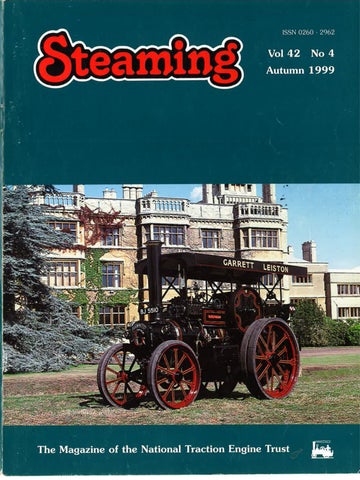
The Garrett company's contribution of steam vehicles to World War 1 consisted of 5 ton wagons and 4hp tractors. The latter were ordered rather late on in the conflict, so by the time the Ministry of Munitions took delivery during the summer of 1918, few would have the opportunity to do much angry work. John Maund photographed 33296, sent off to the Ministry in April 1918, in the peaceful sunuundings of Old Warden Hall during the Bedford club's rally in 1997.
STEAMING Autumn 1999
179
Trust News •
From the Chairman Sorrow and Joy As I write my last notes as your Chairman, the Dorset event is just over and it was wonderful to have a dry event and a feeling that it had regained a sparkle that had been missing in recent years. The way the site was laid out with plenty of space is much due to our Rally sub-Committee working with the GDSF Committee in a way that I felt impossible when they first suggested it. I was wrong and thank those with greater faith for their successful efforts. During the show we received news that Alan Thomas of Camborne had passed away. I looked up to him as the oracle of all things to do with the history of our engines. He could always come up with the answer. I have had the privilege of being your Chairman for six years and now feel it time to hand over to somebody fresh with different ideas. I have enjoyed my period of office greatly and met so many dedicated people, who give so much of their time and thought to ensure our hobby continues. I shall miss the cut and thrust and good natured teasing that is an essential pail of the serious elements of having fun. I shall not miss the 500 mile journeys to our various business meetings that living down In West Devon has meant. I hope to carry on being of service to the Trust in a way, indeed, that all members can — by using whatever expertise they have to promote it and show us to be a sane, responsible and knowledgeable body of people. Our current meetings with the Department of Trade and Industry to mitigate the effects of new legislation, not intended to affect us but nevertheless so doing, has made them aware of our existence and of the huge scale of the heritage steam movement, of which they were totally unaware. We have now earned their respect by the way in which we have approached the problems and fought our case. I thank everybody who has helped and used their influence to fight the case, and in particular Jim Newnham, who ran with the ball alone for several years to 180
the detriment of his livelihood. With commitment like this the Trust will respond to the demands placed upon it and there are many others doing the same. Please try to come to Lincoln for the Annual General Meeting to welcome a new Chairman and send the old one on his way. (Richard Sandercock, Chairman)
work, you would be most welcome. (Andrew Semple, Chairman, Rally subCommittee)
Engine Owners Column Technical Board
Rally Organisers Column Rally sub-Committee This year appears to have been a much better one for many rallies, and attendances are up. This may be due to the better weather enjoyed by many events this year. Let us hope the Millennium year events also enjoy good fortune. The last few years have seen considerable problems in obtaining good quality, relatively smokeless coal for use at rallies. A number of events have received adverse comment due to smoke and soot from the coal they have provided. There is now available an excellent coal which many will mistake for Welsh deep mined coal — sadly it is imported, but I have used it and found it worked well. The Trust is in liaison with the importer of this coal to provide a package for rallies ready for next year. At this time of the year I like to thank all those people who provide input to the Rally sub-Committee. To the Committee itself and many others I offer my thanks for your time end knowledge. The ever increasing complexity of laws which surround us means we rely more and more on professional advice. When is a rally field a public place? Why is it part of the highway? Because of the potential problems involving insurance these questions have to be answered. We always welcome more help on the subCommittee, so if you feel able to contribute, especially with some specialist knowledge relevant to our
Firstly, an explanation to readers who expected to hear from me in the Summer edition of Steaming; my contribution went into my fax machine but where it went after that is something of a mystery — at any rate it apparently never reached the Editor and, to quote the Immortal Bard, the rest was silence! Be that as it may, things on the legislative front have moved on and the position at the time of writing is as follows. The Pressure Equipment Regulations, which were supposed to be published at the end of May, finally appeared half way through July. They did not contain any more nasty surprises and do include an amendment which excludes pressure equipment manufactured by a user for his own use in the course of his leisure activities. This may be of more help to model builders than full size traction engine owners, but is a step in the right direction. Other matters which are still subject to negotiation are based upon interpretation of the Regulations and a lot has been achieved, including a ruling that traction engines etc, originally manufactured in the UK, exported and used outside the EU, and then re-imported, will not have to undergo potentially prohibitively expensive 'conformity assessment'. Also, private Individuals will be able to import engines from anywhere provided they are for their own use in their leisure activities. Another important point relates to major repairs and restoration of boilers and their various pressure attachments. The manufacture of a completely new boiler will require conformity assessment but 'in-service repairs and modifications' to existing equipment will not. The question is, Autumn 1999
STEAMING
how extensive can a repair be before it becomes a new boiler? At the time of writing (8th September) a proposal has been put forward under which anything that retains essential original parts will be regarded as an in-service repair, and the use of more modern or more suitable materials, or alternative joining methods — for example, welding instead of riveting — will be regarded as in-service modifications. These and many other points are subject to further discussion with the DTI and HSE and may well have been resolved lone way or the other) by the time this report appears in print. Considerable progress was made at a meeting on 9th August at which representatives of the NTET, Heritage Railways Association and model engineering interests met officials from the DTI, HSE and DETR. Further meetings are scheduled for 4th October and 8th November. A much clearer overall picture should have emerged by the time of our AGM in November. Since the bombshell of the extended scope of the Pressure Equipment Regulations beyond that of the Directive hit us at the beginning of April, thanks to the efforts of a number of leading political figures, including Lord Montagu, Lord Inglewood, Baroness Gardner, MP STEAMING Autumn 1999
Alan Martin's Collection I am sad to be writing these words, as Editor, because it should have been Alan giving a caption to another of his pictures. He died in July, and a good friend offers a memorial elsewhere in these pages. When I took over Steaming, in 1980, Alan's series of pictures in the early pages of each issue was quite new, and I was much encouraged by his friendliness and • eagerness to help a new boy. Every back end, along would come another selection of pictures for his 'spot, as Alan liked to call it, for the forthcoming four issues. And, of course, there was a certain type of picture that appealed to Alan. He could comment with authority on virtually any photograph of any engine you put before him, but his preferences for his collection showed as the best of poses from Victorian and Edwardian times, and the crisp results of the works' photographers who attended St Nicholas Works, Thetford, and the Steam Plough Works at Leeds. With Alan's passing, it is time to close this series of pictures. He had already sent a further batch, but I take the liberty of choosing the final one — of the legendary Burrell CLYDE, a picture no doubt somewhere in his collection. It is picked now because the machine was one of his favourites, an engine he would avidly enthuse over, and one which he was always so eager to see in developing miniature form in the shape of Malcolm Frost's yet to be completed 4-inch scale model. The picture itself epitomises Alan's passion for heavy haulage and Burrell engines. CLYDE was works number 3419, built in 1912 for William Kerr & Co of Mavisbank, Glasgow, and a huge 10hp contractors type compound road engine. The machine was unique, specially built for Kerr for handling the large indivisible loads that needed moving from Clydeside yards to docks and elsewhere. This picture is of the engine showing a bit of brute force on the hilly streets of Greenock in 1929. Alan would have enthusiastically drawn our attention to the method of coupling to the load with separate bars and chains, the lack of steering to the bogies, and the marks on the granite setts where the load has been dragged forward. Ash appears to have been put down around CLYDE to give her a better grip. Its quite likely that many of the watching crowd would have known of and appreciated the aura that surrounded that big Burrell. Even if it had to be from photographs, Alan certainly did. 181
Gillian Shepherd, and engine owner and Trust member, Robert Goodwill MEP, have come to the aid of the steam preservation movement. This support has put pressure on the government and consequently has been invaluable in our negotiations with the various government departments. I would like to express our gratitude for what they have done so far and for their continuing support in our efforts to get historic steam driven road vehicles and railway locomotives removed from the scope of the Regulations altogether. Thanks are also due to fellow Committee members and others who helped to put pressure on politicians and got the matter raised in the national press. (In parenthesis, maybe I should mention here the Sunday Telegraph episode. Things did go a bit haywire in June when I was contacted by Christopher Booker of that newspaper, who then quoted me as saying that the Regulations would put an end to all steam preservation. I said nothing of the sort, of course; what I did say was that they are likely to add enormously to the cost of major repairs and restoration of traction engines and railway locos. Fair do's, my correction was published in the next week's edition but, inevitably, on the 'Letters' page where it was not so conspicuous. In the meantime I got a bit of stick from members, but they do say that any publicity is good publicity!) The aim mentioned at the end of the last but one paragraph must be a longer term exercise, which we will need to try to achieve before the Regulations come fully into operation in May 2002. It is expected that the
European Commission will review the Directive shortly before that date, and the best advice is that there will be the time to try for exclusion of historic steam driven road vehicles and railway steam locomotives, under Recital 9 of the Directive. In the meantime, our present damage limitation exercise must continue. To change the subject, the new regulations prohibiting the supply or use of chrysotile (white) asbestos have been published and come into force in November. I am pleased to report that our application for a derogation for boiler door joints has been successful and we will be able to go on using them until January 2004 or an acceptable substitute comes along, whichever comes first. It will not, however, be possible to buy other asbestos based gasket materials after 24th November this year. Interestingly, this is yet another case of our Government going beyond the requirements of an EU directive, this time bringing in the ban more than five years before the rest of Europe. Lastly, my thanks to those (very few) members who responded to my appeal for details of cases where incompetent boiler inspectors have caused them serious problems. I apologise for not responding to each of you, but since the Pressure Equipment Regulations hit me in April, all of my available time (and more) has been taken up with the damage limiting exercise. I will be returning to the subject shortly, when we have another meeting with the DTI, FISE and insurers, to press them for higher standards, so please keep the reports coming in. (Jim Newnham, Chairman, Technical Board)
The National Traction Engine Trust Engine Owners sub-Committee The year 2000
ENGINE OWNERS MEETING will be held at
Willoughby Village Hall, Willoughby, near Rugby, Warwickshire
RTA versus Public Liability Insurance Further to Steve Bullman's letter published in the last issue of Steaming and to which I replied through this column, he has asked me to make it clear, I think re-iterate, the difference between Road Traffic Act (RTA) cover and Public Liability insurance. He also asks that I explain which elements of public liability cover are affected through RTA cover because 'there is confusion on this issue'. Firstly, and in simple terms, Public Liability is used to insure items that are static, that is, not capable of moving under their own power. This form of cover is used to protect the public from accidental damage or injury caused by faulty erection or presentation of an exhibit, poorly protected components or fittings, or a misdemeanour by the owner or exhibitor. Importantly, before payment is made to the injured party, blame has to be proven and therefore lengthy delays may occur before compensation is forthcoming. Secondly, RTA cover is a requirement in UK law for those self-moving items that are used on the road or in a place to which the public has access. In UK law there is no limit to the level of insurance cover to the Third Party. Usually, but depending upon circumstances, payment to the injured party is made before blame is assigned and the insurer then embarks upon a process to reclaim his loss from the 'guilty party'. However, there is an intrinsic element of Public Liability insurance cover within the RTA cover that applies when the insured item is static, for example, in the engine line-up or simply standing on the rally site, whether in steam or not. This ensures that, for example, someone tripping over badly placed coal sacks or tools and implements would be covered, if blame were assigned to the owner.
(or an alternative venue in the same area)
Driving Licence requirements
on Saturday, 29th January 2000.
There have been a lot of rumours doing the rounds this year suggesting that the DVLA has introduced changes to the age limits and class of licence requirements for steam propelled vehicles. I can tell you that this is not so. However, there has been a problem caused by the DVLA publishing an early version of (heir D100 form that omitted to mention steam vehicles.
All owners, crews, potential owners and anyone else interested in the working of preserved road steam vehicles are welcome to attend - whether they are members of the Trust or not. Please see the Future Dates column, and the next issue, for further details. 182
Insurance Officer's Notes
Autumn 1999
STEAMING
This has subsequently been corrected. I quote below from two items of correspondence I have received from the DVLA on the subject. Received by e-mail on 27th May 1999 from Mrs Y. Hargest: 'The minimum age requirements for holding or obtaining a driving licence are specified by Regulation 7 of the Motor Vehicles (Driving Licences) Regulation 1996 (Statutory Instruments 1996, no. 2824/1996). These minimum ages make no reference to steam propelled vehicles. Consequently, it is not possible to give a definitive answer to the minimum age requirement for a steam vehicle. The regulations specify the ages for small, medium and large goods vehicles. 'Steam propelled vehicles are only specified for driver licensing purposes in regulation 48(1((a( of the above Regulations. This exempts the holder of category B entitlement from holding Large Goods Vehicle (LGV) driving entitlement. While this exempts the driver from LGV entitlement, a steam vehicle that exceeds 7.5 tonnes would be subject to the minimum age requirements for a large goods vehicle (that is, 21 years or over). 'In the absence of a specific age and since the majority of steam vehicles are large and heavy in construction, many insurance companies and Health and Safety offices would take a cautious approach, that being, the driver should be 21 years or over.' Received by e-mail on 27th August 1999 from Miss S. Thomas: 'Thank you for your e-mail of the 5th August about the driver licensing requirements for steam road rollers. 'The Road Traffic Act 1988 requires that the driver of a motor vehicle when driven on a road must hold the appropriate driving licence, and, if only provisional entitlement is held, to observe the relevant provisional licence conditions. A 'motor vehicle' is defined in the 1988 Act as a mechanically propelled vehicle intended or adapted for use on roads. A 'road' is defined as any highway, and any other place to which the public has access. Consequently, it would be advisable in our view for an individual to hold the appropriate driving licence entitlement before using any of these vehicles on a road. 'Road rollers remain within category G for driving licensing purposes. A separate category G test is required to obtain full entitlement. The holder of a full category B (old group Al has provisional entitlement for category G. As a provisional licence holder, the STEAMING Autumn 1999
Breakfast on the shovel has become a popular Sunday morning feast for many SAC members at the Dorset event. This year, outside the Trust marquee, Apprentice Jenny Massey makes sure SAC chairman sets himself up for the day with bacon and eggs. George Chiverton's Ruston Proctor tractor made a splendid job of the frying. (Roger West)
driver must obey the provisional licence conditions. However, regulation 15(21 of the Motor Vehicles (Driving Licences) Regulations 1996 exempts the driver from the need to be supervised by a qualified driver when driving a vehicle that falls within category G, irrespective of its propulsion. 'Regulation 48(i( (a) of the Motor Vehicles (Driving Licences) Regulations 1996 exempts the holder of category B from the need to hold Large Goods Vehicle (LGV) driver licensing providing the vehicle is 'propelled by steam'. These are not the Trust's words, nor are they mine — they come straight from the DVLA. Consequently, the NTET Codes of Practice remain unaltered. Breakdown Recovery Scheme for Members In seeking to extend and improve the services which the NTET provides to its members I am putting the finishing touches to a Breakdown Recovery Scheme that I hope to be able to present and recommend at the AGM. Essentially, those traction engine owners or low loader owners paying a modest annual fee into the 'NTET Recovery Scheme' will have the benefit of being recovered to any
nominated place within the UK as a consequence of a mechanical breakdown rendering the equipment immobile. Those who use the NTET's steam or low loader policies with Footman James & Co Ltd already enjoy this facility in the event of a road accident. (David Smith, Insurance Officer)
Steam Apprentice Club As I write this the dust, yes DUST, of another Great Dorset Steam Fair is being brushed from both vehicles and clothes. I think many people feel that a good week was well deserved. The Steam Apprentice Club was again well represented in the Trust marquee and I thank all those who helped out this year (see acknowledgements elsewhere in this issue). Their cheerful assistance made Fiona's and my task very much easier. Unlike last year we spent less time with the very young members and more with the teenagers, and those who would be adult apprentices — an encouraging 183
sign and one which we would do well to heed. I hope that we will be able to find addresses for all those enginemen who were kind enough to look after youngsters during the course of the rally, so that we can thank you personally. If we do fail with anyone, please take this as our thanks, and also those of the young people you helped. Without your assistance the purpose of the SAC would be lost. During the course of the week I received requests from two people to be paired up with an engine, one an Apprentice aged 8 who lives in Exeter, and one rather more mature member. Please see their Situation Wanted adverts in the Small Adverts section of this issue. Our thoughts are now turning to next year's driving days. Those run this year were very successful and I hope that we can return to the seven venues used. I have already received offers of two more sites, and would like to hear from anyone who has (or knows of) a site with a few engines nearby and sufficient space to drive round on private land. Following the discussions and writings regarding young drivers at rallies I have been asked by the Anglia Vintage & Mechanical Engine Club Lu consider their version of a young driver assessment scheme which would allow youngsters to drive — tractors in this particular case. It consisted of asking the potential driver to carry out a series of sample manoeuvres under the watchful eye of an experienced driver. If successful the youngster received a badge which allowed him or her to drive at that rally in the areas designated by the rally committee. This was put into practice at the AVMEC rally over the August bank holiday and, by report, worked well. They are now working on the formation of a young persons' section by which to continue with this work, and allow them to run such schemes in the future. As stated in the last issue, I look forward to hearing from others who wish to take advantage of the provisions of the Motor Vehicles (Off Road) Regulations 1995 by forming an appropriate young persons section. (John Durling, Chairman, Steam Apprentice Club)
Treasurer's Notes The accounts for the year ended 31st March 1999 are enclosed with every members copy of this edition of 184
Steaming. You will see that, in order to provide more detailed information regarding the financial affairs of the Trust, I have changed the layout of the accounts. I am pleased to be able to report that the Trust has had a very successful year financially. There are a number of notable reasons for the exceptional level of surplus: • the 1998/99 financial year saw a dramatic increase in sales and subsequently the surplus generated also increased. • the depreciation charge for the year of £1018 relating to the Exhibition Unit is lower than in previous years, as it has been written down to a value of £1 • the Trust has benefited from a £1885 legacy due to the generosity of Mr Perry. • an increase in interest received to £2316. • the significant reduction in the cost of audit. Subscriptions were last increased in May 1993. However, I do not at this time feel that it is necessary to make a further increase. (Julie Smith, Treasurer)
The Trust Exhibition Unit It is now six years since the Committee took what was felt to be a very bold step in purchasing an exhibition unit to highlight the work of the Trust. Since then, every year, and as was planned at the time, the vehicle has been taken to numerous rallies and other events and has covered the length and breadth of the country — as well as to Eire and the Netherlands. The main purpose of the travels has been to promote the continued use of road steam engines, on and off the rally field; the recruitment of new members, and the promotion of your events with the aid of posters, handbills and the much sought after Rally List. The latter, which is published by the Trust each year, now has a circulation that exceeds 25,000. The unit also enables the presentation of a very comprehensive selection of sales items — from traction engine books to exclusive NTET clothing. These sales, backed up by support of rally organisers in giving space free of cost, provide the Income for keeping the Exhibition Unit active throughout the summer and early autumn months. Now, the present unit has become
life-expired, and a replacement is badly needed. With this in mind the Trust will be launching a fresh unit for the beginning of the new Millennium. In order to support this venture, we now seek sponsors via donations, which can be recognised by the inclusion of permanent graphics on the unit. If you, or your local engine club or group, would like to support and be involved with the only Charitable Trust that actively represents the steam engine on the road, then send donations, or write for further information, to: Robert Herring, Glebe Court, Fringford, near Bicester, Oxfordshire OX6 9RJ.
Federation of British Historic Vehicle Clubs The Federation continues to monitor legislation emanating from Brussels and elsewhere in order to take action to ensure the continued freedom of use of the roads by historic vehicles of all types. At the present time steam vehicles are relatively unaffected by impending changes in the law, there being one exception. The Pressure Equipment Directive did not look set to cause any problems for existing steam vehicles, but when the implementing Pressure Equipment Regulations, referred to by Jim Newnham elsewhere in this issue, were published in April, it was found not to be the case. The Federation had the matter drawn to their attention in detail and have been active and extremeiy helpful in their efforts to safeguard the interests of engine owners land the interests of preserved railways). Lord Montagu of Beaulieu, Geoff Smith. (FBHVC Chairman) together with our irreplaceable Jim Newnham (Chair of our Trust's Technical Board) have had further meetings with the DTI. In addition, Lord Montagu raised the matter in the House of Lords on 28th July 1999 by asking Her Majesty's Government 'whether they will seek ways to exclude historic road and rail vehicles from the proposed equipment regulations, shortly to be introduced, so as not to add regulatory burdens to this part of the national transport heritage. Discussion followed, showing considerable sympathy and support. It is hoped that further meetings with the DTI, which will be reported on by Jim Newnham, will result in an outcome ensuring that the construction and repair of historic Autumn 1999
STEAMING
boilers will be unaffected by the latest legislation. (Michael Ward, steam representative, FBHVC)
Obituaries Jimmie Houston
One of Scotland's pioneers in steam preservation, James Watt Houston, passed away at his home at Plains, near Airdrie, in August. For several years he had battled against failing health and eyesight, but he remained physically active, and was mentally vigorous to the end. The phrase 'typical Scots engineer' may seem hackneyed, but Jimmie represented the best in Scottish engineers. Highly skilled, ingenious, quick to criticise (but quicker to help) and possessed of great humour — these and much more were the attributes of Jimmie Houston. Born in 1924, he began an engineering career at the Eglinton works of A. & W. Smith at Glasgow, manufacturers of sugar mill machinery and large stationary steam engines, with production continuing to 1952. After apprenticeship, he moved to the collieries, and later to Anderson Bros, engineers and ironfounders at Coatbridge, where he spent the rest of his working life. Jimmie had a tremendous knowledge of engineering and of its history in Scotland. His entry to preservation came in 1961, when he purchased Burrell 6hp single crank 3385 from Forrest's of Bonnybridge, and upon which he lavished much effort and skill. It was at this point the seeds were sown for him to construct from scratch a traction engine of his own design. At STEAMING Autumn 1999
first a full size machine was considered, but limitations of machining dictated a scale of 9 inches to the foot. No working drawings were made, and basic dimensions came from the Garrett 3 ton tractor as given in Bob Whitehead's book Garretts of Leiston. The 3-shaft configuration was chosen, with the differential (a modified truck component) operating on the second shaft. Valve gear was the Marshall radial type, which Jimmie considered a very good arrangement. The gearing and drive to the rear wheels were based on the Burrell system, double geared on the last motion. Great ingenuity was used in incorporating scrap and 'found' material; "I took it before someone stole it" was one of his expressions. Much came from the scrap pile at Andersons, his employers, who not only tolerated the engine being built in their works during ten years of construction, but provided help and encouragement. On completion the engine was named TIGGER — a reference to the stories of A.A. Milne: 'there's only one TIGGER', as well as an allusion to Fowler's Tiger tractors. Jimmie and the tractor became famous, attending numerous rallies, and being much to the fore when the Summerlee Heritage Park was developed at Coatbridge, almost in sight of Anderson's where the machine was built. Now it is on display there, and in recent times, with health failing, Jimmie was pleased to let others run the engine whilst he described the history to incredulous bystanders. He had expressed the wish that when the time came, TIGGER should be involved in his funeral. This took place in New Monklands Cemetery, near Coatbridge, with the engine leading the cortege from gate to graveside. It forms a permanent testimonial to a fine engineer and a great character who will be sorely missed by family and friends. Our deepest sympathies are extended to his wife Ella. (Trevor Rees/Geoff Hayes)
converted into a tri-tandem. When I was needing a parking spot for my own roller it was typical of Ray that he immediately offered accommodation, although we were only slightly acquainted at that time. For a goodly number of years there were thus two Robey tandem rollers on Ray's premises. This was the beginning of a great friendship of over 30 years. Later, Ray diversified into Field Marshall tractors as well as saving any other machinery which took his eye. Eventually, advancing years and failing health meant that the roller and tractors were sold. What soon became obvious was Ray's enormous knowledge of the local railways, both national and industrial, the engines and rollers that had been used by contractors and the councils, and the steam plant employed at the Leicestershire collieries. In addition he had a great love of the Leicestershire countryside and of the historic Baptist Chapel at Barton-in-the-Beans. What shone through all this, however, was his great kindness. Raymond Simpson King's funeral service was held at Barton chapel on 30th June, with a large number attending. He is greatly missed by his wife Elsie, by myself and family and by all who had the great privilege of knowing him. (Geoff Hayes)
Alan Martin
Ray King 'You're just in time for a cup o'tea — Elsie's just mashed.' This was the familiar greeting when calling upon Ray King at Barton-in-the-Beans in Leicestershire. It was with great sadness that in June I received a telephone call from Elsie, his wife, to tell me that Ray had passed away. He was in his 86th year. The destruction of well made machinery was an anathema to Ray King. His major rescue was a Robey tandem roller owned by Wirksworth Quarries, and one which had not been
It is with very great regret that we have to record the death in July, at the age of 78, of Alan Martin. He finally lost the battle with cancer after a brave fight, and the whole of the traction engine movement has lost an eternal enthusiast, mentor, and friend. Alan was past President of the Road Locomotive Society, and a past committee member of that body and also 185
of the Trust. I think it is fair to say that Alan was responsible in no small way for the 'Heavy Haulage' part of our activities that is enjoyed by so many people at rallies today. Jim Sarney, a major force in that interest, is quick to acknowledge Alan's influence on him, and that same impact persuaded me to undertake the construction in 4 inch scale of Burrell 3419 CLYDE, which was one of his very favourite engines. I feel very sad that he will not see it finished. Alan was involved in the movement from the very beginning, joining the Road Locomotive Society in 1953, and the National, as soon as it was formed, a few years later. He was involved with the first rallies at Andover and Appleford in 1953, and together with Eric Fillmore, planned some of the early events designed to keep the public interested at the ring side. Being a very sociable person, Alan was responsible for organising many of the social functions of the NTEC and, in particular, the annual dinners. During the sixties, seventies and eighties he was regularly to be seen on the footplate of the Barker family's Burrell Gold Medal tractor DEFIANCE. I was proud to become his friend during the mid sixties, a friendship which became closer as time went on. From the earliest times Alan gathered photographs of engines taken during their working days and this store must by now be one of the finest collections in existence. Some proof of this is the fabulous series that has appeared in this magazine over the years, and which I am sure will be sorely missed. He was never quite so interested in rally photographs. Such was his knowledge of engines and their history that he was continually being asked to identify old engine pictures for other people, and he usually managed to supply the answers. Model engineering was also of great interest to him and at one time he was a member of the model engineers society at Ickenham, based not far from his home in Eastcote, Middlesex. He produced a Fowler showmans in % inch scale, and a Garrett tractor, amongst other things. Only a few weeks before he died he attended a model engineering gathering at the Burrell Museum at Thetford. Apart from service in the Royal Navy during the war years, Alan's working life was spent in the City of London, working for various insurance companies in senior positions. He was a member of the Masonic movement, and — little known to his engine friends — a Freeman of the City of 186
London, although I don't recall him ever exercising his right to drive a flock of sheep over London Bridge! Alan was very proud of his family, and at the time of his death was a husband, father, grandfather and great grandfather. Our thoughts and prayers must be with his wife Diana, his children Andrea and Raymond, and their families, to whom we send our condolences. (Malcolm Frost) Harry Parkin Older members who visited Yorkshire and north midlands rallies in the early 1960s will recall two Foden wagons that, with their bright red liveries, were very similar in appearance — the late Walter Fearnley's 13120, and 12364 of 1926, rallied by Harry Parkin of Castleford. It was with sadness that enginemen heard of Harry's passing as they gathered at this year's Pickering rally. He was 74. Harry was a wagon driver all his working life, and had a great love of ones that were Cheshire built. He had travelled to Pickering many times, with the steamer in the early somewhat carefree times, and latterly with one of his Foden vintage commercials. His son David was encouraged in preservation, and after the Foden had gone, together they bought and rallied Sentinel S4 8942, before that too had to go through ill-health. Our sympathies are extended to Harry's wife Edna, his son David and all his family. (Derek Rayner) Alan Thomas
Alan Thomas, of Camborne, Cornwall has died, age of 52, after a sudden recurrence of an earlier illness. On 8th September several hundred of us gathered to pay our last respects. His coffin was borne by Dennis Warren's Foden steam wagon for the final part of the journey; senior members of the West of England Steam Engine Society lined the path as the coffin was carried to the chapel. I first met Alan about thirty years ago, when he produced a calendar illustrated with photographs of traction engines. I called on him, to collect one, and this was the start of a long and much valued friendship. Alan was essentially a private person, although in contrast he was open and generous with his considerable photographic collection and the vast store of knowledge that he had accumulated about engines. His ability to recall detail was formidable. Only a short while ago I rang him to ask about a new engine that had been seen in the area. I began to quote the registration number, but he stopped me part way through; "there is only one engine with those letters in the registration" he said, and was able to tell me all about it. Alan contributed articles, photographs and diary dates to several magazines and newsletters. In 1974 when I had to give up the post of newsletter editor for the West of England Steam Engine Society, Alan took over from me and the newsletter flourished to become the very popular and comprehensive magazine Steam Up. He also gave freely of his spare time to stage many very enjoyable and informative slide evenings, both for WESES and other clubs. From steam engines his interest expanded to the fairground and many other sides of the preservation world. On many weekends Alan's voice was to be heard giving the commentary for the engine parades at rallies. He had no need of notes — he had all our names and the details of our engines committed to memory and would always strike the happy balance between being both informative and interesting. Despite his illness, his commentary at this year's WESES rally was as clear and concise as ever. Trevithick Day was another of Alan's commitments. He was responsible for inviting and organising the very popular steam engine content of this event. On this occasion he always wore a boiler suit and greasetop hat, yet it was only very rarely that Alan had any hands-on contact with engines. His enthusiasm was for the historic detail, the perfect photograph and the carefully organised and well Autumn 1999
STEAMING
presented assembly of engines. I shall miss his Christmas cards, for amongst the traditional scenes, his would be a photograph of an engine, often one which we had recently discussed. But it was as Steam Secretary to the West of England Steam Engine Society that Alan gave so much of his time. He took over the tasks of inviting owners to bring their engines to the rally, compiling the catalogue and doing the commentary. The fact that this section of the rally flourished to an extent that not one of us could have foreseen was entirely due to Alan's commitment and gentle persuasion. I last spoke to him just after this year's rally and he talked of his plans for next year's event. It was his intention that one hundred engines would attend the rally in the year 2000 — the club's 45th. We should do our best to honour his wish. Our condolences go out to his family. (Charlie Daniel)
Dorset appreciations In contrast to the rather wet conditions that prevailed at the 1998 GDSF, it was fine, sunny and a little dusty when the small army of Trust helpers said their farewells at the end of this year's event. Again, many hours of volunteer work had been put in at the NTET marquee, merely for the perk of being on site and having some time for one's own exploration. Sincere thanks go out to all those who helped many of the Committee members. At the Trust's book sales stands — Stuart Gaines, Andy Hampton, Stephen Snook and May Wright. In the hospitality area, dispensing coffee and tea, Jo Tilling led Wendy Chapman, Joyce and Hazel Hullock, and Val Wingate. Lots of other necessary tasks were covered by Paul Cook, Peter Cooper, Les and Rita Dickens, Ann Herring and Tony Flowers. Sue Cook looked after new memberships and renewals, assisted by Celia West. The Steam Apprentice Club's corner was led by Fiona Durling, helped by Emily Crampton, Mark Hilditch, Elaine Massey, Barry Sumsion and Alan and Carol Woolsey. Outside the tent, we give thanks to Brian and Christine Wells for yet again generating the electric power we need inside, and to Colin and Jay Knight for arranging an ever changing stream of visiting engines and crews to stand outside the marquee, on the excellent open space that enabled the public to get close to the exhibits. Pat Jenkins was good enough to allow his Ransomes steam wagon engine and STEAMING
Autumn 1999
Here's a cheap way to get nearer to the Saturday night showman's line up at Dorset. A few rolls of gold tape wrapped around the awning supports and stays, fix some twinkling Christmas lights and borrow a piece of chalk to bestow a name and you can be alongside the best, attracting the reverence of a trusting public. And then the next morning you can tear it all away before the Purity Police descend to question you on conversions. This is Andy Melrose's Marshall vertical boilered tandem roller 87125, taking part in a gentle leg pull at this year's GDSF. Jerry Hawkins was questioned by the PP after a tip-off, but it is understood they will not be pressing charges.
boiler unit to be the object of really close-up inspection back inside the tent. Finally, we record the Trust's appreciation of the help and considerations given to us by the organisers of the Great Dorset Steam Fair. Thank you Michael and Martin Oliver, and engine section manager Dave Allen.
Celebrating 50 years The year 2000 will no doubt see both familiar and new steam events in the summer's preservation calendar, and, indeed plans are well under way for an unusual steam reunion on Saturday 29th July 2000, writes Jeffrey Shackell of Witney, Oxfordshire.
The gathering will mark the 50 years since the late Arthur Napper and his neighbouring friend, the late Miles Chetwynd-Stapleton, had their famous race with two traction engines on 30th July 1950, at Appleford — in the then county of Berkshire. This and the other races held over the next couple of years are generally regarded as the formation and beginning of the preservation scene we have today. A selection of engines has been asked to gather at Appleford to commemorate the 50 years and the other early events held in this small village bordering the River Thames. The engines detailed to attend all have the historical connection of being at these events during the first decade of preservation. They will include Marshall traction OLD TIMER, the engine used by Arthur to win that first race. Another of Arthur's former engines, Fowler agricultural TOMMY, 187
will make the journey from Shropshire to be present, and another long distance traveller will be Wallis & Steevens Expansion EILEEN THE ERRING. It was this engine, then owned by Giles Romanes, that challenged Arthur to a second race in 1951 and caught the public's imagination for this new leisure activity, the Traction Engine Rally. Appleford Parish Council has kindly granted the use for the day of the recreation ground, almost adjacent to The Carpenters Arms public house, but the limited space will preclude the event being subscribed with a long list of engines. It is hoped, however, that there will be in the order of fifteen engines in steam for inspection. The day will take place on the lines of events in the early 1950s, being for one day only, and with no other preserved items on show. There will be none of the other ancillary equipment associated with today's events to distract from the day's peaceful proceedings. This is a day for the traction engine and the traction engine enthusiast. A free gate is on offer and there will be refreshments available. Later in the day it is hoped to have a road run to the village of Sutton Courtenay. A photographic display of engines at early events, together with some of the pioneering traction engine owners, is planned, and the loan for copying and presentation of interesting material would be gratefully welcomed. Anyone wishing to contribute should contact: Jeffrey Shackell, 41 Kingsfield Crescent, Witney, Oxfordshire OX8 6JB (22 01993 773088 evenings).
From Down under to Brighton There will be a rare chance to see a very early Australian-built car take part in the Veteran Car Club's London to Brighton Run in November. The steam carriage was built in 1899 by J. & D. Shearer of Mannun, South Australia — makers of agricultural machinery and implements — and was one of the first cars to be built in the colony. The carriage is coming to the UK specially for the Brighton Run on Sunday, 7th November 1999, with its fuel and land transport being sponsored by the Trust in association with the Herring brothers of Bicester. The Run is expected to be the Shearer's 188
only public appearance during its brief time in Britain.
t oos . Wet
London Social Meetings This month sees the Trust's social meetings for the London area recommence. They are again to be held on the second Tuesday of the month throughout the winter period, but not in December. The venue continues as 'The Duke of York', 35 New Cavendish Street, London W1. This pub is at the corner of Westmoreland Street and opposite the end of Welbeck Street. The nearest tube station is Bond Street (Central Line) — walk north from the exit there for about 500 yards along Vere Street and then Welbeck Street. The room is available for Trust members from 7.30pm, with the meetings starting at 8.00. Non members are welcome to attend. The programme of illustrated talks is as follows: • Tuesday, 12th October — The Kew Bridge Pumping Station, from early days until the pumps stopped work, and then on to preservation and museum days and a look to the future. • Tuesday, 9th November — Memories of Cambridge railways. Retired driver Bill Last looks back on the local scene he knew; two earlier talks given by Bill have been full of interest. • Tuesday, 11th January — Road making as it used to be, by Paul Green. We are all familiar with the steam roller but net perhaps the rnetheds used to build the roads the machines worked upon. Details of the meetings from February will appear in the Winter 1999/2000 magazine. (Bill Timmings, London meetings organiser)
Future Dates AGM 1999 This year's Annual General Meeting is to be held at Lincoln, and other events are arranged for the weekend. The Annual General Meeting of the Trust will take place at 2.00pm on Saturday, 13th November at the Bishop Grosseteste College, Newport, Lincoln. This is located one mile north
BISHOP GROSSETESTE COLLEGE
Newport Gate EASTGATE
OTEL
AIS
I4AW.1).
ualbn
of the city, on the east side of the Al5 road, entering Lincoln from the north, just after the road Newport crosses the 81273 Yarborough Crescent/Long Dales Road. Ample parking is available on site, or in adjacent roads. Look out for the NTET logo within the college complex to find the meeting room. Formal Notice of the meeting, the Agenda and the Annual Report and Accounts will be distributed with this issue of the magazine. In the event of any voting being necessary at the AGM only current members will, of course, be eligible to vote. Members diC LI ICI erure asked to ensure tnat tney have their membership cards with them at the meeting. Members are referred to the Summer issue of Steaming (page 129/ 130) for details of the new procedure for nominating Officers of the Trust. The due dates have, of course, passed by the time these words are published, and the names of the nominees, together with any Motions under Article 16, are to be found in the Report and Accounts. Tea, coffee and biscuits will be served at the conclusion of the AGM at about 5.00pm. The Trust's Exhibition Unit will be open at the College for the period prior to the AGM for the sale of books, videos, etc — a good chance to stock up on winter reading and viewing and also solve a few Christmas present problems. A selection of the Trust's trophies and shields will be presented after the meeting, or at other appropriate times during the weekend's activities. Autumn 1999
STEAMING
Other arrangements have been made for the Saturday and Sunday for members wishing to make an out-ofseason engine weekend of it, and meet up with old friends or make new ones. On the Saturday, we are grateful to the Curator of The Museum of Lincolnshire Life for the enthusiastic invitation to a special visit to the museum from 10.00am onwards. It is hoped to have several of the museum's engines in steam for the occasion, and guided behind-thescenes tours will be available. The Museum has an excellent assembly of exhibits from the traction engine makers of the county, both of steam and other products, and members are recommended to allow plenty of time to explore the complete collection. Don't miss the huge framed display of show medals — is it from Rustons, or who? The Museum is located on Burton Road, on the north side of the city; best access is from the A46 Lincoln
double room per night, with breakfast, and members should make their own with the hotel bookings direct
fa 01522 520341, fax 01522 510780, and mention NTET). Eastgate is adjacent to and north of the Cathedral. There is a wide variety of other accommodation available in Lincoln. We are most grateful to Robert Crawford for his kind invitation to see his extensive collection on Sunday, 14th November. Some of Robert's own engines will be in steam, and
joined by more from other nearby owners. We understand some rare and not often seen machines will be about
this morning. A long morning's viewing is in prospect, for the Crawford collection extends to virtually all aspects of agricultural engineering. The premises are at Frithville, about five miles north of Boston, and some thirty miles from Lincoln. Members are welcome from 10.00am, and we look
this issue's Engine Owners Column, the problems that can potentially affect our enjoyment of road steamers are not getting any lighter, and the meetings are a good way of exchanging views, and give the subCommittee an insight into the current concerns of members. This is a forward notice of the next meeting in the series, to be held on Saturday, 29th January 2000. The venue is yet to be confirmed, but will hopefully be at the Village Hall, Willoughby, Warwickshire, and if not somewhere in that area, not too far from the junctions on the midlands motorway network. Please make a note of the date now, for it will be only a couple of weeks away from the meeting when the next, Winter, issue of Steaming arrives through members' letterboxes.
forward to another most interesting AGM Sunday morning.
bypass. Half price admission will be available on production of your NTET membership card. There is an excellent cafe on site — a good spot for
Engine Owners Meeting
lunch before the AGM in the afternoon. For those wishing to stay in the area overnight, the Trust has reserved a number of rooms for members at the Eastgate Hotel (a Forte Posthouse), Eastgate, Lincoln LN2 1PN. The negotiated rate is £66.22 per
The informal winter meetings for owners and crews, arranged by the Trust's Engine Owners sub-Committee in recent years, have proved very successful, with much useful comment and discussion taking place. As can be seen from the topics covered in
Personal Michael Lane, author of many histories on traction engine manufacturers, has moved. His new address is 1 The White House, Lambseth Street, Eye, Suffolk IP23 7AG.
Poor Steaming Red face for the Editor, who erred when marking up the photographs seen on pages 165 and 166 of the last issue, resulting in them appearing over the wrong caption. Any other time, at the next stage, our printers would have found it impossible to fit the picture to the available shape, and have corrected the error, but here were two pictures of virtually the same size and proportion! No doubt readers soon found the right caption, but apologies nevertheless.
New Members
Robey 6 ton steam wagon 42567, built in 1925, pictured by Dave the 1993 Carrington rally in Lincolnshire.
STEAMING Autumn 1999
Bagley at
A sincere welcome is extended to the following new members who have joined the Trust during the last three months. We hope they will gain much friendship, information and enjoyment from their membership over a period of many years. The Membership Secretary is always pleased to put members 189
TRACTION ENGINE INS ANICE
Footman James is the most progressive innovato r for Classic, Veteran, Vintage and Historic cars, motorcy cles, military, commercial and steam vehicles. Our policies ensure peace of mind with top qua lity cover at competitive premiums. Contact, Jayne Jordan or Matt Potter for a quo tation from the N.T.E.T. appointed Insurance Broker FOR COMPLETE PEACE OF IMINIO AMC) INDI
VIDUAL SERVICE
CALL US TODAY
The Enthusiast's Insurance Broker
FOOTMAN JAMES TEL.. 01 21 561 6218 FAX-0 1 2 1 550 08 1 4 THE MARKET LEADER 190
WATERFALL LANE CRADLEY HEATH WEST MIDLANDS B64 6PU Autumn 1999
STEAMING
in touch with one another by fowarding mail.
S.J. Peach, Glossop, Derbyshire W.E. Fitter, Warrington, Cheshire J. Brierley, Chester K.F. Fisher, Beams, Texas, USA P.J. Cooper, Tutbury, Staffordshire J. Severs, Penrith, Cumbria J. Pell, Winterton, Lincolnshire C.P. Stocker, Chesterton, Oxon J.L. Woolf, Ballymena, Co Antrim A.E.J. Gibson, Norwich D.J. Burch, Stowmarket, Suffolk D. Robertson, Corby, Northamptonshire F.W. Hardern, Holmes Chapel, Cheshire S.G. Don, Ware, Hertfordshire D. Murray, Staines, Middlesex J.F. Freeby, Brixham, Devon T.J. Pywell, Leicester C.J. Ferris, Hereford A.J. Potter, Holt, Norfolk Mrs A.G. Wearing, Yateley, Hampshire J.E. Atkinson, Launceston, Cornwall M. Lugg, Billingshurst, West Sussex D. Curryer, Wolvercote, Oxfordshire E. Marshall, Warrington, Cheshire I.P. Nash, Chesterfield, Derbyshire P. Fordham, Bury St Edmunds, Suffolk P.J.I. Walker, Horsted Keynes, West Sussex C. Pank, Gt Yarmouth, Norfolk W.M. Barnes, Tewin, Hertfordshire K. Dobb, Mansfield, Nottinghamshire P. Newman, Slinfold, West Sussex D.J. Day, Ongar, Essex Mrs J. Gunn, Horsham, West Sussex A.J. Taylor, Kidderminster, Worcestershire D. Piggott, Royston, Hertfordshire S. White, North Ockendon, Essex C. Harris, Yeovil, Somerset M.C. Woolley, Plymouth, Devon A.B. Jones, Corwen, Denbighshire A.J. Wells, Stroud, Gloucestershire Miss T. A. Billings, Reading, Berkshire T.W. Nelson, Magdalen, Norfolk S.B. Ellway, Liskeard, Cornwall P. Moody, Whitley Bay, Tyne and Wear J. Fitzgerald, Berkhamsted, Hertfordshire A. Hurrell, Chelmsford, Essex Mrs M. Hurrell, Chelmsford, Essex J. Brown, Kelty, Fife E. Collins, Tadcaster, North Yorkshire P.R. Tansley, Leicester P.O. Heath, Coventry, Warwickshire T. Bellamy, Checkley, Staffordshire D. Fry, East Wittering, Sussex A.J. Ostler, Milton, Cambridgeshire T. Attwood, Gloucester G.S. Starr, Bodmin, Cornwall F.C. Boucher, Wellingborough, Northants I. Jarvis, Swanley, Kent D.L. Sheward, Worcester J.M. Hutchings, Kings Langley, Herts M.J. Comben, Farnham, Surrey M.P. Fox, Esher, Surrey Mrs D. Groves, Bolton, Lancashire R.E. Just, Falmouth, Cornwall J. Kuitwaard, Bergen, Netherlands M.R. Claringbold, Deal, Kent P. Norrington, Tenterden, Kent W.K. Donald, Sittingbourne, Kent A. Castle, Ashford, Kent S.G. Aldred, South Croydon, Surrey J.H. Foreman, Canterbury, Kent Miss J. Chamberlain, Ashtead, Surrey B. Ives, Olney, Buckinghamshire P. Griffiths, Much Wenlock, Shropshire
The National Traction Engine Trust's
1999 AGM will be held at 2.00prn on SATURDAY, 13th NOVEMBER 1999 at The Lecture Hall, Bishop Grosseteste College, Newport, Lincoln. Please refer to the formal notice in the Report and Accounts which are distributed with this issue for details of the agenda etc, and to the Future Dates column for notes on the arrangements that have been made for the rest of the day and on the Sunday.
E. Trendell, Heacham, Norfolk M.B. Jones, Droitwich, Worcestershire E.G. Owen, Walton on Thames, Surrey P.G. Wheeler, Llanmaes, Glamorgan A.J. Jarvis, Stoke sub Handon, Somerset Denis Harang, Les Bordes, France R.W. Piper, Basingstoke, Hampshire F. McNab, Co Galway, Eire T. Hagger, Bournemouth, Dorset R. Stanier, Weymouth, Dorset R. Frampton, Bournemouth, Dorset W.M.Damen, Dorchester, Dorset M.C. Bond, Bournemouth, Dorset J.C. Giles, Axminster, Somerset B. Burden, Dorchester, Dorset Mrs C. Pudney, Brede, East Sussex T.H. Thompson, Hexham, Northumberland G. Chiverton, Ringwood, Hampshire S. Grant, Fordingbridge, Hampshire
STEAMING past OUR MAGAZINE 25 YEARS AGO
The September 1974 issue mentioned the formation of the Road Roller Association. The founders sought to dispel the notion of the machine being poor relation in the traction engine world, claiming average rally-goers had a warm place in their hearts for the steam roller. It was, of course, the only one of the various types found on the rally field that they would have been likely to have encountered in use, both by nature of a roller's workplace and its common survival to the 1950s. Twenty five years on those reasons have passed, but it is surprising how many still refer to modern rollers as steam rollers. In New Zealand a remarkable re-enactment of the Coleridge Run had
T. Tynan, Co Carlow, Eire J. Maddrell, Port St Mary, Isle of Man B.M. Corcoran, St Albans, Hertfordshire T.M. Williams, High Wycombe, Bucks D.C. Pope, Bracknell, Berkshire F.P. Daubechies, London M.R. Higgins, Colchester, Essex N.J. Bannister, Wareham, Dorset M.A. Hill, Pewsey, Wiltshire M.E. Salter, Southampton, Hampshire D.G. James, Swansea D. Davies, Bristol M.M. Pearson, Swindon, Wiltshire D.J. Reynolds, Haverfordwest, Pembrokes P. Taylor, Ruardean, Gloucestershire J. Butler, Newport, Shropshire J.M. Hooley, Newcastle, Staffordshire J.B. Short, Ludlow, Shropshire J.C. Kelly, Basingstoke, Hampshire
taken place — in 1914 fifteen traction engines had been used to ferry materials 35 miles from a railhead to dam building works at Lake Coleridge. Sixty years on, a survivor, 10hp McLaren 957, repeated its earlier journeys along with a dozen others, and a Mr Phillips, one of the original workers, found himself at the steering wheel again. Two Sentinels were in the news — DG4 tractor 8413 of 1931, owned in Kent by Robbie Jardine, had been engaged on contract work for brewers Whitbread Fremlins, delivering beer to pubs with an accompanying flat trailer. Completing the HCVC's Brighton run on its first outing (and with only a little injector trouble) was Sentinel 763, the earliest survivor of the marque — the machine appeared again after a long hibernation in 1998. Ernie Liversidge will be well remembered by many for his untiring services as water supplier at many Yorkshire and east midlands rallies in the 60s and 70s, but his health now dictated he give up driving his Sentinel tanker 8992. 191
STEAMING
Autumn 1999
Extraordinary Subsidence at Wigan We are grateful to George Hargreaves of Thames Ditton, Surrey, for passing to us this intriguing picture postcard of a steam roller in deep trouble. The date and location are conveniently marked on the front of the card, and that has enabled us to find out quite a bit on the unfortunate happening.
On the afternoon of Thursday 30th June 1910, Peter Ball was backing a Borough of Wigan steam roller away from the day's work in Hope Street, in the centre of the town, when, in as short a time as it takes to describe it, the machine fell through the road surface and into a hole deep enough to completely engulf it. Not surprisingly, consternation reigned as amazed workmates and passers-by gingerly approached the abyss to discover the fate of the 65 year old driver. The press reports in that week's local papers — The Wigan Observer and The Wigan Examiner — enable us to learn more of what happened, but
even though it seems there had been a twenty year period of subsidences in the town, the real cause of the collapse was still a bit of a mystery. The accident occurred in Mesnes Terrace, a quiet street at the south side of Hope Congregational Church, and just across Hope Street from the town's Market Square. The Corporation workmen had been remacadamising Hope Street, with the 15 ton roller playing its part, and 'being driven by Ball with the care that he always displayed'. At quarter past four, with the work completed for the day, the roller was prepared to return to Its shed in Sovereign Road. Ball
reversed into the Terrace, and then with no warning the crust of the road gave way and the roller disappeared tender first. Nothing was to be seen except the great cloud of dust that hung over the scene. The first to reach the spot could gradually begin to see the extent of the calamity. The cab of the engine had been torn off bodily and lay on the roadway, but a yawning cavity some twenty feet diameter had swallowed the great machine, and at the bottom of all, dead or alive, lay the driver. Within minutes the Borough Engineer, Mr Bolton, was present and directing operations. Obtaining a ladder. Joseph Rigby, the foreman, had at personal risk and disregarding peril, descended the hole and ascertained that Ball was, although so completely buried that he could not be seen. alive and able to speak to them. The steam regulator
was still on, but Rigby shut it off, 'thus removing one possible cause of making matters worse'.
Before the rescue could be started the engine had to be prevented against slipping from the position it occupied, for any movement could have meant death to Ball and the 'eager and courageous workers', by now feverishly shovelling away the earth that lay between them and the trapped man. The hole had an aperture five yards or more square, but below the surface there was a dome shaped cavity, with the crust of the road occasionally falling in as the binding gave way. The front rollers had snapped off. and were lying on one side. I imber struts were
strategically placed until chains and proper tackle arrived, and while the
The Aveling & Porter single cylinder roller in the hole at Mesnes Terrace, Wigan. The caption on the postcard includes the date 30th June 1910, so we might assume the photographer was at work on the fragile rim with his tripod and plate camera that very evening, as soon as the rescue of driver Ball had been successfully completed. At the right we see a ladder and planks and struts to steady the engine, also the bent stays to the awning. Its a good opportunity to view how Avelings suppor ted the front end of their rollers in the 1890s — the extension of the top half of the boiler barrel carried out to bolt on to the saddle casting.
192
work was proceeding police were busy keeping back a crowd rapidly increasing in numbers. The ends of the Terrace were barricaded or roped off and the horse ambulance arrived. Dr France was on the scene and descended several times to give succour to Ball — he succeeded in passing a six or seven yard long tube by which means the unfortunate driver was able to sustain himself with brandy. Shoff tly before six it was announced to the excited crowd that he had been liberated. A stretcher was sent down and after receiving such treatment as could be given by Dr France in the pit, the injured man was hoisted to the surface, 'perfectly conscious', to hearty cheers. At the Infirmary the man was found to be in the serious state expected, and a compound
Autumn 1999
STEAMING
fracture of the left arm demanded an amputation of the limb, and his condition was grave. However news the next morning was that he was a little easier — Ball had had a fortunate escape from a horrible death. The newspapers described the awful likelihood with a good technical understanding — 'had anything happened to the gauge glasses or the contents of the firebox fallen upon him, the result would have been shocking to contemplate'. Just what caused the collapse was unknown. The street had not been sewered, so no depth had been struck in the centre of the road that might have given an earlier warning, and the gas and water pipes ran at the side of the roadway. The road had been properly ballasted and macadamed. Some held that a pit shaft had been discovered, but the aperture was much too wide for that, and there was no sign of any brickwork lining. But the clean manner in which the earth had given way, and the circular gap made, gave support to the theory of a pit shaft. As everything was so dry, that put out of court the suggestion that a water course had weakened the subsoil. The Observer seemed to favour the opinion that the fall was the result of the settling down of one of the old top mine workings so common in Wigan, but The Examiner dismissed that idea, though offering few other reasons. Five years before the same roller had passed over the road and remained on it for long periods, without any indication of insecurity, but considerable settling down must have taken place in the interim. The problem of retrieving the steam roller — 'now little better than scrap' — was to be solved by taking it to pieces and removing it from the cavity that way, a task of two or three days, after which the Engineer had the problem of renovating the street surface. The excitement of the day over the local press probably said little more on the subject in later issues. The minutes of Wigan's Streets, Buildings and Improvements Committee reveal a few more details. Their meeting on 25th July 1910 recorded an application by a painter and decorator for damages sustained by loss of trade when Mesnes Terrace was stopped off (the Town Clerk was given power to settle) and they heard that the Borough Engineer had made four borings in the street, but found no evidence of further subsidence. The same Committee on 22nd August agreed to payment of a bill 'Walker Bros., dismantling steam roller, £10 19s 5d' (E10.98), so it would seem the local STEAMING
Autumn 1999
engineering firm, makers of steam winding and fan engines for the colliery industry, had taken on the delicate task of extricating the roller from its potential grave. Steam rollers are sturdy objects, so was the engine really scrap, or did it live to do more rolling? The postcard photographer didn't have much of a chance to give us, eighty years on, a good view of the roller, one on which we could see all the damage and find out just what the roller was. Just visible on the front of the casting and lying level with the road surface is Aveling's familiar rampant horse, and the older type saddle with six fixing bolts in a row shows the Rochester product to be one probably dating from pre-1895. See also the lagging plates that were fixed on such machines to the sides of the smokebox. In fact, the picture offers us a glimpse of an Aveling fitting that is rarely seen — the small hinged flap in the bottom of the smokebox that could be released by undoing a nut. It was a nice way to encourage the drivers to keep the area clean, but very susceptible to corrosion, and this one shows just
thatl Other details to observe are the 'cotton reel' steering of the time, and the fact that it is a single cylinder engine. The chimney, with a cast top, had surprisingly managed to keep intact whilst the roller was making the plunge into the cavern. Tony Brown, Records Officer of the Road Locomotive Society, kindly looked at their lists to see which of the rollers owned by Wigan Borough Council could have been the victim of the collapse. The most likely candidate is Aveling & Porter 2663 of 1890, a 15 ton single cylinder engine land which was registered EK2495 in later years), though they had another roller believed to be of similar age and type, but make unknown. From what we can see of the entombed Aveling, the Royalty number 2663 would not be inappropriate. Perhaps, once safely extricated by Walkers, it did prove worthy of rebuilding for more use. For the provision of the press reports and committee minutes from which these notes have been made, thanks are due to Mike Haddon, Industry History Officer at the History jiy Shop, Wigan.
This is Ransomes, Sims & Jefferies colonial traction engine 24436. It has recently been shipped to the UK from Tasmania, writes Tim Keenan. The 6HND class engine was outshopped from the Orwell Works at Ipswich on 29th October 1912. The machine found its way to Tasmania, possibly to the agents Duncan Loane , at Devonport, and it spent a life on threshing duties. 24436, a two speed, 7hp single cylinder engine, is in need of much boiler and mechanical work before it can be steamed again (see the Small Adverts section). In recent times the Ransomes stood derelict in the corner of a contractor's yard in north west Tasmania, where Tim took this picture in 1997. 193
Steam in Poland THE SEQUEL Derek Rayner Following a visit to Poland 1998 I was able to write in our Autumn 1998 issue on some of the road steam that is preserved in that country. The unexpected continued presence of our daughter and son-in-law, Denise and Ian, as a result of Ian's work in
All photographs by the author. Wroclaw, gave my wife Dorothy and I another opportunity to go to Poland — and to explore leads found during our first visit. Then, we had been to see the collection at Gostyn owned by Jan and Maciej (Michael) Peda, and gleaned information on other steam
The familiar British outlines of Marshall roller 83739 of 1928 were in stark contrast with the other roller displayed at Ciechocinek. Is the excessively tall chimney a relic of some stationary steam duties?
rollers and portables in the country. Further information and photographs had come from them in the meantime which would enable us to see more. So, with Ian's help, we were able to plan an Easter itinerary which included a route bringing in as many of the 'new' steam rollers as possible, as well as a visit to the pleasant city of Krakow in the south east and visits to two railway museums, one of which was narrow gauge. There seemed to be no prospect of seeing live steam on the railways this time, for we did not plan to revisit the main line steam at Wolsztyn. It was exactly a year to the day — Good Friday — as we arrived for our second visit to the Peda's at Gostyn. In the interim, they had bought another engine — an unidentifiable German built Lanz portable in quite a rusty condition. Considerable progress had been made in the restoration of their second Mlkolow steam roller and we inspected the other three engines on site — the working Mikolow roller, a well restored Ruston Proctor portable and an Hofherr-SchrantzClayton-Shuttleworth portable, on which restoration still has to be started. It was good to meet Jan Peda for the first time; he had been away on holiday in 1998. Over lunch, we continued our discussions on steam. Also since our first visit, the family had found and restored a 1900 Stanley steam car engine, and which is now on display in the Technical Museum in Poznan. Jan told that he had visited the Kemna ploughing engine we had seen the previous year near Wroclaw (which he had not known about until I had reported). and admitted to a soft spot for Kemna products, as he had worked in their factory at Breslau, the previous name for Wroclaw, many years ago. He was unsure whether the ploughing engine could be purchased, but just in case he has good connections with the Agricultural Museum at Szreniawa, near Poznan, where there is a similar complete machine, so it might eventually be possible to restore the derelict engine, using parts borrowed from the one displayed at Szreniawa as patterns. We headed north again to Srem
The second steam roller at Ciechocinek was an example of a Polish built machine — Cegielski 1039 of 1929 — but this machine had no chimney at all. Compare it with the roller by the same maker at Tarnowski Gory, illustrated on page 200 of our Autumn 1998 issue. This also is a superheated machine. Autumn 1999
STEAMING
An interesting feature of the Cegielski was this full width scarifier that could be equipped with three tines on either side. The water lifter is on the tender side and a lifting injector is mounted on the footplate.
and just before 1.30 were passing Sroda Wielkopolska; the name seemed familiar. Crossing over the main railway line we caught a glimpse of narrow gauge tracks. A quick left around a convenient roundabout and then a bouncy ride along a cobbled road brought us to station buildings, with a little smoke beyond. Just down
the line was an engine shed, and standing outside one of the standard Polish narrow (750mm) gauge Px48 class 0-8-0 tender locomotives. The timetable on display in the shed office window showed a 13.38 departure to Zaniemysl. We were just in time to witness the departure flag waving as the 1950s built loco headed off with its train, tender first, on the 14 km journey to Zaniemysl. This is a real, everyday train service, not a preservation line, and we had nearly missed it!
With the whiff of fresh steam in our nostrils, we continued north, past Gneizno, with more narrow gauge
Close up of the compound engine of the roller at Olkusz.
track, and in the station a 'plinthed up' standard gauge tank engine. At the hamlet of Wenejca a narrow gauge railway museum — this one for 600 mm gauge lines — has been established. There, 17 steam locomotives and many other items of rolling stock were viewed, before resuming our search for road steam. And so we arrived at Ciechocinek, close to Torun on the River Wisla and about 300 km from Wroclaw. By good
luck, and with inspired route finding by Denise, we drove straight to the Walce Drogownictwa Museum Parowe (Museum of Steam Rollers and Roadmaking), down a somewhat uneven approach in not exactly the best part of town. A cursory glance across the displayed exhibits revealed
motor rollers, tar boilers, earth moving equipment and four steam engines. These were two steam rollers —
Marshall S-type 83739 of 1928, with an extremely tall chimney, and Polishbuilt Cegielski 1039 of 1929, similar to the one we had seen at Tarnowskie Go►y the previous year, but in much better external condition. The port-
ables were another Gainsborough product, Marshall 56502 of about 1911, and a Lanz with no discernible
a plate carrying the legend At Olkusz, this unidentified German-built roller had ted in Poland the sugges was it h Althoug ck. headsto the M No 2121 on at Szczucin), there are machine was of Henschel build (similar to the roller questionable. many differences, so its identity should perhaps remain
identity. A young man from an adjacent house seemed to give the OK to enter and take photos, and the presentation of a copy of a small book on road rollers clinched the matter. We were happily going about our mission when he went away, to return with a folder he insisted I took away with me. It turned out to be an original typed document, prepared in 1978, about the Cegielski roller 1039, together with some photographs of it out of service at a location not specified but obviously in a council yard — probably 195
STEAMING Autumn 19.99
firmed our arrival time at the Szczucin Museum with the main man there, Marcell Bochenek. Jan Peda had already made contact on our behalf. We had intended arriving around mid-
day, but during a difficult English conversation over the phone, we eventually agreed an arrival time at Szczucin of 2 pm — and it was then not yet 10 in the morning. A look at the map offered an alternative, and with a change of plan for we headed south towards Skansen Taboru Kolejowego (Railway Museum) at Chabowka, where we knew there was another large collection of railway locos close to the Tatra mountains, and not far from the Slovakian border. We were out of luck again for live steam, but added another engine to our list tor the European Traction
Henschel piston valve compound roller 2075 of 1927 has been a resident at the Roads Museum at Szczucin, for quite a while. The steam take-off hum the top of the cylinder would be fur steam ing tar. Note the water pump drive and the strengthening ribs on the plate in front of the gear guard. in Torun — for that was where the machine seemed to have spent its working life. I was very grateful for this historic document; Ian said it probably meant that I was now the owner of the roller and entitled to take
it away — but chance would be a fine thing! However, timc was pressing and we left around 6 o'clock for the long drive back south to Wroclaw — where we arrived at about 11pm. Polish roads are slow, even the main ones, and one frequently has to con-
tend with tractors and the ubiquitous Hat 125, their tiny 650cc engines
propelling them oh so slowly. They are
still a current model, being made locally and are bought by the Poles in great numbers, being the 'people's car'. Even when new they only cost about £2,500! Saturday saw us much closer to home — some 50 km to the south west of Wroclaw, at an important rail-
way collection of around three dozen locos at Jarworzyna Slaska. Sunday's
plan was to visit Krakow for tourist reasons — and a check on the location of the steam rollers we were seeking had revealed three in that direction, plus another important one, at Szczucin, on the other side of the historic city. Thus we decided to stay the night in Krakow. We had two
machines to find, at Weilun and at Olkusz, but decided that the German built roller at Dobron, south-west of Lodz, was too far off route.
Our luck in quickly finding the museum at Ciechocinek the previous day deserted us in the township of Weilun, for we drove this way and that, to the edge of town and in circles round the industrial areas, desperately looking for a building with roof vents which matched the one on our photo of the steam roller. After an hour or more of fruitless searching for this third Mikolow roller, we gave up and headed to Olkusz, hoping for more luck in our search. Arriving there . a hrief tour of the first industrial zone brought us no sighting, but we summoned courage
to ask a chap in a road contractor's yard. From the photo I had, he realised
what we wanted and pointed the way. The roller stood outside offices in what appeared to be a large council road yard, not too far from the town's station. Pleased with this quick success, it was also good to find the gate to the yard was not locked. The roller was devoid of identification — except for the characters M No. 2121 on the front of the saddle. The machine's outline seemed familiar but I could not place it at the time, the overhead piston valve compound cylinder would need comparing with photographs back home. That had to be the end of our searching for that day — and unfortunately not too much to show for it, just one roller! We headed east from Krakow on the Monday morning, having con-
Engine Register — for there was a semi-portable by Lanz on display here. Then we were off again through very hilly country, quite unlike that in the north of Poland. Some fast driving by Ian saw us arriving in Szczucin only 15 minutes late, The Roads Museum (Muzeum Drogownictwal was by the side of the road as we came into the small town. Szczucin, like Ciechocinek, is on the River Wisla, but they are about 340km distant as the crow flies — and a lot more by river. A welcoming party was there to greet us at this embryo museum, which I presumed had been at one time, and maybe still is, the local council road depot. We met Marceli Bochenek and a lady assistant, and through a young Fnglish teacher acting as translator, the plans for the future of the site were
described and a tour of the exhibits undertaken. I could see four portables and three pLealso iuUeis, two in poor condition,
and which I recognised from the Pedas' photos as being those from Morawica — we had heard about them in 1998. There were also a number of
motor rollers, and oilier plant and equipment.
The principal display was a Henschel steam roller 2075 of 1927, in reasonable external condition, painted green and red and very recognisable by its maker's star trademark on the headstock. The two rollers from Morawica were Cegielski compound 841 of 1925 and Skoda single cylinder 9862 of 1921, the latter a design I had not previously come across, having only seen my first Skoda steam roller in Prague in 1998. I was delighted also to see that one of the portables was a Badenia, made in Germany and a new maker for me. The other had connections closer to home, being
Ransomes, Sims & Jefferies 18724 of about 1906, which was more or less
196 Autumn 1999
STEAMING
A recent addition to the collection at Szczucin, brought in from the Morawica area, is Cegielski compound roller 841 of 1925, in quite poor condition. Compare it with the picture of the similar machine at Ciechocinek. Viewed from the rear the roller appears to have two steering wheels, but the left hand one is for operating the band brake on the rear wheel brake drum. If it had a scarifier at one time, the roller has now lost it.
complete and carrying an agent's plate — ALFRED GRODZKI, WARSZAWA — and there were also two Clayton & Shuttleworth portable boilers — neither of which bore any traces of ever having been fitted with top works — works numbers 40033 of 1908 and 54606 of 1916. The organisation of Szczucin, the Foundation of Road Relics Protection,
has been raising money for some time now and has ambitious plans for a Road Making Museum, and construction work was under way at the time of our visit. A raised area was being created and its intended to display the various exhibits in a spiral as one ascends the slope. There are two displays available at present — in one building was a tableaux of road
Skoda single cylinder roller 9862 of 1921 is of a totally different design to the one pictured at Prague in our Summer 1998 issue. It exhibits certain Garrett-like features, such as the forecarriage head and front fork arrangement — though a tie-up between these two firms is not known of. A scarifier is fitted, but the stay to the axle has become detached. STEAMING
Autumn 1999
making from first principles, complete with life-size figures, tools and equipment etc, and then there is a vast collection of literature, models, photographs, uniforms, plans and many other archive items to be seen on display in the office building. The completed museum will include an enlarged section on bridge building as this type of civil engineering also comes within the remit of the organisation. The project has received little or no publicity outside Poland, for the founders of the organisation wished to have something substantial for intending visitors to see, rather than just a collection of machinery, Now, they are within sight of achieving their first goal. We learned of plans for a hotel on the site, which is not far from the station at Szczucin, located at the end of a branch line from Tarnow, and thus making easy access a possibility in 2000, when the museum is planned to open. Other queries were settled during discussions with Marceli Bochenek — it seemed that the Mikolow roller we had searched for in vain at Weilun had, because of its rarity, been moved under cover. I then felt better about our earlier failure, for it was clear we would never have found it, however long we had searched. Also, it transpired that the display at Ciechocinek came under the auspices of the same national administration and it had been decided to leave it where it is presently located, as the place is a spa town and the museum constitutes an attraction for visitors. We took our leave of this enthusiastic group of people, with the wish their ambitious plans would come to fruition. In a year to two's time, it will be one of the several developing Roads Museums in Europe and even though it is a long way from the UK, it will be worth making the effort to go and see. Over a long Easter weekend, we had covered a distance of about 1800km (1125 miles) in search of road steam in Poland, which, to say the least, is sparsely endowed with such items. I had seen six fresh steam rollers and seven portables plus the semi-portable, a good result to our second search for steam engines in Poland. Should any reader know of further examples in Poland, the Assistant Editor (and many others!) would be only too pleased to hear of them. Note — again because of difficulties in typesetting, it has not been possible to reproduce the accents used in Polish place names. 114 197
John O'Groats to Lands End - by Sentinel
were doing it for fun and this made the run comfortable for all crews from the slowest to the fastest. My wife, Wumf, did a splendid job of An introduction by the Chairman of the Sentinel Drivers Club, organising lists of bed and breakfasts at each night stop. We also decided Mick Tux worth to have three 'maintenance' days to allow crews to check over the Some of you will be able to 1955. Since then surviving Sentinels waggons. These were taken at the remember reading of a run of steam have played a prominent part in excellent Summerlee Heritage waggons from John O'Groats to preservation. The Club accepted my Museum at Coatbridge near Glasgow Lands End, organised by Tom Varley proposal and we announced the (well worth a visit), St Michaels on in 1976. I and many others have event. We had a very good response Wyre, near Garstang, Lancashire heard of the exploits of Tom (with from owners, and 12 waggons were (organised by Peter Wareing) and his Foden tractor), Dan Doncaster made firm entries. From the start I Camerton, near Bath (organised by (the S8), David Webster (an S4), wanted the Run to be not just for Margaret Goold), and where John Bert Winkfield and Arnold Brooks Sentinels, and accordingly invited Goold was very generous in helping (with their respective Supers) and entries of other makes, but sadly no our various crews, including myself, their crews. For years now people others took up the challenge! at his workshop. have said the event should be We decided to hold the event Coal was also arranged for those repeated. Many actually said they'd over the middle two weeks of May, that wanted it in Preston and take part, but the occasion never for two reasons. The main one was Camerton, to relieve the need to seemed right. that it was less likely to clash with carry enough for the whole trip. As a I felt that time was moving on other preservation events, but it was principle we said that the owners and traffic conditions were getting also on my mind that the Highlands supplied their own coal, and then more difficult; if the run was to be and other wilder areas that we were Vince Goold acted as liaison for organised, then the sooner the to pass through would be likely to be bunkering. I did not want to supply better. I made a proposal to the wetter, and less likely to be the same coal to everybody and then committee of the Sentinel Drivers susceptible to combustion. This find that it was a load of rubbish and Club to run the event in 1999 to proved to be the case. Through have a fortnight of moaning about commemorate the end of the century Devon and Cornwall there were a the blank blank coal. On the whole in which the Sentinel waggon was small number of verge fires, but all the fuel was not a problem conceived (in 1905 by Alley & were easily containable. considering the distance covered. MacLellan in Glasgow), and then The Run in general followed the Come the day to set off we had built in quantity at a newly 1976 Tom Varley route and we 10 waggons as entries for the whole established factory in Shrewsbury arranged stopping places so that we run, with another two Club members from 1914 — and which eventually covered about 100 miles a day. We taking part along the route to show ceased production of diesel lorries in weren't out to break records — we their support. I think that the owners and crews deserve great credit in that the ten that staiied all finished. Some had no problems at all, some had a few (mainly tyre problems) and a couple carried out some pretty serious rebuilding on the road. It was noticeable that the waggons suffering the most problems were either those recently rebuilt, or not used for some time, and therefore with bugs still in their systems. By A the time we had got to Lands End there were ten waggons running extremely well. P On a personal note, myself, Wumf, Clive Talbot and Pete Mellor managed to borrow David Crawley's ex-United Africa Super which happened to be the oldest waggon on the run, and the only one that had also completed the 1976 run when owned by Bert Winkfield. David, through pressure of work, was not in a position to take part but very generously offered me the A top up with water before setting out from a rather misty John o'Groat's waggon. As I had rebuilt it last year I for Sentinel S4 9003. (Richard Semple) suppose that it was a good road
,
J911.0:911:10
II I
198
Autumn 1999
STEAMING
test! I spoke to Bert before the event and learnt a few facts and a lot of stories, and I am pleased to report that the waggon behaved impeccably throughout the run. What are my impressions of the run in hindsight? When I see a map of the UK (particularly on the weather reports on TV) I still feel it incredible that 10 waggons have driven the whole length of the country 60 years (at least) since they were built. A tremendous
feeling of camaraderie and friendliness grew between the crews. Although we all knew each other beforehand to various extents, at the end we had gained a comradeship that only people that have taken part in an event such as this could appreciate. As one of the organisers, there is very little I would have changed. And now, a day by day account of the Run in the words of one of the younger SDC members.
The 1999 End to End Run Emma Goold The Cast the machines the crews Sentinel Super 5407, built 1924 (FA1803) owned by David Crawley
Mick and Wumpf Tuxworth, Clive Talbot, Peter Mellor
Sentinel Super tipper 6979, built 1927 (YH7563) owned by Derek Gransden
Derek Gransden, his daughter and son-inlaw, Kate and Julian Hopper and Richard Gransden
Sentinel Super 7954, built 1929 (PG2414) owned by Malcolm Rogers
Malcolm Rogers, Stuart Gray, Alex Joyce (America), Jim Hatfield, Verity Askham
Sentinel Super 8381, built 1930 (KF2110) owned by Nigel Hollis
Eon Heath and Jamie Stone
Sentinel DG4 8571, built 1931 (KF6482) owned by Edward Goddard
Edward Goddard, Paul Parker, Norman Shanklin, Don Bourdon (America), Andrew Goddard, Andrew and Richard Semple
Sentinel S4 8827, built 1933 (UJ2225) owned by Nigel Hollis
Nigel Hollis, Andrew Baines, Trevor Barraclough, John Hollis
Sentinel S4 9003, built 1934 (VE 9963) owned by Peter Wareing
Peter Wareing, Dick Parker, Bob Whitby, Steve Coward, Robin Wareing and Ian Whitby
Sentinel S4 9016, built 1934 (HV3865) owned by Barry Cousins
Barry Cousins, Ian Woollett, Paul Boon, John Smith and Sue Doncaster
Sentinel S4 9032, built 1934 (US5430) owned by Vince Goold
Vince, Margaret and Emma Goold, Peter and Bridget Wilcox
Sentinel DG tactor 9236, built 1936 (AAM483) owned by Gareth Jones
Gareth, Ian, Sarah and Maureen Jones; Roger, Pam and Neil Bishop
coastline was often covered with mist; John O'Groats too. Barry Cousins was unloading as we arrived and soon our S4 and Peter Wareing's came in. We unloaded and sorted out the waggon and attempted cleaning. Throughout the day the other participants arrived — Nigel Hollis with his S4 and Super, Malcolm Rogers, Mick Tuxworth with Dave Crawley's Super, Derek Gransden and Gareth Jones. Everyone was in a cheery mood and dying to get on with the run. A briefing meeting in the hotel seemed to have as its main purpose the swapping of mobile phone numbers.
Monday 10th May John O'Groats to Dornoch, 83 miles At last the day had arrived; I'd never thought it would get here. A monster breakfast was put before me, but I wasn't hungry — I just wanted to get going! By the time we got to the waggons most fires had been lit. Raising steam seemed to take forever, but group photos were taken in front of the famous John O'Groats sign, and then at last we had pressure. I drove to the roundabout, paused for another photo and that meant I could say I had driven at the 'top'. A fill up with water, and then we were off ....YES! The mist gave us a job to tell where the road was heading, and it actually disguised a long uphill drag. I thought it would be downhill, after all we were at the top of the country and coming down the map! All hydrants at the north of Scotland, for some reason,
Several of the waggons — with Barry Cousins' Shadrack S4 nearest Richard Semple's camera — in the restful overnight surroundings of the caravan park at Blair Atholl.
Saturday 8th May This was the day it took to merely get near to our starting point. We'd got up at 2.15am, and were on the road exactly at 3! I took prime position on the bed in the back of the van, the most comfy place, and slept the 170 miles to Preston and breakfast. Pete took over driving for a similar distance to Gretna Green and tea and cake, and then it was my turn over the worst section — I had to put up with the roads around Glasgow, and the sunshine turned to rain. Dinner at Pitlochry left us 125 miles to Dornoch and an end to the 12 hours of driving.
Sunday 9th May We woke up early, keen to be at John O'Groats, 80 miles away. The
STEAMING Autumn 1999
199
are sited in the middle of fields, and guess where our first water stop was? Yep, in the middle of a boggy field. My turn to uncover! The big hill we were all warned of was the Berriedales, a 1 in 5 descent with a hairpin bend and then up on the other side. Dad descended in low gear, which meant he had to drive down, but those who attempted it in high gear ended up with brake fade. And then there was Captain Mainwaring's machine. Roger was driving but hadn't been instructed in the art of engine braking. To cut a long story short, he had no brakes! Watching at the bottom was nerve-racking and there was no choice about stopping there for water, they had to go past and straight up! Later we stopped at Golspie Castle, where the laird allowed us to use his private hydrant. It made a great dinner and photo stop. I drove the last 10 miles or so to the Trentham Hotel at Dornoch and the first of our end-ofday ritual fire dropping and cleaning. Photographs here by the Daily Telegraph and Commercial Motor of Bridget and me. During the day Malcolm's machine split an exhaust manifold flexible joint, and Nigel was having probs with the throttle valve, so both were busy at repairs.
Nearly a full house. Most of the participants parked up at the Summerlee Industrial Museum, Glasgow. (Goold family)
Tuesday 11th May Dornoch to Blair Atholl, 130 miles
Then a group of us ventured into Pitlochry to find food — and the whisky shop. For dinner the nicest burger I have tasted (shame its so far away from home), and then back for the night in a tent just below hundreds of crows. Of the rest of the crews, Barry Cousins had to do a repair to his steam manifold which had developed a pin hole, Nigel Hollis had bad steaming and had to relight the fire during the day. Most of the night I was in agony with my eye, considering hospital, but with more moisturiser it eventually eased off.
The day started with the sun shining, and we followed Paul driving Barry Cousins' S type. By the time we got to Inverness we had passed everyone, with only Edward not accounted for, he having gone on to Inverness the night before to pick up Norm. Wherever possible we took the old A9; it was very picturesque and made it easier for getting water. On rejoining the new A9 at the top of the hill, there was Mr G himself. This set the scene for the rest of the day, and when we stopped for water they overtook and vice-versa. While going over the Drumochter Pass a gust of wind caught the sheet and blew coal dust into my left eye. It hurt like hell, and Optrex didn't ease it, so I sheeted myself down inside the back. By now we had familiar Scottish weather .... it was raining! I was wet and cold. Just before the campsite at Blair Atholl, about 2 o'clock, we topped up the tanks from a river. As we were ready to set off Edward arrived, hoping to pip us at the post, but Dad said we couldn't get in the site until 4pm, which they believed — until they saw Dad getting into the cab to drive in.
Wednesday 12th May Blair Atholl to Glasgow, 98 miles Still raining — please don't say its this for the fortnight. Everybody off to a reasonable start again, but Gareth, about a mile down the road, blew a gauge glass; he got in a bit of a panic, but luckily Stuart was around to help. This was a nightmare of a day for us at keeping up steam. The boiler just wouldn't! Bridget had a go at stoking the first leg with me sitting in to help. We managed to get the fire going reasonably, then Pete took over and kept it going, but when my turn came we couldn't even keep 2001bs — it would drop to about 180, we'd pull in, let it come up, then one or two miles later the needle would be back down again. There was only one thing for it. We dropped the fire the next lay-by on from the film crew (not on purpose, of course, but at least its not on film!). For a while all went well, but come my turn .... we couldn't keep to'200. So we struggled on the last 20 miles into Summerlee Industrial Museum. It was the first day I had seen so many Supers in front of us! The museum is a nice place, with lots to look at. The waggons were
200
parked up together in front of the building, providing a good photo opportunity. With more rain, cleaning was abandoned half way through, so it was Glasgow city here we come. Peter Wareing offered me his caravan for the night as they were not using it ... luxury, a caravan to myself. But then Edward came back to say after two hours of searching he had nowhere to sleep. So I offered part of the caravan for them — wasn't I good? Washed and changed, beds sorted, then to find food and drink. You'd think there would be plenty of places to eat around Glasgow ... not so. An hour of searching ended in an iffy chip shop, because nobody would go in the MacDonalds. This wasn't the sort of place you would want to leave a vehicle, and we were taking bets on how many wheels would be left on the van. So it was then back to bed with Edward ... oh, and Paul and Norm! Thursday 13th May Rest day Today, a lie in ...well, until 8.30am. By the time I got around to the waggons there was a hive of activity. Nigel had all the engine covers off, checking big ends, and investigating dodgy oil pressure. He was also waiting for a new throttle body to arrive. Yesterday it had developed a hole and had been causing trouble when stopping, as the engine kept receiving steam. Nigel had also blown the plug out the exhaust manifold, causing loss of draught on the fire. They got by with jamming a piece of wood in the hole, but that also needed solving. The problems kept him and the crew busy until midnight. Further 'along the line Malcolm had his back axle in bits. It had been running hot, and now he had found the cause — a white metal washer had Autumn 1999
STEAMING
melted and jammed up the bearing. Everyone was helping out, for the floating bush needed honing out and filing, a new washer had to be made up, and anyone that wasn't busy elsewhere got stuck in. Stuart kept everyone supplied with rags — but they happened to be Malc's pants! I hope they were clean pairs. Gareth was busy cleaning and putting his 45 gallons of crankcase and cylinder oil on his trailer and fitting the coal around them. Nigel had his supply of coal swapped, as the original lot was thought to be anthracite and not Polish, which had been ordered. We spent the morning cleaning and polishing ... and then it rained all afternoon as well. For food we ended up walking to Wareing's Hotel, who had kindly agreed to feed us. A very nice social evening, enjoyed by all. Friday 14th May Glasgow to Carlisle, 114 miles At last no rain, everybody's problems sorted and everyone raring to go. We ended up the last but one to leave, Captain Mainwaring's team always seem to like the rear! Today's steaming went very well — I took the first leg and experimented with a thin fire, and you just couldn't stop the boiler steaming. Gradually caught everyone up and got by them.
We passed Shadrack at the motorway ... they were on it! Not the route planned. Malc and Mick's crew also made the mistake. After the second water stop I took over the driving, the road started to twist and turn down through a valley. It was very picturesque, so I was told, but all I saw were the twists and turns in the road dropping down. We passed Edward on a water stop (he was lifting from his low loader). Eventually we joined the main A route again, so a good fast road. We stopped for water at a nice big river, and just as we finished Edward pulled in behind us. He said he liked us just in front, as we find all the water stops. We continued the day leap frogging each other. Loads of people were at the roadside taking photos, with truckers coming off the motorways to find us; the atmosphere was great. It turns out that Radio 2 and Talk Radio had been giving our route on every traffic report and saying its a once in a lifetime photo opportunity. While we were in the industrial estate trying to find the truck stop, Margaret Cook appeared, the last person we expected to see. She'd come to watch us all go over Shap the following day, and left with us a big wooden spoon that Jim Hutchens was given in 1971 — we were to take it to Lands End for
good luck. Once we'd arrived and as soon as the fires were dropped, we decided to change a rear tyre that had a slow puncture. ATS here we come. By now everyone was in, including the Tarmac S6 and crew, who joined us until Preston. We booked into the Truck Stop and got showered, then there the bar! was only one thing for it Oh, and some food. Everyone was together and it produced an instant atmosphere and a great time, it was just a shame that the place shut up at 11pm. Problems of the day were Nigel having a cracked bypass pipe, which needed brazing up; Mick's lubricator fell off and needed refixing, and Malc and Stuart still hadn't found a laundry. Saturday 15th May Carlisle to Preston, 98 miles This day we passed the halfway stage and came to Shap! Mum and Bridget left early to be at the top of the climb and film everyone on the way up. We proceeded with no probs and picked up water just before we started to climb. One hydrant we were unable to undo, but just as we were about to give up on it as stuck shut, we realised it was left handed. Pete drove over Shap, with Dad driving down the other side. We stopped for water at a picturesque river. To get the hose to the deeper part I jumped the wall to the water, but getting back was a different and more difficult matter, completed only after Dad and Pete had finished picking up. We carried on into Preston, with me driving the last section. Edward broke a valve adjuster coming down from Shap, so he had to do a roadside repair. Nigel's brake stuck halfway open as he was descending the hill, and he had to run the waggon into the bank to stop it. At one point Trevor had the door open ready to jump ship. Some of the Sentinels on the Run were at one time owned by Edgar Shone, so they chose to make a slight detour to a pub he once owned — and even called at a vintage rally on the way through. Malc was last to come in again, but he and Stuart did have a good reason ... they stopped at a launderette. Luckily it was opposite the pub; I think all that has to go down as a first! Sunday 16th May Preston to Shrewsbury, 103 miles
Vince Goold and Sentinel S4 9032 pause briefly for a photograph by the heather clad fells at the top of Shap — a lorry drivers enemy of years ago. (Goold family) STEAMING Autumn 1999
Today was supposed to be another rest day, but Edward and our crew decided to go on to Shrewsbury and spend it there — a sort of pilgrimage. So we were up at our normal early 201
time. Actually, there was a hive of activity, for Malc and Derek's waggons were going to Liverpool to go through the Mersey Tunnel, and then down to Chester, stopping the night before rejoining us at Shrewsbury, via the Horseshoe Pass. We had an easy, uneventful journey. Bridget had a go at stoking one section, with me sitting in; I drove the last section into Shrewsbury. Once there we had to wait an hour for Edward, who had another valve adjuster go and had to drop the fire. So we had dinner, coaled lip and started cleaning, while waiting for the key to arrive. We parked up in the old Sentinel works, thinking to ourselves how many waggons had done this in the past. Tonight was a quiet night; everyone was tired. I even fell asleep before going out for food. The five of us were in bed by 10pm.
Monday 17th May
Rest day Now came the lie-in — until 8 o'clock. We spent the morning shopping, mainly getting Dad's gear for America, but I was able to collect a few T-shirts. We got back to the works about 1pm and fired up so that we could get a photo under the works gates. Edward had just lit up when we got there. The cleaning was done, so all we had to do was wait for steam and have dinner. More media attention Top Gear GTI turned up to do some filming, and Central TV came over to prepare that evening's viewing We took our turn under the gates. I drove under the arch, then as all the other participants turned up so they also posed, except for Malc's machine, too tall with its box body to go under the opening. But with Stuart's aid he negotiated the busy roads and finally got into a photographic position. At 6pm we went live on Central TV. After this point we made a sharp exit and headed for our B&B.
were off. All went well and excellent time was made down the A49 — we even caught up with the Shadrack, who had left a good half hour before us. So I wasn't surprised when Andrew told me that while I had been stoking the whole chimney base was glowing red hot. When we got off the A49 and onto a quieter road across to Gloucester, I jumped out and let Norman get back to the firing seat, but come the city and I was back. The bridge we usually take had works to it and a three ton limit, so an A38 route was taken, though we lost the signs and ended on the A46 for Stroud. Longer, but we were on it, so I carried on stoking through the town, and its long and steep hill. It runs parallel to Birdlip, and for those who know the area, that says it all. A rake through of the fire, and then it held up all the way to home. Maybe appropriately, we got to
Camerton first, in a time of 5 hours 25 minutes, which I thought was pretty good. First things first; we went home and coaled up for the rest of the trip. Nigel arrived hot on the heels of Barry, happy that things were now going right. By now Mum was in full swing getting all the washing done, but the rest of us were ready for the BBQ and bar. I got quite a few first class cab rides back and forth between the hall and home as the waggons arrived and the crews took the chance for a proper shower at our place. The excellent food and drink saw the evening extend to the early hours.
Wednesday 19th May
Rest day This is the last rest day, so a lie in until .... 9am! There is much sun. Edward needed pop rivets, as his chimney was falling apart. A trip to Radstock provided the necessary and some food for the day; Andrew bought his famous sponge, with a handle.
Day 8, and a chance for some of the waggons on the Run to recreate history by steaming out of the Sentinel Works gate at Shrewsbury. Here the ever watchful knight — the trade mark appearing on the vehicles — oversees the photography of S4 model 8827 of 1933. (Barry Job)
`NOR <
Tuesday 18th May
Shrewsbury to Camerton, 151 miles 5.30am
Oh, my! They told me we needed a six am light up, but I wasn't convinced. Anyhow off we went to the Sentinel works, eyes half open, only to find that Sue and Co had arrived and parked in front of our caravan. Luckily they awoke when we turned up. In went our fire, and it turned out Edward's was the only other waggon not lit up — there are a lot of silly people about who like to light up far too early. Norman and Andrew Wheeler joined us for this leg of the journey. Once we'd got pressure, the auto pilot button was pressed and we 202
\--- ll
. • W IIt
.5ENTIN:E.L' - BUILT 1...(140.3 o111111
Back at the hall, I made toast for everyone and then came my moment of fame. A photographer turned up and wanted me to pose, with the sponge, in front of the wagons. All were now up and about, and there was a good queue for access to our workshops. Mick was busy welding strip metal across the blast nozzle to sharpen it; Edward was looking for valve adjusters; Trevor and Ian were after the cap that holds the valve spring in place and the Bishops were concerned with their blast nozzle and packing glands. Nigel was still getting funny oil pressures. Others had major cleaning sessions with our pressure washer, and coal was delivered. That apart, much time was spent lounging around in the sun, and we watched various bits of video that had been captured up to now. The Prince of Wales had 50 or so of us descend on them for dinner, filling the place up.
END TO END 1000 STEAM
MII Es
RUM
A
Camerton Thursday 20th May to Dingles Steam Village, 115 miles Last to light up again, but we didn't want to hit Radstock in the morning rush hour. We followed Derek out of our gate, leaving just Malc behind, and this meant we had to run behind a Super up the hills. Luckily we were able to pass on Skinners Hill Bishops too, at the top. We flew all the way to Lydford-on-Fosse, one of our usual water stops. Pyle Hill was lined with film crews and photographers. Friends and acquaintances were among them, so it was good for us to be on 2751bs, taking one of the steepest climbs on the Run. Before storming in to Exeter, two very pic-
Two stowaways from Scotland join in the celebrations at Lands End against Sentinel Super 7954, though it is believed the figures may, in fact, be Stuart Gray and Malcolm Rogers. (Andrew Semple)
turesque water stops, one at a stream down a tiny lane by a weir under overhanging trees. In the bright sunlight, it made you want to stay there all day. By now we had caught up with everyone and overtaken, Paul and the Wareings being the only ones just in front. By Exeter we stopped and raked the fire through, to last the rest of the journey to Dingles. Along the final part
No further to go. The Jones and Bishop families record their success with Atlantic Ocean poses at the Lands End signpost, suitably set up to read END TO END 1000 MILES STEAM RUN. (Andrew Semple)
of the A30, we came across the fire brigade, who were putting out several small grass fires. We blamed them on Paul, and just kept pace with the firemen! Out again to the pub for food and drinks, and then about 9ish the Bishops crowd came in — it takes them a long time to get the oil off their faces. Friday 21st May Dingles to Land's End, 94 miles This time we lit up fairly early, a cold and misty morning. For the first hour we struggled to see anything in front, and finding water was hard. But we made good time all the way, and nearer our final objective, detoured to pick up Mum and Bridget, so we could all travel in to Land's End on the waggon. Mick tried to get us to stop in a layby and not go in until 2pm, but all that would have done was to clog up our fire and let him get in first at 1.45! I had driven the last 10 miles, and we went to pose against the famous signpost. It is literally on the edge of the cliff. We had the official photos taken, and then out came the champagne. We had travelled 986 miles in nine days with no problems, using just five gallons of crankcase oil, three gallons of cylinder oil and four and a half tons of coal. Gradually all the waggons and crews arrived, all going to have their 203
pictures taken. When Gareth and crew came in, they dropped off the trailer. Over the fortnight Gareth had got used to his nickname of Captain Mainwaring; it stems back to a rally a couple of years ago when he said to his crew "20 minutes, troops!" This was overheard and it stuck. So while they lined up for their photo, everyone else gathered around and sang the Dad's Army tune. Laughter all round! A few minutes later in rolled Malc and Derek, both with problems. Derck had another puncture, and Malc had had another visit from the water company — he seems to always choose the wrong fire hydrants. Malc said he was a grumpy old man and they preferred the young woman who had stopped them for similar misdemeanours in Scotland. Edward had also been stopped; it's surprising how innocent steam people can be when it comes to water ("Sorry, I didn't realise we weren't allowed to nick your water.") Everyone was in by 4pm, and then it was a case of back up to the Mine and get ready for the evening ... PARTY TIME! For all those steaming back home there was more coaling to do, and for those riding back, everything to be loaded and tied down. Then disaster
struck for us! We'd dropped the fire, the waggon was ready for tomorrow's journey and I opened the drain for the night; there was a 'twang' and where the wash out plug touches the wire, it snapped. Over 1000 miles with no problems, and then that wire snapped. A bus was due to take us to the evening gathering pub at 7.15. During the meal completion certificates were presented to everyone and speeches of thanks went back and forth. All too soon it was time to say goodbye to a lot of very good friends. All we had to do on the morrow was to steam the 200 odd miles home. But right now I needed my bed .... aah!
Emma's biographical note — by Mum. A member of the Steam Apprentice Club for a number of years, and a Sentinel stoker since the age of 14, Emma has recently been able to start driving the Goold family's S4 waggon, and helps with all aspects of maintenance and repair. She was involved with the preparation for the trip right from the start, making and sorting out spares to take along, and checking on water stops, coal pick-ups and the routes.
The 200th anniversary of the world's first car. What may be considered the original motor car was constructed in 1801 by Richard Trevithick, a Cornish steam engineer. The steam road engine ran in Camborne on the Christmas Eve of that year, and was just one of the inventor's many developments that put Cornwall at the forefront of the industrial revolution. To mark the anniversary a replica is being built by students of the Cornwall College in Camborne, with guidance from the Trevithick Society. It is hoped the project will establish Cornwall's rightful place in history as a former industrial leader. For more information please contact Philip Hosken, PO Box 28, Redruth TR15 2YA lis• 01209 214832).
'The Largest Horseless Carriage in the world, one of 75-horse power, has been built in California and shipped to Australia to haul supplies for the mines over rough roads. Crude petroleum furnishes the motive power. The water is used over and over again in the boiler, being condensed by a coil of pipes used as a roof for the vehicle.' (from The Agricultural Engineer, March 1898)
FOR THOSE NEEDING ECONOMICAL REPAIRS ON THEIR TRACTION ENGINES
B. & C. Reconditioning (Gears) Ltd ESTABUSHED 1967
PINIONS - SPURS - BEVELS Quality reconditioning of all types and makes of bevel gears, spur pinions, spur wheels, helical gears etc
mi ISO 9002 REGISTERED COMPANY
Certificate No. 6293
204
B & C Reconditioning (Gears) Ltd, Amesbury Business Park, London Road, Amesbury, Wiltshire SP4 7LS Telephone: 01980 623210, Fax: 01980 625176
Autumn 1999
STEAMING
A notable addition This summer's Weeting and Dorset events gave the chance to see and study something completely new to us — the Ransomes Sims & Jefferies wagon boiler recently imported by Pat Jenkins. Its going to be a long job for Pat to source parts for the rest of the machine and we wish him well in his task of re-creating the 5/6 tonner, number 34720, which left the Orwell works for Australia in September 1923. The Ransomes wagon, actually, was a design from Ruston at Lincoln. The completely stayless boiler was made there (bearing striking likeness to the local Robey product), with the rest of the vehicle built at Ipswich. The boiler is remarkable in being pressed from just four pieces of plate. There were the two sides, butt strap riveted along the inside centre line and then welded: another was the dome shaped firebox, the fourth the tubeplate. Steel pressings were a feature of the whole design — the crankshaft bearing supports, rear wheels and many other fittings. Commercial Motor featuring the Ransomes newcomer in December 1920, called it a notable addition to the list of over-type wagons and then went on about the advance towards perfection of the steam wagon. But it was too late, the internal combustion engine was taking over. Ransomes built but 33 examples, with less than ten for the home market, not really enough to judge if the wagons fulfilled their designers' aims. (photographs, Roger West) 14
STEAMING
Autumn 1999
From Thetford to Rheinland THEODOR OHL - ROAD ROLLING CONTRACTOR of DIEZ AND LIMBURG, GERMANY
Michael R. Lane Charles Burrell & Sons commenced the manufacture of steam road rollers at Thetford in 1891, and in the thirtyeight years to 1929 produced 405 rollers and convertible engines. The decision to enter this field was almost certainly due to the growing demand for road making machinery in France and Germany. Robert Burrell had paid many visits to these countries in the 1870s and 1880s and had done a great deal of preparatory work including the appointment of Franz Schulte as the firm's representative in Germany. At home County Councils and local authorities were in the process of reorganisation, which resulted in them acquiring and operating their own road making machinery. Between 1891 and 1929 a total of 108 Burrell rollers was supplied to Germany, but by far the largest customer was Theodor Ohl, a general engineer and road making contractor of Lower Street, Diez (Untergasse zu Diez) in the Rheinland, a few miles east of Koblenz. Ohl founded his business in 1867, originally as a hand pump and water pipe manufacturer and millwright, erecting and maintaining all sorts of machinery. Soon he commenced the manufacture of small stationary steam engines. At this time, as in Great Britain, every ambitious engineering firm, sooner or later, added steam engines to their range of activities. In 1880 he purchased the firm of Huth, also in Diez, who were manufacturers of steam engines, boilers and printing machinery (blandruckerei). Initially, the combined companies concentrated upon building a new waterworks and piped distribution system for the town of Diez, but in 1893 this was sold to the local authority for the then substantial sum of 127,000 marks. In 1886 Ohl established a road making and road maintenance department and secured contracts for the maintenance and repair of the public roads around Diez and the nearby town of Limburg. In the same year he imported his first steam road roller from England. This event was reported at length in the local newspaper on 2nd May 1886. The machine was assembled at the railway station, 206
paraded through the streets of Diez and then proceeded to roll the recently resurfaced town square. Although the maker of the machine was not specifically named, it must be presumed that this was an Aveling & Porter roller. In the early part of the year Aveling & Porter's agent in Germany, Jacob & Becker of Leipzig, took delivery of two 15 ton single cylinder rollers ;Royalty numbers 2122 and 21241, and a 13 ton roller (number 21521, and it thus seems probable that Ohl's roller was one of these. Unfortunately, Aveling & Porter's Royalty books and despatch books name only the agent, and make no mention of the ultimate customer or destination. The only Aveling roller mentioned specifically as having been delivered to Ohl was 2831, a 10 ton single cylinder example, in 1891. Ohl prospered and soon expanded the road making activities throughout the Rheinland, north to Dilisseldorf and Brunswick, and south to Bavaria. By 1900 he owned sixty steam road rollers, and by 1914 no less than seventy-five Burrell machines. In the same period he acquired nineteen Garrett road rollers. His Burrell rollers may be summarised as follows: class no. of shafts
A B C 8 ton B 8 ton A B C
4 3 3 3 3 3 3 3 3 3 3
cylinder
nominal weight stated, due to variations in the roller widths and diameter and the tyre thickness, which varied between 2 1/2 ins and 4ins. All rollers supplied to Ohl after 1896 were without wheels, and most were without front roller saddles, forks and engine flywheels. This was intended to save import duty that was assessed by weight. In 1890 Ohl had taken over the Bohmer & Koster foundry and general engineering workshops in Limburg and that concern undertook the manufacture of the missing components, whilst continuing to supply the trade with castings. Ohl sold some rollers to other contractors under his own name, but the engines always retained the Burrell brass plate attached to the cylinder. It is somewhat surprising that having supplied Ohl with his first steam road roller, Aveling & Porter appear to have played little part in the development of his business. Undoubtedly Ohl very much liked the Burrell single crank compound system designed by Frederick Burrell in 1887. Franz Schulte was an excellent agent and established a gond relationship with Ohl. Burrell's willingness to supply rollers, less the wheels and other heavy cast iron parts, may have been the deciding factor in Aveling & Porter declining to provide this service. Jacob & Becker, Aveling's agent in Germany had already established important business connections elsewhere in Germany and was reluctant to risk damaging them. However, the Ohl account, which we must presume
weight in tons boiler pressure number taken
single crank single crank single crank single crank double crank double crank single single single single single
All were fitted with boilers built in accordance with German boiler regulations, fitted with Salter type spring balance safety valves and German inspectors gauge cocks. The boiler plates were all tested and certified by Lloyds as conforming with German requirements. Most engines had a special mud-hole in the top lefthand corner of the firebox to facilitate cleaning. Some engines were fitted with corrugated iron awnings over the footplate. The actual weights of the engines often differed from the
10 10 10-12 12-14% 15-18% 81/2 10 6-8 10-12 13-15 16
1601bs 1601bs 1601bs 1601bs 1601bs 2001bs 2001bs 1751bs 1601bs 1401bs 140Ibs
1 1 6 42 6 1 1 1 6 9 1 75 total
was initiated by Robert Burrell, proved to be second only in importance to the Burrell company to the Reid & Gray account in New Zealand. Theodor Ohl retired in 1901 and the business was taken over by his sons, William and Charles. Ohl senior died in 1920, aged eighty. The business prospered under the sons' management until the end of World War 1. In addition to completing the imported Burrell and Garrett rollers, Autumn 1999
STEAMING
This single crank compound steam roller is preserved at Sonnebuhl-Erpfingen, some 60km south of Stuttgart. It carries the Theodor Ohl number 144 of 1909. (Robert Verhoeven)
they manufactured pumps, water carts, living vans, tar sprayer boilers and ancillary equipment, including tarmacadam machines with a capacity of 8-10 tons per hour. They appear also to have produced some Wolf-type overtype semi-portable engines, with circular type fireboxes which could be readily removed, compete with smoke tubes, for cleaning.
After World War 1 Germany was overtaken by complete stagnation, recession and rampant inflation. Delivery of some Burrell rollers, ordered before or immediately after that war, was frustrated and they were sold elsewhere. No road maintenance was carried out until 1923 and importation from the UK was prohibited. Ohl was instructed by the
German authorities to commence building his own rollers. Initially he acquired the boilers from Arnold Jung of Kirchen, but after 1929 he produced the complete roller. Surviving records indicate that they produced 192 rollers prior to World War 2. The firm continued to use the Burrell single crank compound system, the patent presumably having expired. It would be interesting to know of Ohl's postwar relationship with B. Ruthemeyer, the German traction engine builder of Soest, who purchased a number of Burrell rollers in the early part of the century. Later, he acquired a licence from Burrell to use the single crank compound patent, and continued to manufacture these engines until the 1930s. There was also Hubert Zettelmeyer, of Konz bei Trier, who produced single crank compound rollers, seven of which he supplied to Theodor Ohl. Zettelmeyer founded his business in 1897, and like Ohl was engaged in contracting and road maintenance. Theodor Ohl Gmbh, survives today and is still playing a major role in the construction and maintenance of motorway splendid Germany's system, both as equipment manufacturers and contractors, building and maintaining the road system. This article could not have been written without the generous help of Dr Busso Hennecke and Herr Michael Gundling to whom I am greatly indebted. They provided all the detail of Ohl's firm and its early history. My friend Bob Whitehead kindly provided details of the Garrett rollers supplied to Ohl. 441,
'Colonel G.M. Hutton, C.B., Gate Burton Hall, near Lincoln, has been appointed chairman of Ruston, Proctor & Co., Limited, engineers, in place of the late Mr Joseph Ruston.' (from The Agricultural Engineer, July 1897)
'Situations Vacant — Steam wagon driver, experienced, good references essential, abstainer preferred, state wages. Park, Albert Road, Southsea.' (from Commercial Motor, 20th February 1913)
FAIR ROSAMUND was a name to be seen on the rally fields over forty years ago — the 6hp Wallis & Steevens Expansion engine 7370 of 1914 was photographed by Anthony Coulls at the 1999 Warwickshire Rural Show, in a suitably grassy setting. STEAMING
Autumn 1999
207
Weeting 1999
Each year, the working display area at the Weeting, Norfolk rally becomes a little larger, and certainly more attractive. Here is a part of the rallyfield that is devoid of those awful modern trappings — the weekend caravan, tent and barbeque, all surrounded by the family's collection of parked cars.
We all need these with us, of course, but it is refreshing when we find a rally organiser willing to put some thought and effort into showing off the exhibits in authentic or sympathetic surroundings. The first of our scenes (top, by Roger West), shows Burrell 7hp single cylinder traction 4051 of
1926, belted to a rack saw bench in the Weeting wood sawing area. It's a nice set piece, offering visitors a glimpse of the long gone atmosphere of cutting timber in the woods with steam. The workmen? They must be away drinking tea, and are back in the second scene (below, Roger Newbery), taken just a few yards away, with Richard Parrott's 8hp single crank compound crane engine 3695 of 1915 assisting by loading timber onto the rack bench.
Collings Surprise One of the pleasant surprises at the 1999 Weeting was the appearance in steam for the first time in thirty years of the Norfolk-built Collings tractor. The fragile looking engine has led a somewhat charmed life, and is a survivor that warrants careful restoration. John Collings of Becton Hall, North Walsham, on the county's north east coast, was an agriculturalist and engineer who had his own ideas on how a light steam engine could be used for agricultural purposes. After constructing one engine in the workshops at the Hall, a second — the survivor we feature now — was built up in the years to 1910 around a Dodman boiler from Kings Lynn. Collings was proud of the fact that apart from his smith, all the work was done by retrained ex-servicemen, discharged on medical grounds. Probably the most notable feature of the engine is the tandem compound arrangement — two cylinders (bottom left) set in line with 5in and 8in diameter by 8in stroke, with
STEAMING
Autumn 1.999
steam used at the very high pressure of 250ibs. The rear wheels (bottom right) are very lightly built, almost American style, but with flat spokes fixed to castings at the rim. The final gearing is bolted to the spokes, and the engine weighed about 41/2 tons. Collinos used the trar•tnr arounri his estate, including direct ploughing and at harvest times hauling two reapers. When building the third engine in
1.915 parts of the survivor were borrowed, and it was laid up until the owner died in 1950. Shortly after it was acquired by engine histnrian and author Ronald Clark, so you can find more detail of this unique 'gentleman farmer's tractor' in Development of the English Traction Engine and Traction Engine Miscellany. (pictures top, Malcolm Ranieri; details, Chris Parker) let
Steaming Around Compiled from members notes and reports by Derek Rayner
Following the publication of our last issue, an annoyed engine owner rang to complain of the antics of persons who can only be described as 'so called engine enthusiasts'. It has long been policy within these columns of not referring to specific locations of engines — it's realised that many owners do not want their days (or evenings) interrupted by someone wanting to see their engines — and there is also the security aspect to consider. However, the determined always find an engine, but there is no excuse for the behaviour described by the complainant. He has had items stolen from his engine (but this was apparently before reference was made in these columns), including injectors and other brass fittings and — most peculiarly — the ashpan. We should all respect other people's property and not allow our interests to go too far, especially to the extent of wandering into private premises — even if it is in the name of 'traction engine enthusiasm'. On a different topic, having suffered a rear-end collision with my steam roller in the early 1980s, I have considerable sympathy with a roller owner reported in this issue to have had a similar accident. The majority of my damage was caused to the Eddison living van I was towing, and for-
tunately not the engine. The problem in this latest instance, however, was more acute — for the impact to the tender propelled the roller forward with such force that the vertical pin of the front fork smashed through the relatively thin front portion of the forecarriage casting. The roller was on a relatively local journey, but not carrying an orange flashing beacon. This is not, apparently, the only incident of its kind in the south of England. There has been a collision between a car and a stationary roller, causing damage to the latter's scarifier, though no personal injury. It's no doubt coincidence that all this is in the same general area where there was a crew fatality on a runaway roller not so long ago, but the frequency of such occurences could have police becoming concerned, and taking a more serious look at slow moving vehicles on the roads. It may not be a legal requirement, but I commend all crews taking engines (of any type) on the road, to earnestly consider protecting themselves and their machine by making sure other road users realise in good time that a slow moving vehicle is around. It's not difficult to devise a means of rigging up a battery to power a 360° flashing light on the awning, or atop a six foot pole from the tender. It's better to have a minor incon-
BERKSHIRE
engines were logged at the rally and these included the Clayton & Shuttleworth showmans conversion owned by Steve Parrott — 48656 of 1920 (AF3573) — chairman of the local Thames Valley Traction Engine Club. Also there was Peter Best's 1910 Garrett traction 28410 (N01186),
The Steam Funtasia at Newbury on May Day Weekend was such an informal event that a programme listing the attendees was not produced. It was extremely good weather and plenty of both exhibitors and visitors came to the show. Over thirty 210
venience on the engine for a while, than a major one of sorting out insurance and engine repair — or worse. Whatever some others may think, we are entitled to be on the road at a slow speed, but the problem is largely one of other road users underestimating their closing speed as they approach from behind. The provision of a beacon surely cuts the risk of this happening, and a responsible owner will be seen by the police attending an incident to have used some common sense to taking an engine on the road. But most of all drivers of steam engines should carefully consider their route and the time of day when venturing forth. I am extremely grateful to all contributors, whether they be individuals or affiliated clubs, for the various details received from which the following notes have been compiled. Information has come from the following: Banbury Steam Society, Hockley Heath Steam Association, Hollycombe Steam and Woodland Garden Society, Leeds & District TEC, Road Roller Association, Robey Trust, Somerset TEC, Southern Counties HVPT, Steam Apprentice Club, Steam Plough Club, Sussex Steam Engine Club, Thames Valley TEC, West of England SES and John Bainbridge, Bill Bird, John Clifford, Bob Cook, Ian Corfield, Anthony Coulls, Dave Crosby, Peter Donovan, Mrs E. Finch, Pat Freeman, Dave Freemantle, Colin Hatch, Ran Hawthorne, Peter Haywood, Richard Hesbrook, John Hobbs, the Internet, David Llewellyn, David Marsh, Kevin Mills, Alan Porter, John Pyatt, Sandy Ross, Brian Shaw, Lyndon Shearman, Graham Smith, Alan Thomas, Barry Tidbury, Deryk Vernon, David Wallis and Bill Wells — and not forgetting Traction Engine Register (a new edition of which is planned for early 2000) for the detailed references. Please note the press date for the next issue is the last day of October. Information, news and letters by then please to D.A. Rayner, Invicta, 9 Beagle Ridge Drive, Acomb, York Y024 3JH. World wide contributions can be accepted by fax to + (0)1904 331926 or they can be e-mailed to derek@invicta 1915.freeserve.co.uk marked Steaming. Press dates for future issues are the last day of January and March 2000.
Peter Wyatt's Wallis showmans tractor 7482 of 1914 (AA5459) ROYAL STAR and the unique Shayengined Aveling roller 7411 of 1911 (XP2915) belonging to David Spooner. In addition, David Hirst showed his little 3 ton 1903 Wallis tractor 2656 (HO 5834), whilst Dave Cooper Autumn 1999
STEAMING
brought along his relatively recent acquisition — what is believed to be one of the last Brown & May engines made, portable 8629 of 1912 and in Australia until recently. The following weekend saw the annual visit of Carter's Royal Berkshire Steam Fair to Pinkney's Green. As in previous years, there were visiting steam engines and, on this occasion, a display of showmans living wagons to coincide with the launch of a definitive book on the subject. Engines present were three showmans — Arthur Thompson's 1932 fowler 19782 THE LION; the Saunders family's Burrell 4000 EX MAYOR and Burrell, 3949 PRINCESS MARY belonging to David Hedgeman, all of which were generating power for the fair. Jim Sarney's 1908 Burrell road loco 3057 (BF7217) was engaged on advertising around the streets of Maidenhead during the Saturday morning. At Knowl Hill, rebuilding proceeds on Fowler DDS class ploughing engine 13910 of 1914 (AB9987) and with the reassembly of the motion now complete, attention was aimed at cleaning the engine, prior to its summer commitments. Another unique ploughing engine also owned by John Keeley — Fowler T1 14253 of 1916 (AC9589) — is receiving attention to its front end in the form of a new chimney; the nld one certainly would not have stood the rigours of another season's ploughing around the country.
BUCKINGHAMSHIRE
Our Spring issue this year Included an article by Sandy Ross on Aveling & Porter's piston valve steam tractors of the 1920s. These two pictures, by Dave Bagley, show an example of the slide valved Rochester product of the years before. Aveling 4hp compound tractor 8910, built in 1918, is one of the GND class and it appeared at the Flookburgh rally, near Cartmel, Cumbria in July.
At the end of May, a gathering was held at the Winchmore Hill Cricket Club at which seven engines appeared, generating some well deserved income for the organisers. In addition to the engines, there were displays of other historic equipment, including cars and commercial vehicles. An informal road run to the Squirrel Inn at Penn Street was made by Peter Williams' Aveling tractor 9225 of 1920 (CJ4160) accompanied by Phil Honour's Aveling roller 9314 of 1921 (HR4399) and the 15 ton 1916 Aveling roller 8717 (SX923) belonging to Tommo Thompson. The latter was also to be seen at work in the station yard at Amersham — rolling it — in preparation for the annual Steam on the Met railway weekend promoted by London Transport. Other engines at the event included David Wren Davis's 1904 Burrell showmans BRITANNIA and the Grover family's 1928 Tasker tractor 1928 (932GR0), A fund-raising effort in the village of Boarstall near Brill resulted in the local church being £1,500 better off. Seven engines attended, all at their own expense, and these included STEAMING
Autumn 1999
211
After a period of almost 30 years, Fowler A4 traction engine 9924, owned by author Bob Whitehead, returned to steam this spring following the fitting of a new firebox. The 1904 built 6hp machine is seen here in July, against the typical Kentish buildings at Goblands Farm, Hadlow, leaving fur the Beltring Hop Farm rally, driven by Brian Hope. The traction wagons are by Fowler and Marshall respectively. (Peter Love)
Steve Parrott's Clayton (which generated for his organ), Peter White's recently purchased 1923 Ruston & Hornsby traction 122160 (E65670) and Mick Cherry's Foster agricultural 14418 of 1920 (LVN891). It was a first public steaming for brother Phil's 1906 Garrett traction 26046 (PU3157) following completion of overhaul, whilst he also showed his 1943 Ransomes portable 44126. Luke Gray was there with Aveling-Barford roller 14184 of 1937 (LS3967) ,— previously owned by Phil Cherry.
CAMBRIDGESHIRE The early season Steam-up at the Black Bull, Godmanchester was well attended by both engines and miniatures, with owners keen to show the results of their winter labours to an ever increasing appreciative audience. The highlight of the occasion was the appearance of the only large example of a Garrett showmans engine 27160 of 1908 (AD1891), finely restored by owners Charles Saunders and Brian Whatley. It is now correctly named BRITISH HERO, and featured on the
front cover of our last magazine. Other engines attending included Richard Coulson's 1936 McLaren tractor 1837 (AAM 801) and John Middlemiss' Burrell showmans 3555 of 1914 THE BUSY BEE. Son Willem also joined in with his own Burrell showmans 3669 NERO. Amongst the other engines were John Garrod's 1918 Ransomes traction 27277 (DS7473) and Fowler roller 13453 of 1912 (EP3138), a D2 type owned by Mark Bray.
CHESHIRE Four steam rollers made first appearances at the Cheshire Steam Fair, Grappenhall, in July. Oldest of the quartet was the venerable 1902 Clayton & Shuttleworth 34980 (XC 9578) owned by Neil Williams, and then came Aveling 7673 of 1912 (JH 2739), owned by Richard Mawdsley. Eric Croall brought 8 ton Aveling single 9093 of 1920 INK 9344), whilst a similar machine was entered by Alan Thwaites, this being 8361 of 1914 (PC9151). The latter engine managed to disgrace itself on the Saturday afternoon when the non-return valve for the mechanical lubricator failed. However, steam wizard Nick Whittaker, owner of 1946 AvelingBarford 6 ton roller AG760 (BTL810), came to the rescue by dismantling the offending valve, repairing it and within half an hour, all was well again. Other engines at the event included George Coles' 1913 Clayton traction 46059 (CE7943), Tim Clarke's 1924 Sentinel Super tractor 5558 (PD1854) and Foden showmans style tractor 12782 of 1927 (DF4055), owned by Dave
The 1934 built Foster 10hp showmans road locomotive 14632 SUCCESS makes a splendid sight as it ventures forth from the Pickering rallyfield on an evening road run around the Yorkshire town. (Roger Newbery)
212
Autumn 1999
STEAMING
Gleave. Dave's other Foden, wagon 8304 of 1918 (BY 76461, was also there. James Russell had his 1937 Fowler showmans style tractor 21221 (CV0734) at the event, and another conversion from a roller was the following numbered Fowler 21222 ICS54091, of the same year, owned by Allan Edgar. An engine change to report is Graham Morrison's purchase of the parts which once constituted 1894 T. Green roller 1508 (R8656). These have lately been at the late Stuart Woodbine's premises in nerhyshire As the roller is believed to have been derelict since the 1930s, Graham has quite a task to restore the machine.
CORNWALL Camborne's Trevithick Day at the end of April attracted a large engine entry — 32 examples being on show in fine weather that followed several unsettled weeks. Richard Stock brought the little Aveling roller 5541 of 1904 (PP581) back to its former home for a first Trevithick Day Parade whilst from further afield, Brian Sismey journeyed from Hampshire with 1923 Robey tractor 40991 (DS7819). The most authentically displayed outfit of the day was presented by David Solomon who had on the drawbar of his 1919 Clayton & Shuttleworth traction 48279 (TA4561) the threshing machine supplied new to the engine's original owners, the Swimbridge Steam Threshing Co. Behind this was a restored chaffcutter, formerly in use with the Weeks family of Canworthy Water. The parade was led by John Sawle's 1913 Marshall traction 62121 ITA3624). May Day bank holiday in early May had six engines in attendance at the Cornish Traction Preservation Club's gathering at Trekenning Park, St Columb. David Cowling's 1920 Aveling showmans style tractor 9179 (CJ4158) was one of them along with Richard Sandercock's Burrell road loco 3996 of 1924 (E9597). Others included John Vincent's Garrett showmans style tractor 30959 of 1912 (BJ1458) and 1932 Fowler roller 19205 (AAF130) owned by Alan Henwood. The first Miners Gala was held in Cornwall at the end of May — in very poor weather conditions. The parade started from the recently closed South Crofty Mine, heading through Camborne to the recreation ground. It was appropriate that heading the parade were the two ploughing engines owned by Charlie and Robin Daniel — Fowler BB1 15163 of 1918 (WR7151) and 1919 McLaren 1552 (BD5504) The owners were employed at South STEAMING Autumn 1999
Crofty for many years. Three other events took place over the Spring bank holiday. Firstly, at Launceston, six engines attended the local Rugby Football Supporters Club event at Poison; they included Clive and Marion Gibbard's Burrell showmans 3509 RAJAH, John Woodley's 1916 Sentinel wagon 1465 (AW3321) and Chris Sawford's Aveling roller 10824 of 1923 (PT3595). On Monday of the same weekend, the Mabe Shindig attracted good crowds and three rollers and a Wallis tractor put in an appearance The tractor was Phil Williams' 7289 of 1912 (AA5014) and Richard Stock's Aveling 5541 was one of the rollers. At St Agnes, on the county's northern coast, the same day, a Victorian Fair had Graham Viant's 1921 Aveling roller 10159 (N03867) and John Sawle's Marshall traction 62121 as supporting attractions. Towards the middle of June, the Royal Cornwall Show took place at Whitecross, Wadebridge and was well favoured with three fine days, attracting huge crowds. Over a dozen engines were assembled by organiser Rex Curtis, President of the West of England SES and they included several previously mentioned. In addition, Charlie and Nickey Daniel's 1922 Burrell traction 3919 (BW6030) drove an Isaacs reed comber, whilst down from Devon, Tony Yelland's 12hp compound Marshall portable 56555 of 1910 was belted to a Ransomes threshing machine. Sid Hosking was
another visitor from Devon with 1909 Marshall traction 52540 (6E7581) and another engine present was Dennis Warren's 1924 Foden wagon 11208 (YA79521. During the close season, much activity has taken place on various engines. Roy Richards and team have retubed Roy's 1912 Aveling roller 7641 (FX6996) and fitted a new smokebox and bottom half to the chimney. A new water cart has been constructed to travel with Roy's other roller, Marshall S-type 88096 of 1937 (DAF560). Marshall roller 81119 of 1926 ISF5348), owned by Graham Fellows, has had new mudhule doors fitted. Jed Cox has replaced a number of firebox stays in his 1915 Aveling roller 8581 (DW2166) whilst at the same location, Mort Betty made excellent progress with the rebuild of his 1935 Wallis Advance roller 8095 (GOU537), sufficient for it to be able to participate in the Trevithick Day Parade in Camborne. Awning, boiler lagging and repainting have yet to be tackled, but at least the roller is operable again. At the end of May, Steve Saunders received the rebuilt boiler of his Fowler BB1 ploughing engine 15436 of 1920 (N01364) back from Bicknell's in Hampshire. Re-assembly was started immediately and it was hoped to make it to the St Agnes event in August. Another Fowler progressing well is Raymond Hoskin's DNB single 17481 of 1929 (YR7438). A lot of attention has been given to
-
This is a picture that should have surfaced in time to accompany Frank Millward's letter in the last issue. It shuws Fuster 7hp shuwrnans rued loco 14634 of 1934 PRINCESS MARINA, the engine that owner Mrs Drakeley seemingly had cut up in a fit of pique in 1956. It is seen here out of use and with the dynamo removed, as described, at the Stechford yard in east Birmingham, in March 1954. (Jack Turner collection) 213
Aveling roller 5541 by new owner Richard Stock. Old paintwork has been removed from pipework and the copper which existed below has been polished. A new wooden toolbox has been fitted and adjustments have been made to run the engine at its full permitted working pressure. There is much still to do and plans for the future include a new tender and repairs to the differential, which is badly worn. Martin True's 1914 Aveling roller 8301 (FX7026) was steamed to the Wadebridge area in early May so that it could be rallied in that area during the first part of the summer, prior to returning to St Agnes for the August rally. In early July, it was spotted by a correspondent, lurking in a corner of the Bodmin & Wenford Railway at Bodmin General Station. In early July, a correspondent came across the small rally at Padstow. There had been little advertising for the show — probably caused by the inopportune death last year of George James and another committee member, but the show was reinstated by popular demand. Seven engines attended on the Saturday and these included Dave Goodwin's 1909 Burrell showmans 3159 THE GLADIATOR; Kevin Bragg's Aveling Barford roller 14186 of 1938 (ENN173); Wallis tractor 7289 of 1912 (AA5014) owned by P. and R. Williams and David Cowling's 1920 Aveling showmans style tractor 9179 (CJ4158).
CUMBRIA A visitor to the Lakeside & Haverthwaite Railway's Haverthwaite station during the summer found two steam rollers present. Fowler DNA 18877 of 1931 (WX6358), at one time in the fleet of George Hall, Kirkburton near Huddersfield was, as usual, sheeted up near the loco shed, whilst in the yard and appearing to act as an advertisement for the line was 1938 Aveling-Barford AD 073 (CUP396).
DERBYSHIRE There were one or two newcomers to the Buxworth Steam Group's event at Hartington Moor at the end of May. A very nice Aveling roller, 11171 of 1925 (PU6775) owned by Ian Brackenbury appeared, as did Sentinel S6 wagon 8821 of 1933 (BRF200) in black Tarmac livery owned by Peter Walker and Dianne Carney. Regulars included Lyndon Shearman's 1860s Brown & May portable, and the Fowler showmans engine without which one of the Steam Group's events would not be the same — Fowler 15657 of 1920 KITCHENER, and well known as THE IRON MAIDEN from the splendid 214
1960s film of the same name. Garrett traction 29764 of 1911 (AC9326), owned by Terry Gibson, received its first boiler certificate since 1984 during the summer. The engine, when new, was fitted with a superheater. This is to be replaced later in the restoration but is presently heralded by the unusual flat topped smokebox. Terry attended the rally at Elvaston Castle with the Garrett along with his Fowler showmans 15652 REPULSE; they are based locally. Other names among the entrants at the Derby event were Steve Arrowsmith with 1882 McLaren traction 127 (H05618), Fowler single cylinder ploughing engine 1642 of 1871 (NR1213), owned by Reg and Michael Beeby and Nick Parton's 1919 Aveling roller 9027 (BD5641).
DEVON At Beer, near Seaton, the Pecorama Open Days held in mid June attracted four widely differing engines. Present were Alan Fry's 1907 Burrell showmans engine 2879 PRINCESS ROYAL, George Train's single speed Ruston Proctor traction engine 51737 of 1917 (EB8164), 1924 Robey tractor 41493 (MF3946) belonging to Jason Parker and John Woodley's Sentinel wagon 1465 (AW3321). The latter, despite its early 1916 number in the Standard range of wagons, is a lightweight Super built around 1942 when, it is suggested, a virtually new wagon was substituted for the original for war time work within the factory at Shrewsbury. Powderham Castle was the venue in early July for the gathering of the Crashbox & Classic Car Club of Devon. John Woodley's Sentinel also attended this show along with Ruston Proctor traction 52266 of 1918 (CJ4178) owned by Brian Wilkins, which was driving a saw bench; M.A. Lewis's 1919 Aveling roller 9024 (NT2019) and Marshall traction 74614 of 1921 (TA1937) belonging to John Greenshields. John has recently completed the long time restoration of this engine and it is said that 1999 has seen the engine's first steaming for 60 years. Also in attendance was David Cowling's 1920 Aveling 9179 (CJ4158). Although recorded in Traction Engine Register as a tractor which carries showmans fittings, the event programme set down that the engine may have worked as a roller for Hereford County Council, and most certainly as a roller for J.L. Yeoman & Sons of Peterchurch, Hereford. Tony Yelland had his 1910 Marshall portable 56555 at work for the interest of the large crowd. The 12hp engine kept the crowd entertained in glorious weather
— in sharp contrast to the previous year's gathering.
Co DURHAM A new event in the calendar for 1999 took place at Streatlam Park, Barnard Castle over the Spring bank holiday at the end of May. Organised by John Toulson and helpers on behalf of the Holistic Cancer Care Project at South Cleveland Hospital, the event attracted engines from Scotland, Yorkshire and Northumberland as well as the local area. Those present included Sandy and Heather Mair's Fowler conversion 16276 of 1925 (NW9212), Dave Robinson's Marshall traction 38024 of 1902 (TA629) and the unique Robinson & Auden traction 1376 of 1900 (AD8889) owned by Harry Lyon. A rare pair of rollers by Clayton & Shuttleworth were also in attendance, these being 48793 of 1921 (J96951 owned by Henry and Edward ('Anson, and Michael Charlton's 1925 version 48971 (EP2966). Only one genuine showmans engine was there — COUNTRY GIRL, the l'Anson's 1911 single crank compound Burrell 3195 which worked on the fairs for Mrs Palmer of Rowlands Gill. Towards the end of July, the Chester-le-Street rally took place in Riverside Park, close to Durham County cricket ground. This was a free entrance event and over two dozen engines attended. A long distance visitor from Derbyshire was Dave Maris with the UK's oldest Aveling road loco, 4561 of 1900 (KE3775), an engine at one time in the collection of Chris Lambert of Horsmonden, Kent and still carrying the brass plate from this era. From Scotland came Bill Barrack's splendid 1921 Burrell showmans 3871 TERESA and the l'Anson's Burrell was also present. Two engines from the George Vardy collection were Sentinel S4 9151 of 1934 (JH9994), which is fitted with a replica bus body, and 1932 Ruston & Hornsby portable 163854 — a small 4hp engine. The rollers included Alan Borthwick's 1925 Aveling piston valve single 11145 (TN216) and Aveling piston valve compound 11558 of 1926 (RM2950), owned by John ('Anson and family. A late entry was Nigel Crisp's 1931 Wallis Advance 8069 (GN1804).
EIRE The second Innishannon Steam and Vintage Rally was held in beautiful sunshine on the Irish bank holiday weekend in early June. Thirty-two engines attended, with six coming from England. Visitors from 'across Autumn 1999
STEAMING
"i.a.berf
Turning up to 9 feet between centres vertical milling up to 1/2 ton workpiece shaping up to 30in
Blacksmithing power hammer forging
FORT END IRONWORKS, HADDENHAM, BUCKINGHAMSHIRE HP17 8EJ
slotting up to 8in castings machined screw cutting
the water' inr•.huded Derek Hubbuck with his 1924 Fowler roller 16157 (DD5490), Stuart Ritchie's Marshall traction 60136 of 1912 (SV5434), ex-Tasmania and Dave did Julie Smith who exhibited their 1909 Burrell traction 3121 (N01310). A surprise to some visitors was the appearance of Fowler hauling and winding engine 1492b of 1917 (YKJ381), now owned by Benny O'Gorman of Kildare. This engine has been based in Holland for some years in the ownership of Jan and Gretha Brinksma and has attended several events in England in their ownership. William Binions took along his recently acquired 6hp single cylinder Ransomes engine 44013 of 1931 (ZB965); he purchased this engine from John Dillon, who is now restoring another Ransomes product — this being 6hp compound 42012 of 1930. Rollers in attendance included Nicholas Tynan's 1925 Fowler 16355 (YB1226) and Bill Lowe's 1916 Aveling 8752 (TA2662). Tim Nagle's 1878 McLaren traction number 60 (M12317) powered the saw bench, whilst the threshing mill was driven by 1912 Burrell traction 3391 (MAN19991 — this engine having been recently purchased by the STEAMING Autumn 1999
Mrprit
tel : 01844 291330 fax : 01844 290388
ENGINEERS AND BLACKSMITHS since 1874.
Halfway Vintage Club. An engine creating considerable interest was Michael Murphy's 6hp Fowler agricultural 11031 of 1907 (IF6559). Thls engine has recently been fitted with a new boiler, firebox and tender and a return to steam in the near future is eagerly awaited. In early July, a somewhat smaller but just as enjoyable event was held at Clontibret. Organised by the Monaghan Vintage and Veteran Club, it was blessed with good weather. James Glynn took along his two agriculturals, Burrell 3771 of 1917 (MI 1207) and Ransomes 11412 of 1897 (F11407). Gerry Doherty roaded his 1915 Burrell road loco 3636 (CF3476) to and from the event. Garrett showmans style tractor 33395 of 1918 (BJ3398) was shown by Finn Lynch and he also had his 1928 Aveling tractor 11997 (K06739) on display as well. One steam wagon appeared — that of Rory Woolf, Sentinel Super 5471 of 1924 (H06314). The following weekend, nine engines attended the Collon steam rally — organised by the Ashville Vintage Club. Benny O'Gorman's Fowler TE2 14925 was much admired — and by now carrying a registration appropriate to Eire — 102658. David
60 ton hydraulic press complete mechanical overhauls to all steam plant marine and stationary steam engines, and models built to order
Sixamith had 1920 Moraholl traction 72446 (1C1603) in attendance and Gerry King his unregistered 1915 Clayton & Shuttleworth agricultural 4/134. Other engines present had been at Clontibret the week before — apart from Gerry Caraher's 1919 Marshall portable 71728. A milestone was reached in early August with the 35th Annual Stradbelly Steam Rally. This was organised by the Irish Steam Preservation Society and 32 engines attended. Apart from the Monday afternoon, the weather stayed good. As well as his 1920 Marshall traction, David Sixsmith took along Fowler roller conversion 18875 of 1931 (TY8176), an engine latterly in North Yorkshire. Out after a complete repaint was John Glynn's ex-Dublin Corporation Aveling steam roller 7234 of 1911 (HCI 128). The present owner has done a splendid job on this machine since he purchased it in June 1997. Overseas visitors included Bill Lowe's Aveling roller 8752 from Surrey, whilst from Scotland came Burrell traction 2505 (CF3354), new in 1902, and now owned by Mike Dreelan. fowler engines included Benny O'Gorman's 14925 and his venerable traction 8635 of 1899 (IB 215
5747), together with the Irish Steam Preservation Society's own 1936 traction 21649 (K11973). Other agriculturals included Fred Jenkinson's 1905 Allchin 1311 IHR5059), Jim Tynan's Clayton 34060 of 1902 (IP1529) and Burrell showmans 3295 of 1911 (IC1240) ERINS PRIDE owned by Osmond Bennett.
ESSEX A new engine to the county is Foden road loco 983 of 1905, which has come from Australia to John Mead. Work is now underway to restore the engine to working order.
GLOUCESTERSHIRE The annual road and river steam meet at the Trout Inn, Lechlade, in June saw seven road engines in attendance. Torrential storms on the' Saturday failed to dampen the enthusiasm of the Witney contingent who, with Jeff Shackell's Marshall traction 14421 of 1886 (BP9045) (a recent puchase) and saw bench, put on an amazing display of deep cultivating whilst trying to line up to the bench. The influence of brother Jim Shackell, who has more than a passing interest in railways, could be seen with the construction of a wooden road of sleepers, floated on top of the by then liquid mud.
Sunny conditions prevailed on the Sunday afternoon when engines departed, including the Howard family's 1923 Fowler roller 15964 (WY7912), the Hatch and Hurley Burrell traction 2426 of 1901 (BL4843), Burrell showmans 3443 of 1913 LORD NELSON, owned by Tim Tomlin, and Patrick Edwards' Garrett showmans tractor 33091 of 1918 (BP6077) now with its former showland owner's lettering to the awning.
HAMPSHIRE May bank holiday saw the Lindford Rally which had plenty of commercial vehicle and other exhibits but only a few steam engines. Peter Lyons' 1909 Fowler class R traction 11698 (NK925) was a picture of perfection at its first event since a major overhaul and Charlie Pye's 1934 Sentinel S4 tipper 8945 (RG4187) was equally resplendent in its green livery. In April Dave 'Dickie' Bird married Louise Woolven. Following the ceremony bride and groom, dressed in boiler suits and boiler hats, travelled to their local pub on Dave's 1926 Aveling roller 11640 (TW5338) which was, of course, decorated with white ribbons, L plates and 'Just Married' signs. Later, Dave's roller appeared at the Bill Targett Memorial Rally, held on a very sunny weekend in May. There
were seventeen engines at the show, and thirteen miniatures. Those at the event included Keith Leadbeater's Burrell showman 2625 of 1904 LADY PRIDE OF ENGLAND, Ian Best's 1923 Wallis roller 7779 (HO 6260), Mrs P. Dibben's Wallis traction 7102 of 1909 (BH7446) (exhibited by Bob Smith), Foden wagon 12116 of 1925 (TU1215) owned by Tom Mayhew and HMS SULTAN's 1930 Sentinel Super wagon 8393 (DX 9048). Mike Hillery's 1912 McLaren traction 1160 (HO 5570) worked for the weekend driving Alex and Graham Avery's racksaw bench. Kevin Stubbs, Director of Burseldon Brickworks Museum, has just acquired Marshall portable 84480 of 1929 from Kent dealer Michael ListBrain. It is fully restored and Kevin hopes to soon have it driving a stone crusher during open days at the Brickworks. Three engines attended Wickham Carnival in late June. These were Dave Freemantle's 1916 Aveling roller 8754 (VN2370), Dave Bird's Aveling and the HMS SULTAN Sentinel wagon. More portable engines have come from Australia to Andover for storage pending onward sale — 6hp Robey single 7406 of around 1883; Clayton & Shuttleworth single 6hp 35740 of 1905; a small 4hp Robey machine and 8hp Marshall 35581. The Robey was in excellent condition and had a boiler ticket at the time it left Australia. Who, therefore could resist replacing the mud doors and filling it with water and on the following day, the engine was in light steam and turning over quite delightfully. It has subsequently been purchased by Colin Wait and the big Marshall has gone to the West Country to the ownership of Alan Sparkes. The fifth engine in the consignment was a definite stranger to these shores, it being an American made return flue engine by Huber of Marion, Ohio. Details of this unusual machine are not known but the name on the feed water heater reveals it to be a New Huber and dates on a patent plate show it to have been built after 1903; the number 8396 is believed to be a patent number.
HEREFORDSHIRE
One for the future. This is Bob Bicknell's Fowler A8 class road engine 12750. The 1911 built machine came from Australia in the 1980s, but in virtually scrap condition, with all brass fittings gone. Now, progress is good; the boiler assembly has included new hornplates, and a full new set of gears has been made for the engine. (Peter Love) 216
The Bromyard Gala in early July was the 32nd event and could have suffered considerably from the poor weather and rain just before the show. However, the ground remained fairly hard and the engines were able to move around. Two large engines dominated the engine line up, these being Len Crane's Fowler crane engine 17212 of 1929 and Alan Fry's Burrell showman's 2879 PRINCESS ROYAL Autumn 1999
STEAMING
which was new in 1907. Yet another Fowler was Tom Henderson's R class traction 9225 of 1901 (CF3795), whilst an unusual make of engine in the shape of Edward Humphries & Co Ltd portable 1790 of 1892 built in Worcestershire, Pershore, was exhibited by Bill Morris. Also there was Burrell traction 3794 of 1919 (TA2130) owned by F.J. Williams & Son. At the Bromesberrow Show near Ledbury, in early July, Lyndon Shearman's 1860s Brown & May portable was the sole steam engine, along with lots of tractors and stationary engine exhibits. A water main under the field — as well as plenty of rabbit warrens — precludes engines of a larger size appearing at the event. At the Much Marcie event Lyndon achieved a long-held ambition when the engine drove a cider mill or 'apple scratter' as it is locally known. Owned by Harry Bray, the scratter worked well and the apple pulp was pressed in a traditional screw press. The juice was delicious — very sweet and with a hint of coal smoke, and Harry reckoned it will be cider in around twelve months time. By a coincidence, on a visit to Suffolk the following week, Lyndon came across an old picture showing cider making at Weston's of Much Marcie around 1900. There, in the photo, with its firebox poking out of an open-fronted building, was an unidentified portable engine driving machinery. The rally held at Much Marcie was organised by the Herefordshire Traction Engine and Vintage Club and around 35 engines attended. Considerable attention was paid to Geoff Tyler's 1884 Burrell agricultural engine 1127 (AD8988), having its first outing for many a long year following a recent extensive overhaul. Other engines attending the event included Henry Netherway's 1915 Aveling roller 8550 (KM512) — Henry also assisted in the overhaul of the Burrell agricultural; Peter Griffiths' Ruston & Hornsby tractor 52766 of 1919 (AW 4996) and Barry Cousins' Sentinel S4 wagon 9016 of 1934 (HV3865). Fowler roller 15813 of 1921 (WR8965), owned by Roy Maclellan, and another Fowler — 19053 of 1931 (WX7694) were also at the show, this latter being in the ownership of Ray Matthews. Road locos included Fowler 11111 of 1910 (13E7988) owned by Jeff and Veronica Matthews, and another traction engine was the unique Gibbons & Robinson 959 of 1891 (AY 9874) owned by Richard Hesbrook. A late entry was Alan Lloyd's Aveling STEAMING
Autumn 1999
roller 11467 of 1926 (CP4694) VIATECT.
HERTFORDSHIRE The spring visit by members of the Steam Owners & Drivers Club to the Old Chequers at Gaddesden Row took place in fine weather conditions. A newcomer this year was Terry Petty with 1913 Marshall traction 61970 (BJ5934). Two Garrett 4CD tractors present were John Batchelor's exHarkness of Belfast 33414 of 1919 (BJ4195) in the care of Albert Fensom, and Pat Burbury's similar 33991 (FK1300), new in 1921. The annual Herts Steam Engine Preservation Society rally took place in early June at Leighton Buzzard. After three fine years at this location, it was perhaps accepted that the fourth would not be so, and, yes, it was wet — but the main problems were associated with the ground conditions rather than the weekend weather itself. Some of the heavier entrants had been forewarned of the situation and stayed away, leaving a rather depleted engine line of only 20 engines. Fortunately, despite the problems, the costs of the event were fully covered. A newcomer to the show was the venerable Clayton & Shuttleworth traction from the Philp collection, 32900 of 1899 IHK9836), in the hands of Matthew and John Garwood. This old timer contrasted well with a more modern version from the Stamp End Works, 48154 of 1918 (NM 11611, in the ownership of David Philpot. Back again after missing a year for an engine overhaul was Ian Woollett's 1930 Sentinel SD4 wagon 8448 (UX8724). This was the first land experimental) shaft drive wagon built at Shrewsbury. Also in the wagon section, transformation was noted to John Forshaw's Foden 13764 of 1930 (TF3106). The previous weekend it had appeared at the Enfield vintage vehicle event in a green livery — it had been repainted to a smart black livery. The following weekend saw the second Whitwell Steam and Country Fair held on the hilltop site overlooking that village and the parish church of St Paul's Walden. It was a washout event in 1998, and by late Saturday afternoon a repeat performance seemed likely. However, Sunday dawned fine and a glorious day followed. With some twenty full size engines and a supporting cast of tractors etc, the rally was well attended. In addition to the regular locals, there were more distant visitors such as Allen Eaton's 1917 Fowler road engine 14888 (H06420) from Northamptonshire, and John Garrod's
Ransomes traction 27277 of 1918 (DS7473) from Cambridge. A newcomer was John Saunders' Farmers Foundry portable number 36, which had been purchased from the Charles Russell collection at Chilford Hall sale in April. This 1910 built compound engine was built at the St Andrew's Works, Great Ryburgh in Norfolk and was once part of the Tom Paisley collection at St Ives. At the rally it was driving Andy Hill's Denning racksaw. The last local event of the summer was the annual Redbourn steam rally, held on the nearby Punchbowl Meadows. After last year's washout, the event was rewarded with perfect sunny conditions and a good turn out by the public. The eleven engines had nearly all steamed directly to the field from their local lairs. On the Sunday — making the most of the long summer evening — the three Aveling tractors present on the field made the traditional run to Redbourn village. Leading the way was Peter Williams' ultra-fast 1920 Colonial tractor 9225 (CJ4160), followed by Betty Vickery's earlier built 1907 XAC4 6319 (BP 7501) and then the much later L type owned by Sandy Ross, 12152 of 1928 (SC1577). After 40 years in preservation, the latter engine has been fitted with winch rope guides of the original pattern, together with new offside injector copper pipework to replace the previous non-original steel pipe. Sandy has also reactivated his four wheel solid tyred trailer to provide a period load for the tractor.
KENT A surprise appearance at the Sellindge event was made by Robbie jandine's ex-WD 1916 Davey Paxman traction engine 19412 (KE2700) — a somewhat rare beast. It was the first time the engine had steamed since the 1980s. Another machine which had not been steamed for several years, now in new ownership, was Martin Conroy's 1930 Aveling roller 14072 (DV7077). It appeared minus its awning but with the stays in position. There was an excellent attendance at the event, this being the 30th, with 54 engines plus another two nearby. One of the latter was Aveling roller 6893 of 1909 (KK9032) belonging to the Birch's, which is partly dismantled in a barn. Others at the show included Francis Titmarsh's 1914 Clayton traction 46823 (KE4173), Aveling roller 8672 of 1915 (HJ1732), owned by Ray and John Miles, and Ken Senior's 1914 Sentinel Standard wagon 753 (V3057) — the latter has more recently been offered for sale. An interesting roller which commanded an interest was the 1930 217
German-built Zettelmeyer 553 owned by Bernice Birch, brought from central France by Les Birch as a gift to his wife in the late 1960s. Finally, during the summer, David Wallis' 1914 Aveling roller 8455 (NM971), which is stabled at Chatham Historic Dockyard, was being driven to an engineering works in Strood to show their workers an example, as they were involved in re-pinning the reversing lever arrangement etc. Unfortunately the roller suffered a rear end collision on a dual carriageway within the very brightly lit Medway tunnel. Damage was caused to the water lifter bracket and hose, but, more seriously, the force of the impact caused the roller to be violently pushed forward, causing the vertical post of the front fork to break through the weak part at the front of the forecarriage head. It is intended to effect a repair using the Metalock process. An engine advertised for sale in the area has been 1930 Aveling roller 14070 (VN2094). In 1998 it was put in the Harrogate auction by owner Richard Harrison of Yorkshire but failed to make the reserve.
LANCASHIRE The Flixton Rally of the Lancashire Traction Engine Club, in conjunction with the Urmston Model Engineers at Abbotsfield Park had superb weather in early May. Many enthusiasts commented on the present condition of Dale Riley's 1915 Aveling 8601 (0T4239), originally a roller and now sporting a dynamo on a Foster type bracket at the front. Other engines among the twenty or so present included George Coles' 1913 Clayton traction 46059 (CE7943), John Pennington's Burrell agricultural 3385 of 1912 (SG6600) and Richard Fairhurst's Fowler roller 16436 of 1925 (SA8439). Later in the summer — in rather inclement weather — the Morecambe Bay Rally suffered from showers after an excellent week. The oldest engine at the event was Brian Rawstone's 1904 Burrell roller 2649 (TB3779) whilst from over the Pennines, Richard Hullah made another appearance with his 1910 Garrett compound roller 28408 (A06201(.
LEICESTERSHIRE The first half of 1999 has seen two major happenings to Vaughan Wray's 1906 Ransomes traction 18504 (NO 6925). After its inaugural steaming on Fred Dockray's premises it made a road trip in late June to make sure that things were satisfactory and then in mid-July, a 15 mile road run to the 218
This is part of the harbour at Douglas, Isle of Man, being prepared for marina development in July this year by Stephen Carter, using the winch rope of his 7hp Marshall traction engine 41151 of 1904, in a Mornement & Ray style dredging operation. Between tides the engine dragged silt towards the harbour wall (the dredge was pulled back by a tractor's winch at mud level), where the crane mounted drag bucket could load into the beached barge. The engine's rope was led forward from the drum to a pulley block set around the rear of the boiler barrel, and so out to the dredge. We hope to bring more close-up pictures and further details in the next issue. (Henry Holds worth )
Rempstone rally. Although not the fastest engine on four wheels, the engine gave a good account of itself and it is good to see it is still on straked wheels. Vaughan purchased 18504 from Wales in 1988. Since then Fred and his team have fitted it with a new firebox, boiler barrel, smokebox and tender. The final painting and lining
will take place this winter along with the replacement of the missing spud pan — an original of which has been recovered from a scrapyard in Cambridge. Before arrival in its new home, Mark Johnson's Sentinel Super of about 1928 (it is at present still unidentified) has had to spend a few Autumn 1999
STEAMING
weeks under cover at a local farm whilst room was made to accommodate it. Early June saw the final move with a fork lift truck used to move the boiler. The outer and inner components were divided whilst the opportunity arose. Our correspondent happened to be in 'the wrong place' on the day of the move, but nevertheless enjoyed his time in helping the job along. A steamy type wedding took place in Kegworth on the first Saturday in July when Ian Johnson married Rayley Walton. After the service, the couple were whisked off to the reception at the Elvaston Castle rally on Sentinel Super 8381 of 1930 (KF2110), owned by Nigel Hollis, with Chris Dobbs as assistant. Earlier in the year, in mid-June, Stapleford Steam '99 took place at Stapleford Park near Melton Mowbray. The event was timed, as usual, to fit in with the operating of the Stapleford Miniature Railway, which runs in the estate. It was good to see Bill Hunt's Burrell showmans 3471 THE ROVER driving the Pat Collins WONDERLAND Marenghi organ which seemed determined to be heard all across the rally site. Sister Burrell showmans 3090 (0H5022) FERMOY owned by Russell Cook appeared on the Sunday only. Something different in steam was provided by Derek Wheeler's 1876 Shand Mason steam fire engine 2017 from Sedgwick's Watford Brewery. Another venerable engine at the event was Aveling traction 1995 of 1884 (13T3939) owned by Hodgkinson, Best and Crane which was a nice contrast to some of the more recent offerings by other makers in the engine line. Alse there was Gervaise Wyela's 1908 Ruston Proctor traction 34987 (AH5654) from Norfolk. On the last weekend of June, a local event — the Beacon Hill Country Fair at Woodbine Eaves, Loughborough, produced two engines in the picturesque setting of the Country Park. These were Anthony and Wendy Thompson's Foster showmans style tractor 12509 of 1910 (UX6727) and Mike Beeby's 1911 Clayton agricultural 44103 (AL 9348). This small show hopes to attract more steam interest in years to come. Visitors to the Narrow Gauge Railway Society's AGM at Cadeby earlier in the year were treated to the sight of Pete Wood's 1912 Aveling roller 7856 (MD5902) under re-assembly. The roller was once in the fleet of Joshua Rodgers of South Crosland, Huddersfield (as was the Assistant Editor's Aveling 8506) and was recently returned to its Cadeby base after major boilerwork by Fred Dockray. Peter was STEAMING Autumn 19.99
hoping to have enough done to enable the roller to be taken 'across the road' to attend the Cadeby Rally in August. The other resident Aveling, 5163 of 1903 (NR 6525), was said to be next in line for attention at Dockray's works on the return of Foster traction 14593 of 1927 (FE9179) after firebox renewal. On the rally scene in the south of the county, Ashby Magna attracted eight entrants, included amongst which were Jeff Goodall's ex-D.C. Stewart of Aberdeen Aveling traction 5065 of 1902 (SA4835). Richard Vernon brought along his remarkable Howard ploughing engine 110 of 1876 (AP9197) whilst I yndon Shearman's 1860s Brown & May portable ran a threshing machine for one afternoon. Excellent weather for the Rempstone rally ensured a good crowd and a fine collection of 40 or 50 engines. Newcomers wcrc two Aveling rollers — the 1930 example 14017, a single speed machine ex-Sri Lanka, owned by Ian Lander (it now carries registration SV6022) and Richard Buck's 1920 compound 9347 (L8953). Richard had roaded from Klondyke via Elvaston and was on his way to Lincoln. Also here were Richard Vernon's Howard ploughing engine and Vaughan Wray's Ransomes traction. It was also nice to see and hear Don Robinson's Burrell showmans 3334 THE BAILIE and its attendant organ. Finally, long time rally fan Philip Price celebrated his 70th birthday with a steam and vintage party which included Robert Tyler's 1924 Fowler showmans style tractor 15970 (NW6092), Anthony and Wendy Thompson's Foster 12509 and Peter Van Houten's Foden wagon 13196 of 1928 IGC5832), which later steamed home in the dark with its lights blazing.
LINCOLNSHIRE It was an excellent show at Tallington in mid May and the weather was superb — as a consequence there were plenty of visitors. The event was attended by a varied selection of exhibits — from Yorkshire came Robinson & Auden traction engine 1376 of 1900 (AD8889) owned by Harry Lyon, and also Mike Middlewood's 1919 Fowler A9 road loco 15462 (AD9126). A welcome re-appearance was made by Richard Preston's 1913 Burrell showmans LIGHTNING II, whilst a newcomer was Marcus Kenning's dainty little 6 ton Aveling roller 11969 of 1927 (VB1107) — an unusual looking machine. Another roller to attend its first ever rally — and seen in the raw, just
as recovered from the children's playground at Stamford — was Aveling 10510 of 1923 (PR509), which is somewhat derelict but in the custody of Paul Appleton. The Road Roller Association, celebrating their 25th anniversary in 1999, staged an interesting display of artefacts, archive material and, courtesy of Graham Burbery, an excellent rolling demonstration where steam crushed stone was transported to the point of use by a contractor's narrow gauge railway brought along from Leicester Museums specially for the purpose. On the Sunday morning, many engines and exhibitors were to be seen making their way to the nearby railway lineside to whistle at and pay homage to the streamlined A4 steam locomotive SIR NIGEL GRESLEY as it headed a train north on the East Coast main bile. In early June, the rally at Brocklesby Park in the north of the county attracted its regular attendees as well as some visitors. Mike Middlewood's Fowler was joined by Richard Booty's 1927 Robey traction 42675 (JU8198) and the Selby family's Marshall agricultural 79441 of 1925 (FU4677). Rollers included Mick Baines' 1900 Wallis 2524 (BP8585) and the unusual Fowler N class 12530 of 1912 (J7255) owned by Glyn Macdonald. It was good to see one of the exhibits of the Museum of Lincolnshire Life on show in the form of 1925 AA7 Fowler ploughing engine 16053 1E135518), whilst Peter Auger's 1934 Sentinel S6 wagon 9084 (FH 8870) was also present. In late June, as a taster for the bia event in August and in conjunction with the 116th Lincolnshire Show, a display of engines was arranged by Glyn Macdonald on the showground just to the north of Lincoln. These included Phil Clements' 1894 Marshall traction 23803 (E1E7795) which unusually is fitted with a feed water heater and one of few engines in the UK so provided. The Lincolnshire Museum's Ruston Proctor traction 46596 of 1913 (SFE519L) which was brought back from France many years ago was also on display as was their 1925 Fowler ploughing engine. Others present included Bruce Ragsdale's 1910 Garrett agricultural 28249 (FX 8223) and Burrell showmans 3334 THE BAILIE owned by Don and Dorothy Robinson. This latter engine appeared at both the Carrington and Brocklesby rallies minus the lettered boards on its awning SILCOCK BROS UP TO DATE AMUSEMENT CATERERS — WARRINGTON. It is the first time the engine has not 219
carried the Silcock name either in original ownership or in all the long years it has been in preservation with the Robinsons. The boards had been removed for touching up of the gold leaf. A nostalgic reunion was made at Barton-upon-Humber in July by John Blagg's 1913 McLaren road loco 1421 (BE7518), when it attended the local carnival there. This engine spent some of its working life with Killicks of Barton. Suitable photographs were taken outside the yard from where Killicks operated. An engine celebrating its centenary this year is Fowler traction 7942 (TA626). The D2 class machine started life with a threshing contractor in Devon, and was constructed to slightly smaller dimensions and with a tighter turning circle than many con' tempories, as it had to be used on Devon's narrow roads. Now owned by Peter Green of Billinghay lit has been in the family since 1983), a special birthday celebration was planned for later in the year, the engine having attended local Lincolnshire rallies during the summer.
NORFOLK The Strumpshaw Rally was held on its traditional weekend of Spring bank holiday at the end of May. It was a first time appearance in the area for Trevor Wrench's 1919 Clayton single 48215 (PT1916) which has been thoroughly rebuilt by its owner over the past eight years, with the help of many friends. The cup for the most outstanding exhibit at the show was awarded to Ken Frost who displayed his 1911 Burrell showmans 3343 PRINCESS MARY together with his Carl Frei of Waldkirch organ. Also present were Duncan Marston's 1907 Davey Paxman traction 13073 (NK967) and 1910 Marshall traction 54486 (AH 7349) owned by the Norfolk & Suffolk Steam Engine Club. Two steam rollers from the Strumpshaw Steam Museum were also at the rally; one, Aveling 10079 of 1921 (BJ7116), was awarded the cup for the best preserved steam roller. The Weeting Rally in mid July had the benefit of exceptionally good weather with a fine selection of engines. Many, to be expected in this part of Norfolk, were Burrells, with most of Richard Parrott's collection being in attendance. There were one or two special attractions this year, one being the appearance, possibly the first time in preservation, of two Armstrong-Whitworth steam rollers. Mick George's 10R2 of 1923 (BD7511) from Leicestershire rubbed shoulders with the East Anglian Transport 220
Museum's 10R22 (DX4602) of 1924. Another visitor was the Dutch Historic Fire Engine Society's Shand Mason horse-drawn fire engine, which was towed in the grand parade by Alan Rundle's beautifully turned out Brown & May tractor 8130 of 1909 (BP9887). Perhaps the Cinderella engine appearing at the event, to the complete surprise of many, was the now unique steam tractor built by John Collings of Bacton Hall, Norfolk as his number 2 in 1910 (AH47). This is owned by the well known author and historian Ronald Clark, now in his nineties and unfortunately unable to see the tractor on show due to ill health. The engine was in steam in the rallyfield's timber yard and drew much attention during this remarkable first rally appearance — so different to the other engines on display. Ronald Clark's tiny 1888 Tuxford portable 1283 was also present, in steam and driving a small corn mill. The working displays were as usual up to a very high standard, with three sets of ploughing engines (including the now unique Burrell pair of 1879, 776 and 777, owned by the Museum of East Anglian Life, Stowmarket), as well as stone crushing, threshing, sawing and road rolling. Wagons at Weeting included John Forshaw's 1930 Foden 13764 (TF 3106), ex-Mechanical Tar Spraying & Grouting Co, and Sentinel Standard 1960 of 1918 (AW4131) owned by John Richardson and exhibited by Mervyn Mayes. Stephen Mayes has recently acquired Aveling roller 11315 of 1925 (MK 6”, a small 6 ton single machine. Two engines which last saw the light of day some 40 years ago, and have been buried in a scrapyard near North Walsham since then, have recently re-emerged. It seems the scrapyard owner has been required, under the local council demands, to reduce the size of obtrusive piles of scrap, resulting in two very dilapidated traction engines being retrieved. They are Wallis traction 2680 of 1903 (HK9786) and Foster 14412 of 1920 (AH6098). Both have been spirited to the south and engine dealer Michael List-Brain has offered them for sale. In the same yard was another Foster, a pre-1900 portable and one or two boilers. What has happened to these is not known.
NORTHAMPTONSHIRE The layout at the Hollowell event changed again this year, as is the wont of the organisers, and their event can never be accused of becoming stale! The field on which the event is held is rally's own and now features per-
manent toilets and showers — a great boon — and something perhaps many other similar organisations should consider to make their life easier. There were around forty steam engines in attendance as well as lots of heavy horses, the two existing quite satisfactorily side by side. Among those present were Steve Wing's 1908 Fowler R class traction 11594 (EW2335) driving a sawbench, Glyn Macdonald's Fowler N type roller 12530 of 1912 (J7255) and Richard Marsh's 1921 Burrell special scenic road loco 3886 LORD LASCELLES. An engine new to the rally scene, and not yet restored, was a rare survivor of the Colchester firm of Davey Paxman, traction 19413 of 1916 (KE2701), owned by Robert and Jane Holt which was towed around the arena by an example from the same manufacturer, 16849 of 1911 (AF3373), owned by Will Dakin. Also present was David and Paul Viewing's 1922 Aveling roller 10372 (ME5769) which acquitted itself very well on the evening road run. This latter is a regular feature of the event and on this occasion, some extensions and diversions were made to the normal route.
NORTHUMBERLAND The South Tyne Traction Engine Society staged their 22nd annual event at Old Ouston Airfield, on the northern slopes of the Tyne Valley close to Corbridge. The Smith contingent from Yorkshire were here in force with their similar looking Fowler engines, boosted on this occasion by John Smith's ex-New Zealand Burrell 2696 of 1904 and the small 1907 Foster tractor 3633 (SD527). Also at the event from the other side of the Pennines, were a couple of steam rollers — Aveling 8615 of 1915 (MP8169) owned by Bob Martin, and Marshall 75332 of 1922 (A07452) belonging to Gerry Burns. R. Arthur's 1908 Garrett traction 27341 (BL 8322) was also there.
NORTHERN IRELAND The 32nd Ulster Traction Engine Rally was held in Ballymena Showgrounds in mid-July and despite several showers, a good crowd attended. There were eighteen engines at the event including Tom Herron's 1914 Marshall traction 66134 (IR2083) and Paddy McKendry's similar make 47576 of 1907 11F6088). Rory Woolf took along his 1919 Wallis & Steevens traction 7626 (RZ4773) and also his Fowler BB1 ploughing engine 15223 of 1918 (CT4290). Rory also had two wagons at the show — the rare 1920 Clayton & Shuttleworth 48637 (MI946) and Sentinel Super Autumn 199.9
STEAMING
5471 of 1924 (H06314). A long distance visitor from the south was David Sixsmith from Co Carlow who brought along 1920 Marshall traction 72440 (IC1603). Finn Lynch showed his 1918 showmans style Garrett tractor 33395 (BJ3398) whilst one of only two rollers present was Aveling 14007 of 1930 (SY41441; the Other was Gilbert Armour's 6 ton Wallis Advance 7981 of 1929 (0U704). An engine making its first appearance after a complete rebuild was John and Ivor Wallace's 3 ton Wallis & Steevens steam motor 2787 of c1905 (AA2089). This latter is a new engine entry for Traction Engine Register.
Now and then. Back on the rally fields for the 1999 season was Rurrall 3703 PRINCESS Ufr WALES, the subject of rebuild ing by David Ragsdale since he acquired it in 1996. The engine was built in 1915 and purchased by Wynn's of Newport for use in their heavy haulag e fleet. Later it was bought by the Rogers family of Chipping Sodbury, Glouce stershire; they equipped it for showland OSA and named it LADY MARY — and went on to keep the machine long after most such engines had gone for scrap or preservation. Dave Bagley's photograph shows the Burrell on its inaugural appearance at the Tallington rally near Stamford in May; it is seen in its working environment with Rogers in the smaller picture (Jack Turner collection), next to the family's Noshs Ar-k arra bide rur-i, either at Uursley In 1939 or Minchinhampton in 1940. Note the owners practic e of smartening up his engines with aluminium paint to the smokebox.
NOTTINGHAMSHIRE Spring bank holiday saw the 26th annual ONCA rally being staged at Thoresby Hall near 011erton. Just over a dozen engines were programmed to attend and these included a visitor from Northern Ireland, Simon Dundee's 1922 Ransomes traction 33156 (1J5747), and Dave Pierce's 1928 Wallis Advance roller 7962 (0T8117). Road locos included John Blagg's 1913 McLaren 1421 (8E7518), whilst another McLaren was the agricultural 510 of 1893 (NM54) owned by Chris Dobbs. At the end of June the Nottingham Steam and Country Show took place STEAMING Autumn 1999
221
LLEWELLIN S
Gears YOUR ONE STOP GEAR SHOP
GEARS UP TO 8ft 6in DIA SPLINED SHAFTS UP TO 25ft LONG Broaching & Splining - Spurs, Racks, Helicals Worms & Wheels, Bevels - Straight & Spiral Stock Gears & Splines 24 Hour Service - Gearbox Rebuilding Specialist Supplier of Gears and Splines for all Traction Engines Telephone Mike Horlick LLEWELLIN 'S GEARS KING SQUARE, BRISTOL BS2 8JJ TEL: 0117 942 4026 FAX: 0117 923 2028 at Wollaton Park, close to the city centre. This free show (although one had to pay to park cars) was visited on the very wet Sunday, with the result that no engine movement was seen during the day — perhaps somewhat wisely, as most of the exhibits were rollers. Unfortunately there was no programme available for the event but among those noted at the show were Richard Buck's 1920 Aveling roller 9347 (L8953) whilst Brian Wright's conventional Wallis roller 7539 of 1917 (6E9360) made quite a contrast to 1930 Wallis Advance 8058 (OU 4737) belonging to Mick Farmer, parked alongside. At the Hall itself, the Industrial Museum was in full steam although there seemed to be some problem with the beam engine. Unfortunately, the recently rebuilt Fowler K7 class ploughing engine was not in steam, although present with its pair, which awaits boiler and mechanical attention. The pair are 17756/17757 of 1929 (V08988/8987). Robin Drury's large 1942 Robey portable 49484 has been fitted with a new smokebox. Robin says that in a couple of years time, he would like to rally the 16hp engine, just for one season, which would be certainly something different to see on the circuit. Nigel Hollis has added yet another Sentinel wagon to his collection. Having bought Super 8381 of 1930 (KF2110) and the repatriated S4 prototype 8827 of 1933 (UJ2225), recently returned from Holland, he is now the owner of another 54, 8942 of 1934 (ATN320), aquired from Ken Woolley. This wagon was previously owned by the late Harry Parkin and his son David in Castleford, West Yorkshire. 222
of 1912 (DM3079). Fred was a major attraction at the event, kept busy all Following the death of the owners weekend signing autographs. of their previous site, the Stoke Row Woodcote, in mid July, was rally organisers were obliged to find a another good event. Almost thirty new location. They settled on the engines appeared at this well estabgrounds of Mapledurham House — lished rally, including Arthur Aldridge's out turned it choice fine a and what 1914 Aveling roller 8240 (EE3119) and one formed Thames to be. The River roller 17506 of 1928 (UA3582) Fowler to rising hills side of the site whilst by Robert and Alan Cox, owned now p. the north provided a fine backdro who recently purchased the machine The weather on the Saturday was from Ralph Fear. They have mainsomewhat unkind but this did not tained and driven the roller for Ralph affect the attendance. Surprising, for some years now. Others present at however, were the less-than-prothe event included Steve Parrott's fessional requests made by the ring Clayton rebuild 48656 of 1920 : system p.a. the over commentator 3) and Terry Petty's 1913 (AF357 — please "More engines in the ring, traction 61970 (BJ5934), ll Marsha so you did ask to come to the rally, whilst the oldest participant was Peter please do something," and later Smith's 1894 Aveling roller 3430 "Thank you to all those who helped (PB8901} also the oldest surviving didn't." who those to thanks no and nd roller from that maker. compou s steward ring between Arrangements Hawthorne was also at WoodRan buried ly (probab and engine owners his 1922 Fowler roller with cote and ns among their modern carava 7) BUSY BEE. Earlier in (BW993 14674 dealt tented awnings) should not be the year he had driven it to the polling with in such a public way. station when voting in the European The Banbury Rally at the end of Parliament elections. The roller was June was held at Bloxham and a visit bedecked with two Union Flags on the on the scorching Saturday (sadly not front number plate, and on being ) Sunday on r weathe the by d matche by the local newspaper's asked year this for layout revealed that the if he was in favour of being r reporte each for incorporated an arena into Europe, Ran's reply llered steamro out section. This spread the show was, "Just look at the flags!" more and unfortunately the steam ring Ran is enjoying his 40th summer seemed to be missed by many and our with the roller and on the Saturday correspondent did not see any attempt after Woodcote, he and the family at an engine grand parade from the organised a roller get together and a at leaving to arrival 10am time of his run. Seven steam and one motor road was r, howeve line, four. The engine assembled on ground adjacent to roller from (apart excellent for photography church in Woodcote where village the on the coal sacks) and, as the ring was the Fowler has stood, on and off, for a gradient, it allowed the public to 77 years — it was the overnight parkreally appreciate those engines which ing spot when 14674 was working did venture into the arena. locally. The quality of engines was as A tour of the village ensued, during excellent as ever, notables being Nigel all the rollers lined up in Bridle which 1901 of 4872 Heath's Aveling roller the road for which BUSY BEE — Path former (BW6965), Tony Whitcombe's and Ran did the base rolling over a Irish Garrett traction 33827 of 1920 period of two weeks when the road (IW2731) and the glorious pairing was made up in 1962. The villagers of the two ex-Anderton & Rowland came out in force to witness the engines, LORD NELSON and THE procession and all then headed for LION. (Tom Tomlin's Burrell 3443 and Contractors yard where refreshHatts 19782 Fowler son's Arthur Thomp were taken among excavators ments respectively). yers. Rollers taking part tarspra and Burrell s The Freeman family' included Fowler tarspraying roller traction 2613 of 1903 (BJ7694) was 17506; Derek and Sandra Marder's to seen driving the former Walsingham ex-Mechanical Tarspraying & Grouting Estate racksaw which it worked with Co's Fowler 17951 of 1931 (EGP359); during commercial life. Michael Staunton's 1913 Aveling 8116 Bob loco road A7 Fowler Davies' 1913 1 and Aveling-Barford AC601 (TA2435 paired noted was 13141 (H05677) new in 1937 and owned by 3) (CPT23 traction with a somewhat rare Fowler Graham and Stephanie Waite. wagon, whilst Teddy Reed's Yorkshire tractor 2118 of 1927 (UA1163) SHROPSHIRE provided an unusual profile amongst The Mid Shropshire Vintage Rally the more familiar styles of Burrells, bury in early June was a Shrews at lls. Marsha and Fowlers little show with seven nt pleasa me program the in not An engine nce. Ray Matthews attenda in engines 7632 roller was Fred Dibnah's Aveling
OXFORDSHIRE
Autumn 1999
STEAMING
was possible. Who can say more? One engine apparently for sale at the time of writing with an engine dealer based in the county is Fowler ploughing engine 14258 of 1916, a K7 class engine (KE2495).
SUFFOLK
A recent addition to the rallying engines in Shropshire is Neil Williams' Clayton & Shuttleworth 10 ton roller 34980. The front end of the 1902 built machine is quite different to the maker's later examples. It is seen here at the Mid-Shropshire event in June 1999. (Anthony Coulls) brought 1931 Fowler roller 19053 (WX7694) and Fowler traction 15710 of 1922 (M0780) to the event. The latter engine, well known as having once been part of the late Arthur Napper's collection, was displayed in light steam only, having recently been fitted with a new smokebox and chimney. Neil Williams presented his recently acquired 1902 Clayton & Shuttleworth roller 34980 (XC9578), which is of quite different design to the surviving rollers of this make from the 1920s and is therefore a welcome addition to the elig.neb ; ; it le area. .11
SOMERSET The first big event of the season in this part of the country was at the shnwground at Abbey Hill, Yeovil over the early May bank holiday. This was the nineteenth in the series, now titled Abbey Hill Steam Rally and Country Fair. There were around two dozen steam entries, including the smaller variety and these included David Spearman's 1922 Burrell traction 3935 (NK4450) all the way from Essex, Vince Goold's 1934 Sentinel S4 wagon 9032 (US5430) and Nick Baker's Burrell showmans 3926 MARGARET, looking really splendid and now home again after a time in ownership in Holland. Also there was Doc Romanes with his Wallis steam motor GOLIATH!, Marshall 3-speed 8hp traction 52962 of 1909 owned by Robert Coles and ex-Australia together with Mary Ford's 1918 Garrett tractor 33278 (DP4479). STEAMING Autumn 1999
Later in the summer the Royal Bath & West Show at Shepton Mallet suffered from the weather and despite rain on each of the four days of the event, somewhere in the order of 150,000 customers went in through the gates. As usual, the Somerset Club provided n display of engines and these included chairman Andrew Melrose's now unique Marshall vertical boilered steam roller 87125 of 1933 (VG5715) together with James Gilhey's Burrell showmans tractor 3192 of 1910 (CR6229), Nick Baker's Burrell MAHUAHE I and Alan Fry's 7hp 2879 PRINCESS ROYAL. Ford Bros Aveling roller 5124 of 1902 (N0754) was one of the other engines present. Recently reported changes in ownership of wagons have been Sentinel Super 5260 (shown in TER as 5665, and stamped thus on the machine's worksplate) of 1924 (RS 5540) which is now with Bob Garnett, and Richard Vincent now owns Foden 11414 of c1923 (TA9891) which is going together nicely, having been recreated from the boiler and other acquired components. It was also at the Welland rally and is not in TER.
STAFFORDSHIRE Recent comment in this magazine on a Marshall portable boiler at a public house at Alrewas prompted a member to search it out. The correct location is the Old Boat pub, and it is definitely a Marshall, probably there for the last five years. The top works are still intact, but no further identification
The Garrett Long Shop Museum at Leiston opened in early April for the 1999 season with three of its engines in steam and a ceremony involving the Chairman of the Trustees — Lord Cranbrook — and Councillor Rosemary Washington, Deputy Chairman of Suffolk County Council Library and Heritage. The full-size engines, 4CD roller 34765 of 1923 (SV4945); Suffolk Punch tractor 33180 of 1919 (BJ11/183) and the cx Billy Jeenes 1916 4CD tractor 32944 (BJ3206) were on exhibition, accompanied by miniature cars and commercials. A curious visitor to Rushmere Sports Club near Ipswich found a cricket field roller of large proportions. On investigation, it turned out to be the front roils of a steam roller, probably of Aveling manufacture and the earlier style with the spokes cast into the hubs and rims. They had been re-tyred at some time using the method favoured by Charles Price (Lancashire Road Rolling Company) with wooden strips wedged between the new and old tyre. Our correspondent wondered if the rolls could have come from one of Alfred Dawson's rollers, for the firm was based in Rushmere.
SURREY Barry Tidbury and father Don have been busy working away on 1917 Tasker B2 tractor 1741 (H02040). The ten year ultrasound test has shown the boiler to be in Al condition, so with this number of years use ahead, the rotten awning has been removed for replacement and the crankshaft is out for a regrind and new brasses. Further investigations revealed both low pressure piston rings broken so these are being replaced. The original brown colour in which the engine was painted when new has been found, but a repaint job might have to wait.
SUSSEX There has been an appreciable amount of activity at Amberley Museum since the last notes appeared from there. The resident Marshall S type roller 79669 of 1925 (PX2690) is well known as being one of the last commercially used steam rollers, lasting until the early 1980s with West Sussex County Council by which it is still owned today. Since arrival at 223
aARINuARE — INSPECTIONS — FOR YOUR STEAM BOILER INSPECTIONS All pressure vessel and garage equipment statutory inspections carried out
NTET Approved Ian Farrance Farncare Inspections 2 Hawkins Close, Poulner, Ringwood, Hampshire BH24 1UQ Tel: 01425 479683 Fax: 01425 473765 Mobile: 0973 697818
Amberley in 1983, the machine has been cared for by Norman Flaxman and George Stringer and is currently dismantled for major boiler repairs at Michael Lugg's works near Billingshurst. When the 1960s welded firebox was removed for replacement, it was found that some of the rest of the boiler was in a pretty rough state. As a result, a new backhead is required, along with weld repairs to the barrel and hornplates. The new box is of riveted construction and has a Marshall style corrugated crown which was pressed at the workshops of the late Stuart Woodbine in Derbyshire. Other work to be carried out on the roller whilst off the road includes the refurbishment of the gearing and new crankshaft bearings. Another resident engine at Amberley having extensive repairs is Tasker B2 tractor 1396 of 1908 (AA2254), owned by Andrew Snodin. Andrew's family have owned this engine since it was just a few years old and during its working life with their Midland Rolling & Haulage Company, it was converted to a steam roller — but was later put back to its original condition. Andrew, son Edward, Derek Kilburn and many of the other Amberley crews have worked very hard over the past few years to get the engine back together following major boiler and mechanical repairs. Once a problem within the engine's cylinder is sorted out, this interesting little machine should be seen running around the museum's roads. The steamable engines in the museum have also been busy. After a somewhat frustrating 1998 for owner Brian Johnson and apprentice Kevin Mills, Aveling-Barford roller AG 758 of 224
1946 (FRM973) has been in steam and has had an outing to the local Parham Rally. Last year's problems concerned defective mudhole and manhole door joints (or were they just the new 'slippery' ones? — DAR) and after a worrying few months, the roller was able to be steamed satisfactorily at the museum's Christmas event. Recent work undertaken on this nicely turned out little roller has been the fitting of new steering chains and the re-machining of the water filler plug and big end oil cap by Trevor Crabb. The other steamable engine at Amberley is Derek Kilburn's Burrell 5hp traction 4019 of 1925 (PW5981). Following an extensive rebuild around four years ago, the engine has been very much in demand for all museum events, steam days and the very popular driver training courses. It was due to go to the St Agnes event in Cornwall — on holiday — this year, in recognition of the machine's long trek in steam from Sussex to the West of England's 1959 rally with the then owner Giles Corkran and Jack Hampshire. Sadly the traffic levels have increased enormously since then so the 1999 trip was to be by lowloader. Also being restored at Amberley is a Penfold water cart, believed to be the sole surviving example of a cart from this well known Arundel-based steam contracting and engineering firm. A new wrapper plate is to be rolled and riveted in, the cast ends shotblasted and new horse shafts fitted. An engine to come into the county again is 1923 Aveling roller 10762 (MF4008), acquired earlier this year by Darren Izzard. After a chequered career, it was purchased by Battle heating engineer Ted Knowles who then sold it to Graham Hilton in Derbyshire; with this recent purchase, the roller has returned to Sussex.
WALES The Walker family's Burrell Gold Medal tractor 4072 of 1927 (PH2900) and David Walker and friends' 1927 Fowler roller 17022 (WW4017) were present at the Festiniog Railway Gala over the May bank holiday weekend, a long way from their Hertfordshire base. Also there was Terry Gibson's 1920 Fowler showmans 15652 REPULSE. Regular attender Steve Milns took along his Aveling convertible roller 9264 of 1922 (EJ966). Steve was also persuaded to stay on for a day to do some rolling, berthing the engine at the Welsh Highland Railway's Dinas yard before steaming to Anglesey a couple of weeks later.
In the south west, the Cardigan Vintage show over Whitsun attracted a number of engines including Hywel Mason's 1931 Ransomes traction 42032 (H12816), Jeff James' Foster agricultural 12394 of 1909 (8E7638) and Ken Hicks' McLaren ploughing engine 1541 of 1918 (H05832) — a very welcome addition, along with her owner, to the engines in West Wales. An engine not seen for a few years was Robert Rees' 1899 6hp Marshall 31022 (DE2506) having recently been hydrauliced and relagged with wood and celebrating a centenary of life in West Wales, having worked near Robert's home from new. A vintage road run at Croesgoch in June, in aid of charity, had a strong steam presence. Robert Rees' Marshall led almost 100 tractors along a most interesting route — including some cross-country work. Also in support was Billy Reynish's 1897 Burrell traction 2051 (CF3638) and Aveling roller 6573 of 1908 (CA6333) owned by Paul Robinson. Both of these took a more direct route to the pub for the lunch time stop. It is believed that nearly £10,000 was raised for kidney research. The Pembrokeshire Steam Show proved to be an excellent success this year with a very strong steam turn out. Hywel Mason's Ransomes drove a sawbench; Billy Reynish's Burrell powered a threshing machine whilst Robert Rees' Marshall was belted to a stone crusher. Ken Hicks' McLaren ploughing engine provided spectacular winching demonstrations using steam rollers as the 'implements'. Crews of the rollers thought it the fastest their charges had ever travelled! An unusual heavy haulage load at the event was Hywel Mason's Dyson low loading trailer which carried Derek Richard's 1926 Burrell roller 4058 (PX5192). this engine has never been restored and is now due major boiler work. The load was ably handled by the Griffiths family's 1920 Fowler road loco 15463 (DW2121), ex-Wynns of Newport, and Garrett 4CD tractor 33219 of 1918 (BJ6180). Powering an unusual horizontal bandsaw was Tony Whitcombe's immaculate 1920 Garrett traction 33827 (IW2731). Fairground entertainment was provided by Dave Prout's rebuild of Burrell showmans 3288 NANCY, driving a set of gallopers. Fishguard's railway centenary celebrations in July were highlighted by the arrival of GWR King class locomotive KING EDWARD I. The train was greeted by three road engines in the shape of Paul Robinson's Aveling roller, Hywel Mason's Ransomes and the Marshall traction belonging to Autumn 1999
STEAMING
Robert Rees — an engine also celebrating its centenary. Paul's was the only engine to drive to the event, the 10 mile trip taking him three hours. It was, however, a somewhat bittersweet occasion for Paul, for on return
home the roller was driven straight into the workshop for dismantling and expected major boiler repairs. Crundale village carnival, near Haverfordwest, had as star attraction
this year Robert Rees' Marshall 31022, leading the parade. In addition to Ken Hick's McLaren ploughing engine now gracing the engine ranks in west Wales, another engine has been added to the comple-
ment in the shape of Stephen Martin's 1930 Aveling roller 14000 (KR477), an ex-Barnes Bros of Trowbridge roller.
WARWICKSHIRE The big news for local enthusiasts at the moment concerns the recent importation to the area of more engines from Africa. Whilst the majority are narrow gauge railway locos, road engines include Ransomes Colonial tractor 36020, incorrectly described as of 1882, and an 8hp Aveling road loco now established as 5192 of 1903, an 8hp machine. Both will make interesting restoration projects. Other engines returning are a portable with the number 4171 and a
marking R. H & S. (Richard Hornsby & Son?) and Davey Paxman portable 12520. More engines may be on their way. The Warwickshire Rural Show was held in mid July at Wellesbourne water mill. This is the second year of the event organised by photographer Paul Stratford and a pleasant ma!! raHy resulted. Paul brought along Dick Blenkinsop's Aveling-Barford roller AC624 of 1938 (CVC979) and Geoff Peach's 1908 Marshall traction 51025 (D02056) was shown by Paul Lafford
and Steve Hill. Wallis expansion engine 7370 of 1914 (BL4707) owned by D.W. Paxton took a turn on a baler whilst two Fowlers in attendance were BB class ploughing engine 13482 of 1913 (N0797) belonging to Ken Gibbard and R. E. Brown's ex-roller 16008 (SG8149) which was new in 1923, and was recently converted to tractor form in north Yorkshire. Recent work undertaken on Fowler roller 21629 (FF4913) owned by the Hockiey Heath Steam Association has seen the wheels prepared for painting, slightly delayed by the driving pin stubbornly refusing to come out. The roller, built in 1937, has also had attention to the pump and the smoke-
box. For the latter job it was necessary to remove the chimney base — rather
STEAMING Autumn 1999
This is Foden 5 ton wagon 1098, new in May 1906 to the Wakefield, Yorkshire, firm of Bradley & Craven Ltd. During its time with them the wagon must have carried a fair few steam engine compon ents, for its owner's engineering business included the manufacture of mill and winding engines, steam pumps and the like. (collection Bernard Shaw) difficult as two of the rivets were of the screw-in variety, and had to have the heads burned off. A patch plate was eventually rolled and welded in position to repair the smokebox. A repaint has been started but owing to a shortage of time and volunteers, the engine will appear in primer for a time.
WEST MIDLANDS An unexpec..imi visitor at Wolverhampton Steam Fair was Aveling roller 12467 of 1929 (RF6437) owned by Bernard Mettam and John Carr. The roller worked for Bllston Urban District Council and had thus returned to home territory. The Carr brothers Ransomes traction 27596 of 1919 (WR6553) also came to the event, which although blessed with fine weather, suffered from wet conditions beforehand so only John Wootton's 1920 Garrett showmans style tractor 33987 (BJ5597) went on the grass along with the lightweight Brown & May portable owned locally by Lyndon Shearman. The deeds for West Park, where the show is held, preclude any charges being made for admission — s❑ the show is free! It therefore attracts a
wide variety range of people who perhaps would not normally attend a steam rally. On Saturday some of the engines paraded through the town centre. Richard Buck brought his 1920
Aveling roller 9347 (L8953) from Lichfield and it was to travel on to Belper — which is quite a trek. (Later in the season it was expected to travel to Lincoln — an even greater trek — DAR). An incident befell Steve Allely's 1923 Fowler D5 class roller 15902 (KR8728) when being driven on to a low loader in the earlier part of the year. The front rolls hit the neck breaking the front forks. Repairs were speedily put in hand and have now been completed.
WILTSHIRE Mid June saw the Wiltshire Agricultural Preservation Group's annual rally held for the first time at the Wroughton Science Museum site. This event has suffered in recent years by moving to different locations and bad weather but now looks set to be at Wroughton for the next four years. With large areas of herd standing available at the former airfield, this must be one of the country's prime sites for this type of event and could well be the turning point in the fortunes of the WAPG. The twelve engines in attendance included three older Burrell tractions, 1840 of 1895 (YA2481) owned by Stuart Barnes, the Bullen family's 2421 (E930511 and 2426 (131_4843) owned by Hatch and Hurley. The two latter engines were completed at Thetford within two
225
weeks of each other in October 1901. Peter Wyatt's 1914 Wallis showmans tractor 7482 (AA5459) also attended. At the end of June, the annual Strawberries and Steam event at Lotmead Farm also draw a dozen engines — three of which were Aveling rollers ex-Barnes Bros of Southwick, Wiltshire. Vince Hawkins showed 14003 (KR480), whilst Carl Brown brought along 14002 (KR479), both of 1929. The other was 10448 of 1922 (HR7446) belonging to Ian Stone and Jeff Bond — looking quite splendid in its newly restored and complete form. Another ex-Barnes roller in the shape of Nigel Keene's 1904 Aveling 5590 (CH3282) was still parked back at the Lotmead steam workshop as the birth of Nigel and Sarah's first apprentice driver had delayed the completion of the previous 18 months refurbishment. Other engines at the event included Norman Goddard's 1914 Garrett showmans tractor 32122 (BH8900) and the Newton family's Burrell showmans 3950 PROGRESS, back in its home town and featured in the local paper with Frank Edwards Senior. Jeff and Anne Shackell's newly acquired 1886 Marshall traction 14421 (BP9045) proved itself for the second time on the rack bench and during a particularly heavy cut on some old English oak — the somewhat wasted baffle plate on the firehole door was sucked into the fire. The engine received attention after the event at Lotmead and was sent away with a complete new firehole door and successful attention to some troublesome steam leaks. In contrast, John Plaister's Marshall compound traction 71837 of 1919 (DD2007) looked quite huge on the threshing drum when compared to the aforementioned Marshall. This engine has recently received attention to the front spring and wear in the axle pivot area.
YORKSHIRE There were over two dozen engines on show at the Leeds Steam Spectacular at Temple Newsam over the Spring bank holiday. An engine back on its previous stamping ground was Will Woodward's 1918 Fowler road loco conversion 14948 1EB4999) to which the late Ted Meadowcroft of Crayke added a dynamo etc in the late 1960s. Genuine showmans engines included the Lythgoe contingent from Cheshire including the Foden PROSPECTOR and Burrell BARBARA. It was a first time appearance for Nigel Hollis's ex-Dutch Sentinel S4 wagon 8827 of 1933 (UJ2225), fresh from its John o'Groats to Lands End jaunt whilst John Smith — from the East 226
Sentinel Super 7591 of 1928 pauses on the Pooley weighbridge at the National Railway Museum at York. (Derek Rayner)
1928 Super 7591 (WE3236). Irvin amalinteresting Barraclough's gamation of a 6-wheel ERF chassis and Sentinel loco boiler and engine
was an engine which had never been to a rally in the area before, and a steam roller whose last outing to an event was some 25 years ago, that stole the show. The engine was Marshall traction 51483 of 1909 (NL 12961, now owned by J. Severs and which came from Freddy Greenwell's sale of a couple of years ago and now looks immaculate following a thorough restoration programme. The roller was one of the now rare examples by Thomas Green of Leeds, 2007 of 1920 (U84321, owned by Roger Drury and restored by his late father and Ted Darley in the late 1960s. A newcomer to the event — and the first time in their ownership — was Aveling roller 8242 of 1914 (9H7171) owned by Chris and Martin Dawes. A visitor to the HCVS Commercial Vehicle evening at Thornes Park, Wakefield in mid July spotted just the one steam engine at the event. This was Mick Walters' 1926 Garrett IRT1940), now wagon 34841
also put in an appearance. There were a couple of contrasting Fowler road locos — Jez Leigh and Paul Wainwright's A8 class 14100 of 1914 (J6673) and Jim Smith's 1900 A4 class 8712 (DE2439), whilst rollers included the Siddall family's Babcock & Wilcox, Les Donn's ex-Sri Lankan Fowler 15981 of 1923 (SV5862) and Aveling 14029 of 1930 (TM6672) BUSTER owned by Chris Keaton. Traction engines included Chris Dobbs' '1893 McLaren 510 (NM54). The first north Yorkshire event of the year was at Duncombe Park, Helmsley in early July. The Dalton contingent were there in force, but it
this is not a Foden! Masham, also in mid July, enjoyed superb weather and crowds to match — everyone delighting in the trip out to the Yorkshire Dales. A long distance visitor, for the second year running, was Sentinel S6 wagon 8821 of 1933 (BRF200) owned by Peter Walker and Diane Carney, whilst from closer to home in Co Durham, John Toulson brought along his well cared for steam
Riding — exhibited 1932 Fowler roller 19353 (YG914)• Other Fowlers were the K5 class ploughing engine brought back from the Czech Republic ISV73451, and owned by Robert Goodwill, and one of the pair of BB1 engines owned by Leeds City Museums (15428 or 15429 of 1920 — D01994/19951, the crew of which were looking a little disconsolate as the engine had blown a tube. David Byass's Foster showmans engine 14632 of 1934 (AAU370) SUCCESS also attended, as did the Siddall family's Babcock & Wilcox roller 95/4009 of 1926 (YB7976). At the end of June, the major event in the south of the county was staged by the Sheffield & District Steam Society at North Anston. Three Sentinel wagons attended, including Nigel Hollis's pair and Harold Bell's
resplendent with a nicely painted apron plate proclaiming its Leiston origins. And still Mick gets enquiries as to what type of Sentinel it is, from those who apparently know of only two types of steam wagon, and see
Autumn 1999
STEAMING
tractors — Burrell 3808 of 1919 back — if anyone can assist with (AH570) and 1933 Foden estate type further information, do contact Derek 14084 (AMB300). From over the Rayner. Pennines, Harry Cain exhibited 1928 A further query has been received Aveling roller 12174 (KS4086), and about what must be one of the least another roller from closer to home was publicised Fowler showmans engines Aveling 8242 belonging to the Dawes to survive. brothers, attending their first local event. A late entry was Derek Hubbuck's 6 ton Fowler T3 roller 16157 of 1924 (DD5490), still with its recent Scottish connection legible on its awning side boards. As always, the Saturday evening run up into Masham town centre was enjoyed by everyone with engines, commercials, and tractors — as well as miniatures, all making the journey. The nasty little hill which precedes the flattish entry to the market place always draws the crowds to witness performances (good and bad) by engines as they attempt the climb. Two showmans engines were noted absentees this year Burrells WINSTON CHURCHILL and HIS The undermentioned clubs and LORDSHIP. Both intended to appear publishers are thanked for sending but last minute problems associated copies of then magazines or with the bonding of iecently fitted newsletters: Iron Men Album (USA); rubber tyres precluded their presence. Heritage Eagle (USA); Stanley A visitor to York's National RailMuseum Quarterly (USA); Op Stoom way Museum at the end of July noted (Stoomwalsenctub Nederlands); a fair provided by the Buxworth Steam Dampfwalsen-Club Schweiz Group, whose 1893 Tidman steam (Switzerland); Steam Traction driven gallopers were in attendance; (New Zealand); the South Canterbury they are powered by a Savage centre Club (New Zealand); Southland SE engine. Also there was the Group's Club (New Zealand)); Melbourne Fowler showmans engine 15657 Steam TE Club (Australia); and those KITCHENER. Earlier in July, at another individual members or correspondents event, to celebrate the opening of the credited in these notes. new section of the NRM entitled The Works, a third Road-Rail event took place. Two steam wagons attended, along with many other preserved commercial vehicles which may have seen use mound stations or goods yards in days gone by. These were Harold Bell's Sentinel Super and the Stafford family's Foden wagon 13476 of 1929 (KX5003). With the newly repaired weighbridge in front of the Peter Allen building now operable, both steam wagons took turns on the table and were issued with print outs recording their weights. Still more roller conversions appear from a steam 'restoration' works in North Yorkshire. Fowler DNA class 17585 of 1929 (UA8178) is now fitted with a dynamo bracket and well on the way to being yet another mutant. Fowler DNC compound 19481 of 1935 (MAN571 — one of a less common class — is now being passed off as a 6hp road locomotive. All very sad.
• Fowler 9386 MAID OF CEFN YDFA (AX2857), new in 1904. This engine has never been rallied, but is known to have been sold in a dismantled state from an auction a few years ago. What up to date information is there on this engine?
Around ic-41r the World 1 114
FRANCE During the summer Derek Rayner was able to visit Centre de Formation Emile Pico, the training centre for construction industry workers near Mallemort, between Avignon and Aix en Provence, in the extreme south of the country. There is an excellent museum collection of industry associated items, including a hitherto unrecorded Marshall portable — 44331 of 1906. Two steam rollers are present on loan, an unidentified Albaret, and Chataignier 175 of 1926,
In Absentia Nothing further has been forthcoming from readers regarding immediate past queries. Please refer STEAMING Autumn 1999
Chataignier roller 175 of 1926 in steam at the centre near Mallemort, France. (Derek Rayner) 227
the latter in steam especially for Derek's visit. It features an unusual vertical water pump at the right hand side of the boiler.
DENMARK A visit to the Nyvang Open Air Museum, Holbaek and the collection of the Danish Steam Roller Club by Derek Rayner in June 1999 revealed a good assortment of steam rollers. In steam was the Danish built Volund Junior roller number 1 of 1927, a design seemingly owing much to the Robey circular firebox tandem roller of the era. In store was an example of the same maker's Senior roller, a conventional single cylinder three point machine, 31 of 1932. A further Danish built roller was Kastrup 95 of 1924, a single engine made under licence from the German firm of Maffei. Other rollers present were of British manufacture. Marshall 76089 was under repair; another single cylinder Marshall roller, previously thought to be 72251, is now found to be 73261 of 1920, an amendment to information in European Traction Engine Register. Also on site were two compound Aveling & Porter rollers — 10 ton AF type 14109 of 1931 and 12 ton AH type 14112 of the same year — both in need of major refurbishment. A very poor condition German built Maffei roller is also in store for the future. Thanks are due to Steen and Bo Rudberg Jorgensen for their hospitality during the visit.
Danish built Volund roller number 1, built in 1927, with locally built living van in tow, in steam at the Open Air Museum at Holbaek, Denmark in June 1999. Unlike the Robey tandem roller design on which the machine seems to be based, the engine has but a single cylinder. (Derek Rayner)
GERMANY At the steam event in early August at Alt Schwerin, in the east of Germany, a newly discovered steam roller was on display, writes Jurgen Laege. It had been found in the area by the Polish border and is of a make not previously recorded in these columns, being constructed by Carl Kaelble. The company was founded in 1884 by Gottfried Kaelble in Backnang, a district of Stuttgart. In 1900 son Carl entered the business and combustion internal developed engined machines, offered to customers under the name of Suevia the name of an ancient German tribe, the Sueven, to demonstrate the reliability of the company's products. More research is necessary to establish the history of the steam survivor, which was on sale at Alt Schwerin. The compound machine carries plates recording a weight of 8 tons; the reduction of the working pressure from 12 to 10 bar in 1921 and a number 45 (the works serial number?). 228
A neatly proportioned compound roller by Carl Kaelble of Stuttgart, exhibited at a rally at Alt Schwerin, Germany in August 1999. (Jurgen Laege)
GUADELOUPE During a brief coach tour of this eastern Caribbean island Graham A//en noticed a steam roller displayed in one of the spaces by a two level road intersection on the N1 road, on Basse Terre, about 10km west from Pointea-Pitre. Quick photographs taken from the speeding vehicle show the roller to be a Fowler D or D2 class single of about 10 tons, and probably 1905 to 1912 vintage. It is painted in bright red, blue and yellow and although now a bit shabby, seems complete. An ancient i.c. engine roller occupies one of the other quadrants of the road junction.
We might wonder how the island came to be host to a Leeds built Fowler rather than, say, an Albaret, for Guadeloupe was a French colony 200 years before steam rollers were even invented, and indeed, is nowadays one of the overseas departments of France.
MYANMAR A visit earlier this year (by the Editor, Roger West) to Myanmar (the more recent name of the former British colony of Burma) revealed but one road steam engine — a roller presented Autumn 1999
STEAMING
on a plinth in the People's Park in Yangon (Rangoon), not far from the famous Shwedagon pagoda. The machine is an Aveling-Barford compound of the maker's type W, but it now carries no identity in the form of a works plate, and having recently been repainted with what seems to be yet another thick coat of tar-like glossy black paint, any casting or stamped numbers have gone under. The roller stands at the extreme south-west corner of the Park, and although it is easily seen at a distance through surrounding railings, any closer scrutiny involves negotiating entry to the grounds from the northeast corner. This has to be at very heavily enhanced tourist rates (and, once in, you realise its a quite typically grubby state sponsored park of little character). Then you discover the far area is an out of bounds assembly ground, given over to the military, and patrolled by very young armed recruits who wave away approaching visitors with a flourish of their rifles. Persistenr•.e, a determined walk and presentation of a foreign visitors' ticket and a few pictures of any old steam roller seem enough to bemuse and defeat the troops. They then follow your study of the roller with quiet curiosity, but manage to summon up courage to request a tip before you leave. The Aveling-Barford is well cared for. It even retains bits of coal in the bunkers, and has new
lagging, but the steering wheel has gone and the chains have been replaced by wire ropes. Thanks are due to Tony Brown, Records Officer of the Road Locomotive Society, for his attempts to throw more light on the roller. Alan Duke's lists show that, of the rollers built by the Aveling-Barford firm to the rather simple Ransomes, Sims & Jefferies design, all but about one hundred of the 360 odd that were built went to India or countries surrounding the sub-continent. An awful lot of the rest went to countries not too much further away in south-east Asia. A letter or telegram of enquiry from the India Stores Department must have been well received at Grantham! The lists show that along with scores of type T single cylinder rollers, the Department took a group of thirteen W series compound 10 tonners in 1946, despatched to Rangoon, Burma. They were works numbers AG799 to 811, built up by Vickers at Newcastle on Tyne on boilers supplied by Davey Paxman of Colchester (except the last two with boilers by Ransomes), and the finished machines were sent away from the works for shipping in batches of two and four between early July and late September 1946. The survivor in the Peoples Park would seem to be one of this compound batch, which were far less frequently ordered than the singles. Some years ago, in our Summer 1983 issue, we recorded
a Aveling-Barford compound roller displayed on a plinth at a highways depot in north Rangoon — it could be that it is the same machine described above, now removed to more prestigious surroundings under the eye of the military in the Park. Also of interest to readers would be the rice mill at Peinzalot, on the main line of metre gauge railway between Yangon and Mandalay. Power for the several mills at this factory Marshall is horizontal stationary steam engine 82850, presumably dating from late 1920s. Its cylinder was of about 12inch size, and the flywheel 8 foot 6 inches or so. It was mounted high on a concrete base in a dark outbuilding, with steam supplied from a large loco type boiler set up nearby, fuelled by the waste product at hand — the rice husks. In a week's travelling in the area, the sight of scores of tall smoking chimneys tells of the likelihood that many similar British built steam engines survive and are working rice mills and teak sawmills. Other factories briefly visited showed smaller engines by other British and Scottish makers, and maybe there are more examples by traction engine manufacturers to be found. Certainly, Marshalls of Gainsborough carried on a major part of their business not so far away in Assam, having a virtual monopoly of the supply of stationary engines to the tea estates.
NETHERLANDS
An Aveling-Barford type W compound roller on display in the Peoples Park, Yangon, Myanmar. The stencilled lettering records its renovation by the MHl — Ministry of Highways and something. (Roger West) STEAMING Autumn 1999
Two interesting engines have come to the country, one from France and the other from Russia, reports Anton Derksen. In extremely good order and near new condition is Ruston Proctor 7hp traction engine 35829, built in 1908. The single cylinder machine would seem to have had little use during its working life in France. The second arrival seems a much rarer discovery, indeed, it has proved somewhat difficult to identify. The single cylinder piston valve traction engine, which has only minor fittings missing, came from an area some 300 miles south of Moscow — one of the few road steam engines so far reported to have been found in the former USSR. It has a strange mixture of features — generally of British outline, but not detail, and then other items continental and American practice. However, the machine has now been identified as a product of Hofherr-Schrantz Clayton-Shuttleworth (HSCS) from one of their factories in Austria or Hungary, but other details of its history and type 229
A general view and two close-up pictures of the Austro-Hungarian built Hofherr-Schrantz ClaytonShuttleworth traction engine recently, brought to the Netherlands from Russia. The cylinder bore is about 160mm, indicating a high boiler pressure, but the engine bears no insurance or inspection plates, unlike most European boilers.
have yet to be found out. The discovery makes one speculate on other engine survivals in the huge area that is Russia. A recent sale in Holland is single cylinder Ransomes, Sims & Jefferies colonial traction 25781 of about 1913, which is now with Leo van Dijk.
Letters Steaming Days May I pose a question on our Letters page, which I hope may provoke response for future issues? Many of us 'work' our engines in preservation, but we do not use them commercially, as of old, and I ask — how many days per year did engines actually work, that is, when they were in steam to do the job they had been bought for. Of course, different types of engine would have been in action for differing amounts of time, and many of them had seasonal tasks, with inevitable periods of lying unused. 230
There can't be that many people left who can give an accurate answer, so considering the question now could be a last chance. Those who find my point of interest may care to ask around of surviving enginemen, and see if we can set something down as a historical record. Boz Oram
Andover, Wiltshire
The Runaway Garrett A comment on the photograph on page 156 of the last issue, showing
the fatal accident at Charlbury, Oxfordshire, may be of interest to readers. The one thing which caught my eye was the fact that the engine is out of gear and was presumably so when the accident occurred. Not knowing the exact location, it is hard to say whether the engine was being allowed to coast out of gear down hill, perhaps with the intention of getting up the other side equally as quickly. This reminded me of a story related to me a few years ago when speaking to a past employee of Chris Lambert from Horsmonden. The tale highlighted the harsh treatment given to a similar engine, also on steel wheels. The story goes that whilst engaged on doing the rounds with a threshing machine and elevator, upon descending into a notoriously steep valley in the locality, the reckless driver knocked it out of gear to give the momentum to climb up the hill on the other side. The poor young steersman, who had not experienced this technique before, did his best to steer a steady course with loose steering Autumn 1999
STEAMING
chains and the speed mounting to an estimated 30mph. The road being straight down and up at least gave him a chance, but woe-betide any other road user facing this speeding road train. As luck would have it they made it, but just as they came to a halt on the other side to engage gear, a car pulled up alongside. Out climbed Chris Lambert, who, looking back at the marks in the road, wanted to know what sort of a bloody snake had just come along here. Needless to say the driver got a severe dressing down, for it was all too obvious what had just happened. I am pleased to say that the steersman suffered no ill effects and is still involved with steam to this day. Fortunately the engine also survives today, in my ownership, but it still carries the scars from its past when, presumably, a similar incident must have led to an accident. Although I have no details of what might have happened, I have been curious to
know how the off-side horn plate was bowed inwards, causing the crank bearing to be cracked in two. Also, the final drive gear cover is a fabricated replacement, whilst the front axle is not the original. I guess there are many similar stories to be told, some of which have less tragic endings than the one shown at Charlbury. However, whether it be intentional or not to disengage the drive train on the move, particularly on a slope, it is shocking to see how quickly the situation becomes uncontrollable, as witnessed a couple of times. James Blenkinsop
Combrook, Warwick
The Future of rallies Much has been written in the past about the future of rallies as we know them, and the importance of involving
Garrett 4CD tractor 33981 of 1920 was used commercially by Chris Lambert, and is referred to in James Blenkinsop's letter. This picture shows the engine, now on rubber tyres, leaving the Town and Country Festival at Stoneleigh, Warwickshire in 1994, hauling a 54inch Marshall threshing drum of the size it spent its working days with. (Dick Blenkinsop)
the public if we are to promote a continuing interest in our hobby. Many people have demonstrated through the pages of Steaming a strong desire to trace the history of their engine, and are often quite meticulous with their research. So why then is there an almost total lack of information on the actual rally field as to what Mr J. Public is looking at as he wanders around the displays? Its all very well for the rivet counters to be able to tell a Burrell from a Fowler at 200 yards, but how should a novice know when the engine was built, who it worked for, what it did, how much it cost, not to mention the more general detail of its coal and water consumption and how powerful it is. It would be so easy to produce a simple exhihit hoard to stand by the engine with maybe a couple of pictures of the machine's restoration. All this would give interested but nonenthusiast visitors a better insight as to what our engines are all about. Maybe the Trust's Exhibition Unit could display one of the fine ci it-away prints by the late Geoff Wheeler to explain the workings of the traction engine. Recently, in an attempt to provide some information on the engines
SPRINGLINE SPARES Specialist manufacturers and repairers of laminated traction engine road springs a professional service at realistic prices' Contact - Dave Osborne Sipelia Works, Blast Lane, Sheffield S4 7TA. telephone - 0114 275 0115 fax - 0114 275 3418 e-mail: evenseek@legend.co.uk
need a spring - then give us a ring parading the arena at a midlands event, the commentator asked each driver for a few details, but he was at pains to get much response from most of the crews. We should share the history of our charges and be proud of them. I used to own a 1937 AvelingBarford roller, but now rally a 1940 Scammell. The latter's info board runs to three sides of A4, consisting of vehicle spec, war time service, type of recovery tasks it would have undertaken, and a little on the breed of men who worked with it. I suggest any owner or crew member ought to be able to produce something similar that would be of use and interest to the lay visitor. Chris Smith
Sheffield
Phillips of Newport I can add just a little to notes on C.D. Phillips, machinery dealer of Newport, that appeared in the last issue. In 1951 I visited a friend of mine, an engineer working as a management consultant. He had been asked to look at Phillips' operations and advise on future development. He took me down to the works at the weekend — not much seemed to be going on. I under232
stood later from my friend that the owners were unable to accept his recommendations and I presume the works closed shortly after my brief visit. David Tew
Oakham, Rutland
Naylers of Hereford The piece in the last issue on the Nayler steam tractor in trouble near Hereford was very interesting, and I now submit further comments and a couple of pictures which I hope will complement the article. In 1962 a late friend of mine interviewed an employee at the works. He was one Joe Owens, who had started with Nayler in 1899, and had been there ever since, apart from the year of 1904, when he had worked for Strakers — they had a works behind Temple Meads Station in Bristol. Naylers built undertype wagons prior to the overtype steam tractors, but not many were made, perhaps only six. On completion of a wagon, those who had built the machine rode on it on its test run to help make up a load. The route was round the cobbled streets of Hereford city, and the resultant noise was recalled as being terrific. By 1962 there was only one surviving member of the Nayler family — a Miss Nayler,
who lived in Mill Street, Hereford. I offer below a provisional list of Nayler overtype machines, the information consolidated from several sources. 1. to T. Parry & Co, Hereford, named CITY PRINCESS, and registered CJ248. 2. to T. Parry & Co, Hereford, registered CJ 247, one of the above is thought to have been later sold to a farmer near Hereford, and the other to a buyer near Swindon, possibly Tom Taylor, an amusement caterer. 3. to Beaven Bros, Lodge Farm, Orcop, near Wormelow, south of Hereford, and later sold to Packers. 4. to Packer & Co, Cheltenham, and known to be in their ownership in 1906. 5. to S. Spencer, haulage contractor of Knighton, Radnorshire, new in 1907, named QUEEN OF THE TEME. 6. to Burrows of Leigh Sinton, north of Great Malvern, new in 1909, named PRINCESS. Returned to Nayler in 1910. 7. to Burrows of Leigh Sinton, new as a wagon in 1909 or 1910. Returned to Naylers in 1910, and later with Wintle of Ross. I add some notes to the above (please note that the numbers are to aid this discussion; I am not suggesting they are works numbers, or necessarily in chronological order of build). If 3 and 4 are the same tractor, the machine must have been built not later than 1902/03, in order that it could be Packers' by 1906. It may well be, however, that 3 was new to Packers, and 4 sold to them later, so that they did have two. Nayler, along with Allchin of Northampton, was at variance with Foden, the cause of the dispute being the matter of attachment of the steel joist frames of the vehicles to the sides of the smokebox. Illustrations exist of the machines noted as 1, 2, 4, and 5, and possibly 3. From these, it is known that CITY PRINCESS had long frames at the front Ito a position about the centre of the barrel), and 4 and 7 certainly had short frames (only extending the length of the firebox). Of the others, it is understood 2 had long frames, and 3 had short. John Middlemiss
Godmanchester, Cambridgeshire.
Names on display I am intrigued by Richard Sandercock's remark in the last issue of the magazine 'it may still be the lawful case that an engine should carry its owner's name'. Reference to Traction Engines and the Law by David Tew tells that the requirement to display a name which was laid down in the Locomotives Act, 1865 was repealed in 1930! Perhaps Richard could expand his Autumn 1999
STEAMING
remarks and explain which legislation and/or case law he has in mind. Bill Briggs
Knutsford, Cheshire
Faders in the street
A picture of an undertype steam wagon, freshly completed at the Friars Street works of Nayler & Co, Hereford. (collection John Middlemiss)
The Nayler steam tractor QUEEN OF THE TEME, purchased by Spencer of Knighton, Radnorshire, and photographed here at that town's station drawing a trailer load of building materials. The engine is of similar configuration to the earlier Nayler tractor illustrated in the last issue, but the steel framing extends no further forward than the front of the firebox. The original photograph seems to be Spence's advertising card — 'At your Service' it declares at the bottom right corner. (collection John Middlemiss)
STEAMING Autumn 1999
Can I please correct a couple of mistakes that crept into my article in the Summer issue? The canal at the rear of the council yard was, in fact, the Oxford Canal. Also mentioned were the 'Council's steam wagons'; however, they never did own any, though their solid tyred Dennis 5 ton motor lorry of World War 1 vintage helped out the two steam rollers on occasion by hauling the tar boiler. Our family's time at Great Clarendon Street came to an end when the landlord wished to sell the house and offered my parents a rural cottage at Cowley, and just down the road was the John Allen steam plough works. Here I could see engines returning to the works along the Littlemoor Road, and on one winter's day, the pleasant surprise of a showmans engine leaving. It must have been for repairs, to be about in the wintertime. By then, around 1928, I had started school and travelled back and forth to Oxford in the open topped Daimler buses, often seeing on the
233
TUCKWELLA ONSe temerrn4 TOR.V. alhri".1cisult OX
to be dumped at their gravel pits four miles away at Cassington. Later Tuckwells switched over to diesels, but the trailers they hauled looked to me like the ones from steam days, the former solid tyres replaced with pneumatics. The Aveling 4 tonner disappeared from its tar duties in the mid 1930s, but the Council's 10 ton Aveling was rebuilt with a horizontal diesel engine on top of its boiler, still driven by Charlie Kitchen. Aliens did two of these rebuilds, one for themselves and the City one; I expect the fireboxes had gone. I last saw Charlie's Aveling laid up in the small council yard at Chapel Street in 1951.
• b
Viv Kirk
Oxford
Henton days One of Tuck wells' Foden 6 ton wagons depicted in the makers catalogue, probably issued in 1928. It is captioned as 'a standard type wagon, fitted with detachable cratch top boards, also strengthened cab for timber, etc'. An earlier catalogue contained a testimonial: H. Tuckwell & Sons Ltd, 128 Bullingdon Road, Oxford. 17th December 1924, Dear Sirs, We have been working your Fodens for the past five years. At the present time we have five of your wagons working, and we have pleasure in giving your Mr Jackson an order for another. Ours is very heavy work, and we often go in soft places. We find that the wagons answer remarkably well for our kind of work, we also find them very economical in oil and fuel. Signed D.M. Tuckwell, secretary.'
journey Tuckwells' steam wagons near their yard at Chapel Street. Two or three years later we were back living in the City in King Street and I recall the little 4 ton Aveling roller now rallied by Sandy and David Ross being used for summer tar-spraying outside the house. Nearby an entrance was
The books and other items reviewed in this column are usually available from the Trust's Mail Order section at post free prices. Please refer to the Mail Order list that is published towards the back of each issue.
ROAD LOCOMOTIVES AND TRACTORS from the Golden Age of Steam Power, by Eric Sawford 178+ xiv pages, hardbound, 10in x 7Y2in, 241 illustrations. Published August 1999 by Sutton Publishing Ltd, Stroud, price £18.99. Available from NTET Sales. It was only at the beginning of the 1998 rally season that we were reviewing Eric Sawford's rally pictures in Steaming On. Now, here is another similar volume from the same pub234
being made to the new maternity hospital in the grounds of the old Radcliffe Observatory. It being summertime I spent quite a while watching one of Tuckwells' Fodens, fitted with higher side boards, collecting stone from the old walling and then the spoil — all hand loaded. It was probably taken
I think Richard Sandercock has misread what I said about his engine, Burrell 3996 CONQUEROR, in the Henton article in our Spring issue. I did not mention originality — the words I used were 'this is probably the least altered of any of the six engines since their Henton days'. While I agree that both RAJAH and NERO are both magnificent examples of everything a preserved engine should be, they are now very much Bostock engines (I would not expect them to be anything else) and they are definitely no longer Henton ones. Having said that it would be very interesting to see one of them minus dynamo, and belted up to a thrashing drum again — if nothing else it would give Joe Public something to think about. David Dean
Great Yarmouth
Reading and Viewing lisher containing a further mouthwatering selection of black and white illustrations. For collectors of the portrait style photographic album, this is a most excellent example of the type, with impeccable camera work by the author, and best quality reproduction and presentation (with one gripe) by the publishers. It is not that the contents are
merely the results of the last two years of Eric's rallygoing, for we are still being treated to pictures going back to the 1960s, as well as having poses of today's entrants. There is no discernible regional bias with the engines or locations, for the author seems to have been able to cover the country very thoroughly. As the title explains, the book concentrates on road Autumn 1999
STEAMING
pages, a practice that invariably spoils the very effect of visual impact that it is presumably trying to attain. Once again we can marvel at Eric Sawford's patient endeavours in securing his pictures. They are all of professional quality, in well-chosen locations — probably often with the co-operation of the crew — and in the best light. No kagool clad families come sauntering from behind the tenders here, and hardly a plastic bag of coal by the rear wheel in the whole book! (Roger West)
Burrell 8hp showmans engine 3075 ALEXANDRA, built in 1909, was used by Charles Thurston, the Norwich showman, for his Original Royal Show. This fairground attraction is one of the many travelling cinematograph shows meticulously researched and described in Scrivens and Smith's recent book. One of Thurston's most westerly fairs was the Feast week at Kettering, Northamptonshire. The picture is of the Burrell hauling the Show loads away from the fairground that was beyond the railway bridge on the Northampton Road (it's still the annual fair site today), and up the hill to the town's Sheep Street, on the way back towards the eastern counties. The engine looks shiny and new, and is attracting the attention of the passers-by, so the photograph may have been taken in 1909 or 1910. The Show came off the mad at the end of the 1914 season. (collection Roger West)
engines, so after half a dozen pages of general introduction, the chapters cover showmans engines, showmans tractors (preservation conversions, thankfully, are excluded!), road locos and steam tractors. Illustrations are
generally two to page size, with captions giving a short history of the machine, and location and date of the picture. The criticism now — of the decision to print nearly a score of the best shots across the spread of two
11111111111111M111111111111.111111111 NEW BOOK - NEW BOOK - NEW BOOK
The Travelling potograph
Vie
by Stephen Smith & Kevin Scrivens41
180 pages, with over 160 photographs. History of over 170 shows known to have travelled, with full details of the engines and organs used.
Price £20. post free from NEW ERA PUBLICATIONS P.O. Box 549, Tweedale, Telford TF7 5WA
STEAMING Autumn 1999
THE TRAVELLING CINEMATOGRAPH SHOW, by Kevin Scrivens and Stephen Smith. 180 pages, softbound, 10 V2in x 8 I/4in, 191 illustrations. Published 1999 by New Era Publications and available from them at PO Box 549, Tweedale, Telford, TF7 5WA, price £20.00 post free, or from NTET Sales. Just on a hundred years ago, it was in the portable fairground booth that many ordinary folk first viewed the wonder of the age — moving pictures, or cinematography. On their way up into the larger of the shows, they may well have passed one of the early examples of a showmans engine, splendidly decorated with ornately carved boards and shutters to make it seem part of the set-lip. Four years research by the authors have resulted in this really excellent account of the early days of the cinema industry in this country. These were the times when it was travelling showmen who were leading the field in the presentation of moving pictures to the public. In a period of not much more than ten years from 1896, fairground cinematograph or bioscope shows developed from small and plain booths into huge thousand seat portable palaces, gorgeously decorated and the very height of opulence. The whole would be ablaze with electric light and presented to the crowds with a free stage show, accompanied by a magnificent organ giving a performance as good as an orchestra. The shows were the largest single investments on the fairgrounds at the time. The necessary power for providing electricity for the projector and the arc lamps had at first been portable electric light engines by such makers as Savage, Tidman or Thomas Green of Leeds. The increasing size of the shows precluded the continued transport by rail or horsepower, and Randle Williams is credited with the first application of a dynamo equipped road engine to the task, though other fairground riding masters were already using engines for hauling purposes. 235
Such was the novelty of Williams' engine that he gave it a mention on his advertising bills! It seems the early examples were referred to in the trade press as 'electric and lighting engines'. Later, in the years 1904 to 1906, Burrells sold no fewer than twenty road locos for use with bioscope shows. A dozen or so of the engines that were bought new to work with travelling shows survive into preservation — Burrells 3090 FERMOY; 3093 DREADNOUGHT and 3159 THE GLADIATOR are but three familiar rallygoers. This review for our magazine is largely limited to comment on the steam engines used in the cinematograph shows, and it is fair to point out that our particular interest comprises a fairly small percentage of the content of the volume. The book is, of course, a detailed history of the shows. As such, it includes an introduction to cinematography in general and on the fairground, and a wealth of information in the sections on illumination, transport, organs and buildings, and on the programmes offered to the punters. Three-quarters of the book is devoted to the individual owners (the index runs to over 160 familiar and obscure names) and the histories of their shows, and here are mentioned any steam engines used. At least forty of the illustrations offer a glimpse or more of steam engines at their work, in position at the front of the show or with the trains of packing trucks on the road. The book is excellently designed and produced, lavishly illustrated, and one you finish reading with the thought that you have learned somethirig new, and can later return to for reference. It records for the first time an aspect of fairground history that developed quickly in the final years of the nineteenth century, but was remarkably short lived. Permanent picture houses were being built around the country by 1909 — six thousand of them by 1912 — and come the start of World War 1, the days of the travelling bioscope show were over. (Roger West)
Coming soon. FAIRGROUND STEAM ENGINES, 1864-1934, by John Middlemiss. To be privately published by the author this autumn, a comprehensive study of the steam engines by Frederick Savage that worked fairground machinery. The copiously illustrated 72 page paperback will cover centre engines, yacht engines, 'Channel Tunnel' locomotives and electric light engines. Available from NTET Sales on publication.
236
G. A. Hopkins & Sons (Metal Spinners) Ltd. Metal Spinning, specialist chimney tops, lamp bezels etc.
:-_—
Any original spinning reproduced in any material. Phone us for a quote. Dovecote, Brook Street, Shepshed, Loughborough LE12 9RW Telephone 01509 502216 day, 504576 evening, 650008 fax.
Small Adverts Small advertisements for private SALES, WANTS and ANNOUNCEMENTS, and appertaining to road steam engines and their associated equipment (inc. items suitable for their maintenance and support), are free of charge to National Traction Engine Trust members, subject to a maximum of 75 words, excluding name, address and telephone number. Advertisements should be written clearly and concisely, and on a separate sheet of paper to any other subject. To ensure publication they must be accompanied by the advertiser's NTET membership number. Non-members rates for small adverts are 20p per word, with a minimum charge of £3.00, payable in advance. Members wishing to use these columns for trade purposes may do so at 10p per word, minimum charge £3.00, payable in advance. All cheques to be made payable to National Traction Engine Trust. The publishers retain the right to refuse or withdraw advertisements at their discretion and do not accept liability for clerical or printer's errors, although every care is taken to avoid mistakes. ALL SMALL ADVERTISEMENTS TO BE SENT TO THE EDITOR; SEE TITLE PAGE OF EACH ISSUE FOR PRESS DATE.
National Vintage Tractor and Engine Club — caters for all enthusiasts (4000 members nationwide). 28 local groups organise meetings with illustrated talks and help for members. Club magazine VAPOR/SING with articles of interest and free adverts to members. Basic membership £10. Details from — Mrs P.E. Sims, 1 Hall Farm Cottages, Church Lane, Swarkestone, Derby DE7 1JB (sae please, sample magazine 1.00 stamps). 43/1 Wanted — to complete restoration of Wallis & Steevens 2149 — a West Sussex registration plate, to buy or copy. — Tr 01428 712135 (evenings). For sale — Wallis & Steevens fire hole doors, blow down clacks and drain cocks. — Tr 01428 712135 (evenings), For sale — two AEC heavy haulage
ballast box tractors, 1958. In need of complete restoration and TLC. — Tr 01428 712135 (evenings). Gauge glasses — many sizes available. Send for list — Ray Hooley, 16 Alexandre Avenue, North Hykeham, Lincoln LN6 8NR (Tr 01522 682406). 43/1 Ruston & Hornsby transfers — a full range of designs and sizes; send for list. Ruston engines dated gratis, Full sets of publications available for most models. — Ray Hooley, 16 Alexandre Avenue, North Hykeham, Lincoln LN6 8NR (27 01522 682406). 43/1 For sale — VICTORIA, a Fowler A8 7hp single cylinder general purpose engine. All boiler and motion work carried out, repainted, ready to rally. — Tr 0191 489 7477 day or 0191 455 6474 evenings.
Autumn 1999
STEAMING
For sale - Foster 7hp single cylinder agrlicultural traction engine 14412, built 1920. Wallis & Steevens 7hp agricultural traction engine 2680, built 1903. Both engines from a scrapyard, never restored or rallied. - Tr 01227 722502. For sale - Sentinel spares. Large quantity of DG parts and complete Super engine. - zr 01227 722502. Steam Engine Spares - Preston Services provides a comprehensive range of new fittings, parts and supplies for steam road vehicles including whistles, sirens, injectors, valves, cocks, level and pressure gauges, pipe fittings, lubricators, oilers, governors, packings, lifter hoses, roses, lamps, boiler tubes, rivets and bolts etc. - ti• 01227 722502; fax 01227 720887; e-mail MLB@steamservices.co.uk Web site www.steamservices.co.uk Wanted - for Ransomes, Sims & Jef reties colonial 7hp single 24436 of 1912 - connecting rod and brasses, water pump ram, rod and eccentric, Pickering governors (4 stud fixing), regulator handle and reach rod, smoke box door makers plate, any boiler fittings, water lifter, hand brake assembly and casting, driving pin, steering chains, chimney base casting, mud hole and inspection doors, injector, mechanical lubricator, drawings , w.h.y. And - any information on its working life in Tasmania. - Tr 01728 668119.
The Burrell Museum - anyone who is interested in the Burrell company and would like to become a friend of the Museum, to receive a quarterly newsletter, help restore and assist in running a Burrell roller, and to maintain the Museum, please write and enclose SAE to - Membership Secretary, Nicola Moore, 16 High View, Hitchin, Hertfordshire SG5 2HL. 43/1 Wanted - complete volume 23 of Steaming, or single copies considered. Must be in good condition. Details and price to A. Rogers, 32 Lydgate, Harle Syke, Burnley, Lancashire BB10 2DT. (1:r 01282 451575 evenings). The Iron-Men Album - the American equivalent of Steaming. Subscriptions available at £15.00 per year for six post paid copies. 10%in x 0Y in format, about 40 pages. For further details or subscriptions - contact John Cook, NTET Membership Secretary. Sample copies available from NTET Sales, £2.50 each, 43/1 For sale - 1 ton Morris chain blocks, 18 foot chains, excellent condition. ir 01204 468675. For Sale - dismantled remains of Baker water cart for restoration. Offers please. - M. Doherty, Southampton 01703 275918). For sale - new castings: Fowler D chimney base, £124; Fowler hose carrier
National Traction Engine Trust
bi d e
Mail Order Many honks videos end other items of intarest to traction engine enthusiasts are available from the Sales section. Readers are urged to take advantage of this service (which also benefits Trust funds) for trouble free and economical postal shopping. Just tick the box for items you require and fill in the address slip.
TRACTION ENGINE READING New Road Locomotives and Tractors (Sawford) reviewed this issue New The Travelling Cinematograph Show (Smith and Scrivens) reviewed this. issue New Earth and Tree Moving in War and Peace (Sanders)
£18.99 0 £20.00 LI
For sale - traction engine toolbox, cast iron type, 2ft 6in by 10in, excellent condition, rather heavy, £30. - Tr 01473 728701 (Ipswich). For sale - steam engine wash-out pump, Thurlow type, brass, complete with hose and three nozzles, good condition, £35. - Tr 01473 728701 (Ipswich). For eale - copies of Steaming: Vol 18, no 1; Vol 17, no1 and 2; Vol 16, nos 1 to 3; Vol 15, no 3 and 4; Vol 14, all; Vol 13, all inc special traction issue; Vol 12, no 3; Vol 11, nos 3 and 4. Sell or exchange for earlier issues. - a 01209 713169. For sale - Foden Speed Six steam wagon number 13750, ex W.J. King, built 1930. Restoration documented in this magazine since 1988, and approx 80% completed. Reluctant sale due to unexpected domestic situation. Serious enquiries please for this unique wagon to - Richard Parkinson, Tr 07803 792736 (mobile).
A Life with Steam (Challis)
£24.00
CI
Chronicles of a Lancastrian Boilermaker (McEwen)
£18.95
CI CI CI
The Rise and Fall of Aveling-Barford, 1933-1988 The Lyalldale Waltz (Thompson) The Steam Thrashing Trade (Thextnn)
£25.00 ❑ Reprint The Story of Round Timber Haulage (Sanders) £13,95 Revised 4th edition, Doble Steam Cars, Buses, Lorries and Railcars (Walton) reviewed 42/1 £27.50 CI
£3.60 £15.00 £7.50
n
Steaming On - Engines and Wagons from the Golden • 18.09 Li Age of Steam Power (So wf c,.rd) £18.50 CI Garrett Traction and Ploughing Engines (Whitehead) Garrett Wagons, Pt 1 Pioneers and Overtypes (Whiteheod) Garrett Wagons, Pt 2 Undertypes (Whitehead)
£18.00
Garrett Wagons, Pt 3 Electrics and Motors (Whitehead) Made by Garretts (Whitehead)
£18.50 Cl £2.25 0
CI
£18.00 0
£9.95 CI Giants of Transport and Timber (Sanders) £30.00 0 The Story of the Wellington Foundry (Lane) The Story of Queens Engineering Works Bedford (Lane) £28.00 111 E15.95 CI Vintage Lxcavators (Irwin) £3.00 0
Armstrong Whitworth & Co Ltd (Ward) C9.9b ❑
Coming soon Fairground Steam Engines 1864-1934 (Middlemiss) ❑ £ New Garrett Steam Tractors and Hollers (Whitehead) reviewed 42/2 £18.50 CI New Charles Burrell & Sons Ltd (Gilbert and Osborne) reviewed 42/1 £5.99 Reprint Steam Engine Builders of Lincolnshire (Clark) £10.95 New The Story of Harris's Fun Fairs (Page) £20.00 U New The English Fair (Cameron)
(side or rear mounting), £116; Fowler BB1 side toolbox with hinged lid, £153; wire bound suction hose, black rubberised canvas as original - 2in nom bore x 30ft, £193 or 1'/ in nom bore x 26ft, £136 (all plus VAT and delivery). - Dorothea Restorations Ltd, New Road, Whaley Bridge, via Stockport, Cheshire SK23 7JG (i:r 01663 733544, fax 01663 734521) 43/1
Heavy Haulage (Nevilled-reeman) Steam Wagons in Colour (Sawford)
£7.50 0 £12.99 CI f8.50 ❑
The Fowler Gyrotiller (Norman Southgate) f7.50 D Ransomes, Sims & Jefferies (RLS catalogue reprint) £7.50 D Wallis & Steevens Ltd (RLS catalogue reprint) Fowler Road Making Machinery (RLS catalogue reprint) £9.00 CI £7.50 0 Fodens Ltd (RLS catalogue reprint) Marshall Steam Road Rollers (RLS catalogue reprint)
£7.50 LI
The Yorkshire (RLS catalogue reprint) J.& H. McLaren catalogue, 1914, facsimile
£9.90 LI £4.95 D
Fodens, my life with the Company (H. Nanco//is)
£19.95
CI
continued overleaf
Hollycombe Working Steam Museum Ltd, Liphook, Hampshire, GU30 7LP operates up to 35 steam engines, 2hp to nearly 2000hp, every Sunday and Bank Holiday throughout the season commencing Easter weekend. Adults £6.50, children/OAPs £5.00, saver ticket £20.00. Please apply to Membership Secretary for membership details. e 01428 724900. 42/4 Wanted - Vol 1, nos 1 to 4 of Steaming, Lokomobilbok Szerkete es Keze/ese, by Otto von Taborsky and Dampfromler & Lokomobiler i Danmark by Svend Jorgensen. - M.A. Poole, 89 Glebelands, Pulborough, West Sussex RH2O 2JH. Social Secretaries - Trust member offers to give slide shows featuring steam traction, road and rail. Also slate and lead mining, vintage transport - road, rail and air. No charges but donation welcomed for Children's Hospice. For details please contact - Peter Donovan, 57 Hallsfield, • Cricklade, Wiltshire SN6 6LR (Tr 01793 750017 or e-mail: peter.donovan@traction. freeserve.co.uk Wanted - parts, patterns or any information for Robey 5 ton steam tractor. What have you? - Tr 01677 460266, ask for Nigel. 42/4 Water gauge protector glass wanted, circular type - three quarters round glass,
1%in outside dia, 1 inch opening width, 41/2 in long, 3/,sin thick glass, for 1946 Aveling-Barford roller. - Brian Johnson, 24 Priory Road, Arundel, Sussex BN18 9EN (12 01903 883246). For Sale - vertical steam pump, 4 foot high, about 41/2in bore by 8in stroke; Foden smokebox door nameplate; set of expanders for approx 1 inch dia tubes, half scale traction engine size; a few unused tube brushes. - tr 0121 501 3190. Mint and unused copies of the following books. Original 1948 Fordson Tractor Parts List, agricultural, industrial, land utility, row crop, crawler, 1915 to 1945; Garrett 2000 (Whitehead); Steam Wagons in Focus (Crawley); Ploughing Engines in Focus (Crawley); Steam Rollers in Focus (Crawley); Steam Traction Engines in Camera (Crawley). Please send offers for any of the above. ALSO The Famous Thurstons (Essex) hardback and dust jacketed, as new, £8.50 inc postage. John Crawley, Orchard End, 74C Putnoe Lane, Bedford MK41 9AF. For Sale - one new dynamo bracket to fit 24 inch dia boiler and dynamo to fit same. - str 01726 812060. Firebars cast - to your requirements. Free pattern making; we may have your size in stock. - a Andrew on 01588 43/1 673056.
Jump On, Jump On (Steptoe), traditional fairs and showmen Fairfield Folk: History of the British Fairground People Brown Traction Engines of the Isle of Wight (Parsons and Brittan) The Falls of Burbage Wharf (Newton) The Heyday of the Traction Engine (Sawford) Muck Shifting for King Geui ye /Stir/Jets) Steam Men of Yesteryear (Nicholson) The Portable Steam Engine (Wansbrough reprint) •
For Sale - Aveling & Porter 14 ton roller, 1930, type AF, ex Coventry Corporation and Eastnor Castle. Slide valve, compound, scarifier and winding drum. Good mechanical condition, full boiler certificate issued May 1999. £11,500 or near offer. ALSO low loader trailer by Woodhall, hydraulic neck, tested, £2,250 ono. - Tr 01984 640439. Traction Engine Prints - drawn by the late Geoffrey Wheeler, 'detailed down to the last rivet' - see review and advert in the Spring 1998 Steaming. Prints 27in x 17in (coloured) of EX-MAYOR, OLIVER, £8.50 each. Cutaways (black and white) of Burrell showmans, BB1, etc £5.50 each plus £1.75 each postage. Send SAE for complete list (includes railway locomotives) to - E.P. Wheeler, The Windmill, School Lane, Bardwell, Bury St Edmunds, Suffolk IP31 1AD. 42/4 Wanted - for Aveling & Porter type AC steam roller: fork for front roll, water lifter union nut screwed 2%in x 5tpi, 2in suction hose and rose, pair of cylinder drain cocks, 11/21n tube expander. Stephen Martin, Slater's End, Cilgerran, Pembrokeshire SA43 2SN (Tr 01239 614023). When Edward Box, (father of Norman Box) left Wiltshire for Liverpool, he took with him a young man Samuel Rumble.
CLUB ITEMS £19.95
❑
£15.95 ❑ £1.95 ❑ £4.95 ❑ £10.99 ❑ £5..95 ❑ £5.00 ❑ £12.95 ❑
please refer to recent issues for other available books, videos and club items
VIDEOS Fowlers of Leeds. Part 1 - The Steam Era (VHS 110 mins, Old Glory) £16.95 ❑ Up for the Cup - 20 ploughing engines in contest (VHS 65 mins, Moonlight) £19.50 ❑ Mozambique Adventure - Z7 ploughing engine repatriation (VHS 90 mins, Steam Plough Club) £15.00 ❑ Steam on the Road - the NTET Anniversary Road Run (VHS 85 mins, Moonlight Productions) £18.00 ❑ Farming with Steam - traditional working of a farm by steam (VHS 48 mins, Farming Press) £14,95 Inside Steam - Old Glory/NTET - the workings of a steam engine (VHS 65 mins) £14.95 ❑ Working with Steam - Vol 1 - woodsawing and threshing featured (VHS 60 mins, Old Glory) £14.95 ❑ The Sentinel Steam Waggon - workings and maintenance (VHS 52 mins, Old Glory) L10.95 ❑ Marshalls of Gainsborough - look at all of Marshall's products (VHS 110 mins, Old Glory) E16.95 ❑
❑
NTET Sweatshirts, embroidered logo, choice of colours £1 7.00 ❑ NTET Tee Shirts - printed centre chest logo, £6.00 ❑ choice of 4 colours and 4 sizes XXL £6.50 ❑ NTET Ties, embroidered logo, choice of colours £7.95 ❑ NTET Members Badge - members only £2.25 ❑ NTET traction engine lapel badge (boxed) £2.75 ❑
To claim post-free for UK members please enclose current membership card. Non-members please enclose 10% part postage per order. Overseas members please enclose 8% part postage per order (European); 10% (rest of world). PO/Cheques (in sterling please) to be made payable to: National Traction Engine Trust. Visa, Access and Mastercard accepted; please state card number, expiry date and name on - card, or phone/fax 01582 733971 (72 evenings only). Orders to be sent to: NTET Sales, 90 Devon Road, Luton, Bedfordshire LU2 ORL. Please allow 28 days for delivery. Name Address
Meinbei ship Nu.
Aniuulii. Enclosed List 42/4, Autumn 1999
In 1881 Rumble was a 17 year old agricultural labourer. Any information welcomed, however tenuous, on Rumble and the Box connection. — Peter Donovan, 57 Hallsfield, Cricklade, Wiltshire SN6 6LR (Is 01793 750017 or e-mail: peter.donovan@traction.freeserve.co.uk For Sale — castors and wheels, flat and V belting, alligator fasteners, J B weld, chains and sprockets. — A.C. Belting, 58 Kingsholm Road, Gloucester 42/4 GL1 3BQ lav 01452 4109681. Help! — do you need any help with your engine? Anything — polishing, cleaning etc. I have been interested in steam for over 40 years and would be keen to do most things; not frightened of getting dirty. Anywhere in north Staffs area. — Please ' 01785 566112 lanswerphonel. For Sale — rear wheels for Aveling Entype 10 ton roller, bolted rims. Also E type crankshaft and flywheel, 1st intermediate shaft, rear axle boxes, high speed gears. — Sandy Ross, 7r 01582 794453 (Hertfordshire). Road Roller Association — fur all who are interested in steam or motor rollers, road making machines, practices and history. Quarterly journal ROLLING. Subscription £12.50 per year. — Membership Secretary, Dave Crampton, 6 Norwood Close, Mackworth, Derby DE22 4GA. 43/1 Road Making Calendar — the Road Roller Association has produced a Year 2000 calendar featuring some of the photographs from its extensive archive — one for every month. It includes space to
STEAMING
Autumn 1999
detail the various rallies and shows next season. Available by post, price £5.50 inc postage, from RRA Sales, 64 Belmont Road, Chandlers Ford, Eastleigh, Hampshire S053 3FJ. For Sale — Ruston Procter 10 ton compound roller. One ownership since 1914 and 20 years in store. Rare special order with compensating gear and rope drum. Lowmoor iron firebox; good condition but needs some work. For details please a 01579 351329. On site blast cleaning of all steam engine components and associated equipment. Reasonable rates, no VAT; work done by fellow owner. Call — Gary Olverson, Hampshire la 01794 322738, 43/1 evenings).
Situation wanted — an 'adult' apprentice would like the opportunity to work with an engine in the Chester area. I have an engineering background and have time to offer. Please contact David on 12 01244 332028. Situation wanted — an 8 year old Steam Apprentice Club member has asked to be paired with an engine in the Exeter area. For more information about this lad please call the SAC on tr 01889 591188. Steam Plough Club — for all interested in steam cultivation, offering regular magazine, events, visits history and technical advice. Subscription £8.00 per year, OAP's £2.00 — John Billard, Old Station House, Twyford, Berkshire RG10 9NA. 43/1
Good-bye to 1999.... well — it is as far as the issues of Steaming arc concerned, but not for Burrell showmans 1999 of 1897 VICTORIA, for the engine did see quite a few more years work after this little episode in its life. No doubt it wasn't the only time that heavy timber packing, levers, hard work and a large flagon of R. White's Home Made Lemonade (foreground) were needed to extricate the 8hp engine from a sticky patch on a fairground. We see VICTORIA at Nuneaton, Warwickshire, in 1914. The Burrell was new to Isaac Neal of Leicester and it travelled with his Newmarket Jumpers and some swings and stalls, seven wagon loads in all. Neal must have been proud of his engine and had the legend PRIDE OF THE MIDLAND COUNTIES sign written on the side of the awning. It is said Pat Collins may have acquired the machine from Neal about 1915, but there is doubt. However, Isaac's son Bob certainly became one of Collins' drivers about that time and stayed until the end of steam at the Bloxwich, Staffordshire yard well after World War 2.
239
Sentinels north of the Border — The Sentinel Driver's Club End to End Run features inside this issue. Much of the more dramatic landscape the waggons travelled through was in Scotland. The top picture shows the Goddards' DG4 8571 on the first day of the marathon, having just crossed
Cromarty Firth near Conon Bridge, north of Inverness. A few days later we see David Crawley's newly restored Super 5407 crewed by Mick and Wumpf Tbxworth, heading out of Elvanfoot on the A702 towards Carronbridge in Dumfries and Galloway. (Richard Semple)