ISSN 026(7 2962
Vol 42 No 3 Summer 1999
•
The Magazine of the National Traction Engine Trust
THE NATIONAL TRACTION ENGINE TRUST Membership of the National Traction Engine Trust is open to those who, whether engine owners or not, have a genuine interest in the preservation of self propelled steam road vehicles, portable engines etc.
President: Eric A. Fillmore Vice Presidents: Mrs Sylvia Dudley, 10 Wood Street, Woburn Sands, Milton Keynes, Buckinghamshire MK17 8PJ (rr/fax 01908 583006); Richard N. Parrott Chairman: R.J. Sandercock, Milford Farm, near Lifton, Devon PL16 OAT (' 01566 783425) Vice-Chairmen: R.T. Herring, Glebe Court, Fringford, Bicester, Oxfordshire OX6 9RJ (Tr 01869 277410); A.J. Semple — see be/ow
The annual subscription is £20.00 for individuals and £10.00 for Old Age Pensioners. The Trust's magazine Steaming is sent free to members during the early part of January, April, July and October, and other benefits of membership include advantageous terms for boiler insurance as well as access to advice on technical matters. Membership of the Steam Apprentice Club is available to young people under 21; details from that section's Chairman (see right).
General Secretary: Mrs Susan Jackson, 153 Micklefield Road, High Wycombe, Buckinghamshire HP13 7HA Membership Secretary: J.R. Cook, 'Dolfarni', Church Lane, Kirkby la Thorpe, Sleaford, Lincolnshire NG34 9NU Treasurer: Julie Smith, 21 The Ridgeway, Astwood Bank, Redditch, Worcestershire B96 6LS (Tr 01527 893427) Chairman, Rally sub-Committee: A.J. Semple, The Wood House, Strefford, Craven Arms, Shropshire SY7 8DE Ors 01588 673056) Chairman, Engine Owners sub-Committee: R.J. Pierce, Goblands Farm, Court Lane, Hadlow, Kent TN11 OLT (72 01732 850853) Chairman, Steam Apprentice Club: John Durling, Hawthorn Cottage, Stubwood, Denstone, Uttoxeter, Staffs ST14 5HX (z 01889 591188, 0800-2100 only) Chairman, Technical Board: J.M. Newnham, Penlands, High Easter, Chelmsford, Essex CM1 4QW (Tr 01245 231283) Rally Authorisation/Affiliated Groups: Bill Evans, PO Box 102, Wrexham, Clwyd LL13 OZS (Trfax 01978 781196) Insurance Officer: D.S. Smith, 21 The Ridgeway, Astwood Bank, Redditch, Worcestershire B96 6LS (a• 01527 893427)
E-mail: ntetuk@aol.com
Internet address: http://members.aol.com/ntetuk/
Tax Disc Holders
Your guide to all aspects of owning and running an engine ...
in polished cast brass
including construction, operation and maintenance, transport, out-of-season storage, boiler and mechanical inspection, and repairs, are all covered by
Single (3 hole fixing)
£5.75
The Trust's
Single (back of windscreen mounting plate)
£16.00
Double (flange back mounting plate)
£24.00
CODE OF PRACTICE for Traction Engines and similar road vehicles
Prices include post and packing
The Code is available to NTET members only and is published in two versions: • The basic Code, at £25.00
These holders are displayed for
• The basic Code plus British Standards applicable to locomotive type boiler repairs, at £35.00 prices include postage and packing
inspection on the NTET Exhibition Unit Orders to: Colin and Val Brown NTET Sales 90 Devon Road Luton Bedfordshire LU2 ORL
Please send your order, quoting your NTET membership number, and cheque payable to National Traction Engine Trust to: Mrs Sylvia Dudley, 10 Wood Street, Woburn Sands, Milton Keynes, MK17 8PJ
The Magazine of the National Traction Engine Trust
Volume 42 Number 3
Summer 1999 Editor: Roger West, 14 Charles Street, Market Harborough, Leicestershire LE16 9AB (is 01858 4673261 Assistant Editor: Derek Rayner, 'Invicta', 9 Beagle Ridge Drive, Acomb, York Y024 3JH Display Advertising: to the Editor Small Ads to the Editor Distribution and Change of Address: John Cook, 'Dolfarni', Church Lane, Kirkby la Thorpe, Sleaford Lincolnshire NG34 9NU The Editor is pleased to consider contributions of suitable articles, shorter items or photographs for inclusion in future issues. All material submitted is voluntary and payment cannot be made for any material published, although expenses incurred may be met. The opinions expressed in the magazine, with the exception of those printed as Trust announcements, are those of the contributors and do not indicate the views of the Trust as a whole. All items are held copyright by the contributors and/or the NTET. Next issue: The press date for news items, recent photographs and small adverts is 3rd September 1999. For the date for Steaming Around see that section. ISSN 0260 - 2962 Published by the National Traction Engine Trust at 14 Charles St, Market Harborough, Leicestershire. Printed by AB Printers Ltd, Leicester. STEAMING
Summer 1999
Editorial The appearance of colour illustrations in the last Steaming has been well received by readers. For those who have frantically searched through the monotone of this magazine for more brightness — well, sorry, it's only likely to be every other issue in the immediate future. And, of course, there are limitations to what we can use, for so many of our pictures are historical, scenes taken long before colour photography was available. Now, we shall be pleased to receive for consideration for publication, well lit, well composed colour pictures that will enhance everyone's enjoyment of the magazine. Transparencies are preferable though prints can give results just as good. All are returned. Whilst on the subject of the content of this journal, we will mention the frequent pleas that we hear for more articles or notes of a technical nature. Would it be that we could provide more, but despite Editorial suggestions and coercion, and even gentle threats, the trickle of a year or two ago that gave a Technical Topics column in most issues, has now completely dried up. As we have written before, it seems those who are happy and competent with the spanner in their hand are not so keen with the pen. If there is anyone out there hesitating about putting traction engine technicalities down on paper, please cast your doubts aside and give us the benefit of your expertise — for our part we can offer editorial back-up and advice, and the promise of interested readers.
This issue 124 131 132 134 136 141 142 144 145 146 147 148 150 164 168 171 172
Trust News Empty Promise Furniture burned on road journey The Driver's Priorities The Renard Road Trail' Phillips' Monthly Machinery Register Fowler's representative in South Africa Willie McLoughlin Snapshots in Time Fodens in the street An illuminated testimonial More practical than a Motor Lorry Steaming Around, compiled by Derek Rayner Around the World Letters Reading and Viewing Small Adverts
Sandy Ross Giles Romanes Michael Lane Peter Donovan Gerry Doherty Viv Kirk
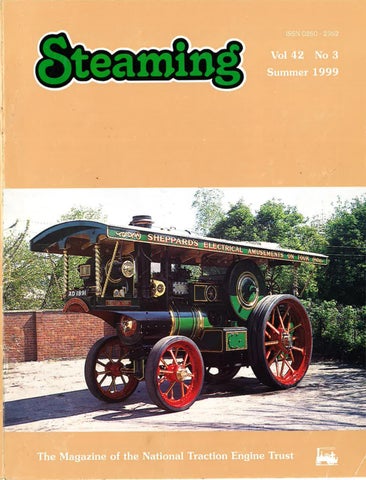
Cover One of the new faces to appear on the rally fields this summer is Garrett 6hp showmans road locomotive 27160. The engine started life in 1908, used on general haulage, but in 1921 the makers took it in to prepare it for a more exciting fife, adding full showmans fittings for the new owners, Sheppards of Wellingborough, Northamptonshire. Present owners Charles Saunders and Bruce Whateley have now completed a very thorough eight year rebuild of the machine and replaced the name from its fairground days — BRITISH HERO. Eric Sawford took the picture in April, during one of the engine's pre-rally steam ups. 123
Trust News From the Chairman They went all the way! The last few weeks here at Dingles Steam Village has seen more engines being driven by more people than ever before. It was a pleasure for us to welcome (as did several other sites around the country about the same time), a large group of Steam Apprentices who spent a day enjoying engines. I hope these days will become a regular part of our calendar. Much was learnt by those who arranged the days, and by the students; hopefully the few problems can be laid to rest. So impressed were the parents of two very young children that they signed up for the adult Driving Course, held here a few weeks later. At this event, also, much was gained by all those taking part. This aspect of the Trust's work will ensure that a new generation of engine owners and drivers carries on when we have gone. My concern as to who will be out there when that time comes is lessening, as the market for engines remains strong and new people appear. On 20th May I was delighted to have eleven Sentinels come for tea and to stay the night before their final day's run to Lands End, having come all the way from John o'Groats. The participants in the Sentinel Drivers Club's marathon had three aims — to remember the similar, but smaller, event of 25 years ago; to show that steam engines well over pension age can still do it; to reassert our right to he on the road. They achieved all three, with no trouble, despite the huge growth in traffic in recent years. It was mainly through meticulous planning, and the large amount of positive media coverage has further raised public awareness of the joy of steam. Who will be next? The Annual Meeting — rules and dates The Trust's Articles of Association require it to give members 21 days notice of the Annual General Meeting. Further, members must submit any motions for debate at that meeting 124
12 days before the date, and now, following a motion that was passed at the 1998 AGM, their nominations for senior officers. This enables the details to be published in the formal notice calling the meeting, so that members are aware in good time of what is going on, rather than finding out on the day of the meeting. If members are informed then they can attend or use their proxy as they see fit. Thus the Editor has just three weeks to get the information prepared, printed and delivered to members. If we are to keep to the above rules Steaming may arrive a little later in October than usual, and that is likely. The Editor explains in the Future Dates column what you must do, which is to send in nominations in the way shown with the names and signatures of the nominee, and proposer and seconder. We do not intend to print and insert over 3000 loose nomination papers at considerable cost, when only a handful will be used. I feel members are well able to write their own. (Richard Sandercock, Chairman)
Engine Owners Column Engine Owners sub-Committee The Trust's Driving Course held in May was once again an outstanding success and thanks are due to Richard and Anthea Sandercock for the use of their premises yet again and for the excellent catering arrangement. The site at Dingles Steam Museum is absolutely ideal, but as it is our practice, we shall be moving to another location next year. Thanks are also due to Paul and Jan Ransley who took over as organisers for the first time; they too did a splendid job. It is my belief that if we are going to establish a voluntary Driving Certificate in future, then the Driving Course will be very much a part of it. We shall be discussing how this could
be done later in the autumn, as we have some of our younger and newer recruits wishing to get started. This may well not involve a test, but merely attendance at a course combined with a log book system of driving experience. I know that some of you start blowing gaskets at the very mention of a test but we shall be influenced by demand, and if there are members out there who wish to be tested, then we shall be bound to consider it. I have recently visited another country where a test is obligatory to drive an engine on the road, but there of course it is Government inspired (and introduced long ago). Our Government doesn't want to be involved and we don't want them to be, so it is up to us to keep it that way. The 'other country' mentioned above is, of course, down under, and I visited land was made very welcome by) three people who had large collections of traction engines. They are all men — dare I say it? — a little past middle age, and all rescued the engines they have to make sure they survived. Excellent! One of the owners, however, bemoaned the situation that there seems to be a lack of young people, or any people for that matter, to help restore and work them. I am always inspired when I see the younger generation showing a genuine interest, and getting stuck into the preservation movement. It is very healthy and I only hope that gradually the interest will grow in Australia, where they have fine and rare engines waiting to be put in order. My thanks go to Tim Keenan for supplying contacts for my visit. (Richard Pierce, Chairman, Engine Owners sub-Committee) Spares and Pattern Register There have now been four issues of our magazine since I took over the administration of the Spares Register, and I again thank members who have supplied information for the benefit of others, and have helped to keep the files up to date. Similarly I hope those 25 or so enquirers who have contacted me for information Summer 1999
STEAMING
over the last 16 months have found some answers to their requests. May I ask again for feedback — good or bad — regarding spares or services you have received. At sub-Committee meetings, the subject of reproducing lists of suphas been Steaming pliers in discussed, but it is not practical for a number of reasons, of which there is not space to go into here. The Pattern Register list now contains upwards of 200 privately owned patterns, but more information is requested on the larger collections which exist. Members I have met at various venues, and who promised to send in details are still encouraged to do so. Also, information on pattern makers and foundries would be welcome. It is hoped to have some spares literature on display again in the Trust marquee at this year's Great Dorset Steam Fair. If you are supplying goods or services for engine restoration, why not send me some current information? Any queries on spares or patterns, or useful feedback, please contact me on Tr 01793 790378 (phone or fax) or write to Colin Hatch, 4 Lotmead Farm Cottages, Stratton Road, Wanborough, Swindon SN4 OSN (please note the new post code).
Loopholes caused by these limitations have become evident following recent court rulings, and subsequently the NTET has advised its members and rally organisers to assume that the RTA is reckoned to be in force at any place where the public is present. The knock-on effect of this ruling is that a minimum of RTA insurance cover has to be carried by exhibitors of self-moving equipment, and driver licensing requirements must be complied with. Under UK law there is no limit to the cover provided by the RTA insurance to the third party. Where a fully comprehensive cover is taken out the limit of the cover relates only to the insured's own property — not to the third party. The Steam Vehicle Insurance Scheme devised by the NTET for its members through Footman James is fully compliant with the requirements of the RTA for both full size and for miniature traction engines.
Be advised Since the Trust made its pronouncement relating to the Road Traffic Act many organisations have been carrying out their own 'research' and quite rightly so. Sadly, some of them are advising their own members that the NTET has got it wrong! Well, I can quote directly from correspondence from the Licensing Enforcement Policy Unit of the Department of the Environment, Transport and the Regions (DETR), sent to the Association of British Insurers (ABI) on the 17th May 1999. This letter relates to the seriousness of the loopholes now being found in current insurable risks and advises the ABI that, under the directive of the Minister, an amendment will shortly be made to Section 145(3)a of the Road Traffic Act 1998 that removes any possible misinterpretation by stating that 'vehicles will be required to be insured for the use on a road or at any other place where the public are present.'
85
From Alan Martin's Collection 70111;'
7I
Insurance Officer's Notes The NTET, the Road Traffic Acts and all that I am not at all sure where or in what context the suggestion was made, but some members (see Mr Bullman's concerns in the Letters column in this issue) are of the opinion that the Trust seeks exclusion from the Road Traffic Acts (RTA)• Well, of course, the NTET cannot be excluded — no one can. I hope the following paragraphs will adequately explain the issues. Using the appropriate insurance cover When exhibiting static or nonmobile items Public Liability cover is all that is normally required to protect the third party (the public). However, there are some unpredictable limitations to public liability insurance cover when used to insure self-moving equipment, particularly where the RTA might be in force. STEAMING Summer 1999
Driver and drayman pause awhile from their work to let the photographer record Foden 5 tonner 1624 (M1938). The wagon was new in June 1908 to Roberts & Wilson, brewers at lvinghoe, Buckinghamshire — their name and trade mark appear indistinctly on the engine's side sheets, and part of a slogan to attract drinkers can be seen on the bodywork, EQUALLED BY FEW... The high body has an unusual offset drop side to only part of its length, giving stacking room inside for crates and barrels. Is that a peculiarity to the back of the otherwise standard Foden cab roof — an upswept curve to go under the waterproof cover, the latter fixed down by straps? Robert & Wilson Ltd were taken over by Benskins of Watford in 1927, but the Foden had probably by then long gone. 125
Newcomers and youngsters The NTET uses a lot of its resources to ensure that newcomers into our hobby have the opportunity to become familiar with the history and the working of steam traction engines. Also, the NTET actively promotes the tuition of young drivers through the Steam Apprentice Club (SAC). The Rally Organisers Code of Practice has recently been modified in order to enable youngsters and those without a full licence to drive 'under controlled conditions', but only at authorised events. Currently these arrangements only apply to those who are members of the SAC, and for as long as the insurer gives his sanction to the engine owner. This rule will be extended to include other organisations if they register their junior sections with the SAC. Miniatures and models Currently models and miniatures of 5 inch scale and above are considered to be full size for the purposes of the RTA. However, at the request of the Association of British Insurers the definition of what constitutes a vehicle may also be re-defined by the DETR to possibly include 'any self-moving device'. This could have implications when a miniature or model below 5 inch scale is used in a public place. The NTET is working with the model engineers' organisations to see how
126
the impact of such changes could be minimised. This may require tuture changes to the Code of Practice. Over the past three or four years, and despite the increasingly complex legislation caused by the introduction of new European and British laws, the NTET has endeavoured to move from being an organisation that was reactive, to one that is more proactive. In so doing it has apparently trodden on the toes of the 'not invented here' fraternity and the 'don't believe it' people. Seems like we can't win, but I'm sure we will keep on trying!
particularly relating to the RTA and insurance matters. I he objective would be to discuss the rationale behind the changes and how to deal with the possible effects. Some clubs have already taken up the offer and I would be pleased to hear from any others. (Dave Smith, Insurance Officer)
Visits to Affiliated Clubs
The accounts for the financial year ended 31st March 1999 are currently being prepared, and in order to provide clearer information about the financial affairs of the Trust I have taken the opportunity to present the figures in a
At the Spring Rally Organisers Conference I offered to visit those Clubs who wished me to talk to their members about the recently revised Rally Organisers Code of Practice,
From the Treasurer
This lovely scene is at the village of Crockenhill, near Swanley in Kent. The Foundry was the premises of the well-known ploughing engine contractor Thomas Wood, and indeed the family still trade from the same place. The picture is from a post card published in Tunbridge Wells, seemingly for sale by Kingsnorth, the owner of the Crockenhill post office. Three or four complete engines can be seen in the yard, and another is dismantled for repair, the boiler lying on its side under the shearlegs. In the centre workmen toil with one of the ploughing ropes. At the annual general meeting of the National Traction Engine Owners & Users Association, held at Smithfield on 8th December 1897, 'a vote of condolence with the family of the late Mr. Thomas Wood, who was the first man to own a traction engine, and whose death occurred a week ago, was proposed by Mr. Aveling and seconded by Mr. Eddison'. Can any reader substantiate the claim and tell us more? (picture, collection Liz Mason)
Summer 1999
STEAMING
Cloud and rain did much to spoil the photographers' efforts at the 1998 Great Dorset event, but John Maund did manage to take advantage of a brief glimpse of the sun on the Saturday and caught Wallis & Steevens Expansion traction engine 7090 of 1909 at rest in the threshing area.
different format, which I hope you will approve of. At the last Annual General Meeting Charles Lovell & Co were appointed as Auditors to the Trust. Their quotation for audit work reflects their 'nonLondon' office location and should lead to a significant saving in the cost of audit in the future. Sadly the accounts produced by Menzies and sent to Companies House showed different figures to those used in the accounts presented to the members for the year ended 31st March 1998 at last year's AGM. This was due to an additional provision of £700 made by Menzies in anticipation of additional audit costs. However, the final charge for the additional work was £1340, which was a further £640 higher than the provision made. Therefore I have had to include an additional charge of £640 in the accounts for the year ended 31st March 1999, which relate to the audit costs for the year ended 31st March 1998. It is regrettable that the Trust's long relationship with Menzies should end on a sour note. (Julie Smith, Treasurer) STEAMING
Summer 1999
Steam Apprentice Club Following the longer than usual report in the last issue, mainly dealing with the question of young drivers at rallies, I have received very little feedback, although the number of requests for membership from those in the teenage group has risen slightly. I have only noted one adverse comment, which appeared in Old Glory, and I think only serves to emphasise the difficult path we have to follow between providing necessary guidelines and being seen as dictatorial. I have yet to hear from any group that wishes to start a junior section to enable them to take advantage of the NTET's position as an Authorising Body under the 1995 Off Road Regulations. The response to the invitation for the SAC to join the Trust's Driving Course again this year was disappointing, with only three older members joining the adult course and none asking for the junior course. It would
appear the younger element is much happier playing with engines, rather than learning how they work. Perhaps the cost of attending a course at a distant location is also a significant consideration. On a brighter note, I am pleased to see how many rallies have offered to help this year; I look forward to seeing how the system works as the season progresses. (John Durling, Chairman, Steam Apprentice Club)
Trust Exhibition Unit The diary for the appearances of the Trust's Exhibition Unit includes a venue every weekend for the next couple of months, and the locations range from Driffield in the north and Dorset in the south, to South Wales and to East Anglia. A good majority of our membership, therefore, have the chance to catch up with the really extensive Mail Order stock that is on sale on the Unit, or to call in with points for discussion — things the Committee might be needing to ponder over during the coming months. Quite clearly, the Trust can't be represented at every event in the 127
country at which there are engines, but the dozen rallies listed below give a good geographical spread, so don't hesitate to the take the opportunity to visit our display, and to make the most of your membership. July — 16th to 18th Weeting, Norfolk (clubs' and museums' marquee); 17/18th Langport, Somerset; 23rd to 25th Welland, Worcestershire; 31st/1st Cromford, Derbyshire. August — 7/8th Driffield, Yorkshire; 14/15th Detling, near Maidstone, Kent; 21st/22nd Downs Rally, Chichester; 29/30th County of Salop, Shrewsbury. September — 1st to 5th Great Dorset Steam Fair (NTET marquee); 11/12th Malpas, Cheshire; 18/19th Old Warden, Bedford. October — 2nd/3rd — Trehafod, Pontypridd, South Wales. As usual, further details of most of these events can be found in The Rally List 1999, sent out to all members with the Spring issue of this magazine. However, a few of the above are rallies that are additional to the List, so please check out local advertising for those.
Road Steam Forum The Engine Validation Scheme to encourage authenticity in engine restoration and conservation has met with an encouraging response from owners. Details of the Road Steam Forum sponsored scheme was set down at some length on pages 10/11 of the Winter 1998/1999 issue, and if you are interested, application packs and further information can be obtained from the General Secretary, Sue Jackson (address inside the front cover).
Future dates Great Dorset Steam Fair 1st to 5th September 1999 Once again the Trust will have a strong presence at the GDSF with the well established large marquee that can contain a well stocked sales section, a base for the Steam Apprentice Club, a large multi-screen video display area for attracting the public to traction engines in general, and, of course, the members hospitality area. The latter is welcomed by 128
even the sturdiest of members after they. have tramped the slopes to make sure they have seen every one of the engines present! The whole of the five day period will again see the Trust's Mail Order team, headed by Val and Colin Brown, presiding over what must be the most complete selection of traction engine reading available on the rally fields, and you may be able to grab a last chance to find a title that is very nearly out of print. The range of videos is also extensive and covers most tapes featuring road steam. Colin Hatch is assembling a display of trade literature that should prove useful to restorers, and in fact any engine owner, so bring along pen and paper to take notes. John and Fiona Durling will be letting the Steam Apprentice Club members know what the event holds in store for them through their own magazine Raising Steam, but someone, of course will always be willing to explain more about the SAC if you are interested in that section of the Trust's activities for your family. For quite a few years now at Dorset we have had as neighbours Brian and Christine Wells, exhibiting their showmans living van. This year they will also be presenting their freshly restored Gavioli fair organ, but the main purpose of this note is to record our grateful thanks to Brian and Christine for providing electric power for our use from their generator — our activities would have been much the poorer without their assistance. We shall on the Friday evening again persevere in our efforts to hold an Open Forum for Trust members, all against the mighty noise of the GDSF's crowds intent on enjoying themselves. Its not the most ideal of locations to sit down and discuss matters serious (or frivolous), but as we've said before, the Dorset event attracts so many members, it has to be worth trying to use it as a place where we can have brief debate. The OPEN FORUM will take place on Friday, 3rd September, In the Trust marquee, at 7.00pm. Come along with points you feel need airing to your fellow members, in the hope we can all benefit form the exchanges. If you are at the Dorset event, be sure to call in at the Trust's tent — it should be in the same position as in recent years, but look for the NTET banner and the flags on the poles, and prepare to be stunned by the new look entrance features. Autumn Rally Organisers Conference The date for the Rally Organisers
Conference this year is Sunday, 16th October 1999, and the venue will again be the village hall at Willoughby, a little to the south of Rugby in Warwickshire. Further details, including the arrangements for midday refreshment, will be distributed in due course to event organisers and affiliated groups who usually attend. Any other interested parties requiring details of the always useful gatherings should contact the General Secretary, Sue Jackson (address inside front cover). Annual General Meeting Members are here given early information on the 1999 Annual General Meeting in November. It will be held at the Bishop Grosseteste College, Lincoln on Saturday, 13th November. Formal notice and other relevant information, including proxy forms for voting and audited accounts for the year ended 31st March 1999 will be distributed to all paid up members with the Autumn issue of Steaming. Any member may submit a motion for discussion at the Annual General Meeting. All such motions must he in writing and signed by the proposer and a seconder, and state the respective membership numbers. The items for discussion, in order to be published in the Agenda for the AGM, and as required by Article 16 of the Trust's Constitution, must reach the General Secretary, Sue Jackson, not later than first post Saturday, 2nd October 1999 (address inside front cover). Arrangements for social activities on the AGM weekend are still being made, and will be published in detail in the next edition of Steaming, but for the moment we can give brief notes for those who may wish to plan ahead. On the Saturday morning there will be a visit to the Museum of Lincolnshire Life at Lincoln. The Museum has a very wide selection of exhibits from the county's agricultural machinery industry, and will make a fine venue for members to browse, to discuss and to chat on traction engines. On the Sunday we have generous invitations to view engines in the Boston area — more details in the next issue. For those who will want to stay in the area on the Saturday night (or the Friday night ...► , arrangements will be made for a suitable hotel in Lincoln — again, details in the next issue. New arrangements for nominating Officers of the Trust To ensure that all members know who is standing for election as a senior Summer 1999
STEAMING
TRACTION ENGINE INS ANCE
Footman James is the most progressive innovator for Classic, Veteran, Vintage and Historic cars, motorcycles, military, commercial and steam vehicles. Our policies ensure peace of mind with top quality cover at competitive premiums. Contact, Jayne Jordan or Matt Potter for a quotation from the N.T.E.T. appointed Insurance Broker FOR COMPLETE PEACE OF MINIO ANID 11%1C0IVIOLJAL SERVICE
CALL
us TODAY
The Enthusiast's insurance Broker
--: FOOTMAN JAMES
(4
TEL. 0121 501 0218 FAX.° 1 2 I 5 59 08 1 4
WATERFALL LANE CRADLEY HEATH THE MARKET LEADER WEST MIDLANDS B64 6PU STEAMING
Summer 19.99
129
officer of the Trust, it was resolved at last year's Annual General Meeting that nominations should be made 42 days before the meeting, as is already the case for motions to be debated under Article 16. This allows the names to be published in the formal notice calling the AGM, and thus enables any member to attend, or to use his or her proxy, and vote knowing who is standing. In the past a nomination paper has been included within the Report and Accounts and the formal notice, but of course this will not now be possible. To print a loose nomination paper for each copy of the magazine, and have it inserted, would cause unnecessary expense, and most of them are unlikely to be used. We are therefore asking Members to make out their own, as they already do for motions under Article 16, and to send them to the General Secretary by the due date. A suggested format is included on this page. The elected Committee for the current year was set out on page 6 of the Winter 1998/1999 magazine. The following senior officers retiring by rotation at the AGM in November are: Richard Parrott, Vice President — who is available for re-election Richard Sandercock, Chairman — who will not seek re-election Andrew Semple, Vice Chairman — who is available for re-election
Committee members retiring by rotation at the AGM in November are: John Bosworth John Durling Bill Evans Steve Parrott Richard Pierce Roger West
All six members are available for reelection. During the year Russell Bulley
tendered his resignation. There are vacancies on the National Committee. Any nominations for the Committee should be sent to the General Secretary, Sue Jackson (address inside front cover) and must be received by first post on Saturday, 2nd October 1999. They will not be accepted after this time.
New Members A sincere welcome is extended to the following new members who have joined the Trust during the last three months. We hope they will gain much friendship, information and enjoyment from their membership over a period of many years. The Membership Secretary is always pleased to put members in touch with one another by fowarding mail. H.J.A. Jeffery, Axminster, Devon D.J. Monk, Stevenage, Hertfordshire D. Boulter, New Milton, Hampshire A.J. Dezell, Woking, Surrey J.W. Lynn, Hove, East Sussex D.B. Garraway, Arundel, West Sussex R.A. Gee, Heswall, Merseyside R. Scoffield, Southwell, Nottinghamshire J.G. John, Whitland, Carmarthenshire Ekotechnike Museum, Czech Republic R.J. Pumfrey, Saffron Walden, Essex P. Davis, Poole, Dorset P. Lewis, Richmond, North Yorkshire T. Booth, Chesterfield, Derbyshire R.J. Cook, Newport, Isle of Wight G. Hawketts, Alfreton, Derbyshire S. Collins, Kingsbury, London J. Ravenhill, Chickerell, Dorset S.M. Barrington, Shaftsbury, Dorset D. Weeks, Bournemouth, Dorset R. Pratt, Long Sutton, Lincolnshire
The National Traction Engine Trust, AGM, 13th November 1999 NOMINATION PAPER
Please use block letters
Vice President, Chairman, Vice Chairman, a member of the National 0.•
C. Henderson, New Milton, Hampshire M. Young, Jarrow, Tyne and Wear G. Miles, Bicester, Oxfordshire G.J. Tyler, Worcester D.J. Hardiman, Andover, Hampshire M. Shipton, Stonehouse, Gloucestershire P.R. Brewer, West Molesey, Surrey D.G. Crosby, Armthorpe, South Yorkshire R. Foreman, Irchester, Northamptonshire D.C. Venn, Higham Ferrers, Northamptonshire S.A. Bullman, Chelmsford, Essex C.J. Rush, March, Cambridgeshire S. Martin, Cardigan, Pembrokeshire G. Mendoza, I ligh Wycombe, Buckinghamshire J.D. Price, Sellindge, Kent Netherway, Hereford P. Godsell, Cirencester, Gloucestershire M.E Roberts, Sleaford, Lincolnshire L. Hennessy, Worcester J. Stevens, Bristol P. Sanders, Sutton Coldfield, West Midlands E. Harris, Bournemouth, Dorset G. Chick, Camborne, Cornwall G. Sword, Glasgow J. Norman, Raglan, Monmouthshire P. Ruff, Kempston, Bedford S.G. Parker, llchester, Somerset D.W. Stewart-Paver, West Wickham, Kent K.J. Barnes, Goring-by-Sea, West Sussex J.W. Etheridge, Ashford Common, Middlesex M. Hibbins, West Kingsdown, Kent M, Sproxton, Northampton Mrs V. Wiltshire, Harlow, Essex F.T. Johnson, Nottingham L.B. Hooper, Queensland, Australia D. Valentine, Huntingdon, Cambridgeshire P.D. Hopes, Reading, Berkshire K. Stubbs, Romsey, Hampshire D.J. lzzard, Mayfield, East Sussex S.W. Graves, Crowle, Lincolnshire R. Johnson, Spalding, Lincolnshire A.R_ Croxford, Inverness, Scotland R.E. Knott, Poole, Dorset P. Denny, Oakham, Rutland J.W. Sanderson, Oakham, Rutland J. Saunders, Arlesey, Bedfordshire N.D. Thomas, Amersham, Buckinghamshire M. Stubbins, Brightlingsea, Essex R.D. Hoskin, Redruth, Cornwall D.J. Young, Buxted, East Sussex P. Kestell-Cornish, Reading, Berkshire B.R. Holland, Paddock Wood, Kent C.M.J. Symons, Gloucester J.P.D. Kimpton, Ferndown, Dorset T. Robinson, Bicester, Oxfordshire G.A. Jones, Stroud, Gloucestershire
_ _ _ _
Name:
Membership No.
Address I agree to accept nomination for this office and if elected to serve the Trust and abide by its Constitution. Signed: Proposed by
Membership No.
Seconded by
Membership No.
Nominations can be made on this form, cut from the magazine; on a photocopy, or on a copy hand written on plain paper " delete as necessary, but use a separate paper for each nomination
130
'William Oldrieve, in the employ of Bronco Bill's Circus, was fined £2 at Dartmouth on Tuesday last, for having committed an offence under the County Council byelaws. P.S. Willcocks said there were four or five men on the locomotive and wagons driven by the defendant, but there was no communication between the locomotive and the last wagon. Defendant told him he had taken away the communication on entering Dartmouth.' (from World's Fair, 19th June 1926) Summer 1999
STEAMING
full list being shown on the certificate. The printed sheet is 14in x l4in, with a dark blue image on grey paper. The red embossed AGE is at the lower left. Edward Barford commented on these certificates in his autobiography (Reminiscences of a Lance-Corporal of Industry, Elm Tree Books, 1972) as follows — 'The private companies (that is, the constituent companies) had only a minute paid-up capital compared to their real assets and earning power. And very ordinary looking share certificates, too. Mostly the kind you can buy — blank, of course! — at suitable stationers. And instead of owning seven or eight thousand shares in
Empty Promise We are grateful to Sandy Ross for sending this item from his collection of traction engine ephemera. Sandy writes: A tangible reminder of the heady post World War 1 days of the Agricultural & General Engineers Limited survives in this 10 shilling (50 pence) Ordinary Certificate. AGE were, of course, the controlling organisation behind many of the traction engine manufacturers, the
2/15,‘,Z4ei i
'914
/
I
the family business, members of these families now owned sixty or seventy thousand shares in what appeared to them a huge and successful group. And AGE'S share certificates were huge and most impressive looking, too.' The group's former Head Office at Aldwych House, Strand, stands to this day as a warning to corporate greed, for the overheads of this building and the costs of the organisation were imposed on the subsidiary companies, so in part bringing about the downfall of the once great engine builders. My thanks go to Les Burberry for kindly lending me a copy of Barford's autobiography. 114
90
Ordinary Shares.
I
1 - 04 .
Ett ASSOCIATING AVE LI N G &PORTER LT29 BLACKSTONE & C? UT BURRELL'S HIRING C9129 AMISS Pe FHPY.110.YIAKI BARFORD &PERKINS LLE PETER BROTHERHOOD LL9 CLARKES CRANK&FORGE C°0 L.R. KNAPP & C9 LI• .11 • ..... out E H.BENTALL & C91.7 BULL MOTORS L•9 DAVEY PAYMAN &CL'LL° ER & F.TU RN ER VI° CHARLES BURR 1 LL &SONS UP RICHARD GARRETT &SONS 120 ROCHESTER
II
11.4,11.11OGC
STSTIFOR
TH ETFORD
Ili If MK.
PETERBOROUGH
LIMOS. BI
CLAHFIELD
STOWR I( ET
COLCHESTER
IPSWICH
THETFORD
1,111 TON
INCORPORATED UNDER1THE COMPANIES ACTS 19 08 -ro 1917.,, 41)
• OrHprCA PITAL E 6,7 5 7 , 1 8 4 .,"4 -4
DIVIDED INTO
1000;000 MCHMULATWE I REFERENCE SHARES OF S, i EACH Aum beret/ Ito 1000,000.,„d„,,,„ do Ito 268,320,boioso,o do do 268.320 6% SECOND do 10977728 ORDINARY SHARES OF 1O/- EACH, A'timbered 1 1010,977728,Adam.ve.
ill to
1< 1,29.4d,re-4, 21/
;Ot7r/ i'h•V/AiA?/?:''; r7 .7
4,
el-Fifa&
'..1-‘44ff-
-"::/:47(At 4541607
44' (9/4--age dd_ GEN EIRAL ENGINEERS, Li mTrE15/ /
+-err4( - y ,r /erre--
J, -
,„ AG R CI4ILT A rl // /./.V . d'el
prlyervi vr
.de
/ ,1,41;e z
•7 ;An. ,111(/..
el/tV;
;14 t
of4.10.1 eZ,111/
4:;',0 / I 1.1.0 WO( A1.0.0,2
Je /
/1,6/4' ilf"r" /{/ 4 ./("W / 4"4";/
2-,••
?":,
7/,
•.
•
7Z. t/e. r e',7,77/7(7/. / • .-/e/74/1 e.>"4. eAtjf • lr A
:1
ewr/e1,67 X9 irriworo,s
nn.vsp-h-R OF ANY OF THE- SHARES COMPRISED MI THIS CERT/F/CATE onm BE REGISTERED UNLESS ACCOMPAN/E0 By nws STEAMING
Summer Summer 1999
131
Furniture burned on road journey Just about tea-time on 25th March 1907, something unusual caught Miss Clayton's eye in the gathering gloom. Speeding towards her cottage which abutted the road on the hill beyond The Three Elms public house, not far out of Hereford on the road to Canon Pyon, came a Nayler steam tractor hauling a furniture van. Its not likely, of course, that Miss Clayton was attracted by the rarity of the engine — but what she could see clearly was that the van was on fire. With urgent calls she caught the crew's attention and the engine was pulled up, and driver Bristow managed to put out the blaze with buckets of water. There was not too much damage done, and only twenty minutes delay, but the sequel came at Hereford County Court much later that year, when Holloway & Webb, house furnishers of Hereford, summoned Parry & Co, furniture removers of the same town, for £40 11s 6d (£40.57 1/2 ) for damages to goods burnt in the course of transit to Canon Pyon. The judge heard how on the morning of 25th March Holloway & Webb had received an order from a Mr Fosbrooke to remove some furniture from Hereford to Canon Pyon, a village some eight or nine miles to the north west. The items were packed in a van
which was then taken — presumably horse drawn — to the firm's repository in Victoria Street. An order had meanwhile been telephoned to Parry & Co, hauliers, for a traction engine to haul the van on to its destination. However, the latter firm was very busy and could not send a machine to Victoria Street until the afternoon, indeed, it was a quarter to four when it arrived. appearing for Mr Carrier, Holloways, tried to show that the whole episode of the fire came to be caused by the negligence of Parrys' staff and the speed at which the men carried out the jub, for they were extremely impatient as it was near their leaving off time'. The van was quickly hitched up and the cavalcade set off, allegedly without waiting to see if the furniture man was ready to accompany them. Times and distances were quoted in Court — the engine left at 4.20pm, and got back to Hereford at 8.30, four hours and ten minutes for a journey of 8 1/2 miles each way or 17 in total. Out of this time an hour and a half had to be deducted for slopping arid putting Out the fire, and then unloading the furniture at Canon Pyon. (If the figures are correct, that's an average running speed of 6.4mph.) It was the speed at which the engine was being driven, especially going up
The racy lines of CITY PRINCESS are evident from this pose of the Nayler tractor at Hereford, taken when new in 1905. The pantechnicon does not have roof boards fitted, so may not be the one involved in the fire on the road to Canon Pyon. (collection Alan Martin)
,4
the so-called second pitch beyond The Three Elms, that caused sparks from the engine to such an extent they set fire to the van and some of the furniture. Thomas Bristow was the driver of the tractor (though he had subsequently moved to Wrexham). He explained that when it was another firm's van the arrangement was for that concern to send a packer to be in charge, on the day in question, a Mr Page. Bristow had noticed things on top of the van sheeted over, and thought Page would be travelling on the van. In fact, the latter was to accompany them by bicycle and was well behind by the time the fire was noticed, not catching up until it was out. The items on the top part of the van (they included a sofa) were packed and bottomed with hay to protect the varnish and the sheet did not go over the front. The driver denied he was impatient or in a hurry, or had said anything about overtime, because he and his mate got 'road money' instead. Mr Taylor, proprietor of Parry & Co, said when supplying a tractor or traction engine for hauling he always insisted a man be sent to be in charge of the van and also to inform the driver of anyone coming up behind who wanted to pass — either by travelling on the van and using the communication cord, or by being alongside on a bicycle. I le had showed Mr Holloway that it was impossible for the crew to see back — this, as can be seen from the accompanying pictures, would have been very true on the Naylcr tractor. It seems the plaintiffs had called Thomas William Nayler, managing director of Nayler & Co, engineers of Hereford, as a witness. He said his firm had made the engine which was built to go at 5mph on the level and
A close up of the off-side of Parry's Nayler steam tractor, the water tank clearly sign written SPEED. 5. M P H WEIGHT 4T 19CWT. The tank capacity was probably in the region of 500 gallons — about 2% tons. Rolled steel joist frame sections extend to a fixing point some two-thirds of the way along the boiler barrel, and although different from Foden practice, it was similar enough for that company to consider it impinged their patents. The chain drive to the rear axle passed behind the offside steel. (collection Alan Martin)
2 1/2 up a hill. If driven at five up a hill the engine would be strained very much and cause sparks to fly. Crossexamined, he admitted there had been disputes between his firm and Mr Taylor on account of this engine and another one. The judge came to the conclusion the defendants were not liable. He
thought Page should have been looking after the van and the hay packing was a contributory cause, and said the statement the engine was going at nine miles an hour was an exaggeration. However, if we refer to road maps they show the distance to Canon Pyon to be rather more than the 81/2 miles quoted in court, so despite
And now the other side of CITY PRINCESS (although the name is not visible in these when new pictures). Is that Hereford Cathedral in the background? (collection Alan Martin)
the verdict, Tom Bristow and the Nayler probably were cracking on, so to speak. A counter claim of £5 15s 6d 1E5.77) by Parry & Co — presumably the unpaid charges for the haulage — was settled with them accepting £4 Os 6d (£4.02), which his honour said meant that Mr Taylor sent his engine to Holloways on the day for nothing, It is noticeable that at no time during the proceedings does it seem the subject of insurance was mentioned. The details of this dispute have been taken from a report in the trade magazine The World's Carriers for January 1908. It gives a brief glimpse of the working life of a rare machine, for Thomas Nayler's engineering firm at Friars Street, Hereford built only ten or so of his distinctive steam tractor design. It was a short lived venture and one which incurred wrath and litigation from the Foden company at Sandbach, so similar was the Hereford vehicle to their own product. The Nayler 5 ton tractors, compound engined, were based on the steam wagon practice with steel joist frames and chain drive to the rear axle, a short wheelbase and a generous high level water tank at the rear. Most were sold fairly locally to Hereford and the subject of our notes, named CITY PRINCESS, was perhaps the first of the Nayler overtypes. It was built in 1905 and delivered new to W. Taylor, trading as T. Parry & Co, hauliers, with a yard at Canal Wharf, Coningsby Street, Hereford. As the pictures show, it was at once a racy and a chunky looking engine. Parry's owned quite a few haulage engines for their work, and at the time of the incident that reached Hereford County Court they probably had a couple of Marshall agriculturals, and two road engines — a 10hp Foden and an 8hp Foster, as well as the Nayler. The subsequent history of the latter machine is unrecorded, and it would be interesting to know more of the dispute between Nayler and Taylor over the tractor. Thanks are due to Robin Harding, former Records Officer of the Road Locomotive Society, for details of Parry's engines and to Alan Martin for readily supplying photographs from his collection to illustrate to us just what it was that Miss Clayton saw speeding by in 1907. 141
'Messrs Aveling and Porter, Rochester, are to supply a steam roller to the Whitby Urban District Council.' (from The Agricultural Engineer,
February 1898) STEAMING Summer 1999
133
The Driver's Priorities Giles Romanes Let us look at the outline analysis of the duties of the driver of a vehicle powered by an internal combustion engine. After starting the engine, which I have not considered here, the
operator tries to maintain a constant engine speed by the use of the clutch and gearbox. In many of our everyday motor cars this chore has been automated, leaving only the use of one pedal to adjust the speed increase and another for decreasing it. It only remains to steer the course, considering the traffic demands. These are
generalisations and in no way belittle the skills needed for safe driving. But now consider the duties of the driver of a steam engine, who is concerned with keeping the thing going, and doing that at an acceptable speed for the engine rather than that of the vehicle. I o do this a large number of factors have to be kept simultaneously in the forefront of the mind.
There are four main factors. The first is boiler management and with that the most important safety point is the water level. It is a straightforward exercise when working on the belt — then it is possible to replace the water used trom the boiler at a regular consumption rate by setting the pump,
but this is not possible on the road where the demand varies according to the terrain and condition of the surface. Driving along a level road may result in regular use of steam but things change when an upward hill is
looming. At that stage of the trip it is prudent to be filling the boiler to a higher level than normal. Here it is necessary to give consideration to
three things: to ensure that the steaming rate on the climb is not reduced by the introduction of cold water; to be certain that the front of the tubes will continue to be covered on the incline, and lastly to avoid to some extent the risk of exposing the fusible plug when the engine assumes the level attitude on reaching the top of the hill.
coal in the grate, by opening or closing
the damper. A poor performance can be due to the presence of clinker. Clinker is ash which has fused into a sort of solid pancake over the firebars preventing the proper flow of air up through the fire. Loss of heat can also be due to the admission of cold air above the fire by, for example, leaving the firedoor open or partly open. It is a good habit to kick the door after firing
to close this loophole. Another cause for a poor performance is the presence of a hole in the fire itself. This is mainly caused by uneven spreading of the coal, but could be caused by the distortion or breakage of a firebar. The third factor is this regulation of the engine speed. The speed 'envelope' on a steam engine is a very
The prospect of going down a hill also demands proper preparation in good time. This is achieved by filling the boiler to a much higher level than usual; it is then possible to ensure the
limited one. The driver has to give the regulator valve constant attention and frequent adjustment. The governor is no help because it works in a vertical direction so is subject to jogging when
fusible plug is covered during the descent. Filling the boiler also cools it, and helps to avoid blowing off steam at the safety valves as a secondary benefit. Should the hill be so steep that
going over rough ground. It is not British practice to use it when travelling. It is possible that this custom arose because of the unreliability of the belt drive — should it shake off its
the water disappears out of the glass, it is sometimes feasible to protect the plug by varying the engine speed to slosh the water to and fro. Let us now consider the second of
pulleys, or break, the engine would race and take a perceptible time and distance to bring under control again. Speed regulation going up hill is mainly
the factors I mentioned earlier. This is energy needs, as provided by fuel management. Solid fuel takes a little time to ignite and give off its full heat
when everything is normal in the furnace. This delay means that firing must be done some time before the demand, or reduction in demand, is needed. The heat production can be adjusted, giving a certain amount of
effected by adjustment of the regulator opening. However, a steep hill or a big load may require alteration of the position of the reverse lever in its notches. Advancing it produces more power with reduced economy. The lever should be returned to its
normal working position when the demand becomes moderate again. Descending a hill is tricky because a traction engine can so easily run away. Thus close attention to speed is vital. The hill should be approached with checks completed, and very
slowly at that. This is because speed is controlled principally by using the reverse lever. The regulator is closed when coasting is possible. The reverse lever is moved backwards to the complete arc of its travel if needs be. The whole situation must never be allowed to even feel that the limit of control is within sight. At this time the driver
wishes for two pairs of hands to simultaneously control the speed and to adjust the water supply etc. The fourth factor is the management of the engine in the context of
Level going — Garrett 4CD tractor 33414 of 1919 scampers along Hertfordshire lanes near Markyate during a run out in May 1997. (John Mound) Summer 1999
STEAMING
the prevailing road traffic. Being a very slow vehicle an engine must occupy the nearside of the road at all times. It is now a legal necessity to pull off the carriageway, as soon as possible, to let traffic pass when it builds up behind. It is as well also, especially when pulling a trailer or van, to have both a flashing light working at the highest point and to display a SLOW VEHICLE or LONG LOAD sign at the back. None of these precautions will prevent a car cutting in just in front of the engine and disgorging a photographer. Such an occurrence demands rapid avoidance action. It is not too difficult to consider all of the foregoing when reading about the subjects individually. You might even add, expand, or correct certain parts in your mind or memory. It is another matter when you are on the road and everything is happening at once. Then a simple check list can be a great help to sort out the priorities of action. So here is one set out as a table based on two feet — like a person. The first is the slope of the road — for example going UP is the clue to moving the appropriate controls UP. When going DOWN they go DOWN too — and down here can mean closed down or shut. The controls themselves are listed STEAMING
Summer 1999
Uphill going — the A354 road rises towards the next ridge of the Dorset hills, and Aveling & Porter 8 ton roller 12136 makes its way to the 1995 Great Dorset Steam Fair. (John Maund)
in an order of priority with safety in mind. They should usually be checked or moved in this sequence. They are covered by the acronym WEST, where W equals water, E equals energy or fuel, S equals engine speed and T equals traffic on the road. It is not possible in an article to make a complete description of how to handle every situation that can arise,
nor to analyse them properly. That ability can only come with experience. Even then nobody can know it all infallibly. My hope is that the use of the gradient as a clue, together with the check list acronym WEST, may enable us to sort out our priorities rationally. This way we can benefit from the experience and enjoy driving a traction engine all the more. 14
road clue
WEST
appropriate control movements completed
level going
Water Energy Speed Traffic
level — check fire — damper open, door closed top gear, cylinder cocks closed
uphill going
Water Energy Speed Traffic
up in the glass fire up and damper up, door closed select low gear, cylinder cocks closed
downhill going
Waste Energy Speed Traffic
prevent going down by filling fire down (low), damper down select slow speed, cylinder cocks draining, dowse regulator, apply brake
stopping
Water Energy Speed Traffic
sufficient fire slow (low), damper down cylinder cocks draining, chock down
135
The Renard Road Train Although this story by Michael Lane is only briefly concerned with steam, several traction engine manufacturers' names are mentioned, once again showing the breadth of interest that these firms had in the worldwide development of transport and agriculture. (Illustrations are from the author's collection) In 1825 a young British engineer, William Henry James (1796-1873) patented what was probably the first mechanically propelled Road Train, comprising a four-wheel drive steampowered tractor unit and three power driven trailers. This was undoubtedly the precursor of the present day Road Trains that haul huge loads at great speed across the Australian conk lent. In the mid-nineteenth century other pioneers such as William Bray, James Boydell and Charles Burrell developed early Road Trains employing traction engines with an assortment of patent wheels designed to provide the necessary traction, but none enabled power to be transmitted to the trailer wheels. Seventy-five years elapsed before anybody seriously developed James' ideas for military and commercial use. James' patent (illustrated in Figure 1) shows his steam-driven tractor unit
with twin inverted cylinders and a primitive locomotive type boiler. Power from the engine crankshaft was transmitted by a vertical connecting rod to a crank incorporated in the cardan shaft, arranged under the engine frame. The drive from the cardan shaft to the individual road wheels of the tractor unit was through universal joints and worm gearing, mounted in swivelling boxes, thus making all the road wheels steerable. Through further universal joints the cardan shafts were extended under the train's trailers, each trailer axle being steerable and provided with engine power as in the tractor unit. The theory that the trailers would follow accurately in the path of the tractor proved to be wrong, and the wide angles in which the universal joints were required to work resulted in a very short useful life. William Henry James was the
eldest son of William James (1771-1837), a colourful character and a native of Warwickshire, best remembered for his pioneering proposals to build the world's first passenger carrying railway frnm Liverpool to Manchester. Although a company was formed and surveys completed in 1822, with the aid of his son and brother-in-law, he was so financially embarrassed at the time that he was compelled to recommend George Stephenson as the company's engineer. This, of course, earned Stephenson great renown and the title 'Father of the Railways', a sobriquet which the James family resented. Thirty years later, after James' bankruptcy and death, his daughter, Mrs E.M.S. Paine, wrote a classic little book in her father's and brother's defence.' However, so obsessed was she that they had been shabbily treated by the Stcphcnsons that many of her claims must be treated with great reserve.2 Paine claimed that her brother was responsible for the design of the boiler used on Stephenson's Rocket, which is patently incorrect. W.H. James' patent of 1821 was one of a number, which were taken out at this time for small steam carriage boilers employing differing arrangements of water tubes. Although rightly called tubular boilers, there is no affinity between them and the fire tube boiler employed by Stephenson, based on Henry Booth's original ideas. Following his father's bankruptcy, William Henry James practised as an engineer in Birmingham for many years. He filed patents for locomotives and steam engines, carriages and diving apparatus, but like his father, died an impecunious man. Recent research indicates that his work is probably best remembered in France. During the Franco-Prussian War of 1870-71 the beleaguered city of Paris was for a time completely cut off from the outside world. A number of balloons were brought into service to break the blockade, but their success was limited and entirely dependent upon favourable winds. A balloon factory was established at the Gare
Figure 1. W.H. James' 1825 Patent Road Train, showing the cardan shaft drive to the steam powered tractor unit and trailer wheels. 136
Summer 1999
STEAMING
d'Orleans and for the remainder of the struggle two or three balloons left Paris weekly.3 After the War a French military engineer, Charles Renard 1184719051, born at Damblain in the Vosges, continued to develop the balloon. His objective was to produce a flying machine that was lighter than air, having a means of propulsion, and navigable. He is credited with the design and construction of the first successful dirigible balloon in 1879. Around 1900, after his retirement from the army with the rank of Colonel, he turned his attention to the design of military vehicles. Obviously aware of W.H. James' patent he produced a Road Train comprising a steam powered tractor unit with three powered trailers, driven through a series of cardan shafts (Figure 21. Next, he employed an internal combustion engine tractor unit (Figure 3) which was exhibited on the Darracq stand at the 1903 Paris Salon. He then adapted a motor car to haul three powered passenger-carrying vehicles, each carrying up to ten passengers. This was demonstrated in the streets of Paris late in 1903, and is shown in Figure 4.
STEAMING Summer 1999
Figure 2. Colonel Charles Renard's first steam powered Road Train and three power driven trailers, during tests in France, circa 1902.
Next Renard developed a Road Train with the tractor unit providing power to the centre axles of three sixwheel steerable trailers, through a series of cardan shafts driven from the rear axle of the tractor unit. In 1905 Renard died and the management of his patents was taken over by a syndicate. It seems probable that they were having difficulty in finding an engine of sufficient power for the tractor unit, or they may just have been seeking a buyer for Renard's patents, but in 1907 the prototype Road Train found its way to England. Percy Martin, an American national and then Managing Director of the British Daimler Motor Company agreed to invest £2,500 in the Road Train Syndicate 'conditional upon an agreement to manufacture'.4 During 1908/09 Daimler built and sold a few Renard Road Trains using a huge 16.1
litre engine. This work coincided with the introduction of the American engineer Charles Knight's sleeve valve engine, which became known universally as the Silent Knight engine. Daimler used this almost exclusively from 1908. At this time they were employing Dr Frederick Lanchester as a consultant following the collapse of his company in 1904. He produced three experimental cars in 1896 and commenced production in 1901, incorporating several advanced features which soon becme commonplace. His engines were properly balanced both dynamically; he statically and employed an epicyclic gearbox and the drive from the engine was by propeller shaft to a worm-drive 'live' axle, eliminating the need for a chain drive. He employed roller bearings and splined shafts in his gearbox and
Figure 3. Diagrammatic representation of Renard's 1903 Road Train employing an internal combustion engined tractor unit, showing the cardan shaft drive to the trailers.
137
Figure 4. Renard's Road Train using the drive from the rear axle of an early motor car to provide power to the three passenger carrying vehicles, being demonstrated in the streets of Paris in 1903.
rightly became known as the 'Father of the Motor Car'. By 1909 Lanchester had developed a huge 15.9 litre, 105hp sleeve valve engine suitable for heavy haulage, This was used in the Renard Road Train and in large tractors developed by William Foster & Co of Lincoln, the famous traction engine builders, for the South American market. Later these powerful machines were supplied in quantity to the War Office for gun haulage and the 105hp engines were fitted in the first military tanks built by Foster in 1916. 5 It is known that sales of the Daimler-Renard Road Train were made in South America, the United States of America, Canada, India and Australia, in the years 1908 to 1912. So far as can be traced, only two Road Trains have in part survived, namely those shipped to Farina in South Australia, and to Blackall in Queensland. There are claims that a further two went to Queensland and that others went to various European countries, but these claims have yet to be verified. Additionally, Lord Kitchener of Khartoum ordered one for service in Egypt and another was exhibited at the Franco-British Exhibition held at the White City in London, in 1908. This greatly entertained visitors by transporting them around the exhibition site (Figure 5). A company known as the Renard Road & Raii Corporation marketed the Road Train indicating that the promoters envisaged a rail mounted version. Extracts from the Company's AGMs held in 1910 and 1911 have survived. From these we know that the first Road Train was shipped to South Australia at the end of 1908, a second went to Queensland, Australia in 1909 and a third was shipped to
Argentina in June 1910. This latter order probably resulted directly from a visit to South America by William Tritton (later Sir William), Foster's managing director in the early part of 1910. The object of his visit was to study the effects of a large influx of American built oil engine tractors, and he returned home with orders for forty-six wheeled petrol engine tractors. The first shipment was made to Buenos Aires in 1912, but the outbreak of hostilities in 1914 closed the market, never to he re-opened. Indeed, although there were some remarkably complimentary testimonials from users, the Road Train had vanished for good at the time of World War I. The Road Trains supplied to Canada and the USA are known to have been supplied to mines for the transportation of ore and the Indian Road Train was operated in the Bombay area by the Renard (India) Transportation Corporation Ltd for carrying cotton and marble. The price of the Road Train, with the 105hp Daimler sleeve-valve engine and three trailers, each with a carrying capacity of 7 tons, was given as £2070. The weight of the tractor unit
was stated as 4 tons 16 cwt and the trailers, each loaded with 5 tons, amounted to 8 tons 5 cwt, giving a total train weight of 29 tons 15 cwt. The cost of a full day's working was given as £5 4s 4d (£5.22), which in present day terms is rather meaningless as the fuel consumption was one mile per gallon of petrol! The power from the 6 cylinder engine was taken through a large diameter cone clutch and a flexible shaft to a 4-speed gearbox. A direct drive was obtained on the third speed, normally giving road speeds of 2, 4 and 6mph. The top speed was geared to give 8mph when the train was running light. Usually the three trailers were supplied each having its own differential, the drive being taken through countershafts and chain drives. Instead of employing crown wheels and bevels on the trailers, as in the prototype, overhead worm drive was used throughout the train. The drive to the trailers was through the centre pair of wheels only, driven through cardan shafts and universal joints, and the fore and aft wheels on each trailer were steerable, having a rather crude system of cross wire ropes, thereby enabling the train to track perfectly. The surviving South Australian Road Train was purchased by the Union Consolidated Copper Mines to carry ore from the Yudnamutna mine at Blinman, located at the northern end of the Flinders Range, to the nearest railhead at Farina, on the Adelaide to
11,,,
1119r111 1
.:1 g
Figure 5. A Daimler built Renard Road Train carrying visitors at the Franco-British Exhibition held at White City, London in 1908. 138
Summer 1999
STEAMING
:).NAPIER E
Li NI- n.0( MERE HAN f +
cctcrs N.A01.11-TtPt
Mairee railway, a distance of some eighty miles (Figure 6). Four trailers were supplied and the bodies were manufactured locally by Duncan & Fraser of Adelaide. Prior to heading north the Road Train was publicly demonstrated and exhibited at the 1909 Adelaide Exhibition.' One press report stated Union Consolidated enjoyed sole rights for the machine in Australia, an arrangement that appears to have been rescinded within eighteen months. The Union Copper Company had been early pioneers in the use of Road Trains having imported three large 10hp Aveling & Porter traction engines, each with six trailers, in 1863. These arrived only five years after the Geraldine Mine Company in Western Australia had imported a Bray Road Train for hauling ore to the little Port Gregory on the coast. Relics of this engine have only recently been found. Union Copper's intention was to transport ore some 120 miles from the mine to Port Augusta for shipment, which was necessary prior to the advent of the railway. The Aveling engines were tested on Frindsbury Hill in Chatham before shipment, each satisfactorily hauling 45 ton loads and cutting the estimated cost of transportation in Australia from £10/ton to E2/ton. Each one-way journey was to take two days but severe drought in Australia in 1864, combined with a shortage of fuel, and the poor conditions of the roads, resulted in their abandonment after only one year working. There were many complaints that they were stripping the land of water and wood and they were STEAMING Summer 1999
Figure 6. The Renard Road Train supplied to the Union Consolidated Copper Mines in South Australia in 1909. It is seen outside Napier's Store, Farina during World War 1, shortly before being abandoned.
eventually sold for scrap in Adelaide. The Renard-Daimler Road Train appears to have done little better. Jack Chapman, the retired Postmaster at Farina, now little more than a ghost town, remembers the train well and recalls the driver, a man named Long, who came out to Australia with the train. From the very beginning constant trouble was encountered when crossing creeks and with the irregular surface of the crude roads, such that the central drive wheels on the trailers became suspended when the front and rear axles were on higher ground, thereby losing traction. Apparently only two trips from the mine to Farina were completed. A Mr C. Napier, the local garage proprietor, seems to have acquired the train during World War I and gave it a trial run — of short duration because the fuel consumption was only one mile per gallon. Eventually Napier abandoned the train behind his garage when it lay for fifty years. Since 1972 it has been in the ownership of Don Wilsden, JP of Clare, South Australia, and this fascinating relic is being slowly restored. Sadly, only the crankshaft of the engine survives and it is proposed to install a large 3 cylinder Lister engine as a replacement. One trailer has been restored and a new wooden cab for the tractor unit has been built and sign written THE FARINA ROAD TRAIN, 1908 RENARD-DAIMLER. Other parts of the train appear to have
suffered little from the ravages of many years' exposure to the elements and full restoration seems possible. In 1912 a Renard Road Train was delivered to Blackall, a small town in central Western Queensland about 400 miles west of Rockhampton. This was supplied to the order of Sir Rupert Clarke of Clarke & Whiting of Iris Downs. The train was accompanied by a Daimler mechanic, George Wyatt, who we are told lost no time in assembling it in Blackall railway yard. It had four trailers, each designed to carry a 7 ton payload, but it is not known exactly what duties it was imported to perform. Iris Downs is a pastoral area and it is believed that it was used to transport agricultural produce to the railhead. Lloyd Jefferies, a Western Australian, caravaning in Queensland a few years ago, found two unique six wheel trailers in a museum in the small town of Ilfracombe, 100 miles north-west of Blackall. He immediately connected them with his friend Don Wilsden's Renard Road Train, thereby opening an entirely new line of enquiry. Two of the Ilfracombe trailers have been restored and it has been confirmed beyond reasonable doubt that they formed part of a Renard Road Train. The story told by Lynn Cameron of the museum is that the tractor unit was requisitioned from Iris Downs by the Army during World War I and 'lost'. Sadly, neither surviving Road Train is complete with the unique 105hp 139
sleeve valve engine. Indeed this is a story without a happy ending for at no stage do the efforts of W.H. James, Colonel Charles Renard or the Daimler Motor Company appear to have been crowned by great success. That the Renard Road Train is a relic of considerable historical interest is unquestionable, for it is the story of pioneering projects which have both directly and indirectly contributed so much to road transport technology, culminating in the present day Road Train which is so important to the Australian economy. Let us hope the
Farina Renard-Daimler Road Train is fully restored to become a visible part of our heritage.
1. The Two James and The Two Stephensons by E.M.S. Paine (first published 1861, and reprinted by David & Charles in 1961). 2. George and Robert Stephenson by L.T.C. Rolt (published Longmans, 1960), and Lives of the Engineers, Vol. 3 by Samuel Smiles (first published John Murray, 1862, and reprinted David & Charles in 1968). 3. The Fall of Paris, 1870-71 by Alastair Home (published by The Reprint Society, 196b). 4. Daimler Century by Lord Montague and David Burgess-Wise (published by Patrick Stephens Ltd, 19961.
5. The Story of the Wellington Foundry, Lincoln by Michael R. Lane (published by Unicorn Press, 1997). 6. The writer is greatly indebted to Lloyd Hart of Geraldton, Western Australia and Don Wilsden of Clare, South Australia, for details and photographs of the Road Train as it stands today. Also included was a fascinating photograph, unfortunately unsuitable for reproduction, of the Road Train in its working days, outside Napier's premises in Farina. imx
'Heavy Traction Engines. — Councillor J.J. Brown asked if it was possible for the Council to recoup from the owners of heavy traction engines the damage done by their heavy vehicles to the roads. Very often
considerable damage was done to the permanent way and it was possible that damage would be done to the tramway lines, 'The Town Clerk said he had had no instance of this kind brought to his notice, but assuming that the facts were as just stated he had no doubt the Corporation would have some remedy. The Works and Streets Com-
mittee's report was then adopted without further discussion.' (from The Evening Swindon Advertiser, 1 1 th September 1907, recording one of Swindon Town Council's monthly meetings. — PD) 140
Here are two pictures from early rally days of 7hp Burrell 3118 DREADNOUGHT. The machine was new in 1905 as a road locomotive to McCreath & Co at Berwick on Tweed. Later it had a couple of show/and owners, William Cross of Workington (who had full showmans fittings added), and then Charles Abbott of Norwich, who used it for travelling with and powering a cakewalk and a set of chairoplanes. By the time preservation days came around 3118 had had several subsequent owners, and we can see that it had lost the showmans fittings added earlier, though the name remained. The first scene, with the Burrell crossing a well sized ring, is from Eric Sawford's camera, and was taken at the Ickleton, Cambridgeshire event in September 1962; Bill Timmings had photographed the engine three seasons earlier, in 1959, at the North Weald rally in Essex, where it was entered by D. Crittall. In more recent years the changeable machine has been returned to its appearance when in Abbotts' ownership. Summer 1999
STEAMING
Phillips' Monthly Machinery Register Peter Donovan Some time ago, whilst working at the Rural History Centre at Reading University, I came across a number of entries, in the late Alan Duke's notes which are deposited there, that referred to a publication Phillips' Monthly Machinery Register, of which I land those I consulted) knew nothing. The notes referred only to Fowler engines and the entries were not frequent. A typical example was: 3119 3120
18/12/76 /17
MW2803 MW2804 by 8/28
included, with traction engines only having a few columns. Mr Phillips was an engine and machinery dealer in Newport, Monmouthshire, with, Roger thought, further yards which included Bristol. The latter would appear to be incorrect, the other yard actually being at Gloucester. The advertisements included machinery not only from Phillips' own yard, but other locations, often only identified
Andrew Horegood, Williton, Somerset (Ref to 11/07, Phillips' Monthly Register) Charles Whatley, Burderop, Wiltshire E. Hosier, Wexcombe, Wiltshire C.H. Briant, Oxenwood, Wiltshire
Being unable to find anyone who knew of the Register, I had a request for information inserted in the Small Adverts section in Steaming. This produced three replies. First to answer was the Editor, Roger West. He had at one time been loaned a quantity of these monthly magazines (dating from the early years of the century), and which he described as being A4-ish in size with some 30 pages of small advertisements and an occasional line drawing or engraving as illustration. Just about any contractor's machinery was
as to vendor by code. New items were available, with Brown & May, Tasker and Wantage being amongst the names noted. Certainly there are copies at Colindale Newspaper Library, which Roger recalls Alan Duke mentioning as a source. As to the value of the entries, Roger describes them as being tantalising in their lack of identity. Next to reply was Les Burberry. He very kindly included photocopies which give an interesting view of the scale of the business, and in particular the vast area in which Phillips was
ppillips* Rtacbinerp Register. The Indent Established and Best Median, In the World. For Selling and Buying Now and Good Second-hand Machinery of every description
PubiLshed Monthly.
•
Yurly Sobscriptlao: IbUlIste. s 11•71... Y Pr. 7 Pr. 77 C. 7 Sloublu.
Head Offices; NEWPORT, Mon.
Metals of alt kinds purchased:
(40th Year of Poblicniios). Valuations undertaken er Work, r.alOarIck SosieMs. &swedes. Maga'nary, P'"'.
r:t10122,1:: " "W‘tcgri‘
'n". —"1""
CHARLES D. PHILLIPS, eMLYN IRON & BRASS FOUNDRY, NEWPORT, MON. &tab. el ear. Please accept this SPECIMEN COPY as an Intimation THAT YOUR VALUED ENQUIRIES AND ORDERS REGARDING ANY OF THE ITEMS MENTIONED IN ITS PAGES WILL BE MUCH APPRECIATED. Do not fall to send me Particulars of your WANTS, as that will help me to God meetly what you require, MACHINERY (with letters "n" arid "g iollowmg entry ourarn. which is my own property) LET ON HIRE or PURCHASE-HIRE on terms to suit Customers. Lowest Prices for Cash.
SCRAP IRON, BRASS, COPPER, LEAD, etc.
7,000 Entries of NEW AND SECOND-HAND MACHINERY FOR SALE.
MANY BARGAINS are met with in this Register from time to time.
•
• STEAMING
Summer 1999
prepared to arrange sales and purchase. His business was established in 1867 and the Register was first published in 1874. There is a copy in the Road Locomotive Society library, dated March 1915; with a format slightly larger than Steaming, there were about 200 pages. This issue makes reference to the Gloucester depot, which was being offered for sale or lease, with Mr Phillips looking to retire. But by 1926 he was still in business, trading as a limited company. The Showman's Guild Yearbook for 1926 carries an advertisement by Phillips offering 'Living Vans for Showmen'. Confirming that copies are at Colindale, on page 21 of Michael Thexton's book Steam Threshing in The Cotswolds, there is an illustration of a sample page from the Register, credited to the Newspaper Library. Finally I had a call from Iwan Jones in Cardiff. He is in possession of a photograph of Charles D. Phillips, in the company of Lord Tredegar, at the Royal Show, Cardiff, in 1901. The premises at Newport were known as the Emlyn Works, and the site is now the location of the Newport Leisure Centre. When he heard the works were being demolished Iwan went to Newport, and missed securing the nameplate at the works by five minutes. The scrap man first again! C.D. Phillips described himself as a machinery broker. He was also Fowlers' agent for South Wales and as the copies of his Register indicate, he dealt in import and export. An indication of his skill and perhaps tenacity as a salesman, may be seen in the fact that Phillips sold a Merryweather Fire Engine to Guildford Borough Council. He would sell engines at less than retail, using the discount generally available within the trade. From the information received from the three people kind enough to reply, it would appear that Charles Phillips, through the evidence of his machinery Register, ran a notable enterprise. The journal was published monthly, and invited yearly subscriptions with payment, in addition to sterling, in marks, francs or roubles. The print on the copy is a little blurred but it does look as if Phillips was a Member of the Institute of Mechanical Engineers. He would seem to be a good cut above your average dealer in second hand machinery, although also quite happy to purchase scrap metal. On paper at least this was an impressive business, where in his machinery version of today's Exchange & Mart he could claim to list about 6,000 entries. /Irk 141
Fowler's representative in South Africa
We thank member John Talbot of Edendale, South Africa for the chance to reproduce these photographs. From the archives of Museum Africa comes a fine picture of a group out in a Renault car on the veldt near Vereeniging in the Transvaal. The driver is William Alexander McLaren, the younger brother of John and Henry McLaren of Leeds, and who, at the time the picture was taken in 1911, was really Fowler's man in South Africa. He was a vigorous character and a most successful salesman, no doubt in very close contact with the Fowler agents in Johannesburg, Reunert & Lentz. John Fowlers rented a 22000 acre estate at Vereeniging in the early years of the century, of which William McLaren was resident engineer and manager. The other two illustrations (courtesy Vereeniging Museum) show what appears to be an important demonstration of Fowler compound ploughing engines — the prints are titled 'Steam Ploughing at Vereeniging' — and the implement is a reversible plough. Highlighted by the steam from the injector to the rear of the tender (top) is Sammy Marks, diamond industry millionaire and businessman; it is probably McLaren standing next left, beneath the steering wheel.
FOR THOSE NEEDING ECONOMICAL REPAIRS ON THEIR TRACTION ENGINES
B. & C. Reconditioning (Gears) Ltd ESTABLISHED 1967
PINIONS
SPURS — BEVELS
Quality reconditioning of all types and makes of bevel gears, spur pinions, spur wheels, helical gears etc
V
•tINI V IS09002r(ammo — REGISTERED COMPANY
F4111RPICIIIPI
11181
Certificate No 6293
B & C Reconditioning (Gears) Ltd, Amesbury Business Park, London Road, Amesbury, Wiltshire SP4 7LS Telephone: 01980 623210, Fax: 01980 625176
'A Steam Wagon Criticism. 'N.L.' of Aylesbury writes — With reference to the Editorial in your issue dated 20th March, page 43, entitled 'The Claims of Steam'. I am at a loss to understand why the makers of the Foden wagon followed traction engine practice so closely, especially in regard to the driving arrangements. Even the steering which is placed on the opposite side to that adopted by every other English maker. In my opinion, the steering and driving should be in charge of one man, and that this can be easily done is proved by the success attending the practice on the steam wagon of the side-fired type. For economical reasons in STEAMING Summer 1999
running, it seems to me that the space at the back of a Foden wagon is just valuable room wasted. The side-fired wagon can have a wheelbase about 18in shorter than the Foden, and yet a longer boiler can be employed. The driver seated on the right or off side of the firebox is better suited for noticing the road ahead and for passing traffic, though I grant that an exceptionally powerful footbrake is required when he is so located. 'If the suggestions I have outlined were followed, a fire door and a bunker could be fitted each side, so that the driver or his mate could fire, as was most convenient. In conclusion, I may remark that though
every type of steam wagon is very hot to drive in the summer months, the wagons of the Foden type are amongst the worst.' (from Commercial Motor, 24th April 1913. Robin Harding has kindly looked at the Road Locomotive Society lists for the Aylesbury area to see if there is any owner listed who might be 'NU and have run Mann's wagons, for that is the make the writer seems to be advocating. No likely candidate appears, so it would appear his anonymity is as secure today as in 1913! At any rate the Editor of CM didn't wish to further the debate — he merely added the short footnote — 'Yet the Foden is so popular'.! 143
Willie McLaughlin a life with steam Gerry Doherty Few of the people looking after engines on today's rallyfields can claim to have earned their living full time working engines or rollers as a daily job. However, one such person is Willie McLaughlin ('wee Willie' to his friends) from Ballymoney in Co Antrim, Northern Ireland, now a sprightly 76 years of age and driving away as good as ever. Willie's work with steam started in 1939 when he was 16 years old and went as a flagman to his father who drove an engine for Mayo County Council, hired out from Greggs of Larne, Co Antrim. The engine was a Fowler 7hp single cylinder traction, driving a Goodwin & Barsby 1 6in x 9in stone crusher, breaking stones for the roads. In those days nearly all county councils had their own plant and machinery for road works. The day started for Willie at 6am when he got up and prepared breakfast for his father and the foreman on the job; all had slept overnight in the living van provided. The engine would have been banked down from the night before and Willie would stoke up
the fire and put on fresh coal, oil up the motion — also the crusher — and have all ready for work at 8 o'clock. The breakfast would usually be rashers, eggs and fried bread and tea, all prepared on a Shamrock No 7 solid fuel stove, which also provided heat for the living van during cold winter days and nights. Willie would then have his own breakfast, clean up and go to the nearest shop on his bicycle to purchase any necessary items. Back then to prepare dinner and be ready for 12.30. Dinner was usually potatoes, chops and tea, again all cooked on the trusty Shamrock stove. While his father and the foreman had their dinner Willie would go out and once more oil up the engine, attend the fire, also oil and grease the breaker and have all ready for start up again at 1 o'clock, note only a half hour for dinner. He could then have his own dinner, clean up and usually have the rest of the afternoon to himself, making sure he had the tea ready at six when work finished. Tea was usually a boiled egg. All this continued for a year, and he then went to Knock in Co Mayo as a flagman for two years with Harry Duffy.
When a chance came for Willie to drive a roller for Mayo County Council he quickly took the job and started work in Claremorris, Co Mayo. When working there he got to know a local blacksmith who had a very friendly dog. Unfortunately the poor thing got run over by the front roll; the blacksmith was in a state, for he thought the world of his old dog. The steam roller Willie was driving was owned by Greggs, and it is of interest that it was fitted with Greggs' own patent tar spraying equipment This firm were at this time large contractors, and Willie tells us that they had up to 150 engines and rollers in their ownership, hired out all over. Each engine would have the company's number painted on it and one day a driver is said to have spent 15 minutes looking for his engine in the yard. Willie worked with Mayo County Council for a few years and then went to Lynch's at Eglinton, Co Derry, where he threshed with a Marshall traction engine and Marshall 48inch drum and also worked at stone crushing. He later moved to road contractors Sam Nutt & Sons of Gortnas, Co Derry, and spent nine years there driving an Aveling & Porter single cylinder roller, then on to Antrim working with Jim Brogan, another road contractor, where he drove a Marshall steam roller until 1962. So ended Willie's life with steam.
'Wanted. For Canada, required immediately (Toronto), man qualified to drive, erect, maintain Sentinel steam wagon, wages 14 dollars 157s) weekly. Apply stating age, experience, qualifications and when disengaged. — Box 987, care of Commercial Motor.' (from the small advertisement columns of that magazine, 23rd January 1913)
Willie McLaughlin aboard one of Derry County Council's Aveling rollers in the 1940s. (collection Gerry Doherty) 144
'The Dover coroner enquired into a terrible death during the Eastei holiday, a man named Charles Skinner, falling from the couplings of a tractionengine, which was being driven along the Dover — Deal road, and being crushed to death. The unfortunate man was disembowelled on the spot, the driver pulling up his engine while on the body. A sad feature of the accident was that it was witnessed by the wife of the deceased, and by a peculiar coincidence her first husband also met with his death accidentally. Verdict, 'Accidental death'.' (from The Agricultural Engineer, March 1898) Summer 1999
STEAMING
Snapshots in Time These pictures from the early 1930s are of the Foden wagons and crews of William Wells. He had his offices at 45 Acre Road, Kingston on Thames in Surrey, a yard across the other side of the river at Teddington in Middlesex, and operated through the 1920s and 30s (at least) as a sand and ballast merchant. We are grateful to member M. Skora of Surbiton for providing copies of the pictures from the collection of R. Chalke, great grandson of William Wells. The postcards (by now a bit worn with age) were probably photographed on a Saturday or Sunday half day with the crews all in the yard attending the machines after the week's work — the little lad certainly appears to have been at home there. What of the 6 ton C-type Fodens? Wells purchased two of them new. The lower right picture shows works number 11014 (PD6695), which came from the makers in July 1923, but by now the wagon has had a few years work under its wheels; note the battered mudguards and evidence of the front tyres being renewed. The lettering on the side sheets tells us Wells' sand pits were at Queens Road, Teddington. One of Wells drivers, Tommy Wood, now in his eighties and still living in Kingston, can be seen, very dimly, sitting in the cab. In September 1925 another new vehicle was delivered. Foden 11972 (PE6208) is seen in the top right picture and here we can see slight differences between this and 11014 in
Fodens painting and lining detail. In the background is a Standard Sentinel, well sheeted around its cab front. The final picture shows a group posed at the front of Foden 10728 INK3828), a wagon presented by the makers at the Royal Agricultural Society of England's show at Cambridge in June 1922. First owned by Henry Kingham of Watford the machine was third hand via Baulys, the agents and dealers, by the time Wells acquired it in 1930. At some stage in its career the name RELIANCE had been bestowed — the plate can be seen on the front of the cylinder top covers, behind the chimney. The Fodens probably finished
work, like so many other, by the mid 1930s. 11972 went to Hardwicks at Ewell, and was scrapped, in 1934; the others no doubt met a similar fate around that same period.
'WANTED, a steady thorough experienced Man as ENGINE DRIVER to work a Tasker's Machine. One with boys preferred. None need apply without a good character. Good wages given to competent men. Apply to J. & G. Pepler, Cuttenham Farm, North Newnton, near Marlborough, Wilts.' (an advertisement in The Marlborough Times, 26th September 1876. — PD)
145
Fodens in the street Viv Kirk of Oxford writes of his very early childhood memories of steam wagons.
Although I would only have been four years old in 1926, I have vague memories of Tuckwells Foden steam lorries going past our house in Great Clarendon Street, off Walton Street in Oxford. During the ensuing years they formed an important part of my boyhood. The wagons were on their way to the Corporation's Highways Department yard situated at the rear of Canal Street, in the shadow of Saint Barnabas' Church, the tower and clock of which dominated the surrounding area of two-up, two-down terraced houses. A few three storey ones mixed in with them gave a pleasant appearance to the street. Once through the Nelson Street gates to the yard the Fodens were likely to meet up with the Council's steam wagons or their Aveling & Porter rollers — the little 4 tonner now owned
and rallied by Sandy Ross in Hertfordshire and the larger 10 ton machine. An of these, and the tar boilers, of course, came and went during summer days on road tarring duties. Tuckwells were bringing in gravel from their pits at Cassington, some four miles north of Oxford, to add to the stockpile in the yard and there was another equally large heap of granite chippings. The latter was used for the main roads in the city, with the gravel being put on the side streets such as the ones we lived in. Alongside the depot ran the Grand Union Canal and here walls of wooden tar barrels were stacked, paper labels on their ends and their sides covered in white chalk, which I reasoned in later years was probably to prevent them sticking together. Our house at No 2 was four storied and semi-detached. It was rented by
Ted Lambourne (left) and Archie Tuckwell, both young men, pose in front of one of Harry Tuckwell's wagons in 1925. It is Foden 6 tonner 11322 (FC7640), built in 1924 but delivered in January 1925 and presumably new at the time of the picture — it must have looked extremely attractive in a light blue livery. The firm ended up with no less than ten Foden wagons at the end of 1920s, having purchased a new one, or sometimes two, each year through the decade. (collection David Last) 146
my grandmother during the 1920s and there many of our family lived in the different rooms, uncles and aunts and cousins, with the kitchen and the basement more or less used in a communal way. It was all lit by gas, but I particularly liked our second storey front room which afforded a splendid view of the vehicles coming along the street. I could look down on Tuckwells' Fodens, which always seemed to be overloaded, heaped up in the middle and usually showering a bit of it over the sideboards as they turned from Walton Street. They had a distinctive sound from their drive chains and I was fascinated by the track of a trickle of water which ran from the earthing chain they were fitted with to pass the built-up static electricity to earth — not that I knew all the details of that subject at such an early period of my childhood! I was still at the stage of being impressed with a place called the Penny Bazaar, a long narrow shop not far from St Giles where among cheap toys on display was a tin Foden Steam Wagon, a good likeness I judged, with wheels made from cocoa tin lids, small for the front and larger at the rear. These were priced at sixpence (21/2 of our pence) and my parents had to buy me several, for, unfortunately, I did not treat them well and though I loved them dearly they got broken through rough play. When I heard one of Tuckwells' machines turning into our street, I rushed out to collect some of the spilled gravel to use as a load for my toy, sometimes indoors, sometimes in the front garden, but mother and father were always tolerant of these activities. Came the day when I broke another one, and mother, unable to go to town, asked Arthur Kitchen (he was the son of Charlie Kitchen, driver of the City's 10 ton roller) to run the sixpenny errand for her, with a penny for his trouble. But he returned with something different — a tin motor lorry, the same price, but Fodens were not being made any morel I learnt tho lesson and looked after toys with more care from then on. The Kitchens lived further down Great Clarendon Street and another engineman was not far away in adjoining King Street he was George Buswell who drove an early type Foden for Aliens. I could at an early age recognise the different types. Tuckwells' examples were the latest, fitted with glass screens to the front of the cabs. Harry Tuckwell was supposed to have declared that what would wear out a wagon, would buy another — presumably meaning good and regular hard work should make Summer 1999
STEAMING
enough money and profit to buy a replacement. His home, a modest endof-terrace in Bullingdon Road, off Cowley Road, was painted light blue, just like his steam wagons. I used to think they had wooden wheels, for they had that appearance to me as a youngster, quite familiar with the old type spoked wheels, but of course the C-type Foden could be supplied with steel plate disc covers to the Y-spoke cast wheels, and that's what I was really seeing. Seventy years on the area of my childhood has changed out of all recognition. No 2 has gone, a block of flats in its place, and the terrace streets where roller and wagon drivers lived is now an open grassed area surrounded by lime trees. I have my memories of Tuckwells' Fodens. yy
Sequel to a driving accident 'DAMAGES AWARDED AGAINST A NETHERTON FIRM. Yesterday at Dudley County Court before Judge Ingram, Benjamin Beckley Mallin, Hill Street, Brierley Hill, brewers traveller, brought an action against Messrs H.&T. Danks, boiler manufacturers, Netherton, to recover £50 damages for personal injuries sustained by him through the alleged negligent driving of a traction engine by their servant. Mr Ward (instructed by Mr Clulow) appeared for the plaintiff and Mr Joynson Hicks, MP, for the defendants. 'Plaintiff stated that on January 23rd he was driving along the Hales Owen Road and met the defendants' traction engine, to which a trailer was attached, travelling in the middle of the road in the same direction. Witness proceeded to pass on his proper side, and when the horse's head was level with the traction engine there was an emission of steam from the latter, accompanied by a hissing noise. This caused the animal to jump, swerve on to the footpath, and collide with an electric tram standard. Witness was thrown out of the vehicle, fell about two yards in front of the engine, and sustained a fracture of his left forearm, which incapacitated him from following his employment for four months. 'The driver of the vehicle and two other persons who witnessed the accident gave evidence as to the sudden emission of steam from the engine; and Dr Ayres said plaintiff would never again have the complete use of the arm, nor would he be able to STEAMING Summer 1999
An illuminated testimonial Presented by the Horsham Urban District Council to their Steam Roller Driver HENRY PENFOLD as a mark of their appreciation of the presence of mind displayed by him at a trying moment in the following circumstances:On Saturday, the 19th of March 1898, during the work of making up the roadway in the Market Square the steam roller and its driver had a narrow escape from an accident. While running the roller backwards the driver felt the ground sinking beneath him. He at once put on full steam, and on feeling solid ground again, stopped dead. Meanwhile, the ground between the front & back wheels of the roller fell in, disclosing a large well about Twenty two feet deep and with Nine feet six inches of water in it. The roller was soon got out of its awkward position, and on the following Monday the well was pumped dry and then filled in. At a Meeting of the Council held on the 1st April, 1898, the matter was reported and on the motion of Mr G. W. Taylor, seconded by Mr Edward Smith, it was unanimously resolved to increase Mr Penfold's wages, and present him with this Testimonial. Sealed with the Common Seal of the Horsham Urban District Council in the presence of Edw. Bostock Chairman Samuel Mitchell Clerk Horsham, April, 1898.
i)galjor.pi :rlhmi+irhlrl• verif SimmflollarDrekr,
eAnn P enitOlin
We thank Maurice Poole of Pulborough, Sussex for drawing our attention to this beautifully executed testimonial, and for arranging for it to be photographed by Horsham Museum. The circumstances of the incident are neatly described in its text, and RLS records show that driver Penfold's machine was Aveling &
Porter 3542, a 10 ton single new to the Horsham UDC in 1896. No magazine reproduction is going to do full justice to the fine work of the gilded and coloured address, and a visit to Horsham Museum to see the original is recommended, though it will be as well to check beforehand that the item is currently on display. joy,
grip anything with his left hand. 'William Tromans, Old Hill, one of the witnesses called for the defence, said the accident was due to a wheel of the vehicle violently striking the kerbstone. 'Mr Joynson Hicks submitted that there had been no evidence of neglect on the part of the defendant's driver, or that the engine was wrongly constructed. On the other hand, his witness had stated that no steam was emitted from the engine at the time of the accident, and that, in fact, it was impossible for any steam to find its way from the engine otherwise than from the funnel and safety valve. The
case rested upon the question of facts, and he thought the witnesses called for the defence were more reliable than those for the plaintiff. It was not suggested until some time after the occurrence that the accident had been due to the emission of steam from the engine; and he contended that it was really caused by the careless driving of the plaintiff's groom. 'His Honour gave judgement for the plaintiff, with costs.' IA report of one of Danks' heavy haulage engines and driver in trouble, printed in the Birmingham Daily Post for Wednesday 7th October 1908, courtesy David Dean.) 147
`More practical than a Motor Lorry' A rather cold and windy Carrington Rally in Lincolnshire at the end of May saw the preservation debut of a rare survivor from Brown & May Ltd's North Wilts Foundry at Devizes. Alan Rundle has made a splendid job of restoring the 4hp steam tractor 8130 to its original form. The engine was new in 1910 to Jesse Baker of Kirdford, East Sussex and was later converted to a roller and used by Carters of Billingshurst, working as such until the 1950s. The rebuilding included a completely new boiler, only the upper parts of the hornplates being reused; the construction of new front wheels and forecarriage to replace those long gone in the roller transformation; restraking the hind wheels — these
148
had survived as originals, having been plated up to form rolls, and then countless more jobs. Brown & May advertised the Steam Motor Tractor as being specially adapted for builders, contractors, coal merchants, quarry owners and brewers, being capable of hauling 5 to 6 tons net, or 7 tons gross, at 5 to 6 miles an hour. Their page in Gillman's Devizes Gazette for 1913 blithely claimed the tractor 'the most successful Engine on the Market' but such boasts were of little consequence when, in March of the same year, the company collapsed, a receiver was appointed and the firm closed down, throwing 220 men out of work.
opposite — Brown & May's 'Steam Motor Tractor — Single Cylinder Type' as Illustrated in the firm's catalogue issued about 1910. Further details informed potential customers 'This type will appeal to those of our friends who prefer an Engine of the simplest possible design together with a low initial cost. The Compound type is of course the more economical in working, but at the same time our Single Cylinder Tractor will be found superior to and more practical than the ordinary Motor Lorry'.
below — Alan Rundle parades his latest restoration at the Carrington Rally — Brown & May 4hp steam tractor 8130 of 1910 (8P9887). The livery is mid green with red and white lining, and red wheels. The makers' simplicity and economy extended to their nameplates, cast in workaday iron rather than brass. (Eric Sawford)
Summer 1999
STEAMING
Explosion of a Steam Engine and Loss of Life 'One of the most singular explosions of this nature ever recorded occurred on the farm premises of Mr Winrow in the parish of Sandiacre [midway between Nottingham and Derby] on Wednesday week [29th March 1854]. I he engine with thrashing machine attached, was the property of Mr W. Hartshorn of West Hallam, who only received it from the makers (by rail at Ilkeston) on the Saturday previous. The same afternoon Mr Hart got it to work and on Tuesday it was hired by Mr Milnes, farmer of West Hallam who, and the owner, were quite delighted with its action and working. 'On Wednesday it was engaged by Mr Winrow, who had not long had it at work before an explosion took place, which rendered the engine a perfect wreck. The engine was placed in a field near to the roadside and the effects of the explosion were made singularly visible on the opposite side of the road by the unroofing of a wagon hovel and the downfall of its gable end. A piece of boiler plate was pitched into an oak tree a considerable distance off. The rims of the wheels were broken and the fellows snapped off close to the nave. Several parts of the engine were thrown a distance of STEAMING
Summer 1999
from eighty to one hundred yards. A piece of boiler plate with cylinder, steam chest, valve and hand-iron all attached was pitched over the heads of several men and fell in a garden, at a distance of thirty yards. 'The fire in the furnace was not at all scattered or disturbed, while the strong bars on which it was bedded
were torn to atoms. By far the most serious circumstance attending the explosion was the death of the engineer, Samuel Hardy of Stanley Common, who had hold of the handirons at the moment of the explosion. His body was most dreadfully shattered and his death instantaneous. He has left a wife and several children. An inquest was held on his remains by Mr Whiston, the coroner. 'There were thirteen or fourteen individuals present at the time of the explosion, all of whom escaped injury except the deceased. Only a few moments before, six or seven of the party were engaged in adjusting the position of the engine with the thrashing machine; had the explosion occurred at this moment the consequences would have been still more lamentable. 'The precise cause of the accident we believe is not fully ascertained, but is supposed to have been caused by a stoppage in the action of the blast valve. Engineers and others who had seen the engine, spoke highly of the quality of its materials and workmanship.' (from The Nottingham Review, 7th April 1854. The blast valve referred to was presumably the safety valve — had the unfortunate Hardy been seeking increased boiler pressure? — courtesy Jack Hartley)
'Urn! Its ourselves wull have to walk over first, an' go back for the Old Lady afther, Michael!' (a cartoon from Commercial Motor, 26th February 1924.)
149
A report of the trouble taken by Matthew and father John Garwood in re-uniting the Aveling & Porter roller 9146 (owned by the Philp family) with its former home at Dunmow, Essex makes interesting reading. Before the start of the East Anglian Traction Engine Society's Councillor's Run, the roller was steamed to the old engine shed which had been its home when working in the Essex County Council's Dunmow district. The shed, which did not appear to be in a poor state of repair, still has a concrete floor and inspection pit, but it seems that it is due to be demolished shortly — hence the opportunity was taken to obtain a photographic record of the coming together of these two relics from a bygone age. On reflection, perhaps the shed should have had a Listed Building application made on its behalf some time ago — so that it can be preserved and an appropriate use found for it to continue to be admired by the steam fraternity. May be it is not too late even now for this to happen? Alternatively, could it be moved elsewhere onto new foundations. How nice it would be to house a preserved steam roller in a shed with an appropriate history attached to it! There must be other old council steam roller sheds similar to the one at Dunmow in different parts of the country — and possibly also steam wagon or traction engine 'houses'. It would be interesting to know how many others exist — so if anyone has any knowledge of such buildings, please get in touch with the Assistant Editor and perhaps in the fullness of time, the Trust can do its bit to save some of the disappearing built heritage associated with our hobby. On another matter now, relating to a now 'lost' Aveling & Porter roller, the report of the fitting of a dynamo to a 10 ton slide valve compound machine, which has been masquerading as a road locomotive in Lancashire for some time, will make sad reading for some. It seems that it is now intended also to rebuild some Aveling rolls for the same engine so that they no longer look like steam roller wheels — so that eventually the metamorphosis of the steam roller into a nonentity is complete. Fitting of oil firing to the same machine, however, is something which already has a precedent, and indeed, the action has already become a necessity on at least one narrow gauge railway. Although oil firing was tried on a pair of Fowler ploughing engines, one of which is still in existence today; on a Burrell showmans engine which still survives and 150
Compiled from members notes and reports by Derek Rayner
on the specific Aveling roller in question in its working days, this new oil burning experiment will be followed with considerable interest. Who knows what new 'green' legislation may be thrust upon the road steam fraternity in the future. We may be banned from burning coal — or coal of suitable quality may run out or be too expensive — and we may thus, in time, look back at these pioneering oil firing efforts in Lancashire with some degree of gratitude. My grateful thanks are extended to contributors — members and affiliated clubs alike — who have sent items from which these notes have been compiled. Details have been received from the following: Banbury Steam Society, East Anglian Traction Engine Society, Hollycombe Steam and Woodland Garden Society, Lancashire TEC, Leeds & District TEC, Road Roller Association, Robey Trust, Somerset TEC, Southern Counties HVPT, Steam Apprentice Club, Steam Plough Club, Sussex SEC, Thames Valley TEC and Len Ball, Steve Barraclough, Andrew Bradbury, Glenn Carter, Anthony Coulls, B.G. Everitt, Pat Freeman, Ran Hawthorne, Peter Haywood, Richard Hullah, Mike Jones, Nigel Keene, David Llewellyn, Bob Moorman, John Pyatt, Chris Rhodes, Sandy Ross, John Searing, Barry Thirlwall, Alan Thomas, Deryk Vernon, David Wallis, Michael Watts and Karen Wood — and not forgetting Traction Engine Register (a new edition of which is planned for early 2000) for the detailed references. Please note the press date for the next issue is the last day of July. Information, news and letters by then please to D.A. Rayner, Invicta, 9 Beagle Ridge Drive, Acomb, York Y024 3JH. World wide contributions can be accepted by fax to + (0) 1904 331926 or they can be e-mailed to derek@invicta1915.freeserve.co.uk marked Steaming. Press dates for future issues are the last day of October 1999 and January 2000.
BEDFORDSHIRE The Bedford Steam club played host to the Steam Apprentice Club at Old Warden Park, the home of the Shuttleworth Collection in early April. Some three dozen budding engine drivers enjoyed a look around the aeroplane collection whilst they were there. Engines taking part included the collection's 1914 Clayton & Shuttleworth convertible traction 46817 (YA2095) and three Fowlers. These were Mick Maskell's A7 traction 14012 of 1915 (CE7818), K7 ploughing engine 16646 of 1926 (R04520) belonging to Colin Piggott and Alan Howard's DN conversion 15748 of 1920 (EC3388), an ex-Westmoreland CC roller. Also there was Michael Watts' 1902 Marshall ex-roller 36258 (FU92), Derek Wheeler's Shand Mason fire pump and a couple of miniatures. The Club would like to thank all the helpers who made it such a successful day for the participating youngsters. John Saunders has added another engine to the family collection, this being Farmers Foundry number 36, a compound portable built by the firm at Great Ryburgh, Norfolk in 1910. It was formerly part of the Russell collection, auctioned at the Chilford Hall sale in April. An engine to come into the county is Aveling tractor 7898 of 1913 (D7078), previously with Peter Turvey. It is now owned by Geoff Squirrell and sons, of Upper Dean. There appears to be an anomaly with the registration mark of this engine when compared to its consecutively works numbered sister. Aveling 7899, built in the same year and month, carried the registration D9079. Both tractors were registered in Kent but it would be interesting to know the reason why there is a difference of Summer 1999
STEAMING
2001 between the two road index numbers.
BERKSHIRE What must be one of the last, if not the last showmans engines in a derelict state and still in the hands of its last commercial owners has been sold. Burrell 3413 of 1912 (CR5826) THE PHILADELPHIA was latterly cut down for use as a threshing engine, its dynamo and bracket removed and the canopy shortened. It stood in a shed (which collapsed and was renewed around the engine) for something like 48 years at a farm very close to the current site of the Great Dorset Steam Fair, generally known about but rarely seen. John Newton first saw the Burrell there in 1966 — or at least the engine's front wheel, by torchlight through a gap in the rusting Nissen hut. He has since kept an interest in the engine, and despite many offers from others to buy the engine, when Everetts, the owners, did decide to sell, it was to John. He was therefore delighted to be able to take away an engine he had coveted for so long. Burrell 3413 was originally supplied to Joseph Smith of Shirley, Southampton and delivered by rail to Wareham, Dorset where it is presumed the riding firm were open at the time. It later passed to Bartletts, another showland firm and then having been requisitioned by the Ministry during World War 2, was put to work with threshing contractors Wm Everett and Sons of Gussage All Saints, Dorset. The engine worked for them in the cut down state until 1948 when it was replaced by a Field Marshall tractor and put into storage. In Berkshire, the Burrell joins John's two other Thetford machines — showmans 3950 PROGRESS and 1927 road loco 4066 (VF589), which is currently having major boiler work carried out. When this is completed, a start will be made on THE PHILADELPHIA. Wallis & Steevens traction 7614 of 1919 (AF3456) has been sold by John Porte of Wiltshire to a new owner in the county.
BUCKINGHAMSHIRE An engine which has spent some 20 years tucked away in Phil Honour's shed has now changed hands. This is Garrett traction 26046 of 1906 (PU 31571, believed the second oldest surviving engine from Leiston in the UK. It is now in the ownership of Phil Cherry, and will be rallied later in the year. The engine appeared at some of the early Chiltern club rallies, but since then repairs and other matters have STEAMING Summer 1999
A veling 7hp single cylinder traction 6601 was built in 1908, but gives the impression of an older machine. A distinctive feature of Rochester agricultural engines at the time was the placing of the slide valves on the opposite side of the cylinder to the usual, flywheel, side. (Dave Bagley)
OUR MAGAZINE 25 YEARS AGO
The June 1974 issue made mention of the approaching coming of age (21 years in those days) of the National Traction Fngine Club. Suggestions had been made of holding a re-run of the 1954 rally at Appleford, but Ran Hawthorne felt something rather different was needed. Thus it came about that the next few issues would be keenly mentioning The Road Run, a celebratory cavalcade from Appleford to Nettlebed, or, as it eventually turned out, the other way round. Reading the engine notes after two and a half decades usually offers up some machines that we suddenly remember are no longer regulars at today's events. The Lloyd Jones brothers had steamed George
Bridson's Fowler road loco 15367 to the Holly Bush steam up in Cheshire; Syd Sutton of Beckermet, Cumberland wrote of his parting with 1908 Robey agricultural 28094 to the Oxfordshire area; Bill Dowthwaite had restored McLaren 6hp traction 1105 in the Lake District, and Tom Varley had acquired the racy looking Robey Express tractor 43388 and sold Sentinel S4 9003 to Essex, where it was to appear in a very attractive cream with green millers livery. The Editor penned a few paragraphs headed 'How do you say'. He condemned the appellation 'ploughers' and 'DCC' — those words never having been used in the days when engines were worked and the makers' wrote up the products in their catalogues. We should be accurate, he urged, and not invent enthusiast talk. Now .... was it in preservation times engines started to have canopies? The overhead protection for driver and machine is described in various terms in manufacturers' literature, but awning seems to be the favourite expression, or at least most common. When did the change come about? 151
meant it has remained out of sight until recently. As a result of this new acquisition, Phil Cherry's 1937 Aveling-Barford roller 14184 (LS3967), which he has owned for 16 years or so, has been sold to Luke Gray, but will continue to be housed at the home it has become accustomed to.
CAMBRIDGESHIRE A milestone has been reached in the continuing restoration of the Haylock's 1903 Ransomes, Sims & Jefferies traction 15278 (N02009) in the south of the county. It has now been steamed, having had extensive boiler work carried out, so all looks well for the engine to make a return to the rally scene later this year. The large number of engines from the Russell Collection in Hampshire finally came under the hammer at the end of April, transported for auction to Chilford Hall, near Cambridge. Some interesting prices were made, but note that this report does not record the physical condition of the machines. ■ 1886 Marshall convertible 14421 (BP9045) £27,500 • Allchin traction 669 of 1890 152
Generating late into the Friday evening at the 1994 Great Dorset event is Fowler Super Lion showmans 19783 KING CARNIVAL II, built in 1932. (John Maundl
(AP9081), £23,500 • Burrell traction 2933 of 1907 (CF3507), £36,000 • Foden traction 9052 of 1920 (SN1607), £36,500 • Allchin traction 3251 of 1925 (NU7483) ROYAL CHESTER, £37,250 — the highest price of the sale • Sentinel Super 5104 of 1924 (CA6395), £32,000 • Marshall roller 81095 of 1926 (RF1834), £7,500 • Aveling roller 9375 of 1921 (HR5705), £7,750 • Aveling roller 8290 of 1914 (E5341), £5,500 • Robey tri-tandem roller 44083 of 1930 (VL2370), £8,500 • Farmers Foundry portable 36 of 1910, £10,750 • Marshall boiler 82909 of 1927, £300 • Wallis & Steevens trailer, £1,300 There was also a large but unidentified Clayton portable in the sale which had come from a location
only a few miles away from Chilford Hall. A buyer's premium of 5.88% was added to the prices. Reports indicate the Burrell traction has gone to Gloucestershire; the Farmer's Foundry portable (probably one of the highest prices ever paid for a portable) to Hertfordshire; Aveling roller 8290 to Staffordshire and the Robey to Suffolk. The rare Foden has gone to Devon and the Sentinel to Cheshire.
CHESHIRE Mark Walker's Burrell 4069 of 1929 (RL9960) is presently off the road. He started with the renewal of some stays in the firebox, but the boiler inspector decided the tubes should come out for a full inspection — and then condemned the front tube plate and the original firebox, which was having the stays replaced! Also highlighted was the pitting of the boiler barrel, so it looks as though Mark will be off the road for some time Summer 1999
STEAMING
— not just the first part of the season as was originally intended. The comment added when giving mention to Allan Edgar's Fowler 21222 in the last issue — that it was 'a roller until very recently' — was very much out of date. The engine was, in fact, altered to tractor form about 1980 when in the ownership of David Howatson of Burnside, Ayr, a location not far from the engine's haunts when worked as a roller by Ayrshire County Council. Allan is the third owner since it conversion.
DERBYSHIRE The sale at Ladywood Farm, Ilkeston, of the three engines owned by the late Lionel Fryer on Easter Saturday attracted visitors from over a wide area. The derelict Fowler Z7 ploughing engine 15672 of 1922 realised only £10,000. It did not appear to have received much attention since returning to this country from Mozambique in the late 1970s. Another Fowler ploughing engine, BB1 15207 of 1918 (CE7899) sold for £22,000, whilst the engine expected to fetch the highest price of the day, dismantled 1899 Wallis & Steevens traction 2459 (AL9335), was knocked down for only £17,500. A steam roller offered for sale in the area is 1930 Aveling & Porter 14000 (KR477), owned by Barry Biffen. It has gone to Wales.
DORSET A late report has been received regarding the annual pre-Christmas Victorian Show Night held in Weymouth in early December. This featured an engine for the first time in the form of Nick Baker's recent acquisition from the Netherlands —
Burrell showmans 3926 of 1922 MARGARET. It would be nice to think that a precedent has been set and a similar attraction will appear at the 1999 event later in the year.
EIRE A query was raised in the Eire notes of our Autumn 1998 issue on a Shand Mason steam fire engine with the name of I IASLEMERE, said to have been made in 1896 and now a static exhibit at the Cobh Heritage Centre. A cui tespundent writes that his 1904 Shand Mason catalogue, which lists and dates all the firm's products up to that date, has no HASLEMERE engine mentioned. However, in the 1913 catalogue, the engine is listed as a double vertical variable expansion engine, having a rating of 200-250 gallons per minute. So, it might be the engine was built between 1904/05 and 1913, and not in 1896. Any further comments on this please?
ESSEX Three engines were present at the Chequers pub at Great Tey on New Years Day. Excellent weather made a great day for finishing the season before draining down and winter hibernation. Those involved were Richard Murphy's 1926 Aveling tractor 11705 (PP7142), Ron and Dave Miller's Fowell traction 103 of 1913 (AH5456) and Ransomes, Sims & Jefferies traction 26995 (EW2320) belonging to Richard Hemington, built in 1916. During the close season, Richard and his band of helpers spent a lot of time dealing with the cosmetic looks of his engine. New cladding was made and attention given to the steel pipework, to be replaced by copper.
New steering chains have been made in the traditional way at the Black Country Museum at Dudley. This location is said to be the last remaining chainshop in the world where chains are still made by hand. In the north of the county, at Wimbish, Keith Honour has been giving his Burrell road loco 3593 of 1914 (KE3865) a complete repaint with the intention of bringing it back as near as possible to the original 'Royal Show' finish. Melvyn Camps has had the boiler out of his 192 / Sentinel Super 6887 IDL54781, splitting the inner and outer fireboxes for examination; this attracted much interest as the boiler is of the spiral tube design. Fortunately, all proved well and a descale and the replacement of the steam collector pipe was all that was deemed necessary. The boiler was subsequently reassembled, hydrauliced and passed its test. Before the start of the season, Melvyn intended to fit new chain sprockets to the wagon. Last Anglian Club chairman Kevin Swann took his 1918 Garrett showmans tractor 33358 (EJ545) to Epsom, Surrey just before Christmas to join the Saunders' engine stable at Epsom's town centre celebrations. Despite continual rain, which threatened to marr the proceedings, a good time was had by all ... from the warmth of a nearby curry house! Winter lay offs get shorter and one of the first events of the season was the 'Councillor's Cavalcade' in May which ran from Dunmow to Saffron Walden, a distance of 14 miles. The event, organised by the East Anglian Traction Engine Society was previously known as the Steve Neville Memorial Steam and Vintage Road
boilermakers established in 1803 Israel Newton & Sons Ltd manufacturers of:
* Lowinutive type steam boilers of riveted or welded construction to BSS. Insurance company inspected. * Vertical cross tube boilers * Smokebox tubeplates, back heads, throat plates, new fireboxes, boiler retubing, welding repairs by coded welders. * Stockists of boiler tubes and rivets. * Industrial steam and hot water packaged boilers. * Hydraulic press work — dished and flanged ends. Summerley Iron Works, Idle, Bradford, West Yorkshire 11D10 8TT telephone 01274 612059, fax 01274 612059 STEAMING Summer 1999
New boiler for an 1870s Aveling — a replica of the original design.
1 53
A picture of Garrett 6hp showmans road loco 27160 appears on our front cover, and here is another view — from the gear side — of the beautifully rebuilt engine on its first rally appearance at Carrington in May. (Dave Bagley)
Run and has been organised as a circular jaunt around Saffron Walden. On the new route, a lunch stop was made at Thaxted and a dozen or so engines took part. These included Kevin Swann's Garrett tractor, Melvyn Camps' Sentinel, the McMullen's Brewery 1932 Sentinel DG4 8694 (YG746) and 1913 Foden wagon 3510 (M4673) owned by Duncan Marston, president of the club. The Burrell road loco was also a participant, whilst a couple of engines joined in the run at Wimbish and continued to Saffron Walden. These were David Nourse's 1916 Garrett 32936 (ER603) and Ruston Proctor traction 50278 of 1914 (CE7949) owned by Robert Pumfrey. Before the run started, a nostalgic journey was made by one participant. Aveling & Porter roller 9146 (NO 1224) was steamed to an old engine shed in Dunmow, which at one time had been its home when working in the Dunmow District of Essex County Council, to whom the machine had been new in May 1920. According to Road Locomotive Society records, it was advertised for sale from Dunmow in 1954 but was not sold at that time and it continued in council ownership until 1961. The following year it was purchased by Cyril Philp of nearby Castle Hedingham. The roller was excluded from the 1995 auction of the many other engines at Philps' 154
premises and was restored on behalf of the Philp family by Matthew Garwood and his father John. They took it back to its former home, which is due to be demolished shortly — and so the steam engine movement will lose another tangible link with the past. One engine change to report is the acquisition by S. and A. Fox in the north of the county of Aveling roller 14089 of 1930 (YD973).
GLOUCESTERSHIRE Aveling & Porter roller 14002 (KR479) is now with Steve Jones. The roller was built in 1929.
HAMPSHIRE Work in hand or imminent at Bicknell's boiler works at Liphook includes major boiler repairs on Steve Saunders' 1920 Fowler BB1 ploughing engine 15436 (N01364) from Cornwall. This engine, in its distinctive green livery, was previously with Ken Hobbs of Bristol, but it was once a regular performer at the Dorset event on its original site at Stourpaine Bushes. The engine requires a minimum of a new barrel, tubeplate, half a throat plate and a backhead. Another ploughing engine to appear at Bicknell's is an even bigger one — Z7 class 15670 of 1922, which belongs to Dave Adkins. This engine
performed admirably at the 1998 National Ploughing Championship where, along with Michael Davies' similar engine, the engines and crew won the Steam Plough Club's Great Challenge. Bicknell's are to fit a new firebox. Yet another type of ploughing engine — one of the rare AA6 types, 13877 of 1917 (N05) belonging to Peter Stanier — is also represented at Liphook. The rear wheels have been sent from Kent to be restraked and it is intended the engine will be back on the road later this year. Just round the corner from Bicknell's, Gerald Whitaker's paint shop has welcomed the now unique Wallis & Steevens traction 1169 of 1883 belonging to Bill Briggs of Cheshire. The engine has come for finishing touches to be applied in its original county of build, at the end of a 15 year restoration project. A number of portable engines have come into the county from New South Wales, Australia. They are Clayton & Shuttleworth 37540 of c1905; New Huber (USA) 8396 of c1907; Marshall 35581 of 1901; Robey 7406 (a very early machine) and Robey 25961 of c1904. All are single cylinder engines. The Marshall is now with Alan Sparkes and the later Robey, an engine of about 4hp, is with Colin Wait.
HERTFORDSHIRE As usual, the season started for many engine owners in the locality with the annual Whipsnade Steam weekend over the May bank holiday. This year the sun shone continuously for the three days, ensuring a pleasant time was had by all. The traditional Sunday night special steam train on the 2ft 6in gauge railway allowed exhibitors to enjoy the Kerr Stuart locomotive SUPERB hard at work, to be followed by a ride on Rule's steam driven gallopers. Much winter handiwork was to be seen amongst the twenty or so engines. Most visibly and audibly improved was John Batchelor's former Harkness of Belfast 1919 Garrett 4CD tractor 33414 (BJ4195). This engine is in the care of Albert Fensom of Friars Wash who in addition to carrying out a routine hydraulic test has re-lagged and painted the boiler, while a new brass topped chimney has further enhanced the engine's appearance. The high speed gears have been replaced, which results in a much quieter engine. Less visible but requiring considerable ingenuity and engineering work, was the modification of the rear axle of Doug Williamson's 1926 Foden Estate tractor 12300/13484 ILG8784). Summer 1999
STEAMING
Earlier in its preservation life, pneumatic tyres were fitted front and rear but this had resulted in the axle mounted winch becoming nonoperational. Modifications recently carried out mean that the rear wheel centres are now to the Foden design, more efficient brakes have been fitted and the winch is workable once more. In addition, Doug has carried out joinery repairs to the tractor's cab. Newcomers at the event included Arthur Grover's 1928 Tasker tractor 1928 (932GR0) and the Piggott's Burrell traction 3017 of 1908 (KE2739). As usual, Derek Wheeler's 1876 Shand Mason firepump provided water for the engines. One ownership change relates to Aveling roller 8064 of 1913 INK11021. This has been sold by David Newton to a new owner near Berkhamstead. Also, Marshall traction 75592 of 1922 (TA4453) is still with John Evans; it has not moved as was previously reported.
KENT Sentinel DG4 tractor 8413 of 1931 (UY9878), owned by Robbie Jardine, has changed hands — the new owner being John Ullman who has added it to his ever growing collection of engines. We reported previously on the steaming last summer of Will Day's venerable 1889 Aveling traction 2436 (KE6,281). This engine, pictured in our Winter 1998/1999 issue, has now had the lagging fitted and is in the course of being painted. The machine is a very important and historic engine to have in its home county of Kent and those who have seen it as it nears completion have remarked how Victorian it looks — dumpy and powerful. Also at Will's place, progress is being made on his 1912 Burrell convertible 3398 (TD264), which has had attention to the big ends and the water pump. Winter work on David Wallis's 1914 Aveling roller 8455 (NM971) undertaken at Chatham Historic Dockyard has included a new piston rod, as the old one was so worn and colluded that it became impossible to keep the gland steam-tight. When the assembly was being dismantled, it was found that the cast steel crosshead was cracked — this was repaired by welding. Whilst the items were apart, it was decided to have new piston rings. A new engine is now residing in the same area, this being kept at the Steam Centre at the Chatham Dockyard when not in use. Fowler 15732 (PT832) was previously in the West Country and was built in 1923 as a steam roller. Its new owner is Tony STEAMING
Summer 1999
Bostick. Tony Slingsby's 1917 Foden wagon 7536 (T8750) has had a new firebox and tube plate. Work is also progressing on Les Birch's recently imported Foden traction 1423 of 1907. It is expected to make its English rally debut at Sellindge at the end of May, but rumour has it that it will eventually be turned into a showmans engine. A steam party was held at Richard Pierce's Hadlow farm to mark a notable anniversary, celebrating Bob and Jean Whitehead's 50th wedding. To mark the occasion, a lot of hard work had gone on behind the scenes to get Bob's 1904 Fowler A4 traction 9924 (BP5767) back to steam. The engine had been rallied by Bob and Jean in the early 1970s, but boiler troubles caused it to be set aside. Mechanically the engine was in good order but the firebox and tubes had to be renewed and repairs carried out to the tender. Bob's son-in-law, Mick Walters, and grandson Edward were in charge of the engine which steamed out of the workshop for the first time in 25 years. Other engines present included Bob's other Fowler — the Burrellcylindered ploughing engine; Les Warren's 1922 Aveling roller 10393 IFX96411; Julian Hopper's 1935 Sentinel S4 9208 (BYL485) and the Marshall traction 59435 of 1912 (PB9888) belonging to Richard and Marion Francis. The venerable pair of
— INSPECTIONS FOR YOUR STEAM BOILER INSPECTIONS All pressure vessel and garage equipment statutory inspections carried out NTET Approved Ian Farrance Farncare Inspections 2 Hawkins Close, Poulner, Ringwood, Hampshire BH24 lUQ Tel: 01425 479683 Fax: 01425 473765 Mobile: 0973 697818
single cylinder ploughing engines, 2861 and 3195 of 1876 and 1877 (AB9451/9452) were also there. The occasion also marked the first time that the Marshall traction has been steamed for several years. It had been off the road, receiving much mechanical attention, at Michael Lugg's yard at Billingshurst in Sussex. This included a new tender, cylinder rebore, new piston rings, valve face machined, new back axle and attention to all the bearings and differential. It certainly sounded much better for the work, as our reporter
Manoeuvring into position for its turn at the threshing drum at the Collon, Co Louth, Eire rally in July 1997 is Fowler A9 class traction engine 21626 of 1936. (Robin Walker) 155
commented that the last time he heard it, the engine seemed to be very asthmatic. The following weekend, there was a road run from Hadlow to a pub in nearby Laddingford. Fowler ploughing engine 3195, the Sentinel and the Marshall took part. Since the route involved crossing over a railway track on a level crossing, Richard and Marion stopped as the sign instructed them to do — on their slow moving vehicle — and telephoned the crossing keeper for permission to cross. He was most surprised and said it was a first for him! Julian Hopper's large 15 ton Aveling roller 3675 of 1896 (AD8752) is still for sale, whilst other engines noted for sale in the county have included a 1921 10 ton Aveling roller 10043 (FX8240) by Martin Conroy, and a pair of Sentinel wagons, one an S6 and the other the now unique S8 model. The asking price for the latter wagon, 9105 of 1934 (UJ3652), was rumoured to be in the order of £85,000.
LANCASHIRE Richard Fairhurst, who bought 1925 Fowler DN1 roller 16436 (SA8439) from Dick Wood of Cheshire last October, has spent some time sorting out a problem with the roller's differential. 156
This is the scene after a fatal accident on Wednesday, 15th June 1921, involving a Garrett 4CD tractor engaged at work for Chipping Norton Rural District Council in Oxfordshire. It happened at Charlbury, and Garrett 33292, new in 1918, and its trailer loaded with roadstone, had clearly come through a drystone wall and toppled upside down into the field below. Driver George
Parker escaped with bruises, but steersman Arthur Gibbs was pinned under the engine and unfortunately later died following an operation. The picture shows the efforts of the engine owners, John Allen (Oxford) Ltd (or the Oxford Steam Plough Co), and the RDC to retrieve the machine. By now their labours have raised the engine as far as the horizontal position with the aid of heavy screw and ratchet jacks and plenty of sleepers and packing. One of the front wheels lies part way into the picture in the right foreground. The two figures et the left are Alf Beckett of Aliens lin the white smock coat) and Richard Entwhistle, surveyor to the Chipping Norton RDC. An accident such as this is likely to have been mentioned in the local press in some detail, but reference to contemporary Witney papers has failed to provide any report and so enable us to know more of the circumstances — perhaps another local journal covered the Charlbury area? Thanks are due to Ran Hawthorne for sending the picture for use in our magazine.
Engines which have been advertised for sale have included Peter Clare's 1924 Sentinel Super wagon 5665 (RS5540). In an interesting development, Dale Riley's Aveling compound roller 8601 of 1915 (0T42391, which has been in traction engine form for some time, has moved a step further. It now sports showmans fittings, and next on the agenda is the provision of oil firing. At one time, apparently, the roller was oil fired, so there is a precedent here. It seems there are fewer tubes in the engine's boiler than standard, and it is
hoped that when the testing of the new burner is completed and a satisfactory performance is achieved, the new system will revolutionise the steaming of the engine. Dale has an Aveling drawing of the oil firing system which the firm used, and he has built a burner to this design. An engine not seen around for some time is Wallis Advance prototype roller 7773 of 1923 (X04975) which was owned and shown at many events around the north by the late Rufus Carr. This pretty little roller always drew admiring gazes from the Summer 1999
STEAMING
public, for it was extremely well presented. It is still in the area, now being based near Ramsbottom.
LEICESTERSHIRE A new addition to the list of steam engines in the county is a 1928 Sentinel Super wagon, which has been purchased by Mark Johnson. The works number of the wagon is not identified, but with the help of Tony Thomas, carrying on his late father Joe Thomas' dedication to the Sentinel marque, it is hoped that a number will emerge in due course. A previous owner is said to have rescued some remains from a Cambridgeshire scrapyard in the early 1960s whilst others are believed to have come from Lincolnshire. Mark purchased the Super from Brian Dunford in Yorkshire during the early part of the year. In the south of the county, the probably now unique Howard ploughing engine owned by Richard Vernon has been receiving its finishing coats of paint in time for the new season, Try to catch up with it — the machine is an unusual design and a credit to Richard's quiet perseverance with its rebuilding. His next task is to research the design of Howard's moving ground anchor, to enable him to recreate the single engine ploughing system of the Bedford engineers. The crankshaft from Fred Dockray's 1920 Foster showmans style tractor 14431 (FE3217) has been away for grinding. A new flywheel has been cast and machined for the same engine. Hopefully the pieces will come together to enable the engine to have its booked appearance at Llandudno in May. David Corbett has started to rivet the new firebox into position on his Aveling roller 7798 of 1912 (R7497). Ian Lander hopes for a few more outings this year with 1930 Aveling roller 14017 (SV6022); it is intended to start with a trip to Loughborough to attend a boat festival in early May. The 1928 Foden wagon 13196 (GC5832) owned by Peter van Houten had an early season outing to the Bass Museum event at Burton on Trent over the Easter weekend. A traction engine to arrive on ihe premises of Fred Dockray is 1916 Davey Paxman 19413 (KE2701). This complete engine is awaiting stripping by the team for major boiler repairs. The new owner, R. Holt from Warwickshire, purchased it earlier in the year from Kent. Finally, a new set of tubes has been fitted to Barry Johnson's 1923 Wallis Advance roller 7784 (XP2338). The exercise resulted in the roller receiving a clean bill of health from the STEAMING
Summer 1999
boiler inspector for this summer's outings.
LINCOLNSHIRE At Grantham the removal of the former Eddison steam roller from its children's playground resting place of the past thirty or so years — reported in the last issue — caused furore in the local press. A full page of readers' letters appeared in the Grantham Journal, mainly from people who had played on the roller as a child, or whose children had Their criticism fell on the litigation-conscious society we are now in, and most regretted the Council's decision to remove the machine and another one at Stamford. That apart, both rollers were past their best. Vandals, weather, lack of upkeep and general deterioration had all played a part in the present poor condition of the engines. It is pleasing to report that the Stamford roller, 10510 of 1923 (PR509), has now gone into the custodianship of Paul Appleton — better known as publisher of Old Glory — and it was planned to display it at the Tallington Rally in May. The Grantham roller, 10392 of 1922 (FX9604), is with the Roller 2000 group, comprising Tim Harris and Alan Blanchard from the Grantham area. Both machines will
thus stay in their respective areas — one of the requirements of South Kesteven District Council — and both parties are now appealing for components to enable restoration to commence. (Contact can be made via DAR.) An unusual engine noted for sale in north Lincolnshire was a centre engine from a set of Savage Gallopers.
LONDON Good news has emerged from the National Museum of Science and Technology at South Kensington (Science Museum) where reconstruction work has been underway for some time. This necessitated a rearrangement of various exhibits, with Aveling & Porter traction engine 721 of 1871 (KI 3831) taken from public view and consigned to the store hangars at Wroughton, near Swindon. However, a new exhibition is to be staged next year that will include the Aveling. The historic machine (the oldest surviving Rochester engine) was presented to the Science Museum by the Road Locomotive Society in 1949. Superficial restoration work was undertaken by Aveling-Barford a long time ago and this included the fitting of a new smokebox, but the stuffed-and-mounted future state of the engine must have been decided
Ruston Proctor 7hp agricultural engine 34987 of 1908, pictured at the 1997 Barleylands event. (Peter Love) 157
then, for it does not have an aperture for smoke to pass up the chimney!
NORFOLK Engine changes to report at this juncture are a ploughing engine which has come into the county and the ownership of Steve Barraclough near Norwich. This is 1919 Fowler BB1 15347 (BE7542) and is jointly owned by S. and H.A. Barraclough. Advertised for sale was 1937 Sentinel S4 wagon 9308 (DDC838) by Ken Frost. The wagon has been sold but the new owner is not yet known.
NORTHUMBERLAND A visitor to the area north of the Tyne earlier in the year was surprised to see a portable engine in steam and turning over very sweetly in Michael Charlton's yard. This turned out to be Foster 14724 of c1942, which had stood for a considerable time, somewhat uncared for, in the Beamish Open Air Museum, Co Durham, close by the Ruston Bucyrus steam navvy and the deteriorating and venerable 15 ton Aveling roller 3315 of 1894 (NL1309). It is pleasing to know that the Foster is now back into steaming condition in Michael's hands and will 158
David Ross drives Aveling & Porter L type piston valve tractor 12152 of 1928, living van in tow, past the village church at Stanbridge, Bedfordshire, on a short evening run from the Leighton Buzzard rally in May 1998. (John Maund)
be exhibited locally. Oh, that something similar could happen to the Aveling for there are few of the really big 15 ton examples in working order. Also in Michael's yard was 1925 Clayton & Shuttleworth roller 48971 (EP2966), which has subsequently been offered for sale.
NOTTINGHAMSHIRE Work continues apace on Foster showmans style engine 14564 of 1926 (FE8055) owned by Anthony and Wendy Thompson. The new boiler and firebox are now united, with the riveting completed, A new front tubeplate is now ready for drilling. With the current rate of progress, the engine may be in steam for the Elvaston Castle event in early July. Another engine under repair in the county is 1919 Fowler tractor 15288 (U4952), owned by Robert Tyler. This was purchased as a heap of parts at the Storer sale in Lincolnshire in October, 1996. A new boiler and
firebox had already been made for the engine — these came in the 'kit' which Robert bought, and are now assembled. A new back axle has been made and fitted, together with a new pair of front wheels, using those from Robert's Tiger tractor 16365 of 1928 (YC3689) as a pattern — when purchased, the Fowler sported a pair of Foster wheels. And so April saw the first time in 47 years that the engine had all its wheels fitted! An engine noted for sale was 1893 McLaren traction 510 (NM54), owned by Chris Dobbs. This engine has had a tremendous amount of good engineering work carried out on it over a long period by Chris, who has decided to part with the engine in order to concentrate on another project.
OXFORDSHIRE This year is a rather special one for Ran Hawthorne and his family and their 1922 Fowler DH roller 14674 (8W9937), for it is their fortieth year Summer 1999
STEAMING
together. The roller was new to Henley-on-Thames RDC, and subsequently transferred to Oxford County Council but continuing to work from the Peppard Depot until late 1959 when purchased by Peter Barker of Hurst. Ran bought the roller early in 1960 and attended Appleford Rally later that summer. Early this year Ran had the front rolls out for shot-blasting and repainting. He then shortened the awning — back to the original half length fitted when new by the Steam Plough Works at Leeds. That structure had been renewed by John Allen of Oxford in 1948, replaced by one from a Garrett tractor. Ran, in turn, swapped that for a full length Fowler pattern in time for the NTEC's 1975 Road Run from Nettlebed to Appleford. Now, 51 years since the original half-cab was removed, BUSY BEE has been returned to its original condition. The family will have to take care now — they may be getting on the wrong engine, for the awning restoration has materially altered the appearance of the roller! A get together of local rollers and a short road run is being planned later this year to celebrate the forty seasons with BUSY BEE. Mention of the 1975 NTEC run to Appleford reminds us that it was at the latter location that the famous race for a 'Firkin of Ale' was staged in 1950. The Carpenters Arms at Appleford was where the ale was and it was therefore appropriate that this should be the setting of the Fourth Great Appleford Road Run, organised by Chris Owen. It was his father, Fred Owen, then the village coal man, who steered for the late Arthur Napper in his race against Myles StapletonChetwynd. Fred is the only survivor of the four footplate crew from that far off 1950 day, but he was present at Easter on the footplate of the same engine, 1902 Marshall 37690 (BH7373) OLD TIMER — now owned by Ben Brown — to celebrate the day. Other engines in attendance included Jeff and Ann Shackell's 1913 Burrell shc,,%.^.Tnans tractor 3497 (HO 5993) and Garrett traction 28410 of 1910 (N01186) owned by Peter Best. Bob Staunton was also present with 1913 Aveling roller 8116 (TA2435).
SPRINGLINE SPARES Specialist manufacturers and repairers of laminated traction engine road springs 'a professional service at realistic prices' Contact - Dave Osborne Sipelia Works, Blast Lane, Sheffield S4 7TA_ telephone - 0114 275 0115 fax - 0114 275 3418 e-mail: evenseek@legend.co.uk
need a spring - then give us a ring
SHROPSHIRE Blists Hill Museum at Iruribridge held a Living Van Rally over Easter weekend — with one visiting engine being present among the various showmans vans which attended. This was Burrell showmans 3090 FEHMOY, belonging to Russell Cook, and noted driving a set of chairoplanes. The Museum's small Wallis & Steevens STEAMING
Summer 1999
Burrell 6hp showmans 3090 FERMOY pictured by Anthony Coulls at Blist's Hill, Ironbridge Museum on Easter Saturday, when it was taking part in a showmans living van rally. The engine now bears the legend of its former owners on the side boards of the awning — POOL & BOSCO'S ELECTRIC COLISEUM. 159
LLEWELLIN S
Gears YOUR ONE STOP GEAR SHOP
GEARS UP TO 8ft 6in DIA SPLINED SHAFTS UP TO 25ft LONG Broaching & Splining - Spurs, Racks, Helicals Worms & Wheels, Bevels - Straight & Spiral Stock Gears & Splines 24 Hour Service - Gearbox Rebuilding Specialist Supplier of Gears and Splines for all Traction Engines Telephone Mike Horlick LLEWELLIN'S GEARS KING SQUARE, BRISTOL BS2 8JJ TEL: 0117 942 4026 FAX: 0117 923 2028
roller 2660 of 1903 (CJ4816) was not in steam on this occasion, being stored up in the village. It was, however, seen in steam around the site three days later, along with the replica of Trevithick's Coalbrookdale tramway locomotive. Steve Milns' 1920 Aveling con-
160
vertible 9264 (EJ966) — in roller form — has had tender repairs along with attention to its brake gear during the winter months. In addition, the canopy has also been repainted. (The engine is shown as built in 1922 in TER — which is incorrect — Ed.) The engine had a hectic couple of days in early April when Steve's two sons, Doug and Ken, along with Anthony Coulls and Andrew Bradbury took their Group G roller driving tests on it. There was relief amongst the local residents when all four passed, for there had been a great deal of practice driving in the neighbourhood on the day before the test.
SOMERSET One of the engines which took part in the Somerset TEC's annual New Year's Road Run was the Fowler exroller 15732 of 1923 IPT832), previously with Alan Howard in the Home Counties. This conversion has more recently been sold on, and John and David have brought 1921 Marshall traction 74614 (TA1937), an engine with a well documented history. It was
one of the trio of traction engines sold at the W.J. King auction in 1988 (the other two being Burrells) and in consequence it is expected all three will come together for the first time since the sale at the Somerset club's event at Low Ham in July, when an extra special King reunion event is planned. The Marshall has been given a somewhat appropriate Somerset name — SCRUMPY. An engine to return to the area from Devon where it had been based for a while is Clayton & Shuttleworth traction 48224 of 1919 (BH7651). This has recently been purchased by Edwin Hewlett who steamed some distance along narrow Devon roads to a suitable loading point on the A30. This brought its rewards of some interesting photo opportunities for those in the know.
STAFFORDSHIRE An unidentified Marshall portable boiler was noted outside the Long Boat public house at Alrewas. The pub is adjacent to the canal and part of the Little Pub Company chain. No identify-
Burrell 8hp single agricultural 1563 edges around a pond in a picturesque corner of the Henham site in Suffolk, during their 1996 rally. Notice the riveted on hornplate at the gear side of the 1891 built engine. (Dave Bagley)
Summer 1999
STEAMING
as near as present day research will allow an identification to be made. The early season event at the Bass Museum, Burton on Trent was well supported. The star of the show was undoubtedly Richard Marsh's 1921 Burrell scenic showmans LORD LASCELLES, whilst others present included the Museum's own Sentinel Standard wagon 1488 of 1917 (AW3407) now in a new dark green livery. This machine was at one time in the Brown Bayleys fleet of wagons in Sheffield. Burrell tractor 3786 of 1918 (PB9610) belonging to Steve arid Linda Hayes, together with Stuart Tomlinson's 1911 Fowler traction 12761 (BH8166) and Fowler tractor 14805 of 1920 (UG1496), owned by Dave Cope, were also in attendance.
SUFFOLK
Marshall compound roller 74399 pictured at the Billericay event in Essex in September 1996. Its an engine that has passed through a good number of hands in preservation, but has been a stranger to the rally field until the last couple of years. The compact 10 ton machine was built in 1921, and purchased by Lutterworth Rural District Council in Leicestershire. (Dave Bagley)
ing number was seen on the engine and although apparently not recorded in TER, the engine's existence has been known to local enthusiasts for quite some time. A visitor to the Brownhills premises of the Chasewater Railway found Merryweather 4716, a two wheel portable fire engine, on static display. It is not known whether the machine is ever used, there being a purposeful looking chimney cap in place on the day in question — a non-operating day. Some while ago, John Bradbury bought a red painted Aveling 'tractor' from Bill Hambleton in Lincolnshire. This machine, once a road roller in the ownership of the Lancashire Road Rolling Co, had lain derelict on a farm in Lincolnshire for a long time and was minus its (runt forks and rolls — as well as having a broken saddle. Although registered MA7892, no trace of the original Aveling & Porter identity was apparent as the roller had been heavily rebuilt by Charles Price at Altrincham — the Lancashire Road Rolling Co — and carried their plate set into the valve chest cover plate in the same location as the Aveling Royalty plate. Aveling experts have pondered the identity of this roller for some time — surviving records don't help, even from the apparent boiler test number 2580 that is stamped in the usual STEAMING
Summer 1999
location on the hornplates. The fact that this is not correlated to a Royalty number in Aveling's records gave rise to the assumption that the boiler was a 'duplicate', supplied as a spare — possibly to the LRRC. More recently, as work was undertaken on the engine by Andrew Bradbury, the number 1787 appeared, stamped in more than one location in the crankshaft/eccentric area. This number, when taken as being a boiler test number, equates to R10 steam roller 3199, supplied to Middleton Corporation, near Manchester, on 25th May 1893. Road Locomotive Society records do not give a registration number for this roller. They do, however, indicate that the same Corporation purchased a new Aveling roller, 9401, in March 1921. Al though Aveling & Fur ter's financial dealings from this time have not survived for us to refer to, it is quite possible that they took 3199 of 1893 in part exchange for the new roller (which is why it wasn't registered when it became necessary in 1921) and then sold it on — where lying — to LRRC who took it the 20 or so miles south to their workshops and rebuilt it. Thus, although not all the present engine owned by John Bradbury is Aveling 3199, it certainly seems that some of it, certainly the crankshaft and eccentrics, started life as that Royalty, and this is likely to be
The Great Eastern Road Run in early May assembled at the Royal Hospital School, Holbrook, not far from Ipswich. The route took the eleven participants into the town, around the docks area and following the road around as far as the Brewery Tap pub at the Tolly Cobold Brewery Museum on Cliff Road, where lunch was taken. The route was retraced after lunch, a pleasant round trip of about fifteen miles. Some of those who took part were Burrell road loco 3593 of 1914 (KE3865), owned by the Honour family, Gervaise Wyeld's 1913 Foden road loco 3534 (MA 5502) and Ransomes Sims & Jefferies traction 26995 of 1916 (EW2320) belonging to Richard Hemington. Richard Webb's 1932 Foden tractor 14078 (MJ369) was one of the speedier vehicles on the run. Richard Webb was one of the lucky ones at the Chilford Hall auction at the end of April, for he came away as the new owner of the rare Robey tri-tandem roller 44083 of 1930 (VL2370(. Investigations by those in the know relating to the portable engine at Easton Park Farm have confirmed its identity. Some doubt had been cast in pest ut)lie number of the Ransomes Sims & Jefferies engine as shown in TER — 3396. It has now been confirmed that this is a boiler number and the correct maker's number is, in fact, 6818 of 1886.
SUSSEX There was a good turnout at the Fireman's Arms on New Year's Day. Sentinel DG6 wagon 8213 of 1930 (GF8655), belonging to the Hatfield family, was one of the participants at this now traditional gathering. Good progress is being made by Jeff Burgess with the restoration of 161
Aveling traction 5862 of 1905 (KE 7940). From a heap of many pieces delivered to the Burgess's, the engine is now coming together nicely. Unfortunately, on delivery, not quite all the components were present — some of the bearings were missing, as well as the gauge frames and — most importantly — the Aveling horse. However, a new tender has been fabricated and a completion date of 2000 is envisaged for this unusual machine. The engine was supplied as a convertible roller and spent its first fifteen years as such. It then went back to Avelings where a replacement firebox was fitted as well as traction engine wheels and springs both front and rear. It was in this form that it spent the rest of its working life and to which it is being restored.
WALES Up in the north of the principality, at Ruthin, the yard in which the Lloyd Jones Bros kept their tackle at Llanfair DC has now been cleared. Their Sentinel DG tarsprayer 8122 of 1929 10F5783) was bought at auction in Cambridgeshire by Tony Marchington and now resides in Derbyshire. Tasker tractor 1611 of 1914 (AA5309) and the two Fowler rollers — 17500 (CM 9858) from 1930 and 21628 of 1937 (FF4912) have been moved and now reside out of sight not far away. Another roller, former Neston UDC
Marshall single 77017 of 1923 (MB3604) is still in their former yard, now with the new owner of the property. The Tasker tractor is by now fairly derelict and the Marshall is no longer sheeted, although it is believed that some attempts have been made to steam it. The railway at Llangollen is now home to two Wallis Advance rollers. The latest one is a 6 tonner which featured in local newspapers after being steamed for the first time since major boiler repairs, including a new firebox, were carried out, One of these is David Stiff's 8033 of 1930 (0U5185). David works on the railway. After some years under restoration, Mike Jones' Marshall tractor 68754 of 1915 (CH2462) was steamed in early 1998. During the summer of last year, the engine covered some 200 miles on the road, travelling to and from events. Unfortunately, in September the crankshaft broke whilst Mike was roading the engine to an event. Amazingly there was no damage caused to the rest of the engine or motion, and neither did mechanical disaster effect crew or road traffic. Mike advertised for a new crankshaft without success and subsequently decided he had to start from scratch. A new crankshaft forging has now been manufactured by Heskeths of
Bury, Lancs but as yet no machining of the new forging has been programmed. Easter weekend saw a couple of steam engines out and about in Pembrokeshire, when Jeff James drove his 1909 Foster traction 12394 1E3E76381 to a nearby vintage ploughing match. Also, Paul Robinson, aided by his loyal crew, used 1908 Aveling compound roller 6573 (CA6333) to repair his long drive which had suffered dramage during the winter months. Paul's roller had another outing later in April when it was star attraction at Cardigan's Barley Saturday, with a parade of historic vehicles and horses around the town. An engine undergoing a major overhaul is Hywel Mason's 1914 Foden road loco 4752 (SN1647) which is having a new firebox and other boiler repairs carried out. A full mechanical overhaul, including a number of brand new gears, is also on the cards. An engine to come into Pembrokeshire is 1926 8 ton Burrell roller 4058 (PX5192). This roller is believed to have had only one owner and has never been restored. It was laid up by H. Kay of Horsham, Sussex in 1961 and still retains a little of the original livery. New owner Derek Richards would be grateful for any information regarding the roller's working days and also on the firm of Kay's of Horsham (contact via DAR please). Another engine to come to Wales is Clayton & Shuttleworth roller 34980 of 1902 (XC9578), previously in Buckinghamshire. It is now with Neil Williams in Clwyd.
WEST MIDLANDS
Fowler roller 17022 of 1927 and Burrell Gold Medal tractor 4072 rest at the end of a days steaming at the Minffordd yard of the Festiniog Railway, during the special event there at the May Day holiday. The 10 ton roller once worked for Wetherby ROC and later West Riding County Council in Yorkshire — it still bears the latter's brass plates — and revisited those areas last summer, as noted in the Yorkshire notes in our Winter 1998/1999 issue. (Anthony Coulls) 162
The Road Roller Association held its AGM in Wolverhampton in March. This year sees the 25th anniversary of the foundation of the Association and a number of additional and special activities were planned. At the AGM there was a visit to a local tarmac mixing plant on the Friday evening with a Saturday morning trip through the Dudley Canal Tunnel — an interesting and different activity_ Sunday saw a party of members on the Severn Valley Railway's luncheon train, the locomotive of which carried a special RRA headboard. Steam roller interest was provided by Jane Crane's 1925 Marshall S type roller 79087 (NR6120), steamed by husband Len to the Dudley Canal Trust's premises to greet the members as they emerged for their trip into the darkness. It was a miserable, wet day and Len is to he thanked for braving the rain — he also briefly got snowed on as well! Summer 1999
STEAMING
WILTSHIRE Nigel Keene continues to work on his 1904 Aveling roller 5590 (CH3282), the Titfield Thunderbolt star. When visited by his new boiler inspector, he was disappointed to learn atter the inspection that his list of jobs had increased by the addition of three stays to be renewed. Nevertheless, Nigel is confident that the roller will be out in the early summer, despite an impending addition to his family in early June. Dave Plant is reported as having bought Fowler DH1 roller 15935 of 1923 (NX3268). This ex-Kenilworth Council machine has had only two owners since it was pensioned off from commercial use in Warwickshire.
YORKSHIRE The owner of the Marshall portable 71396 of 1919, referred to in the last issue, is Alan Kirkham. As far as is known, the engine remains for sale. Paul Dunford has bought 1931 Sentinel DG6 wagon 8590 (GT2827) from Hampshire. It will be interesting lo see this machine out and about, as six wheel Sentinels are somewhat scarce in the north. Aveling-Barford roller AC 605 of 1937 (DTM537) has been advertised again by Denis Higgs in the south of the county. The engine was rallied STEAMING Summer 1999
Bright sunshine highlights the glossy finish on J. Leonard junior's gorgeous new Foden showmans wagon — is that him standing nonchalantly by its side, fashionably capped and with a just received Foden Drivers Club badge on his boilersuit? The C-type 6 tonner is Foden 11064, new in September 1923, but the vehicle, named OUR BILLY, had but a short ten year life. Leonard sold it in 1927 to W.R. Smith of Hollinwood, Lancashire; in 1933 it was with a Longsight, Manchester firm and was scrapped by May 1934. There would have been hard work ahead for the amusement caterer's family and staff in loading and unloading the side shows from the shoulder height floor of the removable container body; even harder if stuff was travelled at roof level, roped down via the short stanchions and rings along the eaves. What shall we judge the livery to be — maroon or crimson lake with chrome yellow sign writing and lining?
extensively in the previous ownership of Chris Smith but has not been seen around recently. An Aveling to leave the county and, Indeed, the country, is a recent conversion by Graham Whitwell of Jack Taffinder's piston valve roller 10629 of 1923 (CA6016). This machine, now in tractor form, was unsuccessfully offered for sale in the UK in 1998 and is now with a new owner in France, not far from Le Mans. The latter also has a steam roller (make not known) so is not unfamiliar with steam matters. Nigel Myers' Burrell showmans 3610 of 1914 WILLIAM V continues its restoration progress in Derbyshire. A first steam test after reassembly was undertaken in early April. Some final
adjustments were expected to have to be made prior to the despatch of the engine to Yorkshire which was expected to take place in May. As a result of the ettort being put into WILLIAM V, Nigel's other engine, Burrell Scenic 3888 GENERAL GOUGH, has unfortunately been a little neglected during its first winter on Yorkshire soil. However, a new chimney prior to the start of the forthcoming rally season will hopefully redress the balance, and the next winter season should see some attention given to both engines — with WILLIAM V expected to appear after repainting at both Pickering and Dorset in year 2000. In early May, several youngsters from the Steam Apprentice Club 163
converged on a farm at Thornes near Wakefield for a day of tuition and fun. Whilst there they had the opportunity of learning something about the workings of two steam rollers, a traction engine and a wagon. The latter was a rare machine — Michael Walter's 1926 Garrett 34841 (RT1940) — whilst the traction engine was provided by Keith Bygrave and sons, this being Clayton & Shuttleworth 43187 of 1910 (AH5473). Les Donn's 1923 ex Sri-Lanka Fcwler
roller 15981 (SV5862) was one of the rollers; the other was Richard Hullah's 1910 Garrett 28408 (A06201). Other items of vintage interest also turned up and a good time was had by all — oh, and Richard's mother provided dinner for everyone.
In absentia A very derelict Clayton & Shuttleworth portable engine has been purchased by Glenn Carter of Cornwall from tractor dealer Robert Fearnley,
Harleston, Norfolk. The 8hp engine was discovered on a farm near Ely, Cambs by an unknown buyer who traded it in against a tractor with Robert Fearnley. If any reader has any further information or details about this presently unidentified engine, our Assistant Editor would be pleased to pass this on to the present owner. Another equally derelict Clayton portable (also unidentified) from the same location was offered in the Chilford Hall sale in April.
than a portable. The machine is presented on display outside company offices, but seems to bear no identity other than the number 361 on a plate fixed to the forecarriage. However, its design, right down to detail, is identical to Zettelmeyer rollers built in Germany in the 1930s and 40s.
CZECH REPUBLIC
The undermentioned clubs and publishers are thanked for sending copies of their magazines etc: Iron Men Album (USA); Heritage Eagle (USA); Stanley Museum Quarterly (USA); Dampfwalsen-Club Schweiz (Switzerland); Steam Traction (New Zealand); the South Canterbury Club (New Zealand); Southland SE Club (New Zealand)); Melbourne Steam TE Club (Australia); Lake Goldsmith club
164
(Australia), and also individual members as credited in these notes.
BULGARIA A single crank compound steam roller of about 10 tons has been seen by Heiner Rossler at Cerven BrIjak in Bulgaria — the first road steam noted in that country in recent years other
Mark Rigg kindly sends pictures of a Fowler roller displayed on a plinth at Beroun, about 35 kilometres south west of Prague. The large compound machine has yet to yield a stamped number that will enable its history to be found from surviving Fowler records, but the brass plates on the
A Fowler roller sold out of their Prague agency when new, and now displayed on a plinth in the city. (Mark Rigg)
Summer 1999
STEAMING
fore-carriage bracket reveal it to be one sold out of the John Fowler & Co premises at Liben Statni Nadrazi, Praha-Liben, doubtless before World War 1. Many hundreds, even thousands, of engines went from Leeds to be sold on from the Magdeburg branch in Germany but this is the first time we have been able to illustrate the branding that was put on the products that passed through the Prague sales outlet. Is the lion device one of the national emblems? The portable engine noted in these columns in the Summer 1998 issue as being at Praha-Bubenec has now been identified as Finffher-SchrAnt7 8680 — but it remains undated.
A Fowler ploughing engine at work on mole draining in New Zealand — few steam ploughs are known to have seen use in that country. The single cylinder machine was used by Scott Brothers in the Hillend area of Southland province at the tip of South Island and it is said to have been beyond repair before 1920 and scrapped. (collection Milne Goldsmith, via John Scandrett)
THE NETHERLANDS The Netherlands company of Winschoter Industrie Maatschappij built their first, and in the event, only steam roller in 1926. It is said the firm used some parts from a German built Maffei roller in the process. The result was an attractive small single cylinder machine, with a working pressure of 12.5 bar (180Ibs1, but a power rating was not recorded at build. Winschoter also built one portable engine, but that was scrapped many years ago and the firm itself closed down. The steam roller still exists, now a unique example of a Dutch constructed machine. In 1987 its owner Ten Napel and the drivers A. J. de Groot and R. Ekkel — members of the Stoomwalsenclub Nederland (Dutch STEAMING Summer 1999
JUMBO, the sole steam roller made by the Winschoter company in the Netherlands, poses after its naming ceremony at Bochum. The black painted machine has an exceedingly shiny finish, and the polished footboard incorporates an elegant cabinet for a picnic and drinks set. (Jurgen Laege) 165
Steamroller Club) — started the restoration of the roller and the first time it was shown at an event after completion earlier this year was at the 1st Steam Festival at Bochum in the Ruhr area of Germany. A christening ceremony (reports Jurgen Laege) was held on the Sunday morning of the event and the impressively glossy black roller now has the name of JUMBO, carried on a brass plate incorporating the figure of an elephant, fixed to the front of the saddle.
MOZAMBIQUE One of a pair of Fowler ploughing engines survives in preservation at Maputo (formerly Lourenco Marques). A report by Cris Nystrom in our American contemporary Iron Men Album shows the AA2 class machine to be on display at its owner's premises in Mozambique's capital city, virtually complete, though missing its winding drum and with its full length awning lacking the front section of its sheeting. The Steam Plough Works plate identifies the engine as 11071, and it would originally have been sent out to South Africa, for it also bears one of the Union provinces' boiler plates, stamped 20284 and 1907 — the latter the date it was passed for use by the local authorities.
NEW ZEALAND Steam Torque, the newsletter of the Southland Steam Club, reports the return to working order after extensive boiler work — a new barrel and firebox wrapper — of the 4hp single cylinder 166
Lyall Simpson kindly sends this picture of two impressive McLaren road engines, different models but both three speed and mounted on springs. Lyall comments: to the left is number 771, built in 1903. It has rack steering which I understand was first developed for McLaren engines exported to France, to work mountain passes. It is owned by Keith Simpson of Winton, at the bottom of South Island, and is a 10hp engine and one of three in New Zealand, the other two being 955 and 957, both restored and now in Canterbury. At the right is McLaren 1714, built in 1922. This is an 8hp engine of a type that was introduced in the 1910-1911 period, and continued through to the end of production. It is owned by the Strong brothers of Waimutuku, Southland. Both the engines were originally imported by the maker's agent in Christchurch, W.A. McLaren. 771 was used for direct ploughing and general haulage work in North Canterbury, while 1714 was once owned by the late Isaac Thompson, a well known engineman and author of the book Lyalldale Waltz. The machine came to Southland in 1988 when acquired by Bill Butson, who drove it for Isaac in working days. 771 came south during its working days before being sold to preservation in 1959 for 50 to my father and a friend. Both engines met up in March 1999 for this photo opportunity, and the picture is a good study of two different models from the same maker. There are 47 McLaren engines listed in the New Zealand Traction Engine Register.
Burrell tractor 3225. The near end of the long restoration of the 2-speed 1910 built engine was marked with a special day at Clyde, Otago, at the Easter holiday, when owner Mark Tutty steamed it for friends. Aveling roller 11320, Garrett tractor 26432 and an R. Hornsby portable also joined the gathering. Still to be completed to take the Burrell back to ex-works condition is an awning, a copper cap to the chimney and a full repaint. An event held at Thornbury, near Invercargill, on the first weekend in March, produced the largest number of engines to be shown in the area for a long time. 'Southland 99' offered the large crowds an engine parade and the usual ring events, and then working steam in the form of chaff cutting, threshing with a Clayton mill, a hay press as well as vintage tractors and horses. The ten steam engines present
were Aveling single 3109 of 1892 (now a showmans conversion); 8hp Marshall traction 33836 of 1900; 8hp Burrell 'compound 2639 of 1903; 8hp single crank Burrell 2686 of 1904; Garrett 4CD tractor 26432 of 1907; 8hp Burrell single 3144 of 1909; 5hp Marshall single 58068; Garrett overtype wagon 34033; 8hp McLaren compound 1714 of 1922 and 8hp Burrell compound 3974 of 1924. The above event encouraged the owner of Marshall 8hp single traction 54246 to renew his interest. The engine has been lying idle, supposedly needing crown stay renewal, since attending some early rallies in the area. Taken to an engineering works at Bluff, at the very tip of the South Island, the machine was quickly stripped, and found to need quite a bit of other boiler work, including side stays — but not the crown stays. Summer 1999
STEAMING
THE FAIRGROUND HERITAGE SERIES No. 4
EW •
N THE HISTORY OF tipstosAcIt — THE SHOWMANS LIVING WAGON
A PALACE ON WHEELS By Paul Braithwaite ,IL/ E4 • •raULAtt
r.114-11ta.ci.x- rAtil .vr . _
hitt
LEICHL
Ftr.rt.s; • 7 11
)11•114
- 41; .1,-40_105.M90340' Details the history of Showmans Living Vans with an A-Z of wagon manufacturers 1860-1960, over 200 major and minor firms covered. Fully illustrated in colour and black/white with over 110 original photographs, many Victorian and Edwardian. No preservation photographs but many original newspaper adverts. Section on Living Vans still travelling with Carters Royal Berkshire Steam Fair. First ever publication on this subject, uniform with other books in this series written to be definitive. NEW FORMAT HARDBACK set in 12pt. OVER 200 PAGES - SIZE 8"x 6'/2" (half foolscap)
£20.00 including Post and Packaging Only available direct from the Publishers - by cheque/P.O. (Foreign buyers add 30% and pay by Sterling I.M.O.):
CARTERS BOOKS CARTERS YARD WHITE WALTHAM NR. MAIDENHEAD BERKS SL6 3LW Continuing Series. Books will not be reduced in price or remaindered.
STEAMING
Summer 1999
167
fitted by John. He used the Wallis to pull his Aveling 10 ton roller 8036 of 1913 (XN4688) on a low loader, often going through London to rallies such as the one at Merton. The Wallis moved on, but John still has the Aveling, and also a Ransomes traction, here in Eire. Gerry Doherty
Dundalk, Co Louth
PRINCESS MARINA
Our Autumn 1998 issue included a picture of Wallis & Steevens steam wagon 7279, stored pending restoration by Hampshire Museums. Bill Timmings kindly sends photographs taken in the mid 1960s, on the day Tom Redburn of Enfield was rescuing the 1912 built machine from a hedgerow that had grown around it at Wantage Wharf. The object to the rear of the Scammell is barely recognisable as a steam wagon, and even when the Wallis was out on the highway, it still clung to the bushes and brambles that had been its home for many years.
Letters Pneumatic Advance I can add to the comments on the rubber tyred Advance roller that were made by Peter Wells in the Letters pages of the Winter 1998/99 issue. My friend John Dillon, now living near Drogheda, here in County Louth, formerly lived in Ilford and among the engines he owned whilst in that area was that very machine, Wallis Advance 7920. 168
He tells me he purchased it from Potter Bros — the box was supposed to be OK but on further examination John found otherwise, it being bulged in many places. It looked to have never been washed out, for the boiler was full of mud right up to the tubes. Potters allowed him the price of a new firebox, which was made up by Frazer & Frazer of Bow in east London and
I can comment further on Pete Parrish's letter in the Winter issue regarding the Foster showmans engine 14634 PRINCESS MARINA. The fate of this engine is not generally known. It was scrapped in September 1956, and it was I who unintentionally hastened its demise. In the Spring of 1956 I visited Drakeleys' winter quarters at Stetchford, Birmingham, to see the Foster. It stood to the rear of Mrs Drakeley's caravan, alongside some farm buildings. The dynamo had been removed, but the engine, although looking forlorn, was complete and undamaged — but it was then only 22 years old, and as engines go, it was nearly new. I paid a number of visits and as I got to know Mrs Drakeley a little I enquired if the engine could be purchased. I got little encouragement on that score. Unfortunately, at this stage I took a friend along with me to see the engine, who also spotted the dynamo in the farm buildings, and expressed an interest in it. There was also an 89 key organ there. My fairly frequent visits produced further information that the Drakeleys disposed of all unwanted equipment through a scrap merchant at Brownhills. My next journey, therefore, was to see him. He told me that the only way I could acquire the engine was through him. After some discussion I agreed to buy the engine from him for £165. As a result of knowing we had viewed the dynamo and organ, and finding out that the scrap merchant was prepared to sell the engine on to me, Mrs Drakeley immediately ordered T.W. Ward & Sons to remove the engine to their huge scrap yard in Birmingham, where it was cut up straight away! F.R. Millward
Saltash, Cornwall
Lambert memories Tony Coombes' letter on the Chris Lambert sale of 1955 in our Spring magazine brought back memories of long ago for me. First, the suggestion Summer 1999
STEAMING
that the village sports club had bought an engine is erroneous. A tentative proposal on these line was made, but nothing came of it as the prices were much higher than expected. The Ruston & Hornsby portable 118734 was not in the sale. It had driven a small sawmill in the bottom yard, but either it did not belong to Chris or it was sold by the executors before the auction. Marshall 82115 was bought by an estate at Sandhurst, but I know nothing further. With all the interesting engines around in those days we did not pay much attention to portables. The un-numbered Aveling & Porter 9 ton roller did not exist. In actual fact the lot consisted of Aveling 8hp single traction 2384; this had been Chris's favourite engine and at some time in its life had been fitted with the wooden front axle from Aveling 986. By the time of the sale it had lost its cylinder and motion. Bill Love
on 31st December 1913 by November 1917 unknown date about 1929 by 1930 1964 about 1975 by 1975 1988/1989 1989 to 1998
Tonbridge, Kent 1998
A Fowler misjudged The opening paragraphs to Steaming Around in the Spring issue started with the sentence 'Originality and authenticity are some of the buzz words going around the traction engine movement at the moment'. Hand in hand with these words, I would suggest, should be accuracy, for it is very sad that the Staffordshire notes a few pages later contained an inaccurate report on Tom Hammond's 6hp Fowler road engine 12905 MONARCH which emphasised just one part of its history — it had 'previously been a parked-up steam roller in the north west' we read. Whilst that is true, it gives the impression the machine was built as a roller and is now masquerading as a showmans road locomotive. Due to Tom's business and family commitments, it falls to me to highlight the eventful history of this engine on his behalf (and with his blessing). At the Klondyke event two of the leading lights asked Tom what a couple of projecting studs had been used for. They then pointedly suggested they might have held the footboard when the engine was a roller, and walked off before a reply could be given. It led Tom to wonder "what was all that about?" Surely it would have been more appropriate for the report to concentrate on the positive aspect, such as the spectacle of the event including three Fowler showmans engines side by side. Through the kind offices of the STEAMING
Road Locomotive Society and its members, I set down 12905's history. It was from the batch of class D2 longbox boilers numbered 12896 to 12905, all built up as road engines except 12900, which was a traction. Our subject's owners and functions to date have been:
Summer 1999
to Lewis Baldock of Canterbury, via agent C.D. Philips, named THE TYKE (possibly on 2nd January 1914) with Albert Baldock, Canterbury. Later registered (as it is today) KE2838 possibly with an owner in the North Riding of Yorkshire with John Ball Ltd, Forton, Lancashire. Converted to a roller with Isaac Ball & Sons Ltd, Wharles, Lancashire to Wharton Parish Council, placed in a childrens' playground to F. Forrest, Bonnybridge, Stirlingshire to W.A. Marriott, Ferryhill, Co Durham. Converted to showmans engine to F. Forrest, Bonnybridge, Stirlingshire. Called NOQ (NOG?) with John Carter, Shottesbrooke, Berkshire. Called WHY HURRY, and then THE MONARCH. During this time the engine worked with John Carter's Steam Fair, covering up to 1 500 miles a year on the road to Tom Hammond, Staffordshire
During it's working life the Fowler has fulfilled three different roles and it is now back in preservation for a second time. It must have been the last commercially working showmans engine, to date. It seems unfortunate the witch hunt against conversions continues, with the usual lack of accuracy that witch hunts achieve. A case of don't let the facts get in the way of a good story? It is ironic that all this occurs during a period when the Trust is striving to attract new members; presumably to replace those that have been driven away. And at the same time as the Trust is seeking patrons, a possible major candidate is given a dressing down for daring to make one of his engines fit for use on modern roads. I hear a shot gun being discharged towards a foot... It is sad that the hard work of many, including those within the Trust, Is put at risk by a certain seemingly narrow minded element who appear to have little better to do than knock others. Perhaps they really do need to look at the big picture and understand that there are more important things in life? lan Newbold
engine's life story (and perhaps provocatively so), it was not inaccurate. Extensive notes on some of the engine-stable companions of 12905 during the early years of the century in Kent can be found in the Spring 1993 issue of Steaming — Hon Editor)
Stonnal, Staffordshire
(We are pleased to set down the full history of Fowler 12905, but although the remark in the Staffordshire notes in the last issue was admittedly selective within the
Originality David Dean's excellent piece on the living history of the Henton engines, in the last issue of our magazine, suggested that Burrell road loco 3996 CONQUEROR was the most original of the survivors. I suggest that both RAJAH and NERO are more so, now both resplendent in their Bostock liveries. I agree with Tony Marchington that incorrect paintwork is not significant when compared with changes to an engine's specification; another tin of paint can correct the former. Derek Rayner's concern (in the introduction to Steaming Around, also in the last issue) with the tyres recently fitted to the Spur Inman Fowler must be balanced by the fact that the wood blocks fitted in later years just did not perform well, and solid rubbers are a good way of protecting both the engine and the unfuryiviny asphalt surfaces of today's highways. Thus, practicality must not be overruled by purity, and lo go back to David Dean's point on names on canopies, it may still be the lawful case that an engine should carry its owner's name. In the 1950s and 60s many engines had their canopies lettered with a description of what they were, because ordinary people did not know; in the 1970s and 80s many owners put their own name on, because they were proud of the work of restoration they had done. I am one of the latter, and the engine also proudly carries the 169
Henton brass plate on the tool box. Today I would probably go with the current trend to show the original owner's name. Having painted out WILLIAM ELWORTHY, TIVERTON from Burrell roller 4041 and put on R. DINGLE & SONS, both of which are correct, I will have loose boards made with the former name to allow either to be used as appropriate. That is what we did some years ago when a few of us felt that many people only knew one engine from another by the name that appeared on the canopy, and we went to Dorset carrying AMALGAMATED HEAVY HAULAGE on our engines. It was a joke, which took in many who should have known better, but has done a great deal of good to make the public more aware of the power of steam. 'A rose by any other name should smell as sweet.' Richard Sandercock
Lifton, Devon
Victorian Aveling Steams Again Reading the article about the rebirth of Aveling 2436 in the Winter edition of our magazine brought back memories of the school summer holidays in 1942 when, both wanting to help the war effort and to earn some money (not sure which was my first priority), I got a job helping to harvest wheat on Belvedere marshes in south east London. It was there that I first
met George Gates, who is recorded as the owner of the engine from 1924 to 1948. George was there with his tackle, threshing the wheat straight off the fields. After a few days stooking and loading sheaves on to horse-drawn carts and tractor trailers, I was sent to work with the threshing gang. As a small boy during the mid 1930's when express train drivers were national heroes I had, like most of my contemporaries desperately wanted to be an engine driver when I grew up — so getting to work with a steam engine of any kind seemed to be something special. Although it was hot, dirty and uncomfortable work (being 'the boy' I was put on raking out the chaff and cavings) I loved every minute of it. Incidentally, my ambition to drive railway locomotives was achieved some 15 years later, 5000 miles away in Africa, but that is another story. I remember George as a kindly man who took great care of his engine and threshing tackle. He seemed to recognise my burgeoning love of all things steam driven and explained to me how everything on the engine worked, and even let me stand on the footplate with him when opportunities arose. There was, however, one occasion when George's good humour and kindness temporarily deserted him. The straw was being discharged straight from the thresher into a baler — one of the now old fashioned kind which produced very dense, heavy, wire tied
bales. These were separated in the machine by wooden boards which had to be tipped in by the machine minder at the correct intervals to get the right length bales. A boy of about 15 who was working on the back end of the baler put one of the boards on the rack upside down, with the result that when it was tipped into the baler it smashed a casting and bent a fair amount of ironwork. In the course of my classical education I was learning Latin, French and even tried some classical Greek, but during the next fifteen minutes or so George taught me a completely new language that I had never heard before. The unfortunate youth took off, as fast as his legs could carry him, in the direction of the Southern Outfall sewage works and wasn't seen again, at any rate during the time that I was there. George eventually regained his composure, but the baler was still out of action awaiting a new casting when I went back to school. Passing George's yard along The Brent at Dartford a few years later, I saw him inside and went in to see him. He remembered me (heaven knows why), and received me very courteously. In spite of wartime and postwar difficulties, with shortages of nearly everything, his engine and tackle still looked well kept. I don't know what became of George after that and, when I passed that way again, many years later, his yard was gone and the whole area was covered with houses. George is many years dead and gone, but I remember him with affection from an era when older men often took pleasure in being nasty to boys — especially when things were not going well on the job. It gives me much pleasure to learn that my other old friend, George's engine, has been given a new lease of life and is being cared for in a way that would merit George's approval. If he is looking down on Aveling 2436, I am sure he will be smiling. Jim Newnham
High Easter, Essex
Why we should retain the RTA
Looking very much an in-situ working engine is Derek Marder's Marshall S-type portable 89199 of 1942. The single cylinder 12hp machine was in steam providing sawmill power at Derek's Andover yard at a September 1997 steam-up. (Roger Newberyl 170
I have recently rejoined the Trust. This not because I am perfectly happy with the way things are run, but more for the fact that hardly anyone listens to an outsider. With the recent efforts to exclude the NTET from the Road Traffic Act, my title may appear confusing, but please bear with me and read on. The main change made in the RTA in 1991 was that rather than only Summer 1999
STEAMING
applying to the public highway, it from then applied to any place where there were members of the public. This means that your RTA insurance (unlimited liability for death or personal injury to a Third Party, howsoever caused) also applies to wherever the public is present. Members may well recall the days of having to hold a separate Public Liability insurance which gradually increased from, I believe, £250,000 to £2 million. Now, under the RTA we have unlimited liability (actually, I believe £10 million). This is obviously much better cover and is, effectively, unconditional. Now if the Trust was to become exempt from the RTA and there is a serious accident at an approved event, where will such a sum come from? In simple terms, either another insurance — that is the NTET as policy holder — or from individuals! Or will we all be selling our engines, homes and any other assets to pay such a claim. Yet by simply retaining the RTA we would have the same cover on our ordinary policies at no extra charge, so how on earth can you or I possibly benefit from exemption. That's right, we cannot. You will have noticed that I have not mentioned young or unlicensed drivers. The simple answer in that case is an arena to which the public have no access, or maybe the main one al dedicated Limes. Under these circumstances, drivers, novice whether members of the SAC or not, can learn, practice or even demonstrate their skills without having to worry about the wandering public. In the event of anyone entering the arena, the RTA insurance would still he valid. It is a great shame that those 'in charge' of the movement have been giving the impression that exemption is the way to go. In reality, the changes in the law can only benefit us all, by giving far better cover on an ordinary policy than we ever had before, complete with legally enforceable protection, rather than some of the half baked get-out clauses of years gone by. I see the Road Traffic Act as an asset to responsible engine owners. Stephen Bullman Chelmsford, Essex (So that the response to these points is not delayed for three months until our Autumn magazine, the above letter has been seen by Dave Smith, the Trust's Insurance Officer. His comments on Stephen's concerns, and some items brought up by others, are included in Insurance Officers Notes in the Trust News section of this issue. — Hon Editor) STEAMING Summer 1999
Aveling & Porter F type 10 ton roller 11240 of 1925 at the Hadlow event in Kent in June 1995. (Dave Bagley)
Reading and Viewing The books and other items reviewed in this column are usually available from the Trust's Mail Order section at post free prices. Please refer to the Mail Order list that is published towards the back of each issue. A PALACE ON WHEELS, by Paul Braithwaite and John Carter. 205 pages, lavishly illustrated, hardback, 634in x 8% in. Published May 1999 by Carter's Books, White Waltham, near Maidenhead, Berkshire SL6 3LW (available ONLY from the publisher), price £20 including postage and packing. This, the fourth volume by Braithwaite and Carter, introduces a new style to their Fairground Heritage series. The subject essayed here is the showman's living van, from the horsedrawn era to the end of the Mollycroft roof, a topic that provides more than ample scope for an impressive book. However, in striving to enlarge upon the previous format, the reader is left feeling that perhaps the desired result
has not been achieved and that the book falls between two stools, being neither a handy reference paperback nor a coffee-table glossy. In particular, the cover (plain except for the title on the spine) does not entice the casual reader into discovering the delights that lie within. Once inside, the content will be familiar to those who know the series; an eclectic combination of extensively researched text, comprehensive listing of the known manufacturers, and an impressive range of period photographs. This makes the book authoritative as well as entertaining. However, there is a central problem with the quality of historical narrative, in that it lacks a seamlessness which renders the text somewhat stilted and incoherent. For example, on page 65 we learn that Mellor of Oldham were the suppliers of Hostess Stoves and other requisites. On page 68 we are introduced to R.H. Mellor & Sons who made 'every metal work item' from an address in Oldham. No link between 171
.
WM.
'
• ••••-•
•.
-
-•!
these two Mellors is hinted at, nor is the reader made aware that the same family founded and still own The World's Fair. It is especially ironic this connection is missed given that it is that weekly newspaper which provides the majority of the references in the book. One of the great strengths of the book is the quantity and quality of the images, including a selection of reproduced advertisements. For many preservationists, learning about the historic and social significance of the artefacts they preserve is as important as the machines themselves, and the rich seam of pictures running throughout this book does not disappoint. Of particular interest are the two photographs of Joe Fletcher's van and truck being drawn by an AEC 'Y' type sporting twisted brass supports to the front of the roof extension! Also worthy of note is the picture captioned 'T. Clements & Sons part with £850 for a new Van from Osborne & Hasell in 1935'. We see Mr Clements standing alongside his smart bonneted Leyland, shaking hands with Mr Osborne (?) while 'and Son' peers from the cab, and Mr Hasell (?) salutes the deal by raising his hat, no doubt relieved that he would be able to look the rent man in the eye that week. A Palace on Wheels, the latest addition to the Fairground Heritage series, is a refreshing change from run of the mill preservation books which all too often consist of turgid prose and badly taken modern photographs perched above illiterate captions. This volume opens up the subject of showman's living vans to the uninitiated as well as clearly demanding a place on any serious preservationist's bookshelf. (Alan Lloyd) 172
.,_ • .. 'i -!,4:7r.
• •-
6,N,Ltrig‘•
• •••• •• • •
...le:0.-r •
_
•
• .•
-
;
•-?•-•• .
r • -
WO: '!‘ • •
.
Action with the ploughing engines at the 1998 Great Dorset Steam Fair, with Fowler BB class 15163 of 1918 nearest the camera, just completing a pull with a cultivator, and another BB, Fowler 15347 resting in the background. (John Maund)
Small Adverts Small advertisements for private SALES, WANTS and ANNOUNCEMENTS, and appertaining to road steam engines and their associated equipment (inc. items suitable for their maintenance and support), are free of charge to National Traction Engine Trust members, subject to a maximum of 75 words, excluding name, address and telephone number. Advertisements should be written clearly and concisely, and on a separate sheet of paper to any other subject. To ensure publication they must be accompanied by the advertiser's NTET membership number. Non-members rates for small adverts are 20p per word, with a minimum charge of £3.00, payable in advance. Members wishing to use these columns for trade purposes may do so at 10p per word, minimum charge £3.00, payable in advance. All cheques to be made payable to National Traction Engine Trust. The publishers retain the right to refuse or withdraw advertisements at their discretion and do not accept liability for clerical or printer's errors, although every care is taken to avoid mistakes. ALL SMALL ADVERTISEMENTS TO BE SENT TO THE EDITOR; SEE TITLE PAGE OF EACH ISSUE FOR PRESS DATE.
The Iron-Men Album — the American equivalent of Steaming. Subscriptions available at £15.00 per year for six post paid copies. 10% x 8'/ in format, about 40 pages. For further details or subscriptions — contact John Cook, NTET Membership Secretary. Sample copies available from NTET Sales, £2.50 each. 43/1
original order, but not a painted lady. New boiler certificate. Still available because of a change in purchaser's circumstances. — a 01984 640439.
For Sale — Aveling & Porter 14 ton roller, 1930 type AF, ex Coventry Corporation and Eastnor Castle, Good
For Sale, retiring — mechanical lubricators, oilers, steam packing; Myford lathe; steam valves; bottle and screw
For Sale — castors and wheels, flat and V belting, alligator fasteners, JB weld, chains and sprockets. — A.G. Belting, 58 Kingsholm Road, Gloucester GL1 3B0
(Tr 01452 4109681.
Summer 1999
42/4
STEAMING
-
.
jacks; 500kg chain blocks, etc. Ring for further details - tr 01248 600896. Road Roller Association - for all who are interested in steam or motor rollers, road making machines, practices and history. Quarterly journal ROLLING, Subscription £12.50 per year. Membership Secretary, Dave Crampton, 6 Norwood Close, Mackworth, Derby DE22 4GA. 43/1 For Sale - redundant boiler tube, 60 x 10 foot lengths remaining, approx 1%in o.d. x 10 swg. Good condition, with light surface lust overall. Ends have been collapsed to effect withdrawal. This material has been subject to seven steamings prior to removal. £6.00 per tube, buyer to collect from West Midlands. - T.R. Daw, Fern Bank. Beausale, Warwick CV35 7NX. For Sale - ex Foden wagon trailer brake operating shaft (not as previously advertised). Overall length 30'/ in, shaft dia 1 3/irrin; worm 3in dia, length of worm 4Y2in. Some wear to all parts, otherwise in good condition. Sealed bids only. Successful bidder will be notified within two weeks of publication of this issue. - T.R. Daw, address as above advert. For Sale - brass nameplate 'MOUNTED ON SPRINGS BURRELL'S PATENT', complete with original background paintwork. - Martin Jones, tr 01430 810387.
On site blast cleaning of all steam engine components and associated equipment. Reasonable rates, no VAT; work done by fellow owner. Call - Gary Olverson, Hampshire (Tr 01794 322/38, evenings). 43/1 Wanted - portable steam engine, suitable for driving threshing set; must be complete. - a 01531 890330. Wanted - lift hose, wire bound, steam tractor or roller size, 2in bore approx. - is 0121 501 3190. Klinger water gauge, For Sale Foden type; hand klaxon as used on Sentinels; set of spuds, 12in long; vertical steam pump, 4 feet high, 4A in bore x 8in stroke approx, in good sound condition; tube expanders, Foden size; tube brushes, unused and in various sizes; steering chain adjusters; ',4in injector. V 0121 501 3190. Steam Plough Club - for all interested in steam cultivation, offering regular magazine, events, visits, history and technical advice. Subscription £8.00 per year, OAP's £2.00 - John Bi!lard, Old Station House, Twyford, Berkshire RG10 9NA. 43/1 For Sale - Old Glory magazines, issues 2 to 110, 1991 to 1996 in binders, £250; Steaming, volumes 30 to 38 plus odds; Steam Plough Times issues 96 to 113 plus odds. - Tr 01342 843122.
National Traction Engine Trust 1
Mail Order Many books, videos and other items of interest to traction engine enthusiasts are available from the Sales section. Readers are urged to take advantage of this service (which also benefits Trust funds) for trouble free and economical postal shopping. Just tick the box for items you require and fill in the address slip.
TRACTION ENGINE READING New Garrett Steam Tractors and Rollers (Whitehead) (reviewed 42/2) £18.50 ❑ New Charles Burrell & Sons Ltd (Gilbert and Osborne) reviewed 42/1 £5.99 ❑ Reprint Steam Engine Builders of Lincolnshire (Clark) £10.95 ❑ New The Story of Harris's Fun Fairs (Page) £20.00 ❑ New The English Fair (Cameron) £25.00 ❑ Reprint The Story of Round Timber Haulage (Sanders) £13.95 ❑ Revised 4th edition, Doble Steam Cars, Buses, Lorries and Railcars (Walton) reviewed 42/1 £27.50 ❑ New A Life with Steam (Challis) reviewed 41/4 £24.00 ❑ Chronicles of a Lancastrian Boilermaker (McEwen) £18.95 ❑ The Rise and Fall of Aveling-Barford, 1933-1988 reviewed 41/4 £3.60 ❑ The Lyalldale Waltz (Thompson) £15.00 ❑ The Steam Thrashing Trade (Thexton) £7.50 ❑
For Sale - new castings: Fowler D chimney base, £124; Fowler hose carrier (side or rear mounting), £116; Fowler BB1 side toolbox with hinged lid, £153; wire bound suction hose, black rubberised canvas as original - 2in nom bore x 30ft, £193 or 11/2 in nom bore x 26ft, £136 (all plus VAT and delivery). - Dorothea Restorations Ltd, New Road, Whaley Bridge, via Stockport, Cheshire SK23 7JG (n-01663 733544, fax 01663 734521). 43/1 For Sale - enthusiast's collection of rally programmes, most rallies 1979 to 1996, plus many photographs and slides from same rallies; Steaming volumes 22 to 40 (unbound); many books by Hughes, Whitehead, Fletcher etc (mint condition) - SAE for list; also original Aveling & Porter horse and Invicta from steam roller plus smokebox roundel from Garrett overtype steam wagon - first reasonable offer secures. - R. Ritchie, Ford Cottage, Allensford, Consett, Co Durham DH8 9BA On 01207 5914431. Wanted - books; Steam Road Vehicles and Railcars in Germany (J.N. Walton, Light Steam Power); German Developments of Steam Road Vehicles (HMSO); Leylands Seventy Years of Progress. Also, NTEC members lapel badges - tractor and general purpose engine. - M.A. Poole, 89 Glebelands, Pulborough, West Sussex RH2O 2JH.
Steaming On - Engines and Wagons from the Golden Age of Steam Power (Sawford) £18.99 ❑ Garrett Traction and Ploughing Engines (Whitehead) £18.50 ❑ Garrett Wagons, Pt 1 Pioneers and Overtypes (Whitehead) £18.00 ❑ Garrett Wagons, Pt 2 Undertypes (Whitehead) £18.00 ❑ Garrett Wagons, Pt 3 Electrics and Motors (Whitehead) £18.50 Made by Garretts (Whitehead) £2.25 Giants of Transport and Timber (Sanders) £9.95 0 The Story of the Wellington Foundry (Lane) £30.00 0 The Story of Queens Engineering Works Bedford (Lane) £28.00 Vintage Excavators (Irwin) £15.95 0 Armstrong Whitworth & Co Ltd (Ward) £3.00 Heavy Haulage (Neville/Freeman) £7.50 Steam Wagons in Cc!ou• (Sawford' £12.99 ❑ The Fowler Gyrotiller (Norman Southgate) £8.50 RW18011188, Sims & Jefferies (RLS catalogue reprint) £7.50 Wallis & Steevens Ltd (RLS catalogue reprint) £7.50 Fowler Road Making Machinery (RLS catalogue reprint) £9.00 Fodens Ltd (KS catalogue reprint) £7.50 Marshall Steam Road Rollers (RLS catalogue reprint) £7.50 The Yorkshire (RLS catalogue reprint) £9.90 J.& H. McLaren catalogue, 1914, facsimile £4.95 Fodens, my life with the Company (H. Nancollis) £19.95 ❑ George and the Dragon (Rogers) £4,95 Traction Engine Register (SCHVPT) £4.99 European Traction Engine Register (Toy and Rayner) £3.00 Forty Years On (EATEC) £4.99 Threshing and Thatching (Freeman) £6.90 The American Steam Traction Engine (Kelly) £14.95
n
continued overleaf
For Sale - 3inch Burrell traction engine with riding trailer, both painted and lined. 1994. Professional boiler with certificate and full history, rubber tyres, excellent condition, genuine reason for sale, £6500 or near offer. - Tr 01202 738793. For Sale - books, over 60 rare/out of print on traction engines/road steam etc; A5 SAE for list - Nigel Bird Books, Brynhir, Llwynygroes, Tregaron, Ceredigion SY25 6PY (Tr 01974 8212811. For Sale - rubber tracks, make excellent traction engine tyres, as on both engines on page 66, Spring issue of Steaming . 25 feet long, 20 inches wide, 3 inches thick. Can be cut down. £300 per pair. - IT 01825 760949 or mobile 0410 245042. Hollycombe Working Steam Museum Ltd, Liphook, Hampshire, GU30 7LP operates up to 35 steam engines, 2hp to nearly 2000hp, every Sunday and Bank Holiday throughout the season commencing Easter weekend. Adults £6.50, children/OAPs £5.00, saver ticket £20.00. Please apply to Membership Secretary for membership details. Tr 01428 724900. 42/4 For Sale - Old Glory No 1 to 110, mint unbound, £100; Steaming volume 30 no 4 to vol 42 no 1, mint, 46 copies £50. Delivered free in mid Essex. - IT 01245 284203.
The Burrell Museum - anyone who is interested in the Burrell company and would like to become a friend of the Museum, to receive a quarterly newsletter, help restore and assist in running a Burrell roller, and to maintain the Museum, please write and enclose SAE to - Membership Secretary, Nicola Moore, 16 High View, 43/1 Hitchin, Hertfordshire SG5 2HL.
For Sale - well known Cornish based Marshall S-type 12 ton steam roller ULTIMATE, manufactured 1943. One of the very last UK Marshalls made. New certificate, ready to rally, £18500 or near offer, including water cart. Recent photograph available. - Douglas Knight, tr01637 880193 or E-mail douglas.knight@virgin.net
For Sale - 8 stud wheel and worn tyre, 36x8, ex Foden two stroke 6 tonner, £20; 120 auto side lamp, 12 volt, 6 watt, bulbs single contact, in original boxes, offers; Park reconditioned control box, 12/24 volt. £15; %in pillar drilling machine, 4 speeds, £50; six Gardner reconditioned injectors, LW series, £50; one box %in square gland packing, £10. - L.J. Lambe, 84 Redditch Road, Stoke Heath, Bromsgrove B60 4JR (Tr 01527 831398).
Traction Engine Prints - drawn by the late Geoffrey Wheeler, 'detailed down to the last rivet' - see review and advert in the Spring 1998 Steaming. Prints 27in x 17in (coloured) of EX-MAYOR, OLIVER, £8.50 each. Cutaways (black and white) of Burrell showmans, BB1, etc £5.50 each plus £1.75 each postage. Send SAE for complete list (includes railway locomotives) to - E.P. Wheeler, The Windmill, School Lane, Bardwell, Bury St Edmunds, Suffolk IP31 1AD. 42/3
Wanted - parts, patterns or any information for Robey 5 ton steam tractor. What have you? - Tr 01677 460266, ask for Nigel, 42/3 For Sale - 1931 Aveling & Porter AC type single cylinder roller, boiler certificate to June 2000. Tax disc; ready for the road. - Tr 0117 983 2026. Firebars cast - to your requirements. Free pattern making; we may have your size in stock. - 13. Andrew on 01588 673056. 43/1
Lokomobiler Frank Munktells (h/back; with English translation) Angplogar i Sverige (Blom), with English translation Vintage Steam Owners & Operators in the Colne Valley (Harding) Steam Traction in the Royal Engineers (Preston) Characters of Wood, Wurlitzer and Wesley (Sanders) Review of Stcam Tractors (Whitchcod) Aveling & Porter Ltd (Preston) •
£2.75 0 £4.50
0
£13.95 0 £11.95 ❑ £3.00
Steam on the Road - the NTET Anniversary Road Run (VHS 85 mins, Moonlight Productions) £18.00 0 £14.95
NTET Sweatshirts, embroidered logo, choice of colours £17.00 £6.00 NTET Tee Shirts - printed centre chest logo, XXL £6.50 choice of 4 colours and 4 sires £7.95 NTET Ties, embroidered logo, choice of colours £2.25 NTET Members Badge - members only £2.75 NTET traction engine lapel badge (boxed)
0
VIDEOS
Traction Engines - A Technical Insight - the repair and restoration of engines (VHS 37 mins, Farming Press)
National Vintage Tractor and Engine Club - caters for all enthusiasts (4000 members nationwide). 28 local groups organise meetings with illustrated talks and help for members. Club
CLUB ITEMS £14.00 ❑ £7.95 0
please refer to recent issues for other available books, videos and club items
Farming with Steam - traditional working of a farm by steam (VHS 48 mins, Farming Press)
Injectors - live steam/exhaust steam injectors and boiler fittings; all types refurbished and spare parts available. Send SAE for illustrated leaflet to Metcalfe Railway Products Ltd, Tolletts Farm, Leek Old Road, Sutton, Macclesfield SK11 OHZ (Tr 01260 252329, fax 01260 253413).
0
Tn claim post-free for UK members please enclose current membership card. Non-members please enclose 10% part postage per order. Overseas members please enclose 8% part postage per order (European); 10% (rest of world). PO/Cheques (in sterling please) to be made payable to: National Traction Engine Trust. Visa, Access and Mastercard accepted; please state card number, expiry date and name on card, or phone/fax 01582 733971 (Tr evenings only). Orders to be sent to: NTET Sales, 90 Devon Road, Luton, Bedfordshire LU2 ORL.
0
Please allow 28 days for delivery.
0
Name
£14.95 Inside Steam - Old Glory/NTET - the workings of a steam engine (VHS 65 mins) £14.95 Working with Steam - Vol 1 - woodsawing and threshing featured (VHS 60 mins, Old Glory) £14.95 0 The Sentinel Steam Waggon - workings and maintenance (VHS 52 mins, Old Glory) £16.95 0 Marshalls of Gainsborough - look at all of Marshall's products (VHS 110 mins, Old Glory) £16.95 Classic Farm Machinery: 1940-1970 an outstanding collection of archive film extracts (VHS 60 mins, Farming Press) £14.95 Classic Farm Machinery 1970-1995 - the sequel to the best selling Vol 1 (VHS 60 mins, Farming Press) £14.95 0
Address
0 0
Membership No.
Amount Enclosed List 42/3, Summer 1999
magazine VAPORISING vvitli eiticles of interest and free adverts to members. Basic membership £10. Details from — Mrs P. E. Sims, 1 Hall Farm Cottages, Church Lane, Swarkestone, Derby DE7 1JB (sae please, sample magazine £1.00 stamps). 43/1 For Sale — Marshall 5hp compound traction engine/convertible, 1901 agricultural tractor, with canopy. Full history, boiler certificate to June 2000, ready to rally. Asking £27500. — John Fletcher, sr 01886 812375 (Worcestershire). For Sale — engine water cart by Lott & Warne, Dorchester — name cast into sides. Fitted with cast iron wheels, needs new tank, otherwise vgc, already dismantled for transport and restoration. Serious offers for a rare and interesting item. — R. Parkinson, 2r 07803 792736 (mobile). Gauge glasses — many sizes available. Send for list — Ray Hooley, 16 Alexandre Avenue, North Hykeham, Lincoln LN6 8NR (Tr 01 522 682406). 43/1 Ruston & Hornsby transfers — a full range of designs and sizes; send for list. Ruston engines dated gratis. Full sets of publications available for most models. —
Ray Huuley, 18 Alexandre Avenue, North Hykeham, Lincoln LN6 8NR (2r 01522 682406). 43/1 For Sale — traction engine rear lamp in very good condition. Offers — a 01502 573930. -Wanted — for Aveling & Porter slide valve roller — pair of front lamps, set of governors and displacement lubricator, Also brass plate from motion cover 'Staffordshire County Council', size 28'/ in x 5%in. — sr01502 573930. For Sale — Ransomes, Sims & Jeftenes /hp single cylinder agricultural traction engine no 24436 of 1911, unrestored. — is 01227 722502. For Sale — Aveling & Porter 10 ton steam roller, compound, slide valve, 1930, canopy and scarifier. In good condition, with current boiler certificate. — Tr 01227 722502.
Steam Engine Spares — Preston Services provides a comprehensive range of new fittings, parts and supplies for steam road vehicles including whistles, sirens, injectors, valves, cocks, level and pressure gauges, pipe fittings, lubricators, oilers, governors, packings, lifter hoses, roses, lamps, boiler tubes, rivets and bolts etc. — sr 01227 722502; fax 01227 720887; E-mail mlb@steamservices.co.uk Web site www.steamservices.co.uk For Sale — 4 inch scale Foster traction engine, completed 1998. Boiler built by Franklin & Bell, most castings by LSM, Steams well, complete with seat and ready to go. £7800. For details — 01726'815144. For Sale — very old 8in gap bed lathe, chucks, 20in faceplate; dismantled for moving, £30. Also Sentinel lubricator, offers, and approx 1 cwt of large nuts and bolts, £10. — 17 01296 748579.
Burrell 10 ton roller 4069 of 1929 makes itself available for invitation steering at the Tatton Park event in August 1997. (John Maund)
Two 8hp compound road engines - one from a maker with a very good trade in such machines, but a relatively small output of all types; the other from a firm that built a large amount of engines, but a mere handful of heavy road locos. The top picture shows one from the former case -
McLaren 1421 of 1913 CAPTAIN SCOTT, photographed by John Maund at the 1997 Dorset event; below is Marshall 52962, an engine for Colonial road use, sent to Australia in 1909, and pictured here by Phil Steer at Boston, Lincolnshire in May 1997.