ISSN 0260 - 2q62
Vol 42 No 2 Spring 1999
KL I 9885
The Magazine of the National Traction Engine Trust
THE NATIONAL TRACTION ENGINE TRUST Membership of the National Traction Engine Trust is open to those who, whether engine owners or not, have a genuine interest in the preservation of self propelled steam road vehicles, portable engines etc.
President: Eric A. Fillmore Vice Presidents: Mrs Sylvia Dudley, 10 Wood Street, Woburn Sands, Milton Keynes, Buckinghamshire MK17 8PJ (Tr/fax 01908 583006); Richard N. Parrott Chairman: R.J. Sandercock, Milford Farm, near Lifton, Devon PL16 OAT (' 01566 783425) Vice-Chairmen: R.T. Herring Glebe Court, Fringford, Bicester, Oxfordshire OX6 9RJ (' 01869 277410); A.J. Semple — see be/ow
The annual subscription is £20.00 for individuals and £10.00 for Old Age Pensioners. The Trust's magazine Steaming is sent free to members during the early part of January, April, July and October, and other benefits of membership include advantageous terms for boiler insurance as well as access to advice on technical matters. Membership of the Steam Apprentice Club is available to young people under 21; details from that section's Chairman (see right).
General Secretary: Mrs Susan Jackson, 153 Micklefield Road, High Wycombe, Buckinghamshire HP13 7HA Membership Secretary: J.R. Cook, 'Dolfarni', Church Lane, Kirkby la Thorpe, Sleaford, Lincolnshire NG34 9NU Treasurer: Julie Smith, 21 The Ridgeway, Astwood Bank, Redditch, Worcestershire B96 6LS (Tr 01527 893427) Chairman, Rally sub-Committee: A.J. Semple, I he Wood House, Stretford, Craven Arms, Shropshire SY7 8DE (Tr 01588 673056) Chairman, Engine Owners sub-Committee: R.J. Pierce, Goblands Farm, Court Lane, Hadlow, Kent TN11 OLT (Tr 01732 850853) Chairman, Steam Apprentice Club: John Durling, Hawthorn Cottage, Stubwood, Denstone, Uttoxeter, Staffs ST14 5HX (Tr 01889 591188, 0800-2100 only) Chairman, Technical Board: J.M. Newnham, Penlends, High Easter, Chelmsford, Essex CM1 4OW (a. 01245 231283) Rally Authorisation/Affiliated Groups: Bill Evans, PO Box 102, Wrexham, Clwyd LL13 OZS (Trfax 01978 781196) Insurance Officer: D.S. Smith, 21 The Ridgeway, Astwood Bank, Redditch, Worcestershire B96 6LS (Tr 01527 893427)
E-mail: ntetuk@aol.com
Internet address: http://members.aol.com/ntetuk/
The Steam Plough Club's
Your guide to all aspects of owning
Mozambique Adventure
and running an engine ...
An intriguing video of a brave adventure. This 90 minute video tells the story of the Sena Sugar Estates in southern Africa, and of the visits there r 4 thc purchanc and brilwillg back c.,-f ti_,. 7,7 ploughing engines, their rebuilding and rally debuts, and then right up to the present at The Great Challenge.
including construction, operation and maintenance, transport, out-of-season storage,
Price £15.00 Inc postage (NTET members) £16.00 (SPC members)
Credit card orders, please a 01582 733.971. X= members cheques payable to 'NTET Sales; SPC members cheques payable to 'Steam Plough Club' Available from -
Colin and Val Brown, 90 Devon Road, Luton, Beds 14 LLT2 ORL.
boiler and mechanical inspection, and repairs, arc all covcred by
The Trust's
CODE OF PRACTICE for Traction Engines and similar road vehicles The Code is available to NTET members only and is published in two versions: • The basic Code, at £25.00 • The basic Code plus British Standards applicable to locomotive type boiler repairs, at £35.00 prices include postage and packing Please send your order, quoting your NTET membership number, and cheque payable to National Traction Engine Trust to: Mrs Sylvia Dudley, 10 Wood Street, Woburn Sands, Milton Keynes, MK17 8PJ
The Magazine of the National Traction Engine Trust
Volume 42 Number 2
Spring 1999 Editor: Roger West, 14 Charles Street, Market Harborough, Leicestershire LE16 9AB Iv 01858 467326) Assistant Editor: Derek Rayner, 'Invicta', 9 Beagle Ridge Drive, Acomb, York Y024 3JH Display Advertising: to the Editor Small Ads to the Editor Distribution and Change of Address: John Cook, 'Dolfarni', Church Lane, Kirkby la Thorpe, Sleaford, Lincolnshire NG34 9NU The Editor is pleased to consider contributions of suitable articles, shorter items or photographs for inclusion in future issues. All material submitted is voluntary and payment cannot be made for any material published, although expenses incurred may be met. The opinions expressed in the magazine, with the exception of those printed as Trust announcements, are those of the contributors and do not indicate the views of the Trust as a whole. All items are held copyright by the contributors and/or the NTET.
•
Next issue: The press date for news items, recent photographs and small adverts is 3rd June 1999. For the date for Steaming Around see that section.
'Quo Vadimus' ... and where do we want to go? Over the last few years finding new members for the Trust has become increasingly difficult. Your Committee has worked hard to encourage newcomers, because if members are too few, simple arithmetic shows that the subscription would increase — and so put off even more, and so on. Both the Exhibition Unit and the Trust's web-site have brought new members, and of late various legacies and donations have helped keep our finances in order. However, we cannot rely on these for the future. Most hobby activity now relies on sponsorship from business, the lottery or whatever, and as part of an exercise to define the duties of the Officers of the Trust it has become clear that sooner or later we will need more help with administration. There is just too much legislative and other work load for spare time amateurs to handle. Therefore the Trust is to seek 'Patrons', members or not, who can help us through their influence, contacts or with money. I should be grateful for any suggestions from members of people who might be suitable and willing to become Patrons, We have already had an offer of office space and possibly part time help. We also seek guidance from someone who is familiar with applications for lottery funding, so that we may try for funds to renew our Exhibition Unit. I was very upset to read Stephen Pile, television critic of The Daily Telegraph, describe Fred Dibnah's programme as of no interest to anyone and suggest that the 'dark satanic mills part of our history is something most people would like to forget'. Unfortunately that is the very problem we are facing — we no longer fit in an electronic age, and we need to sell the great value and history of steam engines to a wider audience. That will take new ideas, and if we resist we shall continue to decline. (Richard Sandercock, Chairman)
This issue 64 73 76 80 95 108 110 112 114 119
Trust News Here I Stand .... Hazel Bregazzi, Roger West Aveling Steam Tractors, the final years Sandy Ross John H. Henton, Hopwas Ron Myatt and David Dean Steaming Around, compiled by Derek Rayner Around the World Letters Reading and Viewing Small Adverts Autumn Excursion Dick Blenkinsop
ISSN 0260 - 2962 Published by the National Traction Engine Trust at 14 Charles St, Market Harborough, Leicestershire. Printed by AB Printers Ltd, Leicester. STEAMING
Spring 1999
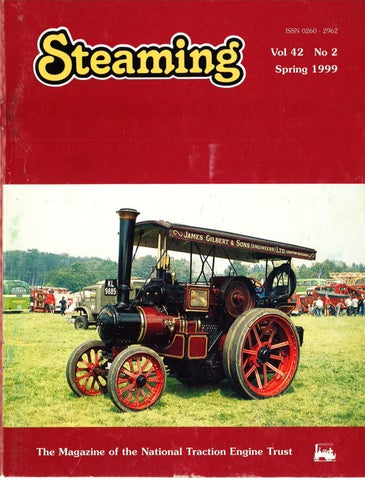
Cover The neat lines of Tasker's 5hp steam tractor are shown to advantage in Alec Swain's photograph of works number 1902 of 1923. The Andover built machine is posed in the arena at the 1991 Rushmoor event. 63
Trust News Rally Organisers Column All rally organisers who have requested authorisation for their event from the Trust should by now have received the revised Rally Code of Practice. This was introduced at the Spring Conference and reflects recent recommendations in publications from the various bodies responsible for health and safety. Many of the requirements can be prepared well in advance of your event in terms of paperwork and the training of staff who help to run the event, so please take time to study the Code well before your rally. If you have any problems with the Code please
contact Bill Evans in the first instance — his address can be found in the panel inside the front cover of every issue of our magazine. Additional copies are available from Bill, cost £5.00, plus £1.00 postage. Incidentally, if there are any rally organisers who have not yet received the authorisation forms they applied for, Bill is the chap you should be getting in touch with as soon as possible. The revised Code has had input from many knowledgeable people, some of them on our sub-Committee, and I would like to thank all who have been involved for their time and hard work in updating the document. Rally safety signs are available as
From Alan Martin's Collection
84
last year; please see the advert elsewhere in this section. I hope that this year the sun will shine on your event — please have a safe rally season. (Andrew Semple, Chairman, Rally Organisers subCommittee)
Engine Owners Column Driving Course Time is running out for members to book places on this years' Practical Engine Driving Course, which will again be held at Dingles Steam Village in Devon, over the weekend of 8th/9th May. This is the eighth course to be run be the Trust, and .lan and I have attended every one, firstly as students, then as staff, and now, this year, as course organisers. The first course we attended opened new doors for us in the steam world — we have met so many interesting people, made good friends and have been able to tap countless founts of knowledge. And we've had great tun over the past few years. Dingles is a superb venue for the course. It has excellent facilities, is set in a beautiful part of the country, and has much on site to interest everybody. For further information and booking forms please write to the address shown on the display advert in these notes, or give Jan or myself a ring on Tr 01634 312157. (Paul Ransley, Engine Owners sub-Committee) Technical Board
Wallis & SIeeyens Oilbath tractor 2900 of 1906 (BW5559) Is seen here en route to the St Giles' Fair at Oxford, probably in the 1920s. The engine, named DORIS, was at the time owned by Owen Buckland (is it he standing by the load?) of Witney, Oxfordshire, and has been quite nicely added to for his showland purposes with a full length awning and twisted brass, but no dynamo, and the original additional water tank atop the smokebox and around the chimney has been retained. 64
As ever, we continue to be beset by bureaucracy on all sides. Sometimes our attempts to fend it off are more successful than others and, for once, I am able to report a degree of success in one area. Towards the end of last year the Health & Safety Executive published a consultative document proposing further prohibitions on the use of asbestos. Recent research has shown Spring 1999
STEAMING
that white (chrysotile) asbestos, which was previously thought to be reasonably safe, is in fact carcinogenic, so there is very good reason to eliminate its use. Asbestos free substitutes have been found for many purposes but, so far, no safe and suitable alternative has appeared for manhole and mudhole door joints on locomotive type boilers. Accordingly, I have made representations to the HSE to allow the continued use of asbestos based door joints until suitable alternatives are available. The HSE has responded positively and proposes to advise the Health & Safety Commission to seek derogation (Eurospeak for letting us go on using them) until 1st January 2004. I have asked the HSE to keep us informed about asbestos-free materials which come to their notice and I will pass on this information via Steaming. We are also keeping in close touch with the Heritage Railways Association, sharing information and exchanging experience on our evaluations of nonasbestos materials. My request for derogation in respect of other asbestos based materials, particularly gland packings, has not been so successful. The HSE points out that PTFE gland packings are available and as equally effective, if not better, than asbestos, so perhaps their refusal is not unreasonable. PTFE, I am told, costs several times as much as asbestos based packing, but lasts very much longer and is probably kinder to piston and valve rods. The quantity of packing used in traction engines is quite small so, although there will be some increase in replacement cost, it should not be too painful. To sum up then, we should be able to go on buying and fitting asbestos based door joints until January 2004. Other asbestos packings and jointing materials will cease to be available but, as I understand it, existing asbestos based materials in use as joints or packings will not have to be removed until wear and tear or other reasons necessitate their replacement. Once old asbestos based packings have been removed, don't forget that they must be handled with care and then disposed of safely in accordance with the NTET Code of Practice. The other piece of legislation still rumbling on is our old friend the Pressure Equipment Directive. At the time of writing I have just received a draft of the proposed regulations to implement the Directive in this country. At first glance it looks as if these regulations will extend far beyond the requirements of the Directive itself and, if this first impression proves to be right, it will STEAMING Spring 1999
The National Traction Engine Trust Engine Owners sub-Committee present the 1999
PRACTICAL ENGINE DRIVINC COURSE to be held at
Dingles Steam Village Milford, near Lifton, Devon, on the 8th and 9th May 1999
a few places are still available - ask now! For further information send SAE to: Paul and Jan Ransley, 3 Rover Road, Lordswood, Chatham, Kent ME5 8SN.
impose a far greater burden of cost and unnecessary bumph on engine owners having new boilers built, or importing an engine from outside the EU. There are many questions to be answered but my experience in getting answers has, so far, not been good. Towards the end of last year, the DTI issued draft proposals for the appointment of 'conformity assessment bodies' — that is the people who will have to certify that new pressure equipment complies with EU standards. I wrote to the DTI putting a number of questions but received no reply, following which I tried to raise the matters at a meeting with them, but was blocked by the chairman who promised written replies. So far, none have been forthcoming. Clearly the time has come to demand straight answers to straightforward questions, but whether we will get them remains to be seen. The HSE is at present revising the Pressure Systems and Transportable Gas Containers Regulations, on which the boiler inspection part of the NTET Code of Practice is based. The new regulations will cover pressure systems only and transportable gas containers will come under different regulations to be made later. I have spoken to the HSE official who is dealing with the matter and he has promised to let me have a copy of the draft regulations as soon as they are available. It is not anticipated that the new regulations will make any fundamental changes to the old ones other than to bring them into line with the Pressure Equipment Regulations referred to above. We will, however, be looking at them closely for any subtle changes which might affect the
1kt
way our boilers are inspected or the position of independent boiler inspectors. This leads on to the Transportable Pressure Equipment Directive which is at present in gestation. Again, I have spoken to John Gardner, the HSE official concerned, and he assures me that it will only cover gas cylinders and tank containers, and will not affect steam driven vehicles. Increasing concern about the availability, within the major insurance companies and other inspecting organisations, of boiler inspectors with real knowledge of locomotive type boilers, led the Heritage Railways Association to seek a meeting with the Railway Inspectorate and representatives of those companies, to discuss the problem. I was invited to attend the meeting which took place on 11th January this year, to represent traction engine interests. The matter is obviously being taken very seriously by all concerned as the meeting was chaired by HM Deputy Chief Inspector of Railways, accompanied by two of his senior inspectors, and was attended by two representatives from the Heritage Engineering Group, the Chief Engineer of SAFed (the joint body representing the major inspecting companies) and senior engineers from five of those companies. The latter were left in no doubt that there is a serious problem to be addressed, and that they will have to institute training programmes if they are to continue to provide inspection services for locomotive type boilers. Both Alan Garraway, representing the Heritage Railways, and myself on behalf of the Trust, offered assistance in providing suitable input for any 65
training courses that they set up. Although there is now reliable evidence that some inexperienced and inadequately trained boiler inspectors are about, and are missing potentially dangerous faults in locomotive type boilers or, alternatively, are unnecessarily specifying expensive repairs because they are unable to make a proper judgement of what they are looking at, the companies concerned want facts — not beer tent gossip. We cannot expect these companies to set up training schemes, etc, on the basis of a few well publicised cases where things have gone very badly wrong, or a whole lot of other cases that those concerned will not substantiate. In other words, engine owners, put your pens where your mouths are! Information forthcoming from owners will be collated and only be passed on, via SAFed, in a form which does not identify the individual engine or the owner. Under no circumstances will these details be disclosed without your express permission. At the end of the day, however, nothing can be done to stop the situation getting worse, let alone improve it, without your help. In fairness to the insurance and other inspecting companies, it must be said that there are still a lot of very good boiler inspectors around, who do a first class job, exercising great skill and mature judgement. They have an excellent relationship with the engine owners whom they serve, and all concerned are very happy. The problem is that as these experienced inspectors retire, or lose their jobs during take-overs or amalgamations, their wisdom is lost, and will he lost for ever if we do not take steos to see that it is passed on. Lastly, I recently received a complaint from an engine owner that his boiler inspector (employed by one of the major companies) had, of his own volition, carried out a 'review' of the Scheme of Examination which his company had sold to the owner several years previously. Naturally, his company intended to charge the owner a fee for this service. It is bad enough that some companies persuaded owners to buy Schemes of Examination which, in most cases, they did not need, and sometimes were hardly worth the paper they were written on. It is adding insult to injury for these companies arbitrarily to carry out such reviews when they have no right whatsoever to do so. A boiler inspector is entitled to recommend to the owner that the Scheme should be reviewed land no more than that), if he is of the opinion that such a review is necessary, and he should explain why. 66
Basking in bright July sunshine at the Steam and Transport Show at White's Farm at Belting, Kent are two agriculiurals ready for the steering in the ring event. At the right is Fowler R class 11814 of 1909, and left is Marshall 6hp 84562 of 1929. (Peter Love)
It is then up to the owner to consider whether any review is required, and if so to carry it out. Most Schemes of Examination (including the NTET Scheme) call for a review after a specified time. This does not mean that the scheme has to be changed but merely that the owner should look at it and decide whether any changes are necessary. if he concludes that no changes are necessary, all that he has to do is endorse it to that effect and that is the end of the matter until conditions change, or the time for a review comes round again. I shall be writing to SAFed to ask them to remind their members of the requirements of the Regulations, particularly the point that it is the owner's, not their, responsibility to carry out reviews. All pretty boring stuff, I am afraid, but if we do not keep a close eye on what the bureaucrats and the big companies are up to we can easily find ourselves faced with faits accompli that are impossible to get out of. (Jim Newnham, Chairman, Technical Board)
Insurance Officers Notes The Road Traffic Act and the rallyfield During the 1998 season there was much debate on whether the Road
Traffic Act actually applies to the rallyfield, and unfortunately the misinformation brigade swung into action with gusto. This has led to confusion and sadly frayed tempers as some organisers tried to properly apply the Law. At the Autumn Rally Organisers Conference, based on legal research and advice from our insurers, a memo was issued that stated categorically that the RTA does indeed apply at any event where the general public is present, paying or nonpaying. In particular the note was issued to try to bring consistency to an area riddled with barrack room lawyers. I reiterate the statements contained in the memo and add to it that 'only if an event is wholly private, that is solely for the benefit of club or association members, and on private land, will the RTA then be absent'. The 1988 Road Traffic Act included new rules aimed at excluding unlicensed and uninsured persons from driving in a place where the public would be present and was particularly aimed at the car park joyrider. However, this Act brought with it certain anomalies which affected legitimate motoring events that involved driving at speed, or sometimes dangerously, mainly in off-road but public locations. The 1995 (Off-Road) Motoring Regulations were introduced in an endeavour to get rid of these anomalies and were responsible for the setting up of 'Authorising Bodies', of which the NTET is one. The RTA still applies to these 'off-road' events, Spring 1999
STEAMING
but the serious offences of dangerous driving or careless driving do not apply as long as the event is authorised and is conducted according to a recognised Code of Practice. Incidentally, such a Code may contain those recommendations the authorising organisation sees fit to apply, as long as they don't break common law. Club Insurance Schemes Some clubs and associations combine public liability insurance as part of the membership package. Sadly, since the enactment of the 1988 Road Traffic Act this form of insurance is inadequate for events where the general public attends and hence where the RTA applies. Indeed some insurance certificates, including those issued by NFU Mutual to members of the National Vintage Tractor & Engine Club actually note 'not valid where the RTA is in force'. The problem with public liability insurance is that there are too many loopholes that the insurer may try to invoke, all in order to avoid making full payment when an incident occurs involving a self propelled device in a public place — irrespective of whether it is licensed for the road. Its not good enough to say 'let a court of law decide'; the advice being offered until now. Just refer to the report in The Times newspaper last September when judgements relating to two accidents in car parks were overturned and subsequently re-instated, only to be overturned for a second time. RTA insurance cover, which includes public liability cover, as per the NTET's own scheme, leaves no grey areas, and can be obtained at very inexpensive rates from a variety of sources. The new Rally Code of Practice was published at the Spring Conference in March. It contains clear and unambiguous statements relating to the RTA and the rally site. It should now clear up one of the main concerns we have all felt for some time, but have been reluctant to act upon. Under age and unlicensed drivers One of the consequences of applying the RTA outright to rallies is that juniors and unlicensed drivers are not allowed to drive self-propelled equipment. As an Authorising Body the NTET has sought sanction to modify its Rally Code in order that juniors can legitimately demonstrate their skills at authorised rallies and events. The new document contains fresh guidelines that the NTET is introducing from 1st April 1999. As STEAMING Spring 1999
they are centred around young drivers, the relevant paragraphs are set down in full in this issue in John Durling's notes for the Steam Apprentice Club. The restrictions are important, and I urge members to read and absorb them. On the same topic I recently had a very enlightening conversation with Charlotte Molineux of NFU Mutual Insurance, based in Stratford upon Avon. She fully endorsed the recent statements and changes in rules as announced at the recent Rally Organisers Conference. I was also pleased to learn that NFU Mutual were actively seeking to accommodate under-age tractor drivers who were members of bona-fide clubs, in the same way that Footman James does for the NTET Steam Apprentices. In addition, NFU Mutual already offers an RTA policy to individual tractor owners, at a cost of around £16. Disclaimers Sadly, and after all the debate, I have to report that we are still seeing immoral disclaimers on the rally invitation forms, and some are from organisers who really ought to know better. If the situation persists, I think I shall have to name names! (Dave Smith, Insurance Officer)
Steam Apprentice Club After what feels like a very busy 'closed' season, we are now looking forward to the start of SAC driving days; indeed we shall already have done some of them around the Easter period by the time you read this. It would appear we have found an activity that appeals to the larger number of our members — we already have 40 applications for the seven different courses which are running around the country. The next major event in the SAC calendar is the Driving Course being held at Dingles Steam Village, currently under subscribed and therefore still open for enquiries. The SAC tried a slightly different approach at this year's Spring conference of Rally Organisers, by giving a full presentation to the delegates, and sparking off an interesting debate as a result. We now wait to see if this initiative bears fruit. One aspect which concerns the
members of the SAC — and many of their parents — is the question of the legality of youngsters driving engines at our rallies. Dave Smith and I have spent what seems like a large part of the winter trying to understand the implications of the legislation on the subject and, as a result, have now gained a much fuller knowledge of the powers conferred on the NTET as a result of being an Authorising Body under the Motor Vehicles (Off Road) Regulations 1995. Many of you will have seen the article published in Old Glory detailing our conclusions, and I repeat it here. Under age, non-licence holders may be allowed to steer and drive a steam vehicle at an Authorised event if all of the following conditions are met: • The insurance cover for the vehicle specifically includes Steam Apprentice Club members (as per the NTET Insurance Scheme), • The person is a bona-fide member of the NTET's SAC, • That, age notwithstanding, the Apprentice is not prohibited from applying for or holding a driving licence, • The Apprentice is closely accompanied at all times by a person who is a full licence holder for the type of vehicle being used, • The minimum age shall be 13, with a minimum height of 1.4 metres, • The known conduct of the Apprentice is not likely to detract from the safety standards of the event, • The Safety Officer has given formal sanction following a risk assessment of the 'roadways' and vehicle manoeuvring places, • The Rally Organiser has given written notice to the exhibitors and public of his intention to allow such movements (via notices and the rally programme). NOTES 1. The above arrangements for juveniles only apply to a rally that is an Authorised Event. At all other events where members of the general public are present, the Road Traffic Act must be assumed to apply, and therefore the RTA licensing and insurance requirements must be complied with. 2. Because of the lack of knowledge that the NTET have with regard to other bonafide junior clubs, these proposals can only be currently applied to members of the NTET's Steam Apprentice Club. However, further dispensation may be given, following discussions with interested parties, to juveniles and unlicensed persons when driving tractors (minimum age 13) and similar implements. I believe that the above should make the question of to drive or not to drive quite clear. If you know of any youngsters who would wish to drive 67
List of Collieries
RALLY SAFETY SIGNS DANGER - beware of moving vehicles etc yellow with black lettering
Unauthorised persons prohibited etc red with white lettering FIRE POINT - red with white lettering
can calorific ash ash sulphur chlorine volatile type of type of coal supply value content fusion content content matter mine ex-pit KJ/KG % point °C %
WEST MIDLANDS
Printed on rigid plastic boards
Auriory Mining Ltd, Apedale Colliery, Apedale Road, Chesterton, Newcastle under Lyme Staffordshire ST5 6BL (Tr 01782 565860) deep steam/house yes 28733 7.2 1.89 0.11 39.1
EAST MIDLANDS
each sign inc VAT, postk:oe E6 per order From: A.J. Semple INTETI Unit 6, Mynd Industrial Estate Church Stretton, Shropshire SY6 6EA
H.J. Banks & Co Ltd, Doe Hill House Site, Mill Lane, Wingerworth, Chesterfield, Derbyshire S42 6NG (Tr 01246 211951) open r•.ast steam/house yes 74170 0.8 2,0 0.1
20.6
H,J. Banks & Co Ltd, Foxholes Farm Site, (address as above) open cast steam/house yes 26400 8.1
29.0
2.4
0.1
J.J. Cummins Ltd, Trinity III Deep Hard Opencast, Matlock Road, Wessington, Derbyshire DE55 6BZ (Tr 01773 832529)
a
0.01
31.3
J.J. Cummins Ltd, Trinity Ill Deep Hard Southern Ext, (address as above) open cast steam/house yes 25488 9.1 1.47 0.01
open cast steam/house
yes
25240
7.9
0.52
32.8
SOUTH WALES engines at rallies, but who are not currently members of the SAC, I would strongly recommend that you contact us to get them enrolled. At the moment this dispensation only applies to members of the SAC; however, we are hoping that if other organisations can establish a similar junior section it will enable us to authorise youngsters to drive other vehicles. This will typically apply to the farm tractor and vintage car clubs. (John Durling, Chairman, Steam Apprentice Club)
Coal Mine Survey As the result of discussions at Road Steam Forum meetings I have been asked to undertake a survey of coal mines and their products. I applied to the Coal Authority for a list of the surviving collieries in the UK, and subsequently wrote to all of them (162 in all). Those that replied are listed, together with the technical information on the coal, in the accompanying table. Please note that all the figures are those supplied by the mine owners, and are not guaranteed by me (as representative of the Trust). Also note that most producers claim suitability of their product for steamers, but, for example, in my experience, anthracite is most certainly not. I know that there are other mines not on this list that you may be using; please let me know others that you may have found to be offering a good product - or, indeed, a poor one not to be continued with. I must point out that there is some very good coal being imported from 68
Betws Colliery, Maesquarre Road, Betws, Ammanford, Carmarthenshire SA18 2LF (Tr 01269 593721) deep anthracite yes 35000 5 0.85 0.2 6.5 Dragon Coal Corp Ltd, Ystrad No.2 Colliery, Glynmoch, Ammanford, Carmarthenshire SA18 2JF ItT 01269 823136) drift anthracite yes 3200 7 1280 0.8
0.03
7.0
Ffnonav Djon Mines Ltd, Blaentillery No.2 Colliery, Pentwyn, Fochriw, Bargoed, Caerphilly, South Wales (Tr 01685 841259) drift mine steam yes 25000 15 1.2
25.0
M&W (Anthracite) Ltd, Nant-Hir Colliery, Caerhenllys, Ystradowen, Cwmllynfell, Swansea (Tr 01639 830048) deep anthracite yes 32000 5-7 0.5 5.0 Signalfearn Ltd, Aberpergwm Colliery, Rheola Works, Glynneath Road, Resolven, Neath and Port Talbot SA44 4DT (Tr 01639 722400) deep anthracite yes 32700 4 1400 1.0
7-8
Signalfearn Ltd, Forest No.3 Colliery, (address as above) open cast anthracite yes 32000 5 1400
8-9
1,5
Signalfearn Ltd, Hirfynydd Colliery, (address as above) deep steam yes 33500 5 1400 1.3 0.02 11-12 Bedlinog Fuels Ltd, High Street Colliery, 24 High Street, Bedlinog, Merthyr Tydfil CF46 6RP (Tr 01443 710750) yes 31230 13,2 1.64 deep 23.8 K.T. Williams, Bleancuffin Mine, 30 Lewis Street, Bedlinog, Merthyr Tydfil C46 6SE (TT 01443 710228) deep steam yes Tower Colliery, Treherbert Road, Hirwaun, Aberdare, Mid Glamorgan CF44 9UF (TT 01685 811199) deep anthracite yes 35000 4 1170 0.9 0.03
Poland, and possibly Russia, and maybe the only problem is that of consistency - is the coal from one source? That coal I have used so far does seem consistent, but surely it is rather sad we live on an island of coal, and are importing a foreign product. For guidance, a short and not definitive explanation of the table headings is: • calorific value - the amount of heat released from a given unit of coal. • ash content - the residue after combustion. A high ash content (over
8
10%) reduces calorific value of the coal and gives problems with cleaning and disposal. • ash fusion point - the temperature at which the ash fuses (forms clinker). The ash fusion temperature needs to be above 1200°C to stop the formation of excessive clinker. Sadly, not enough suppliers quoted this figure. • sulphur content - the amount of sulphur in the coal. A sulphur content of below 1% is preferable as sulphur can cause corrosion in the boiler. Spring 1999
STEAMING
calorific ash ash sulphur chlorine volatile can type of coal supply value content fusion content content matter % point °C ex-pit KJ/KG
type of mine
SOUTH WALES (continued) Dynant Fach Colliery Ltd, Bethesda Road, Tumble, Llanelli, Dyfed SA15 5LW (Tr 01269 841595) deep/ anthracite yes 3200 5 0.5 open cast Craig Wen Mining Co, Nant Nmeliyn Colliery, Tynewyyd, Heol Rigg, Merthyr Tydfil CF48 1TW (Tr 01639 701799) deep/ anthracite/ 14200 1.7 0.04 yes open cast steam
6-7
28.7
NORTH WEST Grime Bridge Colliery Co, Hill Top Colliery, 9 ThistlemOunt Avenue, Waterfoot, Rossendale, Lancashire BB4 9DZ (is• 01706 215963) 3.78 0.04 27.2 deep steam/house yes 31198 8.6 Cobex Ltd, Sandyford Farm, 4 West Parade, Wakefield WF1 1LT (is. 01924 371898) 30 27000 5-6% 1130 3.0 0.04 open cast steam/house yes NORTH EAST Ambion Brick Co Ltd, Clarence Farm Extension, Ambion Brick Rodhills, Newfield, Bishop Auckland, Durham DL14 8DA (Tr 01388 604071) open cast soft coal for no 34570 14.0 2.64 0.06 37.2 power stations Ward Bros Mining Ltd, Nant Hir Colliery, Thistle Road, Langley Moor, Durham DH7 8HZ (27r 01913 780476) all?
open cast
yes
26000' 2.14 32000
0.6-2.5 0.01 7-12
YORKSHIRE Hatfield Colliery, East Lane, Stainforth, Doncaster (Tr 01302 841231) deep house yes 28500 3.5 1200 1.2 0.4 33 Moorside Mining Ltd, Eckington Colliery, Rotherside Road, Eckington, Sheffield S31 9HL (Tr 01246 435238) steam/house 2-3 tons31688 minimum
1.75
3.6
0.11
35.7
found. Now in its sixth year with the Trust, the Unit has become a valued asset, enabling members to use it as a meeting place, to talk to Committee members and others who staff it, and of course, to patronise the NTET Sales, with its wide selection of books and videos. The latter must be the best and widest selection available on the rallyfields - or anywhere. Arrangements have been made for the Unit to attend the following events in the first half of the season: May - 2nd Hethersgill, Carlisle; 8/9th Stoke Goldington; 22/23rd Tallington; 30/31st Carrington. June - 5/6th Woolpit; 12/13th Science Museum, Wroughton; 19/ 20th Stapleford; 26/27th Banbury. July - 3/4th Great Yorkshire TE Club, Helmsley; 10/11th Cheshire Steam Fair, Grappenhall; 16 to 18th Weeting; 17/18th Langport; 23 to 25th Welland. As usual, in some cases, only the more familiar abbreviated titles of the rallies are given in the above list, but reference The Rally List, 1999, which is distributed with this issue of the magazine, will enable you to find further details of any event that is unknown to you. Venues for the remainder of the season will be set down in the Summer issue. (Colin and Val Brown)
Miller Group Ltd, Miller House, Pontefract Road, Normanton, West Yorkshire WH6 1 RN (z. 01924 2243001 yes 28000 5 1250 0.65 0.02 35.0 open cast steam/house Miller Group Ltd, (address as above) yes 28000 open cast steam/house
4
1300
1.5
0.02
I. & H. Brown Ltd, Braehead, PO Box 51, Dunkeld Road, Kinross PH1 3YD (Tr 01738 637171) 5-6 1400 0.6 open cast steam/house yes 27000
30.0
32.33
Blenkinsop Colliery Ltd, College View, Greenmead, Carlisle, Cumbria CA6 7JQ (Tr 016977 47340) deep steam yes 27000 12 1400 2.8 0.05 27 RJB Mining Ltd, Calverton Colliery, Harworth Park, Blyth Road, Harworth, Doncaster DN11 8DB (Tr 01302 751751) deep house no 27740 5.0 1400 1.2 0.60 31.6 RJB Mining Ltd, Rossington Colliery, (address as above) deep house no 28800 3.8
1.1 0.6 34.0
RJB Mining Ltd, Daw Mill Colliery, (address as above) deep house no 28800 38
11 0.60 36.3
• chlorine content - the amount of chlorine in the coal. Chlorine content should be no more than 0.3% as chlorine can cause corrosion and fouling in boilers. • volatile matter - volatile matter represents that component of coal which is liberated at high temperature (smoke and soot, etc). Between 9 and 20% is low volatility steam coal. Higher values can produce excessive smoking. Where there is a dash in the tables, the information was not supplied STEAMING
Spring 1999
Affiliated Groups The administration of the Trust's Affiliated Groups has now been taken over by Bill Evans, to run alongside his work with Rally Authorisation. Future correspondence on the subject should be addressed to Bill - his address is inside the cover of each issue.
Personal
by the company concerned. (Mick Tux worth, Engine Owners subCommittee)
Trust Exhibition Unit In a few weeks time the Trust's Exhibition Unit commences yet another year of travelling to rallyfields and other events where road steam engines and enthusiasts are to be
Thanks from Smudge I hope our Editor will be able to find a small space in the next issue of the magazine for me to publicly express my thanks to Richard Sandercock, our Chairman, the National Committee and all members of the Trust for the decanter and glasses given to me on my retirement from Trust activities at the Annual General Meeting last November. It was quite unexpected and a lovely surprise. The gift is now in use, and my favourite malt whisky has taken on an even better taste. The engraved salver has pride of place on 69
the sideboard and is a daily reminder of the Trust and all its endeavours. Thank you one and all. (Smudge Smith, Abingdon, Oxfordshire)
Obituaries Harold Bonnett Harold Bonnett, founder of the Steam Plough Club, has died in his 92nd year. He was one of that special group of men who could write in simple language of his wide talents and interests. He grew up in steam days and as a railwayman steam provided his living for nearly forty years. He also travelled widely in north America and southern Africa. Harold was always a great explainer, via his rally commentaries and books, or perhaps standing with outstretched hands by a steam plough talking to anyone who would listen. He saw his railway engines go to the scrap yard, losing his railway job at Paddington in the process. Whilst he had been fascinated by steam engines of all kinds, more especially he liked ploughing engines, his favourite being the 'lovely to look at and wonderful to listen to' BB1 class. These feelings inspired the acclaimed Saga of the Steam Plough, published in 1965, and in the following year his creation of the Steam Plough Club. Despite his experience as Secretary of the then National Traction Engine Club in the 1950s, the first two years of the SPC were difficult. There
Harold Bonnett, 1907-1999. 70
was little to show and members were slow to enrol. But he never doubted the outcome. He considered his aim of getting plough engines out to work in the fields again so worthy that it could not fail to succeed. From those early days he lived to be able to witness in October 1998, right at the end of his life, his club organising the greatest gathering of steam ploughs ever seen. Harold was born in February 1907, son of a signalman at Barkston, Lincolnshire on the Great Northern Railway. His spark of enthusiasm soon fanned into flame, because Barkston was on the main East Coast route to Scotland. When he was eleven his first paid work was looking after cows on verges, and the best place to go was by the railway bridge, where there was plenty of long grass. There were soon no doubts that he wanted to be a locomotive man. At seventeen he started in the time honoured position of cleaner at Grantham, developing an affection for the purposeful A class 0-6-0 goods engines, but in awe of the firemen and drivers. These were good times, with the introduction of the Gresley Pacifies, and Harold saw them on trial against a Great Western Castle. By 1925 he was a fireman, and with it a pay rise from six shillings (30p) to nine shillings 145p1 a day. From Grantham he moved to Hatfield and worked to London with heavy freight locos, and on one glorious day a 'Booster' — a Gresley 2-8-2. But sadly in 1928 an eyesight defect finished his footplate days. Harold Bonnett's introduction to steam ploughing came early in life. He recalled 'great ground shaking two engine sets' going past the family's red brick house at Barkston. At the age of seven or eight he was with the engines whenever they were near the village. Out of school at four without going home for tea, he was off with his friends following the sounds of engines, on many occasions not returning home till supper time or later. Thereby he came to appreciate hand and steam getting the job done together, arousing an admiration that stayed with him all his life. Ironically, it was the internal combustion engine that saw him through his own service days throughout the war. Called up at the late age of 35, typically, Harold Bonnett made the most of his chances. Posted to Canada to maintain aircraft engines, he travelled widely on the continent. Such was the attraction of that country, in 1944 he bought a plot of land for $40 with the idea of settling there after the war. This didn't happen but 45 years later he sold it for around
$10,000, so didn't do too badly. In 1940 Harold married Hilda, to be his wife for 59 years. Hilda was a teacher of English and was able to help by reading the manuscripts of his books. Most of their married life was spent in Perivale, Middlesex and at Bledlow Ridge, near High Wycombe. When he left the railway he joined a publishing house, organising exhibitions and not retiring finally until he was 67. Then Harold was able to fully indulge in his interests of writing, water colour painting and running two rollers — Fowler DN class compound 17077, and Aveling & Porter 8 ton compound 12074. His books are known for their clear style and a deep knowledge of people and machines. They include Saga of the Steam Plough (1965); Discovering Traction Engines I1969); Farming with Steam (1974) and Steam Traction Engines (1975). Right up to the end of his life he continued writing and his Snippets of South Africa 1967/8 is to be published shortly. Harold Bonnett was a delightful man, remembered for his depth of information and a deep throated laugh which concluded most conversations. Yet he never forgot those early years on the footplate of a Great Northern 'Ragtimer' or 'Tango'. He said "There is nothing quite like the smoke, the steam — all the work showing and the engine struggling on at low speed. Those trains were in rhythm with human beings". Harold is survived by Hilda to whom we offer our sympathy. (John Billard)
Colin Dale It is always sad to record the passing of a friend of many years standing and for me none more so than John Colin Dale. He died in November 1998, aged 64 years, after some months of ill health which was borne with characteristic bravery. He will be remembered by steam enthusiasts not only in his ria live Cheshire, but also In those many parts of the country where he and his team of helpers appeared with Burrell single crank compound Devonshire engine 2950 LITTLE MAC. Colin was born in Congleton, Cheshire, close by the headquarters of the family engineering business. Following his formai years of education he joined the family business and attended Crewe Technical College where one of his specialised subjects was welding technology. He was able to introduce these skills into the family firm and today Dale Engineering are foremost in Spring 1999
STEAMING
December 1923, and later served an apprenticeship in the motor trade. In 1946 he started his own garage business in Chipping Norton, doing agricultural and car repairs and also plant hire. He ran quite a few steam engines commercially, including rollers and a pair of ploughing engines, and then his passion for steam carried on into preservation, owning rollers and the Fowler agricultural THE PRIDE OF HANLEY CASTLE, a machine he owned for fifty years. Neville will be greatly missed for his knowledge of engines and the great friendship he showed to everybody he met. (Martin Preston)
James Swindlehurst
Neville Melhuish driving his Fowler 7hp single 11699 at an early Science Museum rally in the streets of Birmingham. Neville nurtured the green paintwork put on by Fowlers and even today the original livery survives. (Dick Blenkinsop)
the process of specialist fabrications and machining for industry. In 1958 Colin married Jean, a farmer's daughter from nearby Chelford. There are two children in the family, David their son, Fiona their daughter, and of course the Burrell, which has always played an important part in the family's life. From childhood Colin was interested in machinery both new and not so new, and during visits to the Chelford area he came to meet Alan Barber and the late Jim Dakin. These two stalwarts of the early traction engine movement inspired Colin to own an engine, an ambition encouraged by both his parents. The search was now on and in 1961 Colin found surprisingly Exchange & Mart advertising 'Burrell stationary steam engine For Sale'. The outcome was the arrival of LITTLE MAC at Congleton a short time later, heralding Colin's entry into steam engine ownership and the movement in which he was to be active right up to a few weeks before his death. Colin lived life to the full and it could be said that he was larger than life always positive and never a wrong word for anyone. Away from his business and steam interests he was a very active member of Rotary, and was a driving force behind the Congleton Carnival and other events which over the years have raised much for local charities. It was at this year's Carnival that Colin took the controls of his Burrell for the last time. Little did we realise STEAMING Spring 1999
that within a few months it would lead the funeral cortege on his final journey. Colin's passing has left a void in our lives. All who knew him respected him and valued his friendship. We offer heartfelt sympathies to his wife Jean, his mother, his children David and Fiona and their families in their loss. (David J. Bradbury)
Neville Melhuish We regret to mark the' passing of Neville Melhuish of Stratford on Avon, Warwickshire. Neville was born in Birmingham in
James Philip Swindlehurst died unexpectedly at the end of August last' year. He left behind a lifetime of involvement in the world of steam engines and general preservation. I first recall references to Phil from when I was young, with a head full of steam. 'Mr Swindlehurst's traction engine' was kept at nurseries in Leek, and I was promised a visit to see it. Those were the heady days of the early 1960s, when steam locomotives worked the Cauldon Lowe quarry branch of the old North Staffordshire Railway and Lancashire boilers still powered mills of North Staffordshire. Phil had bought RAJAH — one of the famous Bostock & Wombwell circus duo — quite early in preservation days and, restored to its former splendour, Burrell 3509 of 1913 graced the early Alton Towers rallies, as well as other events in Staffordshire. Phil's lifelong friend dear old Pip Philips, alas also sadly departed — was often to be seen
Colin Dale's Burrell single crank compound 2950 LITTLE MAC, smartly turned out as usual, runs through Market Drayton, Shropshire. (Barry Job)
steering, for RAJAH went everywhere under steam. Those early events were organised by the then embryonic North Staffordshire & Cheshire Traction Engine Club and it was through that organisation that many years later I came to know Phil 'Swig', and to appreciate his many qualities, including patience, freely available good advice and, of course, his wickedly dry sense of humour. Phil had been chairman of the North Staffs for many years when I became secretary, and he had guided the club through good times and bad. His method of chairing meetings was to let everyone have their say and then round off the discussion decisively and move on to next business. This led to long committee sessions, but everything got a thorough airing, for Phil held that all had the right to an opinion and that all these opinions made valid contributions to the matter in hand. As well as being a thorough-going man of steam, Phil was active in the field of firearms and possessed tremendous knowledge of the subject. He was a skilled gunsmith and an excellent shot. The restoration of his Orton & Spooner Tube Shooter brought together his passion for guns and that for the traditional fairground, with the Shooter's ark lamps, naptha flares, rifles and 'proper' ammunition. In the latter years of his ownership the Burrell would sometimes be seen generating alongside. Eventually, with older age, Phil partially closed the regulator on some of his activities and RAJAH was sold on to pastures new. However, commitment to the North Staffs club remained and when restoration of the club's Aveling steam roller commenced, Phil was there with encouragement and practical advice. When serious work finally resulted in the club's Isaac Ball Burrell also becoming roadworthy, a delighted Phil, with wife Jean steering, drove it to the local hostelry to be rechristened. Phil Swindlehurst was a warm, friendly and engaging person who had time to listen to, and encourage, others. The ancient parish church in Leek possesses a fine old Jardine three manual pipe organ, well in keeping with Philip Swindlehurst's philosophy. I was privileged to play it for his funeral. In consideration of the foregoing, the words of the Queen of Sheba on her return from the splendid courts of King Solomon are most apposite — 'the half has not been told...,' (Andrew Hall)
72
Steam in Denmark It is very many years since we have been able to give advance notice of a steam event in Denmark that is hoped will see a few steam rollers in action. The Graested Steam and Vintage Fair will take place around the town's railway station, and the adjacent loco sheds and 15 acre meadow on Sunday and Monday 23rd/24th May 1999. Steam trains will run to the Kattegat Beach and exhibits will feature transport, agriculture and rural life. Further information is available from Svend-Larsen, Dyrlaegeraekken 50, DK-5350 Rynkeby, Denmark (fax 00 45 65 38 28 58).
The End to End Run One of the premier road steam events of 1999 is going to be the Sentinel Drivers Club's End to End Run, from John O'Groats to Land's End. To celebrate the development and use of the Sentinel steam wagon during this century, the SDC have organised the 940 mile run from one end of Great Britain to the other. Sentinel wagons were first made in 1905 by Alley & McLellan at Glasgow. The firm moved to Shrewsbury in 1914 and took on its more familiar title of Sentinel Waggon Works Ltd, turned away from steamers later than other firms and ceased trading, by then producing diesel lorries, in 1955, when the Rolls Royce company took over. Since then Sentinel steam wagons have continued to be run by enthusiasts for pleasure. The wagons will leave John O'Groats on Monday, 10th May and following their marathon journey arrive at Land's End on Friday 21st May. The daily mileage varies from 80 to 150 miles, depending on the terrain and the stop over points. No doubt many members will wish to try to see the run at some stage or other. The planned day to day stages are as set down below, but bear in mind the dozen or more entries are likely to span Standards to S-types, so they won't be streaming past in convoy. • Monday, 10th May — John O'Groats, Wick, Helmsdale, Tain. 179 miles) • Tuesday, 1 1 th May — Inverness, Carr Bridge, Dalwinnie, Pitlochry. (125miles) • Wednesday, 12th May — Perth, Dunblane, Stirling, Denny, Glasgow. (93 miles) • Thursday, 13th May — rest day. • Friday, 14th May — Thornhill A702, Dumfries, Gretna, Carlisle (Truckstop). (110 miles)
• Saturday, 15th May — Penrith, Kendal, Carnforth, Preston. (98 miles) • Sunday, 1 fith May — rest day. • Monday, 17th May — Leyland A49, Wigan, Warrington, Tarporley, Whitchurch, Shrewsbury. (80 miles) • Tuesday, 18th May — Craven Arms, Leominster, Ledbury A417, Gloucester A38, Dursley, Bath A46, Camerton. (150 miles) • Wednesday, 19th May — rest day. • Thursday, 20th May — Shepton Mallet A37, Ilminster A303, Honiton, Exeter, Okehampton, Launceston (Dingles). (115 miles) • Friday, 21st May — Bodmin, Camborne, Penzance, Land's End. (91 miles) (Mick Tuxworth, Sentinel Drivers Club)
Poor Steaming An error occurred in the picture captions on the rear cover of the last issue. As Richard Vernon, owner of the Howard machine, kindly points out, the makers called the design 'The Farmers Engine', not as we christened it.
New Members A sincere welcome is extended to the following new members who have joined the Trust during the last three months. We hope they will gain much friendship, information and enjoyment from their membership over a period of many years. The Membership Secretary is always pleased to put members in touch with one another by fowarding mail. M.A. Burrell, Wetherby, North Yorkshire N.J. Heath, Worcester Mrs J. Guest, Bovey Tracey, Devon S. Corbett, Redditch, Worcestershire D.A. Easton, Norwich, Norfolk T.P. Perry, Poole, Dorset R. Dyer, Leicester B.G. French, Newton Abbot, Devon M.J. Button, Ipswich, Suffolk Mrs J. I . Holt, Hinckley, Leicestershire M.E. Duke, Chard, Somerset P.N. Davison, London H.W. Scott, Boston, Lincolnshire E.B. Hewlett, Weston-super-Mare, Avon J.E.G. Grahamslaw, Chathill, Northumberland T. Vaile, Poole, Dorset P.A. Simmons, Crawley, West Sussex B. Halford, Fawley, Hampshire Mrs MX. Jackson, Lewes, East Sussex J.A. Thompson, Barton on Humber, Lincolnshire A.J. Putterill, Bristol J.B. Barrass, Tavistock, Devon A. Maddock-Clegg, Coventry, Warwickshire Spring 1999
STEAMING
Here I stand ... We've featured some pretty weird road engines in Steaming over the years, but the pictures Hazel Bregazzi has been able to take of a machine in Namibia, on the western coast of southern Africa, take a bit of beating.
Hazel was in Namibia on honeymoon in 1997, and came across the exhibit a few miles out of Swakopmund, where it has been plinthed, something of a national monument. In fact the engine has featured in our magazine before, way back in the Summer 1983 issue, in a short piece on postage stamps. Then, it was noted that the 1975 9 cent stamp of South West Africa (as the country was named at the time) depicted a traction engine of unusual appearance, said to have been imported from Hamburg in the days when that part of Africa was a German colony, and restored for exhibition, along with three trailers, in 1973. Over the years the relic had acquired the name MARTIN LUTHER, due to the fact that the famous remark of that churchman so aptly describes its plight: 'Here I stand — God help me — I cannot do otherwise'. A little delving into published sources reveals an interesting tale, and gives us an insight to the most dreadful corrosion that is present on the surviving original pieces of the engine. The panel (overleaf) is an extract from Mechanical Traction in War, a book written by Lt-Col Otfried Layriz of the German Army, and published (in English) in London in 1900. Here we can discover, in a contemporary account, just how the engine came to be in what is now Namibia. Germans
STEAMING Spring 1999
began arriving in the region in the 1850s, and though Walfish Bay was under the British flag in 1878, the rest of the area became a German Protectorate from 1884. Colonialists appeared during the last decade of the nineteenth century with the town of Swakopmund founded in 1892. It was, and is, a region noted for its wild and dangerous coasts, though valuable copper ores were present as well as guano deposits on the salt plains. In 1892 the South-West Africa Company of London took concessions from the German Government to develop the local minerals and build railways — a local 2ft 6in gauge line was constructed at Walfish Bay before later lines were laid by the Germans. We can glean further information of happenings of the time from Moir and Crittenden's book Namib Narrow Gauge published in 1967. This account confirms the use of oxen for transport to the interior, following a more or less fixed route across the sand, though the path moved when the sand dunes shifted — it always had to be the easiest way for the beasts. The traction engine is said to have been imported in 1897 from Halberstadt, Germany by Lieutenant Edmund Troost, a young German army officer. It was put ashore at Walfish Bay due to the lack of adequate landing facilities at Swakopmund. The accompanying mechanic. who was
As severe a case of corrosion as any of us want to see on an engine. These are the gears seen from where the right hand side of the tender would have been.
also to serve as driver, took one look at the desert and went home. However, the outbreak of the Hotentot-Herero War about the same time may have had something to do with the circumstances, for the engine rested at
The remains of the Swakopmund traction engine stand in the surroundings that proved to be its downfall one hundred years aao.
73
Walfish Bay for some time until an American gold prospector, down on his luck at the time and willing to try anything, offered to get the machine the 15 or 20 miles to Swakopmund, claiming to know something about such contraptions. Three months later he delivered the engine to its owner at Swakopmund, and was promptly hired as its permanent operator, there being no one else available. It had been practically pushed the entire distance by natives because it had a tendency to dig itself a grave every time an effort was made to move it under its own power. A service with several wagons was started and the traction engine did surprisingly well for a few trips, once the coastal belt was traversed, but it had not been designed for such arduous work and finally blew a tube just outside Swakopmund while starting out on a trip. It was left standing out in the desert until a new tube could be located and installed, but nothing could be found. The book ends its references to the machine; 'the traction engine stands today, denuded of such parts as could be used elsewhere' — presumably an indication of its situation in the early or mid 1960s. So, what of the relic shown in Hazel's pictures? Two points immediately come to the fore — the incredible corrosion on the hind wheels, the gearing and the firebox area of the boiler, and, then, the obvious fabrication of the forward part of the rest of the exhibit. It seems likely that the whole of the front part of the engine had disappeared by the time the remains were considered worthy of keeping as an artefact, and the boiler barrel, front wheels, smokebox and chimney, cylinder and flywheel were all made up about 1973, but no tender was provided. Perhaps the engine had succumbed to being buried in the shifting salt-laden sands of the region, with the rear end just about salvageable? Otfried Layriz tells us the engine was British, and the authentic remains certainly look so. To John Robins of Leicester goes the credit of scrutinising the pictures thoroughly enough to offer the clue that indicates
A closer view of the relic. Only the rear wheels, gearing and axle, and the back half of the boiler survive of the original — the rest is a fabrication to enable the remains to be presented. Notice that the centres of the would be cylinder are not in line with the crankshaft. 74
'Adventures of a traction engine in German South Africa' 'Pending the establishment of a railway, an attempt has been made to get over the transport difficulty in German South Africa by employing a traction engine obtained from England. The traffic with oxen was so difficult across the 60 miles of coast desert, in which the poor animals often got nothing to eat for a week, that they perished by the hundreds, the whole way between Walfischbay and Swakopmund being white with their bones, and those which got through were mere skeletons, which required two months to get strength again. 'The traction engine, from the time of its arrival at Walfischbay, where it landed, until it reached Swakopmund, went through a series of adventures, which show under what peculiar conditions this method of transport has to be carried on there. 'Although the want of rain caused absence of that softness of the ground which is a hindrance in other colonies, working the engine through the sand offered extraordinary although not
insuperable difficulties. For ground of this nature the engine is provided with spuds, which are fixed to the driving wheels, and grip into the ground. The chief question of course is, Does it pay to use a traction engine under such conditions in the colonies? Lieutenant Troost, the owner of the engine, says it does, as with an outlay of 1640 marks for the three journeys in a month there was an income of 1800 marks, or a 5% profit on the capital employed; but that this was only a theoretical estimate, the actual result being much more favourable. 'Under what conditions the traction engine can be employed in other German colonies remains to be seen. Its proper place is as forerunner of the railway, and when the materials for that are to hand, the traction engine does not wait the fate of being pushed to one side as useless, but rather does all kinds of useful work as a stationary engine, or works on the line as a locomotive after the necessary change of wheels.' (from Mechanical Traction in War, by Lieutenant-Colonel Otfried Layriz of the German Army, published in London, 1900.)
the machine is of McLaren build. Crusty and indistinct it may be, but the short bracket at the lower front part of the firebox is a typical detail of Midland Engine Works practice in their 'middle period' about the turn of the century. Unfortunately, the late Alan Duke, when he visited McLaren's works in 1956 to take notes from their records, had but limited time and naturally concentrated on British customers, having to miss out on the detail of
export engines. Such are the pitfalls of the historian; presumably later opportunities didn't present themselves. Ronald Markillie, living in the Leeds area during World War 2, was able to record some information from McLaren records, and the years 1895 to 1897 reveal several engines sent to Dehne of Halberstadt — two sets of compound ploughing engines in the first year and a 15 ton roller in each of the others. But nothing else that neatly suggests itself as a candidate for our
Namibian relic. Perhaps somewhere, someone can unearth further clues for us. Thanks are due to Hazel Bregazzi for letting us have the pictures for use in the magazine; to Robin Harding for his attempts to find some identification of a long lost McLaren in Road Locomotive Society lists and to John Robins who tenaciously studied the pictures until he came up with a suitable candidate.
OUR MAGAZINE 25 YEARS AGO
The March 1974 issue was devoted to Cornwall, with a fine selection of articles on a wide variety of subjects contributed by members living in the county. Richard Sandercock wrote on the history of his family's business, R. Dingle & Sons; Charles Daniel on steam haulage in Cornwall and Charles Gregory, doyen of the west country enthusiasts, on the emergence of steam preservation in Cornwall, with mention of his contemporaries George Hawkins, Joe Warren, Jack Trounson and Art STEAMING
Spring 1999
Above we see a close-up of the rear wheel, firebox and what is left of the hornplates. The wheel strakes set at a shallow pitch suggest McLaren manufacture, but the sloping foundation ring (a feature of construction that the Midland Engine Works shared with Burrells of Thetford) and the ashpan fixing bracket tend to confirm that maker. Compare this view with the illustration of the firebox area of a boiler, right, taken from J. & H. McLaren's 1909 catalogue, and conveniently seen at a very similar position. The angle the hornplates were cut back to on their front face is a distinctive feature of McLarens of the period; the slope is seen clearly on the catalogue illustration and at the far side of the Namibian relic, but the side nearest the camera in the recent picture has rusted away, the thin remains twisted in the air, but still showing the angle at the top forward edge.
Pethick. The subject of Sentinels was, of course, covered by Joe Thomas. A second edition of Traction Engine Register had been published, containing nearly 2500 engine entries. It cost 50 pence including postage and replaced the first edition published in 1968. There were lengthy notes from Vincent Carveth on aspects of work involved in the preserving of engines and of correctly putting them away for the winter. The then editor added a footnote that owners seemed bashful about writing on such topics and that he had difficulty in persuading people to put pen to paper. Present readers may have noted the dearth of material for the Technical Topics column in recent Steamings — same old problem folks! Early in May an owners conference had been arranged at the Great Western Hotel at Paddington. This
was a regular and popular London venue for NTEC gatherings for many years, but inevitably costs caused us to move to alternative accommodation.
On 3rd July 1897 the Bromsgrove Advertiser & Messenger recorded that the Rural District Council was pondering over whether to buy a steam roller to assist in the maintenance of its 170 miles of roads. Investing in such a machine would cut labour and material costs. When not in use, it would be loaned to neighbouring authorities. The total cost, including the diiver's sleeping van and water cart, was expected to be around £400. Les Lambe of Bromsgrove sent us this item and remarks that, at the price shown, the outfit must surely have been secondhand. 75
AVELING STEAM TRACTORS The final years Sandy Ross The design of the Aveling steam tractor was developed from 1904 in response to the easing of road engine restrictions contained within the Heavy Motor Car Orders of the previous year. Avelings were, of course, not the only manufacturers to take advantage of the change in the law, the best known example possibly being the Burrell Gold Medal tractor. This article is the story of the later Aveling tractors from 1920 to the end of steam road tractor manufacture. The initial attempts at designing a tractor at Rochester were based on the then statutory unladen weight limit of 3 tons for a single manned engine, which allowed only for a 3nhp single
cylinder engine. Aveling number 5541 is still with us (although in roller form) as an example of this design. Fortunately there are also survivors of the Garrett and Wallis attempts at keeping to this weight limit. Following the increase in permissible unladen weight, the Aveling XAC4 type 4nhp compound tractor of 1904 was eventually refined as the GND design, and could incorporate, at the purchaser's request, all the current developments in steam road engine technology, including superheating, oil firing, a third speed and continuous rubber tyres. In addition to the motor tractor classification, within which the GND type was included, Aveling later marketed the KND colonial tractor as a light road locomotive, although
both were still rated at 4 nominal horse power. The major differences on the final versions of the GND and KND
were a firebox some 8% inches longer; tubes 4 inches longer, and cylinder diameters increased from 41/4 inches and 6Y2 inches with 8 inches stroke to 4% inches and 7 inches, again by 8 inches stroke. The KND was to include the flat topped
firebox and pressed steel cylinder base at an early date, features which later on were incorporated into the motor tractor design. As is well known, after World War 1, Rochester rationalised its range of products to a standard jig-built series of machines, which incorporated piston valve steam admission as in contemporary railway locomotive design. It does seem that there were already fewer detail variations between individual tractors at this time, unlike the rollers — which were possibly more subject to the whims of the local surveyor. Aveling had in fact already used piston valves for the superheated SGND tractors, the last of which was number 9009, new to East Lothian County Council in 1919 via the Highland Show. As was the case with most other attempts at superheating a road engine, this version was built with a square smokebox containing the superheater coils. Fortunately the earlier numbered 8026 of 1914 still survives in roller form though without the superheating equipment. Although the steam rollers, which
were at this time the mainstream of the production line, were completely redesigned from the beginning of 1921, the tractors continued with only limited changes. Apart from the cylinder block, the motionwork was modified to suit the differing valve
centres, other modifications being limited to the contemporary company standards which included a balanced crankshaft, dual vertical gauge glasses, 3/B inch thickness tender plate for the larger engines (such as the M
type) to allow for the fitment of a scarifier, and boiler water topfeed (which reverted to the previous boiler side mounted clacks by 1923). Boiler pressure on the tractors had been increased some years earlier to 2001bs, so the cylinder dimensions
continued unchanged, unlike the rollers. The reduction in the boiler heating area on the roller which took place at this time was not repeated for
Royalty 11158 was the first 'combined' L type tractor to be built, being specially painted in photographic livery for this works shot of 1925 with the engine dressed as a tractor. Prints of this engine in both forms were used in contemporary publicity material. (Road Locomotive Society collection) 76
the redesigned tractors. The layout of the tractors thus remained totally different to that of the conventional rollers, the latter being built more heavily to a four shaft design. It is generally considered that the Spring 199.9
STEAMING
The larger M type followed the same basic design as its smaller brother. Except for the L type tractors supplied to Kent CC, the deeper belly tank of the M normally allows for easy identification. This example is probably 10030, the second M type to be built, and which was exported. This photo also shows the AGE pattern royalty plate and hubcaps used briefly from 1920 and the boiler water feed to the earlier design of top mounted clack valve. (Road Locomotive Society collection)
M type royalty 10820 was delivered to Pick fords Ltd of Tapley Street, London in October 1925. The Royalty book entry states 'special care to be taken that the engine PULLS well, as it is to work with a GND on rubbers'. This concern may account for the obvious show finish to the engine. (Road Locomotive Society collection) STEAMING
Spring 1999
piston valve series of engines commenced with royalty number 10001, but in fact the prototype L type was 9324, new in December 1920 to Roxburgh County Council. This machine had the new cylinder block and crankshaft but retained the GND boiler — the latter containing one stay tube, unlike the L type which had none. A further six hybrid tractors were built, including 9382 to East Sussex County Council, which survives in preservation. The GND and KND tractors were duly reclassified as L and M types and were marketed as combined engines (that is, convertible), with a possibly optimistic maximum net haulage capacity of 8 and 10 tons respectively as a tractor. The standard design included straked road wheels but no governors. The distinctive Y-shape spoked cast wheels with pressed on endless rubber tyres were already a feature of the GND/KND range, and were frequently ordered as a nonstandard feature for the later machines. The first example of the M type was 10003 to Swaff ham RDC, being despatched from Rochester on 6th April 1921 as a convertible; today it survives at Thursford Museum. However, GND tractors were still being built with slide valves as late as April 1924 with 9447 going to timber merchant W.M. Carmichael of Inverness. As noted above, the motor tractor re-design followed some time later in the development schedule with number 11086 emerging from Rochester in December 1924. The first L type convertible, 11158, was photographed in grey photographic livery for the Company's tractor catalogue, the prints later being used for the 1965 AvelingBarford publication A Century of Road Rollers. Number 11158 was destined for Zetland County Council for despatch via Leith docks, the governors being removed for the photography session, since these were not part of the standard specification. By 1920 the petrol lorry was well established in the market, but many local authorities were slow to make changes to their roadmaking practices, and stuck with steam tractors to move laden trailers from railhead or quarry to the roadmaking site. The contemporary Aveling catalogue makes much of this flexibility as against 'any type of self-contained vehicle'. In this market Aveling were in a fortunate position, since they were already the leading suppliers of steam road rollers to local authorities. As a result, most Aveling steam tractors supplied during this period went to County and District councils and not 77
L type Royalty number 71246 went to Ayrshire County Council via the Highland Society's show at Glasgow held during the July of 1925. The rubber tyred wheels were specified for most of the Scottish engines ordered by highway authorities for road repair duties. Note the non standard polishing of the smokebox door and cylinder base lagging sheets. (Road Locumutive Society collection)
Kent ordered four M type tractors in 1923/24, probably as replacements for the older members of their large fleet of Aveling tractors. Here nne is posed outside the maker's works on the Esplanade, with Rochester Bridge in the background. It is probably number 11049, the last of the batch. (Road Locomotive. Snriety collection) 78
to private owners; in many cases they were replacements or additions to existing tractor fleets. The use of the steam tractor for high speed general road haulage was already well in decline, many tractors being converted later in life to a roller. Although the colonial tractor had originally been developed for foreign markets, only a handful of these engines (now the M type) went abroad via Avelings' own agents or the Crown Agents during the 1920s. Avelings' best customer for tractors during this period was Kent County Council, who purchased M type tractors 10779,10809,11044 and 11049 in 1924. A year later they followed on with a massive order for ten L type tractors, these being 11385/86, 11423/24, 11483 to 11488. All the Kent L type tractors were unique in that they were ordered with the much deeper M type belly tanks (known as an undertank in Aveling perlence). Of these machines, 11423 survives, uniquely rebuilt with the Allen roller conversion, incorporating a high swan neck for the front roller. 11486 is also with us, although without the half length timber canopy which was originally supplied. In addition to these tractors, Kent CC purchased a significant number of F type compound 10 ton rollers during this period, so were totally loyal to their domestic manufacturer for roadmaking equipment. Perhaps because Scotland was neutral territory, there then being no native engine builder, Aveling sold a significant number of tractors north of the border. In the less hospitahle environment of the Highlands the M type tractor was preferred, Perthshire County Council purchasing 10339 in 1923 for the Crieff area, with the specific guarantee that the engine would take a gross load of nine tons in fast speed over a section of road 420 feet long with an average gradient of 1 in 15 throughout. Even in the Lowlands a steam tractor could have a tough time. M type 10900 of 1924 was delivered new to Haddington for East Lothian CC Western District Roads. Only two years later it was fitted with a new cylinder block and crankshaft, and by 1928 the boiler lied been overhauled with six non standard stay tubes. We can only guess at the punishment that this engine had to take to need such repairs, but nevertheless in 1927 another similar engine, 11757, was purchased, so East Lothian cannot have been totally dissatisfied. Survivors today from the Scottish fleet include L type tractors 11839 (Dumfries CC, Lockerbie), 12152 Spring 1999
STEAMING
(Edinburgh Corporation), and 12766, a very late sale in 1933 to Dumfries after the original sale to A.G. Fisher of East Grinstead had fallen through. All of the above were used for roadwork, being fitted with rubber tyres from new. Aveling had obviously courted Edinburgh for some time, the authority being something of a Marshall and Fowler stronghold; when the Rochester works eventually sold E type 10 ton roller 11231 in 1925, the order is clearly marked 'Special attention to be given to the 'finish' of this Roller.' The only surviving M type originally delivered over the border is number 10156, a convertible supplied (along with 10158) to Fife County Council in 1921, and this happily remains in that county. By the late 1920s customers were obviously beginning to call the tune in this diminishing market, Renfrewshire Highways First Division clearly stating in their order for L type tractor 11771 (May 1927) that 'the two (gauge glass) fittings on the last L type tractor (this was 11125 of 1925) are awkward to adjust as the nuts on the tubing are too long to slack back and allow the gauge glass to be easily removed. Fit only one Klinger water gauge with long tubing as No. 9144.' More significantly, this tractor was also the first L tractor to be fitted with the flat valve cylinder (slide valve) which later became known as the AL type. When Renfrewshire purchased 11125 they had fitted it with the rubber tyred wheels originally supplied for convertible 8179 some years earlier, a not uncommon practice. In line with the contemporary rollers, Aveling continued the reversion to the earlier slide valve cylinder design of the GND/KND with the final AL and AM types, although once again the changes were strictly limited, unlike the wholesale redesign of the 14000 series rollers. Survivors from the final design period are AM type 11997, new to Maidstone RDC (well known as LUCY MAY while in the ownership of Ben Taylor of Wimbish), AM 12186 new to Coulsdon & Purley UDC (now in Thursford Museum) and one AL, number 12115, new to Essex CC, another good Aveling customer for rollers. This latter engine, now sadly dressed as a showmans tractor, was built with the note that the 'Tractor to be specially painted in sample colours, body: chocolate, wheels: red. Surveyor to visit.' But the end was in sight for the steam tractor as a commercial proposition for all its uses. During the 1930s the totals sold were one further AL, yet another change back to piston STEAMING
Spring 1999
, The last of the line — the AM type reverted to slide valve steam admission although later engines saw a continuation of the piston valve cylinder( to Royalty 12186 was one of only two built to this design, and was new as Coulsdon & Purley Urban District Council in 1928. This engine survives part of the Thursford Collection. (Jack Turner collection)
Comparison table between the Aveling L and M type tractors Aveling description
L type
M type
manufacturers claimed haulage capacity
nett load of 5 to 8 tons
nett load 8 to 10 tons
nominal weight (empty), as a roller
8 tons
10 tons
cylinder dimensions hp dia + 1p die x stroke
4% + 61/2 in x 8in
41/2 + 7in x 10in
firebox dimensions width x length (internal)
17in x 25'/ in
181/2 x 34in
boiler tubes
27 by 1%in x 3ft 9Y,in
31 by 1%in x 4ft 11/2 in
boiler length between tubeplates
3ft TA in
3ft 1 1 Ye n
number built
33 (including 3 AL type)
48 (including 2 AM type)
valves for five more L types and three final M types, two of which went to Peebleshire County Council and were painted in a red livery. The very last steam tractor was delivered as royalty 14168 to the Department of Defence in Dublin as a convertible. After the introduction of the L and M types only 81 examples were to be sold world wide (of which 15 are believed to be extant), in contrast to the vast numbers of Aveling rollers of all types which were built to assist in the construction of the burgeoning road network. The decline from the
annual total of 68 in 1920 alone shows how the market had collapsed. Compact and neat, these little engines carried on from the standard set in 1904, so completing the tractor family which saw 30 years of production. Thanks are due to Lincolnshire Archives for access to the surviving Aveling & Porter records, to David Ross for additional research, and the Road Locomotive Society who hold works photographs of the L and M type tractors which illustrate this article. 104 79
e•
Ron Myatt and David Dean Our article published in the Summer 1994 edition of Steaming gave a short history of the firm of John H. Henton from its earliest days to the time the last of their engines left the village of Hopwas in Staffordshire. It was very much a joint venture and was written from our own recollections and with help from various members of the Henton family and former employees. Writing the article brought back a lot of memories, but also left us thinking — "if only we had taken more interest at the time". We had always planned this to be a two part article, but never intended there to be such a gap between the two instalments. We must first of all apologise for two mistakes in the previous section. As Roger Pearson
stated in his letter in the Autumn 1994 magazine, Uurrell 3395 did nut carry any name during its working days and so in the historical context of the article we should have only referred to it by its number. As to whn rirnve the engines NERO and RAJAH from Newcastle to Hopwas, we wrote what we had been told in good faith, but had no way of checking this. We were quite prepared to accept Roger's account of Bostock's drivers delivering them until we were given a copy of a letter written in 1965 by Charles Jeffery, who was RAJAH's last drivel at Bostocks. We quote: 'It was very interesting to hear all the news concerning those two little engines. As mentioned in my letter, I lost the run of them after they was sold and I never knew where they went, when I brought
Rajah back to Newcastle from Whipsnade Zoo we got the engines ready for the sale, I heard there was several North Country and Scottish Showmen hoping to get hold of them, the other driver we called Scotch Bob was driving Nero and we was both laid off before the sale.' So if Henton's men did not drive them to Hopwas, and the two Bostock drivers were laid off before the sale, then who did? We have to admit we do not know. Two things we have learned since starting this project are how quickly knowledge is lost, and how
difficult it can be to verify anything. Mind you, some 'facts' can be easily discounted, such as a Tamworth scrap man's claim to have cut up every one of Jack Henton's engines. The four accompanying newspaper reports were found by Ron, who spent many hours in the local library reading through the old papers. Howe Street in Birmingham, the scene of the incident reterred to in the Tamworth Herald in October 1908, has now
disappeared, but if it was as steep as its neighbours then that gradient plus a heavy load and the granite sett surface must have been a lethal combination. If, as stated, the engines were on their way from Lichfield to Kings Norton (the Birmingham Gazette has them going to Coventry), then
what were they doing on Howe Street
— had they taken a wrong turning, or made a detour for coal or water? The inquest report of the accident at Lichfield in 1919 should be a terrible warning to anyone tempted to leave
Marshall 52483 and Burrell 3996 CONQUEROR in their last days together at Two Tree Farm. The Marshall would shortly move to Norfolk, and CONQUEROR to Bill Henton's new yard at Bulls Bridge. (Reg Langmaid) 80
Spring 1999
STEAMING
inenCeati oiler Atannfacturers
MARSHALL, SONS & Co.
LTD. an engine unattended when giving a ONI2OHTAL STEAM working demonstration; imagine the stemma • / O .UCH. aaaaaaaaa ..Wonw,...11MAIABGAI ..... repercussions from a similar accident BRITANNIA IRONWORKS .*. I • UE.DERTYPE" ENGINES on a crowded rally field. •• • vo.••• VERTICAL ENGINES anew GAINSBOROUGH. ENGLAND In his early days Jack Henton K.044 smoss.. Lem.. BOILERS October 11th 1917. rented a yard situated between the WAIrsa• LANCASHIRE. CoMoms, SOB. Ass REFERENCES Too, L544... •5111 •01114.) au. ow. Red Lion public house and the 0111Ln %Ms.. CC ..... w,saeo • Haums• ES0415. Birmingham and Fazeley Canal to store F.W.g. tackle. One day he got wrong with the Pon c....°LEnTa.., POR TARTE PORTABLE NG landlord and next morning found the INES E ..... Pox wv. ..... we yard gate secured with a large chain Hr. Bohn H. Henton, ..1A41100 • Mims and padlock. Nothing daunted Jack no•D stl...t5•• Thrashing liachine Proprietor, HOpmka. Tamworth. - 411Y1'0•0A14441.11M climbed over the gate, raised steam, vA113 111D 1 ...11 TsAffirm firmly still and drove out with the gate 011040150. AND shut! We have a photograph of the Dear Sir, OAPIIII0 MACHINERY 14AY A STRAW ELEVATORS. original Red Lion (the present one We came in receipt of your telegram JACKSON S PATENT dates from 1903 and was built behind MOSPARINO MACRINENY this morning, and at once wired you in reply the earlier one) which clearly shows a broken wall beside the gate; it is INDIAN SIIAHCIIES'~ obpies of both messages plena° find enclosed. tempting to wonder if Jack was Prom our reply you will have underetoed responsible for this. DANAOIAN WA! 7.. Maurice Henton started work for aupply yoU with a new 4' 6" x 22" can we that Sagnotors in the firm while he was in his final years similar to No. 28820, which we ......... Machine, Thrashing at school; his father (Archie) was taken ill while thrashing at Stoneware had the pleasure to supply to your order from and Maurice was called away from the 1914 Royal Show, Shrewsbury, in about six school to look after the engine. He had the on coal after receipt of instrustione, and we hop4 of weeks to keep a large lump footplate to stand on to get a better this will he in time for your requirements apd .:. view of what was going on. The other that we may he favored with yoUr valiaed order. men moved the engine and tackle from We have pleasure in sending you farm to farm, but left him to get on with setting up once there. He never detailed Specification with ' full a herewith SPECIAL EXAM...FRIA, returned to school. WITHAN. INTO.. •IINV. Machine above referred to, and you the for tasks l Estimate unusua most the One of MANY OF THE PRINCIPAL TECHNICAL COLLEGES AND in place took firm EDUCATIONAL OISTITVIONA undertaken by the will see that we have included for ChafP Cleansing 1935. The Marquess of Anglesey had MOTIVE POZA MITALLATIONFI . D and Bagging Apparatus, and for Double Drum Pulley two family homes. One was Beaudesert Hall, a Tudor mansion near in addition to the ordinary Single Drum Pulley. Cannock Chase, overlooking the 167,000 This Machine would embody all the ENGINES, BOILERS. Sm. village of Longdon, and the other was Welsh nts, as described on pages 38 to ive improveme impress an latest , Newydd Plas OR.6 COVER UPWARD. OF 451 A 01 ?EB mansion on the island of Anglesey. In .. .. 1925 the family were no longer able to afford the upkeep of two large houses and so severed their Staffordshire 2• October 11th 1917. SHEET NO. • CON IMLAY ION Or LETI ER DATED . , links and moved to Plas Newydd, All run. to cal economi more was which Mr. John H. Henton, FROM MARSHALL'S, GAINSIIOROODLI, To the Beaudesert furniture was sold and South the But the Hall left empty. Staffordshire Hounds held their Hunt be fitted 44 of our Catalogue No 1003 sent herewith, and would Ball there on 1st March 1935, and the bearings. main local paper reported: the all to Oilers with Ring 'Reminiscent of many picturesque We have quoted you our present lowest nett cash price functions that have taken place in the in ert Beaudes delivered tree to your nearest Railway at Hall Machine, the stately for this past, the annual Hunt Ball of the he happy to furnish any further detaila e.lall wo Station, and South Staffordshire Hounds was desired. if on by , explanati or held there on Friday evening kind permission of the Marquis of Hoping to bo favored with your valued order. Anglesey. For this occasion of the ball the spacious rooms required We are, had to be refurnished, a no mean Yours faithfully, by ken underta was task, which Hotels Lichfield t2 OoLt d. of Sone rshall Major T.J. Evans, Ltd, who carried it through most successfully. The enormous task of temporarily lighting Beaudesert deserves special comment. The We understand that you have.pUtchal:!fone of -the two P.S. front of the house was floodlit, and
)11
•
7HP Traction Engines - Ito 52483 - which Staff Sergt Stevens,
STEAMING
Spring 1999
Boroughbridge, has had for sale.
From the Tamworth Herald, 10th October, 1908. In the news from the villages columns, locals could read of happenings to one of Mr Henton's engines whilst engaged on work in Birmingham.
ACCIDENT An alarming accident occurred in Howe-street, off Curzon-street, Birmingham, about 5 o'clock on Thursday evening last week. Mr J.H. Henton, of Hopwas, had been engaged to convey three wagons containing a set of roundabouts weighing about 25 tons, belonging to Mr Job Farrell, of Chester, from Lichfield to Kings Norton. In going down the steep incline, the driver ILeonard Foster) endeavoured to bring the traction engine to a standstill, but the brakes on the wagons did not act, and the weight forced the engine ahead, causing it to skid across the road. The driver steered the engine to the right-hand side of the narrow street. The roundabout engine in the first wagon was thrown, turning a complete somersault, the glasswork and ornaments being shattered, and the second wagon and contents were hurled on the opposite side. The street was blocked for some time, but noone was injured.
From the Lichfield Mercury, Friday, 1st August 1919.
SHOCKING LICHFIELD ACCIDENT LABOURER KILLED BY BURSTING CHAFFCUTTER Mr Sydney W. Morgan (District Coroner) conducted an inquest in I nmharri Rtypot Crt."."!c,LichfieldL on Tuesday on the body of William Enias Parker, aged 56, of 18 Flowers Row, Lichfield, who was killed in a shocking accident on Monday. Charlotte Gough, deceased's daughter, said her father resided with her at 18 Flowers Row, he was a bricklayer by trade but had lately been a general labourer. George Edward Neal of Hopwas, threshing machine attendant, said on Monday he was engaged at Mr Arnold's field off Shortbutts Lane, Lichfield, cutting chaff. About 11 o'clock he took charge of the engine and chaffcutter from Jack Teal, he had occasion to stop the engine to tighten the governor belt and it then ran smoothly. Deceased was carrying chaff from the machine, about 11.45 witness went to his clothing, which (continued opposite) 82
Burrell 2336 STANLEY MONARCH shortly after arriving at Chelford in 1961, after being purchased by Allen Barber from Webb's Nursery, Sutton Coldfield. The photograph was taken just down the road from Mr Barber's house. (Adrian Barber)
provided a wonderful spectacle for miles around. This and the installation of about three hundred lights, together with the heating, was carried out by Messrs H.L. Johnson and Co of Lichfield.' Hentons' contribution to the proceedings was to provide an engine to drive a dynamo to supply current for all the lights. According to Roger Pearson, tsurreii 3bby NLHU was the chosen engine, driving a large fixed dynamo (it has been suggested this could have been one originally installed in the Hall to provide domestic power, but we consider this to be unlikely as the original power plant, which consisted of two dynamos driven by Crossley gas engines housed in a building remote from the Hall, was sold soon after the family left). A Mr Richards, who remembers the event, says "The engine stood outside the front of the Hall, which had a big awning across the front, the engine was like a fairground one. I do not remember any wagon with dynamo on or any other dynamo". The Ball was such a success the Hunt intended to repeat it the following year, but by then the Hall had been sold and demolition had commenced; by 1939 it was a ruin.
The local South Staffordshire water was extremely hard, which caused boilers to scale up very quickly. Boiler tubes were routinely removed for descaling by Hentons, both from their own engines and those belonging to other local owners. Each time the tubes were removed the beading at the firebox end had to be cut off and so they were that miirh shorter when refitted. After doing this a number of times, the day name when they were too short for further use, and this is where the art of tube stretching came in. To enable the tubes to be used again (provided they were otherwise suitable), they would be heated on one side and bent with the heated portion on the outside of the bend. They would then be heated on the other side and bent the other way. This was repeated as many times as required, and then they were finally 'bent straight'. lit the words of Bill Henton, when talking about it many years later -you could soon get an extra couple of inches", This saved on the cost of new tubes, an important consideration in those hard times. Bob Leedham, of Syerscote Manor Farm, near Wiggington, tells the following story: 'Bill was thrashing for Dad and was supposed to start thrashSpring 1999
STEAMING
ing at 8 o'clock, but didn't turn up, so at 8.30 Dad started the engine and got on with the thrashing. Bill wasn't pleased when he came just after. He did the same next day and when Dad climbed on the engine to start it he found Bill had somehow screwed the lever down. Dad managed to get it going. Bill was very upset, but as Dad said, "time's time".' The late Jack Teal gave another reminiscence. 'One night Jack told me to take an engine and timber drug down to Ludlow to drag timber to the station. I had Billy Belton as steerer. On the way there Billy said, "Hold up, someone is running alongside the engine". I stopped and it was a copper, who said he was going to summons me for not having a red light showing on the back. I told him what he could do with his red light, and it cost me five shillings in Ludlow Court.' Nursery Lane is on the other side of Hints Road, just across the Green from the entrance to Hentons' yard. It is a narrow lane which crosses the Birmingham and Fazeley canal by a hump-backed bridge, and then ends up at the Nursery. In the days before the nursery had their own boiler they hired the Hentons' yard portable for steaming their glass houses. The portable was not available on one occasion, so Jack said they could have an engine instead. None of the lads were prepared to risk taking one over the bridge, so Jack got on one and set off in his usual hell-for-leather fashion, with clouds of steam and smoke blowing everywhere (it is a ferociously steep climb to the top of the bridge). He got across it safely, but soon after the lane gets very narrow with a bank on the right, a pond on the left, and a little culvert underneath. The culvert collapsed under the weight of the left hand back wheel, and the engine slid
sideways into the pond. A very shamefaced and irate Jack then had to walk back to the yard to ask for help to extricate the engine from its predicament. The firm had a well equipped workshop and were able to do all manner of repairs to other people's engines and tackle as well as their own; however, when necessary they would use outside help. In the early part of World War 2, one of the engines was retubed by Lane Bros, agricultural engineers, at Lea Marston, near Kingsbury, who were doing the work late at night as bombs were dropping on nearby Coventry! This could have been due to pressure of work at Hentons, or it may have been simply a matter of convenience. In conversation in 1961, Bill Henton said the firm had never owned ploughing engines, but had repaired those belonging to other people. However, the late Jack Teal, who had worked for Hentons for years, always maintained that they owned a set for about a day; his story was they set up in a field at Grainger's Hill Top Farm just outside Mile Oak on the Sutton Coldfield road, when the old man (Jack Henton) came and told them to take the tackle back to the yard, which they did — and it was all gone by the next day. Whatever the truth in that particular story, we have recently been given a copy of an invoice dated April 1928 for 'cultivating 6 acres twice over at 12/- per acre', which raises the question of how this was done? If Hentons had done this type of work on a regular basis one would have expected it to be included in the list of their activities printed on the bill headings. During World War 2 it became quite common to arrive at a farm with a set of steam tackle only to be told by
JOHN H. HENTON, IMPLEMENT AGENT.
THRASHING I1ACHINE PROPRIETOR & STEA!1 HAULING CONTRACTOR, HOPWAS, TAMWORTU. MI kinds of Thrashing, Chaffctitting, Corn Grinding, Straw-tieing, Straw and Hay Baling. CIRCULAR SAW BENCH & ENGINES FOR HIRE.
Thrashing Machines & Engines repaired on shortest notice. STEAMING
Spring 1999
was within a few yards of the engine, and when he got back he heard the engine coughing loudly. He found the governor belt off, so he at once got on the engine and shut off steam. As he did so the knife wheel of the cutter burst and flew in all directions. One piece caught Teal and witness across the legs and another piece cut one of the deceased's legs off below the knee and the other leg almost off above the knee. An ex-Sergeant named Kells who lived close by applied pressure to the arteries. In reply to the Coroner, witness said the racing of the engine for a few seconds caused the knife to burst. He had had twenty years experience with threshing machines and had never witnessed a similar accident before, although he had heard of some. Deceased was ten or twelve yards from the machine hurrying away with a bag of chaff. The chaff cutter was overhauled about a month ago. He had never known the governor belt to slip off before. In reply to Mr A.H. Barnes, who represented the Guardian Insurance Company, witness said he had gone six or seven yards away to look what time it was. At this juncture the Coroner decided to adjourn the inquest until 2.30pm today (Friday) for Teal the Engineer.
The newspaper continued its report of the inquest on the tragedy in its issue the following Friday, 8th August 1919.
THE LICHFIELD FATALITY AN ACCIDENT WHICH MIGHT HAVE BEEN AVOIDED The adjourned inquest on William Enias Parker of 18 Flowers Row, Sandford Street, Lichfield, the victim of the shocking fatality at Lichfield on July 28th was conducted in the Lombard Street Schools, Lichfield, on Friday afternoon by the District Coroner (Mr S.W. Morgan). Mr A.H. Barnes represented the Guardian Insurance Company, and Mr J.H. Dewes (Tamworth) the relatives of the deceased. John Frederick Teal of 3 Tanyard, Bolebridge Street, Tamworth, engine driver, for whose attendance the inquest had been adjourned, appeared with his left arm in a sling and his head swathed in bandages. He was in charge of the threshing machine and chaffcutter, he said, on July 28th, but when the accident happened Neal, a previous witness, had taken charge of the engine. The governor belt slipped off about 11 o'clock, and they (continued over)
83
tightened it up. The engine then ran smoothly for three-quarters of an hour, when he heard it coughing loudly. He turned round and saw that Neal had shut off steam. He heard the engine race, and ran towards the back to see if he could be of any assistance. As he did so the wheel burst and some pieces struck him. Mr Dewes: Why did you not put the lever on the chaffcutter? — It would not have made any difference. Do you attribute the cause of the accident to the governor belt slipping off? — Yes. By the Coroner: If Neal had been on the engine the moment the governor belt slipped and had at once shut off steam there would have been no accident. The same thing might have happened while I was oiling the engine or the chaff-cutter. Witness added that he had never received any instruction not to leave the engine. When the belt came off at 11o'clock he was ott the engine, but he immediately jumped on and shut off steam. Police Sgt II. Jones said he found the deceased lying on the grass about ten yards away from the chaffcutter. His left leg was cut off below the knee and his right leg was nearly severed above the knee. Ex-Sgt. Kells and witness arrested the haemorrhage, but deceased died at 12.20. A part of the knife which evidently struck deceased was found 42 yards away from the chaffcutter. In returning a verdict of 'Accidental Death, the Coroner said he thought the engine ought not to have been left unattended. Mr Henton, the proprietor of the engine, expressed sympathy with the relatives of the deceased, and Mr A.H. RarnAg nn hohelf of Mr ArnnIrl , a!sc expressed sympathy.
From the Tamworth Herald, Saturday, 2nd February, 1924.
TAMWORTH BOROUGH SESSIONS DAMAGE TO HIGHWAY John Henry Henton, Haulage Contractor, Hopwas, was summoned for unlawfully and wilfully injuring the surface of Silver Street, Lichfield Road, and Lichfield Street, by piercing the surface with studs, and also breaking a kerbstone in Silver Street, thereby doing injury to the amount of £10 on December 21. Mr R.H. Briggs prosecuted, and Mr G.R. Jennings defended. — Defendant pleaded not guilty. Mr Briggs said defendant was (continued opposite) 84
Burrell 3996 CONQUEROR on a low loader about to leave Hopwas for the last time. (Richard Sandercock) the farmer that he would use his own tractor to drive the drum. The coal the engine would have- used then went down the farmer's domestic coal cellar to keep the home fires burning. Bill had a theory that this practice eventually contributed to the demise of steam. In 1957 the Grand Theatre and Cinema in George Street, Tamworth, was demolished, and ail the brick rubble was delivered free of charge to Syerscote Manor Farm, near Wiggington, where it was used to form the foundation to a new driveway between Syerscote Lane and the farm. Bill spent two ilayc thPrp Miith tho Marshall rolling it down before it was covered with concrete. This was probably the last steam job the firm ever did. The last time Bill did any thrashing at this farm was in 1959 using a Fordson tractor.
The scene today At Two Tree Farm a few of the farm buildings still stand, little altered from Jack's days; the blacksmith's
shop is still there, but now occupied by a car repair firm. All the engine and tackle sheds have been replaced by modern farm buildings, and the entire site is threatened by housing development. Jack's house was demolished soon after his death and replaced by a modern one. The two trees on the
green, which presumably gave the farm its name, succumbed to Dutch elm disease many years ago. Across the green, Bill's house and garden still look just the same as when he lived
there. There is a very derelict thrashing drum at Drayton Manor Park which is reputed to have belonged to the firm;
apart from that all the remaining tackle is now owned by Richard Sandercock.
This consists of a Marshall b4inch thrashing drum, a Powell stationary baler, an early Howard trusser, and a Clayton 5-knife chaff cutter. He also has two traction wagons — a small
Foster one which was reasonably sound, and a larger one which had the dynamos from NERO and RAJAH mounted on it. This latter wagon required ,..Yt..nclve rckuilding, everything above chassis level is new and also the axles and most chassis timbers. Of the machinery from the blacksmith's shop, some of which came from Burrell's works, all that remains is a radial drill and a shaper, both of which are now owned by Ted Middlemiss. In addition there are, of course, six surviving engines, and there follows a history of each one.
Burrell 3996 CONQUEROR This engine was built to the order of Jack Henton, and left the makers
works on 18th November 1924. Lt Col Burrell had visited Jack in person to negotiate the order, staying at the Peel Arms I lotel in Tamworth, but according to Bill, he spent most of his time drinking. It was actually the well known service engineer Harry Foulger Spring 1999
STEAMING
who sold the engine. The machine was to have hind wheels two inches wider than standard, and front wheels two inches larger in diameter, which, together with the tall 4ft 6in chimney which Hentons engines had to properly clear their three-quarter cabs, created a most impressive and well proportioned machine. CONQUEROR was intended to be exhibited on Burrells' stand at the Warwickshire Show, which was held in Sutton Park on 3rd and 4th September 1924, but they failed to complete it in time, and sent another engine in its place. It is not known which engine that was (the show programme describes it as a 5hp Special Road Locomotive, but does not give any clue to its identity), but it has been suggested it could have been 3950, which only had a half length cab and standard wheels. If this is correct, could it explain how on page 46 of John Crawley's book Steam Traction Engines in Camera an engine with only a half length cab came to be described as number 3996. In Michael
Lane's book The Story of St Nicholas Works this same photograph (note the written on number in the bottom left hand corner) is described as 3950. After the show the substitute engine was stored at Hopwas and, when CONQUEROR was finally delivered by rail to Tamworth station, the show engine was loaded onto the same railway wagon and taken back to Thetford. According to Jack Poyton, who worked for Hentons, another engine collected CONQUEROR from the station and brought it home on a
push pole, and a man came from
Burrells to set it to work and demonstrate it.
CONQUEROR spent its entire working life with Hentons and when the firm ceased trading in 1961 it was bought by Bill, who had always been
its regular driver. He occasionally steamed the engine, but never rallied it. Following his death in 1976 it was bought by Richard Sandercock of Stoke Climsland, Cornwall, who fully restored it. A new flanged and welded firebox was fitted. A new front axle fork was made to replace the original,
which had been broken and repaired,
and the canopy side boards were replaced. A flywheel brake from another Burrell was fitted to address the possible problem of driving in modern traffic, and this meant threading it through the small gap left by the geared pump and making a bracket. The differential was repinned, and new main bearings, neck bushes,
piston rods and rings made. The spur pinions, axle boxes and other steel castings, most of which were cracked, were repaired by shrinking on bands and welding. A broken spoke in the left hand rear wheel was repaired, but all
but two in that wheel are loose in the hub and this remains a major problem. Rubbers were fitted all round and this involved grinding down all the rivets in the strakes because, as noted in our earlier article, the engine had been restraked immediately prior to being laid up, and, not having been used since, the rivets had not had a chance to wear down flush.
written to on December 24, and informed that he would be held responsible for the damage, and nothing had been heard from him that the damage had not been done by a steam engine belonging to him. George Walton Shelley, acting Borough Surveyor, said Lichfield Street and Lichfield Road were tarmacked about two years ago at a cost of about £4,000. On December 21, at about 6pm, he saw a steam engine in Silver Street, between Mr Frost's shop and the White Horse Inn, belonging to the defendant. There had been frosts. The roads had been 'chipped' for the convenience of traffic on the day in question. The steam engine appeared to be in difficulty. They were taking action for damage to 45 yards from Silver Street to New Street, He made an inspection on the morning of December 22, and found the kerbing in Silver Street had been broken. Commencing from where he saw the engine on the previous night, there seemed to be a succession of holes round the corner, and continuing along the street, which had been made by a stud 1%in dia, and varying in depth from %in to 1in.
The indentations from commencement were very frequent, about every foot
or two for some yards, then they seemed to get further apart, until further down the street they were less frequent, and he stepped out five yards between each indentation. The effect of the indentations especially for ten yards round the corner, was that the crust of the road
had been broken to such an extent as to make a similar job to what the road was before; it would be necessary to scarify the top crust for ten yards,
three yards wide, and put on a new face entirely. For 35 yards perhaps one yard would do it. He estimated that the work of reinstatement of the
road would cost £10. — Cross examined: The complaint was as to about 45 yards, from Silver Street to
New Street, the other portion being now abandoned. There were holes for
the first portion, and later on as the character of indentation. There must be damage to the street other than
was negligible on the surface. He was prepared to risk an inspection, but he did not know what purpose it would serve, as it could not be seen what damage was done under the crust. Constant traffic had a tendency to level out indentations, but such a road would not necessarily recover itself better than any ordinary water bound road. The damage to the kerbstone might be put at 1 s. It was his definite intention to recommend that the road
y Museum rally. (Ron Myatt)
Burrell 3996 CONQUEROR at a Black Countr
(continued over) 85
STEAMING Spring 7999
should be broken up, scarified, and resurfaced, on account of the damage done, which might be as much or more than £10. What he saw on December 22 was not so evident today. — Reexamined: The top dressing was to render the road impervious to water, which was now free to sink into the binding surface underneath. Mr Jennings said while granting that Mr Shelley saw some indentations or holes in the surface of the road on December 22, he did not accept his evidence that the crust was broken. because he thought if it had been, the fracture of the crust would remain to-day. He examined the road on Monday, and again that morning, with Mr Marston, and confirmed the conclusion when he first examined it. It had been suggested that the only remedy for the length of street in question was to scarify it and relay it, and as a rate payer, he should most strongly protest against any such wilful waste of public money. He sub-
mitted that there was no wilful intent road. To scarify and relay the road to damage the highway, and if any would be a most drastic remedy and damage was done, it was not such as entirely unnecessary. The kerbstone to be a matter for penalty of the was only a nominal matter. Cross defendant. examined: He did not doubt the Charles Frederick Marston, civil measurements of the indentations engineer, Tamworth, said he had had when Mr Shelley saw them, but the twenty years experience as a surveyor hermetical sealing of the road had not of highways. He had that morning been punctured. The holes had inspected the surface of the roads as reinstated themselves. There was no alleged in the summons. He found no material damage to the surface of the evidence of any damage at the New road to-day. Re-examined: The claim Street end. It was some considerable of E10 was not substantiated by any time before he could find any evidence evidence of damage he had seen. of damage at all. Between Mr Mr Botterill said the bench was Harrison's shop and the corner, parunanimous in the finding that the ticularly by Mr Mounsdon's, he found damage was not very extensive, and very slight depressions about four to the defendant would be fined £1 and five yards apart, but on scraping them ordered to pay £1 damage, including with his boot they appeared to be costs. merely little patches of mud, and not depressions at all. There was no (We thank the current owners of the evidence of the top crust being Tamworth Herald and the Lichfield broken, and the condition he found Mercury for allowing us to reproduce would not allow water to percolate the reports of the incidents involving through to the foundations of the Hentons engines.)
The engine is now rallied over a wide area, and has covered several thousand miles on the road, often with heavy loads. This is probably the least altered of any of the six engines since their Henton days, a comparison between the two photographs accompanying this article will show the only obvious differenr•.es are that it is now on rubber tyres, and that the canopy unfortunately carries the wrong name.
which Is a pity as the enaine left Thetford in crimson lake and was that colour all through its working days. In 1983 the engine passed to Gerry Proctor of Grewelthorpe in Yorkshire, and then in 1986 was bought by Ted Freeman of Deddington, Oxfordshire, who Is its present owner. In 1997 it was decided it was time to flt a new firebox and boiler barrel, and the engine is currently stripped down for doilig this (the box which has just been removed was the original).
Burrell 3395 This engine left the makers works on 19th July 1912 and started its working life with J. Hancock & Son of Exeter, It was bought by Jack I lenton in 1924, by which time it was in a very run clown condition, and two men from Burrells came to the yard to give it a thorough overhaul, which included fitting new rear wheels as the originals were too badly damaged to be worth repairing. The men finally painted and lined it for what Maurice Henton described as little more than 'lodging and beer money'. It remained with the firm until 1960, when it was sold to J.E. Sandham of Uttoxeter, who gave it the name CITY OF EXETER; he also cut back the original three-quarter length cab to a half length one which b • ught forth some hard words from Bill Henton. It then went to Jim Crowther of Long Preston, who renamed it THE DALESMAN and restored it to a very high standard. While in his ownership new bearings were fitted throughout, and all the gears and the rear axle were replaced. At the same time it was painted green
Hopwas by Bill Henton. In 1985 the engine was acquired by Clive Gibbard of Tavistock, Devon. A couple of years ago a major restoration was completed on the engine, which included a new boiler barrel, front tube plate, inner firebox, smokebox, chimney, dynamo bracket, tender and canopy. The left hand axlebox was broken, as was the same side's final drive spider, which mounts onto the winch drum centre. The old plated repairs had worked loose. All was rewelded where possible, replated and Burrell 3509 RAJAH riveted, and the winch drum centre This engine was built for Bostock was rebushed. & Worribwells' travelling menagerie Both of the final drive gears were and left the TAltere wcr ko vaiy vvulli, end so au tne teeth were 17th November 1913. Its life with built up with weld and reground to a that firm was fully covered in John gauge. Both gears on the second shaft Middlemiss's book A Zoo on Wheels. had teeth like razor-blades, and were Like a lot of other engines it was too far gone for a welded repair; Clive commandeered by the War Departwas lucky enough to obtain a brand ment in World War 1. In a letter new pair of gears from Michael Lugg written in 1965, Charles Jeffery (a — these still had the original Burrell Bostock driver) set down: 'Bostocks' steel tab labels attached, but unforengines had been on Government tunately all the writing on them had work, timber hauling, during the war long become illegible. The section of years; they went back to Burrells the shaft that carries the differential during the winter of 1919, had cabs centre was machined true and a and dynamos put on and a general new bearing shrunk into the centre overhaul ready to go back travelling. using liquid nitrogen. The teeth of the Jack Smith got in touch with me, and three planet wheels were built up with I took RAJAH over February 1920.' weld and new pins and bushes fitted. Jack Henton bought it for £180 at The top speed gear in the second Bostocks' closing down sale at shaft cluster was reprofiled by a Newcastle on Tyne on 30th November gear repairer, as it had to match a 1931. In 1956 it was bought by J.P. brand new pinion on the crankshaft, Swindlehurst of I eek for rallying and the latter also coming from Michael also steaming his greenhouses, and it Lugg. The flywheel side crankshaft was driven to his premises from bearing was renewed, the gear side
86 Spring 1999
STEAMING
g[C1LWY SANDERPCFF-STTTE -MOST-Ocli
BOSTOCK & UPON .
t'
CONQUEROR and the Marshall
STEAMING
Spring 1999
orrisLPID ZORMara,
E171_/. 4i2 co afa:' "NNIEnt 91.3.!
A remarkable reunion of former Henton engines was arranged by Alan Thomas for the West of England club's rally last year — his photograph at the top shows CONQUEROR, Burrell 3996, standing in front of the two former Bostock & Wombwell engines. In the second illustration, Marshall 7hp agricultural engine 52483, owned by the author of this article, was pictured by Roger West at a sawbench at the Strumpshaw rally in May 1989. 87
Burrell 3395 in its early preservation days at the event at Alton Towers, Staffordshire, on 3rd July 1960. It was now named CITY of EXETER, but still looked as the authors like to remember it, with three quarter length canopy and painted crimson lake. (Mrs Maurice Hen ton)
one repaired, and both were white metalled. Pistons and cylinder bores were in excellent condition, but new piston rods were filled and the slide bars and crossheads machined. Crosshead sliding surfaces were whitemetalled. The valves and valve-faces were very good, and did not need any attention except for new neck bushes all round. The valve gear was fitted with new
pins. The back wheels were badly worn, with some of the strakes in two pieces. All new strakes and brake rings were fitted. The front axle and wheels were sound. The front spring had some broken leaves which were replaced, and the rest were retempered. A new front spring clasp was fitted, and also a new centre pin. All the original lining was found under the various layers of other paint
that was carefully removed, and the present colour scheme is believed to be very near the original. All the painting, lining, gilding and varnishing was done by Marion Gibbard; the signwriting was done by a professional. The dynamo is not the original, as this and the one from NERO were retained by Hentons to provide current for welding. They were mounted on a traction wagon — the one eventually acquired by Richard Sandercock after Bill's death. Arthur Smith (see below in the paragraphs on Burrell 3669's history) returned NERO's to its rightful place, but Phil Swindlehurst chose not to collect RAJAH's, and the dynamo now unfortunately adorns the front end of a former Dingles Fowler roller, presently masquerading as a showmans engine.
Burrells RAJAH and NERO, numbers 3509 and 3669, pictured together in 1970 at the Hockley Heath rally, Warwickshire. (P. J. Coulls)
RAJAH now resides at Dingles Steam Village, and is once again in the company of the Burrell CONQUEROR.
Burrell 3669 NERO This engine left the makers works on 26th July 1915, and like 3509 was built for Bostock & Wombwell. Jack Henton bought it at the same time as RAJAH, paying £200. It was sold in 1955 to Arthur Smith of Oldberrow, near Henley-in-Arden, Warwickshire. Shortly after going into preservation it suffered a broken axle; the same fate that had befallen RAJAH some years earlier. Evidence of this accident is still to be seen in the damaged brass ring on the flywheel. Over the years Mr Smith carried out a good deal of restoration work including a new firebox, smokebox, chimney and base; he also built up the gearing as well as general mechanical work. The engine attended many local events and rallies during the 1960s and 70s, including the Birmingham Science Museum events, and it would often lead the parade through the streets together Burrell Middleton's Eric with WINSTON CHURCHILL. After some years out of use NERO was acquired in 1986 by Willem Middlemiss of Loddon in Norfolk, who continued the restoration process with a complete strip down and repaint, new awning, a complete new tender and much other general mechanical work. Willem was lucky enough to obtain the original Mather & Platt dynamo from Arthur Smith (Hentons had retained this when they sold the engine as it was used to supply current for welding). After a complete rebuild by a Norwich firm this was fitted in place of the GEC unit which had been carried for a number of years. In Willem's ownership the engine has travelled several thousand miles under its own steam. After several years resident in Norfolk, the engine recently moved to Cambridgeshire.
Burrell 2336 STANLEY MONARCH This engine left the makers works on 8th November 1900, and started its working life with Samuel T. Rosbotham Ltd of Church Street, Bickerstaffe, Lancashire. It was sold in July 1906 to E.A. Foley of Bourne, Lincolnshire, who sold it in on 1907 to David Hulme of Fredley, Staffordshire. It was bought by Jack Henton at some time before 1920. In 1952 Hentons sold the machine to Robert Wylie of Uplands Farm, Elford, for steaming mushroom compost, but we do not know if Wylie ever took delivery. We know Hentons were
STEAMING Spring 1999
doing boiler repairs to the engine in October 1952 in preparation for its new role; we also know it was still parked in their yard in the spring of 1953. The engine was first registered in Wylie's name on 3rd May 1955. In 1956, when the engine was again (or still?) in Henton's yard, Mr Wylie sold it to Tom Webb of Coleshill Road Nursery, Sutton Coldfield (now of
Beechcroft Nursery, Yoxhall, and the makers of Beechcroft Composts), who says it was having new tubes fitted at the time. In April 1956 a boiler inspection was carried out by Eagle Star Insurance Company; the report has Wylie as owner and the engine located at Hopwas. Maurice Henton drove the Burrell to Sutton, and some years later said it had gone there straight from Hopwas, which adds strength to our doubts about it ever going to Elford. In 1961 the engine was bought for preservation by Allen Barber of Chelford, Cheshire, and it is still owned by his family. Initial restoration work included welding to the firebox, retubing, adjustments to the motion work and the obvious cosmetic work. The engine has been rallied ever since, but major work was carried out in the winter of 1975/76 which included the fitting of a new firebox and building up the barrel with weld. A new tender was made and fitted at the same time. The engine carried a dynamo on a smokebox extension from the mid 1960s to mid 70s. This was not an attempt to convert it to a showmans engine, but was fitted to be able to supply power for lighting at rallies when required. Until 1991 the engine was painted
Burrell 3395, now named THE DALESMAN. (Ron Myatt) in crimson lake, but then, whilst sanding down the gear guards, blue was found with lining of black, red and yellow, and the engine has now been repainted in these colours. Unfortunately, the Burrell records do not contain anything about the colour of the engine when it left Thetford, but if it was blue then it raises the question
of when was the colour changed? We remember it as being lake in the days when it was at Hopwas. At most the engine was only twenty years old when purchased by Jack, and it would have hardly needed repainting before then; also we doubt if he would have spent hard earned cash on purely cosmetic work. The rubber tyres were removed in 1991 and the engine rallied on strakes for a few years, until new rubbers were fitted in the winter of 1997/8. This engine was given its rather magnificent name by Rosbothams, its first owners, who had five engines — four Burrells and an Aveling — which all carried the Stanley name. These were STANLEY MONARCH, STANLEY (the Aveling), STANLEY HERO (Burrell
1695), LORD STANLEY (Burrell 3761) and finally LORD DERBY (the Stanley family). This last engine is Burrell 3695, now owned by Richard Parrott at Weeting, Norfolk. Rosbothams must have had some family or financial connection with the Stanleys, who were originally a Staffordshire family, and later settled in Lancashire and Cheshire. We would be very grateful if
89
Burrell 3395 and NERO
90
Alan Thomas caught Burrell 3395 of 1912 and living van steaming down the estate road into Roxton Park for the Bedford club's 7993 rally (top), and Roger West photographed Willem Middlemiss's excellent restoration of the old Bostock & Wombwell circus engine Burrell 3669 of 1915 (bottom) at the Weeting event in 1989, shortly after its rebuild.
Spring 1999
STEAMING
Bostock & Wombwell engines and STANLEY MONARCH
Here we have another of Alan Thomas's photographs (top) of the reunion at last year's West of England rally of the pair of Bostock & Wombwell 5hp Burrells that stayed together throughout their working lives, and can now occasionally meet up on the rallyfield; NERO, Burrell 3669, is nearest the camera and RAJAH, Burrell 3509, is beyond. Alan found another Hen ton engine — Shp single crank compound Burrell 2336, with its unusual blue livery mentioned in the text — posing in the sunshine (bottom) at the Onslow Park rally in August 1995.
Burrell 3669 NERO, as it currently appears on the rally fields. (Ron Myatt)
than any other. It was bought by David Dean of Hopton on Sea, Norfolk in 1961, who kept it for three years at the premises of H. P. Whipps at Woodton, who was well known in the early preservation days. David next moved it to Belton,
near Great Yarmouth, and in 1986 took it home when he finally achieved his ambition of owning a house with a garden large enough to keep engines in.
This engine was in very good condition when bought and needed very little doing to it apart from retubing, new lagging and of course painting. Quite a lot has been done over the years since then — new front
wheel bearings were made and fitted, new spud pan, new ash pan, the anyone could add anything about Burrell 2336 being owned by Mr Wylie.
Marshall 52483 This engine left the makers works on 26th August 1909. Its first owner was Charles Kendall of Water Lane, Dunnington, near York, who purchased it through Thurlows of Stowmarket, and gave 7hp Hornsby 7748 in part exchange. He appears to have only had one set of tackle and all trace of his yard has disappeared under a modern housing estate. The engine was acquired by the Army at the beginning of World War 1, and sold by them to Jack Henton in 1917
when it was at Boroughbridge (this is confirmed by the footnote on a letter
from Marshalls, reproduced with this article). At that time Bill was away from home serving in the Royal Naval Air Service, but in 1961 he said he thought there had been problems after Jack bought the Marshall, as it had
somehow been sold before the Army had finished with it. As the Army did not release any of its engines (either new or second hand) until at least 1919, with most of them being disposed of in March and April 1920,
it seems odd that they should be selling two engines as early as 1917. Jack must have been well pleased with this engine, for he kept it longer
cylinder valve face has been machined, the regulator valve face has been machined and a new modified valve fitted to make the engine easier
to handle, the third shaft pinion (which was badly worn) has been built up, the feed pump plunger was machined and a brass sleeve fitted in the pump body. The governor has been overhauled; this involved lapping out the valve housing and making a new valve to suit, a new spindle was fitted, new bearings were made, and all new pins fitted. New pins and bushes were fitted in the differential pinions. This engine does not go out very often and its public appearances are mainly confined to the Henham and Strumpshaw rallies and the Raveningham Threshing Fair. After the 1994 Fair the engine went to Mervyn Mayes' boiler works at Yaxham in Norfolk for a new riveted firebox, new front tube plate, new smokebox and chimney. This work is now complete and the engine returned home in January this year. Work will now start on various mechanical repairs and a complete repaint. In its Henton days the engine had a three-quarter length canopy, but this was taken off while the engine was at Woodton. It was not an original fitting and so the engine could then be said to be as it was before Jack Henton bought it, but when the canopy was taken off a large slice of the engine's history went with it and David has long regretted doing this. Work has
Marshall 52483 on its last public appearance before major boiler repairs at the 1994 Raveningham Threshing Fair. (John Hogg) 92
Spring 1999
STEAMING
now started on reinstating the canopy and hopefully before too long it will once again display the legend JOHN H. HENTON, HOPWAS, TAMWORTH.
Acknowledgements We would like to express our gratitude to all who have helped with the preparation of this article, in particular — members of the Henton family; Richard Sandercock; Clive Gibbard; Clem Marlow; Gordon Lane; Willem Middlemiss; Adrian Barber; Bob Leedham; Janet Freeman; Warwickshire County Record Office; The Tam worth Herald and The Lichfield Mercury. We are keen to add to our knowledge and would be very grateful for any information about the firm and its engines. We would particularly appreciate any photographs of the engines in their working days and will pay all expenses. Ron Myatt David Dean 'Wanted at once, Steerer for Burrell engine, to travel with Bostock and Wombwell's Menagerie. Apply — Frank Bostock, c/o Messrs Hollick, Tent Makers, Chertsey, Surrey.' (from World's Fair, 27th March 1926) It*
'SALISBURY. BULL CHARGING A TRACTION ENGINE. — Two bulls belonging to Mr W. Hickman of Redlynch were being driven along the canal on Tuesday morning when one of the animals charged a passing traction engine. The engine was in motion and the bull got its near fore foot in the way of one of the wheels, with the result that its hoof were taken clean off. Tne poor animal hobbled about in great agony for a moment or two, but it was speedily taken to an adjacent slaughterhouse and put out of its misery. Its companion was afterwards led to the repository by means of a rope as provided by the city's new by-law.' (from The Marlborough Times, 28th September 1907. — PD)
'For Sale — YORKSHIRE steam lorry, in good working order, trial by arrangement, can be seen in Bilston. Write Motorvan Department, G.W.R., Slough.' (from Commercial Motor, 27th February 1913. The wagon was Yorkshire 104, built in 1905 and used by the railway company on an ultimately unsuccessful road motor feeder service along the Teme Valley, near Worcester.) STEAMING Spring 1999
Ron Myatt Sadly, after all the research that he did for this article, Ron will not see it in print, for in February this year he lost a fight with cancer and passed away in Good Hope Hospital, Sutton Coldfield. In our young days Ron and I lived not many miles apart, but we did not meet until much later in life. Ron had the extreme good fortune to live very close to Hentons' yard, and being a few years older than me was able to see the regular coming or going of up to six sets of steam tackle. By the time I found the firm, Fordson tractors were the norm and there was very little steam activity, although all the engines were still there and well looked after. Many years later Ron set himself the task of tracing the history of the business and its engines, and spent many hours in the library searching through local newspapers for any reference to them. One day in 1991 he wrote to me to ask for any details I had of the
Marshall. From that simple beginning a friendship grew, fuelled by our mutual interest in Hentons; over the years many dozens of letters must have passed between us. Ron had very strong opinions about any engine being 'messed about with' and took an almost proprietorial interest in all the Henton ones; he was very critical of anything he did not consider to be right about them and left me in no doubt about the error of my ways in taking the canopy off the Marshall. We eventually pooled all our knowledge and produced the two Henton articles which have now appeared in Steaming — these were very much a joint effort, but the greatest input came from Ron, with his first hand knowledge and the results of all his hours of research. I would like to think these articles can be looked upon as a lasting tribute to Ron's dedication to preserving the history of one small Staffordshire firm. (David Dean)
WAKEFIEC
WWI (TON I f NNW. 1.11401.11
"0.
Dave Bagley's photographic patience had to run to a full half hour before spectators. cleared to enable him this shot of tour Fodens lined up at the Chester-le-Street event in July 1993. Left to right they are 13218 of 1928; 11444 of 1924; 13536 of 1930 and 13476 of 1929. 93
THE LION resplendent
94
Last year saw the welcome return to the rallyfields, from a time that few but the earliest enthusiasts can recall, of Fowler Super Lion showmans 19782, THE LION, following a superb restoration by Arthur Thompson. Alan Thomas pictured its appearance with the fairground at the West of England event in August, whilst Roger West visited its debut at John Carter's fair at Pinkneys Green, Berkshire, in May.
Spring 1999
STEAMING
Engines in trust
Steaming Around
Originality and authenticity are some of the buzzwords going around the traction engine movement at the moment. So here are some thoughts on the subject of wheels fitted to traction engines - there were several different types of wheel, of course, but only a few of the more unusual designs survived to preservation days, and we should be prepared to appreciate the rare ones that do. Not many readers will yet have had Compiled from the chance to see the very old Aveling members notes and & Porter 10hp traction brought back from Australia by the late Tom Varley repo rts by Derek Rayner nearly twenty years ago. Despite diligent research the present owner has been unable to lied its precise identity but with knowledge of the style of construction, he has been able survivor of the many north country when it emerges later this year? to determine it was built around 1872. engines which were fitted with wood Tony Marchington, you should be On this huge engine, the outer block wheels. setting an example to us, so why - in surfaces of the wheels have diamondWhen a later owner restored the the interests of originality and shaped depressions in the treads. The engine in North Yorkshire, he authenticity - is this fine example of wheels are of cast iron and have been deliberated for many months as to a Fowler road loco not now on wood well worn - and severely damaged what to do with these wheels. Should biock wheels as Fowler's provided, over the engine's working life - to the he cut off the angled rims to the and is it going to revert back to them extent there are large chunks missing wheels which held the blocks, simply at some stage in the future? around the rim. Spokes are broken and because it would then be easier to fit Again, I would like to thank past both wheels will be unsafe for jourrubbers - and thus make it just like contributors for the notes submitted neys of any distance on today's roads. any other road loco - or should he and, in anticipation, future ones. It will However, these wheels are unique. persevere and with some difficulty fit help if your membership number is There are one or two contemporary specially-shaped hardwood blocks ro quoted. Details have been received engravings, such as in the report of the the wheels and make the engine as it from the following: RASE's Wolverhampton trials in 1871 was from new. The decision was not in The Engineer and a detailed deshard to make from an historic point of Banbury Steam Society. East Anglian cription of an Aveling & Porter 20hp Traction Engine Club, Gloucestershire view and when the engine was finally ploughing engine in Engineering, hie Warwickshire Railway. Hollycombe Steam completed, at not insignificant cost in no photographs of engines with a and Woodland Garden Society, Lancashire terms of money and time, it was rallied TEC. Leeds 14 District TEC, North Staffs & similar tread pattern have yet been with wood block wheels - the only Cheshire TEC, Road Roller Association, found, let alone any other actual example of an engine in this country Scottish TES, Somerset TEC, Southern examples of wheels fitted to other with such wheels, and quite right that Counties HVPT, Steam Apprentice Club. engines — either in the it should Lie So. Steam Piougn Lain, Sussex SEC, Thames where. Restoration of the wheels is Valley TEC, West of England SES and The Fowler engine is now located not going to he easy for the engine's N.J. Dailey, Rickard Buck, Tony Coombes, in the Derbyshire area and belongs to owner (especially following the recent A.F. Cox, Peter Donavan, Reg Dore, Steve Tony Marchington, who has recently acquisition of a new boiler to replace Durance, A. Evans, Mike Goodman. Stuart collected a large number of Fowler Harris, Peter Haywood, Nigel Keene. David the original wrought iron one). But, engines from different sources. It is Llewellyn, Vic Makey, John Pyatt, Chris with only limited means at his dissad to record then that the B6 road Rhodes. Richard Scourfield, Ian Stone, Alan posal, he is to be commended for plans loco has now been fitted with solid Thomas. Geoffrey Tyler, Frank Wallis , for the wheels to be repaired to Michael Watts, Derek Wheeler and Vaughan rubber tyres, and so appears much as replicate the original design with the Wray — and not forgetting Traction Engine a lot of other members of the class diamond shaped depressions in the Register for the detailed references. turned out from the Steam Plough treads. Thus, from an historical view, Works at Leeds. There were probably Please note the press date for the that which was Aveling's practice in thought to be good reasons for next issue is the last day of April. 1872 will still be seen in use more than removing the originality and historical Information, news and letters by then 125 years later. accuracy the previous owner tried to to D.A. Rayner, Invicta, 9 Beagle Contrast the above situation with ensure, but were they valid reasons? Ridge Drive, Acomb, York Y024 another pair of wheels also now Why has it now got rubbers? To make 3JH (please note the new postcode). unique. In 1963 the late Arthur it easier to drive on the road? So that World wide contributions can be Fearnley purchased a 1911 Fowler B6 it can pull more easily with better accepted by fax to + (0) 1904 road locomotive from a scrap dealer in adhession? Because it was the easier 331926, marked Steaming. Press Wakefield, the city in which the engine of the options available when the dates for future issues are the last day had spent its working life. As he took wood required replacing? And are we of July and October 1999. it home to Castleford, bits of wood going to see Tony's FLYING were falling from the wheels as he SCOTSMAN painted garter blue went along, for the engine was the last because other LNER Pacifies were, STEAMING Spring 1999 95
BEDFORDSHIRE Mark Bray has fitted new tubes in his 1912 Fowler D2 roller 13453 (EP3138) and successfully carried out an hydraulic test. All that remains to do is to refit the front roll and the roller will be mobile again. Over at Maskell's boiler works, Luton Museum's Aveling roller 10471 df 1922 (NM2570) is ready for hydraulic testing, having had the new firebox fitted. Mike is going to build up the rear axle with weld, as it is very wdrn, and will then work it to size in one of his many lathes. Michael Watts and his 1902 Marshall conversion 36258 (FU92)
had a very eventful year in 1998. During the road journey to Weeting Rally in July, a motorbike smashed into the outfit wrecking the caravan. In early August, the engine was used in an episode of the Midsomer Murders for ITV. Michael has had some
new rear wheels for his Marshall. Barnshaws, metal benders, rolled the rims at a very affordable price and the boiler works riveted the spokes in and also welded new rubber strakes to the rims. Should anyone require some 10-12 ton Marshall roller rims in good condition, please give Michael a ring
01462 813543). Barry Weatherhead is nearing the end of his long term restoration of 6-ton Sentinel standard wagon 3549
of 1920 (AW8451). A new superheater coil has been fitted and a new chimney made. Barry hopes to be steaming the wagon on a regular basis this year.
Fowler traction 7788 (8H6971) and David Wren Davis' Burrell showmans 2668 BRITANNIA was also in attendance. The Drain Out run, by contrast, took place in superb autumn weather and took the form of the now traditional run from Honour's yard to
BUCKINGHAMSHIRE The various end of season activities of the Chiltern Traction
Engine Club started with a road run in October to a new venue — The Dumb Bell pub at Ho►n Hill, near Chalfont St Giles. Taking part was a new addition to the ranks of restored engines — 1916 Aveling roller 8717 (SX923), belonging to Tommo Thomson, which had been under extensive restoration for the past seven or so years. This large single cylinder machine now looks magnificent and is a worthy
Chenies village; ten engines participated. The previously noted were joined on this occasion by Peter Williams with 1920 Aveling tractor 9225 (CJ4160), Terry Petty with Marshall traction 61970 of 1913 (BJ5934) and Burrell tractor 4072 of 1927 (PH2900) owned by Ron Walker.
tribute to the tenacity of the owner who has renovated it under sometimes difficult conditions. Others taking part included Dave Knott's 1920 Aveling traction 9096 (AF6001), the Grover family's Tasker tractor 1928 of 1928 (932GR0) and Fowler roller 18659 (3969DG), owned by the Garwell/ Pond partnership. The Club's traditional End of Season Steam Up in Honour's yard, Little Chalfont, the following weekend was not exactly blessed with good weather. Indeed, it rained heavily in the morning and early afternoon and it was not until the late afternoon that
The last steam of the year in the
area was on Boxing Day when the hardy traditionalists gathered around the Green at Sarratt near Rickmansworth. It was wet but this did not prevent exhibitors and visitors alike from enjoying the event where organs, tractors, military vehicles, cycles and
commercial vehicles all turned up to help clear minds of any excesses of
things got better. The previously noted engines were there and others included resident Aveling roller 9314 of 1921 (HR4399) owned by Club Chairman Phil Honour, Ian Woollett's unique Sentinel SDD4 wagon 8448 of 1930 (UX8724) and 1908 Burrell road loco 3057 (BE7217),
owned by Jim Sarney. Another visitor was Boughton's venerable 1897
the previous day. Steam was represented by three full size exhibits — Roy Latchford was in charge of Boughton's 1897 Fowler as usual and Peter Williams' more speedy Aveling tractor also put in an appearance. The final exhibitor arrived, despite troubles with the injector, in the shape of Tommo Thomson's newly restored 15 ton Aveling roller — so determined was he to get to his first Sarratt event. December time is well known for its short days and long nights, so the roller stayed over at Sarratt — on holiday — before the return journey to the shed was attempted on another day.
BERKSHIRE
The end of season steam up at
lds is works number 33827, A Garrett traction engine fresh to British rallyfie . Peter Love photographed 6hp machine of 1920 that has come from Ireland ry rally. the single cylinder agricultural at the 1998 Newbu
a
Englefield Estate yard saw the two preserved horizontal engines in steam for the benefit of visitors. These are a 1900 Ransomes and a 1856 Clayton & Shuttleworth — both well worth visiting the estate to see. Bad weather restricted activities somewhat but there were a couple of visiting road engines present and also other resident attractions such as the horse drawn steam fire engines in the museum. Engines which attended were Alan Smith's 1923 Aveling roller 10671 (PR1165), an ex-Eddison machine which was at one time parked up behind railings in Pimlico's Churchill Gardens, and 1914 Wallis showmans tractor 7482 (AA5459) ROYAL STAR, owned by Peter Wyatt. Following the Trust's AGM at Didcot, many members enjoyed the Sunday visit to John Keeley's yard and tributes have been paid elsewhere in these pages for the excellent show of Spring 1999
96
STEAMING
Gold Medal 3458 (AB8795) and Garrett 4CD showmans tractor 33091 of 1918 MARGARET, which has recently been acquired by Patrick Edwards.
CAMBRIDGESHIRE
Marshall roller 81997 has recently returned to this country from Spain, where it was exported to when new in 1927. This extremely weighty machine is a rare example of the 16 ton model of the well-known S-type, and is pictured here at Salamanca, where it had lain for some time. (Mike Goodman) engines provided by John and others. It is not the intention to catalogue here all the twenty-three engines (some in steam, others not► and other items of interest that were on display. However, some of the more important — from a rarity point of view — were Aveling portable 3338 of 1894; Robey semi-portable (undertype) 49116 (not in TER); Fowler DDS ploughing engine 13910 of 1914 (AB9987) and Fowler T1 ploughing engine 14253 of 1916 (AC9589), all owned by John and May Keeley. Visitors included Dave Spooner's 1911 Aveling tandem (Shay engine type) roller 7411 (XP2915), Bob Hyett's 1914 Aveling road loco 8471 (AF4478) and Fowler tarspraying roller 17506 of 1928 (UA3582) owned by Ralph Fear. The very successful visit to John Keeley's premises — known to some as 'The Toy Box' and which is a large building holding an appealing collection of engines, tractors, bicycles and other assorted objects — gave a glimpse of the work that continues apace on restoration. A partial refurbishment of the valve gear/reversing gear is underway on the Fowler DDS ploughing engine 13910, and Burrell showmans engine 3906 EARL BEATTY is receiving attention to the paintwork, prior to full reassembly. The Tuesday Night Gang are working on Jumbo Palmer's 1924 Wallis roller 7799 (HO 6354) with a view to fitting the rear rolls in the not too distant future. One other item here, not on display, is some of Fowler BB1 ploughing STEAMING Spring 1999
engine 15409 of 1919 (D02187). This was cut down to a portable many years ago by T.T. Boughton of Amersham for further commercial steam-raising use. Mick Smith is currently undertaking a rebuild of Dave Last's roden tractor 13222 of 1928 (FK3925) at the Hurst Steam Centre. This has involved the fitting of a new boiler barrel, front tubeplate and smokebox and at the same time, doing various mechanical repairs. Another engine on the premises is Pete Narraway's 1921 Aveling roller 10168 (TA20271, which is also in for some boiler attentinn This engine was extracted from its resting place of a year or twn using Mick's Deutz tractor, a good gang and a low-loader on a cold Saturday afternoon in December — the operation attracted a good deal of attention from the assembled locals. The roller was last seen in steam about ten years ago. The Hungerford Extravaganza, held in the Berkshire market town before Christmas, continues to grow in stature and popularity. Around half a dozen engines turned up to please the record crowds which attended along with an organ or two and some miniatures. The full size engines were Dave Prout's rebuild of Burrell showmans 3288 NANCY, John and Brenda Newton's 1923 Burrell 5hp showmans PROGRESS and Fred Cooper's 1915 Aveling roller 8489 (0K58). There were also steam tractors at the event — Peter Wyatt's 1914 Wallis showmans 7482 ROYAL STAR, Peter Barker's 1913 conventional Burrell
A Steam-Up in the Autumn at Godmanchester, organised by Willem Middlemiss, was an enjoyable affair. The Exhibition, a hostelry where Willem is now the proprietor, was an excellent location for this little show. Around eight engines were present, including the Burrell showmans NERO (owned by Willem) and father John's BUSY BEE, whilst the Saunders' big Burrell EX-MAYOR also put in an appearance. The Culpin brothers showed their 1924 Fowler roller 15973 (BW / /94), whilst Peter Lidgitt was present with Fowler road loco 14115 of 1914 (XC9653). An engine to come into the county is a recent import from Spain. Marshall roller 81997 of 1927, is one of a pair of 16 ton S type Marshal's (81996 was the other) which was exported to Spain via a French agent, Bergerat & Co, Paris. The roller was discovered near Salamanca 15 years ago when an enthusiast bought a portable engine from the same owner and only recently has a deal been negotiated for the Marshall. It is a very big roller, classification 16CR and is unusually fitted with a substantial guard over the flywheel. The rear wheels are 6ft Oin in diameter and the engine has cylinders 6in + 10'/tin x 12in stroke. The new owner is Charles Roads, who was delighted to find the only repairs required were to the bottom of the tubeplate flange — presumably to the rain in Spain. fairing main!'" down the chimney. The boiler was surprisingly clean internally and the roller does not appear to have done much work, as the gearing is very good.
CHESHIRE A Boxing Day run by Lancashire Traction Engine Club members started at the Jolly Thresher at High Legh and attracted four participants. Arthur Bridge brought along his 1925 Burrell roller 4004 (YB2010), whilst another Burrell was single crank compound traction 3385 of 1912 (SG6600) owned by John Pennington. George Coles, a regular attendee, was present with his 1913 Clayton agricultural 46059 (CE7943) and the final machine was 1937 Fowler conversion 21222 (CS5409) owned by Alan Edgar — a nice little roller until just recently. The engines steamed down the road for about 300 yards to the next pub, The Wheatsheaf, and after 97
LLEWELLIN'S
Gears YOUR ONE STOP GEAR SHOP
GEARS UP TO 8ft 6in DIA SPLINED SHAFTS UP TO 25ft LONG Broaching & Splining - Spurs, Racks, Helicals Worms & Wheels, Bevels - Straight & Spiral Stock Gears & Splines 24 Hour Service - Gearbox Rebuilding Specialist Supplier of Gears and Splines for all Traction Engines Telephone Mike Horlick LLEWELLIN'S GEARS KING SQUARE, BRISTOL BS2 8JJ TEL: 0117 942 4026 FAX: 0117 923 2028
spending an hour, passing the time of day and talking things steam, the quartet managed another mile or so to Ye Olde No 3. Later, they dispersed to their own yards. Accompanying this extended run were a number of vintage commercials, tractors and other types of vehicle. An engine sold at auction at Sandbach last summer was 1905 Wallis & Steevens traction 2796 (TA637), acquired by Peter Cook of Sandbach at a Stocksbridge sale in 1977. Very little had happened in the interim and the new owner, believed to be Alexander Hewitt from the same area, now has serious restoration underway, the boiler having gone away for major renovation.
CORNWALL Perhaps the most interesting engine movement in recent months
4(1ZINCARE
-
— INSPECTIONS — FOR YOUR STEAM BOILER INSPECTIONS All pressure vessel and garage equipment statutory inspections carried out NTET Approved Ian Farrance Farncare Inspections 2 Hawkins Close, Poulner, Ringwood, Hampshire BH24 1UQ Tel: 01425 479683 Fax: 01425 473765 Mobile: 0973 697818
98
concerns an engine which has been part of the Cornwall scene since 1955. Aveling roller 5541 of 1904 (PP581), a 5 ton single, has been owned since far off days by Phyllis Pettitt but has recently been sold to Richard Stock, so remaining in Cornwall. It is hoped the engine will be back in action for Camborne's Trevithick Day at the end of April. Brian Sanders has sold a couple of his engines — 1918 Ransomes portable 27441 has gone to a new owner in Scotland, whilst Burrell traction 2575 of 1903 (TA1489) has been sold to the Sussex area. This leaves Brian to concentrate on his 1924 Burrell roller 3999 (RL74), which is currently having some stays renewed. Willie Alford is having the back axle bearings white metalled on his late Marshall traction 84921 of 1929 (UP3325), and a roller having attention to stays is Jed Cox's 1915 Aveling 8581 (DW2166). Mort Betty is making good progress on Wallis Advance roller 8095 of 1935 (GOU537). The cylinder block and motion has been successfully re-united with the new boiler barrel and the whole has been trial steamed. Work is going well on Fowler roller 17481 (YC7438) — this engine was new in 1929 and previously belonged to W.J. King of Bishops Lydeard in Somerset. Owner Raymond Hoskin is hopeful of having it ready in time for the special gathering of King engines and other vehicles which is to take place at the Somerset Club's Langport Rally in July. Hedley and Tyrone James are planning to fit a new set of gears to their 1900 Marshall traction 34022 (TA2876). Kevin Bragg has had his 1938 Aveling-Barford roller 14186 (ENN173) out and about during the festive season. He attended Wadebridge town centre just before Christmas to keep company with David Cowling's 1920 Aveling showman style tractor 9179 (CJ4158) and the Jonas family's 110-key Gavioli organ. This trio went on to Tredinnick after Christmas for their annual gathering and were joined by Dave Godwin's 1909 Burrell showmans 3159 THE GLADIATOR and Charlie and Nicky Daniel's Burrell traction 3 919 of 1922 (13W6030). Boilerwork is complete on Graham Vincent's 1901 Burrell showmans 2351 IAL9309) EPHRAIM. The wheels are currently being rebuilt. Stephen Sanders has recently despatched the boiler of his recently acquired 1920 Fowler BB1 ploughing engine 15436 (N01364) to Bicknell's in Hampshire where it will receive the necessary attention to enable it to steam again.
This was one of the first ploughing engines to attend a rally in the Duchy back in 1958 when it was in the ownership of Jim Hutchens of Dorset. Finally, we would like to welcome the return of Alan Thomas's contributions to these pages. Even his closest associates and friends in the county did not appreciate how poorly he was at one stage and the magnitude of the problem which needed a major operation in a London hospital rather than one closer to hand. Alan has asked that his sincere thanks be extended to all his friends in the preservation world for all their good wishes, get well cards, seasonal greetings and personal visits received during the course of his illness. He cannot hope to reply to everyone individually but the encouragement shown has helped Alan through some extremely difficult times.
DERBYSHIRE In late October, Terry Gibson's 1911 Garrett traction 29764 (AC9326) was steamed for the first time after extensive boiler repairs. This piston valved engine is now complete with a smokebox superheater. It was previously owned by Fred Lambe, the brother of Les, at Bromsgrove. The Christmas festivities in Bakewell saw Ian and Gary Howard in attendance with Fowler showmans 15653 RENOWN — they provided power for the Gavioli organ owned by Arthur and Malcolm Reeder. Lionel Fryer, who passed away in 1998, owned three engines — two of which were never rallied. These were Wallis & Steevens traction 2459 of 1899 (AL9335) and 1922 Fowler Z7 ploughing engine 15672 (ex Mozambique). His other engine, Fowler BB1 ploughing engine 15207 of 1918 (CE789 9), purchased from Charles Roads a few years ago, was rallied locally until a new firebox was deemed necessary. Those with good memories may recall that in 1972, this engine was well and truly up to its axles in a very wet hole at Kegworth Carnival — which at the time attracted a lot of press attention. It had been inadvertently put there by one of Lionel's helpers. The engines were to be sold at auction at Easter. We are saddened to report the death just before Christmas of Ken Durance, following a long illness. He was vice-president of the Elvaston Steam Rally and was also responsible for much of the restoration first time round in the early 1970s of son Steve's 1911 Marshall roller 57168 (NN950). His funeral was attended by many friends from the preservation scene. Ken will be much missed by his family and friends, to whom our Spring 1999
STEAMING
1301941i7:11k SONS L t eruis
sympathies are extended.
DORSET Contrary to our report in the last issue on Garrett showmans style tractor 33305 of 1918 (HT7112) going to a Mr Edwards in Kent, the new owners are Terry Maynard and his wife Val. The somewhat dusty engine was collected by its new owner in August last year. Owner Frank Wallis of Cornwall advises that he has not received any recent offers for the Clayton & Shuttleworth portable 50004 of 1929 which has stood in the onen for over 25 years. A few years ago it was advertised for sale but only one firm offer was received at that time. Frank thinks it would be nice to see the portable steaming again, for it was a most impressive sight when working the sawbench at which it still stands.
Co. DURHAM A visitor to the Eleamish Open Air Museum with more curiosity than most found a number of steam items which are not recorded in Traction
Engine Register.
At the centre of the site, away from normal public routes is a Ruston & Hornsby portable engine (number not known) that seems to have been altered for sterilisation duties with both cylinder and motionwork removed. Adjacent to this is part of an unidentified Foden steam wagon; the remains are merely the boiler and severely damaged cylinder.
STEAMING Spring 1999
It's the Historic Commercial Vehicle Club's London to Brighto n run in 1962 and Foden 6 tonner 13138 chunters along a stretch of concret e road, surrounded by contemporary motors that will almost certainl y, by now, have long gone to scrap yards. The Foden however continues its rallying with Frank Knight from Leicestershire, presented in the attractive orange livery of Fullers, the London brewers. (collection James Davies)
GLOUCESTERSHIRE The October Steam Gala at the Gloucestershire Warwickshire Railway at Toddington was a very successful event, attracting a dozen traction engines to complement the railway stock. Vintage tractors were featured for the tiro- time there WO3 demonstration of steam ploughing. The fairground was supported by showmans engines including Terry Gibson's Fowler 15652 REPULSE and a couple of Burrells — Tim Tomlin's 1913 LORD NELSON and Dave Prout's rebuild of 3288 NANCY of 1911, an engine which rusted away to virtually
nothing at Indian Queens, Cornwall, when it stood in harsh sea air for many years.
The GW Railway is holding a Restoration Day at their Winchcombe Station on Sunday, 27th June. A
a' 01242 604522. An apology is extended to A.F. Cox over the ownership of Fowler traction 18539 of 1929 (NM74) — it
was previously in joint ownership but Mr Cox has been the sole owner since
1997. During 1998, the engine comp:clod 250 tiee'ele-flee miies on the road — with no leaks from the newly fitted tubes (thanks to Vince Hawkins' skilled efforts). The engine attended around ten events and finished at the Chipping
Sodbury Victorian Evening in early December, joining Vince's 1929 Aveling roller 14003 (KR480) at the event. A memorable part of the travels was the ascent of Crikley Hill heading from the Much Marcie event. The
selection of part-restored rolling stock will be displayed so that visitors can
engine climbed for something like two miles in top gear in a thunderstorm, with lightening flashing all around — but this did not spoil the music coming from the chimney_
for public viewing. Please contact
We must also apologise for wrongly setting down the ownership of 1927 Yorkshire tractor 2118 (UA1163) in the last issue. It was taken to Fairford rally by David Harmsworth and is owned by Teddy Reed of Buckinghamshire, not as stated. Nigel Keene's roller, Aveling 5590
view them at close quarters and talk to those involved in the projects. Art invitation is extended to anyone with a non-railway item currently under restoration to bring it along and join in the theme. The only criteria is that it is not a completed project and is safe
99
of 1904 (CH3282), is still receiving attention and did not turn a wheel last year. As time passed, the list of jobs grew, mainly because of the old adage 'whilst we've got to this stage, we might as well do that job as well'. The intention now is to re-assemble the roller and take it to Colin Hatch's workshop in Swindon for completion. Still to be done are the following: re-bushing the off side rear roll; new third shaft bearing — which involves removing the axle due to the shrouded gears and two very stubborn keys on the third shaft; rebushing of the brake drum and provision of new keys; pin spokes in nearside rear roll to prevent movement in hub; patch the tender; also cosmetic jobs and completion of the repaint. This roller had its 15 minutes of fame when it appeared in the splendid comedy film The Titfield Thunderbolt.
HAMPSHIRE Three years ago, Stuart Harris was replating the rear rolls of his 1925 Aveling roller 11215 (IY2326). This exercise was successful and following painting, they were refitted. The front rolls were in an even worse condition on the treads than the rear and after much fruitless advertising for a replacement set, these have been replated as well. A recent addition to the roller has been a new chimney, a well thought out Christmas present from Stuart's wife — which even came wrapped in seasonal paper! Other recent work has included the fitting of a new threequarter length awning, and an aluminium cylinder end cover which was fabricated along with covers for the feed pump gears and the first gear pinion. New piston rods have also been machined. The roller had a successful boiler examination at the end of 1998, although much minor work still needs to be done, including lagging and painting. It is hoped it will be ready for an inaugural run in early 1999. An event in the early autumn at Hollycombe — the Agricultural Extravaganza — saw an extensive display of working agricultural machinery and every item in the paddock was put into operation. One of the Clayton portable engines worked the straw baler whilst Aveling traction 8653 of 1915 (KE6455) owned by Janet Rowland coped admirably with the threshing drum. The venerable Wallis & Steevens convertible traction engine 2149 of 1890 (BP9469), owned by Gerald Whittaker, had a roving commission and visited most areas, including the working saw bench in the woods. Following the Hollycombe Working 100
Steam Museum Ltd's £760,000 grant from the Heritage Lottery Fund to purchase much of the collection from Commander Baldock, it is the intention to open the collection more frequently in 1999. Special events will be staged in the summer and assistance from volunteers is always required for these activities. If you live locally and can help, please contact chairman Chris Hooker on 1r 01428 724900. Just down the road from Hollycombe, at the well known boiler works, Bicknells are presently in a tender mood. They have put one together for one of the pair of Fowler ploughing engines, 15210/15211 of 1918 (AD8990/8991), which were sold at a recent Chilford Hall sale to David Hilditch in the Welsh Borders area. The new owner drilled all the holes in the new plates and fitted a false floor over the original one. The Bicknell clan have riveted the whole unit together after sorting out some misalignment in the drilling of the plates. Following the death of Alec Bicknell last July (reported in our previous issue► , the ownership of Fowler traction 8282 of 1899 fAC93211 has now passed to June Bicknell. A new tender has also been made for this engine, which it is hoped will be back on the road later in the year. Rumours suggest the engine may be for sale in the near future. Other work in hand at Bicknell's at present includes a new firebox and tubeplate fitted to Fowler A9 class traction 15306 of 1919 (131.2655). Some confusion has arisen over this little-seen engine for it carries the name GIRLIE and so has been mistaken by some for the north country showmans engine of the same name. The engine at Bicknell's is presently being looked after by Dave Eves and actually belongs to a grandson of the famous Manchester based heavy haulier, the late Norman E. Box.
KENT
An engine recently fitted with a new firebox made at Israel Newton's at Bradford is Bob Whitehead's 1904 Fowler A4 traction engine 9924 (BP 5767). An hydraulic test and steaming has now taken place and it is expected that, following repair of the tender, the engine should be chugging around the lanes of Kent later this year. Another Fowler about to receive a new firebox is the Pierce brothers' A9 road loco 14754 of 1920 (N0459). The crown has already been cut out of the engine and progress is being made. Rodney and Brian Holland bought Aveling roller 11064 of 1924 (PT4264) at the Walker sale in Derbyshire something over a year ago. On the early steamings of the roller, they were under instruction and tuition by Jeff Burgess and there was a problem with steam getting into the exhaust passage. Eventually Jeff found steam was leaking into the exhaust part of the casting and further investigation, involving the removal of the cylinder from the boiler, revealed the problem. One of the core plugs had rotted out — perhaps as a result of the roller being stored for around 20 years — allowing the steam to head into an area where it was not wanted. Bicknell's came to the rescue and replaced the three core plugs with a new arrangement, as well as reboring the cylinder and piston valve. At the same time, a new piston and rings were made and the piston valve was refitted. Another Aveling in the news is 1930 roller 14072 (DV7077), which Les Birch has sold to Martin Conroy. It was last steamed about 1982 and as a result of this purchase, Martin's 10 ton Aveling piston valve roller 10043 of 1921 (FX8240) is for sale. The Garrett showmans style tractor 33305 of 1918 (HT7112), mentioned in the last issue as going to a Mr Edwards, has in fact been purchased by Terry Maynard. The engine had been in the Portland, Dorset area HERTFORDSHIRE for some time, attending the Great A number of engines attended the Dorset Steam Fair on a number of Tring Victorian Fiesta and a lot of occasions. people — some 15,000 — came along to see what was going on and to enjoy LEICESTERSHIRE the occasion. In the centre of town The 1998 Christmas period saw a showGarrett 1917 Dean's was Steve of engine owners braving the number 113J32801 mans style tractor 32969 elements — mainly wet — to add a powering lights, whilst Terry Petty little extra to several festive events. was also there with Marshall traction Fred Dockray attended venues at 61970 of 1913 (BJ5934). There were Hinckley, Leicester Museum of Techseveral engines belonging to the local nology, Shepshed and a Boxing Day stationary engine club and a couple event organised by the East Midlands more agriculturals were Alan Frost's Steam & Vintage Society at the 1908 Ransomes 20760 (2891UR) and Station Hotel, Kegworth, with his Burrell 4005 of 1925 (RL574) belong1920 Foster showmans style tractor ing to Peter Ruff, which has only 14431 (FE3217). At the last two recently received a new smokebox. Spring 1999
STEAMING
LINCOLNSHIRE
A.!
In mid November 1998 another engine arrived here in the UK from Tasmania, Australia. Foden 1423 is a four shaft, 7hp traction with two speeds and compound cylinders with 614 in and 10in bores. The front and rear springing is of Edwin Foden's Patent 6140 of 1882. The engine was despatched from Sandhach in September 1907 to the order of their Melbourne, Victoria agents Langwill Brothers & Davies Ltd — it was one of no less than 88 engines received there from 1903 to 1913. The engine's first owner was a Mr McNichol in Victoria, but the machine went to Tasmania during 1934, to join Bill Wyflie's fleet — over the years he had three Fodens. 1423 spent its time in Tasmania driving travelling stone crushers, and its last contract is thought to have been in 1956, after which it was laid up in a quarry at Hobart. The new owners, the Birch family of Sellindge, Kent, find the engine is in very complete order. There are traces of the original paint work — dark green, with a one inch red band edged either side in yellow to the tender, hornplates and front watertank. Geo Wyllies' Ildille and address has been added in yellow low down on the tender. No doubt it had been McNichols' pride and joy when he took delivery of it following its long voyage from the port Liverpool, or wherever. The engine is a typical Foden export product, fitted with a long firebox and 53 1%in tubes, and rear wheels of Eft 8in diameter. What is needed is a set of brass plates for the valve chest sides, presently missing from t.'w engine, althuuyli ale ivieibuume agents plate is still on the smokebox door.
mentioned the engine powered lights. A new flywheel has been cast for this engine, which hopefully will be machined and fitted prior to the forthcoming travelling season. Other participants at the Shepshed event were Peter van Houten's 1928 Foden wagon 13196 (GC5832), Wallis Advance roller 7784 of 1923 (XP 2338) owned by Barry Johnson and the ex-Sri Lankan Aveling single speed roller 14017 of 1930 (SV6022), having possibly its only outing of 1998. The roller's owner is Ian Lander. Work now in hand in the vicinity includes retubing of Barry Johnson's Wallis Advance and also Fowler roller 18882 of 1931 (GS2538) owned by Bob Payne and Mick Dix, the latter at Market Harborough. In the last issue, mention was made of Audrey Boston's 1927 Foster STEAMING Spring 1,999
traction 14593 (FE9179) going to Fred Dockray's workshops for minor repairs. Since then, things have changed somewhat and this work has escalated to major proportions with the fitting of a new firebox. It may be of interest to note that this Foster last had a new firebox some 27 years ago. As well as the projects mentioned last time, Fred's team arc currently working on the ex-Vamplews of Grimoldby, Lines, Clayton & Shuttleworth traction 48759 of 1926 (CT 8263). This is owned by Cohn Johnstone from Fast Yorkshire. Another traction waiting its turn is very early Marshall 17134 of 1889 (PY298) belonging to Michael Davidson from North Yorkshire; it was previously with Bill Robinson and attended early Masham rallies. Both engines require major boiler work.
Emphasising the county's strong links with the traction engine world, the Museum of Lincolnshire Life in Lincoln was the scene of a further book launch in the autumn. In this instance, it was not a new book but a reprint of the early classic title Steam Engine Builders of Lincolnshire by Ronald Clark, who is now aged 94, Ronald, of course, has written many books over the years and is perhaps best known for his two Development books — one on traction engines, the other on steam wagons, which have become sought after classics in their field. (Incidentally — they are now both available on CDRom). For the launch of the reprint — organised by the Society for Lincolnshire History and Archaeology — several of the museum's collection of Lincolnshire built engines were in steam. These included Hornsby 7297 of 1092, which has come back from Tasmania, 1898 Marshall portable, tiny 1883 Toxford portable 1131 and 1913 Ruston Proctor traction 46596 (SFE519L), another repatriation, from France. Also at the event were Mrs Pat Parker's Foster tractor 13031 of 1913 II-E1456), Richard Booty's 1927 Robey traction 42675 (JU8198) and Clayton & Shuttleworth agricultural 44103 of 1911 (AL9348) belonging to the Beeby brothers. One non-Lincoln built product also made an appearance, this belonging to David Pierce who brought along his newly acquired 1928 Wallis Advance roller 7962 (0T8117). A presentation night organised by the Carrington Rally, held near Boston at the end of May, saw a dozen local charities receive sums totalling £8,100 as a result of the event. Since receiving' a new boiler from Fred Dockray, Michael Dawson has now assembled the various parts to make up Foster tractor 14205 of 1915 (FE1874) to the extent that he has had it running on compressed air. A date for first steaming is now looking to be sooner rather than later_ A project to be undertaken on the restoration of Don and Dorothy Robinson's 1920 foster showmans VICTORY was to get truly flat surfaces so that the cylinder can be fitted correctly. This has taken some little time to achieve. Don has had his other showmans, Burrell 3334 THE BAILIE out on three occasions prior to Christmas, taking it first to Barton on Humber, then to Lincoln Christmas Markets and finally on home ground, to Market flasen on Christmas Eve. As a result of litigation against the South Kesteven District Council, 101
following injury to a child playing on their steam roller in Grantham's Wyndham Park, the council have now moved both of their parked-up rollers and decided to dispose of them. These
are both former Eddison Plant machines and were placed in the parks when it was in vogue in the 1960s. The 8 ton piston valve single cylinder
Aveling & Porters — 10392 of 1922 (FX9604) at Grantham and 10510 of 1923 (PR509) at Kesteven Road, Stamford — were some of the last to remain as children's playthings. It is known that 1925 Fowler roller 16402 (SW1584) is still parked up at Aber• feldy, Perthshire and Aveling 10317 of 1922 (FX9412), another ex-Eddison roller, is in Dorchester. There may be others. One of the council's requirements in disposing of the two rollers
— which have both suffered from weather and vandalism over the years — was to find a local home for them, and this has happened.
NORTHAMPTONSHIRE &
Nick le Count's 1928 Ruston Hornsby steam roller 149813
the suffered which (VF3186), ignominy of tipping from its low loader on a roundabout near St Ives in September, when two rear tyes blew out, was repaired and back in steam before Christmas. The last weekend of November saw it scheduled to appear at the Rushden Transport Society's last open day of the year at the Old
Station — an event timed to coincide with the Christmas lights switch on.
OXFORDSHIRE That most famous of traction engines, Marshall 37690 of 1902 (BH7373) OLD TIMER, which in the hands of the late Arthur Napper was one of the two engines that raced at the very start of our traction engine movement, was bequeathed by Arthur to Ben Brown, a young enthusiast in the Thames Valley area. Following its removal to Robin Greenaway's yard at Stoke Row, OLD TIMER was steamed by Ben for the first time and taken on a road run to Checkendon. Accompanying the Marshall on this emotional occasion were Ted Gale's 1920 Garrett tractor 33782 (BL5337), Bob Staunton's Aveling roller 8116 of 1913 (TA24351, Geoff Manning's 1926 Aveling roller 11583 (RP2948) and Marshall 3 speed traction 57304 of 1911 (TM4430) belonging to Robin Greenaway but driven by son Nigel. Also in attendance were Graham and Stephanie Waite with their 1937 Aveling-Barford roller AC601 (CPT233). A steam party was later held in Robin's yard and the engines were 102
joined by 1929 Aveling roller 14001 (KR478) owned by Roger and Heather Page. To generate lighting, Noel Greenaway's 1921 Burrell traction 3917 (TA2374) was belted to the dynamo on Steve Parrott's 1920 Clayton & Shuttleworth showmans style engine 48656 (AF3573) — the Clayton was unable to do this itself because of a damaged crankshaft. Work on this commenced shortly after. An engine not seen in public for many years has recently been steam tested following major boiler work. Garrett 4CD showmans style tractor 33545 of 1919 (BJ4384) will hopefully return to the rally scene in the near
future. Another engine receiving attention in the yard was OLD TIMER which was having work done to the rear axle bearings. Elsewhere in the county, in early November, the Society of Drivers and Engine Men held a road run around the lanes in Denchworth, Kingston Bagpuize and East Hanney. The run was based on Peter Best's yard and he took part with his 1910 Garrett traction 28410 (N01186) along with Ted
Freeman's Burrell traction 2613 of 1903 (BJ7694), the Burrell showmans engine 3489 KING GEORGE VI belonging to John Whatton and Burrell
tractor 3497 of 1913 (H05993) owned by Jeff and Ann Shackell. The Howard family's little Fowler roller 15964 of 1923 (WY7912) also took part.
SCOTLAND A hitherto unrecorded instance of commercial steam dredging took place around twelve months ago in the Scottish Borders region. The location was Mellerstain House, a magnificent Georgian mansion which is the seat of the Earl of Haddington, near Kelso. In late 1997, the eight acre ornamental lake in the grounds was
drained due to the collapse of the sluice gates. This left an unsightly expanse of mud right in front of the house and something had to be done about it. Remedial work included the rebuilding of the gates, the creation of a new channel for the Eden Burn which feeds and drains the lake and the removal of 100,000 tons of silt from the lake bed, deepening it by three feet. The works cost over £170,000 with funding raised by selling a John Constable sketch from the Earl's art collection — £200,000 at auction! The dredging was carried out by Jim Lowther's Fowler AA7 ploughing engines 15364/15365 of 1919 (NO 1236/12351, performing in not particularly good external condition. On a visit paid to the site when work was
underway, a pile of pitted boiler tubes bore testimony to the fact that leaking tubes had been a problem earlier in the contract. Information gleaned from the site was that when the present contract came to an end, the engines were
to move to the Stranraer area in order to dredge another lake. It is not known where they are presently located. A Ransomes portable engine has recently been acquired by Geoff Hayes, this being 27441 of 1918. It was advertised for sale in Cornwall and is in need of a considerable amount of work. It has thus travelled a considerable distance to become the only representative in Scotland of this famous Ipswich builder. It joins
Geoff's other portable — an unidentified Robey. Marshall traction 30164 of 1898 (MA7510) has come to Scotland recently from Kent. Its new owner is Andrew Cook and the engine joins Andrew's two rollers, 1925 Marshall 79420 (BW9028) and Fowler 16437 of 1925 (ES7547). There has been some movement of engines in the Aberdeen area. 1902
Burrell single crank compound traction 2505 (CF3354) came up from England in 1985 to the ownership of Jim MacAulay, and has now been purchased by Mike Dreelan. It has seen very little activity since arriving in Scotland, mainly residing as a museum piece at Jim's premises in Hamilton. Jim's other engine, Aveling convertible roller 9232 of 1920 (SA4259), bought from the D.C. Stewart sale at Bridge of Don in 1975, is available for purchase at the time of writing. Another engine which changed hands at the same Stewart sale is the early Aveling roller 3001 of 1892 (SA4464). This 15 ton single was
bought by the late Jimmie Lang and was kept near Glasgow until moved to the Grampian Museum of Transport several years ago. Now apparently needing boiler attention but still owned by the Lang family, it was an entry in an end-of-season autojumble and sale held at the museum last year but was withdrawn, failing to reach the reserve. The third ex-D.C. Stewart Aveling roller to be mentioned in this issue is 8632 of 1915 ISV601), which had lain derelict at Buckstown for many years and was said to be in a very poor state. It has been acquired by Mr Guian and
was despatched south into Northamptonshire to receive a new boiler. Other boiler work being undertaken on north-east Scotland machines at present is on the Connonowned Fowler roller 16783 of 1926 (SA9876). This time the repairs are being done by McEwen's of Keighley. Spring 1999
STEAMING
Jimmie Drummond's 1927 Fowler compound tractor 17260 (ES9796) is now being worked on and hopefully will be operational again in the forseeable future. At one time, this was a much travelled engine in the west of Scotland. However, the gearing and irrutiuti were extremely noisy and the progress of the engine could be measured by following the sound from miles away! The history of this engine is interesting for it was built as a single cylinder tractor and found by its first owners, Peter McAinsh, timber hauliers of Crieff, Perthshire, to be unsatisfactory in that guise. It returned to Fowlers and in 1928 emerged with a huge compound cylinder fitted and the boiler pressure uprated to 2201bs — a high figure for a road engine but presumably it was more suitable for its duties after this transformation. Jimmie acquired the engine in 1954 and it was last steamed a dozen years ago. It has laid in Jimmie MacFarlane's yard in Bowling for most of that time but has now been removed elsewhere for attention.
SOMERSET It was an early December visit to the city of Wells in the rain for Kevin Gamlen and his 1914 Burrell showmans tractor 3631 (OR2729) KATHLEEN. The occasion was the Extravaganza and quite a crowd gathered on arid around the green, STEAMING
Spring 1999
Heads turn outside The Old Black Horse Inn as Burrell Gold Medal tractor 3786 of 1918 speeds through Market Bosworth on its way home from the 1998 Cadeby rally. (John Maund)
which suffered as a result. Fortunately the rain had stopped by the evening and the firework display went ahead and gave pleasure to those attending. The Somerset Traction Engine Club's New Year's Day run was graced by two steam engines this year, as well as a huge assortment of nthPr cnppnrting veteran vehicle,s. Ron and Maureen Sams brought along 1912 Aveling showmans style tractor 7612 (F5218), whilst the other attender was Fowler conversion 15732 of 1923 (P1832) in the hands of John and David Greenshields. An engine offered for sale in the area is ex-Coventry Aveling roller 14077 of 1930 (VC6120). The owner is Gervaise Channer.
STAFFORDSHIRE Changeable weather did not deter visitors from attending the Klondyke Mill Steam Museum's Autumn SteamUp and Vintage Weekend near Draycott-in-the-Clay. The event was organised by the North Staffordshire and Cheshire TEC at their base and as well as the several engines land living vans) normally based on site, there were visiting machines that brought the total of engines at the event to around twenty.
Guest engines included Mike Priestner's 1918 Fowler BB1 ploughing engine 15148 (CT4663) and fowler showmans 15657 IRON MAIDEN/ KITCHENER owned by Tony Marchington. Another Fowler was Tom Hammond's ex-Carter's showmans style engine 12905 of 1913 (KE2838) THE mcm:Ancl i VV hi 11 appeared commercially on the fairground for Carter's up- to two or three years ago. It had previously been a parked-up steam roller in the northwest prior to going to Co Durham where restoration commenced.
SUFFOLK One of the last events of the year in the eastern counties is the Final Fling held at the Garrett Long Shop Museum at Leiston. Because of the particularly poor weather for the 1998 event, several of the intended exhibits dropped out but nevertheless, there were several interesting engines to look at other than the Garrett marque. The mid October show was attended by Jonathan Wheeler's 1920 Ruston & Hornsby traction 113043 (CE7977) and Trevor Wrench brought along Bill Kemball's 1916 Ransomes agricultural 26994 (WT1271) from the Wantisden Estate. Three of the Museum's 103
A scene from the sixties — times when engine rallies were well established and popular events, but one could also still come across the occasional steam roller earning its keep on the work it was built for. In October 1965, R.D. Smith found Marshall single cylinder 77017 of 1923 engaged on road works to the 85105 in the Clocaenog Forest, Denbighshire, and rubbing shoulders with JCBs and other modern plant. The 10 tonner was owned by Lloyd Jones Brothers of Ruthin.
Garretts were in steam for the occasion, these being the 1923 compound roller 34265 ISV4945), which was brought back from Spain many years ago and more recently restored at the museum; the ex-Billy Jeanes' 1916 4CD tractor 32944 (BJ3206) and the unique Suffolk Punch ploughing tractor 33180 of 1919 (BJ4483). Other supporting items were also present and videos of local events were shown in the Garrett Room, opened earlier in the year, together with supporting stalls from other organisations. The Museum opens for the 1999 season on 1 st April.
SURREY A photograph appeared on page 31 of our last issue of Foden 5 ton wagon 5218 of 1915 (M7287) which was sold at Sotheby's auction, Hendon in early December. This was previously with Hardwicke's of Ewell but before that, GWENNIE WILLAN was owned by Arthur Wedgwood in Blackpool and those with long memories will recall the wagon being used for promotional tours in the early 104
1960s for Hall's Mentholyptus throat lozenges. The new owner is Gareth Jones who is now building up quite a collection of wagons.
SUSSEX An item to change hands recently is a boiler (only) from Foden wagon 4258, which lay in Phil Honour's yard in Buckinghamshire for a number of years. The new owner is Michael Lugg and we await developments with interest.
WALES Apologies are extended to John Cole of Cardiff for wrongly attributing ownership of his 1918 Aveling roller 8906 (DW5880) in the last issue to the Welsh Industrial and Maritime Museum. A change of ownership of the roller had been previously recorded in these pages back in 1992. Restoration of the roller has been somewhat delayed since that time because of other priorities. John Cole sold his previous engine, 1921 Marshall traction 75015 (DE2929), to Bartlett of Scourfield Richard Engineering Co of Tenby. Since pur-
chase by Richard, a complete rebuild of the Marshall has taken place and when this was finished it was the intention to start on the Aveling roller for John. Unfortunately for the Aveling, before it was able to pass to the workshop, an Irish immigrant — 1892 Fowler B3 traction 6771 (unregistered) — sailed into Richard's heart from Cork and has since been having a complete rebuild. Approximately 60% of this engine has had to be replaced in order to return it to original specification. There was some justice along the way for the roller however, in that the Fowler also had to take second place for a time, for a new boiler to be made for the Norwegian Royal barge ST JERNEN. Other works currently scheduled at Bartlett Engineering are a new firebox, tubeplate and tender for T.H. Mason's Foden road loco 4752 of 1914 (SN 1647); a firebox and other associated work for a 1903 two-speed Foden traction which has come back from Australia, and a replacement firebox etc, for an 0-6-0 locomotive for the Gwili Railway. local Wales, into Further enthusiasts enjoyed a day's threshing in October when Billy Reynish's 1897 Burrell traction 2051 (CF3638) drove a Ransomes threshing machine at a load of wheat sheaves. Later on, Narberth's Nightime Winter Carnival was enlivened by the appearance of Hywel Mason's 1931 Ransomes Spring 1999
STEAMING
traction 42032 (H12816) and Richard Scourfield's half-size Burrell crane engine. Another steam fire engine which has caught a reader's attention is located at Porth Fire Station, Cardiff, a sub-station of the Mid-Glamorgan Fire Service. This is Merryweather 2662, not in TER.
Birmingham-based fairground proprietors Pool & Bosco, whose lettering it now carries on the canopy. It was accompanied at the display by a recent acquisition by Russell, Sentinel S4 wagon 9307 of 1937 (DYY134), whilst also there was John Wootton's 1920 Garrett showmans style tractor 33987 (BJ5597).
WARWICKSHIRE
WILTSHIRE
A visitor to the county during the festive season found the Hockley Heath Steam Association's 1937 Fowler T3A2 roller 21629 (FF4913) under winter wraps but having extensive work carried out on the tender. The roller is ex-Merioneth County Council. More volunteers are required to help with the roller's restoration and eventual rallying. Contact can be made via DAR.
A pre-Christmas evening fair in Salisbury saw Arthur Thompson's recently restored Fowler Super Lion showmans engine 19782 THE LION team up once again with the 98-key Marenghi organ owned by Anderton & Rowland, the west country fairground firm. The latter has been in the custodianship of Stephen and Vicky Postlethwaite for around 25 years, and the showmans engine was supplied new to Anderton & Rowland in 1932. They were both at last year's GDSF but this would have been the first time for many a long year that THE LION was able to generate for the organ which it accompanied during commercial days on the fairgrounds. A belated apology is due to Ian Stone of Swindon for omitting his name as joint owner, along with Jeff Bond, of Aveling roller 10448 of 1922 (1-1R7446) in a recent issue. As was mentioned in the last magazine, he and Jeff are just completing a seven year rebuild of the 8 ton single cylinder machine.
WEST MIDLANDS A steam up at TelWillie!! near Wolverhampton just before Christmas went down extremely well and attracted a large number of spectators. It was organised by Joe Davies for charity and a handsome donation was given to the National Association of Boys Clubs. As well as smaller exhibits including cars, vans and commercial vehicles, it was probably Russell Cook's gleaming Burrell showmans 3090 FERMOY that stole the show, along with an organ or two. This showmans was first with
Sentinel DG tar sprayer 8666 leans to the curve as it turns into Fir Grove Road, Cross-in-Hand, during the Sussex Steam Club's annual road run at the end of September 1997. The 1932 built machine was one of nearly twenty eogines taking the six to nine mile routes, (Peter Love) STEAMING
Spring 1999
WORCESTERSHIRE Restoration of Geoffrey Tyler's venerable Burrell traction engine 1127 of 1884 (AD8988) has just about been completed. It has been out of action since the mid 1970s and after a few false starts on the necessary renovation work, the machine was taken to Henry Netherway's yard and stripped down. Henry owns 1915 Aveling roller 8550 (KM512). The Burrell's boiler went to the Isle of Wight for the necessary work, involving a new front section for the boiler, front tube plate, bottom half of the throat plate, smokebox, firebox, tubes and a smokebox door. A new tender was also constructed using the existing framework to attach new steel platework to — the original being wrought iron. Another problem was loose axleboxes, troublesome for a considerable number of years. This was tackled satisfactorily with the axleboxes re-white metalled at Dingles Steam Village. In order to re-machine them for the axle, it was decided to use a portable boring bar, which managed the nearside diameter without a problem. A plug was then machined to fit the aperture and with a centre hole in the plug (the same size as the boring bar) the plug acted as a support whilst the second axle box was bored out. A visitor to the county early in the new year found steam at Mick Troman's Clayton yard. Shuttleworth portable 48980 of 1925, acquired by Mick from the Bransford area some time ago, is not in Traction Engine Register and was quietly ticking over in the yard, being fired on wood. Work underway included retubing of the ex-Caerphilly Council Aveling roller 14061 of 1930 (TG447) and detail work was being done on Mick's 1907 Fowler A4 traction 11246 (BL4831). Not far away, Aveling R10 roller 2291 of 1887 (AX3590) which was converted with a diesel engine by McLaren's of Leeds in the late 1930s for Bomford & Evershed, was noted near Stourport. This machine is in remarkable condition considering its age and the fact that it has stood in the open for years. The conversion was a skilled piece of engineering and worthy of closer inspection. Oil excesses from the diesel engine have obviously kept the fabric in reasonable condition, but the amount of work involved in the conversion process the removal of the cylinder, flywheel and top of the firebox and the incorporation of riveted supports for the diesel engine means it is probably 105
too far altered for a return to steam. It would no doubt be quite proper for the roller to remain as an interesting working days conversion in its own right.
YORKSHIRE An end of season steam up at Beckwithshaw in North Yorkshire suffered from changeable weather — brilliant sunshine to strong winds and cold drenching rain. At the time of our correspondent's visit there were five engines in the Smith's Arms car park, dominated by Graham Hayton's 1919 Fowler K7 ploughing engine 15279 (FA1302). A newcomer to the area was Ian Fearnley's recently acquired 1924 Wallis conversion 7802 (HO 6352), whilst others in attendance were Simon Dundee's 1922 Ransomes agricultural 33156 (IJ5747) over from Northern Ireland, ex-Leamington Spa Fowler DN1 roller 15851 of 1923 (NX3974) owned by John Bolton and Ian Jackson, and Brian Rockliff's 1934 Marshall traction 87003 (TL3612). Mention was made in the last issue of the sale of Fowler roller 7446 of 1896 (CK 3584) at Harrogate last August. It apparently had been repeated on a number of occasions that the roller was a convertible — the supposed evidence being bolts around the smokebox, and the spoked flywheel. It was common practice at that time for Fowlers to plate spoked flywheels, and such evidence does exist on this particular machine. Examples of Fowler D1 and D2 classes turned out around that time were manufactured with the smokebox
flanged to the boiler with a ring of bolts, but supporting the story of 7446 once being a traction engine was that it was sold complete with a pair of front wheels! However, reference to Fowler's original build register for the engine revealed it to have been delivered on 26th October 1896, as a 121/2 ton roller, to the North Yorkshire Steam Road Roller Co, at Northallerton, from whom it was requisitioned by the Government for war time duties in 1917. It went to Crofts of Preston in 1919 where it acquired the CK Preston registration mark. The roller is thus back on original ground in North Yorkshire, now in the ownership of Carl Mitchell. The new custodians of the Carr brother's Marshall roller 60207 of 1912 (CA4775), which was mentioned in the last issue, are Andrew and Niel Cobb from Dorset. A recent issue of a free newspaper in the Sheffield area carried an advert for a Morris 1000 Traveller and coupled it with a '1919 10 ton Marshall steam engine'. Further investigation revealed this to be 1919 Marshall portable 71396, which is unrestored but has some parts available to assist in restoration. A surprise newcomer to the north of the county is a somewhat severely distressed Robey tractor purchased by Nigel Scurrah, part owner of 1900 Aveling roller 4660 (NR2393). This tractor was among a consignment of many engines, mostly narrow gauge railway locos, which have been
Recently returned to steam after a lay-off of some years is Thomas Green single cylinder roller 2007, built in 1920. The 3-shaft engine shows its rather unusual outline at Terrington, Yorkshire for Anthony Coulls' camera in September 1998.
brought back to the UK from Mozambique — where the Fowler Z7 ploughing engines came from over twenty years ago. As the tractor was offloaded at Immingham, the front wheels and axle parted company with the rest of the engine and the dockers left them on board. In consequence, it seems the parts returned to Africa but perhaps may come back later. For Nigel's sake it is hoped sol The engine has been inspected for numbers and as a result of finding stampings in the right place, the Robey Trust have confirmed it is Robey 31821, a 5hp tractor of April 1913. A considerable amount of work will be needed to make the engine serviceable. Two members of the Dampfwalzen Club Schweiz, Markus Ziegler and Ambros Saladin, paid a holiday visit to North Yorkshire around the turn of the year. They saw several steam rollers including Richard Hullah's 1889 Aveling 2481 (CE9187) which is very similar to R10 class 3302 of 1893 that Ambros owns in Switzerland. Others seen were Les Donn's 1923 Fowler 15981 (SV5862) ex-Sri Lanka, and Barry Wood's overhead slide valve Aveling roller 5308 of 1903 (HD1573) in West Yorkshire. The visitors marvelled at the work being carried out on Barry's exAustralian Aveling traction of around 1872 (B58222), an engine still in the course of major renovation work. Before going to the west of the county, the visitors had seen Roger Drury's 1920 Green roller 2007 (U8432) and then were surprised by steam in the distance — down the village street on the cold but pleasant December day Robert Goodwill had steamed his ex-Czech Republic Fowler K5 ploughing engine 11082171 of 1907 specially for their visit. The engine has now been allocated the registration mark SV7345. In mid January, a farm sale at Thorngumbald near Hull brought a surprise in the shape of a complete but somewhat rusty Robey steam sterilising boiler which, by the form of its disc wheels, appears to be a late product, maybe during World War 2 or even later. It was complete with pressure gauge, gauge frames and glasses and a Worthington-Simpson duplex pump for boiler feed mounted on the side of the boiler. In this large and predominantly agricultural sale there was not a lot of interest and the boiler sold for a mere £155 — going further to the east of Hull, to Alex Beadle. Alex has also recently negotiated the purchase of 1868 Clayton & Shuttleworth 10hp portable 11305 from the Great Yarmouth area — a very early machine. Spring 1999
STEAMING
TRACTION ENGINE INS ANCE t.
Footman James is the most progressive innovator for Classic, Veteran, Vintage and Historic cars, motorcycles, military, commercial and steam vehicles. Our policies ensure peace of mind with top quality cover at competitive premiums. Contact, Jayne Jordan or Matt Potter for a quotation from the N.T.E.T. appointed Insurance Broker FOR COMPLETE PEACE OF MINE) AND INDIVIDUAL SERVICE
CALL US TODAY
-4
The Enthusiast's Insurance Broker ;FOOTMAN JAMES
TEL.. 0121 561 6218 FAX.° 1 2 1 55908 1 4 WATERFALL LANE CRADLEY HEATH THE MARKET LEADER WEST MIDLANDS B64 6PU STEAMING
Spring 1999
107
Around the World
t7ogiro rel „
We thank the undermentioned clubs and publishers for sending copies of their magazines etc: Iron Men Album (USA); Heritage Eagle (USA); Stanley Museum Quarterly (USA); Dampfwalsen-Club Schweiz (Switzerland); Op Stoom (StoomSteam walsenclub Nederland); Traction (New Zealand); the South Canterbury Club (New Zealand); Southland SE Club (New Zealand); Melbourne Steam TE Club (Australia), and also individual members as credited in the notes on sightings.
CHILE
BOSNIA This picture was taken by one of Peter Parrish's neighbours, who recently returned from Bosnia-Herzegovina. He had taken the trouble while on duty with the peace keeping force to photograph the compound Zettelmeyer steam roller. It lies derelict by a factory entrance on the main road between Donji Vakuf and Vitez, just south east of Travnik.
Some years ago we carried reports on portable engines in Chile (Spring and Summer 1989 issues). In November last year Martin Craig spent some time in the country on a bird watching holiday, and although there was no time to get the rest of the party to diversify to engine watching, Martin was surprised at the number of portable engines he saw simply by travelling around by road — about thirty, in fact, in the central area of the country. A scrap yard at Osorno held maybe ten, but others were seen in ones and twos beside the road, or near sawmills, and most were fairly complete. If anyone is interested enough to consider a rescue bid Martin has rough details of the location of the engines. The displayed engines are still at the museum at Punta Arenas in the far south — the McLaren traction, an Aveling roller and at least two portables, but of the splendidly complete Mann's wagon, illustrated on the cover of this magazine as long ago as Summer 1982, there was no sign.
CUBA Although holidaymakers have only recently been making for Cuba as yet another of their beach destinations, steam enthusiasts have been visiting the island for some time. They know that a large number of classic American built steam locos — some dating back to the 1890s — are hard at work each sugar cane season. Until now we have only heard of one road steamer being spotted; the derelict hulk of an upturned and unidentified roller. Now, Chris West, during a visit in January 1999 to Central (sugar mill) Camillo at Cienfuegos near Havana, discovered an Aveling & Porter roller,
An unidentified F-type Aveling & Porter roller at a sugar mill near Havana in January 1999. (Chris West)
108
Spring 199.9
STEAMING
standing at the workshops and probably awaiting cosmetic restoration. The 1920s F-type 10 tonner has lost its Royalty plate, but carries a small 'national equipment inventory' plate, numbered 279435. Chris also mentions that a pair of Fowler ploughing engines survived in derelict condition in the mid 1970s, at a sugar mill in the east of the country.
INDIA Visiting friends in a village in Gejerat, western India, John Knapton asked locals about steam rollers likely to be found in the area. Suggestions that one might be languishing in the railway yards twenty miles or so to away, resulted in a train journey to Valsad, and there in the Engineers yard of the Western Railway was TataMarshall single cylinder roller 1184 of 1948. This is one of the large quantity of 8 tonners that were built up by the Tata organisation in India, just after independence in 1948, from parts supplied from England by Marshal's of Gainsborough, though some, notably the cast rolls, were made locally. This was presumably business started up through the latter company's Indian subsidiaries before they were taken over by national interests. The Valsad example, by the evidence of a plate on its tender, was completed on 14th December 1948. Other Tata-Marshall rollers noted in India over the years all seem to be the same type but the serial numbers and dates on them don't give too many clues to the whole story of how many, and when, and from where. If anyone travelling in India finds further examples that still have plates, please try to take full details — perhaps by photography. The Valsad survivor looks to have been abandoned for some time, though personnel in the yard claimed it steamed six or seven years ago. They also knew of another roller about 30 miles to the north at the town of Naysari. This too was on railway land and proved to he Aveling & Porter 8 ton single 7192 of 1910 — recorded on an insurance plate. The machine looked to have been abandoned for a much longer period, but although quite derelict it is largely complete.
NEW ZEALAND The newsletter of the Steam Traction Society, based at Feilding, records a most interesting find — the remains of a Jesse Ellis steam wagon, and some of it only a couple of kilometres as the crow flies from the Society's own premises! STEAMING Spring 1999
Tata-Marshall 8 ton roller 1184 stands awaiting its fate in a railway engineers yard at Valsad, Gujerat state in India. (John Knapton)
Aveling & Porter roller 7192 lying very much out of use at Naysari, India. It has the remains of its makers steel awning, but the detachable rims to the tolls show they are replacements for the originals, which would have been of the spoke cast into the rim variety. (John Knapton)
The discovery started with the sight in a scrap yard of wheels and an axle that might have come from the back 'and of a steamer. Enquiries revealed the yard owner also had the front wheels at his antique store, and this included some of the steering gear. Now the remains could be identified, for cast into the front hubs
were the words JESSE ELLIS & CO MAIDSTONE. The wood built wheels had been taken from a farm to be sold as antiques, leaving the rest of the chassis to be buried in a hole. Quick negotiation by Peter George resulted in the wheels being saved, and then the chassis too — it was still lying awaiting burial. Although a few bits had been 109
FOR THOSE NEEDING ECONOMICAL REPAIRS ON THEIR TRACTION ENGINES
B. & C. Reconditioning (Gears) Ltd ESTABLISHED 1967
PINIONS
BEVELS
SPURS
Quality reconditioning of all types and makes of bevel gears, spur pinions, spur wheels, helical gears etc
IY tuH ISO 9002 REGISTERED COMPANY
Certificate No. 6293
cut off by the dealer when taking the wheels, all has since been rectified, and the chassis and wheels reunited. From Bob Whitehead's book Jesse Ellis and the Maidstone Wagons (see this issue's Mail Order list for a special offer currently available on this book) the machine was identified as works number 26, a 3 ton undertype tipper, taken new from the 1904 Royal Show in London by agents Barraud & Abrahams of Palmerston North in New Zealand. Surviving local boiler records show it was sold to a hauling firm at Featherstone and worked for them from November 1904 to January 1910. Whether the engine and boiler went for scrap a long time ago, or were buried at the farm where the chassis was recently found is not known — exercises with a metal detector are ongoing. The rescued bits of number 26 appear to be the only remnant of Ellis's steam wagon exploits at the turn of the century — several months ago one might have justifiably written that there were none. The actions of an antique dealer in acquiring the wheels, which would usually be lamented, has in this case resulted in more of a rare relic being saved, for the farmer would by now have demolished his old shearing shed and buried the chassis complete. 110
B & C Reconditioning (Gears) Ltd, Amesbury Business Park, London Road, Amesbury, Wiltshire SP4 7LS Telephone: 01980 623210, Fax: 01980 625176
Letters The Foden Convoys I can add a little comment on the top photograph on page 18 of the last issue. The location is the Sandbach to Middlewich road (nowadays the A533), and the position of the wagons is about 11/2 miles west of the old Foden works. The vehicles at the tail end appear to have just come over the Trent & Mersey Canal — that is the water on the left of the picture — at Turnover Bridge, which older transport drivers will remember well. I have a framed copy of the same picture, also one that shows ten vehicles on railway flat wagons in sidings at Sandbach station. The train is facing north so could have been destined for Liverpool or further north. There are no registration plates or letters on the machines and they were probably for use in open country.
My father was employed as a turner at Fodens, but died in 1918; my mother always said these photographs were distributed by the company and that the wagons on rail were the first delivery by Fodens to the War Office, and the other photo was of the second delivery to them. I am now 82 years of age and, alas, the numbers of those one knew who were employed in the Foden success grows less each year. A.E. Egerton
Crewe, Cheshire
The picture of the Fodens in convoy in the last issue shows twelve Foden World War 1 wagons in Booth Lane, the main road from Middlewich to Elworth and Sandbach, and not far from the Elworth works. Another photo exists showing a similar line up Spring 1999
STEAMING
at the same location but facing the opposite direction, and that one clearly shows the 'one leg out' driving position used on the wagons at that time. A similar photograph was taken by Fodens at the same location during World War 2, and this showed a dozen or so six-wheel diesel wagons built for the War Department. Laurence E. Wakefield
Wins ford, Cheshire
I can answer the question in the caption to the line of Fodens shown on page 17 of the last issue. It was taken, the wagons facing south, in Commercial Street, Whitechapel, E.1. That street runs more or less north north west from Whitechapel High Street up to Shoreditch High Street. I know the scene well because nearly fifty years ago the firm in which I was a partner was appointed to prepare Bills of Quantities for work on the reinstatement of the School after war damage. It was owned by the London Board for Jewish Religious Education, a body set up, I believe, in the 1880s to educate the children of the many thousands of refugee Jews from Russia then arriving in London's East End. How my firm — gentiles to a man — came to be appointed to the job I do not know; a whisper said it was because of my interest in and knowledge of late Victorian building methods. If true, that suggests, for once, my habit of living in the past paid off, which it has rarely done in other directions. Scammells' works was, of course, only just to the right (or east) of the scene in the photo, which would explain why Commercial Road was selected. Bob Whitehead STEAMING
Tonbridge, Kent
Spring 1999
An ancient Clayton & Shuttleworth traction engine saved from an ultimate fate in New Zealand, and a close up of the steering arrangement. (Tim Keenan)
The Airdrie traction engine I was interested in the follow-up letters in the Autumn 1998 issue of Steaming regarding the above Clayton & Shuttleworth built engine. I did look closely at the old print in the previous issue, and thought it could be . I think readers may like to see views of a similar survivor from over 120 years ago! It is now standing on the property of a well known engine collector at Blenheim, Marlborough District, at the top of the South Island, New Zealand. The pictures were taken on my last engine trip to that country during the early part of 1997. The engine was extracted from a swamp some years ago, and the boiler is in remarkable condition considering its age. As can be seen from the prints the engine is a two-speed machine, with double gear drive to the hind axle. Judging from the gearing it has seen hard work as the teeth show wear. It would also appear that the wheel hubs are screwed on. The engine's crankshaft brackets are mounted onto the boiler on a cast iron saddle, but unfortunately only the gear side is extant. The engine does not have a differential, perhaps indicating it is an earlier engine than 18605, pictured in the Autumn issue. Would anyone care to say what the item is on the top of the boiler, just above the backhead? Other observations of interest to note are that the tender has been cut away over the years — quite a common thing down under, for when a piece of steel was required to repair something or other, where better to find it but from a piece of redundant machinery. The engine does not have its crankshaft or steam chest. Boilers
in New Zealand were regularly inspected by the Marine Board, starting from the day they entered the country and were given their own boiler identification number, this in addition to the engine builders serial number. It was generally stamped in a prominent position on the backhead, and letters, in block capitals, preceded the numbers. For instance WA1234, indicated the engine was to work in the Wanganui area of the North Island. When the boiler inspector deemed the engine had come to the end of its working days he required that it should be disabled in such a way it could not be used again. Often the connecting rods were removed in his presence and cut up, together with other vital items on the boiler. Finally, engines were then disposed of in the local river or swamp, or buried. A number of engines have been recovered in recent years and some have been returned to steam — albeit with a tremendous amount of work involved. Tim Keenan
Margate, Kent
Mystery showmans tractors Our Autumn 1998 issue included a picture (page 179) of two showmans tractors. I believe the photograph to have been taken during World War 1, somewhat earlier than offered in the caption. The absence of any registration plates and rubber tyres certainly suggests a date prior to 1921, and with the date of the Hotchkiss car being circa 1914, this places the date somewhere between the two. I have the Tasker tractor, 1426 of 1911, as being called BRISTOL, and 111
being with R. Williams of Tadley, Hampshire until 1936. Assuming that the other engine was also based in or around that county, the only pre-1914 showmans tractor I have listed is Aveling & Porter 6329 of 1907, which was converted to a showmans tractor (could this account for that Burrell canopy?) by the Irvin family of Fleet and named EVENING STAR. Given that many engines were commandeered during World War 1, I would suggest the two tractors may have been on camp construction for the War Department, and the chap in military attire could be in charge. Peter Wells
Norwich
The photograph in the Autumn 1998 issue certainly shows an Aveling & Porter machine. With its left hand steering, it is almost exactly the same as the one I own — 6298, built in 1907. The known history of 6298 indicates that it was located during its time in Middlesex, but without any other definite evidence it would be wrong to suggest the Aveling in the picture is mine. John Rackham
Winchester, Hampshire
(We have been told by Derek Marder that he thinks the picture of the two showmans tractors could have been taken at a military camp being constructed at Pickets Piece, near Andover, Hampshire. — Editor)
Alichins' works engine In mentioning the works engine at Allchins at Northampton (my letter, Summer 1998 issue) I have made an error. It should be 'expansion gear' not 'triple expansion'. The former is varying the slide-valve length of movement by the governor and the latter is generally a 3-cylinder marine engine, requiring a much higher pressured boiler than the usual Lancashire factory one. Esmond Kimbell
Bough ton, Northampton
Avelings' crane engine It has been very kindly drawn to my attention, by Michael Lane, as a result of his researches into Aveling & Porter engines and the firm for his forthcoming book thereon, that I have made a couple of mistakes in my caption to the photograph reproduced 112
on page 172 of the Autumn 1997 issue. I apologise for these errors and ask that readers note that the crane engine depicted was in fact works number 2473, dating from the same year, 1889. It was rated at 8nhp. Further, the A.G. Aveling mentioned was Mr Arthur Francis Porter. Alan Martin
Ruislip, Middlesex
Memories of Horsmonden Peter Love's interesting little piece 'Changing Times' in the Autumn issue of our magazine, featuring the new housing on the site of the famous Horsmonden yard of the late Chris Lambert, prompted me to turn up a cherished possession of mine — the auctioneers' list that a friend sent to me at the time of that memorable sale in June 1955. There was also a small report and photograph in Model Engineer of 21st July 1955. There it mentions that an engine was bought by the local sports club 'to stand on the Sports Field in memory of Chris.' Can anyone say if, in fact, this did occur, what engine was it and the subsequent fate, for I have never seen further reference to the proposal. From my own records kept from those days, it seems that only four
engines of the 26 that were in the sale passed to scrap dealers — Armstrong Whitworth roller 8R22 (PF4113); 12hp Marshall single portable 38251; Hornsby 6hp single portable 4196, and another portable, Ruston Hornsby class PSG 118734 which appears to have been a late addition to the sale, possibly from an outside source. Two further engines remain unaccounted for, a 9 ton Aveling single roller (the final engine listed on the catalogue, but no details such as makers number or registration were given), and a further Marshall portable 82115, which was understood to have been sold to the estate of Lord Millais(?) of Sandhurst, Kent. Again no further news of the latter seems to have surfaced over the years and it does not appear in Traction Engine Register. Perhaps some of our older members who may have been at the sale, or who were in the Kent area in the mid fifties, can enlighten the writer of any of the above engines, for the sake of the historical record. Interestingly, around twenty of the engines are still about the country to-day, with two being converted to something else and one going to Germany, whilst I believe one other, a Davey Paxman traction, is still in unrestored state after 44 years! Tony Coombes
Blandford Forum, Dorset
Reading and Viewing The books reviewed in this column are usually available from the Trust's Mail Order section at post free prices. Please refer to the Mail Order list that is published towards the back of each issue.
GARRETT STEAM TRACTORS AND ROLLERS, by R.A. Whitehead, 144 pages, 148 illustrations or drawings, glazed boards, 12in x 8% in (A4). Published March 1999 by R.A. Whitehead & Partners, 42 Hadlow Road, Tonbridge, Kent TN9 1NZ, price £18.50 including packing and postage. Bob Whitehead has long been known for the depth of knowledge he has of the history of the Garrett family, the firm and its products. His earliest writings on the Leiston Works, thirty
five years ago, gave us one of the first in-depth studies of a traction engine builder. Since then Bob has produced many other books on the same subject, each one revealing different aspects of the long established Suffolk enterprise, and culminating in the recent series of detail accounts of the specific types — the steam wagons; the diesel tractors; the electric and motor lorries; the traction engines and now, the Garrett Steam Tractors and Rollers. Most of us don't really consider Spring 1999
STEAMING
Garretts when we are thinking of rollers — there are a few about on the rally fields, but surely these are rarities? Well, so they may be, as survivors into preservation in Britain, but, in fact, the Leiston firm had an excellent export market in rollers. Nearly 400 were built (with only three dozen or so staying in this country), though come the time in 1919 when Garretts got caught up in the Agricultural & General Engineers debacle, that trade was largely snuffed out when a certain Rochester firm was allocated the roller production within the group. As Bob has pointed out to us before Garrett were late into developing their business into traction engines and other road engines, continuing to rely on the portable engine and the agricultural machine trade. They did, however, start up iii the steam tractor business not very long after others had entered, and from 1905 offered a single cylinder 3 tonner. From this start there eventually came the well known 4CD tractor, a popular compound machine that was generally regarded as excellently built and usefully proportioned. Over 500 of the marque were constructed in the relatively brief period (1907 to 1929) that was the heyday of
the road steam tractor. Not many of them, of course, went abroad, for they were designed to suit a use that was peculiarly British, and indeed, was regulated by an Act. The text covers the full development of the tractors and their derivatives, the light steam rollers. As usual with these more recent monographs on the Garrett types, there are copious details of the contemporary goings-on at Leiston, details that the author was so fortunate to have been able to set down, from those who lived through the time, when he had the chance thirty or forty years ago. There is fascinating detail too of the engines — a note that 33117 was sent off to Ireland in 1917, only to be lost at sea, victim of a German U-boat, and of the no doubt gorgeous 33032, despatched to Norman Box, also at the height of World War 1, with the extras including brass hub caps and a Fowlerlike livery with gold leaf lettering! A further chapter records the story of the DR tractor (later entitled the Suffolk Punch), which was designed for ploughing, threshing and reaping, but production of which stopped short after only a handful of examples, killed off by the march of the internal combustion engined tractor. During the AGE period, it was
SPRINGLIKE SPARES Specialist manufacturers and repairers of laminated traction engine road springs 'a professional service at realistic prices' Contact - Dave Osborne Sipelia Works, Blast Lane, Sheffield S4 7TA. telephone - 0114 275 0115 fax - 0114 275 3418 e-mail: evenseek(@legend.co.uk
need a spring - then give us a ring STEAMING
Spring 1999
decreed that Avelings should, as well as the rollers, also have the steam tractor building, but customer preferences were allowed and thus well over a hundred 4CDs appeared from Leiston, and the drawings were even updated with minor but extensive alterations to the design. Past reviews of Bob Whitehead's books have always been enthusiastic and this final volume is no less of a worthy accomplishment for him, at the end of his remarkable 35 year task. It may be fitting to end this review with the words on which he finishes the book: 'To have made this, the concluding volume of my account of Garretts' self-moving engines, mainly a record of their tough and handy tractors seems an appropriate way in which to bring the series to a conclusion.' It certainly is. (Roger West)
MOZAMBIQUE RESCUE, VHS video, 130 minutes running time. Produced 1999 by the Steam Plough Club, and available from Colin Brown of NTET Sales at £16.00 including post and packing. The practice of the repatriation of engines that were exported overseas when new is not unusual nowadays, but it was big news in 1977. In this new video film Michael Davies tells first hand the story of the recovery of no less than six Fowler L / class ploughing engines from Mozambique, all completed in a race against the civil war that was about to engulf that country. It is a compelling story that starts on the sugar estates where the engines worked for some forty years. We are shown their recovery, crossing the Zambesi by stern wheeler, and journey by steam train to Beira docks; there is a triumphant return to Britain and then the appearance of the first one to be restored to working order at the Banbury rally in 1979. The film ends with more recent footage of Z7s at work taken at the Steam Plough Club's 1994 Great Challenge. I his is excellent coverage of an unrepeatable story, and it shows modern history in the making — recommended. (John Billard)
THRESHERS AND THRESHING, VHS video, 65 mins running time. Produced by Farming Press and available from NTET Sales, price £15.95. As the title suggests this video tells the story, from the earliest times, of threshing — of the work being done by hand with flails, through to the use of the modern combines. 113
Clever use of both old black and white film of working days, plus more modern colour footage from the preservation era, shows the various tasks being performed. A variety of traction engines and portables are depicted, driving threshing drums, elevators and balers. A good colour diagram shows how the threshing drum works. This is a very good production, with quality filming and details, and many engines in evidence. The commentary is both informative and clearly delivered. (C. W.B. Lake)
A MODERN VIEW of two of Ronald H. Clark's much loved books It is pleasing that the steam community can sometimes demonstrate its ability to relate to both ancient and modern aspects of life. I have recently been privileged to receive an electronic copy in the form of a CD ROM of two of Ronald H.
Clark's great books, originally published by Goose & Son of Norwich. The titles are The Development of the English Traction Engine and The Development of the English Steam Wagon. Using lots of patience and modern document scanning technology, Les Rix of Engineering Information a Services, has produced commendable product that combines some of the best descriptions of the history of our engines with today's technology. The CD ROM has been produced with the full sanction of Ronald Clark, who incidentally is now in his 95th year. It comes complete with the market-leading Adobe Acrobat document reader. This allows the user to peruse the on-screen pages just as if it were the original book and also to search for any word or phrase. It is page for page, an almost perfect replica of the original. I say almost, because the translation of the font used in the original text was indeed a
labour of love; it was carried out on a character by character basis and there are a small number of slight inaccuracies, but none sufficient to detract from the overall impact of the results. Your PC will need Windows 95, with 8mb 368Mhz capacity. I can hear some of you saying that this is something for the techno-freak or computer nerd. Well, very soon all reading matter will be presented in this form, so here is a worthy foretaste of the future based upon the past. Incidentally, Les tells me that Chronicles of a Country Works is rapidly nearing completion. Through a deal agreed with Les Rix, Colin and Val Brown at NTET Sales are able to make this CD ROM available at a special discounted price of £24.00, including post and package. So for those who have originals and want to keep them locked away, this is the perfect solution to preventing the books from becoming soiled, whilst still being enjoyed. Well done Les! (Dave Smith)
please contact — David Last, 1 Barnacre, Watlington, Oxfordshire OX9 5JP.
Small Adverts Small advertisements for private SALES, WANTS and ANNOUNCEMENTS, and appertaining to road steam engines and their associated equipment (inc. items suitable for their maintenance and support), are free of charge to National Traction Engine Trust members, subject to a maximum of 75 words, excluding name, address and telephone number. Advertisements should be written clearly and concisely, and on a separate sheet of paper to any other subject. To ensure publication they must be accompanied by the advertiser's NTET membership number. Non-members rates for small adverts are 20p per word, with a minimum charge of £3.00, payable in advance. Members wishing to use these columns for trade purposes may do so at 10p per word, minimum charge £3.00, payable in advance. All cheques to be made payable to National Traction Engine Trust. The publishers retain the right to refuse or withdraw advertisements at their discretion and do not accept liability for clerical or printer's errors, although every care is taken to avoid mistakes. ALL SMALL ADVERTISEMENTS TO BE SENT TO THE EDITOR; SEE TITLE PAGE OF EACH ISSUE FOR PRESS DATE. On site blast cleaning of all steam engine components and associated equipment. Reasonable rates, no VAT; work done by fellow owner. Call — Gary Olverson, Hampshire, Tr 01794 322738, evenings. 43/1 Hollycombe Working Steam Museum Ltd, Liphook, Hampshire, GU30 7LP operates up to 35 steam engines, 2hp to nearly 2000hp, every Sunday and Bank Holiday throughout the season commencing Easter weekend. Adults £6.50, children/OAPs £5.00,
114
saver ticket £20.00. Please apply to Membership Secretary for membership details. — tr 01428 724900. 42/4 Tasker 1666 — working day photos and information wanted. Built 1915, reg AA5639, ONE OF KITCHENERS BOYS. New to Newhaven Haulage, Seaford; then F. J. Cobb, timber hauliers, Maidstone, Kent; sold for scrap to Lynch's, Strood, Kent. Purchased by Chris Lambert; donated to Road Locomotive Society — on loan to Taskers, Andover; sold in 1978. If you have any more information or pictures
Wanted — by Steam Apprentice Club member, any photos or information on Aveling roller 11093 of 1924 (BT7935) which was owned and rallied by a relative of mine, Mr M.A. Woods of Wisborough Green, Sussex, during the 1980s. Any photos copied and returned. Please contact — K.D. Mills, 46 The Avenue, Goring by Sea, West Sussex BN12 6JA (Tr 01903 602041 after 5pm). Wanted — information sought on a firm trading as Messrs Horsfield. Nothing further known as to name or location, but trading in 1855 and dealing in engine boilers etc. — Peter Donovan, 57 Hallsfield, Cricklade, Wiltshire SN6 6LR (Tr 01793 750017; E-mail: peter.donovan@traction.freeserve.co.uk Garrett undertype wagon water tank wanted. Also pair of Henley solid rubber tyres, size 180 x 850 available to swap for 160x 850 solid tyres. — Michael Walters, 236 Halifax Road, Liversedge, West Yorkshire WF15 6NP (Tr 01924 405107). For Sale — flat belt drive lathe with face plate, 3-jaw and 4-jaw chucks, £20. — Michael Walters, address etc as above advert. For Sale — castors and wheels, flat and V belting, alligator fasteners, J B weld, chains and sprockets. — A.C. Belting, 58 Kingsholm Road, Gloucester GL1 3130. 42/4 (a 01452 410968). Wanted — boiler stay tap, 7. in dia, 12 tpi, for use on Aveling & Porter 10 ton roller. — IT 0118 974 4524. Wanted — water lifter for Aveling & Porter roller (will connect to 2in suction hose). Also wanted, pair of front roller lamps, and set of governors for Aveling slide valve engine. Please IT 01502
Spring 1999
STEAMING
573930. National Vintage Tractor and Engine Club - caters for all enthusiasts (4000 members nationwide). 28 local groups organise meetings with illustrated talks and help for members, Club magazine VAPOR/SING with articles of interest and free adverts to members. Basic membership £10. Details from Mrs P.E. Sims, 1 Hall Farm Cottages, Church Lane, Swarkestone, Derby DE7 1JB (sae please, sample 43/1 magazine £1.00 stamps). Wanted - parts for Sentinel S6 rebuild: nearside steam brake cylinder, 9in stroke, 4'/sin dia; internal gearing for auxilliary drive unit; period Simms dashboard switch/amp meter box. d' 01977 518905. For Sale - one set solid rubber tyres, used condition, fit 6ft dia wheels; one flywheel for Fowler BB1 ploughing engine; one boiler gauge protector. - IT 01209 713169. For Sale - Fowler lifter hose strainer; Fowler water lifter; Fowler displacement lubricator mounting elbow; Fowler 3rd shaft brake drum; Fowler slide valves; Aveling waterlifter screw-on coupling; Aveling steam feed cock for turret; Fowler canopy stays; Sentinel lubricator; four smokebox lamp irons; large cast sawbench; large air start bottle; boiler feed pumps off portables; various steam and motor books. - ' 01388 772578.
Wanted - Fowler traction truck - 4, 6 or 8 tons size; Fowler steersmans seat, spring and spigot; Schaffer & Budenberg pressure gauge, 4in dia, eccentric hand; Fowler catalogues for road locomotives and traction engines - will buy or swap others. - a 01388 772578.
Steam Plough Club - for all interested in steam cultivation, offering regular magazine, events, visits history and technical advice. Subscription £8.00 per year, OAPs £2.00 - John Billard, Old Station House, Twyford, Berkshire RG10 9NA. 43/1
Gauge glasses - many sizes available. Send for list - Ray Hooley, 16 Alexandre Avenue, North Hykeham, Lincoln LN6 8NR (vr 01522 682406). 43/1
For Sale - 4inch scale Foster traction engine, 80% complete, all castings and drawings to finish, professional boiler, Most work undertaken by LSM, easy project to complete. Offers in the region of £6250. - tr Jason 0161 330 5117.
Ruston & Hornsby transfers - a full range of designs and sizes; send for list. Ruston engines dated gratis, Full sets of publications available for most models. - Ray Hooley, 16 Alexandre Avenue, North Hykeham, Lincoln LN6 8NR (IT 01522 682406), 43/1 For Sale - new British Bergougnan 40in x 8in tyre with inner tube and flap, dry stored, £200; new diamond pattern tread 40in x 8in tyre with tube and dry stored, £175; seven new 900 x 20 Avon inner tubes, £100 the lot; large double gauge glass, framed with protectors, 16in between centres, all bronze/brass, centres could be altered, £150; various books on traction engines, Steamings etc. Please ring evenings - Tr 01344 621286 or 01703 456746 answerphnne. For Sale - two hind rolls to fit a Marshall 10 ton steam roller, 69 inches overall dia, axle bore 4 3/4 in, 2 inches of metal on tread. - w 01983 551218.
National Traction Engine Trust
kit
Mail Order
Men), buuka, videos and other items of interest ro traction engine enthusiasts are available from the Sales section. Readers are urged to take advantage of this service (which also benefits Trust funds) for trouble free and economical postal shopping. Just tick the box for items you require and fill in the address slip.
TRACTION ENGINE READING New Garrett Steam Tractors and Rollers (Whitehead) reviewed this issue
£18,50 ❑
New Charles Burrell & Sons Ltd (Gilbert and Osborne) reviewed 42/1
£5.99 Reprint Steam Engine Builders of Lincolnshire (C/ark) £10.95 New The Story of Harris's Fun Fairs (Page) 120 00 New The English Fair (Cameron) Reprint The Story of Round Timber Haulage (Sanders) Revised 4th edition, Doble Steam Cars, Buses, Lorries and Railcars (Walton) reviewed 42/1 New A Life with Steam (Challis) reviewed 41/4 Chronicles of a Lancastrian Boilermaker (McEwan) The Rise and Fall of Aveling-Barford, 1933-1988 reviewed 41/4 Everybody's Favourite -.R. Edwards & Sons Ltd (Mills) Gallopers (Smith and Scrivens)
£25.00 £13.9b £27.50 ❑ £24.00 ❑ £18.95 ❑ £3.60 ❑ £7_50 ❑ £1 0.00 ❑
For Sale - unique 12 foot 1895 showmans living van, mollycroft, ribbed exterior, Hostess stove, on pneumatic tyres. Ex W. Beach, Ashford, Can be seen on page 23, last issue of Steaming. Requires work, £1750. - Tr 01730 893072 evenings after 6.30 (Hampshire). For Sale - new castings: Fowler D chimney base, £124; Fowler hose carrier (side or rear mounting), £116; Fowler 13B1 side toolbox with hinged lid, £153; wire bound suction hose, black rubberised canvas as original - 2in nom bore x 30ft, £193 or 1 'A in nom bore x 26ft, £136 (all plus VAT and delivery). - Dorothea Restorations Ltd, New Road, Whaley Bridge, via Stockport, Cheshire SK23 7JG (-8.01663 733544, fax WARR 7745911 43/i For Sale - 1/2 in pillar drilling machine, variable speeds, in good condition, £50; Morrisflex portable grinder, Eft flexible
Armstrong Whitworth & Co Ltd (Ward)
£3.00
Heavy Haulage (Neville/Freeman) Midland Fairground Families (Williams)
£7.50 £21.00
Steam Wagons in Colour (Sawford)
£12.99
Swings, Park Swings, Overboats and Over-the-Tops (Braithwaite) The Ham) Lee Story (Smith and Scrivens)
£4.50 £11.95
The Fowler Gyrotiller (Norman Southgate) £8.50 Fowler Road Making Machinery (RLS catalogue reprint) £9.00 Fodens Ltd (RLS catalogue reprint) £7.50 ❑ Garrett Wagons, Pt 1 Pioneers and Overtypes (Whitehead) £18.00 ❑ Garrett Wagons, Pt 2 Undertypes (Whitehead) £18.00 El Garrett Wagons, Pt 3 Electrics and Motors (Whitehead) £18.50 Fodens, my life with the Company (H. Nancollis) £19:95 George and the Dragon (Rogers) £4.95 Traction Engine Register (SCHVPT) £4.99 Forty Years On (EATEC) £4.99 Threshing and Thatching (Freeman)
16,90
The American Steam Traction Engine (Kelly) The Circular Steam Switchback (Scrivens and Smith) Traction Engines of the Isle of Wight (Parsons and Britten)
£14.95 £12.99
The Falls of Burbage Wharf (Newton) Marshall Steam Road Rollers (RLS catalogue reprint) The Yorkshire (RLS catalogue reprint) The Heyday of the Traction Engine (Sawford) Muck Shifting for King George (Sanders) Steam Men of Yesteryear (Nicholson) European Traction Engine Register (Toy and Rayner)
£1.95 f4 95 F7 50 £9.90 £10.99 £5..95 £5.00 £3.00
continued overleaf
Wanted - The Development of the English Traction Engine (Clark). - L.J. Lambe, address etc as above advert. Steam books - The Story of the Wellington Foundry, a history of William Foster & Co Ltd of Lincoln, £30.00 post paid; The Story of the Queens Engineering Works, a history of W.H. Allen & Co Ltd, Bedford, £28.00 post paid. Books autographed if requested; immediately available from - Michael Lane, Street House, Boxted, Bury St Edmunds, Suffolk IP29 4JY. The Iron-Men Album - the American equivalent of Steaming. Subscriptions available at £15.00 per year for six post paid copies. 10%in x 8'/ in format, about 40 pages. For further details or subscriptions contact John Cook, NTET Membership Secretary. Sample copies available from NTET Sales, f2.50 each. 43/1
For Sale - exact replica of 1910 Foster 12544, 6hp single, in 4inch scale. Original engine still in existence, owned in Bristol. Full 1401bs working pressure, four guide bars, fully lined and painted in pre 1914 livery, 18 months old, boiler cert through MSRVS Gloucester, Q plated. Has to be seen to be appreciated. Steamed by appointment, genuine enquiries only. Offers - a 01453 751248 after 6pm. Road Roller Association - for all who are interested in steam or motor rollers, road making machines, practices and history. Quarterly journal ROLLING. Subscription £12.50 per year. - Membership Secretary, Dave Crampton, 6 Norwood Close, Mackworth, Derby DE22 4GA. 43/1 Wanted - any information on, or photographs of, my Wallis & Steevens 6 ton Advance roller during its working life - number 7840 (HO 6430). Spent nearly 40 years with Farnham UDC in Surrey, but I know nothing more of its background. Any help gratefully received; all expenses met. - Colin Hickson, Tr 01395 445478. For Sale - as I'm retiring: two mechanical lubricators, oilers etc; large injectors; billets of bronze; steam packing; bottle screw jacks; RLT Myford lathe, 9in x 21 in; table milling machine on cabinet; 32 cwt tyrer; Whit nuts and bolts and many other items. Ring or visit for details. - F. Whitehead, Gorwei Deg, Tregarth,
Carter's Jubilee Steam Gallopers (Braithwaite/Carter) Story of Queens Engineering Works Bedford (Lane) Fairs and Circuses in the Black Country (Williams) The Portable Steam Engine (Wansbrough reprint) Taskers catalogue c1919 Steam Wagon Manual 1918 (TEE) Steam Engine in Industry (Watkins) Jump On, Jump On (Steptoe), traditional fairs and showmen
£7.00 £28,00 £9;99 E12.95 £4.75 £6.95 £5.99
❑❑❑❑❑❑❑
drive, £30; ten pressure gauges from 301bs to 20001bs, some need recalibration; %in square packing; mobile compressor, electric drive Ingersoll, 150Ibs; open ended ring and box spanners - Whitworth, AF and BSF; snatch block; drive pulley, 10in dia, 6in face, 11/2 in bore, £10; electric and oil lamp, brass, in good condition, oil chamber and wick control missing. - L.J. Lambe, 84 Redditch Road, Stoke Heath, Bromsgrove B96 4JR (a 01527 831398).
£19.95 ❑ Special Sentinel Works Photos No 1 (Thomas) was f15.95, this issue £11.95 Jesse Ellis and the Maidstone Wagons (Whitehead) was £11.50, now offered at £5.00 •
please refer to recent issues for other available hooks, videos and club items
MOONLIGHT PRODUCTIONS videos New Up for the Cup - the Steam Plough Club's Great Challenge 1998 (VHS 65 mins) see inside front cover Steam over the Fells - steam through the Trough of Bowland (VHS 115 mins) Sentinels on Parade - road run, Shrewsbury to the Horseshoe Pass (VHS 45 mins)
£19.50 ❑ £20.00 ❑
Bangor, Gwynedd LL57 4AL (Tr 01248 600896). Wanted - copies of The Engineer and Engineering and any early steam or engineering publication or catalogues. Also planing machine 2ft to 6ft (in any condition or age), slotter, water ram and tube expanders; 101/4 inch gauge railway equipment, any condition considered or something suitable to regauge. $ 01455 220340. For Sale - 4inch scale Foden wagon with road trailer, excellent condition, £9500 ono; 4inch scale Foster, just completed with boiler test, £9500 ono. - 271. 01455 220340. For Sale - Holbrook lathes, TA in x 36in and 9% in x 48in, both screw cutting, taper turn, gear box etc, working order, cam lock chucks, £550 and £650 ono. - a 01455 220340. RLS publications - Burrell Style (Gilbert), £28; The Falls of Burbage Wharf (Newton), £5.50; Marshall S-type Rollers (reprint catalogue), £8; Yorkshire Wagons (reprint catalogue), £10.50; replica Marshall boiler transfers, £35; all only from the Road Locomotive Society, c/o Colin Brothwell, Foxgrove, Burnt Common Lane, Ripley, Surrey GU23 6HD. Books for Sale - Our Agricultural Heritage (Esso), £10; Early Days on the Road (Montague and Georgano), £15; Traction Engines Past and Present
Travels with an Old World ATLAS - final stages of overhaul, first test run of ATLAS (VHS 50 mins) £15.00 ❑ Steam Amongst the Traffic - British Steam Car Club's £18.00 ❑ touring rally through Wales (VHS 75 mins) Norfolk Ninety '96 - The Steam Car Club's 1996 touring rally (VHS 90 mins)
£18.00 ❑
To claim post-free for UK members please enclose current membership card. Non-members please enclose 10% part postage per order. Overseas members please enclose 8% part postage per order (European); 10% (rest of world). PO/Cheques (in sterling please) to be made payable to: National Traction Engine Trust. Visa, Access and Mastercard accepted; please state card number, expiry date and name on card, or phone/fax 01582 733971 (a evenings only). Orders to be sent to: NTET Sales, 90 Devon Road, Luton, Bedfordshire LU2 ORL. Please allow 28 days for delivery. Name Address
£15.00 ❑
The Big Road ATLAS - the Eastnor Castle heavy haulage road-run (VHS 60 mins)
£18.00 ❑ Up Hill and Down Dale - the 1995 steam car touring rally, Yorkshire Dales (VHS 90 mins) £18.00 ❑ Sentinels and Scouse - the 400 vehicle cavalcade through the Mersey Tunnel (VHS 55 mins)
£18.00 ❑
Sentinels on The March - 1995 Sentinel Drivers Club road run (VHS 50 mins)
£16.95 ❑
Membership No.
Amount Enclosed List 48, Spihw 1999
(Beaumont), £14; Traction Engines in Review (Finch), £10; Rally of TEs (Finch), £12; Illustrated History of TEs (Wilks), £12; Some Working TEs (RLS), £8; Burrell Gold Medal Tractors (RLS cat reprint), £20; and others. Please ring — a 01483 223571. The Burrell Museum — anyone who is interested in the Burrell company and would like to become a friend of the Museum, to receive a quarterly newsletter, help restore and assist in
running a Burrell roller, and to maintain the Museum, please write and enclose SAE to — Membership Secretary, Nicola Moore, 16 High View, Hitchin, Hertfordshire SG5 2HL.
43/1
For Sale — steam car engine, 2%in x 3in twin cylinder duplex, new and unused; Morrison lathe, L5, big bore headstock; Asquith radial drilling machine; horizontal boring machine, late model with optical readout; plate rolls, 6ft x %in; Universal iron worker. — Tr 01293 862644. Wanted — books: The Steam Directory (NTEC); Steam Returns to the Royal Highland (STES); Dampfromler & Lokomobiler i Danmark (Jorgensen); The Silver Jubilee Steam Fair, 1964 (Father Greville, FCSFI, The Steam Fair, 1964 (Thames Valley club), — M.A. Poole, 89 Glebelands, Pulborough, West Sussex RH2O 2JH.
ploughing; any old photographs of Howard engines. — R. Vernon, Hall Farm, Cotesbach, Lutterworth, Leicestershire LE17 4HX (Tr 01455 552811). Steam Engine Spares — Preston Services provides a comprehensive range
valves suitable for feed pump, gauze filter for bottom of feed water tank; mud hole door and crossbar. — John Sawle, Tr 01872 552347. For Sale — Budenberg pressure gauge, 0-2001bs, 5in dia face, good
of new fittings, parts and supplies for steam road vehicles including whistles, sirens, injectors, valves, cocks, level and pressure gauges, pipe fittings, lubricators, oilers, governors, packings, lifter hoses, roses, lamps, boiler tubes, rivets and bolts
condition; Schaffer & Budenberg Ltd pressure gauge (believed pre 1914), 0-150Ibs, 4in dia face, suit portable engine, good condition; Dewrance size 4 water gauge, visible region 6%in, body length 8in, for 1/2 in gauge fittings, ideal
etc. — 13 01227 722502; fax 01227 720887. For Sale — three Sentinel steam wagons, models S8,S6 and S4, all fully restored and in matching livery. — a 01227 722502. For Sale — traction engine, tractor or
for large engine; gauge glass protector, glass length 7in; '/sin injector with fittings, style 1. — Tr 01425 471074.
steam roller for restoration. Any condition considered. — .1:r 0122/ /22502.
Wanted — boiler tittings suitable for 1801 Trevithick replica road engine that is being constructed: plain check valve with flanged unions; blow down valve, flange mounted,suitable foi Fitting under boiler barrel; set of three test cocks; low pressure Penberthy injector; two matching plug cocks suitable for blower and injector steam supply; suet lubricator for cylinder; fusible plug, NABIC type; flanged check
For Sale — NABIC hydraulic test pump kit by National Vulcan Insurance, Manchester, in wooden box; Worthington Simpson steam pump; two steam gauges (duplex) nos. 442003/4 by Salter in wooden box. Offers. — Tr 01228 576474
evenings, 6-8. Available — to a deserving home: rear axle and wheels on solid rubbers, believed Standard Sentinel. Located on Orkney! Contact in first instance Ian Bennett, Tr 01856 721287. Firebars cast — to your requirements. Free pattern making;we may have your size in stock. — Tr Andrew on 01 588 673056. 43/1
For Sale — Aveling 10 ton single cylinder slide valve steam roller, 1911, good working order but needs new firebox and paint. Ex Lancs CC, will sell to best offer. — a 01363 84289 (Devon).
For Sale — Marshall threshing machine, 36 in drum, steel sides, excellent unrestored condition, new tyres. Will sell to best offer. — mr 01363 84289. Wanted — parts, patterns or any information for Robey 5 ton steam tractor WHY. — a 01677 460266, ask for Nigel. 42/3
For Sale — Aveling & Porter steam roller, 1929 8 ton D type compound, used in the Brentwood, Essex area. Sold to preservation in 1976 and since has undergone an extensive rebuild. Attends local rallies and comes with full
documentation and some history. Ready to rally. For further details — Tr Keith on 01206 213027 or 01206 211617 or E-mail Keitheksthorogood.freeserve.co.uk Wanted — for Sentinel S model: prop shaft; good pair of rear springs, to buy or to copy from. — H. Winterbottom, 484 Ripponden Road, Moorside, Oldham, Lancashire OL4 2LL (Tr 0161 678 0446).
Traction Engine Prints — drawn by the late Geoffrey Wheeler, 'detailed down to the last rivet'- see review and advert in the Spring 1998 Steaming. Prints 27in x 17in (coloured) of EX-MAYOR, OLIVER, £8.50 each. Cutaways (black and white) of Burrell showmans, BB1, etc £5.50 each plus £1.75 each postage. Send SAE for complete list (includes railway locomotives) to — U. Wheeler, The Windmill, School Lane, Bardwell, Bury St Edmunds, Suffolk IP31 1AD. 42/3
Wanted — a pair of Salter safety valves for Fowler Z7; governers for Howard Farmers Engine; any information on self moving anchors used for roundabout STEAMING
Spring 1999
Endpiece The finer points of traction engine design are discussed by the ringside at the 1998 Old Warden event. (Maurice Howe) 117
Autumn Excursion
The couple of months following the end of the rally season have much attraction for the engine owner and cameraman alike — a chance to be away from the duties and crowds of the rally field and to take the engines on
runs around the quieter back roads, often with friends a few hundred yards ahead or behind. Dick Blenkinsop knew it would be worth taking his cameras along when he went out in November to see some of the Society of Drivers and Enginemen indulge in a run from Peter Best's yard along roads in the Vale of the White Horse in Berkshire. When Claire and Bob Bulien's Burrell 7hp single 2421 was sighted at the start of the outing the sunshine was still rather weak, with haze over the Lambourn Downs in the background. A later shot was of the chrome plate decorated Burrell showmans road loco 3651 EARL KITCHENER, resting awhile at the village of West Hanney — 'marvellous to see' indeed. The Rectory in the same village made an elegant and impressive background for two more Burrells — here we see 6hp single crank compound 2426 as it completes its parking up, whilst the crew of 7hp single 2613 seem already to have gone for lunch. Being oiled round before completing the day's journey is Aveling & Porter R10 roller 3430, an overhead valved compound machine of 1894. kit Spring 1999
STEAMING
5.KAVANAGH {ROAD CONTRACTOR) SURREY
•
411 1r46.
• IMP
Garrett steam roller and tractors — the final part of Bob Whitehead's writings on the self moving engines from the Leiston Works in Suffolk has now been published. Here we see examples of the machines that are covered in the latest tome. One of the last-built of the highly regarded 4CD tractors
"Ab.
,' v..
is 34789 of 1926, pictured at an event at Haselbury Plucknett, Somerset, in August 1998, and 10 ton compound roller 28408 of 1910, a rare early product for the home market, is seen at a gathering in York in 1995. (Robin Walker,• Derek Rayner)