The Magazine of the National Traction Engine Trust
THE NATIONAL TRACTION ENGINE TRUST Membership of the National Traction Engine Trust is open to those who, whether engine owners or not, have a genuine interest in the preservation of self propelled steam road vehicles, portable engines etc.
President: Eric A. Fillmore Vice Presidents: Mrs Sylvia Dudley, 10 Wood Street, Woburn Sands, Milton Keynes, Buckinghamshire MK17 8PJ (D/fax 01908 583006); Richard N. Parrott Chairman: R.J. Sandercock, Milford Farm, near Lifton, Devon PL16 OAT (s. 01566 783425) Vice-Chairmen: R.T. Herring, Glebe Court, Fringford, Bicester, Oxfordshire OX6 9RJ (72 01869 277410); A.J. Semple - see be/ow
The annual subscription is £20.00 for individuals and £10.00 for Old Age Pensioners. The Trust's magazine Steaming is sent free to members during the early part of January, April, July and October, and other benefits of membership include advantageous terms for boiler insurance as well as access to advice on technical matters. Membership of the Steam Apprentice Club is available to young people under 21; details from that section's Chairman (see right).
General Secretary: Mrs Susan Jackson, 153 Micklefield Road, High Wycombe, Buckinghamshire HP13 7HA Membership Secretary/Affiliated Groups: J.R. Cook, 'Dolfarni', Church Lane, Kirkby la Thorpe, Sleaford, Lincolnshire NG34 9NU Treasurer: Julie Smith, 21 The Ridgeway, Astwood Bank, Redditch, Worcestershire B96 6LS (12 01527 893427) Chairman, Rally sub-Committee: A.J. Semple, The Wood House, Strefford, Craven Arms, Shropshire SY7 8DE (12 01588 673056) Chairman, Engine Owners sub-Committee: R.J. Pierce, Goblands Farm, Court Lane, Hadlow, Kent TN11 OLT ID 01732 850853) Chairman, Steam Apprentice Club: John Durling, Hawthorn Cottage, Stubwood, Denstone, Uttoxeter, Staffs ST14 5HX (17 01889 591188, 0800-2100 only) Chairman, Technical Board: J.M. Newnham, Penlands, High Easter, Chelmsford, Essex CM1 4QW (ix 01245 231283) Rally Authorisation: Bill Evans, PO Box 102, Wrexham, Clwyd LL13 OZS ('fax 01978 781196) Insurance Officer: D.S. Smith, 21 The Ridgeway, Astwood Bank, Redditch, Worcestershire B96 6LS (Tr 01527 893427)
E-mail: ntetuk@aol.com
Internet address: http://members.aol.comintetuk/
The Steam Plough Club's
The Great Challenge ten sets of cable ploughing tackle comprising eight traditional steam and two diesel conversion ploughing engines with a variety of balance ploughs in competition at the National Ploughing Championships in October 1998. Fre release special price, £18.00 tor orders received before 15th February. Credit cad orders, please IT 01582 733.971. NTET members cheques payable to WTET sales;• ,SPC members cheques payable to 'Steam Plough
The Steam Plough Club's Great Challenge 1998
Available from Colin and Val Brown, 90 Devon Road, Luton, Beds LU2 ORL.
Back numbers Back numbers of this magazine are available, by post, as listed below. Newer members will be able to find a wealth of reading and pictures in these earlier issues - and members of longer standing may be able to find missing issues to fill gaps in their collections, made when someone hasn't returned a borrowed copy! members per copy per vol
non-members per copy per vol
£2.00 £6.00 £2.00 £6.00 £2.00 £2.00 £6.00 £2.00 £6.00 £2.00 £6.00 £2.50 £7.50 £2.50 £7.50 £2.50 £7.50 £4.00 £14.00
£3.00 £3.00 £3.00 £3.00 £3.00 £3.00 £3.50 £3.50 £4.00 £5.00
Vol 29, all issues (1986) Vol 30, all issues (1987) Vol 31, 1, 2 & 4 (1988) Vol 32, all issues (1989) Vol 33, all issues (1990) Vol 34, all issues (1991) Vol 35, all issues (1992) Vol 36, all issues (1993) Vol 37, all issues (1994) Vol 38, all issues (1995)
£9.00 £9.00 £9.00 £11.00 £11.00 £13.00 £18.00
To claim post-free for UK, members please enclose current membership card. Overseas members please add 10% postage per order. Cheques/PO's should be made payable to NATIONAL TRACTION ENGINE TRUST Access/Visa cards tel: 01582 733971
1st
£9.00 9.00
Orders to be sent to: Colin and Val Brown, 90 Devon Road, Luton, Bedfordshire LU2 ORL
The Magazine of the National Traction Engine Trust
Volume 42 Number 1
Winter 1998/99 Editor: Roger West, 14 Charles Street, Market Harborough, Leicestershire LE16 9AB (tr 01858 467326) Assistant Editor: Derek Rayner, 'Invicta', 9 Beagle Ridge Drive, Acomb, York Y024 3JH Display Advertising: to the Editor Small Ads to the Editor Distribution and Change of Address: John Cook, 'Dolfarni', Church Lane, Kirkby la Thorpe, Sleaford, Lincolnshire NG34 9NU The Editor is pleased to consider contributions of suitable articles, shorter items or photographs for inclusion in future issues. All material submitted is voluntary and payment cannot be made for any material published, although expenses incurred may be met. The opinions expressed in the magazine, with the exception of those printed as Trust announcements, are those of the contributors and do not indicate the views of the Trust as a whole. All items are held copyright by the contributors and/or the NTET. Next issue: The press date for news items, recent photographs and small adverts is 25th February 1999. For the date tor Steaming Around see that section.
From the Chairman The recent AGM activities, and the visit to John Keeley's overwhelming collection, did much to remind me of the past which we celebrate and to think of the future of our hobby. At the AGM there was discussion on a memorial to Arthur Napper; the whereabouts of items given to the Trust years ago, and senior members gave off wisdom and knowledge and much was learnt by all who could hear! The Committee will have a busy winter considering the 'matters arising' and formulating its policy on them. The Trust's insurance policy continues to cause discussion; I suppose fears that it is too cheap should give Dave Smith signals that he has done a good job. Certainly the proposal form must require detail, because it is only with complete knowledge of the risk that the insurer can offer such competitive rates. When San Francisco fell into the sea in 1904, Lloyds of London, where our policy is underwritten, paid — as the law says they must. The insured is fully protected whatever befalls the insurer. Footman James, the broker, does not pay claims, but deals with them on behalf of the insured; it is paid commission by the insurer, and is sharing that with the Trust. All claims have been dealt with to complete satisfaction. Our insurance scheme has forced other insurers to be more competitive, but they do not contribute anything to the Trust. During my short period on the Committee I have seen the disc scheme widely resisted, before its clear merits made it almost the norm. The various Codes of Practice have met with equal resistance but are now widely used by other preservation bodies and it seems that we tend to resist change until the need for it is proven and that makes good sense. However, it will continue to be our duty to consider what changes may be needed to keep up with our fast changing society, and more important, to inform the membership of our thoughts so that it may respond. Your next chance to tell us what you want is at the end of this month, at the Engine Owners Meeting. Meanwhile at Milford work continues on what has become a small fleet of Burrell A type rollers. If all goes well 'The Red Roller Display Team' will be ready for the Millennium. (Richard Sandercock, Chairman)
This issue 4 13 14 22 25 26 40 44 52 56
Trust News What do you think of this? Steam Wagons at the Front Steaming Brienz Markus Zeigler and Ambros Saladin Stamp End boilershop Steaming Around, compiled by Derek Rayner Around the World Letters, Reading and Viewing, Small Adverts The Savage Survivor Bryan Kohler The Great Challenge
ISSN 0260 - 2962 Published by the National Traction Engine Trust at 14 Charles St, Market Harborough, Leicestershire. Printed by AB Printers Ltd, Leicester. STEAMING
Winter 1998/99
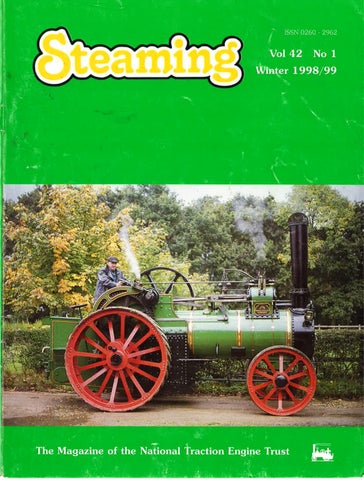
Cover Elsewhere in this issue Bryan Kohler explores the history of the last remaining Savage agricultural engine, 474 of 1889. Here it is seen at The Village, Fleggburgh, its fresh paintwork brightening up an exceedingly dull day, on 4th October 1998, the occasion of the engine's public return to steam. (Roger West) 3
Trust News Engine Owners Column Engine Owners sub Committee I hope that as many owners as possible will come to the Engine Owners Meeting which is being held in Northamptonshire on 30th January (for further details see the display advert on this page). Please come with your ideas and criticisms, so long as they are constructive, because it is important that we keep talking about the various issues — most of which are threatening — in an effort to keep our engines on the road at reasonable cost and free from interference. The Steam Plough Club held an excellent 'hands on' weekend during last summer, doing some ploughing and cultivating at Michael Davies' farm. it would be nice to see this type of event held at regular intervals, using different types of engines to give experience to those who otherwise would not have the opportunity. •Rallies are definitely not the place, in this day and age of red tape galore, to let inexperienced drivers loose. This is a shame, because I expect many of us remember the early rallies where it was a good place for a bit of a practice and to have a go on other, unfamiliar engines when we were only novices
ourselves. Not any more. Rallies are now deemed to be public places and all the rules of the road, driver licensing, etc, are very relevant despite the location being in a field. Which brings me to the 'driver competence' issue. There are many who are in favour of some sort of scheme, and many against. We have ruled out any mandatory certification — it would be impossible to implement anyway, but if there is a demand for it, why not a voluntary scheme? However, we do not want to spend our precious time dreaming up schemes that nobody wants. The thing to remember is that some of the rally organisers are asking for a scheme. Let us have your views. We are running another driving course at Dingles Museum on the weekend of 8th and 9th May. Unfortunately, Richard Vickery is no longer able to organise this event which is sad because he put so much time into it and had it running very smoothly. I wish to formally thank Richard for all his efforts over the years, from which so many have benefited. We expect to appoint a new organiser in good time to run this year's course. May I wish you all a Happy New Year. (Richard Pierce, Chairman, Engine Owners subCommittee)
The National Traction Engine Trust
Spares and Pattern Register As this issue of Steaming will be distributed just before the Engine Owners Meeting in January, may I suggest that if any member wishes to discuss a particular spares problem, or pass over some useful information, data sheets, etc, I will be very glad to meet up with them during the course of the day. Likewise, I will perhaps be able to supply information on the day if any requests are made to me with prior notice. Feedback on any recent product or service is always gratefully received, as this helps to keep the files up to date. One item I am looking for more detail on is Pickering governors, in particular drawings of the double beat valve. To move on to the subject of patterns, information on the whereabouts of patterns, or the supply of castings for any make of engine is most welcome; the register is growing steadily but any information, no matter how obscure, may well help another member over a time consuming and expensive search, and be of mutual benefit. Any queries on spares or patterns, or useful feedback, please contact me on IP or fax 01793 790378, or write to me Colin Hatch, 4 Lotmead Farm Cottages, Wanborough, Swindon SN3 4AJ.
Engine Owners sub-Committee The 1999
ENGINE OWNERS MEETING will be held at
The Rockingham Forest Hotel, Corby, Northamptonshire on 3 1 st January 1999 All owners, crews, potential owners and anyone else interested in the working of preserved road steam vehicles is welcome to attend - whether they are a member of the Trust or not. Please see the Future dates column and the location diagram for further details. 4
Insurance Officer's Notes Low Loader Scheme Those of you who attended the AGM at Didcot in November heard that the Low Loader insurance scheme was to be subject to revision by Footman James and myself. This has proved necessary mainly because the premium intake to the underwriters has been insufficient to fund the claims that have been dealt with. My own principle, relating to insurance, is that it is about managing risk, and not certainties. Therefore, if it is certain Winter 1998/99
STEAMING
that the income will be exceeded by the expenditure then there must be an increase in the income. Footman James tell me that they got the sums right with the Steam Policy, so much so that they intend to peg the premiums for a further two years from October 1999. However, they 'did not get them right' for the Low Loader scheme. But, they are not bleating — they had to start somewhere. However, in order to continue to provide what will still be excellent value for money they are seeking to redress the balance a little. The main drive for any deal we do with Footman James is that we all win: the policyholder with good value for money, Footman James with income generated and the NTET through improved service to its members and the commission earned. One of my major concerns is that some low loader owners are exposing themselves to greater risk than that calculated. They do this by using their equipment to move items not always owned by themselves, and sometimes over distances which I would consider to be of a commercial nature to be of any value to the low loader owner. At the moment the scheme is very simple in that the only stipulation is that only 'non-commercial' use (not for hire or STEAMING
Winter 1998/99
From Alan Martin's Collection
83
My picture this time shows an early example of the Sentinel steam wagon, in fact, a 3 tonner built by the parent firm of Alley & MacLellan at their works at Polmadie, Glasgow. Though the works number of the machine is unknown, the registration V814 dates it to being new in 1909. The rather delicate looking brewers dray was owned by Tamplin & Sons of the Phoenix Brewery in Brighton, and is seen on local deliveries in the early 1920s — note the driver (right) has taken advantage of the Army surplus tunics of the time to get a good serviceable jacket.
reward) is allowed. In order to safeguard the scheme from abuse, I intend to ask Footman James to consider introducing some restrictions based on any combination of the following: • Limited annual mileage • Only previously nominated items allowed • Owners' own equipment only • Steam or vintage equipment only The Low Loader scheme represents incredible value for money, even at double the current premium. I am sure you would rather preserve it than see it withdrawn. (Dave Smith, Insurance Officer)
is completed for publication, Dave Smith advises the newly agreed conditions and rates for the Low Loader scheme of insurance: • Limited annual mileage of 6000 — additional mileage only 'on prior request. • Named drivers only — no exceptions. Footman James to be previously notified of any additional drivers. • Driving of any other vehicle under this policy is not included. • Revised rates for 1999 — Third Party only, flat rate £65; Fully Comprehensive, premiums still based on £5 per £1000 of market value but with a minimum premium of £80.
LATEST NEWS — Just as this section 5
Officers and Committee 1999
Treasurer's notes Auditors and Registered Office
This column lists, for the information of members, the Officers and Committee of the Trust for 1999. The addresses/ phone numbers of those with special duties are given inside the front cover of each issue of this magazine; others may be contacted by phone or via the General Secretary or sub-Committee Chairmen, Names marked with an asterisk" are appointments by the Committoo and aro non voting positions in Committee.
At the recent AGM the proposal to appoint Charles Lovell & Co as Auditors was approved. The previous auditors also accommodated the NTET's Registered Office, which is no longer practical. Therefore I have arranged transfer of the registered office to 4 Church Green East, Redditch, Worcestershire B08 8BT.
President E.A. Fillmore
Subscriptions
Vice Presidents Sylvia Dudley R.N. Parrott Chairman R.J. Sandercock Vice Chairmen R.T. Herring A.J. Semple (Rally Organisers chairman) General Secretary Mre Susan Jackson* Treasurer Julie Smith Hon Solicitor T. Driver" Hon Safety Adviser J.M. Newnham* Membership Secretary J.R. Cook Hon Editor, Steaming R.E. West Hon Sales Officers Colin and Val Brown" Press Liaison Russell Bulley Committee The above and also: I. Barraclough (S. Yorks, is. 01709 850346) J.R. Bosworth (Derbys, Tr 01332 880405) N. Boyes (W. Yorks, 17 01253 811876) R. Bulley (Northants) M.O. Davies (Warks, tr 01295 770217) J. Durling (SAC Chairman) W. Evans (Rally Authorisation) T. Holt (Cumbria, tr 01524 271584) B. James (Norfolk, IT 01328 701417) S.J. Parrott (Bucks, IT 01844 201282) R.J. Pierce (Engine Owners chairman) D.S. Smith (Insurance Officer) M. Tuxworth (East Anglia, Tr 01799 599555) R. Vickery (Devon, Tr 01684 569292) M. Ward (FBHVC and Notts, Tr 01623 882856) P. Williams (Chilterns, IT 01923 263436) Representatives W. Evans (NV Tractor & EC)* M. Tuxworth (Sentinel DC)" Auditors: Charles Lovell & Co, Royal House, Market Place, Redditch, Worcestershire BN98 8AA
6
This year's AGM approved the motion that allows the Executive Committee of the NTET to set annual subscription rates without the need to seek approval from an AGM. This brings the affairs of the Trust more in line with modern practice. I should like to reassure members that I intend to monitor our financial affairs very closely. The major driver for on increase, 0 3 ever, will be the prevailing rate of inflation, something over which the Trust has no control, no matter how diligent it may be with its resources. Whilst we do not need to consider annual increases, it is very important that we do not force singularly large changes on the membership, which inevitably lead to disenchantment. As a basic indicator, I will be applying a formula that is triggered by an aggregated 15% increase in the Retail Price Index from the previous subscription revision. (Julie Smith, Treasurer)
FBHVC News The Federation of British Historic Vehicle Clubs has rejoined the Federation Internationale Vehicules Ancien. This has brought to a close a divisive period of the Federation's history which has lasted some nine months. The decision to leave FIVA was taken early last year with the full intention of supporting a new body to be called the International Historic Vehicle Organisation (IHVOI. Much lobbying took place subsequently and this decision was reversed at a committee meeting in June, causing the resignation of Chairman Peter Glover. An interim chairman was appointed — Geoff Smith — and he has lead the FBHVC back into FIVA. So far as steam engine owners are concerned, it all makes very little difference. Our main interest is in
monitoring legislative proposals from the European Union and whether it is through IHVO or FIVA is immaterial to us. However, for those who want to rally classic cars, membership of FIVA is important, and it is really as a result of pressure from that sector of preserved vehicle ownership and support, that all this apparent indecision has occurred. (Michael Ward and Peter Smart)
Steam Apprentice Club It is the time of year when we can take stock of past achievements and also plan for the next season. In order to try to raise the profile of the Steam Apprentice Club we are planning various driving days round the country. These arc intended to be informal and fun, with the aim of introducing youngsters to the pleasure
Sub-Committees 1999 This column lists the members of the Trust's sub Committees for 1999. Names marked with an asterisk" are co-opted; others are elected Committee members or appointed Trust officials. Addresses/phone numbers of the Chairmen appear inside the front cover of each issue. Rally sub Committee A.J. Semple (chairman) R. Bulley J.R. Cook P. Cooper* T. Evans* W, Evans R.T. Herring T. Holt" B. James K. Stott" Jo Tilling* Engine Owners sub Committee R.J. Pierce (chairman) I.K. Barraclough M.O. Davies Sylvia Dudley C. Hatch* J.M. Newnham" R.J. Sandercock D.S. Smith R.M. Vickery M. Ward Technical Board J.M. Newnham (chairman) H. Pounder" R. Swithinbank* G. Tennet"
Winter 1998/99
STEAMING
_
lionrapoisNpr FAR40401
r
PD ts72
'45
and challenge of driving a traction engine (or a roller). I hope that some of those who come to these events will be sufficiently enthused to want to learn more and become apprentices in the true meaning of the word. We currently have offers of venues in east Staffordshire, Norfolk, West Yorkshire, Bedfordshire and Devon. I would love to hear from anyone else who has a yard with one or two engines and sufficient space to do a bit of driving. Situation Vacant! On the theme of proper apprentices we have requests from two lads to be paired up with an engine to work with and learn from the owner — the first request is for the Poole area (30 miles radius) and second for Liskeard (20 miles or so). If you have an engine in either of these areas and think you may be able to help one of these youngsters (or want to know more about them) please give me a ring, my address and phone number are inside every issue's front cover. (John Durling, Chairman, Steam Apprentice Club)
Obituaries Bernard Fielding It may seem strange for someone to be writing an obituary for a person STEAMING Winter 1998/99
This is a nice cameo of industrial activity in Surrey in the late 1920s — sand, gravel and ballast working around Farnham. At that time there were several operations in the area and Thomas Patterson & Sons Ltd worked the Weydon Hill sand pit. The product was taken by a two foot gauge tramway to this transhipment point alongside the railway; here the one cubic yard capacity skips could be side tipped to discharge into main line railway wagons or into road transport. In this posed set piece we see a spread of contemporary transport. To the right a 20hp Simplex rail tractor stands ready to take the train of four empties back to the pits for refilling. It was built by Motor Rail of Bedford for the War Department in 1918, part of a large order intended for use behind the front line in France during World War 1. The end of the conflict saw many of these little locos pass to industrial use in Britain, the sand and gravel extraction concerns finding them especially useful. Waiting to receive a load departing by road is a Super Sentinel, one of a fleet of Shrewsbury made wagons owned by the Victoria Transport Co of Farnham. It is works number 5490, built in 1924, registered PD1572. Hazily seen across the tracks of the Southern Railway is a freight train headed by a London & South Western Railway 0395 class six wheel tender engine, but notice that the end of the timber built loading gantry seems to have a complete lack of any stop to prevent the narrow gauge tippers running off the end of the light rails! (collection Chris Shepheard)
they never met, but after 26 years of regular correspondence, my wife and I thought of Bernard Fielding and his late wife Violet as almost part of our family. It is fair to say that without Bernard's reply to a teenager writing to him about a photograph of a showmans engine taken at a rally (GENERAL BULLER at Carrington Park), and his ready reply, I would not have started my own engine records; would not have continued going to rallies, and probably not have progressed from pen to spanner. Following Bernard's information, so freely given, I made contact with other like-minded individuals and so discovered the
world of traction engines. A lawyer by profession, one of Bernard's achievements in the world of fairground interest was his discovery in the Halifax Guardian for 27th June 1863 of what may be the first report of a steam driven roundabout. He was an active member of the Lancashire & Yorkshire Railway Society, a keen model maker, and also interested in heavy horses and trams. In spite of my restoration work and rallying (buses; my family's Morris Commercial van and now, at last, with steam) I continued to write to Bernard on a regular basis. Although always ready to receive any 'new' showmans 7
engines from me and prompt to reply to any queries raised, it was evident in his latter letters that life was not treating him too kindly. Born in 1913, at the age of only 26 Bernard had TB and was told he had only six months to live — he once wrote that he must be a 'survivor'. However, the loss of his wife Violet, to whom he had been married for 49 years, affected him profoundly. Following a mild stroke in February of this year, Bernard moved into a nursing home where, shortly after receiving my last letter in July, he slipped into a coma and died peacefully, aged 85. I understand that all of Bernard's notes and photos have found safe homes, with his extensive records of showmans engines and gallopers passing to the National Fairground Archive at Sheffield University. I shall miss the regular contact that Bernard provided, and will be forever grateful to him for fanning that vital spark that made me a steam enthusiast for life. Bernard leaves two sons, John, in South Africa, and Robert in this country. My condolences go out to them both. (Peter Wells) Lionel Fryer Sadly, I write of the passing of
Lionel Fryer, of Dale Abbey, Derbyshire, at the age of 68. Lionel was an accomplished pianist, church organist, composer, and he trained and conducted the West Hallam Choral Society for many years. He was a karate black belt, a parish councillor, local historian and preservationist — a man, indeed, of many interests. Lionel owned several engines. The 1899 Wallis & Steevens 8hp traction came from Samson Barber, a threshing contractor of Pentrich in Derbyshire, and Lionel had to make visits for eleven years before Samson would sell! Later, he acquired a Fowler BB1 ploughing engine at one of Roads' sales; this attended local rallies in the mid and late 1970s. Another ploughing engine acquisition was one of the ex-Mozambique Z7 machines from Michael Davies and friends. Though the Wallis and the Z7 required work to steam them, Lionel had intended that when time and money allowed. The small village of Dale Abbey, near Ilkeston, has lost a knowledgeable rural citizen — Lionel Fryer will be much missed. (John Bosworth) Jack Marshall Jack Marshall of Hockley Heath, Solihull, Warwickshire died in April 1998. A steam enthusiast all his life,
Every face a study in concentration and determination at the children's tug-of-war event at 1974 the Earls wood rally in Warwickshire, and not least that of Jack Marshall, at the regulator of his Ransomes traction engine. (Dick Blenkinsop)
8
he was well known for his long time ownership of the ❑ldest Ransomes, Sims & Jefferies traction engine, 15102 of 1903, and es founder of the Hockley Heath Steam Association. Born in 1912 at Hall Green, Birmingham, Jack's father worked for the Great Western Railway, becoming station master at Henley-in-Arden. During happy boyhood years Jack spent countless hours riding on shunting locos in the goods yard. The yard was also used for the overnight parking of a Foden wagon, and when the driver left the fire banked up for an early start, it was not unknown for someone to take an illicit trip in the yard; once, the steam ran out and the wagon could not be parked in its usual position. There were some 16rne excuses given to father as to what had happened! Education started at the County School at Henley, and continued at Stratford-on-Avon Grammar School; Jack once said he enjoyed school 'because I could travel by steam train'. Good results at school enabled an apprenticeship in engineering in Birmingham — more rail travel — and once completed, Jack took a position as toolmaker with a firm making ornamental brass and copper work, and later a similar job running and repairing leather working machines. In 1938 he married Kathleen Wyld and they made their home at Widney Manor. The business demise of one of his employers after the war gave Jack the impetus to start his own firm, making press tools, hand guillotines and deburring machines. The enterprise was very successful, but in the early 1970s came an offer of purchase he could not refuse, a decision that allowed early retirement to concentrate on a steam hobby. In 1964 Jack had purchased the Ransomes from the Cambridge area, and the restoration work was carried out at his home in Hockley Heath, he being joined by other local owners such as Tom Brown with Fowler roller 21629 and Arthur Smith with Burrell showmans NERO. Here was the nucleus of the Hockley Heath Steam Association, with rallies arranged in the field opposite the house. He remained chairman of the Association until his retirement from active preservation. The funeral service was held at Umberslade Baptist Church, Hockley Heath, which was packed to capacity with friends from the church, the steam preservation movement and villagers. Jack leaves his beloved wife Kay, to whom we extend our condolences. (Trevor Daw)
Winter 1998/99
STEAMING
Jim Yells It is with sadness I record the death of Geoffrey Allan (Jim) Yells, who died in September, aged 72. He was born in 1926 at Yells' yard in Fairford, Gloucestershire. His family were builders in and around the district and Jim was inevitably to join the firm as a carpenter. He joined the RAF in 1944 and served his time in Ceylon and Burma — and gained a Group G roller drivers licence. With the demise of the family business, later working years were at the Brewery Arts Centre at Cirencester, and the retirement present of a traction engine weather vane, made by the blacksmith there, proudly graces the top of Jim's home. Jim's love of steam engines goes back many years to when he was steersman on Mike Woodroffe's Fowler 11698, and later for Michael Thexton on Ruston traction 33471. In more recent years Jim's activities were mainly based around Yell's yard. Each year, in the weeks leading to the Fairford rally, he could be found supervising the parking up of engines as they arrived, and then filling their tenders with water ready for departure after the show. Jim was a valuable assistant with the maintenance of the writer's own engine, Aveling roller 5590, which stabled at Yell's yard. He was never far away and always had the right words of encouragement or that certain tool needed to assist the job. A quiet, unassuming, generous man, happiest when helping someone, Jim was a widower and leaves a son Tim, daughter Vanessa, son-in-law John STEAMING
Winter 1998/99
Burrell compound roller 4025 of 1926 PRIDE OF DORSET nears Chipping Norton whilst heading across Oxfordshire from Tadmarton to Fairford in August, a traction wagon and Garrett living van in tow. Robert Freeman's work on the restoration of the machine earned him an award at last year's AGM. (John Maund)
and granddaughter Joanna. He will be greatly missed by all who knew him and the steam world has lost a good friend. (Nigel Keene)
Trust Trophies A selection of the Trust's large collection of trophies was presented on the Sunday morning of the AGM weekend, at John Keeley's premises at Knowl Hill. As has become our usual practice the recipients were mainly members living fairly locally to the venue. The ARTHUR NAPPER CUP (1) was presented to Ian Woollett of Hemel Hempstead for the preservation of his work with the Sentinel SD4 wagon and a Ruston steam navvy. Arthur gave this cup to be awarded for steam preservation and this time it went to an enthusiast who was early in the preservation movement. Ian is a competent engineer, having two unusual machines — the first is definitely the only one of its type, and the other, one of just a few left in the world. The ARTHUR NAPPER CUP (2) was awarded to Robert Freeman of Banbury who comes from an Oxfordshire family noted for its meticulous
restoration of engines. Robert has restored a Burrell roller to its original specification, the mechanics and paintwork being completed to an outstanding standard. The CURTIS BOWL was presented to Ewen Davis of Camberley. The trophy was given by the Curtis Gin family and this time was awarded to an owner who undertakes long road journeys with his roller under its own steam. There are many who steam their engines to events, in particular those with engines which have springs and rubber tyres, but Ewen, with his wife Carole, travels an Aveling 8 ton piston valve roller, a machine without a differential, and towing his Land Rover carrying water, coal, tools, kids and the dog. The DACRE LACY CUP was chosen for Jim Sarney of High Wycombe. This cup is awarded for outstanding preservation and renovation, with one specific engine in mind. Jim's familiar Burrell road loco LORD ROBERTS was present on the day, outside the shed at John Keeley's where its four-year rebuild had taken place. The CHOISY & SIMPSON CUP was presented to Dave Eves from Bordon, Hampshire. This is another award for an outstanding engine preservation project. Dave's engine was one of those presenting a formidable task — not just a boiler rebuild but also 9
needing extensive work to motion and wheels, the latter resulting in new rims. It all resulted in an outstanding rebuild of the Foster engine STARGAZER. The PERCY HIRONS BOWL was awarded to Dave Knott of Amersham. The donor of the bowl expressed a wish that it went to a member who uses his engine as far as possible in preservation. The owner chosen is never happier than when his Aveling agricultural engine is working, usually driving his rack bench. The BAKER TOC-H CUP was presented to Robert Coles from Shaftesbury. This award is usually reserved for the 'big' engine owner whose standing and stature is countrywide. The person chosen fits the bill admirably. He's certainly big in stature and his engines are also large — the Marshall road engine which he repatriated from Australia, and now his acquisition and recent return to Dorset of Burrell showmans QUO VADIS, with which Robert achieved a lifelong ambition. The JACK HOLLOWAY TROPHY was given this year to John Hirons, whose interests over the years have covered a wide area, ranging from motor cycling to the preservation of early tractors and MG cars. He has great feeling for steam engines, due to his long association with the late Jack Wharton, and with these varied interests he has made an ideal commentator for so many events. The BEEBY CUP is presented annually to a young enthusiast, and this year's recipient was Stuart Smith. Stuart's parents own a steam roller; he is part of the crew and does his share. Dad has recently bought him a Ferguson tractor and Stuart has now acquired an Aveling-Barford petrol roller in need of heavy repairs. With his enthusiasm for things mechanical and help from Dad, we are sure it will be restored. The work experience and knowledge gained in this project will be invaluable when he graduates to steam. HUTCHENS The CONNIE MEMORIAL TROPHY. The lady chosen this year is an ex-Reading girl, one who keeps a bit of her home town in her heart via a collection of Huntly Palmers' biscuit memorabilia. She owns a Fowler roller and is married to an engine owner noted for his willingness to help follow enthusiasts — and also for bluntness when he feels it is warranted. Perhaps these qualities have rubbed off on the lady concerned. SI le has dui ie lime consuming work for the Road Locomotive Society; is secretary of a steam engine club; has been known to organise 10
work rosters for the volunteers and owners who invade her 'garden' at weekends — then lets them use her kitchen as a mess hut; she was organiser for the team of ladies who provided the splendid spread of food at John Keeley's; she is the type of person all organisations need one of ... an organiser! She is ... Sandra Marder. The GOLDEN FILM SHIELD went to the Greenaway Family of Stoke Row, Henley on Thames. Regarded as the Trust's premier Trophy, this shield is awarded for outstanding work in the traction engine movement and is often given to bodies rather than individuals. This year a body consisting of Dad and Mum, sons, son-in-law, daughters, daughter-in-law, granddaughters and two grandsons was chosen, all of whom are competent with engines. They own several engines and other interesting vehicles and their yard, where they allow other owners to keep their engines, is a mecca for local enthusiasts. The JOHN CRAWLEY TROPHY was presented to Peter Smart of Bordon, Hampshire. The recipient of this rose bowl is fully deserving of the award, which is presented to one who is considered to have given service to the movement though not specifically connected with engine preservation. Peter is an engine owner, but on this occasion we honoured his dedication to the movement as a whole. He has given service as secretary and chairman of the Road Locomotive Society; is one of the steam's representatives on the Committee of the Federation of Historic British Vehicle Clubs; co-ordinator of the Lost Registration scheme with the DVLC; instigator of the Road Steam Forum and works in connection with the Charles Burrell Museum and the
Thursford Collection. The EDNEY SHIELD, awarded to a person who has given considerable personal service to the traction engine movement, went this year to Phil Honour of Amersham. This is a man whose grandfather operated steam engines at timber hauling, one example of which is still owned by Phil's father. Their yard is home to local engines and the venue for popular end of season steam ups. Phil is chairman of his local steam engine club and rally, and its success is in no small measure due to his hard work and enthusiasm.
Engine Validation Encouraging Authenticity A validation scheme for traction engines, steam wagons and similar vehicles, including portable engines and steam cars, has been under development for some time by the Road Steam Forum. This organisation has the support of the National Traction Engine Trust, Road Locomotive Society, Road Roller Association Steam Plough Club, Sentinel Drivers Club, Steam Car Club of Great Britain and Robey Trust — all national organisations in their own right. The scheme is intended to provide a standard of verification of the history and provenance of individual road steam engines and to encourage authenticity. The historical importance of the engines we preserve as a hobby demands to be recognised, and is clearly deserving of an effective, simple and trustworthy method of a common historical record. We are but
The National Traction Engine Trust Engine Owners sub-Committee present the 1999
PRACTICAL ENGINE DRIVING COURSE to be held at
Dingles Steam Village Milford, near Lifton, Devon on the 8th and 9th May 1999 For further information send SAE to: Sylvia Dudley, 10 Wood Street, Woburn Sands, Milton Keynes, Buckinghamshire MIC17 8PJ.
Winter 1998/99
STEAMING
the custodians of our charges and it behoves us all to pass on to future generations an accurate history of our vehicles. Participation in the scheme is voluntary and it is designed to verify, as far as possible, the history and authenticity of a particular road engine — to assist the owner to research details of his own machine — and will ultimately provide an authenticated Validation Certificate which may enhance the value of the engine in the event of its subsequent sale. All engines, irrespective of class and status, will be eligible for participation in the Validation Scheme and applications are now invited from engine owners for the Application Pack which includes the necessary explanatory details as well as a questionnaire for the owner to complete. Also included is a Fact Sheet, designed to assist the owner to research the details of his own engine — for it is his responsibility to provide the necessary information to the Validation Scheme sub-Committee for them to assess. Validation will attract a fee which is yet to be fixed. However, the initial ten applications will be treated as a 'pilot' scheme during which time the administration costs will be monitored and charges assessed. Special terms will be given to those participating In this phase of the operation, recognising their valuable assistance in establishing the project. It is possible that a member of the Validation Scheme sub-Committee may require to inspect an engine, in which case an additional fee, to part cover expenses, will be payable by the applicant. Application Packs are now available from Secretaries of the
participating organisations. Details of subsequent requirements are included in the pack. Submissions will require to be accompanied by an adequate number of good quality colour photographs and, where available, copies of the original build details of the engine and other appropriate original evidence, such as road registration details. The Validation Certificate will apply on the date of validation, but re-applications will be encouraged, following any detailed reconstruction of the engine. The scheme is being administered voluntarily by enthusiasts for enthusiasts, and hence a speedy response by the Validation Scheme sub-Committee to an application cannot be guaranteed. (Road Steam Forum press release)
Knowl Hill thanks Through the pages of the magazine, May — my wife — and I would like to thank all the members who visited us on our open day at Knowl Hill, following the Trust's AGM at Didcot. Although the day was primarily for the NTET, our place is sited in an area that is covered by both the Thames Valley Traction Engine Club and by the Chiltern Traction Engine Club. I therefore looked upon this as the host area, and indeed both clubs played an important part before, during and after the event. Their help was invaluable and I'm sure our visitors will agree as the 'hosts' to the National, they did a grand job. (John and May Keeley, Knowl Hill)
from Aland Stamford
STEAMING
Winter 1998/99
London Social Meetings These will continue to be held on the second Tuesday of the month, starting at 8.00pm, with the room available from 7.30pm. As usual all members and non-members are very welcome at 'The Duke of York', 35 New Cavendish Street, London W1 — details of how to get there were in the last issue. The programme for the rest of this season is: TUESDAY, 9th February — 'Steam Rolling', a wide ranging topic to be covered by Sandy Ross, owner of two rollers and a diligent researcher on the subject. TUESDAY, 9th March — 'The Burrell Museum and Works', a talk by David Osborne on the enterprising museum set up in recent years to mark the work of the Burrell family in Thetford. TUESDAY, 13th April — 'An evening of Steam Ploughing', a special presentation by members of the Steam Plough Club. (Bill Timmings, London meetings organiser)
Future dates Engine Owners Meeting The out-of-season meetings that have been arranged for owners the last three years have proved to be a great success, each attracting an increased attendance from the previous time. This year's meeting is a little earlier, at the end of January, and there is another new venue, but we hope that an equally enthusiastic gathering of owners and crews will make the effort to be there to discuss problems, and to swap advice with one another. The meeting is on Saturday, 30th January 1999, at the Rockingham Forest Hotel, Rockingham Road, Corby, Northamptonshire. There is a 10.30am for 11.00 start to the morning session, and following a lunchtime break, the afternoon discussions and debate should be completed by 3.30 or 4.00. Corby has good road access from both the Al and from the Midlands motorway networks via the A14 and the A6003 — see the accompanying diagram. The Rockingham Forest Hotel, which is on the A6116 road, north of the town and not far from the top of the well-known Rockingham Hill, has all the usual amenities, and sandwiches etc will be available during the midday break in the meeting. 11
However, it is essential that you order and pay for what you require at the reception desk as soon as you arrive. (Sue Jackson, General Secretary Iv 01494 521727) Rally Organisers and Affiliated Clubs Conference The annual Spring Conference for Rally Organisers and Affiliated Clubs will take place on Saturday, 13th March at the same venue as the last two conferences, Willoughby Village Hall, near Rugby, Warwickshire. Notifications and invitations will be sent out shortly by Sue Jackson in the manner, but interested usual newcomers are always welcome — please contact Sue for details (address and phone number inside front cover). Drivers Course
months. We hope they will gain much friendship, information and enjoyment from-their membership over a period of many years. The Membership Secretary is always pleased to put members in touch with one another by fowarding mail.
M. Lucas, Basildon, Essex M. Kenning, Boston, Lincolnshire P. Manton, Melton Mowbray, Leicestershire Mrs V. Smith, Watford, Hertfordshire I. Coughlin, Hitchin, Hertfordshire B. Norman, Fordham, Cambridgeshire S.J. Griffiths, Kirkby-in-Ashfield, Nottinghamshire Gloucester Folk Museum E.A. Lobb, Grenfell, Australia A. Turner, Thormanby, Yorkshire R.F. Apperley, Ipswich, Suffolk Johannes Mocken, Erftstadt, Germany I. Galloway, Morden, Surrey H. Kennedy, Co Derry, Northern Ireland
The 1999 Engine Drivers Course is to be held on 8th and 9th May at Dingles Steam Village, near Litton, Devon. Further details will be available in due course, but expressions of interest as well as firm bookings are welcome now — see the display advert elsewhere in this section. Trust Diary The diary of Trust events of a business nature during 1999 is set out below. It includes, in bold type, dates of Conferences and other members' gatherings and, in italic type, Committee meetings. The timetable has been arranged, through the auspices of the Road Steam Forum, to try to avoid clashes in the dates of meetings that are arranged by the nationally based road steam groups. National Committee Engine Owners Meeting Rally Organisers COpference 21st March tilt tional Committee 25th April Executive and National Committee Engine Driving Course 8/9th May 13th June National Committee 3rd September GDSF Open Forum 26th September National Committee 1 6 tli October Rally Organisers Conference 3 I st October National Committee 13th November Annual General Meeting 5th December Executive Committee
17th January 30th January 13th March
New Members A sincere welcome is extended to the following new members who have joined the Trust during the last three 12
OUR MAGAZINE 25 YEARS AGO
December 1973 saw Editor Ran Hawthorne able to present a colour illustration on the cover of the magazine for the first time. It was a chunky issue too, with 72 pages — indeed more than nowadays, though only about A5 size. The year's rally season loomed large in the contents (to a much larger degree than today) with detailed engine by engine reports of a dozen or more events, half a dozen of which still grace today's lists. Fowler showmans road loco KITCHENER/IRON MAIDEN had paid a well received visit to Holland, going over by the same ferry on which two Dutch rollers returned from their visit to these shores at the Expo event at Peterborough. Sales Officer Vic Burroughs had had success in operating several sales stands to represent the Club and to provide members with a point at which they could inspect books and other items before purchase (but no mention of videos!). Further volunteers were asked for. In what would have been a pre-Christmas distribution of the magazine, one might expect a fair number of reviews, but six whole
P.F. Noble, Warwick Adrie Haasnoot, Katwijk, The Netherlands N.H. Weston, Ledbury, Herefordshire R.J. Davis, Rugby, Warwickshire M.Yeats, Alvescot, Oxfordshire S.W. Mellor, Chapel-en-le-Frith, Derbyshire J.R. Walker, Ashbourne, Derbyshire A.J. Snow, Wisbech, Cambridgeshire E.G. Rose, Stratford on Avon, Warwickshire D. Freemantle, Godalming, Surrey R. Hazel!, Whitchurch, Berkshire M. Barton, Wombourne, Staffordshire A.R. Breese, Stockport, Cheshire Franco Risi, Bologna, Italy A..I. Cutler, Wisbech, Cambridgeshire R.J. Pomeroy, Winchester, Hampshire Ruth Atkinson, Billericay, Essex P.W. Bradbury, Wigan, Lancashire L. Gray, Aylesbury, Buckinghamshire Mrs E. Bates, Aveley, Essex G.F. Wilshire, Bristol R. Golden, Maidstone, Kent T.W. Petty, Tring, Hertfordshire I.C. Grant, Taunton, Somerset S. Mansfield, Bicester, Oxfordshire
pages detailed a score or so items — including seven new books of 100% traction engine interest. Many of these now attract high prices in the secondhand market. Paul Abbott reminded members of their responsibilities when using automatic half-barrier level crossings, and this is worthy of a mention even now. Those in charge of vehicles unlikely to cross a railway line at a speed of over 5mph have to stop and advise the signalman on the phone provided. Most crews using level crossings on a road run probably also journey that way by car, but do remember your duties with a slow moving vehicle.
G
LLEWELLIN'S
ears
YOUR ONE STOP GEAR SHOP GEARS UP TO 8ft 6in DIA SPLINED SHAFTS UP TO 25ft LONG Broaching & Splining - Spurs, Racks, I lelicals Worms & Wheels, Bevels - Straight & Spiral Stock Gears & Splines 24 I lour Service - Gearbox Rebuilding
Specialist Supplier of Gears and Splines for all Traction Engines Telephone Mike Horlick LLEWELLIN'S GEARS KING SQUARE, BRISTOL BS2 8JJ TEL: 0117 942 4026 FAX: 0117 923 2028
Winter 1998/99
STEAMING
, 0000 itkSiMk50' -
y' FURNITURE REM OVERg. AuL.Ne. CONTIRACTC — t
\
•
IA 44.
What do you think of this? This picture is something of a Lincoln enigma. It was taken in Washingborough Lane, Lincoln, with the steam wagon posed against the arched entrance gateway of the City cemetery. This was a location often used over the years by the local engine makers for their official photographs. But this scene is a bit of a mystery, for although the strange looking machine bears a Lincoln Borough registration mark and the sign writing on the body might appear to easily identify it, such is not the case. Thanks are due to Peter Donovan of Cricklade, Wiltshire, for sending the picture (acquired about five years ago from an antique warehouse) for our use in the magazine. However, Robin Harding is unable to tell us much from Road Locomotive Society records, and Frank Strange of Brigg, Lincolnshire, with his strong knowledge of engines that were used in the county, is also not able to say much. The principal clue offered is the steam wagon's registration FE 594, which would have been issued about 1910 — but the number is missing from surviving records. FE 593, incidentally, was issued to Foster Wellington steam tractor 12490 of 1910. The firm of Woodcock & Simpson, furniture removers and hauling contractors, fails to show up in either Lincoln licensing records or in commercial trade directories of the county around that time. Do we have any member who recognises the firm as one from the past in his local town? The wagon itself is quite strange, bearing no family likeness to offer a clue to its parentage. It seems a fragile little thing, as indeed the legends painted on the boiler cladding show — unladen weight, 2 tons 10 cwt, and only one of these tons on the front axle! Is it an experimental venture by one of the established Lincoln manufacturers, or perhaps a customer's own design, built up in one of the city works? Peter Donovan has shown the picture to a number of engine owners and enthusiasts, and the consensus is that the machine is a bitsa, though one voice suggested McLaren, a claim based on the shape and style of the fittings on the steam chest. What do you think of it? STEAMING
Winter 1998/99
'At the annual meeting of the shareholders of Messrs Brown and May, Limited, Devizes, Mr. Fisher, one of the directors, said that owing to the necessary renewals and the provision of new patterns and appliances for making more up-to-date engines so as to cope with the competition of other firms, the profit was not so large as had been hoped. There were indications, however, that the present year's business would be more remunerative. The opening of a branch for electrical appliances at Bristol was favourably spoken of. The report was adopted, and the payment of the 5 per cent. interest on the preference shares was agreed to.' (from The Agricultural Engineer, April 1898)
'One Hears — That East Ham U.D.C. made its purchase of a Mann steam roller, owing to the receipt of excellent reports from the Chertsey U.D.C.' (from Commercial Motor, 17th April 1913. A note elsewhere in the same issue recorded the Council had 'accepted the tender of Mann's Patent Steam Cart and Wagon Co, Ltd, at 610, for the supply of a combined steam driven water van, roller and tractor'.) 13
Steam Wagons at the Front We were preparing this issue of our magazine at the time the eightieth Anniversary of the end of World War 1 was being marked. Some time ago Derek Rayner located pictures of steam engines involved in The Great War in the photographic collection of the Imperial War Museum in London, and with other suitable short articles and illustrations that have since become available, it enables us to chronicle in a small way the part played by the steam engine driver and his charge in that dreadful conflict.
Steam wagons at the Front Driving a Clayton to Hell Neville Bricknell had the opportunity of reading part of a diary written by his father's brother Frank whilst on service in France in the Royal Army Service Corps during World War 1. He had been recruited in 1915, and was registered as a 'steam wagon driver'. The notes are headed 'Somme, France, 1916' — the actual date is not recorded — and though Neville has amplified a little to improve the reading, the facts are correct. The keeping of a diary by front line soldiers was officially banned, for obvious security reasons, but eighty years on such contemporary records have become important to our understanding of those horrific times. We thank the Bricknell family for their permission to use the extracts, and the Old Steamers Club, in whose magazine The Smokebox the story first appeared.
It is still raining. Can't remember when the sun last shone; we were ordered to make our engines ready to take ammunition up to the front and to keep the fires bright to reduce smoke.
We started late in the afternoon, our detachment being eight Clayton steam wagons and one Foden. Our Clayton only had one trailer because we were carrying shells and the weight and
poor and muddy road surface only permitted that amount to be hauled. The rain became steadily heavier as it got dark. My mate was Harry — all he done was curse the weather; the French; the Germans and the silly generals, in that order, and the only other digression he pursued was 'the big push' and 'the salient'. I don't think he knew what either really meant, but he'd got the idea it would be the end of the War and he could get back home to the missus. Harry was a good chap to have with you. We rendezvous'd with two big Fowlers that were pulling big guns, and a Sergeant who was obviously a 'behind the lines man' was shouting orders on what we should do once the German artillery spotted us. Harry, in a moment of crass stupidity asked the Sergeant if he would like to come with us and put his flighty theory into hard practice, but that, of course, only served to incense the Sergeant, who look Harry's name and number, then mine. I protested my innocence, but was told that as I was the driver and Harry the steersman, I was in charge of the wagon and crew and therefore responsible for the deeds and actions of all. We were promised that we would be on a charge the moment we got back, if we got back. We topped up the boilers, tanks and coal bunkers and made ready to roll; the Padre came and blessed us all and assured us that the ammunition we were carrying was to kill the Germans and as they were Godless heathens, we were serving the Almighty. The two big Fowlers led, we followed a respectful fifty yards behind — my wagon was third in the
Its more than likely that commercial photographers worked around the troops behind the lines in France, producing postcards — in this case a Carte Postale — that the men could send home to relatives and friends. Of course, pictures and messages alike would be well censored. Here we see Frank Bricknell (right) and his mate, somewhere around the Somme in 1916. The Foden 5 ton wagon S 55 is unidentifiable by works number, like all the other machines in this feature, and, indeed, the pictures of most World War 1 steamers. It has the older pattern concave top sheeting to the cylinder, which makes it likely the machine was one that had been requisitioned by the authorities. A sheeted-up Clayton and another Foden are in the background. (collection the Bricknell family) 14
winter 1.998/99
STEAMING
line. We slipped and skidded on the muddy track, someone had said it was a road but the hard surface was two feet below the mud. We had no lights; they wouldn't have been much good in that weather, and we followed the sparks which came out of the straining Fowlers up in front. After about two hours we could see flashes in the distance: "looks like fireworks" shouted Harry, but both he and I knew it was far more sinister. The closer we got the brighter became the flashes, then, all of a sudden, the rain stopped and a watery moon appeared. That seemed to be the cue for all hell to break loose, and a very bright light came in the sky. "Flares" yelled Harry, "the Hun will see us for sure". The crews on the Fowlers didn't need any orders, you could almost hear the metallic clang as regulators were thrown wide open and the road speeds increased 100%. We kept chugging on and then it happened — the leading Fowler caught a direct hit, and it was, at that moment, just one hundred yards in front of us. Upon reflection I think it must have been hit on the firebox, because fractionally later a huge lump of steel hit our Clayton's chimney, snapping it off like a matchstick and taking part of our roof at the same time, ending up by smashing the smokebox and boiler of the wagon behind us and killing both the lads on it. Harry said it was the flywheel and part of the crankshaft. We retrieved what was left of our chimney as it was an offence to lose a part of your wagon or engine. Bear in mind all this happened in less than two minutes. The second Fowler moved off again — there was no need to manoeuvre past the first one as it had STEAMING
Winter 1998/99
Three Clayton & Shuttle worth 5 ton steam wagons posed in Rouen, France, 1916. Top brass have makeshift seats in the centre front and Frank Bricknell leans out of the cab of the centre wagon, numbered S 279. Behind it there appears to be a Garrett steam tractor and trailer. (collection the Bricknell family)
disappeared. German shells were still dropping but they went over our heads, exploding about 250 yards to our left, then thankfully it started to rain and the moon vanished, and the shell fire stopped. With only half a chimney the poor old Clayton struggled to keep going much to the annoyance of the following wagons, and when conditions permitted we would be passed, "let them go" said Harry, "Jerry will see them first." How true were his words. Water was again getting low in the tanks and although there were hundreds of shell holes, all full of water, most of the ones we saw had in them either dead horses, mules or even men. I couldn't bring myself to take on water from there. Providence must have looked kindly on us because the road or track then turned left, down a slope to a small wooded area out of sight of observing artillery gunners and with only a couple of shell holes, but, more important, there was a stream with reasonably clean water. When I arrived the rest of the convoy had topped up all their tanks and someone had made a dixie of tea; it was terrible compared to mother's, but to Harry and me it was like nectar from the Gods. We started on the last leg of the outward trip. Up the slope with some difficulty. I should mention that we had done a botch repair to the chimney by using corrugated iron rolled into a
tube and jammed into what was left of the base, and reinforced with two bayonets acting as splints, all firmly secured with barbed wire, of which there was an ample nearby supply. But we soon got left behind again and now a grey dawn was breaking as we breasted a small hill and saw our lads about a mile in front, spurts of earth erupting all around them. The Fowler was still in the lead, followed by a Clayton drawing the trailer full of shells. Suddenly there was a blinding flash, with an instant violent explosion — the Garrett trailer must have caught a direct hit. After that we couldn't see anything for smoke. Harry said "Frank, if we hadn't got a makeshift chimney that would have been us." I never answered him, but I knew he was right. Lead wagon was our official position then. Descending the slope we came to what was left of the convoy. The Fowler was laid on its left side with part Of its tender missing, a hand and part of a forearm still holding the steering wheel. The Clayton which suffered the direct hit had totally disappeared, so had the Foden behind it. And the crew of the third wagon were also killed and their wagon a wreck. I felt very sick, Harry was also retching, and then from nowhere an officer appeared. He told us that this was as far as we were to go, as they were 're-establishing the defence line' — this meant we were retreating. We 15
were to unload the trailers by the side of the road and reload them with the wounded and dying men to be taken hack to the field hospital "You will he OK lads" he said, "you will carry red crosses to assure you of a safe passage." Both Harry and I felt a bit apprehensive at that statement, after all the Padre had told us yesterday that the Hun was a Godless heathen. But it was right — we staggered back to base the same way that we had come, past 'Dead Legs Pond' and eventually arrived back. There to greet us was our arch enemy, the behind the lines Sergeant. When he saw our makeshift chimney and the damaged cab he went purple with rage, shouting and screaming about wilful damage to His Majesty's equipment and what our punishment would comprise etc. Then his eye caught on Harry's and my bayonets, still being in the splint position, holding the chimney together. He shook, rolled his eyes and foamed at the mouth and proceeded to appraise us with the fact that bayonets were to kill the Germans and not to form decoration for the steam wagons. The tirade of abuse continued unabated until a voice from one of the wounded men in our trailer called to him, "why the hell don't you put your feet where your mouth is and go up to the hell where we have been." The Sergeant stopped his tirade to Harry and me and frantically searched in his breast pocket for charge forms. Unfolding them he walked over to the still partly loaded trailer. "Who said that?" he screamed, A head raised wearily — "I did" said the voice, and the man struggled to sit upright. On his shoulder was a Major's Crown. The mouthing Sergeant said no more. 16
The scene on 17th October 1917, near Bapaume. This small town in Picardy was the objective of the British troops in the five months of dreadful fighting, through the summer and autumn of 1916, that was the futile Battle of the ,Somme Here, a year later and after the German Army had retreated to better defensive positions east of Bapaume, a group of eight Clayton & Shuttle worth wagons are parked up by a standard gauge railway siding, probably prior to taking on loads of roadstone from railway wagons. (courtesy Imperial War Museum)
Foden Wagons for Active Service How G. Scammell & Nephew Ltd prepared a number of fully-equipped columns of Foden wagons for active service This article first appeared in The Commercial Motor on 29th October 1914, and was later used in The Foden Book, an 84 page publication by G. Scammell & Nephew Ltd, dated 1915 and probably sent out to prospective customers in the February. The catalogue concentrates exclusively on Foden steam wagons and what service Scammells could provide for them, being 'Agents and Official Repairers for Foden's' and that company's London outlet. It is not surprising therefore to read the strongly pro-Foden text in the magazine article, for the words are quite likely to have been largely supplied by Scammells. In the catalogue, whilst putting forward the capabilities of their Spitalfields Works, and the Foden product and its spares, Scammells clearly felt their war efforts worth recording. The final pages list 55 of their employees, including Major A.G. Scammell, 5th London Brigade, on a Roll of Honour, and though at that stage of the war in early 1915 it probably represented those who had gone on service, the grim lists of the fallen were horribly close in the future.
About the middle of last month we became aware of the decision of the military authorities to take immediate advantage of the special services which could be rendered by steam wagons as distinct from the adopted types of petrol lorries. There is no need for us, on the present occasion, again to traverse the circumstances which have surrounded the various decisions of the Government in regard to the types of mechanical-haulage vehicles with which it has experimented, and
which it has finally adopted for standard service. The steamer, especially in its tractor form, has been thoroughly tested by the War Department in past years. Fleets of steam wagons have been used with effect in connection with transport columns during British Army manoeuvres. ANA oxiiiielely seven weeks ago, as we have said, the Government, in its present emergency, decided that there was very special work upon which columns of Winter 1998/99
STEAMING
an accepted type of steam wagon could be very profitably employed. In view of the universal employment of the Foden wagon, and its admitted predominance in respect of type in the steam-wagon world generally, it was not surprising that the choice for these first columns fell on that make of vehicle. It is of particular and individual interest in this connection that G. Scammell and Nephew, Ltd, a very old-established company of whose association with the commercial-vehicle world we have always kept our readers well informed, was quickly asked by the Government, at very short notice, to take in hand the organization of several complete columns of Foden steam wagons with stores, equipment and personnel. On a certain September Saturday, at 1 pm, Mr Allan H. Scammell, the managing director of the concern, was summoned to the War Office and asked to provide by the following Tuesday 28 five-ton Fodens, six trailers, and all the necessary stores and equipment, including the fitting up of a travelling workshop complete with its own electric-driving and lighting outfit. The whole column was to be so organized as to be a selfcontained unit capable of maintaining itself for some months under full warservice conditions, and the personnel to consist of one officer, three sergeants, five corporals, eight lancecorporals, sixty drivers, five artificers, two boilermakers, two smiths, two wheelers, two orderlies and one cook. It says much for the organisation of this concern, as well as for the personal initiative and energy of Mr A.H. Scammell himself, when we record that the whole of these wagons were collected from various sources, inspected, overhauled and where necessary, painted, and generally fitted out for war service within the time named, and this included the fitting up of the workshop wagon, which is the subject of a special illustration herewith. Moreover, the whole of the men required were provided by Scammell's and enlisted in the A.S.C., and equipped with uniforms by the authorities within the same time; that is to say, the first column was completely organized and ready for service 31/2 days after the first intimation of its requirement by the War Department. So successful was this piece of work, that shortly afterwards the War Department made another requisition to the same company for 31 five-ton Fodens, fitted out and equipped exactly as the first column, and in addition an extra 1,000 gallon fast rubber-tyred tank-wagon, equipped STEAMING Winter 1998/99
At least 14 Foden wagons can be seen in this view from The Foden Book, there captioned 'Leaving for France'. A range of body styles is evident, indicating the wagons had been acquired from a variety of sources, but this would have been by the usual commercial channels and before the times when vehicles were commandeered, or built new to specification. Who can identify the street in the Spitalfields area — the Jews Infant School is on the left. (collection NTET)
Britain declared war on Germany on 4th August 1914, but there had been little preparation for fighting. Scammells were proud of their ability to answer the call and this is the Foden wagon fitted up by them in 24 hours in September 1914 as a travelling workshop, and illustrated in The Foden Book, issued by Scammells early the following year. Once delivered to the War Department it is likely that the three timber frames supported a canvas cover. (collection NTET) 17
Twelve new, and as far as we can see, identical, Foden 5 ton tippers in convoy. The rubber tyred wagons have the small buffers fitted to the cross member at the front of the main frames, thought to be a Ministry of Munitions requirement, and intended for use in assisting disabled convoy members, or the light shunting of trailers. The location of the picture is unrecorded — the road looks freshly constructed and the landscape English, so it may be around one of the camps in the southern counties. (collection James Davis)
with a quick acting pump, for water supply to the column, had to be provided. The whole of this was again ready in little more time that the first column took to equip. Shortly after a third batch was ordered, consisting of 10 five-tonners and four three-tonners, complete with all men, and this column was organised and sent away between a certain Thursday evening at 6 pm and the following Saturday morning at 6 am. At the time of writing a fourth column of 31 was being organized in a similar prompt manner. Scammell's can indeed lay claim to a word of praise from us for the remarkable promptitude with which it was able to collect and equip sn admirahly these successive columns of steamers, and we also reiterate a word of congratulation to Fodens, Ltd, for this official and very material recognition 18
There is a poignancy to this picture of Scammells' men at the front, probably taken late in 1914. It is captioned in The Foden Book as being from an actual photograph taken in France, 'sent home to us by several of our men who accompanied the wagons on Active Service'. The photo was probably specially taken to provide postcards for the men to send home. At that time in the conflict there could be humour in their surroundings, for people thought it would all be over by Christmas. The makeshift shelter has been entitled 'Rouen, Scammel's Hotel' and the buckets on the fire are chalked with the words Snails and Frogs. The board at the left reads 'What is a Home without a Mother, a reminder to us of the extreme youth of many of those who joined up, even in the very early stages of the war. (collection NTET) Winter 1998/99
STEAMING
by the Government of the special capacity which these famous steamers have for handling certain classes of load under certain conditions in the present Continental operations. We learn from our own correspondents that these machines have already been engaged on special work and are giving excellent results, but we are not at liberty more closely to identify their class of employment. The steam wagon is a peculiarly British production. In no other country in the world, with the exception of a few spasmodic attempts in France,
has the type developed, whereas here in Great Britain it not only handles effectively very heavy unit loads, but, since the possibility of equipping them with rubber tyres, it has effectively challenged the petrol wagon in many classes of employment. We are particularly gratified as a journal to have been able to record this decision to use steam wagons, to which the country owes so much in civilian life, as a part of the very thorough organization of the Army Service Corps in the field.
Steam Road Haulage in France Comments on the behaviour of various types of Steam Wagons under severe conditions on the Western Front This article appeared in the 24th April 1919 issue of The Commercial Motor. Steam vehicles have been considerably used for road haulage throughout the war in France, and it is proposed to give a short account of their performances and how they stood the rough road conditions. Steam haulage in France may be roughly divided into two classes: (a) Heavy and light traction engines, used for gun hauling, ordnance workshops and forestry work. (b) Steam wagons, chiefly used for carting stores, for road repairs, etc. With reference to Class A. These machines were comparatively few in
number and, except for those employed on forestry work, were only used on road work occasionally when gunshifts were required, and consequently the crews had ample time for adjustments etc, with the result that the boilers and mechanism were almost always in first-rate order. Certain mechanical troubles were experienced with one make of heavy tractor, the cast-iron steering brackets bolted to the front water tank being liable to fracture, and the strakes on the road wheels were made of material soft enough to hammer out and spread on the rough pave roads of Northern
France, causing fracture of spokes. In fact, so acute did this trouble become, that the supply of new road wheels, after 12 months in the field, was necessary in a few cases in order that the damaged wheels could be sent to a heavy base repair shop for rebuilding, this job being too big to undertake in a field workshop. The traction engines (chiefly light machines, five-ton compound type) employed on timber haulage were very hard worked and in some cases gave considerable trouble. In one make, the second motion shaft bracket was prone to failure, being of cast-iron and too light for the rough bush roads. Spare parts were also very difficult to get. In another make, no provision was made for keeping dirt and grit out of the compensating centre bush on the road axle, this bush consequently wearing very rapidly, and causing excessive strains to be thrown on all gearing. Boiler troubles in Class A engines, were non-existent, an occasional leaking stud stay being the most serious item. Turning to class B. These vehicles were far more numerous and were mainly of four makes and of five-ton capacity. Three makes had loco-type boilers with overtype engines, and one make was fitted with vertical water tube boilers and engines under the frame. Of these vehicles with overtype engines, many were taken from civilian employment at the outbreak of war and are still doing excellent work. However, by far the larger number were built for the War Department after the end of 1914; most of these were fitted with some form of unloading device, generally endtipping bodies worked either mechanically or by hand. A small number were fitted with a fixed body and a form of sliding bottom worked by hand. This proved not thoroughly satisfactory, as the hinges connecting the steel slats in the bottom readily broke and the gearing operating the roller for drawing out the bottom was prone to failure. In fact, it is safe to say that in every case this type of unloading gear was out of action within a month of starting work in
A well-groomed Foden 5 tonner at the roadside near Zillebeke — a village just three kilometres south east of the town of Ypres in Belgium — on 24th September 1917, its smokebox front rim and the War Department buffers brightly polished. One of the crew is engrossed in reading orders, or is it a letter from home? (courtesy Imperial War Museum) STEAMING
Winter 1998/99
19
France. Re-design of details would, no doubt, get over the troubles. As regards the chassis of the overtype vehicles, these proved themselves wonderfully reliable, but certain defects, probably due to road conditions, showed themselves. The chief trouble, mostly with one particular make, was the fracture of either the right, left or both side members of the frame, generally at the front bolt holding the radius rod bracket to the lower flange of the channel section, or sometimes at the bolt through the top flange holding the driver's cab in position. In the writer's opinion, these fractures were caused by a certain 'hogging and sagging' such as occurs in a ship's hull, an unbalanced moment being set up causing the frame to fracture at the weakest point. This liability to fracture was accentuated by the loads not being evenly distributed. The accompanying sketch illustrates points of fracture. The method adopted, with great success, for repairing the broken frames, was to fit into the web of the channel and bearing hard on the top and bottom flanges, a flat patch of 6in by 3/4 in or 7/Bin mild steel, 5ft bins long, chamfered on the top and bottom inside edges to suit the fillet and held in place by bolts through such existing rivet holes in the web as came in and by 3/4 in bolts, the holes being drilled along the centre line of the web where existing rivet holes did not suit. One maker strongly reinforces his frames for 3ft. each side of the radius rod brackets by means of a heavy special section of angle steel, and no frame troubles have been experienced with this make. Front springs on the overtype vehicle gave considerable trouble, as did the attachment of the swivel jaw retaining plate to the bridge under the smokebox, and also attachment of the
f;:=7,/ NTS"
7
eiD
r ir 6011..e.
'Points at which frame fracture occurred on a steam wagon due to excessively bad roads' — a diagram from The Commercial Motor article, but which make of wagon was it referring to? 20
The Army Service Corps Mechanical Transport Section in September 1917. An instructor explains the workings of an injector to a class of recruits — their expressions bordering on bewilderment. (courtesy Imperial War Museum)
bridge to the smokebox. The rivets constantly worked loose, and the only remedy was to cut out the rivets, reamer out the holes and put in fitted bolts. The loco type boilers developed few troubles. Certain slight leakage where the horn plates, carrying the crankshaft, spring from the boiler, and leakages at steering brackets, and from the vertical seams in the firebox, generally between fourth and fifth rivets up from the foundation ring, were the most frequent and were easily cured by judicious use of the caulking tool. The undertype vehicles, which were fitted with mechanicallyoperated end-tipping bodies, did not prove a great success for work near the line, and could have been better employed at the base ports where roads are hard and suitable fuel is obtainable. Constant traffic through the stone sidings cut up the roads badly, and this type of vehicle, when not loaded, has considerable weight on the front wheels, the water tank being fitted behind the driver's cab. The front wheels would sink a few inches in the soft ground, and the adhesion of the rear driving wheels was often not sufficient to move the vehicle out of the mire, with the result that towing had to be resorted to. The boilers are designed for coke fuel or, at any rate, the best quality of
coal. These were usually unobtainable up near the line, the fuel generally supplied being a mixture of small coal, coal dust and dirt. The result was inefficient steaming in two cases, collapse of the top rows of tubes and tube plates occurred, due to shortage of water and the failure of the fusible plug to drop owing to an accumulation of soot and dust between the top row of tubes and the superheater element. The feed water used in France varied very considerably in quality; but it can be said that, north of a line drawn east and west through Hazebrouck, the water is good, containing little mineral matter and forming practically no scale on internal surfaces. South of this line the water is mostly bad, containing lime in considerable quantities and forming heavy hard scale, no matter how carefully the boilers are washed out. The general practice was to wash out at least every ten days, if in any way possible. The loads carried averaged about 4 tons and the usual daily journey performed about 25 miles. The work done by the steam vehicles in France has proved them to be an unqualified success for this type of work. The drivers were for the most part experienced and careful men, taking a great interest in their vehicles and carrying on their work often under shell fire and generally over bad roads. Winter 1998/99
STEAMING
With their vehicles they contributed in no small degree towards the successful termination, as, without good roads, the rapid movement of troops and guns could not otherwise have been accomplished. G.F.H. (The author of these notes was, perhaps understandably, rather tightlipped on the manufacturers of the engines and wagons he was appraising — after all, The Commercial Motor would like to have advertising revenue from them in the future. The four steam wagons makers would have been Foden, Clayton & Shuttle worth, Garrett and Sentinel, with the first supplying by far the greatest number, though Claytons also sent a good many. The forestry work for the steam tractors would have been one of the first stages in the preparation of the never ending amounts of planking and strutting needed in the battlefront trenches.)
'The Chilean Goverment having allotted $20,000 to the Sociedad Nacional de Agriculture (National Society of Agriculture) for the purchase of foreign agricultural machinery to be resold at cost price to its members, British agricultural engineers should see that they get a share of the orders. Catalogues and letters to be addressed — Senor Presidente, Sociedad Nacional de Agriculture, Santiago, Chile.' (from The Agricultural Engineer, September 1900)
Victorian Aveling steams again Peter Love July 1998 saw steam raised, for the first time since the very early 1960s, in the 1889 Aveling & Porter 8hp traction engine 2436. An extensive restoration has been carried out on the engine that arrived at Will Day's Kent premises as a pile of worn out parts, purchased from the late Val Dunnet's estate. The tender was missing but was eventually found, in an unusable state save as a pattern. Although a replacement firebox had been made it was also deemed unusable, and the boiler assembly was rebuilt at Bicknells, the work including a new backhead. Surprisingly, the barrel was found to be in excellent condition, and did not need replacement. Parts had been gradually collected by Will Day to complete the restoration. The motion was in a poor state with parts missing — a new crosshead was cast and slide bars made, with work by Julian Hopper and Brian Hope. The water gauge frame fittings were finished off by Brian Hope at the eleventh hour, and this enabled Will to steam the engine for the first time for the Marden Motor
Club's annual visit to the farm at Headcorn. I was invited to record the occasion of 2436's inaugural steaming in its home county. This engine, rare by Aveling standards, certainly looks stocky and handsome, and it is in an area where the company's traction engines were 'King' for many years. The engine was brought to the boil with great respect by Kevin Town, who showed his years of experience with engines. But it was not long before the second drive pin was fitted and the man and mud doors were given a final tighten. With Victorian ease and splendour the engine silently went about its business, much to everyone's pleasure. It will make a fine engine on the threshing drum, with a plentiful reserve of power from the 8hp cylinder block. On the lawn it joined many classics from Citroen, Lagonda, Alfa Romeo, MG and Rolls-Royce, not forgetting Will's Burrell traction 3398, which had joined the party earlier. Although the restoration of 2436 has a long way to go to completion, the Aveling can now give encouragement to Will and the team for their work over the winter period.
'Quite recently Messrs Scammell and Nephew have sold two five-ton steam wagons to a well-known New York haulier, and it is believed these will be the first Foden wagons in daily service in the capital city of the U.S.A.' (from Commercial Motor, 6th March 1913, being the final paragraph of a short article on the latest developments at G. Scammell & Nephew's premises in Fashion Street in the east end of London. The company was Foden agent for London and district.)
'Wanted, an experienced Traction Driver, to drive a Burrell engine; one used to roundabout and electric light, and can do his own repairs, a single man preferred. Can start at once. Apply — W. Morgan, Manager to Mrs A. Neal, Feast Ground, Lutterworth till the 25th; and then to Hinckley.' (from The World's Fair, 21st August 1909). STEAMING
Winter 1998/99
The Aveling trundles down to meet vehicles from another era at Will Day's farm. The engine was new to Lorenzo Fuller, of Stone, near Sittingbourne in Kent, and worked with him until 1924, when it was sold to contractor G.E. Gates of Dartford, who was to keep it until 1948. The machine was not scrapped in the late 1940s but used for soil sterilisation in a nursery at Hawley, Kent. In 1960 the late Val Dunnett purchased the engine, and the last time he steamed 2436, it is said one could only stand on the edges of the tender for the rest of the floor had rusted away! 21
Steamin' Brienz '98 The Swiss Steam Roller Club (Dampfwalzen Club Schweiz) was formed in October, 1992 and since that time, has organised events at different locations in Switzerland including Uster, Luzerne and Winterthur. Virtually all of the surviving road steam engines in the country are rollers, many of them retained by firms in the road making industry as keepsakes of their past endeavours. Since its formation the DWCS has encouraged firms to restore their steam rollers to working
order — with quite a bit of success. In addition, the Club has on two occasions given British enthusiasts the opportunity of seeing here in England, one of the few Swiss-built steam rollers. On a Club outing to the 1995 Lincoln rally and to the Weeting event in 1997 they brought along No.1 EVA, built by Schweizerische Locomotiv-Maschinenfabrik (SLM) at Winterthur. (An article on the SLM rollers appeared in our Autumn 1993 issue.)
Markus Ziegler and Ambros Saladin write with an account of the Swiss club's latest gathering.
The 1998 DWCS event was held at Brienz in early June on the shores of the Brienzersee in the heart of the Bernese Oberland, not far from the town of Interlaken, well known to generations of British visitors. The
venue was an excellent choice for from Brienz the paddle steamer LOTSCHBERG plies its summer trade on the lake, and there is the still steam powered rack railway, the BrienzRothorn-Bahn. This mountain railway,
The seventeen rollers at the Brienz gathering represented nine different makers and at least a dozen of the engines were British made. Here we see, from the left, Zettelmeyer 374 of 1928, Aveling 10 ton compound 7386 of 1911 and Henninger (built in Germany) 164 of 1923. (Jurg Ziegler) 22
in addition to its heritage fleet of steam locos and some diesels, operates two newly built steam machines — constructed as recently as 1996 by SLM, using modern technology. Following days of rain and snow in the upper regions, the Saturday of the event turned out a most beautiful day. At eight in the morning, all of the seventeen rollers entered were steaming up in the old cattle market by the River Aare, with the Lake of Brienz and snowy mountains as a backdrop. Around noon the rollers moved off towards the village, and at the BRB station, where a steam train was arriving, there was a tremendous greeting chorus of chimes and whistles. With the LOTSCHBERG berthed at the quay nearby, steam on road, rail and water could be seen in action together. Exactly at 2pm all the rollers, well coaled and watered, paraded through the beautiful village of Brienz, passing between the carved wooden houses on both sides of the road, with visitors from all over the world looking on. Many local people later told us they remembered from their youth the days, around forty or fifty years ago, when the roads were made with steam rollers of all makes and types. Most of them still recalled the name of the roller driver or the contractor who did the job. Today, we found it strange that such details could still be retained. At the end of the village, as it narrows between the lake and the mountainside, the rollers climbed up a steep incline — we were in the Swiss mountains — to the local school ground where they were welcomed by the local brass band. Here the machines were displayed for the following two days. Everyone was able to see the engines close to, the visitors talked to the drivers, firemen and other members of the DWCS. The evening ended with a meal, drinks and long discussions and reminiscences in the beer tent. Some of the hardier souls remained into the night — for they were looking after the rollers to ensure everything was left alone and nobody tampered with it during the night. Sunday morning started in bright sunshine but clouds arrived later and a fine drizzle came down from the hills from time to time. All the rollers were positioned under chestnut trees which fortunately gave some shelter. Even when the weather was no longer as bright as on the Saturday, there were still lots of interested people visiting the school grounds. A sawing demonstration and a stone crusher were Winter 1998/99
STEAMING
Zette/meyer single crank compound roller 580, built in Germany in 1930, and exhibited by Stampfli AG at Brienz. (Jurg Ziegler)
powered by steam rollers and on Sunday, some of the wood was burned in another roller. The crushed stone was used by a local contractor. Towards the evening the rollers went back down the hill to be ready for dispersal early on the morning. It turned out to be a great event and everyone was happy at the end of it. The co-operation of the local authorities was much appreciated and they did a very good job in organising this Steam Roller Festival '98 at Brienz, to the grateful satisfaction of all the DWCS members and yr participants.
'The Burrell tractor and its two Drivers. Sir — In reading the account of the above awards, as published in your [last] issue, under the heading 'punctuality of drivers', I failed to understand why the Burrell tractor should have had two drivers. The fact that two have been awarded the prize money and medals shows that two drivers have been employed. Does this mean that the Burrell tractor actually requires two drivers to manage it satisfactorily? If so have the judges sufficiently taken this fact into consideration in making their awards? Further, if two drivers are required, it must add enormously to the working expenses of a Burrell tractor. It is a strong point, I believe, with other makes that their tractors only require one driver. Thank you for the opportunity of allowing me to raise this question in your columns. Yours faithfully, JWP' (from Commercial Motor, 14th November 1907. The sceptical writer of the letter was referring to the awards presented after the 1907 RAC Commercial Vehicle Trials. Burrells' 4hp steam tractor, in competition with similar machines by Foster and Tasker, was awarded the Gold Medal in Class H, which was for steam tractors drawing trailers of 6 tons weight. We might wonder who was JWP — maybe someone associated with the Foster or Tasker entries? Burrells' success in the 1907 trials was the subject of an article in our Autumn 1982 issue.)
'We understand that Northallerton Rural District Council are about to buy a steam roller.' (from The Agricultural Engineer, February 1898) STEAMING
Winter 1998/99
Burrell 5 ton tractor 3545, made in 1914, simmers quietly at one of the events at Rushmoor Arena, Hampshire. The Gold Medal machine is immaculately presented in its original colours of dark green and maroon. 23
SIMPLY THE BEST
• Mt Pleasant ■ Charles City • Rollag Shows & Much Much Marc! August 31-September 7, plus 7-day tour extension to September 14.
Engines are very colourful, as typified by this Russell, a popular manufacturer who sold out In 1927. ome and join Peter & Jayne Love and members of the Tractor & Machinery Holiday Club on a unique trip to see steam rallying the American way! Join them as they travel to America's Midwest and Canada for the best of the show season, experience the legendary hospitality from this land of discovery with experienced tour operators.
C
Seen on a previous tour, having just had a test drive of an AmericanAbell, Peter Love shakes the hand of his driver.
Ladies are most welcome to tour with us and are looked after by Jayne Love, seen here standing next to an Advance-Rumely.
Visit the 49th Midwest Thresher's Reunion at Mount Pleasant, Iowa where over 80 steam engines will be on show, including Advance-Rumely, Avery, Buffalo-Pitts, Colean, Gaar-Scott, JI Case, Harrison, Port Huron, Russell, Reeves and A W Stevens. Your chance to get to know these makes and more. Also huge working displays, tractors, stationary engines and a large craft fair. Travel to North Iowa for the 34th Anniversary Thresher's Reunion at Charles City — featuring steam threshing, saw mills, corn-shelling and more, also the PiesNordburg Corliss cross-compound engine and all the things associated with a rally, There is a large flea market. Then on to Minnesota for the 46th Western Minnesota Steam Thresher's Reunion at the home of the Case 110hp prairie steam traction engine, as well as the largest Avery 40hp traction engine built, plus 45 other engines, many working, including the three-wheeled American-Abell and an Erie steam shovel in operation — classed by many to be the best 'working' event in kb the world.
a
SEVEN-DAY EXTENSION Take the opportunity to travel across into Winnipeg in Canada and the Ford-New Holland-Versatile prairie tractor factory, as well as the agricultural museum at Portage la Prairie and Fort la Reine. Continue to Austin to the Manitoba Agricultural Museum, where 30 traction engines are housed, including the flue-return Peterson, which never had a fire in it until it arrived at the museum! Travel to see the impressive and private collection of prairie steam traction engine collector John Tysse of Crosby, North Dakota. Here you will get a chance to drive and steer a number of steam traction engines of your choice! Send for your free brochure now, and we'll see you on the trip! For further details and a brochure on this trip, please contact: Simply The Best, Rob Rushen-Smith, Wade Farm Tours, Hamilton House, Cambridge Road, Felixstowe, Suffolk IP11 7SW. Tel: 01394 691202. Fax: 01394 271043.
Bonding on this tour is arranged by and is the responsibility of Wade Farm Tours (Arena Holidays Ltd).
WADE FARM TOURS
ABOUT THE TRACTOR & MACHINERY HOLIDAY CLUB The Tractor & Machinery Holiday Club has been in existence for three years and is part of the Kelsey
Working displays are very much part of the American scene and can be enjoyed to the full.
24
Publishing Group, who produce 12 monthly magazines and books. This includes the world's best selling vintage and classic tractor magazine Tractor & Machinery, edited by Peter Love. Peter also edits Classic & Vintage Commercials magazine. In his spare time he is Chairman of the Sussex Steam Engine Club, a steam engine owner of 20 years standing, and a previous winner of the NTET Eric Middleton Cup. The tour includes the services of the highly respected guide Rob Rushen-Smith, as well as Peter and Jayne Love.
Winter 1998/99 STEAMING
Stamp End boilershop This picture is taken from a brochure Royce Electric Cranes published in January 1905 by crane manufacturers Royce Ltd, Manchester. It shows part of Clayton & Shuttleworth's Stamp End Works at Lincoln. Although the picture was taken to portray the features and abilities of Royce's 30 ton overhead travelling crane (it is so described at the original caption; the figure of 25 tons is to be seen inscribed on the crane's makers plate, and also roughly painted on the suspended boiler), there is much to interest us in what is going on in the workshop. The scene would appear to be one end of the shop, with the boiler in the foreground under test (in an inverted position), and to the left are extensive stocks of boiler tubes on high racking. One might be surprised at the claimed weight of 25 tons for the lifted boiler — surely it isn't that heavy? There is considerable variety in the types of boilers; at the right is one with a circular marine-type firebox, and the example under the crane is a big one, probably for stationary work. However, the one under test is even bigger and seems to be for a traction engine of some sort — note what might be the brackets for the steering STEAMING
Winter 1998/99
gear and for a water tank under the barrel, and the extension of the hornplates at the rear for the axle, presently undrilled. With a firebox nine stays long it would have been a large machine. Can anyone comment? A few comments on the crane manufacturer may be of interest. Frederick Henry Royce was an electrical engineer and latterly an electric crane maker, before a downturn in business took his attention to motor cars. His first built had a maiden run in April 1904. Later that year he formed an association with Charles Stewart Rolls to build motor cars, under the name Rolls-Royce. C.S. Rolls, incidentally, was the third son of Lord Llangattock, The Hendre, Monmouth, who was the first owner of the small inside flywheel Aveling & Porter roller 3781 of 1896, featured in the Autumn 1995 issue of Steaming. The firm of Royce Ltd still lives today, not connected in any way with Rolls-Royce, but under the banner of Morris Mechanical Handling at Loughborough, Leicestershire. Thanks are due to Ray Millington in Australia for sending the picture and the information and comment for these notes.
'W.R. Deakin of Eclipse Preserve
Works, Wigan, has been fined £10 costs on each of two summonses for exceeding the maximum axle weight with an early-type Foden steam wagon. The defendants explained that this machine had been built before the regulations under the Heavy Motor Car Order were published and that the distribution of the weight was consequently unduly upon the driving wheels, which fact prevented their carrying a reasonable load without exceeding the 8 ton maximum. The weights were 9 tons 2 cwt and 9 tons 13 cwt on the two occasions respectively for which the fines were imposed and it was intimated that the owners of the machine would now register under the Traction Engine Acts in order to surmount the legal difficulty re weight.' (from Commercial Motor,
18th July 1907. The offending Foden wagon was 755, new to Deakin in May 1904, and it was built with the then current robustly plated up framing and springing to the rear axle, all located outside the hind wheels. Road Locomotive Society records show the machine as being converted by the makers to the less cumbersome and by then standard arrangement in November 1907; Deakin had probably not been alone in falling foul of the Law, and seeking that Fodens offered a solution to his problem.) 25
Steaming Around Compiled from members notes and reports by Derek Rayner
'There but for the grace of God, go I'. This might have been every engine owner's thought in September when an horrendous looking picture appeared in the press of a Ruston & Hornsby steam roller upturned by the side of the road, ashpan in the air and various bits of the machine broken off and lying around. This accident, caused by the unfortunate coincidence of two low-loader trailer tyres blowing out whilst the rig was negotiating a roundabout en route to a Cambridgeshire rally, caused no injuries to people, but the engine certainly came off badly. The forecarriage head was fractured and other apparently substantial damage also occurred. It appears, however, that the roller was not as badly damaged as it appeared in the newspaper photograph and the owner is reported intending to have the roller back in steam by Christmas. Incidents like this bring home the sheer vulnerability of our charges. Accidents continue to happen, and whether it be engines on the road that get run into, those that 'inadvertently' run off the road or accidents caused by loading or unloading from low loaders — or in this instance — in transit, we must all be aware of the dangers which are out there, ready to cause us problems when we least perhaps expect it. It does lead one to ask the very important question — is there actually a safe way of getting an
forthcoming year. Details have been received from the following: Banbury Steam Society, East Anglian Traction Engine Club, Lancashire TEC, Leeds & District TEC, North Staffs & Cheshire TEC, Somerset TEC, Southern Counties HVPT, Steam Apprentice Club, Steam Plough Club, Sussex SEC, Thames Valley TEC, West of England SES and Andrew Bradbury, Syd Brown, T. BurtonShelley, John Carr, John Clifford, Robert Cook, Anthony Coulls, Dave Crosby, Percy Dabbs, Roger Dehany, Peter Donovan, Pat Freeman, Adrian Hambleton, Peter I laywood, Nigel Keene, David Llewellyn, John Morley, Ian Ormrod, Alan Porter, Chris Rhodes, Sandy Ross, Brian Shaw, Lyndon Shearman, Graham Smith, Barry Thirlwall, Alan Thomas, Tony Thomas, John Toy, Deryk Vernon, Ron Walker, Bruce Waterworth, Michael Watts, Derek Wheeler and Robert Whitby and not forgetting Traction Engine Register foi the detailed references.
engine from one place to another, or is it just a matter of luck? On a different subject, it has been reported an apparent 'scam' has been perpetrated during the last rally season on an unsuspecting show organiser by someone who almost certainly knew what he was doing. The organiser let it be known that he was looking for engines for his show and one exhibitor promised to bring a 'Burrell traction engine' to the event. The organiser agreed to pay what he thought was realistic appearance money and the potential exhibitor was obviously satisfied with the deal that was struck. However, what turned up at the show was not a full size engine as the show official had been led to believe — and had agreed the rate for — but a miniature, for which, had he known, he would not have paid such a high rate. Further, he did not want miniatures, having plenty of them at the show already. The moral of the story is, I suppose, be aware and be on your guard if you are booking engines to appear at events. Needless to say, that miniature engine owner will not be invited again. Although it will be a little late when this is being read, I should like to wish all contributors and clubs — and those readers who have not yet found time to send information in — the compliments of the season. Please make a belated resolution to help increase coverage of these columns during the
We send our very best wishes for a speedy return to good health to Alan Thomas, of Camborne, Cornwall. Alan has had a very rough time during the latter part of 7998, including a long and worrying stay in hospital in London. Perhaps not many of our readers will be aware of the significance of Alan's name being included in the credits for the Steaming Around columns in each issue; as well as acknowledgement of observations from his home county, it records his always available help in last minute checking and correcting the detail of engines, locations and other information put into the notes, which we endeavour to present with the highest standard of accuracy. We look forward to Alan's continued involvement, and to knowing he is able to resume his hobby in Cornwall and his travels further afield.
previous weekend was cold and wet, and the following weekend, when some of the engines went to the Ouse Valley Tractor Club event, was unfortunately washed out.
For the first time, well over a hundred steam engines attended the Old Warden rally; the Sentinel Drivers Club put on a splendid line-up of Shrewsbury built products, including
Please note the press date for the next issue is the last day of January. Information, news and letters by then to D.A. Rayner, Invicta, 9 Beagle Ridge Drive, Acomb, York Y024 3JH (please note the new postcode). World wide contributions can be accepted by fax to +10) 1904 331926, marked Steaming. Press dates for future issues are the last day of April and July 1999. Alan Thomas
BEDFORDSHIRE The third Bedfordshire Steam and Country Fayre held in the magnificent grounds of Old Warden Park, home of the Shuttleworth aviation collection, was very lucky with the weather. The 26
Winter 1998/99
STEAMING
three diesel lorries. Exhibited for the first time in preservation was Barry Weatherhead's 1920 Standard platform wagon 3549 (AW8451), still in the course of restoration. Of the engines not previously seen at the Bedfordshre Club event, pride of place must go to Richard Vernon's Howard Farmers Engine 110 of 1876 (AP9197) which was actually built in Bedford. Richard was seen engaged at mole draining with one of the cable drums. The mole was being returned by another engine. Jim Sarney was a show stealer with his immaculately restored Burrell road loco 3057 of 1908 (BE7217), whilst a very interesting line-up featured three Fowell tractions, made relatively locally at St Ives. These were the Parrish family's 91 of 1902 (CE7856) and 92 of 1903 (CE7857), along with Jon Gorman's 1904 version 93 (CE7894). Only seven examples of this manufacturer's engines remain. A newcomer to the event was Gervaise Wyeld's 1913 Foden road engine 3534 (MA5502), whilst another was Clayton & Shuttleworth roller 48944 of 1924 (EP2574) owned by Paul Fletcher. Stuart Ritchie from Co. Durham showed his 1912 Marshall agricultural 60136 (SV5434). A very nice 3hp Clayton portable, 6147A of 1928, belonging to C. Clarke, was belted to Middleton's corn mill. In early October, an event was held at the Stockwood Park Museum, Luton, in support of the steam preservation activities of the Friends of the Luton Museum. Resident Aveling tandem roller 6530 of 1908 (NM291), in the care of the museum, was joined by four other engines which included Jonathan and Paul Vickery's Aveling tractor 6319 of 1907 (BP7501) and Aveling roller 9370 (YA1177), built in 1921 and owned by Steve and Tony Ward, who travelled the roller there from the previous day's ploughing match at Meppershall, steaming some 16 miles in order to arrive on time at 11am. Part of another Aveling was also on view, this being the new firebox made by Michael Maskell which was ready for fitting into the 1922 ex-Luton Corporation Aveling roller 10471 (NM2570). This machine languished in a Luton playground for many years. Several local enthusiasts brought along other items of interest and despite the weather outside being somewhat cold and overcast, the interior of the Mossman building gave a warmer retreat.
STEAMING
Winter 1998/99
Super Sentinel 5256 of 1924 pauses for a check round on the sheets and ropes whilst near Rudyard Lake on the Macclesfield-Leek road, and heading for the Liverpool Queensway tunnel run in July 1994. (Jim Stevenson)
BERKSHIRE The item which inevitably caught the eye at Knowl Hill rally — as well as the splendid cartoon on the programme's front cover — was Ian Woollett's 1924 Ruston & Hornsby No 6 steam navvy No 887, one of very few of such machines which is still able to work. It loaded ballast at a specially laid narrow gauge steam worked railway and tipping trucks were filled, taken away and emptied at the other side of the stockpile, enabling the navvy to reach out again and repeat the process ... It was certainly an eye catching display at an event which always has plenty of other working activities for people to watch. However, some engines, more used to entertaining the public in their own way, such as Peter Lidgitt's 1914 Fowler road loco 14115 (XC9653), had nothing to do, as was the case with Walker's 1935 diesel McLaren conversion of Fowler ploughing engine 14380 of 1917 (NK1755). There were plenty of other engines at the event, including Fred Cooper's 1915 Aveling roller 8489 (0K581, complete with a goodly selection of vintage road construction equipment; Kelston Sparkes' magnificent 1898 Burrell showmans THE MASTERPIECE, and Jim Sarney's 1908 Burrell road
loco 3057 (8E7217). John Keeley's unusual 1894 Aveling portable engine 3338 was present, the only survivor in the UK, but it is awaiting restoration and was not in steam. The Royal East Berks ploughing match took place at Hare Hatch at the end of September. Several engines from the Knowl Hill collection, including Fowler ploughing engines T1 class 14253 of 1916 (AC9589) and DDS 13910 of 1914 (AB9987) went along to the event as well as Boughton's venerable 1897 Fowler traction 7788 (BH6971), in charge of Roy Latchford, and Mick Smith's Fowler BB1 ploughing engine 15164 of 1918 (WR7185). Later in the day, most returned to Know) Hill and participated in the end of season steam party at the Royal Oak. Here, Bob Hyett's 1914 Aveling road loco 8471 (AF4478), and Mark Wingfield's Burrell Gold Medal tractor 3355 of 1912 (AH5240) joined forces with David Fowler's Burrell showmans 3651 EARL KITCHENER and others for a pleasant evening which was unfortunately spoiled a little by the onset of rain. Twelve engines were present in total.
BUCKINGHAMSHIRE The Railway Centre at Quainton Road was host to the Sentinel Drivers 27
G.J.TAYLOR. IMIERICAY,
This lovely picture of an Essex owned Foden steam wagon and Its crew will not be a new one to some enthusiasts, far it appeared some time ago in the East Anglian club's magazine Steam Preservation. there it proved to be something of a mystery, for with its registration number not in Road Locomotive Society lists, further identification was frustrated. Now, another
print appears from the other side of the country, kindly loaned from her collection by Liz Mason of Newport, Shropshire. Its a slightly sharper copy of the same original negative and now the Foden number 5480 can be read on the maker's plate, which Bill Briggs identifies from the late Alan Duke's lists. The machine was sent out new on 28th June 1915 to the War Deportment, with a later but undated owner noted as Joseph Rank Ltd of Victoria Dock, London, this latter entry probably only picked up from Foden spares orders. Between those two points in its history the wagon went to war (and seemingly managed to come out unscathed). The Croydon registration BY7224 could well have been acquired before the wagon was offered at a post war dispersal sale, or put on by a local dealer soon after release; as we see from the picture, it then worked for C.J. Taylor, corn and seed merchant of Billericay, Essex. Did Ranks, the well known millers, later take over the
Foden along with Taylor's business? NoWedays there is little chance the background to the scene will be recognisable to anyone, so just where the view was taken remains a mystery. Can anyone comment on the Billericay miller's business? Club in early October when Shrewsbury products from both rail and road met up for their annual event. A long distance visitor was Vince Goold from Somerset with 1934 S4 wagon 9032 (US5430) whilst from closer to hand, Ian Woollett brought his 1930 SD4 8448 (UX8724). Also there was DG6 8213 of 1930 (GF8655) belonging to Jim Hatfield, and the sight of two ex-United Africa Co Super 28
Sentinels together in their bright red livery was rather splendid. These were David Crawley's newly restored 5407 of 1924 (FA1803) and Barry Weatherhead's 5256 (KC5071), new in 1924. This issue's In Absentia column, incidentally, sets down a spurious period in the latter wagon's preservation history. Also at the show and commanding much attention were Mick Smith's
two Aveling & Porter tram engines, 8800 of 1917 SIR VINCENT and 9449 of 1926 THE BLUE CIRCLE. Another Sentinel in the news is Super 6725 of 1927 (KA5574) which has recently been purchased by Gary Woolley. It is to be kept at Quainton Road railway site. This was previously with Doug Cooper and was briefly at the railway's event, but had to retire early as a result of tube trouble.
CAMBRIDGESHIRE An event at the end of July at Wood Green Animal Shelter was fortunate with the weather and as a result, good crowds attended. Over two dozen engines appeared and these included the Eagle brothers' 1908 Marshall 49725 (BW4509), Willem Middlemiss' 1915 Burrell showmans NERO and David Davenport's Allchin traction 1458 of 1909 (DD2006). A heavy haulage display — the first in this area — was staged by Gervaise Wyeld's 1913 Foden road engine 3534 (MA5502) and Peter Lidgitt's Fowler road loco 14115 of 1914 (XC9653) and also involved Colin Piggott's Fowler K7 ploughing engine 16646 of 1926 (R04520). This was organised by Ted Saunders. Another engine present was Richard Coulson's 1936 McLaren tractor 1837 Winter 1998/99
STEAMING
(AAM801). The annual Haddenham rally celebrated its Silver Jubilee event in 1998 and listed 48 engines in its special programme. Sadly, one of these did not make it, for Nick le Count's 1928 Ruston & Hornsby roller 149813 (VF3186) came off its lowloader and onto its side at a roundabout near St Ives, when two tyres blew on the trailer. Fortunately, despite several breakages, the damage to the roller was not as bad as it first appeared, and no one was hurt in the accident. Chamberlain's Burrell showmans DRAGON of 1921 presented by Bill Gale was present and teamed up again with local owner Stan Burgess, who brought along 1924 Burrell EARL HAIGH. Another Burrell was the unusual crane engine belonging to Robert Crawford — 4074 of 1927 (CF7951) THE LARK. Wagons included newly restored 1924 Sentinel Super 5407 (FA1803) looking resplendent in its new red livery of The United Africa Company, Liverpool. This is owned by David Crawley and has received the excellent Mick Tuxworth restoration treatment. Another recent rebuild, this time from Strumpshaw Steam Museum near Norwich, was 1931 Foden wagon 13802 (VN2912), owned by Jimmy Key. Included among the rollers at the event were Peter Johnson's 1924 Fowler 16175 (NW8198) and Wallis Advance 8069 of 1931 IGN18041, owned by Nigel Crisp, all the way from Yorkshire. In mid October, Great Chesterford, near Cambridge, held another steam up in the village and raised a considerable amount for the Colitis and Chrones Disease Group. Engines stood around the village at various points and organs entertained the public, suitably spread out. David Crawley's Sentinel Super 5407 was joined by another similar wagon, also in the red United Africa Co livery, this being Barry Weatherhead's Super 5256 of 1924 (KC5071). Traction engines included David Nourse's 1916 Garrett 32936 (ER603) and Fowler 10373 of 1905 (CE7922), owned by David Gowlett, whilst the Culpin brothers, Adrian and Glenn, showed their 1924 Fowler roller 15973 (BW7794), which they bought earlier in the season. The Chilford Hall auction towards the end of October attracted only one full sized engine entry this time. Catalogued as a '1923 Class D traction engine', in fact only a few months previously it had been a very ordinary piston valve Aveling roller. Now somewhat cunningly disguised in a coat of red paint, it is perhaps a sign of the times that bids were received only up to £21,500 and the converSTEAMING
Winter 1998/99
sion was withdrawn from sale; the reserve was said to be £23,000. One hopes the message is finally getting across about conversions and one wonders whether advertising such a blatant conversion, so soon after the deed had been done, was a breach of the Trades Descriptions Act.
O'Groats to Lands End run next May. Another new owner is Richard Fairhurst, who has recently purchased 1925 Fowler roller 16436 (SA8439) from Dick Woods of Audlem. It was new to Aberdeen Council and is handily fitted with a wire rope drum.
CHESHIRE
The Cornish Traction Preservation Club's event at Tredinnick was staged on a good weekend in early August in between several days of poor weather. Those attending included Geoff and Veronica Matthews from Wales with their Fowler road loco 11111 of 1910 (BE7988), David Goodwin with Burrell showmans 3159 THE GLADIATOR and Chris Sawford with 1923 Aveling roller 10824 (PT3595). This latter engine is now fitted with a new awning. Other machines included Willy Alford's 1929 Marshall traction 84921 (UP3325) and Aveling-Barford roller 14186 of 1938 (ENN173), owned by Kevin Bragg. In mid-August, the 43rd Annual Rally was presented by the West of England SES at St Agnes. As usual, a fantastic engine line-up was put together by engine secretary Alan Thomas. This included Arthur Thompson's newly restored 1932 Fowler Super Lion showmans 19782 THE LION as well as a super combination — the first time in thirty years on a rally field — when the two famous Bostock & Wombwell Burrell showmans, RAJAH and NERO came together. Willem Middlemiss had brought the latter down from Cambridgeshire whilst the former lives a little closer to hand at Dingles Steam Village, Milford, and is owned by Clive and Marion Gibbard. The pair finished their working days with Hentons of Hopwas — for whom Richard Sandercock's 1924 Burrell road loco 3996 (E9597) also worked, so a reunion was in order here as well. Other engines at the show included the Hopkins family from South Wales with 1919 Mann's tractor 1343 (U4891), Aveling Shay roller 7411 of 1911 (XP2915) belonging to David Spooner and — looking very sad — Stephen Sanders' Fowler BB1 ploughing engine 15436 of 1920 (NO 13641 which needs a considerable amount of work to get her into working order again. Another long distance visitor was Saunders' Garrett showmans tractor 33566 of 1919 LITTLE BILLY from Hertfordshire, whilst a newcomer was recently acquired Aveling roller 11880 of 1927 (DW5598) which Mark Morris bought earlier in the year. An event at Liskeard at August bank holiday organised by a new corn-
The Astle Park event in early August was perhaps one of the few shows this summer which enjoyed marvellous weather and as a result, their biggest crowd for years turned up. They found in the order of 42 engines and these included newcomer Fowler ploughing engine 14258 of 1916 (KE2495), owned by John Millington, Foster showmans 14153 ADMIRAL BEATTY owned by Frank Lythgoe and Brian Allison's 1927 Aveling tractor 11839 (SM6448). Two of Frank Lythgoe's showmans, Fowler KING CARNIVAL II and McLaren GOLIATH were no-shows as a result of them requiring boilerwork and these were replaced by the oldest surviving Foden traction 443 of 1899 (DJ1142), 1930 Ransomes traction 41046 (VX7317) and Foster agricultural 12539 of 1910 (MA5730). Also in attendance was the Clark family's 1924 Sentinel Super tractor 5558 (PD1854) in Criddles livery. The wagon was one of the machines which also attended the Poynton Vintage Weekend later in the season. At the end of October, Will Dakin had his steam party at the King Lock public house in Middlewich. There were nine engines at the event including John Millington's Fowler ploughing engine, the Clark family's Sentinel, Will Dakin's 1911 Davey Paxman traction 16849 (AF3373) and Wallis Advance roller 7943 of 1927 (0T6007), owned by Norman Dean, Nick Whittaker's 1946 AvelingBarford roller AG760 (BTL810) was also present. The pub landlady is Belinda Foden — so engines are welcome at all times! Changes in ownership have included Aveling roller 10906 of 1924 (MB5846), long time owned by Jim Stevenson, which has now passed to Tony Seddon, the engine remaining in Greg Barlow's yard. The roller requires a new box and tubes. Jim is now heavily involved in crewing the Peter Walker/Diane Carney Sentinel S6 wagon. This machine, 8821 of 1933 (BRF200) has recently been driven to Somerset for attention by the Goold brothers. The work will include dropping the firebox, together with any other necessary jobs required. This is prudence, anticipating the Sentinel Drivers Club's planned John
CORNWALL
29
mittee took place in the grounds of Liskeard Community College and was adjudged a great success by all. It provided plenty of family entertainment and a procession of vehicles around the town to publicise the event included Mark Syms' 1919 Burrell traction 3816 (AF3518) looking quite splendid and with new rubber tyres since last year.
DERBYSHIRE The Derbyshire Country Fair was held at Hartington Moor at August bank holiday and, in company with most other events on the same weekend, enjoyed good weather. The event was organised by the Buxworth Steam Group and exhibits included some from the considerable stable of Tony Marchington and also one or two from the North Staffs & Cheshire Club's Klondyke Steam Centre's premises. One of the ex Mozambique Sena Sugar Estate Z7 Fowler ploughing engines 14367/14368 of 1916, belonging to Tony Marchington, kept company with Richard Buck's 1920 Aveling roller 9347 (L8953) and Wallis traction 7159 of 1910 (SV5375) belonging to Paul Hilditch. The undoubted star of the show was Fowler showmans 15657 of 1920 KITCHENER (now more usually known as THE IRON MAIDEN) also from the Marchington collection.
DEVON Chapelton Barton was the venue for the 35th annual event organised by the Devon Traction Engine, Vintage and Veteran Car Club. There was plenty of variety at the show including motorcycles and cars and there were many regular attenders in the seventeen traction engines etc present. Steve Buscombe presented his 1926 Burrell roller 4041 (U07931 whilst a roller conversion to showmans style tractor was shown by Robert and Jacquie Tyler, a long way from home in Nottinghamshire. This was an exMechanical Tar Spraying and Grouting Fowler 15970 of 1924 (NW6092). Others present included Dave Goodwin's 1909 Burrell showmans THE GLADIATOR and Dave Prout's reconstruction of Burrell showmans 3288 of 1911 NANCY. The event was staged over August bank holiday weekend and enjoyed some good weather. In late September, a fairground related event was organised by Trust chairman Richard Sandercock at his Dingles Steam Village at Milford. There was plenty of interest for fairground enthusiasts and steam engines participating included Burrell showmans 2804 THE GRIFFIN owned by 30
Bill Hunt and on loan to the Steam Village (riot in steam) and Clive and Marion Gibbard's 1913 5hp Burrell showmans RAJAH, in steam inside the shed, with a special ducting to outside. The fairground display was in the hands of Stephen Smith and his brother -Michael. An event at Finlake near Chudleigh in mid October found Fowler showmans 9381 LADY BETTY belonging to Martin Chedgey almost on home territory. The venue was a 130 acre holiday centre — quite a widespread site and exhibits were scattered amongst chalets and caravan/camping pitches which were served by tarmac roads and hard standing. The programme listed 36 steam engines but quick analysis of these revealed that the majority listed were miniatures and full size exhibits accounted for only fourteen of these, six of which were no showsl The detail contained in the programme for the steam exhibits was particularly poor. Those engines which were present included Chris Sawford's 1923 Aveling roller 10824 (PT3595); Martin Shepherd's 1931 Fowler conversion 19456 ISE35631 and his Burrell road loco 3941 of 1923 (BP9547) together with Phil Upshall's 1926 Garrett 4CD tractor 34789 (Y137841) and Marshall traction 68955 of 1916 (TA212) owned by Owen Slade.
DORSET John Downs' 1913 Burrell showmans tractor 3453 THE MAY again took part in the Weymouth Carnival procession in mid August. A long standing Dorset engine to leave the county is Garrett showmans style tractor 33305 of 1918 (HT7112), formerly belonging to the late Peter Wallis of Portland. This engine is reported to have been sold to a Mr Edwards in Kent. Peter's other engine, Clayton & Shuttleworth portable 50004 of 1929, which has stood in the open for over 25 years is also the subject of offers, so this too may soon be leaving for pastures new. A long time ambition was achieved in early September when Tim Nagle from Eire brought his veteran McLaren traction number 60 of 1879 (M12317) to the Great Dorset Steam Fair. After many years of dereliction, this ancient engine took some 22 years of work to return it to steaming condition and was first displayed at the 1996 Upton, Cork rally. Another visitor from Ireland to the 30th Anniversary show was David Sixsmith's 1920 Marshall traction 72446 (1C1603)• As usual in recent years, there was discussion and doubt as to the total
number of engines at the GDSF. Two separate counts gave a total of 169 but comparison of notes ascertained that this total was arrived at by different means. It seems that some engines may have left site on Thursday or Friday as there were some noted on the Thursday which were not seen on the Friday — and vice versa. However, Dorset is a big site and it's likely the total topped 170, somewhat down on the last few years. There were representatives from twenty manufacturers at the event and although it is easy to criticise, the programme (catalogue) details continue to be lacking in accuracy and contain the usual crop of mistakes as they have done for several years. Oh to have a good proof reader who knows the subject and can eradicate these continuing errors! A notable newcomer to the 1998 event was Dave Corbin's newly restored 1923 Fowler showmans 15713 (T11501) PRIDE OF THE SHANNON, attending its first public event, whilst another similar engine also warranted a lot of attention, this being Arthur Thompson's well restored 19782 (UB9763) THE LION. Two very different wagons at the event representing the relatively early style and the very late were Sentinel Standard 753 (not 763 as shown in TER) of 1914 (V3057) belonging to Ken Senior and in the custody of Ross and Wendy Anderson, together with Mervyn Wines' 1927 Yorkshire shaft drive 2108 (UA1788).
EIRE The Irish Vintage Engine and Tractor Association held its National Rally at Ballyroan, Co Laois at the end of August. These traction engines attended; Jack Doyle took along his 1917 Ransomes 27258 (1R1253) and provided a threshing demonstration, whilst Jim Tynan was present with Clayton & Shuttleworth 34060 of 1902 (1P1529). The other machine was Fowler A9 traction 21649 (K11973), new in 1936 and now owned by the Irish Steam Preservation Society. There was a nice crowd in attendance and the weather stayed good — well just about!
ESSEX A Wimbish wedding in July saw Andrea Wiseman and Adrian Green married in Saffron Walden with Kevin Swann's 1918 Garrett showmans tractor 33358 LORD GEORGE engaged to take the bride to the church on a trailer. There was a suitable canopy arrangement, bedecked with flowers, to prevent falling smuts from soiling the bride's dress. Winter 1998/9.9
STEAMING
The Barleylands Rally in mid September suffered from the weather but was nevertheless a very enjoyable event. The outstanding feature of this show is the display of working ploughing engines and 1998 was no exception. Ten engines participated, including the unusual Kent based Fowler 2620 of 1875 (KE2322) belonging to Bob Whitehead. This was originally a single cylinder machine converted to compound with a Burrell single crank compound cylinder. A surprise exhibit to most was the sight of Ian Berne's recent acquisitior — the prototype Sentinel S4 wagor 8827 of 1933 (UJ2225), which ha: been in the ownership of Henny var Duuren in the Netherlands for some time. The original registration numbe has been re allocated to the wagon. With around a hundred engines on show, it was rather strange that the only shownians types which were on the field were John Downs' 1913 Burrell tractor 3453 THE MAY (a pedigree example) with the family's gallopers and David Birch's 1922 McLaren former crane engine 1713 (NH3998), Other engines present included Richard Hemington's 1916 Ransomes traction 26995 (EW2320), Jon Wheeler's Aveling-Barford roller AC 606 of 1937 (DTM 538) and Clayton & Shuttleworth traction 36731 of 1904 (AJ5890), a long way from home as it is owned by Vic Makey of Yorkshire. More recently Ian Berne has purchased another Sentinel wagon, this being S4 9074 (BEV466), new in 1934. As a result of this, he has decided to sell the ex-Dutch wagon.
GLOUCESTERSHIRE There was a very pleasant gathering in the grounds of The Trouble House Inn at Tetbury in early August. It was a small occasion with a few stalls, rides for the little ones and an assortment of tractors and commercials. Steam presence was provided by four engines, Paul Cummings' 1934 Aveling & Porter roller 14174 (GL1281), Norman Goddard's Garrett showmans tractor 32122 of 1914 THE GREYHOUND, Aveling roller 14003 of 1929 (KR480) owned by Vince Hawkins and Fowler traction 18539 (NM74), new in 1929 and in the custody of Andrew Cox and Mr and Mrs Bob Franklin — owned by Michael Sonley. In mid August, the Fairford Rally suffered a wet Sunday which prevented most engine activity. Braving the rain, hardy spectators found some interesting exhibits such as Ted Gale's 1927 Yorkshire tractor 2118 (UA1163) and C. and R. Bullen's Burrell traction STEAMING
Winter 1998/99
Not many realised that a 1915 Foden 5 ton steam wagon was offered for sale early in December at a Sotheby's auction. At the Hendon sale, Foden 5218, the former Arthur Wedgwood and Hard wicks of Ewell machine, sold for £29,000. It will need work before it can steam again. (Peter Love) 2421 of 1901 (EB3051) in almost 'as retired' condition, with worn paint, and some corroded bits of cladding showing timber lagging underneath. It prompted much attention alongside the more brightly painted engines and gave a good illustration of how engines were often found in the 1950s and 1960s when the preservation era was getting under way. Other newcomers at the event included Patrick Edwards with his new purchase of Garrett 4CD showmans tractor 33091 of 1918 (8P6077) MARGARET, an engine not seen in public for many years and spotted by Patrick in the course of his work. The engine worked for Harris Brothers Amusements in Sussex and Patrick intends to restore their name to the canopy sides in due course and would appreciate sight of some pictures of her in working days (contact via DAR please). Another newcomer at Fairford was Robert Freeman's 1926 Burrell roller 4025 (PR6641) which made a fine sight roading to the event on the previous Sunday along with Pete Smith on his Aveling roller 3430 of 1894 (PB9801), now very smart with the half awning fitted last winter. Other engines in evidence were John Wharton's 1887 Marshall traction 15391 (BW5249) on a crushing machine and Steve Parrott's 1920 Clayton & Shuttleworth showmans conversion 48656 (AF3573) being used in a winching demonstration as the dead load. John White, owner of two other Burrells, has recently bought one of
the few remaining unrestored Burrell showmans engines from Hertfordshire. This is 3804 of 1919 (BP5539) INDEPENDENCE, originally a road loco, but with a good showland pedigree.
HAMPSHIRE The Brickworks Museum at Bursledon was host to a large gathering of transport interest in mid July when a commercial vehicle event was held at the Centre for the Conservation of the Built Environment. As well as buses, commercial vehicles and fire engines, steam was represented by Brian Sismey's 1923 Robey tractor 40991 (DS7819) and Sentinel DG4 timber tractor 9097 of 1934 (ARE195), belonging to Martin Barnecutt. The following weekend, another gathering entitled the Cavalcade of Transport was held adjacent to the restored Basingstoke Canal at Mytchett. There were plenty of cars, military vehicles and others but the only steam presence was Alan Fry's 1907 Burrell showmans 2879 PRINCESS ROYAL which looked a real picture in the autumn sunlight. A second event will be held on the same weekend in 1999.
HEREFORDSHIRE At the Kington Vintage Club's annual show in mid August, the following engines were present. David Williams' 1919 Burrell road loco 3794 (TA2130); Richard Hesbrook's Gibbons & Robinson traction 959 of 1891 (AY9874) and Wallis & Steevens agricultural 2672 (AF4740) built in 31
c• 1903 and owned by Leigh Miles. Peter Timmis brought along his 1917 Garrett tractor 33074 (BJ3451), whilst the one roller present was Aveling 11208 of 1925 (EP3339) owned by Powys County Council and now in the custody of Nash Rocks Stone and Lime Co Ltd, Kington.
just hope that 1999 is drier!
HERTFORDSHIRE
LANCASHIRE
A steam up at the Old Chequers Inn, Gaddesden Row, organised by the Steam Owners and Drivers Club, realised more takings than their illfated Punchbowl Rally, which had to be abandoned earlier in the season because of the atrocious weather. A substantial donation was therefore made to the British Polio Fellowship as a result of this and other events during the last year. Engines at the event included Doug and Les Williamson's 1925 Foden tractor 12300/13484 (LG8784), John Batchelor's Garrett tractor 33414 of 1919 (BJ4195) and the Vickery family's 1907 Aveling convertible tractor 6319 (BP7501). Also at the event were Alan and Pat Burbury with their Garrett 4CD tractor 33991 of 1921 (FK1300) as well as a whole host of vintage tractors and stationary engines. The final organised event of the year in the country ended up as so many other events elsewhere in the county have done in the past season as a complete washout. On the last Saturday of Summer Time, fires were lit in seven fireboxes at Friars Wash and elsewhere. However, the day had dawned with an ominous red sky and before anyone had steam, the autumn gales and deluges had arrived — to continue for the rest of the day. Over the hills at Studham, Douggie Williamson made a determined dash for Friars Wash in the luxurious land dry) cab of his Foden tractor. But, by the time he arrived, the dampers had already been dropped and fires abandoned on the resident Fensom, Ward and Vickery engines. Notwithstanding, Sandy Ross was determined to make a break for St Albans, where his Aveling R4 roller 7385 of 1911 (FC4016) — it has no awning — was scheduled to spend the winter months. So, with what seemed like a Force 8 gale blowing into the ashpan, he made a high speed run through Redbourn and down the old A5, and a very wet crew eventually completed the journey. In due course, enginemen at Friars Wash emerged from under the tarpaulins for an earlier-than-scheduled viewing of David Philpot's colour slides in the shed, warmth for the assembly being supplied by Pat Burbury's Garrett 4CD tractor. Let's
The Ribble Valley Vintage Club event at Sawley, near Clitheroe in midAugust was a somewhat muddy affair. It is essentially a tractor gathering, so there were plenty on hand to assist with entry, and exit, of exhibits. One steam engine present was John Heselwood's 1919 Aveling GND tractor 9081 (KN5785). Good weather over August bank holiday was a bonus for Jean and Jim Waterworth, organisers of the Haigh Steam & Vintage Rally. A large sum of money was raised for the local Derian House Hospice. Among engines at the event were Richard Mawdsley's 1912 Aveling roller 7673 (JH2739), the organiser's Ransomes agricultural 25542 of 1912 (AY9456) and Terry Gibson's Fowler showmans 15652 REPULSE. The 1998 Lancashire Vintage & Country Show in early September was blessed with perfect weather, despite the torrential rain of the previous week. The ground dried up sufficiently for sixteen engines and wagons to take part in the grand parade on both days. The event was organised by the Kirkham and Rural Fylde Rotary Club and took place at St Michael's on Wyre. Saturday evening's entertainment for exhibitors was provided by Terry Gibson's Fowler showmans REPULSE and his fair organ. Engines at the show included John Johnson's 1902 Tasker tractor 1296 (BY160) and his immaculate ex-Isaac Ball 1921 Burrell tractor 3862 (MA8472), whilst newcomers to the event were David Gleave's two Fodens, wagon 8304 of 1918 (BY7646) and D type tractor 12782 (DF4055), which was new in 1927. Another first time attender was Geoff Lamb's 1896 Burrell agricultural 1941 (YA5799(. Steam rollers included another of the former Isaac Ball fleet, Burrell 2642 of 1904 (TB3778), belonging to Brian Rawstrone. An event staged by the Fair Organ Preservation Society at Urmston had one steam engine present in the shape of Burrell traction 3385 of 1912 15G66001 owned by John Pennington. This engine is back in action following major boiler work. Following an invitation to the W.J. King reunion at the Somerset TEC's Langport Rally next July, Ian Ormrod has been spurred into action
32
ISLE OF MAN After a period without an engine, Steven Carter has bought himself another Marshall — this being 7hp traction 41151 of 1904 (BH7607), from the Shropshire area.
to progress the restoration of 1922 Burrell roller 3946 (YA4521). This machine was purchased by Ian's late father in 1971 and although much boiler work was carried out prior to his premature death in 1985, the roller has remained somewhat dormant since. It is hoped that reconstruction will have progressed satisfactorily by July for the roller to appear at Langport, albeit not in steam. We cannot close this section without a mention of the steam wedding of the year. Fred Dibnah and Sheila Grundy were married at Bolton at the end of September, Fred driving to the venue on his 1912 Aveling roller 7632 (DM3079), before going home to change into finery for the ceremony. Later, clad in white paper boiler suit, he drove the roller up to the doors of Mere Hall, accompanied by best man Billy Greenhalgh on the steering wheel, for the ceremony. The bride arrived in a vintage white Rolls Royce.
LEICESTERSHIRE The summer of 1998 seemingly coincided with the weekend of Cadeby Rally in early August. High temperatures and lots of sunshine were the order of the day — quite surprising in the overall damp and miserable (and wetl summer that most events experienced. Fourteen engines took part in the event amongst which were Jeff Goodall's 1902 Aveling traction 5065 (SA4835) and Peter Wood's Marshall roller 78572 of 1925 (NR6296). Others included 1898 Fowler/Allen roller 8111 (BW4798) belonging to Ian Harvey, Stuart Tomlinson's 1911 Fowler traction 12761 (BH8166) and Burrell tractor 3786 of 1918 (PB9610), belonging to Steve Hayes. The Thomas weekend on the Great Central Railway had Clayton & Shuttleworth traction 44103 of 1911 (AL9348) playing Trevor the Traction Engine whilst George the Steam Roller was played by 1927 Marshall roller 82517 (RR7519(, both of which were owned by Michael Beeby. Sadly, George was not in steam. The local papers around Loughborough advertised a Country Fair at Beacon Hill as having a 'steam driven traction engine with flashing lights' at the event. The more curious amongst us found this to be Foster showmans style tractor 12509 of 1910 (UX6727), owned by Anthony and Wendy Thompson. On the Saturday evening, at ten o'clock, the Foster stood near to the trigonometrical point — which is 840ft above sea level — with cab lights in full glow (but did they flash? — DAR) Audrey Boston's Foster traction Winter 1998/99
STEAMING
14593 of 1927 (FE9179) is having a new set of tubes fitted, a new ashpan and chimney made and one or two other jobs, all attended to by Fred Dockray and his team. One project well underway at Fred's is Garrett portable 34471 of
The stove enamelled 'Brasso Metal Polish' advertisement on the wall of the High Road Stores has little attraction for the sparkling Aveling & Porter E-type roller 12103 as it passes through the Bedfordshire village of Shillington, whilst on its way between rallies at Stockwood Park, Luton and Haddenham. (John Maundl
1925, belonging to the Long Shop Museum at Leiston. This is having major boilerwork carried out on it. Also in an advanced state of repair is Brian Boucher's 1922 Aveling roller, 10237
Vernon's 1918 Fowler BB1 ploughing engine 15170 (NR78) got into a bit of a hole in the gateway when leaving the field — due in no small part to the
(FX8715).
The Midsummer Festival at Ashby Magna (formerly Claybrooke Rally)
was held in June and although organised by the National Vintage Tractor and Engine Club, it is open to all classes and horse ploughing through to tractor ploughing was demonstrated and there were several steam engines present. These included Henton's 1903 Allchin traction 1261 (AY9878) and another Allchin, 1546 of 1912 (AP9079) belonging to Allen Eaton. Bob Whitfield's 1921 Marshall tractor 74962 (YA2197) and Ian Morris's Burrell roller 4044 of 1926 (YB7730) were also present. Rather different
was the positioning of Lyndon Shearman's 1860s Brown & May portable — it drove a threshing machine located right in the middle of the main arena whilst other events and parades took place around it! Richard
STEAMING Winter 1998/99
week of heavy rain previously — but it managed to extricate itself with no harm done. The last full weekend of October saw the Snibston Discovery Park event taking place. Four full-size engines participated — Peter van Houten's 1928 Foden tractor 13196 (GC5832); the Bass Museum's Sentinel Standard 1488 of 1917 (AW3407); Robert Tyler's 1924 Fowler showmans style tractor 15970 (NW6092) and Jeff Goodall's Aveling traction. Inside the museum and missing any works number was Shand Mason fire engine dated 1880, which served Shepshed Fire Brigade. The 15 ton Aveling roller 6091 of 1906 (AY9526) mentioned as being for sale in the last issue, never rallied and unrestored, has apparently been sold to North Yorkshire where it is the stated intention of the new owner to turn it into a showmans engine!
LINCOLNSHIRE Although the Saturday weather was quite reasonable for the Lincolnshire Steam & Vintage Rally at the county's showground, only the early morning of Sunday followed similarly. By lunch time it was raining heavily, but parades were held, despite it getting worse. Come three o'clock, the organisers made the sensible decision to bring the mid August event to a conclusion. Ninety engines had been present including Brian Dunford's Burrell showmans KING GEORGE V of 1911, Howard brothers Fowler showmans 15653 RENOWN and the unique 1912 Brown & May showmans GENERAL BULLER, owned by Rundles. Another showmans not in the programme was Burrell 3471 THE ROVER of 1913 (J3471), owned by Bill Hunt. Our correspondent comments and asks how many other engines have the same builder's number and registration number? Others present included Mick Baines' 1902 Marshall traction 36575 IBT36671, Richard Booty's Robey agricultural 42675 of 1927 (JU8198) and Fowler roller 33
12530 of 1912 (J7255) belonging to Glyn MacDonald. The newly riveted boiler barrel of Wallis conversion 2394 of 1897 (13E9345) belonging to Chris Frampton was displayed on a wagon and there were two late exhibits from North Yorkshire, Barry RockcliffSimpson showed 1930 Aveling roller 14071 (VN2095) and in John Smith's custody was 1907 Foster tractor 3633 (SD527). Herbert Epton has sold his 1927 Aveling roller 11969 (VB1107) to a first time owner, Marcus Kennedy, of near Boston. The annual threshing event in early October at Market Rasen had, amongst its exhibitors, Phil Clements' 1894 Marshall traction 23803 (BE 7795) and Fowler traction 9271 of 1901 (AJ5819) belonging to Pat Allen. At the end of the month, in absolutely foul weather, Don Robinson took his Burrell showmans 3334 THE BAILIE to the Metheringham Feast. An engine which has been in steam recently for the first time in forty years is Richard Marriott's 1925 Sentinel Super 6079 (YL2835). Restoration continues on this long term project but the recent milestone has provided a welcome boost to Richard's ambition of finishing the wagon in the not too distant future.
NORFOLK The Lord Mayor's Procession in Norwich during the month of July was enhanced by the appearance of Garrett tractor 34641 of 1924 (CF5913), owned by Bressingham Museum and crewed on this occasion by Jonathan Wheeler and Maurice Ruffles. The engine pulled a Wallis & Steevens traction wagon (on loan from Bill Bird in north Norfolk), which
/k(kli\UNIZP — INSPECTIONS — FOR YOUR STEAM BOILER INSPECTIONS All pressure vessel and garage equipment statutory inspections carried out NTET Approved
Ian Farrance Farncare Inspections 2 Hawkins Close, Poulner, Ringwood, Hampshire BH24 1UQ Tel: 01425 479683 Fax: 01425 473765 Mobile: 0973 697818 34
carried an authentic looking load of branded mustard sacks, supplied by Colman's of Norwich, sponsors of the entry. A thousand Colman's goodie bags were distributed by the helpers during the procession and a very heavy bucketful of money was collected. There were seven visiting engines to the Bressingham Steam Rally and Victorian Weekend in the summer. Engines present in the cold and wet weather conditions included Burrell showmans style 3789 of 1918 (SW742) from Strumpshaw and up from Sussex for the occasion came David Skinner with his 6hp Marshall traction 84562 of 1929 (KP6969). During the autumn, the now unique Savage traction engine 474 of 1889 (AH5955) was returned to steam at The Village, Fleggburgh. The sole surviving traction engine from the many built by the Kings Lynn firm worked around Norfolk during its commercial days. Volunteers have assisted in the engine's return to steam. On the day of its public re-launch, two other engines from the museum's collection were also in steam — 1894 McLaren traction 551 (AH5507) and Foden timber tractor 13444 of 1929 (VX1440). Also in October, the Tunstead Trosh took place in that village just to the north of Wroxham. The theme for 1998 was 'Harvest of 60 Years Ago' and four engines added atmosphere to the event. These included the Wyeld's 1908 Ruston Proctor 34987 (AH 5654), Ruth Groom's Foster 14422 of 1924 (CT6708) and Foden wagon 13802 (VN2912), new in 1931 to North Riding County Council. Bill Bird's 1922 Wallis Expansion engine was also present but was not put to work on this occasion due to the poor ground conditions. The other two engines powered a saw bench and threshing machine. The objective of creating a harvest scene of sixty years ago was certainly achieved and a vast collection of machinery complemented the steam displays. An excellent country event.
NORTHAMPTONSHIRE A Steam and Country Festival at Hinwick Hall attracted quite a gathering of exhibits of all sizes. As well as many miniatures and even half size machines, there were several full size exhibits present. These included Allen Eaton's 1912 Allchin traction 1546 (AP9079), Fowler agricultural 10855 of 1906 (NK911), owned by Ron Care, and Jim Rochester's 1914 Burrell Gold Medal tractor 3626 (AH0221). A machine to change hands is Sentinel DG6 box van 7966 of 1929
(UW2522). This was originally in the fleet of J. Lyons Ltd and was named NIPPY after the waitresses who served in Lyons Corner Houses. The somewhat depleted remains were previously with the late Dan Doncaster and they have recently been purchased by Barry Cousins for restoration. Barry has already worked wonders on the restoration of Sentinel S4 9016 of 1934 (HV3865).
NOTTINGHAMSHIRE Foster showmans style engine 14564 of 1926 (FE8055) is currently being stripped for the fitting of a new firebox, front tubeplate and barrel. The owners of this engine are Anthony and Wendy Thompson. The Nottingham Riverside Festival had a surprise but welcome visitor in the shape of Bill Hunt's 1913 Burrell showmans 3471 THE ROVER. Also here were Bill Gale presenting the Chamberlain family's Burrell scenic showmans 3912 DRAGON, whilst creating extra interest was Brian Wright's 1917 Wallis & Steevens roller 7539 (3E9360). Jim Calder also made a brief appearance with Foden 3398 of 1912 (M4489).
OXFORDSHIRE There were several newcomers to the 1998 Woodcote rally. These included Geoff Manning's 1926 Aveling roller 11583 (RP2948) and Robin Greenaway's Marshall traction 57304 of 1911 (TM4430), which drove his rack saw bench. Other fresh engines included Steve Parrott's 1920 Clayton & Shuttleworth showmans style engine 48656 (AF3573), David Eves' Foster traction 2728 of 1903 (V7917) and Andy Filewood's 6 ton Aveling roller 10662 of 1924 (PR2045), which he converted back into its current form, it having been turned into an unattractive looking tractor by a previous owner. Other engines at the event included Jim Sarney's 1908 Burrell road loco 3057 (13E7217), back on the rally fields again, David Last's 1915 Tasker tractor 1666 (AA5639) and Fowler roller 14674 of 1922 (BW9937) owned by Woodcote stalwart Ran Hawthorne. At the end of September, the annual Fairford, Filkins, Farringdon and Burford ploughing match had several steam engines present. Patrick Edwards was there with Garrett showmans tractor 33091 of 1918 (BP6077) MARGARET and another showmans was Burrell 3443 LORD NELSON owned by Tim Tomlin. A threshing drum was driven by John Wharton's 1887 Marshall traction 15391 (BW5249) whilst ploughing Winter 1998/99
STEAMING
strongly at the event, pride of place going to the Furniss family's 1934 Marshall traction 87005 (BN0519), which competently demonstrated timber winching to a trailer during the weekend. Another engine hard at work was Steve Milns' Aveling convertible (in steam roller form) 9264 of 1922 (EJ966), driving a stone crusher, the stone from which was shovelled into Ken Milns' 1949 Aveling-Barford 3-wheel dump truck to be taken elsewhere on site. Others present at the rally were the usual splendid display of Sentinels and two engines which turned their hand to fairground activities; Frank Lythgoe's Burrell scenic 4030 THE DOLPHIN and Will Woodward's Fowler conversion 14948 of 1918 (EB4999).
SOMERSET
Aveling & Porter 8 ton compound roller 9264 of 1920 works a stone breaker at the County of Salop Society's Onslow Park rally at Shrewsbury in August 1998. This is one of the tasks Avelings' combined tractors and rollers were expected to perform. (Barry Job)
was undertaken by Jeremy Walker's McLaren converted Fowler 14379 of 1917 (NK1754), with diesel engine, paired with P. Wilson's 1918 Fowler BB1 15183 (H05868). We regret to record the death of Avril Wharton, the wife of the Trust's late President, Jack Wharton. Trust representatives were among the mourners at St Mary's Church, Witney. In early October, the Herring's yard at Bicester was the venue for an end of season steam-up. Four engines were present — Steve Parrott's 1920 Clayton & Shuttleworth; Mick Cherry's 1920 Foster traction 14418 (LVN891) and Burrell agricultural 2613 of 1903 (BJ7694) belonging to Ted Freeman, and then the Herring's Marshall portable 69778 of 1916, at work driving the framesaw. The two agriculturals powered rack saw benches.
SCOTLAND Derek and Heather Bouch took their 1912 Aveling roller 7857 (SH 4274) to the Isle of Mull in early August. They met up with Roger Dehany, a resident of Mull and along with Roger's Fowler T3B conversion 17470 of 1928 (PX9047), they drove some 25 miles to the Bunessan Agricultural show at the south end of STEAMING Winter 1998/99
the island. Later, they returned and the 50 mile round trip took place over four days, on mainly single track roads with some daunting climbs — at one point with a five mile pull to over 800ft above sea level. It was quite a challenge for an old Aveling roller!
SHROPSHIRE As well as the various working engines at the Onslow Park event of the County of Salop SES held at the August bank holiday weekend at Shrewsbury, one or two unrestored engines or those in the course of restoration were exhibited in order to show the public how much work goes into the presentation of an engine in full working order. Included in this latter category was one of the recent acquisitions of David Hilditch — Fowler BB1 ploughing engine 15210 of 1918 (AD8990), which was exhibited prior to stripping down. Society engine secretary Jim Cook exhibited Foden wagon 10136 of 1920 (MA4691) in part restored condition, and another engine with work in progress was Ken Watkin's 1914 Fowler roller 14333 (AD8773). Another Foden was P. and E. Jones' 1931 wagon 13848 (RB3525), over on the mainland from the Isle of Man for work to be done on it. Working engines featured quite
The rally at Stanton Drew in midAugust had around forty engines in attendance. The Saturday weather, at least in the afternoon, was a delight but unfortunately Sunday was cold, wet and windy. Colin Hatch and friends had roaded in with Burrell traction 2426 of 1901 (BL4843) and shared a wood cutting area with Paul Antell's 1910 Robey agricultural 29333 (AD9899). An excellent selection of showmans engines included home-based Burrell 2072 of 1898 (AD8785) THE MASTERPIECE owned by Kelston Sparkes which met up with the ex-Coles Savage gallopers it used to travel with and which are now owned by Tom Noyes. John Newton was also present with Burrell 5hp showmans 3950 PROGRESS, a former R. Edwards & Sons engine. Four Fowler ploughing engines were at work, all from different pairings — these being Colin Wait's K7 14256 and Graham Thomas's similar 15278, whilst two BB1's were James Hodgson's 15206 and Alan Sparkes' 15222. Rollers were well represented with the most eye catching being the vertical boilered Marshall 87125 of 1933 (VG5715) owned by Andy Melrose, whilst among wagons was nowadays seldom seen Sentinel 'timber tractor' 8843 of 1933 (UJ2112) owned by John Goold. This was converted from an S4 three way tipper by John after he purchased the latter in incomplete condition in 1977. A newcomer, and very pleasing, was ex-Buncombe of Highbridge 1898 Aveling roller 4214 (YA1556), which now belongs to Alan Sparkes.
STAFFORDSHIRE The Colton Steam Up in late September had nine engines present at 35
the event. These included Will Dakin's 1911 Davey Paxman traction 16849 (AF3373) and two Burrells — the North Staffs & Cheshire TEC's 2706 of 1904 (TB2845) and Dave Dale's 1907 2950 (AF3532). Another agricultural was Steve and Chris Arrowsmith's venerable McLaren 127 of 1882 (HO 56181. Andrew Hall's Aveling roller 12081 (RF5715), new in 1928, was also present at the event.
SUFFOLK The emphasis at the Power of the Past event at Wantisden, not far from Woodbridge, is on working and on this occasion, in late September, visitors to Bill Kemball's show were not disappointed. There were some twenty engines present, most of them gainfully employed — such as visiting engines Ruston & Hornsby traction 113043 of 1920 (CE7977) owned by Jonathan Wheeler driving a saw bench, and Rodney Timson's 1908 Fowler 11421 (NT117) powering a thresher and baler. Also on a threshing drum was Marshall agricultural 49725 of 1908 (BW4509) owned by the Eagle brothers. Ploughing was undertaken by two pairs of Fowler engines — Bill Kemball's 1919 BB1's 15334/15335 (N02045/2044) and the AA7's 14728/14729 of 1918 (D01918/1919) belonging to Peter Philpot, whilst the unique Garrett Suffolk Punch tractor 33180 of 1919 (BJ4483) belonging to the Long Shop Museum, Leiston, also enjoyed pulling a plough at direct ploughing. Other Fowler products, such as a couple of Gyrotillers, were also in evidence on the land, whilst one of the big Fowler motor ploughs stood in stark contrast to a pair of motor tractors built by Walsh & Clark of Guiseley. A steam wedding took place in August at Sibton, where Kim Smy and Stuart Hart were married. Stuart owns the inside flywheel Aveling roller 4877 of 1901 (YA1975) and Kim steered the engine to the church, coming out after the ceremony to run the gauntlet beneath an arch of firing shovels. Also in attendance was Jimmy Key's Burrell showmans style 3789 of 1918 (SW742) and Graham Austin's 1921 Marshall roller 74399 (NR180) which pulled a trailer full of guests. Bridesmaids had the pleasure in travelling in Simon Webb's Stanley steam car. In September, Stuart Hart took his Aveling to his village show at Yoxford, where they hauled a trailer of children eating cold porridge! The crew, who were dressed in school uniform, were illustrating the theme 'schooldays' and won first prize for their efforts. The Woolpit rally at Wetherden 36
had a good attendance for a small event. Duncan Marston's 1917 Ransomes portable 27268 was coupled to a wheat grinder, whilst Reg Stutely's 1909 Burrell traction 3135 (BJ6398) was also there. Another Burrell was John Downs' showmans tractor 3453 of 1913 (AH0117) THE MAY which made a fine sight along with their Savage powered gallopers. In the middle of August, Thurlow rally took place and Melvyn Camps brought along his Sentinel Super wagon 6887 of 1927 (DL5478) and demonstrated its three-way tipping capabilities. A road run took place on the Saturday evening to the village of Thurlow and featured three 4CD Garrett tractors. The objective was to travel over a bridge for which Garretts supplied the castings many, many years ago. The participants in this unusual event were Mike Dyson's 1918 33296 (BJ5510), Eve Nevard's 34539 of 1924 (CF5488) complete with its usual trailer full of wood and Kevin Swann's showmans 33358 of 1918 (EJ545) LORD GEORGE. Henham rally towards the end of September had around a couple of dozen engines on the field in somewhat indifferent weather. Up from Kent came Terry Maynard with his 1910 Ransomes tractor 23266 (DX792), formerly a works engine at the Orwell Works until 1943. This was accompanied by another tractor in the same ownership — Aveling convertible 11251 of 1925 (PE3617); the machine has since been sold to Holland. Another long distance traveller was 1918 Garrett showmans style tractor 33284 (DX3099) owned by the Atkinson family from Yorkshire.
SUSSEX The Rudgwick Steam and Country Show took place in early August — the twelfth in the series. A dozen steam exhibits attended the event and these included Bob Jamieson's 1918 Fowler AA7 ploughing engine 15257 (BW 46371, Martyn How's 1912 Aveling roller 7771 (PC9014) and another Aveling roller, 14113 of 1931 (TM8871) owned by Andy Caldow. Making its rally debut after an overhaul was 1914 Sentinel Standard wagon 753 (V3057) entered by Ross Anderson, and owned by Ken Senior. (Note 753 is correct — not 763 as in TER). The Downs Rally re-located in 1998 to a new venue at the Weald and Downland Open Air Museum at Singleton, and enjoyed a degree of success on its new site. Around two dozen engines attended the show along with many other exhibits, and among those present were Brian Sismey's 1923
Robey tractor 40991 IDS78191, Martin Barnecutt's Sentinel DG4 timber tractor 9097 of 1934 (ARE195) and Wallis traction 2149 of 1890 (BP9469) belonging to Gerald Whittaker. Bob Bicknell's 1920 Ransomes crane engine 31066 (PV4943) and Keith Leadbetter's 1904 Burrell showmans 2625 LADY PRIDE OF ENGLAND were also at the event. The weather was good for the Saturday but rain dampened the proceedings on the Sunday.
WALES In August, Hywel Mason's 1931 Ransomes traction 42032 (H12816) and Jeff James' Foster agricultural 12394 of 1909 (8E7638) attended Carmarthen Agricultural show at Clynderwen. Camrose's Vintage Working Day saw Billy Reynish's 1897 Burrell traction 2051 (CF3638) being driven in on the Friday evening. Also at the show was Hywel Mason's Ransomes providing tug-of-war entertainment. The vintage show near Llandysul saw about a dozen engines in attendance. Included in these were George Train's single speed Ruston Proctor 51737 of 1917 (EB8164), the Jones family's 1920 Aveling tractor 9183 (KE18), Fred Dibnah's 1912 Aveling roller 7632 (DM3079) and the National Trust's (ex-Geler Jones) Fowler roller 16003 of 1923 (AF6190). Fred Dibnah had a very pleasant Sunday evening road run to the local inn and back. Around mid-day on a Thursday towards the end of October, Aveling roller 10272 of 1922 (EJ860) was seen on a low loader heading east on the M4 near Newport. This machine was located at the Welsh Industry & Maritime Museum at Cardiff (see In Absentia, our Winter 1995/96 issue). The museum site has now been cleared for development and the collection of exhibits dispersed. Our correspondent wonders if this roller has been sold or whether it was being relocated to another museum. Further, what has happened to the Aveling roller which was in the ownership of the museum — 8906 of 1918 (DW5880)?
WILTSHIRE Jason Howard has put many miles behind him this year, following attention to the valve timing of his 1923 Fowler T3 roller 15964 (WY7912) over the winter. The engine now steams well and could be seen at most events in the area during the summer. Carl Brown has fitted new tubes and a new awning to Aveling roller 14002 of 1929 (KR479) and has subsequently advertised it for sale at an Winter 1998/99
STEAMING
Calling all Traction Engine Drivers! A Railway Footplate Awareness Course for Road Engine Crews On the beautiful North Yorkshire Moors Railway, we have established a Mutual Improvement Class, the object of which is the elevation of the whole footplate movement. we have introduced a Footplate Awareness Course that traction engine crews may wish to attend to further their knowledge of steam locomotives. The five day course covers theory, safety and preparation of the locomotive and culminates in firing and driving on our 1 in 49 gradients. Instructors are all qualified teachers and ex-BR locomotive crews. Maximum four persons per course. Cost -f450, inclusive of basic dormitory accommodation (a list of local hotels orb and b's is available on application)
Courses for 1999 from mid March to May and from September to October. For further details please write to: Enginemans Improvement, Grosmont MPD, Grosmont, near Whitby, North Yorkshire Y022 5QN.
FOR THOSE NEEDING ECONOMICAL REPAIRS ON THEIR TRACTION ENGINES
B. & C. Reconditioning (Gears) Ltd ESTABLISHED 1967
PINIONS
SPURS
BEVELS
Quality reconditioning of all types and makes of bevel gears, spur pinions, spur wheels, helical gears etc
III IQ El
IS09002 REGISTERED COMPANY Certificate No 6293
STEAMING
Winter 1998/99
B & C Reconditioning (Gears) Ltd, Amesbury Business Park, London Road, Amesbury, Wiltshire SP4 7LS Telephone: 01980 623210, Fax: 01980 625176
37
loco 17105 ATLAS whilst also there was Wallis Expansion engine 7370 of 1914 (BL4707) belonging to D. Paxton. Another Wallis was Advance roller 7905 of 1926 (0T3191) owned by Dave and Jo Wothers, whilst Lyndon Shearman's portable was also in attendance.
YORKSHIRE
Aveling & Porter C type roller 10905 parks up with a turn of the century wood wheeled living van in tow on one of the exit roads from Duncombe Park, North Yorkshire, on the Sunday evening of the July 1998 rally. The roller was until recently ensconced in the children's play area of Victoria Park, Leamington Spa. (John Maund) asking price of £15,000. Ian Stone and Geoff Bond have had a very successful first season out with their 1922 Aveling 10448 (HR7446), following their major overhaul of the machine. After roading to Swindon for Colin Hatch's event at Lotmead, they travelled on to Fairford without problems. Their intention is to fit the awning during this winter's lay-off period and then complete the lining out on this tidy little roller. Robert and Claire Bullen have enjoyed rallying their new purchase — 1901 Burrell traction 2421 (E63051). This engine had stood for many years in Felstead's yard at Loughborough, Leicestershire, prior to its purchase by engine dealer Michael List-Brain, who subsequently sold it to Robert and Claire. Much midnight oil was burned by Robert in the early part of last season to enable the engine to be steamed and rallied and it has subsequently been seen at several shows, sometimes after driving a good few miles under its own steam, drawing many admiring glances from spectators with the engine's workaday looks. Meanwhile, Robert and Claire's other engine, Foden wagon 12370 of 1926 (TT8659), awaits its share of Robert's attention.
WORCESTERSHIRE A special event at the Avoncroft Museum, Bromsgrove at the end of 38
July was held to officially open, after extensive restoration, a living wagon built by Orton & Spooner in 1910 for showman Tom Clarke. A splendid job has been made of rebuilding this van and it was fitting that Russell Cooke's Burrell showmans 3090 of 1909 FERMOY was present and in steam for the occasion. This was in the capable hands of Len Crane and Kevin Collins. The first weekend of August was Dudley Show at Himley Hall. Organisation of the steam section was taken over at short notice by Jan Jennings who used to be at Blists Hill — and she had just a month to put it all together. Len Crane's Fowler crane engine 17212 of 1929, wife Jane's 1925 Marshall roller 79087 (NR6120) and John Wootton's Garrett showmans style tractor 33987 of 1920 (BJ5597) along with Lyndon Shearman's venerable 1860s Brown & May portable were present along with a selection of organs and miniatures. Given the short notice, Jan did really well with the organisation of the event. There were eighteen engines at the Hanbury Rally in mid September and they enjoyed a weekend of excellent sunshine — for a change. From Devon came Martin Chedgey with 1902 Fowler showmans 9381 LADY BETTY whilst travelling from Wales was Pat Jenkins and 1906 Aveling XAC tractor 5917 (ST3083). James HerveyBathurst presented 1928 Fowler road
A visitor to the Leeds Industrial Museum at Armley Mills in early August was surprised to find Fowler ploughing engine 15429 of 1920 (0019951 in steam. Its pair, 15428 (D01994) was also on site, in an area out of bounds to the public, sheeted up but unrestored. This latter engine spent a considerable time in Cheshire awaiting restoration but presumably due to lack of funding, was eventually returned to Leeds. It would be interesting to learn of the Museum's plans for this engine. The Pickering rally in early August was as good as ever with some long distance visitors appearing. The Saunders family from Bedfordshire presented Garrett tractor 33488 of 1919 (BJ4304) and their 1914 Burrell road loco 3633 (HR7754(, whilst an engine familiar to many was Fowler showmans conversion 14948 of 1918 (E64999), converted by the late Ted Meadowcroft at Crayke in the 1960s. This has recently been fully overhauled by Will Woodward from Cheshire. Nigel Myers was also present with his newly acquired Burrell showmans 3888 of 1921 GENERAL GOUGH. The nice glossy programme indicated it was the 44th annual rally — exactly the same figure as was on the front of the previous year's programme, and inside, the proofreading left much to be desired. One engine was listed twice and didn't appear — and it was a first time appearance for a certain 'Gold Mettle' tractor from Thetford. No wonder they are increasing in value! The following weekend was Driffield and a scorching hot afternoon was a blessing for most as some 30 engines gathered on the show field. A good selection of engines included Glyn MacDonald's 1912 Fowler N class roller 12530 (J7255), Robert Goodwill's remarkable Fowler K5 ploughing engine, ex-Czech Republic and carrying works plates 1182 (possibly 11082 of 1907) and Thompson's 1929 Foden tractor 13218 (BUP71) down from County Durham. A small commercial vehicle event at the National Railway Museum, York, took place in mid-August but only one of the booked steam engines turned up. Harold Bell's Sentinel Super 7591 of 1928 (WE3236), driven by Winter 1998/99
STEAMING
Or-
Jonathan Bell and his wife, was posed in various authentic settings for photographs. The Leeds & District TEC's rally at the end of August was held on the new site of the Great Yorkshire Showground at Harrogate. This was preceded by an auction in an adjacent area where five full size engines were available. Fowler roller 7446 of 1896 (CK3584) was offered for sale with front wheels to enable its conversion to a traction. This was sold to Carl Mitchell whose existing roller, exLeamington Spa playground Aveling 10905 of 1924 (NX6366) was also in the auction but did not sell. Various components of Burrell traction 1687 of 1893 (MS3090) and others were offered as a major rebuilding exercise and were knocked down for £8,000 whilst the other two engines, Ian Fearnley's Mann's rebuilt wagon 881 of 1914 (TF2598) and Richard Harrison's 1930 Aveling slide valve roller 14070 (VN2094) did not meet their respective reserves. At the rally itself, much attention was paid to Simon Dundee's 1922 Ransomes, Sims & Jefferies agricultural, over from Northern Ireland for the occasion, this being 33156 (IJ 5747) and Burrell Gold Medal tractor 4072 of 1927 (PH2900) owned by Ron Walker and up from London. The latter was accompanied by a one time local roller, on a 'back to its roots' tour, the former Wetherby Rural District Council's Fowler 17022 of 1927 (WW4017). It is now owned by David Walker, Ian Hartill and Nick Corley in Hertfordshire. Prior to the event, the roller was taken to
Wetherby for display in the town centre, but the owner's efforts were rather threatened by resurfacing work around the town at the time. It was nice to see locally owned Fowler tarspraying roller 17492 of 1928 (U12066) belonging to Robin Knox at the event. His Fowler showmans 11108 DREADNOUGHT is presently dismantled and away to Derbyshire for major boiler repairs. Another roller was Terry Rushby's 1928 Wallis Advance 7962 (0T8117), which was in the process of being sold to Dave Pierce of Lincoln who was gaining experience with the machine at the event. John Ward's event at Gunthwaite Farm, Upper Denby on the weekend following August bank holiday was again successful with more exhibits than ever. Several engines, including the visiting Walker duo of Burrell tractor and Fowler roller plus Graham Hayton's 1919 Fowler K7 ploughing engine 15279 (FA1302) and Les Donn's ex-Sri Lankan Fowler roller 15981 of 1923 (SV5862) went straight to Upper Denby from Harrogate. Also there were others which had also been in North Yorkshire and these included Mick Walters' 1926 Garrett wagon 34841 (RT1940), now fitted with its apron plate and very mobile but still awaiting construction of an appropriate body. John Ward's recently restored 3 ton steam crane made by Smiths of Rodley, Leeds was an interesting and different item. In the north of the county in mid-September, the pleasant rural gathering at Hunton, near Bedele, took place. There were plenty of tractors,
Super Sentinel 7591 of 1928 stands against the former North Eastern Railway goods offices and depot at York (now part of the National Railway Museum's South Hall) during a Roads and Railway event in August 1998. (Anthony Coulls)
stationary engines and commercial vehicles to satisfy the enthusiasts as well as the village show for the locals. Engines present included the Whitwell's 1919 Clayton & Shuttleworth showmans conversion 48385 (BP5463), Malcolm and Nigel Scurrah's 1900 Aveling roller 4660 (NR2393) and Carl Mitchell's Aveling. An engine not seen out for a year or two was Harry Lyon's now unique 1900 Robinson & Auden traction 1376 (AD8889) which, from time to time, was in the custody of veteran engineman Percy Dabbs — is nearly as old as the engine. Another event at the York NRM in early October featured a Thomas the Tank Engine and Friends weekend. Alison Rayley's 1923 Wallis traction 7774 (CT6081) was roped in to play the part of Trevor the Traction Engine whilst Aveling roller 8506 of 1915 (CT5012) owned by Derek Rayner masqueraded as George the Steam Roller for the occasion. After the show, Derek drove his roller back to its shed through Ynrk nn a glorious October Sunday morning, receiving many admiring and quizzical glances from the tourists and locals who were around at the time. In early October, the annual threshing day took place at Temple Newsam House, Leeds, where Stuart I ludson's 1907 Marshall agricultural 47592 ISV5597) did the honours by driving a Ransomes threshing machine and Ransomes baler. Disappointed at the lack of a sale at auction on two occasions, Ian Fearnley has now parted with the Mann's wagon rebuild in a three way deal involving Roy Pratt and James Coward of Lincolnshire. As a result, Roy now has the Mann's; James Coward has 1919 Ransomes traction 30004 (R6968) and Ian is rallying Wallis conversion (ex-roller) 7802 of 1924 (H06352). Other engine changes to note are the departure of Carr brothers 1912 Marshall roller 60207 (CA4775), which has not seen the light of day for many a year — to Dorset on'extended loan to a Steam Apprentice Club member; the removal of Fowler traction 7232 of 1894 (WR6662) owned by J.W. Cuthbert to the Kelham Island Museum in Sheffield for safe keeping and eventual restoration, and the increase in engine numbers in the county by two Avelings. One of these, Aveling roller 8242 of 1914 (BH7171) is ex Bucks County Council No 9 and is now ownod by Chris and Martin Dawes in the north of the county. A very tidy 8 ton machine, it should be rallied later on this year when the brothers have tidied it up and 39
are more familiar with it. The other, never previously rallied, is one of the few Aveling 15 ton rollers, 6091 of 1906 (AY9526). This has gone to a North Yorkshire owner who has been quoted as saying "It'll make a great showmans engine."
In Absentia Some responses to previous queries carried in this column have been received. Thanks to those who have contributed. • Sentinel 5778 (SF1345), queried in the last issue, was purchased by William Dobson of Edinburgh in March 1925 and, as far as is known, was scrapped prior to World War 2. However, when the preservation scene came along, the firm wished to recreate their wagon for publicity purposes and consequently bought Super 5256 (KC5071) from Edgar Shone in the 1970s. This wagon had been new to Garlick, Burrell & Edwards of Bootle in 1924 and was then owned and used by the United
Africa Co until Edgar Shone bought it in the 1960s. Dobson's duly re-registered it as SF1345 (as one could in those days) and applied the works number 5778; thus endowed the wagon appeared at rallies and other events. The firm did not keep it long before selling to an owner in Northumberland and eventually Barry Weatherhead became owner. Barry was able to reclaim the wagon's original identity and repainted it some time ago in the red livery of The United Africa Company. (See further notes on 5256's current moves under the Buckinghamshire and Cambridgeshire headings.) • The Merryweather Valiant steam fire engine at Weeting is owned by Rob van de Geer, a Dutch enthusiast. It was previously with John Hallam of Whitley Bay. • Garrett portable 29748 reported as in this country in 1989 — a photograph has been sent to our enquirer of this engine, taken in Australia in 1997.
Around lc-4r , the World We thank the undermentioned clubs and publishers for sending copies of their magazines etc: Iron Men Album (USA); Heritage Eagle (USA); Stanley Museum Quarterly (USA); Dampfwalsen-Club Schweiz (Switzerland); Op Stoom (Stoomwalsenclub Nederland); Steam Traction (New Zealand); the South Canterbury club (New Zealand); Southland SE Club (New Zealand); Lake Goldsmith club (Australia); Melbourne Steam Traction Engine Club (Australia), and also individual members, etc as credited in the notes on sightings.
AUSTRALIA In May 1998 the Lake Goldsmith Steam Preservation Association received a grant of A$100,000 from the Victoria State Government's Community Support Fund for their 40
project to expand the display facilities at their Lake Goldsmith premises. Local parliamentarian Stephen Elder, in acknowledging the club's activities of the last 45 years and their two major open days each year, which both attract crowds of 5000, said the funds would 'allow them to further improve what is already an outstanding local attraction'. The group have plans for the installation of a large additional boiler to serve stationary steam exhibits, and to expand the catering facilities. Pride of place in the 1997 Christmas procession at Coleraine, Victoria was occupied by Robey roller 42958. The compound machine (of the conventional three roll type) is now steaming in Lake Goldsmith's ownership, having languished in a park at Creswick for 17 years. (John Norris, and Lake Goldsmith Newsletter) An explosion last year at the Esso
He has been told it has not been steamed for twenty years. This information throws doubt on the claim that the engine was in Essex in 1989. Outstanding queries on which readers may be able to help are: • Russell (American built) single cylinder traction of 1921 • Garrett portable 34049 • Burrell traction 3036 • Fowler B6 road loco 11849 of 1909. Anyone who can give details of present owners or whereabouts of any of the above are invited to contact DAR, please. In addition, the full story of the discrepancies associated with Foden wagon 763 (D1396) and 7926 would be appreciated. A further query concerns the remains of a Wallis & Steevens traction engine which was acquired some years ago from Ireland by Norman Parker of Longridge, near Preston. He apparently sold it to 'a man in Manchester'. Does anyone know the whereabouts of this engine and who now owns it, please?
gas plant at Melbourne, Victoria, cut supplies to the city and surrounding areas in the state, causing many businesses to stop work and lay off staff. One Melbourne cooked meat factory quickly took the opportunity to hire the Melbourne Steam Traction Engine Club's Fowler ploughing engine to provide steam for the cooking of smoked meats, in place of the factory's own gas fired boiler. Within 48 hours of the idea the engine was on site, plumbed in to the system and supplying enough steam to maintain production. Those in charge soon discovered firing boilers for process work, with its erratic demand, was quite different from a quiet trundle around the club's grounds at Scoresby. With the engine in a visible work environment, redgum wood was used to keep the smoke as clean as possible. A neighbouring factory signed up the club's Buffalo Springfield roller to do a similar task, and both machines coped adequately and gained good publicity for both the businesses and the MSTEC; indeed, the club was able to benefit to the tune of A$5000 in hire charges. (MSTEC Newsletter)
BRAZIL On a business visit to Curitaba, some 200 miles south west of Sao Paulo, Graham A//en caught sight of steam engines in a machinery dealers yard. Three narrow gauge locos from cane sugar factories lie rusting away, Winter 1998/99
STEAMING
but also there is a steam roller built by Berliner Maschinenbau of Berlin, Germany, their number 9592 of 1928. The single cylinder chain drive machine has featured in this column before, reported in our Winter 1989/ 90 issue, and there seen to be in exactly the same position as at present. The builders were previously known a L. Schwartzkopff, and one or two other examples of their rollers are preserved in Holland — one of these even ventured to an early Expo event at Peterborough in the 1970s.
BULGARIA This one is for general interest rather than being news of a surviving engine. The roller in the accompanying snapshot is a single cylinder Clayton & Shuttleworth — it looks to be a 10 tonner from other views. These show it standing alongside a car of Eastern bloc 1960s or 70s appearance, but whether either of them still exists, who knows. The interest is in the large circular brass plate on the front of the roller's saddle. It is comprehensively lettered in Cyrillic on the top segment — though what that says is anybody's guess — with Clayton's title around the base. In the centre is a date, split with probably a device or insignia
dividing the figures 19*10. But over this has been mounted another — the Communist star with hammer and sickle, something from post revolution times. Lower down is a numberplate 26. Those whose collection of Steamings go back to 1983 can turn to the Spring issue, and there find a super picture of three Ruston, Proctor rollers in a Lincoln street. These were part of a batch of eighteen rollers just off to Bulgaria, built in 1908 and 09 for the Ministry of Public Works. Is our present little picture of one from another group of machines that Claytons managed to sell to that part of the world, all at Rustons' expense of getting a repeat order? Thanks are due to Alan Holmes for sending the pictures, given to him by someone knowing of his interest in steam rollers.
GREECE Seeking a less commercialised venue for his Grook island holiday last Year Peter Wilkins of Gainsborough spent a fortnight on Evia. There, at Karystos at the southern tip of the long island off the east coast of Greece, he was surprised and pleased to discover a product of his home
The front end of a Clayton & Shuttleworth roller in Bulgaria.
town. Carefully preserved on a plinth in front of the town's museum, library and conference hall is Marshall 10 ton S type roller 80353. Robert Crawford kindly provides details from Marshall registers — the roller was dated 20th February 1926, one of 57 machines supplied to the Greek Government at that time, and fitted with an Allen scarifier. (Another Marshall was, some years ago, to be found displayed by the town hall at Kifissia, a north eastern suburb of Athens.) The Karystos roller is well thought of by the townspeople, considered part of their heritage and gratefully kept in recognition of its part in making their roads.
HOLLAND
Berliner Maschinenbau chain drive roller 9592 of 1928, standing in a plant dealers yard in Curitaba, Brazil, in September 1998. (Graham Allen) STEAMING
Winter 1998/99
A new event on the far eastern side of Holland was somewhat spoilt by poor weather (reports John Toy), with excessive rain and flooding putting off some of the entrants to what was an international road run. From Siebengewald, a small village south of Nijmegen and right on the border with Germany, eleven engines and a steam car took to very narrow lanes and headed for the German town of Goch, where they were greeted by a large proportion of the residents — under umbrellas. The entries included American built Case traction 25681, owned by Werner Schneider of Marienbaum, Germany; 41
Aveling & Porter tractor 11251, a recent import (in August 19981 to Holland from Britain; Burrell Gold Medal tractor 3846; Aveling roller 11296, based in Belgium, and five Dutch steam rollers — Ruthemeyers 369 and 771, Aveling 8707, Fowler 17264 and Marshall 78329. A group of engines has been brought to the Netherlands from Latvia. They apparently include a Swedish built Munktells portable of the 1920s; a superheated Russian built portable made in 1953; an unidentified traction engine of German make and a Ransomes, Sims & Jefferies colonial traction engine. The latter is works number 24774, and was delivered to Russia about 1912/13.
ITALY Two years ago, in our winter 1996/97 magazine, these columns reported on the preservation activities of Franco Risi of San Giovanni, near Bologna, Italy. A very creditable amount of restoration work has since been completed on two of the engines mentioned. The large Marshall portable — 57622 of 1911, a 20hp duplex cylinder machine — had previously been in Co. Offaly in Eire, and most of the components of one side of the engine, such as piston, rod, valve gear parts, bearings, were missing. All this has been re-made and the nicely product finished Gainsborough returned to steam last August, to be
Marshall 20hp duplex portable 57622, freshly restored in Italy. (Franco Risi) Fowler ploughing engine 14382 with new firebox waiting to be fitted in workshops near Bologna, Italy. (Franco Risi)
put to work powering an archemedian screw water lifter at the museum Civilta Contadina in San Marino di Bentiviglio in Bologna. Franco has also made good progress on Fowler BB ploughing engine 14382 of 1917. A new firebox has been necessary on this machine, as well as a fresh backplate, and new connecting rods. Though the work has taken much longer than expected it is hoped the Fowler will steam again at the beginning of this year. It is good to know such thorough work is being done to these engines — it can't be so easy when you're not surrounded by lots of like-minded friends to share and fire up your enthusiasm.
NEW ZEALAND Last year saw the completion of the restoration of Fowler compound traction engine 9912 of 1904. Brian James, of the Steam Traction Society, acquired the engine in 1980 in a derelict and dismantled state. A few years went by before the decision was made to build a complete new boiler, a task that on and off took ten years. Other engine parts needed making up — one crosshead, for example — and then after initial steam ups there came the disappointing realisation that the crankshaft had a slight bend in the centre. However, three hours more effort had that problem solved. (STES Newsletter) Steam Torque, the newsletter of the Southland Steam Engine Club, laments the recent sale of one of their local engines, Burrell 8hp traction 2985 — not for export to the other side of the world, but to a 'northern buyer' near Timaru, some 200 miles further north on South Island. But when you can bill yourselves as 'the world's most southern steam engine club', the disappearance of machines that have been a part of local history is a great loss. The sprung, two-speed single cylinder engine left Southland under its own steam, with an Anderson of Christchurch mill and a chaff cutter in tow, in August.
POLAND Corrections are necessary to Derek Rayner's article Steam in Poland in the last issue. Both of the Mikolow rollers in the Peda's collection are two speed machines, and the date of the Borsig railway loco 8012 is 1911, not 1891. Further information comes from Maciej Peda on some of the other rollers in Poland, briefly mentioned in the article. The two at Ciechocinek are Cegielski 1039 of 1929, and Marshall 83739 of 1928. In addition another as yet unidentified Mikolow steam roller is to be found at Wielun. Winter 1998/99
STEAMING
Two thirds of South Africa's steamable traction engines at an event at Worcester in October 1997. (Arthur Wilding)
SOUTH AFRICA In October 1997 the South African Vintage Tractor and Engine Club held their annual show at the Klein Plasie Agricultural Museum at Worcester, Cape Province. The two engines present represented two-thirds of the steamable traction engines in South Africa (that is, excluding steam rollers and portables). The Klein Plasie museum itself had Fowler 15677 in steam — the first time in six years. It is a TE1 class compound traction with winding drum under the boiler, supplied new to J.C. Rabie & Son. The boiler was one of a batch of six, and the others were not built up as engines
viehl i.flKt
until 1928, and then sent off to French buyers. Also present was Aveling & Porter tractor 10096 of 1921, owned by Arthur Wilding of Groot Drakenstein; this engine has a longer colonial type firebox.
USA in our Autumn 1995 issue we reported on the then current whereabouts of Wallis & Steevens tractor 7572 of 1917, an engine that was taken over the Atlantic about twelve years ago in the form of a showmans tractor by Irish owners. The hoped for sale failed when lack of proper documents caused problems with
>l--}i_U!LAC
Nib II —NOP
•
Wallis oilbath tractor 7572 at the 50th Rough & Tumble Reunion at Kinzer, Pennsylvania in August 1998, heading a long line-up of American traction engines, just as the fires were being lit for the day. (Bruce Waterworth) STEAMING
Winter 1998/99
boiler inspection. Bruce Waterworth had purchased the Wallis when it was abandoned at Kinzer, Pennsylvania in 1993, and information from Jonathan Brown at Reading University and John Wyatt (Berkshire owner of Wallis 7482 ROYAL STAR) enabled boiler tests to be completed. However, the solution to further problems was not helped by the 400 mile gap between Bruce's home and the engine, so he trucked it home to Vermont, and set about more work, and the 50th Reunion at the Rough & Tumble at Kinzer in August 1998 was the impetus to get the oilbath tractor running again. The event was a great success with record crowds on all four days. Bruce remarks that purists will be pleased to see the Wallis's dynamo and twisted brass have now gone, and he has built a new short hood to makers detail. But he is running on cut down roller wheels; a fresh off-side fixed wheel has been found, but he's still looking for a near-side two pin wheel. Any information will he appreciated. The engine's first owner was Brentham Manufacturing Co, of Hanger Lane in Ealing, west London — can any reader say more about the firm and just what they manufactured? (The Editor will be pleased to pass on any responses) The Stanley Museum's Quarterly reports a five day 427 mile steam car tour around Colorado in June 1998. Based around the Stanley Hotel, built at Estes Park in 1909 by steam car maker F.O. Stanley, fifteen cars of that marque ran the mountain roads at heights of up to 12,500 feet, where snowploughs, blizzards and frozen water stops added adventure to the occasion. The 10,000 foot plus elevation also required cars to have their kerosene fuel thinned with gasolene to achieve complete burning. One entry from California steamed 1400 miles to Estes Park to attend. In August 1899 Freeland Oscar Stanley made a perilous ascent of Mount Washington, New England's highest point, in a Locomobile steam car. Plans are well advanced for a centennial event to take place later this year. As many as 75 steam cars are expected to register — including many from California and the USA west coast, and up to seven to be shipped from the UK. Following a week of general activity in the area, ascents will be made via the Mount Washington Auto road to the 6288 foot summit. The average 12% grade takes 7 1/2 miles to rise the 4600 feet to the top, and the event promises to be unique; the largest gathering of steam cars in one place in history. 43
Kemna steam roller pictured on page 132 looks to me to be too Aveling in its details to be of German make. Even though some items have been renewed, that roll head and cylinder look pure Aveling.
interesting queries posed in the Small Adverts section, and I feel that some of the answers would be of interest to other members of the Trust, which would be possible had we a query corner. Anybody who did not want their questions to be dealt with in this manner could, of course, still use the Small Adverts. One query that particularly intrigued me appeared in our Winter 1997/98 issue. The advertiser requested the identities of two showmans engines which travelled through Acrefair, Denbighshire on 23rd April 1918! I often wonder if anybody has come up with an answer for that one.
Graeme Thirkell Shildon, Co. Durham
Brian Parsons
Brian Shaw, in his letter on Kemna in the last issue, may well be correct about MUKAG building Kemna EM road engines under licence. In The World's Commercial Vehicles 18301964 (Temple Press, 1965), G.N. Geogano lists the firm as manufacturers of traction engines and steam rollers, whilst the late Denis Miller in his Source Book of Traction Engines (Ward Lock, 1983) confirms them as a Munich based company c1900-c1910.
(We shall be pleased to set up such a section, if suitable material presents itself. The exchange of information and experiences of all engine topics ought to be the lifeblood of an organisation like the Trust. Responses to Small Advert insertions are usually good; Peter Donovan's Acrefair poser gained him a phone chat with a fellow member, though, unfortunately, no positive identities, but Steve Hayes' oft-repeated pleas for photographs of his Burrell tractor 3786 taken in its working days have regrettably, so far, come to nought. — Hon Editor)
Letters •
Kemna Dampflokomotiven May I add some more comment to Derek Rayner's article on the German engine builders Kemna which appeared in the Summer issue. Firstly, an excellent article with technical details of a Kemna traction engine appears in the Road Locomotive Society's Journal for April 1964. It gives a details of a report on a Kemna by an Aveling & Porter engineer during a visit to the rolling contractor Charles Price & Sons at Altrincham, Cheshire. Interestingly it gives the engine number as 747, which is not in Derek's list; also it mentions the fact that the front and rear wheels were away, undergoing repairs to loose spokes. The engine 769 — the photograph on page 138 was taken at Reeth by my good friend the late Jack Peirson — also had its wheels heavily repaired due to loose spokes, and then looking at the engine in the other photo on that page, on the Isle of Man, we see it too has suffered from the same problem. Here, its front and hind wheels have been completely replaced, by a set from an Aveling & Porter traction engine. The cylindrical casting lying horizontal over the cylinder top is, of course, the Kemna enclosed governor, its valve box directly on the superheater steam inlet pipe. Again, note the London based Kemna 742 has had its governor replaced by a Pickering, working vertically as in English practice. The above mentioned engineering report on the Kemna claims certain aspects of the design owe much to Fowler practice, for example, boiler, tender, spring gear and drawbar. The original Kemna drawbar with its spring loaded central coupling, clearly seen on the London based engine and the large line-up in a works yard, is in direct reverse to what Fowler would have supplied. The Fowler sprung dragbar, often supplied with their traction engines and road locomotives, was a heavy A bar, with a strong volute spring on the coupling eye. It was designed to fit various makes of traction trucks or thrashing machines. One final point, I have to say the 44
Peter Wells
Norwich
Lately built May I comment on the article 'Recollections of SUPREME' in the last issue. This engine may have been the last showmans engine by Fowlers, but it was not the last of its breed to be built. SUPREME left the Leeds works on 12th March 1934. Also in that year — six months after the Fowler — Fosters finished 7hp showmans road loco 14634 PRINCESS MARINA. It was registered VL6104 and left the Wellington Foundry on 19th September 1934, delivered to Tom Drakeley & Sons, of Birmingham. Fosters also supplied a traction engine long after one might expect. A 7hp single cylinder machine, number 14738 (registered JNU146), was sold in 1944 to the Butterley Co Ltd in Derbyshire. Pete Parrish
Porton, Wiltshire
Questions and Answers May I suggest that there be a questions and answers section in Steaming? I have noticed some very
Luton
The Science Museum engines I am writing on behalf of the Science Museum, in response to comment in Steaming Around in the Summer edition of Steaming, regarding the Museum's collection of traction engines. Derek Rayner is right to say that the engines are now based at the Science Museum's large objects facility at Wroughton, and no longer on display at South Kensington. With over 350,000 objects in our scientific, medical, technological and industrial collections, the Science Museum is only able to display a small proportion at any time in South Kensington. We try to ensure that we reflect in our galleries and exhibitions, the changing nature and emphases in the subjects we present, and reflect also the interests of our visitors. We regularly undertake research to monitor visitors' views. Our rising visitor numbers, from 1.18 million in 1989/90 to 1.53m in 1997/98, gives us some reassurance that our approach is correct and that it works to the benefit of most visitors. However, we also have a clear Winter 1998/99
STEAMING
duty to ensure that the objects which are not on display in South Kensington are as easy to access as possible. Individuals can arrange to visit Blythe House (small objects) in West London by contacting Jackie Britton on IS 017 1 938 8077, and can visit Wroughton by contacting Francesca Riccini on Tr 01793 814 466. Group visits can also be pre-booked to view the collections at Wroughton, by calling Maggie Atkinson on IT 01793 814 466. In addition to pre-booked visits to the Wroughton collections, we welcome over 67.000 visitors a year through our open days and events held on site. During the last summer season we have had eleven of these public events at which the majority of our steam engines, including the Aveling & Porter traction engine 721, have been on display in our L4 Hangar. There is no question of the steam vehicles (or indeed, any other objects) at Wroughton deteriorating, contrary to Derek Rayner's assertion. We operate the most stringent culleutiuns management practices and our objects are all stored in the most appropriate environmental conditions. A conservation team is based permanently on STEAMING
Winter 1998/99
Poor Steaming It seems the Editor had one eye covered when preparing the caption for Burrell showmans road loco LORD NELSON on page 203 of the last issue, because, as most Anderton & Rowland fans will have noticed only too quickly, the picture printed was in fact of Dave Goodwin's Burrell 3159 THE GLADIATOR. So, although some of the caption was applicable to the illustration — the Great Dorset Fair bit — the rest really had been written with Burrell 3443 in mind and it is kind of Dick Blenkinsop to attempt to rescue Editorial honour by providing a super portrait of Tim Tomlins' LORD NELSON, taken on a road run around Berkshire in November 1998.
site and monitors the conditions of all the collections housed there. Finally, Aveling & Porter 721, to which the article specifically referred, is planned to be included in the Making the Modern World gallery, scheduled to open at South Kensington in the summer of 2000, as part of the £48 million project which will create a new Science Museum for the new millennium. Jane Gibson Head of Site, Science Museum, Wroughton (Thew we engines tucked away In store, possibly unseen, in publicly funded museums, and there are engines, privately owned, being altered into machines they never were
designed to be. Who are the better guardians of history? — Hon Editor)
Claytons Compared Jonathan Wheeler's article about his experiences with Clayton & Shuttleworth engines in the Chilterns gave me an irresistible urge to reach for my pen. Talk about damning by faint praise! Now for the facts. Gary Smith, who drives Ed Bolton's Clayton 43200, tells me it will do ten miles on one bunker tank of water — as my Clayton 48154 will also do. As foi the Boughton Clayton 48232, which had unequal strake heights, splitting its bunker, it should be pointed out that this was an Vein thick replacement, 45
and not the original. Any make of engine is going to do some unfortunate things to itself with unequal strakes on today's hard roads. Regarding weights, my Clayton on rubbers before it's rebuild weighed 12Y2 tons, which does not seem excessive to me as my Marshall conversion 77876 weighed 111/2 tons on the same weigh bridge. Both times the engines were in steam and part way through the same journey. So Claytons are 'heavy and slow' — I would say 'well made and powerful'. Jonathan seems in agreement with me about the first part of the forgoing sentence, so I will expand on the latter part. Through the kindness of Albert Fensom I have been lucky enough to be allowed to tow his low loading trailer, loaded with another engine, over various local routes in Hertfordshire and the Chilterns, and the Clayton never disappointed us with its performance. All the time it was working under the handicap of a 100lbs maximum working pressure imposed by an over-cautious boiler inspector. Now let us consider fuel economy. In the years 1970 to 1982 the engine attended an average of six rallies a year in the district, travelling, apart from rare occasions, under its own steam. In those days, by the practice of raising steam on waste wood and then using coal for the rest of the day, it was possible to exist solely on the coal provided at rallies. Of course the coal allocation at rallies was greater then than now, and it could more often be relied upon to burn! 'Forever sinking in'; oh dear, not my experience, as I always had a good number of spuds, pins and keys when on strakes and after winter 1969/70 when we put it in rubbers, a set of spud chains, which I adopted after seeing a set used by David Wren Davis — they virtually make an engine into a tracked vehicle. I have never been stuck once they were on and I have been in some pretty muddy places, very often winching out other makes of engine which were stuck. The Pickering governors were well worn when I first acquired the engine for preservation, but thanks to the help and advice of the late Jack Fensom and some parts from a firm at Bradford, who were then still making an English copy, it was possible to get the governors to function effectively once more. I think Pickering governors enhance any make of engine. I don't want to give the impression that I think my Clayton is perfect, but it is no more imperfect than most makes of engine. Something I do consider wanting on the machine is 46
the thickness of the bunker platework. The original was 3/l6in and when we made a new one we used 1/4 in. The maker's choice of metal thickness had proved inadequate against corrosion, as Walter Gower's several repairs bore witness. In 1972 we had to put new plate in behind the drag straps which run from the axle boxes to the drawbar, as the 3/16in had perforated. To make a more general point, I don't think enough has been done to test our engines for mechanical performance and efficiency, both on the part of the engine and also the skill of the various drivers. There are too many immaculate engines standing about at rallies doing nothing in particular, and not enough effort put into conducting some scientific tests and experiments to study what they can do on a specific amount of coal and water. David Philpot
Luton
The Future of Rallies I read Dave Davies' letter on the above subject in the last issue with interest. I am a comparative newcomer to traction engines and the rally scene. I enjoy walking along a line of engines and chatting to their owners or crews. The remainder of my family find this boring, but really enjoy seeing the engines moving to, in and from the ring. I think everyone would benefit if Mr Davies' idea was developed so that
the engines could follow a circuit as and when they wished, just as the miniatures do at many rallies. Mike Barton
Wombourne, South Staffordshire
Strange Simplicity In the Summer 1998 issue, the notes concerning Wallis Simplicity 7983's conversion to pneumatics (page 171) pondered '... surely the work wasn't commissioned of Ford's .... for work?' Oddly enough, this may have in fact been the case. Back in the early 1960s Wallis Advance 7920 of 1927 (0T4606) was converted to rubber tyres by Potter Bros of East Dereham, Norfolk, for rolling chippings on the estate farms of Birbecks of West Acre, near Swaffham. The actual conversion work was carried out by the old established firm land one time steam engine manufacturers), Powells of Brancaster. They fitted a pair of old Avro Lancaster bomber tyres to the rear axle and six lorry tyres to the front axle, two of the latter being outside the forks. According to Mervyn Mayes of Yaxham, the machine was entirely successful in this guise and even attended a few rallies, although still a working engine. When sold for preservation by Potters in 1977, the original wheels went with the roller on the low-loader and have since been re-fitted. Peter Wells
Norwich
Reading and Viewing Charles Burrell & Sons Ltd, by G.F.A. Gilbert and D.J. Osborne. 56 pages plus card cover, 32 illustrations, drawings etc, 11 Yin x 8in. Published by The Friends of the Charles Burrell Museum, Minstergate, Thetford, and available only from the Museum, price £5.99, or by post at £6.80 from John Palmer, 17 Birch Close, Broom, near Biggleswade, Bedfordshire SG 19 9NR (cheques to the Friends of the Charles Burrell Museum). Almost every museum has a guide book, invaluable for most visitors,
but it is thought by some museum authorities that a more sophisticated in depth publication would also be appreciated. When the Friends of the Charles Burrell Museum at Thetford decided so, they had no difficulty in selecting writers. Who better than Geoff Gilbert, author of the recent book Burrell Style 1900-1932, and the Friends' own Vice-Chairman, David Osborne, who is a well known Thetford historian. Both willingly accepted the invitation; Geoff concentrated on Winter 1998/99
STEAMING
technical aspects and David on the origins of the Burrell family and the Charles Burrell Museum. John Maund has supplied excellent photographs of preserved engines for the covers and to supplement the text. The layman will be pleased to read the chapters 'The Technology of Steam' and 'Notes on the Types Made'. The first describes in some detail the sequence of events from lighting the fire in a steam engine to its subsequent operation, while the second chapter gives thumbnail descriptions of the types of engines manufactured at Thetford. The non-specialist and the Burrell enthusiast will be interested to see the reproduction of the firm's sales literature for their Patent Single-crank System of Compound Cylinders, which was perhaps the most famous of all Burrell designs. Wry smiles will doubtless come from those enthusiasts who have nothing but praise for Thetford built engines, when they peruse the chapters 'Errors and Defects' and 'Burrell Myths and Truths.' Geoff also outlines the method of manufacturing an engine, and the way it was recorded, then gives an insight into the Burrell hiring company. One of the stalwarts of Burrells for nearly thirty years was Sydney Harrison, an outside sales engineer, and Geoff
quotes several interesting examples from Sydney's vast fund of recollections of his experiences at the Thetford works. The book ends with what to many enthusiasts will be its highlight — a list of Burrell engines existing in 1998. It covers the 403 known surviving engines, and up to six items of data, tabulated using Burrell's terminology, are given against each. No assumptions have been made in this compilation. As examples, if the nominal horsepower rating had been omitted from the original engine specification, then it does not appear on the list. Engine names are those originally given and conversions made in preservation are not recognised. This inexpensive, well produced, book can be recommended to steam enthusiast and to layman alike. (Pat Freeman) Doble Steam Cars, Buses, Lorries and Railcars, by J.N. Walton. 270 pages, casebound with jacket, 172 illustrations and drawings, 8 %in x 6V2in published by Light Steam Power, Kirk Michael, Isle of Man /M6 1HB, price £29.35 including postage. To anyone interested in steam powered cars this is essential reading — the only comprehensive story of the outstanding Doble developments, pro-
SPRINGLINE SPARES Specialist manufacturers and repairers of laminated traction engine road springs 'a professional service at realistic prices' Contact - Dave Osborne Sipelia Works, Blast Lane, Sheffield S4 7TA. telephone - 0114 275 0115 fax - 0114 275 3418 e-mail: evenseek@legend.co.uk
need a spring - then give us a ring STEAMING
Winter 1998/99
gressed in at least four countries throughout the world. The efforts by the American Abner Doble to build and develop modern flash steam boilered compound engined vehicles from 1916 up to the 1950s are described in great detail, with photographs of the vehicles produced and reproductions of technical drawings, all with captions and explanatory notes. This latest edition of Mr Walton's book, already extremely well read and quoted in the steam car fraternity, now includes details of Doble's work as a consultant to the Paxton steam car project, with comparison tables and charts on performance and efficiency. Whilst its importance as a technical reference book cannot be overstated, there is enough background information on Abner Doble's business involvement to make the book a good read from the historical viewpoint. An increasingly important feature of steam cars is their pollution-free exhaust and this aspect is also covered, as indicated by the book's sub-title 'an antidote to air pollution.' The quality of the paper used is not as good as previous editions and some of the technical drawings are not very clear. Mr Walton has in some cases added clearer photocopies, simply sticking loose leaves over the drawings, but I do not find this detracts from the benefit I have received from the book, which is a fascinating look into history and an excellent technical manual. (Ray Clark) Ces Etonnants, Vehicules a Vapeur, by Lucien Chanuc. 128 pages, casebound with dust jacket, 12% x 9 %in. Published by l'Ormet, 03330 Valignat, France. Price about £34.95 (probably available from Camden Miniature Steam Services, Bath — IT 01373 830151). Although this book on French road steam vehicles is written completely in French, its outstanding feature is the many beautiful period photographs, not just for the vehicles but the period settings from which one gets a real flavour of the people and the times when these vehicles were in use. The period covered is 1770 to around 1910. Divided into four main chapters for traction engines, steam rollers, cars, and public service vehicles (buses), the chapters are then sub-divided into the different manufacturers and sometimes unusual features such as the different types of wheel and the French Flood Trains. Lots of the manufacturers listed I have never even heard of, let alone seen! Whilst this book is expensive, the paper used and the quality of the 47
photographs are excellent and I repeat the latter are quite magnificent. I recommend this publication to steam enthusiasts, even if they don't read French, but I am sure the ability to interpret the text would increase the pleasure the book gives even further. (Ray Clark) The Steam Car — journal of the Steam Car Club of Great Britain. Here we have, published in October 1998, the No 1 issue of the newly introduced magazine of the Steam Car Club. Edited by Robert Dyke, it is most ambitiously produced, running to 40 pages at A5 size, with nearly all of the three dozen or so pictures printed in colour, mostly to a reasonable standard. The contents are a mixture of club news and business,
reports of events and adverts for services and parts — later plans are to cover technical information. The illustrations are of present day happenings; of cars in action or at rest, and then some of the social happenings and escapades around the road runs. Interest in the steam car and its longer distance road use has become much more widespread in recent years, indeed, it seems only a few years ago that such vehicles were rarely seen in steam. The formation of the SCC has revitalised the steam car fraternity. Judging by the first issue, this new members magazine will be excellent propaganda for their club. Further details of the Steam Car Club are available from Diana Goddard, 2.9 Nibs Heath, Montford Bridge, Shrewsbury SY4 1HZ.
Small Adverts Small advertisements for private SALES, WANTS and ANNOUNCEMENTS, and appertaining to road steam engines and their associated equipment (inc. items suitable for their maintenance and support), are free of charge to National Traction Engine Trust members, subject to a maximum of 75 words, excluding name, address and telephone number. Advertisements should be written clearly and concisely, and on a separate sheet of paper to any other subject. To ensure publication they must be accompanied by the advertiser's NTET membership number. Non-members rates for small adverts are 20p per word, with a minimum charge of £3.00, payable in advance. Members wishing to use these columns for trade purposes may do so at 10p per word, minimum charge £3.00, payable in advance. All cheques to be made payable to National Traction Engine Trust. The publishers retain the right to refuse or withdraw advertisements at their discretion and do not accept liability for clerical or printer's errors, although every care is taken to avoid mistakes. ALL SMALL ADVERTISEMENTS TO BE SENT TO THE EDITOR; SEE TITLE PAGE OF EACH ISSUE FOR PRESS DATE. For Sale — 1927 Wallis & Steevens Advance road roller. New firebox, tube plate, tubes, smokebox, bunkers in 1991_ Extensive mechanical overhaul inc. new pistons and rings, rods, crossheads. Current boiler certificate. Good paint order. — £15000. IT 01548 531571, South Devon. For Sale — redundant boiler tube, 120 x 10ft lengths approx, 1%in od x 10 swg. Condition good, with light surface rust overall. Ends have been collapsed to effect withdrawal. This material has been subject to seven steamings prior to removal. £6.00 per tube, buyer to collect from West Midlands. — T.R. Daw, Fern Bank, Beausale, Warwick CV35 7NX. For Sale — ex-Foden wagon steering shaft, overall length 30'/sin, shaft dia 13/16in. Worm Sin dia, length of worm 41/sin, some wear in parts, otherwise in 48
good condition. SEALED BIDS ONLY, successful bidder will be contacted within two weeks of publication of this issue. T.R, Daw, Fern Bank, Beausale, Warwick CV35 7NX. The Burrell Museum — anyone who is interested in the Burrell company and would like to become a friend of the Museum, to receive a quarterly newsletter, help restore and assist in running a Burrell roller, and to maintain the Museum, please write and enclose SAE to — Membership Secretary, Nicola Moore, 16 High View, Hitchin, Hertfordshire SG5 2HL_ 42/1 For Sale — one Aveling single cylinder steam roller, 1927, wood burner, very good order, still in internal use on repairs to surfacing large yard. Price will include delivery. — a 01226 710518. For Sale — exact replica of Foster
number 12544, 6hp single (19101 in 4 inch scale. Original engine still in existence, owned by Hobbs, Bristol. Full 140 lbs working pressure, four guide bars, fully painted and lined in pre-1914 livery. 18 months old, boiler cert. through MSRVS Gloucester. Q plated, has to be seen to be appreciated. Steamed by appointment, genuine enquiries only. Offers — sr 01453 751248 after 6pm. Traction Engine Prints — drawn by the late Geoffrey Wheeler, 'detailed down to the last rivet' — see review and advert in the Spring 1998 Steaming. Prints 27in x 17in (coloured) of EX-MAYOR, OLIVER, £8.50 each. Cutaways (black and white) of Burrell showmans, BB1, etc £5.50 each plus £1.75 each postage. Send SAE for complete list (includes railway locomotives) to — E.P. Wheeler, The Windmill, School Lane, Bardwell, Bury St Edmunds, Suffolk IP31 1AD. 42/3 For Sale — Greens diesel roller, type DRX, 1949, non-runner; 1 inch scale freelance model; books — / Worked with Traction Engines (Jack Hampshire); Apprenticeship in Steam (Jack Hampshire); Ploughing Engines at Work (Barry Finch); Painted Engines (George Allen & Unwin); Steam on the Road (David Burgess-Wise); Burrells, Thetford, descriptive catalogue; Pride of the Road (Lane). Offer for any of the above to — tp 01 524 791587. Wanted — two issues of Steaming: Vol 25 No 2, Spring 1982 and Vol 26 No 1, Winter 1983. ALSO, has anyone any working day photographs of Aveling & Porter roller 9246, reg CE 9188, ex Cambridge City Council. — Nick Allen, 84 Beechfield, Hoddesdon, Hertfordshire 01992 443975). EN11 9QJ National Vintage Tractor and Engine Club — caters for all enthusiasts 14000 members nationwide). 28 local groups organise meetings with illustrated talks and help for members. Club magazine VAPOR/SING with articles of interest and free adverts to members. Basic membership £10. Details from Mrs P.E. Sims, 1 Hall Farm Cottages, Church Lane, Swarkestone, Derby DE7 1JB (sae please, 42/1 sample magazine £1.00 stamps). For Sale — Foster of Lincoln heavy haulage, spring mounted 6/8 ton traction engine trailer with brake gear and spring loaded drawbar, for restoration. — a 01989 563901 (Herefordshire). Wanted — Books — The Steam Directory (NTEC); The Album of American Steam Traction Engines, 1900-1930 (T.H. Smith); Steam Automotive Analysis (Jerry Peoples); Steam Returns to the Royal Highland (STES); Damptromler & Lokomoilerl Danmark (Jorgensen); Steam Road Vehicles and Railcars in Germany (Walton). — M.A. Poole, 89 Glebelands, Pulborough, West Sussex RH2O 2JH. Wanted — small steam tractor or road locomotive, must have a good boiler, otherwise condition not important. May consider part restored project. a 01689 854405 evenings and weekends. For Sale — 3 inch Marshall traction engine, Christopher Lord design. Just completed, in excellent condition, professionally made steel boiler, £6000. — is. 01502 475183. For Sale — Ruston Proctor type B Winter 1998/99
STEAMING
valve drain - and much more, contact me for list. Patternmaker service available. Also, if sufficient interest, for production of an engine crankcase. Contact H. Winterbottom, 484 Ripponden Road, Moorside, Oldham, Lancashire OL4 2LL (s 0161 678 0446). For Sale - 98 Old Glory magazines, £46; Tyme Cub woodturning lathe, 30 inch centres, swivel headstock, 4 speeds, %hp motor; set of Robert Sorby turning chisels. Lathe and chisels unused, £350. - C.D. Cox, 7 Mulberry Close, Weybridge, Surrey KT13 8RA. The Iron-Men Album - the American equivalent of Steaming. Subscriptions available at £15.00 per year for six post paid copies. 10%in x 8%in format, about 40 pages. For further details or subscriptions contact John Cook, NTET Membership Secretary. Sample copies available from NTET Sales, £2.50 each 42/1 For Sale Aveling 10 ton roller, 1926, partly renovated, new boiler fitted and new riveted firebox made. £11,000 ono. - itt 01472 851394. Steam Engine Spares - Preston Services provides a comprehensive range of new fittings, parts and supplies for steam road vehicles, including whistles, sirens, injectors, valves, cocks, level and pleasure gauges, pipe fittings, lubricators, oilers, governors, packings, hoses, roses, lamps, boiler tubes, rivets and bolts etc. - s 01227 722502; fax 01227 720887.
Mail Order Many books videos and other items of interest to thactiun engine enthusiasts are available from the Sales section. Rtunkrs are urged to take advantage of this service (which also benefits Trust funds) for troublerree and economical postal shopping. Just tick the box for items you require and fill in the address slip.
❑❑ ❑ ❑❑❑
TRACTION ENGINE READING Reprint Steam Engine Builders of Lincolnshire (Clark) £10.95 New The Story of Harris's Fun Fairs (Page) £20.00 New The English Fair (Cameron) £25.00 Reprint The Story of Round Timber 1-laulage (Sanders) £13.95 Revised 4th edition, Doble Steam Cars, Buses, Lorries and Railcars (Walton) reviewed this issue f27.50 New A Life with Steam (Challis) reviewed 41/4 £24.00 New Chronicles of a Lancastrian Boilermaker (McEwan) £18.95 ❑ New The Rise and Fall of Aveling-Barford, 1933-1988 reviewed 41/4 £3.60 ❑ New Everybody's Favourite - R. Edwards & Sons Ltd (Mills) £7.50 New Gallopers (Smith and Scrivens) £10.00 The Lyalldale Waltz (Thompson) £15.00 The Steam Thrashing Trade (Thexton) reviewed 41/2 £7.50 ❑ Steaming On - Engines and Wagons from the Golden Age of Steam Power (Sawford) reviewed 41/2 £18.99 ❑
Roundabout People (Steptoe) reviewed 41/2 £19.95 ❑ Some Notes on the Development of fairground Machinery (Bradley) reviewed 41/2 £8.50 Garrett Traction and Ploughing Engines (Whitehead) £18.50 Giants of Transport and Timber (Sanders) £9,95 Ransomes, Sims & Jefferies (RLS catalogue reprint) £7.50 Wallis & Steevens Ltd (RLS catalogue reprint) £7.50 The Story of the Wellington Foundry (Lane) C30.00 Vintage Excavators (Irwin) £15.95 Steam Tractors (Hatherstadt) £15.95 Armstrong Whitworth & Co Ltd (Ward) £3.00 Heavy Haulage (Neville/Freeman) £7.50 Midland Fairground Families (Williams) £21.00 Steam Wagons in Colour (Sawford) £12.99 Swings, Park Swings, Overboats and Over-the-Tops (Braithwaite) £4.50 The Harry Lee Story (Smith and Striven) £11.95 The Fowler Gyrotiller (Norman Southgate) £8.50 Fowler Road Making Machinery (RLS catalogue reprint) C9.00 Fodens Ltd (RLS catalogue reprint) £1.50 Garrett Wagons, Pt 1 Pioneers and Overtypes (Whitehead) £18.00 ❑ Garrett Wagons, Pt 2 Undertypes (Whitehead) £18.00 ❑ Garrett Wagons, Pt 3 Electrics and Motors (Whitehead) £18.50 Fodens, my life with the Company (H. Nancollis) £19.95 George and the Dragon (Rogers) £4.95 Traction Engine Register (SCHVPT) £4.99 Forty Years On (EATEC) £4.99 Threshing and Thatching (Freeman) £6,90 The American Steam Traction Engine (Kelly) £14.95 ❑❑❑❑❑❑❑❑❑❑❑❑
National Traction Engine Trust
For Sale - Davey Paxman 7hp single agricultural traction engine, 19413 of 1916, complete but unrestored. a 01227 722502. For Sale - Mann's 5 ton overtype steam wagon 1120 of 1916 (mg U 37811, in very good condition. - fr 01227 722502. For Sale - Aveling & Porter 14 ton roller, 1930, type AF, ex-Coventry Corporation and Eastnor Castle. Never been derelict; good original order. Sold with new boiler certificate. ALSO low loader trailer by Woodhall, 19ft 10in bed, with further space either side of hydraulic swan neck and with large upatand (for caravan, etc) over tandem axles. Tested to Dec 1999. - tr 01984 640439. Wanted - large steam whistle for my Aveling & Porter roller BIG BERTHA. Also any pictures of the machine in its working days with Staffordshire County Council. Please s 01502 573930. Rood Roller Association - for all who are interested in steam or motor rollers, road making machines, practices and history, Quarterly journal ROLLING. Subscription £12.50 per year. Membership Secretary, Dave Crampton, 6 Norwood Close, Mackworth, Derby DE22 4GA. 42/1 For Sale - double cylinder block casting, 4in bore x Bin stroke, possibly Savage, as found condition, offers. Boiler manhole door, 14in x 11in, twin bridge,
❑❑❑❑ ❑❑❑
meth lubricator; Marshall portable connecting rod, 35 inch centres; drawings for Robt Stephenson 0-6-0 saddle tank loco; gauge glass protector glass, 9'h in x 2in, also 10%in x tin. - te 01427 890202. For Sale - following a thorough and extensive overhaul which included new chimney, smokebox, spud pan, flanged and riveted firebox, back head, tubes, stays and complete new set of bearings - 1921 Marshall 6hp traction engine (ex Kings) number 74614 (TA 1937). Freshly painted and ready to rally. £50,000 or very near offer. - it 01256 702971 or 01403 784791. Gauge glasses many sizes available. Send for list - Ray Hooley, 16 Alexandre Avenue, North Hykeham, Lincoln LN6 8NR Is 01522 6824061. 42/1 Ruston & Hornsby transfers - a full range of designs and sizes; send for list. Ruston engines dated gratis. Full sets of publications available for most models. Ray Hooley, 16 Alexandre Avenue, North Hykeham, Lincoln LN6 8NR (yr 01522 6824061. 42/1 Sentinel S model castings available as follows: throttle box; engine crankcase cover; engine oil sump; Y shaped superheat pickup; bottom half safety valve; spring hangers; front spring spacer; filebats and carriers; all grate support brackets; cylinder heads; exhaust manifold; blast pipe; steering box and end cover and weighshaft; steam brake body; safety
continued overleaf
£10.00. - Grimsay, tr01842 878500. Fowler heavy traction wagon, c1910. Requires reconstruction, but metal parts 90% complete. For sale by tender, returnable by 31st January. Details 01903 883246. For Sale - vertical multitube boiler, new condition, never been used, extremely well made. Height 36in, diameter 18in, number of tubes 64. For further details -sr 01392 841134. Wanted - two wheels, cast steel or iron, 29in od x 5in wide rim (plus solid rubbers, whether still on or not), 6 spokes oval or round section with curved fillets at ends, possibly with the letters NSF cast into one spoke; hubs to take axle 7in long x 2% in dia or thereabouts. Also cast iron handwheel, 10 or 11in dia, plain round section rim, with or without handle; any Robey nameplates, catalogues, works photographs and drawings, to purchase or to copy and return; ERF C series tractor unit and Cummins maintenance and/or servicing manuals or other literature. Dave Davies, 9 Churchill Road, Tavistock, Devon PL19 9BU (Tr 01822 615960), For Sale - castors and wheels, flat and V belting, alligator fasteners, J B weld, chains and sprockets. - A.C. Belting, 58 Kingsholm Road, Gloucester GL1 3BQ (a 01452 410968). 42/4 For Sale - Yin Penberthy injector, style 1, £80; 56 Stationary Engine magazines, £15; tube brush and rod, £5;
timber lifting dog, £8; box of square gland packing, £10; 1in, 'A in pillar drilling machine, £75; quantity of good quality ring and open end spanners - Whitworth, BSF and AF; 2in centrifugal water pump with BSA engine and hoses, £150; Engine Builders of Norfolk, what offers?; Burrell Road Locomotive 1923 catalogue, 20 pages, not a reprint, offers; Development of the English Traction Engine (Clark), offers - L.J. Lambe, 84 Redditch Road, Stoke Heath, Bromsgrove B60 4JR ( sr 01527 8313981. Wanted - information and/or photographs on contractor George F. Tomlinson of City Road, Derby. All expenses met. - Nigel Keene, 23 Henley Drive, Highworth, Wiltshire SN6 7JU. For Sale - one set of Fowler roller awning stays; Fowler lifter hose strainer; Fowler water lifter; Fowler lubricator mounting elbow; boiler feed pumps off portables; Dunbar & Slater oil pump; large cast sawbench; four smokebox lamp irons; screw on coupling for Aveling waterlifter. - sr 01388 772578. For Sale - new castings: Fowler D chimney base, £119; Fowler hose carrier (side or rear mounting), £112; Fowler BB1 side toolbox (complete), £148; wire bound suction hose, black rubberised canvas as original - 2in X 30ft, £186 or l'Ain x 30ft, £131 (all plus VAT). - Dorothea Restorations Ltd, New Road, Whalley Bridge, via Stockport, Cheshire SK22 7JG
liar 01663 733544, fax 01663 734521) 42/3 Wanted - Fowler catalogues for road locomotives and traction engines; Fowler traction truck, 4, 6 or 8 ton size; Fowler steersmans seat, spring and spigot; Fowler pressure gauge, 4in dia, Schaffer & Budenberg. - v 01388 772578. Steam Plough Club - for all interested in steam cultivation, offering regular magazine, events, visits history and technical advice. Subscription £8.00 per year, OAP's £2.00 - John Billard, Old Station House, Twyford, Berkshire RG10 42/1 9NA. For Sale - traction engine rear lamp, original Powell & Hamner; hand klaxon horn as used on Sentinels; Klinger water gauge, Foden size; set of spuds, 12in long; tube expanders, various sizes; unused tube brushes, various sizes; steering chain adjusters; %in injector; Burrell 4%in Plastow drawings. a 0121 501 3190. For Sale - two rear Clayton iron threshing machine wheels; two rear Clayton wood ditto; two cast iron Clayton hubs, 14 spoke; one brass flywheel brake wheel, 8in dia; one iron rear wheel brake, 10 dia. - ri• 01209 713169. Steaming - back numbers from Vol 17 No 2 onwards, £2.50 each; Old Glory Nos 1 to 80 (No 60 missing), any half sensible offer. - Ran Hawthorne, 69 West Chiltern, Woodcote, Reading RG8 OSG (a 01491 680484).
• £11.50 ❑
Vintage Steam Owners & Operators in the Colne Valley (Harding)
£2.75 £11.95
Steam Power Farm and Highway (Sawford) Steam Traction in the Royal Engineers (Preston)
£4.50 £6.00
Bricks and Rollers (Essam and Freeman) Made by Garretts (Whitehead) Characters of Wood, Wurlitzer and Wesley (Sanders) Review of Steam Tractors (Whitehead) Aveling & Porter Ltd (Preston) Steam in my Veins (Boughton) Triumphs of Transport (Boughton)
£2.25 £13.95 £11.95
£3.00 hard £12.95 hard £13.95
❑ ❑ ❑ ❑ ❑ ❑ ❑❑❑❑❑❑❑❑❑❑
Jesse Ellis and the Maidstone Wagons (Whitehead)
Fairfield Folk: History of the British Fairground People (Brown) £15.95 Men, Mud and Machines (Sanders) £13.95 Lokomobiler Frank Munktells (h/back; now with English translation) £14.00 J.& H. McLaren catalogue, 1914, facsimile £4.95 Angplogar i Sverige (Blom), now with English translation £7.95 The Old Guard (East Anglian TEC) £6.00
please refer to recent issues for other available books and club items
The Big Road ATLAS - the Eastnor Castle £18.00 ❑ heavy haulage road-run (VHS 60 mins) Up Hill and Down Dale - the 1995 steam car touring rally, Yorkshire Dales (VHS 90 mins) £18.00 ❑ Sentinels and Scouse - the 400 vehicle cavalcade through the Mersey Tunnel (VHS 55 mins) Sentinels on The March - 1995 Sentinel Drivers Club road run (VHS 50 mins) Travels with an Old World ATLAS - final stages of overhaul, first test run of ATLAS (VHS 50 mins)
£18.00 ❑ £16.95 ❑ £15.00 ❑
To claim post-free for UK members please enclose current membership card. Non-members please enclose 10% part postage per order. Overseas members please enclose 8% part postage per order (European); 10% (rest of world). PO/Cheques (in sterling please) to be made payable to: National Traction Engine Trust. Visa, Access and Mastercard accepted; please state card number, expiry date and name on card, or phone 01582 733971 (evenings only). Orders to be sent to: NTET Sales, 90 Devon Road, Luton, Bedfordshire LU2 ORL. Please allow 28 days for delivery Name
MOONLIGHT PRODUCTIONS videos New Up for the Cup - the Steam Plough Club's Great Challenge 1998 • (VHS 65 mins) see inside front cover Steam over the Fells - steam through the Trough of Bowland (VHS 115 mins) Sentinels on Parade - road run, Shrewsbury to the Horseshoe Pass (VHS 45 mins)
Address
£19.50 ❑ £20.00 ❑ Membership No
Amount Enclosed
£15.00 ❑ List 47, Winter 1998/99
TRACTION ENGINE ANCE
Footman James is the most progressive innovator for Classic, Veteran, Vintage and Historic cars, motorcycles, military, commercial and steam vehicles. Our policies ensure peace of mind with top quality cover at competitive premiums. Contact, Jayne Jordan or Matt Potter for a quotation from the N.T.E.T. appointed Insurance Broker FOR COMPLETE PEACE OF 141IND AND INDIVIDUAL SERVICE
CALL US TODAY
The Enthusiast's Insurance Broker
FOOTMAN JAMES THE MARKET LEADER STEAMING
Winter 1998/99
TEL. 0121 561 4196 FAX.O 1 2 1 5 50 00 1 4. WATERFALL LANE CRADLEY HEATH WEST MIDLANDS B64 6PU 51
THE SAVAGE SURVIVOR A question of identity In our Spring 1996 issue Bryan Kohler presented brief notes on the only Savage traction engine that has survived into preservation. At the time, its restoration to working order was about to commence at its present home, The Village, a popular tourist destination, with quite a few engines on display, at Burgh St Margaret (Fleggburgh), a little to the west of Great Yarmouth. However, following the publication of the notes, the identity of the engine was challenged, it being suggested that the survivor was not the one owned by the Oldfield family, but Savage's number 475. After extensive research Bryan now sets down his findings.
1. Introduction The only surviving traction engine built by F. Savage, engineer, of Kings Lynn, carries a maker's works plate numbered 474 on its cylinder and the Norfolk County Council registration AH5955 at the chimney and tender. The uncertainty as to the machine's true identity arose because Road Locomotive Society records show that engine 474 was delivered to its first owners (H. and R. Oldfield) on 5th November 1889, and later given the registration AH6257. Similarly number 475 was delivered to the first owner (R. Stevens) on 12th December 1889, and later registered as AH5955. So the question arises — which is correct for the survivor, the works plate 474 or the registration plate AH5955? The third possibility — that the survivor is neither 474 nor 475, is so remote as to be negligible. It is self evident that if the complete history (not just the data recorded in the engine lists, which are inherently incomplete) of both these engines were known, then the identity of the survivor would not be in doubt. 2. Current identification In a letter to me dated 2nd August 1996, the RLS Information Officer wrote: 'A.J. Loveday (sic — this should read H.E. Loveday — author) of Old Buckenham not only was he recorded as the last owner of 474, but it had also been scrapped.' He continued by saying that he came to the conclusion that there were two 52
engines carrying the same works plate from new, and added that: 'the description of the existing engine should read 475 (carries plate 4741.' This appears to imply that the assumed existence of duplicate works plate numbered 474 together with the
fact that the engine carries the road registration issued to 475 is sufficient to firmly identify the survivor. This seems to me to be a less than satisfactory way of identifying a unique engine, for a number of reasons: i The assumption that a duplicate plate ever existed is unproven. ii Road registration plates are easily changed — there is no absolute guarantee that the vehicle to which a particular registration number is attached, is the one to which it was originally issued. iii The RLS engine data implies that 475 went from Mount Bros to Ben Jordan, whereas I have first hand information from those involved that Ben Jordan never acquired a Savage from Mount Bros. Furthermore the present condition of the engine indicates that it can never have been in the hands of Mount Bros. 3. Recorded data on 475 The earliest record of 475 that I have discovered is contained in Alan Duke's contribution to RLS portfolio 19 entitled Savage Bros — King's Lynn, and dated 27th February 1949. The relevant entry is: 475 7hp 17/12/89 AH5955 R. Stevens, Aylsham. Was seen at Stevens' in 1938 and bearing Reg No AH5955. This engine was resold to S.H. Witham, Erpingham and again sold 6/47 to Mount Bros, North Wa/sham for stationary work.
Savage 474 pictured in Ben Jordan's scrap yard at Coltishall, Norfolk in 1958, shortly before it was rescued for preservation. The non-original centre fixing of the smokebox door can clearly be seen. The height of the saplings alongside the boiler — in excess of eleven feet — indicates how long the engine had been standing there. (R.D. Morse) Winter 1998/99
STEAMING
This makes it clear that he actually saw 475 in 1938, whilst it was still owned by Stevens. This is highly significant, in that he does not record it as carrying a 474 works plate — if it had, he would surely have noted and recorded the fact. It follows that
the engine was carrying worksplate 475 — and the assumption that there was a duplicate 474 plate mounted on engine 475 from new, is therefore false. I have further investigated the postulated existence of a duplicate works plate 474 by consulting previous owners, the descendants of previous owners, and anyone who could possibly shed any light on the matter. No one at all has ever heard of it, and I can only conclude that the duplicate never existed. The next Alan Duke record of what he thought (on the basis of its road registration AH5955) was the Stevens' engine 475, was in Jordan's scrapyard, where he listed it as '475 with 474 on plate'. He photographed it there sometime prior to 1958 — the photo was the cover picture on RLS Journal Vol 47, No 3, August 1994. This is the first reliable record of the engine carrying the 474/AH5955 combination, which the survivor has carried ever since then. What had happened between 1938 and 1958 is less certain. Although the engine list for Witham does not mention a Savage, there can be little doubt that 475 was sold to S.H. Witham, who sold it on to Mount Bros, still carrying the registration AH5955. The engine list for Mount Bros contains only one entry:
The engine after being pulled out of the scrap yard. It had no steering gears — they had been sold by Ben Jordan. The decorative lining on the flywheel was probably done at H.E. Lovedays. (R.D. Morse)
only engine he ever bought from them was a Robey which broke its rear axle en route to his scrapyard. Which raises the question as to what happened to number 475 after Mount Bros had finished with it. Could it be that the engine is under the mountain of scrap at Slender Bros, North Walsham, who may have acquired it with Foster 14412 and Wallis & Steevens 2680 from Rust Bros but this is mere
speculation! It is, however, known that there were two unidentified and unregistered Savages standing in the yard belonging to Rust Bros (threshing contractors► of Buxton Lamas in the late 1940s. One of these must have been 475 since it carried registration AH5955. It should be noted that in the excerpt from the Alan Duke list noted above he states that 475 was sold to
6/47 (from) S.H. Witham AH5955 474 on plate Say 475, 12/89 TE 7hp ls (to) B. Jordan
The statement '474 on plate' is of doubtful validity since there is no evidence that anyone, including Alan Duke, ever saw the works plate on the engine which Mount Bros owned whilst it was in their possession. It therefore appears that the engine actually carried the works plate 475 whilst in the ownership of Stevens, Witham, and of Mount Bros — there is certainly no evidence to show that it did not — and that the comment '474 on plate' in relation to the Mount Bros entry was a retrospective addition to the record, based on what was seen later at Jordan's scrapyard on an engine carrying the registration AH5955. In addition to this it is certain that the final statement in the Mount Bros entry, that the engine went from them to B. Jordan, is incorrect. Ben Jordan himself told me that he never bought a Savage from Mount Bros, and that the STEAMING
Winter 1998/99
The magnificent cast iron worksplate of Savage 474, and the brass cylinder drainpipes, probably added in H.E. Loveday's time. (Bryan Kohler)
53
Mount Bros (who called themselves timber merchants) 'for stationary work'. The significance of this is explained in section 5, iii below. 4. Recorded data on 474 The earliest record of 474 that I have discovered is again contained in Alan Duke's contribution to RLS portfolio 19 entitled Savage Bros — King's Lynn and dated 27th February 1949. The relevant entry is as follows: 474 7hp 5/11/89 AH6257 H. & R. Oldfield, Toiington, Norfolk There is no reason to doubt the accuracy of this, except for the misspelling of the village name which should read Tottington. The engine list entry for Herbert E. Loveday relating to Savage 474 reads: 26-7 (from) H. & R. Oldfield AH6257 Say 474 11/89 TE 7hp ls still owned 7/47 which again is unexceptional, but after a few other engine entries there is the statement: All except Say 364 scrapped by 9/51 This appears to be the evidence on which the RLS Information Officer was relying when he stated in his letter that 474 had been scrapped. But the use of the word 'scrapped' does not necessarily imply that the engine was cut up at Loveday's or anywhere else — it could simply mean that the engines were sold at scrap prices to anyone who wanted them. In this instance there is evidence from the Loveday family that none of Herbert Loveday's engines were cut up at Old Buckenham. Indeed some of them left under their own steam; 474 is thought to have been one of them, and must therefore have been in working order at that time. However, I have not found any later RLS record of 474 or 475, until Bob Morse rescued the survivor in 1958. 5. Evidence on the engine i The general condition of the engine when it was bought by Bob Morse was such that, apart from replacing the steering worm and wheel (which Ben Jordan had removed and sold), the only major work required was replacing the smokebox and door, and repairing the inner firebox. This suggests that the engine had been well maintained during its working life before being consigned to the scrapyard. ii The addition of drip trays under the regulator glands, together with other modifications such as the replacement of the original smokebox door (which was originally closed with three clamps, as per Savages information to Bob Morse) with a centre fixing type door with what appears to be a cast iron boss in the 54
Savage 474 at The Village, Fleggburgh, Norfolk in April 1995, before work commenced on restoring the engine to steam. The steering worm and wheel had been replaced by a new pair made by Savages Ltd at the time of the machine's restoration in 1960, but the rear wheel was left in pink primer until 1996. (Bryan Kohler)
centre, again suggests that the engine was well looked after by its owners — Loveday perhaps, but certainly not Mount Bros. iii The unworn state of the winding gear (fairleads and drum) indicates clearly that this engine was never used to any great extent for timber haulage. It follows that it was never the property of Mount Bros, since their type of timber work involved not only sawing and timber haulage, but also included tree stump and root extraction. 6. Conclusions On the basis of the available evidence it is concluded that: • The survivor was never owned by Mount Bros. • There never was a duplicate Savage works plate with the number 474. The Stevens' engine must have carried 475 from new until it was scrapped. • The surviving engine is not 475. • At some time and place 474 acquired 475's registration number plates, when both engines were under the same ownership, prior to both of them going to the scrapyards. This most likely happened at Buxton Lamas, where 474 was the second unidentified Savage. The reason for the transfer of AH5955 to 474 is not known, but the current V5 shows this combination of numbers, leaving no doubt that the change was accepted by the DVLA. • The survivor must be number 474, which was not cut up circa 1950. It left Old Buckenham under its own steam, although who bought the
machine and where it went (if anywhere) before arriving at Buxton Lamas is not known. Acknowledgments The contributions of the following individuals to the unravelling of the complex history of Savage traction engine 474 are gratefully acknowledged — Steve Andrews (and the
The fairleads and winding drum are in the condition in which they left the scrap yard, except for cleaning and painting about 1960. The light wear on both these items indicates that the engine has not been used for serious tree stump extraction. (Bryan Kohler)
Winter 1998/99
STEAMING
Summary of possible history of Savage traction engines 474 and 475 474
name
date acquired comments
1st owner 2nd owner 3rd owner 4th owner 5th owner 6th owner 7th owner
H. & R. Oldfield, Tottington.* H.E. Loveday, Old Buckenham Rust Bros, Buxton Lamas Ben Jordan, Coltishall R.D. Morse, Repps BHV, Fleggburgh BHV Ltd, Fleggburgh
5/11/1889 allocated AH6257 in 1921 1926 or 1927 still owned July 1947 unknown to scrapyard as AH5955 unknown scrap merchant 1958 rebuilt by 1960 23/12/88 static exhibit 13/6/93 restored to steam 4/10/98
475
name
date acquired comments
1st owner R. Stevens, Aylsham . 12/12/ 1889 2nd owner -S.H. Witham, Erpingham unknown 3rd owner Mount Bros, North Walsham 6/47 4th owner Rust Bros, Buxton Lamas unknown 5th owner Slender Bros, North Walsham unknown
allocated AH5955 in 1921 engine dealers/contractors timber merchants threshing contractors scrap dealers
Rust/Andrews family); Ronald H. Clark; R.P. Garrod; David (Ginger) Glasspoole; Ben Jordan; Mrs T. Lindenmayer (nee Loveday); Dr J.L. Middlemiss; R.D. (Bob) Morse; Fred. H. Oldfield; Henry George Oldfield; S.J. (Jimmy) Nicholson; Richard Parrott; Mrs B.K. Robinson (nee Loveday); S.W. (Tom) Witham. Thanks are also due to the Managing Director and staff of The Village, Fleggburgh; the Curator and staff of The Norfolk Rural Life Museum, Giessenhall; the Curetut arid staff of The Lynn Museum; the Officers of the Road Locomotive Society; the Editor of Steaming.
* all the villages and towns quoted in this list are in Norfolk.
'Steam wagon. StewartThornycroft, 4 tonner, boiler retubed, works at 200lbs, flat fixed platform 12ft 6ins by 6ft 6ins, thoroughly overhauled and a fine machine and fairly modern.' — J. Booth and Sons, Transport Engineers, Congleton, Cheshire.' (from The Commercial Motor, 28th November 1918,1
'Portable engines for thrashing machine owners are getting out of date. Traction engines are now more largely in demand.' (from Agricultural Engineer, April 18971
Savage 474 with McLaren 551 on the 16th September 1998, in steam for the inspector's steam test. Arthur Riseborough, current driver of both engines, is checking the drain cock on the water feed pipe. (Bryan Kohler)
'One Hears — That a pair of R.W. Thompson's rubber-tired wheels of 1868-1874 have been unearthed, and that they will be on view at Manchester or Olympia [exhibition).' (from the Gossip column in Commercial Motor, 6th February 1913)
specialist precision nut and bolt manufacturers
We manufacture boiler studs and threw any size pitch. Heavy series material. nuts Turn & bolts in any ed components from drawings or samples. Eye Airfield Industrial Est, Langton Green, Brome, Full certification on all Eye, Suffolk IP23 7HN Fax: 01379 872915 material we supply if it is required.
ALLBOLTS
TEL: 01379 872910 STEAMING
Winter 1998/99
55
The Steam Plough Club's Great Challenge of 1998 John Billard 'The Trials of Steam Ploughs at Farningham. — This interesting trial took place on the 26, 27 and 28 June near Farningham, Kent, 24 miles from the Victoria station and by way of making the mode of transit in strict keeping with the object, one of Messrs Aveling's locomotives was ready to take passengers in cars up and down hill to the scene of action. A great number of spectators speaking almost every European tongue were present and orders were rife for the principal steam plough makers. Although eleven machines were at work from time to time the systems really on trial were those of Fowler, Howard, Smith and Coleman ... on Thursday we saw Messrs Howard's machines and also Mr Fowler's larger and smaller sets in operation and certainly both the Leeds and the Bedford ploughs made superb work. The mouldboards of both are formed in imitation of the Kentish ploughs and nothing can excel the perfection of their complete inversion and crumbling of the slide. Mr Fowler's digging breasts did a piece of grand work with the large engine, accomplishing about five acres and a half in five hours, in good strong Lea, though not a clayey soil, but the most interest was concentrated on his new movable windlass'. Thus did the issue of Illustrated London News for 12th July 1862 report a large gathering of steam 56
ploughing tackle, at a time that was the consolidating period in the application of steam power to cultivation. One hundred and twenty six years later, on 10 and 11th October 1998, the Steam Plough Club went on to present 'The Great Challenge'. The event was part of the National Ploughing Championships held at Preston Capes, near Daventry in Northamptonshire. The occasion provided an opportunity to witness a spectacular competition between the crews of no less than nine sets of steam ploughing tackle and one diesel set, competing for a challenge trophy for the best work done in a set time. In March 1993 Michael Davies
A fine sight at Preston Capes, as five-left hand engines seriously address the Challenge.
issued a challenge to all-corners to meet his team in a competitive ploughing match to be organised by the Steam Plough Club. Richard Pierce and Peter Stanier won that competition using their 1876/1877 single cylinder Fowler engines and a 4-furrow plough of similar vintage. That event took place between five sets of tackle in September 1994. The 1998 Challenge was believed to be the largest steam ploughing match ever staged since the introduction of the steam plough, notwithstanding the
A brief respite from competition for Fowler 14256 and Colin Wait's crew.
Farningham event of 1862. The winners were to be the team which, in the opinion of the judges, adapted their equipment to the conditions to produce the best practical work at an acceptable rate, in the given time. The judges concentrated on the plough, although good engine handling was, naturally, important. Teams were competing for a silver cup, originally presented to Robert Fowler by John Thomas North in 1884. There was a prize consisting of a splendid gold medal uliginally presented to Robert Fowler, and donated by Michael Lane, for the best working plough, and a tankard given by member Tom Adams for the best handled engine. Friday, 9th October dawned brightly after days of rain as the tackle started to assemble, but it was under a clear moon that the last of the ten sets arrived! With twenty ploughing engines and ten steam ploughs on one site, one could realise what had been achieved. Looking around, there was a highly representative collection of Fowler and Howard types. But the whole point was to work the tackle in competition, and owners and operators had come long distances largely at their own expense. At least the barometer looked optimistic — the only way was up! From lighting up on Saturday, sets had till 2.30 pm on Sunday to produce three acres of competition plot. Apart from the nail biting weather, competitors had 1990s farming methods to bargain with in the form of long and chopped stubble. First away was the Pierce/Stanier set, defending the trophy, but before long spectators had the unique sight of many steam ploughing sets working together in the same 50 acres. / met a steam plough driver during the middle thirties working with a set of compounds at Elton, alongside the Peterborough — Oundle road, who while commenting on the general running down of steam work, recalled the war days when on one occasion in 1918 he had counted the smoke of no less than twelve other sets within sight of his own ...' — Harold Bonnett, in Saga of the Steam Plough, 1965. Despite the conditions, by late Sunday morning there were signs of real commercial work taking place. Jeremy Walker's diesels, attracting the crowds, looked impressive, as did Colin Wait and Alan Sparkes with their K7/661 set. Peter Denham on the plough drawn by the 8hp singles was determined that the Silver Cup should stay in Kent. However Richard Vernon with his Howard engine, turning over the land for the first time in 70 years, was wanting to show John Fowler a STEAMING
Winter 1998/99
thing or two... Nevertheless, the judges, led by SPC ex-president and Fowler great grandson Robert Pelly, awarded the cup to Michael Davies for the winning work achieved by his team led by Mike Goodman. The Fowler Gold Medal went to a deserving Richard Vernon for the best working plough. Joe Challis, judging the engine work with his seventy years steam experience, awarded a prize to Duncan Pierce for his expert handling of one of those Fowler 8 hp singles. The fact that the Steam Plough Club was able to muster so many sets speaks volumes for the enthusiasm
Personalities at the Challenge — Steam Plough Club chairman Robert Oliver and his wife Helen, with Fowler 2861 (top); Richard Pierce, Michael Lane, Peter Stanier and Jane Burton (middle); Joe Challis and BB1 compound 15142 (bottom). 57
and commitment of the owners and crews, many of whom travelled long distances, much at their own expense. Our grateful thanks are due also to the Society of Ploughmen, for their support and for allowing us to join with the National Ploughing Championships of 1998. I am indebted to Michael Lane for information about the 1862 Farningham event and to all club members who made the Great Challenge such a success.
Taking part in the 1998 Great Challenge were: • Fowler single cylinder 8hp engines, 2861 and 3195 of 1876 and 1877, together with a 4-furrow balance plough of similar vintage. Owned and operated by Richard Pierce of Hadlow, Kent and Peter Stanier of Gravesend, Kent. • ' Fowler Z7 class 22hp compound engines 15670 and 15673, built in 1922, with 5/6-furrow anti-balance plough. Owned and operated by Michael Davies of Avon Dassett (the originator of the Great Challenge) and David Adkins of Upper Boddington, Northamptonshire. Plough owned by Michael Davies. • Fowler BB1 class 16hp compound engines 15333 of 1919, and 15451 of 1925, working with a 5-furrow balance plough. Engines owned by Jonathan Garman of Leintwardine, Herefordshire, and by John Antell and John Uphill of Shillingstone, Dorset. Plough owned by Rob Henderson of Hay-on-Wye, Herefordshire. All the crew working with this set were under the age of thirty. • Originally Fowler BB class steam compound engines 14379 and 14380, converted to diesel, with 4-furrow antibalance zig-zag frame plough. Owned by Jeremy Walker of Witney, Oxfordshire. Plough owned by Michael Davies. • McLaren 16hp compound engine 1552, and Fowler BB1 class 15347, both built in 1919, with 5/6 furrow anti-balance plough. McLaren engine owned by Charles and Robin Daniel of Bodmin, Cornwall and the Fowler engine owned by Dennis Smith of Wroxton, Oxfordshire. Plough owned by John Keeley. • Fowler BB1 class 16hp compound engine 15183, built in 1918, with single cylinder Fowler 1641, built in 1871. The compound owned by Peter Wilson of Ha rbury, Warwickshire; the single by Michael Beeby of Rempstone, Nottinghamshire, who also owned the plough. • Fowler K7 class 10 hp compound engine 14256, built in 1916 with Fowler BB1 class compound 15145, with an early 6-furrow anti-balance plough. 14256 owned by Colin Wait, and 15145 and the plough by Alan Sparkes. Both owners come from the Bristol area. • Howard single cylinder 'Farmer's Friend' ploughing engine with Fowler BB1 class compound 13482, built in 1913. Howard engine owned by Richard Vernon of Cotesbach, Leicestershire; Fowler owned by Kim Gibbard of Rugby, Warwickshire and operated by Mark Rigg of Wellesbourne, Warwickshire. 58
• Fowler BB1 class 16hp compound engines 15142 and 15143, built in 1918, with 6/7 furrow anti-balance plough. All owned by S.E Davis of Redditch. • Fowler AA7 class 18hp compound engine 15257, and McLaren 12hp compound engine 1541, both built in 1918, with an early 6-furrow anti-balance plough. Owned by Robert Jameson of Billingshurst, Sussex, and Ken Hicks of Llandysol, respectively. Plough owned by Mike Priestner of Altrincham, Cheshire.
(photographs by John Shard)
Competing teams — Michael Davies, A/an Gray and Martin Wall, part of the winning team, on Fowler Z7 class 15673 (top); Fowler 1641 with Reg and Mike Beeby (on footboard, and centre) and crew (middle); Charles and Robin Daniel from far away Cornwall with McLaren 1552 (bottom).
Report of the 1998 AGM These notes should be read in conjunction with the Agenda for the meeting which was published in the Report and Accounts 31 March 1998, distributed with the Autumn 1998 issue of Steaming. The 1998 AGM was held at the Sports and Social Club at Didcot Power Station at 2.00pm on Saturday 21st November 1998. The minutes of the 1997 AGM were accepted, with minor spelling corrections, and signed as a true record of the meeting. Changes to the Committee were: • Resignations: J.R. 'Smudge' Smith and Mike Mason. • New nominations: Peter Williams and Mick Tuxworth were elected. • Retiring members Mrs S. Dudley, R.T. Herring, J.R. Cook, I. Baraclough and M.O. Davies were re-elected. Report by the Treasurer John Harris, retiring treasurer, presented the accounts and reported that the NTET had made a surplus of over £8,000 in the year ending 31st March 1998. The Trust had received commission from Footman James. He recommended transferring £7,000 to an Exhibition Unit replacement reserve. The subsidiary company NTEC (1984) Ltd did not trade last year and will remain dormant. The accounts were unanimously accepted. Richard Sandercock formally thanked John Harris, on his retirement, and presented him with a cut glass decanter and glasses. He introduced to the members the new treasurer, Julie Smith. Motions submitted in accordance with Article 16 • Motion 6a (as published in the Agenda). Richard Sandercock explained that at present it is not known who will be standing for office before the Autumn Steaming is distributed, and therefore when members sent proxy forms, or before they came to the AGM, they were unaware of new nominations. We should have advance knowledge, to be set down in the Autumn magazine. A show of hands unanimously favoured the motion. • Motion 6b and 6c (as published in the Agenda). The delegates listened to views on both motions before voting. John Billard suggested that members should oppose both motions, saying the decision should still be endorsed by an AGM. After considerable discussion members voted. 41 voted for motion (b) and 20 voted against motion (b) with 3 abstentions, and the motion (b) was therefore carried. Motion (c) was then withdrawn. Appointment of Auditors Julie Smith, the new treasurer, had sought tenders for the future auditing of the Trust's accounts. The present auditors quoted £2,500 and Charles Lovell & Co £500 for 1999 (the lowest received). She therefore proposed Charles Lovell be appointed as auditors — unanimously agreed. Insurance Peter James of Footman James Ltd addressed the meeting. The income received during the year led them to believe that they serviced approximately 40% of the traction engine market, and that this was steadily rising. The frequency of minor accidents for low loaders was somewhat higher than anticipated and a marginal adjustment may be necessary.
STEAMING
Winter 1998/99
Rally sub-Committee Andrew Semple reported that the Rally sub-Committee had had much success with Rally List distribution, and is continually trying to minimise the adverse impact of new legislation on steam rallies. Richard Sandercock formally thanked Smudge Smith for the incredible amount of work that he had done for the Trust and presented him a cut glass decanter and glasses. Engine Owners sub-Committee Richard Pierce announced there would be an Engine Owners Meeting on 30th January 1999, and invited all engine owners, whether members of the Trust or not, to attend. The next Driving Course would be held on 8/9th May 1999, at Richard Sandercock's premises in Devon. Richard Vickery is now working in Germany and not able to devote time to the Course; a replacement organiser is being sought. Richard Pierce said that he sees such Courses becoming more important in the future, and they might be essential for young drivers. Driver competence will be discussed in more depth at the next sub-Committee meeting, as the Rally Organisers are still concerned over the issue and anticipate a need for a competence certificate within ten years. Technical Board Jim Newnham said that there was to be a total ban on asbestos. However, if we could prove there was no suitable alternative we could seek dispensation. He then asked members if they had found any successful alternatives. Although Topo G was successful in certain places on the boiler, it would only work up to 180 lbs. At some rallies a few inspectors had caused problems over safety regulations, but these still seemed few and far between. However, he was approaching the authorities in an attempt to regularise the situation, but did need specific evidence of overzealous use of authority. Richard Sandercock thanked Jim Newnham for all the hard work he has done, especially with the Traction Engine Code of Practice, and presented him, on behalf of the Trust, with a cut glass decanter and glasses. Any other competent business • Richard Sandercock apologised to the AGM for an error in dates in the AGM notification in Steaming. Proxy forms could have been received up to 48 hours prior to the day of the AGM, and nominations up to 21 days prior to the AGM. ■ It was asked whether proxy voting was necessary, as it was open to abuse. Richard Sandercock said the Charity Commission may require it, but did agree the wording on NTET proxy forms could be reviewed. • Chris Edmunds suggested that members vote to erect a stained glass window in the local church to the memory of the late Arthur Napper. This was debated and Richard Sandercock said that the matter will be discussed further at Committee level, although family wishes are 'that a church memorial is inappropriate'; these would also be taken into account. The meeting closed 4.30pm. The Chairman, Richard Sandercock, advised that the 1999 AGM would probably be held in the Lincoln area on 13th November 1999.
Copies of the Minutes of the 1998 AGM are available from the General Secretary, Sue Jackson — address inside the front cover — on receipt of a stamped addressed envelope.
59
-' •i4•.•4-1'1+ Ikky41Aff
Contrasts at the Great Challenge 1998 - One of the venerable pair of 1877 built Fowler single cylinder ploughing engines owned by Richard Pierce and Peter Stonier in Kent pauses awhile for the crew to make adjustments to the 4-furrow plough (top); Richard Vernon from Lutterworth,
Leicestershire, has done wonders with the Howard Farmer's Friend engine (bottom) since he returned it from America and there is much to look forward to in inspecting the finished restoration. Will we ever fully understand the intricacies of its double drum design? (Roger West)