The Magazine of the National Traction Engine Trust
THE NATIONAL TRACTION ENGINE TRUST Membership of the National Traction Engine Trust is open to those who, whether engine owners or not, have a genuine interest in the preservation of self propelled steam road vehicles, portable engines etc.
The annual subscription is £20.00 for individuals and £10.00 for Old Age Pensioners. The Trust's magazine Steaming is sent free to members during the early part of January, April, July and October, and other benetits of membership include advantageous terms for boiler insurance as well as access to advice on technical matters. Membership of the Steam Apprentice Club is available to young people under 21; details from that section's Chairman (see right).
President: Eric A. Fillmore Vice Presidents: Mrs Sylvia Dudley, 10 Wood Street, Woburn Sands, Milton
Keynes, Buckinghamshire MK17 8PJ (1m/fax 01908 583006); Richard N. Parrott Chairman: R.J. Sandercock, Milford Farm, near Lifton, Devon PL16 OAT (IT 01566 783425) Vice-Chairmen: R.T. Herring, Glebe Court, Fringford, Bicester, Oxfordshire OX6 9RJ (Tr 01869 277410); A.J. Semple — see below
General Secretary: Mrs Susan Jackson, 153 Micklefield Road,
High Wycombe, Buckinghamshire HP13 7HA Membership Secretary/Affiliated Groups: J.R. Cook, 'Dolfarni', Church Lane,
Kirkby la Thorpe, Sleaford, Lincolnshire NG34 9NU Treasurer: Julie Smith, 21 The Ridgeway, Astwood Bank, Redditch,
Worcestershire B96 6LS (ir 01527 893427) Chairman, Rally sub-Committee: A.J. Semple, The Wood House, Strefford,
Craven Arms, Shropshire SY7 8DE (12 01588 673056) Chairman, Engine Owners sub-Committee: R.J. Pierce, Goblands Farm, Court Lane, HarilnInt, Kant TN11 ni T l•re• n177 eFilRgQ) Chairman, Steam Apprentice Club: John Durling, Hawthorn Cottage, Stubwood, Denstone, Uttoxeter, Staffs ST14 5HX (n. 01889 591188, 0800-2100 only) Chairman, Technical Board: J.M. Newnham, Penlands, High Easter,
Chelmsford, Essex CM1 40W (' (Trfax 01978 781196)
Insurance Officer: D.S. Smith, 21 The Ridgeway, Astwood Bank,
Redditch, Worcestershire B96 6LS (Ir 01527 893427)
E-mail: ntetuk@aol.com
Steaming -
01245 231283)
Rally Authorisation: Bill Evans, PO Box 102, Wrexham, Clwyd LL13 OZS
binder
Each binder can take up to twelve copies — that's three year's issues. Produced in royal blue with the magazine title and club motif nicely blocked in gold oil the spine — a fine addition to your bookshelves and an excellent way of keeping your magazines in good condition whilst near at hand.
Internet address: http://members aol.com/ntetuk/
Strange machines „ to
many British eyes
American built traction engines feature in one of the articles in this issue. Those who might like to know more of the fascinating record their construction and design, their development and history can find two useful
Price £5.50
. '.• ,f~").111104 .
inc. postaVa ,.., mee Available by post from Colin and Val Brown, 90 Devon Road, Luton, Bedfordshire LU2 ORL. (cheques to NTET)
books in the Trust's Mail Order list. The American Traction Engine, a history of the Transatlantic variety (Maurice Kelly) 1/4.95 Steam Tractors (Halberstadt)
Autumn 1998
1/5.95
STEAMING
The Magazine of the National Traction Engine Trust
Volume 41 Number 4
Autumn 1998 Editor: Roger West, 14 Charles Street, Market Harborough, Leicestershire LE16 9AB (ix 01858 467326) Assistant Editor: Derek Rayner, 'Invicta', 9 Beagle Ridge Drive, Acomb, York Y024 3JH Display Advertising: to the Editor Small Ads to the Editor Distribution and Change of Address: John Cook, 'Dolfarni', Church Lane, Kirkby la Thorpe, Sleaford, Lincolnshire NG34 9NU The Editor is pleased to consider contributions of suitable articles, shorter items or photographs for inclusion in future issues. All material submitted is voluntary and payment cannot he made fnr any material published, although expenses incurred may be met. The opinions expressed in the magazine, with the exception of those printed as Trust announcements, are those of the contributors and do not indicate the views of the Trust as a whole. All items are held copyright by the contributors and/or the NTET. Next issue: The press date for news items, recent photographs and small adverts is 27th November 1998. For the date for Steaming Around see that section. ISSN 0260 - 2962 Published by the National Traction Engine Trust at 14 Charles St, Market Harborough, Leicestershire. Printed by AB Printers LW, Leicester. STEAMING
Autumn 1998
Editorial We now approach the time of the year when some of us come together to discuss the business matters of the Trust at its Annual General Meeting. This year we have one or two items brought forward as motions for debate and discussion — generally fairly ordinary matters which it is thought will tidy up and improve the general running of our affairs. Details are, of course, in the formal notice calling the AGM in the Reports and Accounts distributed with this issue. Do look at the proposals, consider their worth, and then bring any thoughts along to Didcot, in person or by proxy. It is your chance to speak up in the way we conduct ourselves. We are, in reality, but a small group — we who consider themselves road steam enthusiasts. About three and half thousand, a slice more if members of other clubs and those who choose not to belong to any are included. But it ill becomes some who suspect there are hidden agendas on uncertain subjects that affect our enjoyment of preserved engines. Such however seems to be the accusations tilted at the Trust's Committee. Fresh faces, new ideas and more involvement and help from the membership are always welcomed. In the Around the World columns this time there appears an item from Yugoslavia. As we write there are truly awful national news reports coming from that part of Europe, seemingly demonstrating man's occasional incapacity to tolerate, or at least live with, the different thoughts and habits of a neighbour. The preservation and keeping of an old steam roller can maybe be considered an irrelevance during the present troubles in the Balkan region. The comradeship of people from many different walks of life at any steam engine rallyfield surely shows that interest in the less demanding things in life can be a strong and calming influence in our lives.
This issue 176 186 189 193 194 196 201 202 219 221 226 228
Trust News A Lucky Survivor The End of Oscar's Dream Boiler Explosion at Crowle Recollections of SUPREME Para w Polsce — steam in Poland Changing Times Steaming Around, compiled by Derek Rayner Around the World Letters Reading and Viewing Small Adverts
Mike ✓ones Peter Love Anthony Fisher Derek Rayner Peter Love
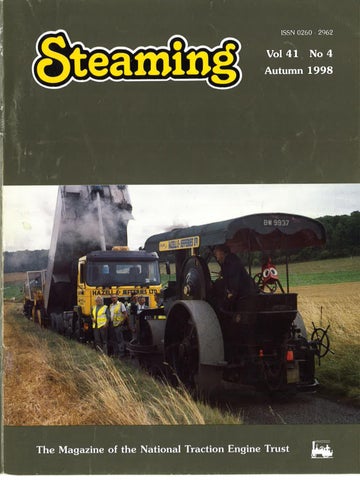
Cover The right way to enjoy your engine — one August morning this summer Ran Hawthorne and his sons spent a pleasant hour or so on their Fowler roller 14674, doing a job of work and chasing Hazell & Jefferies' surface dressing gangs on back roads on the Chiltern slopes. Here tar tanker, spreader and tipper, and the former Oxfordshire County 10 tonner, are stopped for a few minutes whilst Richard HazeII's men and Oxfordshire County Council surveyors chat about how it was done in times past. (Roger West) 175
Trust News From the Chairman Another rally season is over and our Annual General Meeting is almost upon us. Five years have passed since I was privileged with being elected your chairman; in another year I shall step down, hoping I have been of some benefit to the Trust, But before doing so I wish to attend to a couple of matters which have caused problems in the past both to members and to the Trust. The subscription has now been the same for five years. John Harris, our retiring Treasurer, will be telling us the
finances have never been healthier, but that they are due to one-off bequests and similar things. It would be wrong to allow the matter of an increase in subscription rate to drift until there is panic, as there was in spring 1993 — resulting in a 70% increase and many lost members. The problem could have been presented in another way, pointing out that had the amount been gradually increased through the period, members would, in fact, have paid more in total over the years, but any increase would have appeared less severe. I support the
From Alan Martin's Collection
82
Here we see Sir Charles Seely's 5 ton Mann's steam cart, pulled up at the Babbington Coal Co's buildings in the railway yards at Daybrook, just north of Nottingham, sometime about 1916. The compound engined machine is works number 914 of 1914 (U2573) and it looks to have been supplied as a convertible. The alternative front end with road rolls would have been fixed by the eight bolts to the angle bracket around the top of the smokebox. The Seely family had formed the Babbington Coal Company in the 1870s, but the steam cart seems to be the estate vehicle for Sir Charles' Sherwood Lodge at Arnold, being employed in my picture at moving larch timber, no doubt for use as pit wood at one of the local collieries. 176
motion that the subscription should go up a little when inflation has devalued it, and when the need arises. The Treasurer sees no need for an increase this year, although inflation has occurred over five years, but it is likely that one will need to be sought after next year. Future increases would be flagged up by the RPI, but voted on, as ever, by members. I feel it essential that the decision to set the subscription should oh,vays be taken by members rather than being automatic, because figures often lie. The second matter I wish to refer to is that of the election of the named officers of the Trust. At present the Committee only knows who is standing a couple of days before the AGM, and the vast majority of members know nothing prior to arriving at the meeting. I propose that nominees and their supporters should be published in the notice for the meeting, giving the membership advance notice of what may happen, thus avoiding surprises, and giving time for them to use their proxy if they cannot attend the meeting. The timing would be as for any motions proposed. Only some 5 or 10% of members attend the annual meeting, so a narrow rather than wide section make important decisions on the running of the Trust. Certainly if everybody came we would have a seating problem, but actually know what you all felt. Hopefully most of you are satisfied with what your Committee is doing; you normally tell us if you are not, but remember that we too are engine owners first and Committee members second. It still concerns me that many members feel the Committee to be telling them what to do. We can only suggest things, and hope we provide the framework which will enable us all to continue with our hobby for many years to come, whilst the world outside continues its spiral into an electronic era where machines control us rather than we them. Get in some coal, and check the driving belt and the governors, so that come the millennium we can saw logs and generate lots of amps at 110 volt dc. See you at Didcot in November. (Richard Sandercock, Chairman) Autumn 1998
STEAMING
Engine Owners Column Options for Training Richard Pierce outlined the Trust's commitment to training in the Engine Owners Column of the last issue of Steaming. I would like to expand upon his introduction, and outline a possible option. The Trust Driving Course covers a wide range of subjects at an introductory level. During the last gathering, earlier this year at Dingles Steam Village, there were many occasions when the lecture subjects could easily have continued beyond the time allocated when general enthusiasm headed for an in-depth discussion. Regrettably we had to curtail this, for there was no additional time in the busy schedule. At the end of the course the general comment made by some students could be summarised as "what next"? Back in April 1997 we held our first Weekend Workshop — with the topic being Valve Setting*. This was well received at the time, and reaction generally in line with the more recent "what next" comments at the Driving Course. The Engine Owners subCommittee is looking for ways to repeat this type of Weekend Workshop, covering a range of other activities. Our major difficulty is one of coordination. The only practical method of making announcements to the membership is via the Trust's quarterly but the magazine, publication of Steaming is not ideal for arranging such events, for Workshop opportunities, by their nature, often become available only at short notice — and may also just as easily have to be re-scheduled due to unforeseen circumstances. Therefore, there may be an alternative approach. I propose that we establish a register of Trust members who are willing to offer their services as Instructors — covering all manner of engine related activities. At the same time we invite students to submit a 'wish list' of topics on which they feel a need of further information or practical experience. This information will be retained by the sub-Committee so that Workshops, when the opportunities arise, can be set up with the minimum of delay. For this option to be a success we
*A footnote here for those who attended the Valve Setting Course — the Notes for this Course haven't been forgotten but have proved more difficult to compile than first thought. STEAMING
Autumn 1998
need to recruit as many Instructors as possible, possibly on a regional or club basis. They will be critical to any success, and the more we have the more evenly will the load be spread, so that no one person is continually imposed upon. The sub-Committee need to hear your views on this option. If it is favourable we will start up arrangements such as paper work, financial control and preparation of Course Notes etc. At the present time, I suppose this is rather a chicken and egg situation — I do not know what is potentially 'on offer', or what is on your 'wish list'. I might hazard a guess that the following are potential activities: • re-tubing a boiler • talks with a Boiler Inspector • principles of good riveting • advanced driving course • injectors — maintenance and repair • visits to engineering facilities If you support this programme, either by wishing to volunteer as an Instructor, or by having needs as a Student (or even if you have alternative options), please let us know. Write to — Richard Vickery, The Orchard, Loxbeare, Tiverton, Devon EX16 9RH. Technical Board Our old friend the Pressure Equipment Directive is still ticking away in the background and the DTI and HSE have been busy drafting regulations to implement it in this country. The latest news I have is that a consultative document will be published in November, after which there will be a period of three months for comment and representations. As I have written before, boiler repairs should not be affected but, as we have learned to our cost before, there can be a tendency for our bureaucrats, or those with a commercial interest, to want to add their own embellishments, particularly when it comes to issuing official 'guidance' to the Regulations. Watch this space! Calls for a total ban on the importation and use of all asbestos, recently reported in the press, may have some attraction to environmentalists and politicians looking for the odd brownie point, but the latest word I have from the HSE is that there is a more sensible proposal to impose restrictions on the import and use of white asbestos (chrysotile) where there is no suitable alternative, rather than banning it altogether. Experience so far with non-asbestos materials for boiler door joints has not generally been good, and it looks as if there may be a good case for retaining asbestos
for that purpose. Colin Hatch, our Spares and Pattern Register keeper, has further notes on the subject in his columns in this issue. (Jim Newnham, chairman, Technical Board) Spares and Pattern Register The Consultative Document for proposals to amend the Asbestos Regulations referred to in the last issue of our magazine is, in fact, aimed at the working practices in the building industry, for occasions when the material may be encountered in the alteration, rebuilding or demolition of existing buildings. The Document does not appear to add any further regulations to the already controlled manufacturing industry. A relevant quote from the proposals in Section 1, paragraph 14 reads: 'Materials which can be substituted for asbestos have become increasingly available over recent years for all but a limited number of asbestos products. Available evidence suggests that these fibres pose a lesser risk to health than chrysotile (white) fibres. There have, however, been concerns expressed about the limited amount of good quality scientific evidence available for some of the potential substitutes' ... and in paragraph 19 .... 'Until the EC Committee has come to a robust scientific conclusion, HSC and Ministers consider there would be insurmountable legal problems with a proposal to prohibit chrysotile (white asbestos). Once the scientific evidence becomes clearer, HSC will act accordingly.' Following an enquiry from a member who wished to carry out a crack test on an axle, I have been on a visit to Magnaflux, who manufacture dye penetrant detection spray. I was shown demonstrations of this product and of magnetic particle detection. Dye penetrant is widely available through a network of suppliers. However, the Sales Director of Magnaflux is prepared to supply direct to the Trust, at reduced cost, provided that ten sets or more are ordered, with myself acting as co-ordinator. Any member interested in obtaining the three-can set for routine inspection of keyways, shafts, castings, platework etc, should contact me, and with sufficient demand I should be able to pursue this. Further information on the whereabouts of patterns, or the supply of castings for any make of engine would be most welcome. In particular help is required with the following: • Wallis & Steevens 6hp — cylinder base casting and bearing brasses 177
The National Traction Engine Trust's
1998 AGM will be held at 2.00pm on
SATURDAY, 21st NOVEMBER 1998 at The Power Station Sports & Social Club, adjacent to the Power Station, off Basil Hill Road, Didcot, Oxfordshire. Please refer to the formal notice in the Report and Accounts which are distributed with this issue for details of agenda etc, and to the Future Dates column for notes on the arrangements that have been made for the rest of the day and on the Sunday.
• Garrett 6hp hose reel casting, part HT315 • Marshall S type firehole door ■ Aveling & Porter water pump (circular flange) • Ransomes tractor cylinder block Any information on those items, or on spares and engine 'useables' in general, please don't hesitate contact me = Colin Hatch, 4 Lotmead Farm Cottages, Stratton Road, Lower Wanborough, Swindon SN3 4AJ (Tr 01793 790378).
Rally Organisers Column Rally sub-Committee A lot of members will by now be aware that Michael Oliver fell ill just before his Great Dorset event, and I'm sure all readers will want me to take this opportunity to wish him a speedy recovery. Personally, I have been thinking of him through these days as I write these notes, whilst I have been removing the Tarrant Hinton mud from the car, the caravan and almost everything else which I took to Dorset! Many events appear to have been more lucky with the weather this year, and indeed some have reported improved gates. I have written before, and still firmly believe, that all rally organisers must start their planning for an event by recognising that they are in the entertainment business first of all and then consider how to attract their punters. Many events report they have a loyal following who visit their event each year and my question is this — do you expect them to come and look at the same exhibits in the same format every year? If so, I think 178
you are living on borrowed time. This will be my topic for discussion at the Autumn Rally Organisers Conference. This Conference will be taking place on 18th October at Willoughby, between Rugby and Daventry, and our regular attenders will have had their notifications some time ago. This magazine may not be with you before the Conference, but "I will make brief reference to our decision to hold the gathering on a Sunday. In all honesty I admit that the hall was not available for any Saturday, but we felt it would be interesting to see if the new departure was a more convenient day for some people who, perhaps, have to work on Saturdays. During the summer Smudge Smith has been handing over his reins of office to Bill Evans, who has bravely agreed to take on the administration of the rally activities; I welcome him to our circle. Details of the handover timetable are in Smudge's notes. Smudge has been our subCommittee administrator now for six years and as Chairman I owe him a great deal for his untiring efforts to organise me as well as run the Rally Committee activity. He has been invaluable as a systems man and leaves us well organised and beautifully filed in alpha-numerical order. His comments about my own deep litter filing system are best left unwritten! I would like to take this opportunity to thank Smudge most sincerely for his efforts on behalf of the Trust and rally organisers. Coupled with this I must mention his wife, Dawn, who was there to accompany him on the long drive to meetings, which he rarely missed in his six years of office. There is also another unsung hero in the Smith family — their son Ian, who as a 'computer boffin' generously gave of his time and computing power to help us set up
systems and upgrade Trust equipment. Thank you all. I would also like to thank the members of the sub-Committee who provide support during the year. We have a fine team of people who over the years have specialised in the various aspects of legislation etc. which have to come together to update the Code of Practice, a process which is ongoing. (Andrew Semple, Chairman, Rally sub-Committee)
Rally Authorisation Officer departing ... Most of you will know by now that I am handing over the position of Rally Authorisation Officer to Bill Evans — officially at the Annual General Meeting. Those involved with the Authorisation Scheme will be only too aware that this time of the year is very busy for this office, and it would have been most unfair to drop Bill from too great a height. In an effort to give him a little time to find out just what he has taken on, and to adjust things to his methods, all the working equipment and records were handed over at the beginning of July. Bill's address and telephone numbers, etc will be found in the usual place, inside the front cover, from this issue of Steaming onwards. My own PO Box number at Abingdon will stay active until August 1999. This will enable the public to respond to any of the advertisements placed in this year's rally programmes and other publications. The telephone number has been mechanised and is giving out Dill's number to anyone who calls. As from the AGM this facility will cease and the number will become unavailable. I think that's the official bit over, but I cannot leave without thanking the National Committee for their support during the last six years. I would like particularly to thank the Rally sub-Committee for their total patience and tolerance, and perhaps more importantly, their friendship. It has been a very busy six years, and I can honestly say that I handed over the reins with mixed feelings. To take something out you must put something in. I hope I did that; I know I've taken out many new friends and some super memories. As I retire to the back benches may I wish every one of you all the very best for the future. (Smudge Smith)
... and a new incumbent When the Editor made a last minute contact with Bill Evans for any contribution he might be wishing to Autumn 1998
STEAMING
make to this issue of the magazine, it was not a good time — a couple of evenings before his deep involvement with the Malpas Rally. However, Bill said he was looking forward to the challenge of running the Trust's Rally Authorisation Scheme, and of upholding the standards set by Smudge. Bill can be contacted at the addresses and phone numbers quoted inside the cover of each issue of Steaming.
Insurance Officer's notes NTET Steam Insurance Scheme From time to time I get asked "apart from low cost, what makes the NTET Steam Insurance Scheme different to other comprehensive insurance cover available?" The answer is quite simple: • The policy is written in plain English, specifically for steam traction and stationary engines — there are no technical loopholes or ambiguous statements. ■ Personal Accident cover is automatically provided for the driver and crew up to a maximum of £2,500. • The towing of trailers is covered up to a maximum permitted by law. • At work' demonstrations and appearance at rallies and public events are included. STEAMING
Autumn 1998
What do you think of this? This interesting scene is a bit of a puzzler. It has been kindly sent by John Knapton of Leeds, but the location seems likely to be the south east, maybe one of the road construction schemes in, say, Surrey in the early 1920s. The engines and traction wagons are at work taking spoil away from the rather elderly and unusual steam navvy that is cutting away the surrounding terrain — notice that the digging bucket is pivoted to the jib, which must have somewhat restricted the machine's mode of operation. Both the engines appear to have had some brief showland connections — the probably pre-1909 Aveling & Porter compound tractor in the foreground has an extension over the smokebox for a dynamo but it has been removed (and is the engine sporting a secondhand Burrell awning?). The second engine also has twisted brass decoration, though close inspection of the original print shows it is not a dynamo platform in front of the chimney, but just brackets for supports to the roof. Alan Martin recognises this machine as Tasker 1426, a C class 5 hp compound of 1911 that was owned by T. and Sam Williams of Woodhay and Baughurst in Hampshire. One of the workers is wearing ex-military clothing, often a sign of a just post World War 1 picture, and the motorcar — a Hotchkiss? — bears a registration that was issued in London in 1914. Who can say more?
• Cover is provided when the engine is being carried on a low-loader — this includes the 'cop-out area' of loading and unloading. • Recovery to any place in the UK is included — this provides vital cover after an accident which immobilises an engine. • In the event of a 'write off' the owner retains title to the engine — the insurer will pay compensation up to the insured value of the engine. • 5% of all premiums received by Footman James, our brokers, is paid to the NTET as commission. • Comprehensive cover is at the rate
of 5% per £1,000 insured value plus a one off £10 policy charge — any number of engines can be combined under this arrangement. • Low loaders carrying 'non-commercial loads' can be insured at the same, 5% per £1000 rate — but using a motor policy. • Third Party Fire & Theft cover is provided at a 33% discount of the equivalent comprehensive premium. • Restoration or 'off-road' cover is based upon 4% of insured value. • Third Party cover costs £30 — this is the minimum Road Traffic Act cover. 179
• Motor Legal Expenses up to £50,000 is automatically provided through an additional 2% surcharge of the premium. • Personal 'road rage' cover is automatically provided through an additional 1% surcharge of the premium — this gives an additional £2,500 personal injury cover. Those seeking to insure combinations of commercial and private items, including buildings and assets, should ask for a specific quotation from Jayne Jordan at Footman James. NTET Survey of Engineering Inspection Facilities To those of you who took the time to reply to our recent Survey, I should like to say a very big thank you. To date there have been over 120 returns, covering over 200 engines, which, for the very first time, provides the NTET with detailed and qualified opinion from the engine owner/driver membership. Whilst a complete analysis will take some time and thought, the early indications are that there are very wide inconsistencies relating to perceived quality, charges and value for money in the inspection industry! Another more easy to read result is that the independent inspector is generally better thought of than his corporate counterpart, whilst some actually organisations corporate ranked poor. At this stage an overwhelming majority want a debate on 'Inspectors — a look to the future', and just over 50% said they would use an 'NTET owned/managed scheme' (per Question 22), with an additional 33% saying they would if more details were known. Well of course there are no details as yet, that's what this questionnaire has been all about, to get an understanding of what the members really want and to find scope for the options. However, I can truly say that the results show there is plenty of ground for manoeuvre and it's possibly time to discuss them with interested parties. I hope to make a more detailed statement at our Annual General Meeting and in the next issue of Steaming. Watch this space. Breakdown recovery At the Engine Owners' Conference earlier in the year the Committee was asked to look into the feasibility of setting up a breakdown recovery scheme. This was to be in association with one or other of the commercial vehicle recovery schemes operated by organisations, such as Green Flag. 180
Much has been discussed in the pages of the last few issues on the future of traction engine rallies, and of how to hold the interest of the non-enthusiast in our steam engines. Keep on providing something different its suggested. From the footplate of Richard Marsh's Burrell 3886 LORD LASCELLES it seems the folk of Llandudno are prepared to turn out in large numbers to see the street parade of engines that takes place as part of rally there at the May bank holiday. (Richard Marsh)
In order to progress this request I have had discussions with a number of organisations. But, because we don't have any detailed history of breakdowns, for engines or low-loaders, it has been impossible to define anything that would constitute a commercially beneficial scheme. What we did arrive at, however, were two important statements: • your problem becomes the recovery organisation's problem, • from that time the clock is ticking at a known and published scale of charges. Despite the two sound principles I began to think that there was not much further we could go as there was nothing produced that would reduce or eliminate the actual costs to our members. However, following impromptu discussions with a few engine owners at Dorset it appears that some of you might be prepared to make fixed, annual contributions to a mutual fund, established to service the cost of recovery which would lead to a free service to participating engine and low-loader owners. If anyone has a keen interest to further such a scheme please write to me or send a fax to the address shown inside the front cover of Steaming.
Boiler repairs and contracts Once again I hear of someone coming to grief because the boiler repair man's bill was much bigger than promised or anticipated. In this case the owner got mad and took his still incomplete engine back home. Some time ago when I was new to this job, I published a warning in one of my early reports about the possible consequences of having repair work undertaken without entering into a formal contract. It sounded petty, I know, because we are all pals in this hobby, aren't we? Well, sadly this is not true, as some of you already know to your cost. We can all imagine the scenario. The repairman is telling you he can't fit you in until after the millennium, but you tell him to start on a piece-meal basis just to get it going because it's a job you've psyched yourself up to for a couple of years. There are a number of little jobs that could be done at the same time. The arms are waving, the business jaw is set, the price is struck and the completion date noted. Many moons later you're asked to make a stage payment, and then another and so it goes on until the original price is exceeded and still payments are requested. Eventually you make a visit to the workshop and all is not well. Autumn 1998
STEAMING
Progress is different to that expected or reported. What can you do? Well, if there isn't a binding contract that spells out what work as to be done, to what standard, at what cost and in what time scale — very little I fear. One final point; where a new firebox or barrel is the order of the day there have to be certificates relating to the origin, type and specification of the boilerplate used. This paperwork is your property, it proves to you and your boiler inspector and the insurance company that the material hasn't come from recycled baked bean cans. You can lodge the certificates with your boiler inspector for safe keeping if you wish, but do insist on receiving the originals from the repairman/ builder.
Treasury matters Subscriptions — a future strategy The General Committee of the Trust, in keeping abreast of yearly budgets, are always aware of the need to assess the annual rate of the members' subscriptions. John Harris, our retiring Treasurer, has for some time deliberated on a mechanism that would ensure the rate of subscription rises should be set down in a manner that is both clear to the membership and of well ordered guidance to the Committee. John's notes on the rationale behind his thinking are summarised as follows: 'It is my suggestion that a structure is established so that a proposal to increase subscriptions by
Acit,q‘lCikk,(E — INSPECTIONS — FOR YOUR STEAM BOILER INSPECTIONS All pressure vessel and garage equipment statutory inspections carried out NTET Approved Ian Farrance Farncare Inspections 2 Hawkins Close, Poulner, Ringwood, Hampshire BH24 Tel: 01425 479683 Fax: 01425 473765 Mobile: 0973 697818 STEAMING
Autumn 1998
the rise in the Retail Price Index is automatically presented to an AGM when the RPI has risen by 15% from the date of the AGM approving the last increase. 'I recall that the first thing I had to do when appointed Treasurer in 1993 was to raise the subscription from £12 to £20. This was rushed through, and not surprisingly created resentment, even though the case was merited. I do not wish my successor to be placed in the same position. Since that time the amount has remained unaltered, though inflation and the RPI has risen by 17%. In order that a rise in subscriptions is not proposed immediately, I recommend that the base date for the implementation of the proposal should be 1st January 1996, when the RPI was 150.2. On this basis a proposal to increase subscriptions would be triggered when the RPI reached 172.7; it is currently 163.4. 'In recent years the Trust has benefited from one-off receipts, following a great deal of work by various officers. Legacies have been received; the Road Run has been held; Footman James' commission has materialised, and the Trust's general financial position has improved. However, despite great efforts in other areas the Trust's work such as the Authorisation Scheme and the Sales Department, the basic fact remains that without these one-off receipts (that may or may not continue into the future), the Trust will at best break even. It certainly will not generate sufficient funds to finance the replacement of assets, or to develop the Trust in general. Individual members can easily save the amount of any increase by taking advantage of the Trust's insurance schemes, book offers and other services. 'To conclude, given the friction caused by the last subscription increase, I believe that both the Committee and members would benefit from a fixed policy in this area, so that a degree of certainty is imposed. Clearly, no one likes paying more for anything, but it is a sad fact that the Trust's (or anyone else's) operating costs rarely decrease. Inflation is also the enemy of any organisation with funds on deposit. It goes without saying that any member who is unhappy about the Trust's use of funds, however generated, should consider seeking appointment to the Committee.' John's advice to the Committee is endorsed by the Trust's new Treasurer Julie Smith, and has been the basis of the Motion that is to be made at the forthcoming AGM — it is set down in
the Agenda and formal notice in the Report and Accounts that accompany this issue of the magazine.
Proposal for new Auditors As part of a cost review exercise I have asked a small number of qualified firms of accountants, including Menzies our current Auditors, to provide tenders of their charges for the position of Auditor to the Trust. Subsequently a resolution will be put to the AGM proposing the appointment of new Auditors. (Julie Smith, Treasurer)
Steam Apprentice Club As we approach the close season we can look back on a year where various new initiatives were tried within the Steam Apprentice Club — the visits to museums and collections, driver tuition at rallies and, of course, the driving course itself. It is with some sadness that I have to report that most of these events were not well supported. One aspect which did prove popular with the youngsters was the practical driving which we were able to organise at Dorset — when the rain allowed. This was initially planned as a series of races (slow driving, fetch the ducks, etc.) as beloved of rallies a few years ago. Lack of numbers of apprentices and also the poor weather combined to limit our efforts to driving in and out of cones. However, given that the youngsters were mainly new to engines, this proved to be very popular. I believe that this sort of activity would be well received at other rallies where SAC members are gathered. The two engine owners who helped us at Dorset very much enjoyed the hour and a half or so we spent in the ring — would others be willing to enjoy themselves in the same way? Please contact me (my address is inside the cover of every issue of Steaming) if you are able to help. Following the popularity of the above activity we would like to organise small local driving days for Apprentices, where a group of youngsters could safely learn the basics of engine control. If anyone has offers of engines and/or venues, again please contact me. As most of our members are dependent on others for their transport, we would hope to 181
arrange several small events around the country. I believe the best time for this would be early in the new season, say between Easter and the May bank holiday. Continuing on the theme of new ideas to try to tempt the younger element away from the video and the computer, does anyone reading this column have any thoughts which we could adopt? Yet again, please let us know! I recognise that some rallies have made considerable efforts on our behalf this year, only to be disappointed by a poor turnout. I would ask that you continue with your efforts, at least for this coming season, as it does take a while for the idea that a special provision is being made to become known to the Apprentices. I would also ask if you are planning to help us with people or activities, please let us know early in the season so that we can publicise the fact in the Spring issue of our magazine Raising Steam, and thereby gain the best chance of Apprentices appearing at your rally. Thank you to all those who did make an effort this year on our behalf. (John Durling, chairman, Steam Apprentice Club).
Obituaries Alec Bicknell It is with sadness that we record the death of Alcc Bicknell in July, the result of a heart attack. Alec was without doubt one of this country's leading boiler makers in the 70s and 80s. Born in October 1928, Alec was to live in the Haslemere, Surrey area all his life, one of three brothers. He was a keen sportsman and took part in many outdoor pursuits. This included the love of his life, fishing, and he was secretary, then president, of Haslemere Angling Club, and later a life member. At the height of World War 2 he left school and became an apprentice plumber with Milton's of Witley. That meant cycling ten miles each day to get to and from work; later he joined the REME and did National Service in Austria. Alec then continued as a heating engineer, marrying June in 1951 — they were to have two children, Alec and Barry. As time went on he branched out to be a selfemployed heating engineer, later to be joined by his younger brother Robert. Alec got the steam bug in the 182
1960s, when helping Patrick Coxall repair his Wallis & Steevens 10ton roller 7333. In 1971 Alec purchased an engine himself, in the form of 8 ton Wallis Advance 7786 JENNY WREN. He and his brother's family made a number of famous trips with the machine, even venturing into East Sussex. His skill as an engineer is well noted and the first professional steam engine job he carried out was on Jim Darnell's Marshall 54587. It was not long before people got to know of him and he was asked to replace the firebox in the late Charlie Reeves' Fowler ploughing engine. This was to be the start of a long line of engines he worked on. The first boiler works was created at Jim Court's yard near Lurgashall. It was in 1979 that the Bicknell brothers moved to I lollycombe and their current Iron Hill Farm premises, after carrying out work for John Baldock. They were later to purchase the premises and expand the works into what it is today. In 1983 the late Jim Hutchins' Garrett Suffolk Punch tractor had a complete new boiler assembly made; a significant first in preservation times, but actually leading to many firsts at the boiler works. In May 1986 Alec fell from the top of a ploughing engine which he was preparing for a hydraulic test. He suffered irrevocable damage to his spine and back, which sadly placed him in a wheelchair for the reat of his life. Despite this, he was still an active model maker and was a regular visitor to the boiler works, particularly in the summer months. The Bicknell family were always supportive and he was a keen visitor to events throughout the UK, particularly when the family engines were in action. In recent years he acquired Fowler B4 traction engine 8282 BERKSWELL, and he liked nothing better than to hear the engine hard at work on a rack saw bench. The funeral took place at Camelsdale Parish Church, near Haslemere, and the building was packed to capacity. As chairman of the Sussex Steam Engine Club, I was pleased to pay tribute to his work and life during the service. At Alec's request, his final journey was taken by steam, to the peaceful Camelsdale cemetery. He travelled behind Marshall Q class traction engine 70321, driven by Alec's nephews David and Andrew Bicknell. He will be missed by so many — may he rest in peace. (Peter Love)
Les Bishop Les Bishop was one of the founder members of the County of Salop Steam Engine Society. He was born in 1912, the youngest of six children, and learnt all his considerable steam knowledge from his father, William Arthur Bishop, who founded the agricultural engineering business Bishops of Burley in 1918. Les and his brothers, Percy and Cyril, carried nn the business which had included four sets of steam threshing equipment. Les met his wife Elsie while waiting, as driver of FERMOY (Burrell showmans 30901, for a train to pass at the local level crossing. A nod and chat on Onibury Station and that was it for a long and happy married life. The Salop Society was first discussed around the teapot and kitchen table at Burley. Many steam parties remembered the era when Mike Salmon, the Driscolls of Essex etc, brought their engines to consult Les and his brothers for their specialist knowledge and skills. Engines of all shapes and sizes passed through Lesley's hands, but when Percy died in 1962 and then Cyril ten years later, Les decided to retire. In 1976 his work became his hobby and when he died in April this year he was still looking forward to rallying his fairground organ. Les Bishop was a quiet gentleman
Alec Bicknell, sitting in his chair with Teasel the boilerworks guard dog, and Aveling & Porter traction 2436 as a background. Autumn 1998
STEAMING
of the steam era before preservation, and when overalls, cap and spanners were worn and used to keep steam power of road and farm efficiently working. (Jim Cook, County of Salop Steam Engine Society). Brian Smith Well known steam man from Kent, Brian Smith, usually known as Smudger, passed away in August. Aged 63, he had been suffering from cancer for some time. His last request to his family was to have his Burrell engine 3655 ENGLISH HERO taken to the Detling Show near Maidstone later in the month. There, a special tribute parade took place in the ring on the Saturday, with a minute's silence and a whistle fanfare. Peter Love made a short address and spoke of Brian's dedication to the movement, particularly in the pioneering work of rallying on the continent in Holland and Germany; in those early days he regularly steamed his immaculate 1922 Aveling & Porter steam roller 10271 to events. Smudger was a popular person who was always willing to help others. It was always his dream to own a showmans engine and that came to fruition when he purchased ENGLISH HERO. He and the engine were attenders at events all over the country, including Dorset. Interestingly enough his working career was very diverse, and at one time he was elephant trainer-keeper at Maidstone Zoo. A church service took place at Sittingbourne on 20th August, followed by cremation at Maidstone, and both places were packed to capacity. The steam circle has lost a good friend who will be hard to replace. We send condolences to his large family, and the many friends who kept the Burrell on the road over the past few seasons.
The next candidate for a chance to steer an engine in the ring is helped aboard Aveling & Porter 8 ton roller 11880 of 1927 at the Tatton Park rally in August 1997. (John Maund)
Personal Angela Smart
Reg Saunders Just as this issue went to our printers we learnt of the sad death, on the eve of the Bedford club's rally at Old Warden, of Reg Saunders of Stotfold, Hertfordshire. He and his family have over many years created the elaborate stage and dancing shows around their fair organ and showmans engines. The popular attraction has appeared at rallies throughout the country. On the Saturday of the Old Warden event it was fitting that Reg was remembered by rallyfield friends at a brief tribute in front of the STEAM UP stage.
STEAMING
Autumn 1998
Peter Smart of Bordon, Hampshire, writes: May I crave a little space in our magazine? I would like to thank most sincerely all friends and acquaintances who telephoned and wrote to me following Angela's death. The many cards and letters have been a source of great comfort through this difficult time and are very much appreciated by me. A very special thankyou to all who have made donations. Cheques for over £400 have been presented to the Imperial Cancer Research Fund as a result of your generosity. Over the years, Angela had made a great number of contacts, many of whom had become firm friends. The warm tributes to her are very moving
and it is marvellous to know that she had such a large circle of friends. Many people have said how much she will be missed; she always enjoyed meeting people at the Road Locomotive Society stall and she seldom forgot a face, although sometimes could not remember names. She was a wonderful organiser and nothing gave her more pleasure than being able to supply a book that had been requested. Being a collector herself she well understood the satisfaction of filling a gap in one's collection and she was almost as pleased for others as if for herself. Her fight against cancer was typical of her approach to everything she did — total commitment. Only when the surgeon told her that there was nothing he could do did she admit 183
defeat, and that was just twelve days before she died. Very many thanks for your support and thoughts. May Angela rest in peace.
Dorset appreciations Another year's gathering at the Great Dorset Steam Fair has passed with a very loyal group of members and friends giving their time and effort in staffing the Trust marquee. A slight but effective alteration to the layout in the threshing, sawing and haulage ring areas resulted in the marquee being much nearer to the engines than in recent years. Our book and video sales stand, the multi-screen television, and the rest and refreshment areas all proved to be popular stopping places, serving members and promoting interest in road steam engines to others. For the setting up and staffing of the marquee thanks are due to several Committee members and their wives or husbands and family, and to Wendy Chapman, Robert and Paul Cook, and their friend Matthew Short, Peter Cooper, Les and Rita Dickens, Tony Flowers, Stuart Gaines, Andy Hampton, Sue Howard, Stephen Snook, Barry Sumsion, Jo Tilling, Val Wingate and May Wright land anyone else the Editor may have inadvertently missed!). We are again grateful to Brian Wells for providing electric power.
London Area Social Meetings October sees the recommencement of the Trust's social meetings for the London area, held un the second Tuesday of the month during the winter period, except in December. The venue continues to be 'The Duke of York', 35 New Cavendish Street, London W1. This is on the corner of Westmoreland Street and opposite the end of Welbeck Street. The nearest tube station is Bond Street (Central Line) — walk north from there for about 500 yards on Vere Street and then Welbeck Street. The room will be available for Trust members from 7.30pm, with the meetings commencing at 8.00. Non members are welcome to attend, 184
The dates, and the programme of talks or slide shows, is as follows: Tuesday, 13th October — East Anglian Steam, then and now by Kevin Swann. Tuesday, 10th November — Around the Cambridge district by Bill Last. Tuesday, 12th January — An evening with Ralph Hutchens. Tuesday, 9th February Steam Rolling by Sandy Ross. Tuesday, 9th March — The Burrell Museum and Works by David Osborne. Tuesday, 13th April — A special presentation by the Steam Plough Club. (Bill Timmings, London meetings organiser)
Future Dates AGM 1998 I he AGM weekend this year will be held in the Thames Valley area — on the Saturday at Didcot, Oxfordshire and on the Sunday at Knowl Hill, Berkshire. The Annual General Meeting of the Trust will take place at 2.00pm on Saturday 21st November at the Power Station Sports and Social Club at Didcot. This is located adjacent to the Power Station, off Basil Hill Road. Formal notice of the meeting, the agenda and the Annual Report and Accounts will be distributed with this issue of the magazine. In the event of any voting being necessary at the AGM, only current Trust members will, of course, be eligible. Members are therefore asked to ensure that they have their membership cards with them at the meeting. Tea, coffee and biscuits will be served at the conclusion of the AGM at about 5.00pm. Parking is available at the Club. Other arrangements have been 'Trade fur 11w Saturday and the Sunday for members wishing to stop overnight in the area. On the Saturday morning there is a visit to the Great Western Railway Museum at Didcot. The Museum is, of course, devoted to relics of the old GWR. It is housed in the former steam running sheds, but the site has had much development over the years to enable a fine range of exhibits to be shown off. There are no special arrangements for entry and we suggest members meet within the Museum during the latter part of the morning, where there will be much engineering and restoration work to be
wondered at. The Museum is signposted from all main roads with the usual brown tourist signs; entry to the site is via Didcot Parkway station. Parking is available adjacent to the station (pay) or further west, with a shortish walk over the bridge to the station, which is free (well, it was a couple of years ago!). For lunchtime needs, there is a Refreshment Room at the GWR Museum, and pubs adjacent to the station. The Trust's Exhibition Unit will be open at the Sports and Social Club for the period prior to the AGM for the sale of books, videos etc — a chance here, with a bit of coercion, to have some of your Christmas shopping done for you! For the Saturday evening we move twenty miles or so east to Knowl Hill, near Twyford, to be near to John and May Keeley's Toy Box and our visit there on the following morning. During the evening we have arranged an informal dinner at 'The Bird in Hand' on the Bath Road (A4), Knowl Hill. This is at 7.30 for 8.00pm. We will be pleased to welcome as our guest speaker Dr Tony Marchington. Tony has a long time interest in steam, is a strong supporter of the Trust, and owner of a large collection of road steam engines and the world famous FLYING SCOTSMAN. Prior bookings will be necessary and should be made through the Trust's General Secretary, Sue Jackson (address inside front cover). The cost is £20 per heed for the three course meal — for this occasion the Trust has reserved the whole of the dining room, so it will be completely for our own enjoyment. For those wishing to stay in the area overnight, accommodation may be booked direct with 'The Bird in Hand' (vr 01628 826622 and mention NTET). Other accommodation nearby is at 'The Wee W aif' , a Morland Lodge, at Chervil on the A4 (is. 0118 944 0066). We are most grateful to John and May Keeley for their kind invitation to visit their collection at Knowl Hill on the Sunday. An invitation has gone out for members of local clubs to come along, and with more than a few engines in steam it promises to be a morning (and afternoon) to remember — be assured a most excellent time will be had. The Keeleys' premises are at the east end of Knowl Hill, north of the A4, but NTET signs will be put up on the day. Refreshments will be available at midday and the Trust's Unit will again be open for sales. The AGM is the time when Trust trophies are awarded for meritorious happenings of the past year and a Autumn 1998
STEAMING
selection of the cups and shields will be presented at the dinner, or the Sunday morning visit, as appropriate. Member's further enquiries on the AGM weekend (but not hotel bookings) should be addressed to the General Secretary, Sue Jackson (address inside front cover).
New Members A sincere welcome is extended to the following new members who have joined the Trust during the last three months. We hope they will gain much friendship, information and enjoyment from their membership over a period of many years. The Membership Secretary is always pleased to put members in touch with one another by fowarding mail. P. Kestell-Cornish, Caversham, Berkshire K.R. Toplis, Abingdon, Oxfordshire R. Rothwell, Bolton, Lancashire K. Harris, Bromyard, Herefordshire R. Boxhall, Brecon, Powys E. O'Hanlon, Co Wexford, Eire J.D. Boon, Yeovil, Somerset A.N. Wheeler, Craven Arms, Shropshire J.C. Palmer, Ashford, Middlesex I.R. Malpass, Bristol I.J. Stephenson, Pershore, Worcestershire V.A. Challinor, Leominster, Herefordshire I. Walker, Bristol W. Sneath, Loughborough, Leicestershire R.S. MacLellan, Stroud, Gloucestershire R.J. Hall, Eldersfield, Gloucestershire J.R. Parkinson, Aberdeen Mrs A. Abramson, Norwich, Norfolk C. Pank, Milton Keynes, Buckinghamshire A.G. Parry, Crewe, Cheshire J. Huey, Co Down, Northern Ireland J.F. Dillon, Co Down, Northern Ireland P. Murphy, Haslemere, Surrey C.D. Turton, Rhydymwyn, Clwyd D. Pearce, Colchester, Essex M.H. Spry, Okehampton, Devon C. Poole, Spalding, Lincolnshire Dr D. Morley, Nottingham A.D. Hodgkinson, Nottingham I.P. GelsthorOe, Kegworth, Derbyshire R.A. Lock, Bristol C. Mitchell, Thirsk, North Yorkshire A.H. Deeley, Liskeard, Cornwall G. Taylor, Hartlepool, Durham M.J. Derksen, Holland P.A. Jones, Lowestoft, Suffolk P. Boyden, Kingston upon Thames, London P.R. Allen, Coalville, Leicestershire M.J.P. Goodman, Cambridge J.P. Tuck, Staines, Middlesex P.W. Johnson, Jersey G. James, Aberystwyth, Ceredigion Dr C. Byrne, Cardiff, South Glamorgan G.H. Thomas, Nailsea, Somerset C.S.T. Broad, Mold, Flintshire F. Streeter, Portslade, East Sussex C. Hill, Thornton Dale, North Yorkshire D.N. Evans, Bristol S.P. Carter, Baldrine, Isle of Man A.P. Holstead, Harrogate, Yorkshire
STEAMING
Autumn 1998
J.S. Glover, Derby C. Dawes, Bedele, North Yorkshire C. Stout, Bournemouth, Dorset R.E. Menear, Cambourne, Cornwall G.D. Crouch, Lymington, Hampshire C.R. Barham, Northfleet, Kent P.A. Newman, Horsham, West Sussex C. Withers, Poole, Dorset D.P. Hughes, Somerton, Somerset A. Lambert, Broadstone, Dorset I. Robertson, Shaftsbury, Dorset C. Pascal, Castenray, Holland C. Norton, Coalville, Leicestershire J. White, Co Wexford, Ireland F. Middendorp, Uithuizen, Holland D. Cooper, Newbury, Berkshire Mrs J. Tilling, Burbage, Wiltshire J. H. McTurk, Brentwood, Essex A.D. Butler, Wantage, Oxfordshire D.J. Plumb, Selsey, Sussex M.A. Walter, Daventry, Northamptonshire G. Collins, Newport, South Wales D.F. Knight, Old, Northamptonshire R.J. Wilde, Daventry, Northamptonshire A.V. Burgess, Norwich, Norfolk J.H. Selby, Belton, Lincolnshire P. Ison, London J.M. Rickerman, Tring, Hertfordshire R. Vendeele, Oostrozebeke, Belgium M.H, Warren, Castle Cary, Somerset S.J. Hirst, Salisbury, Wiltshire R.J. Huddleston, Weardale, Co Durham B. Rice, Chelmsford, Essex F. Cox, Christchurch, Dorset M.J. Wallace, Bracknell, Berkshire J. Johns, Bridgewater, Somerset R.L. Johns, Bridgewater, Somerset G.P. Limmer, Dorchester, Dorset D.W. Hilditch, Welshpool, Powys J. M. Freeman, Liphook, Hampshire A. Brice, Sellindge, Kent R. Greaves, Stevenage, Hertfordshire T. Webster, York W. Wilkinson, Wells, Somerset B. Saggers, Ware, Hertfordshire A. Chambers, Taunton, Somerset R. Chambers, Taunton, Somerset M. Tingay, Nuneaton, Warwickshire F. Jarman, Mildenhall, Suffolk P.R. Holden, St Neots, Cambridgeshire
OUR MAGAZINE 25 YEARS AGO
The front cover engine for this issue was Burrell showmans 3443 LORD NELSON, then one of the exhibits at the National Motor Museum at Beaulieu in Hampshire. The engine has just completed its second season out on the rallyfields again, now in the ownership of Tim Tomlins. The Chairman, Anthony Heal, announced enhancement of the insurance cover offered to engine
LLEWELLIN S
Gears YOUR ONE STOP GEAR SHOP
GEARS UP TO 8ft 6in DIA SPLINED SHAFTS UP TO 25ft LONG Broaching & Splining - Spurs, Racks, Helicals Worms & Wheels, Bevels - Straight & Spiral Stock Gears & Splines 24 Hour Service - Gearbox Rebuilding Specialist Supplier of Gears and Splines for all Traction Engines
Telephone Mike Horlick LLEWELLIN'S GEARS KING SQUARE, BRISTOL BS2 8JJ TEL: 0117 942 4026 FAX: 0117 923 2028
Poor Steaming We doubt many will have been fooled by the gremlin that got through on the rear cover of the last issue — the Burrell featuring in the bottom illustration was, of course, at one of the old Stourpaine, Dorset gatherings.
'For Sale — cheap for cash. Small Steam Switchback, 8 cars (with dragons heads on), with or without Organ and Trucks; 5ton Wallis & Steevens Steam Wagon, Set Juvenile Boats. Stamp for reply — F. Kimber, Petersfield, Hants.' (from The World's Fair, 2nd January 1926)
owners by brokers Tennant Budd, Roderick Pratt Ltd. Sparks cover had risen from £5,000 to £20,000 to account for the remarkable rise in property values, especially of thatched houses. Another addition to the benefits was the inclusion of road rolling (by the insured only); the total premium was £10, A further continental excursionist was Fowler showmans KITCHENER (or IRON MAIDEN), which had taken a trip to Holland, starting at Utrecht and then continuing in steam on journeys on the Dutch roads towards Rotterdam. Engines advertised for sale included a French built Breloux portable and a pair of 12hp Fowler ploughing engines — no prices for these, but £750 was asked for a 5hp Humphries portable of 1895. 185
Mike Jones
A Lucky Survivor
A couple of pictures I took getting on for thirty years ago may be of interest to other readers. They show the late Tom Varley's recovery of the remains of Yorkshire 2 ton steam wagon number 117 in the early summer of 1970, whilst he was taking it from where it had rested since 1927, high above Bacheirig, a farm three miles or so to the east of Ruthin, Denbighshire. I have been able to piece together a fair amount of the machine's history. It was new in 1905 to Capt. the Hon. John Charles Best of Vivod Hall, an estate a couple of miles west of Llangollen. The wagon left Yorkshire's works in Leeds by road on 19th September, steaming into Llangollen ten days later. The little wagon worked for the Best family for a number years and was then sold locally, to be replaced by a new three tonner from the same maker. Our hero continued at the unsavoury work of carting animal carcasses and condemned meat from the London & North Western Railway Co's station at Ruthin to Rhydwrial Farm on the eastern outskirts of the town, where such materials were rendered down. When that concern went bankrupt in 1927 the wagon was purchased at the auction sale by Smith of Bacheirig. There the boiler, engine and other parts were removed and the remaining chassis was towed from the farm a couple of miles higher into the hills, there to serve as a pig food store. The runners that can be seen in my pictures are the remnants of the original platform body. The remains thus lay out of sight and mind. Mr Smith was an inveterate buyer of items at farm sales from the 1920s to the 1960s — on a visit in 1966 (before I knew of the Yorkshire) there were upwards of thirty Model F Fordson tractors in rows at the rear of the farm buildings. Later that year, when Smith's son took over, these tractors and the rest of the stuff were disposed of, yielding over 500 tons of scrap in one week. Fortunately the Yorkshire chassis escaped the purge, though it is possible its engine went at that time. The Lancashire Traction Engine Club's rally in 1970 produced for many visitors a surprise entry in the shape of Tom Varley's rebuild of Yorkshire 3 ton steam wagon 940 of 1917. Soon after this event I was told of the Ruthin chassis and, suspecting 186
the mortal remains of Yorkshire 2 ton steam wagon 117 in 1970, pictured by Mike Jones during its removal from Bacheirig, near Ruthin for rebuilding by Tom Varley.
(but not knowing very much at that stage) that it could be a Yorkshire, I visited it and then wrote to Tom. Subsequently we both went to see the remains and I introduced Tom to the owner. The wagon's full identity and history were still unsure, but one revealing feature was the steering gear, lying under the remains. On seeing this Tom knew it was a York-
shire. He subsequently negotiated the purchase for £100. The chassis was fitted with Stagg patent wooden wheels and this was to be another prime identifying clue. In 1970 the former Yorkshire Steam Wagon Works in Leeds was still in business, trading as commercial vehicle repairers. Tom visited them and searched their records. Number 117 seemed to be the most likely Autumn 1998
STEAMING
141 : 7°1-.1. Two views of the completed restoration, taken by Eric Sawford at Expo events at Peterborough, the top one in 1973 and the lower one in 1982.
candidate for the Ruthin remains. Locally, I was able to have access to the only licence record book kept by Denbighshire County Council up to 1920, and sure enough all the dates tallied, with it set down that Yorkshire wagon 117 was registered CA170 on 29th September 1905. Perhaps the most remarkable part STEAMING Autumn 1998
of this story, however, was that on a visit to the Vivod Home Farm shortly afterwards, I was given an unused set of boiler tubes for the wagon — still there 65 years after the machine had left the place! A photograph of the wagon arriving at Vivod when new, sporting U (Leeds) trade plates, was to be seen in the family photo album.
After he rescued the chassis Tom Varley was able to recreate the Yorkshire with other parts made by that manufacturer. The fact that Tom had so many Yorkshire components is a story in itself. Towards the end of the 1930s the Yorkshire Steam Wagon Company had turned to producing diesel powered vehicles, realising that steam production was all but finished. They disposed of all of their spares to a Leeds scrap yard — Robinson & Birdsall's, off Moor Road — and the unwanted parts included new boilers, engines, springs etc. From 1940 to the 1970s the yard burnt all their rubber tyres, wooden bodies and cabs, buses and the like, just at the point where the old Yorkshire bits had been tipped. By 1970 the parts were under ten feet of ash. And so Tom, when he heard of them, was able to save a veritable pile of treasure. One of the new boilers was fitted to the 2 ton chassis. The early Yorkshire wagons were true undertypes, but the later machines had a vertical compound engine mounted at the rear of the cab. Tom had acquired some of these with the scrap, and somehow or other knew that the later 3 tonner engine was a development of the earlier design. Having no engine for the derelict chassis, he cut one of the later engines in two and mounted each half in the chassis frame. Remarkably, everything worked, and a fine job was made of the rebuild, as can be seen from Eric Sawford's pictures, taken at the Peterborough Expo event in 1973. Tom, his family and friends took the wagon to many rallies throughout the country in the 1970s and 80s. I see that Alan Duke had a different note of the wagon's history, taken from Yorkshire records, which I gather rather puzzled him. Could it be that someone put something down wrongly at the works? I have no doubt of the identity of the wagon recovered after all those years at Ruthin. In its time it would have been an uncommon machine for the area. The remains were found but 15 miles from Llangollen, its first home. The second owner of the vehicle could well have known the Best family, and he possibly even purchased cattle and other commodities from them, and might have known of the Yorkshire 187
prior to taking it. Added to this the Stagy wheels, known to be Fitted to 117 when new, must confirm beyond all doubt that the survivor is Yorkshire 117. The machine is unique amongst the few surviving Yorkshire wagons in this country, though I understand another earlier undertype still exists in Australia, discovered at much the same time as the Denbighshire wagon. The late Captain Best of Vivod Hall, Llangollen, when I met him in 1970, could recall the 2 ton wagon. He remembered, too, its replacement by the 3 tonner of the same make, though it was recognised it was not as good as the original. To reach the family seat at Vivod one has to negotiate 1 in 4 and 1 in 5 hills on the way from Llangollen town. Editorial note: There is an element of contradiction in some of the historical notes on this small Yorkshire steam wagon, which may warrant setting down in this footnote. The late Alan Duke, in providing notes to us on Yorkshire 117 some years ago, made comment that the makers records he had once consulted indicated that the machine had been resold to Northumberland. He wrote 'the record sheet set down its date of despatch as 19th September 1905 and purchaser as Hon John C. Best,
and also described it as a 2 ton wagon with a 4 ton boiler (number 186) and cylinders 3 3A in and 6in diameter. On the same sheet there is a later note that it had come back to Yorkshires and then resold on 1st April 1915 to Alexander Martin of South View, Percy Main. The note does not include the information as to who sold it back, but Best had a new wagon from them in September 1914.' Alan carried on: 'Michael Salmon's copying of the surviving Denbighshire licensing records — the Heavy Motor Car Register entry for CA 170 refers to a Yorkshire wagon of 2 tons 19 cwt unladen weight, licensed for a maximum speed of 8mph. (This was the maximum for a 3 ton wagon on solids.) The entry was cancelled on 2nd April 1908. This usually meant the vehicle had been transferred out of the county, and then it got a new number at its new home, or was scrapped — the latter unlikely with a machine less than three years old. The second Yorkshire that Best had was number 664 (U2845), new on 16th September 1914; it was described as a 3 tonner with boiler number 599. A fresh file for U2845 was opened by Denbighshire in 1921, and contained the original declaration giving the 'chassis number' as 664 and the then owner as Capt. William Best of
Llangollen. He last licensed it to the end of 1924. It has been reported to have been scrapped by October 1930. ' Mike Jones has recently taken the opportunity to check the entry in the Denbighshire County Council's Register of Heavy Motor Cars and it is clear that on 2nd April 1908 CA 170 was not cancelled, but merely had the name of its owner changed — to (Captain) William Best, still at the same address at Vivod, Llangollen. The final place for details in the Register, the 'if cancelled' and date column, is unmarked, so the ledger is of no further help to us with later history, but the lack of an entry here presumably indicates the wagon saw more use with the Bests after 1908. Other details of interest in the Register are that the vehicle was intended for private use (not trade) and the lorry body was painted blue with 'name of owner on it'. The note Alan Duke saw on 117's record sheet at Yorkshire's — the papers are probably not now in existence — is puzzling, and maybe it was an error on the part of one of the clerks at the Leeds works, for surely the machine could not later have gone back to Denbighshire from Northumberland to have the later history that has been unearthed locally by Mike Jones, ij
Calling all Traction Engine Drivers! A Railway Footplate Awareness Course for Road Engine Crews On the beautiful North Yorkshire Moors Railway, we have established a Mutual Improvement Class, the object of which is the elevation of the whole footplate movement. we have introduced a Footplate Awareness Course that traction engine crews may wish to attend to further their knowledge of steam locomotives. The five day course covers theory, safety and preparation of the locomotive and culminates in firing and driving on our 1 in 49 gradients. Instructors are all qualified teachers and ex-BR locomotive crews. Maximum four persons per course. Cost -f450, inclusive of basic dormitory accommodation (a list of local hotels or b and b's is available on application) Courses for 1999 from mid March to May and from September to October. For further details please write to: Enginemans Improvement, Grosmont MPD, Grosmont, near Whitby, North Yorkshire Y022 5QN.
188
Autumn 1998
STEAMING
THE END OF OSCAR'S DREAM New records set at the sale of an American collection
Peter Love Without doubt the place to be for the steam engine enthusiast on June 13 to 15, Saturday through Monday, was Oscar's Dreamland at Billings, Montana, USA. Over forty Britons travelled to see the largest steam and tractor sale of its kind in the 90s, and included in the sale were 27 steamers of one sort or another. Oscar 0. Cooke loved machinery, an interest that could be traced back to his childhood in the first few years of this century, when he followed his father's threshing machine outfit. At nine Oscar was firing the engine; by sixteen he was farming his own piece of land. He also learned to fly at a young age (as well as studying at Emporia Business College, Kansas) and then during the 1920s and 30s set the mid-west alight as he built air strips in the Missouri, Kansas, Nebraska and Montana. He became an Allis Chalmers salesman and is famous for selling a train load of Allis combines in one day — to complete the sales, Oscar made thirty three landings in four states in that day. Too old to be drafted in World War 2, he became a volunteer member of the Civil Air Patrol. Around 1944 Oscar moved to Missouri and started his own Allis Chalmers dealership, became mayor of Chilicothe, even dabbled in banking. In 1952 Oscar married Marcella Reilly, and by 1958 they had purchased the CX Ranch at Decker, Montana — Big Sky Country. During forty odd years this dynamic pair had many successful business ventures. Like Oscar, Marcella loved collecting antiques and old machinery and was a vital contributor to the building up of Oscar's Dreamland Museum. When Oscar saw a Huber traction engine at Wyoming in 1958, he decided he wanted to buy and restore it, and so started a collection of near 2000 items acquired in the 1960s and early 70s — what was to be billed as the world's largest privately owned collection of antique tractors. On 29th July 1995, at the age of 94, Oscar passed away. Following Oscar Cooke's death reality struck when the Internal STEAMING
Autumn 1998
Revenue Service required millions of dollars to settle the estate. Marcella contacted many organisations to try to keep the mighty collection together, but though solutions were put forward, none came to reality. Early in spring 1997 the collection and estate were valued at seven million dollars. No takers were found, and with time marching on and IRS time limitations imposed, the inevitable dispersal sale was to happen. Sadly Marcella passed away earlier this year, and did not see the fate of the collection — perhaps a good thing. It was certainly a sad time for the family but they employed possibly the best organisation in the USA to auction the internationally famous collection: the Auburn, Indiana based company Kruse International. For Kruse it was the first time they had taken a full vintage agricultural sale. They have gained a reputation for high prices, through their annual collectors car consignment auctions.
One held each year at Auburn over Labour Day weekend attracts 5000 entries and round 200,000 people annually, the fourth largest spectator event in Indiana. They carry out 75% of all collectors sales in the USA, as well as having two auctions at the NEC Birmingham. The star auctioneers at this sale were Dean Kruse, chairman, national sales manager and chief auctioneer of Kruse International, and his brother Daniel; they were to sell all the major items in the near 2000 lot sale, which lasted until 6pm on the Monday evening. The place was packed with people, for the main building housed 1200, watching the proceedings on large video screens. The building next door sat 500 people, also able to see what was going on via similar screens. Bidding was also possible on the Internet, this creating some problems as it was a little slow at times, but nevertheless some items were sold
By far the biggest traction engine maker in the USA was the J.I. Case company. This 80hp example (was it really that size?) turned out to be the most expensive of the agricultural steam engines at the auction, realising £17182. (Peter Love) 189
this way. It was certainly a glittery occasion and one that the bidders were well sucked into — don't forget there was no reserve on the items in this sale, it all had to go. Each morning at 10 the proceedings were introduced by Dean Kruse, and Marcie Limpp, Oscar's daughter, said a few words, thanking those present for coming to the sale. About forty UK people were spotted at the sale, including well known steam collectors such as Bill Kemball from East Anglia, and Richard Vernon from Leicestershire, as well as John Stephenson from Yorkshire. Other collectors came from Italy, Ireland, Holland, Germany, New Zealand, Australia to swell the crowd of 3000 people on that second day. The weather was a lot cooler than normal, with showers on the first two days. The steamers were to create great interest. Only the day before a new record had been set for a wheeled tractor, when a 1917 Titan sold for £76,363 — what would the steam engines bring in the way of prices? Daniel Kruse was to call the bidding; he is a slick operator and has superb rhythm in his voice. Auctions in the States are certainly different to here. Let's look at a few of the lots. The most popular of all American traction engine makers was the J.I. Case Threshing Machine Co of Rancine, Wisconsin. They started building portable engines in 1876, but the example on offer (one of three in the Collection), was number 18374, a 6hp engine of 1907, and typical of the design from the early part of the century. It had the single cylinder facing towards the smokebox with the crankshaft above the firebox, which is, of course, the opposite way to British practice. Like many American portables it had a driver's seat and handbrake lever at the smokebox, for use when being drawn by horses from farm to farm. The engine looked in rally order, and made £7636. (In recording the prices in these notes I have, of course, converted to sterling hum the dulldi iale al the Lime.) A little later came a Russell. The company's ancestors came from Scotland and they built up a fine reputation for making quality, simple traction engines from 6hp to 150 hp. They were one of the few makers to attempt to make a proper road loco, though they did not catch on. The engine on sale, number 11772, looked a little run down but was a typical single cylinder 12hp design of around 1904. It was another bargain at only £5090. One of the ugliest American traction engines must be the Rumeley from La Porte, Indiana. The company 190
Something different is the Kitten traction engine — it has a compact returnflue boiler, and the whole of the front end is a water tank, supported by the front wheel assembly. (Peter Love)
passed into Allis Chalmers' hands in 1931 and the factory still stands, though out of use since the mid 1980s. The double high cylindered straw-burning engine, said to date from 1905, though I felt it is of slightly later vintage, fetched £14636. They certainly are mean looking machines! A 32hp Port Huron came next — a compound engine of 1904, number 7111, made at Battle Creek, Michigan.
These were possibly the most economical engines produced in north America, thanks to the Grime-WoolfPort Huron valve gear which had a practically square cut-off and gave a saving of 3 to 4% in fuel on a day's work. Again the engine had not been steamed for a number of years, but it was complete and the boiler didn't look too bad. £7636 was paid for tho engine, which had been kept
A maker that has a good following in preservation times is the Harrison company, and their Jumbo range of engines, strangely arranged to British eyes, is well sought after in America. (Peter Love) Autumn 1998
STEAMING
f.
underneath a lean-to. Peter Gieser started his company in 1852, moving to Waynesborough, Pennsylvania in 1860 on land next to that occupied by George Frick. The latter was probably the leading steam traction engine manufacturer in the USA at the time, certainly on the east coast. The Geiser Manufacturing Co basically copied their neighbour, and called the range of engines Peerless. They sold a good number over the years, with the last one being outshopped in 1927. The company was taken over by Emerson & Brantingham in 1912. The sale example was not dated, although it must have been from the 19th century as the number was 4398. Incidentally, these engines have wooden rear spokes and are piston valved! In the end a lot of interest was shown in the Peerless and it sold for £9226. Nichols & Shepard became a large company; they were incorporated in 1886 at Battle Creek, Michigan. They produced a fine range of threshing equipment under the name of Red River Special. Their engines were also well built and sold nicely in western Canada as well as in the States. The company became part of the Oliver Corporation in 1929, though they had by then given up making traction engines. The side-mounted, single cylinder example on offer dated from about 1912 and was possibly a 15-50. It was very complete and said to have a good boiler; £10182 was paid for it. A Minneapolis traction engine was a cheap and reasonably reliable machine to buy in 1910, when number 6301 was produced. The Minneapolis Threshing Machine Co made 7981 engines, ceasing production in 1915 to concentrate on their successful internal combustion tractors. In 1929 the three big local manufacturers joined together to form MinneapolisMoline, with assets of $33 million. In 1962 this company became part of the White Corporation. A fair number of the old steam products have survived into preservation, Oscar's example sold for £7636. Perhaps the most fascinating traction engine on site (apart form the Best, which came at the end of the steam bidding), was the Joseph Kitten return flue engine. Kitten was born in Prussia in 1840, the son of a shoemaker, and started the Ferdinand Iron Works in Indiana. He gained a reputation for good workmanship and in 1880 started building steam engines using a marine boiler. The later design had a return flue boiler with the water barrel placed horizontally in front of the boiler. They must have been an acceptable product for STEAMING
Autumn 1998
246 were made, the last one as late as 1940. The engines were mostly used with Kitten saw mill equipment — the company even had spare parts for these engines in the 1970s. It is thought the example on sale dated from around 1915 as it carries the number 195. It made £8909. Another strange engine was the Harrison Jumbo, with its large diameter rear wheels. The 16-20hp example had two speeds and was built at Belleville, Illinois. Harrison made traction engines right up to 1931. This make has a following in steam preservation circles for some reason, which was reflected in the price of £12090. Also in the sale were two Huber return flue traction engines. Huber were based at Marion, Ohio, and were one of the largest makers of threshing equipment. All told they made 11568 engines, production ceasing in the 1920s. However, the firm was to go on for many more years with well built tractors and rollers, a number of which came to the UK during World War 2. A good selection of the steamers have survived and they are popular in preservation. They have a unique sound when working on a threshing drum or a rack saw bench. The two on sale, 6009 and 9747, made £7636 and £7319 respectively. I particularly fancy the Eclipse engine built by Frick. Common they might be but they are certainly fine machines, which were built into the 1920s. The sale one had been pulled out of the shed, but was still difficult to photograph with all the people
standing round it. Built around 1918, it carried the number 21961 and had a full length canopy. Only £9545 was paid for this delightful engine from a maker who set the standard on the east coast for many years. I found none of the three Case engines very exciting; they fetched between £11529 and £17182. Aultman Taylor was a make I hadn't seen much before, but they made all types of farm machinery. The company suffered money troubles from 1915, before being taken over by Advance-Rumely in 1924, when AT production stopped. About 5800 engines had been built. Many of the engines were built on a steel frame, independent of the boiler, in a similar fashion to a number of east coast manufacturers, including Frick. Number 7618 was made in 1909 and looked to be a typical 16hp engine. What I thought was an ugly engine made £7636. It came as a great surprise when the Buffalo steam roller 9454 sold for a remarkable £32,945. Later this builder was to be known as BuffaloSpringfield, a combination of the road roller departments of Buffalo-Pitts and O.S. Springfield, Ohio. The standard three-point roller looked quite European in appearance and carried a double-high pressure engine, which includes a governor. Its condition could be best described as 'complete, but needs some love'. The manufacturer is famous for its 'coffee pot' boilered steam rollers, of which a number survive in preservation today.
The steam roller that caused all the fuss at Billings was the Buffalo number 9454; it was to sell for £32945, surely a world record for a roller? (Peter Love/ 191
However, the big sale of the day had to be Lot 765 — the 1906 Daniel Best 110hp road steam traction engine, with 8 foot rear wheels, single front wheel, and two cylinder inclined engine. And one must not forget the peculiar upright boiler design. What a sight it was! Converted to oil firing many years ago, the Best spent its working life hauling nickel and silver, twice a day, covering eight miles per trip. Dean Kruse returned to the auctioning stage and in a show biz atmosphere gathered everyone in for the major occasion. After much banter the engine sold for £86,925. It has headed to San Antonio, Texas, interestingly enough to a relation of the original Holt family, Best's major competition at the time.
Plenty more was to come under the hammer, but for me it had been an interesting exercise reporting on North America's largest vintage agricultural sale of the 90s. A good number of engines were purchased by J. T. Simplot of Idaho for a proposed museum, with others going to New York State, Pennsylvania and California. In all 8000 people attended the three-day auction.
This is the Best three wheel steam traction engine of 1906 which set the Oscar's Dreamland sale alight — 'one of the World's rarest Traction Steam Engines' the auction catalogue claimed. The engine was to sell for £86,925 plus extras, and must have been a record of some kind. Daniel Best's works were at San Leandro, California, and the design was originally thought out by Remington of Woodburn, California, who built five engines of the type. A deal was struck in 1889 whereby Best took over the manufacture: he modified the layout, and included a larger boiler, which was placed higher in the frame. (Peter Love)
D & S Steam Engineering Ltd (incorporating Bill Newcombe Steam Models and Valentine Boiler Makers) From the smallest repair to a full rebuild Full machining facilities: 48in dia vertical borer 62in dia facing lathe CNC lathe 30in x72in CNC milling 10in horizontal borer slotter 36in throat 72in x 3 /4in bending rolls 150 ton hydraulic press Retubing, welded or riveted fireboxes, new boilers, white metalling, endless rubber tyres, tenders, belly tanks, spoked wheels. all welding to BS EN 288 and 287 D & S Steam Engineering Ltd, Enterprise Works, Enterprise Road, Raunds, Northants NN9 6JE 192
* * * * * * * * * *
Drawings Castings Materials Accessories Rubber tyres Boiler making Gear cutting Machining Finished engines Pattern making
Wo offer a superb rango of modoITRACTION ENGINE dooigno, 000tingo, materials and accessories for experienced and novice model makers. ♦ GARRETT 7hp agricultural engine in 4in scale RUSTON PROCTOR class SD light steam tractor in 4, 6 and 12 inch (Yes we can actually do everything to build a full size engine!!) ♦ FOWLER BB1 ploughing engine in 4in scale ♦ FOSTER Bhp double crank compound in 4in scale ♦ ALFRED DODMAN single crank compound in 4in scale Details of the above in our latest catalogue. You can get one by sending £1.50 in stamps to the address below, or see our Website. Please state if you require details of the full size engine as these are not in our model catalogue.
Tel: 01933 460946 Fax: 01933 625551 E-mail: bnsm@skynet.co.uk Website: http//www.web-uk.com/steam Autumn 1998
STEAMING
BOILER EXPLOSION. REPORT OF PRELIMINARY INQUIRY.
(No. 5.) EXPLOSION OF THE BOILER OF A PORTABLE ENGINE AT CROWLE, LINCOLNSHIRE. Consultative Branch, Board of Trade, 82, Basinghall Street, London, E.C., 5th September 1882. IN accordance with instructions received from the Board of Trade I proceeded to Crowle, Lincolnshire, on Friday last, and held a preliminary inquiry respecting the cause of the boiler explosion which•oceurred at that place on Tuesday, the 29th ultimo. The boiler in question, with its engine, is of the ordinary portable type, and is owned by Robert Wooldiidge, who was also its driver. It appears to have been made by Messrs. Clayton and Shuttleworth, Lincoln, in the year 1882, and to have belonged to Wooldridge for the whole of that time. About 18 months ago it was repaired by Meson. Roby and Co., and six weeks since a patch was put on the fire-box by a blacksmith in Poterboro' named Humbernon, but there was nothing done on either of these occasions to the shell, the corroded condition of which was the cause of the explosion. For the last 18 months it was used for driving a haypressing. machine belonging to a person named Brindle, and from the statements of those employed at the press it appears to have done its work satisfactorily. For about a fortnight before the explosion water was observed dropping from the bottom of the boiler shell by nearly all the men working at the press, but it does not appear to have been sufficient to cause alarm. All the men who were employed in connexion with the hay press are unskilled labourers, but one of them, named John Allen, who seemed more intelligent than the others, informed me that he had worked a fortnight at the hay press, and sometimes worked the engine in the morning and during the day to relieve Wooldridge ; that he observed the leak, which was a very small one, at the bottom of the boiler near the swivel pin, and on calling Wooldridge's attention to it was told that it was no detriment, and Wooldridge could not say from where it came nor what was the cause. The explosion occurred about 4 o'clock in the afternoon, while the engine was stopped for the purpose of putting on the driving-belt, which had slipped oft' about five minutes previously. Wooldridge, who was putting on the belt, had his leg broken, and was so severely scalded that he is not likely to recover; and four children who were amusing themselves near the engine were also scalded, but not dangerously. The cylindrical portion of the boiler shell is about 31 inches diameter, end is made up of two plates, which appear to have been originally from fir to I inch thick, and single-riveted and lap jointed throughout. The
The Boiler Explosion Acts 1882 (45 and 46 Vic c22) provided for enquiry into boiler explosions, and the publication of the Reports was intended to promote a better understanding of the working and maintenance of both fixed and STEAMING
Autumn 1998
longitudinal seams of both plates are at the bottom of the shell, and have a shift.of only a few inches. The boiler had the usual mountings, including a safety valve two inches diameter, loaded, by a lever and Salter's spring balance, graduated to 430 lbs. The working pressure is said to have been. from 40 to 50 lbs. ; but as steam was blowing off before and after the stoppage of the engine, it is probable that the pressure when the explosion occurred was somewhat over the maximum. On examining the boiler I found it thrown on its side, and the bottom of the cylindrical portion of the shell ripped longitudinally in one line and circumferentially in two lines. The longitudinal fracture is about 31 inches long, and is chiefly through the solid plate; but those in the circumferential direction are from 13 to 18 inches apart, and are entirely through the solid plate. They extend upwards on each side of the longitudinal fracture about one-fourth the circumference of the shell ; and the two retangular pieces of plate between them being detached from the bottom and the two aides have been driven outwards and upwards by the oontents of the boiler, and now project about 25 inches on each side of the shell, like wings. The plates near the longitudinal fracture are very thin ; in some places not thicker than au old sixpence,; and in several places they are actually corroded into holes. These holes were no doubt covered by hard lime scale, like the plates adjacent to them, when the boiler was at work, which served to keep the boiler comparatively water-tight; but it is highly probable that the leakage of water observed for some days previous to the explosion came from them, and was in reality the beginning of the explosion which followed. Looking to the worn-out condition of the fractured portion of the boiler, I am of opinion that the working pressure was sufficient to cause the explosion ; and that had the lagging been removed, the defective condition of the plates could hare been readily ascertained by merely sounding them with a hammer. I am, &c., PETER SAMSON. The Engineer Surveyor-in-Chief, Board of Trade. This would seem to be a case where unskilled men were engaged in looking after the boiler ; had it been examined by a qualified person its dangerous condition would have been discovered. Taos, W. TRAILL. The Assistant Secretary. Marine Department. Board of Trade.
movable boilers. The often disastrous consequences of Victorian boiler accidents certainly required to be heeded. Within 24 hours of an explosion the Board of Trade had (and indeed still have) to be informed by the owner, user or person acting
for him. The accompanying Report, reproduced in facsimile, is a very early example, being No 5. Later reports sometimes ran to five or six pages and included mechanically gruesome diagrams or illustrations.
193
Recollections of SUPREME Anthony Fisher I live only a short distance from the fairground to which the famous showmans engine SUPREME was delivered when it was new, and have had the opportunity of knowing people who had worked on the machine in its showland days with Mrs Deakin & Sons. Over the years I have read quite a few articles and short notes on the engine, and as one or two mistakes have come to be set down, I wish to put the record straight. I he B6 class Super Lion road locomotive was ordered in 1933 by Mrs Alma Deakin & Sons of Brynmawr, Breckonshire in South Wales. In accordance with her wishes — she was known as Mother Alma locally — the twisted awning pillars, the cross stays and diagonals which were generally of brass on showmans engines had to be a chrome finish on this engine. Also, unusually for the Leeds works, the steering was on the left side, with the reversing lever to the right. It was produced at a basic cost of £1470, but there were many extras to be added to the bill. The machine weighed 17 1/2 tons empty, and the gross load on the road averaged 32 tons. The engine, carrying the works number 20223, left Fowlers' Leeds works on 12th March 1934 for delivery to the showfield at the rear of the Capel Hotel, Gilfach, Bargoed, in the Rhymney Valley, there to be handed over to Mrs Deakin, along with some works photographs. The hotel is still open for business today, but the fairground is now a childrens play area. I was given the copies of the pictures In the 1930s by Donald, one of Alma Deakin's sons, and then a few years ago I passed them on to Eric Smith of Swillington, Leeds as they were of sentimental value to him, his father having worked at Fowlers at the time SUPREME was being built. One of those who attended the engine at times on the showfield was Lionel James of Pengam, Monmouthshire. His one time job was roller driver with the Gelligar UDC. Unfortunately, although being the last built showmans engine from Fowlers (or any other maker) SUPREME was not a success, and Mrs 194
134
[DEAKIN & SONS AMUSEMENT CATERERS .
VMS LONER sNO
f
IVALS AMMO AM.
-
Reply to:
PERMANENT ADDRESS, 2 ALMA STREET. BRYNMAWR .
111.44
••••44,411.4-1,..4.fra
13,244.c.ft •f.).1 ‘4,,--r141.4/ " 4.4"61--tvvo
r.:. a *criv"...,L
r4%0
.4.(41,
.1„). .414
x•P•1II .
Deakin & Sons writing from the fair ground at Pentre, Glamorgan in March 1935, seeking a new set of firebars, presumably for SUPREME. Studt's engine QUEEN ALEXANDRA was Fowler 9501, a B6 class machine, and it might be questionable as to whether bars from the same pattern would fit quite as conveniently as suggested. See that the notepaper was serially numbered in the top right corner — reducing the risk of someone running off with a piece and using your name! The Avonside Engine (sic) Co was a long established firm of railway locomotive builders that often provided support to showmen with the repair of their engines, though by the time of this letter the great trade depression had taken its toll on the business, and the firm was in voluntary liquidation. Autumn 1998
STEAMING
put in to counteract the effect of Rotterdam's roadways. I understand that the Rotterdam firm is so satisfied with the trial trips that it intends to substitute Holk steam lorries for its horsed vehicles.' (from The Commercial Motor, 19th September 1907. The item appeared in the column 'From our Berlin Correspondent' and the illustration — apologies in advance for what will not be a super reproduction as it is taken from a photocopy — came a fortnight later, when the caption named the maker as Hoek, probably the correct version. Note that the machine is right hand drive. Can our Dutch members say any more about the steam wagon?)
This is quite obviously a less than perfect photograph, but it merits use with this article for it shows the Fowler showmans SUPREME in full cry on its delivery run from Leeds. It was taken somewhere near Warwick, presumably about 13th or 14th March 1934, by or at the behest of Sidney Harrison, the Fowler salesman who had sold it to Deakin & Sons. The engine is running on the makers' trade plates. (Jack Turner collection)
Deakin sold it on 27th May 1942, after only eight years use, to Road Engines & Kerr of Glasgow. The engine's more recent history and restoration by the late Jack Wharton is well known, and now it is on display at the National
Motor Museum at Beaulieu in Hampshire. Locally, the Deakin family's presence in Brynmawr is still marked by Alma Street, at the end of which was the piece of open ground on which they had their winter quarters.
'A New Dutch Steam Lorry — News comes from Holland that the engineer, W.A. Holk, has designed a steam lorry, for the Rotterdam firm of J. and A. van der Schnijtt, which 'can completely revolutionise street freight traffic' in the city. It is of the 2-horse type of vehicle so familiar to Rotterdamers and, with a length of 21 feet and a breadth of some 6 feet 4 inches, it carries a Idad of 4.5 tons, its own weight being 2 tons 5cwt. The maximum speed under full load appears to be five miles an hour. Its quick-running, compound engine (dust as well as oil-tight) is convertible into a 20hp high-pressure engine by a simple movement of the foot. A superheater is connected with the tubular boiler. Two very powerful brakes operate on the differential gear, and a worm-brake acts on the rear wheels. Coke serves for firing purposes. The water tank holds sufficient fluid for a run of six hours under full load. The wheels are of artillery pattern, 5.9 inches broad and 31.5 inches in diameter. One man can attend to the lorry, which is steered by a wheel. He
regulates the running of the engine by means of a pedal. Both steam and smoke are practically invisible. The lorry's extraordinary long springs were
STEAMING Autumn 1998
'NEW USE FOR TRACTION ENGINE — one of the engines necessary for operations of the recently-formed Steam Ploughing Association in the Philorth district, having been brought to Fraserburgh, advantage has been taken of it to draw the herring fishing boats from the beach to the green. Arrangement was made with the fishermen to have the use of the engine for 15s 175p] for each boat, and it seems to be expected that twenty boats might be drawn per day. Difficulty, however, has been experienced in finding firm footing for the engine. On Monday only eight boats were taken up, while yesterday eleven more were berthed. Hitherto these boats had been drawn up by the fishermen themselves, at no small risk of accident, and with immense trouble.' (from Engineering 4th October 1872.)
The Hoek steam wagon, built in Holland. 195
Para w Polsce Derek Rayner
STEAM IN POLAND photographs by Derek Rayner unless noted otherwise
The opportunity arose for an extended stay in Poland — and it seemed one not to be missed. Poland is one of those eastern European countries with a very chequered history, the result of successive wars. In many places, during and after World War 2, much of the country suffered from occupation by either the Russians or the Germans, and sometimes both. An invitation to visit Wroclaw, to see my daughter Denise and her fiancée Ian (the owner of a venerable Aveling & Porter steam roller), was the chance for Dorothy, my wife, and myself to see something of the country and also a few road steam engines known to exist there. Wroclaw was formerly known as Breslau. It was the home of the steam engineering firm of Kemna, located on Cirahsnhenerstrasse, and we Innked particularly closely at this street, now renamed ul. Grabisynska. There were industrial premises, a tram depot, and many residential properties, but no buildings that looked as though they might have produced steam engines in the distant past. Then, a relatively long journey was made north from Wroclaw to a museum at Szreniawa, on the E261 and relatively close to Poznan. On the way we stopped to look at some live steam — for in a factory at Jargoniewice, just to the north of Koscian, were a couple of railway locos, devoid of their tenders (which were close by) and fitted at the rear of the cab with a hopper and mechanical stoker, a set up to enable their use of supplying steam to the plant. Also seen al the roadside — at Smigiel — was a narrow gauge railway loco, but it was the attractions of Muzeum Narodowe Rolnictwa i Przemyslu Rolno Spozywczego (National Museum of Agriculture and Food Industry) at Szreniawa we wished to explore. European Traction Engine Register lists six engines here: three ploughing engines, two port196
ables and an unidentified steam road tractor. To get to the entrance, we bumped over the railway level crossing by the little wayside halt, hardly large enough to be termed a station, which serves the locality. The museum admission tickets feature the image of an early Fowler compound traction engine. The exhibit closest to the entrance gate was a 1927 type EZN Kemna ploughing engine, confirmed from the works plate as number 1523, built in Breslau — a superheated double high engine. We also saw one or two stationary engines made by the local Poznan firm of Cegielski, used to
Kemna compound ploughing engine 1523, type EZN, on display in the open at Szreniawa. Photographed by Richard Hemington in 1992.
One of the Heucke compound ploughing engines at Szreniawa. The pair engine is at the other end of the shed with a plough between them. Autumn 1998
STEAMING
drive machinery in local factories and then, in an open sided shed, a large collection of engines, implements and tractors. The most impressive exhibits were a pair of Heucke ploughing engines, together with a large single ended plough. The engines were built at Gatersleben, in the east part of Germany. In front of these, the unidentified road tractor — actually a small traction engine — kept company with Robey portable 14577 of 1898 and Lanz portable 1114 of unknown date. A quick look along lines of agricultural tractors, took us to a narrow gauge railway loco of class Px49, similar to the one we had earlier seen at Smigiel. A sideways glance through an adjacent window revealed yet another engine; a portable previously not recorded — Cegielski 917 of 1924 — coupled to a threshing machine inside the building. Very pleased with this additional discovery, we continued our wanderings, being shadowed by the museum staff who helpfully unlocked various buildings as we came upon them. The place could hardly be described as busy for we were the only visitors, and the four or five other people we had seen were obviously staff. On returning to the pay office we tried to engage the lady in conversation, in an attempt to discover more about the unidentifiable traction engine. In a mixture of German and Polish (which we didn't understand) and using various diagrams and plans, it emerged that the engine had been made by Cegielski in 1905, although the serial number seemed not to be known. At the time of my visit I had no reason to disbelieve this, even though the machine looked more like a German built Lanz or Kemna product of the World War 1 era. More recently, I have seen a letter from the Museum stating the engine was built in 1921; they were also able to include a photocopy of a page from an H. Cegielski catalogue of 1923 — with the illustration comparing very well with the exhibit at Szreniawa. A drive south through flat and largely uninteresting countryside took us to Gostyn, where contact had already been made with Jan and Maciej (Michael) Peda, who have a small private museum collection. It took a little searching and a visit to the police station to find the road on which the museum stands, but once there we were rewarded by the sight of a 1949 Polish steam roller, built by the firm of Mikolow Heavy Factory — a new steam roller manufacturer and one not recorded in the ETER. The town of Mikolow is located just to the south of Katowice. There were a STEAMING Autumn 1998
I1I1111111111111
11111111111111111M1111111111111111111
The Cegielski superheated compound traction engine in the big shed at Szreniawa — a 1992 picture by Richard Hemington.
number of other items here, including a narrow gauge railway loco of class Px49, similar to the ones previously seen, and a portable engine made in Austria by Hofherr Schrantz. The twospeed Mikolow roller had been robbed before coming into the Pedas' pos-
session and a number of new parts such as crankshaft, piston, motion, valves and safety valves had already been made to replace the missing items. The Pedas were fortunate in that patterns existed for many of these items, in the form of similar corn-
One of the set pieces at Szreniawa — Cegielski single cylinder piston valve portable 917 and threshing drum. 197
A single cylinder Mikolow built steam roller in Maciej Peda's workshops at Gostyn, the subject of much replacement of its top works.
Mikolow single speed steam roller 2241, built in 1948, receiving attention under an awning at Gostyn. In the background is the narrow gauge tender loco, ex-Polish State Railways.
ponents from their other Mikolow roller, this being 2241, built in 1948. This example is a single speed machine and is fully operable — said to be the only steam roller capable of working in Poland. Another engine in the shed, also already lovingly restored, is Ruston Proctor portable 21968 of 1898, which carries the agent's plate TADEUSZ KOWAI SKI & A. TRYLSKI, WARSZAWA, and looked delightful. This engine came from Wloclawek on the River Wisla to the east of Warszawa. The Pedas have also collected a large number of other items — cars, aircraft engines, cycles — and have taken part in film work with some of their prized possessions. We looked at these with admiration, in particular a 1913 Lorraine-Dietrich and a 1937 MG TA, and then discussions over coffee revealed the whereabouts of other steam rollers and engines in the south of Poland — but these were for another day. At the back of the house there was a small four wheel Borsig railway loco, 8012 of 1891, which had come from coal mines at Bytom and, in store elsewhere, were a couple more portables. I also spotted a set of Fowler wheels, large and small, which looked as though they might have once been on a ploughing van. The additional engine locations mentioned during our conversation with Michael Peda were as follows: • a roads museum at Szczucin, south west of Tarnobrzeg and west of Mielec on the road from Busko-Zdroj to Tarnow (a steam roller and a veteran motor roller) • Olkusz, north west of Krakow (a roller in a road construction yard) • Dobron, between Lask and Pabianice, just to the south-west of Lodz (a German built roller) • Ciechocinek, south-west of Torun on the River Wisla, directly south of Gdansk (a couple of steam rollers — a Cegielski and a Marshall, together with some portables) • between Bilcza and Morawica to the south of Kielce which is between Warzawa and Krakow (three steam rollers — a Skoda, a Cegielski and another, plus some portables)
A close-up view of the boiler top on the Mikolow roller shows unusual features. Autumn 1998
STEAMING
Another of Maciej Peda's restorations is Ruston Proctor single cylinder portable 21968.
The following morning saw us heading south out of Wroclaw to an old flour mill on the River Oder at Ratowice. Here an English researcher of industrial archaeology, Mike Clarke, had previously seen the rusty remains of a ploughing engine. We took a friend of my daughter, Pavel Saneccy, with us and he was able to translate. The engine was minus its front wheels — presumably having been used for a cart or something — and had the proverbial tree growing through its structure. Remarkably, it still retained a maker's plate on one of the hornplates. Small diameter pipes, part of the superheating arrangements, had been pulled out and were lying around; some had undoubtedly found use as garden stakes in days gone by. The engine was Kemna 1002 of 1921, having been built locally in Breslau (that name changed to Wroclaw only after World War 2). The resident at the mill, a woman, told us the engine had been one of a pair, the other sold a long time ago to an unknown fate. The ploughing engine had been used to power the mill at some time in the past, though clearly disused for a considerable time. The owners had been instructed by the authorities not to sell for it was considered an item of historical interest. This category is something which seemingly applies to anything pre-1945. A long drive to the north-west on the third day took us, again passing the narrow gauge at Smigiel, to Wolsztyn. On the way, through the mainly agricultural landscape, we saw STEAMING
Autumn 1998
many chimneys which we presumed had boilers beneath, for they provided heating for countless greenhouses in the area. From time to time, a vertical boiler on a pneumaticly tyred trailer was spotted — presumably a standby, ready to be towed where required. We followed the narrow gauge railway for a while, at the side of the road, very like those in Ireland in days gone by. The difference, however, was that this one is still in operation, and a couple of standard gauge coal wagons were to
be seen at the far end terminus, sitting on narrow gauge transporter wagons. The town of Wolsztyn has become something of Mecca to European rail enthusiasts, for it is now the only 100% main line steam depot in Europe. It still provides one or two of its locos for regular passenger services where, if you are lucky, you can ride on the footplate. With the right approach to the driver, you can even take hold of the regulator and drive the thing! A thrill indeed, but we contented ourselves with observing locos on shed and then watched as one of them, a 2-6-2, went off to the station, coupled to a rake of double deck coaches and set off on the 15.32 to Poznan. We chased it between level crossings along the main road and watched as it pulled away from one of the intermediate stations. What a sight — and still an everyday regular occurrence! Our final excursion was in the opposite direction, to the east near Katowice and Tarnowskie Gory — a journey of around 160 km, some of it on one of Poland's motorways. Fifty miles on this concrete road surface, at a relatively low speed for comfort's sake, gave plenty of time to observe the passing traffic. We saw such classic east European cars as FSO, Polonez, Polski-Fiat and Wartburg, as well as that well loved East German two-stroke, the infamous Trabant. The mining museum (of zinc, lead, silver and other metals) at Tarnowskie G6ry allows a trip underground to a depth of 40 metres, and also has an open air display of narrow gauge
Kemna compound ploughing engine 1002 of 1921 lies abandoned at an old mill at Ratowice. The engine is somewhat down at the front because of its lack of front wheels; the proverbial tree-growing-through-the-engine can be seen on the left of the winding drum and then up behind the casting.
steam locos used on systems in the area, one of which, to the unusual 'Silesian' gauge of 785mm, is still operating. During the summer months, this offers a steam passenger service from Bytom to Miasteczko Slaskie, passing close to the museum. The major object of interest for us here was Cegielski roller 831, said to date from 1928. It was now looking a bit sorry for itself, having apparently stood outside for a number of years. The adjacent display board indicated that it had been used until 1992; judging by its condition, this is very doubtful. The board also showed the boiler was built in 1918, but the size and looks of the machine had something of Kemna or Lanz about it. We wondered whether this engine came into the same category as the Cegielski traction engine at Szreniawa, in that it may have been one of those constructed in Germany by Lanz for use during World War 1. Then, delivered too late, did they find agricultural use or undergo conversion to a steam rollers? As well as the various types of loco at the museum, there were other steam engines on display — a Belgian steam crane, colliery winding engines and steam pumps of various sizes. In search of lunch and somewhere to warm up on a bitterly cold day — we had driven through snow and sleet — we moved south to Bytom where there are collieries literally in the town centre and eventually to Chorzow. On the way, we spotted a narrow gauge loco adjacent to the main PKP (Polish State Railways) station at Bytom, and this turned out to be at one of the passing stations of the little railway which serves the mining museum and beyond in summer. We thought that the Cegielski roller would be our last sight of road steam in Poland but one more glimpse was ahead. My daughter and Ian had previously entertained Howard Bolton, a Trust member and ploughing engine owner, at one of Wroclaw's best dining places, the Restauracja Magistracka on ul. Szewska. Celebrating our last night in the country, we chose the same place, and among the scenes of old Wroclaw decorating the walls, I was delighted to find directly in front of me as I sat, an old photograph of a pair of Kemna superheated ploughing engines, with plough, water cart and horses and living van. I savoured the sight throughout our excellent meal. Before we left a copy picture was called for, though whether the flash pictures would be reproducable, was another matter. On the train home, I recapped on the few days we had spent in Poland. 200
Cegielski compound roller 831 of 1928 at Tamowskie Guiy. The various steam pipes to and from the cylinder show it to be a superheated roller.
When we went, the European Register had nine engines listed for the country — one roller, three ploughing engines, four portables and one 'tractor'. Our excursion, into what for me had previously been 'the unknown', enabled me to see seven of these, plus six fresh ones (including two products from a new manufacturer). On top of that, information to follow up later had come on at least eight more steam
Kemna, Breslau on the smokebox door of a ploughing engine — the smaller plate records a Schmidt superheater device.
rollers, and a number of portable engines. Altogether a very worthwhile exploratory journey in pursuit of road steam. I wonder how many more engines there are out there, just waiting to be discovered .... all it needs is to go and talk to the right person! My thanks go to my daughter, Denise and fiancée Ian (now Mr and Mrs Corfield) for their generous hospitality in Wroclaw, and for the considerable number of kilometres Dorothy and I were chauffeured in Poland. We would never have achieved as much in the time available with our usual way of getting about on European wanderings — public transport. Some of the locations were well away from convenient railway stations and local movement is often difficult when one has no understanding of the language. It was interesting to see Pavel's reaction to us getting so very enthusiastic about a lump of rusty old iron when we took him along to find the Kemna ploughing engine. Perhaps he now thinks all the British are as mad as us!
Note — because of difficulties in typesetting, we apologise for not reproducing the various accents commonly used in Polish place names. Just one aid to pronunciation — the steam roller manufacturer Mikolow can be rendered phonetically as Meekowov. Autumn 1998
STEAMING
Changing Times Peter Love One of the most hallowed places for the road steam enthusiast in the county of Kent just has to be the late Chris Lambert's yard at Horsmonden. Chris was very much the man who created 'live steam' preservation in southern England. He was a person who used steam professionally, as a contractor and dealer, and then, after the engines' natural use had ended, he saved many of them from the cutter's torch. One such machine was Allchin 3251 ROYAL CHESTER. The engines were steamed each year, on the last Saturday in June, and many visitors came from all parts. Chris Lambert was also the main instigator of the preservation in the Science Museum of Aveling & Porter traction engine 721 of 1871. Until recently this venerable relic could be seen at South Kensington, London, but now development work has seen it moved to store at Wroughton Airfield in Wiltshire, largely hidden from the public eye. Following Chris Lambert's death and a sale in June 1955, his collection was dispersed all over the country. Later the premises were to become the home of the contractors Roe Roads, who used the bottom yard for many years, but now even they are just a memory, and the site was more recently sold for housing. Earlier this year the new development was completed, and it
Most eyes are on the auctioneer as bidding continues at the late Chris Lambert's sale in June 1955; in the foreground is Marshall 6hp agricultural 84562, with Fowler road loco 15467 SIR DOUGLAS next. The Marshall, still around to be rallied in Kent, was to have taken part in the photo-shoot at the new road at Horsmonden, but mechanical problems intervened. (collection Peter Love)
certainly looks clean and tidy, though not many people now remember the amount of steam activity that went on here — added to when the train to Hawkhurst passed by. It has all gone, but what a pleasure it is to see that the road leading to the new houses has been named Lamberts Place, a fitting reminder of the heritage that once stood there. We had no reports of engines, steam rollers or portables
being dug up when foundations were laid for the houses. Over the years much talk has taken place about the possibility of a road run to the site, but for a number of reasons it never happened. Even on the June day these accompanying pictures were taken a couple of engines were supposed to be present, but problems prevented what would have been a nostalgic visit.
Chris Lambert. (collection Peter Love)
A new, but evocative, road name for Horsmonden. The drawing is suggested to be a Fowler of sorts, but I think its an image readily available off a computer disk. What do you think? (Peter Love) 201
Steaming Around Compiled from members notes and reports by Derek Rayner
Mention is made in my following columns of a number of accidents, some of which were undoubtedly caused by the poor weather conditions during the summer. Low-loading is often the safest and quickest way of getting an engine or a roller from one location to another. I speak from personal experience here, having had an horrendous rear end collision in 1983 when a car ran into the back of my living van at speed on a dual carriageway not far from York. However, putting an engine onto a low-loader or taking it off, especially in wet conditions when there is mud about, is often a recipe for disaster. The sight of en engine at 45 degrees, one wheel on and the other at the side of a low-loader, or a showmans engine horizontal on the ground with the canopy vertical is stark testimony to this. We should all be prepared to learn from the mistakes of others. Picture a loading operation, in drizzle, of a steam roller on a concrete road which slopes downhill. Would you put the trailer's ramps facing downhill so that the roller had to drive not only up the hill to get onto the trailer bed but also up the ramps as
BEDFORDSHIRE A visitor to the Shuttleworth Collection at Old Warden in mid May found the assemblage of veteran and vintage aircraft and other vehicles a pleasure. On this occasion he was surprised to find the Collection's 1914 Clayton & Shuttleworth convertible 46817 (YA2095) in steam. The engine is now in traction form although its working life was spent as a roller. During the day the machine was driven 202
well? And would you attempt to drive the roller up the wet ramps without first putting copious quantities of ash down on them and without the roller's differential locked so that it was only driving on one wheel? Perhaps you wouldn't — but this scenario has actually been witnessed this summer. Congratulations are in order for the crew of a Sentinel wagon who, having made strenuous efforts to attend the rally they were heading for and having forgotten their NTET Insurance disc, did not then proceed to make the Safety Officer's job difficult. They chose not to steam their charge since they were unable to prove the boiler test ett:, WcIS iii date. One wonders how many more engine owners, when faced with a similar decision, have tried to pull the wool over people's eyes, attempted to bluff their way through or to force the officials to allow them to steam without the correct supporting documentation. I conclude with another fairy story. A steam roller is for sale at what is considered to be an inflated price — and has been for some time. If it does not sell by such and such a date, the question is asked — can it be turned
around and made a return journey across the main landing strip, escorted by the duty fire vehicle.
BERKSHIRE A marvellous sight on a Saturday morning in early May was a line of showmans engines gently steaming across Maidenhead Bridge on their way to Carters Steam Fair at Pinkneys Green. It was an extra special occasion for the parade was joined by
into a tractor, for the money is required. From experience, it will undoubtedly then sell, and at a much higher price. Time did run out and unfortunately, in this instance, the Good Fairy did not appear with a wealthy buyer — so another good Aveling roller is now no more. According to records kept by the Road Roller Association, it is the 110th steam roller to be turned into something it never was. Will it ever end? In our hobby, we are supposed to be steam preservationists but this conversion of rollers is certainly not preservation! I thank the various contributors, clubs and associations for the receipt of magazines, newsletters and correspondence plus marked up programmes from which this section has been compiled. As always there is more scope for further information to be sent in. Details have been received from the following: Banbury Steam Society, East Anglian Traction Engine Club, Lancashire TEC, Leeds & District TEC, Somerset TEC, Southern Counties HVPT, Steam Apprentice Club, Steam Plough Club, Sussex SEC, Thames Valley TEC, West of England SES and Len Ball, Keith Brothwell, Gerry Burns, John Clifford, C.J. Comins, Robert Cook, Anthony Coulls, Dave Crosby, Dave Davies, Stephen Daws, Peter Donovan, Chris Evans, Pat Freeman, Peter Haywood, Richard Elesbrook, Michael Jones, Trystan Jones, David Llewellyn, Gordon Newton, John Pyatt, Trevor Rees, Chris Rhodes, Sandy Ross, Lyndon Shearman, Bob Smith, Graham Smith. Barry Thirlwall, Alan Thomas. Barry Tidbury, Derek Wheeler, David Wallis, Vaughan Wray and not forgetting Traction Engine Register for the detail references. Please note the press date for the next issue is the last day of October. Information, news and letters by then to D.A. Rayner, Invicta, 9 Beagle Ridge Drive, Acomb, York Y024 3JH (please note the new postcode). World wide contributions can be accepted by fax to +10) 1904 331926, marked Steaming. Press dates for future issues are the last day of January and April 1999.
Fowler B6 class Super Lion 19782 of 1932 (UB9763) THE LION, resplendent in new paint after a thorough overhaul by owner Arthur Thompson, The engine has been restored in the livery of Anderton & Rowlands and is the last of the three surviving Super Lion engines to be fully restored, the others being KING CARNIVAL II and SUPREME. The engine missing from the quartet is Ingham's ONWARD. Fowler 19989 of 1933, which Autumn 1998
STEAMING
unfortunately did not survive to preservation. Others included in the procession, which took place in lovely weather, were Burrells PRINCESS MARY, KING GEORGE VI, EX-MAYOR and EARL KITCHENER, whilst another newly restored Burrell, road loco 3057 of 1908 (6E7217) LORD ROBERTS belonging to Jim Sarney, brought up the rear. The line up of all these engines at the fair was certainly something to behold.
BUCKINGHAMSHIRE An interesting visit to David Wren Davis's yard at Prestwood took place on a wet evening in June. Members of the Thames Valley club were pleased to see a couple of engines in steam which had not been active for some time. One of those was David's own Burrell Gold Medal tractor 3554 of 1914 (AH 0181) recipient of a major refit over a long period, and the other, visiting for the occasion, was David Philpot's Clayton & Shuttleworth traction 48154 of 1918 (NM1161) itself off the road for over fifteen years. Other engines to be seen were David's Burrell showmans 2668 BRITANNIA, in steam, and his 1927 Wallis Advance roller 7922 (PP85881, not running on this occasion. This event was a prelude to the Chiltern club's Prestwood rally, held in the same area in early July, at which some 40 STEAMING Autumn 1998
Burrell 8hp showmans road loco 3443 LORD NELSON offers a workmanlike pose at the 1997 Great Dorset event — it was the well known ex-Anderton & Rowland engine's first season on the rally fields for some time and the result of an excellent restoration by Tim Tomlins. (Roger Newbery) engines were in attendance. Included in these were David Davis' 1919 Fowler roller, 14126 (BH8260), Peter Williams' 1920 Aveling tractor 9225 (CJ4160), Aveling road loco 8471 of 1914 (AF44781 belonging to Bob Hyett and Pat Jenkins' 1906 Aveling tractor 5917 (ST3083) all the way from South Wales. Also present was Ed Bolton's 1887 Richard Hornsby portable 6239, ex Australia and the Daw family's Ruston & Hornsby roller 114059 of 1921 (CJ4853).
CAMBRIDGESHIRE An early season event late in April at the Black Bull, Godmanchester, was not affected by the area's heavy rains and flooding which had occurred earlier in the month, though the usual field used for car parking was closed. It was good to see the Wyeld family's 1913 Foden road loco 3534 (MA 5502), making its debut in their ownership. This most impressive engine stood in front of the hostelry and received much attention from visitors. Also there was the Coulson's 1936 McLaren tractor 1837 (AAM 801) and Ransomes traction 27277 of
1918 (DS7473), belonging to John Garrod. The Middlemiss family fielded two Burrell showmans, father John showing BUSY BEE whilst son Willem presented ex-Bostock & Wombwell engine NERO. Fowler roller 13453 of 1912 (EP3138) belonging to Mark Bray also put in an appearance. The first big event in the area, at Tallington, was a marked success this year. The event is closely associated with our contemporary Old Glory and featured the first public appearance of Richard Vernnn's r1R7R Howard Farmers Friend ploughing engine, which has its engine, crankshaft and flywheel located on the footplate. It created a lot of interest during the event. Another engine making its debut was James Coward's 1901 Burrell 2425 (AH 5319) following an extensive overhaul. The Wyeld family's Foden road loco was also present, as was Peter Lidgett's 1914 Fowler road loco 14115 (XC9653). Another newcomer was AvelingBarford roller AH 425 of 1950 (JRM 966), the last steam machine for home use sold by the Grantham firm, and now owned by the Goakes family. A 203
rolling demonstration, organised by Graham Burberry, saw Paul and Raymond Jennings compacting plenty of stone with their 1904 Aveling roller 5598 (XD8052), whilst another Aveling — road loco 4561 of 1900 (KE3775) — was making its first appearance at the event in the ownership of Dave Maris. The Jennings brothers went on to the Nene Valley Railway in early June, where a Road and Rail Festival celebrated the line's 21st anniversary. They were joined by Richard Hinch with 1923 Ransomes tractor 37087 (FP1754) and several miniatures. Another Aveling & Porter exhibit was the geared rail loco 8850 of 1917 SIR VINCENT. This, of course, was confined to the tracks, but many visitors were able to compare the similarities between this machine and the 1904 roller. An event at the Imperial War Museum at Duxford the same weekend — the Lledo International Show — incorporated a Festival of Transport. As well as the huge range of models available from this well known toy maker, there were plenty of full size commercial vehicles and military equipment on show. One exhibit, although not in steam, was also available for sale in miniature form — McMullen & Sons Sentinel DG4 wagon 8694 of 1932 (YG746). The original looked immaculate in its blue brewery livery. The following weekend, in mid June, an event at Taachi's Garden Centre near Huntingdon took place in very wet conditions. Many of the engines, which had been at the earlier Black Bull event, were present at this soggy show and in addition, Dave Davenport brought along his 1927 Fowler conversion 16854 (UA 1684), and Jon Gorman presented his Fowell traction 93 of 1904 (CE7894), whilst another agricultural was Marshall 34151 of 1900 (TB2649) owned by George Middleton.
CHESHIRE Buglawton Hall School, a special youngsters with school for behavioural problems, was the setting for a Vintage Fair with exhibits to suit a variety of tastes. Local steam could be seen in the shape of engines presented by Denis and Pam Woodward — their 1906 Aveling showmans style tractor 6093 (D2800) and newly renovated Fowler showmans style road loco 14948 of 1918 (EB4999). This year saw the debut on the rally fields of an engine which at one time was believed to be unrestorable. The machine, an early example of a 204
Wallis & Stevens traction — T169 of 1883, was abandoned in a forestry plantation at Druidale on the Isle of Man countless years ago. Bill Briggs acquired the engine in 1982 and since then, he and his friend Jack Saunders have worked at the engine every Friday evening for the past sixteen years. Their efforts culminated in an appearance at both the Grappenhall and Astle Park rallies during the summer. Despite the engine requiring such a major rebuild, it is surprising how much of the original material has been retained. Truly this is an excellent piece of restoration of a now unique engine.
CORNWALL An unusually warm and dry day at the end of April meant that the annual Trevithick Day parade in Camborne took place in better than expected weather. For the previous weeks, there was hardly a day when rain didn't fall but plenty of visitors were able to enjoy one of Cornwall's first days of free entertainment in good conditions. Some 25 full size engines and 16 miniatures participated and the big engines included Willy Alford's 1929 Marshall traction 84921 (UP 3325), now fitted with an awning, Hedley and Tyrone James' 1927 Burrell roller 4060 (RL5549) and Fowler ploughing engine 15163 of 1918 (WR7151) belonging to Charlie and Robin Daniels. Chris Sawford's 1923 Aveling roller 10824 (PT3595) was finished just in time to attend the show, after hard work and long hours to complete the restoration in time. An engine to leave the county is Stephen Sanders' 12 ton Aveling roller 8585 of 1915 (FH2253), gone to a new owner in Lincolnshire. However, another Aveling roller has come west to even up the numbers, this being piston valve 11880 (DW5598), new to Richards of Newport, Monmouthshire in 1927. The new owner is Mark Morris. Phil Gregory has reached the steaming stage with his renovation of Marshall roller 88360 of 1938 (DRO 890) whilst Robey Express tractor 43388 of 1929 (VL983), belonging to Mark Garrett, is being fitted with a complete new canopy along with other renovations. Early May bank holiday saw the Cornish TPC's spring gathering take place at St. Columb's Trekenning Park. Steve Syms gave his 1919 Burrell traction 3816 (AF3518) its first outing on new rubbers whilst another Burrell at the event was Richard Sandercock's 1924 road loco 3996 (E9597). Kevin Bragg presented 1938 Aveling-Barford roller 14186 (ENN173)
whilst Phil Williams was present with Wallis oilbath tractor 7289 of 1912 (AA5014). John Vincent and family also contributed three engines. At Launceston over Spring bank holiday weekend, the Rugby Football Supporters Club held their 16th annual steam at vintage rally at Poison. They had some reasonable rally weather and John Dyke brought along two of his charges — Burrell showmans 3423 STAR and 1921 Foden wagon 10530 (TA1216), and Richard Sandercock's Burrell road loco 3996 CONQUEROR was also in attendance. Others present included Chris Sawford's newly completed Aveling roller and John Woodley's 1916 Sentinel super lightweight wagon 1465 (AW3321). The following weekend at Wadebridge, the Royal Cornwall Show took place but was not blessed with good weather. Heavy rain during Friday and again on Saturday made conditions underfoot somewhat unpleasant. Engines present included Len Hosking with newly refurbished 1921 Burrell traction 3902 (MA7503) and Fowler roller 16979 of 1927 (WW1442) belonging to John Nicholls. Graham Viant showed his Aveling roller 10159 of 1921 (N03867) whilst Burrell 3159 THE GLADIATOR, owned by Dave Goodwin, was one of several engines with dynamos which also attended the event.
CUMBRIA Further news is now available on the two Garrett semi-portable engines owned by David Brockbank at the Staveley Mill, Staveley near Kendal mentioned in our columns some six years ago. In near working order is Garrett 31164 of 1913; the engine is currently being relocated to power a new lineshaft — driving tools from the former Staveley woodturning works and a rare and possibly unique collection of snuff processing equipment — an industry once prevalent in the area. Garrett 33228 of 1919 still stands in its original working position and has a brick lined combustion chamber, separate feed pump and a large spark arrestor supporting a 50 foot high chimney. Unfortunately, much of the motion work is missing on the engine; it is set up to provide steam for an Ashworth & Parker generating set (number 910 of 1923). Neither of these Garrett engines is listed in TER and the only other UK survivor of the class is 1912 Garrett 30877 (a 100bhp type IV machine), now at the Long Shop Museum, Leiston. A query was raised in the last issue regarding Bob Martin's 1915 Aveling Autumn 1998
STEAMING
Garrett Locomobile semi-stationary portable engine 31164 of 1913. The compound piston valve machine lies at Staveley, near Kendal. (Vaughan Wray)
roller 8615 (MP8169) and the apparent Scottish name it carries. A simple answer comes that one of the roller's previous owners in the south lived in a road called Highland Road and his mother suggested the name HIGHLAND LASSIE for the roller — so there is no immediate Scottish connection.
DERBYSHIRE An auction sale in mid May saw Aveling roller 11064 of 1924 (PT4264) owned by David Walker come under the hammer. It seems hard to believe that it is nearly twenty years since the roller was last rallied. Although it had no current boiler certificate, the Aveling had been well stored and realised the sum of £10,250. The new owners are in Kent. The Derbyshire Steam Fair at Hartington Moor over the Spring bank holiday must be the highest in Britain, around the 1500 foot contour. Theie were new engines at the event this time, some from Tony Marchington's own fleet. These included Sentinel Super wagon 5558 of 1924 (PD1854) owned by A.H. Clarke, Dave Maris's 1900 Aveling road loco 4561 (KE3775) and Foden tractor 3398 of 1912 (M44891 belonging to Jim Calder; Tony Marchington's Fowlers — road loco 12226 of 1911 (HL930), Z7 ploughing engine 14367 of 1916 and traction 13140 of 1913 (Y99551, were also in attendance. The Elvaston Castle event near Derby in early July featured thirty five STEAMING
Autumn 1998
engines, amongst which were Brian Hack's 1923 Marshall roller 76913 (PU804), Aveling tractor 11486 of 1926 (KM7100) owned by John Durling and 1920 Fowler showmans 15653 RENOWN belonging to Ian and Gary Howard. Paul Hilditch drove a stone crusher with 1910 Wallis 5hp traction 7159 (SV5375). A 7 ton weight limit over the River Trent road bridge at Shardlow meant that John Blagg's 1913 McLaren road loco 1421 (6E7518) had to take a different route along the new A50 dual carriageway road on its journey from Rempstone from Elvaston.
DEVON In mid May, the Fairground Association of Great Britain held their AGM at Dingle's Steam Village at Milford. The main item of interest at this time was the former Anderton & Rowland Burrell showmans engine 2804 of 1906 (DH2542) previously named WHITE ROSE OF YORK and now carrying the plate THE GRIFFIN. This is currently on loan to the steam village, pending other accommodation being found for her by owner Bill Hunt in the West Midlands. In steam outside were two more Burrell showmans, John and Anne Dyke's 1912 3423 STAR and Clive and Marion Gibbard's 3509 RAJAH. Other engines on view included three Burrell rollers, all of which were receiving attention. One of these, Richard Sandercock's 1924 single 3986 (AF9293) had the distinction of being the first new roller
of this make to have been purchased by Dingles. The Tavistock Steam Fair organised by the Robey Trust and helpers was blessed with fine weather and, with a greater number and variety of exhibits and events, proved as popular as ever. Tandem Robey rollers 42693 and 45655 gave slow rides in trailers whilst Dennis Warren's 1924 Foden wagon 11208 (YA7952) and John Woodley's 1916 Sentinel 1465 (AW3321) flew around their routes, much to the delight of their less apprehensive passengers. Robey traction 33348 continues to make slow progress with its new smokebox and tubes (plus a host of other jobs), while Dave Warman has made a start on Robey 10 ton three roll roller 32387 of 1913 (DE2592), an engine which has not seen a rally field for many years. He is preparing it for a hydraulic test following a successful cold examination. The boiler of the Trust's venerable Robey portable, c1880, continues its rebuilding on the Isle of Wight whilst other parts are being restored in the Trust's new premises — The New Perseverance Ironworks. In the works, several machine tools have recently been added to the facility (radial drill, grinders, horizontal borer, milling and shaping machines) to assist in restoration tasks. The acquisition of an ERF unit and Tasker trailer has also enabled Trust members to attend more events than ever with their charges. Following the donation of a small Robey compressor, the Trust is now looking to further expand and diversify its collection of Robey artefacts. In particular, Robey stationary steam engines are being sought, both of open and enclosed varieties, in order to complement the Robey and Fowler diesels presently under restoration. Secure, covered accommodation can be offered to those owners willing to consider the long loan of suitable exhibits. (Contact Robey Trust chairman, Dave Davies, v 01822 615960).
DORSET In mid May, two engines attended the Bournemouth Train Care Depot Open Day, vying with main line steam locos M7 class 0-4-4T 30053 and S15 class 4-6-0 E828 for attention. These both had local connections and the road engines were also built in the southern counties — Wallis & Steevens oil bath tractor 7638 of 1919 (H02621) belonging to Dave Parker, and roller 7751 IHR6354) owned by D.F. Loader and new in 1922. The Clayton & Shuttleworth portable 50004 of 1929 illustrated in our Spring 1998 issue at Portland has 205
been dumped there since about 1974. It was purchased at the Hirst disposal sale in 1971 and brought back to steaming condition and once (19731 attended the Great Dorset Steam Fair. Because of its long term residency on Portland and its deteriorating condition, it has been the subject of fanciful speculation in recent years that it is a relic of the Portland stone quarrying industry. This engine belonged to the late Peter Wallis and may be leaving the area soon for pastures new. Peter's other engine, a long standing Dorset resident, is Garrett showmans style tractor 33305 of 1918 (HT7112) and has now been sold to Terry Maynard in Kent. Terry has sold Aveling tractor 11251 of 1925 (PE 3617) to Holland. Wallis & Steevens 3 ton steam motor GOLIATH!, owned for many years by Giles Romanes, has been seen recently carrying registration plates AA2111. For many years, the tractor's true identity has remained a mystery, it being referred to as of about 1904, and bearing the registration GRX400, acquired in preservation years. Following considerable and patient research Giles is now confident that the engine's identity is 2694 of October 1903, a machine supplied to Pickfords Ltd. As a matter of interest, the firm took a total of seventeen similar tractors in the twelve months from September 1903. It will be interesting to learn on what basis 2694 has been singled out from this batch.
EIRE A change of venue was necessary for the Upton Rally this year and Tim Nagle and his helpers did a remarkable job in staging the event at Innishannon at the end of May, beginning of June. A good show was unfortunately compromised by the weather on the Monday but nevertheless the event lived up to its reputation as Ireland's premier event — due in no small way to the tremendous enthusiasm and amount of work put in by the organisers over the last twelve months. Twenty-eight engines attended and these included Finn Lynch's recently acquired 1918 Garrett showmans tractor 33395 (BJ3398), as well as Fred Jenkinson's Allchin traction 1311 of 1905 (HR5059(. Threshing was undertaken by 1936 built Fowler traction 21626 (1P3320) belonging to Denis O'Mahoney and Tim Nagle's 1916 Marshall portable 70081 worked the sawbench. Three machines came to the event from England, these being Robert 206
Cole's 1911 Wallis traction 7227 (HR3577), Stuart Ritchie's splendidly restored Marshall traction 60136 of 1912 (SV5434) and Dave and Julie Smith's 8hp Burrell agricultural 3121 of 1909 (N01310). Rollers included Aveling singles 5199 of 1903 (NX369) and 7234 of 1911 (SZT945), owned by William Binions and John Glynn respectively. TER is incorrect regarding the latter which was a former Dublin County Council roller, and it still is. Another roller was 1930 Wallis & Steevens Advance 8046 (0U5346) — also belonging to James Glynn — which was previously Londonderry CC No.4. Catching the eye was Tim Nagle's venerable 1879 McLaren traction 60 (MI23171, now resplendent after a thorough rebuild. The Monaghan Veteran and Vintage Club held their annual event in early July. Eight engines attended and these included John Dillon's 1931 Ransomes traction 44013 (ZB965), Finn Lynch's Garrett and Tom Bermingham's 1927 Burrell conversion 4062 (YB9360). Another engine presented by Finn Lynch was his recently acquired Aveling tractor 11997 of 1928 (K06739) and also in attendance was Clayton & Shuttleworth wagon 48637 of 1920 (M19461 belonging to Rory Woolf. The following week, four agriculturals, along with two tractors, a wagon and a portable attended the 16th annual Colton Steam Rally. These included James Glynn's 1897 Ransomes 11412 (F114071, Gerry King's 1915 Clayton 47134 and Aveling tractor 9317 of 1920 (ID 1345) belonging to Gerry Doherty. Rory Woolf's Clayton wagon and Tom Bermingham's Burrell conversion were also there as well as Gerry Caraher's 1919 Marshall portable 71728. The 34th Irish Steam Preservation Society's Rally was held at Stradbally in beautiful sunshine in early August. Prior to the show, a road run of 26 miles from Glynn's Garage featured six engines — these included James Glynn's three engines, Ransomes 11412, Burrell 3771 and Aveling roller 7234; Finn Lynch's Aveling tractor 11997 and Diarmid Brady's Fowler T3A2 roller 19191 of 1932 (1Y2784). They joined some fifteen other engines at the rally which included Benny O'Gorman's 1899 Fowler traction 8635 (11357471, John Rochford's Marshall traction 17287 of 1889 (M11954) and the Irish SPS's 1917 Mann's steam tractor 1216 (U4249). The Fowler roller reported in the last issue as having returned from Canada is 13627 of 1913, a D2 corn-
pound which was one of a batch, 13626-29, supplied to the City of Toronto. It is now with N. and J. Tynan in Co Carlow. Two items of steam fire engine interest relate to an 1896 Shand Mason HASLEMERE which is a static exhibit at the Cobh Heritage Centre, south east of Cork. It does not appear in Traction Engine Register, despite being seen at the Penrith Steam Museum in the early 1990s. Can anyone provide more detail of the engine's history? Secondly the Merryweather fire engine listed in TER as being at the National Museum of Irish Transport in Killarney is now reported to be on public display at the Visitor Centre of the Midleton Distillery near Cork. Confirmation of this would be appreciated. (letters to DAR, please).
ESSEX Some fifteen engines took part in the Tendring Steam and Vintage Fayre where the steam section was organised by the East Anglian Traction Engine Society. Appearances included Richard Hemington's 1916 Ransomes traction 26995 (EW2320) and Mike Kettle's 1926 Aveling roller 11670 (SN3875). On home territory was Garrett roller 34165 of 1922 (PU1042) owned by the Clacton Queen Steam Preservation Society. This group has totally restored the roller from a derelict hulk with the valuable assistance of many local companies and hundreds of hours of work by volunteers. Another attendee was Rodney Timson's very original 1908 Fowler traction 11421 INT1171. The Thurlow Rally in early August had around twenty engines scheduled to attend. Three of the Philp family's machines attended, these being Fowler road loco 15467 of 1920 (AD 92001, Aveling roller 9146 of 1920 (N01224) and 1899 Clayton traction 32900 (HK98361, whilst others included Robert Pumfrey's 1914 Ruston Proctor traction 50278 ICE 7949) and Melvyn Camp's Sentinel Super wagon 6887 of 1927 (DL5478). Fowler roller 15973 of 1924 (BW 7794) was there in new ownership, having been bought earlier in the year by Adrian and Glenn Culpin from Keith Honour. A minor early season problem, when they mistook the steersman's seat for a wheel chock, seemed, by this stage, to have been forgotten — but that's one of the problems one gets when learning the job!
GLOUCESTERSHIRE The annual steam and vintage meet at the pleasant location of the Autumn 1998
STEAMING
Trout Inn, Lechlade, is a 'turn up if you feel like it' venue. In early June, just one engine was present, this being Peter Best's 1910 Garrett traction 28410 (N01186), which always rueds to the event. It was very nicely turned out and complemented the selection of miniatures which were also present.
HAMPSHIRE Although steam was decidedly in the minority, there was plenty of interest to satisfy visitors to the Basingstoke Festival of Transport in the War Memorial Park, organised by the Thornycroft Society. The weather was not good and very little of the heavy brigade moved around very much. Noted as present were Stan Goddard's 1928 Wallis Advance roller 7963 (017939) and Foster traction 14637 of 1937 (VL8371) belonging to Phil Dickens. At the end of July, Rushmoor Steam & Vintage Show had almost thirty engines in attendance, including a large contingent from the Hampshire County Museums Service. Saunder's 1916 Fowler showmans CARRY ON was there along with Aveling rollers 7771 of 1912 (PC9014) owned by Martyn How, and Martin Fagg's 1921 piston valve E type 10048 (FX8307). The unique Shay-engined 7411 of 1911
(XP2915) owned by David Spooner also put in an appearance, whilst Sentinel S4 wagon 8945 of 1934 (RG4187) belonging to Bampfield and White was also there. It was an enjoyable event but the accuracy of the programme — even with the very limited amount of information given — left a lot to be desired.
HEREFORDSHIRE A delightful occasion, as on previous visits, at Eastnor Castle in mid May saw six engines participating as part of a country fair. In fine weather it attracted a good crowd. The grounds are so spacious that the number of people never became a problem. The day concluded with a run over the Hollybush with 1928 Fowler road loco 17105 (VM2110) ATLAS drawing the Dyson trailer with generator. James Hervey-Bathurst's other engine, Foden tractor 12770 of 1927 (FN9060) also made the full run towing a living van. McLaren traction 435 of 1892 (F151 owned by Dennis Brandt was to be seen in late afternoon moving sweetly through Eastnor village whilst another participant on the day was Allan Lloyd's 1926 Aveling roller 11467 (CP4694) VIATECT. Dennis Brandt's other engine, World War 1 Foden wagon 7768 of 1917 (M8562) was
also present and many wondered about the interesting fittings of sprung buffers at the front end. Thought to be unique, the strongest theory for their fitting Is that the Foden was used during the war to propel petrol powered vehicles which at that time often needed assistance. Bromyard Gala in early July was held on the edge of town at the new Birchyfields Showground. One interesting engine present was Tony Hopkins' 1919 conventional Mann's tractor 1343 (U4891), which until recently has been on loan to and on display at Bressingham, Norfolk. Also there was Martin Chedgey's 1902 Fowler showmans 9381 LADY BETTY, looking only slightly worse for wear following a short period in a horizontal position after slipping during a loading operation earlier in the season. In mid-July, the Herefordshire Traction Engine & Vintage Club's Marcie Steam Rally took place at Rye Meadows, Much Marcie. There was a good working area with steam threshing of barley, a racksaw bench and Lyndon Shearman's ancient Brown & May portable on a root pulper. The featured engine this year was Kelston Sparkes' 1898 Burrell showmans engine 2072 THE MASTERPIECE which worked in showland for Coles
THE MOST AUTHORITATIVE BOOK ON STEAM PLOUGHING EVER PUBLISHED • Written by a man recognised, perhaps, as the greatest living expert on steam ploughing engines • He lived and worked with ploughing engines and steam rollers from the 1920s to the 1940s • A revealing look behind the scenes • A rich and often humourous tale • Lavishly illustrated with archive photographs of the steam ploughing era and the modern preservation scene
STEAMING
Autumn 1998
The first 500 orders
SECURE received will be sent YOUR COPY an exclusive signed and numbered NOW! limited edition £24.00 post tree to NTET members By mail order from:
NTET Sales, 90 Devon Road, Luton, Beds LU2 ORL Cheques/PO payable to BUXWORTH STEAM GROUP Please quote Membership No. if NTET member
Telephone/Credit Card orders: 01582 733971 (after 6pm) Please allow 28 days tor delivery
207
from the Isle of Man some years ago. The end of May saw a repeat of the successful Leighton Buzzard bypass rally, just over the border in Bedfordshire but promoted by the Herts Steam Engine Preservation Society. The weather was once again good and a new exhibit this year was a stone crusher. A supply of dry Welsh steam coal from South Wales kept the enginemen happy and paying customers free of unwanted smuts and smoke in this age of environmental awareness. Back in steam for the first time in sixteen years was David Philpot's 1918 Clayton traction 48154 (NM
HERTFORDSHIRE
trains go by on the 2ft 6in railway system. John Forshaw's 1930 Foden wagon 13764 (TF3106) was present following the fitting of a new firebox by the family during last winter; by last Christmas, the boiler was dismantled and only four months later, the rebuilt boiler was back in the frames. This wagon was supplied new for Riding & Gillow and then sold in 1937 to be used as a tar sprayer by the Mechanical Tar Spraying & Grouting Co. It remained in use as such until purchased for preservation in 1964. A new exhibit at the event was P. Ruff's 1925 Burrell 5hp traction 4005 (6L574), which was brought back
Firstly, an apology over an error in the last issue, which resulted in Allan Burbury's name being incorrectly spelt. Rally activity was at a high level during the early summer months, with the promotion of a new event in June at Whitwell filling the gap in the calendar following the end of the Amwell rally a couple of years ago. Sadly, wet weather severely affected two of the events. The season started for many with the annual Whipsnade steam weekend over the May bank holiday. This event provides an excellent opportunity to sort out engines after the winter lay off and at the same time watch the
Seven employees of the local highway authority carefully pose for the camera in front of the district's Marshall steam roller. The brass plate on the engine's motion cover sheets reveals an impressive title for a remote country area RURAL DISTRICT COUNCIL OF THE SKIRLAUGH UNION SURVEYOR J. ALEC ANDREWS SOUTH SKIRLAUGH. That village, then of less than 300 souls, is about six miles north east of Hull, and the picture is thought to have been taken by Skirlaugh Station on the North Eastern Railway's long defunct branch line from Hull to Hornsea, and nowadays an unremarkable point on the A 165. In the background can be seen the elevated track above the coal drops, a distinctive feature of NER stations, together with an old four wheel coach, probably an engineer's vehicle at the time. The roller seems well kept, and it is no doubt the diligent driver at the extreme left, Kayes oil feeder in hand. Marshall 58386 was new to the Skirlaugh Union in March 1912, a 10 ton compound machine with overhead valves. It was registered WF3828 in 1921 and passed to the East Riding County Council as their No 26 in 1936, but was last licensed for road use in the following year. (collection Derek Rayner)
of Bristol. Another ex-Coles engine was Jim Cook's 1919 Garrett showmans tractor 33486 (AD8787) QUEEN OF GREAT BRITAIN. Other engines included Fowler 11111 of 1910 (6E7988) belonging to Jeff and Veronica Matthews, the Jones family's 1920 Aveling tractor 9183 (KE18) and Derek Williams' 1896 Aveling inside-flywheel roller 3781 (AX5645). Another roller was the unique 1933 Trotter-built machine, built by Arthur Trotter of Coleford and now in the custody of Gloucester Folk Museum.
208
Autumn 1998
STEAMING
1161). This has had a new tender, the back axle replaced and major boiler work during its rest. New to the event was local owner Alan Frost with Ransomes Sims & Jefferies traction 20760 of 1908 (2891UR). Alan has owned this engine for over twenty years, the superb black livery being as the engine was turned out from Ipswich. In mid June, a new event was held at the Waterhall Farm and Craft Centre at Whitwell — located in a delightfully rural part of Hertfordshire to the south of Hitchin. Fifteen full-size engines were entered for the show which took place within the Bowes-Lyon estate. Sadly the weather was poor both before and during the event, making ground conditions difficult and providing discouragement to the paying public. Some old timers said that the traditional Wymondley rally weather of the 1960s had come back to haunt the new event — that site being only a few miles from Whitwell. However, it was later reported that the costs of staging the show had been met from income so that it is to be hoped that the organisers will have another try next year. Thirteen engines finally made it to the site, including a commendable number of rollers, despite the poor ground conditions. The ex-Dumfries Aveling 12103 of 1928 (3M7013) has not ventured far to the west from its Hoddesden base recently, but the Harvey family roaded it through the country lanes. Locals Steve and Liz Grimes were not only among the organising team but they also presented their Aveling 10269 of 1922 (PC9203) and would have taken the prize for the most unassisted roller movement on the muddy field, had such been on offer. Another engine not normally seen in the area was Ransomes 27277 of 1918 (DS7473) owned by John Garrod. In mid July, the local Steam Owners and Drivers Club presented their annual Punch Bowl Rally near Redbourn and by mid Saturday, the usual selection of mostly local engines were present on the rather low lying field by the river Ver. Sadly by mid afternoon, the rain which had been forecast arrived and with further falls on the Sunday morning, with the promise of more to come, the decision was taken to cancel the event. The entrance became impassable and it was only with the use of the winch rope on Roger Fensom's Federal timber tractor that engines were recovered onto the road; the Federal was originally purchased by the Fensom family as a replacement for one of their steam fleet in timber hauling. Soon back at their local yards, STEAMING
Autumn 1998
most enginemen spent the rest of the day cleaning the mud off and agreeing that this was the wettest Punch Bowl event for about fifteen years. Mention recently in these columns of a steam fire engine at Dunrobin Castle in Scotland has brought a response from a Hertfordshire member who has a similar Shand Mason machine. The Dunrobin machine was built in 1903 and probably does have a maker's number in the same place as the Hertfordshire based 1876 engine. Single cylinder Shand engines have the number at the bottom of the valve chest cover whereas double verticals, such as the Dunrobin machine, have the number in the back of one of the cylinder end covers. In this position it is usually covered in an encrustment of dirt and totally invisible. It was thought that Shand Mason steamers were bereft of serial works numbers until a fireman serving with the Herts Fire Brigade found a number on the Brigade's steamer; subsequently numbers have been found on other double vertical engines in the same place. A further inspection of the Dunrobin engine is now warranted.
ISLE OF MAN A rally on the Isle of Man is always an attractive proposition and when arranged to coincide with the 125th anniversary celebrations of the Isle of Man Railway, it made the trip across to the island a must. A wide range of exhibits were again brought to Nobles Park in Douglas and locally based engines rubbed shoulders with those from the mainland. Ones based on the island included Robert Holgate's 1922 Marshall roller 75408 (MN9389) and Aveling tractor 5293 of 1903 (MN9033), owned by Tony Gillett. Visitors included Peter Walker and Diane Carney's well restored Sentinel S6 tipper 8821 of 1933 (BRF200), whilst Brian Allison showed 1918 Mann's tractor 1325 (U4748). Also from the Allison stable was Aveling tractor 11839 of 1927 (SM6448) and from Cumbria came Robert Douglas with 1920 Garrett tractor 33953 (BJ5522). The Sentinel took a timed run around the TT motorcycle course and put up a very spirited performance.
KENT Almost 50 engines attended the 29th Sellindge Steam Special at the end of May — a very satisfying collection drawn from all over the south. It was pleasing to see one of the rare 15 ton Aveling rollers, 2754 of 1890 (KE 19991, in the county of its birth, it being owned by John Ullman. Also from John's collection came
1931 Garrett traction 35461 IOU 9309) and others present included Terry Gibson's 1920 Fowler showmans REPULSE (from Derbyshire), Wallis Advance roller 7907 of 1926 (0T3317) owned by Alan Brice and Bernice Birch's 1930 Zettelmeyer roller 553. A continental visitor was 1917 Fowler hauling and winding engine 14925 belonging to Jan and Gretha Brinksma from the Netherlands. A suprise visitor was 1922 Burrell showmans 3933 PRINCESS MARY which arrived on Saturday afternoon from Norfolk. Its new owner is Michael List-Brain. An Aveling steam roller has come into the county to the ownership of Rochester City Council. This is 8796 of 1917 (EW2237) and is in red livery! It has previously been part of the collection at the Garrett Long Shop Museum, Leiston but did not fit into the long term plans of the Suffolk based museum, as it did not originate locally. The engine is not presently steamable and the intention is to have it in a purpose-built front area to the Council's offices, which are on the site of the Aveling works at Strood and include some of the original buildings. One of them carries a commemorative plaque, set up by the Road Roller Association in 1982 as part of their commemoration of the centenary of the death of Thomas Aveling.
LANCASHIRE The Lancashire Traction Engine Club's May Day Steam event at Flixton was unusual as it had sunshine this year, although there were some showers on the Monday. Engines present included John Heselwood's 1919 Aveling tractor 9081 (KN5785) and Burrell roller 4069 of 1929 (RL9960) owned by Mark Walker, both of which were award winners. Jim Stevenson, who has now sold his 1924 Aveling roller 10906 (M85846), spent a considerable time repairing the rear bogie of Sentinel S6 wagon 8821 (BRF200), belonging to Peter Walker and Diane Carney. He was awarded the Bob Mooc plate for the moot valiant attempt to attend the rally — a well deserved honour. The rear bogie was still out of the wagon on the Friday before the event, but after a considerable struggle and many hours work, the wagon eventually steamed onto the site early on the Saturday morning, only to find that the owners had left the all important insurance disc at home in Glasgow — and they had to let the fire out! Peter, fortunately, had brought along his model railway loco and was able to join members of the Urmston & District Model Engineering Society on their 209
adjacent track — so all was not wasted.
LEICESTERSHIRE A steam roller offered for sale in the county is Aveling 6091 of 1906 (AY9526) owned by Robert Wheat. This huge RC15 class machine has never been rallied or restored. Older members may recall this interesting machine being with the late Tom Burton of Market Harborough. The rally held at Stapleford Park changed dates this year from August to June. Seventeen engines appeared at the event amongst which were Bill Hunt's 1913 Burrell showmans 3471 (J3471) THE ROVER, Fowler tractor 16365 of 1928 (YC3689) owned by Robert Tyler, and Mick Baines' new acquisition, 1902 Marshall traction 36575 (BT3667). Robin Williamson also came to the event with his ex-Australian Fowler showmans conversion 9475 of 1902 (6S8015). The Stapleford Park event has usually been the only outing of the year for this engine but a friend with a low loader may put a different outlook on things in the future. The Rempstone Rally had a good turnout with new faces being James Gilbert's 1925 Tasker tractor 1902 (KL9885), Jim Calder's Foden 3398 of 1912 (M4489) and Ransomes portable 43030 of 1935 belonging to Neil Williams. Stuart Tomlinson returned, after a few years absence, with 1911 Fowler traction 12761 (BH8166). On one of only two appearances in 1998 before returning to New Zealand was the Hawkins family's Burrell road loco 3130 of 1909 (NZ registration DT 2973). An interesting aside to the names on the entrant list was that Don Robinson first attended a Rempstone Rally some 40 years ago with Foster traction 14593 of 1927 IFE9179), now resident in the county with Audrey Boston. Fred Dockray has been out and about with his 8 ton Marshall roller 76116 of 1923 (YA5040). He travelled to the prestigious Marshall event in Gainsborough during the summer. This particular example was the first to be fitted with the firm's own Patent radial valve gear. A project recently completed by Fred and his team is the fitting of a new firebox to one of the pair of K7 Fowler ploughing engines 17756/ 17757 of 1929 (V08988/8987), owned by Nottingham Industrial Museum. Much attention has also been given by Fred to the topworks on Graham Atkinson's 1913 Burrell showmans HIS LORDSHIP. A mid-July steam raising exercise and a run up and down the village main street was 210
part of the engine's running in exercise. Finally, Aveling roller 7856 of 1912 (MD5902), owned by Peter Wood, is nearly ready for piecing back together after major boiler work.
LINCOLNSHIRE Having its first outing for a number of years at the Carrington rally at the end of May was Bob Dale's 1918 Fowler showmans tractor 14412 (U4662). The programme for the event was excellent and very good value at only £1.00. Over 30 engines were present — a long distance visitor from Dorset being Burrell scenic 3888 GENERAL GOUGH owned by Robert Cole. Another showmans was Fred Coupland's 1917 Fowler EVENING STAR. Robert Crawford's Burrell crane engine 4074 of 1927 (CF7951) was present, as was Peter Auger's well restored Sentinel S6 wagon 9084 of 1934 (FH8870). From Norfolk came Richard Parrott's venerable Burrell 748 of 1877 (CF3667), whilst rollers included Ron Heugh's 1923 Fowler DH1 15942 (WY8058). Vintage tractors dominated the entries in this predominantly agricultural area of the
country — 280 being entered in that section of the programme! Bob Dale's Fowler showmans tractor also attended the Brocklesby Park rally in mid-June. A newcomer here was Glyn McDonald's Fowler roller 12530 of 1912 (J7255). Returning to this event after an absence of a few years was Foster showmans 14632 SUCCESS owned by David Byass. The Lincolnshire Agricultural Show, held on the showground to the north of Lincoln — the same venue as the Lincoln Rally — featured Glyn McDonald's Fowler roller, Robey agricultural 42675 of 1927 (JU8198) owned by Richard Booty and Don and Dorothy Robinson's 1911 Burrell showmans THE BAILIE. The last two mentioned engines also attended Barton-on-Humber carnival in midJuly. Earlier in the summer, in June, a 150th commemorative rally was held at Marshall's Britannia Works at Gainsborough. This was organised by the Gainsborough and District Heritage Association. However, there is bad news from here in that half of the former works is to be razed to the Autumn 1998
STEAMING
the Hampshire County Council Museums Service is not very far away from moving much of its road vehicle collection into Milestones, a splendid new purpose-built premises at Basingstoke. These two pictures by Robin Walker, taken in 1989 at their present Chilcombe House, Winchester store, show the Hampshire built goodies that are retained for eventual restoration and display. Wallis & Steevens Patent Motor Wagon 7279 of 1912 is the sole survivor of a series of machines that have inherited a less than enthusiastic reputation — will its much wished for rebuilding and return to steam give the marque a better image? Among others also waiting their turn is Tasker C class 6hp traction engine 1675 of 1915 — just one of a number of Andover made machines that the Tasker company fortuitously secured for its museum collection around the 1960s.
ground for the inevitable building of a supermarket. There were plenty of internal combustion engined Marshall products on view at the anniversary event — including a Colonial tractor of 1910 from the Crawford stable at Frithville, whilst steam was represented by Robert Cole's 1909 8hp compound engine 52962 (FMR379) — which returned from Tasmania; Phil Clements' 1894 traction 23803 (BE7795) and agricultural 36575 of 1902 (BT3667) owned by Mick Baines. Others there included Fred Dockray's roller 76116 of 1923 (YA5040) and Brian Hack's recently completed rebuild of the ex-Ilford Urban District Council roller 76913 of 1923 (PU804), complete with Marshall road menders living van. There were also several stationary engines on exhibition, including steam ones, as well as threshing drums, elevators and a saw bench. An engine to change hands recently is the somewhat derelict 1899 McLaren traction 682 (BE7494), which is now with Bill Hambleton, STEAMING Autumn 1998
whilst a roller to come into the county is Aveling 8585 of 1915 (FH2253) from Cornwall. The new owner is Julian Smith.
NORFOLK Despite some unwelcome and illtimed Spring bank holiday rain, the Strumpshaw Rally lived up to its deserved reputation as a friendly and enjoyable event. There was much to see, including the Wyeld family with their recently acquired 1913 Foden road loco 3534 (MA5502) and Bill Kemball's Ransomes traction 26994 of 1916 (WT1271), in the capable hands of Trevor Wrench, on the sawbench. Clive Fance brought along his 1910 Burrell agricultural 3201 (BP5919) which has had much work undertaken on the motion and rear wheels during the winter months both by Clive and by members of the recently renamed Norfolk and Suffolk TE Club. Another Burrell present was 3125, a traction of 1909 (AF4574), from which owner Alan Mead suffered a fall at the event — we hope a speedy
recovery ensued. The same bank holiday weekend was also the date for a West Norfolk event at Sandringham, where the fifth 'Transport Through the Ages' spectacular took place. Around half a dozen engines were present at the event, along with a host of other exhibits. Rather special was the appearance of two Burrell showmans, one being Kenny Frost's 1911 PRINCESS MARY, whilst the other was Mrs Chamberlain's 1921 DRAGON. Two wagons were present — John Richardson's 1918 Sentinel Standard 1960 (AW4131) in the hands of Mervyn Mayes, and Foden 13120 of 1928 (VM4536) belonging to Stan Burgess. Barry Peacock's 1920 Ransomes traction 31298 (SA4253) was also there. As well as the resident museum collection of engines et Bressingham, there were several visiting engines in steam for the Victorian Steam Fayre in mid-June. From the Strumpshaw collection came Burrell showmans style engine 3789 of 1918 (SW742) whilst others present included Wyeld's Foden road loco 3534, Eagle brothers 1908 Marshall traction 49725 (BW4509) and Jonathan Wheeler's 1920 Ruston & Hornsby agricultural 113043 (CE7977). Stuart Hart's Aveling roller 4877 of 1901 (YA1975) and Bill Kemball's Ransomes 26994 were also in attendance. Visitors to the splendid Weeting Rally in mid July had difficulty piecing together o complete engine listing, with several no-shows but nine additional entries not listed in the excellent programme. There were around 86 engines present, including many of those already noted here at other events in the county. Making its final appearance at a British rally was Burrell 3130 of 1909 owned by the Hawkins family from New Zealand. After the event, the engine was steaming to Tilbury Docks for its long journey back home. Weeting is the event for locally produced Burrells and ii,4 .was good to see the Museum of East Anglian Lite's pair of Burrell ploughing engines at work. These are 776/777 of 1879, which are the sole survivors of just over 50 pairs built. Also listed in the programme from the same museum were a pair of petrol/paraffin ploughing engines made in around 1920 by the Guiseley, West Yorkshire firm of Walsh & Clark. Burrell traction 3017 of 1908 (KE2739) owned by David Piggott and G. Venni's venerable agricultural 1244 of 1886 (AH5494) were also there, being joined by a couple of portables from the Bressingham Collection — Burrell portable 211
2363 of 1901 and the unique 1910 Young's portable, made in Diss. Another portable was Charles Clarke's 3hp Clayton & Shuttleworth, whose details seem to differ from those shown in TER where it is listed as being built in 1922. The programme details indicated it to have been built in 1928 with works number 6147A, though the owner admitted he had no idea where this number had originated. Former Cumberland County Council Fowler roller 15748 of 1920 (EC3388) is now with Alan Howard, but has recently been converted to tractor form in North Yorkshire. Alan has recently sold another Fowler conversion to the West Country. Another engine present, and a relatively rare one in East Anglia, was 1911 Allchin 1527 (CF3650); owned by the Downham Steam Club — it does not appear on rally fields very often.
NORTHAMPTONSHIRE The early season event at Higham Ferrers over the first May bank holiday was organised by the Rushden Historical Transport Society and was the 20th in the series. For this year, TV personality and steam roller owner Fred Dibnah brought along his 1912 Aveling 7632 (DM3079) and in so doing attracted a large following from the visitors. Other engines included David Adkins 1922 Fowler Z7 ploughing engine 15670, whilst another Fowler was visiting from the south west — this being Martin Chedgey's 1902 showmans LADY BETTY. Other engines at the event included Paul Fletcher's 1924 Clayton & Shuttleworth roller 48944 (EP2574), Richard Coulson's 1936 McLaren tractor 1837 (AAM801) and a pair of showmans engines, Burrell conversion 2646 of 1904 (AD8923) and 1905 Fowler SIR JOHN FOWLER owned by the Buckland family. These were reported to be entered in the Dorset Steam Fair auction on the Friday prior to that weekend's event. The Higham Ferrers show had good weather but on the previous weekend, another early season rally at Hunsbury Hill on the outskirts of Northampton had to be cancelled as a result of the very heavy rain at Easter. The area where the show is normally held was totally unsuitable for heavy vehicles and although the decision to cancel the event was taken in reasonable time, it was not possible to inform everyone. As a result, a few items were on show — Nick le Count's Ruston & Hornsby roller 149813 of 1928 (VF3186) remained on its low loader for the weekend, whilst another engine on view was 1937 Foster
212
traction 14637 (VL8371) belonging to Phil Dickens. Some movement around the site was possible — on the railway — and a Fowler diesel loco from the 1950s hauled a coach around and gave rides to anyone who wanted them. In contrast, the Hollowell event in early July had a bumper attendance and around 40 engines appeared at the show. One very unusual machine making only its third appearance at an event and still under restoration was Richard Vernon's c1876 Howard Farmers Engine — with its engine in the tender instead of the more usual location on the boiler top. The machine commanded a great deal of attention, whilst a more recent creation was the interesting 'Sentinerf' created by Irvin Barraclough and Sam Ward using a boiler and engine from a Sentinel locomotive mounted in a front 4-wheel steer, six wheeled ERF chassis. More conventional engines included Mick George's 1923 Armstrong Whitworth roller 10R2 (BD7511) and Peter van Houten's Foden tractor 13196 of 1928 (GC5832). A fascinating sight was that of Allen Eaton's Fowler R3 road loco 14888 of 1917 (H064201 undertaking the task for which it was built during World War 1. The engine hauled a 5.5 inch gun around the arena and this was fired, much to the interest of the crowd.
NORTHUMBERLAND An engine to change hands recently is 1918 Aveling tractor 8910 (KN1140) which has been in the county for some time. The new owner is Andrew Johnstone who lives near Carlisle.
NORTHERN IRELAND Nineteen engines attended the 31st annual Ulster traction engine rally at Ballymena in mid July. Four engines came from Rory Woolf's stable, including Wallis Expansion traction 7626 of 1919 (RZ4773) and 1918 Fowler BB1 ploughing engine 15223 (CT4290). Paddy McKendry brought along his 1920 Fowler R3 showmans 15117 HEADWAY and also 1915 Burrell 3-speed road loco 3636 (CF3476), whilst Lord O'Neill's Burrell scenic showmans 3938 QUO VADIS was attending its last event in the province. It has subsequently been sold to Robert Cole in Dorset. There were two visitors from England, these being the well restored 1893 McLaren traction 510 (NM54), owned by Chris Dobbs from Nottinghamshire, and a Fowler roller coming home again after a long period on the mainland. This is ex-Londonderry Corporation 17492 of 1928 (U12066), still fitted with full and operable tar spraying gear — including the spray bar and canvas shrouds at the rear of the tender. This roller is owned by
Aveling & Porter 10 ton compound AF type roller 14007 of 1930, one of the first of the slide valve series introduced late the previous year. The engine is owned in Northern Ireland by James Doherty who spent many years as engineer on coal burning ships — he took parts of the Aveling to sea to restore them in his off-duty time. (Gerry Doherty)
Autumn 1998 STEAMING
Robin Knox of Yorkshire. Also there was the Patterson family's Burrell Special Irish engine 3092 of 1909 (N12073), and Gilbert Armour's exLondonderry County Council's Wallis & Steevens Advance roller 7991 of 1929 (0U704). Only one Aveling was present, this being Jimmy Doherty's 1930 slide valve AF type roller 14007 (SY4144).
NOTTINGHAMSHIRE The Road Locomotive Society paid a spring visit to the county and at Wollaton Hall, the Nottingham Industrial Museum, they were able to see the pair of Fowler K7 ploughing engines, 17756/17757 of 1929 (VO 8988/8987). They worked on the city's sewage works at Stoke Bardolph and were featured in an article in this magazine in Winter 1995/1996. One of the engines was complete but the other was dismantled, its overhauled boiler then being expected back on the next week or so. Also on display in the museum was a small portable with Crosskill wheels — the maker of the engine being uncomfirmed, but believed to be Hempstead, whilst outside, basking in the sunshine, was the unique J.T. Marshall portable, manufactured in Nottingham, and still under restoration. The Society also visited Papplewick Pumping Station nearby where both beam engines and the colliery winder were run under steam. Two traction engines were present here, une being Chris Dobb's 1893 McLaren 510 (NM54) and the other David Palmer's Ruston Proctor 33189 of 1907 (CT3949). Both were in immaculate condition and a joy to behold on a perfect spring day. At the end of May, the Old and New Testament Charity Association (ONCA) staged their Silver Jubilee event. The 25th show was held at Thoresby Hall near 011erton and around fifteen engines attended. Included were the two agriculturals mentioned above, together with John Blagg's 1913 McLaren road loco 1421 (13E7518) and Foster traction 14410 of 1920 (UP6481) owned by John Bosworth. Rollers included Chris Keeton's Aveling 14029 of 1930 (TM6672) and Wallis Advance 8058 (0U4737), new in 1930 and belonging to Mike Farmer. Derek Stone's 1930 Sentinel Super 8381 (KF2110) was also in attendance, and this wagon has subsequently been sold to Nigel Hollis. A steam roller to have a fresh coat of paint for the new season is Peter Wood's 1925 Marshall 78572 (NR 6296).
STEAMING
Autumn 1998
Aveling & Porter 10 ton roller 3430 pictured at the Newbury event in May 1998. The 18.94 hiiilt machine has nne of the overhead valve cylinders fitted at that period, and now appears in an attractive mid brown livery. (Peter Love)
OXFORDSHIRE The Thames Valley TEC held their Stoke Row Run early in the season as a prelude to the rally there later on. Taking part in the run were over fifteen engines including David Last's 1915 Tasker tractor 1666 (AA5639) and Aveling roller 11583 of 1926 (RP 2948), now in the ownership of Geoff Manning — a recent acquisition. TV club chairman Steve Parrott's 1920 Clayton & Shuttleworth showmans conversion 48656 (AF3573) also participated. At the Stoke Row rally in mid-June, this engine was described as a rebuild of a collection of bits — which were assembled very well by respected engineer Robert Oliver in the north-east some years ago. The event suffered from very wet conditions underfoot but was nevertheless very pleasant although no engines moved on the Sunday during the time our reporter visited the show. There were a couple of dozen engines there including Jim Sarney's recent rebuild of Burrell road loco 3057 of 1908 (13E7217) and Graham and Stephanie Waite's 1937 Aveling-Barford roller AC601 (CPT233). Noel Greenaway attended with Burrell traction 3917 of 1921 (TA2374), whilst an interesting comparison could be drawn between David Spooner's unique Shay-engined Aveling roller 7411 of 1911 (XP2915) and a 7%in gauge model Shay railway locomotive which was giving rides close by. Another Aveling roller was
the oldest surviving compound example — in an attractive brown livery — Peter Smith's 3430 of 1894 (PB9801). One steam tractor was observed in the poor weather conditions with its sheets encompassing two or three tents and caravans whilst the engine was In steam. This certainly puts a new slant on the idea of central heating and modern comforts whilst at a rally! A total contrast in weather was apparent at the annual Boarstall Fete which took place between Thame and Bicester. Local engine owner Phil Cherry and colleagues organised the event which was in aid of funds for the local church. Steve Parrott's Clayton attended along with Peter Smith's venerable compound Aveling roller, the organiser's 1937 Aveling-Barford roller 14184 (LS3967) and also his Ransomes portable 44126 of 1943. Steve Dean's Garrett showmans style tractor 32969 of 1917 (BJ3280), formerly at a Northampton organ museum, was also there. After 1997's somewhat disastrous Banbury event, this year's show at the end of June unfortunately had more of the same — with a thunderstorm and heavy rain on the Saturday. Nevertheless, Sunday was much better and the crowds came. One of the first-timers attending in 1998 was Tom Tomlin's 1913 Burrell showmans 3443 LORD NELSON. Other showmans included Tony Marchington's 1920 Fowler 213
15657 KITCHENER and Fowler 9381 LADY BETTY, owned by Martin Chedgey. Further exhibitors included Peter White with Ruston & Hornsby traction 122160 of 1923 1E65670) and Garrett traction 33827 of 1920 (IW2731) owned by Tony Whitcombe — both first time attenders. Another agricultural was the unique Gibbons and Robinson 959 of 1891 (AY9874) owned by Richard Hesbrook, and rollers included prize winning Burrell 4025 of 1926 (PR6641) owned by Robert Freeman.
SCOTLAND What must be the northernmost rally in the British Isles took place towards the end of June in Alness, Ross-shire. It went very well despite a terrific thunderstorm during the early hours of the morning, the lightning from which blasted the roof off a house near Inverness, not all that far away. As well as vintage cars and a small number of barn engines perhaps the most consipicuous thing, was the total lack of noise from fairground organs — for there weren't any! There were six engines at the event and these were Connon's 1899 Robey traction 19435 (A08122) which gained a first prize, E. Muller's 1924 Fowler roller 16235 (AV45) and another Fowler roller — 17273 of 1928 (SR6849), owned by Willy Smith and adjudged overall winner in the steam section. Also present was Sandy Scott's 1924 Marshall traction 78312 (SW1686) from Elgin, S. and H. Mair's 1925 Fowler conversion 16276 (NW9212) and, coming south from Orkney to attend, Ian Bennett's 1921 Tasker tractor 1833 (MD5864). There were also a few miniatures and a stationary steam engine display by Geoff Baker, who came up from Blackburn for this splendid one day event. A working stationary steam engine exists in the visitor centre of the Glen Morangie Distillery outside Tain. It is reputed to be 120 years old, is nicely restored and is occasionally run for visitors. On the last weekend of June, the Bon Accord event took place at Aberdeen. Nineteen engines attended on a damp miserable day which also obviously affected the attendance, as there seemed to be few people there. Barrack's Steam Museum at Kingswells provided a number of 1921 Burrell exhibits, including showmans 3871 TERESA and Fowler conversion 16006 of 1923 ISA6370). Sandy Scott's Marshall traction was also present, as was Aberdeenshire County Council's 1931 Fowler roller 19457 (AV4778) and the Mulco Engineering (E. Muller) Fowler roller 214
Heading home to the Isle of Wight after last year's Dorset event is Foden wagon 13746 — a newcomer to the rally scene, the history of which was set down in Steaming Around notes in our Spring 1998 issue (page 96). John Maund's picture was taken on the long, undulating stretch of road to the Horton Inn.
16235. Visitors from the south included Michael Charlton's 1898 Burrell traction 2093 (N068811, Harry and Sheila Cain's Aveling roller 12174 of 1928 (K540861 and Henry Thompson's 1929 Foden tractor 13218 (BUP71). An entry not listed in the programme was 1902 Burrell traction 2505 (CF3354) belonging to John MacAuley. An engine to come north — from a very long way down in the south-west — is Ransomes portable 27441 of 1918. This has been brought in a dismantled condition from Cornwall by Geoff Hayes, who is intending to restore it. In mid July, the 25th anniversary of the Scottish Transport Extravaganza held at Glamis Castle suffered from the weather. This two day event was well supported by commercial vehicles, motor cycles and vintage and veteran cars, some of which took part in a 50 mile road run in the vicinity. There was a small selection of steam engines at the event, including Sandy Mair's Fowler conversion, Willy Smith's Fowler roller and a visitor from Co Durham in the shape of John Toulson's 1933 Foden D type tractor 14084 (AMB300).
SOMERSET The Bristol Steam Festival took place at the beginning of July. There were few visiting engines on the Saturday other than Ford Bros' 1902 Aveling roller 5124 (N0754) and Tom Brogden's replica of Trevithick's 1803 steam carriage. This ran well on the concrete surfaces around the harbour to which it is more suited than the
grass usually found on rally fields. The following weekend, down the road at Blagdon, a Steam Festival took place at the Pumping Station. This saw Kelston Sparkes' 1898 Burrell showmans 2072 THE MASTERPIECE in attendance, following a two year renovation. Also present were the Sparkes' 1900 Fowler road loco 8721 and Goold's 1934 Sentinel S4 wagon 9032 (US5430). Mervyn Wines' Yorkshire wagon 2108 of 1927 (UA1788) was also there along with a trio of Wallis Advance rollers, one of which was Steve Gunn's 8030 of 1929 (0U3787). Langport's Somerset Steam Spectacular organised by the Somerset TEC had a spectacular new entry this year in the form of Burrell showmans 3926 of 1922 (N04999) MARGARET. The engine is now with Nick Baker, having in recent years been in preservation in the Netherlands where it had been named STOKOMOLIEF. Mike Lawrence's 1919 Wallis traction 7685 (H05587) drew much attention as a result of the trailer it was towing. An ex-Wynns of Newport vehicle for boiler transport, and possibly built by them in the 1890s, its restoration was completed only just in time for the rally. The woodwork, using oak, was replaced as necessary by Russell Randall, the metalwork being engineered by Mike and his helpers. One unusual roller was the now unique Marshall tandem 87125 of 1933 (VG5715) owned by Somerset TEC chairman Andrew Melrose. Foden wagon 13752 of 1930 (MW8324) was exhibited by Jesse Walrond and another wagon was Jewell's Sentinel Autumn 1998
STEAMING
S4 9075 of 1934 (BEV467). The Daniel brothers two ploughing engines came up from Cornwall, their round trip of around 300 miles being a failure in one sense as the field they were to cultivate was unavailable; the summer weather had delayed the ripening of the crop which had not yet been harvested. However, in the evening, both engines, Fowler BB1 15163 of 1918 (WR7151) and 1919 McLaren 1552 (BD5504) made the trip to the Rose and Crown pub at Huish Episcope. An engine to come into the area is 1926 Garrett tractor 34789 (YB7841), now owned by Phil Upshall. Aveling roller 14077 of 1930 (VC6120), ex Coventry Corporation, has been advertised for sale without a current boiler certificate for £16,000. The vendor is Gervaise Channer.
STAFFORDSHIRE The North Staffs & Cheshire Club's Industrial Museum at Klondyke Mill turned out five of the six engines to attend the Lichfield Bower event towards the end of May. They steamed the fifteen or so miles along the A515 and joined in the procession around the city, finishing in Beacon Park. Included among these intrepid adventurers were Paul Hilditch's 1910 Wallis traction 7159 (SV5375), the Club's Burrell agricultural 2706 of 1904 (TB2845) and Aveling roller 9347 of 1920 (L8953) belonging to Richard Buck. The non-Klondyke engine was an ex-Irish Fowler roller, now in tractor form, 16050 of 1923 (SV5445) which is owned by Ian Newbold. In early June, Klondyke's own event suffered badly with the weather. The wandering quintet mentioned above, which also included the Arrowsmith family's 1882 McLaren traction 127 IHO 5618) had returned and were joined by other residents and some visitors. Included in the latter was Tony Marchington's 1913 Fowler traction 13140 (Y9955), Bass Museum's newly restored Sentinel Standard wagon 1488 of 1917 (AW3407) and Fowler/Allen roller 8111 of 1898 (BW4798) owned by Ian Harvey. Other engines not in steam but on site receiving attention or waiting their turn included Howard Bolton's 1919 Fowler ploughing engine 15337 (D01928) and Aveling roller 10762 of 1923 (MF4008) belonging to J.G. Stepley.
SUFFOLK The annual Quay Steam Day at Sudbury took place in mid-July — a day which turned out to be rather wet. Four engines attended and there were three no-shows. Those present were STEAMING
Autumn 1998
Richard Hemington's 1916 Ransomes traction, Marshall agricultural 49725 of 1908 (BW4509) owned by the Eagle brothers, Eve Nevard's Garrett tractor 34539 of 1924 (CF5488) and 1926 Aveling tractor 11705 (PP7142) belonging to Richard Murphy. Richard decided to go for a run around Sudbury with this tractor towing a trailer advertising a local fuel merchant, but ended up on a housing estate after taking a wrong turning and was then mis-directed by two youngsters — deliberately? — into a cul-de-sac from which he then had to spend some time extricating the outfit. The main attraction at the event were the seven steam powered launches which were giving river trips down the Stour through the newly built lock at Cornard to Henny and return.
SURREY The Lingfield Steam and Country Show at Pond Farm in early August had half a dozen engines at the event, of which three were rollers all engaged on road making duties. They were John Mortimer's Aveling 10651 of 1923 (KK5265), Fowler 19032 of 1931 (FLR257) belonging to Brenda Parsons and Aveling 8455 (NM971) owned by David Wallis and new in 1914. Other engines there included Downs' 1913 Burrell showmans tractor 3453 (AH0117) working in the fair and Alan Mitchell's Fowler ploughing engine 14213 of 1914 (HK9840). Barry Tidbury has recently purchased 1917 Tasker tractor 1741 (H02040) from Hardwicks of Ewell. This engine last rallied at Rushmoor and Egham about nine years ago. After all the hundreds of engines to go into (and many times to come out of) Hardwicks yard in the course of their scrap business, the Tasker will certainly be the last one to leave, for the premises are being developed as a housing estate. Barry's intention is not to bath chair the engine around and in keeping with this objective, the tractor's first journey to its new home — a distance of around 30 miles — was under its own steam. This was a success, with the only difficulties being caused by dirty water en route.
SUSSEX A total of eight steam wagons and tractors took part in the Historic Commercial Vehicle Society's run to Brighton in the early summer. Some experienced technical problems on the way, with John Waynham's 1928 Foden wagon 13178 (MT4259) blowing a cylinder end cover gasket which had to be replaced, and Duncan Marston's older two speed Foden
wagon 3510 of 1913 (M4673) having steaming difficulties, taking ten hours to complete the 50 or so miles. The overall winner in the steam class was (as last year) Foden wagon 11538 of 1924 (PW3767) owned by Alan Eatwell. This wagon has recently been reunited with its correct registration number after carrying RX2756 for so long. Second was John Woodley's 1916 Sentinel lightweight Super 1465 (AW3321) and third, Sentinel DG6 8213 of 1930 (GF8655) belonging to Jim Hatfield — a regular on the run in recent years and looking as immaculate as ever. The Bluebell Railway Steam Fair at the end of July had a good turn out of engines and many enthusiasts who came to see Arthur Thompson's Fowler Super Lion showmans engine 19782 THE LION here for the first time were not disappointed. It was accompanying David Fowler's 1915 Burrell showmans 3651 EARL KITCHENER on fairground duties. Others present at the event, for which no programmes were available, included Rnh I angley's 1895 Fowler traction 7459 (BW4506), Foden steam bus replica 11340 of 1923 (M6359) belonging to Les Searle, and Peter Stanier's 1917 Fowler ploughing engine 13877 (N05). Barry Foord's Aveling roller 11206 of 1925 (PE2458) was also in attendance along with Aveling roller 8672 of 1915 (HJ1732) belonging to John and Roy Miles.
WALES Spring bank holiday saw the South Wales Steam and Vintage Rally staged in Bailey Park, Abergavenny, right in the centre of town and within walking distance of several municipal car parks. The site tends to be a bit cramped as the organisers pack in a lot but the setting is lovely with its mountain backdrop. There was a good selection of engines, including Henri Collings' 1915 Aveling roller 8548 (AF4442) and Iwan and Trystan Jones' 1920 Aveling tractor 9183 (KE18). Tom Henderson showed his Fowler traction 9225 of 1901 (CF 3795), whilst another Fowler was road loco 11111 of 1910 (BE7988) owned by Geoff and Veronica Matthews. Richard Hesbrook's unique Gibbons & Robinson traction 959 of 1891 (AY9874) was there, whilst attending its first rally in their ownership was the Hopkins family's Mann's tractor 1343 of 1919 (U4891). Another Leeds built product was hauling and winding engine Fowler 14950 of 1918 (VF2984) belonging to the Williams family who own several engines. Further west, the Cardigan Vintage Show saw the attendance of three 215
engines, these being Billy Reynish's 1897 Burrell 2051 (CF3638), 1909 Foster 12394 (13E7638) owned by Jeff James and Hywel Mason's 1931 Ransomes 42032 (H12816). Also of interest was Makin's Aveling roller; this former steamer was converted to internal combustion drive during its working life in Ireland. Peter Watkins continues with his meticulous and painstaking restoration from a very poor condition of 1907 built Marshall traction 46478 (VA 3242). The boilerwork is nearing completion and progress is currently being made with many other items requiring renewal or repair. The Great Pembrokeshire Steam Fair and Tractor Pull was held in midsummer and presented a pleasant gathering of steam equipment for the enthusiast. Three engines drove to the event, these being Billy Reynish's Burrell agricultural pulling a threshing machine and baler, Paul Robinson's 1908 Aveling roller 6573 (CA6333) hauled a Marshall living van — and making a fine authentic sight on the open road — whilst Richard Scorfield's Marshall roller 75015 of 1921 (DE 2929) drove a shorter distance. At the show, Jeff James' Foster and Hywel Mason's Ransomes took turns to power a rack saw bench. Paul's Aveling roller and Robert Rees' venerable Foster portable 201 of 1870 drove separate stone crushers. The portable was also used to fry eggs and bacon for a visiting television crew. David Fowler's Burrell showmans 3651 EARL KITCHENER was a long way from home and this supported the fairground, and the Griffiths' Fowler road loco 15463 of 1920 (DW2121) ex Wynns of Newport and Garrett traction 33827 of 1920 (IW2731) belonging to A. Whitcombe moved around the arena. On static display Marshall Reynish's Billy was stationary engine 77075, a 3hp model. The official opening of the new Victoria Bridge at Milford Haven provided an excellent opportunity for two rollers to recreate the weight testing ceremony which took place on the original in 1932. Richard Scorfield's Marshall 75015 was one of the original machines used in 1932 and was the last steam vehicle to cross the old bridge in the 1990s. Paul Robinson's Aveling followed, adding extra weight to the official proceedings. Mention was made in the last issue of Aveling-Barford roller AH 365 of 1947 (CTL226). This has now passed on to Wyre James in Cardiganshire, mid Wales. The roller was restored and rallied twice in the early 1970s, since when it has stood in the same place for 216
26 years. As attempts were made to move it, the roller's steering was found to be seized solid in the headstock — and it had been left turned to one side! Further, only one of the rear rolls would turn, so recovery was going to be a little difficult. However, with the help of the Jones' family Foden diesel timber tractor, success was achieved. The roller has since been stripped down and a start made on its second restoration. A fresh engine has just come to South Wales and to the ownership of Carl Byrne, a university lecturer. This is from David Bennion and is 1919 Burrell Devonshire traction 3812 (AW9198).
WILTSHIRE The Strawberries and Steam event at Lotmead at the end of June suffered from part of the second wettest June on record, leaving the ground too waterlogged for the engines to venture far from the assembly area. Colin Hatch had done well in the circumstances with the preparation of an event, which was larger than in the past and possibly due for expansion in the future. Engines present included Burrell agricultural 2426 of 1901 IBL4843), now with Hatch and Hurley; the Howard family's 1923 Fowler roller 15964 (WY7912) and Aveling roller 14174 of 1934 (GL1281) owned by Paul Cummins. Also there was a newcomer, having been subjected to a full restoration by owner Jeff Bond — Aveling 10448 of 1922 (HR7446), an ex Barnes Bros of Southwick machine which had had its first outing though Swindon town centre on the Friday before the event. A visitor to the Wroughton Nostalgia Show in early August was disappointed with the Science Museum Collection of traction engine related exhibits (see comments on page 148 of the last issue). The weather was dull, wet and windy and observation of the somewhat tightly packed machinery only served to increase the depression he felt at the show. The comment was made that perhaps after its year 2000 use at Greenwich, the Dome should be moved to Wroughton and the exhibits could then be displayed there with some sense of purpose. Visitors to the show included Fred Cooper's 1915 Aveling roller 8489 (0K58) and Alan and Linda Smith's 1923 Aveling piston valve roller 10671. This is a site with tremendous potential for steam vehicles as they are allowed to use the tarmac — and there is plenty of space!
WORCESTERSHIRE The Ross-on-Wye Steam Engine
Society's rally at Welland in late July had the benefit of passable weather — which must be a bonus this year — and the well prepared catalogue listed 44 engines. There was plenty of action at the event, with several engines working. Dave and Julie Smith's big Burrell 3121 of 1909 (NO 1310) was driving a threshing drum, whilst S.E. Davis had their 1902 Garrett traction 23992 (CF3473) powering a stone crusher. It was disappointing that Davis's pair of ploughing engines, Fowlers 15142/ 15143 of 1918 (BP6125/6127), were not working on the Sunday. Dave Prout's 1904 Ransomes agricultural 15609 (CJ4220) was well employed pulling a trailer of foot weary passengers around the show site. Among a nice selection of showmans engines were the former Anderton & Rowlands Burrell 3443 LORD NELSON, owned by Tim Tomlin, and Richard Marsh brought Burrell 3886 LORD LASCELLES from Cheshire to the event. An engine not in the programme was 1917 Foden wagon 7768 (M8562) carrying works plate 6216, which is owned by Denis Brandt.
YORKSHIRE There were several interesting engines at the Temple Newsam event in Leeds at the end of May. John Smith's Burrell traction 2696 of 1904 made its long awaited debut. This has been restored in a pleasant green livery and contrasts well with the black Fowler tractions with which John has been associated for so long. Around two dozen engines were present, five of which were showmans from the Lythgoe stable in Cheshire. One more local to home was Steve Hardy's 1910 Burrell show tractor 3191 FURIOUS, whilst there was a surprise visitor in the shape of George Vardy's 1934 Sentinel S4 replica bus conversion 9151 (JH9994). Another complete surprise was the presence of one of the Leeds City Museum's Fowler ploughing engines, 15429 of 1920 (D019951, which has not been seen away from the Museum for a considerable time. Hopefully this is a portent of things to come and the engine will be seen around events somewhat more in the future. Other engines at the event included the rare Babcock & Wilcox roller 95/4009 of 1926 (YB7976) owned by Bob Siddall, and Nigel Crisp's 1931 Wallis Advance roller 8069 (GN1804(. The following weekend, Doncaster Railfest '98 took place. It was held at the Railport and celebrated the 60th anniversary of LNER Pacific MALLARD's record breaking speed when it reached 126mph descending Autumn 1998
STEAMING
Stoke Bank towards Peterborough. Fred Dibnah was on hand with his more pedestrian Aveling roller 7632 of 1912 (DM3079) and on the Sunday, much amusement was caused when he ran out of coal driving to a civic reception in the town. Hastily borrowing a sack of coal from A2 Pacific BLUE PETER, Fred fired the Aveling up again and his appearance at the dinner was assured. At the end of June, the Sheffield and District Steam Society held their 26th event in the south of the county. It was the second such show to be staged at Rockford Road, North Anston and full advantage was taken of the good drainage afforded by the farmer's fields used for the event, for despite rain falling on the Friday night before the show, good weather prevailed during the two days of the rally and engines were able to move around to welcome a newly restored engine to the event in the shape of Kevin Gray with Robey traction 35548 of 1916 (D02046), which his father 'ad owned since 1963. The engine has been to one of the Society events in the early 1970s and has more recently had a new tubeplate and smokebox. A couple of engines which had changed hands recently also attended, these being Sentinel Super 8381 of 1930 (KF2110), now in the ownership of Nigel Hollis and 1902 Marshall traction 36575 IBT36671, which now belongs to Mick Baines. Chris Dobbs' McLaren agricultural 510 of 1893 (NM54) was also there. All eyes were on North Yorkshire in early July when Duncombe Park rally was organised by the Great Yorkshire Traction Engine Club. Here were some newcomers to the event, including John Smith's ex-New Zealand Burrell traction and another engine recently entered by the Dalton team. The latter is a most interesting machine to come out of obscurity in Northumberland — the sole survivor of the participants in the 1907 RAC Trials, the event commemorated by the Trust at the Northamptonshire Road Run in September 1996. Foster tractor 3633 of 1907 (SD527) was not able to participate in the Trust's 1996 event. A surprise to many was the appearance of a Fowler K5 ploughing engine owned by Robert Goodwill. Robert already has another K5 engine, 12366 of 1910 (BP5599), which has been under restoration for some time — it was with Taylor Brothers in Essex at one time, a left hand machine. The new engine, recently imported from the Czech Republic via Germany, had been restored to local Czech standards and carries two Fowler STEAMING
Autumn 7.998
A recent newcomer to British rallyfields from the Czech Republic is the enigmatic Fowler K5 single cylinder ploughing engine, seen here on its July outing to Duncombe Park rally in Yorkshire. (Derek Rayner)
works plates, one on each side of the boiler, indicating it to be number 1182, a rather dubious identity. It is known that 11082 was a K5 engine supplied to Magdeburg in 1907, but definite confirmation (or otherwise) that this right hand engine is indeed 11082 should appear in time from other marks on the engine. (Notes on the former Czech engine and on 11081/11082 appear in our Spring and Summer 1993 issues.) Robert had some amount of work to do on the new import before it could appear at Helmsley, but this was fortunately achieved in time. Others present at the event included F. Borthwick's 1925 Aveling roller 11145 (TN216) and Fowler tar spraying roller 17492 of 1928 (UI 2066) owned by Robin Knox. A small event in East Yorkshire the following weekend had three engines in steam. This was the Little Weighton Steam & Vintage Rally, where Fowler road loco 15462 of 1919 (AD9126) owned by Mike Middlewood rubbed shoulders with David Byass' Foster showmans engine 14632 SUCCESS and Sentinel Super 7591 of 1928 (WE3236) owned by Harold Bell. It was a disappointment to perhaps more than one visitor that 1924 Fowler D5 roller 16031 (NW7277), owned by the Byass family, was not on display but time had beaten the organisers of the event and they were unable to get it out of the shed. Masham Rally in the Dales in midJuly had one very good day weatherwise, so plenty of people came to the event. The Saturday evening pilgrimage up into the Market Square was as enjoyable as ever. Sunday was wet at
times. The event was beset by several minor disasters, including on the Saturday morning when a fish and chip van roof caught fire; in addition an engine blew a mud hole ring among the many engines packed into the confined space of the market square on the Saturday evening — fortunately without any other serious consequences; an engine had a steering chain break, and a roller had to drop its fire as a result of a leak in the firebox. The wet weather on the Sunday also resulted in a steam roller slipping as it was being driven onto its low-loader, and coming off sideways. In order to prevent it tipping over whilst it was righted, Mickey Jemison came to the rescue for the second time during the weekend (he brought the engine back from the village square the night before) with 1899 Fowler road engine 8424 (DE2453). Other engines at the event included Graham Hayton's Fowler ploughing engine 15279 of 1919 (FA1302), Terry Gibson's Fowler showmans 15652 REPULSE and Aveling conversion 11451 of 1926 (PT 7442) belonging to John Henderson. On the first day of August, Yorkshire Day, Derek Rayner proudly took his 1915 Aveling & Porter roller 8506 (CT5012) to the new Thrall Europa railway wagon facility at York. This is located on the same site and in some of the same buildings where carriages were built by ADtranz (ABB) and BREL before them. The occasion was a family day for the employees and was most fitting on this particular day because of the significance of the roller's name, WHITE ROSE. It is with regret that we have to report the untimely death of John 217
TRACTION ENGINE INS ANCE
Footman James is the most progressive innovator for Classic, Veteran, Vintage and Historic cars, motorcycles, military, commercial and steam vehicles. Our policies ensure peace of mind with top quality cover at competitive premiums. Contact, Jayne Jordan or Matt Potter for a quotation from the IN.T.E.T. appointed Insurance Broker FOR COMPLETE PEACE OF MIME, ANC) I IslIDIVIIDIJAIL SERVICE
CALLUS -r cp Es ay
The Enthusiast's Insurance Broker
FOOTMAN JAMES TEL.. 0121 561 4196 FAX.° 12 I 559 OB 14 THE MARKET LEADER 218
WATERFALL LANE CRADLEY HEATH WEST MIDLANDS 864 6PU Autumn 1998
STEAMING
Machin of Brandsby, North Yorkshire, a long time engine owner. Better known as Diesel Jack, he had owned 1910 Fowler traction 12170 (WY 5321) since the 1960s, but this has been off the road for a while awaiting boiler repairs which are currently on-going. Only recently he had bought 1913 Fowler showmans 13922 GIRLIE which was undergoing renovation work and repainting. Unfortunately John did not live long enough to enjoy his new acquisition. Work in progress at Newton's boiler works in Bradford at present includes a new barrel and smokebox for the Hereford County Council's Aveling roller 9166 of 1920 (CJ4526). Fowler ploughing engine 15279 belonging to Graham Hayton is now back in steam after boiler repairs and appeared at Duncombe Park for the first time. Another ploughing engine presently being dealt with is BB1 15211 of 1918 (AD8991) belonging to David Hilditch from the Welsh borders; this is one of the pair which were sold at the Chilford Hall sale earlier in the year. This engine is having a new flanged and riveted firebox fitted together with a new smokebox. The other engine of the pair is expected to follow suit in due course.
In Absentia The request for further information about Fowler B6 road loco 11849 of 1909 in the last issue brought forth one helpful reply, which indicated the engine, if it still exists, is not in the north of England. As well as the McLaren and Buffalo-Pitts engines mentioned previously as coming from Australia, there were apparently at least three Fowlers also involved at the same time. Two of these have been accounted for: 9475 of 1902 is now showmans style DUKE OF RUTLAND in the Midlands and 9544 of 1903 is in North Yorkshire. It is felt that some confusion has arisen in the past in connection with the sale of this latter B5 engine to the area north of York, and of the B6 11849. It is believed that 11849 went to Wales — possibly South Wales — but further information about this would be appreciated if possible — to help lay this ghost (or otherwise). Comments have also been received on two queries recently carried in this column. The Foden wagon described in Autumn 1997 was seen on the quayside at the Ramsgate event during that year in the ownership of John Ullman of Dover. At this time, the wagon carried registration D1396 but no works number was quoted. Can anyone resolve this? STEAMING Autumn 1998
Secondly, Burrell traction 3036 of 1908 (AH6494) is certainly no longer at the Bygone Village at Fleggburgh. A visitor there around a year ago was told it had moved on to a local enthusiast, — dash no further details were given, but where is it now? Finally, requests for further information have been received in connection with the following: • Russell (American built) single cylinder traction of 1921 • Sentinel Super 5778 of 1925 (SF1345) • Merryweather Valiant steam fire pump • Garrett portable 29748 • Garrett portable 34049 The Russell was mentioned in the
Avon notes of Steaming Summer 1990; the Sentinel Drivers Club newsletter of Spring 1991 referred to the Sentinel, and the Merryweather appeared at Weeting Rally in July 1998, but was not listed in the programme. Garrett 29748 is believed to have been imported by Mark Money of Essex in 1989 and was advertised in World's Fair, later reported to be kept at Hadlow Down. Garrett 34049 was previously with Bill Milner in North Yorkshire but may have been sold to Wales. If any reader can advise further details such as owner or present whereabouts of any of the above, fellow enthusiasts would like to know (via DAR, please).
Around olc41,0 the ir 41, • World We thank the undermentioned clubs and publishers fur sending copies of their magazines etc: Iron Men Album (USA); Heritage Eagle (USA); Stanley Museum Quarterly (USA); Dampfwalsen-Club Schweiz (Switzerland); Steam Traction (New Zealand); the South Canterbury club (New Zealand); Southland SE Club (New Zealand), and to individual members, etc as credited for notes on sightings.
BELGIUM The existence of a steam roller at Maldegem, Belgium, made by the firm of Henninger of Darmstadt, Germany, was recorded in these pages by Derek Rayner, following a visit in 1985. The single cylinder roller's plate indicated that it was number 1984, built in 1919. It had A. HENNINGER & CO DARMSTADT on the valve chest cover, and the same name cast into the rear wheel hubs. More recently, another roller has come to light with a similar legend on the valve chest, but with no rear wheel identification. It is also in Belgium, now owned by Leon Sijmoens to the south of Antwerp, but was in Luxembourg not too long ago.
Here we have a British interest, for as well as the Henninger markings, this latter roller also carries Richard Garrett works plate 28070 on the front plate, which the works records show was new as a 6 ton single on 24th December 1909, and sent off to Henninger. The closeness of these rollers within a small country and their similar characteristics called for further investigations, via Bob Whitehead, to see if the Maldegem roller had Garrett ancestry. The latter's cylinder block number 1984 is not to be found in the Garrett shop books, but two rollers were recorded with the cylinder block number 1983 — 28070 and 28414, the latter being a 5 ton roller supplied on 15th August 1910, and both of the machines were sent to Henninger. Additionally, 28414 is noted as having roll centres supplied by Garrett's, but no rims, with the Henninger name cast into the centres — thus matching it with the roller now at Maldegem. However, to confuse matters, a check on the cylinder block number of Garrett 28070 shows it to be 2042 — another number not found in surviving records! It thus appears that the Maldegem roller is not Henninger 1984 of 1919, 219
identified, but is believed to date from around the same time. The Breda machine is number 4922. Another Breda roller which Paul has seen in northern Italy is numbered 10362. It is still in steam form. No information is presently available about build dates of these Italian produced rollers.
PORTUGAL
Garrett single cylinder roller 28070 of 1909 is being restored to working order in Belgium. (Derek Rayner)
but may be Garrett 28414 of 1910 — an excellent example of a four-shaft single cylinder machine and a type not represented in the UK, for since all existing Leiston built rollers here are compound three-shaft machines. To return to the present, Leon Sijmoens' roller has recently had boiler work carried out by the firm of Vyncke, near Kortrijk in West Flanders. This has included new tubes, and the boiler has subsequently been tested to 8 bars. Restoration of the roller remains to be completed.
ITALY From Paul Gulliver comes news of two Fowler rollers and an Italian made Breda roller near Bologna, Italy. They are in the yard of a veteran vehicle collector/dealer, along with many commercial and military vehicles and cars. All three rollers have had internal combustion engines fitted on top of the boiler in the past. One of the Fowlers is 18082, a D5 compound supplied in 1929 to Bertellini, the company's Italian agent; the other (of different size) has so far not been
FRANCE - Travelling through to the south west of France on holiday last July Peter Parrish came across this Bruhot built portable, seemingly in working order. The 6hp machine is located on the forecourt of a builders merchant at Parthenay, on the D938 road and opposite a large supermarket. Notice the makers distinctive firebox design, circular in plan shape. 220
Another Fowler roller has been discovered by Steve and Penny Davies whilst on a cycling holiday in Portugal. The machine is parked up by a garage in a village just to the north of Lisbon on a main road which leads towards Spain. Although missing steering shoes, chains and steering wheel, the roller is essentially complete — right down to the whistle. Fortunately it still carries Fowler works plate 17591, enabling us to identify it as a DNA compound of 1929. A Fowler agent's plate on the side sheet reads: REPRESENTANTES, MONTERO GOMES LIMITADA, ENGENEIROS, ALEGRIM 40, LISBOA, the same
as some other Leeds built rollers that have been observed in Portugal, or returned to these shores.
YUGOSLAVIA A query to the Road Roller Association from the road building firm of Krusevacput in the province of Serbia has given us the knowledge of four hitherto unknown steam rollers in Yugoslavia. The firm were enquiring about their Aveling & Porter roller, somewhat depleted, as it is without crankshaft, flywheel and some motion. But, remarkably enough, it turns out to be a former British machine, once a member of Eddison's large fleet, and indeed it still carries that owner's plate No.434 in the usual place on the saddle front. It was this item that enabled the roller to be identified as Aveling E type 10455 of 1923 (registration FX9819). The Serbian firm have now advised it was one of five or six similar rollers that went to the Zajecar municipality in Yugosalvia forty years or so ago. Others they were able to identify in the same batch were Avelings 10484, an 8 tonner (Eddison 446) and 10515, a 9 tonner (number 4631, but these, along with the others, have now been scrapped. Robin Harding, Records Officer of the Road Locomotive Society has confirmed that the three numbers above were last licensed for work in Britain in 1956. In addition Krusevacput has also been able to tell of the location of three other steam rollers in the country. A German built Zettelmeyer of around Autumn 1998
STEAMING
Aveling & Porter 10 ton roller 10455 at Krusevac. The picture was taken just after the machine had been shot blasted to remove years of rust and grime, and was waiting for primer to be applied. Note that at some time in its life — presumably when it was with Eddisons — the machine acquired rear wheels of the older A veling pattern, without the facility to renew worn rims. (courtesy PZP Krusevacput)
1936 is situated in Belgrade, with the firm of Partizanski put; its build number is unknown. Two others are perhaps of even more interest, having been made by the Yugoslav heavy engineering firm of Duro Dakovic at Slavonski Brod (now in Croatia) as late as the mid-1950s. The first, said to be still in working condition, is at Mionica and is 538 of 1955, a 12 ton roller; the second — 433 of 1954 — is of a similar size and is with the firm of PZP Kragujevac at the town of the same name. Further details of these Yugoslav built rollers — another 'new' manufacturer to ETER — may be available later.
A Zettelmeyer roller of about 1936 presented on a plinth in Belgrade by the firm of Partizanski put. Note the disc roll centres and cradle type support at the front roll, suggesting a late construction date for this German built roller (courtesy PZP Krusevacput)
find no information as to what type of whistle was used originally. If any of your readers can help solve these remaining difficulties, the Museum would be extremely grateful. Please address any replies to me, Paddy Burgess, technician, at Museum of Lincolnshire Life, Burton Road, Lincoln LN2 3L Y, or Tr 01522 628448 or tax 01622 621264. I hank you for the use of the magazine's Letters column.
Letters A Ruston Appeal The Museum of Lincolnshire Life has recently completed the major part of restoration on an 1892 Richard Hornsby general purpose traction engine, number 7297, named BOB. There are, however, Iwo problems at present preventing completion of the project, and I am hoping your readers can help solve them. The first and most important concerns the type of governor and its fittings within the cylinder block. At STEAMING Autumn 1998
some time during the life of the engine in Australia or Tasmania this was removed and the whole system blanked off — none of the fittings came with the engine when it returned to England. As it is intended that BOB will work with a Hornsby threshing drum of similar vintage, the governor is obviously of great importance. The second, and hopefully easier, problem to solve is the type and fitting of the whistle. It is believed that we know how this was fitted, but we can
Paddy Burgess
Airdrie engine identified With reference to the delightful old photograph on page 156 of the last issue of Steaming over the title 'What do you think of this?', I feel that I can identify the marque. It is undoubtedly a machine built 221
Higfdand Steamboat Holidays Cruise the beautiful seafocks and canafs•of Scotland in an original coal-fired Clyde Puffer. Good food, comfortable accomntodation.
flywheel side, and a horizontal stay running from the back of the cylinder on the outside of the crosshead bars. The early engines had taller chimneys than the one shown, this having been shortened and fitted with a hinge, hence the rest on the top of the cylinder. Stephen Ward
Send large SAE for free brochure to Rachel and Nick Walker, The Change House, Crinan Ferry, Lochgilphead, Argyll PA31 8QH (Tel 01546 510232).
by Clayton & Shuttleworth of Lincoln, circa 1876-80, and is distinguished by having the following features: • the rack type steering gear — based upon Clayton patent No 3687 of 1876 • the slanting tie rods from the cannon bracket to the barrel • the curious or 'odd shaped' chamber on the valve chest is decidedly a Clayton feature of the period, probably where the regulator is fitted • a contracting (I think) nearside rear wheel brake • the slender, tall and tapered safety valve column — hardly distinguishable in the reproduced picture There are several more features which lend one to the strong belief that the engine is of Clayton origin — if only the 'Y' rest for the chimney. The latter fitting on the illustrated engine may not be the original, for that would have been very tall and with a fluted cap. As for the period when the photograph was taken, it is unlikely to be after World War 1. The crew's dress, particularly caps, suggests something earlier than the 1 920s. I would hazard a guess at about 1910. How nice it is to have very old snaps sometimes included in our magazine. Even though some are bound to be sub standard they, to my mind, create great interest, encourage research and are what the preservation movement should be all about. Denis Davis
Minehead
The most interesting picture on page 156 of the last issue shows a Clayton & Shuttleworth engine. This design was introduced in 1876 and was current until the 1880s. It was an 222
advance on the maker's previous models and introduced the rack and pinion steering, which remained a feature for some twenty years. Note the position of the steering wheel; the catalogue stated that 'all controls including steerage are within reach of the driver, so when required one man alone can work the engine'! The protrusion on the face of the valve chest is the outside stop valve, which is a further advance as until then it had been buried somewhere in the bottom of the cylinder casting. Claytons of this period were somewhat like the later vintage Rolls Royce — not in the forefront of design, but constructed from the very best materials by craftsmen. Bill Love
Tonbridge, Kent
I believe the unidentified engine is a Clayton & Shuttleworth 8nhp of the 1876 design. The odd shaped chamber at the side of the valve chest, with the Salter safety valve, is the steam manifold, enclosed within which is the regulator valve. An inclined rod can be seen running past the governor pulley towards the manstand, where it will meet with the regulator handle. This design also had safety valves in a column on the firebox top; this can be seen through the flywheel spokes, rising up in front of the pressure gauge. These early Claytons had cast front wheels of the design seen in the picture, and the rear wheels had the spokes cast into the hubs to this pattern, and then riveted to the T rings. The stay brackets for the crankshaft casting stem from the portable influence. There was one inclined stay from the barrel on the
Lancaster
Regarding the photograph of Archie Bradshaw's 'yoke' on page 156 of our Summer magazine, I know this picture very well, in fact I have at least one copy of it in my house right now. It first appeared in our local newspaper, the Airdrie and Coatbridge Advertiser, about fifteen years ago. Knowing quite a bit about the Bradshaws and the Watts, I phoned the Advertiser and was told it had been sent in by a Miss Bradshaw from Prestwick, who was a daughter of Archie Bradshaw and, of course, aunt of Bob Watts. I wrote to her and she very kindly and trustingly sent me her original, from which I had copies made. I was later introduced to Miss Bradshaw, I think at a traction engine rally at Summerlee Heritage Centre. According to the late Jimmie Storrar and his brother-in-law, Tom Holloway — they both drove for Archie in the 1920s and 30s, Jimmie Storrar taking over the business in the late thirties when Archie retired to his native Skye — the engine was a very early Clayton & Shuttleworth of prehornplate days. It had earlier belonged to Raine & Co, who started threshing from a yard at the Bridgehaugh, Stirling about 1870, using a fleet of very early Claytons. Both Archie and John Bradshaw had been drivers with Raines and when they started replacing the old Claytons with more modern ones (some of which were to last until Raines famous sale of 1954), the Bradshaw brothers bought one of the old Claytons and its mill and set up in Coatdyke. This would be around 1900, give or take a year or two, and the photo dates from about that time, the brothers being seen proudly showing off their acquisition. According to my informants, it was not a very satisfactory engine. The rack steering and the cast iron front wheels made the machine difficult to control on the causey setts of the towns of Airdrie and Coatbridge and I think there were one or two narrow escapes from disaster. I don't know the Clayton's ultimate fate, but I doubt if it would have survived long after the coming of 803 'The Auld Foden' and its new Foden mill. Autumn 1998
STEAMING
John Bradshaw wasn't killed in a baler accident, for they didn't have a baler as early as this. He was killed perhaps around 1910 at Allariton Farm, Ferniegair, by a buncher needle on one of the Foden mills. He had gone up to clear the buncher which had stuck, but forgot to throw off the driving chain. On being cleared the buncher needle came round and killed him. The toolbox from 803 'The Auld Foden' still survives on the back of the 1921 Ruston & Hornsby now in the Glasgow Museum of Transport. Only this engine, and a Burrell and a Marshall are the survivors of Raines once extensive fleet. Jimmie Houston
Plains, Airdrie
Strange Simplicity To add to the saga of Wallis Simplicity roller 7983 (inside rear cover, last issue), may I add some detail of its beginnings and earlier life It was ordered at the makers on 28th October 1929 and, as the works register tactfully notes 'let on lease' to Joseph James of Blackwater, Hampshire, a cast iron nameplate to the effect being fitted on the motion guard. The engine was fitted with scrapers to the front and rear rolls, and a 'new type' forecarriage was fitted. Its livery would have been the most colourful of the class, being painted 'Carmine Red lined In Verona Green with gold leaf edging'. A ten-ton Advance roller, number 7945, for the same owner was similarly finished. By 1950 the engine was standing at Blackwater gasworks, and next door was the yard of Whittles, the showmen, containing Burrells PRINCESS MARY and FURIOUS and the Fowler R2 class KING EDWARD. The latter engine, incidentally, also featured in the last issue, on page 146. Les Burberry Aldershot, Hampshire
CLA YTON & SHUTTLEWORTB, LINCOLN, 111711
Les Burberry, photographic records officer of the Road Locomotive Society, also identifies the Airdrie engine as of Clayton & Shutt/eworth manufacture and kindly sends pictures from the RLS collection. Photographed by Claytons at their Stamp End works soon after completion, and finished in grey paint for the purpose, we see two examples of the distinctive design. The front three-quarter view — it is of wnrks number 18605, an 8hp machine — enables us to compare its outline with the Scottish engine in the last issue, whilst the rear viewpoint shows other features in a rather clearer manner. Notice that the three pictures show three different arrangements of strakes to the rear wheels. STEAMING Autumn 1998
The Future of Rallies I found myself in agreement with the sentiments expressed in Charlie Daniels' letter in the last issue of our magazine. In the Robey Trust we have found an answer which has worked for us for eight years land hopefully until the novelty wears offl, namely to keep engines working and, as Charlie expresses it, entertain the public and allow a degree of audience participation. We merely attach trailers to different types of engine and offer a 223
A Sad Fate I totally agree with Derek Rayner's remarks at the beginning of his Steaming Around notes in the Summer issue, for steam road transport is the Cinderella of the preservation world. One is particularly saddened by the fact that Aveling & Porter traction engine 721 is languishing in a cold, dark hangar. The design of this 1871 built engine was the first to bring together all the component parts in a manner which came to be the adopted by all the other builders. Further, these engines were exported widely and introduced steam road transport to many countries. Surely the 'old lady' deserves some tender, loving affection. Bill Love
Tonbridge, Kent
Kemna Dampflokomotiven Driver Harry Elliot pauses to stand for the camera during his ministrations to his charge — Wallis & Steevens 10 ton roller 2524. The machine was delivered new to James Pen fold of Arundel, West Sussex on 18th December 1900, and is thought to have been with them throughout its working life. In preservation it has had a succession of owners in various parts of the country, but has been rallied by Mick Baines in the Nottinghamshire area for the last 20 years. (collection Maurice Poole)
variety of rides over different routes, which seems to keep the public happy all day. Unfortunately, at many field-based rallies, unless one is a member of a circle of friends who own a stone crusher or racksaw, the engine owner is often obliged to stand in a static lineup for hours on end. This fact might explain some of the sentiments expressed in the following letter — the one written by Izzy Lane. There is, of course, the invitation to steam into the ring for the (would you believe) static line-up (and communal whistle blowing), but then it is back to one's allotted place in the line until the next day. The invitation steering only consists of a circuit of the ring, but the simple addition of a few cones, sticks or old oil drums would give the public something to do, weaving in and out with, perhaps, a simple certificate for a 'clear round'. An addition I would welcome is the inclusion of a perimeter road from, say, behind the engine line-up, around the perimeter of the field and back to the line. Engine owners could then demonstrate their engines on the move as and when they wished; photographers would have the opportunity for pictures against a backdrop of trees and landscape, not a paraphernalia of rally vehicles and crowds; 224
more engines would be safely on the move, no doubt to the greater appreciation of the paying public and (on the more remote stretches and under suitable supervision) newer drivers could gain experience of engines. After all, for many people rally-field environments are the only places where they might have opportunity to gain this experience. If a perimeter steam engine road is not feasible, could an adjoining field or designated area be made available? A few years ago I suggested to a lady member of our group that she progress from steersperson to driver, but her lack of confidence precluded her from driving on the rally field or on a public highway. The organiser of the same rally (the one, I assume, that Charlie refers to) permitted the use of the next field where low-loaders were parked, and after the end of a few hours tuition and 'hands-on', we had a driver confident enough to take the engine anywhere. We even attracted a small audience of our own: so everyone was happy. Can we improve our public perception? With a little bit of imagination by rally-field organisers, certainly we can. Dave Davies
The Robey Trust, Cornwall
I was most interested in the above article which appeared in the last issue, as I was one of those who photographed the engine, registered MAN 168, at St John's on the Isle of Man, in my case on 9th June 1959. My notes, made at the time, read '2hp, superheated, small dynamo (?), A & P wheels'. I did not then know much 1... anything!) about Kemna and, in fact, recorded the maker as MUKAG, which letters were, I believe, cast on some parts of the engine. I also recorded the number 111, not as a fleet number, but as a possible maker's number. I have wondered since if the dynamo could have been some type of governor, bearing in mind its position, and the apparent lack of any other governor on the picture of the showmans Kemna in our magazine. Could the Aveling wheels (they are recognisable in the photo of MAN 168) have been replacements after similar problems that caused the patching on the pictured Kemna 769, or do they add credibility to the story of MAN 168 having been a roller? As to the maker, could MUKAG have been another builder of the Kemna design, perhaps of the title something like Maschinen and Kraftwagenbau AG (engine and motor car builders), which is not so far from the late Alan Duke's recorded 'Maschinen Krauban'. Also, could 780's reputed name 'MUKKA' have had any connection with the MUKAG lettering? I hope these remarks will be of interest and not prove to be red herrings. I would certainly be pleased to know the answers to the queries that have puzzled me for nearly 40 years! Autumn 1998
STEAMING
One final point — I gather that the German wurd fur UldiId is 'kid'''. As the letters n and u are easily confused in handwriting, it would seem possible that the original source of Alan Duke's recorded Maschinen Krauban could, in fact, have read Kranbau (cranemakers). The cast letters MUKAG might therefore stand for 'Maschinen and Kranbau AG', and maybe Alan wasn't far off the mark as to one of the builders of these interesting engines. Brian Shaw
Leeds
(A spelling error occurred in the main title to the Kemna article — Dampflokomotiven is correctly rendered with a k.)
Two overseas Fowlers I would like to offer a few notes on the two Fowlers pictured in the Around the World columns of our Summer 1998 magazine. The sad looking remains of the crane engine exhibited in the grounds of the Technology Museum at Accra, Ghana, are all that is left of Fowler number 8906. It was a class B5 engine of 8hp with long firebox boiler, two road speeds and spring mounting. The Fowler order register shows it delivered on 22nd August 1900 to the Goldfields of Eastern Akim. This company operated in the former Gold Coast colony, now Ghana, close to the port of Accra. Studying the photograph we can pick out quite a few typical Fowler constructional details for a turn of the century road locomotive. Notice the steel angle crosshead guide bars; within a year or so these were redesigned with a new trough section bottom bar. This gave a larger bearing surface and better oil retention. A batch of B5s for the War Office was the first to be fitted with this new design, engine numbers 9289 to 9298. The hind wheels are fitted with the early style brake rings. Rolled from angle, these were bolted directly on to the wheel T irons. Later practice had the rings made smaller in diameter and bolted to the spokes. Just visible between the spokes, the twin spring and adjusting nut, along with the hind axlebox and 3rd shaft hornblocks, show it is a sprung engine with Fowlers' long range spring gear. On the remains of the hind tank can be seen the drawbar and its horizontal strap; this again is of the early keyedon type, for later it was redesigned with adjustable ends to take up wear. Being a two speed engine, a STEAMING Autumn 1998
spoked flywheel was fitted and covered with a sheet iron disc cover clipped onto the spokes, and the remains of the cover can be seen. Just under the flywheel, on the injector feed clackbox, these B5s were mostly fitted with a Schafer & Budenberg No. 4 restarting injector. On the cylinder, just above the low pressure back cover can be seen a special customer requirement. This is a steam take-off nipple which draws steam from the cylinder jacket — it was probably requested for use with some process around the mines. At the front end can be seen the crane drum drive pinion, the worm and its horizontal drive shaft having been burnt off. Altogether a very interesting machine, and it is a pity it did not excellent An survive intact. photograph of this crane locomotive can be seen on page 22 of Fowlers Supplement Catalogue Part II, No 61 of 1910. The engine pictured on page 163, again a Fowler road locomotive but this time in Guatemala, is, as suggested in the caption, a puzzle to put a works number to. From its details we can say it is of class D2 with long firebox boiler but not a wood or bagasse burner, as is mentioned — for either of these fuels a rack would have
been fitted on the hind tank. The building date I would judge, from what can be picked out of the engine's construction, to be of around 1900 to 1908. The hind tank has a horizontal top edge to the plated coal rails, and at the tank bottom can be seen one of the scarifier (the trailed type) draw lugs, used if the engine had been erected as a road roller. Just visible on the tank back are the jaws of the rear drawbar, and this again is of the early style with one drawpin hole and the drawplate passing through the coalbox and along the footplate onto the top axlebox stay. Between the spokes of the front wheels can be seen the front pushing bracket, this again is the early type which was a casting. The small casting hanging loose near the tender handrail is the spigot pivot for a steersman's seat. To the rear of the gear splasher we can see the feed pump has an air vessel on the feed pipe, this again is an early feature. With its solid disc flywheel, rim brakes and standard size front tank of 39 gallons, the engine was intended for haulage work of some kind. As the holes in the hind tank and stud and nut still in the cylinder show, it at some time carried a canopy or awning. One detail item is the guide bar
Fowler class B5 road loco 8906 as depicted in their Agricultural & Road Locomotives — Illustrated Supplement, No 61. There it is entitled 'Fowler Trains in West Africa. Leaving Accra for the Mines'. The take-off valve on the cylinder can just about be seen well enough to be compared with the picture in the last issue; the lettering on the traction wagons to the rear is barely legible, but may be G F E. (collection Welland Valley Club) 225
bracket which is of the redesigned type, incorporating a cast in oil box and split flanged bushes for the valve spindles. The flanged front to the smokebox and its direct riveting onto the boiler barrel with no spacing ring also show up well on this photograph. Without someone paying a visit and checking various parts of the engine for its works number, I am afraid we are stuck for a more formal identity of the machine. Fowler records do not show a class D2 as being sent to Guatemala. (The number 11037 once reported in Steaming is not correct as this engine was a class R traction engine with a single cylinder.) Three D2 long box compound engines were sold in the period, but as only agents' names are listed, the ultimate customer is unknown. However, works number 11709 was despatched in 1909 to La-Anonima de Transportes, a company title that may be appropriate to the part of the world we are talking about; does anyone have any details of this company? My thanks go to Jonathan Brown at the Rural History Centre at Reading University for supplying me with copies of Fowlers order register. Graeme Thirkell
Studies on Steam My family owns a 10 ton Wallis & Steevens Advance roller, which is currently undergoing restoration, and because of my interest in steam I have based my A-level coursework on the hobby, which I much enjoy. There certainly isn't anyone else in my group with such an unusual area of study. I am currently researching two pieces for the coursework — • A-level Business Studies. I am carrying out a feasibility study on the moving of the Elvaston Steam Rally to another site (... it isn't, I hasten to add, but that's my exercise► . Does anyone have any information about moving sites, or changing the venue of a long established event? ■ A-level Communication Studies. I am planning on producing a Children's Guide to Steam Engines. Does anyone know of any publications available that are aimed at teaching children how engines work? Or, any ideas or hints that you think I should be aware of? I would be extremely grateful to readers for any relevant information that might help me with the research part of my tasks.
Shildon, Charlotte Co. Durham Crampton
6 Norwood Close, Derby DE22 4GA
Reading and Viewing The books reviewed in this column are usually available from the Trust's Mail Order section at post free prices. Please refer to the Mail Order list at the end pages of each issue.
A LIFE WITH STEAM, by Joe Challis. 292 plus xxviii pages, hardbound with jacket, 51 illustrations (15 in colour), 9 V2 in x 6 Y2 in. Published 1998 by Finial Publishing on behalf of The Buxworth Steam Group, price £24.00.
Joe Challis confesses to being 'steam engine mad'. His memories of being fascinated by an engine goes back to the age of four and at seven he knew enough to be able to drive one. 226
With such an interest it is not surprising the man can justifiably entitle his book A Life with Steam. The life described is mainly that of a steam ploughman, though roller driving also looms large, and the geographical area covered spreads out, as the story develops, from the tiny estate village of Basildon, right by the River Thames and just west of Reading. There, in October 1912, Joe Challis was born. His father worked Fowler ploughing and agricultural engines on the Basildon Estate and the young son grew up with a strong appreciation of steam machinery and of the adjacent Berkshire Downs. Though experienced enough to drive engines at work at the age of 13, Joe's
hopes of following in his father's footsteps were dashed when parts of the estate and the Fowler K7s were sold off just before his working days commenced. So, at 14, came a detested job at box making. But shortly after he was able to start as cookboy with one of Wilders of Wallingford's sets, and quickly progressed to a driver, despite his young age. The narrative of the book becomes a remarkable acount of a decade of work with ploughing engines, around Berkshire and Oxfordshire with Wilders, and then with Wards of Egham, Surrey, in market garden nurseries on the edge of London, the capital city that was ever extending westwards. The latter job included experiences with some of Wards' large fleet of steam rollers. Back at Wards for a second time (after an argument with Sidney Ward, and a spell at Fords of Wokingham), Joe was put in charge of a Fowler set, before his nineteenth birthday. This book is a definite rarity among today's published works — a good long non-technical story to settle down with and enjoy. There is a lot of old fashioned reading here for the winter evenings. The author has a most excellent recall of his early working life, his teens and his twenties. The tale is written in a pleasantly flowing style, and is absolutely full of detail, but at times it's difficult to keep track of the date, and to grasp that so many of the things are happening in a relatively short period — a few more references in time would have helped. Production is well up to standard, the vintage pictures being nicely chosen and the modern colour ones specially taken. It Autumn 1998
STEAMING
The pages are well spiced with illustrations — a wide variety, with some colour, that sets the scene and details the engines. They are crisply reproduced to an above average standard. For those who took part or visited East Anglia for the Run, this will be a good and full record of the event — a weekend that gave, by the evidence of the stories in the book, much enjoyment, and resulted in the donation of £2300 to the Macmillan Cancer Relief fund. (Roger West)
Dick Blenkinsop recently came across prints of a photograph he was able to take on a business trip to Oslo, Norway in 1961. In October the previous year the City Roads Department's last steam roller driver, Trygve Stromberg, had taken retirement and with his departure so too went the last steam roller. But not to the scrapheap — the 1878 built Aveling & Porter, garlanded with flowers, was given a magnificent send off with marching bands and speeches — and steamed straight into its prepared space in Oslo Technical Museum. Dick's pictures show Aveling 1457 in its final resting place — we presume its still there. It is the oldest Rochester built roller to survive, though the original slightly conical front rolls with central king post instead of a fork were long ago replaced by the later design of Aveling front roll, fork and saddle casting. A four page illustrated report on the retirement of the Oslo roller appeared in the Steaming issue for April 1961.
is noticeable, from the author's credits, how much the publication of the book had benefited from being supported by engine enthusiasts during its writing and preparation. Although Joe Challis, at the end of World War 1, decided he should from then make his living away from steam, his love of engines continued with model making until the time he met up with Tony Marchington a dozen years or so ago. At that time he was reintroduced to 'Fowlers with a drum under the boiler' and even the Marshall S-type roller he worked with throughout the war on airfields and Hampshire roads. In Chapter 11 Joe offers a whole lot of more practical information on the art of steam ploughing, and Appendix 1 covers the history of the Wilder piston-valved rebuild of an old Leeds ploughing engine, a machine he was familiar with in working days. A glossary of terms and other names and phrases that may be unknown to readers is sensibly placed at the start of the book. It's all a super read and worthy of a place on any steam enthusiast's bookshelf. (Roger West) STEAMING
Autumn 1998
THREE COUNTIES STEAM TOUR, by Pat Freeman. 140 pages, 136 illustrations, paperback, 8 0 in x 5 %in. Published 1998 by the East Anglian Traction Engine Society and available from EATES, 38 Harwich Road, Mistley, Manningtree, Essex C011 1LH, price £10.40 including postage. The EATES has already made a record of their May 1997 Steam Tour with the video Heavy Metal and to a lesser extent, in their own Club magazine. Now comes some extensive paperback coverage in words front' the prolific pen of Pet Freemen. The well produced book covers the whole range of topics on the Run — the first idea; the pre-event organisation (nicely and thoroughly done in practice, this part); personal accounts of the day by enginemen who took part, and by watchers and workers. All of the engine making locations that were visited have a useful potted history of their activities. The latter part of the book is a glimpse of the built heritage of the surrounding countryside, and here is revealed interesting cast iron gravestones, a product of the Garrett works foundry.
THE RISE AND FALL OF AVELINGBARFORD 1933-1988, by Michael Pointer. 36 pages, 40 illustrations, card covers, 8% in x 8in. Published by BG Publications, Grantham, Lincolnshire, price £3.60. It is nice to find this well produced publication that sets down what has sometimes previously seemed a rather cloudy story of the Grantham firm of Aveling-Barford. The origins of the company in the mid 1930s — it arose out of the Rochester based Aveling & Porter and Peterborough established Bartord & Perkins concerns — are well known, but the actual story of how they came together on a site which belonged to neither has been somewhat shrouded in the mists of time. This new publication by Grantham historian Michael Pointer puts the story into perspective, together with the earlier involvement of the engineering conglomerate of Agricultural & General Engineers Ltd. which illustrations, Copious include several well known examples from Aveling archives, will satisfy the steam enthusiast — but is the line up of T type steam rollers by some buildings that don't look like Grantham really in 1937? It looks more like Tyneside some ten years later. That apart, your reviewer felt he had learned a considerable amount after reading the book. It is sad to read at the end of the book of the involvement of the British Leyland giant — for which the firm became a heavy lossmaker — and then, via Singapore and Hung Kuoy, of dii Ainei ican ei iti epreneur. What could have been Aveling-Barford's salvation turned to insolvency and the receivers in June 1988. The book is certainly a bargain, with many of the illustrations well worth detailed study. (Derek Rayner) Handbuch fiir Traktor- and Landmaschinenfreunde : Clubs International, Band 2 by Robert Geyer. (Tractor and Agricultural Machinery Enthusiasts Handbook and International Clubs — Volume 2) 432 pages, 852 illustrations mostly in 227
colour, glazed boards, 9 1/2 in x Tin. Published by Bulldog Press 1997, HammermBle, D-65623 HahnstattenZollhaus, Germany, price £27.00 plus mailing. Order by phone or fax from UK — phone — (0049) 6430 30033, Fax — (0049) 6430 30037. Although the majority of this German book is in that language, some of the references to International Clubs are in English. The volume serves as an excellent catalogue of the types of organisations in its title, both
in Germany and a few other nearby German speaking countries. Some 230 clubs are represented and the book includes references to several clubs in Australia, Britain, Italy, South Africa and the USA. It was pleasing to find it contained details of the three major British steam organisations — the Trust, The Road Locomotive Society and the Road Roller Association. The major use of the book will be as a reference volume for it contains
Small Adverts Small advertisements for private SALES, WANTS and ANNOUNCEMENTS, and appertaining to road steam engines and their associated equipment (inc. items suitable for their maintenance and support), are free of charge to National Traction Engine Trust members, subject to a maximum of 75 words, excluding name, address and telephone number. Advertisements should be written clearly and concisely, and on a separate sheet of paper to any other subject. To ensure publication they must be accompanied by the advertiser's NTET membership number. Non-members rates for small adverts are 20p per word, with a minimum charge of £3.00, payable in advance. Members wishing to use these columns for trade purposes may do so at 10p per word, minimum charge £3.00, payable in advance. All cheques to be made payable to National Traction Engine Trust. The publishers retain the right to refuse or withdraw advertisements at their discretion and do not accept liability for clerical or printer's errors, although every care is taken to avoid mistakes. ALL SMALL ADVERTISEMENTS TO BE SENT TO THE EDITOR; SEE TITLE PAGE OF EACH ISSUE FOR PRESS DATE. In the early 1950s, Edwards of Swindon, amusement caterers, purchased a large number of traction engines to be broken up for scrap. About 35 were stored near Fairf ord. I would welcome information as to their identity. — Peter Donovan, 57 Hallsfield, Cricklade, Wiltshire SN6 6LR (Tr 01793 750017). For Sale — Aveling & Porter 14 ton roller, 1930, type AF, ex Coventry Corporation and Eastnor Castle. Good original order, has never been derelict. Hydraulic test June 1995, since end of 1996 other commitments have prevented steaming, so no current boiler certificate. £16000 ono. ALSO low loader trailer (by Woodhall) with 19ft 10in bed and hydraulic swan neck, tested, £4000 ono. — 17 01984 640439. Steam Plough Club — for all interested in steam cultivation, offering regular magazine, events, visits history and technical advice. Subscription £8.00 per year, OAPs £2.00 — John 42/1 Billard, Old Station House, Twyford, Berkshire RG10 9NA. On site blast cleaning of all steam engine components and associated equipment. Reasonable rates, no VAT work done by fellow owner. Call — Gary Olverson, Hampshire, Tr 01794 322738, evenings. Wanted — 7/sin 14tpi stay tap and/or 15/1 6in 14 tpi stay tap — Tr 01491 612781, evenings. 228
detailed listings of virtually all the major tractor and steam clubs within the locations mentioned, and an indication of their activities. There is a wealth of illustration, not only of the varied types of machinery preserved but also of the personnel involved — which will make it a good selling item. (Volume 3, to be published later, will contain listings of Art, Museums, collections, past times, rallies and exhibitions etc — at the same price.) (Derek Rayner)
National Vintage Tractor and Engine Club — caters for all enthusiasts (4000 members nationwide). 28 local groups organise meetings with illustrated talks and help for members. Club magazine VAPOR/SING with articles of interest and free adverts to members. Basic membership £10. Details from Mrs P.E. Sims, 1 Hall Farm Cottages, Church Lane, Swarkestone, Derby DE7 1JB (sae please, sample magazine £1.00 stamps).42/1 Steamings — I have seven copies of recent issues of Steaming that any member may have who cares to come and collect them — there is no charge. — Harold Bonnett, Heath Mount Nursing Home, Rake, Liss, Hampshire GU33 7PG (Tr 01730 8945151. For sale — Humphries metal frame threshing box, fully repainted ten years ago; Bonnell stationary baler, repainted ten years ago; Albion binder, complete with canvasses, only used for one season from new. Will consider splitting as three lots. Offers please to — Dale, 12 01260 275444. A Traction Engine called Susie — a book for children with twelve true stories, each with a full page colour picture. Has been very well received. Price £4.00 including postage. Send to — J. Walker, Staindale, Michaelstow, Bodmin, Cornwall PL30 3PD. The Iron-Men Album — the American equivalent of Steaming. Subscriptions available at £15.00 per year for six post paid copies. 10%inx81/2 in format, about 40 pages. For further details or subscriptions contact John Cook, NTET Membership Secretary. Sample copies available from NTET 42/1 Sales, £2.50 each. Wanted — three issues of Steaming; vol 2 July 1958, vol 5 July and October 1961. ALSO, RLS Journal, volumes 1 to 39 complete or part set. — Jim Coombes, 4 Powis Villas, Brighton BN1 3HD (Tr 01273 730471). For sale — four wheel drawbar box van office/stores trailers, ex MOD. Choice of three at £1200 each + VAT. ALSO four wheel dropside drawbar trailer, 10ftx7ft body, £750 + VAT. All with air brakes and mechanical handbrake, easily converted to cable brakes. All with rear towing coupling, delivery can be arranged. — Tr 01443 440066, fax 01443 440099. Wanted — back left wheel (nearside) scraper gear assembly to fit on tender of Aveling piston valve 8 or 10 ton roller; Aveling spare part code no 536xxx. Most parts from front scrapers or from earlier rollers should also help. Please contact — Roger West, tr 01858 467326. Steam Plough Club — for all interested in steam cultivation, offering regular magazine, events, visits history and technical advice. Subscription £8.00 per year, OAPs £2.00 — John Billard, Old Station House, Twyford, Berkshire RG10 9NA. 42/1 Wanted — Photographs, references to or reminisences of Robey compound three point roller 32387 of 1913, when in use by J.&A. Stephens & Son of Pembroke, and later owners. ALSO any details on an old Robey single cylinder portable used in the Bedford Purlieus (that is the woods owned by the Duke of Bedford) in the parish of Thornhaugh near Wansford, Peterborough, probably for sawing timber, and later into the yard of John Gilbert. ALSO a copy of The Modern Steam Engine, their design, construction and use, by John Richardson (Constable 1908). — Dave Davies, The Robey Trust, 9 Churchill Road, Tavistock, Devon PL19 9BU (Tr 01822 615960). Autumn 1998
STEAMING
For sale - new castings: Fowler D chimney base, £119; Fowler hose carrier (side or rear mounting), £112; Fowler BB1 side toolb'ox (complete), £148; wire bound suction hose, black rubberised canvas as original - 2inx30ft, £186 or 11/2 inx30ft, £131 (all plus VAT). Dorothea Restorations Ltd, New Rood, Whalley Bridge, via Stockport, Cheshire SK22 7JG le 01663 733544, fax 01663 734521). 42/3 Rubber strakes for engines fur sale. Blocks of solid rubber vulcanised to steel plate, made to stringent BS Specification. The best solution yet for the rubbering of traction engine wheels. - Dave Davies, a 01822 615960. For Sale - original Foden nameplates from W.J, King steam wagons MONARCH, THE LEADER and MORNING STAR. All polished and re-waxed. Also major portion of makers brass works plate from 12586. Also replica alloy works plates from Foden Speed Six and Speed Twelve wagons, polished and painted, £30.00 each inc post. - R. Parkinson, Bickleigh Farm House, Bickleigh, near Tiverton, Devon EX16 8RG (17 01884 8553351. A Very Readable user-friendly textbook Steam Locomotive Design and Maintenance for Road and Rail, NOW with an Appendix on fitting. It has been written to help present day engine owners with the running and upkeep of their machines by David I Walker, who has nearly 60 years experience of the subject. Available at the same price £13.50 including post and packing from Walker Staindale Michaelstow, C+ TLidy, Bodmin PL30 3PD. Burrell Thin scale 7hp traction engine. I have two drawings from Bassett & Lowke Ltd of Northampton (BTE8), dated 1949. Some more are missing - I require the drawings and sizes of gears. Will gladly purchase drawings. - Mike Horlick, 12 The Perrings, Nailsea, Bristol BS48 4YD (ir 01275 854393). For sale - copies of Steaming. Vol 8 - nos 3 and 4 only; vols 14 to 22 inc - all issues; vol 23 - no 1 only; vols 31 to 39 inc - all issues. All the above immaculate and in original envelopes at £2.50 each, post paid. Offers wanted for programmes; Woburn 1958; Weston Park 1960; Wymondley 1961, also Traction Engine Pictures, 1961. Would prefer to sell the lot at £160 inc transport costs. - M.J. Green, 49 Barnfield Road, St Albans AL4 9UD Itr 01727 8609481. For Sale - Sentinel S model rear brake drums, 17'/f in inside diameter. - H. Winterbottom, 484 Ripponden Road, Moorside, Oldham, Lancashire OL4 2LL (a 0161 678 0446). Wanted - parts required for S model Sentinel - any parts for windscreen frames; left hand brake cylinder to fit S6 type; internal parts for boiler clacks; internal parts for auxiliary drive unit. - IT 01977 518905. Wanted - Leyland, Seventy Years of Progress (1966); The Story of the Stanley Steamer (Floyd Clymer, cloth edition); The Silver Jubilee Steam Fair, 1964 (Rev Father Greville, FCSF). M.A. Poole, 89 Glebelands, Pulborough, West Sussex RH2O 2JH Traction Engine Prints - drawn by the late Geoffrey Wheeler, 'detailed down to the last rivet' - see review and advert in the Spring 1998 Steaming. Prints 27in x 17in (coloured) of EX-MAYOR, OLIVER, £8.50 each. Cutaways (black and white) of Burrell showmans, BB1, etc E5.50 each plus £1.75 each postage. Send SAE for complete list (includes railway locomotives) to - E.P. Wheeler, The Windmill, School Lane, Bardwell, Bury St Edmunds, Suffolk IP31 1AD. 42/3 For Sale - two Victorian model steam engines (horizontal mill engines), 3in bore x 3in stroke. - C.G. Finn, 272 Repton Road, Orpington, Kent BR6 6JE la 01689 600657). For Sale due to ill health - Wallis & Steevens Advance road roller, 1926, new firebox, tube plate, barrel and smokebox, coal bunkers and a complete repaint. Plus original water cart and with purpose built low loader with ERF tractor unit. Offers please to - te 0117 929 2939. For Sale - '/ in Penberthy injector, style 1, suitable for vertical boiler, £80; driving pulley, 10in diameter, 11/2 in bore, 6in face, £10; timber lifting dog, £8; circular saw blades, 14in to 22in in diameter, £4 each; set of Morris chain blocks, £15; quantity of 2'/ in Balata belting, £50; slide valve, 8inx7inx%in, unused, Aveling type, ex Bomford & Evershed, £10; stop valve cradle, £5. - L.J. Lambe, 84 Redditch Road, Stoke Heath, Bromsgrove B60 4JR (le 01527 831398).
National Traction Engine Trust
Mail Order Many books, videos and other items of interest to traction engine enthusiasts arc available from the Sales section. Readers are urged to take advantage of this service (which also benefits Trust funds) for troublefree and economical postal shopping. Just tick the box for items you require and fill in the address slip. •
TRACTION ENGINE READING Reprint The Story of Round Timber Haulage (Sanders) Revised 4th edition, Doble Steam Cars, Rcoc Lorries and Railcars (Walton) New A Life with Steam (Challis) reviewed this issue New Chronicles of a Lancastrian Boilermaker (McEwan) New The Rise and Fall of AvelingBa rford, 1933-1988 reviewed this issue New Everybody's Favourite - R, Edwards & Sons Ltd (Mills) New Gallopers (Smith and Scfivens)
£13.95 0 £27.50 n £24.00 CI £18.95 1111 £3.60 CI £7.50 CI £10.00 LI £15.00 CI
The Lyalldale Waltz (Thompson) The Steam Thrashing Trade (Thexton)
reviewed 41/2 £7.50 LI Steaming On - Engines and Wagons from the Golden Age of Steam Power (Sawford) reviewed 41/2 £18.99 CI Roundabout People (Steptoe) reviewed 41/2 Some Notes on the Development of Fairground Machinery (Bradley) reviewed 41/2
£19.95
CI
£8.50 D
Garrett Traction and Ploughing Engines (Whitehead) reviewed 41/1
£18,50 CI
Giants of Transport and Timber (Sanders)
£9.95
Ransomes, Sims & Jefferies (RLS catalogue reprint)
£7.50 0
Wallis & Steevens Ltd (RLS catalogue reprint) The Story of the Wellington Foundry (Lane) Vintage Excavators (Irwin) Steam Tractors (Halberstadt)
CI
£7.50 0 £30,00 111 £15.95 0 E15.95
Armstrong Whitworth & Co Ltd (Ward)
£3.00 ❑ £7.50 E.J £21.00 ❑ 112.99 111
Heavy Haulage (Neville/Freeman) Midland Fairground Families (Williams) Steam Wagons in Colour ISawfam9 Swings, Park Swings, Overboats and Over-the-Tops (Braithwaite) The Harry Lee Story (Smith and Scrivens) The Fowler Gyrotiller (Norman Southgate) Fowler Road Making Machinery (RLS catalogue reprint) Fodens Ltd (RLS catalogue reprint)
£11.95 £8.50
CI CI CI
£9.00
CI
£4.50
£7.50 0
Garrett Wagons, Part 1 Pioneers and Overtypes (Whitehead) £18.00 CI Garrett Wagons, Part 2 Undertypes (Whitehead)
£18.00 CI
Garrett Wagons, Part 3 Electrics and Motors (Whitehead)
£18.50 CI
continued overleaf STEAMING
Autumn 1998
VIDEOS Steam on the Road - the NTET Anniversary Road Run £18.00 ❑ (VHS 85 mins, Moonlight Productions) Farming with Steam - traditional working of a farm by steam (VHS 48 mins, Farming Press) Traction Engines - A Technical Insight - the repair and restoration of engines (VHS 37 mins, Farming Press) Inside Steam - Old Glory/NTET - the workings of a steam engine (VHS 65 mins) Working with Steam - Vol 1 - woodsawing and threshing featured (VHS 60 mins, Old Glory) The Sentinel Steam Waggon - workings and maintenance (VHS 52 mins, Old Glory)
£14.95 ❑
£14.95 ❑
£14.95 ❑
£14.95 ❑
£16.95 ❑
Marshalls of Gainsborough - look at all of Marshall's products £16.95 ❑ (VHS 110 mins, Old Glory) Classic Farm Machinery: 1940-1970 - an outstanding collection of archive film extracts £14.95 ❑ (VHS 60 17111IS, Farming Press) Classic Farm Machinery 1970-1995 - the sequel to the best selling Vol 1 (VHS 60 mins, Farming Press)
14.95 ❑
MOONLIGHT PRODUCTIONS videos Steam over the Fells - steam through the Trough of Rowland (VHS 115 mins) Sentinels on Parade - road run, Shrewsbury to the Horseshoe Pass (VHS 45 mins)
£20.00 ❑
f15.00 ❑ The Big Road ATLAS - the Eastnor Castle £18.00 ❑ heavy haulage road-run (VHS 60 mins) Up Hill and Down Dale - the 1995 steam car touring rally, Yorkshire Dales (VHS 90 mins) £18.00 ❑ Sentinels and Scouse - the 400 vehicle cavalcade through the Mersey Tunnel £18.00 ❑ (VHS 55 mins) Sentinels on The March - 1995 Sentinel Drivers £16.95 ❑ Club road run (VHS 50 mins) Travels with an Old World ATLAS - final stages of overhaul, first test run of ATLAS £15.00 ❑ (VHS 50 mins)
To claim post-free for UK members please enclose current membership card. Non-members please enclose 10% part postage per order. Overseas members please enclose 8% part postage per order (European); 10% (rest of world). PO/Cheques (in sterling please) to be made payable to: National Traction Engine Trust. Visa, Access and Mastercard accepted; please state card number, expiry date and name on card, or phone 01582 733971 (evenings only). Orders to be sent to: NTET Sales, 90 Devon Road, Luton, Bedfordshire LU2 ORL.
For Sale - castors and wheels, flat belting, alligator belt fasteners, V-belts, chains and sprockets. - A.C. Belting, 58 Kingsholm Road, Gloucester GL1 3BQ (sir 01452 410968).4114 Traction Engine photographs for sale. Rally and some working views, black and white postcards. £9 per 100 assorted prints plus £1 post and packing. SAE brings more details. Malcolm Slater, 75 Broome Close, Huntington, York Y032 9RH. Garrett Traction Engines and Ploughing Engines - Bob Whitehead's latest book on the products of the Leiston Works is now available. Uniform with the author's Steam Wagon books. 144 pages, 130 illustrations and drawings, list of engines; full details of the 500 Garrett built tractions and road locos from early times as self-movers to the later machines of this century. Price £18.50 inc. postage etc from R.A. Whitehead & Partners, 42 Hadlow Road, Tonbridge, Kent TN9 1 NZ. Gauge glasses - many sizes available. Send for list - Ray Hooley, 16 Alexandre Avenue, North Hykeham, Lincoln LN6 8NR 42/1 (Tr 01522 682406). Ruston & Hornsby transfers - a full range of designs and sizes; send for list. Ruston engines dated gratis. Full sets of publications available for most models. - Ray Hooley, 16 Alexandre Avenue, North Hykeham, Lincoln LN6 8NR 42/1 (v 01522 682406). For sale - Clayton & Shuttleworth 10 ton roller of 1899, single cylinder and Avcling & Porter 10 ton roller of 1913, single cylinder. Both are in good order after extensive boiler and mechanical repairs - can be driven away. Also 1930 Dyson four wheel solid rubber tyred trailer, fully rebuilt, and two water tanks, each of approx 350 gallons capacity. - str 01494 773012, after 6pm weekdays. Clayton & Shuttleworth - 29 traction engine photos, o8inx5in, 16 from early engravings, rare, £2 each or £50 for set of 29. ALSO ditto from Fosters, 20 traction engine, c8inx5in, 4 from early engravings, rare, £2 each or £35 for the set of 20. - Ray Hooley, 16 Alexandre Avenue, North Hykeham, Lincoln LN6 8NR (v 01522 682406). The Burrell Museum - anyone who is interested in the Burrell company and would like to become a friend of the Museum, to receive a quarterly newsletter, help restore and eventually to assist in running a Burrell roller, and to maintain the Museum, please write and enclose SAE to - Membership Secretary, Nicola Moore, 16 High View, Hitchin, Hertfordshire 42/1 SG5 2HL. For Sale - traction engine rear lamp, original Powell & Hamner; hand klaxon as used on Sentinels; Klinger water gauge, Foden type; set of spuds, 12in long; tube expanders, various sizes; unused tube brushes, various sizes; steering chain adjustors; %in injector; Burrell 4'/ in scale drawings. - v 0121 501 3190. Hollycombe Steam and Woodland Garden Society, Liphook, Hampshire GU30 7LP operates up to 35 steam engines, 2hp to nearly 2000, every Sunday and Bank Holiday throughout the season, commencing Easter weekend. Adults £5.50, OAPs and children £4.50, saver ticket £17.00. Please apply to Membership 41/4 Secretary for membership details. v 01428 724900. For Sale - Foden Colonial road locomotive, 8 - 10hp, complete but unrestored. - v 01227 722502.
Please allow 28 days for delivery. Name Address
Membership No.
For Sale - original Sentinel literature - Maintenance and Instruction Manual for Sentinel 7/8 ton diesel vehicle, 130 pages; tender document for mechanical parts for Sentinel 6 cylinder buses. Both in good condition, hence price of £22 inc postage. - Derek Rayner, 9 Beagle Ridge Drive, Acomb, York Y024 3JH (v 01904 781519).
Amount Enclosed List 46, Autumn 1998
For Sale - Tasker steam tractor, 5 ton B2 compound, 1912. Fully restored, on rubbers, half canopy. - v 01277 722502. Wanted - information on Burrell tractor 3762, registration GV7781. In 1957 it was with John Ball in roller form; when did it last work and what was its date of scrapping? Any information after 1928 on Burrell tractor 3802, registration PB9609. ALSO the loan of any photographs of my own Burrell tractor 3786, registration PB9610 and either of the other two (above) when in the ownership of E. Longhurst & Sons of Epsom, all for a future article on this firm and its engines. Please contact - Steve Hayes, 22 Francis Lane, Newton Burgoland, Leicestershire LE67 2SD lv 01530 271863). Autumn 1998
STEAMING
Michael Lane's Steam Books — are still available. The Story of the Wellington Foundry (Fosters of Lincoln), £30; The Story of Britannia Ironworks (Marshal's of Gainsborough), £30; The Story of Queens Engineering Works (Aliens of Bedford), £28. All books are large format, hardback, well illustrated publications. All prices post paid, books autographed if required. — Michael R. Lane, Street House, Bury St Edmunds, Suffolk IP29 4JY. Road Roller Association — for all who are interested in steam or motor rollers, road making machines, practices and history. Quarterly journal ROLLING. Subscription £12.50 per year. — Membership Secretary, Dave Crampton, 6 Norwood Close, Mackworth, Derby DE22 4GA.
42/1
Steam Engine Spares — Preston Services provide a comprehensive range of new fittings, parts and supplies for steam road vehicles, including whistles, sirens, injectors, valves, cocks, level and pressure gauges, pipe fittings, lubricators, oilers, governors, packings, hoses, roses, lamps, boiler tubes, rivets and bolts etc. — z 01227 722502; fax 01227 720887, For Sale — 1931 Aveling & Porter 8 ton roller, AC, single cylinder. Current boiler certificate. For details — ' 0117 983 2026 (Bristol). Wanted — a set of roll scrapers for Marshall compound 10 ton roller 40047 of 1904. Also, has anyone any photos of this engine in their collection? All reasonable costs refunded. — Charles Adams, 2 Crakelands Barn, Halton East, near Skipton, North Yorkshire BD23 6EH Iv 01756 710660). For Sale — volumes 18 to 21 of Steaming (from 1975), £2.50 each; volumes 22 to 32, £1.00 each. Details IT 01202 534686. Wanted — crankshaft for Marshall 5 ton steam tractor/ 8 ton roller, compound, slide valve, Stephenson valve gear design. Also any drawings of same: W.J. Hughes' drawings for Traction Engines Worth Modelling might do (JINGLING GEORDIE). — IT 01745 355302.
For Sale in Australia Surplus to the Clay River Hill Heritage Collection • • • •
Marshall 8hp compound traction engine Blackstone 6hp oil engine, no 86598 Ransomes, Sims & Jefferies 2hp single portable steam engine Richard Homsby & Sons gas engine, no 38334
The engines are 95% complete, but all are in the restoration category. The four items are for sale only as a single lot; no separation of any of the items. All four machines are very restorable and can only appreciate with time; first to inspect will buy. Crane on site for loading and despatch at no cost.
Price $110,000.00 (Australian dollars) CONTACT: Cliff Kearney, Tr 0263 682708; fax 0263 682395. postal - PO Box 113, Blayney, 2799 New South Wales, Australia.
FOR THOSE NEEDING ECONOMICAL REPAIRS ON THEIR TRACTION ENGINES
B. 8, C. Reconditioning (Gears) Ltd ESTABLISHED 1957
PINIONS
SPURS — BEVELS
Quality reconditioning of all types and makes of bevel gears, spur pinions, spur wheels, helical gears etc
rit ISO 9002 REGISTERED COMPANY
Certificate No 6293
STEAMING
Autumn 1998
B & C Reconditioning (Gears) Ltd, Amesbury Business Park, London Road, Amesbury, Wiltshire SP4 7LS Telephone: 01980 623210, Fax: 01980 625176
231
The class of '79 - The more ancient of the engines in preservation are always worth extra study, for they show features of days before engineering design settled down. Here are two machines from 1879. McLaren 6hp single cylinder agricultural number 60, patiently restored by Tim Nagle of County Cork,
paid a brief visit to southern English rallies this summer and was photographed at Honiton by Robin Walker. The contemporary Thetford product, pictured by Roger Newbery at last year's Weeting event, is one of the East Anglian Life Museum's venerable 8hp Burrell ploughing engines.