ISSN 0260 - 2962
Vol 41 No 3 Summer 1998
The Magazine of the National Traction Engine Trust
THE NATIONAL TRACTION ENGINE TRUST Membership of the National Traction Engine Trust is open to those who, whether engine owners or not, have a genuine interest in the preservation of self propelled steam road vehicles, portable engines etc.
President: Eric A. Fillmore Vice Presidents: Mrs Sylvia Dudley, 10 Wood Street, Woburn Sands, Milton Keynes, Buckinghamshire MK17 8PJ (2r/fax 01908 583006); Richard N. Parrott Chairman: R.J. Sandercock, Milford Farm, near Lifton, Devon PL16 OAT (Tr 01566 783425) Vice-Chairmen: R.T. Herring, Glebe Court, Fringford, Bicester, Oxfordshire OX6 9RJ (Tr 01869 277410); A.J. Semple — see be/ow
The annual subscription is £20.00 for individuals and £10.00 for Old Age Pensioners. The Trust's magazine Steaming is sent free to members during the early part of January, April, July and October, and other benefits of membership include advantageous terms for boiler insurance as well as access to advice on technical matters. Membership of the Steam Apprentice Club is available to young people under 21; details from that section's Chairman (see right).
General Secretary: Mrs Susan Jackson, 153 Micklefield Road, High Wycombe, Buckinghamshire HP13 7HA Membership Secretary: J.R. Cook, 'Dolfarni', Church Lane, Kirkby la Thorpe, Sleaford, Lincolnshire NG34 9NU Treasurer: Julie Smith, 21 The Ridgeway, Astwood Bank, Redditch, Worcestershire B96 6LS (a 01527 893427) Chairman, Rally sub-Committee: A.J. Semple, The Wood House, Strefford, Craven Arms, Shropshire SY7 8DE (is. 01588 673056) Chairman, Engine Owners sub-Committee: R.J. Pierce, Goblands Farm, Court Lane, Hadlow, Kent TN11 OLT (IT 01732 850853) Chairman, Steam Apprentice Club: John Durling, Hawthorn Cottage, Stubwood, Denstone, Uttoxeter, Staffs ST14 5HX Pis 01889 591188, 0800-2100 only) Chairman, Technical Board: J.M. Newnham, Penlands, High Easter, Chelmsford, Essex CM1 4QW (tr 01245 231283) Affiliated Groups/Rally Authorisation: J.R. Smith, PO Box 338, Abingdon, Oxfordshire OX14 4XX (Tr 01235 442088, Fax 01235 442089) Insurance Officer: D.S. Smith, 21 The Ridgeway, Astwood Bank, Redditch, Worcestershire B96 6LS (Tr 01527 893427)
E-mail: ntetuk@aol.com
tteattiing binder Each binder can take up to twelve copies — that's three year's issues. Produced in royal blue with the magazine title and club motif nicely blocked in gold on the spine — a fine addition to your bookshelves and an excellent way of keeping your magazines in good condition whilst near at hand.
Internet address: http://members.aol.com/ntetuk/
Now complete ... The Trust's
CODE OF PRACTICE for Traction Engines and similar vehicles Price f25.00 each including postage (cheques made payable to National Traction Engine Trust) please quote your NTET membership number
• re.taik17~.
Price £5.50
atm
inc. postag Available by post from Colin and Val Brown, 90 Devon Road, Luton, Bedfordshire LU2 ORL. (cheques to NTET)
from — Mrs Sylvia Dudley, 10 Wood Street, Woburn Sands, Milton Keynes, Buckinghamshire MK17 8PJ
• "":
Summer 1998
STEAMING
The Magazine of the National Traction Engine Trust Volume 41 Number 3
Summer 1998
Editorial
Editor: Roger West, 14 Charles Street, Market Harborough, Leicestershire LE1 6 9AB (a 01858 467326)
In recent years our Chairman has endeavoured to build up attendance by Trust members at an evening Open Forum at the Great Dorset Steam Fair, there to talk over problems and other aspects of owning and operating steam road engines. Holding a discussion meeting in a tent is not the most ideal of circumstances, but inevitably the Dorset event is the one that has the largest number of us present at one place at one time, and it must be worth persevering with the gathering. And there are very good precedents, for whilst browsing century old copies of The Agricultural Engineer recently we found ourselves reading Charles Burrell's contribution to a meeting of the Traction Engine Owners & Users Association, held in a tent at the Royal Counties Show, Reading in June 1897. Chairman for the meeting was Henry Lewis, hauling contractor and dealer of Reading, and the proposal put to the assembly was 'This meeting of Engine owners calls upon all interested to support the Committee of the Association in their efforts to obtain greater freedom for the Trade'. Lewis spoke of the prejudices against steam engines on the road and told of a past experience when a magistrate once paid him a cheque for money owed, made payable to 'A Legalised road destroyer (Laughter)'. Of those present, the only names listed that we easily recognise today are Lewis, Jesse Fills and Charles Burrell. The latter's speech was reported '... the country does not at present seem to recognise the importance of heavy haulage being done by mechanical means instead of by horse. They had no means of getting at the total cost of the heavy haulage annually done in this country, but it must he should think, go into millions. Haulage by mechanical means meant a saving of two-thirds expense as compared with haulage by means of horses. A Government which would pass a Bill removing restriction from the use of traction engines on common roads would be conferring a great boon (Applause)'. A hundred years have passed, but some things don't change — the needs of steam engines on the highway can still benefit from discussions in marquees on showgrounds. See you in the tent at Dorset.
Assistant Editor: Derek Rayner, 'Invicta', 9 Beagle Ridge Drive, Acomb, York Y024 3JH Display Advertising: to the Editor Small Ads to the Editor Distribution and Change of Address: John Cook, 'Dolfarni', Church Lane, Kirkby la Thorpe, Sleaford, Lincolnshire NG34 9NU The Editor is pleased to consider contributions of suitable articles, shorter Items or photographs for inclusion in future issues. All material submitted is voluntary and payment cannot be made for any material published, although expenses incurred may be met. The opinions expressed in the magazine, with the exception of those printed as Trust announcements, are those of the contributors and do not indicate the views of the Trust as a whole. All items are held copyright by the contributors and/or the NTET.
Deja vu
This issue
ISSN 0260 - 2962
120 128 132 139 140 141 144 148 160 164 171
Published by the National Traction Engine Trust at 14 Charles St, Market Harborough, Leicestershire. Printed by AB Printers Ltd, Leicester.
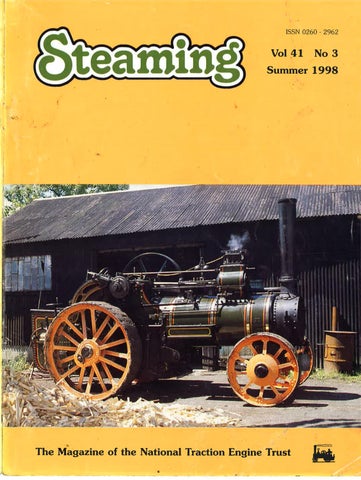
Front cover The venerable McLaren 8hp single 127 of 1882 has recently completed an extensive rebuild. Here it is seen basking in sunshine whilst taking on water at the North Staffordshire and Cheshire club's open weekend at their Klondyke mill premises in June 1998. (Roger West)
Next issue: The press date for news items, recent photographs and small adverts is 28th August 1998. For the date for Steaming Around see that section.
STEAMING Summer 1998
Trust News Across the sea to Ireland, part 2 Dave Smith Kemna Dampflocomotiven Michael Gundling and Derek Rayner Speed Six Update 7 Richard Parkinson Buckinghamshire threshing Claytons compared Jonathan Wheeler Arthur Napper John Newton Steaming Around, compiled by Derek Rayner Around the World Letters, Small Adverts Strange Simplicity Leslie Ford
119
Trust News From the Chairman Engine Driving Following the Trust's recent Driving Course there has been comment from some of the team of driving instructors that students were confused by different methods of driving used by various drivers. The suggestion is that everybody should be using the same approach, but that may not be right, because all the answers may be correct under some circumstances and the type of engine has a bearing on how it should he driven. One concern was with driving downhill; some used the reverse, others the wheel brake. There is a problem using the brake on a roller, particularly on a loose surface, because it can slide if the wheels lock, and it is then out of control. There is another problem if the reverse is used on a higher speed road loco (particularly Burrells with cranked valve links) because the motion can be damaged, and on a rubber tyred engine the wheels are less likely to slip. So both are right. My great uncle, George Dingle, ordered new rollers without a wheel brake, probably as a result of engines losing control on steep Cornish hills. Therefore a combination of reverse and flywheel brake has to be used on these machines. Too much flywheel brake overheats the flywheel, which can burst; too much reverse damages the gland packing. Alfie Harper taught me to drive steam engines, mostly on the single Fowler roller 18075, which had no wheel brake, and hills were descended very slowly in low gear and under total control. Even uphill he used to warn me to avoid steel manhole covers which could cause the engine to slip, resulting in 'going up Camborne Hill coming down'. In particular, the first hill out of Callington on the Liskeard ro,ad was banned to Dingle's drivers — it was probably where a problem had occurred in the past. It seems that there is a need for somebody to rewrite the drivers manual to explain and present these 120
matters and how they apply to the various types of road steam engines particularly on the very different road surfaces there are today. Meanwhile those offering courses to teach new drivers, could compare notes with the teachers so that apparent disagreement over techniques can be shown not to be so, and set down why it is not. Members are usually ready to share their experiences and views through the Letters columns of this magazine. I feel sure that we were all taught by people with their own approach to every aspect of engine management and this will vary in most cases. I would be grateful for members' views, and a volunteer to write it all down. No doubt we are all right and all wrong. (Richard Sandercock, Chairman)
Rally Organisers Column Rally Organisers sub-Committee This year we are losing one of the lynch pins of our sub-Committee. Smudge Smith, who has been in charge of the day to day operation of our sub-committee activity, is moving on to a new job — he will be found serenely plying the Thames in charge of a new hospitality river cruiser. Smudge has been responsible for the organisation and operation of the systems we have and we owe him a debt of gratitude for his sterling work. His main tasKs are being taken over by Pat Williams and Bill Evans from Cheshire, whilst the Affiliated Groups will become the care of our membership secretary John Cook. Until further notice please continue to address mail to Smudge at the PO Box number as detailed in this issue of Steaming. I would draw to the attention of any rally organisers who have not become aware, that we now have an NTET Rally and Event Insurance
Scheme available from Footman James & Co Ltd. The package has been developed by them to meet the requirements of event organisers, and offers very competitive rates and good levels of cover. I am grateful to David Smith, our Insurance Officer, who has worked with Peter James and his team at Footman James to produce this Scheme for us. Over the years the Trust has continued to provide assistance and advice to rally organisers, much of this being detailed in the Code of Practice. The twice yearly Conferences provide an excellent forum for discussion and to any event organiser who has not attended one, I extend a hearty invitation. Some events that send delegates are not steam oriented, but find the meeting of like minded people a useful time for the discussion of problems related to the general running of shows. At the Spring Conference there was much discussion regarding driver competence and the requests that have come from the safety officials who visited some events and raised the issue. This subject has been passed to the Engine Owners subCommittee and was discussed in some detail at the Engine Owners Meeting in March; more comment on this will come from Richard Pierce in his column, I have no doubt. At present my sub-Committee are busy with their summer homework which is to update some areas of the Rally Code to reflect changes in regulations and to give greater guidance on others. As I write I have just returned from the first Innishannon Rally near Cork. We had a wonderful week as guests of the Irish enginemen. The event was well organised, though unfortunately the rain came. The whole scene took me back twenty years to rallies as we used to know them. In particular, the relatively quiet roads allowed us the pleasure of steaming through Cork to the rally and then back to the ferry port. It was interesting to talk to Robert Coles, who has stationed his Wallis & Steevens engine over there just with this idea in mind. My thanks Summer 1998
STEAMING
rounds of sub-standard boiler work, one of which has come to me first hand. There are many boiler repairers about now — some quite new and
some long established. Some from both categories advertise in this
magazine, for which we are grateful. But wherever you go for your repairs, please take trouble to establish the standard of workmanship. A good job is expensive; a bad job is even more expensive) (Richard Pierce, Chairman, Engine Owners sub-Committee)
Technical Board Some owners of engines with riveted longitudinal lap seams on their boiler barrels have reported that boiler inspectors, employed by at least one of the major companies, have told them that the seams must now be
From Alan Martin's Collection
81
A mixture of civilian and military men pose in front of W.E. Chivers & Son's Burrell road loco PROGRESS, sometime during World War 1. The Devizes, Wiltshire company had a large fleet of road engines and wagons at the time, mostly engaged on war work around the army camps on Salisbury Plain and elsewhere. The well groomed fihp compound is 3222 of 1910. go to our hosts Tim Nagle and family; Alan and Mary Barry, and Tim Crowley, who almost stopped his workshop to clean his engines for us to view them! I hope that engine owners and exhibitors will do their best to support rallies, many of which have found the last one or two years quite difficult. Falling attendances and rain have taken a toll on events and scrutiny of
the rally list will show that some gatherings have been lost. I hope that 1998 will be found to have produced an improvement in the fortunes of many events. (Andrew Semple, Chairman, Rally Organisers subCommittee)
Engine Owners Column Engine Owners sub-Committee You will remember that the Rally Organisers, at their Autumn 1997 Conference, requested that all engine drivers should have a Certificate of Competence within ten years. This matter was discussed at length at our Engine Owners Meeting on 14th March, and the Committee
STEAMING Summer 1998
were charged with looking at 'all the options'. So far we have decided that the Trust will not support a mandatory system of certification for drivers at rallies, but having said that, we will, as
charged by the Owners Meeting, be looking at other options in due course. I hope to attend the Rally Organisers Conference in October to explain our thinking on all this and also to hear first hand of their problems of running rallies. We have got to work together because I don't suppose many of us want to see rallies disappear, which is a possibility if outside statutory bodies, for example the HSE, start trying to implement ridiculous rules through lack of knowledge. We are also committed to training, and as well as our annual Driving Course {I think this year's was the best
ever), we would like to extend training for new (or older!) drivers to the affiliated groups. We now have an excellent course which could be used
by others on a local basis, making it all more cost effective and easier to
administer. If anyone is interested in progressing this idea, please get in
touch with me or Richard Vickery. Richard is also keen to stage other training workshops such as valve setting and retubing. Once again,
please contact us if you are interested. There seem to be reports doing the
ultrasonically examined every five years, at a cost of £260 plus VAT. The explanation given was that the requirement was on instructions from SAFed (readers may remember that
this is the organisation which has
replaced AOTC and the other organisations representing the major insurance and inspecting companies). I have now spoken to Dr Tamar Posner, the Chief Executive of SAFed, who informs me that SAFed does not issue instructions to its members, but
is about to issue a new publication — Guidelines for the Examination of Longitudinal Seams of Shell Boilers — which contains the specification '... a
maximum period between ultrasonic tests of five years ....'. Dr Posner adds that SAFed guidance is a distillation of their members' perceptions of best practice and is not intended to be treated as an edict — by SAFed members and/or their customers. That is not to say that individual SAFed member companies will not, on their own initiative, base their business policies on a strict adherence to SAFed guidelines irrespective of individual customer needs. These guidelines, however, apply only to welded barrel seams and
follow recent research which indicates that 'peaking' is more common than was previously believed, and 'the five year requirement relates specifically to the use of simplified methods for measuring local peaking. For the benefit of anyone not familiar with the term, 'peaking' happens as a result of bad workmanship when a boiler barrel is rolled, leaving a narrow flat area on either side of the weld. This results in the finished barrel not being a perfect
circle, so that the weld is bent very slightly each time the boiler is heated or cools, resulting eventually in failure
121
errors. if an owner is going to part with £260 of the weld with possibly catastrophic One of the more amusing causes of plus VAT, he should at least know in results. in issuing discs is when an delay his for get to going is he what advance As a matter of interest, a few years s report appears to expire inspector' aware be also should money. Owners ago I investigated a failure of an within weeks of the inspection. rivet heads for off grind to demands of The cause. this to due boiler industrial Generally this is because the inspector ultrasonic examination of the rivet barrel plate had opened out practically hasn't added a year to his mental is guidance clear very unless shanks, parted had flat and the main stop valve calendar. So I spend time ringing the given as to how much should be company with such force that it had owner or the inspector, or both, for should surface the how and off ground crossed a dual carriageway and landed clarification. I know it should be right exact an at it get to prepared be in a garden centre on the opposite what the date should be, but obvious (Jim rivet. the of axis angle to the side. Adjoining boilers had been I can't change the date on an official Newnham, Chairman, Technical moved on their foundations and the document just because it looks wrong. Board) boiler house building was completely So please, if you are in a hurry for your damage of cost total demolished. The disc, help us to help you by going over to the buildings and plant was through the paperwork to ensure it is f 1,000,000. all there and to make sure that there Riveted lap seams in boiler barrels are no typographical errors. were never the very best engineering practice and are much more vulnerable Under-age steersmen to grooving and cracking between the rivet holes, than the better but more Just when we thought that we had Policy NTET Scheme expensive butt strap seams used on subject under some form of this the on notes some Firstly, other engines. Lap seams must, ding, out of the woodwork understan that Now Scheme. the of ce performan therefore, be subject to more careful tale of woe. Near a recent this crawls have we way, under well is the season examination than butt strap seams; a Fowler ploughing rally popular from rushes minute had the usual last most of them are in at the bottom of engine was being driven along a those folk wanting insurance discs in the barrel and can only be properly narrow road by a father and son team. time for their first rally. I hear from examined from the inside when at The father is assisting his young 14 been has this that James Footman fire the preferably least the tubes, and year old in his endeavours to steer by Scheme the since quarter busiest their been box or front tube plate have leaning over to the steersman's side to just has NTET The d. introduce was removed to allow thorough cleaning ensure the machine does not mount received a very large commission and close examination. At other times roadside. Instead, it comes into the year's last for FJ cheque from examination can only be carried out contact with a motor car on the business, and to those of you who from the outside after the lagging has offside, and to which, I am told, have taken advantage of the Scheme I been removed. Because of the small considerable damage was caused. Not you thank personal a say to like should the and heads rivet the space between surprisingly, the occupants were very support. your for plates, the of almost inevitable pitting frightened. Do we really need this sort of number small a been have There ultrasonic examination is difficult and publicity? I think not. of impression my is it but date, to claims the results can be of dubious value, if that both FJ and the underwriters are not hopelessly misleading, possibly pleased with the performance. Let's leading to unnecessary and very hope that we don't blot our copybook NTET Survey of Engineering repairs. expensive too badly and that we can continue to be must seams lap dly Inspection Facilities Undoubte enjoy the advantageous rates for some subject to sufficient examination at From time to time the members of considerable time. suitable intervals to ensure their Engine Owners sub-Committee the of parts are there if ly, Incidental safety. This does not, however, justify myself muse over what the future and e, appropriat not are that Scheme the such examinations at fixed intervals, holds for the boiler inspecting or that you consider inadequate, irrespective of the condition of the profession and its ability to sustain a please let me know. If the requests are boiler, the operating standards service towards road steam engines in to get them endeavour will I feasible the and treatment) water (including this age of modern high tech pressure James. Footman by adopted in not when storage for arrangements plant. On the one hand we can scare use. Under the NTET Code of Practice ourselves silly by envisaging a day such examinations should be carried Discs when there is no-one left with the out when specified by the boiler knowledge' of steam traction 'proper for requests earlier mentioned I inspector after taking account of all engine boilers; on the other, we may discs and this brings me to a very the above factors. think that it may be OK because there important reminder. Insurance discs Any engine and owner faced with a will always be someone to guide the where all of the issued be only can to inspector boiler his from demand new boys into the 'right way of has been tation documen related his of n examinatio have an ultrasonic thinking'. witnessed by the person authorised by boiler barrel lap seams, for no other Frankly, I don't believe either of the NTET to issue such discs. It is evident reason than that it should be is true or even appropriate, but I these to anyone for sufficient not simply done every five years, has two what the typical engine wonder do will paperwork missing that suggest alternatives: either he can take his owner thinks of his inspection service be sent 'as soon as it turns up, but can business elsewhere, or have the and also whether the NTET should be I have a disc anyway?' examination done by his present boiler doing something to hedge against Campbell James AON, that know I the upon decides he If inspector. future developments. for requests meet to try all myself and being upon insist latter, he should first I also believe that the Trust should as efficiently and quickly as discs given full details of the operating r to learn more about the endeavou if help can't we but , possible method together with information as engine owning members, its of needs contains or missing is k paperwor to how the results will be interpreted.
Insurance Officer's Notes
122
Summer 1998 STEAMING
ti 1i
in order to help them land, by extension, non-owning members) to continue to enjoy the hobby. Therefore, I would be grateful if, as an engine owner or someone who looks after an engine on behalf of the owner, you can find time to fill in and return the questionnaire that is being distributed as a loose insert with this copy of the Trust's magazine. (David
Smith, Insurance Officer)
Changes at the Treasury As noted in the last issue, the Trust has had a change of Treasurer, following the decision of John Harris to relinquish the post. The necessary arrangements have now been completed to enable the new incumbent, Julie Smith, to take up her duties. John Harris writes: I am pleased to be handing over the Trust's accounts to Julie Smith, FCA, who, like myself is a chartered accountant. Living in Astwood Bank, Worcestershire, she is a partner in a local firm of Chartered Accountants and has also been involved with the Road Roller Association on similar duties to those she will now be undertaking for us. I have no doubt that the Trust's funds are in good hands. Julie Smith opens her contributions to these pages: I am pleased
STEAMING Summer 1998
Ding/es' employees — men and beast — pose for the camera with the tools of their trade. The attractively set up scene is thought to be at Boconnoc, park/and just a few miles east of Lostwithiel, Cornwall. The roller is Wallis & Steevens single 2494, a 10 tonner new in 1900, and acquired by Dingle & Son from Aveling & Porter secondhand in 1907. (collection Richard Sandercock)
by my appointment as Treasurer to the NTET, and wish John Harris the very best for the future and also thank him for his assistance during the handover period, which came at the time when end of year figures had to be completed. I shall look forward to meeting as many of you as possible at venues around the country, and of course at the AGM, where no doubt I will have to face up to the usual searching questions about our financial status. I will endeavour to have the appropriate answers.
Steam Apprentice Club The five spring visits organised for members of the section this year have now all taken place, with variable success. For those SAC members who attended them, each visit was very enjoyable — it is just a pity the small attendances meant so few benefited. It must be said the two southern visits, to the Hollycombe Collection and
Kelston Sparkes' collection at Stanton Drew, were well patronised and were much more fun as a result, Can I take this opportunity to thank all who were involved in planning the visits; your hard work is very much appreciated. The next event in our calendar was the Driving Course at Dingles Steam Village. This was only the second year the SAC had run its driving course in conjunction with the NTET, and without a doubt the occasion was a success. I would, in future, like to see more teenage Apprentices taking part in this course for there is a great wealth of knowledge available, as well as the fact that it is a thoroughly enjoyable weekend. Please try to encourage the Apprentices near you to take part in the future courses. I hope that during the course of the season many Apprentices will gain some experience of working on and with engines, as this is the main activity which will attract the youngsters into the movement and encourage them to stay. We will be represented at the Great Dorset Steam Fair again this year, based in the NTET marquee. If any parents who will be based on site during the rally are able to help us, even if only for an hour or two, you will be made very welcome. 123
Please contact us — see our address inside the front cover. (John Durling, Chairman, Steam Apprentice Club)
Spares and Pattern Register 'Thank you' to those who have responded so keenly to my first notes in the last issue of Steaming regarding the spares and pattern and feedback The registers. comments have been most useful. In the last Steaming reference was made to mudlid door joints, and I hope now to clear up a few points. I have spoken to the technical departments of four companies who manufacture door joints, and the general consensus of opinion is that within the next 6 to 12 months there may be some regulation brought in with regard to the control of asbestos at work, and, at the time of writing, I am expecting a Consultation Document to appear through my letterbox from the HSE. There is at the moment no difficulty in obtaining proofed woven asbestos joints, although companies are manufacturing and supplying alternatives, mainly because certain of their
customers (generally large organisations) have internal policies of not allowing any asbestos product on their sites. Following are details of three common mudlid joints available (there are others). • Proofed woven asbestos — graphited. The old favourite we all know and love, woven asbestos, proofed with a latex compound. • Proofed woven glass — graphited. This joint is almost exactly identical in appearance to the above, but is slightly softer and more flexible. It is made from woven glass fibres proofed, as before, with a latex compound. Note — it is important that the correct type of jointing compound is used with this type of joint, that is, graphited paste,. as some modern pipe joint adhesives/gasket compounds, contain solvents which can affect this joint in service, and the manufacturers will not entertain any guarantees under these circumstances. • Topog-e. Unlike the previous two products, this joint is not a woven ring. Its appearance is that of a fairly hard pre-formed, smooth, elliptical joint ring, which is manufactured from a compound made in America.
It consists of an 'elastomeric Viton chapped fibre' which is formed under pressure in a mould, with the application of heat. I am aware of some engine owners using this product, and they report achieving better results than with other types of joint. Another note — it is important to obtain from the supplier an instruction sheet entitled 'Be sure the gasket fitter reads these installation instructions,' because there are important notes and helpful drawings on the correct procedure when fitting this product. This joint should be fitted without any sealing compound. According to data supplied to me, the above joints are designed to work to certain limits, generally: • asbestos 3481bs per sq inch 230 deg C 4061bs per sq inch 230 deg C • glass • Topog-e 180Ibs per sq inch 190 deg C When ordering joint rings, or for that matter other products of this nature, it is advisable to ask for relevant data sheets to be sent through with your order. To turn now to the subject of the Pattern Register, I note that some members would not be prepared to lend patterns, but would be happy to supply castings. Whatever the case,
Aveling-Barford 6 ton roller AG760 of 1946 leads Wallis & Steevens 10 ton Advance 7943 of 1927 along the Cheshire lanes between Tatton Park and Knots ford on their way home to Staffordshire. (John Maund)
please jot down a list of what you can do and send it to the address below, in order that I may put members in touch. Any queries on the items above, or on spares and supplies in general, please contact me. (Co/in Hatch, 4 Lotmead Farm Cottages, Stratton Road, Lower Wanborough, Swindon SN3 4A,11
Highland Steamboat Holidays Cruise the beautiful sealochs and canals of Scotland in an original coal-fired Clyde Puffer. Good food, comfortable accommodation.
Trust Exhibition Unit The Trust's Exhibition Unit has continued its travels around the country (and fitted in a trip to southern Ireland) in the first two months of the 1998 season. It has a forthcoming itinerary that covers most weekends from now until the end of the rallying period, and this is set out below. As usual the Unit will a good meeting point for members — most, probably all, of the books, videos and other items on the Mail Order list will be available and there is generally a Committee member on duty for the weekend who would be willing to listen to and discuss problems on engine matters. July — 1 1 /12th Rempstone; 17 to 19th Weeting (tent), 18/19th Masham (unit); 25/26th Chester-le-Street. August — 1st/2nd Thurlow; 8/9th Knowl Hill; 15/16th West of England; 22nd/23rd Fairford; 29th to 31st Hellingly. September — 2nd to 6th Great Dorset; 12/ 13th Haddenham and Essex Steam; 19/20th Old Warden; 26/27th Woodbridge. October — 10/1 1th Steam Plough Club's 'Great Challenge' at Preston Capes, Northamptonshire; 17/18th Gloucestershire & Warwickshire Railway Steam Fair, Toddington, Gloucestershire. If some of the entries are a little cryptic, the full titles and geographical locations can be found in the 1998 Rally List, distributed to all members with the last issue of the magazine.
Obituary Gerald Rowntree The ranks of men who worked with steam for a living grow yet smaller with the recent death, at 76 years, of Gerald Rowntree of Kingscourt, Co Cavan. He was the eldest of four Rowntree brothers. Their name was synonymous with steam threshing in the counties of Louth, Monaghan and STEAMING Summer 1998
,
-•
Send large SAE for free brochure to Rachel and Nick Walker, The Change House, Crinan Ferry, Lochgilphead, Argyll PA31 8Q11 (Tel 01546 510232).
Cavan until its demise in the 1950s, though they then took to using Lanz Bulldog tractors. Each of the Rowntree sons had their own set of tackle — engine, mill and elevator. Three single cylinder Fowlers served, along with McLaren 1447 of 1917, the latter the only one to survive to the preservation era. It still attends local rallies, and is noteworthy in that it had a new firebox made and fitted by the brothers and their father in the family workshop during the 1940s, quite an engineering feat for rural Ireland in the frugal years of World War 2. The overflowing Church at the funeral at Kingscourt was ample testimony to the feeling for Gerald and the Rowntree family. (Gerry Doherty)
Future dates Great Dorset Steam Fair 2nd to 6th September 1998 The last few years have seen the development of a fairly successful arrangement for the Trust's presence at the annual Dorset event and it is intended to keep to this winning formula in 1998. The whole five day period will see the usual large marquee filled with the Sales Team's stock of books, videos and other traction engine related wares; the popular hospitality area where members can call in with family or friends for a brief rest over tea or coffee, and then the portion set aside as a base and meeting point for our younger engine enthusiasts, the Steam Apprentice Club. In the centre we shall again be having the giant multi-screen video,
another popular place to rest one's feet and maybe decide on which of the videos it is going to be for taking home for viewing in the longer autumn evenings. There should, at various times over the rally period, be a presence of Committee members who will do their best to be of assistance to members with questions and problems. On the Friday evening the hospitality area will again be used for an Open Forum for Trust members to air their views, andto bring up subjects or problems that may benefit from discussion with like minded people. The Committee accepts that the conditions at Dorset are not ideal for this sort of gathering, but there are only two or three opportunities each year for members to gather in any great number to their mutual benefit, so the Dorset occasion is worth persevering with despite the noise — and the multiplicity of other attractions at handl The OPEN FORUM will take place on Friday, 4th September, in the Trust marquee, at 7.00pm. Do come along, whether it be to bring good constructive information, or to present a gripe that we can all identify with, but eventually be solved by talking it through. Autumn Rally Organisers Conference The date for the Rally Organisers Conference this year is 18th October 1998. Please note that this is a Sunday. A suggestion has been made that this day may be found more convenient for many than the usual Saturday. A change too of venue — to the Village Hall at Willoughby, 125
Warwickshire, where the Trust (following an introduction by one Steam Plough Club) has recently been holding many of its Committee and sub-Committee meetings. It is proving to be quite satisfactory, and considerably more economical than other recent venues. Further details, including the arrangements for midday refreshment and just how to get the last few miles from the better main roads and motorways, will be distributed to event organisers and affiliated groups who usually attend in due course. Any other interested parties requiring details of these useful gatherings should contact the General Secretary, Sue Jackson (address inside front cover).
Annual General Meeting Advance information is given to all members of this year's Annual General Meeting. This will be held at the Social Club, Didcot Power Station (by courtesy of National Power), Didcot, Berkshire on Saturday, 21st November 1998. Formal notice, together with other relevant information, proxy forms and audited accounts for the year ended 31st March 1998 will be
distributed to all paid-up members of the Trust with the Autumn issue of Steaming. Any member may submit a motion for discussion at the Annual General Meeting. All such motions must be in writing and signed by the proposer and by a seconder. The items for discussion, in order to be published in the Agenda for the Annual General Meeting and as required by Article 16 of the Trust's Constitution, must reach the Company Secretary, Sylvia Dudley, not later than Saturday, 26th September 1998 (address inside front cover). Details of the arrangements for the AGM weekend will be published in the next issue of Steaming, but for the moment we give a brief note for members who may wish to plan ahead. A Saturday visit has been booked to the premises of the Great Western Society at Didcot, where we can be amazed at the excellent work their members have undertaken on the large collection of steam railway locomotives and other rolling stock. On the Sunday, we are grateful to John and May Keeley for their kind invitation for us to visit them at their Knowl Hill engine yard. John has
promised a morning to remember, with all sorts of interesting things to keep our attention. More ,in the next magazine.
New Members A sincere welcome is extended to the following new members who have joined the Trust during the last three months. We hope they will gain much friendship, information and enjoyment from their membership over a period of many years. The Membership Secretary is always pleased to put members in touch with one another by fowarding mail. A. Bailey, Winchester, Hampshire J. W. Roberts, Shrewsbury, Shropshire M. J. Scaife, Redcar, North Yorkshire D. B. Ragsdale, Retford, Nottinghamshire T. J. Senior, Cropton, North Yorkshire A. S. Culpin, Saffron Walden, Essex A. Waight, Hitchin, Hertfordshire R. C. Wilson, Stokesley, North Yorkshire A. J. Wickens, Folkestone, Kent S. J. Lines, Chesham, Buckinghamshire R. Hales, Oakington, Cambridgeshire T. J. Mason, Bexhill-on-Sea, East Sussex J. Harlow, Frocester, Gloucestershire
FOR THOSE NEEDING ECONOMICAL REPAIRS ON THEIR TRACTION ENGINES
B. & C. Reconditioning (Gears) Ltd ESTABLISHED 1967
PINIONS — SPURS
BEVELS
Quality reconditioning of all types and makes of bevel gears, spur pinions, spur wheels, helical gears etc b
111 MIN IS09002 REGISTERED COMPANY
k V IIAllIai
ALSALIIMMII rnIe
Certificate No 6293
126
B & C Reconditioning (Gears) Ltd, Amesbury Business Park, London Road, Amesbury, Wiltshire SP4 7LS Telephone: 01980 623210, Fax: 01980 625176
Summer 1998
STEAMING
E. J. Carr, Chester, Cheshire L. Vince, Braintree, Essex G. G. Portwood, Doncaster, South Yorkshire M. F. Cross, Abingdon, Oxfordshire D. Cook, Braunton, North Devon A. R. Lock, Ringwood, Hampshire A. M. Fox, Ardleigh, Essex D. W. Greenshields, Wellington, Somerset D. Wilson, Kemsing, Kent T. Watson, Victoria, Australia E. Carr, Broxton, Cheshire D. F. Pierce, West Peckham, Kent A. P. Denton, Bardney, Lincoln D. Middle, Shrewsbury, Shropshire S. J. Miles, Cardiff J. A. Cooke, Lincoln N. Kane, Co Down, Northern Ireland T. Bastick, Orpington, Kent J. B. Fish, Ware, Hertfordshire I. T. Ormrod, Poulton le Fylde, Lancashire J. D. Pierce, Lincoln P. Cross, London R. Luff, Dorking, Surrey T. N. Hollis, Retford, Nottinghamshire R. Goodwill, York G. J. Stephens, Kingsteignton, Devon R. A. Packford, Wheatley, Oxfordshire B. Baker, St Albans, Hertfordshire R. G. Bateman, High Wycombe, Buckinghamshire C. Harvey, Lymington, Hampshire I. Massey, Northolt, Middlesex M. Wingfield, Wokingham, Berkshire J. Palmer, Reading, Berkshire B. Shaw, Swindon, Wiltshire
P. F. Brookes, Broughton, Cheshire R. Rawlings, Croydon, Surrey Mrs C. A. Beale, Battle, East Sussex M. L. Young, Newark, Nottinghamshire S. G. Moss, Ashbourne, Derbyshire P. E. Hackett, Evesham, Worcestershire
STEAMING past OUR MAGAZINE 25 YEARS AGO
The magazine sent out in the summer of 1973 had an international flavour, carrying articles or mention of engines in Denmark, Hungary, Holland, Switzerland and Argentina. An enthusiastic contribution from Denmark told of nineteen road steam engines preserved in the country, two of which were steamable by a group near Copenhagen. A Fowler ploughing
engine of 1874, in poor condition, was (and still is?) at a museum at Maribo on Lolland. Although activity has since blossomed in Holland, we nowadays seem to hear little of Danish happenings. Derek Rayner presented a picture and description of a Fowler relic of a different kind that may be worth mentioning for a present day visit. A silver table centre piece, originally presented to Mrs Fowler in 1867 after the death of her husband John Fowler, had been given to Leeds City Art Galleries and was on public display at Lotherston Hall, near Aberford, Yorkshire. Richard Willcox made interesting points on the appearance of preserved engines — too many were overdone and kept in too pristine a condition, never being allowed to acquire the well kept mellow look of working engines of the past. Once painted, he felt it took five years for an engine to even look half right. Contemporary prices at auction were the small Ransomes portable E409 for £1,000; Robey Express tractor 43165 for £4,500 and Fowler D2 class traction engine 7942 at £2,000.
THE MOST AUTHORITATIVE BOOK ON STEAM PLOUGHING EVER PUBLISHED • Written by a man recognised, perhaps, as the greatest living expert on steam ploughing engines ■ He lived and worked with ploughing engines and steam rollers from the 1920s to the 1940s • A revealing look behind the scenes • A rich and often humourous tale • Lavishly illustrated with archive photographs of the steam ploughing era and the modern preservation scene
STEAMING
Summer 1998
The first 500 orders
SECURE received will be sent YOUR COPY an exclusive signed and numbered NOW! limited edition £24.00 post free to NTET members By mail order from:
NTET Sales, 90 Devon Road, Luton, Beds LU2 ORL Cheques/PO payable to BUXWORTH STEAM GROUP Please quote Membership No. if NTET member
Telephone/Credit Card orders: 01582 733971 (after 6pm) Please allow 28 days for delivery
127
Across the sea to Ireland The 1997 St Patrick's Rally at Upton in County Cork
Dave Smith continues from the Spring 1998 issue, the story of his visit to Ireland last year.
St Patrick's Rally site at last We were feted at the Ramble Inn, and how difficult it was to refuse everybody's hospitality but we still had 3, 4 or 6 miles to go — depending on who you were speaking to. As the evening wore on we had to start to get ready for the last part of the run. We were almost last to depart but later caught up some of the earlier leavers. Now the effects of the previous part of the journey was beginning to tell on some of the engines and crew; loose eccentric straps, clinkering fires and tiredness beginning to catch you out. After overtaking one stricken engine standing out of water, we suddenly found that we were in the lead, but then discovered a problem for us, for we didn't know where we were going! By a combination of guesswork and asking folk along the way, we were guided to the rally field. Much later on some of the engines and crews arrived from the opposite direction. We learnt later that after we had passed them they had tried short cuts to head us off — via country pubs. We found an empty spot on the engine line, backed the Burrell in and cleaned her down. I remember after sheeting her up reflecting on the trip so far — I felt very satisfied with the day's events, and wouldn't have missed it for anything. Down to the pub for a thirst quencher. Oh, and guess what, the Discovery had clocked 31.8 miles. Sunday at the St Patrick's Rally The Spring bank holiday in the Republic of Ireland is one week later than in the UK, and the St Patrick's Rally is held on the Sunday and Monday of that weekend. The memories of our previous years' visit soon came flooding back, except that the weather was different, for it was very hot. The official programme included 128
a line up of 27 traction engines; 8 models; 3 organs; 120 tractors; 175 cars, lorries and motorcycles; 100 plus oil engines; 70 exhibits of grass cutters, cast iron seats, reapers, binders, balers, elevators and other farm yard implements, and finally 25 miscellaneous items making up the various working demonstrations. What a splendid entry. At 2.00 pm on Sunday Michelle Smith, Irish Gold Medal Olympic swimmer, opened the rally to a huge crowd — the locals and not so local were out in droves. After the ceremony, ring events started, with commentator John O'Sullivan doing a sterling job keeping everyone entertained. He was complete with personal gaffs and kept going, even through the unofficial breaks in the programme. The grand parade was something else, with all the mobile exhibits making it through the ring. There was a demonstration of steam pulling power using the winch of Denis O'Mahony's Fowler traction engine 21626 to draw
a 12 ton portable across the ring. The working sections were brilliant, I think maybe some of the best I have seen anywhere. They ranged from the usual farmyard set piece of thresher, baler, elevator and straw rick making to farriers, thatchers, fence builders, round timber sawyers and stone crushing. Showing that the UK visitors were willing to join in Bill Lowe and his crew set about working with the stone crusher, being driven by Tim Nagle's McLaren. They were loading and moving stone and giving a road rolling demonstration until the crusher expired — then the spanners came out; now they were having fun. In the evening a local pub run was arranged. How thoughtful. It was all of 400 yards away, at the bottom of a very steep private drive which runs through the grounds of the church and hospital. The drive was littered with the largest sleeping policemen I have ever seen, five foot high, I swear — or so it seemed as we crept along, one eye on the water level and the other on
Dave Smith and Alan Barry in serious discussion on who is going to buy the evening's first drink. Summer 1998
STEAMING
the obstacles. We made absolutely sure that we didn't drop off and hit the ground with a spine crushing bang. The homespun entertainment at the pub had to be seen to be believed, with kids as young as 10 and '11 singing and playing fiddles, bodhran and tin whistles along with the grown ups. It was about 1.30 in the morning when the local Garda suggested to the landlord that the terms of his licence were being exceeded. He replied that as it only happened once a year he was making up for all the times he closed early due to lack of custom. The Garda appeared to understand the logic of this, and went their way. Eventually we left using our bulls eye paraffin road lamps to light the way — they do work! Negotiating the sleeping policemen in the dark seemed even trickier going up hill, and as I urged the Burrell over the last one I was feeling pretty good about my driving skills, when she slipped, and I lurched forward grabbing anything I could to hold myself steady — well it turned out to be the whistle cord, at 1.45 in the morning! Oh bother — ShhhhIl Monday at the Rally Having spent some time on the Sunday dropping big hints about wanting to help on the demonstrations, we were pleased to be asked by Alan Barry and the Halfway Vintage Club if we would drive the 1947 Allan threshing drum belonging to John Fouhy of Castlelyons. This winged 48 inch drum had been in John's family all of its life; he remembers it arriving with its shafts wrapped in greasy brown paper. Now it has been lovingly restored by him. After the usual back-a-bit, left-a-bit, right-a-bit, have another go we finally got belted up to the thresher. A little bit of trouble interpreting the speed-up slow-down signals gave us a few chuckles as we set the governor but we were finally there, and didn't that drum hum when we got it up to speed. The weather was still kind, but rather windier than the previous day and this kept the chaff flying all over the place. The rickyard and threshing teams worked tirelessly and effortlessly through the rick, it was a joy to be with them. Another of John Fouhy's hobbies is collecting corn and flour sacks and he had a great array of them from all over Ireland, the UK and elsewhere laid out to air on the grass prior to use. During one of my stints on the footplate I was aware of a crowd gathering outside the covered area that the Ceihly bands were using during the day. Now this crowd was bigger than most we had seen and STEAMING Summer 1998
The amazingly talented Paul Nicholson brings spoon-playing to the Upton crowds.
then I discovered why; Paul 'Mr Spoons' Nicholson had joined up with one of the bands and was giving the performance of a lifetime. At the end of the gig he was rapturously applauded by the crowd and I can remember thinking "we'll never get him home now!" Julie and I found time to wander round the rally to look at the other exhibits, what a mixture. One of my favourites was the reconstruction of an old village garage, complete with mechanic under the car and all possible types of tools and equipment from bygone days. The workshop cat
sat on a shelf eyeing the entire situation with indifference. Another highlight was an 1880 reversible horse plough, pulled by two horses, and yet another was the 1850 hand operated thresher, an 1800 winnowing machine and an 1870 flour mill, all in good working order. Among the oil engines was a 1906 Amanco 21A hp petrol paraffin engine belonging to Martin Larkin of Birr, County Offaly. Despite its age this engine ran as sweet as a nut. During the latter part of the day and after a talk amongst ourselves, Paul, Tim and myself offered to assist
Dave and Julie Smith, extreme left and right, and Martin Shepherd's crew, Tony and Jeff.
129
Burrell 3121 away from the rally field on an evening jaunt to the Railway Bar.
the Vintage Club by taking some of the tackle back to Halfway Balinhossig behind our Burrell at the end of the rally. They were pleased to accept but became rather dubious when we suggested the items that would make up a nice train. "A train?" they said, "we haven't seen a run with a full train for a long time!" And so it was that having assembled our entourage we
were asked to take a final run around the arena to remind the crowd of how it was all done years ago; what a great feeling. Then we got ready to run back to the Club site. Return to Halfway and the Ramble Inn Alan Barry suggested that we should take a particular route to keep
Tim Nagle works the handle on the rack saw, whilst his venerable engine, McLaren traction engine 60, provides the belt power. 130
away from traffic making the break from the rally site, and he would ride with us to show the way. However, this route would entail driving down 'half a mile or so' of fairly narrow road, so I opted to run in front of the train to warn oncoming cars. Alan asked if he could help as he hadn't seen this sort of thing done before. Well, four breathless miles later we emerged from one of the narrowest and most winding lanes I've ever been down with an engine and train. Alan was puce, all this exercise in one go, I thought he might expire on us. But then Irish hospitality struck again when a kind lady ran down the path of her cottage and gave us a load of tinnies. The other road users were extremely patient, if not slightly bemused at the sight of two fairly stout, middle-aged men running down the road in front of a smoke belching engine (remember that Polish domestic coal). At the end of the lanes it was the final push on to the Bandon — Cork main road. This entailed climbing a 1 in 10 hill about 400 yards long, and it wasn't in my plan. Anyway the Burrell stormed up sounding absolutely lovely, barking away like a good 'un. Then we set off along the main road at a great pace oblivious to the world and ecstatic over our achievements. Alan was in his
Also visiting from England was Bill Lowe (leaning on the water hose) and crew, together with Aveling roller 8752.
Summer 1998
STEAMING
This is our finale in the ring at St Patrick's, when we could be seen showing off, hauling the Halfway Club's living van and thresher before taking them back home.
Seventh Heaven when we pulled into the Club premises behind his pub. As other bits of tackle arrived and parked up so the partying began. Where else in the world can you go where a man walks into a pub playing a saxophone as if it were the most ordinary thing to do. And then came the two accordion players and the lady singer, all from nowhere. What a night to remember, well ... I think I can remember. The rally was over but still we had another surprise in store. Martin Shepherd's crew had taken pity on us over our planned run back to the ferry terminal under steam and so they offered to load the Burrell on their low loader and run us over on the Tuesday morning. What a great gesture, this meant we would have the best part of another free day to look around this superb corner of Co Cork. A bit of sight seeing On Tuesday, in order to see some of the scenery, we drove a circular tour from Innishannon through Cookstown, Macroom and on to Killarney, from where, having taken a brief look at the town, we carried on around part of the eastern section of the Ring of Kerry via 'Molls Gap' as far as Kenmare. We then returned via Killabuname, Bantry at the head of Bantry Bay, Glengarrif, Dunmanway and Inniskean to Bandon then onto Ballinhassig. Around 170 miles on the bumpiest roads you have ever met, but the scenery was stunning. At Inniskean we found the premises of Denis O'Mahoney where we took a break to take a look at his engines and workshop, but unfortunately he had left earlier to attend to business. Well if you combine the roles of furniture shop proprietor, petrol station attendSTEAMING Summer 1998
ant and undertaker I suppose you tend to be quite a busy man. On Wednesday we took a look at Blarney Castle where Sue overcame her fear of heights. Millie and her dad, Tim, tried to burrow all the way under the Castle via Badger Cave but the highlight must have been when Millie and Paul kissed the Blarney Stone under the wondering gaze of visitors. Following this we made an unscheduled call at the Cork Mercy Hospital for treatment for an eyeinfection that Julie had contracted. The staff were very kind and helpful, but it seemed ages before we were out. However, we decided that there was just enough time left to visit the lovely and historic Cobh Island on the east side of Cork, and so we made a dash across the city and onto the island via the only road bridge. Cobh (pronounced Cove) Island, whilst being very small, has many interesting places to visit including museums and antique centres as well as the harbour. The history of this island is staggering, but it is probably best remembered as the place where the bodies of victims and the survivors of the LUSITANIA were brought after the infamous sinking by a German submarine in World War I. It was also the last port of call of the TITANIC on her ill-fated journey across the Atlantic. Monuments are erected to both events and many others. All too soon it was time to board the river ferry across to Monkstown and then drive the couple of miles back to Ringaskiddy for the evening sailing. Coming Home At the dock side we unsheeted the engine and got ready to travel. The stevedores swung into action and
soon Tim was steering the Burrell as it was tugged onto the commercial vehicle deck ready for the trip home. The back-up Discovery and passengers were not so lucky; they had to wait their turn in the queue of normal traffic and it was some time before we all met up on the passenger deck. Our overnight journey across the Irish Sea was pleasant and uneventful, with the sea again like a mill-pond. We spent the night reminiscing our adventures, the people we had met and the great times we had together. And so we landed at Swansea at precisely 7 on Thursday morning to be unloaded — last off again. With the Burrell pushed on the low loader we were off for home via the M4, A40 and the M50. Fred was right — it was quicker that way. Our thanks I cannot finish without expressing sincere gratitude on behalf of all of the members of our party to many who helped us on our visit to Eire — to the crew of the Swansea Cork Superferry who took us in their stride; to Peter O'Sullivan of Inchcape shipping agents, who organised our crossing, and to Bernadette Murphy and her family, who looked after us like their own. But most of all thank you to Tim and Nagle and friends, Alan and Mary Barry and friends, the Lord Mayor of Cork City, Margaret Malone and all at St Patrick's Rally, Upton. 'Til we meet again'. Oh, and very, very special thank you to Charles Burrell.
yr
'Messrs J. Fowler & Co, Limited, Leeds have undertaken to supply a powerful road locomotive and six large waggons for the conveyance of bricks for the Cork Brick Manufacturing Company.' (from Agricultural Engineer, April 1897) 131
Some notes on a German engine builder
Kemna Dampflocomativen Michael (kindling and Derek Rayner Julius Kemna was born in 1837 at Wuppertal-Barmen, in the province of Nordrhein-Westphalen, Germany. As a young man, he learned agricultural engineering and concluded his training as an unpaid worker at the firm of Becker in Berlin. When his parents died he was left a farm in Schlesien, near Breslau, in that part of Germany which is now Poland. He was delighted to be able to move there to work at the beginning of the Industrial Revolution, for it gave him the impetus to progress his engineering ambitions. In 1867, when thirty years old, Kemna opened a workshop in KaiserWilhelm-strasse at Breslau under the name of J. Kemna. His first employee was a carpenter, who commenced to make small agricultural machines and implements. The works expanded quickly and in 1870, the firm took on an agency from the English steam plough firm of John Fowler. Kemna sold the engines which had been shipped from Great Britain, and hired to the purchaser a crew of men to work the engines in the field, and also to maintain them. As a result of his experiences in the factory and the expansion of the activities there, Kemna started road steam engine production to the general design of English products, such as those of John Fowler. Here, we must not forget the contribution made to steam ploughing by Max Eyth, a German national who spent a considerable time at Fowler's Steam Plough Works in Leeds during the 1870s. It is quite likely that it was Eyth's perception of the benefits of steam cable ploughing, and his ability to communicate easily and compare notes with Kemna, that led to the Germans being the only other nation apart from the British who progressed to any degree the twin engine balance plough method of cultivation. In a census taken in 1925, there were no 132
less than 1000 steam plough sets located in Germany. In addition, Kemna also made threshing and crop cutting equipment under the trade name 'Wratislawia', which subsequently became world famous and continued in production for many years — at least to the
1920s. As the eunipany anti demand grew, further workshop space was needed; this was established in the town in H8fchenstrasse and it also became the Company's iron foundry. The new works opened in 1894 and ploughing engine production to Kemna's own design commenced,
This photograph, by Derek Rayner, shows Kemna steam roller 59 of 1889, now preserved at Kemna Bau's premises at Pinneberg. Although Michael Gandling's original article indicated Kemna first manufactured steam rollers to Fowlers design in the late 1800s, the roller on display appears to owe more to a Rochester produced machine than one from Leeds. It is an almost direct copy of an Aveling & Porter model R10 steam roller, a design which was produced in large numbers in the 1880-90s. There are only minor differences, in such items as the manhole bridges, injector clack, canopy supports, steering worm support, the mechanical oil pump and safety valves — some of these, in any case, are likely to have been altered by a British manufacturer for a continental customer or renewed in the course of a working life. However, close physical inspection of the roller shows various features, such as the front forks and the rolls (which have bolted spokes), that suggest it is a German product, and not Rochester built with local works plates. This is backed up by literature and plans in the Kemna Bau archive at Pinneberg. There were numerous examples of R10 rollers supplied by Avelings to their German agents, Jacob & Becker of Leipzig, throughout the 1880s. It could well be that one of these was copied by Kemna in much the same way as the German firm of B. Ruthemeyer at Soest replicated the Burrell single crank compound design and, in later years, the Wallis Advance roller. Summer 1998
STEAMING
although the designs were very much influenced by Fowler's concepts. Whilst the initial engine was under construction in June 1898 Julius Kemna died, whereupon his widow, Phillipine, and his eldest son Fritz, succeeded him in the running of the factory. The first Kemna built ploughing engine left the works in 1899 and having started to develop and build its own design of steam ploughing engines, together with road locomotives, the business expanded to become well established as a steam road engine builder. The works again became too small for the required level of production and moved in 1905 to a location in Grabschener Strasse. The firm also expanded elsewhere and a factory was opened in Budapest and, later, in Prague. In 1908, the business was joined by Erich Kemna, the youngest son of the founder. He started a steam roller hiring company and also pursued his own activities of road building. For these purposes, he worked with his own new road building equipment. As time progressed, the firm of Kemna worked without reference to British plans of ploughing engines and steam rollers, and based their products on their own ideas and designs. Most of the designs of the 'British' period were compound engines of the conventional type. In 1908, for the first time, Kemna made ploughing engines using twin high-pressure cylinders (similar to the Wallis & Steevens Advance steam roller design), and incorporated the Schmidt superheater system to the boiler for extra economy. Sets were manufactured in 1912 for the Koniglich Preussische Mooradministration (Prussian Administration of Moorlands), whose task was the reclamation and cultivation of the previously undeveloped peat-lands in Germany. For a long time these ploughing engines were the biggest and most powerful ever to be constructed. One of the pairs later worked for the famous contractors Wilhelm Ottomeyer of Bad Pyrmont, near Hameln, a firm that, over the years, had five ploughing sets made by the firm of Kemna in their extensive fleet of steam ploughs. The Ottomeyer firm generally gave a pair of engines the same name, relating to the location from where they had bought the engines, which were usually secondhand. Two of these sets still exist, numbers 337/338 and 412/413, although they are now split up. The details of these five Kemna built sets and present whereabouts are shown in the accompanying table, and the survivors can be seen in museums or at the other places noted. STEAMING
Summer 1998
In the following years, there was keen rivalry between Fowler and Kemna in the race to secure a hold on the lucrative overseas steam ploughing market. At the time, there was debate in the technical press on the best type of engine — the Fowler compound or the Kemna superheated twin-high engine. Fowlers were apparently unable to use Schmidt patents in Britain and therefore developed their own designs of superheater, but for various reasons the fittings did not prove a success, despite the fact that the application gave a great improvement in performance when applied to railway engines. By the time of World War 1, the German Army had a great need for traction engines. The Government therefore gave Kemna a contract for
numbers
date
name of pair
337/338
1911
BERLIN
412/413
1912 KUSTRIN
453/454
1913
593/594 785/786
AURICH
the construction of a large number of road locomotives. Because of the space required to produce these engines on a relatively tight time schedule, Kemna's workshop capacity in Breslau was deemed insufficient, and so other manufacturers were
horsepower details
location
16 re-boilered in 1959* last worked on 19.11.68
337 — Berlin 338 — Bad Pyrmont
16
412 — Sinsheim 413 — Detmold
re-boilered in 1959* last worked on 30.10.65
24 ex-Kng. Preussische Moor(type administration. Fitted with EG) new boilers in 1950, new fireboxes in 1960. Last worked on 19.11.68
scrapped
1916 KETTENBURG
16
re-boilered in 1956*
scrapped
1918
16 re-boilered in 1956" (type last worked 20.8.65 EZ)
scrapped
ZEVEN
*by Gronemeyer & Banck, Brackwede
Kemna's design of ploughing engine, which still clearly shows the earlier influence of Fowlers' Steam Plough Works practice. The boiler is being fired on straw. 133
General view and close up of the restored MAN built Kemna type EM twin cylinder traction engine at Alt Schwerin, in north eastern Germany. Photographed by Derek Rayner in August 1996.
required to build some of the order, which then became a shared contract. These firms included MAN (Maschinenfabrik Augsburg-Nurnberg AG), and the engine factory of Richard Hartmann. The latter was located at Chemnitz and built 83 machines (their numbers 4184 to 4266), with running numbers 305-387, but these were never delivered for work. In addition, the works of Lokomotivfahrik Krauss at Munchen built 10 engines (their numbers 7616 to 7625), with running numbers 257-266. These engines were classified as type EM (EM standing for Einheitsmachine or standard type). They were constructed as superheated twin cylinder engines in the same style as previous Kemna built engines. The firm of Heinrich Lanz at Mannheim also built a large number of road locomotives for the German Army, though these were to their own design. The intended use of the engines was for hauling guns, taking over from the many horses which had previously been engaged on these activities. Later, as internal combustion engines improved, the road locomotives were themselves superseded by motor vehicles, whose exhaust emissions made them far less obvious to the enemy near the front line than the smokey chimneys of the traction engines. After the war, many of the engines were sent away from Germany to foreign countries as war reparations. Kemna engines were exported to 134
such locations as South America (Peru and Argentina), India, Puerto Rico, Asia Minor, the USA (California), and also to German colonies such as German East Africa, but none of these machines are known to exist. The whereabouts of a few European examples are known, for example, the ploughing engines previously noted, and a steam roller in Germany. In Poland, type FM ploughing engine 1523 of 1927 is in a museum at Szreniawa and another, number 1002 of 1921, has been discovered recently near Wroclaw. A further example has been found in the Czech Republic by Mike Goodman and Mark Rigg, located at an agricultural college at Boskovice, in the company of a number of locally produced portable engines and other early tarming equipment. I his 1912 model (type and number not known) has the typical double high pressure cylinders, underslung slidebar and very substantial cross-head; it is superheated and fitted with piston valves. These are worked by a single eccentric rocking lever motion similar to the Firth gear. The steering chain barrel and worm gear are fitted in front of the winding drum on the underside of the boiler barrel — unusual, although standard for this type of engine. A photograph of a pair of Kemna ploughing engines standing at an agricultural museum at Nitra, Slovakia, appeared in the Autumn 1996 Steaming. There are perhaps other Kemna machines remaining to be discovered in the east of Germany,
and maybe also in other countries of the former Communist Bloc. Quite a number of the traction engines came to Great Britain as reparations after World War 1. Three were acquired by Norman E. Box, Manchester and were subsequently sold to R.G. Shimmin for work on the Isle of Man. Some information and photographs of these particular Kemna type EM machines was included in the Autumn 1991 Steaming. Examples were also acquired for showland use; 780 worked for the Warrington firm of Silcocks, receiving a fairly full conversion, in what could be the work of Charles Openshaw of Reading — a picture appears in A Source Book of Traction Engines by Denis Miller (Ward Lock, 1983), where the caption mentions that a handful of the engines were seized at the makers Breslau factory as restitution. Records indicate several other Kemna engines were also employed in Britain, in such places as Oakenclough, Lancashire; Doncaster; Yeadon, Yorkshire and Brimsdown, London until at least the 1930s. They include serial numbers 742, 775, 797, 842 and 850. Four of the engines built by Lokomotivfabrik Krauss were sold to the DOsseldorf area of Germany to the firm of Br5uer. It is believed he may have been an engine dealer. They are known to have been numbers 7621/ 7622/7624 and 7625. In 1918, the last year of World War I, Kemna also started making motor Summer 1998
STEAMING
rollers. They had Deutz engines, for after the War, the import of all British made engines had ceased. The market for Kemna products went well for a time but, as with other countries, the requirement for steam equipment dropped off and then stopped altogether. In 1928, the firm of Borsig in Berlin ceased ploughing engine production, which they had only started at the end of the war, and handed over to Kemna for them to continue with any further requirements in that trade. Other firms also built engines after World War I. Maffei, for example, made 100 engines of which only 30 were sold as traction engines, the others being finished off as 15/16 ton road rollers (type EMWM), and sold for road building use. Several of these survive today in Germany or Switzerland, but they are mostly in poor condition. For Kemna, the building of ploughing engines and the supply of spares continued until World War 2, but the main production was of diesel rollers. A major setback came when the factories were completely destroyed by the Allies' action in 1945. Construction of diesel rollers to Kemna designs in the years after the war was undertaken in Lubeck-Travemilinde by the firm of Alfred Hagelstein. The road building company which had grown from the contracting firm was separated in 1931 and became Kemna-Lenz Gmbh, Berlin. In Hamburg, Dr Karl Andrea founded the firm of Kemna Baugesellschaft; the STEAMING Summer 1998
EM type traction engines lined up awaiting their destiny at an unknown manufacturer's works at Nurnberg on 11th May 1919 — there are 29 of them to be seen. Most appear to have a two digit fleet number on the tender, and the ones in full view certainly don't look brand new, or just completed, but then they don't seem to have been through the ravages of war, either. (collection Busso Hennecke)
J. Kemna advertising their steam traction engine in the Berlin magazine Zeitschrift fur Transportwesen and Strassenbau on 10th May 1919. The illustration seems to be suggesting their suitability for hauling wagon trains of sugar beet.
J. Kemna Breslau 300-400/eolner Huhlast lo einem ImRspoil. HER uotl WaSier [Oen N-30 km
fakIgksOlwiotlikkki1 5-10 km ik tin Stumik
MIERWEIMETE5b31
ron dcr lieeres,er,nitung bestellte, in mcmer Fzbrik erbatde
ampf-Lastzu e M.
J. Kemna Breslau 135
head office was located in 1963 at Pinneberg, some 10 miles to the northwest of Hamburg, in the province of Schleswig-Holstein. At the same time, —the firm took the name of Kemna Bau Andrea & Co KG. More recently, one MAN built engine of the Kemna design has come into the public eye and is causing a great deal of interest among German enthusiasts. In 1964 it came direct from its work in the forests of northern Germany to the collection of the Agrarhistorische Museum at Alt Schwerin, in what was then the German Democratic Republic (DDR). For various reasons, the engine was put into storage and largely forgotten about for thirty years, until a new Museum Director, Claus Ludwig, realised its historical value as an item of Germany's industrial past. He looked around it with Dieter Carsen, Editor of Das Dampf-model/ magazine, and their inspection revealed a cast iron plate on each side of the belly tank, indicating it was a Kemna design engine, built by MAN, of the type EM. Another plate, in thin aluminium, riveted on the firebox side showed that the boiler was built by MAN in 1918 at their Gustaysberg works, number 4866, and was pressed to 13 bar (188.5 lbs/sq in). There was also a smokebox door ring in the usual traction engine style which read MAN WERKE NURNBERG. A decision was taken by Claus Ludwig to restore the engine to working order for future generations to admire, and also so that it could be used for publicity purposes for the museum. Very little Information could be found about the engine despite enquiries to its makers. The Museum decided that the mechanical restoration would be undertaken at the ABS premises (a Government training centre► at Parchim about 40 km away. However, the necessary boilerwork had to be carried out by a specialist firm to satisfy the TUV (German Board of Trade) requirements. Quotations gave a minimum price of DM50,000 (£23,000). The museum had, by now, realised this was a very rare machine, so they set about fund raising, and a starting point was selling replica works plates from the engine for DM100 (£45) each. The appeal was launched in Das Dampf-modell magazine and this raised a considerable amount of money. Further funds came from other sources, and all this enabled the boiler to he sent to Ausbesserungwerk Meiningen, a boiler maker in the former DDR. The firm is one of the few organisations still operating in Germany able to carry out such work. 136
Restoration of the engine started in October 1994 and was finished in July 1995. As a result of the publicity, readers of the model magazine were able to supply the museum with much information on the engine and its sisters, history which even the builders did not now have in their archives. The restored engine is on display at the Museum at Alt Schwerin, an interesting link with Germany's past. It is steamed from time to time, and occasionally visits other locations in the area. Today, the firm of Kemna Bau Andrea & Cu KG is well known in Germany as one of the leading firms in road building and other constructions such as multi-storey car parks and storage hoppers for building materials. Displayed on a plinth in tront of the firm's head office at Pinneberg is Kemna steam roller number 59. It was placed there, cosmetically restored, as a monument to the old company and its origins, and carries a maker's plate EISENGIESSEREI No.59 J. KEMNA BRESLAU 1889 MASCHINENFABRIK. The single cylinder machine was acquired from the firm of A.& H. Wasche of Berlin-Wilmersdorf in 1960. This firm had at least two Kemna built steam rollers, the other being number 77 of 1901. There had been ideas within the present firm that the roller should be restored to working order, but this has not yet happened and it is unlikely in Germany's current financial climate.
itiLV,11:1!1t1;
The roller is, nevertheless, in good hands, Kemna Bau realising that they have a unique machine in their custody. This article is largely based, with permission, on Michael Gundling's article 'Die Maschinenfabrik J. Kemna', which appeared in the German model engineering magazine Das Dampf-model/ Nr 1/95, with additional notes on the road engine at Alt Schwerin from the same magazine, Nrs 3/94 and 4/94. The translation was by Busso Hennecke. Reference has also been made to the following publications: Materialen zur Volkskulture Nordwestliches Niedersachsen
by Hermann Karser (Cloppenburg Museum, 1982); Der Dampflug by Andreas Kuntz (Jonas Verlag, 1979) and Saga of the Steam Plough by Harold Bonnett (David & Charles, 1972).
The one that got to London. This is Kemna 742, worked about 1923 by Highways Construction on road works. From the picture we can note one or two features of the design — the sprung coupling at the drawbar and the rather low bottom to the tender, which would surely have given trouble hauling guns in wartime conditions? The engine has had a countershaft added at high level, probably driven from the crankshaft, and maybe for the purpose of powering large tar tanks and the like. (collection Alan Martin) Summer 1998
STEAMING
THE BRITISH CONNECTION A number of Kemna type EM road engines came to Britain in the years following World War 1 — probably a dozen or more. The circumstances are somewhat a mystery, and indeed the import of German machinery at that time was perhaps a rather delicate matter, not to be made too much of in the public arena, although the Trading with the Enemy Act had presumably by then lapsed, and some sort of reparation arrangement reached. It is likely that machinery agents were involved in the movement of the engines both in Germany and in Britain, and this has led to confusion as to the makers and ages of the machines. However, from the works number sequence of the ones that are recorded in Road Locomotive Society lists and other sources, and from photographic evidence, it seems all of the examples were of the Kemna type EM, and that they would all have been from the batches made up for the German war effort up to and during World War 1. As we can see from one of the accompanying illustrations, many of them were standing around unused in Germany six months after the war ended. The original source of the build dates of 1912 and onwards, quoted in the table, is not now known. One of the engines acquired by Shimmin on the Isle of Man bore an agents plate EVERITT & FRENCH, MANCHESTER with the date 1920 (see Steaming, Autumn 1991), but this is likely to be an import date — why advertise the fact that the engine is not new, even if you can clearly sell it as an item that has done little or no work? Unfortunately, its not possible to read the address on the Everitt & French plate and the firm has to remain a mystery, it not showing up in Manchester trade directories of the time. It could be that they were the sole importer, for most of the Kemnas seem to have some connection with Lancashire or the north west. There is further doubt around the Isle of Man engines, with stories of a Kemna steam roller coming with the road engines, and, later, the registration MAN 168 being on a roller. The engine with that registration which STEAMING
Summer 1998
Kemna engines known to have worked in Great Britain works number built
registration type
date first registered in UK owner
739
1912
FX7143
by March 1921with Webb, Major & Co, Weymouth, named DUSSELDORF
742
1913
XN4106 type EM
March 1923 with Highways Construction Co, then F. Maxen, boiler hirer, Brimsdown, Middlesex last licensed March 1929
769
1913
WF1121
by January 1928
with S.&W. Brumby, showman, Warter, York from 1928 adapted for showland use
MN9830 type EM
15th November 1934
with Norman E. Box, Manchester then Elizabeth Cunningham, Douglas, Isle of Man, per R.G. Shimmin
775
780
1914
TB2762
1921
with Silcock Brothers, Warrington, Cheshire, THE WONDER, 1921, converted for showland use (by Openshaw, Reading?), last licensed 1931, sold 1932. Also said to have been named MUKKA
797
1914
WR6547 road engine type EM
1921
with Wilf Turner, Yeadon, near Leeds, Yorkshire, from 1921 to type EM 1931, then with S.& W. Brumby, last licensed 1931, scrapped 1933. Named SLIPALONG and OUR HILDA. (note 1)
842
1915
TB2654
1921
with Harold Jackson, Oakenclough, Lancashire, last licensed 1924
850
1915
by 1927
with J. Cooke, showman, North Wales, from 1927
889
1919
with Norman E. Box, Manchester then Robert G. Shimmin, Lower Sulby, Isle of Man Still in existence, out of use, in 1950 with Edwards & Co., Doncaster
WR6303 7hp road 1921 engine
—
in Warrington in 1922 (registration documents moved from Flint to Warrington in 1922)
NC2355
1921
ND2130 road engine
by July 1923 Davies Brothers (Asphalters) Ltd, Manchester
1919 MANI 68 road engine
20th April 1934
Norman E. Box, Manchester, then R.G. Shimmin, Lower Sulby, I.O.M. then Isle of Man Highways Board Still in existence August 1953
Notes 1. A record exists from Walter Saxton of a Kemna engine appearing at the Handsworth Fair in Sheffield in the late 1920s. It was named OUR HILDA and accompanied the Razzle Dazzle ride of W. Turner of Halifax. This appears to have been number 797. 2. Numbers 739, 769 and 780 were noted by the late Alan Duke as built by Maschinen Krauban, Dusseldorf, Germany. The works number sequences and photographic evidence, however, seem to show them to be Kemna type EM engines, and the Krauban reference may come from an exporters plate. Indeed, all of the above engines are thought to have been of the Kemna type EM, and the differences in the table in the type column are likely to stem from what was declared to the County authorities at registration.
survived until relatively recent years (and which was much photographed) offers no evidence that it spent time as a roller, so perhaps the tales should be dismissed. During World War 2 many steam rollers were taken to the island for airfield construction, and surely any roller already there would have
found worthwhile employment and have survived to the 1950s. There is much missing in our knowledge of the Kemna imports and their working lives in Britain. They are likely to have been an economical buy — in 1920 there would have been plenty of engines on the secondhand market, 137
An unlikely looking showmans engine. The scene is at Reeth in Yorkshire in the late 1920s and the engine Kemna 769, owned by W. Brumby. His only adaptation to make the machine suitable for fairground service seems to be the dynamo on the usual extension plate on the smokebox. Two more features of the distinctive Kemna design show up here — the framing between the perch bracket and the firebox front, which also appears to support the water tank, and is that a small dynamo the engines seem to have mounted over the front of the cylinder? Loose spokes in the rear wheel hub have necessitated a large patch being riveted over them. (J. W. Pierson, collection Alan Martin)
including war surplus from the Ministry of Munitions and other Government bodies, that were from a known English manufacturer. To have persuaded someone to take a machine from a foreign source it would have needed to be a bargain, however well engineered it was. Before long we may be able to make our own judgement, for in the Essex notes in the Spring 1998 issue there is a report of a Kemna engine being brought to this country from Latvia. The accompanying list is based on information in the Road Locomotive Society records, with additional detail from Peter Wells and Bernard Fielding. We should be pleased to receive any further comments from readers. k,
One of the three Kemna engines that got to the Isle of Man. This is the unidentified example registered as MAN 168 and used by the Isle of Man Highways Board, and it is seen here stored out of use at the St Johns depot in August 1953. (Frank Jones)
Personal We are pleased to be able to record that Robert Oliver, Chairman of the Steam Plough Club, had a very successful kidney transplant operation a couple of months ago. He was home after an extremely short time in hospital, and was soon able to have as principle topic in his mind the Steam Plough Club's 'Great Challenge'. This is to be held on 10/11th October at Preston Capes, Northamptonshire, as part of the British National Ploughing Championships. We send Robert our best wishes for a speedy recovery. 1 38
'PARIS IMPLEMENT SHOW. Ch. Ludt et Cie of 78 and 80 rue des Crimee showed ... excellent examples of Marshall, Sons & Co.'s engines and thrashing machines, the 'French' thrasher still maintaining its popularity. Messrs Ludt et Cie are also agents for C. Burrell & Sons' road rollers, which are in extensive use in France.' (from Agricultural Engineer,
May 1897, reporting the Exposition Generale D'Instruments et des Machines Agricoles, held early in May.)
'The directors of Messrs Aveling & Porter (Limited), Rochester, state that the trading for the year has resulted in a net balance of £21329. Deducting interest on the debentures, and £1500 written off buildings and plant, there remains £11504 to be dealt with. The directors propose to place to the credit of preliminary expenses £1454, to the reserve fund £2951, and to pay a dividend at the rate of 8 per cent per annum for the twelve months, leaving £1249 to be carried forward.' (from Agricultural Engineer, June 1897) Summer 1998
STEAMING
SPEED SIX UPDATE 7 Richard Parkinson I am pleased to be able once again, after a period of nearly four years, to submit to our Editor an update on progress on work that has been done on my Foden Speed Six wagon 13750, built in July 1930. (The last Update — 6 — appeared in Steaming, Autumn 1994.) My time in recent years has been taken up with other matters, but progress has not stopped on the Foden. The boiler rebuild is now under way, and my first picture shows the old outer firebox, with, behind it, the special cast concrete former on which the new outer box will be assembled. The boiler plate for this has been ordered and we await developments. One other significant move was to bring the Speed Six from the place near Exeter that has been its home since I purchased the derelict at the well-remembered King's auction sale in May 1988. The machine's new abode is just outside my back door, in our large and airy barn. My other photographs show the wagon ready for its five-mile trip, and being unloaded into the new site. Trust or Road Locomotive Society members who are genuinely interested in studying progress on the work on the Foden are welcome to visit me, but I do ask for a phone call a couple of days ahead, as our site is not open to the public. Please contact me on Iv 01884 855335, or write to me at Bickleigh Farm House, Bickleigh, near Tiverton, Devon EX16 8RG. Woir (photographs by Richard Parkinson)
'Watney, Combe, Reid and Co, Ltd, has placed an order for two fiveton Foden steam wagons, through the London Motor Garage Co, Ltd.' (from Commercial Motor, 27th March 1913) STEAMING
Summer 1998
--` 0
DNIINV3J.S
Buckinghamshire threshing
This is a fine study of threshing work somewhere in the Newport Pagnell area of Buckinghamshire, sent by W Homan of Kidlington, Oxford, whose grandfather is the engine driver. The latter worked for Joseph Whiting & Sons, owners of many ploughing sets, and quite a few traction engines, at Castlethorpe in the extreme north of the county. Whiting purchased several Fowler agricultural engines in the late years of the nineteenth century, all B class 8hp singles. Just which one it is in the picture we can only guess at, for
6768 and 6769 were delivered in September 1892 and 8630 in September 1899. But no matter — its a lovely photograph, full of interest and worthy of close study. Judith Starmer of Northampton Museums judges the date, by the fashion of the dress of the children and the woman at the right, to be soon after the turn of the century and not later than 1910. At the left two farm workers make straw rope for tying the bales being cut from the previous year's stack.
Jonathan Wheeler
CLAYTONS COMPARED
Clayton & Shuttleworth 7hp traction 48232 of 1919 pictured during its first road trip for forty years at the Chorley Wood fete, Hertfordshire, in May 1987. (J.H. Boughton)
Clayton 48232 passing through old Amersham in September 1987. Rust underneath the strakes has distorted them, and shows up as the uneven marks — and made the engine very rough on road work. On its first trips after rebuilding the ride was so rough the governors sheared off, and next time out the tender tank split with the vibration. (Ed Bolton) STEAMING Summer 1998
Like Esmond Kimbell (Letters pages in our Winter 1997/98 issue) I too was pleased to see the picture of the Clayton & Shuttleworth 7hp general purpose engine on the Autumn cover. A fine machine. Having travelled many miles on the footplate of a near identical Clayton, number 43200, this too built in 1910, and also 48232, a slightly later and different 7hp engine of 1919, I have a particular liking for the breed. However, although normally hauling an iron wheeled living van and a four wheel trailer, I cannot agree with Esmond that the Clayton boiler didn't match the cylinder size, neither did I find they were prone to priming. Out of interest, I append a chart compiled to show dimensions of a number of prominent makes of seven horse single cylinder general purpose engines (my source: measurements taken from actual engines and from technical reference books). It can be seen that the dimensions are very close to each other but, surprisingly, although the diameter of the Clayton and Burrell boilers are the same, the former's grate area is almost 14% larger and the barrel contains four extra tubes. A further benefit with the later Clayton boilers was the Belpaire flat topped outer firebox wrapper, which must give additional steam space above the hottest part of the boiler — the firebox. It was general for all 7hp engines to have an 8 1/2 inch diameter by 12 inch stoke cylinder. But both the Claytons I knew did have their drawbacks; they suffered from a low gear ratio, indeed .... having climbed onto the footplate, one felt like being on an 8 horse road engine! Even when pushing on at a good pace, you'll be lucky to travel five miles in an hour. Also, perhaps because of this low gearing, neither Clayton was an economical machine. On 43200, having left Amersham, Buckinghamshire, water would be needed before reaching Great Missenden, and again after Long Down hill, heading off the Chilterns. Yet my late father's Ruston (albeit a 6hp engine — incidentally, the gearing was identical to that on the maker's 7hp) would show the Clayton a clean pair of heels and reach the second water stop without needing a refill. Further, the Clayton burnt half as much coal again as the Ruston and also made plenty of clinker — but this may have been due to discrepancies in firebar width or perhaps blast pipe size. The Clayton, I might add, was in excellent mechanical order, having been through 'the works' in the care of Ed 141
and Gareth Bolton. An excellent feature of the Clayton design is die low speed gear driven pump which was always master of the boiler's needs, compared with the Ruston, which, being direct on the crankshaft, would get too excited on the road to work efficiently and even needs the occasional use of the injector when on thrashing duties. I always felt disappointed that despite travelling high mileages on the Claytons, we never put their Pickering governors to the test with a serious day's thrashing, something that the Ruston has done, providing much pleasure on numerous occasions on our 'thrashing round' in East Anglia. A further interesting comparison between engines happened at a rally more recently; local engineer George Garrod, whilst standing by Clayton 48215 of 1919, was adamant in his claim that the Thetford built 7hp Burrell single was of heavier construction than the Clayton, particularly the hornplates. Measuring tapes were soon produced: Burrell 11/,6 inch thick; Clayton 13/. inch .... wherever we compared, the Lincoln engine was the heavier, an eighth here, a sixteenth there. Our Ruston weighs in at 1 1 tons — has anyone ever put a Clayton (less rubbers) on a weighbridge? Another refinement to be found on Claytons over other makes is the fitting of ring oiler bearings to all four motion shafts. Whilst this is a distinct advantage travelling on the road, when it comes to belt work, such bearings as those on the hind axle are starved of oil and the gentle, continuous rocking motion of the machine can promote disastrous results to the bearing surfaces. (A ring oiler requires the shaft to turn to lubricate the surface, whereas a syphon lubricator drips oil onto the top of the bearing cap). I guess that all drivers in the working days of steam had their favourite engines: I imagine how un-popular a heavy Clayton would be during a wet winter thrashing season. The engine would be forever sinking in muddy gateways and cutting up stack yards. Again, although our 6hp Ruston is a handy engine in a confined yard where a larger seven or eight horse would not fit, because of its smaller size, the Ruston needs a watchful eye to maintain the water level and keep a feather at the safety valves, especially when on double work — thrashing and baling or cutting. Yet keep her head up and with two-thirds of a glass showing, I've never known the boiler to prime. Ask Godfrey Sturgeon about his 7hp Ransomes 26998. This was a 142
Clayton & Shuttleworth 43200, a 7hp engine of 1910. This" picture shows it unrestored, when in the ownership of the late Tom Paisley in Cambridgeshire. At the sale following Tom's death, the engine was purchased by Ed and Gareth Bolton; although largely complete, it required boiler repairs, smokebox and tender renewal and a thorough mechanical overhaul. The items seen to be missing — steering chains, lubricator, smokebox door — had annoyingly been sold gas separate lots earlier in the day, and so did not stay with the engine. (Eric Sawford)
World War 1 engine of 1916, originally with the Ministry of Munitions. But even with the attention of fitters sent across from Ransomes at Ipswich, they found it well nigh impossible to
prevent the engine from "priming its head off", to quote Godfrey. Yet similar engines from the same batch that survive today are not blessed with the problem ... no doubt engines and
Clayton 43200 in August 1985, after restoration — a majestic engine, but very slow on the road! Notice the large size of the front wheels; Gareth Bolton (with Bumble the dog) is six feet tall. (Ed Bolton) Summer 1.998
STEAMING
Comparison of 7hp boiler sizes (single cylinder) all dimensions are in inches make Burrell Clayton & Shuttleworth Garrett Foster Ruston & Hornsby
barrel length 28% 28% 29% 30 30%
drivers differ! Whatever, all these notes were prompted by Esmond's letter and the splendid cover picture. All of us involved in traction engine preservation have a duty to listen to the likes of Esmond, for they were a breed of men who had to earn their living with
tube length 64 65% 66% 68% 63%
number of tubes 35 39 34, 2 inch
grate (length x width) 32 x 21 33% x 22'4 5.3 square feet 32 x 23% 33 x 23%
engines, something that those of us lucky enough to drive our engines into the next century look unlikely to ever have to do. I hope that Esmond and other timeserved enginemen will be willing to put pen to paper so that we can learn more of this subject in our magazine.
Eric James hands over Clayton 48215 of 1919 to new owner Trevor Wrench. The engine has yet to be seen in steam, but is in the final stages of Trevor's rebuild. These later Claytons are quite different to the 1910 engines, mainly in the second third and hind axle arrangement, and the winding drum layout, but they were still heavy engines.
An Important Traction Engine Case 'Charles Turner, of Lazenby, Yorkshire, was summoned on a charge of using a locomotive on a highway without being licensed at Eaton Socon [Huntingdonshire] Sergt. Pedley stated he saw a locomotive drawing three trucks [but] could not say he knew the difference between a traction engine and one used for agricultural purposes.' Turner's prosecution was reported under the above title in the pages of STEAMING Summer 1998
The World's Carriers fbr July 1908 — no doubt to give encouragement to users of traction engines, for the case ended up being dismissed by the Chairman of the Bench, Mr Attenborough. It seems the case depended on whether the engine concerned was engaged in an agricultural task — in which case it needed to be registered by the county in which it was ordinarily used — or if it was being
used as a locomotive for hauling — at that work the machine needed to be licensed by the county in which it was travelling at any given time. Section 17 defined an agricultural engine as one used solely for threshing, ploughing or any other agricultural purposes. Turner was driving the engine and trucks home from High Wycombe to Yorkshire. Mr James Williams told the court he had sold the engine to Turner and 'it was used for five years on his [i.e. Williams'] farms for agricultural purposes, and frequently passed through other counties'. Turner, having purchased the engine and wagons, was making the lengthy journey north from Buckinghamshire to his home between the Cleveland Hills and the River Tees when Sergt Pedley pounced whilst covering his Eaton Socon beat. Seeing three wagons loaded with corrugated iron sheets and oil barrels he decided the engine was engaged in hauling, though the driver told him all the plant was required for agricultural purposes on the purchaser's farm and a haulage licence was unnecessary. Mr Williams gave evidence that the 40 gallon barrels were containers for cylinder and bearing oils and (interesting to us) that he 'bought it [the oil] from the makers for this particular engine'. Did he mean the makers of the engine? The corrugated sheets were adapted to the shape of the trucks to protect them from the weather — presumably whilst not in use. Williams' explanation of the loads on the engine, given as answers under cross examination, seemed to satisfy Mr Attenborough, for at that stage he ended the proceedings, the Bench being satisfied that any hauling being done was of an agricultural nature, and not needing a licence. The justices must have thought Sergt Pedley's charges to be completely ill-founded for they assessed and allowed costs for the defence at 5 guineas (£5.25), enough, probably, to pay the train fare and overnight accommodation for Turner and Williams from North Yorkshire and High Wycombe respectively. (Ran Hawthorne contributed an article on his memories of Turner's activities in the 1920s in our Summer 1992 issue.)
'One Hears — That a roundabout proprietor, who hauled no fewer than six wagons and a watercart behind a traction engine near Lincoln recently, was certainly overdoing it.' (from Commercial Motor, 1st May 1913) 143
Arthur Napper Arthur Napper, the man who has been referred to as The Father of the Traction Engine Movement, died on 28th April 1998, aged 78. At his funeral, the little church at Appleford, so close to the meadows where those first gatherings of traction engines took place, was packed with people. They were drawn from all walks of life, both from the world of preservation, and not unnaturally the village and the surrounding area. Several of those who attended the service made their way afterwards to Arthur's local — The Carpenter's Arms, where those legendary bets were made on whose engine was fastest — and there in appropriate style had a drink and reminisced, before going their separate ways. At the Bux worth Steam Group's event at Newbury, the weekend after Arthur's death, he was remembered for a few a brief but poignant moments when during the afternoon the engines and crews assembled in the ring, to hear words from John Newton. Following a minute's silence throughout the showground, the engines gave a short blast on their whistles — An Engineman's Farewell. We are grateful to
John Newton, of Hungerford, Berkshire, past Chairman of the Thames Valley Traction Engine Club, for allowing us to use an adaptation of the address he made to the congregation at Appleford on 6th May as our tribute to one of the originals of the traction engine preservation movement. Arthur was President of the National Traction Engine Club from 1968 to 1971.
Arthur Napper at the controls of his 1922 Fowler single cylinder agricultural 15710 TOMMY at the 1955 Appleford rally. Miss Rosemary Martino assists at the steering wheel. (collection National Traction Engine Trust) 144
Arthur Charles Napper was born in February 1920 at Didcot, Berkshire to Frederick and Elsie, the only son of three children. His was a yeoman farming family of the area, who could trace their agricultural ancestry for more than three hundred years. Schooling for Arthur was at Didcot Upper School, but like many of his contemporaries, his greatest interest lay not in his school books, but in what was happening on the other side of the classroom window. It was a room from which he would escape at every opportunity; whenever the local threshing gang passed, or steam engines were known to be working nearby. Arthur grew up at Bridge Farm, Appleford, part of an extensive land holding purchased by his grandfather and to where, on an annual basis, the local threshing and ploughing contractors made visits — heaven for a small boy fascinated by steam engines. He learnt to drive at a very early age, by observation and 'having a go' after being lifted into the tender. Time moved on and, when father complained about the increasing cost of his threshing, Arthur, then aged seventeen, went out and purchased his own engine for £40 — an old Wantage single which he then hired to his father for £1 a week! Arthur used the machine for several years until World War 2, in which he was classed as a farmer in a reserved occupation, when it was laid aside and eventually sold, replaced by a Lease-Lend tractor. During this time one of Arthur's great friends was Tommy Yeo, a traction engine driver employed by the nearby firm of Wilders of Wallingford. Tommy drove an old Burrell engine, and when its boiler tubes became too thin, it was replaced by a Marshall of equally venerable age. The two men spent a great deal of time in each other's company, forging a lasting friendship, during which time Arthur got to know the old Marshall engine very well. But to recap slightly; Arthur had married Megan in 1941, their home being the same Bridge Farm, and the union was blessed in February 1949 — on Arthur's own birthday — by the birth of their only child, Linda. She was the apple of her father's eye. That same year, as Arthur later vividly recalled, came his realisation that modern internal combustion engined machines had almost displaced his beloved traction engines. At the time, they were being cut up wholesale by the scrapmen, or languishing in large numbers in yards up and down the country. Fearful that they would vanish for all time, Arthur resolved to purchase one — for old time's sake. Summer 1998
STEAMING
Wilders, like many other agricultural merchant, was at that time a virtual graveyard of old engines and when he went to their premises, John Wilder told him "you can have any one you like for £50". Arthur said he'd give £45; a deal was struck and he made his choice: single cylinder Marshall 37690 built in 1902, which was later christened OLD TIMER. A few miles down the road from Appleford a former fighter pilot lived on a smallholding — formerly part of Grandfather Napper's property. This young chap had distinguished himself in his wartime role and had been decorated with the DFC. His name was Mlles Chetwyn-Stapleford, and having become acquainted with Arthur and amused at his friend's recent purchase, he resolved to have an engine of his own. Visits to Wilders resulted in him becoming the proud owner of an Aveling & Porter traction which he named I ADYGROVE after his farm. The two men now became a regular local sight, either singly or together, as they chuffed along the narrow lanes around their neighbourhood, or parked up outside a village hostelry. Other times they met up without the engines, just for a 'noggin and natter', meetings during which the subject of steam engines inevitably constituted the main topic. It was on just such an occasion, in July 1950, in the bar of the Carpenter's Arms, Appleford, that the discussion turned to whose engine was the fastest? A pint or two later a wager was struck — they would race to find the answer once and for all. The prize for the winner would be a firkin of ale; nine gallons of beer to be paid for by the loser. STEAMING Summer 1998
Arthur Napper drives his Marshall 6hp traction engine OLD TIMER in the parade at an early Appleford meeting, ahead of J. P. Bury's Burrell showmans 2668 BRITANNIA and Esmond Kimbell's Marshall agricultural 69326. (collection National Traction Engine Trust) The rest, as they say, is history — for as is widely known, Arthur and OLD TIMER won that race on Sunday, 30th July in the front meadow at Bridge Farm. The small gathering of onlookers was mostly drawn from the clientele of the local hostelries where the two protagonists had sought to drum up their own support. The re-match, again won by Arthur, was held a tew weeks later, but this time, following an article in the Didcot Advertiser, a crowd estimated at 250 turned up to witness the combat. This latest episode also attracted the attention of the national press, and the reports catapulted Arthur and OLD TIMER to fame. Suffice it to say that yet another race was held the following year, this time at Nettlebod, which was judged by Lord Nuffield and attracted over a thousand spectators. Such was the excitement engendered by all this that it was decided to hold another larger event the next year, back at Appleford. Thus it was that on Sunday, 8th June 1952, some ten engines assembled in Arthur's fields, five of which were to be in contest. This time, again following national press coverage, the spectacle was witnessed by thousands. The event was accorded the title of 'The First Traction Engine Rally', with its instigator and promoter since then being justly named 'The Father of the Traction Engine Movement'. In the years that followed, Arthur was oft-times to remark that never in his wildest dreams could he have
imagined that the first race, which was undertaken as a 'bit of fun between two friends' would have had such a dramatic outcome. For. from those small beginnings, the National Traction Engine Club came into being, in which Arthur played a prominent role. These activities were followed swiftly by the foimation of several regional clubs — one of these the Thames Valley Traction Engine Club, with Arthur as the first Chairman and later President. He held the latter position at his death, a position of which he was very proud. As the preservation of steam engines gathered momentum, so too did other exhibits appear at the growing number of rallies being held nationwido. Those, in turn, lad to the rebirth of interest in the hitherto dormant glories of an age long since past — fair organs, galloping horses and other antique fairground equipment. This, in turn, kindled interest in fairground art, the signwriters skills, old commercial vehicles, cars, tractors, oil engines .... the list goes on. As the movement grew, so too did trades re-appear to cater for its needs, from heavy engineering to the revival of old crafts, each giving employment and fuelling the ambitions of a growing age of preservation. Collectomania had arrived, to become the hobby for thousands and a delight for millions. It is a preservation movement which today spans the oceans, and which features prominently in many far distant lands. 145
One that got away. Arthur and his friends are at play at Bridge Farm, using one of his collection to remove an old tree with its winch rope. The engine is Fowler R2 road loco 11822 of 1909, KING EDWARD. It had been in showland use with Whittles of Camberley in Surrey and Arthur rallied it several times at early Appleford and Andover gatherings before selling to another preservationist. There, the boiler inspector found serious trouble at the front of the barrel and the Fowler was deemed suitable only for the scrapman — such things happened in the early days. (collection National Traction Engine Trust)
It is impossible to state that, if it had not been for those events in a small Berkshire village nearly fifty years ago, the preservation movement as we know it today would not have come about, but what we do know for certain is that it was Arthur Napper who was the catalyst — he made it happen, and by his actions and those that led from it, the golden age of the traction engine, in all its various forms, lives on, safe for all time. Arthur, the man, was small in stature, wiry of build and of an independent nature, forthright in opinion and speech. A man who did not suffer fools gladly, yet generous in company. A man who had a purpose and who had a rightness about him, never more so than when on an engine, any engine — he looked as if he had been part of its design, a rare quality indeed. He was a true countryman and a skilled farmer, a fine raconteur with an engaging chuckle. His home at Bridge Farm became Mecca for enthusiasts. What a place that was — old ploughing engines lined the driveway, whilst others of every description lay around, one even languishing under the spreading boughs of the large tree by the back 146
door. What pleasures we enjoyed in his company, many happy memories of steam parties, with hot potatoes from the kitchen window; of journeys on the road, often travelling in convoy from one rally to the next; of brief, and not so brief, stops along the way for liquid refreshment; of friendly rivalry on the rally field. Like so many of you who knew Arthur, I will ever hold these memories dear and cherish them. The years rolled by and the farm and the rally fields were sold, the financial security of which afforded Arthur an easy retirement. Yet, free from the necessity to farm and work for a living, time now often hung long for this hitherto busy man. Now, divorced from Megan, but to whom he remained very close, his newly built home, just across the railway line from Bridge Farm, provided space enough for a few cattle and pigs and, more importantly, a shed in which his beloved steam engines stood. It was here he very generously held his annual President's Party for members of the Thames Valley club. Indifferent health over the past years restricted his rally participation, and a severe operation several years ago, from
which he mercifully recovered, though partially further incapacitated, reduced his involvement in the preservation scene. These last few years would often find him riding his horse on the Ridgeway, beyond Blewbury, where it was stabled in the premises of a lady farmer, who became his almost constant companion, and who, through Christian love, devoted much of her time to his well-being. And so, at Appleford church in May, we said 'Goodbye' to Arthur and paid our respects to a remarkable man. But not before according him his true place in the annals of our island race. For I fully believe that, when the pages of history are written, he will enjoy his own special place. His name will be writ large amongst that select band of men, who, by their foresight, skill and ingenuity conjured up those masterpieces of iron fuelled by coal and water that we so much love today, and which were so nearly lost for all time, had it not been for one man from Appleford. I know I spoke for all those who were present in church, and for many thousands worldwide who knew of him but could not be there, when I offered deepest and sincere condolences to Arthur's family on their great loss — to Megan; to Linda and Richard; to his grandsons Andrew, James and David; to his sister Maureen; to his devoted, loyal companion Kathleen, and to those others close to him, who knew and loved him well. Farewell, Old Timer, may you rest in peace.
Summer 1998
STEAMING
Appleford traction engine rally tomorrow has bigger programme The National Traction Engine Rally and Steam Engine Race at Appleford has developed greatly each year, and a much enlarged programme has been arranged for tomorrow's meeting. Four years ago two Berkshire farmers had an argument. They decided to compose their differences in the only way open to two men of honour. Each had a suitably qualified friend in attendance when they met in a secluded meadow bordering the Thames one Sunday morning. A handful of people went to watch the fun. Tomorrow several thousand people will go to see the sequel to that first meeting. For that argument was over
10,000 at Traction Engine Rally
The National Traction Engine Club's annual rally at Appleford, Berkshire, on Saturday, attracted 23 entries, and an attendance of 10,000 — both records. It was opened by Raymond Glendenning, who arrived by helicopter. The reigning champion, OLD TIMER, owned and driven by
October 31st, 1921 'Dear Sirs, Will you kindly forward me one of your Driver's Handbooks, as I am driving one of your wagons? Owners STEAMING Summer 1998
whose agricultural steam engine could cover a mile in the fastest time. They raced in the meadow at Appleford and Mr Arthur Napper's OLD TIMER beat Chetwyn-Stapleton's engine with some ease. The following year Dr Giles Romanes threw down a grimy gauntlet. The side stake, a firkin of beer was renewed, and OLD TIMER was again victorious, narrowly beating EILEEN (vintage 1919). Some 2000 people who had heard of the previous encounter watched Lord Nuffield start this race at Nettlebed and traction engine racing was established. Now the annual event has been organised. The event tomorrow will have little in common with those early meetings. Competitors from many parts of the country will go to with their machines — agricultural engines, steam lorries, showmans engines and steam cars. Mr Raymond Glendenning will fly
by helicopter to open the rally, and Mr Airey Neave, MP, will present the prizes. The programme will be considerably enlarged with novel events such as tilting at oil drums with lances from the cab of an engine, and relay race. Women are competing for the first time, steering the 15 ton monsters which travel at anything up to 15mph in an obstacle race. There is considerable local pride that OLD TIMER has never been beaten in the four previous events. Mr Napper has collected more steam engines in recent years, in much the same way that some people collect old china, but OLD TIMER is still his favourite. Other towns have held traction engine rallies, hut Appleford is to this sport what Aintree is to steeplechasing. It is the premier event in the traction engine calendar and the BBC are acknowledging the fact by transmitting a live commentary.
Mr Arthur Napper — a young farmer who originated the races in 1950 — was defeated in the all-out races. Mr Napper, driving his 1902 Marshall, had to give best to the 1932 Burrell engine of Mr Lawrence Parris, of Harlow, Essex. Mr Parris also drove the engine steered to victory by 27-year-old Venetia Morrison, ex-model, of Chelsea, London. In an obstacle race for women held for the first time the nine competitors had to steer the engines through a line of oil drums. Miss Morrison weds the chairman of
the National Traction Engine Club, Mr Alistair Lacy, at Chelsea Register Office, on Friday. Mr E.R. Deemer, of Caxton, near Cambridge, won two cups — for the most elegant engine and the best performance by a newcomer — with his 1919 Aveling & Porter engine.
Messrs Sommerfield-Thomas of Market Square, Kings Lynn. I also might add of the splendid way in which the wagon does her work. I've been doing long journeys of late, between 70 and 80 miles per day on about 4 cwt of coal. She is 9 years old, I understand. I was driving a Steam Wagon before this, for the same firm, and I was always in trouble. I went out in the morning, but never knew when I was going to return. I've found already I can put my trust in your wagon and can return to time. My firm are well pleased at the way the wagon performs the work, after the old Crock we had. C.J. Gore.' (A driver's testimonial in an advertisement by Foden's Ltd in the Journal
of the Institute of Municipal and County Engineers, 14th January 1922. The machine Driver Gore was so enthusiastic about was Foden 3144 (M4132), a 5 tonner taken new in December 1912 by Hooke & Sons of Peterborough and acquired secondhand by Sommerfield-Thomas in 1921. The 'old crock' is likely to have been a Yorkshire 6 ton wagon, registered U678, which had previously been with the Cumnock Pottery Co — and probably heavily used on hilly Ayrshire roads. If Gore stuck at the same job he may have had even wider experience in the following years, when his employers bought a new over-type Garrett and then, in 1926 and 1927, two Burrell wagons.)
(How Arthur's engine activities were reported at the time — two mentions in newspapers in June 1955 of that year's Appleford rally, courtesy Alistair Dacre Lacy.)
147
Steaming Around Compiled from members notes and reports by Derek Rayner
It is good news that work is going ahead by one of the country's progressive County Councils on the erection of a superb new museum which, amongst other things, will commemorate achievements of steam engine builders and other vehicle manufacturers which were located in their county. Hampshire is not a very large county, but firms such as Tasker at Andover and Wallis & Steevens and Thornycroft at Basingstoke have all made their mark on the steam heritage of this country. It is thus pleasing that the new museum building at Basingstoke, to be called 'Milestones', will recognise this contribution. The £10 million development has received support from the Heritage Lottery Fund — an excellent destination for such money. The County Council of Hampshire has a commendable record in steam preservation, as witnessed by the number of shows they attend with their restored engines, not only taking them to the people within the county boundaries but also to other locations outside the county — such as the Great Dorset Steam Fair. It is regrettable that few other councils or local authorities that are associated with engine building locations (with the notable exception of Lincolnshire), have chosen to recognise the contribution traction engine builders made to this country's standing in the world and helped to develop the colonies when the need arose. We can see a few engines 'stuffed' in local authority museums here and there, but it is a scandal that many other engines which belong to you and me are not on public show, but for once or twice a year opportunities. I particularly refer to those engines in the care of the Science Museum. Despite having several interesting 148
examples in its custody, the nation's supposedly principal collection has not now even one of them on public display. Until recently, the oldest surviving Aveling & Porter agricultural engine, 721 of 1871, saved for posterity by the Road Locomotive Society and overhauled by AvelingBarford Ltd many years ago, was on public view at the Science Museum at South Kensington. Where is it now? It is in one of the difficult-to-access hangars at the Museum's store at Wroughton near Swindon, and without prior appointment can only be seen by the few people who visit the Museum open day which is held there each year at the end of July. We really need to know the intended plans for this important collection of engines at Wroughton — the condition of which must be deteriorating — and whether even one representative road engine will eventually be on public display at the newly refurbished South Kensington Museum, the building works for which necessitated the removal of the Aveling traction some time ago. If one is to go on show, when will this be? In the same vein, in view of the vast sums of money spent on other steam related projects by the Science Museum — namely in the direction of the National Railway Museum — are we who have an interest in road steam getting a fair deal or are we just the Cinderellas of the steam movement? How much lottery cash has found its way into the road steam movement compared with that which has gone into rail steam? We are missing out in all ways possible, for the majority of us are individuals with an engine or two and we prefer to look after them ourselves, in our own time and at our own expense. We are, unfortunately, not Trusts or Museums and we therefore
apparently cannot be eligible for lottery funding. This is a form of blatant discrimination and it is high time that we had our fair share of the millions of public pounds spent on other apparently wonderful heritage projects. I am sure most of us can name some of these without problem and wonder why they have been allocated such vast sums of money, and we have got virtually nothing. I will conclude with an interesting question for all members of the Trust — why hasn't the National Traction Engine Trust applied for an Heritage Lottery Grant yet and if we got one, what should it be spent on? Answers on the proverbial postcard, please — but not to mel My grateful thanks are extended, as always, to those members and affiliated groups who have taken the time to write to me with information or send copies of their newsletters or magazines. Without this support, the contents of this column would be small. Thanks are due to the following: Banbury Steam Society, East Anglian TES, Lancashire TEC, Leeds & District TEC, North Staffs & Cheshire TEC, Scottish TES, Society of Drivers and Engine Men, Somerset TEC, Southern Counties HVPT, Steam Apprentice Club, Steam Plough Club, Sussex SEC, Thames Valley TEC, West of England SES and Len Ball, R;chard Buck, Bob Cook, Anthony Coulls, Peter Donovan, Brian Gooding, Peter Haywood, Bill King, Roman Kozlowski, Anthony Lister, Bob Moorman, John Pyatt, Chris Rhodes, Andy Robson, Sandy Ross, Graham Smith, Alan Thomas, John Toy, Michael Watts and not forgetting Traction Engine Register for the detail references. Please note the press date for the next issue is the last day of July. Information, news and letters by then to D.A. Rayner, Invicta, 9 Beagle Ridge Drive, Acomb, York Y024 3J H (please note the new postcode). World wide contributions can be accepted by fax to + (0) 1904 331926, marked Steaming. Press dates for future issues are the last day of October 1998 and January 1999.
BEDFORDSHIRE John Forshaw is making excellent progress in the reboxing of his 1930 Foden wagon 13764 (TF3106). He did have a few weeks set back when he removed the old firebox as the backplate, which had previously looked in reasonable condition, was found to have cracks on the flange radius, seemingly a common condition Summer 1998
STEAMING
with Fodens. A new backplate has been pressed by Bicknells and the boiler taken to Maskells for the new backplate and firebox to be riveted in position. Following this, John and his son John have been beavering away putting in the stays and at the time of writing, the completed boiler was ready for its hydraulic test. They were hoping to have the boiler steamed by the end of May. Michael Maskell and Keith Miller have been putting the finishing touches to Mike's 1913 Fowler living van number 13131. They have made an excellent job of the van's ieslureliuii which has involved a rebuild from the wheels upwards. Work has now started on Luton Museum's Services' 1922 Aveling roller 10471 (NM2570), which was once in commercial ownership with Luton Council. The machine was parked up in a Luton playground at one time, and then lay in Maskell's yard for many years awaiting a decision on work to be carried out. The old firebox was still quite thick but a row of rivets on the firebox tubeplate top have badly corroded so a new firebox is to be fitted. David Davenport's Fowler conversion 16854 of 1927 (UA1684) has
had belly tanks made and fitted and a Fowler awning has been acquired and is shortly to be fitted. This will again alter the appearance of this former West Riding County Council roller — which when first taken into preservation, still retained its original awning. Clayton & Shuttleworth agricultural 48154 of 1918 (NM1161) belonging to David Philpot has been in steam several times since Christmas after a long overhaul period. The engine, which was last rallied in 1982 has received a new firebox, back axle, tender and renovation woi k un the geared pump drive. It was booked to attend the Stoke Goldington event in May.
BERKSHIRE The annual private Easter steam up took place in Fred Cooper's yard and a new engine was present this year. Fred's father is now the owner of exAustralian Brown & May portable 8629 of 1912. This is a rather rare machine, having been built to special order for Langwill Bros & Davies, agents, of Melbourne, in the year in which the Devizes firm closed down. There were several Aveling rollers at the event, including Fred's own 8489
Showmans haulage three abreast. Burrell road loco 3949 PRINCESS MARY passes Burrell 4000 EX-MAYOR, and faces a Scammell Showtrac of a slightly later era during a road run in Maidenhead, Berkshire in May. The parade was organised by John Carter to mark the return to steam of Fowler R6 showmans engine 19782, after a very thorough overhaul by owner Arthur Thompson, and all of the engines travelled on to Carter's Royal Berkshire Fair at nearby Pinkney's Green, there to run the various rides in most pleasant weather. (Peter Love) STEAMING Summer 1998
of 1915 (0K58), Bob Staunton's 8116 of 1913 (TA2435) and 10282 of 1922 (FX9005) belonging to Ewen and Carol Davis. The Turvey family presented their 1913 Aveling tractor 7898 (D7078), whilst also there was the only non-Rochester product in the shape of Peter Wyatt's 1914 Wallis showmans tractor 7482 (AA5459) ROYAL STAR. Each year at this function a collection is made for research into Parkinson's Disease. In 1997, over £300 was collected for this worthwhile cause. All the above engines, together with many more, attended the Newbury Steam Funtasia over the early May bank holiday. Others there included David Hirst's 1903 Wallis tractor 2656 (HO 5834), Bicknell's 1920 Ransomes crane engine 31066 (PV4943), Roger and Heather Page's 1929 Aveling roller 14001 (KR478) and Fowler showmans 15657 THE IRON MAIDEN/KITCHENER, owned by Tony Marchington.
CAMBRIDGESHIRE One of the engines which changed hands at the Chilford Sale late last year was 1903 Ransomes, Sims & Jefferies agricultural 15278 (N02009). This engine never left the Cambridgeshire/ Essex/Suffolk borders area all its working life but with its new owners, the Haylock family, it is getting a new lease of life and may now stray further afield to rallies. The original Z ring firebox has had to be renewed and a large section let into the backhead. Following considerable periods of hard graft, it is hoped to have the engine back on the road later this year. At the Easter Chilford Hall sale by Cheffins Grain & Comins, the ground conditions were particularly poor following much rain in the area. Prospective buyers and visitors were very patient however, and with their patience all went well. The pair of 1918 Fowler ploughing engines sold for £32,000 to the Welsh borders, whilst the balance plough reached a price of £5,800 and the other implement — a wing harrow — was knocked down for £4,400. The Fowler plough van went for £2,200. Also in the sale was a Foster traction engine (£31,000); an Aveling roller requiring work (£6,200), which went to Derbyshire; a Marshall Universal roller to Berkshire (£10,400) and an Aveling tractor (withdrawn at £32,000 — but sold after the sale). A Mann's wagon from Yorkshire which had earlier in life been a steam cart and also used as a roller, was withdrawn at £26,500. There was a 5% buyers premium on the hammer price. James Coward has recently 149
bought 1919 Ransomes traction 30004 (R6968), as a result of which his 1924 Wallis roller conversion 7802 (H06352) has gone to Roy Platt in Lincolnshire.
as having been bought by Alan Painter from the Bradford area, has been sold on to Jonathan White in Gloucestershire. Meanwhile, Alan now has 1928 Aveling tractor 11997 (K06739).
CHESHIRE
CORNWALL
The Fair Organ Preservation Society held its Annual General Meeting on the premises of Frank Lythgoe at the end of March. On the Saturday, every engine of his collection was in steam, amongst which were Foster showmans 14153 of 1916 ADMIRAL BEATTY, Foden traction 443 of 1899 (DJ1142) and compound Ransomes traction 41046 (VX7317), new in 1930. The only engine missing was 1912 Burrell (ex Jack Wakefield) 3397 (AH095), which was not on site. On the Sunday, members of the Steam Apprentice Club were present for some tuition and an enjoyable day with engines. Thanks must go to Frank and his helpers for all the effort put into these activities. Engine changes to note concern Wallis traction 2796 of 1905 (TA637), which is now with A. Hewitt, and the very derelict Aveling roller 6692 of 1909 (WD 3284), which has been purchased by Max Cowap and Paul Kohut as a long, long term restoration project. This was, at one time, at Bill Hambleton's in Lincolnshire, having been rescued from a local hedge bottom, and has many parts missing, for it was converted to internal combustion engine operation at one time during its commercial days. The two partners bought it in two parts, from two separate locations, and are now attempting to source suitable spares for a rebuild. Burrell traction 3686 of 1915 (AH6208), mentioned in the last notes
Unusually, there has been little activity to report in the county during the latter part of the winter. A number of engines have been undergoing retubing in readiness for the forthcoming season, among them being Roy Richards' 1937 Marshall roller 88096 (DAF560) and Fowler roller 19205 of 1932 (AAF130) owned by Alan Henwood. Tubes are also presently being fitted to two major rebuilds in the vicinity — Mort Betty's Wallis Advance roller 8095 of 1935 (GOU537) and 1929 Fowler roller 17481 (YC7438), belonging to Raymond Hoskin. Mort is hopeful of having the Wallis running before the end of the season, whilst Raymond is going all out to have his engine mobile in time for the big W.J. King Reunion to be held at the Somerset TEC's rally at Langport in 1999. Ian and Wendy Beard have been giving attention to their 1927 Fowler conversion 17290 (AV1045), which has included a repaint, whilst not far away, Graham Viant has been having welding done to the boiler on his recently acquired 1918 Robey portable 37958. A recent dispersal sale by Brian Saunders at Penrhyn included Brian's unrestored Ransomes portable 27441 of 1918, and his 1915 Aveling compound roller 8585 (FH2253). Neither changed hands during the bidding although Graham Viant did buy a water cart to go with his Aveling roller 10159 of 1921 (N03867) and
living van. Roger Pridham rebuilt the boiler of Peter Williams' 1924 Robey tandem roller 42129 (RL75) some time ago; a start has now been made by Peter on rebuilding the roller. A roller to come into the area from Cheshire is 1927 Aveling 11880 (DW5598), which now belongs to Mark Morris.
CUMBRIA A foray to West Cumbria on a very raw March day to see restoration work already undertaken on the huge colliery winding engines at Haig Pit, Whitehaven and the steam boats at Maryport also resulted in a little time being spent at Bob Martin's premises, where his 1915 Aveling 8 ton compound roller 8615 (MP8169) was being worked on in surprisingly pleasant surroundings. Bob has equipped his workshops with various amenities to withstand the persistent winds and rain whipping off the Atlantic and it was very nice to be able to take shelter in the warmth. There is something of an anomaly surrounding the name on the Aveling roller — HIGHLAND LASSIE — as it has never been associated with locations north of the border. It was supplied to the War Department at Royal Woolwich Arsenal, London and was first registered around August 1928 — long after such things became necessary in 1921. The mark MP was issued by Middlesex (probably the result of a surplus sale?). The first commercial owner shown in the RLS records is Hughson, Hawkhurst, Kent and the roller had a number of preservation owners in the south before going to Cumbria. Can anyone explain the Scottish name?
Contact us for all your mudhole and manway original Graphited Woven Asbestos Joints. Any size and quantities Ovals — rounds — squares etc We also supply Gauge Glasses, Packing Sleeves, Ladder or Webbing Tapes, Anti-Seize Compound, CAF or Non-Asbestos Joints to any shape No order too small or large. Delivery in 10-14 days. Satisfaction guaranteed!
RAM SUPPLIES 7 Lonsdale Close Ipswich, Suffolk IP4 4HB Tel: 01473 710688 Fax: 01473 713074 or e-mail <ramsup@aol.com>
150
Summer 1998
STEAMING
DERBYSHIRE A traction engine part way through a repaint is John Bosworth's 1920 Foster 14410 (UP6481). The smokebox, boiler barrel, front axle and wheels have all had the touch of the brush so far. The engine attended the Bass Museum event at Easter without its lagging. Look out for this well presented engine at one or two different events this summer. John Walker is busy rebuilding Tasker tractor 1424 of 1910 111315171. This engine has had a new boiler, firebox, tubeplate and smokebox amongst other things. Chris Norton has purchased 1911 Garrett 4CD tractor 29781 (CT7826) which has been at Sutton Spring Wood for a long time. This follows the death of Stuart Woodbine. Another engine in the news is 1930 Aveling & Porter roller 14000 (KR477), the first of the series of slide valve rollers by the firm. This is now with Barry Biffin.
DEVON There was a well attended auction of farming and countryside memorabilia held at Bickleigh Farm near Tiverton towards the end of February. The star lot, a 1923 Aveling piston valve single roller, in working order but without current boiler certificate, failed to reach its reserve price. Bidding amongst various interested parties rapidly reached £10,000, but at that figure the lot was withdrawn. A 1927 Aveling roller was also noted for sale recently at Honiton, whilst Burrell traction 2662 of 1904 (AF35311, one time mascot of the West of England SES, is now with John Treeby on the county's south coast. Engine changes to report this quarter include the purchase of 1937 Sentinel S4 9307 (DYY134) by Nick Baker; Foden wagon 13316 of 1929 (UU1283) has also changed hands and now belongs to Dave Corbin.
Co DURHAM The surprise appearance of an advertisement for a showmans engine in the area has resulted in John Bainbridge's 1913 Fowler 13922 GIRLIE (previously with the late Jack Wakefield) passing to another owner, believed in Yorkshire, but yet to be confirmed.
EIRE The season's activity started at Easter when Gerry King's 1915 Clayton traction 47134 was threshing with a Ransomes mill at the Festival of the Horseplough in Dunleer, Co Louth. A new set of tubes have been recently fitted to Gerry Caraher's 1919 Marshall portable 71728. ResSTEAMING Summer 1998
Garrett 7hp single cylinder agricultural 28410, pictured at a road run at Minster Lovell, Oxfordshire, in November 1996. (Roger Newbery)
toration of this engine is now almost complete with the lagging and painting still to do before it is finished. The engine worked in a flax mill in Warrenpoint, Co Down during its commercial days and was bought for preservation by John Dillon in 1996. It was later sold on to Gerry for restoration. A Garrett showmans style tractor is now owned by P. Lynch, an enthusiast in the north of Co. Louth. This is 33395 of 1918 (BJ3398), from Norfolk. Engine owner D.F. Foley now lives in Co Tipperary. He owns the following engines: c1912 Fowler traction 13044, Fowler traction 10395 of 1905 (both from Australia) and 1914 Marshall traction 65944 (IF6101). Two other engines have also been reported as arriving in Ireland, although whether the ultimate destination is north or south of the border is not presently known. The most interesting of these is an as yet unidentified Fowler roller, which has come back from Canada, and the other is 1927 Marshall roller 82389 (U02835), from the Bristol area. Further details of new owners etc are still awaited.
ESSEX It is perhaps surprising to learn that even in the late 1990s, engines can still be found in scrapyards but that is the case in the county. In Terry Wilson's yard between Ongar and
Passingford Bridge, there are two portable engines — a Marshall and a Clayton, both single cylindered and in rough condition with brasswork missing; one has a hole in the backhead. The likely origin of both these engines is one of the many former market garden or greenhouse businesses in the nearby Lea Valley. Although attempts have been made to purchase the engines at a reasonable price (in view of their poor condition), these have come to nothing. The owner can be contacted on 01708 688257, but he will have little time or patience for casual browsers, number collectors or time wasters. The Garrett portable mentioned in the previous notes as originating in the Baltic States has apparently come from Latvia. It was supplied by the Leiston firm to Ed Zedher, the firm's agent, who converted a number of portables into light traction engines (see the Winter 1997/1998 Steaming). The example recently returned to the UK is presently unidentified but was converted back to a portable engine some time ago. It is now owned by the Retman brothers and it will be interesting to see what they do with this small engine. At the end of April, what is hoped will be the first of many annual events saw a 12 mile circular road run take place from the East Anglian Railway Museum at Chappel and Wakes Colne. 1 51
The organisers of the run were the East Anglian TEC. Some thirteen steam engines took part, including Richard Hemington's 1916 Ransomes traction 26995 (EW2320) and the recently acquired Sentinel Super 6887 of 1927 IDL5478), still sporting the livery of its first owner Westmore Ltd of the Isle of Wight, and now belonging to Melvyn Camps. He has parted with his 1928 Aveling tractor 11997 (K06739) as a result of this new purchase. Also on the run was was Eve Nevard's 1924 Garrett tractor 34539 (CF5488), driven by Eve. The engine is unusual in that it is only ever fired with wood and therefore requires a trailer for fuel, even on short runs. The Philp family's 1920 Fowler road loco 15467 (AD9200) made its mark on the roads since it is still unrubbered and as such, looks extremely authentic. Richard Webb's 1932 Foden D type tractor 14078 (MJ369) was driven by son Simon for Richard who is convalescing following a heart operation, and has to be content with being just a spectator at the moment. The Foden and Sentinel were the last to leave Chappel station and 152
Aveling & Porter 6 ton roller 7024 of 1910 rests awhile outside The Cashmoor Inn on the main Blandford to Salisbury road on its homeward journey from the 1993 Dorset event. (John Maund)
managed to overtake all the other entrants on what was a fairly narrow and winding road in order to get to the lunch stop at the Eight Bells pub at Bures before everyone else. Unfortunately the weather by that time disgraced itself and the lunch period and the return to Chappel were marred by heavy showers. An engine to change hands is Garrett 4CD tractor 33458 of 1919 (BJ4242). This ex-Edna Driscoll engine is now with Paul Nightingale.
GLOUCESTERSHIRE There are a couple of new engines to record in the county. The first is 1896 McLaren traction 547 (BD5448) which has been purchased by James Hodgson, and the second is a Burrell from Yorkshire. The latter is traction 3686 of 1915 (AH6208), a 7hp compound engine which was previously with Brian Kellett and is now owned by Jonathan White. Jonathan also has a similar, slightly smaller single crank
compound engine, 3665 of 1915 (BP6141).
HAMPSHIRE Work has started on a new museum at Basingstoke for Hampshire County Council in partnership with Basingstoke and Dean Borough Council. Support has also come from the Heritage Lottery Fund and the museum will be located near to the former Thornycroft factory in Basingstoke. It is intended to feature transport and living history in this new building, and with the town having associations not only with Thornycroft and Wallis & Steevens (who both made steam vehicles) but also with the well known fork lift truck and electric vehicle manufacturer of LansingBagnall, there will be plenty to see. Tasker's of Andover will also be featured in the displays. The new museum will be called 'Milestones', a name suggested by a local resident through a competition held in the Summer 1998
STEAMING
town. For any reader who yearns to work on either steam engines or other interesting transport items, the County Council Museums Service has issued an appeal for volunteers to prepare exhibits for the new exhibition. Enquiries can be made to Gary Wragg at Winchester (is 01962 846304). There has been an addition to the engine ranks in the county by the purchase of Fowler roller 16148 of 1924 (TT1253) by Rob Rymer. The engine was previously in North Wales. Derek Rayner writes: My query in the previous issue on water treatment at Hollycombe seems to have unintentionally upset some of the volunteers there. I asked whether water treatment was used in an engine which now required retubing, as it had steamed for only about 500 days since retubing some eight years ago. I am told that boiler water treatment is added to engines every working day at the Steam Collection, so I apologise if my remarks were considered an implication that staff at Hollycombe are, at least, not very professional. I also gather that railway locomotives on a preserved line in the north, where the moorland water used is acidic, have had to be retubed after only three or four years, despite using boiler treatment — so the Hollycombe situation is perhaps not unusual.
HERTFORDSHIRE During the April monsoon period which hit this area and several of the surrounding counties, David Philpot and Mick Cook were seen splashing along Watling Street and down to Friars Wash in the north of the county on one of the extended road tests mentioned also in the Bedfordshire notes. After a gap of 16 years, this fine Clayton & Shuttleworth agricultural 48154 (NM1161) is now ready to continue its wanderings through the countryside with the benefit of its original working pressure, fully restored following the major boilerwork recently undertaken. This engine was built for H.M. Government in 1918 during World War 1 to drive a baling press for hay and straw for the military horses. It was sold at Bedford soon after the end of the war and remained in the Elstow area throughout its working life until purchased by David in 1961. After many years on a downward spiral, the ex-Edinburgh Corporation Aveling L type tractor 12152 of 1928 (SC1577) has been through something of a metamorphosis over the last couple of years in order to return it back to something like its original STEAMING Summer 1998
condition. The resident wizards at Friars Wash, including Allan Burberry, temporarily turned their affectations from Garrett 4CD tractors and the like to help Sandy Ross to get his engine up to standard. Significant items have been overhauled, such as the differential and the boiler, but most of the effort has gone into detail repairs such as the motion work and the valve gear which had suffered over the years. In addition, many of the original minor fittings noted on the build sheets which had disappeared over time have been replaced, while nonoriginal items have been removed. The engine has been repainted and lined in something nearer the Aveling livery rather than the drab green which it previously displayed. The bright chrome plate has also been removed in favour of polished steelwork on the controls and motion. The tractor was built with Y style cast wheels and pressed on rubber tyres and was originally used for hauling roadstone from Barton quarry on the outskirts of Edinburgh to road repair sites throughout the Scottish capital, being sold out of service as late as 1960. A much earlier version of the Aveling steam tractor is XAC4 type 6319 of 1907 (BP7501), owned by the Vickery family. This has recently been subject to repairs to the cylinder block, as for some time there has been a persistent steam leak into the cylinders. This was eventually found to be the result of a small hole in the chamber below the regulator valve. Fortunately, by removing the block from the boiler, it was possible to gain access to the hole from the live steam side and a patch repair was made. This has proved to be steam tight, so the engine is now back in service. The wastage in the casting, and the resultant hole, was caused by a design fault allowing water to be retained in the block at that point and cause the corrosion.
KENT The Weald of Kent TES had a small road run from Richard Pierce's farm at Hadlow to a pub in Laddingford — a distance of about six miles — at the end of April. Richard took his 1877 Fowler ploughing engine 3195 (AB9452), whilst Terry Maynard could be seen with Ransomes tractor 23266 of 1910 (DX792) and Julian Hopper came from Chatham with 1935 Sentinel 9208 (BYL485). Under repair at Richard's farm is Bob Whitehead's 1904 Fowler traction 9924 (BP5767) which has not been rallied since the 1960s. So far, a new firebox has been fitted, the boiler filled with water, but as yet a pressure test has not been
?<VIZ.-N_CARE — INSPECTIONS — FOR YOUR STEAM BOILER INSPECTIONS All pressure vessel and garage equipment statutory inspections carried out NTET Approved
Ian Farrance karncare Inspections 2 Hawkins Close, Poulner, Ringwood, Hampshire BH24 11.IQ Tel: 01425 479683 Fax: 01425 473765 Mobile: 0973 697818
carried out. Mechanically, the engine is quite sound, but the tender is being patched by Les Warren. Another Fowler currently receiving attention is Richard's road loco 14754 of 1920 (N0459) which needs work on the firebox crown before it can be steamed again — also repairs to the nearside front wheel bearing. Julian Hopper has been working on his Marshall portable 20146 of 1891 at Chatham; it has had a new firebox, tubes and repairs to the backhead. It has been in light steam to test for leaks and a lot of work has been done to the motion — including re-machining of the crankshaft in situ. A new smokebox and chimney will also have to be made betore the engine is completed. Julian's large 15 ton Aveling roller 3675 of 1896 (AD8752) is presently up for sale to make way for another project. The roller was fully restored a few years ago and is regularly steamed. It is reputed to be the largest roller in Kent. Richard and Marian Francis have been working hard on their Marshall traction 59435 of 1912 (PB9888). It is at Michael Lugg's works in Sussex having a new tender, back axle and the cylinder rebored and valve face machined. When dismantled, it was found that both piston rings had broken, so it is a wonder that the engine still managed to move itself about. Engine changes to report include the purchase by engine dealer Michael List-Brain of Burrell showmans 3933 of 1922 PRINCESS MARY from Teddy Cushing in Norfolk and Davey Paxman traction 19413 of 1916 (KE 2701) from Derry Thompson in the south west. Marshall traction 30164 of 1898 (MA7510) has gone from Tony 153
Slingsby to Scotland whilst Martin Staniforth's Aveling roller 11240 of 1925 (R0641) is now with John Ullman — increasing his engine collection yet again.
LEICESTERSHIRE A birthday party held at the Charnwood Golf Centre, Loughborough, had a surprise visitor in steam on the car park — Garrett showmans style tractor 33419 of 1919 (BJ4201) owned by the Tuckwood family. This particular engine is very rarely seen at rallies, having been acquired by the family from the Walcroft brothers of Pershore some years back. It worked as a coventional tractor in and around the Belfast docks in the ownership of Harkness until the early 1960s. Frank Knight was hoping to take his newly rebuilt Foden wagon 13138 of 1928 (AN9568) to the Tallington event in mid-May. This has had major boiler work carried out along with other repairs. Frank has owned a number of engines over the years, his first being way back in 1974 — Burrell traction 3385 of 1912 ISG6600), which is now in the Cheshire area. Also hoping to be at Tallington was Richard Vernon with his rare and venerable Howard ploughing engine, 154
Fowler BB class ploughing engine 15347 of 1919 in action at the Stoke Goldington rally in May 1997, ready to draw in the cultivator across the grassland. (John Maund)
No 111, believed to have been built in 1876. Restoration of this most unusual engine — which has the cylinder and engine mounted in the tender — has included a new boiler and firebox built to the original designs. Steaming trials have successfully taken place so all should be well for the engine to attend the event where it is sure to attract a lot of interest. The engine was brought back to the UK from the USA in 1991. Michael Beeby was hoping to attend a hunt festival at Loughborough during the Easter holiday with his 1911 Clayton traction 44103 (AL9348). However, flooding of the site where the event was to be held caused its cancellation. A new engine owner in the county is young Chris Norton. Chris has purchased 1911 Garrett tractor 29781 (CT7826) from the widow of the late Stuart Woodbine. This is a former Fred Jackson/Michael Ward machine in preservation, before passing to the Sutton Spring Wood stable. Chris is no stranger to steam, gaining much of his
knowledge from well known miniature engine owner John Sanderson. One project now completed by Fred Dockray and his team at Long Whatton is the boiler of Aveling roller 7856 of 1912 (MD5902) owned by Peter Wood.
LINCOLNSHIRE It is with pleasure that we can record the appointment of Peter Green to be Vicar of Billinghay, thus carrying on the long tradition of traction engine owning vicars. Peter has been well known in the north of Lincolnshire area as a curate with his 1899 Fowler traction 7942 ITA626), in which his father Roy also has an interest. Peter's other engine, Foden road loco 664 of 1903 (BS8042), ex-New Zealand, attended its first English rally in Berkshire last year. Richard Booty's 1927 Robey traction 42675 (JU8198) is to have a new set of tubes prior to the rally season. An engine not previously recorded in the county is Wallis tractor conversion 7802 of 1924 (H06352), Summer 1998
STEAMING
which is now with Roy Pratt.
NORFOLK There have been various comings and goings associated with the Charles Burrell Museum at Thetford. At Easter, Robert Freeman's splendidly restored 1926 Burrell roller 4025 (PR6641) returned to its place of creation and was in steam for the occasion. It remained on static display in the museum until the early May bank holiday when it again was in steam to welcome Jeff Shackell's 1913 Gold Medal tractor 3497 (H05993). Tho roller than dopartod homewards and the tractor remained on display until the end of May. In addition to these visiting engines, the museum's own roller took centre stage at the curd of March when it was displayed complete and in steam for the first time. This machine, Burrell 4061 of 1927 (U0945), was donated to the museum by Tarmac Ltd in a poor condition and volunteers have worked very hard over a long period on its restoration. It is intended to steam the roller from time to time at the museum and also for it to appear at local events as time permits. In conjunction with these various activities, a reproduction AGE (Agricultural & General Engineers)
transfer has been produced by the Friends of the Museum and these, along with other souvenirs such as mugs and badges, are available from John Palmer, 17 Birch Close, Broom, Biggleswade, Beds SG18 9NR. (SAE for further details, please) The price of the transfers, which are approx 5 inches diameter and come with fitting instructions, is £6.50 each or £12.00 per pair plus two 1st class stamps. Recent engine movements have included Burrell roller 3942 of 1923 (TA5563) coming from Kent to Andy Seago near Norwich and the surprise move of the rare Fodon rood l000 3634 of 1913 (MA5502) from Stan Burgess in Cambridgeshire to Gervaise Wyeld. The latter move has already resulted in the engine being seen around more than in recent years.
NORTHAMPTONSHIRE Although billed as a Cavalcade of Historical Transport, the early May event at Rushden attracted a considerable steam entry with 29 engines in attendance. The programme contained over seventy pages but very little of it referred to the steam section and what little there was, was rather inaccurate. The compilers chose not to give engine makers numbers but registration numbers instead and some
of those were missing. In defence of the organisers, with some 1,500 exhibits, it would not be possible to give extensive details of all items on show — but it would be nice if that which was included was correct. Engines attending included David and Paul Viewing's 1922 Aveling roller 10372 (ME5769), and Allen Eaton's Allchin traction 1546 of 1912 (AP9079) and 1917 Fowler road loco 14888 (H06420). Also there were 1902 Fowler showmans 9381 LADY BETTY owned by Martin Chedgey from Devon, and Holton Curry's Avoling roller 8956 of 1918 (AY0690) together with Peter Richardson's 1928 Foden tractor 13068 (EU3764). An engine to come into the county is an unidentified Clayton & Shuttleworth portable [ruin Dorset; this is now with Charles Clark.
NORTHUMBERLAND Work continues, albeit not at a particularly fast pace, on David Walker's Aveling roller 4307 of 1899 (NL2561). There is a possibility that it may be seen in public for the tirst time in many years during 1998. Another Aveling, the AvelingBarford roller AH363 of 1947 (CIL 2251, in the custody of the Walker Steam Engine Project, is in need of a
D & S Steam Engineering Ltd (incorporating Bill Newcomhe Steam Models and Valentine Boiler Makers) From the smallest repair to a full rebuild Full machining facilities: 48in dia vertical borer 62in dia facing lathe CNC lathe 30in x72in CNC milling 10in horizontal borer slotter 36in throat 72in x 3 /4in bending rolls 150 ton hydraulic press
* Drawings * Castings * Materials * Accessories * Rubber tyres * Boiler making * Gear cutting * Machining * Finished engines * Pattern making We offer a superb range of model TRACTION ENGINE designs, castings, materials and accessories for experienced and novice model makers.
♦ GARRETT 7hp agricultural engine in 4in scale ♦ RUSTON PROCTOR class SD light steam tractor in 4, 6 and 12 inch (Yes we can actually do everything to build a full size enginel!)
Retubing, welded or riveted fireboxes, new boilers, white metalling, endless rubber tyres, tenders, belly tanks, spoked wheels. all welding to BS EN 288 and 287 D & S Steam Engineering Ltd, Enterprise Works, Enterprise Road, Raunds, Northants NN9 6JE STEAMING Summer 1998
♦ FOWLER BB1 ploughing engine in 4in scale ♦ FOSTER 8hp double crank compound in 4in scale ♦ ALFRED DODMAN single crank compound in 4in scale Details of the above in our latest catalogue. You can get one by sending £1.50 in stamps to the address below, or see our Website. Please state if you require details of the full size engine as these are not in our model catalogue,
Tel: 01933 460946 Fax: 01933 625551 E-mail: bnsm@skynet.co.uk Website: http//www.web-uk.com/steam 155
What do you think of this? A strange one, this engine, with not very much known about it from either the senders or from the usual fount of information, Robin Harding's RLS records. Alexander Cook of Leven, Fife kindly sends the picture, which is from his friend Bob Watt. It shows an engine owned by the latter's grandfather Archie Bradshaw, a contractor of Quarry Road, Coatdyke, Airdrie. Bradshaw is the driver, and the steersman is his brother John who, not long after the photograph was taken, was killed in a baler accident. The engine is of rather ponderous proportions and gives the appearance of being of some vintage. None of its features point to the more popular manufacturers. The crankshaft is set in cast brackets off the firebox shell rather than from hornplates, and the brackets have stays forward onto the barrel. The single cylinder has a slide valve, but what of the odd shaped chamber at the side of the valve chest? The rear wheel hubs are distinctive and the front wheels unusually wide and heavy, a one piece casting. A further rare feature is the steering — a lowly placed steering wheel operates a rack to turn the front axle, pivoted under the smokebox. The date of the picture, fakery in the Airdrie area, is said to be the 1920s, but with no visible registration number, its likely to be before such marks became a legal requirement in 1921. The name on the sheet covering the mill is tantalisingly unreadable on the original print, but it doesn't look to declare Bradshaw's name. RLS records show Bradshaw !of BelIshii!) owned two bhp compound Foden traction engines, both purchased new — 803 in 1904 and 1622 in 1908, but they are silent on what our subject might be. So, who can say more?
new firebox. Expectations of a lottery grant to assist in this process are high. The roller was originally owned by contractor Robert Terras in East Wemyss, Scotland. Now resident on Tyneside, the roller carries the name TERRAS in recognition of its original owner. The Geordie pronunciation of the name, tear-arse, nicely reflects its progress along the roads of the area 156
prior to the onslaught of the firebox moth.
SCOTLAND An engine to come north is Marshall traction 30164 of 1898 (MA7510), which has been purchased from the south of England by an enthusiast said to have two other engines.
SHROPSHIRE Russell Cook now has 1925 Foden wagon 11850 (MB9404), whilst Richard Hornsby portable 8278 of 1899 is now with N.R. Hilditch, cousin of David Hilditch who has recently bought a pair of Fowler ploughing engines. The engine is unrestored and virtually complete, having been built as a semi-portable engine, and later fitted with Marshall wheels.
SOMERSET The Somerset TEC's annual New Year's Day road run had a couple of steam representatives appearing this year. Taunton was the starting point and it was two Fowlers that joined the hundred or so other entries for the occasion. These were Martin Chedgey's 1902 road loco 9381 (WR6770) LADY BETTY, now in the showmans guise in which it spent part of its working life, and roller conversion 15732 of 1923 (PT832) owned by John Greenshields. There were plenty of other exhibits in the shape of tractors, commercials, cars and motor cycles to keep the spectators happy and fortunately, this year it was not as cold as it had been in 1996 when the injectors on one of the steam engines froze up, creating a temporary problem for the crew! An engine noted for sale in the vicinity is 1923 Aveling showmans Summer 1998
STEAMING
style tractor 10590 (BB6961), a recent less than comfortable looking conversion from a roller, the asking price for which was around £30,000. Alan Sparkes has purchased 1898 Aveling roller 4214 (YA1556) from Devon, whilst another Aveling in the news is roller 11347 of 1925 (PP4996) now with Robert Bell near Bristol. One of the first events of the season took place at Abbey Hill, Yeovil over the early May bank holiday. There was an interesting selection of engines present at the show including Alan Fry's 1907 Burrell showmans 2879 PRINCESS ROYAL anti — from Holland — Jan and Gretha Brinksma's 1917 Fowler hauling and winding engine 14925 (previously YKJ381). In addition, Sentinel Super wagon 8393 of 1930 (DX9048) HMS SULTAN put in an appearance, along with 1929 Wallis Advance roller 8030 (0U3787) belonging to Steve Gunn and Clayton & Shuttleworth traction 43130 of 1910 (BD5494) owned by J.P. Goddard. Although another seven engines were entered in the programme, in addition to the twelve seen during the Saturday morning, it is possible that others arrived afterwards for this pleasant little three-day show.
STAFFORDSHIRE A rash of wheel removal has broken out at the North Staffs & Cheshire TEC's premises at Klondyke. Presently this is fortunately only affecting traction engines as the club's 1904 Burrell traction 2706 (TB2845) sits on blocks in the workshops whilst the rear wheels are awaiting the arrival of some earth mover tyres. The front wheels have been rubbered by members using some steel backed tyres which had lain in the workshop store for some time. A lot of work has gone into relagging the boiler and new sheets have been cut and fitted. All that is now remaining to complete the job is the manufacture of brass lagging bands and, of course, several coats of paint. Similarly affected by a lack of rear wheels is Steve and Alison Arrowsmith's venerable McLaren traction 127 of 1882 (H05618), this too is awaiting delivery of earth mover tyres. Suitable rubber for the front wheels has already been found and purchased. Just to be different, Paul Hilditch's 1910 ex-Irish Wallis agricultural 7159 (SV5375) is without its front wheels. These have been removed to the north east where work has reached the point that the new steel backed rubber tyres have been bent to the radius of the wheels ready for welding in place. Despite the set back of a couple of STEAMING Summer 1998
studs breaking whilst preparing this engine for its hydraulic test, it passed, as expected, without problems. Since then, Paul has replaced all the studs on the top of the cylinder which hold the safety valve assembly in position. Brian Hack's 1923 Marshall roller 76913 (PU804) has been in steam with only a minor fizz here and there. Work, to Brian's usual high standard, is in progress on the awning, which he hopes to complete to allow it to be fitted before the club's forthcoming driver's course. Brian also has to decide where to fit the several pounds of brass name plate carrying the chosen name of SIR WILLIAM. This, is after Sir William Fairbourne, Henry Marshall's mentor. Andrew Hall has also been busy recently, firstly replacing the wooden lagging on his 1928 Aveling E type roller 12081 (RF5715), and latterly fabricating a new chimney for his 1917 Ruston portable engine 52074. The Easter event at Burton on Trent's Bass Museum saw 1909 Burrell showmans 3093 DREADNOUGHT from the Lythgoe stable and Tony Marchington's Fowler showmans 15657 of 1920 THE IRON MAIDEN/ KITCHENER standing either side of the Reeder brother's Gavioli organ. Also present were David Palmer with Ruston Proctor agricultural 33189 of 1907 (CT3949) looking absolutely magnificent; 1920 Foster traction 14410 (UP6481) owned by John Bosworth; David Cope giving trailer rides with his nippy Fowler tractor 14805 of 1920 (UG1496) and, now fully rebuilt after major boilerwork, the museum's own Sentinel Standard 1488 of 1917 (AW3407). Following the Cheffins Grain & Comins April sale at Chilford Hall, Cambridge, a couple of the engines came to the area. Mr Hodgkinson purchased 1931 Foster traction 14622 (FW1917) and Alan Painter came home the owner of ex-Taylors of Wimbish Aveling tractor 11997 of 1928 (K06739). Another engine transfer, the knock-on effect of the purchase by Tom Hammond of John Carter's Fowler showmans conversion 12905 of 1913, has been the sale of his 1923 Fowler conversion 16050 (SV5445) to Ian Newbold who previously owned 1920 Aveling roller 9093 (NK9344) now gone to North Wales.
SUFFOLK The Earl of Cranbrook officially opened the Garrett Long Shop Museum at Leiston, Suffolk for the 1998 season in early April. He paid tribute to David Williamson for his considerable efforts with the museum
and taking it to the public at large with the presentation of various engines at events away from Leiston. He also welcomed Stephen Mael, the new manager, to the centre. In steam for the opening ceremony were two of the museum's engines. 4CD tractor 32944 of 1916 (BJ3206) and the now unique Suffolk Punch tractor 33180 of 1919 (BJ4483). An interesting addition to Graham Austin's exhibits for the 1998 season will be a little 'A'-frame steam engine of unknown make, acquired from Barking College. It is thought to have been built around the 1870s and will be mounted on suitable transport together with a newly acquired boiler. It will nicely complement his 1921 Marshall roller 74399 (NR180). Stuart Hart has been carrying out various maintenance jobs on his 1901 Aveling roller 4877 (YA1975). These have included the fitting of a set of safety valves from former Taylor Bros stock at Wimbish yard. It is the intention to have the roller ready for his wedding to East Anglian TEC member Kim Smy in August. Kim is well known in EATEC circles for her proficient handling last season of Jimmy Key's Burrell showmans conversion 3789 of 1918 (SW742). Work progresses on Trevor Wrench's 1919 Clayton traction 48215 (PT1916) which was mentioned recently in these columns. The spectacle plate has now been fitted and various parts are being sandblasted to prepare the way for painting. Trevor celebrated Christmas Day in his own unique manner by lighting a fire and boiling off some water in the engine for the first time in many years. He would like the engine to be out later on this year but this is dependent on other factors and he is determined not to rush and spoil the excellent restoration work so far completed.
SURREY One of the several unidentified Marshall portable engines listed at the end of the makers columns in TER is now in the ownership of Barry E. Smith.
SUSSEX We have recently attributed the ownership of 1929 Marshall traction 84562 (KP6969) to the wrong owner. The correct name should be David Skinner to whom apologies are extended for this error. This engine has changed hands relatively recently, probably the cause of the errors. Another Marshall in the news is conversion 78667 of 1925 (H06360), which was previously in East Yorkshire. It is now owned by Neil Gough 157
of West Sussex. Another engine now to be owned in West Sussex is 1919 Fowler BB1 ploughing engine 15422 (KE 2315), which is with Michael Lugg. This has transferred ownership in connection with work being undertaken on venerable 1894 Fowler roller 7129 (BH8579) for Boughtons.
WALES An interesting request was recently forthcoming from Powys County Council. Having become a unitary authority in 1996, it found it had inherited two steam rollers. The council wanted to cede ownership and would be happy with a long term loan agreement such as Devon County Council have with a number of their machines. One of the rollers was 1925 Aveling 11208 (EP3339), which used to belong to Radnorshire County Council, whilst the other was a relatively uncommon Ruston & Hornsby single 52865 of 1919 (EP1620).-It would be nice to learn of a satisfactory outcome to this item. There have been recent additions to engines in Wales. A pair of Fowler ploughing engines — 15210/15211 of 1918 (A08990/8991) — have come, via the Chilford Hall sale, to David Hilditch of Powys, and Eric Croall of North Wales has bought 1920 Aveling roller 9093 (NK9344). Another Aveling has moved further east within Wales with 1947 Aveling-Barford roller AH365 (CTL226) going to Iwan 158
On its way to the 1997 Banbury rally, Ruston Proctor 7hp agricultural 33471 pauses awhile for attention to its fire. (Peter Donovan)
Jones in the Welsh capital. This was originally with Rhondda UDC.
WEST MIDLANDS Sentinel S4 wagon 9192 of 1935 (CML781) belonging to Steve Hill has now been purchased by Geoff Peach, who previously owned 1920 Aveling roller 9347 (L8953). Geoff's Marshall agricultural 51025 of 1908 (002056) is now in the custody of Steve and remains at the Steam Association's premises at Hockley Heath.
WILTSHIRE An engine to move into the area is 1901 Burrell traction 2421 (EB3051) which was for many years with Felsteads of Loughborough. It is now with Robert Bullen having been purchased in relatively poor external condition from engine dealer Michael List-Brain.
YORKSHIRE Apologies are extended for a mental abberation on the part of the Assistant Editor in the last issue when, in attempting to correct a previous error, a further one crept in. The owner of Sentinel Super 8381 of 1930 (KF2110) is, of course, David Stone and it is usually crewed by Ian Heath — not as printed. There have been two interesting
additions to the county's engines. Dave Maris, lately of South Yorkshire and more recently of East Yorkshire, has purchased 1900 Aveling LC6 road loco 4561 (KE3775) from Robert Bate in the West Midlands. Also, an unidentified Sentinel Super wagon, in many pieces, has come to Brian Dunford's yard from Surrey for rebuilding. This is the last entry under Sentinels in the TER listing. There has been some speculation as to the wagon's identity, said to be in the range 765x, but confirmation is awaited. Some interesting facts have emerged about the American engine which is based at the Elsecar Museum near Barnsley. This is owned by a local enthusiast, T. Watford. The engine is a 1914 or 1915 example of an AdvanceRumeley and is a two cylinder tandem compound built by the Advance Engine Company of Battle Creek, Michigan, using some Rumeley parts. The company was taken over by Rumeley after 1915 and became Rumeley Inc., later merging into Aultman Taylor who eventually became part of Allis Chalmers. The engine was brought to the UK by John Harrison, who purchased it from Ron Peiper of Freeport, Illinois, and a new firebox was fitted by the late Stuart Woodbine so the engine could burn Summer 1998
STEAMING
TRACTION ENGINE INS ANCE
Footman James is the most progressive innovator for Classic, Veteran, Vintage and Historic cars, motorcycles, military, commercial and steam vehicles. Our policies ensure peace of mind with top quality cover at competitive premiums. Contact, Jayne Jordan or Matt Potter for a quotation from the N.T.E.T. appointed Insurance Broker FOR COMPLETE PEACE OF MIND AND INDIVIDUAL SERVICE
CALL VS TODAY
The Enthusiast's Insurance Broker
FOOTMAN JAMES TEL.. 0121 561 4196 FAX.° I 2 I 5 59 013 1 4 WATERFALL LANE CRADLEY HEATH THE MARKET LEADER WEST MIDLANDS B64 6PU STEAMING
Summer 19.98
159
coal as fuel instead of wood and straw as originally designed. The machine is of some interest, for it is one of only a few examples of the distinctively different American or Canadian design of engine to be found in Britain. An engine offered for sale recently has been Jack Taffinder's 1923 Aveling roller 10629 (CA6016) at an asking price of over £15,000. With the impending move of the Leeds & District TEC's August bank holiday rally to the Great Yorkshire Showground at Harrogate (with a reduced admission charge to that charged in previous years!), the opportunity is being taken by Cheffins Grain & Comins to organise an auction on the Saturday on an adjacent site. This will be an added attraction at the new venue where close-by amenities (such as a supermarket at the end of the road), will be a considerable change from the previous relative isolation of stately home parklands. The auction will be the first collective sale organised in the north by the wellknown East Anglian firm and, if successful, may be repeated in future years. Some stop press good news has come from North Yorkshire in that Roger Drury's 1920 ex-Leeds Corporation T. Green roller 2007 (U8432) has been retubed and passed its boiler test after a period of inactivity lasting around 25 years. It will be good to see another active roller by this manufacturer out on the rally fields and we look forward to welcoming Roger there with 'Tommy Green' in due course.
In Absentia An engine which has become something of a mystery — or even a myth — in Yorkshire is Fowler 'B6' agricultural 11849 of 1909. This single cylinder 8hp machine did not appear in early editions of Traction Engine Register and is said to have been brought back from Australia by Brian Hardy of Sheffield at more or less the same time as two other engines — the 1912 McLaren 10hp road loco 1332 with the dynamited cylinder block, and an American-built Buffalo-Pitts engine of around 1910. The Fowler is subsequently reported to have been sold to someone in the York area but there have been no subsequent reports of its whereabouts. Should any reader be able to give a more specific location (in confidence if necessary) or shed any further light on this apparent 'ghost' engine so that it can be laid to rest, or otherwise, it would be appreciated. Responses to DAR, please — address at the front of this section. 1 60
An engine to join the centenarians during 1996 was Burrell 1941, a single cylinder 5hp agricultural. It was pictured at the Hollowell rally field during the NTET Road Run in September 1996. (Ken Goward)
Around al 7 0r, the World The Editor thanks the following clubs and publishers for sending copies of their magazines etc: Iron Men Album (USA); Heritage Eagle (USA); Stanley Museum Quarterly (USA); Dampfwalsen-Club Schweiz (Switzerland); Lake Goldsmith Club (Australia); Steam Traction (New Zealand); the South Canterbury club (New Zealand); Southland SE Club (New Zealand), and from individual members as credited.
AUSTRALIA Fowler 8hp compound traction 16107 has been taken to workshops in Ballarat for repairs and restoration to working order. The engine has been in the care of the Lake Goldsmith club for many years, but with the need for extensive firebox repairs, and doubt over the actual ownership, it has remained stored under cover. The machine was purchased new in 1924 from Fowler's Melbourne agents Welch, Perrin & Co by the Shire of Hampden and used to work a stone crushing plant. The Shire of Coranga-
mite, successors to Hampden, have now formally transferred ownership to the Lake Goldsmith club and the appointed custodians can look forward to a few years work on the tidy and original looking engine. (Lake Goldsmith club Newsletter) An unusual family reunion took place at the Hamilton Pastoral Museum in western Victoria in March 1997, when the Huf family celebrated a century and a half since their arrival from Germany in 1847. Settling in the Croxton East area, William and his sons had prospered enough by 1903 to acquire Fowler 7hp compound 9836 and Clayton 60 inch threshing machine 33812, both supplied by agents Welch, Perrin & Co. Edwin and Lyall Huf continued to operate the set on contract work until 1947, when the Fowler, desperately needing boiler repairs, was driven to Cowley's Eureka Ironworks at Ballarat, 200 kms away, no doubt a nail-biting trip! Once rejuvenated, its use was rather limited — off season wood carting and the like — until for £60 the engine went for scrap to Barlow & Sons, machinery dealers. But it survived, and passed to Summer 1998
STEAMING
Skoda twin cylinder steam roller 79 of 1925 shows an unusual outline as it awaits further restoration work at Prague Bubenec in the Czech Republic in April 1998. (Derek Rayner)
preservation, though by then very derelict, and by 1969 was restored and owned by John Norris. Meanwhile the thresher had also changed hands, continued in use until the late 1960s and then been presented to the Hamilton Pastoral Museum. And so late in 1996 planning began to bring together Hut family members and friends from all over Australia, and to take the Fowler the hundred miles south-west to Hamilton for the reunion. There the outfit was amazingly complete — as well as the engine and thresher, the original Furphy water cart, elevator cart and driving belt were in use, and even the wood the engine burnt was cut from the Croxton East property that had once been the Huf family's. Both Lyall Huf and former engine driver Herb Muchison were able to run the engine around the site — one of the bigger highlights of their weekend. (Lake Goldsmith club Newsletter)
CZECH REPUBLIC Derek Rayner reports on items seen on a recent visit to the Czech Republic; many of the sightings update or amend the entries as they are set down in the current edition of European Traction Engine Register. The National Technical Museum in Prague has a splendid collection of exhibits covering road, rail, air and river, though road steam is represented only by a pair of steam cars, a STEAMING Summer 1998
French built Serpollet and an American made White. However, there is an associated museum, the Ekotechnick Museum at Prague Bubenec, which is at present temporarily closed for refurbishment. This houses a couple of large operable stationary tandem compound steam engines made by Breitfeld Dank a Spol of Prague in 1903 (numbers 47 and 48), installed by Czech engineers in a building designed by English engineer W.H. Lindley in 1906. The museum was previously a water treatment works serving a sewerage system also designed by Lindley, and the engines drove, by huge wide flat belts, storm water pumps situated in the basement of the building. Restored Czech-built CKD (Ceskomorayska-Kolben-Dank) steam roller 220 of 1930 is normally to be found here, but was away for work to be carried out on it and for safe keeping during the museum's closure. Incidentally, the now privatised compOny of CKD is still in business manufacturing locomotives for mainline railways, and also tramcars — several of the latter were seen on the streets of the city during the visit. Outside the museum is a 1925 built Skoda steam roller, number 79, brought in from Ostrava-Svinov and in need of restoration, together with a Hofherr-Schrantz portable engine under repair. The latter was devoid of identification by number and is new to
the Register. Whilst he was at the pumping station Derek was able to discover new or fresh information on several other engines in the country. This came from Jan Pales, a steam enthusiast who works for the water authority in Prague and who is also the director of the Ekotechnick Museum, and who by good luck happened to be present at the time of Derek's speculative visit to Bubenec. Another CKD 'Mamut' steam roller (making five in all in the Register) of about 1925 is at Trebic (Moravia). A 1912 Aveling & Porter steam roller, with Jakob & Becker cast in the front forks (this firm were Aveling's agents In Leipzig before World War 1), is at the local railway museum at Jaromer (eastern Bohemia) where a full restoration is under way. confirmed the also Jan whereabouts of the engines discoved some time ago by Mike Goodman and Mark Rigg — an unidentified Germanbuilt Kemna ploughing engine of 1912 at an Agricultural College at Boskovice (Morovia), together with four portables — two of which have vertical boilers — and other early farming equipment. More information was also gleaned about two other engines mentioned in ETER; the Ruthemeyer steam roller at Novy Jicin is 581 of 1928, and another engine formerly in the Czech Republic, restored Fowler K5 ploughing engine 11082 of 1907, had now left and has gone to Germany. Jan has pointed out that all the CKD rollers were shown in ETER as 'Praga Mamut type', but this is incorrect since 'Praga' was the definition given to products made by the firm during the wartime occupation, and is thus not applicable to machines built before that time. An article on engines in both the Czech Republic and in Slovakia appeared in the Spring 1993 issue of Steaming.
DENMARK Recent contact with Steen Rudberg Jorgensen of the Damptromleklubben (Steam Roller Club) in Denmark has cleared up part of the mystery surrounding the identification of some of their steam rollers. The European Traction Engine Register lists three Aveling & Porter rollers of the early 1930s in the country, but the works number given for one of them — 6237 — was clearly not the correct Royalty number. Inspection of the boiler plate on two of the machines has resulted in them being identified as 14109 (boiler test number 6237) and 14112 (number 161
6117), these being AF and AH types respectively. The identity of the third roller has still to be discovered. Wallis & Steevens Advance roller 8036, owned by the Club and kept at Graested was built in 1930, not 1933 as set down in ETER.
FRANCE Two additional locations where engines can be found were discovered by Syd Brown during a holiday in western France. At caves at LouresseRochemenier, near Doue, south west of Saumur, is an unidentified portable engine by Merlin. A group of exhibits is to be found
at the Musee Maurice Dufresne at Marnay, near Azay-le-Rideau, west of Tours — an American built Case traction engine, 31145, and several portables. The latter are a Ruston Proctor, maybe of 1911; Ruston Proctor 42012, also probably of 1911; a French built Millot of 1890, and a machine of unknown identity said to be built in 1907. There was also a Merryweather fire pump and a French made road roller, now converted to diesel, allegedly by Fives (FivesLille?) in 1933. The last piece of information is somewhat suspect. This location also harbours five railway locomotives.
A visit by the Editor to the impressive Ecomusee d'Alsace at Ungersheim, near Mulhouse in eastern France in May failed to reveal all of the road steam exhibits listed in European Traction Engine Register. The museum is a large and growing collection of historic regional buildings, rescued for re-erection from clearance sites. The undercrofts of a reconstructed farmyard house a single cylinder portable by Epple & Buxbaum of Augsburg, 2426 of 1914. It bears a McEwens of Keighley, Yorkshire boiler plate, dated 1996, indicating recent resource has been put to the machine to offer it as a working exhibit, but its general condition was rather woebegone and abandoned. Under larger open sided barns a threshing set is displayed — a Badenia drum in front of a traction engine by Waterloo Manufacturing Co of Canada, with no other identity. The machine is of typical American outline, with a side mounted single cylinder, and it is not clear why it should be lettered up with the rather puzzling legend ALDERSHOT TRANSPORTATION INC. Is it known to be a relic of Canadian and British involvement in France during World War 1? The engine has various items, such as its connecting rod, removed and cast to one side as if someone was once briefly intent on returning it to working order. In the basement area of a well presented working sawmill is a large Lanz semi-portable, quite derelict and much depleted, though it seems intended to be set up to form a future live exhibit. Other engines listed in ETER are a Marshall portable and a French built Pecard traction engine; available staff did not know of these further exhibits, though a nearby closed mine and its surface buildings, held for development as an industrial museum, would provide plenty of closed storage.
GHANA
Two views of the remarkable Fowler cane engine relic at Accra, Ghana. (Andrew Boucher) 162
We thank Andrew Boucher for sending pictures, taken in January 1997, of a most amazing exhibit to be seen in the grounds of the Science and Technology Museum in Accra, Ghana. It is the remains of a Fowler compound crane engine, and one that looks to have been well on the way to oblivion by the scrapman's torch before someone decided it was worthy of salvation. Bizzarely, although most of the topworks are still intact (including, presumably, the brasses), most of the tender has been destroyed, and half of one of the rear wheels, the front portion of the outer firebox and all. of the inner box and a lot of the boiler barrel has been cut away. Then, someone has taken what Summer 1998
STEAMING
this, another opportunity may come shortly.
NEW ZEALAND
GUATEMALA Here is another one from the files of years ago, put to one side pending identification which has still not been possible. Our Spring 1988 issue mentioned a Fowler road loco lying in the central American republic of Guatemala. Member Raymond Scott, then living in California, USA, was by chance at that time working with a Guatemalan whose brother worked at the Ingenio El Baul sugar mill where the engine was standing, and we are grateful to Jorge Luis Rivas for taking photographs. The 1988 pictures show a tidy, if rusty, example of a compound traction engine that probably had an easy working life — the wheels show little sign of wear with the flush riveting to the rear strakeS and front wheel band being almost as new. Traces of green paint only just survive the rust that is taking over; the current position of the engine is unknown. The previously reported works number 11037 is not correct, that being of a showmans road loco. The machine might be of the 02 class, suitably equipped with a long firebox for burning poor fuel such as wood or bagasse (sugar cane waste), but it doesn't have wood fuel racks to its later style built-up tender. Note the lift up smokebox door. A few items have been removed, possibly for reuse in other applications, and does the drawgear at the tender suggest the intention of direct traction ploughing? Who can say more of the Fowler?
was left and reassembled it for exhibition with steel struts, stays and a trestle; note that the rear wheels have been put on inside out. We should perhaps judge it as a brave attempt by a third world country to save at least something from the past. There can't have been many Fowler crane engines sent out to what was the Gold Coast colony, but maybe even now the cylinder casting can reveal the engine's works number stamped into the metal. Earlier this year we had the chance to ask an installation engineer travelling to Ghana to make a search on our behalf — although lack of time precluded STEAMING Summer 1998
March 1998 saw the moving from Mossburn to Brydone of the McDowell family's new acquisition, Marshall 39695, an 8hp (not 10hp as stated in our last issue) compound traction of 1905. The engine was bought new by John MacDonald of Waikaia for threshing and chaff cutting, but was sold in 1920 to the Southland Electric Power Board for hauling machinery from a railhead to a power station construction site. Six years later the Marshall went hack to threshing with Sam Butson, and it had remained in that family until this year, preserved since the 1960s. The 150th anniversary celebrations of the settlement of Otago and Southland took place at Dunedin in March 1998, and six engines were part of the organised events — Fowler compounds 9981 and 12811; Fowler single 7638; Burrell single 2632 and compound 3974, and Aveling & Porter roller 11320. Engines took part in a street parade and a visit to the wharf at Port Chalmers, where a re-enactment took place of the landing of the first ship load of settlers. (South/and club's newsletter Steam Torque)
SOUTH AFRICA Sam Hewitt writes from Howick, South Africa of a portable rescued for preservation by a friend. So far it has not been possible to find a number on the Ransomes, Sims & Head machine to establish its history. It is a twin cylinder engine of maybe 10 or 12 horsepower, and worked a sawmill in the Karkloof district of Natal.
A very elderly Ransomes, Sims & Head portable recently rescued for preservation. (Sam Hewitt)
Letters The Last Allchins Yes, I did once own Allchins 3858 and 3859, as mentioned in our Spring issue in the Letters pages, and members may like to have these details. The machines were then rollers but at the beginning of their lives they had long stood unused in the Globe Works at Northampton. When the firm was getting near its end one of them was fitted with governors so as to be able to belt-drive the line shafting in the works and save the boiler fuel which the large stationary engine used — a home made triple expansion one, by the way. With the roller backed up outside, and a rough shed over it, the belt only just missed the driver's head when he got on and off the footplate. Harry Matthews, he was, the firm's delivery and test driver. When Allchins' end came in 1930 the two rollers were bought by J.J. Martin, a rolling contractor at Piddington, a village about six miles south east of Northampton. They got the registrations NV100 and NV101 early in 1931. When Martin gave up rolling I had these, and a 10 ton four shaft single too. The latter was designed as a roller but it is doubtful if the compounds were ever meant to be so, because on tarmac there was a ridge left in the work on turning. We did not mind this too much as most of our work was following a tar sprayer, which required plenty of keeping-up speed and only 'wheeling'. For this they were ideal, having a high top gear. As well as being three shaft machines, they had been a new departure for Allchin compounds in having the valves outside. What of their reason for being? As the 1920s wore on, hardly any traction engine building firm sold an engine for threshing — except Fosters, but they only a few. Farmers looking anxiously to cut costs tended to favour contractors with the more economical compound engines and from the owner's angle, a compound could be smaller and so handier, with drivers preferring them. One can imagine Harry Matthews bringing back this information from the agricultural shows he attended 164
with Allchin steam wagons, these being better selling items. And so one can understand if the firm said, "we'll put a five horse compound on the market and see if it will sell". Before completing any though, they knew it wouldn't, and so turned them into rollers, for which there was a demand — but hardly for one that did not track on a turn! After steam days I eventually gave NV100 to the late Richard Hilton for a few things he had done for me. And when he passed it on, we were both sorry to learn that its number four owner had tried to make a showman of it. Esmond Kimbell
Bough ton, Northampton
(As a tailpiece to Esmond's letter — a brief note on the current status of the site of Allchins' works at South Bridge, Northampton. The former buildings have long gone, those remaining on the quite identifiable site (next to the derelict Smiths Timber Company sheds and backing on to the River Nene) being workshops probably built 50 or 60 years ago, and presently home to a mixed group of trades such as machinery and car repair. Perhaps the sole surviving Globe Works structure is some of the western boundary wall with one large brick gate pier at the front entrance. The whole area, one of long derelict railway yards and other disused premises, is scheduled for redevelopment with housing, but television news reports in June highlighted local concerns following the serious flooding of the district at Easter 1998.)
KING OF THE ROAD I was heartened to see the illustration of Burrell 1657 in the spring issue of Steaming, as the KING OF THE ROAD has its place in the folklore of my family. My father often spoke of this engine, for it was the first one to attend the annual fair at Paddock Wood, Kent, hauling the Sea-on-Land ride. Over the years, various authorities
have stated that the dynamo bracket was fitted by Pettigrove or Edwards. I am inclined to feel that its provision occurred during Shepherd's ownership. My father, who was an observant teenager in the early 1890s, always said the first year the engine came, the ride was lit by naphtha flares, but in the following year the engine had a dynamo fitted and arc lamps were used. If the engine had driven a dynamo mounted in a wagon, or an electric light engine had been used, he would have said so, as it would have been contrary to what became the norm. Bill Love
Tonbridge, Kent
A Burrell Record A question asked by visitors to the Charles Burrell Museum in Thetford is: "How many Burrell engines have survived to preservation?" The answer, according to Traction Engine Register, is 323, but this, of course, does not include those in preservation overseas. The subject has set the grey matter into action — wouldn't it be ideal if we had on display in the museum a photographic album with a picture of each engine that has survived to the present day. So, with that object in mind I am asking for all Burrell owners to send to me a photograph of their engine, along with a short history, so an album can be compiled and put on display in the Museum at Thetford — the place where their engine was built. I appeal for your support, and also that of the enthusiastic band of engine photographers, to provide the Museum with what will be a unique record for the future. Geoff Parsons
Friends of the Burrell Museum, 59 Meadowsweet, Eaton Ford, St Neots, Huntingdon PE19 4AR
The future of Rallies Our Chairman's lead article 'Age is a Moving Target' in the Spring issue of our magazine raises questions that I have pondered for some time, and the most important is the future of the now traditional traction engine rally. I have for a very long time been a supporter of traditional rallies in the south west and it is indeed sad to see some events falling by the wayside. Two factors determine the continuance of a rally — the support given by members of the organisation, and Summer 1998
STEAMING
Having filled up with water, Clayton & Shuttleworth 10 ton roller 95/4013 eases out of a farm gateway in Tarrant Hinton village on the last stages of its journey to the 1997 Dorset event. The unusual serial number is an example of those given to several Clayton built machines that were in stock and unsold at the time Babcock & Willcox took over the Stamp End Works in 1924. (John Maund)
the support given by the ticket buying public. The former is controlled by the level of enthusiasm found within the organising body which, at times I have found, sinks to apathy; the latter depends on the quality of the show that is offered to the public. Perhaps too many of us have been guilty of supporting events that have been called vintage rallies but are really only a few vehicles and engines in a field. These have given the public the wrong impression of the contents of a proper rally. I believe that we can still entertain the public with our engines if the organisers of the shows are prepared to provide the facilities. At the major rally in Cornwall we occasionally get the opportunity to put on a cultivating demonstration and for the following year or two many members of the public ask when we are going to do it again; similarly last year when I got involved with a sawing demonstration, STEAMING Summer 1998
several people commented on how interesting it was to see something working. We must provide a spectacle for those who pay to come. Richard's remarks about the speedway meetings are relevant, because this type of entertainment gives a chance to witness a spectacle; to use a phrase I have seen somewhere on the fairground — to see the Thrills and Spills. At the same Cornish rally there is always the invitation to the crowd to steer an engine around the ring, and the demand for this is almost never ending. This is the other thing we must do, to allow the audience to participate in a hands-on way. Recently I went to Hollycombe for the first time and was enthralled, because one becomes part of the show by travelling on the trains and riding the fairground machines. If we want the traditional rally to survive we must do better; it is not
good enough to put the same exhibits as last year around three sides of a field, with a beer tent and a row of toilets on the fourth. Our visitors want a spectacle to watch, and they want to cross the fence and take part in the proceedings. Can we do it? I hope we can.
Charlie Daniel
Bodmin, Cornwall
I have read the Chairman's comments on the title page of the last issue and would like to say a few words on the subject of rallies and in taking the interest of younger people in the preservation of traction engines. Although a member of the Trust, I'm not what one would call a traction engine addict — on a good day I can tell a showmans from a traction engine, but I couldn't tell a Burrell from an Aveling if you parked them side by side and let me read the boiler plate! My father was the traction engineman and I spent my formative years being dragged across more rally sites in the south of England than I care to recall. (Dad would have bought an engine if a wife, a mortgage and two children hadn't messed up the finances.) But the experience has left me with a love 165
LLEWELLIN'S
Gears YOUR ONE STOP GEAR SHOP
GEARS UP TO 8ft 6in DIA SPLINED SHAFTS UP TO 25ft LONG Broaching & Splining - Spurs, Racks, Helicals Worms & Wheels, Bevels - Straight & Spiral Stock Gears & Splines 24 Hour Service - Gearbox Rebuilding Specialist Supplier of Gears and Splines for all Traction Engines Telephone Mike Horlick LLEWELLIN'S GEARS KING SQUARE, BRISTOL BS2 8JJ TEL: 0117 942 4026 FAX: 0117 923 2028
of engines, so that, although I don't want to own one, I do try to support their preservation — hence my membership of the NTET and an annual trip (made in the company of my husband and my mother) to the Barleylands rally at Basildon, Essex. One of the things I remember most about the trips with Father was the sheer thrill of being allowed to 'drive' an engine around the arena. I still look forward to it, and annoy my family no end by insisting on attending the public steering session at Barleylands. To me, this hands-on experience is a major draw to the rally and, by the queues that quickly form after the announcements of the sessions, I am not the only person to enjoy the opportunity. I know that drivers must find it boring, just driving around in a small circle, an enthusiastic but inexperienced stranger at the wheel with all sorts of dumb questions, but it does draw people in. I know of several preserved steam railways that have excellent weekends when Thomas the Tank engine visits their line. The Reverend Awdry may have a lot to answer for, but children love his stories and they want to see Thomas. Is there not some way that traction engines can be linked to something that appeals to younger children? If nothing else, what about rides on Trevor the Traction Engine? OK, your engine looks daft with a hardboard face fastened to the front of the smokebox, but today's five-yearolds are tomorrow's engine owners. Then there are the exhibits at the rally. I know my experience is nowadays limited, as I only attend one event, but it amazes me that so little has changed since I last went to a rally with my father, who died more than 166
ten years ago. Every time at Barleylands there is an engine set to a sawbench, a pile of tree trunks nearby. Each year my family and I hope to see all this in operation — we have seen them stoking the fire, we have seen them moving the logs on to the sawbench, but despite hanging around for ages, we have never, ever seen logs being cut. It is the same story with threshing machines — I can count on the fingers of one hand the number of times I have seen a drum actually threshing. Last year we spent longer watching the horse-drawn plough that was actually ploughing, than we did admiring the no doubt fine pair of steam ploughers that were doing nothing. Alright, it is not practical to be working engines all day — it would be a damned hard job and you'd quickly run out of field to plough. However, isn't it possible to broadcast that the working machines will run at specified times, say every hour, on the hour for fifteen minutes? And then make sure they do, and allow time for the crowd to move to the next demonstration. Equally, we could do with more information on the static exhibits. I can walk along rows of gleaming engines and know no more about them at the end of the day than I did at the start. Just a few basic details would make the engines so much more interesting — what is its history; how old is it; who bought it in the first place and why? The same requirements are needed of the working engines. How do ploughing engines and threshing machines work? In some cases it is obvious, or can be figured out with a few minutes thought, but that doesn't mean everybody understands, and it certainly doesn't mean a child can. If information for children linked what they were seeing at a rally site into the work they are doing at school, you could find yourself being asked to take an engine to the local primary. I realise that owners and drivers at rallies are not paid workers, and want to have a weekend out as well as those coming through the gates. But rallies will only work if you get punters through the paypoint, and without them the rally dies. To me, work with children has to be a priority if engines are to survive in steam in public. There must be ways of promoting the historical aspects of the engines, of linking the subject in to the schools history lessons. What about the science behind steam power, and the engineering that makes these beasts tick? The opportunities to use the engines to make school projects come alive and take on a vibrancy of their
own are endless if one uses a little imagination. This has turned into a rather long screed; however I hope I have contributed to the debate on how rallies and engine preservation should be taken forward. I also look forward to seeing the engine at Barleylands actually cutting wood. Izzy Lane
Clapton, London
Remember doing this? Yes, I do remember filling up that Fowler's water tanks. I was surprised to see myself pictured inside the rear cover of the last issue, but that's the way our Editor would wish to tease me. My involvement with 14424 started in the summer of 1956, when as a schoolboy I heard about a traction engine only about a mile from my home. Investigating on the following Saturday afternoon, I found the engine to be owned by Tim Sage of Belgrave, on the north side of Leicester. It was being overhauled to steam to the Rempstone rally, about 15 miles away. It was a discovery that was to alter my life! During the following months the engine was returned to working order and painted to a colour scheme as advised by Alf Pepper of Fowlers at Leeds. On its appearance at Rempstone the engine took first prize in its class. During the day Alf arrived, inspected the handiwork and gave his approval, but then went on to worry about the springing system for the hind axle, suggesting the removal of the cover plate to the third shaft bearing to inspect the adjustment of the springs. Tim Sage, being a man of the world, tetchily declared "If you have your way the rally will look like Fowlers' erecting shop in its heyday". After Rempstone the engine was left in Beeby's yard ready to travel the eight miles to Kegworth for the Carnival two weeks later. On the Saturday morning of that event I was picked up by Tim and the other crew members in his Ford V8 Pilot estate — traditional wood built body in those days. We arrived at Rempstone about 8 o'clock and got out the matches, but it was one of those damp days we all know about, and the fire would not burn. After every member of the crew had said "I will make it steam" and added his contribution to the black fire, making matters worse, steam eventually did start to come. With the passing of time, but not the making of very much pressure, the engine was put into gear and moved on 201bs Summer 1998
STEAMING
Fowler 14424 DREADNOUGHT seen en the fairground whilst still in the ownership of Pat Collins of Bloxwich. It was photographed by John Clewley in a quiet moment during the building up or pulling down at Aston Fair, Birmingham, in October 1950.
to the hosepipe to fill the tanks. That is where I was photographically recorded. In order to make the fire draw better, Ted Beeby suggested lighting a straw fire in the smokebox. This did indeed help combustion and pressure started to rise. With the tanks full we set off down the modest incline through the village, crossed the main Loughborough to Nottingham road, and then continued up the sharp rise by Rempstone church — where the still half-burnt straw was ejected from the chimney! By the time we stopped at The Star at East Leake another problem was reported by Tim; he could not stop the engine blowing off. But later on at the rally we were rewarded with Kegworth's second prize, the first going to Taylors of Sutterton with their Fowler. On the Sunday 14424 set off for another rally, the one at Woburn Abbey. To end on a mathematical note, the engine was but 41 years old at the time, and so has now been in preservation as long as it was in commercial use. All of the friends I have mentioned above have passed on; I was 14 at the time. There are no prizes for working out my age today! Little John Robins Newbold Verdon, Leicester STEAMING Summer 1998
More from Tierra del Fuego This letter is by way of postscript to my article in the Autumn 1997 issue, 'Steam Power arrives in Tierra del Fuego'. In February I had the opportunity to spend four days with a rented car in the area, so I used two of them to try and find out what make of portable engine the Bridges family had in use on their two large farms there. My first visit was to Estancia Harberton on the Beagle Channel. This family has taken advantage recently of the increased flow of summer tourists coming in on the longer airport runway at Ushuaia, and passenger boats taking 80 or 100 people at a time call at Harberton three afternoons each weak during the summer. Visitors are charged 6 US dollars each for an escorted tour round the buildings, house, garden and close surroundings. Evidently, farming tourists is more rewarding than farming sheep — and much less hard work. Sheep numbers have fallen off to under 1000. While the brothers at Viamonte (the other family farm on the Atlantic coast, 75 miles north of Harberton) were the first, about 1906, to introduce a portable to that part of Argentina for farm use, we can safely assume those remaining at Harberton would not have been slow to have gone down the same route. In a large
shed at Harberton sits the carcase of a portable stripped of almost everything that could be taken off lit is now just a boiler and cylinder), so there is no clear indication of the make. But also there, still in use, is a Marshall 48 inch sawbench, clearly from 1910 or thereabouts, with MARSHALL OF GAINSBOROUGH cast into the metalwork. Perhaps the sad remains of this portable is also a Marshall, for it is likely the two items came there together. The people I spoke to knew nothing of the engine's origins, but they thought it had powered the sawmill and the shearing shed for very many years. A large stationary diesel engine, perhaps from about 1960, now provides power for cutting timber and shearing. Another interesting point that came up was that young cattle there are over-wintered in the deep forests, where they obtain good shelter and find much undergrowth to browse. Come the spring they reappear on the farm pastures. I managed to get up to Viamonte on my second day, but was unable to find anyone there to speak to. On a balance of probabilities it seems likely that the Bridges family would have used engines of one particular maker on both of their farms. At present there are enormous areas of southern beech forest unexploited and untouched by man. John Blundell Porthcawl, Glamorgan
Cheshire connections I was delighted to see the splendid photographs by Ted Wurm in the latest issue of Steaming. However I must disagree with my good friend Alan Porter that the feed water heater on Foster 12539 was made up by Barlows. Thanks to Will Dakin I have a copy of the Order Book page for that engine which clearly lists the feed water heater, drawing 333H, and similar heaters can be seen in Foster catalogues of the period. The scene at the Kilton is little altered today from the viewpoint in the photographs. To be fair to whoever was driving, coming from High Legh, outside the Kilton is the first place where the road is wide enough to stop in safety to check all is well with the engine and load. Turning now to the illustration of Foden 848 on page 77, I can confirm that the man in the picture is John Ratcliffe — this same image appeared in an RLS Journal a good many years ago. John Ratcliffe had been a steam wagon driver before World War 1 and 167
at that time set himself up with a haulage business at Stourbridge using Foden wagon 832. After the war he settled at Yorkley Slade, Gloucestershire, and worked as a driver at various times for the Sentinel company, Oldcroft Colliery and the Powell Duffryn Co. During this time Ratcliffe bought Foden 848 and the large steam winch we saw in the last issue. His intention was to fit the winch on 848, in the process converting it to a timber tractor, and although the conversion process was started it did not
progress, and indeed was never completed. In 1931 Ratcliffe acquired Foden 1742 (which I now own), and this was driven to Yorkley Slade — not to move again for thirty years! 848, 1742 and the remains of 832 lay in John Ratcliffe's yard along with a growing collection of bygones, for he was never a man to throw anything away. The yard was surrounded by a form of stockade fence of corrugated iron and to this was added a lean to roof which gave some protection from the elements to the various items in store; hence 848 and 1742 survived
Reading and Viewing
promised to be a weighty tome will have to wait until our next issue. During the summer members will have the chance to find the book on the Trust's Exhibition Unit (see Trust News section for the list of rallies at which it is booked to appear), but Colin and Val Brown will be pleased to despatch it by Mail Order, and that, of course, goes for any other item on their extensive list.
No reading or video reviews this time, but when these words were being written an important new book on steam ploughing was expected daily from the publishers. A few details are given below - a half page advert in this issue gives further information but, clearly, a full review of what is
A LIFE WITH STEAM, by Joe Challis, 320 pages, many illustrations,
Small Adverts Small advertisements for private SALES, WANTS and ANNOUNCEMENTS, and appertaining to road steam engines and their associated equipment lint. items suitable for their maintenance and support), are free of charge to National Traction Engine Trust members, subject to a maximum of 75 words, excluding name, address and telephone number, Advertisements should be written clearly and concisely, and on a separate sheet of paper to any other subject. To ensure publication they must be accompanied by the advertiser's NTET membership number. Non-members rates for small adverts are 20p per word, with a minimum charge of £3.00, payable in advance. Members wishing to use these columns for trade purposes may do so at 10p per word, minimum charge £3.00, payable in advance. All cheques to be made payable to National Traction Engine Trust. The publishers retain the right to refuse or withdraw advertisements at their discretion and do not accept liability for clerical or printer's errors, although every care is taken to avoid mistakes. ALL SMALL ADVERTISEMENTS TO BE SENT TO THE EDITOR; SEE TITLE PAGE OF EACH ISSUE FOR PRESS DATE.
168
to be purchased by Roy Snodin of Birmingham for preservation in 1961. From a copy of an invoice I have in my collection, in later years Ratcliffe described himself as 'Motorcycle and General Repairer'. Most of the above information came to me from Roy Snodin when I bought 1742 back in 1972. From the foregoing I doubt if Ratcliffe was a Freeminer, as Roy got the information from the man himself when he purchased the machines. Bill Briggs
Knutsford, Cheshire
hardbound, 9Y,in x 6/n, published 1998 by Finial Publishing, price £27.00 inc postage and packing (£24.00 to NTET members). The prepublication details of this book show that it is likely to be judged the most authoritative book on steam ploughing to be published. Joe Challis was born in 1912 and worked at the trade for twenty years or so from the mid 1920s. He has set down the details of both his own work with the machines, and the lives of the crews that earned their living with them.
For Sale — 4 'hin Burrell miniature traction engine, built 1977 to Plastow's castings. Fitted with new professionally built boiler/firebox 1994, repainted, all bearings renewed and various new fittings added. Tested to March 1999. A good looking engine ready to rally, best offer over £10000. — tr Lee on 0161 330 7540. Gauge glasses — many sizes available. Send for list — Ray Hooley, 16 Alexandre Avenue, North Hykeham, Lincoln LN6 8NR (Ts 01522 682406). 42/1 Ruston & Hornsby transfers — a full range of designs and sizes; send for list. Ruston engines dated gratis. Full sets of publications available for most models. — Ray Hooley, 16 Alexandre Avenue, North Hykeham, Lincoln LN6 8NR mr 01522 682406). 42/1 Michael Lane's Steam Books — are still available. The Story of the Wellington Foundry (Fosters of Lincoln), £30; The Story of Britannia Ironworks (Marshalls of Gainsborough), £30; The Story of Queens Engineering Works (Aliens of Bedford), £28. All books are large format, hardback, well illustrated publications. All prices post paid, books autographed if required. — Michael R. Lane. Street House, Bury St Edmunds, Suffolk IP29 4JY. For Sale — Ransomes coat-of-arms transfer; traction rear lamp; hand klaxon as used on Sentinels; Klinger water gauge. Foden type; set of spuds. 12in long; tube expanders (various sizes); unused tube brushes (various sizes): steering chain adjusters; SI inch injector; Burrell 41,4 inch scale drawings. — is 0121 501 3190. National Vintage Tractor and Engine Club — caters for all enthusiasts (4000 members nationwide). 28 local groups organise meetings with illustrated talks and help for members. Club magazine VAPORISING with articles of interest and free adverts to members. Basic membership £10. Details from Mrs P.E. Sims, 1 Hall Farm Cottages, Church Lane, Swarkestone, Derby DE7 1JB (sae please, sample magazine £1.00 stamps). 42/1 Summer 1.998
STEAMING
Steam Engine Spares - Preston Services provides a comprehensive range of new fittings, parts and supplies, including whistles, sirens, injectors, valves, cocks, level and pressure gauges, pipe fittings, lubricators, oilers, governors, packings, hoses, roses, lamps, boiler tubes, rivets and bolts etc. - s 01227 722502; Fax 01227 720887. For Sale - Davey Paxman 7hp traction engine, single cylinder, complete hut unrestored, - Tr 01227 722502. For Sale - steam engine books. Large collection of out of print 1950 to 1980s books on traction engines, steam wagons Ts 01227 722507. etc. Please ring for list. Wanted - portable engine of modest or smallish size, in reasonable condition. - Is 01337 828826. Wanted - traction engine, preferably a derelict. Anything considered as long as the price reflects the condition. Cash waiting. - Jerry West, Tr 01749 880738 Wanted - Steaming, Vol 1 Nos 1 to 4; A Century of Engineering - Savages Ltd (Clark). 1960; The Steam Directory, NTEC; The Wheat Album (Kirby Brumfield); Men and Machines, The Brambles Story (D.L. Manuel); Dampfromler & Lokomobilier I Danmark (Jorgensen). - M.A. Poole, 89 Glebelands, Pulborough, West Sussex 01120 2JH Road Roller Association - for all who are interested in steam or motor rollers, road making machines, practices and history. Quarterly journal ROLLING. Subscription £12.50 per year. - Membership Secretary, Dave Crampton, 6 Norwood 42/1 Close, Mackworth, Derby UE22 4GA. Steaming - many copies for sale from Vol 17, No 2; Vols 19 and 20 complete. - Ran Hawthorne, 69 West Chiltern, Woodcote, Reading RG8 OSG is 01491 680484). Old Glory - No 1 to 80 (60 missing). - Ran Hawthorne, address etc as above advert. Manhole gaskets - 14inx11in, 18 number available. Mud lid gaskets - 3'hinx21/2 in, 7 no; 3Y2inx3in, 3 no; 4%inx3Y2in, 12 no; 5inx4in, 1 no; 4%inx3in, 1 no. - Ran Hawthorne, address etc as above advert. Wanted - for Foden wagon boiler, boiler fittings, water gauge, blow down cock, clacks, etc. - M. Webber, Tr 01903 750670 (Lancing, Sussex) For Sale - castors and wheels, flat belting, alligator belt fasteners, V-belts, chains and sprockets. - A.C. Belting, 58 Kingsholm Road, Gloucester GL1 3BQ (Ts 01452 410968). 41/4
-F 33 +Y--
For Sale - steam lorry, Thornycroft steamwagon, year 1901, needs restoration, no tinwork available. Also for sale, several portable and stationary steam engines - Clayton & Shuttleworth, Marshall & Sons, Gradley Boiler. Contact SODETRAC, Kanaaldijk-Zuid 31, 5712 BJ Someren-Eind, Holland Is + +31 493 493829, fax + +31 493 496722, mobile + +31 6 53231453). STEAMING
Summer 1998
National Traction Engine Trust
Mail Order Wei Many books, videos and other items of interest to traction engine enthusiasts are available from the Sales section. Readers are urged to take advantage of this service (which also benefits Trust funds) for trouble free and economical postal shopping. Just tick the box for items you require and fill in the address slip.
TRACTION ENGINE READING £24.00 0 New A Life with Steam (Challis) New Chronicles of a Lancastrian £18.95 0 Boilermaker (McEwan) New The Rise and Fall of Aveling£3.60 ❑ Barford, 1933-1988 New Everybody's Favourite - R. Fdwards £7.50 0 & Sons Ltd (Mills) £10.00 0 New Gallopers (Smith and Scrivens) £15.00 0 The Lyalldale Waltz (Thompson) New The Steam Thrashing Trade (Thexton) £7.50 0 reviewed 41/2 New Steaming On - Engines and Wagons from the Golden Age of Steam Power (Sawford) £18.99 0 reviewed 41/2 New Roundabout People (Steptoe) £19.95 0 reviewed 41/2 New Some Notes on the Development of £8.50 0 Fairground Machinery (Bradley) New Garrett Traction and Ploughing Engines £18.50 0 (Whitehead) reviewed 41/1 New Giants of Transport and Timber (Sanders) £9.95 0 Ransomes, Sims & Jefferies £7.50 El (RLS catalogue reprint) reviewed 40/3 Wallis & Steevens Ltd £7.50 ❑ (RLS catalogue reprint) reviewed 40/3 The Story of the Wellington Foundry £30.00 0 (Lane), reviewed 40/3 £15.95 0 Vintage Excavators (Irwin) £15.95 0 Steam Tractors (Halberstadt) £3.00 0 Armstrong Whitworth & Co Ltd (Ward) £7.50 ❑ Heavy Haulage (Neville/Freeman) £21.00 0 Midland Fairground Families (Williams) £12.99 0 Steam Wagons in Colour (Sawford) Swings, Park Swings, Overboats and £4.50 ❑ Over-the-Tops (Braithwaite) £11.95 0 The Harry Lee Story (Smith and Scrivens) £8.50 0 The Fowler Gyrotiller (Norman Southgate) Fowler Road Making Machinery £9.00 LI (RLS catalogue reprint) £7.50 0 Fodens Ltd (RLS catalogue reprint) The Fred Dibnah Story (Howarth) £6.99 0 now in softback Garrett Wagons, Part 1 Pioneers and Overtypes £18.00 0 (Whitehead) Garrett Wagons, Part 2 Undertypes £18.00 0 (Whitehead) continued overleaf
Garrett Wagons, Part 3 Electrics and Motors (Whitehead) Fodens, my life with the Company (H. Nancollis) George and the Dragon (Rogers) Traction Engine Register (SCHVPT) Forty Years On (EATEC) Threshing and Thatching (Freeman) The American Steam Traction Engine (Kelly) The Circular Steam Switchback (Scrivens and Smith) Traction Engines of the Isle of Wight (Parsons and Britten) The Falls of Burbage Wharf (Newton) Marshall Steam Road Rollers (RLS catalogue reprint) The Yorkshire (RLS catalogue reprint) The Heyday of the Traction Engine (Sawford) Muck Shifting for King George (Sanders) Steam Men of Yesteryear (Nicholson) European Traction Engine Register (Toy and Rayner) Carter's Jubilee Steam Gallopers (Braithwaite/Carter)
£18.50 ❑ £19.95 ❑ £4.95 ❑ £4.99 ❑ £4.99 ❑ C6.90 ❑ £14.95 ❑ £12.99 ❑ £1.95 ❑ £4.95 ❑ £7.50 ❑ £9.90 ❑ £10.99 ❑ £5..95 ❑ £5.00 ❑ £3.00 ❑ £7.00 ❑
CLUB ITEMS NTET Sweatshirts £16.30 ❑ embroidered logo, choice of colours NTET Tee Shirts - printed centre chest logo, £5.50 ❑ choice of 4 colours and 4 sizes XXL £6.00 ❑ NTET Ties £7.95 ❑ embroidered logo, choice of colours Steam Apprentice Club T-Shirts seniors £5.50 ❑ screen printed logo juniors £4.50 ❑ NTET Members Badge - members only £2.00 ❑ NTET traction engine lapel badge (boxed) £2.75 ❑ NTET Foden wagon badge £2.50 ❑ Steam Apprentice Club Badge - members only £1.75 ❑ Fowler cap badge £1.75 ❑
To claim post-free for UK members please enclose current membership card. Non-members please enclose 10% part postage per order. Overseas members please enclose 8% part postage per order (European); 10% (rest of world). PO/Cheques (in sterling please) to be made payable to: National Traction Engine Trust. Visa, Access and Mastercard accepted; please state card number, expiry date and name on card, or phone 01582 733971 (evenings only). Orders to be sent to: NTET Sales, 90 Devon Road, Luton, Bedfordshire LU2 ORL. Please allow 28 days for delivery. Name Address
Membership No
Amount Enclosed List 45, Summer 1998
The Burrell Museum - anyone who is interested in the Burrell company and would like to become a friend of the Museum, to receive a quarterly newsletter, help restore and eventually to assist in running a Burrell roller, and to maintain the Museum, please write and enclose SAE to - Membership Secretary, Nicola Moore, 16 High View, Hitchin, Hertfordshire SG5 2HL. 42/1 Burrell Style 1900-1932 by C; F.A. Gilbert £28.00, available only from the publishers - The Road Locomotive Society, c/o Foxgrove, Burnt Common Lane, Ripley, Surrey GU23 6HD. Wanted - for Aveling & Porter steam roller BIG BERTHA, a rot of govornoro (A6 traction engine, slide valve type); two steering shoes for front roll, part numbers AC6 228 and 229; any Aveling 12 1/2 or 15 ton full length steel awning parts. Please ir 01502 573930 or write 25 Kirkley Street, Lowestoft, Suffolk NR33 OLU. Firebars cast to your requirements. Free pattern making; we may have your size in stock. - Is' Andrew on 01588 673056 (new number!) after 6pm. 41/3 A Very Readable user-friendly textbook Steam Locomotive Design end Maiuletteme hit Rudd and Rail Is now available. It has been written to help present day engine owners with the running and upkeep of their machines by David L. Walker, who has nearly 60 years experience of the subject. Available, price £13.50 including post and packing from - D.L. Walker, Staindale, Michaelstow, St Tudy, Bodmin PL30 3PD. Wanted - steam engineer or fitter to assist with restoration and rallying of showmans engines. Possible seasonal accommodation, North Yorkshire area. For details - tor 0411 222707 or 01723 582324. Steam Plough Club - for all interested in steam cultivation, offering regular magazine, events, visits history and technical advice. Subscription f8.00 per year, OAP's £2.00 - John Billard, Old Station House, Twvf ord. Berkshire RG10 9NA. 42/1 For Sale - Aveling & Porter 5hp tractor, recent new firebox and boiler repairs. Just repainted and lined. Offers or would part exchange with money adjustment for road locomotive (any condition considered) or traction engine. - sr 01782 517792. The Iron-Men Album - the American equivalent of Steaming. Subscriptions available at t 15.00 per year for six post paid copies. 103tin x 8Yzin format, about 40 pages. For further details or subscriptions contact John Cook, NTET Membership Secretary. Sample copies available from NTET Sales, £2.50 each. 42/1 For Sale - Aveling & Porter class GND steam tractor 7898 of 1913. New firebox, boiler barrel, smokebox, canopy and repaint in 1994. Boiler certificate to November 1998. Pictures available on internet at http://www.webtech.co.uk/tractiontimages2.htm a 01895 633793 evenings 8 to 9, or any time weekends. For Sale - all types of belting; flat, round, veebelts, timing belts plus belt fasteners, pulleys, chains, sprockets and bearings. Give us a call - Phoenix Belting Co Ltd, Unit 19, Vulcan House, Vulcan Road, Leicester la 0116 262 5225). 41/3 Sentinel S model castings available - throttle box; engine cylinders; engine oil pump; crankcase cover; Y-shape superheater pick-up; bottom half safety valve; engine sump; washout plugs and blowdown; combination valve; firebars and carriers; water tank valves: water lifter; drag link ends; chimney base; boiler top plots; blest pipe; spark arrester vane, wales pump, water !Jump drive cylinder head; inlet manifold. Other items also available. Castings to be available should sufficient interest be shown: steering box and weighshaft; brake valve body; track rod ends; brake cylinders. - H. Winterbottom, 484 Ripponden Road, Moorside, Oldham, Lancashire OL4 2LL la 0161 678 04461. For Sale - Foden steam wagon, ex W.J. King, Bishops Lydeard. Test to December 1998. Serious enquiries only. a 01703 444888 day. 01489 559494 evenings. Hollycombe Steam and Woodland Garden Society, Liphook, Hampshire GU3O 7LP operates up to 35 steam engines, 2hp to nearly 2000, every Sunday and Bank Holiday throughout the season. commencing Easter weekend. Adults £5.50. OAPs and children £4.50, saver ticket f 17.00. Please apply to Membership Secretary for membership details. tr 01428 724900 41/4 Summer 1998
STEAMING
STRANGE SIMPLICITY It is surprising how often co-incidences arise as we prepare successive issues of this magazine. The Autumn 1997 and Winter 1997/98 copies included references, in the In Absentia column at the end of Derek Rayner's Steaming Around notes, to Wallis & Steevens Simplicity roller 7983 of 1929. The little machine, one of a total of only fifteen built, had been purchased in late 1952 from the Goodey sale at Twyford by S.E. Sears of Bolney, Sussex (one of the shoe manufacturing family). Some time after it appeared at the premises of Ford & Sons (Wokingham) Ltd, south east of Reading, there to be converted to gas firing and have pneumatic tyred wheels fitted all round. This was recorded on page 50 of our Winter 1997/98 issue, but meanwhile Leslie Ford, one of the former principals of the firm, had been making enquiries on the rollers he could recall being involved with in the last days of steam rolling. Those questions were easily answered, but then he offered some snaps of a little job Fords did in the 1950s — the conversion of the Simplicity. The pictures show 7983, firstly being propelled around the Wokingham yard before work started and then in two poses with the alterations complete, first of a steam test in unpainted condition, and finally with last minute adjustments being undertaken with the engine bearing a nice shiny coat of paint, neatly lined out and still bearing the registration number 0111571. The wheel centre for the new tyres (which were larger in diameter than the original rolls) seem to be fixed to the inner half of the old roll — probably to shift the new wheel out far enough to clear the water tank, located under the inclined boiler. The surface of the rolls can just be seen behind the rubber tyre. To account for the machine now being higher off ground level, the new front wheels were fixed under the front roll cradle, presumably on newly fabricated axleboxes. No doubt other detail alterations were necessary to fit up the gas firing device. The finished engine has the appearance of being just a fun tractor; surely the work wasn't commissioned of Fords to suit the engine for work. It is said the rubber wheels were not a success, for the whole machine bounced along in an unsatisfactory manner. But we still don't know just where the Simplicity went to in the States, or when (it was here in this country in 1967/68), and if it still exists over there. Thanks are due to Leslie Ford and to Bill Briggs for information supplied for this short feature. STEAMING
Summer 1998
171
• It's not easy nowadays for photographers to capture the atmosphere of bygone working days — most rally sites have an overbearing backdrop of 1990s cars, caravans and other paraphernalia. Ken Ellwood provides us with two lovely scenes he captured in the 1970s. Above we see one of the Beeby
Bros much rebuilt single cylinder Fowler ploughing engines dating from the mid 1870s, Jack Beeby driving, at an autumn weekend at Eric Riggalls at Mawthorpe, Lincolnshire. Below, Burrell 6hp single traction 1840 of 1895 works a rare Burrell drum at one of the old Shropshire, Dorset, gatherings.