The Magazine of the National Traction Engine Trust
THE NATIONAL TRACTION ENGINE TRUST Membership of the National Traction Engine Trust is open to those who, whether engine owners or not, have a genuine interest in the preservation of self propelled steam road vehicles, portable engines etc.
President: Eric A. Fillmore Vice Presidents: Mrs Sylvia Dudley, 10 Wood Street, Woburn Sands, Milton Keynes, Buckinghamshire MK17 8PJ (Tr/fax 01908 583006); Richard N. Parrott Chairman: R.J. Sandercock, Milford Farm, near Lifton, Devon PL16 OAT (Tr 01566 783425) Vice-Chairmen: R.T. Herring, Glebe Court, Fringford, Bicester, Oxfordshire OX6 9RJ (IT 01869 277410); A.J. Semple — see be/ow
The annual subscription is £20.00 for individuals and £10.00 for Old Age Pensioners. The Trust's magazine Steaming is sent free to members during the early part of January, April, July and October, and other benefits of membership include advantageous terms for boiler insurance as well as access to advice on technical matters. Membership of the Steam Apprentice Club is available to young people under 21; details from that section's Chairman Isee right).
General Secretary: Mrs Susan Jackson, 153 Micklefield Road, High Wycombe, Buckinghamshire HP13 7HA Membership Secretary: J.R. Cook, 'Dolfarni', Church Lane, Kirkby la Thorpe, Sleaford, Lincolnshire NG34 9NU Treasurer: Julie Smith, 21 The Ridgeway, Astwood Bank, Redditch, Worcestershire B96 6LS (Tr 01527 893427) Chairman, Rally sub-Committee: A.J. Semple, The Wood House, Strefford, Craven Arms, Shropshire SY7 8DE (v 01588 673056) Chairman, Engine Owners sub-Committee: R.J. Pierce, Goblands Farm, Court Lane, Hadlow, Kent TN11 OLT (Tr 01732 850853) Chairman, Steam Apprentice Club: John Durling, Hawthorn Cottage, Stubwood, Denstone, Uttoxeter, Staffs ST14 5HX (a 01889 591188, 0800-2100 only) Chairman, Technical Board: J.M. Newnham, Penlands, High Easter, Chelmsford. Essex CM1 40W (a 01245 231283) Affiliated Groups/Rally Authorisation: J.R. Smith, PO Box 338, Abingdon, Oxfordshire 0X14 4XX (Tr 01235 442088, Fax 01235 442089) Insurance Officer: D.S. Smith, 21 The Ridgeway, Astwood Bank, Redditch, Worcestershire B96 6LS (v 01527 893427)
E-mail: ntetuk@aol.com
Internet address: http://members.aol.com/ntetuk/
teaming binder Each binder can take up to twelve copies — that's three year's issues. Produced in royal blue with the magazine title and club motif nicely blocked in gold on the spine — a fine addition to your bookshelves and an excellent way of keeping your magazines in good condition whilst near at hand.
-44411kb
Now complete ... The Trust's
CODE OF PRACTICE for Traction Engines and similar vehicles Price f25.00 each including postage (cheques made payable to National Traction Engine Trust) please quote your NTET membership number
Price
11," -
£5.50
:-ittco*
A - 1,46 *.ese-1 Available by post from Colin and Val Brown, 90 Devon Road, Luton, Bedfordshire LU2 ORL. (cheques to NTET)
inc. postag
from — Mrs Sylvia Dudley, 10 Wood Street, Woburn Sands, Milton Keynes, Buckinghamshire MK17 8131
Spring 1998
STEAMING
The Magazine of the National Traction Engine Trust
Volume 41 Number 2
Spring 1998
From the Chairman
Editor: Roger West, 14 Charles Street, Market Harborough, Leicestershire LE16 9AB (12 01858 467326)
Three years into my venture of a visitor attraction themed on steam engines and other old machinery, it becomes increasingly clear that many younger people do not relate to the very old exhibits. If you are twenty, a Ford Granada is an old car. Most people stop to look at a Ferguson tractor because they either drove one, or grandpa had one like it. Each year the exhibit is a year older and the viewing public a year younger, probably giving double the difference. Nostalgia is when daddy or grandpa were little boys, maybe 30 or 50 years ago, but certainly no longer, and that brings us into the post-war era. Running alongside my concern is a second cause for alarm. The number of rallies, both local to me and nationally, is declining. This may be due to the loss of a site, financial aspects, committees at war or competition from other events. I have wondered for years how long the public will go on paying for us to play, and perhaps the day is coming (given our increasing remoteness from people's consciousness), when unless we offer more to entertain our customers, they will desert us for other types of event. Every other year a 'Countryman's Fair' is staged near my part of Devon and it covers a wide range of country pursuits with a small but well staged steam and vintage section. Held for a single day it attracts huge crowds, whatever the weather and far in excess of most local rallies, and receives a wide spread of business sponsorship from companies who see the event as a good contact point for existing and potential clients. The profits support sport in Cornwall and those receiving the money are therefore happy to assist with setting up the event. In whatever way, rallies must offer something extra if we are to continue attracting a crowd, who ever demand more. Sensation and thrills are what people want; motorcycle speedway racing has restarted at St Austell and attracts three or four thousand every Thursday, and they pay £7.50 for two hours entertainment. We wonder, when we feel we offer a full day's activity for half that, why large numbers seem hard to attract. If you know the answer please tell me. (Richard Sandercock)
Assistant Editor: Derek Rayner, 'Invicta', 9 Beagle Ridge Drive, Acomb, York Y02 3JH Display Advertising: to the Editor Small Ads to the Editor Distribution and Change of Address: John Cook, 'Dolfarni', Church Lane, Kirkby la Thorpe, Sleaford, Lincolnshire NG34 9NU The Editor is pleased to consider contributions of suitable articles, shorter items or photographs for inclusion in future issues. All material submitted is voluntary and payment cannot be made for any material published, although expenses incurred may be met. The opinions expressed in the magazine, with the exception of those printed as Trust announcements, are those of the contributors and do not indicate the views of the Trust as a whole. All items are held copyright by the contributors and/or the NTET. Next issue: The press date for news items, recent photographs and small adverts is 21st May 1998. For the date for Steaming Around see that section. ISSN 0260 - 2962 Published by the National Traction Engine Trust at 14 Charles St, Market Harborough, Leicestershire. Printed by AB Printers Ltd, Leicester. STEAMING Spring 1998
Age is a Moving Target
This issue 64 72 77 78 83 84 87 88 90 92 105 106
Trust News Salt of the Earth A Freeminer's Foden Across the sea to Ireland More return to Thetford Bob Griffin Road making in Kurdistan Wartime Snapshots King of the Road Steaming Around, compiled by Derek Rayner Around the World Letters, Reading and Viewing, Small Adverts, etc
Jim White Alec Pope Dave Smith John &Hard Ted Wurm
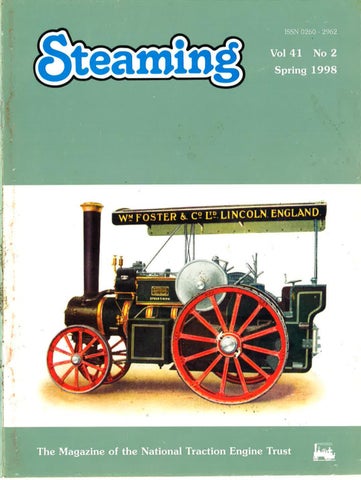
Cover William Foster's compound 'Wellington' tractor, as portrayed in their commemorative book on tanks issued about 1919. An unusual feature was the rear end suspension, with leaf springs positioned above the axle and outside the hornplates. Note too the outer face of the flywheel worked up to a bright finish. (collection Richard Sandercock) 63
Trust News Engine Owners Column Engine Owners Meeting I am grateful to our Editor for allowing me a last minute addition to his copy for this issue to briefly review the important Engine Owners Meeting that was held at Crick on 14th March. As on previous occasions, it proved to be a very lively and useful exchange of views. The main topic, driver competence, had returned to the agenda as a result of a request put to the Trust by delegates to the Rally Organisers Conference last autumn — see my notes in this section of the last magazine. So the subject was a source of most intense discussion, and quite understandably, and we shall now go back and discuss the feelings with the Rally Organisers before proceeding further. The Engine Owners sub Committee, as a result of the open meeting, have been charged with investigating all the options and of coming forward with definite proposals. The value to us — the sub Committee — of the open meeting, is that it gives a firm indication of what you as engine owners are thinking, so that we are hopefully reflecting your wishes in anything that we propose.
Other matters discussed included insurance matters, boiler inspectors, disclaimers on entry forms — which should not be accepted — and such detailed matters as water tieatuieuts
and mudhole joints. There seems to be a problem with some of the new materials used in the manufacture of such joints and great care with their use is advised. Now that certain types of asbestos joint are becoming harder to obtain it is not always easy to know where to go to find them, or exactly what to get. With that in mind, Colin Hatch, our new Spares Register man, is undertaking to obtain information and give advice on the subject. Please contact him if you have a problem, or indeed have knowledge to spread that will benefit us all — his address appears further on in this column. A full report of the Engine Owners Meeting at Crick will appear in the next issue of Steaming, and if anyone requires copies of the formal minutes, please contact Sue Jackson, our General Secretary. In closing, I will ask that we all attempt to conduct ourselves correctly on the rally field, in order that organisers, environmental health officers and HSE inspectors can find nothing with which to take issue, so
The National Traction Engine Trust Engine Owners sub-Committee prezent the 1998
PRACTICAL ENGINE DRIVING COURSE to be held at
Dingles Steam Village Milford, near Lifton, Devon on the 9th and 10th May 1998 For further information esnd SAE to: Richard Vickery, The Orchard, Loxbeare, TIVERTON, Devon EX16 9R11.
64
that we may enjoy our hobby with as little red tape as possible. Good steaming for this season. (Richard Pierce, Chairman, Engine Owners sub Comniit lee) Technical Board The increasing difficulty in finding boiler inspectors with knowledge of riveted locomotive type boilers has been written about and discussed
more times than enough, but it is acknowledged that the time may not he far away when engineer surveyors with the appropriate qualifications and experience of modern all welded package boilers will have to be trained to examine loco boilers. Up to now, the seemingly insuperable problem has been the cost of such an enterprise. It would not be difficult to set up suitable training courses, but obtaining instructors of the right quality, obtaining a suitable venue with facilities for practical instruction, and accommodation, would be very costly. Unless enough candidates (say around 201 were prepared to attend, the cost per person would be so high that no-one would be able to afford to be there. Things are now looking better,
however, in that I have been approached by the Association of Independent Railways and Preservation Societies with a view to co-operation in tackling the problem. I have already had a meeting with Allan Garraway, one of their vice presidents, and have been authorised by our National Committee to hold further discussions. By the time this appears in print, I will have had the opportunity
to hear the views of this year's Engine Owners' Meeting. All in all, I now feel much more optimistic about the future, not only for boiler inspection, but also that the steam preservation movement may be able to present a more united front against the Brussocrats and others who seem to be hell bent upon making life impossible for us. Before leaving the subject of bureaucracy, it may be appropriate to report the latest progress in the saga Spring 1998 STEAMING
of the Pressure Equipment Directive. The Directive applies to complete assemblies of pressure equipment which are placed on the market. On my interpretation, this means that it must be ready to plug in (or light a fire in) and go, and also that it must be put in a shop window, advertised or otherwise brought to the notice of the public at large and made available for anybody to buy. I do not see how, on the ordinary meaning of the phrase 'placed on the market' the Directive can apply to articles made to order and only of use to the customer, as would be the case if an owner had a new boiler made for his engine. Our bureaucrats, however, perhaps aided and abetted by those with an eye to the lucrative market in 'conformity assessment', seem to want to give the phrase a much wider interpretation. Every effort must be made to resist this if we are not to be lumbered with cripplingly expensive conformity assessment procedures in the name of removal of barriers to trade, where in fact none exist. (Jim Newnham, Chairman, Technical Board) Engine Code of Practice Some owners of copies the Trust's Engine Code of Practice will be aware they will shortly be needing additional copies of the year record sheets. STEAMING Spring 1998
From Alan Martin's Collection
80
The seriousness of the situation in this picture seems to have passed for a moment for most of the crew shown here are laughing. Foden 5 tonner 3690, however, is out of action, its flywheel broken and steering wheel smashed, and the driver has called it a day and raked out the fire. The 1913 built wagon was owned by T.M. Fairclough & Sons of Whitechapel, London E7 and appears here in apparently rural countryside. Is the chap at the left with the tie and coat one of the Faircloughs, who has ridden out from London to organise assistance — he sports cycle clips to his trousers.
These are now available, at a cost of £5.00 per set including postage, from me at my new address. The Code includes mention of withdrawn British Standards, and copies of these documents are available to holders of the Trust Code at £10.00 each. (Sylvia Dudley, new address inside front cover) Spares Register Following discussions that started during the members informal evening meeting in the Trust's marquee at last year's Great Dorset Steam Fair, I have been asked to take over the administration of the Spares Register. Bob Back, who has recently been running the register, has found personal circumstances preclude him from
being able to continue. So, should you require advice on suppliers of goods and services for the continued use of your engine, I will endeavour to assist wherever possible. In order for the listed information to remain reasonably up to date I would appreciate feedback on details such as the level of service received, contact names, new or altered telephone numbers, product range, etc — indeed, all the facts that you would wish to know of where you are about to go shopping! Running alongside the Spares Register, I would also welcome information on patterns that are owned by members; patterns they may have had made for castings, no matter how small or large, for replacement parts on any type of engine. With 65
the establishment of a catalogue of such patterns, I can hopefully put someone requiring an elusive part in touch with another who has just the pattern on the shelf, collecting dust, the loan of which could be of mutual benefit. Currently I have members looking for the following: chimney base patterns for a Fowler T3 roller and for a Burrell 7hp traction, and for a complete chimney for a Burrell 6 or 7hp — the cast iron type. (Colin Hatch, 4 Lotmead Farm Cottages, Stratton Road, Lower Wanborough, Swindon SN3 4AJ — Tr 01793 790378.)
Insurance Officer's Notes Exhibition Organisers Scheme update I am now able to provide fuller details of the Footman James Organisers Insurance Exhibition Scheme. The delay in publishing this information was caused by seeking clarification and extension on a small but detailed number of items. I hope you will agree that the delay was worthwhile when you read what the scheme has °to offer. There are five sections to the policy, outlined as follows. this is the A. Legal Liability minimum cover you can arrange. It consists of two parts. Public Liability — this cover protects your public from you, and is provided in respect of Bodily Injury or Death to Third Parties and Third Party Property Damage. The base cover is for £2,000,000, or optionally for £5,000,000. Employer's Liability — this cover protects those that help run the event and is provided in respect of Bodily Injury and Death to Employees. Cover is provided for £10,000,000. The underwriters have agreed for the purposes of NTET Authorised Events that volunteers up to the age of 70 will be treated as employees for the purposes of insurance. This is a very important concession, because, unlike Public Liability, an employee does not have to prove blame in order to receive benefit under this cover. B. Property Damage, All Risks — this cover is provided in respect of displays, stores, caravans, offices, toilets, radios, intercoms and electrical equipment; rally equipment including chairs, tables, bar equipment, posts etc, and marquees. Cover is provided 66
Rates of Cover Section
Extent of cover
Cost per set-up or knock-down day
Base cost
Cost per additional event day
A. Legal Liability
£2,000,000 £5,000,000
£7 £15
£50 £100
£7 £15
B. Property damage
£10,000 £25,000 £40,000 £50,000 £125,000
£9 £15 £17.50 £19 £38
£12 £22.50 £32 £37.50 £75
£9 £15 £17.50 £19 £38
C. Personal Accident
£2,500 and £25 per week
£15 per named person
£5,000 and £50 per week
£25 per named person
D. Loss of expenses
£10,000
£25
E.Postponement Cover
£10,0000
£25
Example 1 2 day weekend event with access from previous Wednesday to following Wednesday set-up/ knock down days
Base cost
Extra event days
Cost E
A. Legal Liabilities: £5,000,000 Public Liability £10,000,000 Employee Liability
6 x 15
1 x 100
1 x 15
205
B. Property Damage — £25,000
6 x 15
1 x 22.5
1x15
127
Cover
C. Personal Accident — £2,500 for 6 people
15 x 6
90
D. Loss of Expenses — £10,000
1 x 25
25 Total
417
Example 2 3 day weekend event with access from previous Saturday to following Tuesday Set-up/ knock down days
Base cost
Extra event days
Cost E
A. Legal Liabilities: £5,000,000 Public Liability and £10,000,000 Employee Liability
8 x 15
1 x 100
2 x 15
250
B. Property Damage — £25,000
8x15
1x22.5
2x15
172
Cover
C. Pei canal Accident — C2,000 for 0 people
10 x 0
120
D. Loss of Expenses — £10,000
1 x 25
25 Total
for values of property ranges of £10,000, £25,000, £40,000, £50,000 and £125,000. C. Personal Accident — this cover is provided in respect of death or loss of sight, hands, feet or permanent total disability with weekly benefits for Temporary Total Disablement for up to 104 weeks. Cover is in two optional
567
ranges — £2,500 capitalis and £25 per week, or £5,000 capitalis and £50 per week. In addition, cover is provided for loss of personal effects, personal money, misuse of credit cards and personal legal liabilities. This cover applies to named individuals only. It should be used to insure specific members of your event Spring 1998
STEAMING
team who, through the nature of their work with you, might be at particular risk due to the tasks they undertake, e.g. anyone handling large amounts of money, erectors of masts or tall structures, high level lighting and tannoy riggers, fence erectors and persons handling automated equipment. It does not extend to persons employed by someone contracted to you to undertake this work. D. Loss of Expenses — this cover is provided in respect of expenses incurred by an organisation should it be necessary to cancel, abandon, postpone or curtail the event. The extent of cover is £10,000 per event. E. Postponement Cover — this cover is provided in respect of claims to the organiser for expenses incurred from individuals and organisations contracted to appear at the event, when the event was cancelled, abandoned, postponed or curtailed by the organiser. The extent of cover is £10,000 per event. The Scheme and its attendant rates is devised specifically for the organisers of NTET Authorised Events. The rates of cover are generally quoted in two parts — per 'event day' and per 'set-up' or 'knock-down' day. This is all shown in the first of the accompanying tables. I am also setting down examples of the costs of two fairly typical events from which you can draw comparisons. The Policy is designed to provide practical and uncomplicated cover for the organiser of organised events that follow the NTET Code of Practice. Indeed, the fact that we have a Code of Practice, and work hard at applying it, has convinced the underwriters to come up with these very favourable premiums. I have to say that Footman James & Co give me great confidence. They are always prepared to listen to our point of view, to explain fine points to me and to negotiate with their underwriters if they are convinced of the merits of a particular request. Importantly they know, in great detail, the environment in which we wish to work. Disclaimers — again! I recently wrote to Old Glory in reply to a letter that appeared in that magazine on disclaimers, and that was in particular seeking information on the legal position. For the continued guidance of our members I reproduce the letter here. 'Yes, I agree with Michael Thurbon. The position with regard to disclaimers does appear to be inconsistent. However, despite 'disSTEAMING Spring 1998
'41.11:11
This Foden steam wagoi: seems to have come to the rescue to temporarily power machinery from its flywheel. The photograph, courtesy the Brooklands Trust Ltd, was taken on 4th December 1918 at an unrecorded location, and features a Foden 5ton wagon owned by The Sopwith Aviation Co Ltd of Kingston-on-Thames, Surrey. A rev counter has been fixed up in the roof, the drive being taken from the centre of the flywheel by a flexible cable. Sopwith's had three Foden 5 tonners, all built in 1918 — 7916 in January, 8226 in September and 8372 in October, but it is not recorded which one this picture depicts. The work-staining of the light coloured paintwork to the water tank might indicate the machine is not one of the newest pair.
claimers' which may appear in programmes or on entry forms the actual position is very clear. The organiser of an event open to the public, paying or non-paying, should have in place effective Public Liability insurance, If the organisers choose not to have in place adequate cover, then they are laying themselves, and all who are associated with running the event, open to individual and collective claims for compensation for injuries to third parties. 'In the event of an accident blame has still to be proved, but the point is that under proper arrangements it would be the insurers who would meet the cost if the organiser were held to be at fault. No insurance would means costs would fall directly to the organiser. It matters not that they published any statement, no matter what the wording: such a device has no moral or legal standing. Imagine going to the cinema, and being injured by an usherette's torch which fell on your head and broke your glasses, and
the owner says "Sorry mate, you came here at your own risk!" 'On the specific question of entry forms; if a disclaimer is present, strike it out before signing. If the organiser objects, point out that it is his moral obligation to protect himself, the public and his exhibitors from his own acts by implementing adequate insurance cover, equally as much as it is yours, the exhibitor. If he still objects, don't go — it's as simple as that!' Age of Steersmen and Drivers Recently I was involved, along with John Durling, the Chairman of the Steam Apprentice Club, and Tim Driver, the Trust's Honorary Solicitor, in replying to a query set by Richard Buck, a member of the Road Roller Association. Research, drawn mainly from a celebrated case (Langham v Valentine and Another 1952), seemed to show conclusively that anyone who was able to influence the direction and/or the speed of a vehicle, was held 67
to be a driver. In the ruling special mention was made of 'steam vehicles' and it was this that prompted the question — should steersmen have a driving licence and be over 21 years of age? The 1998 Road Traffic Act states that a vehicle constructed with solid steel tyres or hard rubber tyres is not permitted to exceed 5 miles per hour and further, the steersman of such a vehicle is not required to hold a licence (ut be prohibited from holding a licence) for that class of vehicle, as long as he/she is 17 years of age or older. Therefore the 1998 Road Traffic Act is held by the NTET and underwriters of the NTET Steam Traction Policy to represent current statement of Law. In addition, vehicles fitted with resilient rubber tyres (not pneumatics) must not exceed 12 miles per hour. On this latter point the underwriters of our NIEl Steam I raction Policy will cover a steersman under 21 years of age, as long as the driver is appropriately licensed, because they consider him 'to be under instruction.' The underwriters take the view that there is no case law on which to base other opinion. It seems, therefore, that the only law that is likely to be broken is that of exceeding the speed limit! The insurance underwriters continue to training of endorse practical individuals in driving and steering (the NTET Steam Traction Policy covers individuals at the age of 16 for as long 68
Foden 7hp agricultural 3384 of 1912 crosses the Wimborne Minster to Cranborne road at the Horton Inn and turns towards Horton village. On its drawbar are a 1950 built Foster threshing drum with Murch reedcomber and a Ruston trusser, all returning from the 1997 Great Dorset Steam Fair. (John Maund)
as they are bona-fide members of the NTET Steam Apprentice Club). (David Smith, Insurance Officer)
Steam Apprentice Club Well here we are, nearly at the start of the new season. By the time you read this, three or four of our arranged visits for the SAC should have taken place, with only the trip to Hollycombe left for 19th April. From the bookings received the outings have not proved as popular as we had hoped, but we expect all the participants will have enjoyed themselves. I offer my thanks to the Burrell Museum and to the Museum of Lincolnshire Life who have arranged so much for us, and also to Kelston Sparkes and his son Alan, and Frank Lythgoe for allowing us to view their wonderful collections. We are still struggling a bit with the lack of co-ordinators for SAC events at rallies. However, a big thank you to
those we do have. We are hoping to cover about 26 or 27 rallies this eummer and we do desperately need more help. If you have an apprentice who would like to be paired with an engine for all or part of a woolcond, please let the co-ordinator know — preferably well beforehand. Details of the arrangements will be given to you by us — ring on the number inside the front cover of any Steaming. We do like to try and arrange things which our young members enjoy. However, this is a little difficult if we don't know what that is! If you have Apprentices, please ask what the Club could do for them, and either get them to write and tell us, ur yet in touch yourself. There are a few lads hoping to take part in the Junior Driving Course, to be held in conjunction with the adult one, by kind permission of our Chairman, at Dingles Steam Village. We have arranged for several miniature engines to help us and have plenty of space for more Apprentices should anyone wish to join us. We hope to see some of you there. (John Durling, Chairman, Steam Apprentice Club)
Spring 1998
STEAMING
Trust Exhibition Unit Right at the beginning of next month, the Trust's mobile Exhibition Unit and Sales Stand sets out on its fifth year of visiting rallies and other events around the country. In those five years, the unit has become a valuable part of the Trust's activities. It gives members a good chance to acquire traction engine reading and viewing whilst benefiting our funds, and to seek advice from those staffing the unit on matters concerning traction engines — we're not always able to provide the answer at the time, but it often helps to talk things through at first and to respond later. For passing non-members, the exhibition unit is always a useful source of information on road steam engines and the rally calendar. There is always a wide range of rally leaflets on display, and many thousands are taken from the unit during the course of the summer; do make sure your event is suitably broadcast from our display racks. For the first half of the 1998 rally season, the following itinerary has been arranged for the unit: May — 2 to 4 Newbury; 15 to 17 Tallington; 23/24 Chipping, Preston; 31/June 1 Upton, Eire. June — 6/7 Shrewsbury; 13/14 Henley-on-Thames; 20/21 Dursley; 27/28 Banbury. July — 4/5 Bromyard; 11/12 Rempstone; 17 to 19 Weeting (marquee) and also 17/18 Masham; 25/26 Chester-le-Street. As usual, only the more familiar titles for the rallies have been used in the above titles, but reference to The Rally List 1998, which is enclosed
with this issue of the magazine, should enable you to find further details of any event that is unknown to you. Venues for the remainder of the year will appear in the Summer issue. May I repeat my invitation of previous years, to anyone who might be interested in joining the ranks of those who assist with the unit on its rally outings. For those who aren't able or do not wish to be closely involved with the hands-on side of running engines, being one of the staff on the unit is an excellent way of being involved with another aspect of engine enthusiasm. I'd be pleased to chat to anyone thinking of offering help. (Robert Herring, Exhibition Unit Organiser, address and 12 inside front cover)
A Change of Treasurer The vacant position of Treasurer to the Trust was filled in February with the appointment of Julie Smith of Astwood Bank. We welcome Julie to the post and hope she will enjoy the challenge that keeping our finances in order will undoubtedly present. The grateful thanks of the Trust are due to the retiring Treasurer, John Harris, for his diligence during his six years tenure of the position. John came to us with a strong interest in vintage motorcycles, but he quickly gained an appreciation of road steam engines. It is the resignation of a particular member of his office staff that has led to John being unable to continue to devote time to this particular outside interest.
of John Deere and Caterpillar which would provide his earliest operating experiences. Due to the sale of the farm in the late 1930s, he started work for Derek Crouch, at the time an agricultural contractor. Crouch was to branch out into civil engineering during World War 2, and later into opencast coal mining. It was as a result of the latter that my father moved to the north east of England in 1943, initially for two months. He would never return south and was to spend the remainder of his working life with Derek Crouch, involved with all types of heavy plant in both the UK and the USA, from Caterpillar dozers to walking draglines such as Big Geordie. Following involvement with Aston Martin and Bugatti cars, his first interest in vintage machinery was with the purchase of a John Deere model D tractor in 1967. This was followed by other tractors and ultimately the purchase, in 1972, of Clayton & Shuttleworth traction engine 38742, in a totally derelict condition. Following a complete rebuild and restoration the engine was extensively rallied, and became a regular attendee from Aberdeen to Lincoln. Digger will be greatly missed by his many friends throughout the country, for his extensive experience, his appreciation of the finer points of engineering, and also his seemingly unending memory for stories and jokes — which could be related to any situation. He leaves a wife Norah, a son Anthony who will continue his father's passion for steam, and a daughter Louise, and devoted grandchildren. (Anthony W. Lister)
RALLY SAFETY SIGNS DANGER — beware of moving vehicles etc — yellow with black lettering Unauthorised persons prohibited etc — red with white lettering FIRE POINT — red with white lettering Printed on rigid plastic boards
ER Beware moving ',11°" & machinery
£2.50 each sign inc VAT, postage E6 per order From: A.J. Semple INTETI Unit 6, Mynd Industrial Estate Church Stretton, Shropshire SY6 6EA
STEAMING
Spring 1998
Affiliated Groups Obituary 'Digger' Lister It is with the greatest regret that I record the death of my father Digger Lister, who passed away suddenly in December 1997, aged 75. He collapsed whilst walking his daughter's dog, but the attempts of a passing fire engine crew and a nurse to revive him were unsuccessful. Born at Manea, the Isle of Ely in the Cambridgeshire fens, he was the son of a farm manager. He grew up on the farm, working with machinery from an early age, with memories of a Burrell traction engine and an International Titan tractor featuring in his childhood. It was, however, the products
Sentinel Drivers Club To celebrate the end of the century in which the Sentinel steam wagon was conceived, born and manufactured, and then continued into preservation, the Sentinel Drivers Club are promoting a road run during May 1999. It will be a re-run of the highly successful End-to-End journey from John o'Groat's to Land's End that took place in 1976. The event will be open to all types of steam wagon, although it is expected that Sentinels will predominate. A definite route will be set, and all entrants must themselves fund 69
their participation, either by sponsorship or by personal contribution, including the provision of fuel. It will, of course, be an expensive event, needing approximately five tons of fuel for each wagon to cover the 900 miles. Full details will become available as the organisation of the run develops, but at the moment we need to know who is interested in taking part. If you might consider entering please contact Mick Tuxworth, 3 Rayments Bungalows, Wimbish Green, Saffron Walden, Essex CB10 2XL (21. 01799 599555).
occur not this summer, but in June 2002. Further, as has been clearly set out in the pages of this magazine, the Trust is not organising a Road Run to celebrate the Millennium in the year 2000. Newsletter 21 is available from Ron Walker, Lower Priory Farm, Clamp Hill, Stanmore, Middlesex HA7 3JJ, on his receipt of an SAE.
Gold Medal Newsletter
A sincere welcome is extended to the following new members who have joined the Trust during the last three months. We hope they will gain much friendship, Information and enjoyment from their membership over a period of many years. The Membership Secretary is always pleased to put members in touch with one another by fowarding mail.
A further isue of the informal Newsletter for Burrell Gold Medal tractor owners and devotees is available from Ron Walker. Subjects covered include the gathering at the Weeting rally last year to celebrate the 90th anniversary of the winning of the RAC Gold Medal — a long account of the weekend's events is included — and news from the Burrell Museum at Thetford. As usual there is an update on what has been happening to individual survivors of the type; fifteen tractors are mentioned. In covering some future dates at which Burrell tractors might appear however, mistakes have been made. The 50th anniversary of the Trust's rally at Appleford in 'Berkshire (usually recognised as the first rally of engines) will
STEAMING past OUR MAGAZINE 25 YEARS AGO
Cumbria was the subject of this special issue of the magazine. Editor Ran Hawthorne had spent two years accumulating an excellent series of short articles centred on the area together with a wide variety of interesting historical pictures of engines. Local contributors included Syd Sutton and Bill Dowthwaite, whilst John Middlemiss wrote on showmans engines once to be seen in the area. Ran mused on the future of rallies in his Editorial — were there too many events and were too many engine owners trying to get to more than they could really manage, and so joining in a rally rat race? Why not take in a few 70
New Members
W.R. Jones, Saitwood, Kent C. Frampton, Worksop, Nottinghamshire A.V. Wilson, Caldon Low-, Staffordshire D. Taplin, Chilworth, Surrey A.S. Frener, Salisbury, Wiltshire R.C. Buswell, Woodbridge, Suffolk A.S. Sharpe, Leiston, Suffolk H. Bolton, Derby N. Brady-Browne, Comox BC, Canada M.D. Pugh, Leicester J. Eyres, Heathfield, East Sussex
more private steam-ups, spend a weekend doing maintenance jobs or just run round to the local scout fête — you'd enjoy your engine more, he suggested. The 1972 AGM was covered in a one page report, though most of it was about the following social evening, and there seemed to have been little discussion on any contentious topics. Membership was at a record 2557, the print run of Steaming being 3,000. The subscription was to rise 50p to £2.00 from the following September. A notice from Hampshire County Council set down changes by the Trustees of the Tasker Museum Trust, founded in February 1969 after the sale at Andover of the Tasker Collection. With little prospect of raising finance for the restoration and housing of the engines in the immediate future, the Trustees had passed the assets to the County Council. In more recent times a few of the machines have been fully restored and presented by the Museums Service on southern rally fields.
D.B. Taylor, Tarporley, Cheshire T. Sherhorne, Bath, Somerset N. Thompson, Aberystwyth, Cardiganshire A. ThwaiLes, WarringLon, Cheshire F. Dunlop, Ballymena, Co Antrim E.C. Tatham, Lytham, Lancashire P.M. Omand, Penzance, Cornwall P.C.W, Rhodes, Boroughbridge, North Yorkshire M.W. Pearse, Liskeard, Cornwall G. Collins, Southampton, Hampshire E.R. Bullen, Steeple Aston, Wiltshire Dr D.M. West, 0rmskirk, Lancashire G.M. Morris, Daventry, Northamptonshire B.J. Headon, Portsmouth, Hampshire M.G. Randall, Andover, Hampshire J. Knight, Chelmsford, Essex M.F. Plumb, Kings Lynn, Norfolk M. Perry, Mold, Flintshire M.J. Dalton, Haslemere, Surrey D.W. Godwin, Marden, Herefordshire A.J. Goddard, Shrewsbury, Shropshire E.W. Goddard, Shrewsbury, Shropshire M. Goakes, March, Cambridgeshire A. Goakes, March, Cambridgeshire
Poor Steaming Two small errors in the lest issue require correction. Apologies to Garrett enthusiasts for placing the Leiston works in Essex in comment towards the end of the article on the Garrett self-mover in Estonia — it should have read Suffolk, of course. For the sake of a space between two words in the caption to the Aveling roller on page 16 a rogue class has materialised; the picture is of a type D 8 ton machine.
'One Bears — FIUIII all uutside source, that the output of Sentinel 'waggons' has reached nearly 20 a week.' (from the gossip column of The Commercial Motor, 17th October 1918, just before the end of World War 1.1 'Fodens for the MAB. Despite repeated applications to the Ministry of Munitions, the Metropolitan Asylums Board has failed to get a satisfactory priority certificate for a steam tractor it decided to purchase some months ago, and as a consequence of this it has purchased a second-hand 5 ton Foden steam wagon. This was bought for £1200 from H.C. Bauly Ltd, and the vehicle is four or five years old. The body has been replaced by one of a more suitable type and the rear wheels with rubber tyres have been fitted at an additional cost of £300. The board has empowered the engineer to get another similar Foden.' (from The Commercial Motor, 17th October 1918.1 Spring 1998
STEAMING
D & S Steam Engineering Ltd (incorporating Bill Newcombe Steam Models and Valentine Boiler Makers)
From the smallest repair to a full rebuild
* Drawings * Castings * Materials * Accessories * Rubber tyres * Boiler making * Gear cutting * Machining * Finished engines * Pattern making
Full machining facilities: 48in dia vertical borer 62in dia facing lathe CNC lathe 30in x72in CNC milling 10in horizontal borer slotter 36in throat 72in x 3 / 4in bending rolls 150 ton hydraulic press Retubing, welded or riveted fireboxes, new boilers, white metalling, endless rubber tyres, tenders, belly tanks, spoked wheels. all welding to BS EN 288 and 287 D & S Steam Engineering Ltd, Enterprise Works, Enterprise Road, Raunds, Northants NN9 6JE
We offer a superb range of modeITRACTION ENGINE designs, castings, materials and accessories for experienced and novice model makers. I GARRETT 7hp agricultural engine in 4in scale RUSTON PROCTOR class SD light steam tractor in 4, 6 and 12 inch (Yes we can actually do everything to build a full size engine!!) • FOWLER BB1 ploughing engine in 4in scale FOSTER bhp double crank compound in 4in scale • ALFRED DODMAN single crank compound in 4in scale Details of the above in our latest catalogue. You can get one by sending 50p in stamps to the address below, or see our Website. Please state if you require details of the full size engine as these are not in our model catalogue.
Tel: 01933 460946 Fax: 01933 625551 E-mail: bnsm@skynet.co.uk Website• http//www.web-uk.com/steam
FOR THOSE NEEDING ECONOMICAL REPAIRS ON THEIR TRACTION ENGINES
B. & C. Reconditioning (Gears) Ltd ESTABLISHED 1967
PINIONS
SPURS
BEVELS
Quality reconditioning of all types and makes of bevel gears, spur pinions, spur wheels, helical gears etc
IIII
ri
IS09002 REGt5tERELI cetmeor
nn
1CCO1IIt
cruinchuoir III t Ildi
Certificate No. 6293
STEAMING
Spring 19.98
B & C Reconditioning (Gears) Ltd, Amesbury Business Park, London Road, Amesbury, Wiltshire SP4 7LS Telephone: 01980 623210, Fax: 01980 625176
71
Salt of the Earth Jim White Jim White and family and the Burrell agricultural SPANKER have always been a part of the rally scene in Essex. In an excellent article in our Summer 1993 issue Pat Freeman set down the history of the family threshing business, of Jim's life in steam and the details of his long association with the Burrell, still rallied by the Whites. Now, in his own words, Jim muses on the trials and tribulations of enginemen — his contemporaries who drove for a living until the final days of steam on the farm. He celebrates his ninetieth birthday later this year. I am setting down these words to try my best to inform younger engine owners and drivers of the work of the enginemen who drove engines for a living up to the late 1940s. I'll start off with what I can claim to have been my occupation, with the threshing drivers. They started off on their task as soon
as the farmer on their round had a field of winter barley or winter oats to thresh. I might say here that in our area — Chelmsford in north Essex and the surrounding countryside — we had one or perhaps two sets of tackle out threshing kale seed or trefoil seed, sugar beet seed or grass seed. This meant that you had to work long hours, for the farm men kept bringing loads out of the fields to 8 o'clock and even later. These hours went right up to the time when the clocks were put back one hour. By then most threshing drivers had had enough of these long working days, I can assure you. I must remind readers that you worked on Saturdays, and up to four or perhaps five o'clock if the farm men were bringing the loads from the harvest field. After working the first fortnight you had to wash-out the boiler and fill up all ready for Monday morning. When harvest was safely gathered in from the field you then had to thresh from the stacks and these could be put
Veteran engine, veteran enginemen. Burrell 8hp single cylinder traction engine 1606 SPANKER, built in 1892, forms the backdrop to this study of the White brothers, all sons of threshing contractor William John White. The photograph was taken at the Littley Green rally in August 1996, and from the left we see Sam, then aged 86; Jim, 87 and Bob, 85 — an outstanding total of 258 years! Jim was the last commercial driver of the engine. 72
in some awkward places, especially during World War 2, when farmers were advised by the Government to build stacks away from farm buildings on account of enemy Incendiary bombs. It was bad enough when you had to get the tackle through the farm buildings to where the stacks were, but sometimes you had to take the threshing drum first and then come back for the straw baler or straw elevator. And sometimes you had to do a hell of a lot of bracing with the brace chains, as many a time there was not enough room to take a good sweep round through a gateway or around a building. An explanation here for the uninitiated — brace chains consist of a chain about 16 feet long with a good sized hook on each end, and a large ring in the middle, and another short chain six feet long with hooks and ring the same as the long one. When you'd got your engine through the gateway and if you could see that the drum was going to hit the post, this was when you started to use the brace chains. You first uncoupled the threshing drum from the engine and hooked the long chain in the eye on the drum's forecarriage and then to the coupling on the engine. Now the short chain was passed over the long chain with the two hooks in the eye of the drawbar. It would then be seen that when the engine started to go forward the front of the drum would go well away from the gatepost to allow the hind wheels to run clear. Whichever way the drum had to go, right or left, the long chain was put on the fureudiiidge accordingly. When you had the drum through the gateway you could couple up to the engine and use the long chain to pull the baler in, by putting the hook on the coupling at the back of the drum and then onto the perch bracket under the front of the baler. A good strong man could steer this machine in nicely on the drawbar. While all this was going on the engine driver not only had to look where his engine was going but also to be well aware of what was going on behind him. Of course, when the baler was through the gateway the engine driver could back the engine and drum so that his mate could take off the chain and couple up the drawbar of the baler to the drum. Most times the farmer would pull in the lighter straw elevator with a horse or tractor. If the corn stacks were on either side of a hard road it did not take so long to get the tackle lined up, but if it was meadow ground, and particularly after a lot of wet weather, driver and mate would have to put all the spuds on the engine as the ground could be very Spring 1998
STEAMING
SPANKER completed its working life in 1949 but within the next decade the traction engine rally became a popular rural occasion. Bill Timmings took this photograph in 1959 at the North Weald rally near Epping.
soft and the engine might sink in the ground perhaps six to eight inches or more; also the drum and baler wheels. This was when the engine steered very hard and an inexperienced driver could soon get in a muddle, and take a hell of a long time before he had them lined up and the corn bowling into the corn sacks. Now for the actual threshing. If it was a warm day and the wind blowing towards the front of the drum, the dust would tend to make the driving belt slip, especially if the feeder was none too active and feeding the machine a bit 'lumpy'. When this happened the driver would soak a rag with cylinder oil and press it down hard on the belt. This usually stopped the slipping. Now, on the other hand, if it was a little damp or with a misty rain, the driving belt would again slip. The remedy this time was to take the engine fire shovel and sprinkle some dry dust from under the threshing drum onto the belt, or hold a dry chaff bag on the belt. At the time before Christmas and into the New Year you may have got some severe frosts and if this sort of weather persisted too long you could be sure of trouble; about three inches of ice on the inside of the water butt, or perhaps the water lifter hose pipe frozen up or the injector iced so that neither would STEAMING Spring 1998
work. I might add here that if on running the tackle next morning you found you couldn't get water into the boiler, I'm afraid most engine drivers let rip with nasty oaths. I and my brothers, after banking the engine fire up at night, always used to take the hosepipe off the engine and put it inside the coal bunker and if it was a sharp wind frost we would pile straw all round the firebox and rear wheels. This of course kept the engine warm, with perhaps 40 or 50 pounds of steam in the morning. We would also empty the water butt if the engine tank would hold it. I have explained earlier on the trials of getting the tackle to the stacks, but it is a sight worse getting it out on the road again. Because, remember, the farmworker had been backwards and forwards with his horse and cart taking the threshed corn and sometimes the chaff to the farm buildings and on top of this he had to keep our engine supplied with coal and water. So you can imagine how much worse the ground was churned up, not forgetting all the thatch off the stacks and heaps of cavings and dust from under the threshing drum that was spread all round. So all this might call for a lot of use of the wire rope and brace chains, with all the spuds on the rear engine wheels too.
You can see by now in my account that a threshing engine driver not only had to keep his engine in good working order, but also to thoroughly understand all the workings of the threshing drum, such as setting the concaves around the drum cylinder (to suit all kinds of corn and seeds). Around the area in which our tackles travelled we dealt with barley, wheat, oats, beans, peas, sugar beet seed, kale seed, two or three different types of grass seed and, of course, red and white clover seed, the latter being threshed with a clover seed huller. I don't think there's a more dusty a job than clover seed hulling. Thank the Lord there were not many stacks of this to thresh. Another job the engine driver in our area had to do was reckon up all the work done during the week, whether it was piece work or day work, and pay the gang who travelled with the tackle. After, of course, getting the cash off the farmer. You had to know your sums, as we used to say, especially if one or two chaps had taken a day off. I think perhaps that I should mention here that around our area there was a lot of factory work available and in consequence we could not always get a full gang. This meant that the driver had to sack up the corn, and then you had to take the corn off the back of the drum; put it on the weighing machine; help the farm chap load his tumble cart, plus look at every sack just in case there were rat or mouse holes, to be filled up with a fistful of straw. This alone kept the driver very busy, but woe betide the man if he did not keep his eye on the steam gauge and water glass. Once you let the engine get below a half glass of water and down below 120 pounds of steam, you were getting in a muddle. Our engines were always kept going without stopping between meals. We always kept the steam and water well up, and never had any main bearings seize up, and kept the bearings and eccentric tumblers oiled where possible without stopping. Readers may wonder why the driver sacked up the corn with all the extra work it entailed, but the reason is quite simple — the driver had another man's wage for this work. But by jove, if you did, when you got home at the end of the day you were knackered and didn't want any sleeping pills come bedtime. Perhaps one of the worst incidents to dampen a steam threshing driver's enthusiasm was when it came on to rain in the dead of winter in the afternoon. By the time everything was properly covered and the engine banked up, you would feel the back of your trousers were damp and with the seat of your bicycle also soaking wet 73
Another early rally picture — this time the 1955 Saling event near Braintree. Burrell 6hp single crank compound 2319 of 1900 is being set to the drum — and interest is high limn the well-capped crowd at the rear. It's a fair bet they had more knowledge and experience of what was going on than would be the case with a group of onlookers today. Now ... who, 43 years on, can put names to the figures?
on the way home, you might as well have been sitting in a bowl of cold water. Another test of enthusiasm was having to wash out the engine boiler on a cold and frosty Sunday morning. The farmer had often provided dusty coal, and if you didn't sweep the tubes and thoroughly clinker out the fire after dinner, here again you could soon be in a muddle. Remember that your gang of men were on piece work and only got paid when the corn was bowling into the corn sacks. A good engine driver would encourage a good gang. There is a lot more I could write about threshing engine drivers, also about the real old characters that worked with them, but perhaps another time. I reckon that driving a steam railway engine, whether it be 100 or 130 tons, was more like going to a tea party on the vicarage lawn compared with driving a threshing engine and tackle out on the road. 74
Although that lot only travelled about four miles an hour, it mostly had sixteen wheels to get around the narrow country roads and bends. Remember that such roads were a good third narrower fifty years ago. Now perhaps I may say a little about steam tractors. I will not dwell too long on these as I think none were manufactured by any engine makers before the 20th century and by the early 1930s virtually all makes of steam haulage engine were replaced by petrol lorries. Many of these types of engine never did enough work to burn out their original firebox, but of their work, the roughest was timber hauling — from where the trees lay in the woods to the timber works or yards. If the driver's load weighed much more than his engine, and this was usually the case, it could be a very dodgy exercise, especially going down steepish hills. It is a well known fact that you must have weight to pull
weight, and the same principal also applies to steadying down hills. Other work done by these little engines was brick carting, and moving sand and gravel, coal and corn, and some were even used for threshing and baling or chaff cutting, but on piece work they weren't man enough for the job, as it wholly warmed them up. The chimney and smoke box would be nearly red hot. It was hard work for the men who worked on the aforementioned jobs with these engines, for there were no hydraulic shovels and lifts like we have today. These hardworking men, like the threshing men, did not want sleeping pills at bedtime. The same applies to the work around the big heavy haulage engines. Showmans engine drivers worked hard getting their rides all set up and ready for the paying public, but once this was achieved most of their work was fairly cushy, keeping the steam well up and their engines well cleaned and polished. And they generally stayed in one town at least a week and so were not travelling on the road too often. Now on to the steam plough drivers. Their season started about Easter time, perhaps on land draining with the mole plough, and then Spring 1998
STEAMING
afterwards followed by ploughing and cultivating right up to the end of October, maybe a little longer, if the ground was not too wet. These drivers worked all the daylight hours and these, of course, can be many in mid summer — 17 or 18. These crews too did not require sleeping pills, more like waking up pills, I'd say. They were all very skilled, especially the steam plough foreman who had to know about dealing with leaking tubes, the mechanism of the rope coiling gear under the drum, how to splice a broken rope and also how to set up and adjust the plough or cultivator to suit the farmer's requirements. Their wages for all these skills and the long hours did not overload their wallets t000 heavily. They lived in the van all the week and I imagine their meals were none too exciting. I have done my best to describe the steam ploughman's activities, but I only did two days driving with W. G. Smoothy's tackle at Rochford, Essex, so cannot by any means claim to be an expert on this subject. I can write with a little more confidence on the subject of steam roller drivers, for I drove various engines for the Smoothy firm, mostly working for the old Chelmsford Rural District Council. I count myself very lucky in being sent working around Great Leighs and the surrounding villages, my home territory. Roller drivers were expected to have their machines ready for work at the work
site by 7.30am. If it was just rolling over holes filled up with tarmac, or perhaps widening bends or narrow stretches of road, this work, in my opinion, was an easy little number, as the council workers on these activities were small in number and your engine was standing doing nothing for quite long spells — no complaints here from the driver. I think one of the busiest jobs a roller driver had to do was working on water bound roads. This was where the road gang covered the road with granite or reject stones or flints. These had to be steam rolled down tight, done by the driver starting by going close to the side of the road and making sure he half wheeled his work in towards the centre of the road. He then started at the other side of the road and again worked to the centre. Contrary to public belief, a roller driver always half wheeled his work. This meant that he went up and down, working his roller half the width of the hind wheels to the road centre. The front rolls were to take out the ribs made by the hind rolls. After a length of road was rolled nice and tight, the driver stopped work
while the council men covered the stones with good hogging or binding sand. After this had been done the man with the horse and water butt gave this length of work (usually about 13 or 14 yards long) a good soaking, normally emptying the water butt of its full 180 gallons. Now the roller driver came into work again by chasing his engine a good pace up and down before the water soaked through the granite and disappeared into the gutter. In doing so it would be seen that a good thick slurry was forming on top of the granite. With the roller chasing up and down and two council men busy with good stiff brooms sweeping the slurry into perhaps the bare places, this was the final touch in making the old water bound roads. The work was done in the winter months up to the end of March. Also there is the work of tar spraying with the tar pot, and of rolling the shingle dressing, rolling tarmac, scarifying, private jobs, etc — but perhaps more about this another time. To end my story I think that a steam roller driver, provided he had a good engine and thoroughly understood
A fine illustration of winter stack yard conditions. This is one of John Patten's sets — a Clayton & Shuttleworth engine, drum and baler hard at work in the 1930s near Bunting ford in Hertfordshire. Though to us full of atmosphere, it was doubtless a raw February day, with the wind tugging at the engine's smoke as soon as it left the chimney and the men on the stack envious of the sparse shelter built by the feeders on the top of the drum.
road making and repairing had a nice job. To some extent (bearing in mind that he was not responsible for the road gang) he could feel like he was his own governor, which gives one a very pleasant occupation. Certainly my steam roller driving days were the easiest and happiest time in my life. I apologise to all who read these lines if it seems to them that I did this, that and everything else, but these are difficult subjects to describe in detail and I thought the best way was to imagine I was actually doing the job whilst I was writing about them. Of course all the different types of engine drivers followed the same pattern, but very sad to say that these old drivers are getting very scarce. As the late Reverend Major Philip Wright once said, "They were the salt of the earth".
This article first appeared in the Summer 1987 issue of Steam Preservation, the magazine of the Eavl Anglian Traction Engine Society. We are grateful to their current Editor, David Roberts, for permission for us to reproduce it here. Oa,
Aveling & Porter 10 ton roller 5156, pictured by Dave Bagley at the 1994 Detling, Kent, rally. The 1902 built machine has several unusual (though not unique) features: the overhead slide valve cylinder block and a pump assembly mounted well forward on the boiler barrel.
by popular demand
by the late send SAE for complete list trade enquiries welcome
Star th Nor Prints
AVAILABLE AGAIN -
drawn
FULL COLOUR PRINTS ...detailed down to the last rivet Ruston & Hornsby traction engine OLIVER £8.50 each Burrell showmans road loco EX-MAYOR £8.50 each Fowler BB1 ploughing engine No.15143 £12.50 each Fowler showmans road loco SUPREME £12.50 each PLUS an extensive range of railway locomotives Detail from colour print of OLIVER size 17in x 24in
BLACK & WHITE CUTAWAY PRINTS ...the inside story All at £5.50 each Ruston & I lornsby traction engine OLIVER Burrell showmans road loco PRINCESS MARY Aveling & Porter F type compound roller Fowler BB1 ploughing engine Cutaway prints with or without numbered key Detail from B131 cutaway print size 17in x 24in
Please add postage & packing £1.75 (1-3 prints), £2:25 (4-6 prints) Cheques made payable to E.P. Wheeler, The Windmill, Bardwell, Bury St Edmunds, Suffolk IP31 1AD 76
Spring 1998
STEAMING
A Freeminer's Foden From Cinderford in Gloucestershire Alec Pope poses questions on a fine old picture he recently came across: I am trying to establish the early details of the Foden wagon shown in the enclosed photograph. This was taken within the Forest of Dean, but the exact spot is uncertain. The faded lettering on the motion plates shows that a former owner, possibly the first, was someone with the surname Thomas, of Barnstaple, in North Devon. The registration number DD4894 is, however, a Gloucestershire one. An archivist at the County headquarters in Gloucester has been able to tell me that this number was allocated to a J.W. Ratcliffe of Yorkley, Gloucestershire on 12th June 1924. Mr Ratcliffe may well be the gentleman depicted in the photograph. The indications are that he was the owner of a small coal mine, and as such was probably one of that unique body of men in the Forest of Dean known as 'Freeminers'. Subject to certain conditions, freeminers have always been allowed to STEAMING Spring 1998
operate small mines on their own account in the coalfield. It was stipulated that applicants had to be over 21 years of age; had been born within the Hundred of St Briavels (an area within the forest boundary); and had worked in a mine for a year and a day. They could then apply for a 'gale', an area of coal allocated by the Deputy Gaveller, the local representative of the Crown, which enabled them to sink a shaft, or drive a drift or level to work the underlying seams of coal. It was a common practice at one time to use former ships' winches, or similar, for winding coal from these small pits, and the steam supply was usually from a small vertical boiler. Of course the fuel supply was no problem! It seems that the well used and battered winch depicted in my photo had just been unloaded from the Foden, and was just about to be skidded into position along the small section, bridge type colliery rail seen in the foreground. Once there, a 'tin' shed made of corrugated iron would be built round engine and boiler, with the chimney poking out of the roof. Normally the Foden would have been used for transport, with coal for
domestic use in bags, and for industrial use in bulk to various users. Today, although only a handful of freeminers remain, their ancient rights are zealously guarded, and most of the coal raised goes for power station use. Steam power has, sadly, disappeared and has been superseded by the internal combustion engine. Any information about the Foden would be greatly appreciated. (The Foden in the picture is works number 848, sent out when new in December 1904 to Elijah Thomas of Landkey, Barnstable (as it was sometimes spelt in those days), Devon, registered T396. In May 1919 the wagon passed to the Robin Hood Oxide & Iron Co at Cole ford in Gloucestershire and then, in 1924, as mentioned above, to Ratcliffe, who for some reason found it necessary to have the engine reregistered. It still survives, having been secured for preservation and restored by Roy Snodin of South Yardley, and now being an exhibit at the presently closed Birmingham Museum of Science & Industry. Thanks are due to Robin Harding, Road Locomotive Society Records Officer for some of the above details.) yy 77
Across the sea to Ireland The 1997 St Patrick's Rally at Upton in County Cork
Dave Smith The Dream Comes True This story starts in 1996 when, as part of a holiday in Eire, my wife Julie and I visited the St Patrick's Rally at Upton, near Innishannon in County Cork. What a great time we had, seeing, for the first time, a famous Irish rally, and being subjected to the kind of hospitality that the Irish are world famous for. The St Patrick's Upton Rally is an NTET Authorised event and has become quite famous over the years for having an impressive range of exhibits and putting on particularly faithful working demonstrations — and for remaining home-spun, for there are no commercial outlets on the field, and no beer tent. Now in its 28th year the rally has raised many, many thousands of pounds for the local Hospital, in the grounds of which the event is held. The Hospital has been owned and run for many years by a Holy Order, the flosminians, who currently specialise in helping the adult mentally handicapped. During our visit we made the acquaintance of Margaret Malone, a member of the rally committee, who as secretary co-ordinated the exhibits and the programme, amongst other things. Having waxed lyrical to her about their rally and its efficient organisation I hesitatingly asked if we might make a visit, on another occasion, with KEELING, our 1909 built 8hp Burrell agricultural 3121. The reply, which was to be expected, was that as it was expensive to move engines from the UK the funds of the rally did not allow many such exhibits — and in any case there was a long waiting list! So, imagine our surprise and pleasure when in February 1997 we received our invitation to attend that year's rally at Upton ... Bingo! Planning the visit Now the panic and the planning started. How do we get there; which ports do we use; what date should we go and when to come back; how many of us are going; where will we stay; 78
what will it really cost and a thousand more questions were asked. To us as rookies who had never travelled to foreign parts with an exhibit it all seemed rather daunting if not potentially expensive, but it was 'put your money where your mouth is' time, and we got down to organising the trip. Partly to keep costs down but also because of the relative closeness of the rally site to Ringaskiddy ferry terminal in Cork, we decided to cross the Irish Sea using the Swansea to Cork ferry service and to go onto the ferry as deck cargo — without the low loader! This saved almost £300 on the round trip, being the cost of 4 metres length of redundant loader and tractor at £35 per metre plus VAT. The plan was that we would be low loaded to the dockside at Swansea, care of our good friends Bob and Andy Davis of S. E. Davis & Son, then being pushed on and off the ferry by tug and finally to steam the 15 miles from the ferry terminal to St Patrick's via a small village called Halfway Dallinhassig, about 7 miles south of Cork City. The shipping agents were extremely helpful and suggested a midweek sailing,
Thursday to Thursday, to keep down the cost of taking with us the backup vehicle. The deal was set up entirely by phone, fax and e-mail via the Internet — who says modern technology has no part in our hobby? To get information of local accommodation we hit on the idea of giving Alan Barry, of Halfway Ballinhassig, a call. We had met Alan, pub landlord, haulage contractor and chairman of the Halfway Vintage Club, at the 1996 rally where he was engaged on the threshing demonstration. Since that first encounter Alan had said on a number of occasions that if we were to revisit his part of Ireland we should look him up. And so I made the fateful phone call to him, telling of our invite to St Patrick's and asking for advice on accommodation. He immediately volunteered himself for the job. Was it going to be at the Ramble Inn we thought, and if so, could we stand the strain? As well as Julie and myself our party was made up of Paul Nicholson, a great pal, and raconteur, socialite, spoon player and boozer extraordinaire, and Tim Haytor, our regular
KEELING is tugged towards the ferry at Swansea at the start of journeyacross the sea to Ireland. (all pictures from the author) Spring 1998
STEAMING
built in 1876. The single cylinder machine has only recently completed a very thorough rebuild, which included a new firebox and barrel. I was to learn later that Tim has been a member of the Upton organising committee since its inception 28 years ago, and he is a very friendly and resourceful man indeed. We readily agreed to the change of plan — it freed us from steaming to Balinhassig and consequently gave us an additional day to see some sights of County Cork, and another reason was that its not every day you get the chance to meet the Lord Mayor of Cork and to steam right into the centre of Cork City!
Ferry passengers watch intrigued as the Burrell is made secure on board the ferry for the sea crossing.
mate, muscleman and bar bouncer, together with Tim's wife Sue and daughter Millie. None of our crew had been to Eire before, so I was pleased they could have the opportunity, though I was unaware that Paul's spoon playing talents were going to make him famous among the St Patrick's crowds. Now, with the timetables prepared and costs worked out, we got down to the job of preparing the Burrell for its Irish debut. This consisted of a great deal of cleaning and polishing, giving the sail cloth roof cover a coat of paint and the repacking of glands, but the major job, and one on which we spent the most time, was ensuring the tool kit and spares boxes contained all the right bits. We planned not to become reliant on our Irish hosts. The task proved more difficult than when we were rallying from home because we weren't going to have the trailer or living van in which to store things. Some items were therefore deliberately left out, such as the second wire brush, fox wedges, spanner sizes that were duplicated — we had adjustables anyway — the large four pound lump hammer, the jemmy and the 24 inch Stilsons. They were not rejected lightly, but we reasoned that we try to maintain the Burrell in a high standard of mechanical condition and she has proved to be very reliable, so apart from the normal on road adjustments she does not demand a great deal of heavy engineering attention. STEAMING
Spring 1998
A Change of Plan A week before the crossing date Tim Nagle of Kinsale rang me to ask if we would participate in a road run from Ringaskiddy Ferry station into Cork and then on to St Patrick's. It was a journey of 31.8 miles precisely, according to the letter that followed! The run was to publicise the Rally and to raise public interest. Tim is the owner of what is thought to be the oldest surviving McLaren engine, works number 60,
Departure Now came the actual day to put the engine on the low loader and to travel via the M50 and the Heads of the Valleys road from Astwood Bank to Swansea. "Get here early" the shipping company had said, "about 6 o'clock in the evening for the 9 sailing". That was no good for Fred, our trusty low loader driver. He wanted to get home time inside his hours. And so it was that the engine and Paul arrived on the dockside at 2 o'clock. Meanwhile I had been to Malvern to pick up Tim and his family in the back up Discovery, arriving just in time to see the low loader pulling into the terminal compound in front of us. When we presented ourselves to the shipping agents we found the arrangements for our movement were already in hand but we were to wait until 6.30 before boarding the waiting ferry. We whiled away the time by
What we went to Upton for — to join in with them at the Irish rally scene. Our Burrell is seen set to John Fouhy's Allan threshing drum. 79
walking around the docks and watching kids jumping into the water from the many bridges that criss-cross the dock system. They did this until Mr Plod arrived and sent them all packing. Loading KEELING onto the ferry by tug went like clockwork and started, as promised, at precisely half past six. To our consternation, the ship's crew was mainly Greek, and gave weird and wonderful hand signals as manoeuvring instructions, but we managed to follow, and what a refreshing and friendly attitude they all had. Once on board we became aware of the low ceiling height of the cargo bay — we wouldn't have got on with the low-loader anyway! On board we found that we were in the company of other engine owners on their way to Upton — Bill Lowe from Cobham in Surrey and Martin Shepherd from Leamington Spa near Warwick. T hey had opted to take their low loaders all the way. Bill was with his Aveling & Porter single cylinder road roller 8752 of 1916 and Martin with his Fowler engine 19456 of 1930. The rich devils! The crossing was perfect, for the sea was like a mill pond and we had no problem in using the time making full use of the ship's retail and hospitality areas, but we gave up trying to sleep in a cabin which throbbed to the beat of a ' generator deep in the bowels of the ship. Arrival Well, we might have been first on, but we were definitely last off. However, as the tug pulled the Burrell out of the hold, with me steering whilst standing on the side plates of the tender to get a clearer view of the extremities of the engine, what a reception we got. At this very early hour on a Friday morning we were met by Tim Nagle, up from Kinsale; Donal Murphy (PRO for the rally); Michael O'Reilly (from the Halfway Vintage Club), and various steam enthusiasts and photographers. And last but not least, there was Jiro Dwyer, LI le motorbike mounted video camera stuntman, who was to film the events of the entire weekend. We felt like royalty. As arranged, the engines were to stay in the secure dockside compound, so after moving the Burrell into the allocated position, we sheeted her up to await the next days' run into Cork. I must say how pleased I was with her appearance, brasses and paintwork glinting in the early morning sun. I just knew she would give good account of herself the next day.
80
Another Change of Plan As soon as we were all settled, Tim Nagle asked Bill, Martin and myself if we would go with him and Donal later that day to appear on a Cork Radio Show as part of their publicity drive. We agreed but were then saddened to also learn from him that this was possibly the last rally at St Patrick's, because the Holy Order was letting the Hospital and grounds go to a government organisation and would pull out of the rally scene. The organisers were losing both their venue and raison d'etre in one go! Eventually we left the terminal for Halfway. Our gang riding in the Discovery followed Michael O'Reilly along the very route we assumed we would have taken with the Burrell. It seemed she would have needed sky hooks and a rope to climb some of the hills en route. We were to discover that the more practical steaming route was about 20 miles, via Cork. The information was committed to our memories in readiness for the return journey. On arrival at the Ramble Inn, Halfway, we got another great reception from Alan's wife Mary and her staff. Politely, we had to refuse a second breakfast, but we did manage an early tipple — so as not to completely snub the hospitality offered, you understand. Then it was off to find the digs. What a great job Alan Barry had done. Bernadette Murphy's farmhouse
It 1.8 6E WAY THRESHING
T•e
accommodation proved to be everything you could want: good company, excellent food and modern, spotlessly clean — simply brilliant! She even put up with our noisy, late night comings and goings, not to mention the oily boots and overalls in her hallway. Stars of Radio Knowing that we had to be in Cork City by 4 in the afternoon for the radio show our group decided they had plenty of time to go down to Kinsale for a look around this beautiful old fishing port south of Cork. All of this went well and many photos were taken. We took lunch and were entertained by a Bob Dylan type street player at the Greyhound Bar, where Paul, being the camp gourmet, savoured local oysters and Guinness. During the drive back into Cork, at traffic lights, a newsboy offered us the Cork Messenger. On the front page in full glorious colour was a photograph of KEELING coming off the ferry that morning. She looked great. We bought four copies. Having fought our way into the city centre and then found a parking space we made the radio station with only a few minutes to spare. Donal Murphy was ready and put us all at ease and briefed us on what to expect. Each of us was asked to recall an amusing incident, related to steam, which would give the listener an insight into life with traction engines. And then we were into the studio to meet
cowrA Aucloas
1
•41,11y rW
111
41
I
r
41:
KEELING turns into the car park at the Ramble Inn, Halfway Ballinhassig, a break towards the end of the long run from the ferry terminal, through Cork and on to the Upton rally. Spring 1998
STEAMING
the two presenters. They were so professional; I don't suppose they knew a thing about steam but you couldn't tell, they handled us and the topics with such great ease and style that it crossed my mind they would make Terry Wogan proud of his kinship and craft. Amusingly, our stint ended with the recording of Burl Ives singing The Little Railway Engine — well ... that's the Irish for you! We were on air for around fifteen minutes, but it seemed more. When we left I felt drained and I can remember hoping that I hadn't said anything too patronising, or too technically boring. Later, back at the digs, our landlady gave us a tape recording she had made of the event. We were all relieved at our performances as budding stars of radio. Well, now that was over we could get down to some serious Irish hospitality, but no, Paul was having trouble with his oysters! Oh well, there is always tomorrow. Part of the engine line-up at the St Patrick's rally, Upton. The Road Run into Cork City The route of our road run followed an old railway line, which hugged the south shore of the huge inlet that eventually becomes the mouth of the River Ley. It runs via Monkstown and Passage West through the suburbs and then right on into the docks area in the centre of Cork. This inbound part of our journey was reckoned to be around 15 miles and there were four engines on the run. We were all to follow Tim Nagle's ancient McLaren, which was making its first long distance run, on strakes, all at around 3 miles per hour. The previous day Tim had given us a timetable for Saturday's events, and in order to be in Cork by one we had to leave at 8 in• the morning. That meant lighting up before seven; so this was a holiday? In order to keep in with our new landlady it was decided that one of us would get up early and go to Ringaskiddy to light up, be joined later by the others after they had eaten breakfast. Guess who drew short straw. On Saturday morning then, at exactly 6.15, I duly climbed into Bill Lowe's pickup van, still asleep I think. Although not steaming his roller, Bill had kindly offered to come in early in order to give me a lift to the ferry compound. I had previously learnt that the Irish hour and Irish mile are two illusive measurements, known and understood only to practised hands (although to be fair the measurement of the road run distance was remarkably accurate, as we later found out► . Needless to say the 8 o'clock leaving time became 9, but eventually we were off, with Tim's McLaren and STEAMING Spring 1998
trailer in front, followed by Martin Shepherds' Fowler, and then our Burrell, all three looking magnificent. The road rollers and some of the older engines had gone on ahead into Cork on their low loaders, the entire 31.8 miles considered too great a feat for man or machine. I did wonder if we were doing the right thing, but it was going to be a memorable day. After four miles or so we were caught up by James Glynn's 6hp Burrell traction 3771; it had been late in leaving Ringaskiddy. Now we were a quartet of engines, escorted by a kamikaze video camera man mounted on an aged motorbike, and by a backup Land Rover complete with a SLOW - UPTON RALLY ROAD RUN sign wedged under the rear screen wiper. Along the route into Cork we were looked after by ten or so members of the Civil Defence Corps and they did a remarkable job, controlling junctions and running along the route to the next control spot, being ferried to remoter points in a mini bus. All this on an extremely hot summer day. When we stopped for a brief 'hospitality break' at one of the myriad of road side pubs they greeted us all with ice-cream from a huge plastic bag — how's that for service? The route was very pretty, if not a little narrow, and surprisingly steep in places. The sight of this group of four engines all trooping along without a care in the world is one that I shall remember for a very long time. Tim Nagle's trailer with water and coal supplies was also loaded with some
friends, who gave a great carnival atmosphere to the journey. But suddenly you became aware of an ancient motor bike being driven alongside the engines with a video camera toting passenger, filming whilst hanging on for dear life. This was daredevil stuff indeed. John Dwyer and his intrepid biker friend, manoeuvring through traffic, up and down pavements, in and out of pedestrians and street furniture, all in the name of publicity for the rally. The citizens of Cork were not as laid back as their rural relatives and the sight of this entourage trundling into the city attracted a few ribald remarks. No wonder; it was on the outskirts of the city that Tim Nagle had stopped to carry out a bit of engine husbandry, but a set of traffic lights isn't quite the spot to practice a racing ash-out, and so he had to move on with his crew man running behind. Later they were to discover that the ash had bridged the bars and when they did eventually ash-out at the City Docks, out came some bent and saggy bits of fire bar. We wound our engines through narrowing, busier streets and over steep hump-backed bridges to arrive at the Lord Mayor's reception at the City Docks at just gone one, five minutes late. We thought this a tremendous achievement given the route and traffic conditions. Amongst the crowd of people at the docks to greet us were the other engine owners who had brought their machines from various parts of Ireland for the run. It was here we met up with a fourth 81
group from the UK — Stuart Ritchie and his pal from County Durham. They had brought their immaculately presented Marshall traction 60136 of 1912 by Imiv loader through Dublin. In all we were now nine engines. We were introduced to the Lord Mayor, who seemed quite interested in our hobby and stayed for some time chatting and being photographed with the engines and owners. Now Tim Nagle and son Rory demonstrated the stuff of which the Irish engine owner is made. Faced with at least three missing fire bars, heads were scratched and schemes devised, which included a raid on a local ironmongers for supplies of mild steel bar, but eventually a couple of Cork City Docks cast drain covers were commandeered. These were wriggled into position in the firebox to form a bridge across the gap. The arrangement worked so well they were to remain in place throughout the lest of the journey, through the rally and even until the engine got home to Kinsale. Onward to Halfway Ballinhassig Soon it was time to set about fettling up for the run from Cork to the rally site at St Patrick's. This was to take us through the central thoroughfares of Cork, and along the main road to Bandon until we came to Ballinhassig enroute for Halfway, and the Ramble Inn 12 miles away. The scene was a hive of activity as water and coal were loaded, and oiling up completed. Tim Nagle loaded the Cork City Jazz Band onto his trailer for musical accompaniment (complete with electronic keyboard and generator) and we were eventually ready to roll. Here we hit our first PR problem. The job of traffic control was now with the Garda, two of them mounted on high powered motorcycles, and with a limited sense of humour. The city traffic wouldn't behave sufficiently to let us all out of the dock area, so we sat and waited ... and waited. Eventually it was all go, nine engines burning the dirtiest coal (Polish domestic) that you have ever seen, and it was wall to wall black! We eased into the traffic and set off to cross five hundred river bridges and travel through six thousand sets of traffic lights, or so it seemed. The additional engines now in the run included Bill Lowe's Aveling road roller; 1914 Mann's tractor 1216, belonging to the Irish Steam Preservation Society; a Burrell scenic 6 inch scale model owned by Gerard and Alec Cross of Donaskeigh, Tipperary; Stuart Ritchie's Marshall agricultural, mentioned earlier, and the beautiful Fowell agricultural 98 of 1908, also 82
Scene at the rear of the Ramble Inn, with the Mann's steam tractor and other engines receiving due appreciation from those present.
belonging to the Crosses. Once again the citizens of Cork were treated to an amazing sight as this cortege of smoke belching engines wound its way through the main shopping centre with the jazz band playing away to their heart's content. They also saw how the Garda coped in a crisis, efficiently but with poor humour. They kept us going at almost any cost; it was like being run nut of tnwn, but at a snail's pace. At one point, when I thought we would ail melt from the effects of the summer weather, I jumped off the engine and ran to a petrol station, scooped up six cans of ice-cold pop, and ran back to the engine — which had moved about ten yards. Sometime later, looking back along the line, I saw the young driver of the 6 inch Burrell looking jaded and very red in the face, appearing as if he was going to expire any minute, so I went back and offered him a cool can — it didn't seem to last two seconds. But what fun to be pushed through the traffic lights on led and across lanes and lanes of traffic until we eventually hit the new Cork ring road. Now we were away into the open country. All in 22° plus of an Irish heatwave. At the junction of the ring road and the Bandon road we were met by some of the rally team where they had arranged a watering stop in a lay-by. We took water and said goodbye to the Garda, who to be fair, had done a great job. They actually smiled when we waved goodbye, albeit from relief, I guess. Now for the open road, and it was time to break ranks and make a
run for it. Our 8hp Burrell was fed up with being held back at a slow speed in second gear, a speed too fast for low gear, so was she frustrated? We gave the engine her head and she loved it; romping south along the main road to Bandon, up a long 21/2 mile, 1 in 14 grade, passing under a mournful looking latticed railway viaduct that used to carry the Cork to Bandon railway, and then to cruising the three miles down the other aide until we reached Ballinhassig with Paul and I sharing the regulator — what a great feeling. For a reason that I can't properly explain, I had imagined that we were actually on the N70, the road which runs south to Kinsale, by Cork airport. I was therefore looking out for the cross roads at which to turn right to pick up the road to Ballinhassig when I realised, but only just in the nick of time, that the very tight left hand loop off the main road that we were passing was the turn we wanted! Have you tried a rapid stop, at speed, going downhill and turning very sharp left at the same time? Well it did work, Tim steering, Paul driving and me running ahead like a demented chicken hoping to control the traffic at the tee junction at the bottom of the sharp incline. Further on, and with about two miles to go, we were met by Alan Barry, publican of the Ramble Inn, who could not be with us during the day's events. We stopped and offered him the chance to steer us home and into his pub car park, where we were to stay awhile to get refreshed and to allow the others to catch up. We Spring 1998
STEAMING
steamed into the car park, under the newly erected bunting, and parked up. What a relief, and what fun, 27 miles so far, she hadn't skipped a beat and still looked absolutely gorgeous — the wife I mean; she had driven the Discovery all the way behind us. Soon the other engines were arriving, all had fared well, with most making last minute spurts down the bypass to show off to the crowd in the pub car park. When each engine arrived a
great cheer went up, but particularly for the 6inch Burrell, then the Mann's tractor and then the McLaren. Well done, we had all made it this far — nearly there! Postscript Since starting this tale I am happy to learn that a new rally site has been offered very close to that of the original, and also that a significant good cause has been found. The 1998
More return to Thetford Robert Freeman, member of the well known steam preservation family from Oxfordshire, is returning his Burrell steam roller to the Burrell Museum at Easter. This machine is being presented in steam to the public for the first time since 1962, and it is appropriate that this will take place on the site where the engine was originally built. The roller will once again stand outside the works — exactly 72 years to the month from when it was despatched. It was new in 1926, an 8 ton, double crank compound, works number 4025, and purchased new by F. Sharp & Sons of Blandford, Dorset, being number 19 in their fleet and fitted with a Price 2 tine scarifier. This was the fourth and last Burrell roller the firm purchased, and all four engines were ordered with two injectors as opposed to one injector and one pump. In keeping with a number of rollers produced during this period it was turned out in a plum livery with the addition of a show finish, which consisted of extra coats of varnish, a Burrell transfer and copper piping. Before Robert Freeman purchased PRIDE OF DORSET, the late Bert Dibben had partially restored the engine, replacing the firebox, smokebox and front tube plate. Whilst in the present owner's hands the engine has further received a new set of gears, new piston rings and a fresh plate to the tender floor. It has also had the crankshaft balanced and a replacement awning. A high class paint finish has been achieved with the presentation being as close as possible to the original. The engine is expected to arrive at the museum at about 11.00am on Easter Day, being steamed in the lorry park at the end of Bridge Street, and then proceeding past the Bell Hotel before turning into Minstergate. From then PRIDE OF DORSET will remain on STEAMING Spring 1998
static display in the Museum until 3rd May (May Day), when it will again be in steam prior to departure. On the May Day PRIDE OF DORSET will be joined by Gold Medal tractor 3497 MAY QUEEN, belonging to Ann and Jeffrey Shackell. It is anticipated that both engines will be in steam outside the museum for part of that day. The Shackells have made a very fine and precise job of returning MAY QUEEN from a showmans tractor, which is how it latterly worked on the fairgrounds with Mrs Sally Beach, to its original form. When it left the factory in 1913 in tractor form, it was new to T.A. Everton of Droitwich, Worcestershire. In the course of its latest restoration the engine has had much of its transmission renewed — this includes a new set of gears, differential, back axle and driving pins. There has also been a new second shaft bearing, and the crankshaft journals have been reground, with the bearings freshly metalled. The front spring has also been retempered. One of the most time consuming jobs has been the repainting of the engine, which is now as close to its original specification as possible, being lake colour with red wheels. It is hoped that the side screens will have the reproduction Gold Medal transfers applied prior to its return to the Museum. From May 3rd MAY QUEEN will be on static display until the Spring Bank Holiday, when it will once again be in steam prior to its departure home. The Burrell Museum is situated in Minstergate, Thetford. If you would like an information leaflet about the Museum, its opening times and directions on how to find it, please send a stamped addressed envelope to John Palmer, 17 Birch Close, Broom, near Biggleswade, Bedfordshire SG18 9NR (12 01767 315226).
event, at lnnishannon, is to be held on the Irish bank holiday weekend, 31st May and 1st June. I Wish, the Upton rally organisers the very best in their endeavours with these new arrangements. Long may you continue to raise vital funds, show off your precious charges and keep on entertaining us.
To be continued in another issue.
'Road Accident at Holsworthy. An alarming accident occurred at Holsworthy [Devon] on Wednesday of last week. As Messrs Whitelegg's galloping horses and swinging boats were descending Waterloo hill the gearing chain of the traction-engine broke. The head of the engine collided with the hedge and the tail embedded itself on the opposite side. The three vans attached were telescoped one on the other. An employee had a very narrow escape of being crushed to death. After the accident he was found in an unconscious condition, suspended by the thumbs between two vans. The road was completely blocked.' (from World's Fair, 12th June 19261
'RECENT orders for steam wagons secured by the Yorkshire Patent Steam Wagon Co. include one from the Edgar Mayall Motor Transport Co., Mossley, one from the Irwell Motor Transit Co., L. Manchester, one from Mr. Winterburn, carrier, Oldham, and one from the Hoyland Nethur Urban District Council.' (from The Industrial Motor Review, October 1907)
LLEWELLIN S
Gears YOUR ONE STOP GEAR SHOP
GEARS UP TO 8ft 6in DIA SPLINED SHAFTS UP TO 25ft LONG Broaching & Splining - Spurs, Racks, Helicals Worms & Wheels, Bevels - Straight & Spiral Stock Gears & Splines 24 Hour Service - Gearbox Rebuilding Specialist Supplier of Gears and Splines for all Traction Engines Telephone Mike Horlick LLEWELLIN'S GEARS KING SQUARE 'BRISTOL BS2 8JJ TEL: 0117 942 4026 FAX: 0117 923 2028
•
83
BOB GRIFFIN John Billard spoke at the funeral of Robert 'Bob' Griffin in August 1997, and to mark the passing of a well known and respected steam man, we are pleased to reproduce here, a transcript of that address.
Let me take you back to the summer of 1919, a June day, full of excitement. We in Oxfordshire are at Shipton-under-Wychwood Station on the Great Western Railway. It is the day a new set of Fowler K7 ploughing engines and tackle is being delivered to Joseph Griffin of nearby Bruern Grange. Men are all around. The engines are really quite special, having been shown at the Smithfield Show and finished in a highly polished deep brown colour with plenty of polished steel shining in the sunlight. And not just engines, but also a new plough with an innovation — disc coulters — and a water cart and living van. It was a huge investment for the time, and over a quarter of a million pounds at today's prices. Those engines were steamed proudly from Shipton Station towards their'new home, the Grange. Immediately let us move on 50 years to the mid summer of 1970. Let me describe a workshop at Hill Farm. In through the door — an old forge on the right hand side, bellows operated. An anvil and a hundred blacksmiths tools. Then through the inner door to find an American Cincinnati milling machine on the left and on the right a long bed lathe made by Whitney, old
one hundred years ago, driven by line shafting. There is an ancient pillar drill before us and on the right a cluttered but ordered bench and ahead, a well used and trusted Churchill lathe, Yet there is no one here. This is another day of excitement. Outside are two ploughing engines, one quite rusty and unrestored. All those pi esent are around the other, simmering in the sun, and in steam for the first time in eight years. It was being made ready for the Banbury rally at Dloxham, that restoration being under the expert eye of Bob Griffin. A month after the engines had been delivered to Shipton Station in 1919, Robert was born to Joseph and Ada, the second of three children, Dorothy, Robert and Mervyn. Father, Joseph, was a tenant of Bruern Grange, a farmer and contractor. By the standards of the time he was modern and efficient with 26 men on the books. Joseph — self-taught and son of a shepherd — bought the new
Bob Griffin stands with a Fowler ploughing engine. (the late Michael Astor)
engines rather than the land itself, considering a nev set of Fowler ploughing tackle as being a better investment for the future. They joined a fleet of others doing the work of the farm, cultivating and thrashing, including an old Wanttje engine. Robert's early years of growing were up amongst the engines, the machinery and the hard work of the farm. When the time came for school he
One of the few known pictures of the Griffins' K7 class ploughing engines at work — Fowler 15271 completing another pull on the cultivator. (collection Griffin family)
went as a boarder to Burford Grammar School. I wonder if he was happy away from the farm and the engines? But away, too, from the Latin and Greek he became good at rugby and cricket, and began to shoot. We know that at least or he escaped from school on an errand and ended up helping men plant those willows at the top of Burford Hill. He got into fearful trouble afterwards. By the time he Was 17 it was time to leave school. This must have been about 1936. I think the success of Bruern Grange can be' judged by the fact that it survived that terrible farm recession of the early 1930s. At this time Bob must have developed his love of the countryside and of all things living. From his diaries we know that on many occasions he reluctantly left his bed in the morning to light up that old Wantage engine to help with the thrashing and farm work. There were walks with father. The Grange was electrically lit but by an old stationary engine, somewhere below. It is said that during Bob's many nights out, if the lights failed they stayed out, because it was only Bob who could make the engine work. Then came the war. Bob's destiny was to stay at home on land work and inevitably this involved working those K7 engines. At age 21 he was in charge of a set of men going from place to place,
Bob Griffin's favourites of the family engines, Fowler K7 class ploughing engines 15270 and 15271 respectively, at Fifield. (collection Griffin family) STEAMING Spring 1998
Engines at rest at Fifield. Wantage 8hp traction, Bob's usual engine, is seen left with one of the Fowler agriculturals parked beside it. The two Ransomes tractors are at the right, with 39088, new in 1928, nearest the camera. The corrugated sheet roofs gave shelter to the ploughing engines out of season. (collection Griffin family)
probably ploughing up half of the county, with him seeking out the next job on his motorbike. Eventually his old friend Reg Bradley, who kept the garage in Shipton, let him have a car and coming back home late one night down unlit roads during invasion fever he was challenged by the Home Guard. Poor chap, he couldn't remember the number of that new car to save his life and for his pains ended up in Moreton gaol for the night, until Reg Bradley was able to identify him the next morning. Those war years with the engines were steam's last resurgence. Imagine the blackness and the quiet of the engines, simmering away but banked up for an early start. The men in their
vans are deeply asleep and then there is suddenly the shock of terrible explosions seeming to lift the engines six inches. Bob said later "that was a hell of a thump". It had been a German raider, running for home, ditching bombs having gone over Coventry. I am not sure why Bob was in the rush to get home that night he met the Home Guard, but he'd met Ruth Taylor, a sparky dark haired twenty year old, and they were married at Salford church in 1941. They had two daughters, Joy and later Josephine. Bob never told me what he thought about having two daughters, but in the event there was no steam tackle to hand on. At the end of the war there seemed to be no further use for those
engines and they were sold on condition that they should not be scrapped. Such was the way of those years they were soon cut up, to Bob's great sadness. Bob thought a great deal of his father, that self-taught man, and it was a grievous loss to him when he died suddenly in 1952. This led to a new farming venture, with his brother Mervyn taking the lead and Bob looking after the engineering side as well as farm work. This must have been a very productive and creative time; mending motor cycles in Salford; nearly owning a garage. He constructed with his old friend, Nick Reynolds, a corn-drier — the first in the district. He invented, patented and sold a device for carrying bales. There were other passions; bee keeping — a hundred-weight of honey one year, none the next — so that was that! Mushrooms, astronomy and photographing the countryside that he loved so much. Steam was never far away and soon came the preservation of engines. In 1960 he acquired a Fowler compound 10 ton steam roller, straight out of work at Chipping Norton. The memory of those polished K7s were reflected in that roller with its polished steel and dark paintwork. He was very proud of the fact that this engine had some original Fowler paintwork, but when he came to match it, 86
A fine scene at Hill Farm, Fifield in 1928, showing the seven Griffin engines and the near two dozen workforce. The K7 ploughing engines numbers 15270 and 15271 are across the back of the line-up, with the two Ransomes, Sims & Jefferies 4hp tractors in front of them. In the foreground, Wantage 8hp traction engine 1522 well illustrates its large size compared to the two 6hp Fowlers either side of it — it is probably 7914 of 1897 at the left, and an unidentified machine of earlier build at the right. The two lads in the lender of the latter are Bob Griffin, aged 9, and his brother Mervyn, 7, whilst on the other side of the old stone wall Joseph Griffin stands at the door of his car parked in the road. (collection Griffin family)
I have to say, some of the colours were strangely overcome, for his colour blindness took over just a little. Farm, workshop and home; dear Ruth ever nearby and Bob late for tea on numerous occasions, not wanting to leave some job at an interesting stage in the workshop. There was a telephone there once, but I wonder why It was disconnected? In 1966 Bob became a founder member of the newly formed Banbury Steam Society with his friends Jack Wharton and Dick Izzard. Like Bob, Dick was a man of great practical ability; the three were a formidable combination. The quality of his engineering was beyond reproach, turning out top quality work on machinery that his father probably knew. He was a man always wanting to pass on his knowledge and never more so than during the great restoration of Fowler showmans engine SUPREME. I think Bob spent thirteen
years of Sunday afternoons at this, and more. SUPREME is probably more a memorial to the men of Oxfordshire like Jack and Bob and John Hirons who restored her, even more than Fowlers who built her. Those K7s and their untimely end were never quite forgotten, and in 1970 Bob teamed up with fellow Banbury Society member, Michael Davies, to acquire a pair of BB1 ploughing engines. With Bob's deep knowledge and Michael's enthusiasm, within a few months, AJAX, one of those engines, was ready for its first steaming and appearance at the rally at Bloxham — ahead of SUPREME I might add. Interestingly, it wasn't that often you saw Bob on the footplate. He was far more interested in seeing others have a go. Those engines are still with us and one is out there today. You may have seen it at Hill Farm on the way to the church. How do I come into all this? Well, Spring 1998
STEAMING
somehow Bob took on a 23 year old London lad with no engineering knowledge beyond a No 6 Meccano set, and gave me something like an apprenticeship in steam which I will always treasure. I was made so welcome. Shown things with endless patience and understanding. If I made a mistake, and there were plenty, there was never a raised voice, just a draw on the pipe and "silly job" he'd say. That welcome included dear Ruth — her big smile — her even bigger high teas and that everlasting teapot that she should have patented. Her music was in this church and inevitably, too, the WI. Bob and Ruth were very close. In fact she never let him out of her sight. He was far too valuable, and there was always a big golden dog to share supper. With final retirement a few years ago Hill Farm was given up and the workshop sold. I don't know what Bob thought when he saw many of his familiar tools and machinery going under the hammer, but it was in his
character to carry on as before and he regarded this an opportunity to replace very ancient machinery with something a little less used. When Ruth died four years ago he carried on quite undaunted in the face of difficulty. He took a great deal of pleasure in eventually handing over much of his tools, knowledge and equipment to son-in-law Philip. Many nights were spent together grinding mower blades. He kept a tally — it must have been over 500 in the end.
Roadmaking
A most spectacular show was staged one day when our steam roller ran away. Some irrigation engineers were visiting the work and met me just beyond the section under construction. "By Jove, you are making progress here," said one. "Your steam roller performance on the other side of the hill was an eye opener to us. That driver's a perfect marvel of a man. He took those downhill bends at 30mph with perfect ease! And he shaved past our car with only six inches to spare! Finally we saw him driving down even faster round a sharp right out of sight. Remarkable achievement. How did you manage to train a man to do stunts like that in so short a time?" My hair stood on end. No steam roller was allowed to be driven faster than five miles an hour land my visitors knew it well enough), a higher speed was both useless and dangerous with such a road. Worse than this, I had only that morning put my best driver on the sick list and entrusted the roller to the partially trained assistant, who had evidently got mixed as to which way the levers moved. I pictured a bent mass of wheels and boiler and spurting steam with a crushed man somewhere underneath. But I thought it as well to keep such a vision to myself. Evidently the motorists had heard no explosion, and I thanked Heaven for the six inches that had saved their lives. I
in
Kurdistan 'We began at Banaman with the first units of 'plant and machinery' that in later years swelled into an up to date array of road making appliances. We were sent a steam roller, a stone crusher and a tractor. This last hauled stones by day and drove the engine of the stone crusher by night. I took great pride in these machines and loved to show how much they could do even with unskilled drivers. Of course, for a time, they only added to our troubles. The men that were put to work them were frequently injured. The 'second' on the steam roller did not know Stephen Leacock's first law of natural science: If you put your fingers between rotating cog wheels they will go on and on until the machinery is arrested by your suspenders.' Fortunately in this instance the man only lost the best part of his right hand. Another put his arm too far between the jaws of the stone crusher. I began to feel thankful that we had no circular saw about, as I wanted to have a few whole workmen left. STEAMING
Spring 1998
To Josephine he gave his independence and determination. To Joy, I think he gave his sense of history, art and a little of that love of steam. Bob was the gentlest of men seldom to raise his voice. He was a fine engineer and it was said that to be known as his friend was 'as good as a bank reference'. Much of Bob, I think, was 'Forever England' so I finish with just a few words by Rupert Brooke. There is so much, but I thought that I would give you this:
And think, this heart, all evil shed away, A pulse in the eternal mind no less Gives somewhere back the thoughts by England given; Her sights and sounds, dreams happy as her day; And laughter, learnt of friends; and gentleness, In hearts at peace, under an English heaven.
Thanks are due to Michael Davies for providing the illustrations, and information for their captions.
MIM
replied casually: "Oh yes, we manage to pick splendid drivers among these coolies. And we have to make the most of our one and only steam roller on this long road. Can't let it daily about, you know. Too-ra-loo you chaps, call in on the way back", and waving the party frantically on I stepped out at a lively pace in the direction from which they had come, only to find that the damage incurred when the engine eventually did stop was no worse than a broken front fork which we were able to repair ourselves in our workshop lorry. This workshop lorry possessed a lathe and some other tools and was a wartime heirloom that had come to us from Baghdad, and very useful it proved to be.' (An extract from Road through to Kurdistan by A.M. Hamilton, written in 1937, and brought to our attention by member Steven Gunn of Avon. Steven remarks that elsewhere in the book it is mentioned that the roller and other machinery came from Britain, but it is not clear whether the tractor described was steam or internal combustion — does the reference to it running the engine of the crusher at night mean it supplied steam via a hose. The road construction was taking place in the late 1920s and Hamilton was its chief engineer. The route, from Arbela of Alexander to the Persian plateau, was at the time a pretty hostile area.) yy 87
It is often remarkable from how far away old photographs come to light and the coincidences that arise. We are grateful to Mike Swift of Huddersfield for the introduction to Ted Wurm of Oakland, California, USA. Ted served over here with the US Army Air Corps in Britain during World War 2 — four years from 1941 to 1945. During his time at a base by Poynton, near Macclesfield, Cheshire he saw traction engines — somewhat strange in outline to his Transatlantic eyes, but they did remind him of machines seen at home on road work and logging operations in the 1930s and he had never expected to see
88
such things again. They were duly photographed, something which most British servicemen would have been unable to do with the near impossibility of their acquiring suitable film! The highly evocative picture (above) shows a threshing set leaving the farm by the US base near Poynton in 1945. The dismal January day gives a good plume of steam in the still cold air and no doubt the crisp noise from the chimney could be heard above the gritty rumbling of the wheels. Enough, indeed, to take the attention of man and beast. The engine appears to be a Marshall, and faintly legible on the sheet over the drum is the name
JACKSON, maybe indicating Jackson of Disley were the owners. Rather more information can he discerned from the second picture. Standing outside the Kilton Hotel at Mere on the A50 Warrington to Knutsford road is Foster 6hp compound 12539 and its threshing set. And here is the coincidence, for if Ted Wurm was pleased to come upon the scene in March 1943, and have memories aroused of the 1930s, it certainly wouldn't have passed his mind that 50 years on the engine would still be with us, preserved in working order. The Foster had always been a north Cheshire resident and still is. New in
Spring 1998
STEAMING
October 1910 to T. & J.A. Bonell at Audlem it soon, in 1914, moved to threshing contractor Wm. H. Barlow & Sons of High Legh — just a couple of miles north of the Kilton Hotel. With Barlows, the engine gained the registration MA5730 and it served them for forty years or more, before being purchased for preservation in 1960 by the late Jim Dakin of Goostrey. It is nowadays with Frank Lythgoe, but still within a dozen miles of the area of its working life. Thanks are due to Alan Porter of Altrincham for identifying the location for us; he also points out the fitting under the Foster's footboard — the long tube and the connecting pipework is probably a feed wale! healer, made up by Barlows. The driver could be Frank Barlow (one of W.H.'s sons) or Billy Basin, an employee. Whoever the crew is, they don't seem to be terribly far away from the yard to have found a reason to stop, but we will give them the benefit of the doubt and assume the pub was shut! Before being stationed in Cheshire Ted Wurm had had a spell in Huntingdonshire, at the Molesworth airfield — a location which continued until recent years to be staffed by American servicemen and latterly became caught up with the Cruise missile protests. In May 1942, however, Ted could take a moment or two to admire and photograph one of Charles Thurston's showmans engines making its way through the county — the family had several dates in the Northamptonshire towns during June and July. The engine is ALEXANDRA, Burrell 3075 of 1909 (CL4301) — and that machine, too, survives in preservation, part of George Cushing's collection at
Thursford. Although the legend FAMOUS BY MERIT still appears at the tront of the awning, it looks as if a paritthmight be fixed at the rear of the side board to cover up Thurston's Norwich address, a wartime secrecy measure in case of invasion. A few weeks later Ted came across a small Aveling & Porter roller basking in the June sunlight near Molesworth. It was not a local machine but one owned by Eddison Steam Rolling Co, their fleet number 605 and Avoling 11425 of 1926 (MK2356), an example of the maker's A type single cylinder 6 tonners. Many of the local lanes became restricted areas during World War 2, their wide grass verges requisitioned for use
as bomb storage areas with lay-bys for loading every few score yards. The roller is quite likely to have been engaged on contract work associated with the bomber airfield developments. Thanks are due to Ted Wurm for allowing us to use his pictures and to Robin Harding for identification of the engines from Road. Locomotive Society lists.
'The Mechanical Transport Section of the Army Service Corps is enlisting drivers for the self-propelled vehicles used in the transport service of the Army, viz., traction engines, lorries, and motor cars.' (from The Industrial Motor Review, October 1907)
,kRN_CARE — INSPECTIONS — FOR YOUR STEAM BOILER INSPECTIONS All pressure vessel and garage equipment statutory inspections carried out NTET Approved Ian Farrance Farncare Inspections 2 Hawkins Close, Poulner, Ringwood, Hampshire 13H24 Tel: 01425 479683
Fax: 01425 473765 Mobile: 0973 697818 STEAMING Spring 1998
89
KING OF THE ROAD
Our pictures, courtesy Richard Coleman, show a 6hp Burrell road loco in use with a south London showman, some time during the mid 1890s. The apparently new and well groomed engine is works number 1657, a three speed spring mounted single crank compound. It was the St Nicholas Works exhibit at the Smithfield Club's show at their Islington Agricultural Hall in December 1892 — the first small single crank road loco built by Burrells. Trade journals were not particularly specific in reporting the machines at that show, but The Engineer 19th December 1892) gave an overview of trends. 'It is noticeable that most of the builders of traction engines are making more road engines than ever. Much of this is, without doubt, due to the fact that the road engine, like the bicycle, has by a process of selection, survival and elimination, arrived at such a state of fitness for its work that it is now able to spend a greater part of its life on the roads, instead of in the repairing shops..... No less than fifteen makers exhibit traction engines or road locomotive engines, three or four of them Spring 1998
STEAMING
8urrells' 78.94 catalogue illustrated their single crank compound road engine with this fine rear view engraving. (collection Welland Valley club)
showing what may be called high speed light load engines, as well as the heavier general purpose engine.' Following the Smithfield Show, Burrell 1657 went to Samuel Shepherd, a showman seemingly operating from south London along the south side of the Thames. In Burrells' catalogues, the lists of engines supplied to showmen link Chatham to his
'The size of the 'Titanic', the loss of which is still fresh in our minds, was brought home forcibly to me the other day. I was being conducted over the recent work shed lately added to the Foden works, at Sandbach. I marvelled at its hugeness: it may not be, but it seemed as great a one-span engineering shop as I have visited in the heavy vehicle trade. Mr. William Foden made an interesting explanation that the width was exactly that of the 'Titanic', the height was practically the same, and the length of the shop was precisely half that of the ill-fated liner. This was a great object lesson, and it is only when the 'Titanic' and 'Zeppelins' are compared with familiar spaces such as this that one can fairly realize their tremendous magnitude.' (Comment in the editorial pages of Commercial Motor, 17th April 1913.) STEAMING
Spring 1998
name, whilst the brass plate on the engine's toolbox reads S. SHEPHERD, 21 WHITE STREET, OLD KENT ROAD S.E. The engine was named KING OF THE ROAD and used for hauling Shepherd's Sea-on-Land riding machine, but all we see in these pictures aro part of a living von and o packing truck. The large surrounding houses suggest a well-to-do and
newly developed suburb, the buildings being sited next to a grassed common on which the fair was being held. The contemporary dress of the children also points to the location as a more affluent area. Just how long Shepherd kept the Burrell is not known; it passed into the ownership of James Pettigrove and then during World War 1 to Robert Edwards of Swindon. A picture of the engine, after Edwards had added a dynamo and bracket, a full length awning and twisted brass to the supports, appears in Michael Lane's The Story of St Nicholas Works. By then the engine had lost the distinctive spectacle plate at the front of the short awning. Burrells' 1894 catalogue includes among its illustrations (mostly finely executed engravings) what may be a rear view of 1657. It is not there identified by horsepower, though that is not unusual in such publications. Prices included at the rear of the brochure show a 6hp road loco was offered at £495, with an additional £50 for single crank compound cylinders, £50 for springing, £15 for an awning and £5 for a copper top to the chimney — a total of £615. We are encouraged to think of inflation as a generally recent phenomenon, but seven years on Burrells' 1901 catalogue quoted £540 for the basic engine — a near 10% increase — with springing now £60, though the awning was only £10, perhaps because the spectacle sheet had been abandoned. 14,
Cruise the beautiful sealochs and canals of Scotland in an original coal-fired Clyde Puffer. Good food, comfortable accommodation. ••• • ,
Send large SAE for free brochure to Rachel and Nick Walker, The Change House, Crinan Ferry, Lochgilphead, Argyll PA31 SQH (Tel 01.546 510232). 91
Steaming Around Compiled from members notes and reports by Derek Rayner
This particular quarter is probably the lightest for the quantity of news items within this feature. It's perhaps the time of year when much work is done behind the scenes in order to get our charges ready for the forthcoming season — the close season seems to be shrinking all the time. But it is rare that anyone takes the trouble to specifically chronicle winter work undertaken and thus it provokes a thought for the future. We all like to read of other people's means of solving problems, for it sometimes helps in the solving of our own. There is no point in trying to re-invent the wheel over and over again and I suggest that is what the pages of one's own magazine are for — to share experiences and thus help others who may be in the same predicament. All too often in our secluded engine yards or back gardens, we come across a particular difficulty where the easiest solution is go and see another engine of the same make or type, or talk to someone who has or who once owned a similar engine. One solution to this sharing of problems can be
achieved through these pages, if there is the inclination to provide the necessary detailed information for the benefit of others. Other thoughts at this time revolve around some of the reports which follow. These are the usual end of season events, nowadays almost extending to Christmas, with a rash of early December themed evenings — usually thinly disguised efforts for the benefit of the local shopkeepers — which always seem to attract an engine or two. Grandly styled 'Victorian Evenings' or 'Victorian Fairs' are promoted and organised with the participants dressed in the accepted Dickensian style garb of that era and our showmans engines, both large and small, come along to support these and to add what is sometimes a considerable amount of atmosphere to the occasion — something they certainly seem to do most effectively. Unfortunately, what the organisers, participants and public alike seem to conveniently forget is that the majority of our engines are not in keeping with the Dickensian image of
BEDFORDSHIRE
1919 (AD9069) and the big Burrell 4000 EX-MAYOR.
A pleasant sight greeted visitors to Bedford town centre at Christmas time when Midland Road and Harpur Square were transformed for three days into a Christmas Fayre with a Victorian theme. There were a number of fairground rides present and many people dressed in Victorian costume to add to the atmosphere. Complementing the fair were three showmans engines from the nearby Saunders' collection — 1916 Fowler 14425 CARRY ON, Garrett tractor 33566 of 92
BERKSHIRE Two full size engines attended a Victorian evening at Hungerford early in December. These were Burrell 5hp showmans 3950 of 1923 PROGRESS, owned by John and Barnaby Newton, and Peter Barker's 1913 Burrell Gold Medal tractor 3458 (AB8795). The latter was in the care of Peter's sons and the organisers were well pleased with what turned out to be a most
a 'Victorian Evening'. Most of them are of Edwardian or of even later origins. There are less than a handful of genuine showmans engines which were built before Queen Victoria's death in 1901 — the earliest of these being the nicely restored Burrell 1876 of 1895 EMPEROR located at Hollycombe. In striving for authenticity of settings and the provision of the right kind of atmosphere, this situation is something of a paradox. I suppose the question to be answered out of all this is — should it concern us and are we re-writing history in the eyes of the public by attending such events with largely inappropriate exhibits? Comments on this anomaly are invited. I thank the various contributors, clubs and associations for the receipt of magazines and newsletters and correspondence from which this section has been compiled. There is always scope for more information to be sent in. Details have been received from the following: Banbury Steam Society, East Anglian Traction Engine Society, Hollycombe Steam Collection, Lancashire Traction Engine Club, North Staffs & Cheshire TEC, Somerset TEC, Southern Counties HVPT, Steam Apprentice Club, Sussex SEC, Thames Valley TEC, West of England SES and Reg Bosley, Andrew Bradbury, Richard Buck, Anthony Coulls, Anthony Cowell, Peter Donovan, Steve Durance, Martin Hallows, Peter Haywood, Richard Hemington, Anthony Lister, Alan Porter, John Pyatt, Chris Rhodes, Sandy Ross, Alan Thomas, Alan Walker and Jonathan Wheeler — not forgetting Traction Engine Register for the detail references. Please note the press date for the next issue is the last day of April. Information, news and letters by then to D.A. Rayner, Invicta, 9 Beagle Ridge Drive, Acomb, York YO2 3JH. World wide contributions can be accepted by fax to +10) 1904 331926, marked Steaming. Press dates for future issues are the last day of July and October.
enjoyable evening. There is one ownership change to report, that of Brown & May portable 8629 of 1912. This machine, said to be the last one made by the Devizes firm, is a recent return from Australia and is now with Arthur Cooper, the father of Fred Cooper, who owns 1915 Aveling roller 8489 (0K581.
BUCKINGHAMSHIRE The Chiltern Traction Engine Club's end of season steam-up took place at Little Chalfont and comprised Spring 1998
STEAMING
a day of activity at Honour's yard. Working in the yard was Phil Honour's 1921 Aveling roller of 9314 (HR 4399), which drove a stone crusher, whilst Dave Knott's 1920 Aveling traction 9096 (AF6001) powered a saw bench. The Chiltern Marshall Group's 12 ton Marshall roller 85106 of 1929 (DV4005), on loan from Devon County Council, was brought along from the Chiltern Open Air Museum, and other visitors included Boughton's Fowler traction 7788 (BH6971) in its centenary year and another agricultural, Burrell 4005 of 19251RL574), owned by Stuart Ruff. A couple of wagons at the event were Doug Cooper's Sentinel Super 6725 of 1927 (KA5574) and the now unique Sentinel SD4 owned by Ian Woollett, 8448 of 1930 (=X8724), one of the ptulutype shaft drive models. This wagon had quite a weight on the back in the form of Phil Thomson's rear roils from his 1916 Aveling roller 8717 (SX923), newly shotblasted and painted. Many of these engines also participated in road runs in the vicinity around the same time — to the Three Horseshoes at Seer Green and to Chenies. On these occasions they were joined by others including David Eves' newly rebuilt 1903 Foster traction 2728 (V7917), Boughton's Tasker tractor 1697 of 1916 (5R1516) and the jointly owned Fowler roller 18659 of 1930 (3969OG), belonging to Alan Garwell and Dave Pond. Close by, Ed Bolton's farm was the scene for a late autumn steam-up and
charity bring and buy sale — Ed's 1910 Clayton & Shuttleworth traction 43200 (BE8003) was in steam for the occasion. Also to be seen, although not in steam were Ed's 1883 Clayton portable 21112, which has wooden wheels, and an engine under repair — 1915 Garrett tractor 32762 (AD8954). The festive steam-up on the green at Sarratt turned out to be another enjoyable occasion and attracted visitors from close by as well as further afield. There were four engines,complemented by a gathering of tractors, commercial vehicles, motorcycles, cars and veteran cycles. Doug Williamson contributed 1926 Foden tractor 12300/13484 (LG8784), whilst Boughton's Fowler veteran 7788 and Terry Petty's 1913 Marshall agricultural 61970 (1:1J5934) were also there. The other full size engine was Aveling tractor 9225 of 1920 (CJ4160), owned by Peter Williams.
CHESHIRE A Fowler ploughing engine previously in the ownership of C. and R. Matthews of Thorn Hill, Ontario, Canada returned to these shores in 1997. Not only has it come back home, but the engine has been reunited with its original partner! Fowler BB1 15149 of 19181CT4664) is
now close by the much-rallied sister engine 15148 (CT4663), owned by Mike Priestner. The engine was last steamed some 37 years ago and is in need of complete renovation, which will commence in a couple of years time. In the meantime, the engine is housed in a secure shed, until restoration commences. Another Fowler to come to the county is showmans style tractor 21221 of 1937 (CV0734) which was bought by James Russell from the Wiltshire area in late 1997. C type Aveling roller 11880 of 1927 1DW 5598) owned by James is for sale as a result of this purchase. The Fowler joins the consecutively numbered T3A1 engine 21222 )C55409) at owner Alan Edgar's premises. This latter is also a roller conversion. On the Sunday following the Trust's November 1997 AGM, the whole of Frank Lythgoe's splendid collection of engines at Warburton Park was in steam for an open day. This was the first occasion for several years that Frank has had everything in steam, taking advantage of the occasion to have all the boilers steam tested so they could be certificated for 1998 — and before his regular boiler inspector retired at the end of the year. There have been one or two engine changes to report. Aveling roller 8838
Spotless paintwork, despite the dust always present at the dry Great Dorset Steam Fairs, is displayed as steam is raised in Wallis & Stcovens 6hp Expansion engine 7090 of 1909 and Burrell 10 ton roller 3991 at the 1996 event. (John Maund)
of 1917 (N01225), sold at the Philp sale in poor condition, has gone from Glyn Macdonald to new enthusiast, J. Thorley. Another Aveling roller, 8 ton single 8361 of 1914 (PC9151), has been sold by Alan Painter to an enthusiast at Warrington, whilst Alan has bought Burrell traction 3686 of 1915 (AH6208) from the Bradford area. Will Dakin organised a steam party at Middlewich at the end of October, attended by seven engines. These were Nick Whittaker's 1946 AvelingBarford roller AG760 (BTL 810); Will's 1911 Davey Paxman traction 16849 (AF3373); Alan Edgar's 1937 Fowler conversion 21222 (CS5409); Aveling roller 8842 of 1917 (R02590) belonging to John and Andrew Bradbury; Mark Dean's 1927 Wallis Advance roller 7943 (0T6007); Frank Lythgoe's Foster traction 12539 of 1910 (MA5730) and Aveling tractor 6093 of 1906 (D2800) owned by Dennis and Pam Woodward.
CORNWALL Graham Viant has acquired 5hp Robey portable 37958 of 1918 from Graham Stone. It has now been completely dismantled and the boiler will be descaled and de-rusted. Some welding has been found to be necessary at the bottom of the barrel, plus a new smokebox and a new set of
tubes. It will be good to see the machine powering Graham's reed comber in due course but before that, many of the missing fittings will have to be sourced to enable the engine to be returned to steam. Another portable in the news is the unusual French-built Albaret, which came from Mali in western Africa some time ago, at the same time as other engines for preservation. It is now with Glenn Carter but again, many parts are missing on the tiny 3hp machine — it looks diminutive when standing alongside Glenn's 1907 Fowell number 97 (CE7893). An engine on which restoration work was completed during the latter part of 1997 was Tyrone and Hedley James' 1927 Burrell roller 4060 (RL5549). This is now resplendent in its original livery and will be one to look out for at events later this year. Another Burrell which has raised steam for the first time in many years is Devonshire type traction 3676 of 1915 (HR3736) owned by Michael Pearse. A further Burrell in the news is Robin and Sue Daniels' 1922 road loco 3937 (SU1212), now up and running again following firebox renewal. David Solomon's Clayton & Shuttleworth traction 48279 of 1919 (TA4561), has now been road steam tested. This took place in December following a refurbishment lasting ten
There is a hard worked appearance on both men and machine in this picture. The steam wagon is a Yorkshire 5 tonner, number 861 (U3683), built in 1916 and delivered to the Fullers Earth Union Ltd for their Midford Works near Bath in Somerset. Fuller's earth is a form of silica used for cleaning during the production of cloth. The scene is believed to be at the Midland Railway goods yard at Bath, and probably dates from just after World War 1 — the front offside of the wagon's body bears one of the Defence of the Realm Regulations identity numbers, which featured in some notes in our Spring 1991 issue. (collection late Peter Jones, per M.J. Tozer) 94
years, and the results are well up to her owner's high standards. Lagging is now required and the engine expected to make its public debut at Camborne's Trevithick Day on 25th April. Two more engines in the area well on the way to completion are Raymond Hoskin's 1929 Fowler single roller 17481 (YC7438) and Mort Betty's 1935 Wallis Advance roller 8095 (GOU537). Boiler work is now complete on both and cylinder blocks have been refitted. Doug Alford is busy at the moment fitting a canopy to brother Willy Alford's Marshall compound traction 84921 of 1929 (UP3325). This machine came down from Co Durham a year or two ago in exchange for 1911 Fowler road loco 12693 (FJ1850). At the beginning of October, an end of season road run was organised by Ian and Wendy Beard in aid of local charities. Taking part were Len Hosking's 1921 Burrell traction 3902 (MA7503), Aveling rollers owned by Martin True — 1914 single 8301 (FX 7026) — and Kevin Bragg — 1938 single 14186 (ENN173) — and Ian and Wendy's own Fowler conversion 17290 of 1927 (AV1045)
DERBYSHIRE A visitor to the late Stuart Woodbine's yard found both Garrett tractor 29781 of 1911 (CT7826) and Green's roller 1508 of 1894 (R8656). An unusual item was a trailed scarifier, also by the Leeds firm of Green — other surviving examples of implements of this nature by the firm are unknown. Under repair or in store waiting attention were Fred Jackson's 1900 Wallis traction 2489 (A08906), Bill Brigg's Foden wagon 1742 of 1908 (M2128) and the venerable Marshall traction 16553 of 1888 (13 6730), belonging to Richard Willcox. Also under repair inside was 1920 Garrett tractor 33986 (BJ5601), owned by David Bosworth. Elsewhere in the county, work continues on Nigel Myers' 1914 Burrell showmans 3610 WILLIAM V. This is having major boiler work and a possible date for the engine's return to the rally fields is late July. We end on a sad note in recording the death in December after a long illness of Denis Waters. Denis was well known around Derby as he owned a number of steam rollers, including Marshall 81427 of 1926 (PY6079).
DEVON In early October, a new event was held at a holiday park at Finlake near Chudleigh. Ideal autumn weather and adequate hard standing made this a good first show. Exhibitors included Spring 1.998
STEAMING
Israel Newton & Sons Ltd
boilermakers established in 1803
manufacturer, * Locomotive type steam boilers of riveted or welded construction to BSS. Insurance company inspected. * Vertical cross tube boilers * Smokebox tubeplates, back heads, throat plates, new fireboxes, boiler retubing, welding repairs by coded welders. * Stockists of boiler tubes and rivets. * Industrial steam and hot water packaged boilers. * Hydraulic press work — dished and flanged ends. Suinmerley Iron Works, Idle, Bradford, West Yorkshire BD10 8TT telephone 01274 612059, fax 01274 612059
George Train from Somerset with 1917 Ruston single speed traction 51737 (EB8164), Phil Williams and his Wallis oilbath tractor 7289 of 1912 (AA5014) and the Warren family with Foden wagon 11208 of 1924 (YA 7952). Martin Chidgey's 1902 Fowler showmans 9381 (WR6770) LADY BETTY was also there. At Dingle's Steam Village at Milford, Trust Chairman Richard Sandercock's 1924 Burrell roller 3986 (AF9293) has had a new firebox fitted, whilst similar work is currently being carried out on Jul in Wakeharn's roller 4040 of 1926 (TT7917), which arrived from Buckinghamshire over a year ago. A further Milford based engine to receive attention is Aveling roller 11220 of 1925 (RL1085) which was previously in the ownership of Roger Pridham but is now back with Richard. This is receiving a new set of tubes. A visitor to the Village likely to draw a number of enthusiasts is 1906 Burrell showmans 2804 (DH2542) THE GRIFFIN, which has arrived on loan from owner Bill Hunt due to the redevelopment of Griffin Foundry, the West Midlands premises where the engine has been kept for some time. The engine is one of several of former Pat Collins engines still in existence and has not been seen in public for some years.
DORSET An engine to change hands is 1930 Foden wagon 13716 (RP9208), which now belongs to Richard Pocock. It is the famous ex-Jack Hampshire wagon.
STEAMING
Spring 1998
New boiler for an 1870s Aveling a replica of the original design.
Co DURHAM A roller in the news is AvelingBarford AC604 of 1937 (CPT235), sold by Billy Treloar to George Sturdy. The machine lay near Carlisle for a number of years, along with another Aveling roller now in preservation in North Yorkshire as well as a number of interesting vintage cars.
ESSEX An enthusiast from the south of the county has imported a couple of engines via Baltic Wharf, Wallasea Island, from the Baltic States. Both are unidentified by specific detail but one is known to be a Kemna traction engine — built in Germany — which has come from Latvia, and the other is said to be a Garrett portable from Estonia. At the Haddenham Rally in September, Robert Pumfrey suffered a loss of drive on 1914 Ruston Proctor agricultural 50278 (CE7949). This has now been traced to two sheared lugs at the casting on the third shaft. The problem will be worked on during the close season and hopefully will have been resolved before rally time. The Wimbish engine yard has a new addition in the form of Sentinel Super 6887 of 1927 (DL5478), purchased by Melvyn Camps. As a result of the new acquisition, Melvyn's Aveling tractor 11997 of 1928 (KO 6739) has been offered for sale. Richard Hemington's 1916 Ransome's traction 26995 (EW2320) has had an eventful year. Participation in the Three Counties Steam Tour earlier in the year meant it had clocked up well over 500 miles on public roads
— not bad for an old agricultural engine. When stopping over in Colchester, the engine can be laid up on the Barracks from where it was demobbed from the Army in 1920. Half hourly patrols ensure the engine is safe, but quite what the resident Gurkha soldiers make of it is not known. For many of its recent journeys, the Ransomes has been accompanied by 1913 Fowell traction 103 (AH5456), now also kept in the Colchester area. This machine too has covered a good number of miles on the road, atter several years rest, since acquisition by Ron and David Miller. Richard's engine has been engaged in threshing and stone crushing late in the 1997 season and saw bench work will be tackled when the sticky governor has been sorted out. In 1998, the engine will appear without the name MENDIP LADY (which it only gained in the West Country ownership) and the seven brass chimney embellishments which are also nonoriginal. For the time being, however, the engine will remain in its present black colour scheme. Richard's previous charge, Aveling roller 12462 of 1929 (VB7301), in which he had a share, has had a new set of forks fabricated. Phil Copeman hopes to have the roller back on the road in the near future — this follows an accident at the beginning of last summer in which the original forks were damaged beyond repair.
GLOUCESTERSHIRE A traction engine to come to the county is 1915 Marshall 69254 (D01948), now owned by Richard Hall. It was previously in Norfolk. 95
HAMPSHIRE
HERTFORDSHIRE
News from the Hollycombe Steam Collection following the successful Agricultural Weekend reported in the previous issue relates to the winter retube of Garrett showmans style tractor 33348 of 1918 (SZ100). This engine was last retubed about eight years ago and since then has been steamed for some 500 days. It would be interesting to know what sort of life span a set of tubes was expected to give when engines were working for a living. (One might have expected longer service — but is the engine subject to boiler treatment which could surely extend the life and be easy as all the water presumably comes from one source — Derek Rayner) An engine to change hands is the rare Gibbons portable 477 of around 1875, recently back from Australia. The new owner is Andrew Lock. Two engines have been noted being advertised for sale. One is Burrell showmans 3651 of 1915 EARL KITCHENER belonging to David Fowler, whilst the other was 1930 Foden wagon 13716 (RP9208). This latter has now gone to Richard Pocock in Dorset.
These columns have followed the rebuilding of Steven Ward's Aveling single cylinder roller 9370 of 1921 (YA1177) for some years now. Another landmark was reached this spring when the Morrison two-tine scarifier was refitted — a project being complicated by the fact that many years ago when in commercial service, the rear axle had broken. During the lifting operation to get the roller back on its feet, components were bent, and all of these required straightening before the scarifier could be refitted. In addition to the above, the piston has been machined to reduce the clearance between the rings and the grooves. Aveling pistons (before the piston valve era) could be split and were fitted with wide rings with an internal spring ring inside the sealing ring; later pistons were a single hollow casting fitted with internally hammered rings. Late in 1997 came news that a contract had been placed for the rebuilding of the boiler and tender of Aveling E type roller 10471 of 1922 (NM2570), purchased new by Luton Corporation and now with Luton Museum Service. Following retirement, this roller languished in a Luton playground for many years and although it was rescued some years
Il .
ii1111,
n.
ago and an abortive attempt was made to restore the roller, this had merely resulted in many parts being scattered about following removal. A number of donations have now enabled the roller's restoration to commence in earnest, but further funding will be required before the engine can be returned to working order. As with all former playground engines, many missing fittings will require replacement but parts for this good selling model of piston valve roller are fairly plentiful and diligent searching by the present custodians should source the required items. The former Harkness of Belfast Garrett 4CD tractor 33414 of 1919 (BJ4195) has been in the care of Paul Harrison for the last year, and has been wintering at Friars Wash. During this period, attention has been directed to the front axle and perch bracket assembly. This engine is fitted with the wider wheels used when rubber tyres were included in the specification but for unknown reasons, the engine has a distinctly nose-down appearance when on the road. The Friars Wash wizards have corrected these dimensional pecularities by the insertion of a suitable packing piece between the smokebox and perch bracket, in addition to removing some of the wear in the front end assembly. The engine will now be able to hold its head up in the forthcoming season. Michael Swain's Aveling 6 ton roller 11556 of 1926 (MK6933) will be out of the rally scene for a season or so whilst he removes the tender for patching and overhaul. The engine also experienced tube leakage whilst roading to the Thurlow rally and this will also be given attention. There was steam in Tring around Christmas time when a Victorian evening was staged, which drew a large crowd. A couple of engines attended the event — Alan Frost's 1908 Ransomes traction 20760 of 1908 (2891UR) and Marshall agricultural 61970 of 1913 (BJ5934) belonging to Terry Petty, along with several other attractions.
ISLE OF WIGHT
Foden 6ton tractor 13832 was a familiar machine on the rally fields over a wide area 30 and more years ago, named DORSET WANDERER and presented in a light grey livery by Jim Hutchens. During the last few seasons the widespread travels have started up again, with the wagon now part of the Davis collection at Astwood Bank, and immaculately turned out in dark blue colours. The Foden is seen here at the Hanbury event in September 1997. (Anthony Coulls) 96
A 'new' wagon to appear on the rally scene, normally resident on the Island, is Graham Attrill's 1931 Foden 13746 (WX9030). The wagon has been built up with parts coming from a number of sources, the starting point being the chassis which came from John Lea in Cheshire in 1991. The original machine worked for a brick manufacturer in the rhubarb growing area to the south of Leeds. It steamed from the Isle of Wight to the mainland Spring 19.98
STEAMING
Garrett 4hp tractor 33414 of 1919 has been the subject of attention to its front end, around the perch bracket, as described in the Hertfordshire notes. John Maund's photograph shows the engine at Stags End, near Markyate, whilst on an outing from Fensom's yard, in May 1997.
to attend the Great Dorset Steam Fair.
KENT An end of season event took place at the village of Uttham near Maidstone in October in splendidly sunny weather. There was considerable interest shown by the public in the gathering which, as well as engines, included other vintage vehicle attractions and even a steam boat. Attending the event were Julian Hopper's 1935 Sentinel S4 9208 (BYL485), Peter Stanier's Fowler ploughing engine 13877, an AA6 of 1917 (N05), and Aveling roller 10043 of 1921 (FX8240) owned by Martin Conroy. Will Day's nicely restored Burrell 5hp three speed engine 3398 of 1912 (TD264) also attended and others included the Pierce family's 1920 Fowler road loco 14754 (N0459) and Aveling tractor 11251 of 1925 (PE3717) belonging to Terry Maynard and crewed on this occasion by Philip Retman.
LANCASHIRE After leaving the area twenty years ago, an Aveling roller returned in January in the ownership of Ed Tatham. This is 4505 of 1900 (AO 8101), which has been acquired from David Maidment. The roller was originally supplied to Christchurch UDC and STEAMING Spring 1998
later worked for Bomford & Evershed before coming to Sid Sutton of Beckermet, Cumbria in preservation. After several owners in the north east, the roller crossed the Pennines to Morecambe and into Harry Carr's ownership until sold in 1978 to an enthusiast in Ulster. Since then 4505 has wandered far and wide, being in Scotland, then far south to Dorset and Hampshire prior to returning north in January. One wonders whether the machine qualifies for the furthest travelled engine in preservation days! Apologies are extended to the Cowell family of Grimsargh for the recent use of an incorrect name. Ownership of engines should have been attributed to Philip Cnwell and not as stated. News of their engines relates to Fowler 7446 of 1896 (CK3584), convertible traction engine! roller. It has a bolt-on headstock, spoked flywheel, winding drum and governors. The engine is currently for sale in roller form but also has front wheels included. The machine has seen some recent use as it has been used for rolling roads around the Cowell farm. A new canopy is presently being constructed for 1904 Burrell roller 2642 (TB3778) a former Isaac Ball machine. It is currently parked up and other work being undertaken is the
fitment of new wood wedges to secure the outer steel tyres on the rolls — a method widely used by Ball. Marshall traction 23885 (TB2843) has now had its boilerwork completed. This has included a new firebox, backhead, barrel, tube plate, tubes and a smokebox. The engine has been steamed and new crankshaft brasses are being made prior to its reconstruction. This engine was built in 1893 and sold the following year to Isaac Ball at Wharles. The Cowell's are also currently restoring an 1893 Marshall threshing machine to go with the engine. The engine is unusual in that it is a three shaft Marshall and the front axle is mounted under the boiler instead of beneath the smokebox, giving it a very short wheelbase. The Cowell family are also looking for help in restoring and rallying the engines. Anyone interested can contact Anthony Cowell, IT 01772 653569
LEICESTERSHIRE The Midlands Model Engineering Exhibition held at Donington Park had a surprising visitor on the Sunday of the exhibition in the shape of Peter Van Houten's Foden wagon 13196 of 1928 (GC5832). Steam was represented at the switching on of the Christmas lights in Hinckley by Fred Dockray's Foster showmans style tractor 14431 of 1920 and the similarly dated Garrett showmans style tractor 33987 (BJ 5597), owned by John Wootton. They made a fine spectacle, along with 97
John's organ, in the town centre. Christmas events in Shepshed included a parade, with steam thrown in for good measure. Participants were Peter Van Houten's Foden, Fred Dockray's Foster tractor and Ian Lander with his former Sri Lankan Aveling & Porter roller 14017 of 1930 (SV6022), an unusual single speed machine.
LION coming out! Most readers will be aware that Fowler showmans road loco 19782 THE LION, now owned by Arthur Thompson, has in the last couple of years undergone extensive restoration work. Now comes the announcement that it will make its debut appearance at this year's Carters Royal Berkshire Steam Fair at Pinkneys Green, near Maidenhead, during the weekend of 9th/10th May. The B6 compound 3-speed Super Lion class engine was new to the famous west country amusement caterers Anderton & Rowland in 1932, and delivered with many refinements, including a demountable crane capable of lifting up to 35cwt and an electric lighting system for use on the road at night. It is more than 30 years since THE LION has been on display in public, though many enthusiasts in the know made the pilgrimage to its annual autumn steaming when owned by the late Ernie Lucas. To celebrate the return of THE LION, and by public approbation, the
The cylinder block and trunk guide from Aveling 8920 (FX7058) owned by Fred Dockray have been rebored at Slack & Parr Ltd, Kegworth. This roller was supplied to Bomford & Evershed in 1918 before passing to Eddison's in 1919 and then to W.J. King of Bishops Lydeard in Somerset. It was Eddison Fleet No 273 and is a 10 ton single. In Fred's workshop at present is Graham
famous Carters Steam Fair Charity Parade will also take place again this year. It will start at 11am on Saturday, 9th, from Maidenhead Bridge on the A4 and continue by way of Bridge Road, York Road, Castle Hill and on to Pinkneys Green where the Fowler will be given, naturally, Pride of Place alongside John Carters newly refurbished Zodiac Jets. Other showmans engines will join in the parade — Burrells PRINCESS MARY, KING GEORGE VI, FERMOY and EX-MAYOR and Fowler KITCHENER, as well as Jim Sarney's road loco LORD ROBERTS, itself out for the first time after extensive restoration. Scammell tractor units will also take part in the parade, which promises to be an outstanding spectacle. The steam engines will later be positioned around the fair driving the rides and the Saturday night sees a grand free fireworks display — all a good reason to go early and stay late to enjoy the unique reputation that the Pinkneys Green fair has gained over the years. (further details from Tr 01628 523375.)
Fowler 19782 THE LION on the fairground in the 1930s — not when new, for the owners' lettering has already been changed from the ANDERTON & ROWLANDS SUPER NOAH'S ARK legend that appeared when new. (collection Jack Turner) 98
Atkinson's 1913 Burrell showmans HIS LORDSHIP. A new weigh-shaft pattern has been made and cast and in early February, machining was underway. Copies of an original 1908 Burrell drawing were assisting the process. Two former stalwarts of rallies in the Midlands passed away during January. George Leedham, one time owner of Wallis & Steevens roller 2524 of 1900 (BP8585), now with Mick Baines, died at his home in Husbands Bosworth. The funeral cortege from the church to the cemetery was led by 1909 Garrett traction 28218 (CF3556) owned by Jack Betts, hauling Steve Wing's traction wagon laden with the wreaths. John Wood of Wymeswold has also died. He rallied a 4hp Clayton & Shuttleworth portable at early Rempstone and Kegworth events and during the later years was to be seen with a 4 inch scale Charles Rix 1890 design traction engine along with a Merryweather steam fire pump. Both men will be missed by their steam friends. In the Harborough yard, Alan Walker has been busy fitting new tubes, a new taller chimney and overhauling the governors and oil pump on 1909 Burrell traction 3126 (BJ7155). He has been custodian of John Robins' engine for a year now and has thoroughly enjoyed it. He is about to paint the front wheels and axle to further improve the engine and get it ready for the forthcoming season. Paul Wood continues work on his Aveling roller 9155 of 1920 (NO 2085), having now nearly completed a new tender and key fitting on the back axle. Mick George's free and easy steaming Armstrong Whitworth roller 10R2 of 1923 (BD7511) has had a maintenance free winter, as a result of which Mick is currently de-lousing and painting the inside of his Eddison living van, which now sports one of the well produced reproduction enamel EDDISON STEAM ROLLING COMPANY, DORCHESTER plates on the side. Ian Morris is spending the winter at Harboro yard with his 1926 Burrell roller 4044 (Y67730) and during its sojourn there, the roller is to receive a new chimney — a Christmas present from wife Carolyn! Bob Payne and Mick Dix's ever splendid 1931 Fowler roller 18882 (GS2538) as usual needs no attention and sits in the shed whilst Bob presses on with another project. Our Editor's Aveling roller 10647 of 1923 (PD 6727) has passed a hydraulic test and is presently in the throes of having its boiler lagged. Finishing off is also on the agenda, work being done by friends led by Chris Parker, so that the E type can be used and possibly even Spring 1998
STEAMING
rallied for the first time. A pleasant back end road run from the Welland Valley club's premises had Burrells 3126 and 4044, Fowler 18882 and the Armstrong Whitworth roller taking part, as well as Barry Cousins appearing with his 1934 Sentinel S4 9016 (HV3865) with John Robins as 'co-pilot'. John was fulfilling a long held ambition in firing and riding in a Sentinel, and was heard to say later, "After 3126 or 4055, it would have to be a Sentinel." A recent move by members of the Welland Valley club to take the services of an independent boiler inspector resulted in considerable economies, with all the engines inspected or hydrauliced in one morning, as well as Steven Wing's Fowler traction 11594 of 1908 (EW2335) at his nearby premises. Identification has now been possible of the unusual Howard ploughing engine rescued a few years ago from America (the Henry Ford Museum) by Richard Vernon. It is works number 110, later registered AP9197 in the ownership of Baldwin Bros, Wadhurst, Sussex (presumably in 1921) before being sold in 1929 to H. Morton, Manchester, from whom it went to America.
LINCOLNSHIRE Don Robinson had three outings during the festive period with his Burrell showmans 3334 of 1911 THE BAILIE — to Barton-on-Humber, to Lincoln Christmas Market and, on home ground, to Market Rasen.
Woodhams of Catford, London used steam in their road contracting business to quite a late period, and the crews occasionally took the rollers to rallies. Here Ruston & Hornsby 10 tonner 115123, built in 1923, is seen at a Paddock Wood event in Kent, about 1960. It is very neatly presented, and note the nicely meaty rear rolls. (Bill Timmings)
LONDON
NORFOLK
Ron Walker's 1927 Burrell Gold Medal tractor 4072 (PH2900) had a local outing around Christmas time and was persuaded to drive a generator for lighting in Bridge Street, Pinner in conjunction with the switching on of tho Christmas lights in the township.
A popular event towards the year end is the Christmas Party held at the Strumpshaw Steam Museum, near Norwich. In 1997, the event was held at the end of November and featured the newly installed 7-rank Christie Wondcr organ, previously at Roigato Theatre and latterly stored at a garage in Kings Lynn. A notable guest here was George Cushing who was entertained by James Key of the Museum. Six of the museum's engines were in steam for the occasion with their exhausts ducted to the outside. These included the now unique Garrett piston valve cylindered traction 34045 of 1921 (BJ6628), Wallis Expansion agricultural 7801 of 1924 (PU3378) and Burrell showmans conversion 3789 of 1918 (SW742) plus some of the steam rollers. The similar 1998 event will be on the corresponding Saturday, 28th November and tickets will be available later on in the year.
Standing forlornly alone at the south end of Portland, off the Dorset coast, is Clayton & Shuttleworth portable 50004 — a large 12hp single cylindered machine built in 1926 (though not sold until 19291, which is fitted with a chimney base spark arrestor. (Dick Blenkinsop)
NORTHAMPTONSHIRE Peter Britchford has recently moved back to the Midlands from Cornwall. Peter owns Aveling roller 10718 of 1923 (NM3825), a former Bedfordshire county machine.
NORTHUMBERLAND Clayton & Shuttleworth roller 48971 of 1925 (EP2966) is now with Michael Charlton, who has sold the former Scottish Marshall roller 83217 99
of 1928 (SL1314) to George Byerley who, it is understood, is to convert it.
NOTTINGHAMSHIRE An engine to change hands is Malcolm Reeder's 1897 Wallis traction 2394 1E5E9345). This former roller was converted to a traction engine by the late Ron Dow[man of Alford, Lincs due to a badly cracked headstock casting some time in the early 1970s. The new owner is Chris Frampton who is further north in the county and the engine, partially dismantled, has been sent to Newton's boiler works in Bradford for work to be carried out.
OXFORDSHIRE A road run around the Witney area was a feature of the Cotswold branch of the Society of Drivers and Engine Men autumn meeting. During the latter part of the enjoyable day, it was declared the Jack Wharton Road Run for Cancer Research and Rotary International Polio Plus, which took place to the 1997 Great Dorset Steam Fair, had raised over £5,000 — an announcement greeted with great delight. Donations and moneys were still being received. Taking part in the Witney run were Jeff Shackell's Burrell Gold Medal tractor 3497 of 1913 (H05993), Peter Smith's 1894 Aveling overhead valve roller 3430 IPB9801 I and the ex-National Motor Museum Burrell showmans 3443 LORD NELSON, now looking splendid in the hands of Tim 100
Tomlin. A contribution from the organisation's President, John Wharton was his 1913 Burrell showmans 3489 KING GEORGE VI and the venerable Marshall traction 15391 of 1887 (BW5249), whilst others there included Peter Best with 1910 Garrett traction 28410 (NO 11861 and another Burrell showmans, 3651 of 1915 EARL KITCHENER owned by David
Fowler. Yet another Burrell showmans is in the news — John Wharton's 3896 of 1921 EARL BEATTY is currently being fitted with a new firebox using Jim Sarney's jig which allows the work to be easily inverted.
SCOTLAND Within the tea room of Dunrobin Spring 1998
STEAMING
Pickering Profile The Pickering rally is a draw for serious photographers, with its varied engine line-up. Adrian Booth found plenty of chances for camerawork at the August 1997 event; his picture (top left) offers a contrast in size between two Steam Plough Works products, with 4hp Tiger tractor 14406 fitting neatly beneath the jib of 8.6 crane loco 17106. The latter machine also features (bottom left) as the backdrop for crews and friends whilst relaxing and chatting for a few moments over a pint of beer or an ice cream. An end of rally line-up of showman engines in the ring gave further photo opportunity — from the left (top right) can be seen Burrell 3871 WESTERN PIONEER; Fowler conversion 16236; Burrell 3669 NERO and, nearest, Burrell 3878 ISLAND CHIEF.
appear to feature in Traction Engine Register. Whilst researching the engine's history, information was provided about another Dunrobin fire engine, also thought to be in preservation. This was a Merryweather mounted on a chassis driven by an Albion petrol engine. As nothing was known of its whereabouts, a request was made for information about it in Old Glory. That yielded the news that the machine is safe and sound and it has not been out of the shed in which it was placed when purchased at auction in Scotland over thirty years ago! Further information, and that of another home-made steam vehicle that stands alongside it in the shed and in the same ownership, is awaited. A photograph of Robey portable 13166 of 1892 mentioned in these columns recently has now become available. This shows the engine to be without a number of major components although these may well have been hidden in the dense undergrowth, which the photographer did not have time to fully explore.
STAFFORDSHIRE Castle, the ancestral home of the Duke and Earls of Sutherland, near Golspie in Scotland's north east coast and about fifty miles above Inverness, there is preserved the Castle's immaculately maintained Shand Mason fire engine. Like most of the marque, it does not bear a works number. The engine, which is believed to date from about 1900 does not STEAMING Spring 1998
The Festival at Colton took place in late 1997. This is held every two years and involves the whole village. The main street is closed to traffic during the day but this year's event had poor support in the village and the display was restricted to transport and agricultural machinery. Thanks are extended by the organisers to those engine owners who brought along their
engines etc; these included the North Staffs & Cheshire Club's own Burrell traction 2706 of 1904 (TB2845), Steve Arrowsmith with 1882 McLaren traction 127 (H05618) and Paul Hilditch and Wallis agricultural 7159 of 1910 (SV5375). John and Andrew Bradbury were present with 1917 Aveling roller 8842 (R02590), whilst another Burrell agricultural was Dave Dale's 1907 single crank compound 2950 (AF3532). Will Dakin was also present with his 1911 Davey Paxman traction 16849 (AF3373). A correction to last issue's notes is necessary regarding the identity of John Selway's portable engine recorded at the NS&CTEC's event at Klondyke. This is, of course, Ransomes Sims & Jefferies 14329 of 1902 and not as stated. Recent work at Klondyke Steam Centre revolves around the fitting of riihher tyres to the front wheels of the Club's Burrell traction 2706, and following the report in the previous issue about Brian Hack's Marshall roller 76913 of 1923 (PU804) — the steam test at the end of December was satisfactory and the engine was driven down the road, for the first time in some three years, to the Roebuck Inn for celebration refreshments. Despite at the time not having its new chimney fitted and being minus its lagging, the roller looked well. Mention was made of the attendance at the Klondyke Steam party in October by Tom Hammond with his recently acquired 1950 Aveling101
Barford T-class roller AH425 (JRM 9661. This machine was the last steam roller produced for the home market, being supplied to Cumberland County Council. Tom has now sold the roller to M. Goakes and in its place acquired Fowler showmans conversion 12905 of 1913 (KE2838) from Carters Steam Fair in Berkshire.
SUFFOLK Boxing Day 1997 saw the 'Friends of Bardwell Windmill' up early and using the Wheeler family's 1920 Ruston & Hornsby traction 113043 (CE7977) to deliver presents to children around the village of Bardwell near Bury St Edmunds. This tradition, started by the late Geoffrey Wheeler, the steam artist, is looked forward to by the local inhabitants as an interesting means of getting over any excesses of the previous day as they go to greet the itinerant Father Christmas on his steam engine. The next steam event organised by the Friends will be on National Mills Day, Sunday 10th May, when the Ruston will be used to power the stones at the mill, before work commences on the structure's restoration. The sails on the Bardwell mill were destroyed during the gales of October 1987, when they fell and damaged the Ruston, standing close by. Work is presently being carried out by Trevor Wrench on a couple of Bill Kemball's engines. 1910 Burrell traction 3249 (CT3861) was purchased at auction near Heckington, Lincs in October 1996, Bill becoming only the third owner of the engine, which is in a very complete condition but had never been rallied. So far, Trevor has removed the firebox and was to visit friends in the Bristol area in order to fashion end plates for a new firebox. A new tubeplate has been made and awaits fitting. New second and third shaft bearings and a new axle have also been manufactured and fitting is well on the way. There is much more work to be done but Trevor is hoping to have the engine back on the road during the forthcoming season. The other engine under repair is the huge 14hp duplex cylindered portable made by Robey of Lincoln, 37871 of 1918. This came from the Chilford Hall auction and much progress has been made on rebuilding this one, including replacement of the very large firebox which has no less than 209 stays to the sides alone. New girders have been made for the welded firebox crown and new tubes have also been fitted. Still outstanding is the rolling of a new chimney, which will have dummy rivets fitted to give a correct 102
appearance, and the fitment of much of the pipework. Outside his working day, Trevor is making excellent progress on his own engine, 1919 Clayton traction 48215 (PT1916), which he purchased from Northamptonshire in 1991. Since then he has fitted a new boiler barrel and firebox together with a new front tubeplate. Still outstanding are a new smokebox and chimney base, front wheel bushes and all the pipework. Two engines destined for the county as a result of change of residence of Alex Hayward are Aveling L type tractor 12766 of 1931 ISM 9983) and 1908 Marshall 3hp portable 49619, an ex-Australian machine.
SURREY Marshall roller 89549 of 1944 (FRX129), one of the last steam rollers built by the firm (during World War 2), and which worked for Fords of Wokingham afterwards, has now been purchased by T. Smith but remains resident at Derek Marder's yard in Hampshire.
SUSSEX There was a whole host of special displays in and around Horsham's Carfax when a Victorian Festival took place there last autumn. Included in these was a vintage vehicle display from the Amberley Museum and plenty of fairground rides and shows. A steam engine came along to complement the fair, in the shape of James Searle and Sons' 1931 Fowler showmans style conversion 19050 (CV5630), which generated alongside one of the rides. A New Year steam-up at Five Ash Down near Uckfield had five engines participating in what has become an annual event. These were Peter Haining's 1925 Fowler roller 16519 (BW9211), Joyce Jessett's 1913 Aveling showmans style tractor 7899 (D9079) and Marshall traction 68632 of 1915 (KE2361)‘belonging to Alan Mitchell. In addition, Fowler roller 17234 of 1927 (PP9257) belonging to Stuart Annis, and Alex Hume's 1914 Marshall traction 66001 (0S872) were also in attendance. A steam move has taken place with Jimmer Marsh coming from Dorset to the Horsham area with his 1920 Wallis tractor 7641 (BW4668), whilst another engine to change counties is former Portuguese Ransomes, Sims & Jefferies portable 17273 of 1905, now in the county in the ownership of Barry and Matthew Yeoman.
WALES One of only two surviving conventional style Mann's steam tractors,
1343 of 1919 (U4891), has been on loan from the Knights family to the Bressingham Steam Museum for some time. They have recently decided to sell it and it is now with Ted Hopkins in South Wales, in an area not much more then twenty miles away from where it worked when new at the end of World War 1. Coincidentally, the other similar machine by this Leeds manufacturer is also in Wales — but located in the north of the country. A working day of steam rolling took place recently near Fishguard when Paul Robinson used his 1908 Aveling roller 6573 (CA6333) to compact his long driveway and large parking area. At Narberth's evening winter carnival, two traction engines made an impressive appearance. Hwyel Mason's 1931 Ransomes 42032 (HI 2816) led the parade, whilst Jeff James' Foster 12394 of 1909 (13E7638) hauled a large wagon carrying a prize-winning float. A festive steam-up took place over the Christmas period when Billy Reynish took Burrell traction 2051 of 1897 (CF3638) for a drive to a local hostelry accompanied by fellow enthusiasts. At the annual Welsh Ploughing Match held at Stackpole, to the south of Pembroke, a pair of Fowler K7 ploughing engines made a good job of ploughing stubble. This is a sight not often seen this far west in Wales. Also in attendance was the Foster traction belonging to Jeff James, and Richard Scorfield's 1921 Marshall roller 75015 (DE2929), which worked in the area all its life. Richard also showed his 6 inch scale model of a Burrell crane engine.
WARWICKSHIRE In a surprise move, Dave Ragsdale has sold his 1923 Burrell road loco 3941 (BP9547) to Martin Sheppard. Martin owned Fowler conversion 19456 of 1931 (SE3563), a former Scottish DNB class roller.
WEST MIDLANDS A steam rally and harvest festival event was held at Northycote Farm near Wolverhampton. Seven engines were present, along with a large selection of models, miniatures, cars, motorcycles and commercial vehicles. Threshing and woodsawing were among the attractions and involved in these were Len Crane's Fowler crane engine 17212, which loaded logs onto Landy Lawley's saw bench driven by the Furniss family's large 1934 Marshall traction 87005 (BN0519). Dave Dale's 1907 Burrell agricultural Spring 1998
STEAMING
2950 (AF3532) powered a Foster threshing machine and baler, whilst others present included John Wootton's 1920 Garrett showmans style tractor 33987 (BJ55971, Lyndon Shearman's little 1860s Brown & May portable, Jane Crane's Marshall roller 79087 of 1925 (NR6120) and Sentinel Super 6327 of 1925 (NE 4770), owned by Russell Cook.
WILTSHIRE A new engine to come into the county is Foden tractor 12370 of 1926 ITT8659). This was previously with the Russell family, and then with David Hirst in nearby Hampshire and is now with the Bullen family who have, as a consequence, sold their Fowler conversion 21221 of 1937 (CVO 734) to the north of England.
WORCESTERSHIRE A Victorian themed fair in Worcester over the last few years has become quite an attraction for the city. Various fairground rides were presented in New Street and Friar Street and traders in Victorian costume and the visitors were entertained by various dancers, bands and fairground organs. A steam engine present was John Wootton's 1920 Garrett showmans style tractor 33987 (BJ5597), pleasantly located adjacent to the gallopers of Lol Bishton.
YORKSHIRE Two Burrells have returned to the county after a lengthy sojourn in mid Wales. The Walker family's traction 3895 of 1921 (WR7246) and roller 3456 of 1913 (WR9084) — this one with a Rutty scarifier — went to a midWales museum complex some time ago. As a result of the present family situation, they have come back to the north of the county. Apologies are due to Ian Stone for previously describing his Sentinel wagon as a DG. It is, of course, a Super model, being 8381 of 1930 (KF2110). An engine to return to its previous owner Is Burrell showmans 3909 of 1922 WINSTON CHURCHILL. This is now back with Neil Corner in the north of the county — he owned it in the 1970s. Recent departures from Newton's boiler works at Idle, Bradford have been a completely new boiler to Barry Wood for his Australian 1870's Aveling & Porter traction engine. This is the largest completely new traction engine boiler made in recent times. The diameter is in the order of 3ft 6in, and it has 2'/tin tubes. One unusual feature which has been retained on the new boiler is the use of external mud STEAMING Spring 1998
Marshall 7hp single agricultural 69254 of 1915, pictured by Ken Goward at the 1996 Weeting event.
holes. This is a feature unique to an engine in Britain and special permission had to be obtained from the insurance engineers for this. A similarly aged engine in America also has tho foaturo, but it is not operable. The other item to return to its owner is the Fowler K7 ploughing engine boiler for Graham Hayton's machine, 15279 of 1919 (FA1302), which has received a new firebox and part backhead. New work at Newtons includes the riveting up of the barrel, smokebox tubeplate and firebox (all of which were made some time ago) for Wallis conversion 2394 of 1897 (BE9345), whose new owner is Chris Frampton, and also fitting a new barrel and smokebox tubeplate to Aveling roller 9166 of 1920 (CJ4526) belonging to Hereford & Worcester County Council. Elsewhere in the county, other engines due to receive new fireboxes are John Machin's Fowler agricultural 12170 of 1910 (WY5321) and Fowler roller 15589 (U8709) belonging to Andrew Craske, new in 1921 and an ex-Wood's of Yeadon tarspraying engine. The new owner of 1909 Marshall traction 51483 INL1296), sold at the Fishburn sale, Co Durham last summer, is John Severs who lives in the north of the country. An engine to leave Yorkshire is
1913 Garrett showmans style tractor 31193 (BJ1659) which has been sold by Stan Houseman from near York to Holland. The new owner is Harold Lenders of Venray. This move has boon somewhat compensated for by Geoff Streets buying Aveling roller 12342 of 1929 (UT4405) from the Midlands. Geoff also owns 1934 Sentinel S4 9009 (AKR471). A visitor to the county during the Festive season had a steamy surprise awaiting him. Markus Ziegler from the Dampf-Walzen Club Schweiz — the Swiss Steam Roller Club — was taken to see work in progress at Newtons boiler works at Bradford, following which the party called in, unbeknown to Markus, on Mick Walters who lives close by and who had his 1926 Garrett wagon In steam for the occasion. This is 34841 (RT1940), but it initially had Markus baffled, for though he realised it wasn't a Sentinel, he'd never seen the make or type previously, and it took him a little time to guess the Leiston origins. Mick took the wagon out for a spin with Markus on board and after a three or four mile jaunt around the cold Yorkshire heavy woollen district, their Swiss visitor declared himself chilly (there is no front plate on the wagon as yet) but well satisfied with his unexpected treat.
103
TRACTION ENGINE INS ANICE
Footman James is the most progressive innovator for Classic, Veteran, Vintage and Historic cars, motorcycles, military, commercial and steam vehicles. Our policies ensure peace of mind with top quality cover at competitive premiums. Contact, Jayne Jordan or Matt Potter for a quotation from the N.T.E.T. appointed Insurance Broker FOR COMPLETE PEACE OF F111•11:1ANIC0 11•11DIVIIDLJAI_ SERVICE
CALL US TODAY
The Enthusiast's Insurance Broker r-Th FOOTMAN JAMES VEIL. 0121 56 1 4196 FAX.O 1 2 1 559 0E3 1 j WATERFALL LANE CRADLEY HEATH THE MARKET LEADER 104
WEST MIDLANDS B64 6PU Spring 1998
STEAMING
Around the World
7ar
who also has Burrell 2014 and the boiler of 2610. It was the wish of the relatives of the late Bill Butson that his engines, McLaren 8hp compound 1714 of 1922 and Marshall 10hp compound 39695 of 1903, should remain in the Southland area with members of the Club. The McLaren is now with the Strang family of Waimatuka and the Marshall with the McDowells of Gore. After six years work Aveling & Porter 0 type tandem roller 11034 of 1924 recently steamed again, the first time in 45 years. It was one of a batch of eleven vertical boilered machines imported to New Zealand by Andersons, agents in Christchurch. The other ten went to a county council in North Island, but 11034 was purchased by Invercargill City Council. In 1953 the 6 tonner was converted to petrol power Ian old Fordson tractor engine) and continued thus until the motor seized up in 1977. It was in 1978 that Keith Simpson acquired the by then derelict machine from the Council's yard. By good fortune, the main drive steam engine and the
NEW ZEALAND
Within hours of the auctioneer's hammer falling the 1903 built 3-speed compound was on board a ship at Christchurch ready for its journey from South Island to Wellington. The Newsletter of the Southland Steam Engine Club records changes of ownership at the tip of the South Island. George Northcoat, owner of Burrell 8hp single 3144 and 8hp 2639 has sold the latter, a 3 speed sprung double crank compound, having decided one engine is enough at his age. The new owner is Kenneth Hall,
At the auction sale of the late Ron Everest's collection of steam engines and tractors at Springston, Christchurch last year, McLaren 8hp traction engine 797 was sold to Andrew Voss, to be kept in future among the engines at the Maewa stable on North Island.
Hayman's threshing outfit set up near Waimate, South Canterbury, New Zealand in working days. The engine is Burrell 8hp three speed compound 3974 of 1924, purchased new by Hayman. It survives in preservation in Southland, owned by Mervyn Thomson, and, indeed, enjoyed a weekend at removing willow trees in February. (courtesy Waimate Historical Society)
The Editor thanks the following clubs and publishers for sending copies of their magazines etc: Iron Men Album (USA); Heritage Eagle (USA); Stanley Museum Quarterly (USA); Op Stoom (Holland); Dampfwalsen-Club Schweiz (Switzerland); Steam Traction (New Zealand); the South Canterbury club (New Zealand); Southland SE Club (New Zealand), and from individual members as noted.
STEAMING Spring 1998
105
steam radial steering engine that the Aveling was fitted with had both been acquired by Jim Mulligan, and his gift of the parts to Keith on his 21st birthday sparked the rebuilding. The original boiler had not survived, but a Marshall variant was located and purchased from a beekeeper. With a change of ownership to brother Neville Simpson, whilst Keith was working in the UK, the restoration accelerated. There is still much work to be done, recent steamings being largely to satisfy curiosity and to determine the machine's abilities. The Marshall boiler operates at a lower pressure, but it steams well and the Aveling engine seems to be satisfied. Further work on Mark Tutty's now unique single cylinder Burrell tractor 3225 of 1910 has seen the completion of boiler work by Keith Simpson. Keith had a deadline for the task — his departure for Britain to take up a position this summer as engineer on Nick Walker's Clyde Puffer, the boat in the regular Highland Steamboat Holidays advertisement in these pages.
ITALY From Franco Risi of Bologna comes news of a successful steaming of his 1917 Fowler BB ploughing engine 14381 INM5571, which is one of the pair — 14382 is the other — which he
This impressively massive Ruston Proctor compound roller was photographed in Genoa, Italy in 1955. Apart from the owners name on the canopy side, further details are unknown. (Frank Jones)
now has in his collection. At the same time he took delivery of the derelict Fowler (see Steaming, Winter 1996/ 971 Franco also bought the incomplete remains of the large 20hp Marshall portable 57622 of 1911, which had recently lain in Ireland. There has now been the opportunity to replicate most of the missing items from the machine, and a correct style flywheel has been
found. The boiler was in good condition and has been retubed and a new set of firebars provided. One side of the duplex motion was missing — it is believed because previous owners in Ireland found it would. work well enough without, and was less to maintain! New parts have been made, copying the existing ones with due regard to handing.
Foden at Thorpe Hesley I read with interest the short piece 'Coals from Thorpe Hesley' in the last issue, but would offer a correction to the note regarding Foden 2190 — 'the boiler has a post 1914 cylinder with convex sheeting to the top surfaces'. I would suggest the wagon was being run without a cover sheet, for if you look carefully at the photograph, you can see the curved outside steam pipe for the double high pressure arrangement, which would not be visible if a cover of either shape had been fitted. The shape of the cylinder casting did not alter despite the changed shape of the cover. Referring to my copy of the late Alan Duke's Foden list, 3282 was registered in the name of Mangham Brothers and 2190 in the name of Len Mangham. Bill Briggs
Knutsford, Cheshire
(From the above correction, the Editor will need to offer a posthumous apology to the long gone Mangham 106
Letters brothers for his suggestion that registration plates were being moved between vehicles to a certain advantage.)
Comments on Fowlers I would like to offer a few notes on two of the photographs which appeared in the last issue of Steaming. The lovely picture on page 10, showing a Fowler and two hay laden trucks ready for delivery, is of a scene enacted all over England during the Great War. At first glance identification of the engine in the scene would appear to present no problems,
with a clearly lettered canopy showing the operator's name and trade. Alan Duke's Fowler lists show two Fowlers registered in the ownership of Ware in Cornwall. The first is B5 class road locomotive 8919, registered to A. Ware in 1908 and converted by him to a showmans type. The other is R1 class 9385, a crane road locomotive supplied originally to Cornish Consolidated Tin Mines Ltd, and based at Wheal Sisters. This engine was registered to T. Ware, and although no official date is given of that declaration, it is thought to be around 1913. No mention is made of the engine being converted to a showmans type. Spring 1998
STEAMING
Now to the photograph, and what can be gleaned from the engine in it. Firstly it definitely does not depict either of the two engines listed above. The B5 and R1 classes were much larger machines than the one in the photograph. A Bb road locomotive had 7ft Oin diameter hind wheels and an R1 had 6ft 6in diameter, as well as many other distinguishing features. From the size of the engine and the details that can be picked out, I would say it was a D class, with short firebox boiler, and probably a convertible. As can be seen, the canopy, along with chimney and its top, is not of Fowler manufacture. Most of the D1 and D2 class machines were turned out as rollers, with the distinctive cast iron smokebox and forecarriaqe head. This bolted to an angle iron ring riveted to the boiler front, a very strong, and from a corrosion point of view, almost indestructible job. Fowlers could supply a traction engine smokebox with an angle iron ring riveted on, thus making it easy to turn a D1 or D2 roller into a traction engine; hind and front wheels were also supplied for the change. By this clever piece of design work, an operator could haul road stone in the summer months and after conversion, roll it in during the winter. However, if a D class were to be ordered as a traction engine or road locomotive (with no requirement as a roller), then STEAMING Spring 1998
Burrell 7hp traction 2693 featured in our Spring 1996 issue — an engine laid aside since 1970. John Maund caught up again with the 1904 built engine 'at the 1996 Weeting rally, ready to work a chaff cutter in the demonstration area. the smokebox would be riveted directly to the boiler as in normal construction. Fowlers could supply any of their range of engines os convertible to rollers. The Steam Plough Works records show a D1 convertible supplied to Plympton St.Mary Rural District Council in Devon in 1896, named PROGRESS. Alan Duke's records do not list any subsequent owner, but it is quite possible that this is the engine shown in the photograph. A little local investigation could maybe provide further clues. Are there any offers from our west country members? The photograph on page 53 indeed does show a D1 or D2 class Fowler, and in quite pristine condition, aside from its dusty rolls. I would say the picture possibly shows it on its first job, for such an occasion often warranted a photographer being present. The cast iron smokebox and forecarriage head bolted to the boiler front shows up well here. Points worthy of note are the Salter spring balance safety valves, an insurance requirement on most engines exported to the European continent. The steering chain is secured to a fabricated frame
of elid1111el lion, which also carries spring loaded roll scrapers. This fabricated frame replaced the usual cast iron steerdye seyineuls which were apt to break easily — it was considered rollers got a rougher treatment on the continent. Notice too the Schaffer & Budenberg No.2 size injector beside the reversing lever, a standard Fowler fitting used up to World War 1. The spring loaded scrapers for cleaning the rear rolls were of Fowlers patent number 4861, and that design lasted to the end of roller production. It is difficult to say exactly trom which of Fowlers' branches the roller would have come. The main branch in Europe was at Magdeburg, and it was to there all stock was despatched for onward sale. The most probable location the machine was put to work from was the branch at Prag-Lieben, vis a vis Staatsbahnhof — if my translation is correct that was Station Road or Street in the Lieben district of Prague. Altogether a delightful picture, and I would like to thank Herr Bauer for sending it for publication. Graeme Thirkell Shildon, Co. Durham 107
A Puzzling Tasker With reference to the above article in the last issue of Steaming, I can say that this engine, owned by John Pullen of Rotherham, was stored during World War 2 in a yard on Station Road, near the old Masbro' Station. It was there until at least 1943, possibly later. The yard was well locked up, with barbed wire over the gate top, but the engine parked near the road so you could easily see the topmost parts. I was only a schoolboy at the time but always made a point of looking for it when I went past. About the same time, 1943 or so, there was mention in the Rotherham Advertiser of a showman who went to see how his stored fairground equipment was getting on, only to find his traction engine had been cut up without permission. Could this engine have been one of the other engines owned by John Pullen at that time? Edwin Neatby
Rotherham, South Yorkshire
It may be of interest to members that the Mather & Platt dynamo, governors and the switchboard from Tasker 1582, the 'Puzzling Tasker' in the last issue, were purchased from Pullen by my uncle Michael Dawson in March 1990. Pullen told at the time that the engine was converted to showmans type by Fosters of Lincoln, and this was confirmed when Michael contacted Mather & Platt and told them the serial number of the dynamo — and they looked in their archives and found that the dynamo 108
A nice line-up of Wallis & Steevens engines at Wokingham in the 1920s, in a picture kindly supplied by Leslie Ford. The scene is the yard of Ford & Son (Wokingham) Ltd, with the photograph taken, maybe, to celebrate the formation of limited company status. Leslie's grandfather had started the business on a farm where the landowner had had to sell to realise capital. The three figures standing to the IPft are: centre — grandfather Ford; on his left George Noyes and on his righ: Fred Carter, who was the firm's carpenter — they made their own living vans. Of the engines, first in line are two single cylindered agriculturals — 2886 of 1906 (8L8264), an 8hp engine, and then 2266 of 1893 (BL8265). The latter was a sprung machine of 10hp, new to James Thorne of Verwood, Dorset and named KING OF THE FOREST, and in 1909 returned to the makers, who used it as a hire machine until selling to Ford in 1915. The rollers start with 7768 of 1923 (M01660), and 7126 of 1911 (8L5364), both 10 tonners. It is risky to attribute identities to the remaining four but there were 8 tonners and other 10 ton machines in the fleet about the time of the picture. Note that most of the machines appear to sport distinctive home made awnings, with only the newest Wallis roller having a Basingstoke one. The date of the picture is after 1923, when 7768 was built and delivered, and before 1928 when the 8hp traction went to Staffordshire, and the photograph might show the complete fleet at the time, though the later firm of John Allen & Ford (Wokingham) Ltd owned a very large collection of steam rollers. (Engine details courtesy Road Locomotive Society)
was new in 1925, supplied to W. Foster, Lincoln. The dynamo is now on the Dawsons' Foster tractor 14066 ENDEAVOUR, and the governors are on their other Foster 14205; the switchboard has both amp and volt meters missing, so unfortunately it cannot be used presently. Matthew Sheldon
Boston, Lincolnshire
A Mystery Sentinel In reply to Chris Rhodes' letter in the last issue of Steaming, I can tell him that my photo of Sentinel 9031
was taken in Ernie Liversidge's yard at Doncaster on Saturday, 16th May 1959. The adjacent Super bore Sentinel plates 5287 and the registration AT9505; my notes of the time, made I remember, from Ernie's remarks, read: 'solids ... parts of two together, both ex a Barnsley paper mill'. A note inserted later reads 'scrapped 1960'. Reference to the lists at the back of Joe and Anthony Thomas' book An Album of Sentinel Works Photographs shows 5287 to have been NW6199, new to A. Wilkins of Leeds, and later with Yorkshire Paper Mills Ltd, Dearne, Barnsley, and then AT9505 as being Sentinel 5525, new Spring 1998
STEAMING
to Ulliott & Needham, Hull, and later with Firth & Bennett, Birdwell, Barnsley. Incidentally, both references to Barnsley, like others in the book, show that town as being in Gloucestershire, although Dearne and Birdwell are definitely near the Yorkshire Barnsley! The above information would seem to corroborate the statement made to me by Ernie about the origins of the Sentinel in his yard, but I cannot recall from where I learnt the wagon was scrapped in 1960. It was partially restored at the time of the photo. Brian Shaw
Leeds
In the Letters section of the Winter Steaming there is a letter from Chris Rhodes about a Super Sentinel on solids once owned by Ernie Liversidge of Balby, near Doncaster. I saw this wagon in his garage about 1960 and I noted its serial number, 5525. Ernie told me the waggon had worked in the Barnsley area for most of its life. What it's subsequent fate was I don't know. Edwin Neatby
Haven field, Rotherham
The last Allchins We recently received the Winter edition of Steaming and note that in the news items for Wiltshire our engine is reported as being owned by C.R. Craddock. My wife and I purchased William Allchin engine number 3858, registration NV100 from Nigel Partridge of Gloucester in October 1996 and rallied it last summer, including the Great Dorset Steam Fair. Your reporter states this engine is a conversion, and whilst it is true that some of its life was spent as a road roller, indications are that Allchins intended that 3858, and it's sister 3859, were originally designed as agricultural engines. We have been in touch with Mr Kimbell who owned both these Allchins for a period of time, scrapping 3859. If any of your members could supply any fui tliei information on these engines and the closure of the Allchin factory at Northampton we would be most interested to hear from them. Pete and Val Cradock
Ages, 11 Rock Road, Trowbridge, Wiltshire
Marshall compound rollers The illustration of Marshall 59013 roller on page 48 of the last issue is a very interesting scene and shows the excellent proportions of a fine machine. Reference to the provenance STEAMING Spring 1998
of its awning had me concerned (although I can make no comment on that subject), and my closer examination of the picture revealed an unusual layout of the valve chest cover. A look in Michael Lane's book Story of the Britannia Ironworks, page 65, gives an illustration of an early Marshall compound roller, 32835, which is very similar to the one in Steaming. Turning the Britannia page to 67, we see a machine of the rather later design — my own number 57168 is of this type. The arrangement of the cylinder top cover is distinctly different. This would suggest that the roller pictured in the last issue is of the earlier design, and maybe not 59013, if the usual progression of works numbers was followed. Can any of our members comment? Steve Durance Alfreton, Derbyshire
Comments ... I find it most gratifying that the picture of Alfred Gay's Sentinel in my spot in the Summer 1997 issue should have aroused so much comment, and not least the researches undertaken by Peter Donovan which he reported in the last magazine. I thank him. The letter from Peter Wells, the last edition again, calls for an answer if only to confirm his diagnosis of the second engine shown in the line up in 'The Blotter' article in our Autumn pages not being Pat Collins' No.1. I have it as being Burrell 3352 FAUGHA-BELLA (which translates as Clearthe-Way). The fourth engine is another Burrell, number 2709 MABON. I think the original photograph might have been taken about 1937. A/an Martin
Ruislip, Middlesex
The Foden M type The photograph of the Foden M type tractor in our Winter edition brought back memories to me. My father, Ernest Wakefield, was chief draughtsman at Fodens for many years from 1921 onwards and I recall him taking me to see the first Agritractor (type MI when it was being assembled. I don't have a note of the date, but I remember it had steel agricultural type wheels with wire 'spokes', certainly not pneumatics. I have some of father's sketchy notes of his work in the drawing office, and I see from these the first mention of the Agritractor is in November 1927, which would be before the type 0 Speed Six days.
There are a few further mentions in 1928 and 1929, and then in January 1930 'Agritractor with type 0 boiler' and 'a rush for Agritractor to go to South Africa on 20th March'. This would, I think, be the one shown in the photograph. On 28th February 1930 the Agritractor was renamed the Sun tractor. There was, of course, trouble with the type 0 'banana' boiler in the early stages, and in September 1930 there is the note 'Agritractor type M boiler, straight type'. Apart from an odd note early in 1931, that would seem to be the end of the M type. Laurence Wakefield
Wins ford, Cheshire
A Garrett Discovery The Autumn 1997 issue of our magazine, with the pictures of the beautifully restored Garrett wagon 34841 (page 2141, brought back to me a memory of the 1970s. It was a cold and wet Sunday morning, and an excited Tom Redburn was at my door — "I've found a Garrett wagon chassis; come and have a look!" he blurted out. We were on our way immediately, Tom telling me as we went along that he had been to a nursery on business, and, looking around, had found the chassis supporting the front end of a portable boiler. Once arrived the owner led the way, and there was this remarkable survivor, quite thrilling for me, se I could see it was one of the earlier steam wagons of the 1922-1925 period, when Garretts produced their first successful model. The find consisted of wheels, chassis, steering gear and the apron sheet support rails. It was the latter that gave me the clue to the type of wagon Tom had found, for those from the early 1920s had the sheet metalwork curved at both corners, very much like a Sentinel (which is perhaps not too surprising, because the Leiston company took a Shrewsbury wagon in and stripped it down for a good look, then deciding they could do better). The later Garrett QL model was rather different, with the front offside of the cab squared off in a quite distinctive manner. Having established that the remains were indeed a rarity, Tom was even more keen to recover it, and was able to arrange a deal with the owner — he would remove the chassis during the summer when the boiler was laid up. This came to pass and I later heard that the relic had been sold to Michael Walters. Since then the wagon has had occasional mentions in the 109
magazine, but the sight of the recent pictures gave me yet another thrill — what a tremendous amount of hard work and dedication has gone into the project over many years. I only wish Tom was still here to see the result of
his chance discovery all those years ago; it would have made him a very happy man. It is worth recalling another now unique wagon type that is still with us due to Tom Redburn's efforts. This
Reading and Viewing The books reviewed in this column are usually available from the Trust's Mail Order section at post free prices. Please refer to the Mail Order list at the end pages of each issue.
THE STEAM THRASHING TRADE by Michael Thexton. 120 pages, 50 illustrations, paperback, 8%in x Published 1997 by Regency Press, Chaucer Business Park, Kemsing, Sevenoaks, Kent TN15 6PW, price £7.50. This is a super little publication on a topic which has probably not previously been explored in book form. It is split into three sections (a series of essays in each), which respectively cover the provision of machinery for export; the way in which the makers of threshing tackle and their agents ran their businesses, and lastly accounts of those who operated the sets — this last section being the more personal side, and confined to English practice. Much coverage is given to the truly enormous trade that the Lincoln manufacturers had with central Europe and with the south American countries. This, for a relatively short period either side of the turn of the century, must have done much to provide prosperity for that city and so many of its inhabitants. It was perhaps inevitable with industrialisation by the Austro-Hungarian empire, that the local agents should evolve to become manufacturers in their own right and thus competitors, often protected by tariffs. The book is crammed full of little realised information that underlines how much more there is still to be set down about the engines and machinery that are at the centre of our 110
hobby. The illustrations are a well chosen selection, closely following the subject of the text, though a higher quality paper would have enhanced the reproduction at little extra cost to the very reasonable price asked for the book. But what a joy it would be for us to be able to walk into the Suffolk Show scene on page 61 — with an adequate chequebook, of course! (Roger West) STEAMING ON — Engines and Wagons from the Golden Age of Steam Power by Eric Sawford. 150 pages, 238 illustrations, hardbound with jacket, 10in x 7%in. Published April 1998- by Sutton Publishing Ltd, Stroud, Gloucestershire, price £18.99. This photographic album of rallied engines will take the fancy of many
is the Wallis & Steevens overtype in the Hampshire County Museums' collection at Winchester, which is well worth a visit on one of the open days. Bill Timmings
Edmonton, London
dedicated rallygoers, being a wide and generous selection of portraits of engines that have survived from, as the publishers describe it, the golden age of steam power. The pictures, taken at various dates between 1961 and 1997, are all the author's own work, and once again (for he now has many published albums to his credit), we can marvel at Eric's care and patience in catching the engines in best conditions. Aspiring practitioners of record photography of engines should note his consideration of the best light, the right background and the general avoidance of superfluous bystanders. The book is arranged by manufacturer, each series of photos being introduced by a potted history of the firm — up to three pages for the larger firms such as Burrell and Fowler — with summaries of what has survived from that maker to grace our rally fields. Pictures are generally two per page with captions of up to five or six lines, giving an adequate but
Aveling & Porter R10 roller 5598 rests between its efforts on the road making demonstration at the Tallington rally in May 1997. (Malcolm Slater)
Spring 1998
STEAMING
Limited Edition prints from an original oil painting by artist
Simon Watson This atmospheric print is the first in a collection capturing in fine detail the magnificence of steam. Each print is individually signed and numbered by the artist, printed on 300gsm neutral PH matt paper, and supplied in a tube with a Certificate of Authenticity.
selective account of each subject. It is worrying, however, to find spurious histories apparently taking root in printed works; the conversion that was Aveling A type roller 10662 being introduced as a 'fine example' of a tractor. There are other similar erroneous descriptions. Not all pictures are identified by works number. The book is produced to a good standard with the all black and white illustrations printed on glossy art paper, an agreeably pleasing difference from past offerings by this publishing house. (Roger West) NORTH STAR PRINTS by the late Geoffrey Wheeler. Full colour elevational drawings and black and white perspective cut away drawings, 17/n x 24in, various subjects as listed in a display advert elsewhere in this issue, or send SAE for full list to E.P. Wheeler, The Windmill, Bard well, Bury St Edmunds IP31 1 AD, prices from £7.50 and £5.50 respectively. It seems an age ago — and I suppose it is nearly twenty-five years now — that there appeared on the few rallyfield sales stands there were in those days, some rather superior prints and cut-away drawings of traction engines. Geoff Wheeler, an extremely able artist and illustrator, had turned his talents to his hobby STEAMING Spring 1998
Print Size 15in x 23in with tin border
'A t Rest'
Price £60.00 Incl P & P
To order please send a cheque made payable to Simon Watson 28 Selbourne Road, Weston-super-Mare North Somerset BS23 4LU Telephone: 01934 414251 Commissions undertaken
interest and provided us with splendid wall decorations for around the engine minded household. Sadly, Geoff died a couple of years ago, and it is now nice to find his family ore making the range of prints available again, including a fresh one that never quite made it into print before. The colour prints are meticulously researched and executed, and then printed to equally high standards on good quality heavy paper. The scale used is such that no detail need be left out — and indeed nothing is omitted. As one who indulges in preparing line drawings of railway rolling stock and the like, I am still in awe of Geoff's abilities in technical illustration. The cut away drawings became his trade mark, and are able to show virtually every part that goes to make up a traction engine or whatever — actually, one of these prints is of a set of gallopers, which fits in nicely alongside a couple of the offerings in other reviews in this issue. The drawings are available with or without a list of numbered features on the respective engine, the appropriate part being indicated by red pointer lines. As such they are very suitable to help our younger enthusiasts, or those who are unfamiliar with traction engines. Though quite different from the colour prints, the perspectives are an equally
fine creation by the artist. The one that is newly available is of Geoff's own Ruston & Hornsby agricultural 113043, this time an intriguing rear view from above the footplate. Again, it is all superb work, and if you weren't around to collect them earlier, now's your chancel (Roger West) SOME NOTES ON THE DEVELOPMENT OF FAIRGROUND MACHINERY by Philip Bradley. 64 pages, card covers, 32 illustrations or drawings, 8Y2in x 6in. Published 1997 by Doug Roseaman Engineering, 101 Westbrook, Bromham, Chippenham, Wiltshire SN15 2EE, price £8.50. Here is a book on a subject that holds the interest of many, but on which little has been set down in print. It is, in fact, a reprint of a series of articles published in 1954 in The Engineer, and the author at that time had already made a twenty year study of fairground rides. Other books have since covered the decorative and artistic aspects of rides but here we have fairly detailed technical descriptions (assisted by excellent drawings) of the often complex — and sometimes improbable — engineering and design of travelling fair machinery. The full range of fairground rides is tackled, from the ever popular steam 111
driven gallopers through all sorts of roundabouts to the Noahs Ark and swirls, and then cakewalks and swings. The text demands careful reading, but reveals many of the inner secrets of the outwardly gorgeous machines that are now so much a part of the steam engine rally scene. The work, apart from an introduction and a small amount of additional information on the illustrations, is a direct reprint of the 1954 magazine articles and needs reading accordingly. It seems a pity further chapters, or an appendix, could not have been provided to bring the account up to date with regard to preservation, with perhaps notes of where the various designs being described could now be seen and studied. However, this is a neatly produced book that contains much information which is generally unobtainable elsewhere. (Roger West)
ROUNDABOUT PEOPLE, Artists and Artisans, by Brian Steptoe. 160 pages, 82 illustrations, paperback, 8%in x10% in. Published 1998 by the author and available from Jumper Books, 99 McCarthy Way, Wokingham, Berkshire RG40 4UB, price £19.95. Here is a second offering on a fairground subject to come for review. This one, in contrast to the book above, covers the decorative and artistic aspects and in a very elegant way too. The first part takes in the work of several currently practising painters and carvers of fairground equipment — men and women largely self taught in their chosen speciality. The text centres on the individual styles of their work on restoration projects and is accompanied by the authors excellent general and detail photographs; Brian Steptoe is a fellow of the Royal Photographic Society. As
Small Adverts
well as recording the technicalities of the jobs, experiences and family histories are included. Following a further chapter on three families who still earn their livelihoods from travelling gallopers, and another on American roundabouts (an interesting contrast this section), the book finishes with a double page spread on each of twelve gallopers in their current state, with a brief accompanying history. This is a very nice presentation on objects that are close to road steam engines and have become an indispensable part of steam rallies in preservation times. Though a paperback the book is beautifully designed and produced, in full colour throughout, and quite in accord with the extravagant and brilliantly decorated machines that are its subject. (Roger West)
For Sale — some forty traction engine and related books, many out of print, several standard works. SAE for list. — Peter Heald-Gledhill, 13 Blackmoor Road, Wellington, Somerset TA21 8ED (s. 01823 6629171. Wanted — Chronicles of a Country Works (Clark), good in dust jacket. — Peter Heald-Gledhill, address as above advert. Wanted — to assist in the restoration of a 10hp Aveling & Porter engine of 1872 — one Watt governor. Also, the sight of, or purchase of, any photographs of Aveling engines of the 1870 to 1878 period. Please contact — tr 0113 257 2127.
Small advertisements for private SALES, WANTS and ANNOUNCEMENTS, and appertaining to road steam engines and their associated equipment (inc. items suitable for their maintenance and support), are free of charge to National Traction Engine Trust members, subject to a maximum of 75 words, excluding name, address and telephone number. Advertisements should be written clearly and concisely, and on a separate sheet of paper to any other subject. To ensure publication they must be accompanied by the advertiser's NTET membership number. Non-members rates for small adverts are 20p per word, with a minimum charge of £3.00, payable in advance. Members wishing to use these columns for trade purposes may do so at 10p per word, minimum charge £3.00, payable in advance. All cheques to be made payable to National Traction Engine Trust. The publishers retain the right to refuse or withdraw advertisements at their discretion and do not accept liability for clerical or printer's errors, although every care is taken to avoid mistakes. ALL SMALL ADVERTISEMENTS TO BE SENT TO THE EDITOR; SEE TITLE PAGE OF EACH ISSUE FOR PRESS DATE.
Wanted — for Fowler road roller DNB type, brake on flywheel. Please write to Renard, Rue des Moulins 81, B 4610 Beyne-Heusay, Belgium. Hollycombe Steam and Woodland Garden Society, Liphook, Hampshire GU30 7LP operates up to 35 steam engines, 2hp to nearly 2000, every Sunday and Bank Holiday throughout the season, commencing Easter weekend. Adults £5.50, OAPs and children £4.50, saver ticket £17.00. Please apply to Membership Secretary for membership details. IT 01428 724900. 41 /4
112
Foden 5 ton wagon 11850 of 1925 leans into the corner as it scurries through Brix worth on the NTET's Road Run course in Northamptonshire in September 1996. (Barry Job) Spring 1998
STEAMING
For Sale - 1923 Aveling & Porter showmans tractor conversion. Full boiler cei tifivate etc. Offers around £35000. For details apply in writing to - 47 Lacey Road, Stockwood, Bristol BS14 8LS. Steam Engine Spares - Preston Services supplies a comprehensive range of new fittings, parts and supplies, including whistles, sirens, injectors, valves, cocks, level and pressure gauges, pipe fittings, lubricators, oilers, governors, packings, hoses, roses, lamps, boiler tubes, rivets and bolts etc. - tr 01227 722502; Fax 01227 720887. For Sale - Garrett steam wagon, 1931 QL undertype. Incomplete and in need of major restoration; one of only about four surviving examples. - Tr 01227 722502. Wanted - steam centre engine and organ engine from gallopers, or similar small portable steam engine; condition unimportant. - e 01227 722502. Steam Plough Club - for all interested in steam cultivation, offering regular magazine, events, visits histnry and tar.hnicial advice. Subscription £8.00 per year, OAPs £2.00 - John Billard, Old Station House, Twyford, Berkshire 1-11.i1U 9NA. 42/1 For Sale - a run of Steaming, Volume 1, No 2 to date; RLS Journal, February 1957 to date; Vintage Roadscene, Vol 1 No 1 to date; HCVS Historic Commercial News, Vol 1 No 1 to date, also some London to Brighton programmes and binders; various Meccano Magazines; Transport World with Sentinel tests, 1950s; bus arid coach magazines with Sentinel adverts, 1950s; Model Engineer, 1900 to date and other books. Also Chronicles of a Country Works (Clark). Best offer for any of these to - Peter Bowers, ty 01344 621286. Gauge glasses - many sizes available. Send for list Ray Hooley, 16 Alexandre Avenue, North Hykeham, Lincoln LN6 8NR iv 01522 682406). 42/1 Ruston & Hornsby transfers - a full range of designs and sizes; send for list. Ruston engines dated gratis. Full sets of publications available for most models. - Ray Hooley, 16 Alexandre Avenue, North Hykeham, Lincoln LN6 8NR (a 01522 682406). 42/1 For Sale - 4% inch scale Burrell general purpose traction engine, well engineered, steel boiler and tubes, on rubbers and licensed for road use. In present ownership since 1981. Complete with road/passenger trailer. £8500. - IP 01843 851726 evenings. For Sale - Tasker B2 compound steam tractor, number 1741, built 1917. Recent box and tubes, new tyres, unique banjo feed pump plus injector. Ex Tasker Museum engine, professionally restored and painted but unused for last five years. £35000 - tr 01843 851726.
Road Roller Association - for all who are interested in steam or motor rollers, road making machines, practices and history, Quarterly journal ROLLING. Subscription £12.50 per year. - Membership Secretary, Dave Crampton, 6 Norwood Close, Mackworth, Derby DE22 4GA. 42/ 1
For Sale - Fowler lubricator mounting elbow; Fowler waterlifter; Fowler suction hose strainer; Aveling piston valve, 3 inch dia, C type; large cast iron sawbench; Dunbar & Slater cylinder oil pump, 34 pint; Marshall 3rd shaft with gears; Foden front wheels, tyres 950 x 160mm; Sentinel oil pump; two smoke box canopy brackets; two smokebox forged lamp irons. 01388 772578. Wanted - Fowler traction wagon, 4/6 or 8 tons size; Fowler roller living van; Fowler steersmans seat, spring and spigot; Fowler catalogues, will buy or swap. - a 01388 772578.
For Sale - mechanical oil pump tor Foden wagon. s 01271 342202 between 7 and 10pm. Books for Sale - A Century of Traction Engines (Hughes), black jacket £15; Fairground and Circus Transport (OlyslagerMiller'. ex-public library. £12; An Illustrated History of Traction Engines (Wilkes), £13; Some Working Traction Engines (RLS), £7; Traction Engines Worth Modelling (Hughes), 1969, £14; A Rally of Traction Engines (Finch), £15. All prices include post/packing. - tr 01483 223571. Burrell Style 1900-1932 - by G.F.A. Gilbert, £28.00, available only from the publishers - The Road Locomotive Society, c/o Foxgrove, Burnt Common Lane, Ripley, Surrey GU23 6HD.
National Traction Engine Trust
Mail Order ke Many books, videos and other items of interest to traction engine enthusiasts are available from the Sales section. Readers are urged to take advantage of this service (which also benefits Trust funds) for trouble free and economical postal shopping. Just tick the box for items you require and fill in the address slip.
TRACTION ENGINE READING New The Steam Thrashing Trade (Thexton) £7.50
0
the Golden Age of Steam Power (Sawford) reviewed this issue £18.99
0
reviewed this issue
New Steaming On - Engines and Wagons from
New Roundabout People (Step toe) reviewed this issue
£19.95
0
New Some Notes on the Development of Fairground Machinery (Bradley)
£8.50 0
New Garrett Traction and Ploughing Engines £18.50 ❑
(Whitehead) reviewed 41/1
New Giants of Transport and Timber (Sanders) £9.95 0 New Ransomes, Sims & Jefferies (RLS catalogue reprint) reviewed 40/3
£7.50
0
New Wallis & Steevens Ltd (RLS catalogue reprint) reviewed 40/3
£7.50 ❑
New The Story of the Wellington Foundry (Lane), reviewed 40/3
£30.00
El
New Vintage Excavators (Irwin), reviewed 40/2
New Steam Tractors (Halberstadt) New Armstrong Whitworth & Co Ltd (Ward) New Heavy Haulage (Neville/Freeman) Midland Fairground Families (Williams) reviewed 40/2 Steam Wagons in Colour (Sawford)
£15.95 0 £15.95 0 £3.00
£12.99
0 0
£4.50
0
£21.00
Swings, Park Swings, Overboats and Over-the-Tops (Braithwaite) The Harry Lee Story (Smith and Scrivens) The Fowler Gyrotiller (Norman Southgate) Fowler Road Making Machinery (RLS catalogue reprint) Fodens Ltd (RLS catalogue reprint) The Fred Dibnah Story (Howarth) now in softback
0
£7.50 0
£11.95 0 £8.50
0
£9.00 0 £7.50
0 0
£6.99 Garrett Wagons, Part 1 Pioneers and Overtypes (Whitehead) £18.00 0 Garrett Wagons, Part 2 Undertypes (Whitehead)
£18.000
Garrett Wagons, Part 3 Electrics and Motors (Whitehead) Fodens, my life with the Company (H. Nancollis)
f 18.50 ❑
0
£19.95 George and the Dragon (Rogers) reviewed 39/4 £4.95 0 Traction Engine Register (SCHVPT) £4.99 0 Forty Years On (EATEC) £4.99 Threshing and Thatching (Freeman) £6.90
E 0
continued overleaf
STEAMING
Spring 1998
£28.00 ❑
Britannia Iron Works (Lane) Fairfield Folk: History of the British Fairground People (Brown) Men, Mud and Machines (Sanders) Lokomobiler Frank Munktells (h/back; now with English translation)
£15.95 ❑ £13.95 ❑
J.&H. McLaren catalogue, 1914, facsimile Angplogar i Sverige (Blom), now with English translation The Old Guard (East Anglian TEC)
£14.00 ❑ £4.9b ❑ £7.95 ❑ £6.00 ❑
Vintage Steam Owners & Operators in the Caine Valley (Harding)
£2.75 ❑ Steam Power Farm and Highway (Sawford) was £12.95, now £10.00 ❑ Steam Traction in the Royal Engineers (Preston) £4.50 ❑ £6.00 ❑ £2.25 ❑
Bricks and Rollers (Essam and Freeman) Made by Garretts (Whitehead) Characters of Wood, Wurlitzer and Wesley (Sanders) Review of Steam Tractors (Whitehead) Aveling & Porter Ltd (Preston)
•
Would you like to help in keeping a steam engine running? Fowler T3 roller 21629 of 1937 is owned by the Hockley Heath Steam Association, based in the West Midlands. To ensure its future, shares are available at £25.00 each, with a scheme to build funds for boiler repairs in about five years. The roller is in running order and shareholders will be encouraged to assist in weekend working parties to tidy up the engine's appearance, and to partake in travelling to local rallies. For further details, please write with SAE to - Membership Secretary, 16 Mickleton Avenue, Birmingham B33 OUA. For Sale - pair of 250amp, 160volt meters, £45; rear cast brake handwheel, £20; brass flywheel brake wheel, £30; oblong brass 11 ton badge, £15; gauge glass protector frame and glass, 8in x 3%in, £40. - Tr 01209 713169. May 23rd to 25th at Mobberley, Cheshire - an invitation to our Steam Party to any steam engine or organ owner, and all enthusiasts. This is a free event for all, with food and hospitality from the nearby Bulls Head and the Roebuck in Mobberley. Contact Allan Edgar - tr 01565 873464.
£13.95 £11.95
£3.00 hard f12.95 hard £ 13.95
Steam in my Veins (Boughton) Triumphs of Transport (Boughton)
Wanted - 10 spoke cast iron hub for wooden wheel on Clayton & Shuttleworth threshing machine, or complete wheel, 2ft 10in dia x Sin wide, or pair round spoke iron wheels. 30 Churchview Road, Tuckingmill, Camborne, Cornwall TR14 8RQ lir 01209 713169).
Firebars cast - to your requirements. Free pattern making; we may have your size in stock. - 22 Andrew on 01588 673056 (new number!) after 6pm. 41/3
please refer to recent issues for other available books and club items
CLUB ITEMS NTET Sweatshirts £16.30 ❑ embroidered logo, choice of colours NTET Tee Shirts - printed centre chest logo, £5.50 choice of 4 colours and 4 sizes XXL £6.00 £7.95 NTET Ties embroidered logo, choice of colours seniors £5.50 Steam Apprentice Club T-Shirts screen printed logo juniors £4.50 £2.00 NTET Members Badge - members only
0 0
Sentinel S model castings available - engine cylinders; engine oil sump; throttle box (limited); crankcase cover; boiler top plate; chimney base; spark arrester vane; blast pipe. - H. Winterbottom, 484 Ripponden Road, Moorside, Oldham, Lancashire OL4 2LL (ix 0161 678 0446). Wanted - Wallis & Steevens, a History, published by Road Locomotive Society. Please tr 01395 445478. A Very Readable user-friendly textbook Steam Locomotive Design and Maintenance for Road and Rail is now available. It has been written to help present day engine owners with the running and upkeep of their machines by David L. Walker, who has nearly 60 years experience of the subject. Available, price £13.50 including post and packing from D.L. Walker, Staindale, Michaelstow, St Tudy, Bodmin PL30 3PD.
£2.75
For Sale - four wheel living van. Please ix 01805 624142.
£2.50 Steam Apprentice Club Badge - members only £1.75
Photographer would like to photograph engines at work. Are you doing anything unusual with your engine? Does your engine look particurlarly fine on the road. Pictures taken may be used for publication. Please write with brief details to - James Hamilton, 4 Clears Cottages, The Clears, Reigate, Surrey RH2 9JL.
NTET traction engine lapel badge (boxed) NTET Foden wagon badge Fowler cap badge
£1.75
To claim post-free for UK members please enclose current membership card. Non-members please enclose 10% part postage per order. Overseas members please enclose 8% part postage per nrder (European); 10% (rest of world). PO/Cheques (in sterling please) to be made payable to: National Traction Engine Trust. Visa, Access and Mastercard accepted; please state card number, expiry date and name on card, or phone 01582 733971 (evenings only). Orders to be sent to: NTET Sales, 90 Devon Road, Luton, Bedfordshire LU2 ORL. Please allow 28 days for delivery. Name Address
Wanted - early copies of Steaming to complete my set: Vol 2, No 3 (July 1958) and Vol 5 Nos 3 and 4 (July, October 1961). To buy or exchange - xr 01273 730471. Wanted - smallish portable engine, in reasonable working tr 01337 828826. order with boiler certificate. For Sale - new castings: Fowler D chimney base, £119; Fowler hose carrier (side or rear mounting), £112; Fowler BB1 side toolbox (complete), £148; wire bound suction hose, black, rubberised canvas as original - 2in x 30ft, £186 or 11/2 in x 26ft, £131 (all plus VAT). - Dorothea Restorations Ltd, New Road, Whaley Bridge, via Stockport, Cheshire SK22 7JG (ix 01663 733544, fax 01663 734521). National Vintage Tractor and Engine Club - caters for all enthusiasts (4000 members nationwide). 28 local groups organise meetings with illustrated talks and help for members. Club magazine VAPOR/SING with articles of interest and free adverts to members. Basic membership £10. Details from Mrs P.E. Sims, 1 Hall Farm Cottages, Church Lane, Swarkestone, Derby DE7 1JB 42/1 (sae please, sample magazine £1.00 stamps). For Sale - Bomford & Evershed water cart, tank
Membership No
Amount Enclosed List 44, Spring 1998
4ft x 4ft x 2ft, 200 gallons, on braked two wheeled tubular chassis with 6.50 x 20 wheels, some restoration required, £125; circular tank, 38'/ in dia x 5ft long, 250 gallons, £50; quantity of 1%in boiler tubes, lengths between 5ft and 8ft, sound condition, cheap; Blackstone 4in centrifugal pump with some piping and fittings, £80; blacksmiths anvil, face 20in x 5in, £100. Also derelict Ruston, Proctor threshing drum for spares, or a brave rebuild - any interest? - IT 0115 963 4154. Spring 1998
STEAMING
Wanted — two steering shoes for front roll of Aveling & Porter roller, part numbers AC6 228 and 229. — Tr 01502 573930. For Sale — half size Atkinson steam wagon; 5 inch 0-6-0 saddle tank steam loco; No 2 Buffalo injector; new 0 to 1 501bs Budenberg pressure gauge, 4in dia. — tr 01203 413304. For Sale — castors and wheels, flat belting, alligator belt fasteners, V-belts, chains and sprockets. — A.C. Belting, 58 Kingsholm Road, Gloucester GL1 3BQ to 01452 410988). 41/4
Wanted — Steaming, Vol 1 Nos 1 to 4; Steam Automotive Analysis by Jerry Peoples; A Century of Engineering, Savages Ltd (Clark) and Steam Returns to the Royal Highland (Scottish Traction Engine Society). — M.A. Poole, 89 Glebelands, Pulborough, West Sussex RH2O 2JH. For Sale — Aveling & Porter steam roller, circa 1929, single cylinder. Some restoration needed. Same owner 25 years; bargain price to a good home, E7500. — sr 01273 453371. Rubber snakes for engines — the best solution, practically and visually, there is to the problem of rubbering traction engines. Many satisfied customers. Any inspection invited of Robey traction now having travelled fair distances over three seasons. — Dave Davies, e 01822 615960.
41/2
Wanted — for Aveling & Porter F type steam roller: boiler manhole cover; eafery valves and their base plate; water lifter; roll scrapers; lnvicta scroll; strap for boiler feed pump, or hire /loan of any patterns, all to help restore this ex-playground machine. — David Welch, The Beacon, Tutts Clump, Bradfield, near Reading. Berkshire He 0118 974 4524). Garrett Traction Engines and Ploughing -Engines — Bob
For Sale — Aveling 9 ton roller, still working on our extensive property, in excellent condition, sold with its low loader ERF tractor unit, 10 months tested, £18000. Also 1955 Leyland four axle crane, 10 ton lift, 680 engine, air brakes, £4000 ono. — D. Higgs, tr 01226 710518. For Sale — pair of 6hp Foster rear wheels, chimney base and combined compensating gear/brake boss casting (damaged). — N. Gough, Washington, West Sussex. (e 01903 892066 evenings).
Wanted — Marshall flywheel, 4 feet dia x 6 inches wide rim (cranked spoke), or pattern for ditto; Marshall chimney base to suit 31in dia smokebox. Also, to suit Marshall S type engine — engine eccentric rod (radial valve gear), spring loaded cylinder
drain cocks, geared-down pump and clack, with associated ancilleries, and boiler blow down valve. — N. Gough, details as above advert. The Burrell Museum — anyone who is interested in the Burrell company and would like to become a friend of the Museum, to receive a quarterly newsletter, help restore and eventually to assist in running a Burrell roller, and to maintain the Museum, please write and enclose SAE to — Membership Secretary, Nicola Moore, 16 High View, Hitchin, Hertfordshire SG5 2HL. 42/I For Sale — Humphries metal frame threshing box, fully repainted ten years ago; Bonnell stationary baler, repainted ten years ago; Albion binder, complete with canvasses, only used fur one season from new. Will consider splitting as three lots. Offers please to — Dale, et 01260 275444.
Whitehead's latest book on the products of the Leiston Works is
now available. Uniform with the author's Steam Wagon books. 144 pages, 130 illustrations/drawings, list of engines; full details of the 500 Garrett built tractions and road locos from early times as self-movers to the later machines of this century. Price £18.50 inc. postage etc from R. A. Whitehead & Partners, 42 Hadlow Road, Tonbridge. Kent TN9 1 NZ. The Iron-Men Album — the American equivalent of Steaming. Subscriptions available at £15.00 par year for six post paid copies. 10%in x 8%in format, about 40 pages. For further details or subscriptions contact John Cook, NTET Membership Secretary. Sample copies availahle from NTET Sales, £2.50 each.
42/1
For Sale — 285 amp Baxendale dynamo. ex-Weirs/Pat Collins Burrell 2801 THE MAJOR, 1906. suit early Burrell 8hp, narrow enough for a Fowler. Serions offers nnly it 01684 540232. Will swap — Foden mechanical lubricator, good working order, for Rochester — must have good mechanics and platework; would consider Menzel XN, condition likewise. — e 01684 540232. For Sale — pile of solid rubber tyres, approx 20 pieces, some 7in, some 8in, pressed to fit 6ft wheel. Secondhand, but rubber good. offers. — e 01684 540232.
For Sale — Garrett 4CD showmans tractor. This engine is in excellent mechanical order and has steamed less than 150 hours since a major rebuild, including a new firebox, but now needs a hydraulic test. It is a fine example of this popular engine. Enquiries only if you are prepared to make a serious and sensible offer. — e 01872 R62872. For sale — Premier living van stove (Nipper look-a-like), two years old, good condition. — Richard Buck, it 01332 347986. For Sale — all types of belting; flat, round, veebelts, timing belts plus belt fasteners, pulleys, chains, sprockets and bearings. Give us a call — Phoenix Belting Co Ltd, Unit 19. Vulcan House, Vulcan Road, Leicester (a 0116 262 52251. 41 /3 For Sale — 12 foot living van, split front door, double skinned, tool box at rear, windows at side and rear. Requires renovation — offers. — e 01692 650281.
For Sale — traction engine and railway loco books; all mint or good condition. Send SAE for list — no SAE, no list, and no
enquiries or bartering on the phone. — R.A. Harding, 59 Conies Road, Halstead, Essex CO9 180. For Sale — 4 inch Foster traction engine, built 1995, boiler by coded welder, built to a high standard, complete with driving seat. Small four wheel trailer with pneumatic tyres available. Sensible offers — tr 01905 840266 evenings. STEAMING
Spring 1998
Remember doing this? Remember doing this John Robins of Leicestershire? It was during the summer of 1957 at Jack Beeby's yard at Rempstone, and the water tanks on Tim Sage's Fowler showmans road loco 14424 are being topped up in a most diligent manner. Nowadays John can be seen roaming the back roads in the Welland Valley with his Burrell agricultural 3126, along with Alan Walker. (collection Keith Kirby) 115
pbsautifully coloured specimen fir. Burrell showmans tractor last year at very different locations. John Maund posed Wallis • :•3453 of 1913 (bottom) was found by Roger West amongst the _-•r7tuch brighter colours and excitement of the Great Dorset fair, & Steevens oilbath tractor 7637 of 1920 (top) in front of the carrying on a life it has known, arguably, for a longer dignified Old Warden Hall during the Bedford club's event unbroken period than any other showland engine. September, its rich brown maker's livery showing well against Contrasting backgrounds - Two steam tractors pictured
•••