The Magazine of the National Traction Engine Trust
THE NATIONAL TRACTION ENGINE TRUST Membership of the National Traction Engine Trust is open to those who, whether engine owners or not, have a genuine interest in the preservation of self propelled steam road vehicles, portable engines etc.
President: Eric A. Fillmore Vice Presidents: Mrs Sylvia Dudley, 12 Hillway, Woburn Sands, Milton Keynes, Buckinghamshire MK17 8UL (75. 01908 583006); Richard N. Parrott Chairman: R.J. Sandercock, Milford Farm, near Lifton, Devon PL16 OAT (12 01566 783425) Vice-Chairmen: R.T. Herring, Glebe Court, Fringford, Bicester, Oxfordshire OX6 9RJ (12 01869 277410); A.J. Semple — see below
The annual subscription is £20.00 for individuals and £10.00 for Old Age Pensioners. The Trust's magazine Steaming is sent free to members during the early part of January, April, July and October, and other benefits of membership include advantageous terms for boiler insurance as well as access to advice on technical matters. Membership of the Steam Apprentice Club is available to young people under 21; details from that section's Chairman (see right).
General Secretary: Mrs Susan Jackson, 153 Micklefield Road, High Wycombe, Buckinghamshire HP13 7HA Membership Secretary: J.R. Cook, 'Dolfarni', Church Lane, Kirkby la Thorpe, Sleaford, Lincolnshire NG34 9NU Treasurer: J.T.G. Harris, The Bank, 36 High Street, Rothwell, Northamptonshire NN14 2BQ (v. 01536 710399) Chairman, Rally sub-Committee: A.J. Semple, The Wood House, Strefford, Craven Arms, Shropshire SY7 8DE (Tr 01588 673056) Chairman, Engine Owners sub-Committee: R.J. Pierce, Goblands Farm, Court Lane, Hadlow, Kent TN11 OLT ($ 01732 850853) Chairman, Steam Apprentice Club: John Durling, Hawthorn Cottage, Stubwood, Denstone, Uttoxeter, Staffs ST 14 5HX (re 01889 591188, 0800-2100 only) Chairman, Technical Board: J.M. Newnham, Penlands, High Easter, Chelmsford, Essex CM1 4QW (v 01245 231283) Affiliated Groups/Rally Authorisation: J.R. Smith, PO Box 338, Abingdon, Oxfordshire OX14 4XX (v 01235 442088, Fax 01235 442089) Insurance Officer: D.S. Smith, 21 The Ridgeway, Astwood Bank, Redditch, Worcestershire B96 6LS (Tr 01527 893427)
E-mail: ntetuk@aol.com
Internet address: http://members.aol.comintetuk/
binder Each binder can take up to twelve copies — that's three year's issues. Produced in royal blue with the magazine title and club motif nicely blocked in gold on the spine — a fine addition to your bookshelves and an excellent way of keeping your magazines in good condition whilst near at hand.
-44111111.
47ftmatip tirtVg‘AF:
Price £5.50 postag#06 • ,14 Available by post from Colin and Val Brown, 90 Devon Road, Luton, Bedfordshire LU2 ORL. (cheques to NTET)
Winter evening viewing New Thresher and Threshing (Farming Press, 65 mins) New Norfolk Ninety Six — steam car tour (Moonlight, 85 mins) Steam on the Road — NTET Road Run (Moonlight, 85mins) Working with Steam — Vol 1 (CMS, 60 mins) The Sentinel Steam Waggon (CMS, 52 mins) Classic Farm Machinery 1970-1995 (60 Mins) Inside Steam (Old Glory/NTET 60 Mins) Farming with Steam (48 mins) Traction Engines: A Technical Insight (37 mins) Sentinels on Parade (45 mins) Travels with an Old-world Atlas Classic Farm Machinery: 1940-1970 (60 mins)
E15.95 0 £18.00 0 £18.00 0 £14.95 0 £16.95 0 £14.95 0 £14.95 0 £14.95 0 £14.95 0 £15.00 El £15.00 0 £14.95 0
Orders to: Colin and Val Brown NUT Sales 90 Devon Road Luton Bedfordshire LU2 ORL
Winter 1997/98
STEAMING
The Magazine of the National Traction Engine Trust
Volume 41 Number 1
Winter 1997/98
Editorial
Editor: Roger West, 14 Charles Street, Market Harborough, Leicestershire LE16 9AB (Tr 01858 467326)
Many an engineman's eyebrows are likely to be raised as he reads of the decision, at the Rally Organisers Conference in October last, to seek that the Trust brings forward a scheme to provide proof of driver competence of all those wishing to be on rally fields with engines (see Engine Owners Column). Clearly, the Organisers' desire has been occasioned by a succession of isolated happenings that have been reported at Conferences — not a great number, but enough no doubt to cause them to wonder if proper engine safety at rallies can be assured merely from a commonplace Driving Licence and suitable insurance. Whatever the thoughts on the proposals — and some will surely cry that it is an infringement — it is better that a section of our own hobby should be the cause of discussion of contentious issues, than directives should appear from outside our interest, brought forward by the dead hand of public opinion. Discussion will bring forth a better understanding of what should be the way ahead. In March, on Saturday the 14th, another Engine Owners Meeting has been arranged near Rugby, and this venue will be an excellent place for those who want to make their point to do just that. A full day's programme will also allow any other topics to be raised and thoroughly gone into, for there is little by way of a set Agenda — the meeting has been arranged for traction engine owners and operators to get together at a reasonably central location and to discuss matters, or problems, of mutual interest. If you are concerned about the future of steam engines on the road and in use in public places, do please make the time to be present at Rugby.
Assistant Editor: Derek Rayner, 'Invicta', 9 Beagle Ridge Drive, Acomb, York YO2 3JH Display Advertising: to the Editor Small Ads to the Editor Distribution and Change of Address: John Cook, 'Dolfarni', Church Lane, Kirkby la Thorpe, Sleaford, Lincolnshire NG34 9NU The Editor is pleased to consider contributions of suitable articles, shorter items or photographs for inclusion in future issues. All material submitted is voluntary and payment cannot be made for any material published, although expenses incurred may be met. The opinions expressed in the magazine, with the exception of those printed as Trust announcements, are those of the contributors and do not indicate the views of the Trust as a whole. All items are held copyright by the contributors and/or the NTET. Next issue: The press date for news items, recent photographs and small adverts is 19th February 1998. For the date for Steaming Around see that section. ISSN 0260 - 2962 Published by the National Traction Engine Trust at 14 Charles St, Market Harborough, Leicestershire. Printed by AB Printers Ltd, Leicester. STEAMING
Winter 1997/98
This issue 4 14
18 20 24 25 26
29 30 31 50 52
Trust News Authentic Conversions 1. A Baltic Changeling 2. An Aveling Alternative A Marshall semi-portable A Puzzling Tasker I shall call it a Steam Roller Coals from Thorpe Hesley Some Early Aveling Rollers 1. More on Gloucester's first roller 2. A narrow escape in Newhall Street Co-operative Threshing Excitement in Midland Road Steaming Around, compiled by Derek Rayner Around the World Letters, Reading and Viewing, Small Adverts
Roger West Sandy Ross David and Donald Price Derek Rayner
Brian Shaw
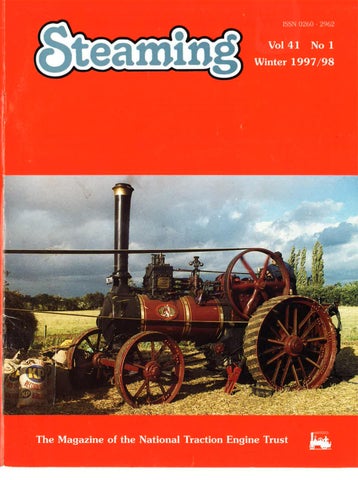
Front cover Threatening skies are near at the Gainsborough & District Heritage Association's event at Morton, Lincolnshire in September 1997. The event, to celebrate the Golden Jubilee of the Field Marshall series 2 tractor, understandably featured other Marshall products and Peter Love's timely exposure shows a Gainsborough machine from earlier times — 6hp traction engine 23803 of 1894, creating a superb cameo of a threshing scene of yesteryear. 3
Trust News Engine Owners Column Engine Owners sub-Committee We are organising another Engine Owners Meeting, which will be our third in this new series, and if it is as constructive as the last two, it will be well worthwhile. The date is the 14th March 1998 at the Forte Posthouse, Rugby (see the Future Events column for further details). The question of driver competence will be on the aaenda aaain. spurred on this time by the knowledge that the Rally Organisers, at their Conference, asked for a scheme that provided some proof of driver competence to he in operation within ten years. We on the sub-Committee will have some proposals on the wisdom or otherwise of such a move, and the practicalities of organising it all, so please come to
4
the meeting in March and air your views. There will be another Driving Course on 9th and 10th May 1998, this time at the premises of our Chairman, Richard Sandercock at Lifton in Devon. This may seem a long way to travel, but Dingles Steam Museum has available all the facilities that we need, including several engines and masses
of space — something which we lacked at the last Driving Course! There is no doubt that there is no substitute for plenty of room when someone is on the regulator for the first time, especially as not all regulators open the same way! I can see our Driving Course becoming a much more important part of our activities in future, so any help that
From Alan Martin's Collection
79
This picture shows Burrell 8hp traction engine MOUNTAIN KING. The single cylinder machine was built in 1893, numbered 1728, and was owned at the time this picture was taken by W. Townsend & Sons of Sollershope, Herefordshire. The Burrell is running a fairly large sawbench, but not a rack bench, for the timber has been split by wedges before being lifted by chain and pulley blocks under the tripod.
Winter 1997/98
STEAMING
members can give with organisational support for the venture will be most welcome — do please contact me if you are able to assist. Another concern is the question of boiler inspection services. The large companies, or some of them, have made it quite clear that they do not want road engine business, which begs the question — where will the training be done for our future inspectors? This is not an immediate problem, but one which needs some thought and discussion. More about this in a future issue. I hope to see as many of you as possible in 1998. In the meantime I hope it is not too late to wish you all a happy new year. (Richard Pierce, Chairman, Engine Owners subCommittee)
Insurance Officers notes Exhibition Organisers Scheme Update In my notes in the Autumn magazine I mentioned the new Footman James Exhibition Organisers Scheme and intended that I would be circulating further details in this Steaming and to Rally Organisers who attend the Autumn Conference held at Rugby. However, due to pressure of work and because of the level of detail involved, I have been unable to create a simplified version of the policy for inclusion in this issue, but I will be making the announcement in the Rally Organisers Conference Newsletter and in the Spring Steaming. Following the poor weather this summer the insurers have already met a small number of claims from organisers who took advantage of the policy. I gather from those I have spoken to that they were very pleased with the way in which their claims were dealt with, and subsequently met. Steam Policy and Low Loader Scheme Following on from discussions held with members during the recent AGM at Ellesmere Port, Peter James of Footman James Ltd has been looking into the provision of breakdown recovery for traction engines and low loaders. He tells me that this type of cover may prove to be quite difficult and ultimately expensive to set up because of the size and nature of the STEAMING
Winter 1997/98
vehicles affected, but mainly because it is cover for a hobby and not a business. However, he continues to negotiate with the many brokers who provide Footman James with specialist service. As soon as I get to know anything, one way or the other, I will inform you all. Incidentally, recovery following an accident, where required (but not from mechanical breakdown), is included in the existing policies. Engines changing hands Following my notes on this topic in the last edition of Steaming, I have had a number of requests asking for further clarification. Well ... here goes. If you are planning to buy a steamable engine at auction, at a rally or from Fred in the next village and you intend to drive it immediately the deal is done, it is important that you make proper arrangements covering the insurance of your new charge. I give below some of the issues that need to be examined and some advice on securing proper insurance: • The simplest form of arrangement would seem to be that you ask the previous owner to allow you to drive the engine home or onto the lowloader under his own insurance and then to pay him for the engine when you have got home. At first sight this appears to be OK and all you have to do is prove to the 'owner' that you are competent and licensed to drive, etc. • However, any insurance cover is affected by what are known as the 'material facts', i.e. those things which affect the ability of the underwriter to cover the risk, and the material facts in this case have changed in that you, the driver, have given an undertaking, by a shake of hands or payment of a deposit, to become the new owner of the engine. But the underwriter has not had the opportunity to see your insurance proposal form and therefore cannot assess the new material facts. If an incident were to occur with the engine under its new ownership, and before proper insurance had been effected, the third party elements of any claim would be met by the previous owner's insurer, but it is very likely that the old owner of the engine would face meeting any costs relating to repair or recovery of the vehicle. Now, would you let someone drive your old engine knowing these facts? • It is better to arrange proper insurance which specifically covers the new owner and where the
Officers and Committee 1998 This column lists, for the information of members, the Officers and Committee of the Trust for 1998. The addresses/ phone numbers of those with special duties are given inside the front cover of each issue of this magazine; others may be contacted by phone or via the General Secretary or sub-Committee Chairmen. Names marked with an asterisk" are appointments by the Committee and are non-voting positions in Committee. President E.A. Fillmore Vice Presidents Sylvia Dudley R.N, Parrott Chairman R.J. Sandercock Vice Chairmen R.T. Herring A.J. Semple (Rally Organisers chairman)
General Secretary Mrs Susan Jackson" Treasurer J.T,G. Harris * Hon Solicitor T. Driver" Hon Safety Adviser J.M. Newnham* Membership Secretary J.R. Cook Hon Editor, Steaming R.E. West Hon Sales Officers Colin and Val Brown" Press Liaison Russell Bulley Committee The above and also:
I. Barraclough (S. Yorks, Tr 01709 850346)
J.R. Bosworth (Derbys, Tr 01332 880405)
N. Boyes (W. Yorks, 27r 01253 811876) R. Bulley (Northants) M.O. Davies (Warks, IT 01295 770217) J. Durling (SAC Chairman) W. Evans (N. Wales Tr 01978 780749) T. Holt (Cumbria, Tr) 01524 271584) B. James (Norfolk, Tr 01328 701417) M. Mason (Cambs) S.J. Parrott (Bucks, Tr 01844 201282) R.J. Pierce (Engine Owners chairman) D.S. Smith (Insurance Officer) J.R. Smith (Rally Authorisation) R. Vickery (Devon, 2:r 01684 569292) M. Ward (FBHVC and Notts, a' 01623 882856) Representatives R. Mattless (NV Tractor & EC)* Auditors (and registered office) Menzies, Barley House, 57 Church Street, Staines, Middlesex TW18 4XS
5
Sub-Committees 1998 This column lists the members of the Trust's sub Committees for 1998. Names marked with an asterisk* are co-opted; others are elected Committee members or appointed Trust officials. Addresses/phone numbers of the chairman appear inside the front cover of each issue.
Rally sub Committee A.J. Semple (chairman) R. Bulley .1 R Cnnk P. Cooper" T. Evans R.T. Herring B. James
J.R. Smith K. Stott* Engine Owners sub Committee R.J. Pierce (chairman) R. Back" I.K. Barraclough M.U. Davies Sylvia Dudley J.M. Newnham" R. Pierce R.J. Sendercock D.S. Smith R.M. Vickery M. Ward Technical Board J.M. Newnham (chairman) H. Pounder" R. Swithinbank* G. Tennet*
material facts are properly described by the new owner, ie condition, use, known drivers, place of storage etc. Footman James advise me that they will accept a proposal form which will cover the intended purchase of a 'live' engine, at a rally or at an auction (as long as the seller holds a current and valid boiler inspection certificate for the engine), even if the sale subsequently falls through. Now to me this must be the best way forward — and just for the cost of a stamp or a phone call to Footman James. (Dave Smith, Insurance Officer)
FBHVC News Federation AGM The Federation Annual General Meeting was again held at the RollsRoyce Enthusiasts Club at Paulerspury, Northamptonshire. The triannual elections took place for the Committee and we are pleased to 6
report that we were both elected, Michael after a period during which he had been a co-opted member, following the resignation of John Crawley. We each bring different expertise to the Committee and together feel that we represent the interests of the steam fraternity very well. We shall be diligent in continuing to look after your interests and hope to preserve the rights and privileges that are currently enjoyed in using steam engines on the public highway. Survey of the Movement Many members completed the FBHVC questionnaire which was circulated in Steaming (and in many other club magazines) last year, for which we thank you. The results in the Report just published are extremely interesting and clearly show our hobby to be a very large and vibrant industry. The key findings of the Report are: • The historic vehicles movement generates more than £1.6 billion in gross annual turnover, of which over £300 million is in exports. • In excess of 25,000 people earn their living providing services and products for historic vehicle owners and those interested in historic vehicles. • Over 650,000 vehicles made before 1977 are still in existence. • Annual mileage by historic vehicles is low. Three in every five of these travel under 3,000 miles each year, and half that number less than 1,500 each year. • Over 64% of vehicles owned by club members are roadworthy and licensed. The combined monthly readership figures for four top historic vehicle magazines is 2.6 million, of which one in five are women. • Libraries and archives in the UK were visited over 270,000 times by historic vehicle club members seeking information on their interest last year. • Museums in Britain with a classic vehicle collection had some 300,000 visits last yeas hum club members. Visitors from overseas made up 15% of all visits to museums. • Over 33,000 members of clubs drive a modern vehicle that is of the same marque as an historic vehicle that they own. Copies of the report are available, £5 each, from the FBI IVC, PO Box 2506, Henfield, West Sussex BN5 9QW.
Statutory Off-road Notification (SORN) SORN will be introduced with effect from 31st January 1998. The scheme is put into perspective in the letter from Bob Oliver, Head of Driver and Vehicle Policy Group at the DVLA, which has been circulated to preservation magazines and is included here. Bob Oliver, Head of Driver and Vehicle Policy Group, DVLA Swansea writes: 'Talking to people at the
International Classic Car Show at Birmingham NEC a couple of weeks ago, I found many of them were concerned about the forthcoming change in the law which will introduce statutory off-road notification (SORN). I would be grateful for the opportunity, through your pages, to reassure your readers. 'Contrary to some of the rumours circulating at the NEC, SORN is not bad news for the classic vehicle owner. Off-road vehicles, in which I include restored, partially restored and boxes of bits, do not need to be notified. SORN declarations will only need to be made on vehicles where a licence is in force on or after 31st January 1998 if they are subsequently taken off the road unlicensed. 'DVLA will shortly be sending information to the clubs on our V765 register explaining how SORN will affect the classic vehicle owner. Meanwhile, I have outlined the main points below: • Anyone who lets a vehicle licence lapse or sends one in for a refund after 1st February 1998 will be required to make a SORN declaration. This can be done using the vehicle licence renewal reminder (form V11, or V85/1 for heavy goods vehicles) or refund application (form V14) — notes on the form will explain what to do. • SORN declarations will need to be made every twelve months if the vehicle is to be kept off the road. DVLA will send a reminder each year. When the vehicle is to be brought back un to the road, It can be licensed at the post office in the usual way. • Anyone who buys a vehicle, complete or in parts, on which a SORN declaration has been made by the previous keeper should make a SORN declaration on a new form (V890) which will be available from the DVLA Customer Enquiry Unit on It 01792 772134, or from your nearest vehicle registration office. • There will be no charge for SORN declarations, or for bringing vehicles back on the road. Winter 1997/98
STEAMING
Burrell showman 2625 LADY, PRIDE OF ENGLAND was completed in February 1904, painted up in a green lined livery and sent out to W. Buckland of Coventry. It ended its showland days with G. Billings of Leicester. Photographed here by Eric Sawford at the 1996 Parham event, the machine is in the final stages of restoration.
'I hope your readers will see from this that SORN is not going to burden them, or any other honest enthusiasts; it is merely the latest development in the fight against vehicle tax dodgers, who are responsible for evading some £172 million each year, and whose activities are currently subsidised by honest motorists. 'Finally, a reminder of the facility we offer the classic vehicle owner to reclaim the original registration mark of a vehicle if sufficient documentary evidence linking the two can be provided. This procedure, known as the V765 Scheme, is run in association with the enthusiasts' clubs on our list, who consider individual applications and, based on the evidence available, advise us on whether the mark should be reassigned. Since the Scheme's inception in 1990, over 15,000 vehicles have been reunited with their original registration marks. Further details can be obtained from DVLA's Customer Enquiry Unit I v 01792 772134) or local vehicle registration STEAMING
Winter 1997/98
offices.' Mention at the end of Bob's letter of the V765 Scheme prompts us to remind you that for road steam enquiries should be engines, addressed to Peter Smart, v 01420 472018. (Michael Ward and Peter Smart, steam representatives at FBHVC)
Steam Apprentice Club Although this is the quiet season as far as events go, the Steam Apprentice Club has not been idle. We have arrangedthe following trips for the Apprentices. They are taking place far and wide so that as many lads and lasses land their families) may be able to benefit.
On Saturday, 28th March 1998 there are two separate visits being held — to the Museum of Lincolnshire Life in Lincoln, which will be co-ordinated by myself, and also to see the collection of Kelston Sparkes and family at Stanton Drew, near Bristol, this one led by Barry Sumsion. Then on the Sunday, 29th March we have kindly been invited to join with the Fair Organ Preservation Society at the premises of Frank Lythgoe at Warburton, near Lymm in Cheshire. Frank will have some engines in steam as well as various organs in play. Another opportunity comes on Sunday, 19th April, when we have arranged a visit to the Hollycombe Steam Collection at Liphook in Hampshire, which will be led by our southern representative, Stuart Gaines. Finally, we are in the process of setting up a trip to the Burrell Museum at Thetford in Norfolk, but details are not yet finalised. If one of your offspring is a member of the SAC, please encourage him or her (or them) to take advantage of one or more of these offers. The facilities are generously given and have taken quite a while to organise, but they can only continue with support. The visits have been designed for 7
lot
National Traction Engine Trust
Appointment of
congratulations to Neil, an avid reader and regular contributor to the section's magazine Raising Steam. (John Durling, Chairman, Steam Apprentice Club)
Treasurer The Trust's present Treasurer has given notice of retiring due to the loss of a particular member of his staff Applications are therefore invited from suitably qualified persons to serve in this essential position within the Trust. The selected candidate will have the necessary accounting skills to • Maintain the accounting records of the Trust and its dormant subsidary. • Provide to the Trust's National and Executive committees reports on the Trust and trading company's financial position. • Liaise with the auditors in preparation of the annual accounts. • Monitor the Trust and trading company cash positions to ensure funds and are available to meet liabilities as they fall due. A job specification giving full details of this very important position, which carries an honorarium, is available and persons wishing to have a copy (they do not presently have to be a member) should apply to
We subscribed to a press cutting service last year in an attempt to gauge the extent of public perception of our hnhhy via the lnr•.al press, and to judge if rally organisers generally can gain publicity for their events through knowledge of how others do it. Displays of the cuttings were set up for viewing at both the GDSF and the AGM. I shall be making an analysis of the material gathered together which will hopefully be of use to event organisers. The rlistrihutinn of 1.997 Rally List benefited from the use of a commercial service which targeted offices, information to tourist compliment those distributed direct to Trust members and those put out from the Exhibition Unit. As a result it was necessary to have a total of 40,000 Lists printed, and as an example, 12,500 of these went to tourist information centres. (Russell Bulley,
The General Secretary, Sue Jackson, 153 Micklefield Road, High Wycombe, Buckinghamshire HP13 7HA
Trust Trophies
Closing date for applications with curriculum vitae is 14th February 1998
other members of the family to join in and we look forward to seeing as many of you as possible. If you can contact us before the trip date, it would assist us with our task, bit if you can't decide until the last minute — just come! Please contact me (at the address inside the front cover) in the first instance. We are fortunate to have received so many invitations from such varied sources, and always welcome further offers and ideas which we could follow up ourselves. At the Trust AGM in November, the Jack Beeby Cup. presented to a Steam Apprentice, was awarded to Neil Cobb of Wimborne, Dorset. Our 8
Press Liaison
Press Liaison)
As usual a selection of the Trust's collection of trophies was presented at the AGM, held at Ellesmere Port last November. It has become tradition to choose the recipients from members living fairly locally to the venue for each years AGM, and our 1997 winners were, accordingly, largely from the north western area. The J.T. BEEBY CUP for Steam Apprentices was awarded to Neil Cobb from Wimborne, Dorset. He learned in a short time to be a competent, efficient and useful engine crew member, and a humorous, if lengthy, contributor to Raising Steam. The DACRE LACY CUP — presented to Will Dakin from Sandbach for his work in the restoration of engines, and in particular the Davey Paxman traction LITTLE AUDREY, which he and his crew generously brought along to the Boat Museum for our inspection on the meeting day. The ARTHUR NAPPER CUP was presented to George Coles of
Stretford, Manchester, in recognition of 30 years of steaming to rallies all over the north west with his Clayton & Shuttleworth agricultural engine. The JOHN CRAWLEY BOWL was given to Frank Harden of Holmes Chapel for his devoted involvement in the traction engine rally movement in the north west and particularly for his water supply services on many rally fields. The ERIC MIDDLETON TROPHY was awarded to Richard Marsh from Romiley for his twelve year restoration and impressive devotion to the originality of Burrell showmans engine LORD LASCELLES. The GOLDEN FILM AWARD is awarded as the premier club trophy for outstanding work in the field of traction engine preservation. For his considerable efforts in rallying both engines and fair organs near to and far from Warburton Park, the award went to Frank Lythgoe. The PERCY HIRONS BOWL was chosen for presentation to Bill Briggs of Mobberley for his long dedication to the field of engine preservation. The CHOISY & SIMPSON CUP was given to Herman White for his work and dedication with his Wallis & Steevens agricultural, with which he gained the second place in the awards at the Trust's Road Run last year. The CURTIS BOWL was awarded to Brian Allison of Bettisfield for taking his Aveling tractor OBERON on long road journeys to take part in events, averaging some 900 miles a year. The JACK HOLLOWAY BOWL for portables was presented to Neil Williams. The list of award winners was drawn up by Robert Herring and Andrew Semple, with help gratefully received from a local source, and the presentations were made by the Trust Chairman's wife, Anthea Sandercock.
Obituaries Walter Fearnley The news of Walter Fearnley's passing, at the age of 88, was received as last year's Harewood Rally was coming to a close on the August holiday Monday. Walter learned his trade in a manner which has now become extinct, being born into a family that owned and ran engines for their living. His father was the first owner of an engine in Castleford, Yorkshire. Following his early years with steam Walter drove Winter 1997/98 STEAMING
Priestman excavators and travelled to work around the country by motorcycle, often accompanied by his late wife Lynda. For many years he held the record for excavating the highest tonnage in a day. He later worked as an engineer at a local chemical plant. After his retirement, however, he never really stopped working, always being ready to sort out a mechanical problem. When the preservation movement started Walter, together with his brother Arthur and nephews Lister, Ronnie and Maurice, and young Ian, were some of the earliest on the scene. A browse through early programmes will reveal that many rallies were not complete without entries from the Fearnleys who travelled many miles by road to attend. Walter owned Foden C type wagon 13120. He then rebuilt Yorkshire wagon 2108, and he also owned Yorkshire 2118. He had a good eye, and presented his engines immaculately, but true to style and workmanlike. Walter was always ready for action in a clean bib and brace, jacket and oily cap, willing and eager to help engine owners with practical advice, using his knowledge and skill even if the engines were not made in Leeds. I know that many engine owners will join me in acknowledging his very professional help and above all, his friendship. He always maintained that a spanner or, if required, a hammer, was an extension to his arm. You always knew if Walter had tightened a nut and he knew just where to strike a blow. He was tough and I will always remember being at the smokebox end STEAMING
Winter 1997/98
of the boiler when retubing my Burrell, and there learning more Yorkshire expressions coming up through the tubes than I have ever heard in my life, including a few about the failings of Charlie Burrell, who Walter considered to be drunk when designing his engines. To be on the road with Walter was an experience; he respected engines, but he knew how to get the best out of them. Often known as 'Uncle Walt' he will be missed — he was one of the great men in an era which is sadly coming to an end. His willingness to pass on his knowledge will ensure that his name will live on for many generations. He was a founder member of Leeds & District Traction Engine Club. Walter's death was received with great sadness by all who knew him and this was reflected by his family and the many engine men who filled to overflowing the crematorium at Castleford. Our sympathy goes to his two sons Roy and Trevor, daughter Dorothy and all of the Fearnley family. (Tony Hunt)
Harry Palmer Henry Ashby Palmer, always affectionately known as Harry, passed away suddenly on 4th December 1997, aged 76. He collapsed at Nottingham City Hospital, whilst taking his wife for an out-patient appointment. Doctors' attempts to revive him were unsuccessful. Born at Papplewick, Nottinghamshire, Harry was the son of the blacksmith and spent the whole of his life in the village. After attending Linby village school he went on to Henry Melish Grammar School and then to work at Ericssons at Beeston, initially in the drawing office and later in the
tool room. Harry was a skilled machinist and made all the replacement parts for his engines. He married Edith, a blacksmith's daughter, and ran his garage business at Papplewick Crossroads. Harry was introduced to steam engines in 1963 by the late Jesse Swingler, a Ruston enthusiast. So it was that he was later to own three Ruston Proctor engines — a roller, a portable and a traction engine. After his retirement in 1978 he attended rallies with the portable and later the roller, and generally enjoyed the pleasures of retirement. He owned the traction engine for 26 years and during the last fourteen, with help from son David, had spent over seven thousand hours on its restoration. Its first appearance was at the Elvaston Castle rally in July 1997 and it then attended several more events during the summer, bringing the season to a close at the Bicker threshing party, where Harry was invited to drive the threshing drum and baler. The Ruston performed to perfection with Harry admiring fourteen years of dedication with pride and satisfaction. For many years a member of the National Traction Engine Trust, he unfortunately never achieved his ambition to have all three engines on the rally field at the same time. Of the three engines, I feel his favourite was the portable, and indeed his next project was to have been the fitting of a new firebox. My wife Olive and I will fondly remember the holidays we shared with Harry and Edith. A favourite remark of Harry's was "Ey up, look at that chimney! ... I wonder what's in the shed at bottom?" You can guess what happened next. Harry will be sadly missed by all his friends and associates in the preserved steam
The National Traction Engine Trust Engine Owners sub-Committee present the 1998
PRACTICAL ENGINE DRIVING COURSE to be held at
Dingles Steam Village Milford, near Lifton, Devon on the 9th and 10th May 1998 For further information esnd SAE to: Richard Vickery, The Orchard, Loxbeare, TIVERTON, Devon EX16 9RH.
9
West Country war effort A fine scene on a picture postcard in our Chairman's collection of engine pictures. The subject and the location and exact occasion — it may have been in the Truro area — are rather vague, but the card could have come to be in Richard's family via Jan Davey, who can be seen, dressed in military uniform, the centre of the three figures by the rear wheel of the engine. Davey, one of fourteen children, came to be foreman of Dingles roller drivers, working out of the firm's Stokeclimsland yard on the Devon/Cornwall borders. Richard Dingle's_sons, Edmund John and George, had none of their own to carry on the family contracting business and it was their sister's son, our Chairman's father, who brought the firm into more recent times and provided such a fruitful source of rollers and engines for preservation. But what of the one in our picture? It shows a Fowler compound road engine engaged on military work during World War 1. The front water tanks have OHMS painted on them, indicating the machine, and probably its crew, have been commandeered for hay baling and haulage, all to feed the huge number of Army horses engaged in the war effort in France and at home. The canopy sides of the engine ironically read WARE'S GALLOPING HORSES. Road Locomotive Society records show that R. Ware of St Blazey, Cornwall owned two Fowlers fitted up as showmans engines — B5 class 8919 of 1902, named KING EDWARD, and 9385, an R1 class of 1907 and acquired by him in 1913 from a Cornish tin mine. The photograph shows the machine to be named PROGRESS, and it may be the second of the two detailed above, though that name is not down in RLS lists. Can any member comment? Note that for the purpose of the photograph the Fowler is backed up to the rear of the two hay-laden wagons. A goodly crowd of local urchins is hiding the front wheels of the seuund wagon.
movement, and especially by his family and loved ones. Our condolences go to Edith, David, Jean and Clive, two granddaughters and one groat granddaughter. There will be no more "Ey up Harry — how are yer?" "Nay sa bad, nay sa bad!" was always his reply. (john and Olive Bosworth)
10
encased in plaster, he now faces a lengthy and awkward period of not being able to get on with things — so Len, we all hope things go well after your operation in January, and you'll be out amongst your engines and friends before the start of the season.
Small Adverts Will members submitting Small Adverts for inclusion in Steaming please note that in future the request and the text of the advertisement should be sent on a separate sheet of paper to any other subject they might also he writing on, such as pieces for the Letters pages, or comments on pictures etc. This new practice should avoid the risk of items being 'lost' in the wrong pile of papers! (Roger West, Editor)
Personal
NTET Web-site
Len Crane
The NTET's web-site continues to attract visitors (hits) from around the world and I am pleased to report that we have struck up some very interesting conversations via E-mail. From time to time we receive queries about engine management, design, the Apprentice Club or rallies, and
We are sure all members will want to offer good wishes to Len Crane of Wolverhampton, who in November suffered the misfortune of a very nasty knee injury. Following a time in hospital, and with a leg completely
Winter 1997/98 STEAMING
these are all passed on to the relevant sections within the NTET. It is intended to use this facility to report any breaking news as it affects the steam preservation movement but it is not the intention to reproduce or duplicate items from Steaming on the web-site. You can, however, make submissions to Steaming via E-mail, or write to any member of the Executive or National Committee. Our address is ntetuk@aol.com. And as a reminder—our web-site address (URL) is http://members.aol.com/ntetuk/ (David Smith)
NEC Retro Exhibition I am pleased to report that the expenses incurred during this event have now been paid to the NTET, and disbursed to those taking part. Thank you all for your help and patience. (Dave Smith)
TUESDAY, 13th JANUARY — Richard Fillmore will be screening colour slides taken at early traction engine rallies. Some of them need identification, so come along and help solve some of the mysteries. TUESDAY, 10th FEBRUARY — 'A Steamer on the River Lea', a talk by Richard Thomas. TUESDAY, 10th MARCH — A demonstration by the makers of Bondzone, a plastic metal that can be machined and tapped. The material is used in the railway industry. TUESDAY, 14th APRIL — Stan Hinbest will give us a most interesting evening, not to be missed, on 'The Coming of the Diesel to Stratford Loco Sheds, London'. Another series of meetings is likely to be held during the autumn and on into 1999, and details will appear in due course. (Bill Timmings, London meetings organiser)
Future Dates London Area Social Meetings These will continue to be held on the second Tuesday of each month, starting at 8.00pm, with the room available from 7.30. As usual, nonmembers are very welcome. The venue is 'The Duke of York', 35 New Cavendish Street, London W1 —about 500 yards north of Bond Street tube station on the corner of Westmoreland Street. For the rest of the 1997/98 programme, the following entertainment has been arranged:
Now complete ... The Trust's
CODE OF PRACTICE for Traction Engines and similar vehicles Price £25.00 each including postage (cheques payable to National Traction Engine Trust) please quote your NTET membership number from — Mrs Sylvia Dudley, 12 Hillway, Woburn Sands, Milton Keynes, Buckinghamshire MK17 8UL
Safety Seminar For some years now the Trust has been arranging Safety Seminars for the important positions of rally safety officers and others running traction engine rallies. The next Seminar in the bi-annual series will be held on Saturday, 7th March 1998 at Forte Posthouse Rugby. New legislation continues to affect the successful running of events, and the meeting will have the benefit of well qualified speakers, Tim Holt and Mike Garstang. Topics to be covered include movement of vehicles, the number of people on footplates and tractors, and food stalls. Invitations have been sent out to rally organisers and those who have attended in previous years, but anyone who is interested can attend — please contact John Cook (address on the title page of this issue) for further details. Engine Owners Meeting Another Engine Owners Meeting has been arranged during the month of March. The previous two in this new series, last year and 1996, were extremely well attended and provided an excellent opportunity for opinions to be voiced and contentious issues to be debated in a friendly atmosphere. The central location of the venue, near the midlands intersections of our motorway and trunk road system, enabled members and friends to
attend from all areas of the country and it is hoped that this year an equally enthusiastic gathering of owners and crews will make the effort to be there. The meeting has been arranged for 10.30am for an 11.00 start on Saturday, 14th March. There is a very slight geographical relocation of the meeting place this year — to the Forte Posthouse Rugby, which is adjacent to Junction 18 on the M1. Leave the motorway at that junction and travel east on the A428, signposted Crick: the Posthouse is set back from the north side of the road, only 150 yards or so from Junction 18. There is no need for a location diagram in this notice — reference to the road map in your car and the above note should be enough. We are inviting all engine owners and crews, whether presently Trust members or not, so do come along with both your problems and advice and join in a mutually beneficial session of debate and reasoning. The Posthouse has all the usual amenities, and lunch will be available during the midday break in the Meeting. However, it is essential that you order and pay for it at the reception as soon as you arrive. (Sue Jackson, General Secretary, itz 01494 521727) Spring Conference for Rally Organisers and Affiliated Clubs The annual Spring Conference for Rally Organisers and Affiliated Clubs will take place on Saturday, 21st March, at 11.00am. As with the Engine Owners Meeting the previous week there is a slight change from last year in the geographical location of the meeting place to the Forte Posthouse Rugby, which is next to Junction 18 of the Ml. Invitations and formal notices will be sent out as usual, but newcomers are always welcome to the gatherings, and anyone who feels they could benefit from attending should contact the General Secretary for details. Please refer to the Engine Owners Meeting notes immediately above for how to get to the Posthouse at Junction 18 — it is not very far from last year's venue, but you will need to leave the motorways, etc at different points. Coffee and tea will be served prior to the meeting from 10.30am; a buffet lunch (cost £10.00 per head) will be available during the midday break, but prior booking is essential. It is envisaged the Conference will conclude about 3.30pm. It should be possible to arrange transport to the Posthouse for anyone travelling by train to Rugby; please contact the 11
General Secretary for such assistance, lunch bookings and further details. (Sue Jackson, General Secretary, 1.1. n1494 R157 7 7). OUR MAGAZINE 25 YEARS AGO Engine Driving Course The 1998 Engine Driving Course is to be held on 9th and 10th May. There is another change of venue, and for details please see the display advertisement elsewhere in Trust News and the paragraph in the Engine Owners Column — although we hasten to add that you do not have to be an owner to join the course. One of the reasons the Trust puts on the Course is to encourage aspiring enginemen to become acquainted with steam road engines in a suitably controlled and educational manner.
New Members A sincere welcome is extended to the following new members who have joined the Trust during the last three months. We hope they will gain much friendship, information and enjoyment from their membership over a period of many years, Tho Membership Secretary is always pleased to put members in touch with one another by fowarding mail.
M. Brain, Cinderford, Gloucestershire M. Juusten, 5712 BJ Someren-find, Netherlands D.W. Stewart-Paver, West Wickham, Kent \At Teetz, 17617 Korkcn, Ce really G. Thomas, Glasgow J. Hardman, Great Falls, USA P.D. Coggins, Birtley, Durham D.J. Greenshields, Wellington, Somerset S.A. Smith, Nelson, Lancashire D. Sixamith, Carlow, Eire D.E. Young, Welwyn Garden City, Hertfordshire Mrs M. Fyte, Liphook, Hampshire R.A. Mullins, St Mary Bourne, Hampshire M. Graham, Alton, Hampshire T.N. Watson, Antrim, Northern Ireland
G.H. Turner, St Mary Cray. Kent P. Drillkens, D-53773 Hennef, Germany S. Barraclough. Wymondham, Norfolk Mrs J, M. Withers, Reading. Berkshire N.J. Fraser, Haywards Heath. West
Volume 16 of the Club's magazine appeared in December 1972. A photograph competition had brought in 150 prints from 27 cameramen. A. Swain received first prize and Peter Ware second. Rally reports were, in those days, published separately from the area notes on happenings to engines etc, and often included a full list of engines attending. Seventeen rallies sent in reports and a fair few of them still feature in our calendar today, such as Redruth, Market Bosworth, Astle Park, Banbury, Rempstone, Fairford and Harewood, even if some are under different management or on a some-
D,J. Webb, Hemel Hempstead, Hertfordshire .i.r. Smith, Spalding, Lincolnshire P.A. Crick, Oakham, Leicestershire P.C. Stinton, Newport, Isle of Wight Helge Simonsen. Langesknv. nenmark, P. Lancelot, Outten Broad, Suffolk J.A. Potter, Woodbridge, Suffolk B.T. Cockayne, Newton, Derbyshire G.J. Atkinson, Scarhoroueh, North
'One hears ... That it is a sign of good tact to remember the two 'g's' when writing of Sentinel waggons.' (from the gossip column of The Commercial Motor, 17th October 1918. The magazine, however, invariably used a single g!)
S.W. Wallington, Aylesbury, Buckinghamshire W.A. Demon, Aoingdon, Uxtordshire A. Barr. Chesham, Buckinghamshire Mrc N. Newham. flhonikla Heillage Park J.E. Bingham, Grenoside, South Yorkshire H.F. Malpass, Maidenhead, Berkshire
'A mishap befell Mr A.S. Elworthy's trar•.tinn train yesterday afternoon. The engine was bringing a couple of trucks of wool into Timaru from Holme station, and on the hill near Mr Palmer Chapman's property, the covers piled on the front truck were seen to be on fire, ignited, it is naturally supposed, by a spark from the engine. The covers were well ablaze when the fire was discovered, and the engine staff displayed a good deal of energy, coolness and smartness in reducing the damage as much as possible. They threw off the burning covers, and drew water from the boiler to extinguish the fire in the bales, two or three of which were well ignited. The covers made too much of a fire to put out with water from that source, and they were left burning in charge of a man to see that no mischief arose from them. One or two bales of wool were considerably damaged, and a few others only slightly.' (from I he Timaru Herald, 15th November 1910, per the Newsletter of the South Canterbury club, New Zealand.)
Yorkshire
S. Brackstone, Dorchester, Dorset
P. Minott, Sheffield, South Yorkshire R.M. Walker, Kenilworth, Warwickshire A. Masey, Sevenoaks, Kent R.K. Miles, Edenbridge, Kent C.M. Keld, Matlock, Derbyshire J.K. Smith, Swadlincote, Derbyshire P.C. Troman, Derby D.M. Truman, West Byfleet, Surrey A. Griggs, Rushden, Northamptonshire J.S. Foulkes, Denbigh B. Hagan, Witham, Essex Mrs B. Smith, Salisbury, Wiltshire N. Calvert, Horsforth, Yorkshire J.E. Aveling Jomaron, London
Sussex S.A. Annis, Burgess Hill, West Sussex C. Finch, Redbourn, Hertfordshire Then Scheres, Wegberg, Germany R.K. Alder, Maidenhead, Berkshire M.A. Hulme, Uttoxeter, Staffordshire P. Taaffe, Fordstown, Co Meath, Eire
Poor Steaming
Mrs S.J. Black, Cheltenham, Gloucestershire B.R. Brown, Reading, Berkshire Mrs J. Burton, Bury St Edmunds, Suffolk
The works number of the Garrett 4CD shuwmans tractor now resident in Australia was incorrectly shown in the last issue (page 216); it is, in fact, 27342.
W.G. Kiddell, Woking, Surrey R.E. Knapman, Exeter, Devon
what different site. British engines had started to journey to Holland for rallying; the Goolds with their Sentinel and the Antells had taken their Fowler agricultural. Mike Jones reported his discovery in North Wales of the chassis and wheels of a Yorkshire 2 ton steam wagon, which had then been acquired for restoration by Tom Varley. In the same area the Lloyd Jones brothers had again used their Sentinel tarsprayer 8122 on contract work during the summer. The magazine arrived with members before Christmas, and the season could be marked by five pages of reading in a lighter vein, with contributions from the redoubtable George Eves and the effervescent Chris Edmonds. Editor Ran Hawthorne reviewed a large number of books etc (but no videos!) suitable for presents, and the club was noted as having sold all of the 3,000 Christmas cards that had been printed and offered to members at 20 for £1.
TRACTION ENGINE INSURANCE ••••-•••
Write, Phone or Fax; Jayne Jordan, Matt Potter or Trevor Keefe for a Quotation from the N.T.E.T. appointed Insurance Broker.
FOOTMAN JAMES
1215614196 -‘Tel.00121 559 0814 Fax. WATERFALL LANE CRADLEY HEATH (4 WEST MIDLANDS B64 6PU
THE MARKET LEADER
Authentic Conversions 1. A Baltic Changeling Roger West It is, of course, a familiar fact of road steam engine history that engines were altered during the course of their working lives to suit the requirements of their purchasers or owners. Tractors and road locomotives became showmans engines, and convertibles came to stay permanently as rollers, but portables invariably completed their lives just as their designers and builders intended. It was interesting therefore, on a recent visit to the Baltic country of Estonia, to be able to see a Garrett portable that had been reformed into a light traction engine — an enterprising undertaking probably carried out when it was new by an overseas agent of the Leistuo firm. The amount of business done by British engine builders in South America was touched upon in an article in the last issue of Steaming. Sales to the areas we have known until fairly recent years as Eastern Europe and USSR were certainly no
less extensive or lucrative, though the circumstances of World War 1 and the Russian Revolution generally put an end to the trade. Some of Garrett's share of that business was handled by their agent in Riga, Latvia. (The Baltic country was at that time a self governing province of Russia). Until 1898 the Leiston concern had their own warehouse in the city, but it was then transferred to a local company and later, in December 1900, to Ed Zehder. A remarkably high number of Garrett engines were taken by Zehder — and by importing quantities of the 4 and 5hp export design from about 1910, he accounted for 10% of Garrett's production of traction engines! It is an interesting story and is well worth following in Bob Whitehead's latest book on the Leiston marque Garrett Traction and Ploughing Engines. Zehder had in earlier years purchased many 4 and 5hp portables and threshers, and also some 6hp examples. It is a engine of the latter size, altered to a self mover, that can now be found at Palmse Manor in the Lahemaa National Park on the north
coast of Estonia. The machine can be identified as one sold to Zehder by the third bearing in the centre of the crankshaft, something the agent specified in all his portables. The engine, however, is a sad little survivor, for it is now badly damaged. Lahemaa is a fine national park, with a graceful and carefully restored manor house and accompanying buildings, lakes and orchards. The surrounding forest and nearby coastline feature an excellent variety of plant and wildlife. The Garrett engine was acquired from the south of Estonia nearly ten years ago to enhance the attraction of the farmstead at Palmse, hopefully as an eventual working exhibit. But disaster occurred on delivery when, whilst being unloaded, the machine was dropped to the ground from a height of over two metres — gross carelessness by a foolish transport operator. Both rear and front axles were broken; the flywheel was smashed to pieces and many other parts and fittings were crushed and twisted out of position The engine has laid in the same spot since the fall, a bitter disappointment to the Museum's enthusiastic curator Anne Kurepali. Even though left in the open after the fall, the machine's present condition suggests that it had been kept under cover until it had been acquired for 'preservation'. Close scrutiny of the Garrett fails to reveal any stamped or cast serial numbers that might have enabled Leiston Works expert Bob Whitehead to identify it more precisely. The engine is likely to have boon sent out to Riga in the early years of the century (Zehder's transactions were haltpri in 1(114 by Wo r ld War 1, but continued on a limited scale from
The broken Garrett portable converted to a self mover at Lahemaa National Park, Estonia, in October 1997. The spark arrester at the base of the chimney is of the Graham type, often fitted by Garretts. (Roger West)
1922 for another seven years or so). It is not known how many portables were converted to traction engines, or indeed, just who carried out the work. A further example of lesser horsepower has recently landed in this country from Latvia, albeit stripped back to portable form. It can perhaps be considered that the hybrids were Zehder's idea, and that he was making a useful extension to his profits by converting Garrett portables to light
STEAMING
Winter 1997/98
traction engines. Others have been reported as survivors in the region in recent years. The altered machines would have provided an economical purchase for the developing agricultural estates of the northern Baltic lands. The conversion consisted of removing the stub rear axles from the sides of the firebox. The studs were used to fix a fairly light steel plate framework on either side of the box,
extended at the rear to take bearings for the new rear axle below the firehole door, and forward to support the intermediate drive shaft (with chain sprocket at one end) and, below, a steering shaft. A gear added to the left hand end of the crankshaft moved on a key to engage or disengage the drive, and meshed with another gear on a short, crudely fixed stub shaft. This shaft also carried a sprocket for a pitch chain drive to a wheel on the intermediate shaft across the front of the firebox. The drive was then taken by a second chain alongside the firebox to a wheel attached to the rear axle. The original Garrett rear wheels were widened from the usual portable engine width of 5 inches or so by the addition of a rim of 8 or 9 inches — fixing was by virtue of the new angle iron strakes. The front wheels are also widened. Lighter platework provided support for the steering wheel (on the left) and reversing lever (on the right), the latter operating the Stephenson link motion which was added to the Garrett motion to make the machine reversible. At the rear of the firebox angle steel framework supported the driving platform and twin coal bunkers. There is no sign of water capacity for the boiler and this may have been supplied from a trailed water tank. A study of the accompanying photographs will reveal much of how the work was added to Garrett's product. Although an enterprising adaptation of a simple machine, it is very easy to see where the Essex engineering finishes and where the Baltic additions start! The future of the Lahemaa relic, because of the damage, is uncertain.
Despite its condition, if the engine is now a unique survivor, it will be a pity to find it ending up as scrap. My thanks are due to Bob Whitehead for mentioning the engine when he knew I was to be in Estonia and for telling me of the Zehder connection; to Anne Kurepali for welcoming me to Palmse Manor, and to Bob Moggridge, presently resident in Estonia, who most generously acted as guide and driver for my visit.
2. An Aveling Alternative Sandy Ross As we know from the Editorial in our Autumn issue, Steaming would be the last journal to encourage roller conversions, but Aveling & Porter's photograph of their royalty number 11455 appears to show the real thing. During the 1920s Avelings were concentrating on the manufacture of rollers, possibly at the behest of their parent company, Agricultural & General Engineers Ltd. However, a limited demand for traction engines still existed. This was clearly different to the historical requirement for a convertible engine, which was met by the three shaft tractor range, marketed in the 1920s as the L and M types. These lightweight engines could be easily converted between roller and tractor, many customers ordering the additional parts at the time of delivery. The contemporary traction engines were based entirely on the four shaft roller designs, and in nearly every case were exported. A domestic example to survive is type JT number 10437 of 1925, which is on display at Thursford. Some other large KT compound engines were sent to the county councils of Cavan, Wexford and Longford in Ireland. Since no J or K piston valve rollers exist, these are not good examples with which to show the similarities between the traction engine and roller versions. Exported in large numbers was the type DT, based on the 4hp 8 ton piston valve type D compound roller. Many, including 11455, the subject of our illustration, were sent to Australia via Noyes Bros (Sydney) Ltd, Avelings local agent. Although there are no examples of the traction engine variant in the UK, the roller version was common in this country, and quite 16
Aveling & Porter's photograph of their type DT traction engine. (Road Locomotive Society)
a few survived to preservation and can be seen on rally fields. The photograph of 11455 therefore warrants closer study, since this is how Aveling made a traction engine from roller components. Of interest is the heavy chimney base, clearly modelled on the roller casting; the
engine is definitely not built as a convertible, since the heavy flange on the smokebox found on all convertibles is missing. It is possible that the additional weight helped to keep the front of the engine down when hauling heavy loads, a potential problem with such a short boilered
Illustrated — on a sales sheet — from a usefully similar viewpoint is one of Aveling's type D8 ton rollers. (collection Roger West) Winter 1997/98
STEAMING
design. Nevertheless the truncated smokebox and roller design smokebox door seem to be taking commonality between designs to the extreme. In a limited number of cases a third speed was fitted. Everything else about the engine, except of course for the traction wheels and unsprung front axle, follows roller design. The tender even shows the lower bracket for the scarifier, and the steering brackets are drilled for the rear roll scrapers. The geared down pump was standard on the smaller rollers of this design, the fast running compound engine otherwise defeating the Aveling pump which never had a good reputation for working at speed. The Royalty book entries for these engines do not suggest that roller parts were also sent for conversion, or indeed that any parts were sent in later years for the same purpose, which was often the case with the contemporary tractors. The photograph of 11455 is courtesy of the Road Locomotive Society.
SOURNAL OP THE INSTITUTION OP MUNICIPAL AND COUNTY ENGINEERS oil rnr rodeo Poem is a Dell1PY Driver
Nov. Itith, 1921, "We are now eansltlerIne the oueetion
First-hand Information on Haulage Problems. USINESS directors confronted with Unmoor!. problems can find a ready solution Is tho testimony of FODEN owners nod Driver'. We do not muesli that your enquiries should be confined to our particular make of vehicle—far from it.
B
72twalion=lt.,175471;r1=17: Opaert ' j 004, AI•tt re. 10144 fa Job. sir +Wes, Lon, wo Wm!! hat es ere frift 1.1111.1a,
.
with onnimoo
—Messrs. J. LOVELL and SONS, Wholesale tracers, Bishop Sutton, air. Bristol.
Our confidence In the FODEN is so great that the more enquiries you make concerning other types, the better, in our actual experience, will the contrasted versions show up in favour of FODEN. Your experience will bear out the advice we now tender, viz., ask the Foden Driver in the first instance . . . then write for . sent gladly on request. further particulars .
FODENS LTD., SANDBACH, CHESHIRE.
Fodens Ltd of Sandbach advertising in the Journal of the Institute of Municipal and County Engineers in March 1922. The illustration is of a wagon sign written for the Great Northern Railway Company. (courtesy Bob Payne)
FOR THOSE NEEDING ECONOMICAL REPAIRS ON THEIR TRACTION ENGINES
B. & C. Reconditioning (Gears) Ltd ESTABLISHED 1967
PINIONS — SPURS — BEVELS Quality reconditioning of all types and makes of bevel gears, spur pinions, spur wheels, helical gears etc I
MI Nu la V
aLl ISO 9002 Ofkakl in1111 flu mom REGISTERED COMPANY
mot
Certificate No 6293
STEAMING
Winter 1997/98
B & C Reconditioning (Gears) Ltd, Amesbury Business Park, London Road, Amesbury, Wiltshire SP4 7LS Telephone: 01980 623210, Fax: 01980 625176
17
A Marshall semi-portable David and Donald Price Some years ago — as long ago as 1990, in fact — we were invited by the owner of the Thomas Glenister furniture factory at High Wycombe in Buckinghamshire to view a large Marshall semi-portable steam engine, dating from the early 1880s, which had powered the works for many years. We jumped at the chance, and soon made arrangements to travel across from Gloucestershire. The condition of the machine astounded us, for it was almost as if it had come from the Britannia Iron Works, been commissioned and then put away and never used. The works was being wound down to make way for a new development, and with the engine being available for preservation we immediately staked a claim. Later in the year came assurances that the Marshall would be ours, and thoughts turned to getting the thing out and safely home. Removal was not on for the time being
because the engine house had been built around the machine, and the only exit was through the roof, or demolition of a side wall. The latter option was not favoured by Glenisters, so the use of a suitable crane became the best bet. An awful long time passed and the situation seemed to stay the same, and then one day earlier this year Mr Glenister phoned to say the place was now cleared and it would be OK to take the engine. We made several trips to prepare the machine for moving — taking out the firebars, removing the gauge glasses and other fittings that might be at risk of damage during the rescue. A date was set, which fell through, but when another was arranged problems started to become apparent. Health & Safety regulations make it illegal to move items that have asbestos in them, and so a specialist firm needed to be called in to seal the building and remove all of the offending boiler lagging material for safe disposal. With that hazard out
Marshall semi-portable 10666 stands ready for removal from its place of working of over one hundred years. 18
Marshall 10666 Built about 1881-1882 Slide valve compound cylinder, Bin and 14in bore x 16in stroke Fitted with a Hartnells governor, a design patented by MarshaIls Rated 20hp at 150Ibs pressure Flywheel diameter with 12in face The engine was acquired second hand by the Thomas Glenister factory in the late 1880s, and kept in use to the 1950s. It was fired on wood — offcuts and waste from the factory.
of the way we were able to set about hiring a local crane and low loader, and eventually the morning of the long awaited rescue arrived. The crane had come to site the previous evening for the operator to work out his best and safest way of going about the job. Next morning, along with the low loader came the inevitable traffic wardens! As the engine house walls formed the works boundary onto one of the main roads in Wycombe, we had informed the police of our goings on, and half the road was closed to enable the crane to be in the right position. The slings were soon in place and after a few test lifts, the crane got to work and the Marshall appeared through the roof. The spectacle of an airborne steam engine caused quite a crowd to gather. The road was completely blocked for a while as the transport was run alongside the crane, and then the engine was lowered down onto the bed. Now came an irrational worry for us — the portable had been for so long under cover and out of harm from the weather we were concerned lest it got wet, and a race was on to safely strap it down on the loader and reach home before it rained. Fortunately we had a nice, sunny journey. Once back home we thought we might have the tricky problem of getting the whole load under some low telephone Ilnes, but everything cleared just nicely. Within a few minutes the engine was unloaded it was home. One of the first things was to call the boiler inspector. Soon his report arrived, a welcome one with little to cause us worry. The next step was to move the Marshall to its already prepared space in our engine shed. The tubes were removed as we did not want to shift any more weight around our yard than we had to. That done, with a vintage Ransomes crane and a JCB Loadall we carried, or manhandled, the engine into the shed. The Winter 1997/98
STEAMING
Silhouetted against a clear sky, the portable is lifted away to a new life.
next step was the retubing which we managed with a little help from Sally, Donald's fiancee, and the second visit from the boiler inspector had the vessel satisfactorily passing its hydraulic test. Making and putting up the chimney extension to go through the roof turned out to be a much bigger task than expected — a lot of late nights and a whole weekend, with Donald nearly knocked off the roof when the structure decided it didn't want to stay on its mountings, but eventually it was in position and another milestone had arrived. On the evening of 31st May we lit a very small fire to celebrate. The work ahead was to replace the lagging sheets and brasswork and carry out the painting; the colour, because of the age of the engine, is green, and not the later deep red. We intend that the Marshall will provide steam and power for our steam engine collection, which one day may become a fully fledged museum. We have a large collection of Sissons made engines, a Ransomes & Pickles steam saw and what is believed to be the only surviving engine built by H. Titley, as well as a large group of pumps associated with the Forest of Dean. Our Marshall 6hp traction engine 29944 (AL9271), built in 1896 but not sold until 1898, keeps company with a Fisher Humphries threshing drum, and there is also a vintage binder to enable us to carry out a complete harvest in the traditional manner. Our thanks are due to Sally Warner for bringing together this article for publication. Glb
specialist precision nut and bolt manufacturers
We
manufacture boiler studs any size and thread pitch. Heavy series nuts & bolts in any material. Turned components from drawings or samPles. Full certify Eye Airfield Industrial Est, Langton Green, Brome, maters cation on all Eye, Suffolk IP23 7HN Fax: 01379 872915 al we supply if it is required.
ALLBOLTS
TEL: 01379 872910 STEAMING Winter 1997/98
19
A PUZZLING TASKER Derek Rayner There seem to have been three distinct periods in the life of Tasker tractor 1582, although the links between them are a little tenuous and cannot be totally proved. The engine is recorded new out of the Andover works on 7th October 1913, a three speed c:onvartihle tractor of the B2 type. The first owners are set down as Hobdell Way & Co, although no location has been noted for this firm. However, Road Locomotive Society records (from the late Alan Duke), indicate that the engine was new to Hiram Morecroft of Southfield Road, Acton, London W4. On dispatch it had been given a Hampshire registration index, AA 5205, a practice in line with many other Tasker engines of the
same period. In a different section of the RLS notes though, it is noted to have passed to Morecroft by 1921. Contradictions of this nature are fortunately rare, but can happen when information comes from two or more different sources.
Hampshire County Records confirm that Tasker's original build sheets show 1582 to have been a Convertable (sic) and supplied to Morecroft, H., Acton on 7th October 1913. Two sets of wheels, for tractor and roller operation, were supplied. Unfor-
Taskers, in common with many of their contemporaries, photographed a goodly number of their products before they left the premises. However, unless any of our readers know better, it seems that the subject of this article, 'Little Giant' tractor 1582, escaped the camera at Andover. We therefore illustrate here a similar machine from the same period — 1493 of 1912, which left the Waterloo Ironworks at the order of W.A. Baldock & Sons of Canterbury, Kent, registered AA2473. This machine, though, is not a convertible. Note the timber(?) in fill fillets between the strakes on the rear wheels. The negative from which the print has been made has been crudely 'whited out' under the rear of the engine, a start in making the picture suitable for catalogue reproduction. (collection Alan Martin)
W.A.BALD0CK6.5ONS,TyLEn u...CANTERBURY.
20
Winter 1997/98
STEAMING
John Pullen's Tasker tractor at Wadsley Bridge, Sheffield on 29th June 1935, photographed by Jack Wilkinson. The evidence presented in this article strongly supports the engine being Tasker 1582. Pullen had converted the machine to a good standard — a built up coal bunker, a substantial canopy with twisted brass (and a communication bell at the rear for the trailer brakesman), well rubbered wheels and a tidy, nicely polished appearance. (collection Alan Martin)
tunately the vehicle registration details held at the County Archives at Winchester fall short of AA 5205 by over a thousand numbers, so no further information can be gleaned from that source. A note on the Tasker tractor appears in the Leeds & District Traction Engine Club's Newsletter No 30, dated February 1971. 'Tasker No 1582, a 4hp showman's tractor built about 1912 and used by J. Pullen, Leeds 1935. Sold to Leeds Corporation, which rebuilt it as a steam roller; it was still in use in 1950. (R6246 : Derbyshire)'. This reference is within an article 'Some Yorkshire Showmens Engines — Part VII', by Bernard Fielding, published following his extensive research on the subject. Bernard also contributed an article entitled 'Some Noteworthy Showmans Engines' to the East Anglian Club's magazine Steam Preservation in Autumn 1965. This mentioned that Tasker 1582 of 1913 was a 4hp machine, rebuilt as a steam roller and used as such by Leeds City Council. As far as is known, only one Tasker tractor was actually built as a showmans tractor complete with all the usual decorative fittings. This was Tasker 1778 MARSHALL FOCH of May 1919 for T. Frankham of Bedminster, Bristol. All the others in showland use were converted from STEAMING Winter 1997/98
conventional tractors. 1778, incidentally, later passed to Anderton & Rowland, the well known Bristol amusement caterers. Within the Derbyshire County registration lists in the RLS records the index R 6246 was recorded as being with J. Pullen of 32 Meadow St, Rotherham, the vehicle's details being declared as 'Loco, 7 ton, no name'. Alan Duke pencilled in here 'Tasker tractor'; he did not commit himself with a serial number but has given a date of approximately April 1927. Pullen's occupation was given as 'showman'. A further note in a different file (the showmans file) indicates that an unnumbered Tasker tractor was, by June 1933, registered R 6246; was in showmans form and owned by John Pullen, and then was for sale in December 1944, although in the light of other evidence, this date is very suspect. John's father was William Pullen of Leeds (which is, I think, where Bernard Fielding became confused in locating John at Leeds), and they had fairground rides such as Dragons, Steam Swings and Gallopers. Other engines owned by John were the Foster showmans engines 14012 CLINTON (R6072) and 14402 EARL BEATTY (NL1431). His father also had a Fowler named BEATTIE. Here, one might have expected the
trail associated with Tasker 1582 to have ended but a pencilled note in the original RLS record for the tractor also shows 'Leeds Corporation by 1940 — JNW 299'. I decided to delve further and to ask two well known collectors of old photographs if a photo of my mystery Tasker engine existed in their collections. These were Alan Martin, who supplies pictures for his spot in the front of this magazine on a regular basis, and Les Burbery, who holds the Road Locomotive Society photographic collection. I mused on the chances of either having an illustration, but was amazed when both were able to lend me a print of Tasker 1582, running as a showmans tractor and owned by John Pullen. Coincidence stepped in here because on close inspection, the two photos were actually from the same negative, taken at Wadsley Bridge, Sheffield, by Jack Wilkinson on 29th June 1935. However, the notes on the backs of the cards puzzled me, for there was slightly conflicting information in the detail. One was noted 'possibly 1476 CLARA, or 1582'; the other indicated the number as Tasker 1582 but included a further note that R6323 was Tasker 1476, which belonged to Harry Hall of Derby. Having re-checked the RLS records, Tasker 1476 was certainly with W.H. Hall & Sons of Mansfield Woodhouse, Nottinghamshire at one time and before that, prior to 1921, it was with a firm at Chesterfield. Later, around 1936, it had passed to John Burley & Sons of Holme-on-Spalding Moor in East Yorkshire. From that point of view, it would seem Pullen never owned Tasker 1476 and reference to it on the rear of One of the photos can be discounted. I was fortunate in knowing Jack Wilkinson before he died and I was aware of not only his love for showmens engines but also knew he liked steam rollers. He used to write for this magazine in days gone by and looking back through previous issues, I was delighted to come across an article by him under his pen name 'Cyclist'. Jack took the pseudonym from his long and regular cycle journeys around the north in search of showland engines and fairs from the 1920s and through World War 2. He was also a regular weekly columnist in our contemporary World's Fair. As far as these present notes go Jack was unknowingly prophetic, because in this article he wrote: 'Unfortunately I did not pay much attention to the steam rollers belonging to Leeds until fairly 21
recent years. Most interesting was Tasker 1582, belonging to Leeds City Transport, which I first saw in 1950 working at Hunslet. It was a compound with fore tanks and observation revealed that at one time it was fitted with a wire rope. What a pity its driver could not remember its previous owner — he said it used to belong to a showman! I do know that in 1935 I Look a snapshot of one of I asker's 'Little Giant' steam tractors at Wadsley Bridge, Sheffield Feast; it was owned by John Pullen of Rotherham and was equipped with full length cab, dynamo bracket, twisted brasses and the usual fittings then seen on showmen's engines.' Jack could not. have known when he penned that article for the special Steam Roller issue of Steaming in January 1963, that he was actually writing about one and the same engine which had in the meantime undergone a metamorphosis. It is indeed fortunate that the photograph which he took has survived. By an unconnected coincidence, Leeds tramway enthusiast Noel Promilock, author of the book Leeds : a History of its Tramways, photographed many scenes of trams in service in Leeds in the 1950s and during one of the many expeditions in his younger days, he captured a scene on Duncan Street in May 1952 which forms the cover illustration of the book. At the same time, on the cross roads of Duncan Street, Boar Lane and 22
The Tasker roller JNW 299 worked by Leeds City Transport Department — again, the research presented here seems to show the machine as being works number 1582. The scene is at the junction of Briggate and Duncan Street, Leeds. It was photographed in the early afternoon of 18th May 1952, a Sunday, with large crowds waiting to go by tram to Roundhay Park. Can any reader identify the maker or the designer of the roller's headstock and front end conversion? (Noel Proudlock)
Briggate, a steam roller working on road repairs associated with the tramway renewals was taking water from a hydrant. Noel also photographed this, for its work was directly associated with his interest of tramways. The roller was JNW 299, and although the surviving Leeds City registration records at the West Yorkshire Archives Office in Wakefield are sparse, reference to the appropriate book does confirm that the vehicle with this mark was registered with Leeds City Transport, Swinegate, on 18th April 1940. Unfortunately, no indication of the vehicle type or its past history is given. The tramway connection of the Tasker led me to further investigations and discussions with Jim Soper of the Leeds Transport Historical Society. He has researched Leeds public transport very comprehensively, with the results published as Leeds Transport, Volume One, 1830-1902 and Volume Two, 1902-1931, and a further volume in preparation to take the story up to the early 1950s. During research for this, Jim was able to view the Leeds City Transport Department's listing 'Record of Vehicles Owned'. The listing is usually known as the RoVO
and in it is mentioned a Tasker 6 ton steam roller, purchased by the Transpul Depai Unei it in March 1940 from Foster & Co for £70; reconditioning of the machine cost £192-4-2d. No ultimate disposal is shown, which is unusual and unfortunate, for in these records the name of the scrap dealer concerned was commonly quoted along with the selling price and date. The RLS records do not help in this instance, either. Unfortunately the business records of the firm of William Foster of Lincoln (if indeed that is the firm to which the RoVO records refer in connection with the purchase) do not appear to have survived. There is, however, a good correlation between the dates of purchase and re-registration — although it was unusual by then for a re-registration to take place merely when a vehicle transferred from one location to another. In this instance though, it must be remembered that the taxation category of the vehicle had been altered — from a steam tractor to a steam roller — and this may be the reason. The RoVO also recorded a further steam roller, an Aveling & Porter registration E5351, and purchased by Winter 1997/98
STEAMING
the Leeds City Transport Department in December 1940 from Norman Walker for £200-0-0. Norman Walker was a local road rolling contractor. The RLS lists this roller as a 10 ton compound, 8233 of 1914, and originally with Leek Urban District Council, hence the Staffordshire registration mark. It was last licensed in 1955. The Aveling was also reconditioned before entering service at Leeds but, in this instance, by the local firm of Thos. Green & Sons, for the sum of £99-15-0d. Here is a wide discrepancy — nearly double — in the costs of refurbishment of the Tasker and of the Aveling and one wonders if the difference is the price of converting the Tasker from its previous showland form into a roller. According to the RoVO, the rollers were still on the books in 1953. After this date, the records were not kept up as religiously as before, as the abandonment of the tramways had been sanctioned. The system lasted in operation in Leeds until the last car ran 7th November 1959, but by that time, both steam rollers were long gone. To sum up then, it would appear from the evidence available that Tasker convertible tractor 1582 started life as a conventional convertible tractor, perhaps used in the London area, later became a showmans tractor with John Pullen around Yorkshire and then ended its days as a steam roller in Leeds. A chequered history, to say the least, and one which is the near reverse of some current preservation trends! If any reader can shed further light on the fascinating subject of Tasker 1582, perhaps with a photograph of the engine in its original guise as a standard Tasker B2 convertible tractor, the author would be pleased to hear from them. An early picture would complete a trio of pictures of the three distinct phases of this engine's interesting life.
SCAMMELLS LEGAL BRAKES for FODEN, CLAYTON, ALLCHIN AND OVERTYPE WAGONS.
THE MINISTRY OF TRANSPORT ORDER No. 1229 of 1925 MAKES COMPULSORY THE FITTING OF AN AUXILIARY BRAKE BEFORE JANUARY 1st, 1927 IT IS DANGEROUS TO OPERATE AN ILLEGAL MACHINE.
THE SCAMMELL RIM BRAKE.
STANDARD SET OF FITTINGS
MOUNTED AT OUR WORKS
£25 0. 0.
£37 10. 0.
Nett. For Fodens.
Nett, For Fodens.
ADOPTED BY THE LONDON COUNTY COUNCIL AND APPROVED BY SCOTLAND YARD. NEAT SIMPLE AND POWERFUL. Foot Operated from the Drivers seat to both rear wheels. Most useful in traffic and hilly country. Fitting time 4/5 days. In two type. A and B, suitable for different pattern wheels.
THE SCAMMELL FOOT ECONOMY BRAKE.
STANDARD SET OF
Overbearing legislation was never far away from steam wagons — at any time during the period of forty years or so that they were in commercial use. But no doubt some of the required changes were warranted in the days of ever increasing mixed traffic on Britain's roads. Orders to take effect on 1st January 1927 had the London Foden agents G. Scammell & Nephew Ltd ready to provide bolt on goodies for the more popular of the overtype steam wagons. Scammells leaflet set out the details for prospective customers. STEAMING
Winter 1997/98
FITTINGS
MOUNTED AT OUR WORKS
18 10. 0.
£25 0. 0.
Nett. For Fodens.
Nett. For Fodens.
A FULLY LEGAL BRAKE. Band brake both foot and hand operated with additional brake on loose wheel. Provisional Patent applied for. Fitting time 2/3 days. Enormous numbers of sets supplied to important Foden and Clayton Users.
G. SCAMMELL & NEPHEW, LTD., Foden Agents & Engineers, SPITALFIELDS, LONDON, E. 1. Telephone. Avenue 6770 13 lines)
23
I shall call it a Steam Roller.... The copious and pernickety recording of Council Meetings by Victorian newspapers can often reveal snippets of history on road steam engines. The road rollers of St Helens Corporation in Lancashire were administered by the prosaically titled Paving, Highways and Sewering Committee, and we are grateful to Jim Peden of Liverpool for passing to us some extracts from the columns of The St Helens News. With notes on the Corporations' fleet, kindly provided from the Road Locomotive Society's lists by Robin Harding, further meat can be put on the bones. St Helens' first recorded steam roller was Aveling & Porter 1460, a 15 ton single delivered in August 1878. In September 1883 The St Helens News epoited diet 'Daglish & Co have been authorised to put a new copper firebox in the steam roller at a cost of £89'. It seems a rather short time — five years since new — for that work to have been necessary, but perhaps local water supplies were then of poor quality. One would expect the old box was of iron, but maybe the Corporation felt a potentially longer lasting copper replacement was prudent, and Widnes, a copper manufacturing centre, was but six or eight miles away, so maybe Daglish could offer a nice price. The newspaper unfortunately fails to record if there was public discussion by the Councillors. A few years later, just before Christmas 1886, Councillor Brown had a question for the Surveyor: 'his attention had been called to the roller working on a private street in the town. He assumed that would have to come out of the Rates'. One can readily guess there would have been sarcasm in Mr Brown's voice as he spoke, but the Surveyor had the advantage: whenever the steam roller worked on a private road, he could rocpond, it was paid for. By April 1887 the wear on the driving rollers was of concern to the Surveyor: they were now so thin they required replacement. He submitted a quotation from Avelings but several members thought the price 'very high' and that it might be done much cheaper by local ironfounders. Estimates were to be sought. In June several tenders were considered — The News fails to record these names and figures but '.... it was resolved that the tender of Messrs Aveling & Porter .... for new wheels with 41/2 24
inch tyre for £/16 be accepted subject to the wheels being delivered ready to fix on the steam roller'. In April 1890 number 1460 was reported as needing to be thoroughly overhauled and repaired and the Surveyor sought instruction to obtain an estimate. Mr Green asked if it had been repaired before. The Surveyor, a fresh incumbent since the 1883 reboxing, mentioned Dagllsh had done previous work and that the engine had had 'new tubes and a new boiler' — presumably only a new box, in fact. Mr Pilkington suggested Mr Burrows of Sutton should also be asked — this was seconded and agreed. Both of the firms were well known steam engineers in the area, Daglish being concerned with colliery winding engines and Borrows (not Burrows) with industrial shunting locomotives, among other work. Further mention of the St Helens' rollers comes around just after the turn of the century. By then a second roller had been purchased, in 1890, from Avelings — another single but this time a 10 tonner, works number 2697. By the end of November 1900 the good folk of St Helens could read the news that the sub Committee had ordered a further steam roller. Subsequent comments indicate this would mean there were two machines availahle for use, and it is thought the old 15 tonner, 1460, had gone long before as part exchange when 2697 was acquired. There now started bickering among Councillors as to where the new machine was to be shedded. The Surveyor had carefully gone into the question and had costed at £50 a new building next to the existing one at the Corporation depot in Salisbury Street. But now there were two rollers one could be kept in one of the outlying districts of the town. He recommended Sutton, and that arrangements be made with the Water Committee to allow a temporary election in their yard as a roller shed. Mr Brown (remember him from 1886 ?) thought that a large unused shed at Pleasley Cross was a possibility; Mr Green said that building was intended for loose boxes for horses, but the Surveyor didn't think the roller would go into the shed. Mr Green pressed his point — he was Chairman of the Horses Committee and didn't want interference with his Pleasley shed, but Mr Foote questioned spending money on a new
building when they already had one. The Surveyor was instructed to see if there was enough height clearance and if there was not it was to be the Corporation's pumping station site at Sutton. The latter proved by January to be the choice, but even then there were problems — a fresh entrance was needed to avoid the roller going over the weighing machine and presumably destroying it. And Mr Brown was still going on about the Pleasley yard being a better place! The new arrival was Aveling & Porter 4691, a 12 ton compound machine. At the gathering in January 1901, Mr Ellison asked the Surveyor if the roller had arrived — it had — and there then started up an hilarious exchange between the members and their Surveyor. In the words of The St Helens News: 'Mr Ellison — What are you going to call it? I he Surveyor — A steam roller. Mr Ellison — Are you going to give it a name? The Surveyor — I don't know that it is necessary to call a steam roller anything. Mr Ellison — I think it ought to be called 'The Hatton'. I would propose that. Mr Hatton has been instrumental in getting this thing bought. The Surveyor — I think Mr Willis had a good deal to do with it. Mr Hatton —There are several in it. Mr Glover moved that the steam rollers be called No 1 and No 2, and this suggestion was adopted'. With that sensible Northern, matter of fact decision, we leave the Council Chamber. (A request to the Local History Archive at St Helens for possible photographs of any of these earlier steam rollers owned by the Corporation reveals no illustrations survive in their Collection.)
'The Borough Surveyor of St Helens. I have had the purchasing of three steam rollers from you, and have always found them to work satisfactorily.' (A testimonial included in the Aveling & Porter booklet Steam Road Rolling, dated October 1907. The somewhat terse comment has every indication of being dashed off in response to a request from the Strood works; other surveyors quoted in the publication could provide paragraphs which today make much more interesting reading.) Winter 1997/98 STEAMING
Coals from Thorpe Hesley Lined up here, ready for loading, are three steam wagons owned by Mangham Brothers, haulage contractors of Thorpe Hesley, near Rotherham in Yorkshire. The vehicles were part of a mixed fleet of eight or so steamers run by the firm from their Wortley Lane yard over the period of the World War 1 and on into the 1920s, and they were being used to take coal to the onward customer from the nearby Scholes colliery. This small enterprise was located on the mineral rich eastern escarpment overlooking the Blackburn Valley, north of Sheffield, and sited on the north east side of the Rotherham to Chapelton road (now the A629). The immediate area was devoid of railway connections to the main line system in the valley below, so alternative arrangements had to be made to transport the coal away by road. The actual pithead of Scholes colliery, which probably commenced production in the 1880s, appears to have been along a bridle road, and a short tramway looks to have been provided to a rather extensive landsale yard STEAMING
Winter 1997/98
about half a mile to the south, by the side of the main road. (A colliery's landsale yard usually provided facilities for the local sale of coal direct to the customer's road transport.) The top right background may just show the base of Keppel's Column, a still well known local landmark. The economies of small coal mines such as these were often marginal. The Scholes operation ceased during World War 1, yet had started up again by 1923, by then employing ten men underground and four on the surface. It is about this time that the photograph was probably taken, but production had ended again in the mid 1930s, and after being opencast mined after World War 2, the area is now covered with relatively new housing. The wagons, from right to left, are Clayton & Shuttleworth 47840 (FE2204); Foden 3 tonner 3282 of 1912 (M4366), and then another Foden registered M2697. The latter, a 5 tonner, is in Road Locomotive Society lists as works number 2190, but the boiler has a post 1914 cylinder
with convex sheeting to the top surfaces. This particular change was brought about to give the crew better visibility, and it followed representations to Fodens from the Metropolitan Police Commissioners after an accident in their area; was perhaps someone at Thorpe Hesley playing the registration numbers game? The Clayton, a 5 tonner, looks to be quite well groomed by its driver. All three of the wagons are ready for action at the landsale yard. On the higher ground at the rear, small timber bodied tipping wagons stand on what would be the narrow gauge railway link from the pit mouth. One of them can be seen discharging its load down the wide timber built chutes — the bottom end of these look to be clear of the ground so that the wagons can back right under them and be loaded evenly as they steam forward. We thank Rotherham Library & Information Services for permission to reproduce the photograph; the Road Locomotive Society for identification, and industrial historian Trevor Lodge of Sheffield for his extensive comment on the somewhat transitory Scholes colliery, on which much of the above notes are based. 4411. 25
SOME EARLY AVELING ROLLERS 1. More on Gloucester's first roller of Cinderford, Alec Pope Gloucestershire writes with some contemporary reports of the ancient Aveling roller that was featured in our last issue. He was most interested to read the account of Gloucester's first steam roller in the Autumn 1997 edition of Steaming, for some years ago, whilst searching through 1870s files of The Gloucester Journal, held in Gloucester's Local History Library, he came across a report describing the arrival of this roller in the city. Members may be interested to read a copy of this report, it being complementary to the account already published. As can be seen, prior to obtaining this roller, the elected members of Gloucester Corporation, seemingly having doubts as to the efficiency of such a device, employed the local engineering firm of Messrs. Fielding & Platt to modify a ploughing engine to use for road rolling experiments in order to act their minds at rest! Details are given in a report published in the local press some two months before the machine arrived from Avelings. Fieldings probably rolled wide steel or iron rims to fit to the existing wheels, but a question arises as to why the use of a ploughing engine rather than an orthodox traction? Alec points out that, at the time, Fielding's next door neighbours were another engineering firm, Savory & Sons, who had been involved with the design of ploughing engines as early as circa 1861. It is known that some, if not all, of these machines were made by other manufacturers, but is it just possible that Savorys had one in their works, maybe for repair, and loaned it to Fieldings for the Corporation's experiment? This, it seems, was not extensive, and only appears to have lasted for one day — a somewhat expensive exercise for such a short period of time! Savorys were later absorbed by Fielding & Platt, a firm with whom 26
Alec spent 32 years of his working life. Although now drastically reduced in size, the firm is still active. At some time in their life, Fieldings had a traction engine of their own. Should anyone know of this engine, the maker, type, and period when it was owned by the firm, Alec would be most pleased to have more details. From The Gloucester Journal, 2nd March 1878. 'A STEAM ROLLER AT WORK — In order to practically test the working of a steam roller in road making, Mr Platt, of the firm of Fielding and Platt, this week fitted a steam ploughing engine with broad
wheels, and on Thursday it was put to work on one of the recently metalled roads. The engine was only about 10 tons in weight and the wheels did not meet so as to cover the width of the engine at one operation; but the trial was considered very satisfactory, and there appears some likelihood of the proposal that the Corporation should purchase a steam roller being generally agreed to.' From The Gloucester Journal, 18th May 1878. 'THE STEAM ROLLER — This machine arrived in Gloucester by rail on Tuesday afternoon, through the agency of Messrs Savory and Son, of High Orchard. It is made by Messrs Aveling and Porter, of Rochester, and its forecarriage bears the insignia of Kent — a white horse rampant, with the word 'Invicta'. The machine weighs 15 tons, and is nominally of 8 horse power, but is capable of much greater power under high pressure. The engine is carried on four rollers, each about 2 feet in width, the two hind ones acting as drivers and the two in
Aveling & Porter's exhibit at the Royal Agricultural Society of England's Show at Kilburn in the summer of 1879 had settled to a now familiar format, though it is still possible to note several archaic features. This fine engraving appeared in The Engineer on 11th July 1879; can anyone identify the machine's Royalty number and its subsequent history? Winter 1997/98
STEAMING
Aveling & Porter's 1871 design (Patent No 509, 1871) revolutionised road rolling by introducing steerable front rolls — their earliest machines merely had wide-rimmed wheels akin to traction engine practice, which of course had failed to cover the work surface left between the rear rolls. In accordance with Victorian spirit and enterprise the company sent the roller for its first showing to the Vienna Universal Exhibition, where it was awarded the Order of Franz Joseph.
front, steering rollers. The latter cover the space between the two driving rollers, and are made slightly conical in order that on the ground line they may run close together, while leaving room above their axle for the vertical shaft which connects them with the engine, and which serves to support the forward part of the boiler. At the same time play is given to the vertical shaft for the rollers to accommodate themselves to the curved surface of the road. The machine being entirely new, and painted a bright green, has a very smart appearance. On Wednesday morning, as an experiment, it was set to work in Baker Street, a thoroughfare adjoining Messrs Savory and Son's factory, which has recently been laid with stones. The work was performed extremely well, and men in the employment of the Corporation then took it in hand for its ordinary work, the first thoroughfare receiving attention being Clarence Street. Since then it has been satisfactorily employed on several roads on the East side of the Park, which have been lately laid with stone. Its work has naturally STEAMING
Winter 1997/98
excited much attention. It can be turned round in little more than its own length, and possesses the manifold advantages of the horizontal over the vertical boiler in locomotive purposes including absence of priming, economy in fuel, wear and tear, and a much lower centre of gravity. The roller is adapted for driving stone breakers or other fixed machinery most economically, when not required for rolling. It is managed by one person.'
2. A Narrow Escape in Newhall Street Some ten years before the decision at Gloucester, the officers of City of Birmingham Corporation had also investigated the benefits of steam road rolling. A report of the trial appeared in the issue of The Engineer dated 13th August 1869, in the columns devoted to trade and prospects in the midlands. A copy was
kindly sent by member Everard Beauchamp and it makes interesting comparison with the Gloucester report. Everard comments that the accident must have happened very close to where the Birmingham Museum of Science and Industry house the railway locomotive CITY OF BIRMINGHAM — presently not on public display — and just in the area of Newhall Street where the traction engine rallies were held for many years. 'Experiments are being made in Birmingham with steam road rollers. One of the machines used is similar in construction to that used for rolling the roads of Paris. Monsieur Gellerat has arranged with Messrs Manning, Wardle, and Co, of Leeds, to be the manufacturers in England, and Mr Manning came in charge of the roller, which was tried in Birmingham. One day, after working about half an hour, a collar got loose, and the driving wheel became disconnected, and whilst the steep part of Newhall-street was being passed over, there was no brake, and the driver lost all control. Speedily one of the windows of the establishment of Messrs Elkington was knocked in, and the building shaken. Three persons, two ladies and a gentleman, who were standing near to the window at the time, watching the roller, had an extremely narrow escape of being crushed beneath the ponderous machinery. One of the rods of the engine was broken by the concussion, but the roller was got to work again in two hours. Messrs Aveling and Porter, of Rochester, have also shown their roller. Mr Batho has a new roller in the process of construction, which likewise will be tested. An official report will be made on the comparative merits of the different apparatus.' The principal and most laudable feature of the Gellerat design was its arrangement of tandem rolls giving equal weight distribution. Manning Wardle's 15 ton version is thought to have been unique — it's worth seeking out Bob Whitehead's A Century of Steam Rolling (unfortunately long out of print) to read up on these early efforts in steam rolling — but the circumstances of the Leeds firm's involvement with the French engineer are not known. The partnership of Manning and Wardle started building steam railway locomotives at the Boyne Engine Works in 1859, concentrating on small machines for railway construction contractors, and taking on the designs of the nearby former Railway Foundry. By the time of the Birmingham experiment the company 27
out and home again. We loaded up with three tons on the motor, and hauled a trailer carrying two tons. I left home at 7.30am and arrived back about 10.45pm, without any incidents by the way. I considered the run a good one, as two hours have to be deducted from the total time for unloading. The fuel used was 5cwt of coke and '/2 cwt of coal. The engine was not lubricated when on the run, but it remained perfectly cool the whole time. The next vehicle I drove was a Londonderry, which was unfortunate enough to break its intermediate shaft two while going up a steep hill with a load of 4Y2 tons on board. I had an exciting time, as the vehicle ran backwards to the bottom of the hill, but, by good luck, I managed to keep in in the middle of the road. With the exception of this one mishap, I was pleased with the running of the wagon. I afterwards took over my second Mann's lorry, which behaved splendidly, and never gave the slightest bother. This vehicle
The Aveling & Porter Batho type roller of 1870 photographed at the Elan Valley Reservoir in June 1933. (John Clewley)
had built about 270 locos with quite a few being exported around the world. Perhaps the French design of roller was thought to be a good business opportunity for the firm. However, the machine seems to have been fated and it certainly appears that the decision at Birmingham was to favour the Aveling/Batho design. A further thought — does the 1869 report to the City councillors still exist in the archives? John Clewley of Birmingham provides another piece in this jigsaw of early steam rolling by sending a picture of the machine that may well be the one purchased as a result of the Newhall Street trials. He took the photograph in June 1933 in the Elan Valley, near Rhayader in Radnorshire. The reservoirs there were the property
of the City of Birmingham and the roller could have been taken there for use in making roads around the perimeter of the water or, with the spikes added to the rolls, to aid compaction of reservoir embankments. John recalls that the machine bore a rectangular plate on the coal bunkers indicating it was built in 1870. It must have been one of the last of the eighty or ninety Batho type rollers built by Aveling before his introduction of the hornplate in 1870 saw rollers hennme more like the machines we can still see on the rallyfield. Incidentally, the Elan Valley picture is fairly unusual in showing the smokebox end of the engine,:— many views, particularly the maker's ', engravings, are from the single roll end.
A
A Yorkshireman's Experience 'G.B. (Birtley) writes us on the 14th instant as follows: — Until about six years ago I had been a traction engine driver. About that time I was asked by certain employers to give my opinion as the type of steam wagon best suited to our particular district. 28
Naturally I had not many data by me, so I determined to get a situation as driver on two or three different makes of lorries. The first one I took in hand was a Thornycroft, and this worked very satisfactorily, doing the work easily and without any hitches. My next attempt was on a Mann's tipping wagon, and the first journey I made with it was a distance of 58 miles —
used to be loaded up with about six tons, and it also hauled a trailer carrying a weight of three tons. The mileage totalled up to 40 miles: two in and out journeys of 20 miles each per day. I have done the above distance on 8cwt of coke, which works out approximately at 221b of fuel for each mile when running under the big load named. I can bear out what your correspondents have recently said with regard to the good effect of care and interest upon the running of selfpropelled vehicles. One of the most important points to be observed is that the feed water must be pure and free from dirt, whilst the boiler must be periodically washed out and cleansed from all mud. I think that a careful driver is worth good pay, because he looks after his wagon, takes an interest in it, knows when to make any slight repairs, and saves his employer many heavy bills. I hope some of our northern drivers will come forward and give their experiences with the working of commercial motors on the road.' (from Commercial Motor, 191/, October 1905.1
'A Narrow Escape — Whilst pulling down Mr Harry Hall's whale machine at Derby on Monday one of the cars got away and overturned, smashing ironwork and woodwork on the track, but was saved from falling to the ground by the two gates. Luckily no one was injured, and it was safely hauled by the engine back on to the track.' (from The World's Fair, 9th January 1926) Winter 1997/98
STEAMING
Brian Shaw
CO-OPERATIVE THRESHING
My wife was recently going through some photographs in the effects of a deceased relative, when she came across a snapshot showing a threshing scene. Although Mary had not seen the picture previously, she recognised one of the figures on it as her uncle Alec, who was the driver of a traction engine owned, she thought, by North Notts Farmers at Worksop. Mary and her brother were evacuated from Leeds to Worksop for a short time early in World War 2, and remembered Uncle Alec travelling around the farms in the area with the threshing set, using a motor cycle to travel out and home again. The engine in the picture is obviously a single cylinder Marshall, and the threshing machine has wooden wheels. Alec was Mr Pearson, and his son, also Alec, still lives in the Worksop area, and occasionally attends rallies; he also has a good memory and was very pleased to receive a copy of the picture, of which he had no previous recollection. Alec, my wife's cousin, recalled the engine's registration as AL9523, but told me that the owners were, in fact, the Worksop Threshing Society Ltd, which was a co-operative of local farmers. The Threshing Society's secretary was a Mr J.T. Derrington, and he also acted in a similar capacity for the North Notts Farmers, another co-operative, but separate from the threshing group, although no doubt there was an element of common membership. Alec junior remembers that spares and other supplies for the threshing set were often ordered through North Notts Farmers, possibly to obtain a more favourable price? The Marshall engine always carried chains on the back of the tender, as shown in the picture: it also carried three brass plates on the tender, respectively 'WORKSOP THRESHING SOCIETY LTD, OWNERS'; J.T. DERRINGTON, Secretary' and a Nottinghamshire County Council registration plate, bearing a number not now remembered by Alec. Robin Harding, Records Officer of the Road Locomotive Society, has kindly looked up the engine in the lists in his care, and was able to trace it quite easily, for it is the only one included under the Worksop Threshing Society! The Gainsborough works number was 73242, sent out new in July 1920, and the machine was later registered, as Alec had said, AL9523, to be last licensed in 1944. It had, previous to 1921, carried Notts CC STEAMING
Winter 1997/98
registration number 340 on an old type round plate. The machine was of 7hp. My wife's uncle took over the engine in 1924, and drove until it was taken out of service. He then continued threshing with the Marshall's replacement, an International tractor. He died following an accident (not involving the threshing set) in 1953. The threshing machine in the picture is recalled as the earlier of two that were owned by the WTS: it has wooden wheels, whereas its replacement, certainly a Foster, had iron wheels. The first machine may also have been a Foster, and would appear to have been older than the Marshall engine. This leads one to wonder whether the WTS bought the thresher secondhand, or whether they had had another engine in pre-1921 licensing days, perhaps
trading it in for the new Marshall in 1920? The date and location of the picture is going to have to remain a mystery, as is the identity of the photographer whose box camera caught Alec Pearson leaning, in what I gather was his characteristic pose, on the front wheel of 'his' engine. My thanks are due for their help to Mary, my wife; to Alec Pearson, my wife's cousin and to Robin Harding. Also, not least, to Foto Factory of Withernsea for making such a good enlargement from a small and yellowed 3 1/2 in x 21/2 in print. If any member can throw more light on the history and working life of the engine, or the Worksop Threshing Society, I, and the driver's son, would be very happy to hear from them, via the Editor.
'I went out with our cycling club to Barwick-in-Elmet, Aberford, Saxton and Garforth on Sunday, and owing to the Slippery Condition of the road spills were very common. I wonder how a 14-ton traction engine mounted on rubber tyres and hauling a full load would manage.' (A question posed by 'Cyclist, the well-remembered World's Fair scribe, in his Round Yorkshire column in the issue for 3rd January 1926)
'Mr Toft, the Irish roundabout proprietor, was charged at Moate District Court, last week, with having driven on the public road a steam engine that was not licensed. The prosecution was said to be the first of its kind. Sergeant Gaffney said that about a month ago he warned the defendant .... Mr Toft said he was travelling for 15 years and had never had a licence. Defendant fined £20, to be reduced to £5.' (from The World's Fair, 8th February 1926) 29
30
Winter 1997/98
STEAMING
9NIINV3J.S
86/L 66I
This fine photograph shows an engine and outfit from the earliest days of traction engines, indeed, 130 years have passed since the photographer set up his equipment to record this now fascinating scene in Midland Road, Derby. Dave Crampton of Mackworth, Derby noticed the picture in Winter's Collection of Derby Volume 2, a book published by the city's long established photographers to mark their 125th anniversary. E.N. Charles started a photographic business about 1857 and employed William W. Winter, then a lad of about 15, as his assistant. When Charles died in 1864 Winter acquired the business, and then in 1867 moved to new purpose-built studios on the opposite, south, side of Midland Road, just before the junction with London Road. It is these facts that enable us to date the picture, for the cavalcade is posed outside the old premises, with Winter's fairly new board mounted on the roof, above the legend LATE, and Charles' old signboard at shopfront level. Clearly it was an occasion to cause some excitement, for two or three dozen eager figures have crammed themselves into the range of Winter's viewfinder, to complement the engine crew. But what of the engine? A very large version of Aveling & Porter s rampant horse on the smokebox clearly marks it as a Rochester product, and Robin Harding's check cn the Road Locomotive Society's Avelinc list offers a candidate with the r Royalty number 147, an 8hp single cylinder traction engine, deliverec in August 1865 to Joseph & George Gregory of Chellaston, Derby. The picture provides corroboration for the second threshing machine is sheeted with a cover neatly marked J. & G. GREGORY, 2.HELLASTON. The engine looks to be in cood order with the cast wneel rims barely marked by usage, but the boiler lagging is slightly damaged, so we can perhaps assume quite a few months' work and date the picture to 1866. The engine reoresents a mere passing phase in Thomas Aveling's development of nis design. The 1860s in particular must have been exciting years fo- the workforce at Rochester, for the decade started with the layout of the machine only just away from a portable — cylinder over the firebox. crankshaft at the front end and lengthy pitch chain drive to the rear axle, and steerage by horse ahead cf the front axle. By the end of the ten years, the cylinder and crankshaft had
Excitement in Midland Road changed places, transmission of power to the rear axle was by gearing, the steersman was on the footplate with the driver and Aveling's invention of hornplates to carry the shafts and gearing was but a short time in the future. The speed of change, it seems, was as fast as technological developments in our own electronic age. Royalty 147 can be seen to be at the mid point of the changes with cylinder and crankshaft settled in the now accepted position, fifth wneel pilot steering with the steersman at his tiller in front of the smokebox, short chain drive to the rear axle and a plain tender rather than the earlier examples with high wrought iron railings to the perimeter. Derby, of course, was the home of the Midland Railway and that company's locomotive works were well established by the time of our picture. Probably many of the onlookers were employed in the workshops and had a good knowledge of the finer pcints of contemporary railway loco design and construction, but what contrasts they would have found in the futures of road and rail steam. The young lads around the Aveling could well have lived to the latter days of traction engine building just past World War 1, but they would not then have seen such a different machine to the 1865 design. However, the final steam locomotives turned out of the Derby works in the 1950s: could they have been forseen, would have caused amazement to the workmen of 1865, and Derby's later locos were by no means the largest British types. Whatever opinions Derby engineers may have had of the Aveling, the Gregory brothers were no doubt very proud of their purchase. In 1851, in their early
20s, they were agricultural labourers to George Wooton at Chel aston, a village some fcur miles south of Derby, and just north of the River Trent. Many farmers in the area also indulged in the mining (or digging from open pits) of pink alabaster and gypsum for making into plaster and other products. Wooton had one of the largest of these mines but he died in 1860. It seen-s the Gregorys then took over the working of the farm and the mines and by the 1871 census returns Joseph is shown as employing 40 men and boys — and as we have seen had also succeeded enough to mechanise his business with the Aveling engine and the threshing drums. It is likely the engine also saw use moving products for the plaster mines in wagons. We might wonder why the Aveling was in Derby town when Winter made his photograph. Whilst the first threshing machine in the pictu-e — of archaic build — looks well used, the second one seems quite pristine and it could be it has just been collected, on delivery from the makers, from the nearby goods yards. The Gregorys may be the two figures at the front of the footplate. Can any reader say more on the threshing machines — or indeed make more comment on this fire scene. Thanks are due to Dave Cramoton for noticing the picture and finding local contacts who have provided much of the above background information; also to Mr H.W. King of W.W. Winter Ltd for permission to reproduce the print; to Chellaston History Group for details from their records and to the Road Locomotive Society for information from their lists.
Steaming p, Around 4, Compiled from members notes and reports by Derek Rayner
Comments on rally programmes have featured quite extensively in communications from correspondents this time and they have virtually all been uncomplimentary. In the previous issue of Steaming some horrendous gaffes were reported, in the majority of cases presumably due to lack of time to adequately check proofs or ignorance on the part of the compiler. All too often we are at the last minute with such things but it does not look too good from the programme buyer's point of view if he or she pays good money for an inferior quality product. It is surely the responsibility of the event secretary to get the correct information to the programme compiler in a timely manner and between them they should allow sufficient time for the proofs to be checked by someone who knows about engines. How often do we see the names of well known engine manufacturers spelt incorrectly? We have perhaps all seen Sentinel, Wallace and Stevens etc, but in this issue there are more inventive ones mentioned like Avelins and Portere. The amount of space allotted to what is often the prime section of exhibits is quite frequently inadequate
and invariably does not compare favourably with allocations for other sections. It is appreciated that programmes cost money to produce and in general are sold to the public to make profit but in buying one, the purchaser surely expects a certain standard. One of the worst to fail in this respect is the offering from that doyen of events, the Great Dorset Steam Fair; it is notorious among enthusiasts for getting engine numbers and details wrong, and 1997 saw more mistakes than ever. It is very sad that something of this nature, which one has come to treasure and keep in order to refer back to in years to come, is so riddled with errors as to make it of little value. A little humour in such publications is not amiss from time to time and whereas well researched engine histories are to be commended, a spurious entry in the 1997 Lincoln programme takes some beating. Referring to a certain Aveling roller from Sheffield, the programme records that it started life as a scenic road loco but did not sell immediately, and then went to provide power for traffic lights at roadworks and as a standby generator for trams at Bilston, Staffs. When bought for preservation
BEDFORDSHIRE
as in days gone by. The photographers enjoyed using the front elevation of the Hall as a superb backdrop to several of the working exhibits. One display caused a great deal of interest here, this being the Herring brothers frame saw driven by their 1916 Marshall 8hp portable engine 69778. Other engines present included the former Pat Collins Fowler showmans 14424 (DH2545) VALIANT which
The Bedfordshire Steam and Country Fayre was held again in the magnificent grounds of the Shuttleworth estate and was blessed with excellent weather. Some 80 steam engines of all makes and types and vintage bygones of all descriptions were there. It seems that the general public certainly likes to see old machinery and bygones being worked 32
by its present owners in 1966, the driving belt for the generator was beyond repair 'so for convenience it was rebuilt as a steam roller'. Quite entertaining, but one must remember that this was August and not as one might have expected, April, The programme did, however, point out in a footnote 'the above rubbish' came from John Carr, one of the roller's owners. Hopefully the spoof history brought a smile to the faces of at least some of the programme's readers. I should like, once more, to express my grateful thanks to those members who contributed to the foregoing notes. Although Christmas will be long gone by the time this is being read, I hope it has been a peaceful and happy time for all members and contributors and that the New Year will bring all you would wish for. It is not too late to make a New Year's resolution to send more material in my direction, especially Affiliated Club Secretaries. Thanks are due to the following: Banbury Steam Society, East Anglian TEC, Lancashire TEC, North Staffs & Cheshire TEC, Somerset TEC, Southern Counties HVPT, Steam Apprentice Club, Steam Plough Club, Sussex SEC, Thames Valley TEC, West of England SES and Len Ball, Mick Blackburn, Syd Brown, Richard Buck, John Clifford, Anthony Coulls, Sean Cullen, Percy Dabbs, Gerry Doherty, Peter Donovan, Mike Dyson, James Evans, Mrs E. Finch, Steve Hayes, Peter Haywood, 'Heel', Martin Hallows, John Hobbs, Brian Johnson, Nigel Keene, Anthony Lister, David Llewellyn, A. Lloyd, Lyn Mileham, John Pyatt, Chris Rhodes, Sandy Ross, Brian Shaw, Graham Smith, Barry Thirlwall, Alan Thomas, Deryk Vernon, Robin Walker, David Walter, Michael Watts, Peter Wells, Robert Whitby and not forgetting Traction Engine Register for the detail references. Please note the press date for the next issue is the last day of January. Information, news and letters by then to D.A. Rayner, Invicta, 9 Beagle Ridge Drive, Acomb, York YO2 3JH. World wide contributions can be accepted by fax to +10) 1904 331926, marked Steaming. Press dates for future issues are the last day of April and July.
looked in fine fettle, whilst there was, as to be expected, a good turn out of engines from the Saunders' stable. Rollers were well represented and it was nice to see what is now a museum piece being given an airing. This was Aveling tandem roller 6530 of 1908 INM2911, new to Luton Corporation, and now owned by Luton Museum Services. A nice feature of Old Warden is the space given to the Winter 1997/98
STEAMING
ploughing engines to get their rope off the drum. 1919 Fowler BB1 15347 (8E7542), owned by Dennis Smith, and K7 16646 of 1926 (R04520), belonging to Colin Piggott, were two of the four making full use of the opportunity. As soon as the rally season was over, John Forshaw made a start on the renewal of the firebox in his Foden wagon 13764 of 1930 (TF31061. The foundation ring rivets have been drilled and the stays cut. The outer wrapper of the firebox was made a few years ago. John is going to dig a pit in his engine shed to drop the old firebox out and to replace the new one. The boiler is to be taken to Maskell's for riveting. Whilst the wagon is in bits, new piston rings are to be fitted and a pump drive chain fitted together with a general repaint. John hopes to have the wagon steaming again soon after Christmas 1997. An engine to come into the county is Fowier conversion 16854 of 1927 (UA1684), which is now with Dave Davenport. It was previously in Yorkshire. Les King has indicated that he would sell his Robey tractor, 41492 of 1924 (FE5736), provided that the right steam wagon came along.
BERKSHIRE There was another excellent collection of engines at Knowl Hill near Reading in early August. The exceptionally good weather saw a return to the rally fields of Burrell showmans 3443 LORD NELSON, at one time ensconced in the National Motor Museum at Beaulieu but now owned by Tim Tomlin. The engine has recently had a new firehox and looked quite splendid. Also in attendance was Terence
Petty's 1913 Marshall traction 61970 of 1913 (BJ5934), an engine which has also been off the road for major boiler repairs for a long time, whilst among the rollers at the event was the now unique Aveling tandem Shaygeared machine 7411 of 1911 (XP 2915) owned by David Spooner. Ploughing engines included two rarities: John and May Keeley's Fowler T1 14253 of 1916 (AC9589) and Jeremy Walker's McLaren diesel conversion 14380 of 1917 INK1755). Mick Smith's 1918 BB1 15164 (WR7185) was also there prior to its long journey by road down to Dorset. Attracting a considerable amount of attention again was Ian Woollett's 1924 Ruston & Hornsby No 6 steam navvy, which was busying itself loading earth into a Scammell tipping truck. Several of the above engines including Mick Smith's Fowler, Keeley's Fowler and David Spooner's Aveling were present at the end of season run at Kiluvvl Hill. Cur igregating di. the Seven Stars pub, they were joined by several other local engines including Mark Wingfield's 1912 Burrell Gold Medal tractor 3355 (AH5240) and Noel Greenaway's 1925 Foden wagon 12018 (EU2683). Another Aveling there was Bob Hyett's 1914 road loco 8471 (AF4478), whilst David Wren Davis gave light to the proceedings with his Burrell showmans 2668 of 1904 BRITANNIA. Another end of season event was held in the Estate Yard at Englefield, where full size engines included the Turvey's 1913 Aveling tractor 7898 (D7078) and Fred Cooper's 8 ton Aveling roller 8489 of 1915 (0K58) together with Ralph Fear's immaculate Fowler roller 17506 of 1928 (UA 3582), complete with tarspraying gear
and in the hands of Robert and Alan Cox. There were plenty of miniatures and other exhibits and another Aveling was 10671 of 1923 (PR1165) owned by Alan and Linda Smith — this exFddison roller spent many years as a playground machine in Churchill Gardens, Pimlico, London.
BUCKINGHAMSHIRE The Great Bucks Steam Working was held at Worminghall in early August and although the weather threatened to spoil the event, this was
SUSAN meets the waggons It must be a rare event for locomotives and lorries from the same manufacturer to be brought together, but that is what happened during a weekend in October when the Sentinel Drivers Club were guests of the Buckinghamshire Railway Centre. The centre is to be found at the former Quainton Road Station, just a mile south of the picturesque village of Quainton in the Vale of Aylesbury, Established in 1968 the Centre has accumulated an impressive array of railway stock, including a large range of industrial locomotives and goods vehicles. One of the associated resident groups is The Sentinel Trust, the country's leading authority on the railway products of the Sentinel Waggon Works. Their acquisitions include a steam railcar set built as recently as 1951 for the Egyptian State Railways, as well as steam and diesel locos owned by individual members. SUSAN, a Sentinel vertical hollered locomotive (number 9537 of 1952), was providing the motive power for the passenger coaches on the Sunday. Sentinel rail locos are noted for their smoothness of operation and speed of steam raising, and make a very un-locomotive like sound when working hard. The Drivers Club fielded eight Sentinels, including one diesel, plus two friendly Fodens. Saturday was taken up with a social event and a road run which was blessed with good weather. There were plenty of photo opportunities on the Sunday, when the lorries were posed alongside the railcar set and SUSAN. All the vehicles occasionally moved around the site so that the public had a good chance to compare the road going Shrewsbury products — Super, DG4 and S4 — with their railway cousins. This was an excellent event, which hopefully will be repeated in the future. (Barry Job) 33
fortunately not the case. Robin Greenaway's 1919 Fowler tractor 15293 (BN2788) drove a stone crusher, whilst ploughing was undertaken by Mick Smith's Fowler BB1 15164 of 1918 (WR7185) and Dennis Smith's similar 15347 (6E7542), which was new in the following year. Phil Cherry was present with his 1937 Aveling-Barford roller 14184 (LS3967) and Steve Dean's 1917 Garrett showmans style tractor 32969 (BJ3280) was also at the event. Water was delivered variously by engines and Steve Parrott's 1937 Sentinel S4 9307 (DYY1341 which had been fitted with suitable tanks for the purpose. Steve has since exchanged the wagon plus his Stanley steam car for Clayton & Shuttleworth showmans conversion 48656 of 1920 (AF3573) which was severely rebuilt in the north of England by Robert Oliver some time ago. Gordon Heeps, who rallies his Fowler tractor 17287 of 1927 (UW 13291, continues with the slow rebuild of Lampitt traction, works number 6 of 1887 (BW4433).
CAMBRIDGESHIRE A small rally took place alongside a garden centre near Huntingdon over the August bank holiday weekend. It was the first time that the site had been used and it proved to be popular with exhibitors. Attendances were good over the first two days but heavy
rain on the morning of the third day forced an early finish to the weekend. The Middlemiss family brought along their three engines; Burrell showmans 3555 BUSY BEE and 3669 NERO, together with the unusual N class Fowler roller 12530 of 1912 (J72551. There were two exhibits from the Middleton family — 1909 Garrett traction 28218 (CF3556) and Marshall traction 34151 of 1900 (TB2649). There were also seven other engines present, including David Davenport's Fowler conversion 16854 of 1927 (UA1684) and Mike Dyson's 1918 Garrett 4CD tractor 33296 (BJ5510). Plans are already in hand for another event in 1998, which is expected to be more ambitious — weather permitting. The first day of Haddenham Rally near Ely was very subdued because of the funeral of Diana, Princess of Wales. The funeral service was relayed over the public address system and the minute silence was observed on the rally field. The event got under way in the afternoon and was well supported by the public. The rally is no longer run jointly by the East Anglian TEC, but this did not affect the number of engines attending. One long distance visitor was Ian and Wendy Beard's Fowler showmans conversion 17290 of 1927 (AV1045), which came from Cornwall to attend. Others included Keith Collins' Fowler Tiger
tractor 14406 (U4171) and Maurice Jackson from even further north in Yorkshire with his Fowler showmans conversion 16236 of 1924 (EC5521). Barry Peacock's Ransomes traction 31298 of 1920 (SA4253) was looking very smart after the extensive overhaul, just completed. This engine was driving a threshing drum but unfortunately this demonstration was placed in a back field, away from the other engines, and so missed by many members of the public. Two local engines which are not often seen in public were also present, these being Tony Mott's 1912 Burrell traction 3422 (AH53431 and Stan Burgess's Foden road engine 3534 of 1913 (MA 55021. Another in the Chilford Hall series of auction sales by Cheffin Grain & Comins was held in early November. Tom Mayhew's Foden wagon 12116 of 1925 (TU1215) was withdrawn at £59,000, but it is not known whether a private deal was done after the sale. A poor condition Ransomes traction, 15278 of 1903 (N02009), went locally for £22,900 and 1915 Marshall traction 69254 (D01948) went for £28,000 to the Gloucester area. The final engine was Middlemiss's Fowler roller 12530 which was sold for £16,800 to a buyer from Louth, Lincolnshire. A buyer's premium was added to the above prices.
CHESHIRE Good weather was a bonus for Chelford Steam Rally, held again in early August in the grounds of Astle Park. There were around fifty engines at the event and these included the Burrell tractions of Dave Dale — 2950 of 1907 (AF3532) and Andrew Barber — 2336 of 1900 1E5113). Bernard Jeffs has his Foden agricultural back in action following the fitting of a new firebox. This is engine 2312 of 1910 (MA7770). It had earlier been to an event in southwest Wales, not far from Carmarthen — quite a distance to go. Bernard intended to have a threshing event at home in late October. One engine not seen in its normal haunts this last summer was 1926 Burrell traction 4037 (EW4904) owned by Russ Bolger, Steve Allsop and Steve Peach. It has spent the summer on the other side of the Pennines, where Russ now lives, in order to attend events in that area.
CORNWALL Interest is at a high and a goodly crowd close in at the Linton, Cambridgeshire auction sale in November 1997 as two steamers come under the hammer. In the foreground is N class 7 ton Fowler roller 12530 of 1912, whilst at the rear is Marshall 7hp agricultural 69254 of 1915. The machines reached £ 16000 and £28000 respectively at the fall of the hammer. (Peter Love) 34
The annual event of the Cornish Traction Preservation Club took place at Tredinnick in early August and although Saturday excelled itself in so far as the weather was concerned, Winter 1997/98
STEAMING
being very hot and sunny, the following day was just the opposite, for it rained virtually all day. This resulted in many of the planned activities being abandoned and a lot of time was spent merely getting exhibits out of the field. Among those appearing for the first time was Tony Yelland's 14hp Marshall compound portable 56555 of 1910, which was belted to Bill Matthews' Ransomes threshing machine. Kevin Bragg's 1938 AvelingBarford roller 14186 (ENN173) was a new local entry and others present included Martin Barnecutt's 1934 Sentinel DG4 timber tractor 9097 (ARE195) and Geoff and Veronica Matthews' 1910 Fowler road loco 11111 (3E7988). Another out of county visitor was George Train's 1917 Ruston Proctor single speed traction 51737 (E88164). St Agnes rally later in the month suffered similarly with the weather, having reduced attendances on Friday and Saturday because it was very hot, resulting in many would-be visitors heading for the beaches, and then on Sunday, early in the morning, it rained quite heavily, putting something of a damper on the proceedings. There were over sixty engines at the event, which featured a well produced and factually correct programme with adequate detail about all the engine exhibits, modestly priced at £1.00 for 64 pages. There were, as usual, a large number of engines from up country and these included Jim Stanley's Aveling roller 8837 of 1917 (NO 1771 ) from Essex, Gareth Jones' 1930 Foden wagon 13624 (WX2682) from Surrey and DAVI? Freernamle's Avelino roller 8754 of 1916 (VN2370) from Hampshire. There were some 25 rollers present at the event and these included a pair of consecutively numbered Marshalls. Roy Richards owns 88096 of 1937 (DAF560), new to Dingles, whilst Richard Sandercock brought along 88097 (DAF499) of the same year. Robey portable 37958 of 1918 mentioned in the last issue was also at the event (but not in steam) in the ownei ship or Grdhdnr dl Id Michael Stone. This engine has subsequently passed to Graham Viant who is about to start on its restoration. Another portable which requires extensive restoration prior to steaming was Clayton & Sliuttleworth 39959 of 1907 which is now with David Solomon. This has recently returned to England from Australia and still has some of the original paint work and lining visible on close inspection. Another engine to appear in new ownership was 1922 Burrell traction 3919 (BW6030) which has recently been acquired by Charlie STEAMING
Winter 1997/98
and Nickey Daniel from Nickey's parents, David and Judith Walker. The week after St Agnes was very unsettled and things did not bode well for the Merrymeet event at Liskeard at the weekend. Hold over the bank holi day, Saturday and Sunday were both misty and showery but Monday was fine and the organisers were at least hoping to cover their costs. An engine not often seen in Cornwall was on view here in the shape of Fowler showmans 9381 of 1902 (WR6770) LADY BETTY, brought down from Devon by Martin Chidgey. A number of engines had travelled on here from St Agnes and these included Dave Spooner's Aveling Shay-geared roller 7411 of 1911 (XP2915) and Mark and Jackie Wingfield's Burrell tractor 3355 of 1912 (AH5240). A recent addition to the Duchy is quite a rarity in the engine world. James Evans has bought Ruston Proctor 48359 of 1913 (TA2894), a roller which spent most of its working life with James Murch & Sons of Umberleigh, Devon. It attended some of the early Devon rallies but has been in storage with the Murch family for many years. James is the instigator of the construction of a new Lynton & Barnstaple Railway locomotive LYD, being built at Boston Lodge Works at Porthmadog on the Ffestiniog Railway. Coincidentally, the Murch family firm was involved in scrapping much of the two foot gauge L&B Railway in the 1930s and the chimney from one of the locomotives, YEO, eventually found its way onto their Ruston Proctor roller. This was the primary reason for James' purchase — to acquire the chimney for the new locomotive. When he has completed restoration of his 1925 Garrett 4CD tractor 34684 (PU6591), a long term overhaul, he may be tempted to start work on the Ruston.
CUMBRIA A notable milestone was achieved in the history of the Cumbria Steam and Vintage Vehicle Society when the Cumbria Steam Gathering celebrated its Silvei Jubilee event in the summer. Held, as usual now, at Flookburgh, the weather was unkind at times but with several exhibits attending for the first time, the show lived up to its usual high standard. Engines present included Stuart Ritchie's 1912 Marshall agricultural 60136 (SV5434) and Harry Cain's Aveling roller 12174 of 1928 (KS4086), whilst Hal Bagot's 1920 Fowler showmans 15116 BERTHA and Peter Wareing's Sentinel S4 9003 of 1934 (VE9963) were also there. Another of the north-east visitors was June Cuthbertson's 1930
LLEWELLIN'S
Gears YOUR ONE STOP GEAR SHOP
GEARS UP TO 8ft 6in DIA SPLINED SHAFTS UP TO 25ft LONG Broaching & Splining - Spurs, Racks, Helicals Worms & Wheels, Bevels - Straight & Spiral Stock Gears & Splines 24 Hour Service - Gearbox Rebuilding Specialist Supplier of Gears and Splines for all Traction Engines Telephone Mike Horlick LLEWELLIN'S GEARS KING SQUARE, BRISTOL BS2 8JJ TEL: 0117 942 4026 FAX: 0117 923 2028
Foden wagon 13536 (RY9259).
DERBYSHIRE There were two dozen engines at Cromford Steam Rally in early August with eight different makes represented. There were nine steam rollers, by far the greater proportion of the engines at the event, with six of them being Avelings. Tony Marchington's engines were present in force, including 1929 Sentinel DG4 tar sprayer 8122 (0F5783) and Fowler road loco 12226 of 1911 (HL930). Terry Gibson's Fowler showmans 15652 REPULSE and John Bosworth's 1920 Foster agricultural 14410 (UP6/181) were also present. Although on the face of it, the programme looked extremely good value for monoy, it did seem strange that the miniature engines should be favoured with three pages of details etc whereas the full size engines were allocated just two pages with the skimpy details of the two dozen engines crammed onto one page, with the other having some very dubious histories of just some of the engines. The proof reading was abysmal. We are perhaps hardened to seeing Sentinel and Wallace & Stevens but the continental style Avelins & Portere was a new height of carelessness. Elsewhere in the county, the dynamo of Fowler showmans 15653 RENOWN owned by the Howard brothers Is receiving attention after one or two problems during the season.
DEVON An engine which has just changed hands is Burrell roller 3411 of 1912 (TA2142). This machine was new to Fred Payne of Red Ball on the Devon/ 35
Somerset border and was later part of the W.J. King fleet at Bishops Lydeard, where it was named PRIDE OF SOMERSET. It was purchased at a Hirst sale at St Mary Bourne by a farmer from North Devon who did little with it, and has therefore remained virtually untouched from its working days, with not much heard of the machine for a long time. However, the roller will be coming into the limelight in a short while following its purchase by William Friend and Mark Spry. It is now in the workshop at Dingles Steam Village where it will be restored by members of the Thursday Night Club. On 29th October, Plymouth City Council commemorated the 50th anniversary of the opening of the City's Royal Parade with a display of photographs and memorabilia associated with its construction, following the bombing of the city during World War 2. As part of the celebration, a steam roller which was believed to have been used during the road's construction was brought along. This was 1926 Burrell roller 4041 (l10793), which is currently in the ownership of Steve Buscombe. On the day it was in the hands of his son Gareth. When working on the road after the war, the roller was part of the Dingle fleet and it was therefore appropriate that Trust chairman Richard Sandercock was very much involved with the return of the roller — in Dingles' livery — in support of the City Council's initiative. Two engines which have come into the county are Ransomes traction 42035 of 1932 (ANG194) which is now owned by Mike Vernon and was previously with his father John in the Midlands, whilst the other is 1919 Clayton agricultural 48224 IBH7651) formerly with the late Des Fry, which is in the ownership of Michael Asher.
DORSET The Weymouth Carnival procession towards the end of August had its first steam participant for ten years in the form of John Downs' 1913 Burrell showmans tractor 3453 (AH0117) THE MAY. The previous recorded steam appearance was when Foden wagons sponsored by Newquay Steam Brewery appeared. August bank holiday weekend saw the culmination of much planning and activity as the Jack Wharton Road Run got underway from Fairford and other locations — the participants heading for Dorset and collecting money for charities on the way. Around nine engines which attended the Fairford event took part and they were joined by others whose starting points varied. A full story cannot be told here 36
A long way from its base in Cumbria is Aveling & Porter 12 ton roller 7857 of 1912, pictured here by John Maund at the 1997 Great Dorset Steam Fair.
but suffice to say that Mick Smith's BB1 ploughing engine which set off from Berkshire covered an amazing 69 miles in a day. Dedication or what, Smiff? Some of the participating engines were Bob Hyett's Aveling road loco 8471 of 1914 (AF4478), Jeff Shackell's 1913 Burrell tractor 3497 (H05993) and Trevor Daw's 1921 Ruston & Hornsby roller 114059 ICJ4853), all of which departed from Fairford, whilst David Fowler came from Tadley with 1915 Burrell showmans 3651 EARL KITCHENER and, of course, Mick Smith's Fowler BB1 ploughing engine 15164 of 1918 (WR7185) from Hurst. The route avoided main roads over the bank holiday weekend so as to lessen inconvenience to other road users and an overnight stop was arranged at Wilton House near Salisbury. All successfully completed the trip except one engine which had to pull out due to mechanical problems. The financial results are awaited from this brave but very enjoyable jaunt. Having got to the Great Dorset Steam Fair, it was a special Ransomes event, and some 25 steam engines from the Ipswich manufacturer had been assembled in the field by Robert Coles and his helpers for the annual dedicated display. These included six engines from Ireland, one from Jersey and another, an unusual RCT type colonial machine, from Holland, the latter being works number 22122. It was noted that the Jersey representative, 7hp traction 15740 now carries the registration J14467 rather
than AB8949 as shown in TER. Another visitor from the Channel Islands was present in the form of 1914 Tasker tractor 1625 and this is J83098, and not as shown in TER. The Dorset event itself was very wet, to the extent that many owners decided to get their exhibits off the field on the Saturday, not wishing to be stranded on Sunday; lack of visitors and the associated reduced takings meant a considerable loss on the event, to the extent that the planned special Burrell year for 1998, to coincide with the show's 30th anniversary, is to be postponed. Celebrations to mark the anniversary will go ahead, but the Burrell year is now expected to take place in the year 2000. It is always extremely difficult to obtain a correct total of steam engines at the GDSF but the judged total for 1997 was 203 — including the Shand Mason fire engine but excluding Merryweather fire pumps, Savage centre engine and the various steam cars. Criticisms were again levelled at the programme — now termed a catalogue — the proof reading of which leaves a lot to be desired. A visitor to Yeovil Junction Steam Fair in early October saw only one road steam engine in attendance, this being Aveling roller 10555 of 1923 IYA5591) belonging to Gerry Darch. There were two main line railway locos — S15 class 828 and M7 class 30053 — working trains on the main line and the centre's resident Peckett four wheel saddle tank was giving brake van rides. Winter 1997/98
STEAMING
Engines on the move have included last Steaming's cover subject Clayton & Shuttleworth traction 43130 of 1910 (BD5494) which is now with J.P. Goddard from a previous owner in Hampshire and Fowler showmans conversion from Scotland, 9177 of 1901 (8S8013), which is now with Dave Corbin. The seller, Sandy Steele, who is now looking for a large size miniature, has been a regular attender at the GDSF with the Fowler. An Aveling roller advertised for sale is understood to be 4505 of 1900 (A08101) belonging to Ian Patterson.
Co DURHAM In mid-October a number of engines attended an informal gathering at the North of England Open Air Museum at Beamish. It was the first such event at the Museum for some time and as it was enjoyed by the owners, visitors and museum staff alike; it is I roped it will not be the last. The Museum maintained Leeds-built Mann's tractor 1747 of 1928 (MUP 662) was seen running around whilst visitors included Henry Thompson's 1929 Foden tractor 13218 (BUP71), Harry Cain's Aveling roller 12174 of 1928 (KS4086) and Aveling roller 7857 of 1912 (SH4274) owned by Derek Bouch. George Vardy's 1934 Sentinel S4 bus replica 9151 (JH9994) was roaded from Hetton-le-Hole and was stopped en route by the fire brigade as a result of a well meaning call from a member of the public who had reported a bus on fire! Stuart Ritchie was also in attendance with his 1912 Marshall traction 60136 (SV 5434). He was out again the following week at Seaham when Vince Allen turned out to break up some old paving slabs for a new housing development for the benefit of the local press. There have been one or two engine changes to report including the surprise arrival of Foden tractor 14084 of 1933 (AMB300) to John Toulson who also owns Burrell tractor 3808 of 1919 (AH570). In addition, from the other and of the country, Peter Coggins, who is a relation of John Bainbridge, has bought Wallis 10 ton Advance roller 7884 of 1926 (0T927) in a part assembled state from Cornwall. Although much of the boiler work has been done on this machine, there are still some items missing and it will be rather a challenge for Peter to put the machine back into working order. Another roller to change hands is Aveling 11145 of 1925 (TN216) which has gone to Alan Borthwick, a new owner in the same area. STEAMING Winter 1997/98
A very thorough restoration has been undertaken of Harry Wakefield's Ransomes traction 24585 of 1911 (J6719) with the help of several friends. They set themselves a very tight time schedule some seven months — and achieved the objective of taking the engine to Dorset — perhaps its first journey south since it left its Ipswich makers.
EIRE The Stradbally Rally in early August suffered from the weather and could almost be described as a washout. It was, however, a very friendly event — as Irish rallies are — and deserved better treatment from up on high. 1997 was the 33rd rally being staged and about thirty engines were listed although because of the very heavy rain, some of these did not come off their low loaders and for the two days of the event, not one engine entered the main ring. Not surprisingly the crowd was at an all time low and very little money was collected at the gate. Among those engines which were there were Sean Lordan's 1928 Marshall traction 839b3 (IH2530), Jim Hosey's 1911 Burrell agricultural 3296 (K11094) and another Burrell, 1904 single crank compound 2644 (IY36) now belonging to Pat Keating. Rollers included 1903 Aveling 5199 (NX369), owned by William Binions, and another Aveling — ex-Sri Lanka — 11695 of 1927 (unregistered) owned by David Southern. The ISPS Mann's
steam tractor 1216 of 1917 (U4249) was also present. In a complete contrast, the Moynalty Steam Rally was held on the Sunday of the following weekend in glorious weather which brought a huge crowd from all over Ireland. Only six traction engines attended this well established event, with some of the engines driving threshing machines and stone crushers. Among those at the show were Gerry King's 1915 Clayton 47134 and Harry Rowntree's 1917 McLaren 1447 (A13164), whilst Aveling tractor 9317 of 1920 (ID 1345), owned by Gerry Doherty, and the Irish Steam Preservation Society's 1936 Fowler 21649 (K11973) were also in attendance. A month later, in the middle of September, there were nineteen engines at the 26th Annual Fenagh Steam Rally which was also held on a beautiful sunny day. An engine making only its second appearance on a rally field after a complete overhaul was James White's 1907 Ransomes 6hp single agricultural 19494 (MI5466). Also, Robert Coles came to the event from Shaftesbury, Dorset, with his 1911 Wallis Expansion traction 7227 IHR3577). Others at the event included Tom Bermingham's Burrell conversion 4062 of 1927 (YB9360), the two ISPS engines and Garrett showmans style tractor 33459 of 1919 (TC64) belonging to Paddy Denby. Wantage traction 1522 of 1908 (BW4415) belonging to Peter
Gloomy weather at the 1997 Callon event in Eire's Co Louth didn't prevent Robin Walker from photographing Clayton & Shutt/eworth 6hp agricultural 47134 of 1915. Note the feed water heater mounted on the side of the smokebox. (Robin Walker) 37
Fitzgerald was also there. A strong Irish contingent attended the Great Dorset Steam Fair's special Ransomes exhibition. There were three traction engines and three portables, the most notable of these being James White's first showing of his 1907 traction. Portables included Jim Tynan's 1917 10hp 27185 and also Jim Hosey's 1940s 44086 which was advertised for sale (unsuccessfully) at the show. There are a number of changes of engine ownership to report and details to bring up to date. Fowler 15786, a 1925 agricultural (MI2229) is now owned by James Tector following the death of his father, Leo. Wallis traction 7008 of 1908 (DZ1626) has been owned by Jim Hosey of Quinagh for the past seven years and Jim also now has the Ransomes portable mentioned above which was for sale at Dorset. Fowler showmans style tractor 18875 of 1931 (TY8176) is owned by David Sixsmith, whose family has a number of other engines, and finally another Ransomes portable, 40036 of 1929 is now with V. Hoggan in Co Galway.
ESSEX An end of season event at Great Chesterford in early October was marred by incessant rain which somewhat spoiled the day. There were seven engines at the show and most of the activities centred around the two village pubs and the village green with the main street closed off to through traffic, allowing tractors and vintage cars to be parked. Engines and organs tended to favour the pub areas (one wonders why!) whilst the village green was host to a cakewalk and other fairground attractions. Among the engines there Burrell road loco 3593 of 1914 (KE3865) owned by Keith Honor and family, David Gowlett's 1905 Fowler traction 10373 (CE7922) and Garrett traction 32936 of 1916 (ER603) belonging to David Nourse. Fowler roller 15973 of 1924 (BW7794) owned by Keith Honor was also present. An engine for sale in the county was 1912 Tasker B2 tractor 1513 )1B1597) belonging to Wally Hicks.
GLOUCESTERSHIRE The 29th Fairford Rally and show was a very hot affair, the sun pounded down relentlessly, but it was a superb event with 32 engines present. A good selection was assured with some of them visiting the show and using it as a starting point for the Jack Wharton Memorial Road Run to Dorset the following week. The Friday night gathering outside the Bull Hotel was as excellent as ever and a crowd was 38
assembling early in the evening as various engines passed through the market square on their way to the rally in the park. These included Peter Williams' 1920 Aveling tractor 9225 (CJ4160) with his 1926 Birkby showmans living van in tow. The real star of the show was, however, Tim and Willy Tomlin's Burrell showmans 3443 of 1913 LORD NELSON, on only its second outing since its latest restoration and this made a grand entrance towing a living van. Others present included Dave and Julie Smith's 1909 Burrell traction 3121 (N01310) and another Burrell, John Wharton's showmans 3489 KING GEORGE VI. Bob Hyett's 1914 Aveling road loco was also at the event, this being 8471 (AF4478). The final parade of engines at Fairford is always impressive as with living vans and trailers in tow they usually contrive a 'steam jam' to finish the weekend off in style. Early September saw the Stroud Vintage Transport & Engine Club facing a dilemma with regard to their event which took place the same weekend as the funeral of Diana, Princess of Wales. A memorial service was held in the arena in Missenden Park and engines at the event included two consecutively numbered Aveling rollers, Carl Brown's 14002 of 1929 (KR479) and 14003 (KR480) belonging to Vince Hawkins. Also there, on one of its first rally appearances since completion of restoration, being owned now by Gloucester Folk Museum, was the unique 1 ton Trotter roller, made in 1933 in Coleford. Others at the event were Andrew Cox's 1929 Fowler R3 traction 18539 (NM74) and Richard Willcox's 1925 Foster agricultural 14568 (NT7184), both of which were coupled up to saw benches to provide power for demonstration purposes. The Gloucestershire to Warwickshire Railway held their annual gala in mid October at which 15 engines were present. These included Dave Prout's reconstruction of 1911 Burrell showmans 3288 NANCY, Tim Tomlin's showmans LORD NELSON and Dick Blenkinsop's 1938 Aveling-Barford roller AC624 (CVC979). Another roller was Aveling 4872 of 1901 (BW6965) belonging to Nigel Heath, whilst Barry Cousins was also there with 1934 Sentinel S4 wagon 9016 (HV3865). The Aveling-Barford roller was unloaded and later reloaded at Winchcombe station and roaded to Toddington as well as joining in the Sunday road run. Trains to Gotherington were heavily patronised during the weekend and many enjoyed a steam railway ride during their visit.
Vince Hawkins has now removed the awning from his 1929 Aveling roller for repair, and he also says he intends to repaint the chimney! A few more jobs will also be attended to this winter. The other roller which Vince owned, 1927 Marshall 82389 (U0 2835), is now with its new owner in Ireland. Buster Cox is now the sole owner of Fowler 18539 and is set to remove the tubes during the close season for a boiler inspection and one or two possible repairs. The third engine now kept on the same premises is 1923 Burrell roller 3956 (HT8219), which is in the ownership of Michelle Franklin and Steve Jones. Nigel Keene's roller, Aveling 5590 of 1904 (CH3282) — The Titfield Thunderbolt roller — went to Kempsford Church Fete in September and was involved in a guess the weight competition with some interesting results. The guesses ranged from two tons to the highest figure of 40 tons, with only one person guessing correctly at 12 tons 15 cwt. A country fair towards the end of the season at Cirencester was attended by just three engines in a display which featured stationary engines, vintage tractors and other agricultural equipment. In addition to sawing being carried out by Richard Willcox's Foster, the jointly owned Burrell traction 2426 of 1901 (BL 4843) belonging to Colin Hatch and Richard Hurley also drove a saw bench whilst Buster Cox's Fowler powered a Foster threshing drum. An engine to come into the county from the London area, where it was owned by Francis Titmarsh, is 1921 Fowler roller 15813 (WR8965). The new owner is Roy MacLellan.
HAMPSHIRE A celebration with a difference took place at Andover during the autumn when Derek Marder marked the 50th anniversary of the purchase of his first steam engine. The yard at Ox Drove was host to many of the men who were involved in the early rallies and it was a time for some reminiscences of those days. Sadly many of the early pioneers of rallies have now passed on but there was plenty to discuss and talk about on this occasion. Derek's yard is the portable empire of the south and many and varied is the selection to be found there. These have recently been supplemented by several engines returned to their country of origin from Australia, some of which had not yet found new owners. One of these is a Brown & May of pre-1876 which has a wooden front axle (broken) and is owned now by Roger White. Another Winter 1997/98
STEAMING
was a Gibbons portable number 477. Engines in steam at the event included Derek's 1918 Ruston & Hornsby tractor 52453 (0R8501) and Ruston Proctor roller 38591 of 1910 (PB 9976). Visitors Included the Aveling rollers belonging to Fred Cooper, 8489 of 1915 (0K58) arid E. Jones' 1922 single 10282 (FX9005). Further south in the county, a steam up at Burseldon Brickworks celebrated the completion of restoration by Ian Clark of their 1885built stationary engine by Woods of Wigan. As well as this splendid machine, which rotated like the proverbial sewing machine, the event was supported by several road engines which included Mike Doherty's 1926 Babcock & Wilcox roller 95/4014 (Y65088) and Wallis Advance roller 7933 of 1927 (OT 5326) belonging to Dave Marriner. Hampshire County Council Museums Service brought along their 1924 Tasker steam wagon 1915 (Y13183), whilst also there was Brian Sismey's relatively newly acquired 1923 Robey tractor 40991 (DS7819), which is presently undergoing a major rebuild. Among Aveling rollers there was Colin Hancock's 1930 compound 14035 (MW8224). A visitor to Bicknell's boiler works at Liphook early in 1997 found Fowler 12750 in a totally dismantled condition. Bob Bicknell has always been dubious about this engine's real identity and was happy to show our correspondent the actual plate, adjacent to the firebox, which indicated it to be Fowler 11317, a much earlier engine to that it was believed to be. 11317 would have been built around 1907 whereas 12750 was said to have seen the light of day in 1911. Further research is obviously necessary as a result of these emerging facts. At the Hollycombe agricultural weekend at the end of September, visitors included Gerald Russell's 1925 Allchin traction 3251 (NU7483) and Burrell tractor 3545 of 1914 (AH 0173) belonging to Arthur Mills and William Summerhayes. Wallis tractor 7637 of 1920 (H027791 owned by Peter Lyons was also in attendance as was Old Glory's 1931 Aveling roller 14090 ING5641.
HEREFORD and WORCESTER The Hanbury event in mid September was held on a large site which was unusually dry for a rally in 1 997. This allowed full mobility of the engines and other exhibits. There were over a dozen full size machines there including a visitor from West Wales in STEAMING Winter 1997/98
Basking in the early autumn sunshine at the Hanbury rally last September is Fowler BB1 ploughing engine 15142 of 1918. (Anthony Coulls)
the shape of Pat Jenkins' 1906 Aveling tractor 5917 (ST3083), whilst from Nottinghamshire came Geoff Lamb with his Burrell conversion 4083 of 1928 (RT4058). Others there included S.E. Davis & Sons' 1930 Foden wagon 13832 (HX2197), once owned by Jim Hutchens, James liervey-Bathurst's 1928 Fowler rood loco 17105 (VM2110) ATLAS and Marshall traction 51025 of 1908 (D02056) owned by Geoff Peach. John Collins 1918 Fowler BB1 ploughing engine 15142 (BP6125) gave a winching demonstration in the arena using ATLAS as a load and this sounded very nice as the BB1 towed the road loco in. It was altogether a very pleasant rally without being overcommercialised and was a nice way to draw the rally season to a close.
HERTFORDSHIRE Following the cancellation of the annual steam open day at Redbournbury Mill, local engine owners journeyed to Stockwood Park Museum in Luton on 4th October in support of the steam preservation efforts of the Friends of Luton Museum. As previously reported in Steaming, after a gap of nearly forty years the unique Aveling tandem roller 6530, built for Luton Corporation in 1908, has returned home. It was in recognition of this homecoming that members of the Herts Steam Engine Preservation Society gathered at the museum on a warm and sunny late autumn day. Two Garrett 4CD tractors were present, 33991 (FK1300) being driven to the event from Flamstead by Pat Burbury in company with Paul
More from last time... The back covers of our last issue featured engines of the Fensom family and figures from some early rallies. Albert Fensom quickly let us know more on the lower picture on the inside — the Marshall was at its first steam engine rally and had been towed there by one of the firm's International 10/20 tractors. Of those we couldn't identify, the reverend gentleman is, in fact, Phillip Wright, later to become the Trust's chairman, and he is walking with Norman Dixon, owner of Burrell traction engine 3112, now in the Bressingham collection (as pointed out by John Champion). Talking to Albert Deans is Jack Fensom, in overalls, and Laurie Parrish can be seen, back to the camera, behind the Marshall's front wheel. 39
Harrison, who was driving 33414 (BJ4195). Another tractor present was the well known Burrell Gold Medal 4072 of 1927 (PH2900) owned by the Walker family of Stanmore. Frank Dell arrived with his newly purchased 'A scale Beyer Peacock undertype wagon, based on a 1902 design. Rollers present, in addition to the resident tandem, were 10 ton 1930 Fowler 18659 (3969DG) owned by Dave Pond and Alan Garwell, and the little 4 ton single speed Aveling 7385 (FC4016) owned by the Ross family. The ghost of another Aveling was also present, selected visitors being able to view some of the component parts of 10471 (NM2570), a single cylinder piston valve E type roller which languished in a Luton playground for many years. A fund is currently open to receive donations to restore this engine back into working order. The final steam event of the year for many was the annual road runfrom Friars Wash, which again took place in glorious autumn sunshine. A circular route of some seven miles or so took the gathering of ten engines around the local lanes, a lunch stop on Redbourn common providing a pleasant break. Resident engines included the Garrett tractors (as above) and the Marshall traction engine 43560 of 1905 belonging to Sandra Rogan, while George Fensom's Burrell double crank compound traction engine 4055 (VF1273) acted as lead engine for the convoy. Frank Dell again brought along his Beyer Peacock 3/3 scale wagon, while rollers were under the control of Simon Vickery with Wallis ex-expansion 2357 (H06139), Steve Ward with the recently rebuilt Aveling 9370 (YA1177) and David Ross with Aveling 7385. Jonathan Vickery joined the tour part way round with the Aveling XAC4 tractor QUEEN OF HERTS 6319 (BP7501). David Philpot of Luton had steamed his Marshall S type conversion 77876 (PU4053) to the event, and later in the month steamed back north again to winter quarters. Based in the north of the county, Liz and Steve Grimes have constructed a new steel half length canopy to the original design for their Aveling F type 10 ton piston valve compound roller, 10269 (PC9203), which was new to Sutton Urban District Council in 1922. Aveling tractor 11486 (KM71001 has been resident in Hertfordshire for some time, but only emerged from a lengthy rebuild about three years ago. Now in the ownership of John Durling, during the autumn came news that the tractor would move nearer to John's 40
home in Staffordshire. This engine was new to Kent County Council in 1926 for roadmaking purposes, being No 34 in a consecutive run of similar tractors from 11483 to 11488 in that county's large fleet of Aveling tractors and rollers — in those days there was a definite purchasing bias in favour of the local product. All the 1920 series of piston valve L type tractors purchased new by the council had the deep pattern of belly tank (or undertank in Aveling parlance) similar to those fitted to the larger M type tractor, some of which were also purchased by Kent during the same period. They were supplied new with a half length canopy, but 11486 no longer has this fitting.
A small event took place on the Island during the summer at Yafford Mill and Farm Park. Three engines attended this pleasant little gathering and these were Aveling compound traction engine 4157 of 1898 (MA 5525) belonging to John Atrill, 1907 Allchin agricultural 1415 (AP9077) owned by D. Lockyer and S.W. Arnold's Wallis roller 7745 of 1923 IME8584).
area. Another Burrell agricultural, 2909 of 1907 (AF3517) is now with Andrew Baldwin whilst John Ullman's collection has increased by one with the local purchase of 1927 Aveling roller 11836 (K01761) which has lain near Sittingbourne for some ten years. Work underway in the area involves John Ullman's 1931 Garrett traction 35461 10U9309) which was the last engine built by this manufacturer at Leiston. A new firebox is needed and Bicknell's in Hampshire are to provide this, which will feature the patent Garrett corrugated crown. Another firebox job involving a similar make of engine is being undertaken on Peter Haining's 1909 Garrett road loco 27946 (016818) which saw continual and heavy use by carting contractors Harkness in Belfast long past the time when other road locos had been retired or scrapped. The stresses and strains of a hard working life have now caught up with this fine and remarkable engine and as a result, a new barrel and other major work is being undertaken at the same time. Martin Staniforth is to make a new firebox utilizing a special Bicknell pressing and the other work is being progressed at Martin's premises in Maidstone.
KENT
LANCASHIRE
An event in early September was organised by the City of Rochesterupon-Medway, taking the title of the Strood Steam Festival. This is the fifth such festival and was held on the site of Thomas Aveling's works at Strood, thus becoming a fitting tribute to the man often dubbed 'The Father of the Traction Engine'. Engines at the event included Alan Bygrave-Jones' Fowler ploughing engine 13830 of 1913 (FN5020), C.R. Iveson's Fowler roller 17483 of 1930 (CV1454) and 1927 Marshall roller 82206 (TW8155) owned by Alan Wood. Others there were Aveling-Barford roller Al-1162 of 1948 (JXH174), belonging to Tony Baker, which was owned at one time by British Railways and a local exhibit, the 1925 Aveling & Porter Q type motor roller 11192 (KL5942) which has been under restoration at the Brook Pumping Station, Chatham for some time and was for a number of years parked up in a playground in Strood. There have been some engines which have come into the county from the Midlands. Aveling roller 8672 of 1915 (HJ1732) is now with Roy and John Miles and was previously located at the Klondyke Steam Museum, Staffs whilst Burrell traction 2421 of 1901 (EB3051), in poor but complete condition, has been bought by Michael List Brain from the Loughborough
The eleventh annual Lancashire Vintage & Country Show was held at St Michaels on Wyre at the end of August. The Saturday weather was perfect and exhibitors enjoyed the evening air listening to the soothing noises of two showmans engines generating and lighting outside the bar. These were 1911 Burrell 3285 KING GEORGE V belonging to Brian Dunford and Terry Gibson's Fowler 15652 REPULSE, up from Derbyshire for the event. In addition to Peter Wareing's 1934 Sentinel S4 wagon 9003 (VE9963), other wagons included a newcomer in the shape of Diane Carney and Peter Walker's 1933 S6 8821 (BRF200). Brian Rawstrone brought along his 1904 Burrell roller 2649 (TB3779) which had been in the family since his great-grandfather Isaac Ball bought it as part of his contracting business. There was a record number of sixteen full size engines at the event plus the Lancashire Fire Brigade's 1898 Shand Mason fire pump number 1400. In early October there were a couple of engines at a fair organ event in Urmston. John Pennington's 1912 Burrell traction 3385 (SG6600) was there along with the Sentinel S6 8821 which had Jim Stevenson in the firing seat whilst his 1924 Aveling roller 10906 (MB5846) is off the road for repairs.
ISLE OF WIGHT
Winter 1997/98
STEAMING
All of the atmosphere of the English summertime steam rally is captured by John Maund in his picture taken at the Tatton Park event in August 1997. At the centre of attention for the moment is 6 ton Aveling-Barford roller AG760 of 1946. An unusual engine noted for sale is 1896 Fowler convertible traction engine 7446 (CK3584) which was last seen In roller form. It has been stored for 20 years or so and may require repairs prior to it being rallied. The present owner is Patrick Cowell.
LEICESTERSHIRE The third Stapleford Park event at the end of August suffered from the weather and in consequence, the attendance was not as good as the organisers had hoped. This is the only time in the year that the miniature steam railway is open to the public and so intending visitors who did not come missed out on a treat. There were about a dozen engines at the show, many of them showmans. Included were several from the Saunders' stable together with Dan and Dorothy Robinson's 1911 Burrell THE BAILIE and Alan White's two Foden wagons, 1911 2876 (M3631) and 1926 C type 12388 (TU3113). A surprise for many was the appearance of Bill Hunt's Burrell showmans 3471 of 1913 THE ROVER, making its first appearance for twenty one years. A traction engine to change hands, sadly moving out of the county, is 1901 Burrell 2421 (E63051). This has STEAMING
Winter 1997/98
been owned by the Felstead brothers in Loughborough for nearly forty years — the engine last saw steam in the early sixties, being a regular attender at both the Kegworth and Rempstone rallies at that time. The new purchaser, a dealer from Kent, has subsequently offered the Burrell for sale in its as purchased condition. One project completed by Fred Dockray and his team is the boiler from Don and Dorothy Robinson's Foster showmans engine 14502 of 1920 VICTORY. This has received major surgery in the shape of a firebox, backhead, barrel, smokebox and tubeplate. The Foster boiler was to be put back on its wheels for its journey back to Lincolnshire along with all the other components for the engine. Heading towards completion is the boiler from Aveling roller 7856 of 1912 (MD5902) owned by Peter Wood. A traction engine awaiting boilerwork at Fred's is Clayton 48759 of 1926 (CT8263) owned by Colin Johnson in East Yorkshire. The cylinder and trunk guides from Tasker tractor 1424 of 1910 (181517) owned by John Walker and the cylinder for 1896 Fowler D2 roller 7573, owned in Germany but being restored in Derbyshire, are the latest
to receive attention at Slack & Parr's engineering works at Kegworth. In a surprise move, Steve Hayes has returned his 1918 Burrell showmans tractor 3786 (PB9610) to tractor form. The maroon paintwork and gold leaf have been retained but the dynamo bracket and full length cab have been removed and carefully stored away. The whole job was done in secret over a six day period and this included the making of a new half canopy. The first anyone knew of this transformation, a well kept secret, was when Steve and Linda arrived at the Shackerstone rally in early September. The tractor's appearance surprised quite a few people! The engine was supplied new for timber haulage and restored to its 1930s showmans specification to enable Steve and other enthusiasts to take colour photographs of it in this guise. He is still looking for a photo of the engine in its early working days when owned by Edwin Longhurst and Sons of Epsom and Dorking. The funeral of young showman Paul Naylnr, tragically killed in e car accident, took place in Market Harborough in mid-October. At the request of the Naylor family, Anthony and Wendy Thompson took along their Foster showmans style engine 14564 of 1926 (FE8055) to lead the procession of mourners from the church to the cemetery. On the rally front, the Market Bos41
worth event fielded fourteen entries amongst which were Allen Eaton's 1917 Fowler road loco 14888 (HO 64201, Fowler/Allen roller 8111 of 1898 (BW4798) owned by Ian Harvey and Mrs Audrey Boston's Foster traction 14593 of 1927 (FE9179).
LINCOLNSHIRE The big event in the county was held on Lincoln Showground in mid August. The Lincolnshire Steam & Vintage Rally 1997 attracted almost 90 engines to the event. These included Rundle's unique Brown & May showmans engine 8742 of 1912 (AU4705) GENERAL BULLER and Willem Middlemiss's 1915 Burrell 5hp showmans 3669 NERO. Bill Hambleton's pair of Fowler ploughing engines 15416/15417 of 1919 (BE 7517/7516) were there as was Richard Parrott's 1915 Burrell 3695 (TB2740) fitted with a crane. Road locos were down on previous years and this time included Dave Ragsdale's 1923 Burrell 3941 (BP9547) and Paul Scholey's Fowler crane engine 17106 of 1928 (KD2826). There were eighteen rollers at the show, one of which was Aveling 12467 of 1929 (RF6437), owned by Carr and Mettam from South Yorkshire. The event held at Bicker in the
Autumn was blessed with fine weather. Newcomers here were Harry and David Palmer with Ruston Proctor traction 33189 of 1907 (01-3949) on its first season of events and Fowler agricultural 7942 of 1899 (TA626) owned by Rev'd Peter Green. Nearing completion after complete reconstruction is Michael Dawson's Foster tractor 14205 of 1915 (FE1874). A similar type of back end event to that at Bicker was held some three weeks later at Market Rasen when two new faces attended. These were the Lincolnshire Life Museum's 1913 Ruston Proctor traction 46596 (SFE 519L) and Ruston portable 17589 of 1893 belonging to Glyn McDonald.
LONDON Another pleasant event was staged in North London under the auspices of the Enfield & District Veteran Vehicle Trust. There were plenty of engines there to satisfy the enthusiast as well as a whole host of other attractions. Rollers attending included Roy and Ruth Chapman's 1924 Aveling 10994 (WT6042) and the Vickery family's 1896 Wallis 2357 (H06139). Another Wallis was Advance 7967 of 1928 (0T7256) belonging to Frank Dell. George Fensom paid a visit with 1927 Burrell
Valentine Boiler Makers (and repairers) Enterprise Works Enterprise Road Raunds Northants NN9 6JE IT 01933 460946
traction 4055 (VF1273), whilst another agricultural was the Saunders' family's Wallis Expansion 7666 of 1919 (BL8289). There were several other engines from the Saunders stable present, whilst Colin Gilbert also attended with Tasker B2 tractor 1902 of 1925 (KL9885). The Festival of Steam at Kew Bridge Pumping Station in Green Dragon Lane, Brentford saw a large number of miniature engines on display and they were joined by a couple of full-size engines along with a couple of steam fire engines. Peter Turvey brought along Aveling tractor 7898 of 1913 (D7078) whilst one of the Museum residents, Aveling roller 10175 of 1921 (NO 21421, belonging to the Museum of London, was also in steam. The fire engines were Roger White's 1904 Merryweather horsedrawn engine number 2092 and Hertfordshire Fire Brigade's similar 1896 Shand Mason machine. Also on show but under repair was Denis Brandt's 1917 Foden steam wagon, ex-WD, 7768 (M8582) — carrying the makers plate 6216. A short while ago, Andy Filewood bought 6 ton Aveling roller 10662 of 1924 (PR2045) which had been converted to a tractor by Ron Baker of Malton, North Yorkshire a few years
Bill Newcombe Steam Models presents FOUR NEW ENGINES Ruston Proctor in 6in scale class SD single cylinder steam tractor (similar in size to 4in Garrett and 4in Foster) Alfred Dodman in 4in scale single crank compound of 1893
Fax 01933 625551
Foster in 4in scale double crank compound
From the smallest repair to a full rebuild
Fowler BB1 in 4in scale ploughing engine
•
welded or riveted fireboxes
• white metalling • endless rubber tyres •
pattern making • tenders, belly tanks • spoked wheels
STILL AVAILABLE Garrett in 4in scale 7nhp single cylinder agricultural engine Ruston Proctor in 4in scale class SD single cylinder steam tractor
All welding to BS EN288 and 287 Send 50p in stamp for new detailed catalogue Now with full machining capabilities up to 5ft tin diameter eaaay4 tO- COAO — since & e2oty4 to- caro
42
Enterprise Works, Enterprise Road, Raunds, Northants NN9 6JE Telephone 01933 461919
Winter 1997/98
STEAMING
ago. It has been reported that Andy has now bucked the current trend — and the engine is now back in its proper and correct roller form.
NORFOLK Richard Seago's Aveling roller 10695 of 1923 (PR1083), an F type, has almost reached the end of its restoration period. It has had some work done by Mervyn Mayes of Yaxham and he now only needs to finish off the paintwork to complete the job. Richard bought Burrell A type roller 3942 of 1923 (TA5563) a year or two ago. A lot of work is needed on this machine which is presently completely dismantled. A previous owner had cut a large manhole into the barrel which will be filled in. Work on this roller is likely to take a long time for in between restoring local windmills, Richard is also building his own — from scratch. Within the last year or so he has also bought 12hp compound Ruston & Hornsby portable 163864 from Kent. This huge machine is expected to work on a saw bench to assist Richard in preparing the timbers he uses in connection with his business of millwrighting. At the end of September, Norfolk Steam Engine Club's AGM was attended by their 1910 Marshall agricultural 54486 (AH7349), on display although not in steam. Club members are now unable to find anything else to take off and strip down, so components are now being replaced and restoration is well advanr•.ed Also in attendance at the meeting, in steam, were Clive Fance's 1910 Burrell traction 3201 (BP5919), Snowden's Hindley(?) portable and John Dean's C type Aveling roller 10487 of 1923 (FK1650). Committee member Roger Gouldby did a bit of rolling with this, having left his own Aveling, 6340 of 1907 1E5333), at home. Roger has now sold Aveling roller 11648 (RT2474), new to Lowestoft Corporation in 1926, to a Norfolk based trio, one of the three working for Mervyn Mayes. Thus, the problems which the roller has been experiencing in (he tluuatplale area should be able to be sorted out. At the AGM, members voted to change the Club's name to the Norfolk and Suffolk Steam Engine Club.
NORTHUMBERLAND August bank holiday weekend saw the second annual Newcastle Blaydon Races event held at the Newcastle Racecourse within Gosforth Park. It was a two day event with Sunday effectively being the set up day. Engines that attended included Michael Charlton's Burrell traction STEAMING Winter 1997/98
2093 of 1898 (N06881), Digger Lister's 1906 Clayton & Shuttleworth traction convertible 38742 (NU 216) which was driving Michael's Foster drum and George Vardy's 1909 Aveling traction 6890 (IW356.5). George's Sentinel replica bus 9151 of 1934 (JH9994) was also there. In mid September, a small gathering was held at the Whitehouse Farm centre at Stannington near Morpeth. The Clayton/Foster outfit noted above was present, making a nine mile journey there and back on the road to attend the event. Henry I hompson's Foden tractor 13218 of 1929 (BUP71) was also in attendance at this small event organised at the last moment as an added attraction to this newly developed Farm Centre. The Northumberland Vintage Tractor Club event was held at the disused Brunton Airfield near Seahouses in late October. One of the best displays or steam for some years at this event was provided by Derrick Hubbock with his 1924 Fowler roller 16157 (DD5490), George Byerley's Marshall tractor conversion 61307 of 1913 (6E7805), Derek Bouch's Aveling roller 7857 (SH4274), new in 1912, and a fine display of threshing by Michael Charlton's Burrell driving a Crichton thresher. Digger Lister's Clayton 38742 drove a steel framed Marshall thresher and Ransomes wire baler, both owned by John Grahamslaw, who is also the new owner of 1926 Aveling roller 11649 (TY2142) ex John Bainbridge.
NORTHERN IRELAND Two engines to change hands are 1926 Aveling roller 11565 (TW3931) and Marshall traction 66134 of 1914 (IR2083). They are now with Tony Herron of Drumara, Co Down.
NOTTINGHAMSHIRE Mick Baines has bought Marshall traction 36575 of 1902 (BT3667) from John Blagg. Mick is no stranger to this venerable engine and John, who has owned it since 1956, decided that his McLaren road loco 1421 of 1913 (8E7518) Is enough for him to handle in his now advancing years.
OXFORDSHIRE Last year saw the 50th Anniversary ploughing match organised by the loquaciously entitled Fairford, Faringdon, Filkins & Burford Ploughing Society. It was as good a day as one could wish for working steam. There were eight ploughing engines present, including the two diesel conversions, 14379/ 14380 of 1917 (NK1754/ 1755) owned by Jeremy Walker. Also there was Jeff Shackell with Burrell
Very well attended last year ..
Engine Owners Meeting for owners, crews and potential owners. Non members welcome.
SATURDAY 14th MARCH 1998 Forte Posthouse Rugby adjacent to Junction 18, M1 near Crick, Northamptonshire See Future Dates column for further details.
Gold Medal tractor 3493 of 1913 (H05993), Peter Best's 1910 Garrett traction 28410 (N011861 and the former Anderton & Rowland's Burrell showmans 3443 of 1913 LORD NELSON, now owned by Tim Tomlin, previously held at the National Motor Museum at Beaulieu.
SCOTLAND Aveling roller 8632 of 1915 (SV601), sold at D.C. Stewart's Aberdeen sale in 1975 and mentioned in the last issue as having found a new home in the vicinity, is now with Grohom Guyon. Another roller with a new home is 1921 Marshall 73893 (ES4428) which now belongs to B. and K. Nichol in the same area.
Always worthwhile...
Spring Conference for Rally Organisers and Affiliated Clubs SATURDAY 21st MARCH 1998 Forte Posthouse Rugby adjacent to Junction 18, M1 near Crick, Northamptonshire See Future Dates column for further details.
43
,kci;_ciNteAck.. cE — INSPECTIONS — FOR YOUR STEAM BOILER INSPECTIONS All pressure vessel and garage equipment statutory inspections carried out NTET Approved Ian Farrance Farncare Inspections 2 Hawkins Close, Poulner, Ringwood, Hampshire BH24 1UQ Tel: 01425 479683 Fax: 01425 473765 Mobile: 0973 697818
SHROPSHIRE The area's main event of the year, the County of Salop Steam Engine Society's show at Onslow Park, was badly hit by the weather at the end of August. Fortunately, some sun did appear on the Monday and engine movement was possible but umbrellas were very much the order of the day for visitors. There was a big contingeot of showmans engines at the event with Frank Lythgoe fielding Burrell THE DOLPHIN and Foster ADMIRAL BEATTY, together with David Eansworth's Burrell PRIDE OF WORCESTER and Richard Marsh's Burrell LORD LASCELLES, whilst Alan Fry's PRINCESS ROYAL was another Burrell, which had come up from the south-west to attend. Also in attendance was recently acquired Sentinel Super wagon — in Tate & Lyle livery — 6327 (NE4770(, previously in Hertfordshire and now owned by Russell Cook. An engine for sale in the county was the rather rare 1899 Richard Hornsby portable 8278, a 10hp machine which was built as a semiportable and is now fitted with Marshall wheels. The vendor was Mr Williams.
SOMERSET Both Cyril Finch and Alex Eltringham have decided to move into the world of miniature engines and in consequence, Cyril's Wallis Advance roller 7840 of 1925 (H06430) and Aveling 12450 of 1929 (PG1711) have gone to new owners, but still within the area. Cyril has bought back his little Wallis Simplicity which he built a while ago and construction of his Fowler traction proceeds apace. The late Des Fry's Clayton traction 44
48224 of 1919 (BH7651) was sold for £33,000, reasonable when one considers the amount of work which has been undertaken on it recently. The new owner is Devon based. A new engine in the area is Fowler roller conversion 15732 of 1923 (PT 832), which was previously with Alan Howard in Hertfordshire. The new owner is John Greenshields who is new to steam and having a change from classic cars and Range Rover diesel conversions.
STAFFORDSHIRE The mid-October event at the Bass Museum, Burton-on-Trent saw their Sentinel 1488 of 1917 (AW3407) back in steam after a lay off. Also in attendance was Foster showmans style tractor 12509 of 1910 (UX6727) belonging to Wendy Thompson, Dave Cope's 1920 Fowler Tiger tractor 14805 (UG1496) and Fowler/Allen roller 8111 (BW4798), new in 1898 and owned by Ian Harvey. Ron Walker from Middlesex was a long distance visitor here with Fowler roller 17022 of 1927 (WW4017). After almost a week of rain and drizzle, the deluge ceased on the Friday morning before the North Staffs & Cheshire TEC's late October Autumn steam-up and this left the grounds at the Klondyke Steam Museum a little soft. However, those engines which got trapped outside the beer tent on Saturday night were able to be winched out by resident traction engines Wallis 7159 of 1910 (SV 5375), belonging to Paul Hilditch, and 1882 McLaren 127 (H05618), owned by Steve and Alison Arrowsmith. Recent new arrivals on site are Fowler BB ploughing engine 15337 of 1919 (D019281, which requires boiler work and is owned by H. Bolton, and a Clayton & Shuttleworth portable belonging to John Selway which is accompanied by John's Marshall living van. Visitors to the event included Mike Priestner's Fowler BB1 ploughing engine 15148 of 1918 (CT4663), Jim Calder's 1912 Foden tractor 3398 (M4489) and Tony Marchington's Fowler showmans IRON MAIDEN. Aveling-Barford T class roller AH425 of 1950 (JRM966), recently acquired by Tom Hammond, was also present, as was Andrew Bradbury's 1917 Aveling roller 8842 (R02590), which has Fowler front forks and steamed over from the Bradbury's yard. A recent acquisition here is the 1892 Aveling MA7892 which came out of a hedge in Lincolnshire as a roller, minus its front end. It was put into running order as a traction engine, painted red, by Bill Hambleton and is now with
John Bradbury, Andrew's uncle, via Alan Painter. The intention is to remove the belly tank, put on a spoked flywheel and paint it green — to try and make their toy look more like an agricultural machine. Back at Klondyke, in the workshop, Brian Hack's 1923 Marshall roller 76913 (PU804) is nearing completion and at the time of writing Brian was awaiting the attention of a sign-writer to line the rear roll spokes. Hopefully a trial steaming will take place before the year end. Brian is currently struggling in his search for a suitable name for the roller.
SUFFOLK Easton Park Farm was the venue for the Suffolk Steam Rally and Country Fair, the third such event at this location. The organisers were fortunate with the weather and entertained 15 engines at the event. Included in these were Rodney Timpson's 1908 Fowler agricultural 11421 INT117) which is still in original livery and Dennis Barrett's Burrell Gold Medal showmans tractor 3433 of 1912 (AH0108) PETER PAN. Also present was 1908 Ruston Proctor agricultural 34987 (AH5654) shown by Simon and Oliver Wyeld, whilst Mick Kettle's 1926 Aveling roller 11670 ISN3875) was also in attendance. The Garrett Museum at Leiston was well represented by their 1916 4CD tractor 32944 (BJ3206) and another Garrett was a long way from home in Yorkshire, this being Richard Hullah's 1910 roller 28408 (A06201). The Thurlow rally near Haverhill also had some fine weather and Duncan Marston brought along his 1907 Davey Paxman traction 13073 (NK967). William Child's 1937 Aveling-Barford roller AC621 (GMK 939) was also present. The sole steam wagon at the event was John Forshaw's 1930 Foden 13764 (TF 31061, whilst Fowlers were represented by 1920 road loco 15467 (AD9200) owned by the Philp family and recently restored by a team of volunteers. Another of the Philps' engines was 1920 Aveling roller 9146 (N012241, complete with AGE plate, which has been restored by Matthew Garwood. He was awarded a trophy for his efforts. Henham rally in mid September had fewer engines (311 than usual. There were several visitors from far away including Fred Dibnah and 1912 Aveling roller 7632 (DM3079) all the way from Lancashire, whilst from the east side of the Pennines, Graham Atkinson brought his 1918 Garrett showmans style tractor 33284 (DX 30991. Ian Brackenberry from the
Winter 1997/98 STEAMING
The Dawn of an Interest Older members in the eastern shires who also took an interest in railways may recall the running on 2011, September 1953 of the two surviving 'vett Atlantic locos from Kings Cross to Doncaster, there to celebrate the centenary of the Great Northern Railway's works. Dick Blenkinsop journeyed from the Midlands to Peterborough to photograph the special train, and then on the way back soon came across two Fowler ploughing engines, travelling west. They were pulled up by the side of the mad, a break for both man and machine. In his notes on the day he called them traction engines: as Dick says, he probably had no idea at what he was looking. "The traction engine world, for me, had started with this sighting!" He recalls asking if they would soon be on their way, and with an affirmative reply he went on ahead to somewhere near Oundle and waited, camera at the ready. Well of course the sun went in, but a nice atmospheric shot resulted anyway. It would be interesting to know what the engines were up to at the time — they have no tackle with them — and who the crews were. The living STEAMING Winter 1997/98
van looks decidedly makeshift and the accompanying Commer lorry, then of no age at all, would now be a good rally entrant. However, the leading machine is Fowler 14382 (NM558), and it is doubtless that engine's pair, 14381 (NM557), following on behind. They were in 1953 owned by J.B. Carr, ploughing and dredging contractors of Tettenhall, Wolverhampton, but earlier had been with Briggs of Stamford — that ownership accounts for the Huntingdonshire County Council registration plate 167 mounted on the front of the toolbox of 14382. The pair were to remain
in commercial use for quite a few more years, being employed on dredging work by Carrs at many sites around the Midlands, until finding competent crews became too much of a problem. The pair were acquired for preservation by the late Johnny Mayes in Staffordshire, and have since had other owners, but we presume neither Dick nor the crew on that 1953 afternoon discussed the likelihood that the engines, as noted in the Around the World columns in our Summer 1997 issue, would one day pass to the ownership of an enthusiast in Italy.
Midlands showed Aveling roller 11171 of 1925 (PU6775), ex-Clacton Urban District Council. Another Aveling was the unusual inclined cylinder 1901 machine 4877 (YA1975) belonging to Ian Hart. Two 7hp rear sprung single crank compound Burrells stood side by side for a while and it was interesting to compare them. Bill Hammond's 1912 engine 3420 (AH5607) is fitted with a short awning and Clive Fance's 3201 of 1910 (BP5919) has no canopy but yet they looked quite dissimilar. Jimmy Key's Burrell showmans conversion 3789 of 1918 (SW742) had its big end bearing melt at the event. Another incident involved 1924 Armstrong Whitworth roller 10R22 (DX4602), which was driven to the event, as usual, by Bernie Ward from the East Anglian Transport Museum at Carlton Colville. The engine suffered a blown gasket and Bernie worked very hard to get the problem sorted out — making it into the ring on the Sunday. There was not much action and a somewhat confusing layout at Henham, which contrasted considerably with Bill Kemball's Power of the Past show at Wantisden the following weekend. The emphasis here was working and the engines certainly did. There were twenty engines present and most of them were engaged in some form of work. Two sets of ploughing engines were performing, the resident BB1 class 15334/15335 of 1919 (NO 2045/2044) and the pair of AAs from Barleylands — 14728/14729 of 1918 (DO 1918/19191. Others present were Leiston Museum's 1901 Merryweather fire pump 1868 and Richard and Margaret Snowden's portable engine, thought to be part Hindley. Richard Webb's Foden tractor 14078 of 1932 (MJ369), driven by son Simon, got well and truly struck whilst towing their Foden trailer, complete with tree trunk load. Despite fitting spuds to the rear wheels, Simon managed to find a soft spot and got the tractor down to the rear chassis members. The extraction of the Foden by a 6-wheel army recovery vehicle was, of course, a great attraction to a considerable band of video enthusiasts. One of the highlights of the event was the arrival on the Sunday of a low loader heaped with the rusty parts of an engine just returned from the Czech Republic. This was a dismantled Z7s Fowler ploughing engine (originally superheated) with Firth valve gear, tentatively identified as 13303 of around 1913. It has been purchased by Mike Goodman, who also has a pair of AA7s, 15563/15564 of 1920 (N0373/ NO 6521. The Garrett Museum's Garrett 46
Suffolk Punch tractor 33180 of 1919 (BJ4483) was also direct ploughing at Wantisden and coal deliveries were in the hands of Sentinel Standard wagon 1960 of 1918 (AW4131), belonging to John Richardson and on loan to Mervyn Mayes. That the public swarmed here in good numbers should convince other rally organisers that working steam events attract visitors, and that a lot more can be done at shows beyond having a few tightly packed rows of simmering engines and weekend caravans. And it is much more fun for the engine owners. Whilst still on the subject of Wantisden, Bill Kemball now owns the huge Robey portable 37871 of 1918 — a 14hp machine. The Garrett Museum's Final Fling at Leiston in mid-October had blue sky and warm sunshine to conclude the season's events. It was also the swansong for the museum's manager David Williamson, who was to take up an appointment in Scotland some time afterwards. Bill Kemball returned the earlier compliment and sent along Ransomes traction 26994 of 1916 (WT12711, which powered the museum's Garrett threshing machine. The Wheeler family's 1920 Ruston traction 113043 (CE7977) was working a saw bench, gradually whittling down a tree trunk into planks. Garrett roller 34265 of 1923 (SV4945) owned by the museum was ticking over outside, whilst inside was Aveling roller 8796 of 1917 (EW2237) which has only been cosmetically restored and will be returned to full working order when funds allow. Alongside the Aveling roller was a Garrett type IV 100bhp semi-portable compound engine. The event was supported by a visiting organ and several barn engines. Consequent upon Roger Gouldby acquiring the big Aveling roller 6340 (E5333(, new in 1907 to Staffordshire County Council, he has sold the former Lowestoft Corporation roller, Aveling 11648 of 1926 (RT2474), to a three strong group known as the Lowestoft Roller Group. The roller will remain at the East Anglian Transport Museum where it will continue to feature alongside other rollers and forms of transport. The group consists of Paul Hemnall, Colin Newman and Peter Wells.
SURREY There were 400 plus full-size wheeled vehicles listed in the Downside Vintage '97 programme, but steam played only a very small part, with only about a dozen engines attending at the event near Chobham
in late September. However, both sawing and ploughing by steam were put into practice. Engines present included David Fowler's 1915 Burrell showmans EARL KITCHENER, Gerald Russell's Allchin agricultural 3251 of 1925 (NU7483) — the famous ROYAL CHESTER — and Bob Bicknell's Ransomes crane engine 31066 of 1920 (PV4943). Others included Old Glory's Aveling roller 14090 of 1931 ING564) and Hollycombe Steam Collection's unusual Wallis Simplicity roller 8023 of 1932 (CG571), the latter in two-tone green as custodian Sean Cullen had part repainted the bunkers and front fork with a green which was rather brighter than the rest. It is intended to rectify this situation during the winter months.
SUSSEX The first Lavender Line Vintage Weekend was a great success, thanks to local enthusiasts. It was held adjacent to the preserved railway line's lsfield Station and with its array of vintage transport and machinery, had an informal atmosphere reminiscent of the rally scene some twenty years ago. Alan Eatwell brought along 1924 Foden wagon 11538 (RX2756) which was interesting to compare with John Hatfield's Sentinel DG6 8213 of 1930 (GF8655) and the DG4 tarsprayer 6400/8666 of 1932 (0D1572) belonging to Dave Coppard. Built as a traction engine was Trevor Gurr's 1927 Fowler 16948 (J13913), which was a roller a few years ago. Peter Haining was there with his Fowler roller 16519 of 1925 (BW9211). The Sussex Steam Engine Club's end of season road run reverted to its previous start point of the Cross in Hand Inn near Heathfield. There were several newcomers to the event, including Alex Hume's 1929 Marshall traction 84562 (KP6969) and Stuart Annis's Fowler roller 17234 of 1927 (PP9257). Another roller was Dave Coppard's 1904 Aveling 5467 (PB 96191. Alan Eatwell's Foden was there along with Jon Wheeler's Aveling-Barford roller AC606 of 1937 (DTM538), whilst Jeff Burgess brought along 1916 Burrell agricultural 3728 (N0806) driven on this occasion by Dave Anton who was over from the USA. Alex Hume's Marshall and the Sentinel tarsprayer were other participants. At Amberley Museum, the major rebuilt of Andrew Snodin's 1908 Tasker tractor 1396 (AA2254) was completed by late autumn well in time for the museum's Santa Days. This tractor worked with the current owner's father and grandfather for the Winter 1997/98
STEAMING
Midland Rolling & Haulage Company (see the article in Steaming, Autumn 1997). The tractor is now resplendent in original brown livery. The West Sussex County Council Marshall steam roller 79669 of 1925 (PX2690) made a last appearance in steam in September prior to re-boxing. It was engaged in filming for a Channel 4 Classic Plant series to be shown early in 1998. The roller, probably the last to be used by a local authority, was paired with its driver of twenty years, Alan Pronger, who recounted for the benefit of the cameras, what life was really like on a working engine. Through most of the year, on days when the Museum was closed to the public, Derek Kilburn has been conducting engine driving courses using his 1925 Burrell traction 4019 (PW5981). They have been very popular and over subscribed. Run as a serious training course, several prospective engine owners have availed themselves of the opportunity to gain first hand experience of an engine prior to purchase — a most sensible consideration.
WALES During the month of August, three engines visited Fishguard Agricultural
A fine scone somov.thcro in West Sussex, probably sometime around 1330. The surveyor and his men stand aside from their work at rebuilding a county road as the local hunt passes by, but note that no-one appears to be at the ready to calm the horses as they come to the gently smoking steam roller. The machine is West Sussex CC's Marshall single cylinder roller 79669 of 1925, an S class 8 tonncr which served the Council well, continuing in use until the 1970s, as noted in our Steaming Around column in the Autumn 1997 issue. (courtesy West Sussex Record Office, Garland Collection)
Show and assisted with a display there. These were Paul Robinson's 1908 Aveling roller 6573 (CA6333), Foster traction 12394 of 1909 (BE 7638), belonging to Jeff James, and Billy Reynish's 8hp Burrell agricultural 2051 of 1897 (CF3638). Later, in October, a day's threshing was undertaken by the Burrell which drove a Ransomes threshing machine and Jones baler for the enjoyment of local enthusiasts.
WARWICKSHIRE A roller to come into the county is Burrell single 4012 of 1925 (RL1254) which is now owned by Robert Walker.
WEST MIDLANDS A number of engine owners turned up with high hopes at the Retro Festival at the National Exhibition Centre, Birmingham in early August.
The charges for the public were expensive at £8.00 entrance (plus £4.00 car parking) and £2.00 for an official programme. It did seem a pity that the steam entrants were listed on a series of separate sheets but this did have the advantage that more details than average were able to be given. There were plenty of working displays with John Bosworth threshing with his 1920 Foster aglicultui al 14410, Lyndon Shearman with his 1860s Brown & May portable and the Herring brothers with their timber working demonstration. There were even steam boats on the lake. What was missing, however, on a couple of blisteringly hot days, was the paying public, for very few visited the event and although the organisers seemed pleased with the show and these was talk of another one, it seems a lot of effort went into its organisation with, at the end, little to show for it. It has
to be said that the steam engines were only a select small part of the whole show which encompassed a much wider spectrum of road preservation activities but the layout and the constraints of the NEC did appear to
The Marshall had rubber cross
strakes fitted during the summer and John is very pleased with them and the improved ride he gets on the
Store threw open its doors for a Nostalgia Weekend in the summer and had its collection of road steam on view. Foden road loco 1174 of 1906 (SN1609) bore a notice indicating that
affect enjoyment of the event. The Dudley Show, which took place as usual in the grounds of Himley
engine. Following the engine's boiler work and subsequent rebuild in 1995, all that is now required to complete the engine's restoration is a repaint. Jason Howard is set to have a busy
Hall, had, perhaps, fewer engines than usual in 1997. Russell Cook's 1903 Foster agricultural 2775 (FW3333) attended whilst also there was Lyndon Shearman's Brown & May portable, Marshall S type roller 79087 of 1925
winter along with the help of Colin Hatch. The Fowler roller has suffered from steaming difficulties this season and following attention to the overhead slide valves and various other jobs it is hoped to improve matters.
missing from our contributor's list was 1881 McLaren traction 112 (KL2176), which is the one usually associated with the roundabout ploughing tackle, driven by a shaft bolted onto the flywheel. It is not known whether it
(NR6120) owned by Jane Crane, and Marshall agricultural 87005 of 1934 (BN0519), belonging to the Fumiss family.
Carl Brown also has a lot to do, the tubes on his Aveling are due for replacement and a new front tube plate is to be fitted. Some gear work is
was under restoration elsewhere on site. In early September, the Bournemouth to Bath Commercial Vehicle
lack of funds prevented the necessary boilerwork being undertaken and a cosmetic restoration was all that had been done recently. One engine
Five engines could be seen making their way by road in loose convoy from Colin Hatch's successful Strawberries
also planned which will hopefully make the engine quieter. Nigel Keene is going to remove his Aveling roller back wheels this winter and bore and bush the offside one
Run attracted a fine collection of veteran and vintage lorries and among them were two steamers. Nick Baker's 1929 Foden 13316 (UU1283) completed the run — a fine achievement.
& Steam show at Lower Wanborough to Fairford Rally, fifteen miles distant. These were John Plaister's 1919 Marshall traction 71837 (DD2007) crewed by John and Alf Neate, the
(again with the help of Colin Hatch). Also, pins are to be inserted into the back of the wheels where spokes are loose in the cast hubs. Nigel also hopes to complete the repaint of the
The second vehicle was Gareth Jones' Sentinel DG4 tractor 9236 of 1936 (AAM483), back on something approaching home territory for the
Howard family's 1923 Fowler roller 15964 (WY7912), Fowler conversion 21221 of 1937 (CV0734) owned by Clare Bullen (and since offered for sale) and Aveling rollers 14002
roller prior to refitting its Morrison scarifier one day. This had been lying in a field at Cinderford since its removal by a previous owner in the early 1980s and has been purchased
(KR479) of 1929 and 5590 (CH3282) of 1904 owned by Carl Brown and Nigel Keene respectively.
in order to be re-united with the engine in due course. The Wroughton Science Museum
WILTSHIRE
Wiltshire registration was issued when the engine was bought by Wiltshire United Dairies. The tractor was seen at the Salisbury check point, but could not be found at Bath. A small but nevertheless interesting event took place the following weekend at Down Ampney, when the Swindon Vehicle Preservation Society held their event. Carl Brown's 1929 Aveling roller was present together
with Roy McLellan's 1921 Fowler roller 15813 (WR8965), which was initially in preservation in Yorkshire with Keith Collins. A third roller was Aveling 5423 of 1904 (N03270) owned by R. Edney. Two engines to change hands in the area are Allchin conversion 3858 of 1931 (NV100), and 1906
Wallis traction 2918 (TA351) from Gloucestershire and Devon respectively. They are now reported to be with C.R. Craddock.
YORKSHIRE A small but successful event was organised by John Ward at Upper Denby near Penistone in mid August. Held at Gunthwaite Farm, it attracted half a dozen engines and a whole host of other attractions. Hughie Winterbottom's 1934 Sentinel S4
Roadmen employed by Chipping Sodbury Rural District Council pose stiffly for the camera with the tools of their trade. Behind them is the Council's 10 ton compound Marshall roller, 59013 of 1912, and the horse drawn water cart which wetted the water bound road surface. The roller's half length awning looks remarkably like an Aveling & Porter made fitting. (M.J. Tozer collection)
wagon 9086 (SE4013) was there, as was Les Donn's Fowler roller, exSri Lanka, 15981 of 1923 (5V5862) whilst an engine not often seen on this side of the Pennines was Aveling traction 8597 of 1915 (SW757)
belonging to Jack Hardman from Cheshire. The following weekend the
C
_
„.. ..,
.......-.
.......--t- ,,,t.,tr-
.11,• ,
1,1-
.,.., 4..
N44 r.
Fowler 10 ton compound roller 15981 is seen here taking part in the road rolling demonstration at the Harewood House rally during the 1997 August bank holiday. Its appearance does little to betray the fact it was exported when new in 1923 to faraway Ceylon, from where the machine was repatriated five or so years ago. (Malcolm Slater) weather hit the Leeds Club's rally at Harewood. This time an 'It's a Knockout' competition was held on a couple of the days on behalf of Leeds General Infirmary and the night of wet people playing water games in the rain held something of a fascination for at least a few of the spectators .^.'ho also seemed to enjoy the accompanying loud music. Thoro were around 40 steam engines on parade and many enthusiasts spent a considerable time inspecting Michael Walter's 1926 Garrett steam wagon 34841 (RT1940), which featured prominently in the last issue. It was the first time out for this after twenty years of reconstruction and restoration work, and had been driven to the show following successful inaugural steamings during the summer which much pleased Michael. Engines also there included Dave Ragsdale's Burrell road loco 3941 of 1923 (BP9547), Keith Bygrave's. 1910 Clayton traction 43187 (AH5473), looking very smart with new rubber snakes which proved a great boon with the poor ground conditions, and Aveling roller 12467 of 1929 (RF 6437) owned by Carr and Mettam. It was good to see Terry Rushby's 1.928 Wallis Advance roller 7962 (018117), whilst another roller not seen here for a long while was 1923 Fowler 15851 (NX3974) formerly with
Royal Leamington Spa Corporation, and in the care of John Bolton. The poor weather conditions, however, resulted in another loss for the club and for commercial reasons, the event is to be moved to the Great Yorkshire Showground site at Harrogate fa c 19G6. Earlier in August, a visitor to I Ian °gate fur the conclusion of the HCVS Trans-Pennine Run found two steamers in evidence. Leeds Club Chairman Tony Hunt's 1920 Burrell 3849 (TA905) sounded great as it hauled its 4-wheeled trailer over some rather uneven ground on its way in, whilst happening to be in the right place at the right time, our reporter found Brian Kellett's Sentinel DG4 8009 of 1929 (YD7509) sounded splendid as it climbed Almsforri Rank on the A61 on its way to the assemblage on the Stay. In the north of the county, the Victorian Festival at Saltburn-by-theSea had Maurice Jackson's 1924 Fowler showmans style 16236 (EC 5521) powering Richard Preston's organ adjacent to the railway station whilst John Henderson, owner of an Aveling conversion, ran his Bassett Lowke 15 inch gauge railway loco LITTLE GIANT on the Saltburn Miniature Railway. Activity in the Huddersfield area
has seen David Crapper continuing to dismantle, assess and collect parts for his 1923 Aveling tractor 9435 (ES 58191, which he recovered from Loch Ness. In the same area, to the north of the town, Ronald Dodd's 1911 Ransoiiies traction 23803 (N03291) remains sheeted over. The thirteenth Hunton Steam Gathering in North Yorkshire above Bedale had seven engines in attendance. Organiser David Robinson fielded his 1902 Marshall agricultural 38024 (TA629), whilst newcomers to the event were John Henderson's 1926 Aveling conversion 11451 (PT 7442), Aveling roller 4660 of 1900 (NE2393), belonging to Malcolm and Nigel Scurrah, and Derek Rayner's 1915 Aveling roller 8506 (CT5012). Mark Sutherland's 1923 Wallis traction was roaded from its base nee, Darlington to attend. This is 7769 (PD7172). The event, in mid September was a bit back-endish at times with a cool breeze, but thankfully fine and was very enjoyable. The following weekend, the Festival of the Plough at Epworth had Mike Middlewood's pair of Fowler BB1 engines 15154/1b155 of 1918 (FX682 3/6824) working, whilst David Byass' 1934 Foster showmans 14632 (AAU370) SUCCESS was also there. Eric Wood showed his 1910 Burrell agricultural 3218 (TB3959); this latter engine has subsequently been sold and is understood to have gone to the north-east. An engine to come into South Yorkshire is 1914 Foster showmans style tractor 14044 (FE1469), which Jim Uratton has obtained from an auction in Cheshire. Its condition is not presently known but it is good to see John back in the engine owning circles again. He previously had Burrell showmans 3950 PROGRESS and also 1924 Aveling roller 10662 (PR 2045), an ek-Eddison machine, in his possession. An end of season event at Beckwithsha w near Harrogate brought a visitor from South Yorkshire to the area in the shape of Fowler road loco 14100 of 1914 (J6673) which is owned by Jez Leigh and Paul Wainwright. The Smith's Arms car park had a number of other engines there at the beginning of October and these included Keith Bygrave's Clayton, John Bolton's Fowler roller, Tony Hunt's Burrell, Keith Collins' 1917 Fowler Tiger tractor 14406 (U4171) and Derek Rayner's Aveling roller. The following weekend, this latter roller joined two Sentinel steam wagons at the National Railway Museum, York for an event entitled
"dal -1.11a,
Wagons Roll. This was a gathering of commercial road vehicles which were either formerly railway owned or which years ago could have been seen in or around goods or passenger stations. The wagons were Harold Bell's 1928 Super 7591 (WE3236) and Ian Stone's 1930 DG 8381 (KF 2110), and they joined many other commercial vehicles during the day. It is intended to hold a similar event earlier in the 1998 season and any applications regarding vehicles which may be considered eligible to enter would be appreciated by the museum. An advertising feature in a York newspaper during the autumn included an insertion from an engineering firm which pictured a pair of straked engine wheels — incorrectly captioned as steam roller wheels. Enquiries at the firm, Crowder Engineering at Clifton Moor, who have a non-ferrous foundry as well as machining facilities, revealed that the wheels were from a Burrell engine and the firm were contracted to provide new axlebox bearings and new wheel bushes, together with a new back axle. The order had come from John Smith and the work was for his 1904 Burrell 8hp three speed traction 2696 which came from New Zealand.
In absentia From the three queries raised in the last issue, only one has brought forth any replies and these have been in connection with Wallis & Steevens Simplicity roller 7983 of 1929, which was said to have been converted to a pneumatic tyred tractor about 1953 and then sold to the United States. The two responses confirmed the conversion story and added that the roller was owned in 1953 by S.E. Sears of Bolney, Sussex, having been purchased by him at auction from H. Goodey of Twyford, Berks in late 1952. It was altered in 1953 at Messrs Ford & Sons roller repair workshops at Wokingham, Berks and at the same time also converted to gas firing. It would be nice to know whether it still exists in America. A further query has been received. • Burrell traction engine 3036 of 1908 (AH6494) was noted on display at the Bygones Village at Fleggburgh, Norfolk some time ago. When the enterprise went into receivership some four years ago, all the engines except this Burrell stayed with the new owners. The engine has not been heard of since then and information about its present location would be appreciated. Answers to this and previous queries to Derek Rayner, please.
Around Icitito the World The Editor is pleased to thank the following clubs and publishers for sending copies of their magazines etc: Iron Men Album (USA); Heritage Eagle (USA); Stanley Museum Quarterly (USA); Dampfwalsen-Club Schweiz (Switzerland); Steam Traction (New Zealand); the South Canterbury club (New Zealand); Southland SE Club (New Zealand), and reports from other correspondents as credited BELGIUM Whilst passing through north Belgium, not far from the coast and the French border, Peter Wells spotted a steam portable engine displayed in a glass showroom at an agricultural dealers in the village of Krombeke, some 10 miles north of Poperinge. Investigation revealed an interesting and unusual return-flue boilered single
cylinder machine, bearing a plate on the boiler G. DEPREZ, LEIGE, with the number 471 and date 1912. As the engine sits on plastic sheeting to protect the floor surface, it may be steamed on occasion.
FRANCE Michael Walters sends additional and revised information on some of the engines mentioned in Derek Rayner's article on engines in southern France in the Spring 1996 issue of the magazine. On a visit to the Monill Collection near Tarbes last summer M. Monill expressed his belief that the Garrett No5 traction engine was of earlier date than the number which had been chalked on it — 30969. A note of the cylinder number, 2510, has enabled a check to be made at the Suffolk Record Office, and this reveals
INDONESIA This steam roller was spotted by Jaap van Pelt whilst on holiday in Sumatra in 1997. It is set up on a plinth beside the Trans Sumatra Highway, not far from the Equator and near the town of Bonjol. The roller is a single cylinder Ruston & Hornsby 6 Conner, quite severely divested of its crankshaft, motion and fittings, but still retaining the wood fuel basket arranged off the back of the tender.
AUSTRIA A superb scene from Nieder Osterreich, the area of Austria to the north and east of Vienna. The small single cylinder portable engine is of about 3 or 4hp and appears to be of British-style construction, though maybe built in one of the associated factories that operated in the Austro Hungarian empire. Just what is going on in the straw thatched barn is not clear — the workforce posed for the photo are not very dusty and it might be seasonal fruit or grape pressing taking place rather than threshing or sawing. (collection The Robey Trust)
COLOMBIA American-built Buffalo Springfield roller 13414 has been preserved as a relic, displayed on a traffic island on Avenida 63 at Quirinal, a suburb of Bogata. Robin Walker took this picture in March 1997; the engine has many unusual features to our British eyes, including twin high pressure cylinders, feed water heater on the offside and an exceedingly slim faced flywheel, to list but a few. STEAMING Winter 1997/98
the machine to be 28755, despatched from Leiston on 23rd December 1910. It was to order 365M for Pilter, the Paris agent, and is of the 'English' type, that is with conventional tender rather than the twin fuel bunkers on either side of the footplate, as fitted to other export examples. The engine is sprung and fitted with a belly tank, and when new was recorded as painted Crimson Lake, lined gold and equipped with an awning. It is interesting to speculate how the works plate of 30969 came to be in the possession of the contractor who sold the Garrett to Monill. Whilst at Suffolk Record Office, Michael also looked at details of the 4CD number 30143. This had also been supplied to Pilter, but was fitted with the twin bunkers, which probably makes it unique. It was supplied without an awning. En route to Tarbes a garage at Fleurance offered the glimpse of a Garrett portable. The owner was expecting a possible purchaser from Toulouse to arrive later in the week. At the Macabiau Collection, the Garrett portable has been sold; the Guillon & Fils portable was in the paint shop, and an additional engine, Marshall portable 71779, can now be found in the showroom. Elsewhere in France, on the western coast, the Musee Agricole du Chateau de Didonne, near Royan, has what is probably a Clayton & Shuttleworth portable as an advertisement near the junction of D730 and 51
D117. Inside the museum is Breloux single cylinder portable 1614 of 1928 and American-built Port Huron traction engine 7377 of 1918, a 19/65hp tandem compound model. Both appear to be steamed periodically.
NEW ZEALAND The Southland Steam Engine Club's Newsletter reports renewed action on Burrell tractor 3225, owned by Mark Tutty, which has been put aside for some while for firebox repairs. A new crown sheet was made a few years ago but only recently has
it been riveted up. The firebox is now ready for fitting to the boiler, which has also received a new barrel.
USA The annual Eastern Steam Car Tour last year included in its entry two Sentinel steam wagons. The tour spread over five days from a base at South Lee in the far west corner of Massachusetts — New England's Berkshire hills. The Sentinel 'trucks' generated great interest. S6 model 9142 has been in America all its life, being sent over to New York as a
Letters Portables on Tierra del Fuego I found John Blundell's article regarding the portables arriving on Tierra del Fuego of much interest, having myself visited the area in November 1996. In the grounds of the former prison at Ushuaia — it was in use from 1902 to 1947 — I found a 'preserved' Robey
single cylinder portable engine. It is, in fact, just standing there, though painted up in black with red road wheels and flywheel, and the various rivet heads picked out in white. There is no identification on the machine other than the maker's name cast into the wheel hubs, and our local guide knew nothing of its history. Readers may be interested to know
The Robey single cylinder portable displayed at the old prison at Ushuaia, Argentina. (John K. Williams)
demo vehicle in 1934; the tipper was restored to working order some time ago by Don Bourdon. Norman Shanklin of New Hampshire now owns S4 model 9031, a 1934 built flat. He drove it to the run from his home. The vehicle attended rallies in this country in the 1950s in the ownership of George Liversidge and crossed the Atlantic in 1961. Conundrum from America — 'what does a Sentinel have in common with a jumbo jet? Answer — at take-off/departure each carries half its weight in fuel.' (Stanley Museum Quarterly)
that overland travellers to the main part of Argentina have to pass through a portion of Chilean territory when leaving Tierra del Fuego. In recent years the population of Ushuaia has escalated due to Argentinian government incentives to settle there: encouragement having been given to natives of other South American countries as well as Argentinians. The inmates of the Prison had been almost exclusively employed in the abundant forests of the area, which were served by an extensive narrow gauge railway system. John K. Williams
Stoke on Trent
(Our apologies are due to John Blundell for two items that suffered during preparation of his article, and therefore need correction. The location map appears to show Tierra del Fuego much further north than it really is — the latitude should have read 55°S, which is much the same as Belfast is north, but of course there the Gulf Stream moderates the winters, whereas down south there are raging gales and, not far away, ice two miles thick over the Antarctic plateau, and these conditions keep the temperatures down. The end of the paragraph commencing page 179 should read 'Failure would inevitably lead to their employment by others, and with little formal education, they could expect only a poor wage'. — Editor)
A Sentinel at Crab Mill Alan Martin's contribution from his collection in the Summer magazine was an excellent photograph of a Sentinel wagon. In a nicely posed study, the machine displays the name of Alfred Gay, Crab Mill, Malmesbury. I have made enquiries of Mr H. Vizor at Malmesbury, who has a sound knowWinter 1997/98
STEAMING
ledge of the steam vehicles and locations of the area, and he has kindly provided the basis for the following additional information. Crab Mill was and is at Lea, a small village two miles to the south-east of Malmesbury, and the mill lies on the upper reaches of the Bristol Avon about a quarter of a mile from Lea. Mr Vizor remembers as a child catching crayfish in the river and the surrounding streams and wonders if perhaps the mill was named after that creature's resemblance to crabs. He has a friend who recalls the Sentinel taking the Sunday school outing to Weston-super-Mare in the late 1920s. The mill is now a private dwelling. At the Wiltshire Record Office I made a quick search through Kellys directories for any further relevant information. At the time the photograph is said to have been taken the population of Lea was about 430. The question mark against the date in the caption to the photograph is fitting. The entry for 1915 shows a James T. Hitchings was the miller at Crab Mill, which was shown as a water and steam mill. By 1920 Alfred Gay is the miller, but the power source is now shown only as water. James Hitchings is still listed, though now shown as a farmer. By 1923 Alfred Gay is no longer listed and, indeed, does not appear again. If this is correct then he had ownership of the Sentinel, in the livery shown, for at the most a two year period. The millers at Crab Mill in 1923 are Stratton & Sons; the power is down as water. STEAMING Winter 1997/98
We have been asked by Zdenek Bauer of Prague to make comment on this picture, which was taken in April 1902 at Prague Smichov — further details are unknown. It was in 1902 that the First Bohemia-Moravian Machine Works in Prague built its first steam roller, probably under licence from a British factory. Zdenek says that later rollers from this local works look very similar to the machine in the picture, but some of the castings have a different form. Scrutinising the single cylinder roller in our illustration its not possible to find anything that does not look pure Fowler of about the turn of the century or soon after. The machine could be a D2 class, and may have been supplied as a convertible — and almost certainly sent out via Magdeburg and another of the Steam Plough Works' agencies in middle Europe. It seems unlikely the roller is locally built, for whether made under licence or pirated, such engines usually had a few tell-tale departures from the original maker's practice. (collection Z. Bauer)
Stratton & Sons may be related to Arthur Stratton of Alton Priors in the Pewsey Vale. He was the owner of a considerable number of steam engines on his large land holdings. Four years later Crab Mill is again shown as being powered by steam and water; another entry is made in 1935 with the same details, but in the 1939 directory it is not listed at all. A member of the Gay family was active as a grocer and/or baker in Lea from at least 1875 through to 1939. Peter Donovan
Cricklade, Wiltshire
Engines at risk A fair amount of space in recent issues of Steaming has been devoted to the matter of conversions, and
whilst I share some of the thoughts expressed on both sides of the argument, I believe that there is a far more pressing matter that needs to be addressed in some way — the loss, real or potential, of engines through what appears to be neglect. Whether the Trust should or could attempt to intervene in some way is obviously open to discussion, but, that said, I do believe that the worry is a real one. I recently had an interesting conversation with some Cornish enginemen, one of whom is eighty years of age and spent much of his working life driving road steam. Between us we were able to identify some eight engines of varying makes and types that are thought or known to be in a somewhat less than happy state, some exposed to the elements, others under some form of cover. To 53
governors instead of the upside-down Gardners. Plenty of boiler room here, "and you'd have to be well head down before they's prime". They had to be just right on-stroke, however, before responding to the regulator: kind of dead when others, particularly Marshalls, would start almost — but not quite — anywhere. And there was the question of why Ransomes stayed so long with the old fashioned slide bars, although there has been an odd one with trunk guides. Going back to Claytons, if I were working one I'd try a cylinder sleeve, sacrificing a little horsepower for being able to get around with a full glass of water. Were I the designer I'd try a mark II with a bigger boiler, sacrificing 'looks' for the same purpose. But the coming World War 1, and its aftermath of poor demand for traction engines, discouraged all this. Esmond Kimbell The Foden Sun, or M type, steam tractor 13630 was one of five built in the 1930s, a design derived from the famous Foden Speed Six steam wagons, with which it shared their engine and boiler units. This, one of two survivors of the marque, is the agricultural version — the other example being a road tractor version. The now unique machine was the world's last commercial attempt to build a steam agricultural variant. Rated at 80 continuous bhp and with 4 tons working weight it has perhaps the highest power to weight ratio of any surviving steam vehicle, and equal to many modern diesel tractors. It was the lightest Foden steamer built, and with a top speed in excess of 30 mph it is still among the fastest agricultural tractors in the country; at 68 years of age it has features such as front suspension and shuttle reverse that are only now coming into fashion in modern machines. Members who find the engine totally fascinating can note that it features in the Small Adverts pages of this issue.
that number I can add the very old Robey portable that has now happily been bought for restoration by the chairman of the Robey Trust, and another Robey portable I saw recently in Scotland that is probably in an even worse condition. I am quite sure there must be many more engines at risk that are known to readers, and may I suggest that it would be helpful to log all of these so the extent of the problem, if indeed it is perceived to be one, can be assessed. That done, perhaps an attempt should then be made by the Trust to meet the various owners in the hope that some form of mutual understanding might be established, whereafter the aims of the owners and the future of the engines could be explored. I will quote from a recent NTET advert: 'Keeping steam on the road. The NTET was formed in 1954 to ensure the preservation of steam road engines and to help members keep them alive and active for all to enjoy into the future ....'. There, for the moment, I rest 54
my case, which I commend to all members who share the Trust's declared objectives. John L. Hobbs
Tavistock, Devon
Claytons compared The picture on the cover of the last issue of a 1910 Clayton & Shuttleworth shows a handsome engine — surely the best looking traction engine. The designer was evidently trying to get away from Fletcher's Claytons — much too Victorian in those modern Edwardian times. There was something of the much revered (at that time) ploughing engine about it, with its curved flywheel that was nearly, too, free of the rear wheel. And the chimney top is most pleasing. But engine men did not like them ..."too small in the boiler and too apt to prime". Give me a long and ugly Foster any time — or a Ransomes. Ah, a Ransomes! There's a picture of one on page 200 of our last magazine — unusual in having Pickering
Boughton, Northamptonshire
A mystery Sentinel In the Winter 1996/97 issue you included a photo taken by Brian Shaw of the late Ernie Liversidges S4 Sentinel 9031 taken in Doncaster. In the picture, to the right, is a partly covered Sentinel Super on solids, and one can just see the first index letter on the registration number plate as A. Does any member know the identity and present location of this vehicle, for Traction Engine Register only lists one Super with the registration number starting with A — this being 1465, the Lightweight Super now belonging to John Woodley in Newton Abbot. Did the mystery wagon go to America with S4 9031? I can't see Ernie selling it for scrap. Can anyone help? Chris Rhodes Castle ford, Yorkshire
Showmans annual overhaul I was very interested to see the reproductions of Les Lambe's blotters in the last issue, as I have the same illustrations in an advertising leaflet from the Midland Rolling & Haulage Co. Having studied my own copy of the scene of the showmans engines undergoing winter repair, I feel sure that the second machine in the line-up is not Burrell 3865, NO 1. 3865 was built as a scenic, complete with excitor dynamo and built-up bunker for a crane attachment. Although the engine depicted carries the registration plate applicable to NO 1 (was someone trusting that to the local constabulary, one showmans Winter 1997/98
STEAMING
engine looked much like another?), it carries neither a bracket between the chimney and the cylinder, nor evidence of a crane base. I can offer no identity, but the curious angled top of the belly tank ought to be a giveaway to someone. Under a glass, the third engine's canopy appears to read T. CLARKE'S
SCENIC RAILWAY, so this is either Burrell 3272 KING GEORGE V (AB8921) or 3273 QUEEN MARY (AB8922), both of which were built in 1911, new to 'Uncle' Tom Clarke of Redditch. By 1931 they were with F. Wilson of Redditch, being scrapped in 1947. Peter Wells
Norwich
Reading and Viewing Books reviewed in this CUILMIllare usually available from the Trust's mail Order section at post free prices. Please refer to the Mail Order list at the end pages of each issue.
GARRETT TRACTION AND PLOUGHING ENGINES by R.A. Whitehead. 144 pages, 128 illustrations, glazed boards, 12in x 8 % in (A4). Published November 1997 by R.A. Whitehead & Partners, 42 Hadlow Road, Tonbridge, Kent TN9 1NZ, price f 18.50 including packing and postage. Bob Whitehead's saga of the output of the Leiston Works in Suffolk has become a remarkable feat of authorship. His writings on the Garrett firm have now reached a prodigious 1200 pages, and there is still more to come! That is not to suggest the subject matter is being repeated at intervals in a different way, for the earliest works — Garretts of Leiston was the first in 1964 — treated us to general histories of the company, whilst the more recent titles have taken a specific product for in depth study. Bob's latest tomo covorc machines which most of us will immediately think of as somewhat rare survivors into preservation. As a long established firm of agricultural engineers, Garretts were not slow to involve themselves with the application of steam to farming and road haulage in the 1850s. We can read in great detail of the trials and tribulations of the development of their ponderous Boydell engines and of the unusual early designs of traction engines. But the Leiston engineers failed to find favour in the market with STEAMING
Winter 1997/98
lire general purpose, and there was, virtually, a 20 year gap in production until modern designs appeared in the mid 1890s. Their popularity still came below that of such firms as Burrell and Fowler, and the author discusses and analyses Garrett's position in the market. With a very extensive export trade at their command, it is not surprising that the design of the firm's agricultural engines should pander to conditions in the countries of eastern Europe and South America, and so we see many machines of considerably different outline to those still to be found on rallyfields. The ploughing engines, for instance, were of the side drum variety when intended for cable ploughing, and of the direct traction kind for sending to New Zealand. For the countries bordering the Baltic Sea
an economical light machine was needed to suit an emerging agricultural industry, and here it is remarkable to note that Ed. Zehder, Garrett's agent in Riga, Latvia, was responsible for the purchase of one tenth of all the Leiston traction engine output. Other subjects discussed include the business methods of the time, and the necessary involvement of the London buying houses when selling abroad. This chapter contains lots of nice little snippets of detail, such as the fact that export engines went away with their boiler lagging protected from superficial damage by brown paper wrapping. The book is amply provided with drawings and photographs, though some of the earliest illustrations, perhaps photocopied for use in the book from contemporary journals, are a little muddy. Your reviewer continues to be most impressed by the forty years of dedicated research that Bob Whitehead has put into the Garrett firm — surely by now the most completely recorded of any of the engine builders — and looks forward to learning more of the 4CL) tractor in yet another volume. (Roger West) STEAM LOCOMOTIVE DESIGN AND MAINTENANCE FOR ROAD AND RAIL by David L. Walker. 100 plus vi pages, comb bound with clear plastic cover, 6 illustrations and 37 diagrams, 11 3/4 in x 8 % in (A4). Published 1997 by the author and available from him at Staindale, Michae/stnw, St Turfy, Rodmin, Cornwall PL30 3PD, price £13.50 inc postage. David Walker has a special style of writing which will appeal to all steam enthusiasts. The reader can absorb the
Highland Steamboat Horidays Cruise the beautiful sealocks and canals of Scotland in an original coal-fired Clyde Puffer. Good food, comfortable accommodation.
Send large SAE for free brochure to Rachel and Nick Walker, The Change House, Crinan Ferry, Locirgilphead, Argyll PA31 8Q1-1 (Tel 01546 510232). 55
text but at the same time readily imagine the author, spanner in hand, setting the valve gear, machining crankshaft bearings, fitting piston rings or washing out the boiler. These are only some of the practical tasks, many of which are illustrated with line drawings and diagrams, that are covered in this book. The jobs are described in detail and reflect his long experience of restoring, operating and maintaining the Burrell road locomotive PRINCESS MARINA and many other engines both road and rail. The reader is treated to some excellent tales of firing the 'Lickey Banker', a very high speed run with a Bullied Pacific, together with
numerous quotations from Swindon men on various topics from ashpans to chimneys. This interesting and amusing narrative is interspersed with the serious consideration of road and rail locomotive design and performance. David is, on his own admission, a physicist turned steam engineer. This is apparent in the chapters on valve gear, superheating and steam jacketing. Railway trained people, like your reviewer, are invited to re-examine long held beliefs about thermal efficiency and the superior designs on the iron road. Test results from the PRINCESS and a Foden tractor are compared with well known railway locomotives. The figures make fas-
Small Adverts Small advertisements for private SALES, WANTS and ANNOUNCEMENTS, and appertaining to road steam engines and their associated equipment (inc. items suitable for their maintenance and support), are free of charge to National Traction Engine Trust members, subject to a maximum of 75 words, excluding name, address and telephone number. Advertisements should be written clearly and concisely, and on a separate sheet of paper to any other subject. To ensure publication they must be accompanied by the advertiser's NTET membership number. Non-members rates for small adverts are 20p per word, with a minimum charge of £3.00, payable in advance. Members wishing to use these columns for trade purposes may do so at 10p per word, minimum charge £3.00, payable in advance. All cheques to be made payable to National Traction Engine Trust, The publishers retain the right to refuse or withdraw advertisements at their discretion and do not accept liability for clerical or printer's errors, although every care is taken to avoid mistakes. ALL SMALL ADVERTISEMENTS TO BE SENT TO THE EDITOR; SEE TITLE PAGE OF EACH ISSUE FOR PRESS DATE. For Sale — all types of belting; flat, round, veebelts, timing belts plus belt fasteners, pulleys, chains, sprockets and bearings. Give us a call — Phoenix Belting Co Ltd, Unit 19, Vulcan House, Vulcan Road, Leicester (v 0116 262 5225). 41/3 Books — rare and out of print, road/stationary steam. Over 60 books available — phone or fax your enquiry to Ray Roberts, Booksellers, IT 01785 712232. Sentinel S model castings available — engine cylinders, throttle box and decompression, engine crankcase cover, engine oil sump, Y shape superheat pickup, bottom half safety valves, spring hangers, firebars plus carriers, tilt hold-up ashpan, boiler feed clacks, water gauge, engine oil pump, washout plugs, blowdown, combination valve, water tank valve body and end cover, water pump bowl, engine mount blocks, brake arms, engine oil filter cover, water lifter, drag link ends, water pump eccentric and sheave, plus drive gear, chimney base and blast 56
cinating reading and prove that traction engine cylinder design was very sound. Many other interesting topics such as exhaust systems, lubrication and boiler design are dealt with in other chapters. This is a refreshingly different book, which is first and foremost a practical man's guide to operation and maintenance with a sprinkling of sometimes controversial steam design theory included for good measure. The 100 pages are packed with interesting information and at the price asked, it is excellent value for money. (Mike Mason)
pipe. — H. Winterbottom, 484 Ripponden Road, Moorside, Oldham, Lancashire OL4 2LL (v0161 678 0446). National Vintage Tractor and Engine Club — caters for all enthusiasts (4000 members nationwide). 28 local groups organise meetings with illustrated talks and help for members. Club magazine VAPOR/SING with articles of interest and free adverts to members. Basic membership £10. Details from Mrs P.E, Sims, 1 Hall Farm Cottages, Church Lane, Swarkestone, Derby DE7 1JB (sae please, sample magazine £1.00 stamps). 41/1 Wanted — Volume 1, Nos 1 to 4 of Steaming; Dampfromler and Lokomobiler: Danmark (Svend Jorgensen); The Steam Directory (NTEC); Steam Road Vehicles and Railcars in Germany (Walton) and The Wheat Album. — M.A. Poole, 89 Glebelands, Pulborough, West Sussex RH2O 2JH. Rubber strakes for engines — the best solution, practically and visually, there is to the problem of rubbering traction engines. Many satisfied customers. Any inspection invited of Robey traction now having travelled fair distances over three seasons. — Dave Davies, ix 01822 615960. 41 /1 Wanted — for Aveling & Porter C type steam roller: roller scrapers and brackets (rear); steam fittings for injector and water lifter; water pump and fittings. — V01606 854155. For Sale — Foden steam wagon SUPERIOR, C type 3 way tipper, ex W.J. King, 1996 award winning restoration, may be seen on NTET Road Run video. Serious enquiries only to — C.R. Wait, 'a 01275 393480 (Bristol). A Very Readable user-friendly textbook Steam Locomotive Design and Maintenance for Road and Rai/ is now available. It has been written to help present day engine owners with the running and upkeep of their machines by David L. Walker, who has nearly 60 years experience of the subject. Available, price £13.50 including post and packing from — D.L. Walker, Staindale, Michaelstow, St Tudy, Bodmin PL30 3PD. For Sale — castors and wheels, flat belting, alligator belt fasteners, V-belts, chains and sprockets. — A.C. Belting, 58 Kingsholm Road, Gloucester GL1 3BQ (Tr 01452 410968). 41/4 Wanted — copy of The Overtype Steam Road Waggon by Maurice Kelly. — John Hobbs, Highlights, Down Road, Tavistock, Devon PL19 9AQ (v 01822 615519). The Burrell Museum — anyone who is interested in the Burrell company and would like to become a friend of the Museum, to receive a quarterly newsletter, help restore and eventually to assist in running a Burrell roller, and to maintain the Museum, please write and enclose SAE to — Membership Secretary, Nicola Moore, 16 High View, Hitchin, Hertfordshire SG5 2HL. 41/1 Phillips' Register — who can tell me details of this magazine; what it was and who published it? It is regularly mentioned in Alan Duke's notes deposited at Reading. — Peter Donovan, 57 Hallsfield, Cricklade, Wiltshire SN6 6LR (-a 01793 750017), Winter 1997/98
STEAMING
Pat Collins, Amusement Caterer, Walsall - two shnwmans engines or engines owned by Collins were passing through Acrefair, Denbigh on Tuesday, 23rd April 1918, travelling towards Llangollen from Ruabon. Positive identity sought for these machines - can you help, please? - Peter Donovan, address etc as above advert. For Sale - old copies of Steaming from Vol 8 to 23, complete run from Vol 11 to 23; NTEC Newsletters; RLS Journals; Horsham Historics Newsletters and Chalk Pits Magazine. SAE for list - D. Roseaman, 101 Westbrook, Bromham, Wiltshire SN15 2EE. Road Roller Association - for all who are interested in steam or motor rollers, road making machines, pi'actices and history. Quarterly journal ROLLING. Subscription £12.50 per year. - Membership Secretary, Dave Crampton, 6 Noi wood 41/1 Close, Mackworth, Derby DE22 4GA. For Sale - 20ft semi-portable rack bench, North Devon maker, wood frame just rebuilt, fitted with Stenner friction feed gear (ex modern bench), £2000 ono. Also 20 4in rollers, £2 each, and new worm gear wheel for Stenner rack bench, £25. - Britton, Grey Gables, Withleigh, Tiverton (IT 01884 253079). Wanted - a mechanical lubricator: TRACTOR PATENT MANCHESTER. WHITECROSS. EMPIRE ENGINE CO. (made by them). Similar in site to a Foster etc., hot with rounded cast lid top and tapering sides. Any condition. - Dave Davies, Tr 01822 615960. For sale - Robey full colour varnish-fix transfers. Made by the same company which produced the originals in the 1880s. Both sizes available. - Dave Davies, Tr 01822 615960. Marshall boiler transfers - reproductions by the Road Locomotive Society. Despatched in a tube, with full instructions, £35, only from - The Road Locomotive Society, Foxgrove, 41/1 Burnt Common Lane, Ripley, Surrey GU23 6HD. For Sale - 4no unused Avon solid tyres, 22in o.d. x 4in wide on '/ in thick steel rings 16in i.d. x Sin wide. Would open out to fit tractor front wheels. £200 - James Evans, Ash Barn, Bury, Callington, Cornwall PL17 8BP (Tr 01579 351329). For Sale - Yin Penberthy injector, style 1; %in and '/ in square gland packing; heavy water gauge fittings, Lacashire boiler type; 2in centrifugal water pump, petrol driven, on wheels, as new; Gardner LW injector extractor; valve guides and springs; timber lifting dog; cast iron pulley, 12in dia, 6in face, 1''/ in bore; open end and ring spanners; quantity of circular sew blades, 16in and 18in dia; steam and pressure gauges; magnetoes. - L.J. Lambe, 84 Redditch Road, Stoke Heath, Bromsgrove B60 4JR (Tr 01527 831398). Offers - mint copies of Steaming, Vols 37, 38, 39. Also Old Glory, mostly 1994/95, a few 96/97. Also over 30 years of Banbury steam rally programmes. - Tr 01865 875429 (Oxford). Wanted - for Fowler traction engine: spoked flywheel or pattern, 4ft 6in diameter, 6in face. - Peter Fagg, 01903 742593, evenings. Wanted - four wheeled water cart and living van. Please IT 01604 881239. Steam Engine Spares - Preston Services can supply a comprehensive range of new fittings, parts and supplies, including whistles, sirens, injectors, valves, cocks, level and pressure gauges, pipe fittings, lubricators, oilers, governors, packings, hoses, roses, lamps and boiler tubes etc. - IT 01227 722502; Fax 01227 720887.
National Traction Engine Trust
Mail Order Many books, videos and other items of interest to traction engine enthusiasts are available from the Sales section. Readers are urged to take advantage of this service (which also benefits Trust funds) for troublefree and economical postal shopping. Just tick the box for items you require and fill in the address slip.
TRACTION ENGINE READING New The Steam Thrashing Trade (Thexton) available January
£7.50 ❑ New Steaming On - Engines and Wagons from the Great Age of Steam (Sawford) a veil/able February £18.99 ❑ New Some Notes on the Development of Fairground Machinery (Bradley) £8.50 ❑ New Garrett Traction and Ploughing Engines (Whitehead) reviewed this issue £18.50 ❑ New Giants of Transport and Timber (Sanders) £9.95 ❑ New Ransomes, Sims & Jefferies (RLS catalogue reprint) reviewed 40/3 £7.50 ❑ New Wallis & Steevens Ltd (RLS catalogue reprint) reviewed 40/3 £7.50 ❑ New The Story of the Wellington Foundry (Lane), reviewed this 40/3 £30.00 ❑ New Vintage Excavators (Irwin), reviewed 40/2 £15.95 ❑ New Steam Tractors (Halberstadt) £15.95 ❑ New Armstrong Whitworth & Co Ltd (Ward) £3.00 ❑ New Heavy Haulage (Neville/Freeman) £7.50 ❑ Midland Fairground Families (Williams) reviewed 40/2 New to us Doble Steam Cars, Buses, Lorries and Railcars (Walton)
£21.00 ❑
Steam Wagons in Colour (Sawford)
£21.00 ❑ £12.99 ❑
Swings, Park Swings, Overboats and Over-the-Tops (Braithwaite) The Harry Lee Story (Smith and Scrivens)
£4.50 ❑ £11.95 ❑
The Fowler Gyrotiller (Norman Southgate)
£8.50 ❑
Fowler Road Making Machinery (RLS catalogue reprint) Fodens Ltd (RLS catalogue reprint)
£9.00 ❑ £7.50 ❑
The Fred Dibnah Story (Howarth) now in softback
£6.99
❑
For Sale - steam engine books. A large selection of old and out of print books on traction engines, steam wagons, stationary and marine engines, etc, published 1940s onwards. Please ring for list. - Tr 01227 722502.
Garrett Wagons, Part 3 Electrics and Motors (Whitehead)
£18.50
❑
Fodens, my life with the Company (H. Nancollis)
£19.95
❑
For Sale - Robey tandem steam roller, 6 ton, 1924, compound engine. In good condition, without current boiler certificate. - Tr 01227 722502.
Traction Engine Register (SCHVPT) Forty Years On (EATEC)
The Iron-Men Album - the American equivalent of Steaming. Subscriptions available at £15.00 per year for six post paid copies. 10%in x 8%in format, about 40 pages. For further details or subscriptions contact John Cook, NTET Membership Secretary. Sample copies available from NTET Sales, £2.50 each. 41/1
George and the Dragon (Rogers)
£4.95 ❑ £4.99 ❑ £4.99 ❑ £6.90 ❑
Threshing and Thatching (Freeman) The American Steam Traction Engine (Kelly)
£14.95
❑
The Circular Steam Switchback (Scrivens and Smith)
£12.99
❑
continued overleaf STEAMING
Winter 1997/98
Traction Engines of the Isle of Wight (Parsons and Britten) The Falls of Burbage Wharf (Newton) Marshall Steam Road Rollers (RLS catalogue reprint) The Yorkshire (RLS catalogue reprint) The Heyday of the Traction Engine (Sawford)
£1.95 £4.95 £7.50 £9.90 £10.99
Muck Shifting for King George (Sanders) Garrett Wagons, Part 2 Undertypes (Whitehead) Steam Men of Yesteryear (Nicholson)
£5..95 £18.00 £5.00
European Traction Engine Register (Toy and Rayner)
£3.00
Carter's Jubilee Steam Gallopers (Braithwaite/Carter)
£7.00
Story of Queens Engineering Works Bedford £28.00 (Lane) Garrett Wagons, Part 1 Pioneers and Overtypes (Whitehead) £18.00 Fairs and Circuses in the Black Country (Williams) £9.99 The Portable Steam Engine (Wansbrough reprint) £12.95 Taskers catalogue c1919
£4.75
Steam Wagon Manual 1918 (TEE) Steam Engine in Industry (Watkins)
£6,95 £5.99
CLUB ITEMS NTET Sweatshirts £16.30 embroidered logo, choice of colours NTET Tee Shirts - printed centre chest logo, £5.50 choice of 4 colours and 4 sizes XXL £6.00 NTET Ties £7.95 embroidered logo, choice of colours Steam Apprentice Club T-Shirts seniors £5.50 screen printed logo juniors £4.50 NTET Members Badge - members only £2.00 NTET traction engine lapel badge (boxed) £2.75 NTET Foden wagon badge £2.50 Steam Apprentice Club Badge - members only £1.75 Fowler cap badge £1.75
To claim post-free for UK members please enclose current membership card. Non-members please enclose 10% part postage per order. Overseas members please enclose 8% part postage per order (European); 10% (rest of world). PO/Cheques (in sterling please) to be made payable to: National Traction Engine Trust. Visa, Access and Mastercard accepted; please state card number, expiry date and name on card, or phone 01582 733971 (evenings only). Orders to be sent to: NTET Sales, 90 Devon Road, Luton, Bedfordshire LU2 ORL. Please allow 28 days for delivery. Name
Steam Plough Club - for all interested in steam cultivation, offering regular newsletter, events, visits history and technical advice. Subscription £8.00 per year, OAPs £2.00 - John Billard, Old Station House, Twyford, Berkshlie RG10 9NA. 41/1 For Sale - 1930 Foden Sun (M type) superheated steam tractor, no. 1363U. Full boiler insurance, 1998 hydraulic test, 230 lbs working pressure, runs well at 25mph road speed, 80bhp, 4 tons working weight. Complete and original; full history and paperwork. £30,000 - John Sawle, Tr 01872 552347. For Sale - Mumford no 2 banjo type steam pump, 3in bore x 8in stroke, £150. - John Sawle, Tr 01872 552347. For Sale - set of four heavy ribbed cast iron wheels on axles, ex stone crushing plant. Two at 30in dia, two at 36in dia, all 10in face. Ideal for crusher or boiler trolley restoration. - J. Sawle, Tr 01872 552347. Garrett Traction Engines and Ploughing Engines Bob Whitehead's latest book on the products of the Leiston Works is now available. Uniform with the author's Steam Wagon books. 144 pages, 130 illustrations/drawings, list of engines; full details of the 500 Garrett built tractions and road locos from early times as self-movers to the later machines of this century. Price £18.50 inc. postage etc from R.A. Whitehead & Partners, 42 Hadlow Road, Tonbridge, Kent TN9 1 NZ. Gauge glasses - many sizes available. Send for list - Ray Hooley, 16 Alexandre Avenue, North Hykeham, Lincoln LN6 8NR (Tr 01522 682406). 41/1 Ruston & Hornsby transfers - a full range of designs and sizes; send for list. Ruston engines dated gratis. Full sets of publications available for most models. - Ray Hooley, 16 Alexandre Avenue, North Hykeham, Lincoln LN6 8NR (Tr 01522 682406). Wanted - 10 spoke cast iron hub for Clayton & Shuttleworth threshing machine; wooden wheel or complete wheel, 2ft 10in dia x 5in wide. - 30 Churchview Road, Tuckingmill, Camborne, Cornwall TR14 8RQ (IT 01209 713169), For Sale - 16 no 5in wide tank wheels, £250; Aveling & Porter R10 parts - crosshead, piston (no rings), 12 tooth pinion gear, crankshaft gear; Burrell 6hp smokebox door ring THE BURRELL TRACTION ENGINE, new casting. - Tr 01749 678639 (Somerset). Wanted - for Aveling & Porter GND tractor 7898 of 1913: GND pattern governor, throttle valve and crankshaft pulley; right hand gauge glass fittings, Aveling flanged top and screwed bottom fitting type for %in glass, or similar Aveling inclined Klinger type; Aveling pattern gauge glass protectors, approx 5%in long; toolbox to fit canopy pillars; gong; front and rear wheel oil tube caps; new or reconditioned feed pump reduction gears, eccentric and strap; fuel/tool trailer capable of also being towed by a Landrover. - Peter Turvey, 17 Ivy House Road, Ickenham, Uxbridge, Middlesex UB10 8NF (Tr 01895 633793, home; 0171 938 8108, work). For Sale - new castings: Fowler D chimney base, £108; Fowler hose carrier (side or rear mounting), £93; Fowler BB1 side toolbox (complete), £130; wire bound suction hose, black, rubberised canvas as original - 2in x 30ft, £176.70 or 1%in x 26ft, £122.72 (all plus VAT). - Dorothea Restorations Ltd, New Road, Whalley Bridge, Derbyshire (Tr 01663 733544, fax 01663 734521). Firebars cast to your requirements. Free pattern making; we may have your size in stock. - IT Andrew on 01588 673056 (new number!) after 6pm. 41/1 Book wanted - Chronicles of a Country Works (Clark), 1952. Also sale catalogue for Hirst's sale, 23rd October 1971. Please contact Mrs K. Bannister, 72 Scorer Street, Lincoln LN5 7XE. For Sale - copy of Burrell Showmans Road Locomotives (Lane), 1971; offers in writing to Mrs Bannister, address as above advert.
Address
For Sale - Aveling & Porter 8 ton steam roller, 1914, complete rebuild, new firebox, backhead, throatplate, smokebox, firebars etc. Offers. - Tr 01782 517792. For Sale - front forks, rollers and headstock for Aveling roller. Must be sold. - 27 01782 517792. Membership No.
Amount Enclosed List 43, Winter 1997/98
For Sale - Wallis & Steevens Advance 0 range (Coventry Climax) motor roller. 2 ton, believed around 1951-55, in need of paint, etc. Offers around £250. - Tr 01536 724598 (evenings). Winter 1997/98
STEAMING
Report of the 1997 AGM These notes should be read in conjunction with the Agenda for the meeting, which was published in the Report and Accounts 31 March 1997, distributed with the Autumn issue of Steaming. The 1997 AGM was held at the Boat Museum, Ellesmere Port at 2.00pm on Saturday, 22nd November 1997. The minutes of the last meeting were accepted and signed as a true record of the meeting with no abstentions. Changes to the Committee were: • Resignation: Peter Clare. There were no new nominations for the Committee, and the retiring members Norman Boyes, Tim Holt, Brian James, Dave Smith and Mike Ward were unanimously re-elected. John Harris, Treasurer, summarised the accounts, saying that during the year we had made a surplus of £7,000, but this was due to donations received. Of these sums £2,000 was being put to a fund towards a future new Exhibition Unit, and £3,200 to a fund for a possible future Road Run. Without these donations the NTET would need to consider increasing subscriptions, and John Harris said he would suggest a small increase, index-linked to inflation, to be desirable for consideration at the next AGM, but the earliest it would come into effect is 18 months time. The members agreed that if they were warned in advance people will accept any rise more readily. Richard Sandercock informed the meeting that John Harris was resigning from the position of Treasurer, due to loss of a member of his staff. Any other business • Peter Clare said that the NTET implied lost year that they had no secrets, and then asked, if that was the case, why Safety Officers reports were only circulated to the Rally subCommittee. Andrew Semple replied that, if the Safety Reports were widely circulated Safety Officers may not admit to their mistakes for fear of being laughed at; however, reported incidents and potential incidents were used, anonymously, as examples at Conferences so that all could learn from them in a constructive way, Peter Clare continued asking questions on secrecy and the safety reports. The Chairman invited Peter Clare to put in a Motion under Article 16 for the next AGM, if he wished to have the subject debated in any further detail. • Dave Smith, Insurance Officer, thanked Peter James of Footman James & Co Ltd for his help, and also all the members who had shown faith in the FJ scheme, and explained that the NTET had just received a sizeable commission cheque from FJ. Peter James asked anyone with an individual problem to contact him. • Menzies were re-appointed as Auditors but, when a new Treasurer takes over, John Harris will encourage them to consider change for financial reasons. Michael Davies suggested that John Harris takes over as Auditor. • Andrew Semple said that Rally Organisers are finding Heatth and Safety Officers and other statutory bodies are taking much more interest in how rallies are run, and the subCommittee is enlisting more specialist help to keep ahead. To assist rally promotion generally Russell Bulley is distributing rally leaflets to tourist boards via a brochure distribution company, and intends to expand this facility next year.
STEAMING
Winter 1997/98
• Richard Pierce (Engine Owners sub-Committee Chairman) said that at the Autumn 1997 Rally Conference delegates decided that within 10 years they will expect the drivers attending rallies to have a certificate of competence, so they can show they are able to handle their machines satisfactorily. He said this will be discussed at the forthcoming Engine Owners meeting. • Tim Driver (Hon Solicitor) said that the Trust publication Traction Engines and the Law is being revised but is proving difficult, because although many of the references to steam vehicles remain Law, they have been dropped from the Highway Code. He warned that statutory nuisance areas, e.g. noise and smoke, could be targeted in the next couple of years. • Mike Ward reported that the FBHVC had received good response from the survey which vehicle preservationists were asked to fill in. 36,000 questionnaires were returned and showed there were 650,000 preserved vehicles and 64% were roadworthy and licensed. • Peter Smart said the first problem the Road Steam Forum were addressing was to eliminate clashes of dates of club meetings in the calendar. They were also discussing the pnssihility of forming a scheme of authenticity plates for preserved road steam vehicles. • Russeii Buiiey, covering Press Liaison, said the NTET had subscribed to a press cutting service, and these were to be analysed to see how road steam is perceived by the public. He had arranged between owners and media companies the appearance of five engines at publicity events and asked anyone hearing of suitable filming or TV events to let him know. • John Durling said the Steam Apprentice Club subscription would rise from £3.00 to £5.00 with effect from 1st January 1998. • Dave Smith announced the Trust now has a web site, which has proved more successful than envisaged; five members are known to have enrolled through it. • Mr Whitehead commented the Rally Code of Practice was a unique working document, but he believed that reality has caught up with it. He said there was very little about power lines, a subject he was asked about in depth by environmental officers, and said that some things need to be removed as they do not put us in the right light with environmental health officers. Richard Sandercock said that we need such feedback from rally organisers. The Rally Code was an evolving document and is now ready for renewal again. As far as rally safety problems were concerned, it was suggested that Health and Safety bodies are more likely to listen to the NTET at a higher level, than they would to the individual rally. • Peter Clare mentioned an incident at the Temple Newsam event and asked what action was taken about it. Andrew Semple said that Dave Smith had recently highlighted our awareness to some of the points of this incident in Steaming, and these had already been discussed at the Rally Organisers Conference; those unable to attend Conferences receive much of the information in the Newsletter, which is subsequently sent to all Authorised Events and Affiliated Clubs. The Chairman, Richard Sandercock, advised that the 1998 AGM would be in the Thames Valley area on 21st November 1998.
Copies of the Minutes of the 1997 AGM are available from the General Secretary, Sue Jackson — address inside the front cover — on receipt of a stamped addressed envelope.
59
Celebrating 50 years - Last October's marking of the Jtibilee of Plymouth's Royal Parade, part of the city's post war rebuilding, included Burrell 4041 of 1926. The 10 ton roller was part of the Dingle fleet when the firm was engaged on the road's construction. At Ox Drove, Andover, in September,
Derek Marder celebrated 50 years of engine owning. Here we see just part of the yard line-up, nicely reminiscent of a contractors yard of yore, with Fowler compound roller 19194 nearest, and then Fowler single 17951 and Ruston & Hornsby tractor 52453. (John Hobbs, top, and Roger Newbery)