The Magazine of the National Traction Engine Trust
THE NATIONAL TRACTION ENGINE TRUST Membership of the National Traction Engine Trust is open to those who, whether engine owners or not, have a genuine interest in the preservation of self propelled steam road vehicles, portable engines etc.
President: Eric A. Fillmore Vice Presidents: Mrs Sylvia Dudley, 12 Hillway, Woburn Sands, Milton Keynes, Buckinghamshire MK17 8UL (Tr 01908 583006); Richard N. Parrott Chairman: R.J. Sandercock, Milford Farm, near Lifton, Devon PL16 OAT (Tr 01566 783425) Vice-Chairmen: R.T. Herring, Glebe Court, Fringford, Bicester, Oxfordshire 0X6 9RJ (v 01869 277410); A.J. Semple — see be/ow
The annual subscription is £20.00 for individuals and £10.00 for Old Age Pensioners. The Trust's magazine Steaming is sent free to members during the early part of January, April, July and October, and other benefits of membership include advantageous terms for boiler insurance as well as access to advice on technical matters. Membership of the Steam Apprentice Club is available to young people under 21; details from that section's Chairman (see right).
General Secretary: Mrs Susan Jackson, 153 Micklefield Road, High Wycombe, Buckinghamshire HP13 7HA Membership Secretary: J.R. Cook, 'Do!fern'', Church Lane, Kirkby la Thorpe, Sleaford, Lincolnshire NG34 9NU Treasurer: J.T.G. Harris, The Bank, 36 High Street, Rothwell, Northamptonshire NN14 2BQ (Tr 01536 710399) Chairman, Rally sub-Committee: A.J. Semple, The Wood House, Strefford, Craven Arms, Shropshire SY7 8DE Iv 01588 6730561 Chairman, Engine Owners sub-Committee: R.J. Pierce, Goblands Farm, Court Lane, Hadlow, Kent TN11 OLT (a 01732 850853) Chairman, Steam Apprentice Club: John Durling, I lawthoin Cottage, Stubwood, Denstone, Uttoxeter, Staffs ST14 5HX (s• 01889 591188, 0800-2100 only) Chairman, Technical Board: J.M. Newnham, Pei tams, High Easter, Chelmsford, Essex CM1 40W (Is 01245 2312831 Affiliated Groups/Rally Authorisation: J.R. Smith, PO Box 338, Abingdon, Oxfordshire OX14 4XX (is 01235 442088, Fax 01235 442089) Insurance Officer: D.S. Smith, 21 The Ridgeway, Astwood Bank, ReddItch, Worcestershire 896 6LS (IT 01527 8934271
Winter evening viewing
teamtrij binder Each binder can take up to twelve copies — that's three year's issues. Produced in royal blue with the magazine title and club motif nicely blocked in gold on the spine — a fine addition to your bookshelves and an excellent way of keeping your magazines iii quoted condition whilst near at hand.
1114V.:•,;;.;
‘1: •61....•rwsV.
Price £5.50 inc. postag Available by Rost from Colin and Val Brown, 90 Devon Road, Luton, Bedfordshire LU2 ORL. (cheques to NTET)
1 :.
New Norfolk Ninety Six — steam car tour (Moonlight, 85 mins) Steam on the Road — NTET Road Run (Moonlight, 85mins) Working with Steam — Vol 1 (CMS, 60 mins) The Sentinel Steam Waggon (CMS, VHS 52 mins) Classic Farm Machinery 1970-1995 (VHS 60 Mins) reviewed this issue Inside Steam — Old Glory/NTET (VHS 60 Mins), reviewed 39/1 Faiming with Steam (VHS 48 mins) Traction Engines: A Technical Insight (VHS 37 mins) Sentinels on Parade (VHS 45 Mins) Travels with an Old-world Atlas (VHS) Classic Farm Machinery: 1940-1970 (VHS 60 mins) Orders to: Colin and Val Brown NTET Sales 90 Devon Road Luton Bedfordshire LU2 ORL
£18.00 ❑ f18.00 CI £14.95 0 £16.95 ❑ £14.95 ❑ £14.95 El £14.95 0 £14.95 ❑ f15.00 0 £15.00 ❑ £14.95 ❑
The Magazine of the National Traction Engine Trust
Volume 40 Number 4
Autumn 1997 Editor: Roger West, 14 Charles Street, Market Harborough, Leicestershire LE16 9AB (tr 01858 467326) Assistant Editor: Derek Rayner, 'Invicta', 9 Beagle Ridge Drive, Acomb, York Y02 3JH Display Advertising: to the Editor Small Ads to the Editor Distribution and Change of Address: John Cook, 'Dolfarni', Church Lane, Kirkby la Thorpe, Sleaford, Lincolnshire NG34 9NU The Editor is pleased to consider contributions of suitable articles, shorter items or photographs for inclusion in future issues. All material submitted is voluntary and payment cannot be made for any material published, although expenses incurred may be met. The opinions expressed in the magazine, with the exception of those printed as Trust announcements, are those of the contributors and do not indicate the views of the Trust as a whole. All items are held copyright by the contributors and/or the NTET.
Editorial For this issue we have received quite a response from members on the thorny old subject of the conversion of engines to something they never were. We hesitated before deciding to make a separate presentation of the correspondence, for it has been well covered in our pages only a few years ago. However, this is a club magazine and the letters are members' views. It is very rare that such contributions are not included, whatever the topic. But it does appear that the same thoughts and reasonings are being put forward in each round of the discussions. With the formation of the Road Steam Forum — a group formed from and reporting to all of the major national steam engine clubs to ensure a more effective common purpose — came the suggestion of a scheme to enable authentically presented engines to be properly acknowledged — to be listed and perhaps plated in the manner that veteran cars have been for many years. Those who will be involved in developing such a scheme will need wise counsel in their deliberations. It may be that consultation papers should be prepared for distribution to interested members, so that ideas can be drawn in from a wide circle. The last of the letters in the group in this issue offers constructive comment on a way forward on a difficult subject. We commend its contents to those who seek to take the appreciation of our engines and their histories to another stage. Our final comment on the topic (for now) concerns the apparent regard with which road steam engines are held by many owners. Having decided to, seemingly, be interested in an historical object, it would seem reasonable to expect its history to be respected. No one expects works of art such as statues or paintings to be altered to suit their current owner's whim; ancient buildings are listed and protected from despoliation by law. Closer to our own interest, the owners of veteran cars and steam railway locos invariably strive to ensure their machines are of impeccable authenticity. Why are we often so uncaring of the past of our engines?
This issue
ISSN 0260 - 2962
172 178 182 184 189 192 195 196 216 217 222 224 227
Published by the National Traction Engine Trust at 14 Charles St, Market Harborough, Leicestershire. Printed by AB Printers Ltd, Leicester.
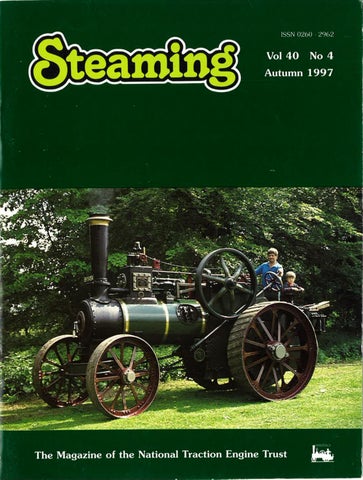
Tim Bevins was happy to pose for Peter Love's camera, because he had just been the successful bidder for Clayton & Shuttle worth 7hp agricultural 43130 at the May 1995 Chilford Hall auction in Cambridgeshire. The 1910 built machine spent much of its working life in Northamptonshire.
Next issue: The press date for news items, recent photographs and small adverts is 21st November 1997. For the date for Steaming Around see that section.
STEAMING Autumn 1997
Trust News Steam power arrives in Tierra del Fuego The tandem comes home The conversion debate develops Suspicions at Rotherham Technical Topics The Blotter Steaming Around, compiled by Derek Rayner Around the World Letters Reading and Viewing Small Adverts Fifties Faces
John Blundell Sandy Ross Derek Rayner
Cover
171
Trust News From the Chairman It has been one of those years when the weather has been unkind to nearly every event in the calendar. Some were cancelled, others were washed out, and it all puts great financial strain on those who run the events. However, most will have another go; the whole rally movement thrives on hard work and commitment and its appreciation of the past and its values. Recent sad events have shown that we have need for institutions, traditions and history, but also that they shouid adapt in an ever changing world. Whilst some of the work the National Committee tries to do finds little favour with many members, it is still very important that we do not get left behind because we did not adapt. The Dorset gathering had its share of mud, but with so much to see, the fact that many exhibits were static
172
seemed to matter little. In fact one outstanding feature of the show, and not so weather sensitive, was the Herring brothers' sawing area, with a huge frame saw driven by a mass of belts and pulleys, and finally a traction engine. This vast 1912 machine had worked fixed in a timber yard but the Herrings have made it mobile. The effort of getting it to site, erecting it
and putting it to work must have been enormous. It is commitment like this that will continue to attract the public, who will forgive us everything if we continue to entertain them with such fresh and exciting attractions. Further requests have been made for a Millennium Road Run. The National is not well set up to run events — just ask the Hollowell team
From Alan Martin's Collection
78
A very precisely posed exposure of Aveling & Florrer's own yard engine and a group of apprentices in the yard at Invicta Works, Rochester, Kent. Leaning against the rear wheel is A. G. Porter the eventually became a director) and Ralph Aveling is displaying concentration on the footplate. The 6hp single cylinder crane engine is 2374 of 1889 — its cruciform section iron jib seems to show some evidence of overloading.
Autumn 1997
STEAMING
who made last year's Run happen with our assistance. However, if anybody out there feels able to do the organising, we will back them in all possible ways. This coming winter the Committee hopes to move forward with the answers to the wide concern over the quality and consistency of boiler inspections and inspectors. It is the case that anyone with the correct insurance can practice the black art, but if an agreed set of standards could be put in place by the Trust then others may wish to follow them. This has happened with our Rally Code of Practice, which has been made available to other interests, and also the Engine Code. The New Zealand steam engine clubs have solved problems with their Government with help from the NTET Engine Code. The AGM in November is in the north west, not far from Chester. As ever I ask members to do their best to attend. The Committee welcomes lively debate on subjects which are relevant and of interest to members. The AGM is one of too few occasions when the members and the Committee meet formally and, together with other activities which are arranged, this makes your journey well worthwhile. (Richard Sandercock, Chairman)
details are not yet available because the Directive — can you believe it — is out of print. The DTI will be publishing a guidance booklet in the autumn and that may throw more light on the subject. Don't miss next quarter's gripping instalment of this thrilling saga! (Jim Newnham, Chairman, Technical Board)
After a further period of gestation, the Pressure Equipment Directive was accepted by the European Parliament last May and will come into force in November 1999, although compliance will be optional until May 2002. The next step will be for the DTI and HSE to prepare Regulations to permit the Directive in the UK, and it is said this will be ready for consultation and public comment by about the middle of next year. From the Trust's point of view, we need to keep an eye on the proceedings to make sure, so far as we can, that these Regulations do not contain embellishments over and above the requirements of the Directive which will impose added burdens upon our members. The effects of the Directive and Regulations on owners of existing engines will probably not be very great, but anyone having a completely new boiler built (including model boilers) may well find themselves facing a hefty increase in the cost. Full
STEAMING Autumn 1997
The Trust's
CODE OF PRACTICE for Traction Engines and similar vehicles Price £25.00 each including postage (cheques payable to National Traction Engine Trust) please quote your NTET membership number
Rally Organisers Column Rally Authorisation Smudge has moved .... Rally organisers and others who need to contact the Trust's Rally Authorisation Officer should note his new address and telephone and fax numbers: PO Box 338, Abingdon, Berkshire OX14 4XX, IT 01235 442088 and fax 01235 442089. These details are on the inside front cover panel of every issue of Steaming. Despite being desperately busy getting back to near normal life, Smudge makes his usual seasonal appeal to rally organisers and their safety officers — please ensure your safety reports are submitted without delay.
Engine Owners Column Technical Board
Now complete ...
Insurance Officers Notes Exhibition Organisers Scheme In early summer Footman James published details of the Exhibition Organisers Scheme by circulating details to existing rally organisers and through the media. This new scheme is very flexible in its nature and in the monetary amounts of cover it offers. A much broader set of risk cover, not previously included in some other policies, is now available to event organisers, and, of course, the price is right. In order to ensure that the small 'domestic' trader has appropriate cover there is provision for the organiser to purchase 'exhibitor cover' under this policy at extremely low rates. The cost of this can be subsequently recovered by placing a premium on the rental charge made to the trade exhibitors. This new scheme, along with the Steam Policy and Low Loader Schemes, brings commission to the
from — Mrs Sylvia Dudley, 12 Hillway, Woburn Sands, Milton Keynes, Buckinghamshire MK17 8UL
NTET and so far the early indications of take up have been very encouraging.
Steam Policy and Low Loader Scheme The take up of these policies has been quite amazing, particularly when we consider the long relationship that we engine owners have had with other insurers. I am glad to report that a substantial commission cheque has been received by the Trust from Footman James. As ever I would be glad to have constructive comments on the working of the schemes. A review of their performance is planned for late autumn, and I know that Peter James, Trevor Keefe and Jayne Jordan of Footman James are keen to ensure that the service they give is of first class quality. Peter James will be at our AGM at Chester to answer questions and to generally talk about insurance matters. There are plans afoot to extend the commission payment to the more domestic areas requiring insurance cover by members.
Speedy access When members ring Footman James over a non-steam item it is advisable to mention the NTET as a codeword in order that the steam section at FJ can process the enquiry. They have become very knowledgeable with regard to our requirements and will respond more speedily to requests for quotations etc; in particular ask for Jayne Jordan or Trevor Keefe.
Exhibitors insurance and those disclaimers Many of you will no doubt recall I 173
have written and spoken several times on the subject of the NTET approved wording of rally/event disclaimers. But I still find myself being asked to assist exhibitors from many parts of the country by contacting organisers who persist in using what I consider to be the highly immoral, 'I (the Organiser) am not to be held responsible for anything' type of disclaimer. My advice is simple — if you do not understand or do not like what you read on the entry form then: • cross out or mark the offending passage • at the foot of the form make a comment to the effect 'excluding those passages marked' • do not sign unless these items are clear! I know some organisers are saying 'if you don't sign, don't come'. Well, don't go! It may seem a painful decision but in the long run it will be a safe one for you. The whole reason for carrying public liability insurance is to guard against the cost of an accident, and its also the responsibility of the organiser to guard the public and you, the exhibitor, from accident. As a reminder from previous notes, the current Rally Organisers Code of Practice (revision Nov 1995) carries two specimen forms — Steam Exhibits and Non Steam Exhibits. They supersede any previous versions. Each uses a Statement of Declaration which asks the exhibitor to sign to the effect that Public Liability Insurance cover land Explosion Cover) is arranged under the terms and for the amounts (£2million is becoming the norm) described by the Organiser. No other form of declaration is included or intended. These specimen forms have the full approval of the insurance industry. Do you want to buy it? Here is a good one for the Rally Safety Officer. Question — What happens if an engine changes its ownership at a rally? Answer — Unless the parties involved have made proper and prior arrangement for insurance cover then the engine ceases to be covered by the previous owner's insurance and no cover exists. Question — What happens if the new owner has an accident? Answer — Unless insurance is in force, all the costs relating to the damage caused to the third parties and to himself lies with the owner. Moreover the local constabulary may probably take more than a passing interest if there was an indication of drink related actions. I gather that events at one of this 174
An Old Warrior We are grateful to the Editor of the Gloucester News and to Robin Brooks of Cheltenham (via Richard Vickery) for the chance to show this ancient Aveling & Porter roller in the service of the Corporation of Gloucester. Derek Rayner has consulted the appropriate Aveiing Royalty book at tne Lincolnshire Archives and our notes here are perhaps best started with the details, as written down by the makers in their ledger: '1438 6hp 15 TON ROAD ROLLER supplied to Savory & Son, Gloucester for Gloucester Corporation May 10 1878 Driving wheels 5ft x 20% x Cl driving wheels with WI spokes CI front wheels 4ft Oin
caacnn'c ralliPc are riarknnorl to have followed this pattern. In such a case what chance does the Safety Officer have of checking on the circumstances. Well, none really — until after the event that is, when the damage is done. (Dave Smith, Insurance Officer)
Steam Apprentice Club As we come to the end of a season under new management, I think we can claim one or two successes for Trust's section for younger people. We have had adult representation at over twenty rallies throughout the country, and have had full presence at the Dorset Steam Fair. Rally Committees have all been very supportive in helping to introduce
youngsters to a variety of engines, for which we are very grateful; we look forward to your support next year. The comments we have back from Apprentices and engine owners are always positive and show that experienced engine crews have a real role to play in encouraging new interest in our hobby. As a result of the greater adult presence we can now draw on we have received invitations to half a dozen venues with a steam theme, in addition to Westonzoyland Pumping Station — which we have not yet managed to descend on as a group. With the Trust AGM just around the corner, we are looking for suitable recipients for the Beeby Cup; one lad has been suggested, but if yuu know of a young person who has shown special interest or aptitude with engines we would like to hear from you. As I write this I am looking forward to meeting some of you at the Rally Organisers Conference, where I hope I Autumn 1997
STEAMING
bevelled to 3ft 8Nin x 26% x 4Y2 by 4 with WI spokes Improved cylinder 8in bore 10in stroke double steam dome no governors Improved WI brackets with CI thickening pieces and WI front cross plate cut down to pass under eccentric rod Cl guard plate CI solid flywheel 4ft 6in x 5in CI inter bearings on both sides bushed with GM pump bolted to inter bearing with 2in solid wrought iron plunger Length of pump rod 10%in from face of collar to centre of pin hole Driving axle 7ft 6in x 4%in with 10hp brake hops(?) Improved brake with wood segments Casting for front upright spindle bolts on boiler same as drawing WI funnel with CI ring to bolt on top of front axle bracket Steerage on tender with worm and wheels Injector fitted on outside of tender with 3/4 in copper piping' The above is reproduced more or less as it was written down in 1878 and we have deliberately avoided adding punctuation etc; WI and Cl are, of course, wrought and cast iron. The 'Improved WI brackets' are hornplates as we know them. The front rolls also invite comment. Avelings' design at the time called for a nice solid centre post down to the front axle, but each side of the latter was an inclined stub axle on which ran the coned (bevelled) front rolls. These were shaped that way to be able to clear the centre post at their top circumference, but, as a pair, also present a 52 inch rolling width to the road, with no nasty little gap. The whole assembly must have been in constant conflict, with the rollers always wanting to take a divergent path, but being constrained, having to proceed with a semi-skidding motion. It is said Avelings made a virtue out of necessity by claiming the action aided compaction! One other point for thought: does the curious reference to 'steerage on tender' indicate that the ledgerman was recording a fairly new practice that the steersman's position was on the tender, and not at the front of the engine, before the smokebox, as would have been the case with agricultural engines but a few years before. It is not known when the above picture was taken, but it would seem in the last few years of the nineteenth century — almost exactly one hundred years ago. By that time most of the old Avelings built with conical front rolls had been rebuilt with steerage forks, and our subject looks to have been bashed around quite a bit — note the straps encircling the chimney base and the bolted on strengthening patches to the saddle casting. RLS records have the machine listed as being returned to Avelings in 1902, and that was probably in part exchange for a new one. Our warrior had no doubt earned its keep.
shall be getting direct feedback from those at the sharp end of running our rallies. (John Durling, Chairman, Steam Apprentice Club)
FBHVC News There is not much to report of direct concern to NTET members. As has been noted previously there is a change from June 1998 to a per capita charge for the fees of subscriber bodies to the Federation. The rate has now been fixed at 27 pence, inclusive of VAT, which means the Trust will be paying a fraction under 23p per member per year. The most worrying aspect of EU legislation at the moment is the proposed banning of leaded petrol from January 2000. Although this has little to do with steam engines, we will make some mention here, as members STEAMING
Autumn 1997
may be interested for the sake of other vehicles they own and the work to be done well illustrates the efforts the Federation makes for its subscribing members. Many older vehicles will suffer serious damage to their engines, or more particularly the valves/valve seats of the engines. In some cases it is difficult if not impossible to replace the valve seats with new ones of a material that will withstand the conditions created by using unleaded fuel. A meeting was held at the Department of Transport on 2nd June to discuss the implications of the proposed ban and the Federation was well represented at that meeting. There is much to be done and the Federation is actively seeking a viable alternative to lead as a fuel additive for use in older vehicles. A 'fuels committee' has been set up and it is hoped that in consultation with the petrol companies a solution may be found. (Michael Ward and Peter Smart, steam representatives to FBHVC)
Personal We are pleased to record the award of the OBE, for services to the London Chamber of Commerce and Export, to Alastair Dacre Lacy, and send him our congratulations. Alastair was the first Chairman of the National Traction Engine Club, and it was at a meeting at his house at Shiplake, Berkshire in May 1954 that the Club had its beginnings.
Thanks to Dorset helpers Each year a number of members and others allow themselves to be cajoled into helping to staff the Trust marquee at the Dorset event, either at the busy Sales Stand or in the rest and refreshment area. We trust the somewhat awkward working conditions and the long hours are pleasantly offset by the camaraderie and the chance to meet fellow members, and the knowledge of a job well done. Our sincere thanks then to Peter Cooper, Les and Rita Dickens and their grandson Steve, Tony Flowers, Stuart Gaines, Andy Hampton, Peter and Sue Howard, Joyce Hullock, Margaret l'Anson, Jo Tilling, Val Wingate and May Wright, as well as to Brian Wells, who again provided the power of electricity, and the wives, husbands and friends of Committee members.
NEC Retro Exhibition Because of the NTET's association with insurance brokers Footman James, I was asked earlier this year to assist the exhibition management at Birmingham's National Exhibition Centre in putting together a collection of road steam engines for the Footman James Retro Festival on the 9/10th August. Trust vice-chairman Andrew Semple gave me considerable help in drawing up the list of engines for this new event, which was to include sawing and threshing demonstrations, steam cultivating of a grassed lakeside area, and a road making demonstration. These were supplemented by steam tractors, a crane engine, portables, wagons, a steam car, fair organs and the Trust's Exhibition Unit. The standard of the entries was impeccable, and I can report that the job of ploughing up the assigned area 175
went very well under the management of Michael Davies. So too the road run on the Sunday morning, and what a sight, with 14 engines lined up outside the main Piazza entrance of the NEC. However, the weather was exceedingly hot, and this, coupled maybe with the price of the tickets (£8 plus £4 car parking) and an upmarket sounding title, is reckoned to have kept the crowds away. The event, sadly, is said to have lost money — but not, I hasten to add, any of the Trust's. The organisers are pragmatic; it was the first attempt at anything like it in this country. The dates weren't that good and the weather — well! We may see another attempt, who knows. For our part, I would like to say 'thank you' to all the exhibitors who helped us to show how the NTET works to preserve our heritage in steam. The letters I have received from the NEC and from Footman James bear testimony to the way in which all worked hard at this event with a difference. (Dave Smith, Insurance Officer)
Road Steam On-line The NTET has opened its steam driven Internet Website. Well, no, its not really driven by steam, but I hope those of you with access to the Internet will find it interesting all the same. The site contains generalised but colourful descriptions, with photographs and mobile graphics of the Trust and its groups (or forums aS is the Internet-speak). It also parries the authorised Rally List. Already we have had enquiries from around the world for membership and NTET Sales. The site includes links to other steam
related sites including the RRA and Martin Pavey's Steam Pages. The major search engines now carry our details and location address, so we are placed to be found almost anywhere around the world. Incidentally, the number of steam related sites is growing rapidly and already includes Bressingham, the Great Dorset Steam Fair, Kew Pumping Station and many others in Britain. So, if you have the time, and the technology, give the NTET site a look; it's at http://members.aol.comintetuk/Ntet/ E-mail messages may be left for any member of the NTET Executive or National Committees by sending to NTETUK@AOL.COM. (Dave Smith)
London Area Social Meetings The London Area Social meetings will continue during the coming winter months, to be held on the second Tuesday of each month from October through to April 1998, missing out the Decombor data. Tho vonuo is the some as was used successfully for the last season — 'The Duke of York', 35 New Cavendish Stieet, London W1. This is on the corner of Westmoreland Street and opposite the end of Welbeck Street. The tube station at Bond Street (Central Line) is the nearest - walk north from there for about 500 yards on Vere Street and Welbeck Street. The room will be available for the Trust members from 7.30pm, with the meeting commencing at 8.00. Nonmembers are welcome to attend. The first series of dates in the calendar is as follows:
The National Traction Engine Trust's
1997 AGM will be held at 2.00pm on SATURDAY, 22nd NOVEMBER 1997 at The Tom Rolt Centre, The Boat Museum, South Pier Road, Ellesmere Port, Cheshire Please refer to the formal notice in the Report and Accounts which are distributed with this issue for details of agenda etc, and to the Future Dates column for notes on the arrangements that have been made for the rest of the day and on the Sunday. 176
TUESDAY, 14th OCTOBER — Charles Roads and Bill Timmings offer a slide show of steam engines on road and rail. TUESDAY, 11th NOVEMBER — 'Steam in the Blood', an evening presented by Bill Last, once a railway driver at Cambridge. TUESDAY, 13th JANUARY — Richard Fillmore, son of the Trust's President, has come by a collection of slides of early day rallies in the 1960s and even before that. Come along and help identify some of the mystery ones. Details of the rest of the 1997/ 1998 programme will appear in these columns in our Winter issue. (Bill Timmings, London meetings organiser)
Future Dates AGM 1997 The 1997 Annual General Meeting of the Trust will take place at 2.00pm on Saturday 22nd November in The Tom Rolt Centre at The Boat Museum, Ellesmere Port, Cheshire. Formal notice of the meeting, the agenda and the Annual Report and Accounts will be disbanded with this issue of the magazine. In the event of any voting being necessary at the AGM, only current Trust members will, of course, be eligible. Members are therefore asked to ensure they have their current membership cards with them at the meeting. Tea will be served at the conclusion of the AGM at about 5.00pm, and this will be followed by an illustrated talk on the work of the Museum from about 6.00 to 7.00pm. Other arrangements have been made for the Saturday and the Sunday for members wishing to atop overnight In the area. On Saturday morning The Boat Museum will be available for members for viewing from 10.00am. Admission will be free on production of a current NTET membership card. The Trust's Exhibition Unit will be open in the area — a good opportunity for Christmas present shopping from the extensive book and video stocks. The Boat Museum is located adjacent to Junction 9 on the M53 between Chester and Birkenhead. It is well signed with the usual brown tourist road signs, and there is plenty of car parking at the Museum. For members wishing to stay overnight a special NTET accommodation tariff has been secured at the adjacent Autumn 1997
STEAMING
Holiday Inn, Ellesmere Port, and a block booking arranged. The rates are £28.00 per person per night for a double room, and £48.00 per person per night for a single room. You should make your own bookings direct with the hotel, quoting NTET — Tr 0151 356 8111, fax 0151 356 8444. No formal dinner will be held on the Saturday evening, but a restaurant is available at the Holiday Inn (prior booking is recommended), and it is hoped to make it possible for members to be seated together in the dining area. On Sunday morning, from 10.30am, we have been invited by Frank Lythgoe to visit his engine collection at Warburton Park, about 25 miles to the east of Ellesmere Port. Further details will be available at the AGM. The Trust's Exhibition Unit will be present at Warburton during the morning visit.
New Members A sincere welcome is extended to the following new members who have joined the Trust during the last three months. We hope they will gain much friendship, information and enjoyment from their membership over a period of many years. The Membership Secretary is always pleased to put members in touch with one another by fowarding mail. T.M. Morgan, Peterston-super-Ely, Glamorgan A.J. Ball, Liskeard, Cornwall J. Bloom, Horsham, West Sussex B.W.G. Humphrys, Bridgewater, Somerset D. Thorp, Ashbourne, Derbyshire Mrs M. Rockliff-Simpson, Shipton, North Yorkshire B. Rockliff, Huntington, North Yorkshire K. Lee, Yeadon, West Yorkshire J .Mylor, Hayle, Cornwall K.P. Clements, Woodbridge, Suffolk D. Caley, Hull, East Yorkshire J.J. Squire, London E. P. Godley, Stebbing, Essex T. llott, Bishops Stortford, Hertfordshire W. Thorpe, Dronfield, Derbyshire J. Pratt, Denton, Manchester R.G. Fairhurst, Worsley, Manchester H. Bell, Leven, Yorkshire P. Jacobs, Moira, Derbyshire G.G. Friar, Blackpool, Lancashire A.J. Staples, Longton, Lancashire C.J. Penny, Wantage, Oxfordshire D. Parkinson, Clayton le Moors, Lancashire R. Parsons, Farnhill, West Yorkshire G. Burley, Armley, West Yorkshire D. Vickers, Batley, West Yorkshire D.G. Collins, Wookey, Somerset P. Hansen, Northaw, Hertfordshire
STEAMING
Autumn 1997
E.T. Lee, Chew Stoke, Bristol A. Morrison, Kingswells, Aberdeen W.J. Williamson, Portadown, Northern Ireland G.D. Baker, Blackburn, Lancashire L.G. Warren, Tonbridge, Kent R.E.G. Brown, Maldon, Essex C.F. Hiscock, Henfield, West Sussex F.A. Horton, Wollescote, West Midlands B. Andrews, Westbourne, Dorset P.M. Dumpleton, Midsomer Norton, Somerset E.N. Corner, Leyburn, North Yorkshire W.E. Gale, Whittlesey, Cambridgeshire W.J. Chamberlain, Farcet, Cambridgeshire J. Aitken, Widley, Hampshire T.J. Sledmere, Barnsley, South Yorkshire S.L. Spencer, Cotgrave, Nottinghamshire B.J. Foord, Newhaven, East Sussex V.D. Sharpe, Harpole, Northampton R. Flynn, Newton, Warwickshire W.F. Dufty, Yeovil, Somerset R. Butlin, Wolverhampton, West Midlands Mrs A. Boston, Cadeby, Leicestershire D.H. Preston, Upminster, Essex J.M. West, Halstead, Essex A.E. Stevens, Feltham, Middlesex R.A. Cox, Reading, Berkshire M.J. Plowright, Shepshed, Leicestershire A.D. Ward, Hayle, Cornwall T.J. Heath, Ringwood, Hampshire P.J. Loader, Yeovil, Somerset A. Richards, Gosport, Hampshire E. Ellis-Brown, Stockton on Tees, Cleveland M. White, Choppington, Northumberland J. Leivers, Narborough, Leicestershire W. Houlding, Ilkley, West Yorkshire A. Hancock, Barton Mills, Suffolk L.R. Williamson, Ellesmere Port, Wirral A. Nossum, N-7570 Hell, Norway G.E. Jones, Shrewsbury, Shropshire M.D. Priestner, Dunham Massey, Cheshire D.R, Utteridge, Welwyn Garden City, Hertfordshire A. Martin, Mountsorrel, Leicestershire K. Wiggins, Chipping Norton, Oxfordshire C.M. Edwards, Ashford, Kent E. Ingram, Oldmeldrum, Aberdeenshire G.R. Manning, Henley on Thames, Oxfordshire T.R. Dolman, Chippenham, Wiltshire M.G. Wines, Glastonbury, Somerset D,W. Hopkins, Loughborough, Leicestershire S.C. Watson, Weston super Mare, Somerset A. Prior, Warwick W. R .Nye, Stafford D.R. Uttridge, Welwyn Garden City, Hertfordshire M.A. Williams, St Helens, Merseyside D.S. Casey, Haywards Heath, West Sussex K.L. Nicholls, Leighton Buzzard, Bedfordshire M.C. Asher, Crediton, Devon S.A. Hiles, Malvern, Worcestershire W. Handte, D-74626 Bretzfeld, Germany N.J. Turner, Kingswinford, West Midlands J. Nosey, Carlow, Eire M.J. Gull, Dursley, Gloucestershire F. McNabb, Clarenbridge, Eire G. Farnsworth, Worksop, Nottinghamshire D. Hickson, Allesley, West Midlands J. Francis, Swansea R.J. Kella way, Torpoint, Cornwall C.J .Burleigh, Paraparaumu Beach, New Zealand M. Cowap, Northwich, Cheshire
The Clacton Queen Preservation Society, Clacton on Sea, Essex J.L. Miles, Edenbridge, Kent VBS, 3862 C.T. Nijkerk, Netherlands B. Wolfe, Eltham, London G.C. Hickman, Blidworth Bottoms, Nottinghamshire
Poor Steaming The last issue contained an error and an omission for which the Editor's apologies are necessary, and corrections required. Firstly to Paul Cotterell, for the wrong spelling of his name in the article on the mysterious portable engine at Hadera in Israel, and secondly to photographer Eric Sawford for omitting to credit his name in the caption to the pictures of the two Marshall engines featured in the New Faces centre spread.
OUR MAGAZINE 25 YEARS AGO
Magazine Editor Ran Hawthorne had led a party of over forty members and some friends from the Stoomwalsenclub Nederland to four ploughing engines engaged in reclaiming moors in north west Germany. Two of the superheated 3001bs pressure machines stood smokebox to tender, 700 or 800 yards apart from the other pair across the moor, and pulled a plough to turn 2.5 metres of peat and sand. Although built locally in 1953 and 1955 the engines still exhibited classic Fowler layout and characteristics and the visitors were impressed by the way they were worked so hard. The Battersea event had failed in reaching its 100 engines — although entries came from Cornwall and Yorkshire (and Holland) the list unfortunately stuck just short of the magic figure at 97. A lengthy and enjoyable story in the issue was by Alec Ibbott and told of a 1963 steaming from Bedford to Beaulieu in Hampshire with a couple of showmans engines, Fowler KITCHENER and Burrell WILLIAM V. West Sussex County Council were still using their 8 ton Marshall roller 79669. It was undergoing repairs for further action and they were said to have no plans to retire it. 177
Steam power arrives in Tierra del Fuego
their white visitors were able to bring them. They were introduced to garden grown fresh vegetables, as well as the pluduce possible when caring for poultry, pigs and cattle. In all some fifty Indians went to stay at Keppell, and were returned to their homeland. During that time Thomas developed fluency in the Indian language and their customs, and this above all else
that tens of thousands of portable engines were manufactured and exported around the world by British makers is fairly well known. Few of the machines, however, are today represented by anything more than their builders number in the now archival order book. John Blundell sets the scene on just two of these exports, part of a west country family's pioneering endeavours in South America almost one hundred years ago that used contemporary technology close to its limits.
cemented their confidence in the mission and its staff. On Thomas's return to England he
If one is to understand fully how an English couple, Thomas and Mary Bridges, came to set up a sheep farm in southern Tierra del Fuego at the very southern tip of Argentina, and make a success of it in country much further south than anyone had previously attempted, and how their sons later decided that steam engines would be the key to the expansion of this great farming enterprise, then the story has to be told, as it unfolds, from
and keeping small productive livestock. They were all soon won
the beginning. Thomas and his wife were both born into west country rural families in 1842, and had connections in the evangelical wing of the Anglican church. She had been born at Harberton near Totnes in Devon. When Thomas left school his parents sent him as helper to a mission established by a London society on Keppell Island in the Falklands. The
society was anxious to get a foothold in southern Argentina for it was felt that some of the Indian tribes living there, still depending on bows and arrows, fish spears and animal skins for clothing and shelter, were ready for conversion. Darwin's visit there some twenty years earlier had brought these people to their attention. During Thomas's thirteen years un Keppell Island the mission's schonner, used for bringing in supplies, had visited the Beagle Channel to make contact on a number of occasions, but there had been severe set-backs as a result of Indian violence and theft, and a number of the missionaries had lost their lives. But the visits continued, with a great deal more care over
was ordained and married and the mission society offered him the position of superintendent at a new mission to be established at Ushuaia on the Beagle Channel, where there was enough flat land and sheltered deep water for visiting ships. The mission developed most successfully, and soon had many Indians becoming less nomadic — wearing European clothes, tending vegetable gardens
over by the improvement in their diet and the new interests that these white men had brought them. The mission was established in 1870, and Mary and Thomas had three sons and three daughters in the years that followed,
and the community, with all its livestock and vegetables, was close to being self-sufficient. Leather from the cattle hides was another branch of their production. Meanwhile, those at the headquarters in London were
security and, gradually, two or three Indians at a time were taken to Keppell to stay a few weeks at the mission for
becoming unhappy at the way it was all turning out. They wanted much more emphasis on religious
them to understand the advantages
instruction; much less on farming and modern domestic economy. After prolonged debate Thomas felt he was losing the argument and resigned his
ARGENTINA _5-7
employment. He had been there for sixteen years. His work, he felt, was completed there and it was time now for a new superintendent to be
qaltegos Atlantic Ocean
TIERRA DEL FUEgO •E tancia Viamonte Harberto
•
--Cape Horn-
appointed. During his last years at the mission lie had been considering how the
future might be planned to bring a good life both tor himself and his three sons. He decided that he would apply to Buenos Aires for a grant of land, so he and the boys started exploring the country to find a suitable area to farm with sheep and some cattle. He set his heart on an area about forty miles east
of Ushuaia that had a sheltered deep water approach for small ships, was well timbered with good grazing, and including small offshore islands, some 50,000 acres in all. He had previously made good contacts through Argentine navy visits with officials in Buenos
Aires, and so he travelled there the 1500 miles or more by sea to see what could be managed. To his surprise his
178
Autumn 1997
STEAMING
fame as a man who had worked up a good relationship with the Indian population had preceded him and he was invited to the President's office to discuss his plans for the future, and his needs. President Roca told him that he had worked untiringly for the Indians in his country; how could the country possibly repay him? The answer, of course, was the grant of this 50,000 acres, if he could be so kind. Thomas was promised that day that this request would be favourably considered, and so, some months later, he heard that all the land was to be his. He impressed on all his sons the need for hard work and well considered, astute, decisions. The new farm had to be made a success. If it succeeded they could all look forward to a good standard of living. Failure would inevitably lead to their employment by others, and they would get little formal education and a poor wage. Preparations were made to establish the farm. Thomas travelled home to Devon where a sectional wooden house was constructed in his fatherin-law's carpenter's shop. A small brig, the SHEPHERDESS, was chartered at £2.50 a day, and loaded with the house, a mountain of stores and tools, a pair of collies, a young South Devon bull, some pigs and four Romney Marsh rams. The captain was in no hurry, being paid by the day, and they took 108 days to reach their destination from Devon. After unloading and when the house had been erected, the ship was retained and some thousands of fencing posts were loaded aboard. These were shipped to the Falklands, and the proceeds used to buy carefully selected ewes, all free of sheep scab, which were brought back and landed on one of the small islands. There they could remain, effectively in quarantine, while fencing work on the main farm proceeded. Subsequently, more ship-loads of ewes were brought in and fencing posts sent out. Heifers were bought from the mission to start a breeding herd using the South Devon bull. As well as a large vegetable garden some small scale arable farming was started to help stock feeding in winter. Three sawpits were set up to produce planks and constructional timber for more buildings. Indians from the mission area were keen to come and work, and were, at this time, paid in kind — bread, sugar, coffee and clothing were the main currencies. They called the new farm Harberton, after the Devon village, and descendants of the family still farm there today. With the large areas of forest, STEAMING Autumn 1997
The identity and even the manufacturer of the portable taken by the Bridges sons is now lost in time. Engine sales to countries in South America were invariably through agents, sometimes at both ends of the sea journey, and the ultimate customer is rarely mentioned in surviving records. Ransomes, Sims & Jefferies of Ipswich, for example, sent thousands of portables in batches of six, ten or a dozen — two of one horsepower, four of another size, etc — and then another lot when the agent in Argentine, Chile or wherever had managed to sell the previous machines or had more orders for the coming season. Rustons of Lincoln, too, had a good slice of this lucrative South American trade. The above engraving is from Ransomes' catalogue of May 1912; it 'represents their newly designed single cylinder portable, available in sizes from 3 to 12 nominal horsepower and was provided with an extra large Colonial firebox for burning wood. Author John Blundell says that some fifty years ago, when he set up a good sized saw bench, he was advised that a good rule of thumb was to allow one horsepower for each inch of cut of the circular saw blade, and that proved to be good advice. On the assumption the Bridges' sawmill would have used a 48 inch blade, they probably had a 21 or 22 inch maximum depth. Ransomes notes to customers on power recommended the continuous economical load at which the engines be worked was three times their nominal horsepower, so a single cylinder machine of 6 or 7 nhp should have sufficed for Tierra del Fuego. The catalogue quoted weight of 80 or 90 hundredweights would thereabouts accord with the 5 tons of engine and mill mentioned in the article. The cost of a 7hp engine in 1912, by the way, was £217 — plus £1 per horsepower for a larger woodburning firebox and £1 15s for double shafts instead of single. (catalogue illustration courtesy Welland Valley club)
mainly of several kinds of southern beech, a ready means of bringing in additional income was to fell trees and ship the timber out to Buenos Aires or elsewhere. It was on one of these voyages that Thomas became ill and subsequently died in the capital in 1898, at the early age of 56. It was a grievous loss to the family, but his sons, then 21, 23 and 26, were determined to carry on the farm. They
received payment for 256 tons of valuable timber. As the years went by and the farm developed it became clear that they needed to take on more land. Two of the sons were married and with young children the place was becoming too small for them. After prolonged negotiations they were granted conditional rights to a further 254,000 acres over the mountains to the north, 179
much of it flatter grazing land, sloping gently towards the Atlantic coast and also with enormous timber resources, as well as lakes and streams. The family built new roads and tracks northwards, put in many scores of miles of new fencing and decided on making a new settlement at a spot near the coast they called Viamonte. The new developments here required a great deal of sawn timber. Some years earlier a new steam powered saw-mill had been established by another family close to the Chilean border, west of Ushuaia, and the Bridges sons would have been impressed with the output of this mill compared with the slow, laborious work of their three saw-pits at home. So in 1906 a portable steam engine was ordered from England together with a mill which could be taken along with it. After a long wait a steamship arrived with this precious cargo. The engine and mill weighed around five tons, and there were galvanised roofing sheets as well as tons of nails, halts and fencing materials. There is a high tidal range on that remote south Atlantic coast and it was the custom for ships to enter an actuary at high tide, put the ship aground, and offload on to the send and shingle as the tide went out. The recipients had to work hard and quickly to get everything off the beach before the tide returned. Thomas's sons, Lucas and Despard, had brought sixteen oxen to collect the machinery and stores. Fourteen were to be used to haul the portable and mill off the beach and then the 35 miles to the forest site prepared for the machinery. When the first eight beasts had been coupled up the animals took fright at the strange sounds and smells — the clatter of deck winches, the shouts of the men — and they bolted, with the engine and mill rocking from side to side behind them. But they soon calmed down with all the weight. The chains held, and the other six oxen were coupled up in front, and the rest of the journey ended without incident. Preparations had been made long before the mill and portable arrived. Trees had been felled and oxen in pairs had drawn about 1,000 trunks, one or two at a time, to a stockpile ready for sawing. Five days after leaving the beach the sawmill machinery was turning out boards, and Indians were being trained to do all the various tasks around the timber yard. This new equipment quite transformed all the thinking and planning, for now home produced planks, as well as beams and structural timber for new houses and farm buildings were suddenly plentiful and cheap. Firewood was also there in 180
quite endless quantities for cutting up to heat homes, for cooking or, of course, for raising steam. New possibilities started to dawn on them. I imber could be used for decking road bridges over streams and boggy places, it could also be sold to neighbours at a good profit. Large outbuildings could be planned, built and occupied for all kinds of purposes — shearing sheds, housing for pigs and calves to get them through the very cold winters, slaughtering and butchering facilities to assist feeding large numbers of workers. And there could be better stabling for the horses. As this great new farm developed and prospered, fresh problems of scale arose and had to be solved. For example shearing 5,000 sheep is one thing; shearing 50,000 or more is quite another. Plans were made for a long shearing and wool shed and an order for a second portable and mill was sent to England. In 1909 or thereabouts this was delivered to the same estuary beach as the earlier portable and with it came long lengths of shafting with pulleys and bearings, as well as mechanical sheep shearing equipment. The shearing shed was built with adjoining pens, and separate booths were made fur 24 shearers, each with a self-closing door to the exit which had a chute down which the shorn sheep would slide into a numbered pen. Thus each man's tally of sheep shorn, less any cut or bleeding, could be kept by the man in charge. The shafting, of course, was driven by the second portable, equipped with a steam whistle to encourage accurate time-keeping. Clearly all this mechanisation made everything much easier, besides giving the option to almost double sawn timber production. The gangs cutting trees and drawing them to the mills with pairs of oxen would have been kept very busy, and cart-loads of cordwood and fallen small timber must have gone down to the homesteads every summer. No doubt they built a large open fronted shed to keep it dry. And what of these farms today? Both continue with families tracing back to Thomas's sons and daughters. Harberton welcomes visitors in the summer, and when in season offers them strawberries and Devonshire cream. Sadly the Indians are now no more. Work for cash spelt the beginning of the end for them, and measles took a severe toll. With never ending quarrels between tribes, and with hand-guns and alcohol all too freely available, the end for them was inevitable. By 1950 scarcely a single pure blooded Indian remained. Sadly, too, I have been unable to find out who
built these British portable engines and saw-mills and whether they, or their successors, are still in use. The questions have been asked but the postmen never brought me a reply. No doubt daily work keeps them all very busy in that corner of the world so very far away from here. (The author is indebted to the late Lucas Bridges whose book Uttermost Part of the Earth, published in 1951 by the Reader's Union, Hodder & Stoughton, provided some of the information in this article. Other data came from travel guide books and the author's own observations when travelling in Tierra del Fuego and in adjoining Chile.)
A Straw Burning' Ploughing Engine Ruston Proctor of Lincoln must have had enviable business partners in the machinery agents Agar Cross & Co. This letter from the firm's Regent Street, London address (no doubt solicited by Ruston), appeared in the makers 1912 catalogue and records the sale of 33b engines for direct traction ploughing in just four years. The class SCLA compound straw burning machine is illustrated from the same publication — 'the most up-to-date .... on the market'. The engine was equipped with Colonial firebox, link motion reversing gear, feed pump, spark catcher, hauling rope and hook, steam water lifter, brake, straw burning fittings, compensating gear and steam pump. The cylinder was 7 1/1 in and 12in diameter by 12in stroke; the flywheel was 4ft 0in diameter and ran at 200 revs per minute and the driving wheels were 6ft tin diameter by 2ft 6in width. Back in September 1989 we featured in this magazine British built portable engines still in use in Chile, though more recent news of them is unavailable. At least one Ruston direct ploughing engine is preserved in Argentina and no doubt other engines also survive out of use or as artefacts. Autumn 1997
STEAMING
Straw Burning Traction Engine
'Another to the long series of accidents on New Bridge Bank, near has occurred Chester-le-Street, recently. A motor dray, belonging to Mr Archer, brewer of botanic beer and stout at Spennymoor, was on the road from Sunderland to Spennymoor, laden with ten hogsheads of stout. Joseph Jones was in charge of the engine and machine, and almost immediately after passing the brow of the hill the dray collided with the kerb of the footpath by the side of the road. The kerbstones were ground to dust, and Jones's assistant, who acted as stoker and steersman, dropped off. The driver stuck to his post, and ran the wheels of the dray down by the side of the kerb, scouring off the stone as if it had been sawn. Seeing there was no chance of stopping the dray, and with the wall in front of him, Jones ran the vehicle to the other side of the road up a sharp rise and jumped off, the dray overturning on the top with the engine over a precipice above the river Wear, and the waggon part hanging into the road.' (from The Industrial Motor Review, October 1907)
Telegraphic Address AGARIGOS, LONDON National Telephone 8955 Gerrard
AGAR, GROSS O 00,, ..... • Now S..,
Carlton House, II, Regent Street, 17th February, LONDON, S W
Messrs. Ruston, Proctor & Co., Ltd., LINCOLN. Dear Sirs, We have much pleasure in giving you this testimonial regarding your Steam Ploughing Engines for Ploughing by direct Traction. We have, during the past four seasons, sold through our Buenos Aires Firm, three hundred and thirty-five of your Standard Er:gimes. both Singlecylinder and Compound, for ploughing and thrashing, and we have no hesitation in saying that they are an eminent success. They have unmistakably gained their fame by freedom from breakdown when doing heavy work, hauling and steam ploughing. We must especially compliment you upon the excellent design and workmanship, and the quality of the materials used. The gearing has stood the severe strains most wonderfully, for although on each of the Engines sold there are 12 gear wheels, making a total of over 4,000 wheels in use, we have so far supplied less than one-half per cent of these wheels to replace either breakages or those worn out by working wear and tear; but in this respect we need not confine ourselves to the gearing alone, for all parts of your Engine seem to be unbreakable, becaule the breakage of an axle or any other important part of your Engine is seldom heard of, and we can assure you that in the Argentine the Engines are not in any sense handled gently or worked lightly. We must add a special word of praise regarding your Compound Traction Engines, these have given splendid results. We have received numerous testimonials from our buyers of the Engines, and they are all loud in their praise of this type of Engine. The superiority of the Cross Compound Engine with two Cranks to the Tandem arrangement which is sometimes adopted for the sake of cheapness is very clearly shown when the Engines are put to heavy work such as ploughing. Since you first sent us your Ploughing Engine in its present form, the sales have increased by leaps and bounds, and we feel justified in informing you that your engine is the most satisfactory Ploughing Engine which has ever been sent to the Argentine. We may add, when thrashing and using straw as fuel, they have given great satisfaction, due to the excellent steaming qualities of the boiler. You are at liberty to make free use of this testimonial. Yours faithfully,
ki STEAMING Autumn 1997
'For Sale — Showmans Type Foden Modern 6 ton Steam Wagon, Ackerman steering, full length of cab, 3 speeds, Pickering governers, wire rope on back axle; Mather & Platt 110AD, 110v; Packing Wagon on body, by 7ft 6in wide, side door, 2 doors at back, irons on top for packing rails. Owner driven and in first class order. This wagon is two years old and it is equal to new. Cost £1400; will be sold very cheaply .... Information seekers and nosey parkers save stamps. Apply — Joseph Leonard, jnr, Fair Ground, Trafford Park, Salford.' (from The World's Fair, 2nd January 1926)
'Second Hand Machinery for Sale subject to being unsold: Shp Portable Engine by P & HP GIBBONS; 6hp Portable Engine by P & HP GIBBONS; 4hp Portable Engine by Brown & May; 3'/shp Portable Engine by Clayton; 3hp Vertical Engine and Boiler by Cottrell; 2 Thrashing Machines by Tasker; 1 Thrashing Machine by Nalder; 1 Thashing Machine by GIBBONS & ROBINSON and several elevators by COTTRELL Also several steam-power chaff cutters, MILLS &c, &c For particulars apply to Cottrell & Co, Eddington Iron Works, Hungerford.'
(From The Marlborough Times and Wilts and Berks County Paper, 6th January 1894.) 181
THE TANDEM COMES HOME Sandy Ross June this year saw the return to its home town of a most unusual Aveling & Porter, the now unique tandem roller, Royalty number 6530. The unusual machine had been sold by Luton Corporation as scrap back in the 1950s, but in an enterprise spearheaded by Bernie Emmerton and Dennis Goodyear, the friends of the Luton Museum Service welcomed it back to the town at Stockwood Park Museum. Robin Holgate of the Luton Museum Service co-ordinated the rescue, and this included the successful appeal to the Science Museum for funding. Aveling Royalty 6530 was ordered following the Corporation's decision TO introduce an electric street tramway system to Luton; this opened in 1908 as a standard gauge system. The lines were operated until '1930 and the tandem roller would have been able to work between the tram rails when highway repairs were required. Aveling & Porter was, in 1902, one of the first manufacturers to seriously
enter the market with a 'tandem' design, the main feature of which was a full width roller at the rear of the machine. This required a subframe to carry the second and third shaft gearing mechanism to the rear roll, the assembly being mounted behind the boiler in place of the normal tender. The water tanks were mounted at the midpoint of the engine on both sides, so helping to increase the weight on the front roller. Apart from this the boiler and engine were similar to the standard product of the time. Number 6530 is a single cylinder, single speed roller. Many of the general design features, such as the bored cast iron cross head guides and rounded cylinder base were common to conventional Aveling rollers of this age. Tne nominal norse power or the engine is 4, steam admission being by a slide valve controlled by Stephenson link motion. As built, the boiler carried a design pressure of 170 lbs. This rather higher figure was specified by Aveling for certain single speed rollers to provide additional hill climbing power required as the result of the lack
Avelings 'Patent Steam Roller, Tandem Type, with compound engine, as illustrated in one of their publications, dated October 1904. It was claimed where it is necessary to keep the rolling width as narrow as possible and at the same time use a heavy roller, this type can be particularly recommended.' They were offered in 5, 6, 8, 9 and 10 ton weights, reckoned when empty. 182
of a slow speed gear arrangement. The single speed gear arrangement is uncommon but not unique, Aveling providing only one speed on many of their earlier machines of less than eight tons. The gear can be thrown nut of engagement, as required for engine warming purposes, by a clutch arrangement. The design weight of the machine was 61/2 tons, but the actual weight, as was usually the case, was somewhat greater. The front forks have an unusual articulation arrangement on the top of the cast steel forks, instead of the normal vertical pin through the rollhead. The design was marketed in a variety of weights using both single and compound cylinders from 1902 untii I yLU, at which point a vertical boiler design, based on the American Buffalo Springfield roller, was introduced. From 1911 a quick reverse double cylinder design was also marketed, using 'Shay' patents. The first example (Royalty No 7411 of 1912), new to the London Borough of Fulham, has survived. Later manufacturers to produce tandem steam road rollers included Marshalls of Gainsborough, Robey of Lincoln and Armstrong Whitworth. Probably numerically greatest in number was the vertical boiler design of Aveling & Porter, of which there is at least one survivor. Following its sale by Luton Corporation in the mid 1950s, in working order, tandem 6530 was used briefly for further work on a constructinn site in Luton. After this the roller was robbed of non ferrous fittings and effectively reduced to scrap condition. However, it was purchased by John Crawley, one of the founders of the steam preservation movement, although the condition of the machine remained unchanged and it stood for many years at Colmworth in Bedfordshire. Although unsheeted, the half length canopy protected the motion and back of the machine, and the boiler lagging had fortunately been removed, which prevented significant damage to the boiler plate which might otherwise have occurred if damp materials had been in contact with the boiler. In the mid 1970s the machine was sold to the late Tom Varley of Clitheroe, Lancashire, the noted steam restorer of the period. He returned the roller to working order. Autumn 1997
STEAMING
Aveling & Porter tandem roller 6530 on display at the 1980 Expo event at Peterborough, whilst in the ownership of the late Tom Varley. (Eric Sawford) More recently Andrew Biglands of Sheffield has continued the restoration process, at the same time covering considerable distances on the road while travelling to steam rallies. In September 1996 the roller took part in the fifteen mile Hollowell road run organised by the Trust. In addition to Aveling 6530, other Luton Corporation steam road rollers have survived into preservation — Marshall S type roller 83901 of 1928 (TM3589) is kept in Bedfordshire, though not presently rallied, whilst Aveling 10471 INM25701, a single cylinder piston valve E type built in 1922, which languished in a Luton playground for many years, is still extant although dismantled — it is hoped that a separate appeal can be started to raise funds for the rebuilding of this machine. Aveling 6530 is almost certainly a unique machine and is an important item within the long history of roadmaking. For Luton it is a link with the early industrial history of the town, a time of electric street trams and gas lights. The roller has survived against all the odds in a condition very much unchanged since its manufacture in 1908. Luton Museum Service and its supporters are to be congratulated on their efforts. The Museum also houses the Mossman collection of horse drawn vehicles, the largest collection of its kind on public display in Britain. The transport gallery, where the tandem roller is now housed, includes displays of 20th century transport in Bedfordshire, Luton, of course, being a major manufacturing centre for the motor industry. The museum is open in summer from Tuesday to Sunday, 10am to 5pm and in winter, during weekends only, from 1pm to 4pm. It is intended that 6530 will continue to be maintained in a steamable condition and will attend local steam try rallies.
'STEAM CAR MECHANIC and DRIVER, four years' experience with White's and Stanley's, seeks situation; all repairs, or would instruct driving etc., of the above cars; reasonable terms; town or country. — Chauffeur, 195, Fentiman Rd., South Lambeth. (from the Situations Wanted column in The Industrial Motor Review, October 1907) STEAMING Autumn 1997
All over a missing Red Flag 'In 1872 Superintendent Ebenezer Iremonger really got himself into 'hot water'. We read that on July 26th, he saw a steam locomotive belonging to Sir Gilbert East coming from Burchetts Green towards the Reading road and there was no one in front with a red flag. Such a heinous offence could not be allowed to pass without action being taken, even against Sir Gilbert himself, and a summons was therefore taken out. 'It read: 'On July 26th 1872 in the Parish of Bisham, being the owner of a certain locomotive propelled by steam then used on a public highway leading from Burchetts Green to the Maidenhead Turnpike road, which locomotive was not worked according to the regulations of the Locomotive Act, 1856, viz, that while the said locomotive was in motion there was not a person proceeding the same by not less than 60 yards.' 'To make matters worse, the summons was given to a servant in a sealed envelope to give to a butler, in turn to be handed to Sir Gilbert. When the said document was eventually served, the defendant was furious and forthwith returned it to the superintendent. The superintendent was not to be put off, however, and instructed PC9 George Baker to take the summons to the house and serve it
on Sir Gilbert East personally. We are glad to report the officer faithfully carried out his orders. The lodge keeper informed him at a later date, however, that he had received instructions that if a policeman was seen on the premises he was to be turned off and, if he wouldn't go, was to be kicked off the premises. The case was heard on August 13th 1872, and Sir Gilbert then used the occasion to inform the Justices that the Superintendent had been trying for a long time to deprive his man of 'his daily bread', even to the extent of 'lying up in the snow'. The case being concluded, Sir Gilbert wrote to the Chief Constable and accused the officer of committing perjury. Whilst the matter was being investigated the Superintendent reported to the Chief Constable the full circumstances of the case. In addition he quoted 28 references given in his favour whilst he was at Abingdon, and stated that Lady Wilsher, accompanied by her daughter, had hailed him one morning with her parasol whilst on Maidenhead Thicket, and told him that she 'had heard in Society that he had been abused by Sir Gilbert in front of the Justices most undeservedly'.' (Social disharmony one hundred and twenty-five years ago, as recorded in One Hundred Years of the Berkshire Constabulary, noticed by Peter Donovan.) 183
The Conversion debate develops Comments on the subject of the authenticity of engines in the Letters pages of the last two issues have brought forth a large number of responses, which we group together here. A similar pattern occurred some years back and those readers with a thirst for the subject rney like to look back to the Editorial in our Summer 1989 edition, and the thirty or so letters in the following three issues. However, it does seem the same ground is being covered over and over again — until we come to the more constructive paragraphs of the final contribution of this feature.
From Alan Lloyd of Malvern, Worcestershire The subject of conversions has, not surprisingly, arisen again, and I would like to add my thoughts to the debate. Ian Newbold in his letter in the Summer 1997 issue, having declared that, after all, 'they are only steam engines', becomes pedantic over authenticity to make his point in support of roller conversions. This serves only to confuse the issue as those who care nothing for their
engine's history and purpose (and therefore see no wrong in turning a roller into an artificial nondescript) are as unhelpful to the true purpose of preservation as the dogmatic 'exworks authenticitists' who demand museum-piece perfection in a restored engine, whatever the practical needs and constraints of that restoration may require. I have always held the view that the correct course is to display (and preferably work) an engine in a con-
Fowler 86 Super Lion showmans road loco 19783 KING CARNIVAL II being prepared for work at the Burton-on-Trent gathering in October 1995. Roger Newbery's picture makes it easy to imagine thn scene could be a late Saturday afternoon at a 1930s fairground. 184
dition that represents some period of that engine's working life, and it should be the aim of those who seek to lead by example and by opinion to encourage that attitude in the wider engine ownership. It is perfectly true to say that an engine is its owner's property and that the owner can do as he likes with it, and we cannot escape the reality that a large number of such conversions exist, but that does not excuse dishonesty over the nature of such conversions when the engines are presented and described to the public. Sadly, such dishonesty is not unknown. Oh, and on the matter of the 65bhp Foster scenic showman's engine (on the rear cover of the last issue), I agree with the Chairman! From Peter Smart of Bordon, Hampshire I noted with interest the letter from Ian Newbold in the Summer issue of Steaming. Ignoring the emotive language in parts of the letter I feel that he has missed the central points of the argument. • Any individual who owns an historic vehicle is but a temporary custodian of it, and the owning has certain responsibilities as well as pleasures and privileges. • As I understand the 'Traction Engine Movement' it is about Preservation. If we are to preserve then by definition we should not change the appearance or function. • While it may be true that the general public do not fully appreciate whet they see, this should not be an excuse for misrepresentation. What is certain is the general expectation of honesty. The invention of histories that have no bearing on the truth cannot be condoned. • Engines are being converted for financial gain. Some are purchased by the unsuspecting and only when it is too late are the true facts discovered. The officers of national bodies have a duty to maintain the integrity of the 'Movement'. I do not propose to respond to Mr Newbold's letter in any detail but two points he raised do require comment. He states that conversions provide cost effective machines suited to road usage. This is not invariably true. An unsprung engine, without differential, fitted with rubber tyres is most certainly not ideally suited to road usage. Although the engine may be cheaper to the converter, it will not be significantly cheaper when it is sold In all probability the new owner will not appreciate the limitations Autumn 19.97
STEAMING
(even if the converter did) and the dubious engine may then become the dangerous one. He also states that converting a roller to a traction engine is 'technically less dramatic than the modifications carried out to authentic looking engines.' This statement demonstrates a lamentable lack of understanding of the differences between the various classes of engine. One of the reasons that the convertible traction engine/road roller fell from favour was that it produced a small traction engine only suitable for light work and a roller which was too heavy once water bound roads became obsolete. If the starting point is a roller of moderate size then the resulting traction/tractor is commensurably smaller and underpowered. The trifling examples of modifications, which he cites as reasons for excluding an engine on the basis of authenticity, serve only to demonstrate the weakness of his argument. As the individual responsible for initiating the meeting which lead to the formation of the Road Steam Forum I make no apology for my belief that conversions are undesirable and that it is appropriate for the national societies to take a firm position on the practice. In my opinion it is incumbent upon us to ensure that the 'Movement' regulates its own affairs, protecting the unsuspecting, maintaining the continued use of steam engines on the road, looking after the interests of responsible owners and serving the members by educating them and providing them with an organisation that will cater for all shades of interest. I suggest Mr Newbold's view is a minority one. From Lyndon R. Shearman of Wolverhampton In 35 years of rallying there is something which I have never been able to figure out. Just why does anyone convert an engine into something else? What is wrong with a steam roller that it has to be changed into something it never was? Why does a straightforward traction engine have to be dressed up as a showman's engine? What's the point of it all? Can't engines simply be respected and valued for what they are? It was enlightening then, to read the pro-conversion letter in the Summer Steaming which began to answer some of my questions. However, most remain unanswered and unanswerable. Surely we have to recognise that there is more to our hobby than just having fun, as important as that is. These are not 'only steam engines', they are historic artefacts, and we are STEAMING Autumn 1997
At an October 19.96 steam up at Bromham, Wiltshire, Fowler T3 class compound roller 15964 of 1923 poses for John Maund's camera.
not owners of them but merely curators. It is our duty, therefore, to conserve them, not to convert them, and try and present them for present and future generations as a reflection of the past, of which they were a part. I choose the word 'conserve' very carefully; no interpretation of history can be completely accurate, for we cannot step back and immerse ourselves in a bygone age. Equally, if an engine is to be kept alive, then it must inevitably have parts replaced, blowdown valves repacked, and so on. That is conservation, as opposed to preservation in aspic. If engines are to be experienced in steam; if they are to take part in reconstructions of the past and so illustrate a different way of life, then we have to accept that engines will not be as they were on the day they left the works. But that makes them no less authentic, and no less items of historical significance. By the same token, the average rally visitor has a right to be presented with engines which are as genuine as time and wear will allow. I doubt if they would appreciate being told that what they saw was not what they had paid to see. Aesthetically, I have yet to see a conversion that looks right, especially a converted roller. Some contrive only to look ridiculous, while others, because of their foreshortening and mounting on rubbers, have a curious hunched-up appearance. This is not to decry the engineering skills put into some of them, but they just do not look right.
As for the roles of the NTET and RRA, they exist to foster the preservation of engines and the recording of their histories. Conversion, which involves the destruction of a historic relic, must be diametrically opposed to those aims, and so it can only be right for them to take an anticonversion stance. That is why these organisations exist. Finally, I note in the Footman James steam vehicle insurance document, section 3, that an engine involved in working demonstrations is insured 'whilst it is involved in demonstrations relating to its design, construction and use of the vehicle in its working day.' An engine converted to something else after its working days were over, would presumably not be insured under this cover, because the demonstration would not be relevant to its working life.... From Clive Fance of Beccles, Suffolk There are several ways in which I could respond to Ian Newbold's intemperate comments on my letter relating to the conversion of engines, published in the Spring issue of our magazine. May I firstly though, congratulate him on acquiring the Aveling & Porter roller. Robin Harding of the RLS tells me this is number 9093, an 8 ton single built in 1920, with an interesting history. Whatever Mr Newbold's views on the rights of owners to do with their property as they wish, I feel sure that this machine will not form the basis for a 12inch scale freelance model showmans. 185
Sunshine was a rarity during the early part of this rally season, but the clouds cleared over the Stoke Row event on 7th June to enable Peter Donovan to capture a fine image of two beautifully prepared Burrell Gold Medal tractors. At the left is 3355 of 1912, an engine which spent its working life in Norfolk and Wiltshire, whilst to the right is 3497, a 1913 machine first used around Droirwich, Worcestershire, and later (with showmans fittings) by the Beach family on the fairgrounds; it was returned to its original condition last year.
As to his letter, in one respect he is correct — I am a rivet counter. Each time we use the Burrell on the road. I check to see if any wheel rivets have started to become loose! It is a pity Mr Newbold implies that only engine owners should have views on the conversion of engines; after all, most members of the Trust are not fortunate enough to own an engine, and many 'Traction Engine Register wielding rivet counters' are quite knowledgeable persons. Although we can agree that 'there may be a strong moral (sic) argument for not doing anything too drastic to a rare or historic engine', I wonder where he would set the line? Is there so much difference between irreversibly altering a perfectly good standard Aveling & Porter roller, and completely cutting up a Burrell showmans road loco, when both result in the loss of an 186
engine? I do disagree with his view of the role of the NTET, a body which is representative of the opinions of its members and thereby best able to develop agreed bench marks for the preservation of engines. Finally, the figure I gave that more than 7.6% of 'suitable' engines have been converted. Ian Newbold may have enjoyed his little bit of legpulling, but ignores my conclusion: enough is enough! As we move towards developing agreed standards for the preservation of engines, with whatever compromises may be needed so that owners of conversions are treated fairly, I hope the discussion avoids unnecessary rudeness and that the equality of debate may be higher than in several recent contributions. PS — What does 'chill out' mean, and is this possible on a Burrell?
From Frederick E. Hollis of the Isle of Wight I am saddened by the constant griping of some of the personnel of the NTET over the subject of alterations to engines. They seem to take a delight in creating divisions and antagonism by fostering a 'holier than thou' attitude towards those whose engines do not meet with their approval. When I first attended the National Traction Engine Club meetings in the early days. we had none of this. It was a club then, bound by the bond of steam. At that time, to play with our engines, and to enjoy the company of similar minded persons, was the first aim and object. What delightful days they were, and how sad that they seem to be disappearing. Perhaps it was too much to expect in our sinful world. We thought the proverbial regal showman could lie down with the humble conversion, now we find this, in some places, is not so. Apartheid has reared its ugly head, fingers are being pointed, accusations made, some engines we are being told, should even be banished from the rally field. Before we know where we are open warfare will break out an irreparable damage will be done. Autumn 1997
STEAMING
The Trust will do well, as Ian Newbold points out, to take no part in such behaviour. Let the 'holier than thou' brigade take themselves off someplace and play by themselves. They might even find some celestial gathering of steam engines more suited to their exalted status, where finding fault with their neighbours is not possible. It is nearly 28 years ago that my beloved Ransomes engine rolled off the low loader when first delivered to me. For twenty years I lovingly attended to her needs and drove her to events. The first time I took her out it seemed that I had unlimited time ahead to enjoy my hobby. Alas that's one of life's tricks. Perhaps I might be permitted to say to those who keep carping on about conversions — 'shut up and get on with enjoying your hobby.' As the old Spanish proverb says 'it's later than you think.' The other day I visited an old engine friend in hospital. He'll never drive an engine again, but given the chance he would not turn his nose up at a conversion, I can say for sure. I suppose it was ever thus. Some sections wishing to dictate. We even see it in the churches, so perhaps it's inevitable that it should happen amongst engine men. All the same it's a sad affair. From David Dean of Great Yarmouth As the person whose letter was responsible for starting this round of correspondence I wonder if I might be allowed a few more words. I am disappointed that in the main contributors have tended to concentrate on attacking (or defending) conversions, rather than my suggestion for a Register of Authentic Engines, which was the main theme of my letter. Perhaps my letter was not very well written, or are the two subjects inextricably entwined? My definition of an authentic engine is one restored as near as practically possible to the condition it was at some time in its working life. There are two different and conflicting things to consider when restoring an engine. First, it should be looked on as the rare and important historical artefact that it undoubtedly is; secondly, it must be considered as a practical working machine which must fully comply with the requirements of insurance and legislation. There are occasions when these two points are not compatible, which is why I stress as far as practical. Unlike Ian Newbold I have no difficulty in accepting that an engine with a welded barrel or firebox is still authentic (although I would always prefer a traditional repair) — it STEAMING Autumn 1997
makes absolutely no difference to the appearance of the machine and if that was the most practical way to do the repair then so be it. Similarly, I have no objection to modified regulator valves (as fitted to my own engine), redesigned piston valves, or fitting ferrules in blast pipes to improve steaming, even though I realise I have now laid myself open to accusations of double standards if not downright hypocrisy. I find it very difficult to give an absolute answer to Mr Newbold's question "where do you draw the line on authenticity?" There has simply got to be a degree of compromise. What I object to is best described as 'anything which visibly detracts from an engine's historic appearance.' Fitting a set of meretricious adornments to a road loco to give it a a to resemblance superficial showman's engine falls in this category, as does making a roller into a pretend tractor. However, more subtle changes take place all around us — rubber tyres are appearing on any and every type of engine; engine names are changed from their working day ones (or names are given to previously unnamed ones); some engines now display whistles that would be more at home on a ship's funnel; engines lose (or gain) canopies; canopies display the present day owner's name instead of a historically correct working day owner, and in some cases is used to display an advertisement for the present owner's business; some engines have chrome plated motion work; rollers lose their scarifiers, etc. A visit to any rally field will produce many more examples that could be added to this list. My suggestion for a 'Register of
Authentic Engines' first appears in the Spring 1994 edition of Steaming. Briefly, I suggested each engine's entry should be in two sections, the first would give a detailed history of its working life and note any structural changes that were made to it during that period such as change from road loco to showmans, fitting a canopy, etc. The second section would state the period claimed to be represented by the engine's present appearance, point out any discrepancies, and conclude by awarding what I called an Authenticity Index. This would be worked out in the following manner. An engine which has been restored (as near as practically possible) to the way it was at some time in its working life would be awarded 100%. An engine failing to reach this ideal would have percentage points deducted (for the sort of faults listed in the previous paragraph). I have always stressed this should be a voluntary scheme, set up and administered by the Trust as a service to members, with all owners invited to participate. There is no question of dictatorship, people trying to play God, or telling owners what they can or cannot do with their property. Who would benefit from such a scheme? Initially, those who have taken pains to ensure their engines are as authentic as possible, and would like documentary proof. Hopefully all engines, and the movement as a whole, would ultimately benefit as more owners saw the benefit of belonging to such a scheme and took whatever action was necessary to either have their engine accepted onto the Register or moved up to a higher marking. Mr Newbold says "an Authentic Engine Register would be a
IDEAL CHRISTMAS PRESENTS
LATEST STEAM BOOKS by MICHAEL LANE The Story of the Wellington Foundry A history of William Foster & Co Ltd, Lincoln A4, hardback, 200 pages, 168 black and white illustrations
£30.00
The Story of Queen's Engineering Works A history of W.H. Allen, Sons & Co Ltd, Bedford A4, hardback, 176 pages, 150 black and white illustrations
£28.00
Copies autographed by the author if requested Michael R. Lane, Street House, Boxted, Bury St Edmunds, Suffolk IP29 4JY Ir 01284 830264 Fax 01284 830777
AVAILABLE POST PAID FROM:
187
pretty thin publication" and it probably will be to start with which is just as well considering the sheer amount of work involved in setting up a scheme, but it would grow thicker as more owners saw the advantages (if only the financial ones predicted by another writer) of being included. Why a voluntary rather than compulsory scheme? First, to avoid accusations of dictatorship; second, I cannot see how a compulsory scheme could possibly be enforced, especially as I am told there are more owners outside the Trust than within it; and third, out of consideration for whoever is to sit in judgement of our engines. Such a person must obviously be very knowledgeable and completely impartial, he will probably need the wisdom of Solomon, the patience of Job and a skin like a rhinoceros. If an attempt were made to inu ()duce a compulsory scheme it would probably be wise if he were also well versed in the art of fisticuffs. Why do I advocate a graduated scheme instead of setting an absolute standard? Once again, where do we draw the line? A graduated scheme gives a certain amount of freedom to the owner, if he wants to display his own name on the canopy (instead of the engine's working day owner) and is prepared to lose say 5%, then he has the choice. Again, if the owner of an engine that has been on strakes all its life wants his engine on rubber tyres because he now does a lot of road work (and I accept rubbers are far kinder to engine, road and crew than strakes) then he too has a choice — keep his engine as it should be or fit his tyres and lose a certain percentage. A simple scheme based on absolute standards could result in anomalies; if
we imagine two showmens engines with identical working histories, both now restored to equally high standards, except that where one restorer took care to obtain the correct shade of yellow for his wheels, the other for purely personal reasons painted his red. If we set a 100% standard then one owner will be accepted and the other rejected, but is it fair the owner of the engine with red wheels should receive no recognition for all his other fine work? On the other hand if we set say an 85% standard then both owners will be accepted, but is it now fair that the one with the correct coloured wheels gets no recognition for the extra work put in? Just where do we draw the line? Can I now give a few thoughts on conversions, by which I mean engines that have been altered during their preservation days to things they were never intended to be. We should all be grateful to Clive Fance for drawing our attention to the size of the problem. Controversy about this is nothing new, the earliest reference I have to a conversion is in the Model Engineer dated 7th December 1961, nearly 36 years ago and that report included reference to the owner being criticised; as early as Volume 16 of Steaming (24 years ago) there were calls for 'something to be done'. To quote Ran Hawthorne it is a great pity the Trust did not grasp the nettle many years ago, before the problem reached its present size. Whilst it would be nice to attend any rally without being confronted by conversions I could not support Mr Hawthorne's suggestion that they he banned from Authorised events. The rally he mentions has an established history of not accepting them; it would
Higaiatuf Steamboat Holidays Cruise the beautiful sedochs and canals of Scotland- in an original coal-fired Clyde Puffer. Good food, comfortable accommodation.
AA.
Send large SAE for free brochure to Rachel and Nick Walker, The Change House, Crirran Ferry, Lacl igilphead, Argyll PA31 80H (Tel 01546 510232).
188
be reasonable for a completely new rally to adopt a similar policy, or for an established one to refuse any conversion they have not presented before, but would it be reasonable to tell someone who has been regularly attending a rally for twenty years or more that he is no longer welcome? I think not. In any case what about non Authorised events, and in this age of 'bigger equals better', would any rally organiser turn away potential exhibits? What should definitely be done is make sure conversions are correctly described in rally programmes, and to stamp very hard on the false histories some owners supply, such as a compound agricultural which is frequently presented as 'originally built as a showmans and recently restored to its original condition' or a roller (now a pretend tractor) which I saw described as 'originally built as a tractor, but it did not sell and was converted to a roller by the makers'. I find two things particularly sad. One is the number of people who take the 'its my engine to do what I like with' attitude. Our engines will be here long after we are all dead and buried, so should we not do all we can to hand them on in as original a condition as possible for the enjoyment and education of future generations? The other is the opinion that as the majority at a rally know little about engines, then it does not matter what we place before them. As they know so little should we not be doing all we can to show them only genuine engines, and so improve their knowledge? Despite all the controversy which surrounds them, engines are still being converted, and while people are prepared to pay good money for objects such as that described in the introduction to Steaming Around in the Winter 1996/ 97 issue of Steaming it is difficult to see what the Trust can do, except to educate and appeal to people's better nature. Conversions have been around for a long time, and I regret to say they will probably be around as a reproach to the preservation movement for even longer, if for no other reason than the problem of returning some of them to their proper form. A pretend showmans engine could be restored to its correct road locomotive form without too much physical or financial effort, but what about a former roller whose rolls and front saddle have been lost. I admit a lot of very fine workmanship has gone into some conversions, but what a waste of time, money, effort land good engines) it has all been.
Autumn 1997
STEAMING
Suspicions at Rotherham Derek Rayner Earlier this century, the street tramway system at Rotherham in Yorkshire had been in operation for a number of years when it was decided to extend public transport to the outlying mining village of Maltby, a further 7 miles or so. It was not financially viable to extend the tramway rails through the mainly rural surroundings, so the authorities decided to make the link by the newly developing trolleybus system. They were pioneers in this respect, for at the time the route was opened only three other municipalities were operating this new type of road vehicle — Bradford, Leeds and Dundee. It was determined that the route would be Rotherham — Wickersley — Bramley — Hellaby — Maltby and because the trams already ran from Rotherham town centre to Herringthorpe Lane, as an early example of an integrated transport service, the trolleybuses would run from the tram terminus at
STEAMING Autumn 1997
Herringthorpe Lane, where the passengers would change, to Maltby. The extended service was opened on 3rd October 1912, and Rotherham thus became the first municipality to operate this type of vehicle outside its own boundary, although for many years Herringthorpe Lane to Maltby proved to be their only trolleybus route. To operate the relatively short
distance, a fleet of just three vehicles was purchased from the Railless Electric Traction Co. Later expansion meant that trolleybuses took over some of the routes operated by trams when that type of vehicle fell into disfavour. The route to Herringthorpe Lane became one of these tramway substitutions, and trolleybuses then ran the complete route to Maltby.
This is one of Oliver Jackson's high wheeled Aveling & Porter single cylinder road locomotives with two loaded traction wagons. The original photograph is titled 'Carting bricks from Sheffield to Maltby, and the location is on the Rotherham side of, and close to, Wickersley village. The picture is dated 18th April 1913. Note the column to the right hand side carrying the trolleybus wires. The occasion is, of course, at a time prior to the issue of the now familiar registration marks for this type of vehicle (they were carried after 1921), so the engine bears a circular County Council registration plate on its nearside motion cover, the details of which, unfortunately, cannot be made out. The RLS records for Jackson, who operated from 629 Penistone Road, Sheffield, do not enable us to identify the Aveling engine, as no engines by this maker are specifically listed . However, an auction reference for 18th September 1919 indicates two Aveling 8 hp engines were being offered for sale on that date; their works numbers and ages are unrecorded, but the machine illustrated above is probably from the 1890s.
189
A similarly aged Aveling road loco belonging to Stephen Smart of Pheasant Yard, Attercliffe Common, Sheffield is seen here on the road with two traction wagons — 'Carting bricks from Hellaby brickyard to Maltby'. It is likely that this engine is A veling & Porter 4363, which was new to Smart in 1899, and is recorded as still owned by him in 1905. He did have another, similar sized engine, 3028 of 1892, which moy hove been disposed of by the time the photograph was taken. The location is between Hellaby and Maltby.
I
MAI.,e, • klETAitiCfiNvE,[, i FA1410, ;Won'
Rotherham subsequently had a large fleet of trolleybuses, which lasted well into the 1960s, but the fast single deck trolleybuses to Maltby eventually gave way to diesel buses in 1954. So much for a little of background of local transport history, and now to matters steam. Recently, a series of photographs has come to light in the archives at Rotherham I ibrary that were taken in the spring of 1913, some six months after the trolleybus route started operation. It is believed that the Corporation had been accused by the County Council of damaging the high-
way with their trolleybuses, and that the pictures were taken to illustrate the heavy traffic which was using the roads along the route — Rotherham's attempt to prove that other, heavier vehicles using the same road on a regular basis were the cause of the problem, not the fairly lightweight buses. Whether or not this was the reason, wo have benefited from this potential dispute back in the years before World War 1 , for the legacy is four photographs taken on the trolley route, each of which has on the back a small map showing the trolleybus route from the Rotherham Borough boundary (Herringthorpe Lane) to Maltby, with the location of the camera viewpoint indicated in red. Nowadays there is little, if any, trace of Rotherham's early adventure into the field of electric road traction — motor buses still ply the route along tarmac roads and the few steam powered vehicles which pass along the Maltby to Rotherham highway certainly do not make any impression
The same engine belonging to Smart, preparing to couple to its two traction wagons. Since the caption reads 'Carting bricks to Maltby from Hellaby brickyard, it is presumed that the picture was taken outside the brickyard at Hellaby. The signboard of the Maltby Metallic Brick Co Ltd is behind the engine — 'best quality facing and stock bricks'. 190
Autumn 1997
STEAMING
11 :'! j, —......... III
_ .i.„,...i.—.....---:.--
hi 429u
f.WARPINER imrt$414rtrd of , st
.06PFs ilk
•
J
Although the print comes from the same group, no trolleybus evidence is visible in this fine picture of Warriner's Foden wagon PROGRESS, carrying a lift van body and hauling a trailer. What appears to be a slick of water from the injector overflow runs across the road, the surface of which looks quite respectable. The 5 ton wagon was new in August 1912 to E. Warriner, manure merchant of Harvest Lane and 32 Woodside Lane, Sheffield. In addition, Warriner had two similar Foden wagons and three of other makes: a 5 ton Burrell; an Allchin and a 3 ton superheated Garrett. Foden 3224 (M4296), our subject, was disposed of in 1918 to Ariel Motors and General Repairers, New Cross, London.
ii, 0 on it, such have been the improvements in road surfacing in the eighty years and more since our pictures were taken. Thanks are due to Robin Harding, the Road Locomotive Society's Records Officer, for identification of the engines concerned, and to Peter Littlewood of the Rotherham Library and Leisure Services for allowing us the benefit of studying the photographs.
'MANN'S PATENT STEAM CART AND WAGON Co., Ltd., Leeds, have secured a further order for a 5-ton steam wagon from Messrs. W. Hancock and Co., Ltd., the Brewery, Cardiff, this being the third order secured from this firm this year. A second 2-ton steam wagon has also just been completed for the Barnsley British Co-operative Society, Ltd.' (from The Industrial Motor Review, October 1907)
For some of your Christmas present shopping
NTET Sales will be open at the Trust's Exhibition Unit on the AGM weekend. On Saturday at
The Boat Museum, Ellesmere Port and on Sunday at Warburton Park.
STEAMING
Autumn 1997
Top prizewinner at 1997's Kent Show was Alan Brice with his 1926 Wallis & Steevens 10 ton Advance 7907. The engine spent many years working for Henry Woodham of Catford, London. This is the machine's first year of rallying, having been purchased by Alan early last winter. (Peter Love) 191
TECHNICAL TOPICS Beaded tube ferrules From Swindon in Wiltshire, Colin Hatch writes on the subject of protecting the ends of boiler tubes: It could be said that one of the main reasons for replacing boiler tubes is the effect of heat and erosion, which causes the thinning of the tube ends protruding into the firebox. Another equally important reason is the corrosion taking place inside the boiler causing general thinning and pitting, this progressing into pinholes and failure of the tubes. This second aspect can be controlled, under the right conditions, by the use of water treatment. Some makes of engine leg, Burrell) do not have a manhole for the examination of the tubes during annual inspections, and this can lead to a suggestion that boiler tubes should be withdrawn for replacement, a request possibly based on the condition of the tube ends in the firebox. During the heyday of the traction engine, tube ferrules were a common accessory. Some builders — particularly of steam tractors — specified tube ferrules from new. The writer's own engine, a Burrell single crank compound, is now in its fifteenth year since a major boiler overhaul and rutubu. Due to the difficulty of examining the tubes insitu (through a wash-out plug in the smokebox tubeplate) and the thinning of the ends in the firebox, it was decided to remove sample tubes for inspection. Extraction proved the tubes to still be in serviceable condition, due in part to the continuous use of boiler treatment since the rebuild. There was no pitting, no 'warts', but a fairly even coating of protective film. Clearly, in this case, the thinning of the tube ends made the situation seem worse than it actually was. Encouraged by discussions with my inspector, it was apparent that the tubes still had a future, but that the remaining tube ends would benefit from protection in the firebox. After manufacture of tooling and some development work, I was able to perfect the pressing of a beaded design of tube ferrule on which the head folds around completely on itself to encapsulate the end of the protruding tube. The material is 10swg 192
seamless steel tube. During the fitting of the ferrules it was necessary to grind back the tube ends to protrude approximately 3 to 4mm. The beaded ferrule is then tapped into the bore of the existing tube (after deburring and descaling), and expanded in the normal way. The bead locates against the tubeplate. The advantages of the beaded ferrule can be considered as follows: the ends of the tubes are protected from the effects of rapid temperature changes due to holes in the fire or opening of the firebox door etc; under hard working conditions, erosion by particles is avoided. The above applies equally to a newly retubed engine, or an engine where the tubes have been in for a number of years, and due to some reason or other (draughts, bad water,
drawing heavy loads etc), tube leakage has occurred. In this case, the increase of the tube/tubeplate interface pressure by the use of ferrules would be of benefit. To satisfy inspection criteria, selected ferrules could be extracted in subsequent years at annual inspections, and replaced. Let us not forget, or be ignorant of, the practices of old — we need to keep alive and exploit the knowledge of our forebears. Discussion and learning with our boiler inspectors is a two way street. (Colin Hatch has more recently fitted tube ferrules to a steam tractor. He is able to supply sets to other interested owners, and can be contacted at 4 Lotmead Farm Cottages, Stratton Road, Lower Wanborough, Swindon SN3 4AJ.)
Beaded tube ferrules as fitted in the firebox of a Burrell, and described by Colin Hatch in the accompanying notes.
A Marshall regulator modification David Dean of Great Yarmouth writes of work he did to his engine some years ago: Marshalls are notorious for the heaviness of their regulators. As I once heard it put 'on most engines you can move the regulator with three fingers; on a Marshall you need three hands' My
own engine is no exception, and when I acquired it back in 1961, Bill Henton, who worked with engines all his life, warned me that he could not handle it at anywhere near full boiler pressure. If he had problems, then what chance did a complete novice such as myself have? I found the handle not only very Autumn 1997
STEAMING
I
r
L
T —1
L
r I
1
_J
original
modified
Alterations to a Marshall regulator valve. The valves are shown at the opening point; the valve face is shown dotted.
heavy to move, but it was also 'all or nothing', and it was all too easy to just about lift the front wheels up from the ground when moving off from rest. I struggled with it for a number of years and asked several people for their advice. One suggestion was to fit a double purchase in the valve spindle as described by Earle Warwick in his article in the Winter 1996/97 issue of Steaming. I rejected this on the grounds of making an unacceptable alteration to the appearance of the engine; I was also concerned that with the valve travel reduced by 50% it might not let sufficient steam through — however, considering the size of the valve opening, I now consider this fear to have been groundless. Another suggestion was to pour a couple of pints of cylinder oil into the boiler 'which would splash up and keep the valve lubricated.' Needless to say I did
not try that one either (one thing that I do do is to smear the valve face with oil at the end of each season to stop it rusting, this also works wonders for its ease of operation and steam tightness on its next steaming). I eventually decided that I must do something and stripped the regulator out for a 'look see.' The valve works on a raised face as shown on the accompanying drawing, the front end of the steam passage is angled to give an initial gradual opening, and the valve itself has a cavity which opens to steam at the back, presumably to act in the same manner as the second valve in a railway locomotive regulator. I discovered that this 'second valve' was in fact opening first, thus completely negating the beneficial effect of the passage's angled front. Also, by the time the valve was full open, the passage
Setting slide valves
of the cylinder. When I took off the valve cover the port opening at bottom dead centre was much greater than at top dead centre, yet the little engine now ran like a sewing machine. In this case what sounds right is right, and since the valve is easily set by ear the theory doesn't much matter, but if you have been puzzled by this strange situation here is the explanation.
We are grateful to Hamish OrrEwing of Purton, Swindon for writing notes on a subject that may well be mysterious to many: In the mid 1950s I made a Stuart 5A vertical engine to power a steam boat. When it came to setting the valves I adjusted the port openings to be equal at both ends of the stroke, a mistake many people have made before and since! It may sound like common sense but it doesn't work like that, as I found out quickly enough — the engine would hardly run at all! Fortunately, as with most road engines, the valve position could be adjusted without taking off the valve chest cover, so by trial and error the valve was adjusted until the engine ran with regular exhaust beats at each end STEAMING Autumn 1997
through the cavity had started to shut itself off. It was obvious that the cavity should be repositioned so that it did not open to steam until much later in the valve's travel; I decided to move it forward by Visin and reduce it to 13/4 in diameter, which had the combined effect of delaying its opening and causing it to be equally spaced about the rear bar of the valve face when in the full open position. The initial opening would now take place at the front of the valve and I would gain the full benefit of the passage's angled front. However, I reasoned that by extending my new valve by 5/16in and shaping the front to the opposite angle of the opening, I would achieve an extremely fine control of the all important initial opening. A pattern was made and the new valve cast at a local foundry, at the same time I machined a new valve spindle and had it chrome plated as the original was corroded and I had experienced problems with it seizing in the glands during the winter lay ups. This has cured this particular problem, but if I was to do it again I would only chrome that area which works in the gland to maintain the authentic appearance of polished steel on the exposed parts. I now have about twenty years experience of driving with this modified valve, it is still heavy to operate, but what an improvement to the control! I can only compare it to driving a different engine and have no hesitation in recommending this modification to anyone who wants his engine calmed down a bit.
The essence of the problem is shown in the sketch below, from which you can see that when the crank is vertical the piston has travelled more than half way down the bore in the first half of a revolution but less than halfway on its return. This is caused by the angle of the connecting rod. You can also see that the shorter the connecting rod related to the
193
stroke, the worse the irregularity becomes. A regular exhaust beat depends on the steam being cut off and then released at the same point of piston travel on each stroke. The exact point of valve opening is less important because the turning force on the crankshaft is reduced at the ends of the stroke where the crank and connecting rod are nearly in line; exactly so at the dead centres, where there is no turning force at all. We know this only too well when the flywheel has to be pulled round by hand to start the engine. To overcome this problem the valve has to be moved towards the chimney end of the cylinder, either by adjustment to the valve rod or by shifting the valve on the rod away from the crank, using the adjusting nuts in the valve chest. This makes the opening at the chimney end later and it follows inevitably that the closing will be earlier. The adjustment will of course make the valve open earlier at
the cranksahft end of the cylinder, and the closing will be later. There is an added complication on road engines because the boiler forms the engine bed which gets hot and expands more than the eccentrics and valve rod. There are therefore two quite separate reasons why the valve must be moved forward from the mid position: • connecting rod angle — the larger part, • boiler expansion — the lesser part. If all this seems a bit theoretical, the actual valve settings from our 7hp Marshall 73901 may be more convincing. In 1995 we measured the power of our engine (the tests were written up in Steaming) which showed that the Marshall was producing its designed horse power, so there can't be much wrong with it and the valve has not been adjusted since. The valve position was measured at both dead centres with the engine cold and in full forward
gear. The port opening at the crank end dead centre was just over 'Ain (0.260), but at the chimney end the valve was only just opening. If anyone wants to learn more about such things it would be worth buying a copy of The Portable Steam Engine — Its Construction and Management by W.D. Wansbrough, available from the NTET Sales. The technical section is clearly written and applies to all steam road vehicles, not just to portables. The valve gear fitted to a typical road engine is simple and effective, but it is not perfect and the connecting rod angularity problem is only one of its shortcomings. This, amongst other things, motivated engineers to use camshaft driven valve gears where maximum efficiency was the goal, as in the case of mill engines. These, however, are a far cry from the typical road engine, where such defects were unimportant related to the simplicity and robustness of Stephenson's valve gear.
inner wheel consists of a channel section rim and this bolts to the outer rim, in our case the roll casting, with wedged bolts. Patent 4861 also covers the saddle and I send photo-
copies of these drawings which I hope will reproduce in part. I suppose it is a possibility that these wheels are a unique survival.
'Nelson Carpenter, steam wagon driver, was summoned at York on Saturday for allowing his locomotive to attain a steam pressure exceeding the limit fixed on the safety valve. It was alleged that the vehicle was emitting dense smoke and steam, and that the defendant had fired up to
attain more speed. Carpenter, who pleaded the heaviness of the loads, was fined 40s (E2.00): (from The World's Fair, 6th February 1926. The Court, or at least the reporter, would seem to have had a less than adequate understanding of steam engines and their use on the road)
Fowler's patent wheels In our Winter 1987/88 issue the late John Boughton wrote a short article on Fowler roller 7129, built in 1894. Now, Richard Boughton sends further notes on the engine's continuing restoration and, in particular, the rare rear rolls being used: My late uncle has written a little on Fowler 7129, a 10 ton roller owned by the Boughton firm for many years. It was listed in older editions of Traction Engine Register as a convertible traction engine, but, in fact, pool old ALICE never aspired to be any more than a roller, albeit a good one, and in preservation has always avoided being converted. We have now acquired useful remains — quite a good set of parts, many of which have already been refurbished or remade. We have the front roller and suitable forks, but to complete that end need an early pattern bolt-on saddle for a 241/2 inch boiler. If someone has one, or even one we can look at and take measurements from, a replacement could be fabricated — the job is worth doing properly as 7129 appears to be the oldest compound Fowler in existence in Britain, as well as the oldest Steam Plough Works roller. The rear rolls we have, which originally came from Fowler single 6962 of similar age, may be rare surviving ekamples of Fowler's Patent 4861 of 1891. In this design the wheel is in two parts, with the outer rim removable so that either a straked or a roll version could be fitted. The 194
Autumn 1997 STEAMING
The Blotter The blotter, that oh-so essential item on the office desk of sixty years ago and more, has nowadays become a curiosity. Many a company kept its name in front of customers by handing out advertising cards backed by the familiar pink blotting paper and, hopefully, their business benefited from the regular sightings as office staff dried off the letters and ledgers. Les Lambe has kindly lent us a couple of examples to reproduce in Steaming — given to him by Roy
BLOTTER
Snodin, owner of Midland Rolling & Haulage Co Ltd at South Yardley, Birmingham. That was many years ago, when they used to do repairs to the Garrett tractors that Lambes operated commercially. Depicted on the top card (they are about 9 1/2 in by 5in actual size) is one of Midland Rolling's Tasker B2 compound tractors — they owned no less than seven examples and, indeed, two (1396 and 1592) survive in preservation. Coupled behind the unidentified engine is the firm's purpose made tree stump removal kit consisting of a manually operated winch mounted on a four wheel chassis, with the extracted root
lodged in a traction wagon. The second card shows an intriguing scene at M.R.& H.'s yard, with a quartet of showmans engines receiving winter overhaul and, so the caption informs, another eight inside the workshops. Nearest to the camera is Burrell 2801 of 1906 THE MAJOR, well stripped down for attention to, presumably, the gearing. next comes Burrell 3865 of 1920, the famous NO. 1. Whilst both these machines were owned by Pat Collins of Walsall, the third, also a Burrell, seems to have another owner's name on its awning; last in line could be one of Collins' 10hp ex War Department McLaren conversions. 441
HEDGE AND TREE PULLING.
OF ROOTS, SPECIAL PLANT FOR- BRDISPOSAL EAKDOWNS.
Portable
STEAM
Electric
WAGON,
Welding
ROLLER,
Plant
ETC.
and
;REPAIRS
Pnuematic
AND
Rivetter For
FOR
Hire
HIRE
MIDLAND ROLLING & HAULAGE CO. LTD. ENGINEERS, BOILERMAKERS, HEAVY HAULAGE CONTRACTORS. CHARLES EDWARD ROAD, SOUTH YARDLEY, BIRMINGHAM. PHONE— AGOGK 5 GREEN 1325-7
TELEGRAMS—MIDAUL, SOUTH YARDLEY
(ESTABLISHED 1911)
BLOTTER
Portable Electric
STEAM
Welding
WAGON,
Plant
ROLLER,
and
ETC. '
Pouematic
REPAIRS
Rivettet
AND
For
FOR
HI=
HIRE
WORMERS ANNUAL OVERHAUL. EIGHT OTHERS INSIDE WORKS.
MIDLAND ROLLING & HAULAGE CO. LTD. ENGINEERS, BOILERMAKERS. Charles Edward Rood, SOUTH YARDLEY, BIRMINGHAM.
'Phone:
Acacia. Greats 1326-1
(ESTABLISHED 191 1/
'Gum, Midatd, South Yardley.
Steaming Around Compiled from members notes and reports by Derek Rayner
I wonder at times whether we, in general, have got our priorities right. There have been several awards from the lottery funding into the traction engine movement — with the Hobey Trust and the Burrell Museum perhaps being the most noteworthy. I was reminded of this by the recent announcement that the National Museums of Scotland had been awarded £8,500 to acquire two silver desert forks, and Aberdeen City Council some £6,400 to prevent the export of a neolithic carved stone ball. I guess the combined total would have gone a long way towards the repairs on one or two steam road engines which presently languish out of use in certain museums.
BEDFORDSHIRE Stuart Gray has sold his excellently restored Sentinel Super wagon 6327 of 1925 (NE4770) and trailer to Russell Cook of Shropshire. This wagon carries the dark blue colours of sugar producers Tate & Lyle. Stuart has replaced the wagon with a 1910 Stanley steam car, a 10hp four seater tourer which is one of only a few remaining in unrestored condition, having been in a museum in Virginia, USA since 1943. Peter Lidgitt has had some speedy engineering done on his 1914 Fowler road loco 14115 (XC9653), now renamed THE LION. At the Hertfordshire Club's rally it looked as though the flywheel was loose, so the following day, the crankshaft and flywheel were removed and taken to a firm on Teesside to have the flywheel bushed. The engine was out again a couple of weeks later at the Bedford club's road run and social event held at Watts' 196
With the number of steam engines on the road during the year, it is perhaps inevitable that accidents will occur. There are three recorded in Yorkshire in this issue, two of which were apparently the result of mechanical failure. Failures of mechanical parts such as axles and shafts are difficult to foresee but one other major area to which little attention is seemingly paid by a large number of owners, especially those of rollers, is in the steering chain lubrication. One can see many instances where chains are allowed to be dry, especially where they are in constant uuritact with the steering shoes. How long is it since your chains were inspected, proof tested andior renewed? It would pay
Farm, Clifton. The Fowler may be having its cylinder bores taken out to 7in and 12in respectively, thus making it into a 10hp engine. The Saunders family have been tidying up a couple of their fleet. Foden tractor 13008 of 1928 (SS9191) looks a lot better in its new livery of Great Eastern blue and lined out, with the name of the asphalt company Lake & Trinidad, whilst Wallis Expansion engine 7666 of 1919 (BL8289) has also had attention and was used for a TV commercial for a day or two. Alan Howard has had his 1923 Fowler roller conversion 15732 (PT 832) for sale for a while now. At the Chilford Hall Auction last April bidding did not go above £20,000. It was offered again — to no avail — at Tailington in May. Alan has bought 1920 Fowler roller conversion 15748 (EC 3388) from the Cheshire area. A small event at Bolnhurst under the title of a Vintage and Country
to inspect them during the coming winter to prevent another reportable accident being caused, in those instances, by negligence. I am grateful to those members and affiliated bodies and others who have taken the opportunity of sending news items, marked up rally programmes etc from which the following columns have been compiled. Banbury Steam Society, Lancashire TEC, North Staffs & Cheshire TEC, The Robey Trust, Scottish TES, Somerset TEC, Southern Counties HVPT, Steam Apprentice Club, Steam Plough Club, Sussex SEC, Thames Valley TEC, West of England SES and Des Brown, Alan Bygrave-Jones, E. Charlton, John Clifford, Anthony Coulls, Dave Crosby, Dave Davies, Peter Donovan, Mrs E. Finch, Peter Haywood, Richard Hesbruok, Brian Hillsdon, Allan Lloyd, Dave Marriner, Malcolm Millichip, Andrew Phillips, Alan Porter, John Pyatt, Chris Rhodes, Sandy Ross, Brian Shaw, Lyndon Shearman, Peter Short, Malcolm Slater, Graham Smith, Alan Thomas, Robin Walker and Michael Watts and not forgetting Traction Engine Register for the detail references. Please note the press date for the next issue, the last day of October. Information, news and letters plus copies of marked up programmes by then to D.A. Rayner, Invicta, 9 Beagle Ridge Drive, Acomb, York Y02 3JH. World wide contributions can be accepted by fax to + (0) 1904 331926, marked Steaming. Press dates for future issues are the last day of January and April 1998.
Fayre had a number of cars, tractors and motorcycles present as well as a couple of engines, one of which was Ted Wootton's 1917 Fowler Russian road loco 14910 (CT9092).
BUCKINGHAMSHIRE An early season event took place at the Chiltern Open Air Museum at Chalfont St Giles. The resident Marshall steam roller 85106 of 1929 (DV4005) was on display and gave trailer rides around the museum. This machine is owned by Devon County Council and is on long term loan to the Chiltern Marshall Preservation Group, a consortium of Road Roller Association members who maintain it. A visiting engine was Dave Knott's Aveling traction, 9096 of 1920 (AF 6001), once owned by Dingles in the West Country and also thus having associations with road making. A further engine on view, but not in steam, was a Shand Mason horse drawn fire Autumn 1997
STEAMING
engine previously at St Albans. The 1876 machine currently requires boiler attention. Another event in the same area was at Winchmore Hill Cricket Club near Amersham when the Chiltern Traction Engine Club assisted the cricketers in a steam up and vintage fayre. Nine engines attended the show and these included Dave Knott's Aveling, Boughton's 1916 Tasker tractor 1697 (SR1516) and the Garwood/Pond owned Fowler roller 18659 of 1930 (3969DG). Ed Bolton's 1910 Clayton traction 43200 (BE 8003) was in the hands of Gary and Lynn Smith who had recently sold their 1924 Clayton roller 48946 (YA9576) to North Yorkshire where it is rumoured that it will not remain in roller form for long.
CAMBRIDGESHIRE It was the sixth Tallington event this year and the mid May rally had increased in size over previous events to its advantage. Making a first time appearance at a rally after a restoration period extending over ten years was Peter Auger's 1934 Sentinel S6 wagon 9084 (FH8870), whilst another first timer was Ian Brackenbury's Aveling piston valve roller 11171 of 1925 (PU6775). Another interesting roller was Ian Harvey's 1898 Fowler/Allen 8111 (BW4798). All the way from Northumberland was Burrell 2093 of 1898 (N06881) owned by Michael Charlton whilst from closer to hand came James Coward's 1924 Wallis oilbath conversion 7802 (H06352). Also there, and admired by many, was the newly acquired Foden wagon 2876 of 1911 (M3631) — ex Chilford Sale — now owned by Chris and Mick White. The road run to Barholm on the Saturday evening was enjoyed by many and included Lyndon Shearman's small 1860s Brown & May portable engine.
CHESHIRE In mid July around three dozen engines attended the Cheshire Steam Fair at Grappenhall and these included a recent addition to the local engines as well as two long distance first-time visitors. The local engine was former Hertfordshire CC 8 ton Aveling roller 8842 of 1917 (R02590), purchased only a few weeks previously by Andrew Bradbury from Peter Lidgett. Visiting for the first time were Stafford's Foden wagon 13476 of 1929 (KX5003) from Co Durham and Richard Hesbrook's 1891 Gibbons & Robinson traction 959 (AY9874) from Hereford. On the Saturday, Cheshire's doyen of steam men, Walter Fitter of Appleton, was seen driving the STEAMING Autumn 1.9.97
Gibbons & Robinson in the grand parade — perhaps nothing remarkable in that until one knows that Walter, now in his late 70s, was at the controls of one of his grandfather's engines. He ran the District Threshing Company of Bridge Foot, Warrington in the early years of this century and the Gibbons was one of the fleet — a picture of the engine in its working days appeared in our magazine a long time ago — Vol 17 No 1, Lancashire Edition. Aveling roller 10486 of 1923 (FX 9966) owned by the late Alan Wilkinson, has been sold to Max Cowap who bought a Burrell traction engine last year. Although the roller was still largely in bits, most of the restoration work had been completed and it had been sufficiently reassembled to enable Max to push it to his brother's farm using a tractor.
CORNWALL The fourteenth annual Trevithick Day celebrations at Camborne at the end of April had over twenty engines attending. After several weeks of dry weather, it turned unsettled just before the event and rained heavily as the engines raised steam on Saturday. However, the weather relented and was dry later. Making its first appearance at an event in the county was Kevin Bragg's 1938 Aveling roller 14186 (ENN1731, newly completed, whilst another newcomer was John Vincent's Ransomes traction 42013 of 1931 ITL1874). A long distance visitor was Paul Stevens, a Cornishman who is presently working in Hampshire and who has had a long term ambition to take part in the event with an engine. He entered Betty Martino's 1932 Aveling roller 14147 (YD4740). On the way home from Trevithick Day, Cyril Thomas and crew decided to re-enact Richard Trevithick's original 1801 journey by 'going up Camborne Hill' with Roy Richards' 1937 Marshall roller 88096 (DAF 560). The roller crossed the railway line at the town station and proceeded up Beacon Hill, the route considered to be the one which Cap'n Dick used on that historic outing with his 'puffing devil' nearly two centuries ago. Spring bank holiday saw a number of events being staged in the county. St Merry was a two day show and featured Dave Goodwin's 1909 Burrell showmans THE GLADIATOR, freshly back from an appearance at the Almere Rally in Holland. Also there was the James family's 1900 Marshall traction 34022 (TA2876). Another show was at Launceston which Steve Buscombe attended with his Burrell roller 4041 of 1926 (U0793). St
Agnes Victorian Fayre saw John Sawle's Marshall traction 62121 of 1913 (TA3624) turning out in support, whilst over at Mabe, the annual Shindig was attended by four rollers which included Roy Richards' Marshall and Burrell 3999 of 1924 (RL74) entered by Steve and Brian Sanders. An engine to leave the area is 1923 Aveling roller 10545 (HR7772), sold by Ian Locke to Ian Davies in West Glamorgan. Ian is now looking for something a little faster on the road — perhaps a genuine steam tractor. Coming into Cornwall have been a couple of portable engines. One is a French-built Albaret now owned by Glenn Carter. The engine was brought to England a few years ago along with other steam equipment from the Sahara area of Africa. The second engine is a realisation rather than a fresh appearance — 5hp single Robey 37958 of 1918 remained in Cornwall after the sale of fairground rides at Penwith Museum Park, Crowlas a few years ago — it at one time powered a cakewalk at Hollycombe — and stood in a yard at Goldsithney for some time, unbeknown to almost everyone. The new owners are Graham and Michael Stone, who also own Aveling roller 12079 of 1928 (PH9633). Work proceeds on several engines in the vicinity. Chris Sawford has dismantled 1923 Aveling roller 10824 (PT3595) and a new firebox is being made locally at Roger Pridham's. Another roller in the news is Steve Saunders' 1915 Aveling 8585 (FH 2253), which has been recently fitted with a very becoming wooden canopy of pleasant proportions — it worked with an iron top in commercial use, but the new addition improves the roller's appearance tremendously. Michael Pearse has successfully steamed the rebuilt boiler of his Burrell Devonshire traction 3676 of 1915 (HR3736) and is now putting the rest of the engine back together with some confidence. Working engines are rare these days but ploughing engines have been used in the Duchy in recent months. Jim Lowther secured a contract for dredging a lake in the Helston area and used Fowler AA7 engines, 15364/ 15365 of 1919 (N01236/1235) to do the job. Both of these are still very much working engines, and although they have attended the occasional rally, they are not considered to be in preservation. This is possibly the first time that dredging by steam has ever taken place in Cornwall. Another engine reported to have arrived in the county is one of the very rare Robey Express tractors, 43388 of 1929 (VL983), which has been purchased by Mark Garrett from Gerry 197
I{
198
Autumn 1997
STEAMING
A trio of road locos Three road engines, each distinctive in ite own way, crossed the viewfinder of Eric Sawford's camera at 1997 events. The Weeting rally saw one of the first public appearances (top left) of Fowler A9 class 15467. New in 1920 to the ownership of Colonel Dugdale in Gloucestershire, the engine sports Fowler black livery with amber lining for its reappearance on the rally circuit. The Pickering event offered (lower left) a 5hp Burrell to photograph — road loco 3941 was sent out new in 1923 to another former military man, Major W. H. Pearson of Cowdray Park in Sussex. The impressive outline of a Fowler B6 class road locomotive is popular with steam enthusiasts and the general public alike. The once very derelict works number 14115 of 1914 is now re-united with its correct name THE LION, and has been seen this year (above) in the deep blue livery it carried for its onetime owner, heavy haulage contractor Pickfords; the machine is seen here at the Weeting rally. STEAMING Autumn 1997
Stoneman in Devon.
CUMBRIA The Carlisle & District Vintage Society held their June event at Harker Lodge Park, Carlisle and three engines were present. These were Tom and John Craggs' 192 I Foster wagon 14470 (SV5506) and two Aveling rollers: Derek and Heather Bouch's 1912 single 7857 (SH4274) and 12174 of 1928 (KS4086) a piston valve compound owned by Harry and Sheila Cain. In early July, the above three engines were also at the West Cumbria Vintage Club's rally at Hayescastle Farm, Distington. Also present were the Burns family's 1920 Ruston & Hornsby traction 113143 (A06340), Marshall roller 75332 of 1922 (AO 7452) and 1908 Marshall agricultural 49222 (BE7797), owned by B.L. Jackson who has recently moved north into the Keswick area. Engine movements to be recorded are the sale by Tom Nicholson of his Burrell showmans engine 3909 (NR 965) WINSTON CHURCHII L to Niel Corner on the other side of the Pennines. Also Aveling-Barford roller AC604 of 1937 (CPT235) has been sold by Peter Short to Billy Treloar of Northumberland. The latter has subsequently again been advertised for
sale. The coincidence of both these changes is that the engines have gone back to owners who had custody of them some twenty years ago.
DERBYSHIRE There was a good line up of engines at the Hartington Moor event at Spring bank holiday, organised by the Buxworth Steam Group. New appearances here included Irvin Barraclough's remarkable 'Sentinerf' — a combination of an ERF six wheel, twin steer chassis and a Sentinel loco boiler and engine (JCN898J). Another wagon was the former Lloyd Jones tar sprayer, Sentinel 8122 of 1929 (OF 5783), purchased only recently by Tony Marchington at the Chilford sale. Others present included David Cope's 1920 Fowler Tiger tractor 14805 (UG14961, Peter Jacobs' Aveling roller 12342 of 1929 (UT 4405) and the 1860s Brown & May portable owned by the Shearman family, which drove Mark Bowman's Clayton thresher. Clayton thresher. Among the engines at the Elvaston Castle event near Derby in early July were the Hawkins family from New Zealand with Burrell road loco 3130 of 1909 (carrying New Zealand registration DT2973), Burrell 'Devonshire' traction 2706 of 1904 (TB2845) belonging to the North Staffs & 199
A lately built Ransomes Sims & Jefferies engine is this 6hp agricultural with a 1931 date, works number 44013, and pictured by Robin Walker at the Colton rally in Co Louth, Eire in July 1997.
Cheshire TEC, on its first season's rallying after a 25 year lay off, and Peter van Houten's 1928 Foden wagon 13196 (GC5832). It was also a first time appearance for Harry and David Palmer's Ruston Proctor traction 33189 of 1907 ICT39491, on which they have spent some 7,000 hours of restoration time. They have owned the engine since 1965 but serious restoration work commenced only in 1980, culminating in its first ever rally appearance at Elvaston. Another engine now well on the way to completion is Burrell traction 1212 of 1886 (N028), which Jack Meaker is working on in the north of the county. It has had a new barrel and box and is scheduled to appear at the Burrell gathering at the Dorset event next September.
DEVON An engine noted for sale by David Murch at an asking price of £15,000 was 1913 Ruston Proctor steam roller 48359 (TA2894). This is a somewhat rare machine, being one of only three SCR class compound rollers still existing in Britain.
CO DURHAM A visitor to the North of England Open Air Museum at Beamish in early June found their Mann's tractor 1747 of 1928 (MUP662) being driven around the site, dodging in and out of the trams and vintage buses. Appearances of this tractor outside the museum are somewhat rare. Also on 200
static display were a 1942 Foster portable and, sadly deteriorating, 1894 Aveling 15 ton roller 3315 (NL1309), adjacent to the large Ruston steam navvy. As indicated in the last issue, the auction of the two engines owned by Freddy Greenwell took place at Fishburn on the Saturday of Masham Rally, thus effectively preventing a visit by many interested parties who were already committed at the latter. It did, however, bring in several people from outside the area who combined a visit to the two locations. The engines on offer were Wallis traction 7013 of 1908 (PY668) and Marshall agricultural 51483 of 1909 (NL1296). Neither engine was understood to have a boiler ticket and so the decision to have both of them in light steam whilst the public were around was questionable, and it obviously precluded inspection of those areas of concern for potential buyers — the firebox and boiler. Both engines were purchased by buyers from the north-east, the Wallis fetching £19,500 whilst the Marshall went up to £28,000, both prices excluding the now usual buyer's premium.
EIRE The Mosney vintage rally was held in early June and attended by John Dillon's 1931 Ransomes traction 44013 (ZB965). The following weekend in Co Galway, three engines were at the Eyrecourt Steam Rally. There was a good crowd and excellent
weather. A long distance visitor was Robert Coles from Dorset with his 1911 Wallis traction 7227 (HR3577). After the show he put Vincent Hogan's 1929 Ransomes portable 40036 on his low loader to be part of the Ransomes display at the GDSF later in the year. At the rally, the portable was parked in the main ring in a somewhat sorry non-steamable condition, but the programme indicated that it was about to be restored — perhaps in England. The other engine at the event was John Casey's 1920 Foster agricultural 14411 (MI4388). Later in June, the Trim Annual Street Fair took place in Co Meath and this had John Dillon's 1936 Ransomes traction in attendance which was joined on this occasion by Tom Bermingham's 1927 Burrell tractor 4062 (Y69360), a conversion of a steam roller. Six engines attended the Clontibret Steam Rally in early July, an event also blessed with glorious sunshine. It is staged by the Monaghan Vintage and Veteran Club and those attending were the two engines mentioned immediately above plus Pat Keating's 1904 Burrell traction 2644 (IY36), James Glynn's Burrell agricultural 3771 of 1917 (MI12071 and his 1897 Ransomes 11412 (Fl 1407) and Fowler roller 19191 of 1932 (IY2784), owned by Thomas Brady. The big event at this time was the Ashville Vintage Club's rally at Colton in mid July. There were fifteen engines at the show and demonstrations of threshing, wood sawing and stone crushing were undertaken. This year, the event hosted the Irish Vintage Engine and Tractor Club's National Rally. Among those present were Pat Keating's Burrell, David Sixsmith's 1920 Marshall traction 72446 (IC1603), Alec Crosse's 1909 Fowell 98 (CE7858) and unregistered 1915 Clayton & Shuttleworth agricultural 47134, owned by Gerry King. Rollers included James Glynn's 1930 Wallis Advance 8046 (0U5346), Thomas Brady's Fowler and Aveling 8036 of 1913 (XN4688) owned by John Dillon. Gerry Caraher's 1919 Marshall portable 71728 was also on site with restoration nearing completion. It created considerable interest among steam enthusiasts. Towards the end of July, the Lisdoonan Vintage Show in Co Monaghan was attended by a couple of engines. Brilliant sunshine brought out the biggest crowd to attend the event. Threshing demonstrations were staged by John Dillon's 1931 Ransomes traction 44013 and Gerry King's 1915 Clayton & Shuttleworth. A visitor to Galway in the summer Autumn 1997
STEAMING
TRACTION ENGINE INSURANCE
Write, Phone or Fax; Jayne Jordan, Matt Potter or Trevor Keefe for a Quotation from the N.T.E.T. appointed Insurance Broker.
FOOTMAN JAMES --‘Tel. 01215614196
Fax. 0121 559 0814 WATERFALL LANE CRADLEY HEATH (---THE MARKET LEADER WEST MIDLANDS B64 6PU STEAMING
Autumn 1997
201
IMPORTANT INFORMATION FOR THOSE NEEDING ECONOMICAL REPAIRS ON THEIR TRACTION ENGINES
B. 8, C. Reconditioning (Gears) Ltd PINIONS
SPURS
BEVELS
All types and makes of bevel gears, spur pinions, spur wheels, helical gears etc rebuilt to standard
Our address is:
B & C Reconditioning (Gears) Ltd, off London Road, Amesbury, Wiltshire SP4 7EQ Telephone Amesbury (01980) 623210
202
Autumn 1997
STEAMING
found 1924 Aveling roller 10924 (IM2070) still plinthed up, in presentable condition, outside the County Council offices in Galway City. A change of ownership has to be recorded in respect of Garrett portable 33588. This 1919 machine is now owned by Bernard Redmond of Co Wexford.
ESSEX The annual Steve Neville Road Run at Saffron Walden had a new participant this year when Gareth Jones' newly restored Sentinel DG4 tractor 9236 (AAM483) put in an appearance, having just been completed by Mick Tuxworth. Incidentally, its place in the workshop is now taken by David Crawley's 1924 Sentinel Super 5407 (FA1803). Others on the run included David Nourse's 1916 Garrett traction 32936 (ER603), Terry Young's Garrett tractor 31633 of 1913 (BJ 1696) and Fowler roller 19546 of 1935 (SR9484) owned by Trevor Ellis. David Gowlett's 1905 Fowler traction 10373 (CE7922) also took part.
GLOUCESTERSHIRE The Lister Petter Tyndale Rally took place in the middle of June. Eighteen engines attended and included in these were C. Howard's 1923 Fowler roller 15964 (WY7912), I. and T. Jones' Aveling tractor 9183 of 1920 (KE18) and Gibbons & Robinson traction 959 (AY9874), which was new in 1891 and is now owned by Richard Heshrnnk Others present included Richard Willcox's 1925 Foster traction 14568 (NT7104) and Nigel Keene's Aveling roller 5590 of 1004 (C113202).
HEREFORD and WORCESTER Whilst Lyndon Shearman was on his way to the Much Marcie rally in July he was invited to attend the village show at Bromesbury near Ledbury. This has grown out of a church fete and now has all manner of agricultural machinery and vehicles in attendance. Lyndon's Brown & May portable was asked to drive a 48in Foster threshing machine — which would be rather large for such a small and old 2'/:hp portable, but when they hung a baler on as well Quite surprisingly the engine — it dates from around 1868 — got to grips with the machines and twirled them away quite happily. Lyndon's engine was the first steamer the organisers had had at the show and they were well pleased with its presence. At the Much Marcie event the following weekend, there were almost STEAMING Autumn 1997
A contrast in compound cylindered road engines at the Tyndale rally, Gloucestershire, in June 19.97 — Aveling & Porter GND type tractor 9183 of 1920 stands with Foden 0 type tractor 13762 of 1930. (Roger Newberyl
thirty engines present including the much travelled 1922 Garrett roller 34084 (BJ7045), owned by John Millington from Cheshire, which had previously been roaded from Cheshire to East Anglia and then back to this event on its way home. Some interesting programme variations were noted as a result of poor quality production, including Davey Paxman traction engine 16849 of 1911 (AF3373) being presented by W.J. Dahl (Will Day) from Cheshire. Owner Dave Gleave was listed once as D.L. Clive and then as D.L.Glenn with his two Fodens, D type showmanised tractor 12782 of 1927 (DF4055) and his 1918 wagon 8304 (BY7646). The latter was actually described as a road locomotive, no doubt to the utter confusion of the members of the public. Other engines at the show included D. Williams' 1896 Aveling roller 3781 (AX5645) now back in circulation following boiler repairs and rebuilding, Geoff Matthews' Fowler road loco 11111 of 1910 (3E7988) and John Garman's 1919 Fowler ploughing engine 15333 (AL9855). Two rollers present were James HerveyBathurst's 1931 Wallis & 'Stephens' (sic) Advance roller 8082 (CG9931) and Burrell 3956 of 1923 (H1-8219) now owned by Michelle and Stephen Jones of Bristol. The Welland Rally at the end of July was the fourth to be held on the new site Organised by the Ross-
on-Wye SES, one regular attender commented that although she had fond memories of the Upton site, she was now beginning to feel at home at Welland with its fine views and background of the Malvern Hills. Engines present included David Eansworth's 1907 Burrell showmans 2894 PRIDE OF WORCESTER and Garrett tractor 33219 of 1918 (BJ6180) owned by J. Griffiths, now in the livery of Wynn's of Newport, as was Fowler road loco 15463 of 1920 (DW2121) from the same stable. Also there was Pete Wright's Burrell tractor 3951/ 4028 IRL1978) from Devon and rollers included Allely's 1923 Fowler 15902 (KR8728) and H. Collings' Aveling 8548 of 1915 (AF4442). One unusual exhibit, in its first year of rallying in an operable condition, was the unique 1933 built one ton roller home-made by A.W. Trotter in Coleford, Gloucestershire. This has recently been repaired and is normally to be found in the Gloucester Folk Museum. Fowler road loco 17105 of 1928 (VM 2110) ATLAS in James Hervey-Bathurst's ownership also attended the event and other Fowlers included a pair of ploughing engines, BB1s 15142/15143 of 1918 (6P6125/ 6127) which are in the ownership of J. Collins and S.E. Davis & Sons respectively. One continuing excellent feature of the splendid programme is the inclusion of a category for 'roller conversions', putting this type of 203
engine in a class of its own. This year's programme listed no less than five!
HERTFORDSHIRE The annual Whipsnade Zoo steam weekend again took place at the beginning of May, and attracted newly twenty engines. A first time appearance was 1919 Garrett 4CD tractor 33414 (BJ4195), now in the custody of Paul Harrison, and a last time appearance was made by Stuart Gray's Super Sentinel 6327 (NE 4770); this has now been sold out of the area to Bridgnorth. Steve and Tony Ward enjoyed a trouble free run with their recently restored 10 ton slide valve Aveling 9370 of 1921 (YA1177). Although there are few showmans engines resident in the immediate area, the Saunders' Fowler 14425 (DP4418) CARRY ON was present, while Eric Choake's little 1907 Burrell Gold Medal tractor 2876 (PB9615) was positioned by the Rule's steam driven gallopers. The Steam Owners & Drivers Club invited five local engines to the Old Chequers at Gaddesden Row in mid May, where they steamed quietly at lunchtime. A mid morning rendezvous of engines at nearby Markyate saw most of the engines tackling some steep Chiltern climbs before reaching
the long straight level that constitutes Gaddesden Row. Doug Williamson, chief organiser for the day, brought up the rear with his Foden estate tractor 12300 of 1926 ILG8784). The Herts Steam Engine Preservation Society once again enjoyed good weather for their rally at the Leighton Buzzard bypass site. Attendance by the public was considerably increased over last year, overheads were once again controlled and the Society is now on a better footing than for some time. Some 35 full size engines attended, this year the focus being very much on the products of Aveling & Porter, there being no fewer than 10 of the marque present. Highlights were the first appearance by 10114 (XD8230), the Borough of St Pancras roller which was buried in a children's playground in Camden for some thirty years, but brought back to life by Ron Walker of Stanmore. Two 10 ton rollers from the classic pre-1920 period, both originally purchased new by Essex County Council, were together again. These were Jim Stanley's 1917 engine 8837 (NO 1221), while Matt Garwood made a first appearance with the 1920 version 9146 (N012241 that he has restored on behalf of the Philp family. This was the first time that these two
engines had been united for many a long year. A first appearance in the area was made by Colin Hancock of Hampshire with his 1930 slide valve compound 8 ton compound roller 14035 (MW8224). This little engine contrasted with Mike Kettle's similar, but earlier, ex-Dunbartonshire engine from the piston valve era, 11670 (5N3875) of 1926. The highlight of the Fowler section was Peter Lidgitt's Big Lion road locomotive 14115 of 1914 (XC9653), which is now in Pickfords livery rather than the WD khaki drab in which it made inaugural appearances following restoration last year. At one time the engine was owned by London Traction Haulage, a company later absorbed by Pickfords. In previous years John Scott's 1920 Fowler traction engine 15466 (PF7364), which is complete with belly tanks, had always appeared to be a large engine, but on this occasion was somewhat dwarfed by the Big Lion. Sadly, the Amwell rally, promoted by the local Rotary Club for many years, was not repeated this year thus leaving a gap in the June calendar. What had appeared to be a very successful rally was possibly strangled by ever increasing fixed costs. More happily the Steam Owners and Drivers Club event at the Punch Bowl Meadows soldiers on, the site adjacent to the old Watling Street having been used for nearly ten years. Once again a dozen local engines attended the event and had a thoroughly enjoyable weekend. Present in its normal pristine condition was George Fensom's Burrell traction engine 4055 of 1927 (VF1273), which underwent its ten year hydraulic test last winter. We hear that Terry Petty of Berkhamstead has now completed the rebuild of his Marshall 7hp single traction engine 61970 of 1913 (BJ 5934). After some eight years off the road, this well travelled engine will no doubt once more be seen undertaking lengthy journeys under its own steam.
KENT
A fresh face at Lincoln rally in August 1997 was Ruston Proctor 7hp agricultural 33189 of 1907. Immaculately restored by Harry Palmer and family, it joins two other Rustons that they have rallied over the years — an 11 ton roller and an 8hp portable. (Dave Bagley) 204
The Sellindge Steam Special managed good weather for their 28th event, which was noteable for a couple of 'foreign' engines. Jan and Gretha Brinksma brought over their 1917 Fowler Russian engine 14925 from Holland, whilst a roller owned by Les Birch, Zettelmeyer 553 of 1930, provided much interest to a lot of visitors, so different is it to the usual British product. Among other engines present were Alan Brice's 1926 Wallis Advance roller 7907 (0T3317), Derek Gransden's Sentinel Super three-way Autumn 1997
STEAMING
tipper 6979 of 1927 (YH5763) and Burrell traction 2909 of 1907 (AF 3517), belonging to Andrew Baldwin. Will Day's 1917 Aveling tractor 8809 (SG2850) was also at the event. Alan Bygrave-Jones has noted that Thomas Aveling'e wifo woo buried in November 1898 and he is hoping to take his Aveling roller 8097 of 1913 (FX7014) to the churchyard at Hoo St Wexburgh to commemorate this centenary late next year. If any other engine owner is interested in joining Alan in this venture, he would welcome support.
LEICESTERSHIRE Foden wagon 13196 of 1928 (GC5832) owned by Peter Van Houten has been fitted with a new high pressure piston and rod, which were gently worked in with a trip down the A6 to Elvaston Castle rally in July. Signwriting and lining have also been given attention during the closed season and the wagon looks much better for it. Frank Knight's Foden wagon 13138 of 1928 (AN9568) had its first steaming in early July since reassembly following the fitment of a new firebox. A return to the action for the Foden around August bank holiday is expected. In the south of the county, at the Welland Valley Club's premises, John Robins' Burrell traction 3126 of 1909 STEAMING Autumn 1997
The Stapleford Park, Leicestershire, event at the August bank holiday saw a surprising but welcome return to the rally fields of Burrell 3471 THE ROVER. The 6hp machine accompanied owner Bill Hunt's WONDERLAND fair organ, and is seen here in a photograph by Dave Bagley.
(BJ7155) has received a new euat of paint along with attention to one or two other minor items to enable it to appear at the Hollowell Rally in July. This was the engine's first appearance at a rally for about four years. Alan Walker is the present custodian of this well presented engine. Tom Wheatcroft of Donington Park racing circuit fame is the owner of Fowler Z7 ploughing engine 15669 of 1922. Richard Vernon has been charged with the job of restoring the Fowler and this is now well under way. Richard hopes that with a little bit of luck, 1998 may well see the engine's debut — if only locally. The latest cylinder block to receive attention at the Kegworth firm of Slack & Parr is from 1909 Brown & May tractor 8130 (BP9887) owned by Alan Rundle of Lincolnshire. Despite wet weather in June, the Claybrookc event had a good turn out of steam engines. A newcomer was 1924 Clayton & Shutticworth roller 48944 (EP2574) owned by young Paul Fletcher of Northants. He has only recently obtained the machine, an ex-Corfield's of Abermule roller which wos owned for a number of years by
Liz Mason of SI a upshire. Also fresh here were Colin Gilbert's 1925 Tasker tractor 1902 (KL9885) along with Fowler conversion 17287 of 1977 (UW1329) owned by Gordon Heeps. The Rempstone event in mid-July had a visit from the Sentinel Drivers Club. Among the eight wagons which attended was Ian Woollett's 8448 of 1930 (UX8724) — Ian last attended a Rempstone rally some forty years ago — and DG4T tractor 9236 of 1936 (AAM483), owned by Gareth Jones. Away from the Sentinels, debutants were Richard Parrott's 1915 Burrell crane engine 3695 (TB2740); the Hawkins family from New Zealand with Burrell traction engine 3130 of 1909 and, making only its second rally appearance, Harry and David Palmer with 1907 Ruston Proctor traction 33189 (CT3949). Another newcomer was Paul Hilditch's 1910 Wallis traction 7159 ISV53751, which travelled from the Elvaston event on the road, having a few days breather at Bridge Farm, Kegworth, on the way.
LINCOLNSHIRE A feature of this year's Carrington Rally at the end of May was a section 205
devoted to export engines. Those present were therefore able to study several machines which had either been repatriated, or were intended to be sent abroad and, for various reasons, never went. One of the most interesting was a recent addition to these shores — Marshall Gainsborough light traction 53048 of 1918 which Richard Coles recently brought back from South Africa. Another machine which gained a lot of attention was Richard Hinch's unrestored Ransomes 8hp traction 26884 of 1915, back from Tasmania. Also included in the section was T. and J. Cragg's 1921 Foster wagon 14470 (SV5506), which was repatriated by the late Tom Varley from Australia, and very appropriately back on Lincolnshire soil. A wagon making its Carrington debut was Peter Auger's superbly restored Sentinel S6 9084 of 1934 (FH8870), illustrated in our last issue and in the livery of Priday Metford & Co Ltd, Gloucester providers of flour for Hercules Brown Bread. It was their Fleet No 7. Completing a trio of interesting wagons was Alan Rundle's 6 ton 1926 Robey 42522 IFE54641. This was built as an articulated wagon and later the boiler and engine were used in a tandem steam roller. Other engines at the event included Peter Clements' 1894 Marshall traction 23803 (6E7795), Marshall tractor 73900 of 1920 (AH0823) owned by Phil Upshall from Somerset and Glyn Macdonald's 1934 Fowler roller 18867 (AFW301). Marshall portable 30169 of 1898 owned by the Museum of Lincolnshire Life was also at the event along with several other of their engines. Work recently undertaken in the county has included a new set of tubes fitted to Pat Allen's 1901 Fowler traction 9271 (AJ5819) after the Brocklesby Park event in June, whilst Richard Marriott has just moved into the north of the county and as a consequence, progress on his Sentinel Super 6079 of 1925 (YL2835) is temporarily held up pending the construction of a new garage for the vehicle.
NORFOLK The region's big event of the year was held over the May Day bank holiday weekend and comprised the Three Counties Steam Tour which started in Norfolk and then travelled the roads of Suffolk and Essex, calling in at the birth places of several of the participating engines on the way. These included Burrells (Thetford); Garretts (Leiston); Ransomes (Ipswich) and Davey Paxmans (Colchester). The run was organised by the East Anglian 206
Traction Engine Club, covering a distance of over 100 miles during the four day period. Locally owned engines were joined by some from further afield and several were sponsored to attend. Included in the participants was John Millington from Cheshire with Garrett roller 34084 of 1922 (BJ7045), which steamed all the way to the event but had a slight technical misfortune towards the end and was unable to complete the run. Other Garretts included 4CD tractor 34539 of 1924 (CF5488) owned by Eve Nevard and, down from Yorkshire, Richard Hullah's 1910 roller 28408 (A062011 originally supplied to Southend from where it was commandeered for World War 1 work and then subsequently sold to Cumberland County Council — in whose livery it is now presented. Others on the run included Burrell road loco 3651 of 1915 (HR3964(, now part of the Saunders Collection, and 1916 Ransomes traction 26995 (EW2320) for many years in Somerset and now owned by Richard Hemington in Essex. The Sandringham Spring Spectacular has featured several traction engines during its short history but none perhaps as appropriate as the Foden road engine which attended this year's event. Stan Burgess in nearby Cambridgeshire is the owner of Foden 3534 of 1913 (MA5502) MONARCH. Others at the event included Ken Frost's 1911 Burrell showmans 3343 PRINCESS MARY and another Burrell showmans, 1921 Scenic 3912 DRAGON, owned by the Chamberlain family. In mid-June, Bressingham Steam Museum organised their annual rally at which the Long Shop Museum presented their now unique Garrett Suffolk Punch tractor 33180 of 1919 (BJ4483). Also here were Dennis Barrett's Burrell Gold Medal showmans tractor 3433 of 1912 PETER PAN and Jonathon Wheeler's 1920 Ruston & Hornsby traction 113043 (CE7977), which drove a saw bench. A long distance visitor was Ian Brackenbury with his 1925 Aveling roller 11171 (PU6775) from Nottingham. Ian was using the event as a staging post on the way to Clacton to re-unite the roller with its one time working partner, Garrett roller 34165 of 1922 (PU1042) CLACTON QUEEN, which is now operable once more in the hands of the CLACTON QUEEN Preservation Society. Another Garrett at the event was Cliff Aldrich's showmans style tractor 33395 of 1918 (BJ3398), which has been advertised for sale as a result of Cliff's advancing years. Weeting Rally started on the
Thursday with a special gathering and road run involving Burrell Gold Medal tractors to celebrate the 90th anniversary of the famous Royal Automobile Club's trials of 1907 from which the marque gained its Gold Medal appellation. It was the same event on which the NTET's Northamptonshire run in September 1996 was based. Friday of the event was schools day and several parties were seen tramping around in the wet, but the weekend itself turned out fine. A notable entrant was 1920 Fowler A9 road loco 15467 (AD9200) from the Philp stable, with Robin Harding in attendance, making a welcome return to the rally fields after a lengthy absence during which time major restoration work has been undertaken. Another participant, from Leicestershire, was Burrell traction 3126 of 1909 (BJ7155) in the custody of Alan Walker. Many visitors were thrilled to see the large party from the DampfwalzenClub Schweiz (Swiss Steamroller Club) visiting the event. On a previous visit to Lincoln a couple of years ago, they brought with them the only operable example of a Swiss produced steam roller, and such is their enthusiasm that many had contributed towards the transport fund to enable SLM number 1 and 4074 of 1923 EVA, in the livery of the road construction firm Toiler & Loher to make the journey to England once more. Not many English enthusiasts had caught sight of this remarkable undertype roller on its Lincoln visit, so the second opportunity was most welcome. The party brought too, a couple of Swiss built industrial tractors which were also admired, but it was EVA, with driver Kurt Hurlimann putting the machine through its paces, that was most intriguing.
NORTHAMPTONSHIRE The Hollowell event in early July must rank as one of the better rallies in Britain. The layout changes each year, thus avoiding staleness and giving exhibitors and visitors alike something fresh to look out for. Among the engine exhibits at this year's show, entitled the Hollowell Steam and Heavy Horse Show, was Terry Gibson's 1920 Fowler showmans engine 15652 REPULSE and the Buckland brothers Burrell showmans style engine 2646 of 1904 (AD 8923). Others included Ian Harvey's unique Fowler/Allen roller 8111 (8W4798), which celebrated its forthcoming centenary in fine style with cake and champagne all round. Paul Fletcher, who at thirteen years old is one of the country's youngest engine owners, showed his 1924 Clayton Autumn 1997
STEAMING
roller 48944 (EP2574), presently under restoration. Quite appropriate for its title, the show also gave Lyndon Shearman the opportunity of having his 1860s Brown & May pui table pulled around the arena by one of the horses. When not so occupied, the engine drove a small Goodwin Barsby stone crusher. Another newcomer was Irvin Barraclough's newly created 'Sentinerf' lorry whilst Alan Howard showed a late entry, his newly acquired Fowler roller conversion 15748 of 1920 (EC3388). This was sold from the Penrith sale in 1994 and converted in North Yorkshire shortly afterwards.
NORTHERN IRELAND This year saw the 30th anniversary of the Ulster Traction Engine Rally, held in mid July. The weather was brilliant and large crowds attended. There were twenty-two engines, including two steam wagons and four English-based machines; the rare exSouth African Marshall Gainsborough traction 53048 of 1909 owned by Robert Coles of Dorset; 1917 Fowler tractor 14406 (U4171), owned by Keith Collins and Robin Knox's Fowler showmans 11108 of 1909 DREADNOUGHT, both from Yorkshire, and John Antell's Fowler traction
11491 of 1909 (AH6486). Local engines included 1918 Fowler ploughing engine 15223 (CT4290), owned by Rory Woolf, Tom Wasson's 1922 Ransuine's 33156 (IJ5747) and Pat McKendry's 1915 Burrell road loco 3636 (CF3476). The wagons were both owned by Rory Woolf — Sentinel Super 5471 of 1924 (H06314) and Clayton & Shuttleworth 48637 of 1920 (MI946). There were also a couple of rollers, Wallis Advance 7991 of 1929 (0U7041, belonging to Gilbert Armour, and Jimmy Doherty's 1930 Aveling 14007 (SY4144).
NORTHUMBERLAND The South Tyne Traction Engine Rally took place in early June near Stamfordham and once again was blessed with good weather and very good quality exhibits. Bob Arthur's 1908 Garrett traction 27341 (BL8322) was belted to Jim Mather's rack saw bench and was worked hard. It was nice to see it again after a couple of years absence. A new display for this event was timber loading with John Henderson in charge. Unfortunately, the exhibits generally were pushed too close together — in particular the commercial vehicles. With apparent room available, this could have been avoided and would have
Valentine Boiler Makers (and repairers) Enterprise Works Enterprise Road Raunds Northants NN9 6JE Tr 01933 460946 Fax 01933 625551
From the smallest repair to a full rebuild • welded or riveted fireboxes • white retailing • endless rubber tyres • pattern making • tenders, belly tanks • spoked wheels All welding to BS EN288 and 287 Now with full machining capabilities up to 5f t 10in diameter
zigen-ovx/to- co/to STEAMING
Autumn 1997
— srizadeno-iyA to- caiy,
given a better display. The following weekend the Rothbury Rally got off to a damp start on the Saturday and Sunday was not much better. I here was a friendly atmosphere and a good display of exhibits but it was a pity that owners did not want their engines to participate in working displays. Nevertheless, the miniatures did provide an excellent display. It has been reported that Billy Treloar has bought back a roller which he once owned, Aveling-Barford AC604 of 1937 (CPT235). It has lately been in the Carlisle area in the owner ship of Peter Short, and has subsequently been advertised for sale again. Another Aveling on the move is piston valve single roller 11649 of 1026 (TY2142) previously with Julio Bainbridge. This has now gone to a new owner in the county.
NOTTINGHAMSHIRE Spring bank holiday saw the 24th ONCA Rally staged in the grounds of Thoresby Hall near 011erton. Most of the entrants were local, although one Fowler steam roller, 15981 of 1923 (SV5862), owned by Les Donn steamed from Wakefield to attend. Others there included David Eansworth's 1907 Burrell showmans
Bill Newcombe Steam Models presents FOUR NEW ENGINES Ruston Proctor in bin scale class SD single cylinder steam tractor (similar in size to 4in Garrett and 4in Foster) Alfred Dodman in 4in scale single crank compound of 1893 Foster in 4in scale double crank compound Fowler BB1 in 4in scale ploughing engine STILL AVAILABLE Garrett in 4in scale 7nhp single cylinder agricultural engine Ruston Proctor in 4in scale class SD single cylinder steam tractor
Send 50p in stamp for new detailed catalogue Enterprise Works, Enterprise Road, Raunds, Northants NN9 6JE Telephone 01933 461919
207
Ransomes Rendezvous The Dorset event's excellent practice of each year featuring a different traction engine maker continued in 1997 with the products of the Ipswich firm of Ransomes, Sims & ✓efferies. Many enthusiasts were surprised at the wide variety of objects assembled, and a particularly fine display of domestic and estate lawnmowers was on show. Eric Sawford's pictures illustrate some of the steam engines to be seen. Compound 4hp tractor 39127 (top left) is one of the few survivors of its marque. The neatly proportioned 1928 built engine was used for hauling building materials. A new experience for most visitors was the appearance of RCT Special light traction engine 22122 of 1910 (centre left). The 6hp single spent a working life in France and was acquired by a Dutch owner some years ago. Now, Henk van der Wal, from Friesland, is in the final stages of a very thorough rebuild of the engine (which includes a new boiler from Bicknells). He hopes to be
2894 PRIDE OF WORCESTER, Stones' 1930 Sentinel DG4 wagon 8381 (KF21101, John Bosworth's 1920 Foster agricultural 14410 (UP6481) and 1926 Babcock & Wilcox roller 95/4009 (YB7976), owned by R.G. Siddall. Two McLarens were also at the event — John Blagg's 1913 road loco 1421 113E7518), only recently back on the road again following a long lay off for major rebuilding, and Chris Dobb's traction 510 of 1893 (N1M54) which has had a thorough renovation over a long period of time. Another road loco in the news is ex-Australian Foden 1012 of 1905, belonging to P. Rollin, which has been sold from the Retford area, although the new owner is not yet known. In the same vicinity, Ian Anderson's 1926 Wallis Advance 7869 (0T1498) stands awaiting covered accommodation to be built, and it is then intended to re-box the roller. A steam roller to have a new set of tubes fitted is Marshall S type 78572 of 1925 (NR6296) owned by Peter Wood. The retubing exercise means that Peter had to miss his first Elvaston Castle event since the rally moved there in 1979. Harry and David Palmer have finished their long term 208
Autumn 1997
STEAMING
ready to steam later this year and maybe return to these shores in 1998 and bring the interesting export model to some midlands rallies. The striking outline of Ransomes former works crane engine 31066 (bottom left) has become familiar in recent years whilst in the ownership of the Bicknell brothers. The gathering saw the engine moving timber onto the sawbench. Another surprise visitor was 7hp traction 15740 (top right), an engine we are lucky to still have with us today, for it was put aside for the scrapman. But he never turned up and the 1904 engine sui vived to become an exhibit at the Pallot Steam Museum on Jersey, Channel Islands. Quite a number of the Ransomes on show had come over from Eire for the rendezvous, indeed, it would be interesting to know the story of how the Ipswich firm managed to be so successful with their sales to Irish farmers and contractors. Here (centre right), making its first appearance after an extensive rebuild that included a new boiler barrel, firebox and both rear wheels, is 19464, a 6hp single of 1907.
restoration of Ruston Proctor traction 33189 of 1907 (CT3949) which they started in 1980. The engine was previously owned by Ward & Newton of Sleaford and Harry has owned it since 1965. It made its first rally appearance at Elvaston in early July. A commercially run event at Woolaton Park, Nottingham saw around twenty engines present for what was just a Sunday show. Three showmans from the Lythgoe stable were there, all Burrells, and these included 3093 of 1909 DREADNOUGHT — this was back on home territory, having worked for the Holland family in and around the county in days gone by. New to the area was Fowler conversion 21222 of 1937 (CS5409) owned by the Edgar family from over the Pennines. Two local engines at the event were Foster showmans style 14564 of 1926 (FE8055) belonging to Wendy Thompson and 1896 Burrell traction 1941 (YA5799) owned by Geoff Lamb. Out and about again after a major rebuild is Geoff Lamb's other engine, Burrell conversion 4083 of 1928 (RT4058).
OXFORDSHIRE The Thames Valley TEC started the season with a very successful road run STEAMING Autumn 1997
•••^% APINIP
from Robin Greenaway's yard at Stoke Row. Around twenty-two engines took part, some of the slower ones going on a slightly shorter route to the midday stop at Bishopswood. Included among the participants were Bob Hyett's 1914 Aveling road loco 8471 (AF 44781, David Spooner's unique Aveling Shay-engined tandem roller 7411 of 1911 (XP2915) and Foden tractor 13222 of 1928 (FK3925), owned by David Last. Another wagon was Steve Parrott's Sentinel S4 9307 of 1937 (DYY134), which ferried water to the engines. A couple of weeks later, in mid June, the Stoke Row Rally took place. This is held to provide funds for local churches which make up the Langtree Ministry. Attending for the first time was Foden road locomotive 664 of
1903, newly registered BS8042, which Peter Green and his father Roy had purchased from Ed Bolton; it came here from New Zealand. Another first timer was John and Brenda Newton's 1923 Burrell showmans engine 3950 (M02916) PROGRESS, whilst others present included Dave Knott's 1920 Aveling traction 9096 (AF6001), working a threshing drum, and Fowler ploughing engine 13910 of 1914 (AB9987) — driving a saw bench! This latter is owned by John and May Keeley and was supplied new with a governor, hence its suitability for use on the belt at this event. The Banbury Steam Society's Bloxham rally was a casualty of the summer's often changeable weather. Torrential rain before the event made the fields difficult and some exhibitors 209
were advised to stay away — a sensible move by the rally organisers. As a result of the mud, quite a lot of hauling and winching was ably demonstrated to the hardy spectators who came to the event, which, despite the weather, was reasonably successful. A display of much interest was a collection of vehicles and equipment previously owned and used by W.J. King of Bishops Lydeard, Somerset. This was organised by Richard Bridge and featured a display of photographs and other paperwork in an adjacent marquee. The display included the Warren family's 1924 Foden wagon 11208 (YA7952) from Cornwall, the Hampshire Museum Services 1924 Tasker wagon 1915 (YB183) and two Burrell rollers, one of which was the Bridges' 1925 compound example 4004 (YB2010) from Lancashire. Other engines at the event included Keith Collins' 1917 Fowler Tiger tractor 14406 (U4171), Burrell traction 2112 of 1898 (TB2849), owned by Alan Stevens, and John Millington's 1922 Garrett roller 34084 (BJ7405), fresh from its appearance in the Three Counties Steam Run around East Anglia in May. It was the 34th Woodcote Rally this year, held at Goring Heath. Three newcomers were Ron Walker's Burrell Gold Medal tractor 4072 of 1927 (PH2900), the 1921 Aveling E type roller 10114 (XD8230) which is in his charge and Fowler roller 17022 of 1927 (WW4017) which jointly belongs to David Walker, Nick Corley and Ian Harthill. Arthur Aldridge brought along his 1914 Aveling roller 8240 (EE3119) whilst M. and M. Wingfield showed their Burrell Gold Medal tractor 3355 of 1912 (AH5240). Another tractor was Derek Marder's 1918 Ruston Proctor 52453 (0R8501).
SCOTLAND Recent work carried out on Des Brown's 1921 Aveling compound tractor 10156 (SP6369) has resulted in the engine being granted a boiler certificate for 2001bs. The canopy has been replaced and lettered in the firm's name, G.S. Brown (Precision Engineers) Ltd, Ladybank. The engine is presently fitted with roller back wheels and has incorrect front tractor wheels. In a previous ownership, it spent considerable years at Rosyth Naval Dockyard before going to John Brady of Lochgelly. Des is currently following up rumours that the original roller front end may still be in the dockyard; if the items cannot be found he may pursue other avenues in order to return the engine to roller form in due course. Having sold his Robey tandem 210
roller 41593 (FE6255) to the Cumbria area, Geoff Hayes has bought a Robey portable from Steve MacDonald. This engine was acquired from Forrests of Bonnybridge and originally came from Ireland. Unfortunately it has no makers plate or other indentifying marks but is considered to have been built around 1940 to a design which goes much further back than that. Steve himself has graduated to a roller, having bought the ex-Perth County Council Fowler 16400 of 1925 (ES7419), again from the Forrests. The roller is being retubed and will be hopefully out and about later in the year. A roller recently advertised for sale by owner Archie Rennie is former Ayr County Council Fowler 21636 of 1938 (CS7859). It is understood that a deal with another Scottish enthusiast is being pursued. This is the last of three similar Fowlers at one time owned by Ayr CC and is the last to remain in Scotland. The other two have since suffered conversion to tractor form and it is hoped that such a fate does not befall this example. News is also to hand on another roller — Aveling 8632 of 1915 (SV601), which was sold at the D.C. Stewart sale at Bridge of Don in 1975. At that time it was in fair condition but has since deteriorated. However, it has recently been sold and with some boiler work, it is hoped that it will have a new lease of life. Another engine in line for a new boiler is 1899 Burrell traction 2189 (CF3331), owned by Mitchell of Letham. Finally, the helicopter crash at Glamis Castle near Dundee in which a young boy died, marred the Vintage Transport Extravaganza. Among engines present at the event were John Toulson's 1919 Burrell tractor 3808 (AH570), S.H. Mair's 1925 Fowler conversion 16276 (NW9212) and Fowler roller 17273 of 1928 (SR6849) belonging to Willie Smith.
SHROPSHIRE Another good turn out of steam engines graced the early summer Market Drayton Carnival again this year. Entrants included Dave Gleave's 1927 Foden tractor 12782 (DF4055) and his 1918 wagon 8304 (BY7646), whilst Jim Cook brought along his 1919 Garrett showmans tractor 33486 QUEEN OF GREAT BRITAIN. One surprise was the appearance of Dennis Woodward's 1918 Fowler road loco conversion 14948 (EB 49991, made into a showmans by Ted Meadowcroft in the 1960s. At a steam weekend at the Blists Hill Museum in Ironbridge in the middle of June, the museum ran its winding engine and the Pollitt & Wigzell rolling
mill engine together with its own portable and hot air engine. A visitor was Lyndon Shearman with his 1860s Brown & May portable which ran until late on the Saturday evening for a special visit.
SOMERSET A very successful Bath and West Show had its usual contingent of engine exhibits, enjoyed by the attendance of upwards of 150,000. Among those present were Stuart Barnes' 1895 Burrell traction 1840 (YA2481), Alan Fry's Burrell showmans 2879 of 1907 PRINCESS ROYAL and Yorkshire wagon 2108 of 1927 tUA1788), owned by Mervyn Wines. This latter was compared by many with Peter Wareing's almost contemporary Sentinel S4 wagon 9003 of 1934 (VE9963), which contrasted well in its light blue livery with the red of the Yorkshire. The Sentinel was a long way from home in Lancashire on this occasion. Others present at the event included Alan White's 1924 Fowler roller 16134 (U9493) and Dave Maidment's Allchin traction 1173 of 1901 (KE1984). In early July after missing a year due to the Festival of the Sea event, the Bristol Steam Fair was held again on the dockside. A free admission event, it is obviously attractive to many and it combines steam on road, rail, land and sea in a similar way to that most noteable of events at Dordrecht, Holland which is held every two years (the next one of these is 1998). Engines at the Bristol event were Ford brothers' Aveling roller 5124 of 1902 (N0754), Burrell showmans tractor 3631 of 1914 (0R2729) owned by Kevin Gamlen, and 1934 Sentinel S4 wagon 9075 (BEV467) belonging to Paul and Kay Jewell. Also there were Colin Wait's 1925 Foden tipper 11850 (MB9404), Kelston Sparkes' Foden tractor 10694 of 1923 (PC 9928) and Baker's 1914 Aveling roller 8196 (DF5055). This machine is fitted with an Allen patent scarifier made in Oxford, and is believed the only Aveling roller ever fitted with such a device as an order at the Rochester works, for a Morrison type would have been the usually offered standard fitment. The roller went new to Winchcombe Rural District Council in Gloucestershire. Other steam items noted at the Bristol Docks visit were the 1875 Grenville steam carriage (registration Y27) and two six-wheel industrial locos working on the harbour side — 1917 built Avonside Engine Co PORTBURY and a later 1937 Peckett HENBURY, together with the steam Autumn 1997
STEAMING
tug MAYFLOWER and a steam motor cycle. Later the same month, there was a steam festival held at the Blagdon Pumping Station of the Bristol Water Works Company. Eleven engines were present at the event and they included many that were present at the docks. They were joined on this occasion by Mervyn Wines' 1927 Yorkshire wagon, Wallis Advance roller 7878 of 1926 (H06482) belonging to Brian Dando and Alan Sparkes' 1900 Fowler road engine 8721. Also there were the Goold brothers two Sentinels, 1933 S/1 8813 (UJ2112) and S1 wagon 9032 (US5430) new in 1934. Engine news now and Alan Sparkes' venerable Burrell showmans 2072 THE MASTERPIECE is currently undergoing repair, with a new tubeplate and tender being fabricated. Meanwhile, Colin Hembury's 1923 Aveling roller 10594 (YA6375) is now
at Andrew Melrose's yard awaiting heavy repair work. An engine which came up for auction in July was the late Des Fry's 1919 Clayton & Shuttleworth traction 48224 (BH 7651). This was owned by Cliff Aldrich in Norfolk at one time; the new owner is Michael Asher of Devon. A roller which has been sold in the area is Aveling 10555 of 1923 (YA5591). This is now with Gerry Darch in the Yeovil district.
STAFFORDSHIRE An engine to change hands recently is Avoling roller 8842 of 1917 (R02590), which has been purchased by Andrew Bradbury from Peter Lidgitt. This machine was reported recently as having had Fowler front forks fitted as a result of an accident involving a low loader trailer. It will be interesting to see whether the new owner is able to make it again one
hundred per cent Aveling.
SUFFOLK The Anglian Gathering of Historic Vehicles at the Museum of East Anglian Life, Stowmarket was graced with one or two steam vehicles in addition to the wealth of different types of lorries, wagons and vans also present. Richard and Simon Webb brought along their recently completed 1932 Foden steam tractor 14078 (MJ3691, among the last of the steamers built by the Cheshire firm. They have spent some seven years on tho vohiclo's roctoration and it is a tribute to their skills that it looks and runs so well. Also at the show were the resident engines owned by the Museum. One of the engines there was the 1882 Ransomes Sims & Head traction 5137 (Z1), which spent its working life at an ecclesiastical establishment in Ireland.
A weekend at Klondyke It was a dreary wet Saturday morning when we rolled up at Klondyke Mill in Staffordshire for the steam drivers course. My partner and I were sitting there wondering what we had let ourselves in for, when a face appeared at the window offering a cup of coffee — just what we needed to prepare us for the damp day ahead. At nine o'clock prompt the first session began, with a quick introduction to the instructors, before being given the opportunity to choose which engine we'd like to go on. Suddenly, rollers grew in esteem, for they all had canopies and the sky was becoming greyer by the minute. But we opted for the open top ADMIRAL TOGO, the North Staffs Club's Burrell traction engine, and silently prayed that the rain would stop. Barrier cream applied and overalls at the ready, we all began the fun task of cleaning out the tubes, emptying the ashpan and lighting the fire. As we waited for the pressure to rise it was into the clubhouse for a talk by Steve Arrowsmith on boiler construction and repairs. The Club's on-site roadways provided a safe environment for the afternoon session, when all trainees were to learn to steer, drive, and even do both at the same time (a feat in itself). In the evening, after taking on sustenance ourselves, we watched a traction engine video before getting down to some serious socialising and storytelling. It goes without saying that the fun went on until the early hours. STEAMING Autumn 1997
Sunday morning arrived; bright eyed and bushy tailed we were not, but the sun was shining and it looked like a good day would be had by all. Trainees soon got to work on the engines and steam was up, it seemed, in no time. Brasso at the ready we set out to make our engines gleam. A quick snack and a short talk on coal and it was nut on the road We took turns gaining experience In steering and driving, but then before we knew it, the time had come for us to know
something about putting the machines to bed. An excellent weekend, enjoyed by trainees and instructors alike. My advice to anyone who has a sneaking feeling they would like to have a go at being a traction engine driver is to join up with one of these courses. I'm sure you won't find a nicer crowd of people to give you a helping hand. This is one new member who will definitely be going back for more. (Annie Holmes)
Instructor Des Hutton coaches Annie Holmes on footplate skills aboard Burrell 2706 ADMIRAL TOGO. 211
SURREY The Redhill and Lingfield Steam and Country Show took place in early August at Pond Farm. There were around two dozen engines at the event and these included Les Warren's 1922 Aveling roller 10393 (FX9641), exEddison's; Jon Gorman's 1904 Fowell traction 93 (CE7894) and Wantage traction 1389 of 1900 (PB9722) owned by Andrew Filsell. Others present were Gerald Russell's 1925 Allchin traction 3251 (NU7483) ROYAL CHESTER and Marshall roller 82206 of 1927 (TW8155), owned by Alan Wood and new to Zachariah Fairclough of Clacton-on-Sea. A newcomer to the area was Trevor Gurr's recently purchased 1927 Fowler tractor 16948 (J13913). This was supplied new to Tyrone County Council (Ireland) as a tractor but spent most of its life in roller guise, having been converted by the Council during their ownership. It has only recently been returned to tractor form (see Steaming Vol 39 No 1, page 41). A collection of Sentinel wagon bits has recently passed into the ownership of John Mortimore. He also has 1923 Aveling roller 10651 (KK5265) — which is understood now to be for sale.
SUSSEX The Downs Steam Rally near Petersfield in early July suffered badly from the rain and plenty of mud was in evidence, as a result of which some engines remained on their low loaders and others, including rollers, were very restricted in their movement. Among those vehicles which could move around were several steam wagons, namely the Sentinels of Vince Goold, S4 9032 of 1934 (U55430) and Gareth Jones, DG4T 9236 of 1936 (AAM 483) plus Nick Baker's Foden tanker 13316 of 1929 (UU1283). An engine which did move about was Ken Hick's 1918 McLaren ploughing engine 1541 (HO 5832) whilst one of the many rollers at the event was Mike Doherty's 1926 Babcock & Wilcox 95/4014 (YB5088). Later the same month, the Bluebell Steam Fair was held adjacent to the preserved railway of the same name. In fields adjacent to Horsted Keynes Station around twenty engines were present including four in the fairground where they were employed driving rides or organs. These included David Fowler's 1915 Burrell showmans 3651 EARL KITCHENER and McLaren showmans conversion 1713 of 1922 (NH 3998) owned by David Birch. A Burrell showmans style tractor 3718 of 1916 (AH0297) owned by the Paxton family 212
and powering their organ was also to be found here. Other engines at the show included Alan Brice's recently acquired 1926 Wallis Advance roller 7907 (0T3317), Peter Stanier's 1876 Fowler ploughing engine 2861 (AB9451) and Fowler roller 15698 of 1922 (BW6179) owned by J. Galvin. Jim Hatfield's 1930 Sentinel DG6 wagon 8213 (GF8655) was also there.
WALES The annual Victorian Extravaganza
brought a wonderful display of showmans engines to the town of Llandudno in early May but the weather was not too kind and somewhat spoiled the proceedings. Frank Lythgoe's splendid collection provided GOLIATH, McLaren Foden PROSPECTOR, Burrells DREADNOUGHT and DOLPHIN plus Fowler KING CARNIVAL II and Foster ADMIRAL BEATTY. Another Burrell was 3090 FERMOY owned by Russell Cook, whilst tractors included John Wootton's Garrett showmans style
Forty years on Burrell showmans road loco 3526 LIGHTNING II is well known to steam enthusiasts. The engine is much travelled, both in its working days and in its slightly easier times of retirement, and is owned by Richard Preston of Potto, near Northallerton in North Yorkshire. In June it carried out a re-run of an event in its early days of preservation. The 1913 built machine was used on fairgrounds around Cumberland by Emersons Amusements, and after other work in World War 2, had been retired, to be purchased by the late Dick Preston, senior, for restoration. With the Suez crisis in 1957 came a temporary shortage of oil fuels, and the chance to put LIGHTNING back to a necessary commercial task, using fuel mined in the area. The engine was
used to haul two trailers loaded with bricks from the brickyard at Hurworthon-Tees to Ampleforth in North Yorkshire, the bricks to be used on an extension being added to the college there. So it came to be that the Burrell was the last working road engine in the area. Forty years on Dick Preston, junior, decided to re-enact the run to Ampleforth, and this took place on 21st June 1997. The engine, hauling a trailer carrying a token pack of bricks surrounded by specially invited guests, set off on its journey from Teesside to Yorkshire, re-tracing its tracks of 1957. The assemblage arrived at Ampleforth late on the Saturday afternoon to a welcoming crowd of onlookers. (Malcolm Slater)
Burrell 3526 LIGHTNING II re-lives its preservation history with a run to Ampleforth College. (Malcolm Slater) Autumn 1.997
STEAMING
tractor 33987 of 1920 (BJ5597) and Fred Dockray's Foster showmans style 14431 of 1920 (FE3217). Other engines at the event, included Fred Dockray's 1923 Marshall roller 76116 (YA5040), Len Crane's 1929 Fowler crane engine 17212 and Dave Dale's Burrell traction 2950 of 1907 (AF3532). Various parades were held during the Festival in which engines and other exhibits toured the town. At the end of May, some twenty engines gathered at Bailey Park, Abergavenny for the South Wales Steam and Vintage Rally. Included in these were two engines owned by Iwan and Tyrone Jones, namely 1920 Aveling tractor 9183 (KE18) and Foden D type tractor 13762 of 1930 (VN2911), both of which had been owned in preservation in Yorkshire in the past. Len Crane's Fowler was also here as was Dave Prout's re-creation of Burrell showmans 3288 (TA1118) NANCY. Richard Hesbrook brought along 1891 Gibbons & Robinson traction 959 (AY9874) whilst the one roller present was Aveling 8548 of 1915 (AF4442), owned by H. Collings. Chronicling the engines was somewhat difficult for the organisers do not produce a programme, preferring instead to put the money they make to local charities. Recent additions to the numbers of engines in Wales include Aveling roller 10545 of 1923 (HR7772) which now belongs to Ian Davies of West Glamorgan, it having come from Cornwall. Pat Jenkins who owns Aveling tractor 5917 of 1906 (ST30831, has bought two incomplete Mann's wagons from Kent — 997 of around 19th (from Australia) and 1365 of 1919 (U4990). Pat hopes to make one machine from the bits though they appear to be quite different designs, but he has also been negotiating for other Mann's components from Canada so they may help him in his quest. Details of Mann's produced vehicles are somewhat scarce and he is struggling a little with the project at the moment.
WARWICKSHIRE Fowler roller 21629 of 1937 (FF 49131, a T3A2 machine which belonged to the late Tom Brown, has been sold from the Bristol area to the Hockley Heath Steam Association and arrived at Hockley Heath earlier in the year. Some minor work was planned to allow the engine to be active later in the year. It is very fitting that the roller should be back in this area, for Tom was deeply involved at Hockley Heath some thirty years ago.
WEST MIDLANDS There was a good presence of STEAMING Autumn 1997
showmans engines at the Wolverhampton Steam and Vintage Fair at the end of May. The event has increased in size as time has progressed and is now staged in West Park, only a few minutes from the town centre. A surprise newcomer to the show was Russell Cook's recent acquisition, Sentinel Super wagon 6327 of 1925 (NE4770) in Tate & Lyle's livery. Also there was A. Matthews' 1922 Fowler traction 15710 (M0780) from Shropshire, whilst from the same county came the Furness's 1934 Marshall traction 87005 (BN0519). As would be expected at an event in his home town, Len Crane was there with Fowler crane engine 17212, lifting logs into Lawley's saw bench, and Jane Crane's 1925 Marshall roller 79087 (NR6120) was also in attendance. The showmans engines included Eansworth's 1907 Burrell 2894 PRIDE OF WORCESTER and Russell Cook's Burrell 3090 of 1909 FERMOY.
WILTSHIRE An event at the Castle Coombe in mid May had a very poorly catalogued steam section in the programme. The Steam and Vintage Rally was in aid of the Wiltshire Air Ambulance and around thirteen engines were at the event. These included Ken Hick's 1918 McLaren 'Playahina' engine 1541 IHO 5832), several 'Aveline' rollers, of which Call Biuwii's 14002 of 1929 (KR479) was an example plus Vince Goold's 1934 'Sentined 54' (sic) wagon 9032 (US5430). Other more recognisable engines included Norman Goddard's 1914 Garrett showmans tractor 32122 (BH8900) THE GREYHOUND, Stuart Barnes' 1895 Burrell traction 1840 (YA2481) and Marshall traction 73901 of 1920 (N01213) owned by Hamish OrrEwing. It was commented that a good proof reader with some knowledge of engines would not have come amiss to the organisers! In Swindon, a designer shopping village has been created from the site of the former GWR railway works Included in the displays of equipment from the works is a large portable boiler which is located outside, to the south-east of the refreshment area. It carries a plate 'W. Foster & Co Ltd, Lincoln' on the smokebox door and this name appears cast in the wheel hubs, Externally the machine looks good compared to some engines and boilers seen at recent auctions, but a number of fittings are missing and it is unlikely that the machine was ever fitted with top-works, having most probably been built merely for pro-
LLEWELLINS
G ears YOUR ONE STOP GEAR SHOP
GEARS UP TO 8ft 6in DIA SPLINED SHAFTS UP TO 25ft LONG Broaching & Splining - Spurs, Racks, I lelicals Worms & Wheels, Bevels - Straight & Spiral Stock Gears & Splines 24 Hour Service - Gearbox Rebuilding Specialist Supplier of Gears and Splines for all Traction Engines Telephone Mike Horlick LLEWELLIN'S GEARS KING SQUARE, BRISTOL BS2 8JJ TEL: 0117 942 4026 FAX: 0117 923 2028
ducing steam. The smokebox door bears a small plate FRED WATKINS, COLEFORD, GLOS. FOR SPARES QUOTE The firm, who handled railway and contractors plant extensively after World War 2, now have no records to help identify the boiler.
YORKSHIRE There has been a chapter of accidents to report on during this period. The scene was set at the Temple Newsam event at the end of May, attended by the usual group of showmans engines from the Lythgoe collection. On the Sunday evening a steam roller roaming the rally after dark, ran into the ghost train ride on the fairground, causing considerable damage. Towards the end of June, a Transport Festival was held at Keighley in conjunction with the 150th anniversary of the coming of the railway to the town. A number of steam engines attended, plus a considerable entry of commercial vehicles and cars. Included in the engines were Stuart Harrison's 1912 Fowler road loco 12899 (BX1937), Barry Wood's 1903 Aveling roller 5308 (HD1573), fresh from posing as GEORGE at the Worth Valley Railway's 'Thomas the Tank Engine' event and, over from the east of the county, Derek Rayner's Aveling roller 8506 of 1915 (CT5012). At the end of the month, the Sheffield & District Steam Society held their Silver Jubilee rally. Over the years several sites have been used by the Society and on this occasion, a location at North Anston was the venue. Around a dozen engines were present, one surprise being the reappearance after a long lay off of Bernard Mettam and David Carr's 213
214
Autumn 1997
STEAMING
1929 Aveling roller 12467 (RF6437). The Carr brothers Ransomes traction 27596 of 1919 (WR6553) was also in attendance and another agricultural engine was Chris Dobbs' 1893 McLaren 510 (NM54). Harold Bell brought along his 1928 Sentinel Super wagon 7591 (WE3236) whilst Mick Baines showed Wallis roller 2524 of 1900 (BP8585). At the end of June, a tractor event at Ferrensby in aid of Harrogate District Hospital attracted but two participants in the shape of John Bolton's 1923 Fowler roller 15851 (NX3974), ex Leamington Spa Council, and Derek Rayner's Aveling. A surprise brief visitor which was going on elsewhere, however, was Brian Rockliff's 1934 Marshall traction 87003 (TL3612) in the hands of Steve Denton and Graham Hayton, who had just completed its re-assembly and repainting following a new firebox. The Duncombe Park event, the following weekend, was the intended destination of a second engine to LL, ylier — Burreii showmans 3878 (BT3997) ISLAND CHIEF, owned by Jamie Clark. The engine, being driven to the rally from Scarborough, went off the road and into the roadside ditch near Helmsley, the cause being attributed to a seized front wheel bearing. Recovery involved dismantling the canopy, closing the road and lifting the stricken engine onto a low loader for its return to base. The engine was back in circulation at the Pickering Rally two or three weeks later. In the south of the county, a small event was staged in the centre of Doncaster in the summer, organised by Doncaster Market Traders Association. This was in connection with the re-opening of the Market Hall, badly damaged by fire a few years ago. Visitors to this event included Dave Ragsdale's 1925 Foster tractor 14514 (CA8534), Carr brothers Ransomes agricultural, Les Donn's Fowler roller 15981 of 1923 (SV5862) and the Bygraves family's 1910 Clayton agricultural 43187 (AH 5473),
now in a splendid blue livery and fitted with new rubber strakes which, as Keith says, have improved the ride considerably. Despite particularly inclement weather in the previous weeks, the weekend of Masham Steam Rally in the Yorkshire Dales in mid July was very hot. There were one or two new engines present — locally owned Aveling roller 4660 of 1900 (NR2393) belonging to Malcolm and Nigel Scurrah being roaded the few miles to the event, having passed its hailer test only a few days beforehand. Another newcomer was Aveling roller 12174 of 1928 (K54086), owned by Harry and Sheila Cain of Cumbria. Again, the Saturday evening engine run up into the town square with stalls, pubs and refreshments was the highlight of the rally weekend for many. A stirring moment occurred on the Sunday afternoon when another newcomer to the event, Terry Gibson's 1920 Fowler showmans 15652 REPULSE, was steered out of the arena and to the station yarn oy Percy uabos, now around 93 years old and still going strong. The engine and its twin RENOWN were in the ownership of John Murphy in their showland days and on more than one occasion, Percy had charge of both of them on an evening when they were running the rides at North Yorkshire fairs some seventy years ago. As Terry said "It fair brings a lump to your throat", and he was very pleased to be able to offer Percy the pleasure of taking the wheel again after all those years. The third accident in our trilogy concerned Jez Leigh and Paul Wainwright's 17 ton Aveling roller 6090 of 1906 (BT8883). On its way by road to Driffield from the Pickering rally at the beginning of August, the roller's back axle broke approaching Melton. Frantic arrangements were made for a low loader and crane, and the roller was quickly removed from the scene hack to Sheffield to await repairs. The fracture occurred neer the hornplates and damage was caused to the gear guard sheeting through the
This brief caption completely belies the dedication and tenacity that has gone into the restoration of Garrett steam wagon 34841, turned out from the Leiston works in May 1926. Michael Walters started off with but a slightly encouraging amount of remains of the 6 Conner and has spent many, many years sourcing or remaking the missing bits — notably the piston valved engine for which he had to start afresh with new patterns and castings. A similar task was necessary for the crankshaft. Visitors to the Hare wood House rally at the August bank holiday were rewarded with a pre-completion appearance of the wagon in steam, and Dave Bagley's photographs (opposite) enable us to take the opportunity w peep behind the position of the front apron plate, where we won't normally be privy to. We look forward to seeing this remarkable restoration in its pristine, gleaming state in due course. STEAMING
Autumn 1997
engine continuing to drive for a short distance before it could be stopped. Fortunately this was possible before the two parts of the gear train parted company sideways and the roller tipped over, otherwise a much more serious accident could have occurred. A visit to Newton's boiler works at Bradford in June revealed Barry Wood's ancient and as yet unidentified Aveling traction engine with its new boiler adjacent, progress on which is coming along very well. Also there was the boiler of Graham Hayton's 1919 Fowler K7 ploughing engine 15279 (FA1302) along with a couple of new railway loco boilers being made for Terrier class railway locomotives. As well as the previously mentioned Clayton & Shuttleworth roller coming to North Yorkshire, an Aveling roller has also recently been sold and moved a few miles further south from Thormanby. This is a diesel conversion of old, and has been incomplete for some time, having come to the area from Teesside. rreviously owned by Graham Turner it is Aveling 10890 of 1924 (SW1558); its understood it will not remain in roller form for much longer. Another engine noted as for sale recently is 1925 Marshall conversion 78667 (1106360) owned by the late Austin Bell. This piston valve machine, once an S type roller owned by Kimbells in Northamptonshire has, as far as is known, never been rallied in the county and its existence was known only to a few people. We must end on a sad note by recording the death at the age of 84 of Wilf Payne, a kindly man from the South Yorkshire area. Wilf was well known in the 1970s and 80s for his well maintained tractors, first Aveling 9228 of 1920 (CJ4159) and then Fowler showmans style 14798 of 1919 (U5313), which he and Mrs Payne (and the dog) travelled extensively I atterly they were to be seen with a miniature engine which Will continued to handle in fine style.
In Absentia A question was asked in a previous issue of Marshall portable 49285, previously at the Penrith Steam Museum. It had been reported as sold to the Netherlands and indeed it so appears in the Exported Engines section of Traction Engine Register, The owner is J.W. van Gievsbergen of Sivolde. There have been further queries which it is hoped members may be able to solve. • Foden wagon 763 — previously listed in TER in the Huddersfield 215
area. What was believed to be this wagon was noted at the Eastwood dispersal sale (October 1995) with registration D1396. However a report on the sale later described the Foden which was sold there as Foden 7926. Can anyone clarify this situation, please? • Wallis & Steevens Simplicity roller 7983 of 1929 — records indicate this roller to have been sold to the USA sometime after May 1959 — after it had been converted to a tractor with pneumatic tyred wheels! However unlikely this seems (and it is to be hoped it is not an April Fool joke), can any reader confirm who converted the roller and by whom it was sold. • In David Joy's book Traction Engines in the North published by Dalesman Publishing in 1970, reference is made to 1936 Sentinel S4 wagon 9257 (YS9380). Does this still exist, and if so where is it? Any comments please to Derek Rayner.
THE ROBEY TRUST The Robey Trust's new premises in Tavistock, Devon, the New Perseverance Ironworks, are now all but finished and in early July, they took delivery to the site of the last piece of Robey equipment still in temporary store so that the collection is now, for the first time, housed under one roof. There is still a long way to go before the new buildings can be opened to the public on a regular basis but it is possible for enthusiasts to be shown round now by appointment. The long term plans involve the pairing of each engine etc with an item or two of plant with which it would have been used during its working life. So far a living van and thresher have been acquired but no traction wagon has yet come to light. The Trust have acquired Robey drawings of an 1899 5 ton version and are planning to build an example, correct in all possible details, to complement the collection's Robey traction engine. Also needed is a tar boiler to accompany one or other of the rollers; these have seen use both at local and more distant events this season. The move into the new premises means the Trust is now in a position to accept a modest increase in the number of restorers and an invitation is extended to any interested party to call into the works off Pixon Lane, Tavistock on a Saturday to volunteer their services. (Dave Davies, The Robey Trust IT 01822 615960) 216
The Editor gratefully acknowledges receipt of magazines etc from Iron Men Album (USA); Heritage Eagle (USA); Steam Car Club of America; Dampfwalsen-Club Schweiz (Switzerland); Op Stoom (Holland); Steam Traction (New Zealand); the South Canterbury club (New Zealand); the Lake Goldsmith club (Australia).
Register, an unidentified '11 tonner' of 1933. His own list of these rollers gives two for Denmark, both 10 tons and built in 1930, which is the date given for 8036. The owner had visited the Dorset event in 1996. The roller needs restoration, and is kept in close fitting covered accommodation which precludes photography.
DENMARK
FINLAND
Visiting steam railway preservation sites in the Copenhagen area in May, member John Morley came across Wallis & Steevens Advance roller 8036 at a site near the station at Graested, north of the capital city. There is only one Advance in Denmark listed in European Traction Engine
Brian Hillsdon visited the Great Suolahti Steam Festival, Finland's best match for our Dorset event, held in the centre of that country (see our Autumn 1996 issue, page 190). The July gathering offered six machines in working order in what would be our road steam category — one traction
AUSTRALIA At last, it seems, Garrett 4CD showmans tractor 27432 PRIDE OF SCOTLAND may be appearing more in public view. Although restored in Britain to a high standard in the late 1970s, it appeared on display only briefly in East Anglia and was sold to Maryland, USA in September 1986. Now it has turned up in Australia, entered at the Campbelltown Steam Museum rally earlier this year. Bill Ives' picture shows the 1908 built engine at the New South Wales event; it is the oldest survivor of the popular Garrett 4hp tractor design and indeed one of the earliest of any of the surviving Leiston built engines. The engine had a Scottish showland history; it was with Charles Hewson of Lossiemouth by April 1909, used to work his Animated Pictures show. Later the machine was a roller in Donald C. Stewart's large fleet at Aberdeen. Autumn 1997
STEAMING
engine and five portables. The former was an American built EmersonBrantingham Peerless, 17506 of 1915, owned by Eskn Ham Of the portables, Marshall single 27644 of 1896 is immaculately presented. The others were more local products — a single cylinder machine by Swedish manufacturer Bjorneborg, number 69 of 1912 and then three more singles built by Turun of Turku (a town in south eastern Finland): a 10hp example B8-116 of 1908; another unidentified 10hp one of 1919 and N21-1410 of 1921. The firm's enigmatic works numbers offer, as the second digits, the date of manufacture, whilst the final number is probably the sequential order figure. Turku is a part of Finland that was once dominated by Sweden, so the brass makers plates have the distinction of being in both Finnish, to the left, and Swedish, to the right. Elsewhere in the country the two Marshall rollers listed In European Traction Engine Register as at the Technical Museum at Helsinki are no longer present. One is now in the private ownership of Esko Haro and the other Is said to be on display in a vehicle museum at Kangasala, a few miles east of Tampere, about a hundred miles north of Helsinki. The rollers are 80845 and 80864, both of 1926, but it is not known which is where. The Tekniikan Museo at Helsinki does exhibit one of the Turun portable engines. The circular firebox machine has a boiler of rather chubby appearance, a single cylinder with trunk guide driving a crankshaft with a rather sparse five-spoked flywheel and wheels with built up spokes of Marshall style. It is number P11-754 of 1911.
NEW ZEALAND The Editor is pleased to receive newsletters from several clubs in New Zealand, so at the Dorset event this year it was good to meet up with Lyall Simpson, Editor of the Southland Steam Engine Club's publication — now we know at least one whose paragraphs we are borrowing from to record the New Zealand scene in these columns. The Southland club's Marshall 56720 of 1910, an 8hp single traction, was recently steamed by custodian Graeme Scobie and used to provide steam for a collection of stationary engines. Our Spring 1997 notes mentioned the rescue of Marshall portable 10969 of 1886, and a boiler inspection in July (its first since 19230 confirmed that only STEAMING Autumn 1997
tubeplate repairs and re-riveting are necessary for future use, so restoration of the rest of the engine is now under way. Southland was an area where much sawmilling was carried out in the 1920/30s, and the remains of quite a few portable engines lie abandoned to this day, hidden in the bush. Used for driving a sawmill was 12hp single Marshall 40848 of 1904. It still sits, wheel-less, on its concrete foundations, but the topworks have been heavily scavenged by scrap
merchants and a large piece of boiler plate has been removed, probably for use as a dozer or tractor back blade. Next to the Marshall is Garrett 23973, a 10hp single of 1903, last used (according to boiler reports) in 1929. It was converted to a log hauler to drag felled timber to the mill; this overgrown engine is also missing most mechanical parts. However, the owner is keen to preserve local industrial history, and the machines will remain where they are as a monument to a bygone era.
Letters General Gough I think the GENERAL GOUGH nameplate affixed to Burrell showmans engine 3888 almost certainly refers to General Sir Hubert Gough (1870 — 1963), son of General Sir Charles Gough, VC. He was a cavalry officer who became a political figure through his part in the 'mutiny at the Curragh' in 1913. This did his career no harm, and he took a leading part in World War 1. As Commander of the Fifth Army he was confronted by the great Ludendorff offensive in 1918 — according to the Dictionary of National Biography his force had already slowed down the Gorman advance when he was relieved of his command. He considered (and most people thought he was right) that he had been very badly treated. He led from the (runt, unlike many generals of the time, and was immensely popular with his men, as they felt he would risk his own life if necessary. Eventually, in 1937, it was admitted officially that he had been wrongly dismissed. He outlived all the other senior World War 1 Generals. David Tew
Oakham, Rutland
In response to Boz Oram's intriguing question 'which Gough?', I would hazard a guess (no more► that the engine was named after Brigadier General John Edmond Gough, who was attached to Sir Douglas Haig's staff. While inspecting trenches on
20th February 1915 he was hit by a ricochet bullet and died at Estaircs two days later. Unusually, he was awarded his KCB posthumously. Whichever of the three soldiers 3888 is named for, the engine stands as a fitting tribute to a remarkable military family in which father, brother and son all won the VC and all received knighthoods. Alan Lloyd Malvern, Worcestershire fear Mr Oram may have left out the member of the family that is the most likely candidate for Burrell 3888's name. General Sir Charles Gougli VC had two sons, Brigadier General Sir John Gough VC, who died in 1915, and General Sir Hubert Gough. It is the latter, in illy opinion, who Is the inspiration for the engine's name. He was a cavalryman and distinguished soldier of World War 1, who as Brigade Commander in August 1914 ordered the first shots fired by the artillery of the British Expeditionary Force. His career was meteoric, rising to command of the Fifth Army by July 1916 at the age of 45. It was after the third battle of Ypres in the autumn of 1917 that the men of the Fifth Army nicknamed him 'Butcher Gough'. He retained his command until after the German spring offensive in March 1918, when Gough was dismissed by Haig, a very controversial decision at the time, for though the Fifth army had been badly mauled, it had fought well 217
and was not broken. I suggest therefore that the Burrell was named in 1921 after this man of the Great War, as were many engines at the time — EARL HAIG, ADMIRAL BEATTY, GENERAL BYNG, etc. Pott.NLNIJICi WINN it
PitilhiLLItiM.,
RUBBER LINED WHEELS Any width, any thickness Custom made to order Fully guaranteed
Kevin Lockyer
Liss, Hampshire
Judds, timber hauliers David Judd's excellent piece about his family's timber business and its engines, published in the last issue, contained one or two minor inaccuracies which I would like to correct. Burrell 3836 is a three speed engine, and was supplied new to Judds (on 13th July 1920 via the Hiring Co.), and then returned to Burrells to be dispatched to Darkes of Worcester on 22nd August 1923 — it is not clear if the Hiring Co. was still involved at that stage. After further timber trade work in the ownership of Butlers of Blockley in the early thirties, the engine went to R. Edwards & Sons of Swindon in 1934 and with them was used to haul and power the dodgem track. It was in the 1970s, not 1950s, and in Dan Shorey's ownership, that STARLIGHT became one of the pioneers of 'doing the business' in preservation, along with such other showmans engines as 3847 PRINCESS MARINA under Dave Walker, and Steve Neville's 3886 LORD LASCELLES. Interestingly the three big Burrells mentioned in Mr Judd's article — 3655, 3836 and 3849 — are nowadays all displayed as showmans engines, but only 3836 has authentic showland history. Alan Lloyd Malvern, Worcestershire
The future of rallies
CONTACT
I.S.C. Ltd 62A Baldoyle Industrial Estate, Dublin 13, Ireland. Tel: 353-1-8322885 Fax: 353-1-8326018 218
In the excellent Summer Steaming, our Chairman raises the interesting question as to how long the public will go on paying for us to play with our engines in their presence. A nice postulation — and perhaps he could have added, who cares about the public. My wife and I recently travelled a good distance to attend a rally, a Trust Authorised one. We left in just over the hour. It was on the Sunday, the day when many exhibitors leave the events mid-way through the afternoon, sometimes when money is still being taken from the public at the paygates. On this occasion, at midday, with but four exceptions, the supposedly exhibited engines were in their overnight positions, front ends buried amonst the trailers, caravans and other visual dross which blights so many rallies. Autumn 1997
STEAMING
An hour later, that is well into the afternoon, only three more machines had made it to their appointed place. Pei haps my piece should be lead iii conjunction with Ian Newbold's letter in the last issue, although if he is concerned with narrow minded people playing God, I feel he might give some thought to his own words and style of writing. Might it be that the engine owners, like Mr Newbold, mess around .... to have fun? Fair enough, but rallies are a two way affair. The paying public do just that — they pay. If the exhibitor doesn't wish to honour his part of the bargain, that is to at least properly display the engine, then I suggest he should stay at home and have fun in private. At the rally I refer to above, the organisers provided an engine exhibition line; five used it, but the remainder stayed aloof. Does the answer lie with Ian Newbold's Mr and Mrs Mondeo? They don't really care about steam engines, which is one reason why events now have steam as a relatively minor element. The Mondeo's subsidise the steam section. They would not pay the entry fee required just for a rally of steam road vehicles. Mr Newbold advises those whose views he disagrees with to 'chill out — this hobby is supposed to be fun'. But when we come to public displays then something else is also required. A fair deal for the paying punter, whatever their level of interest. Peter Donovan
Cricklade, Wiltshire
BRITISH HERO Congratulations to Bruce Whatley and Charles Saunderson on the return to steam of Garrett showmans engine 27160 BRITISH HERO. Like many other members, I look ((A ward to seeing this unique machine back on the rally field. However, in the excellent article by John Mound in the last issue of our magazine, he states the engine was converted by Sheppards to showland specification, whilst the Area Notes set down it that it went back to Garretts at Leiston for the work to be done. According to my own notes, 27160 was built in June 1908 and sold to Alfred Dawson of Rushmere St Andrew in Suffolk, who was a well known hauling and rolling contractor. At that time the machine had neither belly tanks nor solid flywheel. In May 1910 Dawson sold it to W. E. Swallow of Lower Guiting in Gloucestershire (another well known steam haulier) and the name COTSWOLD QUEEN was bestowed. In 1921 the Garrett was either sold STEAMING Autumn 1997
to, or sent by the Sheppard family following purchase, Thos. Walker of Tewkesbury for conversion to showmans specification. Upon completion of the work that firm had the engine licensed as AD1891. It would appear that Walkers retained the original spoked flywheel, as one was still carried when the engine was photographed in the mid-1950s. Tom Sheppard changed the name to BRITISH HERO and the machine was then in use with him until 1934, when it was sold to J. H. Rundle of New Bolingbroke, Lincolnshire, for use at threshing. I believe that firm sold it on to the late R. L. Orth of Maldon, Essex in 1956, and he, upon restoration, christened the engine CRIMSON LADY. Can anyone say for sure what livery BRITISH HERO actually carried in showland ownership? Although Garretts turned out their showmans engines in Brunswick Green, I would question whether the machine we are discussing was ever painted in this colour scheme. Peter Wells
Norwich
It was nice to receive another splendid issue of Steaming, full of interesting items, particularly the mentions of the restoration of Garrett 27160. This Leiston product began life as a 6hp general purpose engine (not a road locomotive), and was certainly with its second owner, William Swallow, until after 1911, for he had a new axle for it in 1912. I append a
copy of the paragraph dealing with this engine which is to appear in my forthcoming book on Garrett traction engies, due out this autumn. 'The second of these three engines was 27160, a 6nhp spring mounted general purpose engine supplied new to Alfred Dawson at Rushmere on 26th June 1908, and painted in Dawson's usual livery of dark green with red wheels. Obviously he had in mind a life for it involving a considerable amount of road work — probably haulage of roadstone, as he was also a steam rolling and road making contractor. Although the spoked flywheel was retained he had renewable bushes as well as rim brakes fitted to the rear wheels, and twin Klinger gauge glasses. In the autumn of 1909 he bought 27763, aimed more seriously at road haulage, and 27160 went back to Leiston, most probably because Rallam (of Garrett's) had agreed to help sell it for him. The customer gyp! enn %Ai or fni inr1 was William F Lower Guiting, Cheltenham, for whom it was fitted with an awning, a coal rack and a belly tank with a bolt roller on top. Swallow called the engine COTSWOLD QUEEN, and it was sent off to him on 18th May 1910. The engine received a new crankshaft in December 1911, and six weeks later a new nickel steel main axle was sent to Notgrove Station. By 1921 it was owned by T. Walker & Sons Ltd of Tewkesbury. Walkers rebuilt it as a showmans engine named BRITISH HERO, though for whom I do not know. Subsequently it became the
Another picture from the Peter Parrish collection of traction engine events of the 1950s. This one is at the premises of James & Crockerell at Durrington, Wiltshire. Leaving through the gateway is Fowler 7786 of 1898 ALFRED, closely followed by Wallis & Steevens Oilbath tractor 7641 ANTON BELLE. Generating light is Fowler showmans Super Lion 19782, its McLaren type brass chimney top notable. The date is October 1956.
FINE ART SPECIALISTS Stunning oil paintings expertly reproduced from your favourite photograph. You can have your steam engine hand painted by one of our professional artists from as little as f70. DITO ARTS, 19 LITTLE LANE, WOLLASTON, NORTHANTS NN29 7SQ IT 01933 664606 property of Thomas Sheppard, then of Northamptonshire, Wellingborough, who used it with his Tidman threeabreast gallopers. About 1935 the engine left the fairground when it was sold to the late John Rundle at New Bolingbroke, and in 1956 entered preservation with R. L. Orth at Maldon, Essex.' Bob Whitehead
Tonbridge, Kent
(It would also be interesting to know more of the activities of the Sheppard family and their engines(s) on the fairgrounds in the 1920s and 30s. They had scrap metal yards in the Wellingborough area until recent years — and may still run such businesses. — Hon Editor)
heaters as at present practised.' The superheating of railway locomotives was virtually all done by Schmidt or similar fire-tube devices and achieved its best results on machines where the duties consisted mainly of longish non-stop runs, mostly, but not exclusively express locos. It was the stop and start, pull and coast, working of steam wagons that conspired against success for superheaters, though the smokebox superheater was never a conspicuously successful device in any situation. As to the use of piston valves I quote the words of Vaughan Pendred, writing in The Railway Locomotive, published in 1908: 'When steam is superheated, an unbalanced slide valve cannot be used at all, because it will seize at the seat and something must give way'. By its very construction a piston valve is balanced and, hence, solves the problem. The pronouncement applied to larger engines and to a hazard rather than an absolute certainty but, on the whole, designers were not prepared to take the risk. Doubtless small slide valve size and moderate superheat account for the success of the Stanley. Vertical boilers in latter day wagons were rather a different matter. The Sentinel superheater worked very effectively, being exposed to intense heat immediately above the cross tubes. The superheater on Garrett undertypes also delivered hot dry steam, but tended to suffer from excessive burning of the superheater elements. Bob Whitehead
Tonbridge, Kent
Superheating for wagons Steve Parrott raises interesting points about superheaters on steam wagons in the Letters pages of the last issue, and especially the smokebox built superheaters on Garrett machines. I discussed this topic at some length in Chapter 5 of Garrett Wagons Part 1. Much was made of the superheater as a selling point, but its value in day to day service was negligible. The minutes of the Geared Engine Design Committee at Leiston Works on 12th September 1919 contain the following summary of a fairly lengthy period of serious investigations of the merits, real or imagined, of the smokebox superheater: 'The exhaustive trials which have been performed by our technical staff on this point have proved beyond all doubt that no appreciable advantage is obtained in actual practice from our wagon super220
Playing with fire An incident at the Temple Newsam, Leeds, event early this season, in which a steam roller collided with a fairground amusement ride, raises many questions. In view of the fact that there are lessons in it for all involved in traction engine rallies, one can only hope that a full account of the incident is given to Trust members, even if this means lifting the veil of secrecy with which the Trust has now shrouded Safety Officers reports. For now, I wish to reflect on only one aspect of the matter. This relates to the fact that the accident occurred or hod it? when the rally had closed How do we define closure? Were the opening times clearly stated in the advertising and the programme? If not, then it might be said that the rally closed only when the last member of the paying public left the site. Yet who
was to know when that happened? Certainly, it could be argued that at the time the incident took place (late Sunday evening), the rally had not completely closed down. All this has a bearing on the position of the safety officer. Is he or she expected to be on duty — for 24 hours a day — for the entire duration of the event, and possibly beyond? After hours incidents involving engines on rally fields are nothing new. One happened in the north of England some years ago, when those on the site were woken from their sleep in the early hours on Sunday morning by the sound of an engine moving about the field. The person responsible for safety had gone home and I was left with the thankless task of confronting the abusive and inebriated duo who occupied the footplate. There was nothing I could do but utter entreaties. Even if I had been able to call the police, it is doubtful if they would have responded. That the antics of the pair did not result in caravans being turned to matchwood and tents into blood soaked canvas seems incredible. In situations like this, however, the NTET Code is of little or no help. It could be argued that the rally field is one of the last public places in which an irresponsible minority, whose self indulgence involves steam vehicles, can pursue their anti-social behaviour in the knowledge that they are virtually out of reach of the law and certainly, in the event of an accident, of the breathalyser! The questions which I raise are amongst those which would, no doubt, have been asked, if, say, the Temple Newsam incident had necessitated a hearing in a Coroner's Court. In that case the answers given would have had consequences for us all. This is why every NTET member has a right to know precisely what did occur in this instance. Peter Clare
Heywood, Lancashire
Editors note: The publication of our magazine at three monthly intervals means that questions posed are often only vague memories to readers by the time the responses can be published. We have accordingly sought observaAs tion from Andrew Semple: Chairman of the Rally sub-Committee, I feel it is appropriate for me to comment on Peter Clare's letter on the incident at Temple Newsam. Those of us who have known Peter for some years will be aware that one of his few faults is a slight tendency to over dramatise events. I consider that any incident Autumn 1997
STEAMING
concerning our hobby should be heeded, and where possible action taken to prevent a recurrence. This is the basis of good safety practice — after all, if we could predict everything and write it into the Code we should never have a problem. Some members will no doubt be confused by Peter's statement in hls opening and closing paragraphs, demanding for members a full account of the incident, and knowledge of Safety Officers reports. As part of the operation of the Code of Practice, we ask rally organisers/safety officers to submit reports of their events. These reports are designed to assist us in making recommendations on all aspects of the events, and collectively they build up our total understanding of rallies for the benefit of all. For example, from the reports we can deduce the likely level of first aid cover required per 1000 people attending a gathering, if we are asked for guidance. The 'veil of secrecy' is Peter's reference to my refusal to allow him access to these reports; he makes no secret of his wish to use them to cause embarrassment to what he refers to as 'commercial rally organisers', who he would like to see prevented from running events. The Trust should nut in my view be manipulated in this way and my Committee feels these reports should not be made public — we need the frank information which organisers
provide on mistakes they have made to help others for the future. We are not likely to be given that information if we allow it to become a source of embarrassment by crude namedropping activity. Peter goes on to argue that the rally field is a place where people can still be Irresponsible, out of reach of the law. Not so! It is, as he rightly says, 'a public place'. This is somewhere the public are admitted, free or for a fee, and the Road Traffic Act applies in a public place. There the police have powers of arrest, and the errant crew that Peter refers to could have been so dealt with and, if appropriate, breathalysed and charged with offences of being under the influence of alcohol. I really do not see the relevance of our Code being of no help in the incident, when the law of the land was of no help either. Further, I cannot see why every member of the Trust has a right to know every detail of what happened at Temple Newsom_ Wnuikl nne rinmanri such rights from the Coroner on behalf of members If the incident had resulted in the serious circumstances Peter postulates? In summation he needs to accept that the Code of Practice and those of us who prepare It, and those who use It, do so of their own free will. The object is to improve safety levels at all types of events, but we cannot dictate to anyone — we have no power to do so.
As I write, I have just returned from what is probably the largest 'commercial steam rally in the world', where over the years they have worked very hard to raise standards of safety. The point has now been reached where I think they deserve considerable praise for their achievements. We at the I rust have been able to assist them with their objectives. This is the aim and purpose of the Rally sub-Committee: promoting rally safety.
A fine time at Upton I've written a fair bit on insurance for the Trust News part of this issue, but there is one more bit I'd like to share with members. Along with my wife, I was very pleased to be invited by Margaret Malone to take our Burrell agricultural 3121 to the St Patrick's Rally at Upton in the south of Eire in May. We joined most of the British contingent at Swansea and had such a ornst time: R marl gin through cork, led by the oldest (?) surviving McLaren owned by Tim Nagle, working at threshing at the rally, mucic hall sing songs, good craic — I could write a book. The standard of the exhibits was very high, and the running of the event and the quality of the working demonstrations were among the best to be found anywhere in my opinion. However during the event there was a hint of sadness, as it was reckoned by the organisers and landowners the last event to be held at St Patrick's. But talking to Tim or Dennis O'Mahony, Alan Barrie or the many others who work so hard to make it happen, it became apparent to us this event wasn't going to be allowed to simply die. As Tim said "I have given over two thirds of my life to this event, and I'm not giving up now". I'm now very pleased to learn that a fresh nearby venue has been secured for the same date next year, that will keep alive this truly remarkable event. I hope I'll see a good crowd of Trust members there in 1998. Dave Smith
Redditch, Worcestershire
McLarens to the Rescue
Hampshire built products were to the fore at the Hirst family's 50th anniversary celebrations at St Mary Bourne in April 1997. Hampshire Museums' Tasker compound tractor 1726, built at Andover, stands nearest, with the Hirst's Wallis & Steevens Basingstoke-built 3hp steam motor 2656 to the left. (Roger Newbery) STEAMING
Autumn 1997
I read Derek Rayner's article on the McLaren ploughing engines converted for mines rescue (our Autumn 1996 issue) with much interest. My father worked at Gresford Colliery at that period; he recalls the engine arriving there shortly after World War 2, and a few months before he left the mine. This would place the move to late 221
summer or autumn 1945. He never saw the McLaren in steam, but remembers a fitter working on it once, perhaps preparing it for maintenance work, such as rope changing or shaft cable installation. Gresford would have been a much better place than Llay Main to have kept the emergency winder, because of its size and its more central location in the coalfield. Also, the pit had not so long before suffered a great disaster, with 265 deaths, and what better reassurance for the miners of the time to be issued with the latest rescue equipment, proven and reliable steam power, even if not state of the art technology. John Boucher
Nottingham
French Grey In the caption to the picture of Alfred Gay's Sentinel in the last issue (Alan Martin's Collection, page 120), the Editor questions the colour French Grey. It is actually a British Standard Colour in the BS 381 range, colour No 630. It is a medium/light grey with a slightly yellowish tinge. I had occasion to use this colour recently when restoring a Richard Hornsby sawbench, which had originally been this colour, and had no difficulty in obtaining supplies. Richard Willcox
Stonehouse, Gloucestershire
A Marshall Enigma Looking at the photographs of the portable engine in the article of this title in the last issue of our magazine, I have to say that I do not think it is a Marshall. My own thoughts are that it is possibly a late Richard Hornsby, but I have no illustrations or catalogues which might confirm this. Looking first at the wheels, one does think of Marshall, but Hornsbys used an almost identical style. Had they been of Marshall make, the name would certainly have been cast into the wheel centres, but I don't think Hornsbys did this. My own Hornsby has the name recessed into the centres, but it is not very prominent, and such lettering could well be subject to obscuring by years of paint, dirt etc. Similarly, Hornsbys used a chimney base almost identical to Marshalls, another confusing point. However, I have never seen a Marshall with many of the features shown. The safety valves, governor, motion brackets, pump, three studs for the test cocks on the backhead are all wrong for a Marshall. The pattern of 222
One of last year's rallyfield newcomers was the Wilders of Wallingford extensive reconstruction of Fowler ploughing engine 1190 of 1869. It was depicted, viewed from the flywheel side, in our last issue, and now we see the 1929 rebuild from the opposite side, finished off and with lagging fitted, at the Downs event in July. Despite the area suffering one of the summer's downpours on the Friday, engines could move around the site fairly freely. (Peter Love) the regulator seen was again common to both makes, but only on older Marshalls which would have had four guide bars and usually a vertically mounted pump, whereas Hornsby retained this feature into the trunk guide period. The pump is pure Hornsby, as are the main bearing caps, and the unusual end cover to the valve chest. The foot to the trunk guide is also pure Hornsby, as is the double spouted cast bracket by the manhole. The arrangement of the six nuts on the
cylinder cover is also wrong for a Marshall, but correct for a Hornsby. As, obviously, the works plate is missing from the firebox front, the works number may perhaps be found on the piston rod gland, and elsewhere, stamped on the motion work, which could give us a positive identification, if it is indeed a Hornsby. Richard Willcox
Stonehouse, Gloucestershire
Reading and Viewing Books reviewed in this column are usually available from the Trust's mail Order section at post free prices. Please refer to the Mail Order list at the end pages of each issue.
STEAM WAGONS IN COLOUR, by Eric Sawford. 80 pages, glazed board covers, 88 illustrations, 7Y2 in x 9Y2in
horizontal. Published 1997 by lan Allan Publishing, price 12.99. This is a second volume by Trust member Eric Sawford in the extensive Ian Allan series of picture albums on steam subjects, the pages of this one devoted to a colourful celebration of the steam wagon on the rallyfield. The pictures have a time span of thirty years and include not only machines presently partaking of the rally scene but also show wagons now Autumn 1997
STEAMING
stored away, and others in liveries long since replaced. An interesting selection of over- and under-types is offered — from sixteen builders in fact, and although Sentinel and Foden predominate, even then their differences in paintwork give almost infinite variation. The photographer has managed to catch practically all of the rarer marques that survive, including several striking poses made at the Peterborough Expo events in the years when the late Tom Varley seemed to be able to produce, annually and magician-like, a glistening freshly restored rarity of a type we'd never seen before. All of the illustrations are taken by Eric Sawford and keen photographers especially will applaud his ability to offer four score studies of such attractive quality, many of them no doubt patiently waited for until the light was in optimum position. Pictures are full page or two to a page, and captions are adequate to identify the mochincr, SOMO with snippets of old6r history and others with notes of more
recent happenings. The quality of the printing 16 excellent. A wull IUCUIll mended picture book. (Roger West)
THE HEAVY GANG, by Steve Neville. 84 pages including card cover, 6in x 8%in horizontal, 45 illustrations. Published 1997 by the East Anglian Traction Engine Club and available from their Sales Officer at 38 Harwich Road, Mistley, Manningtree, Essex C011 1LH, price f7.50. In 1967 the East Anglian club published an album of pictures assembled by the late Steve Neville. A reviewer of the time felt it would become a collectors item and so it has, such that thirty years on the club has reprinted the booklet as a tribute to Steve, who died in 1994. The pictures, dating from the 1920s and 30s, were taken for the boilermaking firm of J. J. Hickey of Richmond. They had a small fleet of road locos for moving their own products, and then also made them available for hire. Thus, as well as boilers, we see barges, excavators, railway locos and even park shelters behind the Hickey Burrells — 2701 ,l/ rtnininr LJL,.01, I I 1114,-.1-,
•-•
ni-rs, I
nr
VI
LONDON and crane loco 3829 HIS MAJESTY. All three survive in et,u1 vuliun, with much history since their heavy haulage days, some of
which is brought up to date with contributions by Pat Feeman. The format generally is one picture to a two page spread; Steve's notes opposite the illustration show his depth of knowledge of the engines, and an understanding of the tasks in hand. There are wise opinions on the appearance and authenticity of 2701 seen on page 60. The original pictures
are presumably now dispersed, and it seems the present images have had to be processed direct from a copy of a first edition, but this fascinating series of heavy haulage views is now available to a much larger number of enthusiasts than when it was first published. (Roger West)
Available shortly:
GARRETT TRACTION AND PLOUGHING ENGINES, by R. A. Whitehead. A4 page size, 144 pages, 130 illustrations, drawings etc, engine lists. Price £18.50 from 42 Hadlow flood, To,7`; ridg , 1:nt TN.9 I ITV L, U/ NTET Sales.
HEAVY METAL — The Three Counties Steam Tour 1997. VHS Pal hi-fi video, 59 minutes running time. Produced 1997 by Litmus Films Ltd. Available from East Anglian Traction Engine Club, 38 Harwich Road, Mistley, Manningtree, Essex C011 1LH. Price £16.50 plus £1.50 post and packing.
Earlier this year the East Anglian Traction Engine Club organised a most successful and enterprising four day road run. The idea had come over a few beers at a rally and was intended to give enginemen the challenge of some longer distances, whilst visiting the areas of four makers' works in which many of the entered engines
would have been built. This hour long video is now available as a memento of the Tour and is dedicated to the late Roy Swain — one of the originators who unfortunately died last year. The video carefully follows the nineteen engines that took part in the run from their start at the Burrell Museum in Thetford or nearby Euston
Hall, through attractive villages to a night stop at Bressingham, and then on through the second day to the Long Shop Museum at Leiston, Garretts old The appearance of Fowler A9 class road locomotive 15467 as a restored engine, In steam, has long been looked forward to. Robin Harding's picture shows the engine coming along the lane into Castle Hedingham, Essex, following five years of restoration — indeed, it is the furthest it has ventured from its lair at the Philp's farm in three decades. Recording the scene on video from atop the tree stump is Malcolm Root, a well known commercial transport artist who has been responsible for the lining out of the Fowler's paintwork. The excursion was to a one-day event organised by Young Farmers at Great Leighs Showground.
STEAMING Autumn 1997
premises. Ransomes works at Ipswich had to be a nodding acknowledgement but the finish of the itinerary at Colchester ended beneath the vintage Davey Paxman lettering on their old
buildings. The camerawork catches the engines and crews in all situations, at speed on the road, taking water, and starting and finishing the day. At 223
the latter times the sound track (sometimes seeming as if the commentator is ensconced in a box) features all the friendly banter between the crews. The generally sunny weather makes for good colourful scenes and the video is a pleasant record of an event that raised the very worthwhile sum of £2,300 for the Macmillan Cancer Relief Fund. (Roger West)
Leaving a vintage fete event at Blaendyffryn Hall near Horeb, a dozen or so miles north of Carmarthen in west Wales, is Foden 6hp compound traction 2312 of 1910. (Peter Love)
[Small Adverts Small advertisements for private SALES, WANTS and ANNOUNCEMENTS, and appertaining to road steam engines and their associated equipment (inc. items suitable for their maintenance and support), are free of charge to National Traction Engine Trust members, subject to a maximum of 75 words, excluding name, address and telephone number. Advertisements should be written clearly and concisely, and to ensure publication must be accompanied by the advertiser's NTET membership number. Non-members rates for small adverts are 20p per word, with a minimum charge of £3.00, payable in advance. Members wishing to use these columns for trade purposes may do so at 10p per word, minimum charge £3.00, payable in advance. All cheques to be made payable to National Traction Engine Trust. The publishers retain the right to refuse or withdraw advertisements at their discretion and do not accept liability for clerical or printers' errors, although every care is taken to avoid mistakes. ALL SMALL ADVERTISEMENTS TO BE SENT TO THE EDITOR; SEE TITLE PAGE OF EACH ISSUE FOR PRESS DATE.
For Sale — Klinger water gauge, complete, Size No 9, gauge length 14in; both fittings are four stud with 1%in centres. Also two corner mud doors/ bridges to fit 3%in x 2%in openings (unknown origin); three pressure gauges — Dewrance, 0-2001bs, 8in face; Cochran & Co, 0-200Ibs, 7in face; Albert Taylor, 0-300lbs, 6in face; all good order. Offers to — v 01977 518905. For Sale — 1887 Aveling & Porter 10ton roller, number 2317. Not rallied; requires restoration. Offers in the region of £12000. Full history available. — v 01562 851489, A. Robins. Steam Plough Club — for all interested in steam cultivation, offering regular newsletter, events, visits history and technical advice. Subscription £8.00 per year, OAP's £2.00 — John Billard, Old Station House, Twyford, Berkshire RG10 9NA. 41/1 224
Social Secretaries — Trust member offers to give Slide Shows featuring steam traction, road and rail, also slate and lead mining, vintage transport, road rail and air. Will travel about 50 miles radius from Cricklade, Wiltshire. No charges. Please contact — Peter Donovan, 57 Hallsfield, Cricklade, Wiltshire SN6 6LR (Tr 01793 7500171. For Sale — Neal mobile crane, c1948, 35 foot jib, 2 tons lift. Gross weight 10 tons, pneumatic wheels with protector plates, Ruston Hornsby 2 cylinder diesel, electric start/dynamo. £625 ono. — a 0116 271 2576 (Leicester). Wanted — 10 spoke cast iron hub for Clayton & Shuttleworth threshing machine wooden wheel, or complete wheel, 2ft 10in dia, 5in wide. — 30 Churchview Road, Tuckingmill, Camborne, Cornwall TR14 8RQ (Tr 01209 713169). Hollycombe Steam and Woodland Garden Society — Liphook, Hampshire GU30 7LP operates up to 35 steam engines, 2hp to nearly 2000 every Sunday and bank holiday throughout the season commencing Easter weekend. Adults £5.50, OAPs and children £4.50. Saver ticket £17.00. Please apply to Membership Secretary for membership details. — IT 01428 724900. 40/4 Wanted — agricultural engine, would prefer Burrell, but any make considered. Also steam tractor. — tt 01455 272906. Wanted — the books Men & Machines — The Brambles Story; Steam Automotive Analysis (Jerry A Peoples); The Silver Jubilee Steam Fair, 1964 (Rev Father P R Grevillel; The Steam Directory (NTEC). — M. A. Poole, 89 Glebelands, Pulborough, West Sussex RH2O 2JH. Marshall boiler transfers — reproductions by the Road Locomotive Society. Despatched in a tube, with full instructions, £35, only from — The Road Locomotive Society, Foxgrove, Burnt Common Lane, Ripley, Surrey GU23 6HD. 41/1 For Sale — Lucas 'King of the Road' paraffin head lights and other lamps; set of spuds, 12in long to suit steam tractor; Klinger water gauge, Foden type; %in injector; hand klaxon horn as used on Sentinels, also electric type; tube brushes, unused — 2%in, 2%in, 2in, 1 %in; tube expanders — 1'A in, 16/,e in, 17/18 in, 1%in; steering chain adjusters; Burrell 4%in scale drawings. — a 0121 501 3190. Gauge glasses — many sizes available. Send for list — Ray Hooley, 16 Alexandre Avenue, North Hykeham, Lincoln LN6 8NR (Tr 01522 6824061. 41/1 Ruston & Hornsby transfers — a full range of designs and sizes; send for list. Ruston engines dated gratis. Full sets of publications available for most models. — Ray Hooley, 16 Alexandre Avenue, North Hykeham, Lincoln LN6 8NR (IT 01522 6824061. 41/1 Wanted — copies of Steaming, Vol 5 No 4, Vol 9 No 1, Vol 25 No 2. — contact Tr 01977 519905. Autumn 1997
STEAMING
For Sale - four wheel flat bed trailer, circa 1920s, maker Harrow Industrial Co, chassis number 195, solid rubber tyres. Previous owner Bishops Move, used with lift box behind steam wagons. Ron Hawthorne, 60 West Chiltern, Woodcote, Reading RG8 OSG 01491 6804841. Steaming back numbers - Vol 16 No 4 and long runs from then on. Steam Wagons and Tractors, NTEC c1972. Standard Fordson Manual, c1941. - Ran Hawthorne, address etc as above advert. Firebars cast - to your requirements. Free pattern making; we may have your size in stock. - a Andrew on 01588 673056 (new number!) after 6pm. 41/1 For Sale - new castings: Fowler D chimney base, £108; Fowler hose carrier (side or rear mounting), £93; Fowler BR1 side toolbox (complete), £130; wire bound suction hose, black, rubberised canvas as original - 2in x 30ft, £176.70 or 1%in x 26ft, £122.72 (all plus VAT). - Dorothea Restorations Ltd, New Road, Whaley Bridge, Derbyshire (tr 01663 733544, fax 01663 734521). For Sale - Eagle 20 ton low loader trailer, knock out rear wheels, 18ft well, vacuum brakes, new tyres, good hand winch, £1500 ono. - .12 01568 610490 (Leominster). Armstrong Whitworth - Trust member wishes to make contact with owners of Aveling & Porter piston valve compound 10 tonners of the early 1920s to compare notes, for further research into the history of the Armstrong 10 ton model. Bernie Ward, Flat 1, 273 London Road South, Lowestoft, Suffolk NR33 ODS (75. 01502 516691). The iron-men Album - me American equivalent of Steaming. Subscriptions available at £15.00 per year for six post paid copies. 10%in x 8%in format, about 40 pages. For further details or subsnriptions nnntnnt ,Inhn Cook, NTET Membership Secretary. Sample copies available from NTET Sales, £2.50 each. 41/1
National Traction Engine Trust
Mail Order Many books, videos and other items of interest to traction engine enthusiasts ale available from the Sales section. Readers are urged to take advantage of this service (which also benefits Trust funds) for troublefree and economical postal shopping. Just tick the box fcr items you require and fill in the address slip.
TRACTION ENGINE READING New Garrett Traction and Ploughing Engines (Whitehead) £18.50 ❑ New Giants of Transport and Timber (Sanders) £9.95 ❑ New Ransomes, Sims & Jefferies (RLS catalogue reprint) reviewed 40/3 New Wallis & Steevens Ltd (RLS catalogue reprint) reviewed 40/3 New The Story of the Wellington Foundry (Lane), reviewed this 40/3 New Vintage Excavators (Irwin), reviewed 40/2 New Steam Tractors (Halberstadt) New Armstrong Whitworth & Co Ltd (Ward) New Heavy Haulage (Neville/Freeman) New Midland Fairground Families (Williams) reviewed 40/2 New to us Doble Steam Cars, Buses, Lorries and Railcars (Walton) reviewed 36/4 New Steam Wagons in Colour (Sawford) Swings, Park Swings, Overboats and Over-the-Tops (Braithwaite) The Harry Lee Story (Smith and Scrivens) The Fowler Gyrotiller (Norman Southgate) Fowler Road Making Machinery (RLS catalogue reprint) reviewed 39/4 Fudens Lid (RLS catalogue reprint) reviewed 39/4 Garrett Wagons, Part 2 Undertypes (Whitehead)
£7.50 ❑ £7.50 ❑ £30.00 U £15.95 ❑ £16,96 ❑ £3.00 ❑ £7.50 ❑ £21.00 ❑ £21.00 ❑ £12.99 ❑ £4.50 ❑ £11.95 ❑ £8.50 ❑ £9.00 ❑ £7.50 ❑ £18.00 ❑ £5.00 ❑
Steam Men of Yesteryear (Nicholson) European Traction Engine Register (Toy and Raynor) Carter's Jubilee Steam Gallopers (Braithwaite/Carter)
£3.00 ❑ £7.00 ❑
Story of Queens Engineering Works Bedford (Lane)
£28.00 ❑ Garrett Wagons, Part 1 Pioneers and Overtypes (Whitehead) £18.00 ❑ Fairs and Circuses in the Black Country (Williams)
£9.99 ❑
The Portable Steam Engine (Wansbrough reprint) Taskers catalogue c1919 Steam Wagon Manual 1918 (TEE) The compact lines of a Wallis & Steevens 4hp tractor show well as 7289 of 1912 rests on the parched grass at the Merrymeet event in Cornwall in August 1995. (Ken Go ward) STEAMING
Autumn 1997
Steam Engine in Industry (Watkins) Jump On, Jump On (Steptoe), traditional fairs and showmen
£11.95 ❑ £4.75 ❑ £6.95 ❑ £5.99 ❑ £19.95 ❑
continued overleaf
Jesse Ellis and the Maidstone Wagons (Whitehead)
£11. 50 ❑
Britannia Iron Works (Lane) Fairfield Folk: History of the British Fairground People (Brown)
£28.00 ❑
Men, Mud and Machines (Sanders) Lokomobiler Frank Munktells (h/back; now with English translation) J.&H. McLaren catalogue, 1914, facsimile Angplogar i Sverige (Blom), now with English translation The Old Guard (East Anglian TEC)
£15.95 ❑ £13.95 ❑ £14.00 ❑ £4.95 ❑ £ 7.95 ❑
£6.00 ❑ Vintage Steam Owners & Operators in the Colne Valley (Harding) £2.75 ❑ Steam Power Farm and Highway (Sawford) was £12.95, now £10.00 ❑ Steam Traction in the Royal Engineers (Preston) £4.50 ❑ Bricks and Rollers (Essam and Freeman) £6.00 ❑ Made by Garretts (Whitehead) £2.25 ❑ Characters of Wood, Wurlitzer and Wesley (Sanders) £13.95 ❑ Review of Steam Tractors (Whitehead) £11.95 ❑ Aveling & Porter Ltd (Preston) £3.00 ❑ Steam in my Veins (Boughton) hard £12.95 ❑ Triumphs of Transport (Boughton)
hard £13.95 ❑
CLUB ITEMS NTET Sweatshirts embroidered logo, choice of colours
£16.30 ❑
NTET Tee Shirts - printed centre chest logo, £5.50 choice of 4 colours and 4 sizes XXL £6.00 NTET Ties £7.95 embroidered logo, choice of colours Steam Apprentice Club T-Shirts seniors £5.50 screen printed logo juniors £4.50 NTET Members Badge - members only £2.00 NTET traction engine lapel badge (boxed) £2.75 NTET Foden wagon badge £2.50 Steam Apprentice Club Badge - members only £1.75 Fowler cap badge £1.75
For Sale - Howard traction engine, built 1872. Restored, now unique. Hydraulic tested 1995, boiler certificate to October 1998. £35000 ono. - rar S. Varley, 01200 445007 (Lancs), mobile 0802 972444, or Terry , 01229 581124. Garrett Traction Engines and Ploughing Engines - Bob Whitehead's latest book on the products of Leiston Works will be available from 11th November. Uniform with the author's Steam Wagon books. 144 pages, 130 illustrations/ drawings, list of engines; full details of the 500 Garrett built tractions and road locos from early times as self movers to the later machines of this century. Price £18.50 inc postage etc from R. A. Whitehead & Partners, 42 Hadlow Road, Tonbridge, Kent TN9 1NZ. Wanted - photographs of single crank compound Burrell 3201 (BP5919), in commercial use with the Penfold Family of Barnham and Arundel, West Sussex, also when in early years of preservation (please look through your photos of engines with Chris Lambert; Walter Edney; Luggs of Billinshurst). Costs covered. - Clive M. Fance, Greenfield Cottage, Mill Road, Mutford, Beccles, Suffolk NR34 7UP. Wanted - engine and other parts of Locomobile steam car. - Clive M. Fence, address as above advert. National Vintage Tractor and Engine Club - caters for all enthusiasts (4000 members nationwide). 28 local groups organise meetings with illustrated talks and help for members. Club magazine VAPOR/SING with articles of interest and free adverts to members. Basic membership £10. Details from Mrs P. E. Sims, 1 Hall Farm Cottages, Church Lane, Swarkestone, Derby DE7 1JB (sae please, sample magazine £1.00 stamps). 41/1 Wanted - AGE smokebox door nameplate. Help needed in tracing the nameplate that was removed from Garrett 4CD tractor, whilst in the ownership of Jack Beale of Penn, Bucks. Mike Dyson, 3 Nelson's Lane, Haddenham, Ely, Cambridgeshire CB6 3UH (ir 01353 740470). Road Roller Association - for all who are interested in steam or motor rollers, road making machines, practices and history. Quarterly journal ROLLING. Subscription £12.50 per year. - Membership Secretary, Dave Crampton, 6 Norwood Close, Mackworth, Derby DE22 4GA. 41/1 Steam Engine Spares - Preston Services can supply a comprehensive range of new fittings, parts and supplies, including whistles, sirens, injectors, valves, cocks, level and pressure gauges, pipe fittings, lubricators, oilers, governors, packings, hoses, lamps and boiler tubes, etc. - Tv 01227 722502, fax 01227 720887. For Sale - Burrell traction engine, 7hp single, 2 speed, rear sprung, dry stored for last 40 years. In very original and complete unrestored condition. - ast 01227 722502. For Sale - Foden Speed 12 undertype steam wagon. 6 wheeler, built 1931, partially restored. - fr 01227 722502.
To claim post-free for UK members please enclose current membership card. Non-members please enclose 10% part postage per order. Overseas members please enclose 8% part postage per order (European); 10% (rest of world). PO/Cheques (in sterling please) to be made payable to: National Traction Engine Trust. Visa, Access and Mastercard accepted; please state card number, expiry date and name on card, or phone 01582 733971 (evenings only). Orders to be sent to: NTET Sales, 90 Devon Road, Luton, Bedfordshire LU2 ORL. Please allow 28 days for delivery. Name Address
Membership No
Amount Enclosed List 42, Autumn 1997
The Burrell Museum - anyone who is interested in the Burrell company and would like to become a friend of the Museum, to receive a quarterly newsletter, help restore and eventually to assist in running a Burrell roller, and to maintain the Museum, please write and enclose SAE to - Membership Secretary, Nicola Moore, 16 High View, Hitchin, Hertfordshire SG5 2HL. 41/1 For Sale - Garrett showmans tractor, excellent condition, recent hydraulic test. Also Aveling-Barford roller in rally condition, an ideal first timers machine. Both have fuel trailers. - Tr 01953 789440. Charles D. Young & Co - I am researching the history of this firm, of St Leonards Iron and Engineering Works in Perth, Scotland, and with an office at 19 Great George St, London, near the Houses of Parliament. They made a number of portable engines between 1859 and 1874 that were exported worldwide. Has anyone got literature or other information on this firm? Replies please to - Tim Keenan, 23 Byron Avenue, Margate, Kent CT9 1TU (IT 01843 2305891. Rubber etrakes for engines - the best solution, practically and visually, there is to the problem of rubbering traction engines. Many satisfied customers. Any inspection invited of Robey traction now having travelled fair distances over three seasons. - Dave Davies, a 01822 615960. 41/1 For Sale - 5hp Lister diesel stationary engine, as new, very little used, £285. - Tr 01724 762560. Autumn 1997
STEAMING
FIFTIES FACES Whilst the Fensom family's engines, illustrated in colour on the back cover of this issue, were being assembled for a photographers' halt hour at Old Warden, our thoughts turned to the past. PATRICIA, the Garrett 4CD tractor, was as well presented as ever — but is there any other machine that has been turned out in such authentic and consistently well groomed order over
such a long period of time? The picture (above) is by Bill Timmings, one of a group of photographs recently donated to the Trust by our founding Chairman Alastair Dacre Lacy. It shows Garrett 33991 of 1921, immaculately presented, at the Hastingwood Rally near Harlow New Town, Essex, probably in 1956. The programme would, no doubt, in the correct manner of the time, have the owner down as Mr A. J. Fensom — that's Jack Fensom, and it's his then youngish son Albert on the footplate. In the background is the Bob Pumfrey's Ruston Proctor agricultural, and a handful of
contemporary cars. Invited guests can be seen at the 1956 E/sworth Rally, near Cambridge (below). In the centre in light jacket and with lapel badge is Albert Deans, but who are the two to the left, one a Reverend? Extreme left is Albert Fensom again, this time in charge of T. C. Fensom & Sons' Marshall 6hp compound traction 43560 of 1905 — in those days it appeared without a canopy. Also in the engine line are L. C. W. Parris's Burrell 4094 of 1932, and G. Desborough & Sons' Foster compound 14153, then still shorn of its showmans' fittings.
Fensom reunion— The Bedford club's event this year offered several engines owned for work and in preservation by the Fensom family of Friars Wash, Hertfordshire. A sunny afternoon and the attractive elevations of Old Warden House provided good opportunity for photographers to record the scene. John Maund's
picture (above) shows Burrell 3126 of 1909, now owned by John Robins of Leicestershire and Burrell 4055 of 1927, with George Fensom for many years. Garrett tractor 33991 PA! filCIA, photographed by Floor West ( below), used by Fensoms on timber work from 1932 until 1948, is also featured inside this cover.