ISSN 0260 - 2962
Vol 40 No 3 Summer 1997
The Magazine of the National Traction Engine Trust
THE NATIONAL TRACTION ENGINE TRUST Membership of the National Traction Engine Trust is open to those who, whether engine owners or not, have a genuine interest in the preservation of self propelled steam road vehicles, portable engines etc.
President: Eric A. Fillmore Vice Presidents: Mrs Sylvia Dudley, 12 Hillway, Woburn Sands, Milton Keynes, Buckinghamshire MK17 8UL Pis 01908 583006); Richard N. Parrott Chairman: R.J. Sandercock, Milford Farm, near Lifton, Devon PL16 OAT (Tr 01566 783425) Vice-Chairmen: R.T. Herring, Glebe Court, Fringford, Bicester, Oxfordshire OX6 9RJ (12 01869 277410); A.J. Semple — see below
The annual subscription is £20.00 for individuals and £10.00 for Old Age Pensioners. The Trust's magazine Steaming is sent free to members during the early part of January, April, July and October, and other benefits of membership include advantageous terms for boiler insurance as well as access to advice on technical matters. Membership of the Steam Apprentice Club is available to young people under 21; details from that section's Chairman (see right).
General Secretary: Mrs Susan Jackson, 153 Micklefield Road, High Wycombe, Buckinghamshire HP13 7HA Membership Secretary: J.R. Cook, 'Dolfarni', Church Lane, Kirkby la Thorpe, Sleaford, Lincolnshire NG34 9NU Treasurer: J.T.G. Harris, The Bank, 36 High Street, Rothwell, Northamptonshire NN14 2BQ (mr 01536 710399) Chairman, Rally sub-Committee: A.J. Semple, Penyghent, 8 Chelmick Close, Church Stretton, Shropshire SY6 7BY (Tr 01694 723139) Chairman, Engine Owners sub-Committee; R.J. Pierce, Goblands Farm, Court Lane, Hadlow, Kent TN11 OLT ID 01732 850853) Chairman, Steam Apprentice Club: John Durling, Hawthorn Cottage, Stubwood, Denstone, Uttoxeter, Staffs ST14 5HX (rt 01889 591188, 0800-2100 only) Chairman, Technical Board: J.M. Newnham, Penlands, High Easter, Chelmsford, Essex CM1 4QW (Tr 01245 231283) Affiliated Groups/Rally Authorisation: J.R. Smith, The Poplars, Grange Road, North Frodingham, Driffield, East Yorkshire Y025 8LN (Tr 01262 488722) Insurance Officer: D.S. Smith, 21 The Ridgeway, Astwood Bank, Redditch, Worcestershire B96 6LS /Tr 01527 893427)
8 :_tearning) binder Each binder can take up to twelve copies — that's three year's issues. Produced in royal blue with the magazine title and club motif nicely blocked in gold on the spine — a fine addition to your bookshelves and an excellent way of keeping your magazines in good condition whilst near at hand.
Tax Disc Holders in polished cast brass Single (3 hole fixing)
£5.50
Single (back of windscreen mounting plate)
£15.75
Double (flange back mounting plate)
£2350
Prices include post and packing
These holders are displayed for inspection on the NTET Exhibition Unit
Price £5.50 inc. poster' Available by post from Colin and Val Brown, 90 Devon Road, Luton, Bedfordshire LU2 ORL. (cheques to NTET)
Orders to: Colin and Val Brown NTET Sales 90 Devon Road Luton Bedfordshire LU2 ORL
Summer 1997
STEAMING
The Magazine of the National Traction Engine Trust
Volume 40 Number 3
Summer 1997 Editor: Roger West, 14 Charles Street, Market Harborough, Leicestershire LE1 6 9AB (is 01858 467326) Assistant Editor: Derek Rayner, 'Invicta', 9 Beagle Ridge Drive, Acomb, York Y02 3JH Display Advertising: to the Editor Small Ads to the Editor Distribution and Change of Address: John Cook, 'Dolfarni', Church Lane, Kirkby la Thorpe, Sleaford, Lincolnshire NG34 9NU The Editor is pleased to consider contributions of suitable articles, shorter items or photographs for inclusion in future issues. All material submitted is voluntary and payment cannot be made for any material published, although expenses incurred may be met. The opinions expressed in the magazine, with the exception of those printed as Trust announcements, are those of the contributors and do not indicate the views of the Trust as a whole. All items are held copyright by the contributors and/or the NTET. Next issue: The press date for news items, recent photographs and small adverts is 29th August 1997. For the date for Steaming Around see that section. ISSN 0260 - 2962 Published by the National Traction Engine Trust at 14 Charles St, Market Harborough, Leicestershire. Printed by AB Printers Ltd, Leicester. STEAMING Summer 1997
Editorial Barely an issue of our magazine goes by without there being some mention of an engine newly arrived in Britain, repatriated to these shores from foreign parts. Interesting machines have landed from Australia, New Zealand, several countries in southern and central Africa, France and Portugal — the list is lengthy and includes more than a few steam cars from the States. However, the pleasure that comes to the new owners, or those who get the chance to see unusual newcomers, is often countered by those who are at least disappointed, and more likely alarmed, at the disappearance of an item of their country's heritage. Our members 'down under' will probably identify as those most concerned with the phenomenon, especially as there are legal restrictions laid down on the release of historical objects. Arguments that engines are being taken from the places they were designed and purchased for will be countered by reasoning they are returning as examples of this country's export trade — and they would anyhow have continued to rot in unrestored condition. So, too, did engines here in the 1950s. But the engine stock in Britain might also be considered at risk, for continental contries have followed our lead in the appreciation of vintage machinery by way of exhibiting old cars and tractors at rallies. Apart from rollers and portables, however, road steam engines are a rarity in Europe and many enthusiasts have turned to Britain as a source, despite the fact that such machines were generally alien to the industrial and engineering practices of their own country. And quite a few of our rare and unique survivors have left these shores. Those aggrieved by the trends will probably, as is usually the case, find the solution with local discussion, hut most concern should lie on the engines themselves. Wherever they are in the world, their history and original purpose should never become a parody of what they were, just because the current owner has a personal desire.
This issue 120 128 133 138 141 142 144 158 159 167
Trust News David Judd Judds, timber merchants and hauliers Charlie Dore One thing after another Paul Cotterill, Peter Love A Marshall Enigma John Maund A British Hero New Faces Steaming Around, compiled by Derek Rayner Around the World Letters, Books, Small Adverts, etc An Early Steam Wagon
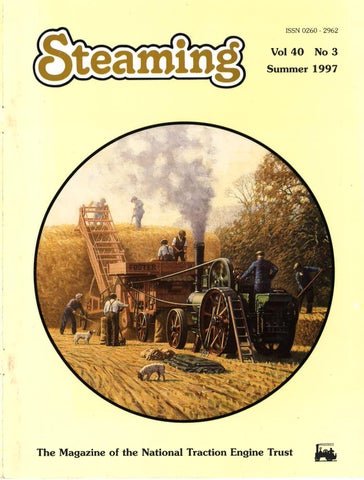
Front cover Foster engines were very much in the limelight in March, with the launch of Michael Lane's latest history the Wellington Foundry at Lincoln. We are grateful to artist Robin Wheeldon for the opportunity to reproduce the oil painting he specially undertook for the jacket of the Foster hook — it shows John Bosworth's 7hp traction 14410 driving a Foster drum and straw jack. Details of the availability of prints of the painting can be found elsewhere in this issue. 119
Trust News From the Chairman As I write it is the Spring Bank Holiday weekend, the sun is shining, and the local rally is busy. It is to be hoped the rest of the season will continue thus. I wonder, sometimes, how long the public will go on paying for us to play with our engines in their presence. In the vintage car world it seems that entry fees of several hundred pounds are commonplace for the larger events — and we get given money to help with our costs. We are fortunate, and as long as we continue to stage well-run shows, the public will keep on supporting us. In some areas of the country there is a prulrletn of lolly established events being challenged by new ones, even on the same weekend. Some years ago, when the Dorset date was changed, two major rallies in Devon and Cornwall felt unable to compete with the larger event and altered their weekend. Now, three good rallies are held over the August Bank Holiday within 50 miles of each other and all are doing well because they are all competently run. Exhibitors ring the changes with attendance and there is
N
no conflict between the various organisers. Where such conflict does exist the National has little power to act. Few engine owners ale swayed by money and most rate enjoyment as more important, and it must surely be preferable for the competing events to talk through their differences, rather than fight. Owners are unlikely to leave a good event for an untried one and therefore should be approached, if they have not entered as normal, to
establish why not. If the public go elsewhere, take time to find out why by attending other sites and asking questions and seeing what they do. Last year's successful Road Run by the Trust has caused people to enquire when the next one will be. The Committee generally feel that the Millennium will have so many events that another run at that time may lose its impact and it wouid be better to plan for the Trust's 50th anniversary in 2004. Please let your views be
From Alan Martin's Collection
77
This scene has been nicely arranged by the photographer at Alfred Gay's Crab Mills at Malmesbury, Wiltshire. Mill employees stand at the rear (and at the first floor loading doors), and the driver is clearly well in command of his neatly loaded charge, but who are the others in this glimpse of the early 1920s? Is it Alfred Gay with the proprietora/ pose at the right, and maybe his agent in front of the wagon. The 6 ton Standard Sentinel is 3199 of 1921 and the Editor wonders if its livery may be French Grey — thought to have been one of the standard works colours at Shrewsbury. Can anyone comment on this and describe the shade — the colour is often quoted in railway livery records and paint specifications from the earlier part of this century.
known so that plans can be made with the benefit of time, and the usual last minute panic be avoided so far as possible. It has been sensibly decided to hold the minimum of Committee meetings during the summer, whilst we are all busy with our hobby, but I look forward to seeing many of you at our next Open Forum at Dorset in the Trust's campaign headquarters on the Friday evening. Meanwhile, let's hope we all have a safe and enjoyable season's steaming. (Richard Sandercock, Chairman)
Rally Organisers Column Rally Authorisation May I remind all rally organisers and safety officers to send in their Safety Report as soon as possible after their event. This will enable me to complete the analysis of safety concerns that I have undertaken to submit to the Autumn Conference. On a personal note, by the time this edition of Steaming reaches you I hope to be close to moving house. Royal Mail will be contracted to forward correspondence to my new address, so please continue to use the present published address until further notice. With regard to the telephone, the new owner of my property has expressed concern about being deluged with calls on such things as traction engines, and the present number will therefore be cancelled. Those calling the number will, from the appropriate day, hear a BT recorded message giving my new telephone number. (Smudge Smith)
Engine Owners Column Engine Owners sub-Committee The Engine Owners Meeting held at Rugby on 1st March was in my opinion a very successful function. It would seem that it should continue as an annual fixture. The whole atmosphere of the meeting was good-natured and constructive, and it is invaluable to us, the Committee, to know how engine owners view such potentially contentious issues as driver training and boiler inspections. Indeed, I am sure that a great deal of misunderstanding STEAMING Summer 1997
has occurred in the past because there has not been the opportunity to air views rationally. The question of communication is important and was discussed at length, which is right, because it is only by good communication that we can keep tabs on what is happening, and more importantly, when things are going wrong. Those who were at the meeting were able to place orders for copies of the minutes to be sent on to them. If any other members would like to have the minutes to learn what went on, please write to our General Secretary, Sue Jackson, enclosing a stamped self addressed 9inx41/2 in envelope. The Trust's 1997 Driving Course was held in May at Coldharbour Mill in Devon. Despite some difficulties — the event was not helped by rainy weather and the next door farmer changing his mind on the use of his field at the last minute — I thought that the Course was enjoyable, and that the students participated fully and hopefully learned much. The Museum staff were extremely helpful and our thanks go to them for their co-operation. I also wish to thank Richard Vickery and Sylvia Dudley, and the many others for the assistance they gave. (Richard Pierce, Chairman, Engine Owners sub-Committee) Technical Board Shortly after the Engine Owners Meeting in March I went off on my travels again and missed the deadline for the Spring edition of our magazine. Important issues were raised at the meeting and are deserving of comment, even if belatedly. Perhaps most hotly debated was the question of some form of testing the competence of engine drivers. There can be little doubt that this will eventually have to come, whether we like it or not, and logically the NTET is the body that has the know-how to ensure that any such testing is based on sound practical principles rather than theory dreamed up by bureaucrats. Not surprisingly, 'old hands' who have been driving engines for many years do not take kindly to the idea of having to take a test (nor would II, but we have to face the fact that a lot of owners now, and more in the future, will not be able to learn from those old hands. This leads on to the testing, or approval as we prefer to call it, of those who want to be independent boiler inspectors. This is the responsibility of the Technical Board and has been put on a formal footing, so that applicants know in advance what is expected of them. The ideal
route for independent boiler inspectors is the traditional one — engineering apprenticeship, time at sea, engineer surveyor with an insurance company. There are some of them about (we have one already), and more may come along as insurance companies downsize their pressure systems departments. There are others who have the right engineering background, but little or no experience of examining locomotive type boilers. If they can gain the necessary experience, they could very well succeed in gaining NTET approval. There are also, of course, those independent inspectors who, like John Glaze for example, have been in business for many years, have established reputations and, like the 'old hand' drivers, have no need to prove their ability. If they wish to apply for approval, they will be very welcome to do so, but the scheme is entirely voluntary and nobody is going to put pressure on them. Another matter discussed at the March meeting was the problem that our boiler inspectors, like our boilers, are getting older and it may not be long before the engineer surveyors employed by the insurance and other inspecting companies will have had no experience of riveted and stayed boilers, let alone locomotive type boilers. The possibility of providing training for qualified boiler inspectors, experienced in examining modern welded boilers but with little or no knowledge of loco boilers, was discussed. It would not be difficult to set up a training course but obtaining speakers of the right quality, a suitable venue with facilities for practical and instruction, accommodation, would be very costly. Unless enough candidates (say around 20) were prepared to attend, the cost per person would be so high that no-one would be able to afford to go. It is a project that is well worth pursuing but, unless we can get other organisations to join in, it may prove to be a nonstarter. (Jim Newnham, Chairman, Technical Board)
From the Treasurer The 1996 Road Run The final payments concerning the Trust's event held last year have now been made and all participating owners should by now have received their refunded entry fees. An overall surplus of £3200 is anticipated, after expenses and attributable VAT has 121
been paid. A full report will, of course, form part of the 1997 Annual Report and Accounts, which will be distributed with the Autumn edition of this magazine. I will be recommending that a transfer to reserves of £3200 should be made in anticipation of a future road run, which I hope will meet with members approval. (John Harris, Treasurer)
The Road Steam Forum For some time now it has been apparent that there are minor problems, and potentially greater problems, in the necessary exchange of information between the various organised national groups that make up the road steam interest. Difficulties such as the clashing of meetings, both of the social and business nature, and tire desirability of ensuring that there is common agreement on the way to tackle legislation that is likely to encroach on our activities, are just two examples. At the end of May a meeting was arranged for representatives from the National Traction Engine Trust; the Road Locomotive Society; the Steam Plough Club; the Road Roller Association and the Sentinel Drivers Club. Following much discussion it was agreed that the Road Steam Forum be initiated. The group will meet at intervals with differing representatives from the constituent clubs. In due time it may be that other clubs representing definite types of engines (but not local or social clubs)
Westonzoyland Pumping Station near Bridgwater The earliest steam pumping station on the Somerset Levels Free parking • Good picnic spot Shop • Refreshments In steam 1st Sunday in the month, April to October, 2pm to 5pm Telephone: 01458 445555-
122
will wish to be part of the Forum. Topics discussed at the inaugural meeting included the need for better co-ordination of dates for meetings that the various clubs organise; training of new drivers; the all-round representation of steam vehicles at the FBHVC, and the desirability or necessity of introducing a scheme of Engine Authentication. The latter will be a particularly contentious subject to some owners and will doubtless require considerable thought and discussion over a period of time. At the Trust's National Committee meeting on 31st May, it was agreed that the NTET should support the new Forum. The body will not be a policy making group, but will seek to be a joint communication system serving the common purpose of its member clubs. Further details of the Forum's activities will be published as its work develops.
Steam Apprentice Club The Steam Apprentice Club has, at long last, held its first Driving Course. This took place in conjunction with the Trust's Course at Coldharbour Mill in Devon. We had three Apprentices on the adult course and three nn the junior one. The latter gave the youngsters the same basic instruction and driving nppnrti initips as the adult course, but scaled down to a more appropriate level. All six lads (unfortunately no girls!) had a wonderful time, despite the poor weather and all have asked to come back next year. Given this start, we intend in 1998 to be part of the second of the driving courses in the south west, and to continue alongside the Trust's Courses at future venues. The owner of one of the miniature engines used for the junior section is a member of the Westonzoyland Pumping Station Trust. This location includes several of stationary steam machines, and our new friend extended an invitation for the SAC to spend a day (or weekend) there arid to learn something of the operation of a different aspect of our steam heritage. Also, as a result of the Trust's attendance at Michael Lane's book launch, we have been invited to visit the Museum of Lincolnshire Life. I hope that both of these offers can be taken up later this year. On the subject of adult support, our numbers are slowly growing, with
new volunteers in Wiltshire and Fast Sussex. It is still my hope that, one day, we will have a representative in every Affiliated Club and every rally area. (John Durling, Chairman, Steam Apprentice Club)
NTET Driving Course Russell Bulley went along to the Trust's Driving Course, and here sets down his impressions of the happenings in the afternoon. My visit to Coldharbour Mill at Uffculme in Devon on 10th May coincides with a bright sunny afternoon, and the sight that greets me is a large grass field with three traction engines slowly perambulating around. A variety of novices are attending the course and being instructed by owners of the engines in the art of driving the noble beast. The participants have been divided into three groups. The agricultural engines — I can see an elderly Burrell and a large Marshall single — can cope with a total of three on the footplate, but the McLaren ploughing engine is ideal for this job, for there is room for four. Course organiser Richard Vickery stands at the side of the field watching over the proceedings, whilst each of the groups learn the art of trimming the fire, operating the injector and the like. By the time I have arrived it seems most of the novices have sufficient skill in the eyes of the owner for them all to be moving along to the end of the field and filling up with water, before moving on the highway. A number of miniature engines have been brought along for use by members of the Steam Apprentice Club, who are thus getting adequate instruction on a smaller scale. The whole scene is completed by the beautiful surroundings at Coldharbour Mill, with the mill race in full flow, and from the distance the sound of the chuffing of a steam roller wafts across the water. Further up the road I can see an Aveling roller being used by another group of students to practise three point turns and starting on less than level ground. It is gently easing down the hill in bottom gear, gingerly pulling out to pass a parked car and has now come slowly to a stop, the driver applying the handbrake to allow the trainees get off the engine. The next group are eager to get on but, while they wait, close scrutiny is paid to the owner putting coal on the fire for the next session. The driver briefly Summer 1997
STEAMING
the trainees are assembled inside the working mill to attend Michael Mason's lecture 'Boiler Construction and Repair'. I take the opportunity to sit in on it, and a most illuminating talk it is. Michael provides colour slides showing the technical aspects of boiler construction — layout of boilers; injectors; fusible plugs — and the methods for giving structural strength. He goes on to illustrate work he has done on boilers, and those present can appreciate the amount of work and the skill and technique involved in boiler repair. The session ends with a period of questions and answers. Outside again, the McLaren ploughing engine is coming back into the car park, out of its hole and nothing amiss, but I guess there has been some hard work done! I must now leave for home, but the students can look forward to another day on the Course.
As well as gaining practical experience on the engines, those taking part in the Trust's Driving Courses have the benefit of the theory of their construction, design and maintenance. Some of those at the 1997 course at Uffculme are seen adding to their knowledge. (Russell Bulley)
Weekend Workshop 1
A pause from the intricacies of valve setting as participants at the Trust's Weekend Workshop 1 pose for a group picture against Michael Davies' Fowler road loco, the temporary victim of their endeavours. (Russell Bulley)
On Saturday 12th April, the NTET valve setting course took place at Michael Davies' farm at Avon Dassett, Warwickshire. On a beautiful spring day, with the sun shining, eleven members attended, and three engines were available for use by the instructors; these included Michael's two Z7 ploughing engines, the enormous cylinders of which provided an ideal work place for the groups to gather round, albeit six feet above the floor! The course organiser, Richard Vickery, and course presenter Irvin Barraclough (both National Committee members), gave a comprehensive, hands-on and practical approach to the subject of valve setting. One of the engines was found to have a small repair in the valve seat. Sylvia Dudley provided tea at regular intervals! It is hoped that further Workshops can be arranged in the future, and if any members have ideas for topics and venues, the Committee will be pleased to hear from them. (Russell Bulley)
explains to the trainees the current engine condition, puts the blower on, and gets a bit more steam up before setting off again. A Wallis & Steevens Advance roller goes charging off into the distance, and then a tabby cat stalks across the road, as if this is just another day. A smaller Aveling roller trundles along the car park with another trainee crew, under the STEAMING Summer 1997
capable direction of the driver. The McLaren ploughing engine has found a soft spot in the grass field, and sunk in deeply. The rescuing Burrell, even in bottom gear, is at the moment unable to winch it out. As I leave the field, old hands and trainees gather round, the latter eager to learn from the debate what it is best to do next. But now it's gone 4pm, and all of
Trust Exhibition Unit The Trust's Exhibition Unit continues on its series of visits to rallies up and down the country — by now a good way towards the Committee's intention of it making an appearance at 123
all Authorised Rallies over a period of four years or so. As well as being available for advice on traction engine and rally matters for members and the public alike from those on duty (usually Committee members), the Unit always has an excellent stock of books, videos and other engine items, so do look out for it at any of the venues listed below. July — 12/13th Woodcote, near Reading; 19/20th Marcie (unit) and Weeting (stand in marquee); 26/27th Netley Marsh. August — 2nd/3rd Pickering; 9/10th Retro, NEC Birmingham; 16/17th Stanton Drew, near Bristol; 24/25th Tatton; 27th to Sept 1st Great Dorset. September — 6/7th Laughton; 13/14th Essex Steam (unit) and Old Warden (marquee); 20/21st Henham; 27/28th Woodbridge. Please refer to the Ra//y Lict 1997 for further details of the rallies mentioned. (Robert Herring, Exhibition Unit Organiser, Tr 01869 277410)
Press Liaison Officer A number of publicity opportunities for traction engines have recently occurred. The companies have come to my attention via a number of sources, and I have collected a small arrangement tee for the service provided, which has been of benefit to the Trust's finances. My contacts in the television industry have resulted in at least one local television programme featuring NTET members. I continue to be asked about
Moonlight Productions VIDEOS by Jim Stevenson The full range of tapes are now available, post paid, from NTET Sales For list of titles write to or phone — Colin and Val Brown 90 Devon Road Luton, Bedfordshire LU2 ORL 13' 01582 733971 124
non-rally events of the traditional working type — mole draining, road making, etc. If any members have any suitable information, please contact me. I continue to look at possibilities for furthering our movement in the eyes of the non-rally going public, especially in the national press and television. Any information about new TV programmes or films or contacts within the media that members can provide would be helpful. (Russell Bulley, 30 Kettering Road, Burton Latimer, Kettering, Northamptonshire NN15 5LP)
Obituaries Robin Stone Alfred Robinson Stone — Robin to all who knew him — was born in June 1905 at Bulcote, Nottinghamshire, where his father was Assistant Manager at the Nottingham Cor poration Farms. In his very early years he made contribution to the community in the church choirs of Bulcote and Burton Joyce. On leaving the village school he attended Mundella School, Nottingham. He chose a future in engineering and was apprenticed to Marshall, Sons & Co of Gainsborough, manufacturers of steam engines and farm machinery. This was the start of a career in agriculture and a life-long love for steam power. After initial employment constructing a railway branch line to the new Michelin factory at Trentham, Staffordshire, he returned to Nottinghamshire to became assistant to his father, who by then was manager of the Nottingham Corporation Sewage Works and Farms at Stoke Bardolph. Robin later played an active role in the development of the 'new' sewage works and in 1936, on the death of his father, was appointed manager in his stead. In the 1950s he was responsible for masterminding major developments at Stoke Bardolph works, which became self-sufficient with all electricity generated from methane gas derived from sewage sludge. He was highly regarded in the industry and was a Fellow of the Institution of Water and Environmental Management, receiving in 1990 a special presentation recording 50 years as a member. He retired from work in 1969. Agriculture had played an important part in his life as there were 1800 acres of farm land at the farm, which
supported pedigree dairy herds and pigs, and produced varied crops. When he first knew the farm it had 83 shire horses and four steam engines. The former declined in numbers until the early 60s, as they were gradually replaced by tractors from 1920. The Fowler steam ploughing engines were last used in the late 1960s, and are now in the Nottingham City Museum. His record of the engines used at the farm was published in the Winter 1995/96 issue of the Trust's magazine. Robin was treasurer of the Nottingham Agricultural show for many years and for over 60 years a member of the Royal Agricultural Society. His contribution to the community knew no bounds and he became churchwarden at St Lukes Church, Stoke Bardolph. He was a councillor on Basford Rural District Council, a governor of several schools, and honorary secretary to Gedling Charities for almost 50 years. Steam power remained a lifelong interest and he became a judge of exhibits at local traction engine rallies, and wherever possible could be seen on the footplate, enjoying a ride. He enjoyed photographing land travelling on) railway engines and his contribution to the railway preservation movement was ensuring that the Gresley Society's N2 tank engine had a safe home when necessary. He was an early shareholder in the Great Central Railway. A keen ornithologist, he reported the first recorded breeding of black winged stilts in Britain at Stoke Bardolph during the war years. He was an active committee member of the Winged Fellowship Trust which developed a holiday home for the physically handicapped at Adbolton, Nottinghamshire. Robin was married to Peggy for 59 happy years and had two sons, Michael and Peter. (Michael Stone)
Alan Wilkinson Alan Wilkinson, a most willing and enthusiastic member of the Lancashire Traction Engine Club, died in February at the early age of 42. Alan was born in Manchester and after leaving school started work as an apprentice alarm technician. Meeting Elaine in 1971, they were married three years later, going to live in Sale. Here Alan began to cultivate an interest in steam, in both model and full size preserved form. He became a founder member of the local model engineering society and in 1977 joined the Lancashire TEC, soon after becoming an active member. In 1982 he purchased an Aveling & Porter steam roller on which Summer 1997
STEAMING
he set about a full restoration and this, together with his various club activities, occupied his leisure time from then on. Alan was a skilled man, both in his own workshop and in his business. The responsibilities he took on for the Lancashire Club included one of the most demanding — that of the role of Safety Officer. A faithful friend, always honest and forthright in what he said and did, Alan was also a kind man, who had a great respect for others and their property. Family life centred round Elaine and his daughter Phillipa, and although suffering ill health for the past eight years, he was always determined, cheerful and an inspiration to others. Alan will be greatly missed. To all the family we offer our sincere condolences. (Mike Priestner)
Future dates Great Dorset Steam Fair 27th to 31st August 1997 The Trust will again be attending the Dorset event with its Sales Team, members hospitality area and general presence of Committee members and others in the usual large marquee. This will be for the whole of the Wednesday to Sunday five-day period, and we hope to be open from 9.00am through
STEAMING Summer 1997
This quiet scene is at Cynlas Farm, a few miles north east of Bala in mid Wales in July 1929. Little else is known about the picture, but the single cylinder traction engine is a small Clayton & Shuttleworth. Reference to the Road Locomotive Society lists has presently drawn a blank, with no record of a suitable candidate — can any reader make comment? We are grateful to David Jenkins of the Welsh Industrial and Maritime Museum for the print.
to 7.30pm on all days except Sunday, when its quite likely things will be packed away around 4.00pm. As in previous years a large sales area will be to one side and a sitting area to the other, the latter with tea and coffee available. In 1996 we were able to secure the use of a multi-screen video unit, and this proved most popular with passers by, drawing their attention to the Trust and its work. The large TV screen is to be set up again this year — use it to judge the latest videos before purchasing your winter viewing from our Sales areal We hope all members who are visiting the Dorset event will call at the Trust marquee, whether to spend money, to sit, relax and regain energy, to seek information or even to bring constructive criticism. The area will be staffed throughout by a variety of Committee members on a rota basis. The Open Forum for Trust members that was held in the marquee on the Friday evening last year proved to be a worthwhile exercise, with an encouraging attendance. A number of useful topics were raised and discussed, and the meeting showed that the opportunity for members to meet and raise matters of mutual concern is
worthwhile. The Dorset event is, surely, the gathering place for a greater number of Trust members than any other location, and the Committee members will be pleased to be available again on the Friday evening this year. This OPEN FORUM will take place on Friday 29th August, in the Trust marquee, at 7.00pm. Do try to spare an hour out of your enjoyment of the Great Dorset Steam Fair to contribute your thoughts to the running of the Trust, and the further development of our interest.
Autumn Rally Organisers Conference The Autumn Rally Organisers Conference will again be held at the Auto Cycle Union headquarters at Rugby, Warwickshire. This years date is Saturday 11th October 1997. Further details will be distributed to Rally Organisers and Affiliated Groups in due course, but any other interested parties requiring information on this extremely useful gathering should contact Sue Jackson, Hon. Secretary (address inside front cover).
125
Annual General Meeting Advance notice is given to all members that this year's Annual General Meeting will be held on Saturday 22nd November 1997 at The Boat Museum, Ellesmere Port, Cheshire. Formal notice, together with relevant information, proxy forms and audited accounts for the year ended 31st March 1997 will be sent to all paid-up members of the Trust with the Autumn issue of Steaming. Any member may submit a motion for discussion at the Annual General Meeting. All such motions must be in writing, and signed by the proposer and by a seconder. The items for discussion, in order to be published in the Agenda for the Annual General Meeting and as required by Article 16 of the Trust's Constitution, must reach the Company Secretary, Sylvia Dudley, not later than Saturday 27th September 1 997 (address inside front cover). Details of the arrangements for the AGM weekend will be published in the Autumn issue of Steaming, but at this time we give brief details for members who may wish to plan well ahead. Arrangements are being made for access to the exhibits at The Boat Museum — 'Britain's Premier canal Museum' — and accommodation for those members wishing to stay in the area for the weekend is available at the adjacent Holiday Inn, Ellesmere Port.
New Members It has long been the practice to publish a list of new members in each issue of our magazine — both as a welcome to them and as a means of enabling us all to identify newcomers
Our front cover picture The recent publication of Michael Lane's book the Story of the Wellington Foundry provides the inspiration for the illustrations on the cover of this issue of our magazine — engines built by William Foster & Co Ltd. We are grateful to Lincolnshire artist Robin Wheeldon for readily agreeing to allow us to reproduce on our front cover the scene he painted specially for the dust jacket of Michael's new book. It depicts John Bosworth's 7hp general purpose engine 14410 and the oil painting has also been made available as a limited edition print. Each of the 750 copies arc signed by the artist and numbered. The image size is 12 inches diameter, with a sepia printed and titled border, and the overall size is 17 3/4 in x 21in. Copies are available at a price of f16.00 including despatch in a sturdy postal tube. Robin specialises in agricultural scenes in his work and a further series of four prints includes two with a steam engine subject — 'Steam Threshing' features another Foster agricultural at work, whilst 'Steam Ploughing' not surprisingly shows a pair of Fowler engines at work. An illustrated leaflet for the prints, and details of greetings cards depicting the scenes, are available from: J.R. Wheeldon, Rectory Lane, Waddington, Lincoln LN5 9RS (sr 01522 720542)
We are grateful to Frank Lythgoe for his kind invitation to visit Warburton Park on the Sunday morning to view the engines in his considerable collection.
Poor Steaming We apologise to Bill Boddy for omitting to credit his name to the
that may live locally and to make contact with them on a mutual interest. Recently it has become apparent that the list is being used as a means to distribute what some recipients regard as junk mail. Accordingly in future a rather more
A sincere welcome is extended to the following new members who have joined the Trust during the last three months. We hope they will gain much friendship, information and enjoyment from their membership over a period of many years. The Memhrirchip Secretary is always ploatati to put members in touch with one another by fowarding mail. A. Borthwick, Houghton-le-Spring, Tyne & Wear M.J. Headworth, Brandon, Grantham, Lincolnshire D.M. Davies, Rye, Sussex R. Nott, Bea worthy, Devon G.W. Lomas, I ligh Peak, Derbyshire D.R. Crapper, Clayton West, Huddersfield, West Yorkshire N. Davies, Bramhall, Stockport, Cheshire M.S. Wallace, Waltham Cross, Hertfordshire Miss M. Willmott, Bradley Stoke, Bristol C. Hickson, Budleigh Salterton, Devon D.R. Penness, Higham Ferrers, Northamptonshire P. Palmer, White Waltham, Berkshire G.Swales, Offord Darcy, Huntingdon, Cambridgeshire W. Shiell, Lower Greenhill, Selkirk, Borders P. Lambert, Glossop, Derbyshire B. Johnson, Kegworth, Derbyshire
126
heading picture of tne article 'A Little I lercules', which was published in the last issue. Bill kindly loaned the print some time ago, and the prepared negative lay in the files, awaiting the opportunity for further research. An error occurred in the telephone number of the advert by Llewellin's Gears in the last issue (page 1011. The Bristol number should have read '' 0117 942 4026.
abbreviated form of aril-tress will be published, but for those who seek to make contact, the Membership Secretary will continue to be willing to put members in touch with one another by forwarding mail.
J.I. Wallace, Stranocum, Ballymoney, Co Antrim T.L. Landsbury, Mablethorpe, Lincolnshire J.A. McKain, Digbeth, Birmingham R. McLaren, Uplawmoor, Barryhead, Glasgow J.A. Watkinson, Knottingley, West Yurksliire T.J. Green, Nutbourne, Chichester, West Sussex R. Nixon, Brookmans Park, Hatfield, Hertfordshire W.J. Pennington, Dunham Massey, Altrincham, Cheshire K. Owen, Lowgill, Dent, Sedburgh, Cumbria J. Lyon, Stapleford, Nottinghamshire G.F.Leach, Luton, Bedfordshire J.N. Brigg, Cowling, Keighley, West Yorkshire N. Williams, Eglwys Cross, Whitchurch, Shropshire P. Macnair, Southridge, Streatley, Berkshire R. Horrell, Stoke Canon, Exeter, Devon R. Bowes, Carlton in Cleveland, Middlesborough, North Yorkshire C.A. Harker, Spalding, Lincolnshire Mrs R. Fletcher, Brixworth, Northamptonshire P.B.Hancock, Willoughby, Rugby, Warwickshire D.J. Andrews, Croxley Green, Rickmansworth, Hertfordshire C. Smith, Long Bennington, Nottinghamshire C. Montell, Anlaby, Hull, East Yorkshire A. Theobald, Ipswich, Suffolk Summer 1997 STEAMING
Potnali Jmt T RA©MCA gilltEL A
nol I
SSG
WiAlr,K,41 trin-41cm84 c)iq IPA41 kt12 L'621414 MOE MUM TREVOLi ZI2M4 PO= ,fse)1,1 A o 130T VICAI J
Pnta T,2,47 APPIDIETH ilEHRAtitg 2nDILPT,P,
P MARKET LEADERS for Over a Decade
STEAMING Summer 1997
561 4196 559 0814 ootman James & Co. Ltd. Waterfall Lane, Cradley Heath, West Midlands. B64 6PU 127
udds TimabnedriiMaezehrasnts
J
David Judd The Judd families were farmers and landowners in Buckinghamshire, Northamptonshire, Oxfordshire and Warwickshire as early as the 15th century. The firm of Judds — hauliers and timber merchants — was started by great grandfather Noah Judd in the late 19th century, probably in the 1880s. Noah had a large farm estate at Chackmore, near Buckingham, and with one of his sons, Harold Judd, who also had a large farm at Paulerspury, near Towcester, Northamptonshire, they between them built up a large and successful haulage business. Noah, and probably Harold as well, kept a lot of horses, not only at their farms but in fields and paddocks around the countryside. Horses were a valuable commodity in those days and could be put to many uses — for ploughing, transport to the market with the cart, hauling timber etc. Horses used in hauling the timber trailers, or drugs as they were known, were regularly changed with those resting in the fields and paddocks. Horses with names such as RAJAH, PRINCESS and JUMBO come to mind, and some of these were lost in a barn fire at Chackmore in 1908. A photograph in my family collection shows my grandfather, Ernest Isaac Judd, Noah's youngest son, with a team of horses and a timber drug in the paddock behind the family home at Chackmore. It was taken approximately 1919/1920 when my grandfather was about I6 years old. Noah Judd's earliest venture into steam may well have been with a single cylinder McLaren agricultural, manufactured in 1886. It was of 8 horse power and was serial number 254. Very little more is known about this particular engine, other than in March 1905 it was ex W.A. Allchin of Northampton, and that in 1911 it went to Thurlows in Suffolk. As Noah Judd's sons grew older they too became involved in the family business. Arthur Edward, Walter, Reginald, Ernest Isaac and Harold all had a hand in the business, and so too did some of Noah's grandchildren. 128
Ernest Judd with a four-horse team and timber drug at Chackmore, Buckingham about 1919/1920. (collection David Judd)
Burrell agricultural 3655 rejoiced in the patriotic name of ENGLISH HERO, appropriate to an engine constructed and delivered during the years of war. Here, just after it arrived new at Chackmore, the 6hp Burrell is posed in the orchard behind the Judd family house, Nayle Cottage. Noah Judd stands proudly by the belly tank. At the front wheel is Lizzie, his wife, whilst Harold Judd perches on the roof; Noah's eldest son Arthur Edward takes the steering wheel and Ernest Isaac (aged 11) stands at the rear wheel. By the bunker is the engineer from BuffetIs. (collection David Judd) Summer 1997
STEAMING
During the earlier part of this century, especially the 1920s and 1930s, Noah, and in particular Harold, built up a fleet of steam tractors, steam engines and steam lorries to help run the haulage firm. Harold Judd can probably best be remembered for owning Super Sentinel tractor 8777 (J61655), now more commonly known as OLD BILL. One of the engines which features large in the family firm's haulage history is Burrell 6 hp traction engine, 3655 ENGLISH HERO. This double crank compound engine was delivered to Noah Judd at Chackmore when new in May 1915, Burrell men bringing it from Thetford. Noah and Harold used the engine extensively to haul timber and, perhaps inevitably, accidents occurred. In 1916 on the evening of the 16th August at about 5.30pm they were working in Worcestershire; ENGLISH HERO was bringing in two loads of timber from Rye Court meadow to the village of Berrow, for the onward journey to Malvern Wells station. In negotiating the descent of a steep bank at Rye Court, the Burrell skidded; this caused the timber drugs to overrun and forced the engine over onto its side. The driver, Reginald Judd, unfortunately fell under the canopy and was badly crushed. He was rushed to Ledbury Cottage Hospital, where he was nursed until his death. Reginald, known as Reggie, was only 21 and engaged to be married to a local girl back at Chackmore. He died as a result of receiving a fractured skull, fractured ribs and a rupture of his left lung. The accident occurred whilst he was
Burrell 3655, ENGLISH HERO, stands as a rusty hulk in the 1960s, before preservation. (collection David Judd)
driving and steering the engine; William Henry Hicks was applying the brakes on the timber drugs on the descent. Reggie is buried at Radclive churchyard near Buckingham. Burrell 3655 has survived to preservation. About 1923 it was returned to Burrells at Thetford, but in the 1960s had finished work and was lying in a rusting state. The machine
has had several owners in preservation, but is now seen regularly around the south of England as well as at rallies on the continent. Since being restored, ENGLISH HERO has been converted to appear as a showmans engine. Another Burrell traction engine which gave sterling service, not only to Judds, but also later to Darkes of
Burrell 3836 STARLIGHT photographed at Paulerspury, Northamptonshire with two timber carriages. Those present, left to right, are Walter Judd; Harold Judd and 'Punch' North. (collection David Judd)
Two views of Sentinel timber tractor 8777 in an embarrassing position at Yorktown Post Office and Off Licence in May 1937. The incident is described in the text. (collection David Judd)
Worcester, and then Edwards, the circus and show people from Swindon, was 6hp double crank compound 3836 STARLIGHT, which was delivered new to Judds in 1920. It was, like the others, worked hard and 130
was extensively used for heavy haulage. Weighing some 12 tons with two speeds and a steam pressure of 200 Ibs, this engine was one of the first to generate for a fairground ride in preservation in the 1950s, for Noyce's
gallopers at Banbury Fair. During its life STARLIGHT has worked as a road locomotive in timber haulage, on the fairground and at threshing. A brief history of the engine reads as follows — new to Noah Judd in 1920; then with S. Darke & Son of Worcester; in 1923 to Burrells and then with Edwards of Swindon in the 1930s. In preservation Dan Shorey of Banbury rallied the engine extensively from the Summer 1997
STEAMING
1970s; since 1992 it has been owned by Alan Lloyd of Malvern, Worcestershire and is presently undergoing major restoration. I mentioned earlier the Super Sentinel timber tractor, 8777 (JB1655). This machine was new to Harold Judd on 3rd July 1933 and delivered to Spencers Wood, Reading, Berkshire, to where the family had moved from Chackmore and Paulerspury. Yards or depots were set up at Lambs Lane and Trail End, Spencers Wood, and at Swallowfield. These yards, especially the ones at Lambs Lane and Trail End, were to continue in operation until 1964/1965, when the business began to fragment with family members emigrating to New Zealand, and going their own separate ways. Harold Judd was so impressed with the Sentinel that he was very selective about who he let drive it. It was his pride and joy and he even used its picture on his business paper. The tractor had a wheelbase of 10ft 6in, it weighed 13 1/2 tons with coal and water, was 20ft long, 10ft 8in in height and 8ft in width. It had a steam pressure of 2751bs and a top speed of between 30 and 35 mph. The main engine was a two cylinder double acting high pressure engine of 120hp. The winch engine, situated behind the cab, was a marine winch and had approximately 50hp. It was involved in an incident outside 125 London Road, Yorktown, Camberley, Surrey on 12th May 1937 — Coronation Day. It was reported that OLD BILL, coming to rest in the front window of the Yorktown Post Office and Off Licence, drew more crowds than the organised entertainments of the day. The exact details and reasons for the machine ending up in such a situation are unclear, but it is possible that either its brakes failed or
is
H.JULI TIE IM1LIE95
71SPENCERS ir 111140116.
Super Sentinel timber tractor 8777, freshly completed and posed by the makers for its 'official' photograph, across the road from the works main entrance at Shrewsbury. (collection David Judd)
the Overs or Chatt & King vans were the cause. No-one was injured thankfully — only OLD BILL'S pride. The Sentinel was towing a fully laden sixwheeled round pole timber carriage at the time. The driver, Ern May, and his mate Wally Dell, were crewing on this occasion. The tractor survives in preservation and it appeared at the Great Dorset event in 1995.
Between the early 1900s and the 1930s Noah and Harold Judd between them owned, at various times, about a score of engines for their timber haulage business — agriculturals, road locos and steam tractors by Burrell, Garrett and Tasker, and timber tractors by Foden and Sentinel. Most, of course, are long gone to the scrapman, but as well as the three I
Tasker chain drive tractors were popular for timber hauling and Harold Judd used number 1774 of 1919 out of his yard at Paulerspury, near Towcester in Northamptonshire, according to the lettering on the roofboards. Here, however, it is pictured outside a timber yard at Reading. (collection David Judd)
have mentioned above, several others do survive today. They are Burrell Gold Medal tractors 3497, 3807 and 4071; RiirreII road locomotive 3849 and Garrett tractor 32122 — you can find most of them out on the rally fields sometime during the season. To anyone who may have more information or history pertaining to Judds' engines, including photographs, I would be more than pleased to hear from you with details, and especially to have the chance to copy old pictures of the engines once used by my family. David W. Judd 24 Durley Park, Oldfield Park, Bath BA2 3NT
Inquest at Ledbury 'As reported in our last issue the young man Reginald Judd, 21, traction engine driver, of Chackmore, Buckingham, died on Friday morning last at Ledbury Cottage Hospital as a result of injuries received in the overturning of a traction engine in a meadow at Rye Court, Berrow, where deceased and other men were engaged in timber hauling. 'An inquest was held on Saturday afternoon, at the Ledbury Police
Court, Mr T. Hutchinson (Coroner) presiding, Mr James Davis was foreman of the jury. 'Mr H.W. Orme (Messrs Russell & Col appeared to represent the father of the deceased. 'The first witness was the father, Mr Noah Judd, Chackmore, Buckingham, who said he was a haulage contractor. Deceased was his son and was in his employ as engine driver and he was 21 years of age. He was quite satisfied there was no blame attaching to anyone. He had examined the engine and timber wagons and had heard what had happened. 'William Henry Hicks, The Gardens, Chatwode, Buckinghamshire was a young man in the employ of the last witness as a traction engine driver. On August 16th in the evening about 5.30 they were bringing a load of timber down the meadow in the parish of Berrow. The load consisted of two timber carriages with about an ordinary load. Deceased was driving and steering the engine, whilst witness put the brakes on the wagons. They had borne down a bank, which was rather steep. Witness gave the driver 'right away', having put the brakes on. The brakes were on and in good order. Witness was behind the last carriage when he gave 'right away'. After they had gone some distance the engine skidded, and that
caused the carriages to overrun the engine and push her over. Deceased fell under the cover, or shed of the engine. He was badly crushed and he was removed to Ledbury Cottage Hospital. Deceased was able to speak, but did not impute any blame to anybody. 'By Mr Orme: He put the brake on both waggons and they held. The engine and waggons were travelling on grass. 'By the foreman: The brakes were on after the accident. 'In reply to Mr Orme, the father said the engine was a 12 ton engine, 8hp. 'Doctor Leslie B.C. Trotter, Ledbury, said he saw deceased on 16th August at the Cottage Hospital and found him suffering from extensive injuries. He had previously seen the man at Berrow and ordered his removal to the Ledbury Cottage Hospital. He received every attention, but died on 18th August at 10am. He suffered from fractured skull, fractured ribs and fractured lungs. 'A verdict of Accidental Death was returned.' (The report of the inquest into the fatal accident to Reginald Judd, which occurred on 16th August 1916, near Berrow, Worcestershire, as published in a contemporary local newspaper.)
ENGLISH HERO lies on its side after the fatal accident at Rye Court, Worcestershire in August 1916. A sombre Harold Judd stands third from the left; the others are probably local people. (collection David Judd)
ONE THING AFTER ANOTHER Charlie Dore All photographs are by the author, except where stated.
At the end of the 1992 rally season I steamed my Aveling roller back to its home at the nursery at Little Tey, near Colchester. Boiler repairs were needed before the following summer, and Simon Wells of Acton, Suffolk had agreed to renew the smokebox and repair the bottom of the front tubeplate, which seemed a bit wasted. A few days later I watched as the roller was whisked away on a low loader. It wasn't long before I had a phone call — Simon had got the smokebox off, the tubeplate was out and was repairable and then he paused: "but your boiler barrel has been condemned!" It had wasted down to Ye in on the top, forward of the cylinder, due no doubt to the blower valve leaking over a long period of time. The cladding had been renewed at this point, which should have been a good sign to us. So, it was agreed that I should have a new barrel. In the meantime I got back to work on the engine, removing everything that was on or connected to the boiler. I was not a happy person, but I could only console myself that the Aveling would be twice the machine when we had finished. Simon phoned again — he had removed the barrel and now gave further bad tidings. "Charlie, your firebox is not long for this world; what do you want me to do?" It was time to think things over. Just then I was in the process of changing jobs, moving up to the North Yorkshire Moors Railway to become storeman at the Grosmont engine shed. I had to ring Simon back a couple of days later and ask him to stop the work; I'd be in touch with him when a few things were sorted out. It was a whole year later when, with the agreement of the Grosmont shedmaster, the roller was transported on two lorries to Yorkshire. I was now in a position to start, once more, on its return to steam. The first job was to remove the rear rolls, the axle and the tender from the back of the boiler. This took quite a while, and I wanted to STEAMING Summer 1997
The subject of this article is Aveling 11956, an 8 ton roller built in 1927. It is a C-type single cylinder machine, and was new to the Tan field Urban District Council, a local authority serving a hilly coal mining and iron making area of County Durham, about ten miles south west of the cities of Newcastle and Gateshead.
The problem that started it all. The badly wasted front tubeplate — the bottom is , of course, at the top in this view.
Aveling & Porter 8 ton roller 11956 as it arrived in two pieces at the North York Moors Railway from Essex, early in 1994. 133
remove the condemned firebox in as complete a condition as possible, to serve as a pattern for the boilermakers who would be making the new one. During the Christmas holidays, 1994, all was ready, and the remains of the boiler (the outer firebox) went off to Israel Newton's works at Bradford. There, the new barrel had its seam riveted, and then was in turn riveted to the outer firebox. Newtons also made up the flanged, welded firebox and a new front tubeplate for me to fit. While all this was being done I had plenty of more mundane things with which to occupy my time — cleaning almost ad infinitum, and repairing all manner of things, but it would all save time later on in my restoration programme. By March 1995 the boilerwork was complete and the boiler was returned to Grosmont. All of the mountings, of course, had been removed from the old platework and everything had been fettled up ready for replacement. Now I could make a start. The cylinder was placed on its saddle and then lowered onto the barrel; the crankshaft, motion and piston set up in position, and after a lot of fussing, the saddle located. All were then marked up for drilling, and taken off. The cylinder was quite worn and went away for reboring. Having got the barrel marked I could now get on with drilling the many holes for the riveted fixings, and with the summer evenings arrived it was not at all had working outside. We turned the boiler this way and that to make the task easier, but, as owner of the machine, it fell to me to he inside. I was passed the exceedingly hot rivets, had to learn to place them quickly in the hole with one hand and rapidly follow up with the backing gun, before shouting "Ready" to the boilersmith outside. More than once I caused amusement to all present when a rivet fell out and rolled around in the cramped conditions, me shouting in panic at getting burned. Once the cylinder saddle was riveted on the clack mountings could follow, along with the inspection door. The front tubeplate was drilled on a radial drill in the Railway company's workshop and we set about drifting it in to the boiler one Sunday morning, using a large baulk of timber. That was going OK until I left my fingers around the end — there was a painful 'splat' and I spent the rest of the day in Whitby Hospital being sewed up. Having a bandaged hand and being told to keep it clean was a bit irksome: most things I do involve getting mucky! With the tubeplate in position the holes were drilled for the rivets, and 134
A contrast in sizes! The Aveling's boiler (less barrel), having had all the stays drilled out on a radial drill in the workshop, is seen next to the wide firebox of a Bullied Pacific railway loco at Grosmont.
The inner and outer fireboxes of the Aveling separated.
then with the assistance of the boilersmith, the whole task was completed in an hour. The Shedmaster darkly asked why the boilerman could not work that fast when he was paying him. Next the boiler was turned upside down to await the arrival of the firebox, which was being drilled in the workshops. After a couple of fittings, the box was dropped into position and bolted up — riveting of the foundation ring and firehole door ring followed. All the stay holes were then countersunk
ready for the welded stays. To make this job easier the boiler was again turned to different positions so that we were always drilling downhill. While the stays were being welded I turned my attention to cleaning and painting the many parts that were lying about awaiting refitting. With the stays completed, the boiler came back to the field and the front edge of the smokebox was profiled back to the correct angle before fitting the ring and the door. I decided on a bolt on Summer 1997
STEAMING
The new barrel riveted to the outer firebox; as on all Avelings the smokebox is the front part of the barrel rolling and the front tubeplate has yet to be introduced into its position, and the front edge of the plate work profiled to an angle.
plate instead of a hinged door, as this would be more airtight than the original design. The cylinder was now bolted onto its saddle, and the inspection door made to fit the new barrel. Due to development work at the locomotive shed, all of my roller parts now had to be moved further down the field. This task took a couple of days, and it was to a muddy location; loads of ash put down were to little avail. Nevertheless it was now time for more water and the pipe was duly connected up to the boiler and turned on. Minutes later the stuff was running out everywhere, so a start was quickly made on caulking. This took a couple of weeks, including two nights in sleety snow, but the job was getting better and the leaks were drying up. While moving the boiler onto its side for another bout of caulking, it slipped through the strap and rolled over very slowly — we all moved clear, as there was nothing we could do to stop it. But when it came to rest the whole weight was on the trunk guide. As we watched in horror, it broke with a nasty 'ping' in three places. We had been tired and hadn't thought the job through properly beforehand, but it was more than I could take. Surrounded by the devastation in a sea of mud — I just wanted to go home! But help came and within a few minutes the boiler was upright once more. Tormar STEAMING Summer 1997
Engineering were found through an advert in Old Glory and the remains of the trunk guide were removed, packed up and dispatched to Kent, the first time that I know of that anything of my engine had gone back to its birthplace since it left there in 1927. This problem had cost me my final savings,
so I did not want any more mishaps. Having successfully stopped 90% of the leaks, I contacted my boiler inspector and a date was fixed for him to witness the hydraulic test. The Railway's own boiler inspector, who had kept an interested watch over my doings and was more than happy with events, said he could be present at the test just in case my inspector had any questions. On the day, and with the required pressure indicated on the gauge, all our labours were rewarded when the work was passed. However there had been a couple of un-nerving minutes the night before, when the rubber jointing at the regulator valve had blown out just as we pumped the hydraulic pressure up to the line. I now had two months to get the machine ready for its steam test — no problems, surely I could do it in two whole months! But it ended up a race in the end, and the weeks just flew by. There was a lot to put back: axle, tender, crankshaft, gears, pipework, etc. The components had all been painted beforehand and the Aveling was beginning to look quite smart. The day of the steam test dawned and by 3 o'clock in the afternoon the needle sat just under the line. At that time the inspector arrived, just as agreed, and after a good look round the safety valves lifted at 180Ibs. A few more words and the boiler was passed, and a big sigh of relief went up, the culmination of two years work. Work could now progress with assembling the motion and replacing
There was still an awful lot of caulking work to do when the boiler was filled with water for the first time. 135
August Bank Holiday Monday 1992 was a murky day in North Yorkshire, but no matter — Aveling 11956 was in steam and moving again.
the awning. I had got my eccentric rods mixed up, or rather the way in which I had to replace them, so an excursion to Pickering Rally was called for to take a sneaky look at someone else's. Having turned over the engine many times by hand the time came to run it on steam, and on the August Bank Holiday Sunday 1996, I did just that, and the following day moved the roller up and down the field — the first time it had run since October 1992. I took time off to visit the Dorset Steam Fair, but on my return the job of moving the roller down to Pickering had to be tackled. We used the Railway's 45 ton steam crane to load the Aveling onto a low railway wagon, and a few days later it was sent down the line, on arrival to be unloaded by another similar crane, to await a 5 mile journey down the road. I must end by thanking all those who helped me in returning ray roller to full working order, for it is something I could never have achieved on my own.
In accordance with the recommendations ...
Preparing to lift the roller at Grosmont loco shed with a 45 ton Ransomes steam crane. The author is driving the crane. (John Hunt) 136
To record the start of life for Aveling 11956, it will be interesting to set dawn same extracts from the Minute Book of the Tan field Urban District Council at the time of their acquisition of the machine. At the meeting on 12th July 1927 it was minuted: 'Steam Roller. In accordance with the recommendations of the Highways and Public Lighting Committee, the Committee considered the question of purchasing a new Steam Roller, and after the Surveyor had reported in regard to the position, he resubmitted the quotations from Messrs Aveling and Porter and Messrs Marshall's Ltd, for a new Steam Roller and the offers for the Council's present one. 'IT WAS RESOLVED: (1) 'That the Council do purchase a single cylinder Steam Roller with extras, from Messrs Aveling and Porter of Rochester, in accordance with their specification of the 2nd June 1927, for the sum of £866 payable by four annual instalments of £216-10-0, subject to the Sanction of the Ministry of Transport, if necessary', (2) 'That the Tender of Mr E.A. Cole offering £150 for the Council's present Steam Roller be Summer 1997
STEAMING
accepted, subject to the above purchase being approved', and (3) 'That the Surveyor make arrangements to obtain the new Steam Roller as soon as the Sanction is received'.' The autumn came, and when the Councillors gathered on 11th October the Surveyor could present what would be the concluding entry on the new roller: 'Steam Roller. The Surveyor reported that the new Steam Roller had been unloaded at Rowlands Gill that day and brought up to the Crookgate Bank Housing Scheme. On the advice of the Makers and after consultation with the Chairman, one of the maker's employees had been engaged to unload and start off the new engine and to make the necessary adjustments after delivery. The Clerk submitted an Agreement between Messrs Aveling and Porter and the Council with respect to the purchase of the Roller on deferred instalment terms as agreed. 'IT WAS RESOLVED: (11 'That the Surveyors Report be received and his actions confirmed', and (21 'That the Common Seal of the Council be affixed to the Agreement with Messrs Aveling and Porter'.' Further details of the engine are, of course, available from the makers Royalty Books, now held at Lincolnshire Archives. The relevant sheets for 11956 disclose, among other detail: Date of order, 2nd September 1927; promised delivery — as soon as possible; date despatched, 26th September. One C type — that is 8ton, single cylinder — engine, customers name: Tanfield UDC, R. Heslop, Surveyor, Burnopfield, Newcastle-onTyne. The boiler was to have a 2ft 10in long firebox, and 18inch x 3inch hind roller rims; compensating gear; water elevator; and a full length steel awning. The latter is neatly crossed out and probably indicates a change of mind by Tanfield or the correction of a misunderstanding, for a note added on 5th September to the bottom of sheet 2 lists all the parts required for a full length wood awning. Other recorded features are 2-tine Resilient scarifier, stay bracket and packing blocks, the latter necessary to set out the scarifier 4 inches to suit the wider 18 inch wheels. The final phrase 'Delivery paid to their Station' does not really make clear whether it was Avelings or Tanfield who had coughed up the money to the railway company for the transport. Incidentally, it seems rather a long time for the roller to have been in transit, if indeed it had left Rochester on 26th September and was unloaded at Rowlands Gill in County Durham on 11th October. 4 STEAMING
Summer 1997
Aveling 11956 posing for the camera before it came to needing a new firebox. (Charlie Dore)
VALENTINE WELDING & ENGINEERING Co Enterprise Works, Enterprise Road, Raunds, Northamptonshire NN9 6JE Tr 01933 460946 Fax 01933 625551
Boiler manufacture and restoration on full size and model engines Welder approval test certificate to BS4871 (EN287, 288) All welding certified and approved by Cornhill Insurance Group
TENDERS, BELLYTANKS, WATER CARTS WHEELS RETYRED and SPOKED WHEELS MANUFACTURED Big enough to cope
Small enough to care
137
A Marshall Enigma Late in 1994 Paul Cotterill of Haifa, Israel, found a small portable steam engine in the north of that country. He kindly sent some pictures for our use in the magazine and gently suggested that we might be able to provide him with some identification of the machine — they are known as 'locomobiles' locally, although they were never in common use in that part of the world. The portable is presented as an exhibit at the Old On' irtyArri Museum at Kibbutz En Shemer, near Hadera. The museum is mainly devoted to the pioneer days in that Jewish settlement, located in what was once the mandated territory of Palestine. The engine presently carries no identification other than a small plate bearing the wording LIVELLO D'ACQUA near where the water gauge glass has once been. Despite this information in the Italian language, it seems to be a small Marshall built engine from Gainsborough, and one of only a few horsepower. Nothing definite is known of its history, though according to local tolklore the machine was used by early settlers at Kibbutz En Shemer after World War 1 and rediscovered in use as a heating unit at Nablus following the Six Day War in 1967. The portable is exhibited in the
shade of a tree and is belted to what might be a machine for separating cotton — a crop which is still grown at En Shemer. An electric motor mounted under the boiler barrel can drive the crankshaft via a belt onto the flywheel. There are also several vintage farm tractors among the collected exhibits. Only three 'road steam' — all portables — have been recorded in Israel or Palestine. The other two have featured in the Autumn 1987 and the Summer 1990 issues of our magazine. But what of the fresh discovery? It was necessary for us to seek the thoughts of someone with a good knowledge of Marshall portables.' As one who has completed a fine restoration of such a breed of engine, Peter Love of Herstmonceux, East Sussex, kindly agreed to look at the pictures of the Israeli relic and to make some notes. However, the appearance of the engine has caused him much doubt, with many of the features not tying up with practices usually associated with products of the Gainsborough Works. We reproduce here Peter's extensive comments on the various parts of the engine. Cylinder The judgement of this engine has
A series of pictures of the small portable at Kibbutz En Shemer, Israel. Its various features are discussed in the text of the article. (Paul Cotterill)
138
certainly been a challenge; I've tried to gain a wide knowledge about Marshall portables, but this one has some peculiar anomalies when compared to machines I am familiar with. I have studied many photographs and other illustrations and although the cylinder looks just right for a larger Marshall of the 1900 period, none of the small 2 or 3hp examples in Britain have a separate valve chest cover (to the left of the cylinder end cover) as this engine has. The British ones do not have the facility to have the valve chest inspected in this way; the casting is just finished flush and solid. Nevertheless, the larger portables of the era do have a separate cover. Looking at the regulator, this is mounted on the backhead and then travels into the valve chest. This is correct and is similar, I think, to Richard Willcox's example number 36383. It might be interesting to know I have found four variations of the fitment of the regulator valve on Marshall portables dating from the early years of this century — • as described above, • regulator handle fitted as above, with the valve on top of the block, and to the left, • regulator valve cast into the block on the left, high up, with the lever (straight) operating from a cast bracket on the block, high up, • regulator valve cast in the centre of the block with the regulator rod
Summer 1997
STEAMING
operating from a cast bracket on the block (as fitted to the 2 and 3hp Marshall portables in Britain, except for 363831. Crankshaft brackets I have studied the crankshaft brackets long and hard, and I have viewed all the small British Marshall portables except for Alex Hayward's recently imported engine 49619. (Alex tells me it has two separate crankshaft brackets, like the other examples.) One can clearly see that the engine at the Kibbutz Museum has brackets all in one, as it is wrapped across the boiler barrel. This is most odd, as even the larger Marshall portables do not have this feature. Regarding the suggested date of 1875, this cannot be correct, for the early engines have cast iron crankshaft brackets and were fitted onto the boiler barrel by taper bolts. The later engines were riveted on, similar to that which I can see in our Israeli pictures. Also, the water pump on the early engines was fitted below the crankshaft in a similar fashion to a Ransomes or a Clayton & Shuttleworth of the same period. Salter safety valve I have never seen a Marshall with a Salter safety valve designed like the one in this engine; the early Marshall portables have a valve arm heading towards the backhead with a single Salter valve. If you look at the valve in the photograph you will see that there are two spring scale adjusters. Perhaps these adjusters are not the original fitments as they look more suitable for weighing meat or the like, and not intended for steam pressure! You will also note around the cylinder pressure release valve, a cover similar to that which was fitted
STEAMING Summer 1997
A 2hp Marshall portable, the picture taken by Peter Love whilst it was under repair recently in Britain. It is number 50656 of 1908, owned in Denmark. Note the one piece boiler barrel and the form of the brackets for the crankshaft.
to earlyish Marshall traction engines — please compare with pictures of 14242, 14421 and 15391. It is not quite the same, I know, but it is similar. I might add here that I have never found a Marshall picture or catalogue illustration of a similarly designed portable to the one under discussion. The 2 and 3hp Marshslls from about 1901 have one Salter valve going across the boiler towards the off-side of the engine (the pump side). Perhaps because the machine had been used as a heating unit, some modifications had been carried out and that is why it looks non-standard around the valves.
Parts missing Looking at the pictures closely, you can see that the gauge glasses are missing, so too are the cylinder drain cocks and half of the water pump mechanism, and there is no pick-up water valve assembly. The pipe from the central exhaust to the pump pickup is missing. The regulator rod has gone (crank handle type); this would fit between the round stop disc on the backhead, which would read open/ shut — this can be seen in the picture. Interesting observations I am pleased to see that the engine still has the spark arrestor cleaning mechanism, as the cleaning rod handle
139
OUR MAGAZINE 25 YEARS AGO
engine came back to Britain from Australia in 1995 — it is seen here at This engine the Dorset portable gathering that year. The author thinks this is the oldest 3hp Marshall portable in the country; judging by the water pump and other cast items it could date from the 1870/80s. It does not appear to bear a works number. (Peter Love)
can be seen on the lower half of the chimney, about 15 inches or so above the flanged joint. The cylinder is positioned in the middle of the firebox assembly; on Richard Willcox's early-this-century engine the casting is fitted well to the front of the firebox wrapper plate. As I have said before, the credentials of this engine are not like any other small British or Australian example I have seen, yet the design is very, very similar in many respects to an 8hp Marshall portable!
What horsepower is it? In looking at the engine to judge its horsepower, I would say there is a strong possibility that the engine is of 3 or 4hp; it is difficult to tell without someone standing beside it, or measuring the bore. We should note that the engine has only one manhole — most Marshalls have two. However, (here we go again), some 2 and 3hp machines have only one. Mr Ellis's 3hp example (I feel this engine could be 2hp, as it has the smaller water pump fitted), which was built not long after my own 1912 version, only has one manhole, so I cannot form a pattern over the way Marshalls did things. On the subject of horsepower I cannot say much more. 140
Dating the engine Well, the engine has a trunk guide so that should date it to after 1898, nevertheless it has a lot of other different features I have not seen on similar sized Marshalls. So I would guess it to be around 1908. Another way of attempting to work out the portable's age would be to go through the Marshall Sales Books in the archives at Reading University. These are somewhat incomplete in detail, although they do give a horsepower figure, and with a little trial and error (and some luck) it might come to light as to who was sold a small portable that ended up in Palestine. So there you have it. Perhaps you will all be more confused than when I started this saga. I'm fairly sure the engine is a Marshall, even though it is not like any other examples we have here in the UK. Who says portables are boring? We thank Peter Love for spending time in studying pictures of this somewhat enigmatic little portable in the Near East, and also Paul Cotterill, who as well as providing the original puzzle, kindly returned to Hadera at a later date to take further photographs at our request.
Many engines that have since become well known on rally fields were noted in the June 1972 magazine as having changed hands. One Len Crane had bought Fowler crane engine 17212 from J.T. Thompson's boiler works at Wolverhampton — its Thompson name plates were to be retained. A Michael Ward of Oxton, Nottinghamshire, 'well known at Midlands rallies', had swopped his Garrett tractor for Burrell road engine 3257, as he felt a larger engine would henefit the moving of his caravan and water cart from rally to rally. Joe Warren of Cornwall had acquired Foden wagon 11208 from the Hirst sale lit had come from the first of Kings clearouts at Bishops Lydeard) and DIngles at Stokesclimsland, Cornwall, had taken their last derelict roller, a Marshall S-type, into shops for rebuilding. Charles Daniel had counted 80 engines of all types in Cornwall, though thirty were not in working order. The North Staffs & Cheshire club had taken the lease of premises at Draycott-in-the-Clay — an old plaster mill — as a centre for club and members engines The Road Locomotive Society had commenced a series of reprints of old catalogues and the first two examples chosen were from Coulson & Wear and from Burrell, priced at 10p and 50p respectively. From Cumberland Bill Dowthwaite wrote asking for a boiler side transfer for a McLaren engine. Presumably he had no response; they really are elusive — has anyone any knowledge of an example?
Member Bernie Ward of Lowestoft has produced a booklet on Armstiuny Whitworth steam rollers, covering the 8R, 1 OR and QR types. Bernie is custodian of 1923 built 10R22 (DX 4602) at the East Anglian Transport Museum. Copies can be obtained direct from Bernie (B.D.G. Ward, Flat 1, 273 London Road South, Lowestoft, Suffolk NR33 ODS), price £2.50 including postage. 'For Sale — very cheap, Foster Road Loco. In good condition, suitable for conversion into Showmen's Engine. Apply Edward J. Edwards, Contractors, Norwich.' (from The World's Fair, 23rd January 1926) Summer 1997
STEAMING
. ' •••• 11
A British Hero John Maund Easter Saturday this year saw the first public steaming since restoration of the only surviving Garrett showmans road locomotive. The 6hp compound engine, works number 27160, was sent out from the Leiston works in June 1908. By 1911 it was in the ownership of showman Thomas Sheppard of Wellingborough, Northamptonshire, who converted it from basic road locomotive form to full showman's specification for use with his set of Tidman 3-abreast gallopers. Previously known as COTSWOLD QUEEN, Sheppard also gave the STEAMING
Summer 1997
engine a new name — BRITISH HERO. The engine worked with him up until 1935 when it passed to Rundles of New Bolingbroke in Lincolnshire, there to be used on general haulage and agricultural duties until sold in 1958 for preservation. The machine was seen at rallies in Essex in the 1960s, by then known as CRIMSON LADY, and in the ownership of a Mr Orth. Purchased jointly by Bruce Whatley and Charles Saunders in September 1991, the Garrett has been the subject of a major rebuild which has included new firebox and boiler barrel, tubeplate, smokebox, back axle, gears and chimney base. On Easter Satur-
day, about fifty invited 'guests' gathered at Charles Saunders' yard in Huntingdon, Cambridgeshire, to witness the repaired engine's first public steaming, during which it was successfully run up the yard several times. The name BRITISH HERO is to be replaced to reflect the lengthy life in showland, and the showmans engine will be finished in the unusual, but totally authentic, livery of green (midBrunswick is the nearest colour match) with red wheels. It carried these colours, Garretts' livery for road engines, until 1924. Not in place when I took the accompanying photograph, but ready and awaiting fitting, is a new canopy constructed of English ash — this was on show in an adjacent shed. It is hoped to have the Garrett's restoration complete by the end of the year, after which this unique and very important engine will make an extremely interesting addition to the ranks of restored showmans engines yy appearing on the rally fields. 141
As usual, several engines have made welcome first appearances at early season rallies. Three members took their cameras along to the Carrington Rally in Lincolnshire at the end of May — the event this year took as its special theme, engines returned to this country. The unusual, low profile of Marshall 'Gainsborough' light traction engine 53048 caught many peoples' attention. The 1908 built machine is one of the Britannia Works designs far the colonial and overseas market, and was exported to agents E.F. Ford at Pietermaritzburg, South Africa. The engine underwent boiler and firebox work at South African Railway premises at Pietermaritzburg some years ago and was [hen displayed and occasionally steamed in the same area. Made available for sale from South Africa last year, it was purchased by Robert Coles over the telephone. The single cylinder engine was intended to run on wood or straw fuel and has several notable features — disc crank, friction clutch, a steam dome, feed water heater and Pickering 142
Summer 1997
STEAMING
wi
HERCULES to BROWN BREAD
TELEPHONE. GLOUCESTER 2191 12 LINES
•
4.. PRIDAY METFORD
I'
2,4tor 1. i,
11,
governors. It now sports a mid-green coat paintwork. Another repatriated Marshall at Carrington was 8hp traction 37823, an agricultural sent out to Tasmania in 1901. It came back following purchase by Richard Pocock in 1991 — dismantled in many pieces and requiring an extensive rebuild, so it now has new boiler barrel, firebox, rear axle and bearings, gears and tender. The engine was used on threshing, stone crushing and road work, and is named OLD NFI), after its original owner, who worked the machine for fifty years. The coming out of Sentinel S6 wagon 9084 has been long awaited and the dark green liveried six wheeler does not disappoint, presenting an authentic appearance in the original colours and sign writing of the Gloucester millers who took the vehicle new in 1934 (see Steaming, Spring 1993). These two views of what will be a popular object for photographers are by Malcolm Slater (top, and taken at the Tallington event), and by Dave Bagley when the wagon was at Carrington. V*, STEAMING Summer 1997
143
Steaming Around Compiled from members notes and reports by Derek Rayner
Our summer issue is usually the quiet time of year in so far as reporting for this section of the magazine is concerned, for it is the time when many are making preparations for the forthcoming season. There are always those last minute jobs to attend to on the engine, making sure entry forms are filled in by the due date, persuading the boiler inspector to pay his necessary visits, stocking up on engine consumables — oil, boiler treatment and so on. Anyhow, these preoccupations have proved to be so this year in particular, for the response
correspondent should you so wish. I, in particular, would be delighted to hear from you with even the smallest piece of information. So, our usual extensive coverage is a little wanting in this issue and we are therefore particularly grateful at this time to all who have taken the trouble, in this period of 'slow news', to send in information and for the receipt of regular club magazines etc as noted below.
j 1, 4f
•
Ito
from readers to my usual appeal for information for these columns has this time been very sparse. Admittedly, there have been few events for which reports could be submitted, but of course the work continues on engines all over the country and several machines have changed hands. Some of these movements are known but undoubtedly there are others which are not. So, dear reader, it is time to say that other members do like to know what is going on in your area and you can appoint yourself as a regular
Banbury Steam Society, Lancashire TEC, Robey Trust, Somerset TEC, Southern Counties HVPT, Steam Apprentice Club, Sussex SEC, Thames Valley TEC, West of England SES and John Clifford, Bob Cook, Sean Cullen, Peter Donovan, Bob Gunn, Peter Haywood, Brian Hillsdon, John Pyatt, Chris Rhodes, Sandy Ross, Eric Smith, Graham Smith, Alan Thomas, Tony Thornton, Peter Turvey and Michael Watts — not forgetting Traction Engine Register for the detail references. Please note the press date for the next issue, the last day of July. Information, news and letters by then to D.A. Rayner, Invicta, 9 Beagle Ridge Drive, Acomb, York YO2 3JH. World wide contributions by fax to +10) 1904 331926, marked Steaming would be especially welcomed. Press dates for future issues are the last day of October and January 1998.
BEDFORDSHIRE Reg Saunders' 1929 Fowler roller 17560 (TM4782), the first steamer the family bought in 1959, is now in need of a new firebox, the original having lasted for some 68 years. Michael Maskell's 1915 Fowler agricultural 14012 ICE78181 has recently had its ten year hydraulic test and Michael has repainted the engine, apart from the road wheels. Also at Maskell's works is 1916 Fowler showmans 14424 VALIANT, belonging to Jack Joyce; it is having a new firebox fitted. The old box from the engine appeared to our correspondent to have more years of steaming left in it but apparently the Inspector demanded the work. Maskell's boiler works at Wilstead would like it to be known that contrary to rumours, they are definitely still in the business of repairing boilers. Pete Lidgitt, whose 1917 Aveling roller 8842 (R02590) broke its steerage fork some time ago when being pushed on to a low loader, has now fitted the machine with a Fowler 144
Burrell 5hp single crank compound 2909 parades the ring at the 1997 Sellindge event. (Dave Bagley) Summer 1997
STEAMING
casting, which is sufficiently similar to adequately replace the smashed item. The Aveling has recently been noted as for sale (an asking price of £15,000 including water cart); the 8 tonner has recently had a new box and tubes. A steam party was held in midMarch at the White Horse pub at Broom near Biggleswade. There were three Fowlers present as well as Pete Lidgett's Aveling and Ted Saunders' 1919 Garrett showmans tractor 33566 LITTLE BILLY. The three Fowlers were Mark Bray's D2 roller 13453 of 1912 (EP3138), Alan Howard's former roller 15732 (PT832) and Dave Davenport's newly acquired Fowler 16854 of 1927 (UA1684) — also a roller conversion. As this edition of Steaming was compiled, we learn that agreement has been reached for Aveling tandem roller 6530 of 1908 (NM291) to be purchased by Stockwood Museum, part of the museum service of Luton Borough Council, from Andrew Biglands of South Yorkshire. This is most appropriate, for the roller was built for Luton Corporation, possibly for use in conjunction with the newly built street tramway system, opened in 1908. Funds were in part provided by the Friends of the Museum, in addition to support from the Science Museum's PRISM fund. This Aveling is certainly the last survivor of a never common type in the UK, though a compound version is known to exist in Australia. It was John Crawley who initially saved the roller for preservation, following its withdrawal from Council service in the late 1950s. Tom Varley returned the machine to steamSTEAMING Summer 1997
In position to start its first work with the plough in nearly 50 years is the Wilders of Wallingford rebuilt ploughing engine that started life in 1869 as Fowler number 1190. The 12hp single cylinder machine — the new Wilder piston valve cylinder, new motion and crankshaft date from 1927 — was making its preservation debut at the 1996 Great Dorset event. (John Maund)
ing condition in the mid 1970s, and it later passed to Paul Scholey and then Andrew, who has since roaded the roller extensively throughout Yorkshire, nerhyshire and Nottinghamshire. The 4hp single cylinder engine drives through a four-shaft gear arrangement mounted on a subframe to the full width rear roller. Delivery to Luton was expected in June. In addition to the above mentioned Aveling 6530, two other Luton Corporation road rollers survive in preservation. 1928 built Marshall S type roller 83901 (TM3589) is in Bedfordshire, whilst Aveling 10471 of 1922 (NM2570), which languished in a Luton playground for many years, is still extant although dismantled. It is hoped that it will be possible to mount a separate rescue operation for the latter — an E type single cylinder 10 tonner.
BERKSHIRE A private event took place at Fred Cooper's yard at Easter when a substantial cash donation resulted for the benefit of Parkinson's Disease Research. Alan and Linda Smith brought along their 1923 Aveling roller 10671 (PR1165), which many remember in a children's playground at Pimlico, opposite Battersea Power Station, London. Another ex-Eddison machine, also consigned at one time
to playground duties, was Aveling 10282 of 1922 (FX9005) — this was at Stroud and is now owned by Ewen Davis. A further Aveling present was Fred's own 1015 8 ton roller 8489 (0K58), whilst Tom Smith brought along 1944 Marshall roller 89549 (FRX129). A pleasant suprise for many of the visitors was a first appearance for John and Barnaby Newton's 1923 Burrell showmans engine 3950 PROGRESS, on its
LLEWELLIN S
Gears YOUR ONE STOP GEAR SHOP
GEARS UP TO 8ft 6in DIA SPLINED SHAFTS UP TO 25ft LONG Broaching & Splining - Spurs, Racks, Helicals Worms & Wheels, Bevels - Straight & Spiral Stock Gears & Splines 24 Hour Service - Gearbox Rebuilding Specialist Supplier of Gears and Splines for all Traction Engines Telephone Mike Horlick LLEWELLIN'S GEARS KING SQUARE, BRISTOL BS2 8JJ TEL: 0117 942 4026 FAX: 0117 923 2028 145
figures do not include buyers premiums of 11.75%.
CHESHIRE As a result of the recent untimely death of Alan Wilkinson, his 1923 Aveling roller 10486 (FX9966) has been offered for sale. Alan worked on this machine for a large number of years and had completed all the necessary boiler work and rebuilt the tender. The engine has been steam tested but required additional finishing off to the top works, some reassembly and boiler lagging. Alan's living van — an ex-Eddison type — was also for sale.
CORNWALL
Resplendent in fresh paintwork, Burrell showmans 3950 PROGRESS made its first outing in the Newton family's ownership to Thatcham, Berkshire at Easter 1997, where Roger Newbery took this photograph.
inaugural outing in their ownership after some minor refurbishment. The engine saw showland use in the ownership of Edwards & Sons of Swindon, and it caused considerable interest steaming from Hungerford to Thatcham and back. The first official outing for PROGRESS was to the Model Fair organised by Barnaby Newton on a Sunday towards the end of April. The engine was parked outside Hungerford Town Hall, along with a selection of miniature engines and drew many admiring glances from both passers by and those involved with the model show. The new owners seem well pleased with their purchase and we look forward to seeing more of them all in the forthcoming months — both in the area and further afield.
CAMBRIDGESHIRE Invited guests gathered to see the first public steaming of Garrett 6hp showmans engine 27160 of 1908 (AD1891), belonging to Charles Saunders and Bruce Whatley. Work will be continuing on this machine, which was built as a traction engine and converted by the makers in its early years to showmans condition for a life on the fairgrounds. One of its showland names was BRITISH HERO and it is by this name that the engine will henceforth be known. When completed, the colour scheme will be one carried during its working life — a somewhat unusual green boiler and 146
tender with dark red wheels. Charles of course also owns another engine with a showland history, this being Garrett tractor 33295 of 1918 (NH5567). This was owned by the Thurston family in days gone by and is presently stripped down for a new firebox to be fitted. A considerable amount of interest was shown in the various engines on offer at the Chilford Hall sale conducted by Cheffins Grain & Comins in April. The highest price of the day was £56,500 paid for 1911 Foden wagon 2876 (M3631), and this price included its bespoke transporter. The buyer is Lincolnshire based. Tony Marchington bought three engines: former Lloyd Jones 1929 Sentinel DG tarsprayer 8122 (0F5783) (£29,250); Marshall traction 84679 of 1929 (WF2657) (£24,500) and a Shand Mason fire pump (£15,000). One of the two 1975 built replicas of Savage chain engines, number 905 (0AH14P) went to a Bedfordshire buyer for £15,000 to join his large collection of engines, whilst it is understood that the other two engines in the sale, both Fowlers, did not reach their reserves. These were Alan Howard's Fowler conversion 15732 of 1923 (PT832) and Billy Treloar's 1927 Hercules style tractor 16948 (J13913) — this also was a roller at one time. Did the fact that these engines were conversions have some significance on the prices reached during bidding, respectively £24,000 and £31,500. All the above
An engine to leave the area, and a notable one at that, is Burrell showmans 3950 PROGRESS of 1923, which has gone to John Newton of Berkshire. The immediate past history of this engine had many enthusiasts intrigued for a while, when it was reported to have 'disappeared' after appearing at an event in Sussex. Equally suddenly it then turned up at the Great Dorset Steam Fair, only to vanish for three years or so. After some time in the Duchy, the problem of ownership of the engine has been eventually sorted out and we are now looking forward to again seeing PROGRESS around on the rally fields. To balance this departure, John Wakeham has purchased 1926 Burrell roller 4040 (TT7917) from Paul Harrison. This is a well known roller in the west, having been supplied to the special order of Thomas Turner, Bradworthy, Devon, by whom it was later sold to Dingles. It thus worked on Cornish roads into the 1950s. At present the machine is stabled at Dingles Steam Village, Milford where it is dismantled for boiler repairs. A second new arrival is something of a rarity so far as the West Country is concerned. 1931 built Ransomes Sims & Jefferies traction 42013 (TL1874) has come from Essex to John Vincent and it is hoped this engine, which is in fine condition, will be out and about later in the year — the type is rarely seen in the county. Another engine on the move is Aveling C type piston valve roller 10445 of 1922 (FX9806) belonging to Hedley and Tyrone James. With their involvement in other matters the roller is now in the custody of Darren Pearce and Jane Easton. It is intended to undertake a few jobs on the engine, including changing the livery from black to green, and the new custodians are looking forward to their first season of events. Several engines have been having Summer 1997
STEAMING
attention in the area. Kevin Bragg is near completing the refurbishment of his 1938 Aveling-Barford roller 14186 (ENN173). The new tyre for the rear roll which hindered progress in 1996 has now been supplied and fitted and final oeintwork details are being applied. Steve Syms is having new rubbers fitted to Burrell traction 3816 of 1919 (AF3518), and another engine being shod is Charlie and Robin Daniel's 1918 Fowler ploughing engine 15163 (WR7151). The same owners' 1919 McLaren plougher 1552 (BD5504) was similarly equipped last year. Morton Betty has been busy with stays for the new firebox of his 1935 Wallis Advance roller 8095 (GOU 537), whilst Raymond Hoskin has been busy gathering the necessary items together in readiness for a similar job on his 1929 Fowler roller 17481 (YC7438). Raymond acquired the DNB class roller from Derbyshire a few years ago. Dennis Warren and his team are presently fitting new crankshaft bearings to Foden wagon 11208 of 1924 (YA7952). A hydraulic test has been successfully carried out on David Solomon's 1919 Clayton traction 48279 (TA4561), so the engine's long and thorough restoration nears its completion. Another outstanding restoration job is being carried out by Terry STEAMING Summer 1997
Early Preservation Gatherings Peter Parrish of Porton, Salisbury, sends photographs from his collection that will stir memories for some of our older members in the south of the country. In 1.956 a gathering of engines was arranged in the Abbey grounds at Amesbury, Wiltshire, and they all took part in a procession around the town. The top picture shows five of the machines in the High Street — Wallis & Steevens Oilbath tractor 7641, then owned by Albert Kanes, followed by Foden D-type tractor 14078 MIGHTY ATOM, owned by Gordon Howells and C. Barnett of Andover, then James & Crockerell's Garrett 4CD tractor 33987 (this is hiding Burrell roller 3991) and finally, under the trees, Fowler showmans 19782 THE LION, owned by Ernie Lucas. A nicely vintage scene, even though it is from the preservation era. The second picture, at the front of the Abbey, shows a youthful Peter Barber, later to be Chairman of the Trust for a number of years, at the controls of James & Crockerell's Burrell roller 3991 DAFFODIL, with THE LION standing in the background, generating light.
Morcomb and family in the St Austell area. Their 1907 10 ton Aveling roller 6165 (MD4411) has been fitted with a new firebox, barrel and tender. The saddle and fork have now been refitted, as have the top works, with the crankshaft currently receiving attention. Dick Wood is taking his 1904 Burrell 2651 (AY9840) off the road this year in order to complete the rebuilding to its original showmans specifications. This will include a complete new canopy and a full repaint, hopefully to be completed in time for the Millenium. Another Burrell well on the way back to life is roller 4060 of 1927 (RL5549) owned by Hedley and Tyrone James and which has now been successfully steam tested. This 10 ton single spent its working life in the Dingles fleet and its refurbishment is the reason why their Aveling roller has been loaned to other enthusiasts to enable the James's to concentrate on the Burrell. Shortly before Easter, an engine came to light (literally) at china clay workings in the St Austell area. The portable has been a talking point with local enthusiasts since then. Fortunately, on unearthing the find, the makers plate was still in position, enabling easy identification of the Lincoln-built machine. It is Clayton & Shuttleworth 18602 from 1880 and is a duplex cylindered example. Measurements taken indicate it to be a big engine, of at least 20hp — possibly as high as 25hp. It has a boiler diameter of 3ft 3in and tubes of 3 3/4 in diameter. The Clayton was discovered when excavating machinery removing sand at the pits hit it and the portable fell, severely damaged, to ground level. How long it had been buried is not known but it could have been in what
was maybe expected to be its last resting place for at least fifty years. All the metal is very badly corroded and thought to be beyond restoration, but it is hoped the relic can be saved as a museum piece.
CUMBRIA The first vintage rally of the season took place in early May in Carlisle, staged by the Hethersgill Vintage Club. There was a record crowd of both exhibitors and spectators and the 750 vehicles on display included eleven traction engines. Long distance visitors from Barrack's Steam Museum in Aberdeen included 1924 Foden tractor 11444 (VA2519), whilst from the north east came Digger Lister's Clayton & Shuttleworth agricultural 38742 of 1906 (NL1216) and 1898 Burrell traction 2093 (N06881), belonging to Michael Charlton. From closer to hand were Harry and Sheila Cain's 1928 compound Aveling roller 12174 (K54086) and 1920 Ruston & Hornsby general purpose 113143 (A06340), belonging to Michael Bums. Steam steward Derek Bouch, whose 1912 Aveling roller 7857 (SI-14274) was also at the event, commented that three years ago there were only three steam engines on show and this time there were eleven — plus a couple of well presented miniatures. This time the club operated within the NTET Rally Code for the first time and hopes to improve on its standard as time goes by. A recent visitor to the Lakeside & Haverthwaite Railway noted 1931 Fowler DNA roller 18877 (WX6358) lying in the yard. The 10 ton roller looked rather uncared for and enquiry to the railway stall revealed that the owner, E.G. Holland, had not visited the machine for many months.
DERBYSHIRE George Stafford, former owner of Garrett tractor 33632 of 1919 (TB3740), sadly passed away earlier in the year. The Garrett is still retained in the north of the county.
CO DURHAM As this issue was being compiled, local enthusiasts were eagerly anticipating a forthcoming auction in the county. Freddy Greenwell has had a number of engines over the years, but just two remain in his yard at the moment, both in poor condition after being left in the open for some time with little or no protection. One is Wallis traction 7013 of 1908 (PY668), an 8hp engine, whilst the other is Marshall 51483 of 1909 (NL1296). The sale is expected to take place in July.
EIRE Recent work carried out on 1920 Fowler showmans 15117 HEADWAY, owned by Paddy McKendry, has included a new boiler barrel, front tubeplate and tubes. Paddy has also fitted a new gear wheel on the second shaft. In addition, he intends to fit a new canopy and the engine is then expected to be ready for the forthcoming rally season. Gerry Caraher's Marshall single portable 71728 of 1919 is also in the process of being fitted with a new set of tubes and should be ready for this season. Two recent imports have come into Co Cork. These belong to Dan Foley and are Fowlers from Australia — 10395 of 1906 is a B6 compound traction engine and 13044 of 1912, a compound R3 traction engine. It is not known when the two engines will be
specialist precision nut and bolt manufacturers
14fe manufacture holler studs any size and thread pith. Heavy series nuts & bolts in any material. Turned component wi from drangs or saMfnes- s Full Eye Airfield Industrial Est, Langton Green, Brome, certification on all Eye, Suffolk IP23 7HN Fax: 01379 872915 material we suppgy if it is required.
ALLBOLTS
TEL: 01379 872910 148
Summer 1997
STEAMING
ready to take their place on the rally fields.
ESSEX An engine noted for sale was 1913 Aveling tractor 7898 (D7078), a 5 ton machine owned by Les Smith. The new owners are Dr Patricia and Peter Turvey of Middlesex who are very pleased with their new charge. It has relatively recently had a new barrel, firebox and smokebox by Peter Williams Engineering of Wymondham, Norfolk.
HAMPSHIRE An open weekend to celebrate fifty years of trading by J. Hirst & Sons of St Mary Bourne was a most enjoyable occasion. The Saturday at the end of April was wet but Sunday turned out to be a delightful spring day. David Hirst had arranged an excellent selection of fourteen full size engines, one portable and three miniatures. There was also a good variety of commercial and agricultural vehicles, most of which had some connection with the firm in the past. Hampshire Museum Services provided three vehicles, which included their 1924 Tasker wagon 1915 (YB183). As always, their exhibits were in fine condition. A nice feature of the gathering was that eight manufacturers were represented in the fourteen engines present at the event. A short road run on the Sunday afternoon included Jim Lowther's AA7 Fowler ploughing engine 15364 of 1919 (N01236). Others present included Derek Marder's 1918 Ruston tractor 52453 (0R8501), Robin Greenaway's Foden wagon 12018 of 1925 (EU2683) and 1927 Burrell roller 4070 (WW2181) owned by Tom Andrews. Phil Johnson's 1915 Clayton traction 47216 (CT4817) and 1930 Aveling roller 14089 (YD973) belonging to Mark Thorne were also at this small gathering — which was an example of how enjoyable such events can be, and it certainly was a credit to David Hirst and his helpers. Work progresses at Bicknell's boiler works at Liphook on a number of engines. Wallis Advance 8096 of 1935 (ACG760), sold at the Chilford auction in November 1996 and now owned by John Middleton, arrived for a new firebox but was subsequently found to be needing a boiler barrel and tubeplate as well. An unusual machine here for repairs was the boiler from a German-built Zettelmeyer steam roller, 144 of 1921. The engine is one of the earliest known examples by this manufacturer and is resident in Denmark. Another continental based engine, on STEAMING Summer 1997
Brown & May 8hp single cylinder portable 8629 came to Andover, Hampshire earlier this year after a life in Australia — see the mention in the Hampshire notes. (Roger Newbery)
which work is proceeding only slowly, is Aveling road loco 7463 of 1911. The requirements on boiler repair work under French law seem to be rather stringent, or at least different, and delays have been experienced as a result of understanding the needs of
BISHOP
the owner and his insurers. It has been reported that three portable engines have come into Derek Marder's yard from Australia. One of these is Brown & May 8629 of 1912, the last one built by the Devizes company. The second is Clayton &
Aiott 0531
BiSlicf mpt, ZWil(%; 1
Sentinel DG tractor 9236 is back on the rally field duty. Now owned by Gareth Jones and recently the subject of attention from Mick Tux worth, it appears in the bright red colours of Bishop & Sons to match the owner's Foden furniture wagon. The body on the back of the Sentinel is a replica of that fitted by the makers after they had converted the engine from a timber tractor to a tug for use around the Shrewsbury works. (Mick Tux worth) 149
The old stone bridge over the River Allen, not far from Horton Cross, Dorset, makes a fine photographic location for engines returning from the Great Dorset Steam Fair. John Maund caught Aveling & Porter D type 8 tonner 12136 complete with Baker water cart, making its way home to A/derho/t on the Monday after the 1996 event.
Shuttleworth 39959, a 4hp single of about 1908. The trio is completed by a rare survivor — a Gibbons portable of about 1875, number 477.
HERTFORDSHIRE Steaming has already reported the departure of Paul Harrison's 1926 Burrell roller 4040 (TT7917) from the area. Paul remains on the lookout for a suitable replacement but in the meantime has taken J. Batchelor's ex-Harkness of Belfast Garrett 4CD tractor 33414 (BJ4195) under his care for the summer. This engine has been unused for a couple of years but has now undergone a rapid and thorough cleaning and polishing to get it into a tidy state. Many minor adjustments and repairs have been made to the engine and a steam road test took place around Markyate in April to prove all was well. The 1919 built engine is fitted with the wider wheels used when rubber tyres were included in the Garrett specification.
KENT Aveling & Porter roller 8097 of 1913 (FX 7014), an ex Eddison machine is now in the hands of Alan Bygrave-Jones. Alan has just rebuilt the machine after some 17 years in bits and is intending rallying it at two 150
London events this year, having just built a new canopy. The engine now carries an ex-Eastwood's Fowler showmans engine chimney cap. At the Chatham Dockyard Christmas steam party, Roger Croucher was seen to have been working on his 1902 Aveling overhead slide-valve roller 5156 (TU874). A new firebox is required and the backhead also needs some attention. An Israel Newton produced tubeplate was fitted some fifteen years ago when the boiler barrel also had attention. The current renovation work is being overseen by Julian Hopper. Also seen at the Dockyard was Aveling tractor 12766 of 1931 (SM9983) owned by Alex and Rosie Haywood. It was minus its wheels which were having a new set of rubbers fitted.
LANCASHIRE Fowler roller 7446 of 1896 (CK 3584) has changed hands. This is the earliest existing Steam Plough Works roller listed in TER. It is now in the ownership of Philip Cowell near Preston, having been purchased from R. Pearson, and said to be an interesting combination in that during its working life it was built up as a roller using parts from three different engines. The boiler and cylinder
originated from Fowler 7446, a D1 type traction engine, new in October 1896. The engine was active in the early days of preservation in the county in the hands of Thos Croft & Son of Preston for whom it was driven by Tony Gillett and Ian Race. It is understood that the machine is to be restored to traction engine form. George Coles' 1913 Clayton & Shuttleworth traction has been having remedial work over the winter. One wheel has been off to enable the second and third shaft gears to be rebuilt and the brake band and brake blocks were being renewed at the same time. The engine is 46059 (CE7943).
LEICESTERSHIRE A Ransomes Sims & Jefferies traction engine which has been off the rally circuit for quite a number of years is 1931 single 42036 (TL2366). The engine, in the ownership of the Sage and Kirby families in the south of the county, is being stripped down for firebox replacement. In the history of preservation, this engine attended the first rally in the Midlands at Kegworth in 1954 when owned by the late Tim Sage. Another Ransomes traction in the news is that belonging to Vaughan Wray, which is 18504 of 1906 (NO 6925). New big ends have been cast and machined, and attention has been given to the governor linkage which was seized. Vaughan was hoping to take the engine to the Rempstone rally in mid-July which would be its first Summer 1997
STEAMING
rally outing in twelve years or so. On the move, although not under its own steam, has been 1901 Burrell traction 2421 (EB3061), belonging to Roland Fe!stead. New accommodation in Loughborough has been found for this early 1960s rally attender. Although some boiler repairs have been carried out on the ex-Geoff Helliwell Aveling roller 8920 of 1918 (FX7058), new owner Fred Dockray has had very little time to do anything else, such is the extent of his other work at present. One project now in an advanced stage on Fred's premises is the new firebox and barrel for Don and Dorothy Robinson's 1920 Foster showmans 14502 VICTORY.
AAL {Ni.INL)4
111111/41111
LINCOLNSHIRE It was an inspired choice to host the launch of Michael Lane's new book on Foster's Wellington Foundry at the Museum of Lincolnshire Life on Lincoln's Burton Road. There were plenty of people there to snap up copies of the book, hot off the press so to speak, and also to see the line up of engines on display. Not surprisingly, in this instance they were all Fosters, ranging from Dave Ragsdale's tractor 14514 of 1925 (CA8534), through Dawson's 1939 showmans style tractor 14639 (BWV338) to agricultural 14410 of 1920 (UP6481) owned by John Bosworth. This latter engine is featured on the book's tront cover in a painting by artist Robin Wheeldon, who was also at the event. Tom Cragg had brought the sole surviving Foster steam wagon 14470 of 1921 (SV5506) to the event from Cumbria and the remaining engine to be mentioned is the superb Foster 65bhp showmans 14632 of 1934 SUCCESS, owned by David Byass, which was positioned outside the museum and coupled to Don and Dorothy Robinson's Gavioli organ. This combination not only entertained visitors to the event but was also a wonderful attraction for Lincoln people passing by. The book launch itself was performed by Laurence Bembridge, a prominent county landowner who was introduced by Andrew Davies, Assistant Curator at the Museum. It took place from a suitable platform — a Foster traction wagon — in front of civic dignitaries and a large crowd of invited engine people. Elsewhere in the county, a change in ownership has to be recorded in respect of 1926 Aveling roller 11496 (RM2588). This has been in H. Summerscales' ownership for some time although not seen in public recently — the result of boiler problems. The new owner is Bill Hambleton STEAMING Summer 1997
RUBBER LINED WHEELS Any width, any thickness Custom made to order Fully guaranteed
CONTACT
I.S.C. Ltd 62A Baldoyle Industrial Estate, Dublin 13, Ireland. Tel: 353-1-8322885 Fax: 353-1-8326018 151
One of the attractions outside the Museum of Lincolnshire Life during the launch of Michael Lane's book on Foster's Wellington Foundry was, appropriately enough, Foster showmans road loco 14632, one of the firm's most impressive products. (Roger Newbery)
of Caistor who has completely stripped the roller and is presently very much involved in the necessary work to replace the firebox and barrel. Also at his yard are a couple more Avelings, one a roller which came to him minus its front end and in poor condition. This has registration MA7892 and is a Charles Price rebuild of the 1920s, during which time the roller lost its Aveling & Porter identity. It was an R10 single of the 1890s and the replacement boiler carries an Aveling & Porter boiler test number, though
this is not traceable through surviving records. Because it was missing so much on acquisition, the engine is now presented as a tractor and has been advertised for sale, so far without a successful bid. The other Aveling located here has not been with Bill for long and is a very derelict roller which is in definite hedgerow condition, and also minus many parts. Fortunately in this instance the machine is identifiable as it retains not only a registration number but also has a traceable boiler
Highland Steamboat Holidays Cruise the beautiful sealochs and canals of Scotland in an original coal-fired Clyde Puffer. Good food, comfortable accommodation.
Send large SAE for free brochure to Rachel and Nick Walker, The Change House, Crinan Ferry, Lochgilphead, Argyll PA31 8QH (Tel 01546 510232). 152
test number. Thus we know the roller is 6692 of 1909 (WD3284), a 10 ton single supplied to Sutton Coldfield Council. It is not included in Traction Engine Register. The Aveling worked in Lincolnshire and at some stage during its working life, presumably after the boiler was condemned, it had a Bedford engine installed on top of the shell to enable it to continue in use. This resulted in now essential parts being scrapped; the machine is missing its cylinder, flywheel, chimney, some gearing, motion and many other items. Also at some stage the rear wheels have been changed, for the offside one is a 'scarifier roll' with bolted spokes and the nearside is a very curious (if not unique) example. Instead of the usual AVELING & PORTER LTD, ROCHESTER legend cast into the hub, this one reads JOHN ALLEN & SONS (OXFORD) LTD. There can be few rollers around with such a fitting. A visitor heading to Bourne from the north at Easter was surprised to see a steam roller in a farm yard close by the roadside. On investigation, this turned out to be Fowler 16308 of 1925 (MB9025), which now belongs to Ronald Key. It has been in the area since about September 1996, having come from Cheshire where it was in the ownership of Roy Berrisford and used to power a saw bench at some stage! It still retained pulleys and shafting mounted on a bracket over the forecarriage head for this purpose. The engine's tender has suffered somewhat from the weather over a period but surprisingly the inside of the boiler was quite clean and generally in good condition. The tubes had been removed prior to a new set being put in. This chance sighting led to a fascinating conversation with the son of the owner and a welcome view at other items of vintage interest in the vicinity.
LONDON A visitor to Brentford's Kew Bridge Steam Museum in the spring expected to see the two resident engines noted in the last issue — the Museum of London's 1921 Aveling roller 10175 (N02142), and Dennis Brandt's 1917 Foden tipper 7768 (M8562), finished in WD livery. Whilst the Aveling was present and receiving minor attention, our correspondent was surprised to note the Foden, which had most of the front removed (wheels and axle, boiler, motion etc) carried a works plate showing the serial number 6216 and not 7768, as in Traction Engine Register. We would be interested to learn the reasons for the change. Not far away from Brentford, Carter's Steam Fair made a lovely Summer 1997
STEAMING
picture on a playing field at Chiswick, where it was touring from its base at Maidenhead, Berkshire. Savage engine 793 of 1901 YORKY was working the steam yachts BRITANNIA and COLUMBIA, whilst Tidman centre engine ANNA powered John Carter's Jubilee Steam Gallopers.
NORFOLK A Burrell engine which has been on loan to the Burrell Museum in Thetford since 1991 has been purchased from Roy Pratt by the Museum Trustees as a result of a successful grant from the National Lottery Heritage Fund. The agricultural, 2479 of 1902 (AH5239), was originally owned by J.C. Goddard of Shipdam and worked all its life in the county of its birth. A lottery grant of £16,200 has secured the engine for display in the Museum but several thousands of pounds more will be required before the engine can be returned to steaming condition. More news from the Museum in Thetford involves a Burrell which has not been seen by the public for a number of years. The engine, built as a Gold Medal tractor in 1914 and for many years now a roller, is 3622 (N0306). It was originally supplied to William Goddard of the Neville Arms Hotel, Audley End Station, near Saffron Walden, Essex for his furniture removal business, and has remained in the Goddard family's ownership ever since. Latterly it has been turned over by compressed air in their workshops, but has not been in steam for several years. The roller is now on show in the Minstergate Museum and can be seen there by visitors along with many other Burrell products.
NORTHAMPTONSHIRE Aveling E type roller 10916 of 1924 (MB5721) was sold at the Chilford Hall auction last year. It was one of the Saunders collection of engines and the new owner is George Mills whose family have farmed in the county for many years.
NOTTINGHAMSHIRE Anthony and Wendy Thompson had two early outings with their Foster showmans style engine 14564 of 1926 (FE80551. One was in the main square in Nottingham in aid of a centenary event whilst the other was to Stamford Mid Lent Fair. The other Foster they own, a smaller showmans style tractor, was to have the canopy boards repainted and signwritten prior to the start of the season. This engine is Foster 12509 of 1910 (UX6727). A pre-season steam up was held on Robin Drury's premises and featured his newly acquired 1942STEAMING Summer 1997
This is Wallis & Steevens 3 ton steam motor 2812 (AA2179). It seems the makers may have built it for stock, for its first use in early July 1906 was on hire to George Mason of Ipswich, then early in August 1906 it similarly worked with Kinnell & Hartley of Ems worth, Hampshire. These outings may have been hire to cover a specific short term contract gained by these firms, or maybe more as a trial to see how the steam motor suited their needs — who knows? By April 1907 the engine was sold to G. Ryan at Forest Gate, Essex, but then in 1909 it was returned to Wallis's to be purchased by George Kfflick of Kintbury, Berkshire with whom it settled down for a good few years use. The motor was probably in Killick's ownership when the accompanying picture was taken. It was sent for use in our magazine by member Michael Peace, who found it in a relative's effects. As the latter lived and worked in the Hungerford area for most of his life he possibly acquired the picture through some association with Killick or his workmen. The Wallis, of course, is one of those fitted with an additional water tank mounted over the smoke box, ahead of and around the chimney. The engine moved to the Newbury area in 1921 and then in the 1930s, progressively further east to a variety of owners in Feltham, Balham and Woolwich.
built Robey portable engine 49484. This very large machine weighs in at 141/2 tons! Also there was Richard Booty's 1927 Robey traction 42675 (JU8198). John Blagg has had the crankshaft removed for attention from his McLaren road loco 1421 of 1913 (6E7518). Whilst the canopy is off, the painting of its underside has taken place, so avoiding the risk of paint dropping over the engine.
OXFORDSHIRE One of the engines sold at the Cheffins Grain & Comins auction at Chilford Hall last November was 1935 Wallis Advance roller 8096 (ACG760). It was without a boiler certificate and was purchased by John Middleton who also owns a Wallis oilbath tractor. John's first action was to send the roller's boiler to Bicknell's in Hampshire for remedial action, so it should 153
Yet another engine returning to Thetford and the Charles Burrell Museum takes the opportunity to pose beneath the St Nicholas Works stone in Minstergate. John Maund photographed 7hp showmans 3890 of 1922 MAJESTIC on 8th October 1995.
not be too long before the machine returns to steam.
SCOTLAND An engine recently come to light land not yet in Traction Engine Register) is 1892 Robey portable 13166, owned by a Mr Campbell who lives near Huntly. At present there is no indication from whence the engine originated; if anyone can throw any further light on this subject, or give additional details, it would be appreciated. Another engine which has been spotted in a somewhat rusty state is close to the Post Office at John o'Groats — it is said to be located 'just round the corner' from the shop. There are no plates on the machine, and any member undertaking the long distance trek to Land's End should look out for it right at the start of their endeavour; hopefully to report back to us in due course with further information.
154
SHROPSHIRE A couple of events at Blists Hill Museum, Ironbridge, had steam involvement recently. Easter saw the annual Showmans Living Van Rally and as well as a wonderful assortment of interesting vans, one of the engines which used to haul them was also present. This was Russell Cook's 1909 Burrell showmans 3090 FERMOY, which accompanied his Phillips of Newport living van. Other steam on this occasion was provided by Jack Schofield's gallopers, once famous as the Ashley set. The other event, towards the middle of April, was a road making demonstration organised in conjunction with the Road Roller Association, who held a working committee meeting on site to coincide with the event. Dave Smith brought along his 12 ton Aveling piston valve single 10981 of 1924 (AF9604). This G type roller is a quite large machine and gave a David and Goliath com-
parison when standing with the Blists Hill's resident 1903 Wallis & Steevens 2660 (CJ4816), a diminutive 3 tonner, converted from a steam motor in the working days. Some scarifying work was put in hand by the Aveling whose weight enabled this to be done with ease. RRA President Lyndon Shearman contributed his 1860s Brown & May portable which was put to work driving a stone crusher — the Schofield gallopers were also in steam for the occasion.
SOMERSET Work continues on the restoration of Bob Gunn's Fowler ploughing engine 15529 of 1921 (EJW510). The engine has been dismantled for some time and recently Steve Gunn, along with others, managed to flange the inner firebox plates with the aid of a lot of heating gas — and sweat. These components were about the last new items required for the boiler rebuild, so it should be all assembly work from now on — with lots of riveting involved — a noisy job, but one which is very necessary. An engine to change hands is Burrell traction 2662 of 1904 (AF3531), the image of which forms Summer 1997
STEAMING
the emblem of the West of England Steam Engine Society, having been in the ownership of Charles Gregory for so long. The engine has been sold by Paul Dove, but the new owner is not presently known. An unveiling ceremony of a newly restored fairground organ gave the Dean family an excuse to steam their Aveling showmans style tractor 10590 of 1923 (BB6961) in front of the invited audience. This is a very recent conversion, having been undertaken by Dave Corbin in Dorset.
STAFFORDSHIRE
1488 of 1917 (AW3407) has been stripped for boiler attention and whilst the inner box is out, it was intended to carry out other remedial work found to be necessary. In the first couple of weeks of April, the North Staffs & Cheshire Club held their driving course which had some nine participants on this occasion. Most of the operable engines that are kept at Klondyke, including those mentioned above, participated. It was unfortunate that the weather was poor on the Saturday and engines got somewhat unkempt during their exercise around the
centre's roadway, hut it was brighter on Sunday and leisurely jaunts through the countryside calling at wayside hostelries for refreshments were both instructive and enjoyable.
The early season event at the Bass Museum, Burton-on-Trent was another success. Ian Harvey's Fowler/ Allen roller 8111 of 1898 (BL4798) has had a repaint and is celebrating the hundred years since its original purchase order. Among others present were David Cope's 1920 Fowler tractor 14805 (UG1496), the North Staffs Club's Burrell traction 2706 of 1904 (TB2845) and Epton's Foster showman's style tractor 14639 of 1939 (BWV338). Also from Klondyke Steam Museum, the North Staffs & Cheshire Club's premises, came Paul Hilditch's 1910 Wallis traction 7159 (SV5375), and Aveling roller 9093 of 1920 (NK9344), belonging to Ian Newbold. The Bass Museum's Sentinel,
Driver and steersman of a Foden wagon pose for the photographer on the road outside the Co-operative Wholesale Society's farm at Roden, a few miles north east of Shrewsbury, sometime about 1909. The 740 acre farm was the Society's first, acquired in June 1896, and when the centenary of their agricultural enterprise was celebrated last year, 50000 acres were worked by the CWS throughout Britain. The Foden, works number 956 (M896) and a 5 tonner, was delivered new to the Co-op at Roden in August 1905. It is shown here with a goodly load of soft fruit in baskets, stacked eight high and each neatly covered with a white cloth. The special high sides probably fitted temporarily within the dropside body and a further half load is carried in the trailer. The Foden is recorded as doing the work of seven horses, taking the fruit to Shrewsbury station. No other steamer is listed for the Roden farm, so 956 presumably worked there until its last licence, in 1933, ran out. In 1996, incidentally, the scene was very much the same, with the manager's house, employees' cottages and water tower (just appearing over the roof top) still behind neat hedges. Thanks are due to Mr J.M. Bewley of CWS Agricultural, Leicester for kindly providing the print and to the Road Locomotive Society for identification of the wagon.
WALES The bi-annual spring Gala held at the Ffestiniog Railway at the early May holiday was again supported by the presence of Ron Walker's 1927 Burrell Gold Medal tractor 4072 (PH2900). Ron still has care of the former St Pancras Corporation's 1921 Aveling roller 10114 (XD8230) lit was unearthed in Cumberland Gardens,
IMPORTANT INFORMATION FOR THOSE NEEDING ECONOMICAL REPAIRS ON THEIR TRACTION ENGINES
B. & C. Reconditioning (Gears) Ltd PINIONS
SPURS
BEVELS
All types and makes of bevel gears, spur pinions, spur wheels, helical gears etc rebuilt to standard
Our address is:
B & C Reconditioning (Gears) Ltd, off London Road, Amesbury, Wiltshire SP4 7EQ Telephone Amesbury (01980) 623210
156
Summer 1997
STEAMING
Euston some years ago) and this was also in attendance. Another regular visitor to this event is Aveling roller 9264 of 1922 (EJ966) belonging to Steve Milns, and the fourth road steam engine present was Terry Gibson's 1920 Fowler showmans 15652 REPULSE. This spent the days in the car park at Porthmadog station, but to see and hear the engine at its best, one needed to be on the bank from Boston Lodge towards Minffordd when it returned there in the evening.
WEST MIDLANDS A visitor to the Birmingham Railway Museum at Tyseley in early April spotted 1926 Babcock & Wilcox roller 95/4012 (YB5090) in the yard. This is owned by Babcock Power and was tormerly No 107 in the fleet of W.W. Buncombe of Somerset. It had the fork and roll removed ready to have boiler work done.
YORKSHIRE Steam was seen in the centre of Leeds in February when Leeds & District TEC chairman Tony Hunt's Burrell 3849 of 1920 (TA905) again came in to join the festivities associated with the Leeds Great St Valentine's Fair. It generated for its own lights and was an attractive feature at this popular mid-winter activity, which is increasing in size each year. An engine advertised for sale in South Yorkshire recently is AvelingBarford roller AC605 of 1937 (DTM537), owned by Dennis Higgs. This engine was seen around quite extensively when owned by Chris Smith but has not been used as much recently. The asking price was £15,000, including the engine's transporter. Easter Monday saw a well attended threshing day at Rillington near Malton where the power was provided by Mike Middlewood's 1908 Burrell single crank compound agricultural 3048 (BD5468). The event was organised by Paul Beal of the Old Timer Threshermans Association on what turned out to be a bright spring day at Sleights Farm, by kind permission of Brian and Sue Maud.
In Absentia Further news is to hand on the Liverpool Collection mentioned in this column recently. A visitor in early April to the National Museums & Galleries on Merseyside (note the correct title) found that a total of six engines are under their jurisdiction. In the Museum's Transport Gallery in William Brown Street, Liverpool, two of the machines are on display. One of these STEAMING
Summer 1997
A fine portrait of a nicely ordinary steam road roller in the final years of its commercial use. See how all of the equipment needed whilst out at work is neatly and carefully placed around the machine. In the summer of 1960 Dick Blenkinsop found the roller — Coventry Corporation's Aveling & Porter 12088 of 1928 — busy on roadworks in Stoney Stanton Road. just by the Radiotherapy Department of the Coventry & Warwick hospital, seen in the background. The 10 ton F type compound was in the charge of Driver Watkins, and early in 1.962 it was he who drove another of the Corporation's steam rollers, Aveling-Barford 6 tonner AC624, out of Radford Semele after Dick had purchased it for preservation. 12088 also survives in preservation, presently owned In North Yorkshire.
is a horse drawn steam fire engine by Shand Mason, said to have been built in 1901. It carries the name of the North Lancashire Fire Force. The second exhibit is 1930 Aveling AC type roller 14025 (HF6621). In the Large Objects Store, a converted bonded tobacco warehouse in Juniper Street were: • Burrell 3098 of 1909 in dismantled condition; • Wallis 2931 of 1907 (AA2167) a 3hp oilbath tractor, also dismantled; • Wallis Advance roller 7815 (H06380) and • Sentinel Super wagon 6842 of 1927 (KA6147). Both the latter are complete and under dust covers, but it should be stressed that this building is not normally accessible and is not open to the oi iblic.
ROAD ROLLER ASSOCIATION
I0 R.R.A.
The Association's 1997 AGM took
place at Alton, Hants in early March. A steam hauled ride on the Mid Hants Railway (the Watercress Line) preceded the meeting in the Swan Hotel. Considerable discussion took place on the subject of Q registration marks for conversions and a policy statement was formulated by the meeting which sets out the RRA stance on the matter. — 'The Association's view is that all future radically altered vehicles should have Q registration marks'. An excellent auction — for two sweeping brushes kindly donated by David Hirst — was an unforgettable feature in the bar after Saturday evening's dinner. Led by Dave Smith, this unconventional venture raised a considerable sum towards the restoration of the Association's Wallis & Steevens motor roller. Sunday's visits to Bicknell's boiler works and the Hollycombe Steam Collection took place in superb sunshine and members were grateful to Brian Gooding and Sean Cullen for respectively steaming 1931 Aveling roller 14090 (NG564) and Wallis Simplicity roller 8023 of 1932 (CG571). 157
Around 1c4illr the • •4 World e'
The Editor gratefully acknowledges receipt of magazines etc from Iron Men Album (USA); Heritage Eagle (USA); Steam Car Club of America; Dampfwalsen-Club Schweiz (Switzerland); Op Stoom (Holland); Steam Traction (New Zealand); the South Canterbury club (New Zealand); the Lake Goldsmith club (Australia), and Nick Kelly, Bill Parker and Wilf Mole.
Mezokovesd, in the north east of the country. Bill Parker has recently visited the museum and notes that there are, in fact, at least two portables there, both of Hungarian manufacture. One is a large machine with a return flue boiler.
ITALY Our Winter 1996/97 issue reported the purchase by Franco Risi of Bologna, a member of Gruppo Amatori Maccine Agricole d'Epoca, of Fowler ploughing engine 14382 of 1917, this being a BB type fitted with two speed ploughing gear. It is presently under restoration in Italy and has now been joined by the other engine of the pair, 14381 (NM557), on which Mick Smith completed restoration in March. We look forward to hearing of the two Fowlers being put to work in due course (along with the cultivator that went with the first engine), in realisation of Franco Risi's dream of recreating the sight and sound of Fowler ploughing engines working in his country, as they did in days gone by.
AUSTRALIA An engine to return to steam in Perth, Western Australia is Fowler 15858 of 1921, which moved to Whiteman Park tractor museum towards the end of 1996. The engine was originally used to clear land for a Soldier Settlement Scheme established in 1919, just after World War 1, and it was later employed on land clearance in connection with the Goldfields railway links. At the Museum it joins a similar Steam Plough Works built engine (number not known) and one or two portable engines — one being Ransomes, Sims & Jefferies 35267 of around 1920, and another a Marshall — the latter without motion etc, and which may have always been a portable boiler.
FRANCE Two fresh portable engines have come to light at a mining museum in northern France. The Lewarde Historic Mining centre is situated a few miles south east of Douai on the N45, and among the exhibits presented around the old Delloye pit head, which was opened for coal extraction in 1931 and closed some forty years later, are to be found Ruston Proctor 51427 — it is of about 12hp and in a partly dismantled condition — and Robey 35544 of 1916. The two engines were somebody's fleet numbers 10 and 12 respectively, although what other items constituted the 'fleet' is not known.
HUNGARY The European Traction Engine Register lists an unidentified portable engine at an agricultural museum at 158
Fowler 15858 is now on display at Whiteman Park, near Perth, Western Australia. (Bernard Bartram)
SLOVAKIA Our Autumn 1996 issue illustrated steam engines presented at an agricultural museum at Nitra in the south of Slovakia. Also there is this pair of Fowler compound ploughing engines, unidentified by number, but said to have been sold through the Steam Plough Works' agency at Budapest sometime before World War 1. (P. Bauer)
NEW ZEALAND At the southern tip of New Zealand's South Island there has been an upsurge of activity on some engines, following the return home from Britain of Keith Simpson. This includes an additional injector on Marshall 58060; an assessment of repairs necessary on George Northcoat's 7hp Burrell 2639 of 1904, and assistance with a new firebox for Mark Tutty's Burrell tractor 3225 of 1910. Now owned by Eddie and Keith Simpson is 7hp Garrett traction 28752. The 1910 built engine is having new tubes, stays and a smokebox, and should be in steam in 1997. Two other engines in Keith's custody at present are McLaren 1714
and Marshall 39695, both owned by Bill Butson and needing minor attention to enable steaming. Burrell 8hp traction 3974 of 1924, owned by Mervyn Thompson of Winton, has been put into working order by Ray Hardwick before taking a road trip to Bluff for further restoration work in more convenient surroundings. All this activity augers well for a good assembly of engines being available for forthcoming a anniversary — February 1999 will see the forty years since the first traction engine rally was held in Southland, at Gore. This was the event which led to the forming of the Southland Steam Club on 1960. (Southland Steam Club newsletter Steam Torque)
Letters A Foden riddle May I pose a question to our readers — and at the same time add a few observations? I have wondered for a while as to why Fodens land others) did not fully utilise the heat generated in the firebox of their overtype wagons through the use of superheated steam. It would seam to the writer a fairly simple procedure to provide a superheater in either the firebox or the smoketubes in order to extract the maximum amount of heat from the fuel burnt. The Garrett wagon was fitted with a superheater in the smokebox and enjoyed a fair degree of success, and it would appear that almost all the later types of undertype wagon were fitted with a superheater from the outset. Such a device need only be a fairly rudimentary affair and could have been fitted for little additional cost, especially if slide valves were retained. This leads to my second point — why did manufacturers turn to piston valves when a superheater was fitted? Whilst I acknowledge that piston valves may be technically superior, my Stanley steam car operates perfectly well with slide valves and superheated STEAMING Summer 1997
steam, at both high pressure and high temperature. As with so many ideas during the age of road steam, manufacturers of steam wagons seem to have gone out of their way to build experimental one offs and short runs which largely ignored the fine work being carried out by railway locomotive engineers, both in this country and overseas. I look forward to reading any observations members may feel able to make. Steve Parrott
Shabbington, Buckinghamshire
Of Duck ponds and Steam engines As most enginemen will know, if you are not careful when drawing water from a duck pond, you will end up with nothing but 'wind and hiss'. The above is most similar in content to some of the reporting in our magazine, in that errors are made at times by the reporters for Steaming Around. Most recent has been the 'correction' in the last issue (page 94) on the ownership of Fowler roller 20122 (TJ2626), preserved by Andy
SOUTH AFRICA The Hogsville Collection has recently acquired a rare Leeds built steam roller. This is Thomas Green 10 tonner 2135 of 1925, and a compound example of the marque. The five machines by this maker known to be in Britain are single cylinder engines. The South African roller has been on a plinth outside Brailsford House, Germiston for some forty years and appears to be in reasonable condition. It was originally owned by Darling & Hodge .ivil engineers, and was one of a batcn of six similar rollers despatched in the same year to Dowson & Dobson of Johannesburg, who it is presumed were Green's local agents at the time.
Prior and myself. Contrary to the note, we do co-own the engine. I do wish the reporters would consult with the piston, and not the steam before entering into print, as the piston generally knows where it is going, but the steam follows any available path! The Fowler is now working and has travelled some 12 or 15 miles under its own steam, and is booked for the May Day Steam event at Manchester. This I believe to be the first time in sixteen years it hos been on the road — corrections will of course be accepted if I am wrong, as the above details were told to us by the former owner, who I assume knows the machine's last movements. However, you never know! Thanks for a good magazine and I hope the Trust continues with the good work for many years to come. Allan Edgar
Mobberley, Cheshire
Steam to the Rescue I recall my late father, Percy Smith, telling me of an incident during his service in the RAF at Halton Camp, near Wendover, Buckinghamshire. This was one of the locations founded by Lord Trenchard in 1920, after World War 1, for the training of technicians for the RAF. The Aircraft Apprentices, as the boys were called, became known as Trenchard's Brats — probably one of the most well known was Frank Whittle, the inventor of the jet engine. The camp was designated No 1 School of Training and the first intake was in January 1922. My father 159
worked in the power station in the mid 1920s as an engine driver fitter, before being discharged in 1927. At this time most military establishments had their own electricity generating stations. RAF Halton's was diesel powered and during Dad's service there, the plant suffered a huge breakdown. Soon, in his terms, 'a huge steam traction engine' arrived; it had a bracket in front of the chimney on which was mounted a shaft with several pulleys of different diameters, one of them driven from the engine's flywheel. The power station mess room was dismantled, the engine driven in and a belt put on from one of the pulleys to an existing dynamo. Emergency power was supplied to the camp by this means. The traction engine was said to be one of several based at Watford, but of what type and to whom it belonged, my father didn't know. I would be interested to discover the make of engine concerned and of any others which may fit this very brief specification and as being based at Watford. Dad seemed to think that they could have belonged to the RAF but whether this was the case, I don't know. Also, if any reader has any recollections of the incident, I would be most interested to hear of them. Bob Smith
Abingdon, Oxfordshire
Clayton's Little Hercules tractors I found the notes on Clayton & Shuttleworth's steam tractors in our Spring issue of Steaming of much interest. As mentioned the design changed many times. I am the present owner of number 49008. This engine is of a very different design to 39872 featured in the article. The earlier ones had a thimble type regulator valve (as described in the Winter 1994 issue of Steaming). 49008 has a completely different design of cylinder, with bores of 41/2 and 7 1/2 in and a stroke of 9in, and a slide type regulator valve. Claytons fitted what was called a 'silencer' to the exhaust pipe in the smokebox, and I believe this caused excessive back pressure. When I removed this, and fitted a conventional exhaust, correctly positioned in the chimney, 1 found the power was increased by at least 35% and the engine steamed much, much better. Other differences are the rear wheels. On mine they are 60in x 12in, with two rivets to each strake, the latter 4 inches wide. Then the main 160
Clayton & Shuttle worth 4hp steam tractor 49008 — the only survivor of that makers Hercules model. (Peter Thompson)
bearings are ring oiled; it has a larger diameter smoke box; the chimney has a cast iron base and the gear change arrangement and gear ratios are different.The firebox size is 24in x 18in x 27in, with 39 no 11/2 in diameter tubes, 50in long. 49008 was originally built as works number 48272, but I believe it was renumbered several times and exhibited each time at a show as a new engine. So possibly there were not so many built as we think? I would welcome further comments or information from members on the subject. Peter Thompson
Warkworth, Northumberland
The Silly Season Judging by the continued mutterings in the magazine the Silly Season has still not closed and people are still pontificating on what an individual can or can't do with their property. I wonder how these self imposed judges would react if someone dictated what they should do with one of their own possessions? There may be a strong moral argument for not doing anything too drastic to a rare or historic engine, but when all is said and done, its up to the owner. Most certainly the likes of the NTET and the RRA should stay well out of it as it is none of their business: these clubs exist to help, protect and serve, not to dictate or
judge. There is a danger with clubs and their associated committees that someone with an over developed ego often ends up trying to tell everyone else what to do. I mess around with steam engines for a challenge and most importantly to have fun. I don't do it to listen to narrow minded people trying to play God. If somebody has the time to work out that conversions account for such-and-such percentage of suitable candidates, then all I can suggest is a rehabilitation course in trying to keep engines running. There then wouldn't be time to come up with such mildly useless statistics. At the end of the day they are only steam engines. The funny thing is that a couple of years ago a friend who unwittingly bought a conversion that bore no registration number was told to apply for the original index number, and he would be supported. Now those same people would treat him as an outcast. The majority at a steam rally are not Traction Engine Register wielding rivet counters but Mr and Mrs Mondeo and the kids having a day out. They go for a spectacle and don't care if an engine is a conversion or not as long as they see a variety. What is more conversions do serve a purpose — cost effective machines suited to road usage, and some engines are the better for being converted. An Authentic Engine Register would be a pretty thin publication; you would have to omit engines with welded boilers; modified feed pumps; non Summer 1997 STEAMING
original design piston valves and so forth. Where do you draw the line in authenticity? Whilst converting a roller to a traction engine is a fairly large job, it is technically less dramatic than the modifications carried out to authentic looking engines. So then do we have a register of 'Authentic Looking Engines'? There will then be a problem of non-original paint schemes or a canopy fitted for protection (which the machine never had) — all this would mean exclusion. Its all a bit silly, isn't it? Hey, wait a minute, why don't we all just stop; leave everything as it is and don't use the engines again. Would that keep these people happy? We may not have a choice if we continue with these foolish petty arguments, rather than address the real Issues that face us. Anyway, I've got a leaky blowdown valve to re-pack on my Aveling roller. At the risk of dictating to a few others — this hobby is supposed to be fun. Chill out!
the parade includes 'vehicles' that have been brought into existence by the destruction of some faithful old engine that served its owners well, often for a lifetime. Come on NTET, 'grasp the nettle.' Ran Hawthorne Woodcote, Reading (The Trust News columns make announcement of an initiative, at least one aspect of which should appeal to Ran and others of like thoughts, as expressed above. — Hon Editor)
The Origin of a Name Many of our steam engines have been named for various members of Royalty or men of military rank. I have a question of the 'who is he?' variety. Burrell showmans road locomotive 3888 of 1921 is named GENERAL GOUGH, but I ask for which one, for there were three. General Sir Charles John Stanley Gough VC, GCB (1832-
1912) and his brother General Sir Hugh Henry Gough VC, GCB (18331909) were both awarded the VC for action in the Indian Mutiny in 1858. There was also Sir Charles' son, Brigadier General Sir John Edmund Gough VC, CMG, KCB (1871-19151, who was appointed a 2nd Lieutenant in the Rifle Brigade in 1892 and served in the Somalialand Campaign. He was awarded the VC in 1903. As you can see, we have a very worthy trio of General Goughs that could be the name on the fine Burrell engine. Maybe one of our readers could tell us which of the above gentlemen would have been in the mind of the owner of the new engine in 1921, and what the reasons may have been for the choice. (The biographical information has been taken from The Daily Mail by Miss E. Brenda Gough of Newton Abbot, Devon.) Boz Oram
St Mary Bourne, Hampshire
Ian Newbold Stonnal, Staffordshire
Grasping the Nettle The subject of conversions was raised again in the last issue. Since the 1970s Steaming has given a lead in an attempt to stop this pernicious practice. When an engine is converted this in effect brings about the obliteration of an engine that may have worked faithfully for forty or fifty years — suddenly it is no more. What can be done? The NTET has over many years 'grasped the nettle' over boiler insurance, but apart from Steaming having a go the Trust has not even taken a swipe at the conversion nettle, let alone taken a grip of it. It might be unpopular with 7.6% of owners (to quote Clive Fence), but the Trust could make it a condition of rally approval that converted engines be excluded from approved events. There i3 of least one rally that will nut and does not accept conversions. Far from discouraging conversions, it was most regrettable that when the NTET itself organised an event (the 1996 Road Run), it encouraged the conversion of engines by accepting converted examples at that prestigious event. It was a conscious and deliberate decision of the committee of the 1975 NTEC Road Run to exclude conversions: not one was accepted. The word preservation is widely used. Rally commentators tell the public what a good lot we are in preserving engines for posterity, while STEAMING Summer 1997
Books Books reviewed in this column are usually available from the Trust's mail Order section at post free prices. Please refer to the Mail Order list at the end pages of each issue.
THE STORY OF THE WELLINGTON FOUNDRY, LINCOLN by Michael R. Lane. 192 pages hardbound, 12in x 8/2in, 168 Illustrations. Published March 1997 by Unicorn Press, London and available from the author at Street House, Boxted, Bury St Edmunds, Suffolk IP29 4JY, price £30 post paid. The Foster company was one of four well known steam engine builders in Lincoln, but the others, Clayton & Shuttleworth, Robey and Ruston, were all somewhat larger concerns. Portable engines came from the Wellington Foundry from 1858 and the firm's first traction engine was produced in 1889. The latter proved very popular and many were sold locally to thrashing contractors and farmers. The road locomotive was
introduced in 1904 and the majority of these were sold to showmen. During the World War 1, Fosters were approached by the Landships Committee to build a military vehicle, which we now know as 'the tank'. The company was awarded the contract on past experience in experimental work, and on the proven success of their 105bhp gun haulage tractor. William I otton was the main driving force behind this project, as he was with so many things over the 35 years spent as Works Manager, Managing Director and finally as Chairman. He received a knighthood in February 1917. After the war a boom was expected. Fosters introduced the steam wagon and built large numbers of engines for stock. By 1922 they had over fifty such items on hand, but the market had collapsed, and the machines were only gradually sold off during the late twenties and early thirties. The last Wellington steam tractor to be sold was built in 1920 161
and left the works in 1939. With the decline of steam, Fosters needed a new product and in 1927 they bought the Gwynnes Pump Company and moved that production to Lincoln. The pump business outgrew the Wellington Foundry's original lines and helped to carry the company through to the 1960s. I would like to make one correction concerning our family's Wellington tractor. My grandfather purchased this engine new in 1914 and converted it to a showmans tractor in 1922 with parts supplied by Fosters. It was then hired out to showmen and travelled with a cake walk and various other rides, but grandfather never owned a set of gallopers. Although there are 160 pages of text in the book (as well as many further ones of useful tabular material), certain products of this diverse company are only briefly mentioned. The well known Foster thrashing drum, which was produced for over one hundred years, I feel warranted a chapter to itself. The time spent on researching this book must have been considerable and the story follows on in the style of Michael Lane's other well received books on Fowlers, Marshalls and Burrells. This present volume is altogether a good book on an interesting company. (A/an Rundle) RANSOMES, SIMS & JEFFERIES LTD, Traction Engines etc. 24 pages plus card cover, 9 3/sin x 7%in, 11 illustrations. WALLIS & STEEVENS, General Purpose Traction Engines etc. 24 pages plus thin card cover and 4 page loose insert, 8 %in x1 fin,
14 illustrations and diagrams. Published by the Road Locomotive Society and available from K. Broth well, 'Foxgrove, Burnt Common Lane, Ripley, Surrey GU23 6HD. Price £7.50 each plus 75p packing and postage for one, or £1.00 for two. The new series of catalogue reprints being published by the Road Locomotive Society has again been added to — the fifth and sixth in this second series cover two well known builders of engines. The Ransomes booklet, undated but probably dating from early 1905, is the Traction Engine section of the makers product catalogue, which was issued in part form; it also includes road locomotives, traction wagons and the usual list of awards, medals, etc. Superbly detailed illustrations include single cylinder and compound agriculturals and road engines, one of the latter with a decidedly sparse looking 'canopy over the tender' — quite like some newly constructed example on today's rally fields, where one shudders and is left with the feeling that the owner is less than bothered about authenticity. Well, here's evidence there is a prototype for many things of odd appearance. An unusual offering (was one ever built by Ransomes?) is a traction engine convertible, with heavy rolls front and rear for road rolling. Wallis's brochure is also undated but comes with a very intriguing Price List for May 1898. They both cover single and compound traction engines
(and also their Patent Expansion gear model), plus sprung and unsprung road locos, traction wagons, road rollers, thrashing machines and portables. The Expansion machine features strongly in fact, with a six page section giving a full description of the principles and technicalities, and the perceived advantages of the type — all for an extra £40 on the cost of a £455 eight horsepower engine. Both facsimiles are reproduced to a high standard (as is the case with all of this series). In both booklets the majority of the illustrations are by the late nineteenth century method of engravings, and these are eminently suited to further modern reproduction with imperceptible loss of clarity, though it does seem the latest technology of laser screening doesn't give such a precise result as copying via a photographic line negative. The booklets are well worth acquiring, for studying and comparing the manufacturers trade literature enables us to better understand the history of our engines. (Roger West)
LARGER AND WORKING OBJECTS — a guide to their preservation and care, by Stephen Ball, edited by Peter Winsor. 72 pages plus card cover, illustrations. 18 8 %in x11 %in, Published April 1997 by The Museums & Galleries Commission, 16 Queen Anne's Gate, London SW1H 9AA, price £11.25 including postage. The stated aim of this user guide is
A stray from the editorial files — this advertisement by Thomas Green & Son probably came from The Engineer; its date is not known but would be about 1880.
To Noblemen, Gentlemen, Borough and Road Surveyors, Corporations, Local Boards, Highway Trustees, Contractors, Road Makers, and others, C1-1R.3-±iMl\T'S PATENT STEAM
ROAD ROLLER & TRACTION ENGINE COMBINED, ON SALE OR HIRE. Which can also 114 11110C1 04 a STATIONARY ENGINE for Wood Sawing, Stone Breaking, Pumping, Farm purposes, and other various work.
Choy are made in alma of 5t, 10, In 1*. and 20 Tons weight, and both the Driving and Steering of them are under the easy control of ONE Man. Particulars, Estimates, and Ref rences on application to
THOMAS GREEN AND SON, SMITHFIELD IRONWORKS, LEEDS;S4W7a AND
54 and 55, BLACKFRIARS ROAD, LONDON, S.E. 162
Summer 1997
STEAMING
Fowler 10 ton DH class 16003 of 1923 pictured by Anthony Coulls at the garden open day at the National Trust premises, Llanerchaeron, near Aberaeron, Ceredigion. The engine is resident there as part of the Geier Jones collection of agricultural equipment.
to address 'the need for basic advice on the care and management of larger and working objects'. The Museums & Galleries Commission was established in 1931 and is incorporated under Royal Charter, advising the Government on museum matters. The Guide will be soon by many traction engine owners and enthusiasts as intended for use by institutional bodies, and therefore as an imposition on their rights as individuals. However, its contents are sound advice and centre on the wellbeing of the artefact itself, something that, at times, seems to be lacking in road steam preservation, with the attitude 'its my property and I'll do what I like with it' — surely wrong when applied to an object that only survives because it is historical and is kept to illustrate past technology. Traction engines are not specifically mentioned in the Guide (its a pity the only depiction of road steam is a sketch of an American machine!), but both the Trust's Codes of Practice are cited as useful references. Topics discussed in the various chapters range from setting the standards to be achieved; aspects of legislation; security; safety to others when objects are on display; conservation of original finishes; fire risks around steam engines, and whether or not to work historical engines. There is STEAMING Summer 1997
discussion on the status of repair work and renewal of original fabric. The book is not a manual of how to do mechanical work on engines, but it should provide interesting and stimulating reading for engine preservationists with strong thoughts towards authenticity. (Roger West) STATIONARY ENGINE REVIEW by Patrick Knight. 116 pages, glazed board covers, 7 7/2 in x 10in, 170 illustrations (130 in colour). Published March 1997 by Farming Press, Wharfedale Road, Ipswich lP1 4LG, price £17.50 plus £2.50 post and packing if ordering direct. Stationary engines have become a part of the rally scene since the late 196Us, but tew books have appeared on the subject to record their history. This well produced volume is therefore a welcome addition to our reading matter and reference shelves. The opening Chapter deals with the early developments. It commences with descriptions of the Senior noncompression gas engine of 1860, carries on through the Otto Crossley and other early makes, and includes Clayton & Shuttleworth, who made their first internal combustion engine in 1883. Chapter 2 covers the early development of the oil engine. Among the pioneers were Hornsbys of
Grantham, who produced Hornsby Ackroyd engines from 1892 onwards. A number of these early machines were mounted on wheels as poi table engines, and indeed were often aimed at taking the steam portable market. Examples illustrated are by Hornsby, Robey, Ruston Proctor and Ransomes. Dealt with in Chapter 3 are types of stationary engines which are a rare sight on today's rally fields, either because they had very limited production runs, or because their makers concentrated on export markets, sending their products across the globe. The remaining Chapters cover the more familiar smaller engines seen at today's rallies — both the horizontal and vertical format are covered. In the latter category are two by well known traction engine makers — the Ransomes Wizard, and the small Fowler petrol engines. The latter, it seems, were not of the same high quality as the firm's steam products! A final chapter deals with American imports, which were to have a considerable effect on the British market. The book is well written, and copiously illustrated, mainly in colour. As well as its interest to stationary engine enthusiasts, it will command the attention of anyone with a passion for vintage machinery. (J.E. Cudmore)
Videos The NORFOLK NINETY-SIX Steam Car Touring Rally. VHS Pal video, 85 minutes running time. Produced 1997 by Moonlight Productions, 14 Arran Avenue, Sale, Cheshire M33 3NQ. Price £18,00 (available from NTET sales). Moonlight Productions' video list continues to lengthen, and their latest excellent is another offering programme with steam cars as its subject. In near on an hour and a half of screen time viewers are treated to detailed coverage of the 1996 Tour that members of the Steam Car Club of Great Britain organised for their own enjoyment. Based at Caister just south of the city of Norwich, nearly twenty cars spent four days exploring the towns, 163
villages and varied countryside of Norfolk — and ended up covering 250 miles. Edward Banks' and Jim Stevenson's skillful camera work has become a well known and appreciated feature of the Moonlight videos and
the present tape is no exception. It has well chosen viewpoints and nicely paced sequences which adequately set the scene and allow the viewer to get an excellent feel for the relaxed atmosphere of the Tour. Although
Small Adverts Small advertisements for private SALES, WANTS and ANNOUNCEMENTS, and appertaining to road steam engines and their associated equipment (inc. items suitable for their maintenance and support), are free of charge to National Traction Engine Trust members, subject to a maximum of 75 words, excluding name, address and telephone number. Advertisements should be written clearly and concisely, and to ensure publication must be accompanied by the advertiser's NTET membership number. Non-members rates for small adverts are 20p per word, with a minimum charge of £3.00, payable in advance. Members wishing to use these columns for trade purposes may do so at 10p per word, minimum charge £3.00, payable in advance. All cheques to be made payable to National Traction Engine Trust. The publishers retain the right to refuse or withdraw advertisements at their discretion and do not accept liability for clerical or printers' errors, although every care is taken to avoid mistakes. ALL SMALL ADVERTISEMENTS TO BE SENT TO THE EDITOR; SEE TITLE PAGE OF EACH ISSUE FOR PRESS DATE.
The Story of the Wellington Foundry — A history of William Foster & Company Ltd, Lincoln. Autographed copies by the author, price £30 net, post paid. — Michael Lane, Street House, Boxted, Bury St Edmunds, Suffolk IP29 4JY (Tr 01284 830264, Fax 01284 830777). For sale — displacement type brass traction engine lubricator, £80; riveted model traction engine chimney, 26in x 5%in x 4%in, £30; Fowler Tiger tractor flywheel hubcap, £25; Merryweather pressure gauge, 2501bs, 4in dia, £30; Burrell smokebox door AGE plate, £45; Foster 4inch scale drawings, £20; Burrell 4Y inch scale drawings, £20; Our Agricultural Heritage, £15. — Tr 0121 501 3190. For Sale — 1949 Series 2 Field Marshall Contractors model. Two local owners from new, excellent original condition; used mainly on light work, needs tidying up. — S.C. Britton, Tr 01884 253074 (Tiverton, Devon). For Sale — J.H. Hetherington traction engine front lamps, never used. Also set of drawings and castings for 2inch scale model of Ransomes threshing box. — Tr 01684 561267 evenings. For Sale — used copper boiler tube, 45in x 2in o/d; used brass pipe, 40in x 1%in; thick walled copper pipe, %in bore — various bent lengths, total 9 feet; %in type 1 Penberthy injector; unused slide valve; Marshall S-type weighbar; handbrake shaft and threaded bracket; new snatch block, 2 ton load; various size plug taps; timber dog; tube brush and rod; copper pipe bender — collectors item; wire screen for threshing box; various circular saw blades, 16in to 20in dia; Gardner LW type injector extractor; 21ft of %in o/d copper pipe, ex steam roller. — L.J. Lambe, 84 Redditch Road, Stoke Heath, Bromsgrove B60 4JR (Tr 01 527 8313981.
164
dominated by American built Stanley machines, the entry list included a wide variety of attractive vehicles and with similarly splendid countryside, steam car enthusiasts will find this video a must. (Roger West)
Wanted — Clayton & Shuttleworth smokebox door ring nameplate; Steam Rollers and Steam Wagons of Worcestershire by John Rhead. — L.J. Lambe, address etc as above advert. Steam Plough Club — for all interested in steam cultivation, offering regular newsletter, events, visits history and technical advice. Subsription £8.00 per year, OAP's £2.00 — John Billard, 41/1 Old Station House, Twyford, Berkshire RG10 9NA. Wanted — Chronicles of a Country Works by R.H. Clark (19521, with dust jacket in good condition. Please contact — Peter Heald-Gledhill, 13 Blackmoor Road, Wellington, Somerset TA21 8ED (IT 01823 662917). Wanted — Fowler traction truck, any conditon; Fowler steersmans seat, spring and spigot. — Tr 01388 772578. For Sale — Fowler waterlifter; Fowler lifter hose strainer; Fowler lubricator mounting elbow; Fowler third shaft brake drum; Aveling piston valve, 3in dia for C type; water lifter with oval flanges, 1%in bore in iron with brass tail; large sawbench by J. McDowell; t2in dia pulleys, ex steam sawmill; Dunbar & Slater 34 pint oil pump; Foden steam wagon front wheels; Mechanical Traction in War (1973 reprint of 1900 book); Modern Steam Road Wagons (1972 reprint of 1906 book). — Tr 01388 772578. For Sale — Fowler DN1 10ton compound steam roller: good boiler report, genuine reason for sale. £15,000. — a 01268 471172 after 7pm weekdays. Hollycombe Steam and Woodland Garden Society — Liphook, Hampshire GLI30 7LP operates up to 35 steam engines, 2hp to nearly 2000 every Sunday and Bank Holiday throughout the season commencing Easter weekend. Adults £5.50, OAPs and children £4.50. Saver ticket £17.00. Please apply to Membership Secretary for membership details. — Tr 01428 40/4 724900. Wanted — steel channel, 6'A in x 3in, for frame of Ransomes stationary baler — or does anyone know where this odd size may be obtained? — Ray Abblitt, ir 01733 241857. For Sale — vertical crosstube boiler, 7ft high, 3ft diameter, 100Ibs pressure, with all fittings; good condition and current boiler certificate. — a 01452 750278, daytime. Marshall boiler transfers — reproductions by the Road Locomotive Society. Despatched in a tube, with full instructions, £35, only from The Road Locomotive Society, Foxgrove, Burnt 41/1 Common Lane, Ripley, Surrey GU23 6HD. For Sale — a set of traction engine spuds. — Steve Parrott, 01844 201282. For Sale — Steaming magazines, Vols 13 to 38 complete. Also, 41 steam rally programmes, ranging from 1961 to 1975. Best offer(s) secures. — tr 01643 705996. Wanted — any help with patterns or parts for a Wallis & Steevens 4% ton Oilbath Tractor, from original parts or new fabrications. Please ring Ian — a 01202 699772 (Dorset). For Sale — 1891 Aveling & Porter road roller, conversion to tractor, rebuilt 1993. New barrel, firebox, tubeplate and tender. £15,000. — Hambleton, Brigg Road, Caistor, Lincolnshire LN7 6RX (Tr 01472 8513941. Can anyone help a Continental enthusiast to locate some forks for a 10ton Wallis & Steevens Advance roller? There are some about for other makes, but those for the Advance type seem scarce. Please contact Derek Rayner, Assistant Editor — a 01904 781519. Gauge glasses — many sizes available. Send for list — Ray Hooley, 16 Alexandre Avenue, North Hykeham, Lincoln 41/1 LN6 8NR (Tr 01522 6824061. Summer 1997
STEAMING
Ruston & Hornsby transfers - a full range of designs and sizes; send for list. Ruston engines dated gratis. Full sets of publications available for most models. - nay I looley, 16 Alexandre Avenue, North Hykeham, Lincoln LN6 8NR (ar 01522 682406). 41/1 Wanted - to replace lost item, dark red Burrell commemorative badge SINGLE CRANK COMPOUND 1887-1987, oval shape. Also Burrell Road Run plaque, Weeting to Thetford, as issued early 1990s, and Burrell catalogue for Devonshire engine, or copy - approx date 1904. Please Tt 0049 211 251 679 or write Busso Hennecke, Kirschblutenweg 1, D-40627 Dusseldorf, Germany, or contact Derek Rayner, I& 01904 781519. For Sale - Bamford corn mill, restored 20 years ago, requires minor work for use; new wooden hopper which has never been fitted. Also International harvester lay mower, as found. - P. Smart, ir 01420 472018. Wanted - photographs of Aveling & Porter GND steam tractor 7898 prior to purchase for preservation c 1953, and also when in use in the 1930s and 1940s. All reasonable costs met. Also required, new feed pump reduction gears for Aveling GND tractor. - Peter Turvey, ar 01895 633793, evenings 8 -10. Firebers cast - to your requirements. Free pattern making; we may have your size in stock. - Tt Andrew on 01694 723139 after 6pm. 41/ 1 For Sale - Aveling & Porter 10ton E type steam roller 11648, single cylinder, piston valve, built 1926. Excellent rally condition, new firebox 1984, new tubes and hydraulic tested 1994; boiler certificate to June 1998. Genuine reason for sale - purchase of another engine. Photo available on request. Offers around 14500. - IT 01502 573930. For Sale - twin cylinder stationary engine, Sin bore x 6in stroke. £900 ono with boiler. Also two safety valves, Yin bsp, £5 each. - ir 01225 752305 (Wiltshire). For Sale - Bailey pressure gauge with clockwork recorder, 1948, £100; 4001bs pressure gauge. 10in dia face with syphon, £100; cast iron amp meter, 250amp, and cast iron volt meter, both 7in dia, £60 the pair; brand new twin handle 5ft rough log saw, offers; Broom & Wade compressor, complete on base with motor, tank and switches etc, £130; Worthington Simpson twin cylinder steam pump, 4% x 6Y in x 6in; ditto single, 6in x 4in x 6in; Weir vertical, 4in x 6in x 12in - all three steam pumps, £100 each ono. - Peter Bowers, tr 01344 21286. The Iron-Men Album - the American equivalent of Steaming. Subscriptions available at £15.00 per year for six post paid copies. 10%in x 8%in format, about 40 pages. For further details or subscriptions contact John Cook, NTET Membership Secretary. Sample copies available from NTET Sales, £2.50 each. 41/1 For Sale - dynamo, old type Tilling 1 50amp, DC 110volt (ex petrol electric), suit showmans tractor, £225; blank cast iron pistons, 8in o/d, 2'/.in thick, also oversized un-machined, all £10 each; aluminium hydrant standpipe, £25; large Manzell lubricator, £100; mechanical lubricator, ex steam pump, £30; Whitworth nuts, bolts, studs, washers - many sizes, too many to list, but ask for prices; traction engine front axle and wheels, make unknown; Aveling & Porter governor castings; Marshall boiler transfers, originals, 3 no. off; various Aveling motion parts; Foden trunk guide: Aveling toolbox. - Brian Allison, Tr 01948 710657 (North Shropshire). Retired Steam Engine Fitter disposing of all tools and equipment due to old age and infirmity. Set of Best pipe equipment, comprising Chatwin guided die stock with dies to cut lin, 1'/. in, 1%in and 2in bap; Record 192 swing open pipe vice; Chatwin 24in Stilson wrench; Record 102 three wheel pipe cutter; Record 4in chain dogs - all new or as new, £125 the lot; Coventry dieheads, 1%in and 2in, £50 the pair; Wolf tin capacity magnetic drill stand, fitted with %in capacity Wolf HD drill, £75; 75 no. assorted Whit and BSF spanners - single open end, double open end, ring, flogging and sockets up to 2in standard Whit, in forged steel and chrome vanadium. £70 the lot; two 500kg x 3metre lift Felco blocks, £50 each or £90 the pair; one 15cwt Yalepul, £25; one 14cwt Rotolift, £25; Climax 24ton x Sin lift ratchet bottle jack, £35; Parkson 7in Samsonia Perfect heavy, quick release fitters vice on swivel base, 140; two Kuplex %in HT steel chains, 30ft long, SWL 33cwts lift or 15 ton tow, £15 each. - u 01484 662491 (Huddersfield). STEAMING
Summer 1997
National Traction Engine Trust
Mail Order kk Many books, videos and other items of interest to traction engine enthusiasts are available from the Sales section. Readers are urged to take advantage of this service (which also benefits Trust funds) for trouble free and economical pnstel shopping. Just tick the box for items you require and fill in the address slip
TRACTION ENGINE READING New The Story of the Wellington Foundry (Lane), reviewed this issue
£30.00 1-1
New Vintage Excavators (Irwin), reviewed 40/2 New Steam Tractors (Halberstadt)
£15.95 £15.95
0 0
New Armstrong Whitworth & Co Ltd (Ward)
£3.00 ❑ New Heavy Haulage (Neville/Freeman) awaited New Midland Fairground Families (Williams) reviewed 40/2 £21.00 0 New to us Doble Steam Cars, Buses, Lorries and Railcars (Walton) reviewed 36/4 £21.00 0 New Steam Wagons in Colour (Sawford) £12.99 New Swings, Park Swings, Overboats and Over-the-Tops (Braithwaite) £4.50 The Harry Lee Story (Smith and Scrivens) £11.95 The Fowler Gyrotiller (Norman Southgate) £8.50 Fowler Road Making Machinery (RLS catalogue reprint) reviewed 39/4 £9.00 Fodens Ltd (RLS catalogue reprint) reviewed 39/4 £7.50 0 The Fred Dibnah Story (Howarth) now in softback £6.99 ❑ Wincheap Memories (Tritton) reviewed 39/4 £6.00 Garrett Wagons, Part 3 Electrics and Motors (Whitehead), reviewed 39/3 £18.50 0 Fodens, my life with the Company (H. Nancollis) £19.95 George and the Dragon (Rogers) reviewed 39/4 £4.95 Traction Engine Register (SCHVPT) reviewed 39/3 £4.99 Forty Years On (EATEC) £4.99 0 Threshing and Thatching (Freeman) reviewed 39/3 £6.90 0 The American Steam Traction Engine (Kelly) £14.95 0 The Circular Steam Switchback (Scrivens and Smith) £12.99 Traction Engines of the Isle of Wight (Parsons and Britten) £1.95 0 The Falls of Burbage Wharf (Newton) £4.95 Marshall Steam Road Rollers (RLS catalogue reprint) £7.50 The Yorkshire (RLS catalogue reprint) £9.90 The Heyday of the Traction Engine (Sawford) £10.99 Muck Shifting for King George (Sanders) £5..95 Garrett Wagons, Part 2 Undertypes (Whitehead) £18.00 0
0
0
0
0
0
0
0
0
continued overleaf
•
Does anyone have photos of Aveling roller 6340 BIG BERTHA taken in its working days with Staffordshire County Council. Any information about past working history and early preservation days will be gratefully received. All photos returned, - Roger Gouldby, 25 Kirkley Street, Lowestoft, Suffolk NR33 OLU (Tr 01502 573930).
please refer to recent issues for other available books and club items
VIDEOS New Norfolk Ninety Six - steam car tour (Moonlight, 85 mins)
£18.00 ❑
New Steam on the Road - NTET Road Run (Moonlight, 85mins)
£18.00 ❑
Now Working with Steam
Vol 1 £14.95
❑
(CMS, 60 mins) The Sentinel Steam Waggon (CMS, VHS 52 mins) Classic Farm Machinery 1970-1995 (VHS 60 Mins) reviewed this issue
£14.95 ❑
Inside Steam - Old Glory/NTET (VHS 60 Mins), reviewed 39/1 Farming with Steam (VHS 48 mins)
£14.95 ❑ £14.95 ❑
£16.95 ❑
Traction Engines: A Technical Insight (VHS 37 mins)
£14.95 ❑ All Steamed Up - Fred Dibnah (VHS 55 mins) £12.99 ❑ The Ups and Downs of Chimneys Fred Dibnah (VHS 76 mins) £12.99 ❑ Sentinels on Parade (VHS 45 Mins) £15.00 ❑ Travels with an Old-world Atlas (VHS) £15.00 ❑ Classic Farm Machinery: 1940-1970 (VHS 60 mins) £14.95 ❑
National Vintage Tractor and Engine Club - caters for all enthusiasts (4000 members nationwide). 28 local groups organise meetings with illustrated talks and help for members, Club magazine VAPORISING with articles of interest arid free adverts to members. Basic membership 10. Details trom Mrs P. E. Sims, 1 Hall Farm Cottages, Church Lane, Swarkestone, Derby DE7 1JB (sae please, sample magazine 1.00 stamps,. 41/1 Road Roller Association - for all who are interested in steam or motor rollers, road making machines, practices and history. Quarterly journal ROLLING. Subscription £12.50 per year. - Membership Secretary, Dave Crampton, 6 Norwood 41/1 Close, Mackworth, Derby DE22 4GA. Steaming - back numbers available. Vol 13 No 1 Special Traction Engine issue, 126 pages. Also long runs from Vol 15 No 1 onwards. Let me know your wants. Steam Wagons and Tractors, published by NTEC 1970s. - Ran Hawthorne, 69 West Chiltern, Woodcote, Reading RG8 OSG Iv 01491 680484). Scammell Owners Club journals for sale, six copies, 1989-91. - Ran Hawthorne, address etc as above advert.
CLUB ITEMS
For Sale - 1997 Steam and Gas Show Directory essential if you are considering visiting the US or Canada and want to see engines and know what goes on this side of the Atlantic. Send US $10, surface mail; $15 air mail. - Bob Carlson, 17 Frederick Street, Newington, CT 06111, USA.
NTET Sweatshirts £16.30 ❑ embroidered logo, choice of colours NIEI I ee Shirts - printed centre chest logo, £5.50 ❑ choice of 4 colours and 4 sizes XXL £6.00 ❑ NTET Ties £7.95 ❑ embroidered logo, choice of colours
The Burrell Museum - anyone who is interested in the Burrell company and would like to become a friend of the Museum, to receive a quarterly newsletter, help restore and eventually to assist in running a Burrell roller, and to maintain the Museum, please write and enclose SAE to - Membership Secretary, Nicola Moore, 16 High View, Hltchin, Hertfordshire 41/1 SG5 2HL.
Steam Apprentice Club T-Shirts seniors £5.50 ❑ screen printed logo juniors £4.50 ❑ NTET Members Badge - members only £2.00 ❑ NTET traction engine lapel badge (boxed) £2.75 ❑ NTET Foden wagon badge £2.50 ❑ Steam Apprentice Club Badge - members only £1.75 ❑
Trailer for sale - built to resemble traction wagon, though not to heavy, with Marshall steel wheels and springing; complete with 250 gall water tank and rear towing point for living van. Strongly made and will carry a good ton of coal; rides well and looks right behind an engine. Offers to - Steve Hayes, 01630 271863 (Leice).
£1.75 ❑
Fowler cap badge
To claim post-free for UK members please enclose current membership card. Non-members please enclose 10% part postage per order. Overseas members please enclose 8% part postage per order (European); 10% (rest of world). PO/Cheques (in sterling please) to be made payable to: National Traction Engine Trust. Visa, Access and Mastercard accepted; please state card number, expiry date and name on card, or phone 01582 733971 (evenings only). Orders to be sent to: NTET Sales, 90 Devon Road, Luton, Bedfordshire LU2 ORL. Please allow 28 days for delivery. Name
Rubber strakes for engines - the best solution, practically and visually, there is to the problem of rubbering traction engines. Many satisfied customers. Any inspection invited of Robey traction now having travelled fair distances over three 41/1 seasons. - Dave Davies, Tr 01822 615960. Steam Engine Spares - Preston Services can supply a comprehensive range of new fittings, parts and supplies, including whistles, sirens, injectors, valves, cocks, level and pressure gauges, pipe fittings, lubricators, oilers, governors, packings, hoses, roses, lamps and boiler tubes, etc. - IT 01227 722502; Fax 01227 720887. For Sale - Barford & Perkins portable steam engine; vertical boiler and engine, trolley mounted, original and unrestored. Also Hindley portable steam engine, c1885, very small, complete and Hindley saw bench. - Tr 01227 722502. Wanted - Burrell showmans engine, 5 to 8hp, any condition, must be genuine. - Tr 01227 722502.
Address
Membership No
Photographs wanted - of my engine Burrell Gold Medal tractor 3786 TIGER (PB9610), when in ownership of E. Longhurst & Sons of Epsom. I've still yet to see one! Please contact Steve Hayes, phone as above advert.
For Sale - 1926 Aveling & Porter 10ton steam roller, F type compound, with much restoration completed, too much to list; in rally condition. Also Seddon Atkinson 4 x 2 plated 38ton, private use, D-reg, 1986, day cab, Cummins 290, good tyres and hydraulics, cheap to clear. Further details - Tr 01746 764491.
Amount Enclosed List 41, Summer 1997
For Sale - large quantity of Light Steam Power and Steam Power magazines, only as one lot. They cover all aspects of steam, but especially flash steam and monotube boilers, in a variety of applications. Forward SAE for full details to - Box 30, Steaming, address inside front cover. Summer 1997
STEAMING
AN EARLY STEAM WAGON We are grateful to Peter Donovan, of Crick/ade, Wiltshire for sending us this interesting picture of an early design of steam wagon. It is a machine built by T. Coulthard & Co Ltd of Preston, and was most probably photographed whilst on test by them somewhere in Lancashire. Coulthard commenced the manufacture of wagons in the final years of the nineteenth ueniuly, the vehicles had oil (paraffin) fired vertical boilers, offset in the chassis, and small three cylinder engines mounted upright in the cab. William Norris had joined the company in 1896 and was responsible for the various designs up to 1903. From 1900 the firm had decided that solid fuel (coke or coal) was better suited to the purposes of road vehicles, matched with a two cylinder compound mounted horizontally under the chassis. Such a machine was entered in the 4ton capacity class in the 1901 Liverpool Trials (the third and last of that series) STEAMING Summer 19.97
and won — jointly with Thorneycroft — the Gold Medal. Despite this accolade, the Coulthard wagon seems to have failed to make the grade. Norris, when he moved away in 1903, went to the Lancashire Steam Motor Co at Leyland as their chief engineer and with him, perhaps, went all the expertise. Indeed, in 1907 the latter company bought out the Coulthard -firm. Several pictures of the wagon sent to the 1901 Trials at Liverpool have appeared in published works over the years; our present illustration is not of the same vehicle and in comparison it may be judged that it is earlier built. It looks somewhat unfinished and unpainted, and it VUUld well be WI Uial. The boiler is — as Norris advocated as good practice — placed between the axles, to better distribute the load and to give the driver a good view of the road. The latter attribute, however, appears to have been rather wasted, for he was given a seat facing the kerb, convenient for the steering wheel to his right; the fuel bunker, boiler fittings and steam controls etc ahead of him, and the reversing lever across the front of a (?) toolbox at his left. Inevitably he must have ended up twisting his head from side to side, and he still had his back to the traffic passing in
the opposite direction! The Liverpool Trials wagon of 1901 had the operator facing forward, with no driving controls other than to the front The location of our scene is unknown. In copying or reprinting over the years the image has been straightened up to appear horizontal — in fact the wagon and its 4 ton load stand on a good gradient, maybe 1 in 8 or more — judge by the vertical mortar joints in the brickwork. The background is fairly distinctive, with a heavy retaining wall, stone sett road surface and the glimpse of a railway viaduct at the top left corner. Can anyone make a suggestion on the site? In his later designs at Leyland, Norris kepi to the Lumpuund engine which he favoured in 1901, but in his book Modern Steam Road Wagons 1906 (reprinted by David & Charles in 1972) he failed to explain his reason for moving the boiler forward of the front axle, a position previously decried. The driver in our picture is probably the same man who posed at the controls in pictures of the Liverpool Trials wagon — is it actually William Norris? (Notes by Roger West, from reference to Modern Steam Road Wagons 1906, by William Norris and The Development of the English Steam Wagon, by R.N. Clark.) 167
Foster's showmans road locomotives were well thought of, illustration of an engine 'equipped with special features indeed our Chairman sticks his neck out and suggests they required by Travelling Showmen'. Can any member suggest were better than a certain Norfolk product. We are grateful to which engine is depicted? Several of the breed survive in Richard for lending us Foster's commemorative book on their preservation and Roger West's photograph shows 14446 World War 1 tanks — which also includes this fine colour , THE LEADER at the Black Country Museum gathering of 1987.