THE NATIONAL TRACTION ENGINE TRUST Membership of the National Traction Engine Trust is open to those who, whether engine owners or not, have a genuine interest in the preservation of self propelled steam road vehicles, portable engines etc.
President: Eric A. Fillmore Vice Presidents: Mrs Sylvia Dudley, 12 Hillway, Woburn Sands, Milton Keynes, Buckinghamshire MK17 8UL (Tr 01908 583006); Richard N. Parrott Chairman: R.J. Sandercock, Milford Farm, near Lifton, Devon PL16 OAT (13. 01566 783425) Vice-Chairmen: R.T. Herring, Glebe Court, Fringford, Bicester, Oxfordshire 0X6 9RJ (Is 01869 277410); A.J. Semple — see be/ow
The annual subscription is £20.00 for individuals and £10.00 for Old Age Pensioners. The Trust's magazine Steaming is sent free'to members during the early part of January, April, July and October, and other benefits of membership include advantageous terms for boiler insurance as well as access to advice on technical matters. Membership of the Steam Apprentice Club is available to young people under 21; details from that section's Chairman (see right).
General Secretary: Mrs Susan Jackson, 153 Micklefield Road, High Wycombe, Buckinghamshire HP13 7HA Membership Secretary: J.R. Cook, 'Dolfarni', Church Lane, Kirkby la Thorpe, Sleaford, Lincolnshire NG34 9NU Treasurer: J.T.G. Harris, The Bank, 36 High Street, Rothwell, Northamptonshire NN14 2BQ (21. 01536 710399) Chairman, Rally sub-Committee: A.J. Semple, Penyghent, 8 Chelmick Close, Church Stretton, Shropshire SY6 7BY (tr 01694 723139) Chairman, Engine Owners sub-Committee: R.J. Pierce, Goblands Farm, Court Lane, Hadlow, Kent TN11 OLT (Tr 01732 850853) Chairman, Steam Apprentice Club: John Durling, Hawthorn Cottage, Stubwood, Denstone, Uttoxeter, Staffs ST14 5HX (c 01889 591188, 0800-2100 only) Chairman, Technical Board: J.M. Newnham, Penlands, High Easter, Chelmsford, Essex CM1 4QW (Tr 01245 231283) Affiliated Groups/Rally Authorisation: J.R. Smith, The Poplars, Grange Road, North Frodingham, Driffield, East Yorkshire Y025 8LN (Tr 01262 488722) Insurance Officer: D.S. Smith, 21 The Ridgeway, Astwood Bank, Redditch, Worcestershire B96 6LS (Tr 01527 893427)
teaming binder Each binder can take up to twelve copies — that's three year's issues. Produced in royal blue with the magazine title and club motif nicely blocked in gold on the spine — a fine addition to your bookshelves and an excellent way of keeping your magazines in good condition whilst near at hand.
-44411116.,
inc. pas:apt,
whether you took an engine, watched from the roadside or stayed at home to tidy the garden, the official Moonlight Productions video of the Trust's Road Run makes a splendid record of the day.
Steam :(c)r) the
Road,
I M.7 ...,47711!
Price £5.50 to,
An excellent souvenir of the event of 1996 ..,
_;:t
Available by pmt from Colin and Val Brown, 90 Devon Road, Luton, Bedfordshire LU2 ORL. (cheques to NTET)
-FFE n F fi T Aly`ITVE45ATh F.NORDIA.FTT FICITTIF.AMP100:106!FEPIEWIF:fi4 I CiVr.,
Available from:
Moonlight Productions, 14 Arran Avenue, Sale, Cheshire M33 3NQ or NTET Sales, 90 Devon Road, Luton LU2 ORL 85 mins running time Price £18.00 inc postage and packing
Spring 1997
STEAMING
The Magazine of the National Traction Engine Trust
Volume 40 Number 2
Spring 1997
Editorial
Editor: Roger West, 14 Charles Street, Market Harborough, Leicestershire LE16 9AB (Tr 01858 467326)
At recent Trust Committee meetings and at the Engine Owners Meeting in March, much time was spent discussing the problem of traction engine boilers, boiler inspectors and boiler insurance companies. Our Chairman says he feels he has made contentious remarks on the subject (page 4, last issue, and perhaps again this time► , but it has brought the matter into the open, and at a time when all is not well with inspection and insurance arrangements. It seems abundantly clear that, increasingly, the larger insurance companies do not want their engineering branches to be involved in the bother of peripheral activities such as locomotive boilers on traction engines. Many owners will feel that the skills and judgements necessary In renewing, repairing and properly working and maintaining such boilers nowadays lie increasingly with ourselves. Thus the Chairman's encouragement for the Trust to take the lead in setting standards. Constructive comment from members is solicited, for the topic isn't going to go away and it is one that is at the very heart of our hobby. The recent use of the rear cover of our magazine for additional colour illustrations won't have been missed by readers. Until now it has not been necessary for us to keep a large file of transparencies for future use, so to ensure a pleasing mix of pictures to come, we welcome the loan of suitable colour slides taken by members for possible use. Well lit, nicely positioned scenes (no conversions!), just as we've tried to portray in the past — but don't hesitate to contact the Editor if you feel you need some advice on what is required.
Assistant Editor: Derek Rayner, 'Invicta', 9 Beagle Ridge Drive, Acomb, York YO2 3JH Display Advertising: to the Editor Small Ads to the Editor Distribution and Change of Address: John Cook, 'Dolfarni', Church Lane, Kirkby la Thorpe, Sleaford, Lincolnshire NG34 9NU The Editor is pleased to consider contributions of suitable articles, shorter items or photographs for inclusion in future issues. All material submitted is voluntary and payment cannot be made for any material published, although expenses incurred may be met. The opinions expressed in the magazine, with the exception of those printed as Trust announcements, are those of the contributors and do not indicate the views of the Trust as a whole. All items are held copyright by the contributors and/or the NTET. Next issue: The press date for news items, recent photographs and small adverts is 28th May 1997. For the date for Steaming Around see that section. ISSN 0260 - 2962 Published by the National Traction Engine Trust at 14 Charles St, Market Harborough, Leicestershire. Printed by AB Printers Ltd, Leicester. STEAMING Spring 1997
This issue 64 72 74 77 78 79 80 82 84 86 90 92 105 107 111 112
Trust News Some pre-season notes on Insurance Steam lime transport in Bohemia Zdenek Bauer An Explosion at Wickham Timer hauling at Cuffley Cheslyn Mileham The Rules of the Road Passing Fairford photographs by John Maund A Little Hercules Threshing in Germany Technical Topics Returned from Tasmania John Maund Steaming Around, compiled by Derek Rayner Around the World Letters Books New Members, Small Adverts
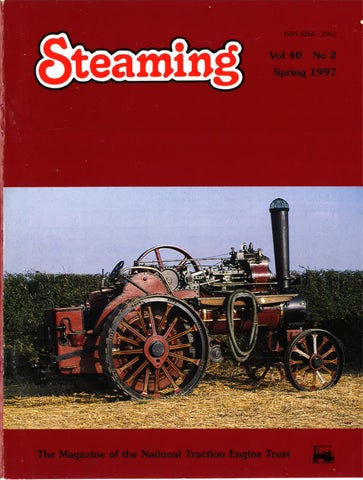
Cover Its task at the threshing demonstration over for another year, Fowler A7 class compound agricultural engine 14012 of 1915 basks in the early evening sunshine at the Bedford club's rally at Roxton in September 1988. (Roger West) 63
Trust News From the Chairman The 1997 season is upon us — the boiler inspector has visited, carried out the cold inspections and left. We are now busily reassembling the engines for steam tests and replacing the odd wasted stud in mud plugs which he found. He wonders if performance targets will be set by his head office; that will then allow him less time to do the job and he will thus be less thorough. I am ever more sure that the Trust must lead in setting standards in all aspects of our hobby. There is nobody else to do it. Hopefully we shall all have an enjoyable, dry and safe season and continue to build on the higher public profile that we deserve. Recent television and press coverage must help, and Russell Bulley will be pleased to receive news from any member which he can pass on to the media. He also wishes to have a list of engines and owners around the country who can be available for film or television companies, often at short notice. Again, can you help? With the help of Footman James, our insurers, there is to be a large road steam presence at the National Exhibition Centre, Birmingham in August. It is rumoured that we may even plough up the grassed areas! Any event which puts well presented engines in front of the wider public must be to the long term good of our movement and I thank all those members who give their time to arrange such things. Another useful Engine Owners Meeting has been held in Rugby; your next chance to raise issues face to face with the Committee in session will be at the Great Dorset event. Please come to the Trust marquee on the evening of Friday 29th August. Meanwhile the names and contact numbers of Committee members were listed in the Winter issue of Steaming, and you are welcome to contact any of them at any reasonable time. In the summer most of them, like you, are busy with running engines or visiting rallies, dnd we are therefore concentrating our formal meetings in the winter to avoid clashing with the real purpose of our activities. 64
Concerns were expressed at the Bristol AGM about the way some rallies are run. The Rally Code is widely accepted as best current practice and those events authorised under it should follow its advice. If you see things happening on the rally fields that are not as they should be, whether with engines, drivers, insurance or the rally itself, please tell the organiser and let Andrew or Smudge know quickly. We can do little if we are told of problems months later. The good of the movement surely outweighs our natural reluctance to speak out. I must now go and help with steaming six engines to see that all is well prior to their 'inspections in steam.' A number of local people have been helping with the engines for a year or two now and these adult apprentices are ready to have a go on their own this summer. They will have fun and the engines get used more often. This is what it is all about. (Richard Sandercock)
Engine Owners Column Engine Code of Practice Those members who have already purchased a copy of the Code of Practice for Traction Engines and similar vehicles should by now have received Part VII (the final Part of the Code) by post, together with some amendments to previously issued Parts. The accompanying letter contains details of the postage rates required to obtain any parts not already claimed with the vouchers that were in your original copy of the Code. If you have not received these details, or require further information on the document, please contact Sylvia Dudley, 12 Hillway, Woburn Sands, Milton Keynes MK17 8UL. FBHVC Questionnaire Owners of steam and other vintage vehicles are reminded of the FBHVC
Questionnaire that was distributed with the last issue. If it hasn't been completed and returned, you are urged to do so without delay and certainly by the end of April — we repeat our comment that even though it looks as if the information requested will be of little use when answered by steam engine owners, this will not be the case and the information does all help. Despite the wide variety there is in preserved road vehicles, we must all come together to ensure we retain unfettered access to the highway.
Rally Organisers Column Rally Organisers sub-Committee As is usual in our Spring issue I Write my notes immediately after the Spring Conference of Rally Organisers has been held. These biannual events must be useful and informative as they are enthusiastically supported by rally organisers in large numbers. The meetings are also enjoyable occasions for all concerned; one meets people who are now old friends — such is the value of our movement.
Now complete ... The Trust's
CODE OF PRACTICE for Traction Engines and similar vehicles Price £25.00 each including postage (cheques payable to National Traction Engine Trust) please quote your NTET membership number from — Mrs Sylvia Dudley, 12 Hillway, Woburn Sands, Milton Keynes, Buckinghamshire MK17 8UL Spring 1997
STEAMING
A considerable amount of time was taken up by the topic of disclaimers and declarations on rally entry forms. The subject is aired at some length by David Smith, our Insurance Officer, elsewhere in this issue, so please read that contribution with care. It is important to realise that rally organisers cannot absolve themselves of responsibility for an accident by attempting to pass the liability to entrants to the event — it won't stand up in law, and it is morally wrong. To assist in this matter we have produced in our Rally Code of Practice specimen entry forms which are fair to the parties concerned. Entrants who are unhappy with the entry conditions laid down, and who feel there is a 'catch' in the form, would do well to make a call to their insurers for advice before signing. The Conference and Affiliated Clubs Newsletter is now established and is circulated to all rally organisers and to our Affiliated Clubs. Please contact Smudge Smith if you think your group is not getting a copy that it should receive. The Rally List 1997 is now in
circulation and you will have a copy inserted with this issue of Steaming. We are constantly expanding the distribution of the list to tourist information centres and similar places — if you can help with this please contact Smudge. Traction engine
STEAMING Spring 1997
From Alan Martin's Collection
76
This is a fine scene of Anderton & Rowlands' 8hp Burrell showmans engines ready for work. It was taken at the Helston Flora in Cornwall in 1937. Nearest the camera is 3833 of 1920 QUEEN MARY — the subject of correspondence in recent issues of our magazine — and next to the empty packing truck is 3441 of 1913 WILLIAM IV. The latter is plainly presented, having none of the expected twisted brass, but if it is the driver of 3833 standing by its front wheel he should be proud of his charge's immaculate and glistening appearance. Worth noting again is the custom of smartening up the scene by whitewashing the surface of the rubber tyres.
rallies now have to compete with an ever-growing list of activities that are vying for the public's interest, so every little helps to promote our interest. I notice three rallies in one area that have events a month apart have cooperated to produce a joint publicity handout. This is an excellent idea that enables them all to benefit from a shared cost of publicity, which we all know is expensive; there may be an opportunity here for other neigh-
bouring events to discuss this during the summer, ready for next year. After enjoying several years of plentiful coal supplies and having benefited from a steady improvement in the quality of coal at rallies, we are now informed that Celtic Energy are reorganising Cwm Bargoed pit, and this will result in a shortfall in supply
from that source. Please talk to your coal supplier early to avoid disappointment, as it forbodes to be a difficult year for supply. The circumstances will no doubt also be reflected in the price at which coal is offered as the season progresses. Elsewhere in this issue you will find advertisements for the Rally Code of Practice and for the signs that the Trust has made available for use on rally fields. The price for these practical and smart looking signs remains the same as last year — with care they can see many years service and will endow your event with a professional and well organised appearance. The spring is always a good opportunity to thank the members of my sub-Committee for their work during the winter, in particular Sue
65
Jackson, our General Secretary, and Smudge Smith, who, of course, is in the front line in the war of paper: without him we would all have run out of ammunition long ago! This year the Rally List would not have been possible without the generous help of the Buxworth Steam Group. I would also like to thank Brian Gooding and the Old Glory team for their advice. The last couple of years has seen a decline in gate numbers at many events — this has variously been blamed on people having less disposable income; bad weather; too many events, etc but many rallies continue to rely on the enthusiasts for their support. We need to bring in new custom each summer and I feel that this is where the major publicity drive should be directed. I wish you all sunshine and increased crowds for (Andrew this season's events. Semple, Chairman, Rally Organisers sub-Committee) Rally Organisation All requests for Authorisation for the coming rally season have now been processed and distributed. Any organiser still awaiting documentation is advised to contact me as a matter of urgency. (Smudge Smith, address inside front cover)
Adminstration Contacts There have been a few occasions recently of correspondence from members and Affiliated Groups being delivered to the wrong Trust officer, inevitably delaying the response. We draw readers attention to the list of Trust Officials printed inside the front cover or on the title page of Steaming — they are there every issue, so please do make sure that you use the right address land a SAE, please, if a reply is expected). Paragraphs within Trust News soliciting response from members will usually have a name and address, or a referral to the inside front cover. If you are in doubt as to who should be dealing with your topic you can always first contact Sue Jackson, General Secretary or Smudge Smith, Affiliated Groups/Rally Authorisation. Finally, all members and Affiliated Groups can be in touch with Committee members — their names and contact numbers are in the lists included in the early pages of every Winter issue.
66
Insurance Officers Notes I include here updates on the NTET's various insurance schemes. Elsewhere in the magazine you will find an article that has been made of notes I originally prepared for the Rally Organisers Conference at Rugby in March. It contains examples of the working of the Road Traffic Act and of Public Liability Cover — our Editor thought that being separate from this report in the Trust News columns, it will serve as a future reference piece for all. NTET Rally Organisers Scheme update I am now in receipt of quotes and draft policies from AON and Footman James, but cannot yet make a firm announcement. However, it would appear that whilst there is little in it in the way of premiums difference, the cover offered by Footman James is much wider in scope and has fewer qualifying restrictions — but all this I must double check. I hope to make recommendations very shortly. NTET Engine Owners Scheme update I hear from Footman James that the anticipated low initial uptake of the Traction Engine Insurance Scheme has now turned into something of a flood. Good news indeed. They are also receiving many enquiries from nonNTET members, to whom they are sending membership application forms — let's hope these owners see the light and join us, for the savings will more than pay for their subscription. NT ET Approved Boiler Inspectors You will have no doubt read in the last issue of Steaming that we now have the first independent boiler inspector to be approved under the Trust's formal Boiler Inspectors Scheme. I am pleased to tell you that there are signs of a queue forming at Jim Newnham's door, with new applicants coming forward. This is encouraging news, as I know some of you share my concerns that inspectors properly experienced in our hobby are getting fewer and fewer. Of course, formal NTET Approval is not mandatory on any inspector but the scheme's objective is to ensure higher levels of consistency within our particular branch of engineering and also to help raise the confidence of the client in his choice of inspector.
John Glaze, of Wolverhampton, is an independent boiler inspector who gained approval by the NTET some years ago through our earlier, less formal, process — based mainly OH length of service and industry background. This specific arrangement of approval will continue, (Dave Smith, Insurance Officer)
From the Treasurer Would all members please take note that the Trust's bank account has changed from Barclays to National Westminster Bank, The Drapery Branch, Northampton NN1 2EY. The sort code for the new account is 56-00-60 and the current account reference is 97898473. The account has been moved to this branch for reasons of convenience and also to make savings in bank charges. All members who pay their subscription by standing order will shortly receive a mandate informing their banks to make the necessary change to the new account. The officers of the Trust who currently pay funds into the company's bank account will shortly be receiving triplicate paying in books to enable them to make use of the new account. I calculate the new arrangements will be able to save the Trust £500 per year, an exercise which I hope members will agree is worthwhile. (John Harris, Treasurer)
Public Media Services Having been asked, since in November gaining a place on the Committee, to become involved with public relations on behalf of the Trust, I have agreed to try to fulfil a role of being the focal point, both incoming and outgoing, for media attention of topics that are likely to benefit the Trust and the traction engine in general. Interestingly, following the TV coverage of our Road Run on Top Gear, I have had a number of enquiries via their office for road steam engines to take part in various functions. It was at a difficult time of the year, of course, for owners to respond, but after some frantic phone calls a degree of success was accomplished. I intend to compile a register of owners willing to take on this sort of task, so will be Spring 1997
STEAMING
pleased to receive contact from owners (by post only, please) who are interested - as things develop I will work up the best type of information to have on record. There have also been enquiries over possible major traction engine content in a TV series. More of that later. Other jobs I am working at include finding enhanced methods of promoting and distributing the Trust's Rally List and of increasing non-members awareness of the Trust via the columns of Old Glory which are kindly made available to us. (Russell Bulley, 30 Kettering Road, Burton Latimer, Kettering, Northamptonshire NN15 5LP)
Fowler DNI class compound roller 16519 of 1925 parades the ring at the 1995 Downs Rally. (Peter Love)
Steam Apprentice Club The Steam Apprentice Club has now revived its administration activities and has held the first committee meeting for some time. We have considered such areas as making approaches to model engineering clubs as a source of new members, improving the section's introduction pack for new members, club visits and addressing the continuing need for coordinators. On the last of these, we have been fortunate to secure offers of help from Sue Doncaster in Essex, Rick Fiskel in County Durham and Bill Evans and Pat
Williams in Cheshire. This means that fifteen to twenty rallies can now be covered by SAC representatives — but what about the rest? Can you help? Anyone with an interest in steam and the enthusiasm to communicate this to young people can perform the role with minimal time commitment. If you are attending a rally anyway, could you spare an hour or so each day to introduce Apprentices to other engine owners? The SAC can only function with your help! Please see the contact names inside the front cover. On a different subject, we are progressing towards our first involvement
Coal from Arscott Collieries
with the Trust's Driving Course, this year being held in Devon. In order to be able to provide a course of good quality with the likelihood of only a few SAC members, we are joining in the adult event. This will mean that we can run the SAC course even if only a small number are present. There are still spaces available so if you have an Apprentice (or know of one) who would benefit from a structured course, please persuade them to contact us. For those family members bored by things steaming (if this is possible), there are plenty of other attractions near at hand, so why not make a weekend of it and please your youngster. (John Durling, Chairman, Steam Apprentice Club)
Coal Factors and Merchants, Gateway Chambers, 26 Castle Street, Shrewsbury SY1 2BJ •
pre-packed 25kg plastic bags
•
haulage can be arranged to any rally site
•
ring John Watkiss on 01743 362482 to discuss your requirements and haulage cost, anywhere in Britain
DRY STEAM COAL
f126 per tonne
CWM BARGOED COBBLES
131 per tonne
ex Rheola ex Newtown, Powys (prices include E3 pallet charge but exclude VAT) Bulk loose supplies ex Rheola or Cwm Bargoed £89.00 per tonne + VAT Cash on collection or pre-payment Please order early to obtain supply of steam coal; bituminous also available.
STEAMING Spring 1997
FBHVC News Vehicle licensing procedures As was presaged in the Dual Notification and Continuous Licensing consultation documents which were circulated by the DVLA to interested parties in November 1995, it is the Government's intention to introduce new procedures for the dual notification of change of ownership and notification of a vehicle being out of use. • Dual Notification (DN) is about to be introduced. When a vehicle changes hands it will be necessary for both the vendor and the purchaser to notify DVLA of the change of ownership. The Registration Document (V5) 67
RALLY SAFETY SIGNS DANGER — beware of moving vehicles etc — yellow with black lettering Unauthorised persons prohibited etc — red with white lettering FIRE POINT — red with white lettering Printed on rigid plastic boards
DANGER Bromic ol_s moving '41'ac. machinery
£2.50 each sign inc VAT, postage 66 per order From: XS Semple INTET) Unit 6, Mynd Industrial Estate Church Stretton, Shropshire SY6 6EA
will be amended and will contain provision for declarations by both the disposer and the acquirer. A new keeper's supplement, to be known as V5/2, will provide the purchaser with a means of identifying the main vehicle particulars pending receipt of the new V5. This form will also allow relicensing while the vehicle register is being updated. V5/3 will identify disposal to the motor trade and allow the V5 to remain with the vehicle until disposed of to a new keeper. • Statutory Off-Road Notification (SORN) is scheduled for introduction in early 1998. This will introduce fundamental changes to the responsibilities of keeping a vehicle. The new licensing ai angemei its will accommodate the SORN declaration, including details of the location of the off-road vehicle. The current 'do nothing' option when a licence expires will no longer exist. Instead the keeper must ensure that the vehicle is again licensed or make a SORN declaration. SORN will apply to all vehicle classes. The declarations will be valid for twelve months, with V11 forms being sent out annually to allow vehicle keepers to licence or to continue to keep the vehicle off the road. As yet the method for dealing with short term off-road status is unclear. With zero rated VED it will clearly be more straightforward to keep preserved vehicles licensed, and no doubt most owners will take that course even when long term repairs are in progress. Regulations are being prepared to enforce both DN and SORN. The primary legislative powers were taken within the 1996 Finance Act, and the Statutory Instruments allowing full introduction of the powers will be 68
enacted without debate. Offences committed under DN and SORN will be pursued by the Police and the Police National Computer will be interfaced directly by DVLA. (Michael Ward and Peter Smart, steam representatives on FBHVC)
The Rally List The Trust's annual Rally List, featuring all events included in our Authoricod Rally Scheme, has this year been published with assistance from the Buxworth Steam Group, and a member's copy is distributed with this issue of Steaming. In the period since die List went to press the following events have also been included. • May 26th — Market Drayton Street Carnival, Market Drayton streets and car parks (10 engines attended last year). C.J. Smith, 42 Walkmill Road, Market Drayton, Shropshire TF9 1JZ (Tr 01630 653625). • August 23rd to 25th — AVMEC Fenland Vintage Country Show, Floods Ferry, March, Cambridgeshire (new event 1997). R. Hanslip, 165 Hungate Road, Emneth, Wisbech, Cambridgeshire PE14 8ED (Tr 01945 430325). • August 23rd to 25th — Festival of Transport, Broad Farm, Hellingly, Polegate, East Sussex (27 engines attended last year). Mrs D. Hymens, 8 North Close, Polegate, East Sussex BN26 6HH (( 01323 484926).
Trust Exhibition Unit Later this month the Trust's mobile Exhibition Unit commences its fourth year of visits around the rally fields of Britain. As well as acting as a focal point for members, the Unit serves to promote the work of the Trust to members and to outsiders, and offers you the chance to browse through books and other items available from NTET Sales. The arrangements for the first half of the 1997 season are to attend a total of fourteen events, as follows: May — 3 to 5 Higham Ferrers; 10/11 Stoke Goldington; 16 to 18 Stamford; 24 to 26 Hartington; 31 to 1 June Leighton Buzzard. June — 7/8 Marlborough; 14/15 Morecambe Bay; 21/22 Aberdeen; 28/29 Sheffield.
July — 5/6 Hollowell; 12/13 Woodcote; 19/20 Much Marcie (unit); 19/20 Weeting (marquee); 26/27 Netley Marsh. Please refer to The Rally List 1997 for full details of the above rallies. Another ten venues will be visited during August and September, and these will be listed in the Summer issue of the magazine. Do try to visit the Unit whilst you are at rallies during the summer — as well as the chance to see what Colin and Val Brown have at NTET Sales, there is always a good spread of rally handbills for keeping up to date on where to go. Whoever is staffing the Unit should be able to give advice on any thorny questions you may have on traction engine topics, and even if they can't answer the problem themselves, they will be able to direct you to the right Committee member or make a note for further action. Anyone interested in joining the growing band of helpers on the unit is most welcome to contact me to discuss the matter. As I said last year, it is an excellent way of becoming more involved with engines and the running of the Trust. (Robert Herring, Exhibition Unit organiser, address and Tr inside front cover)
Obituaries Les Pethick Arthur Leslie Pethick of Chertsey, Surrey, known to his fiends es Les, passed away in November 1996. He was an active steam enthusiast and had many friends and acquaintances in the steam road and rail fraternity, and had been a member of the Trust for a long time. In more recent years he had made frequent journeys to Australia to visit his family, and during his stays discovered many engines, befriended their owners and maintained correspondence with them over the years. (Ray Pethick) Ted Proctor With the passing of Ted Proctor we have lost another of those enthusiasts who worked with road steam and carried on into restoration and rallying. Edwin Mons Proctor of Stoneleigh, Warwickshire, died in September 1996, aged 78, after a series of severe illnesses. He had a long experience of steam and especially the Sentinel marque — driving for the flour mills at Sheepy Magna, near Atherstone before motor vehicles ousted steam, and demonstrating Shrewsbury built Spring 1997
STEAMING
railway locomotives. He worked with industrial boilers until his retirement but his favourite pastime was to sit over 'half a mild' and talk of steam engines. The fact that Ted never had the wherewithal to possess a machine of his own meant that he was always willing to advise and assist those who had, and he had been involved with a good number of restorations over the years — traction engines, rollers, several Sentinel wagons and until the time of his death, a now unique Carrick & Wardale steam crane at the Coventry Steam Railway. Dating from 1919, a year younger than he was, Ted felt he had a challenge with this machine, for despite his two new knee joints, he thought he was in better nick than the crane. Its completion and future return to steam will form another fitting memorial to a man who found steam to be the consuming passion of his life. (from notes provided by Ken Bowen)
Ted Trubshaw George Edward Trubshaw died in November 1996, aged 78 years, the result of an accident near his home in Cheadle, Staffordshire. Ted was an exceptional engineer, serving in the Navy and then working for InterSTEAMING
Spring 1997
Garrett 7hp traction engine 28410 takes on water in the Oxfordshire village of Ducklington, as Foden D-type tractor 13832 chunters past. Photograph by Dick Blenkinsop, November 1996.
national Combustion Ltd, before finally becoming a director of Tean Minerals Ltd. For many years he owned Fowler road locomotive 17105 ATLAS, though I believe he made only one appearance with the machine on the rally field — at Elvaston Castle in 1984. Ted always had an interest in steam railways; he became a founder member of the Foxfield Light Railway and was also an early member of the North Staffordshire and Cheshire Traction Engine Club. The funeral service was held at St Giles Parish Church, Cheadle. A large number of friends and associates gathered together to pay their last respects. (Steve Durrance)
Affiliated Groups Affiliated Groups Diary Some years ago one of the features of the Autumn and Spring issues of the magazine was the
Affiliated Clubs Diary — a half yearly publication of the Trust's affiliates noting the geographical area covered, contact addresses and venues and frequency of social meetings etc. When the number of groups responding to the reminders fell to a mere handful the Diary was reluctantly discontinued. Its high time it was started again. There are over 60 clubs, societies etc affiliated to the Trust and there should be much to be gained from exchange between the various organisations, and in knowing of each others social occasions, even if its just having in mind when you're in their area that the Grumpy Boilermen meet for a happy evening on the last Thursday of every month. Affiliated Group secretaries will be circulated during the summer with further details of the sort of information we will try to set down, but in the meantime, we should be pleased to hear from anyone who might have pertinent comment to make on the suggestion. (Smudge Smith/Roger West)
69
Tax Disc Holders in polished cast brass Single (3 hole fixing)
f550
Single (back of windscreen mounting plate)
f15.75
Double (flange back mounting plate)
£23.50
Prices include post and packing These holders are displayed for inspection on the NTET Exhibition Unit Orders to: Colin and Val Brown NTET Sales 90 Devon Road Luton Bedfordshire LU2 ORL
Three Counties Steam Tour Near final details are now available for the East Anglian Traction Engine Society's ambitious event to be held over the May Day Bank Holiday weekend. The aim is to steam between the sites of four former East Anglian traction makers' works — Burrells at Thetford, Garretts at Leiston, Ransomes at Ipswich and Davey Paxman at Colchester. From first to last the distance is 99 1/2 miles (or 103 from Euston Hall), and between is a wide variety of attractive countryside and villages. Having assembled at the Burrell rvluseum, Thetford, or at nearby Euston Hall, for a noon start on Friday 2nd May, the engines will travel east along the A1066 to reach Bressingham for the overnight stop. Its a very early start the following morning to cover the route to Diss, then along the B1118 to Stradbroke and Saxtead Green, with its old windmill, where a lunch stop is scheduled. In the afternoon the B1119 will be taken to Saxmundham and then on to the Garretts' birthplace at the Long Shop Museum, Leiston, for the Friday night stop — the museum will have an evening opening. Saturday sees the cavalcade on the 81069 road to Tunstall and Woodbridge (lunch stop) and then the B1488 to Martlesham and on minor roads to use the Ipswich Transport Museum — another late night opening — for the second night's stop. On the final day, Monday 5th May, the engines will venture into Ipswich to pay their respects to Ransomes Orwell works and then on the B1436 to Holbrook for a midday pause at the Royal School Hospital; here the engines can be lined up on the parade ground against a background of the 70
Stour Estuary. The last stretch to Colchester and Davey Paxman's works is on the A137 through Manningtree, and a former employee of Paxmans may be riding on an engine on the last stage to the works. It is hoped 25 engines will take part in the tour. Confirmed entries (usual caveats!) early in March are: Burrells 3130, 3593 and 4000; Davey Paxman 13073; Fowler 14115; Fowell 103; Garretts 31633, 33296, 33358, 33566, 34084, 34165 and 34539; Ransomes 26995 and 42013; Tasker 1697; Fodens 3510, 13068, 13624, 13784 and 13832 and Sentinels 189 and 9236. The whole route will be RAC signposted and roadside collections will be made for the Macmillan Nurses Fund. NTET members from elsewhere in the country who might like to get involved and to offer assistance to the EATES during the weekend should contact Ken Goward, TS 01206 391320. The East Anglian's enterprise has the promise of being a weekend to remember, and it is quite likely to be a one-off. The countryside in Suffolk and Essex should be at its spring best, so a visit to the area will be well worthwhile. Events such as these are by no means easily put on, even by the larger regional clubs, but they have great rewards for organisers, crews and viewers alike and deserve to be supported. The Lona Shop Museum The Newsletter of the Friends of the Long Shop Museum, the former works of Richard Garrett at Leiston, Suffolk, reports a 5% increase in visitors during 1996. A recently launched venture is an Education Pack, which it is hoped will encourage school visits — it contains printed material, closely related to the National Curriculum, that supports work by pupils during their time at the Museum, and in the classroom before and after. Preliminary work has recently been undertaken at the Museum on Garrett compound semi-portable 30877 of 1912 — much more will have to be done elsewhere, but the machine should be back in steam shortly, housed in the now Grade II* listed Long Shop, which was erected in 1852 for the building of portable engines. In February the Museum was delighted to receive news of a grant of £109,000 from the Heritage Lottery Fund. The money will be used to build a resource centre and provide extra space to display documents and other similar material. Environmentally
controlled atmosphere will allow the occasional exhibition of items from the Garrett archives now deposited at the Suffolk Record Office. The Museum now has the challenge of themselves raising a further £15,000 to match the Lottery Grant. (The Long Shop Museum) Museum of East Anglian Life During the night of Saturday, 25th January 1997, theft occurred from the Museum of East Anglian Life premises at Stowmarket, Suffolk. Three of the items are model beam or table engines, and two more are small (about 2ft long) stationary engines — a table engine of about 1830 from a silk mill and a Tidman horizontal engine for driving the water pump on a fairground shooting gallery. Readers are asked to keep such engines in mind; information concerning them should be passed to the Suffolk Police on Tr 01473 383390. Burrell Gold Medal Tractors From Ron Walker comes Gold Medal Newsletter No 18, distributed to those interested in Burrell tractors. In this issue Ron gives a personal view of the Trust's Road Run last year, where six of the tractors appeared, the furthest travelled being Jaap Kuitward's 3846, brought over from Holland. Future events are mentioned. It is hoped several of the Gold Medal marque will enter the East Anglian Society's Road Tour in early May, and then on 19/20th July there will be a display at Weeting rally, specially to commemorate the 90th anniversary of the 1907 RAC Trials which gave the Burrell steam tractors their name. Further into the future, it is expected there will be a large turnout of the tractors among the other Thetford products at the Great Dorset event in 1998, as that year has been designated for a special featuring of Charles Burrell machines. Further details of Gold Medal Newsletter can be obtained from Ron Walker, Lower Priory Farm, Clamp Hill, Stanmore, Middlesex HA7 3JJ. Fosters recorded By the time this issue of our magazine is with readers a further title will have been published in Michael Lane's popular series of histories of British traction engine builders. This time the recorded company is William Foster & Co Ltd of the Wellington Foundry, Lincoln. Foster's road steam engines are perhaps not so well known Spring 1997
STEAMING
OUR MAGAZINE 25 YEARS AGO
By 1926, Foster's Wellington tractor was being offered in their catalogue with the option of being mounted on rubber tyres — if so required, the rear wheels then had twin tyres 5ft Oin diameter by 160mm wide (that is Foster's mixed imperial/metric description!) and the front wheels had a single tyre 3ft 2in diameter by 160mm wide.
as those from some other workshops, and the survivors to preservation are not numerous. The once popular 5ton Wellington steam tractor is maybe most common nowadays but Fosters had, like other Lincolnshire makers, a large export business and also turned out a wide variety of general agricultural machinery. A review of the new volume will appear in the next issue of Steaming and copies are now available from NTET Sales. (The Story of the Wellington Foundry, by Michael Lane, Unicorn Press, about 200 pages, 168 illustrations, price £30).
Future Dates AGM 1997 It is not usual to mention the Trust AGM in this issue, but members should be aware of a slight change of plan from the location mentioned on the back page of the Winter magazine. The venue will not be Chester, but at The Boat Museum, Ellesmere Port, Cheshire — still on 22nd November 1997. More details in future issues, STEAMING Spring 1997
but accommodation will be available at the adjacent Holiday Inn, and Frank Lythgoe has kindly invited us to a Sunday morning visit to his collection. Do reserve the date for what will be an enjoyable weekend.
Poor Steaming Two errors appeared in the last issue in references to single speed Aveling & Porter rollers. Sandy Ross, having made efforts to sort out the history of the survivors and other examples — some of the results have already graced our pages — kindly returns us to the straight and narrow. Aveling 3678 (described as an 8 tonner in the caption on page 4) is shown in the makers Royalty book as being of 6 tons, new on 8th March 1896 to J. Parsons & Sons of Hove, then to George Wimpey. The Leicestershire notes (page 43) wrongly claim Aveling 3781 as a 4 tonner and here again the Royalty book reveals a higher figure — it is of 6 tons nominal weight, though the actual manufactured figure was set down as 7tons 7cwt. The machine was new on 2nd October to Lord Llangattock.
With the March 1972 magazine came mention of a large event to be held at Battersea Park in London — the first of John Crawley's well remembered Expo events. It was perhaps also the first time one hundred entries had been mooted, or engines from abroad considered, in this case from Holland. Much of the issue was devoted to 'Steam in the Chilterns' with local members providing a good selection of articles and illustrations. Also featured was the subject of the forthcoming NTEC's visit to Germany; Rob Gebhard described the 1953 built Ottomeyer ploughing engines that were reclaiming the peat moors in the north west of the country. At the Club's AGM chairman Anthony Heal reported a record membership of 2242 and a strong financial position; formation of the Historic Vehicle Clubs Joint Committee (now the FBHVC) was announced and at a recent lunch meeting Michael Heseltine of the Department of the Environment had acknowledged problems for vintage vehicles from possible changes due to the Common Market. Can the Minister recall this lunch date, we wonder? The Social Committee 'had noted' the sentiment of members that the disco at the Steam Ball at Clapham Transport Museum was not in keeping with the Club. The Hirst sale had been well attended. Fowler showmans 9395 had fetched £3000 and a Foden wagon £1250, with rollers in the £250 to £350 range, but S-type Marshall well above that figure at £725.
'Unburnt Coal on the Roadside. The Technical Adviser to the Controller of Coal Mines informs us that the Department of Explosives Supply of the Ministry of Munitions points out that some drivers of steam tractors appear to be very careless in the cleaning of the fires of the vehicles, and that a large quantity of partially unburnt coal is always to be found in the roadside where fires have been cleaned. In the interests of coal economy, drivers should avoid this unnecessary waste.' (from The Commercial Motor, 10th October 1918.) 71
Some pre-season notes on Insurance Knowing that the subject of insurance is often confusing to members, Dave Smith, the Trust's Insurance Officer, prepared a series of notes for use at the Rally Organisers Conference held in February. They are presented here in article form for a wider readership and should act as a reference for the future, though Dave will undoubtedly need to highlight updates from time to time.
Organisers and Events Insurance General Requirements. The NTET Rally Code of Practice (Rally Organisers etc), para 6.1.1, reminds the organiser of his obligation to protect the landowner, himself and organising members of the event against claims for damages that may arise from public liability. The minimum cover is £2 million, but specific cover should be arranged, based on the expected attendance at any one event. It is the moral obligation of the organiser to obtain the appropiate amount of cover. In the event that damages were awarded in excess of any cover held, then, in exceptional circumstances, the insurers could turn to the organiser land individual members if the club is not incorporated) and sue for any differences in money. Exhibitors Insurance General Requirements. In simple terms the owner of any item being exhibited at an organised event (static or live; for display or retail) should ensure that sufficient insurance cover is held to protect against personal loss or injury to a third party. Insurance cover can be effected in the following ways: • Static items, household goods, toys, bicycles and tools etc, can sometimes be covered as an extension of a household contents policy. However it is not easy to be sure if the cover is real, so use the signed rally form declaration as best endeavour to ascertain insurance cover is held. The NTET sample form is OK'd by insurers. As far as the section organiser's role is concerned, my advice to exhibitors is to obtain 'Exhibitors Cover' — at £4 per £1000 value of exhibits for all risks cover (theft, loss, damage) plus £15 for public liability at £2 million, this is quite inexpensive. • Machinery equipped with prime mover (static or self propelling) but 72
not subject to RTA (or items in paragraph above not specifically included in contents insurance). My advice to exhibitors is to obtain 'Exhibitions Cover'. Barn engines, lawn mowers and the like can be insured through David Franklin's scheme; portables, saw benches threshing drums etc via the NTET Insurance Scheme (Exhibitors Cover as above). Your exhibit will then be covered by a valid Certificate of Insurance. All this is fairly easy to monitor, but again, I suggest using a signed rally form declaration as best endeavour to ascertain insurance cover is held. • Exhibits covered by the requirements of the Road Traffic Act. They will have to have a minimum of Third Party Cover plus Public Liability cover, as indicated by a Certificate of Motor Insurance and a Road Fund Licence. Such documentation is easy to monitor and comes within the section organisers role. • Steam driven items. These can he generally as for the paragraph immediately above, with a minimum £1 million cover (now moving to £2 million, but not to £5 million as rumoured to be required by some organisers). Also needed will be a Certificate of Motor Insurance plus boiler examination and cover against explosion and Public Liability. The NTET Insurance Disc provides proof of Third Party insurance, boiler inspection and boiler explosion insurance. Again, this is easy to monitor, and comes within the section organisers role. Road Traffic Act as well as Public Liability insurance. Following dicussions at the recent Spring Conference of Rally Organisers, there appears to be some confusion as to why the NTET Rally Code of Practice requires road going exhibits (including petrol, paraffin, diesel and steam vehicles) to have both RTA (popularly referred to as Third Party insurance) and Public Liability insurance cover
when at a rally or other event — despite the RTA now following the user onto the rally field. I shall give some examples to illustrate the point. • An engine owner voluntarily places a rope fence around his exhibit to keep spectators away from moving parts. A child's clothing becomes snared in the fence, the child trips and breaks a limb and incurs head injuries. The exhibitor's Public Liability insurance (not the RTA cover) would be called upon to make restitution — if blame were to be allocated to the exhibitor, that is. • An exhibit is static, and not running — in the case of a steam traction engine when it is cold and not even under pressure — and a spectator stumbles over a sack of coal or the chock which is protruding from under the wheel, and breaks a leg. Again, as above, it is the exhibitor's Public Liability insurance and not the RTA that would be called upon. • An exhibitor is having a barbeque at the end of the day in the vicinity of motor cars. His own exhibit is static but adjacent. Sparks from the barbecue ignite petrol fumes from his exhibit and cause extensive damage to his and other nearby exhibits. This a third case where the exhibitor's Public Liability insurance will be applicable. • The claims process of the above example will be repeated if sparks from a steam engine cause damage to other exhibits or to public property. The steam vehicle does not have be in motion at the time. • A mobile exhibit is accidentally driven into another moving exhibit whilst on its way into the parade ring. In this case it would be the Third Party cover aspect (as required by the RTA) and not the Public Liability that would be called upon to make the restitution, again if blame were held to be with the exhibitor. Referring back to the first four of these examples — in the event that public liability cover was not held by the exhibitor, or it was inadequate, it is possible that they could personally be sued for damages by the injured party. Whilst is is true that the insurance industry is now being pressured into carrying the Public Liability cover further into the RTA element of the cover (for example, to cover where a taxi driver is carrying a passenger's cases into his premises and drops them, causing damage to property), the examples that I have quoted above typically reflect the current accepted boundaries of the different liabilities Spring 1997
STEAMING
(Public and RTA(, and will remain so for some time to come. The insurance industry is resisting the changes on the basis of inevitably increased premiums. Specimen Forms. The Rally Code of Practice includes two specimen forms — 'Steam Exhibits' and 'Non Steam Exhibits'. Each form uses a Statement of Declaration, which effectively asks the exhibitor to sign to the effect that Public Liability insurance cover (and explosion cover) is arranged under the terms, and for the amounts (£2,000,000 is becoming the norm), described by the organiser. No other form of declaration is included or intended. I emphasise that these specimen forms have the full approval of the insurance industry. Disclaimer Statements. A warning note — there is not a requirement, nor morally can there be one, for the exhibitor to sign a declaration which undertakes to absolve the organiser and his staff from any liability. This is the same as saying that the exhibitor will pay for any damage no matter who is at fault! The exhibitor's insurers would not be pleased. Road Runs. Where road runs are being organised as part of a formal event, do ensure that the local constabulary is informed, and in cases where more than 12 vehicles are planned to be out on the road at any one time, RAC approval must be STEAMING Spring 1997
This fine picture of a Yorkshire steam wagon in a northern urban street has lain a long time in the editorial files defying identification, despite a fair number of clues in the background. William Bibby of South Wirral sent us the picture a few years ago, its history unknown; the late Alan Duke was able to say that The Vulcan Haulage Co, Manchester (the name on the wagon's side sheet) had five Yorkshire wagons — three 1903 examples and then two more later on. Works numbers 284 (U1331) was acquired secondhand, and 308 (U1407) came new in 1911. The picture is likely to show one of the latter pair (certainly it is of the vertical engine-in-the-cab type), but the posing driver's shoulder unfortunately denies us a chance to see the registration. The wagon seems engaged on contract delivery of soft drinks and beers, and the photographer catches several urchins, and a couple of girls peeping from a first floor window, as well as the crew. But where is the scene? The shops belong to the Roocroft family — The Mere Hall Confectionery Works on the corner is in Robert's name (he was the maker of Dr somebody's Winter Drops) and next door is the business of Miss Roocroft, milliner. None of these clues can be located in Manchester trade directories of the time. Further enquiries based on some other Lancashire towns have drawn blank, so perhaps we will just take it as a nice picture of a Yorkshire wagon, with a good head of steam, all ready to get on to its next stop.
sought. It would appear that recently some events in the West and in Wales have fallen foul of both these bodies, and of the local populace, with some depressing results. I need not apologise for the extent of these notes, for it is an important subject that we must do our very best to get right. I trust the notes will be found useful at this time — I suggest you keep in mind where they are for your future reference.
'HRH the Duke of York has requested that one boy-representative of each of the great industries of the country should be present on the occasion of his marriage. This Company has received the signal honour of sending the representative for the engineering industry in Shrewsbury, and Apprentice Hy. Turner has been elected by his fellows as the fortunate individual to go.' (from Sentinel Transport News, April 1923.) 73
Steam lime transport in Bohemia
Zdenek Bauer of Prague, Czech Republic
About 80kms south of the Czech capital of Prague is the city of Tabor. Since 1871 it has been served by the Kaiser-Franz-Josephs-Bahn, the railway line between Prague and Vienna, Austria. Some 10km east of Tabor is ChOov, a small town, and 4km or so to the north of here were situated limestone mines, with furnaces, in Pacova Hora. These lime works were in the ownership of the noble house of Schwarzenberg. Coal for the furnaces, and lime from the works to Tabor, along with other necessary materials, were handled by carters at Chjrnov. In 1879 the Schwarzenberg forest administration ordered a steam road engine for the haulage of timber in south Bohemia's deep forests. The macl ,;ne was built by Aveling & Porter, and was delivered through agents Stone & Lythall, of Hybernergasse, Prague. Aveling's records, now at Lincolnshire Archives, record that the 8hp, double speed road locomotive 1510 was booked out on 15th March 1879 to Stone & Lythall for a customer in Bohemia. But, once delivered. it was never used in the woods and went directly to ChNjnov for the transport of coal and lime. Technical data of the Aveling survives in the Czech Republic: single cylinder 9in x 12in; flywheel diameter 5ft 0in; Stephenson valve gear; two-speed gearing; total weight 13 1/2 tons; hind wheels 7ft diameter; 15%in
Avelings exhibited this, their latest single cylinder road engine, at the 1878 Paris Exhibition. The ChYnov engine was probably of similar design and appearance.
The lime plant in Pacova Hora shown in a picture postcard sometime before the end of the nineteenth century. The road train with the Aveling & Porter engine has come from Tabor. The smaller building in the centre of the picture (partly behind the trees) is the engine shed. (collection M. Horyna)
wide, 7 1/2 in axle; overall length 14ft 9in and boiler diameter 2ft 10in with a heating surface of 141 sq ft and a pressure of 6.5 atmospheres. The route the engine worked on led from Pacova Hora, where there was a shed for the machine, on the municipal and district road to Ch9nov, where it was possible to take water from the pond in the town centre. The locomotive and its road train then continued to Tabor railway station. During the journey it was also possible to water from another pond. The train consisted of three to five wagons. On the return journey to Pacova Hora it was necessary to divide the train in Chcrnov. On the hill to the town square (10%) the Aveling could manage only two loaded wagons, and it then had to return for the remainder. In 1880 a new route was made through the town with an average incline of 2.5%, so the steepest gradient was 5.5% and one short section of 7.5%. The average speed of the trains was 3.5-4km per hour and on one return trip 750-800kg of coal was used. The crew consisted of four — a driver, an engineer/fireman and two brakesmen. The route was used for about 200 days in a year. In 1888 a railway line from Tabor, through ChNinov and on to Jihlava was opened, but the road transport was continued to Tabor. Eventually, the Aveling engine was withdrawn owing to the poor condition of its boiler. In its place came another machine built in Britain, this time from Fowlers at Leeds. It was A4 class compound traction engine 7103, built in 1894 and sent out to the Magdeburg factory in Germany, but as is usual with machines sent there, no customer is quoted in Fowler records. The new engine is recorded in the central register of Czech steam boilers of the years 1898/99 with the maker Fowler, number 7103. Details of the boiler are shown as 110 sq ft heating STEAMING Spring 1997
Another postcard — this time the lime train consists of the Fowler engine 7103, one wagon built by Ringhoffer and four other wagons. The latter are of a type familiar in middle Europe. (collection Z. Cerny)
surface; pressure of 12 atmospheres (1701bs/sq in) and output 15hp (clearly not a Steam Plough Works rating). The entry also records 'one cylinder, inclined motion machine with a link motion'. This description, however, does not correspond with the works photograph of 7103 taken at Leeds — clearly it is a compound. The picture of the Fowler engine at Pacova is from a long distance and the cylinder is unclear but it is just possible to distinguish two control rods to the cylinder across the top of the engine — one will be the regulator rod and the
other must be the simpling valve control rod to give high pressure to the low pressure cylinder. It would seem there was an error written into the Czech boiler register. In these the importance was the record of the boiler and the description of the general character of the machine may have been simply transcribed from the earlier Aveling engine. The required pressure test for the new Fowler was made on 22nd March 1897 at the works of John Fowler at Liben, Prague. All the now available Czech boiler records show 1897 as
The well known Prague firm of Ringhoffer (builders of coaches and wagons) built some wagons specially for the Chftioy road train in 1880. (works photo Ringhoffer) 75
the year of building, so the time between 7103 leaving Leeds in 1894 and being registered to start work in Bohemia in 1897 was probably spent in stock at Magdeburg. The new investment by the lime works was probably not very useful for in 1904 there was projected and constructed a new circular lime furnace beside the railway station at Chynov. Then, in 1905, the German firm of Orenstein & Koppel supplied and laid a narrow gauge 1700m) railway line, 5 kilometres in length from Kladrubska Flora (the more distant limestone mines and furnaces), Pacova Hora and ChYnov. To work the railway O&K delivered a 30hp steam locomotive, works number 1422. The Fowler road engine remained at least to the end of 1909 in Chjmov. It is unknown what happened to it later, but the boiler was recorded with authorities atter the year 1945 in the Most district (north-west Bohemia), but for what purpose or use is 76
Fowler 7103 in grey primer, freshly completed at Leeds for despatch to Magdeburg. Unusually the safety valves do not appear to be of the balance type to accord with German boiler law, nor does the engine display any differences from British practice that one might expect on an export engine. (University of Reading, Rural History Centre)
unknown. Steam road transport was not used very extensively in Czech lands. There are only two other engines of British makers known to me here: the District Committee of Louny (north-west of Prague) had a Fowler locomotive from 1898 (12hp, 75 sq ft), and ColoredoMansfelds had a small engine, also by Fowler (1906, 6hp, 52 sq ft), for moving goods in Rokycany (west Bohemia). (Thanks are due to Lincolnshire County Council for information from the Aveling & Porter archives in their care, and to the University of Reading, Rural History Centre, for Fowler information and photographs.) kr
'Wanted, good, steady, reliable Traction Engine Driver for Foster's compound; only new two weeks, one that understands the lights; permanent situation to good man. Apply — Box Office, World's Fair Oldham.' (from The World's Fair, 21st August 1909.)
'Wanted. 5 to 6 ton steam wagon, good British make. Send full particulars and lowest price. Ariel, 320-2 Camberwell New Road, London SE5'. (from The Commercial Motor, 3rd October 1918. Ariel Motor & General Repairs Ltd were dealers, and also had premises in SE14 and Guildford.) Spring 1997
STEAMING
AN EXPLOSION AT WICKHAM
There was a time when the reproduction in our magazine of a Boiler Explosion Act Report, such as the one opposite, would have served as an instance of why we should all agree to have proper boiler inspection and insurance on the engines we were using as a hobby. Now that those practices have become accepted it can do no harm to be reminded of why, for this particular incident, at Wickham in Hampshire, happened to be attended by minor injury but nevertheless illustrates that neglect and ignorance has the potential for disaster. The engine concerned was Wallis & Steevens 4%ton tractor 7376, delivered new in April 1913 to J.C. Hawkshaw of Hollycombe, West Sussex. It had passed through two or three hands and to the ownership of A Castle by the time of the incident at Wickham in August 1927. Castle (or someone else) had seemingly fitted the machine up with a dynamo but clearly his resources didn't spread to indulging in paying for inspection, or for specific boiler insurance. Thanks are due to Alan Martin for providing a copy of the Report for our use.
'For sale as Going Concern, that well established Show known as Randall Williams Great No 1 Show (complete) consisting one of the best Organs ever built by Gavioli of Paris, also two large Fowler latest type Traction Engines, built to meet the requirements of Lancashire County Council, also with good powerful dynamos on each ... to be sold complete with either one or two engines. Age of engines ... one about 21/2 years; the other not been used much and only 8 months old, and both in splendid order. Reason for selling, STEAMING Spring 1997
BOILER EXPLOSIONS ACTS, 1882 AND 1890. REPORT OF PRELIMINARY INQUIRY. (No. 2814.) EXPLOSION FROM THE BOILER OF A TRACTION ENGINE AT WICKHAM: HANTS. board of Trade Surveyors' Office, Canute Road, Southampton, 30th August, 1927. Stn, In accordance with the terms of my appointment I have held a preliminary inquiry into the circumstances attending the above-mentioned explosion and now beg to submit the following report:— Date and place of the explosion. The explosion occurred at about 11.20 pon, on the 20th May, 1927, in the High Street, Wielbani, Hants. Noose and address of the owners. The boiler is owned by Mr. A, Castle, a travelling showman, residing at Grove Road, Shirley, Southern pton. Persons hilted or injured, The son of the owner, Henry Castle, who was attending to the boiler, was scolded on the legs, but has since recovered. Description and principal dimensions of the boiler. The boiler, which is of the locomotive type. as usually fittod to this typo of vehicle, is made of Meal plates, being 5 feet 8 inches long overall, with n firebox 1 foot 11 incline wide and a cylindrical body 1 foot 93 inches internal diameter and 3 feet 6 incises long. Nome of the makers and age of the boiler. The boiler was made by Messrs. Wallis sod Stevens, Ltd,. Basingstoke, Mints, in April, 1913. It was therefore fourteen years old at the time of the explosion. Particulars and dates of repairs. No particulars of any reptiles were obtainable, and none appear to bare been carried out. Persons or Societies who have inspected the boiler. The boiler has not been inspected by a representative of an insurance society since it came into the possession of the present owner. Companitl or Societies with whom the boiler was insured at the time of the explosion. The traction engine as a whole was insured as a motor vehicle only, with the Licensees and General Insurance Company, Limited, of Nos. 24, 26, and 28, Moorgate Street, London, Nature of the explosion. A fusible plug in the crown of the firebox blow out, the contents of the boiler escaping through the hole 11 inches in diameter in the crown of the firebox.
am retiring from business. All is to be seen open on Market Place, Durham. Personal applications preferable, or address to owner R.M. Williams, Durham.' (from The World's Fair, 20th January 1912. These Fowlers, purchased by J. & R. Williams of West Hartlepool, Co Durham, were B6 class 11849 named LORD JAMES, and 12228 THE SHOWMAN. They were dated 12th March 1909 and 13th April 1911, so the ages had not been enhanced for the purposes of advertising. But what specific features did the machines possess for work in
Cause of the explosion. The explosion was emoted by the plate forming the crown of the firebox hating corroded away locally where the fusible plug was screwed into it, probably due to the plug having leaked, and also to the defective condition of the threads on the plug. Genesal remarks, The small traction engine of which this boiler formed a part is used for hauling purposes, and also for driving a small dynamo, On the night of the explosion the annual fair MS in progress at Wickham, and at 11,20 p.m. the fusible plug in the crown of the firebox blew out, and the owner's son who was standing in the cab of the vehicle attending to the boiler was scalded on the legs by the escaping contents. When the boiler was examined the threads on the plug were found to be in a very defective condition. indicating that a leakage bad been taking place there for some time, and had worn away the plate in the vicinity of the hole until it was at this part reduced to inch in thickness, leaving practically no hold for the threads to keep the plug in its place. The water gauge was examined, and whilst not being fully choked, it was found to contain a sediment of soft deposit in the passage to the water end which would snake it sluggish in its action. The firebox crown plate was examined and did not chow signs of overheating on the fire side, but the mile around the plug, whicli from appearances was all that was holding it in position, had. crocked away possibly the to slight ovorhenting. A patch has been fitted in wny of the corroded portion of the mason plate. A new fisihh nlug hen also been fitted. I am, Sir, Your obedient Servant, J. W. BRACRENBURY.
Observations of the Engineer Surveyor-in-Chief. Had this boiler been inspected by a competent person the defect would have been apparent and propor measures could have been token to put the boiler in is safe condition. There appear to be still many boiler owners who do not realise their responsibility when working such
appliances, rind the serious consevences that mop occur to other people in ruse of }Adore of any pert* of the boiler through their neglect. ALBERT E. LASLECT,
The Assistant Secretary, Mercantile Marine Department.
Lancashire? It seems a sale failed to come to pass in 1912 for it is not until 1919 a change of ownership is noted — both were then acquired by Pat Collins of Walsall, Staffordshire.)
'Steam Ploughing — Bargain. Two sets DOUBLE ENGINE TACKLE, with all implements, in good order and full work; £600 the lot; part deferred payments can be arranged. — Address, 875, Engineer Office, 33 Norfolk St, Strand, W.C.' (from The Engineer, 7th October 1892.) 77
TIMBER HAULING at CUFFLEY Cheslyn Mileham In the summer of 1924 the firm of Depledge & Co Ltd, timber merchants of Leeds, arrived at Cuffley in Hertfordshire to commence loading and hauling some 4000 oak trees from Northaw Great Wood. The timber was to be taken to Cuttley Station tor onward transport by rail to Yorkshire. The firm had previously been working in the Reading area for some years and the men arrived with two Fowler A8 class road locomotives — 12757 CHIEFTAIN (BL8381) and 14105 THE BRAMSHILL HERO (BL2022). The Berkshire registration numbers had presumably been acquired while they were based in that county during 1921, registration year. The crew also brought three very substantial timber carriages (all the woodwork was of solid oak, and the wheels were steel as on Fowler traction wagons) and two living vans, lettered CHARLES OPENSHAW READING, which were parked near the railway station. When work started CHIEFTAIN was employed continuously winching
78
trees up to the road from the depths of the 400 acres of woodland, with the wire rope being pulled off the drum by a horse. THE BRAMSHILL HERO was used for the road haulage to the station, passing our house on the Ridgeway, near the south east corner of the Great Wood, on every journey. We moved to Enfield in the autumn of 1928 and Depledges were still hauling timber when we left. At Christmas 1926 one of my presents was a No 0 Brownie box camera (Kodak 127 film, eight exposures, cost 1s 2d 16p) and then 1s 6d (7% p) for developing and printing). When the weather improved in the spring of 1927 — we were snowbound around Christmas and into the New Year — I started taking photographs, and the accompanying views were amongst my first efforts, probably taken during the Easter school holiday. All of my pictures show Fowler 14105 THE BRAMSHILL HERO. The side view with crew on this page has the 1914 built engine with its timber carriage loaded and coupled up, snaking chain hung on the back of the
bunker, the low gear pinion disengaged, and all ready to depart for Cuffley Station. The crew, left to right, are Ernie Shepherd, a local man from Potters Bar and driver of 12757; Dick Pickaver from Leeds, the foreman and flagman, who rode on the load to the station and came back on the engine; Georgie Baker, also from Leeds, steersman of 14105, and Billy Beale, the driver, who came from the Reading area and stayed with his wife in one of the living vans The view opposite shows the engine with low gear pinion still engaged, reversing lever back, and the driver watching the steersman pulling the wire rope out for the next haul, as it comes off the winding drum. The picture from the front was taken as the gang were 'snaking' the round timber out through a gap in the hedgerow and onto the grass verge prior to loading the timber carriage at the roadside. The name bestowed on Fowler 14105 presumably comes from Depledges operations in Surrey before they came to Hertfordshire. Bramshill Park and hamlet are close to the
Spring 1997
STEAMING
Surrey/Berkshire border, about eight miles south of Reading. A large conifer forest, Bramshill Plantation, probably covers those earlier forestry activities. I learned a lot of mechanical engineering from the Depledge enginemen, for I spent most of my school holidays — I was between ten and thirteen at the time — watching what went on. I found out all about Stephensons link motion and eccentrics. When the spur wheel of
CHIEFTAIN's third shaft wore out, and had to be replaced in the depths of the woodland, it was fortunately, for me, at holiday time. I was down there every day and discovered how a differential gearing worked as they dismantled it after removing the rear wheel. It was quite a feat with only screw jacks, and block and tackle (no hydraulic jacks or mobile cranes in those days). I used to go home and get the Meccano set out to make a mock
up of the link gear or diff gear to prove to myself that I knew how it all worked. I was allowed to help too with other activities — holding the end of the tape when the manager had the timber buyer from the London & North Eastern Railway come along to select trees for the wagon works at Doncaster.
The Rules of the Road
road', where the trap ran into a stone heap. He and his groom had shouted when 20 or 30 yards away but the engine driver did not stop until he was level with the horse. The last truck was improperly coupled and veered from the rest of the wagons. The doctor, it seems, was annoyed enough to turn around and follow to remonstrate, but the cavalcade kept to the middle of the road and in the end he had to jump from his trap, run ahead and there he accosted the driver. The charges resulting from his allegations were: not conforming with the Locomotives Act, by allowing insufficient room to other road users; with being the owner of an engine which did not consume its own smoke; and allowing more then three wagons to be drawn, contrary to Derbyshire County byelaws. Lawrence, as defendant, said he heard the dispute from inside his van and saw Dr Lawson in a raging temper, his complaint practically unintelligible. He eventually gathered it was because there was not a man in front of the engine, so he pointed out that the rule had been abolished and asked the man
to give and take a little. Dr Lawson replied 'Give and take be d—d, I don't want to give and take with you'. At that time, Lawrence claimed, he made no complaint about the smoke or the amount of room left to pass, but threatened to report for negligent driving. The showman said the engine was a new one, having cost £1025 two years before and it was built on the latest principle for consuming its own smoke. One of the witnesses for the defence claimed Dr Lawson's trap ran off the road because he and the groom were looking over their shoulders at the engine. Perhaps the Bench believed him, for they only fined Mabbatt £2 with costs for the obstruction, and the cases against Lawrence were dismissed. The above account comes from the pages of The World's Fair, dated 2nd January 1909. We are grateful to the Dawson family of Boston, Lincolnshire for passing to us copies for use in our magazine; the originals, now severely yellowed, had survived until recent years as packing behind mirrors on the centre panels from a set of gallopers.
Alleged Vindictive Proceedings A court case in December 1908 was the result of an altercation between Doctor Lawson of Whitwell, Derbyshire, and Edwin Lawrence 'the well known travelling showman' and his employee Herbert Mabbatt. Lawrence's traction engine was drawing wagons loaded with his show from Shirebrook to Worksop on 24th November 1908, Mabbatt driving the engine and the master riding in his living van. When near Lady Wood, on the Mansfield road towards Cuckney, Dr Lawson met the engine and its train of four wagons and a water cart. He told the bench it was emitting smoke and as it approached his trap it was pulled into the middle of the road 'and in order to get past his man had to pull into the grass at the side of the STEAMING Spring 1997
4
79
CO 0
ONIIAIV31S L661 6uudS
Passing Fairford
photography by John Maund
MOW
The 1.996 Fairford rally is over and the engines head for home or their next gathering. Fowler A9 class road locomotive 15463 of 1920 steams past the dignified High Street buildings (above) and Aveling 10 ton roller 5590 of 1904 (belDw) rounds a curve between mellow stone roofs and wall.
STEAMING
Spring 1997
81
A Little Hercules This superb scene is one that any of us would be delighted to stroll into — a tranquil moment for the crew during a hard day's work, whilst their charge takes on water from a roadside pond. Just where the picture was taken, perhaps some of our readers might be able to say — the engine was owned by G. Thomas & Son of Kingston•on-Thames, Surrey and as it is being used for carting bricks we can guess the tree lined avenue is somewhere in that area. Where was it that fathers could walk babies in prams and young lads — seemingly in weekend best clothes — could congregate? The compound steam tractor is a Clayton & Shuttleworth Little Hercules. The company didn't achieve too much success with the design — Burrells, Fosters, Garretts and other makers names readily spring to mind for light road engines that were more popular purchases. The first steam tractors from Clayton's Lincoln works emerged in 1905, but the firm altered the design details during the next couple of years and through the building of ten further examples. By the time of the Smithfield Show in 82
December 1907, Cnmmercial Motor, a journal which at the time was the champion of steam haulage and particularly steam tractors, could make good comment. Clayton's product, they opined, showed that 'careful attention to detail since the RASE show at Lincoln has rapidly brought this tractor into the front ranks'. The Smithfield exhibit was, in fact, the subject of our picture, works number 39872 and new from the Lincoln workshops that month. It went straight to Thomas after the show — which also gave prospective purchasers the chance to compare the steam motors from Aveling & Porter, Foster, Fowler and Wallis & Steevens. Commercial Motor noted that 39872 was the premier exhibit on Clayton's Stand 27, and would repay visitors' careful attention. It was the largest of the tractors exhibited in the Hall and its boiler had the greatest heating surface and grate area. They remarked that a company's sales could generally be taken as an indication of the quality of its goods and of the satisfaction which they gave to the users. Clayton & Shuttleworth had made and sold
upwards of 100,000 engines 'to which splendid total its latest production is now adding its quota', but, of course, the vast majority of that six figure number were portables and smaller stationary engines. Two examples of the use of Little Hercules tractors were quoted in the magazine. Horse owners' interest would be taken by one of them used at a large limestone quarry where the owners had been able to dispense with the use of six horses which had cost, for corn feed alone, no less than £4.10s (£4.50) per week or £234 per annum, as against £1.17s (£1.851 per week or £70 per annum in fuel for the tractor, which also proved more advantngeous in every other respect. The initial purchase cost of one of the make, incidentally, was £495. Another satisfied owner had written to the makers: 'The engine only required one watering up in a 13 mile journey. I would not let him go any extra speed on account of the engine's being quite new.' Note that the front water tank on 39872 is quite large, being in the form of an inverted saddle under the barrel with a narrower extension forward to the back of the perch bracket, the whole thing riveted up in one complicated piece. Dimensions of the 1907 tractor were quoted as: cylinders, 5in and 8in diameter by 9in stroke; 20hp; 260rpm; 180Ibs boiler pressure; 175 gallons water capacity and 2 Ys cwts Spring 1997
STEAMING
coal; front wheels 42in x 5in and rear wheels 58in x 10in. Notice from our photograph that, unusually, Claytons favoured two rivets to each strake at the rim of the hind wheels. Claytons eventually built just under a hundred steam tractors for the home market, the last example in 1928. 49008, the only survivor in preservation, seems to have been built in 1920 as number 48427 for a Belgian customer, but either it never went, or
it came back to be resold with the more up to date serial number in 1934. G. Thomas & Son would have used 39872 around Kingston-on-Thames for barely a couple of years, for about 1910 it was with James Graven of Ely, Cambridgeshire, and then, in 1923, it was advertised for sale by dealers Jonathan Booth & Son of Congleton, Cheshire. Our picture therefore must have been taken about 1909, for the engine has lost any pristine condition.
THE
'Little Hercules" COMPOUND STEAM MOTOR TRACTOR Capable of Hauling loads of 5to 7 tons at from 5 to 8 miles per hour. Can he used for driving fixed machineri— MUCH SUPERIOR TO ANY FORM OF MOTOR WAGON.
PRICES & FULL PARTICULARS ON APPLICATION TO
CLAYTON & SHUTTLEWORTH, LTD., LINCOLN, ENGLAND.
Clayton & Shuttleworth advertising the Little Hercules compound steam motor in Commercial Motor on 12th December 1907. Note in the small print they draw attention to how steam propelled vehicles had secured the whole of the prizes for loads greater than three tons in the recently held RAC Trials, despite the fact that they had not even entered an engine. One can imagine that Fosters, Tasker and Burrells, who did, would have been less than pleased with Claytons using that advertising ploy — particularly Burrells who gained the Gold Medal at the Trials and later named their prodUct after that success. STEAMING
Spring 1997
'SECONDHAND ENGINES AND MACHINERY FOR SALE Largest stock of above in England to be seen in my Yard at Reading. Below are a few specialist items. Send for full monthly list. 10 TON ROAD ROLLER by Aveling, £155 8hp COMPOUND TRACTION by Fowler, £320 8hp ROAD LOCOMOTIVE by Aveling, £280 7hp ROAD LOCOMOTIVE by Aveling, £320 10hp TRACTION by Aveling, £185 8hp TRACTION by Fowler, £180 6hp TRACTION by Aveling, £145 6hp TRACTION by McLaren, £140 12hp PORTABLE by Ruston, £120 10hp PORTABLE by Clayton, £85 7hp PORTABLE by Clayton, £90 5hp PORTABLE by Clayton, £40 Several TRACTIONS and PORTABLES 2'/a to 25hp; 10 TRACTION WAGONS, £20 to £45 several VERTICAL ENGINES and BOILERS, 2 to 10hp; new and second-hand MORTAR-MILLS SAW BENCHES, &c; 14 THRESHING MACHINES, £20 to £90; 6 ELEVATORS, £15 to £25 Steam Ploughing tackle, Sleeping vans, Chaff-cutters, Drilling Machinery, Lathes &c. 50 tons Engine and Machine Parts; New Steam Gauges (10s 6d each), Tubes, Ferrules, Stays, Patch-bolts, Suction hose, Waste, Packing, &c; 100 Barrels, Lard, Mineral and Dark Cylinder Oils, 9d to 4s per gallon; splendid machine oil at 1s 10d; sampling gallon and can, 2s 9d; 50,000 feet, Leather, Cotton, and Rubber Belting in stock, at large discounts off list. Send enquiries for any class machinery. List free — HENRY LEWIS, THAMES BANK IRON WORKS, READING'
(from Marlborough Times and Wilts and Berks County Paper, 24th March 1894.1
At the recent Important Trials or the ItoyelAularnehlle Club ST!! ,It UVLt. L tk it I rclhI It sr. cured the whnle el the Pell. for tali.. greeter then there tons.
AGRICULTURAL ENGINEERS,
For Sale
'At the Gloucester Police Court on Thursday, Chas. Smith, a man in the employ of Mr Symonds, roundabout proprietor, was summoned for driving a locomotive at a greater speed than four miles an hour at Quedgeley on July 13th. P.C. Timms said on that date he was in his garden when he saw a large traction engine in the charge of defendant, with three loaded vans and a living van attached, going at more than the regulation speed. Following on his bicycle, he found it did a mile in ten minutes. He asked the driver at what speed he was travelling, and he made no reply. Witness told him the extent to which he was exceeding the speed limit. there had been numerous complaints about property being shaken by locomotives travelling at a fast pace along the roads. Defendant, who did not appear, was fined £1 and 8s 6d [421/2 pl costs.' (from The World's Fair, 21st August 1909 — courtesy the Dawson family.) 83
Threshing in Germany Although at the turn of the century many British manufacturers of agricultural steam engines had a good export trade to Europe, the great majority of the machines were portable engines or ploughing engine sets, and the typical British general purpose engine seemed of little interest to farmers and landowners in Germany, France and other near continental countries. It is noteworthy, therefore, that the traction engines built by the German firm of Lanz of Mannheim bear a close likeness to British designs. Though there are numerous interesting smaller mechanical variations, the general layout is not as different as that found in, say, American types. Our pictures of threshing activities in Germany in the late 1920s show engines owned by threshing contractor Phillip Lemp of Frankfurt am
84
Main West. The traction engine is of unknown date but built by Lanz — one of their type B, size VLO machines rated at 24hp. The single cylinder had Lenz valve gear and used steam at 12 atmospheres. Dimensions quoted in the makers catalogue include: rear wheels 1800mm diameter x 500mm width; front wheels 1100 x 300 and flywheel 1000mm diameter x 180mm face, to work at 230 revs/min. Note the spark arrestor at the hinged chimney base, the weight-saving pressed steel spokes to the wheels and the clutch mechanism within the flywheel. In the picture dated 1928 the engine is working a threshing machine that has been placed inside the brick built barn, driving it from the opposite end to that usually used. The pipe smoking driver by the rear wheel poses in the same spot in the 1930 view. Here the outfit
is seen in the open with a splendid array of workers and family from the farm. A straw trusser is placed at the far end of the thresher. The third picture shows Phillip Lemp's portable engine, presumably at much the same period 03 the others. The machine is, again, a Lanz — a 12hp, ZAM size single cylinder slidevalved engine. It also sports a chimney base spark arrestor and works its thresher surrounded by brick built barns of quite forbidding size. The chaff seems to be being blown to storage by the overhead ducting from the machine. Our thanks go to Trust member Friedrich Busch for making available photographs from the collection of Michael Wolf and for providing technical data.
Spring 1997
STEAMING
'Something to Crow About — It is pleasant at the weekend to have the feeling that you have really earned your pay; to know that it is really yours and is earned, not obtained by a refined form of daylight robbery. Driver F. Reade, of Ellesmere Port, seems to deserve all he gets when he tells us that he regularly makes a STEAMING Spring 1997
weekly total of over 600 miles with his waggon. This large mileage is made up with two daily runs from Ellesmere Port to Warrington — out laden, return empty — which makes 112 miles per day with waggon and trailer. This double journey is done every day except Saturday, when only one trip is made. Therefore, in 51/2 days Driver
Reade and his waggon travel 616 miles. We can but echo Driver Reade's triumphant question: "Can you beat it?"' (from Sentinel Transport News, September 1926. Surely this style of prose from management or employer would today be regarded as patronising.) 85
TECHNICAL TOPICS Burrell transfers It is interesting and perhaps puzzling that whilst some manufacturers chose to place on their engines and other output gilt transfers showing their name and, often, depictions of mcdols won at shows, other builders ignored such adornment. Burrells are nor generally associated with the practice but as John Robins of Leicester writes, they did use transfers on occasion: Can any member
comment on the transfers used by the St Nicholas Works at Thetford? Vcry little appears to be known about them, but following a conversation with John Palmer, secretary of the Friends of the Burrell Museum, and study of various publications I can list at least three applications: • A transfer placed in the centre of a cast brass ring fitted to the motion cover plate on some showmans engines. It took the form of a lettered circumference with three lines of text horizontally across the centre. Diameter about 8 inches. • On the lagging of an undertype portable. This example has a coat of arms in the middle, surrolinded by the words CHARLES BURRELL & SONS ENGINEERS THETFORD. This was about 15 inches in diameter, and very poor visual evidence from a picture of a Burrell built Darby digger indicates another similar transfer may have been produced at about half that size. • The works pictures of several Gold Medal tractors show a transfer on the motion cover sheets, presumably marking the firm's winning of the RAC medal. All of this sparse information is, of course, also in monochrome and so is of insufficient quality to form the basis of any artwork to enable reproduction to be made. If anyone can make further comment on design or colour I would be very pleased to hear from them — perhaps they might like to phone me on 01455 822516.
Preventing rust Hamish Orr-Ewing of Purton, Swindon offers advice on keeping corrosion at bay: Engine owners go to great pains to protect the motion on 86
their engines with grease and heavy oil and some even have the bright metal parts plated. Rather surprisingly, comparatively few people use industrial rust preventatives. All the major oil companies have a range of rust preventative products, which are widely used, particularly in the sheet metal industries. These are based on Lanolin, the stuff which makes a sheep's wool impervious to damp — when it's on the sheep that is! It displaces moisture and forms a rust proof film, unlike grease which traps moisture if applied over the top of it. The Shell product is called Ensis, though the other oil companies produce equivalent brands. There is a range to cope with more or less severe conditions and Ensis grade G is about right for a sheeted engine in winter. It can be sprayed or brushed on and should be shaken up before application. The Ensis coating is hardly noticeable, but it is easy enough to remove with paraffin. Rust preventatives are sold through the industrial products distributors of the oil companies, often the same people who supply central heating fuel. The minimum quantity that is now obtainable is 25 litres and the cost is similar to lubricating oil. These rust preventatives are completely reliable, not some sort of snake oil which eats the metal away. They are designed for the job. Try them!
Renewing a piston valve Alan Walker of Market Herborough sets down some notes on work done at the Welland Valley club's yard in 1996 to the dubious piston valves on Mick George's Armstrong Whitworth compound roller 101?2: We were half way up Sutton hill on one of our rural Sunday outings. Only the living van on the back, but the engine was struggling to get back into the Welland valley. No doubt about it — we'd have to get on with the job we'd talked about over many a pint — the conversion of the valves from Armstrong's 1923 idea to the standard sort of thing done by other
makers and, notably, Avelings. The task would involve new valve sleeves in the cylinder; new piston rods, pistons and piston rings, and several other items. And quite a bit of effort. We came up with a budget of £1000 — a lot of money perhaps, but it seemed right to get on with the job. Firstly, drawings had to be acquired so that we knew the correct positioning of the steam ports etc. The whole basis of the conversion was to change from the original valve bobbin with no rings to a conventional piston with split rings. The sleeves would be the biggest job, and their 28 precisely
placed and shaped slots had to be milled in a tube of cast iron 3 1/2 inches diameter with a 31/4 inch internal bore, 151/4 inches long.
Two billets of cast iron alloy were purchased — but who to do the job? A local firm in Market Harborough was chosen as we could easily pop round to sort out problems. With that job under way we had about a month for other things. We were shocked at this stage to have a sixteen week delivery quoted on the piston rings, for that would have taken us to mid July and almost half way through the steaming season. The decision was to make our own — easy to buy a billet of alloy cast iron I reckoned, but turning it down, I found, isn't; quite tricky in fact, as any model engineer or turner will agree. Several operations have to be undertaken, and to get our eight I tackled a total of 25l The next task was not difficult — pistons were made from four pieces of close grain spun cost iron, turned, drilled and slotted as necessary. The piston rod, however, was less easy. The high and low pressure rods are of different lengths and had different fixings to the linkage, undercuts, threads, slots, drillings etc. We made them of 316 stainless steel, a high chrome content stainless to avoid rusting. They were reduced from 11/4 inch diameter to 3/4 inch over a length of 18 and 22 inches and turned between centres with a travelling steady, using coated throwaway tipped tools at speeds of up to 2000rpm on a 7, 10 and 12 thou feed rate. The pistons were pressed onto the rods using 10 tons of pressure and then turned between centres to achieve absolute accuracy, so as not Spring 1997
STEAMING
• •1-1.?
'
The piston valve assembly for the Armstrong compound roller. At the back is the original to compare with the new work, freshly completed, at the front. It may be as well to describe the original Openshaw works design at this point. The valve bobbins were fitted with a single ring I 7fie inches wide, the edges of the ring being the cut off points. This, combined with the very large ports in the sleeves, led to rapid wear. During the roller's working life with Kettering Borough Council, John Allen made a simple conversion by replacing the rings with plain sleeves which reduced the wear on the liners but were not very steam tight. It was in this condition that Mick had run the machine for the last thirty years. The new bobbins were made 1%8 inches wide with two Y4 inch wide rings, similar to Aveling design. Copies of Armstrong cylinder drawings were obtained from The Rural History Centre at Reading (the archive acquired from Aliens), and the dimensions were checked with the original sleeves. New sleeves were made to the original dimensions, except for the steam ports, which were made the same as the Aveling E and F type. (Mick George)
The liners side by side for comparison. At the left rear is the original Armstrong example and front right, the new liner ready for fitting to the cylinder casting. (Mick George) STEAMING Spring 1997
to foul the glands on the cylinder casting. By this time the month had gone by and we had to chase up the liners, having heard nothing from the firm on any problems or the like. They were nearly ready, away being ground and honed. They had milled up perfectly on a Bridgeport 4 axis NC miller linked to a geared dividing head. By now the rods and rings were ready. Next job was to peg the pistons and gap the rings — this was done in Steve and Don Wing's workshop with their Fowler agricultural standing nearby, probably thinking "I don't have this problem with my valves". By now the Armstrong had passed its annual inspection so was ready to go, but still no valve liners. Another fortnight went by, then one Thursday morning ... "you can pick them up tomorrow". f700 lighter but with smiles on our faces Mick and I dashed back to the Club yard workshop to try them. Putting the rings, piston and rod assembly in the cylinder liner gave a nice smooth, soft movement up and down the bore. Next, the liners into the bore of the cylinder casting — a perfect tight fit, not pegged, just friction — the job was still going well. Then to offer up the whole high pressure assembly — its all OK, and now the low side. All had fitted extremely satisfactorily and we were well pleased. Setting the valves was relatively easy, having done it all before. With the reverse lever and piston valve in full forward position, a measurement was taken with a depth micrometer from the front face of the cylinder casting to the front of the piston. Then, turn the crank 180° and repeat at the rear piston; take the greater figure from the lesser, divide by two and adjust accordingly until the measurements are the same at each end. Add to that the co-efficient of expansion, which from our past experience has been 126 thousandths of an inch, adjust as necessary and that task should be completed. Only the end covers to be put back and a check round now. We had started the re-assembly at 5 o'clock on the Friday evening and finished at 9.30. Next morning the fire was lit — as usual a slow first steaming was intended. The oil pump was fully opened and well primed to ensure plenty of oil in the bores. We turned the engine over by hand a few times — no horrible noises there. So with the reversing lever forward and a gentle tap on the regulator, the engine started nice and sweetly. Now we left it to tick over steadily for a couple of hours or so and then, everything OK, 87
the time came we could engage bottom gear and move around. There were no problems, all seemed fine and we were well satisfied with our work. The following weekend we tried a run out — a gentle up and down run to Braybrooke and back, about six miles in all. It went well. Our initial conclusions on the Armstrong's performance are that it uses less water and coal; it can be run another notch up on the reverser; not so much regulator needed; more power; a better, crisper sound from the chimney (not asthmatic now) and the engine starts responsively and stops sharply. Several thoughts come to mind as a result of this project. Some improvements can be done to our engines and should be. Our alteration to what was probably a design fault, or at least a poor try at doing something better, on the early Armstrong rollers was done after discussing it many times over a pint in the pub — and it was celebrated there, too, on its successful completion. Incidentally, most Armstrongs seem to have had similar treatment during their working lives, by either John Allen & Sons Ltd of Oxford or the Lancashire Road Rolling Co. A good friend of ours, no longer with us, once said to Mick "Don't buy a compound, and don't buy a piston valve". We can perhaps see why. But the Armstrong is now a much better machine. P.S — We left the order for the piston rings and they arrived eight weeks early, just after our second steaming!
The Innovation of Rubber Tyres The following item should, perhaps, be included somewhere else than in this feature, it being historical — an extract, in fact, from The World's Fair letters columns in 1926. But it can come under the heading of Technical, and it also give us a chance to include a posthumous contribution from a very well known name in traction engine circles: Pat Collins of Walsall, showmans engine owner and then President of the Showmans Guild. The year 1925 had seen the Ministry of Transport become increasingly concerned about damage being caused to road surfaces through the passing of heavy road locomotives and Sir Henry Maybury of the Roads Department had, seemingly, approached 11w Guild in an attempt to secure voluntary co-operation from fairground engine owners in fitting their machines with rubber tyres. A successful response to the request by the end of March 1926 would mean legislation could be avoided. On 9th January Pat Collins encouraged members with the following letter: 'RUBBER TYRES A BIG IMPROVEMENT. Sir, I observed in your issue of ... December 26th last, a 'Real Member' writing upon the question of rubber tyres, and evidently he is not an expert of such matter, nor has he had much experience otherwise he would not have written as he has done, so I thought it would be well if I troubled
One of Pat Collins' Burrell engines showing rubber tyres applied over the strakes. The engine is 2801 THE MAJOR, pictured at Ashton-under-Lyne Wakes in August 1936. (Jack Wilkinson) 88
you once more, Mr Editor, giving the results of my practical experience, which is the result of running my traction engines upon rubber tyres, and such experience may be helpful to other traction engine owners. 'Let me say that at first I was very sceptical about adopting rubber tyres to the engine wheels and wanted to be convinced of their utility. I first saw the engine belonging to our fellow travellers, John Whyatt and Reuben Holdsworth, who had been running their engines on these tyres for at least six months, and after having inspected these and obtained information as to the actual results, I became convinced of their utility, leaving no doubt in my mind of the great advantages to be derived from using them, and since then I set to work to have all my traction engine wheels fitted with rubber tyres, having had them done by my own people at my own works at a minimum of cost. 'The disused solid rubber tyres five or six inches wide, can be bought from 5s to lOs each [25p to 50p1, the cost of same fora pair of hind wheels would not be more than £12, and all that is necessary to be done is to drill the engine wheels and bolt them over the present strakes and which can be done by almost any person. 'Now what is the experience gained from the use of rubber tyres. For hill climbing the engine with the wheels rubbered can climb where the others could not get up at all. There is a hill in Baidsley Bruw, and when going down this hill you have to take one load off and to take a load up you must have two engines. This is with the ordinary steel tyred wheels and is very trying to the Lancashire and Yorkshire travellers, so much so that many of them would go miles round with their engines and thus miss this hill. Messrs J Whyatt and Holdsworth with their rubber tyred wheels climbed this hill without any trouble and went down it with three loads. 'From my experience, I find that owing to the engines running on resilient tyres there is a considerable lessening of noise, indeed at one time you could hear the engine on the road half a mile off, but now the movement is so ghost-like and silent you have to blow a horn to let the people on the road know you are coming. The vibration being so reduced, there is less strain on the front axles when the roads are bad, which hitherto was always a source of trouble to us. There is a saving in fuel, tubes and water. My tractinn engines can now go along these days for 15 miles without taking water, and on a 50 mile journey 15cwt of coal is saved. Spring 1997
STEAMING
[Rally Offers
The Trust is pleased to present these money saving vouchers that have been made possible by a number of events that are participating in the Authorised Rally Scheme and appear in the Trust's Rally List 1997. The events are spread throughout the country and you only need to present your current Trust membership card with the cut out voucher to be able to take advantage of the generous offers.
r-
National Traction Engine Trust •
.1
Oa&
ENTRANCE DISCOUNT VOUCHERS FOR NTET MEMBERS These Vouchers are for the use of NTET Members as shown. It is strongly recommended that members availing themselves of these offers should ensure they have their current Trust membership card with them when purchasing entrance tickets. The Rally sub-Committee thank all participating Events for their help and kindness in offitring these discounts to members.
MEMBERS
£2 DISCOUNT MEMBERS
£2 DISCOUNT MEMBERS
£1 DISCOUNT MEMBERS
50p DISCOUNT MEMBERS
£1 DISCOUNT
NEWBURY STEAM FUNTASIA 3 - 5 May 1997 This voucher entitles the Member to a discount of £2 00 off the price of admission Not valid in conjunction with any other offer or for special evetil.
DERBYSHIRE STEAM FAIR 24 - 26 May 1997 This voucher entitles the Member to a discount of £2.00 off the price of admission. Not valid in conjunction with any other offer or for special events
SOUTH TYNE TRACTION ENGINE SOCIETY STEAM & VINTAGE RALLY 7 - 8 June 1997 This voucher entitles the Member to a discount of £1 00 off the price of admission Not valid in conjunction with any other offer or for special events
HEDDINGTON & STOCKLEY STEAM RALLY 5 - 6 July 1997 This voucher entitles the Member to a discount of 50p off the price of admission. Not valid in conjunction with any other offer or for special events
ARDINGLY VINTAGE VEHICLE SHOW 12 - 13 July 1997 Ibis vuuchei entities the Member to a discount of /1 00 off the price of admission, when accompanied by another adult paying full admission price Not valid in coniunchon with arty other offer or for special events
MEMBERS
£1 DISCOUNT MEMBERS
£1 DISCOUNT MEMBERS
50p
TALLINGTON STEAM & COUNTRY FESTIVAL 16 - 18 May 1997 This voucher entitles the Member to a discount of £1.00 off the price of admission Not valid in conjunction with any other otter or for special events
LEIGHTON BUZZARD BY-PASS STEAM RALLY 31 May -1 June 1997 This voucher entitles the Member to a discount of El 00 off the price of admission, Not valid in conjunction with any other offer or for special events
CLAYBROOKE VINTAGE RALLY 21 - 22 June 1997
DISCOUNT
This voucher entitles the Member to a discount of 50P off the price of admission Not valid in conjunction with any other offer or for special events
FREE
DOWNS STEAM RALLY
SOUVENIR 5 - 6 July 1997 PROGRAMME This voucher FREE MEMBERS
£1 DISCOUNT
entitles the Member to a free Souvenir Programme Not valid in conjunction with any other offer or for special events
ULSTER TRACTION ENGINE RALLY 18 - 19 July 1997 This voucher entitles the Member to a discount of £1 00 off the price of admission. Not valid in conjunction with any other offer or for special events
ENTRANCE DISCOUNT VOUCHERS FOR NTET MEMBERS MEMBERS TWO FOR ONE MEMBERS MEMBERS
£1 DISCOUNT
NETLEY MARSH STEAM ENGINE RALLY 25 - 26 July 1997 This voucher entitles the Member to free admission when accompanied by another adult paying the full admission price. Not valid in conjunction with any other offer or for special events
REDHILL & LINGFIELD STEAM & COUNTRY SHOW 1 - 3 August 1997 This voucher entitles the Member to a discount of £I.00 off the price of admission Not valid in conjunction with any other offer or for special events
MEMBERS THURLOW STEAM RALLY & SHOW 2 -3 August 1997
£2
DISCOUNT MEMBERS
£2 DISCOUNT
This voucher entitles the Member to a discount of f2.00 off the price of admission Not valid in conjunction with any other offer or for special events
MEMBERS
FREE ENTRY MEMBERS
CHESTER-LE-STREET TRACTION ENGINE RALLY 26 - 27 July 1997 This voucher entitles the Member to free entry. Not valid in conjunction with any other offer or for special events
MEMBERS GREAT CORNISH STEAM & VINTAGE FESTIVAL 2 - 3 August 1997
50p
DISCOUNT
This voucher entitles the Member to a discount of 50p off the price of admission Not valid in conjunction with any other offer or far special events
MEMBERS SUFFOLK STEAM RALLY & COUNTRY SHOW 9 - 10 August 1997
£1
DISCOUNT
This voucher entitles the Member to a discount of £1 00 off the price of admission, Not valid in conjunction with any other offer or for special events
DERBYSHIRE COUNTRY SHOW 23 - 25 August 1997 This voucher entitles the Member to a discount of £2 00 off the price of admission Not valid in conjunction with any other offer or for special events
MEMBERS LANCASHIRE VINTAGE & COUNTRY SHOW 1/ 2 30 - 31 August 1997 PRICE MEMBERS TWO FOR ONE MEMBERS
This voucher entitles the Member to 1/2 price admission Not valid in conjunction with any other offer or for special events
MALPAS YESTERYEAR RALLY 6 - 7 September 1997 This voucher entitles the Member to free admission when accompanied by another adult paying the full admission price Not valid in conjunction with any other offer or for special events
See the Trust's Rally List 1997 for fitrther details of the locations of the events. Don't forget to be able to show your current Trust membership card at the gates!
,
National Traction Engine Trust •
'I have been at Wolverhampton being so close to the crossbars. is tar. The Ministry of Transport have this winter, and could not move with 'There are at least half a dozen taken a great dislike to him, as they the iron-tyred wheels, and had to push showmen's engines within a short said last June that he was becoming the engine on one side, but with some distance of me, none of them are on very dangerous, even to motors, and sand and a few bags the rubber-tyred rubbers and their owners do not wish advised all county surveyors to see engine was no trouble. On the fairthem to be. They are afraid of what that he was thoroughly smothered ground at Wolverhampton it took three will happen on fields when it is very with chippings, and there you have the hours to plank up an iron-tyred engine wet. They all want to know if it is whole trouble in one word — chipto get it into position for driving the compulsory to put rubbers on by April pings. If he was really smothered with light, but with the rubber-tyred engine 1st, and if they do not put them on can these I should carry on in fine style we got wherever we wanted. they be held responsible for damage and no one would or could have 'I was a bit sceptical about these caused to tarmac roads in hot any cause to complain. Allow me rubber tyres in fields until Mr J Whyatt weather. They are waiting for a to remain, sir, Yours etc., A said how easily they went on the definite answer on this matter; will SHOWMAN'S TRACTION.' fields, which I have found to be true, those who know let them all know. Perhaps we'd better leave the not one minute of trouble, whereas the Cannot the Giiild tell them; it is quite subject there — letter writing traction iron tyres ripped up the ground. During time they had a final answer. Before engines indeed! The extracts may be a the warm weather, when travelling concluding I wish to mention that I little tediously worded by today's along tarmac roads the iron tyres left have been quite alright in all ways for standards, but they are a useful record impressions, indeed carried part of the a good many years now, but of late of the everyday problems of running road into the village, but with rubber years I have a great enemy — his name engines commercially 70 years ago. k, tyres there is no impression. Owing to the absence of vibration, there is no rattling of peoples 'crocks' and windows, as they come along. The upkeep of the engine is considerably reduced. These are some of my own experiences since substituting rubber tyres for the steel tyres. 'I would not now go back upon the former, and my advice to all roadEnterprise Works, Enterprise Road, Raunds, engine owners is to have them done and prove the advantages for yourNorthamptonshire NN9 6JE selves. Yours etc, Patrick Collins.' TP 01933 460946 Fax 01933 625551 The argument for and against rumbled on, with comments being made in the Showmans Guild yearly report and then, on 9th February 1926, World's Fair included a letter from an engine, apparently of Thetford lineage: 'Sir, As we have already heard the ways in which rubbers are beneficial and how easy and inexpensive it is to fit them on suitable traction engines I think it is now time Welder approval test certificate to BS4871 (EN287, 288) that the matter was definitely decided, and as the columns of the 'World's All welding certified and approved by Cornhill Insurance Group Fair' are open for same, I sincerely hope that every owner who is against fitting them on will give his reasons. TENDERS, BELLYTANKS, WATER CARTS Mr Marshall Hill has given you all a good opening, and it is a case of now WHEELS RETYRED or never, therefore send to the 'WF' at and SPOKED WHEELS MANUFACTURED once and state in what way they are unsuitable for your engine. 'The reasons I much prefer to be Big enough to cope Small enough to care without them are these: Firstly, the trouble of moving about on soft ground. My owner has no hard grounds at all between May and 'Fairground proprietor Pat Collins, the bench must have known what he October. (He says I am certainly the of Walsall, was fined 20s (£1) by was looking for — a metal plate issued result of lifetime's earnings and to put Bromsgrove magistrates for failing to by the Worcestershire County Council me on rubbers I would not be worth have a license for one of his traction for a yearly period and fixed somemy weight in scrap on fields.) engines. Mr Collins staged Bromswhere on the engine. The authorities Secondly, there is only just over two grove's annual midsummer pleasure chose a wide variety of styles — cast inches between the ends of my crankfair.' (from the 100 Years Ago column iron or brass, colourful enamelled shaft and the crossbars of my road of Bromsgrove's Advertiser and sheet, pressed brass sheet etc. Day wheels. Thirdly, it would be Messenger, courtesy Les Lambe, who licenses for passing through an area impossible to put spuds on the top of remarks that the policeman respontook the form of paper tickets.) rubbers on account of the crankshaft sible for Collins' appearance before
VALENTINE WELDING & ENGINEERING Co
Boiler manufacture and restoration on full size and model engines
STEAMING Spring 1997
89
Returned from Tasmania John Maund Readers of Steaming will already be aware that last year saw the repatriation of another British built traction engine which spent a lifetime working in Australasia. This latest machine is an 8 hp Burrell single cylinder agricultural, and is believed to be engine number 2297. This Burrell was completed on 16th July 1900 for James McEwan & Co Ltd of London, agents that exported a number of engines to, amongst other countries, New Zealand. It is believed that 2297 was itself exported to New Zealand, before being sent on to Tasmania where it spent its working life. The specification sheets at the Charles Burrell Museum at Thetford state the engine was to be fitted with a lamp bracket (still in place today, at the top of the chimney base) which was a typical feature of New Zealand bound engines. The engine displays typical features of a Burrell of that period, such as a round front axle and cast iron chimney top. To give some tech-
nical details of the engine, it is a two speed agricultural with a maximum working pressure of 1601bs and a single cylinder with 9in stroke. The driving wheels are 6ft 0in diameter by 18in wide, and the leading wheels are 3ft 8in diameter by 9in wide. The total weight is recorded on the original specification sheets at 10 tons, 11 cwt, 2 stone. However, interestingly, the specification sheets also state 'weight painted on engine 10 - 8 - 0', and this paintwork is still evident on the side of the perch bracket. All this makes Burrell 2297 sound a typical engine of the period, but one thing in particular makes the engine rather unusual, if not unique, in preservation. Instead of the usual Pickering type governors, or even the Burrell patent governors that one might expect to find, it has a set of genuine American Pickering high-
speed governors sitting on the top of the cylinder. Cast into a flat surface formed at the rear of the valve is the lettering THE PICKERING COMBINATION, PORTLAND, CONN., USA. The fitting is itemised on the specification sheets simply as a high speed governor, but of further interest is that the sheets then go on to record 'nameplate for steam chest — none', and examination of the photographs accompanying this article will clearly show an unlettered metal plate on the cylinder where one would normally expect to see the CHARLES BURRELL nameplate. Quite why the makers should deliberately miss off the name from the steam chest cover, when the wheel hubs clearly display the CHARLES BURRELL name, as indeed does the smokebox ring, is a mystery. One possibility is that McEwans wanted to put one of their own nameplates there, but perhaps I could invite further comment through the pages of Steaming from readers who know the reason for the instruction, or indeed have knowledge of the arrangement of the governors of the engine. It will be seen from the photographs that the regulator connects directly into the governors; there should apparently be a wheel on the end of the regulator to aid control of the engine. As is evident from the photographs, Burrell 2297 requires a very
The Burrell which worked in Tasmania awaits the start of restoration at Bromham, Wiltshire in October 1996. (John Maund)
The front view of the engine, and the close up of the cylinder, both show the prominent elbow casting taking steam to the governor. (John Maund) large amount of work to be carried out before it is seen on the rallyfields in steam. The new owner is Norman Goddard of Bronihain, Wiltshire, and he had the engine on show at a small end of season steam-up in his home village during October last year (where the photographs were taken), and the new arrival created considerable interest to those present. Dismantling of the engine followed. and by January work had started on building a new tender. The prolonged cold weather delayed final cleaning of the boiler
barrel and firebox for inspection, but the firebox does show evidence of having been patched, and it is expected to weed replacement. Amongst other requirements will certainly be a new back axle, for the original has been cut through on the flywheel side, no doubt to enable the engine to fit into a container for transport to this country. The restoration is being carried out by Norman Goddard, his son David and also Paul Cummings. Their intention is to restore the engine to as
'TRACTION ENGINE COMPETITION. Dear Sir, There is much to be said in various quarters respecting the extent to which 'price cutting' is carried on in other branches of business, but I do not remember having seen any reference to this sort of competition as regards traction engines, threshing sets etc. But I can tell you it exists and is a cause of great vexation. Thank goodness the great firms don't follow this example, but I could name a 'cutter' that carries the
game so far that it cannot be worth troubling about. If three or four of the larger firms would combine to buy up and clear the field of such competition it would he better for all and pay them, too, in the long run. This is a real grievance I can tell you and no one outside the trade knows how keenly it is felt. 'Crank-Shaft. 30th January 1897.' (from Agricultural Engineer, February 1897. It would be interesting to know the engine-building company Crank-Shaft was referring to, and,
STEAMING Spring 1997
near as possible its original appearance. The original Burrell specification sheets rather vaguely describe the livery as 'standard'; traces of paintwork left on the engine suggest that it certainly had maroon or plum wheels, and small areas of the usual red, black and yellow lining have also survived. The main colour of the engine is uncertain, though small areas of black are evident on the hornplates and on one of the lagging sheets, and so the engine will probably reappear in the above colour scheme. But with the large amount of work required it will probably be several years before this interesting engine is seen working on the rallyfields. kr,
indeed, who was behind the nom-deplume. Was he engine-builder, dealer, or an engine user?)
'One hears — That the favourite song at Elworth Works is 'Oh! Listen to the Band' ... That at the Polmadie Works of Alley and McLellan Ltd, they prefer 'Thy Sentinel am I" (contemporary humour from the gossip column of Commercial Motor, 16th January 1913) 91
Steaming Around
trasted well with the various types of modern diesel traction on display in the adjacent railway sidings. Noted for sale has been Paul Harrison's 1926 Burrell roller 4040 (TT7917) — it has since left the area. Paul is said to be looking for another Burrell product to replace the roller, preferably a tractor.
BERKSHIRE
Compiled from members notes and reports by Derek Rayner
The exciting news for this issue is that engines continue to be discovered, albeit it in very poor condition. The exhumation of a Mann's steam cart in Yorkshire from an opencast mining site, and the report of a very derelict and old engine in a North Wales slate quarry — both had apparently been used at some time for hauling the products of mining — gives fresh hope that other engines are still out there to be discovered in Britain. Whether either of the above are worthy or capable of restoration remains to be seen, but it is pleasing to be able to add to the numbers of engines in the Traction Engine Register lists in this way. On a somewhat more serious note, the local authority action that prevents some of us enjoying our hobby, which is reported in the Hampshire notes, can possibly be seen as an incursion into our liberties. The full facts are not currently known but one of the benefits of being a member of the NTET is the availability of the Trust's help in circumstances such as these, should any member find themselves in a similar situation. This is sometimes overlooked, but it is worth bearing in mind that help can be sought by a member from the Trust in the event of such a problem occurring.
I am grateful to those who have kindly put pen to paper to send contributions for this issue's notes. Details have been received from the following: Banbury Steam Society, Clacton Queen Steam Preservation Society, Hertfordshire Steam Engine Preservation Society, Lancashire TEC, Southern Counties HVPT, Somerset TEC, Steam Apprentice Club, Thames Valley TEC, Transport Trust, West of England SES and A.D. Batchelor, Robin Battersby, Richard Bridge, Gerry Burns, Anthony Coulls, Sean Cullen, Peter Donovan, Charlie Dore, Peter Haining, Martin Hallows, Steve and Linda Hayes, Peter Haywood, Richard Hemington, Steve Hill, Richard Hullah, J.L. Jackson, Bill Kemball, Richard Marsh, Gordon Newton, John Pyatt, Denise Rayner, Chris Rhodes, Sandy Ross, P. Short, Alan Thomas, Peter Turvey, Ron Walker, Michael Watts and Allen Whitby — not forgetting Traction Engine Register for the detail references. Please note that the press date for the next issue is the last day of April. Information, news, letters by then to D.A. Rayner, Invicta, 9 Beagle Ridge Drive, Acomb, York YO2 3JH. World wide contributions by fax to 01904 331926, marked Steaming would be especially welcomed. Press dates for future issues are the last day of July and October.
BEDFORDSHIRE A small event to celebrate the 150th Anniversary of the opening of Bedford's first railway took place in the autumn. Billed as the BedfordBletchley Transport Festival Weekend, both rail and road exhibits attended although full size road steam engines were poorly represented, with just one 92
example. This was 1915 Fowler agricultural 14012 (CE7818), belonging to local engine owner Michael Maskell and in the care of Peter Ware for the weekend. There were several items of other forms of transport some including interest present miniature engines and these con-
Another end of season steam up at the New Leathern Bottle, Jeallots Hill, near Bracknell in October resulted in a substantial donation to the Thames Valley Hospice. A number of engines attended this now traditional gathering organised by the Burnham Steam and Historic Machinery Club and included in these were Mark Wingfield's 1912 Burrell Gold Medal tractor 3355 (AH5240), Boughton's Tasker tractor 1697 of 1916 (SRI 516), and David Spooner's unique Aveling Shay engined tandem roller 7411 of 1911 (XP2915) together with another Aveling, David Knott's 1920 traction 9096 (AF6001 I. Ted Gale's 1920 Garrett 4CD tractor 33782 (BL5337) was also present in the capable hands of Derek and Marion Farrow. Some time earlier the Knowl Hill Drain Out Party was held as usual at the Seven Stars at Knowl Hill. For some engines the road run from Remenham to the pub was not without incident, for Dave Knott and Ashley Bond, who were looking after John Keeley's 1916 Fowler T1 ploughing engine 14253 (AC9589), suffered a broken gauge glass en route. Mick Smith came to the rescue as he just happened to have one on top of his ploughing engine's boiler and repairs were speedily carried out. Another problem was, adjacent to the entrance to the Knowl Hill rally field, a Foden steam wagon head down in the ditch. Mick Smith again went to the rescue and his Deutz tractor was used to pull out the wanderer. No damage was done and all arrived at the pub without further incident but comments were made that perhaps the wagon was so used to taking the entrance to the rally that when it did have to pass, it forgot itself. Also at the gathering was David Fowler's 1915 Burrell showmans 3651 EARL KITCHENER, David Spooner's Aveling tandem roller and Mark Wingfield's Burrell tractor. A welcome break in the winter months was the Victorian Extravaganza, which took place at Hungerford in mid December. Robert Coles sent along Burrell scenic 3888 GENERAL GOUGH, making a welcome return following its popular appearance in 1995. David Fowler's Burrell EARL Spring 1997
STEAMING
supplied by Burrells. For the past few years, this engine has been in Cornwall. John and his family have been negotiating to buy it, the arrangements being completed early in the New Year. Following adjustments and tidying up by an engineering firm in Dorset, it was expected that the engine would be brought to Berkshire in time for Easter — after a lapse of some 60 years or so. There is now the prospect of being reunited with other Edwards' engines, including EARL KITCHENER. Those enthusiasts who attended the Newton/Stokes sale in June 1996 will now perhaps realise one of the underlying reason for the disposal in so far as John Newton is concerned; it is hoped that this new acquisition will end certain speculation and rumours which have been circulating in the preservation movement since then.
BUCKINGHAMSHIRE Following the Honour's yard steam up at Little Chalfont, reported in the last issue, some twelve engines set out for the Red Lion at Chenies for their last outing of the season. These included Ed Bolton's 1910 Clayton agricultural 43200 16E8003) and a couple of Boughton's engines — 1897 Fowler traction 7788 (BH6971), driven by Roy Latchford, and Tasker tractor 1697 of 1916 ISR15161, in the hands of Barry Stevens and Phil Honour. Phil's own engine, Aveling roller 9314 of 1921 (HR4399) had Tommo Thomson in charge, whilst another participant was Dave Knott with his 1920 Aveling traction 90516 (AF6001 I. The previous Sunday four engines had made the journey from Honour's yard to Sear Green on another end of season outing. Thoroughbreds. Dick Blenkinsop's camera captures contrasts at the Bell Inn, Ducklington in November 1996. A classic Italian built Bugatti spnrt.s rar of the 7920s or 1930s stands against a background of Burrells' workmanship of 1915 — showmans road locomotive 3651 EARL KITCHENER. The latter is lettered with Edwards of Swindon's MIRABLE VISU legend, applied in the 1930s — Marvellous to Behold.
KITCHENER was also present and both engines provided a fine attraction throughout the evening. It was apparently some sixty years since EARL KITCHENER had visited the town. At that time, it was in the ownership of R. Edwards & Son, the Swindon based showland family with whom it acquired showmans status. Two other full size engines attended the show, these being Peter Barker's 1913 Burrell tractor 3458 (AB8795), which roaded to and from the event, and a first time attender in Mark STEAMING Spring 1997
Thorne's recently acquired Aveling roller 14089 of 1930 (YD973), which was owned by Buncombe of Highbridge during working life. Another former Edwards engine has recently come into the arca and to the ownership of John Newton who already has 5hp Burrell road loco 4066 of 1927 (VF589). The new acquisition is Burrell 5hp showmans 3950 of 1923 (M02916) PROGRESS, another example built as a road locomotive and converted to full showmans specification by Edwards using parts
CAMBRIDGESHIRE The annual Great Chesterford Steam Up caw the return to steam in the locality of the late Steve Neville's Burrell road loco 3593 of 1914 (KE3865) DUKE OF KENT, freshly overhauled by new owners — the Honour family, Russell Spry and Ken Smith. Other engines at the autumn event were Kevin Swann's 1918 Garrett showmans tractor 33358 (EJ545), David Gowlett's Fowler agricultural 10373 of 1905 (CE7922) and Aveling tractor 11997 of 1928 (K06739) belonging to Mervyn Camps. Also there was Robert Pumfrey with his 1914 Ruston Proctor agricultural 50278 (CE7949) and Keith Honour's 1921 Fowler roller 15973 (BW7794). The Chilford Hall auction in early November attracted a considerable number of potential buyers. On offer 93
were three engines and several models, some of the latter making more than the full size engines. Wallis Advance roller 8096 of 1935 (ACG760), without current boiler certificate, was sold for £7,400, and another roller, Aveling E type 10916 of 1924 (MB5721) from the Saunders -collection went for £11,500. The highest price was paid for 1908 Foster traction engine 3710 (CJ4222) which eventually changed hands, after spirited bidding, for £41,000. The auctioneers were Cheffins, Grain & Cornins.
CHESHIRE A minor correction is necessary to notes in the last issue; Fowler roller 20122 of 1933 (TJ2626) is actually owned by Andy Prior, who lives in the West Midlands. It is currently kept at Alan Edgar's yard in Cheshire but Alan is not a part owner as was previously reported. The roller has had repairs carried out to its firebox and is being retubed. It requires replacement of motion parts lost to the previous owner. These had been sent to a Liverpool firm to be built up and machined. Unfortunately they were left there for several years and when eventually sought out, the firm had gone into liquidation and the valuable Fowler pieces had ended up in the scrap. Another Fowler roller in the news is 1896 D1 class 7446 ICK3584), which was rallied many years ago when in the ownership of Thomas Croft & Sons of Preston. The present owner is Nathan Pearson and the machine is reported to be for sale. Members of the Lancashire Traction Engine Club took part in their traditional Boxing Day run. It was so very cold over the Christmas period that George Coles was unable to put any water into his Clayton traction 46059 of 1913 (CE7943) until the day of the run. The engine was lit up as soon as water appeared in the glass but despite this potential set back, the crew were still the first arrival at The Jolly Thresher. There, they were quickly joined by Greg Barlow with Foden traction 2654 of 1911 (E5684) and Arthur Bridge with 1925 Burrell roller 4004 (YB2010). Some minutes later Sentinel S6 8821 of 1933 (BRF 200) arrived in the hands of Peter Walker and Diane Carney; the other participant in the gathering was Alan Edgar who joined at the Wheatsheaf with 1937 Fowler roller 21222 (CS5409). The following day engines headed off in different directions. George Coles went back to his yard for the winter lay-up whilst the Sentinel went to Ellesmere Port for undercover 94
storage. Richard Marsh's intended winter work on 1921 Burrell showmans 3886 LORD LASCELLES included injector refinements together with attention to the allied clack and valves and nonreturn valve. Additionally, it was expected that investigations would take place into the piston rod stuffing boxes. Richard is of the opinion that the modern non-asbestos packings are better in conjunction with 90° flat faces on the neck bush and follower, rather than the angled faces considered normal. Indeed, modern practice using such packings specifies this. Probably because the wearing properties are now so much better, and less abrasive, that angled faces are not needed to wedge the packings towards the moving piston rod, any wear is much slower and there is not so much extrusion of the fibres through clearances. We will be interested to learn of Richard's conclusions on the subject after the 1997 season. Two more Fowler engines have been acquired by Tony Marchington to add to his increasing collection of machinery from the Steam Plough Works at Leeds. The latest acquisitions are from Sean Cox in Sussex and comprise Z7 ploughing engines 14367/14368 of 1916. Following this transaction, Sean has now obtained ex-New Zealand Fowler road loco 12275 of 1910 from Robert Coles.
CORNWALL An engine to leave the county in the autumn was Foden wagon 12116 of 1925 (TU1215), until now with Mike James. The new owner is near Bridgwater in Somerset and the wagon is thus back in the area where it spent its working life with W.J. King of Bishops Lydeard. Ian and Wendy Beard and friends at Mount Hawke organised an end of season steam up and raised several hundred pounds for good causes. The weather was overcast for most of the day but it remained dry and several local engines took part in an outing to the Victory Inn at Towan Cross before returning to the yard for the evening's entertainment. Participating engines included Bernard True's 1914 Aveling roller 8301 (FX7026), the Warren family's 1924 Foden wagon 11208 (YA7952) and Burrell traction engine 3902 of 1921 (MA7503) belonging to Len Hosking. Others were Graham Viant with Aveling roller 10159 of 1921 (N03867) and 1913 Marshall traction 62121 (TA3624) belonging to John Sawle. on several Work proceeded engines during the winter months. Hedley and Tyrone James have had the boiler of their Burrell roller 4060 of 1927 (RL5549) in steam following the fitment of a new front tube plate, tubes and smokebox. The wheels have been shot blasted and repainted and re-assembly is underway. Another Burrell to have been steamed following
STIMET KNIGHT &RHO HRFW1-R.,
TIVERTON
Foden 5 ton wagon 1742 of 1908 is presented in preservation in a most authentic form — the brewer's dray worked for 30 years with Starkey, Knight & Ford, although another 30 until preservation saw it become very derelict. (Eric Sawford) Spring 1997
STEAMING
major surgery is Michael Pearse's Devonshire traction 3676 of 1915 (HR3736); this has only made one rally appearance -- and that was back in 1958 when owned by Michael's late father. Richard Sandercock's much travelled Burrell road loco 3996 CONQUEROR has also had a new front tube plate and tubes. Staying on the subject of the Thetford breed, Richard's class A roller, 3986 of 1924 (Ar9293), acquired from Sam Payne in 1996, is being fitted with a new firebox. A recent addition to the area at Milford (we're actually just over the border in Devon now) is another Burrell. John Wakeham, a Cornish resident now owns 1926 roller 4040 (1T7917) which is being kept at Richard's Dingles Steam Village at Milford. It was formerly with Paul Harrison in Buckinghamshire. Another engine also currently on hand at Dingles is the Robey Tri-Tandem Partnership's roller 45655 of 1930 (VL2773), which is receiving attention to the canopy and boiler fittings. Chris Sawfot d, down near Liskeard, has fitted a new threequarter length canopy to his 1923 Aveling roller 10824 (P13595) and has acquired a water cart to go with the engine.
CUMBRIA We are pleased to report that Dick Ransome has been named as an interim winner in the Scania Transport Trust Awards for his work on 1914 Marshall roller 65822 (A06199). As such, he has received a cheque for £500 and a piece in the final of the Awards. The roller spent much of its working life with Cumberland County Council and retired in 1964, being acquired by Dick some four years later. Since then extensive restoration has been undertaken on the roller to the high standard it can be seen in at local events and rallies. Gerald Burns and his son Michael of Wigton have purchased Marshall roller 75332 of 1922 (A07452) from Max Woodend of Kendal. This joins their Marshall traction, 54492 of 1910 (CT 3859). and 1920 Ruston & Hornsby agricultural 11343 (A06340). They also have Armstrong Whitworth roller 10R11 of 1923 (PT1034), presently waiting repairs and in store at their yard for a friend. It is notable that Marshall 75332 was in its working days local to this part of the county as it was based in the Wigton district of Cumberland County Council,
DERBYSHIRE Burrell showmans 3610 of 1914 STEAMING Spring 1997
Fowler single cylinder ploughing engine 2267 of 1874 receives attention during a quiet moment at the Steam Plough Club's 25th Anniversary gathering at High Cogges, Witney in 1991. (Boz Oraml (J6857), now re-united with its correct showland name WILLIAM V, was bought from Scotland last Autumn by Nigel Myers of Yorkshire and has now been taken to the Howard brothers premises for major boiler work and rebuilding. It joins a Fowler roller boiler also in the course of rebuilding, this being 1896 huuilt 02 class 7573. which has come from Germany for the work to be carried out.
DEVON An engine advertised for sale, perhaps surprisingly, is Burrell showmans RAJAH, 3509 of 1913. This well restored example is owned by Clive and Marian Gibbard and should it leave the county, it will be considered to be a sad loss by local enthusiasts
DORSET David Corbin is now reported to be the owner of Savage centre engine 377 of 1886, located in a set of gallopers which spent the summer of 1996 at Ilfracombe in Devon.
EIRE There are two engine changes to report this time, both of them portables. Garrett 33588 of 1919, of which little of the history is known, is now with David Southern of Arklow, Co Wicklow; Ransomes portable 12114, an 8hp machine of 1898, has been sold from Kent to Ireland although at the time of writing, It is understood not to have left England.
ESSEX In early November, Ron and David Miller took delivery from Norfolk of Fowell 3-speed agricultural 103 of 1913 (AH5456), The engine is having remedial work done to the front tubeplate, a retube and a new smokebox, all to be ready for the start of the 1997 season. The Miller's 1937 Marshall portable 88270 which is fitted with a Britannia style circular firebox is, in consequence, now for sale. Terry Swann is selling his two Ransomes traction engines. 6hp single 42013 of 1931 (1L1874) has yet to find a buyer, but 7hp 26995 of 1916 (EW2320), in a dismantled state, has now been acquired by Richard Herrington. Boiler work on the latter, innlialing a new firebox and tuboplatc, will be completed as quickly as possible, in time for this season. Richard's Aveling roller 12462 of 1929 (VB7301), which again did more than 200 miles on the road in 1996, will stay locally in the new ownership of father and son Ron and Philip Copeman and friend Keith Thorogood. Richard was loath to sell the Aveling which has been totally rebuilt in recent years — but has not lost touch with the roller which he will be able to take out in future whenever he wishes in order to keep in his 'Aveling hand'. Other changes involve Burrell traction 3935 of 1922 (NK4450) which is now with Derek Spearman of Harlow, and the advertising for sale of 1919 Garrett tractor 33612 (BJ4484) by Sue Doncaster, the latter in a 95
partially restored and dismantled condition. The very derelict Garrett roller 34165 of 1922 (PU1042), now in the hands of the Clacton Queen Steam Preservation Society, has progressed very quickly and is expected to participate in the East Anglian Society's Road Tour through Norfolk, Suffolk and Essex in early May. At the now famous Philp auction in June 1995 the former Clacton UDC roller was bought for preservation and a major shareholder in the Society is a very enthusiastic Tendring District Council, the local authority which now embraces Clacton-on-Sea. When the roller was pulled from its resting place at Philps prior to the auction, it broke in two, so the restoration started with the problem of moving awkward hulks. Total dismantling followed and a considerable success was achieved over the first twelve months by the Society's fund raiser, who raised an income of over £9,500 including a donation of £5,000 from Tendring Council. This excellent effort by all society members has meant that restoration work has been able to progress relatively quickly. The roller has been exhibited in part restored condition at many local events, including Clacton Air Show, and the local radio station has taken an active interest in progress. More volunteers for the regular weekly working party are always required — further details 96
Contrasts at the 1994 Astle Park gathering — Davey Paxman 6hp traction engine 16849 of 1911 stands alongside Aveling 10 ton single roller 5199 of 1903. (John Maundl
can be obtained from the CQSPS Chairman, Brian Essam, a 01255 425856. The appearance of the roller, back in steam at Garrett's Leiston Long Shop in her 75th year, will be a noteworthy event and a praiseworthy achievement for the society.
GLOUCESTERSHIRE Venerable Burrell traction 1426 of 1889 (AJ6705), a regular attender at North Yorkshire rallies in days gone by, has been owned by Lionel Amos in the county for some time. The engine is now in the custody of George Coles of Epney, who is Lionel's son-in-law.
HAMPSHIRE Lloyd Olive, an enthusiast who keeps and maintains other people's engines in his yard at Titchfield Common has run into problems with the local council and residents. Fareham Borough Council, it was reported in the Portsmouth News, was debating whether to take enforcement action against Lloyd, who keeps engines at Spitfire Yard, Lower Church Road. Planning officers claim the activities plague nearby residents with noise, soot and general disturbance. However, other locals have argued
that these activities have been carried out there for so long in what was a former builders yard that they should be allowed to continue. Members of the Spitfire Steamers and Vintage Heavy Commercial Club also meet in the yard behind Lloyd's bungalow and have raised several thousands of pounds for charity by attending local carnivals and rallies. We would be interested to learn of the Council's eventual decision on the matter, especially as the planning officers assert that this present use of the former builders yard constitutes a breach of planning regulations. The council's proposals, if carried, were to allow Lloyd to continue to house just two steam vehicles on his premises together with one vintage commercial vehicle. Local owners who have used the yard for storage in recent years have included Dicky Bird, Colin Hancock and Betty Martino, who all have Aveling rollers — these being 11640, 14035 and 14147 respectively — and Graham Fellows who has now moved to Cornwall, but who kept Marshall roller 81119 at Titchfield when he lived in Hampshire. There have been a couple of engines advertised for sale in the last Spring 1997
STEAMING
few months. These were understood to be Tasker tractor 1895 of 1922 (SA5861), belonging to Nobby Hardiman and 1925 Fowler roller 18519 (BW9211) belonging to Don Edwards. The latter engine has since been sold into Sussex.
HERTFORDSHIRE Firstly, two reports of engine movements of dismantled machines on low loaders. David Crawley's 1924 Sentinel Super wagon 5407 (FA1803) briefly passed through the county on the way to receiving mechanical repairs to the engine unit plus reassembly. Back in 1991, Steaming reported that a completely new boiler and firebox had been built and an early return to steam was anticipated. However, the wagon has been dormant in a dismantled state since then. As the last issue of our magazine included photographs of David Philpot's 1918 Clayton agricultural working during the 1947/48 winter, it is pertinent to include an update on the rebuilding of this engine. Although David is not known to be a supporter of the cult of the low loader, this was his chosen form of transport to move the now mobile engine, 48154 INM1161), from Friars Wash back to his home base at Luton. The move followed the completion of a new tender, the overhauled transmission having been re-assembled and the engine rewheeled, thus allowing easy movement. Final completion of the motion and the detail fitting work can now continue. An engine frequently seen in the county was sold at the Carnbtidgeshire auction at Linton Hall in early November when John Saunders' 1924 Aveling E type roller 10916 (MB5721) went under the hammer. It was one of the more recent acquisitions in the Saunders' fleet, purchased from Flack's of Orwell and returned to steam in 1993, complete with Price 3-tine scarifier but without the original Aveling metal canopy. Winter time overhauls have included George Fensom's 1927 Burrell traction 4055 (VF1273), which is having the required hydraulic test together with the usual lagging removal. Hopefully this will be passed by the inspector and the engine will be back on the road again this summer.
ISLE OF WIGHT A new roller has been brought to the island by J.L. Jackson. Wallis 6 ton Advance 7975 of 1928 (0U228) was purchased last October, in complete condition but without a boiler certificate, it having been last steamed in 1985-6. The roller was towed onto the island by a 1951 Scammell Explorer recovery vehicle belonging to Nick Chandler. Fortunately this type of roller is fitted with a front towing eye, so the fitment of a rigid towing bar was a relatively simple operation. The journey had its interesting moments, especially on and off the ferry, but the cavalcade arrived safely at Yarmouth and had a short break before completing the four mile run to the roller's new home — and the start of re-restoration.
KENT The Weald of Kent TES organised a road run to Offham in mid October in which ten engines participated. Included in these were Burrell traction 2819 of 1906 (BP5913) owned by John Bailey; Julian Hopper's 1935 Sentinel S wagon 9208 (BYL485), Will Day's 1917 Aveling tractor 8809 (SG2850) and Aveling roller 11240 of 1925 (R0641) belonging to Martin Staniforth. An engine recently sold from Kent to South Yorkshire is Chris Jones' 1929 Aveling conversion 12366 (MT 3064). It was not complete when sold but has had major boilerwork carried out and a new tender by Chris along with many other items. The new owner is Ian Vinton, a railway engineer currently working in San Francisco. He will need to find a new flywheel and give attention to the wheels before the engine can be used again.
An engine to change hands locally is Aveling roller 10465 of 1922 (FX 9869), a former Eddison machine which has now joined several other engines, including another Aveling roller, in the stable of John Ullman of Dover.
LANCASHIRE We apologise for confusion written into our last issue, where an event at St Michaels-on-Wyre was wrongly recorded. There are in fact two rallies held in the village which is some 8 miles north west of Preston — one in June (the successor to the earlier gatherings held in the Morecambe Bay area) and the second on the last weekend of August, this being entitled Lancashire Vintage and Country Show. It was the former event that was reported in our Winter issue, though we were wrong in setting down that Sentinel 9003 appeared. The North West Group of the Fair Organ Preservation Society staged an event at Urmston that two steamers attended. These were John Pennington's 1912 Burrell traction 3385 (SG6600) and Sentinel S6 wagon 8821 of 1933 (BRF200), owned by Peter Walker and Diane Carney. The Christmas and New Year period saw the return to steam of the unique 7hp three speed single cylinder Marshall agricultural 46276 of 1906 (H05556) belonging to Robin Battersby and Phillip Steer. The engine last steamed about eight years ago and its two year long heavy overhaul included boiler work by Israel Newton of Bradford. Atter several days of steaming within the confines of the East Lancashire Railway's Buckley Wells site at Bury, the engine returned
Highland Steamboat Holidays Cruise the beautiful seafochs and canals of Scotland in
an original coal-fired Clyde Puffer. Good food, comfortable accommodation.
ISLE OF MAN Fowler showmans 15117 HEADWAY (1920MN) which has been on the island for a few years in the ownership of Billy Neale, who renamed it ROYAL RAMSEY, has been sold. It is understood to have gone to Paddy McKendry who lives in Ireland. STEAMING
Spring 1997
Send large SAE for free brochure to Rachel and Nick Walker, The Change House, Crinan Ferry, Lochgilphead, Argyll PA31 SQH (Tel 01546 510232). 97
to the workshops for final adjustments and finishing off. It is intended to later move the engine into the Castlecroft Transport Museum, close by Bury (ELR) Station, where it will join the sadly neglected T. Green steam roller 1978 of 1921 (U9647), which for a long time has been waiting a front tube plate and other work. It is expected that the Marshall will be seen out and about during the forthcoming season, its first event being the ELR's own on 10/11th May.
LEICESTERSHIRE The last full scale event to be held in the county was at a very cold and windy Snibston Discovery Park at the end of October. Entries were down on 1995 with the only agricultural present being John Bosworth's 1920 Foster 14410 (UP6481). Also in the engine line up were Leicester Museum's 1894 Aveling roller 3319 (HR6013), Peter van Houten's Foden wagon 13196 of 1928 (GC5832), whilst situated in front of the museum was Foster showmans style tractor 14564 of 1926 (FE8055) owned by Wendy Thompson, and powering the Gavioli organ belonging to Arthur and Malcolm Reeder. Foster showmans style tractor 14431 of 1920 (FE3217 owned by Fred Dockray, had a road run to Loughborough to participate in the students' Rag Parade towards the end of the year, and on a very 98
With an appropriate background of the gallopers in the fairground, Burrell 8hp scenic showmans engine 3912 DRAGON parades the ring at Haddenham Rally in September 1996. (Ken Goward)
frosty evening in December, the village of Shepshed held a Christmas Parade around the streets. Two local machines, Peter van Houten's Foden and Aveling roller 14017 of 1930 (SV6022) belonging to Ian Lander, participated in the after-dark event. The now unique portable engine by the Nottingham firm of J.T. Marshall, brought back from France a few years ago, has had its boiler work completed by Fred Dockray and has been returned to the Nottingham Industrial Museum at Wollaton Hall where it has been under restoration for several years. The engine has an interesting history, which is still under investigation by members of the Nottingham Arkwright Society who can be contacted at the Museum. Assistance in the restoration of the portable and with other projects there would be appreciated. Of other machines at Fred Dockray's premises, the small inside flywheel Aveling roller belonging to the Williams family from the Hereford area, 3781 of 1896 (AX5645), has now successfully passed its hydraulic test following boiler repairs. A steam test prior to rebuilding is to follow. This 6 ton roller has previously been incorrectly described in these notes as a 4 tonner.
Being so busy has meant that Fred has had little time to spend on his early (1862) Lampitt portable engine, but he was hoping to find more opportunity shortly to progress restoration of this very rare machine. In the cold days after Christmas, the Four Counties Steam Club held a road run to the Globe Inn, Snarestone and five engines attended. Most of them covered around four or five miles and those there were Jeff Goodall's 1902 Aveling convertible traction 5065 (SA4835), Arthur Henton's Aveling tractor 9267 of 1920 (KE 1290) and Aveling-Barford roller AH392 (CTL227) which was built in 1947, this latter being driven by George Edlin. Steve and Linda Hayes appeared with their 1918 Burrell showmans tractor 3786 (PB9610) SUNNY SOUTH, which had passed its steam test that very morning, and Stuart Tomlinson brought Fowler agricultural 12761 of 1911 (BH8166)• The previous day, Stuart and Richard Goodall had spent a considerable time removing worn out rubber tyres from the Fowler's rear wheels which meant that Stuart and fiancee Hazel had a rather rough ride to the pub. By the middle of the afternoon, the various engines were setting off in different Spring 1997
STEAMING
IMPORTANT INFORMATION FOR THOSE NEEDING ECONOMICAL REPAIRS ON THEIR TRACTION ENGINES
B. & C. Reconditioning (Gears) Ltd PINIONS
SPURS
BEVELS
All types and makes of bevel gears, spur pinions, spur wheels, helical gears etc rebuilt to standard
Our address is:
B & C Reconditioning (Gears) Ltd, off London Road, Amesbury, Wiltshire SP4 7EQ Telephone Amesbury (01980) 623210
STEAMING
Spring 1997
99
H. \MUNSON & SONS Cofm.
NoMani/
EN DON. STOISE. ONIRDIT,
Sentinel S4 8884 of 1933 crests the narrow bridge at Clun whilst taking part in the road run prior to the 1993 County of Salop club's rally. (Jim Stevenson)
directions, the owners having consumed a fair amount of good food and a modicum of ale following a very friendly gathering.
LINCOLNSHIRE Despite freezing temperatures before Christmas, Don Robinson had his ex-Silcock Bros Burrell showmans engine 3334 THE BAILIE at Lincoln's Christmas Market where it provided power for the Gavioli organ on Screeton Bros galloping horses. This outing was followed by the annual 'trip down the road' for Christmas Eve festivities at Market Rasen. The new owner of 1923 Aveling roller 10556 (NU544), sold at the Storer auction in October, is reported to be Maurice Forman of Louth, so the engine remains in the locality.
LONDON A few engines attended the Festival of Steam at Kew Bridge Steam Museum in the Autumn, staged to celebrate 21 years of the Museum. Those present included the Museum of London's 1921 Aveling roller 10175 100
(NO 2142) and Dennis Brandt's 1917 Foden tipper 7768 (M8562) in WD livery, both residents at the Museum but not in steam. Also there was Roger White's superbly restored 1878 Marshall portable engine 6158, a 3hp machine on display for the first time following a rebuild lasting several years. A late visitor at the mainly model show was Gareth Jones with 1930 Foden steam wagon 13624 (WX2682), which came in on Sunday afternoon having appeared at another event earlier in the weekend. It was good to see Tony Marchington's steam star of the silver screen, Fowler showmans 15657 THE IRON MAIDEN (earlier known as KITCHENER) take part in the Lord Mayor's Show in November. It made a fine sight steaming its way around the City of London streets towing a model of a DNA molecule. This unlikely atomic structure bore no relation to the class of DNA with which we are more familiar — a certain class of steam roller turned out from Fowler's Steam Plough Works in the late 1920s and 1930s.
NORTHAMPTONSHIRE Wallis Advance roller 8112 (DHO 364), one of the last examples built by the firm, has changed hands — the new owner is Steve Wardley of Kettering. This 8 ton roller was new to Pontypridd UDC on 10 March 1939. It was followed by 8113, sent to Ammann of Switzerland on 7 July (where the roller still exists) and finally 8114/8115 on 12 March 1940 to the War Department (Director of Fortifications and Works). The highest numbered roller in the Wallis ledger and which is currently known to exist is 6 ton Advance 8118, supplied earlier to Johannesburg Municipality on 7 September 1938.
NORTHUMBERLAND The Newcastle built AvelingBarford steam roller AH363 of 1947 (CTL225), which belongs to the Tyne & Wear Museums Service and in the care of the Walker Project, is off the road awaiting boiler repairs. Funding is currently being sought but until the necessary work is carried out, the roller's much travelled days are over.
NOTTINGHAMSHIRE A new engine to the county is 1942-built Robey portable 49484. This duplex cylindered machine Spring 1997
STEAMING
weighs in around the 12 ton mark and is rated at 16hp. The new owner, Robin Drury, is no stranger to steam — and Robey engines in particular — for he has spent many hours on the footplate of Richard Booty's 1927 traction engine. Robin acquired his new machine from Henderson's wood yard near Hexham where it had been used to drive a generator. When the weather improves, Robin was hoping to have his first steaming. Following his recent purchase of Fowler T3 tractor 15288 of 1919 (U4952), Robert Tyler has sold 1920 Aveling tractor 9228 (CJ4159) to Geoff Lamb on the other side of the county. It is the intention of both owners to be ready for action with their respective new engines in Millenium Year. Robert again made the long journey to London to take part in the Lord Mayor of Westminster's New Years Day parade with 1928 Fowler T3 tractor 16365 (YC36891. On a very wet day at the beginning of November the Great Central Railway (Northern Extension) held at Last Fling event, which saw Clayton & Shuttleworth traction 44103 of 1911 (AL9348) in steam. Also outside but not in steam was 1927 Marshall roller 82517 (RR7519). Both of these engines are owned by Michael Beeby and are housed at the Ruddington Heritage Centre. Aveling roller 10237 of 1922 (FX 87151, a one time Eddison machine, now belongs to the Boucher family. It is at present out of commission waiting for a replacement firebox and barrel to be fitted. Another roller which has been having repairs is Aveling 3026 of 1892 (WR4028) belonging to Geoff Farnsworth. This has not been out of its shed for some time. Minor welding repairs have been undertaken by Mick Baines and there is a possibility that the roller will be seen out and about again during the forthcoming season. Major boiler repairs were undertaken some while ago on this former Dickinson roller, their fleet No 5.
OXFORDSHIRE Ten engines took part in an autumn road run from Minster Lovell as part of an event organised by the Society of Drivers and Enginemen (Cotswold Branch). Included in these were John Binning with 1914 Wallis tractor 7479 (AA5413), whilst the Freeman's brought along their Burrell traction 2613 of 1903 (BJ7694). Two rollers were Neville Melhuish's 1921 Fowler 15688 (AD9802) and Peter Smith's 1894 Aveling 3430 (PB9801), on its first season out after extensive rebuilding. John Wharton's venerable STEAMING
Spring 1997
1887 Marshall traction 15391 (BW 5249) also participated. Advance notice has been received of a planned gathering of former W.J. King exhibits at the Banbury Steam Society's Bloxham Rally at the end of June. Anyone who has an ex-King steam vehicle or indeed owners of tractors, diesel lorries, quarry plant or anything with a connection with the firm is invited to get in touch with Richard Bridge '' 01788 576895 (home). Richard would also like to hear from any one who has photographs or information which could help to produce a display covering Kings' history and activities.
SOMERSET In early October an event was held at Yeovil Junction to raise funds for the emerging steam centre. The centre's resident tank engine PECTIN made by Pecketts of Bristol was in steam and giving brake van rides. George Train's 1917 Ruston Proctor traction 51737 (E68164) was on display and as our contributor left, he saw Aveling rnller 10555 of 1923 (YA5591) steaming along the road to the station, quite a fine sight. This latter engine belongs to Bob Garnett. Bob has recently bought Garrett 4CD tractor 33612 of 1919 (BJ4484) from the Essex area. It is in dismantled condition and is thus needing rebuilding before he can take it out for a spin. As part of the second Wells Barrel Organ Festival in England's smallest city, Kevin Gamlen's 1914 Burrell tractor 3631 (OR2729) attended — but only by the skin of its teeth. With only a few days to go before the Christmas time event, the engine needed repairs to one of its hind wheels and painting and lettering to the newly rebuilt canopy. Nevertheless, long hours put in by a dedicated owner enabled the engine to be again back by the Penniless Porch, at the event which raised an appreciable amount for the Mayor's charities. Just down the road from Wells, Stanton Drew was another popular venue for a Christmas time steam up in Kelston Sparkes' commodious engine shed. It was here where Trust members and friends were entertained following the 1996 Bristol AGM. At the Christmas event several thousand pounds were donated to local charities, being the results of the efforts of local engine owners and supporters who stage the Stanton Drew Rally. In steam were the Sparkes' 1898 Burrell showmans 2072 THE MASTERPIECE, Fowler road loco 8721 of 1900 and Colin Waite's Fowler ploughing engine 14256 of 1916 (KE3135). Amongst
LLEWELLIN S
Gears YOUR ONE STOP GEAR SHOP
GEARS UP TO 8ft 6in DIA SPLINED SHAFTS UP TO 25ft LONG Broaching & Splining - Spurs, Racks, Helicals Worms & Wheels, Bevels - Straight & Spiral Stock Gears & Splines 24 Hour Service - Gearbox Rebuilding Specialist Supplier of Gears and Splines for all Traction Engines Telephone Mike Horlick
LLEWELLIN'S GEARS KING SQUARE, BRISTOL BS2 8JJ TEL: 0117 942 4025 FAX: 0117 923 2028
other engines to be found were Alan Sparkes' 1919 McLaren road loco 1647 (MA5131) — a recent acquisition — and Tony Beeching's 1905 Marshall agricultural 43345 (AF3520). The Somerset TEC's annual New Year Road Run took place in somewhat adverse weather for both participants and their vehicles. Entries ranged from pedal cycles through to huge commercial vehicles together with vintage tractors and cars. Some seventy entrants started from the Priory Bridge car park and via a choice of two routes, congregated at the Gardeners Arms for a warm up. It was bright but in sub-zero weather it cannot have been very pleasant for these on cycles and tractors with no protection from the biting wind. One steam engine took part, this being Martin Chidgey's 1902 Fowler showmans 9381 LADY BETTY, which
Moonlight Productions VIDEOS by Jim Stevenson The full range of tapes are now available, post paid, from NTET Sales For list of titles write to or phone — Colin and Val Brown 90 Devon Road Luton, Bedfordshire LU2 ORL Tr 01582 733971
101
had to stop from time to time to thaw out vital bits and to remove icicles which were starting to form.
Roebuck Inn for the annual conker championship.
STAFFORDSHIRE
A number of visitors went along to the Long Shop Museum's 'Final Fling' — the last steam up of 1996 — held on the final weekend of public opening. Despite the weather being unkind, the road run which took place around the town of Leiston was a popular attraction. Those taking part included several of the resident museum engines, such as Garrett 4CD tractor 32944 of 1916 (BJ3206) and 33180 of 1919 (BJ4483), the only surviving example of the Suffolk Punch steam tractor. The museum's roller, 34265 of 1923 ISV4945), which was repatriated from Spain with the help of the Transport Trust many years ago, was also in attendance whilst visitors included Dennis Barrett's 1912 Burrell showmans tractor 3433 PETER PAN and Stuart Hart's inclined cylinder Aveling 8 ton roller 4877 of 1901 (YA1975). The museum will be even more on the map in May when it is one of the staging points in the East Anglian society's Three Counties Steam Tour. It is hoped to welcome a number of other Garrett rollers including CLACTON QUEEN, in its first season of activity after being left to rot at Philps' yard for such a long time. On a different Garrett topic but still associated with the Long Shop, the Museum has the only remaining known example of a Garrett Colonial type WSW model portable. The machine was built in 1925 for export, but for some reason never despatched. 34471 was used in Essex as a standby power unit until the early 1980s, and plans currently in hand will mean that the engine will be fully restored, eventually to take its place in the Museum — the Long Shop itself — which was built specially for the production of portable engines long ago. The Friends of the Long Shop have agreed to donate £2,500 towards the cost of restoration and more funds are required to complete the work. Donations will be gratefully received at the Museum. An engine to come into the area is an Aveling roller from Yorkshire. Dave Maris has sold his large R12 single 6340 of 1907 (E5333) to Roger Gouldby, who already has Aveling piston valve 11648 IRT24741, the latter being new in 1926 to the Borough of Lowestoft. The big single will be well remembered for its pale green and yellow livery of the firm of Tarmac, prior to its appearance in 1996 in maroon.
In early November, around a thousand people were on site at the Klondyke Steam Museum for the North Staffs Club's annual bonfire and fireworks display. Six of the residents were in steam and the area was lit by teapot flare lamps strategically placed on roller front forks etc, giving a unique atmosphere to the proceedings. One surprise to several people was the sight of 1927 T. Green steam roller 2054 (RF3309), owned by Staffordshire County Council and which was, for some time, on display in an exposed location in the courtyard of the County Museum at Shugborough Hall. The roller's future now seems more secure, as it is now on long term loan to the North Staffordshire & Cheshire Club at the Klondyke Museum. Resulting from this, it is hoped that it will return to steam in the fullness of time. At present only one of the five Green steam rollers made by the Leeds firm, which survive and are listed in TER, is in a steamable condition — this being the Devon County Council example, 1968 of 1917 ITA2431). It is believed that there are two further examples of this marque in the country, these having been brought back in poor condition from Morocco some time ago but there have been no recent reports about them; one is a probably now unique example of a compound roller. The day after the fireworks display, several of the Klondyke engines joined John Bosworth's 1920 Foster traction 14410 (UP6481) at the
Westonzoyland Pumping Station near Bridgwater The earliest steam pumping station on the Somerset Levels Free parking • Good picnic spot Shop • Refreshments In steam 1st Sunday in the month, April to October, 2pm to 5pm Telephone: 01458 445555
102
SUFFOLK
SUSSEX Early November saw the Hadlow Down Bonfire Night with Joyce Jessett's 1913 Aveling showmans style tractor 7899 (D9079) in attendance. Also there was Martin Staniforth with 10 ton Aveling roller 11240 of 1925 (R0641), he having steamed it from Richard Pierce's yard in Kent. The following weekend, Martin's roller completed the journey to Chailey and was joined by Barry Foord's 8 ton Aveling piston valve 11206 (PE2458), built in the same year, Bob Langley's 1895 Fowler traction 7459 (BW4506), Alan Jones' Fowler ploughing engine 13830 of 1913 (FN5020) and Marshall traction 66001 of 1914 (0S872) belonging to Alex Hume. At the end of the month, Peter Haining's newly acquired Fowler roller 16519 of 1925 (BW9211) made its inaugural trip in his ownership from Hadlow Down to the Fireman's Arms at Five Ash Down. The usual New Year Gathering at the Fireman's Arms was badly affected by snow and ice but was attended by Alex Hume's Marshall which lives close by. In mid-January, Peter Haining's 1909 Garrett road loco 27946 (016818) was pushed by AEC Matador to Martin Staniforth's workshop in Kent; the machine needs major boiler works. Just before Christmas, Dave Skinner of Hadlow Down acquired Marshall traction 84562 of 1929 (KP 6969) from the Harding family. The engine was roaded by Dave and Alan Stiller from Edenbridge to Hadlow Down, and is now receiving minor repairs to the motion in preparation for the forthcoming rally season. The opportunity is taken to clarify the ownership of certain engines in Sussex belonging to the Searle family. For the record, it is understood that Les Searle junior, now has the following: Aveling roller 11093; Burrell tractor 3442; Burrell crane engine 3829; Foden replica bus 11340; Fowler crane engine 8920; McLaren road loco 1652 and Wallis Expansion engine 7625. James (Jimmy) Searle owns Burrell road loco 2824; Burrell showmans 3887; Foden wagon 13488; Fowler tractor 11799 and Fowler showmans style tractor 19050.
WALES Towards the end of October, Aveling conversion 12427 of 1929 (P0616), owned by Talyllyn Railway enthusiast Ray Reid, was at the Corris Railway's steam gala, celebrating 75 years of the former Corris locomotive EDWARD THOMAS, the latter making Spring 1997
STEAMING
The car park at the Pheasant Inn at Toddington, Gloucestershire fills up with unaccustomed vehicles on the occasion of the Gala Weekend at the nearby Gloucestershire & Warwickshire Railway, November 1996. (Dick Blenkinsopl
a brief homecoming after 45 years with the Talyllyn. The conversion has subsequently been sold by Ray to a new home in Denmark and was due to leave Wales in mid February. To even the balance, the very derelict remains of an early road engine have been discovered in a slate quarry near Blaenau Ffestiniog. It was apparently used, possibly in a much mutilated form, as a winding engine for the quarry, and consists now of only a boiler and front mounted cylinder, with various parts such as the perch bracket still attached. Inspection of the remains suggests certain early Aveling & Porter characteristics, quite likely a traction, for the fire hole door is too high for it to have been a portable and holes are present over the firebox that could be fittings for crankshaft brackets, which were used before Aveling's introduction of the hornplate in 1871.
WEST MIDLANDS A working demonstration and vintage vehicle gathering was organised at Northycote Farm near Wolverhampton in the autumn and several engines took part. Included in these were the Furniss family with 1934 Marshall traction 87005 (BNO 519), which powered a rack saw bench onto which the logs were lifted by Len Crane's 1929 Fowler crane engine 17212. Russell Cooke's Foster agricultural 2775 of 1903 (FW3333) was belted to a threshing machine, whilst another engine there was Jane Crane's 1925 Marshall roller 79087 (NR6120). There were many other full size and STEAMING Spring 1997
miniature exhibits on display at the event as well.
YORKSHIRE Mention was made a couple of issues ago of Charlie Dore's 1927 Aveling piston valve roller 11956 (UP327) being under repair at the North Yorkshire Moors Railway, Grosmont, where Charlie works. The last time the engine had work carried out on it there, it loft on its own special train. Indeed this was again the case in the autumn of 1996, when, following major boiler repairs at Newtons' in Bradford and re-assembly at the Grosmont workshops, which is enclosed by steep hills, the roller was finally ready to leave the railway. It was lifted onto a low wagon by steam crane and moved to the other end of the line at Pickering where another steam crane lifted the roller off to complete the five miles to a new home under its own power. Work presently under way at Newtons' includes manufacture of a complete new boiler for Barry Wood's ex-Australian Aveling traction engine which so far has the backhead and hornplates riveted together and the throat plate formed. Graham Hayton's 1919 Fowler K7 ploughing engine 15279 (FA1302) has had its firebox removed and further investigations are underway to determine what work is necessary. A hydraulic test has been carried out on the boiler from the venerable Aveling roller 2439 of 1889 (EY1382) belonging to the Isle of Anglesey Vintage Equipment Society and yet another Aveling roller, 7798 of
1912 (R74971 belonging to Dave Corbett of Leicestershire is having components made which will be fitted elsewhere. Work also continues on several railway locomotive boilers. The space in Graham Hayton's shed caused by the unexpected departure of the Fowler has been temporarily filled by Brian Rockliff's 1934 Marshall traction 87003 (TL 3612), which is being re-assembled and painted following a new firebox being fitted. Steve Denton is helping in this work in preparation for a similar job on his own Marshall, for he has bought 1901 agricultural 35554 (N026) from John Bolton and this will require a new firebox shortly. A bonfire party and steam up concluded the season at Abbeydale Industrial Hamlet in Sheffield. Fowler road loco 14100 of 1914 (J6673), owned by the Leigh and Wainwright partnership was here, as was a trio of Aveling rollers, all of different styles: Andrew Biglands' 1908 tandem 6530 (NM291) lined up with the 15 tonner 6090 of 1906 (BT8883) owned by the Leigh/Wainwright duo and Chris Keaton's 1930 10 ton slide valve example 14029 ITM6672). The future of this council owned museum was beginning to look insecure as we went towards press date due to heavy cutbacks in spending by the Sheffield Council. A breath of steam in the middle of February at Allison Rayley's farm near York was a welcome change, when a threshing weekend was arranged for local charities. Allison's 1923 Wallis Expansion engine 7774 (CT6081) provided the power for the Foster threshing machine and excellent weather provided a memorable weekend's activity. News has recently been received 103
4196 'Pri8L al21 PZU o I 559 0814 MARKET LEADERS for Over a Decade
104
ootman James & Co. Ltd. Waterfall Lane, Cradley Heath, West Midlands. B64 6PU Spring 1997
STEAMING
of the find of a Mann's steam cart in the Barnsley area. The remains of this vehicle have apparently been dug up from an outcrop mining site where the vehicle was last used in a somewhat truncated condition in the 1950s — presumably for hauling tubs when the area was used for drift mining. There is now, apparently, no back axle or motion work. The Lancashire owner is now determining whether restoration is possible and worthwhile and is also attempting to identify the machine. It will be recalled that one of the two Garrett steam rollers at the Philp sale came to North Yorkshire as a derelict wreck. This was 34706 of 1925 (PU7/194). At the time of the sale, there were only eight rollers by the East Anglian manufacturer listed in TFR. A recent For Sale advertisement for a Garrett 4CD showmans tractor, 90% restored, in this area, offers the unwelcome but perhaps inevitable news that the number has now been reduced to seven. It is interesting to ponder the whys and wherefores of the Trades Descriptions Act regarding this particular potential transaction.
In Absentia We are grateful to Robin Harding, Road Locomotive Society Records Officer for several observations on the list of engines questioned in the last issue.' • Aveling roller 11362 was a DD type roller, exported to Noyes of Melbourne, Australia in November 1925. (The 'double letter' classification denoted a slightly larger cylinder diameter.) This is a case of mistaken identity, because EJ1246, the Cardiganshire roller, was Aveling 11350 a 10 ton F type compound roller of 1926, which was sold for scrap in 1964. • Fowler roller 21224 — nothing to add to information already given. • Sentinel 9014 is indicated as scrapped in 1954 whilst in the ownership of R.M. Woolley, Bucknell, Salop. Sentinels 8953 and 8973 were also scrapped that year. • Fowler 12754 is an A8 class road engine, exported in July 1913 to John Fowler (Sydney) for Wangoola Shire Council. The engine is preserved. • Fowler 15141 was one of the pair 15140/15141 new in March 1918 to E.W. Wright, Alton. They were later fitted with cranes when with Lunnicks Ltd of Reading. 15141 later went to Tasmania, where it is now preserved. • Ransomes 31333. Does not appear in the lists as an agricultural engine — probably a portable. There have been further queries with which it is hoped members can assist. Does anyone know the up STEAMING Spring 1997
to date location or status of the following: • Marshall portable 49285, previously at the Penrith Steam Museum. • Marshall portable (unidentified) at Torfean Industrial Museum, Pontypool.
Around the World The Editor gratefully acknowledges receipt of magazines etc from Iron Men Album (USA); The Stanley Museum (USA); Heritage Eagle (USA); Dampfwalsen-Club Schweiz (Switzerland); Steam Traction (New Zealand); Southland SE Club (New Zealand); the South Canterbury club (New Zealand); the Lake Goldsmith club (Australia) and reports from other correspondents as credited individually.
• Sentinel S4 wagon 9347 (FGC930) — said to have been sold to USA in 1960s. Is this wagon still in the UK, or where? Comments please, to Steaming Around compiler, Derek Rayner.
•
,
AUSTRALIA Over the years quite a few engines have been steamed to take part in wedding celebrations in Britain. Cindy and Bill Ives send details of no less than three machines that made a wonderful addition to their special day in Queensland in September 1996. The Ives' own Marshall roller 80161 provided transport to the ceremony for Bill and his father Bob and two other
A roller, photographed by D. Crook at the 1994 Echuca event in Victoria, Australia, that many readers might pass over as 'just another old Aveling'. It is however a 12 tonner built by the Cowley Eureka Ironworks at Ballarat, 1171 of 1927. The compound cylindered machine cost £1675 and had, unusually, three speeds. Note that, unlike Aveling's practice of the smokebox being an extension of the boiler barrel plating, the Cowley has a separate riveted-on smokebox. 105
engines arrived with the best men. Friends Tony and Michelle Buchanan provided their Buffalo Pitts traction engine, and 6hp Marshall compound 33881 made up the trio.
NEW ZEALAND The January Steam Torque, newsletter of the Southland Steam Engine Club, gives news of a number of engines in the area. Yorkshire wagon 1535 of 1926, owned by Graeme Dawson, has been stripped to the bare chassis for sandblasting and painting. It will eventually carry the 'Motor Red' colours it was finished in for its first owners, Lyttleton Borough Council. Burrell 8hp traction 3974 of 1924 is ready for boiler testing; owner Mervyn Thomson has spent much time chipping away at old caked-on asbestos lagging! Near completion, and with little work necessary before it can move under its own steam, is Aveling & Porter tandem roller 11034 of 1924. Aveling traction 3109, owned by Owen Bennett, is another recently completed project, with its first outing at an event at Wyndham early in December 1996. Unfortunately, the engine has been altered to have the appearance of a showmans engine and, sadly but inevitably, it 'attracted a lot of interest from the public'. The Southland club's Christmas party featured Burrell 2686, Marshall 33836 and Garrett single cylinder tractor 26432. Inclement weather spoilt the day and Santa's appearance at the jollifications inside the club premises was marked by the Garrett being backed into the doorway to provide central heating. We do that in Britain — surely the seasons are reversed in New Zealand? A new arrival in the area is Marshall 7hp single portable 10969. It was supplied new for chaff cutting to the Grey estate at Hawea Flat, New Zealand in 1886, via the agents British New Zealand Mortgage Agency Co Ltd. Surviving in the same ownership ever since, the engine was reported idle in 1923 and remained so until purchased by Lyall Simpson and Gordon McDowell in November 1996. The local climate has preserved the machine exceptionally well and most fittings have survived. It has been dismantled for sandblasting and to fit into a garage for rebuilding. Boiler work necessary should be confined to the bottom of the front tubeplate. The original livery revealed during cleaning down appears to be light green with bright red, almost orange, wheels, with the boiler bands (plain hoop iron) painted black. British members keen on taking their engines on the road, especially 106
TANZANIA These pictures have kindly been made available by Marcus Chambers of Charlton, Oxfordshire via Jane Eaton. The small snapshots show one of a pair of German built Heucke ploughing engines and a three furrow reversible plough. Marcus came upon the machines in Tanganyika (now Tanzania) in 1949 or 1950, near a crossing of the Great Rufiji River, probably close to Utete, about 100 miles south of the capital Dar es Salaam and forty miles in from the east African coast. The engines could doubtless have told a good tale. That part of east Africa had become Deutsch Ostafrica, a German colony, as a result of an 1885 Anglo German agreement — the outcome of 'the scramble for Africa'. It had an area as big as Germany and France put together and lay just a few degrees south of the equator. The ploughing engines are likely to have been taken to Africa for preparing the ground for sugar plantations — Fowlers were able to sell examples of their Z7 class for similar use in the neighbouring Portuguese colony of Mozambique to the south, as we know from the engines that Michael Davies and friends brought back from there 20 years or so ago. The firm of A Heucke constructed compound ploughing engines at their works at Gaterleben, Germany, and celebrated the appearance of the 100th machine in 1901. A somewhat fuzzy close up of the works plate of our pictured engine (it is located towards the rear of the left hornplate) could show the number 154 and the date 1907. The outbreak of World War 1 in 1914 saw that conflict affecting east Africa, with Germany carrying out a long and effective guerrilla war against invading British forces. The latter finally took hold of the southern part of the colony late in 1916 and the country then became the British protectorate of Tanganyika. The Heucke engines presumably continued at their original task, by then in different ownership, to become out of use and abandoned by the time of Marcus Chambers' visit, though they have no doubt long since succumbed to a scrapman.
Spring 1997
STEAMING
for a morning's jaunt when the weather turns good and the fancy takes them, will read with interest the following 'Permit Information' that affects New Zealand owners. For travelling on the roads in the control of Southland District Council a yearly permit may be issued, to travel anywhere — cost NZ S22.501E10.00). Details of the engine that have to be submitted are axle weights and spacing, and the registration number, and then three days telephoned notice is required by the Council of the proposed date and route. For travelling on State Highways, Transit NZ issue single trip permits (the yearly permit has been discontinued), with the authorities needing the same technical information on the engine, five days notice and NZ$ 20.20 (E9.00). Mmmm
The venerable Fowler 6hp single agricultural 6724 of 1889, pictured at the 1994 Echuca, Australia, rally. (D. Crook)
Letters New Standards? It may be that the debate on the conversion of engines is nearing the point where we can set agreed standards for their preservation. I was particularly pleased to read in the Winter edition of Steaming, the views of Richard Sandercock, dealing with both introducing a certificate of authenticity and discouraging the conversion of engines. The Road Roller Association has already addressed the latter point; I hope to see the Trust deal with both. I would offer several pieces of information for the consideration of those who may still confuse conservation with preservation, and question whether a problem exists. Converted engines now account for a significant proportion of surviving engines in the UK — more than 7.6% of 'suitable' candidates. This figure is still increasing. An examination of Traction Engine Register shows STEAMING Spring 1997
that certain types of machines have suffered disproportionately, for example small single cylinder Aveling & Porter road rollers. Have you ever seen an Aveling AA type roller — one of the late 6 ton single slide valve models, sometimes fitted with a geared water pump? Probably not, for only one survives unconverted. The representation of engines at rallies can be very confusing; often one is more likely to come across a pseudo-showmans engine than a genuine set of ploughing engines. It has taken something like twenty years for the general opinion to develop that the conversion of engines is, at least, unnecessary, if not undesirable. Despite this, engines continue to be altered and sell for a profit. As long as this continues it seems unlikely that many conversions will be restored to their original form. It is worrying that in the case of converted road rollers
the loss of scarifiers, front forks and saddles will make restoration very difficult and expensive. What can be done to discourage further mutilations? It is important that the debate on this matter continues and that we aim to set standards for preservation. As the efforts of individual members are limited I would suggest that the ufficers arid Cuirimittee of the Trust could take a lead in this area and having discussed the matter with members during the coming rally season, put forward a motion for discussion at the next AGM. Encouraging authentic restoration also affects the attitude to conversions. I support David Dean's suggestion — that of a voluntary register of authentic engines. Rally organisers could also do more by ensuring that their rally programme and commentary are accurate and informative, and give due recognition to authentic restoration. It is a pity that few rallies make much of what was once one of the highlights of the Sunday parade — getting a few of the 'old guard' to judge those engines worthy of being awarded a cup or rosette as being the best road roller or whatever. Similarly, couldn't Steaming make more of the annual award of the various Trust trophies? Might I finish by urging a change to the small adverts in our magazine: 107
Gradients
The Foden has achieved some remarkable perform-
en gradienta. The intbseces enumerated are 41,1C examples that have come to our notice--mannonials sent ur by users and drivers. The Formers Driver .kni.m, ['Mt lie has a reliable wagon and is not afraid la attempt a lull load up any gradient got is not absolutely
proof of Feder; ridlability and haulage capacity. Proof of Foden economy and supremacy will be sent gladly on request. BEING
vehicle-proof. 181 tons up a 1 in 10 gradient at 5 miles per hour. lot tons of cement—with trailer—up a I in 7 gradient. 6 tons 17 cwt. of fresh-sawn spruce up a I in 6 gradient, 500 yards long. 28 barrels of bees- up Highgate Hill, London, in fast wheel, using the engine In compound. These achievements are further proof of the extreme reliability of the Foden—the only proof worth while being users' proof.
FODENS, LTD.,
Sandbach, Cheshire.
0E A M
Rodney Mlles
An advertisement by Fodens for their steam wagons, aimed at municipal and county engineers in a March 1921 issue of their Journal. The illustration is of a tipper sold to Birmingham Corporation Public Works Department; see that Foden have, for the time being, abandoned the distinctive and long familiar script style of lettering for their name. (courtesy Bob Payne)
advertisements of engines for sale should give the engine number and state clearly whether they are conversions. Too often the term 'convertible' is being used in an inaccurate and, I would say, deliberately misleading manner. Clive Fance
Beccles, Suffolk
Not startling I read with interest the Oxfordshire notes in the last issue, concerning my Burrell Gold Medal tractor 3497. For the life of me, I cannot see what is 'startling' about an engine, as built by the manufacturer, turning up at a steam event. The passage of time, and near half a century of preservation, at times puts a clouded perspective on our hobby. The Burrell spent almost its entire commercial life as a conventional steam tractor. After service in France in World War 1, a succession of owners flogged it to death on haulage and timber duties. It only entered showland, to be fitted with a dynamo plate and full awning, at the very end of its working days. For as long as I can recall, the Trust has frequently quoted its opinion that machines should be preserved in a form that is true to some period of their working lives. So what is surprising about continuing our 108
restoration of this engine to the condition as built, and in which it did most of its work? There are more than a few showmans engines these days that are conversions, and some of them, at best, saw only the briefest of spells on the tobers. I wonder if we might see more now show their true colours? On first appearing with our engine in its 'shorn' guise someone commented "that's cost you a lot of money". It didn't - the gas was free and all I had to buy was a handful! of rivets. Jeffery Shackell
were Robinsons of Berwick, in Otago province, and several changes later it was put to work in Nelson province. Just one other similar engine was made by Marshalls — there was a larger 8hp example for Rhodesia about the same time, but it probably doesn't exist today. Burrells' development of their patent single crank compound cylinder gained a reputation for being economical, and other makers were quick to assess the design, but Marshalls only made these two engines with bought in cylinders. The boiler and firebox of 24273 are still in good order and we look forward to the completion of our present rebuilding of Fowler 12767 and starting on the resurrection of this unusual Gainsborough product. Rangiora, New Zealand
Rosling of Chelmsford Some snapshot photographs have recently surfaced during a family history search by relatives of John Palmer Shuttlewood, one of the drivers of ploughing engines owned by Rosling Ltd, of Chelmsford, Essex. Along with his brother William Joseph, John worked on Fowler AA class compounds, one of which was registered NO652. Can I appeal to any members who may be able to shed some light on the engines concerned, and who have information on the firm of Rosling, to contact me at the address below. David Rossington
6a Bligh Street, Tam worth 2340, New South Wales, Australia
Witney, Oxfordshire
Not a Fowler A Marshall single crank compound Our Summer issue of the magazine included a picture and a couple of paragraphs on Marshall compound 24273, which is with us here in North Canterbury, New Zealand. This is indeed a unique engine. It is a 6hp two speed machine with 5ft 6in diameter rear wheels, and although the design and construction is essentially Marshall, the cylinder was made at Burrells in 1893. The latter firm also supplied the motion work and crankshaft. Marshalls built up the engine in 1895 and shipped it to New Zealand in 1897. The first owners
May I add some comment on the Warwickshire notes in Steaming Around in the last issue, where readers will get the impression a rare if not unique Fowler lorry (not steam) survives near the village of Binton. In the early part of 1996 I purchased all or part of the negative collection of the late John Davies. Several of these showed converted (diesel) ploughing engines abandoned in bushes and undergrowth, and another featured a six wheel lorry branded on its radiator FOWLER. showed prints of the pictures to many people during the 1996 rally season for identification and the lorry shot alone has had more than a few saying Spring 1997
STEAMING
Fowler compound road locomotive 13141. The A7 class engine was built in 1913. (Eric Sawford)
the location was Bomford & Carr's yard at the old station site at Bidford on Avon. However, it seems quite clear that the truck in the picture is of American origin. It has left hand drive and all the appearance of a World War 2 military vehicle (the equipment on the rear of the chassis is thought to be a balloon winch), except for the radiator. I have heard Ward La France suggested as its Yankee maker but the Fowler connection seems limited to the radiator, and maybe the machine's engine, fitted as a replacement in later life. Aficionados of the Steam Plough Works' products should not get too excited or set out on wasted journeys. Malcolm Slater
York
An anonymous portable An item in the Gloucestershire notes in the last issue (page 421 refers to our Marshall portable. We agree with the comment on the practice of 'identifying' engines by stamping on spurious numbers, which could prove difficult for historians in the future. However, we were somewhat forced into this situation by the NTEC's recommended insurers, who refused to issue the relevant paperwork to enable us to enter our engine in local rallies without an identification number on the machine. We decided to use our purchase date of 1st August 1995 (010895) as the number, and not to disfigure the works plate, which has been left, as original, without a STEAMING Spring 1997
number. When we acquired the engine from David McNamee of Slaidburn in Lancashire, he explained both he and the late John Crowther of Long Preston, Yorkshire had failed to trace any Marshall number despite making great efforts to do so. They believed the engine was delivered new about 1944, as part of the war effort, to a joiners shop in Yorkshire — a backup for emergencies. However, they thought that due to the war the engine was one of a number built for stock, with works numbers being issued on delivery and not at the time of manufacture. Then an oversight was made when our machine was sent off without a number being added. If any members of the Trust can throw further light on the history of the little portable, together with a possible serial number, this would he greatly appreciated — we may be able to use the correct version! Ted Hopkins
Newport, Gwent
Lord Willoughby's Road Engines In the letters column of our last issue Chris Lavery mentions Sir Daniel Gooch and the road locomotive he built for use on the Grimsthorpe Estate of Peter Robert, Lord Willoughby de Eresby, and asks for more information. The engine was built to Gooch's design by Coley's Foundry of Bayswater in London. Construction started in 1853 but the engine was not
delivered to Lord Willoughby's estate until May 1854 when it worked over a specially laid road hauling four wagons. The engine and its wood block roadway were not a great success, so in 1855 a railway was put down and Gooch's machine (which had been named OPHIR) was converted to a 2-2-0 railway loco at Swindon works. Apart from the two Gurney 'drags' converted to railway use for William Crawshay, junior, OPHIR must have been one of the first 'traction-engine' type locomotives. Although I believe no illustration of Of llfl survives, accurJing Lu Pearson and Ruddock (Lord Willoughby's Railway — The Edenham Branch, published 1986) it is thought to have been generally similar to the four portable engines built for the Grimesthorpe Estate at the GWR's Swindon works between 1848 and 1852 (see Steaming, Autumn 1985). The above book covers the trials of Gooch's road engine in great detail, although I fear that it may now be out of print. Peter Wells
Norwich
Referring to Chris Lavery's letter in the last issue, I have looked up references to Lord Willoughby's Edenham & Little Bytham Railway in The Locomotive Magazine for 1908 and 1910. There, three locomotives are mentioned — HAVILAH, COLUMBIA And OPHIR. The latter is stated to have been built by George England of Hatcham Ironworks, London (a claim firmly refuted as without fact by the later researches by Pearson and Ruddock in their book; see above. — Hon Editor) as a road engine, but it was not successful, so it was altered to run on the railway. It had three inside cylinders and was built 'somewhat on the model of the broad gauge engines of the Great Western Railway'. By 1866 OPHIR was in the hands of the famous Victorian contractor Isaac Boulton of Ashtonunder-Lyne. The three cylinders are set down in The Chronicles of Boultons Sidings as 5in by 10in and the wheels 2ft diameter (leading) and 5ft (driving). Boulton rebuilt the machine from the 2-2-0 wheel arrangement into a four coupled saddle tank, with two inside cylinders and 2ft 7in wheels — there is an illustration of it and no doubt very little of the original remained. Going back to The Locomotive Magazine articles, these state that there were three other traction engines, named CALIFORNIA, OASIS and AUSTRALIA (see also our Autumn 1985 issue.) The latter two were hired to farmers for ploughing, 109
relevance to the Run itself, readers may also like to know that the Foden was roaded the sixty miles in each direction from its base at Astwood Bank, and the distance was covered, over easier roads, in a fraction over two hours. John Bush
Llanishen, Cardiff
(Our apologies for the lack of full knowledge of the exploits of Foden 13832, which was a last minute substitution for the owners Burrell agricultural, hence its inclusion among the Class G entries. The fact that it 'went missing' from the facts and figures compilers does, unfortunately, illustrate that the willing helpers on the day were stretched a little too thinly! — Editor)
A 1907 Connection Burrell 7hp agricultural 4051 of 1926 waits its call to work at the sawbench at the 1996 Weeting event. (Dave Bagley)
but CALIFORNIA was put into a shed and drove a flour mill, a circular saw and the plant for a small brewery. When the traction engines required extensive repair they were generally sent to His Lordship's friend, Mr Gooch, at the Swindon works. In closing, I wonder if readers can help me with information? I am anxious to trace details of steam cars built by John Inshaw in Birmingham about 1881. An illustration of one appeared in The Engineer during 1895 and there are two photographs of the car (also described as a steam fire engine) in the Locomotive Publishing Co's F. Moore postcard lists, numbers 2366 and 2372. If anyone can let me have sight of these, or even a photocopy, I would be most grateful. Everard Beauchamp Sutton Goldfield, West Midlands
Road Run Revisions In case the rivet counting fraternity does — despite the Editor's warnings as to the integrity of the data — start loading the results of the Trust's Road Run into their PC spreadsheets, here are a few more notes that might explain some of the peculiarities. Soon after 10am a certain Fowler (was it a conversion?) decided that it would only go downhill, and gave up the ghost not far beyond Ravensthorpe with a blown tube. It seems that the message got back to mission control at the Hollowell nerve centre, 110
which then diverted some subsequent departures on a more direct route to Spratton in an attempt to avoid a steam traffic jam. This shorter route will have accounted for unexplained high average road speeds, particularly on the first timed section, and also much lower than expected water consumption, for a few of the entrants leaving the departure point after 10.30 or so. If mission control knows which engines went by the above mentioned route perhaps this could be documented, otherwise beer tent talk this coming season may become even more disjointed than is normal! Sandy Ross St Albans, Hertfordshire
Can I offer a correction to the figures for the Road Run presented in the last issue? It concerns Foden tractor 13832 entered in the name of A M Davis. It did depart from Hollowell at 8.09 and returned at 11.27, but in between the 53 mile course of Route 3 had been completed, not the shorter Route 2 as indicated in the table. The mean average speed was therefore about 16mph — if we take into account the recommended rest break of, in our case 35 minutes, the average for the running time is near 191/2 mph. This, I think, was a very creditable performance and would surely have been worthy of some mention in one of the short articles. Although of no specific
I was fortunate enough to be able to visit the premises in South Yardley, Birmingham of Midland Rolling & Haulage Ltd from time to time in the early 1980s. The site has since been flattened and modern development has taken place. However, I have photographs of the engines there on 5th June 1983, and wonder if any reader can assist me in their identification. They were: • a Foden wagon which Roy Snodin (who owned Midland Rolling & Haulage) told me had been cut up by a scrapman, though the boiler etc, appeared complete. • a Tasker tractor, this being in addition to Tasker 1396 which attended rallies outside the Birmingham Science Museum. • a ploughing engine, presumably a Fowler, in the open and stripped down but painted in red primer. Mr Snodin was rather vague as to its identity and ownership. Also present and under repair was the boiler of Fowler showmans 11108 DREADNOUGHT. If the owner of this engine, or the others mentioned above, would like a copy of the picture in exchange for information, I will happily provide. In covering the above may I also be permitted to add what I trust is considered an apposite postscript to Russell Bulley's excellent review of the 1907 Commercial Vehicle Trials in the programme magazine for the Road Run last September. On page 11 he quotes from Commercial Motor in relation to an accident to the Tasker tractor which ended up on its side near Bath. The 'Mr Snowden' referred to by the CM was in fact a Mr Snodin, father (or was it grandfather?), I believe, of Roy Spring 1997
STEAMING
Snodin mentioned above. I did a little research into the trials a decade or so ago, and Motor Traction of 21st September 1907 gives a lively account of the Incident, rather different ft um CM. 'Many of the Classes C, D, F and H which passed through Bath got off the right road, and this led to an accident which constituted the most exciting episode of the first week's run. This was the overturning of the Little Giant tractor. Accounts of the incident and of its exact cause vary in detail, but what actually occurred appears to have been substantially as follows. In descending a steep hill, the trailer with its load showed signs of over-running the tractor. The driver probably made too much use of his engine in its capacity as a brake, notching up into reverse somewhat suddenly when the wheels of the trailer were not running quite in line with those of the tractor. In any case, the result points to this as the probable explanation, for the trailer swung almost completely round the tractor and overturned, and the
wheels of the tractor itself, sliding sideways against soft ground, caused the engine also to turn over at the side of the road. The observer, who landed in a shower of 561bs weights, was fortunate in not being severely injured. As he said afterwards, he was sitting on top of the weights when the accident occurred and the positions were naturally more or less reversed. A very smart repair was effected, the front axle and one of the driving wheels having been replaced. The engine looked none the worse except for a slightly dented water tank.' The engine proceeded to Bristol under its own steam. Motor Traction made some pretty caustic remarks about the need for adequate brakes. Elsewhere the same magazine listed the repairs to the Tasker and trailer (presumably of Tasker's own making), the labour needed being 'Assistants — 1 carpenter, 1 smith, 1 painter, 1 man from Taskers; 5.30 to 9.45'. I hope these extracts from Motor Traction are of interest to members.
Books Books reviewed in this column are usually available from the Trust's Mail Order section at post free prices. Please see the Mail Order list at the end pages of each issue.
MIDLAND FAIRGROUND FAMILIES by Ned Williams, 200 pages, glazed board covers, 8 V2in x 12in, 260 illustrations (11 in colour). Published 1996 by Uralia Press, 23 Westfield Road, Wolverhampton, West Midlands WV3 9NZ. Price £21 plus £3 post and packing. It is only two or three years since Ned Williams (and Freda Allen) published the book Pat Collins, King of Showmen, and it has very quickly become out of print, indicating the popularity of the subject. Mr Williams' pen has now moved on to recording the history of a score or so Midlands fairground families - actually from a fairly close area of the Black Country in the West Midlands. He has succeeded in setting down a wealth of STEAMING Spring 1997
detail, and the families must have enjoyed participating in the research. The narrative is, not surprisingly, based on oral tradition, but long cherished photographs are an important part of the book and the whole is brought to the present day with accounts of current happenings within the same families. Although the recording of the showmans engines, both in text and illustrations, takes only a small part of the story, they do form an interesting selection. Few of them will be well known to traction engine enthusiasts, though one or two (Burrells 3090 FERMOY and 2342 VANGUARD) have made it to preservation. The engine pictures are a fascinating selection, often only snapshots, but some could be the sole pictorial evidence to survive. The book is well presented and a good record of some stalwart fairground families who, although perhaps just out of the limelight of the likes of Pat Collins, have nevertheless provided the material for an excellent volume. (Roger West)
Any reader fortunate enough to be able to dip into the 1907 reports of the Trial will find plenty to enjoy, but Russell's synopsis is to be recommended. John T. Rhead
Bromsgrove, Worcestershire
Thanks! Can I have a few lines in your Steaming magazine to thank all the local rally organisers who gave us advice and help for our first Gala weekend with traction engines at Toddington, Gloucestershire & Warwickshire Steam Railway, last year. Without the assistance our event would not have been the success it was. Thank you again — we look forward to this autumn's event. Bernard Dudfield
Cheltenham, Gloucestershire
VINTAGE EXCAVATORS by Michael Irwin. 144 pages, hardback, 179 illustrations, 101/2 in x 8 Y2in landscape. Published by Farming Press, 2 Wharfedale Road, Ipswich IP1 4LG, price £15.95. If you are one of those interested only in road steam this book may not be for you, but for those with a wider interest in railway, marine and off road steam, it is a good buy. Michael Irwin starts off his book barge-mounted Grimshaws with machine of 1796 — steam powered, of course, and used on Tyneside. In America, William Otis designed a steam shovel in 1834 and it lasted until 1905. The Panama Canal used the service of 102 steam shovels, each weighed 86 tons. Steam shovels and excavators were slow to catch on in Britain, but Ruston's of Lincoln became involved in the 1860s, and Ransomes & Rapier somewhat earlier. Eventually steam gave way to internal combustion and hydraulics and the author stops his story at this point. The main part of the book is large landscape format pictures, many showing steam machines. One depicts an 1879 Fowler drag scoop; Ruston machines feature on numerous occasions and several steam wagons can be seen being loaded by excavators. This is an important subject, faithfully recorded. (Ran Hawthorne)
111
New Members A sincere welcome is extended to the following new members who have joined the Trust during the last three months. We hope they will all gain much friendship, information and enjoyment from their membership over a period of many years.
B. Sismey, 21 Catisfield Road, Fareham, Hampshire W.E. Mole, Whitmore House, London Road, Ascot, Berkshire N. Hillman, 24 Sycamore Grove, Trowbridge, Wiltshire D.J. Richards, Delfan, Golden Hill, Spittal, Haverfordwest, Pembrokeshire D. Jones, 17 Conrad Close, Parkwood, Rainham, Kent P.W. White, 6 Field Close, Ickford, Buckinghamshire Dr Jurgeb Laege, Schlingenkamp 14a, D-4572 Haltern, Germany T. Mayhew. Five Elms, Hamp Avenue, Bridgwater, Somerset E. Reddaway, 8 William Court, NightieId Hill, London H.W. Gibson, 16 Barrett Road, Darlington, Co Durham R. Copeman, Ceanare, Little Tey, Colchester, Essex J. Wakeman, Tredivett, Launceston, Cornwall G. Grysa, 21 Sheeplane, Woburn, Bedfordshire
E.0, Thomas, Penybank Farm, Rhayader, Powys N. Smith, 36 Ripley Avenue, Egham, Surrey M. Bermingham, 23 Rathlawns, Rathcoole, Co Dublin, Eire M. Jumpertz, Lambertusstrasse 41. 53844 Trolsdorf, Germany Mrs K. Bannister, 72 Scorer Street, Lincoln M.A. Lewis, 23 Sylvan Road, Wellington, Somerset D. Elsby, 57 Elton Road, Ettiley Heath, Sandbach, Cheshire T. Morcomb, Woodville, Mitchell, Newquay, Cornwall M.S. Horlick, 12 The Perrings, Nailsea, Bristol R. Dean, 36 Bristol Road, Nailsea, Bristol D. Skinner, Latch Cottage, Nursery Lane, Blackboys, Sussex G. Twyman, 36 Osborn Road, Little Heath, Potters Bar, Hertfordshire P.W. Mackay, 16 Bailey Crescent, Congleton, Cheshire M. Pavey, The Lodge, St Aubyns Lane, Hangersley, Ringwood, Hampshire H.B. Parker, Ridley House Farm, Tarporley, Cheshire Miss J. Easton, 39 Roseland Gardens, Redruth, Cornwall M.A. Bray, 23 House Lane, Arlesey, Bedfordshire D.W. Bloor, Spring Farm, Shays Lane, Little Budworth, Tarporley, Cheshire J.P. Goddard, I Gladstone Villas, Forston, Dorchester, Dorset J. Collier, 7 Aylesbury Road, Wendover, Buckinghamshire R.J. Lowe, 31 Weald Close, (stead Rise, Northfleet, Kent M. Saunders, 15 lmpington, Willingham Way, Kingston upon Thames, Middlesex J. Middleton, Erehwon, Plantation Lane, Hayle, Cornwall A. Moseley, 2 Orchard Cottages, Fayreway, Croscombe, Somerset
Small Adverts Small advertisements for private SALES, WANTS and ANNOUNCEMENTS, and appertaining to road steam engines and their associated equipment (inc. items suitable for their maintenance and support), are free of charge to National Traction Engine Trust members, subject to a maximum of 75 words, excluding name, address and telephone number. Advertisements should be written clearly and concisely, and to ensure publication must be accompanied by the advertiser's NTET membership number. Non-members rates for small adverts are 20p per word, with a minimum charge of E3.00, payable in advance. Members wishing to use these columns for trade purposes may do so at 10p per word, minimum charge £3.00, payable in advance. All cheques to be made payable to National Traction Engine Trust. The publishers retain the right to refuse or withdraw advertisements at their discretion and do not accept liability for clerical or printers' errors, although every care is taken to avoid mistakes. ALL SMALL ADVERTISEMENTS TO BE SENT TO THE EDITOR; SEE TITLE PAGE OF EACH ISSUE FOR PRESS DATE.
The distinctive forum of a French-built locomobil, seen here on display at the impressive assembly of portable engines at the 1995 Dorset event. Like similar British-built types, details varied between makers; this 6hp machine is built by Brouhot, number 5215 of 1927. (Eric Sawford) 112
For Sale — pipe bender, hydraulic operation, %in to 1 yin formers; pipe threader, adjustable Rocket type; drawbar pins 22in x /in and 28in x 1%in; meter, 0-60 kilowatt, bin curved glass and 0.500 volt, thin curved glass, both in wood cases, Everett Edgcumbe manufacture. — Keith Stott, 43 Addison Road, Chesham, Bucks HP5 2BD fa 01494 782897). Road Roller Association — for all who are interested in steam or motor rollers, road making machines, practices and history. Quarterly journal ROLLING. Subscription £12.50 per year. — Membership Secretary, Dave Crampton, 6 Norwood Close. Mackworth, Derby DE22 4GA. 41/1
Spring 1997
STEAMING
Hollycombe Steam and Woodland Garden Society Liphook, Hampshire GU30 7LP operates up to 36 steam engines, 2hp to nearly 2000hp every Sunday and Bank Holiday throughout the season commencing Easter weekend. Adults £5.50, OAPs and children £4.50. Saver ticket £17.00. Please apply to Membership Secretary for membership details. Tr 01428 724900. 4u/4 Wanted - Genuine steam tractor or 5 ton Foden wagon, in good condition and preferably reboxed, or coffin nosed Stanley steam car in rally condition. - P Turvey, 17 Ivy House Road, Ickenham, Middlesex UB10 8NF (Tr 01895 633793 evenings 8 10). Wanted - working and rally photos of the following showmans engines: Burrell 2804 THE GRIFFIN; Burrell 3865 NO 1; Foster 14446 THE LEADER; Fowler 14424 VALIANT. For a fourteen year old steam enthusiast, expenses met. - Lee Rhodes, mr 01977 518905. Allbolts specialist bolt and nut manufacturers. We will make any bolts, nuts, studs etc, you may require, in the material of your choice Full tractability on all materials if required. - Tr 01379 872910, fax 01379 872915. The seventh 'Miniature in Steam' rally will be held at Bressingham Steam Museum, near Diss, on 9-10th August and anyone who is not already on my mailing list and wishes to exhibit can either phone me on 01954 250090 or write for an entry form to N. Atkin, 99 Rampton Road, Cottenham, Cambs CB4 4TJ. The rally is open to all miniature steam vehicles with a boiler certificate and insurance. Wanted - large road locomotive such Fowler A9 class or similar size Burrell. Would prefer running order, but any condition considered, derelict to pristine. Cash waiting; distance no object. Please contact - M.D. Shepherd, ir 01926 613260 (Warwickshire). For Sale - whistles, including Fowler boll typo and valves to suit. - Tr 01623 861945. For Sale - 4 inch Foster (large scale model), current boiler certificate, complete with driving seat. Space required for new project. - Tr 01905 840266. For sale - crank shaft for 6 ton Wallis Advance steam roller: complete with crank discs, eccentric sheaves, two eccentric straps, eccentric rods and fast and slow pinion combined - ar 01579 346162. Wanted - please, for 10 ton Wallis Advance steam roller: trunk guides, connecting rods, safety valves, stop valve and operating rod, eccentric straps, water lifter, water gauge, water tank fittings and front rolls. - tEr 01 579 346162 Steam Supplies - Morris oils, Houseman water treatment, Avon rubber tyres, gland packing (graphited, greasy white and graphite twist), graphited asbestos inspection and mud ring gaskets, graphited and pink jointed, Boss white and graphited jointing compound, rivets, stays, belting. - John Wharton, 1T 01993 779630. Super Sentinel Wagon for sale - 1925 on pneumatics, fully restored to rally condition; a well known wagon and much admired. Can be seen in steam by appointment and will be sold with full 1997 boiler certificate. Excellent boiler, having just received a major overhaul in 1995/96, with next due in 2006. Engine and mechanics excellent, tyres also good - four new fitted in 1996. Painted in full period livery. £37,000, serious enquiries only please. Also available on first refusal basis to the purchaser of the above wagon, rare Sentinel pneumatic tyred trailer, chassis fully restored and requiring only body to finish, £2000. - Tr 01707 393288, day and evenings. For Sale - 1923 Aveling & Porter steam roller, C-type, rally condition. Further details - 'a 01752 848524. Books - collection for sale of mainly out of print traction books, including A Hundred Years of Road Rollers; Modern Manual for Drivers of Steam Road Vehicles; A Short History of Savages Ltd; bound volumes of Steaming and much more. Price list available by post or fax. - If 01799 528388 or 502391 The Iron-Men Album - the American equivalent of Steaming. Subscriptions available at 15.00 per year for six post paid copies. 103/4 in x 8Y in format, about 40 pages. For further details or subscriptions contact John Cook, NTET Membership Secretary. Sample copies available from NTET Sales, £2.50 each STEAMING
Spring 1997
National Traction Engine Trust
Mail Order ki Many books, videos and other items of interest to traction engine enthusiasts are available from the Sales section. Readers are urged to take Advantage of this service (which also benefits Trust funds) for trouble free and economical postal shopping. Just tick the box for items you require and fill in the address slip.
TRACTION ENGINE READING New The Story of the Wellington Foundry (Lane) New Midland Fairground Families (Williams) reviewed this issue New to us Doble Steam Cars, Buses, Loi ries and Railcars (Walton) New Steam Wagons in Colour (Sawford) New Swings, Park Swings, Overboats and Over-the-Tops (Rreithwaite)
£30.00 0 £21.00 0 £21.00 0 £12.99 D
£4.50 D New The Harry Lee Story (Smith and Scrivens) £11.95 0 New The Fowler Gyrotiller (Norman Southgate) £8.50 D New Fowler Road Making Machinery (RLS catalogue reprint) reviewed 39/4 New Fodens Ltd (RLS catalogue reprint) reviewed 39/4 The Fred Dibnah Story (Howarth) now in softback
£6.99
Wincheap Memories (Tritton) reviewed 39/4
£6.00 D
Garrett Wagons, Part 3 Electrics and Motors (Whitehead), reviewed 39/3 Fodens, my life with the Company (H. Nancollis)
£9.00 0 £7.50 0
LI
£18.50 D
£19.95 0 George and the Dragon (Rogers) reviewed 39/4 £4.95 D Traction Engine Register (SCHVPT) reviewed 39/3 £4.99 0 Forty Years On (EATEC) reviewed 39/2 £4.99 0 Threshing and Thatching (Freeman) reviewed 39/3 £6.90 0 The American Steam Traction Engine (Kelly) £14.95 0 The Circular Steam Switchback (Scrivens and Smith) £12.99 0 Traction Engines of the Isle of Wight (Parsons and Britten) £1.95 0 The Falls of Burbage Wharf (Newton) reviewed 39/2 £4,95 0 Marshall Steam Road Rollers (RLS catalogue reprint) reviewed 39/2 £7.50 0 The Yorkshire (RLS catalogue reprint) reviewed 39/2 £9.90 0 The Heyday of the Traction Engine (Sawford) £10.99 0 Muck Shifting for King George (Sanders) £5..95 El Garrett Wagons, Part 2 Undertypes (Whitehead) £18.00 0 Steam Men of Yesteryear (Nicholson) £5.00 D Harrogate Gas Works (Hallows and Smith) £6.95 ❑ continued overleaf
1 •
For Sale - Steaming, Vol 24 (1981) to Vol 37 (1994) complete, best offer accepted, purchaser to collect. - Frank Goodwin, IT 01494 873476 (Chalfont St Giles, Bucks).
please refer to recent issues for other available books and club items
VIDEOS New Steam on the Road - NTET Road Run (Moonlight, 85mins) New Working with Steam - Vol 1
£18.00
0
£14.95
0
£15.95
0
£14.95
0
£13.95 £14.95
0 0
Traction Engines: A Technical Insight £14.95 (VHS 37 mins) All Steamed Up - Fred Dibnah (VHS 55 mins) £12.99
0 0
The Ups and Downs of Chimneys Fred Dibnah (VHS 76 mins) Sentinels on Parade (VHS 45 Mins) Travels with an Old-world Atlas (VHS)
0 0
(CMS, 60 mins) The Sentinel Steam Waggon (CMS, VHS 52 mins) Classic Farm Machinery 1970-1995 (VHS 60 Mins) reviewed this issue Inside Steam - Old Glory/NTET (VHS 60 Mins), reviewed 39/1 Farming with Steam (VHS 48 mins)
£12.99 Ill £15.00 £15.00
Classic Farm Machinery: 1940-1970 £14.95
(VHS 60 mins)
0
CLUB ITEMS £16.30 lil NTET Sweatshirts embroidered logo, choice of colours £5.50 NTET Tee Shirts - printed centre chest logo, XXL £6.00 choice of 4 colours and 4 sizes £7.95 NTET Ties embroidered logo, choice of colours seniors £6.25 Steam Apprentice Club T-Shifts juniors £4.50 screen printed logo F1.50 NTET Members Badge - members only
D 0 0 D 0 0
£2.25 lil £2.00 NTET Foden wagon badge Steam Apprentice Club Badge - members only £1.25 iil £1.50 Fowler cap badge NTET traction engine lapel badge (boxed)
0
D
To claim post-free for UK members please enclose current membership card. Non-members please enclose 10% part postage per order. Overseas members please enclose 8% part postage per order (European); 10% (rest of world). PO/Cheques (in sterling please) to he made payable to: National Traction Engine Trust. Visa, Access and Mastercard accepted; please state card number, expiry date and name on card, or phone 01 582 33971 (evenings only). Orders to be sent to: NTET Sales, 90 Devon Road, Luton, Bedfordshire LU2 ORL. Please allow 28 days for delivery.
Wanted - pressure gauge, 4in dia face preferred, 250 lbs max reading; displacement lubricator. Also any pictures taken of Aveling roller 5590 of 1904 (CH3282) during its time with G.F. Tomlinson of Derby or Barnes Bros of Trowbridge; also any photos taken in the making of The Titfield Thunderbolt film that feature the engine. - Please write to Nigel Keene, 76 Westrop, Highworth, Wiltshire SN6 7HJ or ir 01793 763787 Steaming - Vol 23 to present day, in binders. No charge. - B Golding, 179 St Barnabas Road, Woodford Green, Essex IG8 7DG (Tr 0181 491 7039). -
Wanted - twisted brass, suitable for Fowler 5hp engine. Tr 01234 343740.
The Burrell Museum - anyone who is interested in the Burrell company and would like to become a friend of the Museum, to receive a quarterly newsletter, help restore and eventually to assist in running a Burrell roller, and to maintain the Museum, please write and enclose SAE to - Membership Secretary, Nicola Moore, 16 High View, Hitchin, Hertfordshire SG5 2HL.
/1 Burrell Style 1900-1932 - by G.F.A. Gilbert. A study of Burrells design and manufacture. Well illustrated, and includes all the the building information from the works registers. Limited edition, 28. ONLY available from The Road Locomotive Society, Foxgrove, Burnt Common Lane, Ripley, Surrey GU23 6HD. Marshall boiler transfers - reproductions by the Road Locomotive Society. Despatched in a tube, with full instructions, £35, only from The Road Locomotive Society, Foxgrove, Burnt Common Lane, Ripley,. Surrey GU23 6HD. For Sale - Penberthy 1/2 in injector, type 1; 10in x 6in x 1 Y2 bore drive pulley; boiler inspectors kit; scarifier tyne, 1 1/2 in x 1 Y,inx29in; bottle screw jack, 1 ton; water gauge fittings; 2 no hydraulic 6 ton jacks; 1 1/2 in centrifugal petrol driven water pump, on wheels; Morriflex grinder, 6ft drive; 1 ton chain blocks; sling chains; two sets of Brother lifting chains; Yzin manual click clack suction pump; %in tail pipes and nuts for injector; ring and open end spanners; tube brush and rod; timber dogs; pressure gauges; various plug taps; Sentinel apron plate, knight and DG4 plate. - L J Lambe, 84 Redditch Road, Stoke Heath, Bromsgrovc, West Midlands B60 4JR (Ts 01527 831398). For Sale - 1910 Wallis & Steveens agricultural engine, recent new firebox, front tubeplate and tender, rear springing and rubbers. £26,500. - s 01782 517792. Wanted - to replace lost item, dark red Burrell commemorative badge SINGLE CRANK COMPOUND 1887-1987, oval shape. Also Burrell Road Run plaque, Weeting to Thetford, as issued early 1990s, and Burrell catalogue for Devonshire engine, or copy - approx date 1904. Pleases 0049 211 251 679 or write Busso Hennecke, Kirschblutenwegl, D-40627 Dusseldorf, Germany or contact Derek Rayner, Tr 01904 781519 Wanted - has anyone got a full set of the Fred Dibnah tapes from the TV programmes which I could borrow or purchase? - Derek Rayner, Ts 01904 781519. Gauge glasses - many sizes available. Send for list Roy Hooley, 16 Alexandre Avenue, North I lykeham, Lincoln LN6 8NR is 01522 682406).
Name Address
Membership No
Wanted - Steaming, Vol 1 Nos 1 to 4; The Steam Directory (NTEC); The Wheat Album (Superior Publishing, USA); Steam Automotive Analysis (Carlton Press, USA); John Fowler and the Business he Founded (Theo Davies); The Silver Jubilee Steam Fair 1964 (Friendship Circle of Showland Fans). M.A. Poole, 89 Glebelands, Pulborough, West Sussex RH2O 2JH
Amount Enclosed List 40, Spring 1997
41/1 Ruston & Hornsby transfers - a full range of designs and sizes; send for list. Ruston engines dated gratis. Full sets of publications available for most models. - Ray Hooley, 16 Alexandre Avenue, North Hykeham, Lincoln LN6 8NR (Tr 01522 6824061. 41/1 For Sale - Steamings from Vol 3; hundreds of rally programmes from 1954; SCHVG newsletters; Horsham Histories Newsletters; Amberley Chalk Pits Chronicles; a few odd traction engine books. SAE for list - Doug Roseaman, 101 Westbrook, Bromham, Wilts SN15 2EE. Spring 1997
STEAMING
National Vintage Tractor and Engine Club — caters for all enthusiasts 14000 members nationwide), 28 local groups organise meetings with illustrated talks and help for members. Club magazine VAPOR/SING with articles of interest and free adverts to members. Basic membership £10. Details from Mrs P.E. Sims, 1 Hall Farm Cottages, Church Lane, Swarkestone, Derby DE7 1JB (sae please, sample magazine £1.00 stamps). 41/1 Photographs wanted of Burrell Gold Medal tractor 3786 TIGER when in the ownership of E. Longhurst & Sons of Epsom. Surely someone has one in their collection that we, the present owners, could have a copy from please! Also pictures taken when in the ownership of Reg Wheeler, Church Stretton and W. Griffiths, Salop. All expenses paid. — Steve Hayes, 22 Francis Lane, Newton Burgoland, Coalville, Leics LE67 2SD (a 01530 2718631. Steam Engine Spares — Preston Services can supply a comprehensive range of new fittings, parts and supplies, including whistles, sirens, injectors, valves, cocks, level and pressure gauges, pipe fittings, lubricators, oilers, governors, packings, hoses, roses, lamps and boiler tubes etc. — a 01227 722502; fax 01227 720887. For Sale — Ransomes portable steam engine, number 17273 of 1905. About 6hp, complete but unrestored and never rallied. — a 01227 722502. Wanted — steam centre engine from a roundabout; organ engine or duck shooter engine. Any condition considered. — 01227 722502. Rubber strakes for engines — the best solution, practically and visually, there is to the problem of rubbering traction engines. Many satisfied customers. Any inspection invited of Robey traction now having travelled fair distances over three seasons. — Dave Davies, v 01822 616960. 41/1 Firabars cast — to your requirements. Free pattern making; we may have your size in stock. — Tr Andrew on 01694 723139 after 6pm. 41/1 Wanted — Morrison 2 tine scarifier for Aveling roller. Willing to buy, or exchange for an Allen 2 tine scarifier. — a 01462 456887 (Hitchin). STEAMING
Spring 1997
Nearing the end of the long journey from the Isle of Wight to the 1996 Dorset event, Wallis & Steevens 8ton miler 774-g scampers south along the A354, the rally site only some three miles away. (John Maundl
For Sate — second and third shaft gearwheels to suit Garrett traction; gearwheel 11in o.d, 12 teeth, possibly Aveling or Wallis; pair of Trojan car wheels on solid rubber bands; Caterpillar D4 spares; hand wound petrol pump and oil storage cabinet; original traction engine jacks; large eccentric straps (three pairs). — 0142b 4 / 1074 (Hampshire). Wanted — any assistance with parts, patterns, etc, for construction of a Wallis & Steevens 4%ton Oilbath tractor trom spare parts and new fabrications. — a 01202 699772 (Dorset). For Sale — Stones steam driven generator, 550 ono. — a 0181 857 3586 (London area). For Sale — 1924 Clayton & Shuttleworth 10 ton steam roller, 48946. New tubes and new boiler certificate. In rally condition, £14,000 ono. — a 01494 711629 (eves and w/ends). For Sale — Marshall steam roller parts book, £65; steam engine and contractors plates; J.H. Hetherington traction front lamps, never used. — Tr 01494 711629 (eves and w/ends). The Story of the Wellington Foundry — A history of William Foster & Company Ltd, Lincoln. Autographed copies by the author, price £30 net, post paid. — Michael Lane, Street House, Boxted, Bury St Edmunds, Suffolk IP29 4JY fxr 01284 830264, Fax 01284 830777). For Sale — 1938 Fowler T3B roller, 21636, in very good condition, gears excellent, full boiler certificate, £16,000 or vno. — a 01389 763246. Steam Plough Club — for all interested in steam cultivation, offering regular newsletter, events, visits history and technical advice. Subeription £8.00 per year, OAPs £2.00 — John Billard, Old Station House, Twyford, Berkshire RG10 9NA. 41/1 115
Morning preparation at Weeting— The rally at Trust vice president Richard Parrott's farm is well known for putting engines to work wherever possible. These two scenes were pictured at last year's event: Martin Brown took Brown & May 6hp showmans engine 8742 GENERAL BULLER (above) having
the belt put on to run lights for the gallopers, whilst Roger Newbery caught Burrell 7hp traction 2159 being polished (below) prior to lighting up to work a crusher. We hear this year's Weeting is to be visited by Swiss Dampfwalzen-Club, bringing the unusual SLM-built roller that appeared at Lincoln in 1995...