The Magazine of the National Traction Engine Trust
THE NATIONAL TRACTION ENGINE TRUST Membership of the National Traction Engine Trust is open to those who, whether engine owners or not, have a genuine interest in the preservation of self propelled steam road vehicles, portable engines etc.
The annual subscription is £20.00 for individuals and £10.00 for pensioners. The Trust's magazine Steaming is sent free to members during the early part of January, April, July and October, and other benefits of membership include advantageous terms for boiler insurance as well as access to advice on technical matters. Membership of the Steam Apprentice Club is available to young people under 21; details from that section's Chairman (see right).
President: Eric A. Fillmore Vice Presidents: Mrs Sylvia Dudley, 12 Hillway, Woburn Sands, Milton Keynes, Buckinghamshire MK17 8UL (n 01908 583006); Richard N. Parrott Chairman: R.J. Sandercock, Milford Farm, near Lifton, Devon PL16 OAT (Tr 01566 783425) Vice-Chairmen: R.T. Herring, Glebe Court, Fringford, Bicester, Oxfordshire OX6 9RJ (Tr 01869 277410); A.J. Semple — see be/ow
General Secretary: Mrs Susan Jackson, 153 Micklefield Road, High Wycombe, Buckinghamshire HP13 7HA Membership Secretary: J.R. Cook, 'Dolfarni', Church Lane, Kirkhy la Thorpe, Sleaford, Lincolnshire NG34 9NU Treasurer: J.T.G. Harris, The Bank, 36 High Street, Rothwell, Northamptonshire NN14 2B0 (Tr 01536 710399) Chairman, Rally sub-Committee: A.J. Semple, Penyghent, 8 Chelmick Close, Church Stretton, Shropshire SY6 7BY (' 01694 723139) Chairman, Engine Owners sub-Committee: M.O. Davies, Hill Farm, Avon Dassett, near Leamington Spa, Warwickshire CV33 OAA (Tr 01295 770217) Chairman, Steam Apprentice Club: J.R. Bosworth, 74 Main Road, Smalley, Ilkeston, Derbyshire DE7 6EF (Tr 01332 880405) Chairman, Technical Board: J.M. Newnham, Penlands, High Easter, Chelmsford, Essex CM1 4QW (v 01245 231283) Administration Officer: J.R. Smith, The Poplars, Grange Road, North Frodingham, Driffield, North Humberside Y025 8LN (' 01262 488722) Insurance Officer: D.S. Smith, 21 The Ridgeway, Astwood Bank, Redditch, Worcestershire B96 6LS (z 01527 893427) Publicity Officer: Brian Gooding, c/o Bullimores House, Church Lane, Cranleigh, Surrey GU6 8AR (Tr 01483 274004)
1
The latest, updated edition of the popular Traction Engine Register is now available
earnm - j binder Each binder can take up to twelve copies — that's three year's issues. Produced in royal blue with the magazine title and club motif nicely blocked in gold on the spine — a fine addition to your bookshelves and an excellent way of keeping your magazines in good condition whilst near at hand.
-4441111k ik
TRACTION ENGINE REGISTER For most members the Register is an essential part of their enthusiasm, whether the interest is seeing engines on the rally field or knowing the history of those that survive in preservation. Send now for your copy or call at the Trust's Exhibition Unit.
Price £5.50 • inc. postaptOZZ,? _:: Available by post from Colin and Val Brown, 90 Devon Road, Luton, Bedfordshire LU2 OHL. (cheques to NTET)
Price £4.99 inc postage from Colin and Val Brown 90 Devon Road, Luton, Bedfordshire LU2 ORL (cheques payable 10 National 77action Elgina This t)
Summer 1996
STEAMING
The Magazine of the National Traction Engine Trust •
Volume 39 Number 3
Summer 1996
Editorial
Editor: Roger West, 14 Charles Street, Market Harborough, Leicestershire LE16 9AB (le 01858 467326)
As we take this Summer issue to our printers, there is just time for us to briefly write some last minute words on the Trust's most immediate venture — the Steam Engine Road Run around the Northamptonshire countryside at the end of September. After a rather slow start the organisation is now accelerating nicely and the plan augurs well for a memorable weekend for those who take part with engines as well as those who come to help with organisation or merely to watch. In the Road Run advertisement at the end of the Trust News section of this issue, Russ Bulley sets down a lot more detail on the weekend's happenings and throughout the summer Trust committee members will be pleased to offer further up to date information to members. Such news will, of course, be readily available from the Exhibition Unit on all its outings. Although the firm list of entries is coming along well, with an excellent selection of types of engine from all points of the compass, there is still plenty of room for more (we are being ambitious!), so engine owners and crews can still consider joining in the fun. There is a small amount of sponsorship cash available as a support scheme to help with the costs of travel to the event for unusual or far-flung entries, so if anyone out there is having to hesitate on those grounds, its worth asking — contact Russ on Tr 01536 724598. We must not forget the support being given to the Road Run by the Hollowell Rally group — allowing us the free use of their own rally ground: a most attractive venue. Clearly they are working hard to be excellent hosts on the weekend but we do need helpers from our own ranks to assist with off-field help and marahalling the engines. Do consider offering your time. So, engine owner, crew or sometimes armchair member — don't miss out on being among the Beautiful People of the traction engine world during a weekend to remember!
Assistant Editor: Derek Rayner, 'Invicta', 9 Beagle Ridge Drive, Acomb, York YO2 3JH Display Advertising: to the Editor Small Ads to the Editor Distribution and Change of Address: John Cook, 'Dolfarni', Church Lane, Kirkby la Thorpe, Sleaford, Lincolnshire NG34 9NU The Editor is pleased to consider contributions of suitable articles, shorter items or photographs for inclusion in future issues. All material submitted is voluntary and payment cannot be made for any material published, although expenses incurred may be met. The opinions expressed in the magazine, with the exception of those printed as Trust announcements, are those of the contributors and do not indicate the views of the Trust as a whole. All items are held copyright by the contributors and/or the NTET. Next issue: The press date for news items, recent photographs and small adverts is 23rd August 1996. For the date for Steaming Around see that section.
This issue 124 132 134 137 138 141 146 148 159 161 164 166 170
ISSN 0260 - 2962 Published by the National Traction Engine Trust at 14 Charles St, Market Harborough, Leicestershire. Printed by AB Printers Ltd, Leicester. STEAMING Summer 1996
Trust News World Traveller More Single Speed Avelings A Burrell Patent Stephen's Stdam Whim Austro-Hungarian Steam Search Doing its bit Steaming Around, compiled by Derek Rayner Around the World Letters Videos, Books New Members, Small Adverts Allchins, now and then
Sandy Ross Ronald Clark Phil Wyndham Derek Rayner Alec Pope
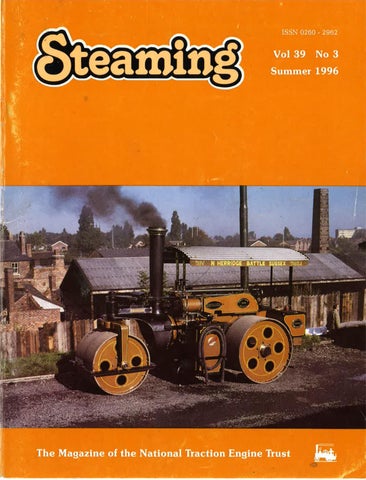
Cover In a quiet moment at the Black Country Museum at Dudley, Wallis & Steevens Advance roller 7979 poses for the camera against a background of the reconstructed industrial buildings. The 1928 built machine displays the Basingstoke makers brown livery and was pictured by John Maund at the October 1987 gathering. 123
Trust News From the Chairman I have in the past, when writing or speaking of safety and competence in driving engines, suggested that we can all have bad habits. In May a number of members of the Robey Trust arranged for a Group G (Road Roller) driving test on their tri-tandem roller. I had mentioned to them that, although a commercial operator of over 100 road rollers, I never have had a full licence and they invited me to take part.
I failed the test. The examiner said I did not look behind me enough. I thought I did, but I recall that at the age of 17 when passing the test in a car I was told to use the mirrors more frequently. I had the same criticism when taking and passing my HGV test. Clearly I have not responded to the advice and have now been caught up with. It is this type of problem, which only others can see — never oneself — that led me to suggest that we all have bad habits that we are in danger of passing on to people we train. We therefore should first ensure we are getting things right by informal testing by our peers. I was roundly attacked for so saying but have now, to my own great embarrassment, proved my statement to be true. I rest my case. However, I can continue to drive CONQUEROR with my ordinary licence and hope to do so on the Trust's Road Run in September. Another bad habit I have is my failure to fill out rally entries. Have you remembered to get your name on Sylvia Dudley's list for an application to take part? It probably isn't too late. See you at Hollowell. (Richard Sandercock, Chairman)
Engine Owners Column Engine Owners sub-Committee We are all busy in the rally season, so I will keep my notes this time to a bare minimum. The Trust's Driving Course at York 124
was a great success again, with over forty participants having a pleasant weekend. Hopefully they went away with a little more confidence to enjoy their engine driving in the future. We were particularly glad to have members of the Road Roller Association with us and their help was much appreciated. We are again most grateful to all our friends at the Murton Park Museum and, of course, all the engine owners and inslrueiors whu took part. We have made further progress with the Engine Code and Part II, 'Driving and Conduct on the Road and at Public Events', is now ready for distribution. The vouchers for that
Part should be sent to Sylvia Dudley, together with a self addressed envelope (large enough to hold the plastic sleeves without folding!) that is stamped to 45p. We look forward to a continuing enjoyable rally season and especially to the Trust's Road Run in September. (Michael Davies, chairman, Engine Owners sub-Committee)
NTET Engine Management and Driving Course "If it's spring then it must be NTET Engine Driving Course time." The two should go hand in hand — here were
73
From Alan Martin's Collection
Dignity and Impudence! The Crystal Palace in south east London forms the background to this posed scene, though the exact occasion is unknown to me. Camberwell Council's ponderous 15 ton single cylinder Wallis & Steevens roller 2263 of 1894 contrasts with the fragility of another Hampshire product, Tasker 1296 of 1903. This is a 3 ton tractor, owned by the Royal Society for the Prevention of Cruelty to Animals and available for relieving horses of heavy loads on the steep hills of the area. Both engines are well burnished with much bright steel in evidence. Summer 1996
STEAMING
For engine owning members ... The Trust's
CODE OF PRACTICE for Traction Engines and similar vehicles Price £17.50 each including postage (cheques payable to National Traction Engine Trust) from — Mrs Sylvia Dudley 12 Hillway Woburn Sands Milton Keynes Buckinghamshire MK17 fIUL
forty-one students, twelve engines, but alas no spring at Murton Park, York over the weekend of 11/12th May. In fact it was a b-b-b-bit chilly — same as last year. It was good to see many of the last year's engine owners return to the course to convey to the students their usual practical advice knowledge and encouragement, all with good humour. With the aim of using the engines as they were intended there was the opportunity for rollers to work on newly laid roadways in the York Livestock Centre auction area, the agricultural engines to practise setting an engine to the belt on Murton Park's threshing drum, and for all to practise precision driving around cones. The practical engine handling was complemented with various lectures which included safety related aspects of boiler construction, using the Trust's recently acquired Marshall portable boiler, the engine power train and motion work illustrated by models supplied from the National Railway Museum at York, and practical examples of lubrication techniques. A particularly important lecture clarifying the various aspects of driving on public roads was co-presented by members of the NTET Engine Owners sub-Committee and the Road Roller Association. On the Saturday evening some one hundred and twenty folk were amply plied with food and ale. No sooner were they gastronomically satisfied than further food (for thought) was provided by the evening speaker, Richard Gibbon from the National Railway Museum. He vividly described the various engineering and financial dilemmas associated with keeping the nation's railway locomotive treasures in either running order or in original STEAMING
Summer 1996
condition. The weekend was, by all accounts, judged to be a success. This was only made possible by the participation of the local engine owners, the lecturers, and previous students who returned to assist in the general organisation and of course, not forgetting the Director and staff at Murton Park and their excellent facilities. On behalf of the NTET 'Thank you all'. We hope to see our first year students back with us next year, when we aim to go down to the West Country. Our second year students should now have acquired the basic principles of good engine management and be able to team up with engine owners in their local areas under whose guidance we hope they will develop into and fulfil the Trust's aim of becoming good and competent engine men. (Richard Vickery, Engine Owners sub-Committee)
Rally Organisers Column Rally Authorisation Once again our Editor jogs my elbow about this issue of Steaming and with some alarm I realise that by the time you read this the 1996 season will be at the mid point. Those who have arranged their events early in the calendar can now be out and about enjoying themselves, watching the rest going through the annual trials and tribulations of running steam rallies. The Trust inspectors have been busy again this year inspecting events. So too have Environmental Health Officers. EHOs, it seems, are on a learning curve and will be taking more interest in our hobby as time goes by. Be prepared for a visit, and from my own experience, a quiet, confident and helpful manner from organisers will go a long way to smooth these official visits. Rectify immediately any faults they find, and ensure they are aware you are acting on their advice. I make my annual plea to all Safety Officers to submit their safety reports as soon as possible. This will enable me to go through them and extract the interesting and unusual points for use at the Autumn Conference. Once again, I stress no names of events or people will be used — anonymity is assured. The idea is to learn from our mistakes and unforeseen circumstances, not laugh at anybody's discomfort. As most of you know I try to make my report enjoyable, in the
belief that by doing so the mind retains the information offered more easily. I hope you are all enjoying the 1996 season but look forward to seeing you at the Autumn Conference on 12th October at the ACU Headquarters in Rugby. Assemble at 10.30 for coffee and biscuits, Conference opens at 11.00. Do ensure your event is represented. (Smudge Smith, Administration Officer)
Insurance Officer's Notes James Campbell As some of you will already be aware James Campbell has left AON UK (formerly John Scott & Partners) by mutual agreement and has set up in business as an insurance agent specialising in the field of vintage vehicles, steam traction engines and other cherished items. I know that he quite rightly prides himself on giving a first class service and I should like to take this opportunity of wishing James every success in his new venture and to thank him personally for the help and assistance he has afforded to me in my role as Insurance Officer. For the time being, at least, I have agreed that James can issue the NTET Insurance Disc to those who choose to insure through him. This arrangement will be reviewed when the Trust's revised insurance scheme is announced. AON UK and the NTET AON UK (formerly John Scott & Partners) continue to be the NTET's approved Insurer and have subsequently submitted a reply to my invitation to tender for the NTET's revised Insurance Scheme. Mike Chamberlin, a Director of AON UK and an Insurance Broker of some 20 years experience, has taken over the seat that James Campbell has vacated. Mike is assisted by Claire Calcutt who some of you will know already through her dealing with the HCVS and low loader insurance scheme. Mike can be contacted directly on '' 01252 807809. Through contact with members and with AON I am aware that there have been some teething troubles and I am assured by Mike that these are receiving urgent attention. Some of the problems arise through the merger of two offices into one head office at Farnborough where none of the incumbent staff are fully aware of the business of the 'new' staff; I think 125
patience is required here but in terms of quality of service I know James Campbell's act must be a hard one to follow — only time will tell. However if you are experiencing any problems Mike Chamberlin asks that he be contacted on his direct phone number and he will handle the situation personally. Revised NTET Insurance Scheme In reply to my invitation to tender for the NTET membership's insurance business I can tell you that I have had 12 responses (two declining participation) and of these four are very interesting indeed (including AON UK). I have met personally with each of the four, accompanied by Andrew Semple on occasion, and discussed in detail the scope and the pros and cons of each submission. My main aims are to obtain complete, unambiguous and consistent cover for NTET members at competitive rates for Comprehensive and Third Party Fire and Theft cover, with discounts or reduced excesses based on experience and/or claims history and incorporating personal injury, trailers, passengers, equipment and low loaders. I believe that I am meeting most of these, if not all, but the final choice of approved broker is going to be very difficult indeed. My wish is that I can make a formal arrangement in the late summer. Watch this space! Valuation for Insurance Purposes Insurance companies always work to an 'agreed value' and I have been asked on a number of occasions "what value should I place on my engine/equipment for insurance purposes?" The answer is not simple but I will endeavour to give some guidance. Let me start by defining Market value and Insurance value. • The Market Value of an engine is difficult to assess and is based on a
combination of engine type, manufacturer, rarity, condition (to some less extent) and significantly, its history. Notably it is effected by whim, market traits and the amount of money available in the economy. • The Insurance Value for the purposes of vintage vehicles/steam engines should be generally based upon the cost of replacement of major components, ease of purchase of parts and labour costs associated and some assumed cost of a total rebuild should the device be affected fatally, so to speak. The advice would therefore appear to be that if your engine/equipment is extremely rare with a good sought after history and in excellent condition then a figure based on a heavy proportion of its Market Value might be appropriate, otherwise use the Insurance Value. But words of caution: • it is unlikely that the complete item will be stolen or irrevocably lost, except in the case of a model. • inflated values will lead to higher premiums but with no added advantage. • in the event of a complete loss most insurers will only pay out a salvage value (say 80% of the agreed value). If anyone has an opinion or ideas on this subject I should like to hear from you. Discs I am pleased to say that the numbers of NTET Insurance Discs being issued appears to be increasing yet again. This is mainly due to Rally Organisers being more insistent, but increasingly more owners are seeing the merit of the scheme. In order to process discs more efficiently I am able to receive documentation sent by FAX using the same number as for my phone but can I make a plea; don't leave things to the last minute! Whilst I have got my systems fairly slick, the good old Royal
One more comment please ... The caption competition in the last issue (page 85), set around a picture of two West Country enginemen of the 1920s at the roadside, brought forth but a handful of suggestions, a most disappointing response. It led the Editor to wonder where the engineman's humour, so evident on the rally field, is put once members get home. Best suited for the Editor's amusement was the offering "Sod the authentic dress: g'is one of them Trust sweatshirts", hilt this was from someone close to the Sales team and he therefore had to disqualify it as advertising. The winner of the £10 voucher therefore is Rob Henderson of Whitney-on-Wye with his somewhat abstruse caption "Not more engine squat cake again, Arthur". 126
Mail, it seems, still sometimes has trouble tying saddlebags onto the right horse. May I end on a personal note; we have just spent a most enjoyable two week holiday in Ireland specially arranged so that my wife and I were able to attend the Upton St Patrick Rally over the Irish Bank Holiday on the 2nd and 3rd June. What a great time we had and I am pleased to say that the British contingent were all sporting NTET Discs and promoting the cause very well indeed. The standard of exhibit at this Rally was very high, the working displays being amongst the best that I have seen. Our thanks to Father Harris and Margaret Malone for making our visit very pleasurable (Dave Smith, Insurance indeed. Officer)
Trust Exhibition Unit Many members will be now be familiar with the Trust's travelling exhibition unit — it has visited a rally on most weekends of the rally season during the last three years. Do make a point of calling in and introducing yourself if you are attending one of the rallies the unit attends — it is staffed by Committee members who will always be prepared to address points you wish to discuss. The unit also carries most of the NTET Sales items — a good chance to browse at leisure. In the early part of the season the unit spent three weekends in Holland, and it was most noticeable that Dutch callers knew of English rallies and were keen to take the displayed handbills for their planned holidays. During the rest of the summer the unit is booked to attend the following events: July — 13/14th Ardingly, West Sussex; 19-21st Weeting (stand in marquee); 20/21st Langport, Somerset; 26-28th Cumbria. August— 3/4th Worminghall, Buckinghamshire; 10/11th Cadeby, Leicestershire; 17/18th Lincoln; 24-26th Harewood House, Leeds; 28th-Sepi. 1st, Great Dorset Stearn Fair. September — 7/8th Malpas, Cheshire; 14/15th Billericay, Essex and Bedford; 21/22nd Cobham, Surrey; 28/29th NTET Road Run. Reference to The Rally List 1996 will give further details of the location of the events. (Robert Herring, exhibition unit organiser, IT 01869 277410). Summer 1996
STEAMING
The Rally List 1996 The following events have been added to the Trust's list of Authorised Rallies, published as a loose supplement in the Spring issue. JULY 20 and 21 — Marcie Steam Rally, Rye Meadows, Much Marcie, near Ledbury, Herefordshire (15 engines in 1995). — Mrs P. Chester, 21 Glebe Orchard, Much Marcie, Ledbury, Herefordshire HR8 2PL (' 01531 660464). AUGUST 24 and 25 — Egham and Thorpe Royal Show, Runnymede Showground, Egham, Surrey (15 engines in 19951. /.H. Fear, 1 Rowan Avenue, Egham, Surrey TW20 8AN (Tr 01784 436415). SEPTEMBER 7 and 8 — Haddenham Steam Rally, Haddenham, near Ely, Cambridgeshire (38 engines in 1995). Mrs D.M. Young, Darkin, Meadow Lane, Earith, Huntingdon,-- Cambridgeshire PE17 3QE (Tr 01487 841893). 28 and 29 — NTET Road Run 1996, Hollowell Village, near Creaton (off A50), Northamptonshire. Mrs S. Dudley, 12 Hillway, Woburn Sands, Milton Keynes, Buckinghamshire STEAMING Summer 1996
The mine-debris strewn sides of the Porthtowan Valley in Cornwall form the background to Peter Donovan's picture of Burrell 3395 THE DALESMAN. The 6hp road loco was taking part in the West of England's Road Run in August 1995.
MK17 8UL (' 01908 583006). Several other early season rallies held their events under the Trust's Authorisation Scheme: Strumpshaw Steam Rally and ONCA Steam Rally at the Spring Bank Holiday weekend, and Leighton Buzzard ByPass Steam Rally and Woolpit Steam Rally on 1st/2nd June.
Steam Apprentice Club I am pleased to record that a goodly number of rallies have volunteered to offer free entry to members of the SAC. Rally secretaries will have received sample SAC membership cards to assist gate stewards with identification. Some rallies have kindly offered to provide facilities for Apprentices to have 'hands on' experience and at several rallies it has been possible to
arrange senior SAC representation. I am grateful to Stuart Gaines in the south, and David Parkin in Yorkshire for the time they will be giving to the section. Stuart will be at Woodcote (13/14th July) and Netley Marsh 126-28th July) — contact him on 27 01635 580216 to find out what he is arranging for Apprentices at these events. David will be present at Masham (20/21st July); Pickering 126-28th July); Driffield (10/11th August) and Harewood House, Leeds (24-26th August) and contactable at his engine in the line up. Barry Sumsion is doing a fine job as Editor of the SAC magazine Raising Steam — each issue is full of interest for the members and it is distributed well on time. At the next Trust AGM I shall relinquish my chairmanship of the SAC, due to increasing family commitments (the very young and the very old — not me of course!) Although I am retired, there are business commitments which must be attended to and which are being passed to me. However, in the wings is a new chairman for the SAC. John Durling is consider127
ing the position in which he will be ably assisted by his wife, Fiona. I do hope this will come to pass and I look to the Trust Committee, engine owners and the general membership to support them in the work. (John Bosworth, chairman, Steam Apprentice Club)
Obituaries Edith Beeby Many members will read with sadness this note on the passing of Edith Beeby, who for many years gave much time and effort to our Sales Stands in the midlands. With her husband Ken, • Edith started the first of the regional sales outlets on rally fields in 1975, at a time when Vic Burroughs was the then National Club's Sales Officer. Ken and Edie quickly became popular figures behind the book laden table in their caravan awning and served members at many midlands and eastern rallies from their Kettering base. Successive Sales Officers Alan Wilson and Keith Shakespeare found them faithful ambassadors for our cause, their 'takings' often topping the lists and providing much needed funding for Trust finances until the late 1980s. Edith died very shortly after enjoying a visit to the Rushden event in May, and many memb,rs will wish to be associated with our condolences to Ken in his sad loss. (Roger West)
Peter Coulson Peter Burdett Coulson, of Alconbury, Cambridgeshire, died in April 1996, aged 78. He was born in 1917 at old Welwyn, Hertfordshire to a family of bakers and grocers. His love of steam started when the fair came each year. He was taken in his pushchair to stare up at Harris's showmans engine, until one day he was put up on the footplate! Peter went to a boarding school in Hatfield which was close to the railway line and always managed to be excused from lessons when he heard a steam train passing. When he was old enough to ride a bicycle safely, every spare moment was spent following the threshing gang from farm to farm. Pete grew up and met Doris, who he introduced to the steam world, but she found the competition difficult! In 1939 they were married and a year later Peter became the proud father of 128
Richard. In 1941 he was called to serve his country and joined the Catering Corps He spent snme time in Lincolnshire and was then posted to Stevenage. During trips to the local pub, he renewed an old friendship with Ern Nagger, the thresherman he had met many years before. A few years after the war, in 1952, the family moved to the Huntingdonshire village of Alconbury, there to take up the different lifestyle of pig farming. In 1959 whilst on holiday in Lincolnshire with Pete's cousin, Richard saw McLaren 1837 for sale and soon was on the phone to his father, At first Pete was not very interested as his recollection of a McLaren was a rather large cumbersome engine. However, a visit was arranged, £300 changed hands and the steam tractor BLUEBELL was on her way to Alconbury with Ern Nagger's expert help. After a few adjustments the engine was leady for a run around the village. On arrival back at the farm there was a rare appearance of the local fire brigade and to this day the reason for their visit is unclear, but the Chief was very interested in BLUEBELL! Many will have fond memories of the steam parties held at Spring Cottage Farm which became a major event of the year for the village people and local enginemen. Pete was always one of the last about, and a few will well remember the precarious walk back to the house as the sun was rising, and then snatching a couple of hours sleep before a hearty breakfast of ham and eggs in the garden. One of Pete's ambitions was to complete the HCVS London to Brighton run on the engine. This was achieved in 1980 and the two following years. Pete was always a great help to other enginemen with his great source of knowledge of steam engines and would always spare a moment for people however small the problem. He was an active member of the Bedford SEP Society, being treasurer for many years. We shall miss his engine stories in the beer tent, which were enjoyed by young and old alike. Peter's other love was for horses. This came from his days in the family business, when most deliveries were made with horse drawn vehicles. At the age of 17 he entered his father's turnout at Hatfield Park and was very proud to come second in his class. He was a member of the Shire Horse Society for many years, regularly attending the Shire Horse Show at Peterborough. However, Pete's greatest love was for his family. He was devoted to his
wife Doris and son Richard, and was very happy when Richard married Adrienne. He was especially proud when his grandchildren Ellicia and Giles were born. Watching them grow up gave him immense pleasure. Peter worked hard and played hard and we shall all remember his caring nature and cheerful company. On 10th April the church of St Peter and St Paul at Alconbury was full to capacity, and BLUEBELL and a shire horse team stood in tribute by the farm gate. After the service Peter's family and many steam friends gathered at Richard and Adrienne's home. Pete would have enjoyed his wake; the atmosphere was of steam rallies and past memories shared with Peter, beer glass in his hand and reminiscing of days as a baker at Hatfield or on his years spent steaming BLUEBELL around the eastern counties. (Paul Worbey, Michael Watts)
Gold Medal Tractor Newsletter Ron Walker has recently issued No 17 in his series of newsletters for Burrell Gold Medal tractor owners. This occasional publication is edited by Ron, an owner himself, to stimulate interest in the marque among owners, drivers and enthusiasts generally. Topics covered in the current issue include recent changes of owner, thoughts on a gathering at Weeting and Thetford in 1997 to mark the 90th anniversary of the winning of the medal: a review of Burrell tractor Summer 1996
STEAMING
sightings in 1995 and an update of the definitive list of worldwide survivors. Ron is hopeful of a good attendance of the breed at the Trust's Road Run in September especially bearing in mind their close historical ties with 1907 RAC trials. Copies of the Newsletter, a good example of an informal publication centred on a relatively small group of engines, are available from Ron on request and receipt of a 9in x 6in stamped, addressed envelope — Ron Walker, Lower Priory Farm, Clamp Hill, Stanmore, Middlesex HA7 3JJ.
From JOHN H. RUNDLE. NEW BOLINGBROKE, near BOSTON,.
Three Counties Steam Tour Subject to Local Authority approval, a unique steam vehicle event will take place over the May Day weekend in 1997. It is being organised by the East Anglian Traction Engine Club to commemorate the RAC Commercial Trials of 1907. The route will cover about 100 miles through the counties of Norfolk, Suffolk and Essex and will embrace four towns closely associated with the manufacture of steam engines — Thetford (the home of Burrells), Leiston (Garretts), Ipswich (Ransomes) and Colchester (Davey Paxman). The starting point will be Thetford from which, on the Friday afternoon, a short journey of about 16 miles will be made to the overnight stop at Bressingham Steam Museum. From there, on the Saturday, the participants will steam via Scole, Saxstead Green, Framlingham and Saxmundham to the Long Shop Museum at Leiston in Suffolk. After an evening of entertainment at Leiston the entourage will next morning wend its way via Snape, RAF Bentwaters and Woodbridge to Ipswich and then on the Bank Holiday Monday, through Stutton, Manningtree and Ardleigh to Davey Paxman's works at Colchester, Essex. The route is being carefully planned to embrace the necessary stops for fuel, water and lunch. As far as possible main roads will be avoided and Scammells and a low-loader will be on stand-by for use in case of breakdowns. The number of vehicles taking part will be limited, they will be steam propelled and preferences may be given to Burrell, Garrett, Ransomes and Davey Paxman manufactures. Certain other criteria, such as no straked wheels, will have to be met. The East Anglian Club will provide coal but will expect owners/drivers to STEAMING Summer 1996
AI.L RI NOS Or HAI. LI NC BY TRACTOR.
ESTIMATES GIVEN.
These two postcard pictures are from the collection of Ran Hawthorne. The steam tractor is one of Foster's Wellington compound machines, recorded as delivered new to Reverend Harness Rundle of New Bolingbroke, near Boston, Lincs, and seen here as painted and lettered for his son J. [John] H. Rundle, hauling contractor. The image is presented on a printed card, doubtless intended for use in acknowledging orders, sending estimates etc. The engine is works number 13149, new in January 1914 named VENTURE and most likely in the maker's dark green livery with red wheels and planished steel flywheel. Note the brakes on the traction wagon can be operated by the crew from the footplate via the raised handwheel. The heavy chain draped around the toolbox on the wagon's front board is likely to have been used for manoeuvring the trailer in tight spots. The Foster survives in preservation, still in the Rundle family ownership. The second picture was taken by Frederick Gafford. He was a Nottingham engine dealer and agent as well as a keen photographer of road and railway steam engines and other items that are nowadays described as vintage. This engine is Aveling & Porter 2704 of 1890, a cumbersome 15 ton single convertible, at the time in roller form. Having worked new for G. Brothers wood of Tonbridge, by 1921 the engine was with R. Palmer of Great Massingham, Norfolk (here it was registered AH7694), and then, by 1925, with Gafford. Perhaps he took the picture to record his potential purchase — it is believed to have been photographed at Palmers. 129
meet their own expenses. Corporate sponsors are being sought to ensure the success of this ambitious venture which, besides commemorating the 90th anniversary of the RAC Commercial Trials, should financially benefit the Club's nominated charity, the Cancer Relief MacMillan Fund. Should you wish to enter an engine, help with the marshalling or take part in fundraising please contact Robin Harding for further information at 59 Conies Road, Halstead, Essex C09 1 BD (by post only; SAE please!) The Three Counties Steam Tour should be a challenging and memorable event and all involved will receive a plaque or other suitable memento.
Future dates Great Dorset Steam Fair 28th August to 1st September 1996 The Trust's sales team will be again attending the Dorset event for the whole Wednesday to Saturday five-day period, open from 9.00am through to 7.30pm on all days except Sunday, when we finish at 5.00pm. As in previous years we will be in a large marquee, with an enlarged sales area to one side and a sitting area to the other, th elatter with tea and coffee available. We hope all members who are visiting the event will call at the marquee, whether to spend money, to sit, relax and regain energy,
to seek information or even to bring constructive criticism. The area will be staffed throughout by a variety of Committee members on a rota basis. During the 1995 event an open Committee Meeting was scheduled to be held on the Sunday morning. At that time the venue proved less than suitable due to the noise from nearby exhibits, but the meeting itself showed that the opportunity for members to meet and raise matters of mutual concern is worthwhile. The Dorset event must be the gathering place for a greater number of Trust members than any other location, so the Committee wish to persevere with the idea and enable members to raise matters for discussion at an informal get together. This OPEN FORUM will taken place on the Friday evening, 30th September, in the Trust marquee, at 7.00pm. Committee members and officers at the event will be pi esent and members are encouraged to attend and make known their views.
Autumn Rally Organisers Conference The Autumn Rally Organisers Conference will be held at the Auto Cycle Union headquarters at Rugby, Warwickshire on Saturday 12th October 1996. Further details will be distributed to Rally Organisers and Affiliated Groups in due course, but any other interested parties requiring information on these excellent forums should contact Sue Jackson, Hon Secretary (address inside front cover).
Annual General Meeting Advance notice is given to all memhers that this year's Annual General Meeting will be held on Saturday, 16th November 1996 at Jury's Hotel, Bristol. Formal notice, together with all relevant information, proxy forms and audited accounts for the year ended 31st March will be sent to all paid-up members of the Trust with the Autumn issue of Steaming. Any member may submit a motion for discussion at the Annual General Meeting. All motions must be in writing, signed by the proposer and by a seconder. Such items for discussion, in order to be published in the Agenda for the Annual General Meeting, as required by Article 16 of the Trust's Constitution, must reach the company secretary Sylvia Dudley not later than Saturday 21st September 1996 (address inside the front cover). Details of the arrangements for the AGM weekend will be published in the Autumn issue of Steaming, but we give brief details for memhers who may wish to plan well ahead. A very attractive package is being negotiated for members wishing to spend a weekend at Jury's Hotel. Bristol on a Saturday offers a number of attractions and it is anticipated that local engines will be in attendance at the Maritime Museum, close to the hotel. In the evening there will be a formal dinner with presentations of awards, with guest speaker Michael Oliver. For the Sunday morning Kelston Sparkes has kindly agreed to receive us at his premises at Stanton Drew.
Thank you
OUR MAGAZINE 25 YEARS AGO
Steaming for the middle of the year 1971 was able to report the Richard Trevithick parade in Cornwall, held to mark the 200 year anniversary. Twenty-four engines had taken part and one had 'dropped the plug'; perhaps not inappropriately for it is Trevithick who is credited with the invention of the fusible link in the top of the firebox. Prime subject at the Rally Organisers conference seemed to be the avoidance of clashes of date — 'not always easy with the numbers 130
now held'. The subject of 'pirate' rallies was brought up for they had the promise of good success and remuneration, but owners had then been known to be left high and dry. A good spread of engine notes mentioned many engines that would be familiar to older members but a fair number of them are absent from the 1990s rally fields. There were notes of the sale from Somerset to Hampshire of the Kings roller and wagon fleet, though no mention that several did remain — those within the sheds or the overgrown boundary hedge at Bishops Lydeard. An engine still in commercial use was Wallis Advance roller 8066, worked by Graham of Woking in the Cobham, Woking and Shepperton area.
My wife, Dillis, and I would like to take this opportunity to thank everyone who gave or offered us help at the recent NTET driving course at York, where I was taken ill. Special thanks to Paul Mercer and the Museum staff for letting us park our caravan in the ground and also for allowing the use of the facilities. I was released from the hospital in York on the Wednesday and am receiving further treatment at home. Thank you all. (Brian James, safety officer)
'For Hire, wanted — Steam wagons wanted for hire on Government work, Foden or similar type, steel or rubber tyred. Box D13, 'Free Press', 30 Baldwin Street, Bristol.' (from The Commercial Motor, 21st November 1918.) Summer 1996
STEAMING
THE NATIONAL TRACTION ENGINE TRUST IS PROUD TO PRESENT ON
28TH AND 29" SEPTEMBER 1996
at Hollowell Rally Held to the north of the town of Northampto
n, a
Members are invited to take part in a trial of enginemanship. Solicitations from owners of all kinds of road steam engines are welcom e! It's time now to stop these mock and 53 miles. we are shortly to make 'police' the actual run — as time-keepers, Victorian adverts and get down to telling available through NTEC Sales a modest, marshalls etc, and also to assist on the you more of the Trust's Road Run in economically priced Photographers Sunday. Observers are still required to September. Guide to the Run. This will include basic accompany engines. Do please consider The work of organising the detail details of the routes, parking possibilities, coming along to help and to share in arrangements for the Run is progressing village plans, photographic vantage what will be a memorable weekend. well. We hear that the Run is a frequent points and pubs etc. The souvenir Caravan parking and camping areas topic of conversation on rally fields and programme for the Run, which will be will be available on the field, as well as a club meetings around the country, and available at the event, will also feature limited number of trade stands. Details of the Committee are pleased to be the routes and, of course, it will list all the this aspect from Allen Eaton a 01604 receiving positive comments from all engine entries. 505422. quarters. On the Sunday we hope to have a A very important gift to the Run in the Entries are coming in steadily, with series of circuits on the rally field to form of a winner's salver, has been their U5 entry fee (which we are aiming further test driver skills and provide the offered and accepted from the Chiltern to be refundable!), and a goodly selection public with something different to see. club. Union Coal have donated a living of interesting engines are represented. Although we are marketing the weekend van to be auctioned to assist the finances; To whet the appetite of those of you who as a trial, those wishing to bring their they will be on site to supply coal at still may be making up your minds, you engine along and just stay on the field for competitive prices, delivered some of the will be sharing the fun with such as our the weekend will be most welcome. way, we believe, by narrow boat! The Chairman's Burrell CONQUEROR; the Andrew Semple has been busy asking winner will get a ton as first prize. Bishop's furniture van Foden; the Foster respected people to be judges. Among Further details of the Run are availwagon; the Wing's Fowler agricultural; those who have agreed to join the panel able via the sales team and committee. Burrell showmans NERO and a very are Robert Petty, grandson of John We hope all who attend, in whatever . welcome entry from the other side of the Fowler, and Alan Hayward from the capacity, will have an enjoyable globe — the Hawkins' Burrell ten-horse. Science Museum. We urgently require weekend — a little different from most It is noted that very few road rollers are members to join the Committ ee and rallies. With the co-operation of the entered — I personally hope that will existing helpers with the running of the weather it should be a splendid spectacle come to be put right. event on the day. The Hollowell club will to have taken part in and to have The routes for the Run have been be looking after the activities on the field, watched. (Russ Bulley, Road Run subfinalised and the distances are 16, 28 but there will be a lot of work required Committee) to
FOR FULL INFORMATION write in the first instance to NTET ROAD RUN, 12 HILLWAY, WOBURN SANDS, BUCKINGHAMSHIRE MK17 8UL or FAX 01908-5
84737
STEAMING
Summer 1996
131
World Traveller Across the globe to Weeting Rally
During recent years we have perhaps become quite used to reports of British engines visiting rallies across the other side of the English Channel — and of continentally-owned engines visiting our events, but this summer we have the chance of witnessing a real world traveller. The Hawkins family, of Christchurch, New Zealand, visitors to the `Mooting Roily in N^rf,lk. on several occasions, are this year bringing with them Burrell 3130, one of their collection of Thetford-built machines. The engine's trip across the world will involve being an entrant at the popular Norfolk event, a visit to its St Nicholas Works birthplace, perhaps another rally or so, and finally taking part in the Trust's Road Run in September, before returning home to New Zealand. For Burrell enthusiasts in Britain, this is an engine to make a point of seeing for nothing similar stayed in this country. In the early years of the century the Thetford works turned out a few large 10hp engines intended for direct traction ploughing work in the Colonies. 2596 was sent to an unknown customer in South Africa in 1903 and a few years later Reid & Gray of Dunedin — Burrell's agents in New Zealand — took 3130. This engine's compound cylinder had 7in and 11'/tin bores with a 12in 132
Burrell 10hp compound 3130 engaged on threshing duties in New 7naland, about 1912. (collection Hawkins family)
N/Jt-131 !Au
1, 1'1 .
The Hawkins sawmill in the early 1960s. For three years or so about this time, 3130 took up this position on three days a week to unload logs from railway wagons with Its wire rope — the 'ail tracks were on the other side
of the buildings. (collection Hawkins family) Summer 1996
STEAMING
.
stroke; the boiler, rolled in Yisin thickness plate from Krupp of Essen, Germany, was pressed to 2001bs and provided with both a Richardson steam pump and an International injector for water supply. The three speed, double geared machine was mounted on Burrell's own design of springs. Hind wheels were 6ft 6in diameter and 20 inches wide and the overall engine width was 8ft 6 1/2 in. It left the works on 29th July 1909, the weight recorded as 14 tons 7 cwt, though this total had to be added up for the machine was too large to be weighed in one piece and even the recorded figure is thought to be less anchors, wire rope, tools and lagging — also, presumably, water and coal. An illustration of 3130 as built appears
on page 332 of Michael Lane's The Story of Nicholas Works and shows the enormous belly tanks that were fitted. Once in New Zealand, the engine's task was to be pulling a 20 furrow plough, also threshing and the road haulage of grain and wood. Its usual load is said to have been 40 tons. The Hawkins family acquired 3130 in 1942 for use in their saw milling business. It gave continuous use until 1965 and since then has been used for rallying in New Zealand. A short article on the family's collection of Burrells appeared in our Spring 1987 issue. Earlier this spring the large Burrell was partially stripped down to enable it to fit inside a shipping container for its sea journey to Britain. The con-
The strength of steam wagons
through. The numerous stoppages at length began to tell on my supply of water, so I asked my mate the nearest point at which a fresh tankful could be obtained; he replied that the previous driver always filled up at the last village we had passed through. This was not exactly cheering news, the nearest point being a river some five miles ahead, and my water was getting very low. I got down and tried the lowest tap on the water tank, hoping to see water run out, but with no result. I determined to make a dash for the watering place and deliver the rest of my load on the return journey. We ran through the first village paying no attention to the frantic appeals of an old lady who expected to receive her fortnightly consignment of goods, at top speed. Just over the brow of the next hill the water left the gauge glass, but on arriving at the bottom on the level ground I could see it again, which made me take heart once more. We shortly reached the river, where I put on all speed and got out the hose, and after filling up the tank and replenishing the boiler we proceeded on our way once more. The road lay over a small bridge which spanned a narrow stream, and the wagon had just got to the middle of it when without warning the whole vehicle, with a tremendous crash, turned over on its side. My mate fell clear of the wreckage, but I had to crawl out from underneath the hood, which might have crushed me. The first thing to do was do draw the fire, and this was not an easy job by any means considering the position of the boiler. I then had a look round to ascertain the extent of the damage. I found that one of the back wheels had broken through the crown of the
'W.P. (Salisbury) writes on the 16th instant: — The following experience will, I hope, prove interesting to our many readers. One morning, at 6.30am, I entered on my duties as a driver to a mineral water manufacturer, wholesale grocer, and general provider, for the small shops in the surrounding district. I took the lorry from the garage and backed it under the loading-out shed, preparatory to having my cargo put on the platform. I have seldom, if ever, seen a more diversified load on any selfpropelled vehicle. Ginger-beer, boxes of groceries, barrels of vinegar, firkins of soft soap, and a hundredweight keg of arsenic, were samples of my freight. The men piled up the wagon as high as the eaves of the shed would allow of; then I drew out into the yard, where the remainder was put on. When all was ready I backed down to a trailer, which had eight barrels of paraffin on it, and we started off at 7.45am for a run across Salisbury Plain, a distance of eleven miles. We covered the journey without incident of any kind, the wagon, a five-ton Straker, going well over all the stiff hills which were encountered on the way. We now commenced to deliver the goods; a case of mineral waters at a cottage, a box of groceries and a cask at the village shop, and, lastly, a parcel of tobacco for the public house. We then ran as far as the next village, where the same business was gone STEAMING
Summer 1996
tainer was sealed on 23rd May, taken abroad ship the next day and sailed on the 25th. Arrival at Tilbury will be on 2nd July and then comes the frantic work of putting 3130 together for its first appearance in public at Weeting Rally from 19th to 21st July. It will be driven at the rally by owners Bob, John and Sam Hawkins — Sam being the fourth generation of the family to be involved with the engine. We hope they all have a most enjoyable series of visits during their stay — world class rallying indeed. (Thanks are due for information contained in these notes to Bob Hawkins and Richard Parrott and to Michael Lane's The Story of St Nicholas Works.) 114
bridge, and I noticed the peculiar fact that there were several pieces of wood about two inches thick sticking up through the road surface. Some small boys, who were enjoying the mishap, informed me that the steam, roller belonging to the county council had broken the crown of the bridge days previously and that it had been mended with planks, over which stones had been sprinkled. I looked to find a caution board, thinking that I had missed it by some chance, but none was to be seen. Obviously this was a case for a claim, so I sent my mate off to the nearest telegraph office to wire for my employer. As he could not arrive for some time, I thought it wise to clear away the remains of my load in order to find out if possible the extent of the damage to the wagon. After we had cleared the wagon a little, we jacked it up. By the time we had done this my employer came up in his motor-car. We then had the wreck photographed. After working the best part of the day we at length got the machine upright, and I found to my surprise that, beyond a few dents, no damage was done. I kindled the fire once more, and we made for home as soon as the steam pressure was high enough. No trouble has arisen from the mishap.' (from Commercial Motor, 19th October 1905.)
'Steam Wagon driver — mechanic desires change, 16 years shop and road experience, all repairs, overtype preferred. H. Waid, 54 Wood Road, Hillsborough, Sheffield.' (from The Commercial Motor, 3rd October 1918.) 133
More single speed Avelings Sandy Ross Following the discovery in India of a fifth surviving single-speed, inside flywheel Aveling roller my notes in the Autumn 1995 Steaming attempted to set out the known information on these unusual rollers. Les Burbery of the Road Locomotive Society responded to the appeal for additional information and kindly came up with some excellent works photographs of further examples from the RLS collection. These, in turn, provided a foundation
for additional research in the Aveling archive records at Lincoln. Possibly the main question to be answered was whether these were 'one-off' oddities, or were they Aveling's standard product for anyone requiring a light roller? The water bound UK roads of the time, by definition, required a heavy rune', so a
light machine would only really be needed where weak bridges or other physir.al nhstar•.les prevented the use of the then standard 10 tons plus three point roller. Examples of such limitations in the home market would be estates and parks, or highways in emerging foreign colonies and elsewhere abroad. I he 1901 Aveling & Porter booklet Steam Road Rolling (note 11 contains considerable background information on Aveling products and was obviously intended to convince doubting prospective purchasers of the benefits of the company's rollers and equipment, but as is often the case suffers from generalisation and does not specifically refer to the configuration of the smaller machines. However, it does categorically state that 'the larger rollers are geared for two speeds', implying that the smaller rollers were single speed. Another interesting Hole is that 'Eight sizes of
Aveling 5531 — ready for the long journey to India. This 4 shaft engine weighed 8 tons — note the thick rear wheel rims and scarifier on the offside. The new Aveling & Porter office block is seen under construction in this 1904 view and that building is all that remains of the works today.
I I
the steam rollers are made, weighing 4, 5, 6, 8, 10, 121/2 , 15 and 20 tons, and rolling respectively about 4ft, 41/2 ft, 51/2 ft, 51/2 ft, 61/2 ft, 6 34ft, 71/2 ft and 8 1/2 ft For general purposes the 10 ton, 12 1/2 ton, and 15 ton rollers are found the most useful.' All the above is substantiated by the surviving Aveling records of the period, which confirm that there were two basic designs of single speed, inside flywheel roller and that these were indeed regular production models. During 1900 no fewer than 19 of these rollers were despatched, mostly abroad, and it was only from 1905 that 6 and 8 ton conventional versions were appearing in any numbers. Not all these rollers were exported — Glasgow Corporation Parks Department took 4 tanner 4540 in 1900, while Hornsey District Council took 4-shaft 6 tonner 4995 in 1902. Throughout this period the 6 and 8 ton versions were in the majority, many (as 6465 featured in last Autumn's Steaming) going to the Indian sub-continent via the Crown Agents of the Colonies, India Office, or other established foreign agents. The 3-shaft engines were typically of 4 to 6 tons manufactured weight with a 5in x 9in cylinder on a 170Ins
STEAMING Summer 1996
Aveling 5761 — a long box version of the 3-shaft design built with an unusual sailcloth canopy for W.C. & K. de Wit of Holland in 1905. Can any of our Dutch members say if the machine was destined for use in the Netherlands' colonies? pressure boiler, with a 2ft 0in diameter flywheel. The differences in weight were accounted for by a longer firebox and/or thicker wheel rims. Our example photograph of 5761 shows a long box version supplied to W.C. & K. de Wit of Holland in 1905; the unusual sailcloth canopy was a feature of the order, and in this particular example the cylinder bore was increased to 5%in to cope with the increased weight due to the bigger firebox. An example of the 4-shaft design was 5532 supplied, together with a similar roller 5531, on 28th July 1904 to The Great Indian Peninsula Railway Company. The 4-shaft engines were of 6 to 8 tons with a 6 1/2 in x 10in cylinder, but this time at the much lower pressure of 1251bs with a slightly larger flywheel at 2ft 31/2 in diameter. The short connecting rods required by a 4-shaft machine plus the larger flywheel account for the pronounced slope to the cylinder block (see note 2). This roller weighed over 8 tons, the weight made up by the
27/Bin thickness rear rims and the scarifier, but once again the design was similar between the various weights. The keyway on the end of the
crankshaft was to allow for the fitting of a split pulley for driving machinery, the internal flywheel obviously being useless for this purpose. So while previous Aveling scribes may have ignored or been unaware of their significance, these single cylinder, single speed engines were definitely part of the mainstream development of Aveling rollers. It seems reasonable to assume that the 4 or 5 ton Avelings were early casualties of the competing Safford & Perkins petrol engine rollers — indeed by 1904 Aveling were making such a product themselves. From what we now know, the standard Aveling 3 point roller for weights 4 to 8 tons were single speed until about 1910, at which point the smaller models were dropped and the 6 or 8 ton sizes re-designed as scaled down versions of the standard 10 ton machine. It 135
seems reasonable to assume that the single speed design harks back to the very first Ave.ling road engines which were so equipped, but more research is required to confirm this. Thanks are due to the Road Locomotive Society for the photographic and other evidence (the 1907 booklet referred to (note 1) was reprinted by the RLS in 1981); to the Lincolnshire Archives for making the royalty books available and David Ross for help in the research. Note 2 refers to an error in the caption to the photograph of Aveling 4698 in the Autumn 1995 edition. This was incorrect in stating that the cylinder is parallel with the boiler; the foot of the casting is indeed parallel, but the cylinder itself is bored at an angle, albeit less pronounced than on the 6 or 8 ton rollers.
Lyndon Shearman of Wolverhampton adds comment on Sandy's earlier notes on Aveling single speed rollers, together with mention of examples used in Yorkshire enjoyed the article on Aveling's early small rollers. One of these was owned for a short while by a firm in Halifax, Yorkshire, many years ago. J.W. Mitchell & Sons started out in the early years of this century, then trading as Mitchell & Speak and the Paragon
Road Roller Company. Albert Mitchell, one of the founders, told me they had an inside flywheel Aveling before World War 1. They had it for rolling carriage drives at the big houses owned by local mill-owners and this perhaps suggests what Aveling & Porter were trying to achieve with this type of machine. For effective rolling, a roller should be considerably narrower than the road it is working on, so that it can carry out consolidation across the full width of the road. Perhaps the makers were trying to make a narrower roller, as Sandy suggested, and the use of the single speed and the inside flywheel would help to accomplish this. It is probable that Mitchell's had their roller new, for all their other rollers, steam or internal combustion, seem to have been bought new, and indeed Albert Mitchell once said to his grandson William, "Allus get first go at owt!" They didn't, however, keep the single speed for long — Albert couldn't recall where it was sold to. Many years later, Joshua Rodgers at South Crosland, near Huddersfield had one of the same type for a short time, but I have no details beyond the memory of the late Jimmy Smith, a driver for Rodgers, mentioning it to me,
A new generation We now change the Aveling topic, slightly, to the 14000 series — some precursors of that dramatic design change for the 1930s were highlighted by Sandy Ross in the last issue. Nigel Keene of Highworth, Wiltshire sends comment on the accompanying photograph which shows the first four of the 14000 numbered rollers, built to the order of Barnes Bros of Southwick, near Trowbridge, Wiltshire. They are posed for the camera at the front of Aveling's works, presumably sometime about the turn of 1929/1930 and the picture is kindly made available by Norman Hillman, whose grandfather was a Barnes driver. From the right the engines are respectively 14000 (KR477), 14001 (KR478), 14002 (KR479) and 14003 (KR480). All survive in preservation and their present whereabouts was set-down on page 106 of our last issue — the first three pictured are AC type 10 tonners, with 14003 at the rear being an AF 12% tonner, just apparent in this view by the larger, deeper headstock on the saddle casting. It is interesting to note all the engines have encasures to take steam from the safety valves through the roof. Charlie Barnes promptly removed these, as with all his engines, for he believed the
drivers would not then allow them to blow off, thus restricting their forward view, and so save steam and his coal and water! included modifications Other registration number plates fixed to the headstock; the fitting of high and low pressure injectors; no pump (these were removed); lamp brackets on the forks and Barnes own colour scheme, The paint finish on the rollers doesn't show up too well in this winter photograph and they might not be in top coat but 14000 (only) has BARNES BROS etc signwritten on the awning sides. The handwheel for the flywheel brake fitting can just be seen in the picture — 14003, at least, retains this very efficient accessory. Finally, Peter Donovan of Marlborough, Wiltshire writes on the mention of Aveling 12502 in the last issue (page 82). Peter is engaged on research on the modest fleet run by W.E. Free & Sons, purchasers of 12502 when new, but can presently offer no obvious reason for Aveling to accord them special treatment — though they had three times previously purchased new from the Rochester firm. Martin Free, grandson of William Edward Free has provided glimpses of the 8 ton Avelings later life: sometime after he started work with the firm, about 1953/54, it broke the saddle when scarifying in Marlborough. A new one was purchased from Aveling-Barford, specially cast, and it arrived without fixing holes to the smokebox. Mr Free borrowed a large air drill from Vickers Armstrong at South Marston to drill the holes. He omitted to wear goggles and later spent some time at Savernake Hospital while nurses removed iron filings from his eye. Later, 12502 has sold to the Southern Gas Board. They were building a gas works at Cowes, Isle of Wight and had exceeded their budget, so needed a roller to complete the internal roads with their own workforce. The SGB boiler inspector went to Frees to test the boiler prior to purchase. Later it must have passed to Westridge Construction Co at Ryde and with them attended rallies on the island, where it was seen by Mr Free. "It had no brass horse on the front, because it was above my fireplace. I didn't transfer the brass when I fitted the new saddle!"
'For sale to best offer, Aveling & Porter 5 ton steam wagon, in excellent order, No 7156, military reason for selling; seen here. W. Wheeler, Alma Road, Windsor.' (from The Commercial Motor, 10th October 1918.) STEAMING
Summer 1996
A Burrell Patent ST. NICHOLAS WORKS, THETFORD Dec 23/98 Messrs Savage Bros Ltd Dear Sirs, I duly received your letter of the 17th and note that you wish [to] manufacture my Patent Swing Attachment at a 10% Royalty on list prices. In order that you may prepare for the coming season I send you herewith a blue print showing the attachment fitted to a small Road Locomotive of 6hp. The arrangement would be the same for larger engines the difference being merely in the size of the swing cylinders which might be made as large as 10 inches. You will notice that the drawing shows the levers arranged so as to be worked by the driver from the footplate, but in the larger sized engines it would be preferable to arrange these to be worked by another man standing on the ground at the back of the tender. The levers should be so arranged that the steam cylinders can be worked simultaneously or independently and also automatically as well as by hand. This I have no doubt can easily be done. I think you can book Pat Collins
order for one if not two machines to fit to his engines and possibly John Collins might also like his engine fitted up so as to avoid using his portable engine. H. Wallace of Seaforth will also I think have one and probably Hancocks. When you fix the steam cylinders to the engine it will be necessary to stiffen up the tank under the barrell of the boiler to take the additional strain, this can I think be easily managed and must be provided for in your estimate. In order to do the alteration it will be necessary to have the engine at your works (at any rate at first) and cost of carriage must be added. I am Dear Sirs Yours faithfully Fredk J. Burrell The consideration for sole licence should I think be that you pay cost of Patent fees after the 4th year, I paying them till then.' (We thank Ronald Clark for sending a copy from his collection of this letter to roundabout manufacturers Savages of Kings Lynn from Frederick Burrell — it is written in the latter's own hand, not by a clerk or similar henchman, and this would probably have been standard practice in those days. The details of the Patent Mechanism are not very clear from the letter, but Ronald thinks it may be contained within Patent 5433 of 1880, mentioned in his Chronicles of a Country Works.)
Summer sunshine beats down on Marshall 6hp 0 class traction 70321 of 1916 at the 1994 Downs Rally. (Dave Bagley) 137
STEPHEN'S STEAM WHIM Phil Wyndham Whilst recently looking through some back numbers of Steaming, / saw in the Summer 1992 issue the picture of 'A Bush Leviathan' sent in by Joe Thomas, and this reminded me that I ought to have sent this story long ago.
Stephen's Steam Whim (or Mechanical Hauler) was invented by Harry Stephen in the late 1890s to transport logs from where they were felled to the nearest railway line (or occasionally direct to the mill). The Western Australian timber industry was spread over an area half the size of England in the south west of the state. No major towns existed in the area, only very basic roads passing through the area to link the major towns 'of Perth, Bunbury and Albany, and one Government railway line passing through part of the area. Large amounts of timber were cut for export to the UK in the 1890s and the first 30 years in this century, mainly jarrah for use as railway sleepers for the London underground and other British railways, and paving blocks for London's streets. One of the major companies in the Western Australian timber industry was Millar Bros, who started off as railway contractors in ivieibuurne, 'v'icaoria, arid came LU Western Australia to cut sleepers for railway contracts they had in South and Western Australia. Before 1900 they employed 800 men at three mills supplying timber mainly for their railway work. In 1902 they amalgamated with several other companies to form Millars Karri & Jarrah Company, the biggest saw milling company in Western Australia for many years, with 15 mills at one time and a fleet of 30 steam locomotives to service the mills. The timber industry was the largest employer of labour in the state until the 1930s and was one of the backbones of the Western Australian economy along with gold mining and agriculture. The large companies like Millars held government leases for logging fur a certain area, then selected the best area to build the saw mill (or mills). This was usually close to a stream with an abundant supply of 138
fresh water for the boilers, as the majority of saw mills were steam driven. The mill was also usually sited at a lower level than the areas to be logged; this made it easier for transporting the logs. From the saw mill, a railway line was built to the nearest Government railway, or port, if no railway was available. Railway lines were also built into the forest. This could involve a main line with several branch lines. As an area was logged out, the branch lines were taken up and relocated to the next area to be logged. The timber industry private railways were much more extensive than the government railways with many more locomotives and rolling stock. This continued until after World War 2 when road transport started to take over as the main form of transport for the timber industry.
Life in the Western Australian timber industry revolved around the railway and the locomotives. They were the lifeblood of the community providing transport for everyone: the mill workers, housewives, doctor, baker, butcher plus all the goods needed to run the mills and family requirements. Roads were virtually non-existent, except for the main roads between major towns. The logs after they were felled were moved to the nearest railway line by either whims (two wheeled timber bobs, with wheels up to 12ft Oin diameter) pulled by bullocks or horses, or by winching via a long cable from a steam hauler, which was basically a steam powered winch which ran on the railway lines. Occasionally steam traction engines were used as well. Harry Stephen, who was employed by Millars, thought that there must be a better way to do this work, so he set about designing his steam whim (or steam transport log carriage, as he called it(. He lodged a preliminary patent for this in Perth in 1897, but never proceeded any further with the application, although the nameplates on the side of the whims proclaimed them as 'Stephens Patent'. He built a wooden framed prototype steam whim circa 1897, which formed the basis of the steel framed whim built in 1899 by Geo W. Kelly (later Kelly & Lewis) in Melbourne. Millars had originally been based in Melbourne, before moving to Western Australia. This steel framed steam whim consisted of a 14ft x 6in steel girder chassis, with a horizontal boiler 4ft
The prototype steam whim in 1898 with Harry Stephen, the inventor, by the boiler. (courtesy N.J. Smith) Summer 1996
STEAMING
No 1 whim at work about 1912. (courtesy Battye Library, Perth)
2'h in internal diameter x 8ft 0% in long overall with a flue 6ft 0'/z in long x 2ft 1 %in internal diameter, with 52 2in tubes. The combustion chamber at the back was lined with fire bricks. The chimney was 12in diameter x 3ft Oin long, with a 1ft 6in dia x 1ft 6in high dome. The cylinder was 9in bore x 12in stroke, powering the rear wheels via gearing and chains. A winch was used for hauling and raising and lowering logs, and steam power was also used for steering. The massive rear steel wheels were 9ft dia x 18in wide and the front steel wheels 8ft dia x 13in wide. The whole machine was nearly 26ft long by 12ft wide. This is the only technical information I have been able to obtain and is extracted from the original order book of Kelly Lewis, order no 3619 dated 19th October 1898 (courtesy of University of Melbourne Archives). The wheels were fixed to large arched axles similar to the standard bullock drawn whims. The log(s) were carried underneath the steel frame between the wheels. The crew of a steam whim consisted of a driver and a fireman to operate the whim, and a faller and swamper on the ground to prepare and attach the logs for carrying. To carry the logs, the steam whim would straddle the log, and two sets of steel cables, front and rear, would be passed under the log, which would then be raised into the carrying position clear of the ground by the steam winches, before being secured by chains with quick release fasteners. The whim then proceeded to the nearest railway where it would release its log, ready to be loaded onto the railway wagons. The steel framed whim seems to have undergone quite a few changes during its working life. The steel framed wheels do not appear to have been very satisfactory, as a photograph taken in 1904 shows it with four wooden wheels. Various other amendments seem to have been made, presumably from experience whilst working with the whim. The boiler was also changed to a vertical type. The performance of the steam whim was limited; they could not work during winter when the ground became too soft to support the weight of the whim when loaded, and they
Steel framed whim, circa 1900 — note the one wooden rear wheel (courtesy Battye Library, Perth)
Larger wooden framed steam whim No 2, when nearly new about 1906. (courtesy Harvey Historical Society, Western Australia) STEAMING
Summer 1996
139
had to work within easy reach of a stream to replenish their water supply at frequent intervals. This must have restricted where they could work during our long dry sommor. Millars must have considered it worthwhile because between 1904 and 1906, two larger wooden framed steam whims were built at Yarloop, Western Australia, where Millers had their workshops. These larger whims were over 30ft long and 14ft wide and could carry logs up to 60ft long x 5ft diameter, or 15ft 9in girth at mid point. One photograph I have shows a whim with 'to carry 30 tons' written on the side — a log 60ft long would weigh around 30 tons depending on its girth. The steel framed whim and the two larger wooden framed whims appear to have operated for Millars mills in the Yarloop area, mainly Hoffmans and Mornington. This could have been because any breakdown, such as a broken wheel or axle, could be fixed at the Yarloop workshop. The steam whims were in constant use from when they were built until 140
Among engines that gathered at the Trust's 1994 Annual General Meeting at Gaydon, Warwickshire, were James Blenkinsop's Garrett 4CD tractor 33981 of 1920, and Barry Cousin's 1934 built S4 Sentinel 9016. The pair stand by the main entrance to the impressive building of the Heritage Motor Centre, ,-, ,, .J.. ..:.. co/fation of roc laic a (Dick DI c;k1;ca i- )
the outbreak of World War 1, when all the drivers went away to the war, together with many other timber workers. During the war, the inventor, Harry Stephen died, and two of his sons, who also drove the steam whims, were killed, and so the huge machines appear never to have operated again. I have not been able to discover what happened to the original prototype steam whim, but the last wooden steam whim built circa 1906 was sold to a stone quarrying company in 1912 for transporting stone (this is the picture published in Steaming, Summer 19921. The other wooden steam whim was destroyed by a bushfire in the 1930s and the steel framed whim survived in the bush until the 1960s when it was cut up for
scrap after the nearby Hoffmans timber mill closed down, end Averything was scrapped. I have been told that one of the steam whims had compound cylinders and another had duplex cylinders, but as all the people involved died many years ago, I have no way of confirming this. I have managed to collect over twenty photographs of the whims to date. When I started my research people said only two steam whims had ever been built, but the photographs prove at least four were built. Unfortunately I have never been able to track down any direct descendants of Harry Stephen; although he had five sons Anil a dAughter, they appear to have left Western Australia shortly after World War 1.
Summer 1996
STEAMING
AUSTRO-HUNGARIAN STEAM SEARCH
Derek and Dorothy Rayner
Photographs by the authors unless noted otherwise.
6
Some while ago, in the Spring 1994 magazine, there was a report on our holiday visit to Hungary. Last autumn, we retraced our steps in order to fulfil an invitation from one of the Trust's Austrian members, Harald Muller, to visit him, and see something of road steam preservation activities in the eastern part of that country, and then continue our searches in Hungary. The party was to become quite European in nature for we were to meet up in Wien (Vienna) with 'Kiss° Hennecke, a Trust member from Dusseldorf, Germany. Harald Muller and his girl friend Sabina met us at Wien Sudbahnhof — the train on which we arrived was right on time but they greeted us with the news that the plane from Germany was over an hour late! Journeying to the airport, we slowed briefly on the motorway to view the Italian-built Puricelli steam roller owned by Teerag-Asdag, which was pictured in Steaming for Winter 1987/88. Then, having picked up Basso, we journeyed west and north to St Polten where, near the town boundary on the Salzburg road outside the Strassenmeisterei of Niederosterreich (County Council Roads Depot of North Austria), we were shown our first Austrian-built steam roller, made by the firm of Simmering Maschinen und Waggonfabrik at Wien. The firm were associated at one time with Simmering Graz Pauker (SGP) of Graz, and the roller is shown in European Traction Engine Register as being made by SGP. It was boiler number 2145, a compound machine of 1928. Its forks had obviously been broken at some time since there was very heavy welding repair noted on both sides of the centre pin. The forks themselves were most unusual, having what could be described as 'active suspension'. The front end boiler level could be raised or lowered in relationship to the forks by means of a vertical shaft arrangement down each side of the fork, using a square at the top of the shaft for a ratchet STEAMING
Summer 1996
spanner. This was, presumably, for working on gradients. There was another unusual feature and one which was so simple I was surprised to reflect that it had not been a feature on British engines. The boiler top below the crankshaft area was fitted with a large drip tray and a pipe from this fed directly down, round and onto the last big gear on the drive train on the back axle — thus using the excess waste oil from the motion as constant lubrication for the gearing. The roller was accompanied by a substantial trailed scarifier, also Austrian, made by Floridsdorf, number 49 of 1931. This latter firm built steam rollers over a long period of time and three survive in different parts of the country. Mention should be made of the fibreglass Fowler owls coat of arms, fixed
incongruously on the forecarriage head of this SMW roller. Apparently someone had taken a fancy to the emblem, found on a Fowler in their fleet, and thought it a good idea to replicate the badge and put copies on other rollers in their ownership. Another short drive, this time directly north, brought us to the old town of Krems on the Donau (Danube) river — which did not look at all blue when we passed over the bridge. After lunch, we were introduced to an English engine; this was the Fowler roller whose brasswork had been used to breed the fibreglass owls we had seen at St Polten. The compound machine, 14203 of 1914, was located in the local depot of the same regional council, to the east of the town. The forecarriage head bore the plates JOHN FOWLER & Co and WIEN — an unusual combination, usually rendered as MAGDEBURG on east European exports. The condition of this plinthed
Simmering Maschinen und Waggonfabriek roller 2145 of 1928 neatly presented in green and black (with silver grey roll treads) at the roads depot at St Polten, Austria. 141
Harald Muller's excellent re-creation of the catalogue scene, headed by his Henschel roller 1005, built in 1924. (Harald Muller)
This illustration from an early Henschel catalogue shows a compound roller ready for travelling to a work site, complete with living van and water cart, (collection Basso Hennecke)
A rear view of Henschel 1005, a far cry from its days as a plaything in a park in the centre of Wien. 142
machine was deteriorating; it was rusting badly, the canopy was damaged and the boiler bands were hanging off. Moving east along Route 3 to Stockerau, yet another Niederosterreich depot revealed German-built Henschel roller 1026 of 1928. This had been plinthed near the gate until recently, but for some reason had been moved and 'put out to grass'. But then it was time to head north to Harald Muller's home town of Raabs an der Thaya, about 115km (72 miles) north west of Wien. On arrival we went first to see his splendid wohnwagen (living van) and wasserwagen (water cart), before going on to admire Henschel roller 1005 in another shed, along with some steam stationary steam engines which he has also restored. This 1924 built roller has been in Harald's ownership for only six or seven years, it previously having been in a children's playground in Wien near to the Prater Park. (It was also pictured in our Winter 1987/88 issue.) An early Henschel sales brochure shows remarkable similarities between the roller illustrated and 1005. Harald's intention in restoring the roller, and the more recently acquired associated equipment, has been to recreate the early catalogue scene and with the aid of appropriate oil lamps, and the help of some woodworking friends who have built new wheels for the water cart, he has succeeded in doing so quite magnificently. One other brief excursion was made in Raabs to Sabina's garage and a 41/2 in scale model of an Aveling & Porter AD type roller, which was stripped down and under overhaul at the time. The enjoyable day was concluded that evening by taking a considerable time over dinner in the hotel in Raabs, discussing road steam Summer 1996
STEAMING
in several European countries. We chatted on such items as previous trips to the Continent; where we were going after leaving Austria; reminiscences about visits to Dorset; a recent steam event which Basso had attended at Kiekeberg Museum near Hamburg and his previous visits to Almere in the Netherlands; what we had seen before in Switzerland and the huge collection of engines located in south-west France. We talked steam right into the night, which is one problem on the other side of the Channel, wherever it might be — there are always long nights and early mornings. But we were fortunate this time that the next morning was not too early, even though we had a long way to go, we travelled along the northern border of Austria, with the Czech Republic within sight and only a few kilometres away at times, and through the town of Eggenburg. We preferred not to stop on this occasion to see the unidentified Fowler roller at the motorcycle museum in the town (pictured in Steaming, Summer 19871. But on this visit we did confirm one previously unknown fact — that it had been a compound engine. The owner decided to convert it to diesel power, taking off the cylinder and motion in preparation. That was as far as it got and the cylinder was subsequently lost — the roller remains in the museum as a curiosity and it is regrettable that it is unlikely to have any restoration work done on it. After a long drive of 130km (80 miles), we eventually arrived in the old station yard at Prinzendorf, about 60km (37 miles) north-east of Wien, where the shell of a Hofherr-SchranzClayton-Shuttleworth portable, 56549 of 1918 was to be seen. In a small storehouse were items from another engine, obviously unusual in its character. These included various boiler fittings, a portion of a detached footplate and a length of cast malleable iron single link chain (Ewart's type), similar to that used on a binder/ trusser machine. A short walk in the hot midday sun brought us to the church in Prinzendorf and over the wall at the side could be seen a chimney from which brown smoke was issuing forth. Our pace quickened and as we came into the yard we were not prepared for the sight which met us. There was a huge open fronted shed, in front of which, in steam, was Harald's unique Bromovsky Schulz Sohr steam roller 842 of 1904. It was made at Konniggratz, which is now in the Czech Republic but before World War 1 was all part of the Austro-Hungarian Empire. This roller STEAMING Summer 1996
apparently survived for so long buried under piles of scrap in a yard, and this not only had kept it hidden but it had also protected it somewhat from the elements. The fire had been lit earlier in the morning, in honour of our coming, by Erich Krikava, a great friend of Harald's and an avid steam enthusiast. Erich was pleased to demonstrate the roller to us in the yard and it exhibited some unusual features — the triangular water tank located beneath the boiler and the ashpan door placed directly under the firehole door (it was thus raked out from the rear, beneath the footplate). The weighted roll scrapers, both front and rear, rubbed permanently on the rolls, which unfortunately made all movements a noisy event. Also in the shed was a huge Hungarian built portable by Magyar Kir Allumvautak GOpgyara of 1917 but with no discernable number, and a smaller portable by H-S-C-S and two more gems. One of these was a small 6 ton compound roller of 1916 made
by the firm of Brunn-Konigsfelder Maschinenfabrik, number 1262, at Konig, again the only known surviving example of its type. This was restored, with assistance, by owner Hans Doman in the open in the local station yard from whence we had just come. it now carries the name DORNROSCHEN (Sleeping Beauty) on the canopy which seemed appropriate for an engine which had obviously lain dormant for a considerable time. The other machine was equally fascinating — it was owned by Harald Muller, a recent acquisition, and looked like a relic from the 1880s inasmuch as it appeared to be a chain driven portable engine. It was from this machine that the various items we had seen in the storehouse had been taken. It turned out, however, to be 1927-built chain drive H-S-C-S traction engine 58768 and is a much smaller version of the large engine we had seen at Gadollo, Hungary (see Steaming, Spring 1994). This latter engine was fitted with roller chain drive and it is
Bromovsky Schulz Sohr compound roller 842 photographed at Prizendorf in 1995. It carries a dark blue livery, lined out in light blue.
143
suspected that the Ewart's type malleable iron chain on the smaller engine was probably a more recent and incorrect replacement, for it did not look strong enough to transmit the necessary power. The new project was discovered by Harald on an engine hunting trip to the Czech Republic. On a similar trip in 1992, two Fowler ploughing engines were located near Kolin, in relatively poor condition but essentially complete and under cover. One of these retained its makers plate 10675. Steam Plough Club records (courtesy of Bill Smith) indicate this to be the left hand engine of a pair of 16hp Z5 engines, 10674/10675, supplied to Fowler's Magdeburg works in 1906. The number of the second Kolin engine is not known; it is not necessarily the original pair. Restoration of the small chain driven engine is well in hand. The tubes, boiler and firebox were in exceptionally good condition, but government boiler regulations had necessitated a rectangular hole, about 75 x 100mm, being cut in the boiler barrel in order that the removed metal could be sent away for metallurgical analysis. This is an unfortunate but essential requirement though, as Harald points out, better the sample be taken from the boiler barrel than from the side of the outer firebox as was the inspector's original request! The major repair for the machine was the renewal of the lower portion of the smokebox above the perch bracket. Our visit to this wonderful collection of exhibits could not be over until I had had the opportunity of driving the Bromovsky roller back into its shed. This turned out to be an interesting and, with scrapers touching the roiis, somewhat noisy experience. A few kilometres west to Mistelbach found us at the station yard there and with Erich Krikava's major project — the restoration of a German-built Lanz traction engine, one of only two or three surviving. This engine was also found in the Czech Republic, totally overgrown and with the seemingly traditional tree growing through it. A completely new boiler has been made, based on the original but having certain modern requirements incorporated to satisfy current regulations. Surprisingly, the engine's wheels were in remarkably good condition compared with the poor state of the rest of the engine. The tender in particular looked like many seen last year at the Philp sale in Essex, very rotten. One item missing from the engine was the cylinder. This we saw later at Erich's home where, beneath the house in what should 144
Having repairs carried out to the underside of its smokebox at Prh.endorf is HSCS chain drive traction 58768 of 1927.
have been the garage, was a wonderfully equipped workshop with facilities which would have made many a light engineering firm green with envy. Here was a part-built 41/2 in scale Burrell traction engine which Erich's father Karl had been working on for some years. The Lanz cylinder was of particular interest for it incorporated a feature not seen on any British road engine, namely Lentz poppet valves, operated by cam shaft in the cylinder block, parallel to the crankshaft. Erich had had to make a new cam shaft because when the old one was eventually extracted, it was iniusabie. A remarkable replacement item for the traction engine to be found in the garage/workshop was a crankshaft, newly forged in the Czech Republic and in the process of being machined. One wonders where in Great Britain one could go to get such an item manufactured today. After this fascinating view of restoration in somewhat primitive open air conditions, but with very adequate workshop facilities, we journeyed back to Wien and to more live steam. At Gross Schwechat, about 15km 110 miles) to the south east there is an active railway preservation group where we were to meet Hans Doman, the owner of the Br!:inn steam roller DORNROSCHEN. As well as an excellent collection of narrow gauge equipment, we were to find German-built portable R. Wolf 12116 of 1908, under restoration. Its boiler interior had been renovated for
inspection sometime ago — it was of the type where a flange at the front can be unbolted and the whole interior assembly, tubes and all, withdrawn for inspection purposes. Our two days of hectic and somewhat tiring engine viewing were almost over and we concluded with a longer look from the works yard of Teerag-Asdag at the Puricelli roller by the side of the motorway on the way back to the airport. As the Editor pointed out previously, this roller shows remarkable similarities to Aveling design of early in the century, both in the cylinder, safety valves and gear arrangements. It really is amazing how many copies of English engines by Continental manufacturers there seem to have been. At the airport we bade farewell to BOSSO, who was flying back to In, and after a night in Wien, we headed further east into Hungary, to Budapest and thence into Kiskoros and the Roads Museum, the existence of which we discovered on our previous visit to the country. From information supplied more recently by member Bill Parker, the presence at Kisk&Os of one steam roller had already been confirmed. It turned out to have been made by MAVAG, an acronym of the previously mentioned firm Magyar Allumvasutak Gepgyara, who made both traction engines and portables earlier in the century. The exhibit was number 9763 of 1949, located in quite a splendidly laid out open air musuem where many other items of road manuSummer 1996
STEAMING
facturing and maintenance interest are on display, including motor rollers and tar boilers. Also here was a portable, devoid of its top works but still retaining its water pump, made in Hungary and with a new builder's name to add to the Register — SchlickNicholson of Budapest 3044 of 1923. This machine was somewhat incongruously built into a pneumatic-tyred trailer as a portable boiler — presumably for steaming tar. Further information has been gleaned by Bill Parker on the Fowler ploughing engines at Keszthely in Hungary. Following a visit to them he confirmed by scratching around on the areas noted in the Spring 1995 issue of Steaming, specifically on the flywheel bosses, that these two engines are the Fowlers previously located at SzOkesfehervar: 12507 and 12508 of 1910. They are thus Z2 class and not the Z7s 14399/14400 of 1917 as previously suggested. (The existence of this latter pair can therefore be discounted.) Bill has also visited an agricultural museum outside Szekesfehervar with Robert Hada, where they saw the Fowler ploughing engine mentioned in the previous Hungarian article as located at VOp. The front part of its boiler has been cut down and a 6-cylinder Skoda diesel engine mounted there; the crankshaft had been replaced at some time and no numbers could be found. A further visit and a more detailed examination is needed. Other locations for future investigation are a collection at Mezokovesd (A Hofherr-Schrantz and a Hacker traction engine, the latter built in Budapest — another new manufacturer to my lists) and the National Historic Park at Opusztaszer (near Kistelek, north of Szeged) where an as yet unidentified locally built ploughing engine is located. But back to our own tour. Whilst in Budapest and thus so close, we paid another visit to Goalie) and the Agricultural University Museum, there to have another look at the 1924 H-S-C-S chain drive traction engine, especially after our inspection a few days before of Harald Muller's machine of about the same date. The drive chain on this machine was confirmed as a substantial roller chain of the Renold type, unlike the rather flimsy cast chain on the smaller engine. We discovered from one of the displays that SchlickNicholson also made ploughing engines in Budapest at some time in the past. Little had changed from our previous visit but their picture displays now included enlarged front cover illustrations from back numbers of Steaming and the Shire Album Road Rollers, written by Derek! To be STEAMING
Summer 1996
Displayed at the Roads Museum at Kiskoros, Hungary is MAVAG compound steam roller 9763 of 1949. The design of the cylinder and topworks is quite distinctive.
confronted by these, 1500 miles from home and in a non-English speaking museum, was somewhat amazing and thrilling to both of us. Our return journey enabled one more look at Austro-Hungarian road steam, with what should have been a brief excursion to a road and quarry machinery firm at Dornbirn in Austria. It took some time to locate Stauss GmbH on the road south of the town, but we eventually gained access to a German-built Maffei steam roller, preserved in the foyer of their premises. The owner thought the machine a hundred years old, but to us it revealed much early Aveling design in its safety valves, gear change levers and gear layout. The Aveling pattern water pump even had R10 cast on it. The number 1007 was stamped on rear roll scraper brackets, so, assuming the makers might have started their number series at 1000, could this be one of Maffei's earlier steam rollers? Other machines of this make that we have seen bore works numbers between 8890 and 9374 and date from between 1920 and 1928, so it seems unlikely that the Dornbirn example is a centenarian; further research is necessary. Later that same afternoon, taking coffee on the harbour front at Lindau on the Bodensee in Germany,. we reflected on our recent sightings. We had seen more than a few of the surviving road steam products from the Austro-Hungarian empire's once mighty area. This was made considerably easier with the assistance of several enthusiasts and our grateful thanks are extended to Harald Muller
and Sabina for taking the time to show us some of the engines located in Austria. In Britain it is difficult to comprehend how hard it must be in a country only slightly smaller in size than ours where the number of active road steam enthusists can be counted on one's fingers. The length of Austria is only about 560km (360 miles), the same distance as between London and Edinburgh. There is, nevertheless, one steam event, at Prinzendorf, during the summer months — usually in June. It started in a small way in 1990 and continues to grow. These few enthusiasts are certainly to be commended for their enthusiasm and energy in preserving and displaying their charges, despite the obvious difficulties encountered.
145
DOING ITS BIT Alec Pope One of the engines featured in nur pictorial review of engines at work during World War 2 in our Summer 1995 issue was Fowler 10292, a showmans engine being used by Joe Sutton at Cinderford, Gloucestershire. The picture, from Alan Martin's collection, turns out to have been taken by Alec Pope, still living in Cinderford, and we are grateful to him for writing a lot more on that wartime fairground scene and for providing further photographs. Thank you for sending me a copy of your most interesting magazine Steaming; I was very pleased to find that the issue did, indeed, contain the photograph which I had taken. I was also pleased to find that your caption informs me that I took the photo in October 1941! In all probability this date was given on the back of the card; I am afraid that any records I made at that time have now disappeared. I am sending another picture showing more of the fairground at Cinderford. I am also enclosing a photo of the engine when derelict on the same ground some four or five years later. Although not a good print — much of the canopy is lost into the sky — it may be of interest as it shows very well how Suttons had to make do and mend during the war after the original
chimney had rusted through. The one shown is made of a parallel length of pipe, somewhere near the top diameter of the original, for the original Fowler chimney cap has been refitted, but the bottom end has been cut, closed in, and tapered to match the diameter of the cast iron chimney base. Whilst they were here during the 1940s I got to know the Sutton family quite well and had many chats with the head of the family, Joseph, and his wife — if only I had written down some of what they told me. Sadly, most of it has now gone. Of the family, I believe that there were four sons and two daughters; the son I knew best was John, or 'Young Joe' as many called him. The likely reason for this was that it was he who mainly looked after PERSEVERANCE. On the photo which you have already published John is standing in front of the engine, and in this general view he is sitting on the front wheel. John had the misfortune to have been nearly blind from birth and mostly wore dark glasses. However, when his death was reported in World's Fair in 1984 it was stated that 23 years earlier he had had an operation which had restored his
sight, something which I had not known as I had been completely out of touch since the mid 50s. Both John and one of his elder brothers, Harry, married Cinderford girls. The ground on which the blackout fair is depicted was what was left of an old established recreation ground after the railway had cut through it when Cinderford Station was built in 1900. (The roof of the goods shed may be seen over the top of PERSEVERANCE, and the gas lamp standard above the gate now resides in my garden! We lost it all in 19681. The ground was developed as a fairground in 1906 by the famous showman, William Symonds, giving great concern to local traders who feared loss of trade. This ground is half a mile or so from the town centre and from the mid 1800s fairs had been held on two other venues within the town itself. I suppose that the trader's fears were justified! This just leaves memories of the engine itself. As far as I am aware, Joe Sutton first brought it to Cinderford in 1936 even though he had acquired the machine from Crecrafts in South Wales, (Glyn Neath), about 1917. I took a photo of it then (19361 standing against the railway fence adjacent to the aforementioned gas lamp. Exactly when Suttons brought the Fowler back early in the war I do not know. I had a spell in the forces through a large part of 1940, returning to civvy street in late September. It must have taken
The Sutton family's wartime fair at Cinderford, photographed by Alec Pope in October 1941. 'Young Joe' Sutton sits on the front wheel and other points to note are described in the text.
place then. I did not know any of the Suttons personally until after that, when I believe that I was introduced to John Sutton by a friend, the late John Weaver, who, like myself had had an almost life-long interest in showmens engines. PERSEVERANCE was kept in immaculate condition all the time it was in active use, but there was one occasion when age began to tell, and it suffered a leaking firebox. The engine was taken to local boilersmiths Messrs Fred Watkins of Coleford, about nine or ten miles from here, but I can no longer remember whether it went under its own steam or whether it was towed; I have a feeling the latter. Whilst away, power was generated by a dynamo fixed on the back of a Mercedes Benz lorry chassis. This had been kept in reserve ever since the beginning of the war and later, when the engine was finally abandoned, the chassis and transmission of this vehicle was shortened by some four or five feet at Messrs S.C. Meredith, Engineers, of Lydbrook, for whom I worked at the time. This was, I think, in 1946, the year in which Suttons started travelling again, the effect being to make the Mercedes into a handier towing vehicle. I do not think it was very long after the end of the war when the Fowler's firebox finally gave up the ghost, although I do not remember the exact date. When Suttons started travelling again the engine was taken just across the road and placed in store in the yard of the Railway Hotel, but how long it remained there and when it was scrapped I no longer remember. Suttons had been leasing the ground from the railway and it had to be cicercti when they gave, up the ic:ase. They visited their old haunts in the Forest of Dean for at least the next ten years and built up their Ark and, following the death of the parents, a Dodgem track, changing the firm's name from Sutton & Sons to Sutton Brothers. Finally, in putting these few notes together, it has hit me more than ever, how my memory is failing on many of the small details. How I now wish that I had been as meticulous in those days as I have been in more recent years in writing everything down. Ah well! Sadly, the old fairground, which hosted many of the most famous showmen and circuses in its heyday, is now a storage site for motor vehicle trailers which are repaired in a works built just behind the spot from which I took the photograph. It now looks a complete mess. We lost the old GWR railway station in 1968 and it is now a housing estate. STEAMING Summer 1996
Fowler showmans 10292 of 1906 PERSEVERANCE standing abandoned at Cinderford about 1946. (Alec Pope)
Doing its bit in Manchester Referring to the wartime work feature in our Summer 1995 issue, Richard Marsh of Romiley, Cheshire, writes to tell us of moving pictures of a steam engine engaged at building demolition in Manchester. Camera work was undertaken by the Co-
Leniency towards a traction engine driver 'auV;uu.ly file Gidc iv! d Cow liy Sessions have a tender spot for !Jac:lion engine drivers. After reading the evidence given in a case heard before the above Bench a short time ago, in which the proprietor of a traction engine was summoned for being drunk when in charge of the engine, and moreover, refusing to desist from driving when requested to by the police, we are left marvelling at the view that would be taken by the Bideford Bench if a strange motorist had been brought before them on a similar charge. 'The lady and gentleman occupants of the car had been so frightened at the evolutions of the traction engine, which, by the way, was without lights at 7.30 in the evening, that they alighted from their car and walked past the obstruction. The sergeant had also received complaints from others who could not pass. Following homeward the tracks
operative Wholesale Society's film unit after the blitz on the city on 22nd/23rd December 1940, and it caught the action of one of Collins' Foster engines bringing down several stories of unstable brickwork. This brief scene is included in a recent video Moving Memories available from Manchester Metropolitan University.
of the engine next morning he saw that at one point the engine had run Ito iile iledve vvhlLil vvaa aepar cited from the roadway by six feet of grass, though the rued was twenty feet wide at this point. The engine had been run for eighteen feet over this grass before striking the hedge. Farther on the engine had been driven off the road and crushed in the whole length of a drain in front of a cottage which was four feet back from the road. The private witness who met the engine at 7.30pm said it had no lights, and was going very fast, swerving from one side of the road to the other; he saw afterwards where it had run into the hedge. He also said the driver was staggering about when he got off the engine at his destination. For driving in this fashion the man was fined the paltry sum of £1 and another £1 for being without lights, the magistrates expressing a pious hope that nothing of the kind would occur again.' (from The Autocar, 9th November 1912, courtesy David Franklin.) 147
Steaming Around Compiled from members notes and reports by Derek Rayner
'The law is an ass' is a much quoted line from the pen of Charles Dickens and it is certainly applicable to the antics of one policeman in an incident early in the season. A roller and living van were steaming to an event along a relatively busy main road. As the crew drove along, they came to a series of bends, complete with the familiar double white lines in the centre of the road. It was still early morning — they had set off long before breakfast time to avoid heavy traffic — and they were rattling on at around four miles per hour, but their plans to avoid causing inconvenience did not stop one lorry driver overtaking them, impatient at being delayed while they cleared the white line section. The next the roller crew knew, they were being pulled over by a police patrol car. "You are causing an obstruction — you made a lorry driver overtake on those double white lines" was the substance of the policeman's challenge. The enginemen didn't believe what they were hearing. Why,
the driver thought, am I being pulled up when the person who has broken the law by overtaking me on double lines is fast disappearing into the distance? Remonstration with the patrolman eventually caused him to decide to radio to control for advice. Before he did so, he was shown the orange flashing light at the rear of the van, positioned so that drivers could see they were approaching a hazard. It appeared the policeman had not seen it. Then having spoken to control and found from the crew where they were going, he allowed them on their way without further comment! Had the steam roller been a farm tractor, going twice as fast but still relatively slowly, in most parts of rural England, in similar circumstances, there would probably have been no cause for comment or complaint. But our machines are different and not often seen about. They therefore potentially attract unwelcome attention. It is best to know your rights
AVON
BEDFORDSHIRE
It is perhaps not too late to record the Christmas activities at Stanton Drew where Kelston Sparkes hosted a very good steam up and party. Internal ducting ensured that engines could steam inside the shed. On view were Kelston's 1898 Burrell showmans 2072 THE MASTERPIECE, now in its 99th year; Fowler road engine 8721 and Colin Wait's 1916 Fowler K7 ploughing engine 14256 (KE3135). All these were in steam; others included Tony Beeching's 1905 Marshall agricultural 43345 (AF3520) and Kelston Sparkes' Foden tractor 10694 of 1923 (PC9928).
John Garrod's 1918 Ransomes Simms & Jefferies agricultural 27277 (DS7473), a 7hp single, has received a considerable amount of attention this winter, including being shot blasted ready for new paintwork. This is intended to be Brunswick green with red wheels and the latter have been fitted with rubber cross strakes at the rear as previously mentioned in Steaming. David Davenport is trying to make his 1909 Allchin compound traction 1458 perform better. The valve timing on the crankshaft keyway was found to be out by about half a key width on
148
and to be very definitely on the right side of the law with tax, driving licences, especially with Group G for rollers, and insurance — just in case. Any accident or incident doesn't have to be your fault and most likely it won't be — so why give anyone the satisfaction of finding something wrong with peripheral matters just because he is feeling particularly vindictive that day and finds you the easiest target! Grateful thanks are extended to those who have sent in marked up or photocopied rally programme pages with the details of engines present together with other appropriate news from which the following reports have been compiled. They have been received from the following: Banbury Steam Society, Federation of British Historic Vehicle Clubs, Hollycombe Steam Collection, Lancashire TEC, Robey Trust, Scottish TES, Somerset TEC, Southern Counties HVPT, Steam Apprentice Club, Steam Plough Club, Sussex SEC, West of England SES and Reg Bosley, John Clifford, Ian Corfield, Gerry Doherty, Peter Donovan, James Evans, Andrew Hall, Tom Hammond, Geoff Hayes, Steve and Linda Hayes, Peter Haywood, Henry l'Anson, John Knapton, Robin Knox, Alan Porter, Denise Rayner, Sandy Ross, John Searing, Alan Thomas, Ron Walker, Michael Watts and not forgetting the new edition of Traction Engine Register for the detail references. Please note the press date for the next issue is the last day of July. Information, news, letters etc, especially, please, from our newer members — this is not an exclusive clique and anyone can contribute — by then to D.A. Rayner, Invicta, 9 Beagle Ridge Drive, Acomb, York YO2 3JH. Press dates for future issues are the last day of October 1996 and January 1997.
the high pressure side and about one and a half keys width on the low pressure. The Allchin has recently been joined by Foster single agricultural 3710 of 1908 (CJ4222), which David has acquired from Simon Bath. Engines featured quite extensively in the opening of the new Stotfold bypass in the spring. Local councillor John Saunders was involved in the arrangements as the Saunders Collection premises are close by the new road. Local MP, Sir Nicholas Lisle travelled on Burrell showmans 4000 EX MAYOR which broke the tape and thus affirmed the new bypass open. In addition, other engines from the Summer 1996
STEAMING
Saunders Collection also took part including Fowler showmans 14425 CARRY ON and Garrett 4CD showmans tractor 33586 LITTLE BILLY hauling a living van, together with Barry Weatherhead's 1925 Sentinel Super wagon 5256 (KC5071) and various vintage cars. Some of the Saunders family's collection were also present at the model show at Shefford, including LITTLE BILLY, the Garrett showmans tractor and Foden six wheeler 13008 of 1928 ISS9191 1, together with Peter Lidgett's 1917 Aveling roller 8842 (R02590) and another Foden wagon, this being John Forshaw and family's 13764 of 1930 (TF3106). Also there was Michael Watts with his 1902 Marshall tractor 36258 (FU92) and a new addition to the local steam scene, a small recently built agricultural tractor made by Eddie Lancaster. It is modelled on a modern MasseyFerguson tractor but with all-chain drive from its steam engine — all to a John Haining design from Model Engineer and an interesting little machine.
CAMBRIDGESHIRE The end of April saw the annual auction held at Chilford Hall, Linton. Already one of the premier sales of its type in the country, this year's event was the largest ever held with some 1900 lots under the hammer. Principal interest centred on 1935 Marshall Universal roller 87635 (APX542), delivered new to West Sussex County Council. This unusual machine there are only six known survivors in this country — was more recently owned by the late Ray Willcox. The reported bid at the auction was i1 2800 plus any lai.:yci's
CORNWALL The annual seasonal steam up at Tredinnick near Wadebridge took place just after Christmas in an extremely cold period. Three engines braved the elements to attend the event, these being the Syms' family Burrell traction 3816 of 1919 (AF3518), Ian and Wendy Beard's 1927 Fowler showmans style tractor 17290 (AV1045) and Burrell showmans 3159 THE GLADIATOR, owned by Dave Goodwin. An engine due to return to the rally scene after some years of lying dormant is Bernard True's 1914 Aveling roller 8301 (FX7026), which his son Martin will be rallying in the forthcoming season. An Aveling roller which is being dismantled is Andrew Teague's 8 ton piston valve single 11216 of 1925 (TT4018).This has now gone from Dingle's Steam Village at STEAMING Summer 1996
The Foster company's success with their steam wagon design of the 1920s was somethat limited, so it is interesting to be able to study the survivor, located some years ago in Australia by the late Tom Varley. Now rallied by T. & J. Cragg from Cumbria, the 5 tonner was photographed by Malcolm Slater at the 1995 Carrington Park event, under the works number 14470.
Milford in Devon to somewhere closer to home, so Andrew can travel more easily. A new firebox (and probably other work) is on the cards. An engine to join Richard Sandercock's collection at Milford, just over the Devon border, is Garrett portable 34193 of 1924, a 5 1/2 ton engine which has come from the Bristol area. It was previously part of the Dingle fleet of engines, having worked for Cornwall County Council before that. acnn r.,.+.,. hoc mcycd hia I.,+,,..+ acquisition, Burrell traction 3798 of 1919 (TA369), closer to home so that lie can stari. on Lhe dismantling necessary to fit a new firebox. Another Burrell receiving attention is Steve Buscombe's 1926 roller 4041 (U0793), which is to have a new brake bracket made following problems encountered last year. Up country, David Stiff has dismantled his 6 ton Wallis Advance roller 8033 of 1930 1005185), in readiness for firebox replacement. In the same area, Robin and Charlie
Daniel are fitting rubber tyres to their ploughing engines. It may be that this will annoy the purist but when the engines are travelling to rallies and other events along modern road surfaces, it seems to be a sensible undertaking. The engines, 1918 Fowler BB1 15163 (WR7151) and McLaren 1552 of 1919 (BD5504) were obviously not so fitted during their working lives but driver comfort and consideration for other road users are thc cwnerc' kcy factcra James Evans continues his long term restoration project on Garrett 4CD tractor 34684 of 1925(PU6591). The recently restraked offside rear wheel has been bored and bushed and the axle skimmed after crack testing. The final drive gears have been built up and cracks in the large spur ring welded up. This is a reassuring thought since the engine is domiciled in an area which abounds with 1 in 5 120%) gradient hills. The differential pinions are also receiving attention, and new pins are being made. One
Sorry! John Maund, author of the notes on Burrell 2693 in the last issue (Perchance she sleepeth, page 74) writes to explain the non-appearance of the engine at the Burrell Museum, Thetford on the planned dates. Despite successful preparation of the engine for steaming, the arrangement fell apart at the last minute when the tender refused to hold water, proving its rotten state by springing leaks at several points. Apologies are offered to anyone who made the journey to Thetford and found disappointment. 149
Wholesale suppliers of steam generating coals Delivery — on-site bagging and distribution service for steam rallies Wholesale suppliers of all Grades of coal and smokeless fuels
Head Office, PO Box 90, Birmingham B18 7JE Phone: 0121 554 2332 Fax: 0121 554 1424 Mobile Sales: 0585 284812
tricky job to be undertaken is the rebore of the pin holes in the carrier, which had worn oval. Other work still to be tackled includes a new drive side axle bush and repairs to a cracked cannon bracket. The central spring bolt also needs replacing as the old one was broken just inside the nut, which, on loosening, allowed the spring to drop off, with almost dire consequences. Other owners of 4CD tractors, beware! On reassembly, a spherical seating washer will be fitted under the nut to reduce bending stresses on the thread. The firebox will be removed shortly, after which reconstruction work can commence in earnest.
DERBYSHIRE Fowler showmans 15652 of 1920 REPULSE owned by Terry Gibson has been dismantled for major surgery to take place. This has included a new barrel, firebox and backhead. Work has progressed well and a return to steam in late May was forecast. An engine noted for sale is Wallis & Steevens Advance roller 7943 of 1927 (0T6007), owned by Karl Hayes. Major boiler work was carried out on this machine when in the previous ownership of Nigel Else. The machine sports an unusual battleship grey livery and the naval related name of RODNEY,
DORSET An engine noted for sale in the area has been 1906 Wallis single agricultural 2918 (TA351) owned by Richard Pocock. The machine was previously with S. Dance.
150
EIRE Marshall single portable 71728 of 1919 which came from a flax mill near Warrenpoint, Co Drogheda, NI and went into the ownership of John Dillon of Drogheda is now owned by G. Caraher of Ardee, Co Louth. This portable is missing its wheels and axles and so a hunt started to try and find some of these essential items. Word went out on the grapevine to enthusiasts in Eire and also to Derek Marder of Andover who advised of suitable wheels in Yorkshire. Just as this lead was about to be followed up, word came from Billy Binions in Co Wexford of a Marshall portable and also a German-built Zettelmeyer roller, both derelict at Birr, Co Offaly in the centre of Ireland. An expedition to Birr and Kavanagh's old foundry yard, found a Marshall single cylinder piston valve portable and the remains of the Zettelmeyer roller. No maker's number could be found on the latter but TER lists it as registration number 105207, a diesel conversion. It was found to be minus cylinder and motion which had been removed to undertake a diesel conversion but this second stage had never progressed. All that remained on the Marshall boiler was the cylinder — the remainder of the motion and brackets etc had been cut away. The hulks had been owned by the late Joseph Kavanagh, lying virtually untouched for the last twenty years or so, though local enthusiasts knew of them. G. Caraher purchased the remains of the portable and therefore now has the wheels and axles on 71728. Billy Binions took the roller. As far as is known, the roller came from
the west of Ireland many years ago but nothing is known of the origins of the portable.
ESSEX Following the acquisition of 1922 Garrett roller 34165 (PU1042) CLACTON QUEEN from the Philp sale by Tendring District Council, an appeal has been launched to raise £6,000 for its restoration — that to be in addition to money put up by the council. This roller is one of only seven of the make presently existing in Great Britain, a number which may diminish by one by conversion (see Yorkshire notes of last issue). There are other Garrett rollers on the Continent — in the Netherlands, in Germany and in Switzerland. The Tendring DC roller has been handed over to the Clacton Queen Steam Preservation Society under the chairmanship of Brian Essam and the first donation to the restoration fund was made by 86 year old Fred Oldfields, a former steam roller driver. A longer term project will be the provision of a carriage for the roller to haul, giving rides to locals and visitors along Clacton seafront and other places. Garretts were out in force at the Saffron Walden run, now known as the Steve Neville Memorial Steam and Vintage Road Run. This took place towards the end of April. Taking part were Garrett agricultural 32936 of 1916 (ER603) belonging to David Nourse and tractors 31633 of 1913 (BJ1696), owned by Terry Young, together with Kevin Swann's showmans tractor 33358 (EJ545), new in 1918. McMullens Brewery turned out their 1932 Sentinel DG4 8694 (YG 746) whilst also there was Aveling Summer 1996
STEAMING
roller 11997 of 1928 (K06739) owned by Melvin Camps. Two routes were available for the run, a longer one for 11w fader vehicles and a shorter one for others — both of which joined at the Fighting Cocks at Wendens Ambo. One visitor was most welcome to the event. Elsie Harris, who, like the late Steve Neville, was at one time Mayor of Saffron Walden, met up again with Kevin Swann's Garrett showmans tractor LORD GEORGE. This engine was owned in showland by Fred Harris, Elsie's uncle. There were other veteran vehicles of all shapes and sizes present on the run.
HAMPSHIRE Hard on the heels of the Robey Trust's award from the National Lottery to enable them to provide permanent premises for their collection comes news of a major award from the same source for Hampshire County Council and Basingstoke and Deane Borough Council. A £5.75 million grant from the Heritage Fund will enable a £10m project for an Industrial Museum to go ahead in Basingstoke at the West Ham Leisure Park. This project, when completed, will enable vehicles from Hampshire's Museum Service collection of both county and national importance to be displayed in appropriate surroundings. Steam builders represented will be Wallis & Steevens, I askers and Thornycroft. Examples from the Service's collection of engines have been widely displayed at events in the south and the keepers are to he congratulated on their enlightened approach in so doing — other museums could well find their standing with the public to be enhanced if they followed similar practices. An auction took place at the end of March at Hollycombe, when part of the collection of the late Charlie Russell came under the hammer, Included in the miscellanea on offer was 1926 Foden D type tractor 12370 (TT8659) which was used by Harris Brothers of Ashington for both timber hauling and pulling their Noah's Ark ride during the appropriate seasons. It eventually changed hands for £25,000.
attendance of the public to see those who did bring along their charges, namely Ian Spark's 1933 Foden Lraclor 14084 (AMB300); D. Wort ler 's Wallis Advance roller 7905 of 1926 (0T3191) and S.E. Davis & Son's 1909 Burrell traction 3068 (AH5978). Dave and Julie Smith's 1909 Burrell traction 3121 (N01310) was also present.
HERTFORDSHIRE The first major event of the new season for many engine owners from Hertfordshire and surrounding counties is the annual Whipsnade Zoo steam event. Despite the cold wind blowing over the Chiltern escarpment, bright sunshine was enjoyed for most of the weekend. The three day gathering gives an excellent opportunity to sort out any settling down problems following winter overhauls, the internal road system allowing for leisurely steaming, chased only by some of the more inquisitive residents
of the zoo! Tradition also dictates that on the Sunday evening, after the normal zoo closing time, exhibitors enjoy a ride On Rule's gallopers, followed by a train journey on the 2ft 6in gauge railway system behind one of the resident steam locos. Barry Two's much travelled 1934 Sentinel S4 9074 (BEV466) sounded distinctly offbeat when it arrived nn the Saturday, but by Monday was running evenly. During the winter the engine had received new cylinders, but the valve mechanism required hectic work to get the required results. Another regular attender was Stuart Gray with his 1925 Super Sentinel 6327 (NE4770), which is painted and loaded in the style of a Tate & Lyle steam wagon of earlier years. New entrants to the event included Andy Caldow's 8 ton AC type Aveling roller 14113 of 1931 (TM8871), which was new to Bedford Corporation. During the winter Andy has fitted steel plates to the original cast rear wheel
Poor Steaming The reference in the last issue's Co Durham notes on Burrell 3195 needs correction. The engine is not a conversion and has a more than usually interesting history. Burrells had a fairly good Irish trade in the early years of this century and some engines sent there bore the legend BURRELL'S IRISH ENGINE on their brasswork. Makers numbers 3092 and 3195 were two unusual engines — 5hp single crank compounds and narrow-built machines of only 6ft 5 1/2 in width. 3092 went to an Irish customer, presumably for agricultural use lit survives in preservation). 3195, however, was sent out from Thetford as a showmans tractor, purchased new in May 1911 by the Palmer family for fairground use. It gave service from Rowlands Gill, a village in the Derwent valley of north west Ca Durham. No decorative brasswork or side plates to the motion were provided but it did have a full length canopy which covered the dynamo platform as expected on a showmans machine. The engine has been in the ownership of the I'Anson family for many years and rallied in the area.
HEREFORD and WORCESTER An Easter event at the Avoncroft Museum of Historic Buildings near Bromsgrove attracted only a small number of engines — perhaps indicative of problems which often beset organisers of very early in the season rallies. There was a good
STEAMING
Summer 1996
The unusual Burrell smokebox brass ring on 3195, also includes the information 24 (Roger West) 151
ot.elft 414F s. NEW BOLINGBROKE
rims, which over the years had worn very thin. Also steamed to the event from over the Chiltern hills was 1930 Fowler roller 18659 (3969DG), owned by Alan Garwell and Dave Pond. Following a piston failure last year, the cylinder has been rebored and a new piston and rod fitted. More noticeable is the fact that the roller has now acquired a half length Fowler style cab, this replacing the original which was removed when the engine was repatriated from Portugal some years ago. Arriving under its own steam was the Vickery family's Wallis 10 ton roller 2357 (H06139), which this year celebrates its centenary. New to Andover Rural District Council and still carrying the remains of the Wallis patent expansion gear, this roller, with its tall spindly chimney, can produce some of the finest exhaust sounds of any engine. Joining the Monday evening road run back to Friars Wash was John Slater's Wallis traction engine 7115 of 1910 (H05815). There is some other encouraging news of engines expected to be in steam this summer. Steaming has regularly reported on progress with Steve Ward's 1921 Aveling R10 roller 9370 (YA1177), following completion of the major boiler rebuild, re-assembly was rapidly taking place. Also well on the way back to steaming condition is Terry Petty's Marshall 7hp single 61970 of 1913 (BJ5934) which was extensively travelled by road when in the ownership of the late Stan Hatfield; in this case the major rebuild was carried out by Valentines of 152
NEW MCE5 The fresh additions to the rally fields are always a welcome feature of the early season rallies and usually represent years of dedicated work by their owners. Lincolnshire rallies offered two fine examples this year. Alan Rundle's magnificent Robey wagon 42522 appeared at Carrington Park in May. This is one that only just made it to today the boiler, originally in a flexible 6 wheel tanker delivered to Wm. Gossage of Widnes, ended up as a replacement in a tandem roller in Bournemouth. The painstaking rebuild includes much new work around acquired parts and results in a most workmanlike machine, now resplendent in the bottle green livery of defunct local brewers, Soulby's of Alford. Fowler road loco 15462 was extensively rallied in the 'early days' — several times in the late 1950s and early 1960s steaming from Bridlington to Rempstone when owned by the Connors. It was last seen on the rally fields in 1979 and at Brocklesby Park in June, Mike Middlewood presented the result of ten years work when the former BELLE OF THE WOLDS, an A9 compound of 1919, appeared in pristine Fowler black livery, rechristened AJAX. The pictures are by Eric Sawford (the Robe y) and Dave Bagley (the Fowler).
Raunds.
KENT Following the departure of Foden road loco 4752 of 1914 (SN1647), Will Day has recently purchased Burrell traction 3398 of 1912 (10264). This is a 5hp Devonshire engine, a convertible 3-speed and fully sprung. It was, at one time, in Isaac Ball's fleet
in Lancashire, having first worked for Fylde Rural District Council. It is to receive the full treatment at Bicknell's boiler works and will receive a new boiler etc as necessary before being converted to full road locomotive specification. It already has brackets for belly tanks and the spoked flywheel will be retained. It will not be fitted with a disc flywheel. Summer 1996 STEAMING
STEAMING
Summer 1996
1 53
The interesting Robey tandem roller 41602 of 1924 (FE6319) offered for sale by Michael List Brain and mentioned in the notes of the last issue remains unsold. It has been joined in the 'for sale' list by 1932 Foden Speed 12 6-wheeler 13976 (MI3304) undertype on pneumatics which is an unfinished restoration project. This is perhaps waiting for a dedicated lover of the Foden marque to take it on and complete what will be a unique wagon when finished.
LANCASHIRE One of the first events of the season in the north of England is the Lancashire Traction Engine Club's event May Day Steam at Flixton, staged in conjunction with the Urmston & District Model Engineering Society. There were around twenty engines at the event, one of the most notable being George Coles' 1913 Clayton & Shuttleworth agricultural 46059 (CE7943), the flywheel of Robey tandem roller 41602 of 1924 — minus its maker's distinctive awning which disintegrated last year en route with a nicely rounded front profile — at the Linton sale near Cambridge in to Malpas Rally. Over the winter period November, 1995. (Roger Newberyl George has had a new flywheel cast using parts of the old one as a pattern. The firm concerned was F.J. Thornton showmans conversion 3220 of 1910 event which took place at Quorn on of Wolverhampton, and the new item (TB3719) owned by Geoff Simpson. the Great Central Railway. Peter hopes was machined up by James Hesketh & This engine has been in Geoff's posthat the wagon will be lined out and Co of Radcliffe. Tests undertaken on session since he bought it at the sale signwritten in the not too distant other items revealed no problems and of the late Anthony Myers equipment future. the second shaft, which was bent, has in Leeds a few years ago. It is believed At the Quorn event, Steve and been straightened. never to have been rallied in its present Linda Hayes had their first outing with Also at the event was Mark ownership. Missing from the rally Burrell tractor 3786 of 1918 (PB9610). Walker's 1929 Burrell roller 4069 scene for a while will be Frank The Burrell looks most impressive with (RL9960), John Heselwood's Sentinel Knight's 1928 Foden wagon 13138 gold leaf scroll work and original DG4 wagon 8714 of 1932 (KG1123) (AN9568). Major boiler work is owners lettering reproduced on the — making a welcome return after required on this engine. canopy. Named SUNNY SOUTH, the an extensive overhaul— and Fred Mid March saw the Steam Plough machine is back in its 1930s showDibnah's 1912 Aveling roller 7632 Club pay a much appreciated visit mans form. Quorn was the first outing (DM3079). Another Aveling roller to Richard Vernon's premises in the in this condition since 1948, when owner was presented with the Bob south of the county. Richard now 3786 was last used in the fairground. Moss Plate, a trophy given by the owns the former Andrew Fisher pair of Steve sought permission of the Beach organisers for the most valiant effort Fowler ploughing engines 15170/ family, which was readily given, to to attend the event (but not always 15171 of 1918 (NR78/79). reproduce the original name of J. awarded). Richard Mawdsley steamed All the boiler work on 1914 Burrell Beach on the canopy sides. some 50 miles from Southport in three traction 3607 (RT126) owned by In all, ten road engines took part in stages to get to the show with Aveling Arthur Henton, has now been comthis 'Transport Through the Ages' single 7673 of 1912 (JH2739). pleted at Fred Dockray's workshop event. New to this part of the county Also there was John Waterworth's and the boiler has been returned to was Martin Shepherd's 1931 Fowler Ransomes traction 25542 of 1913 Arthur's premises. Fred's own Foster conversion 19456 (SE3563) which (AY9456), substituting for his Burrell showmans style tractor 14431 of started life as a roller in Scotland. roller which was still under repair, and 1920 (FE3217) has had its expansion Also present was the jointly owned Greg Barlow's 1911 Foden traction links and die blocks machined up. Ian Allely and Davies Fowler roller 15902 2654 (E5684). Lander hopes to have his ex-Sri of 1923 (KR8728). Among local An engine to leave the area, which Lankan 1930 Aveling roller 14017 out exhibitors were Michael Beeby with may hitherto have not been reported, and about in the latter part of the Clayton traction 44103 of 1911 is Dave McNamee's Marshall portable season. The latest project on this (AL9348) which drove his Ransomes of the 1940s. Unfortunately the engine was to have two new rear threshing drum and Stuart number of this pretty little engine has wheel spiders cast which were Tomlinson's 1911 Fowler traction not been traced. It has now departed machined up at Slack & Parr at 12761 (8H8166) which was belted to to a new owner, E. Hopkins in South Keg worth. a stone crusher. Peter Wood had Wales. Peter van Houten has been busy Marshall roller 78572 of 1925 (NR painting his 1928 Foden wagon 6296) in steam whilst extra interest LEICESTERSHIRE 13196 (GC5832) in readiness for an was created by the appearance of Tom Still for sale in the county is Burrell appearance at the Easter Road/Rail Brogden's remarkable replica of 154
Summer 1996
STEAMING
Trevithick's 1802 steam carriage. A visitor to the Midland Railway Centre's site at Swanwick Junction over the early May bank holiday weekend found the above Marshall roller in residence, sheeted over and on another part of the site was the Amber Valley Council's 1892 Aveling roller 2957 (MA9867). This was looking a little dishevelled, presumably as a result of standing outside with but a sheet covering the motion. Attention was being given to this as the connecting rod was detached from the motion so it is hoped to see this venerable machine out and about later on in the season.
NORTHAMPTONSHIRE Work has proceeded apace on Peter Lidgett's 1914 Fowler road loco 14115 (XC9653) LAFAYETTE at the Valentine Welding & Engineering Co at Raunds. This very derelict engine for many years lay in the company of another Fowler, 10318 of 1905 (WR 6790) SUNNY BOY No 2, at Walter Denton's yard at Cheshire. It was exhibited in its advanced state of decay (on a lowloader) at a Pickering event in Yorkshire a few years ago. Since arriving at Northamptonshire, a new boiler and firebox have been made and a fresh tender and water tank are to be provided. It is also intended to make new motion work and rubber the wheels. Peter is hopeful that the reconstructed engine will be sufficiently completed to allow a rally debut later on in the season. Other work going on at Valentine's premises included a new box and boiler for the late Steve Neville's Burrell road loco 3593 of 1914 (KE3865), which is now owned by Kelll I I Itil WU! cll Id cl I ICVV III CUUA ru, 1902 Marshall traction 37690 (BH7373) owned by Arthur Napper. This latter engine, named OLD TIMER, is, of course, one of the traction engines which can lay claim to have started the British rally movement in the early 1950s. The Allchin event held at the end of April at Northampton as part of the Northampton Road and Rail Steam Festival, Hunsbury Hill, proved a great success. Although the hoped for 20 engines did not materialise — perhaps because it was a very early season event — nine representatives of the Northampton marque were there and seven, together with Steve Hayes' 1918 Burrell Gold Medal tractor 3786 (PB9610) and Allen Eaton's Fowler road loco 14888 of 1917 (H06420), went on the road run past the former Globe Works at South Bridge, Northampton. Of the examples present, 8hp STEAMING
Summer 1996
traction 1311 of 1905 (HR5059) travelled furthest to the occasion. Fred Jenkinson brought the engine all the way trom County Carlow in Eire, but a journey over water was also necessary for Derek Lockyer's 1415 of 1907 (AP9077) — across the Solent from the Isle of Wight. Two locally based Allchins were Allen Eaton's 1912 7hp machine 1546 (AP9079) and Richard Poole's 1499 of 1910 (AY9494). Dave Davenport's 1458 (DD2006) was the only compound agricultural present it was built in 1909 — and the oldest Globe Works products to attend were 1901 6hp number 1173 (KE1984), owned by David Maidment from Dorset and 1261 of 1903 (AY9878), owned by Arthur Henton of Warwickshire. Making up the eight Allchins in steam was Nigel Partridge's 3858 of 1930 (NV100) a compound machine built up by the works as a roller in its final period of activity, and now presented in traction angine form. Completing the line up of nine at the rally field was the Story family's 2146 of 1977 (FP1259) from Rutland, not in steam and currently requiring boiler work. Allchin were well known for their sawbenches and two were on display at the event. Unfortunately, neither of the remaining two steam rollers which are locally owned or the
sole surviving portable in the Hampshire area were present to extend the range of types beyond agricultural machines. Nevertheless it was a very creditable proportion of the 21 remaining examples of the marque listed in TER — these survivors are from a total production of around 220 engines. The other attraction at the Hunsbury Hill location is the railway, which for motive power has a pair of Aveling & Porter geared tram engines. Owned by Mick Smith, 8800 of 1917 is a large compound loco of the type with four equally sized wheels, all driven, whilst 9449 of 1926, a single cylinder machine, has large driven rear wheels and smaller front ones. Both are worth visiting for study by Aveling enthusiasts — or indeed any traction engine lover.
NORTHERN IRELAND Work undertaken on Burrell 3-speed road loco 3636 of 1915 (CF3476) by Paddy McKendry of Co, Derry since its purchase a couple of years ago has included a new firebox and considerable work on the motion. Paddy has also fitted new rubbers all round and is now in the process of painting the engine; he hopes to be able to have steam up later this year. The engine was in Essex for most of its
VALENTINE WELDING & ENGINEERING Co Enterprise Works, Enterprise Road, Raunds, Nnrthamptnnchirra NNq A lF IT
01933 460946 Fax 01933 625551
Boiler manufacture and restoration on full size and model engines Welder approval test certificate to BS4871 (EN287, 288) All welding certified and approved by Cornhill Insurance Group
TENDERS, BELLYTANKS, WATER CARTS WHEELS RETYRED and SPOKED WHEELS MANUFACTURED Big enough to cope
Small enough to care 155
life but went to North Yorkshire for a brief period before being sold on to Northern Ireland.
NORTHUMBERLAND Much travelled Robey tandem roller 41593 of 1924 (FE6255), until recently owned by Geoff Hayes in Scotland, has now found a new home in the county in the ownership of John Daysh. Geoff's previous employment has seen the roller at Towyn, Wales; then Leicestershire in the early 1 970s and more recently in Fife in Scotland.
Highland Steamboat Holidays Cruise the beautiful seafochs and canals of Scotland in an original coal-fired Clyde Puffer. Good food,
comfortable accommodation. •
NOTTINGHAMSHIRE The major boilerwork on Steve Durance's Marshall roller 57168 of 1911 (NN950) is now completed. Two trial steamings have taken place with only a couple of minor problems occurring. Everything looks set for the boiler to be returned to Steve shortly in order that the rebuild can commence.
OXFORDSHIRE A road run for charity took place at Appleford to commemorate the birthdays of Marshall agricultural 37690 of 1902 (BH7373) OLD TIMER, owner Arthur Napper and Fred Owen, his steersman at the event 46 years ago at Appleford which heralded the start of the British rally movement. Organised by the National Vintage Tractor and Engine Club's Thames Valley Group, there was a strong vintage tractor presence. Also taking part were the Wallis & Steevens tractors of Arthur Napper — 2811 of 1905 (AD7460) — and John Binning — 7479 of 1914 (AA5413), The run through the villages, which included some off-road use for suitable vehicles, started and finished at the Carpenters Arms, Appleford and a sum of around £500 was raised for the Oxford Laryngectomy Club. An engine for sale in the county is D. Hitchman's Aveling tractor 11705 of 1926 (PP7142). Also on offer were an Aveling living van and a traction wagon.
SOMERSET An engine to leave the area is Sam Hillman's Burrell traction 2767 of 1905 (YA1683), which has been purchased by Alan Painter in Cheshire. A most unusual item for sale in the county for Fowler afficionados was motor roller 17954 of 1928. It is still fitted with its original American engine — a very rare beast for few Fowler motor rollers are known to exist.
STAFFORDSHIRE Mention of his recently 'discovered' Fowler conversion 16050 of 1923 (SV5445) has reminded Tom 156
Send large SAE for free brochure to Rachel and Nick Walker, The Change House, Crinan Ferry, Lochgilphead, Argyll PA31 8QH (Tel 01546 510232).
Hammond that he also acquired a Robey steam sterilising boiler from the same source in Scotland, This war time product is Robey 50120 of about 1942, and it currently is awaiting retubing. This boiler is not in TER. The long, depressing winter has, at last, given way to warmer weather and various engines at the North Staffs and Cheshire Club's Klondyke Mill premises are being awakened at the time of writing from their winter slumbers. Phil Jeffs' 1931 Fowler roller 18507 (SM8832) was put in steam in mid April on the occasion of the Road Roller Association's Committee meeting. Members were also able to see Richard Buck's Aveling roller 9347 of 1920 (L8953) which was in the process of having a new steering worm and pinion fitted and also an impressive new hand made, and fire welded, steering chain. Andrew Hall's 1929 Aveling roller 12081 (RF5715) has likewise been treated to a new set of chains but these have been mass produced ones. Two other Aveling rollers are also worthy of comment — after contemplating a sale, Les Wright has decided to keep his 10 tonner 8672 of 1915 (HJ1732); he has renewed the boiler certificate and has steamed the engine. The Club's example, 8316 of 1914 (F5335), is now laid up pending major boiler work being carried out. It is intended to keep the machine in one piece until the necessary finance is in place. The little 5hp Wallis & Steevens traction 7159 of 1910 (SV5375), belonging to Paul Hilditch, has had various jobs carried out during the winter months. This is no mean feat since Paul commutes from Newcastle on Tyne to be with his engine! It has
also been successfully steamed for the boiler inspector. In addition to the large radial arm drill mentioned in the notes in our last issue, the club have been fortunate in acquiring a large Le Blond lathe at a reasonable price. This is in good working order. A three-phase electricity supply is being laid to the site and the workship has been rewired, courtesy of Graham Barnes, the society's tame electrician. One of the season's first events was held at the Bass Museum, Burton on Trent at Easter. Paul Hilditch's 1910 Wallis traction steamed over from Draycott in the Clay to join long distance visitor, Burrell Gold Medal tractor 4072 of 1927 (PH2900), owned by Ron Walker of Middlesex, and several rollers. These included 1927 Fowler 17022 (WW4017) owned by D. Walker, I. Harthill and N. Corley (also from Middlesex) as well as Mark Jinks' 1919 Aveling 9027 (BD5641). The museum's own Standard Sentinel 1488 of 1917 (AW3407) was present but not in steam at the time of the show. A new engine to come into the area is 1920 Aveling roller 9093 (NK9344) which has recently been purchased by Ian Newbald who also owns an industrial locomotive which operates on the Foxfield Railway. The roller was rescued from a playground in Scunthorpe a few years ago and restored to working order by the Parkin family in Yorkshire, who replaced it with a Fowler roller when the opportunity came along.
SURREY A 1934 Sentinel S4 wagon, 8933 (WU4705), which has never been rallied, has recently been offered for Summer 1996
STEAMING
Klondyke Training Weekend
Eager anticipation was prevalent amongst the trainees who gathered at the Klondyke Mill site of the North Staffordshire and Cheshire Traction Engine Club in May. It was a bright morning, perhaps a little too bright for those who had arrived on the Friday evening and had commenced their socialising a little early. The format of the weekend was the traditional mix of lecture and practical tuition, with the emphasis on the latter. The day began with engine cleaning; during the relatively quieter periods lectures were given by the erudite and always entertaining Lyndon Shearman. His topics were general safety, boilers, the operation of the slide valve (sectioned drawings being supplemented by the admirable visual aid of Klondyke's own agricultural Burrell with its valve chest cover removed) and lubrication. Lyndon is quite understandably an advocate of early engine technology, but can the decline of the British Empire really be linked to the introduction of the wick oiler? Obviously this is a topic for further discussion.
sale by owner Mr Webb. This wagon was previously with Frank Hall in Yorkshire.
SUSSEX An unusual Marshall engine was seen in steam for the first time (for many) at tne New Year's Day event at Five Ash Down. This 7hp compound 3-speed road loco is perhaps the nearest thing to a 'proper' Marshall road locomotive there is in England today. It was built in 1911 but not sold until 1915 when given the number 68632, and subsequently registered KK2361. Owned by Alan Mitchell the machine has recently had a new barrel and firebox at Bicknell's whilst various other items have been repaired by Alan's team: In due course, rubbers will be fitted and an original specification steel roof will adorn the engine, similar in design to those fitted to Aveling rollers — thus making the engine very different from recently repatriated examples of the Marshall marque.
WALES A Fowler 8 ton single cylinder roller 16148 of 1924 (TT1253), belonging to Terry Gibson, has been advertised STEAMING
Summer 1996
Although products from the Aveling factory predominate at Klondyke, the trainees also had the opportunity of trying their hands on Fowler, Foster and Wallis products. Once steam had been raised experience was gained by driving around the site. With this accomplished the trainees ventured out on to the road, all of this being conducted under the watchful eyes of the instructors. The policy of restricting the number of trainees had the benefit of allowing extended road runs on the Sunday, something that was greatly appreciated by the participants. But it wasn't all education and hard work. Everyone has similar interests and their was plenty of opportunity for socialising and making friends. indeed, the friendly atmosphere is one of the strong points of the weekend. People attend these courses for a variety of reasons. Some wish to learn more about steam, some subsequently become engine owners themselves, a few return in subsequent years to try their hand on different machines, or sometimes simply because they enjoy the experience. It was an all round good weekend. The Klondyke team must be congratulated on their efforts and the course can be recommended not only to those who are developing
for sale from North Wales.
WILTSHIRE The season has started — no, not sweet creatures in silk dresses bursting forth but a Burrell engine, 2426 of 1901 (BL4843), belonging to john Hatch and Richard Hurley, appearing outside the GWR Museum in Swindon on Easter Saturday for an Easter Eggstravaganza. The day was typical Easter — bitterly cold. Two rollers are also in the news. The Howard family's 1923 Fowler 15964 (WY7912) which worked with Guiseley UDC, now has a canopy, as in her working days. Also, Carl Brown's Aveling slide valve 14002 of 1929 (KR479) is in the final stages of fettling and should make an appearance at Castle Cnmhe in May along with the other two engines mentioned above.
YORKSHIRE Vic Makey is hoping to finish painting his Clayton & Shuttleworth traction 36731 of 1904 lAJ 5890) this summer; also in the east of the county, the only steamer at this year's Hull Organ Festival was Don Rnhinson's 1911 Burrell showman THE BAILIE,
Richard Greene prepares a 1928 Aveling roller for its day's steaming. (Barry Job)
an interest in driving steam engines, but also to those experienced drivers who accept that they still have something to learn. (Barry Job)
which journeyed from the other side of the Rivet Humber to attend. Early in February, a visitor to Whitby was surprised to find a steam bus parked nonchalently in the town centre car park. John Bainbridge had brought his 1923 Foden replica bus 1134-0 (M6359) cii d jaunt fion-i an Esk Valley village with a party of enginemen and others on board. Bawdy songs could be heard from pubs around the town as they attempted, without success, to drown out the noise of seagulls. The reason for this 'mystery tour' was merely an out of season day out for steam starved enginemen. They concluded their activities for the weekend with a morning visit to the locomotive repair workshop of the North Yorkshire Moors Railway at Grosmont. There was an early May bank holiday steam gathering at Sheffield's excellent Abbeydale Hamlet museum. The resident stationary engine was turning over sweetly and the waterwheel was operational. Several engines gathered and crews enjoyed the spring sunshine despite the weather being cold. Robin Knox ventured to South Yorkshire for just a couple of days with his 1909 Fowler 157
showmans 11108 DREADNOUGHT, fresh from internal top work renovations. These included the cylinders being bored, new pistons and several new motion parts. The engine looked, as always, truly splendid and on this occasion sported a new ashpan, made by Harry Denton of Pool-in-Wharfedale. Also present were a pair of colonial engines: Les Donn's former Sri Lankan Fowler roller 15981 of 1923 (SV5862), now fitted with a new canopy and with red paint glistening. It supplied steam to Andrew Bigland's ex Australian Fowler traction engine 11700 of 1909 (SV5785), the boiler of which needs extensive repair. The actual engine, however, after some work by Andrew, now turns over extremely quietly. Other machines included 1914 Fowler road loco 14100 (J6673), owned by Jez Lee and Paul Wainwright, which is still in the course of a mechanical rebuild. This is one of the former Cuthbert engines from Grenoside, Sheffield; here, Fowler 7232 of_ 1894 remains, though it has sadly deteriorated since the 1984 auction sale of its two companions. The NTET's training weekend at Murton near York in early May saw twelve engines present plus the Marshall portable boiler referred to in the notes of the last issue. This is now the property of the Trust and it proved its worth for instructional purposes for the participants. Local engines present included Alison Rayley's 1923 Wallis Expansion engine 7774 (CT6081) and Derek Rayner's 1915 Aveling roller 8506 (CT5012) now with one of its rear rolls painted and lined. Both of these engines drove to the event as did Steve Denton with his 1933 Fowler roller 19190 (MVS854), and Peter Claxton's Fowler conversion 19570 of 1934 (AAF704). Visitors from further afield included Mick Baines' 1900 Wallis roller 2524 (BP8585) and John Bosworth's Foster traction 14410 of 1920 (UP6481). An engine with a partially changed identity is Fowler tractor 14406 of 1917. After entering preservation in 1959, when it still possessed a canopy, it was rallied extensively by the late Arthur Fearnley and was well known as PANDORA. In 1995 it was rechristened MTOTO by present owner Keith Collins and this year, the metamorphosis is complete for the registration has changed from CJ 4338, acquired when in Herefordshire ownership back to its original Leeds given number, U4171. As an interesting aside (although not strictly part of the driving course), instructor Irvin Barraclough came 158
Days of Yore Two pictures of showmans engines taken by Eric Sawford over thirty years ago make for interesting review. On the left Fowler 15657, named KITCHENER but ever popular as THE IRON MAIDEN, was a working days recruit to showland from stone haulage work in Dorset. After fairground work in the north Midlands it was first preserved in Yorkshire, then spent many years in John Crawley's ownership — the time during which it became a film star. The engine is pictured here at the 1965 Stamford rally but is now owned by Tony Marchington of the Bux worth Steam Group. It appears at rallies throughout the country. Burrell scenic road loco 3884 GLADIATOR fright) was photographed at the 1963 Raynham Day in Norfolk and at the time the engine wasn't all that long out of its working days at Hampstead Heath fairs in London. The 1921 built machine was owned by showman Harry Gray but nowadays has retired from the rally fields, being a static exhibit at the Sandy Bay holiday camp at Exmouth, Devon. Summer 1996
STEAMING
along in his very interesting Sentinerf — a Sentinel loco boiler and engine mounted on a 6-wheel ERF chassis. The vehicle proved useful in transporting students along the back lane to the hill on the Sunday morning when some road tuition (with L plates) was undertaken. It was during the 11A mile outward journey that an old lady in one of the roadside cottages was heard to remark, after seeing a second traction engine pass her door, "Flipin 'eck, I'll go t'r' house. Yer know, I ain't sin one o' these fer bloomin' donkey's 'ears, an' now 'ave jus' sin two int' las' ten minutes." What she said when they came back is not recorded. Two engines in the north of the county have been bee!! I eUe111.1Y IH somewhat poor condition. The owner of one of them, Marshall traction 17134 of 1889 (PY298), had died recently and the machine is expected to change hands. The other, Aveling roller 11200 of 1925 (BT8252), is owned by Mr Swinbank and continues to deteriorate. It was viewed recently by a couple of North Yorkshire enthusiasts as it was understood to be for sale, but its condition did not warrant them taking it on: they later bought an Aveling-Barford DX motor roller to satisfy their yearning for rallying.
In Absentia At the time of preparation, nothing has been received from Hampshire to clarify the posilion on lire four engines mentioned in the notes of the last issue as at Hollycombe. Information has, however, been forthcoming on: • Burrell road loco 3098. This is owned by Merseyside County Museums and was last heard of at their large objects store at Princes Dock in 1986. At that time the engine was undergoing a major overhaul and was in pieces. Since then, the store has closed and the Burrell, along with Sentinel Super tractor 6842, Wallis tractor 2931 and Wallis Advance roller 7815 have not been seen. Rumour suggests they have been consigned to a warehouse for storage, but who knows where? • Wallis & Steevens roller 7449, which was parked up at Portway School, Andover and was known as the PORTWAY PUFFER, is now reported to be with Derek Marder in the same area. If any one else can throw any further light on the above items, news would be appreciated. A member's query has been received regarding a photograph which appeared In Steaming for September 1979. This showed an STEAMING Summer 1996
unidentified steam tractor and a request was made at that time for details and whereabouts. A letter from John Searing in the following issue gave the location as Bulmers railway sidings in Hereford. The apparently Aveling tractor, registered KH5728, was photographed about October 1972 at a most ungainly angle with a background of palletts — since then, nothing has appeared in print about an engine with this registration and it is not listed in Traction Engine Register. Can any reader advise on the engine's present whereabouts and its identity?
ROAD ROLLER ASSOCIATION R.R.A. The Association's Annual General Meeting was held at Thetford in early March and included a Saturday morning museum visit to the Burrell Museum where roller 4061 of 1927 (U0945) was undergoing extensive repairs. The afternoon meeting was followed by a talk by David Osborne of the Friends of the Burrell Museum on the industrial history of Thetford. Sunday morning saw a visit to Fengate Farm at Weeting where Richard Parrott had said he "might have an engine in steam if time and weather permitted". The weather turned out to be a little domp, raining at times so these who visited the farm were amazed to find no less than eight engines in steam including Bull ell tractions 748 of 1877 (CF3667) and 2159 of 1899 (BJ4424), together
Westonzoyland Pumping Station near Bridgwater The earliest steam pumping station on the Somerset Levels Free parking • Good picnic spot Shop • Refreshments In steam 1st Sunday in month April - October, 2pm - 5pm Telephone: 01458 445555
Willi Duncan Marslon's visiting Foden wagon 3510 of 1913 (M4673). Not in steam but of great interest to all was Burrell traction 2693 of 1904 (AH9550), an engine featured in our last issue. This is due to be on display in the Burrell Museum later on in the year. The Association was grateful for the fine display of Burrell power put on specially for them. A small Barford & Perkins motor roller unearthed from the depths of one of the sheds satisfied RRA members who looked in vain for a Burrell example of a roller at Fengate Farm. It was pointed out, however, that Richard is an agricultural man, so engines it was!
Around the World The Editor gratefully acknowledges receipt of magazines etc from Iron Men Album (USA); The Stanley Museum (USA); Heritage Eagle (USA); Dampfwalsen-Club Schweiz (Switzerland); Steam Traction (New Zealand); Southland SE Club (New Zealand); the South Canterbury club (New Zealand); the Lake Goldsmith club (Australia) and reporrs from other correspondents as credited individually.
CANADA Recently advertised for sale in the American magazine Iron Men Album was Fowler class D2 roller 13628 — 'your chance to acquire an English steam engine'. The 1914 12 tonner is stated to run and steam well and was available at $15,000 — about £10,000. The quoted address was John Snider, RR4, Stratford, Ontario, Canada N5A 6S5 (Ts 519 273 0187 evenings). 159
The Calgary Heritage Park in Alberta (previously noted in our Winter 1990/91 issue) was closed for the winter when visited by Vaughan Wray in March this year but access to the two resident engines was arranged. Case 33347, a 65hp engine, is in full working order and used in the summer at special events. The Park's steam roller is built by the Waterous Engine Works Co Ltd of Brantford, number 5005. The twin cylinder machine has not been steamed for five years due to boiler problems. A stern wheel paddle boat is in regular use during the May to October season.
ITALY
Further to the notes in our Autumn 1995 issue on Fowler DNA class rollers built for export to Australia and India, Allan Baker kindly sends photographs of machines he found in Calcutta in January 1977. Seen here is an unidentified DNA convertible roller abandoned among other road making equipment (with an Aveling RC10 in the background). Despite the Fowler being robbed of many important fittings it clearly shows its pivoted front end bracket; the engine being in its road construction mode, the perch for the front axle attachment can be seen in front of the chimney, at 180° to its position when in use.
The outline of an older Aveling design is unmistakable, even under the shade of surrounding trees. 6422 is on show at Carrare, Italy. (Francis Pierre) 1 60
Francis Pierre of the French enthusiasts group AIPETHOAC kindly sends pictures and notes on an old Aveling roller at the Marble Museum at Carrare in the Italian province of Tuscany. The single cylinder machine still bears its Royalty plates 6422 which enabled Robin Harding (RLS Records Officer) to confirm it as a .15 tonner, sent out on 7th December 1907 to 'Gola and Conelli [agents?] for Carrare.' So it seems the roller has never moved far from its original area — now it is somewhat decrepit, rusting quietly in the open air.
NEW ZEALAND Visiting New Zealand earlier this year Tim Keenan found an interesting collection of engines near North Canterbury, South Island. Among them is the remains of Marshall 24273 — a noteworthy machine for it was the Britannia Iron Works first traction engine with compound cylinders and these were of the Charles Burrell patented single crank design (see Michael Lane's Story of the Britannia Iron Works). Two such examples were built in 1895: 24273 was sent out to a customer on South Island, New Zealand and the other to Rhodesia, Africa. They may have been the only Marshalls built in this way for the company soon after developed their own compound cylinder, designed for the two crank arrangement. Tim notes that it is said the unusual compound worked for some time on the 'back blocks' but then suffered a broken crank. A replacement was ordered from England, and by the time it arrived ten months later and had been taken out to the machine for fitting, someone had removed major parts of the motion, rendering the engine useless! It is believed the 'new crankshaft' is still extant in its original packing case at a vintage museum. The depleted remains, now owned by Summer 1996
STEAMING
the Miles family at Rangiora, have Marshall hind wheels with them but sit on Fowler wheels and axle at the front. The Southland Steam Engine Club's newsletter reports a start on the restoration of Burrell 3974, an 8hp traction of 1924. Owned by Mervyn Thomson, the former Southland County Council compound has now had its belly tank removed for getting rid of the remaining asbestos lagging and the next step is an ultrasonic test of the boiler. One of the first vintage clubs to be established in New Zealand's South Island celebrated its 40th anniversary in March 1996. Engines steaming to the Thornbury Vintage Machinery and Implement Club's damp but enjoyable celebratory event included Ritchie Lindsay's Shp Marshall 68068 and John Scandretts' 8hp Marshall 33836. Marshall single cylinder portable 10028 of 1885 was steamed by Ritchie Lindsay for the first time for ten years or so for the Southland Club's training day at Drummond in April. Two traction engines also assisted in the task of providing experience for members going for their Traction Engine Drivers Certificates.
The remains of Marshall compound 24273 of 1895 await rebuilding for a further life in New Zealand. (Tim Keenan)
PORTUGAL During a 1995 holiday in northern Portugal, Vaughan Wray came across a Ruston Proctor portable on a high plinth at the Quinta de Cantoinho Folklore Centre, about 4kms south of Viana do Castelo in the extreme north west of the country. From numbers stamped on the backhead the engines works number may be 32972 — it is not listed in European Traction Engine Register.
Fowler roller 16663 engaged on road building work in Natal, South Africa, earlier this year. (S.A.M. Hewett)
SOUTH AFRICA Member S.A.M. Hewett writes from Howick, South Africa with news of his activities with Fowler DNC roller 16663 of 1926. Ho was able to put the engine to work when offered the chance to rebuild the lengthy driveway to a local hotel. This provided sufficient local interest to warrant a large picture in the Pietermaritzburg daily paper, the Natal Witness. At the end of May an outing was scheduled to the Royal Natal Agricultural Society's show. The Department of Transport had granted permission for the Fowler to be driven on the freeway for the last six miles or so of the journey to the show, as this route provides the least steep descent of three alternative roads into Pietermaritzburg city. Somewhat akin to being allowed, as a special concession, to take an engine on the M1 in England! STEAMING Summer 1996
Letters Forty... forty five years on Although they are some issues ago, may I add a few points to Viv Kirk's letter in the Spring 1995 issue, and other letters since on much the same subjects. I too was present. I can confirm the year EARL BEATTY Burrell 3896 was moved was 1948 but it was stored in a yard at Wivelscombe, Somerset not in Bristol.
I was on the brake for the journey from there to Jesse Vines' place at Hardwick, Gloucestershire and we had one overnight stop — in Bristol. We had the engine on an A-bar behind Foden timber tractor FFJ849 (ex Claridgesi and I recall Jesse being highly amused because John Weaver thought he was to steer the Burrell — even though the chains were not connected! 161
Viv's QUEEN MARY, Burrell 3833, was moved behind former Chivers timber tractor CMW 351 and I remember Viv's little motorcycle was loaded on the Bedford lorry I was driving. As to the conflicting notes of where QUEEN MARY was, to put the record straight, it was lying at Weldon's yard at Shaftesbury, where it had been for some years; the sheets were rotten and a winch had to be used to move it. The engine may have been at Amesbury, as Peter Parrish says, in 1940, but not in 1950. The late Jesse Vines was an extremely experienced driver who would leave nothing to chance and the incident of the loose nut Alec Pope writes of surprises me greatly In fact, on that first day the Burrell was travelled as far as Beacon Hill, on the outskirts of Newbury, and I was with them all. We packed up about 8 or 8.30 in the evening and went back to
Hardwick, thinking Viv would go back home to Oxford. But returning on the Sunday to continue to Hadley we learnt a policeman had passed in the night and found Viv trying to sleep on the engine. Viv says THE LION was towed home, but the Fowler was actually driven in steam from Bristol to Thomson's Dairy in Salisbury — minus a steam gauge! Viv adds that Ernie Lucas stopped smoking to be able to
buy THE LION but he'd have had to
have given up for a long time with cigarettes at 1s 6d (7 1/2 p) a packet. I know the truth — but that's another story ...
Ken Cook
Alton, Hampshire
The Falls of Burbage Wharf Derek Rayner in his review of the above titled book correctly states that it offers a good insight into aspects of social history and farming heritage. The cover states that the book is 'A Family History', and if you know
nothing of the area it is a very good read. Unfortunately, in respect of the family, especially for the period up to the death of John Ward Fall in 1927, there are many inaccuracies, both of fact and conclusion. This puzzled me at first, as it was apparent that John Newton had put a great deal of work into the book. I then had the opportunity to read another account of the Fall family and this contained the same errors. I was able to speak to the author and his information was so similar to that in the RLS book, the original source must have been the same. The information appears to have been supplied by one of the surviving members of the family, and for whatever reasons, it is wrong.
As an example, John Fall was the first member of the family to use the Waggon Yard at Marlborough, where he first rented, then from 1886, owned property. He also had other business premises in Marlborough. His sons, John Ward and George Mason Fall, also had property and business in Marlborough. The inference that John Ward Fall had left Burbage to live at the Waggon Yard before the death of his father, and took no further interest in the family business, is not true. He did not move to Marlborough until 1898, four years after his father's death. He was again living and working in Burbage, although not at the Wharf, from 1912. Equally serious, especially as the book is published by the Road Locomotive Society, are anomalies in the engine details. The details in the book do not agree with the late Alan Duke's Fowler notes as deposited in Reading. Also, the Ransomes engine which was
sold to John Fall & Son, the 'Son' being attributed by John Newton to
George Mason, was, following the requirement to register under the Roads Act, registered by John Ward Fall. Readers must decide which details are correct. They have a choice of those in the book as endorsed by the RLS, or those in Alan Duke's notes at Reading and in the files of the Wiltshire Record Office. Should any reader be interested in these matters please contact me via the Editor; my source notes are freely available. There is much in the book which is good. Unfortunately with regard to the early history of the family, there is much which is flawed.
Peter Donovan
Marlborough, Wiltshire
Choosing the right coal I found Ray Sulloy'o article of the above title (our Spring issue) of much interest. Here at the Bressingham
Museum we use the Tyn-y-wern drift mined dry Welsh Steam Coal with excellent results. After using coal sup-
In September 1995 Arthur Thompson (left), new owner of Fowler showman s 19782 of 1932 LION, took the engine for one last steaming before commencing a full restoration. Roger Newbery was on hand to take photographs ar Horton, Dorset. 162
plied by a national supplier, and imported from such places as East Germany, Russia and Poland it seemed silly to take supplies from so far away when we still have our own UK products. The German coal could lay claim to the fact it actually went out on the grate — having first turned itself into a toffee-like mess on the bars.
The article mentioned that Tyn-ywern is a hard coal: yes, it is 'harder' than it was five years ago but we find it very much a soft Welsh variety. Summer 1996 STEAMING
An old portable The interesting and undoubtedly ancient steam portable engine in the enclosed photographs is being restored by a friend in Victoria, Australia. He believes it dates from the 1850s, but has no idea who the, presumably, British builders were. The machine seems to have a Tuxfot d looks bout it to me, but I wonder if I could invite comment from readers of Steaming? Ray Hooley When we first tried it the softness was apparent by the large volume of dust accompanied by large lumps — some as big as dustbins. However, a trip to Rheola, whilst on holiday in South Wales with relatives, brought fel Ili all eye-opener for me! Their depot is not an out-door yard but a huge warehouse big enough to hold several Jumbo jets. The loading gang were pleased to show me round: inside the coal was in carefully graded heaps around the building, ranging from near dust through cobbles to the dustbinsized lumps. Our problems were solved and after a lesson in selecting the right screen sizes, we can now order clean coal — lumps as big as a man's fist and no dust (the latter is sold to power stations). Some folk bring home sticks of rock from their holidays but I returned with a half hundredweight sack of dry Welsh steam coal! Having sorted out the size problem, we find very few disadvantages. The coal does make clinker, but correct advice to our volunteer drivers has them keeping a clean fire all day. Oue to the coal's very high heat output our coal consumption over the years has been cut by over a third, from the smoky bituminous varieties previously used — Rossington etc. Therefore the true cost is two thirds of others; it is nut oval pi iced. So why do rally organisers insist on STEAMING Summer 1996
providing low-grade smoky coals when best quality visitor-friendly home produced fuels are available. I know which I prefer. May I say I have no connection with Rheola other than as a satisfied customer. Jonathan Wheeler
Bressingham Steam Museum, Norfolk
The pursuit of accuracy and authenticity In the introduction to Steaming Around in the Winter 1995/96 issue of Steaming Derek Rayner comments on the number of mistakes which occur in rally programmes. While the spelling errors he quotes are reprehensible, they pall to insignificance when compared to such gross and deliberate errors as describing a one-time roller as a tractor or showman's road locomotive. It is bad enough that engines should be altered in this way without having dubious histories written to cover the perpetrator's tracks. With reference to the Hereford and Worcester notes in the Autumn 95 edition, why should it be 'somewhat controversial' to list conversions under their own heading in a rally programme? Surely a conversion is a conversion — end of story. Incidentally, in the December 1977 Steaming
Lincoln it was noted that Woodcote rally refused to have conversions — do they still operate this enlightened policy? In the Autumn 1995 magazine our Chairman invited constructive Ideas for what the Trust can do for its members. In the light of the previous paragraph is the time now right to introduce a 'Register of Authentic Engines' as suggested by Derek Rayner and myself in the Winter 1993 and Spring 1994 editions? Hopefully, such a register would only include engines that can be shown to be restored to the highest standards of authenticity lit might even encourage some 'conversions' to be put back to rights!) If this is made a voluntary scheme with all owners invited to nominate their engines for inclusion las I suggested in my previous letter) than I cannot see how anyone can possibly object. While on the subject of authenticity I have heard voiced a completely fatuous argument that it is no longer possible to do authentic repairs as boiler plate is now only available in metric sizes. So what? If that is all we can get then we have to use it, and at the end of the day our repair will be as near to the original as it is practical. You cannot ask for better than that. David Dean
Great Yarmouth, Norfolk 163
The Written Scheme of Examination It was disappointing to see in the Spring issue that Jim Newnham is still riding his hobby-horse of the written scheme of examination. He knows full well that for many engine owners the Pressure Systems Regulations do not apply and a written scheme is not required. He is also incorrect in stating 'the scheme of examination has become the basis upon which all examinations are carried out'. There are reputable inspection companies, including at least one multinational, that will carry out examinations without a written scheme in such cases as are appropriate. It is therefore difficult to follow Jim's argument that the scheme is seen as 'best practice'. It is not 'exploiting a loophole in the law' if one does not comply with a law which does not apply, and this principle was well illustrated many years ago in the case PARVIN v MORTON MACHINE Co, 1941, which Mr Newnham may wish to consult. The real challenge with safety is that it brings no immediately visible results — one cannot see the accidents one has prevented and so the real issue for those of us who wish to improve standards of safety is how to motivate and persuade people to take an active interest and to adopt positive attitudes. In this motivated context, applying rules which do not apply, and creating bits of paper which do not add to value, can be counter-productive to safety, If the Trust is really committed to safety, then it is time to breathe some pragmatism into the whole messy business of written schemes. Certainly Mr Newnham's views are not shared by every Trust officer and I hope the Committee will now adopt a more constructive and consistent view of the Pressure Systems Regulations. Lyndon Shearman
Videos This 60 minute video CLASSIC FARM MACHINERY 1970-1995 is from Farming Press (£14.95 plus £2.50 postage from the producers, 2 Wharfedale Road, Ipswich IP1 4LG) who have produced several excellent tapes covering the steam era in agriculture — popular purchases from NTET Mail Order and the Exhibition
commercially and many boiler inspectors do not have first hand experience of working steam, such as in the Merchant Navy, anything which reduces the inconsistencies and anomalies which have occurred in the past must be a good thing.
Unit. Although the subject of the new offering is, by our standards, unashamedly up to date (should one query the word Classic in the title?) it will be within the professional and leisure time interests of many readers. Topics covered include ploughing and cultivating, fertiliser spreading and crop spraying and mowers, harvesters and balers — all clearly showing yet another quarter century of great change in agriculture. Much of the material comes from manufacturers' promotional films which thus provides archive material set down for the future — would that we could suddenly find that Howards ploughing tackle of the 1870s or 80s, and Garrett's efforts to succeed with direct ploughing by steam in the 1920s could have been captured in such a visual manner. (Roger West)
Books Books reviewed in this column are usually available from the Trust's Mail Order section at post free prices. Please see the Mail Order list at the end pages of each issue.
Wolverhampton
Michael Davies, chairman of the Engine Owners sub-Committee replies: Recently, I was very pleased to hear from Lyndon offering his help as an instructor for our driving courses. I am, therefore, very surprised to see his letter in which he implies criticism of our Engine Code, which is at the heart of our training structure. I feel that an Engine Code which does not include a written scheme for boiler inspection would be unthinkable. Although we are well aware that 164
in the strict legal sense, the written scheme is not mandatory in many cases, we feel that the entire Code would be a very valuable back-up should any engine owner or keeper find himself in court. Now that steam is no longer used
TRACTION ENGINE REGISTER, compiled by John B. True. 88 pages, card cover, 8% in x 5'/in (A5), 22 illustrations inc 9 colour. Published May 1996 by Southern Counties Historic Vehicles Preservation Trust, price £4.99. Four years have passed since the last TER was published and now comes the seventh edition to keep us up to date with the statistical details of the 3000 or so road steam vehicles in preservation in Britain. The same familiar and well proven layout is
used, the listings being by maker and interspersed by black and white and (in the centre) colour illustrations of a range of engine types. A major and welcome addition to the format in the new edition is the inclusion of the makers' class codes to the Aveling & Porter section. No doubt some of the more esoteric codes will give plenty of thought for researchers but overall they give a good idea of how the survivors are represented by type. The list of British engines now owned abroad shows a 35% increase in total over the previous TER but that amount is no doubt cancelled out by the number of engines that have arrived here from around the world. With over 30,000 facts between its covers it is inevitable and understandable the odd error comes to light in the book — compiler John True Summer 1996 STEAMING
asks owners and others finding such mistakes to contact him. Your reviewer finds the footnotes becoming rather undisciplined with more and more entries being given added comment. This is useful where, say, museum engines are given more precise location, but Burrell 3816, for instance, is highlighted as having a long boiler. Interesting, yes, but hundreds of other engines have equally fascinating features and it would be impractical and undesirable to include them all in a publication such as this. The 7th Register is well up to the standard of its predecessors — It ought .to be an essential purchase for all members, for it serves a multitude of purposes — helping historical study, identifying mystery photos and, on the rally field, potentially ending living van arguments on the date/size/ type of the red Burrell over by the hedge. (Roger West)
GARRETT WAGONS, Part 3 Electrics and Motors, by R.A. Whitehead, 144 page casebound, 12in x 8% in, 148 illustrations. Published May 1996 by R.A. Whitehead & Partners, 42 Hadlow Road, Tonbridge, Kent TN9 1NZ, price £18.50. Available from the author or from NTET Sales. Many members may be surprised to see a Part 3 of Bob Whitehead's series on Garrett wagons, already written of in two fine and detailed volumes on, respectively, the overSTEAMING
Summer 1996
Wallis & Steevens 8 ton roller 7745 of 1923, leaving the 1995 Dorset event and heading back towards its home on the Isle of Wight, breasts one of the many rises on the road across the downs. (John Maund)
type and the undertype steam variety. Steam enthusiasts should not, however, immediately lose interest when they see the sub-title of this part of the trilogy. Bob Whitehead again treats us to detail of aspects of the Leiston Works' products, and this time the story of the firm's endeavours in a market away from the steam engine make no less interesting reading. I he tale is, of course, closely tied up with the constant battle by directors, designers and the sales office to boost turnover in the desperate industrial days of the 1920s and 30s, just at a time when their traditional steam products were becoming less attractive. Garretts first battery electric vehicles were designed during WW1 and by the mid 1 920s the lorries were selling reasonably well, especially to municipalities for street refuse collection etc. Some of these had long lives of up to 30 years. Trolleybuses were another product line — with some export success here — but the oil-engined lorries barely went beyond the experimental stage. All these vehicles were built concurrently with the Garrett steam wagon (and other later steam machines) and the story therefore gives present day enthusiasts a wider understanding of the times.
The author has, as usual, been able to put flesh on the bones of company history, with anecdotes and explanations from former employees. The very wide range of illustrations is excellently reproduced. Despite the limited success of Garretts' non-steam road vehicles, the production outlasted that of steam by barely five years. In this market, against the competition of larger firms, Garretts were just another firm from the steam age that struggled and lost. (Roger West)
THRESHING and THATCHING by Pat Freeman, 120 pages, card covers, 8%in x 5 3 /4 in (A5), 125 illustrations. Published 1996 by the East Anglian Traction Engine Society, price £7.50 inc postage from EATEC, 38 Harwich Road, Mistley, Manningtree, Essex C011 1LH. The latest book Pat Freeman has written for the East Anglian Traction Engine Club results from a chance meeting with the granddaughter of S.H. Carter, an engine contractor of Wrentham, Suffolk. From the encounter comes this volume of a dozen essays, stories of Traditional Crafts and Village Life in East Anglia, as the book's subtitle informs us. Trust members will be most 165
interested in the two chapters devoted to threshing and to rolling. Wrentham, a village not far from the Suffolk coast between Southwold and Lowestoft, was home to several engine owners who purchased both new and secondhand from the turn of the century — fifteen or so machines all told. As well as the usual agricultural tasks, road rolling also provided work. Carter's
Burrell 8 ton roller 3973 is the sole survivor in preservation but mention of Wrentham village will bring the late
generously illustrated from local sources. The two score engine pictures cover their subject well but
Billy Jeane's name to mind for many — he rallied widely a Garrett 4CD tractor until recent years. Pat Freeman has, as usual, done
the addition of a few subjects from out of the area, included for example, seems unnecessary. In this book Wrentham has had an
his task of research most thoroughly. The various chapters are full of local history and anecdote and most
excellent local history set down, in a manner many villages would envy. (Roger West)
New Members A sincere welcome is extended to the following new members who have joined the Trust during the last three months. We hope they will all gain much friendship, information and enjoyment from their membership over a period of many years.
R. Carlson, 17 Frederick Street, Newington, Connecticut 06111, USA. P. Bassett, 2 Brook View, Thaxted, Dunmow, Essex.
J. Toulson, The Gables Offices, Gas Lane, Middleton in Teesdale, Barnard Castle, Co Durham. S.J. Thomas, 33 Raynes Road, Ashton, Bristol. N. Bailey, 12 Carmarthen Close, Callands, Warrington, Merseyside. M. Thorne, 22 Picton Road, Andover, Hampshire. M. Wall, The Cottage, Newland, Common Road, Droitwich, Worcestershire. T.V. Ward, 2 Coventry Road, Bulkington, Nuneaton, Warwickshire.
G. Goodyear, 49 Coalpit Fields Road, Bedworth, Coventry, Warwickshire. M. Slater, 30 Kineton Road, Wellesbourne, Warwickshire. J. Pell, 33 Low Street, Winterton, Scunthorpe, Humberside. A.J. Harrington, The Old Rectory, Little Packington, Meriden, Coventry, Warwickshire. M. Haines, 153 Court Farm Road, Mottingham, London. P.B. Butler, Fieldfares, Kingwood, Henley on Thames, Oxfordshire. M.J. Haynes, 12 Upper Long Leys Road, Lincoln.
E.A. Newton, 29 Harper Road, Walton, Liverpool. J. Waters, 76 Meadway, Old Coulson, Surrey. C.A. Adams, 2 Crakelands Barn, Halton East, Skipton, North Yorkshire. J. Cary, Tearland Court, Kings Road, Newnham, Cambridgeshire. J,E. Boniface, 222 King Edward Avenue, Worthing, West Sussex. S. Bates, 18 St Leonard's Avenue, Windsor, Berkshire.
B.E. Hillsdon, 72 Marlborough Road, Ashford, Middlesex, D.R. Stiff, Lanet Farmhouse, St Lawrence, Bodmin, Cornwall. J. Waites, 35 Croft House Avenue, Morley, Leeds, Yorkshire. D.W. Coleman, 53 Barbara Square, Linby, Hucknall, Nottingham. P.J. Dayman, 33 London Road, Hassocks, West Sussex. I.M. Newbold, 40 Heath Close, Stonnall, Staffordshire. D. Lewsink, Omloop 7, Elburg, Holland. R.H. Groot, Spaansevaartst 50, Haarlem, Holland.
D. Roberts, 40 Ozonia Avenue, Wickford, Essex. P. Gilbert, Orchard Cottage, Shenington, Banbury, Oxfordshire. N. O'Halloran, 28 Inchvale Drive, Shamrock Lawn, Douglas, Co Cork, Eire. M. Wall, Irish Street, Bunclody, Co Wexford, Eire. T.R. Eglington, 31 Agar Crescent, Priestwood 2, Bracknell, Berkshire. R. Coward, 38 Wong Lane, Tickhill, South Yorkshire.
166
Small Adverts Small advertisements for private SALES, WANTS and ANNOUNCEMENTS, and appertaining to road steam engines and their associated equipment (inc. items suitable for their maintenance and support), are free of charge to National Traction Engine Trust members, subject to a maximum of 75 words, excluding name, address and telephone number. Advertisements should be written clearly and concisely, and to ensure publication must be accompanied by the advertiser's NTET membership number. Non-members rates for small adverts are 20p per word, with a minimum charge of £3.00, payable in advance. Members wishing to use these columns for trade purposes may do so at 10p per word, minimum charge £3.00, payable in advance. All cheques to be made payable to National Traction Engine Trust.
The publishers retain the right to refuse or withdraw advertisements at their discretion and do not accept liability for clerical or printers' errors, although every care is taken to avoid mistakes. ALL SMALL ADVERTISEMENTS TO BE SENT TO THE EDITOR; SEE TITLE PAGE OF EACH ISSUE FOR PRESS DATE. Wanted — Wicksteed roller type beading tool, prefer 2in; also injectors, prefer Buffalo, Gresham. — Bob Carlson, 17 Frederick St, Newington, Ct 06111, USA (Fax 860 666 5030). For sale — ERF 38 ton tractor unit, 1982, works sleeper cab, Cummins 290. Tested July, £2500 or would part exchange
for Commer 2 stroke — 17 01963 440362. For sale — Ploughing by Steam (Tyler/Haining 1990), hardback £35 ono; Garretts of Leiston (Whitehead 19731, softback £20; Savages, a Short History, booklet £20. All fair condition. — 1701527 871775. For sale — 63 colour slides of traction engines. Rempstone, Kegworth, Market Bosworth, Chelford, Stafford rallies 1965/73. Offers invited — M.H. Holt, Greystoke, Main Street, Kings Newton, Derby DE73 1 BX. Gauge glasses — many sizes available. Send for list — Ray Hooley, 16 Alexandre Avenue, North Hykeham, Lincoln LN6 8NR (a 01522 682406). Ruston & Hornsby transfers — full range of designs and sizes; send for list. Engines dated gratis. Full sets of publications available for most models. — Ray Hooley, 16 Alexandre Avenue, North Hykeham, Lincoln LN6 8NR Its. 01522 682406). The Iron-Men Album — the American equivalent of Steaming. Subscriptions available at £15.00 per year for six post paid copies. 10 3/4 in x 8% in format, about 40 pages. For further details or subscriptions contact NTET Membership Secretary, John Cook, sample copies available from NTET Sales, £2.50 each,
Summer 1996
STEAMING
National Vintage Tractor and Engine Club - caters for all enthusiasts (3500 members nationwide). 28 local groups organise meetings with illustrated talks and help for members. Club magazine Vaporising with articles of interest and free ads to members. Basic membership £10. Details from Mrs P.E. Sims, 1 Hall Farm Cottages, Church Lane, Swarkestone, Derby DE7 1JB (sae please, sample magazine £1.00 stamps). Hertfordshire Steam Engine Preservation Society - for all interested in steam in Herts and surrounding area. Monthly meetings, regular newsletter, social events and annual rally. Subscription £5.00 per year, OAPs £2.00. - Nick Allen, 84 Beechfield, Hoddesden, Herts EN11 9QJ. The Burrell Museum - Anyone who is interested in the Burrell company and would like to become a friend of the Museum, to receive a quarterly newsletter, help restore and eventually to assist in running a Burrell roller and maintain the Museum, please write and enclose SAE to - Membership Secretary, John Palmer, 17 Birch Close, Broom, near Biggleswade, Beds SG18 9NR. Hollycombe Steam and Woodland Garden Society Liphook, Hampshire GU30 /LP operates up to 35 steam engines, 2hp to nearly 2000 every Sunday and Bank Holiday throughout the season, commencing Easter weekend. Adults £5.50, OAPs and children £4.50. Saver ticket £17. Please apply to Membership Secretary for membership details. Steam Plough Club - for all interested in steam cultivation, offering regular newsletter, events, visits, histuly and technical advice. Subscription £8.00 per year, OAP's £2.00 - John Billard, Old Station House, Twyford, Berkshire RG10 9NA. For sale - Aveling & Porter 8 ton roller, built 1930, single slide valve with differential, scarifier etc. A very original roller in good condition, available with water cart and original living van. Price guide £17,000, Serious enquiries only to M. Retman IT 01708 760159. For sale - Traction Engine Pictures, 1961; Fowler lubricator mounting elbow; fowler 3rd shaft broke drum; Fowler waterlifter casting, clip on type; Aveling piston valve, 3in dia for C type roller; water lifter with oval flanges and 11/4 in bore suction, make unknown, new, cast iron; large saw bench by J. McDowell, Johnstone, Scotland, ex steam sawmill; stick chopping machine, twin blades, good working order; Mechanical Traction in War (reprint of 1900 book); Modern Steam Road Wagons (reprint of 1906 book). - v 01388 772578. Wanted - Fowler steam roller living van, must have sound chassis. Also Fowler traction wagon 4, 6 or 8 tons size. v 01388 /72578. Wanted - copies of photographs of Garrett 33296 (BJ5510) as shown in Steaming Vol 18 No 2 page 117, or any other. All expenses paid. - Mike Dyson v 01353 740470. For sale - riveted model traction engine chimney, 30in x 5% x 41/ in, as new; old paraffin lamp with brass plate inscribed Shand Mason & Co, Fire Engine Makers, Upper Grounds, Blackfriars Road, London, 12in high x 5in dia approx, in sound condition; Fowler flywheel cap; Foster 4in scale drawings; Burrell smokebox door AGE plate; Our Agricultural Heritage. - R. Millward, 95 Stourbridge Road, Halesowen, West Midlands. For sale - trailer, 4 wheels, on solid rubber tyres, ex Bishops Furniture Removers. - G.R. Hawthorne, 69 West Chiltern, Woodcote, near Reading RG8 OSG (v 01491 680484). For sale - Burrell Devonshire single crank compound 2417, built 1901. New firebox, boiler barrel and smokebox 1987; believed oldest Devonshire in working order in the country. £30,000. - sm 01726 73974 or 01726 65973 (evenings), Cornwall. Wanted - for 10 ton Wallis Advance roller: left hand trunk guide; connecting rods; fast speed gear wheel; sluw speed gee' wheel; intermediate pinion; safety valves; crankshaft, complete with crank disc and eccentrics. - Tr 01579 346162. For sale or exchange - 6 ton Wallis Advance roller crankshaft complete with crank disc and eccentrics, fast and slow speed pinion combined. Will exchange for 8 or 10 ton crankshaft assembly. - vr 01 579 346162. Wanted - a pair of cylinder drain cocks for a 1920 siiigle cylinder slide valve Aveling & Porter roller. - Stephen Ward, 201 Bedford Road, Hitchin, Hertfordshire SG5 2UD (vr 01462 459934). STEAMING
Summer 1996
National Traction Engine Trust
Mail Order Many books, videos and other items of interest to traction engine enthusiasts are available from the Sales section. Readers are urged to take advantage of this service (which also benefits Trust funds) for troublefree and economical postal shopping. Just tick the box for items you require and fill In the address slip.
TRACTION ENGINE READING New Garrett Wagons, Part 3 Electrics and Motors £18.50 ❑ (Whitehead), reviewed this issue New Fodens, my life with the Company £19.95 ❑ (H. Nancollis) £4.95 ❑ New George and the Dragon (Rogers) £4.99 ❑ New Traction Engine Register (SCHVPT) reviewed this issue £4.99 ❑ New Forty Years On (EATEC) reviewed 39/2 New Threshing and Thatching (Freeman) reviewed this issue New The American Steam Traction Engine (Kelly) New The Circular Steam Switchback (Scrivens and Smith) New Traction Engines of the Isle of Wight (Parsons and Britten) reviewed 39/1 New The Falls of Burbage Wharf (Newton) reviewed 39/2 New Marshall Steam Road Rollers (HLS catalogue reprint) reviewed 39/2 New The Yorkshire (RLS catalogue reprint) reviewed 39/2 New The Heyday of the Traction Engine (Sawford) reviewed 39/1 Muck Shifting for King George (Sanders)
£6.90 ❑ £14.95 ❑ £12.99 ❑ £1.95 ❑ £4.95 ❑ £7.50 ❑ £9.90 ❑ £10.99 ❑ £5..95 ❑
reviewed 38/4 Garrett Wagons, Part 2 Undertypes (Whitehead) reviewed 38/3 Steam Men of Yesteryear (Nicholson) reviewed 38/3 Harrogate Gas Works (Hallows and Smith) reviewed 38/3 European Traction Engine Register (Toy and Rayner) reviewed 38/3 Carter's Jubilee Steam Gallopers
£18.00 ❑ £5.00 ❑ £6.95 ❑ £3.00 ❑ £7.00 ❑
(Braithwaite/Carter) Story of Queens Engineering Works Bedford
(Lane)
£28.00 ❑
Garrett Wagons, Part 1 Pioneers and Overtypes £18.00 ❑ (Whitehead) Fairs and Circuses in the Black Country £9.99 ❑ (Williams) The Portable Steam Engine (Wansbrough reprint) £10.95 ❑ £4.75 ❑ Taskers catalogue c 1919 Age of the Traction Engine (Whitehead reprint) £5.00 I-1 continued overleaf
•
please refer to recent issues for other available books and club items
VIDEOS The Sentinel Steam Waggon (CMS, VHS 52 mins) £15.95 Classic Farm Machinery 1970-1995 (VHS 60 Mins) reviewed this issue £14.95 Inside Steam - Old Glory/NTET (VHS 60 Mins), reviewed 39/1 £13.95 Farming with Steam (VHS 48 mins) £14.95 Traction Engines: A Technical Insight (VHS 37 mins) £14.95 All Steamed Up - Fred Dibnah (VHS 55 mins) £12.99 The Ups and Downs of Chimneys Fred Dibnah (VHS 76 mins) £12.99 Harnessed to the Plough (VHS 65 mins) £14.95 First Steps to the Furrow (VHS 60 mins) £14.95 Sentinels on Parade (VHS 45 Mins) £15.00 Travels with an Old-world Atlas (VHS) £15.00 Heavy Haulage 1994 (VHS 52 mins) £11.00 111 Classic Farm Machinery: 1940-1970 (VHS 60 mins) £14.95 ❑
CLUB ITEMS
❑ ❑❑❑❑❑❑
NTET Sweatshirts £16.30 LI embroidered logo, choice of colours NTET Tee Shirts - printed centre chest logo, £5.50 choice of 4 colours and 4 sizes XXL £6.00 NTET Ties £7.95 embroidered logo, choice of colours Steam Apprentice Club T-Shirts seniors £6.25 screen printed logo juniors £4.50 NTET Members Badge - members only £1.50 NTET traction engine lapel badge (boxed) £2.25 NTFT Foden wagon badge £2.00 Steam Apprentice Club Badge - members only £1,25 Fowler cap badge £1.50
To claim post-free for UK members please enclose current membership card. Non-members please enclose 10% part postage per order. Overseas members please enclose 8% part postage per order (European); 10% (rest of world). PO/Cheques (in sterling please) to be made payable to: National Traction Engine Trust. Visa, Access and Mastercard accepted; please state card number, expiry date and name on card, or phone 01582 33971 (evenings only). Orders to be sent to: NTET Sales, 90 Devon Road, Luton, Bedfordshire LU2 ORL. Please allow 28 days for delivery. Name Address
Membership No
Amount Enclosed List 37, Summer 1996
Road Roller Association - for all who are interested in steam or motor rollers, road making machines, practices and history. Quarterly journal ROLLING. Subscription £12.50 per year. - Membership Secretary, Dave Crampton, 6 Norwood Close, Mackworth, Derby DE22 4GA. Firebars cast - to your requirements. Free pattern making: we may have your size in stock. - IS Andrew 01694 723139 after 6pm. For sale - ideal for showmans engine: two cast iron gauges, 160 volts + 250 amps, nice condition. - P. Bowers, ' 01344 21286 (Ascot). For sale - Burrell traction engine, 8hp single, two speed agricultural, 1900. Complete, original unrestured and never rallied. - Tr 01227 722502. For sale - Wantage 8hp agricultural traction engine, No 1 522 of 1908, single cylinder, in good order and with current boiler certificate. - Tr 01227 722502. Wanted - Steam Automotive Analysis (Jerry A. Peoples); John Fowler and the Business he Founded (Theo Davies); Wynn's 100 Years; The Wheat Album; Steam Engine Builders of Norfolk (R.H. Clark) - Augustine, Steward Press edition; Steam Engine Builders of Lincolnshire (R.H. Clark) - Goose & Son edition and Steam Engine Builders of Suffolk, Essex and Cambridgeshire (R.H. Clarke) - Augustine, Steward Press edition. - M.A. Poole, 89 Glebelands, Pulborough, West Sussex RH2O 2JH, For sale - welding generator, Reyrolle/Perkins P6 diesel engine, 40-440 amps, £350 ono. - J. Davies, The Redwoods, Haresfoot Park, Berkhamstead, Hertfordshire HP4 2SU (' 01442 862425). Sunday 29th September Oasby and District Vintage Ploughing Match and Show at Church Lane, Welby. There will be a wide range of attractions for all the family. Details available from Royce and Angela Longland, Maryland, Oasby, Grantham, Lines (Tr 01529 455442). Wanted - portable engine of modest size. Access to premises limits width. Engine requiring some boiler repairs considered. Any make will do. - Tr01337 828826. For sale - water lifter, Periberthy No 3 size, connections screwed BSP, in steam, tin suction, 1 in delivery, catalogue data sheets available. £25.00. Also mechanical lubricator by Lexham of Blackburn, single feed sight glass, £50. - '01337 828826. For sale - Steam Engine Builders of Norfolk (R.H. Clarke), 1988 Haynes edition, good condition, duplicate copy, £15 Inc post. - Anthnny Coulls, 36 Charnwood Way, Lillington, Leamington Spa, Warwickshire CV37 7R11 For sale - 1931 Fowler 10 ton single steam roller, 19049. Good condition with current boiler certificate, new tubes 1993; half canopy. Free steaming reading engine. Sensible offers. Stuart Buckland, Flapgate, Colwell, Malvern, Worcs WR13 6HL la 01 68 4 540810). For sale - Wallis & Steevens steam roller, 8 year hydraulic test, new firebox, tube plate, smokebox and chimney; new tenders, water tanks; painted and lined. Must be sold. Offers - 'a 01782 517792. For sale - 1902 Fowler showmans B5 8hp, rallying this year. 01404 823236. Illness forces sale - Clayton & Shutt)eworth 48in threshing drum, worked at rallies regularly with binder, c1912, full history and photos, fitted with double blower, accessories. Also Fisher Humphries baler, c1930s, restored and worked at rallies, has needles etc. Excellent set but will split. - IP 01637 851873 or 873258. For sale - Guy tractor unit, Gardner engine, tested, hauls regularly, new brakes, good tyres, very reliable but needs tidying; with Tasker low loader trailer, but will split. P.O.A. - TT 01637 851873 or 873258. For sale - The Steam Scene (Blenkinsopl Vols 1-5, £50 set; A Traction Engine Miscellany (Clark) £25; Kaleidoscope of Steam Wagons Traction Engines, £25 each; The Foden Story (Kennel £50. - R. Klingan, Tr 01387 850287. Wanted - Aveling front rolls 42in die x 23in wide approx, bolted-in-spokes preferred but anything considered. - Stuart Harris, Portsmouth (1:r 01705 359374). Summer 1996
STEAMING
IMPORTANT INFORMATION FOR THOSE NEEDING ECONOMICAL REPAIRS ON THEIR TRACTION ENGINES
B. & C. Reconditioning (Gears) Ltd PINIONS
SPURS
BEVELS
All types and makes of bevel gears, spur pinions, spur wheels, helical gears etc rebuilt to standard
Our address is:
B & C Reconditioning (Gears) Ltd, off London Road, Amesbury, Wiltshire SP4 7EQ Telephone Amesbury (01980) 623210
STEAMING
Summer 1996
169
Allchins now and then The Globe Works remembered
Late April saw a large gathering of Allchin-built engines in their home town of Northampton — the chance taken to bring examples of the marque together for what is likely to be the last time for gathering in the vicinity of the Globe Works site, now due for development. A report of the engines present appears in the Northamptonshire notes in Steaming Around, but here we focus on aspects of the firm now and then. Roger West photographed (top right) three engines together in the South Bridge area during the road run — 1499, 1546 and 1173 posed for the cameras and more chat among the owners and crews. Later, back at the Hunsbury Hill rally site, 1261 and 1303 were pictured by Roger Newbery (centre right), the latter the long distance visitor from Eire. The illustrations at the bottom of this spread make interesting comparison. A goodly number of Allchin works photographs survive in various hands, mostly posed in the works yard or, more impressively, by the iron gates and stone gatehouse
of nearby Delapre Abbey. A more mundane location was chosen in 1912 for recording wagon number 145, sent to Pilkington Bros Ltd of St Helens, Lancashire on the 31st October. The pristine 5 ton overtype stands at the St Leonards Road/London Road junction. Remarkably, after 84 years, the chemists and druggists in the background still trades in the same name, the corner having been familiarly referred to in Northampton To, many yews as Ashruids' CUMel. During the April visit Roger West caught (left) A//chin 1261 crossing
the spot where 145 posed when new. Finally, a look back to the turn of the century. We are grateful to George Main of Cogenhoe for the opportunity to reproduce from his collection (above) a 1903 scene inside the Globe Works. From left to right the six engines seem to be an Allchin single with its rear axle removed; an unidentified engine, and then another, older looking machine with angle iron tender. Of the row at the right furthest away appears to be an Aveling single, pe, hap.s used as a haulage engine by the look of the added jaw coupling at the tender.
Two portables complete the group — an old wood wheeled Allchin and, nearest, a twin cylinder machine. The view would seem to be of the repair shop at the Globe Works and most likely on a Saturday: the clock stands at 1.55 but the space is devoid of workmen, even posed ones. Richard Poole, co-organiser of the Allchin event, was pleased with the weekend, which enabled many owners to meet for the first time and to get to know each others' engines and better appreciate the Globe Works history. Good contacts have been forged for the future.
to
the
fic . 'Vet-0'1i/ I
a/ 4-40.
4 41,04, 40 ?too °Poi_ Fn " ep,s, woe
FOR NEARLY 30 YEARS . . . COLLECTORS' CAR INSURANCE
FOR 'ENTHUSIASTS' & COLLECTORS: Over the past 28 years we have developed range of schemes, all underwritten by leading insurers, to meet the special needs of club member and collectors. The team in Farnham will be glad to help you on 01252 725555.
FOR RESTORERS, DEALERS & MUSEUMS: One of our unique schemes is designed for specialist restorers and dealers and for museum and large private collections. It too is underwritten by one of the UK's leading insurance companies. Rod Mitchell and his team in Kingston will be glad to help on 0181 977 9121.
JOHN SCOTT & PARTNERS LTD Ti' E
1AL AOVISFAS & SPECIALIST ikItIVRANCE BROKERS Emu cu,to; (), ,001311A
KINGSTON OFFICE: IMPERIAL HOUSE, HAMPTON WICK, KT1 4EP TEL: 0181 977 9121 FARNHAM OFFICE: THE OASTHOUSE, PARK ROW. GU9 7JH TEL: 01252 725555 OFFICES IN THE CITY & MARLOW, BUCKS
0.11101,,,
:
IC. 'IV RVIAN,:ala
NO tilt t11FT MAO/. 1,14 Try
Sloliti I till ACT A..) ACT A14,1
14,1