The Magazine of the National Traction Engine Trust
THE NATIONAL TRACTION ENGINE TRUST Membership of the National Traction Engine Trust is open to those who, whether engine owners or not, have a genuine interest in the preservation of self propelled steam road vehicles, portable engines etc.
President: Eric A. Fillmore Vice Presidents: Mrs Sylvia Dudley, 12 Hillway, Woburn Sands, Milton Keynes, Buckinghamshire MK17 8UL (12 01908 583006); Richard N. Parrott Chairman: R.J. Sandercock, Milford Farm, near Lifton, Devon PL16 OAT (Tr 01566 783425) Vice-Chairmen: R.T. Herring, Glebe Court, Fringford, Bicester, Oxfordshire OX6 9RJ (Tr 01869 277410); A.J. Semple — see be/ow
The annual subscription is £20.00 for individuals and £10.00 for pensioners. The Trust's magazine Steaming is sent free to members during the early part of January, April, July and October, and other benefits of membership include advantageous terms for boiler insurance as well as access to advice on technical matters. Membership of the Steam Apprentice Club is available to young people under 21; details from that section's Chairman (see right).
General Secretary: Mrs Susan Jackson, 153 Micklefield Road, High Wycombe, Buckinghamshire HP13 7HA Membership Secretary: J.R. Cook, 'Dolfarni', Church Lane, Kirkby la Thorpe, Sleaford, Lincolnshire NG34 9NU Treasurer: J.T.G. Harris, The Bank, 36 High Street, Rothwell, Northamptonshire NN14 2BQ (11% 01536 710399) Chairman, Rally sub-Committee: A.J. Semple, Penyghent, 8 Chelmick Close, Church Stretton, Shropshire SY6 7BY (12 01694 723139) Chairman Engine Owners sub-Committee: MO Davies, Hill Far Avon Dassett, near Leamington Spa, Warwickshire CV33 OAA (Tr 01295 770217) Chairman, Steam Apprentice Club: J.R. Bosworth, 74 Main Road, Smalley, Ilkeston, Derbyshire DE7 6EF (' 01332 880405) Chairman, Technical Board: J.M. Newnhem, Penlands, High Easter, Chelmsford, Essex CM1 4QW (IT 01245 231283) Rally Authorisation Officer: J.R. Smith, The Poplars, Grange Road, North Frodingham, Driffield, North Humberside Y025 8LN (Tr 01262 488722) Insurance Officer: D.S. Smith, 21 The Ridgeway, Astwood Bank, Redditch, Worcestershire B96 6LS (Tr 01527 893427)
The latest, updated edition of the popular 'fraction Engine Register is about to be published
temin; binder Each binder can take up to twelve copies — that's three year's issues. Produced in royal blue with the magazine title and club motif nicely blocked in gold on the spine — a fine addition to your bookshelves and an excellent way of keeping your magazines in good condition whilst near at hand.
-444111111*. Or"
For most members the Register is an essential part of their enthusiasm, whether the interest is seeing engines on the rally field or knowing the history of those that survive in preservation. Send now for your copy to be mailed to you as soon as received from the publishers
Price £5.25 inc. postag
THE TRACTIIM ENGINE REGISTER
.4c
Available by post from Colin and Val Brown, 90 Devon Road, Luton, Bedfordshire LU2 ORL.
Price £4.99 inc postage from Colin and Val Brown 90 Devon Road, Luton, Bedfordshire LU2 ORL Spring 1996
STEAMING
The Magazine of the National Traction Engine Trust Volume 39 Number 2
Spring 1996
From the Chairman
Editor: Roger West, 14 Charles Street, Market Harborough, Leicestershire LE16 9AB (21. 01858467326)
'The only difference between men and boys is the size of their toys'. I am hoping that lots of you will come to Hollowell in September to join in the Trust's Road Run. There is still much to do and helpers will be welcome. Please let me know if you are able to assist in any way. I have already asked engine owners to come at their own expense, bring coal and to pay an entry fee, which will be returned if finances allow it. The Trust cannot nor should subsidise such an event. Unfortunately the grown up world around us makes it harder and harder to pursue our hobby, which gives both us and those watching us great pleasure. We spend hours in committee discussing things that we all wish were not there, but they are. They can be ignored for a while, but they will not go away. I do not think it wrong to seek ways to try to fit our interest to the world as it has become, but inevitably there is a wide spread of views about any particular subject. I offer another saying• 'Ask two Cornishmen their opinions and you will get three answers.' 13111tilliel ii foolish to even discuss inconvenient matters; others think we should do more. I am pleased that having made some fairly contentious remarks we have had more contact with the members than there has been for years. Out of the debate has come the need for closer, more frequent and faster contact between the local groups and the National. We need a member in every area and club to deal with this. Are you volunteering? My boiler inspector is at the door. Both the engines and I are another year older, but although I feel it, the engines hardly seem to notice. They will be there when we are not and if we keep our house in order those who follow us will be able to look forward to many years of good steaming. Enjoy the coming season and whilst doing so think about how we hand on a healthy steam movement to the next generation of enginemen. (Richard Sandercock)
Assistant Editor: Derek Rayner, 'Invicta', 9 Beagle Ridge Drive, Acomb, York Y02 3JH Display Advertising: to the Editor Small Ads to the Editor Distribution and Change of Address: John Cook, 'Dolfarnl', Church Lane, Kirkby la Thorpe, Sleaford, Lincolnshire NG34 9NU The Editor is pleased to consider contributions of suitable articles, shorter items or photographs for inclusion in future issues. All material submitted is voluntary and payment cannot be made for any material published, although expenses incurred may be met. The opinions expressed in the magazine, with the exception of those printed as Trust announcements, are those of the contributors and do not indicate the views of the Trust as a whole. All items are held copyright by the contributors and/or the NTET. Next issue: The press date for news items, recent photographs and small adverts is 25th May 1996. For the date for Steaming Around see that section. ISSN 0260 - 2962 Published by the National Traction Engine Trust at 14 Charles St, Market Harborough, Leicestershire. Printed by AB Printers Ltd, Leicester. STEAMING Spring 1996
This issue 64 72 74 75 76 80 82 83 86 90 92 95 96 108 111 114
Trust News Committee Profile Perchance she sleepeth Viewpoint Cherchez la Femme Choosing the Right Coal Special Avelings for Special Customers Footplate Fashion The Centenary of a Pioneer The British Gazette Technical Topics Savage Survivor Steaming Around, compiled by Derek Rayner Around the World Letters Books, New Members, Small Adverts
John Maund Derek Rayner Ray Selley Sandy Ross Gary Wragg
Bryan Kohler
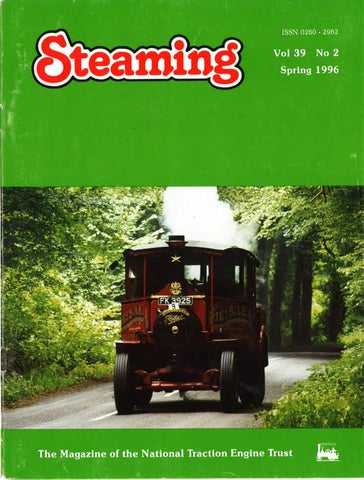
Cover Foden tractor 13222 explores tree lined lanes in the Chiltern Hills, on a run out from the Stoke Row event in July 1995. (Keith Broth well) 63
Trust News Rally Organisers Column Rally Organisers sub-Committee I write this column having just returned from the Spring Conference of Rally Organisers and Affiliated Groups. The format has not changed greatly for some time now, and it is encouraging to see the level of support remains high for these meetings. The morning is given over to club officers reports and questions and answers to them. The afternoon session was a presentation from John Whiteington, Senior Environmental Health Officer for South Somerset. His presentation gave everyone in the room clear ideas about how to use the Environmental Health Department of the local council to assist with advice on the running of events and complying with legislation, in particular food hygiene, a subject which many organisers have found to be a problem. A Newsletter will be circulated to rally organisers and affiliated groups summarising the day's proceedings. If you are not on our mailing list and want information, please contact me; if you have not sought assistance in running your event before please get in touch because there is a popular misconception about the Trust's work in helping to run rallies. We do not dictate how you should run a rally, rather we act as a forum for the exchange of ideas on how to deal with problems which affect all sizes of events. I have said before that we are not making up rules, merely helping to interpret the legislation which those in Whitehall and Brussels heap on our heads in every part of our lives. If you are involved in running an event and last year you had a problem which suddenly appeared — new regulations on fond, rules on first aid cover, emergency plan, insurance problems and so on — it is quite possible that this has cropped up before and a solution has been found by someone else. This is how the Trust can help you as a rally organiser. Last year an event was asked by an Environmental Health Officer if they had completed a risk assessment on 64
their event as required by the Health and Safety at Work Act. The answer was no. We now have a basic format to comply with this requirement. Do not content yourself by saying 'We have no one at work at our rally'. Running a rally is a work situation in the eyes of the law — just becase you do not get paid will not help. I realise that these ramblings are, in the main, going to be read by Trust members so maybe I can be accused of preaching to the converted. But Steaming is often read by those who know someone who knows someone else who has an uncle who helps to run a rally that is not on our list. If we all join together to tackle the above sort of problems the load gets easier for everyone. We have plenty of safety signs in stock, ready for this year. Please see the advertisement elsewhere in this issue and please help me by ordering in plenty of time. Good quality coal is now readily available. Arscott Collieries at Shrewsbury have all grades available ready bagged — please contact John Watkiss, as shown in the advert elsewhere. Union Coal also offer an excellent service as well as a competitive price. They will undertake to bag and distribute the coal on the field, a valuable service for the rally which is short of volunteers. I mentioned earlier in my discourse the Newsletter which we are developing initially as a Conference Report. This is only possible thanks to the help given by Susan Jackson, our General Secretary, Smudge and Keith Stott from the Rally sub-Committee and Don Metcalf of the Salop Club, all of whom take copious notes on the day to compile into the Newsletter. The longer term plan is to widen this out into an Affiliated Groups' Newsletter which will provide an avenue of prompt communication. As part of this Sylvia Dudley will be relinquishing management of the Affiliated Groups' list after many years. However, her elevation to the 'peerage' at the AGM should not be taken as meaning that she is taking less interest in Trust affairs — we all know her better than that, I am sure.
I hope you all enjoy bigger crowds, fine weather and safe rallies in 1996. (Andrew Semple, chairman, Rally subCommittee) The Disc Scheme for Engine Insurance For those who do not read every word in Steaming, we draw attention in this Rally Organiser's column, to our Insurance Officer's notes on aspects of the Disc Scheme that are published within the Engine Owners Column.
Engine Owners Column Engine Owners sub-Committee At the start of a new rally season, we look forward with the hope that now the vexed question of vehicle licensing has been resolved, we can concentrate on the other very pressing matters which loom on the hori7on. The most exciting event in prospect is the Trust's Road Run in September. My sub-Committee wholeheartedly support this imaginative event and very much hope that it will prove a rewarding experience for all those who participate and do something to enhance the profile and reputation of the Trust. I would like to emphasise the event's form has absolutely no connection with any discussions about driver competence etc, and any 'light-hearted' trials that may be carried out are only intended to assess the efficiency of the engines themselves. The Trust is in no position to commit funds to this event and it is hoped that participating engine owners will be able to attain sponsorship, either from affiliated clubs or other interested bodies. Those wishing to attend should apply for an entry form from Sylvia Dudley. I am delighted to report the Traction Engine Code is at last nearing completion. With Parts V and VI ready for distribution and Part II (Driving and Conduct on the public road) in draft form, there is hopefully little more to do. Spring 1996
STEAMING
The recent Engine Drivers meeting at Rugby was well attended and many present took part in the discussion. The conclusions were mainly in line with our committee's views. As I see it, there are two aspects of 'driver competence' to be considered. The first is new owners with little or no previous experience; on this point the meeting seemed agreed that although the Trust should do all possible to avoid any incidents involving injury or loss of life, which could give the movement a bad reputation, the 'softly softly' approach of persuasion, rather than compulsion, would be the correct one. More effort should be made to identify new owners so they could be persuaded to go on suitable driving courses and to make contact with experienced drivers who can give them the opportunity to gain experience. The second aspect of the matter is the possibility of experienced drivers being able to obtain some form of insurance discount by showing evidence of their competence — something in the nature of an advanced driving test. This may be a possibility for the future. The training bodies state there is insufficient justification for setting up an NVQ (National Vocational Qualification) for the numbers likely to be involved and the licensing authorities see no need for a special class of driving licence for steam engines. So the way forward is to try and improve upon what we are already doing. However, I consider it important that, should either rally organisers or anyone else seek to impose some form of restriction on us, that we should ensure we are in a position to set the standard ourselves and not be dictated to by outside bodies. I am pleased to report this year's Driving Course is fully subscribed, but we may be able to fit in one or two more. I wish you all the best for the coming season. (Michael Davies, chairman, Engine Owners subCommittee) Insurance Officer's ramblings I am very pleased to be able to tell you that the number of discs issued for year 1995/96 by James Campbell of John Scott, and by myself, exceeded the 1200 mark for the first time. The numbers of rallies and organised events making full use of the disc scheme, I am equally happy to report, is rising. My mail bag is already starting to fill with requests for discs for 1996/97 season and asking for clarification on certain aspects of insurance. STEAMING Spring 1996
From Alan Martin's Collection
72
The fair is here! Children watch as Emerson & Hazard's 7hp Burrell showmans engine 3526 LIGHTNING II crosses the Market Square at Duns, East Lothian with the galloper loads. This 1913 built engine is now well known in preservation having been extensively rallied from North Yorkshire by the late Dick Preston and, nowadays, by his son Richard.
On the subject of letters, I recently received one from the chairman of a very well established event suggesting that under certain circumstances the disc was not worth the paper it was printed on. This is reckoned to arise when an engine changes hands and
then the information on the disc relating to owner is invalid but the new owner does not renew the disc, either through ignorance or laziness, but still continues to present the engine at rallies. I have been aware of this problem for some time now, but can I
Coal from Arscott Collieries Coal Factors and Merchants, Gateway Chambers, 26 Castle Street, Shrewsbury SY1 2BJ •
pre-packed 25kg plastic bags
•
haulage can be arranged to any rally site
•
ring John Watkiss on 01743 362482 to discuss your requirements and haulage cost, anywhere in Britain
DRY STEAM COAL
120 per tonne ex Rheola
CWM BARGOED COBBLES
£123.50 per tonne ex Newtown, Powys
(prices include E3 pallet charge but exclude VAT) Bulk loose supplies ex Rheola or Cwm Bargoed £82.00 per tonne + VAT Cash on collection or pre-payment Please order early to obtain supply of steam coal; bituminous also available
65
respectfully suggest that the problem lies not with the disc (although the new 1996/97 disc is modified to help more clearly identify the situation, should it arise) but with human nature. Some folk can't be bothered to renew discs in mid-season even though the engine hasn't changed hands. But equally I have other folk who diligently renew their disc a number of times in the same year, each time when a particular element of their insurance cover expires, such as inspection reports or engineering insurance. In any event the onus to ensure that the engine insurance cover satisfies the requirements of the rally lies with the event Safety Officer because clearly that is where the buck stops and that is the case whether the engine is supported by a disc or is relying on old fashioned paperwork. The Disc Scheme is designed to help the Rally Safely Officer do his job but, like the Road Fund Licence disc, it has become currency and therefore can become subject to abuse. This year's disc is olive green in colour. There are two slight changes in the disc design for 1996/97 and these are; • 'Owner' now reads 'Insured' • there is an additional box at the bottom of the disc showing the 'Red line' pressure as indicated on the hot inspection report. Both of these changes mean that the disc is now a complete summary of all salient details encompassed by the engine's insurance and inspection papers. At the AGM I asked members to send to me, on a voluntary basis, details of costs of insurance along with the type of cover arranged. I promised to send out a questionnaire to aid this process but have not done
The revised NTET Insurance Disc which will be issued for 1996/97; the colours are olive green with white spaces and black printing. 66
so because other related events have overtaken me. In response to many, many requests from members and non-members to help ensure that their insurance cover is adequate I have spoken to their insurers and brokers and, like many of you, have discovered that the world of insurance does not lie on a level playing field. Therefore, in order to get a better feel for 'value for money' and to establish a rate 'norm' for the job I recently drew up a specification for insurance as applicable to traction engines and related equipment, and used this as the basis of an invitation to tender. This I have subsequently sent to nine Insurance companies and brokers, including John Scott. When I have analysed the results I will publish my findings and recommendations. Incidentally since John Scott were taken over last year they have undergone several changes including more recently a second change of name to AON Classics. James Campbell continues to be our contact there and I sincerely hope that he will still he able to provide the excellent service that he has personally developed over the last few years. (Dave Smith, insurance Officer) Technical Board Amongst the matters raised at the Engine Owners Meeting at Rugby in January was the old question as to whether the Pressure Systems and Transportable Gas Containers Regulations 1989 applied to traction engines used for pleasure purposes. This was covered at some length in my notes 'Boiler Inspection and the Law' in the Spring 1994 edition of Steaming, so I will not bore long standing readers by going over it all again, but nevertheless make reference for new members' benefit. Setting aside the question whether, in strict legal terms, every engine should have a written scheme of examination for its pressure system, things have moved on during the last two years and the concept of the scheme of examination has become the basis upon which all examinations of pressure equipment are carried out. Thus the principal of the scheme of examination has become what would be seen by the authorities and the public at large as 'best practice'. It follows on from this that the law and Joe Public take a very dim view of people who appear to be exploiting a loophole in the law as a means, as they see it, to avoid complying with accepted standards. Another question raised related to the training and competence of engine
drivers as boiler operators and what is required by the Pressure Systems Regulations. This is covered by Regulation 11 which requires (to paraphrase it a bit) any person operating a pressure system to have adequate and suitable instructions for the safe operation of the system and the action to be taken in the event of an emergency. The operative word is instructions (plural), not instruction, and the requirement is for an operator to be supplied with or have available written instructions covering the safe operation of the system. Obviously, again, 'best practice' must be followed and it would not be acceptable for a boiler operator to have written instructions which he or she had either not read or did not understand. So far as traction engines, etc are concerned the subject is adequately covered in Parts I to IV of the Trust's Engine Code of Practice, which meets the requirements of Regulation 11. Athough the Regulations may require no more than written instructions and an understanding of them, there is nothing to beat good practical training and instruction. The NTET driver training courses, which include boiler management, are being further developed in this and other directions. Many technical colleges and similar institutions run boiler management courses, which are undoubtedly very good. In general, however, they tend to concentrate upon the management of modern automated boiler equipment with emphasis upon electronic control equipment, automatic- feed water control, continuous water treatment and water analysis, continuous automatically controlled blow down, and even automatic shut down in the event of dark smoke being detected in the chimney. Any engine owner considering attending one of these courses would be well advised to look very closely at the syllabus to make sure that it is sufficiently relevant to coal fired locomotive type boilers, to make it worth his while attending. (Jim Newnham, chairman, Technical Board) Inquest at Reigate The inquest into a fatal accident with a steam roller took place at Reigate, Surrey on 15th March 1996, and we are grateful to Steve Arrowsmith, chairman of the Road Roller Association for this account of the proceedings. Steve was called as a technical witness to explain the driving technique and theory required to operate a steam roller. Trust Spring 1996
STEAMING
Committee members Richard Pierce and Smudge Smith also attended the hearing. George Thorpe died when the steam roller he was steering was involved in an accident during a journey from Redhill rally in August 1995. Evidence was heard from Brian Still, owner of the roller, and who was driving at the time; a Surrey Police Accident inspector who attended the scene; a second similar Inspector from the Metropolitan force who had a knowledge of traction engines and steam rollers, and a witness who was in a car travelling in the opposite direction. The accident occurred on a dry evening, after the Aveling 8 ton piston valve single cylinder roller (towing a pick-up on an A-bar) approached a hill with a downward gradient of at least 1 in 8 at its steepest. The machine has no differential and was being run with only one pin. The descent was undertaken in top gear with the speed controlled by a combination of handbrake and reverse. The driver had slowed prior to starting down the hill. A skid then took place, ie the driven wheel locked up and the machine slid out of control on the road for approximately 150 metres. Within this distance it hit the offside bank a glancing blow, then the nearside bank with a severe impact before slewing round to come to rest with the front end in the offside embankment. A fire started in the hedge and an adjacent field. George Thorpe fell from the roller at the second impact and died from crush injuries to the left side of his chest, possibly from being thrown against the steering wheel. He was not run over by the roller, as has been stated elsewhere, and the evidence was that he fell from the vehicle rather than being thrown from it. The road surface was newly laid asphalt, which it is sometimes claimed does not provide maximum grip until 'worn in'. This was confirmed by Police evidence; a coefficient of friction of 0.53 was stated, which would normally be found on a wet road. The sliding or skidding commenced on a gradient of 1 in 16. Contrary to earlier reports the engine started to slip before coming to the white line, although, of course, the locked wheel then continued over the markings. During the course of the evidence the Police clearly felt the accident was due to the roller being driven on only one pin. The Coroner, having heard the evidence, found that the cause of George Thorpe's death was accidental. STEAMING Spring 1996
Steve further notes that it was clear that the Police had taken considerable steps to establish how steam rollers should be driven. Video evidence of the scene of the accident and of the roller after retrieval was shown at the inquest. Interestingly the machine's front forks were not broken in the incident, but the steering chains were considerably stretched. It was stated the slack had increased from two turns of the wheel before the accident to seven turns. Sympathies The Trust offers its sympathies to Brian Still and his family for the truly terrible consequences of the accident near Redhill last August. It will be deeply distressing to all engine enthusiasts that such tragedy should come into an innocent and pleasurable pastime.
FBHVC News Legislation — VED, the final word? As most members will, no doubt, already be aware the Vehicle Excise Duty (VED) regulations have been amended yet again, Good news! On 1st February, following representations from the Federation
and others, the Paymaster-General announced in the Committee stage of the Finance Bill an extension to the VED exemption to include all vehicles over 25 years old and not in commercial use. Heavy goods and steam vehicles, which were previously outside the exemption announced last November, will now become exempt on 1 June 1996. The following is extracted from the text of a letter, dated 2nd February, sent by DVLA: 'Since the November announcement the Government has received representations from owners who are concerned that we may have overlooked the historical and mechanical importance of other classes of preserved vehicles such a steam engines, road rollers, fire vehicles, agricultural engines, ex-military and ex-commercial vehicles. 'The Government has listened carefully to those views and sees the logic of the case that has been put forward. It is therefore bringing forward proposals to extend the exemption to all 25 year old vehicles, with the exception of certain commercially operated vehicles (see below). 'Until these proposals have legal effect (1st June 1996) owners must continue to license their vehicles in the appropriate duty paying class and display a VED disc. On 1st June, owners of
Few readers will have had the chance to see an Allchin portable. Peter Love photographed 6hp single 1544 of 1912 at Bicknell's Liphook workshops in September 1991. Owner Colin Knight intends to rebuild the engine: it does have a cylinder block but not a crankshaft. The survivor last worked at soil sterilisation but had been on display at a pub near Maidstone in more recent years. 67
qualifying vehicles with a current VED licence in force, will be sent a refund application form (V14 A/R — showing the amount of duty refundable) from DVLA. Those who do not have a licence in force at this time may take out a licence in the 25 year exempt class at any one of the Agency's Vehicle Registration Offices. 'Qualifying vehicles will remain subject to the requirements to license annually, display a VED disc and produce a valid MoT (if applicable) and certificate of insurance. 'The exemption will not extend to vehicles in the following taxation classes: Bus, Recovery Vehicle, Showmens Vehicles (in the Special Vehicle/Trailer class), General Haulage, Heavy Goods Vehicle (HGV) including Small Island Goods Vehicles and Special Types. 'HGV's used unladen in connection with a trade or a business, or for driver-training/testing purposes, will also be excluded from the exemption.' We have quoted at length from the DVLA letter so that there can be no doubt or confusion about the new regulations. Much of the foregoing is not relevant to steam engines but many owners have other preserved vehicles and it is felt that the complete picture is important. There are several people who deserve credit for this success, one of whom is Federation President Lord Montagu. We must also be grateful for i he positive attitude of many at DVLA, particularly the gentleman who is head of the Policy Division. It may also be of interest to note that the Labour Party opposed the 25 year rule because they felt that it was too recent, and an
amendment was put, but lost, seeking to change the age for exemption to 35 years. The Federation obviously welcomes the current situation, particularly since it Is applied to all preserved vehicles. However there is some uneasiness that limitations could very easily be imposed and the reported issue of a VED disc stamped 'LIMITED USE' has added to these concerns, although DVLA has stated that an error was made. (Michael Ward/Peter Smart, steam representatives on the FBHVC)
The Rally List 1996 The Trust's annual Rally List, featuring all events included in our Authorised Rally Scheme, has again been published in association with Old Glory magazine, and a member's copy is being distributed with each copy of this issue of Steaming. In the period since the List went to press the following events have also been included. • June 1st/2nd — Leighton Buzzard By Pass Steam Rally, Bedfordshire (50 engines attended their 1995 event). Mrs M. Howarth, Hillcrest, Hare Street, near Bunting ford, Hertfordshire SG9 OAB (cr 01763 289211). • July 20th/21st — Marcie Steam Rally, Rye Meadows, Much Marcie, near Ledbury, Herefordshire 115 engines attended 19951. /Wis. P. Chester, 21 Glebe Orchard, Much Marcie, Ledbury, Herefordshire HR8 2PL (D 01531 660464).
RALLY SAFETY SIGNS DANGER — beware of moving vehicles etc — yellow with black lettering Unauthorised persons prohibited etc — red with white lettering FIRE POINT — red with white lettering Printed on rigid plastic boards
DANGE1 StWati
9..
moving rebels. Machinery
t.
£2.50 each sign inc VAT, postcoe E6 per order From: A J. Semple INTET) Unit 6, Mynd Industrial Estate Church Stretton, Shropshire SY6 6EA
68
June — 1/2 Dordrecht, Holland; 8/9 South Tyne; 15/16 Claybrooke, Leics; 22/23 to be arranged; 29/30 Banbury. July — 6/7 Chiltern; 13/14 Much Marcie; 19-21 Weeting and also Langport, Somerset; 26-28 Cumbria. Please refer to The Rally List 1996 for full details of the rallies concerned; venues to be attended in August and September will be listed in the Summer issue. Our three rally visit to Holland is in recognition of the considerable interest and following of our Dutch and near continental members. The Unit has become an important stopping off place for many — not just Trust members — who seek advance notice of future events and we therefore ask clubs, museums and other groups that wish to publicise their events or locations via the Unit to send posters and handbills, which we will give maximum exposure. Finally, anyone interested in helping to staff the Unit on one or more occasions — do please contact me to discuss; it is an excellent way of becoming more involved with engines and running the Trust. (Robert Herring, Exhibition Unit organiser, address and Is inside front cover)
The Trust Road Run Following the publication of details of this autumn's Road Run in Northamptonshire in the last issue, much interest has been shown in the idea from engine owners and members in all parts of the country. It bodes well for an extremely enjoyable and
Be wise before the event...
Trust Exhibition Unit Later this month the Trust's mobile Exhibition Unit commences its third year visiting the rally fields of Britain — and beyond. As well as acting as a focal point for members, the Unit serves to promote the work of the Trust to members and to outsiders, and offers the chance to browse through books and other items available from NTET Sales. The arrangements for the first half of the 1996 season are to attend events at: April — 27/28 Hunsbury Hill, Northampton May — 4-6 Newbury; 17-19 Almere, Holland; 24-27 Utrecht, Holland
The Trust's
CODE OF PRACTICE for the better organisation of Steam Traction Engine Events Is essential reading for all rally organisers and safety officers Price £6.00 each inc. postage from — J.R. Smith, The Poplars, Grange Road, North Frodingham, Driffleld, North Humberside Y025 8LN
Spring 1996
a STEAMING
certainly different weekend. It is essential that the whole event is run at no cost to the Trust's finances, so we were pleased that the Engine Owners Meeting at Rugby in February gave support to the Road Run and specifically, the £25 per engine entrance fee. It is intended that if at all possible this will be refundable from surplus monies after the event. Entries are being accepted on a first come, first confirmed basis, with a closing date of the end of July. Several offers of assistance have been received: financial, donation of equipment to be sold, presentation of a trophy etc, all of which have been gratefully accepted and will be properly credited in due course. The Committee is still seeking major and lesser sponsors (including firms that took part in the original 1907 trials and are still active in business) who may benefit from being associated with our event. If you have any suggestions of organisations to approach please contact our vice-chairman Robert Herring (address inside front cover). We are especially seeking entries who participated in the 1975 Road Run from Nettlebed to Appleford in the Thames Valley — both of engines and of owners, that is. A large amount of help will be required from individuals for marshalling, time-keeping etc and this will be an excellent chance for Trust members who are non-owners and who have perhaps wished to become more involved with the running of rallies or similar, to jump in at the deep end. It is only one weekend and is (almost) guaranteed to be enjoyable! Some of the Trust's Affiliated Groups have offered support in undertaking specific tasks during the weekend and at this early stage I must acknowledge the advice being given by the Hollowell Steam group. It is from their rally field that we are running the event. (Russ Bulley, Road Run organiser — see full page advert for contact details.)
Steam Apprentice Club Plans are going ahead for the Steam Apprentices training weekend at Klondyke Mill, Draycott in the Clay, Staffordshire, although at the time of writing very few members have shown interest. I have been invited to take the Steam Apprentices to the Howard STEAMING Spring 1996
Fowler R class 7hp agricultural engine 9225 of 1901 working the belt at a threshing weekend at Acton Scott Farm Museum in Shropshire, October 1995. (Barry Job) brothers engine and boiler works, and hope to couple this with a visit to the National Tramway Museum at Crich. We are trying to fix a date for this visit, but at the moment this is proving difficult. John and Fiona Durling are moving from Yorkshire to Derbyshire — didn't they do the Steam Apprentices well in Yorkshire? I am pleased to announce that David Parkin from Castleford has volunteerd to carry on in their stead in the same area — thank you David. (John Bosworth, chairman, Steam Apprentice Club)
Road Locomotive Society Burrell drawings and records To enable essential conservation work to be carried out, drawings are being withdrawn from the collection in batches. It is impossible to be specific about the time-scale but it should be comparatively short for any particular drawing. The project will however take a considerable time to complete. The registers are also being assessed
at the moment and here the problem is very much worse. It is inevitable that the specifications for some engines will be unavailable for some considerable time. Both the Road Locomotive Society and the Burrell Museum Trustees regret inconvenience to owners or researchers but the work, which is expensive, has to be done before the cost becomes prohibitive or, worse, the documents deteriorate beyond recall. (Peter Smart)
Road Roller Association
I0 R.R.A.
Many thanks to all our friends in the National Traction Engine Trust who worked so hard in the battle to achieve a fair Vehicle Excise Duty for steam rollers. The Government's original scheme announced in the November 1995 Budget of a fee of £35 for steam vehicles seemed quite reasonable, but left the anomaly of preserved motor rollers being required to pay the full £150. However, we now have the good news that all 69
vehicles over 25 years old not in commercial use will be exempt from VED. I share the Editor's view (last issue) that it would be interesting to know exactly which form of protest achieved the desired result, but nevertheless we should all be more than pleased with the outcome. The Road Roller Association would like to express its appreciation for all those clubs and individuals who helped achieve this result. I am sure these revised arrangements will meet with the full approval of all those involved in the preservation of historic vehicles. It is good to see the Government at last taking a realistic attitude towards our hobby. (Steve Arrowsmith, chairman, RRA)
Obituaries Harry Allison , Harry Edward Allison died on the 31st January at his home at Neston on the Wirral, aged 69, after an illness which he bore with great courage. Harry and his family became well known around the northwest rally scene with the acquisition of their Aveling tractor in the early 1980s. Harry was a fine engineer, highly qualified: a Chartered Engineer, a member of the British Institute of Management — not that you would ever have heard Harry divulge that information. However you somehow felt that the advice and pi actical Delp which was generously given came from a background of profound knowledge and great experience. Harry was a Yorkshireman, born
in Whitby, and among his many attributes was his irrepressible humour. Nobody was exempt from Harry's leg-pulling and if you turned the tables on him and gave it back he enjoyed that even more! He used to say that he did not mind if you laughed with him or at him, as long as you were laughing. He tackled everything positively, his work, golf, football (nothing swayed Harry's lifelong support for Middlesbrough) and of course his exploits with the engine. In his ownership, with the help of son Brian and support of wife Rosemary, the engine steamed over 1000 miles every year, appearing at events all over the north and west of England. Harry was the Company Secretary of the Lancashire Traction Engine Club and with his help the club attained the benefit of charitable status. A more fitting tribute to Harry could not be given than the determination of so many people to attend his funeral early in February when snow over a foot deep could be found around the north west. We all send our deepest sympathy and condolences to his widow Rosemary and sons David and Brian on their sad loss. (A.J. Semple)
Chris Rockliff Chris Rockliff, who died earlier this year, achieved a life time ambition to own an engine when, in 1959, he bought Marshall agricultural 87003 SURPRISE and attended his first rally at Shipton, York In 1960. During the 1960s he attended Pickering, Masham and Harewood rallies, all driven to by road on steel wheels — sometimes in the company of Aveling roller 14071
G. A. Hopkins & Sons (Metal Spinners) Ltd. Metal Spinning, specialist chimney tops, lamp bezels etc.
or ..-
Any original spinning reproduced in any material. Phone us for a quote. Dovecote, Brook Street, Shepshed, Loughborough LE12 9RW Telephone 01509 502216 day, 504576 evening, 650008 fax.
70
KATHLEEN, purchased by Chris in 1964. Throughout the next thirty years Chris would be a regular attender at most of the North Yorkshire rallies, mainly with SURPRISE (currently being fitted with a new firebox). Even though failing health in recent years meant he was unable to drive engines himself he still attended rallies to see them in the hands of his family. He was a founder member of the Great Yorkshire Traction Engine Club, as well as being a member of the Leeds & District and the East Riding clubs from their inception, and a keen cornet player in local brass bands. Chris was a well known and popular engineman — as shown by a church full of mourners as his funeral. He would no doubt take great pride in knowing that his engines will still be rallied by his family in years to come. (Brian Rockliff)
Benjamin Stafford Benjamin Milburn Stafford, better known in engine circles as Billy Stafford, passed away peacefully on 7th January 1996. He worked with steam engines from being a teenager up until the present day. In 1932 he left his native village of Elwick, near Hartlepool, where he was born in 1910, to work for the late Mark Wakefield, threshing contractor of Houghton-le-Spring, Co Durham and travelled around the Shotton and Easington areas with a steam engine and threshing set. He later married Lilly Wakefield, his employer's daughter. In 1938 he took over the firm after the untimely death of Mr Wakefield and continued the threshing business, also expanding into hay and straw dealing, haulage and, later, farming. Billy Stafford purchased the Fowler road loco 15649 PROVIDENCE in 1954 and was a founder member of the North of England Steam Traction Engine Society, and along with old stalwarts such as Willie Arnison, Parky Bates, Dick Preston and Jack Wakefield, he firmly established the preservation of steam in the north of England. For many years Mr Stafford and his late wife Lilly travelled the country to engine rallies, and PROVIDENCE became well known in the rally fields. He last drove the engine at the 1995 Pickering rally at the age of 85 years. Billy Stafford leaves five sons, nine grand children and five great grand children and also PROVIDENCE, which will always remain in the Stafford family, a truly original memorial to a truly original man. (A.M. Stafford)
Spring 1996
STEAMING
THE NATIONAL TRACTION ENGINE TRUST IS PROUD TO PRESENT ON 28TH
AND 29TH SEPTEMBER 1996
at Hollowell Rally Field to the north of the town of Northampton, a
Members are invited to take part in a trial of enginemanship. Solicitations from owners of all kinds of road steam engines are welcome! An Entry Fee of £25 per engine (hopefully refundable following a profitable event!) THREE CIRCULAR ROUTES FROM
15 TO 50 MILES WILL BE USED ON SATURDAY
FOR THE EXAMINATION OF ENGINES AND CREWS.
The Judges will mark, examine and inspevits ATTIRE AND HAND SIGNALS : PUNCTUALITY AND AVERAGE
(1907) SPEEDS
ROAD HANDLING AND HILL CLIMBING ABILITY : SMOKE AND STEAM EXCESSES ENGINE APPEARANCE AND GOOD ORDER : CLEANLINESS OF ENGINES CONSIDERATION OF OTHER ROAD USERS : AND SEVERAL OTHER FACTORS ON SUNDAY THE JUDGES WILL TEST DRIVERS' ABILITY AT MANOEUVRING, HILL STARTS AND STOPS
The Committee are proud to announce an award of a trophy to the
STEAM ENGINE DRIVER OF THE YEAR NOTICE TO NON-ENGINE OWNING MEMBERS THIS TRIAL WILL BE RUN ON RULES BASED ON THOSE USED IN THE 1907 RAC COMMERCIAL VEHICLE TRIAL. NON-ENGINE OWNING MEMBERS (OF 21 YEARS OF ACE AND OVER) MAY VOLUNTEER TO ACT AS OFFICIAL OBSERVERS. EACH ENGINE WILL CARRY AN INDEPENDENT OBSERVER, IN PERIOD DRESS. THE OBSERVERS WILL RECORD ALL STARTING AND STOPPING TIMES, FUEL AND WATER CONSUMPTION, NAVIGATE AND ORGANISE REFRESHMENT HALTS.
Also still urgently required: Professional Engineers and other Reputable Persons to act as Time Keepers, Judges, etc. CAMPING AND CARAVANNING FACILITIES AVAILABLE
FOR FULL INFORMATION write in the first instance to NTET ROAD RUN, 12 HILLWAY, WOBURN SANDS, BUCKINGHAMSHIRE MK17 8UL or FAX 01908-584737
STEAMING
Spring 1996
71
Affiliated Groups South Tyne Traction Engine Society The South Tyne group is moving the location of its rally this year. Taking place on 8/9th July, the new venue is Old Ouston Airfield, near Stamfordham, Northumberland and the larger area will give the Society more scope for development. The rally will be the nineteenth, and much interest has been expressed at the move by exhibitors, traders and visitors, and the increased space will mean more exhibits. New exhibitors may care to contact Anne Burns, Roachburn, Tyne View, Halt whistle, Northumberland NE49 9,10 (Tr 01434 321029).
Museum of East Anglian Life Lesley Colsell, curator and assistant director of the Museum of East Anglian Life at Stowmarket, Suffolk has left to take up a new post at the
East Midlands Museum Service. Nicholas Longe, chairman of the Museum Council said that Lesley went with their best wishes and thanked her for all that she had done in nearly ten years at Stowmarket. He mentioned her energy and enthusiasm in assembling a fine team of volunteers and working with them; in acting as curator and advisor to other Suffolk museums; in helping to establish the Burrell Museum at Thetford and in supporting Weeting Rally.
IRON MAIDEN — a special showing Made in 1962 the film Iron Maiden was an attempt to duplicate the success of Genevieve but using a showmans engine as the centrepiece. An aircraft designer gets into trouble because of his affection for his traction engine — it is a fine British comedy made around the rally fields of the early 1960s. The magazine, Old Glory and the
Friends of the National Motor Museum Trust have arranged a special showing of the film in the Lecture Theatre of the National Motor Museum on Friday 26th July at 8pm. This is the first evening of the NetIcy Marsh rally. After the film there will be an interval to allow visitors the chance to obtain a drink at the bar, and the second half of the evening will feature John Crawley showing his own slides at the making of the film and talking about his role as technical adviser, when he gave a great deal of time and advice to the film company. He tells that he spent most of the film on the footplate of various engines dressed as a woman! John, of course, was the organiser of the early traction engine rallies held at Beaulieu in Montagu Motor Museum days. Tickets must be purchased in advance — details are available from National Motor Museum, Beaulieu, Brockenhurst, Hampshire S042 7ZN (v 01590 612345).
Committee Profile Sylvia Dudley It occurs to me, at the milestone of my appointment to Vice President of the Trust at the Annual General Meeting at Chatham last autumn, that newer members will not know of my earlier activities in the NTET. This may also be the case with a number of other senior officers — but let me start the ball rolling. I was born a fourth generation to the Woodland threshing contractors family — the only child, and a girl at that! Nevertheless, when help was required and engines and tackle were repaired in the family workshops I was called upon to assist. We were at Ridgmont, and worked the Woburn and Buckinghamshire / Bedfordshire area. Our buildings are still there and the forge in place, although the other workshops are now a display area for an upholsterer. During the war years father was rarely home in daylight hours but he never allowed the men to work on Sunday — the same rule did not apply to me, and so steering engines and general duties were quite common. Acting as ropeman in blind muddy gateways when the tackle was hard to 72
manage was a frequent task; and why was it always my holiday task to clear cavings if it was hot, and return binder wires if it was cold? I don't think it ever occurred to father to teach me to drive. In 1946 the final engine was sold but father carried on for a time with a model M Marshall tractor — the last one to leave the factory — whilst I was completing my education and later training as a teacher at the Royal School of Needlework. In the early 1950s, when engines were appearing again, father was easily persuaded to manage various engines, including John Crawley's KITCHENER, and he travelled considerable distances to rallies and fund raising events. Again I was allowed to help taxiing crew to and from events and providing food etc, although if they were short handed I was expected to steer! At one wet rally I voiced my wish to learn to handle an engine and father was not impressed, however Jim Bennie thought this would be a good idea and proceeded, typically to throw me in at the deep end — a road journey against time on his Fowler BB plough-
ing engine. It seems that I passed muster because I became part of the crew and a few weeks later was driving the engine a 25 mile journey to a dredging job at Overstone near Northampton. Father was relegated to steersman on that journey for I was not tough enough for that task. But after being prompted a number of times early in the journey I was left to my own devices and although never told as much, I presume he was satisfied. Later, we also undertook mole draining and ploughing at various times. On an outing in 1963 I met Fred Howling and learnt that he was selling his 5 ton 4hp Robey showmans tractor 41492. Despite opposition from both parents I decided to buy it: prices were much lower then. Father, under protest, said he would help me look after it. We steamed the engine back home over several weekends and so began almost 25 years of ownership, during which we travelled to six to eight events each year, all but one by steam, and covering in the region of 500 miles in a year, towing a showmans van which I rescued from Spring 1996
STEAMING
burning. This made life on the road more comfortable. As an engine owner I decided I might learn things of advantage by joining the NTEC and so attended engine owners meetings and some AGMs. In 1975 I was nominated for committee and agreed to stand as long as there were more candidates than seats available. Shortly after apprehensively taking my seat George Beck, then General Secretary, asked if I would take minutes at a Committee meeting as the usual lady was unwell. My second meeting was an AGM at York! Very soon after I was appointed to the job. I found it interesting to attend the meetings of all the various sub-Committees and find out the range of aspects of our hobby that the Club covered. The next venture was being part of the team forming the young peoples section of the Club, and I am proud to say that I was responsible for suggesting the name Steam Apprentice Club and later Raising Steam for the magazine title. Both appeared in the short lists that members voted on for the final choice. Unfortunately the Robey tractor was off the road for a considerable time in the later years of my ownership whilst I paid for a new boiler, firebox, tube plate, smoke box and the last straw — a new tender. Whilst this was happening I was taking on various tasks for the Trust and eventually decided that I could be more useful in this way and regretfully parted with the engine to a very good home (I recently joined the owner for its inaugural run after much futher work and it is good to see the machine in steam again: sadly father is no longer here to take part). At various and more recent times I have acted as temporary Sales Officer and General Secretary and am now involved with the paper work of the Engine Owners sub Committee, including the driving course and records of the Trust's Engine Code of Practice. However I still like to find time to work with Michael Davies' steam ploughing gang and provide the steam commentary at the Banbury rally, between visiting rallies with the Trust's new exhibition unit at a few of its venues and, of course, the marquee in Dorset each year, there to meet so many friends who share this obsession. My mother, who considered steam engines just so much dirty washing, always reckoned that father had steam, not blood, in his veins — I suspect it is hereditary. There must be some explanation for my usual answer to the question 'Why do you do it'; why not? IMb STEAMING Spring 1996
Another chance to join ATLAS on the road • Fowler road locomotive ATLAS plus transformer load • TITAN and other engines all on the road over the Malvern Hills and on display at
EASTNOR CASTLE, LEDBURY, HEREFORDSHIRE Sunday, 19 May 1996, llam to 5pm See steeplejack Fred Dibnah at work on the Castle parapets, 11am to 12.30pm. Enquiries : tel 01531 633160.
Highland Steamboat Holidays Cruise the beautiful sealochs and canals of Scotland in an original coal-fired Clyde Puffer. Good food, comfortable accommodation.
. t,k . iigi 01
•
•—• " ,..,„.— —
--.-- -----"--Ime-
---.
Send large SAE for free brochure lo Rachel and Nick Walker, The Change House, Crinan Ferry, Lochgilphead, Argyll PA3I 8Q11 (Tel 01546 510232).
An evocative scene from the Woodland family album. Sylvia's father George Woodland stands attending the Maynard patent chaff cutter whilst his father is to be seen on the ladder against the drum. The engine might be an early Wallis & Steevens single with Salter balance safety valves.
Perchance she sleepeth John Maund An elderly Burrell agricultural engine that has not been in steam since 1970 was recently removed from its resting place on the first stage of a new life. It is an engine that will probably not be familiar to the majority of readers. Burrell 2693 is one of the select band of road steam engines that are still in the ownership of the families that bought them new. It is a 7hp double geared single crank compound of 1904, and has spent a busy life with a Norfolk threshing contractor followed by a considerably quieter retirement. On leaving St Nicholas Works at Thetford on 28th July 1904, the engine was immediately exhibited on Burreii's stand at the Royal Norfolk Show at Harleston, before moving on to its new owner Charles George Moore at Toperoft, Hempnall — a village between Bungay and Norwich. Moore already had an elderly Fowell traction engine used in his threshing business and it is assumed from 1904 he ran two sets of tackle. Sadly, however, the Fowell didn't survive to the days of preservation. Although recorded as being delivered new to Toperoft Farm at Hempnall, Burrell 2693 was initially stabled on a piece of ground alongside the Moores' house, not on the farm. Its working life was spent entirely on threshing either on its owner's properties or on his contract rounds. On Charles' death the business was continued by his son Charlie George Moore who was father of the current owner Michael Charles Moore. The Burrell worked until the early 1940s (from the early 1920s carrying the registration AH9550) but by then its workload was reduced to merely hauling the threshing tackle from farm to farm, for by then many farmers in the area had their own tractors to operate the machines. Working times effectively ended on 10th March 1947, when a new Field Marshall arrived. 2693 was a relatively parochial machine, working largely in an area between Hempnall and Norwich, with little work on farms to the east of Hempnall, as this tended to be covered by the threshing business of Mr Aldrych. From 1947 the Burrell was little used until the start of rallies in Norfolk but even then it remained a local traveller. The annual event at Woodton became a regular call until Burrell 2693 slumbers in its open-sided shed at Toperoft, Norfolk, alongside the late 1960s, but the final steaming the Ruston & Hornsby threshing drum it last ran in 1970. Photograph by was a threshing demonstration for John Mound on 5th November 1995, immediately before removal for charity at Beula Farm, Woodton in restoration. 74
Spring 1996
STEAMING
1970. After this the engine was parked up at a farm at Toperoft, initially in an enclosed barn but much later in an open-sided structure. And there it rested. Then, early in November last year, Richard Parrott's low loader arrived to take the Burrell back to his Fengate Farm, Weeting for an initial assessment of its condition prior to restoration. Interesting points came to light: at some time prior to retirement the chimney base was smashed in a collision with a straw pitcher whilst
manoeuvring. The original heavily repaired casting is still on the engine but a spare was also located with the engine, and of course, loaded up. Also found was a new gear wheel supplied in the 1930s but never used. The engine is believed to have been fitted with a new firebox and smokebox in the late 1930s or early 1940s. Work is now in hand to return Burrell 2693 to a steamable state and the target is to have the engine back in working order at The Burrell Museum in Minstergate, Thetford for the May
Viewpoint Driver competence and training Much debate has taken place since last Autumn on the subject of the competence and training of steam road engine drivers into the future. In this column — usually reserved for a personal viewpoint — we attempt to consolidate comment from letters received by the Editor and also the debate from the Engine Owners Meeting at Rugby in February. It is far from easy to conduct a neatly flowing discussion within the pages of a magazine produced but once every three months, especially when meetings of one sort or another intervene to modify opinions, and it is perhaps inevitable that the overall discussion will have moved on by the time earlier thoughts appear in print. However, let us try to record some of the points made by members on this contentious subject. The reaction of those present at the AGM last November to the Chairman's suggestion that the Trust should investigate ways of controlling new driver competence was briefly recorded inside the rear cover of the Winter 1995/96 issue. Lyndon Shearman, of Wolverhampton, referring to Chairman Richard Sandercock's notes in the same issue, wrote that he was not happy that a training and testing scheme should end up with it being compulsory for the driver to be a member of the NTET. 'There are already those who view the Trust as authoritarian, and I have heard STEAMING Spring 1996
comments ... that there ought to be an association to look after the interests of enginemen, so clearly not everyone sees the Trust as already fulfilling that role. To take a kind of closed-shop view which attempts to coerce drivers to join is surely less than productive, and a better stance would be to make the Trust so attractive that most people want to join.' From Essex, Francis Titmarsh broached the oft repeated worry that by making much of the subject the Trust risks that those who are in authority will take note, presumably adversely. He is not surprised there were not more members in the Trust — 'who likes to pay £20 a year to be told that the engine they have driven for years cannot be taken out again unless they have passed a test'. David Dean, of Great Yarmouth, wrote warning of what might happen if change was thrust upon us — 'The thought of our lords and masters at Westminster getting in on the act fills me with dread, not because I would see it as an infringement of my civil liberties, but once politicians get involved there is no telling what half baked ideas they will come up with'. The Engine Owners Meeting at Rugby was in a room packed to capacity with over 100 members (plus some non-members) who had journeyed from many parts of the country. The morning session was wholly devoted to discussing the proposition 'Does the Trust need to become involved with driver competence and, if so, how?' Engine Owners sub
Day bank holiday weekend (Sunday, 5th May). It will then go on display at the Museum for the rest of May — and maybe longer — with another possible steaming on the 26th. A large amount of work requires to be done, so to save wasted journeys, those interested in seeing this 'fresh face' should contact John Palmer, membership secretary of the 'Friends of the Burrell Museum' nearer the dates. He will be pleased to give progress reports — Tr 01767 315226. 141
Committee Chairman Michael Davies outlined the problems that were beginning to show and asked those present to put forward their views. Again came the two prominent concerns — on the one hand speakers counselling against worrying too much for fear of alerting outsiders into thinking the problems were much more serious than they really are, and on the other hand were many voicing concern that we did not want outside influence interfering with our enjoyment of live steam engines. Many spoke of the responsibility of local engine clubs and existing enginemen to nurture newcomers, and attention was drawn to the weaknesses in dialogue between the Trust and its affiliated groups. Suggestions of schemes for training to be arranged within the NVQ (National Vocational Qualification) scheme were made and it was generally accepted that 'grandfather rights' should apply to any driver able to claim experience at the commencement of any scheme — that, however, would not preclude anyone from taking a course or test if they wished. There was much support for those who put forward the softly, softly approach — an initial simple but sound plan which could evolve in the light of experience. At the end of a lively but affable debate the Chairman asked for a show of hands on his proposition. A very large majority indicated Yes, whilst there was one against and four who chose to abstain. The question of how to arrange the Trust's involvement was left to the sub-Committee to work up and report back to the membership. There was strong support for a similar Engine Owners Meeting to be held on a yearly basis. Members can obtain copies of the minutes of the Engine Owners Meeting held on 19th February 1996 by sending a 9in x 4 %in stamped, self addressed envelope to Sue Jackson, 153 Micklefield Road, High Wycombe, Buckinghamshire HP13 7HA. 75
CHERCHEZ la FEMME Derek Rayner Most steam engines are called 'she' and referred to as female — dare I suggest because of their occasionally strange ways and varied moods? It is therefore perhaps appropriate that the title of this article, translating as 'Find the Lady', refers not only to looking for engines but also to the game of that name, so beloved of card sharps of old on raceday trains to Epsom, Goodwood, Aintree and other big meetings. It was with this train association in mind that my wife Dorothy and I set off from York in July 1995 on the second day of a new service — the Eurostar Link, which took us direct to Waterloo station in London to catch the afternoon Eurostar through the Channel Tunnel to Paris. From there an overnight train saw us taking 'le petit dejeuner' the following morning in Tarbes, close to the Pyrenees and the Spanish border in south west France. We drove out into the country and the very rural surroundings of the Gers region, finding the residence of Gilles Monill without much problem. Here, courtesy of advice from friends in the Road Locomotive Society, we were hoping to see one of the biggest single personal collections of steam engines in Europe. We were not disappointed,
The German-built Badenia traction engine used by the Monill family about the time of World War 2. It is hauling a Merlin threshing drum. The rear of the original picture is inscribed Badenia 18026 — can anyone say if that is a works number? (collection G. Monill)
but were quite unprepared for the extent of what we eventually saw. On arrival, Gilles was talking somewhat demonstratively to a couple of elderly colleagues, discussing a steam engine governor which had seen better days.
Marshall 58994 of 1912 hides from the sunlight beneath the sheds at Gilles Monill's premises. The 8 horsepower machine has three speeds. (Derek Rayner) 76
The spring leaves on which the balls were mounted had rusted through and the casting was also rusty with the spindle seized in it. Some new spring steel was available to presumably effect a replacement of the disintegrated items and the animated discussions related as to how this was going to be done. After appropriate introductions, we waited until Gilles had concluded the governor problem and then followed him around the side of his property, passing on the way a threshing machine on a lowloader, obviously just arrived. There were a number of iron wheels from similar machines, together with tractors, ex-military vehicles and other farming implements. It transpired that Gilles has a collection of over 120 threshing machines, mainly of French manufacture, and the collection of iron wheels was from those which had been brought in but which were found to be too far gone to contemplate being saved by putting into store. If this in itself was not impressive, then what was to greet us as we passed through a walled yard, made our way past piles of scrap and approached a sizeable building, most certainly was. To the left was a large German-built Lanz portable• and hard against the wall, a very rusty Albaret traction engine built in Liancourt, to the north Spring 1996
STEAMING
of Paris. At the time of its building, around the turn of the century, the
The Monill Collection
company was known as Maison Albaret, Vve Albaret et G. Lefebvre, successors. Visible in the shed close
make
type
hp
number date
supplied to
Burrell
roller
6
1984 1897
Louis Mathieu of Tourlon via Burnell & Cie
to one of the doorways was a huge Marshall traction engine — 58994 of 1912, which was similar in appearance to the example repatriated from
Fowler
traction (ex roller)
5
7077 1894
Magdeburg, Germany; class D1 10 ton single roller
Garrett
tractor
4 30143 1912
Garrett
5
30969 1912
6 8
1910? 58994 1912
4
21193 1909
Garrett
traction (single) traction road engine (compound) traction (single) portable portable portable portable portable (single) portable
Garrett
portable
4 31379 1913
Garrett
(single) portable
32464 1914
French design or a copy of an English product. There was a Fowler single
Garrett
portable
34158 1922
cylinder engine which had rear rolls; a Garrett compound tractor and a small single cylinder traction engine from
Lanz Lanz
the same maker, a Ransomes, Sims & Jefferies type RCT traction and also a
Lotz
portable portable (compound) portable (vertical) portable
Tasmania recently by Robert Cole and which has appeared at the Dorset event, an 8hp 3-speed road engine.
Further inside the shed, in regimented rows, interspersed here and there by tractors and small threshing machines were rows of chimneys, mostly portable engines but with one
or two other interesting machines located among them, all of which are listed in The European Traction Engine Register. Among the more unusual items were three steam rollers by the French firm of Aillot, of Monceau les
Mines, all regrettably-so packed in that it was difficult to make an assessment as to whether they were a specific
Burrell single crank compound roller, probably a convertible, for I understood at some stage in its career it had worked as a traction engine. One portable, made by Nogues in 1900, is the only known example of its make,
as is another by the firm of Richernont, built in 1904. Clambering over the various engines to gain reasonable vantage points to take photos was not easy, so closely were they packed together. It involved stepping from portable wheel
to portable wheel and then standing on tractor radiators or seats. I got quite dirty in the process — but being left to one's own devices when the
phone rang for Gilles on occasions allowed me a good look around.. There were tractors and other machinery located in and around the building, including one or two large stationary engines, their flywheels looking somewhat out of place in these rural
surroundings. One of the latter was another Marshall, 58801 of 1912. The majority of engines were generally rusty with some deterioration of certain parts such as cladding, but they were essentially complete and,
most importantly, were under cover and not exposed to the elements. After I had tried to cover the contents of the building photographically, Gilles showed us some of the photos he had
taken during visits he had made in recent years to the Dorset Steam Fair STEAMING
Spring 1996
Albaret Marshall Ransomes Brouhot Brown & May Clayton Flother Garrett
Lotz Marshall Marshall Marshall Marshall Marshall Marshall Marshall Merlin Nogues Ransomes Ransomes Ransomes Ransomes Ransomes Ransomes Ransomes Ransomes Robey Ruston, Proctor
Pilter (Paris) on 13.3.12. Type 4CD Haasemann (German) on 15.10.12
? 3-speed Wallut & Cie, Paris agents. Type RCT
5510 1930 3269 7 8 6
2395 28461 1910
Pilter (Paris) on 19.3.10
31089 1912
Pilter (Paris) on 8.10.12.
Type WS1 Colonial Pilter (Paris) on 7.1.13 Pilter (Bordeaux) on 27.6.14. Type WS8 Colonial Pilter (Bordeaux) on 3.3.22. Type WS1 Colonial
31725 1912 12 39419 1922 544 1876 2
3269 1912
portable portable
6 26539 1895 6 37456 1902
portable portable portable portable
8 71171 1919 8 71188 1919 8 71631 1919 8 72204 1919
portable portable
5 73884 1921 125 1926 8
portable portable portable portable portable
4 6 5 5 7
1900 12475 1898 15606 1904 20454 1908
portable
26476 1914 8 27021 1916
portable portable portable portable portable
8 7 7 8 8
27575 1919 27621 1919 30028 1919 38277 1919 13604 1888
Ruston, Proctor
portable
4
30857 1906
Ruston, Proctor Ruston, Proctor
portable portable
4
1908 38274 1910
Ruston, Proctor Soc.Fran.Vierzon Soc.Fran.Vierzon Soc.Fran.Vierzon Soc.Fran.Vierzon Soc.Fran.Vierzon Richemont Aillot Aillot Aillot Farcot Marshall Piguet
10 51887 1917 portable 4 1895 portable 1895 portable 6 104 1922 portable 70 1923 portable 147 1928 portable 1904 portable 413 1928 6 ton roller 267 1913 12ton roller 352 1925 10ton roller 1280 1878 20 stat. eng. 6 58801 1912 stat. eng. 1920 25 stat. eng.
Wallut & Cie, Paris agents Wallut & Cie, Paris agents Wallut & Cie, Paris agents Wallut & Cie, Paris agents Wallut & Cie, Paris agents Wallut & Cie, Paris agents Wallut & Cie, Paris agents Wallut & Cie, Paris agents
Ruston, Proctor of Milan on 6.12.88 Perrier & Haft, main French agent on 27.3.06 Perrier & Haft, main French agent on 25.4.10 Henri Perrier on 14.9.17
7
7
77
and we discussed the recent Philp sale, with the inevitable references to prices of engines and their condition, compared to those in his own collection. He thoughtfully went to contact some English friends who live just around the corner and when they arrived, these enthusiastic discussions became very much easier and perhaps better understood. By this time, the midday heat was getting to us, so we adjourned to the house for a refreshing drink and further engine talk. We were captivated by a carving on the mantelpiece over the fireplace of a traction engine driving a threshing set, not a surprising decoration for the Monill family have been engine owners for a very long time. Documentation was produced which indicated that Gilles' grandfather Henri had owned Marshall traction 8746 in the 1880s and his father Olivier had used and threshed with several engines up to and during World War 2. included in these was a German-built Badenia traction and also Fowler road loco 14027, of which Gilles was particularly proud. His regret was that this fine engine was no longer in existence, but he was grateful that the big Marshall 58994, which had been previously sold for scrap at least twice in the past, had actually not been cut up as a result of these transactions. Olivier was so taken with British equipment that he had ordered a new Marshall Series III single cylinder diesel tractor to be delivered to him direct from Gainsborough and this is kepi by Gilles as a tribute to his father. It is still a fine working machine and admired by all who see it. Having had such a long steam history in the family, it was perhaps inevitable that as engines in the surrounding area were finished with and became available, the Monill family bought them. They were much interested in English engines and although French portables were very prevalent, it - was those from further north, built across the Channel, that commanded more attention. Gilles explained that to the west of where we were, in the area known as the Landes, towards Bordeaux, there had been much afforestation to prevent soil erosion and consequently as time passed, each community either acquired their own portable engine or contractors visited each area with their machines to convert trees into saleable products or firewood. When these engines were superseded by internal combustion engined tractors, the portables were bought in and became part of the Monill collection. The Burrell single crank roller 78
British-built portables stored under cover at the premises at Castelmayran — from the camera the first five are Ransomes 13831; Ransomes 26984; Marshall 39150; Ruston Proctor 37135 and Ransomes 18769. (Derek Rayner)
Macabiau Collection, Castelsarrasin and Castelmayran Ruston & Hornsbytraction Ruston Proctor portable Ruston Proctor Clayton Ransomes Ransomes Ransomes Ransomes Marshall Brouhot Guillon Garrott E.M.A.G.
portable portable portable portable portable portable portable portable portable portable portable
55401 1929 Henri Perrier on 27.5.29 5 41475 1911 Perrier & Haft on 3.7.11 (from boiler number 35474) 7 37135 1909 Perrier & Haft on 14.7.09 5 42037 1910 Duprat & Cie, Bordeaux 8 13831 1902 Wallut & Cie, Paris agent 6 18769 1906 Wallut & Cie, Paris agent 7 24526 1912 Wallut & Cie, Paris agent 8 26984 1916 Wallut & Cie, Paris agent 39150 5344L 1907 7
was previously owned by Mons G. Saucede of nearby Mirande and rather interestingly, Gilles produced a list of other engines owned at one time by this contractor. It included a certain Ruston & Hornsby traction engine 46596 of 1913, now well known in Great Britain as SYLVIE, owned by the Museum of Lincolnshire Life. The engine was repatriated several years ago, principally through the dedicated efforts of Ray Hooley of Lincoln, although at that time it had passed on from Mons Saucede to another owner. All too soon it was time to bid goodbye to Gilles and his English friends who helped us considerably in our efforts in conversation. We did not leave, however, before Gilles had told us that he would be prepared to consider an exchange — the Burrell as it stands for another English engine of comparable value and condition. (Letters can be passed on by DAR if anyone is interested.) Since this machine is currently located right at
the back of the shed with about another four engines and a threshing drum in front of it, it will be an interesting exercise in logistics to get it out. Gilles is very isolated in the south west corner of France but, over the years, has made contact with other enthusiasts in other parts of the country, notably Phillipe Abit who lives near Paris and who recently had his Societe Franpaise traction engine fully renovated by Bicknell's at Liphook. Although foreign to our eyes, the photos which Gilles showed us, taken on a recent visit to see Phillipe when the engine was in steam on his farm, indicated that the SF engine was very much a copy of the Marshall Gainsborough traction engine, and not really an independent French designed product. Gilles does hold threshing demonstrations at various times during the summer for which he uses either the big Marshall or one of the portables. He is not entirely on his own Spring 1996
STEAMING
in this respect, for other similar events are presented by others near Bordeaux (which David Hirst has visited); near Niort and also near Montauban and Cerny-La Ferte-Alais, not far from Paris. There is, regrettably, no coordinated national organisation in France for friends of the road steam engine (Les Amis d'Engine a Vapeur en Routiere?) and engine enthusiasm in the country is perhaps the poorer for this. A contact made via Trust member Trevor Gurr in Sussex, Tony Paine, next pointed us in the direction of Moissac, over 400km to the east in Provence. Here, in Castelsarrasin, when driving past a Massey Ferguson dealer, Ets Macabiau, we spotted a Marshall portable on display in the showroom window. Enquiries inside at the office give us permission to photograph the engine and also to see Ruston & Hornsby traction engine 155401 of 1929 and a Ruston Proctor portable in the large shed at the rear of
the premises. The firm's proprietor was not available that day, but we obtained agreement to visit their other premises some short distance away at Castelmayran where other engines were to be found. Here were a mixture of portable engines, mostly English but some French and one other notable example which somehow looked familiar. Closer inspection of the firehole door casting revealed the words ALLUMVASUTAK GEPGYAR and I realised it was Hungarian and similar to one seen a couple or so years previously at &Mono, just outside Budapest. The collection at this new location was one traction engine plus eleven portables of which only two were of French manufacture — these being a Brouhot and a Guillion, this latter being so far the only representative of the make known. My pre-information indicated that one might have expected a further traction engine of a more familiar make (and perhaps even another) but this proved not to be the case, at least on this visit anyway. Whether they exist at all or were elsewhere at the time of our visit we shall have to find out later. Another case of doing our homework before setting off from England led us north to another part of France, almost half way back to Paris. We arrived after a splendid morning train
journey through the Masif Central from Nimes to Clermont Ferrand, rivalling many other scenic journeys in Europe for its magnificent scenery, its steep gorges, mountains, bridges and river views. This line celebrates its 125th anniversary in 1995 and steam loco haulage was planned for later in
STEAMING Spring 1996
A scene inside the Neuvy Grandchamp Museum — a line of French-built portables with, at the far end, the Pecard ploughing engine under repair. The portables, from the camera, are a Societe Francaise of 1909; a Millot of 1884; a Pecard; an Aillot; Breloux 1339 and Societe Francaise 149. (Derek Rayner)
Musee Charolais du Machinisme Agricole, Neuvy Grandchamp, Saone et Loire Pecard Pecard Aillot Millot Breloux Soc.Fran. Soc.Fran.
ploughing engine portable portable portable portable portable portable
1911 1923 1904 1884 1339 1909 149 1926
the year. Our destination for that night was Moulins sur Allier from where a short car ride took us to the Musee Charolais du Machinisme Agricole at Neuvy Grandchamp (about 50kms away). There, we were pleased to meet Pierre Lauquin, the President of L'Association de la Chaudron which is involved in looking after the museum. Primarily an agricultural museum, the displays featured tractors, implements and threshing machines plus several working steam engines and others in the course of renovation. Here is to be found the French-built Pecard ploughing engine (for vineyards) built at Nevers. This engine worked in the Gard region of France from 1911 until 1930. It has spent several years in England in the 1970/80s where it was restored before being repatriated. At the time of our visit it was in the course of having a replacement back axle fitted. There were also six portables, all of French manufacture. One was made by the firm of Aillot whose works, at Monceau les Mines, was only about 40 kms from this location on the upper reaches of the Loire. Pierre Lauquin explained that one of the members of the Association also owned an Aillot steam roller but this
was not kept at the museum and was some distance away. Its condition was not disclosed and time unfortunately did not permit a visit. Perhaps a road roller is not considered to be part of the agricultural scene, and does not qualify for inclusion within a farming museum. Each August, the Neuvy Grandchamp museum provides its equipment for a steam day — entitled La Fête de la Moisson et de la Vapeur (The Threshing and Steam Fair), usually on the third Sunday of the month. This is organised by the Society, the young farmers of the area and the local cultural organisation. Two or three portables are used to drive threshing machines, the Pecard engine is in operation and they also use La Trepigneuse — a small threshing machine powered by a horse on an inclined treadmill (similar to those beloved of hamster cages). Our short trip to France concluded with a visit to Paris and a call at Le Musee des Transports Urbains (The Public Transport Museum) at St Mande, which is open on both Saturdays and Sundays. This is run by a volunteer organisation, (L'Association pour le Musee des Transports Urbains, 79
Interurbains et Ruraux (AMTUIR). At St Mande, in a redundant bus garage, among a large collection of trams, metro vehicles, buses and trolley buses, were to be found several examples of steam trams (of the railway locomotive variety), an original compressed air tram, the like of which was seemingly never used in Great Britain and also some very familiar London vehicles — an RT bus and a trolleybus, together with a Glasgow tram, the latter looking completely out of place in its present surroundings. I was pleased to be able to purchase from the bookstall, a copy of the recently published French book Ces Etonnants Vehicules a Vapeur by Lucien Chanuc. As well as details of several makers of French steam wagons such as Scotte, Serpollet and Purrey, one chapter includes infor-
mation on several makes of traction engine and steam rollers built in France. (This book is available in Great Britain from Camden Miniature Steam Services, v 01373 830151, price £38.25.1 My next objective is to brush up on my knowledge of the French language so the understanding of the book's text will become easier. But that is for later and now, as I write and the Eurostar threads its way slowly through the London suburbs on the return journey, it is time to reflect on the many engines I have seen in such a short space of time in France, and to wonder how many more there may be, tucked away out of sight . If this short article does persuade any reader to go engine hunting in France, in an attempt to find the elusive lady, one suggestion might be — to coin a phrase — ne oubliez pas
votre brosse de tube. You never know when you might need it. Our grateful thanks are extended to all those mentioned and others, for their hospitality, forebearance and understanding, in enabling these engines to be seen and their whereabouts made known through these pages. A total of 72 engines on one visit to Europe surpasses our previous best total of 32 — but where else, apart from Sweden, can one possibly find no less than 50 engines all under one roof? Details of the engines have been checked, where possible, with the maker's records and I would like to express grateful appreciation to Ray Hooley of Lincoln; to Dr Jonathan Brown at the Rural History Centre, Reading and to the Suffolk Archive Office, Ipswich, for their respective efforts in this direction.
Choosing the Right Coal Ray Selley, Union Coal Co Ltd
The origins of coal Coal is a complex product. Primarily it is a mixture of hydrocarbon, combined with mineral matter and water, and is the result of a process which started some 300 million years ago. At this time Britain was covered in swamps, and with a very warm climate, huge trees and plants grew in abundance. As this vegetation died and began to decay it became buried in silt and mud and was transformed into peat. Further pressure and temperature rises changed the peat into soft brown and millions of years later into hard black coal. This process was repeated, with long intervals between successive deposits, and that repetition gives the seams of coal that are mined at varying depths today. Basic properties of coal Variations in coal can be attributed to the differences in the type of the original vegetable matter and differences of pressure, temperature and time involved in the formation process described above. The changes in these factors at each location explain the wide variety of coal that resulted from them. A pattern is apparent when the transformation of vegetable matter is considered. As the carbon content of a coal increases the 80
hydrogen and oxygen content falls. Therefore fuels may be ranked according to their carbon content. Anthracites are the highest rank coal with more carbon than bituminous and lignite coals, but less hydrogen and oxygen. See table 1 for a comparison.
ally. This means that the specific qualities once available are no longer so. The following properties should be considered when looking for a good quality coal: • Degradation: This is the tendency for a coal to break down. It can lead to
table 1 volatile carbon hydrogen oxygen moisture matte r (%) (%) (%) (%) (%) wood 50 6.0 43 20 54 peat 58 5.5 35 17 51 lignite 70 5.0 23 10 42 bituminous coal 85 4.0 8 8 35 anthracite 94 2.5 2 2 8 Locomotive/traction engine coal handling problems and also to Historically, this market was increased problems with grit. It is serviced from a wide range of rank therefore essential that the coal can be coals from different coalfields. Well stacked and handled. screened strong coal, relatively free • Ash: Coal contains mineral matter. burning and of a high heat content was On combustion this forms ash. Coals preferred. Low ash of a non-clinkering with low consistent ash levels are type is essential in a high class fuel. preferred. On heating ash melts and Most of these criteria were satisfied by may become hot enough to become hard coals from the high volatile molten; this forms a clinker on cooling. seams, ie Yorkshire hards and certain This disrupts the flow of air through dry steam coals, ie Welsh dry steams. the fire box and can lead to damage of With the general reduction in the grate. Low ash fusion flow demand for coal, calls fur increased temperature coals should be avoided. productivity and, lately, privatisation, • Calorific value: This is the heat the number of pits has fallen dramaticcontent of the coal. Coal should be fuel
Spring 1996
STEAMING
Semi-bituminous coals
!Nom=
These include a group of naturally 'smokeless' fuels: the Welsh 'dry' steam coals. The word steam refers to their extensive use for steam-raising but the word dry refers to the fact that they do not exude any liquid product
of decomposition when heated: it has nothing to do with the quality of the steam. Welsh dry steam coals have yet more carbon but less hydrogen and other volatile matter than the bituminous coals, hence their flame is shorter and relatively smokeless, albeit bright. Their calorific value is high and they are non-caking or only slightly caking.
Steam coals currently available
AlIchin single cylinder traction engine 1499 of 1910 receives attention to its needs during a lunchtime stop on its way home from the 1995 Claybrooke rally in Leicestershire. (John Maundl consistent, with sufficient heat to meet the steam raising needs. Hot coals can generate excess heat during combustion which can damage grates, especially when allied with the low ash levels mentioned above. • Volatile content: In general this is an indication of how reactive a coal is. Bituminous coals tend to give up their heat more quickly, with anthracites and low volatile dry steam coals giving heat more slowly over a longer period of time. Excessive volatile content can lead to smoke production. • Swell: This is the tendency for the coal to expand on heating. The use of high swell coals can again cause difficulties in the combustion zone. In general swells of 3 and below should not cause problems on a hand-fired plant. In summary, although coals specifically for this market are no longer readily available, it is possible to purchase suitable coal for your particular purpose at the right price. Above all the coal should be of a consistent quality meeting as many of the above criteria as possible.
Bituminous coals The descriptive word 'bituminous' has traditionally been used to describe a range of coals, this is rather misleading as these coals contain no bitumen. They are easy to light and burn with a long bright flame. They tend to give heat readily and quickly. Due to their high volatile matter content, incomplete combustion can lead to smoke production. The correct quantities of air are essential for the clean and efficient combustion of this coal. Primary air (introduced under the grate) must be balanced with secondary air (introduced over the grate). This allows for complete combustion of the volatile vapour produced and good combustion on the grate. Bituminous coals are high in calorific value and range from housecoals which are free burning, nonclinkering and non-caking in nature to
strongly caking coals which are used in the manufacture of coke. By and large, bituminous coals are hard but not brittle, they handle and stock well and do not suffer from degradation.
table 2, a selection of bituminous coals currently available colliery/product Daw Mill, large cobbles Thoresby, cobbles Rossington, cobbles Calverton, cobbles Notts Washery, large cobbles
STEAMING Spring 1996
net volatile calorific swell moisture ash sulphur chlorine matter value number kl/kg % % % 2 35.6 27.56 0.22 5.0 1.75 8.5 5 33.9 29.36 0.59 5.5 1.18 6.0 2 34.5 28.65 0.53 3.9 1.09 9.0 1 31.6 27,74 0.54 5.0 0.85 10.2 2 35.4 30.50 0.45 3.0 1.40 6.0
Royal Arms Cobbles, Cwmbargoed, South Wales — open cast A true Welsh dry steam coal. However, it is a very brave consumer who buys this product in bulk, as a typical 23 tonne run-of-mine load on
average contains approximately 3.5 tonnes of fines (slack), shale and mud stone — or a combination of all three. It also degrades readily during mechanical bagging. Our company hand picks and hand bags this product thereby supplying, in our opinion, the best product available at present in this country. advantages: * long lasting consistent heat * virtually smokeless * short flame * low ash level * low sulphur level disadvantages: * high cost * needs care between delivery and consumption to avoid further degradation * slow to 'catch' Tyn-y-wern South Wales — drift mine This is a hard coal, due to the fact that it has a high element of clinkering anthracite content. Due to this clinkering characteristic constant diligence is
required from the fireman to break-up the clinkering or pooling on the fire bars. Failure to do this can produce small holes in the clinker which, due to the draught through these restricted apertures, can result in hot spots on the fire bars with consequent damage. advantages: * virtually smokeless * high heat output * suitable for mechanical bagging * reasonably quick to 'catch' disadvantages: * clinkering difficulties * vigilant attention during use * overpriced.
81
Sandy Ross raises more Aveling Issues
It is generally stated that the re-designated 1930 slide valve series of Aveling rollers commenced with a fresh series of numbers from 14000, this being the first of an order of similar machines for Barnes Bros of Southwick, Wiltshire. If it is true that Aveling & Porter had started to listen to customer complaints about the 1920 piston valve range, then this is corroborated by the construction of two special rollers which pre-date the new series rollers by some months and have both survived to this day. The first enigma is 12400, supplied new to F. Sharp & Sons, contractors, of Blandford as their fleet No 15 in May 1929. For although this looks as if it is a standard C type 8 ton piston valve series roller with Belpaire firebox, it was in fact built with a slide valve cylinder block. The Royalty book clearly states 'with flat valve' and lists the non-standard parts fitted; more intriguing still is the note 'Every care to be given to this Roller during it's construction'. Those overworked catchwords of the 1990s 'customer care' were long ago in use at Rochester. The next question mark is over 12502, supplied new in September 1929 to W. Ed Free & Sons Ltd, general contractors of Marlborough. This is in fact written up by Avelings as 'one AC type engine to Standard Spec' — that is the machine is of the re-designed slide valve series of the same design as numbers 14000 upwards. Although it is not clear whether this 8 ton roller was the prototype for the new series, once again special attention was paid since it was recorded 'Roller painted with old 'Aveling' green'. So what was so special about Messrs Sharp and Free? They both got slide valve engines before their time, and were pampered with superior quality and paint finish. Were they existing large users of Aveling products with more orders promised, or were they guinea pigs for new design features? Did Aveling make further non-standard rollers towards the end of the piston valve era? Letters to the Editor, please, if you know more. 82
SPECIAL AVELINGS for SPECIAL CUSTOMERS
Ithlt
•
0113 wouttoo,
Irl•
Aveling 12400. This flywheel side view of 12400 clearly shows the flat sided cylinder block housing the D valve on an otherwise standard 8 ton piston valve roller. Not visible is the Belpaire firebox, overhung low speed sliding pinion and other features from the 1920 piston valve series. (Sandy Ross)
Aveling 12502. This similar viewpoint shows the design features normally associated with rollers commencing Royalty number 14000. In this photograph the raised rollhead to clear the enlarged front rolls l3ft 9in as against 3ft bin) and the slightly belled flywheel are visible. Although the cylinder block looks similar to 12400, the bore and stroke differ. (Roger West) Spring 1996
STEAMING
Footplate Fashion At this time of the year newspapers, supplements and glossies all vie to show the latest fashion creations from the catwalks of Paris, New York or London. As your essential traction engine reading, Steaming rushes to provide its very own version of the latest thoughts on the correctly dressed engineman. Our previous fashion reports appear in several issues — the subject was raised from America on page .97 of our Spring 1995 issue, continued in Steaming Around in the next (page 148), and brought forth response from members in the last two editions in the Letters columns. The debate concludes: Mike Thompson (with obvious practical experience of sourcing suitable apparel) writes: I am moved by recent letters regarding period dress of enginemen to add my two (old) pennyworth. Firstly, let's deal with the 'bib and brace' overalls. I may be wrong but I think these originated in America and were not commonly worn in this country until the very end of the steam era. Working photographs from the 1890s to the late 1920s usually show crews wearing waistcoats and engineers' cotton jackets (or sometimes old suit jackets). The working man's waistcoat was a much heavier duty garment than its modern fashion equivalent, often made from serge or similar material, with a cotton lining. Railway waistcoats are ideal, but are now considered collectors' items and originals may be expensive. My own was 'converted' from a rather less glamorous 1950s British Railways porter's jacket by removing the sleeves. If you are lucky enough to find a suitable waistcoat you will immediately encounter another problem — the dreaded shirt gap! The waist of the modern trouser has descended some considerable distance from that of the original garment and it is now very hard to find high waisted working trousers. I was fortunate to find a stall selling engineers' blue cotton 'enormo' trousers at Dorset last year (three pairs for a tenner). Such trousers need to be maintained in the working position STEAMING Spring 1996
by braces, preferably the button-on type — grey ex-Army ones are still available. The blue cotton engineers jacket originally had no collar and was worn buttoned at the neck only, in the Victorian fashion. Later, the jacket became shorter in length and a collar was added. This garment is also getting harder to find but may sometimes turn up in industrial clothing stores. If you do find a stockist, buy them at least a size larger than you need to allow for shrinkage; this applies to trousers too. Shirts which are collarless, cotton or flannel, are currently back in fashion and readily available. Vertical stripes were quite popular but shop around for less gaudy fabrics. Original cotton
shirts may be found in second hand shops but no longer stand up well to arduous conditions and repeated washings! The original flannel items called 'union shirts' are now extremely rare. The traditional red spotty neckerchief may still be found, but there is a definite art in tying it properly if the 'bandito' look is to be avoided (fold it up first). As to headgear, bowler hats were usually associated with white collar office workers, though sometimes worn by foremen. The vast majority of engine crews used the flat cap. Silver pocket watches with single Albert chains were very popular and greatly aspired to. Modern versions are quite cheap. The originals are in antique shops at a price! Boots were solid leather soled and studded — not recommended for preservation use. They are not kind to paintwork and can be potentially lethal on slippery or wet surfaces. Finally, I must say I draw the line at donning the one piece combination underwear — one can take authenticity too far! Responding to our invitation to the ladies who bore the ever present task of washing work clothes in days before mechanical aids, Mrs N. Field of Shillingstone, Dorset writes: I was interested in your notes on engine drivers dress. In 1935, as a young nineteen year old, I married an engine driver, and his mode of dress was bib and brace overalls and a matching jacket, as shown in the photographs
Another picture from the Beamish Open Air Museum collection. Entitled 'The Rookhope Steamroller' it probably depicts Fowler compound roller 10376 of 1905, owned by Weardale RDC in Co. Durham, and maybe gaining its nickname from being based in or around the village of Rookhope. 83
Clothing for Juniors Sweatshirts and l ee Shirts by Fmk afthe Zoom Both ranges produced with the image of a steam roller printed at centre chest.
Sweatshirts. Colours Red or Royal Blue; 70% cotton/30% polyester. sizes 28in 30in 32in 34in 36in for 3/4 5/6 7/8 9-11 12-14 years Price £8.50 (28in to 32in), £9.50 (34/36in) Tee Shirts. Colours Light Grey or Royal Blue; 94% cotton/6% polyester sizes 26in 28in 30in 32in 34in for 3/4 5/6 7/8 9-11 12-14 years Price £3.75 (26in - 30in), f4.25 (32/34in) All prices VAT free. Please state clearly size, colour and whether Sweatshirt or Tee Shirt required. Available from NTET Sales Mail Order (see back pages of each issue) or the Exhibition Unit at rallies.
in the Winter issue. No washing machines or hot water system in those days; just hard soap and soda and plenty of good old rubbing. Ohl how I hated wash days and those dreadful overalls and jacket. In 1968, when my late husband bought his own steam roller for rallying, he then wore a boiler suit, so no trouble about washing — into the machine they went and with only being worn at weekends they were not half as dirty as they'd been at the weekly wash in my early married life. Congratulations, incidentally, on the outcome of the VED saga; I was thinking of laying up our roller for good rather than pay the exhorbitant duty suggested.
Top models Mick Tux worth (left) and Charlie Daniel mentioned on page 52 of the last issue, declined to be anything other than normally dressed at Nickey Daniel's fashion shoot at the Trust's Engine Owners Meeting at Rugby in March. They were, mercifully, devoid of this year's essential fashion, vivid make-up, but, more prosaically, say they have never owned padded shirts — and Charlie has avoided jeans for 20 years or so! 84
From Stoke Heath, Bromsgrove, Les Lambe writes: Engine drivers and mates here in north Worcestershire wore bib and brace overalls and jacket of the same material. I was mate on a Garrett tractor in the late 1920s and I and the driver, indeed crews on steam wagons and the County roller, all dressed thus. If it was very hot in the summer one could take off the jacket for comfort, whereas if you had a boiler suit you had no protection for your trousers without it. My old friend, the late Frank Holl, always wore his jacket tucked inside his overalls — the idea was to stop the coat getting wrapped in any moving
parts. Regarding head gear this was always a cap, and footwear either hobnailed boots or stout leather sided boots — no low shoes were worn. Something now for Sentinel drivers from J. Bradley of Batley, West Yorkshire: The late Ernie Liversidge told Howard Snowden and me about the usefulness of cloth caps — if a gauge glass breaks on a Sentinel the cab fills with steam, little can be seen. So take off your cap, wrap it round your hand and go for the stop taps. A bowler hat doesn't serve the same purpose. Nothing to do with dress but Ernie also told of a piece of paving stone kept under the driver's seat of an S4; the main steam pipe to the engine passes under the seat and in case of a fracture the slab could save your manhood! David Dean, of Great Yarmouth, suggests some further out-of-keeping apparel: The debate about being properly dressed is not just of those who wear bright orange overalls, baseball caps and trainers and give offence to the eye. Some time ago I saw a showmans engine, the crew of which were dressed in identical overalls the same colour as their engine and with the engine's name emblazoned across their backs. They would have done credit to the pit staff of a motor racing team, but as engine drivers the effect was ridiculous. As for what is appropriate attire for the modern day ongincman I do not think one can do better than look at the bottom photograph on page 52 of our Winter magazine. Jack Vaughan's dress is workmanlike, neat and tidy, and entirely in keeping with the task in hand. What more is there to say except could the NTET sales team add bib and brace overalls, engine men's jackets, and flat hats to their stock? Finally doubts on going too far with period dress cause some concern to Bob Back of Norwich: Is it more important to portray a vision of bucolic Victoriana to the general public than it is to be sensibly and safely dressed to operate ones engine? I think it important the latter be promoted, yes, with sober workwear, and Robin Harding (last issue) makes a very good point a footwear. But to be dressed true to the era and working location of your engine could bring about amusing attire. Apart from Victorian or Edwardian clothing for most engines, what about the former Mozambique Z7 ploughing engines — should a coloured crew be recruited, wearing just khaki shorts Spring 1996
STEAMING
Road Locomotive Society NEW PUBLICATIONS The Falls of Burbage Wharf A family history of ploughing and thrashing contractors in Wiltshire by John Newton 80 pages, A5, illustrated, £4.95
REPRINT MAKERS CATALOGUES New series - only 500 of each printed!
Marshall S type Rollers 20 pages, upright quarto, £7.50
Yorkshire Steam Wagons 48 pages, 7in x 5in, £9.90 (plus £1 per order post/packing free if all three above ordered)
Just one more comment please ... Let's change the subject slightly. It has been in our mind for some time to feature an occasional inside-the-rear-cover challenge to put words to what someone, ancient or modern, might be saying as they were caught by the camera. So, for the fantastic prize of a £10 voucher, to be spent against goods from NTET Sales, we ask for an appropriate comment to be attributed to either of these two fashionably clad enginemen — they are taking a break from a furniture removing run with a Fowler road loco out of Weston-super-Mare 70 years or more ago. The response judged most entertaining by the Editor will appear in our next issue — and we solicit further suitable pictures for this caption challenge, old or new.
and felt hat? The Australian repatriations of recent years might need corks on strings adding to the drivers hats. By the way, at the Trust's Driving Course at York last year, I seem to recall a very natty yellow baseball cap, seen about on one or two of the engines. It appeared to have Derek Rayner's head inside it! He now pleads that, being Liaison Officer for the event, he needed to be easily seen and recognised!
The Council and the Steam Roller A meeting of Andover Rural District Council, Mr Nicoll presiding. The Chairman again referred to the
STEAMING Spring 1996
calling up of their steam roller driver. The Road Board, he said, telegraphed to the Southampton Recruiting Authorities not to call him up, but he was called and they did not know where he was now. He thought they should enter a very serious protest through the Road Board. It was most deplorable that two Government departments should so work at loggerheads. The two authorities had agreed that no steam roller driver over 35 should be called up, yet their man had been taken and their steam rolling was at a standstill. Mr Forster considered they should ask their member, Col W.V. Faber, to take the matter up in the House. It was a very serious thing not only for themselves but for other authorities as well. (from The Andover Advertiser, 13th September 1918, courtesy
ALSO Burrell Style 1900 - 1932 G.F.A.Gilbert, limited to 1000 copies, only available direct. £26 + £2 post/packing
Marshall boiler transfers accurate copies, £35 + £2 post/packing
RLS Sales, Keith Brothwell, 'Foxgrove', Burnt Common Lane, Ripley, Surrey GU23 6HD.
Derek Marder and that newspaper. Local press reports of council meetings about this time often detail the same problem, but Andover RDC probably had more cause to feel aggrieved than authorities in some other areas, for much of the extra road traffic caused by the war effort centred on the adjacent Salisbury Plain. The area would thus have had more than its share of damage to road surfaces.)
'Wanted at once, a good, steady Centre Driver, must understand a motor machine in all details, must be clean on engine. Apply to — Patrick Collins, junr., Motor No 4, Palace, New Brighton. P.S. — Punters and Speed Fiends save stamps.' (from The World's Fair, 21st August 1909). 85
The Centenary of a Pioneer Motor Manufacturer plans, but alongside marine production
which was then stretched to capacity — such was the success of this venture. Further steam driven vehicles appeared in 1897 in the form of two tippers for the Chiswick Vestry, with a 3 ton steam wagon and a 5 ton
articulated outfit being produced during the following year for promotional and development purposes. Although the latter vehicle was not the first of its type, it was the
largest by that time and of a design that was adopted ten years later in the USA, but current legislation did not permit their use on British public roads. However, those vehicles had the desired effect of drawing
operators attention to Thornycroft products and one of the early customers was local brewers Fuller, Smith & Turner Limited, who purchased a steam driven dray in December 1898
with additional orders being received from others in that trade as well as municipal operators. The Thornycroft No 1 steam van, built in 1896; John Isaac Thornycroft stands at the left. At the time of writing the vehicle is due for attention to its boiler, and it is hoped it will be in steam on its appearance at Thornycroft event, although it will be transported between the venues, acknowledging its ancient fabric. (collection Hampshire C.C. Museums Service)
Gary Wragg During 1996 there will be a number of celebrations to mark the centenary of the British motor industry in general, but one of the most famous pioneers of the period will receive
deserved recognition by a special event. That manufacturer was the Steam Wagon & Carriage Company, formed by John Isaac Thornycroft in 1864 to produce steam driven commercial
vehicles in Chiswick, London. Unfortunately the Highways & Locomotives Act of 1865 (or Red Flag Act as it was referred to) imposed restrictions which made the onaration of such machines uneconomic when compared with the
horsedrawn variety. One rule was that vehicles had to be escorted by a person carrying a red flag with which to warn other road users of their
presence. Thornycroft had already designed and constructed a successful steam launch some five years earlier and his 86
experience of that project resulted in the decision to concentrate on marine craft. A number of vessels were produced at the Thameside works in Church Wharf, Chiswick, during the following thirty years but, with the possibility of the Red Flag Act being
repealed, he decided to proceed with the construction of a steam driven van designed by him back in 1864. With a payload capacity of 1 ton, the vertical
boilered vehicle was completed in 1896 and after exhaustive tests at Home Fields, Chiswick, it made a first public appearance at the Crystal
During 1898 the Thornycroft Steam Wagon Company Limited was incorporated with its base at new
premises in Homefield, Chiswick, but only as a temporary measure, for a new site had already been purchased in Worting Road, Basingstoke, where production moved a year later. In addition to building vehicles for civilian
operators many went to the armed forces as the production figure quickly reached the planned thirty chassis per year when building of the new works reached completion.
The trading name John I. Thornycroft & Company had been used for the marine section of the business since 1871, but on 22nd May 1901 it was incorporated to become the title for all of the company's activities.
Nevertheless, Basingstoke concentrated on vehicles while Chiswick
Palace Show in June. Although steam traction engines had been used to haul
continued with marine craft until 1904 when shipbuilders, Mordey-Craney (Southampton) Limited of Woolston,
trailers and other mechanically propelled devices were produced to replace the horse in drawing carts, it is believed that the Thornycroft steam
were taken over and absorbed into the parent company. It remains in being to the present day but trading as Vosper-
van was the first load bearing commercial vehicle in the world. Natut ally the
vehicle aroused considerable interest at Crystal Palace, so Thornycroft decided to go ahead with his original
Thornycroft Limited, although there have not been any family connections since 1966 when it became part of
British Shipbuilders — subsequently purchased by the management on privatisation. Spring 1996
STEAMING
Internal combustion engined vehicles had appeared from 1902 with the first Thornycroft motor cars entering production less than a year later but, unlike other manufacturers, they visualised the demise of steam power and by 1905 the production of all such models was passed, under licence, to Duncan Stewart & Company Limited of Glasgow. This effectively set the scene for years to come, although motor cars and steam vehicles production ceased in 1911 to make way for heavier goods and passenger models, with those for military applications playing a prominent part in World War 1. The years between the two wars saw continued success, despite recessions and there was a concentration on models designed specifically for passenger carrying applications during the late 1920s and early 1930s when production figures had risen to approximately 1,000 chassis per year. However, this was to be exceeded dramatically during World War 2 when more than 15,000 vehicles were built for the armed forces in addition to other items required during hostilities. When peace finally came in 1945 the company concentrated on goods and military vehicles but in the 1950s they were joined by those of a specialised nature for export to countries throughout the world where Thornycroft had been particularly successful for many years. But sadly they merged with the Associated Commercial Vehicles Group (ACV) in 1961 and that, less than a year later, was acquired by Leyland Motors Limited to become part of an 'empire' that almost resulted in the demise of the industry. Basingstoke was closed in 1972 and production transferred to another Leyland subsidiary, Scammell Motors Limited at Watford, where it remained until the final Thornycroft vehicle was produced in 1979. Although the total production figure of little more than 60,000 vehicles may not be considered high when compared with those of some manufacturers, it must be remembered that all were hand-built and of the highest quality, which is confirmed by the fact that 10 per cent of that figure survive to the present day with almost 200 still in daily service at home and abroad. To mark this success and the hundred years since the first Thornycroft vehicle was produced, Hampshire County Council Museums Service is organising a road run from Chiswick to Basingstoke on Sunday 30th June 1996, The participating vehicles will include the first steam van and examples of subsequent goods, STEAMING Spring 1996
pRiminotwEitycHiswiCKi
Thornycroft steam wagon number 5 — a 3 tonner produced in 1898 and sold to local brewer Fuller & Co. (collection Hampshire C.C. Museums Service)
passenger, military, motor car and specialised models up to the end of production in 1979. The starting point will be Fuller's Brewery on the Great West Road at Chiswick with the first vehicle departing at 8.00am. The route will cover the original A30 trunk road as it was in 1898 and proceed through Brentford, Isleworth, Hounslow, Bedfont, Staines, Egham, Sunningdale, Bagshot, Camberley, Hartley Wintney, Hook to Basingstoke. On arrival in Basingstoke they will leave the A30 to pass the former works site in Worting Road and then return to the Memorial Park on Crossborough Hill for a reception and display. During the afternoon they will depart for Bar End, Winchester and the headquarters of Hampshire County
Council Museums Service to join other Thornycroft vehicles and the many artefacts from the company, including items rescued from the works when it was demolished in 1995. The route will be by way of the A30 and A33 trunk roads but first the vehicles will return to the former Basingstoke bypass to pass the little known location now trading as Motorworld which was used by the Thornycroft Experimental and Development Department during the World War 2. For further information of this unique event please contact Gary Wragg, Senior Conservator, HampCounty Council Museums shire Service, Chilcomb House, Chilcomb Lane, Bar End, Winchester, Hampshire S023 8RD (1701962 8463041.
Horseless Carriage This extract, from The Engineer dated 24th July 1896, gives us an excellent insight into contemporary comment on Thornycroft's venture with a steam powered light commercial vehicle.
'Some additions have been made to the horseless or power-driven vehicles in the Crystal Palace Exhibition, and among them is the steam van by the Thornycroft Steam Carriage and Wagon Company, Chiswick, which we illustrate ... The constructors have wisely made a beginning on a trading vehicle similar to those which, as
hauled by horses, are attended by a man and a boy for assistance in collection and delivery of goods. From a vehicle like this a great deal as to the possibilities in the use of steam for lighter and pleasure vehicles to be worked without the assistance of attendants can be learned, while for the intended purpose it is satisfactory 87
Steam van by the Thornycroft Steam Carriage and Wagon Company', as illustrated by an engraving in The Engineer, 24th July 1896.
as now made. It is a light van designed to carry one ton. 'Its length over all is 11 ft, of which 4ft 6in are devoted to the boiler and machinery. It is fitted with a Thornycroft water-tube launch boiler, having 50 square feet of heating surface and 21/2 square feet of grate, and water-tube firebars, as shown in the engraving. The engine is a little double compound, having cylinders 2in and 4in by 3in stroke, and arranged so that steam can be admitted to the low
The plan and partly cross-sectioned elevational drawings of Thornycroft's steam van clearly show the precursor's mechanical arrangement.
';..11111
(1 -
r-
z-4, ttl
•
=rim .Tta
EN GINE MIR
IT,, E N G
pressure cylinders direct for steep hill climbing. The engine is geared to the driving-wheels in the ratio of 9 to 1. A skew-toothed pinion of large size gears into the corresponding teeth of the rim of the wheel carrying the compensating gear, this wheel being carried by the two inner ends of the second motion shafts which at their outer ends carry the chain pinions by which motion is communicated to the driving wheels. An air condenser is fitted on the roof of the van which is capable of condensing all the steam at ordinary rates of working, and weighs less than 2 cwt. Its construction will be gathered from the end and side elevation, and it contains about 130ft of surface, the tubes being of thin copper 1/2 in diameter, connected in groups to short lengths of 1 3/4 in tubes held together by long bolts. The van complete weighs about 35 cwt. 'The general arrangement of the van and its machinery is well shown
by the engravings, which are from drawings and photographs which have been placed at our disposal by Mr Thornycroft. The bearings which carry the intermediate shaft are connected by radius bars to the main axle, to preserve the proper distance between the two sets of chain wheels, and have free play of the springs by which the van is carried. The chain wheels are fixed to the back of the driving wheel naves, and the steering is effected by a hand-wheel on a vertical spindle, at the lower end of which is a worm gearing into a wheel of about 8in. diameter, cast with which is a wheel which carries an ordinary link chain, led to a horizontal steering wheel on the locking-shaft steering wheels at the rear end of the van. The chain on this wheel is capable of adjustment for taking up slack. The brake is also put on by means of a hand-wheel and vertical spindle next the steering wheel. The
steam connections between the engine and boiler are not shown in our engravings, but they are of simple kind, a stop valve being within easy reach of the driver, who can also reach the link motion lever. The van has been shown running in the Crystal Palace grounds over roads which are in some places small loose gravel, which is trying, especially for iron tired driving wheels. The van runs very satisfactorily and smoothly, and will meet the requirements of a great many who as carriers are now waiting for such a vehicle. Some slight improvements in the steering arrangements might be made, and if possible, the number of handles to be used should be lessened, and the exhaust should be capable of diversion into the chimney for hill climbing. All these are more or less easy of achievement, and the builders are congratulated on their success so far.'
Steaming at Bratch
Day at Bratch Pumping Station, near Wombourne in Staffordshire, was to commemorate the restoration of one of the engines by Len Crane and his helpers. It was well timed, just after Christmas, when people are pleased to get out of the house after all the
festive indulgencies. The day was clear, bright and very cold; the Severn Trent Water Authority staff and volunteers were kept busy marshalling the many visitors in a building which, typically, is ill-adapted to coping with crowds. The buildings carry the inscription 'Bilston Water Works 1895' and they have passed through various municipal ownerships. They are a perfect example of Victorian Gothic style in decorative red and yellow brick. The two pumping engines were last worked in 1960 and are inverted triple expansion machines built by Thornewill & Warham, Burton-onTrent in 1896 and 1897. With large flywheels on the end of the crankshafts and the pumps beneath they are unusual in this type of application. With plenty of open cranks, valve rods, burnished steel and polished brass the completed engine was very impressive and ran very smoothly, and a promising start has been made on the restoration of the second engine. On display outside was the Fowler crane engine 17212 (above) and Marshall roller 79087 owned by the Crane family, 1918 single cylinder Ransomes agricultural 27524, and a midday arrival was the 1909 Burrell showmans engine FERMOY. Everyone must be congratulated on their efforts and in offering the public a splendid day out. It is to be hoped that this event will be repeated in the future, and it will be especially impressive with the second engine i% running. (Barry Job)
Into the cold frosty air, with a steady beat, the engine running the pumping station was exhausting clouds of steam as a landmark for visiting enthusiasts. The special Open
ir4A
89
The British Gazette When, at midnight on the 3rd/4th May 1926, this country was faced with a General Strike, the Government of the day was not unprepared. Among the emergency measures immediately effected was the publication of The British Gazette, a newspaper intended to inform the general public what was happening. It was to be produced under the close supervision of Winston Churchill, and to be printed on the presses of The Morning Post. The problem of paper supply was largely solved by the appointment as Controller of Paper Supplies of Eric Bowater, the dynamic head of newsprint producers W. V. Bowater & Sons. Paper, secured via Edward Lloyd of Sittingbourne in Kent and probably brought in from Holland, was delivered to London by road 90
convoy on 5th May, protected by police aided by considerable statutory powers. This picture, taken on 7th May 1926, shows two Aveling & Porter 5 ton wagons and trailers engaged on the newsprint delivery at The Morning Post works — probably one of the convoys mentioned above. The Avelings belonged to Thames Export Packing Co, of Commercial Road, Lambeth. That firm were wharfingers and contractors, and a subsidiary of the Bowater firm. In the foreground is Aveling 7825, new in 1912, registered D8587. The polished brass nameplate around and over the front edges of the smokebox (plates in this position were often supplied by Avelings on their wagons) carries the splendid name SPARTEOLUS. Reference to
the Oxford Classical Dictionary gives few clues to the derivation of the name, other than it probably stems from the name of the ancient Peloponnisos province of Sparta in Greece. The second steam wagon in view could have been either Aveling 8102 of 1913 or Aveling 8430 of 1913 — these, too, were owned by Thames Export (along with a couple of Fodens), the former rejoicing in the name of ST GEORGE. 8430 however, had to be satisfied with the somewhat prosaic title of MORDEN. To us, 60 years on, the scene is of historical interest but at the time, despite the fine sunny weather, there was undoubtedly a certain tenseness in the area. The score or so policemen and those who were doing the work would have been of more concern to the curious crowd than two well-groomed Aveling & Porter wagons. (courtesy Associated Press Ltd) 14 Spring 1996
STEAMING
Rally Offers
The Trust is pleased to present these money saving vouchers that have been made possible by a large number of events that are participating in the Authorised Rally Scheme and appear in the Trust's Rally List 1996. The events are spread throughout the country and you only need to present your current Trust membership card with the cut out voucher to be able to take advantage of the generous offers.
(National Traction Engine Trust #tV N
ENTRANCE DISCOUNT VOUCHERS FOR NTET MEMBERS These Vouchers are for the use of NTET Members as shown.. It is strongly recommended that members availing themselves of these offers should ensure they have their current Trust membership card with them when purchasing entrance tickets. The Rally sub-Committee thank all participating Events for their help and kindness in offering these discounts to members.
MEMBERS
TALLINGTON STEAM & COUNTRY FESTIVAL 17-19 May 1996
MEMBERS
This voucher entitles the Member to a discount of El 00 off the price of admission Not valid in conjunction with any other offer or for special events
SAC MEMBERS
£1 DISCOUNT
MEMBERS
PARHAM STEAM RALLY
MEMBERS
50p
15-16 June 1996
1/2 price
This voucher entitles the Member to a discount of 50p off the price of admission Not valid in conjunction with any other offer or for special events
MEMBERS
DISCOUNT MEMBERS
FREE ENTRY MEMBERS MEMBERS
Ll DISCOUNT when accompanied by another adult
MEMBERS TWO FOR ONE MEMBERS
CHESTER-LE-STREET TRACTION ENGINE RALLY 29-30 June 1996 This voucher entitles the Member to free admission Current membership cards must be produced. Not valid with any other offer or for special events
ARDINGLY VINTAGE VEHICLE SHOW 13-14 July 1996 This voucher entitles the Member to a discount of El 00 off the price of admission when accompanied by another adult paying the full admission price Not valid in conjunction with any other offer or for special events
NETLEY MARSH STEAM ENGINE RALLY 26-27 July 1996 This voucher entitles the Member to free admission when accompanied by another adult paying the full admission price. Not valid in conjunction with any other offer or for special events
MEMBERS
50p DISCOUNT MEMBERS
£1 DISCOUNT MEMBERS
50p DISCOUNT
CHELTENHAM TOWN & COUNTRY SHOW 26-27 May 1996 This voucher entitles the SAC Member to a discount of 11.00 off the price of admission. A current SAC membership card must be produced Not valid in conjunction with any other offer or for special events
COPPICE STEAM GATHERING 15-16 June 1996 This voucher entitles the Member to 'A price admission Current membership cards must be produced Not valid with any other offer or for special events
HEDDINGTON & STOCKLEY STEAM RALLY 6-7 July 1996 This voucher entitles the Member to a discount of 50p off the price of admission Not valid in conjunction with any other offer or for special events
ULSTER TRACTION ENGINE RALLY 19-20 July 1996 This voucher entitles the Member to a discount of El 00 off the price of admission Not valid in conjunction with any other offer or for special events
GREAT CORNISH STEAM & VINTAGE FESTIVAL 3-4 August 1996 This voucher entitles the Member to a discount of 50p off the price of admission Not valid in conjunction with any other offer or for special events
ENTRANCE DISCOUNT VOUCHERS FOR NTET MEMBERS MEMBERS
50p DISCOUNT MEMBERS
50p DISCOUNT
GREAT BUCKS STEAM WORKING 3-4 August 1996 This voucher entitles the Member to a discount of 50p off the price of admission Not valid in conjunction with any other offer or for special events
CADEBY STEAM & COUNTRY FAYRE 10-11 August 1996 This voucher entitles the Member to a discount of 50p off the price of admission Not valid in conjunction with any other offer or for special events.
MEMBERS
LANCASHIRE VINTAGE & COUNTRY SHOW
/2 price
31 August - 1 September 1996
1
ADMISSION
This voucher entitles the Member to 1/2 price admission Current membership cards must be produced Not valid with any other offer or for special events
See the Trust's Rally List 1996 for further details of the locations of the events. Don't forget to be able to show your current Trust membership card at the gates!
MEMBERS
£1 DISCOUNT
SUFFOLK STEAM RALLY & COUNTRY FAIR 10-11 August 1996 This voucher entitles the Member to a discount of II 00 off the price of admission Not valid in conjunction with any other offer or for special events.
MEMBERS FAIRFORD STEAM RALLY TWO & SHOW 17-18 August 1996 FOR This voucher entitles the Member to free admission ONE when accompanied by another adult paying the full admission price. Not valid in conjunction with any other MEMBERS offer or for special events MEMBERS TWO FOR ONE MEMBERS
MALPAS YESTERYEAR RALLY 7-8 September 1996 This voucher entitles the Member to free admission when accompanied by another adult paying the full admission price Not valid in conjunction with any other offer or for special events
Wholesale suppliers of steam generating coals Delivery — on-site bagging and distribution service for steam rallies
ILLifirat
Wholesale suppliers of all Grades of coal and smokeless fuels
Head Office, PO Box 90, Birmingham B18 7JE Phone: 0121 554 2332 Fax: 0121 554 1424 Mobile Sales: 0585 284812
(National Traction Engine Trust
IMPORTANT INFORMATION FOR THOSE NEEDING ECONOMICAL REPAIRS ON THEIR TRACTION ENGINES
IFIINIMJ1110
SPURS
BEVELS
All types and makes of bevel gears, spur pinions, spur wheels, helical gears etc rebuilt to standard
Our address is:
B & C Reconditioning (Gears) Ltd, off London Road, Amesbury, Wiltshire SP4 7EQ Telephone Amesbury (01980) 623210
STEAMING
Spring 1996
91
it was only the later-built Burrells that had such features. I've been driving more engines than most, commercially, all my life and I have never driven one with sloping firebars. A sloping ring was done so that the mud and scale settled at the front pair of mud hole doors, which made it easier to give the boiler a good washout every couple of weeks. As a threshing engine driver of many years, may I say that the water
the farm men brought to you was mighty thick at times, and if you could afford the time to let it settle, before drawing up for use in the engine's tank, you did just that. On the road, moving the tackle of engine, threshing drum, straw baler and straw pitcher you had to take water from ponds. ditches or running streams and when washing out the boiler you usually found three large heaps of mud and scale as large as cow pats. I didn't know about water hydrants until I bought my Aveling roller in February 1962. I have lived with 1892 built Burrell 8hp single 1606 for many years and can never remember filling the tank from a hydrant right up until the time combines came along — they put hundreds of tackle proprietors out of business. Old SPANKER is still down at the bottom of my drive — I have lived with her for 74 years now.
tasks: • provide a means of loading the engine so that it is only just able to sustain its working rpm. • connect the crosshead to the indicator drum, reducing the stroke to around 3in in the process. Curious to find out the IHP and cylinder characteristics of our 7hp Marshall traction engine 73901, I prepared for the test by fixing a length of belting to an arm bolted to the right hand steering shaft bracket, passing it over the flywheel with the free end shackled to a cable wrapped round the
rope drum. The steel block for locking the rope drum to the hub was replaced by a bar to act as a tensioning lever. To obtain a self-wrapping of the belt brake, all tests were in forward gear. Reducing the stroke from the engine's 12in to 3in at the indicator drum was achieved with pulleys of different diameters between the crosshead and the instrument. A %in diameter spindle was mounted parallel to the crosshead pin from a bracket attached to the back cover studs. On the spindle ran a sleeve with a 4in diameter pulley given movement by a
TECHNICAL TOPICS Firing techniques From near Chelmsford, Essex, Jim White sends his thoughts on the subject of firing engines, mentioned by Philip Ogden in our last issue: My opinion on firing any engine is to keep a nice level fire all over the firebox, particularly the corners, so that no cold air can come straight through the firebars. On sloping foundation rings, I think
Taking Indicator Diagrams Hamish Orr-Ewing of Purton, Wiltshire sends notes on a subject many engine owners might feel somewhat frightened of. Have you wondered why there are plugged holes at either end of an engine's cylinder? They are for mounting an indicator, the steam engineer's stethoscope! Not only does this instrument give indicated horsepower (IHP) but tells you the state of tune of the engine. Invented by James Watt, these indicators were last in regular use for testing ships' diesel engines before the days of electronics. The best known maker was Dobbie McInnes, but there were many others. This is how they work: the instrument is screwed into one of the cylinder holes. Special paper is wrapped round a small drum which oscillates backwards and forwards in time with the piston. A piston in the body of the indicator moves a pencil through a multiplying linkage, resisted by a spring strong enough to check pencil movement to the height of the paper. The combination of the oscillating drum and moving pencil traces a pattern of cylinder pressure related to piston travel. The average height of the diagram produced together with the engine rpm enables one to assess the horse power generated in the cylinder and the shape of the diagram tells one a great deal about the condition and adjustment of the engine. To make use of an indicator one must carry out two very practical 92
The indicator in position with the spindle mounted pulley and, left, the arm fitted to the crosshead. (Hamish Orr-Ewing) Spring 1996
STEAMING
Band brake to load engine
Crosshead to indicator drive fine wire wrapped round it, one end being connected to an arm extending from the crosshead, the other to a long bungy elastic anchored near the manstand. A second smaller pulley on the sleeve brought the travel down to 3in at the indicator drum. The tests required a three man team; one of us to master mind the engine and check rpm with a hand tacho, one operating the indicator and one working the belt tensioning lever. After a certain amount of practice a series of diagrams was obtained in 'full gear', 'working gear' and 'third notch' at both ends of the cylinder. Keeping the engine fully loaded, but not overloaded, with the belt brake required considerable skill. Handling
the indicator deftly and quickly required intense concentration; not helped by working in the immediate vicinity of the motion and chimney of
an engine blowing off and developing absolutely maximum power! Speed was imperative to avoid over-heating the flywheel through belt friction.
Calculating IHP requires only straightforward arithmetic. Firstly find
The Dobbie-Mclnnes indicator fitted to the Marshall cylinder block and closely photographed from below. The connection into the cylinder is to the right. (Hamish Orr-Ewing)
the average height in inches of the full gear diagrams for both ends of the cylinder, average the two and multiply the result by the spring calibration. The interchangeable indicator springs are calibrated in 'pounds per square inch of diagram height'; in this case an '80' (per pounds per square inch), spring was used; giving 1 1/2 in height at 1201bs cylinder pressure. The pressures encountered took the spring above its preferred range, but not to the point of significant error. Apply the figures to this formula to find the IHP: PLAN 33000
— IHP
where: P = average cylinder pressure throughout a complete revolution calculated as above, L = length of engine stroke in feet, A = area of the engine piston in sq.ins, N = number of revs per minute at moment of test. The results were quite gratifying. The engine produced approx 48 IHP; very close to the 50 IHP given in Marshall's catalogue. We learned from the shape of the
first few diagrams that despite the engine exhaust sounding quite regular there was a little too much lead at the crank end and consequently not enough at the cover end. Moving the valve back towards the crank improved matters but the final diagrams taken suggest that another quarter or half turn on the valve rod is still needed. I have kept the calculations and comments on diagrams down to the absolute minimum because the whole subject is comprehensively covered in the standard works on heat engines, but what this experiment shows is that in amateur conditions one can have a lot of amusement, and gain some useful information, from taking indicator diagrams of engines. If anyone plans to have a go, please feel free to contact me because there is a lot more to taking successful readings than can be included in a summary description such as this. (Contact can be made via the Editor,)
Some views on loose wheel spokes Richard Marsh, of Romiley, Cheshire, writes with deliberations on damaged traction engine wheels: Having regard to their method of manufacture and probable hard
Indicator diagram
from Marshall 73901 from which the IHP was calculated. STEAMING Spring 1996
service, it is not surprising that traction engine wheels these days sometimes suffer from loose spokes. In particular I am referring to those constructed with steel or wrought spokes cast into an iron hub.
This foundry process, commonly used in past years, required the hub shape to be sand moulded with a series of slots into which a set of pre-finished spokes was accurately placed. Their ends were allowed to protrude into the mould cavity so that when each huh was cast the molten iron would flow around the spoke end. In ideal circumstances the molten iron would burn into the surface of the 93
spoke ends and thus, after cooling, securely trap them in the hubs. However, not all casts were perfect and inevitably some spokes, even though visibly sound, were more effectively secured in the hubs than others. Nonetheless because typical wheel rims are massively constructed, their resulting stiffness did help to distribute rolling loads uniformly to all spokes and this did tend to mask the weaker spoke anchorages, at least over the normal working life of the engine. On first thoughts we could be excused for thinking that wheel spokes are mainly subjected to compressive loadings for obviously the lower spokes take the weight of the engine in a rolling sequence. Yet if this were the case, then by virtue of their construction, hubs would be unlikely to release their grip on spokes under simple compression. So with further thought we must accept that spokes are also subject to tension and bending loads and it is these forces that contribute mainly to loosening. Indeed wheel construction is not nearly so effective in accommodating these forces. For a simple explanation consider the additional tension loads that must occur to some spokes in wheels when the hubs are set well back from the rim face compared with spokes in wheels when the hub is central to the rim width. Consider also the effect of heat generated by prolonged braking when the brake rims expand on one side of the wheel rim. These, with the addition of jolting, twisting and rocking motions all contribute to pushing, pulling, twisting and bending forces on the spokes and those with the weakest bond in the hub will be first to yield, fretting to start with then wearing in the socket, and finally becoming loose. Such spokes cease to carry their share of the loads and this throws strain on adjoining spokes with easily predictable results. In this situation repairs are important, but not easy. I think welding is unlikely to suceed for long since the considerable forces that caused the original bonds to rupture would surely tear welds away, especially considering the complication of joining dissimilar metals. On balance I think the best prospect of success would be to attempt to secure loose spokes by dowelling. My suggestion is that the drill holes for such dowels should pass through the hub metal, into and through the root of the offending spoke and still further into the hub casting beyond so that each dowel will be in double shear. I suggest three 94
such holes be drilled through each spoke root, say %in diameter. It will be necessary for these holes to be quite deep, perhaps 3 inches. During drilling the progress of the drill can be observed by noting the changing swarf as it passes first through iron, then spoke metal and finally into iron again. The dowel holes should not be drilled near to any surface of the hub in order to reduce the risk of bursting a piece of iron away under later spoke strains. More effective dowelling will result if the holes are drilled at an angle of appoximately 30° to 45° to the spoke face, for the cross sectional area of the dowels at their shear points, and thus their strength, will be increased. In case any loose spokes have eased away from the bottom of their cast sockets in the hub, then before drilling for dowels the wheels should be rotated until each affected spoke is at the bottom and the weight of the engine allowed to push the spoke into its socket. Drill and dowel in that
position and of course the dowels should be made from tough steel (say silver steel) and be a drive fit in the holes. Regarding any clearance between the hub casting and the spokes, after dowelling, providing such clearances are not contaminated with oil or similar, the clearances may be filled by introducing capillary (wicking) Loctite No 290 onto the surface of any crevices. The special properties of this Loctite will allow it to be drawn down into any narrow fissures. Obviously any additional stiffening of the wheel rim structure will assist too. An opportunity to do this would occur if, for instance, the wheels needed retyring. Assuming steel backed tyres were to be used then the wheels could be carefully sized and the tyre segments joined and made into endless hoops. Pressed or drawn onto the wheels with a tight interference fit the tyres so prepared will wheel the stiffen considerably structure, but this is a considerable task and in any case is another story.
Flywheel speeds
stresses which can be calculated, hence the importance of keeping within the rim speeds given. The message for present day owners is, surely, that the risk of a flywheel bursting from overspeeding is indeed real.
Further to the comments on flywheel speeds in the Autumn 1995 issue Lyndon Shearman writes: I recently came across interesting information in Lindsay Publications reprint Steam Engine Design, originally published in 1896. This suggests that for flywheels cast in one piece, the rim speed should not exceed 70 feet per second, while for larger flywheels made in sections, the rim speed should not exceed 88ft/sec. As an illustration of how this rule applied, the large cotton mill engines in Lancashire often ran with rim speeds of over 80ft/sec, and occasionally, if engines over-ran, flywheels were known to burst. The Dee Mill engine had a wheel 26ft diameter and ran at 65rpm, giving a rim speed of about 88ft/sec — right on the limit of the rule quoted. This flywheel is said to have developed flaws which required stitching during its working life. But looking now at a typical traction engine flywheel, 4ft 6in diameter, this gives a circumference of about 14 feet. To give a rim speed of 70ft/sec the flywheel would have to run at about five revolutions a second — 300 rpm. Such a speed is readily attainable by a road steam engine. As the aforementioned book points out, a one-piece flywheel is sure to carry cooling stresses from casting, and these may very well exceed the
An anomoly Finally, Peter Heald-Gledhill of Wellington, Somerset, poses questions on nominal horsepower: In the 1960s I was a young undergraduate searching for a steam roller to buy. When I found a candidate, Aveling & Porter's successors, Aveling-Barford, would send me details including cyinder diameters, stroke and working pressure. I noticed that, especially with the compounds, cylinder size was reduced when the overhead slide-valves were replaced by the side slide valves and boiler pressure increased, and that the same happened when piston valves were introduced. Effectively, the older the engine, the larger the cylinders. Nominal horsepower is surely based on cylinder dimensions, yet a piston valve 10 ton compound is usually quoted as 6nhp and a 12 ton overhead valve compound as 5nhp, in spite of much larger cylinders. The same happened with singles. Can anyone explain this anomoly please?
Spring 1996
STEAMING
My first photograph was taken in 1892 and shows Savage 'Sandringham' traction engine number 474 whilst at work for its original owners Oldfield Brothers of Tottington, Norfolk. They bought it new in 1889. Henry Oldfield is standing on the engine holding an oil can, and his younger brother Robert is standing second from the left. The identities of the other men are not known. It is clear from the tools the men are holding, and from the belt running from the engine flywheel into the shed on the right, that the 7hp engine is being used to drive a sawbench. The location at which the photograph was taken is not known for certain, but there is a strong possibility it was the village of Tottington, some eight miles north of Thetford, where Henry Oldfield lived. The 1904 25 inch Ordnance Survey map shows that a timber yard existed in Tottington at that time. The second photograph, taken at 'The Village', Fleggburgh, near Great Yarmouth in April 1995, shows the Savage with Bob and Fred Oldfield (grandsons of Robert). Both men spent most of their working lives driving steam traction engines, rollers, wagons and cranes. They can both remember 474 hauling loads of bark to the tannery in Thetford during World War 1 and Fred recalls seeing the engine driving a sawbench at Stoke Holy Cross, just south of Norwich, during World War 2. A comparison of the two pictures gives some idea of the alterations to 474 during its 106 years. The more obvious present day differences are: • the whistle is missing • the spherical knobs on the top of the safety valve stems are missing • the lubricators on the cylinder have been changed • the cylinder drain cocks have been fitted with brass tube extensions • brass drip trays have been fitted under the regulator glands • solid crosshead sliders have replaced the original slotted ones • a blower has been fitted It is thought (by Henry George Oldfield, grandson of Henry in the 1892 picture) that the engine was sold for £50 after his grandfather's death in 1926, but the buyer is not known. The subsequent history of the engine is unknown except for the fact that it was rescued from Ben Jordan's scrapyard near Coltishall in 1958 by R.D. Morse, who restored it to working order. In the late 1980s 474 was sold to 'The Village' at Fleggburgh, where it may now be viewed together with other traction engines and portables in steam from Easter to STEAMING
Spring 1996
SAVAGE SURVIVOR Although the centre engines built by Savages of Kings Lynn for their galloping horses are familiar enough in preservation, only one example of the firm's traction engines remains. Bryan Kohler compares two pictures of this sole survivor.
October. Savage 474 was last steamed on 17th September 1960. It is hoped it will be back in steam sometime this year — an occasion the Oldfield family is very much looking forward to! by,
'Experienced driver wanted for Sentinel wagon, overtype or undertype, permanancy and good wages — Pye, Oswell and Co, Vicarage Lane, Stratford E15.' (from The Commercial Motor, 14th November 1918.1 95
AVON
Steaming Around Compiled from members notes and reports by Derek Rayner
It is strange to relate that despite the affection bestowed by many on the various rallying engines seen at shows up and down the country, every now and then an engine is reported still languishing in a scrap yard, unloved and uncared for. One tends to believe that all engines are in preservation hands but the report of an Aveling roller in a scrapyard in the Northamptonshire notes seems somewhat incredible in 1996. Unfortunately the brass Royalty plate cannot be read and the registration plate is missing so there was some doubt in the mind of the person who 'found' it as to the machine's identity. However, it is not that the engine is a new discovery for it is recorded and it is certainly known about, being a roller which worked locally. It is presently surrounded by all manner of other scrap items as well as the usual trees and bushes which tend to grow up in these locations and which help shield it from the public gaze. It will not be an easy job to extract the roller from its resting place of the last 30 years or so because of the other clutter around it. What is required is a will to do something and presumably some acceptable number of 'pieces of silver' to change hands, assuming the owner is happy to undertake such a transaction. It will be an interesting challenge for someone in days to come and a valuable addition to the ranks of rallying engines in due course. A criticism levelled from time to time at these pages is the lack of technical detail provided of particular preservation projects. It could help others if some means could be found of exchanging information on restoration tasks so that engine owners are not continually re-inventing the wheel when a particular problem 96
manifests itself. The Editor started a Technical Topics column some while ago — can we have more of this sort of information for the benefit of all? In this period of 'slow news', I particularly thank regular contributors for the information which has been used to provide this issue's notes. Might I remind potential contributors, in readiness for the new season, that it only takes a few minutes to mark up (accurately!) a rally programme with the engines present at an event. All I need is a photocopy of a marked up programme to continue to provide the usual information in these pages in future. Details have been received from the following: Banbury Steam Society, Hollycombe Steam Collection, Lancashire TEC, Leeds & District TEC, North Staffs & Cheshire TEC, Somerset TEC, Southern Counties HVPT, Steam Apprentice Club, Steam Plough Club, Sussex SEC, Thames Valley TEC, West of England SES and John Bainbridge, Len Ball, Reg Bosley, A.E. Cox, Percy Dabbs, Peter Donovan, Chris Evans, Andrew Hall, Bill Hambleton, Tom Hammond, Stuart Harris, Peter Haywood, Roy Hebditch, Gareth Jones, Michael Jones, Nigel Keene, Anthony Lister, Gordon Newton, Sandy Ross, Alan Thomas, Deryk Vernon and Michael Watts — not forgetting Traction Engine Register for the detail references. Please note the press date for the next issue is the last day of April. Information, news, letters etc, especially, please, from our newer members — this is not an exclusive clique and anyone can contribute — by then to D.A. Rayner, Invicta, 9 Beagle Ridge Drive, Acomb, York YO2 3JH. Press dates for future issues are the last day of July and October.
The annual bonfire party organised by Buster Cox and friends was well supported with many people enjoying the celebrations. Engines in steam were Fowler agricultural 18539 of 1929 (NM74) which Buster owns jointly with Bob and Michelle Franklin; Vince and Lou Hawkins' 1927 Marshall convertible 82389 (U02835) and Norman Goddard's Garrett showmans tractor 32122 of 1914 (BH 8900). The following day, the engines all went for a road run to the local inn and a good day was had by all. In early December, Chipping Sodbury's Victorian Night was attended by three engines. These were the Marshall and Fowler previously noted, and they were joined by 1934 Aveling roller 14174 (GL1281), owned by Paul Cummings. This latter engine was reboxed by Paul a couple of years ago and looked well steaming to the event with Fred Card's Eddison living van in tow. Vince Hawkins has purchased a second engine to go with his Marshall. This is Aveling roller 14003 of 1929 (KR 480) one of the first of the 'second coming' Aveling slide valve rollers. It formerly belonged to Charlie Trott in Dorset. Vince had advertised the Marshall for sale but subsequently has decided to keep both engines. They are kept at Buster Cox's premises — whilst not far away, a major restoration project is underway by John White on his 1915 Burrell traction 3665 (BP6141) purchased in the Autumn of 1994. John has made a new tender, whilst Colin Waite has rolled a new boiler barrel and formed the plates for a new firebox. The hard part of riveting it all together is still to come. This is to be a long term restoration project.
BEDFORDSHIRE Barry and Marilyn Two's 1934 Sentinel S4 9074 (BEV466) is having a major engine overhaul. Hughie Winterbottom is casting the cylinders and Goold's are working on the machining. The cylinders are to be made 20 thousands of an inch undersize and the original pistons machined to fit. Mick Maskell has started making a new boiler for Ted Wootton's 1910 American build Buffalo Pitts number 299. The original boiler is only 5/l6in thick plate, there being very little stress on this type of engine. The two cylinder engine is a self contained unit fitted to a cast bed plate bolted to the boiler top. Another of Ted's engines, 1909 Ruston Proctor traction 36828 (KE 49911, has gone away for a new barrel Spring 1996
STEAMING
and now owned by Alan and Linda Smith. One of the nicest moments of the evening was when an unknown lady introduced herself to David Prout. When Mr Manders, then based at the Mile End Road, East London, acquired his new Burrell road loco in 1911, he had a three year old daughter, Nancy. What better name for his new engine? The lady at Hungerford was Nancy's daughter and whilst she knew of the rebuild of the engine this was the first time she had seen it since completion. The weather was kind to the event, being a bitterly cold but fine winter's night with no wind. The engine's exhausts made a fine sight in the crisp air. It was very nice that the two showmans engine owners should have made the long journeys to attend the event. Both were involved in round trips of more than 100 miles and it says a great deal for their enthusiasm when they were to be on display for but three to four hours.
BUCKINGHAMSHIRE Michael Watts of Clifton, Bedfordshire, kindly sends this 1956 picture of his grandfather 'Punch' Lawrence driving 1907 Ruston Proctor agricultural 33471. The 7hp engine, then owned by lnskip Brothers of Clifton, was off to transport, on its trailer, local farmers to their annual NFU dinner at St Neots, for it was the time of the Suez crisis, with its attendant petrol and diesel fuel shortages. Unfortunately someone who was to bring engine lamps did not turn up, so the engine never completed its task! and firebox. This engine, which is the oldest of the three 5hp Rustons still in existence has cross arm governors and a crank driven boiler mounted feed pump which seems to be from a design originated prior to 1909. The Bedford SEP Society has been offered a new site for their rally — and for the forseeable future. This excellent venue is at the Shuttleworth Farming College at Old Warden, location of the Bedfordshire Festival in 1994. Michael Watts has acquired a steam roller living van from Dick Smith of Ley Green near Luton. The van, which has stood at Ley Green for many years, is in need of some restoration and was last used as a site office by Redlands.
Colin Piggott is doing work on his 1926 Fowler ploughing engine 16646 11104520). Simon Vickery has spent a couple of days sandblasting the K7 class Fowler ready for a new paint job. and a new chimney and Fowler top has been fitted to an original hinged chimney base which has been acquired from Charlie Roads. It is hoped that the engine gearing will not be heard as much in the future after some adjustments to the gear train. A Christmas street fair in Bedford
STEAMING Spring 1996
was a welcome diversion in the winter months. Main shopping streets were closed for the fairground rides to be built up and also attending were some of the engines owned by the
Saunders' family. These were Garrett showmans tractor 33566 of 1919 (AD9069) LITTLE BILLY and the two large showmans, Burrell 4000 EXMAYOR and Fowler 14425 CARRY ON.
BERKSHIRE Hungerford's Victorian evening in early December usually has a strong steam content and 1995's event was no exception. Six full size engines attended together with three miniatures. There were two showmans engines, both long distance visitors: Dave Prout's 1911 Burrell 3288 (TA1118) NANCY and, from Dorset, 1921 Burrell scenic 3888
GENERAL GOUGH owned by Robert Coles. Also there were Fred Cooper's 1915 Aveling roller 8489 )0K58), Peter Barker and sons Burrell tractor 3458 of 1913 (AB8795) and John Newton's 1913 Fowler traction 13140 (Y9955). Another roller was 1923 Aveling 10671 (PR1165), the machine at one time parked up at Churchill Gardens, Pimlico, London
The Chiltern Traction Engine Club's end of season road run took place, as usual, from Honour's yard at Little Chalfont to Seer Green. Avelings were to the fore with no less than four examples taking part. These were Martin Fagg's 1921 piston valve roller 10048 (FX8307) and Peter Williams' Colonial tractor 9225 of 1920 (CJ4160), whilst an agricultural was present in the shape of Dave Knott's AC6 type 9096 (AF6001) of the same year. Another roller was Phil Honour's 1921 slide valve machine 9314 (1-1R4399). The two nonRochester products both belonged to Boughton's and these were 1916 Tasker tractor 1697 ISR15161, driven by Malcolm Biggerstaff, and 1897 Fowler traction 7788 (BH6971) which was brought along by Roy Latchford. the following weekend, a steam up and washout party was also held at Honour's yard. A charity road run in the same area saw most of the above engines at the New Leathern Bottle public house at Jealott's Hill, Bracknell. Others present included Eric Best's 1923 Wallis 7779 (H06260), Ted Gala's Garrett tractor 33782 of 1920 I8L5337), crewed by Derek and Marion Farrow, and another husband and wife team, Mike and Rosa Collier on their 1937 Aveling-Barford roller 14187 (FPH 122) ULTIMUS, one of the last of the Aveling & Porter style machines produced at Grantham. As a result of the gathering, a sum approaching £1000 was raised for a local hospice. An interesting collection of both engines and other machinery was on 97
IDGE1 l EANS&PARTR ANNUAL SPRING VINTAGE AUCTION SALE at Thruxton Circuit near Andover, Hampshire Saturday 11th May 1996 Steam engines and vintage tractors Stationary engines Commercial vehicles Horsedrawn and barn machinery Farming, trade and domestic bygones Spares, books and manuals Models, toys and workshop tools Entry Forms (catalogues £4 in due course) from:
Evans & Partridge, Agriculture House, High Street, Stockbridge, Hampshire S020 6HF Tel 01264 810702
view at Woodrow near Amersham on the occasion of Ed Bolton's Autumn Open Day and Sale. A considerable number of pieces found new owners as a result of the day's proceedings and whilst some bought new projects to restore, others were content just to view the engines on display. The two resident portables were in steam for the occasion, these being 1883 Clayton & Shuttleworth 21112, a 10hp machine and also an exAustralian Hornsby, 6239 of 1887. Also on show was Ed's 1910 Clayton traction 43200 (13E8003) and Fowler 17502 (AV1632) which is now in showmans guise, but which started life as a roller in 1928.
CAMBRIDGESHIRE A couple of engines were auctioned at the Linton sale in early November, perhaps the most interesting of which was an Australian import — Fowler BAA type traction engine 11717 of 1909. This was sold for £9,600 but needs work to make it sound. The other machine was a 1924 Robey tandem roller 41602 IFE63191, supplied new to Limmer & Trinidad, the road contractors. This reached £9550 and was sold to Kent. Almost immediately it was advertised for sale from there, presumed to have been 98
bought by an engine dealer. A New Year's Day visit to Cambridge Museum of Technology's open day at the pumping station revealed an interesting find. The visitors were representatives of the 'Lake Dronfield Mining Company', a Yorkshire based organisation with Australian connections, namely steam roller owners Andrew Biglands, Les Donn, Richard Hullah and Derek Rayner. At Cambridge, they met David Gates, engineer to the Museum, who himself has Aveling roller 10126 of 1922 (FX8651). Richard owns 1889 Aveling 2481 (CE9187), a former Cambridge Corporation machine, and whilst at the Museum, a brass plate was produced which had been carried by one of the Corporation rollers during its working life. The other exCambridge roller is Nick Allen's Aveling 9246 of 1920 (CE9188). There also survives a Barford & Perkins motor roller (CE9186), but which of these three rollers actually carried the plate is not known.
CHESHIRE Despite extensive attempts to locate a new flywheel for his damaged engine (reported in the last issue), George Cole has been unable to find a correct pattern Clayton & Shuttleworth type and has therefore decided to have a new one made. A Burrell roller which has been out of commission for a long while was recently advertised for sale; Burrell 4067 of 1927 (WW1556) was owned by the late Peter Walton. It developed a serious firebox leak on the way to a Lancs Club May Day steam event around 12 years ago, was returned to its home base and has been there since. John Walton recently decided to part with the roller and the new owner is Andy Cowell of Lancashire. Alan Wilkinson's 1923 Aveling roller 10486 (FX9966) is now almost complete, but still lacks one or two parts. He is still looking for a correct style Aveling pump and also boiler clacks. It is anticipated it will be a couple of years yet before it is seen in steam.
CORNWALL A number of engine changes took place in the area towards the end of 1995. David Hicks sold 1919 Burrell traction 3798 (TA369) to Glenn Carter, who in turn has sold unrestored Ransomes portable 27441 of 1918, a 6hp machine, to Brian Sanders. This latter engine needs a full rebuild including new firebox. In the meantime, Brian is making good progress with the restoration of 1903 Burrell agricultural 2575 (TA1489).
A further engine to change hands is 1925 Aveling roller 11220 (RL10851, owned by Roger Pridham. This has been acquired by Richard Sandercock and joins the growing collection at his Dingle's Steam Village at Milford. Another Aveling roller to leave the county, hitherto unreported, is David Cowling's little 6 ton piston valve single 11969 of 1927 (VB 1107). This has gone to a Midlands buyer but has passed on from there and is believed to be the one noted as advertised for sale in North Yorkshire in the last issue. In early October, Ian and Wendy Beard organised a steam up at Mount Hawke. The weather was unkind to start with but gradually got worse during the course of the day! This did not deter the hardy engine men, however, and among those present were John Sawle's 1913 Marshall traction 62121 (TA3624) and Graham Viant's Aveling roller 10159 of 1921 (N03867). The intended road run was somewhat curtailed because of bad weather but nevertheless four engines took part — John's Marshall, Len Hosking's 1921 Burrell traction 3902 (MA7503), Ian and Wendy's 1927 Fowler showmans style tractor 17290 (AV1045) and Fowell traction 97 of 1907 ICE7893) owned by Glenn Carter. During the course of the afternoon, the rain fortunately stopped and primitive central heating was provided in the shed by placing one of the engines across the doorway. This, together with the heaters already there, made a convivial and nicely warm atmosphere for those present to enjoy the rest of the day. Other engine activity has included John and Treve Nicholls steaming their 1927 Fowler roller 16979 (WW1442), whilst the Warren family had an excursion to Devon with their Foden wagon 11208 of 1924 (YA7952) when they participated in Aubrey Sanders' steam-up at Bow along with Aubrey's own engine, 1914 Aveling showmans style tractor 8432 (NM 244). The Bodmin & Wenford Railway organised a late-season steam up in their station yard headquarters early in October. A number of engines turned out to the event including Steve Buscombe's 1926 Burrell roller 4041 (U0793) and the Daniel brothers' two ploughing engines, 1918 Fowler 15163 (WR7151) and McLaren 1552 of 1919 (BD5504). Work proceeds on a number of engines within the county. David Solomon has almost completed the extensive rebuilding of his 1919 Clayton & Shuttleworth traction 48279 (TA4561) and a trial steaming may have already taken place by the Spring 1996
STEAMING
very interesting talk to round up a most enjoyable afternoon. An engine noted for sale in the area is 1933 Sentinel DG timber tractor 9097 (ARE195) owned by Simon Caudwell. The new owner is Martin Barnecutt from Hampshire.
CO DURHAM The end of September saw several engines attending an open day staged at Elliott's Motors, Bishop Auckland, These were Michael Charlton's 1898 Burrell traction 2093 (NO 6881);
George Vardy's 1934 Sentinel bus bodied S4 9151 (JH9994) and one of the only two remaining Irish class engines by Burrell, Henry l'Anson's showmans conversion 3195 of 1911 (UP2936) COUNTRY GIRL.
EIRE An engine to change hands is John Dillon's 1932 Fowler roller 19191
(1Y2784), which has been sold to a new owner in Wexford. Mann's steam tractor 1425 of 1920 is nowadays owned by an enthusiast in Holland, but it returned to these shores in 1995 to appear at the Dorset Steam Fair. (Ken Go ward)
time these notes are being read. Another engine coming together in the vicinity is the 1918 Fowler AA7 ploughing engine 15256 (BW4638), owned by Geoffrey Gotts. This 18hp engine was new to the Oxford Steam Plough Co. Richard Eslick's 1901 Aveling roller 4747 (NX371) arrived back in Cornwall during 1995, following boiler repairs at Chatham Dockyard. There seems to have been little activity on this one since its return. Terry Morcomb and family are making good progress with their 1907 Aveling roller 6165 (MD4411) and are hoping to have it out during this season. A much later Aveling, 14186 of 1938 (ENN 173), this having been built in the Aveling-Barford era, is currently being tidied up in preparation for its first series of local rallies. Owner Kevin Bragg obtained the engine from north Derbyshire a few years ago.
DERBYSHIRE An engine to come into the county for a few minor adjustments with a view to making it a better generating machine was Frank Lythgoe's 1932 Fowler 19783 KING CARNIVAL II. This received attention from Ian and Gary Howard, themselves the owner of Fowler showmans 15653 RENOWN.
STEAMING Spring 1996
DEVON In mid October, Stoke Canon near Exeter was alive to the sights and
sounds of steam engines, the like of which had not been seen in the village for some long time. Many villagers lined the road to see a procession of engines which set off from the Old
Mill. This was led by Gordon Bruce's 1925 Burrell traction 4014 (115615), and followed by Wallis & Steevens
traction 8052 of 1936 (0U7435) driven by Roy Hebditch and then Robin
Barnard's 1923 Aveling 10574 (PR 205), a piston valve roller; 1916 Sentinel Super 1465 {AW3321) owned by John Woodley and finally Brian Wilkins' 1918 Ruston Proctor traction 52266 (CJ4178). The contingent headed for the Ruffwell Inn,
Thorverton for the South Devon Steam Preservation Society's end of season event, which included Sunday lunch at the Inn. Also there was David Nicholson's 1895 Burrell traction 1861 (CF3302) and a couple of half size engines, Horace White's Burrell and Mike and John Hoare's Burrell single crank compound. There were also several smaller models in the car park of the venue for everyone to admire. In early January, the South Devon club held its annual dinner at which the guest speaker was NTET's chairman Richard Sandercock. Richard gave a
ESSEX An editorial error was introduced into last issue's report of the Barleylands event. Trevor Gurr's 1975 built replica Savage engine is numbered and registered 905 (0AH14P), not as printed — our apologies.
GLOUCESTERSHIRE A removal job was undertaken by Richard Wilcox's former Irish McLaren engine 757 of 1904 (A13029) after the last Stonehouse rally in the Autumn. I he Stroud Vintage Transport and Engine Club's 1996 event will take place at Miserden Park and so all the collected impedimenta of many years of staging rallies was loaded onto a trailer and that, together with
the big caravan which forms the rally base was hooked up behind the
McLaren. At the new location, the venue will hopefully enable working displays to be an added feature of this small but well liked event. John Plaister's 1919 Marshall agricultural 71837 (DD2007) is now nearing the end of its second restoration by John and Alf Neate (the steam pioneers). They first restored the engine some 25 years ago and this second restoration has involved major boiler surgery, which was not without its complications. Nigel Keene is in the process of renovations on his 1904 Aveling roller
5590 (CH3282), the erstwhile star of the 1960s film The Titfield Thunderbolt. He has cut the footplate out of the tender and is in the process of patching it. Inspection through the
manhole a little while ago revealed that the drain off tap, when opened,
99
Westonzoyland Pumping Station near Bridgwater The earliest
steam pumping station on the Somerset Levels Free parking • Good picnic spot Shop • Refreshments In steam 1st Sunday in month April - October, 2pm - 5pm Telephone: 01458 445555 •
leaves around two inches of water in the bottom of the water space and over the years, major corrosion has taken place around the sides of the tank at that level. After the holes have been patched, Nigel is intending fitting a drain-off plug in the bottom of the tender and then fibreglassing the whole of the inside.
HAMPSHIRE Our Winter 1991/2 issue's notes referred to the arrival in the county from Eire of Aveling roller 11215 of 1925 (IY2326) owned by Stuart Harris. Since then, much restoration work has been carried out including new third shaft bearings, back axle, three differential pinions and gear cases. Several gun metal castings have also been manufactured and machined — water lifters, clack and cylinder drain cocks being the main items. Attention is currently focussed on the rear rolls which are being replated, as well as having new bushes fitted. At the Hollycombe Steam Collection, a notable anniversary was reached when Burrell showmans engine 1876 (AH5366) EMPEROR celebrated its centenary in September. This engine has had a somewhat chequered career, having been supplied originally to showland caterers G. Twigdon & Son, Dunton Bassett, Leicestershire and named EMPRESS. At this stage, it did not carry showmans decorations, but was, however, fitted with a dynamo platform, spectacle plate and a short awning. The engine later returned to Burrells and was fitted with a crane for use as yard engine and subsequently worked for drainage contractors Mornement & Ray Ltd in the Fens, prior to passing 100
to Palmer's of Great Massingham, Norfolk in 1944. It is the first showmans engine to reach its centenary and is the only single crank showmans engine left in existence. The sawmill engine at the Collection, Robey semi-portable 33810 of 1915, has had the tubes removed, the boiler interior cleaned and the retubing exercise has commenced. Other work currently being undertaken involves the Collection's Wallis & Steevens Simplicity roller 8023 of 1932 (CG571) — this has now been re-assembled after having a new boiler fitted. It has been hydraulically tested and run on compressed air before its necessary steam test. It will be good to see this interesting little engine out and about during the forthcoming season. Activity in the vicinity saw the annual Liphook Carnival with several engines taking part. It was a rare outside excursion for the Collection's Burrell Gold Medal tractor 3815 of 1919 (BP5757), which hauled the Hollycombe float. This comprised a life size cardboard replica of JERRY M, one of the Collection's railway locomotives. The efforts of the various members involved did not go unrewarded since the float won first prize in the trade section. Other entrants in the procession were the Bicknell family with their 1916 Marshall traction 70321 (UR9369) and Keith Leadbetter's Burrell showmans engine 2625 of 1904 (BD5257) LADY PRIDE OF ENGLAND. Somewhat later, the Burrell Gold Medal was used during a re-creation of a 19th century trading fair on the Hollycombe site for a film of Thomas Hardy's novel Jude the Obscure. Although the Collection's fairground was not the major objective, numerous early style living vans and one or two of the fairground items such as the juvenile swings and hoopla were used to provide atmosphere and background. The engine Itself was some 30 years out of period but nevertheless provided a suitable presence for the event. A visitor to Bicknell's premises at the bottom of the hill from Hollycombe in late January saw several engines either awaiting attention, in the course of being worked on or in winter store. The most interesting of these was a recent import from France for the purpose of full restoration by Bicknell's, this being Aveling 6hp class YLD 3-speed road loco 7463 of 1911. It was supplied via their Paris sales office to C. Fantauzzi, presumably in France. A brass plate on the tender indicates it to have been at one time with G. Brumas at Cazaux-Saves near
Samatan, not far from Auch in the Gers region — in the area visited by Derek Rayner and reported on in an article elsewhere in this issue. Other engines seen during the visit were Aveling convertible 6298 of 1907 (D33131 from the Salisbury area, Dave Eves' 1903 Foster agricultural 2728 (V7917), the Cumberland group's 1921 Aveling roller 10114 (XD8230) and Burrell 3-speed traction 3398 of 1912 (TD264) owned by Will Day. Bicknell's own engines, Marshall traction 70321, Sentinel Super wagon 6072 of 1925 (Y18056) and Fowler traction 8282 of 1899 (AC9321) were also there. An engine for sale in the area is Tim Bevan's 1910 Clayton & Shuttleworth traction 43130 (BD5494). The asking price was £27,500. One to come into the county, in the ownership of Mark Loader, is Wallis & Steevens oilbath tractor 7732 of 1923 (CF4771). It was previously in Surrey in the ownership of John Drew.
HEREFORD and WORCESTER An engine noted for sale in the area is Fowler roller 19049 of 1931 (TK 6488), belonging to Stuart Buckland.
HERTFORDSHIRE A good collection of vintage vehicles turned out around Christmas time for the Sarratt gathering. It took place in somewhat icy conditions and as a result, only one traction engine ventured out and special precautions were taken by keeping a fire in it to prevent freezing up in the days prior to the event. The display was organised by Ray Latchford and Joe Brownsell and a collection for Cancer Research realised over a £100 which, together with monies accrued from a raffle for the West Hertfordshire Hospice, made the event well worthwhile. It was Roy Latchford and son Ben who brought along the sole steam exhibit to the gathering, this being T.T. Boughton & Sons' 1897 Fowler agricultural 7788 (BH6971). Engine news now and Frank Dell of Barnet has retubed the boiler of his 8 ton Wallis Advance 7967 (0T7256), built in 1928. He has also recently converted the regulator control from lever operation back to the original wheel arrangement, so restoring the smooth operation for which these twin high pressure engines are noted. By the end of the year the main boilerwork had been completed on Steve Ward's 1921 Aveling roller 9370 (YA1177). This has involved the fitting of a new firebox in addition to new platework below the firehole ring. Spring 1996
STEAMING
Although the boiler had been proved watertight, warmer weather was awaited to carry out a full hydraulic test. A correction to the last Hertfordshire report in Steaming, Garrett 4C.D tractor 33991 of 1921 (FK1300) belongs to Pat Burbury, not as shown. Although run commercially under the name of T.C. Fensom & Sons this tractor was bought for the sum of C32 10 shillings in 1932 by the late Mrs W. Fensom, Pat's grandmother. It came from Frank Holl; he had in turn acquired the tractor from Martley Rural District Council, Worcester.
ISLE OF WIGHT Some progress is being made by Rupert Giles in collecting parts to rebuild an Aveling boiler and other items which he acquired from the Lincolnshire/Nottingham area. He has been able to obtain a perch bracket which was made some time previously as one of a pair to make an apparently identical roller into a convertible. Unfortunately Rupert does not know the original identity of his machine, it
apparently having the boiler test number E0845, in a series presently unknown to the Aveling experts neither does he know the identity of the other roller, which is presumably now fitted with thc first of the two perch brackets and in tractor form.
KENT Engines noted for sale in the
county have included a couple of port-
ables — a Ransomes 8hp and a Paxman 3hp — together with one of the very rare Wantage traction engines, this being 1522 of 1908 (BW4415), and a 1924 Robey tandem
Most of the Ransomes traction engines to survive in this country (or in Eire, for a large proportion of the engines listed in Traction Engine Register reflect the popularity there of Ransomes engines) are single cylinder machines. This view (courtesy The Robey Trust) shows one of the compou nd survivors, a 6hp example completed in May 1923. The Ipswich makers seem of have on occasion ended up with engines in stock and then showed them at successive agricultural shows with fresh works plates stamped up with a more up-to-date serial number. Thus our example started life as 34183 and went to the 1923 Royal Agricultural Society of England 's Show; it remained unsold and was sent to the Smithfield Show in London in December 1924 as 35401; returned to the RASE annual show in 1925 as 36219 and, still unsold, again the following year as 37087. There, after three years of being unwanted, it finally attracted someone as a purchas er — Harris & Goodwin of Insthorpe, Rutland. The Ransomes has remained a local engine ever since, for after passing through the hands of F.B. Gibbons of Market Deepin.q and then Stamford and Kirton, Lincolnshire owners, it now forms part.of thc collection of Ransomes products owned and rallied by T.A. Hinch of Great Casterton, Stamford, Lincs. The picture, of unknown date, was probably taken at a Stamford rally.
STEAMING Spring 1996 101
roller. This latter was a very recent purchase, it being 41602 (FE6319) auctioned in early November in Cambridgeshire. The vendor is understood to be Michael List-Brain.
LANCASHIRE Burrells are in the news in the county with the arrival of one and the departure of another. The first is Burrell roller 4067 of 1927 (WW15561, purchased by Andy Cowell. This was with Frank Popple and Len Cole in the early days of preservation and became well known in Yorkshire before being sold across the Pennines to Cheshire. The second is long time resident on the west side of the Pennines, Burrell showmans 3444 (CK3403) HIS LORDSHIP, one of the first engines to be preserved in the area when purchased by Tom Alberts of Bolton from its original showland owners, Silcocks Bros of Warrington. The late Tom Varley acquired it after the death of Tom Alberts and Susan Varley has now passed the engine on to Graham Atkinson of North Yorkshire. Graham also owns Garrett showmans tractor 33284 of 1918 (DX3099) and an Aveling. A Sentinel DG wagon reported to now be complete as far as renovation is concerned is John Heslewood's 8714 of 1932 (KG1123). It is hoped to see this machine out and about during the forthcoming season.
LEICESTERSHIRE The last major event in the county in 1995 was held at Snibston Discovery Park near Coalville. Sixteen engines took part of which half were built by Aveling & Porter. Among the
OUR MAGAZINE 25 YEARS AGO
This, the initial issue of 1971, was the first to be produced by a small team — Ran Hawthorne as Editor, assisted by Eric Fillmore and John Hobbs. For the forthcoming season a system of discs similar to road fund licences had been introduced by the NTEC and a reminder was printed that engines attending events included in the Club's Approved Rally scheme, must have current boiler insurance. Chairman Anthony Heal covered the work of the Historic Vehicle Clubs 102
Rochester built engines were roller 8361 of 1914 (PC9151) owned by Dave Maddocks, whilst Arthur Henton gave a rare outing to his 1920 tractor 9267 (KE 12901 and also there was A7 type traction 5065 of 1902 (SA4835), owned by Jeff Goodall. The Matthews family exhibited Fowler traction 15710 of 1922 (M0780), whilst a surprise visitor was another Fowler — showmans 19783 KING CARNIVAL II, owned by Frank Lythgoe and travelled by road from an event the previous weekend at Burton-on-Trent. The new owner of Fowler BAA type 11717 of 1909, sold at the Linford, Cambridgeshire sale, is Richard Vernon of Cotesbach, Lutterworth. A display of steam ploughing was given by Reg and Michael Beeby and helpers on a rather chilly Bonfire night at Rempstone. Both Fowler singles were in steam — 1641 of 1871 (NR1212) having had a repair effected to the firebox and a new ashpan fitted. It is the first time since the mid 1970s that the pair have worked together and indeed, it is over the ten years since 1641 was in steam. The regular rally engine is 1642 of 1871 (NR1213). Fred Dockray gave his little Foster showmans style tractor 14431 of 1920 (FE3217) a couple of outings on the road at the back end of '95. The first, in late October, was to Loughborough to take part in the Student Rag Parade. The second was to an event at East Leake on a freezing Boxing Day to an event organised by the Kegworth based East Midlands Steam and Vintage Society. Two engines on Fred's premises for repair recently were Garrett showmans tractor 33284 of 1918
Joint Committee (now the Federation of British Historic Vehicle Clubs). That Committee had successfully resisted the application of reflective warning signs to the rear of heavy vehicles built before 1940, and Anthony wrote 'this is one more example ... of the value of maintaining a strong national club, through individual and affiliated membership, to look after our interests.' The 1971 Rally List, compiled under the Chairmanship of John Bonser, comprised 61 events — several weekends each offered four or five choices of venue for members to head for. An appeal was being made to readers by Tom Varley for parts that would aid in the restoration of a Fowler steam wagon, the remains of which he had recently acquired.
(DX3099) and Aveling tractor 9354 (KE1748) built in 1920, both owned by Graham Atkinson from North Yorkshire. The Garrett had a new set of tubes fitted along with some attention to the crankshaft whilst a building up exercise on the front tubeplate was given to the Aveling. David Corbett is fitting a new barrel to his Aveling roller 7798 of 1912 (R7497) whilst the machine is stripped for firebox replacement. Foster traction 14593 of 1927 (FE9179) owned by Audrey Boston was on Father Christmas duties at the December opening day at Cadeby Rectory. Finally, an unknown F type piston valve Aveling roller was outside a church for a wedding in December at Clarendon Park, Leicester. Any further details would be of interest to our correspondent.
LINCOLNSHIRE A pleasant little village event took place in Metheringham, not far from Lincoln at which one or two vintage items were on display. A carnival atmosphere prevailed with bands, dancers and singers providing the entertainment for the crowds who flocked to spend money on the many stalls which were also there. Steam was represented by the Lincolnshire Museum's 1913 Ruston Proctor traction 46596 (SFE519L), which was repatriated from France some years ago, and Epton's quite modern Foster showman style tractor 14639 (BWV 338) — well, it dates from 1939. Fairground organs provided a note or two of melody to jolly the proceedings along. Burrell showmans 3334 of 1911 THE BAILIE owned by Don and Dorothy Robinson had a couple of outings in December. A very cold Christmas market in Lincoln in the middle of the month was the first, whilst the second was on Christmas Eve. On this latter occasion, the venue was Market Rasen, there to add ambience in the lead up to Christmas. A visitor to Bill Hambleton's premises early in the New Year found work proceeding well on the second of his pair of Fowler ploughing engines. BB1 15416 of 1919 (3E7517) has been seen at rallies locally and many appreciative comments have been made about the fine standard of restoration and presentation. The other of the pair, 15417 (8E7516), is now nearing completion and the two together will certainly be a fine sight when finished. An engine advertised for sale in our last magazine at £25,000, was described as an 1891 Aveling & Porter engine, rebuilt in 1993. It was this Spring 1996
STEAMING
machine which was rescued from Faldingworth and rebuilt from a roller, as described in the same issue, and it appeared at the 1995 Lincoln rally. Despite attempts to trace the Aveling's origins through the surviving records, the Price rebuilding of the 1920s has complicated the issue considerably and present thoughts are that the boiler, the identity of which is clearly stamped, may have started life as a spare and not been built up by Avelings as an engine. A more recent advertisement for the same machine appears with the price reduced to £20,000 ono with the machine description given as 'Aveling and Barford roller, conversion to steam tractor'!
LONDON The Festival of Steam at Kew Bridge Museum was held in the important 20th anniversary year of the Museum. Resident roller Aveling 10175 of 1921 (N02142), owned by the Museum of London, was on display, as was Denis Brandt's 1917 Foden tipping wagon 7768 (M8562) a World War 1 veteran. The latter was not in steam as it awaits repairs to its firebox. Also not in steam was recently restored 1903 Merryweather horse-drawn fire engine 2029, which is owned by Roger White. Pride of place at the event, after the Museum's pumping engines of course, went to Gareth Jones' 1930 Foden wagon 13624 (WX2682) now in the livery of Bishop & Sons, London and carrying one of their furniture containers on the back. Further comment on the corrected history of this machine appears elsewhere in this issue.
NORTHAMPTONSHIRE An Aveling roller which has lain in a scrapyard in the county for almost 40 years has recently been rediscovered. This is standard 12 ton compound slide valve 6793 of 1909 (BD5643), a former Northamptonshire County Council machine. It is perhaps only a matter of time before it will be brought out and the long process of restoration started on it.
NORTHUMBERLAND Michael Charlton has purchased 1928 Marshall roller 83217 (SL1314) from Joe Elliott of Bishop Auckland, and this complements his Burrell traction 2093 of 1898 (N06881). The roller has not been steamed for a number of years and has recently been stored at Robert Oliver's premises. It requires major repair work to the tender. The boiler and firebox have been ultrasonic tested and should be satisfactory apart from light weld STEAMING Spring 1996
building up of the front tube plate and around the foundation ring inside the firebox. A full retube will also be required. Michael also hopes to complete the restoration of his Burrell 2093 this winter by painting both the front and rear wheels. An engine on view at the Stephenson Railway Museum near Wallsend is the Newcastle-upon-Tyne Science Museum's Hornsby portable 2958 of 1875. This venerable engine is not in sufficiently good condition to allow it to be steamed at present. It is, however, complete. David Walker's Aveling roller 4307 of 1899 INL2561) has been dismantled and the boiler has been away in Yorkshire for major repairs for some time. The long process of re-assembly will start upon its return.
NOTTINGHAMSHIRE Anthony and Wendy Thompson held a Bonfire Night party on their premises for their helpers. Adding extra light and much interest for the neighbours was Foster showmans style engine 14564 of 1926 (FE8055). The New Year was started in fine style by Robert and Jacqi Tyler when they took their 1928 Fowler tractor 16365 (YC3689) to London to take part in a street parade for the Lord Mayor of London on January 1st. Geoff Lamb has had 1928 Burrell tractor conversion 4083 (RT4058) returned from Derbyshire after major boilerwork though he has not been able to lay a finger on it since its return. Geoff's other engine, Burrell traction 1941 of 1896 IYA5799), is to celebrate its centenary at the
Corrected identity Our Autumn 1995 issue contained two pictures of Gareth Jones' Foden wagon, now presented in the Bishop & Sons livery, and briefly mentioned the vehicle's changed identity. We are grateful to Gareth for explaining more of his research on the Foden's history. I purchased the Foden at the Penrith Museum sale in May 1994. The Museum did not have much of its previous history, but I have since gleaned that Freddie Forrest found it in a scrapyard, and later it passed into the ownership of Brickwoods, brewers, of Portsmouth, in 1970. Brickwoods ownership, in 1970. They had it restored to working order and with a brewers body, in Wiltshire. At this stage an old log book was used with the registration TP9530 from the World War 1 era and works number 13042, which was a D type timber tractor. While the machine was steamable I rallied it in 1994, and it became clear that a lot of work was needed. During the following winter Mick Tuxworth stripped the machine right back to the chassis. We discovered that the lorry had very little sign of major modification. While it was obviously a maker's hybrid, having a six ton cylinder with a five ton boiler, it also clearly had originally been a three way tipper. There is one other similar survivor of this HH type — the ex Goff Radcliffe lorry now owned by Peter Jones in the Isle of Man, but that has Ackerman steering. The restoration of my wagon had been less than authentic in that there were only two, not three, gears; the end of the crankshaft had been torched off, the bodywork was wrong in appearance and did not fit markings on the chassis. The water tank was a
Sentinel — for this Mick quickly found a good home! Most of these anomalies have now been restored and rebuilt but I am still on the look out for a third gear. A visit to the Cheshire Records Office established from the Foden archives that 13042 was not a three way tipper and that there were only two Fodens built after 1927 with chain steering. They were an order from the West Riding of Yorkshire County Council, and delivered in January 1930. Their specifications exactly match my wagon. The boiler and crank of my engine (West Riding fleet No 7) are stamped 18 and 19 December 1929 respectively. The West Riding wagons were working until 1939 and then went to Ellis's scrapyard in Harrogate where we presume the remains of one was found by Freddie Forrest. Why they were built with chain steering I can only speculate: maybe as this was a time of great national hardship (the great crash of Wall Street was October 19291, the Council said to Fodens that they wanted the cheapest possible job, hence the hybrid and the chain steering. The original registration number WX2682 has now been re-issued and the wagon will henceforth be run as 13624. I would be pleased to hear from any member who has information to add to this tale. (Gareth Jones)
103
Burrell 8hp showmans 2072 of 1898 THE MASTERPIECE, pictured at Upton-on-Severn in 1991. (Peter Love)
Hollowell event in early July. Our correspondent hopes Geoff will save him a piece of the birthday cake!
OXFORDSHIRE Andrew Fox, who used to own Aveling roller 7600 of 1912 (MP5185), has now purchased Ransomes traction 15012 of 1903 (N04034) from Jack Marshall in the West Midlands.
SOMERSET The New Year Road Run organised by the Somerset Traction Engine Club has, in the past, attracted steam activity and this year's event was no exception but for various reasons only one engine was to be seen on this occasion. Nevertheless, it was most welcome and added a bit of vital warmth to the chilly proceedings. Starting point for the run reverted to the previously used Priory Bridge Road car park and as well as the many and varied commercials, cars, tractors and motorcyles, Ron and Maureen Sams brought along 1912 Aveling showmans style tractor 7612 (F5218). Work being undertaken in the county includes activity at Andy Melrose's yard where he is progressing well with the new barrel and firebox for Dave Allen's 1910 Burrell crane engine 3197 (AB8904). In addition, throat and back plates have been flanged for Andrew Semple's Ruston tractor 52607 of 1918 (HP2201) from Shropshire. Another engine from the same area waiting attention is Norman and Andrew 104
Wheeler's 1916 Tasker traction 1718 (PU5236), the boiler of which is also at Andy's premises. A Fowler roller boiler was also well on the way to completion. A recent import has come into the county. John Jeffery has bought Hornsby traction 6759 of 1889 from Kent (page 39, last issue). The engine came back to Michael List-Brain's premises from Tasmania, Australia in August 1995 and it has had a very hard life down under.
STAFFORDSHIRE A Harvest Fairground event brought the 1995 season's activities at the Bass Museum, Burton-on-Trent to a close. A number of fairground rides were built up in the Museum yard and adjacent to a set of gallopers was Frank Lythgoe's 1932 Fowler showmans 19783 KING CARNIVAL II in the hands of the Howard brothers. It was providing power for the ride. There were some ten engines present and these included Paul Hi!ditch's 1910 Wallis traction 7159 ISV53751, Steve Jacob's Aveling roller 12342 of 1929 (U14405) and 1922 Fowler traction 15710 (M0780), owned by the Matthews family from Shropshire. A couple more Fowlers were the neat little Tiger tractor 14805 of 1920 (UG1496), owned by David Cope, and Ian Harvey's interesting Fowler/Allen roller 8111 of 1898 (BW4798). Another Aveling roller was 8672 of 1915 (HJ1732), owned by Les Wright, which has also been noted for sale at
an asking price of £15,000, including a four wheel coal and water trailer. A small gathering took place in the south of the county near the village of Wombourne where there is a water pumping station adjacent to locks on the Staffordshire to Worcestershire Canal. In the fullness of time it is intended the premises are used as an educational facility but before that could happen, it had to be restored to working order. Part of the restoration works have been undertaken by Len Crane and he used his Fowler crane engine for its original purpose in the transport of the site's boilers back to the station after refurbishing, and in the subsequent positioning in their correct locations. At an open day, a number of steam engines gathered at the site and these included Len's Fowler 17212, Jane Crane's 1925 Marshall roller 79087 (NR6120) and Ray Preece's 1918 Ransomes agricultural 27524 (E5123). Seasonal music and carols were provided by John Wootton's organ. At the North Staffs & Cheshire TEC's premises at Klondyke Steam Museum, slow progress is still being made with the club's 1904 Burrell traction 2706 (TB2845). The machine was dismantled for repair some years ago and the team now working on the engine recently discovered there is no boiler feed pump or clack amongst the items to be refurbished. A clack has been located and it is proposed to fit a second injector for the time being, as two independent means of putting water into the boiler will be required before the inspector will pass the pressure vessel for insurance purposes. A couple of new arrivals on site at Klondyke will make life somewhat easier in future. A large radial drill is now installed in the workshop and a 5 ton diesel electric mobile crane made by Smiths of Rodley is also available for heavy lifting jobs. Both these items have been donated to the club by local firms. More information is to hand about the recently 'discovered' Fowler conversion 16050 of 1923 (SV5445) owned by Tom Hammond. It was brought back from Ireland to Scotland some time ago by a man now deceased. Roy Steele of Weston, near Sandon, bought the machine from Scotland and converted it around 20 years ago with the help of friends. Subsequently, it was stored at Roy's premises and seen by Tom Hammond about 12 years ago. Tom kept his eye on the Fowler and when the opportunity to buy was offered a couple of years ago, he took it. In 1995, around a hundred miles on the road were Spring 1996
STEAMING
completed in relatively hilly country — a very creditable performance. As was recorded in the last issue, the engine started life as a roller with Omagh CC in Ireland — a DH1 type, 10 ton machine and now converted into something equivalent to a Hercules tractor. Further details of its life in Ireland together with original registration number would be welcomed, if known (responses via DAR, please).
SUFFOLK An event entitled Steam's Final Fling was a fitting end to the general season in this part of the world. An idea of David Williamson, manager of Leiston's Long Shop Museum, located in Garrett's works, came to fruition and several visiting engines supported the Long Shop's own collection to make a worthwhile show. The visitors included representatives from both Strumpshaw and Bressingham Museums, these both being Garrett engines of different types. From Strumpshaw came the sole survivor of the five piston valve traction engines built, 34045 of 1922 (BJ6628), whilst the Bressingham based engine was tractor 34641 of 1925 (CF59131. The Leiston Museum's own three Garretts were on show, these being the now unique Suffolk Punch tractor 33180 of 1919 (BJ4483); the former Spanish roller 34265 of 1923 and the late Billy Jeanes' 4CD tractor 32944 (BJ3206), new in 1916. This latter engine busied itself parading around the streets of Leiston as a mobile advert for the event. A further visitor was a recent addition to the area, namely Bill Kemball's 1929 Fowler traction 18155 (AV9387) which had been steamed the 12 miles to the event by Ernie Eagle and son Andrew. This engine worked commercially with D.C. Stewart in Aberdeen. The final engine at the event was Stuart Hart's Aveling roller 4877 of 1901 (YA1975), one of the single speed, inside flywheel models featured in the Autumn 1995 issue of Steaming. A number of engines were in steam for the AGM of the East Anglian Traction Engine Club which was held at a new venue. Previously staged at Wimbish Village Hall, the move to the Museum of East Anglian Life at Stowmarket was hailed as a success. The meeting took place in a recently erected 'tin tabernacle', a chapel moved from the village of Great Moulton in Norfolk. Engines attending were the museum's own Burrells, ploughing engines 776 and 777 of 1879 and traction 3399 of 1912 (AH5446), whilst visitors, which STEAMING Spring 1996
THE ENGINEERS EMPORIUM A large selection of lathes, mills, drills, grinders and accessories to suit all pockets. PART BUILT AND COMPLETED STEAM MODELS
Wanted: machinery, accessories and interesting mechanical items for cash. Part exchange a pleasure. LIST AVAILABLE: SEND SAE + 2 x 25p stamps L. A. SERVICES LTD BRAMCOTE FIELDS FARM BRAMCOTE
TEL: 01455 220340 OR 0831 571227 VISITORS BY APPOINTMENT
WARWICKSHIRE CV1 1 6QL
belonged to EATEC committee men, were Kevin Swann's 1918 Garrett showmans tractor 33358 (EJ545) and Duncan Marston's 1913 Foden wagon 3510 (M4673). On the engine front, it was hoped that Richard Webb would have had his 1932 Foden tractor 14078 (MJ369) in steam on Boxing Day after undergoing a five year strip down and rebuild. However, various pressures, including his engineering works being exceptionally busy, did not allow this. Only a few pieces of copper pipework remained to be fitted and by the time these notes appear in print, the Foden will have been steamed. The wagon has been repainted in its original colours of chocolate brown body and cab with red chassis and wheels. New cast front wheels have been fitted to replace the pneumatics fitted by Barnett and Howell when the machine was acquired for preservation from Coles, the amusement caterers. One thing still missing is the detail of the signwriting provided when new with Astell Brothers, Timber Merchants of Bedford. If anyone can help with this — please see the Small Adverts section of this issue of Steaming.
SURREY Gareth Jones, owner of the nicely restored Foden wagon 13624 of 1930 (WX2682) has bought another machine, this being Sentinel DG4 tractor 9236 of 1936 (AAM483). It was originally sold to Michelover Transport and was used in Somerset as a timber tractor in the name of the Yonder Hill Timber Co, but later returned to Shrewsbury where Sentinels used it as a works tractor during and after World War 2. The timber winch was stripped off and the
ONLY PLEASE
chassis shortened, but the winch was eventually fitted to timber tractor 8756 of 1933 (VN4294), now at Bressingham. 9236 went straight from Sentinels into preservation and is one of only four of its type in preservation — the others being 8777, 8413 and 9097 (see Devon notes). It has not been rallied for a decade and needs extensive work on the body, though both boiler and power unit are in reasonable shape. It is hoped to have the vehicle running again towards the close of this year's rally season, again in Bishop's colours, like the Foden.
SUSSEX An engine noted for sale in the Hailsham area is 1911 Foden wagon 2876 (M3631) belonging to Dave Anstiss. An engine to change hands is 1927 Fowler roller 17234 (PP9257), which is now in the county in the ownership of Sean Cox who also has a pair Z7 Fowler ploughing engines 14367/14368 of 1916.
WALES Noted for sale in west Wales was a small Clayton & Shuttleworth portable engine belonging to Richard Scoursfield. The number of the machine is not presently known.
WARWICKSHIRE A number of engines took part in an end of season event from Davies's yard at Astwood Bank last autumn. The destination of a road run was the village of Sambourne and on arrival, engines parked up around the village green before the crews headed for the Green Dragon public house for refreshment. Those taking part included Dave and Julie Smith's pair of engines, Burrell traction 3121 of 1909 105
(N01310) and 1924 Aveling roller 10981 (AF9604) together with S.E. Davies's Burrell traction 3068 of 1909 (AH5978) and the Davies and Allely co-owned 1923 Fowler roller 15902 (KR8728). Another engine present was Jim Calder's 1912 Foden tractor 3398 (M4489).
WEST MIDLANDS A late season event organised by Wolverhampton Metropolitan Borough Council at Bushbury saw six full size engines taking part together with a number of other preservation items, many with local interest such as Guy and Villiers-built machines. Engines present were Ray Preece's 1918 Ransomes agricultural 27524 (E5123), Robert Bate's 1900 Aveling road loco 4561 (KE3775), Jane Crane's 1925 Marshall roller 79087 (NR61201 and Len's Fowler crane engine 17212, together with Garrett showmans style tractor 33987 of 1920 (BJ5597), belonging to John Wootton, and Russell Cook's 1903 Foster traction 2775 (FW3333). Also at the event was the fairground organ owned by that well known former Wolverhampton policeman Joe Davies. It was Joe Davies who organised a pre-Christmas steam up at Tettenhall in aid of the Compton Boy's Club. Some £800 was raised as a result of this event at which Joe's fair organ, Scammell tractor and preserved showmans wagon were also present. Engines there were Len Crane's Fowler, Jane's Marshall roller and Russell Cook's Foster agricultural. Robert Bate left the Aveling at home and instead brought his trailermounted vertical steam engine.
WILTSHIRE The Howard family, Jason, Chris and Nicola continue with the restoration of their late father's 1923 Fowler roller 15964 (WY7912). This is an 8 ton machine and they hope shortly to refit the half awning and complete this smart little engine. Carl Brown is busy replacing stays in the firebox of his 1929 Aveling roller 14002 (KR479). This roller worked for the firm of Barnes Bros at Southwick. Vince Hawkins and Carl are hoping to arrange a KR registration reunion later in the year, for Vince has just acquired another of Barnes Bros' rollers, 14003 (KR480) from Dorset. A third in the series, 14000 (KR477) is at Amberley in the ownership of Vic Wheale whilst the fourth of the quartet, 14001 (KR478), is also in Wiltshire with Roger and Heather Page. It would be nice to get them all together again for a photo opportunity with four consecutively registered 106
Displayed in Mary Kathleen Park in Cloncury, Queensland, Australia, is this McLaren compound road engine — equipped with belly tanks and circular, tub shaped coal bunkers at the rear. Among numbers gleaned from the machine is 1789 — if that is the Midland Engine Works' number, the engine dates from the early 1920s. (Victoria Keenan)
numbers! An engine noted for sale in the county is the ex-Robert Oliver Clayton & Shuttleworth showmans rebuild 48656 of 1920 (AF3573). this has previously been in the ownership of Dave Corbin in Dorset.
YORKSHIRE An unidentifiable Marshall portable, or at least the remains of one, has just changed hands. It was previously at a location at Easingwold and bought at auction in the mid 1980s by John Marshall of North Yorkshire for use as a stationary boiler. The rear wheels are of Foster origin and the front ones may have been from an early petrol lorry. The new owner intends for the remains of the boiler to act as an educational device for future training courses. As there are no smokebox or tubes, the boiler's construction, especially the pressed cruciform top of the Marshall patent firebox, can be easily seen. In the fullness of time, it should be possible to usefully demonstrate such tasks as fitting manhole or mud hole joints or even how to install tubes. The boiler is presently being stored near York and will be at the Trust's Training Course at Murton in early May. Speaking of North Yorkshire, there has been something of a to-ing and fro-ing with an increase in engine population — no less than Burrell showmans 3444 of 1913 HIS
LORDSHIP from that part of Lancashire which was once Yorkshire, the Pendle area. Sue Varley has sold the engine to Graham Atkinson. A roller has also come into the area; Garrett 34706 of 1925 (PU 7494) LONDON BELLE, which was bought by Dave Ragsdale at the Philp sale last June, was seen in early January on a low loader on the A64, heading towards York. It is understood that Dave has sold it on and its condition is such that the machine will be returned to life as a tractor, and a dynamo may decorate the front of the engine. Aveling roller 11969 (VB1107) has now left the area, this being a 1927 machine. Its new owner is Herbert Epton from Lincolnshire. Your Assistant Editor was privileged to escort a group around West Yorkshire over the Christmas period, and the party included Markus Ziegler from Switzerland. After a flying visit to see David Parkin's 1930 Fowler roller 18663 (TF18511 which was somewhat frozen, a call was made on Richard Hullah to view progress on his 1889 Aveling roller 2481 (CE91871 currently having major attention to the tender and the rear rolls. Work being carried out on Richard's other roller, Garrett 28408 of 1910 (A06201), was also inspected. The highlight of the afternoon was a visit to Israel Newton's boilerworks at Idle, Bradford where work was in progress on a number of Spring 1996
STEAMING
engines. Gordon Newton was happy to show guests around and they were fascinated with the various processes involved. Markus in particular had never before seen heavy engineering of that nature, or even a boiler shop. On view were the almost completed firebox (with patent cruciform top), barrel and smokebox plate for Brian Hack's 1923 Marshall roller 76913 (PU804); the completed boiler of David Walker's 1899 Aveling roller 4307 (NL2561) from Northumberland — awaiting the owner for a hydraulic test — and Brian Rockliff's 1934 Marshall traction 87003 (TL3612), which was waiting for a new box to be fitted, and Marshall 3-speed agricultural 42676 of 1906 (H05556), belonging to a partnership of which Robin Battersby is one member. This had the firebox fitted and the hydraulic test was awaited. Work was also progressing on Ian Corfield's 1884 Aveling roller 2031 (ME3918), and it was fascinating for the visitors to see staying in progress and preparations being made for riveting a new throat plate and backhead in position. Other work needed on this very old machine will be a new firebox, barrel and tubeplate. A new flanged and welded firebox was virtually finished for Hunslet-built saddle tank BEATRICE, owned by John Beesley for the Yorkshire Dales Railway at Embsay, Skipton. The extensive tour of the West Riding continued with a look at two Wallis & Steevens rollers. The first was the one displayed at the Bradford Industrial Museum, 7986 of 1978 )0T8207), and the second, 7941 (DN2005), from the previous year, is undergoing thorough restoration by John Knapton and Eric Robinson. It was dark when the last port of call was reached — Barry Wood's 1903 Aveling roller 5308 (HD1572) shares a shed with his 10hp Aveling traction (now registered BS8222). Although the former Australian engine's identity is not yet confirmed it is believed to have been made in 1872, some twelve months after the Science Museum's 1871 traction 721 (KL3631). Altogether a most interesting if speedy tour and one enjoyed by all — especially the Swiss visitor. A herculean effort over the Christmas period resulted in Les Donn's ex-Sri Lankan Fowler compound roller 15981 of 1923 coming together from a myriad of pieces into an operating machine. Involved in the exercise in Sheffield were Richard Hullah and Andrew Biglands as well as Les who was also making bits for the roller as the others put it together. Steaming in the snow and driving STEAMING Spring 1996
around a freezing car park under floodlights at midnight is not generally recommended but after their considerable labours, the dedicated three declared it all worthwhile. The Fowler was later moved further north to West Yorkshire and a celebratory steam up took place in early January, to which several other local enthusiasts came to wish Les 'Happy Birthday' and congratulate him on progress so far — and to drive the roller just to prove it would work. Les has now received a registration number for the machine which, of course, has not previously been registered in Britain. It is SV5862. In the middle of February, steam was again seen in the middle of Leeds at the Valentines Fair. Tony Hunt, Leeds & District TECs chairman brought Burrell 3849 of 1921 1TA905) to join in the festivities and the engine generated for its own lights at the opening ceremony. Prior to that, Tony opened an exhibition of paintings by local artist I om Guy in the foyer of the Civic Hall; these depicted showmans engines in various fairground scenes.
In Absentia Pressure of space in the last issue resulted in this column being shorter than intended. The following continues from the last issue: • Marshall roller 85601 of 1930 (SC 4788) still remains in Edinburgh. There has recently been a proposal for a new transport museum to be established in Leith with working trams, the Lothian fire engine collection and a steam roller. It has to be assumed this is the Marshall which is owned by the Lothian Regional Council, as the trams referred to certainly are. Further developments are awaited. • Mann's wagon 1365 of 1919 (U4990) is now the property of Michael List-Brain in Kent, but still present in Shropshire. At one time it was owned by Bob Bailey and a partner who, at the time (late 70s, early 80s), were actively involved as helpers with the Telford Horsehay Trust. The machine consists of little more than boiler, firebox, smokebox, chimney base, front axle and front wheels (no cylinder block or motion). There are some rear wheels but the origins of these are obscure. The machine was modified about 1950 by Allen Knight, boiler makers of Huddersfield and went to a nursery in Cheshire for soil sterilisation duties. As no paperwork exists and no plates are apparent on the remains, our correspondent remains curious as to how it has been identified as Mann's 1365.
Further information has also come to hand on previously raised queries which may be of interest to readers: • Wallis 2931 of 1907 (AA2167). This was seen by a correspondent on display as a tractor at the old Liverpool Museum in October 1974. At that time he made no notes against the works number which it presumably therefore carried as above, but did record 'said to be AA2286'. It was ex J.A. Hunter of Broad Green. It is perhaps yet another case of exchanged numbers or of an engine built up from parts of two. Whether it is now a tractor or a roller still requires confirmation, as does its present location. • Burrell 8hp compound 3679 is confirmed to be no longer in existence. • The Burrell Gold Medal tractor said to be located at Birr (Eire) — extensive recent enquiries in the vicinity have failed to find any information about its existence and it must be believed scrapped. • Aveling convertible 6795 of 1910 1103796) is confirmed in existence and owned by J.J. Dowling at the location quoted in TER. • Aveling tandem roller 11925 of 1927 (IY1991), ex-Louth County Council. The remains are with Gerry Doherty, complete except for the boiler which ended its days in Drogheda Gasworks and was subsequently scrapped. • Marshall traction 47690 of 1907 11F6011) has not yet been identified in Eire and no up to date information is thus available. • Marshall traction 49865 of 1908 (IF5943) is currently receiving a new firebox at Eddie Hannan's premises. It is owned by the Neville brothers of Ballymitty. • Ransomes portable 44127 is in poor order, has never been rallied and belongs to Frank Graham of Co. Kilkenny. • Burrell traction 3772 of 1917 is believed to be owned by Glynn's, Co Carlow and is the one which came out of a creamery. It is incomplete as some rear wheels are being sought for the engine. Further queries which require more thoughts and investigations by readers are regarding the following engines: • Barrows & Stewart portable 2667 • Fowler roller 16395 • Merryweather fire pump 2162 • Yorkshire wagon 1482 All above indicated to be at Hollycornbe • Burrell road loco 3098 • Wallis & Steevens roller 7449. Any information for inclusion in the next issue would be welcomed. 107
Around the World The Editor gratefully acknowledges receipt of magazines etc from Iron Men Album (USA); The Stanley Museum (USA); Heritage Eagle (USA); Dampfwalsen-Club Schweiz (Switzerland); Steam Traction New Zealand; Southland SE Club (New Zealand); the South Canterbury club (New Zealand); the Lake Goldsmith club (Australia) and reports from other correspondents as individually credited.
AUSTRIA Advance notice comes to us of a steam festival to be held at Raabs, in north east Austria, some 70 miles from Vienna. The date is 17th/18th August 1996.
FALKLAND ISLANDS The abandoned Aveling roller 6465, featured on the cover of our last issue and languishing in Punjab, India, prompts John Page of St Ives, Cambridgeshire, to send details of another far-away roller, sadly in a much worse state. A short article in our Summer 1982 issue speculated on the presence of a Marshall roller at Port Stanley, Falkland Islands. Although the picture offered was revealed, in the next issue, to be of a roller iced up in the severe British winter of 1947, the report itself had substance and during a recent visit to the south Atlantic island, John's enquiries quickly led him to the extremely derelict remains of such a roller. The Marshall is so badly rusted from the inhospitable climate that there is barely a reusable component and many parts are missing. The story of the roller is that it arrived in the Falklands during World War 2, to be used for airfield work. Its working life ended on one of the hundreds of islands that compose the Falklands and, like much life-expired or surplus equipment, was just dumped. At some later stage, the Island's Museum, a remarkable collection of artifacts under the extremely able curatorship of Falklands War author 108
o*;Top •
ir
owned by the firm Schubel et Fils at Rue Andre Kiener. According to office staff it dates from 1922, and the maker's plates have probably been removed for safe keeping. Zettelmeyer are recorded in their delivery lists as sending six engines to Schubel in Colmar, so the parked up roller must be one that has survived.
GERMANY
John Smith, became interested in acquiring the engine and a recovery was effected. The photograph shows the Marshall outside the Falkland Islands Museum in Holdfast Avenue, Port Stanley, the point at which the 1982 British advance on the capital was halted pending the outcome of negotiations with the Argentinean forces. As can readily be seen, the roller lies head down and minus front roll. The headstock is believed to have been broken during dumping from height; the front rolls are said to lie elsewhere. John thoroughly inspected the roller for the maker's number but, not surprisingly, did not find it and there is thus little to lead to the machine's earlier history. As it is an integral part of the Falklands' heritage, John Smith would certainly be interested in knowing more of the Marshall's earlier history. Can any reader comment?
FRANCE In June 1995 member Robert Verhoeven from Holland found a steam roller exhibited on a plinth in Colmar, Alsace. Built by Zettelmeyer, the single crank compound machine is
A report has been received from Tim Keenan on the current wanderings of Michael List-Brain's 1926 Foden wagon 12228 (WL910), well known for its round the world exploits of some years ago, in the summer of 1995. The vehicle was to be seen touring Germany in the livery of Meininger, a German brewery. Buss() Hennecke reports a new find at the premises of Strabag, Köln. Parked in front of the company offices is Ruthemeyer roller 648 of 1929, probably a nominal 8 ton machine, though heavy weights fixed inside all wheel rims no doubt took its usefulness nearer to a 10 tonner. The single crank compound cylinder roller is in very good condition, all fittings being present and the gears showing hardly any wear, despite evidence on the boiler inspectors' copper disc that the boiler was looked at for insurance every few years in the 1930s and 1940s. The above Ruthemeyer is one of three rollers to be found in the KölnDeutz area. The others are Lamprecht 653 of 1930, owned by the von der Wettern brothers, and Deutag Mischwerke's 1906 built Ruthemeyer number 42. The latter was recently restored by Erhardt Beloch and is put together with bolts of Whitworth thread form; it is suggested this may be evidence of it being a British built
The sad-looking single cylinder Marshall S-type 8 tonner at Port Harcourt, Falkland Islands. (John Page)
the tent, lit by a half size freelance showmans engine. The result was the formation of the first German road steam engine club which has been named Strassendampf. The elected chairman was Basso Hennecke of Dusseldorf, owner of a half size Burrell single crank compound engine. It is planned to finish the rally season in this part of the world with an annual event on the second weekend in October. (G. G. Sonneborn)
HOLLAND
Zettelmeyer roller presented at the Schubel factory at Colmar, France. (Robert Verhoeven)
Ruthemeyer single crank compound 648 of 1929 parked up at the Strabag premises in KoIn. (Biisso Hennecke)
machine subject to 'badge engineering' but no proof has yet appeared. Following the successful autumn steam up in 1994 at Essen, a similar event was organised by Erhardt Beloch and others at Wilhelm in October 1995. Invitations were sent out to some 150 people in Germany, Holland and Switzerland, the intention being to keep it a compact and friendly one day event. Someone, however, informed the newspaper BiId which featured the STEAMING Spring 1996
plans and after such exposure, 5000 visitors turned up, and it became a two day affair! Two full size engines appeared, Erhardt's 1904 Fowler road loco 9904 (MT2430), formerly with Ken Frost of Norfolk, and Ruthmeyer roller 521 of 1927 (in blue Teerbau livery), along with eighteen model and miniature engines from 1 in scale to half size. On Saturday evening when the crowds had dispersed a meeting of the active participants took place in
The Dutch equivalent of Britain's Construction Industry Training Board has an educational facility and Museum of Road Building at SOMA, Ede. Various historic roadmaking machines kept on site include motor rollers and Aveling steam roller 8707 of 1916. For many years another steam roller stood by the gate to welcome visitors but three years ago a decision was taken to rebuild it with financial assistance from the Dutch road building group. The roller subsequently returned to steam and was exhibited at Almere rally as Aveling 8404, reasonably enough, because that was the information shown on the plate on the machine. Several enthusiasts, however, realised it wasn't a Rochester product — it looked more like a Garrett. Turning to the Road Roller Association for help, they were put in touch via archivist Derek Rayner with member Richard Hullah, who owns Garrett roller 28408 of 1910. By comparing casting numbers found on his own cylinder and similar numbers on the Dutch machine; noting lettering on the latter in Italian and the fact that it was a convertible machine and, finally, referring to the Garrett records at Ipswich Record Office, a fair amount of detective work confirmed the roller to be Garrett 28372 of 1901, supplied new as a convertible roller to agents Arrigoni of Milan, Italy for an unknown customer. Arrangements have now been made to supply copies of some of the missing brassware to Holland and Richard has visited Ede to see the roller for himself and confirm his diagnosis. Ron Noordenbos, the leader of the group at Ede, has also visited England to see the Garrett museum at Leiston and Richard's roller whilst at the Harewood rally near Leeds. This is an excellent example of European cooperation in our hobby, co-operation which can only lead to a better understanding.
NEW ZEALAND A new engine has recently been donated to the Southland Steam Engine Club for safe keeping. Marshall 109
56720 of 1910, a 8hp single traction, is and always has been owned by the Grant family and worked all its life in Southland before being put aside for preservation. Club members have been cleaning down fittings, overhauling mountings and repacking cocks etc and with the engine now steaming for the first time in 20 years, it is being prepared for inspection and, hopefully, a new certificate.
SWITZERLAND To complete the restoration of 1898 Fowler D2 class roller 8244, belonging to Ziegler AG of Liestel and which appeared at the 1995 Lincoln Rally, signwriter Ted Hannon from Co. Durham paid a visit to Switzerland early in the New Year to finish off the paint work and lining. The effect of some of the small lines on a black surface was quite amazing. Whilst there, Ted also lined out the company's Aveling-Barford compound roller AC 607 of 1937 (CPT 2361, which is a fairly recent export to Switzerland. (Markus Zeigler)
style traction engine with replacement and incorrect wheels. Although devoid of identification, apart from the firehole door (which is presumably not original) that carries the name of Marshall, the machine was almost certainly a small Ransomes RCT Colonial engine, a class designed for export markets and direct ploughing.
USA A recent Bulletin of the Steam Automobile Club of America featured what was once the fastest car in the
world — the Stanley racer that attained 127.66mph when driven by Fred Marriott at Ormond Beach, Florida in January 1906. That record stood until 1914. The 1600Ibs weight car had a 350rpm steam engine with a single(?) cylinder of 41/2 in x 6'/sin; the boiler had 1475 tubes and a steam pressure of 800 to 9001bs. The body was of wood, covered with fabric and made by a local canoe builder — which was quite obvious by its appearance. A near replica of the car was built in the 1970s by the late Morris Frost
TURKEY A new steam location has been found in Istanbul by Derek Rayner at the relatively newly established Rahmi Koc Sanayi Muzesi, Haskoy Caddesi, on the banks of the Golden Horn in the Siltlace district. This is an industrial museum with a considerable slant to steam and Turkey's maritime heritage. On display in the finely restored former naval foundry, amongst many items, are a whole host of models and miniatures of both road and rail steam machines and a couple of full size road engines, both of which are recent purchases from Great Britain. In sparkling condition and newly restored by a local team led by Paul Bowskill and contract restoration engineer Ian Clark is 7hp Marshall portable 46817 of 1906 which was previously on display with the Norman Ball collection on the Isle of Wight. Also present is Aveling tractor conversion 10760 (VN 723), previously in Scotland and which started life as a roller with Darlington RDC in 1923. At the Museum's store and workshop a few miles away at lstinye is Fowler roller 16961 of 1927 (AV1159), sold at Sotheby's auction in 1992 at RAF Hendon. This is still to receive attention; another roller here is German built Henschel 4206 of 1938, which appears to be complete but requires renovation. It is a machine that worked in Turkey. In the University complex adjacent to Barbaros Bulvari are exhibited the remains of a single cylinder Colonial 110
Henschel roller 4206 of 1938, in store at Istinye, Istanbul. (Derek Rayner)
The remains of what seems to be a single cylinder Ransomes, Sims & Jefferies RCT traction engine, mounted on makeshift wheels and exhibited in University grounds in Istanbul, Turkey. (Derek Rayner) Spring 1996
STEAMING
— it had to be 'near' because apart from the car's engine, now preserved in the Smithsonian Institute, Stanley catalogue illustrations and text were the only data available. A smaller engine and boiler were deemed appropriate to make the replica conveniently driveable, for there was no expectation of duplicating the record run! The Stanley steamer's top speed is notably close to the 126mph briefly achieved by the LNER streamlined railway loco MALLARD in 1938, the highest speed a steam machine has reached in Britain.
Iron Men Album It may come as a surprise to many British enthusiasts that Iron Men Album, the bi-monthly magazine for the American traction engine enthusiast in the USA and Canada, can proudly overprint the corner of its front cover 'Now celebrating fifty years'. The magazine was started by a hesitant Elmer Ritzman, a Pennsylvania clergyman, in 1946 under the title The Farm Album. Since then it has surrpccf. lily recorded the American steam farm engine scene from the historical and preservation point of
Letters A Honey Wagon I write regarding the Bradford Corporation Yorkshire steam wagon which is pictured on page 133 of the Summer 1995 issue of our magazine. No one seems to have answered the question on the purpose for which it was built and I thought, therefore, that some comment might be welcome. Briefly put, it is a wagon for collecting the containers from the pail closets which abounded in many northern towns and cities until relatively recent times. The reason for their existence was the absence of sewers for the direct removal of what used to be timorously referred to as 'night-soil'. The Corporations and Borough Councils concerned provided galvanised pails that filled under the seats of the outside toilets, they had lids and heavy rubber washers with fasteners capable of closing them tight. The night soil van came round and exchanged empty pails for the full ones. The full containers would have been carried in the riveted well of the wagon body and the clean ones in the upper part, usually on racks or shelves. Whilst I cannot vouch for what subsequently happened to the pail contents at Bradford, I can say that in the Manchester area the vessels were opened and tipped into a hopper at the disposal works. A screen separated solids from liquids (I hope you are not reading Steaming at breakfast!), and STEAMING Spring 1996
the former was either sold as fertilizer or put onto marshland at the Corporation's Carrington or Chat Moss Estates. The liquid passed into tanks where sulphuric acid was added to fix the ammonia — the mix was then evaporated to dryness using waste heat from the refuse destructor furnaces. The dry residue watt then bagged up for use as fertiliser. If you can think of a more offensive task to be employed at than this you have better imagination than mine — yet men worked at it year after year. Why the Bradford Yorkshire wagon was arranged to tip I do not know, unless it was for cleansing purposes. I cannot imagine they emptied pails as they went and then handed them back! Bob Whitehead
Tonbridge, Kent
Pest control, circa 1916 I think members may be interested in this true story of how my father got rid of rats which came to infest our house at Dedaway Bridge, near Latchingdon, Essex many years ago. As most of you will know, where there was threshing tackle and stacks, there were rats. So, one March Saturday afternoon, as the 7hp Ransomes had been working only about half a mile away, Father brought the engine into our
view. The first issue of Volume 50 of /MA includes, as an eight page supplement, a reprint of the inaugural Album. One of the reports describes a visit to the Ford-Hayden threshing event in 1944 — set up and working was an 1883 Birdsall thresher powered by ten horses; an 1882 vertical Westinghouse boilered portable and a Case centre crank compound of 1888. /ron Men Album is available in this country — contact Trust Membership Secretary John Cook for details or a sample copy.
yard. The rats had gnawed holes in the skirting boards of practically every room. While all the family were getting the furniture, carpets and mats out of the house, the engine got up a good head of steam. Father connected a half inch pipe from the injector on the engine and passed the pipe through an air brick at the side of the house, under the floorboards. When we were all equipped with sticks, pokers and the like, the steam was turned on. The vermin stayed under the floor for a long time, but had to come out in the end for no doubt they were getting too warm and uncomfortable. They poured out of the holes in the skirtings and so did the steam! It was difficult to spot the rats because of it, and I don't know who was most scared — we or the rats. However, we killed a good many and though several got away I guess they weren't very keen to come back. We moved house about a year later. I might add our family was one of thirteen — seven boys and six girls; I was the middle one with three brothers and three sisters either side of me. I was about eight at the time and as I'm now 87 that makes the occasion some 80 years ago. Why did Father bring the Ransomes to assist in his getting rid of the rats? Well, a couple of weeks before one of them had bitten his nose in the night! Jim White
Chelmsford, Essex
The Oxford roller ... It is always a delight to read Viv Kirk's reminiscences of pre-war steam activities in Oxford (Old drivers in Oxford — see Letters, Winter 1995/96 issue). Viv provides the link with the time when our little Aveling 4-tonner 7385 worked in the streets of Oxford, and adds the human touch to add to 111
the dusty minute books of the Highways Committee which still survive. Viv wonders what happened to 7385 after he last saw it in 1934. We know from the minute books that in May 1937 the city authorities agreed to the purchase of a Wallis & Steevens 6 ton diesel roller to replace 7385, but since the new machine could not be immediately supplied they provided Wallis Advance steam roller 8050 (CG 1447) free of charge pending delivery of the replacement. In October of that year John Allen & Sons made an offer to purchase Aveling 7385, and it remained with them briefly until sold in November to Taylor Bros of Wimbish, Essex. So where was 7385 from 1934, when Viv last recalls having seen the roller at work based at the Nelson Street yard, to 1937? Obviously the roller was still in use, otherwise a loan machine would not have been required at the latter date. Did the machine go to the burgeoning new estates at Cowley, or did it work from one of the other little yards in Oxford? If anyone can add to the story, or better still has a photograph of the roller during it's 26 years in Oxford, I would dearly like to know. Perhaps in passing we can wonder how the documented history of this little roller had now survived for 85 years.
The tradition of mid winter threshing was carried out in chilly February weather this year at Epworth, near Doncaster. The Selby family's 7hp Marshall 79441 provided power for the thresher and trusser at the annual event. (Malcolm Slater)
... and the Oxford crewman Engines in Wiltshire In my letter on the Oxford steam rollers (last issue, page 51) an error crept in at some stage — the old bearded chap that dressed in Victorian attire used to travel in the tender of Aveling 7385, not the larger machine. It was the small space available on the 4 tonner made his presence even more remarkable. Just one more memory on the moving of my Burrell QUEEN MARY (Alec Pope's letter, page 53) — I recall I was charged just £15 for the 80 mile tow back to Oxford and the to-ing and fro-ing of the Foden. You will see what a good friend we had in Jesse Vines at those times. But such fraternity still exists and I would like to record my gratitude to Brian Lucas, son of the late Ernie Lucas for his kindness to me last year. Following mention in my letter in the Autumn issue that I had lost my old photographs of QUEEN MARY in a burglary, Brian travelled from Kent to present me with replacement prints from his father's collection — a most kindly act. Viv Kirk
Sandy Ross St Albans, Hertfordshire 112
Oxford
Should any members be roading their engines through the Cirencester area of Gloucestershire during 1996 I may be able to assist them with overnight or short term parking. This is on farm land and offers a hard standing with water available. Although away from prying eyes, the location is convenient to all the main roads around and radiating from Cirencester. If interested, please give me a reasonable notice. At present I am compiling a record of all steam vehicles, other than motor cars, which carried a Wiltshire registration. Unfortunately the Register of Heavy Motor Cars is missing, so only records for engines registered following the Roads Act of 1920 are available. The current total is 322 engines. I have set a cut off date of 1940, but very little turns up in the 30s other than the occasional Foden or Sentinel. Would any reader having knowledge, reminiscences, photographs (especially taken during the engines' working lives), which they are willing to share, please contact me. I am as interested in the work the engine did and details of the owners/ users as of the bare engine details. Spring 1996
STEAMING
Where photographs are concerned, I am willing to travel to copy them, so that they do not leave the owner's possession, although good modern photor•.npies are acceptable and would be paid for. I also like to give a copy of photographs to the Wiltshire Record Office/Local Studies collection, for their steam collection is remarkably bare. Any assistance with suitable material will be appreciated. This is not a commercial venture. I am also willing to check the vehicle registration files at the Wiltshire Record Office for any specific vehicle registration which members may be interested in. Peter Donovan
Bracondale, Five Stiles Road, Marlborough, Wiltshire SN8 4BG
Dorothea Restorations Ltd I was, as usual, enjoying the Winter 1995/96 issue of Steaming until I came to the note on page 46 referring to Fowler ploughing engine 15428, stored at my company's premises. The inference that the engine is in danger with parts missing is misleading and wrong — the engine remains as safe as it ever has been since arriving at our works in 1981. Yes, vulnerable parts are removed, but they are safely stored in our alarmed premises — no parts are missing as alleged by your reporter. Dorothea Restorations was established as a company over 20 years ago to provide restoration services, mainly to museums, but with continual spending cut backs it is inevitable projects have been delayed and that we have had to look for alternative workload. To suggest, however, that we have ceased boiler work is simply incorrect. This firm enjoys, as always, cordial relations with the Fowler's owner, Leeds Industrial Museum, and the good citizens of that city need have no fears for their asset. We will be only too happy to complete works on the engine as soon as the owners request it. David Hodgson Director, Dorothea Restorations Ltd Stockport, Cheshire (We are pleased to publish the above account of the present circumstances of Fowler 15428, and apologise for any annoyance caused to Dorothea Restorations by the publication of our report. — Hon Editor) STEAMING Spring 1996
A Class of Our Own In 1952 or 1953, I paid a £5 fine at Henley-on-Thames for going to meet Arthur Napper at Nettlebed for a nonagricultural purpose on an engine with an Agricultural Licence. The conviction was commented upon by Ian Fleming (of James Bond fame) in the Sunday Times. and became generally unpopular. Almost every engine owner since that time has continued to use an Agricultural Licence and we have been pretty well secure in the expectation that the police etc would hesitate to proceed along that route again. In the event, it was the best £5 I have ever spent, as it could have been £300) Now we are secure officially, and it is most welcome news that the Steam Vehicles Class is here. All thanks to those who organised and took part in the effective lobbying. Giles Romanes
Dorchester
a very serious point about political lobbying and using petitions. Although there were 'nearly 2500' signatures, the unsettling feeling that it had disappeared into a black hole is justified. I was once told by a senior civil servant that a petition, whilst it gives many the chance to assign their point of view, is regarded within the Civil Service and Government as one item of correspondence and is given the same weight as one letter. However, if you write to your MP, he or she is obliged to raise the matter with the relevant Minister and reply to you. 2500 letters will thus have more effect. A final thought: no one ever seems to thank politicians. Perhaps those benefitting from the VED changes could write to the Chancellor — it may go some way to demonstrating to the 'powers that be' that road steam enthusiasts are nice people to deal with. A.D. Batchelor
Lobbying to best effect My congratulations to those who helped change the Chancellor's mind on VED on steam rollers, and steam vehicles generally. But the comments on pages 12/13 in the last issue raise
Brize Norton Oxfordshire
Driving on the road At present we all have the right to take our engines on the road: it is a
VALENTINE WELDING & ENGINEERING Co Enterprise Works, Enterprise Road, Raunds, Northamptonshire NN9 6JE Tr 01933 460946 Fax 01933 625551
Boiler manufacture and restoration on full size and model engines Welder approval test certificate to BS4871 (EN287, 288) All welding certified and approved by Cornhill Insurance Group
TENDERS, BELLYTANKS, WATER CARTS WHEELS RETYRED and SPOKED WHEELS MANUFACTURED Big enough to cope
Small enough to care
113
right which must be defended to the utmost, but it is above all a right which must be exercised with the greatest consideration for other road users. In the past I have occasionally taken my engine on the road when going to my nearest rally. It was not designed to travel on modern hard roads, and being a block engine on strakes it tends to shake itself and its crew to pieces at anything above 2mph. Neither was it designed to cope with modern traffic. In Viewpoint, on page 191 of the Autumn 1995 issue of Steaming, Robert Oram claims 'if the engines were to travel on the roads, car drivers would see more of them, be more aware, and it would create more interest'. I always tried to time my journey for when there was the least amount of traffic about, but even so I can assure you that car drivers did see me and were only too aware of my presence; I found it embarrassing to know I was impeding their progress and some made it plain how they felt about being held up — people got impatient and tried to overtake where
it was dangerous. I always tried to help in every way I could such as pulling over to let them pass, but what did I get in return? If I had to stop then Sod's law always seemed to dictate the crank was in the wrong position to start again so I had to pull the lever back, and when glancing behind me there was a car radiator about an inch from my tow bar. Either that or while I was getting started someone nipped into the space I was aiming for. That, Mr Oram is why I now use a 'bathchair' as much as I possibly can. Incidentally, where do you find these rallies that provide so much coal you can pile it on your lorry, I always feel I have done well if I arrive home with as much in the tender as I started with. Mr Hatch (Letters pages, Autumn 95 issue) suggests the number of rear end collisions should be seen in context with the frequent accidents on motorway hard shoulders. No, they should only be compared to the number of engines on the road and there have already been far too many such incidents. It only needs one
Books Books reviewed in this column are usually available from the Trust's Mail Order section at post free prices. Please see the Mail Order list at the end pages of each issue.
'MARSHALL' STEAM ROAD ROLLERS — Class S Series, 24 pages inc cover, 11in x 8 1/2 in, 18 illustrations. THE YORKSHIRE, 48 pages plus cover, 4'/in x 7%1n, 28 illustrations. Published 1995 by the Road Locomotive Society, and available from K. Broth well, 'Foxgrove, Burnt Common Lane, Ripley, Surrey GU23 6HD. Price £7.50 (Marshall) and £9.90 (Yorkshire) plus £1.00 postage per order. These two facsimile copies of makers' catalogues are the first in a second series of reprints by the Road Locomotive Society. It is some years since the earlier series of two dozen or so gave present day enthusiasts an 114
economical and easily accessible chance to see just how potential purchasers were courted by the manufacturers of road steam engines. The Marshall brochure probably dates from 1926 and covers the 6/8 and 10 ton S models, single and compound, with illustrations and specifications — though the tables offer weights up to 20 tons! Were such beasts ever built? Five pages illustrate the less usual features of the design — the Patent firebox; the 'superiority' of the boiler; the radial valve gear, and the steering forks and two part cast steel rolls. Also featured are living vans, trailer wagons and water carts. The landscape style Yorkshire booklet gives copious detail of the company's chain driven and shaft drive steam wagons from 3 to 10 ton capacity. A wide and intriguing selection of body styles are evident, but the most noteworthy feature of the Yorkshire was the Patent
politician to decide 'something must be done' and we could find ourselves completely banned from the road. I respectfully submit that instead of exercising our right to use the road on every possible occasion as advocated by some people, we should keep it to an absolute minimum to avoid drawing attention to ourselves. I am not talking here about properly organised road runs which are held with police permission, nor about the person who drives a couple of miles along a well planned route to the local village fete, but rather those who habitually drive from one rally to the next, often covering several hundred miles in the course of a year, mainly on busy main roads. In common with several others I have spoken to I fear it is only a matter of time until draconian restrictions are placed on us. By keeping a low profile we may hopefully be left in peace to enjoy our hobby for a few more years. David Dean
Great Yarmouth Norfolk
double ended boiler which is shown in nicely coloured cross-section. Other mechanical items covered are the rear axle, the engine (by an X-Ray photo!) and the chassis layout, viewed from above. Both of the catalogues have been reprinted to an excellent standard. The second reproduction of the 1920s photographic blocks is well done (that's not always the case with facsimile reprints) and the colour printing in the originals has been faithfully followed — a particularly thorough touch in the Yorkshire booklet, where only the boiler diagram was so presented. Much can be learnt from studying the catalogues but a small and welcome addition would be, say, a tinted paper spread giving a brief history of the firm and a summary of the particular subject's place in the market, with maybe identification of the illustrations. Oh, and the date of the original. (Roger West) THE FALLS OF BURBAGE WHARF — Steam Threshing and Ploughing Contractors of Wiltshire by John Newton, 80 pages, card covers, 8 V, in x 5 3 in (A5), 33 illustrations and one map. Published 1995 by the Road Locomotive Society, price £4.95. This book is a very interesting and detailed story not only about Falls, the steam engine family, but also about their place in the local agricultural community. Your reviewer has Spring 1996
STEAMING
is recommended for not only those who may have a local interest but also to anyone who has a general interest in our farming heritage. (Derek Rayner)
Sandy Ross kindly sends this intriguing but unidentified photograph of what appears to be a Tasker steam tractor, well mixed up with a brace of MG sports cars. It would seem likely the engine was present to provide a rescue service by its winch rope at an organised hill climb for MGs, but it does anpi-Hi in he getting in the way) From the registration number of the car advancing on the intrepid photographer the scene is sometime after August 1933. Can anyone add more? some affinity with the area in which they operated since his Aveling roller was supplied originally to Frees of Marlborough, a location not far from Burbage Wharf. The origins of Savernake Forest and its Warden are comprehensively dealt with as a scene setter and when John Fall moved from north Yorkshire to Warren Farm in the mid 1850s to take up his position of farm bailiff, he started a line which was to last right through to the road steam engine preservation era. There was a link with the nearby canal and the eventual move of John Fall to Wharf Farm found him in the quaintly titled role of Wharfinger as well as the other activities for which his business and that of his successors became better known. Both ploughing and agricultural engines abound in the story and there are plenty of pictures related to the topic of engines but whilst details are provided individually in the text, a full tabulated list of engines would have STEAMING Spring 1996
been useful. Steam rollers are featured in the rallying days. Further research into engine owners both before and after the Falls may have reduced some of the assumptions made within the book. By the inclusion of a family tree, it is also possible that several minor technical inaccuracies associated with ages of the people described, and incorrect attribution of children to parents could have been avoided. There are, regrettably, a number of other small errors such as the incorrect spelling of the local barge owners, Robbins, Lane & Pinniger, and some railway associated ambiguities such as the date of gauge conversion and the use of the goods only Burbage Wharf station for passenger purposes. These do not, however, detract from the overall fine narrative which John Newton has sought to achieve in this, the Road Locomotive Society's first venture into a non-technical type book. It is a good insight into an interesting aspect of social history and
FORTY YEARS ON, A book of Wonderful Memories. 84 pages including card cover, 8'4 in x 5%in, 52 illustrations. Published December 1995 by the East Anglian Traction Engine Club, price £5.29 inc postage for EATEC, 38 Harwich Road, Mistley, Manningtree, Essex C011 1LH. Brief mention was made in our last issue of the 40th Anniversary of the East Anglian Traction Engine Club and the commemoration issue of their magazine Steam Preservation. Now the Club has completed a further memento — a book committee has produced a splendid selection of essays, reports, pictures and souvenirs — each of course with an East Anglian theme. It all forms a useful history, not only of times long past — by tales set down by late members in the 1950s/60s — but also of more recent happenings in preservation years. Without writings such as these we are in danger of letting our own history go. An instance is the Club's first full rally at Saling in 1955: of the 21 entries many are now unrallied and only a couple, maybe, keep in the same ownership. The mainly full page illustrations offer a good variety, ranging between historic and rally engine portraits and on to EATEC social events. Virtually all, however, could I !dye benefiLled from longer more detailed captions. But overall the booklet is an excellent melange and a worthy record of 40 years of traction engine enthusiasm in East Anglia. (Roger West)
Also received Leitfaden fiir Dampfwalzen and Zugmaschinen-Besitzer (Guide for steam roller and traction engine owners), translated by Markus Ziegler, 44 pages, A5 format, 22 drawings/ photographs. This guide, written by Trust member John Dines, was fully reviewed in the last issue of Steaming — there it was being presented as a second English language edition for Australian engine enthusiasts, and now here it is in a third version, translated (with permission) by the treasurer of Dampfwalzen-Club Schweiz into German. John Dines original sketches are faithfully reproduced and as an addition there is a brief illustrated account of the various types of road steam engines — portables, tractions, road locomotives, ploughing engines 115
etc — which should certainly help to clarify the original uses for our European friends who may never have seen the full range in their own countries. The book will be a must for German language readers and copies can be obtained from DWCS, c/o Ziegler AG, Rheinstrasse 121, CH-4410 Leistal, Switzerland (17 +61 905 11 111. From Farming Press comes a copiously illustrated large format hardback, FORD TRACTOR CONVERSIONS
by Stuart Gibbard (£29.95 plus £2.50 post from the publishers at 2 Wharfedale Road, Ipswich IP1 4LG or booksellers). The subjects are all manner of agricultural and industrial machines that have a Ford tractor, or at least its power unit, as their base. Thus are included crawler or twin-powered articulated tractors, dump trucks, loading shovels and the like — in some cases latter day replacements for road steam vehicles. The author has condensed much information within the covers, with history of the various
New Members A sincere welcome is extended to the following new members who have joined the Trust during the last three months. We hope they will all gain much friendship, information and enjoyment from their membership over a period of many years.
N. Liddington, 5 Primrose Way, Lydney, Gloucestershire V. Young, 6 Elmstead Park, East Cholderton, Andover, Hampshire J. Blundell, West Farm, Nottage, Porthcawl, Mid Glamorgan S.M. Hill, Hall Farm, Low Hawsker, Whitby, North Yorkshire J. Crook, Standard House, East Quay, Wells next the Sea, Norfolk Mrs A.E. Macy, 2 Eldred Gardens, Upminster, Essex P.L. Hatton, Rectory Farm, Averham, Newark, Nottinghamshire A.J. Kitson, Katrian, Knowle Park, West Charleton, Kingsbridge, Devon G. Clark, 85 Mackie Avenue, Brighton, Sussex A. Fisher, 12 Station Road, Ystrad Mynach, Hengoed, Mid Glamorgan Mrs M.R. Webster, 8 Tuckey Close, Sapcote, Leicestershire I. Brackenbury, 79 Delamere Drive, Mansfield, Nottinghamshire D.S. Saunderson, 42 Elizabeth Way, Gamlingay, Sandy, Bedfordshire M. Litchfield, Portly Ford Lodge, Welford, Northampton S. Postlethwaite, Glendale, Sulby Glen, Ramsey, Isle of Man M.E. Barnecutt, 4 Court Road, Kingsworthy, Winchester, Hampshire M.F. Kettle, Dorron, Break Egg Hill, Billericay, Essex J. Binning, Great Park, Besselsleigh, Abingdon, Oxfordshire C. Bowman, The Knoll, Sunray Avenue, Whitstable, Kent D. Newman, 33 Richmond Way, London H. Luykx, Tamlaght, Dumgriffin Road, Howth, Co Dublin, Eire T,D. Ward, 58 Skinner Street, Creswell, Worksop, Nottinghamshire A. Gray, Spring Cottage, Offchurch Lane, Radford Semele, Leamington Spa, Warwickshire G.V. Williams, 21 Holloway Court, Penally, Tenby, Dyfed R. Reid, 19 Corbett Close, Tywyn, Gwynedd R.T. Oakey, Wensden, Charlton Road, Aynho, Banbury, Oxfordshire G.C. Howard, G03-3112-116A Avenue, Edmonton AB, Canada Correction: In our last issue, the sixth new member listed should read P.J. Guppy of Shillingstone, not as printed 116
firms which made their businesses around the Ford unit being well covered in the text. The names of County, Doe, Chaseside, Muir Hill and Matbro will be familiar. Well captioned illustrations number nearly 500, and in monochrome and colour cover the period from just after the World War 1 to the present. Although well to one side of specific steam interest the subject is one many members will readily identify with — and they will find much fascination in this opulent book. (Roger West)
Small Adverts Small advertisements for private SALES, WANTS and ANNOUNCEMENTS, and appertaining to road steam engines and their associated equipment (inc. items suitable for their maintenance and support), are free of charge to National Traction Engine Trust members, subject to a maximum of 75 words, excluding name, address and telephone number. Advertisements should be written clearly and concisely, and to ensure publication must be accompanied by the advertiser's NTET membership number. Non-members rates for small adverts are 20p per word, with a minimum charge of £3,00, payable in advance. Members wishing to use these columns for trade purposes may do so at 10p per word, minimum charge £3.00, payable in advance. All cheques to be made payable to National Traction Engine Trust. The publishers retain the right to refuse or withdraw advertisements at their discretion and do not accept liability for clerical or printers' errors, although every care is taken to avoid mistakes. ALL SMALL ADVERTISEMENTS TO BE SENT TO THE EDITOR; SEE TITLE PAGE OF EACH ISSUE FOR PRESS DATE. For sale — Fowler 5hp compound cylinder block, angle slidebar type. Further details from Tr 01952 501826 (evenings, after 7pm). Hollycombe Steam and Woodland Garden Society — Liphook, Hampshire GU30 7LP operates up to 35 steam engines, 2hp to nearly 2000 every Sunday and Bank Holiday throughout the season, commencing Easter weekend. Adults £5.50, OAPs and children £4.50. Saver ticket £17. Please apply to Membership Secretary for membership details. Wanted — Dampfromler and Lokomobiler: Danmark (Svend Jorgensen); German Developments of Steam Road Vehicles (HMSO); Steam Directory INTEC); Steam Returns to the Royal Highland (Scottish TEC); Steam Road Vehicles & Railcars in Germany (Walton); Vol 1 Nos 1 to 4 of Steaming. — M.A. Poole, 89 Glebelands, Pulborough, West Sussex RH2O 2JH. Wanted — Stones cylinder lubricator, size 2'/ to suit Clayton 8hp traction; Thornycroft steam wagon catalogue — original or copy; Thornycroft literature etc. — David Rossington, 6A Bligh St, Tamworth 2340, New South Wales, Australia. Wanted — on behalf of Italian collector — Fowler ploughing engine, for restoration preferred. Reply in first instance to A.C. Mole, Spa Cottage, Dorton, Aylesbury HP18 9NL (17 01844 238305). Spring 1996
STEAMING
Hertfordshire Steam Engine Preservation Society - for all interested in steam in Herts and surrounding area. Monthly meetings, regular newsletter, social events and annual rally. Subscription £5.00 per year, OAPs £2.00. - Nick Allen, 84 Beechfield, Hoddesden; Herts EN11 9QJ. Wanted - for 5 ton Foden wagon: 32 tooth rear sprocket and any parts drawings for the above wagon. - Jim Cook, tr 01 743 860410. Wanted - displacement steam lubricators, 1/2 in bsp suitable for a Garrett 4CD tractor - let 01353 740470. For sale - 25 Knowl Hill rally programmes, £15; 20 Stourpaine £8; 65 other rally programmes - same events that no longer exist, £20. - C.D. Cox, 7 Mulberry Close, Weybridge, Surrey KT13 8RA (Tr 01932 8487371. Wanted - a copy of Valves and Valve Gearing (Charles Hurst), to help with the design of a large model mill engine. - Dean, 'Woodstock', Linen Post Lane, Hopton-on-Sea, Great Yarmouth, Norfolk NR31 9BA la 01502 730903). For sale - Boxford 4'/sin x 40in lathe on stand with chucks and tools, £395; Amolco milling machine, 15in x 6in with Clarkson chuck and cutters, swivel dividing head and tailstock, swivel machine vice, £700. - le• 01492 573569 (evenings please). Traction Engines of the loW - booklet with brief history of all present Island engines. £2.50 from - A. Britten. Flat 3. Wootton Lodge, Church Road, Wootton Bridge, Isle of Wight. For sale - one Penberthy %in injector; injector spares, tail pipes and nuts; one set of heavy brass water gauge fittings, unused, lin male tapping, takes %in glass, suitable large boiler; one Aveling slide valve, 7 1/21n x Tin x %in face, not bored, ex Bomfords; one Aveling piston ring. Sin diameter, unused, ex Bomfords; 18 dome headed brass nuts. 'lain Whitworth; 28 firebox stays, Sin x %in x11; two brass boiler safety valves, 5%in flange, 4 holes; Marshall S type weigh bar; Morrisffex grinder, Sit drive; Aveling sliding gear wheel, 30 tooth, 17Y2in diameter. - L.J. Lambe, 84 Redditch Road, Stoke Heath, Bromsgrove B60 4JR le 01527 831398). Steam Plough Club - for all interested in steam cultivation, offering regular newsletter, events, visits, history and technical advice. Subscription £8.00 per year, OAP's £2.00 - John Billard, Old Station House, Twyford, Berkshire RGIO 9NA. For sale - 1905 Burrell 6hp single crank compound agricultural, recent new emokebax, boiler barrel, front tube plate, limbos, tender. Recent boiler examination and hydraulic test. £45000 ono. is 01278 722465 evenings. Wanted - injector steam supply valve for Fowler DNB roller with outlet port at 90° from inlet (both flanged), % capacity to work up to 2001bs. Also any information/photos of Fowler 18683, especially working for S.T. Rosbotham, Bickorstaff, Lance or any of their Fowlers. - D. Parkin, 100 Aketon Road, Cutsyke, Castleford, W. Yorks WF10 5DU la 01977 514521). Wanted - back numbers of Steaming, Vol 1 Nos 1-4; Vol 2 Nos 1/2(4; Vol 4 No 2; Vol 5 No 2. - a Reg on 01734 390445 (day) or 872961 (evenings/weekends). Wanted - to complete restoration of Foden 14078 MIGHTY ATOM - any information, photos, sketches of the style, size and layout of signwriting when in ownership of Astell Brothers, timber merchants, Bedford. All reasonable expenses will be met. - Richard Webb, c/o Len Ball, 5 Clayhall Place, Actors, Sudbury, Suffolk C010 OBT lit 01787 377096). For sale - 1918 Garrett showmans steam tractor, excellent order after complete restoration. Regularly rallied with full boiler certificate to May '96. Also unique Aveling-Barford 5 ton road roller in good condition, Ideal machine for first time enthusiast. Roth machines have fuel and tool trailers - ir 01953 789440. For sale - 230 tube expanders, 11mm until 34mm, very useful for model engines, price in one lot, £3450 - Kees Heikoop, Dwarssteeg 8, 4255 SB Nieuwendijk, Netherlands la Holland 0183 62 26 721. Wanted - medium size Fowler bell whistle, original or new made. Exchange is possible will; original Austrian railway bell whistle. - Kees Heikoop, address etc as above advert. For sale - 4 inch Foster large scale model, built 1991; convert boiler certificate, complete with driving seat. Space required for new project - Is 01905 840266. STEAMING
Spring 1996
National Traction Engine Trust
Mail Order
-
WI
Many books, videos and other items of interest to traction engine enthusiasts are available from the Se/es section. Readers are urged to take advantage of this service (which also benefits Trust funds) for troublefree and economical postal shopping. Just tick the box for items you requite and fill In the address slip.
TRACTION ENGINE READING New Traction Engine Register (SCHVPT) ready very shortly £4.99 0 New Forty Years On (EATEC) reviewed this issue £4.99 0 New Threshing and Thatching (Freeman) f6.90 ❑ New The American Steam Traction Engine (Kelly) £14.95 0 New The Circular Steam Switchback (Scrivens and Smith) £12.99 ❑ New Traction Engines of the Isle of Wight (Parsons and Britten) reviewed 39/1 £1.95 0 New The Falls of Burbage Wharf (Newton) £4.95 0 New Marshall Steam Road Rollers (RLS catalogue reprint) £7.50 0 New The Yorkshire (ALS catalogue reprint) £9.90 0 New The Heyday of the Traction Engine (Sawford) reviewed 39/1 £10.99 0 A Dream of Steam (Baldock) reviewed 38/4 £1.50 0 Muck Shifting for King George (Sanders) reviewed 38/4 £5..95 0 Garrett Wagons, Part 2 Undertypes (Whitehead) reviewed 38/3 £18.00 0 Steam Men of Yesteryear (Nicholson) reviewed 38/3 £5.00 0 Harrogate Gas Works (Hallows and Smith) reviewed 38/3 £6.95 0 European Traction Engine Register (Toy and Rayner) reviewed 38/3 £3.00 ❑ Carter's Jubilee Steam Gallopers (Braithwaite/Carter) £7.00 0 Story of Queens Engineering Works Bedford (Lane) £28.00 0 Garrett Wagons, Part 1 Pioneers and Overtypes (Whitehead) £18.00 0 Fairs and Circuses in the Black Country (Williams) E9.99 0 The Portable Stearn Engine (Wansbrough reprint) £10.95 Taskers catalogue c1919 £4.75 0 Age of the Traction Engine (Whitehead reprint) £5.00 0 Steam Wagon Manual 1918 (TEE) £6.95 ❑ Steam Engine in Industry (Watkins) £5.99 0 Jump On, Jump On (Steptoe), traditional fairs and showmen £19.95 0 Special Sentinel Works Photos No 1 (Thomas) was £15.95, this issue £12.95 0
0
continued overleaf
Jesse Ellis and the Maidstone Wagons £11.50 ❑ (Whitehead) £28.00 ❑ Britannia Iron Works (Lane) £17.95 ❑ Steam Engine Builders of Norfolk (Clark) Fairfield Folk: History of the British £15.95 ❑ Fairground People (Brown) £13.95 ❑ Men, Mud and Machines (Sanders) Lokomobiler Frank Munktells (h/back; £14.00 ❑ now with English translation) £4.95 ❑ J.& H. McLaren catalogue, 1914, facsimile Angplogar i Sverige (Blom), £7.95 ❑ now with English translation John Ling's Memories of a Travelling Life £5.99 ❑ (FAGS') £9.25 ❑ Lincolnshire Steam in Camera (Bonnett) £5.99 ❑ Historic Fairground Scenes (Ware) £6.00 ❑ The Old Guard (East Anglian TEC) • please refer to recent issues for other available books and club items VIDEOS New Classic Farm Machinery 1970-1995 (VHS 60 Mins) reviewed this issue Inside Steam - Old Glory/NTET (VHS 60 Mins), reviewed 39/1
£14.95 ❑ £13.95 ❑
CLUB ITEMS £16.30 ❑ NTET Sweatshirts embroidered logo, choice of colours NTET Tee Shirts - printed centre chest logo, £5.50 choice of 4 colours and 4 sizes XXL £6.00 £7.95 NTET Ties embroidered logo, choice of colours seniors £6.25 Steam Apprentice Club T-Shirts juniors £4.50 LJ screen printed logo £1.50 NTET Members Badge - members only £2.25 0 NTET traction engine lapel badge (boxed) Steam Apprentice Club Badge - members only £1.25 £1.50 Fowler cap badge £15.50 ❑ Cal Badge - members only
To claim post-free for UK members please enclose current membership card. Non-members please enclose 10% part postage per order. Overseas members please enclose 8% part postage per order (European); 10% (rest of world). PO/Cheques (in sterling please) to be made payable to: National Traction Engine Trust. Visa, Access and Mastercard accepted; please state card number, expiry date and name on card, or phone 01582 33971 (evenings only). Orders to be sent to: NTET Sales, 90 Devon Road, Luton, Bedfordshire LU2 ORL. Please allow 28 days for delivery. Name Address
Membership No
Amount Enclosed List 36, Spring 1996
Steam engines and steam wagons are being sought for the 2nd Wessex Downs Syndrome Association's Show, to be held at Sandyballs Holiday Centre Showground, Godshill, Ford1ngbridge, Hampshire on 27/28th July 1996. Please contact Brian a 01 202 577434. For sale - original catalogues: The Little Giant Steam Tractors, Steam Wagons and Trailers (Tasker) in good condition; catalogue of the sale of the Tasker Collection, February 1969; ditto Hirst colection, October 1971; box of rally programmes 1970s/80s. - Kevin Hall .13' 01509 673862. For sale - Burrell safety valve casting foundry patterns, new and unusual, £250 ono. - a 01789 298971. Wanted - for Aveling & Porter steam roller: scraper units or parts thereof, as fitted to the rear rolls; turn type simpling valve; aluminium cover for piston valve compound cylinder (4hp or D type); displacement lubricator; glass cover which fits over the oil flow indicator on a Mantel XD mechanical lubricator (I already have the lubricator). - Stuart Harris, z 01705 359374 (Portsmouth). For sale - set of water gauge boiler fittings, heavy brass, £40 ono; large steam oil lubricator with sight glass, £50 ono; steam engine living van bow, 4 metres x 2m, on iron wheels, drawbar and brakes, new timbers fitted, ready for top or would make flat bed wagon, good condition. £150 ono - z. 01823 275793. Did you buy any of the Garrett patterns at the auction sale of the Don Eastwood collection at Botiiam last October? If so please contact - Michael Walters, 236 Halifax Road, Liversedge, West Yorkshire WF15 6NP (a 01924 405107). Wanted - handbook for The Garrett Undertype Steam Wagon, Care and Management and Instructions to Drivers, published 1923. Also wanted, 1/2in bsp cylinder drain taps; Budenberg pressure gauge, max 4001bs pressure; Dewrance valves and a water tank for a Garrett undertype wagon Michael VValters, addiess etc as above advert. For sale - Marshall traction engine 53048, c1909, made in Gainsborough and exported to South Africa. Fully restored and in excellent condition. Offers on £20000. Contact, in the first instance, Calvin Wood ix 0181 452 8357. For sale - Marshall 54 inch threshing machine for restoration, some woodwork required, £250; Aveling piston valve, sleeve and bobbin only, f30; Burrell cast iron toolbox, £75; pair of big end brasses 314in dia, new, £40; two spark arrestors, one 10 inch, one 9 inch dia, £25 each - E. Wood, South Dalton, Beverley, East Yorkshire HU17 7PJ la 01430 810228). For sale - steam engine spares and supplies. A wide range of new and old including injectors, valves, cocks, pipe fittings; level and pressure gauges, tubes, tube expanders, brushes, lubricators, oilers, governors, whistles, lamps, packings, joints, hoses etc. Please ask for list - a 01227 722502. For sale - Foden Speed 12 undertype steam wagon, 6 wheeler, built 1931, very rare wagon, partially restored e 01227 722502. For sale - Marshall reproduction whistles; castings for feedwater heater; hind wheel hubs; chimney base; gauge glass manifold (all these for Marshall 5 ton tractor); blast pipe (7hp). Also Fowler BB1 safety valve; Aveling check valve; Aveling steam manifold; Aveling 10 ton piston valve compound false cylinder cover. SAE for details - N. Smith, 5 Welland Drive, Burton upon Stather, Scunthorpe, South Humberside DN15 9DR. Wanted - fittings for 6ft vertical boiler, water gauge, hand feed pump, clacks, whistle, injector and brass/bronze pipe unions, any condition - is' 01455 220340. Wanted - stationery steam engine, vertical or horizontal, portable or semi-portable, any condition or parts thereof, 01455 220340. Gauge glasses - many sizes available. Send for list - Ray Hooley, 16 Alexandre Avenue, North Hykeham, Lincoln LN6 8NR (e. 01522 6824061. Ruston & Hornsby transfers - full range of designs and sizes; send for list. Engines dated gratis. Full sets of publications available for most models. - Ray Hooley, 16 Alexandre Avenue, North Hykeham, Lincoln LN6 8NR (if 01522 682406). Spring 1996
STEAMING
Road Rolle► Association — fa all who are iiiteiesLed in steam or motor rollers, road making machines, practices and history. Quarterly journal ROLLING. Subscription £12.50 per year. — Membership Secretary, Dave Crampton, 6 Norwood Close, Mackworth, Derby DE22 4GA.
Fowler DNB compound roller 17501 ventures out from a road junction to continue its homeward journey to Gillingham, Dorset after a visit to the 1994 Steam Fair. (John Maund)
Firebars cast — to your requirements. Free pattern making: we may have your size in stock. — 17 Andrew 01694 723139 after 6pm.
Sunday 29th September — Oasby and District Vintage Ploughing Match and Show. There will be a wide range of attractions for all the family. Details available from — Royce and Angela Longland, Maryland, Oasby, near Grantham, Lincs NG32 3ND (Tr 01b29 lbli4/12). East Anglian Traction Engine Club — available now, our new book 40 Years On. For details of this and other items, including back copies of our widely respected journal Steam Preservation, send SAE to EATEC Sales, 38 Harwich Road, Mistley, Manningtree, C011 1LH (1701206 391320). Wanted — for Aveling & Porter: copper chimney top, 121/2 in inside diameter. — S. Ward, 201 Bedford Road, Hitchin, Herts SG5 2UD (Tr 01462 459934). For sale — Clayton & Shuttleworth chimney top, good condition, offers, — S. Ward, address as above advert.
For sale — chime whistle and valve; Burrell organ pipe whistle (large showmans type); living van stove 'National Slogan'; Marshall Britannia brass headstock badge; set of firebars for Aveling 6 ton traction/roller; manhole door and bridge for 8 ton roller; mudhole doors and bridges; Wallis & Steevens brass chimney top for 10 ton Advance; pair of Advance brass plates; pair gauge glass protectors, 6%in; standpipe and key with hoses; tube bristle brushes, 1% and 11/2 in. — Tr 01438 714482. Maynard portable 5 knife chaff cutter for sale, type 6D, complete with safety feeder, sifting and bagging apparatus, patent movement compensator and spare knife wheel, circa 1900, in original condition and working order. Complete with two sets of new Maynard knives in addition to those on the machine. Capacity up to 2 tons of chaff per hour. — John Sawle, 17 01872 552347 evenings. Is there anyone with engineering experience who would like all the pleasure of maintaining and running a steam roller without the expense? My roller is in good working order, but is languishing under its cover and needs some tender loving care and minor repairs. I have the money but not enough time nor expertise to look after it properly. Can you help put her back on the road? Please contact — Trevor Stockdale, Tr 01787 473358 (Essex). STEAMING
Spring 1996
For sale — 13 copies of Steam Car Developments and Steam Aviation, Feb 1940 to March 1944; 8 copies of Steam Car Developments and Steam Marine Motors, 1945-1948. One copy Light Steam Power, Vol 1 No 1 April 1949. — G.R. Hawthorne, 69 West Chiltern, Woodcote, Reading RG8 OSG (Tr 01491 680484). For sale — Burrell single crank compound roller, partly restored, £10,000 ono. — Tr 01598 740 342 after 7.30pm. For sale — drawings for a 4in scale Foster traction, £25; Elliot 10in shaper, works single phase, £200 ono. — 17 01 584 711304. Books — road and stationary steam — rare/out of print list, 7 pages, £2.00. — Ray Roberts (Booksellers), Whiston Hall, Penkridge, Staffordshire ST19 5QH (17/fax 01785 712232). For sale — Burrell 41/sin scale single cylinder traction on rubbers and with lamps; riveted model traction engine chimney, 30in x 5%in x 4'A in, as new; Fowler flywheel cap, good condition; Foster 4in scale drawings; Burrell 4in scale drawings; Burrell smokebox door AGE plate; Ploughing by Steam (Haining and Tyler, 1970); Our Agricultural Heritage 11971). — 17 01 21 501 3190. The Iron-Men Album — the American equivalent of Steaming. Subscriptions available at £15.00 per year for six post paid copies, 10%in x 8Y in format, about 40 pages. For further details or subscriptions contact NTET Membership Secretary, John Cook, sample copies available from NTET Sales, £2.50 each.
The Burrell Museum — Anyone who is interested in the Burrell company and would like to become a friend of the Museum, to receive a quarterly newsletter, help restore and eventually to assist in running a Burrell roller and maintain the Museum, please write and enclose SAE to — Membership Secretary, John Palmer, 17 Birch Close, Broom, near Biggleswade, Beds SG18 9NR. National Vintage Tractor and Engine Club — caters for all enthusiasts (3500 members nationwide). 28 local groups organise meetings with illustrated talks and help for members. Club magazine Vaporising with articles of interest and free ads to members. Basic membership £10. Details from Mrs P.E. Sims, 1 Hall Farm Cottages, Church Lane, Swarkestone, Derby DE7 1JB (sae please, sample magazine £1.00 stamps). 119
0 14iv of
.41111%/k.c.
4 o lei 44if to Ce Qii OA Qh "Os
00 'rep Srin • e&
FOR NEARLY 30 YEARS . . . COLLECTORS' CAR INSURANCE
71/4
FOR 'ENTHUSIASTS' & COLLECTORS: Over the past 28 years we have developed range of schemes, all underwritten by leading insurers, to meet the special needs of club member and collectors. The team in Farnham will be glad to help you on 01252 725555,
FOR RESTORERS, DEALERS & MUSEUMS: One of our unique schemes is designed 'for specialist restorers and dealers and for museum and large private collections. It too is underwritten by one of the UK's leading insurance companies. Rod Mitchell and his team in Kingston will be glad to help on 0181 977 9121.
JOHN SCOTT & PARTNERS LTD S7E,:::::1_7 5,T
FINANCKL V_ ,
Mk /AMR C11..
KINGSTON OFFICE: IMPERIAL HOUSE, HAMPTON WICK, KT1 4EP TEL: 0181 977 9121 FARNHAM OFFICE THE OASTHOUSE, PARK ROW, GU9 7JH TEL: 01252 725555 OFFICES IN THE CITY & MARLOW, BUCKS
r.44, 1/1/111./MCX 11111101 MCIULATKI V, SW 114414:41. 1$11,111111:171A '.Cl tTRI M
111W $.4.1F.3 WILK WA
PHOWG111111.
11.111'51CF3 PT,.119k 447 WU NW 414,11', TO 11