The Magazine of the National Traction Engine Trust
NATIONAL TRACTION ENGINE TRUST Membership of the National Traction Engine Trust is open to those who, whether engine owners or not, have a genuine interest in the preservation of self propelled steam road vehicles, portable engines etc.
The annual subscription is £20.00 for individuals and family membership and £10.00 for pensioners. The Trust's magazine Steaming is sent free to members during the early part of January, April, July and Octoher, and other benefits of membership include advantageous terms for boiler insurance as well as access to advice on technical matters. Membership of the Steam Apprentice Club is available to young people under 21; details from that section's Chairman (see right).
President: Eric A. Fillmore Vice Presidents: Esmond E. Kimbell; Richard N. Parrott Chairman: R.J. Sandercock, Milford Farm, near Lifton, Devon PL16 OAT (Tr 01566 783425) Vice-Chairmen: Mrs Sylvia Dudley, 12 Hillway, Woburn Sands, Milton Keynes, Buckinghamshire MK17 8UL Pe 01908 583006); A.J. Semple — see below General Secretary: Mrs Susan Jackson, 153 Micklefield Road, High Wycombe, Buckinghamshire HP13 7HA Membership Secretary: J.R. Cook, 'Dolfarni', Church Lane, Kirkby la Thorpe, Sleaford, Lincolnshire NG34 9NU Treasurer: J.T.G. Harris, The Bank, 36 High Street, Rothwell, Northamptonshire NN14 2BQ (11. 01536 71039.9) Chairman, Rally sub-Committee: A.J. Semple, Penyghent, 8 Cheimick Close, Church Stretton, Shropshire SY6 7BY Pe 01694 7231391 Chairman, Engine Owners sub-Committee: M.O. Davies, Hill Farm, Avon Dassett, near Leamington Spa, Warwickshire CV33 OAA la 01295 7702171 Chairman, Steam Apprentice Club: J.R. Bosworth, 74 Main Road. Smalley, Ilkeston, Derbyshire DE7 6EF Par 01332 880405) Chairman, Technical Board: J.M. Newnham, Penlands, High Faster, Chelmsford, Essex CM1 4QW (fr 01245 231283) Rally Authorisation Officer: J.R. Smith, The Poplars, Grange Road, North Frodingharn, Driffield, North Humberside Y025 8LN (sr 01262 488722) Insurance Officer: D.S. Smith, 21 The Ridgeway, Astwood Bank, Redditch, Worcestershire B96 6LS (a 01527 893427) Public Relations Officer: Ian Dean, PO Box 12, Chichester, West Sussex P020 7PH (v/Fax 01243 641284)
Steaming binder Each hinder can take up to twelve copies — that's three year's issues. Produced in royal blue with the magazine title and club motif nicely blocked in gold on the spine — a fine addition to your bookshelves and an excellent way of keeping your magazines in good condition whilst near at hand.
-444111Ik
Brass Tax Disc Holders The Trust has arranged for the manufacture of high quality, traditional appearance tax disc
holders. Three versions are available, and the double disc type very conveniently enables the exhibition of your Trust boiler certificate disk in a manner which will please even the most harrassed Rally Safety Officer. • Single — face mounting, no backing plate £5.00 each
Price £5.25 inc. posta Available by post from Colin and Val—Brown, 90 Devon Road, Luton, Bedfordshire LU2 ORL.
• Single — windscreen type, with brass backing plate and mounting flange £15.00 each • Double — tax disc and boiler disc, with brass backing plate and mounting flange £22.00 each Available from — R & B Engineering, 45 Fourth Avenue, Edwinstone, Nottinghamshire NG21 9PG (carriage paid) or from the Trust Exhibition Unit (but not Mail Order). Summer 1995
STEAMING
The Magazine of the National Traction Engine Trust
Volume 38 Number 3
Summer 1995 Editor: Roger West, 14 Charles Street, Market Harborough, Leicestershire LE16 9AB (v 01858 467326) Assistant Editor: Derek Rayner, 'Invicta', 9 Beagle Ridge Drive, Acomb, York Y02 3JH Display Advertising: to the Editor Small Ads to the Editor Distribution and Change of Address: John Cook, 'Dolfarni', Church Lane, Kirkby la Thorpe, Sleaford, Lincolnshire NG34 9NU The Editor is pleased to consider contributions of suitable articles, shorter items or photographs for inclusion in future issues. All material submitted is voluntary and payment cannot be made for any material published, although expenses incurred may be met. The opinions expressed in the magazine, with the exception of those printed as Trust announcements, are those of the contributors and do not indicate the views of the Trust as a whole. All items are held copyright by the contributors and/or the NTET. Next issue: The press date for news items, recent photographs and small adverts is 25th August 1995. For the date for Steaming Around see that section. ISSN 0260 - 2962 Published by the National Traction Engine Trust at 14 Charles St, Market Harborough, Leicestershire. Printed by AB Printers Ltd, Leicester. STEAMING Summer 1995
Editorial The first of July was, in theory, D-Day for our steam rollers, which are caught up in the charging of excise duty on the DVLA's SPECIAL VEHICLES class (see Trust News, FBHVC column). We take the opportunity of delaying this Editorial to shed some light on the resulting confusion; it is, to put it bluntly, a mess. Many roller owning members have had a Form V11 from Swansea, requesting Special Vehicles duty. However, up to yet, the computer has only produced for those machines listed on their V5 document as ROAD ROLLER; the rollers recorded in the dim and distant past as NOT LICENSED on their V5 are presently in limbo. A small sampling at Elvaston rally on 1st July revealed nearly 70% of steam rollers present came in the latter category and DVLA seem to agree they have no better idea of whether that figure is accurate if applied nationally! To add to the confusion, those owners trying to pay duty, and seeking to be classed PRIVATE (PREFERENTIAL) — enabling them to have 6 months tax for £38.50 instead of £82.50 (SPECIAL VEHICLE) — find some area registration offices are refusing the request, others accept. If you have yet to tax your roller the advice seems to be to shop around! This tax is an unfair imposition on preserved steam rollers and even the arrangements for its collection are the result of poor quality thought. We must resist — ALL steam roller owners should act on the suggestions in the loose leaflet distributed with this issue. Write off now! We record, with sadness, the passing of Joe Thomas of Worcester, at the end of May, aged 85. Joe's name needs no introduction to readers of this magazine; there are but a small number of all the issues that do not have his name in them, as author of an article, area correspondent or letter writer. Joe's passion for the Sentinel wagon is legendary, but he owned and rallied a Burrell traction engine for many years, and was an avid collector and exhibitor of stationary engines. His articles will continue to grace our pages for a few years to come — tribute to a true steam enthusiast.
This issue 120 128 132 134 138 143 144 146 148 159 161 163 167
Trust News The Painting of Engines Adieu to Yorkshires West of England Road Run Doing their Bit A Motor Dray Ploughing Engines in Tuscany? Moving BRENDA Steaming Around, compiled by Derek Rayner Letters Books New Members, Small Adverts Mr Box delivers
Richard Wilcox Derek Rayner Derek Hattam
Michael Lane John Maund
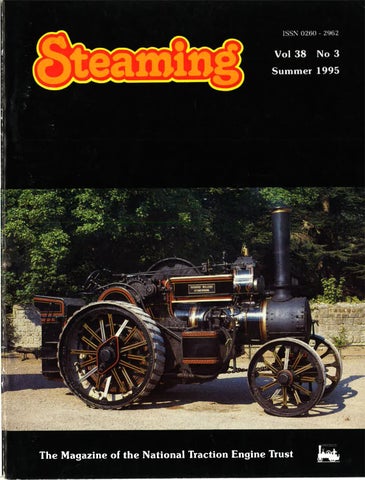
Cover Fowler 5hp road locomotive 12902 basks in morning sunshine whilst on a visit to Eastnor Castle, Herefordshire in May 1990. The livery of the 1913 built engine is noted in more detail in the article The Painting of Engines which appears in this issue. (Roger West) 119
Trust News From the Chairman I have recently received from Swansea the first 50 demands for VED or road fund licence for modern road rollers, most of which I no longer own. I am expecting another 50. That comes to 15,000 a year, and none of these machines travel on the road. They work on the road but are moved on transport. It seems that the consultation process we were promised has been only window dressing and that the policy was-decided last year, and all our efforts to mitigate these charges have been ignored. Clearly the views of the electorate are not being considered and we shall have to answer that when the time comes. It appears that VAT has been
applied to transport rides within Museum sites, when all public transport has, so far, been exempt. In a world where emergency public service vehicles are to be taxed and the state is after every penny it can get, it is unlikely we can expect special treatment for our engines. However we shall continue to tight and I ask that every member writes to their MP, DVLA Swansea, the Treasury, the Department of Transport, etc, etc to object and complain. I have recently opened the Dingles Steam Village to display a collection of engines and early roadmaking tackle and we have had our first school party. Steam is now on the national curriculum and we had the task of
From Alan Martin's Collection
69
Wallis & Steevens roller 2327 of 1896 is clearly ready for the road with water cart and living van — the latter an odd looking structure with its wheels placed strangely near each corner. The 10 ton cylinder machine was owned by G.D. Lucas of Shin field, Berkshire, and driven by William Woodward — he stands on the toolbox. Woodward kept the engine in well groomed condition and maybe it was he who added his own touch with the twisted brass covers to the canopy supports. Notice also the attractively shaped LITTLE QUEEN brass name and makers plate fixed to the headstock. 120
explaining the principles of steam engines to 47 seven year olds; a far more daunting task to me than running an AGM! It is cheering to see the Dept of Education has realised the importance of steam and steam power in our history. Two generations have been brought up to believe that we went from horses to tractors and the equivalent in industry when in fact, to quote Michael Oliver, "steam put the Great in Great Britain". Perhaps the-Secretary of State for Education with her interest in steam has had influence in this area. It is a pity the Treasury led by the Chancellor does not have the same curriculum. Despite protestations of support for our heritage they seem bent on its destruction. It is now more important than ever that we keep a high profile with responsible rallies and events, and now that the Authorisation team has much experience it will be able to sort the wheat from the chaff. In 1975 the NTEC's 21st anniversary Road Run was held. Please support us with our intent to celebrate the next 21 years in 1996 with a major road run somewhere in the middle of the country. I doubt the Trust can totally fund it, but if as in '75 clubs and individuals sponsor engines from their own areas we shall have a wonderful opportunity to get national coverage to support our determination to KEEP STEAM ON THE ROAD. I feel sure that we shall continue to enjoy our hobby for many years. The cost of so doing may well increase but so too, I am told, have the green fees at the local golf club. I am not about to take up golf. Have a good season's STEAMING. (Richard Sandercock)
Engine Owners Column Engine Owners sub-Committee The rally season seems to have got off to a good start, with mostly good weather and good attendances. The Trust's driving course at York Summer 1995
STEAMING
was fully subscribed with nearly 40 members participating. It proved rewarding and enjoyable to all. The facilities at Murton Park were very adequate and we are most grateful to the museum for making us so welcome. Luckily the weekend was mostly dry, although very cold for May. We look forward to meeting many of our new friends again next year, together with the engine owners whose help was invaluable. The Engine Code is still making steady if slow progress and we hope to have Part VI ready for distribution in time for notification in the Autumn Steaming. Some of the inspection companies have been reluctant to accept our Code without giving any convincing reason. However, the position seems to be improving and I am hopeful the problems will soon be resolved. The new proposals from the DVLA are causing us much concern and we are trying to make progress in conjunction with the HCVS although much is still to be done. Although it appears that Continuous Licensing will apply only to cars and motorcycles, the uncertainty over whether or not steam rollers and private low loaders can be licensed as Private/Light Goods is very worrying. (Michael Davies, chairman, Engine Owner sub Committee) Technical Board The NTET Engine Code of Practice and, more precisely, the Scheme of Examination for Traction Engine Boilers continues to gain acceptance amongst insurance companies and other inspecting organisations, and the first of the Trust's Certificates of Approval has been issued to Cornhill. Acceptance by boiler inspectors employed by member companies of the Associated Offices Technical Committee (AOTC), the joint body representing British Engine, Eagle Star, National Vulcan and Plant Safety, has been patchy, to say the least. In general, the head offices of these companies have flatly refused to accept the NTET Code but some of their boiler inspectors seem to have found ways to get round that ban. After a somewhat unpromising start, our relationship with AOTC is becoming much more positive and cordial — thanks largely to the efforts of Technical Board member Harry Pounder, who has been busy building bridges. A meeting with AOTC and representatives of its member companies is being arranged for early July so, hopefully, by the time these notes appear in print, misunderstandings will have been resolved and a good workSTEAMING Summer 1995
Garrett 6hp road locomotive 27946 of 1909 poses for Dave Bagley's camera at the Downs Rally, July 1994.
ing relationship established. Members who have bought the NTET Code have been sent the necessary documents to draw-up their own Scheme of Examination in accordance with the Code. Once the necessary details have been entered on the forms, the scheme must be certified by 'a person of chartered engineer or equivalent status'. Most members will know or be able to find a suitably qualified person, either through personal contact or via their local club. If not, the advice on the back of the form can be followed. Turning to another subject, the Gnomes of Brussels have also been toiling away, producing a draft EC (or is it now EU?) Directive on Pressure Equipment. This will only affect new boilers and associated pressure equipment so it will only apply if someone wants to have a completely new boiler built. A meeting with the Department of Trade and Industry and Health and Safety Executive officials who form the UK delegation, took place on 1st June. It was refreshing and reassuring to meet Government officials who had their feet on the ground and knew what they were talking about. The meeting served to establish communications and we will now be kept informed of developments. The Directive is still very much in the draft stage and many changes could come about before the final version appears. In the meantime, we
will make every effort to ensure that it will remain possible for new boilers for historic vehicles to be built to traditional designs. (Jim Newnham, chairman, Technical Board).
Rally Organisers Column To Rally Safety Officers By the time this edition of Steaming is published, the 1995 season will be at its half way point. However, despite our efforts, Safety Officers Reports are not coming in. May I remind all organisers of the Trust Committee's decision, given at the 1994 Autumn Conference, to enforce the recommendation in Section 3.3 of the Rally Code of Practice — no 1995 Safety Officer's Report; no Authorisation next year. So, rally organisers, or any reader who helps with event organisation, please assist me in ensuring the Safety Officer sends in a copy of his report as soon as possible after the rally. Those who attend our Conferences will be only too well aware of the lessons we can all learn from the reports when they are used as examples for all to gain experience from. I repeat again, the event names are never mentioned 121
For engine owning members ... The Trust's
CODE OF PRACTICE for Traction Engines and similar vehicles is now available. Price £17.50 each including postage from — Mrs Sylvia Dudley 12 Hillway Woburn Sands Milton Keynes Buckinghamshire MK17 8UL
in Conference; the aim is to educate and learn from happenings, not to ridicule. The Autumn Conference for Rally Organisers is due to be held at Rugby on 21st October 1995 and I hope as many events as possible will send at least one representative. (Smudge Smith, Rally Authorisation Officer)
FBHVC News Changes in Vehicle Excise Duty for road rollers This has been a frustrating period in which a great deal of time and effort has been spent in trying to persuade (without success), first the Department of Transport, and then the Government, that what was being proposed was wholly unjust. The first anyone knew of the proposals was when, following the Chancellor of the Exchequer's budget statement in November, in the small print were a series of changes to Vehicle Excise Duty (VED) which were revealed to the public in the newspapers on the following day. I am indebted to Keith Grimsay for alerting me to this. At first, we were led to believe that this was a misinterpretation of the proposals and that there was no intention of penalising preserved road rollers by imposing VED on them. However this position was changed rapidly to there being a drafting error that would be corrected internally and that the true position was that rollers would be treated in exactly the same way as any other class of vehicle 'not used for hire and reward', this being that the PLG rate applies and, for vehicles built prior to 1947, a 50% reduction is allowed. 122
That did not sound too good but was probably the best that could be secured. We were also told 'not to worry' and that DVLA Swansea would let us know of developments. It was during this period that we were betrayed and valuable time was lost during which the Finance Act was passing through the report stage. We were able to get an amendment tabled but this was rejected because 'there had been no lobby from roller owners'! So it would seem that the best course of acton is to bombard your MP with letters of protest and also the Minister of Transport — let them know we object to what they have done! The current situation is, that with effect from 1st July, road rollers under 3.b tonnes will be subject to the PLG rate and rollers over 3.5 tonnes will be subject to the Basic HGV rate. DVLA will be sending out reminders during June.
There is also considerable concern about penalties and the way in which they might be imposed on otherwise law-abiding citizens. The concept is dangerous and must be resisted. Again, a lobby is required. Write to your MP, write to the Minister of Transport, tell them what you think and say that you do not approve of this proposal. The declared aim of reducing VED evasion will not be served by CL and law-abiding citizens will not only be asked to pay more for nothing but may themselves transgress quite inadvertently. Finally, it will cost a vast sum to implement and administer and we all have to pay the bill. At the moment the scope of CL is limited to PLG and motor cycles and so will not impinge on most traction engines or rollers. Those vehicles which are taxed PLG will of course be included.
Continuous Licensing
There has been a steady trickle of applications to recover lost registrations during the winter. These have been successfully processed and the system is working very effectively. One interesting case has been the application for an age related index mark for a traction engine which had not been previously registered. The point at issue was the excise duty class into which the engine should be grouped and I assumed that it would be 'agricultural'. The official view at the applicant's VLO was that only a farmer could own a tractor! DVLA has granted that the taxation class is agricultural but that if a licence is applied for the rate will be PLG! I do not know what will happen, but await with interest to hear how officialdom copes with the situation. Could I please remind potential applicants that there is a charge for the Registration Recovery Service of £10 for NTET members (£20 for nonmembers) and that this should be included with the application. Please make your cheque payable to the NTET. May I also emphasise that there is a requirement to prove that the index mark being claimed was issued to the vehicle in question. To prove the identity of the vehicle we do require evidence of maker's number so that the Road Locomotive Society's records can be used to validate the authenticity of the claim. I do not wish to be alarmist, but I foresee the possibility of a change to the current arrangements if Continuous Licensing Is Introduced. I would therefore urge all who wish to claim an old index number to not delay too long. To avoid a deluge of applications, I am always pleased to
The long awaited consultation document on Continuous Licensing (CL) was finally received on 28th March. One's initial reaction was that it did not seem too bad. However, on further reading and reflection on the implications, horror began to set in. The Trust has made some very sensible recommendations and these have been sent to DVLA. The Federation has also been very busy during the brief consultation period. (We were assured of a minimum of three months, but since replies had to be received by 2nd June, just nine weeks were allowed). During this period all subscriber organisations of the FBHVC had been circularised with a questionnaire, results have been analysed, a meeting for delegates from subscriber organisations has been held and the submission to DVLA drafted, edited and submitted — all by volunteers! The main thrust of the FBHVC's submission to Swansea has been that the whole idea of CL is fundamentally flawed; it is a tax on possession by another name, and it should be dropped. It is suggested that the fairest way of implementing an improved taxation method would be by a transfer of tax to fuel which is already highly taxed and would entail no additional bureaucracy. However, if we must have CL then a number of improvements to the proposed system are essential. Space here does not permit a full review of the Federation's paper but concerns about the administrative charge for off-road licences, free renewals and the experience of charges escalating over a period of time are high on the list.
Lost Registrations
Summer 1995
STEAMING
:11k0
3 ;•
~fl sussxGE KO4R-L AU.SAKI'S 03551411
•
-LONG CRICHEL . W TCHAMPTON 4
4114.44.40.,
-.‘igstv AN,y..„.•+%
4/4'21'w"'4 0$ 4' or
discuss claims with owners and am happy to take enquiries before forms are completed. My telephone/fax number (Peter Smart) is 01420 472018. (These paragraphs by John Crawley and Peter Smart, Federation of British Historic Vehicle Clubs representatives)
Trust Exhibition Unit The Trust's travelling exhibition unit continues to visit a large number of rallies, indeed, it will have been at a steam engine event on nearly every weekend throughout the season. Although the main purpose of the unit is to show the work of the Trust to the general public and to bring their attention to rallies and road steam engines in general, it also serves a very useful purpose for Trust members. It serves as an outlet for NTET Sales, as well as being a useful place to meet Committee members, at least one of whom is present at any given event. Please make a point of visiting the unit when you are at one of the rallies listed here — top up on reading, videos or tee-shirts and sweaters and don't hesitate to come forward with any points you'd like to discuss on STEAMING
Summer 1995
4.*401,
4.:
Plodding a by now familiar road across the Dorset hills, Al/chin 7hp agricultural engine 1415 of 1907 passes Gussage St Mary and nears the end of another journey from the Isle of Wight to the Great Dorset Steam Fair in August 1994. (John Maund)
engines, rallies or the running of the Trust — your club. We have been asked by several rally organisers why their event hasn't been included in the unit's itinerary. Clearly, with many weekends in the year seeing two, three, and even more rallies taking place, the unit can only appear in one place (though we are making a 'tented' appearance at Weeting!). It is hoped, within a period of about four years, we shall have visited every entry on the Rally List, as we shall not be making repeat visits just yet. Geographical considerations also play a part in the itinerary. The unit will be attending the following rallies during the remainder of the 1995 season: July — 15/16 Masham, Yorkshire and Weeting, Norfolk; 22/23 Netley Marsh, Hampshire; 29/30 Upton-onSevern, Worcestershire. August — 5/6th Redhill, Surrey; 12/13th Driffield, Yorkshire; 18-20th West of England, Cornwall; 26-28th Merrymeet, Cornwall; 30th-3rd Sept Great Dorset Steam Fair. September — 9/10th Malpas,
Cheshire; 16/17th Shefford, Bedfordshire. Please refer to The Rally List 1995 for further details of the location of the events. (Robert Herring, Exhibition Unit organiser, 12 01869 277410).
Steam Apprentice Club The Steam Apprentice Club chairman is again appealing for help. Firstly, I feel there must be several Trust members among our membership who, after a little thought, would be willing to take on the job of looking after Steam Apprentices at rallies. The task is not of being with them throughout the day, but of organising their day and their contacts; as I have said before, I consider it better that an adult asks the engine owners and crews for their co-operation and whether they 123
will take on an Apprentice for a few hours, for the day, or for the duration of the rally. Please give the job some thought and let me know if you feel you could help — if only three or four members could manage two or three rallies a season it would be a start and give us the beginnings of a team. Secondly, I am al Lhe moment to a large extent running the SAC on my own, though I'm grateful for help locally and from John and Fiona Durley in Yorkshire and Stuart Gaines in Hampshire. What I really need is secretarial help to answer letters from Apprentices seeking information or contacts with engine owners in their locality. Again, if you feel you could assist, please give me a ring to discuss the task. Barry Sumsion has been appointed the new Editor of Raising Steam, the SAC's magazine. He is settling in well, has already sent out a brief supplementary issue to introduce himself to Apprentices and is now preparing the way for a period of steady progress. Like all Editors, he is always keen to receive material, so if any Trust members feel they could manage something that is suitable for Apprentice reading — for any of their age groups — Barry would, I'm sure, be pleased to hear from them. Barry's address is 1 Leicester Road, Newport, Gwent NP9 7ER (Tr 01633 262197). (John Bosworth, chairman, Steam Apprentice Club — address inside front cover.)
This Foster single cylinder agricultural will not be an engine that is familiar to readers from the rally fields, for despite still being used at times for a day's work at exactly the same task it was purchased for over forty years ago, the 5hp machine is not rallied. Owned by Peter Hough of Bloxwich, West Midlands 12458 of 1909 (AW9434) was bought in 1952 by Peter's father for (20, to be used for dragging out trees and hedges to enlarge fields on his farm. Acquisition of a sawbench from Stacey Nash of Wednesfield enabled the fallen timber to be cut into logs for useful firewood. Today the farm has largely disappeared under Beechdale housIng estate, but the yard remains with barn, allowing Peter to continue to use the Foster and the hench fnr cutting firewood, as seen in this April 1995 picture. Peter learnt the art of engine driving when he was but a lad from the Pat Collins' showland drivers, who were based just down the road. (Photograph and notes by Bob Webster)
Members should note that Hamiltons, the company that has been the Trust's accountants, registered auditors and registered office address for some years, has recently merged with the firm of Menzies and has moved to the latter's Staines office. The name and address Is Menzies, Chartered Accountants, Barley House, 57 Church Street, Staines, Middlesex TW18 4XS.
presently dispatched by surface mail. As Were is very IILLIC din-went:re between the cost of air mail and surface to Europe, we have arranged for these copies to be in future sent by air mail, this at no extra cost on the annual membership fee. For our members living in other areas of the world may I draw attention to the fact that the facility to have Steaming sent by air mail does exist. There is an annual part payment of £5.00 for the service, and that sum should be added to your membership renewal remittance. (John Cook, membership secretary)
Screen Stars Quality, have the image of a pail of ploughing engines printed in the centre chest position. They are available in four colours — white, black, navy and royal — and come in four sizes — medium, large, X large and XX large. The price is £5.50 for all the sizes except XX large which is £6.00. The Trusts wide selection of sweatshirts and ties in many colours and sizes is still available. Please refer to the Mail Order adverts at the rear of each issue or better still, for a chance to view the whole range, visit the Trust's Exhibition Unit at one of its dozen or so rally appearances during the rest of the season. These visits are listed elsewhere in this section of the magazine.
Overseas Members
NTET Sales
Some overseas members have been expressing their dismay over the long delay they experience in receiving their copies of Steaming, which are
Trust Clothing The latest addition to the Trust's traction engine associated clothing range is now available. The T-shirts,
Engines on stamps and things The illustiated article on the new Isle of Man stamps in the last issue caused considerable interest from members and we now have details of the full range of items which the Isle of
The Trust's Accountants
124
Summer 1995
STEAMING
Time to change the Constitution ? The Trust's Hon Solicitor, Tim Driver, explains some of the Committee's recent deliberations on our Constitution.
for election. The problem is that there is no time prescribed in Article 51 so only four clear days notice need be given if a person is proposed for election. This is insufficient time for the Committee to form a view about someone who may be a totally unknown candidate, let alone make their views known to all members, if appropriate. A balance must be struck between on the one hand the need to ensure that the Committee is comprised of the best, most conscientious people who are committed to the aims of the Trust and on the other the need to retain open democratic processes and to avoid the possibility of a 'self-perpetuating oligarchy'. There is also a need to ensure that there is no continual, rapid turnover of Committee membership which would lose that body continuity and experience at the expense of the Trust's status. All of this has to be achieved without putting further strain on the Trust's financial resources. The Committee does not believe that there is any easy solution to this potential problem. Indeed, the problem itself might never arise. However it is felt that if notice of a proposed candidate could be given to the Trust 28 (not 4) days before the AGM this would allow an opportunity for the Committee and officers to take soundings and if necessary to make their views known to the membership before the AGM. At the next AGM members will be recommended to prescribe the period of 28 days for the purpose of Article 51.
Your National Committee has been reviewing the Trust's Constitution, which has stood, largely unchanged, since 1977. This note aims to explain why the Committee has carried out a review, what its conclusions are and what is to be put to the AGM in November. Many organisations which, like the Trust, are both charities and companies have reviewed and changed their Constitutions following changes in companies law and publication of the recent updated 'model' Constitution by the Charity Commission. The Trust's Constitution — its memorandum and articles — is not written in 'plain English' nor, as a result, is it user-friendly. It reflects the requirements of companies and charities law at the time of its completion, and so in some places seems likely to hinder rather than help the economic, efficient and effective administration of an open, democratic organisation like the Trust. After considerable debate however the Committee has decided that wholesale change or re-writing is unnecessary. The Constitution has worked reasonably well and there are bigger and more important matters to concern the preservation world at the moment. Similarly the Committee feels that there is no point in removing the Trust's status as a charity or company — this despite the fact that such status provides few benefits and some administrative disadvantages. However the Committee believes that the Constitution should be kept under continual review to ensure that, when necessary, changes can be made to aid efficient administration. Two such issues have cropped up recently, both concerning matters to be considered at an annual or other general meeting. The first concerns articles 16 and 17. • Article 16 states that a member
may send to the Secretary, not less than 42 days before an AGM, any notice of motion which he or she wishes to move at that meeting. It also says that such notice must be included in the notice to be given to all members about the AGM. • Article 17 requires at least 21 days notice of an AGM to be given to all members. To keep the cost of administration to a minimum the Article 17 notice is sent with the Autumn issue of Steaming. Unfortunately, the juxtaposition of the 42 days in Article 16, the 21 days in Article 17, and the publication date and requirements of Steaming, means that the 42 days is insufficient to ensure that notice of matters to be moved by members can be circulated without the need for an extra mailing and its attendant cost. What will be proposed at the next AGM is that Article 16 should be amended so that members must send their notices of motion at least 56 (not 421 days before the AGM. This will give time for details to be circulated without additional cost. The other change concerns Article 51, which with other articles deals with rotation of membership of the National Committee. Its effect is that no-one is eligible for election to the Committee unless he or she is recommended by the Committee, or he or she has been proposed by another member who must give notice to the Trust within a prescribed time. The only exception to this is a member of the Committee retiring by rotation although that member is open to challenge by election in the usual way. The intention of Article 51 — which is a fairly standard companies law provision — is to ensure that the Committee can at least make its views known if, for example, a wholly unsatisfactory candidate is proposed
The Committee may from time to time make other proposals for change as and when it appears necessary. At some time in the future it may be necessary to re-write the Constitution completely. Meanwhile, with the exception of the two areas mentioned above, the Committee is firmly of the view that 'if it ain't broke — don't fix it!'
Man Philatelic Bureau has produced to support the stamps. These include: • First Day Cover (f1.90) — all five stamps plus portable engine design on the envelope. • Presentation Pack (f1.85) — the five stamps in lightweight folder.
• Mounted prints (f5.99 each) — individual prints of each of the five stamp designs, 6in x 4in image in 9in x 8in mount. • Framed prints (£19. 75 each) — the above in attractive frames ready for hanging. • Bone china plates (f9.95 each or
£39.00 set of five) — 7 inch diameter, gold rimmed plates featuring the five designs. We can take orders for any of the above (plates despatched direct from Isle of Man). Please indicate clearly the design required — see the illustrations on page 78 of the Spring 1995 issue
STEAMING Summer 7995
125
— and use reference Foden, Clayton, Wallis, Marshall engine or Marshall roller. For postal sales please include 10% per order as part post and packing. (Colin and Val Brown, NTET Sales — see Mail Order at rear of magazine for address etc.)
The Trust's 1995 Driving Course We brought a generator along by way of insurance — there was a rumour about that had something to do with electricity and north of Watford. Nevertheless the fifth NTET Driving Course came to Murton Park over the weekend of 13th/14th May Our hnsts, The Yorkshire 1995 Museum of Farming, together with assistance from members of the Derwent Valley Light Railway, provided all the infrastructure necessary to support our demanding team. With nine engines and fourteen instructors, made up from the engine owners and the Trust's five regular lecturers, the thirty-four students had a busy weekend schedule ahead. With the exception of six 'long term' students the remainder were new to the course and therefore followed the standard introductory patter, of safety briefings and a gentle introduction to the engines and their features and fittings. Various lectures covering topics ranging from boiler theory and construction, inspection and repairs, tube repiacement, together with lubrication, water treatment and advice on driving on public roads followed at intervals throughout the weekend. The ten or so acres of hard and level ground proved ideal for students to come to terms with the engines and their individual characteristics under the watchful eyes of their owners. To add variety Murton's threshing drum was pressed into service; here students found that lining the engine up accurately, fitting the belt and bringing the drum up to speed proved trickier than anticipated. The supply of water for the engines could well go down on record as unusual, as, at specified times during the day the DVLR brought their gleaming yellow Shell Lubricating Oil tank to a convenient point on the line to transfer water to the waiting engines, Evening activities started on the Friday with a presentation from the staff of Murton Park, covering the history, development and aims of the 126
Practical experience of Fowlers' gear change mechanism being gained by a student at the Trust's 1995 Driving Course. (Richard Vickery)
museum. On the Saturday evening our guest speaker Rob Shorland-Ball gave a lively illustrated talk about his considerable railway experiences, during a memorable evening meal prepared under rather adverse circumstances, allegedly due to gas and Watford. From reports received so far all considered that it turned out to be a great weekend, due in most part to the patience and good humour of the instructors, engine owners and not to mention the staff and volunteers of rviurton Park. All being well we should return next year, incorporatng some of the ideas that were suggested, and yes the generator was useful to charge the battery of the mobile phone! (Richard Vickery)
29 and 30 — Bleadon Steam Country Fayre, Bleadon, near Westonsuper-Mare, Avon. C. Henderson, 44A Alma Street, Weston-super-Mare, Avon B523 1HD (v 01934 626'999). AUGUST 16 and 17 — 21st Grand Henham Steam Rally — Henham Park, Henham, Beccles, Suffolk. G. Striven, The Old Rectory, Frostenden, Beccles, Suffolk NR34 7HX. In addition, the Great Central Roil„ ay Rood Roil Event on April 15-17th also took place under the Trust's Authorisation Scheme. We remind readers that the Knowl Hill Rally on 12/13th August was missed from the printing of the Rally List but that it will be taking place, as usual, at Bottle Meadow, Knowl Hill, Berkshire.
The Rally List 1995 The following events have been added to the Trust's 1995 List of Authorised Rallies, as published in loose supplement form with our Spring issue. JULY 15 and 16 — Lambeth Country Show, Brockwell Park, Herne Hill, London SE24. C. Todd, Arts Officer, London Borough of Lambeth, International House, Canterbury Crescent, London SW9 7QE (v 0171 926 9337).
Affiliated Clubs Sentinel Drivers Club Further to the details published in our last issue (page 681 of the Horseshoe Pass Road Run on 26th August, the SDC advise (in May) that sixteen Sentinels have entered for the event. Most types, including Ian Woollett's SD experimental wagon that has the prototype S type engine, Summer 1995
STEAMING
and Jim Hatfield's DG6, are represented. The latter is a long-range entrant and will be driven up from Sussex to North Wales. (Sentinel Drivers Club)
Future Dates Great Dorset Steam Fair 30th August-3rd September 1995 The Trust's Exhibition Unit will be attending the Dorset event for the whole Wednesday to Saturday fiveday period, open from 9.00am through to 9.00pm on all days except Sunday, when we finish at 5.00pm. As in previous years we are locating the unit in a marquee, with an enlarged Sales area to one side and a sitting area to the other, the latter with tea and coffee available. We hope all members who are visiting the event will call at the marquee, whether to spend money, to sit, relax and regain energy, to seek information or even to bring constructive criticism. The Exhibition Unit itself will be staffed throughout by a variety of Committee Members on a rota basis. At this point can we appeal to members for assistance in staffing the marquee? Whilst help would be welcome in the Exhibition and hospitality areas the main problem is the sales stand, where last year the available staff were severely taxed. The stand needs five or six people on hand during most parts of the day — can you or your friends spare some time please? The atmosphere is busy but it is also friendly and you will have the knowledge of a job well done and it being one of great benefit to the Trust. As a bonus for taking on the task we can make available personal, vehicle or caravan passes. Please contact Robert Herring, 27 01869 277410. In 1994 two meetings of the Trust's Committee took place at rallies, part of a move to illustrate the Committee's continuing commitment to the rally movement, to the individual engine owner and to the general membership, by sharing their summer activities. A meeting is to be held on Sunday morning 3rd September 1995 at the Dorset event. Any members are welcome to attend the meeting as observers, and to see their Committee at work. While general members will not be able to join in the business of the meeting, it is hoped time will permit a brief open forum after the conclusion of the meeting. STEAMING Summer 1995
The time and location of the meeting will be displayed in the Trust marquee. Autumn Rally Organisers Conference The Autumn Rally Organisers Conference will be held at the Auto Cycle Union headquarters at Rugby, Warwickshire on Saturday 21st October 1995. Further details will be distributed to Rally Organisers and Affiliated clubs in due course, but any other interested parties requiring information on these excellent forums should contact Sue Jackson, Hon Secretary (address inside front cover). Annual General Meeting Advance notice is given to all members that this year's Annual General Meeting will be held on Saturday, 18th November 1995 at the Historic Dockyard, Chatham, Kent. Formal notice, together with all relevant information, proxy forms and audited accounts for the year ended 31st March will be sent to all paid-up members of the Trust with the Autumn issue of Steaming. Any member may submit a motion for discussion at the Annual General Meeting. All motions must be in writing, signed by the proposer and by a seconder. Such items for discussion, in order to be published in the Agenda for the Annual General Meeting, as required by Article 16 of the Trust's Constitution, must reach the company secretary Sylvia Dudley not later than
Saturday 23rd September 1995 (address inside the front cover). Details of the arrangements for the weekend will be published in the Autumn issue of Steaming. A list of overnight accommodation will also be prepared for those wishing to make a weekend break around the planned activities.
Poor Steaming Apologies are due to Brian Shaw for not correctly crediting his taking of the photograph reproduced on page 74 of the last issue. Most readers will have spotted the transposition of captions to the 1992 pictures of Burrell roller 4040 on pages 83 and 85 of the last issue — apologies to John Maund for that Editorial error. Two references in the Steaming Around section of recent issues to engines changing hands need complete deletion. Mention of the sale of Fowler 14402 (Nottinghamshire, page 98, last issue) and the three engines at Nicholson's, Faldingworth (Lincolnshire, page 98, Winter 1994/95 issue) was included as the result of spurious information sent to the Trust by a third party. We apologise to the respective owners and take this opportunity to remind members of the notes under the heading Small Adverts on page 65 of the Spring 1994 issue.
Allchin 7hp traction engine 3251 ROYAL CHESTER hauls its sister engine 669 on a parade at the Downs rally in July 1994. The pair are respectively the newest (1925) and the oldest (1890) surviving Allchin traction engines — indeed ROYAL CHESTER was the final agricultural engine to be turned out by the Northampton firm. (Peter Love) 127
THE PAINTING OF ENGINES • Richard Willcox As a child I used to enjoy drawing railway locomotives, and colouring them in, not only in the colours I remembered seeing, but with the older engines, colour schemes that I had only read about, or had seen in coloured illustrations. Accordingly, since my introduction to the world of LracLion engines, when I was about sixteen, I have always taken an interest in their colours. At that time, some forty years ago, there were plenty of unrestored engines around — indeed just near my home was a yard containing over twenty — and many engines were never repainted after they left the works when new. These days there are very few unrestored engines to examine, so one has to look carefully at engines in bits and pieces
for overhaul, and usually traces of the original paint and lining are there somewhere, if only in small areas. One looks especially behind gearcasing and solid flywheels, under nameplates, brackets and other fittings which were only attached after the engine was painted. Unfortunately, over the years I have not taken as many notes as I should have done, but nevertheless have accumulated much knowledge of the way most makes of engine were finished as regards paint and lining. It is a continual learning curve, and although a lot has been learnt, a lot remains to be discovered even now. One must remember that colours you find now will have changed somewhat since they were first applied, due to numerous reasons. Years of exposure to heat, light, oil, plus a natural
A black and white illustration of a Foster engine. This picture, of a properly finished Foster traction engine, is taken from one of the firm's catalogues. Apart from clearly showing the lining, it also gives a good idea of the correct overall appearance of such an engine, which is, for course, also something one should strive for. This engine has a cast iron chimney top, but plain stovepipes, or a copper top very similar to a Burrell are equally correct. The usual colour for these engines was middle green, broad lined in red, edged will, a fine while line, will, fine yellow line set in somewhat from the rest of the lining. Wheels were red lined white. Later engines were a much darker green, with different lining colours, but followed the same style, although the lining on the red wheels was completely changed, being black and yellow. The red was also much brighter. (collection R.C.J. Willcox) 128
degradation of some of the pigments all alter appearance of the colour, as also does the presence of a coat of old varnish. Any old paint found should be degreased, and then cut back gently with Tee-cut or Brasso. It may also, of course, be necessary to remove more recent coats of paint by more robust methods. Once you have some colours to work to, the correct overall appearance of the engines can be seen from illustrations in makers catalogues, or copies of official works photos, many of which survive, and have been published in diverse books, or even in this magazine. Many works photographs are of engines painted grey, lined black and white, to show up the detail, but even allowing for this, a general impression of the correct appearance of the egine can be gained, and the position and style of the lining. I am well aware that you could have a new engine painted any colour you wanted, but the fact remains that few customers bothered too much over this. Owners buying new engines, even from the same maker, did not always have them the same colour. Other owners, having engines of different makes, would end up with an even greater mixture of colours in their fleet. I quote from a local owner who had the following, mostly from new — one Fnwlpr all hlark• nnp Burrell, crimson lake with red wheels; one Garrett, all green; one Foden C type wagon and two Foden D type tractors, chestnut brown with red wheels and chassis and one Foden Speed 12 wagon, maroon. After this they had an all Foden diesel fleet, which is the part I remember. These again were mostly new, all green, but no two the same shade! However going back to traction engines, each maker did have their own standard livery, some more rigidly applied than others. Also their own idiosyncratic features, for example Marshalls normally had black cranks and flywheels, whatever the colour of the engine. Also with the usual red wheels, the front axle, lower part of the perch, and sometimes also the spudpan were also red on Marshalls. Despite examining many Avelings, I have only ever found one that was not, or had not been green — that one was black. Other firms show considerSummer 1995
STEAMING
A near side view of Burrell 2003, after a correct repaint in about 1962. This shows the traditional black, red and yellow lining well. Note that on the tender the black line is wider, and edged red on both sides, although the yellow remains on the inside only. Note also that the tender lining does not go round the cut out in the tender side, and that it is not on the drag plates to the drawbar. The gearcasing over the lower part of the gears is lined red and yellow only, the red being at the edge of the metal. Although not clear from the photograph, the flywheel on a Burrell engine of this early period was black, although changed to engine colour about the turn of the century. The front wheel spokes are lined out on both faces, which is not the case with most other makes. A correct Burrell pattern nameplate is fitted in the correct place, although the name is not the original. The background to these plates was the same as the boiler lagging — green in this case. The background to the smokebox door plates should likewise be the same as the surround — therefore black. The valve chest cover nuts should have been polished, and indeed this was later done. (Barry Finch)
able variation in basic colours and/or lining colours, but generally the style and width of the lining was the same. Other firms changed their standard colour on a particular date, for example Fowler, about 1920, changed from their well known standard black, lined brown (confusingly known officially as amber), red and yellow, to a new colour, also confusingly, called 'chocolate'. It was in fact a very distinctive brownish maroon, still obtainable today from Fowler's original supplier, Williamsons of Ripon (order ref SP7533). Even after 1920, some Fowler customers, such as the well known Norman Box, still had their new engines in black. Others chose green, in fact I don't think the chocolate livery was applied to ploughing engines (does anyone out there know this?). All the late ones that I have seen were green, either lined black, red and yellow, or later on plain white lines only. I have noticed recently, a growing number of black Fowlers with the broad lines in orange. This is quite wrong, the correct colour can be obtained by mixing Keeps 'Holborn Brown' with Keeps 'Golden Brown' in approximately equal parts — perhaps STEAMING Summer 1995
Adis
Offside view of the same Burrell engine. Lining on the cylinder lagging is in red and yellow only — the black is provided by the rim of the casting inside which the lagging sits. The owners name and address is shown on a metal plate, as was, and still is, legally required. (Barry Finch)
This issue's cover picture The reproduction of the colour slide on this issue's cover shows Fowler livery as it should be, and as applied to the author's road locomotive 12902. Note the use of matt or semi-matt black on, basically, all unlined areas and fittings. This, however, does not include the outside of the flywheel, here unseen. See also that the crankshaft is red. Despite the clean engine, the rear wheels bear traces of having been in the mud recently, something often seen on photographs taken in the heyday of the traction engine. One slight error in the application of the livery is that the yellow lines should have been slightly finer to reduce somewhat the visual impact of that bright colour. 129
Two Fowler works photographs showing opposite sides of Norman Box's TALISMAN when new, in show-finished Fowler black livery. Note matt black finish on all the usual black parts — chimney etc, and note that this includes the wheel rims, though this was not always the case. As on the Burrell, the engine name is on the near side, and the owners name on a metal plate on the offside. The owners name painted on the awning sides does not satisfy the legal requirement, hence the additional places on the motion cover. The polished hub caps, piping, driving pin handles, steering gear wheel, steering wheel rim, and brake wheel rim are ail show features, and were normally matt black. In contrast to the Burrell there is no lining on the inside face of the front wheel spokes. There is no lining on the solid Fowler flywheel, although there was plain yellow lining on spoked flywheels of ploughing and agricultural engines. This is the direct opposite of Burrell practice. (courtesy Rural History Centre, University of Reading)
with slightly more of the lighter colour. Some makers' colours have been matched exactly, others are known approximately, and enough knowledge is available to paint most types of engine in an authentic style, for those who wish to do so. This whole subject is always controversial, witness the recent comments in Steaming on Aveling green. This controversy is even more pronounced among the railway fraternity, with long discussions as to, for example, whether Midland Railway red was the same as London, Midland Scottish red, and was the colour used by British Railways on the ex LMS Pacifics around 1960 the same colour, or different again? As I've said before though, a lot depends on how old paint is, how clean the engine is you are looking at, whether it has been varnished or not, and not least, what the weather and lighting is like on the day you look at it. In my opinion, returning again to traction engines, the basic colour is less important than the correct widths and positions of the lining, in obtaining a good result. Whatever colour you choose to paint it, this detail can usually be obtained quite easily from old photographs. It is no use going to a lot of trouble to get the right colours, and applying them all in the wrong places. There is also circulating, I'm 130
afraid, a fair amount of misinformation on one or two makes at present, which has come from well intentioned, but misinformed latter day sources at the makers' works. Engine owners are a very conservative lot. Do we have to have so many maroon showmans engines for example? Why not more blue, green, brown, or even black ones? All these colours, as well as a few more exotic
still, were to be seen in former days — why not now? Even with ordinary engines, I, and I'm sure others too, would welcome a bit more colour variety. Do choose though, the sort of colour that would have been available in that era, no vulgar modern synthetic pigments please. Also, whatever colour you use, use the best paint you can get, it is cheaper in the long run. We see also many engines in Summer 1995
STEAMING
unauthentic liveries (yes — I know you are entitled to paint it any colour you choose), which are then faithfully copied by other owners of the same make, not realising that correct information is available. Another important point I would like to make. I cannot tell you for sure, unless it is an engine that I have good knowledge of, what colour your engine was when new. I can only give you a probable colour, which would at least be authentic, but I do not have access to makers' records of individual engines. In a few examples these are available, but in many cases even if they are, no mention is made of the paintwork, and if it is it may just say 'standard', for example — which is not necessarily helpful. All this is a subject which can be discussed and debated for ever and a day, but I feel our hard working Editor might complain if I go on for too long. So, yes, if you want, you are entitled to paint your engine anyhow you like. But if you are interested, information is available on authentic liveries for most makes of traction engine, a subject I am always willing to discuss with anyone who is interested. (Richard Willcox is Engine Liveries Officer of the Road Locomotive Society — a post he has held for 30 years. Restorers requiring advice should write to him (enclosing a SAE for reply) at Ravenna Cottage, Stanley Down ton, Stonehouse, Gloucestershire GL10 3QU).
What do you think of these? David Davies of Brigg, Lincolnshire, kindly sends these two photographs from his collection. Nothing is known of the locations or the owners of the machines and it is hoped readers may be able to make more comment on the types and perhaps offer identities for the engines. The single cylinder Fowler ploughing engine seems to be of 1870/1880 vintage and was probably photographed some time after the turn of the century judging from the crew's dress. The latter observation is possibly also true of the picture above showing a Burrell single crank compound engine hauling a couple of traction wagons. These are carrying road stone — 5 tons or so laboriously loaded on each and soon to be put off at the roadside. Four shovels or forks lie atop the stone, so presumably the engine crew were part of the team as well as the foreman and the labourer. Two fine pictures — who can tell us more?
Adieu to Yorkshires Derek Rayner
A later example of a Yorkshire — a better, more protective cab but still not completely enclosed along with the boiler as in the final models. 1547, a WA type, was delivered in November 1930 to Bradford Corporation Cleansing Department, and later worked with tarring contractor D. Wood of Yeadon, Leeds. The 3 ton tip body, quite clearly designed to the purchaser's specific requirements, incorporates a riveted well at its lower levels, a feature which necessitated a dropped rear axle. The detail of that arrangement is lost in the shadow — it would be interesting to be able to see more.
The Leeds firm of Yorkshire Patent Steam Wagon Co Ltd commenced business at the turn of the century, as a partnership between Geo H. Mann (brother of J. Mann of Mann's Patent Steam Wagon Col and J. Clayton of Clayton, Son & Co Ltd. The Yorkshire company quickly became a branch of Deighton Patent Flue & Tube Co, itself part of Leeds Forge Co, but the purpose of the new firm was to develop a steam wagon incorporating G.H. Mann's patent double ended locomotive type boiler, which was to be the distinctive feature of all Yorkshire wagons. The early type of wagons had undertype engines and the drive to the rear axle was by means of gears, which incorporated a two speed facility. This arrangement lasted until about 1908 during which time the wagons were supplied not only for the home market but also for overseas. A major re-design of the wagon then took place with the compound engine mounted vertically behind the driver and the final drive to the rear axle by roller chain. This type of wagon continued in production until the 1920s and many different types of body were fitted — cranes, tippers, fuel oil tanks, even a bus body, together with gully PrnptiP!,and raft ICP r011Prting
Works photograph of Yorkshire WE type wagon number 623 (U2467). The three speed 6 tonner was sent out in January 1914 to Watt & Ferguson of Montrose Works, Rotherham. The toothed casting on the far side rear cab stanchion is a rachet wheel — presumably part of a hoisting device. 132
It was the latter two types of vehicle, together with tanker wagons, which were to keep the firm going for a considerable further period after the demise of steam. Around this time, the firm's name changed to Yorkshire Commercial Motor Company, but for some unestablished reason, this was short lived. In 1924, however, a new design of steam wagon, the WF type, had been introduced and this featured cardan shaft drive. The WG, WH and WJ soon followed, with the boiler and engine unit basically the same, but the drive methods varied; some shaft, some with twin chain from a dead rear axle through an intermediate differential casing arrangement. Better and fully enclosed cabs, electric lighting and ulhei control improvements were all incorporated at this time but production of steam wagons ceased in the early 1930s, although a special type of crane type wagon was built Summer 1995
STEAMING
for Sheffield Corporation Electricity Department in 1937. Following the cessation of steam wagon manufacture, diesel engined lorries were introduced, of both four and eight wheel versions with a variety of bodies. Production of this type was short lived, however, and production ceased in 1937. It is believed that none of those Yorkshire diesel wagons have survived. The firm then concentrated on the manufacture of municipal cleansing vehicles, gully emptiers and road sweepers together with large tank wagon bodies for the disposal of trade effluent, all on chassis manufactured by others. The family firm, still retaining its title Yorkshire Patent Steam Wagon Company Ltd, existed until the very late 1960s, when it was taken over by the Midlands based company, Hestair, changing its name at that stage to Yorkshire Vehicles. It has subsequently come within the auspices of Trinity Holdings Limited, whose trade names include Dennis and Duple, and whose products include buses, fire engines and refuse collection vehicles. By 1980 the company employed some 180 staff and was still making tankers and road sweepers. The market for these products has now all but disappeared and regrettably the firm, still in Pepper Road, Hunslet and known as Dennis-Eagle, is ceasing production in July 1995. A small number of workers will be retained to run a spares and service operation after this time. The original Yorkshire works site has been owned by the door security firm of Pickersgill-Kaye Ltd for some time now and they occupy some of the buildings there. Incidentally, many engine owners will know of this firm, not because of their associations with door locks, but because they made the 'K' type oilcan which was an integral part of many an engine's tool kit. Some of the other buildings on the site occupied by Dennis-Eagle are not original Yorkshire Patent ones but are relatively recent replacements following a very severe fire in the mid 1960s. The site is set back from the road and is adjacent to the rather more imposing buildings which at one time housed Mann's Patent Steam Wagon Company and which actually front Pepper Road. These are now occupied by Pontifex, who make stainless steel tanks. Today, only six Yorkshire steam wagons exist in Europe and another five in Australasia. Four of these were associated with that aficionado of unusual steam wagons, the late Tom Varley. Without his involvement and that of Walter Fearnley, who saved STEAMING Summer 1995
Not a Yorkshire Patent Steam Wagon model but one very closely associated with the firm's history. The attractive charabanc was designed by Geo H. Mann in 1908, after control of the Yorkshire company had passed to Deighton Flue & Tube Co. The chassis was built by Yorkshire, but the boiler was constructed by Clayton, Son & Co Ltd — perhaps Mann was prevented from using the Patent transverse double ended boiler, or maybe he was independently trying out other ideas, for it was oil (creosote) fired and had an efficient exhaust condenser at the front. The machine was built up by George Mann at his own workshop at Holbeck, Leeds. The compound engine was undermounted and gears drove the rear wheels, which had independent suspension, giving a good ride to the 25 passengers in the waggonette body. The small lettering on the front panelling reads G.H. MANN & CO, PATENTEES AND PROPRIETORS. An excellent two page technical account of this interesting and innovative design appears in Clarks Development of the English Steam Wagon.
two and restored one of them, the engine movement would be all the poorer and little would exist to commemorate this particular one of the big five steam road vehicle manufacturing firms of that great engineering city of Leeds.
We are grateful to the firm of Dennis-Eagle and to their Works Manager, Geoff Boyd, for the loan of the photographs which accompany this short tribute.
'According to The Railway News the Yorkshire steam wagon in the service of the Caledonian Railway Company, which vehicles are owned and worked by Messrs Wordie and Company, cartage contractors, of Glasgow, have done most excellent performance in the conveyance of fruit during the recent season. The motor transport arrangements have given great satisfaction to the carriers, and have solved a difficulty for them which of itself would have been a most
serious one. Suitable loading banks have been provided in a number of fruit estates in the Blairgowrie district particularly on the Essendy estate, and there was no delay in loading the full, or unloading the empty, casks. Whilst the financial side of the undertaking has not been exceptionally profitable it is admitted that the traffic could not have been handled by other than such up to date methods.' (from Commercial Motor, 7th November 1907.)
133
THE WEST OF ENGLAND SOCIETYS
Road Run This year sees the West of England Steam Engine Society's 401h rally, to take place at Tywarnhale Farm, near St Agnes, Cornwall, on 18th-20th August. But it has now become traditional for the Society to hold an impressive road run every fifth year and so on Thursday 17th August, a wide variety of engines will set out on an eight and a half mile journey through superb Cornish landscapes. Derek Hattam sets the scene....
The West of England Steam Engine Society's present rally site is a very appropriate one, for it is situated on the only farm in Cornwall that had a pair of steam ploughing engines in residence. The field is also used as the base from which the Society holds its five-yearly road-run, one that is thought by many to be the finest of all road-runs organised by any steam preservation body in the country. Not
only does it use the preserved engines of today, but much of the route passes through former mining country which is steeped in the history of steam pumping engines from long before Trevithick tried his first road engine at Camborne in 1801. The route is about 8 1/2 miles long and passes through a valley with streams that allow the enginemen to take up water in the traditional man-
The Atlantic Ocean and the rugged Cornish coastline form the background to this picture of Robey 7hp agricultural 29333 of 1910, nearing the end of its climb from near sea level to the top of Engine Hill. Photographed by Bob Payne on the 1990 road run. 134
ner, as well as providing interesting driving conditions over quite hilly terrain — and this allows a good opportunity for viewing and photography. On leaving the rally field the engines travel westward from a height of nearly 500 feet above sea level — a height which provides scenic views of some of the hills and coast as far as St Ives. Turning to the south east the road descends gently into a shallow valley and then climbs to a point which overlooks an old engine house and the Porthtowan Valley. Gently falling, the road then reaches the Millpool Hill which descends quite steeply to Manor Parsley. From there for the next few miles the road passes through the locations of several very old and famous Cornish mines which had interesting links with steam. Passing along the side of the valley at one point the sight of two old Cornish engine houses makes a pictorial view of an interesting scene. Both engine houses were built for 70-inch engines but the engine was never erected in the house at the bottom of the valley. On reaching the top of Navvy-pit Hill the scene opens out to the view of an old mining valley with the scars of industry standing out among the native Cornish scrub. From this point at various times would have been seen at work great pumping engines with 70in or 80in cylinders and 10ft or occasionally 12ft strokes, although the stroke in the pump was often shortened by the use of unequal beams. Usually built by the Cornish foundries, some engines were situated on the skyline opposite but others were on the valley sides or bottom. Smaller engines for winding and stamping the ores worked beside them. It was while working on one of these mines that Joseph Hornblower schemed out and made a model of an improved equilibrium valve which became known as Hornblower's valve. It turned out to be the prototype of the world famous Cornish double-beat valve which allowed a man of less than average stature to handle without undue effort a 90in Cornish pumping engine. Descending Navvy-pit Hill the route of the run reaches the bottom of the Porthtowan Valley, a desolate, barren, steep-sided valley which has only been altered by mining operations. A careful scrutiny reveals the old tracks of the shafts and the other places now all overgrown with native scrub. All around are milling remnants, which to some are ugly but to others are monuments to Cornwall's great mining tame. The stream passes close to the road in the valley Summer 1995
STEAMING
and it is here that most of the engines will pick up water if they need it. On the east side of the road and perhaps 80 feet above it, there stands a group of ❑ld mine buildings. The engine house housed the last Watt engine to work in Cornwall and it is the site of two boiler explosions in Cornwall, when nine people were killed. Further along the road, which is just 60 feet above sea level, is the site of South Wheal Towan mine — the last engine to work there was a 70in. The road rising out of the valley at Porthtowan is known as Engine Hill and is probably the most interesting section of the road run with good opportunities to watch, listen or photograph the engines as they ascend the steeper parts with a gradient of 1 in 8. The corner at the bottom of this hill is known as Echo Corner and it got its name from the fact that the exhaust of one of Trevithick's old stationary 'puffing engines' that worked on the nearby mines, could be heard echoing around the hills from this point. Engine Hill rises quite sharply. At the lower end it rises about 110 feet in a distance of about 250 yards. Around the corner at the top of the hill one can look down on the very famous Wheal Towan mine where the great James Watt erected his first double acting engine. Forty years later an 80in Cornish engine was erected here and became what was probably the most efficient steam engine in the world for a period of about four years. This engine was known as 'Wilsons cnginc' and was erected by a Cornish engineer named Captain Samuel Grose. The performance of the engine attracted engineers from far and wide, some of whom conducted independent trials to establish that the claims made by the Cornish engineers were correct. As a result it was firmly established that these claims were in fact quite correct. The mine extended eastward for about a mile. The total length of continuously rising ground from the bottom of Engine Hill to the Victory Inn, where the engine men take their lunch and a little light refreshment, is just over a mile. After lunch the engines leave for the remainder of the run which includes a section of fairly easy rising ground before turning off the main coast road to tackle the Gover Hill, where the road descends straight down the side of a valley before rising more gently on the opposite side. While climbing out of the valley the road passes just outside Mount Hawke village where the late George Carlyon, a well known contractor in the days of steam, had his yard. He was one of the STEAMING
Summer 1995
Towan Cross
VlAinity toit lunchl
GOV111 Hill
Engine Pi:MTH/OW/0
MOUNT HAWK/
Rally Site
MANOR PARSLEY COOSEWARrNA
wale, Mlllpool
Hoil
111,AGIS WAT ER
WESES Road Run (about 8Y2 miles) / 1/ large family involved in steam traction from the 1880s onward. By turning east at the top of the valley side the engines soon reach the site of the rally and so complete their journey. It should be a good day out for enginemen, spectators and photographers. Let's hope the weather is kind.
locomotives include Len Crane's Fowler; the late Anthony Heal's McLaren 1652, in the care of Martin Fagg; Aveling 8471 owned by Bob Hyett and three Burrells — Ted Freeman's 3395 THE DALESMAN, Mike Ward's 3257 CLINKER and Jim Sarney's 3057 LORD ROBERTS.
As usual, the West of England rally is attracting to its engine line-up a good range of entries from up-country. Two newcomers to the event, though engines which once worked in the Duchy, are Burrell showmans 3912 DRAGON and 3288 NANCY. Road
The Devon County Council owned 8 ton roller built by T. Green of Leeds (works number 1968 of 1917) trundles down the valley towards Porthtawan during the 1990 run. (Bob Payne) 135
P.O. Box 692 Sheffield S30 1JZ
Video Productions. Roll up, roll up, its all the fun of the fair. Join us as we take a look at the 26th Great Dorset Steam Fair. It rained, It was muddy, and to cheer us up the sun came out too. If you like the Great Dorset you will love this video.
Tel: (0114) 230 9583
Following on from the popular Organs & Interludes Not the series continues. No narration or clever , effects, just the r beautiful melodies from these finely preserved organs telling a story of their own.
•. ,
FILM TRANSFER SERVICE Cullum l,,ose old cure films Wieh 3Frronr, Nom, Sher e. 8mm
Running Time \ 60 mins Approx.
Running Time 60 mins Approx.
TELEPHONE (01709) 836431 FOR A OUOTE
A VIDEO MAKES A GREAT GIFT :\
Running Time 60 mins Approx.
Name. Address
FOR FIR I I [ST OF RAilyStENE VIDEO S WRITE TO THE ADORE. BELOW, ENCLOSING A 1ST CLASS STAMP.
Join popular steeplejack Fred Dibnah in this officially produced video. vidu take ajuuiliey wiii Fred to Astle Park, the felling of a couple of chimneys and a trip to The Great Dorset Steam Fair. Great Britains Largest Steam Event.
I SUMMER MADNESS Buy any 2 videos and get a the 3rd video absolutely free. Offer ends 30th September 1995
All our Videos are available in other worldwide formals, NTSC, SECAM. etc. your not sure give ue a call) ( add £1200 per video)
All our prices include postage & packing (There's no hidden extras with Rallyscene).
- - Rallyscene Order Form Please send me the videos listed below.
1) Post Code 2) I onclono my cheque/Postal order to a total value of £ . . 3) (Make payable to Rallyscene.) Overseas payments in £ sterling only. All videos are available from stock. Please allow 14 days Add £5 per video for overseas despatch. Send to: Rallysceno Video Productions. P.O.Dox 09E. for deliver y Sheffield. S30 1JZ. (England) Telephone (0114) 230 9583. (after 6pm or leave a message) 136
Summer 1995
STEAMING
HAVE You... GOT A COPY OF NOW REDUCED FOR
1
MEMBERS.
ALLV_OZ:01\ YET ? ITS A MUST FOR THE STEAM ENTHUSIAST.
OO
It tells the story of the first 25 years of Great Britains largest steam rally
fORGET YOUR WEI_LINGTON B DON' T
`
YE ARS,
VIE
GRENTES'I
Stk 0'4 ON E?RTH
INCLUDES: THE DIARY OF A STEAM RALLY A YEAR BY YEAR REPORT OF THE HISTORY OF THE GREAT DORSET STEAM FAIR A FEATURE ON THE AMAZING
MICHAEL OLIVER (ONE OF THE BEST CHARACTERS IN THE LAND) THE STORY OF AMALGAMATED HEAVY HAULAGE
:ITS A IG ftir, VE REA TING
PRESTONS OF POTTO: STEAM IS IN OUR BLOOD A TRIBUTE TO THE LATE STEVE NEVILLE. JACK WHARTON (GENTLEMAN OF STEAM)
PLUS, PUBLISHED FOR THE FIRST TIME, A GOVERNMENT BOILER REPORT FROM 1896
Order your copy today its a marvellous gift for anyone who loves Steam Traction Engines.
r Special Price Only
E2.00
plus 60p postage & packing
TRADE & MUSEUM ENQUIRIES MOST WELCOME STEAMING
Summer 1995
ORDER FORM
Name Address Post Code
Tel No.
Please enclose a cheque/postal order for £2.60 (make payable to
Rallyscene ) Immediate despatch after your cheque has cleared, allow 7 days for delivery. Send to: Rallyscene.P.O.Box 692. Sheffield. S30 1JZ. Telephone (0114) 230 9583 (after 6pm evenings or leave a message)
L
137
Doing their Bit All the photographs are from Alan J. Martin's collection.
A striking, if sad, illustration of a steam engine doing its bit. J.P. Collins' showmans engine Fowler 9487 KING GEORGE VI is using its winch rope to pu// out structural columns and wa//s from a severely bomb and fire damaged six storey building in Manchester in October 1941.
This spring saw nationwide celebrations of the 50th Anniversary of Victory in Europe Day, and of fifty years of peace in western Europe_ It thus seems an appropriate time for us to feature a few pictures of road steam engines at work during the 1939 1945 conflict. It is true, of course, that the days of steam power on the roads of Britain, and indeed on the farm, had largely passed by the late 1930s, but for the machines still at work those bitter years probably provided an extension to their years of service — and in many cases probably ensured they survived to the 1950s and preservation times. We arc extremely grateful to Alan Martin for supplying us with an interesting selection of pictures from his collection, specially chosen for this feature. They all feature engines doing work that had resulted from the advert of war, or shu evideme wartime practices. Threshing activities for traction engines continued with no real change that showed up in pictures (but younger men would have been missing from the scene); road rolling also continued. Fairgrounds had to comply with stringent blackout regulations and generally packed up at dusk, but official thinking was that 'Holidays at Home' would boost morale for workers in industrial areas and discourage travel to the coast by
Contributing to the 'Dig for Victory on the Home Front' campaign, a Fowler ploughing engine is seen here in 1940 levelling a disused gravel pit at West Drayton, Middlesex, part of its iesturation so that the land could be let as garden allotments for growing vegetahlPs. The Fowler is 881 class 15181, owned by Alfred J. Ward of Egham, Surrey. Summer 1995
STEAMING
rail, so showmen were often able to open with Government blessing. Steam rollers are noticeably absent from the pictures. Many were seconded for construction of airfield runways but photographs — even official ones — seem scarce. Even if engine photography could be thought of it was difficult. Film was virtually unobtainable to the public through most of the war years and the act of taking pictures was suspicious in many people's eyes. Official photography was more likely to centre on up-to-date machinery that was helping the war effort. However, throughout the war, many engines saw employment on tasks that helped the country. We leave the pictures with their captions to speak for their valiant work.
We are grateful to two members who forwarded items appropriate to the VE Day and World War 2 subjects. Tim Keenan of Margate particularly noticed a request in the Small Adverts of the Spring issue, for pictures of a former Barnes Bros Aveling roller, because his other current reading was the May isue of Flypast and an article 'Moonraker Spitfires'. The subject was the building of these famous fighters in the Trowbridge, Wiltshire, area; different components being made at different requisitioned factories and garages. Each of the premises was selected because of its proximity to existing airfields where STEAMING Summer 1995
Whether the heavy electrical generating gear was specifically for war work or not, it no doubt desperately needed commissioning at its destination. The Pickfords' owned Fowler outfit is seen leaving the British Thomson-Houston works at Rugby, Warwickshire in October 1942 — B6 class road loco 16264 JIX hauls a well loaded 85 ton Fowler double swan neck trailer. The white painted areas on the trailer gave other road users a slightly better sighting in the night time black-out conditions; note the corners of the engine's belly tanks are similarly adorned.
Quite a difference from the hurly burly of the fairground for John Murphy's Fowler showmans 15653 RENOWN. June 1941 saw the engine deep in the topsoil of Inglewood Forest, Cumberland, engaged on clearing heavily wooded land that was to be turned over to cultivation, all to aid the country's self sufficiency in food production and lessen the need for imports. The dynamo has presumably been removed to lessen the weight of the front end on the heavy ground. This engine is nowadays well known throughout the country on our rally fields. 139
140
Summer 1995
STEAMING
Another view of Collins' KING GEORGE VI in Manchester. This one is dated September 1941, and it shows the same building as our first picture, but earlier in the task. The engine has all its wheel rubbers in place as well as its dynamo — for some reason all removed by the time it had worked down the length of the very large building.
the airframe components could be assembled, the engine fitted by Rolls Royce engineers and the finished airplane flight tested. Among these component factories was the Barnes Brothers works at Southwick, from where they operated a large fleet of steam rollers. However, not all the owners or occupants of requisitioned buildings accepted their new role readily: 'Mr Barnes refused to vacate his steam roller works in Southwick, blocking access with traction engines and steam rollers, from which the wheels had been removed. A directive was given from the Air Ministry to clear the works for Spitfire production and so a large quantity of machinery and stores was unceremoniously dumped along with the recently evicted steam rollers, into a nearby field. 'This was not the end of it — a battle of wits commenced with steam rollers being returned to the works under cover of darkness, only to be thrown out the next day by Supermarine staff. Eventually Ministry officials and Mr Barnes reached a compromise and the works were partitioned — Spitfire wing leading edges being made on one side, steam rollers on the other. For a while, the world's fastest and slowest machines were being made under one roof. A Supermarine worker remembers "It was a bleak place to work with no heating, but morale was high and the camaraderie superb". Machining facilities at Southwick
Another demolition job for a showmans engine. Fowler 14868 THE PRINCESS, owned by W. Smart, awaits its next brief burst of activity, next to a bomb site in Cannon Street, London in September 1941. St Pauls Cathedral appears in the right background; City gents, office workers and a sailor on leave watch with interest, no doubt in silence. STEAMING Summer 1995
London County Council employees are seen here using Foden D type tractor 13068 PERSEVERANCE for demolition work, 'somewhere in London, 1942'. The machine's side sheets are lettered LCC WAR DEBRIS SURVEY. This machine also survives in preservation.
A 'Holidays at Home' fair. ✓oe Sutton's Fowler showmans 10292 of 1906 PERSEVERANCE works his amusements at Cinderford, Gloucestershire in October 1941, helping to give brief respite to the locals from long hours of shift work on war work. 141
THE LEEDS & DISTRICT TRACTION ENGINE CLUB
HAREWOOD HOUSE, LEEDS 26th-28th August 1995 WHY NOT BRING THE CARAVAN? A charge for a caravan for the period Friday evening 25th August to Tuesday morning 29th August will be £30.00. This will include admission for up to four people who arc with the caravan into the rally each day. Entry to Harewood Bird Garden, but not the House. Harewood is just 7 miles from Leeds and Harrogate on the A6I, 22 miles from York and 5 miles from Wetherby on the Al (M1 8 miles).
MAKE A HOLIDAY WEEKEND OF IT t For postal bookings in advance, please send SAE and cheque/PO for £30 made payable to: Steam Rally Promotions Ltd, Mrs L. Dowey, 19 Clarence Road, Monk Bretton, Barnsley, South Yorkshire S71 2NL
Tel: 01226 248323
WORLD'S 1FAIRt 7 The outdoor entertainment weekly incorporating
Preservation World Place a regular order now with your newsagent for your weekly copy of the World's Fair and keep up to date with news, rally reports, club events and much more within the world of steam preservation. And if you have something to sell or an event to promote, advertise it where it will be noticed in Preservation World. For advertising and subscription details contact: The World's Fair Ltd.
P.O. Box 57, Daltry Street, Oldham OL1 4BB. Telephone: 0161-624 3687. Fax: 0161-665 1260 142
were very limited but an arrangement with the steam roller works foreman saw large jobs being undertaken in return for packets of cigarettes!' A more personal memory of VE Day is sent to us by member Percy Dabbs of Bedale, North Yorkshire — Percy contributed a long series of articles on his work on tar-spraying and chipping to our magazine from June 1980. Percy writes: I was employed at that time by Taroads Ltd of Victoria Street, London, driving a Foden steam wagon on tar spraying work and general surface dressing for North Riding County Council. We were working on the old Al from Catterick village to Boroughbridge, and on that particular date Clifford, one of my young sons, was with me — he was about 10 at that time. We had a living van with us, parked up at the Burneston road junction near Bedale, and, as the rest of the crew were Council men and they all went home at the end of the day, we were left alone each night. On 6th May 1945 I got up early as usual, stoked up the fire, got the tar hot, had breakfast and thought I was about ready for the start — but none of the Council men had turned up; most odd. It was then that the lady from the farmhouse across the other side of the Al told Cliff the joyous news that the War was over. So we packed up, got washed and changed and went off to join my wife and little daughter who were having two or three days holiday
(We would be pleased to feature any further scenes of road steam on War work that readers might care to send in — or any further reminiscences. — Hon Editor)
'A few days ago as a traction engine was passing over the railway level crossing between Swavesey and St Ives, on the Great Eastern Railway, the near back wheel sank between the metals, causing the engine to block both the up and down lines. The passengers were conveyed by train to the scene, where they alighted and walked post the obstruction. Another train was awaiting to carry them on their journey.' lA minor news item from The Agricultural Engineer, June 1899.) Summer 1995
STEAMING
[Rally Offers
The Trust is pleased to present these money saving vouchers that have been made possible by a large number of events that are participating in the Authorised Rally Scheme and appear in the Trust's Rally List 1995. The events are spread throughout the country and you only need to present your current Trust membership card with the cut out voucher to be able to take advantage of the generous offers.
E LEADER
DH 4593
(National Traction Engine Trust
ENTRANCE DISCOUNT VOUCHERS FOR NTET MEMBERS These Vouchers are for the use of NTET Members as shown. It is strongly recommended that members availing themselves of these offers should ensure they have their current Trust membership card with them when purchasing entrance tickets. The Rally sub-Committee thank all participating Events for their help and kindness in offering these discounts to members.
f
CHILDREN GO FREE Accompanied by a paying adult
MEMBERS
50% DISCOUNT
MEMBERS
son.
DISCOUNT
Admission
£1 forMembers over 60s.
MEMBERS
DISCOUNT
CUMBRIA STEAM & VINTAGE VEHICLE SOCIETY 28-30 July 1995 I his voucher entitles children to free admission if accompanied by • member paying full admission price. Nol valid in conjunction with any other offer or for special events.
MILFORD VINTAGE RALLY 29-30 July 1995 This voucher entitles a member to a discount of 50% off the price of admission. Not valid in conjunction with any other offer or for special events.
GREAT CORNISH STEAM & VINTAGE FESTIVAL 5 - 6 August 1995
MEMBERS
RUSHMOOR STEAM & VINTAGE SHOW 29-30 July 1995
DISCOUNT
MEMBERS TWO for ONE MEMBERS
MEMBERS
son
This voucher entitles a member to a discount of 61.00 off the price of admission. Not valid in conjunction with any other offer or for special events.
REDHILL STEAM & COUNTY SHOW 5-6 August 1995 This voucher entitles one member to free admission when accompanied by another member paying normal admission price. Not valid in conjuation with any other offer or for special events.
GREAT BUCKS STEAM WORKING 6-6 Alialict 1906
This voucher entitles a member to a discount of 50p off the price of admission. Not valid in conjunction with any other offer or for special events.
DISCOUNT
This voucher entitles a member to • discountof 50p off the price of admission. Not valid in conjunction with any other offer or for special events.
THURLOW RALLY AND SHOW
MEMBERS
CADEBY STEAM & COUNTRY FAYRE
5-6 August 1995
50p
12-13 August 1995
DISCOUNT
This voucher entitles • member to a discountof 50p off the price of admission. Not valid in conjunction with any other offer or for special events.
This voucher enables a memba who, must be over 60 years of age, to an entrance fee of £1.00 only. Not valid in conjunction with any other offer or for special events.
SUFFOLK STEAM RALLY & COUNTRY FAIR 12-13 August 1995 This voucher entitles a member to a discount 0161.00 off the price of admission. Not valid in conjunction with any other oiler or for special events.
MEMBERS TWO for ONE MEMBERS
FAIRFORD STEAM RALLY & SHOW 19-20 August 1995 This voucher entitles one member to free admission when accompanied by another member paying normal admission price. Not valid in conjuirtion with ony other offer or for special events.
ENTRANCE DISCOUNT VOUCHERS FOR NTET MEMBERS MEMBERS
£1 DISCOUNT
MEMBERS TWO FOR ONE MEMBERS
SOUTH STAFFORDSHIRE TOWN & COUNTRY FAYRE 27-28 August 1995 This voucher entitles a member to a discount of fl.00 off the price of admission. Not valid in conjunction with any other offer or for special events.
MALPAS YESTERYEAR RALLY 9-10 September 1995 This voucher entitles a member to free admission when accompanied by another member paying the full admission price. Not valid in conjunction with any other offer or for special events.
MEMBERS
50% DISCOUNT
MEMBERS
£1 DISCOUNT
DARTMOOR VINTAGE VEHICLE RALLY 2-3 September 1995 This voucher entitles a manber to a discount of 50 off the price of admission. Not valid in conjunction with any olher offer or for special events.
WORKING WEEKEND & COUNTRY SHOW Downham Market 23-24 September 1995 This voucher entitles a manber to a discount of £1.00 off the price of admission. Not valid in conjunction with any other offer or for special events.
See the Trust's Rally List 1995 for further details of the locations of the events. Don't forget to be able to show your current Trust membership card at the gates!
Wholesale suppliers of steam generating coals Delivery — on-site bagging and distribution service for steam rallies Wholesale suppliers of all Grades of coal and smokeless fuels
Head Office, PO Box 90, Birmingham B18 7JE Phone: 0121 554 2332 Fax: 0121 554 1424 Mobile Sales: 0585 284812
National Traction Engine Trust
A Motor Dray 'There are few towns in which, from a humanitarian point of view, the development of the motor vehicle for heavy loads will be watched with more interest than in Sheffield, where many of the gradients are steep and the majority of the loads are heavy. For heavy traffic and for gradients, as we have many times said, there is at present but one class of horseless vehicle likely to prove satisfactory, and the Sheffield Motor Dray and Engineering Company (who have established works at Hillsborough), have very wisely decided to adopt steam as the motive power. They have produced an excellent motor, which they are applying to various types of vehicles for heavy and medium traffic, and we illustrate one of their productions in the shape of a brewer's dray or lorry. 'The arrangement differs from others we have seen, inasmuch as the machinery is placed behind the load, thereby getting more of the weight on the driving wheels; and another feature is that the engine (also illustrated) is fitted with Wilkinson's patent slide valve motion, which only necessitates one lever for starting, stopping and reversing. By this means the control of the dray is very much
simplified. 'The engine is of the three singleacting cylinder type, with cranks set at 120 deg; hence there are no dead centres. The boiler is of the locomotive fire-box type, arranged with water tubes suspended from the crown of the fire-box. On this principle a great amount of heating surface is obtained. The pressure required is about 150Ibs per square inch, and with this the engine makes 400 revolutions per minute, and gives off 25 horsepower. 'We are informed that this motor can be secured to any carrier's dray, van or wagonette, and can be driven from the front or from the cab as desired. The Company are making three sizes, viz., No 1 to carry 1 ton; No 2 to carry 2 tons; and No 3 to carry 4 to 5 tons. The first two sizes we are told, can attain a speed of ten miles an hour, while the third size is intended to run at five miles.' The above extract comes from the issue of The Machinery Market for 1st June 1899. The brief article was the twenty second of a series entitled 'Types of Motor Vehicles and Machinery' and by that time it seems the editor was becoming a little short of worthwhile copy for his readers, for the Motor Dray described seems to
'Steam Lorry by the Sheffield Motor Dray Company' as depicted in an engraving accompanying the article in The Machinery Market. The compartments adjacent to the driving wheel are lettered 'water tank' and 'coke store'. If the vehicle could be controlled from either end, there would presumably have been lengthy chains under the platform hndy to a steering wheel by the boiler. The latter appears intended as a vertical boiler rather than as described in the report. STEAMING Summer 1995
'Wilkinson's Steam Motor, half size model, 4hp, tested to 875 per minute at 33/bs steam pressure' reads the lettering on the side of the engine proposed for the Motor Dray. It is not clear where it was located in the design/
have been rooted in the designers mind, rather than being a reality. We are grateful to Trevor Lodge of Sheffield for seeking clues to the builders of the vehicle in trade directories of that city that were published around the turn of the century. The Sheffield Motor Dray & Engineering Co fails to appear in any directory consulted, The Wilkinson's steam motor illustrated in the article could have been the product of successors to the firm of William Wilkinson & Sons of Grimesthorpe, Sheffield, listed from 1876 to 1894; they made sheep and garden shears and other knives, snips etc. Later the Wilkinson name became part of a subsidiary firm owned by Burgan & Ball Ltd, who made similar products at Malin Bridge, Hillsborough, and by 1909 they were listed as Motor Car manufacturers. Whatever the facts, it seems unlikely the Sheffield Motor Dray & Engineering Co existed for more than a short period and even then without producing a complete steam vehicle either from its own premises or that of a parent or associate company. The tantalisingly vague description of the steam dray, together with the less than convincing illustration may lead us to surmise that the design failed to reach even prototype stage, but the idea of a lightweight two wheel power unit that fixed on to an existing dray or cart must have had a certain appeal in those early days of powered road vehicles. One hundred years on wo would judge it a jolly machine if one survived to grace our rally fields. isa 143
Fowler ploughing engines in Tuscany ? In 1990, during an all too brief period of working in Italy, I heard vague stories that a pair of large Fowler ploughing engines had at one time been employed as haulage engines on an old waggon-way in the area known as the Colline Metallifere (Metal hills). With thoughts of steam ever in mind, I took the first possible opportunity of exploring this beautiful part of Tuscany, which is situated between the medieval city of Siena and the port of Piombino at the southern end of the Etruscan Riviera. Piombino serves the nearby iron-rich island of Elba. Armed only with a map and an Italian magazine article describing the area, I soon found many traces of old mine workings and derelict industrial buildings. The article outlined the history of mining in the area since Roman times when iron, copper, tin and lead were found in abundance. Further east, only twenty kilometres from Siena, silver had also been mined on the great Montestigliano estate and this contributed considerably to the great wealth of that ancient city. The
area was also rich in marble and the material for Brunelleschi's magnificent dome on Florence's beautiful cathedral was quarried in the Colline Metallifere. The Roman mines appear to have been abandoned in the sixteenth century due to the high cost of separating the ores, but in 1900 the Etruscan Copper Estate Mines at Monterombolo were re-established with British capital. A washing plant and new smelting furnaces, foundries and workshops were built and ore was extracted from new mines at Lanzi and Temperino by tunnelling deep into the sides of Monterombolo. Soon some 1500 men were employed on the project. The engineer in charge was an Englishman named Alexander Hill and the many British technicians and their families who accompanied him appeared to enjoy a good life. They built a clubhouse in the nearby little town of Campiglia and enjoyed the facilities of
Michael Lane
a private beach at San Vincenzo on the coast. Soon a five kilometre long railway was built from the Lanzi and Temperino mines to the treatment plants. The 800mm gauge line followed the contours of the hills and had many gradients and sharp curves. Near the Lanzi mine a switch with an inclined plane was built and the huge concrete supporting towers survive today. The line was extended beyond the treatment plant to the Campiglia — San Vincenzo road for the onward transmission of the finished copper and lead ingots to the important Societa La Metallvreica Di Livorno works at Leghorn. The railway track, rolling stock and four typically British 2-4-2 tank locomotives were supplied by Kerr Stuart of Stoke-on-Trent in the early 1900s. The locomotives were named No 1 LANZI, No 2 CAMPIGLIA,
Fowler 15864, a large Z7 ploughing engine of about 1923. It was similar to the batch built for Magdeburg works during World War 1, and subsequently sold to the Italian Government. (collection Michael Lane)
Burrell 8hp direct traction ploughing engine 3477 of 1913 at work in the Po Valley in northern Italy, about 1914. The double crank compound machine is double-geared and unsprung — note the McLaren type water heater behind the chimney. (collection Michael Lane) No 3 MONTEROMBOLO and No 4 TEMPERING. All the wagons were of five cubic metres capacity with bottom discharge hoppers. It became usual for up to five trains a day to transport three hundred tons of ore to the treatment works, and others took the finished ingots to Campiglia for onward transmission to Leghorn. Two serious accidents occurred on the railway in 1907, and by 1908 the company was feeling the knock-on effects of the serious mining recession in iiie United States. By i J i 0, ten years after re-opening, the Etruscan Mines closed, all the plant was dismantled and the locomotives were sold to an undisclosed British colony. Shortly before the outbreak of World War 1, a new company, STIAM was formed to quarry limestone, in the Monterombolo area and the railway was converted to 600mm gauge and extended to connect with the Italian State Railways at Campiglia on the Grosseto-Livigno (Leghorn) main line, I believe it was at this stage that the large Fowler ploughing engines appeared on the scene, but sadly there is now no trace of them. The magazine article referred to earlier contained a very good photograph of a Fowler BB1 ploughing engine and the registration number HR3399 was clearly visible. The caption described the engine as number 15781. But it was not until I returned home that I was able to consult Alan Duke's engine lists and the Fowler records at Reading STEAMING Summer 1995
University. The engine illustrated was certainly not that described in the caption. Number 15781 (registration AZ6427) was in fact a road locomotive supplied to Belfast Corporation in 1930. The engine shown in the illustration was number 1 b1 39, one of a pair built in March 1918 against a Ministry of Agriculture and Fisheries' contract, and which went new to Arthur Stratton of Alton Priors, Wiltshire, hence the HR3399 registration number. I he pair ended their working lives with T.T. Boughton of Amersham. According to Alan Duke's records 15138 went to Canada in 1966 and 15139 was scrapped in 1977. It is my considered opinion that the two engines at Monterombolo were big Z7 engines, part of a batch of 22 of this type purchased by the Italian Government during World War 1 (Nos 14050-14059 and Nos 1464214653). It appears the engines were originally programmed for the Magdeburg, Germany branch works just before the war, but delivery was frustrated and Leeds instructed their Italian agent Signor L. Russo to try and dispose of them. His commission account confirms that during the war he achieved sales of 172,399 pounds sterling, a not inconsiderable sum in those days. Hopefully, given time, it will be possible to obtain confirmation of my supposition, for there remains much
research to do in Italy tracing the many British-built traction engines supplied to this market between 1880 and 1933. The fertile valley of the River Po seems to be the main area of interest, Marshalls supplied many direct traction ploughing engines through their very successful Alberto Riva agency in Milan. Charles Burrell supplied ten similar direct traction ploughing engines through Societa Italiana Macchine of Piacenza and road rollers through Consorzis Agaris Di Pontidara. McLarens and Rustons were also active in the market. Then there remains a glimmer of hope that we may still find traces of the magnificent 30nhp Fowler 'Superba' superheated ploughing engines (Nos 17514- 19), supplied to Italy in 1929 for the Battaglia Del Grano scheme for draining the Pontine Marshes. The final batch of eight Z7 ploughing engines (Nos 19978-85) was dispatched to Italy as late as 1933. I know not if any have survived, but somebody, somewhere, in the vast bureaucratic machine which characterises the Italian way of life must know the answers and I can't imagine a more pleasant country in which to 'go engine hunting'. ry
'For Sale. — 8hp Traction Engine by Eddington, with two speeds, winding drum, water lifter, injector, and high speed governor, equal to new throughout, £160. — William Priestley, Gloucester.' (from Machinery Market, 1st February 1899. The advert was still being repeated at the end of the year!) 145
MOVING BRENDA John Maund On the first Saturday in March this year, Ted Freeman and his two sons, Rob and Ed, travelled with their low loader from Oxfordshire to Bressingham Museum in Norfolk. They had come to load away their latest acquisition, 1903 built Burrell traction 2613 BRENDA. The single cylinder machine was being sold by Bressingham as part of a minor rationalisation programme that has also seen one or two steam railway locomotives depart for homes elsewhere. Although the history of the Burrell that is presently known to the Freemans is rather sketchy, it is recorded that the engine went new in 1903 to Stone & Best of St Issey, Cornwall, moving in 1921 to A. Piper of Wrentham, Suffolk. Then the
Burrell 2613 waits at Bressingham in the thin winter sunshine to be collected by new owners. (John Maund)
Ted Freeman's two sons complete the engine's proper appearance for its journey by replacing the footboard. (John Maund)
engine went to the Walsingham Estate (owned by the Gurney family) at Fakenharn, Norfolk, at a date believed to be in the 1930s. It stayed there in the same ownership, used for driving a sawbench, until purchased by Alan Bloom in the early 1960s. The engine is a two speed, 6hp general purpose engine, and it exhibits the typical earlier Burrell round front axle and cast chimney top. When the Freemans arrived to collect their new possession, it was stripped of all boiler cladding and lagging as part of an asbestos inspection procedure that was necessary before a sale could be concluded. Arriving in the morning, the new owners promptly set about making the engine as presentable as possible for its journey to Oxfordshire, replacing the cladding, chimney, ashpan and footboard. But there was a little more to it than that. Passing so close on their homeward journey to the Burrell works at Thetford, Ted and his sons felt the opportunity could not be missed to take 2613 back to her birthplace and to take some photographs outside the paintshops, now part of the Charles Burrell Museum. Not capable of being steamed the engine had to be moved about by the lower-loader tractor unit. After the brief but busy half hour break the Burrell was back on the trailer and heading for a new home. It will no doubt, in due course, become a familiar sight at rallies in Oxfordshire and surrounding districts alongside the Freemans' other Thetford product, road locomotive 3395 THE DALESMAN.
'Thomas Hemming was fined 1 shilling j 5 pence) by Droitwich magistrates for obstructing the highway with his steam engine and cider press at Elmley Lovett. Hemming said he had been doing it for over 30 years in the belief it was a private road.' (Les Lambe draws our attention to this item in the Bromsgrove Advertiser of 10th November 1894. Hemming was presumably brought before the bench for having a portable engine working on or next to the public highway — ploughing engines or threshing sets set up in fields had to be a certain distance from possible passing horse drawn traffic. Les remarks that his late brother was asked by the local policeman to erect a sheet around the flywheel of his Humphries portable whilst engaged in working a cider press outside the Crown Hotel at Wychbold, near Droitwich in 1926.) STEAMING Summer 1995
Burrell 2613 stands outside the paint shop at the former St Nicholas Works on 4th March 1995, probably for the first time since it left Thetford in 1903. (John Maund)
VALENTINE WELDING & ENGINEERING Co Enterprise Works, Enterprise Pilaf], Rnlinric, Northamptonshire NN9 6JE zr 01933 460946 Fax 01933 625551
Boiler manufacture and restoration on full size and model engines Welder approval test certificate to BS4871 (EN287, 288) All welding certified and approved by Cornhill Insurance Group
TENDERS, BELLYTANKS, WATER CARTS WHEELS RETYRED and SPOKED WHEELS MANUFACTURED Big enough to cope
Small enough to care
147
BEDFORDSHIRE
Steaming Around Compiled from members notes and reports by Derek Rayner
It was good to welcome to York in early May the participants and organisers of the Trust's Driving Course. A selection of different types, sizes and styles of engines were provided and the event was enjoyed by students and engine owners alike. Fortunately the weather was reasonably kind and although one or two showers came upon us, they did little more than lay the dust — they certainly did not dampen enthusiasm. The Yorkshire Farming Museum at Murton Park on whose property the course took place were most helpful. One novel feature was the provision of a rail tanker as water bowser, propelled into position by the steam locomotive on the adjacent Derwent Valley Light Railway — whose brake van rides were held up whilst they provided this unusual service to the engines at two o'clock each day. Much has been written in recent years on the question of the originality associated with engines and their component parts. It is easy to go to one's local stockists and obtain new metric nuts and bolts to use on the engine, rather than taking more time and trouble (and possibly more money) to seek out the proper size Whitworth size items elsewhere. It must surely be more satisfying to know that the correct sized items have been used as the manufacturers originally specified, rather than some modern day equivalent which will do the job but which just doesn't look right. The same point can be raised on the clothing used by engine crews, as alluded to on page 97 of our last issue. There is an increasing trend for the casual and leisure style dress of today to be worn when driving engines — tee shirt, jeans, trainers and a baseball cap. It does not, however, look right and undoubtedly gives the wrong 148
impression to the paying members of the viewing public at rallies. Appearances should be considered when we are on show and this does not just apply to the machinery but also, and possibly more importantly, to the dress which is worn. There are plenty of old photographs available to us not only of threshing scenes but of ploughing and road making activities. We need not be short of prototypes on which to base our engine driving outfit. Can every engine owner please make an effort to dress traditionally and in keeping with the era when driving his engine — appearances do matter. I express sincere thanks to all those who have sent details for this issue during this season of 'slow news'. Information has been received from the following: Banbury Steam Society, Herts SEPS, Hollycombe Steam Collection, Lancashire TEC, North Staffs & Cheshire TEC, Robey Trust, Scottish TES, Somerset TEC, Southern Counties HVPT, Sussex SEC, Thames Valley TEC, West of England SES and Graham Avery, John Bainbridge, Reg Bosley, Martin Brown, P.W. Chapman, Dave Davies, Peter Donovan, C.M. France, Mick Garrett, Andrew Hall, Peter Haywood, Bob Moorman, Dave Robinson, Sandy Ross, Ian Shields, Alan Thomas, David Wallis, Michael Watts, R. Webster, Jonathan Wheeler, Peter Willoughby and Vaughan Wray — not forgetting Traction Engine Register for the detail references. Please note the press date for the next issue is the last day of July. Information, news, letters and marked up rally programmes by then please to D.A. Rayner, 'Invicta', 9 Beagle Ridge Drive, Acomb, York YO2 3JH. Press dates for future issues are the last day of October 1995 and January 1996.
Colin Piggott has sold his elderly Burrell traction 1522 of 1891 (CE3579) to Ronald Feakes, a relation of Richard Parrott from Norfolk. In its place he has purchased Fowler K7 ploughing engine 16646 of 1926 (R04520) from Roy Lipscombe. Roy rebuilt this engine from a derelict state some years ago when living at Elstree Hill and displayed it at the rallies he promoted on his farm. The engine has now had its tubes removed and at the time of writing was awaiting a visit from the boiler inspector. Dave Piggott briefly had his 1908 Burrell agricultural 3017 (KE2739) for sale and brother Colin has now also acquired this engine in addition to the Fowler. Allen Howard, who has reboxed his 1923 Fowler conversion 15732 (PT 831), is hoping to get it to Wymondley rally in June. He has steamed the engine and got a ticket for it but there are still some parts to fit to make it roadworthy. These include steering, belly tanks and some pipework. Michael Maskell has Ted Wootton's circa 1910 American built Buffalo Pitts traction engine 299 in his works at present. Work is currently at a standstill because the boiler inspector requires detailed drawings of the new boiler which is to be fitted. Peter Lidgett has acquired from the north of the country the remains of the recently well travelled and deeply corroded Fowler B6 road locomotive 14115 of 1914 (XC9653). This was built for the War Office and subsequently worked for Pickfords and Walter Denton of Manchester. Prior to Pickfords, the Traction Haulage Company owned it, and the engine was believed to have been named LAFAYETTE at this time. The engine last worked during the World War 2 period, and has not been steamed since. It appeared on a low loader in a very derelict and robbed condition at the Pickering rally a couple of years ago. Valentines boiler works are building a virtually new boiler for the Fowler — the only useable original parts were the hornplates. Much work will be needed on this engine to bring it back to useable condition but it is hoped to have the boiler finished before the end of this summer.
BERKSHIRE Work at the Hurst Steam Centre has progressed well over the winter months. The recently purchased 1930 Fowler roller 18663 (TF1851) has been completely renovated and painted in a black livery. The engine has a full boiler ticket and has subsequently been sold to the north of England where rumour has it that it Summer 1995
STEAMING
may be converted. Re-assembly of the Fowler BB ploughing engine 14381 of 1917 (NM557) has commenced with a view to it appearing at the Dorset event later in the year. A visitor to the yard has been Pete Best's 1910 Garrett traction 28410 (NO 1186) which has had a retube and a repaint, whilst some tidying up was undertaken on John Paul's 1912 Ruston Proctor Colonial engine 44180 before it departed to the county of Dorset. Not far away, Mark Wingfield has fitted a new belly tank to 1912 Burrell tractor 3355 (AH5240) and also some new water gauge fittings of the sleeve packed variety have been fitted. Whilst the engine was minus its belly tank, the opportunity was taken to line out and varnish the boiler barrel and motion covers. David Spooner's Aveling 'Shay type' tandem roller 7411 of 1912 (XP29151 has also received attention to the water gauge
fittings. The loose-packed type fitted to this engine have been repacked. Roth engines have already been out on the road this year. John Keeley's yard has also been a hive of activity with Jim Sarney's Burrell road loco 3057 of 1908 (6E7217) in for major repairs. A new box for this engine is awaited from Stuart Woodbine before rebuilding can commence. Bob Hyett's Aveling road loco 8471 of 1914 (AF4478) has had major renovation work carried out to the tender, rear wheels, differential gears, winding drum, rear axle and axle boxes together with the spring gear. Many new parts have been machined and fitted during the winter evenings by a small team of friends ond hcIpers. This CACI UIJC Iles out been without problems, not the least being how to remove the rear axle. The differential gear could not be pulled off one way, neither could the driving/winching drum the other even with a 70 ton hydraulic puller. Eventually, a decision was made to cut the axle in two with a disc cutter. A journey with certain items was made on New Year's Day to Les Searle's premises in Sussex, where a 100 ton hydraulic puller and 281b sledge hammer were used to persuade the items to come apart. A new axle was subsequently machined by a firm in Bourne End in record time — just two
weeks.
John Keeley's 1914 Fowler DD ploughing engine 13910 (A699871 is having several newly made parts fitted to Its ploughing gear. Preparations for the forthcoming season have involved work on 1916 Fowler T1 ploughing engine 14253 (AC9589) and Sentinel Super wagon 6722/8109 of 1929
STEAMING Summer 1995
Wallis & Steevens oil-bath engined 8 ton roller 7751. The 1922 built compound was photographed by Roger Newbery at a May 1995 gathering at Breamore, Hampshire.
(YC7914) to make them ready Also, John Carter's Fowler 12905 of 1913 (KE2838) has had its rear wheels repaintprl in yellow together with gold
leaf lining and is at present touring the home counties with the owner's Royal Berkshire Steam Fair. A private function at Fred Cooper's premises on Easter Monday made for a splendid day, although hopefully the main oeneticiary would be the collection to help with finding a cure for Parkinson's Disease. Engines present included Steve Parrott's 1937 Sentinel S4 9307 (DYY134), Derek Marder's Ruston tractor 52453 of 1918 (OR 8501) and Fred's Aveling 6 ton roller 8489 of 1915 (0K58). In addition,
John Newton attended with 1913 Fowler road loco 13140 (Y9955).
CORNWALL The engine ranks in the county have been swelled by three in recent weeks. Wallis Oilbath tractor 7289 of 1912 (AA5014) has been acquired by Phil Williams and in consequence, his first engine, 1905 Aveling roller 5697 IDD6064), is for sale. Another Wallis, this time 8 ton Advance roller 8033 of 1930 10U5185), is now owned by David Stiff, located in the Bodmin area. Some boiler work will be necessary before the engine can get around the rallies, but it will be a worthwhile addition to the local scene.
During February, Graham Stone and son Michael became owners of 1928 Aveling roller 12079 (PH9633). It was purchased from the Dei bysiiiie area and came south to the Duchy on one of those days when one wished indoor tasks had been chosen. Work is continuing on various local engines. Graham Viant is in the final stages of lagging and repainting 1921 Aveling roller 10159 (N03867) whilst another Aveling which should be back together later in the season is 12 ton slide valve compound roller 8585 of 1915 (FH2253) owned by Stephen Sanders. The rebuilt boiler is due back from Bicknell's soon, following which reassembly will begin. One engine not quite ready yet, but which has now been passed fit following the completion of boiler repairs, is the Morcomb family's 1907 Aveling roller 6165 (M0441 1). This restoration has been a long struggle but the end is almost in sight. Dick Wood is making further progress with 1904 Burrell showmans 2651 (AY9840) CHALLENGER. He has now got water in the boiler and every indication is that the long awaited reappearance of this engine will take place later in the year. Geoff Westlake's 1918 Fowler K7 ploughing engine 14694 IMA51281 is alsu iii the throes of final completion following a very thorough overhaul. It will not be 149
History almost repeated itself recently at The Bratch, near Wolverhampton, when Len Crane used his well-known Fowler B6 crane loco 17212 to help unload a replacement boiler for the almost-completed restoration of the Wombourn water pumping station. This June saw the centenary of the waterworks with its Watt designed triple expansion engine built by Thorne will & Warham of Burton-on-Trent, and last December the necessary steam raising plant arrived, to be unloaded much as it had in the 1940s. Then, John Thompson Ltd of Wolverhampton supplied and delivered a new boiler — with Fowler 17212, at that time one of their fleet of road locos, providing the power. (Photograph and notes by Bob Webster)
out this year but should make a debut in 1996. The partner engine to this, 14695 (MA5129), owned by John and Julie Boyling, is also in the process of being rebuilt. Raymond Hoskin has the new firebox ready for fitting to his 1929 Fowler 10 ton single roller 17481 (YC7438), whilst David Hicks is preparing Burrell traction 3798 of 1919 (TA369) for a similar replacement having completed work on the front end. A very heavily cannibalised Wallis Advance roller which was purchased a couple of years ago by Neil Davey has now been identified as 7884 of 1926 (0T927). The roller was supplied to Tarmac Ltd of Wolverhampton and, having passed through various owners, eventually ended up in Hardwick's scrapyard at Ewell. Following rescue from there and three further changes of ownership it came to Neil, who is making good progress in obtaining the many parts needed to put the roller back into working order. John Sawle has now completed the restoration of one of his two Wallis & Steevens traction wagons. It recently did a useful job of work, journeying to Threemilestone behind his 1930 Foden Sun tractor 13630 to collect some farm supplies. This former South African engine has now received the registration SV4468.
new and before they received their final colour. This particular livery was chosen to complement the roller's name RODNEY and the Naval association of this name. A recent magazine article included journalistic licence which will make traction engine enthusiasts smile: 'Karl can only get up to 12mph' (... 5mph is the lawful maximum speed for an engine on steel wheels) and 'the boiler, made of steel one and a half inches thick, contains nearly 200 gallons of water'. Interesting thoughts; obviously care must be taken when talking to the press.
DERBYSHIRE
CO DURHAM
Karl Hayes is looking forward to a few outings with his recently acquired 1927 Wallis & Steevens Advance roller 7943 (0T6007). It has been thoroughly renovated and is now painted in grey — reminiscent of the livery in which many engines were photographed by manufacturers when
John Bainbridge had a very successful season last year with his 1922 Foden replica bus 10762 (M6359) which came from the Bygones Village at Fleggburgh, Norfolk. Possibly spurred by this, George Vardy, whose engine collection is increasing rapidly (see last issue), has bought from the
150
DORSET An engine recently repatriated is 1906 Foden Colonial traction 1310. This is a 7hp fully sprung engine, in need of a total rebuild. It has been put on the market at around £25,000, having come from Tasmania and, when restored, will be interesting to compare with the similar machine owned by the Retman brothers in Essex, 1294 of 1909 (110JLB), which came back from Australia a number of years ago. Unusually, the engine was fitted with a collar part way down the chimney to which were attached stays on to the smokebox — presumably to keep the chimney in place should it have rusted through above the bottom flange.
same location the S4 Sentinel replica bus, 9151 of 1934 (JH9994). Both of these vehicles were originally with George Milligen in Norfolk, so it is coincidence they should now be only a few miles apart at the other end of the country.
EIRE Errors crept into the report of the 30th anniversary rally held at Stradbally Hall in the Winter 1994/95 issue. Details had been taken from a programme submitted by a correspondent but two of the engines listed were actually off the rally circuit being reboxed at the time. (Can I ask correspondents to be careful in this respect, please. I welcome rally programmes from correspondents but please ensure those engines not present are suitably marked up as absent. — DAR)
HAMPSHIRE Work going on at Bicknells premises at Liphook recently has included a full boiler replacement on a Dutch owned 1910 Ransomes 6hp Colonial engine 22122. It was pressure tested in February following replacement of the hornplates, backhead, barrel etc. Owner Henk van der Wal was well pleased with the result. The engine will work at 180psi or 12 bar. Another former overseas engine is also undergoing renovation, this being 1903 Foden road loco 664, repatriated a few years ago from New Zealand and now in the ownership of Peter Green. Peter also owns 1899 Fowler D2 traction 7942 (TA626), which has accompanied him to Lincolnshire where he is a curate at Brigg. A new tender is being made for the Foden at Liphook and on a recent visit, our reporter was pleased to see Summer 1995
STEAMING
that conical Foden style rivets had been used in the new boiler work and the firebox was well on the way to completion. Another engine just fitted with a firebox was 1919 Marshall traction 71837 (DD2007) owned by John Plaister, whilst similar work has been going on on James Gilbey's 1910 Burrell showmans tractor 3192 this has also had a new (CR6229) boiler and tube plate fitted. Finally, Tasker tractor 1928 1932GRO), a chain driven machine built in 1926 but not sold until 1928, is also at Bicknells for restoration. It is now owned by Arthur Grover, and has been laid up for some thirty years. A considerable amount of corrosion was evident and this was making difficulty in cutting the tubes out. David Fowler's Burrell showmans 3651 of 1915 (HR3964) EARL KITCHENER is nearing the end of its restoration programme. Gerald Whittaker has been lining the paintwork and an appearance in early June is anticipated. Another showmans in the news is the late Ernie Lucas' Fowler Super Lion 19782 of 1932 (UB9763) THE LION which has been purchased by Arthur Thompson. Depending on a boiler inspection, the engine may be seen around the south later on this season. At Hollycombe, on a very cold Christmas Eve, both Garrett tractor 33348 of 1918 ISZ1001 and 1921 Aveling roller 10050 (XM4037) were steamed to be put away inside the shed for the winter. Both provided an interesting sight as they moved out of position with six inch clods of frozen earth sticking to their wheels, the roller literally ice skating on a very frozen Lime Walk and making a photo-
genic sight as steam condensed in the cold air. At least they now know which glands need tightening and repacking! Maintenance work at Hollycombe continues — most of the engines have been washed out and cleaned ready for the boiler inspector. The Big Wheel's Clayton & Shuttleworth portable 44140 has gone to Bicknells for a front tube plate. The 1901 Brown & May portable 6691 has just emerged from the workshops with a new firebox and tubeplate and will go back onto the Steam Swings, replacing Ransomes portable 8613 of 1891 which was kindly loaned by Alex Bicknell to do the job in the interim.
HEREFORD and WORCESTER As often seems the case for a bank holiday weekend, the fine weather of the week prior to Easter had changed to overcast, dull and cold conditions by the time the road run from the Avuncruft Museum, Brornsgruve set off on Easter Sunday. Five engines took part in the Astwood Bank Steam Party's event and these were S.E. Davis's 1932 Aveling roller 14150 (DW7867), their 1909 Burrell traction 3068 (AH5978) and Dave and Julie Smith's 1924 Aveling roller 10981 (AF9604), Also taking part was Foden tractor 14084 of 1933 (AMB300), owned by Ian Sparks, and 1923 Fowler roller 15902 (K887281. This latter machine is now owned by the recently formed partnership of Allely and Davis, they having purchased it from Steve Hill. The roller towed a living van and small trailer also sporting the partnership's title. There was an assortment of other vehicles in
Israel Newton & Sons Ltd
the run, including a BMW bubble car, tractors and bicycles.
HERTFORDSHIRE Apart from ongoing work in rebuilding Clayton traction 48154 mentioned in the last issue, David Philpot and crew have also retubed the Marshall compound S type conversion 77876 of 1924 (PU40531 ready for another season on the road. We hear from Ron Walker that work is continuing on the final stages of the rebuild of Aveling 10 ton roller 10114 of 1921 (XP8230) CUMBERLAND. The engine has been at Bicknells of Liphook for some time now, both for boiler work and the replacement of missing components. Readers will recall that CUMBERLAND was exhumed from its burial mound at Cumberland Market near Euston station, London. It is expected that the engine will be displayed between excursions in a purpose built enclosure at a new supermarket currently under construction in Camden. Doug Williamson enjoyed a successful season last year with his newly acquired Foden tractor 13484 of 1926 (LG8784), but took the opportunity last winter to have the smokebox tubeplate renewed by Bicknells in Hampshire. Ruston & Hornsby traction 122300 of 1924 (CJ7207), has been totally restored by Peter Coles over a period of around twenty-five years. However, the seductive charms of the recently acquired Stanley steamcar have proved too great, the Ruston now having been sold out of the area to David Ragsdale in Nottinghamshire.
KENT Comments in the last issue about a
boilermakers established in 1803
manufacturers of:•
* Locomotive type steam boilers of riveted or welded construction to BSS. Insurance company inspected. * Vertical cross tube boilers * Smokebox tubeplates, back heads, throat plates, new fireboxes, boiler retubing, welding repairs by coded welders. * Stockists of boiler tubes and rivets. * Industrial steam and hot water packaged boilers. * Hydraulic press work — dished and flanged ends. Summerley Iron Works, Idle, Bradford, West Yorkshire BDIO OTT telephone 01274 612059, fax 01274 612059 STEAMING Summer 1995
One of twn Fowler ploughing engine boilers recently completed.
151
S
'
DIY
lack of information from England's most south eastern county have resulted in responses. Noted for sale have been Bill Best's 1917 Fowler BB ploughing engine 14712 (N04630) and his 10hp Ransomes portable 27162 of 1917 along with a Denning rack saw bench. A roller for sale is Ron Armstrong's 1923 Burrell single cylinder 3942 (TA 55631, which has been based at Chatham Dockyard for some time. The asking price for this engine is £14,000. Bob Whitehead's 1904 Fowler traction 9924 (BP5767) has had its firebox removed and repairs carried out to the backhead and hornplates. The new box has been made and awaits fitting. This engine has not been rallied for a very long time but is in good mechanical order. The restoration of Foden wagon 12630 of 1927 (TU6199), owned by Bob Moorman, is making only slow progress at present. The boiler was found to be beyond hope, due to corrosion from the outside where water had got behind the lagging — which on a Foden is all around the firebox as well as the barrel. A complete new boiler has been made by Bicknells, probably the first Foden to have one in preservation. The chassis on this exKings wagon has been repaired, axle bearings renewed, block bored, new water tank made, new solid tyres fitted and numerous small items repaired or made. Most of the missing parts have been acquired from around the country with the help of many 152
Aveling & Porter 10 ton F type roller 10269 at the Little Wymondley rally in June 1994 — its second ever rally appearance. The 1922 built engine is one of the early examples of the piston valve series which featured a single chamber water pump feeding to a clack valve on the firebox top (John Maund)
interested parties. The one major item still missing is the left hand steering box. Can anyone help, please? (letters to the Assistant Editor will be passed on — DAR). In late April, a small road run took place from Hadlow to a public house south of Tonbridge. Four engines took part: Richard Pierce's 1920 Fowler road loco 14754 (N0459); Peter Denham's Armstrong Whitworth roller 10R19 of 1923 (FJ2795) and Sentinel S4 wagon 9208 of 1935 (BYL 485) owned by Julian Hopper — this came from Chatham and is now painted in the colours of Shepherd Neame, the local brewers. The other participant was another Sentinel, DG4 6979 of 1927 (YH5763), belonging to Derek Gransden. The two latter engines were booked to take part in the HCVS London to Brighton run in May. During the winter period, David Wallis's 1914 Aveling roller 8455 (NM971) has been retubed at the Chatham Dockyard Steam Centre and also has had a new ashpan made. The above roller took part in the City of Rochester VE Day vehicle rally at the Dockyard in early May. Also there were Anthony Baker's 1948 Aveling-Barford roller AH162 (JXH 174), Julian Hopper's Sentinel S4 and
his Aveling roller 3675 of 1896 (AD8752), together with several other Aveling rollers, as befits an event in Rochester. These included Roger Croucher's 1902 overhead slide valve compound 5156 (TU874) and Martin Conroy's 1921 piston valve single 10043 (FX8240), whilst a usurper was a lone Fowler roller — 15698 of 1922 (BW6179) owned by John Galvin. This was an excellent day for all concerned and the large crowds were swelled by the uniformed crew from a Russian training ship, moored nearby on the River Medway. An engine to come into the county is 1927 Marshall single piston valve roller 82206 (TW8155), which has been purchased by Alan Wood from H.J. Wyand of Reepham, Norfolk.
LANCASHIRE George Cole hoped to have his 1913 Clayton traction 46059 ICE 7943) back in action for the local May Day Steam Weekend. It has been reboxed and returned from the boiler makers following a satisfactory hydraulic test. George has taken the opportunity during the time the engine was out of action to order a new brass chimney top. He collected this earlier in the year from Calder Metal Spinners Summer 1995
STEAMING
of Brighouse, West Yorkshire and is very pleased with the result — which was quite reasonably priced. George says he can thoroughly recommend the firm for this type of work, but they are exceptionally busy, currently working Saturday and Sunday and so cannot accept any further orders until 1996. John Heselwood has unfortunately had to temporarily stop work on his 1932 Sentinel DG4 wagon 8714 (KG 11231, having injured his shoulder whilst working on the superheater during the winter. Consequently the wagon was not expecting to be at the May Day steam event as he had originally planned. One Sentinel expected to appear very soon, however, is Hughie Winterbottom's S4 9086 of 1934 (5E4013). This has had a new inner firebox and possibly an outer shell as well. The old items have been repaired and so he now has a spare boiler — with an eye to the future.
LEICESTERSHIRE The first event of the year to be staged in the county was the revival of Road and Rail Steam at Quorn station on the preserved Great Central Railway. Six road engines took part in the event at Easter, the furthest travelled being David Gleave with his 1927 Foden D type showmans style tractor 12782 (DF4055) from Cheshire. John Bosworth, chairman of the Trust's Steam Apprentice Club was present with his 1920 Foster traction 14410 (UP6481). Whether John intends to move into the world of railway steam remains to be seen, for he was spotted during the day on the footplate of Bulleid Pacific 34093 BOSCASTLE,
Two fresh faces for the mid-September event at Moira, Leicestershire — Peter van Houten's C type Foden tractor 13196 of 1928 made a welcome reappearance on midlands rally fields last year after a lengthy hibernation, whilst Burrell Gold Medal tractor 3786 of 1918 TIGER was a newcomer to the area, having been purchased after patient searching for the right machine by new owners Steve and Linda Hayes. (Dave Bagley)
tubeplate, tubes and smokebox. The owner is Ian Lander. Another engine here is Graham Atkinson's 1918 Garrett showmans tractor 33284 (DX 3099). This is from North Yorkshire and has been having repairs carried out to the valve gear. Finally at this location, Fred's own Marshall roller, 76116 of 1923 (YA5040), will be sporting a new canopy for the forthcoming season.
village of Epworth in early February again featured the Selby family's 1925 Marshall traction 79441 (FU 4677). This engine, belted to the thresher, was the centrepiece of a day long event which also had traditional crafts on demonstration. These included a wheelwright and a blacksmith and they combined at times to tyre a wooden wheel. There were stationary engines on display as well
prnhahly tryinn to give the driver a few
Ren Reehy has been hi icy lining
ac \dotage tractors Thp relatively onnr
tips on how to do it! Other engines there included Stuart Tomlinson's 1911 Fowler traction 12761 (BH 8166) and Colin Brothwell's Ruston & Hornsby agricultural 115100 of 1922 (D02953). An interesting railway locomotive was a vertical boilered Belgian built Cockerill 0-4-0 2845 of 1920 which was giving brake van rides in the yard. Two more cylinder blocks have been rebored at Slack & Parr at Kegworth. The first was from Foster showmans 14502 of 1920 (XC9862) VICTORY, belonging to Don Robinson; the second from the rare Lampitt portable of 1862, owned locally by Fred Dockray. This latter engine is now stripped for a full rebuild. Undergoing renovation at Fred's yard at present is one of the Aveling rollers which came back from Sri Lanka a few years ago. This is 14017 of 1930 and it is having a new firebox — complete with corrugated top —
out his 1911 Clayton traction 44103 (AL9348) in readiness for its first outing in early May. Two Aveling rollers conclude the reports from this area. The first is 9027 of 1919 (BD5641) which is still complete with scarifier and which has been the subject of a lot of hard work by Mark Jinks and crew. This ensured it attended its first visit to an event since the mid 1970s at Easter. A lot of the final painting took place during the week before the event. Finally, a roller noted for sale in the south of the county is Aveling 11649 of 1926 (TY2142), owned by Terry Forster. This particular roller has been very rarely rallied, although Welford in 1977 was one recorded appearance. Some work will now be required to bring the roller up to today's rally standards. The asking price was £12,000.
STEAMING Summer 1995
LINCOLNSHIRE The annual threshing event in the
Travellers from afar Two entries at the rally on the Lincoln Showground on 19/20 th August may be of more than passing interest to members, for they will provide a convenient opportunity to see two rollers from Switzerland — one of them a highly individual design which is worth more than a few minutes study. A group of Dampfwalsen-Club Schweiz members will be visiting the rally and are planning to bring with them the SLM built undertype roller number 1, EVA, built in 1923. The machine featured in an article in our Autumn 1993 issue. Also scheduled for an appearance is Fowler roller 8244 of 1898, a Swiss owned 10 tonner which has been in England for restoration for the last couple of years. 153
weather fortunately did not spoil the enthusiasm of the event.
LONDON Some confusion has arisen from the note in the last issue on Aveling roller 8242 of 1914 (BH7171) and its implied recent presence in a scrapyard. It has apparently been rallied for several years in good external condition and has more recently been offered for sale in the Staffordshire area. News of its ultimate destination would be appreciated when known.
NORFOLK Two rollers have recently changed hands, the first being 1910 Burrell 3244 (TA2141) owned by Peter Chapman. This was originally with F. Payne of Redball, Devon and later owned by the Essex Steam Rolling Association. It is fitted with a rare Hosack's Patent scarifier and has now passed to M. Pankhurst in Staffordshire. The other roller to leave the county is 8 ton Marshall 82206 of 1927 (TW8155) previously owned by H.J. Wyand. This engine has now gone to Alan Wood in Kent. As featured elsewhere in this issue, Burrell 6hp single 2613 of 1903 (BJ7694) has recently been sold from the Bressingham Collection to Ted Freeman in Oxfordshire. At the Steam Museum and Gardens near Diss, this year's Steam Threshing day is Sunday, 10th September. It is planned to improve the road steam displays at Bressingham and the Collection is always pleased to welcome newcomers to their dedicated band of volunteer helpers — a Volunteer's Open Day is to be held on 15th October.
NOTTINGHAMSHIRE After a lapse of time in the work being undertaken on the boiler of Steve Durance's 1911 Marshall roller 57168 (NN950), things seem to be moving along relatively quickly at West Bridgford. Geoff Lamb is having a new firebox fitted to his 1928 Burrell conversion 4083 (RT4058). This work is being carried out by the Howard brothers over the border in neighbouring Derbyshire. Yet another engine with firebox problems is Fowler showmans style tractor 15970 of 1924 (NW 6092) owned by Robert Tyler. The necessary work is just about completed, so it is hoped to have the engine out and about again later in the season. A 'works outing' of the Stanningley Steam Rolling Company's staff on a clear midwinter's evening saw five 154
Aveling owners visiting the Nottingham yard of Jim Crane where Aveling traction 1995 of 1884 (BT3939) was to be found in steam. The opportunity was taken to inspect progress on the other former Aveling-Barford owned engine here, the venerable 1882 Aveling roller 1760 (DP3672). This is the oldest roller in the country and which is currently undergoing some very heavy boiler work. Many Aveling topics of mutual interest were discussed during the evening — which went on a little and turned into night — before Barry Wood, Andrew Biglands, Richard Hullah, Ian Corfield and Derek Rayner departed back to Yorkshire each with a little more knowledge of old Avelings, both of the traction and roller variety.
SCOTLAND A Fowler engine which spent some time at the Summerlee Museum at Coatbridge after last year's August rally has now been sold. This is 1927 Fowler 16948 (J13913), which at one time was a roller in the fleet of W.J. Farrell of Warrenpoint (NI). It was brought back across the water by the late Freddie Forrest senior and has now been sold in tractor form to Billy Treloar of Northumberland. There is some doubt as to whether it was built in its present guise or not. One of the Aveling rollers sold at the D.C. Stewart auction at Aberdeen in 1975 has recently moved. Aveling 3001 of 1892 (SA4464) was bought at the sale by the late Jimmie Lang, but it is still owned by the family who have agreed its long term future on loan and display at the Grampian Transport Museum, Alford. The roller was new to Forfar County Council and had been acquired by Stewarts in 1935. Bill McConachie's 1924 Tasker tractor 1911 (SA6914) is having a new firebox fitted. This will be the last steam repair to be undertaken in the remains of the works of the Great North of Scotland Railway at Inverurie. The remaining buildings are due to be demolished shortly. Another Tasker is reported to have gone to the Orkneys (possibly becoming Britain's most northerly engine?). No details are available as yet but are awaited with considerable interest.
SHROPSHIRE A new arrival in the area is Burrell showmans 3090 of 1909 FERMOY, which has moved from Charminster, Dorset to the ownership of Russell Cooke of Worfield, Shropshire. Russell also owns Foster 8hp agricultural 2775 of 1903 (FW3333).
SOMERSET At Andrew Melrose's premises, work on Dave Allen's 1910 Burrell crane engine 3197 (AB8904) was held up during the spring as Andy had to supervise lambing activities on his farm. The boiler and firebox were ready for reassembly prior to this enforced delay. Inside the shed, the ewes occupied the space recently vacated by Andrew Semple's 1918 Ruston & Hornsby tractor 52607 (HP2201) which has now returned home to Shropshire. This latter blew some tubes on a recent road run and had to be rescued by an infernal combustion-engined tractor. Also here is Andy's now unique Marshall vertical boilered roller 87125 of 1933 (VG5715). Some sawing by steam was the order of the day by Cyril Finch and Cyril Thomas in the spring. Large butts of timber were being reduced by Cyril Thomas's Stenner rack bench and 1924 Garrett portable 34659. This is a permanently belted up outfit, located in a purpose build shed and the engine is often fired with wooden offcuts left over from the sawing. Next door were Cyril's Clayton traction 48225 of 1919 (3E7639) and his little 6 ton Aveling roller, formerly with Buncombes of Highbridge. This machine, 14009 of 1930 (0U4153) was bought in the 1960s by Cyril; it has recently been repainted but has never been rallied. Cyril Finch owns 1925 Wallis Advance roller 7840 (H 06430).
STAFFORDSHIRE Restoration of Alan Williamson's 1926 Sentinel DG4 tractor 6695 (EX1638) continues to progress at a steady rate. Alan, Dave Barlow, Pete Massey and others have completed work on the chassis and boiler which are now together and other areas are now being tackled. Many items have been stored about the premises for the last twenty-five years and and have deteriorated somewhat during this time. Having extracted the cab and water tank from their resting places, the tank was duly condemned and a new one is being made, using the old as a pattern. Late last year, a Group G road roller driving test was arranged at Klondyke Steam Centre for no fewer than six students. The steam rollers used for this momentous occasion were Andrew Hall's 1929 Aveling 12081 (RF5715) and Brian Hack's Marshall 76913 of 1923 (PU804). Congratulations to the six successful candidates who now have a Group G licence: Brian Hack, Tony Wilson, Peter Davidson, Richard Buck, Paul Summer 1995
STEAMING
cEwe Ltd BOILERMAKERS — BOILER REPAIR SPECIALISTS — BOILER PLANT ENGINEERS
Craftsman built flanged and butt welded fireboxes, complying with Boiler Code BS2790 — made and fitted. All types of traditional high class boiler repairs.
Hand flanged firebox tubeplate (12.5mm) and backhead plate (70mm) for Wallis Advance roller.
• NEW BOILERS - welded or riveted • FIREBOXES - riveted construction • TUBEPLATES — BACKHEADS — THROATPLATES • Manufacturer of new, or rebuilding and repairs to: Traction Engine, Steam Roller, Portable Engine and Steam Wagon boilers; Railway Locomotives, Steam Boat, and Vintage Stationary boilers in Lancashire, Cornish and vertical cross tube types. Please send for free brochures
Comprehensive overhaul of any boilers — full report and insurance certificates supplied. Established 1968
Farling Top, Cowling, Keighley, West Yorkshire BD22 ONW Te1:01535 634674 Fax: 01535 636802 7 STEAMING
Summer 1995
155
IMPORTANT INFORMATION FOR THOSE NEEDING ECONOMICAL REPAIRS ON THEIR TRACTION ENGINES
B.
C. Reconditioning (Gears) Ltd
PINIONS
SPURS
BEVELS
All types and makes of bevel gears, spur pinions, spur wheels, helical gears etc rebuilt to standard
Our address is:
B & C Reconditioning (Gears) Ltd, off London Road, Amesbury, Wiltshire SP4 7EQ Telephone Amesbury (01980) 623210
156
Summer 1995
STEAMING
a. • Hilditch and Andrew Hall.
CRAYFORD 'ARAN OiSTRAcT (:01p;c1L
SUFFOLK Geoff Wheeler's 1920 Ruston & Hornsby traction 113043 (CE7977) took part in an early season threshing day at a local farm. Pat Murray provided the venue at Market Weston and the engine powered Pat's Ransomes threshing machine and a Claas baler for a most enjoyable day's work.
SURREY In the Winter issue of Steaming, mention was made in the Cheshire notes that Mike Johnson's Aveling F type roller 10893 of 1924 (NX6283) wa s for s ale. The .ngine h.. cnhsequently heen hought by father and son team Alec and Graham Avery and it was brought down to Surrey towards the end of October. The Aveling has been stripped down in preparation for a new firebox and the boiler has since been moved the six or so miles to Michael Lugg's works for removal of the box and further examination. It is around eighteen years since the Avery family last had an engine — Graham's grandfather sold his last engine, a Garrett 4CD tractor, back in 1976.
SUSSEX A New Year's Day gathering at Five Ash Down was a magnet for local enthusiasts. Three engines visited the Fireman's Arms and joined a good display of other types of antique transport. Notable steam contributors included Jonathan Vartan with his 1936 Fowler roller 21833 (CRL1101 which was later joined by Peter Haining's Garrett road loco 27946 of 1909 (0168181. In the afternoon, Dave Coppard and Alan Stiller appeared in Dave's Sentinel DG4 8084 of 1929 (TE9906). It was good to see this wagon in action. Dave Coppard has also recently bought an Aveling roller from Brian Hope — 5467 of 1904, a 10 ton single (PB9619). This roller was with Croydon at one time and then passed to Buncombes of Highbridge before going into preservation.
YORKSHIRE In mid March there was steam activity at Sheffield's Abbeydale Hamlet where four rollers and Carr brothers Ransomes traction 27596 of 1919 (WR6553) were in steam for the weekend. The rollers were Chris Keaton's former Bedford County Council Aveling 14029 of 1930 (TM6672) BUSTER; Andrew Bigland's now unique Aveling tandem 6530 of 1908 (NM291); 15 ton Aveling STEAMING Summer 1995
Wallis & Steevens 10 ton Advance roller 7692 of 1928 has been turned out in the colours of its former owners Crayford Urban District Council (in Kent) and is seen here at the 1992 Hare wood House event. (Robin Walker)
compound 6090 of 1906 IBT88831, owned by Jez Leigh and Paul Wainwright, and Richard Hullah's early Garrett 28408 of 1910 (AO 6201). The number of visitors to the event was swelled by Road Roller Association members who were in Sheffield for their Annual General Meeting and weekend convention. On the Sunday morning, the big Aveling trundled across the City to Kelham Island Industrial Museum where RBA members gathered to see the huge 12,000hp River Don steel mill engine rotating under steam at 12 noon. An Easter Saturday fair organ gathering in Hull provided an opportunity for a first outing for nearly two years for 1934 Foster showmans 14632 (AAU370) SUCCESS, owned by David Byass. This engine has
recently had a new front half to the boiler barrel, new tubeplate and new smokebox. Full credit to David and his small team in making it to the event, for during the week prior to the show, much remained to be done. They refitted the canopy as late as the Friday evening before their city centre appearance on the Saturday. Also at Hull was Don Robinson's 1911 Burrell showmans 3334 The BAILIE from across the Humber. An event with a difference — no steam presence at all — was an evening cruise on the River Ouse at York in mid March to celebrate the eightieth birthday of WHITE ROSE, Derek Rayner's 1915 Aveling roller 8506 (CT5012). This was enjoyed by family and friends on the White Rose Line's cruiser RIVER PRINCE and
Fowler BB class ploughing engine 15222 of 1918 poses on upland Wiltshire slopes at Teffont during a local event. (Roger Newbery)
Traction Engine Driving Drive a 1912 engine through the beautiful Yorkshire countryside for the day. Prices from £85 per person including accommodation. Maximum 2 per course. Gift vouchers available. Send for free brochure to Stuart & Lynda Harrison Whiteshaw Country House, Denholme, Bradford, West Yorkshire BD13 4NE Tel: 01274 832664
several interesting presents received included a lighting up kit, cans of oil and metal polish, and a remarkable spoof conversion kit — goggles, brazing wire, cutting discs, flux and a welder's flint gun. All good fun, and a rather splendid birthday cake that was enjoyed by all. A new engine to the county — and the country — is a recent import from Australia by Dave Maris, owner of 1907 Aveling roller 6340 (E5333). Dave has repatriated 6hp Fowler 11700 of 1909, a single cylinder wood-burning traction engine which has come from near Melbourne. It came in via Tilbury at the end of March. Engines undergoing renovation work at present include Richard Hullah's 1889 Aveling roller 2481 ICE91871, which is in need of rear roller replating; Dave Robinson's 1902 Marshall agricultural 38024 (TA629), which requires a new set of tubes, and Ian Corfield's 1884 Aveling roller 2031 (ME3918), which is being stripped down pending a new firebox and front tubeplate. Barry Wood continues to graft away, with the help of friends, on what he affectionately terms 'The Monster' — the huge ex-Australian traction engine that still looks very much like an Aveling, but for which concrete proof of identity has yet to be obtained. Some new castings have been made using old broken ones as patterns and it will be soon decision time as to what to do about the boiler. Not far away in Leeds, John Knapton and Eric Robinson are slowly reassembling their 1927 Wallis Advance roller 7941 (DN2005), ex City of York. The smokebox and smokebox door are now completed and attention has now turned to the 158
belly tanks and front rolls. At the end of April, the Road Locomotive Society's Spring Visit was to Richard Preston's farm premises at Hutton Rudby in the north of Yorkshire. Enthusiasts from many parts of the country made the journey. In steam on the day were all of Richard's engines except the Burrell tractor 3618 of 1914 (TD4276), whilst a visitor was Mick Gaines-Burrill with his 1928 Aveling piston valve compound roller 12088 (WK5769). A mole draining demonstration was undertaken using the winch on Richard's Ruston & Hornsby traction 169166 of 1933 (TL3433) whilst earlier in the day, Burrell showmans 3526 LIGHTNING II took most of the visitors on a huge covered trailer for a ride through the local lanes. Octogenarian Percy Dabbs was noted tending the 1908 Foster lighting engine 3643. The new owner of Burrell showmans 3878 of 1921 ISLAND CHIEF, recently seen on a lowloader in the York area and heading towards the coast, is now known to be Jamie Clark of Scarborough. The engine is a newcomer to the area having been in the Hampshire area in recent years.
In Absentia Mention in the last issue of a lack of requests for information for this column has had the desired effect. There have been a number of queries raised and it is hoped that any members with personal observations or any details about the engines will contact Derek Rayner so that updated information can be carried in subsequent columns, for the benefit of all. Firstly, we give a list of engines which appear in Traction Engine Register as exhibits belonging to
Museums etc, but which were not on display when our correspondent visited the locations in recent years: • Aveling roller 9139 (Shugborough ► • Hv Aveling ae lili roller 10072 (destined for Industrial Pontypool Museum), • Wallis roller 2931 (Liverpool City Museum), • Fowler ploughing engine 15405 (Grampian Transport Museum, Alford, Aberdeen). If any member can give an update as to the current status and locations of any of the above, Derek would be pleased to receive the details. In addition, some queries have been received about engines in Eire. • Does Burrell 8hp compound 3679 still exist, and if so, where? • What remains exist of the unidentified Burrell tractor located, according to TER, at Birr? • Aveling convertible 6795 of 1910. • Aveling tandem roller 11925 of 1927. • Marshall tractions 47690 and 49865 of 1908. • Ransomes portable 44127. If any details of present owners/ condition and approximate locations are available, we will be pleased to be able to update our records.
THE ROBEY TRUST A tradition was revived in Devon in late April when, following a reminder from member John Hobbs, Devon County Council took up his suggestion of borrowing a couple of the Robey Trust engines to apply a representative test load to the new bridge over the River Tavy on the new Tavistock bypass. In years gone by, tests of this nature were often undertaken by engineers on completion of the construction of new bridges, a test load of several traction engines, rollers etc providing suitable mobile weight to prove the structure's strength. So it was at 11am on the last Saturday in April, two engines — the Robey Trust's traction 33348 (weight 8% tons) and tri-tandem roller 45655 (weight approximately 12 tons) were lined up before a green ribbon stretched across the road, actually on the bridge. After speeches by the representatives of Tavistock Town Council, West Devon Borough Council and contractors Tilbury Construction, the tape was ceremoniously cut. The dignitaries and invited guests then boarded trailers, one behind each Robey, and the cavalcade steamed, side by side, at a very dignified pace over the bridge. The tri-tandem then led the way through the crowded Summer 1995
STEAMING
streets to Bedford Square where a marquee had been erected and tea, biscuits and cakes were distributed to all, amid the strains of the town's brass band. It was altogether a unique occasion and whilst the combined weight of the engines on the span was undoubtedly no test at all, the re-enactment of a traditional municipal occasion brought great praise to the Robey Trust for making the opening of the bridge such an interesting and out of the ordinary event. A little distance away from the Tavistock headquarters of the Trust, the Robey three point roller, 32387 of 1913 (DE2592), reputedly the first Robey steam roller built, was run in steam for the first time in many years at Richard Sandercock's Milford Steam Centre in mid April. This was achieved by attaching a steam line to the lubricator and blanking off the regulator valve—thus not pressurising the boiler. The engine worked beautifully in this manner and it is in this way that in due course several rollers and agriculturals will be steamed for visitors to the newly opened Dingles Steam Village.
Letters QUEEN MARY May I offer this photograph for publication in Steaming — it should nicely complement Viv Kirk's letter and reminiscences in the last issue, for it shows Burrell 3833 QUEEN MARY when in the ownership of Mrs Flo Symonds. The engine was abandoned and left at Amesbury, Wiltshire and this is where my late father Archie Parrish, took the picture in 1950. In those days he took Ernie Lucas all over the south of England searching for engines.
engine went to Hardwicks scrapyard at Ewell, in Surrey. I gather it was eventually purchased in 1955 for preservation, though I am unaware who bought it — but we should all be very grateful to him. Another Burrell showmans that did nos fare so well was 3980 HER MAJESTY. Withdrawn from use in 1946 in the Midlands by a Mr Armstrong, he offered it to a scrap metal dealer for 10s. (50p), but was beaten down to 7s 6d 137 1/2 0. Bernard Fielding
Peter Parrish
Crosby, Liverpool
Salisbury, Wiltshire
Getting to the Show QUO VADIS May I say how pleased I am with John Maund's colour picture of the Burrell QUO VADIS, which appeared on the cover of nur latest magazine. This engine very nearly didn't make it into preservation. As I understand it, owners Wall & Co laid it up in 1948, and offered it for sale at £2, but sadly there were no buyers, and the
With reference to John Hobbs letter (last issue, page 106) on the movement of the Wantage engine to the Smithfield Show — why struggle with the problems of exchanges to and from the Metropolitan Railway? Use genuine horsepower. In 1922 Burrell showmans road locomotive 3912, newly built for Anderson & Rowland, was transported
The latest 'STEAMY' video from
MOONLIGHT PRODUCTIONS £15.00 post free from 14 ARRAN AVE, SALE, CHESHIRE M33 3NQ Burrell 3833 of 1920, QUEEN MARY, lying abandoned at Amesbury in 1950. (Archie Parrish) STEAMING Summer 1995
159
by the Great Western Railway from the Agricultural Hall in London (where it had been exhibited) to Paddington yards for delivery by rail. The engine weighed in at 17 1/2 tons and was drawn through the streets by a group of nine horses, four pairs and a ninth in the shafts attached to the front axle of the Burrell. A fine photograph of the occasion is reproduced in Road Vehicles of the GWR by P.J. Kelley (published OPC, 1973). The GWR Publicity Department was never noted for being inward looking. Even twenty-two years earlier than the above mentioned event, I doubt that they or any other department in God's Wonderful Railway would have had any difficulty in dealing with the movement of a road engine from Paddington to Smithfield. Peter Donovan
Marlborough, Wiltshire
An unusual portable The Ruston Proctor portable engine illustrated on page 48 of our Winter 1994/95 brought forth comment from Les Burberry of Aldershot, Hampshire, and Ray Hooley of Lincoln wrote to say he would be sending a further photograph of the machine taken from the other side. He confirms the engine's identity from Ruston records as being number 17453, with boiler 16753. The 4hp machine was sold on 4th July 1893 to H. Post van der Burg & Co — but with no address quoted. Les has since had sight of the new photograph and makes the following observations. The Ruston portable has several unusual features. It has three methods of boiler feed, viz: crankshaft driven pump, injector and hand pump on the firebox side. As mentioned, the machine is mounted on springs — most unusual on portable engines, though Savages' steam swing engines were so fitted, and the method of cranking the axle under the ashpan is the same as they used on early swing engines. It is quite a small engine, scaling the photograph on the basis of a stay pitch of 4 inches indicates cylinders of some 41/4 inches bore by 6 inches stroke. The original caption suggested part of a feed water heater could be seen on the left side of the boiler but I saw this to be the cylinder of a separate engine, and the latter is now clearly revealed by Ray Hooley's new print. Before I saw this I suspected that the additional cylinder might have been part of an organ engine to equip the whole machine as a fairground 160
Ruston portable 17453 was sufficiently unusual to merit photography from both sides by its makers. This left side view shows the small horizontal engine (the lettering RUSTON PROCTOR & Co Ltd, LINCOLN is cast into its bed) that drives the shafting or rod extending towards the front of the engine; the original print shows it to project about 10 or 12 inches beyond the smokebox front, but no coupling device is evident. (collection Ray Hooley)
centre, but we can now see the small engine has no pulley drive from the round sectioned flywheel rim. The horizontal shaft or rod running to the front of the portable seems to pick up a drive from the wrist pin which would give a reciprocating action (there does not seem to be room between the horizontal engine and the firebox wrapper sheet to accommodate a bevel drive to give the shaft rotary motion). The main drive pulley and flywheel are quite small in dimension, indicating a moderate speed requirement, with ease of starting and steady running. The well sprung axles indicate the intention for a deal of travelling on poor roads. As the firebox is short, one presumes a supply of good coal wherever it was intended to be used. I suggest possible tasks: portable crushing plant requiring power drive for crushing and shaker drive for dressing or panning so either a milling process or a metal ore concession? The only other clues that I can see on the photo that may further increase our knowledge of the Ruston is the
rectangular registration plate on the left side of the backhead. It is presumably a boiler test plate in atmospheres: which countries required this? Also, on the regulator lever bracket OPEN is as spelt in English but the other word ends —CHT. Which language has the same as us for OPEN but a different word for SHUT — it's not German but bearing in mind the recorded customer's name is it Dutch? I have a vague recollection of H. Post van der Bergh from somewhere, perhaps as a business in Holland or the Dutch East Indies. Can our Dutch members recognise this firm? Les Burberry Aldershot, Hampshire
Dear Jubb I was interested to read Derek Rayner's article in the last issue as the area covered is the one in which I live, and I knew Jim Marshall, pictured on page 76, very well. He worked for Woods of Yeadon from 1925 and I remember him telling me that whenever he wanted anything done to his Summer 1995
STEAMING
roller, he would always be told to keep it going a bit longer if possible! For several years, in spite of many requests, Woods would not give him a sheet for it. Eventually they relented and supplied a brand new canvas green sheet. At the time the roller was parked at the side of the A19 outside my farm, and the sheet was stolen the first night it was used. Jim lived in a bungalow in Hutton Sessay and when Woods business closed he drove a diesel for the North Riding Council until retirement. I also found much interest in Derek's description of how the North Riding County Council endeavoured to make their drivers keep the rollers clean. Three of the machines remain with us today of the last four purchased by the Council in 1930 and one of them worked in my area — Aveling 14070 (VN2094) — and was fitted with a half canopy. About 1954, only a few years before the County got rid of all but one of its steamers, it was kept immaculately with clean paintwork and all brass, copper and steelwork brightly polished even when parked up at the roadside. Of particular note were the well-tailored sheets enclosing the half cab and the front of the roller — three sheets in all. Something I have never seen since on a half cab engine. The one remaining NRCC steam roller, a much heavier one, Aveling 8754, was retained a few more years for rolling 'pitching' and I purchased it for preservation in 1963. I believe it is now in Hampshire. Phil Ogden
Books GARRETT WAGONS, Part 2 Undertypes, by R.A. Whitehead, 144 pages casebound, 12in x 8%in, 151 illustrations. Published 1995 by R.A. Whitehead & Partners, 42 Hadlow Road, Tonbridge, Kent TN9 1NZ, price £18.00. Available from NTET Sales. Surprisingly hot on the heels of Bob Whitehead's first part of the detail history of the steam wagons built at Leiston comes the second, this time covering the undertype. Those who have the vicissitudes of the overtype design freshly in their mind from reading Part 1, will thus have no difficulty in picking up the story of Garretts' endeavours in steam wagons through the 1920s, a point not easily made about some multi-part publications which spread their appearance over a number of years. The format of the work is of course very similar to Part 1 with initial discussion of the general developrireirl of the design of the machines,
followed by consideration of the special types and then the customers — the latter mainly grouped by industries. Garretts seemingly took to opening up a Sentinel wagon during their design stages. The author unveils some very interesting dialogue that took place between Shropshire, Suffolk and the rest of the world as a result of that exercise, for the Leiston works had evidently liked, and copied, some of what they had found. An impressive amount of detail is set down by Bob Whitehead on the design and development processes and, later, he records the things that went wrong. All this information is often very largely lost in history and it is indeed fortunate that thirty years ago Bob recorded the story from those who lived it. Garretts' methods of assembling their testimonial remarks for their press advertising was distinctly individual and done in a way that today's media would probably
Thirsk, North Yorkshire xi 1.1 I WAGON
Engines on the road I fully agree with the letter from Stuart Tomlinson in the Spring issue of Steaming. I always steamed to rallies and found this to be a most enjoyable part of the event. For about the last ten years of my engine ownership I operated single-handed which is how the tractor was intended to be used. An authenticated run was from Weston I all along the A5 to the Clay brooke rally. I left the hall grounds at 6.00am and arrived at Claybrooke at 5.00pm. This was with a showmans living wagon and my car in tow, in all about seven tons on the draw-bar. The car mileometer had clocked up 50 miles. Other road-users were always considered and if I had a tailback, would pull into the first layby to allow them to disperse before continuing. Alan Tingay
STEAMING
Nuneaton, Warwickshire Summer 1995
,,STRICT COUNCIL HWAYS DEPARTMENT.
Garrett 6 ton wagon 34922, photographed by the makers at the Leiston Works, just before delivery to Wellingborough Rural District Council in Northamptonshire in September 1926. (collection Roger West) 161
Hi9ftfattd Steamboat Horidays
engines beyond these shores, it is an essential, and economical, acquisition. (Roger West)
Cruise the beautiful seafochs and canals of Scotland in an original coal-fired Clyde Puffer. Good food, comfortable accommodation.
LOKOMOBILIER FRAN MUNKTELLS MEK VERKSTADS AB, by Tore Blom. 78 pages, casebound, 10 3/4 in x 8in, 134 illustrations. Text in Swedish but now supplied with English translation supplement. Available from Camden Miniature Steam Services, Barrow Farm, Rode, Bath, Somerset BA3 6PS. Price £16.95+ f1.95 postage (UK). Tore Blom's excellent book on his prolific native road engine manu• facturer, Munktells, has been around for some time. It has been mentioned Send large SAE for free brochure to Rachel and Nick Walker, The Change House, briefly in these pages before but enjoyCrinan Ferry, Lochgilphead, Argyll PA31 8QH (Tel 0154 65 232). ment of the book has previously been somewhat marred by the language barrier and the lack of understanding class as being on the edge of sleaze. the steam traction engine to some by most members of the Swedish text. The pictures are again a high extent, though few examples have Now by courtesy of Bill Briggs and quality selection, many of them crisp survived for us to see today. It is Wolf Clark, an English translation is works photographs. The reviewer interesting to note that by far the most available, so it is opportune to provide feels the sight of a glossy, brand new numerous European type to survive — a proper review. example of one of the later six wheel the steam roller — overwhelmingly The book outlines the history of Garrett overtypes must have been copies the British design that had the firm of Munktells based in among the most impressive of any become near standard by the early Eskilstuna and where, from small road steam scenes of the late 1920s. part of the century, and even when a beginnings, they eventually produced Bob Whitehead has produced another modernised version was sought, several thousand road steam engines scholarly work; it gives an excellent Wallis & Steevens' Advance model and portables. The firm was very early and revealing account of the 300 odd was pirated! in the market, Johan Theofron undertypes that were built at Leiston The Register follows a layout Munktell producing his first engine in and should be read by all lovers of the familiar to readers of Traction Engine 1853. They subsequently became the steam road vehicle. (Roger West) Register; countries by alphabetical largest Scandinavian manufacturer, order with engines then listed by exports accounting for a significant maker. As well as quoting principal proportion of the 6,500 or so engines THE EUROPEAN TRACTION details of identity, year and type, the produced. ENGINE REGISTER, by John Toy approximate location of each entry is The earliest existing Munktells and Derek Rayner. 52 pages plus given, its present status (active; engine, portable number 39 of 1861 coloured card cover, 8 X, in x 5 34in, 21 museum; open display, etc) and a 'last located in Stockholm Technical illustrations. Published 1995 by sighting' date. As with all registers of Museum, is featured in the book and National Traction Engine Trust, price this type the user can find conflict there are also chapters on each type of £3.30 inc postage from NTET Sales. between the clarity of a simple listing engine produced by the firm, — these Some five years after testing the and the brevity of the information included a wide range of portables, interest with the publication of a when he or she comes to an entry of semi portables and fixed engines photocopied list of steam road engines special interest. The location column through to traction engines and steam to be found in preservation in Europe, will be somewhat frustrating for those rollers. compilers John Toy and Derek Rayner expecting to find they can use the The Munktells type H portable in have been sufficiently rewarded with Register as a quick reference as they its various size variants is the most additional information to try a second motor across Europe on holiday, for numerous engine type still in existence edition. Since the first offering the list the quoted town names often take and the Blom family's dedication in has almost doubled in numerical quanmuch finding on a map. However, collecting many examples of both tity, it now stands at 1300 entries. perhaps it is right that the searcher these and other Munktells' products is The vast majority of these are should do some homework before to be commended. portables, fire engines and pumps and leaving Britain — certainly the In addition to the varied photoa few steam cars, only 400 being reviewer can't suggest to the authors graphs, and line drawings of the traction and road engines and steam a compact solution to the problem. engines, there are internal works rollers, with the last category dominatThe most readily accessible engines views, copies of contemporary advering even that number. That is not to for viewing — those in Museums — do tisements and pictures of the different belittle the number of survivors for benefit from having the short title of medals awarded to the firm over the many of us have perhaps spent years the establishment listed at the end of years as well as illustrations of other thinking that road steam engines were the section. equipment manufactured by the firm. a peculiarly British product, used only The new ETER is the result of If the difficulty in understanding within our sphere of Colonial diligent gathering of information the published text has previously influence. Most part-industrialised by the compilers and for those who put off would be purchasers then nations across middle Europe took to wish to take an interest in road that need no longer be a reason. 162
Summer 1995
STEAMING
The book's quality is good and from its pages and illustrations much can be learned about the practices of another country's steam engineering. (Derek Rayner)
STEAM MEN OF YESTERYEAR, by Jimmy Nicholson, 54 pages plus colour card cover, 84 in x 6in, 21 photographs. Published 1995 by the author and available from NTET Sales, £5.00 post free. Sidney James Nicholson, better known as Jimmy, was born at Sutton, near Stalham, Norfolk, in 1916. He was involved with traction engines at a very early age and has been in love with them ever since. This is Jimmy's third book, following the successful / Kept a Troshin and More Muck than Money. For the Nicholson fan, this latest book by Jimmy has to be a must. Told in his
familiar down-to-earth style, he relates further tales of old, and how life with steam truly was. The book has a generous sprinkling of photographs with lengthy captions, some of the pictures coming from his own collection and others from the families of the characters to whom his tales relate. (Val Brown)
HARROGATE GAS WORKS — its railways and other transport systems, by Martin Hallows and David Smith. 56 pages plus colour card cover, 9 1/sin x Tin, 44 photographs plus plans etc. Published 1995 by Narrow Gauge Railway Society. A vailable from NTET Sales, £6.95 post free. This latest offering from the NGRS sets down the history of the road and rail transport systems that served Harrogate Gas Works for almost 100
New Members A sincere welcome is extended to the following new members who have joined the Trust during the last three months. We hope they will all gain much friendship, information and enjoyment from their membership over a period of many years.
M.C. Bicknell, Spear Pond House, 18 Woolston Road, Butlocks Heath, Hampshire. T.R. Floyd (family member — Angela), 2 Park Place, Woodside Lane, Lymington, Hampshire. C. Hiscock (family member — Carol), 17 Staples Barn, Henfield, West Sussex. P. Ferner (family member — Brenda), 40 Park Road, Coppull, Charley, Cheshire. D. Ramsell (family member — Pauline), Frenna Lodge, Caio, Llanwrda, Dyfed). R.V. Martin (family member — Doreen), Prospect House, Distington, Workington, Cumbria. B. Waterworth, PO Box 514, 25 Lookout Road, Pittsfield VT, USA A. Wood (family members — Allan and Ben), 2 Hope Cottages, Gibbons Brook, Sellindge, Kent. J. Clark, Highlander, The Esplanade, South Cliff, Scarborough, Yorkshire. D. Gareth Jones, The Buffers, Deepdene Drive, Dorking, Surrey. C.G. Cox (family members — Judy, Jodie and Jamie), 23 Homefield, Shortwood, Nailsworth, Stroud, Gloucestershire. B.J. Hastings, 312 Wharf Road, Ealand, Scunthorpe, South Humberside. M.R. Knight (family member — Lucy(, 9 Barry Way, Brighton Hill, Basingstoke, Hampshire. R.S. Mansell-Shelton, 5 New Road, Astwood Bank, Worcestershire. J.E. Mack, Pond Farm, Bodham, Holt, Norfolk. W.F. Curtis, 33 Wong Lane, Tickhill, Doncaster, South Yorkshire. A.M. Sloper, 11 Castle Road, Newport, Isle of Wight. STEAMING Summer 1995
years until the 1960s. Harrogate Gas Works opened in 1848, and for nearly 60 years the proprietors regretted the decision to build on a site at New Park, which was well away from the railway — the only logical means of transport for its raw material, coal. For over 30 years from the early 1870s, road traction engines were used, but eventually increasing production forced the issue, and a 2-foot gauge railway was built from the North Eastcrn Railway at Bilton Junction to New Park. Trains ran for almost 50 years, until the wheel turned full circle and the increasing efficiency of road haulage took over again until the gas works closed in the early 1 960s. The book has over 40 photo graphs, taken from the 1880s to the present day, plus a detailed map, and will be found of great interest by many members. (Val Brown)
D. Bannister, 6 Leabridge Corner, East Hyde, Luton, Bedfordshire, A. Knight, The Old Forge, Beazley End, Braintree, Essex. Southern United Ltd, The Coachouse, South Street, Upper Portslade, East Sussex. G. Cameron, 2 Margaret Crescent, Burnham on Sea, Somerset. B.E.J. Lucas, (family member — Doreen), 4 Moat Lane, Slade Green, Erith, Kent. K. Angelrath (family member — Kiki), Stromessaga, Low Road, Strumpshaw, Norwich. M. Slater, 75 Broome Close, Huntington, York. G.G. Bullivant, 8 Melville Road, Gosport, Hampshire. R. Malcolm, 8 Fieldgate Lane, Kenilworth, Warwickshire. P. Key, 6 Bourne Road, Folkingham, Sleaford, Lincolnshire. D.A. Webster (family members — Barbara, Timothy and Elizabeth), 60 Grassholme, Woodthorpe, York. R. Medlock, Park Farm, Orahams, Boroughbridge, Yorkshire. D.V. Greensmith (family member — Daphne), 21 Ashfields, The Drive, Thorpe Road, Peterborough, Cambridgeshire. N. Corley, Flat 4, 38 Pleasant Valley, Saffron Walden, Essex. J.H. Turner, 96 Oxford Street, Rugby, 'yVarwickshire. R. Harvey, 17 Parracombe Way, Northampton. R. Parkinson, Croft House, Town Street, South Leverton, Retford, Nottinghamshire. D.R. Ritchie (family members — Angela, Amanda and Ann), 9 Whitehead Road, Sale, Cheshire. S. Dundee, 9 Ballyhenry Road, Newtonabbey, Northern Ireland. R. Oldham, 5 Bridge Road, Haslemere, Surrey. S. Mackey, 75 Uppingham Road, Leicester. R. Henderson, c/o T.S. Henderson Engineers, Whitney on Wye, Herefordshire. T.J. Ludford, 1 Parkwood Avenue, Trentham, Stoke-on-Trent, Staffordshire. C. Saul (family member — Liam), 33 Green Bank, Harwood, Bolton, Lancashire. M. Hall, 2 Side Copse, Otley, West Yorkshire. P. Boobyer, 3 Darkfield Way, Woolavington, Somerset. D. Thompson (family member — Dinah), 27 Church Street, Coggershall, Essex. C.L. Rogers (family members — Sandra, Bernard and David), Chedworth House, Park Lane, Bewdley, Worcestershire, G. Stone, Pendeen, West Tolgus, Redruth, Cornwall, I. Harvey (family member — Alice), 54 Holme Close, Hatton, Derbyshire. A. Smith (family members — Elsa and Rachel), 227 High Cross Road, Poulton le Fylde, Lancashire, R.J. Nottie, 26 Twelvewoods Place, Dobwalls, Liskeard, Cornwall. J.D. Dallison, 299a Watnall Road, Hucknall, Nottinghamshire.
163
Wholesale suppliers of steam generating coals
11 t PIIM 11 11T1
Delivery — on-site bagging and distribution service for steam rallies Wholesale suppliers of all Grades of coal and smokeless fuels
Head Office, PO Box 90, Birmingham B18 7JE Phone: 0121 554 2332 Fax: 0121 554 1424 Mobile Sales: 0585 284812
C. Bedford, East Bank Farm, Wingland, Sutton Bridge, Lincolnshire. A. Filewood (family members — Vivien, Lucy, Natalie and Patrick), Petersfield, 165 Petersfield Avenue, Staines, Middlesex. M. Prescott, Homemead, Rimptons Road, Marston Magna, Yeovil, Somerset.
Small Adverts Small advertisements for private SALES, WANTS and ANNOUNCEMENTS, and appertaining to road steam engines and their associated equipment (inc. items suitable for their maintenance and support), are free of charge to National Traction Engine Trust members, subject to a maximum of 75 words, excluding name, address and telephone number. Advertisements should be written clearly and concisely, and to ensure publication must be accompanied by the advertiser's NTET membership number. Non-members rates for small adverts are 20p per word, with a minimum charge of £3.00, payable in advance. Members wishing to use these columns for trade purposes may do so at 10p per word, minimum charge £3.00, payable in advance. All cheques to be made payable to National Traction Engine Trust. The publishers retain the right to refuse or withdraw advertisements at their discretion and do not accept liability for clerical or printers' errors, although every care is taken to avoid mistakes. ALL SMALL ADVERTISEMENTS TO BE SENT TO THE EDITOR; SEE TITLE PAGE OF EACH ISSUE FOR PRESS DATE. Steam Plough Club — for all interested in steam cultivation, offering regular newsletter, events, visits, history and technical advice. Subscription £8.00 per year, OAP's £2.00 — John Billard, Old Station House, Twyford, Berkshire RG10 9NA. 1 64
Mrs S. Stiff (family members — Ian, Thomas, James and Michael), The Headlands, The Green, Surlingham, Norwich. S. Brown, The Cottage, The Street, Brockdish, Diss, Norfolk. C.C. Sanger, 12 Sherwood Avenue, St Albans, Hertfordshire. N. Walmsley, Tryddyn, Horning Road West, Hoveton St John, Norwich.
For sale — boiler tubes; 21/4 in dia, 98in long. — IT 0115 920 6836. Wanted — Steaming Vol 1 Nos 1 to 4; NTEC badges, tractor and general purpose engine. — M.A. Poole, 89 Glebelands, Pulborough, West Sussex RH2O 2JH. Wanted — information on McLaren 514. Postage refunded for replies. — M.A. Poole, address as above advert, For sale — bench drill, well over 100 years old; large horizontal flywheel, suit Museum or ready to use, cheap to a good home — Ran Hawthorne, Woodcote, Reading (Ix 01491 680484). Steaming — back numbers, many complete years from Vol 4; Showmans, Traction Engine, Road Loco, John Fowler and area specials. — Ran Hawthorne Tr 01491 680484. Wanted — cylinder drain cocks, clack valves, safety valve, cylinder top casting, trunk guides and supports, chimney base, simpling valve (lever type), cylinder end cover etc to suit Clayton & Shuttleworth 8hp compound traction 43755 of 1911, fitted with Joy valve gear. Similar to photo in Steaming page 23 of Vol 35 No 1. I would be pleased to receive correspondence from other Clayton owners — David Rossington, 6A Bligh St, Tamworth, 2340 New South Wales, Australia. For sale — 1926 Aveling & Porter 10 ton roller, F type compound, restored to rally condition. For further details, 23. 01746 764491. Wanted — four brass wheel hubs for Marshall living van or a copy. — Tr 01746 764491. Sunday, 24th September — Oasby and District Vintage Ploughing Match and Show to be held at the Roman Cafe on the A52 near Grantham, commencing 10.00am. Details from Royce and Angela Longland, Maryland, Oasby, near Grantham, Lincolnshire NG32 3ND (12 01529 4554421. For sale — unframed print of Burrell showmans engine 'The Iron Lady' by G. Coulson, size 18%in x 25in, mint condition, still in original tube as supplied. Offers to: John Crawley, Bunkers Hill House, Badby, Northants NN11 3AW.
Summer 1995
STEAMING
Hollycombe Steam and Woodland Garden Society Liphook, Hampshire GU30 7LP operates up to 35 steam engines, 2hp to nearly 2000hp every Sunday and Bank holiday throughout the season. Adults £5.00, OAPs £4.00, Children £4.00. Please apply to Membership Secretary for membership details. For sale - Famous Engineers (1884); The Steam Engine (1900); Locomotive Management (1939); Mechanics Pocket Dictionary (1847); Steam and Other Engines (1918); Modern Engines and Power Generators, (6 vole (1920); The Steam Engine (4 vols) (1889); Modern Steam Practice and Engineering, 6 vole 11890); The Engineer (1875). Offers and enquiries a 01827 717820. For sale - pole trailer (timber trailer) on iron wheels. £400 ono. - Tr 01708 760159. For sale - 1909 Marshall 6hp traction engine in rally condition. Restored in 1989 by Bicknells, full boiler certificate, taxed, on good rubbers. Can be seen in steam. Full history of this local engine since new, present owner 15 years, now retiring. - Tr 01983 522443. For sale - 1913 Aveling & Portet 12 Ion, 711p single roller, last of the round Lop boiler models. At present undergoing restoration and in pieces. See what you aro buying; new firebox, front tubeplate, tubes and smokebox boiler barrel has undergone repairs, cylinder block rebored and valve faces reground. Original log book and full history. One of three fitted with traction engine block. Genuine reason for sale, buyer collects. £12000 ono but no time wasters. - Tr 01634 389162. The Iron-Men Album - the American equivalent of Steaming. Subscriptions available at £15.00 per year for six post puid copies. 1014inx8yiIn format, about 40 pages. For further details or subscriptions contact NTET Membership Secretary, John Cook, sample copies available from NTET Sales, £2.50 each.
National Traction Engine Trust
Mail Order ki Many books, videos and other items of interest to traction engine enthusiasts are available from the Sales section. Readers are urged to take advantage of this service (which also benefits Trust funds) for troublefree and economical postal shopping. Just tick the box for items you require and fill in the address slip.
TRACTION ENGINE READING New Garrett Wagons, Part 2 Undertypes (Whitehead) reviewed this issue
£18.00 0
New Steam Men of Yesteryear (Nicholson) £5.00 0
reviewed this issue
New Harrogate Gas Works (Hallows and Smith) £6.95 Li
reviewed this issue
New European Traction Engine Register (Toy and Rayner) reviewed this issue
£3.00
0
New Carter's Jubilee Steam Gallopers (Braithwaite/Carter) reviewed 38/2
£7 .000
New Story of Queens Engineering Works Bedford (Lane) reviewed 38/2
Burrell 7hp single 3728 of 1916 provides power from its flywheel at the 1994 Parham event. (Dave Bagley)
STEAMING
Summer 1995
£ 28.00 0
New Museums and Rally Guide 1995/96 (TEE) £2.50 Garrett Wagons, Part 1 Pioneers and Overtypes (Whitehead) reviewed 38/2 £18.00 ❑ Fairs and Circuses in the Black Country 1'9.99 0 (Williams), reviewed 38/1 The Portable Steam Engine (Wansbrough reprint) reviewed 38/1 £10.95 0 Taskers catalogue c1919 reviewed 38/1 £4.75 IT] Age of the Traction Engine (Whitehead reprint) reviewed 38/1 £5.00 ❑ Steam Wagon Manual 1918 (TEE) £6.95 El Steam Engine in Industry (Watkins) £5.99 LI Jump On, Jump On (Steptoe), traditional fairs and showmen, 38/1 £19.95 0 Scarce Pat Collins, King of Showmen (Allen and Williams) £15.00 0 The Story of Fred Dibnah (BBC) £12.99 0 Special Sentinel Works Photos No 1 (Thomas) was £15..95, this issue £12.95 0 Scarce The Story of the Steam Plough Works (Lane), appreciating rapidly! £32.00 0 J.& H. McLaren catalogue, 1914, facsimile, reviewed 37/4 £9.95 0 Fowler Locos in the Kingdom of Hawaii (Conde) £4.50 0 With English translation Angplogar i Sverige (Blom), reviewed 37/4 £7.95 0 John Ling's Memories of a Travelling Life (FAGS) £5.99 0 Lincolnshire Steam in Camera (Bonnett) £9.25 0 Historic Fairground Scenes (Ware) £5.99 0 The Old Guard (East Anglian TEC) £6.00 0 Steam on the Road (Gladwin) £9.95 0 Instructions, Traction Engines, Rollers (Marshall) £2.00 0 continued overleaf
Characters of Wood, Wurlitzer and Wesley (Sanders) Hull Fair (Smith and Scrivens) Nottingham Goose Fair (Wilkes) Ploughing Engines in Focus (Crawley) Review of Steam Tractors (Whitehead) Aveling & Porter Ltd (Preston) Stories of Round Timber Haulage (Sanders) •
£13.95 £5.95 £5.50 £9.95 £10,95 £3.00 £12.95
❑❑❑❑❑❑❑
Fowler Steam Cultivating Machinery 1900-1930 (Gilbert) £12.95 ❑ Vintage Steam Owners & Operators in the Colne Valley (Harding) £2.75 ❑ The Story of the St Nicholas Works (Lane) £29.00 ❑ Steam Power Farm and Highway (Sawford) was £12.95, now £10.00 ❑ Steam Traction in the Royal Engineers (Preston) £4.50 ❑ Bricks and Rollers (Essam and Freeman) £6.00 ❑ Made by Garretts (Whitehead) £2.25 ❑ Thresher's Yard (Compton) £2.75 ❑ Steam is the Essence (Whitehead) £16.50 ❑
refer to recent issues for other available books and videos
CLUB ITEMS £16.30 ❑
NTET Sweatshirts embroidered logo, choice of colours
NTET Tee Shirts - printed centre chest logo, choice of 4 colours and 4 sizes £5.50 - see Trust News this issue XXL £6.00 NTET Ties £7.95 embroidered logo, choice of colours Steam Apprentice Club T-Shirts screen printed logo
seniors £6.25 juniors £4.50
for full description of above items, see display advert in Trust News 37/4 NTET Members Badge - members only NTET traction engine lapel badge (boxed)
£1.50 £2.25
Steam Apprentice Club Badge - members only C1.25 Fowler cap badge £1.50 Car Badge - members only £15.50
To claim post-free for UK members please enclose current membership card. Non-members please enclose 10% part postage per order. Overseas members please enclose 15% part postage per order (European); 20% (rest of world). PO/Cheques (in sterling please) to be made payable to: National Traction Engine Trust. Visa, Access and Mastercard accepted; please state card number, expiry date and name on card, or phone 01 582 33971 (evenings only). Orders to he sent to: NTET Sales, 90 Devon Road, Luton, Bedfordshire LU2 ORL. Please allow 28 days for delivery. Name
Gauge glasses - many sizes available. Send for list - Ray Hooley, 16 Alexandre Avenue, North Hykeham, Lincoln LN6 8NR 01522 682406). Ruston & Hornsby transfers - full range of designs and sizes; send for list. Engines dated gratis. Full sets of publications available for most models. - Ray Hooley, 16 Alexandre Avenue, North Hykeham, Lincoln LN6 8NR (Tr 01522 682406). For sale - flat belting; Alligator belt fasteners; vee belts; chain sprockets; ball and roller bearings. - A.C. Belting, 58 Kingsholm Road, Gloucester (17 01452 410968). For sale - 1935 Marshall Universal roller 87635. Current boiler certificate. Many repairs in recent years including new gears, rebore and full motion overhaul. Just retubed. An opportunity to purchase a rare engine in excellent condition and ready to rally. - It 01832 273141. For sale - smokebox with front ring, undrilled, 22in diameter, length 17A in, Ya in thick, suitable for tractor or portable; quantity of working drawings for Aveling tractor; Aveling sliding pinion, 28 teeth; Aveling axle boxes; tube withdrawal bar and fittings; Peliberthy '/ in right hand infector; various wheel and non return valves; number of firebox stays; set of water gauges suitable for large boiler. - L.J. Lambe, 84 Redditch Road, Stoke Heath, 8romsgrove B60 4JR (22 01527 831398). Wanted - Max Eyth, Leben and Wirken 1836-1906 (Seripta Mercaturae Verlag, 1981); Dampfromler and Lokomobiler; Danmark (Jorgensen); A Treatise on the Steam Engine, Historical, Practical and Descriptive, vol 3 (Farey 1827, David & Charles reprint. - M.A. Poole, 89 Glebelands, Pulborough, West Sussex RH2O 2JH. Wanted - Sentinel S model steering box, any condition. Also for same, engine camshaft for inlet side, both to complete a build up. - H. Winterbottom, 484 Ripponden Road, Moorside, Oldham, Lancashire OL4 2LL - (Tr 0161 678 0446). Wanted - four traction wagon springs. Also two Clayton wood or iron wheels, 4ft diameter, 4in wide; speed ranger for Pickering governor; 2ft 6in length of %in o.d. copper thick wall pipe. - 30 Churchview Road, Tuckingmill, Camborne, Cornwall (lr 01209 713169). For sale - 192/1 Clayton & Shuttleworth steam roller. - Tr 01952 825118. For sale - Dyson steel living van chassis, shot blasted and painted, rubbered wheels, sprung axles, rear parking brake, works no B212. - Tr01582 713124. Wanted - for restoration of Marshall living van: a stove called a 'Dochtress' made by The Columbian Stove Co, complete stove or parts considered. Also Marshall governors and water lifter for Marshall 10 ton roller and a Marshall trailer wagon (4 or 6 ton), any condition or information on known whereabouts. - aBrian Hack, 0121 356 2879 (work) or 0121 378 0699 (home). For sale - Price scarifier. - IT Brian Hack, as above advert. Rubber strakes for traction engines. The best solution there is for rubbering rear wheels. Now using the very best rubber the industry can supply, at 90 shore hardness. Details and photographs from Dave Davies, 9 Churchill Road, Tavistock, Devon PU9 9BU (Tr 01822 615960) For sale - 68ft stay bar, EN1A 1 inch diameter, 12 tpi, £100. - Tr Tony, 01792 850394.
Address
Membership No
National Vintage Tractor and Engine Club - caters for all enthusiasts (3500 members nationwide). 28 local groups organise meetings with illustrated talks and help for members. Club magazine Vaporising with articles of interest and free ads to members. Basic membership £10. Details from Mrs P.E. Sims, 1 Hall Farm Cottages, Church Lane, Swarkestone, Derby DE7 1JB (sae please, sample magazine £1.00 stamps).
Amount Enclosed List 33, Summer 1995
For sale - various single and double solid tyred spoked wheels: one pair rears with Y-shaped spokes, could be Clayton steam wagon; various square section axles and springs for solid tyred trailers. Also wooden framed trailer chassis with iron spoked wheels; diff carrier with pinions, chain ring and brake drums (no bevels) for overtype Garrett wagon; several boiler washout doors - 3%in x 2%in and 3%in x 2 3/4 in, possibly Fowler; Sentinel S model track rod; piston valve 21/4 in die x 8%iri luny, possibly Aveling roller. - a 01908 582221. Summer 1995
STEAMING
Mr Box delivers In May James Hervey-Bathurst held a small gathering of his own and friends' engines at Eastnor Castle, the highlight of which was the excursion of Fowler 17105 ATLAS and the Dyson trailer loaded with transformer from the Castle on a road run over the Malvern Hills. The journey provided fine opportunity for photographers and those who just wished to see and hear the spectacle of a road engine at work. Jim Stevenson's pictures show (top) the 1928 built ATLAS in full cry, climbing to Hollybush village on the outward journey from Eastnor and (bottom) the road loco imposing itself by the front entrance to the Castle — "It's a Mr Box, M'Lud. He says that he is unable to use the tradesman's entrance."
\I \I
r Prx
s
to
4,1 Off/ e CaiGi
Of/ • 10 0114/
4'10-
N elk +0,0 der
Svo e
444.1 FOR NEARLY 30 YEARS . . . COLLECTORS' CAR INSURANCE
FOR 'ENTHUSIASTS' & COLLECTORS: Over the past 28 years we have developed a range of schemes. all underwritten by leading insurers, to meet the special needs of club members and collectors. The team in Farnham will be glad to help you on 0252 72 5555•
FOR RESTORERS, DEALERS & MUSEUMS: One o1 our unique schemes is designed for specialist restorers and dealers and for museums and large private collections too is underwritten by one al the UK's leading insurance companies. Rod Mitchell and his team in Kingston will be glad to help on 081 977 9121.
JOHN SCOTT & PARTNERS LTD THE FINANCIAL ADVISERS & SPECIALIST INSURANCE BROKERS Am Pont Fe ()0 11F0,,
H.flMWFlW IMin1.
KINGSTON oFrIcE. Impensai. HOUSE, HAMPTON WICK, KT' 4EP TEL- OBS 977 MI FARNHAM OFFICE THE OASTHOUSE. PARK HOW. GU9 73H TEL , 9252 72 5555 OFFICES IN THE CITY & MARLOW, BUCKS.
CA,
pie .40.61,111: It 110 klidLyr„,,A,
at? kyle 41.4.1y MANS 1111.*
0,10411)Ar— All ANY
,PP1 ,111