The Magazine of the National Traction Engine Trust
NATIONAL TRACTION ENGINE TRUST Membership of the National Traction Engine Trust is open to those who, whether engine owners or not, have a genuine interest in the preservation of self propelled steam road vehicles, portable engines etc.
The annual subscription is £20.00 for individuals and family membership and £10.00 for pensioners. The Trust's magazine Steaming is sent free to members during the early part of January, April, July and October, and other benefits of membership include advantageous terms for boiler insurance as well as access to advice on technical matters. Membership of the Steam Apprentice Club is available to young people under 21; details from that section's Chairman (see right).
President: Eric A. Fillmore Vice Presidents: Esmond E. Kimbell; Richard N. Parrott Chairman: R.J. Sandercock, Milford Farm, near Lifton, Devon PL16 OAT (Tr 01566 783425) Vice-Chairmen: Mrs Sylvia Dudley, 12 Hillway, Woburn Sands, Milton Keynes, Buckinghamshire MK17 8UL (2r 01908 583006); A.J. Semple — see below General Secretary: Mrs Susan Jackson, 153 Mick!efield Road, High Wycombe, Buckinghamshire HP13 7HA Membership Secretary: J.R. Cook, 'Dolfarni', Church Lane, Kirkby la Thorpe, Sleaford, Lincolnshire NG34 9NU Treasurer: J.T.G. Harris, The Bank, 36 High Street, Rothwell, Northamptonshire NN14 2BQ (2r 01536 710399) Chairman, Rally sub-Committee: A.J. Semple, Penyghent, 8 Chelwick Close, Church Stretton, Shropshire SY6 7BY (Tr 01694 723139) Chairman, Engine Owners sub-Committee: M.O. Davies, Hill Farm, Avon Dassett, near Leamington Spa, Warwickshire CV33 OAA (.n. 01295 770217) Chairman, Steam Apprentice Club: J.R. Bosworth, 74 Main Road, Smalley, Ilkeston, Derbyshire DE7 6EF (a 01332 880405) Chairman, Technical Board: J.M. Newnham, Penlands, High Easter, Chelmsford, Essex CM1 4QW (2r 01245 231283) Rally Authorisation Officer: J.R. Smith, Tho Poplars, Grange Road, North Frodingham, Driffield, North Humberside Y025 8LN (ir 01262 488722) Insurance Officer: D.S. Smith, 21 The Ridgeway, Astwood Bank, Redditch, Worcestershire B96 6LS (2r 01527 893427) Public Relations Officer: Ian Dean, PO Box 12, Chichester, West Sussex P020 7PH (v/Fax 01243 641284)
&dam - mg binder Each binder can take up to twelve copies — that's three year's issues. Produced in royal blue with the magazine title and club motif nicely blocked in gold on the spine — a fine addition to your bookshelves and an excellent way of keeping your magazines in good condition whilst near at hand.
-0411111L
14/1.0:z.;
Price £5.25
- -
inc. posta
—
European Traction Engine Register compiled by John Toy and Derek Rayner
2nd edition — an enlarged and improved glossy publication with full colour cover. • 52 pages plus cover • 1300 entries in 22 countries • includes fire engines and steam cars • 20 illustrations • complementary to the well established Traction Engine Register Price £3.30 inc. postage from NTET Sales or from Derek Rayner (address in Steaming Around section)
•
Available b post from Colin and VarBrown, 90 Devon Road, Luton, Bedfordshire LU2 ORL.
Published by National Traction Engine Trust
Spring 1995
STEAMING.
The Magazine of the National Traction Engine Trust Volume 38 Number 2
Spring 1995 Editor: Roger West, 14 Charles Street, Market Harborough, Leicestershire LE16 9AB (Tr 01858 467326) Assistant Editor: Derek Rayner, 'Invicta', 9 Beagle Ridge Drive, Acomb, York YO2 3JH Display Advertising: to the Editor Small Ads to the Editor Distribution and Change of Address: John Cook, 'Dolfarni', Church Lane, Kirkby la Thorpe, Sleaford, Lincolnshire NG34 9NU The Editor is pleased to consider contributions of suitable articles, shorter items or photographs for inclusion in future issues. All material submitted is voluntary and payment cannot be made for any material published, although expenses incurred may be met. The opinions expressed in the magazine, with the exception of those printed as Trust announcements, are those of the contributors and do not indicate the views of the Trust as a whole. All items are held copyright by the contributors and/or the NTET. Next issue: The press date for news items, recent photographs and small adverts is 24th May 1995. For the date for Steaming Around see that section. ISSN 0260 - 2962 Published by the National Traction Engine Trust at 14 Charles St, Market Harborough, Leicestershire. Printed by AB Printers Ltd, Leicester. STEAMING
Spring 1995
Editorial The 1995 rally season is heralded in this issue by the appearance of The Rally List and various mentions in Trust News of preparations for the summer's events. Many of the notes in this latter section concern our liability to regulations thrust upon us by outside forces, but however boring they may be to some, many of us have to face up to them and all of us will be affected one way or the other. Our hobby still offers immense scope for individuality, but a united front towards these outside influences is imperative, and it is essential that, on this topic at least, engine owners, rally organisers and all members speak, eventually, with one voice. The Trust's Committee has several new members and few areas of the country are now without representation. Further, the Exhibition unit will visit another wide selection of venues during the season, always staffed by a group of Trust Officers or Committee members. There is no reason why debatable issues should be left to fester through lack of contact or discussion. We are pleased to record the improving health of Eric Fillmore, our President. Eric was in hospital earlier this year following heart problems, but made good recovery and was able to return home after a short time. We wish him complete recovery and look forward to his resumed attendance at Committee, where he is so often able to offer wise guidance from long experience. Just as this issue was to be taken to the printers we were saddened to hear of the death of Anthony Heal, FRSA, of Boaconsfield, Buckinghamshire, on 25th March. Anthony served the Trust with distinction for a number of years, being our Chairman from 1965 to 1975. He had a wide interest in vintage transport, owning several thoroughbred motor cycles and sports cars, though he will be most associated by Trust members with his McLaren 10hp road locomotive 1652 BOADICEA. The Trust and traction engines generally have benefited enormously from Anthony Heal's involvement with the Federation of British Historic Vehicle Clubs, a body which was started )as the Historic Vehicle Clubs Joint Committee) during his period as our Chairman. We hope to present a fuller appreciation in our next issue.
This issue 63 70 78 80 81 83 86 90 103 106 108 112
Trust News Dear Jubb Splendour of Steam Steam Engines in Chile Viewpoint Return to the Paint Shop Technical Topics Steaming Around, compiled by Derek Rayner Around the World Letters Books New Members, Small Adverts
Derek Rayner Mary Davies John Maund
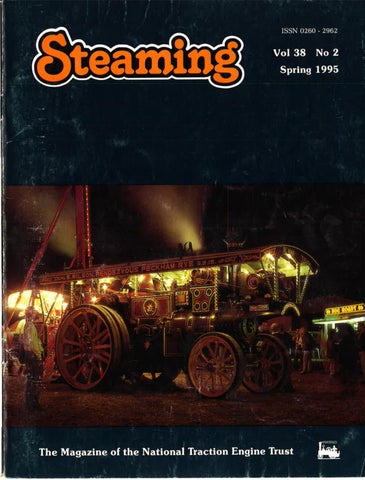
Cover An effective evocation of fairgrounds past. Burrell scenic showmans engine 3938 QUO VADIS works the hours of darkness at the 1993 Great Dorset event, admirably captured by photographer John Mound. 63
Trust News From the Chairman The winter is, hopefully, nearly over and most of it seems to have been spent trying to resist yet further moves to restrict our activities with engines. These consist of various attempts to tax us off the road and there seem to be further rules concerning the emission of smoke. We have been in touch with the Dept of Transport, DVLA and the Treasury and are hopeful of meeting with them jointly with the Federation to put our case for recognition of our light use and historical and heritage importance. Most traction engines are taxed as agricultural machines and that is not a problem, but rollers and lorries could be taxed at higher rates and we are trying to resist this. It is almost certain that some payment will be levied, but we hope to see it reduced from that proposed. The continuous taxation proposal would be unfair to long term restoration projects and I cannot see how one could produce insurance and MoT test certificates in such cases. Again we are resisting the proposals. However we must also avoid being too vocal and thus making the authorities think that these slow moving, ironwheeled vehicles would be better out of the way. You will read in the letters pages the concern that we are not working hard enough to ensure that engines stay on the road. We shall fight any move to restrict us and at present we are not aware of any. But it does seem that slow moving vehicles of whatever sort are vulnerable to rear end collision on dual carriageways and we must all act responsibly so as not to upset other road users. In 1993 I was proud to he part of the team that hauled a railway loco through Dorset to the Steam Fair on a bank holiday weekend. The police were impressed with our efforts and very good publicity was gained. We sought their consent and they controlled the traffic. If we had not done so the trip would have probably been stopped. I was recently reading the programme for the 1975 Appleford to 64
Nettlebed run, when engines from all over the country, representing most clubs, took part. I feel it to be time to repeat it and shall raise the matter in Committee as soon as possible. Any road trip should be preplanned to find water pick-up and parking places at points where following traffic can pass. That will keep the motorist happy and probably result in a photo opportunity for him and then we have another supporter rather than an angry delayed driver. There is good news; boiler inspectors are using the Trust's Engine Code and their companies are coming into line. I congratulate the Engine Owners sub-Committee for the long
hours they have spent in preparing and bringing the Code to a successful conclusion. Let us now all look forward to a good rally season in 1995. (Richard Sandercock, Chairman)
Rally Organisers Column Rally Organisers sub Committee The rally season will soon be upon us and we all hope for a good year and
68
From Alan Martin's Collection
Burrell 7hp compound road locomotive 3651 of 1915 EARL KITCHENER is fortunately surviving in preservation and is currently undergoing boiler work at Bicknells. Like so many Burrell road locos, it was subsequently converted to a showman's engine and spent most of its working life as such, in the ownership of R. Edwards & Sons of Swindon. Here the road loco is in the ownership of E. Hill & Sons, brickmakers, also of Swindon, about 1916. The paper 102 number below the front coupling was probably a convoy identification or permit for Government work during World War 1. Spring 1995
STEAMING
good crowds to support events. Rally organisers will find a new coal supply service advertised in this issue (on the rally voucher centre supplement). The Union Coal Company are offering to deliver and distribute the coal to the engines at the rally. Smallshaws, who have supplied many rallies and engine owners in recent years, are pleased to advise that their prices remain the same as last year. A further series of items which we make available for use on the rally field are the warning signs — danger, fire etc. They are advertised in a panel in this section, please let me know your requirements in good time for your event. Many Safety Officers have found the Trust's Insurance Disc Scheme has made their life easier, as a great number of engine owners now assist them by displaying a disc on their machine. Engine owners land I hope they all read this column — eventually!) who are not inclined to use a disc should spare a thought for the rally organisers who are usually hard worked at an event. Without them, we have no events, so please help in making their tasks easier by participating in the disc scheme. Dave Smith, Trust Insurance Officer, will provide a disc within a very short time, if you send him your relevant paperwork. I am pleased to note that the model engineers amongst us are also operating a scheme for their members. The Rally Organisers Spring Conference will have taken place by the time you read these notes. This twice yearly Conference is now accepted as an excellent forum for the exchange of ideas — and problems! I urge rally organisers who have never attended to come along and see how the Conferences work. This year a new activity was a leaflet swap which will hopefully prove to be a useful extension of publicity to everyone's advantage. I hope you all have a successful and safe rally season. (Andrew Semple, chairman, Rally Organisers sub Committee)
Engine Owners Column Engine Owners sub-Committee This year's driving course, to be held at Murton Park, York has been well subscribed with around thirty participants expected. There is still time for some late entries to be accepted for the event on 13/14th May: please contact Sylvia Dudley (address inside front cover). We shall STEAMING Spring 1995
look forward to meeting some local engine owners who will be assisting our regular instructors. We are particularly pleased that Rob ShorlandBall has agreed to be the guest speaker for our Saturday evening gathering. It is now well known that engine owners should have a written code of practice for any engine they are using in steam, and I am pleased to report that the Trust's Engine Code of Practice is now widely accepted. Can I remind members that this Code is available from Sylvia Dudley at a price of £17.50 postage and packing paid, and should you have more than one engine the extra record and log sheets only cost £2.50. If you have any problems with regard to insurance and inspections, or for that matter, anything else on engine owning matters, please don't hesitate to contact me. It only remains for me to wish all members a trouble-free and enjoyable rally season. (Michael Davies, chairman, Engine Owners sub-Committee)
FBHVC News At the time of writing, 21st March 1995, the long awaited consultation document on the proposals for continuous licensing has still not been issued. This was originally expected by the end of last year, and then in early March. As soon as the document is released the Committee of the Federation of British Historic Vehicle Clubs will be meeting to consider the content and formulate policy on the action required. Trust Chairman, Richard Sandercock, and I will be in close liaison to represent the interests of members and we hope to attend a 'workshop meeting' at DVLA in the near future. Since the Chancellor's autumn Budget there has been much concern about some of the proposals to change a number of the classes of vehicles for the purposes of Vehicle Excise Duty (VED). I quote from the FBVHC's legal advisor: 'The thought behind the proposals seems to be a simplification of the various different rates of duty which at present all have to be individually altered whenever a change takes place. There is to be a 'general rate', a 'basic goods rate' and a 'general haulage rate'. Rates for special classes of vehicle will, in future, be expressed as a percentage of one of these rates. 1. Cars and vehicles not otherwise specifically provided for. Post 1946 attract the 'General Rate'. Pre 1947 attract the 'Reduced Rate' which will be 50% of the general rate.
Officers and Committee 1995 This column lists, for the information of members, the Officers and Committee of the Trust for 1995. The addresses/ phone numbers of those with special duties are given inside the front cover of each issue of this magazine; others may be contacted by phone or via the General Secretary or sub-Committee Chairmen. Names marked with an asterisk* are appointments by the Committee and are non-voting positions in Committee. President E.A. Fillmore Vice Presidents E.E. Kimbell R.N. Parrott Chairman R.J. Sandercock Vice Chairmen Mrs Sylvia Dudley A.J. Semple (Rally Organisers chairman) General Secretary Mrs Susan Jackson* Treasurer J.T.G. Harris * Hon Solicitor T. Driver* Hon Safety Adviser J.M. Newnham* Membership Secretary J.R. Cook Hon Editor, Steaming R.E. West Hon Sales Officers Colin and Val Brown* Hon Public Relations Officer Ian Dean* The above and also: Committee J.R. Bosworth (SAC Chairman) N. Boyes (W. York, Tr 01253 811876) P. Clare (Lancs, Tr 01706 366021) M.O. Davies (Engine Owners chairman) A. Fookes (Essex) B. Gooding (Surrey, TT 01483 274004) R.T. Herring (Oxford, Tr 01869 277410) I.D. Howitt (W. Yorks) B. James (Norfolk, a 01328 701417) M. Middlewood (E. Yorks, vr 01262 488350) S.J. Parrott (Bucks, TP 01844 201282) R.J. Pierce (Kent, Tr 01732 850853) K.D. Shakespeare (West Midlands, 'a 01527 575003) O. Slade (Devon, te 01271 812181) D.S. Smith (Insurance Officer) J.R. Smith (Rally Authorisation) M. Ward (Notts, IT 01623 8828561 Representatives R. Mattless (NV Tractor & EC)" Auditors (and registered office) Hamiltons, Forum House, 1-6 Millmead, Staines, Middlesex TW18 4UQ
65
Sub-Committees 1995 This column lists the members of the Trust's sub Committees for 1995. Names marked with an asterisk" are co-opted; others are elected Committee members or appointed Trust officials. Addresses/phone numbers of the chairman appear inside the front cover of each issue.
Rally sub Committee A.J. Semple (chairman) J.R. Cook P. Cooper* T. Evans* R.T. Herring B. James M. Lee" J.H. Smith K. Stott" M. Yardley*
Engine Owners sub Committee M.O.Davies (chairman) R. Back* I.K. Barraclough* Sylvia Dudley J. Glaze" I.D. Howitt M. Mason* J.M. Newnham" R. Pierce R.J. Sandercock D.S. Smith R.M. Vickery* M Ward
Technical Board J.M. Newnham (chairman) H. Pounder* R. Swithinbank•
Thus in future, the reduced rate will automatically follow any rise in the general rate. 6. Traction Engines. Those that were previously charged as agricultural engines in the old 'Special Machines' category (E35) appear to be removed into the new 'Special Concessionary Vehicle' category (25% of the general rate) (but without further reduction if pre 1947). 'Agricultural Engine' is not defined in the Vehicle Excise and Registration Act 1994, nor in the Finance Bill, so there should be no difficulty unless an over keen licensing officer wrongly tries to import the new definition of 'Agricultural Tractor' with its 'solely for purposes of agriculture' into the agricultural engine class. Steam wagons continue to be goods vehicles, which if not used for hire or reward, revert to the general rate or the general reduced rate. Special and Rollers 7. Road 66
Vehicles. The old 'Special Machine' class (£35) is now replaced by a 'Special Vehicle' class which will include vehicles which are over 3.5 tonnes in weight and are digging machines, mobile cranes, works trucks and road rollers. They will pay at the basic goods vehicle rate (£150). Heavy road rollers have been removed from exemption directly into this class. It seems that preserved steam rollers were not considered and I suggest the best way forward is to seek a derogation Ica them mirroring that fur goods vehicles in Paragraph 16(11(b) of Schedule 1 of the Vehicle Excise and Registration Act 1994. By that derogation vehicles are excluded when they are not used for hire or reward or for or in connection with a trade or business. When thus excluded they revert to the general, or general reduced, rate. (See 1 above)' An answer from DVLA is awaited in respect of a derogation for steam road rollers. It has been suggested independently that a special class be introduced for preserved vehicles. The FBHVC does not support this idea because it is felt that it opens the way to restrictions on usage being imposed. (Peter Smart)
Insurance Officer's Notes As engine owners complete their winter maintenance work, make dates in their diary foi boiler inspections and generally start to prepare for the new rally season I would like to issue some gentle reminders about the insurance requirements for the NTET Insurance Disc Scheme and also point out a small yet significant change in the disc format. I would also like to point out to owners some pitfalls that can be encountered during the period when major repairs are being undertaken, and also when carrying out running repairs during the season.
Firstly, the reminders: • In accordance with both the NTET Engine Code of Practice and the Rally Code of Practice, every engine being used in a place of public access is subject to regular Cold and Hot inspections by a qualified inspector/ surveyor and a certificate must be issued for each inspection, stating the results. • Public liability insurance is required for protection against boiler explosion and other incidents occurring in a public place,
minimum £1,000,000 cover. • Sparks and Ashes insurance is required, minimum £100,000
cover. • When an engine is used where the Road Traffic Act is in force a Certificate of Road Traffic Act — Third Party Insurance is also required. (The amount of Third Party cover has no limit under UK law.) Those owners obtaining their insurance through John Scott & Partners will be covered for all the appropriate levels of insurance and they will be issued with an NTET Insurance Disc at the time of paying must be the premium which accompanied' by valid hot and cold inspection certificates. Those owners who have arranged insurance cover using agencies other than John Scott should apply to me for an NTET Disc. The application must be accompanied by: • Valid certificates of inspection (hot and cold) • Valid proof of payment of current premiums and proof of extent of Explosion Boiler for cover Insurance, Sparks and Ashes insurance and, where relevant, a Cei LifiCate of Road Traffic Act — Third Party Insurance. • A stamped addressed envelope. I will issue the disc and return your documents, normally within 3 to 4 days. If more uraent attention is required please say so in writing and I will endeavour to move more quickly if at all possible. Now the change: from the start of the 1995/96 disc issue the owners name will be included on the Insurance the owner; Disc — not the keeper This has been undertaken in order to give clearer indication when a change of ownership takes place and to encourage new owners to apply for NTET Discs in their own name. Remember a previously issued Insurance Disc becomes invalid for the new engine owner and non-compliance may result in being turned away from a rally field.
And last but not least — a warning of pitfalls: following the recent experiences of a small number of engine owners when carrying out major repairs, I feel that I should point out some potential trouble spots that, given proper forethought, can be avoided. I refer to making proper provision for the boiler inspector's work. It is very often the case that the boiler inspector was party to the discussions that initially identified the need to carry out the major work that I refer to. It is also likely that work will proceed on the loose understanding that the inspector will turn up periodically and carry out inspections and tests as appropriate. He may also Spring 1.995
STEAMING
The revised NTET Insurance Disc which will be issued for 1995/96; the colours are red with white spaces and black printing.
Steam Apprentice Club
have advised on the nature of repair, indeed he may produce, or insist on having produced, drawings for the work. Stop there! At what stage did we obtain a quote and reach agreement on how much his services were going to cost? Heard this one before? Yes, it is easy, as many have found to their cost, to assume that this service is a normal extension of the insurance service. My advice is simple really. Having thought through the nature and amount of work to be undertaken then, at the same time you are getting written quotes from your boiler repairman, obtain a written quote from your boiler inspector — but be prepared for a shock. He may not be cheap (£80 to £100 per hour are some figures I am being given) and in addition some engineering insurance companies are now charging a work assessment fee (up to £185 — for what I don't yet know). In addition one company is asking for a substantial deposit before taking on the inspection work. I should very much like to hear from owners who have recently undertaken major repairs, in order to obtain an understanding of the range of inspection costs being incurred, so that I might determine if we need to talk to the insurance industry in a bid for greater fairness and consistency. My last word is to remind engine users that if repairs are effected to any part of the permanent steam pressure system, i.e. boiler casing, firebox walls, tube plates, tubes, etc, then the boiler inspector must be advised in order that he is given the opportunity to inspect or sanction the work to be done. It is not only courteous, it helps maintain a proper working relationship — and it may prevent your insurance from becoming invalid. I hope my comments are helpful and I look forward, with you, to another great steaming season. (Dave Smith, Insurance Officer)
STEAMING Spring 1995
The training weekend for older Steam Apprentices, mentioned in my notes in the last issue, eventually had to be arranged for the weekend of 15/16th April. There may still be time to make a last minute booking if any parents or friends of Apprentices are reading these notes soon after receiving this copy of Steaming. The event, for insurance purposes, has to be restricted to those over the age of 14. Adults may stay in caravans on the site at Klondyke Mill, Draycott-inthe-Clay, near Uttoxeter, Staffordshire and join in the evening meal and entertainment — a showing of the film IRON MAIDEN (cost of this, £3.501. Please contact me by phone (see inside front cover). I am still hoping more adults will come forward to help organise liaison between Apprentices and engine owners at rallies during the coming season. If you think you may be able to help in any way I would be pleased to hear from you — again, my address is in the panel inside the front cover of each issue. (John Bosworth, chairman, Steam Apprentice Club)
Trust Exhibition Unit The Trust's Exhibition Unit, which serves to publicise the Trust and its work to all on the rally fields, and offers to members a Trust Sales outlet for books, videos, T-shirts etc and the opportunity to meet Committee members and officials, will be present at a large number of events during 1995. In addition to the unit being manned by Committee members, we would like to encourage the Trust membership in general to participate in the running of it — an excellent way of becoming more deeply involved with traction engines, rallies and the running of the NTET. Anyone interested in helping on one or more occasions should contact me in the first instance for further details. Arrangements are being made for the unit to attend the following events in the first half of the season: May — 6-8 May Day Steam, Manchester; 13/14 Bill Targett Memorial Rally, Wolverhampton; 20/21 Tailington, Stamford; 27-29 Strumpshaw Hall, Norfolk. June — 3/4 Little Wymondley, Stevenage; 10/11 Rocket Site, Doncaster; 17/18 Parham, West Sussex; 24/25 Isle of Man. July — 1/2 Elvaston Castle, Derby; 8/9 Chester-le-Street, Durham; 15/16 Masham, Yorkshire and also a second unit within a marquee at Weeting, Norfolk; 22/23 Netley Marsh, Southampton; 29/30 Uptonon-Severn, Worcestershire. Please refer to The Rally List 1.995 for full details of these events. The late
NTET Coal Supplies The Trust has again arranged low priced coal for use by rally organisers, clubs or individual owners In association with Arscott Collieries, Coal Factors and Merchants, Gateway Chambers, 26 Castle Street, Shrewsbury SY I 2BJ. • • •
pre-packed 25kg plastic bags, or bulk supplies available haulage can be arranged to any rally site ring John Watkiss on 0743 362482 to discuss your requirements and haulage cost, anywhere in Britain
DRY STEAM COAL
CWM BARGOED COBBLES
120 per tonne f 12 3 per tonne ex Tyn-y-Wern ex Newtown, Powys (prices include £3 pallet charge but exclude VAT) Cash on collection or pre-payment Please order early to obtain supply of steam coal; bituminous also available
67
summer rallies to be attended will be listed in the Summer issue of Steaming. (Robert Herring, Exhibition Unit organiser, IT 01869 277410).
valuable opinion formers aware of the valued work of the Trust and its members in keeping alive part of Britain's industrial and social heritage.
The Rally List 1995
Discount Vouchers for Rallies
As mentioned in our last issue The Rally List 1995 has taken on a new format this year and has been printed and sponsored by the publishers of the Old Glory preservation magazines A copy of the List is included with each member's copy of this issue of Steaming, but the main benefit from the change is the hugely increased numbers of the leaflets which will be seen by general enthusiast public — via the March issue of Old Glory on the high street newstands, the local tourist office outlets and the Trust's own Exhibition Unit on the rally fields. We apologise to the organisers of the Knowl Hill Rally, which event was inadvertently omitted from The Rally List at the printing stage. This popular rally is most assuredly taking place as usual; details are: August 12/13th — Knowl Hill Steam and Country Show, Bottle Meadow, Knowl Hill, Berkshire. Mrs S. Baker, Bramble Cottage, Star Lane, Knowl Hill, Berkshire RG10 9XY (Tr 01268 822402).
Public Relations Officer Ian Dean, from Sidlesham, West Sussex, has been appointed the Trust's Public Relations Officer, in succession to Stephen Foster, who resigned in February 1995. Ian was founder director of Amberley Chalk Pits Museum, then tourism manager for Arun District Council and managing director of the Mid Hants Railway. More recently he has been engaged as a freelance consultant in the preservation world and as arts and heritage consultant for Roger Quinton Associates in West Sussex. He is also organiser, under the Sidiesham Steam banner, of the successful Downs Steam rallies near Petersfield. Ian considers the role of the Trust PRO is to create a greater awareness of the work of the Trust, by making non-member enthusiasts more aware of how the Trust supports their activities; by creating a greater public awareness generally, and by keeping
68
We are pleased to present as a centre supplement to this issue a cpripc of discount vouchers which will enable members to have entrance on advantageous terms to a large number of rallies on the Trust's Rally List 1995. I am grateful to all the event organisers who have accommodated this idea and trust that their rallies will benefit from an increased overall support from our readers and their families or friends. Also I hope that Trust members will see the vouchers as an encouragement to attend more events and as a useful addition to their membership. Such has been the support for the scheme that at the last minute it has been necessary to split the events over two issues — those to be held before the middle of July are in this Spring issue, with rallies in the second halt of the season (the last weekend in July onwards) appearing in the Summer issue, which should be with members about the second week in July. There is still time for further rallies to be included in the Summer issue — interested organisers should contact me for further details. (Smudge Smith, address inside front cover)
RALLY SAFETY SIGNS DANGER — beware of moving vehicles etc — yellow with black lettering Unauthorised persons prohibited etc — red with white lettering FIRE POINT — red with white lettering Printed on rigid plastic boards
each sign Ins VAT, postago ES por order From: A.J. Semple INTETI Unit 6, Mynd Industrial Estate Church Stratton, Shropshire SY6 6EA
a
NTET Sales Elsewhere in these columns you will find a list of the rallies and events which the Trust's Exhibition Unit will be attending. May we remind all members that the unit displays and stocks the full range of items that are on the Mail Order listing at the rear of each issue of Steaming. Do please take advantage of seeing what we have to offer. (Colin and Val Brown, NTET Sales Officers)
Affiliated Clubs East Anglian Traction Engine Society The second Steve Neville Road Run, named for the East Anglian club's late President, is to be held on 23rd April 1995. A new start venue is in Ashdown Road, Saffron Walden and
the route then passes through the town and goes on to Newport and then Wimbish for a lunch stop. Returning to Saffron Walden's Market Square for the afternoon enables participants and onlookers to support the Mayor's Charity — this year the St
John Ambulance Brigade funds. Further information can be obtained from Mick Tuxworth 2r 01799 599555. (EATES) Sentinel Drivers Club This year the Sentinel Drivers Club
is organising a number of events centred around that marque. A large entry of all types of Sentinel will be supporting the Downs Rally near Petersfield, Hampshire on 1st/2nd July and the SDClub marquee will display photos, parts and video films, with members on hand to answer questions. At the end of August a group of Sentinel products will again tackle their makers test run to the Horseshoe Pass summit in North Wales. The varied and spectacular route runs on the old A5, through Chirk and on to
Llangollen before making the long and gruelling climb to the top of the pass. This is on 26th August and after lunch at the summit cafe the participants return to join in the County of Salop club's annual rally at Onslow Park on the 27th/28th, having covered in excess of 70 miles on their road run. The Sentinel Drivers Club consists of engine owners, drivers and firemen (both from working days and present times) and enthusiasts. All are welcome to join the Club and further details can be obtained from Mick Tuxworth, IT 01799 599555 (SDC). Spring 1995
STEAMING
NTET Sales We have recently been pleased to supply several affiliated clubs with bulk purchases of items from our Mail Order list for use as raffle prizes at monthly meetings etc. Social secretaries may like to know we can offer a 10% discount to Trust affiliated clubs on any order in excess of £50, for any items from the list at the rear of each issue of Steaming. The only condition is that the order is collected; there are many options such as from the sales office in Luton, from the Exhibition Unit on the rally fields, or from Trust Conferences or AGMs. Please contact Colin or Val Brown to discuss your requirements — a 01582 33971.
Obituary Roy Taylor I am sad to report the death in December 1994, at the age of 65, of member Roy Taylor of Cheltenham. He was not an engine owner but, like myself, preferred to drive a camera and by so doing he became a familiar figure on rally fields. My friendship with Roy commenced in 1968 when we met at a small rally on the outskirts of Gloucester, and since then we have travelled far and wide on most summer Saturdays. I have seen many hundreds more steam engines as a result of our close friendship and I shall miss his company. Roy leaves a widow, Barbara, and a son and daughter. (John Champion)
WORLD'S 1411/IIR The outdoor entertainment weekly incorporating
Preservation World Place a regular order now with your newsagent for your weekly copy of the World's Fair and keep up to date with news, rally reports, club events and much more within the world of steam preservation. And if you have something to sell or an event to promote, advertise it where it will be noticed in Preservation World. For advertising and subscription details contact: The World's Fair Ltd. P.O. Box 57, Daltry Street, Oldham OL1 4BB. Telephone: 0161-624 3687. Fax: 0161-665 1260
JOIN THE FOWLER STEAM SUPERHIGHWAY * ATLAS + TRANSFORMER LOAD
Be wise before the event... The Trusts
CODE OF PRACTICE for the better organisation of Steam Traction Engine Events Is essential reading for all rally organisers and safety officers
Price £3.00 each plus £1.50 postage
from — Mrs Sylvia Dudley 12 Hlllway Woburn Sands Milton Keynes Buckinghamshire MK17 SUL
STEAMING Spring 1995
* TITAN + OTHER ENGINES on the road over the Malvern Hills and on display at: EASTNOR CASTLE LEDBURY HEREFORDSHIRE 13/14TH MAY 1995 12 NOON - 5PM ENQUIRIES 01531 633160
69
Dear jubb A glimpse of the trials and tribulations of a road surveyor in North Yorkshire in the 1930s. Derek Rayner The discovery in North Yorkshire of a quantity of old correspondence and notes enables us to take a brief look at the everyday tasks — and problems — of those engaged on the repair and improvement of roads in Wensleydale, North Yorkshire in the early and mid 1930s. Most of this archive material is a sequence of copy letters and originals of correspondence between Mr Jubb, the North Riding County Council's District Surveyor at Askrigg, and T.W. Metcalfe, his Area Surveyor based at the Richmond office of the Highways Department, No 1 Area. Only a portion of the story directly concerns what will be our prime interest, the steam roller, but the whole gives us an interesting glimpse of how rural roads were maintained sixty years ago. Perusing the papers, it becomes evident that Mr Jubb was not the most organised of men so far as office work was concerned; he received many reminders to send in this or that return which he had forgotten, but perhaps he was a practical man, more at home supervising the gangs under his care where the work was going on. Among the more mundane duties Jubb had to undertake were the completion of tar boiler returns on a weekly basis, indicating where the boiler was located and where it had come from; the quality of tar used; the quantity of tar and also the description and size of the chippings associated with the job. He was also responsible for ordering tar and chippings for his men; overseeing the work done by contractors (in mid 1933 both D. Wood of Yeadon, Leeds, and Taroads of London were working in the area►; checking the hours put in by various steam rollers on hire; sending in a weekly Hired Roller Report; taking samples of chippings being used by contractors and generally supervising activities in the area under his control. He was, for example, asked in April 1932 about a water cart which was supposed to belong to driver Burney's 70
roller and which had been standing at Ackrigg for a Inns time_ Mr Jubb had to confirm this and advise if the cart was in good serviceable condition. For various purposes, including road repairs and costings, all roads were given classifications. Main roads were 'A' category, the less heavily used highways in the county were 'B' class roads, whilst very minor roads having only minimal use were generally known as unclassified roads, thus gaining a U category. All then had a suffix number; the system, in fact, by which we often refer to roads to this day. Many of the roads mentioned in this article were unclassified, with numbers which served to identify them to the highway officials and staff, though these have not come into general use in the way A, B and now M letters have. The area which Mr Jubb covered included Hawes and in October 1931 he was requested to detail work carried out for a private contract at
Hawes Auction Mart — what the quality of tar used was and the amount of charges associated with the cartage of the tar from the railway station to point of delivery, as well as to what road and work the quantity of tar was originally allocated. On top of that, he also had to account for the coal used in the tar boiler and say what road and work the tar boiler was allocated to whilst working at the Auction Mart. Life was seemingly never dull: there were complaints to answer about slow progress of work on certain stretches of road: an unsightly collection of tar barrels which had obviously overstayed their welcome as far as the locals were concerned — they wanted them moving and would Mr Jubb please arrange. Also, the use of two different types of chippings on one job when there was apparently sufficient quantity of the one type to complete the whole job caused some concern. It was obvious that Mr Metcalf was not pleased with his District Surveyor's supervision of this work, between the hamlets of Gayle and West Shaw, and he noted the mixing of chippings had completely spoiled the work; the men's supervisor must be instructed to see that it did not occur again. Messrs Wood, who were to blame, explained the colour difference by having to obtain chippings from two locations as one quarry could not supply the required quantities in time. One nevertheless gets the impression that poor Mr Jubb
Atkinson's Fowler roller 14289 of 1930, a 10 ton single, class D2. The picture was taken at Lunds, between Hawes and Kirkby Stephen; the crew are Bill Balderson (left) and Fred Burgess, the driver, on the right. (collection A.R. Craske) Spring 1995
STEAMING
should not have allowed the firm to continue with what turned out to be, in the eyes of his superior, a less than satisfactory job. Woods' drivers had obviously been allowing their rollers to transgress, because complaints had been made about breakages to flags (flagstones — used for pavements). Mr Raine at Nappa Scar was mentioned and also Mr Dinsdale at Askrigg. According to the correspondence, both these complainants were to receive personal visits from Isaac Wood. the principal of the firm, to discuss replacements and reimbursement. Underpayment by the Council to Woods in respect of grouting in April to June 1930 using roller U8709 also gave cause for concern and Jubb was asked to carefully scrutinize the previous returns of which he had copies and quickly confirm the details. Any incorrect entries were to be amended and each separate alteration had to be initialled. Also on the paperwork side, Mr Jubb made some returns in respect of tar spraying by D. Wood & Co, direct to the County Headquarters at Northallerton at the end of November 1931. As a consequence, the No.1 Area office at Richmond, who were obviously responsible for equating work claimed by the contractor with confirmation from their own staff, could not make the two balance. Mr Jubb was admonished for his oversight and it was clear that a large amount of effort had to be put in to resolve the discrepancy. Mr Jubb's poor quality paperwork and his task to correct the mistakes of others let him down again in December 1932. A strongly worded letter from the NRCC County Surveyor's office at Northallerton was sent to Metcalfe asking him to personally vouch for, or correct if necessary, the various items book in relation to the use of Atkinson's roller AJ7418. Entries had obvously been made on the weekly return in incorrect columns and rather pleasingly Mr Metcalfe sorted it out with County Hall himself. What he might have said to his man Jubb about this mistake is not recorded and there appears to be no copy of a supporting letter in this instance. Of interest might be some prices charged by Wood for work in the Leyburn RDC area in late 1929. To tar growing at Newton-leWillows as per Contract, including widening of six corners; 7890 yards at 3s ld (15p) = 1216.7s.6d. To Day Work, 3 men and Roller; 41/2 days, Roller at 26s (E1.30) per day and Men at 11d (5p) per hour, STEAMING Spring 1995
The Steam Rollers Throughout the paperwork only brief references are made to the machines being used at the time. However in many cases the registration number was used as a reference, thus allowing us to identify the engines through Alan Duke's Road Locomotive Society lists, though some of Jubb's numbers seem to be wrongly put down) Rollers from the North Riding County Council's own fleet were used in the Askrigg area, but a greater number appeared from contractors, either as part of a complete resurfacing contract, or from Eddison just to add to rolling capacity. North Riding C.C. Central Depot, Boroughbridge Road, Northallerton, North Yorkshire • H06837 registration believed to be an error for H06397 • H06397, Wallis & Steevens 7833 of 1925, 6 ton Advance New to Aysgarth RDC, became NRCC fleet No 2010. Now preserved. • PY3129, Aveling & Porter 11202 of 1925, 10 ton compound New to Startforth RDC, became NRCC fleet No 2008. Last licenced 12/57, disposal unknown. D. Atkinson, The Grotto, Burton-on-Ure, Masham, North Yorkshire • AJ7408 registration believed to be an error for AJ7418 • AJ7417, Fowler 11770 of 1909, 12 ton single, class D2 New to Atkinson, 4/09. Tar spraying equipment fitted about 1930. Last licensed in 1957 by Yorkshire Hennebique Concrete Co. • AJ7418, Fowler 14289 of 1914, 10 ton single, class D2 New to Atkinson, 5/14. Tar spraying equipment fitted aboOt 1930. Last licensed in 1950. • AJ7419, Fowler 14295 of 1915, compound class D2 Ex D. Wood & Co, Yeadon. Tar spraying equipment fitted. • UB6623 believed to be an error, or a motor roller; county registration records no longer available for checking • VN4568 footpath roller but county registration records no longer available to find maker etc David Wood & Co Ltd, Bayton Lane, Harrogate Road, Yeadon, Leeds • U8707, Fowler 13935 of 1916, 10 ton single, class D4 New to Wood, 6/16; last licenced 12/56, scrapped by 9/59 • U8709, Fowler 15589 of 1921, 10 ton single, class DN New to Wood, 4/21; tar spraying equipment fitted. Now preserved • NW3329, Fowler 15853 of 1923, 10 ton single, class DN1 New to Wood, 3/23; tar spraying equipment fitted. Last licenced 1961 and scrapped 1963-1965 Eddison Steam Rolling Co Ltd • FX6936, Aveling & Porter 4971 of 1902, 10 ton single New to Eddison, fleet No 108. Last licenced 1942, scrapped by 1946. • TA865, Aveling & Porter 8171 of 1914, 12 ton single Eddison fleet No 357, ex Newton Abbott RDC. No disposal detail known
8 hours per day = £10.16s.0d. Total £1227.3s.6d Complaints dealt with included one in April 1931 from Reverend G.T. Whitehead of Flanders Hall, West
Burton. He was not happy with the way in which the recently tar-sprayed road at Eshington Bridge had 'bled' (tar had oozed through the chippings), and thought that unless something 71
David Wood, founder of the firm, stands by one of the firm's vans in 1911. It seems rather grand for a site van — perhaps it was for a contractors exhibition or the like, or one of their own more prestigious contracts. (collection A.R. Craske)
was done quickly the problem would be accentuated considerably with the advent of the warmer weather. Metcalfe's reply said that when he had been over the road in question the previous Thursday it was raining and he did not notice a problem; however, he would see what could be done. The cleric complained again about a similar matter in the June — this caused Mr Jubb to be reprimanded by his superior, who in his reply to the Reverend admitted he was not happy about the supervision of the roads in Aysgarth District and that he had had a long talk with Jubb. Some improvement was expected in the future. Also, the Leyland Stone & Macadam Company at Harrogate were reprimanded as a result of a quantity of chippings sent to Staggs Fell. They responded by saying they were taking up the matter with the quarry and would do all in their power to keep the dust out of chippings in future. Obviously the dust content in the load in question was excessive. There was also some confusion between this firm, and Woods and the Council regarding a quantity of chippings tipped ready for use on the Askrigg-Worton-Thornton Rust and Aysgarth Road (U5). The spraying programme forwarded to Woods had indicated they had four miles of this road to surface, tar and chip and so Leyland were instructed to tip 40 tons of '/% in chippings along the four mile length. On one of his tours of inspection Mr Metcalfe had obviously seen these and queried the firm's 72
instructions. There was clearly an oversight on someone's part (although Jubb's name was not mentioned) for Metcalfe's contention was that the programme showed only twn miles of road to be surface tarred. In addition, the Woods roller was noted pulling up the surface (scarifying) of the length between Thornton Rust and Aysgarth. This has apparently only been sprayed some eight months previously (in the September) and was not intended to be done in the 1 931 season. However, Mr Metcalfe graciously agreed to take over the chippings which had been tipped and also to pay for the work undertaken by the Wood roller whilst working there. The implication of this response was the misunderstanding may not have been of the Contractor's
making. Another complaint came from the Steward of the Manor of Bainbridge who was not too pleased to see that chippings had been tipped on the village green there, ready for use on the adjacent road. Metcalfe instructed Woods that the County Surveyor desired them to be removed forthwith and suggested to the firm that their men be transferred to Bainbridge to do the job there, thus obviating the need to cart the chippings twice over. This was obviously done very quickly and Woods reported back by letter within three days that the whole of the chippings placed by them on the village green has been removed — their letter being signed by Isaac Wood himself. A further suurue of concern was In connection with barrels of tar being received in a damaged condition. The firm concerned, Arthur Newsome Ltd of Burley-in-Wharfedale, were taken to task about this and, perhaps not surprisingly, indicated in their reply that the barrels were all right when they left their works. The style of this firm's letter heading is beautifully decorative but typical of the era. Some potentially sharp practice was picked up by Metcalfe with his chief the R..perintend.nt of Plant and Transport at Northallerton, concerning Harry Burney who drove the 'light' steam roller. Burney apparently regularly claimed expenses for both lodging and travelling. Someone obviously shopped him, for it was pointed out that Burney was a single man with no permanent home address in the County (perhaps he stayed in the living van or was sleeping rough), and it was suggested that he should secure lodgings within a reasonable distance of site of his work. As a result of this, the travelling allowance of 3s. (15p) was deducted from the previous
r • IWO" VO VIM ADMINAtTY AHD Oft.,0100,,11 „ -... sc. m. • • min r—men.,
rm.
...
%INTIM. AWl' MJAIN EMUU,ON.
Gm05.1.11n.Alac 1,416 01.
WGC.
/4/;;X.
NOTICE.
UrPtun Esq., No.1 .fro urveyor, Area S yor.p Office, Rieke Yorks.
JA) ;;:r"Re Monday July 6th
1,9 31.
Spring 1995
STEAMING
week (October 1931) and presumably was not paid again until Burney's circumstances changed. It was not only Mr Jubb who frequently came in for criticism. Burney was again mentioned in March 1933, and received reprobation from the Superintendent of Plant and Transport for having a dirty steam roller. Unfortunately it was not recorded which specific roller it was but Burney's excuse was that he was unable to obtain supplies of paraffin for cleaning and in any case, he didn't get any standing time (that is, when the roller wasn't actually rolling) to get chance to clean it. It's perhaps not surprising that it was Jubb who was charged with obtaining the necessary paraffin to enable Burney to clean his roller and Burney himself received a personal letter, a copy of which survives. Because it was the second time he was found with a filthy roller, he was placed on a fortnight's probation. He was told that if, on the Superintendent's next inspection, the roller's motion work was not spotlessly clean and efficiently oiled, the valves and cocks securely packed, footplate cleaned and the whole appearance of the roller brightened by polishing, he would be dismissed. No time would not be accepted as an excuse, as other roller drivers found time to maintain their charges in perfect condition and there was a long waiting list of skilled drivers seeking appointment. The implication of all this was that the roller concerned was a NRCC machine rather than a contractor's engine — we would not expect a Council official to get worked up over a roller which did not belong to them. A later reference was found in the Resurfacing Returns which connects Burney to a 6 ton Wallis & Steevens Advance roller 7833 (HO 6397). A subsequent letter indicated that Burney had been requested to take his roller to the Thirsk District for further work and his poor performance in respect of the upkeep of his machine was reported to the Thirsk District surveyor, J.W. Lupton, prior to his arrival. Any subsequent happenings, being outside Askrigg district, are, of course, not recorded in the correspondence. Around Christmas 1932, Mr Jubb got into trouble for obtaining a quantity of coal for the hired roller(s) at a price seemingly in excess of the maximum stipulated some twelve months or so previously by his superiors. Several letters passed between County Hall at Northallerton, Richmond and the luckless Jubb who was eventually set the task of seeking a reduction in an account rendered by STEAMING Spring 1995
• WOOD ac " CONTRACTORS
YEA DON, NEAR LEEDS, !)nroll 27th. 19
00.
Dear 01,.
P. Your with ', par.) in any School , frn,, 1° sty
d0M00., it :71_1 1 he
o' ,ur
We have no inSormation narona runnins into A Fate near Aysporth
OA,Yinr, road material °n° b.,s ksisf! to the T.eyborn
oomn017, what iv,
letter inter, the 25th inst.
hs,renod.
hes caused this Store t Macadam
our Mr 7"' "I" 0e1.0 en qUir1 es
•
• try and Pied out
We her to remain, Palth•olly Yours.
,4 ', PrO L, I.; (,
c),L) fay co,
.
. Metenlloo Esq,
Area Surveyor, Trinity ^h amher0 RISHMOND. Yorks.
Woods' letter heading showed their rollers by way of retouched Fowler works photographs of machines fitted with the Fowler-Wood patent tar spraying apparatus. A single cylinder DN class with gritting trailer appears on the left, with a compound example to the right.
a local supplier for this coal, Silkstone Hards, at a cost of 50s (£2.50) per ton. The County Council limit was set at 30s (£1.50) and since the finest Yorkshire Hard steam coal could be delivered to Northallerton Station at 26s. 6d. (£1.32) per ton and for an additional one or two shillings a ton delivered to any railway station in the Aysgarth district, it was hard to see where the 50 shilling figure came from. Mr Jubb's reply was that having spoken to the contractor concerned, the price to him for the best quality coal was 47s. 6d. per ton; he had therefore declined to make any reduction on 50s. He (the contractor) had cheaper coals but thought the Council would only require the best. On a lighter note, a request came from a Mr King of Leyburn, who wanted to acquire twenty old tar barrels for a fire which was to take place on Penhill Beacon on 6th May
1935, presumably an event to commemorate the Silver Jubilee of King George V and Queen Mary. The County Council's reply was that since they did not own the barrels, they were unable to help and in any case, all tar suppliers charged the council a sum 10s (50p) for the non-return of such barrels. Notwithstanding, and ever helpful, the Surveyor contacted his local tar supplier, Thomas Ness of Black Banks, Darlington, who eventually agreed to supply the enquirer with twenty damaged barrels at 1s (5p) each, buyer to collect. The council's final letter even gave Mr King directions how to find Ness's Works, located in an out of the way place south of Darlington. But it was not the unfortunate Mr Jubb who received all the complaints — in June 1932, Mr Metcalfe had reason to take D. Wood & Co to task for leaving chippings unrolled over73
Atkinson's Fowler roller 11770 of 1909, a 12 ton single, class D2. The picture was taken in Dixon Lane, Leeds, probably on hire to Hemingborough's of Leeds. (collection A.R. Craske)
night near Hawes. Obviously, the chippings had been insufficiently embedded in the hot tar by not having been pushed down into it by the steam roller. In consequence, passing traffic had caused them to fly about, perhaps with the same effect as suffered nowadays, of broken car windscreens — similar stories 60 years apart. Another complaint directed to Woods in June 1934 related to two portions of road remaining 'unrolled' — one near Stalling Busk, the other between Hawes End and Countersett. Mr Metcalfe did not understand how this could have happened, for there was a second roller there to do nothing but rolling. Unfortunately the response, whether excuse or apology, has not survived. Other complaints directed at Woods were regarding a portion of stone wall which was allegedly knocked down at Skelgill, near Askrigg by a steam roller during the course of resurfacing work. A protracted correspondence resulted between the wall's owner, the council (who did not own the roller) and Messrs Woods (who did). The latter seemed reluctant to reply. Doubt was expressed initially as to whether the roller had actually collided with the wall or whether its mere passage had caused the wall to collapse. The council's defence was that since people living in isolated farms such as the one under discussion were demanding better roads, they were compelled to use a steam roller to furnish this demand. Some twenty yards of (presumably) dry stone wall had collapsed onto the road during the rolling operation after gritting — both in front of and behind 74
the steam roller and much to the annoyance of the roller driver, who 'most certainly' did not allow his charge to come into contact with the wall. Its perhaps not surprising therefore that Woods were not inclined to give a speedy reply to the complainant, but whether compensation was eventually paid is not unfortunately recorded! A similar occurrence was when a wagon hauling road stone knocked down a gatepost at Aysgarth School. Again, the complainant held the Council responsible; which in turn passed the liability on to Woods. The latter also cleverly side-stepped the issue, for their only involvement was in supplying the roller hire and associated equipment — the blame was eventually passed to the Leyburn Stone & Macadam Company, who owned the wagon. Wood's original letter survives; the letter heading was another fine example of its time, incorporating within it illustrations of two Fowler-Wood tar spraying roller outfits, one complete with canopy, spray bar and rotating brush at the rear, the other towing a gritting trailer. In addition to attending to county roads, which presumably took up most of Jubb's time, letters reveal work was undertaken for private individuals having their estate roads repaired. Some of these were local titled people whom the County Council were perhaps only too pleased to assist land to receive payment from). A job which Mr Jubb did apparently undertake in 1933 to the satisfaction of his superior was to have provided sufficient details to enable an estimate to be prepared by Mr Metcalfe for a
resurfacing job at the local Yorkshire Penny Bank. Instructions were also given to Jubb to contact Limmer & Trinidad at Rothwell, near Leeds, in order to correctly regulate the timing for mixing the Trinmac to be used on this job. At that time of the year, January, frost could have precluded the necessary scarifying in advance of laying the Trinmac, or affected the laying of the material itself. In early January 1934 extra capacity was sent to Mr Jubb in the form of a roller from Central Depot (presumably at Northallerton). He received a letter from Mr Metcalfe asking him to send a man to West Witton to pick it up and flag the driver to wherever he was required. The exact time of arrival must have been unpredictable for the West Witton man was to be in readiness for this task both on the Friday afternoon and Saturday morning. No mention is made of the make or type of roller in question but it was clearly a NRCC machine. Similar circumstances applied at the end of the same month when Jubb was informed that arrangements had been made for a 'grouting roller' (patching roller) to report to Semmerdale as soon as possible. There must already have been a roller at Semmerdale as Mr Jubb was given leave to transfer it to Carperby but had to provide a requisition to enable these transfers to be accounted for. When March came round, Mr Jubb was again in contact with his superior advising that he had work for just one roller by that time, suggesting that Atkinson's roller be retained in preference to the County Council machine. He gave as the reason for this request 'it being a grouting roller which is a decided saving on Tar', thus indicating it was more economical than the County Council roller. There was another reason however, the Atkinson roller was the only one which had been able to negotiate Kidstones Bank in Bishopsdale (south of Aysgarth and the route over the tops to Wharfedale), and since this steep hill was in the area to be resurfaced in the next period, it would be useful. Permission was obviously duly granted and the Council roller left the following week for pastures new. Mr Jubb was caused a considerable amount of extra work as a result of an accident which occurred at Carperby on a dark February night in 1934, during work on a diversion to the U1 road just east of the Manor House near the village. A local 16 year old and his two brothers had been walking along a footpath from Thoresby to Carperby when he fell and Spring 1.995
STEAMING
broke his arm. A solicitor's letter contended that he had fallen over a barrow left by a negligent Council workman and as a result, the liability for the incident rested with the County Council. Jubb had to obtain statements from the three of his men who were involved and these were submitted to Mr Metcalfe who sent them on, with comments, to the Surveyor at Northallerton. The statements by the employees, J.R. Hunter, M. Watson and E. Percival, concurred. Three large rolls of wire netting some four feet high plus an upside down wheelbarrow with a lighted red (danger) road lamp placed on top were positioned across the new roadway to prevent traffic going onto the unfinished stretch of new road. The lamp was freshly filled and trimmed at 5pm prior to the incident and was still lit and in position at 7am the following morning. One of the men, Matthew Watson, the roller driver of NRCC roller registration PY3129 was in his living van, only 40 yards or so away from the barrier. The injured boy called at the van immediately after the accident saying he had fallen over the danger lamp. Watson had looked down the road at this time, having spoken to the lads, and seen the lamp still burning. It was still burning at 6.15am on the following morning (Saturday) when he proceeded to his roller, which was beyond the fence on
the new portion of the road, to set his fire ready for work which he started at 7am. A splendidly executed coloured drawing was furnished by Mr Metcalfe to County Hall with his report, a copy of which survives. He made reference to the Friday in question being very windy and if the youth had had his head down, he may not have observed the danger lamp or wheelbarrow. A firm involved in tar spraying during the 1934 season was Norman W. Dunn & Co Ltd of Dunnington, York. They had two tar boilers, a chipping dryer and sundry other equipment in the north of the county near Hawes. The weather obviously turned poor in October for in a letter to Mr Jubb in the middle of the month, there was talk of abandoning the work planned for that particular week as it was not possible to tar spray on wet roads. The suggestion was to deploy the roller on taking out three humps on the Gayle to Howgate (a West Riding CC road) near the West Riding boundary and then to transfer to the carriageway works at Hawes School. Mr Jubb was asked to requisition material at once for the work near the boundary and to collect up all the various impediments in Hawes Main Street, namely grout, chippings and cookers (another name for chipping dryers) etc and for them to be stored clear of the town so as not to cause anyone annoyance, in readiness for
One of Woods' rollers, Fowler 13934 of 1914, a class D4 single, pictured in the Hawes area. The occasion was an incident in the 1950s when the roller ran backwards down a steep hill — seemingly from this photo, with almost disastrous results. (collection A.R. Craske) STEAMING Spring 1995
work starting again in the spring. Dunn's were happy to agree to this course of action since they presumably were looking forward to more work from the Council during the forthcoming year, involving the Penrhyn Grout material they had previously been using. Earlier in the year, before the work started in earnest on Hawes town street, Mr Jubb had been asked to procure from Leeming Bar Depot, on the Great North Road (All, a supply of Penrhyn Grout, flux oil and fluxite and take them to Hawes for patching purposes. He was also asked to acquire one or two discarded buckets to be used as a form of brazier for drying out the holes before patching. One must bear in mind that it was the month of February, with potentially inclement weather, and it was not possible to properly patch wet holes. It was further suggested that the grout should be boiled in buckets or old pans on these braziers at the same time. The quite explicit instructions from Mr Metcalfe went on to explain that the holes should be filled and levelled up with grout and then a few clean chippings placed on top and tamped down. This work would have been to level the whole area off in preparation for the major resurfacing work which was to take place later in the year. Also for the Hawes job, Mr Metcalfe arranged for a scarifier to be delivered to the town for use prior to the resurfacing work in Bridge Street. The letter to the long suffering Jubb was not particularly helpful as to where he should find this scarifier, as the indication given was that it would be left 'somewhere about Hawes also with the barrows'. It was as well that people were more trusting in those days; if the same were to be done today, its quite likely that such an object as a trailed scarifier would disappear very quickly to the local scrap yard. The final comment to Jubb was that he should 'make sure the tynes were sharped (sic) in readiness for work'. Later in the year, in July, Mr Jubb attempted to get his own back by informing Mr Metcalfe that the steam roller promised for the Hawes job for noon on one particular day had failed to arrive. At this distance in time one wonders at the logic of sending a handwritten letter for this purpose as both parties were on the phone but the mail was more frequent in those days, and a carbon record was possible. Enquiries were still going on about the problem in September, with a letter from County Hall querying the Contractor's invoice for the roller's hire. Apparently it had commenced on 75
-NORTH RIDING COUNTY COUNCIL. litC.HWAV1, DkivAIITMEN1, Ho. 1 01E, , Cc"" OAKS INV), . MITCAVL Ani• Wor.. W.
11, 1 ATBOA1,11,1 1,11614eiler
AK GS.
DiSTRIOT
M. JUBS,
&,-- -4-1-4
1
ima,fis•
flaw -Kr" k. - µ4 / . isoreal.
604
. .
h.44% 1r
A somewhat tetchy letter from Mr Jubb.
A Fowler single-cylinder roller owned by Woods and working at Tollerton, York in 1937 with driver Jim Marshall. The tar spraying fitment can be seen across the back of the tender. (collection A.R. Craskel 76
the Hawes Street job at 1pm on the day in question and finished at 5pm. No 'standing time' was shown lie, the roller lying idle), which obviously concerned the County Hall Surveyor. Checking back on the previous correspondence enabled Mr Jubb to offer a reply that the roller was not actually at Hawes but was travelling to the job and he was not aware from whence it had come. The letter specifically referred to 'Hire Roller No.357: The Eddison Steam Rolling Co. Ltd' — nnahling tic to identify it A. 8171. Another piece of equipment used on the job at Hawes was a small petrol roller, which had been finished with at the end of August. Some complicated arrangements were required to get it back to Northallerton but other equipment was being delivered from there by rail and Jubb asked Mr Metcalfe to telephone instructions so that they could load the petrol roller onto one of the wagons bringing up the spraying plant. Plenty of men were made available at Hawes station, where there was a ramp or loading dock to transfer the equipment from wagon to ground and vice versa. Mr Jubb suffered again in November 1934. He had been using cold emulsion to a greater extent than it was felt he should have been. A curtly worded letter from Mr Metcalfe advised him that a requisition had been approved for two wagons of Sprayco but in future, more tar should be used and less of the cold emulsion. It was pointed out that there were several tar boilers in the Aysgarth District and these were to be utilised to their fullest extent. He had noticed the one at Carperby had not yet been repaired — another gentle dig at Jubb for not getting on with the job. Although much work for private landowners had been done by the Council in the previous years, a decision by the Committee in late 1934 seemingly put a stop to it. A letter had been written by Jubb to Mr Metcalfe in September asking for permission to allow the local MP, Mr Russell, to buy six barrels of tar from the Council and have a loan of a tar boiler to repair his driveway. The unfortunate Jubb had clearly promised him this favour but had to go back on his word when he was advised that the Committee's instruction was quite definite on that point. Advice was passed on of the many and varied contractors who were equally able to carry out such work and it was suggested that, in future, all requests for similar assistance should be referred to them One private job which had been Spring 1995
STEAMING
undertaken earlier in 1934 involved repairs to a driveway etc for Mr S.H. Willan, Nether Bar, Appersett, Hawes. An estimate had been prepared and submitted to Mr Willan by Mr Metcalfe via County Hall. Mr Willan, in accepting the estimate for £19.18.6d, undertook to refund to the Council the actual cost of the works when completed. This clearly defined the difference between an estimate and a quotation. Rather interestingly, the County Surveyor's letter of instruction to Mr Metcalfe at Richmond to do the job started 'Dear Metcalfe' — a form of address showing the class structure still appertaining in those mid war years. Part of the requirement for the Council to undertake this re-surfacing work was for Mr Willan to remove the weeds so the Council men would have an uninterrupted run at the job. From subsequent correspondence it was clear that departments within County headquarters did not communicate well with each other. Jubb's weekly return for footpath roller VN4658 for week ending 25th August made reference to Mr Willan's work, and the Superintendent of Plant and Transport, Mr Hall, to whom the return was addressed, had cause to query to whom the private account should be addressed. He told Metcalfe to admonish the unfortunate Jubb that he should not have carried out such work without a signed agreement. Metcalfe's reply let Mr Hall know that the County Surveyor himself had approved the estimate — and although the letter bore no hint of it, one could almost detect a thumb to the nose for Mr Hall when it was written. In March 1937 Mr Jubb received instructions regarding work required to be carried out during the forthcoming year's resurfacing and patching programme.The 'light' roller was to be used for patching in Snaizeholme and then transfered to Richmond. No 1 roller was to be employed in resurfacing — 0.5 mile of road between Cross Lanes and West Burton, for which a price of £1,500 was given. It was then to go to Aysgarth Vicarage (0.5 mile : £1,050) and then patching at Burtersett. No 2 Roller was to be resurfacing at Staggs Fell (0.85 mile : £1,600). And at that point the papers finish, and so too our brief but detailed look at the maintenance of some of the remoter highways of North Yorkshire.
Grateful thanks are extended to two North Yorkshire members, Tom Kearton and Andrew Craske, who happened to be in the right place at the right time and rescued the
STEAMING Spring 1995
A close up of the tar spraying nozzles on one of Woods' Fowlers working near Leyburn in 1934. The freshly gritted road is in the foreground. (collection A.R. Craske)
aforementioned paperwork from being thrown onto a fire and destroyed forever. Their foresight in recognising it is to be applauded, as it forms a significant 'snapshot' of life as it was in rather less mechanised road mending days some sixty years ago. The find was of particular significance and pleasure for Andrew for it is he who owns the sole survivor of D. Wood & Co's fleet — Fowler roller 15589 of 1920 (U8709). These papers confirmed it was used in his own home locality, and used to be equipped with the Fowler-Wood tar spraying gear. Nowadays, Andrew travels the roller extensively, together with several associated items of equipment, and they have been very effectively used on tar spraying and gritting demonstrations in the North during recent years.
IR sr
Appreciation must also be expressed to Alan Duke for his services in extending our knowledge of the rollers referred to in the Hired Roller Reports and to staff at the North Yorkshire Archives Office, Northallerton for their assistance in giving a more meaningful description of the types and sizes of machines in use at the time.
'5 ton Coulthard Lorry, overhauled in good condition; no further use to owner, highest offer before 3pm August 2nd accepted; seen by appointment. — Beavan, Nelson's Garage, Astbury Road, Peckham, SE.' (from Motor Traction, 29th July 1911.)
clone Models
Handbuilt white metal models to scale 1:58
BURRELL SCENIC SHOWMANS ENGINES LIMITED EDITIONS OF 500 Milestone Model No 1 ... 25th Great Dorset Steam Fair £82.00 Milestone Model No 2 ... QUO VADIS (pictured) with certificate £85.00
-411MigliMm9I
=M:111:1=21=112:CMEZIO
112
Prices include postage and packing. Please make cheques payable to 'L. Andrews'
7 ROBBINS CLOSE, MARSHFIELD, CHIPPENHAM, WILTS SN14 77
The Splendour of Steam For a number of years the Isle of Man Post Office has been noted by philatelists and by railway enthusiasts for its excellent series of postage stamps depicting the fascinating steam locomotives and electric tramways on the island. Now, the variety has been extended to cover steam engines on the road, with a superbly colourful five-value set showing machines working at a variety of tasks. The launch of the stamps was an occasion for a unique Travelling Post Office journey to the summit of the island's highest mountain, for on the same day, 8th February, a further set was being issued to mark the centenary of the Snaefell Mountain Railway. So, although the 8th was cold and wet, crowds of people were not detered from gathering to watch the start of the journey at Douglas, the
island's capital. Here Fowler showmans engine 15117 HEADWAY waited in the rain for her driver to be 'sworn-in'. This ceremony was custom when the Manx Electric Railway carried mail for the Post Office — the employee, because he was not from the Post Office, had to declare that he would take care of the mail and delivery it safely to his destination. Having sworn in the driver, the mail, which included a number of special first day covers bearing the new stamps, was handed up to the footplate of the Fowler which then made its way along the length of Douglas Promenade at steady speed. At the end of the Promenade, the mail was handed over for the next stage of the journey to Laxey — carried aboard car 22 of the Manx Electric Railway. The Fowler was not to be outdone however and followed the tramcar, reaching Laxey Station not very long after the car's arrival. At Laxey a change of railway track was necessary, the final stage for the travelling mail being to the summit of the Mountain Railway by the staff railcar of the Civil Aviation Authority. Even the snow did not prevent the railcar reaching the summit! The TPO had been a truly unique journey; certainly those taking part felt the day was worthwhile. The new stamps are an extremely fine set and well worth acquiring by engine enthusiasts — as long ago as our Spring 1983 issue we noted a lack
Strange bedfellows! The various vehicles engaged in the launch of the Isle of Man postage stamp set 'Splendour of Steam' line up at Laxey on 8th February 1995. From the left: Manx Electric Railway car 22 (built in 1899); Fowler 8hp showmans road loco 15117 of 1920 HEADWAY, now also referred to as ROYAL RAMSEY; the four wheel Wickham diesel railcar, built in 1991 for use by the Civil Aircraft Authority on the Snaefell Mountain Railway and on the extreme right the SMR's car number 2, dating from the opening in 1895. 78
tartonkilttatIroctIll thp t
fitip
hensive notes on the engines pictured on the stamps) is available at £1.85, and a first day cover, also with the notes at £1.90. These items will also be available from NTET Sales, along with some attractive reproductions of the original artwork for the stamps, mounted in card and suitable for framing — further details in the next issue.
a road/rail trailer in Ramsey and a 6hp Marshall threshing near Port Erin in 1908. The high value 41 p stamp shows Marshall roller 75408, now preserved on the Island and a former part of the Highways Board fleet. The colouring of the stamps is very authentic and the First Day Cover additionally shows a Ransomes portable. The Splendour of Steam stamps are available from the Philatelic Bureau, PO Box loM, Circular Road, Douglas, Isle of Man IM99 1 PB. A presentation pack (5 values in a coloured folder showing Fowler HEADWAY on the cover, plus compre-
(A series of articles on road engines on the Isle of Man appeared in Steaming for Autumn 1991, Winter 1991/92, Summer 1992 and Summer 1993.)
This picture from the collection of the late Hugh Bull, shows Jack and Fred Shambrook with their Burrell convertible, an engine that has spent all its days in Devon. It was new in May 1912; a three speed double crank compound Devonshire convertible sold to W.H. Whiteley of Ashburton, Devon. Numbered 3381, it was presumably used as occasion demanded either as a traction engine or, during the season, as a road roller. The shaped front cover to the smokebox half of the saddle casting, decorated with a star motif, would come off to expose the fixing holes for the other half of the saddle; note the usual steam roller type lift up smokebox door. In November 1958 the machine, in traction engine form, was sold to Fred Shambrook of Newton Tracey.
'Messrs Fowell made number 61 in 1893, an 8hp traction engine, in a unique manner since it had an allwelded firebox made in the days before oxyacetylene and electric welding. It was a considerable achievement to weld a firebox at the blacksmith's fire.' (from Engineering, 4th and 1 1 th June 1948, in an article by Ronald H. Clark, 'Some lesser known traction engines'.)
of road steam interest in philatelic circles, though the two following editions brought together a few more examples. The Manx issues however are by far the most attractive we have yet seen that feature road engines. The 20p value features a 5 ton Foden wagon, No 1 of the Isle of Man Highway Board, in maroon livery and attended by its crew. The 24p stamp shows a Clayton traction heading a Fowler and engaged at the unenviable task of transporting a whale carcass. Two more tractions are depicted on the 30p and 35p values — respectively a Wallis & Steevens hauling
STEAMING Spring 1995
79
Mary Davis
STEAM ENGINES IN CHILE
McLaren compound road engine 1296 was, quite clearly, fired on wood on its journey at the southernmost tip of the South American continent — the timber racking would have held quite a supply. (Mary Davis)
Aveling & Porter 10 ton compound roller 8599 as displayed at the Museo de Recuerdo (Museum of Souvenirs) at Puerto IVatales, Punta Arenas, Chile. Although missing one or two smaller items, the machine retains its maker's steel canopy and cast iron chimney cap. (Mary Davis) 80
As the daughter of an avid steam enthusiast, I had been instructed to look for engines before I started my two and a half month trip through Chile and Argentina between December 1993 and February 1994. I had been told that there were a lot of mainly English steam engines in that part of the world, but was still surprised to find so many — halfhidden behind farmhouses, in piles of scrap, standing out abandoned in fields, painted up and used as showpieces in the entrances of sawmills or other businesses, exhibited in minimuseums, or actually in working use, particularly in sawing. The largest group of engines on show is at the government-run Patagonian Institute at Punta Arenas, on the southernmost tip of Chile, facing the windswept Maclellan Straits. It was opened in 1969 and celebrated its 25th anniversary in March of last year. The open-air collection includes a McLaren compound wood-burning traction engine (number 12961, used for towing and ploughing by the Society for the Exploitation of Tierra del Fuego (a big company which used a lot of steam engines, founded in 1893 and existing until 1972). The engine was responsible for the transport of large quantities of wool from the Cerro Castillo sheep ranch in the region of Ultima Esperanza to the port of Puerto Natales in Tierra del Fuego, from 1905 to 1935. It was donated by Antonio Kusanovic Senkovic. Another engine preserved here and formerly put to similar use is a Mann's steam wagon, also owned by the company for the Exploitation of Tierra del Fuego, used to transport wool from the beginning of the century until 1920. A further interesting British-made engine is the slide valve compound Aveling & Porter steam roller 8599, acquired by the community of Magallanes in 1910. It was used to pave roads in Punta Arenas by Yugoslav workers until 1960 and was owned by a workers' union. There are three portable engines, the largest of which is a 1906 Ruston, Proctor duplex used for agriculture and forestry in the region until 1965; another is a Lanz (German-built) single cylinder engine, built in 1915, used in sawmills in the area of the Rubens river, donated by Sr. Aldino Zbinden; a third, sold via agents Moore & Tudor (plate still attached) and probably a Marshall built in 1880, was used in sawmills being one of the first machines of this type in Magallanes, brought over by Don Jose Montes. It Spring 1995
STEAMING
was acquired by Don Jose Davet in 1885 and in service until 1953, donated by Jose Davet. There are two Fordson tractors, built in 1921, one incomplete, both used on the ranch Entre Vientos, donated by Mario Paizanis. A large steam crane is also on show, manufactured by Taylor & Hubbard in 1907 in Leicester, used in Puerto Sara, donated by the Petroleum Group. The engines on the site are painted up and comparatively well cared for, although open to the elements. There is a research institute on the site. The main historian on steam engines, Sr. Mateo Martinec was very helpful with
enquiries (in Spanish). None of the engines there are for sale, and they are state-owned property. However, there are a large number of half-abandoned engines standing out along the Pan-American highway and the minor roads branching off it, south of the Chilean capital of Santiago and in the Lake District, particularly around Temuco, Puerto Montt and Petrohue. Near Villarica engines are to be found in action, lined up powering the sawmills. Regrettably, more precise information about these engines was not easily accessible. In neighbouring Argentina, there is also a narrow gauge steam train still
running between Esquel and Bariloche. In Comodoro Rivadavia, in the south of Patagonia there's also a large steam museum, with steam trains and traction engines; still more can be seen (along the side of the road) on the Argentine side of the Lake District (around Bariloche and Villa la Angostura). (Very brief details of the engines at Punta Arenas appeared in the Summer 1982 issue of Steaming — the Mann's wagon featured on the cover — and there were articles in the Spring 1989 and Summer 1989 issues on portables in Chile.)
Malvern Hillclimb
Viewpoint Silver Salvo There are many problems that confront the Trust and not least is the membership's distrust of the motives behind its decisions. Much of this unease arises from a failure in communication between Trust officials and the membership. The one occasion when such communications should be at its most effective is the Annual General Meeting. Yet in a number of ways the AGM inhibits contributions by members — in discussion between members and between members and officers. Not only does the venue of the meeting change from year to year (and rightly so► , so does its character, its acoustics and, especially, its membership composition. What those at the top table — who increasingly seem to hog the proceedings — should understand is that the prospect of speaking from the floor in a large hall is not one which endears itself to the greater proportion of the membership. The position is compounded by the fact that the real opportunity for membership contribution comes in the last item on the Agenda, namely Any Other Business, at which point in the proceedings not a few of those present are already looking at their watches. At the 1994 AGM matters were made far worse by the imposition of trophy distribution immediately prior to the last item. Any member who STEAMING
Spring 1995
dared raise a matter, and so extend the proceedings after this interminable diversion was either very brave or exceedingly foolhardy. If the Committee had deliberately set out to subdue the members present they could not have come up with a more effective solution. The fact that our Chairman supports this trophy diversion (his column, last issue) is regrettable but not surprising. Further, some of us will not easily forget the frequent occasions at which those controlling these meetings have sought to give the impression that contributions from the floor had to be curbed due to the time factor. The appropriate occasion for the Trust trophy presentation is the evening social gathering, and the time which was found at the 1994 meeting for the process could, in future years, be given over to group discussion, by which means far more members would be encouraged to enter the debate. If this suggestion is not to their liking and the Committee cannot countenance other effective alternatives, they could, of course, consider consigning the silverware to a museum — for goodl (Peter Clare, Committee member) (Peter C/are was elected to the Trust's Committee at the 1994 AGM at Gaydon. We would be pleased to publish further comments on the format of our yearly meeting. — Hon Editor)
There will be another chance this summer to see the Norman Box Fowler 17106 ATLAS on the highway with a load. James Hervey-Bathurst and Denis Brandt are planning to display some of their collection at Eastnor Castle on 13/14th May and each afternoon B6 class ATLAS will make the four mile return journey over the Malvern Hills, hauling a transformer on the restored 1928 Dyson trailer. They will retrace the most interesting and demanding part of the route taken when ATLAS first brought the load to Eastnor Castle from Gloucester in 1993 — a spread of Jim Stevenson's pictures appears in the Spring 1994 issue of Steaming. James comments: "Although the load is well within the engine's capacity, the climb over the Malvern Hills is long and steep and it provides excellent photographic opportunities. We are looking forward to burning off quite a lot of the paint on the new chimney made by Fred Dibnah for ATLAS last year." Other engines, vans and trailers will be on display at Eastnor Castle in the earlier part of the day. Richard Willcox will bring his McLaren agricultural engine and Fowler traction wagon from Stonehouse. (✓.F.S.H-B.)
'The WARANA, a small, single deck, stern-wheeler, was built of materials recovered from derelict steamers of the Mandist fleet found on the river bank. Her cylinders were taken from an old road traction engine and her boiler from an old water pump. [The ship was] a wonder of improvisation, yet ran for nearly thirty years.' (From Sudan Transport by Richard Hill, describing events at Omdurman on the River Nile in 1899.)
81
A E Chanter Specialists in all aspects of Boiler Spares and Liquid Level Gauges A.E. Chanter was established in the 1940's and has been supplying the Boiler Industry for a considerable period of time. We also have a comprehensive engineering workshop which manufactures bespoke items and can offer a quality valve refurbishment service. If you have any special needs, please do not hesitate to contact us for prices and availability.
Telephone: (01274) 721975 Fax: (01274) 390294
This is a brief summary of our current range ... •PACKING SLEEVES •GAUGE GLASS TUBES •CIRCULAR or SQUARE INSPECTION GLASSES ACRYLIC TUBES (up to 4m. long) •RUBBER CONES •RUBBER RINGS •GAUGE GLASS PROTECTORS •ISOLATION COCKS •TANK GAUGE COCKS •REFLEX GAUGE GLASSES
•TRANSPARENT GLASSES •GASKETS TO SUIT THE ABOVE •MICA SHIELD PROTECTION •KEL F SHIELDS •LEVEL GAUGES (relic- and transparent) •MAGNETIC LEVEL GAT oES •ASBESTOS AND GLASS WEBBING, ROPES, ETC. •BALL VALVES (brass and stainless steel) •BUTTERFLY VALVES •ACTUATORS to suit all types of valves •CUT GASKET JOINTS
•MACHINED COMPONENTS •GASKET MATERIAL SHEET •BOILER AND MUD HOLE JOINTS •EXPANDED PTFE JOINTING MATERIAL •MACHINED PTFE COMPONENTS •TEMPERATURE AND PRESSURE GAUGES •SLEEVE PACKED COCKS •INDICATOR COCKS •SPARES FOR ISOLATION COCKS •SEALING COMPOUNDS (pastes and putties) •REFURBISHMENT OF LIQUID LEVEL GAUGES •REFURBISHMENT OF VALVES IN GENERAL
A.E. Chanter, Bankfoot Mills, Wibsey Bank, Bradford, BD6 1AZ A division of ProCare Europe Ltd 82
Spring 1995
STEAMING
Return to the Paint Shop John Maund For the last two weeks of this month, Burrell roller HEATHER is returning to the former paintshop of the St Nicholas Works at Thetford — now the Charles Burrell Museum — and in the course of its visit the engine is to have its boiler and cylinder cladding lined out. This is believed to be the first such work done on the premises since Burrells turned out agricultural engine 4088 in 1928. The roller will be steamed into the paintshop on Easter Monday, 17th April and have the lining applied over the following weekend, 22nd/23rd April, whilst the Museum is open to the public, enabling visitors to witness the old traditional skill being applied to a vintage machine — all in the same premises that served the purpose seventy years ago. HEATHER is Burrell 4040, an A
class roller which left the works on 7th April 1926, delivered by rail to its original owners Thomas Turner of Bradworthy, Devon. As was common practice (no doubt to avoid fouling the loading clearances of the railway companies' bridges etc), the canopy was removed for the journey, to be fitted on arrival by the owners. The original specification sheet lists many unusual features built into the engine, presumably at the request of the purchaser. These included a working pressure of 2001bs — which for a single cylinder machine is unusually high (though 4040 is thought to be one of 18 rollers built with this pressure); a road locomotive type flywheel; extended tender; balanced crankshaft; differential and diff lock
and winch drum and rope. Many of these features would have been helpful in the hilly Devon countryside. The maker's listed weight on the specification sheets was 13 tons 8 cwt. The paint specification, unusually, was 'Standard, show finish — extra coat of varnish'. 4040 must have been well suited to Turner's requirements for it spent a long working life in his ownership — in fact, until 1953, when it was acquired by Dingle & Sons of Stoke Climsland, Cornwall and used for a further nine years before being retired and passing into preservation. Now in the ownership of Paul Harrison of Woburn Sands, Buckinghamshire, the roller has become well known in preservation, having appeared on many rally
Burrell A class single cylinder roller 4040 poses for the camera at Stoke Goldington, Buckinghamshire in May 1992. (John Maund)
Minstergate Street, Thetford in October 1904. Eight horsepower showmans road loco 2709 MABON, destined for delivery to James Dooner of Bristol, is posed against the doors of the paint shop for its maker's photograph, presumably just after the coats of varnish had hardened off sufficiently well. Note the condition of the road surface — during much of the winter period it would have been a near slurry, but the swirls of dust it would have provided in summer makes one wonder how Burrell's painters coped behind the glazed timber doors. It seems the paintshop, the very place that needed a dust free atmosphere, was built on a singularly inappropriate site. (collection Alan Martin)
fields in the south eastern part of the country. Paul is the fourth owner in preservation, having purchased the engine from Jim Hutchens in February 1991. In the last few years many minor jobs have been carried out, including the reiagging of the boiler barrel and the cylinder. It is this recent work that has necessitated the repainting and lining out which is to be carried out at Thetford at Easter. By the time the Burrell appears again in the paintshop the canopy will once again bear the name of its first owners. White lead paint was used in the recovering of the roof, following publication of Mike Jones' notes on how to obtain the substance in the Summer 1994 issue of Steaming (page 135). Incidentally, little is known of the roller's working days, though Paul Harrison has made contact with a former driver from Turner's days. If any member can provide further information or even photographs of the engine in working days he would be very pleased to hear from them (letters via the Editor can be forwarded). Interestingly, Christopher Steward, who will be lining out the paintwork in the old Burrell workshop, worked at the premises for a later company in the 1960s. In recent years he has painted a number of road steam engines, including Garrett showmans tractor 33566 LITTLE BILLY for R. Finbow, and, last year, Foden wagon 13120 for Stan Burgess of Haddenham, Cambridgeshire. The surviving St Nicholas works paintshop was actually the second building designated for that purpose and dates back to 1898. It is 84
A view looking west along Minstergate in summer 1906, featuring the two portions of Burrell's premises that survive today. The timber built paintshop, now the Museum, appears on the left; behind the rear canopy supports is the building more recently acquired by the local district council to secure its future, The buildings with clay tile roofs are located on the site of the present supermarket car park. The engine — one of Burrell's earliest 4hp compound tractors — is 2831, notably equipped with worm and sector steerage, changed a year later to the more conventional chains. (collection Alan Martin)
known as the New Old Paintshop, and is an early example of a building to be constructed with Belfast timber roof trusses, a distinctive curved top design subsequently copied on a much larger scale for aircraft hangars during World War 1. Plans for the visit are that the roller
will arrive at Thetford on Easter Monday morning to be in steam until about 4.00pm when it will be run into the Museum — the lining out will be done on Saturday and Sunday 22/23rd April during the Museum opening hours, and then the roller will be steamed again the following Sunday, Spring 19.95
STEAMING
HEATHER on the road — Burrell 4040 steams to the 1992 Stoke Go/dington rally. (John Mound)
30th, before leaving the Burrell paintshop in the late afternoon, freshly painted there for the second time in its life. Readers interested in visiting Thetford for this special occasion are welcome to ring Friends of the Burrell Museum membership secretary John Palmer on 01767 316226 for further information. 441 'Road locomotive for sale. Narrow gauge, on springs. Splendid hauling engine. Several other traction engines. — FOWELL & SON, St Ives, Hunts.' (from Agricultural Engineer, February
1897.) For engine owning members ... The Trust's
CODE OF PRACTICE for Traction Engines and similar vehicles is now available.
The Burrell paintshop on 15th July 1983, with the doors specially opened for a visit of Gold Medal tractors to mark the 75th anniversary of the makers winning that Medal. At the time few thought Burrell engines would again enter the building. Notice the disposition of the glazing in the large doors and also the glass over. Many pictures of nearly finished, grey undercoated Burrell engines were taken against the doors of St. Nicholas Works erecting shops, and these are often erroneously captioned on publication as being by the paint shop. Close examination of the respective buildings will reveal the differences. (collection Alan Martin) STEAMING Spring 1995
Price £17.50 each including postage from — Mrs Sylvia Dudley 12 Hillway Woburn Sands Milton Keynes Buckinghamshire MK17 BUL
85
TECHNICAL TOPICS Boiler door joint failures These notes, written by the late J.E. Gander, CEng, FIMarE, MIMechE, were first published in April 1978 in the pages of Marine Engineers Review, the journal of The Institute of Marine Engineers, being Part 3 of a series 'Boiler and Pressure Vessel Failures'. We are grateful to the Institute for their ready permission to reprint Mr Gander's useful article. Since the Boiler Explosion Arts of round spigot clearance of 3mm (Vein) 1882 and 1890 there have been many can be dangerously increased to preliminary inquiries into the circum6.3mm ( 'Ain) in places by not stances attending explosions from centralising the door spigot in the internally fitted manhole, mudhole and opening, thus enabling a portion of the sighthole door joints. jointing material to be forced out In almost all the reported cases the between the spigot and the manhole explosions were caused by the joint flange by the internal pressure. ring being unable to withstand the Fig 2 also shows how on unsupinternal pressure of the boiler, due to ported joint ring can be forced out of a excessive clearance between the door mudhole opening by internal pressure spigot and the aperture into which it when the clearance between the firs. opening and the spigot become excessive. Clearance Safe clearance: British Standards Excessive clearance: An all round Institution and other authorities spigot clearance of between 1.5 and recommend that, with the door 3mm ( 1/16-1/0 in), with the door centralised in the opening, the allcentralised in the opening, should be round clearance between the spigot regarded as excessive and highly and the opening should not exceed dangerous. 1.5mm ( Visin), but many pressure Fig 1 shows clearly how an all vessel manufacturers work to finer
opening in shell 16in x 12in (405 x 305mm)
clearances of between 0.63 and 0.76mm (0.025-0.030in) which is to be preferred, as it allows for some inservice wear and tear. Measuring the clearance: The clearance between a boiler door spigot and the aperture into which it fits should be ascertained whenever the boiler is opened up for cleaning and/or survey. In order to measure the clearance accurately it is essential that the joint landing faces, spigot and aperture are free from rust scale and old jointing material and that a new joint ring of the correct size is fitted over the door spigot before trying the door in place. (Boiler doors should never be tried in place without a joint, as is very often the case, since the clearance will be less than with a joint). The cross bar(s) or dog(s) and nut(s) should be fitted to the stud(s) and, with the door properly centralised, the nut(s) should be only nipped up to avoid compressing the joint unduly, as before a steam/water tight joint is finally made the joint ring should be lightly coated with a mixture of cylinder oil and graphite to facilitate its removal from the joint faces when the boiler is next opened up. If the door is fitting correctly the spigot will have entered the aperture to a depth of at least 3mm ('/ain) and the all round clearance between the spigot and the aperture will not exceed 1.5mm ('/ls!nl. Reducing excessive clearance: If excessive clearance exists it should be reduced by building up the material by electric arc welding before the boiler is
dotted lines indicate original profile
asbestos woven joint ring
'Ain (6mm) clearance
cracked crossbar stretched threads
original all-round clearance 1/isin (5mm 1/ .) boiler shell
Fig 1. An all-round clearance of 3mm can be dangerously increased by not centralising the door spigot.
86
section on minor axis
wasted shank
I compensation ring
Fig 2. Excessive clearance can cause internal pressure to force an unsupported joint ring out of a mudhole opening. Spring 1995
STEAMING
put back into service. When building up parts of a door or the opening, it is important to remember that boiler door joints should be supported by good perpendicular spigots having a depth of at least 9.5mm ('lain). Causes of excessive clearance: The clearance may be excessive in the first place due to a badly made door or, to careless fitting when opening out the aperture to suit the door spigot. Excessive clearance can also be caused by files and abrasive wheels which are often used to clean jointing faces, spigots and the periphery of the aperture into which the spigot fits.
Leakage However, excessive clearance between the boiler door spigot and aperture is usually the result of persistent leakage which gradually wastes away these parts over a period of time. Causes of leakage from boiler door joints fitted between flat machined These may be jointing faces: attributed to one or more of the following: • improperly cleaned joint landing faces. • re-use of old joint rings. This is a highly dangerous practice and should never be entertained. • use of unsuitable jointing material. Flat or round rubber jointing should never be used for steam boilers. Asbestos woven joints impregnated with graphite usually give the best results. • the use of over or undersized joint rings. Joint rings of incorrect size should be rejected and only rings of suitable size used. The stretching of undersize joints should be prohibited since they are liable to fail in service. • joint ring too thick. Jointing material should always be as thin as possible as this will enable a tight joint to be made, but one should be wary of using too thin a material on curved
jointing faces — see Causes of leakage from boiler joints fitted between curved jointing faces, below. • door not centralised in aperture. If the spigot fouls the opening it can prevent the joint ring from being evenly compressed. • uneven tightening of nuts (doors with two studs). Joint ring will be unevenly compressed. • not following up securing nut(s) while boiler is attaining its working temperature and pressure. Causes of leakage from boiler door joints fitted between curved jointing faces: These are described above with one addition, and that is the radius of curvature of the jointing face of the
STEAMING Spring 1995
Superheater renewal McEwen Boilermakers, of Keighley, West Yorkshire, have recently carried out further work on the vertical boiler of the sole surviving Fowler steam
wagon 19708, their third contact with the machine in 24 years. In 1970 the late Tom Varley had McEwens manufacture and fit a replacement barrel onto the original firebox; the latter, although badly wasted was satisfactorily restored by welding and grinding. Tom subsequently took the distinctive 1931 built wagon to a widespread selection of tallies around Britain. Then, in 7987, McEwens took the boiler again for retubing and minor welding, restudding etc, to fit the Fowler for commercial sponsorship. Last August, during the boilermakers busiest period of the year, a new superheater coil assembly and headers became necessary for the Fowler, but despite the short time available work was successfully completed to enable current owner Terry Varley to take the wagon to be in steam at the special gathering of steam wagons at the 1994 Dorset event. The picture shows the new coil, constructed from seamless carbon steel tube, plus the two superheater headers, fabricated from 12.5mm thick boiler quality plate. Following all bending, heating, manipulation and welding the components were hydraulically tested to 6001bs and then, less than one month from receipt of order, a steam test of 2501bs had been completed. (McEwen Boilermakers)
door along its major axis is slightly less that that of the inside radius of the boiler shell plate — the actual amount being a compromise between the thickness of the jointing material and the amount it can be compressed — seepage from the joint is bound to occur. Leakage from boiler door joints under working conditions invariably results in an attempt being made to stop the leakage by overtightening the nuts on the stud assembly. Excessive tightening of these parts causes stripped threads, cracked or bent cross-bars and, sometimes, a broken stud (Fig 2). It could be argued that the sudden failure of a door stud or crossbar would be of little or no importance as the internal pressure would hold the door securely in position, but it is not unknown for a door being tightened under such circumstances to become displaced with fatal results.
Accident at Bucklers Hard Continuing on the same subject of boiler manholes, mudholes etc, the following letter has been received from J.A. Holland, HM Principal Inspector, Health and Safety Executive: Many of your readers will have heard about the extremely tragic accident which occurred on a vintage steam yacht at Bucklers Hard, Beaulieu in June 1992, which resulted in the deaths from scalding of the vessel's steam engineer and his 16
year old nephew. The initial investigation by the Department of Transport's Marine Accident Investigation Unit attributed the accident to a massive escape of steam and hot water from a displaced mud hole gasket whilst the boiler was being tested to full working 87
pressure of 1201bs in the presence of a boiler surveyor following its annual, thorough, cold examination. Subsequent investigation by the Health and Safety Executive found that the boiler was defective in that the clearance between the mud hole door spigot and the door opening was in excess of three times the clearance stipulated in current standards which is, as I am sure many of your readers will be aware, '/is in all round. The accepted safe clearance of Vs in all round has remained unchanged for many years and there have been many dire warnings in technical literature concerning steam boilers and their examination, going back to at least the turn of the century, cautioning of the dire consequences in terms of massive and violent steam escapes, which have been associated with using boilers with excessive mud hole door spigot clearances. The grossly excessive clearance of the vessel's mud hole door had not been detected or identified despite the boiler having just undergone a thorough boiler inspection a few days before the accident. Because of the total failure by the surveyor to identify and report on the dangerous condition of the mud hole door, the surveyor was prosecuted by the Health and Safety Executive and convicted for a breach of his duties under Section 3 of the Health and Safety at Work etc Act 1974 for exposing the steam engineer and his nephew to danger. The purpose of this letter is to remind any of your readers who operate or inspect steam plant of the importance of maintaining plant to a high standard, and not to forget lessons of the past which have often been gained at the expense of personal injury and great suffering. Although serious injury and deaths from boiler failures or steam escapes are mercifully rare these days, largely due to the diligence and meticulous attention to detail of most surveyors and operators, the consequences of ignoring good engineering practice can be tragic and serve as a salutary reminder of the importance of operating and maintaining potentially highly dangerous steam plant to the very highest standard.
Rubber Strakes Dave Davies, of the Robey Trust, reports on the conclusion of his work in developing a suitable rubber strake for use on traction engines:
After three years of researching, design, manufacture and testing, our rubber strakes project has been 88
Robey 6hp traction engine 33348, newly fitted with steel backed rubber strakes developed by Dave Davies of Tavistock. (Dave Davies)
brought to a successful conclusion. The end result is a pleasing addition to an agricultural engine and more in keeping with original straked wheels than the now commonplace circumferential rubber strips as used on road engines, and certainly far preferable to spread out old tractor tyres which have often been used. The programme of fitting the treads to the Trust's 1914 Robey agricultural 33348 (Z200) was as follows: 1. rear wheels removed, shot blasted and painted between the strakes with industrial micaceous oxide paint. 2. steel backed rubber strakes welded on. 3. timber cut to the size and shape of the gaps, snaked in paint and fitted. 4. acrylic filler (which takes paint) used to fill up any gaps. 5. finished painting, lining out and varnishing. This exercise was completed by the end of November and allowed the Robey to be taken out for the on-theroad test of the rubber strakes for the first time. To the delight of all who drove the engine, it was found that road noise had been virtually eliminated and the ride had been improved immeasurably. Although the project is concluded as far as Robey 33348 is concerned it could well be that many other engine owners — and their engines — would benefit enormously from this innovation. Furthermore, the aesthetics of their
machines could probably be enhanced as a result of fitting this style of rubber strake. (Contact Dave Davies, chairman, The Robey Trust, IT 01822 615960 for further details, and see also notes in our issues for Autumn 1992 (page 192) and Spring 1994 (page 84).
Exhaust Pipes Esmond Kimbell of Northampton comments: Our threshing engines,
besides a Long Chain and a Short Chain hanging on the bunker (their lengths varied), also had the Two Hooks, a chain link between them and ideal for getting a draw-bar in line for coupling up. On barley threshing or beside a Dutch barn with a down draught, slow steaming could be cured by hanging the Two Hooks (not both, of course) in the exhaust pipe to sharpen the blast. Normally though, the orifice should not be allowed to clog up as this would reduce power. And Sandy Ross of Redbourn, Hertfordshire, adds further points on firing technique: Although I do not
wish to appear to have appointed myself as Granville Oldroyd's personal agony aunt (page 17, last issue► , his firing technique noted in reply to the earlier correspondence does not follow the normal convention of keeping a thicker fire nearer the tubeplate. My 1920s copy of the Aveling booklet Instructions for Working STEAM ROAD ENGINES manuSpring 1995
STEAMING
[1(1),;T:
The Trust is pleased to present these money saving vouchers that have been made possible by a large number of events that are participating in the Authorised Rally Scheme and appear in the Trust's Rally List 1995. The events are spread throughout the country and you only need to present your current Trust membership card with the cut out voucher to be able to take advantage of the generous offers.
National Traction Engine Trust ,
sk r
•
•
Dt
ENTRANCE DISCOUNT VOUCHERS FOR NTET MEMBERS These Vouchers are for the use of NTET Members as shown. It is strongly recommended that members availing themselves of these offers should ensure they have their current Trust membership card Nvitlt them when purchasing entrance tickets. The Rally sub-Committee thank all participating Events for their help and kindness in offering these discounts to members.
One Child FREE
SAC MEMBER PLUS ONE ADULT FREE
MEMBERS
50p
MAY DAY STEAM Manchester
MEMBER & ONE GUEST
6-8 May1995
£1
This voucher entitles one child to free admission when accompanied by an adult member paying the fuitadeninien fee. Not ve!id in conjunction with any other offer or for special events.
BILL TARGETT MEMORIAL STEAM & VINTAGE RALLY 13-14 May 1995 This voucher entitles a member of the SAC and one adult to free admission. A current SAC membership card must be produced. Not valid in conjunction withany other offer or for special events.
MEMBERS
28-29 May 1995
£1
This voucher entitles a member to a discount of 50p off the price of admission. Not valid in conjunction with any other offer or for special event,.
MEMBERS
£2 MEMBERS
£1 ENTRANCE FEE ONLY
MEMBERS TWO FOR ONE MEMBERS
ONCA 22nd ANNUAL STEAM RALLY
DISCOUNT
DISCOUNT
DISCOUNT
BORDE HILL STEAM RALLY 13 - 14 May 1995 This voucher entitles a member and one guest to • discount of £1.00 off the price of entry.Not valid in with a^y ^^-1.• ^".-- G.:for special eve
BILL TARGETT MEMORIAL STEAM & VINTAGE RALLY 13-14 May 1995 This voucher Entitles one member to nee admission when accompanied by a member paying full admission price. Current membership cards must be produced. Not valid in conjunction with any other offer or for special events.
TALLINGTON STEAM FESTIVAL 20-21 May 1995
DISCOUNT
This voucher entitles a member to a discount of £1.00 off the price of admission Not valid in conjunction with any other offer or for special events .
CUCKOO FAYRE
MEMBERS
Pevensey E. Sussex 26 - 29 May 1995
sop
WHITTLESEY STEAM & COUNTRY SHOW
This voucher entitles a member to a discount of £2.00 off the price of admission. Not valid in conjunction with any other offer or for special events.
SOUTH TYNE T/E RALLY 10-11 June 1995 This voucher entitles • member to admission for a fee of £1.00 only. Not valid inconjunction with any other offer or for special events.
DISCOUNT
CHILDREN GO FREE WHEN Accompanied by a paying adult
3-4 June 1995 This voucher entitles a member to a discountof 50p off the price of admission. Not valid in-eonjunction with any other offer or for special event,
LISTER PETTER TINDALE RALLY 17 - 18 June 1995 This voucher entitles CHILDREN to free admittance when accompanied by a member paying full admission price. Not valid in conjunction with any other offer or for special events.
Vouchers for rallies from 29th July will appear in the Summer issue of Steaming
ENTRANCE DISCOUNT VOUCHERS FOR NTET MEMBERS MEMBERS
50p DISCOUNT
MEMBERS
cfin r DISCOUNT
PARHAM STEAM RALLY 17-18 June 1995
MEMBERS
50p
i his voucher entitles a member to a discountof SUp off the price of admission. A current membership card must be shown. Not valid in conjunction with any other offer or for special events.
DISCOUNT
COPPICE STEAM GATHERING
MEMBERS
17-18 June 1995 This voucher entitles a member to a discount of 50p off the price of admission. Not valid in conjunction with any other offer or for special events.
£1 DISCOUNT
CLAYBROOKE VINTAGE RALLY 17-18 June 1995 This voucher entitles a member to a discount of 50p off the price of admission Not valid in conjunction with any other offer or for special events.
STOW HILL COUNTRY SHOW 24-25 June 1995 This voucher entitles a member to a discount of £1.00 off the price of admission. Not valid in conjunction with any other offer or for special events.
MEMBER & ONE GUEST
DOWNS STEAM RALLY
£1
1-2 July 1995
50p
DISCOUNT
This voucher entitles a member and one guest to a discount of LI.00 off the price of entry. Not valid in conjunction with any other offer or for special events.
DISCOUNT
This voucher entitles a member to a discountof 50p off the price of admission . Not valid in conjunction with any other offer or for special events.
MEMBERS
CHESTER LE STREET T/E RALLY 8-9 July 1995
MEMBERS
REMPSTONE STEAM & COUNTRY SHOW
DISCOUNT
This voucher entitles a member to £1.50 off one adult admission when accompanied by another adult paying normal admission. Not valid in conjunction with any other offer or for special events.
DISCOUNT
This voucher entitles a member to a discount of 50p off the price or admission . Nat valid in conjunction with any other offer or for special events.
MEMBERS
ULSTER TRACTION ENGINE RALLY
GUEST
ARDINGLY VINTAGE VEHICLE SHOW
L1.50
50p DISCOUNT
MEMBERS
£1 DISCOUNT
14-15 July 1995 This voucher entitles a member to a discountof 50p off the price of admission. Not valid in conjunction with any other offer or for special events.
SOMERSET STEAM SPECTACULAR 15-16 July 1995 This voucher entitles a member to a discount of il.00 off the price of admission. Not valid in conjunction with any other offer or for special events.
MEMBER
50p
£1 DISCOUNT
HEDDINGTON & STOCKLEY STEAM RALLY 1-2 July 1995
8-9 July 1995
15-16 July 1995 This voucher entitles a member to £1.00 off one adult admission when accompanied by another adult paying normal admission. Not valid in conjunction with any other offer or for special events.
See the Trust's Rally List 1995 for further details of the locations of the events. Don't forget to be able to show your current Trust membership card at the gates!
Vouchers for rallies from 29th July will appear in the Summer issue of Steaming
Wholesale suppliers of Grade A steam generating coals Delivery — on-site bagging and distribution service for steam rallies Wholesale and retail suppliers of all Grades of coal and smokeless fuels
Head Office, PO Box 90, Birmingham B18 7JE Phone: 0121 554 2332 Fax: 0121 554 1424 Mobile Sales: 0585 284812
r
National Traction Engine Trust
factured by Aveling & Porter Ltd, Rochester specifically states under the heading 'Firing': 'When firing, feed small supplies at frequent intervals, taking care to carry a heavier fire near the tubeplate'. This was also confirmed by my steam rolling mentor Norman Buncombe, who many years ago told me that Avelings delivered their larger piston valved rollers from Rochester to his father's firm with longer handled firing shovels than before. The 1920 series rollers were built with long but narrow fireboxes; drivers used to the older engines were failing to keep sufficient fire to the front of the box with consequent steaming problems.
Clayton Shortcomings Clayton & Shuttle worth's regulator valves were featured in this column in our last issue; Esmond Kimbell gives us the benefit of his practical experience from working days in making one or Two more pertinent points: After the noted traction engine designer Fletcher improved the early Claytons, subsequent models, upstanding and handsome, were apt
STEAMING Spring 1995
to prime and some of these had the pump eccentric on the second shaft. This, consequently, clinked around when threshing. There were other pecularities and on the whole they were not popular machines.
Poor Steaming We apologise to Hamish OrrEwing for failing to credit to his name the item Measuring Brake Horsepower, published in our last issue. yy
What do you think of this? This fine portrait of an early steam wagon is from the George Washington Walker Collection of early photographs held at the Aberdeen University Library, and we are grateful to them for permission to reproduce it in our magazine. The location and date have always been something of a mystery to the Library and indeed the maker of the machine appears to be a puzzle to road steam historians. Can any reader comment? The vehicle seems of fairly orthodox arrangements — a two cylinder engine under the chassis, chain driven to the rear axle with two speeds and a vertical boiler over the front axle, though the detail design of the boiler is not readily apparent. The wooden artillery wheels and the timber brake shoes at the rear show little wear and, as the paintwork is in good glossy condition, the wagon was probably new when photographed. About the turn of the century would seem to be the date of the machine, judging by its general design. Does the unusual double beaded rim to the chimney offer any clues to the wagon's manufacturer? The wagon belonged to Alexander Robertson of Kin tore, a village some twelve miles north west of Aberdeen. Its registration number, which appears on the rear of the water tank, might read RS42. Robertson appears in Alan Duke's lists as the owner of Fowler 7208 of 1894, an R class single cylinder traction which he purchased from the makers in 1895, but of no other known engine or wagon. The load looks to be bagged corn and coal, topped with fodder.
89
Steaming Around Compiled from members notes and reports by Derek Rayner
I make no apologies for once again referring to the twin subjects of travelling engines on the road and of safety. It is sad to see another rear end collision reported — this time involving an engine towing a trailer and going on a quite innocent journey in Cornwall. I suffered in this way some twelve years ago, when a car ran into the back of my second trailer, a living van, on a dual carriageway near York. This caused extensive damage to the van, (but thankfully none to my Aveling roller WHITE ROSE) and I have considerable sympathy with Clive Gibbard over the incident involving his 5hp Burrell showmans engine RAJAH. In this latest occurrence, the trailer bore the brunt of the crash. I, like Clive, had an amber flashing light at the rear and the police inspector who attended my incident said "Well, lad, I don't know what else you could have done, with the signs an' all" He was a Yorkshireman too and we spoke the same language. The driver who wrote her car off on the back of my living van was prosecuted for driving without due care and attention. It seems that slow moving vehicles are more susceptible on dual carriageway roads than on single carriageways. I believe it is due to other drivers not being able to assimilate the speed of the engine they should be passing, because they so rarely see one. The
engine may well be going as fast as it is able at the time; however, in relative terms, it is effectively stationary and certainly not travelling at the more usual traffic average of 50mph or more, as is generally found on roads of that nature. Burning black coal and creating smoke does help but it is obvious that adequate flashing lights and signs must be carried when travelling engines, even though they may not be a legal requirement in all instances. They may not prevent a collision but the engine owner will be seen by the law as having acted in as responsible a manner as he is able towards other, perhaps, less responsible drivers. On a different subject associated with reclaiming 'lost' registration numbers (usually known as the V765 scheme), the Federation of British Historic Vehicle Clubs, who work closely with the DVLA Swansea on the matter, have recently indicated that it is known there has been abuse of the system in certain areas. Although it is not suggested that the problem relates to steam vehicles, the Federation has issued broad guidelines which give food for thought. Two sentences therein are relevant to our circumstances when considering what is, or is not, a genuine vehicle: 'If a vehicle is made up of components from different vehicles then
AVON
opportunity was also taken to present various cheques to local charitable organisations. The engines in steam in the shed were Colin Wait's 1916 Fowler K7 ploughing engine 14256 (KE31351; Fowler BB1 15222 of 1918 (CT4289) and 1898 Burrell showmans 2072 THE MASTERPIECE both owned
A Christmastime event at Stanton Drew saw a festive gathering of engines, crews and enthusiasts — all enjoying themselves. Suitable ventilation arrangements had been made to enable four engines to be steamed in the shed at Curl's Farm and the 90
it is not an original or genuine vehicle and thus cannot qualify for an original or age related number; it can only be registered with a Q-plate. The fact that an individual owner is a good club member and has an attractive vehicle does not, in itself, mean that he has a right to a particular number.' This recent statement may put a question mark over some planned major restoration projects insofar as the index plates they may eventually be allowed to carry. We might even question the validity of registration numbers which certain restored engines or wagons presently carry. The Trust's representative for the 'Lost Registrations' scheme is, of course, Peter Smart. My grateful thanks to all those who have forwarded items for this issue. The time of year involves little steam action on the roads, but nevertheless is a period of great activity in the workshops and under the canvas sheets where many of our engines live in winter. More's the pity then, that little detailed information is forthcoming of this sometimes feverish activity to get ready for the next season. Other members would, I am sure, like to read about it. Details have been received from the following: Banbury Steam Society, Lancashire TEC, The Robey Trust, Scottish TES, Somerset TEC, Southern Counties HVPT, Steam Plough Club, Sussex Steam Engine Club, Thames Valley TEC, West of England SES and Len Ball, Andrew Bradbury, Peter Clements, Ian Corfield, Dave Davies, Peter Donovan, Ken Green, Mike Green, Andrew Hall, Peter Haywood, Richard Holland, Gordon Newton, Bill Parker, Chris Rhodes, Alwyn Rogers, Sandy Ross, Graeme Thirkell, Alan Walker and Michael Watts — not forgetting Traction Engine Register for the detail references. Please note the press date for the next issue is the last day of April. Information, news, letters and marked up rally programmes by then please to D.A. Rayner, 'Invicta', 9 Beagle Ridge Drive, Acomb, York YO2 3JH. Press dates for future issues are the last day of July and October.
by Kelston Sparkes, and Fowler Class R traction 8721 of 1898. Outside in steam was Kevin Gamlen's 1915 Burrell showmans tractor 3631 (OR2729), whilst other engines on the premises were Kelston's venerable Humphries portable engine 219 of 1850, his 1923 Foden tractor 10694 Spring 1995
STEAMING
(PC9928), Colin Wait's 1925 Foden wagon 11850 (MB9404) and Marshall traction 43345 of 1905 (AF3520) owned by Tony Beeching.
BEDFORDSHIRE Les King has been steadily restoring his 1924 Robey tractor 41492 (FE5736) and is shortly to take delivery of five new gears for the machine. They are being made in Nottingham. The old gearing was causing severe vibration. Jon Gorman's 1904 Fowell traction 93 (CE7894) is back at Maskell's boiler works again, with the cylinder off once more. Mick fitted a new joint some time ago, but the unusual joint on the Fowell, which consists only of a giant 0-ring, persists in weeping. Michael Watts who, for several years has done threshing demonstrations at the rallies in the county and also in neighbouring Hertfordshire, is currently restoring a Ransomes stationary baler which has stood in the open for some forty years. One of the engines from the Hardwick auction which failed to sell at the time has now come into the county. This is 1920 Clayton steam wagon 48510 (FE3344). The new owner is David Scott, who also owns Fowler road loco 15466 of 1920 (PF7364). The Clayton is currently at Bicknells in Hampshire undergoing work to the motion.
BERKSHIRE A pleasant end of season steam up was organised by the Thames Valley TEC at Englefield Estate Yard in the autumn where both stationary engines — the Ransomes, Sims & Jefferies and the Clayton — were working. Road engines present included Graham and Stephanie Waite's 1937 Aveling-Barford AC601 roller (CPT233) and Steve Parrott's Sentinel S4 wagon 9307 of 1937 (DYY134). Two other Aveling rollers were on view, these being Bob Staunton's 1913 10 tonner 8116 (TA2435) and 8489 of 1915, a 6 tonner (0K58) owned by Fred Cooper who was on his way home and broke his journey to attend the event. There were several models, tractors and organs to complete this excellent little gathering. In early December, a pleasant winter interlude was provided at Hungerford when the small Berkshire town held its annual Victorian evening. The organiser was Barnaby Newton. He is usually to be seen at the controls of Wallis showmans tractor 7482 of 1914 (AA5459) but chose, in this instance, to leave it in the garage, though he had arranged for three STEAMING Spring 1995
engines to be present: Peter Barker and sons' 1913 Burrell Gold Medal tractor 3458 (AB8795) is a local engine but from further afield was NANCY, Burrell showmans 3288 of 1911 (TA1118), owned by Dave Prout. At the end of the very successful evening NANCY left the High Street on a short rise to the lowloader. The night was dark, with a minimum of light, and the engine provided a superb sight and sound as it barked its way up the slope. The third engine came to the event under its own power. Fred Cooper's 6 ton Aveling pulled a living van and watercart on its journey of fourteen miles. The Burrell tractor trundled homeward the same evening but the Aveling waited until Saturday morning. Tube cleaning at Hungerford Common on a bitterly cold morning is perhaps not everyone's idea of enjoyment but these jobs have to be done. Another engine to come to the Hurst yard of Mick Smith is his latest acquisition, a 1930 Fowler roller which apparently has never been !allied. This is 18003 (TF1851) a DNB class. It has been in the Staffordshire area for around thirty years in the ownership of Eric Brown and worked for the Lancashire County Council for a living in days gone by.
BUCKINGHAMSHIRE As has become traditional in the Chilterns area, several end of season events took place. The Chiltern TEC's road run in the Seer Green/Little Chalfont areas was attended by eight engines including Boughton's 1916
Tasker 82 tractor 169 / ISR15161 and their Fowler agricultural 7788 of 1897 (BH6971), whilst Avelings included Peter Williams' 1920 Colonial tractor 9225 (CJ4160), Martin Fagg's 1921 roller 10048 (FX8307) and 1920 traction 9096 (AF6001) owned by Dave Knott. After an informal gathering at the Three Horseshoes, Seer Green, the engines made their way to Little Chalfont and Honour's yard in readiness for the following weekend's activities. This event, organised by the club, attracted 15 engines, a quantity that several organised rallies might be jealous of! In addition to those engines mentioned previously, others included Ian Woollett's 1930 Sentinel SD4 wagon 0440 (0X0724), Chiltern TEC chairman Phil Honour's Aveling roller 9314 of 1921 (HR4399) and David Wren Davis' 1904 Burrell showmans 2668 BRITANNIA. Ed Bolton's Clayton & Shuttleworth traction 43200 of 1910 (6E8003) and Ron Walker's 1927 Burrell Gold Medal tractor 4072 (PH2900), complete with timber trailer, were also present. The drain out run to Chenies followed this gathering, the venue being reached by a number of differing directions. The Red Lion Inn has become the traditional location for lunch before the engines go their seperate ways to be laid up for the winter. Some local engines, however, either had a short winter, or deferred their lay up, because the post Christmas festivities included a trip for
Marshall 7hp traction 73901 of 1920 at work in the demonstration area at the 1994 Meting rally. (Dave Bagley) 91
IMPORTANT INFORMATION FOR THOSE NEEDING ECONOMICAL REPAIRS ON THEIR TRACTION ENGINES
B. & C. Reconditioning (Gears) Ltd PINIONS
SPURS
BEVELS
All types and makes of bevel gears, spur pinions, spur wheels, helical gears etc rebuilt to standard
Our address is:
B & C Reconditioning (Gears) Ltd, off London Road, Amesbury, Wiltshire SP4 7EQ Telephone Amesbury (01980) 623210
92
Spring 1995
STEAMING
some of them to Sarratt for the Boxing Day Steam and Vintage Vehicle Gathering. Organised by Roy Latchford and Joe Brownsell, this took place around the village green and the Cricketers Inn. Engines present were Boughton's 1897 Fowler traction, driven to the event by Roy Latchford and son Ben; Boughton's Tasker, crewed on this occasion by Malcolm Biggerstaff and John plus Peter Williams' 1920 Aveling tractor 9225. There were miniatures, commercial vehicles. cars, tractors, cycles and an organ to complete this pleasant, if cold, day out after the excesses of Christmas.
CAMBRIDGESHIRE The 1994 vintage gathering at Thorpe Hall, a Sue Ryder Home, was attended by a considerable number of exhibits in this, its third year. Included in these was one of the ex-Murphy pair of Fowler showmans engines, REPULSE, owned by Terry Gibson, who also brought along his big Gavioli fair organ. Another engine present was 1908 Ruston Proctor traction 35501 (6E7438) owned by Peter Wright. This had steamed to the event. An engine to come into the area is Marshall traction 49222 of 1908 (BE7797) which was previously with Phil Upshall in the Somerset area. For the engine it must have been like coming home, for it was previously in the area in the ownership of the late Tom Paisley and was sold at the famous sale in October 1980. The new owner is B.L. Jackson. The engine is, unusually, fitted with a feed water heater. At an auction near Cambridge in early November — bonfire night, in fact — two engines came under the hammer. A conversion to a showmans engine of former Isaac Ball Burrell roller 3220 of 1910 (TB3719) failed to sell. It looked quite smart but bids only reached £24,000. One might ponder on whether buyers are now starting to question the true worth of conversions, following the drastic reduction in price of an Aveling tractor ex-roller reported in the last issue. The interesting engine which did sell — to Robert Coles — was 1927 Marshall portable 82333, a 7hp piston valve machine. This has recently been repatriated but had a bulge in the firebox, some welded up tubes and other potential problems. However, it was complete and would make someone an interesting restoration project. The bargain price for this machine was a mere £1,800.
STEAMING Spring 1995
Mann's Patent Steam Cart & Wagon Co of Leeds offered its customers two types of compound steam tractor in the first quarter of this century. One was very similar to many maker's designs and to what came to be the conventional layout for smaller engines intended for road work, but the other was a rather more distinctive arrangement with several unusual features, no doubt derived from Mann's earlier steam cart design. One of these is pictured here — 1216 of 1917, posed at the 1994 Stradbally event in Eire. (D. Crook)
CHESHIRE The one engine which was sold on the day, among a number of engines from the Hardwick collection recently offered at auction, has come into the county. This is 1927 Foden D type tractor, in showmans style, 12782 (DF4055). It is now with David Gleeve, who also owns Foden wagon 8304 of 1918 (BY7646).
CORNWALL In early October, Ian and Wendy Beard organised their annual steam up and road run at Mount Hawke. Eight engines participated Included in these were their own Fowler showmans style tractor 17290 of 1927 (AV1045) and two similar engines, John Vincent's 1912 Garrett 30959 (BJ1458) and Fowler 14798 of 1919 (U5313), belonging to George Hawkins. In addition, Jed Cox's 1915 Aveling roller 8581 (DW2166) and Foden wagon 11208 of 1924 (YA7952) belonging to Dennis Warren also participated. The same evening, this latter engine travelled on to Camborne where the wagon headed the town's revived carnival procession
through the streets. The same weekend, Richard Sandercock held an auction sale at his Milford Steam Centre just across the county border in Devon. Among many preservation items on offer were a couple of steam engines: Phil Williams entered his Aveling roller 5697 of 1905 (DD6064) which did not reach its reserve and was not sold but has subsequently been offered for private sale. He has recently bought 1912 Wallis oilbath tractor 7289 (AA5014) from the Plymouth area. The other engine on offer was 1916 Burrell traction 3739 (A F3839) which had spent its working life in the Helston area. Some restoration work has been done but a cursory glance revealed the engine still looked in need of attention. This machine, too, failed to reach reserve price but was subsequently sold to Martin Fagg of Hampshire, an Aveling roller owner and well known as recent carer of McLaren road loco 1 652 of 1919 (WF1864) BOADICEA. An engine to come into the area, as reported in the last issue's Hampshire notes, is 1926 Marshall roller 81119 (SF5348). Owner Graham Fellows has 93
moved from Southampton into the Duchy. This 10 ton piston valve single was new to Edinburgh Corporation, spending all its working life with them. Hopefully the roller will appear at local events during the coming season. Graham Viant, owner of 1921 Aveling roller 10159 (N03867), has been dismantling his machine pending a retubing exercise and a facelift. Whilst preparing for repainting, Graham discovered some of the original paintwork and lining which will serve as a useful pattern for the new livery which will be in the correct Aveling style. The wheels have been shotblasted in readiness and new lagging sheets are to be fitted. A portable engine has come into the area recently. Steve Veal has purchased 1910 Brown & May 5hp 8262, a somewhat rare example, which went to the Brussells exhibition when new and worked for Gilbert Bros of Stibb Cross, near Holsworthy, Devon. It was acquired for preservation in the 1960s by Ken Stenner and was occasionally rallied in his ownership. Rather surprisingly, the machine still sports its original paintwork. An unfortunate incident involving Clive and Marion Gibbard's 1913 Burrell showmans 3509 RAJAH has to be reported. Whilst they were travelling on the Launceston bypass, displaying a flashing orange light to the rear, a van travelling at high speed in the same direction ran into the back of them. Fortunately RAJAH was towing a trailer and this absorbed most of the impact. It does not explain, however, why the driver of the van was unable to prevent his vehicle hitting the trailer.The engine has been checked over by Clive and Dave Walker since the accident and has fortunately been given a clean bill of health.
DERBYSHIRE A couple of rollers are in the news this time. One to move into the county is 1924 Marshall 78085 (E9624), which was once part of the Marshall Museum collection. It was supplied new to Lindup Bros, Edingate, Tamworth and is now with Ken Green in the north of the county. Also in the same area, it is understood that Aveling roller 11171 of 1925 (PU6775) has been offered for sale.
DEVON An engine offered for sale in the county by Simon Caudwell is 1922 Fowler single traction 15710 (M07801. This has now gone to a new owner in the Welsh Border counties, to Ray Matthews in Shropshire, owner 94
of Fowler roller 19053 of 1931 (WX7694).
Corrections are necessary on two items mentioned in the last issue. Stan Whitfield died not in August, but at the end of September. It has been pointed out that the late Jack Wakefield's 1913 Fowler showmans 13922 (H05630) GIRLIE, now owned by John Bainbridge, has in fact previously been to rallies. It was photographed by the late Jack Peirson in a rally arena in the 1950s, with Jack Wakefield driving, though at the time the engine was not fitted with canopy or dynamo. It came as a surprise to local enthusiasts to see advertised for sale the two engines owned by Graeme Thirkell. Both of these had connections with Jack Peirson and many thought that Graeme would part with neither. However, there was a possibility of something more attractive on the horizon, so Graeme advertised for sale Marshall traction 84921 of 1929 (UP3325) and 4hp Ruston & Hornsby portable 163854 of 1932. As a result, the Ruston has found a new owner in George Vardy — he also has the former Irish Aveling traction 6890 of 1909 11W35651 and Newcastle Corporation's Aveling piston valve roller 10005 of 1921 (BB50231.
showmans style tractor 31193 of 1913 (BJ16591 and Garrett tractor 31633 of 1913 (BJ1696) owned by Terry Young. Terry is the new President of the East Anglian Traction Engine Society, in succession to the late Steve Neville. Also in steam were a couple of traction engines. David Gowlett's 1905 Fowler 10373 (CE7922) and Garrett 32936 of 1916 (ER603), belonging to David Nourse. Receiving attention inside was Kevin Swann's Garrett showmans tractor 33358 of 1918 (EJ545), which was in for retubing and valve refacing; another engine being retubed was Keith Honour's 1924 Fowler roller 15973 (BW7794). This was to have other minor jobs attended to at the same time. Keith has an interest in yet another engine, in partnership with Russell Spry and Kenny Smith, for the trio have purchased the late Steve Neville's 1914 Burrell road loco 3593 (KE3865) DUKE OF KENT and a start has been made on dismantling the engine ready for a new firebox an heavy boiler repairs. The recently acquired Robey tractor conversion 40991 of 1923 (DS7819) belonging to Martin Hunt is also at Wimbish, presently dismantled in preparation for a new firebox, retubing and other essential works. Finally, parts of Mick Tuxworth's Sentinel 006 8351 of 1930 (RG1417) are to be found in several places at Wimbish. The rear bogie unit was in the machine shop and it is surprising how large and bulky the assembly is when seen on its own. The wagon is a long term restoration project, due to Mick's involvement in restoring other people's engines and wagons. A visitor to the site for a couple of hours was Peter Richardson who brought along his 1928 Foden tractor 13068 (EU3764). During the afternoon, the focus shifted a mile to Wimbish Village Hall where the East Anglian TES's AGM was held. The hall has a very interesting display case in which are to be found a couple of Aveling horses, nameplates etc and a large photograph of a ploughing engine owned by Ben Taylor. The showcase is maintained in memory of Ben and a very fitting tribute it is.
ESSEX
HAMPSHIRE
Early November saw a steam up at the East Anglian Steam Heritage Centre — formerly the late Ben Taylor's yard at Wimbish. This has covered accommodation for ten engines plus a very well equipped machine shop. In steam were Melvyn Camp's 1928 Aveling tractor 11997 (K06739), Keith Honour's Garrett
Another continental engine has appeared for a full rebuild at Bicknell's works at Liphook. Readers may recall a French built Societe Francaise , Vierzon traction engine from near Paris was recently present for an extensive overhaul. This has now been completed and returned across the Channel; whose will be the first steam
DORSET Nine engines took part in a weekend of steam associated with Gillingham's annual torchlight carnival. Included in the festivities was the procession which had Mayor of Gillingham, Councillor Sue Moore, riding on the footplate of Ted Freeman's 1912 Burrell road loco 3395 IFJ1536), down from Oxfordshire for the event and, later, a well attended road run to the Crown Inn at East Stour. Taking part in this were Robert Coles' 1921 Burrell showmans 3888 GENERAL GOUGH, Nick Baker's Burrell traction 4049 of 1926 (TW5228) and Robert Crabbe's 1927 Fowler roller 17501 (SY3413). Another Fowler roller, Mrs Norah Field's 18652 of 1930 ITK4285) was amongst other engines on the run.
CO. DURHAM
Spring 1995
STEAMING
engine to go through the Channel Tunnel, we wonder? (A small — a very small — portion of this issue of the magazine was proof read on Le Shuttle, if that's of any interest! — Hon Editor). The French machine has been followed by a German built Lanz engine, constructed in Mannheim, probably just after World War 1. It is believed to belong to a Dutch enthusiast and its exact identity is not presently known. The engine has been dismantled and found to have a firebox with a corrugated crown, and also no foundation ring, although one will be fitted when the engine is rebuilt. It has a steam dome as in railway locomotive practice and lacks British type hornplates. Martin Fagg has purchased a Burrell compound traction engine following a sale at the Milford Steam Centre, our Trust Chairman Richard Sandercock's premises in Devon. The engine concerned is 3739 of 1916 (AF3839) and as a result of the purchase, Martin's very nicely restored Fddison Aveling piston valve roller 10048 of 1921 (FX8307) is on the market.
(FC4016), owned by Sandy and David Ross, has been re-assembled following the repair of a cracked rear roll centre and the replacement of the rear axle. At one time in its working life this little roller was unofficially known as SNATCH, which appropriately describes its starting characteristics, which have over the years put considerable strain on the transmission. Another engine being fitted with a new rear axle and axlebox bushes as part of a major rebuild is David Philvtes Clayton traction 48154
INM11611 of 1918. As is so often the case when new parts are fitted to ancient engines, misalignment of the rear hornplates caused some headscratching but this problem was successfully overcome. David has owned this engine since 1961 so is well aware of its foibles. Boilerwork continues with Steve Ward's Aveling R10 roller 9370 of 1921 IYA1177). New plate has been welded into the firebox backplate below the firehole ring and undercutting of the plates above the
HERTFORDSHIRE A typographical error which slipped into the Autumn 1994 issue has yet to be corrected. Aveling 10 ton roller 8837 of 1917 (N01221) which belongs to Jim Stanley was incorrectly reported in Jim Sarney's ownership. This latter Berkshire proponent of Heavy Haulage by Burrell engines has never been noted as a big Aveling fan. Although the note caused amusement in certain quarters, Editorial apologies are due to both Jims! Another engine has joined the Hertfordshire engine 'hot spot' of Redbourn. Martin Frampton has purchased Fowler class A4 road loco 9279 of 1902 (SY1125) from John Bainbridge. This two-speed engine is reputed to have had the belly tanks added by Fowler some time after the date of construction, having returned to Leeds for overhaul and repainting in 1906. The engine is known to have been with Norman Rox from 1907 to the outbreak of World War 1. Martin purchased the engine from Birtley in Co_ Durham; he has driven the Fowler showmans CARRY ON for many years so is no stranger to these Leeds products. Recent Steaming notes have reported on Aveling's rollers 3781 of 1896 (AX5645) and 4877 of 1901 (YA1975), both being of the unusual single speed, inside flywheel design. This reminds us that the third such roller in the UK, the rather younger 4-ton version 7385 of 1911 STEAMING Spring 1995
The rather different lines of a John Allen & Sons (Oxford) ploughing engine were returned to the ranks of active engines last year. Allen works number 67 of 1913 is on loan to the Hollycombe collection and is seen here in steam in May 1992. (Robin Walker) 95
foundation ring has been made good with welding. The new firebox has been delivered and fitting is in hand. A slightly earlier Aveling R10 owned by Nick Allen has also seen a start to a major overhaul. This ex-City of Cambridge roller, 9246 of 1920 (CE9188), has been running for some time with a reduced boiler pressure, and is now due for a new firebox. So far the old box has been removed and no unexpected horrors have been revealed. Nick now has the new firebox and stays ready for action to commence. The opportunity has also been taken to build up and reprofile some of the smaller gear pinions. Last year, Steaming reported that 1928 Wallis 10 ton Advance roller 7963 (0T7939) had come to life again after a long period of limited activity. It was acquired for preservation in 1968 by P. Hudson of Hitchin who ran it spasmodically over the following 25 years. More recently it was purchased by L. Bouchier, who has made many new parts and has almost completed restoration. Now we hear that the roller is up for sale in favour of something even faster.
KENT There seems to be some reluctance in reporting road steam activities in this county. One account sent in features an engine advertised for sale for several months but seemingly still without a buyer. It is Ransomes, Sims & Jefferies single agricultural 26684 of 1915, recently arrived from Tasmania and presently in Michael List-Brain's yard. No doubt the engine will sooner or later feature in reports from some other area of the country but Derek Rayner, compiler of Steaming Around, would be pleased to receive regular (or even irregular!) reports from England's most south eastern county.
LANCASHIRE An engine which has been from this county to the Isle of Wight for major boiler work is Dale Riley's 1915 Aveling roller 8601 (0T4239). It seems that this work has also involved the provision of a perch bracket and a conventional smokebox door on the new smokebox, so the roller will be returned to life as a traction engine. Dale has complained for some time about the lack of sure-footedness of his machine — whether the provision of straked or rubbered wheels will, in the fullness of time, cure this remains to be seen. An engine to come into the area is 7hp Marshall traction 46276 of 1906 (H05556), previously at a museum in the south of England. It is now in the 96
This is Ransomes traction engine 26684, an 8hp machine brought back to Britain last year from Tasmania, Australia, and now on sale in Kent. Though unrestored the engine is complete, the obviously missing parts having been removed to enable shipment within a container. The 1915 built engine was originally exported via the Duncan Loan Co (of London?) and has a long firebox to suit it for woodburning. (T.J.M. Keenan)
workshops of the East Lancashire Railway at Bury for major repairs, having been bought by three members of the Bahamas Locomotive Society, associated with the LMS Jubilee class locomotive of the same name. At this location also resides one of the few remaining rollers by T. Green of Leeds, 1978 of 1922 (U9647) HILDA.
LEICESTERSHIRE These notes commence with the sad news of the passing of Edna van Houten, wife of the later Peter van Houten, senior. The funeral took place at Hathern Parish Church with Peter van Houten, junior, driving Foden tractor 13196 of 1928 (GC5832), pulling a trailer with the coffin, from the family home to church and on to the cemetery. A recent event at the Leicester Museum of Technology saw Aveling roller 3319 of 1894 (1-1R6013) in steam. During December, a number of engines had outings around the Christmas festivities. Robin Williamson took Fowler showmans style road loco 9475 of 1902 (BS8015) into Oakham for the benefit of the Christmas shoppers, whilst Foster traction 14593 of 1927 IFE9179), owned by Audrey Boston, had the task of transporting Father Christmas from his stabling point to Cadeby Rectory on the December Open day.
East based Kegworth The Midlands Steam & Vintage Society held a get-together on Boxing Day at East Leake. Fred Dockray gave his little 1920 Foster showmans style tractor 14431 (FE3217) a road run to and from the event. Two engines to leave Fred's premises are 1919 Aveling roller 9027 (BD5641) owned by Mark Jinks and Alison and Steve Arrowsmith's 1882 McLaren traction 127 (H05618). Both have had extensive boiler work carried out on them during their time in Fred's workshops. The Aveling roller stood, unused, for many years at the Shackerstone Railway, when in Dennis Labram's ownership. Steve Hayes has decided to return his 1918 Burrell Gold Medal tractor 3786 (PB9610) back to showmans tractor form. Known as SUNNY SOUTH as well as TIGER, this engine worked in showland form for a number of years for the Beach family. It has also seen use as a working timber tractor. Many of the necessary parts required for the change have been acquired from Oxfordshire. A return to the rally fields is planned for August. A recent Channel 4 television programme on commercial road transport devoted one episode to steam wagons. Local man Frank Knight had the pleasurable task of explaining how to drive his Foden wagon 13138 of 1928 (AN9568) for the benefit of the Spring 1995
STEAMING
viewers. At Market Harborough, in the south of the county, Mick George's 1923 Armstrong Whitworth roller 10R2 (BD751 1) is undergoing overhaul. The back axle was taken out for renewal but on closer inspection, it was discovered the axle was alright and it was in fact the bushes in the wheels and cannon brackets which needed replacing. Incidentally, Mick is now in his 31st year of ownership of the roller and was, at one time, RRA Steam Roller Driver of the Year at Elvaston Castle Rally. Notwithstanding, he had a slight reportable mishap whilst moving the roller from one shed to another at the Welland Valley club's site, hitting the sliding doors and pulling them off the runners. No damage to the roller, but Mick ended up buying the beer that lunch time as recompense to those who had spent the rest of the morning door-mending: Another engine on site is making steady progress. Paul Wood has been working extensively on 1920 Aveling roller 9155 (N020851 since its return from Fred Dockray's premises. It is hoped to have it in steam for its 75th birthday in June. New parts have included tender; first and second shaft gears; chimney; valve, piston and regulator rods plus many new pins. It is also hoped to have the roller painted in its correct original livery when it returns to the rally fields. The other engines at the same location include our Editor Roger West's Aveling 10 ton E type 10647 of 1923 (PD6727), which sits waiting to be painted. Rumour has it that it will be started this year, but perhaps the pull of the pen is greater than the paintbrush. Finally, the immaculate 1931 Fowler DNA roller 18882 (GS2538) owned by Mick Dix and Bob Payne is not waiting for any attention.
Dressing for the occasion 'Not many people have the privilege of re-enacting history by operating a steam engine at a public show. Authenticity is important to show people how work used to be done. I don't like to see a modern day engineer dress in shorts, tennis shoes and a base ball cap at a show. He looks out of place to say the least. It is like seeing a play about Abraham Lincoln with the actor dressed in shorts with a bright colored T shirt. For the most part, at our show, we encourage our engineers to dress more like the threshermen and farmers did in the eras when the engines were used STEAMING Spring 1995
Fowler class A8 7 hp compound road locomotive 14754 of 1920 poses for Dave Bagley's camera at the Barleylands event in September 1992.
LINCOLNSHIRE It was a case of wasting no time for Dan and Dorothy Robinson with their Burrell showmans 3334 of 1911 THE BAILIE. After Market Rasen's October event, a new set of boiler tubes was fitted in time for the engine to attend the annual Lincoln Christmas Market in early December. The engine stood on the St Paul's Lane car park in the shadow of the city wall, where it was much admired by the event's many visitors. Assistance with the
and steam was king. This not only improves the show but helps to preserve our heritage. Alsu, needless to say, rubber-soled shoes and bare legs aren't safe around a firebox and boiler. While at Irricana, I saw a young man who was wearing overalls and an English-type cap. He was running a 65 Case. This young man impressed me. I'd like to encourage engineers to do the same at other shows. Dress for safety and for authenticity.' (Chady Atteberry of Oklahoma, USA, writing in The Heritage Eagle, Autumn 1994. His constructive criticism could equally well apply to figures seen on English rally fields.)
retubing exercise was rendered by Richard Booty and Andrew Johnson. Another new item for the engine, hopefully to improve performance, has been the purchase from a firm in Derby of a new copper stitched driving belt.
LONDON The London auction house Sotheby's held an important sale at the end of October at the Royal Air Force Museum, Hendon. Several steam vehicles, forming part of the Hardwick Steam Collection came under the hammer but only one was sold, this being Foden D type tractor (in showmans form) 12782 of 1927 IDF40551. The engine was at one time with the late Laurie Brooksbank at Hull; it found a new owner in a northern bidder for £36,700. A horsedrawn steam fire engine by Shand Mason, in working order, went to Holland for £13,685 but the other two steam entries, 1920 Clayton wagon 48510 (FE3344) and Savage replica 904 (OBW866P), built in 1975 for Bill McAlpine, did not reach their reserve. Activity some while earlier saw several steam engines coming to and going from the Kew Bridge Steam Museum, when they held their second Festival of Steam at the Green Dragon Lane site. In steam was the Museum of London's 1921 Aveling roller 97
10175 (N02142) and a couple more Avelings — tractor 12766 of 1931 (SM9983) owned by Robin Cakebread and visiting 6 ton roller 8489 of 1915 (0K58) owned by Fred Cooper. Also present was the very old Marshall portable 6158 of 1878, a 3hp machine which went to Switzerland and was then repatriated just a few ye'ars ago, and Denis Brandt's 1917 Foden tipping wagon 6216 or 7768 (M8562), which was not in steam. A roller which has been in Ilford for some time has recently been purchased by Alan Painter. This is Aveling 8 tonner 8242 of 1914 (BH7171), which has been in a scrapyard. Its ultimate destination is presently not known.
NORFOLK A steam threshing day was organised at Bressingham Gardens to round their season off in style. It was planned by their assistant engineer Jonathan Wheeler, whose father Geoffrey was happy to provide his 1920 Ruston & Hornsby traction engine 113043 (CE7977) to power the threshing drum. Also in steam for the occasion were the Bressingham Collection's 1925 Garrett 4CD tractor 34641 (CF5913) and Foster traction 2821 of 1903 (6E7448), whilst other steam powered attractions for the visitors to ride were the gallopers and the three railway systems of different gauges.
NOTTINGHAMSHIRE A museum which has been open for some twelve months is the Great Central Railway Museum, based at the former MoD base at Ruddington and part of the Nottingham Heritage Centre. There are a number of forms of transport represented on the site, including public service vehicles and on the occasion of our reporter's visit, four traction engines were on display, complementing the railway locomotives running close by. These were John Bosworth's 1920 Foster agricultural 14410 (UP6481) and Beeby Brothers' Fowler 14hp single ploughing engine 1641 of 1873. Jim Crane brought along the venerable 6hp Aveling traction 1995 of 1884 (BT3939) whilst Mike Beeby's 1911 Clayton general purpose 44103 (AL9348), which is one of the engines based at the Museum, was in steam. This has been out of service for a time but has now been reboxed and can look forward to a new lease of life. At the event it was driving a threshing drum. In October, Peter Clements held a centenary birthday party on his farm for his Marshall traction 23803 (6E7795). Now named TEAPOT, the engine was attended by two hundred guests together with a band and fairground organ and three other engines. These were Mrs Pat Parker's 1913 Foster tractor 13031 (FE1456), Peter Auger's Fowler roller 15490 of 1920
(CA6328) and R. Beard's Clayton roller 48971 of 1925 (EP2966). Also there was Peter's other engine, 1926 Armstrong Whitworth roller 10R50 (NF4098) and his new acquisition, 1917 Fowler showmans tractor 14402 (BW2374). This has recently been purchased from Crawfords of Frithville, last being steamed in 1967. The engine needs a complete restoration before it is able to be rallied. An engine noted for sale is 1924 Wallis oilbath tractor 7802 (H06352). The present owner is David Ragsdale.
SCOTLAND A roller which has been resident at the Sumerlee Heritage Museum for a couple of years, Robey tandem 41593 of 1924 (FE6255), has been taken back home by owner Geoff Hayes. One of the first rollers purchased for preservation in Scotland, Fowler 17580 of 1929 (MS8728), has changed hands. This was bought by William McFarlane from contractors Philp of Crieff around 1950. William had many engines through his hands in those far off days, including the ill fated Burrell showmans engine 4092 SIMPLICITY, sadly scrapped. Around 1953, the Fowler roller was bought by Sir James Morrison-Law and the Hon Vere Cochrane, who were prominent in the affairs of the Scottish Traction Engine Society in its early days. In 1987 the roller became the property of Sandy Steele; now, with this recent change in ownership to Andrew Todd and a satisfactory preliminary boiler inspection, it may not be too long before it joins the ranks of steamable engines in Scotland. A visitor to the Summerlee Museum at Coatbridge in January found Paul Gulliver painting the rear wheels of Fowler T3B roller 17251 of 1928 (DS7206). This machine previously worked in Ireland and lay for a long time in Farrell's yard at Warrenpoint.
SOMERSET The annual New Year's Day road run organised by the Somerset TEC attracted its usual wide spread of vintage vehicle exhibits, ranging from cars, commercial vehicles through to tractors and steam engines — not forgetting miniatures and a steam car. The full size machines were Ron Bond's 1919 Burrell 5hp road loco 3824 (YA366) and Foden wagon 11850 of 1925 (MB9404) belonging to Colin Wait. Marshall 23803, a 6hp single built in 1894, is equipped with a pre-heater for its feedwater. It was photographed at the 1994 Carrington rally by Dave Bagley. 98
STAFFORDSHIRE The weekend before the Shugborough event reported in the last Spring 1995
STEAMING
• BOILERMAKERS — BOILER REPAIR SPECIALISTS — BOILER PLANT ENGINEERS
Craftsman built flanged and butt welded fireboxes, complying with Boiler Code Rs97qn — made and fitted All types of traditional high class boiler repairs.
Hand flanged firebox tobeplate (12.5mm) and backhead plate (10mm) for Wallis Advance roller.
• NEW BOILERS - welded or riveted • FIREBOXES - riveted construction • TUBEPLATES — BACKHEADS — THROATPLATES
• Manufacturer of new, or rebuilding and repairs to: Traction Engine, Steam Roller, Portable Engine and Steam Wagon boilers; Railway Locomotives, Steam Boat, and Vintage Stationary boilers in Lancashire, Cornish and vertical cross tube types. Please send for free brochures
Comprehensive overhaul of any boilers — full report and insurance certificates supplied. Established 1968
Farling Top, Cowling, Keighley, West Yorkshire BD22 ONW Te1:01535 634674 Fax: 01535 636802
STEAMING
Spring 1995
99
issue, Dale's Burrell traction 2950 of 1907 (AF3532), Phil Jeff's 1931 Fowler roller 18507 (SM8832) and the North Staffs & Cheshire Club's Aveling roller 8316 of 1914 (E5335) all came together for a one day event at Colton. This was held outside the church and was attended by various tractors, cars, stationary engines etc from the village and surrounding areas. The two rollers spent the afternoon gently rolling pot holes in the church drive — they had had to keep quiet before midday because of a service. Various people took turns at the drive repairs and thanks were extended to David Dale, Phil Jeffs and Pete Magee for making it all happen, and raising money for the church at the same time. Back at Klondyke, work on the North Staffs club's Burrell traction 2706 of 1904 (TB2845) is making
rapid progress. Various people have been assisting in identifying the 'spare' pieces of cast iron but there are those who are very much involved in the rebuilding who can only ever remember the engine in bits. The return to steam of the engine will be an event well worth celebrating. Mention was made in the last issue of Richard Buck having purchased a living van and that all he needed was a green thing with a horse on the front to pull it about. Prophetic words, perhaps, but he has now fulfilled that requirement, purchasing Geoff Peach's Aveling slide valve compound 12 tonner 9347 of 1920 (L8953). It was intended to steam the roller to Klondyke from its present home near in Birmingham in early March. Brian Hack's 1923 Marshall roller 76913 (PU804) is steadily coming apart, ready for its boiler rebuilding exercise. The recent spell of wet weather has curtailed progress on his Marshall living van. Phil Jeffs is presently awaiting a pattern in order to have a new headstock cast for the Fowler roller. Small cracks showed up in the existing casting last season and it was felt that it was better to be safe than sorry. There is no progress to report on Andrew Hall's 1917 Ruston Proctor portable 52074 except that the pump rod has been built up with weld where it had become thin through water lying in the top of the hollow plunger. Les
BROWN & MAY, LTD. PORTABLE, SEMI-PORTABLE, HORIZONTAL, VERTICAL, UNDERTYPE, COLONIAL, AND OTHER STEAM ENGINES, BOILERS, CENTRIFUGAL PUMPS, 8tc.
12-h.P. COMPOUND PORTABLE ENGINE.
ter. CATALOCUES Fran on Appc. enCOn !n English, Runninn. SF...ran/J, and ennFunennan.
DEVIZES, ENGLAND.
Brown & May Ltd of Devizes advertising their products in The Engineering and Machinery Chronicle, January 1903. 100
Wright's Aveling roller 8672 of 1915 (1-1J17321 is in the workshop at the moment with the back wheels off. A new back axle, bushes and wheel nave bushes are the order of the day. Les and right hand man Graham Barnes are experiencing considerable difficulty in separating the various bits and it is intended to employ the services of Bedlows at Burton who have a 200 ton power press to deal with the recalcitrant items. Aveling roller 8316 is due for its annual boiler inspection and on the outcome of this will hinge its activities in the coming year — whether to run for a further season or to enter the workshop for firebox replacement. Bob and Craig Wormington have purchased a ploughman's living van from the depths of Cambridgeshire. It is hoped to get it to Klondyke in the near future to undergo restoration and further swell the numbers of wheeled wooden boxes on the site. The location is truly living up to its recently bestowed title 'Living Van Capital of England'. An arrival at the Mill towards the end of last year was 1910 Wallis 5hp traction 7159, recently purchased by Paul Hilditch, the Staffs club's furthest north member, currently residing on Tyneside. The engine has not been in England long, having been brought back from Ireland via an owner in Yorkshire. It appeared at the Allerton Park event in mid 1994 where it captured the hearts of many enthusiasts, such is its small size. According to Wallis lists, 5hp engines were quite common in Ireland but they were not, for some reason, as popular in this country. The engine has had much boiler work carried out and requires a certain amount of mechanical fettling to make it into a very nice small traction engine, not much bigger than a tractor. Intended work includes the replacement of the second shaft, refurbishment of the crosshead, re-fitting of the water lifting arrangements and rubbering of the wheels. According to records, the first owner was W.F. Hackett, of Castle Armstrong, Kings County and it was named CASTLETOWN, a far superior name to the one recently carried — IRISH MIST.
SUFFOLK 'And the beet goes on ...' could have been the title of the activity in which Geoff Wheeler participated last autumn for charitable causes. His 1920 Ruston & Hornsby traction 113043 (CE7977) towed Richard Parrott's Burrell traction wagon loaded with sugar beet some twenty miles across the county to the sugar works Spring 1995
STEAMING
A Fowler Trio Contrasting Fowler compound road locomotives photographed by Eric Sawford at the 1993 rally at Pickering, North Yorkshire. Top is showmans engine 11108 of 1909, an A5 class machine built in 1909 and used during its working life with a set of Venetian Gondolas. The ponderous class B5 crane engine is 8920, completed in April 1901 and used by Stuart Dodds of Leith, Edinburgh and kept on site until recent years by their successuis, John Wilkinson. Finally, we have Fowler class A9 15323, built in 1918 for the War Department, as, indeed, were many other machines from several of the major engine builders at that time. In 1920 15323 passed to Samuel Jackson & Son of Wistaston, Crewe and worked with them on heavy haulage for many years. at Bury St Edmunds. The Ruston was driven by Geoff's son Jonathon, and a total of around £4000 was raised by the run and other activities, all for the provision of a mobile ECG machine. This was for a local surgery in memory of a young girl, Amy Frost, who died a few years ago.
SUSSEX A roller to change hands recently is Aveling 6847 of 1909 (PC9630) which has been in the ownership of Rowland Burgess for a good few years. The new owners are a consortium. This was one of the rollers which lay in pieces in Hardwick's yard at West Ewell for many years; it was subsequently rebuilt by John Mortimore. Another roller to be sold is the exMechanical Tar Spraying & Grouting Company's 1931 Fowler 19032 (FLR257), which has belonged to Barry Metcalf for some time. It has not been seen out for a while and is now with Gerry Parsons. It is hoped it will be rallied during the forthcoming season after various jobs have been attended to over the winter months.
WALES A new engine to the area, which has been bought by a new enthusiast, Ray Reid, is Aveling conversion 12427 (P0616) which was new as a 10 ton roller in July 1929. It is now known as HERO and has come from the Kent area. Ray has wanted an engine since he was at school (he is now 50). Everything comes to he who waits — with patience! The engine may well spend the summer at the Talyllyn Railway's Wharf station. Ray is a 101
ES &PARTRIDGE' 18th ANNUAL SPRING VINTAGE AUCTION SALE Saturday, 13th May 1995 at Thruxton Circuit near Andover, Hampshire VINTAGE MACHINERY AND BYGONES including Steam Engines, Spares and Books Tractors, Stationary Engines and Bygones Further details from
Evans & Partridge, Agriculture House, High Street, Stockbridge, Hampshire 5020 6HF IT 01264 810702
volunteer on the Railway and is hostel warden there. Any NTET members visiting the narrow gauge railway at Tywyn should, with permission be able to view the Aveling in the station yard.
WARWICKSHIRE An end of season event was organised in the village of Sambourne by members of the Astwood Bank
OUR MAGAZINE 25 YEARS AGO
The fourth issue of Vol 13 covered mid 1970. Little is recorded of the running of the Club at this time, but the principal officers for 1970 were Arthur Napper — President; Jack Wharton — vice President; Anthony Heal — Chairman; George Beck — Secretary and Jack Hobbs — Treasurer. Our magazine has always presented a good selection of pictures, 102
Steam Party. Various engines together with an assortment of living vans and trailers parked around the village green and enjoyed the delights of the nearby Green Dragon hostelry on the Saturday evening until late. Present at the event were Steve Hill's 1923 Fowler D5 roller 15902 (KR8728), Paul Nicholson's Aveling roller 14150 of 1932 (DW7867), Dave and Julie Smith's Aveling roller 10981 of 1924 (AF9604) and 1909 Burrell agricultural 3068 (AH5978) belonging to Andy Davis.
YORKSHIRE An end of year threshing day at Lendales Farm in Kirby Misperton brought a breath of steam to the festive season. Organised by Paul Beale, Mike Middlewood's 1908 Burrell traction 3048 (BD5468) powered a Foster threshing machine and a wire baler whilst other enthusiasts provided entertainment in the form of stationary engines, commercial vehicles and tractors. A venerable Aveling roller which has been in a state of suspended animation for some time is 2031 of 1884 (ME3918). Since an auction near Doncaster in 1988, it has been in the custody of the Prince's Youth Business Trust and together with a Wallis Advance roller bought at the same time, was to be used during restoration as a training medium for young people. Sadly, and perhaps not surprisingly, both rollers were eventually found to be needing major boiler work which the Trust's limited funds were unable to cover. The Wallis was sold in a dismantled state in early 1994 from a location in York, and following an offer of assistance to the Trust from the chairman of the Road Roller Association, Steve Arrowsmith,
especially historical scenes and this edition offered fine portraits of several old Aveling engines and rollers. Anniversaries were already becoming notable. Ran Hawthorne reminded readers that the event at Appleford on 18/19th July would be the 21st annual event at which engines had competed in front of the public, citing Arthur Napper's and Miles Chetwynd Stapleton's race in 1950 as the first occasion. Enthusiasts willing to consider a hard life for a while might have pondered over one of the Small Adverts — 'Drivers required for Steam Plough Engines on dredging work. Apply with details to — H.T. Brown, C & E (Tettenhall) Ltd ... Wolverhampton'.
a buyer was subsequently found by the Association for the Aveling. This is now the property of RRA member and new enthusiast Ian Garfield, who brought the machine away from Hull just after Christmas. An eagle eyed reporter saw it on a low loader heading out of York on the Scarborough road in late December. Before starting its restoration programme, Ian sought assistance from Richard Hullah, owner of a similarly aged Aveling 10 tanner, 2481 of 1889 (CE9187). A cursory examination revealed that the majority of necessary items were present and it was felt that if the boiler would hold water, it may even be capable of steaming. Thus, with Richard's help and that of other friends, in January Ian was delighted to be able to drive his new acquisition in light steam prior to starting the strip down process which will involve the inevitable new firebox, tubes and front tubeplate etc. This unexpected bonus of a steam test did reveal that since a replacement reversing lever had been fitted at some time in the past, the roller's valve settings are incorrect and will not allow reverse motion as satisfactorily as forward; it is something which can be corrected. This roller was at one time in the D.C. Stewart collection at Aberdeen and is now housed not far away from another ex Stewart engine, Fowler 18155, a traction of 1929 (AV9387) In the ownership of John Corcoran but recently offered for sale. Another engine local to York is undergoing major surgery at present. Chris Rockliff's 1934 Marshall traction 87003 ITL36121 is stripped down and a new firebox is being made at Israel Newton's premises. This includes the correct Marshall corrugated crown. Other work currently on the go at this Bradford location includes a box for 1906 three speed Marshall traction 46276 (HO 5556) which is owned by a consortium including Robin Battersby, and a box and smokebox tubeplate for 1907 Aveling compound roller 6378 (PB9581) owned by Rod Lytton and Malcolm Scurrah. Another Aveling roller, 4307 of 1899 (NL2561), owned by David Walker of Northumberland, is having a new box and other remedial work lit was reboilered in 1934) and Charlie Dore's 8 ton Aveling roller is having a new barrel, smokebox tubeplate and firebox fitted. The latter engine, 11956 of 1927 (UP327), used to be in North Yorkshire with John Henderson. A somewhat larger scale of work is needed on the new firebox and tubeplate being worked on for locomotive 29 from the North Yorkshire Moors Railway, an 0-6-2 tank built by Kitson of Leeds. Spring 1995
STEAMING
In Absentia There have been no further reports of engines previously mentioned in this column and no further requests for details of missing or elusive engines have been received. Presumably the winter months mean hibernation for curious and inquisitive enthusiasts. Perhaps more material will be forthcoming in future issues.
THE ROBEY TRUST As a prelude to a charity bazaar in Tavistock in early December, the Robey Trust's tri-tandem roller 45655 of 1930 (VL2773) pulled a trailer round the town on which rode the Mayors of Tavistock and West Devon Borough Council and other dignitaries, as well as Father Christmas. Upwards of £4000 was raised for local charities as a result of the Bazaar. Later in December, the same roller and Robey agricultural 33348 (Z2001 were in steam for the Dickensian Evening in the town centre. A couple of local lads couldn't maintain a fire in an old forge they had brought along in order to sell roast chestnuts so a couple of pounds of these were roasted on the fire shovel in the firebox of the tri-tandem, resulting in a donation of about £8 to Robey Trust funds! Incidentally, shares in the tritandem partnership scheme are still available — contact Dave Davies, Robey Trust Chairman ID 01822 615960) for details of these.
Around Ic-40P the World The Editor gratefully acknowledges receipt of magazines etc from Iron Men Album (USA); The Stanley Museum (USA); Heritage Eagle (USA); Dampfwalsen-Club Schweiz (Switzerland); Steam Traction (New Zealand); Southland SE Club (New Zealand); the South Canterbury club (New Zealand); the Lake Goldsmith club (Australia) and reports from other correspondents as individually credited.
AUSTRALIA A life member of the Lake Goldsmith Steam Preservation Society, Keith Brown died in March 1994. His input to the Society was tremendous and in the years he had been interested in steam, he had gathered together a large collection of engines, many subsequently restored to operating standard. An auction sale of the collection was held in August. A Fowler three speed road loco made $36000; a Burrell three speed traction, $5100; Marshall traction 58389, $30000; Fowler compound 11724, $26000; Fowler single 9645, $31000 and a
rare Barrows portable $11000. Some of the engines are going to Lake Goldsmith, including the Burrell, which is now owned by a New Zealander; it will need much restoration before working again. (For the record £1 sterling is currently about Aust $2.001. (Lake Goldsmith Society) At an auction sale held in New South Wales at the Kulal cnrnvan Park, Fowler 6hp road loco 13037 of 1912 made Aus$87000 — roughly £43,000. This was considered to be rather a high price compared with recent figures, but may have been inflated by local interest.
AUSTRIA Two steam rollers have been restored to working order by Harald Muller of Raabs, about 100kms north west of Vienna. Compound cylindered Henschel 1005 of 1921 was finished after two years work in 1990 but the second, completed in 1992, is the only known surviving steam roller by the firm of Bromovsky Schulz und Sohr (842 of 19041, whose works were near Prague. The Henschel roller is the one which spent some years in a children's playground near the big wheel in the Praterpark (see Steaming, Winter 1987/881, so Britain is not the only country where engines have been rescued from such places for a better future.
BULGARIA
The unusual compound roller by Bromovsky Schulz und Sohr, in steam at Vienna, Austria. (Harald Muller) STEAMING Spring 1995
Visiting the south western area of Bulgaria in September 1994, Keith Chester came across a Ransomes portable. Located in the small town of Rila, it stands near the bus station, devoid of cylinder block and crankshaft and flywheel etc, but presumably preserved as a relic. It still bears its now damaged Ransomes works plate 24527 — 'Constructed in 19(121', the last figures being broken off. Jonathan Brown of the Rural History Centi e at Reading University kindly tells us 24527 is listed in Ransomes records as a 7hp straw burner, supplied to SBCI. It is not known what these letters stand for but 103
A trio of MarshaIls at work in New Zealand in May 1994. The occasion was a threshing gathering at Scargill, North Canterbury, when each year a group of local farmers take turn to grow ten acres of oats. The money earned from the sale of the crop provides finance for engine activities for the year and also gives an enjoyable weekend for everyone concerned. In the foreground is three speed 5hp compound 60139 owned by Sam Hawkins of Ashley. Sam is the fourth generation of the Hawkins to own traction engines. This was 60139's first outing after being restored and it travelled 30 miles to take part, driving a New Zealand built chaff cutter. In the centre is the Quigley family's three speed 8hp engine 56209, driving a Ruston Proctor mill. At the rear the third of the MarshaIls is the two speed 5hp number 42370: this came to New Zealand as a convertible and more recently, after lying derelict for 30 years, it has been completely rebuilt by Logan Quigley, owned by the Logan/Quigley families. This engine was also driving a New Zealand built chaff cutter. (G. T. Radcliffe)
Ransomes 7hp portable 24527 at Rila, Bulgaria. (Keith Chester) 104
a fair number of portables went their way and the firm, agency or whatever must have been good and well known customers to Ransomes to have been merely recorded by cryptic initials.
HOLLAND Stoomwalsenclub Nederlands (the Dutch Steamroller Club) celebrated its 25th anniversary with a large show at Almere on Ascension Day weekend. The new city also had reason to celebrate important facts — in less than 20 years it has grown from bare land reclaimed from the sea to a population of 100,000. In the early 1970s, when Stoomwalsenclub was just starting, it showed the public how mobile the rollers were by playing games with them in town squares — ring stitching (normally done from horseback); dance of the chairs; driving a slalom. The jubilee was a good reason to start again with these old favourites. Ring stitching sounds easy — threading a rod, from your moving perch on the footboard, through a small ring suspended in mid air — but it is teamwork between driver and stitcher. The dance of the chairs (the same as the British musical chairs) is nowadays played with road cones but remains a popular event. More skill is required for the slow driving race, a challenge to drivers to keep going without stopping the flywheel, especially when there is often a massed finish. As well as reviving old games in Almere, there was much more to see with (by Dutch standards) a very large Spring 1995
STEAMING
international collection of engines — 43 in total, including 19 rollers, which are strongly represented in Holland and were assembled in one long lineup. Guest engines came from Britain, Belgium and Germany. In 1995 there will be a rally in Almere on 25-28th May. (Jaap van Pelt)
HUNGARY In addition to the various museums featuring steam engines, which were mentioned in the article on Hungary in our Spring 1994 issue, the Roads Museum at Kiskoros exhibits a 1949 Hungarian built steam roller, along with a couple of early oil-engined examples. The above mentioned article cast duubl on the suggested identity of the pair of ploughing engines located at the Gyorgykonmajor Muzeum at Keszthely. It was thought these were Fowler 14399/14400 of 1917 but Fowler's records show these numbers were not Z7s (which the museum exhibits are) and indeed no Z7s were built in 1917. Any member holidaying in that area in the future may like to be armed with advice on where to look for Fowler numbers on the machines. Try examining: 1. flywheel boss just above the keyway; 2. below firebox rivets; 3. on the flywheel end of the crankshaft; 4. on the top of the third shaft casting; 5. on the edge of the steam dome,
Fowler 15803 of 1924 — a heavy compound roller not often rallied, but turned out for the Stoomwalsenclub 25th anniversary event at Almere. (Jaap van Pelt)
the side which faces the chimney; 6. on the chimney base or the chimney ring, in between the hinge castings; 7. piston rings Most of the locations will no doubt be well covered with years of paint and grime and probably require scraping back to the machined surface on which any number was stamped; item 7 would require major dismantling and no doubt be frowned on by the custodians! In addition to the above the letters G or GG may be stamped in many locations indicating
that the engines were supplied from Leeds to the Magdeburg factory in Germany for sale to the eventual customer. If anyone can help with fuller identification I would be pleased to hear from them. (Derek Rayner)
NEW ZEALAND After standing idle for a number of years, Garrett 5 ton overtype wagon 34033 has had the dust blown from it, to be prepared for steaming again. Lagging has been removed, along with asbestos, ashpan and firebars, for ultrasonic and hydraulic tests. 34033 was originally exported in 1921, to be first used in the Christchurch area. It was rallied — by then cabless and bodyless — at Rangiora in the late 1950s and later sold to enthusiasts, at that time converted to pneumatic tyres and fitted with a bus body! (Southland SE Club Newsletter)
Events Abroad
A newcomer to Dutch events is Canadian built Sawyer Massey 117248 of 1904. An engine typical of north American design. (Jaap van Pelt) STEAMING Spring 1995
For the benefit of members with the time and inclination to travel further for their enjoyment of road steam, we offer brief notes of events beyond these shores. (These events, by reason of their location, are not part of the Trust's Rally List.) 20/21st May — Steam Rally at Ijmuiden, Holland, about 25 engines from Holland and England. (further information Carolina Schriever, Tr 0031 23 372413) 8th to 23rd April — Steamroller Meeting at Verkehrshaus, Luzern, Switzerland (Swiss Transport Museum). Exhibition by Dampf walzenClub Schweiz; about 15 rollers plus Barry Two's Sentinel S4 from England. (contact TC 010 41 61 905 1111). 105
Letters Getting to the Show From a conversation that I have had with Andrew Filsell, present owner of Wantage Engineering traction engine 1389, it seems possible that it was sold out of London's Smithfield Show of 1900. That was, of course, not a unique happening but that snippet of information and the notes on railway wagons in the last two issues prompts me to ask if anyone knows how the machinery reached those shows and, indeed, left again. Was it possible that it actually arrived at nearby Farringdon Station, or maybe Kings Cross, by rail? Such delivery from the eastern counties would be quite straightforward, but from Wantage? What about via the now long-extinct Wantage Tramway to Wantage Road on the Great Western Railway's Bristol to Paddington main line to outer London, and then along the Metropolitan Railway underground line to one or other of the stations first mentioned. The Great Western had condensing locomotives for that route for getting on for a century, so did 1389 take the underground? Incidentally, a close examination of the late Alan Duke's records suggests that 1389 might have been built by Robinson & Auden, although 'badged' by Wantage. Without doubt it would appear to be their first engine, but I have heard it suggested that it was actually built in 1899. 1388, the last Robinson & Auden is said to have passed to its owner on the 28th October 1900, just 43 days before 1389 was bought by Mr T. Sanders of Buckland, near Reigate in Surrey. John Hobbs
Tavistock, Devon
(It is unlikely that the Metropolitan Railway sub surface stations in the area of Smithfield had goods facilities. There were seperate main line company depots, including the large GWR Smithfield Goods, but these would not necessarily have had end loading docks necessary to receive traction engine trucks. Such bays would have been available at Kings Cross, these for unloading the carriage 106
trucks which arrived at the rear of passenger trains, carrying the horse drawn vehicles of the better-off. — Hon Editor.)
Pioneers I was sorry to hear in the last issue of the death of Ernie Lucas of Salisbury, for it was through him that I was able to purchase my Burrell showmans 3833 QUEEN MARY back in 1950. This was following a letter written by Ernie to The World's Fair, telling that Jennings' Burrell 3887 THE PRINCE OF WALES was lying derelict in there yard at Devizes. The previous year I had made my mind up to save a showmans engine from scrapping, so I wrote to Ernie enquiring if he thought there was any chance of them selling the Burrell, but it seems he had already tried and Jennings didn't want to part with it.
However, he enclosed a picture of QUEEN MARY lying at a yard on the Shaftesbury road, together with a note of the owner Mrs Flo Symonds at Southampton. Just before the end of 1949 I wrote off. Christmas came and went and I more or less gave up hope of getting any reply when one came. Good news: I could have the engine for £65, with a further £50 for the dynamo, which was still in place. I wrote back post haste, accepting the engine's price but not the dynamo, because I didn't know what the cost of getting the machine home would be. I'd got my Army gratuity of £75 in the bank plus a bit more, so I withdrew the money and set off by train and bus on a Saturday morning to meet Mrs Symonds at what turned out to be her brother's yard. She was a kindly type of old lady much like the music hall and theatrical people I remembered from my parents generation. Not having anywhere to keep the Burrell just thought something would turn up!) I promised to arrange to take it away 'as soon as possible' and persuaded the brother to cover the chimney with a bucket. To cut a long story short, John Weaver of Cinderford came to my help. He was a fellow member of the Friendship Circle of Showland Fans and already owned Burrell 3896 EARL BEATTY which he
VALENTINE WELDING & ENGINEERING Co Enterprise Works, Enterprise Road, Raunds, Northamptonshire NN9 6JE Ix 01933 460946 Fax 01933 625551
Boiler manufacture and restoration on full size and model engines Welder approval test certificate to BS4871 (EN287, 288) All welding certified and approved by Cornhill Insurance Group
TENDERS, BELLYTANKS, WATER CARTS WHEELS RETYRED and SPOKED WHEELS MANUFACTURED Big enough to cope
Small enough to care Spring 19.95
STEAMING
River Marden and the photographer probably stood on the Caine wharf. A short distance to the right of the picture were the lock gates enabling access to the Caine branch of the Wiltshire and Berkshire Canal. Trade at the wharf ceased about the turn of the century. Unless the wagon had turned right round during the mishap, it would have been travelling east, towards London. I cannot at present date the incident more accurately than the 1920s. Peter Donovan
Marlborough, Wiltshire
Jack Wharton
The boiler of Marshall 55722 under repair at Lake Goldsmith in 1990. Its huge size is self evident; note the front turntable pressing and the high level mudholes on the front corners of the outer firebox. (John Norris)
had purchased from Anderton & Rowland out of their Bristol yard in, I think, 1947 or 1948 — probably the first or second to save a showmans engine. John talked to Jesse Vines for me and so at Easter weekend we moved QUEEN MARY, towing her back behind Jesse's Foden diesel tractor, all for £15. So it all fell together — I found someone at Radley near Oxford, who allowed me storage space at 5s (25p) a week; Ernie stopped smoking and was able to buy THE LION from Anderton & Rowland at Bristol (also towed home by Jesse) and everybody was happy. Viv Kirk
Oxford
castings but were fabricated from %in plate reinforced with angles at all corners. An 8in by 6in manhole was cut in the front of the tank to facilitate cleaning and maintenance of the heater coil; this was supplied with steam from a connection under the bend on the exhaust pipe where it entered the smokebox. The only boat still operating with all this gear intact is the PS MELBOURNE, Marshall engine 60174, which was converted to a passenger boat in 1966 and operated daily out of Mildura, Victoria. This boat is in steam continuously for eleven months of the year and the tubes, fitted 29 years ago, are still in Al condition! John Norris
Portables Afloat May I add a few points to the letter from Steve Moritz which appeared in the Autumn 1994 issue. Marshall 55721 was installed in the PS PEVENSEY in 1911. This boat has now been restored and runs several days a week. The 20hp Marshall 55722 that powered the PS ULONGA was never fitted with a heavy ashpan or feedwater tank under the smokebox. To this day it retains the upper pressing for the front turntable and the stub axles to the firebox sides. It has not been in a boat since March 1948. The feed water tanks on semi portables built by Marshalls were not STEAMING Spring 1995
Lake Goldsmith, Australia
The Sentinel on a Postcard I can comment on the postcard of the Sentinel wagon accident on page 191 of the Autumn issue. The location is New Road, Caine in Wiltshire, on the line of the present day A4. The buildings behind the wagon, on the other side of the road, are almost certainly part of the Harris bacon factory, which has now been demolished. The Sentinel carried the name NELLIE. Wm. G. Barrel! of London and Bristol, its owners, had registered the machine with London CC, XD8106. The water in the foreground is the
I applaud John Hirons' article on Jack Wharton in the last issue: his hero is all I thought, and much more. I first knew young Jack (two years my junior) at that first Appleford race, where with Harold Line steering for me on a Marshall 8hp single, I easily led the field to within an engine length of the winning post — only to seize up solid and come in last. Had Jack looked on whilst I was ticking over before the start he might have said "You've tightened that right hand crank bearing too much. You should put up with the knock and let it be. They often get a slight ovality there." With that advice I might have won! Marshalls frowned at the race and said we could have had a burst flywheel. Their traction engine designers had long since gone, however, so I question it. Fowler ploughing engines regularly got up to those revs — 450 or so. Do I here get into a refreshment tent argument? Esmond Kimbell
Bough ton, Northampton
Fodens and Burrells in showland On page 40 of the last issue the caption to the photo of Foden showmans 2104 PROSPECTOR mentioned that this company only built ten such engines. I have been collecting information on engines in showland service for many years now and in my lists I have recorded eighteen engines built by Fodens with show fittings. The earliest I have traced to date is works number 360 built in 1897 and sold to the Middlesex showman John Beach, being the first of several Fodens he owned at various times. I believe the last Foden showmans engine to have been built (number 107
8690), was built in 1919 for the Codona Family in Scotland. Fodens also built a further fifteen steam wagons for fairground operators, all of which were fitted with a dynamo bracket on the smokebox and a full length canopy. The first lorry was sold in 1904 to John Ogden of Liverpool (number 737) and the last (being a rebuild of an earlier wagon) to Phil Case of Swansea in 1922. This was rebuilt as a tractor and allocated number 13250 and the name FAIRWAY. Finally, on page 42 in the Yorkshire notes, area correspondent mentions Burrell road locomotive 4010 of 1925 as a former showmans engine. This is in fact a 5hp 'Devonshire' engine, supplied new to a Gloucestershire owner and as far as I am aware was never in showland ownership. Certainly it does not feature in Michael Lanes' classic work Burrell Showmans Road Locomotives. Therefore full marks to the present owner Martin Burr for returning this engine to its original working condition. Peter C. Wells
Norwich
Back in Steam May I say thanks, through the columns of our magazine, to a craftsman who has helped to put a rare engine back in steam. After being condemned in 1988, the firebox of my 1876 Shand Mason steam fire engine stood idle until John Sinclair of Braintree, Essex, offered in January 1994 to build a new one at a realistic price. The offer was accepted and in October the Shand steamed again. May I take this opportunity to thank him and all my steam friends who have encouraged me in the venture. Steam fire engines are seldom seen in action and I hope that this year will be a chance for many more people to see ST GEORGE pumping again. Derek Wheeler Hitchin, Hertfordshire
Engines on the Road With new legislation coming into force concerning the use of plant and farm vehicles on the road, our engines have got caught in the cross fire, and I would like confirmation from the Trust Committee that they will fight any attempt by our Government or Brussels to control our active use of steam on the road. At the 1994 AGM our Chairman, referring to a recent accident involving 108
an engine on the road, voiced the opinion that he personally low loads in preference to roading, as he considered the latter too dangerous. My drawing attention to his words is not a criticism on my part — that is Mr Sandercock's personal choice — but such comments, and others, from members cause misgivings to myself and friends who like to road our engines. If the time comes that our engines are seriously affected by legislation, will the Committee simply throw in the towel? I hope we are not supporting a Trust which does not promote the use of engines on the road. On a different topic I hear that another engine has been damaged in an accident that need not have happened. The engine was driven up a kerb into a brick wall, severely damaging the front end. The driver had no experience of driving a steam engine, but will still be able to claim on the engine's insurance. If the driver had been in charge of heavy plant or a lorry an appropriate test would have needed to be taken. A steam engine is still heavy plant, just a lot older than most, so why shouldn't a test have been taken to confirm proficiency? Our problem is that a new owner can buy any engine, light a fire in it and attempt to drive away. The NTET has
introduced driving courses to give new owners some sort of experience in driving and maintenance of engines, and I suggest if an owner could not get insurance until they have been on a course, accidents and all the other problems that go with owning an engine would be greatly reduced. This would also stop the engines, our living history, literally being smashed up. This may sound harsh, but it is our insurance and premiums that are affected by incidents such as this taking place. Stuart Tomlinson
Nunea ton, Warwickshire
(Stuart misquotes me. I am very committed to engines driving on the road and have covered as many miles as most. However time and traffic considerations make it less easy to plan trips on the West Country roads in summer and so we use a low loader for many longer journeys. In the 25 short years that I have been roading steam engines, traffic volumes have increased enormously and we do not help the steam movement if we lack consideration for other road users. In my remarks in the Trust News section of this issue I have commented on what seem to me to be problem areas. — Richard Sandercock)
Books GARRETT WAGONS, Part 1 Pioneers and Overtypes by R.A. Whitehead, 142 pages casebound, 12in x 8 'Ain, illustrations. 149 Published 1994 by P.A. Whitehead & Partners, 42 Hadlow Road, Tonbridge, Kent TN9 1NZ, price 18.00. Available from NTET Sales. Bob Whitehead has an impressive list of road steam engine titles to his name and this latest volume, the first of two to cover the Leiston company's steam wagon output, is the most detailed yet on a specific Garrett steam vehicle type. Garretts, maybe, are not the most noted of the overtype wagon builders but they had a goodly share of the market and, in fact, numerically came
second, after Foden, in the amount they constructed. Although the firm first tried the steam wagon trade with a vertical boilered design, these were quickly succeeded by a loco-boilered overtype, probably a wise decision, for during the first decade of the century the Foden wagon was pre-eminent and in its heyday. Chapters cover the development of the 3 ton and 5 ton wagons with much technical detail and also comment on the background of the everyday use of the vehicles and their attributes and shortcomings. The author has clearly spent much time studying the company's surviving records and drawings, though much information was also collected by him many years Spring 1995
STEAMING
ago from personal contact with old employees — this source gives interesting insight into management and the character of those who designed the wagons. Following an analysis of the technical and structural features of the designs there follow chapters detailing the examples that were built and their customers. The large number of illustrations offer a good indication of the variety in bodywork and livery. The Leiston works appear to have had a tradition of flamboyant styles of lettering with much attractive shading and countershading of the owners title. It seems few colours go unmentioned by Bob Whithead when recording the wagon liveries: blues, greens, reds, buffs, even tangerine and elephant grey. However the customer must have been consulted, for it is noticeable that the wagons purchased by local authorities are distinctly plainer in their colouring and lettering. The standard of reproduction of the book is excellent. It is printed on semi matt paper, which often seems to defeat printers when it comes to the reproduction of the half tone illustrations, but the examples in Garrett Wagons are beyond criticism and do full justice to the superb photographs that were produced by the works STEAMING Spring 1995
We can now only guess at the precise happenings depicted in this splendid scene at Bradford, Yorkshire, probably during the last year of World War 1. Outside Spencer's Coffee Tavern and Dining Rooms ('tea, coffee, cocoa 1d per pint) at the end of Bowling Back Lane, the well polished Garrett 5 ton wagon is being named DORIS in front of a group of locals. The soldier is known to be Ebenezer Speight, who had been wounded three times — see the stripes on his sleeve — and was awarded the Military Medal. The pretty girl, studiously wielding the screwdriver to fix the small nameplate to the chimney, could well be Doris, but just why is John Hornby & Sons Ltd's Garrett being so distinguished? The superheated overtype tipper was new to Hornby, scrap metal merchant, in May 1917, works number 33051 (BJ3392), but there is no record of it being requisitioned for war work, though it is known to have been scrapped by October 1928, still with Hornby. Our thanks go to Mrs Evelyn Hanslip of East Bowling History Workshop, for allowing us to use the picture.
photographers 80 years ago. Some of the illustrations could have been provided with more commentary by the author from his unrivalled knowledge of the marque, and a book of this calibre really should have a general index. A full works list of overtypes is included. However, these are minor quibbles — if you don't know much about Garrett wagons now, you will be well acquainted with them on turning the final page of the book. It's a pity the two surviving examples are as far away as Canada and New Zealand. (Roger West)
STEAM WAGON MANUAL 122 pages, softback, 7in x 4'/in, 66 diagrams or illustrations plus trade adverts. Facsimile reproduction 1994 by TEE Publishing, Fosse Way, Radford Semele, Leamington Spa, Warwickshire. Price £6.95. TEE Publishing have, over the years, produced several interesting reprints of small pocket books for steam engine drivers. This latest one is perhaps more detailed than most and, not being originally published by an engine maker, covers problems and solutions that most manufacturers would have kept quiet about. 109
Dating from 1918, just as the Great War was ending, the booklet claims to have been written to address the problem of the loss in that grim conflict of so many of the skilled and experienced steam wagon drivers, and its subtitle — maintenance, overhaul, garage and running repairs — is a good survey of the contents. Strangely, although the original publishers (Temple Press, the proprietors of The Commercial Motor magazine) say the book tells how to get the best out of all types of steam road vehicles, it only covers steam wagons, indeed just the overtype variety, for the text is silent on vertical boilered types, though Sentinel, Leyland and Atkinson had the temerity to take space in the advertising pages at the rear. Topics addressed range through buying new or secondhand; the provision of garages, tools and weekly, monthly and quarterly maintenance. Whilst some of this text may be a mere curiosity in these preservation days, the latter section and the following ones on heavier repair make for instructive reading. They certainly discuss many nasty problems that were not covered in the manufacturers' catalogues and drivers handbooks, and which the builders, presumably, preferred customers not to dwell on when considering a purchase! Indeed, with the number of things that could wear, get out of alignment, crack or collapse, one marvels at the wagons of the period that have survived to the present day. The tips presented will no doubt be arguable as to their efficacy — especially with the passage of 75 years — but they provide a very readable little volume. (Roger West)
JOHN CARTER'S JUBILEE STEAM GALLOPERS, by Paul Braithwaite with John Carter. 64 pages, colour card cover, 8 1/4 in x 5 3Ain, 72 illustrations (34 in colour). Published 1995 by John Carter & Sons and available from Carters Royal Berkshire Steam Fair Supporters Club, 254 Derby Road, Birdholme, Chesterfield, Derbyshire S40 2ER, price £7.00 plus £1.00 postage and packing. Also available from NTET Sales. With the realisation that 1995 was probably the centenary year of his steam gallopers, John Carter last autumn commissioned Paul Braithwaite to further research the machine's history with a view to publishing a book to mark the occasion. The result is a very interesting publication — a little to one side of road steam for some readers maybe, but most of us would agree that any traction engine rally is much enhanced by the appearance of a set of gallopers. John Carter purchased his machine in 1976. By then its early history was full of doubt and its Tidman origins had changed to a make-up that was distinctly hybrid, but that is the case with most vintage fairground riding machines after a long and hard life. The old ride's restoration and return to steam has carried on a tradition of replacement and renewal and by now it has a most fascinating story to tell. It is clear that John Carter has looked at and learnt from the machine most carefully as he has worked on its rebuilding over the years and now, with Paul Braithwaite's additional historical research, we are presented with what must be the most in-depth study of an individual fairground
Cruise the beautiful sedochs and canals of Scotland in an original coal-fired Clyde Puffer. Good food, comfortable accommodation.
Send large SAE for free brochure to Rachel and Nick Walker, The Change House, Crinan Ferry, Lochgilphead, Argyll PA31 8QH (Tel 0154 65 232). 110
roundabout to be set down in book form. An early chapter covers the history of gallopers in general with details of the three principal makers (Savage, Tidman and Walkers). Further chapters cover the history of Carter's ride and its rebuilding. Later in the book the other attractions of their Royal Berkshire Steam Fair are described and pictured, including a brief reference to the 6hp Fowler showmans 12905 of 1913 WHY HURRY which accompanies the fair in steam. At first appearance this is but a small book with a good selection of vintage black and white and present day colour pictures. It very soon becomes clear there is a wealth of detail compacted between its covers — history carefully analysed by a devoted owner and enthusiastically written up. Both text and detail close up illustrations will give many readers a much greater knowledge of the construction, mechanics and history of gallopers in general and Carter's Jubilee set in particular. Highly recommended. (Roger West)
THE STORY OF QUEEN'S ENGINEERING WORKS, BEDFORD, by Michael R. Lane. 160 pages, casebound, 12in x 8%2in, about 120 main illustrations plus many smaller portraits and vignettes. Published 1995 by Unicorn Press, 21 Afghan Road, London SW11 2QD, price £28 plus £3 postage. Michael Lane's capacity for writing company histories seems boundless; it appeared to be no time at all after his Marshalls of Gainsborough book that the story of Burrells St Nicholas Works was with us and now, in similar style, he presents A History of W.H. Allen Sons & Co Ltd. This book, of course, is not devoted to traction engines and although there is plenty of steam little of it is on wheels. However the story will be of interest to many members and those who are familiar with Michael's other works will find the style and approach of history to be of similar vein. William Henry Allen commenced manufacture of centrifugal pumps in London in the 1880s before moving in 1894 to a green-field site at Bedford where the Queen's Engineering Works grew and played a major part in the development of the town. Aliens became involved in the development of the electric light generating machinery and was the leading British manufacturer of marine auxilary machinery for the Royal Navy Spring 1995 STEAMING
We thank Les Lambe of Stoke Heath, Bromsgrove for sending this fine old picture to use in the magazine. It shows a brief pause in the autumn task of cider making, and the location is a field at the Ewe and Lamb pub, Stoke Heath — it was here that former Trust Sales team Keith and Tracey Shakespeare held several steam parties a few years ago, though by then the old clay tiled timber barns seen here had long gone in favour of a modern
eating and drinking establishment. George Harris was the proprietor of the premises in 1901 when the photographer persuaded the dozen or so who were working or watching to pause awhile — some striking a working pose and others pouring drinks. Perhaps it is Mr Harris in the foreground offering a mug of cider to the owner or driver of the portable. The outfit moved around the area each season, visiting yards where the local apple crop was sufficiently large to need steam power; the cider mill was later owned by Mr Lambe's father. But what of the engine? It is certainly very old, a single cylinder machine with overhung crank and a large flywheel. Note the cylinder cover has only four studs to secure it and the regulator valve to the left. The firebox is primitive: the backplate not flanged but fixed to the wrapper plate via an
angle, and very sparsely stayed to the firebox. The spokes of the road wheels are round iron fitted into a cast rim. Another photograph of the same engine, showing the left side, shows it fitted with a water pump driven vertically from the crankshaft. Mr Lambe recalls first seeing the portable sometime about 1917 and later, when a teenager, his eldest brother suggested Lister as a maker. Les comments "I once had a half inch injector from a steam engine that had R.A. LISTER stamped on the bottom nut under the delivery jet. I mute to Listers about it but they replied they never made steam engines. I thought the engine might be a Barrows & Stewart — what do other readers think?"
and merchant shipping. Turbine subsidiary Gwynne Pumps. The engine production commenced at Bedford works continues to produce steam turbines, pumps, electric Bedford about 1910, and LUSITANIA, MAURETANIA and TITANIC all motors and dynamos and switchboards. The firm has a history of employed Allen electric generators, to attitudes social advanced pumps and fans driven by reciprocatemployees and enjoyed excellent ing steam engines or turbines. industrial relations. As Michael Lane In more recent years Aliens remarks "they were a firm I would acquired the business of William have liked to work for". Foster & Co Ltd of Lincoln and their STEAMING Spring 1995
The book is presented to the author's usual high standard, is well illustrated and attractively designed. (Roger West) PORTABLE STEAM ENGINES (Shire Albums No 163), by Lyndon Shearman. 32 pages paperback, 8%in x 5%in, 38 illustrations. Published by Shire Publications Ltd, Princes Risborough, Bucks HP27 9AA. Second Impression 1994. Price £2.25. This is the second impression of Lyndon Shearman's book which was first printed in 1986. The layout and style is to the standard Shire Album presentation and at a very affordable price should appeal as a starter for anyone who wants to know more about a somewhat unsung type of engine. Some minor additions and corrections have been made to the text of the first edition and as usual in Shire Albums, a number of associated publications are quoted for readers who may like to find out more on the subject. Locations are listed at which portable engines can be seen or researched. Some correction is necessary in respect of this list; the Lincolnshire engine makers archives are not to be found at the Museum of Lincolnshire Life but are located elsewhere in Lincoln. Also, the Suffolk Record Office housing the Garrett archives is at Gatacre Road, Ipswich (off Bramford Road) — not at County Hall. (Derek Rayner) 111
New Members A sincere welcome is extended to the following new members who have joined the Trust during the last three months. We hope they will all gain much friendship, information and enjoyment from their membership over a period of many years.
J.S. Smith, 14 Bourn Mill Balk Road, Snaith, Goole, North Humberside. P. Donovan (family member — Kathleen), Bracondale, Five Stiles Road, Marlborough, Wiltshire. N. Hackney, 150 City Road, Edgbaston, Birmingham. J. Waterworth, Heskin-in-the-Field, Town Lane, Charnock Richard, Cheshire. A. Robertson, 2 The Green, Menheniot, Liskeard, Cornwall. D. Dale, 23 Spring Bank, Scholar Green, Stoke on Trent. T. Adams, Cottage Farm, Hartwell Road, Roade, Northampton. C. Smith, Pameliarose, Gwithian Road, Connor Downs, Hayle, Cornwall. K.J. Wright, 15 Appleton Drive, Greasby, Upton, Wirral. F.H. Westlake, Bryndale, Eimsleigh Road, Wadebridge, Cornwall. K. Flemons, 1 Rushmere Way, Rushden, Northamptonshire. K. Sterrick, 44 Park Crescent, Newtown St Boswells, Roxburghshire. J. Garrod (family member — Angela), 84 High Street, Harlton, Cambridge. A. Wood, Post Cottage, 14 Cartledge Lane, Holmesfield, Sheffield. R. Richardson, 5 Sandford Terrace, Aylburton, Lydney, Gloucestershire. Roelant van Eijk (family member — Alison Bower), 22 Whinhill Gate, Aberdeen. B. Curtis (family member — Brenda), 6 Brook Way, Lancing, West Sussex. R. Cook, 9 Whitfield Avenue, Pickering, North Yorkshire. G. Hall, 59 Bloomfield Place, Aberdeen. P. Cummins, Corvus Bungalow, Station Road, Badminton, Gloucestershire. A.D. Edgar (family members — Diane, Chloe, Sophie and Thee), Vale Wood Farm, Smiths Lane, Mobberley, Cheshire. K.A. Gibbard, Little Shaws, Main Street, Willoughby, Rugby, Warwickshire. D, Evenson, 4 Duchy Crescent, Bradford, West Yorkshire. M. Keelan, Kells Road, Collan, Co Louth, Eire. D. Gleave, Brown Moss Cottage, Pewit Lane, Hunsterson, Nantwich, Cheshire. Hans-Joachim Nimtschek, Bendmannstrasse 8, D-47447 MoersKapellen, Germany. Miss S. Mayall, 106 Park Road, Kingston, Surrey. R.M. Tomlinson, 18 Burnham Rise, Nuneaton, Warwickshire. Mrs M. Wood, 26 Church Road, Bamber Bridge, Preston, Lancashire. R. Kent, Rosanald, Manor Road, Hatfield Peverel, Chelmsford, Essex. D.T. Andrews (family members — Karen, James and Matthew), Castle View, Long Lane, Waverton, Chester. J. Williamson, 1 Wellfield, Wharton, Winsford, Cheshire. R. Battersby, 35 Shaw Lane, Dinting, Glossop, Derbyshire. S.F. Tracy, 132 Thornleigh Avenue, Thornes, Wakefield, West Yorkshire. R.A. Ingram, 6 Hall Road, Burbage, Leicestershire. A.T. Baker (family member — Sylvia), Tythe Cottage, West End Road, Ulceby, South Humberside. P. Brown, 16 Village Road, Finchley, London. R.W. Roberts, 25 Stanhope Street, Abergavenny, Gwent.
112
Small Adverts Small advertisements for private SALES, WANTS and ANNOUNCEMENTS, and appertaining to road steam engines and their associated equipment (inc. items suitable for their maintenance and support), are free of charge to National Traction Engine Trust members, subject to a maximum of 75 words, excluding name, address and telephone number. Advertisements should be written clearly and concisely, and to ensure publication must be accompanied by the advertiser's NTET membership number. Non-members rates for small adverts are 20p per word, with a minimum charge of £3.00, payable in advance. Members wishing to use these columns for trade purposes may do so at 10p per word, minimum charge £3.00, payable In advance. All cheques to be made payable to National Traction Engine Trust. The publishers retain the right to refuse or withdraw advertisements at their discretion and do not accept liability for clerical Of printers' errors, although every care is taken to avoid mistakes. ALL SMALL ADVERTISEMENTS TO BE SENT TO THE EDITOR; SEE TITLE PAGE OF EACH ISSUE FOR PRESS DATE.
For sale rubber strakes for traction engines. The best solution yet for the rubbering of rear wheels. Details and photographs from Dave Davies, 9 Churchill Road, Tavistock, Devon PL19 9BU (Tr 0822 615960). Fusible plugs, as new and unused, NBAC 1in bsp, cat. ref. Fig 5, Size 0, £25 each posted (half normal price). — Dave Davies, address as above advert. Quantity of Robey catalogues surplus to requirements: Drop valve steam and electric winders; parts books for tandem rollers, portables etc — Dave Davies, address as above advert. Wanted — to aid the restoration of the now unique Burrell portable 1475 of 1890: casting or loan of pattern for smokebox door centre featuring CHAS BURRELL & SONS LTD, THETFORD in raised and fielded letters (cast iron - not brass). Also pattern, rough casting or finished product ( x 2) of correct style brass Burrell cylinder drain cocks, and Salter spring balance safety valve. — J.L. Newton, Oak Lodge, Hungerford, Berkshire RG17 OLH (er 01488 682487). Wanted — any history/information or photos of Aveling 9370 IYA1177) when owned by Somerset County Council or during years 1957-1980. — S.A. Ward, 25 Meadow Way, Offley, Hitchin SG5 3AX. Wanted — shut off cock that goes on a Dobbie McInnes No 1 steam engine indicator, and the engine's cylinder end connections. Are indicator papers, springs, etc still available for Dobbie McInnes indicators? If so, who from and where. — A. Rogers, 3 Kirkstall Drive, Barnoldswick, Colne, Lancashire BB8 6EZ. Wanted — uncracked or damaged globe type glass oil bottles as used to lubricate lineshaft bearings. Sizes 00, 01, 02 preferred, with or without stoppers. Price and quantity please — A. Rogers, address as above advert. Wanted — any information or photographs of Aveling roller 5590 of 1904 (CH3282) during its time with George Tomlinson of Derby or Barnes Bros of Trowbridge, Wilts. Also any stills or pictures taken during the engine's appearance in the 1951 film Tit field Thunderbolt. All costs met. Also wanted, living van requiring complete or partial restoration, — Nigel Keene, 48 Partridge Way, Beeches Park, Cirencester, Glos GL7 180. For sate — 40ft of new Renolds chain, 1%in x 1in, will split if necessary. — Rufus Carr, Rimington, Clitheroe (te 01200 445254). Spring 1995
STEAMING
For sale - Ransomes threshing drum, 1951, on rubber wheels, very good condition. Also Cooks elevator. - E. Gale, Tr 01733 208113. Wanted - set of needles for Ransomes, Sims & Jefferies wire tying stationary baler. - a 01462 813543. For sale - pair of Foden cast spoked solid tyred wheels. Also single and twin mechanical lubricators (reed type). TP01493 751711. Hollycembe Steam and Woodland Garden Society I iphnok, Hampshire GU30 7LP operates up to 35 deem engines, 2hp to nearly 2000hp every Sunday and Bank holiday throughout the season. 25th Anniversary Celebrations, 10/11th June. Adults £5.00, OAPs £4.00, Children £4.00. Please apply to Membership Secretary for membership details.
For sale - four pairs (top and bottom) new boiler glasses for S type Sentinel, graphited. C.A.F. No longer have wagon. £50 per pair ono - Tr 01628 822581. For sale - 25 boiler tubes, 5ft 2%in x 2in, swelled one end to 21/ein, El 20: Avon rubbers, mostly new, complete set rolled to size for two 5ft 6in rear wheels, £1200: nearly new belly tanks for Shp Burrell, offers; motion covers for same with brass beading, stars and rings to authentic Burrell pattern, offers. Richard Willcox, Ravenna Cottage, Stanley Downton, Stonehouse, Glos GL10 3QU (Ir 01453 824133).
Wanted - 4in Budenberg diaphragm gauge reading to 250/300/3501bs - Richard Willcox, address as above advert. For sale - pair of Fowler makers plates 15280/15281; one MSIJA plate No 29248; collection of traction engine books. SAE for details, - F.G. Mander, Ashfield, Derby Road, Stretton, Burton-on-Trent DE13 ODF la 01283 563764). The Iron-Men Album - the American equivalent of Steaming. Subscriptions available at £15.00 per year for six post paid copies. 10Nin x 8%in format, about 40 pages. For further details or subscriptions contact NTET Membership Secretary, John Cook, sample copies available from NTET Sales, £2.50 each. For sale - 50 copies of Steaming, good condition: Vols 29, 30, 32, 34-7 complete; several others incomplete. Will haggle re price. - N. Hawkins, 2 Bellbury Close, Puddleton, Dorchester DT2 8SG (m. 01305 848678). Wanted - Foden steam wagon, reasonable condition, any model considered, cash waiting. - 72 01743 860410. For sale - 1928 Wallis & Steevens 10 ton Advance roller HOTSPUR, excellent rally condition, new wooden canopy, bunkers, chimney, toolboxes, retubed and recent boiler examination, including hydraulic. Also includes trailer and water bowser. Genuine reason for sale. - 12 01438 714482.
For sale - %in right hand Penberthy injector; 3Y in x 1%in flanged pulley; steel tube brushes; slide valve 7% x 7, unused; tube drawers; snatch blocks and chain; 1 ton chain blocks and runner; set of ten paint lining brushes, unused, offers; Garrett drivers badge; Morrisflex 6in portable grinder; glass drip feed lubricators; stop valve cradle, 2in, unused; piston ring Bin x %in x %in, unused; Fowler big end brasses; Marshall S type weigh bar, compound; gate valves, non return valves; 1in steam disc wheel valve; cast iron double bend flanged one end, female tapped other, suitable for belly tank connection. - L.J. Lambe, 84 Redditch Road, Stoke Heath, Bromsgrove B60 4JR (sr 01527 831398). Wanted - safety valve by Crosby, tin or larger. - Tr 01 371 830691 (evenings).
For sale - firebars: 5 at 25%in long, 8 at 35in long; Aveling perch bracket; two axles 65%in x 3%in, 73in x 4%in, smokebox 27%in dia x 18in, steering worm wheel 13in dia for 4in shaft; two rear roll hoops, 62%in dia x )6in wide, l'Ain thick; ten 13in x %in gauge glasses; Pickering governor parts; Burrell oil drip tray, single crank; Aveling 14 tooth gear, 8%in, 3 3/lain shaft square. - IT 01524 791587. For sale - genuine Marshall Britannia, £100; Marshall round plate, £75; Fowler brass plate (oblong), £50; Sentinel brass plate, £35; Burrell AGE smokebox door plate, £70; water cart unrestored, £125; traction rear lamp spring mounted 'Oldfield Independence', excellent, E100; mechanical lubricator, £75; lift hose connector, brass; various traction engine steam and water valves; Foster drive pin; showmans engine coloured lamps 110v 25w, £1 each. - Tr 0121 501 3190. STEAMING
Spring 1995
National Traction Engine Trust
Mail Order Many books, videos and other items of interest to traction engine enthusiasts are available from the Sales section. Readers are urged to take advantage of this service (which also benefits Trust funds) for trouble free and economical postal shopping. Just tick the box for items you require and fill in the address slip.
TRACTION ENGINE READING New European Traction Engine Register (Toy and Rayner) £3.00 ❑ see advert inside front cover New Carter's Jubilee Steam Gallopers (Braithwaite/Carter) reviewed this issue
£7.00 ❑
New Story of Queens Engineering Works Bedford £28.00 ❑ (Lane) reviewed this issue New Museums and Rally Guide 1995/96 (TEE) £2.50 ❑ New Garrett Wagons, Part 1 Pioneers and Overtypes £18.00 ❑ (Whitehead) reviewed this issue New Fairs arid Circuses in the Black Country £9.99 ❑
(Williams), reviewed 38/1
New The Portable Steam Engine (Wansbrough reprint), reviewed 38/1
New Taskers catalogue c1919 reviewed 38/1 New Age of the Traction Engine (Whitehead reprint), reviewed 38/1
New Steam Wagon Manual 1918 (TEE) New Steam Engine in Industry (Watkins) New Jump On, Jump On (Steptoe), traditional
£10.95 ❑ £4.75 ❑ £5.00 ❑ £6.95 ❑ £5.99 ❑ £19.95 ❑
fairs and showmen, reviewed 38/1
Scarce Pat Collins, King of Showmen £15.00 ❑
(Allen and Williams)
£12.99 ❑ The Story of Fred Dibnah (BBC) Special Sentinel Works Photos No 1 (Thomas) was £15.95, this issue £12.95 ❑
Scarce The Story of the Steam Plough Works £30.00 ❑ (Lane), appreciating rapidly! J.&H. McLaren catalogue, 1914, facsimile, £9.9b ❑ reviewed 37/4 Fowler Locos in the Kingdom of Hawaii £4.50 ❑ (Conde), reviewed 37/3 With English translation Angplogar i Sverige £7.95 ❑ (Blom), reviewed 37/4 John Ling's Memories of a Travelling Life £5.99 ❑ (FAGB) £9.25 ❑ Lincolnshire Steam in Camera (Bonnett) £5.99 ❑ Historic Fairground Scenes (Ware) £6.00 ❑ The Old Guard (East Anglian TEC) £9.95 ❑ Steam on the Road (Gladwin) Instructions, Traction Engines, Rollers (Marshall) £2.00 ❑ Fowler Steam Cultivating Machinery 1900-1930 £12.95 ❑ (Gilbert) Vintage Steam Owners & Operators in the Caine Valley (Harding) The Story of the St Nicholas Works (Lane)
£2.75 ❑ £29.00 ❑
Steam Power Farm and Highway (Sawford) was £12.95, now £10.00 ❑ continued overleaf
Triumphs of Transport (Boughton)
hard £13.95 ❑ soft £9.95 ❑ Characters of Wood, Wurlitzer and Wesley (Sanders) £13.95 ❑ Hull Fair (Smith and Scrivens) £5.95 ❑ Nottingham Goose Fair (Wilkes) £5.50 ❑ Ploughing Engines in Focus (Crawley) £9.95 ❑ Review of Steam Tractors (Whitehead) £10,95 ❑ Aveling & Porter Ltd (Preston) £3.00 ❑ Stories of Round Timber Haulage (Sanders) £12.95 ❑ •
refer to recent issues for other available books and videos
For sale - 1924 Ruston & Hornsby agricultural traction engine; the last remaining 7hp compound of the make. Recent new firebox, boiler barrel and front tube plate. Rear springing and rubbers. Fully restored to cup winning standard. - a 01582 713124. For sale - 59 rally programmes plus 8 HCV Brighton run, period 1962 (Beaulieu) to 1994 (Rushmoor). From Liskeard to Aberdeen and Anglesey. Offers over C15, buyer to collect or pay carriage. - J, Wicher, Tr 01273 503928. Wanted - Foden 6 ton C type wagon (or tractor converted from wagon) - very nice Garrett 4CD tractor available for exchange/sale to fund purchase of the above - v01347 878503.
VIDEOS Farming with Steam (VHS 48 mins) reviewed 37/1 Harnessed to the Plough (VHS 65 mins)
Steam Plough Club - for all interested in steam cultivation, offering regular newsletter, events, visits, history and technical advice. Subscription £8.00 per year, OAP's £2.00 - John Billard, Old Station House, Twyford, Berkshire RG10 9NA.
£14.95 ❑ £14.95 ❑
Wanted - Copy of Arbroath Altair by Ian Fraser; Pickering governor, 1 Y4 in valve. - J. Lyle, a01361 882245.
Traction Engines: A technical insight (VHS 37 mins) reviewed 37/1
£14.95 ❑ All Steamed Up - Fred Dibnah (VHS 55 mins) £12.99 LI The Ups and Downs of Chimneys Fred Dibnah (VHS 76 mins) £12.99 ❑ Carter's Steam Fair - The Pinkneys Green Fair (VHS 30 mins) £12.000
Offers invited for - 30 no boiler tubes, new, 2in dia 5ft 6 3/4 in long; stationary engine con rod, 4ft Oin between centres, big end 4in, little eiid 2iii; 14 spud pins; Menzel and Foster cylinder lubricators; Marshall 6/8 ton roller fore end complete, ie forks, rolls, trunk and bonnet; boiler feed pump, hand operated to suit Aveling dairy boiler, unused; solid rubber tyres, 4 no, inside dia 22in x 8in wide; 3 no ditto 17'/ in x 8in wide all 2in thick pad and 8 no various small dia. - J. Lyle, 12 01361 882245.
CLUB ITEMS
For safe - two copies of Aveling & Porter 1918 spare parts list for rollers and tractors, slide valve and piston valve, fully illustrated. Hard covers, good condition. - J. Lyle a 01361 882245.
NTET Sweatshirts £16.30 ❑ embroidered logo, choice of colours NTET Ties £7.95 ❑ embroidered logo, choice of colours Steam Apprentice Club T-Shirts seniors £6.25 ❑ screen printed logo juniors £4.50 ❑ for full description of above items, see display advert in Trust News 3//4 NTET Members Badge - members only £1.50 ❑ NTET traction engine lapel badge (boxed) £2.25 ❑ Steam Apprentice Club Badge - members only C1.25 ❑ Fowler cap badge £1.50 [1 Car Badge - members only £15.50 ❑
To claim post-free for UK members please enclose current membership card. Non-members please enclose £2.50 postage per order Overseas members please enclose £5.00 postage per order (European); £7.50 (rest of world).
For sale - Garrett QL undertype steam wagon, 1929, incomplete but a worthwhile project; 1915 showmans vans; Allchin saw bench; Stones turbine generator; Robey vertical engines and boilers; various makers plates. - a 01227 722502. For sale - steam engine spares including: Penberthy, Whites end Gresham injectors, injeutuo cones, globe and gate check valves; plug cocks, level and pressure gauges; boiler fittings, tubes and expanders, lubricators, oilers, governors, whistles, sirens, lamps, packings, joints, hoses, etc. Ask for list. a 01227 722502. For sale - 5hp Hercules typo road engine, good boiler, new rubber tyres and carries belly tanks. Painted Fowler black and half canopy roof. First class condition. Can be seen in steam. Offers Tr 01782 517792 or 751034. For sale - 1914 Aveling & Porter 8 ton steam roller, new firebox, £10,000. - IT 01782 517792 or 751034. For sale - 1887 Ruston Proctor original catalogue, 72 pages, offers; Steam Scene Vol 21Blenkinsopl, £10; Traction Engines Wagons and Rollers (Johnson) £5; Steaming Vol 14 to 28, 57 issues, some repeated, some missing, £2.50 each or £60 for the lot. All plus postage. - Anthony Cowell, tr 01772 653569.
PO/Cheques (in sterling please) to be made payable to: National Traction Engine Trust. Visa, Access and Mastercard accepted; please state card nuiiibei, expiry date and name on card, or phone 01582 33971 (evenings only). Orders to be sent to:
For sale - Foden wagon wooden front wheels; Burrell roller rear rolls; Marshall front rolls, fork and headstock; Foster traction engine water pump; one pair steam wagon rear wheels. Anthony Cowell, a 01772 653569.
NTET Sales, 90 Devon Road, Luton, Bedfordshire LU2 ORL.
Marshall steel threshing drum, used two years ago, space needed, hence £250. - Anthony Cowell, a 01772 653569.
Please allow 28 days for delivery.
For sale - Aveling & Porter parts catalogue (1923) with letter relating to C type roller 11147, dated 1939. Offers. 01208 812955 evenings.
Name
Road Roller Association - for all who are interested in steam or motor rollers, road making machines, practices and history. Quarterly journal ROLLING. Subscription £10.00 per year. - Membership Secretary, Dave Crampton, 6 Norwood Close, Mackvvut [I1, Derby DE3 4GA.
Address
For sale - 1905 Aveling & Porter 10 ton compound roller with current boiler certificate. Ready to rally condition. £11500 ono a 0726 812060. Membership No.
Amount Enclosed List 32, Spring 1995
Books - road and stationary steam - rare/out of print list, 8 pages, £2.00. - Ray Roberts (Booksellers), Whiston Hall, Penkridge, Staffs ST19 5QH (v/Fax 0785 712232). Spring 1995
STEAMING
Fowler BB ploughing engine 15454 of 1925 takes a lunchtime rest from the cultivating demonstration at the 1994 Weeting Rally. (Dave Bagley)
Wanted - any photographs or information on AC type Aveling roller 14186 during its working life. - a 01208 812955 evenings. For sale - 1921 Aveling & Porter E type roller 10048, new to Eddison Steam Rolling Co. The engine has recently received a mechanical overhaul followed by a complete repaint which has been finished to a high standard. A set of fitted sheets finished the restoration. The roller is offered with a full boiler ticket. For further details please cutituLl Martin Fagg w 01252 516451. Wanted - for Fowler 02 12 ton roller, 1907: pair of cast rear rolls. 5ft bin dia (must be complete with hubs), preferably with cast zig-zag pattern T ring, steering wheel, shaft arid worm; safety valve and whistle. Also D2 belly tank and Fowler governor. - w 01929 400273 after Born. National Vintage Tractor and Engine Club - caters for all enthusiasts (3500 members nationwide). 28 local groups organise meetings with illustrated talks and help for members. Club magazine Vaporising with articles of interest and free ads to members. Basic membership E10. Details from Mrs P.E. Sims, 1 Hall Farm Cottages, Church Lane, Swarkesione. Derby DE7 1JEI {sae please. sample magazine E1.00 stamps). Gauge glasses - many sizes available. Send for list - Ray Hooley, 16 Alexandre Avenue. North Hykeham, Lincoln LN6 8NR Oa 01522 6824061. Ruston & Hornsby transfers - full range of designs and sizes; send for list. Engines dated gratis. Full sets of publications available for most models. - Ray Hooley, 16 Alexandre Avenue. North Hykeham, Lincoln LN6 8NR (w 01522 682406). For sale - flat belting; Alligator belt fasteners; vee belts; chain sprockets; ball and roller bearings. - A.C. Belting, 58 Kingshotm Road, Gloucester Or 01452 410968). Wanted - cylinder block accessories and motion parts for hie 8hp Aveling compound, slide valve type, c1910; con rods, eccentric straps and rods, clack valves, slide valves and covers. safety valves, regulator valve. etc - a 01929 400273 after 8.00pm. Wanted - four traction wagon springs approx 44in tong, 3in wide. Also two Clayton wood or iron wheels, 4ft dia x 4in wide; speed ranges for Pickering governor. - 30 Churchview Road, Tuckingmill, Camborne, Cornwall (a 01209 7131691. For sale - two tine John Allen scarifier or exchange for 3 tine Aveling & Porter scarifier. - w 01462 456887 (l-litChirl). Wanted - pneumatic rivet gun and jammer, suitable for %in rivets. Please xr 01728 668119. Wanted •- roller type living van, must be on rubbers, with brakes and in good condition. - Steve Hayes. 22 Francis Lane, Newton Burgoland. Coalville, Leics LE67 25D (a 01530 271863). For sale - 'CHAS BURRELL & SONS LTD ENGINEERS' brass curved plate, copy, as fitted to dynamo bracket, Measures approx 191n across. C38 inc postage. - Steve Hayes, address as above advert. Wanted - pair of Burrell front wheels, must be 3ft 10%in diameter - a 01508 492758. For sale - Foden wagon trailer, 1925, offers; Foden safety valve cover, right hand; Morris 1%in ton block set, modern type; Menzel meth. lubricator; 1/2 pint hydrostatic lubricator; fusible plugs, new, 'Ain, %in and tin hsp, new. - xr 01491 612781 after 7.00pm. For sale - complete set of Pickering governors, size No 2; 25 no firebars, 22%in long, in good condition. e 01271 812181. The Burrell Museum - Anyone who is interested In the Burrell company and vvread like to hornme a friend of the Museum, to receive a quarterly newsletter, help restore and eventually to assist in running a Burrell roller and maintain the Museum, please write and enclose SAE to - Membership Secretary, John Palmer, 17 Birch Close, Broom, near Blggleswade, Beds SG18 9NR. STEAMING
Spring 1995
Steam Wagons
Bristol Wagon and Carriage Works Co., Ltd., Lawrence Hill, Bristol. [tarter Steam Wagon Cu., Rochdale, Lancs. T. Coulthard and Co., Ltd., Preston, Lance. Fodens, Ltd., Sandbaeh, Cheshire Hay Motor Co., Ltd., 20, South John St., Liverpool. Jones Haulage Syndicate, Hampden-in-Ardeu, Warwick. Manchester Motor Co., Burlington Street, Manchester, S.W. Marquis of Londonderry's f3eaham Harbour Engine Works, 8eaba..32 Harbour, Durham. Pratchitt Bros., Carlisle. James Robertson and Son, Dock Street, Fleetwood, Lance.
Savage Bros., Ltd., St. Nicholas Ironworks, King's Lynn. John T. Savage and Co., 133. Fenchurch Street, Sidney Straker & Squire, Ltd,. Neleon Square, Black! jars, John 1. Thornycroft and Co., Ltd., Bogard) Lane, Chiswick, W. %Vantage Engineering Co., Wantage, Berks. Yorkshire Patent Steam Wagon Go., Ltd., Hue slat, Leeds. (A list of steam wagon manufacturers or suppliers as published in Industrial Motor Review, January 1906. Whilst a couple of the firms' names will be quite familiar to present day enthusiasts, many of the rest are somewhat obscure and the curious reader will need to refer to Clark's Development of the English Steam Wagon or contemporary trade magazines. Was John T. Savage, of London EC, a member of the Kings Lynn family and firm?)
115
FOR NEARLY 30 YEARS . . . COLLECTORS' CAR INSURANCE
FOR 'ENTHUSIASTS' & COLLECTORS: Over the past 28 years we have developed a range of schemes, all underwritten by leading insurers, to meet the special needs of club members and collectors. The team in Farnham will be glad to help you on 0252 72 5555.
FOR RESTORERS, DEALERS & MUSEUMS: One of our unique schemes Is designed for specialist restorers and dealers and for museums and large private collections. It too is underwritten by one of the UK's leading insurance companies. Rod Mitchell and his team in Kingston will be glad to help on 081 977 9121.
JOHN SCOTT & PARTNERS LTD THE FINANCIAL ADVISERS & SPECIALIST INSURANCE BROKERS ESTMluttliED I081
PAIMI3EROF BMA
41atnEROr FNMA
KINGSTON OFFICE:IMPERIAL HOUSE, HAMPTON WICK, KT1 4EP TEL: 081 977 9121 FARNHAM OFFICE: THE OASTHOUSE, PARK ROW, GU9 Tat TEL: 0262 72 6555 OFFICES IN THE CITY dI MARLOW, SUCKS.
cm. mows m ,pt ofttftgArto efi, Oft fftioott gfftyft:Eg. Acf tot gm ,, MU/.
f00 ttt ftlfftetOaff a IffYLVOft• fOr Mu
ALT
Wu NOT ANY V K1 If