ISSN 0260 - 2962
Vol 37 No 4 Autumn 1994
1 • •
rh •
- L.-14` • 414 • ,
• ,
•„ :..
•
........_
. .1
il.. . ••,:.
001 _. r
•
• .410'
a 4. 40 .y..
°.•
'11C P"` ifir u.
I.
.
Vr4
..,'..4:: ...,
1•
. ,
R.
...., . ,...4.,,.....0,6,254 FURNITURE REVOVED -a i... t.,,, .. & W . 1 AREHOUSED. iiiims, :i i 1 t g FUG 0, rtORE WAREHOU D.
13ISHOP&SONS
HUGH ST- PIMLICO, I_ 0 N N, S.W.
BISIMPA, CTINS LON D al.
BISHOP/SONS FluGH•ST.Palt00. LOMOON.S.W. OP: .
.-.4•••ft Th k •
6 Aft
TZLZPHON2 s No. 012 VICTORIA •••.1•••••••••
TIELEORAM81 'CARETAKERS' LONDON
PROSPECTUSES POST FREE
4i ,• ••••••• -RAJ !
ts„
r
he Magazine of the National Traction Engine Trust
NATIONAL TRACTION ENGINE TRUST Membership of the National Traction Engine Trust is open to those who, whether engine owners or not, have a genuine interest in the preservation of self propelled steam road vehicles, portable engines etc.
The annual subscription is £20.00 for individuals and family membership and £10.00 for pensioners. The Trust's magazine Steaming is sent free to members during the early part of January, April, July and October, and other benefits of membership include advantageous terms for boiler insurance as well as access to advice on technical matters. Membership of the Steam Apprentice Club is available to young people under 21; details available from that section's Chairman (see right).
Vice Presidents: Esmond E. Kimbell; Richard N. Parrott Chairman: R.J. Sandercock, Milford Farm, near Lifton, Devon PL16 OAT. Vice-Chairmen: Mrs Sylvia Dudley, 12 Hillway, Woburn Sands, Milton Keynes, Buckinghamshire MK17 8UL; A.J. Semple, Penyghent, 8 Chelwick Close, Church Stretton, Shropshire SY6 7BY.
General Secretary: Mrs Susan Jackson, 153 Micklefield Road, High Wycombe, Buckinghamshire HP13 7HA. Membership Secretary: J.R. Cook, 'Dolfarni', Church Lane, Kirkby la Thorpe, Sleaford, Lincolnshire NG34 9NU. Treasurer: J.T.G. Harris, Oak Cottage, Cottesbrooke, Northampton NN6 8PH. Chairman, Rally Sub-Committee: A.J. Semple, Penyghent, 8 Chelwick Close, Church Stretton, Shropshire SY6 7BY. Chairman, Engine Owners Sub-Committee: M.O. Davies, Hill Farm, Avon Dassett, near Leamington Spa, Warwickshire CV33 OAA. Chairman, Steam Apprentice Club: J.R. Bosworth, 76 Main Road, Smalley, Ilkeston, Derbyshire DE7 6EF Rally Approval Officer: J.R. Smith, The Poplars, Grange Road, North Frodingham, Driffield, North Humberside Y025 8LN. Insurance Officer: D.S. Smith, 21 The Ridgeway, Astwood Bank, Redditch, Worcestershire B96 6LS. Public Relations Officer: Stephen Foster, 19a Westgate Lane, Lubenham, Market Harborough, Leicestershire LE16 9TS. NTET Sales: Colin and Valerie Brown, 90 Devon Road, Luton, Bedfordshire LU2 ORL.
coteamin4 binder Each binder can take up to twelve copies — that's three year's issues. Produced in royal blue with the magazine title and club motif nicely blocked in gold on the spine — a fine addition to your bookshelves and an excellent way of keeping your magazines in good condition whilst near at hand.
-4441111k
Price £5.25 inc. postag Available by post from Colin and Val Brown, 90 Devon Road, Luton, Bedfordshire LU2 ORL.
Happy Christmas .... and a Steaming 1995 Most of us, at some time, find ourselves with the difficulty of selecting Christmas presents for relatives and friends. How about a gift of an annual subscription to the Trust — with Steaming arriving each quarter, your present will be remembered all the year round. Just the thing for someone you know who shares your interest in road steam engines. For further details of the scheme, which will also be suitable for birthday presents, please contact John Cook, membership secretary, for an application form.
Autumn 1994
STEAMING
The Magazine of the National Traction Engine Trust
Volume 37 Number 4
Autumn 1994 Editor: Roger West, 14 Charles Street, Market Harborough, Leicestershire LE16 9AB Assistant Editor: Derek Rayner, 'Invicta', 9 Beagle Ridge Drive, Acomb, York Y02 3JH Display Advertising: to the Editor Small Ads to the Editor Distribution and Change of Address: John Cook, 'Dolfarni', Church Lane, Kirkby la Thorpe, Sleaford, Lincolnshire NG34 9NU The Editor is pleased to consider contributions of suitable articles, shorter items or photographs for inclusion in future issues. All material submitted is voluntary and payment cannot be made for any material published, although expenses incurred may be met. The opinions expressed in the magaLine, with the exception of those printed as Trust announcements, are those of the contributors and do not indicate the views of the Trust as a whole. All items are held copyright by the contributors and/or the NTET. Next issue: The press date for news items, recent photographs and small adverts is 24th November 1994. For the date for Steaming Around see that section.
Jack Wharton 1909-1994 With the death on 4th September 1994 of Jack Wharton, in his 85th year, the National Traction Engine Trust has lost its most valuable elder statesman and one who has been a leading figure in the steam preservation movement since its start. His experience of traction engines went back to his father's time and the days of the Traction Engine Owners & Users Association, which gave birth to the National Traction Engine Club. His great knowledge and experience, which he so readily shared with younger members, has been invaluable and has provided a stabilising influence which has greatly helped the Trust to continue its effectiveness under present day conditions. He was a skilled engineer who was widely admired throughout the steam preservation movement and his advice was constantly sought in connection with preservation work. His thorough and painstaking work in the restoration of his 1934 Fowler B6 Super Lion showmans road locomotive SUPREME will continue to serve as a reminder of the work he did for our club. We were very lucky to have him as our president and should all be duly grateful for all he has done for us. In addition to his manifold services to the NTET, Jack Wharton, with SUPREME, was an indefatigable worker for charity, raising over £10,000 for cancer research. He set up a fund, the S.J. Wharton Cancer Charity Account, to aid research and he also supported local Police and Scout charities in Witney, and was a Rotarian. We offer our deep sympathy to his wife Averil and to all the other members of his family. He will be greatly missed. (Anthony Heal, past chairman and vice president of the Trust)
This issue 172 180 189 190 194 195 196 197 199 215 216
Trust News J. Lyons & Co Ltd Baling for the Army Postcard Centenary Speed Six Update 6 Technical Topics A Special Traffic Wagon More on Hentons of Hopwas Steaming Around, compiled by Derek Rayner Around the World Letters, Books etc
Derek Rayner Ran Hawthorne Roger West Richard Parkinson Malcolm Parker
ISSN 0260 - 2962 Published by the National Traction Engine Trust at 14 Charles St, Market Harborough, Leicestershire. Printed by AB Printers Ltd, Leicester. STEAMING Autumn 1994
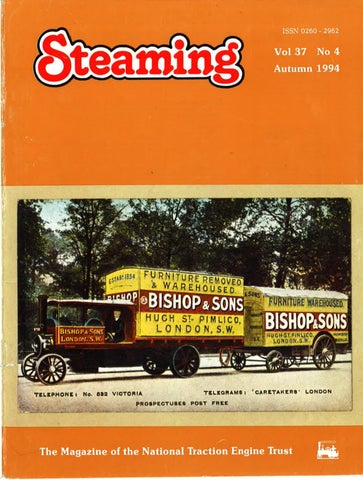
Cover Foden 5 tonner 2096, owned by the well known furniture removing firm of Bishop & Sons, Pimlico, London, appeared on the company's trade post cards in the second decade of this century. To mark the centenary of the British picture post card, a brief article appears elsewhere in this issue. 171
Trust News From the Chairman The rally season is all but over and we have been blessed with fairly good weather throughout; a change from the past two years Perhaps the Trust's forthieth year has something to do with it! The committee has been out and about this year with meetings held at the Fast Anglian Museum at Stowmarket to coincide with the launch of Michael Lane's Burrell book, at the Rempstone rally and at the Great Dorset Steam Fair. I thank the organisers of all these events for their assistance and hospitality. Hopefully we can continue to make similar outof-London arrangements in the future. If we do it should dispel the myth that we are remote and out of touch. At the West of England Club rally the talk was of their fortieth event next year and long standing members seemed pleased about the health of the movement and that it had continued to survive so long. When they rescued engines in the 50s they did not expect further generations to follow them. Certainly the barrage of possible legislation which could affect us is on the increase and in a letter I received from our former chairman and vice president Anthony Heal he stresses that 'the price of freedom is eternal
AMON
vigilance'. In an increasingly regulated society minority interests can easily be unintentionally affected and only by shouting loudly will we be excluded from inapprnpriate lenislatinn However, our queries to various Government departments have led to new and friendly contracts within them. We need to he recognised by both the authorities and the public as important, and the new Trust display unit has travelled widely and successfully this season to that end. Those who have manned and travelled with it are to be commended. New members have joined on the rally fields and some who had let their membership lapse have rejoined. Every new member makes us stronger, as does every person — and they must add up to
millions — who visit a rally. I am sure that those running the unit would welcome help from other members when it goes out next year. The route will he rrp-coacrin nnri contact numbers given. Please help with this new and important aspect of the Trust's work. People power does work and the Trust's lead in staging well-run events must help to get the people behind us. The Autumn Conference will aim to strengthen contacts hetween the Trust and the Affiliated Clubs and make rallies more accessible to members. We value the support of both and would like to return the compliment. We want your ideas as to how this can be done. I shall be attending my first AGM
nnhliched
From Alan Martin's Collection
66
My picture this time shows John James' Garrett tractor 31110 of 1912 (BJ1537), an example of the Leiston makers popular No 4 compound tractor. The photograph was taken in the Merthyr area of South Wales in 1913 and shows well the beautiful lettering on the vans — a traditional and formerly horse-drawn pantechnicon at the rear and a small-wheeled curved roof van behind the engine. The latter would have been designed to be suitable for long distance carriage on railway trucks, but John James, like many of his contemporaries, had taken to using steam tractors for long journeys.
.1 EX Fl e4 Ckp EACH :
loomuem
-
POr N JA l4F":, sirul
NJA HES 11TH
RMAL,COMET
lir in
as chairrrin shortly and that means another year has gone by. I look forward to a good attendance at Gaydon. Will you be there? Next year we hope to go to Chatham and the following year to Bristol. (Richard Sandercock, chairman)
Rally Organisers Column Rally Organisers sub-Committee The rally season has drawn to a close once more and from my Committee's point of view it has been relatively straight forward. During the summer a great deal of thought has been put into how we can help rallies obtain more publicity and this will be the main theme of the Autumn Conference. Details of this can be found in this copy of Steaming. If you do not receive a letter of invitation at your club or rally committee, please contact Sue Jackson who will book you a place. Once again I must thank the indefatigable Smudge Smith for dealing with all the administration work of our sub-Committee. My thanks also extend to the other members of the team who provide specialist knowledge and practical help in visiting rallies. I have recently been advised of yet more proposed legislation on the licensing of outdoor events; the Committee will be looking into this and advising on the implications when they are known. If you are involved in running a rally not yet utilising our Code of Practice, why not make a note of the Autumn Conference and come along — many people say that the most valuable parts of the day are the discussion periods which provide help and ideas to incorporate in their own event. (Andrew Semple, chairman, Rally subCommittee)
Safety Officers Reports The 1994 rally season is now over, but we still have some loose ends to tie up. At the forthcoming Autumn Conference (see advertisement and notice elsewhere in this issue) it is my intention, once again, to highlight various experiences reported by Safety Officers that might be of mutual benefit to all Organisers. As usual, no names or indeed the names of events will be mentioned, but STEAMING
Autumn 1994
The Engine Owners sub-Committee presents another
PRACTICAL ENGINE DRIVING COURSE including informal instruction on basic boiler management and repair, as well as mechanical operation. The course will be held on the weekend 13th and 14th May or 20th and 21st May 1995 at the Yorkshire Museum of Farming, Murton Park, Murton, York The site has full facilities for caravans and camping, also an excellent restaurant. Please write to Michael Davies (address inside front cover) for an application form and state your preferred date.
difficulties encountered and the measures taken to resolve the problems can often teach us valuable lessons. May I please ask all of you who have not yet submitted a Safety Officer's Report to do so as soon as possible — it is part of your obligation under the Authorised Rally Scheme, but I can assure you that anonymity is guaranteed. (Smudge Smith, Rally Approvals Officer).
Engine Owners Column Engine Owners sub-Committee I very much hope that owners are all able to look back on a busy and enjoyable rally season which, of course, has been much helped by fine weather. We have had a few hitches with the boiler inspection companies and the Traction Engine Code, but negotiations are progressing well now we are able to show them the latest edition. We are confident that all will be in order for next season. Plans are proceeding for a driving course near York in May. Please let me know as soon as possible if you are interested. Further details will be published in the next edition. (Michael Davies, chairman, Engine Owners sub Committee)
resulted in agreement that Cornhill will now carry out boiler examinations in accordance with the NTET Code of Practice and Scheme of Examination. This agreement entails a small additional amount of paperwork which will be attached to Part IV of the NTET Code, to make it into an individual scheme for each engine. This brings the NTET Scheme closer into line with the detailed requirements of the Pressure Systems Regulations and will remove the criticism from some quarters that it does not comply. Also it removes any distinction as to whether the engine is used 'at work' or merely for display. Suitable extra pages for the Code will be prepared and issued to members who have bought copies, and these will be sent out with the next sections to be distributed. In the meantime, Cornhill boiler inspectors will supply suitable forms to owners for whom they carry out boiler examinations, and will assist them to fill in the necessary details. Cornhill boiler inspectors will use their own company's report/certificate forms, adding in the extra details required by Part IV.10 of the NTET Code. Approaches are being made to other insurance companies and organisations to discuss the adoption of the NTET scheme. (Jim Newnham, chairman, Technical Board) Engine Insurance Cover — a reminder
Technical Board A meeting on 2nd September with the Principal Engineer of the Pressure Division of Cornhill Insurance, has
I am learning to my dismay there are wide inconsistencies in the insurance industry's provision of the cover to our members (those not insuring via John Scott & Partners) 173
which is supposed to bring compliance with our Codes of Practice and with the Disc Scheme. In some cases the faults can leave members uninsured! I would like to remind readers of the following points: 1. Every engine being used in a place of • public access shall be subject to regular cold and hot inspections by a qualified inspector/ surveyor, and certificates issued accordingly. 2. Public liability insurance is required for protection against boiler explosion and other incidents occurring in a public place, minimum £1,000,000 cover. 3. 3paika anti Lib; ICJ II IbUI separately required, minimum £100,000 cover. 4. Where a member uses the engine on the public highway a Certificate of Motor Insurance is required. This device has no limit under UK law as to the amount of cover as long as any incident takes place on the public highway. Those statements are simple enough to understand in themselves but it is very important that we also understand the following. • The fragmentation policy issued by Cornhill is merely a 'workaround' method of paying for the boiler inspection, as detailed in item 1 above, whilst limiting the VAT payable and, although it is issued in the form of an insurance policy, has no insurance cover whatsoever! Therefore separate/additional payment is required to obtain cover as
described in item 2 above. • Engineering insurers are no longer providing Sparks and Ashes cover and therefore separate insurance is required to obtain cover as described in item 3 above. • The Certificate of Motor Insurance is being issued by some insurers as the only document showing proof of renewal of premium(s) and it is here that some of the confusion arises. John Scott & Partners and Dominion Insurance both cover items 2 and 3 with the CMI, but my research with insurers has unearthed too wide a range of interpretation on the use of the CM; cud ihe 01 Guai kb and Ashes is wholly unreliable. I am endeavouring to obtain clarification from all major providers and will report accordingly. My advice to members is be very careful when renewing or setting up insurance, and don't be surprised if you find me asking for clarification when you apply for your NTET Insurance Disc. On a further point may I gently remind engine owners that they have a duty to their Insurers (and under the emerging Engine Code of Practice) to inform their boiler inspector of the need to undertake work on any pressurised part of the system which is beyond the normal replacement of gland packing, gaskets, joints, mudlids and proprietary components such as valves, whistles, clack boxes etc. Failure to inform may well result in insurance cover being negated and at
very worst civil court action being endured. To end on a more up-beat note, I am pleased to record the continuing increase in popularity of the NTET Disc Scheme, inasmuch that the total number of discs issued in a season has recently passed 1000 for the first time. (Dave Smith, Insurance Officer) Lost Registrations The recovery of lost registrations continues with a steady trickle of two or three applications each month. It is perhaps timely to remind members that in carrying out the authentication VI app:ii:d Liu! lb LIIC -FILM'. IIds d responsibility to apply a framework of rules set out by DVLA. It is in all our interests to make sure that claims are not made fraudulently and indeed there have been instances of clubs being removed from the list of approved bodies because they did riot properly apply the criteria. In processing applications it is essential that the identity of the engine is established beyond any reasonable doubt and it is also necessary that original documents (or photocopies certified by a Local Vehicle Licensing Office) are submitted. This may seem irksome but it is all too easy to falsify photocopied documents and in any case DVLA will not accept them. I have recently rejected a claim because the applicant refused to comply with this simple requirement and I make no apology for doing so. (Peter Smart)
FBHVC News
The second of the venerable pair of Fowler single cylinder ploughing engines owned by Richard Pierce and Peter Stanier is now in action again. Fowler 2861 of 1876 is pictured here at the Weeting event in July 1994. (Dave Bagley) 174
The recent furore over the proposed 'Hot Parts' legislation (under which fittings, pipes and surfaces liable to become dangerously hot to the touch would have to be lagged or shielded) has taken up more than a little of the FBHVC Legal Advisor's time. Suffice to say that the legislation is at the consultative stage and even if it is implemented it will not affect us unless the driver is an employee. In short, this is a Health and Safety measure and it now seems unlikely that it will be enacted in the original form. However, the Federation's contacts were able to rapidly clarify the situation and produce a simple answer to an apparently complex and very worrying question. Of rather greater concern to many members is the consideration by the UK Government of moves to change the Vehicle Excise Duty for cars and motor-cycles from use to ownership. Dr Brian Mawhinney has already agreed to a request from Lord Autumn 1994
STEAMING
Montagu for the Federation to be included in the consultation process at the earliest opportunity. As yet there are no firm details of the Secretary of State for Transport's proposals and they are not expected much before the end of the year. The FBHVC is keeping a very keen eye on this situation and I will keep members informed of developments. For the time being, the best advice is to do nothing but wait until we know exactly what it is that we have to resist. (Peter Smart)
Presents for Christmas JERZEES SWEATSHIRTS Produced with embroidered NTET logo (approx 3in x 2'h in) at left hand chest position, on plain sweatshirts QUALITY: Polyester/Cotton base colour Black Bright Royal Bright Red Winter Emerald
Steam Apprentice Club
STEAMING
Autumn 1994
med
large
xlarge
xxlarge
Gold Gold Black Black
Yes Yes Yes Yes
Yes Yes Yes Yes
Yes Yes Yes No
Yes Yes No No
PRICE: £16.30 inc 17.5% VAT
Having been involved with the forming and naming of the Steam Apprentice Club back in 1978, and since then closely mewl _in _its • running, I have for some time felt thatjei (:,1j newer — and younger — blood would if.' bring fresh ideas to the important task of encouraging and developing the next generation of drivers and enthusiasts of our hobby. I am pleased therefore that John Bosworth agreed to take on the task of Chairman of the section, and I wish him well. I am sure he will find it rewarding. I should like to take this opportunity of thanking all the past and present SAC committee, engine, drivers, NTET members, parents and not least the Apprentices who have given their support and time to the Club, together with their friendship to me. It has been much appreciated. (Sylvia Dudley)
I am pleased to have been appointed Chairman of the Steam Apprentice Club in succession to Sylvia Dudley; perhaps the best way to introduce myself to Trust members and to present and potential SAC members is to set down some basic facts. I am John Bosworth, a Trust member since its quite early days and a national committee member from more recent times. I live at Smalley, near Derby; Olive is my wife and we own a 7hp Foster agricultural SPRIG which manages to visit quite a lot of Midlands rallies and the odd one further afield. So, introductions over, I want first of all to thank Sylvia Dudley for her work over a long period of keeping the SAC to the fore of the Trust's activities. She has, literally, flown the
logo colour
JAQUARD WOVEN TIES
SAC TEE-SHIRTS
Produced with single motif NTET Logo, woven in gold in under-knot position, with all over motifs of alternative engine in toning tissue (Shadowing)
SCREEN STARS 100% Cotton Tee-Shirts for Steam Apprentice Club members Full cut style, pre shrunk cotton.
QUALITY: Polyester Satin SIZE: 54in x 3'/z in
COLOUR: Black with SAC Logo printed in white, full chest SIZES: SENIORS Large, Medium, Small
COLOURS: Navy Bottle Green Dark Brown Maroon Royal Blue
SIZES: JUNIORS 12-14, 9-11, 7-8, 5-6 years
PRICE £7.95 inc 17.5% VAT
PRICE: £4.50 each exclusive of VAT
PRICE: £5.25 inc 17.5% VAT
The above items are all available from the NTET MAIL ORDER SALES — see list at the back of this issue.
Club flag the length and breadth of the country. This season John and Fiona Durling from Haxby, Leeds have organised three days for apprentices at Yorkshire events and I thank them too and hope they will wish to make further contributions in the future. It is this sort of local help at rallies I am looking for from the general adult membership of the Trust (or anyone else with sufficient enthusiasm!) Our task is to assemble and encourage youngsters who show interest in the road steam engine and its history and operation, and then to introduce them at the age of 12 or more to the engines and owners at rallies and other
suitable events. Enginemen need clarification of what could be expected of them by having an SAC member in their care, and our helpers also need to ensure arrangements are properly in place for the return of apprentices to their parents or guardians at the end of the day. I would be most grateful to hear from anyone who feels they might be able to assist in this most important task of encouraging our younger generation into our hobby. Some owners might be able to offer a place for an SAC member to be around them during the winter season whilst undertaking maintenance — could you help? 175
The National Traction Engine Trust's
1994 AGM will be held at 2.00pm on SATURDAY, 19th NOVEMBER 1994 at The Heritage Motor Centre, Banbury Road, Gaydon, Warwick Please refer to the formal notice in the Report and Accounts which are distributed with this issue for details of agenda etc, and to the Future Dates column for notes on the arrangements that have been made for the day.
Please contact me with any ideas you have for the benefit of the Steam Apprentice Club. (John Bosworth, chairman, Steam Apprentice Club — address inside front cover)
SAC members have been busy with their cameras and crayons for the photographic and colouring competitions. Budding photographers are competing for the Dorset Trophy, currently held by last year's winner James Duncombe from Gillingham, Dorset. Christine Wells of Banbury leas again kindly provided the artwork for the colouring competition, this year featuring a showmans engine. Paul Appleton, publisher of Old Glory magazine, will be joining the judges for the competitions, and is providing additional prizes. New members continue to be recruited at ranies and through leaflets in Mamod Steam Models. Mamod have offered SAC members a special discount on the cost of servicing their products. (Steph Gilett, Editor, Raising Steam)
Subscriptions as presents I draw members attention to arrangements we have made to enable members, or others, to give an annual subscription to the Trust to relatives or friends as a Christmas present or birthday present — please see the display advert inside the front cover. Subscriptions taken as a Christmas gift will commence with the Autumn issue of Steaming and will be sent out with a suitable greeting card announcing your gift, to arrive with the 176
recipient just before Christmas. The renewal reminder at the year end can be sent either to the giver or the member — whichever is requested. Similar arrangements can be carried out for birthdays, with the current magazine being sent out by us to arrive just before the appropriate date; again, the renewal reminder can be sent to giver or member. Please contact me for an application form or if you require further details of the arrangements. (John Cook, membership secretary, address inside front cover)
NTET Promotion and Exhibition Unit During the pest season the Trust's Exhibition Unit will have visited no less than 26 events from Cornwall to Scotland. Our thanks are due to all the organisers who made us welcome and also to the hard-working committee team (and very often their wives or husbands) who staffed the Unit throughout the season. For the future, I will be compiling a programme of events to attend next year utilising the 1995 Rally List. (Robert Herring)
NTET Sales and Mail Order With the 1994 rally season now just pleasant memories for most of us, out thoughts can turn to Christmas. Your Mail Order team is fully stocked
to meet your requirements. From the few friendly knocks we received at the Great Dorset Steam Fair, our response is immediate — for the real men we now stock Jerzees sweatshirts xx large in both black and royal blue at £16.30 inc VAT. By request we also re-introduce the Fowler cap badge and the NTET traction engine lapel badge. Also available are several new books and two Fred Dibnah videos — all included in the Mail Order list at the back of this Issue. Any one of them is just die tiling for a Christmas present for somebody you know. (Coll.'? and Val Brown, NTET Sales)
Engines from Australia The Trust has been advised of certain restrictions on the taking of some steam engines out of Australia. The National Cultural Heritage Committee in Canberra draw our attention to the Protection of Movable Cultural Heritage Act 1986. Persons wishing to take from the country any protected objects are required to apply for an export permit and allow the item to be evaluated by experts, the Heritage Committee, and the Minister of Arts. The main consideration when considering applications is whether the export will result in a significant diminishing of Australia's cultural heritage. Steam traction engines that were built in Australia before 1945 or that were in use there before 1930 are extremely likely to be protected by this I MA/ The information kit on the Act that has been addressed to the Trust has been deposited with Mrs Dudley and is available for reference by any Trust member.
Obituaries William Lobb It is with regret that we record the death, following a short illness, of William Lobb, one of Cornwall's most prominent men of steam. Bill, as he was known to all, lived at Sticker, near St Austell, and was an accomplished engineer, running his own business at nearby Hewaswater until his retirement. Although a lifelong steam enthusiast, he was into his 60s before he acquired his first engine, a 5 ton Aveling roller 8432 named Autumn 1994
STEAMING
MENDIP STAR. Although this was ultimately to be rebuilt to showmans type, the mechanical restoration and boiler work were second to none. A second acquisition soon followed in the form of Garrett 4CD tractor 34789, known for much of its life as QUEENIE but to be re-christened CORNISH STAR in Bill's ownership. This became arguably the best restored example of its type in preservation. When his age dictated that he could no longer manage full-sized engines, these were replaced by two half-sized miniatures, both based on Burrells, first a single cylinder example and later, a single crank compound, both of which were given the 'Lobb' treatment. His engineering abilities were also called upon to assist other engine owners in their restoration projects, two former W.J. King Foden wagons among them. One of these, the C-type 3-way tipper 12116 owned
by Mike James, he was involved with
right up to the time that he was taken ill. It was a fitting tribute that this wagon, newly restored, was used to carry him to his final resting place.
(Alan Thomas, West of England club) Mark Syms
The steaming community of Cornwall was saddened by the
passing, he achieved an award for the best-presented engine at Camborne's Trevithick Day. Mark was another who had been of great assistance to his fellow owners over the years, his engineering abilities being called upon on numerous occasions. He will be very much missed. (Alan Thomas,
West of England club)
unexpected death of Mark Syms of St Columb Major during June. Also an accomplished engineer, Mark had been a supporter of local rallies since the early days. For many years he was a regular crew member of the Burrell
'Special Order' traction engine 3816 CORNISH MAID when in ownership of the Parsons family of St Columb. He later purchased an Oliver 90 tractor
which became a familiar sight at local rallies. Eventually, he was, himself, to become the proud owner of CORNISH MAID, an engine which he and his son. Steve, authentically restored to very original condition. Shortly before his
Affiliated Clubs Alan Duke Memorial Fund The Road Locomotive Society's Committee has bean very pleased by both the number and size of the
donations received and I would like to express my most sincere thanks to all who have made a contribution. At the time of writing the fund stands at £2620 and is increasing steadily. The building at Reading has not yet been started and I understand that there is still some way to go to reach the Lim required to trigger the University Chancellors into approving the commencement. Since it will obviously be some considerable time before the furniture for the reading room is required or can even be ordered, the fund will remain open and all further contributions will be gratefully received. The Memorial Fund is held in an interest-bearing account and so it is also growing by its earnings. (Peter
Smart)
North Staffordshire and Cheshire TEC The Club's Autumn Steam Up and Vintage Weekend will be held on Sat/ Sun 15th/16th October at Klondyke Mill, Derbyshire. Unusually among affiliated clubs the North Staffs group have their own extensive premises and A mystery picture here — with an engine which doesn't easily suggest the identity of its maker. Although the original (kindly lent by John Williams) is not of the best quality for reproduction, it may reveal enough when printed here for further comment by readers. The scene itself is at Seaford, Sussex in 1920; the occasion was the movement of two old railway carriage bodies to the town from Brighton. These were of more than passing interest. A pair of Pullman sleeping cars had been built in America in 1883 and started work on the Highland Railway in Scotland in 1885, running on night trains from Glasgow to Inverness until 1907. The cars were then sent south to the Pullman works at Brighton, where they languished until 1920. At that time the retiring traffic superintendent took over the bodies and moved them to Seaford where they were mounted side by side on foundations to provide living accommodation. However, our interest is the traction engine — an elderly single cylinder machine of (to editorial eyes) indeterminate make. Note the large slide valve cover — 6 studs by 4; the flared circular perch bracket; the square clack box to the boiler side and the spoke palms fitted to the hind wheel T rings by no less than five rivets. Comments would be welcome. STEAMING Autumn 1994
workshops and many other exhibits will be journeying there for the weekend. Klondyke Mill is alongside
the A515 at Draycott-in-the-Clay, near Sudbury, Staffordshire. (NS&CTEC)
London Area Social Meetings The 1994/95 season of social meetings in London will commence in November, and all members, potential members and interested visitors will be welcome to attend one or all of the evening talks or slide shows which
177
have been errongcd for the Trust by Bill Timmings. For the coming winter's meetings the function room has been booked at the Yorkshire Grey public house, Langham Street, London W1. This location is off Langham Place and Portland Place and little more than five minutes walk north of Oxford Circus tube station. Meetings will be held, generally, on the second Tuesday of each month, at 8.00pm, with the room available hum 7.30pm. It is hoped members will continue to support our speakers in the enthusiastic way they have in the past. For the firsi two dates in our calendar, the following programme has been arranged: TUESDAY, 8th November 1994. Bill Timmings will show slides of
the usual way, but newcomers are always welcome to these instructive and mutually beneficial gatherings. Discussions under various headings will take place throughout the day. Coffee will be served prior to the morning meeting from 10.15am; a buffet lunch will be available during the mid-day break (prior booking is essential) and tea will be served at the conclusion of the conference at about 3.30pm. First time attenders are invited to contact General Secretary Sue Jackson for further details and bookings. The venue is located in the town ••trC area of Rugby, close to thR railway station (5 minutes walk). By road, whichever direction you come from, if you don't know Rugby the best approach is from Junction 1 on
steam engine rallies in the 1950s,and
the M6, and then south on the A426
1960s. TUESDAY, 13th December 1994. The re-birth of a London tram, an illustrated talk by Allen Bertram. TUFSDAY, 10th January 1995. A representative of the firm of Morris's of Shrewsbury will give a presentation on oil for steam engines. Further meetings are planned for 1995 and details will appear in the Winter issue of the magazine. (8/7/ meetings London Timmings, organiser)
AGM 1994
for 3 miles. This is a dual carriageway and then approaches the town under prominent railway bridges over the road. Wood Street is first on the left under the second of these bridges, as the road rises uphill towards the town centre. The ACU headquarters are on the left side of the road. The new A14 road from East Anglia is now open to the M6 interchange. (Sue Jackson, general secretary)
The 1994 Annual General Meeting of the Trust will take place at 2.00pm
on Saturday 19th November 1994 at the Heritage Motor Centre, Banbury
Future dates Autumn Conference for Rally Organisers and Affiliated Clubs The Autumn Conference for Rdily Organisers and Affiliated Clubs will take place at The Auto-Cycle Union, ACU House, Wood Street, Rugby, Warwickshire on Saturday, 22nd October 1994 at 11.00am. Invitations and formal notices, together with
details of the venue, will be sent out in
Road, Gaydon, Warwick. Formal notice of the meeting, the agenda and the Annual Report and Accounts will be distributed with this issue of the magazine. In the event of any voting being necessary at the AGM only current Trust members will, of course, be eligible. Members are therefore asked to ensure they have their current membership cards with them at
Gaydon. Tea will be served at the conclusion of the AGM at about 5.00pm. Other arrangements have been made for the Saturday and Sunday for members wishing to stop overnight in the area. From 11.00am until 2.00pm on Saturday and all day on Sunday members of the Trust will be eligible
for reduced price admission to the Heritage Motor Museum at E4.00, on production of their current membership card. It is hoped at least four local engines will be in steam and displayed by the museum entrance on the Saturday. In the evening from 6.30pm a RUGBY TOWN CENTRE I
178
buffet and slide show have been arranged at the Centre, giving
Sundoird upon-Avon
Access to the centrally located I ter toga Motor Contra in cosy Just 3 minutes from Junction 12 of the M40, and within halt an hour's drive of Birmingham, Oxford and Stratford-upon-Avon
members a chance to meet each other and discuss the year's events. The price of the buffet tickets is £9.00. Dick Blenkinsop has kindly agreed to present a slide show for an hour or so following the buffet, at about 7.30pm. Entitled 'A Miscellany of Steam Engines', the pictures will also include a wider selection of Dick's excellent work that will appeal to the ladies that are present, and show some of the local Warwickshire landscapes. Would those members requiring tickets please send cheques (made payable to the National Traction
Engine Trust) to Susan Jackson, 153 Micklefield Rood, High Wycombe, Buckinghamshire HP13 7HA. Susan will also provide an accommodation list and maps to those members requesting them. Please send an SAE for reply. For those members staying overnight in the area, and for local Midlands members, Michael Davies has ORnprniisly invited us to nearby Hill Farm, Avon Dassett on the Sunday morning. This will he an informal visit for a couple of hours or more from about 10.00am, and will give the chance to see the half dozen engines kept at the farm, some in steam, some
in engrossing stages of repair, and an interesting selection of agricultural tractors.
Wanted, Good Secondhand Road roller, by Foden. State full particulars with lowest price, to R.A. Lister and Co, Ltd, Engineers, Gloucester.' (from Engineering & Machinery Chronicle, December 1906. Fodens never ventured into the steam roller market, so it would be interesting to know the circumstances of this advertisement — was it a misprint or did Lister's think
so highly of the Elworth workmanship that they couldn't believe there wasn't an example about somewhere?) Autumn 1994
STEAMING
STEAM COAL from BRITISH COAL British Coal wish to remind all readers that the following INDIGENOUS steam coal is readily available SOUTH WALES OPENCAST — ROYAL ARMS COBBLES from the Cwmbargoed Disposal Point — volatile content 17%
MIDLANDS GROUP DEEP MINES — LARGE COBBLES from either Daw Mill or Notts Central Washery — volatile content 35-37%
Please hurry and place your orders now through your normal distributor, but if you require further assistance, contact British Coal, Headquarters Marketing Department, and speak to either:
4111C."— BRITISH COAL
OPENCAST
STEAMING Autumn 1994
Mr D. Brown 0773 532319 or Mrs L. Harris 0773 532502 179
•
A history of the steam wagons of
J. LYONS & Co Ltd Derek Rayner Our story starts in China where boiling water and some leaves from a bush were infused to make tea — a drink that was both refreshing and non-intoxicating. Legend has it that the story of tea actually started some 4000 years ago — but its introduction into Great Britain in the middle of the seventeenth century changed our drinking habits. With the inevitable taxation, smuggling of the commodity became rife and brewers and tea vendors became serious rivals to supply the population's most popular beverage. But in three hundred years, tea has progressed from a luxury for a few to a necessity for nearly everyone. In 1904, when their tea business commenced, J. Lyons & Co delivered their products from their headquarters and production base of Cadby Hall at Kensington, London using horse
180
drawn vans. The firm rapidly expanded, for only three years later, Lyons were supplying 15000 agents in many locations and the pace of expansion continued throughout those early years, temporarily halted only by the vicissitudes of World War 1. By 1920, the tea production department had outgrown all the factory space available at Cadby Hall
in central London and so a new, modern factory was established on a rural site at Greenford, Middlesex, some 9 miles west of London and adjacent to the Great Western Railway main line to Birmingham. As well as the manufacturing side of their business, the retail catering establishments grew in number and Lyons' Teashops and Corner Houses
The early days of Lyons' steam transport, about 1912. The Aveling & Porter wagons were owned by Yorke, Stoneman & Jones of Pimlico Wharf SW1 (near Victoria Station) and were presumably on a form of contract hire to Lyons, for they carried the firm's flamboyantly lettered livery to good effect on their box van bodies. The colours appear to be a version of Lyons' familiar blue and grey livery. This picture is taken from Aveling's steam wagon catalogues of about 1912 and no doubt the firm were pleased to have such a well known name as Lyons on their products. The scene is thought to be at Cadby Hal(, Kensington. The wagons are, left to right, works numbers 7314, 7315 7163 and 7316. Note the polished smokebox doors and the variety of wheels — steel on 7314, traditional wooden on 7163 and 7316 and Tangent type wooden on 7315. (collection Welland Valley club)
Autumn 1994
STEAMING
became household names together with the girls who waited at these places, their generic term being 'The Nippies'. An extensive outdoor catering business was built up and deliveries had also to be made to exhibitions, race meetings and functions. The firm clearly needed good transport facilities. Their first incursion into steam road transport was in 1915 when they started to use five Aveling & Porter products — four wagons and a tractor. The tractor was a 5 ton GND compound type, 8033 of 1913 (KT268) which carried the name NIPPY, and ran on Tangent Wheel Co type wooden wheels. This was used for towing vans carrying tea, coffee and cocoa from the docks or the factory to various distribution depots. Alan Duke lists two other similar tractors, all three of which were recorded to have come from the firm of Yorke, Stoneham & Jones in 1915. In addition, the four Aveling & Porter steam wagons used by Lyons were hired from this firm, who operated from Pimlico Wharf, London SW1. They were painted in the livery of J. Lyons & Co Ltd, Cadby Hall, London and had van bodies. There is an Aveling catalogue picture of these four wagons lined up outside Cadby Hall. Just after the end of World War 1, a 6 ton Sentinel wagon was purchased and put into service to enable comparisons to be made with other similar forms of heavy transport. Later, a secondhand Foden was bought, but the Sentinel must have proved its worth for the firm took delivery of thirteen similar wagons from the Shrewsbury firm in 1920 and there
In the early 1920s Lyons developed delivery containers made from aluminium by the Duramin company. Two of these, looking very shiny and new, are seen here loaded onto Aveling steam wagon 9075, new in 1919 to George P. Tatner & Co Ltd of Dartford. (collection F. Watson/Duramin)
Sentinel 2982 of 1920 EVENING STAR pictured trailing a Sentinel built four wheel trailer — presumably one supplied by Shrewsbury to go with one or other of the 6 tonners delivered in 1919-1922. The small white rectangle to be seen on the cabside below the worksplate appears to be a coachbuilders transfer bearing the name Glover. Glover & Webb Ltd of Westminster Bridge Road SE1, were listed as 'Coachbuilders to HM The King' in 1922 and this firm may have been responsible for repainting the wagons in the new livery.
Although quite a few of the shops in the background show business names, they cannot be traced in contemporary London directories and the scene might be a provincial city. (Lyons company archives)
NJ
NJ
DNINIV3IS17661 uu/ n/ nv
We are grateful to the Lyons company for allowing us to reproduce pictures from their archives. Several of them seem to have been taken on the same occasion, as part of a series showing development at the Greenford Factory. Close study of these large prints has enabled much detail to be gleaned of the Sentinel wagons, and comment to be made on the bodies, liveries etc, although a complete revue is by no means possible. The photographs seem to show a period of transition in the liveries. The blue/grey colours were applied to p:e World War 1 horse vans and early motor vehicles but the 6 ton Sentinels appeared in an overall dark crimson colour — at least 15 of these were so painted, including Sentinel 4410, delivered in April 1922. However. the company's house magazine Lyons Mail
The photographs
A splendid line-up of about half the Lyons Sentinel Peet at one of the despatch bays at Greenford — the newest one that can be identified is an April 1922 built example, and the month before that the company claimed to have 18 wagons; three more arrived in April. As well as providing space for the steam wagons and petrol lorries to manoeuvre to the tailboard height loading platform, the covered bay also had railway sidings extending its full length to allow access for rail trucks and vans, and an overhead electric gantry for running containers out to barges in the canal basin in the foreground. Six of the Sentinels have van bodies — seemingly semi-permanent canvas structures above the fixed sided bodies which were built at Shrewsbury. All these vans have large electric headlamps and roof mounted destination boards, so they are presumably the ones used at that time for the long distance work; the removable boards read LONDON & BIRMINGHAM or BRISTOL, MANCHESTER, LEICESTER. Of the other Sentinels some have high fixed sides and others are flats; all these carry containers and are presumably being used on local London work as described in the text. As well as the two blue and grey liveried Sentinels, a variety of slightly different white lettering is in evidence on the crimson painted examples. Most of the cab-top headboards (which were added by Lyons) read LYONS COCOA but others extoll COFFEE and even CUSTARD POWDER. The seventh in line lacks a headboard and is the one which was the first Sentinel delivered to Lyons in 1919. Most of the dark crimson painted wagons seem to bear a painted number of the type required by the Defence of the Realm Act 1918 (see our Spring 1991 issue). As far as can be seen on the original print, the wagons are, from the left; Sentinel 2947 (van); 3143 (fixed sides); 3334 (van), 3299 (van); 2436 (van); 2473 (van); 2284 (van); ? (flat?); 4110 (flat) and ? (flat). (Lyons company archives)
CO
17661UUMJ 1117' ONINIVIL S
for January 1923 included an illustration of 2947 of 1920, with van body, in the blue and grey colours and it might therefore be concluded that a livery change for the Sentinels took place sometime late in 1922. The company commissioned pictures show three blue/grey liveried Sentinels, all in good clean order and at least eight crimson examples — perhaps the photographs at Green ford were made late in 1922 or early in 1923.
The loading area at the south side of the Green ford Factory, which was adjacent to the Great Western Railway lines from London to Birmingham, provided the principal outlet for traffic despatched by rail. One of the company's shunting locomotives (the 1888 built Manning Wardle six wheel saddle tank named TYERSALL) is seen to the right with a train of covered vans at the loading platform. Alongside, Sentinel 3143 of 1920 STELLA, a fixed side wagon, has been backed up to a position where containers can be transferred by overhead hoist crane to or from the body. At the left Sentinel 2947 of 1920 MORNING STAR also shows the blue and grey, in this case as applied to the covered vans. Posters broadcast the virtues of Lyons jelly crystals, toffee, custard powder and tea. As well as the large electric headlamps, necessary for long distance work, the covered vans acquired cab-roof toolboxes and advertising headboards and all Lyons Sentinels were fitted with movable bars across the front of the apron sheet — what was their purpose? (Lyons company archives)
were later repeat orders making an eventual total of nearly thirty Standard models. These were followed by three Super types and the last steam wagon purchased, in 1928, was a DG6. The Sentinels formed the backbone of the heavy transport fleet for several years. Local rounds were still maintained by horse-drawn vans and as motor vans became increasingly popular, these came onto the scene for local deliveries. The new factory at Greenford produced its first packet of Lyons Tea in 1921. The site extended to some 70 acres and had excellent facilities for delivery and distribution by road, rail and canal. Other production departments later established at Greenford were those for coffee, chocolate and confectionery. In addition, the busy transport department was involved in the collection and delivery of import and export goods from the Commonwealth, bringing in raw materials for example, from India, Ceylon and the west coast of Africa. Some of these items came direct to the Port of London and thence by road, in other cases, they were transhipped and were delivered by barge as far as Hammersmith Wharf. Local road deliveries in the early 184
Over 40 men crowd the loading bay in this highly animated scene at Green ford. In the foreground tea chests branded PRODUCE OF JAVA, MALABAR Or HAYS WHARF are being moved to or from Sentinel 2982 of 1920. Other crimson lake liveried Sentinels are present — a covered van is ready for departure with its safety valves lifted and standing middle left is 41 10, a flat, well loaded with 60 or more tea chests. A wide barge can be seen in the basin off the Grand Union Canal. The latter bounded the northern perimeter of the factory. Although railway tracks run alongside the platform, the main rail despatch bay was on the opposite side of the works. (Lyons company archives)
1920s were arranged on a standard unit, known as a service tray, which comprised a wooden tray some 50 inches long, of whole or half size, which fitted into a rack on the despatch trolley used within the factory and also into the transport vehicles. These were invariably twohorse vans or small motor vans of around 30cwt capacity, according to the radius of the actual journey to be undertaken, although on some occasions, deliveries by 4 ton electric or petrol vehicles were made very early in the morning. Small loads from various locations within the works were picked up by wagons ranging from a 1 ton petrol to one of the 6 ton Sentinels with trailer or a Leyland 4 ton motor wagon and trailer, before being taken to their
ultimate destination. These vehicles worked to a prearranged timetable, usually over a fortnight's rotation. Bulk deliveries by rail fell into three categories, namely skip, chest and loose. The skips (containers) were in three sizes — 25cwt, 2 and 3 tons. Until around 1921, all skips were wooden and weighed around a third of their contents. From the commercial point of view, on the outward journey, the forwarding rate was the same for a skip as for the contents; on the return journey, the skip was charged half rate as an empty return. Following developments in the use of aluminium and its alloys, and a costing exercise undertaken around this time, it was found that an aluminium container could be manufactured that would be just as robust as a wooden one. Based
Autumn 1994
STEAMING
on the reduction in weight (about half) and on a basis of 26 journeys a year, an eventual cost saving of £117 per year per skip would be gained. Containers manufactured by the Lydney, Gloucestershire firm of Duramin Ltd were therefore introduced progressively from the early 1920s and were one of the first examples of containerisation — a development which is often thought a modern concept. The skip, or container, carried goods packed loose but sealed against pilferage and it could be electrically handled by crane or lift truck at the despatch bays. The original 1920s aluminium containers lasted for over 20 years — far longer than their contemporary wooden counterparts. In some instances, it proved uneconomical to use railway haulage and it was possible to use coastal steamer traffic for certain deliveries. Traffic for this and also for some export goods such as cocoa butter for the colonies were carried in skips or containers and sent to the docks by Lyons' own returning barges from the canal basin at Greenford or in some instances, when barges were not available, by steam wagon. At some
locations around the country, where the railway companies were uncomSTEAMING Autumn 1994
A splendid publicity picture of the 1920s, showing Lyons tea on road, rail and canal transport. Member John Morley kindly identifies the location from his post-war knowledge of the area: 'the scene is at Windmill Bridge, or Three Bridges, at Southall, where the Great Western Railway branch from Southall to Brentford passed under the Grand Union Canal, also on its way to Brentford Docks and the Thames. Windmill Lane passes over both of them. The scene must have taken quite a bit of setting up and it occurs to me that the correct title really should have been 'Three Ways from Lyons' Greenford Factory', for the camera is looking east so both the train and barge are heading towards Brentford Dock, whilst the road vehicles are heading south, which is away from Green fordl The GWR train is hauled by a double framed six-coupled pannier tank, but the Sentinel covered van's fleet number, even if it could be read, is unfortunately hidden by the roadside fencing. The livery and lettering on the body is arranged differently to the other blue and grey Sentinels which appear in these Lyons photographs. (Lyons archives)
petitive, it was worthwhile for the Company to keep a heavy motor wagon at the port in order to take bulk consignments of goods inland. Lyons even found it cost effective to convey
traffic in 4 and 6 ton lots from London to Lancashire using Sentinel wagons and trailers operating to a central depot in Manchester. A substantial cost saving was accrued by this
operation, which necessitated finally transhipping to 2 ton vans for distribution to the local customer. Return loads of either Lyons' traffic to London or with traffic from other outside firms made the journey
even more economical and Sentinel runs from London to such places as Birmingham, Yorkshire towns, the Potteries, Nottingham, Bristol and Southampton were dealt with in a similar manner. A journey to Manchester was comfortably achieved with a Sentinel and trailer in around four days for return trip, and Birmingham took just three, with return loads. These, depending on the area travelled to, were variously described as chimney pots (from Bristol); copper wire (from Salford); ginger beer jars; tyres for bus companies and, once, 8
tons of Veno's cough mixture. 185
In the early 1920s, horse transport was still very much a viable operation and Lyons had repair shops for the horse vans at London, Birmingham and Liverpool with motor repair garages — Normand Garage, a Lyons subsidiary company — at London (Park Royal) and Manchester. They had, at that time, around 800 horses and horse vehicles, 500 motor vehicles, 11 barges and also employed numerous contractors in the delivery and collection of their products. The Sentinel wagons were based at Waltham Green, in West London, where all maintenance and repairs were undertaken, 32 vehicles being on the books in 1925. They usually operated with a four wheeled trailer — about 14ft long on the floor. Some wagons had flat platforms with a headboard and low sides whereas others had high sides and tail boards about 3ft high. These bodies were fitted with loose hoops (arches) and canvas covers to protect the goods and when not in use, the hoop sticks would be removed and stacked against the headboard to give a clear floor area. Several of the Sentinel Standard models were fitted with box bodies and solid rear doors. When they were used to carry tea in bulk — packed in paper packets — the bodies were lined with corrugated cardboard to protect the packets from damage and also to ensure lack of contamination of the packets from anything which may have been spilt on the floor on previous journeys. Products such as tea and coffee can easily become tainted in this way, even by smells. The original colour scheme of the Standards was dark crimson lake with white lettering. This was later changed to the well-known blue and grey layout, colours which will be familiar to many older readers. Some of the van-bodied wagons carried posters advertising the various company products — jelly crystals, toffee, tea etc. An interesting detail was that these vans also carried side destination boards such as 'London & Birmingham' or 'London & Leicester', the boards being mounted high up on the sides just above the roof edge. Mr A.C. Wood, a long time employee of Lyons, started as a lad in 1923 and recalls that the steam wagons were very reliable compared with the other heavy (4 or 6 ton capacity) motor vehicles of the time and also had a seemingly far greater power than the petrol wagons. One incident he vividly remembers which brought this fact home to him happened just after he started with the company, around 1924. A message 186
J. Lyons & Co Ltd, fleet list of steam road vehicles works no/date/registration
type
1. AVELING & PORTER, ROCHESTER, KENT 7163 of 1910 (D5607) 7314 of 1911 (D59761 7315 of 1911 (D6088) 7316 of 1911 (D6132) These four 5 ton wagons were hired from Yorke, Stoneham & Jonas, of Pimlico, London SW1 and were painted in Lyons livery. 8033 of July 1913 (KT268) 5 ton compound tractor, class GND named NIPPY; ex Yorke, Stoneham & Jones, Pimlico Wharf, London SW in 1915; later with T.F. Briggs? 8063 of August 1913 (KT488) 5 ton compound tractor, class GND ex Yorke, Stoneham & Jones, Pimlico Wharf, London SW in 1915; later with G. Beach, Kew. 8087 of October 1913 (KT767) 5 ton compound tractor, class GND ex Yorke, Stoneham & Jones, Pimlico, London SW in 1915; later with J. Flanagan, Watford.
2. FODENS LTD, SANDBACH, CHESHIRE 950 of July 1905 (M854) 5 ton wagon ex Hill & Salmon, London in 1920; to H. May via Sentinels in May 1924.
3. SENTINEL WAGGON WORKS LTD, SHREWSBURY vehicles were new to Lyons, except where stated otherwise 2284 of 1919 (AW4647) Standard 6 tonner, van body fleet number not known; first new Sentinel to Lyons 2436 of July 1919 (AW5134) Standard 6 tonner, van body fleet no. 1484 2437 of July 1919 (AW5135) Standard 6 tonner NIRVANA, fleet no 3242 2438 of July 1919 (AW5136) Standard 6 tonner THELMA, fleet no. 1619 2473 of 1919 (AW5290) Standard 6 tonner, van body name and fleet number not known; to Charrington, Gardner & Locket, London c1930 2474 of 1919 (AW5291) Standard 6 tonner new to Drysdale Manufacturing Co (almost certainly a subsidiary of the Lyons company); to Lyons, 1927, name and fleet number not known 2930 of 1920 (AW6525) Standard 6 tonner KNIGHT OF THE ROAD, fleet no. 1621. Later with Kirkdale Haulage, Liverpool 2947 of 1920 (AW6581) Standard 6 tonner, van body MORNING STAR, fleet no. 1622. Later with Thatcham Road Transport, Berkshire 2982 of 1920 (AW6690) Standard 6 tonner, fixed side body EVENING STAR, fleet no. 1623 3051 of 1920 (AW6932) Standard 6 tonner, fixed side body NORTHERN STAR, fleet no. 1624 3098 of 1920 (AW7065) Standard 6 tonner AVONMORE, fleet no. 1625 3143 of 1920 (AW7209) Standard 6 tonner, fixed side body STELLA, fleet no. 1626 3144 of 1920 (AW7210) Standard 6 tonner I IN I EHN, fleet no 1627 3168 of 1920 (AW7287) Standard 6 tonner BEACONSFIELD, fleet no. 1628, Sold to Normand Garages 1936" 3220 of 1920 (AW7438) Standard 6 tonner SOUTHERN MAID, fleet no. 1629 3255 of 1920 (AW7565) Standard 6 tonner KILLARNEY, fleet no. 1630 3299 of 1920 (AW7732) Standard 6 tonner, van body DEFENDER, fleet no. 1631 3334 of 1920 (4W7812) Standard 6 tonner, van body name not known, fleet no 1632. Later with Thatcham Road Transport, Berkshire 3359 of 1920 (AW7780) Standard 6 tonner name not known, fleet no. 1633 4050 of April 1922 (XK8014) Standard 6 tonner CLEOPATRA, fleet no. 3242A. Sold to Normand Garages Ltd 1936" 4109 of April 1922 (XK8015) Standard 6 tonner CAIRO, fleet no. 1812. Sold to Normand Garages Ltd, Acton W14, 1936 4110 of April 1922 (XK8016) Standard 6 tonner, flat body THORA, fleet no. 1813. Sold to Normand Garages Ltd, 1936" 4302 of March 1923 (XN623) Standard 6 tanner EMPEROR, fleet no. 1985. Sold to Normand Garages Ltd, 1936" 4303 of March 1923 (XN624) Standard 6 tonner EMPRESS, fleet no. 1986. Sold to Normand Garages Ltd, 1936" 4304 of March 1923 (XN1381) Standard 6 tonner VIVID, fleet no. 1987. Sold to Normand Garages Ltd, 1936"
Autumn 1994
STEAMING
A4305 of March 1923 (XN3775)
Standard 6 tanner
4411 of July 1923 (X08027)
Standard 6 tonner
4412 of July 1923 (X08026)
Standard 6 tonner
5141 of October 1923 (XP4329)
Super 6 tanner
VENTURE, fleet no. 1988. Sold to Normand Garages Ltd 1936 * CLOVELLY, fleet no. 2115. Sold to Normand Garages Ltd 1936*
LORNA DOONE, fleet no. 2114. Sold to Normand Garages Ltd 1936* 14411/4412 were some of the last Standard models built by Sentinels)
MAJESTIC, fleet no. 2298. Possibly converted to pneumatics, later to W. & J. Glossop, Hipperhotme, Yorkshire 1936. Although supposed to be scrapped, 5141 was still about in 1951, though Glossops carried out much swapping of front ends and worksplates. Super 6 tonner, fixed side body 5329 of June 1924 (XT9203) THUNDERER, fleet no. 2250. To H.R. Perry & Sons, Lambeth
6026 of November 1925 (YL9345) Super 6 tanner
NULLI SECUNDUS, fleet no. 2453. Olympia Show model 1925. Sold to Normand Garages Ltd, 1936* DG6 model, van body 7966 of October 1929 (UW2522) NIPPY, fleet no. 3581. Last licensed 7933, still in existence in derelict and dismantled condition, awaiting restoration. The steam fleet is said to have comprised 18 wagons in March 1922; 27 in December 1923 and 32 in November 1925. The body styles are as noted from available
photographs of the 1922/23 period; alterations and exchanges may have taken place over the years. Normand Garages Ltd were a subsidiary of the Lyons company and had several premises in west and north London. The Sentinels shown as sold to Normand Garages went for scrap, and ten of them shown' passed to Davis of South Mimms, Middlesex, though they may have been broken up away from his own premises, possibly at Normand.
The magnum opus of Lyons' steam fleet — DG6 type 7966 of October 1929, fleet number 3581. This picture is one of three views — side, front and rear — taken when the vehicle was new, probably at Green ford. The lower rear cabside has a coachbui/ders transfer on it similar to other contemporary petrol vehicles owned by Lyons. Despite the large factory at Green ford, the company's formal address continued to be Cadby Hall, London W14. The front view of the wagon shows it carried an AA membership badge — no doubt the friendly patrolman could attempt something with an erring petrol lorry in the fleet but surely his heart would have sunk should he be confronted with an ailing DG6! The livery is believed to have consisted of dark blue and mid grey, with the lettering in grey edged white when on the blue, and much white lining to the beading around the body and cab panels. Other lettering was outlined in white on grey and the Royal Warrants and Prince of Wales feathers are likely to have included colour and gold leaf. As described in the article, 7966 has precariously survived to the present day.
came in that a Lyons vehicle had broken down near Daventry, about 70 miles north of London. Wood, a strong lad at the time, was sent out with the gang to help. On arrival at the breakdown, they discovered the lorry was actually in a ditch — not mechanically defective — and along with it was a timber wagon, complete with three large tree trunks. The Lyons vehicle had hit the timber lorry, pushing it across the wide grass verge and into the ditch before following it. The gang tried to pull out the Lyons wagon with the vehicle they had come in, but to no avail. On the way to the site of the accident, they had passed one of the Lyons Sentinels also heading north, and stopped at the side of the road taking on water. The fitter in charge of the rescue phoned Cadby Hall for permission to stop the vehicle when it reached them to allow it to give assistance. The Sentinel duly arrived, and once its trailer was uncoupled, a steel cable was attached between its towing eye and the vehicle in the ditch. A couple of chuffs, the strain taken, a few more chuffs and the vehicle came out of the ditch, across the grass verge and regained the road without further problem. In the same manner the timber wagon came out as easily. Certainly this demonstrated the power of steam very effectively and efficiently. The secret of a good long distance run, according to one driver, Mr A. Spraggon, was a good stoker. The steam wagons were in charge of a Mr Coles in the 1920s and he is recorded as 'being a stickler for cleanliness, and in particular he
ly,ONS TEA •
iris
FIN-
f.trx.arETi
.4. :i5 1--, r)t
!
KIN'.:.
. EV 0 N S & C? LTD
A ID BY 11-41 EL LI., do -11 Ud Ilu, -a„
v• l'e
insisted on a gleaming bright chimney on the wagon and wasn't happy unless the copper gleamed like gold'. He couldn't have been pleased when the advertising department decreed the tops disappeared behind a headboard proclaiming LYONS COCOA but the crews no doubt felt otherwise. Along with the taxation impositions of the 1931 Transport Act, discriminating against solid tyres on heavy vehicles, there were financial implications in the continuing use of the then 10 to 12 year old steam wagons. Some were converted to pneumatics in 1933 but this was a short lived exercise and only possibly prolonged the inevitable. Lyons had always been a heavy user of internal combustion engined vehicles, especially for lightweight and local deliveries. It is therefore not surprising that virtually all the steam wagons were scrapped by 1937. Regrettably, the only survivor of the once extensive Lyons fleet of steamers is presently in very fragmented condition, this being the 1929 DG6 7966 NIPPY, the company's final steam wagon purchase. During its working life, NIPPY is believed to have run regularly between London and Nottingham. The 100 mile journey would have taken the best part of a working day in each direction. The DG6 was last licensed in 1933 and probably sold off in that year. It featured the Sentinel outside balancebeam rear 4-wheel bogie and was never converted to pneumatics. From Lyons, the wagon went to a scrap yard in Maidenhead, Berkshire, where the new owners decided that the box body would make a far better working base than their existing accommodation, and thus they moved in. The van body, still on the chassis, was therefore kept in a good state of repair for some time but the engine dud uthei componems were removed for their scrap value. The vehicle subsequently deteriorated but was rescued from completely disappearing by Edgar Shone, who had come to hear of its existence in the mid 1960s. It was in need of a heavy rebuild even at that time. The remains were removed and taken back to Shone's yard at Cricklewood where they joined several other Sentinels in similar condition. At one stage, there was an attempt to start its restoration but a serious fire in adjacent premises about 1976, which also affected the vehicles in Mr Shone's yard, resulted in further dereliction, and the timber frame of the holy and other parts were dismantled to provide patterns for future use. These remains eventually passed into the ownership of the late Dan Doncaster. 188
A final comment on the Lyons fleet relates to the naming of individual wagons. It was unusual to find fleets of wagons in commercial days that had been bestowed with names — and on such a broad spectrum of themes as those carried by the Lyons vehicles. Although some did not have names (or, at least, a record has not survived), the apparently official policy of naming wagons has resulted in a most varied and interesting selection of subjects as can he seen from the wagon lists. It was the 1986 Lyons Tetley calendar, with its transportation theme, which provided the impetus for the initial researches for this article and I am grateful to the following for
their kind assistance and provision of photographs and information: Miss Jennifer Goulden and Mrs Yvonne Walker of Lyons Tetley and J. Lyons & Co respectively; Mr A.C. Wood of West Ealing and A.B. Consultants, London; Mr E. Horritt of Gloucestershire, one time Managing Director of Duramin Ltd. Also to Alan Duke and Joe Thomas for steam vehicle information and to the late Dan Doncaster for details from a 1923 Sentinel Transport News of a paper given to the Institute of Transport in November 1922 by W.H. Gaunt Esq, OBE (a Director of J. Lyons & Co Ltd), (living details of the operating conditions within the firm at that time.
VALENTINE WELDING & ENGINEERING Co Enterprise Works, Enterprise Road, Raunds, Northamptonshire NN9 6JE Tr 0933 460946 Fax 0933 625551
Boiler manufacture and restoration on full size and model engines Welder approval test certificate to BS4871 (EN287, 288) All welding certified and approved by Cornhill Inclirancp Group
TENDERS, BELLYTANKS, WATER CARTS WHEELS RETYRED and SPOKED WHEELS MANUFACTURED Big enough to cope
'The Importance of Dual Licences. It is important that users of steam wagons and tractors should be prepared to meet the requirements of the police in regard to licences where two men are employed on the machine. One of these may only be an extra man, but when he takes the wheel he may become, from a legal point of view, a driver. To prevent trouble and annoyance, it is as well, therefore, to furnish each man with a licence, as then there can be no
Small enough to care
dispute as to who is in charge of the vehicle.' (For many years delegates to the Trust's Rally Organisers Conferences have listened to discussions on the status of those merely steering an engine — nowadays a possible grey area when it comes to insurances and licences. But the doubt goes back much much further than they may have realised, as is shown by the above advice published in the January 1908 issue of The World's Carriers.)
Autumn 1994
STEAMING
BALING for the ARMY Ran Hawthorne During World War 1 the Army used many thousands of horses for all kinds of haulage work — guns, munitions, and supplies of every description, as well as for riding. A vast quantity of forage was required to feed these horses. Wherever possible hay, oats and bran etc were purchased locally, but in the battle areas, forage was just not available in the amounts required. For that reason the War Department had to buy up hay and straw in England and transport it out to the war zones. Clearly, the best way to transport this bulky commodity was to bale it in a high density baler. Hay and straw merchants and farmers, in general, did not have the necessary equipment so the WD was forced to hire, commandeer or purchase new suitable balers and traction engines to do the job. Amongst the engines ordered by the Ministry of Munitions for the War Department were several 7hp Wallis & Steevens Expansion engines for use in the WD Forage Department. Coincident with the end of that terrible conflict, 7615 to 7617 were new between August 1918 and March 1919, and 7652 to 7668 followed between September 1918 and April 1919. After that the rest of the order was cancelled. The half-finished engines were completed and sold direct to customers, except 7680 to 7682, which were paid for by the Ministry but passed straight to new owners. I have traced some of the life story
of one of these Expansion engines through contact with one of her early day drivers and reference to the Road Locomotive Society records, courtesy Alan Duke. 7652 was turned out of Wallis' Basingstoke works on 23rd September 1918, and delivered to the Royal Army Service Corps Forage Depot, located at Brown's yard, Thatcham, Berkshire, a journey of some 18 or 20 miles. The Army driver allocated to 7652 had 'been on a course' but when the engine was put to work driving the Ruston high-density baler he was unable to maintain steam, so Harry Brown, son of the owner of the yard, took over. At this stage I apologise to our Editor, and to our readers, for introducing the awful photograph which accompanies these notes. However, the picture is part of this story and those who took it and those who have hung on to it over all these years deserve our interest — I doubt if anyone else can come up with another illustration of the scene. It was taken soon after 7652 went to Thatcham. Harry Brown can just Ion the original you'll have to take my word for this!) be seen near the hind wheel of the engine. The four men nearer the camera are soldiers. It is interesting to note that even in wartime the engine has a brass or copper top on the chimney. See also the conical milk churn supporting the extension from the baler. 7652 later moved from Thatcham to nearby Brimpton to bale more hay.
Here 'trouble' developed with the engine — was it due to the Army driver having resumed his proper duties? The Wallis had to go back to Basingstoke. By 1921 7652 was being run by the School of Military Engineering at Chatham and later that year was registered KE2391. By 1928 the engine was owned by H.E. Clifton of Wattlesborough, Shropshire and according to licence files, had an owner in Montgomeryshire in 1944 and another in Lancashire in 1945. By May 1947 it was seen with Edwin Clarke & Sons, Warburton, Cheshire. My thanks for these notes are due to Harry Brown of Thatcham who supplied the picture and the details of the human side of the story way back in 1965. 14
OUR MAGAZINE 25 YEARS AGO
No 2 issue of Vol 13 appeared in the late summer of 1969. It consisted almost entirely of Area Notes — no doubt of much interest then and fascinating reading even now. Some of the engines are still familiar on 1994 rally fields, others have become, by now, forgotten friends. A new wonder was Arthur Fearnley's custom made transport for his ever-immaculate Tiger tractor PANDORA — an old Crossley bus chassis equipped with electrically operated turntable and ramps so that the engine could be loaded from the side and then be turned to within the wheelbase. The vehicle is still in PANDORA's company. The Lloyd Jones brothers' Sentinel and Fowler rollers were reported out of use because a credit squeeze had reduced the available funds for council road repairs. However, Fowler K7 ploughing engines 14694/14695 had been seen at work on a dredging job at Solihull. The Borough of Spenborough, Yorkshire had decided to dispose of their Fowler roller, and the Town Clerk had taken an advert to invite offers by sealed tenders, all, doubtless, strictly in accordance with standing orders. 'Yorkshires in Evidence. As is natural 'Yorkshire' steam motors are often to be met with in Yorkshire, and most of them seem to be seeing strenuous service.' (From The Worlds Carriers, May 1909). 189
Postcard Centenary
Roger West
One hundred years ago, on 1st September 1894, the picture postcard first made its appearance in Great Britain. To mark the centenary we reproduce in the next few pages a dozen examples of cards that are of traction engine interest. For some time before 1894 the Post Office had permitted plain postcards as a means of communication, but they were only available as an official pre-paid card with an imprinted halfpenny stamp. Abroad, in France and later in Germany and the United States, pictorial postcards were allowed and so, in September 1894, bowing to popular demand, the British Post Office allowed privately printed picture cards that could be posted with a halfpenny adhesive stamp. At first, messages could only be written on the picture side, so most cards had a blank space for that purpose. Soon after the turn of the century however the space for the address was moved to the right, leaving enough room for quite copious correspondence; the permitted size had already been increased by one Inch In length to 5 1/2 in by 31/2 in. The postcard as used by millions had reached maturity. From the early 1900s until the outbreak of World War 1 postcards proved to be not just a reliable method of sending messages and acknowledging orders at the rate of two million every day, but also became a collecting craze. They were said to be the most popular hobby in the country at the time, with an album kept in every house. At the cost of one penny (0.41p) they were cheap enough to collect purely for pleasure but for another halfpenny one could post them off to mother, ladyfriend or niece. Ri it although we are writing of the time that was also the heyday of the road steam engine, not very many engines appeared on the more popular cards, and surviving examples of these
LONDON & NORTH WESTERN RX
arrv,FF.E.N tioiNwELLF:,tvalywELL SIAT10h,tionm WAir5, 190
are much prized by present day collectors. We will start our survey with published cards of views in which incidentals. as appear engines Although a scene of the seasonal threshing of the harvest with a traction engine may seem to us picturesque enough, few contemporary cards seem to show such certainly Hop-picking activity. featured, but then holidaying hoppickers would want to buy cards to send home to the city — even extra workers at threshing only lived in the nearby villages. Card 1 shows 'Threshing Oats' on a general purpose coloured card published in London, but the engine has become anonymous as to maker in the reproduction process. A street scene — always popular for local cross-town messages — is shown at 2. Another coloured card, it was used to send greetings and a note of holiday arrangements on Christmas Eve 1905, but our interest is the Aveling roller seen trundling up Castle Street, Luton. It is probably 3561 of 1895, the Corporation's 10 tonner of the era. Ever anxious to grasp publicity, the railway companies of Edwardian times pandered to the postcard collecting craze in a generous fashion. Sets of cards encouraged collectors and at the same time promoted travel to places of interest within the railway's territory. The London & North Western Railway was particularly prolific. One of their monochrome cards is featured — 3 — showing Foden wagon 940 of 1905 used on the short uphill journey from Holywell Junction station to the village of Holywell in North Wales — just the sort of card to send back to mother to announce your safe arrival at Euston if you lived in Sandbach! Although printed cards must have been produced in thousands, the real photographic card could be a much more select item. Many were by the local photographers who made a habit of recording local events or incidents. Kodak and all the main photo processing material makers offered post card stock — 51/2 in x 3 1/2 in photographic paper printed with POST CARD on the rear and perhaps an outline for the stamp etc. Even the most rural cameraman, therefore, could provide his village shop with a short run of cards showing the latest nine days' wonder. Somewhere in the eastern counties the completion and testing of a new concrete bridge over a river was featured (41 on such a card. Two Aveling rollers provide the weight whilst surveyors, contractors men and local worthies pose confidently by the balustrading.
.slta•
34" ',dila&
T. T. BOUGHTON & SONS, Ltd &M.O. UP CLOVER LEY WITH STEAM FACKI
STEAMING
Autumn 1994
r
Accidents have always attracted curiosity, so the the misfortunes of 6 ton Sentinel 3941, 5, probably appealed to postcard purchasers a few days later; something to comment on whilst thanking a favourite aunt for a pleasant Sunday afternoon visit. But where and when did the Sentinel come so near to taking to the water? It was owned by Wm. G. Barrel! of London and Bristol. Real photographic cards showing road steam engines command very high prices in the vintage postcard collecting hobby. Prices of £40 and £50 are not unusual, despite the fact that many of the cards were not published for postal purposes as such, but merely printed on post card photo paper stock and made available to those who might have been on the picture. Readers who may have pictures like this and are thinking of capitalising may at least like to consider letting the traction engine interest take a copy of the view before it goes in a different direction — we would be pleased to publish views in the magazine with suitable identification. The next illustration, 6, whilst of a scenic nature, is a black and white advertising card made for T.T. Boughton & Son of Amersham Common in fairly recent Limes. Taken from a photograph by Farmer & Stockbreeder, it shows Fowler BB class ploughing engine 14352 of 1916 breaking up clover ley near Latimer, Buckinghamshire about 1943. In the background a straw elevator is powered by a horse and gears. Continuing with cards for advertising, 7 and 8 show two examples printed for engine makers. Here, it is worth backtracking for a moment to record that Allchin of Northampton used printed postcards even before September 1894, for earlier in that year they had sent out cards announcing their appearance at the Bath & West and Southern Counties Show at Guildford at the beginning of June. It was illustrated with an engraving of a single cylinder traction. The cards reproduced here might have been used for acknowledging correspondence or enquiries, but the message sides are not pre-printed to aid such a use (as was often the case), and the trade cards were probably distributed freely at exhibitions, agricultural shows and agents premises etc. The one by Marshalls for their steam tractor is a most attractive and colourful item — rust brown lettering with the machine coloured a rich purple blue, probably a printer's match that was rather brighter than the livery would have 192
Marshall, Sons & Co., Ltd., Gainsborough, London, Calcutta, Bombay, Lahore, Madras and Saskatoon.
As adopted by many of the PRINCIPAL
Ii
TRACTORS Convertible
PUBLIC AUTHORITIES
into
and
Road Rollers
CONTRACTORS in
SMALL ROAD ROLLERS with Scarifiers
GREAT BRITAIN
TRAIL ERS Efficient. Economical
Write cal !Ilueld taut! Catalogue°
Reliable. •• MAMMA' l '
TRACTORS.
7
—CLAYTON WAGONS LIMITED ,V1111 LLAV i
.,11
:11.10:01(I u, IAD
-TITANIC WORKS—
LINCOLN
—
- •
ENCI-V
LINCOLN 477 URAO.15 TIT,N. L1110,04
4 loan' on a Clayton it worth TWO In a dailway Trued,
For ..
Reliability Efficiency and
Economy.
WE can give prompt deliveries
N).
tor
STEAM ROLLERS
Son. 1:f. worRN. ItIst i-, \
1()I- ul Co.iierA St-..m ?aril Iii Tc)i) 1- PO): 1T,R.
for J _tiro
1.
ti iys,
gill eS
9
been in reality. Clayton Wagons' card of their steam wagon is another coloured example (although somewhat spoilt by the colours being printed slightly out of register), showing a machine of the 1920s belonging' to Vernons, flour millers at Birmingham. It was finished in a dignified chocolate livery, edged black and lined off white, set off by cherry red wheels and water tank. Note the optimistic catchphrase — 'A load on a Clayton is worth TWO in a railway truck'. We now turn to two cards used by rolling contractors. George Taylor & Son of Redbourn's card — 9 — has a completely plain back: again, its prime purpose may have been for advertising rather than postal use. Printed in sepia, the illustration is of an Aveling piston valved 8 tonner of the early 1920s — surely the Rochester firm must have contributed to the printing costs with their name appearing so prominently? The next example (101 shows the address side of a card from Thos. R. Doran, rolling contractor of Thetford, Norfolk. Burrells had allowed use of printing blocks of their compound road loco and 10 ton roller with Rutty scarifier but there is no mention of their name in this instance. The reverse side carried the message below Doran's name and trade titles; dated 27th March 1907 it advised the Great Eastern Railway's District Engineer at Ipswich that 'you can make the necessary arrangements for putting material on after Easter Monday' — this apropos an order by the GER for steam rolling at Thetford Bridge, for which the railway was ultimately charged 22 hours at 5 shillings (25p) an hour. Finally, we come to the subjects of romance and humour, Willi popular on early cards. Steam rollers, however, seem an unlikely carrier of the message in either case. But here we have, 11, a chaste message of love being sent to Hilda on one of Bamforth's coloured cards. It was printed in England, but as Bamforth also published in New York, the illustration of what seems to be an American built Buffalo-Springfield roller may be thus explained. Just why the posed picture was chosen to accompany a caption mentioning a slow train is less easily decided. Cards that had a 'hand-written' printed start to the sender's message sold well and 12 illustrates one of the Aldine series, posted in 1904. Other similar cards which featured steam rollers and victims carried phrases such as 'I feel awfully flat' and 'I am feeling strangely depressed' but our example is notable STEAMING
Autumn 1994
POST C.01.1t171. THIS SPACE ono no usno POP PHIS ED or WRITTEN MATTER POO ISLAND Us It ONI.V.
T•, •,
CISIA
irr non v=s TO SR walLroN HEIM.
10
for a most wierd depiction of a roller. The artist couldn't have spent much time studying their outline, though he seems to have half noticed brass decoration to the front of Rochester products — which came from his pen looking like a frightened rodent! Thanks are due to Alan Martin for the generous loan of rare cards from his collection, which has enabled a very much wider spread of traction engines on postcards to be illustrated than would have come from the Editor's modest assortment.
40.\kcouvfre2„ (.."
LOCOMOTIVES ACT 1898
NUMBER
44
•
0,LICENsE
GRANTED St 16m1905
193
SPEED SIX UPDATE 6 Richard Parkinson Since Update 5 quite a lot of work has been done on my Foden Speed 6 wagon 13750. In August 1993 the rolling chassis was pushed out of its bay into the yard to enable the new water tank to be lifted into place with the large fork lift. It was quite noticeable how light the steering is on the chassis, just like a car, but no doubt this will change when the boiler is fitted. The chassis was then pushed back into its bay and jacked and blocked up to save the tyres. I then finally bolted down the tank to the chassis, fitted the water lifter and sight gauge with tap to the tank, and gave it a coat of bitumastic inside before fitting its manhole cover. Readers may be interested to know that the water tank is virutally identical to those fitted to the E type tipper wagons, although the Speed Six one has a large horse-shoe shaped cutout section to enable access to be gained
Foden 13750 brought out into the sunlight briefly for the fitting of its new water tank in August 1993. (Richard Parkinson)
to the boiler's smokebox (which of course is at the back of the cab). The rear axle was tackled next and has now had the new half-shaft oil seals fitted and the differential refitted. The half-shafts have been fitted together with the prop-shaft. The four new rear wings have been fitted. These are excellent reproductions made from a battered original by a local fabrication company who have been terrifically helpful to me in the rebuild since the start. Recently, in July, I met up with a fellow enthusiast from Kent who had
The prop-shaft to the back axle, fitted July 1994. New wings to the rear wheels, fitted June 1994.
194
kindly had castings made and machined for me for the two feed pump bodies that were missing — all in bronze, a difficult job I'd think, but an excellent result, so my sincere thanks to him once again. At present I am working on the castings for the front end of the engine to enable me to fit the timing drive gears, also the feed pump and dynamo etc. The boiler has now been stripped out and has had its inspection. It has been passed as 'design sound', which is quite a relief as I did wonder if some re-design might have been necessary.
It will need a completely new outer firebox and new barrel and dome, plus reclamation repairs to the original inner firebox/tube nest assembly. I have just received the estimate for the boiler rebuild and hopefully by the time this update appears work will have started on the boiler. Meanwhile, other parts awaited to complete the engine rebuild are in the pipeline and with a bit of luck will appear in the not too distant future. My search for a Moores mechanical lubricator and a double clack valve (possibly by Dewrance) continues. Both these items were described and illustrated in my notes in last Autumn's issue, and I shall gratefully receive any information where I may be able to locate these elusive components.
Earl Haig returns to Thetford Burrell showmans road loco 3979 EARL HAIG returns to Thetford during October, visiting the Burrell Museum, formerly the company's paint shop. The engine was new to W.J. Taylor of Midsomer Norton, Somerset in May 1924, and was used for dredging, which explains the larger than usual rollers to the fair lead mounted on the tender. The machine entered a fairground career in 1934, when it passed to Symonds & Cook and was equipped to showmans specification. Shortly after Edward Symond's death in 1942, it was acquired by Fred Darby
TECHNICAL TOPICS Wire Rope Michael Ward, of Southwell, Nottinghamshire, writes that he has recently received excellent service from one of the oldest wire rope manufacturers in the country. Latch & Batchelor Ltd of Birmingham would be pleased to supply rope for winch drums, ploughing engines etc at very advantageous rates to any NTET member. If you are interested please contact the firm's managing director, Guy Horsfall, quoting your Trust membership number, at Latch & Batchelor Ltd, Hay Mills, Birmingham B25 8DW (17021 772 07821.
The Sound of Gearing Richard Hesbrook, of Upper Wallington, Hereford poses a question: I am wondering if members have any ideas about something that has been intriguing me for a while now. Why do my engine gears make more noise going forward than in reverse? Before anyone points out that the gearing is bound to be more worn in forward and therefore more noisy, let me point out that the gears on the crankshaft and the double gear they mesh with on the second shaft have all been built up by B&C from Amesbury — a firm with a good reputation for this work. STEAMING
Autumn 1994
My engine is the Gibbons & Robinson 3-shaft 7hp traction, with the fast and slow pinion — 19 and 11 teeth respectively — outside the horn plate, the little wheel closest to the engine. Gear rebuilding is quite an expensive job and the drive from the second shaft to the big final drive gear has yet to be done and, yes, it is more worn on this forward side of the teeth. However, as all the noise comes from the first set of gearing, I can't see how the second gear train can influence things. Also, I'm told that pinions with less than 12 teeth are bad news in engineering terms, and true, the little wheel is very argumentative especially when running other than very slow or under heavy load. It is still, however, quieter in reverse. The big wheel jangles away merrily in most situations, not deafening but not quiet either — but in reverse wonderful — 10 decibels down at least! If my mechanics are correct, in forward gear on a 3 shaft machine the crankshaft is being pushed down into the plummer block and upwards against the retaining bolts in reverse. I don't know if this is relevant but under each main bearing brass is a pad of 1/4 in belting which I put there to replace the original steel packing. When I first reassembled the engine after many years of its posing as a heap of scrap, I left these pads out and
of Sutton, near Ely, Cambridgeshire. By the time the present owner Stan Burgess purchased it in 1964 the Burrell was very derelict but a thorough rebuild brought the engine back to the guise in which Symonds used it complete with the canopy legend 20th CENTURY JUNGLE SPEEDWAY. Whilst on exhibition at Thetford it is hoped that EARL HAIG will be accompanied by a display of period photographs of rides and engines belonging to Symonds as well as the original nameplate which it carried during its dredging days. The engine will be in steam on its final day at the Museum, 30th October, before returning to its Haddenham base. (The Burrell Museum)
my approach could be noted from some distance! The belting improved greatly giving, first, a better mesh of the gears and, second, as I thought, some sort of cushioning. However, if this latter were true one would expect a quieter life going fore than aft. Maybe the engine has her own mind and she's just instinctively aware that a discreet and stealthy retreat is no bad policy. Any ideas or suggestions for experiments?
Pickering governors James Armstrong Evans, of Callington, Cornwall writes: With reference to Jonathan Wheeler's comments on Pickering governors in the last issue (page 134), readers might be interested to know that these were made under licence by our family engineering firm, Joseph Evans & Sons of Wolverhampton. Our main production was of pumps of every description and size, from small domestic water pumps to huge steam pumps for mines. Many were exported to all parts of the world and production covered 150 years. Most products were identified by means of a small rampant lion or the letters J.E.& S., though the larger machines would have had the name in full. Where items were built under licence or as sub-contracts our name was not permitted to appear, though I have heard of Pickering 'type' governors with our name on them. An excellent article by John Hobbs about J.E.& S., as they were commonly known, was included in Old Glory No 49. I would categorically state that the 'traction engine', illustrated owes little of its ancestry to our old firm other than its cylinder yy block and flywheel. 195
A Special Traffic Wagon After completion at the makers' works the great majority of road steam engines were sent away to the customer by rail. Their weight was somewhat greater than the usual run of machinery travelling that way and by the end of the nineteenth century several railway companies had added wagons to their stock that were specifically designed for carrying traction engines or rollers.
Malcolm Parker Up to 1890 the London Chatham & Dover Railway had available forty wagons especially for transporting road vans and pantechnicons etc. These wagons were designed for 6, 8 and 10 ton loads and therefore, for most users in Kent, they were quite sufficient in capacity to transport all ordinary farm equipment including light to medium traction engines and rollers. However, by 1890, the Rochester based firm of Aveling & Porter, manufacturers of steam rollers and traction engines, were producing heavier machines weighing over 10 tons. To transport such vehicles, the LC&DR decided to build a special
heavy duty truck of 15 tons capacity. Completed in June 1891, it measured 19ft Sin by 8ft 4in and with its reinforced framing handled the heavy loads efficiently for thirty years It was mounted on six wheels and had brakes on one side to outer and centre wheels only. The new wagon took the number 318, which lay mid-way in the company's van vehicle list, so it probably replaced a recently withdrawn standard wagon built in the late 1860s or early 1870s. It would have been painted in the usual light lead grey livery of the LC&DR goods stock and lettered in white in a similar manner to that shown in the drawing. No photograph has yet been discovered to illustrate this unique
vehicle. The wagon had a hard life and, despite the reinforced construction, is said to have been completely renewed several times during its career. The only LC&DR references to this vehicle clearly indicate its reserved use for the Aveling & Porter traffic to and from Rochester. When the working union between the South Eastern Railway and the London, Chatham & Dover Railway came into being in 1899, the new South Eastern & Chatham Railway renumbered the special wagons as 11957 and it is with this number that, in 1922, it ran its last journey, no doubt worn out by World War 1 traffic. In that March it was officially withdrawn, but probably not broken up for another few months; nonetheless it just failed to enter the newly formed Southern Railway's stock. So passed a unique London, Chatham & Dover Railway wagon. It is interesting to note that, similarly to the 1886 four-wheeled road van wagon, the spring bearing pads were recessed by 21/4 in into the 10in by 6in solebars, thereby reducing the rail to floor height to 3ft 9in. Obviously this was done to ensure that the special loads kept within the
1111 Side and end views, and plan of London Chatham & Dover Railway 15 ton wagon for traction engine traffic 196
Autumn 1994
STEAMING
loading gauge. Though the solebars were 10in deep the other longitudinal members were increased to 12in depth (only on No 318 — the fourwheeled wagons had different framing). (We are grateful to the author and the South Eastern & Chatham Railway Society for permission to reprint this short article, which first appeared in the Society's Journal in 1989. The railway geography around the Med-
way towns was complex. Aveling & Porter, whose 'Rochester' works were actually on the western side of the Medway in the town of Strood, had their own railway siding into their premises from the South Eastern Railway's line to Maidstone, but may have sent machines away from the various goods stations at Strood, Rochester or Chatham; each of these adjacent towns was served by the LC&D Railway and the South Eastern Railway.
MORE ON HENTONS OF HOPWAS Following David Dean and Ron Myatt's article in the last issue we are pleased to record further reminiscences.
Talking over old days Roger Pearson of Birmingham writes: It was most interesting to read David Dean and Ron Myatt's account of Hentons of Hopwas. I have long felt that Bill Henton's great service to the engine preservation movement in steadfastly refusing to scrap engines during the 1940s and 50s was worthy of proper recognition. For several years I regularly passed through Tamworth and often called in to spend a couple of hours with Bill whose reminiscences were an education to me. Bill Henton was very much an engine enthusiast at heart but he viewed the past realistically, and not through rose-tinted spectacles. He always impressed upon me the hard and unglamorous nature of work with engines during the pre-war years. Hauling roadstone or sand meant loading by hand with a banjo shovel and unloading the same way at the journey's end. When hauling bricks with Burrells 3395 and 3996, three traction wagons were used with 2500 bricks on each: again, hand on — hand off. This was a gross load of over 30 tons and meant dividing the load on hills. As stated, Bill was the only regular driver of 3996 CONQUEROR from 1924 to his death in 1976. During the 1920s Burrells were struggling to survive and Lt Col Burrell came in person in his capacity as Sales Manager to negotiate the order for this engine. He stayed at the Peel Arms Hotel in Tamworth and according to STEAMING
Autumn 1994
Bill spent most of his time drinking. It was actually the well-known service engineer Harry Foulger who sold the engine. This was to have hind wheels 2 inches wider than standard and front wheels 2 inches larger in diamater, which, together with the tall 4ft 6in chimney which Henton's engines had to properly clear their threequarter cabs, created a most impressive and well-proportioned machine. CONQUEROR was intended to be exhibited on Henton's stand at the Royal Show at Sutton Park, Warwickshire in June 1924, but Burrells failed to complete it in time and sent another 5hp road loco specially for the show. This had only a half-length cab, standard wheels and even lacked the governors essential for driving the new thrashing tackle with which it was exhibited. After the show this engine was stored at Hopwas and, when CONQUEROR was finally delivered by rail to Tamworth station, it was loaded onto the same railway wagon and sent back to Thetford. Bill was unable to say which the engine was but it seems most likely that it was 3950, subsequently sold with governors fitted and later to make its name in showland. I would suggest that Maurice Henton's account (page 128) of the new axle for 3509 RAJAH is the correct one, because Bill told me that it was made from the propeller shaft of a motor torpedo boat. Hentons were very much Burrell people and one gained the strong impression that other makes, though
Unlike some makers, Avelings didn't say much in their catalogues on their methods of despatch, but a photograph of five machines, most without chimneys or awnings, is reproduced in J.M. Preston's booklet Aveling & Porter Ltd. The SE&CR Society is anxious to locate photographs of the LC&DR traction engine wagon — can any Trust member help or, indeed, comment further on the subject of how Avelings' products left the area by rail? — Hon Editor.) 14,
useful and indeed used by them, were regarded as distinctly inferior. A Fowler traction was acquired secondhand at one time but gave so much boiler trouble that it was quickly sold on. In fairness Bill did say that it had been well-worn and ill-maintained by a previous owner and he gave me advice to "never buy an engine out of Yorkshire". Boiler maintenance was an ever present problem with Hentons due to the extremely hard water in South Staffordshire. Boiler tubes were routinely removed for descaling every two thrashing seasons and several of the Burrells suffered cracking of the firebox sides which Bill repaired by electric welding. He had attended a special course of instruction to learn about the technique when it was in its infancy. The large Foster road loco was always referred to by Bill as being of 10hp. It was requisitioned by the War Office and allocated to Hentons some time before World War 1 but was not owned by them. It was the most powerful machine they ever used and a great workhorse, but was not of durable construction and kept a fitter and a blacksmith employed to keep it on the road. After the war it was returned to its owners and was eventually cut up many years later at a farm near Ashby de la Zouch, Leicestershire. When purchased from Hancock's brickworks of Exeter in 1924, the 6hp road loco 3395, though only 12 months old, was virtually worn out. A fitter from Burrells worked for three months at Hopwas and carried out a thorough overhaul. All new bearings were fitted and completely new rear wheels, the original ones being deemed too damaged to be worth re-straking. The engine was then put back to work, once again hauling bricks! This engine carried no name while with Hentons but was often referred to as 'The Exeter engine'. It was eventually christened CITY OF EXETER by its subsequent owner in 197
preservation, the late Jack Sandham. This engine has no connection whatever with a former Burrell showmans engine of the same name. The showmans engines RAJAH and NERO were similarly well worn when purchased, having in Bill's words "tanned the land well and truly". Jack Henton was a long-time friend of Frank Bostock, who was very pleased that these engines, which could so easily have found no willing purchasers at all at the height of the slump, were to go to a good home and remain together. Considering the awfully worn state that they were in by then one cannot help wondering whether their preservation dates from that time. According to Rill they were delivered by Bostock's own drivers. The sale was held on a Monday and the final showing of the menagerie was the following day. It is about 190 miles from Newcastle upon Tyne to Tamworth and hence the machines were not expected to arrive before the weekend. At tea-time on the Friday his father called Bill out of the house and said "Listen — Burrells!" On looking down towards the Lichfield road they could seen the two engines coming along "like express trains". Bill was not known as a slow driver himself but he considered that Bostock's men must have thrashed the engines mercilessly on this their last trip. They were, after all, only small engines with 9 to 1 gearing and only 6ft wheels. Amongst the more unusual tasks performed with these engines was the
contract to generate electricity for lights all night in the grounds of the Marquis of Anglesey's mansion at Beaudesert on Cannock Chase on the occasion of the last hunt ball before the war in 1939. NERO was the engine used, belted to a large static dynamo and coal was plentiful since the Marquis owned most of the mines in the Cannock coalfield. A very good time was had by all, including the enginemen, and 35 years later Bill still had an unopened bottle of Pils lager given him on that occasion and kept as a souvenir. Hentons were typical of many agricultural contractors arid steam hauliers of their era; a firm built up by the shrewd acumen and untiring efforts of one man and subsequently employing his sons who worked long hours for little reward save only security of employment in hard times. At its peak the firm operated ten sets of thrashing tackle and provided a livelihood for about 40 men and their families. They enjoyed a helpful and harmonious relationship with many other contractors whose thrashing rounds adjoined their own and with a large number of other users of steam engines including local authorities and travelling showmen. In those days competition was almost unbelievably keen but if a misfortune befell a fellow operator, even if he was a competitor, you helped him out, ever aware that it could be your turn next. An example occurred when Bill, then aged 12, was travelling as cook boy during his
Burrell 3509 of 1913 in steam again following a lengthy rebuild. (John Hobbs) 198
school holidays, delivering pit wheels to a colliery at Wrexham with the big Foster. On climbing up onto the very narrow bridge at Bangor-on-Dee the steel-straked engine slipped and stripped the teeth from the slow speed pinion. Engine and trailers were thus stranded unable to move in either direction and blocking the road which was of single carriageway width. Jack Henton was well-known in showland, and having once worked hauling for Mrs Teresa Shepherd, and a telegram was sent to Chester where Pat Collins' fair had just opened. A brand new 8hp Burrell was promptly despatched to recover the stricken Foster and clear the road. The driver had strict instructions to he hack in time for the evening fair. Friendships forged in this practical way lasted well into Bill's retirement years. His eyes would readily light up whenever the opportunity arose to talk realistically of the old days or to see again the engines whose preservation he had ensured, and which were truly regarded as his treasures.
RAJAH revived John Hobbs of Tavistock, Devon writes: The accompanying photograph of RAJAH, owned and restored over a period of some ten years by Clive and Marion Gibbard (aided and abetted by Dave Walker, Marion's father), contrasts well with that of the Burrell on page 131 of the Summer 1994 issue. They really have done a super job on what must be one of the most travelled of this class of engine. The fact that the restoration was started in North Wales at Minffordd and was completed in Tavistock, to where the engine was moved as a 'kit', says so much for the ability and stamina of the family. They have done most of the work themselves, and it is their intention to tackle the signwriting too, but they have decided to leave that until the close season, so that they can enjoy the fruits of their labours this summer. It was during the summer that this photograph was taken — Clive was raising steam after the engine spent the night with us following an appearance at a local school fete.
'5 ton Mann's Patent Tipping Wagon, compound undertype engines, in first class condition, unsuitable for present work; will sell cheap, or exchange for tractor suitable for timber haulage. — Henry Boys and Sons, New Mills, Walsall. (from Motor Traction, 20th May 1911.1 Autumn 1994
STEAMING
Steaming Around Compiled from members notes and reports by Derek Rayner
I am pleased to report that some of my comments in the last issue in connection with the 'In Absentia' column have been heeded and the results appear later in this issue. My thanks are extended to those who have responded, notwithstanding which, further help will be required to tease out other elusive engines. Although the new column was not specifically intended for the purpose, queries have been received from members regarding the current whereabouts of engines with which they have had a particular association in the past and with which they have now lost touch — or for mere sentimental reasons. 'Steaming Around' is happy to continue to receive such queries which will be dealt with as time permits. Unfortunately a speedy response to questions of this nature cannot be guaranteed as they will invariably be
BEDFORDSHIRE Peter Ware has sold his pair of Fowler BB ploughing engines 14381/ 14382 of 1917 INM557/558), with the tackle, to Mick Smith of Berkshire. Pete had been working on the engines' boilers at Maskell's yard where the engines were kept. One of the boilers was finished and hydrauliced but the other still needed to be done. A temporary repair was effected on Mark Bray's 1912 Fowler compound roller 13453 (EP3138) in time for it to appear at Weeting rally. The previous weekend it had been running as a single as the high pressure cylinder piston rod had gone through the front cover. Another accident, this a little more serious, happened to Michael Parrish and his father's 1902 Fowell 91 STEAMING
Autumn 1994
answered through these columns. In order to resolve such queries, on occasion the services of the Road Locomotive Society's Records Officer, Robin Harding, have to be called upon. Robin is now the custodian of the vast amount of information collated by the late Alan Duke and he asks that an important message be passed to Trust members. So that engine histories can be maintained in an adequate manner for today land more especially for the benefit of those who may wish to consult them in the future and for those generations of engine enthusiasts yet to come), it is imperative that Robin is kept aware of changes of ownership of engines happening. currently which are Today's details are tomorrow's history. It is, of course, of interest to all members as to what is happening in
(CE7856). The front wheels caught the roadside kerbing and this impact broke a bolt on the steering chain. The engine went out of control and ended up on its side in a deep ditch, but it was righted the following day and steamed around the farmyard with only a dent in the spud pan to show for its misadventure. Certainly a lucky escape for the driver and the engine. Pete Johnson, who for many years has rallied 1924 Fowler roller 16175 (NW8198), has bought a partly converted Fowler from Yorkshire. This engine, 16971 of 1927 started life as a compound roller in Ireland (IN1970), and still requires quite a bit of work to complete it. The back wheels have been re-rimmed, and rubbers fitted back and front. The machine came down from north Yorkshire in mid
the present day market place and since I am in frequent communication with Robin, it seems prudent to ask through these columns that all members who acquire new engines advise myself in writing (the address is at the end of this editorial), together with the dates and I can process the details for this column and also pass on the information for RLS records. I would like to express my thanks to all those members and clubs who have sent in details either in the form of letters, marked up programmes or magazines and which have gone towards making up the notes for this section. Banbury Steam Society, Herefordshire TF & Vintage ChM, Hollycomhe Steam Collection, Lancashire TEC, Leeds & District TEC, Somerset TEC, Southern Counties HVPT, Steam Plough Club, Sussex Steam Engine Club, Thames Valley TEC, West of England SES and Brian Allison, Graham Austin, Martin Brown, D. Crook, Frank Dean, Roger Dehany, Gerry Doherty, Alan Eatwell, Clive France, Mrs E. Finch, Andrew Hall, Robin Harding, Peter Haywood, Richard Hesbrook, Robin Knox, David Marriner, Rnh Mnorman„Inhn Paul, Maurine Poole, Alan Porter, Dean Rayner, Sandy Ross, Bill Scurlock, Brian Shaw, Lyndon Shearman, Mick Smith, David Tew, Barry Thirlwall, Alan Thomas, Peter Turvey, Michael Watts, Derek Williams and Kenneth Wightman — not forgetting Traction Engine Register for the detail references. Please note the press date for the next issue is the last day of October. Information, news, letters and marked up rally programmes by then please to D.A. Rayner, 'Invicta', 9 Beagle Ridge Drive, Acomb, York YO2 3JH. Press dates for future issues are the last day of January and April.
June.
BERKSHIRE In commemoration of the wonderful event held at Shottesbrook Park, White Waltham in 1964, a 30th anniversary road run took place in the area earlier this year. Sir John Smith's estate was the location for the now legendary Great Steam Fair, where all the rides were steam powered, and although it was hoped that the 1994 run would commence at the Park itself, this proved to be not possible because of the installation of cattle grids. The engines taking part included Kelston Sparkes' 1898 Burrell showmans THE MASTERPIECE, Arthur Thompson's 1920 Burrell PRINCESS MARINA and the Foster VICTORIOUS also of 1920, owned by Paul Fowler. 199
Jeff Shackell's 1913 Burrell showmans tractor 3497 (H05993) also took part, as did John Carter's Fowler conversion 12905 of 1913 (KE2838). The run terminated at Pinkney's Green where the various engines generated for the rides of John Carter's steam fair, which is regularly accompanied by his Fowler engine. John is to be commended for organising this prestigious event. New arrivals at Knowl Hill include a Robey undertype semi-portable engine 49116 of about 1935 and a steam powered cross cut log saw made by Pickles & Ransomes, 3686. Both these machines were purchased at the Penrith Steam Museum auction. An engine to leave Berkshire is 1916 Marshall traction 70321 (UR9369) which carries works plate 84226. This has gone to join the ever growing fleet of Bicknells at Liphook, Hampshire. To confirm ownership details of certain engines located in Mick Smith's yard, a letter has been received from Pentridge Holding & Management Co. Inc. of Singapore advising that they own the following engines: Aveling ploughing engine 6547 of 1908, ex French West Africa in 1993; Fowler ploughing engine 12940 of 1911, a 20hp Z2 compound type, also brought back from French West Africa; the remains of a MAN (German) cable ploughing engine of
the 1920s from the same location; Ruston Proctor 44180 of 1912, a 7SHA single cylinder 7hp engine built for direct traction ploughing for a sugar estate at Manjuyod, Phillipines (repatriated in 1985 to Singapore and then in 1987 to UK); Fowler D2 roller 11095 of 1908 late of Aberdeen and finally a 4hp Albaret (French built) portable engine, the build date and number of which are currently unknown. This last engine is also exFrench West Africa. These engines are currently under the control of the firm's UK representative, NTET member John Paul.
BUCKINGHAMSHIRE The Silver Jubilee of the Quainton Railway Society was celebrated in fine style at the Buckinghamshire Railway Centre with a combined road and rail event. Road interest centred around Mick Cherry's 1920 Foster agricultural 14418 (LVN891); the centre's resident Fowler roller, 14342 of 1915 (AX3512), owned by Ralph Turner, and a new exhibit to the area, out for the first time, in the shape of Denis Smith's 1919 Fowler BB1 ploughing engine 15347 (BE7542). Mick Cherry's Foster was also present at an event organised by brother Phil at Boarstall early in the summer in support of the local church funds. Phil's own 1937 Aveling-
Barford roller 14184 (LS3967) was there, as was David Last's 1928 Foden tractor 13222 (FK3925) and Steve Parrott's 1937 Sentinel S4 wagon 9307 (DYY134). Phil's Ransomes portable 44126 of 1943 was also on display.
CAMBRIDGESHIRE A road run organised from Cottenham to a local pub for lunch resulted in a children's hospice near Cambridge receiving more than £2500. Many and varied vintage vehicles took part and included in these were Dave Foreman's 1922 Burrell traction 3935 (NK4450) and one of the rare Armstrong Whitworth rollers, 10R35 of 1925 (NE2271) owned by Mike Beales. Another small event is that held at the Black Bull at Godmanchester, now one of the well established early season shows. There were ten engines in attendance this year as well as miniatures and other exhibits. Well known in the vicinity is Peter Coulson's 1936 McLaren tractor 1837 (AAM801) whilst at the other end of the engine scale was Tony Warwick's huge McLaren road loco 1332 of 1912 (D57128), an ex-Australian engine. Two Garretts present were the Saunders' family showmans tractor 33566 of 1919 (AD9069) LITTLE BILLY and Charles Saunders' 1918 tractor 33295 (NH5567). John Middlemiss brought along 1914 Burrell showmans 3555 THE BUSY BEE and another Burrell was the veteran traction 1522 of 1891 (CF3579) owned by Colin Piggott.
CHESHIRE
cacil
K iI _
John Millington is back in action again with his 1922 Garrett roller 34084 (BJ7045), now fitted with a brand new front saddle following a mishap last season. An engine noted for sale is Marshall conversion 78150 of 1924 (TT1856) belonging to Peter Sumner of Widnes. This engine has not been run for some time and will require heavy boiler repairs before it can be steamed again.
CORNWALL
Garrett 4CD tractor 33295, built at Leiston in 1918, still bears evidence of a career in showland. The twisted brasswork to the canopy supports are from its days with Henry Thurston, when it was named FELIX. The tractor was a long distance visitor from its base in Cambridgeshire to the 1993 Pickering rally in North Yorkshire, where it was photographed by Eric Sawford. 200
The Easter weekend saw the commencement of activity in the county with an event on the Bodmin & Wenford Steam Railway. This hosted a quartet of road steamers — two ploughing engines belonging to Robin and Charlie Daniels, Fowler 1 5163 of 1918 (WR7151) and 1919 McLaren 1552 (BD5504), together with a couple of Thetford built products — David and Judith Walker's 1922 Burrell traction 3919 (BW6030) and Autumn 1994
STEAMING
Hop picking holiday This time of the year is the season of hop picking and we are grateful to Les Lambe of Bromsgrove for sending this picture for use in the magazine. It shows Les's father's Foster BROMSGROVE QUEEN about to set off from Hanover Square, Bromsgrove with a party of hop pickers. The date is sometime during World War 1 and their destination was the hop fields at Cu:Kiley, a village just west of Malvern In Worcestershire and about 25 miles from Bromsgrove. Arrival, as might be expected with a single cylinder agricultural engine as motive power, was late at night/ The families seemed to look upon the hop picking as a type of holiday and they were away for about two weeks each year with the engine outing taking place annually from about 1908 to 1918. Standing by the rear wheel of the 5hp Foster is Charles H. Lambe, together with Mrs Brooks, the organiser of the outing. The traction wagons were temporarily exchanging their role of transporting roadstone for that of carrying what looks like camping out equipment with the hop pickers sitting atop. Note, at the rear of the cavalcade, Mr Lambe's general covered haulage wagon lettered with his address — Mitre Inn, Bromsgrove. Robin Harding, Rood Locomotive Society records officer advises the Foster was 12511, new to C.H. Lambe at Charford in June 1910. By 1918 it had a different local owner and later went to the Leeds area.
roller 4041 of 1926 (U0793) owned by Steve Buscombe. A new venue for the Cornish TPC spring event at Roche Mill a little later on in the season proved popular and beneficial. Despite a shower or two, the hard standing made ground conditions irrelevant and further engines attended in addition to the ones mentioned above — Dave Goodwin's Burrell showmans 3159 THE GLADIATOR, George Hawkins' 1910 Fowler road loco 11111 (BE7988) and Avcling showmans style tractor 9179 of 1920 (CJ4158) owned by David Cowling. At the end of April, Camborne celeSTEAMING Autumn 1994
brated its eleventh annual Trevithick Day, held in honour of the great Cornish engineer, Richard Trevithick. There were two dozen engines at the event plus eleven miniatures, one steam car and a working full size replica of Trevithick's London Steam Carriage owned and built by Tom Brogden of Macclesfield. The main parade in the afternoon was led by Len Hosking on his 1921 Burrell traction 3902 (MA7503) whilst the largest engine taking part was Robin and Charlie Daniel's McLaren ploughing engine. Others participating included John Nicholls' 1927 Fowler roller 16979 (WW1442), Burrell
traction
1861 of 1895 (CF3302) belonging to David Nicholson, George Hawkins' 1910 Fowler road loco, John Dyke's 1912 Burrell showmans 3423 STAR and the Robey Trust's splendidly restored tandem roller 42693 of 1925 (FE7490). On the second Sunday in May, an auction took place at Trencreek near Nowquay where Fowler 11111 was on offer together with two other engines from the same stable, Fowler showmans style tractor 14798 of 1919 (U53131 and 1927 Ransomes compound traction 38088 (D06883). In addition, the three engines owned by Hedley and Tyrone James also
came under the hammer — these included Marshall traction 34022 of 1900 (TA2876) and Burrell roller 4060 of 1927 IRL5549), the latter not in rallyable condition. It is understood no engines changed hands on this
occasion but many of the lesser lots did find new owners. At the end of May several small events took place in the Duchy, included in which was a one day show at St Merryn. This staged the first appearance in the county of 6hp Marshall traction 55437 of 1910 (EB2873) which had been under restoration for its owners who live in Berkshire. Others attending included David Cowling's Aveling and the Burrell showmans THE GLADIATOR, together with Mark and Steve Synis' 1919 Burrell traction 3816 (AF3518). Launceston rally the same weekend was supported by seven 201
engines, including Burrell showmans from the Dyke and Gibbard families. In addition to his showmans 3423 STAR, Dr John Dyke also brought along his Foden wagon 10530 of 1921 ITA1216) whilst another of the Sandbach breed to attend was 11208 of 1924 (YA7952) owned by the Warren family. Clive Gibbard showed Burrell 3509 RAJAH whilst John Woodley came with 1916 Sentinel Super wagon 1465 (AW3321). Several steam cars also participated. The Mabe Shindig also took place this weekend on the Monday — steam presence being in the shape of Roy Richards' two rollers, 1912 Aveling 7641 (FX6996) and Marshall 88096 of 1937 (DAF560). The Royal Cornwall Show at Wadebridge was treated kindly by the weather this year, following the disastrous weather of 1993. A nice cross-section of engines was organised by Rex Curtis and these included Graham Viant's 1921 Aveling roller 10159 (N03867), Trust chairman Richard Sandercock's Burrell road loco 3996 of 1924 (E9597) from Devon and Marshall traction 52540 of 1909 (8E7581) owned by Sid Hosking. The fine spell of weather continued and enabled the Lands End Steam Up to take place unhindered. This is the country's most westerly gathering of engines and included Len Hosking's Burrell traction, 1915 Aveling roller 8581 (DW2166) owned by Jed Cox and John Nicholls' Fowler roller 16979.
CUMBRIA Spring bank holiday saw the contents of the Penrith Steam Museum auctioned with some 900 lots under the hammer. It was to be a long day with the engines, the big attraction, sold at 2pm. Interesting prices were bid for the lots on offer. 1920 Fowler roller 15748 (EC3388), in a complete condition, sold to a buyer in Yorkshire for £9,500 and Ruston & Hornsby portable 163844 of 1932, a small 2hp machine, found a Dutch buyer for the same price. Mann's tractor 1425 of 1920 (U7075) also went to the Netherlands at £25,000; 1927 Foden wagon 13042 (TP9530) made £32,000 and the only non-museum entry, Aveling 10760 (VN723) which started life in 1923 as a roller, fetched £17,000 — far in excess of what it would had it remained a roller. The surprise price of the auction was the large 8hp Marshall traction 87005 of 1934 (BN0519), which sold for £34,000. At the end of May, a small event at Warwick Bridge, Carlisle, attracted 202
seven engines. These included Tom Nicholson's 1922 Burrell showmans WINSTON CHURCHILL, G. and H. Burns' 1910 Marshall traction 54492 (CT3859), Derrick Hubbock's recently acquired Fowler roller, 16157 of 1924 (DD5490) and Michael Charlton's 1898 Burrell traction 2093 (N06881).
making its debut here was 1900 Burrell 2336 (E5113) owned by Andrew Barber. A notable accomplishment is held by Peter Wood's 1925 Marshall roller 78572 (NR6296) — this machine has never missed an appearance at the Festival whilst it has been running.
DERBYSHIRE
DEVON
The Hartington Moor event at the end of May may have a previously unregistered claim to fame. According to Ordnance Survey maps, the rally site is located about the 1200 feet contour, perhaps making this the highest rally in Britain — unless you, of course, know different! Organised by Tony Marchington, the event always offers a good selection of rollers, two of which were celebrating their 70th birthdays — Avelings 10753 (NU3041) owned by Dave Lomas and 10873 (NT4368) owned by R. Wragg. These, however, were mere youngsters compared with Lyndon Shearman's 1860s Brown & May portable engine which was noted turning over Tim Bowman's thresher and elevator. Other engines present included the Buxworth Steam Group's Fowler showmans IRON MAIDEN and David Cope's Fowler Tiger tractor 14805 of 1920 (UG1496). In July, the Elvaston Castle event had a certain Sentinel flavour about it. Eleven steam driven vehicles from the Shrewsbury works were present along with one or two of the diesel variety. Included among the different types on view were the Bass Museum's Standard, 1488 of 1917 (AW3407), Super 1465 of 1916 (AW3321) owned by John Woodley and Vince Goold's 1934 S4 model 9032 (US5430). A traction engine
An event that is becoming popular at May Day bank holiday brought several new engines to the county. Based at the Cape of Good Hope Farm near Bratton Fleming in the north of the county, traction engines joined the half size steam railway locomotives for a combined rail and road event at the Exmoor Steam Centre. Up from Cornwall for the occasion were John Dyke's 1912 Burrell showmans STAR and Foden wagon 10530 of 1921 ITA1216), and these joined the resident pair of rollers owned by the Stirland family, Wallis Advance 8070 of 1930 IOU 7354) and 1933 Aveling 14162 (RD4520), both of which require restoration. Visitors included Clarence de la Cour with the Devon County Council Green roller 1968 of 1917 (TA2431), David Shambrook's Aveling convertible 8624 of 1915 (KT6137) and a newcomer to the area, Frank Scrace's 1923 Fowler roller 15941 (NW5265) formerly with the Mechanical Grouting & Tar Spraying Co of Reading. Two other engines from the Dicker family's collection were also present, these being 1912 Wallis Expansion traction 7294 (HO 5601) and 10 ton Marshall convertible roller 53351 of 1910 (Y9936). A rally and country fayre event at South Molton attracted some half dozen engines earlier in the summer.
The Forge Heaseley Farm Arreton Isle of Wight P030 3AN telephone — 0983 865666 work 0983 524536 home
Boilers and fireboxes traditionally constructed and repaired by flanging and riveting ~•~ Riveting by hydraulic squeeze process • Full heavy machinery service S Comprehensive forge and spring shop • Hydraulic pressing facility ~• Visitors welcome!
Autumn 1994
STEAMING
An interesting addition to British rally fields is Fowler 10773 of 1907, one of only nine Anglo Australian or BAA class engines built by the maker and which was brought back from Australia some years ago. The story of the unusual export type appealed in the Spring 1982 issue of this magazine. Photograph by Dave Bagley at the Pickering rally in July 1994. Included in these were Jim Snell's 1936 Wallis traction 8052 (0U7435), George Train's single speed Ruston Proctor 51737 of 1917 (EB8164) and also the Aveling tractor owned by the Shambrook family.
DORSET As usual on spring bank holiday Monday, David Hedgeman's Burrell showmans 3949 PRINCESS MARY was in position at Brewer's Quay, Weymouth on the occasion of the annual Trawler Race festivities. It was generating power for James Horton's gallopers. Jack Miles' Marshall traction 36033 of 1901 (NK2524) made the STEAMING Autumn 1994
short journey from its home base to participate in the Dorchester carnival procession in mid June.
EIRE There were over two dozen engines at the Upton, Co Cork event in early June. A visitor from England — well, Cornwall — was John Dyke's 1912 Burrell showmans 3423 STAR, whilst another long distance visitor, from Drogheda, was John Dillon's 1913 Aveling roller 8036 (XN4688). Others present included Tim Crowley's 1926 Fowler traction 15659 (F12088), Paddy Denby's Garrett showmans style tractor 33459 of 1919 (TC64) and Michael
Campion's 1923 Fowler roller 15938 (A12981). A film star that appeared in the 1991 movie Far Away, was also on show. This was 1916 Marshall portable 70081, which appeared in some Dublin scenes. Another engine with a history of being seen on both the small and large screen was Ransomes traction 44013 of 1936 (ZB965) owned by Denis O'Mahoney. This appeared in the film Broken Harvest in 1993. Other Ransomes engines were 1902 traction 13865 (IP727) owned by William Mason and Thomas Bermingham's 1917 portable 27151. The Irish Steam Preservation Snr•.iety's 1917 Mann's steam cart 1216 (U4249) was also present. The first weekend of July saw the Monaghan Vintage Show take place on a new site at Clontibret. A couple of engines attended in the shape of John Dillon's 1903 Burrell single crank traction 2644 (IY36) and Gerry Doherty's Ruston showmans 52656 of 1919 (Y12853). The following weekend, the rally at Colton, Co. Louth, organised by. the Ashville Vintage Club, succumbed to bad weather. Following heavy rain for the two days before the event, it was decided to cancel. This was a big disappointment to all concerned and also to those engine owners who had arrived on the Sunday morning of the event from far away. Lisdoonan Vintage Trade and Country Show took place towards the end of July near Carrickmacross. John Dillon's 1913 Aveling roller was present along with Jerry King's 1915 Clayton traction 47134. On the last weekend in July, the Cooley Vintage Day was also attended by Jerry King's Clayton traction together with a couple of engines over from England — Robert Coles' Burrell showmans 3888 GENERAL GOUGH came on to the event after attending the Northern Ireland rally at Ballymena and David White of Lancashire brought Burrell compound 3918 of 1923 (PU578). Local engines included W. Carlisle's 1913 Foster traction 13111 (AH5496), James Doherty's Aveling roller 14007 of 1930 (SY4144) and Sentinel Super wagon 5471 of 1924 (H06314). Making its first appearance at an event in Eire after restoration was Gerry Doherty's 1920 Aveling tractor 9317 (ID1345). A visitor to Co Carlow in early summer came across the remains of an Aveling compound piston valve roller. The owner J. Wilkins, of Boler more, had no knowledge of previous history. A number stamped on the machine, when compared with Aveling records, seems somewhat 203
dubious, for it relates to not one roller, but two — both single cylinder machines! Further investigations are needed on this rather frustrating new discovery.
ESSEX Residents of Colchester were surprised at the end of July by the sight of an Aveling steam roller making its first journey through the town since 1973. Owner Richard Hemington has been restoring compound piston valve 12462 of 1929 (VB7301) for around eight years and was able to take part in a carnival procession in Colchester before visiting other events in the vicinity later in the season.
GLOUCESTERSHIRE A very wet event was held at North Nibley in early June, coincident with the 50th anniversary of the D-Day Landings. This was the Lister-Petter Tyndale rally and was attended by a host of stationary engines and several traction engines. Included in these were Dave Price's 1898 Marshall agricultural 29944 (AL9271), Dave Prout's Ransomes traction 15609 of 1904 (CJ4220) and Aveling roller 5590 of 1904 (CH3282), belonging to Nigel Keene. Richard Hesbrook showed his now unique Gibbons & Robinson traction 959 of 1891 (AY9874), whilst Steve Birch's 1930 Aveling roller 14089 (YD973) was also present.
HAMPSHIRE From Derek Marder's yard comes news that their 1931 Fowler roller 17951 (EGP359) is now attending local rallies and events after much restoration. An engine in new ownership is Wallis 10 ton Advance roller 7933 of 1927 (0T5326). This has recently been purchased by Dave Marriner of Eastleigh and he has taken part in several rallies in the vicinity since purchasing it. The Rushmoor Steam and Vintage Show was staged at the Rushmoor Arena, Aldershot at the end of July. Almost sixty engines took part and these included a quartet from the Hampshire County Museums Service — three Taskers and a Wallis; Burrell showmans EX MAYOR owned by the Saunders family and the Hollycombe Collection's unusual 1917 Mann's tractor 1260 (U4298). Others included Ian Best's 1923 Wallis roller 7779 (H06260), Jim Sarney's 1908 Burrell road loco 3057 (6E7217), Garth Holman's Ransomes tractor 36220 of 1914 (UE2496) and T. Beaven's Marshall tractor 73900 of 1920 (AH823). Also in attendance was Phil Honour's 1916 Tasker tractor 204
Back from the edge of oblivion. Burrell 3288 of 1911 NANCY was the showmans engine that rusted away for forty years at Indian Queens, inland from Newquay, Cornwall — to the extent that the motion was akin to delicate tracery. Although eventually rescued for preservation, the task was declared too great and indeed the engine has several times been recorded in print as 'later scrapped'. However, David Prout of Dymock, Herefordshire has persevered where others drew back and, aided by parts from Burrell crane loco 3166 that had been provided with a diesel engine atop its boiler, the re-incarnate NANCY appeared for the first time on the rally fields at this summer's Upton-on-Severn event. The 7hp engine was new to East End showman James Mander in May 1911 and then went to the west country for haulage work with the Dartmoor China Clay Co during World War 1. In 1921 Joe Brewer of Indian Queens acquired it for use with his gallopers, but the engine was laid up in 1928 — and only moved again in 1968. (Dave Bagley)
1697 (SRI 516) and the Shay engined Aveling tandem roller 7411 of 1912 (XP2915), owned by David Spooner.
HEREFORD and WORCESTER The Much Marcie Rally in July had around thirty engines present, including the Frank Lythgoe's collection of
showmans engines, now a sextet with the acquisition from the former Penrith Museum of Foster 14153 ADMIRAL BEATTY. The 7hp machine has been repainted to match the rest of the collection. Others present included G. Cole's 1889 Burrell agricultural 1426 (AJ6705) and Tom Henderson's Fowler traction 9225 of 1901 (CF3795). Tom also brought along his Autumn 1994
STEAMING
Traditional Machinery - Traditional Values These days it seems that maintaining traditional machinery means not-sotraditional prices or standards of service. So, we are pleased to be appointed by the NTET as the official provider of inspection services to its members at specially discounted costs - Flat annual charge for statutory inspections - thorough (cold) and working (hot) - and including fragmentation cover. All at L150 per item •
ee
- Further discounts where more than one item of plant is to be inspected at the same time and place. And with Cornhill Insurance being BS 5750 Quality Assured and a member of the NCSIIB you can be sure of a service that is to the most exacting of traditional standards.
gm CORN H I LL 4I1P Insurance For further information contact Geoff Godwin at Cornhill Insurance PLC, Engineering Department, 57 Ladymead, Guildford, Surrey GUI 1DB
•
.4A ••
Robinson and Auden threshing box which spent most of the weekend belted up to Richard Hesbrook's Gibbons & Robinson traction 959 — a display which was greatly appreciated by some visitors from Wantage, the Berkshire town in which the two machines were built. The Furness family were in attendance with 1926 Aveling roller 11583 (RP2948) and another roller was N. Weston's 1920 Aveling 9158 (WR7274). Dave Gleavo also appeared with 1918 Foden wagon 8304 (BY7646). An engine to change hands is Aveling roller 3781 of 1896 (AX 5645), one of the unusual models with its flywheel inside the hornplates. This machine was recently auctioned in the county; the new owner is Derek Williams of the Wye Valley Heritage Centre, Symonds Yat. The roller, has been kept at Upton-on-Severn until quite recently.
HERTFORDSHIRE The first major event of the year was the Whipsnade Zoo steam event at the May day weekend, which saw 20 engines come out of hibernation. The brilliantly fine weather brought the public into the zoo in their droves, hopefully to see the engines rather STEAMING Autumn 19.94
For Members of the National Traction Engine Trust
than the animals! Among first time appearances were Doug Williamson's 1930 Foden tractor 13484 (LG8784), recently purchased from Berkshire; some enthusiasts will remember that for many years this fine tractor was owned by Tommy Halls of Hatfield, and often appeared at rallies in the area. Re-acquaintance with this tractor now reveals that pneumatics are fitted front and rear making it a very mobile machine indeed. Also present was Sandy floss's Aveling tractor 12152 of 1928 (SC1577) which provided a luxury ride to a crew previously used to steel roller wheels. Paul Harrison's 1926 Burrell roller 4040 (TT7917) now sports a repainted front end and new boiler cladding which no longer lets moths in and out of the lagging. Peter Coles from Harpenden brought along his Ruston 1924 traction 122300 (CJ7207), foresaking the supreme luxury of the Stanley steam car that he has recently purchased for his wife Marion. Eric Choake's 1907 Burrell showmans tractor 2876 (PB9615) was again supervised by Trevor Petty, keeping his hand in at the regulator while the boiler of his own Marshall traction 61970 (BJ5934) undergoes rebuilding by Valentines of Raunds.
Meanwhile, brother Terence is planning to get the boiler of his 8 ton Aveling roller 11347 of 1925 (PP4996) rebuilt following its failure while in the previous ownership of Ken Drew. This year's Hertfordshire club's rally at Little Wymondley suffered yet again with heavy rain on the Saturday, but although the sun came out on the Sunday the attendance was not as good as might have been expected. About fifty engines attended, the Saunders family of nearby Stotfold contributing no fewer than eight exhibits. Their very first purchase many years ago was Fowler single cylinder roller 17560 (TM4782); this had worked locally for Kitcheners of Potton until purchased by the present owners in 1959. Their latest acquisition was also present, this being the Burrell 7hp road locomotive 3633 (HR7754) built in 1914 for W.W. Chivers of Devizes, and which recently moved to this area from Kent. The engine is in the final stages of a lengthy rebuild commenced by the previous owner, and will be fully restored with a half length canopy. Last winter's most obvious improvement was the fitting of endless rubber tyres to all the road wheels. An engine to come to life after a 205
long hibernation is Wallis 10 ton Advance 7963 (0T7939), built in 1928. Now owned by L. Bouchier of Welwyn, the roller was new to Barry UDC. It was sold in 1960 to Bristowes Tarvia of Grantham, then acquired for preservation in 1968 of P. Hudson of Hitchin. It was purchased by the present owner last year and he has made many new parts and almost completed restoration. The original Wallis corrugated iron roof, however, has given way to a timber canopy showing signs of Clayton inspiration. David Gates of Cambridge has recently purchased Aveling E type roller 10126 of 1922 (FX8651). This engine worked for Eddison at their Brecon depot and was preserved by the late Stan Hatfield, standing for several years in Hertfordshire prior to It still retains its restoration. distinctive Eddison canopy and other identifying features, such as the extended coal bunker and cast iron chimney top. David has now steamed many miles on the road . Another newcomer at Wymondley was the near contemporary F type 10269 (PC9203), now in the ownership of Steve Grimes of Langley. Aveling piston valve rollers of the period 1921 to 1922 were fitted with top feed for the boiler water for both injector and pump, a feature copied from contemporary railway locomotive practise. This roller was until recently resident at Chatham Dockyard, having been originally built for Sutton Borough Council. It has been extensively rebuilt, although the original canopy is missing at present. Both the above owners developed their rolling skills by taking their steeds to the rolling demonstration, where this year the
productivity from the Ruston & Hornsby driven stone crusher was increased over previous years, thanks to handling improvements. A roller not seen in public for many years was Fowler compound 13453 of 1912 (EP3138), painted in a distinctive light blue livery. This was purchased late last year by M. Bray. The roller has not been rallied since the last Herts steam event held at Weston Park many years ago, when it distinguished itself by seizing a cross head upon arrival on the rally field. Gordon Heeps' 1927 Fowler conversion 17287 (UW1329) has been further modified with the addition of an attractive Fowler pattern half length canopy. Some years ago Gordon added belly tanks to the engine, and the concensus opinion is that the appearance of the engine is now much improved. Another roller conversion seen in steam this year was Peter Badger's 1920 Marshall 73290 (6E9749), an engine which is not often seen in action. Finally, also to be seen at the Herts club event amongst the Garrett 4CD tractors was 33414 of 1919 (KSU 848). Owned by J. Batchelor from Northamptonshire, it was acquired by the present owner in 1966 when purchased from Harkness in Belfast, where it carried the registration BJ4195. This year it is being rallied by Nick Le Count. Recent editions of Steaming have commented on the history and identification of the second of the surviving tractors from the Fensom family business which is now in the Saunders collection, it being generally considered to be 33488. The engine smokebox now proudly carries registration number BJ4304, which is
Cruise the beautiful seaochs and canals of Scotland in an original coat-fired Clyde Puffer. Good food,
comfortable accommodation.
---
••-
Send large SAE for free brochure to Rachel anti Nick Walker, The Change House, Crinan Fero!, Lochgifpftead, Argyll PA31 8QH (Tel 054 65 232).
206
believed to be correct. It is well known that in the distant past registration numbers would be swapped between similar engines to 'economise' on tax discs; in a similar vein the county surveyor would be misled by the habit of contractors swapping roller nominal weight plates in order to meet his requirement for a roller of a specified tonnage! The Amwell rally the weekend following Wymondley saw many engines making the 20 mile journey under their own steam; the rally itself has always being noted for excellent weather, but appallingly smokey coal. For a rally with a reputation for not welcoming rollers, a line up of no fewer than seven Avelings was well noted. They dated from Jim Sarney's 1917 slide valve 10 tonner 8837 (NO 1221) built for Essex County Council through to Andy Caldow's 1931 8 ton version 14113 (TM8871) built for Bedford Corporation — with four piston valved versions of various ages in between! Garth Holman's Ransomes tractor 36220 (UE2496) is now able to live up to its original existence as Ransomes' 'touring' exhibit — it was retained from 1920 to 1926 by the makers as a demonstrator, visiting many major agricultural shows. It has now acquired moulded endless rubber tyres and was seen using these to good effect on the Saturday evening, when in the company of other engines it was used for transport to the nearest fish and chip shop. Previously the straked wheels had limited its outings on modern road surfaces. The annual Punch Bowl rally organised by the Redbourn-based Steam Owners & Drivers Club, enjoyed brilliantly fine weather and attracted some of the best crowds yet to their event. As usual, 12 engines were present including Doug Williamson's Foden noted above. This year's event featured the products of Aveling & Porter, and there were no fewer than five of this breed present including three tractors. A distant attender was Roy Chapman's 10994 of 1924 (WT6042) from Billericay. The following weekend saw a selection of local engines at a fundraising event on the Hefts showground at Friars Wash; amongst the exhibits was George Fensome's Burrell traction 4055 (VF1273) of 1927, a less travelled engine this year as a result of a lowloader being unavailable at the start of the season. One local engine which has gone into hibernation is Statham's Fowler showmans road locomotive 14425 (DP4418) CARRY ON, which owing to changed circumstances is now dormant. Autumn 1994
STEAMING
Marshall 5hp traction engine 43345 of 1905 COUNTESS poses for the camera in beautiful morning light whilst raising steam at the 1991 Great Dorset Steam Fair. (John Maund) These columns have previously reported on Allan Burbury's- heroic rebuild from the chassis upwards of an Aveling six man living van. However, it was found that the unsprung underframe in conjunction with the original steel wheels was limiting mobility, so it has acquired pneumatic tyres in conjunction with the original Aveling hub caps and most of the running gear. The modification has been done to allow the original wheels to be refitted in the future.
LANCASHIRE George Cole's 1913 Clayton & Shuttleworth traction 46059 ICE 7943) is set to be out of commission for some time following the firebox moth catching up with it. The engine had completed its annual boiler survey and was being steamed ready to travel to its first rally of the year. The steam test was successful but later in the same afternoon, after the departure of the inspector, water was detected dripping into the firebox. The following day, wiili ash pan and bars removed, it was seen that the leak was not from a stay (as had been thought, because the inspector had requested some stay heads welding up prior to STEAMING Autumn 1994
the steam test► , but from a pin hole about an inch from a stay head. In addition, a crown stay with white deposit around it suggested it, too, had been leaking. A full strip down is in progress and a box renewal is being planned. The Lancashire club's annual event at Urmston (May Day Steam) this year attracted 20 engines of which thirteen travelled by road — quite a high proportion — hut such, apparently, is the quality of North West engines and their drivers. Having said that, earlier in the summer Keith Shorrock set out with his Sentinel DG tractor 9097 of 1933 (ARE195) on the Leyland to Keighley Commercial Vehicle run. Unfortunately the trip had to be abandoned before they even got out of their home town — with poor coal and the lack of a working blower, the machine would just not steam. Fireman Neil Carney had the misfortune to see the pressure drop 1001bs in just 100 yards of progress! As a sequel to this anecdote but not, it is hoped, directly related to it, the said Sentinel been offered for sale.
LEICESTERSHIRE The welcome return to the rally fields of Foden wagon 13196 of 1928 (GC5832) took place at the end of June when owner Peter Van Houten took the wagon along to the Woolaton park event in Nottingham. A week later, he decided that a trip to the Hollowell event in Northamptonshire was a good idea but on the return journey, a mechanical failure at Wigston necessitated a tow back home. This was followed by a 101 of hard work to he ready for the Rempstone event. Another engine to fail, and in a more serious manner, is 1903 Allchin agricultural 1261 (AY9878), owned by Arthur Henton. The main bearing housing in the back axle disintegrated, leaving the Allchin in a rather sad position. An engine leaving the county is Marshall roller 76913 of 1923 (PU 8041. Owner Mick Sansome decided to sell to a new owner in the West Midlands. Richard Vernon of Lutterworth gave an outing to the former Andrew Fisher Fowler ploughing engine 15170 of 1918 (NR78) at the Claybrooke event in June. Amongst other entries were 1921 Marshall tractor 74962 IYA21971 belonging to Bob Whitfield and Sentinel Super tractor 5558 of 1924 (PD1854), owned by the Clark 207
Upton Rally 1994 Photographs and commentary by Geoff Hayes The Upton Rally organisers stretched themselves to the limit to ensure that this, the 25th Upton Rally, was the largest and best ever. Even the weather proved better than in some previous years — for it did not rain all the time, and the lack of sunshine did not deter visitors nor Her Excellency, Mrs Mary Robinson, President of the Republic of Ire/and, as she formally opened the event. Always a feature of the Upton gathering is the work area, where steam sawing, threshing and stone crushing were being continuously demonstrated with several engines, their crews hard at work. There must be easier ways of enjoying oneself. Tim Nagle's steam sawing outfit (left) comprised a racksaw powered by Marshall 12hp single cylinder portable 70081 of 1916. It was at work throughout the rally and the country sawmill flavour was enhanced by the presence of Upton's hand operated crane used for placing the logs for the sawbench. From Naas, Benny O'Gorman brought his venerable 8hp Fowler single 8635 of 1899 (centre picture), and the Irish Steam Preservation Society's Mann's Patent steam tractor 1216 of 1914 was to be seen (bottom) driving a corn grinder.
family, all the way from Macclesfield in Cheshire. Rempstone Rally in July saw the return of Clayton traction 44103 of 1911 (AL9348) after some extensive work. Reg Beeby put in a huge amount of effort on the Friday before to ensure that their engine enjoyed its first 1982. First Lime outing , since
attenders at the event included Fowler road loco 13141 of 1913 (H05677), owned by Michael Davies, which roaded the twenty or so miles from Elvaston Castle; D.H. Stone with Sentinel DG4 wagon 8381 of 1930 (KF2110) and Aveling-Barford roller AH392 of 1948 (CTL227), owned by Arthur Henton.
News is just to hand that an old favourite of the Kegworth and Rempstone rallies from the mid 50s to the early 80s has been sold by owner Bill Ford. This is Fowler traction 14600 of 1915 (H05590); the engine is currently dismantled for barrel and firebox replacement. A little piece of preservation history is the fact that
when the late Jack Ford purchased the engine, he and the late Tim Sage steamed it back to Leicestershire from Mablethorpe, on the Lincolnshire coast. An event at Great Casterton, Rutland was attended by several engines including Frank Knight's 1928 Foden wagon 13138 (AN9568) in its attractive orange Fullers Brewery
livery, Robey tractor 33957 of 1915 (FE1620) belonging to Brian Knight Autumn 1994 STEAMING
and Robin Williamson's 1902 Fowler showmans style engine 9475 (BS8015) which has recently been retubed. Also there was Ruston & Hornsby traction 161250 of 1930 (FW1509) owned by Brian Knight's father Arthur Knight.
LINCOLNSHIRE A midsummer event which suffered, somewhat unusually this year, with rain, was that held at Stamford. It put a dampener on the proceedings but nevertheless there were plenty of engines at the Steam Festival. These included Frank Knight's 1998 Fnripn wagon 1 3138, Jon Gorman's 1904 Fuwell traction 93 (CE7894) and Armstrong Whitworth roller 10R35 of 1925 (NE27711 owned by Mike Beales. Another roller was the large 15 ton Aveling 6340 of 1907 (E5333) belonging to Dave Maris, which at one time worked for Staffs County Council. Peter Wright's 1908 Ruston Proctor traction 35501 (8E7438) was also in attendance. The Howard brothers Fowler showmans RENOWN made a welcome return to the area, having been in Stamford town centre earlier in the year for the Street Fair. The Lincolnshire County Show featured several engines this year in a host of other attractions. Held on the County Showground, the same location as the Lincoln rally later in the season, it was an ideal opportunity for the promotors of this event to publicise it to the thousands of visitors to the County Show. Those taking part included Ray Booty's 1927 Robey traction 42675 (JU8198), Glyn Macdonald's 1893 Ruston Proctor portable 17589 and Bruce Ragsdale's 1910 Garrett traction 28249 (FX8223). The Lincolnshire Museum's 1925 Fowler ploughing engine 16053 (EB5518) was also present as was Don and Dorothy Robinson's 1911 Burrell showmans THE BAILIE. Another engine from the Lincolnshire Museum, Ruston Proctor 46596 of 1913 (SFE519L) was at Burgh-leMarsh in early July at a Gala organised by Alan Turner of the Lincolnshire Railway Museum. Regrettably, owing to a family bereavement, this splendid little museum is now closed and the collection dispersed.
LONDON Several engines attended the Wheels of Yesterday Rally at London's Crystal Palace Park from where the London to Brighton Commercial Vehicle Run started. Not surprisingly, these included a couple of Sentinel wagons, Bill Gocher's 1927 Super 3-way tipper 6887 (DL5478) and a STEAMING
Autumn 1994
DG4, 8454 of 1931 (11X7958) owned by Peter Bowers, who also had his 1956 Sentinel diesel lorry at the show. Andy Caldow's 1931 Aveling roller 14113 (TM8871) was present whilst Trevor Williams showed Burrell showmans style engine 3894 of 1921 (NX947).
NORTHAMPTONSHIRE A new event at the park next to Hunsbury Hill Museum, Northampton was enjoyed by exhibitors and visitors alike. Two Aveling & Porter rail (or tram) locomotives, THE BLUE CIRCLE (9449 of 1926) and ST VINCENT (8.800 of 1917) were on view and in steam giving rides to the public on a circular trip through the country park. The appearance of these two engines together gave rise to the inevitable query from many enthusiasts — where is SIRAPITE? This is another example of this rare Aveling product, and one with an additional traction engine connection, for it long performed as the works shunter at Garretts works at Leiston, Suffolk, Traction engines on display at Northampton included Allen Eaton's 1912 Allchin agricultural 1546 (AP 90791, Peter Johnson's 1924 Fowler roller 16175 (NW8198) and Aveling roller 10372 of 1922 (ME5769) owned by David Viewing. Others were Richard Poole's Wallis roller 7333 of 1912 (H06341) and Jim Rochester's Burrell tractor 3626 of 1914 (AH0221). The Hollowell Steam and Heavy Horse Show took place in early July and once again, Allen Eaton put on a good show. Lyndon Shearman's tiny 1860s Brown and May portable was appropriately hauled around by a shire horse, PRINCE, owned by Reg Gates. Another novelty was Hunsbury Hill Museum's Aveling & Porter rail lnr.n SIR VINCENT running on a short piece of track. Also of interest was a complete stonecrusher and revolving screen, driven by Garrett tracton 28218 of 1909 (CF3556) in the hands of Nick Middleton.
NOTTINGHAMSHIRE The Nottingham Steam and Country Show at Wollaton Park was quite a success this year, sharing the fine weather which graced many of the mid season rallies. There were eighteen engines present including B. Beard's Clayton roller 48971 of 1925 (EP2966), David Cope's 1920 Fowler tractor 14805 (UG1496) and Fowler agricultural 9230 of 1902 (NP3049) owned by David Eansworth. An engine not seen around recently was Peter van Houten's 1928 Foden tractor 13196 (GC5832), whilst
Of importance...
Autumn Conference for Rally Organisers and Affiliated Clubs SATURDAY 22nd OCTOBER 1994 The Auto-Cycle Union, ACU House, Wood Street, Rugby, Warwickshire See Future Dates column for further details.
another roller was Wallis 6 ton Advance 7784 of 1923 (XP2338) owned by Barry Johnson.
OXFORDSHIRE Among the many engines which attended the Banbury rally at Bloxham Park at the end of June, it was a first time appearance for Willem Middlemiss' 1915 Burrell showmans 3669 NERO. It was good to see newly restored Aveling roller 9347 of 1920 (L8953) owned by Geoff Peach; this exhibit was awarded the prize for the best engine overall. Agriculturals were represented by John Bosworth's 1920 Foster 14410 (UP6481) and the now unique Gibbons & Robinson 959 of 1391 (AY9874) belonging to Richard Hesbrook, whilst a couple of large ploughing engines were the Z7s which came back from Africa in 1977, Michael Davies' 15670 and David Adkins 15673, both built in 1922. These two machines dwarfed the 1914 Fowler class DD ploughing engine 13910 (AB9987), owned by John Keeley. Another Fowler new to the event, was Martin Shepherd's 19456 (SE3563), built as a roller in 1931 and converted in the 1970s to tractor form.
SHROPSHIRE An unusual feature of the engine display at Market Drayton Carnival was the appearance of only one roller out of a display of eight engines. This was John Millington's 1922 Garrett 34084 (BJ7045), which lined up with D. Gleave's 1918 Foden wagon 8304 (BY7646) and Garrett showmans tractor 33486 of 1919 QUEEN OF 209
of Andrew Hall, who also owns Aveling roller 12081 EVELYN. Plenty of work is required on this large engine before it can be exhibited — it is very rusty — but fortunately it is complete even down to such details as gauge glass protectors, wheel slippers, chimney lifting lever and pinch bar for levering the engine about on its own wheels. It was originally supplied to Burton upon Trent Corporation and was based at Clay Mills sewage pumping station, so it has now moved very close to its original home.
SUFFOLK
A fine evocation of working days at the Weeting event in July 1994 as Burrell 8hp single 2948 of 1907 runs a threshing machine surrounded by the paraphernalia of yesteryear. (Dave Bagley)
GREAT BRITAIN, owned by Jim Cook. Others present at the event included Will Dakin's rare 1911 Davey Paxman traction 16849 (AF3373) and Wallis agricultural 7269 of 1912 (N03343) owned by Herman White. A new engine to the area is 8hp Marshall traction 87005 of 1934 (BNO 519), which the Furness family of Bridgnorth bought at the Penrith auction. They have since been rallying it in the county in place of their Aveling roller, 11583 of 1926 (RP2948).
SOMERSET William Scurlock has recently purchased a Foden boiler from Jack Gilbert of Exeter. This was illustrated in the article 'Devon's Hidden Treasure' in Steaming Vol 30 No 1. It is from Foden wagon 11414 of 1924 and had latterly been used as a soil sterilising boiler. William has given himself about ten years to locate the necessary parts but hopes to eventually restore the wagon back to its former glory.
STAFFORDSHIRE Seven engines took part in the early season event at the Bass Museum in Burton upon Trent. Among the machines present were Les Wright's 1915 Aveling roller 8672 (1-1J1732); Ian Wright's 1898 Fowler/ Allen roller 8111 (BW4798); the well known pair of Fowler showmans engines, Howard brothers' RENOWN and Terry Gibson's REPULSE; Graham Love's 1918 Fowler road loco 15323 210
(HR3697) and the permanent resident, Bass Museum's Sentinel Standard wagon 1488 of 1917 (AW3407). Brian Hack has brought along another roller to join the assembly at the North Staffs & Cheshire premises at Klondyke Mill. The new resident is Marshall 10 tonner 76913 of 1923 (PU804). Brian was a participant at the club's 1993 driving course and has subsequently been going along to help with the necessary work on the club's Burrell traction 2706. Brian has also purchased a four-man Marshall living van on (unusual for Marshalls) normal 'traction engine' spoked wheels. This is in for extensive renovation before it can be used again. Klondyke is fast becoming a living van capital of the country, for Phil Jeffs has recently brought a second van to the site. This was the one which was actually built for use with his Fowler roller, made up by carpenter Arthur Harkness at Dumfries on a much earlier Marshall van frame. Phil has carried out a complete restoration and has installed battery electric lighting. Since it is to go behind his 1931 Flying Fowler (roller 18507), it was felt that paraffin lamps would not stay alight in the considerable slipstream. Yet another engine is now resident at Klondyke, this being the at present semi-derelict Ruston Proctor portable formerly owned by John Nixon and which has, for a number of years, been a landmark at Biddulph Moor on the northern outskirts of the Potteries. It is now to be one of the prize possessions
An engine to change hands in the county is Marshall roller 74399 of 1921 (NR180). It was previously owned by Russell Coe and was last steamed about eight years ago. Graham Austin of Ipswich is the new owner and was pleased to discover that the machine was complete apart from a water sight glass, blowdown valve and water lifter. We may therefore see the roller out on the rally fields before much longer. In early July, a London Event at the Carlton Colville East Anglian Transport Museum had Roger Goulby's 1926 Aveling roller 11648 (RT2474) in steam. The London tram which was on show at Chessington Zoo for eleven years was running but the three London trolley buses were all off the road awaiting repairs.
SUSSEX The first weekend in June saw the Hadlow Down rally being staged, and this was attended by nineteen engines. Included in these was Peter Haining's 1909 Garrett road loco 27946 (016818), C.R. Iverson's Fowler roller 17483 of 1930 (CV1454) and the venerable Aveling roller 2754 of 1890 (KE1999) belonging to John Ullman (Dover Demolition). A pair of ploughing engines — Fowler K7s 1 551 6/1 551 7 of 1920 (CT4051/ 4052) owned by Dave Coppard were in attendance as was Aveling showmans style tractor 7899 of 1913 (D9079), the latter being part of the Claude Jessett collection. In mid June there were thirty-two steam exhibits at the Parham event and of these, only three were rollers. Brian Aveling-Barford Johnson's 1946 AG758 (FRM973) appeared, as did another resident at Amberley, Marshall roller 79669 of 1925 (PX2690) which is still owned by the West Sussex County Council. Ploughing engines included a long distance visitor from Cornwall in the shape of the Daniels' 1919 McLaren 1552 (BD5504). Traction engines included Foden 1294 of 1909 (110JLB) owned Autumn 1994
STEAMING
by the Retman brothers; Fowler 9456 of 1902 (KK3634) belonging to Alan Stiller and Colin Knight's 1913 Wallis 7293 (BH6808). Aveling road loco 8471 of 1914 (AF4478) owned by Bob Hyett was also in attendance as was another far travelled engine, Fowler showmans 15653 RENOWN from Derbyshire. The Southern Counties HVPT staged their annual event in early July at Toovies Farm near Crawley. There were a large number of exhibits of all classes and included in these were half a dozen engines — these included John Brice's 1931 Ruston & Hornsby 12hp portable 163864, Colin Auricle's 1922 Aveling roller 10271 (ME2103) and Peter Haining's Garrett road loco VERA. Keith Taylor showed another Aveling roller, this being a later slide valve machine, 14149 of 1932 ISM94151, and also present was Burrell roller 3942 of 1923 (TA5563) entered by Ron Armstrong and Derek Bishop. Horsham Carnival, also in early July, had only two engines appearing this year. One of these was Searle's Burrell crane engine 3829 of 1920 (PB9687) which had been fitted with rubbers since last year and the other 1910 Wallis Expansion engine 7155 (M02015), owned by John Taylor and on view locally for the last time — this regular participant was sold to Yorkshire and left the area shortly afterwards.
season. A couple of engines attended — Terry Gibson's Fowler showmans REPULSE and Ray Preece's 1918 Ransomes agricultural 27524(E5123), the latter unable to leave its lowloader through space restraints at the site. Mid June saw Shareshill Vintage Fete with the above Ransomes, Robert Bates' 1900 Aveling road loco 4561 (KE3775), Lyndon Shearman's Brown & May portable and two rollers in attendance. The latter were Len
Crane's Marshall 79087 of 1925 (NR6120) and 1930 Aveling 14062 (HV861), owned by Peter Hough.
YORKSHIRE The York Rally, a Whitwell and Robinson co-production, moved location and dates this year. The mid June venue was Allerton Park adjacent to the A1/A59 junction. Almost 30 engines attended, including three road locos from the South Yorkshire,
H. ariciEwen Ltd
BOILERMAKERS — BOILER REPAIR SPECIALISTS — BOILER PLANT ENGINEERS
Craftsman built flanged and butt welded fireboxes, complying with Boiler Code BSS2790 — made and fitted. All types of traditional high class boiler repairs.
WALES Llandudno, as usual, attracted a number of engines to its May Victorian Extravaganza and Transport Festival. Included in the entries were traction engines owned by the Dale family, Burrell 2950 of 1907 (AF3532); Bill Dakin, Davey Paxman 16849 of 1911 (AF3373) and rollers of the Matthews family, 1931 Fowler 19053 (WX 7694); Anglesey Vintage Equipment Society, 1889 Aveling 2439 (EY1380) and Fred Dockray, Marshall 76116 of 1923 (YA5040). Also present were Howard brothers Fowler showmans RENOWN and J. Goodall's Aveling convertible (in traction form) 5065 of 1902 (SA4835). Pete Warbey from Buckley has been working on 1916 Ransomes agricultural 26994 (WT1271). He has refaced the regulator valve and Brian Allison has carried out welding in the area of the backhead mud lid to build up the plate thickness.
WEST MIDLANDS The Compton Boys Club benefitted by over £800 following Joe Davies' Spring Fayre event there early in the STEAMING Autumn 1994
A flanged butt welded firebox recently completed for an Aueling & Porter 10 ton roller
• NEW BOILERS — welded or riveted • FIREBOXES — riveted construction • TUBEPLATES — BACKHEADS — THROATPLATES Please send for free brochures
Comprehensive overhaul of any boilers — full report and insurance certificates supplied. Established 1968
Farling Top, Cowling, Keighley, West Yorkshire BD22 ONW Tel:0535 634674 Fax: 0535 636802
211
north Notts area, this year out together on a northern tour — Graham 1918 Fowler 15323 Love's (HR3697), Jim Smith's 1900 Fowler 8712 (DE2439) and Mike Ward's Burrell 3257 of 1911 (AH5317). Travelling on the notoriously busy A59 out of York at Friday afternoon rush hour did not endear the owners of two of the engines to the hearts of some north York homeward bound commuters who, perhaps like many others on today's busy roads, do not have the patience to deal with such extraneous traffic. Other visitors to the York event were Denis Woodward with 1906 . Aveling showmans style tractor 6093 (D2800) and Frank Lythgoe's Burrell showmans 3093 DREADNOUGHT whilst from closer at hand were John Corcoran's Fowler traction 18155 of 1929 (AV9387) now in black and sporting a half cab and belly tanks; Steve Denton's attractive little Fowler roller 19190 of 1933 (MVS854) and Wayne Ellis's 1924 Aveling roller 10905 (NX6366), formerly Learnington Spa UDC. The Whitwell family's McLaren traction 1038 of 1909 (CT4212) was also present, whilst attracting a lot of attention were a couple of engines not in steam — Fowler roller 15748 of 1920 (EC3388) ex the Penrith Museum sale and another Fowler, which appeared at the 1993 Temple Newsam event, 16971 of 1927 (IN1970). The latter was from Ireland and in part completed showmans style format with a dynamo bracket and front wheels but with the dynamo loose — perhaps as an 'optional extra'. The new owner, from the Bedford area, collected it from the rally site on the second day. After the event, several engines steamed off to local yards for storage during the week, before making their way to their next events. The road locos were heading further north but a quintet of rollers rattled off along the A59 towards Knaresborough, some in readiness for a tractor event at Ferrensby the following weekend. This event was a pleasantly informal event in the style of the early 60s rallies and attended by nine engines, all except two of which had been at Allerton Park. The exceptions
212
were 1901 Marshall traction 35554 (N026), belonging to John Bolton and Ian Jackson, which was being given an outing in preference to their Fowler roller. The other was Robin Knox's Fowler showmans 11108 DREADNOUGHT, which steamed to the event from home. A lot of the engines roaded in the day before including Steve Denton's Fowler and Derek Rayner's 1915 Aveling roller 8506 (CT5012) now sporting a new canopy, the fitting of which took precedence over boiler lagging as last winter's job. John Corcoran's Fowler came via Knaresborough and a carnival show there on the Saturday which publicised the Ferrensby event, and it also went off to join the Sunday morning vintage tractor run at their lunchtime stop at one of the local pubs. Also at this charity show was Richard Gillam's 1910 Burrell traction 3201 (BP5919) and Marshall traction 48341 of 1907 (TA1488) owned by the Cameage family, looking much better externally (but not overdone) than when it first put in an appearance in the north in 1993. In early July, a rattling and clattering outside his office window in York caused Derek Rayner to lose concentration and abandon his work to chase an unfamiliar Aveling steam roller and find out where it was going. It turned out to be Andrew Hall and crew with 1929 Aveling roller 12081 (RF5715), en route from Selby Fork (via lowloader from Elvaston Castle Rally, Derby) to the Chester-le-Street rally in Co Durham. A broken valve spindle the previous evening delayed progress but with assistance from various people, they managed to get underway and catch up lost time. After the Durham event, they continued to Newcastle on Tyne, where the roller was left at the Walker School (who rally Aveling-Barford roller AH363 of 1947), before starting the long trek back south to Harewood House rally near Leeds at the end of August. A quick reckoning shows the roller would have been steamed some 200 miles in very unfamiliar territory and a long way from base in Staffordshire — a most creditable effort by all concerned. In mid July, engines gathered at Masham in the Yorkshire Dales to celebrate the 30th rally. There were only a handful of engines at the event which had also attended the 1964 show — these included Preston's 1913 Burrell showmans 3526 LIGHTNING II, the Harrison family's 1899 Marshall traction 32092 (PY5827) and Derek Rayner's 1915 Aveling roller. Considerable interest was shown in the first appearance of
John Bainbridge's Foden replica band bus, 11340 of 1923 (M6359), whilst another first time attender was Chris Rockliff's Aveling roller 14071 of 1930 (VN2095), substituting at the last minute for his 1934 Marshall agricultural 87003 (TL3612), which had developed boiler problems. Perhaps the highlight of the rally was the Saturday evening, when the now traditional run from the rally site up into the market square took place. Around twenty engines crammed into the area inside the cobble stones — the fish and chip shop did a roaring trade, as did the various pubs. Everyone agreed it was undisputably the best part of the weekend. Two engines out of the 38 present could not make the trip up into Masham. These were Richard Preston's pair of electric light engines. Savage 761 of 1900 and Foster compound 3643 of 1908, the latter complete with trumpet organ in its carriage, were in the capable hands of octogenarian Percy Dabbs and his son Derek for the weekend. The rally at Pickering at the end of July also had some splendid weather and fielded probably the largest number of showmans engines to be seen at an event in northern England. These included the sextet owned by Frank Lythgoe from Cheshire and several other long distance visitors. Richard Marsh's 1921 Burrell LORD LASCELLES was entered, together with Robinson's Burrell THE BAILIE from Lincolnshire; Torn Nicholson's WINSTON CHURCHILL from Cumbria and two visitors from Norfolk — Ken Frost's 1911 Burrell PRINCESS MARY and NERO, the 5hp former Bostock & Wombwell Burrell owned by Willem Middlemiss. talk surrounded Enthusiasts' strange circumstances relating to the event's programme and the auction which took place on the Saturday morning. The programme pronounced the event to be the 41st Rally, which it most certainly was not, and also billed the dates to be 29th to 31st August, when it was still demonstrably July! To put the age claim to rights, 1993 celebrated the 40th anniversary of the first Traction Engine Derby in Pickering; these were staged for the following three years. But in 1956 it rained and no further events were held until a revival took place in 1962. At the auction, Andrew Hawkeswell's 1929 Garrett tractor 35225 (0U3239) failed to reach its reserve price of £30,000. Also offered were a couple of conversions, one being Ron Baker's recently altered Aveling six ton roller 10662 of 1924 (PR2045) which was advertised for Autumn 1994
STEAMING
IMPORTANT INFORMATION FOR THOSE NEEDING ECONOMICAL REPAIRS ON THEIR TRACTION ENGINES
PINIONS
SPURS
BEVELS
All types and makes of bevel gears, spur pinions, spur wheels, helical gears etc rebuilt to standard
Our address is:
B & C Reconditioning (Gears) Ltd, off London Road, Amesbury, Wiltshire SP4 7EQ Telephone Amesbury (0980) 623210
STEAMING
Autumn 1994
213
sale in 1993 with a price tag of £20,000. This did not sell and neither did the Wallis 5hp traction from Eire, 7159 of 1910, which had been present at the York rally with various drivers on board. What astounded most present was that Chris Rhodes' 1928 Wallis Advance roller 7962 (0T8117) went way over its reserve price to £24,000 but was not sold. It is understood that following the auction — which was described by many as a shambles — this Wallis has been sold privately at a realistic price and the new owner is Terry Rushby of Castleford, who many years ago crewed for Walter Fearnley on his Foden wagon. One engine which has not been seen out recently, despite being in the Pickering programme, is David Byass's 1934 Foster showmans SUCCESF: Time and farming commitments have not allowed rapid progress on the rebuilding of the engine. It has recently had a new front portion of the barrel and the cylinder block has still to be refitted. Another winter's work may result in its reappearance on the rally fields in 1995. David's 1924 Fowler roller 16031 (NW7277), ex Bingley UDC, remains at the same location and
is also waiting for a re-tubing exercise, started a few years ago, to be concluded.
In Absentia I am delighted to report that my plea in this column in the last issue of Steaming has borne fruit and several answers have been forthcoming to the questions previously posed. Thanks to those who have responded — your time and trouble is much appreciated. Of the queries posed last time, Aveling & Porter roller 14068 of 1930 (VN2092), which Robert Oliver converted into a pneumatic tyred showmans style tractor, has been seen around the rally fields during the summer in the ownership of Billy Treloar of Haltwhistle. Also, AvelingBarford roller AH162 of 1948 (JXH 174) has recently been purchased by Tony Baker of Sittingbourne from Alex Hayward. It is still based at the Chatham Steam Centre and it, too, was out and about earlier this year, having been seen at Detling Rally in excellent mechanical condition. 1923 Aveling roller 10762 (MF4008) is said to be owned by G. Stapeley of Redhill, Surrey. Foden C type wagon 11538, a six
Burrell Gold Medal tractor 3497 recaptures its past glories on the fairgrounds at the 1933 Tarrant Hinton event. The 1913 built engine was acquired by Miss Sally Beach after World War 2 and worked around the Middlesex and Surrey areas much later than most showmans steam engines. (Dick Blenkinsop)
tonner of 1924, mentioned in the Sussex notes in the last issue is confirmed to be in the ownership of Alan Eatwell of Hurstpierpoint, West Sussex. The wagon carried the registration RX2756 for some ten years prior to it being exported to the USA, but for most of its life it was registered PW3767. This number will be restored to the vehicle on completion of restoration, thanks to Peter Smart's help via the DVLA Lost Registrations scheme. The wagon is currently undergoing a firebox and front tubeplate replacement at Lugg's of Billingshurst. Apparently this will be the wagon's fourth firebox since new! Other details recently gleaned have related to Marshall roller 78787 of 1925 from Portugal which was reported as being with C. Price of Brighton in 1992, and Fowler roller 16485 of 1925 (WU2071) last heard of in the ownership of S. Vale at Biggleswade a few years ago but now believed to be in Wales. Any further updates on these two would be appreciated. Aveling roller 14179 (BKX861) attended the 1994 Rushmoor Rally near Aldershot, Hants in the ownership of B. Tidbury. It was billed in the programme as an Aveling-Barford and as it was built in June 1934, it would be interesting to learn exactly what is recorded on the works plate for this is the period when the Aveling & Porter business was reconstituted as Aveling-Barford and moved to
Grantham, Lincolnshire. Finally, a request from a member who asks for the present whereabouts and owner of 1905 Aveling convertible 5862 (KE7940). This was seen at the Horsham Rally in 1969 and was reported as being planned to have a new boiler. Can anyone help to answer this query, please?
STEAM PLOUGH CLUB In March 1993, Michael Davies issued a challenge to all corners in the steam plough engine interest to meet his team in a competitive ploughing match to be organised by the Steam Plough Club. E.F. Wootton & Son kindly provided a suitable venue at Ravensden, Bedford and the date was set at spring bank holiday 1994. Considerable organisation was put into the event and no less than eight teams and pairs of engines (plus a reserve set) were booked to appear. It was therefore with very considerable disappointment the event had to be postponed at the last minute due to exceptionally wet conditions in the days before the weekend. There were a lot of disappointed SPC members and engine crews. Nothing daunted, the event was rescheduled for later in the season and a report will hopefully be received in due course.
Around efk4011r fi the World w
The Editor gratefully acknowledges receipt of magazines, etc from Iron Men Album (USA); The Stanley Museum (USA); The Heritage Eagle (USA); Op Stoom (Holland); Dampfwalsen-Club Schweiz (Switzerland); the South Canterbury club (New Zealand); The Lake Goldsmith club (Australia) and reports from others as individually credited.
AUSTRALIA The 1994 Echuca rally in June — the event has been held annually since 1964 — had over a dozen road steam entries. Traction engine manufacturers were represented by examples from Fowler, McLaren, Marshall and R. Hornsby, whilst the three rollers came from most varied backgrounds: an Aveling piston valve compound; an American built Case compound and an Australian-built Cowley 12 tonner. Steam wagons were from Foden,
Sentinel and Ransomes, Sims & Jefferies. Not included in the programme and probably newly acquired for preservation was Foden road engine 1714, a fine unsprung compound wood-burning machine.
GERMANY At Konigslutter, between Brunswick and Helmstedt in Lower Saxony a Ruthmeyer steam roller is preserved on display at the premises of Firma Helmuth Albrecht. The machine is one of the builder's Wallis & Steevens Advance 'Iookalikes', their number 802 of 1937. Perched atop two mounds of granite setts the roller is well painted in red and black. (Busso Hennecke)
NEW ZEALAND A chaff cutting day at Waikari near North Canterbury early in May produced three Marshalls working side by side — a sight not very often seen in New Zealand. Driving a chaffcutter was 6hp compound 60139 of 1913, belonging to Sam Hawkins of Rangiora (it had travelled the 30 miles north the two previous weeks); Marshall compound 42370 of 1904 drove another chaffcutter and 52609, a 5hp compni Ind of 1909, powered a threshing mill. Other engines present were a pair of McLarens and two Burrells. (Earle Warwick)
PORTUGAL
Foden road engine 1714 at the Echuca rally in June 1994. (D. Crook) STEAMING
Autumn 1994
A spring holiday in northern Portugal failed to provide any sightings of road steam engines for your Editor, but mild recompense appeared at the small railway museum at Lousado, on the metre gauge lines north of Porto, in the shape of what must be a rare survivor from the Steam Plough Works at Leeds. Standing inside one of the old carriage sheds, among much old machinery put aside for future restoration, was a small tilting concrete mixer by Fowlers. It seemed to be one of the smaller sized models in a range of mixers designed and 215
W:Y.1:ER COMER MIXER
The Fowler concrete mixer at Loused°, northern Portugal. (Roger West)
marketed by Fowlers in an attempt to find new markets in the difficult trading period between the wars. Several thousand were built from 1923 until 1938, when that section of the business was sold to T.W. Ward of Sheffield (details courtesy Michael Lane's Story of the Steam Plough Works). Power is probably supplied by a Fowler 11/2 hp petrol motor, but the engine compartment is securely locked.
Fowler ploughing engine 12456 at the Midmar Historical Village, Natal. Note the barely marked strakes to the rear wheels. (S.A.M. Hewett)
Letters Regulation and Responsibility
SOUTH AFRICA Aveling & Porter compound roller 5804 of 1905 is undergoing boiler repairs at the workshops of the Midmar Steam Railway in Natal. The machine is part of the collection on display at the Midmar Historical Village, administered by the Natal Parks Board, and was mechanically overhauled some time ago at the South African Railway workshops in Pietermaritzburg. It is hoped the roller will be in action at the Village in the not too distant future_ Also in the Village's collection are the two Fowler ploughing engines and some associated tackle, including a rare disc harrow. One of the engines has been identified as Fowler 12456; the other has the number 12241 stamped in Fowler style numerals on the boiler backhead just above the firehole door, but this may not be the works number. Bob Somers, whose family owned and used the pair before donating them to the Village, has offered to restore them to working order and one of the engines moved to his premises at Pinetown, near Durban in August and the second is expected to follow shortly. (S.A.M. Hewett) 216
I fully endorse our Chairman's recent comments (page 103, Spring issue) that the Trust must increasingly assume a regulatory role regarding engine activities if we are to avoid the imposition of unwarranted restrictions from uninformed outsiders. This may be unfortunate but it is necessary. The Trust is the only competent authority to regulate rallies and rightly takes the lead in so doing. However, I feel I must also lend some support to the views of Peter Clare. Unless the rules of proper behaviour laid down by the Trust's Codes of Practice and also by the legislature by way of the Road Traffic Acts are both obeyed and seen to be obeyed by Trust members, we surely cannot expect outsiders to believe that we really are responsible people who are serious about safety. The role of the Rally Safety Officer, is, of course, crucial in this matter and it is essential that these officers not only have a thorough understanding of the rules but also have the authority they need to be able to promptly and effectively curtail any observed breaches thereof. Even so it is clearly impossible for these worthy
officers to be able to see all that goes on and so the real responsibility for rally safety lies with each and every exhibitor. In particular I would like to draw attention to the flagrant disregard for the rules concerning driving and steering of engines which is unfortunately still commonplace on both rally fields and roads. Already this season I have personally seen unlicensed, indeed unlicensable, youngsters driving and steering engines, activities for which they could not possibly have been insured. On one occasion an engine was driven quite rapidly though the Sunday afternoon crowds by a teenager who was alone on the footplate and appeared to be in sole charge of the engine. On another occasion an engine on rubber tyres was being steered in a very erratic manner by another teenager amongst closely parked cars on the public highway. This was illegal and hence automatically uninsured. I have no wish to be too hard on these or other youngsters who are keen enthusiasts and deserve every encouragement in their hobby. They may not even know that they were doing anything wrong and at that age it is hard to resist the chance to 'have Autumn 1994
STEAMING
a go' when it is offered. My criticism is of the engine owners who should be teaching these youngsters to observe rules and who should know that to allow the possibilities of an illegal or uninsured accident is dangerous to the public, dangerous to the credibility of the NTET and very dangerous for the youngsters concerned, who could facing themselves find easily indefensible charges involving huge uninsured sums, if not actual prison sentences. The rules relating to the driving and steering of all classes of steam vehicles have been set out very completely in David Tew's excellent NTET booklet Traction Engines and the Law and both the laws and the limited extensions permitted on rally fields to members of the SAC by our insurers have been published in Steaming on several occasions. Why not help our Trust officers who are trying to help us all? Read it up, take due notice and try to keep yourself and everyone else out of trouble! Roger Pearson
Birmingham
(Unfortunately Traction Engines and the Law is presently out of print; a revised edition is in preparation.)
Carter's Gallopers Many members will know of the gallopers that form part of Carter's Royal Berkshire Steam Fair. The ride has a typically complicated but also a
fascinating history. Its outline story can be stated as follows. Carter acquired the set in 1976 from John Lovett of Burnham Beeches park. The gallopers were previously travelled by Preston-based showman W. Bradley in the period 1952-56. Bradley disposed of the centre engine and installed electric drive. John King, owner from about 1946, had a mix of horses and cockerels. Earlier history is hazy but J. Harris (Lewes) may have had the lot when new and used Burrell 8hp road loco 1674 MASTERPIECE. The gallopers were sold on in about 1920 to Ted Andrews (Tonbridgel who owned Burrells 3308 and 2195 PRIDE OF KENT. The ride passed circa 1938 to W. Penfold. Construction details suggest that the gallopers were built by Tidman probably as steam-driven dobbies that were later converted with addition of overhead motion. Origin of about 1895 has been speculated and that would make a centenary next year (1995). To mark the occasion John Carter has commissioned me to research its history and write a booklet to be published at the start of the 1995 travelling season. There are currently more questions than answers and help is eagerly sought, as follows: • any scrap of information or recollection about these gallopers, its organs and its transport, at any period. • information on the owners, particularly leads to enable me to
contact survivors or their families. • photographs (or film) of the ride or detail parts. • anything on the ride builder Robert Tidman & Sons, of Norwich, including data on the carved work. It is intended that the booklet will compare gallopers produced by the English big three: Savage, Tidman and Walker, and help on technical points is welcomed. Due to tight publication deadline a swift response would be appreciated. Obviously, expenses will be refunded and, by agreement, copy fees may be paid. Paul Braithwaite 65 Sandown Road Brislington, Bristol BS4 3PL (ir 0272 724348)
Marshalls Afloat Following Mr Thompson's enquiry in the Spring issue (page 105) on Marshall portables and Australian paddle boats, I have sent him some details and readers of Steaming may also like to know more. The engine in the steamer MARION is Marshall 34025 of 1900 — a 20hp machine with 11in bore and 16in stroke and a Colonial firebox. The second engine seen by Mr Thompson at Murray Bridge would have been the 1908 built OSCAR W, at that time 11972) owned by my father. The engine was Marshall 49945 of 1907, a 16hp semi portable, 10in x 14in and ordered with Stephenson motion and spare crank. The majority of Marshalls intended for use in boats or ships were ordered as semi-portables, because that design incorporated a heavy ashpan stand and also a feed water casting under the smokebox. Some examples are: 16hp 57890 of 1912 to P.S. EDWARDS 20hp 55721 of 1010 to P.S. DISCOVERY 20hp 55722 of 1910 to P.S. ULONGA 20hp 60174 of 1912 to P.S. MELBOURNE — this is a compound on a 25hp boiler.
Fowler AA6 class ploughing engine 13881 of 1917 was used in a short cultivating demonstration at the 1993 Picketing rally. (Peter Love) STEAMING Autumn 1994
We are still in the process of matching other engine numbers to vessels, and it would maybe take a book to expand further, but suffice it to say that Marshall's lists of bores and strokes for a given nominal horsepower do not agree with shipping registers — for example PS WILLIAM DAVIS of 1893 had a Marshall of 14hp with 10in x 15in cylinders. A Marshall list of about 1900 shows 10in x 14in as 16hp, and the fact that about 1916 the WILLIAM DAVIS was listed as 16hp, and the fact that the engine had not been changed, leads us to believe the stroke and horsepower were originally misquoted and it was not an 217
uncommon occurrence. The bore and stroke of Mr Thompson's 18'/yin x 16in for 16hp) seems unusual however — comparisons in ship registers from the mid 1870s are 6in x 14in for 10hp; 9%in x 18in for 18hp; 101/2 in x 18in for 25hp. From our correspondence with late Henry Marshall and our own researches we have come to the following conclusions: • trunk guides were introduced during the mid 1890s • outside valve twins were introduced at the point of redesign of the range for the European market and the cylinder blocks were bolted to the beds riveted to the boiler shell c1904-08, and that this style appears to have been maintained to the end of production. Steve Moritz
Murray River Boat and Steam Works, South Australia
Aveling's Greens As a steam enthusiast, a committee member of Lancashire Traction Engine Club and a BSc in Colour Chemistry currently working as a colour matcher in the pigment industry, I am prompted to pass comment on the on-going debate in the magazine of steam engine makers original colours, especially the Aveling Green. There a few points I would like to raise on the follow-up article in the Spring 1994 issue: • The colour sample printed in the Autumn 1993 issue was matched from a Pantone colour closest to an original application of paint. First, a Pantone book does not contain all
the colours there are. How could it? At' I use one regularly I know from experience that the colour you want is, in fact, very rarely contained in a Pantone book. So just how close was this match? Second, the paint application used to match to must have been at least 50 years old, probably a lot more. All paints degrade with time, whether the coating is covered in oil, further layers of paint or stored in a can. Half a century ago this was even more true than today. It cannot be guaranteed that this original application is anything like the colour of the engine as it appeared from the Aveling works. • With respect to Richard Willcox, he makes many reasonable comments concerning Aveling's own workshop variations when mixing colour; this is a very valid point and should not be forgotten. Yet he still does as everyone else is doing — matching colour from memory. The human brain does not possess such a thing as a colour memory. We can distinguish such things as green from red or blue, we can even say 'a yellow shade of green', or 'a bluer shade', but beyond that we are on very dodgy ground. For this reason industrial matching is always done having the standard (the colour required) adjacent to the colour obtained with the differences assessed only at the immediate interface. I'm afraid from a scientific point of view, comments such as 'a bit light in colour' relative to only a memory, cannot mean anything. • Sandy Ross falls into the same trap as before. Again the hidden paint work he photographed will have aged considerably, and photo-
Terris Culverwell (INSURANCE BROKERS) LTD 36 ST. JOHN'S STREET DEVIZES WILTSHIRE SN10 1BL TEL. 0380 729369 FAX 0380 729379 Established 1882 If we can help, please telephone
218
graphy is not a good colour reproducer. Have you ever noticed the colour differences between two copies of the same photograph processed at different times? To conclude, in my opinion we will never know what shade 'Aveling Green' was, and since each batch of paint that Aveling mixed would have been slightly different, it cannot, and does not, matter. By all means, if you are looking for authenticity, paint your Aveling the colour you think it should be. No one can tell you it's wrong. Miss Hazel Carney
Bolton, Lancashire
With reference to the recent articles on Aveling & Porter liveries I am writing to add my two pennyworth. I am at present restoring Aveling 9246 of 1920 — a late slide valve machine of the earlier series. So far I have found a number of differences to what has been quoted. • The lining out on the engine is yellow next to the black and then edged in red. This may date from the last repaint by Cambridge Council in the early 1950s. • The spectacle plate outer facing is divided about 9in up from the bottom, the bottom being black and the top green. This is lined across red to the black and then the yellow into the green; it is the first layer of paint and must be original. There is no other lining on this plate and there is no evidence of the pressure gauge backing black being continued onto the plate. • The original lining on the wheels is the single black edged with red; the later 1950s being the black with yellow edge and red outer. • The original lining I have found on
We are registered insurance brokers who pride ourselves on giving personal service to all our clients. We arrange insurance for motor vehicles, houses, life, medical cover, liability, etc. Traction Engine insurance inspection and/or comprehensive insurance Autumn 1994
STEAMING
A change of appearance for Fowler 18155 — its former green paint work altered to a black livery with red wheels, and a shortening of the canopy. It was constructed in 1929 as one of a batch of winding engines for Fowler's agency in France, but remained unsold and in 1937 returned to the Steam Plough Works (where the winding drum under the boiler was removed and, presumably, the belly tank added) and sold to contractor Donald Stewart of Aberdeen. Dave Bagley took the picture at the 1994 Pickering event.
the scarifier is the full black/red/ yellow. This poses the question — did Aveling & Porter send out engines with different lining on different components, for example, single lining on wheels but full lining on the main assembly? Some of the photographs and what I have found suggest that they did. Does anyone know fur sure? Thank you for a very useful article. Nicholas Allen
Hoddesden, Hertfordshire
I noticed the mention of an Aveling living van in the Essex notes of the last Issue, and the °noir ry discussions on Aveling's colours. I have an Aveling van (unsprung, but to make it practical I have put it on pneumatics) which I assume was new to Winchester RDC — it still has their plate. The van passed to Hampshire CC, finished up in their Bishops Waltham depot as an office and was later bought by a farmer near Fareham who kept chickens in it. In 1967 I managed to persuade him that they ought to be evicted, and I acquired it. The paint, at that time, was a dark creamy colour except for the corner posts, windows, door and underframe and wheels which were all brown. In carrying out various repairs and repaints I have never found any trace of green, and would say the vans were probably painted to customers requirements. STEAMING Autumn 1994
The interior was of similar colouring, brown to the inside of the dour and everything below window level; cream above. R.D. Smith
Havant, Hampshire
Having read Mike Thompson's notes in the last issue, and looked at various Avelings at rallies this year (plus indulging in careful viewing of Aveling works photographs) I am persuaded to take up the pen again and to comment further. I have seen Peter Williams' lovely tractor out again this year, and the paint seems to have maturod a bit now, and it looks more correct as it weathers — although a pity the flywheel is not matt black. Even if you insist on having a green flywheel, it should not be lined. There are many official photos, and all that I have seen show matt black flywheels, including engines after 1921. I have never seen a works photo of a finished engine with a green flywheel. Going back to the old shade of green again, I think it is unrealistic to believe that it did not vary at all over the years. We are talking of long before the days of bought-in paint, and of British Standards. The paint was mixed up as required in the paint shop, by eye. This tact alone allows scope for variation, but then sometimes it was a bright day; sometimes a dull day, and so on, making for more
variations in the perceived shade. As an aside, most people would think that Land Rover green has been the same over 40 odd years of production, but there have in fact been many variations in shades over the years. So I think a degree of latitude is acceptable as per my original statement. Re the 'Light Brunswick Green' so disliked by Mike Thompson — I always specify that made by Masons of Derby, as other makers shades are sometimes quite different. I have noticed this with other colours too. I know it is a British Standard colour, but unless it says so on the tin, it need not, and more often than not, does not, conform to the )tandard. Re my comment In the Summer issue about steering shoes being black — I have carefully re-examined the photo in question and decided that they were probably Deep India Red. Now I thought everyone knew that the front forks of Avelings were Deep India Red, no controversy here, as with the green, but one still sees them in every shade from light tan to deep maroon! I am still doubtful about scrapers being coachpainted in Deep India Red, rather than a coat of black, easily touched up as required. They are a very functional item, getting a lot of rough treatment. I agree with the hub diagrams in the last issue for rollers, but traction and tractor hubs were usually green all over, with the raised lettering priced out, usually in red. The wheelspoke details for lining in the last issue are also correct. I would not like to comment on Mike Thompson's assertion that his crankcase interior is Deep India Red, and his crankshaft is red. I would have thought these two colours in dose proximity would have dashed, and I still claim both items should be matt black — though I know most people like their red cranks! Well, that's up to you. Concerning the darker shade of green on the 1920s piston valved machines, I have recently seen Martin Fagg's E type 10048, and am most impressed with the colour of this — it is to BS381C-220 'Olive Green' and is by Sigma Paints Tornol Range No 4013 as mentioned in the Spring 1994 issue. Richard Willcox
Stonehouse, Gloucestershire
(Yet more apologies are due to Richard Willcox for a further error we perpetrated in his contribution in the last issue. The final lines on page 143 should read ...' Also one showing the flat front painted black and the curves and sides polished!' — Hon Editor.) 219
£18.00 post free from 14 ARRAN AVE, SALE,
These were 503 of 1911 (IF526), would be grateful if any member who 1546 of 1917, (AW3511), 3828 of has knowledge of Gardner & Denver 1921 (X139768) and 3831 of 1921 governors would reply direct to Lars.) (X139767). Given that no doubt he also operated petrol or oil engined lorries, one can only imagine the spectacle Garrett 33986 that this entourage must have created when on the move... I am currently restoring Garrett I have traced a further four Sentinel 4CD tractor 33986 of 1920 (BJ5601) wagons to the tobers. Of these, the to its original condition. To assist I only identifiable vehicle is 9063 of would be grateful to hear from any 1934 (JR1852), an S6 in use c1944 members who might have or know of with the Cleethorpes showman, Carl any photographs of the engine during Mumby. He also owned at this time its working life, particularly when in the Foster scenic 14632 of 1934 the ownership of E. & H. Sadler of (AAU370) SUCCESS. This latter Stourbridge, Worcestershire, who had engine was of course sold into the machine from new. It is known it preservation in 1949, but the S6 was spent some time on a timber contract not so fortunate, being sold in 1946 in the Quantocks, Somerset, whilst for scrapping to Sleight & Genny of with Sadlers. Later, around 1939, the Brigsley, Lincolnshire. tractor passed to Hickinson (or The Bartlett family of FordingDickinson), a timber haulier/merchant bridge in Hampshire had a four-wheel at Stonebridge between Birmingham Sentinel in use with their Wall of and Coventry and then after the war it Death, whilst in the same county, was sold to C. & H. James & Sons of Chipperfields' Circus operated a DG6P Kingswinford, Staffordshire. drop-side (MW9709) to carry the kingIn compiling a history of Garrett's poles for the big top and to tow a life I would appreciate any other frame truck. Bartletts' had replaced it information relating to the engine or its by 1938. Finally, James Patrick Collins various owners. of Manchester was using a blue liveried four wheeler in 1933; this was David Bosworth 130 Main Road, later sold to George Wilkie of Smalley, Ilkeston, Cleethorpes. Derbyshire DE7 6DT
CHESHIRE M33 3NQ
Peter C. Wells
Sentinels and scouse
mao
QUEENS WAY TUNNEL DIAMOND JUBILEE ROAD-RUN Another Classic Video from MOONLIGHT PRODUCTIONS
Stott's Circus and Fairground Sentinels On page 145 of the Summer edition of Steaming, Joe Thomas mentioned that Sentinel 4061 of 1921 passed to The Great Carmo (1929) Ltd, 'a showman'. Carmo was in fact one Raymond Stott of Shirley in Surrey who operated as a circus proprietor between the wars. Possibly his best known engine was Burrell showmans 2463 of 1902 (J6803), which upon purchase by him in 1928 was renamed FREDERICK. Stott also had three Garrett tractors (all called LIONESS), namely numbers 33025 of 1917, 32282 of 1918 and 32122 of 1914. This latter engine survives in preservation. In addition to these engines, the Great Carmo also operated three other steam tractors, one each from Aveling, Tasker (1820 of 1920) and Wallis & Steevens. Readers may also not be aware that with this circus travelled what may well have been the only Atkinson steam vehicle to have seen 'the bright lights' — works 203 of 1920 (CK 3529). I also have listed no less than four other Sentinels run by Stott! 220
Norwich
Help requested A friend of mine is the lucky owner of a Ransomes Sims & Jefferies farm engine. The engine was built for direct ploughing and has been in use in Estonia between 1920-1955 towing five-edge plough. The former Estonian owner tells us that this engine was very usable for this task and it could compete with motor tractors. The engine was brought to Sweden in 1992 and is now being restored. We would be most thankful if you could help us by giving all available information about this engine. Our main problem is the rebuilding of the governor which is in a very incomplete state. Some further details: engine: Ransomes Sims & Jefferies Ltd number: 31216 sold new to Estonia in 1920 governor: Gardner & Denver 1%in Lars Kullender Tegelbruksgatan 79, 441 56 Alingsas, Sweden (We are forwarding to Sweden details of the engine from Ransomes records held at Reading University, but
Marshall photographs Does anyone know of the whereabouts, or indeed have, Marshall official photos 292 and 293? I am anxious to obtain copies, for they respectively show both sides of a Marshall 6hp traction engine of the same period as my own — 16553 of about 1888. Richard Willcox
Ravenna House, Stanley Downton, Glos GL 10 3QU
The roller and the railway loco It was a pleasant surprise to receive a letter from my old friend Walter McGrath enclosing a copy of your Summer issue which contained the article on the collision between a steam roller and the 'Muskerry tram' here in Co Cork in 1927.
My three brothers will be delighted to read your article — they all travelled to school in Cork City on this old train, 'The Hook & Eye' as it was affectionately called. One of my brothers was on the train the morning it crashed. There was an amusing sequel to the publicity about this crash. About ten Autumn 1994
STEAMING
or twelve years ago a journalist colleague of Walter McGrath, who wrote a column in Evening Echo under a pen name, did a piece about this famous crash. In his account of the incident he apportioned blame for the crash to the train driver. I wrote to him and told him of my father being on the train and recording it in his diary, in which he apportioned blame to the steamroller driver. I mentioned that as he had been a police officer who was used to investigating such matters and iiiaking teput ts, he would have had his facts correct. Anyway, I said that as the steamroller driver could have seen the train coming from the time it was d IIIIIC dvvdy, he 6hould have kept his engine well clear of the line, long before it came near him. I never intended that the contents of my letter would be published, or expected that this would happen. However, one evening the following week there was an evening ceremony in our local church which I was attending and there I met a friend who commented ... "I see you are in The Echo this evening." When I queried him he told me that the columnist had published an extract from my letter in his column. When I got home a lady had been on the phone looking for me. She was a daughter of the steamroller
driver and was gunning for my blood because I had attributed the blame for the crash to him! I was lucky to have escaped her hatchet after all those years! Your journal is a lovely little production; keep up the good work. Finbarr O'Brien
Blarney, Co Cork, Ireland
The pictures of the accident between the steam roller and the Muakcrry train featured in tho last issue were superb but when I showed them to my 5 year old son Sam, he knew all about it. Sam insists I let you sac his copy of the Roy. W. Awdry's Green Book of Railway Stories, for there in Book 17, Gallant old Engines, one of the stories tells how SIR HANDEL — a boastful and conceited narrow gauge engine — clashes with GEORGE the steam roller, who for professional reasons understandably didn't like railways. The 14 page story is clearly based on the Cork incident and, indeed, acknowledgement is made to P.B. Whithouse's earlier publication of a description of that occasion. The Rev. Awdry loosely sets his version around the Tal-y-Ilyn Railway and its locos, and the pictures show GEORGE to be
WORLD'S
Witt' The outdoor entertainment weekly incorporating
Preservation World Place a regular order now with your newsagent for your weekly copy of the World's Fair and keep up to date with news, rally reports, club events and much more within the world of steam preservation. And if you have something to sell or an event to promote, advertise it where it will be noticed in Preservation World. For advertising and subscription details contact: The World's Fair Ltd., P.O. Box 57, Daltry Street, Oldham OL1 4BB. Telephone: 061-624 3687. Fax: 061-665 1260 STEAMING
Autumn 1994
somewhat younger than the old Aveling at Inchigaggan, he being depicted as one of the later AvelingBarford Ruston designed singles. We must have read through the story dozens of times and my two girls Alice and Jess have enjoyed it too. Jonathan Wheeler
Diss, Norfolk
The right thing? I am in somewhat of a dilemma. My Aveling & Porter 10 ton E type roller has a blastpipe nozzle diameter of 13/4 in and is a bad steamer, but by red..,-ing this to 1 V. in it is trncf..,rp.”-1 into an excellent one. In the interests of authenticity should I have an engine that does not steam but has an original blastpipe, or one that does steam hut is non-original? I would be interested to know what course of action the purists would recommend. Would it be possible to use the modification on the toad and remove it on the rally field? Granville Oldroyd
Heysham, Lancashire
Burrell springing The recent discussion in Steaming on Burrell rear axle springing prompts me to write further, for I have been interested in the arrangement for many years. I have long wondered on the reason why showman George Tuby opted for the earlier type of springing to be fitted to EX MAYOR when he ordered it new from Burrells in 1925. It does not seem logical to have wanted the earlier single drive luiiy leach spring an- angernent on a new engine which would presumably otherwise have been made on the standard double drive of the 1920s, with the springing as described recently in our magazine. Was it that with so little movement in their springing the double drive system engines were prone to break their rear axles? I recall two showmen suffering this trouble in the Oxford area during the 1930s. One was Jacob Studt — his Burrell 3642 GENERAL FRENCH came to grief whilst hauling Noahs Ark loads in Iffley Road, east Oxford, in 1931. A photograph of the misfortune was reproduced in the Oxford Mail and my father drew my attention to it — but that was before the time I started saving such pictures for a scrapbook. The second mishap, a few years later, was also to one of Jacob Studt's engines. Burrell 3967 MORNING STAR broke its axle on the Oxford southern by-pass (the first in 221
Oxford, opened in the early 1930s) and it would have been 1937-1939 time. Studts used the new road when travelling from South Wales to the southern counties and it must have been a great help to them, allowing Oxford city centre to be avoided. The rubber tyres fitted to showmans engines in later years — and in preservation times — must have helped to a certain extent in absorbing shocks. A few engines have been
reported as breaking their rear axles in preservation. One, I recall was Burrell showmans ENDURANCE, at the time in Dorset. The late Jim Lewis told me the engine was returning from a rally and slid some distance after the axle broke; perhaps it was on a bit of a sideways slope for usually the wheel falls into the engine. ENDURANCE never did return to the rally field, Viv Kirk
Oxford
Books Books reviewed in this column are usually available from the Trust's Mail Order section at post free prices. Please see the Mail Order list at the end pages of each issue.
A TRACTION ENGINE CALLED SUSIE, by Judith Walker, 32 pages including card cover, 11 34in x 8 %in horizontal, 13 illustrations. Published 1994 by the author and available from her at Staindale, Michaelstow, St Tudy, Bodmin, Cornwall PL30 3PD, price £4.70 plus 50p post and packing. Having read this book to a number of children and then letting them look
at it and read it for themselves, I can justifiably recommend it to anyone who is looking for a gift for 6 to 10 year olds. The book covers the recent life of SUSIE, a 1922 Charles Burrell traction engine, and her adventures around the rally fields of southern England and gives a good introduction of steam engines and what people do or did with them. It gave the children a good idea of many of the jobs an engine was originally built to do; there was some surprise from children not accustomed to steam rallies to learn that the engine powered so many machines. I was disappointed that there was no mention of the discovery and
The authors/publishers of
An Album of 'Sentinel' Works Photos No 1 wish to sell a few more copies before they publish No 2 SPECIAL PRICE — £12.95 post free to NTET members We are offering members a discount of £3.00 per copy on all orders received before Christmas 1994 Available from NTET Sales Office or post free from:
Woodpecker Publications, Woodpecker Lodge, Barneshall Avenue, Worcester WR5 3EU
222
restoration of SUSIE and my 7 year old son was quick to point out that they didn't tell us what happened to SUSIE between when she was built and when she started her rally career. The consensus of opinion from the children was that the pictures were good but they liked the ones with most colour in best — it's a pity that there wasn't a picture on the last page as they all turned over to see what was there. It was also a shame that the last picture was in black and white when all the other large colour illustrations are very successful. The children all enjoyed the story but I feel some of the tales could have been expanded a little, maybe SUSIE could have had a separate chapter for each adventure and a few less adventures per book. Some of the words and phrasing made it hard for 6 and 7 year olds to read themselves and my 5 year old daughter thought it was a bit long. The technical content and historical information was presented in an interesting way but few of the children retained the information after hearing the story for the first time, although they did remember things after hearing the story several times. Priced at under £5.00, I am sure that this book will be on many parents Christmas shopping lists for both boys and girls; my children won't give it back to the Editor! (Amanda Allen) (As usual, it is the reviewer's privilege to keep the copy. Tom and Sarah need not fret, the Editor will go and buy his own! — Hon Editor)
J.&H. McLAREN'S No 32 Catalogue of Traction Engines, etc. Facsimile reprint, 68 pages plus card covers, 11 %in x 8 3/gin, about 68 illustrations. Published September 1994 by Michael Dunkley, price £9.95. Available from NTET Sales. There have been a number of facsimile reprints of makers' catalogues in recent years but from your reviewer's memory, this is the first to feature the products of the Midland Engine Works. The great engine building premises in that remarkably small area of Hunslet, Leeds are nowadays represented by only a few surviving buildings and McLaren's site, completely redeveloped, offers only the tumbled footings of its boundary wall, so the preserved examples of its engines have to stand as memory to this much respected company. The content of this reprint of Catalogue No 32, dated June 1914, will however, serve to provide much Autumn 1994
STEAMING
information on John and Henry McLaren's products and sphere of business. Much can be learnt of the design, construction and technical description of their engines — the catalogue would have been a good example in its time with probably better than average coverage of technical matters. A pity we can't visit the works to view progress on our order as is 'strongly urged' on page 15! The catalogue covers tractions, single and compound, for the home and the colonial market, superheated engines, military and crane engines, cable and direct ploughing and traction and tipping wagons. Half a dozen pages feature the 1910 RASE Baldock traction and ploughing trials, at which McLaren's tractor won first prize and a gold medal — though it seems the firm never tried to use the latter title to sell it, perhaps because Thetford did so with their steam motor. Illustrations are a mixture of large official photos and views of engines at work at various tasks throughout the world, also illustrations of constructional features. The reprint is a correct facsimile and comparison with the original of the fairly similar but
slimmer Catalogue No 22 of 1909 shows the reproduction to be well executed. A nice touch is that the red borders and headings of the original have been included, adding to the period feel. (Roger West)
ANGPLOGAR I SVERIGE, 18611946 by Tore Blom. 48 pages, paperback, 8'% x 5%in, 50 illustrations. Published 1986 by the author in Sweden. The text is in Swedish but a translation by Michael Lane is included. Available from NTET Sales, price £7.95. This book has been availahle in Britain for some time but Michael Lane's English translation, recently produced by the Trust, will enable readers to have a virtually complete understanding of the story of steam ploughing in Sweden. The Blom family of Gotene have a very large collection of steam portables and other road engines and in 1981 acquired the BB1 Fowlers at the late Tom Paisley's sale. Tore Blom was thus encouraged to write up the history of steam ploughing in his native country — a difficult task bearing in mind that the
New Members A sincere welcome is extended to the following new members who have joined the Trust during the last three months. We hope they will all gain much friendship, information and enjoyment from their membership over a period of many years.
D.M. Lattimore (family members: Linda, Emma and Alex), Freshfields, Brightmans Drive, Maulden, Bedfordshire E. Lancaster (family member: Cynthia), 6 York Road, Wollaston, Wellingborough, Northamptonshire J.M. Hey, Tollbar Cottage, Thornham Lane, Slattocks, Manchester N. Grayston, Tumbleweed, Sedge Green, Roydon, Essex
R. Edmonds, 37 Milton Court, Ickenham, Middlesex D. Menem', 15 Cumberland Close, Chandlers Ford, Hampshire J. Missen (family members: John, Ruth, Nigel and Ian), Monique, Station Road, Longstanton, Cambridgeshire N.P, Newton, 83 Kirby Road, Walton on Naze, Essex
B.J. Heedon, 12 Elmtree Road, Farlington, Portsmouth, Hampshire A. Pui tel. 8 Pentland Rise, Delgely Bay, Fife, Scotland A.J. Hailwood (family member: Donna Proctor), 4 St Mary's Garth, Gt Urswick, Ulverston, Cumbria M.J. Wilkinson, Baslow, 28 Carr Lane, Hambleton, Blackpool, Lancashire
STEAMING
Autumn 1994
practice was by no means widespread and ceased half a century ago. The booklet first covers the early history of steam ploughing in Britain, concentrating on the pioneer work of Fowler, Howard et al. With the proven efficacy of some systems, makers and agents exhibited at shows and on farms in Sweden from 1861, but it was not until 1888 that Fowler sets were purchased for commercial use. Thereafter, a dozen or so sets, imported via Magdeburg, came to Sweden and worked, generally, until the 1930s, although one set lasted until 1946. The author has succeeded in providing a fair number of photographs of engines at work in Sweden and completes his coverage with Fowler and other catalogue illustrations. This is a well produced work on a somewhat esoteric subject, which will be welcomed, particularly, by steam plough enthusiasts. (Roger West) (Members who have in the past obtained copies of this book from NTET Sales and who would like a copy of the translation should send a 25p stamped and self addressed envelope (9in x 6 1/2 in) to NTET Sales.)
The Shuttleworth Trust, The Estate Office, Old Warden Park, Biggleswade, Bedfordshire G, Thrift, 6 Belfrey Avenue, Haresfield, Middlesex
N. Holden, 9 Fairfield, Elham, Canterbury, Kent G. Dann, Denham Villa, Hailsham Road, Heathfields, East Sussex T.J. Newey, 18 Ballard Road, Netherton, Dudley, West Midlands R. Rolfe (family members: Mary), Red House, 31 Main Street,
Wilberfoss, York R. Booty, 59 Far Ings Road, Barton on Humber, Humberside W. Watts, Drayfield, School Road, South Walsham, Norfolk F. Britton (family member: Olive), Grey Gables, Withleigh, Tiverton, Devon R.C.H. Johnston, Linens Field, Old Boars Hill, Oxford H.S. Norbury, U Elm I ree Hoed, Lymm, Cheshire R.G. Clarke, Dunnimere Farm, Harlaston, Tarnwolth, Staffordshire Joss van Aalst (family member: Maud), PO Box 2829, Breda,
Holland D. Madden (family member: Sylvia), 46 Manvers Court, Sneinton, Nottingham L. Fairman, Port Isaac Road Station, Trelill, Bodmin, Cornwall R.S. Sage (family member: Christina Baldockl, Church House, The Street, Frinsted, Sittingbourne, Kent J.M. Pearson, 137 Pilkington Avenue, Sutton Coldfield, Birmingham S. Hill, 97 Sutton Field, Whitehill, Bordon, Hampshire S.P. Garrett, 10 Harold Close, Totton, Southampton M. Johnson (family member: Jean), 5 Church Lane, Whitchurch, Tavistock, Devon A.J. Hooper (family member: Madeline), 73 North Street,
Okehampton, Devon R. Eddy, Boskednan Farm, Newmill, Penzance, Cornwall Mrs J.R. Cator, 40 Hollow Road, Bury St Edmunds, Suffolk Captain M. Joyce, RAC Centre, Bovington Camp, Wareham, Dorset M.T. Oliver (family member: Jean), Dairy Mead, Child Okeford,
Blandford, Dorset H.f.A. Russell (family member: Sheila), Stockton, The Drove, Calmore, Totton, Southampton, Hampshire
223
Burrell 10 ton roller 3535 of 1913 offers a glimpse of the 1930s as it steams to the 1994 May Day Steam at Flixton, Manchester. (Jim Stevenson)
A.T. Champion, 68 Old Church Road, Clevedon, Avon A.J. Selwood, Woodbury, New Inn Road, Cadnam, Southampton, Hampshire Rev P. Frowley, St Miniver Vicarage, Wadebridge, Cornwall G. Truelove, 42 Artillery Road, Guildford, Surrey N. Finch, Woodlands, Chedworth, Cheltenham, Gloucestershire Daw, Fern Bank, Beausale, Warwick R.I. Kempton, 3 Ebenezer Row, Bridgnorth, Shropshire N.S. Slater, 13 Abbott Ridge, Long Crendon, Aylesbury, Buckinghamshire Eitel Moch (family members: Doris and Jenny Brakhagel, D-31311 Uetzl, Jergarten 35, Germany D. Knott (family member: Richard Saunders), Meadowview Farm, Finch Lane, Amersham, Buckinghamshire J.G. Wood, 2 Rydal Close, Aintree, Merseyside F. Dell (family member: Margaret, 6 Elmbank Avenue, Barnet, Hertfordshire D.J. Welch, The Beacon, Tutts Clump, Reading, Berkshire I, Cornfield, 22 Watson Street, York B. Hack, 10 Nuthurst, Reddicap Heath Road, Sutton Coldfield, West Midlands Mrs V. Lindsey, Rose Cottage, 45 Arlesley Road, Ickleford, Hertfordshire A. Batson (family members: Francis and Sheila), 13 Woodley Hill, Chesham, Buckinghamshire N. Woollven (family members: Margaret, Joan and Victoria), 16/11 Bramham Gardens, Earls Court, London N. Riggs (family member: Monica), 31 Greenclose, Charlton Marshall, Blandford, Dorset J. Metters, 8 Lauriston Road, London M.G.. Camps, 72 Victoria Avenue, Saffron Walden, Essex P. Mittman, Klein Contantia, Barn Hill, Strumpshaw, Norfolk J.V. Harris (family member: Violet Ward), 10 Little Ground, Milton, Banbury, Oxfordshire 224
H. Brandenburger, Vogelbuckstrasse 12, Effretikon, Switzerland H.B. Smith (family members: Sharon, Marie, James and Ann), 15 Queens Road, Westbury, Wiltshire D. Oram (family members: Linda and Jonathan), 66 Archers Road, Eastleigh, Hampshire S. Nixon, 3 Muscadelle Road, Die Wingard, 7130 Cape, South Africa C.R. Slater, Hupenui Road, Greytown, Wairarapa, New Zealand K. Green, 6 The Crescent, Holymoorside, Chesterfield, Derbyshire Mrs L. Farley (family members: Clive, Hayley and Mark Roberts), 40 Addington Road, West Wickham, Kent Mrs G.E. Sadler, 57 Whistlers Avenue, Morgans Walk, London Mrs B.H. Harrison, 10 Wood Street, Woburn Sands, Milton Keynes D.J. Plumb, 10 Coxes Road, Selsey, Sussex R. Wear, Norton Cottage, 4 Station Road, Henfield, West Sussex J. Locke, 16 School Street, Honeybourne, Worcestershire L.J. Robinson, 142 Chatsworth Street, Barrow in Furness, Cumbria D.C. Gardner, Vale House, Stoney Lane, Galgate, Lancashire J. Bradley, 8 Upper Batley, Low Lane, Batley, Yorkshire M.I. Powell, 109 Weddington Road, Nuneaton, Warwickshre J.P. Pratt, 7 Standish Wall, Denton, Manchester P. Watkin (family member: Bethan), Blaen-y-Waun, Borth, Dyfed G. Byerley, Welton Hall Cottage, Stamfordham, Newcastle on Tyne Jaap Kuitwaard, Kogendijk 105, 1862 PS Bergen, Holland J. Bolas (family member: Jayne), 3 Snords Cottages, Maidstone Road, Danaway, Sittingbourne, Kent M.A. Jinks, 67 Greenmoor Road, Burbage, Leicestershire A.R. Gawthorpe, Whiteknights, Woodland Close, Ryde, Isle of Wight G. Ball (family member: Hilary), 61 Greenwood Road, East Grinstead, West Sussex G.A. Douglas, 439 Radipole Lane, Weymouth, Dorset M.J. Pierpoint, 18 West St Helen Street, Abingdon, Oxfordshire B. Sumsion (family members: Pauline, Michael and Graham), 1 Leicester Road, Newport, Gwent R. Harrison, Whiteshaw, Denholme, Bradford, West Yorkshire T. Rushby (family members: Janice and John), 2 St Michaels Close, Castleford, West Yorkshire M. Johnson, 38 Wheatfield Road, Abington, Northampton M. Staniforth, Lenreena, Cookham Hill, Borstall, Rochester, Kent Autumn 1994 STEAMING
❑
Small advertisements for private SALES, WANTS and ANNOUNCEMENTS, and appertaining to road steam engines and their associated equipment (inc. items suitable for their maintenance and support), are tree of charge to National Traction Engine Trust members, subject to a maximum of 75 words, excluding name, address and telephone number. Advertisements should be written clearly and concisely, and to ensure publication must be accompanied by the advertiser's NTET membership number. Non-members rates for small adverts are 20p per word, with a minimum charge of £3.00, payable in advance. Members wishing to use these columns for trade purposes may do so at 10p per word, minimum charge £3.00, payable in advance. All cheques to be made payable to National Traction Engine Trust. The publishers retain the right to refuse or withdraw advertisements at their discretion and do not accept liability for clerical or printers' errors, although every care is taken to avoid mistakes ALL SMALL ADVERTISEMENTS TO BE SENT TO THE EDITOR; SEE TITLE PAGE OF EACH ISSUE FOR PRESS DATE. Wanted — for Fowler 5hp class D2: one pair rear axle sand caps; water lifter complete; three stud injector clackbox and seating; %in and %in gland taper cocks; Fowler style strainer for 1 %in bore hose; Klinger or Reflex water level gauge, 7in max body length Tr 0388 772578, For sale — Fowler lubricator mounting elbow; one pair glass protectors, 7%in long; Steam Engines at Bressingham; The Steam Engine and Gas Engine and Oil Engine (Perry, 19061; Traction Engine Pictures (Beaumont); Steam Traction Engines, Wagons and Rollers (Johnson); The Traction Engine Companion; Steam on the Road. — 73' 0388 772578, Wanted — help and information leading to the location of all the parts required to completely resurrect from boiler upwards, Foden 6 ton wagon 11414 (see Steaming Vol 30 No 1). Please phone Bill Scurlock 0823 335588 evenings, or write 19 Trinity Street, Taunton TA1 3JG. For sale — 19/3 Atkinson Borderer, Cummins 22U, ready for MoT; 1967 Mark I Atkinson, non runner, Cummins 220, 6 x 2, minus second steer axle; many spares for both. Any sensible offer for either considered. — tr 0952 550856, Mike Kent.
STEAMING
Autumn 1994
Mail Order kie Many books, videos and other items of interest to traction engine enthusiasts are available from the Sales section. Readers are urged to take advantage of this service (which also benefits Trust funds) for troublefree and economical po.,t,,, aboapi,Ig. ,uct tick thc Lax- far its,,,- 17,31/ require and NI in the address slip.
TRACTION ENGINE READING Special Sentinel Works Photos No 1 (Thomas) was £75.95, this issue £12.95 ❑ Scarce The Story of the Steam Plough Works (Lane), appreciating rapidly! £30.00 ❑ New J.&H. McLaren catalogue, 1914, facsimile, reviewed this issue £9.95 ❑ New Jump On, Jump On (Steptoe), traditional fairs and showmen £19.95 ❑ New Fowler Locos in the Kingdom of Hawaii (Conde), reviewed 37/3 F4 50 ❑ With English translation Angplogar i Sverige (Blom), reviewed this issue E7.95 ❑ Fowler Steam Cultivating Machinery 1900-1930 (Gilbert) £12.95 ❑ Vintage Steam Owners & Operators in the Caine Valley (Harding) £2.75 ❑ The Story of the St Nicholas Works (Lane) £29.00 ❑ Steam Power Farm and Highway (Sawford) was £1.295, now £10.00 Steam Traction in the Royal Engineers (Preston) £4,50 Bricks and Rulleis (Essam arid Fieeman) £6.00 Made by Garretts (Whitehead) The Lyalldale Waltz (Thompson) Sentinel Works Photos No 1 (Thomas) Thresher's Yard (Compton) Steam is the Essence fWhite.hpari) Fairfield Folk: History of the British Fairground People (Brown) Charles Burrell 1911 Catalogue reprint Britannia Iron Works (Lane) Wm. Allchin Ltd (Middlemiss) Steam in my Family (Newton)
£2.25
❑❑❑❑❑ ❑ ❑❑❑❑❑❑❑
Small Adverts
National Traction Engine Trust
El 0.50 £15.95 £2.75
€16,50 £15.95 £2.95
£28.00 £13.95 £4.95
Pat Collins, King of Showmen (Allen and Williams) Jesse Ellis and the Maidstone Wagons (Whitehead) Men, Mud and Machines (Sanders) Steam Engine Builders of Norfolk (Clark) Steam in my Veins (Boughton) Traction Engine Register Triumphs of Transport (Boughton)
E15.00 ❑ f 11.50 E13.95 £17.95 hard E1 2,95 soft £8.95 £3.95
ElEllIEDIIIE
H. liodd, 5 Southgate Drive, Wincanton, Somerset D. Evans (family member: Tracy), The Nook, Fockbury Mill Farm, Bromsgrove, Worcestershire P.J. Brown, (family member: Kale), 5 Trecauster Gardens, St Germans, Cornwall I. Hinde (family member: Helen), 12 Wedge Avenue, Haydock, Lancashire R. Brown, 15 Stamford Street, Awsworth, Nottinghamshire C.C. Newton, 5 Tan-y-ddol, Abbey Road, Llangollen P. Brandrick (family members: Leigh and Margaret), 10 Holly Lane, Great Wyrley, Walsall, West Midlands G. Howard (family member: Patricia), 8 Vicarage Lane, Banks, Southport, Lancashire Mrs P. Heayberd, Starve Crow Cottage, Overton, Ludlow, Shropshire J,T. Hammond, Newhouse Farm, Hall Lane, Hilderstone, Staffordshire K. Maidstone, 13 Churchdown Lane, Hucclecote, Gloucester
hard £13.95 soft £9.95 Characters of Wood, Wurlitzer and Wesley (Sanders) £13.95 ❑
continued overleaf
Nottingham Goose Fair (Wilkes) Ploughing Engines in Focus (Crawley) Wagons of Yesteryear (Sawford) Review of Steam Tractors (Whitehead)
£5.50 £9.95 £2.95 £10.95
Aveling & Porter Ltd (Preston) Stories of Round Timber Haulage (Sanders) Lincolnshire Built Engines (Brooks/Langdon)
£3.00 £12.95
£2.50 £5.95 Lincolnshire Engines Worldwide (Brooks) Traction Engines of Rutland including Portables £6.00 E5.25 Steam on the Road (Reeves)
VIDEOS Farming with Steam (VHS 48 mins) Harnessed to the Plough (VHS 65 mins)
£14.95
❑❑❑❑❑❑❑❑❑❑❑
£5.95
Hull Fair (Smith and Scrivens)
❑
£14.95 ❑
Traction Engines: A technical insight £14.95 ❑ (VHS 37 mins) Fred Dibnah (VHS 55 mins) £12.99 ❑ All Steamed Up The Ups and Downs of Chimneys Fred Dibnah (VHS 76 mins)
Fowler - eccentric strap (6in internal dia) and pump reach-rod, believed ex-Russian type. - Ran Hawthorne, as above advert. For sale - autographed copies of Odd Odes, the Christmas Verses of an Engineer, 51 pages, 52 illus (see last Autumn's issue review). £5 post paid from the author, Ronald H. Clark, 50 Mount Pleasant, Norwich NR2 2DH. For sale - flat belting, alligator belt fasteners, V-belts, chain sprockets, all types of bearings, - A.C. Belting, 58 Kingsholme Road, Gloucester (Tr 0452 410968).
❑
£16.30 ❑
❑
An ideal Christmas present for steam minded children. A book about A Traction Engine called SUSIE. It has twelve large colour pictures illustrating the true stories in 32 pages. See Book Review in this issue. Available from J. Walker, Staindale, Michaelstow, St Tudy, Bodmin, Cornwall PL30 3PD, price £5.20 inc postage.
❑ ❑
For sale - 1952 Foster threshing machine No 8794 and Rickard straw elevator_ Fully restored condition, worked last season. - Royce Longland, ' 05295 442.
CLUB ITEMS
NTET Ties £7,95 embroidered logo, choice of colours Steam Apprentice Club T-Shirts seniors £6,25 screen printed logo juniors £4.50 for full description of above items, see display advert in Trust News section MIT Members Badge - members only £1.50 NTET traction engine lapel badge (boxed)
Garrett literature - brochure 538 'Steam Motor Tractor', £19; brochure 523 single and compound road rollers, £19; specification and estimate form for steam motor tractor, [5; sepia print of superheated traction, £6; brochure single speed traction, £19. - Ran Hawthorne, 69 West Chiltern, Woodcote, Reading RG8 OSG (n 0491 680484).
Wanted - for 1901 Burrell single crank compound 8hp traction: boiler clack hox, pattern RF1055, fitted with elbow pattern BF1152, or one of similar design. Reasonable condition, Also photos of Burrell engines of same age and type to help with restoration, - N. McCorkindale, 80 Lislane St, Ferry Grove 4055, Brisbane, Australia.
£12.99
NTET Sweatshirts embroidered logo, choice of colours
Hollycombe Steam & Woodland Garden Society, Liphook, Hampshire GU30 7LP operates up to 35 engines, 2hp to nearly 2000, every Sunday and Bank Holiday throughout the season. Adults £4.50, OAPs £4.00, children £3.50. Please apply to Membership Secretary for membership details.
£2.25
Steam Apprentice Club Badge - members only £1.25 Fowler cap badge £1.50 Car Badge - members only £15,50
To claim post-free for UK members please enclose current membership card. Non-members please enclose £2.50 postage per order. Overseas members please enclose £5.00 postage per order (European); £7.50 (rest of world). PO/Cheques (in sterling please) to be made payable to: National Traction Engine Trust. Visa, Access and Mastercard accepted; please state card number, expiry date and name on card, or phone 0582 33971 (evenings only). Orders to be sent to: NTET Sales, 90 Devon Road, Luton, Bedfordshire LU2 ORL. Please allow 28 days for delivery. Name
For sale - Wallis & Steevens Advance roller, new firebox, tube plate, smokebox and many other parts new, £10000 ono. - Tr 0782 517792 (Stoke-on-Trent). For sale - Wallis & Steevens traction, new firebox, smokebox and tender. £26,000 ono, - Tr 0782 517792 (Stoke-on-Trent). Sentinel shaft drive steam wagon parts required: back axle; auxiliary oil unit; crankshaft; cams; chassis members, etc. Items large or small to build up a wagon. - H. Winterbottom, 484 Ripponden Road, Moorside, Oldham, Lancs OL4 2LL (a 061 678 0446). Wanted - for S model Sentinel: steering wheel, steering drop arm, drag link joint; cab seats; tyre pump; dynamo; air filter; steam brake cylinder for S6, - a 0977 518905. For sale - turn buckles, 3ft long, ideal for engine low loaders. Like new. - Tr 0977 518905. Wanted - roundabout centre engine %in siren. Savage or other make. Also any parts or roundabout units. - Jack Schofield, Ashleys Gallopers, 7.r 0777 702872 evenings. For sale - left and right hand Penberthy %in injectors; axle boxes and sliding pinions for Aveling 10 ton roller; Marshall threshing box front wheels and axle; set of chain blocks and runner; snatch chain and pulley block; glass drip feed lubricators; firebox stays; various plug taps, bsp; steam gauges; heavy water gauge fittings, %in bsp tapping; set of Fowler big end brasses; %in non return valves; The Development of the English Traction Engine (Clark), offers. - L.J. Lambe, 84 Redditch Road, Stoke Heath, Bromsgrove B60 4JR (27 0527 631398). Wanted - left hand steering box for Foden C type 1927 wagon. I have right hand version for swop if required. R.J. Moorman, 22 Colyer Road, Northfleet, Kent DA11 8AY (a 0474 358647).
Address
Wanted - for 1901 Aveling roller 4877: safety valve assembly, spark arrester, water lift fittings and any drawings or information on its history (see Old Glory Sept 1993). - Stuart, 13' 0473 649171 (day) or 0473 464954 (evenings), Membership No
Amount Enclosed List 30, Autumn 1994
Wanted - could any member help? I require photos of showmans engines in their working days. Reasonable expenses met, - Paul Doggett, Tr 061 764 2327. Autumn 1994
STEAMING
For sale — The Steam Scene (Blenkinsop) Vols 2, 3, 4, 5, Offers — Paul Doggett, fer 061 764 2327. For sale — living van, Burton 1900, wooden wheels, ornate, restored; makers brass plates — Fowler roller headstock, scroll type; Clayton steam wagon smokebox door plate; Aveling horse and Invicta; Sentinel 5 ton wagon plate; Garrett tractor curved. Steam wagon rear lamp (Oldfield Independence); Foster drive pin; Klinger gauge glass; injector, right hand 1/2 inch; steam valve %in bsp; water control valve, % bsp. All excellent. — a 021 501 3190. For sale — Ransomes 7hp single traction, 1918. New firebox 1990, boiler certificate to May 1995. — Peter Turvey, 17 Ivy House Road, Ickenham, Uxbridge, Middlesex UB10 8NF es 0895 633793, evenings 8-10). For sale — steam engine spares. Penberthy, Whites and Gresham injectors, cones and spares. Globe, gate and check valves. Level and pressure gauges, inc. proper traction engine type. Boiler fittings, mechanical and displacement lubricators, oilers, governors, whistles, sirens, lamps, packings, hoses etc. Please ask for full list. — vr 0227 722502. Wanted — for 10 ton Aveling E type roller: boiler feed pump, low pressure injector and boiler check valve (offside fitting). — R. Gouldby, 25 Kirkley Street, Lowestoft, Suffolk NR33 OLU la 0502 5739301. For sale — the last Garrett 4CD steam motor tractor of 1929. Excellent condition, full boiler report, new tyres, canopy, coachpaint, smokebox, chimney etc Much work carried out over 10 years. Also 4 wheel timber pole trailer on pneumatics (unrestored); quantity of part worn bin x 3in rubber tyres (sufficient for 4 off 5ft rings); cast Garretts lift hose bracket (L1201; fabricated chimney base to suit steam tractor. — irr 0347 878503. Wanted — for Marshall 10 ton roller — water sight gauge; blow down valve and water lifter. — Graham, Ipswich area, a 0473 286784.
For sale — 25 boiler tubes, 2ft 51/2 in x 2in, swelled one end to Thin, £120; 16 almost new Avon rubbers (as obtainable from John Wharton), rolled to suit 5ft 6in rear wheel, £75 each, plus a few offcuts; nearly new pair belly tanks for 5hp Burrell, offers; ditto motion covers with beading and stars. — Richard Willcox, Ravenna House, Stanley Downton, Stonehouse, Glos GL10 3QU (a 0453 824133). Wanted — 4in Budenberg gauge to 300Ibs; plan bell brass whistle with /tin bsp fitting for old Marshall traction; displacement lubricator with barrell 2%in x 5in with 3 position cock at bottom and T handle at top filler. — Richard Willcox, address as above advert. Offers invited for — Stradbally ISPS rally programmes 1966-1979, also 1969/73/81/82 poster; Stourpaine programme 1970; NTEC Appleford 1961; Fenagh 1973 and Drimmagh 1971 (both Eire). — Patrick Mansfield, Barstobrick, Castle Douglas, Kirkcudbrightshire DG7 2AG. Wanted — for Burrell Gold Medal tractor, canopy supports and suitable solid rubbers. — Steve Hayes, 22 Francis Lane, Newton Burgoland, Leicestershire LE67 2SD (11. 0530 271863). Wanted — any history/information on Burrell Gold Medal tractor 3786 TIGER, when owned by Longhursts of Epsom, and later as showmans named SUNNY SOUTH, J. Beach, Hounslow. Also early history in preservation. Would also like to see/copy any photos during working days and early preservation. Expenses met. — Steve Hayes, address as above advert.
Wanted — living van for restoration; 1Yrin lifting hose and ferrule coupling; Invicta scroll for headstock of c1904 R10 Aveling. — Nigel Keene, 48 Partridge Way, Beeches Park, Cirencester, Glos GL7 180 le0793 763 7871. Ransomes, Sims & Jefferies transfers — if anyone is interested in purchasing new heat resistant transfers please contact — Alan Frost, Windmill House, Wingrave, Aylesbury, Bucks HP22 4PD. For sale 1928 Aveting Dton roller, new firebox and fully restored throughout; Bornford living van and Marshall trailer, fully restored. — Tr 0283 814679. Wanted — for restoration of Garrett 4CD tractor 33986 of 1920: nearside differential gear guard, gauge frame (offside), Cylinder displacement lubricator, eccentric rods, pump and injector, boiler feed clack valves, brass big end oilers. 'Garrett' smokebox door nameplate. — D. Bosworth, 130 Main Road, Smalley, Ilkeston, Derbyshire DE7 6DT. Wanted — For 10 ton Marshall S type: cast type wheel, or pair of spoked wheels, also perch bracket, Pickering governor etc for conversion. — a 0579 82645 (after 6pm) Road Roller Association — for all who are interested in steam or motor rollers, road making machines, practices and history. Quarterly journal ROLLING. Subscription £10.00 per year. — Membership Secretary, Dave Crampton, 6 Norwood Close, Mackworth, Derby DE3 4GA. For sale — firebars, cast to your requirements. Any number or size. Free patternmaking; we may have yours already in stock. — Richard or Andrew, a 0694 723139 after 6pm. Steam Plough Club — for all interested in steam cultivation, offering regular newsletter, events, visits; history and technical advice. Subscription £8.00 per year, OAP's £2.00 — John Billard, Old Station House, Twyford, Berkshire RG10 9NA. The Burrell Museum — Anyone who is interested in the Burrell company and would like to become a friend of the Museum, to receive a quarterly newsletter, help restore and eventually to assist in running a Burrell roller and maintain the Museum, please write and enclose SAE to — Membership Secretary, John Palmer, 17 Birch Close, Broom, near Biggleswade, Beds SG18 9NR. STEAMING
Autumn 1994
It seems traction engines may be caught up in legislation aimed at tackling dirty exhaust emissions, by which motor vehicles will be liable to spot checks to have their exhaust systems swept with white rods made of a yet to be specified substance. In an attempt to be abreast of the regulations, the Trust has this summer conducted trials with a white pole made of a secret material, and Derek Marder's picture shows John Newton's Fowler 13140 taking part in the tests at the Knowl Hill rally. We thank John for his kindness for collaborating in the experiments, but it has to be said the pole needed much cleaning on removal and the inside of the Fowler's chimney will need polishing much more regularly to conform with the proposed regulations. 227
'0 16 Ofiti 0 averty0/, A.
.
6.10.
7374,
.400 OpoL.
Citioso
Srege 4
FOR NEARLY 30 YEARS . . . COLLECTORS' CAR INSURANCE
FOR 'ENTHUSIASTS' & COLLECTORS: Over the past 28 years we have developed a range of schemes, all underwritten by leading Insurers, to meet the special needs of club members and collectors. The learn in Farnham will be glad lo help you on 0252 72 5565
FOR RESTORERS, DEALERS & MUSEUMS: One of our un.citi2 scrern es 154:Lev:Ted for specialist restorers ET.: ors "rid for r nLssums and large private collection;,11 b, one of the UK's leading insurance co- • Rod Mitchel! .rt on 081 _177
r,:incs,on / I t'..?
JOHN SCOTT & PARTNERS LTD rHE F; .i-141,1
& U111
451015141 S 'Cr 11/5411A1M Iw '4* .555_5 5454,5"1-0. 57 VW MI: IN 45_4.01.15Ar 4 014 erg 0/ MICRON CC iftvertst. IP 45
Wt. 157. WW.' *0
4,5.1