411r2t--At z. titM dr-4.
' • -re
The Magazine of the National Traction Engine Trust
NATIONAL TRACTION ENGINE TRUST Membership of the National Traction Engine Trust is open to those who, whether engine owners or not, have a genuine interest in the preservation of self propelled steam road vehicles, portable engines etc.
The annual subscription is £20.00 for individuals and family membership and £10.00 for pensioners. The Trust's magazine Steaming is sent free to members during the early part of January, April, July and October, and other benefits of membership include advantageous terms for boiler insurance as well as access to advice on technical matters. Membership of the Steam Apprentice Club is available to young people under 21; details available from that section's Chairman (see right).
President: S.J. Wharton Vice Presidents: Esmond E. Kimbell; Richard N. Parrott Chairman: R.J. Sandercock, Milford Farm, near Lifton, Devon PL16 OAT. Vice-Chairmen: Mrs Sylvia Dudley, 12 Hillway, Woburn Sands, Milton Keynes, Buckinghamshire MK17 8UL; A.J. Semple, Penyghent, 8 Chelwick Close, Church Stretton, Shropshire SY6 7BY. General Secretary: Mrs Susan Jackson, 153 Micklefield Road, High Wycombe, Buckinghamshire HP13 /HA. Membership Secretary: J.R. Cook, 'Dolfarni', Church Lane, Kirkby la Thorpe, Sleaford, Lincolnshire NG34 9NU. Treasurer: J.T.G. Harris, Oak Cottage, Cottesbrooke, Northampton NN6 8PH. Chairman, Rally Sub-Committee: A.J. Semple. Penyghent. 8 Chelwick Close, Church Stretton, Shropshire SY6 7BY. Chairman, Engine Owners Sub-Committee: M.O. Davies, Hill Farm. Avon Dassett, near Leamington Spa, Warwickshire CV33 OAA. Chairman, Steam Apprentice Club: Mrs Sylvia Dudley, 12 Hillway, Woburn Sands, Milton Keynes, Buckinghamshire MK17 8UL. Rally Approval Officer: J.R. Smith, The Poplars, Grange Road, North Frodingham, Driffield, North Humberside Y025 8LN. Insurance Officer: D.S. Smith, 21 The Ridgeway, Astwood Bank, Redditch, Worcestershire B96 6LS. Public Relations Officer: Stephen Foster, 19a Westgate Lane, Lubenham, Market Harborough, Leicestershire LE16 9TS. NTET Sales: Colin and Valerie Brown, 90 Devon Road, Luton, Bedfordshire LU2 ORL.
atearr Utfig binder Each binder can take up to twelve copies — that's three year's issues. Produced in royal blue with the magazine title and club motif nicely blocked in gold on the spine — a fine addition to your bookshelves and an excellent way of keeping your magazines in good condition whilst near at hand.
-44011% ,
•, •••.Y?
iSwitc*Ave4l.
Price £5.25 inc. pasta Available by post from Colin and Val Brown, 90 Devon Road, Luton, Bedfordshire LU2 ORL.
Back numbers Back numbers of this magazine are available, by post, as listed below. Newer members will be able to find a wealth of reading and pictures in these earlier issues — and members of longer standing may be able to find missing issues to fill gaps in their collections, made when someone hasn't returned a borrowed copy! per copy non members members
Vol 29, all issues (1986) Vol 30, all issues (1987) Vol 31, all issues (1988) Vol 32, all issues (1989) Vol 33, all issues (1990) Vol 34, all issues (1991) Vol 35, all issues (1992)
£2.00 £2.00 £2.00 £2.50 £2.50 £2.50 £2.50
£3.00 £3.00 £3.50 £4.00 £4.50 £4.50 £4.50
To claim post-free for UK, members please enclose current membership card. Overseas members please add £1.00 postage per order. Cheques/PO's should be made payable to NATIONAL TRACTION ENGINE TRUST Orders to be sent to: Colin and Val Brown, 90 Devon Road, Luton, Bedfordshire LU2 ORL
Summer 1994
STEAMING
The Magazine of the National Traction Engine Trust
Volume 37 Number 3
Summer 1994 Editor: Roger West, 14 Charles Street, Market Harborough, Leicestershire LE 1 6 9AB Assistant Editor: Derek Rayner, 'Invicta', 9 Beagle Ridge Drive, Acomb, York YO2 3JH Display Advertising: to the Editor Small Ads to the Editor Distribution and Change of Address: John Cook, 'Dolfarni', Church Lane, Kirkby la Thorpe, Sleaford, Lincolnshire NG34 9NU The Editor is pleased to consider contributions of suitable articles, shorter items or photographs for inclusion in future issues. All material submitted is voluntary and payment cannot be made for any material published, although expenses incurred may be met. The opinions expressed in the magazine, with the exception of those printed es Trust announcements, are those of the contributors and do not indicate the views of the Trust as a whole. All items are held copyright by the contributors and/or the NTET. Next issue: The press date for news items, recent photographs and small adverts is 26th August 1994
For the date for Steaming Around
From the Chairman The rally season is upon us but, even so, the National Committee still needs to meet to deal with the Trust's business. Most of us on the Committee would prefer, I suspect, to be at a rally and we have, with the organiser's blessing, arranged our next meeting at the Rempstone rally on 9th July. Many of our Committee are giving up their weekends to staff the new Trust display unit, and it is to be hoped that others from the membership will see the good work that is being done and will wish to help in the future. The same few cannot do everything, alone, for years on end. I hope that the rallies which the display unit attends will be willing to man it with their own teams in future years, and also be able to move it on from their rally to the next. It must be in the interest of all engine enthusiasts that the Trust is successful in its work. A disparate group of individuals will not be able to resist possible changes forced upon us by a world that sees us as out of date and our engines as an anachronism. It is a pity that some members feel the Trust's officers do not understand their needs and are responsible for changes that none of us like. Many of us are, or have been, engine owners and I would certainly find it easier not to have to rush around the country going to meetings, but I do believe that our movement needs direction and commitment from all its members, and that my time will have been well spent if engines can be kept steaming. It is selfish to leave the work to others and do nothing oneself. If you feel things to be wrong come to AGM in the autumn, or write to me, or stand for Committee. (continued overleaf)
This issue 120 126 132 134 136 139 142 144 146 158 159 162 164
Trust News David Dean and Ron Myatt John H. Henton, Tamworth A Savage Rebuild Technical Topics Donoughmore man's basket of eggs Derek Rayner broken by a steam roller The Lord Mayor's Show 1993 Ruth Atkinson, Ashley Brown, Roy Chapman Aveling's Greens Joe Thomas Sentinels for Council Work Steaming Around, compiled by Derek Rayner Around the World Letters Books New Members, Small Adverts, etc
see that section. ISSN 0260 - 2962 Published by the National Traction Engine Club (1984) Ltd for the National Traction Engine Tri ist at 14 Charles St, Market Harborough, Leicestershire. Printed by AB Printers Ltd, Leicester. STEAMING Summer 1994
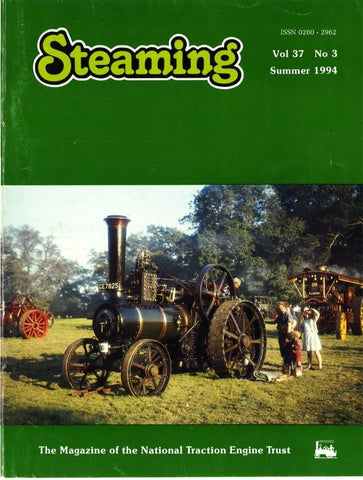
Cover Thirty years have passed since the famous Raynham Day events were held near Fakenham in Norfolk. In a superb tree-surrounded setting, the September rallies were perhaps the first where the engines were set out so widely spaced and with nn cars, caravans or tents close by. Burrell 6hp compound traction 2536 of 1903 basks in the evening sunlight after the 1963 gathering, whilst the day's happenings are discussed by crew and friends. (Roger West) 119
Trust News From the Chairman (continued from previous page) areas of the country, so that those areas can feel truly represented at national level. We each become inevitably older every year, and they pass too quickly; I want to see members in the thirty to forty age group around the Committee table. Please encourage suitable people to stand. Some of our number have done too much for too long and are still full of beans, but we shall not repay their efforts by wearing them out. When you are basking in the glory of a good rally consider the future and whether you can help. The pay is lacking, the hours are unsocial and the thanks few, but the aims of the Trust make it all worthwhile. Have a good season 'Steaming' and come to the AGM. (Richard Sandercock)
meetings at various locations that specialise in certain aspects of repair and maintenance. Another project we have mooted is a weekend of driving engines, at suitable premises, for non engine owners — your comments on this suggestion would be helpful. With the approach of the July deadline for written schemes of examination, sales of the Trust's Traction Engine Code are going very well. Anyone who still has any doubts regarding the Law on traction engine operation should read Jim Newnham's two contributions in the last issue of Steaming, page 61/62. Please find time to drop me a line if you have any thoughts which may help us to formulate future plans for
the benefit of traction engines or the Trust. (Michael Davies, chairman, Engine Owners siih-Committee address inside front cover)
Rally Organisers Column Rally Safety Officers This issue of Steaming is the last opportunity this year to remind all Rally Organisers and Safety Officers that their Safety Officer's Report for their event or events should be sent to
From Alan Martin's Collection
65
Engine Owners Column Engine Owners sub-Committee The Trust's Driving Course this year was an enjoyable arid, I feel, successful event. I should like to record our thanks to all who contributed, either as engine owners, instructors or participants. Our hosts at Amberley Chalk Pits museum, once again, made us most welcome and we are particularly grateful for their cooperation. For next year's Course we teel that we should move north, and are investigating a venue in the York area. Before we proceed too far with arrangements however, we do need some idea of how much support we shall get, as it is difficult to cover our overheads without sufficient participants. If you would like to attend a Course near York in May 1995 please let me know — there is no commitment at this stage. It I have your address I can let you have an entry form when they become available. At Amberley, the talks on technical subjects were well-supported and we are considering organising short 120
One can still enjoy George Gale & Co's Horndean ales in their houses around Hampshire and West Sussex, but they are not, alas, delivered by steam wagon. This is Gale's Foden 3 tonner, number 3526 (M4670), purchased in February 1913, and it is seen engaged on its round during the winter months — note the wet and mud on the rubber tyred wooden wheels and on the steersman's boots and trousers. Summer 1994
STEAMING
the Trust within 14 days of the event. A great deal of effort and expense has been expended in trying to obtain reports for last year. It is strongly recommended that reports are photocopied before submission; this avoids the possibility of total loss of the report in the post. (Smudge Smith, Rally Approvals Officer)
Rally, near Stevenage, Herts; 4 and 5 — Woolpit Steam Rally, near Bury St Edmunds, Suffolk; 11 and 12 — Rocket Site Event, Bawtry, South Yorkshire.
The following events have been added to the Trust's 1994 List of Authorised Rallies, as included in the Spring issue of this magazine. JULY 9 and 10 — Wincanton Steam and Country Fair, Moor Lane, Wincanton, Somerset (about 20 engines). Mrs E. Ayers, Brains Farm, Moor Lane, Wincanton, Somerset BA9 9RA. 9 and 10 — Cheshire Steam Fair, Broad Lane, Grappenhall, Warrington, Cheshire (about 60 engines), S. Boak, 21 Market Place, Pickering, North (Tr 0751 Y018 7A E Yorkshire 473780). 29 to 31 — Pickering Traction Engine Rally, Showfield, Malton Road, Pickering, North Yorkshire (about 100 engines). S. Boak, 21 Market Place, Pickering, North Yorkshire Y018 7AE (170751 4737801. AUGUST 13 and 14 — Astle Park Traction Engine Rally, Chelford, Cheshire (about 60 engines). S. Boak, 21 Market Place, Pickering, North Yorkshire Y018 7AE (120751 473780). 27 to 29 — Coppice Steam West Hallam, near Gathering, Ilkeston, Derbyshire (about 10 engines). R. Fletcher, 1 Lilac Mews, Ilkeston, Derbyshire DE79J81720602 441659). SEPTEMBER 17 and 18 — Shefford Steam and Country Fair, Wren Park, Shefford by pass, near Biggleswade, Bedfordshire (about 60 engines). P. Worbey, Park Farm, Arlesey Road, Henlow, Bedfordshire SG16 6DF liT0850 195622). 17 and 18 — 20th Grand Henham Rally, Sibton Park, Yoxford, Suffolk (about 40 engines). (G. Scriven, The Old Rectory, Frostenden, Beccles, Suffolk NR34 7HX. Other events added to the list and which will have taken place before the publication of this issue of Steaming were; MAY 28 to 30 — Leeds Steam Spectacular, Temple Newsam; JUNE 4 and 5 — Little Wymondley Steam STEAMING
Summer 1994
The Trust's
CODE OF PRACTICE for Traction Engines and similar vehicles is now available.
Trust Exhibition Unit
The Rally List 1994
For engine owning members ...
At the time of writing the Trust's new exhibition unit — and I emphasise the word exhibition, for it is not a hospitality venue — has attended six events, as listed in the last issue of the magazine. Comments from those members who have visited the unit have been most encouraging and the concept seems very acceptable to all visitors. The basis of the idea for the unit, other than the promotion of the Trust's activities, has been to provide publicity for all events with aid of posters and handbills; the recruitment of new members and the opportunity for existing members to make renewals and to talk with various committee members who are staffing the unit on all aspects of the Trust's work and any of their problems in owning and rallying traction engines. There is also a selection of road steam related books and items available for sale. The unit will be attending the following rallies during the remainder of the 1994 season: July — 9/10th Rempstone, Notts; 16/17th Lambeth Show, London; 22-24th Netley Marsh, Hampshire; 30/31st Milford, Devon.
Price f17.50 each including postage from — Mrs Sylvia Dudley 12 Hillway Woburn Sands Milton Keynes Buckinghamshire MK17 8UL
August — 6/7th Wadebridge, Cornwall; 13/14th Knowl Hill, Berks; 20/21st Fairford, Glos; 28/29th County of Salop, Shrewsbury; 31st-4th Great Dorset Steam Fair. September — until 4th Great Dorset Steam Fair; 10/11th Haddenham, Cambs; 24/25th Billericay, Essex. (Robert Herring)
Great Dorset Steam Fair It is our intention to present the Trust's new Publicity Unit at the GDSF with an adjoining members tent for hospitality, similar to the successful and much welcomed venture that has been provided in recent years. The staffing of this tent — the tea and
NTET Coal Supplies The Trust has again arranged low priced coal for use by rally organisers, clubs or individual owners In association with Arscott Collieries, Coal Factors and Merchants, Gateway Chambers, 26 Castle Street, Shrewsbury SYI 2BJ. • • •
pre-packed 25kg plastic bags, or bulk supplies available haulage can be arranged to any rally site ring John Watkiss on 0743 362482 to discuss your requirements and haulage cost, anywhere in Britain
DRY STEAM COAL
CWM BARGOED COBBLES
/120 per tonne I 123 per tonne ex Newtown, Powys ex Tyn-y-Wern (prices include L3 pallet charge but exclude VAT) Cash on collection or pre-payment Please order early to obtain supply of steam coal; bituminous also available
121
coffee making and serving — is often difficult for us to arrange and I hope we will be able to rely on some volunteers from within our membership to take on a part of this important work, on a rota basis. The actual job is, admittedly, not very glamorous, but it has the benefit of being in an extremely friendly atmosphere with like-minded enthusiasts at the one event in the year where so many of us seem to gather. It really is a splendid opportunity to meet other members. If you are willing to spend a few of your hours at the event helping in the activities of the Trust, I will be pleased to hear from you and discuss times, etc. The dates are Wednesday 31st August through to Sunday, 4th September 1994. Please drop me a line, or contact me by phone, as soon as possible. (Robert Herring, Glebe Court, Fring ford, near Bicester, Oxon OX6 9RJ — ST 0869 277410)
Steam Apprentice Club It seems unlikely that training events will take place at many of the thirteen NTET Authorised Rallies that have kindly offered this facility this year, as there are so few adult helpers
available to organise the necessary activities. However, John and Fiona Durling have arranged teaching sessions and steering in the arena at four Yorkshire rallies; three of these, Masham, Driffield and Harewood House, are detailed in the 1994 Rally List. It is hoped that these will be well supported by Steam Apprentices, and can help to make some amends for the Club's inability to respond to all rally invitations, and our failure to arrange an Apprentices Driving Event this year. Twelve of the 72 NTET authorised events have indicated that they will admit SAC members free of charge, on production of a current membership card. However, a survey last year showed that 31 165%) of 48 SAC respondents had not made use of this scheme, even though many indicated they had visited participating rallies. Another instance where publicity and information needs to be made available amongst NTET members and affiliated clubs, perhaps? Meanwhile the SAC 'committee' endeavours to provide some sort of structure for the Club, which, happily, 77% of our members feel is 'excellent' or 'good'. Again, professional or domestic pressures on adult sup-
porters greatly limit their involvement (to the extent that the Editor of Raising Steam doesn't expect the Spring edition to be published much before the longest day). We have yet to find an effective way of responding to the enthusiasm and willingness of our young women and young men to contribute to the organisation of the section, hampered as we are by transport and geographical considerations. We continue to receive kind offers from generous traction engine owners who are willing to involve young people in the maintenance and running of their steamers. Inevitably, we often find that the location of the engine does not tally with that of the young peopiR wishing to develop a heifer
practical knowledge of our hobby. As many aspiring Apprentices have not yet reached their twelfth birthday (the minimum age felt practical for reasons of insurance and maturity), the success rate of matching youngsters to engines is not as high as we would like. There have, however, been some very successful and much appreciated pairings. If anyone would like to help in any capacity with the SAC, or receive a copy of the most recent Raising
A clashing of crane locos at the 1992 Great Dorset Steam Fair as two Burrells desport their jibs — 7hp 3197 of 1910 at the left and 6hp 3829 of 1920 to the right. (Roger West)
Steam, please contact Steph Gillett, 93 Devon Road, Easton, Bristol BS5 6ED (enclosing a large sae for the magazine), or Sylvia Dudley. (Steph Gillett)
JERZEES SWEATSHIRTS Produced with embroidered NTET Logo (approx 3in x 21/2in) onto left hand chest position, onto plain sweatshirts.
NTET Haberdashery We are pleased to advise members of three additional ranges of club items in this issue's Mail Order list, full details are given in the display advertisement. For the well dressed male we offer 'Jaquard woven ties' and for the SAC members 'Screen Stars Tee Shirts'. Both male and female are catered for with 'Jerzees Sweatshirts' in a range of colours and sizes. Available by Mail Order, or from the NTET Exhibition Unit. (Colin and Val Brown, NTET Sales)
Small Adverts Attention is drawn to the new, increased charges for the use of the Small Adverts column by nonmembers and by members using it for trade purposes. This has been done to bring the facility more into line with
other commercial publications but the free insertions for paid-up members will, of course, be continued, subject only to the conditions set down under the Small Adverts heading. Please refer to that column in this issue for the revised rates.
QUALITY: Polyester/Cotton base colour
logo colour
med
large
xlarge
Black Bright Royal
Gold Gold Black Black
Yes Yes Yes Yes
Yes Yes Yes Yes
Yes Yes Yes No
Bright Red Winter Emerald
PRICE: £16.30 inc 17.5% VAT
JAQUARD WOVEN TIES
SAC TEE-SHIRTS
Produced with single motif NTET Logo, woven in gold in under-knot position, with all over motifs of alternative engine in toning tissue. (Shadowing)
SCREEN STARS 100% Cotton Tee Shirts for Steam Apprentice Club members Full cut style, pre shrunk cotton.
QUALITY: Polyester Satin
COLOUR: Black with SAC Logo printed in white, full chest.
SIZE: 54in x 31/2in COLOURS: Navy Bottle Green Dark Brown Maroon Royal Blue PRICE: £7.95 inc 17.5% VAT
SIZES: SENIORS Large, Medium, Small PRICE: £6-25 inc 17.5% VAT
SIZES: JUNIORS 12-14, 9-11, 7-8, 5-6 years PRICE: £4.50 each exclusive of VAT
The above items are all available from the NTET MAIL ORDER SALES or alternatively from the NTET RALLY EXHIBITION UNIT.
Coal Rebate Scheme Further to my notes on the above scheme in the last issue (page 64), the Transport Trust advises that British Coal have decided that the scheme will operate for 1994. As, however, it seems likely that BC as an entity will cease to exist at the year end, there is a much shorter time scale to present the invoices for payment. Rally organisers, affiliated clubs and engine owners are therefore warned that I shall need to receive invoices as soon as possible after the end of the scheme year on 31st October 1994 and certainly no later than 18th November. I shall be unable to guarantee payment after that date. (J. T. G. Harris, Hon Treasurer)
STEAMING Summer 1994
Obituaries Fred Creasey It is with regret that I record the death of Frederick John Creasey of Bodle Street Green, East Sussex. He passed away in March 1994 at Eastbourne District Hospital; yet another link with our steam agricultural heritage has gone into history. A church service held on 24th March at Bodle Street Green was followed by cremation at Eastbourne. The church was packed to capacity as people from all walks of life came to pay their last respects to this well liked man. The steam preservation movement was represented by Peter Love of the
Sussex Steam Engine Club, and many others. The hymns, picked for the service by his widow Elsie, very much depicted his life in agriculture — We Plough the Fields and Scatter and All Things Bright and Beautiful. The village of Bodle Street Green will not be quite the same without Fred Creasey. (Peter Love)
Robert Hawkins I am sad to record the tragic death in May of Robert Hawkins of Wadebridge, Cornwall, aged 29. Robert was the son of George and was brought up with engines, looking after the 123
family's collection. This for many years included Fowler showmans IRON MAIDEN, and Robert had recently rebuilt the Tiger tractor FIREFLY. (Richard Sandercock)
Night and Day. Two pictures of the rare 5hp Brown & May showmans road loco 8742 of 1912 GENERAL BULLER, seen in action around the clock in the fairground at the Great Dorset Steam Fair. The night scene was captured by John Maund at the 1991 event; two years earlier the engine was pictured in sunshine by Roger West.
from Peter Ballard at the address quoted there.
Scania Transport Trust Awards Congratulations are offered to member Robin Knox of Harrogate, North Yorkshire, on his being named as an interim winner in the 1994 Scania Transport Trust Awards. This is for the restoration of his Fowler tarspraying roller 17492 of 1928, which was featured on the cover of our last issue, and its accompanying Fowler gritter. Robin has known the roller since his childhood days of the late 1950s, when it worked around Londonderry, Northern Ireland, his home town. Acquired in 1962, the machine has since 1986 been restored to its original specification, and to a high standard — an effort rewarded with the present award. Further entries for the Award Scheme are solicited by the organisers — some details were set down on page 9 of our Winter 1993/94 issue and further information is available 124
Future Dates Annual General Meeting Advance notice is given to all members that this year's Annual General Meeting will be held on Saturday, 19th November 1994 at The Heritage Motor Centre, Gaydon, near Warwick. Formal notice, together with all relevant information, proxy forms and audited accounts for the year ended 31st March will be sent to all paid-up members of the Trust with the Autumn issue of Steaming. Any member may submit a motion for discussion at the Annual General Meeting. All motions must be in writing, signed by the proposer and by a seconder. Such items for discussion, in order to be published in the Agenda for the Annual General Meeting, as
required by Article 16 of the Trust's Constitution, must reach the company secretary Sylvia Dudley not later than Saturday 24th September 1994 (address inside the front cover). Details of the arrangements for the weekend will be published in the Autumn issue of Steaming. A list of overnight accommodation will also be prepared for those wishing to make a weekend break around the planned activities.
Autumn Rally Organisers Conference Regular delegates may like to note that the venue of the Autumn Conference has been changed to a new location at Rugby, Warwickshire — but the date, Saturday 22nd October 1994, remains the same. Further details will be distributed to rally organisers and affiliated clubs in due course and other interested parties seeking information should contact the Hon Secretary.
Summer 1994
STEAMING
Foster's Tractor in the RAC Trials 'The 'Wellington' tractor which ran throughout the recent trial, did not, during that round, show to the best advantage; in both fuel and water consumption the performance of this machine was much above the rate of consumption at which we know it will work. On enquiring into the cause of this, we find that the low-pressure valve has a somewhat large exhaustchamber, and, to support the core in the mould, a chaplet is used. The particular casting of the low-pressure cylinder used on the trials vehicle appeared to be quite sound, but the chaplet had evidently been covered by a mere film of iron, which ultimately formed a 'scab'. During the preliminary tests, near the maker's works, the valve worked very well. The flaw was not revealed until the day before the tractor set out for London, when on the opening-up of the valve-chests for the final inspection, a hole, about 5/16 of an inch in diameter, leading from the low pressure steam-chest to the exhaust steam-passage was discovered; the
STEAMING
Summer 1994
thin film of iron had given out, and the chaplet was missing. At such a late hour, it was impossible to replace the casting in time for the machine to take part in the trials. It was decided to tap the hole, to fit a %-inch gas plug, and to hope for the best in the 660-mile trial. 'All seemed to go well until Gloucester was reached; it was there realised that the plug had become loose. From that stage, to the end of the trials, the engine ran with this hole permitting a direct and continuous escape of a considerable quantity of low-pressure steam. It is to be regretted that the flaw was not discovered earlier, in order that it might have been remedied before leaving the works. Under such adverse conditions, the performance of the 'Wellington' tractor was an excellent one, and the machine well merited the silver medal awarded to it. '[One of the Wellington tractors...], of the Colonial type, has recently been shipped to Tasmania. It is fitted with a large-size firebox, for the consumption of inferior fuel, and has specially-wide wheels, in order to
RALLY SAFETY SIGNS DANGER — beware of moving vehicles etc —
yellow with black lettering Unauthorised persons prohibited etc —
red with white lettering FIRE POINT — red with white lettering Printed on rigid plastic boards
each sign inc VAT, postage C5 per order From: A.J. Semple (WET) Unit 6, Mynd Industrial Estate Church Stretton, Shropshire SY6 BEA'
facilitate travelling over sandy ground. The water-tank capacity is sufficient for a 20-mile journey, with a full load of 8 tons behind the drawbar, and upon heavy roads.' (from Commercial Motor, 28th November 1907.)
125
David Dean and Ron Myatt For the first half of this century the village of 'Hopwas, on the Tamworth to Lichfield road in Staffordshire, held two places of interest to the steam enthuiast. One was the pumping station of the Tamworth Waterworks Company, which housed two single cylinder, house built beam engines manufactured by Gimson & Co of Leicester in 1880. These pumped water from a common well beneath the engine house. In the adjacent new engine house a Tangye horizontal cross-compound engine pumped from its own bore hole. The latter engine is now only a fond memory to those of us who were fortunate enough to know it, but the two beam engines still survive, though regrettably no longer as a pair, one being at the Forncett Industrial Steam Museum in Norfolk and the other at Snibston Discovery Park, Coalville, Leicestershire. The second centre of interest, which is the subject of this article, was Two Tree Farm on Hints Road, from where John Henton operated his agricultural contracting and haulage business, and whose engines and tackle were at one time a common sight on the roads and stack yards of a large area of the Midlands. John Henry Henton, better known as Jack, born 1871, was the seventh son of Aaron Henton, born 1832, a farmer of Sibson near Atherstone. This village was famed for its beautiful and ancient church of Saint Botolph, and the reputed connection of its Cock Inn with highwayman Dick Turpin. By 1893 Aaron had moved to Ratcliffe Culey where he was described as a thrashing contractor, and he later moved to Church Farm, Hopwas. He died at Nuneaton on 6th March 1926, at the age of 94, and is buried in Hopwas churchyard. Jack appears to have taken over the business at some time between 126
1888 and 1896, first living at the Old Vergery (formerly a blacksmith's shop) on Hopwas Hill. On his marriage to Agnes Matilda Scott on 5th July 1898 he moved to the Woodlands in Nursery Lane, and finally to Two Tree Farm in Hints Road. In addition to the contracting business Jack was a farmer, had a milk round, and also kept the village post office. Jack and Agnes had four sons, Bill born 1899, Archie 1903, Fred 1906, and Don 1909. They all joined Jack in the business, but Fred left after a few years to work at the Lucas factory in Birmingham. The firm eventually became: JOHN H. HENTON & SONS LTD STEAM HAULAGE & THRASHING CONTRACTORS HOPWAS There were four grandchildren, Janet and Enid, who were Bill's children, and Maurice and Betty who
were Archie's Maurice worked for the firm, but never became a partner. Bill volunteered for the Royal Naval Air Service in World War 1 and served as an engineer crew member of a flying boat, operating anti-submarine patrols over the North Sea from the base on the South Denes at Great Yarmouth. On entering the yard at Hopwas there was a range of farm buildings opposite the gate, with oil and spare parts stores at the near end. To the right was a timber built coal and tackle shed and then a brick-built combined blacksmith's and fitting shop. This housed, in addition to the blacksmith's hearth, a variety of machine tools, lathes, drilling machines, shapers, etc, some of which had been purchased at Burrell's closing down sale. These were all driven by overhead line shafting which extended through the
Marshall 7hp traction engine photographed in Hen ton's yard at Hopwas in 1961. (David Dean) Summer 1994
STEAMING
end wall to a large pulley to take the
belt from a portable engine in the yard. Outside was an overhead gantry crane which also came from Burrell's sale. Continuing past the blacksmith's shop was an open fronted implement shed with a half round corrugated iron roof which occupied all this side of the yard and also went part of the way along the end boundary. Opposite was
a much larger open fronted corrugated iron engine and tackle shed. Between them these buildings provided sufficient covered accommodation for all the engines and most of the tackle when not in use. In the far corner of the yard was an open space used for parking engines and tackle, living vans, timber drugs, etc and also implements which had been taken in lieu of cash when times
were hard and farmers could not afford to pay their thrashing bills. All repairs and overhauls were carried out by the firm's staff, including, when necessary, the fitting of new fireboxes, not only to their own engines and tackle, but also that belonging to other owners including Pat Collins when his travelling fairs were in the district. Current for
welding was supplied by the dynamos removed from showmans engines NERO and RAJAH. These were mounted on a traction wagon outside the blacksmith's shop and driven by the yard portable, or in latter days by a Fordson tractor. In 1949 Hentons fitted a new firebox (supplied by the makers) to their own Marshall. From this yard the firm travelled all over the Midlands and further
afield hauling sand from Hopwas pit; products from Thompson & Southwick's foundry at Tamworth; road stone as far as North Wales; pit wheels, etc. They worked as far afield as Hereford and Ross-on-Wye pulling round timber out of the woods and taking it to the local railway stations. They carted most of the bricks for building nearby Whittington Barracks, and in the 1920s were involved with the demolition of Drayton Manor (home of Sir Robert Peel) using the engines' wire ropes to pull the building down and then carting away the material. Incidentally, the major stones from the manor were numbered and crated for export to America. They were no strangers to long journeys and in 1931 NERO and RAJAH were driven home from Newcastle-on-Tyne by Bill Henton and Jack Teal after being bought at Bostock & Wombwell's closing down sale. Both engines were in a very run down condition at the time and needed a considerable amount of work doing to them before going into regular use on the thrashing
STEAMING Summer 1994
Burrell 3.996 CONQUEROR at work on thrashing; Bill Henton stands by the engine. The date and location are unknown. (Mrs P. Holmes) round. The firm also moved fairground rides between various Midland fairs for the local riding masters. In October
1908, when moving a set of roundabouts belonging to Job Farrell of Chester from Lichfield to Kings Norton, the driver (Leonard Foster) lost control on the hill in Howe Street, Birmingham which resulted in the centre engine wagon turning a complete somersault. Hentons had a very large thrashing area which extended to Nuneaton,
stopping you a quarter for knocking off early yesterday'. I told him what had happened, but he wouldn't have it so we had a few words and I left and
went home. Next day he came out to the farm and the farmer told him about Saturday. Jack never said a word to us and we didn't get the quarter back either. Mrs Henton had told Jack about us going through Mile Oak early on Saturday." Jack Poynton tells another story: "When I was steering for Bill on
Tutbury, Stafford, West Bromwich and Canwell. When at their busiest they had ten sets of tackle in use. All the drivers had their own districts to
CONQUEROR I remember one cold and frosty morning we set out to go to Hidderly's farm at Portway to do some thrashing. After slipping and sliding on
cover and also did baling, chaff cutting, wood sawing, etc. Such a large area involved the men in long cycle rides to and from work each day. Engines were also hired out to provide steam for soil sterilising, steaming pig swill, and steaming old hay ricks — which was done to make the hay more palatable to its consumers. The late Jack Teal told the following story about those days: "We were thrashing at a farm at West Bromwich on land which is now the football ground car park. We had finished one rick by Saturday dinner time and set up for the next one when the farmer came
the icy road Bill put the frost spikes in and off we went leaving a nice track in the road which didn't please the council at all. As we went down the hill from Wiggington and round the corner to start the climb up the hill to
and stopped us, saying he wasn't having a rick open all over the weekend. So that was that; we did a few minor jobs to the tackle and engine and decided to knock off a bit early. We got on our bikes and rode home, and coming up through Mile Oak we saw Mrs Archie Henton in her garden and said good night. Next morning when I took my book down to Jack Henton to be paid, he said 'I'm
Portway the injector broke off. We stopped the engine and made it safe and went back to the farm to get the blacksmith who made the repairs and then we carried on to Portway." In addition to the thrashing and haulage activities Jack was also a dealer buying and selling engines and tackle and advertised a 7hp Marshall for sale in 1911 and a 6hp McLaren in
1924. In 1925 he bought Aveling 12'/2 ton single cylinder roller 4073 and resold it almost at once to Co. Durham. Jack did a lot of business with Marshalls with whom he had a very good working relationship. Their salesman was a family friend and one day
Agnes told him how much she admired the cast brass Britannias on Marshall rollers. On his next visit he brought 127
one to be fitted to 52483 — where it remains to this day. Although no name plate was ever fitted this engine was thereafter referred to as 'Britannia'. Jack had similar good relations with Burrells. An engine he bought from them new soon started to give problems due to a laminated plate in the firebox side. Burrells cut the bad area out and fitted a bolted-on patch with the promise that if there were any more problems they would fit a new box at no charge. A good many years later it did start to give trouble again, and although it must have been well worn by then, true to their word, Burrells fitted a new one. Mrs Violet Coton, whose husband was a driver for Hentons, was one of the village 'characters' She worked for Hentons as a feeder on the thrashing drum and sometimes steered for Bill. After Hentons stopped thrashing she went to work as a feeder for a farmer in the district who had his own drum, but remained a family friend for the rest of her life. Early one morning RAJAH driven by Jack Teal, left the yard with drum, baler, and batten tier in tow and turned left along Hints Road, out of the village over Balls Bridge (which crosses the Birmingham & Fazeley canal) and into Hints Lane. Just past Griffin's poultry farm the lane narrows into a single track with high banks and thick thorn hedges and no passing places for about a quarter of a mile. Just as the engine entered the narrow section the back axle snapped in half, stopping the
Burrell 2336 STANLEY MONARCH under the yard crane, about 1942. The hole for the fusible plug was being built up with weld and retapped. (Mrs P. Holmes)
engine dead and completely blocking the lane. After making the engine safe Jack and his steerer walked back to the farm to report the accident. Jack Henton was feeding the pigs at the time and as they walked through the gates he greeted them with "You've broken the b thing; the axle's gone." "How do you know?" "I heard it". After a heated discussion on who
John H. Henton & Sons, list of engines •
Burrell 2343 8hp single crank compound traction on springs New to J.H. Henton 3.12.1900; sold by 1921
•
Aveling 2544 8hp traction (EA1139) New 1.9.89, date bought by Henton unknown; last licensed by him 1938
•
Aveling 7795 GND tractor (D8492) New 20.9.12, dates owned by Henton unknown
•
Foster 3066 8hp road loco New 5.5.05, may have been owned by Henton at one time
•
Burrell 3996 5hp road loco CONQUEROR (E9597) New to Henton 18.11.24; remained in family until 1976
•
Burrell 3395 6hp road loco CITY OF EXETER (FJ15361 New 1912, bought by Henton 1924 from J. Hancock & Son, Exeter; sold 1960
•
Burrell 3509 5hp showmans road loco RAJAH (G6469) New 1913, bought by Henton for £180 at Bostock & Wombwell's auction at Newcastle upon Tyne 30. 11.31; sold 1955
•
Burrell 3669 5hp showmans road loco NERO (G6470) New 1915, bought for £200 at same time as RAJAH; sold 1958
•
Burrell 2336 8hp traction STANLEY MONARCH 1E5113) New 1900; bought by Henton in 1920s from J. Hulme, Fradley; sold 1953
• Marshall 52483 7hp traction (E5114) New 26.8.09, bought by Henton from Army in 1917; sold 1961
•
Ransomes 10893 6hp traction (E5115) New 1896; dates owned by Henton unknown, but with them at least c1921, when these last three engines were registered by Staffordshire CC.
Details kindly supplied by Alan Duke 128
was to blame, etc they got the blacksmith and tools, and together with some of the other men went back to the stricken engine. They jacked it up, removed the back wheels and axle and returned to the yard leaving the engine and tackle where it stood. According to Jack Teal's story a telegram was then sent to Burrells informing them what had happened and requesting a new axle, Burrells supplied one by the next day to Tamworth LMS station where Hentons picked it up. However, according to Maurice Henton, the broken axle was loaded into Jack Henton's car and taken to Thompson & Southwick's foundry at Glascote, just outside Tamworth, where a new one was made. Whatever did happen, the new axle was taken out and fitted, the wheels put back on, the fire was lit and steam raised and the crew continued on their way. The road was blocked for about four days, but nobody complained or said anything about it. In the road outside Jack's house were two big elm trees which the local boys liked playing in. When Jack had had enough of their noise he had an original and highly effective method of persuading them to go elsewhere which involved him in a trip to the cow yard to collect a bucket of fresh muck. Apparently his aim with it was quite good. Ron Myatt tells the following stories: "As a lad I used to go down to Henton's farm and spend time with Summer 1994
STEAMING
the cowman and I remember one Saturday morning I was there when all hell let loose; the reason was this: on the Friday afternoon one of the sets had pulled into the yard II can't remember which one) but instead of going right to the top, the engine stopped about half way up the yard. Just after that another set came in and stopped behind the first, completely blocking the yard and gateway. As the afternoon wore on more of the sets came back, but because of the two in the yard they couldn't get in, so had to park on the road around the Green and in Hints Road, which didn't please the old man as he well knew it was against the law to block the road like that. After an argument they got all the engines and tackle into the yard for the night. "Back on the Saturday morning, the scene was this — the five engines scattered round the yard with their tackle still attached and all in steam, the men were milling around and the old man was walking from the house to the pig sty with two buckets of swill. The cowman, Maurice Walters, sent me up the yard to start the tractor as we were going up to one of the fields to do some work. When I got to the tractor shed it was empty; the tractor was across the yard with Bill, who told me to clear off and tell the cowman that they was having it, and he could use the horse and cart or go home. (One word about the horse, it was getting on in years and hadn't been worked for a long while and was more or less the old man's pet; also the cart had been converted to tractor use.) "I told the cowman what Bill had said, word for word, and he flew up STEAMING Summer 1994
Aveling & Porter GND tractor 7795 engaged on drawing timber out of Drayton Manor Estate — Jack Teal was the driver but the date is unrecorded. (collection late Jack Teal)
the yard and the argument started; the cowman saying the tractor was for his use only and not theirs; Bill telling him it was theirs, and so on. As you can imagine the rest of the men joined in with Don on the side of the cowman and ready to thump Bill and anyone else who got in his way. Bill then squared up to Don with Archie trying to calm things down, and the rest of the men adding their ten pennyworth where it would do the most good or harm according to their feelings. "As the old man crossed the yard between the tackle he heard the noise and came to see what the trouble was, the buckets of swill in his hands. The cowman told him that Bill wouldn't let him have the tractor as they wanted to move the tackle into the sheds, and that Bill had sacked him. Then all hell let loose, the old man, who was dressed as usual in collarless open necked shirt, no jacket, thick grey trousers and boots that wasn't laced up and getting on in years, let out a roar like a wounded lion and the buckets of swill went up in the air. He then let fly into everybody around including me. The gist of it all was that they were no sons of his to want a tin pot tractor to move tackle when they had wonderful steam engines at hand and the tractor was the cowman's, not Bill's, who had no right to it or to sack him and so on and so on. He would give them a lesson on engine driving and with that he got on one of them and drove it around the yard like it was a pedal car, shouting and raving at
them all the while. It was great watching him. Maurice Henton, Jack Teal and Arthur Webb were behind one of the drums while this was going on, killing themselves with laughing at the antics of the brothers and the old man. "In the meantime the cowman got on the tractor and I jumped on too, and when things calmed down a bit we beat a hasty retreat out of the yard and up to the field. When we got back things were at peace and all the tackle in the sheds. Mind you, that was life at Hentons." Another tale by Ron is of thrashing at Packington Farm. "When I left school in 1946 I worked for twelve months on Arthur Barber's farm, Packington Lane, Hopwas. He was a friend of the family. At the end of the harvest we had four big ricks of rye and a small one of oats, very close together in two rows in a long narrow yard. When the time came for them to be thrashed I had to go to tell Jack Henton. "The engine and set that came to do the job was Burrell 3996 CONQUEROR, driven by Bill Henton with Arthur Webb as steerer and feeder. We were working in the yard at the time and heard them coming a mile away. We went to meet them along the lane leading to the farmhouse, and that is where the trouble started. You see in those days the lane wasn't made up and was full of potholes, and the section in front of the farmhouse was soft sand and rubble washed down off the hill behind the farm. 129
When the engine got to the soft bit it started to sink. Bill stopped and uncoupled the tackle, the rope was paid out over the front wheel to a nearby tree and back to the eye on the perch bracket, and thus the engine pulled itself out to firm ground. Next the batten tier was uncoupled and pushed to a piece of waste ground at the side of the road as it wasn't needed in the yard. Then the drum and baler were roped to the engine, coupled up and taken up to the rickyard. "Guess who had the job of pulling the rope out — me, but I had plenty of advice from Bill and the two Arthurs. When the rickyard was reached the same thing happened again, only this time it wasn't so easy. There was very little room between Lire ticks where the tackle had to go, and the ground had been churned into a spongy mess of straw and mud by the tractor which was on spuds and iron wheels. There was nn solid bottom in the yard and we had had a wet winter and the ground had never dried out. The easiest way to get the tackle in position would have been to use the tractor, but it had broken down earlier on and was in the garage having its first major overhaul in ten years (it was a Fordson N model) so Bill worked out the following procedure, and as you didn't argue with him, this is the way it was done. "First, the baler was moved into position on a line of centre between the ricks and on the firm ground outside the rickyard. The engine was stood to one side where its rope could be run out behind the ricks. Again, I had plenty of advice as I pulled the rope out, especially when Bill put the rope brake on and I was yanked off my feet — Bill would have his little jokes. I took the rope all the way up the yard behind the ricks, round a convenient tree and stump, down between the ricks and coupled it to the A bar on the baler, which was then pulled into position. Then it was the drum's turn, but this time I had to crawl under the baler to get the rope to the drum. Then Bill set the engine to the drum, all ready for a start next day. The ricks were that close together we had to cut some of the sides away to get the guard boards down. "On thrashing day I was gofer and water and coal man, but as the coal was next to the engine and we had a long hose pipe from the house it was just a matter of tap on-off, and heave the coal into the bunker. Happy days." Except for soil sterilising and pig food steaming the regular use of steam ended in the late 1940s with the introduction of Fordson tractors 130
Burrell 3395 CITY OF EXETER under the yard crane, about 1959. Maurice Henton, driver, is on the left and Arthur Webb, steerer and feeder to the right. (collection late Maurice Henton)
and then a combine harvester. The six remaining engines were stored under cover and regularly oiled and kept in working order. Before being laid up CONQUEROR had been fitted with new strakes on the back wheels. Only one engine (CONQUEROR) was taxed and the number plates moved to whichever engine was to be used. RAJAH was at a farm at Elford in 1952 steaming pig food and the Marshall had been used on the saw bench about eighteen months earlier. STANLEY MONARCH was sold in 1952 to Robert Wylie of Uplands Farm, Elford to steam his mushroom beds. It needed boiler repairs before going there and was still at Hopwas in May 1953. It was again in Henton's yard in 1956 when Mr Wylie sold it to Webb's nursery in Sutton Coldfield for
List of drivers and mates Drivers John Henry Henton (owner) Bill Henton Archie Henton Fred Henton Don Henton Maurice Henton (son of Archie) Jack Teal George Neal Leonard Foster Jess Coton Mates Fred Harris Arthur Webb Billy Belton Jack Poynton Mr Taft Mrs Violet Coton Summer 1994
STEAMING
authenticity in preserved engines and made some very caustic comments about CITY OF EXETER being spoiled by having half its cab cut off. He was equally disparaging about the extra brass adornments which appeared on NERO and RAJAH. Following Bill's death in 1976 CONQUEROR, the drum, baler, traction wagons, saw bench, workshop machinery, etc were all sold by his family and this sadly marked the end of an era in the history of Hopwas.
Burrell 3509 RAJAH at Elford on 23rd July 1952. Discreetly note that it carries CONQUEROR'S registration number. (J. E. Dean)
soil sterilising. It was driven from Hopwas to Sutton by Maurice Henton. After Jack's death in 1954 Don concentrated on farming and had no more to do with the firm. Bill and Archie carried on together until 1961 when the firm ceased trading. By then the preservation movement was well established and RAJAH had been sold in 1956; NERO was next to go in 1958, followed by CITY OF EXETER in 1960 and finally the Marshall in 1961. Bill had always been the regular driver of CONQUEROR and on the dissolution of the firm he bought the machine and moved it to new
premises on the other side of Balls Bridge on Hints Road. He re-erected the yard crane there and used it for the basis for a shed to house the engine and tackle. This building is still there but from the outside there is nothing to suggest it was ever associated with steam. Bill also took the workshop machinery there, but never got round to installing it. In his retirement Bill steamed CONQUEROR occasionally, but never rallied it. He often acted as a judge at rallies and expected the highest standards of driving skill. He also expected equally high standards of
We would like to express our gratitude to all who have helped with the preparations of this article, in particular: Mr and Mrs P. Holmes; Mrs Maurice Henton; Jack Poynton; the late Alan Duke; Chris Garbett: The Tamworth Herald and members of the Henton family. We are keen to add to our knowledge and would be very grateful for any information about the firm and its engines. We would particularly appreciate any photographs of the engines in their working days and will pay all expenses. rjy
Some references to Hentons in the local press 'Situations — Wanted, Steady Man as Engine Driver and Feeder for Thrashing Machine, anyone not understanding this work need not apply. — J. Henton, Hopwas, Tamworth.' (from The Tamworth Herald, 31st August 1907 and the following two weeks.)
'To Builders, Contractors & Co Quotations on Application for Hauling & Co Apply John H. Henton Steam Haulage Proprietor Hopwas Tamworth.' (From The Tamworth Herald. The advert appeared from 3rd April until 16th October 1909, and for a slightly shorter period the following year.)
Three of Hen tons' fleet in the engine and tackle shed in October 1952. From the left: Marshall 52483; Burrell 3395 CITY OF EXETER; Burrell 3669 NERO. (J. E. Dean) STEAMING Summer 1994
'Hopwas. Accident. On Friday afternoon as Mr J. Henton was driving a traction engine through Bonehill he slipped on the footplate and in endeavouring to save himself from falling one of his fingers was caught between two cog wheels crushing it badly.' (from The Tamworth Herald, 15th August 1908.)
131
A SAVAGE REBUILD The diversity of output from Frederick Savage's St Nicholas Works at Kings Lynn is well known and the workshops one hundred years ago saw a fascinating variety of agricultural and fairground machinery in production. The Studt family of showland fame had, for many years, been good repeat
132
customers of the company but it would be interesting to know the circumstances in which, in 1894, Savages persuaded John Studt to buy their works number 614. The 7hp engine was an adaptation of the Sandringham class agricultural engines, fitted with a new form of single crank compound cylinder and
Savage's patent slow motion gear. The cylinder block had its 6 1/2 in diameter high pressure cylinder surrounded by an annular steam space 8%in inside and 14Y8in outside diameter, which formed the low pressure cylinder. The ring which formed the low pressure piston was worked by two piston rods from the common crankshaft. Unless the Studts added showland fittings themselves, it seems the engine stayed looking very much an agricultural machine. Perhaps it didn't stay in use on the fairground for long — not that that put off the Studts from continuing to buy from Kings Lynn, and indeed they took number 647, the only other annular cnmpnund trartinn, in 1895. By the early 1920s Savage 614 was in use on the Isle of Ely, looking at first glance a rather ordinary traction engine. R. Drake & Co of Sutton, Ely, had acquired it for threshing purposes at an unrecorded date, and probably direct from Savages, it having been taken back by them in part exchange; the unusual compound cylinder must have been in need of renewal, but the original pattern being by that time mislaid, an ordinary Bhp single cylinder block was cast and fitted. Our picture top shows the engine on the road with its tackle in that guise. The photograph was taken sometime after 1935 when 614 had passed (registration E82751) to F. Darby & Sons of Sutton — their cast oval owners plate is seen inadequately fixed to the upper footboard. The only other noteworthy change by that time was the lengthened smokebox; the heavy double tee ring front wheels were a feature of the Sandringham design. The slow speed gear shows up well to the front of the gear train, mounted at the front of the offside hornplate. The device has been well documented by Ronald Clark in his books and is worth further study therein, but briefly it consists of an eccentrically mounted gear wheel, which, when a pin was withdrawn from its stub axle and the lever rotated anticlockwise, caused the extra low gear to mesh with the usual low speed gear ring. Savages claimed it 'enabled the engine to be quickly lifted out of holes or other difficult places, without waiting to get up an extra pressure of steam, and can be readily put into uparation, thus effecting a huge saving in time and wear and tear of the engine and boiler.' Speeds from 5 yards per minute to 4 miles per hour were thus possible. Darbys Summer 1994 STEAMING
used the engine until after World War 2, but unfortunately it was later scrapped. The second illustration shows another example of the Sandringham type, also owned by R. Drake & Co. It, too, possesses the slow speed gear but its precise identity and age are unknown. The registration EB2945 was issued to Drake at his East Anglian Works, Soham, in
March 1921, the declared weight being 8 tons 15 cwt. Fred Darby acquired the engine in January 1935 and the picture was probably taken after that time. The negatives were taken by an unknown photographer and have been presented by Mrs R. Smith as set down in our Summer 1988 issue. Further detailed references to the Savage annular compound and the
slow speed gear can be found in Ronald Clark's Development of the English Traction Engine (1960); Savages Ltd (1964) and A Traction Engine Miscellany (1975) and Savages of Kings Lynn (David Braithwaite, 1975), to which reference has been made for these notes. Alan Duke kindly provided other information.
ik
. r.,•• -
-• •
•
As a postscript to the above notes we offer this picture recently located by member Mike Dyson in the Cambridgeshire Libraries photographic collection and reproduced with their kind permission. The three set threshing job is said to have been pictured at Sutton on the Isle of Ely, but no other details, or dates, have survived. All three engines that can be properly seen (a fourth lurks, largely hidden, behind the left most one) are Savage agricu/turals of the Sandringham class and A/an Duke suggests they must belong to R. Drake & Co of Sutton, as they owned four such engines in the early 1920s — numbers 503, 559 and 614, and another wrongly declared as 333 when it was registered by them as EB2945 in 1921. This veritable tribe of Savages at work at Sutton, therefore, would seem to include two of the engines pictured on the opposite page. Close scrutiny of the original print shows the engines carry large home-made wooden tool boxes, mounted on the front of the footboards, as also displayed by EB2945. STEAMING
Summer 1994
•
, •...-
0,4„;
ti
-
Burrell Gold Medal tractors Ron Walker, owner of Burrell tractor 4072 TINKERBELL, has issued Gold Medal Tractor Newsletter No 15. As well as news of recent appearances at rallies by the breed, it contains a list of survivors here and abroad. The Newsletter is sent to those interested owners and others on an informal basis — it is not an official organisation but Ron would be pleased to hear of further Gold Medal survivors that are rumoured to exist, particularly one at Burr, Co Offaly in Eire; his address is Lower Priory Farm, Clamp Hill, Stanmore, Middlesex HA7 3JU.
Six horse Burrells The caption to the picture of three Burrells (page 7, Winter 1993/94 issue) claimed they were 'the only surviving 6hp Burrell road locomotives that have not been converted to showmans engines.' Two members write to offer further examples — Will Bibby of South Wirral cites 3098, new to haulage contractors Bridsons of
Neston in 1909, and now in the care of Liverpool Museums. This 6hp engine had 7hp gearing and was turned out from Thetford in black livery. John Gundry of Honiton, Devon says his engine 3455 of 1913 SEMPER FIDELIS doesn't yet look quite like those in the picture but it is a 6hp machine (solid flywheel, sprung all round) and it has not been converted to a showmans.
'Messrs Charles Burrell & Sons, Limited, intend closing their works from the 2nd until the 9th inst., inclusive, on account of the annual holiday of their workmen and staff.' (from The Agricultural Chronicle, August 1902.) '7hp Aveling Traction Engine, 7ft road wheels, two water tanks, H.I. governors, working pressure 120Ibs. Price £140. 8hp McLaren Road Loco and two Spring Waggons; insured working pressure 1301bs. — Henry Boys, New Mills, Walsall.' (from The Agricultural Chronicle, November 1.902.) 133
TECHNICAL TOPICS Forward gear, taps open ... In the Spring issue Graeme Thirkell remarked (page 46) on how the driver had left the reversing lever on the Fowler engine. Several members have commented further. Esmond Kimbell, of Northampton, speaking from a lifetime's experience of working with engines, writes: So the Baldock engine's reverse lever has been left forward! Though, as is said, the centre position is the right one, particularly for beginners, there is no problem from blowing glands with the former practice, if the taps are left open. That is•why most regular drivers preferred it that way, as regulators were wont to let a little steam through. Steve Arrowsmith, of Lichfield, Staffordshire elaborates on the same topic: I feel one of the comments in the winter issue of Steaming, regarding Baldock's Fowler 7490, is worthy of further examination. The Fowler appears well cared for and I am sure it would have been driven quite responsibly. However, Graeme Thirkell comments that 'the driver had left the reversing lever in the forward gear position, a bad habit but one often done by professional drivers'. I consider this would not have been carelessness or bad practice but a deliberate policy adopted to leave the engine perfectly safe but ready for immediate use when required. The engine would be left 'on stroke', with the lever forward and the cylinder drains open. In this condition there is no possibility of a build up of steam in the valve chest due to a leaky regulator. Proper examination of the consequences arising from leaving an engine in mid-gear should convince us that the fore gear and taps open policy is the correct way to leave an engine. With the engine in mid-gear any leak past the regulator will create a rise in pressure in the valve chest. This will reduce the pressure differential across the regulator valve which in turn reduces the valve's resistance to movement and the regulator may then be opened by pressure acting against 1 34
the difference in cross sectional area of the front and rear sections of the regulator rod. (Why do so many_ engines have their regulators designed to open rather than shut in these conditions?) If the chances of an engine opening its own regulator (it does happen!) seem too fantastic to contemplate then the consequences of simply finding an engine with a valve chest full of steam should also be consideed. Many times at rallies I have seen engines suddenly race away as soon as their controls are touched, much to the bewilderment of the drivers concerned, and consternation of any spectators if there is a sign of priming during this performance. This can be bad enough when the engine is out of gear, but if the vehicle is put in gear before the reverse is moved, the dangers speak for themselves. In the early 1970s, I had the good fortune to work as an engine driver under a foreman who had over fifty years' experience of driving engines. He was adamant that engines should be left on stroke, reverse forward and drains open.
Sight feed lubricators Chris Evans of Pickering, North Yorkshire advises: The firm of J. & W. Kirkham of Bolton Lancashire was for many years manufacturer of lubrication systems of one kind or other. On the few remaining mill steam engines it is more than probable that the cylinder lubrication will be by a pump made by them. The type in question has a smallish bore, glass cylinder (approx 1 inch dial in which a pumped 'ball' of oil rises through a column of liquid, which should be a 50% mix of glycerin and water; it could pump against a 4001bs back pressure. This pump was not confined to steam mill engines, it is also seen on internal combustion engines and traction engines in preservation today. They were effective and had a very long trouble free service
life, in fact we have one which was made about 1900. Unfortunately, Kirkhams has recently ceased trading, but another company has taken over the manufacture of these excellent units Carter Bros, Mellor Street, Rochdale, Lancs OL12 6XQ (Tr 0706 383011. Spares are also available from them. Finally, replacement glass cylinders for sight feed lubricators of almost any size can be obtained from an excellent source in Liverpool — J.B. Treasure, 36 Vauxhall Road, Liverpool L3 6DN, who can also supply boiler gauge glasses.
Pickering governors Jonathan Wheeler writes further on Pickering governors, following the notes in the Winter 1993/94 issue: I was interested to read Chris Evans' contribution to Technical Topics. I have the original of a Pickering Engine Governors instruction card and parts list. This, in its title, uses the word Pickering type, which possibly shows they were made in this instance, under licence in England. The governors on my father's Ruston agricultural 113043 are clearly marked MADE IN USA, but the Ball Ranger is inscribed MADE IN ENGLAND. When rebuilding these (the base casting was smashed when the windmill fell on it in the infamous 1987 hurricane) I discovered that it would seem no two sets of Pickering governors are alike! If you doubt this, just take a stroll down the engine line at a rally and you'll see what I suspect. The closest replacements I was offered were opposite hand or the wrong ratio. So the old base was glued together to enable a new base to be cast from the old. It was machined on a horizontal borer when I was at Boughtons at Amersham. On the Ruston, the valve seats in the cylinder block were rereamed out and the double-beat valve was built up and re-machined to fit. A critical dimension is the distance between the top faces of the seats, as the proportions of the valve must be based on this. The valve should also be very free on the end of the spindle — likewise the valve rod must be straight and free as it passes the gland. When setting the engine speed make sure the horizontal tension spring is well wound up, then adjust the length of the valve rod by the Ball Ranger or the two lock nuts on the top of the spindle (under the cap) to obtain Summer 1994
STEAMING
the desired speed. This helps to alleviate the lag in the engine response time, which is often overcome by engines being run at a much higher speed (when under load they settle at the desired speed). The result of the work on the Ruston is a 'spot on' set of governors. Regular winter work for the engine is powering a Ransomes 54inch heavy drum. Hard work for a 6hp single! It is always a comfort to see the presence of the Prince of Wales at the safety valve. The engine responds instantly when a sheaf is fed to the drum, whereas before it would wait until the sheaf was half way up the elevator. And the sound of the exhaust is pure music to us!
White Lead Paint Mike Jones, of Ruthin, North Wa/es sends details of his experiences
in obtaining white lead paint for the restoration of the wooden canopy on his Marshall steam tractor (see page 71, last issue► . Most of the roofs of engine cabs, as well as timber built lorry cabs of years ago, were covered with canvas bedded on a coat of white lead paste, followed by top coats of lead paint. These commodities are now quite difficult to obtain, lead based paints now being classed as toxic and hazardous substances. Accordingly, before being allowed to purchase, or sell, the product, applications have to be passed to English Heritage, who appear sympathetic to reasonable needs but no doubt have to be strict.
The Conservation Unit (Museums and Galleries Commission) say that permission for merchants to supply lead based paint is unlikely to be given for completely new work. Suggestions for alternative products are formulations that use zinc, tin or titanium based pigments in an oil medium. However, the Unit's list of suppliers of lead carbonate and lead sulphate paint has been lodged with the Engine Owners sub-Committee.
Burrell springing, again Richard Marsh, of Romiley, Cheshire, adds more to comment on this subject that has appeared in several recent issues: I agree entirely
with Phil Ogden's remarks on Burrell springing in the last issue and can perhaps add a little more from my own experience with Burrell showmans 3886 LORD LASCELLES. The smaller clearance, previously described as a five shilling piece or hacksaw blade thickness should occur between the bottom of the axle bearing bush housing square ends and their mountings (in which they vertically slide). Thus the axle is suspended on its springs slightly above its lowest point. This permits most of its % inch total movement to be available to absorb upward jolts whilst still allowing a smaller amount for rebound. The spring indicators on LORD LASCELLES (see page 193, Autumn 1993 issue), after its rebuild, are working perfectly and, indeed, are so sensitive that not only do the pointers
srael Newton & Sons Ltd
I
trace spring deflection when the engine is moving, as one would expect, but also shows changes when the engine is stationary in different locations. This occurs if the centre of gravity changes through side to side lean, or when stopped on an incline. Hence the importance and need to initially set the springs and pointers with the engine quite level, checking them again after a road run to settle the springs. Once correctly set, observing the pointers at intervals clearly shows when further adjustments are needed. To positively prevent the adjusting nuts on the footplate from movingaway from their set position, I have made two locking devices which look rather like double ended spanners, curved to fit round the oil cups. Once a pair of nuts have their flats lined up this 'locking spanner' is dropped over them, effectively preventing either nut from turning and rendering the function of the ineffective locknuts, on which they usually rely, unnecessary.
'Good steamers. Mr J. Wild of 140 Kenyon Road, Wigan, writing for his company to Leyland, says: We have pleasure in testifying as to the efficiency of your steam wagon. We have four five-ton wagons on the road, all your make, and we think there are none better. We find them easy to handle, good steamers, equal to all that is required of them and generally speaking most serviceable wagons.' (From Commercial Motor, 16th February 1911. The four wagons were Leyland works numbers H68, H106, H120 and H140.1
boilermakers established in 1803
manufacturers of:
* Locomotive type steam boilers of riveted or welded construction to BSS. Insurance company inspected. * Vertical cross tube boilers * Smokebox tubeplates, back heads, throat plates, new fireboxes, boiler retubing, welding repairs by coded welders. * Stockists of boiler tubes and rivets. * Industrial steam and hot water packaged boilers. * Hydraulic press work — dished and flanged ends.
Summerley Iron Works, Idle, Bradford, West Yorkshire BD10 8TT telephone 0274 612059 STEAMING
Summer 1994
One of two Fowler ploughing engine boilers recently completed.
135
`Donoughmore man's basket of eggs broken by steam roller'
Derek Rayner Ireland was once a place which abounded with quaint rural railways, sadly now all gone. There were magic names to conjure with, very much in keeping with the slow and gentle way of life for which the country was, and still is, often known. Names of railways such as Tralee & Dingle and Listowel & Ballybunion together with Cavan & Leitrim, Schull & Skibbereen and Cork & Muskerry have a certain lilt about them but they are all now lines which are relics of the past. It was the latter railway, however, which on an unfortunate day in 1927, suffered a roadside collision which ensured it a 136
The accident at lnchigaggan certainly stopped work on the renewal of the road for that morning. In this view those of the railway and county council staff engaged at the task of parting the combatants and setting them upright have a relaxed crowd of roadmen as onlookers and other sightseers take it easy, sitting on the rolls of steel reinforcement at the roadside. The scene was photographed by O'Keefee from the roof of the second carriage of the narrow gauge train, which by that time had been put back on the rails and moved back, out of the way. The points of impact between the roller and the train must have been the nearside of the former's front fork or the steering brackets and the back end of the 27Y4 ton railway loco. The latter's weight advantage no doubt ensured the cast forks of the roller gave way — they are a fragile enough component in such circumstances as many a roller owner has found to his cost over the years. Whatever the damage to DRIPSEY, the railway loco, it was minimal enough to have allowed it to have departed the scene in search of water and equipment to clear the site. The picture shows to good effect the roadside nature of 'the tram' with the track disappearing a mile or more into the distance. See also the road contractor's living vans a hundred yards away. (courtesy Cork Examiner) Summer 1.994
STEAMING
lasting place in the fond memories of Irish railway lore. It was Tuesday, 6th September. The incident took place not, as have many railway crashes involving road vehicles, on a level crossing or on a sharp bend or even a blind corner — on the contrary, it took place part way along what was the longest stretch of straight narrow gauge track in the British Isles. It involved an Aveling & Porter steam roller working for the South of Ireland Asphalt Company Ltd and a train — commonly known on the 3 foot gauge Muskerry railway as 'The Tram' — which had left Donoughmore at 7.45 in the morning, heading for Cork. The train had just left Carrigrohane (pronounced 'Carrigrawn') station and was proceeding alongside the roadway on its own reservation at the point called, with typical Irish pragmatism, the Straight Road — because it ran for some 2% miles ... well — straight. Although the trains on the Muskerry were not noted for their speed, they nevertheless built up quite a respectable speed on this stretch of straight, level track. The Cork & Muskerry Light Railway had been fortunate in being able to lay its line alongside this thoroughfare back in 1885 when the railway was being built; the arrangement obviously reduced construction costs considerably and the
roadside involvement made the railway's colloquial name of 'The Tram', more meaningful. The roadway was being repaired at the time of the incident, indeed it was just having its first experience of modern surfacing in that Cork County Council with its contractors, the South of Ireland Asphalt, was laying its entire length with concrete. The next station stop, at the end of the straight, would have been Victoria Cross, just into Cork's suburbs. On this occasion, however it was not going to be — for as the train reached Inchigaggan road junction, about % mile after leaving Carrigrohane station, the accident happened. It was said the steam roller working on the preparation of the road bed swung round sideways, jerked forward and, momentarily out of control, crashed into the locomotive of the train. The roller and the road works had,
over the previous few weeks, became familiar to the train crews. They would not, however, have expected the steam roller to leap out at them, for that is what seemingly happened. The locomotive, 4-4-0 side tank number 8K DRIPSEY, was built by the Falcon Engineering Works at Loughborough in 1904, their number 307; it weighed 271/4 tons. Heading the train chimney first towards the city the loco was struck by the roller in the area of its coal bunker behind the cab — and as this was something of a glancing blow it was not derailed. The following two coaches, however, were not so fortunate. The vehicle immediately adjacent to the locomotive, coach 7K, was lifted right off the track, and both it and the following one were only prevented from toppling into the adjoining field by the wall or fence which ran alongside the road. Understandably the passengers
Viewed from the back of the roller we can see how near the carriage came to being tipped over onto its side. The Aveling's front rolls and axle, free from the restraint of the forks, had been swung round to jam under the steel frame of the coach and between the outside railway line and the roller's rear wheel. The lifting effect was enough to take the coach oft the track and cant it over at thirty degrees or so. Presumably the coupling and the safety chains between the engine and the carriage had given way. One of the unfortunate Aveling's steering chain guides can be seen near its rear wheel. (courtesy Cork Examiner)
were not amused — there was pandemonium on the train. A few ladies fainted and there was much shouting, but no one was apparently seriously injured. No excitement such as this had ever happened on the Muskerry Tram before and soon ambulances were racing to the scene. A few people were taken to hospital for treatment of shock and bruises. News soon got to the local paper and, sensing a story, hard on the heels of the ambulances came John O'Keefee, a photographer for the Cork newspapers, the Echo and the Examiner. He either took a trap or a taxi to the site of the accident or may have been driven out there by one of the railway company's directors. He made several photographs which, over the years, have frequently reappeared in newspapers and railway jcumala and books. Regrettably by the time O'Keefee arrived, the train locomotive had been This crew are taking no chances with the weather, having securely sheeted detached and had cautiously gone on the load on their Foden 5 tonner. The wagon, number 5252 of February its way into Cork. The photographer 1975, was worked by S.M. Soundy & Son of Abbey Mills, Reading. was later joined by a reporter, who (collection Ran Hawthorne) painted a somewhat lurid pen picture of the excitement and recorded: 'The driver of the train claims that he blew his whistle when within 40 yards of Inchigaggan between tram and steam Aveling roller is not known. Careful the steamroller and again when he roller, through default of latter. One inspection of the photos reveals no was near it, but on the other hand the carriage badly damaged and turned identifying registration number but driver of the steamroller claims that he partly on its side. Another and engine shows it to have been a side valve signalled to the driver of the train to (tram) slightly damaged and steamcompound type RC10 or RC12, or stop and that the signal was not roller broken in front. Driver of latter even larger, built during the first responded to!' slightly injured. Passengers escaped decade or so of this century. The The story was widely reported at injury but a basket of eggs belonging South of Ireland Asphalt is not known the time, nut wily in the Cork Examiner to a Donoughmore man were broken! I to have owned any rollers fitting this but throughout Ireland and in Britain. walked into town with a Cloghroe girl description, but Cork County Council Some of the locals spread about a and helped her carry her basket of certainly did. It seems likely then that rumour that the train and steam roller eggs.' the roller was County Council owned were having a race — but this was not Some weeks later O'Brien had an and records show the following the case. The impact caused the entry ... 'Had a chat with DonoughAveling rollers new to the County roller's front roll and forks to be more man whose eggs were broken in Council during the period in question: detached and these came to rest to tram smash'. Whether the unfortunate 6123 of 1906 (15 ton); 6144 011906 one side of the roller, between it and man ever received compensation for (12'4 ton); 6958 of 1910 (12 ton); one of the railway coaches, with the his broken eggs from the Great 6959 and 6960 of 1910 (both 15 coach leaning on it. The roller sat Southern Railways, who had taken ton); 7525 of 1911 (12 ton) and 7705 down with its firebox close to the over the C&MLR in the 1925 Irish railof 1912 (6 ton). Clearly the latter can ground and it would have taken some way amalgamation, we will probably be discounted because of its size, skill from the luckless man in charge to never know. perhaps also the 15 tonners, but one prevent the fusible plug being melted. Patrick O'Brien died in 1935, the of the other three may well have been In April 1975, almost fifty years year after the Muskerry Tram closed, the unfortunate on the Carrigrohane later, and as part of an occasional but his son Finbarr O'Brien, who was Straight that morning in September series of nostalgic articles on famous aged ten in 1934 and recalled riding on 1927. If anyone can add further local events, the Cork Echo printed a the line, kindly loaned his father's details, or tell of the damaged roller's diary extract from a man who was diary to the paper to enable this further ultimate fate, the Editor would be actually on the train on the day of the coverage to the already extensive pleased to hear from them. crash. Patrick O'Brien lived near article. It's interesting to note there Thanks are extended to John Blarney and had previously been a serwas more concern over the breakage Knaptan for the loan of the 1975 Cork geant in the Royal Irish Constabulary. of baskets of eggs on their way to Echo cutting which formed the basis At the time of the incident he was a Cork Market, than the considerable of the research for this article and also shopkeeper at the nearby village of mechanical damage suffered by the to the staff of the Cork Examiner — in Tower and was travelling to attend a steam roller, the railway loco and particular, Walter McGrath, himself boot and shoe auction in Cork in order carriages and the track. the author of several books and to stock up his general store. His diary Alan Duke's excellent records do articles on various topics of Irish narrecord read: 'Tuesday, September 6, not unfortunately fully cover the row gauge railways — for assistance 1927 — A fine day after a wet night. licensing authorities in Eire and the in providing additional information and To Cork. A collision occurred at specific identity of the recalcitrant the superb photographs.
jw
138
Summer 1994
STEAMING
THE LORD MAYORS SHOW 1993 Ruth Atkinson, Ashley Brown, Roy Chapman
The Secretary of State for Health, Virginia Bottomley, announced in 1992 that she intends to close St Bartholomew's Hospital in London. Founded in 1123 and the oldest hospital in this country, it has always been a focus of treatment and learning, and people of many generations have good reason to be grateful to Barts. One of us (AB) trained as a surgeon there and it seemed appropriate to furnish the Bart's float in the 1993 Lord Mayor's Show with something extra special to reinforce the protest about the hospital's closure. What better than to pull the float with our Burrell traction engine, LADY BURRELL single crank compound 2147, built in 1898. The hospital seemed enthusiastic, especially as one of its doctors will be the Lord Mayor in 1995. Students from the Bart's Medical School were to produce the float and the theme was to be 'Bart's through the Ages'. LADY B soon got wind of such an important event, which was to be held in November. In August she registered her disapproval by running through a
rear axle bearing. Several wise sages of steam shook their heads; 'She'll never make it by November' they said. This was red rag to a bull to Roy and Ruth. In less than a month they slipped out the axle, recast the half bearings, machined them and had them back in ready for our local Barleylands event near Billericay, Essex in September. This rally was to be our trial run and we expected perfect performance from LADY B. Taking her to Barleylands, we managed to set fire to some oil running down the side of the engine which was dripping on to the ashpan lid. At 10.00pm a small group of bystanders were puzzled to see this fire, for they were under the distinct impression that with a traction engine, the fire should be on the inside of the engine and not on the outside. At the rally we learned another important lesson — LADY B does not like rally coal. Coming home, the journey took seven hours instead of two due to low pressure problems. We concluded that on the big day it would be best Charringtons coal for us. After Barleylands, the engine had to have her
Burrell 2147 of 1898 heads the Barts float past a Liveried Company Hall during the 1993 Lord Mayor's Show. STEAMING
Summer 1994
boiler test but the only other minor hiccup was that the doubling plate, on which the front axle pivots, was found to be worn. We imagined it giving out in front of the TV cameras on Ludgate Hill and the engine splayed out across the road. That would not do the Barts image much good. Detailed transport plans were registered with the Pageant Master and the City of London Police. The aim was to low-load the engine to the City on the Friday night, the show being on Saturday morning. Our trailer we planned to low load to the City on the Wednesday night to give the students time to prepare their display. We were cautioned by the police that we could not use fire hydrants as they would all be sealed on the day, since they pose a security risk. Charlie Keeling kindly filled the breech with three fifty gallon drums to stop us running dry. Mick Kettle also arrived to repair the packing on the rods, as we did not wish to be thought of as towing an advert for a Chinese laundry. LADY B was given a coat of paint and a kindly local engineer renewed the oil drain pipe so that we would not have to make use of the London Fire Brigade during the procession. The great day was approaching rather too fast. It was the Wednesday before the Show and time to take the float trailer. All was lashed on and apart from blocking the Rawreth main road for a few minutes our departure was quite smooth. Nobody would notice the small adjustment to the farm gate or the drainage ditch filled-in by the wheels of the ERF low loader. We arrived in the City at about 10.00pm — a little later than we had told the students to expect us. Being a cold night it was very obvious that they had called in at one or two taverns in Smithfield market whilst they were waiting. The trailer was soon off and one of the students kindly offered to tow the trailer into the College in Charterhouse Square with his Mkl Land Rover. This had a ball hitch instead of an eye but since a couple of burly students offered to stand on the A bar we thought there should be no problem with dropping the eye in front of the ball. Indeed there was no problem until the Land Rover turned left and the float trailer carried straight on and jack-knifed, neatly blocking Carthusian Street. At that point a very big man on a BMW motorcycle arrived. It was white and was inscribed 'City of London Police'. He started to dismount looking very gruff. We used a vital phrase in our defence: 'The Barts float for the Lord Mayor's Show'. It seemed to work, as within a second the BMW 139
was purring into life and the cross policeman was departing towards the Barbican shaking his head. Carthusian Street was soon unblocked and the trailer rattled over the cobbles of Charterhouse Square. Having dropped off the trailer we called in at an all night Smithfield cafe and noted how well the tripe dressers dine at midnight. Soon all was shipshape and after negotiating Snowhill and Cheapside we were thundering down London Wall. We were perplexed to find a diversionary sign at the end of this thoroughfare and swinging the FRF wide, Roy just clipped a traffic cone. This was of triangular shape and filled with water to give it weight. It was 1.00am in the morning and we were tired W. 'lid not that this particular breed of traffic cone is tied to its neighbour and , suddenly, 25 yards of traffic cone were moving into Moorgate with us. We stopped and started to realign the cones. City policemen are all over six feet but there appeared one that possibly exceeded seven feet. He was not pleased. We offered 'Barts for the Lord Mayor's Show' and in a jiffy he was helping us to replace the monstrous cones. Within another jiffy we were heading up City Road before he changed his mind. Soon it was Friday night and time to steam the engine onto the low loader, and by eight in the evening LADY B found herself making the forty mile trip to the City; her longest journey since she left Joe Thomas in Worcester in the 1980s. We arrived towards midnight and were greeted by a uniformed official who assured us that he was responsible for security of our float in Smithfield. He assured us several times and only when he fell over did we realise that possibly security was not all that it might be on the night prior to the big event. The Pageant Master wanted us in the procession start place by 7.30am even though we would not move off till 11.20. Ruth rose at 4.00am the next morning and LADY B was in steam by 6.30. Soon we were off chuffing down Aldersgate Street and we turned into Gresham Street by the Assay Office. We stopped near Guildhall and were treated to a volley of abuse from Ruth and the students on the trailer. We had passed under some trees and these had decapitated the structure on the float which reached fifteen and a half feet from the road. A rapid rebuild took place before we took up our position under the shadow of St Paul's. The rain came down harder. A soldier came along to ask us not to sound our whistle whilst horses of the 140
View ahead from the Barts float as LADY BURRELL climbs towards the top of Fleet Street.
Royal Horse Artillery were standing nearby. Although they were used to gunfire, LADY B's strident note would cause a posse of uniformed horsemen to flee towards the Old Bailey. The rain hissed as it trickled down the engine's boiler, turning her brass work a dull gold colour. Many pipe bands marched by as the procession started and then we too were waved on our way by our marshal. Our parade had started. The crowds seemed pleased to see the hospital float. The engine and trailer were escorted by the hospital beadles and nurses. The more it rained the cooler it became. We swept by the Bank of England, down Cheapside and then, circling round St Paul's we faced a battery of television cameras. The BBC gave us a special accolade as they were interested in the topical protest of our float. LADY B looked quite smart on television although all those on the float seemed a little tipsy as they swayed in unison with the chugging machine. Ludgate Hill was liberally sanded for the horses and we appreciated this as by now the rain was teeming down and the tarmac very slippery. We climbed up Fleet Street giving a toot to the well wishers outside St Brides Church and on to the Law Courts, passing under Gog and Magog before turning towards the river in front of St Clement Danes. At this point the Lord Mayor goes into the Law Courts whilst the procession stops for lunch. We were parked behind the Bank of England float which was full of jugglers from the Bank. Most of the 2000 odd par-
ticipants in the procession seemed to come and warm themselves by LADY B's boiler. Roy gave an excellent demonstration of how to drown onself whilst siphoning water from a fifty gallon drum, but in the end a few gallons ended up in our tender and after consuming army type rations we were ready for the return procession which led us along the Embankment to Blackfriars and then on to the Mansion House. The crowds were still plentiful, although we were soaked. A Royal Engineers recovery vehicle was poised to tow away fatalities by Blackfriars Bridge, but LADY B steamed smoothly past leaving the soldiers rather redundant. At Mansion House we gave a whistle to the new Lord Mayor and then having passed Guildhall we came to the end of the show. We were waved away by our marshals and steamed back to Charterhouse Square to drop off the float and our complement of students and nurses. We arrived back in Smithfield at dusk and after a couple of hours LADY B was shackled to the low loader. We were tired and the engine was driven too briskly by AB onto the loader and started to climb up the swan neck behind the cab. Ruth used some words which would have made any meat porter blush but soon were were headed for home. At this time the wind started to blow quite hard and down came even more rain. We decided to unload the engine in Rawreth playing fields by which time the wind had reached force nine and the rain, as is usual in this Summer 1994
STEAMING
More at the Lord Mayor's Show Stuart Gray was recently delighted to receive an old photograph of his 1925 Sentinel Super wagon. And as Stuart had the privilege of taking the machine in the 1989 Lord Mayor's show in London, he was particularly intrigued to find the back of the picture inscribed 'Lord Mayor's Show, 1926' Sentinel 6327 INE4770) was new in 1925 to Roadway Services, Leopold Watford Transports Ltd of Manchester, their No 11. In which City it paraded for the Lord Mayor is not known — Manchester? Liverpool? — but the photographer seems to have caught the wagon by the tram lines in a quiver residential area, decorated with placards extolling the virtues of Caimans' products: starch for preserving linens and mustard for aiding digestion, all overlooked by the eight foot high ostrich on the platform. Our subject, of course, did much hard work in its time but our second picture shows it again at play, in the London Lord Mayor's Parade in 1989. This time it promotes Tate & Lyle's cane sugar and, indeed, sports their dignified dark blue livery, lined and lettered in gold leaf. During its working life the Super was modernised with pneumatic tyres and glazed windscreens.
part of Essex, was driving from the south-west. LADY B's shackles were undone by torch light with water running down our necks and the temperature approaching freezing. Slowly she steamed off the low loader. Two cars in the meantime had drawn into the playing fields containing some very suspicious looking characters. Were they conspiring to commit a burglary or rob a bank? Whatever it was they were up to they soon revised their plans when the Burrell crept up to them belching smoke, fire and steam and scrunching the gravel under her strakes. Exchanging furtive glances the crooks scurried off into the night, and LADY B steamed along a very wet road and up a flooding drive to be sheeted up in the farmyard. On the Sunday at 10.00pm and thirty hours after the end of the show, the trailer float was also safely in the yard. Ruth was successfully resuscitated from another bout of hypothermia and a very busy and tiring weekend came to an end. The ramps of the low loader and the chains and shackles certainly seemed heavy by the end of Sunday, but in days gone by men of steam had these problems every day. We hoped that Rahere the monk who founded Barts in 1123 would have been pleased with us and that before he turns in his grave in the church of St Bartholomew the Great, the Secretary of State might change her mind. yy
'Low Repairs. Mr E.S. Chambers, Clifford, Herefordshire, to Mann's: I bought my first steam cart from you nine years ago and my second 31/2 years ago, and, in spite of our hilly country have found them entirely satisfactory. My work is hard, but you will see by your books you have only supplied me with parts to the average value of £20.5s.11d (£20.30p) per year each for the two machines — under 8s (40p) per week. I have been specially pleased with the prompt way in which you have always supplied spare parts when required, even for the first, which is of an old pattern.' 16th Commercial Motor, (from February 1911. Chambers used Mann's steam carts over a very long period of time, Alan Duke's lists record number 96 or 99 of 1907 in his ownership — presumably the newer one of the pair mentioned above — but the 'old pattern' one is now lost in time. Chambers later owned other steam carts.)
1 STEAMING Summer 1994
141
Aveling's Greens - 3 Continuing the discussion on Aveling & Porter's paint livery, featured in the Autumn 1993 and Spring 1994 issues, Mike Thompson offers further comment in 'a striving for perfection'• I was pleased to see further debate on Aveling's colours but we now seem to have amassed a confusing amount of perhaps contradictory evidence. Having spent some time wading through it, can I offer the following observations by way of summing up. Richard Willcox's apparent acceptance of a range of colours from the dreaded 'Light Brunswick Green' to the 'extreme' yellow of Williamsons colour, is, with respect, neither accurate nor helpful. I cannot believe such latitude would have been tolerated in the paint shop. I would also advocate caution over the photographic evidence put forward by Sandy Ross. Colour transparencies are notoriously inaccurate for colour matching purposes. The paint sample itself must be abraded with T-Cut or similar to reveal the true colour. 'Chalking' or discolouration must be removed from the surface, together with any layers of varnish, before any credence is given to the subject. This applies whether the sample has been covered or not. Having carried out the above process, I am convinced the Williamsons colour as depicted in the first article (Autumn 1993) is a near perfect match of the green in which my roller, number 8717, was turned out in 1916. I believe this lighter green was universally employed by Avelings up to 1921, when, coinciding with the streamlining of production methods and the advent of the eventually, illfated piston valve range, the colour changed subtly, becoming more 'olive' in tone — it was possibly bought in from this time rather than matched in the paint shop. Several examples of this colour survive — Roger West and Martin Fagg seem to concur on the colour. From the evidence, it would seem another change was made in the early 1930s, this time to a deeper green. The yellow lining also went, as mentioned by George Cushing. The original of this livery change has been evident on Mike Collier's roller 14187 in recent times. Now, may we. please bury once 142
and for all the Aveling drawing or reference sheet 7829, which I strongly suspect was conjured up by Aveling-Barford in the early 1960s (no doubt with good intent) to appease an increasing clamour for detail by preservationists. The lining details quoted are clearly wrong — inaccurate at best
— and do not equate with the many works photographs still available. It is
this document that has been responsible for a great number of the Aveling engines in preservation being painted the wrong colour: ie, BS 225 Light Brunswick Green — park bench colourl Unfortunately the misleading item is
These two illustrations of Avelings are from a collection of photographs acquired from Born ford & Fvershed, road rolling contractors, by the Rural History Centre, Reading University, and we are grateful for the Centre's permission to reproduce them here. They are, unusually, Aveling works pictures taken after completion and in their final coat of paint — on most occasions engines were prepared for photography in flat grey and black paint (though also lined out), which made the resulting negative so much better for further reproduction in catalogues etc. The problem of capturing good tones from darker coloured glossy paint is well illustrated by the picture of Aveling 10352, an £ type single roller of 1922, seemingly taken on a less than bright and pleasant day. However, close examination of the original print does enable further comment to be added to the discussion on Aveling livery. Clearly seen is the distinction on this example (at least) between the matt black and the gloss. The matt finish includes chimney; saddle and funnel base; cylinder block (but not sheer casings or outer covers which are gloss); pressed sheet steel covers to the cylinder seating; firebox sides; crankshaft castings; trunk guides; water pump body; castings on the steering gear under the firebox front; detachable wheel rims complete (except for tread)); outside and top surface of outer wheel hub (see Mike Thompson's notes and sketches, but note the lettering is in white or similar — perhaps just for the phntographer on this occasion?); steering chains and front scraper blades. This engine shows no sign of yellow lining in addition to the black and red colours, but did that depend on the customer's choice? Note that the green gloss main colour of the inner wheel hub continues onto the driving ring, much of which can be seen although it is part covered by the gear casing. It is perhaps dangerous to attempt to discern difference in colour on the gloss painted black, green or Indian Red parts of this particular photograph. Summer 1994
STEAMING
still being sent out by well meaning staff at Lincolnshire Archives and new owners are even now being misinformed. But that's enough controversy; now for some agreement! Yes, for matt black flywheels up to 1921 — they were apparently green outside after this. Yes, to front forks, chain guides and scrapers in Deep India Red. This detail seems to have been the same throughout the years; matt black for scrapers and chain guides is definitely incorrect. On my number 8717 the inner horn plates and gear brackets were also Deep
India Red. I agree with Sandy's observations concerning the hubs and front rolls, having found exactly the same colour demarcation on 8717, which has some well preserved areas of original paint. The accompanying diagrams should make this clear. Lining to the wheel spokes was different on rollers before 1921. Then, they had a centre line of black, edged red, lined yellow, which was not splayed at the ends and ran straight up the middle of the green spoke, end to end. Tractions, road locomotives etc had the black on the edges of the
black to corner
Rear Hub
remainder green
lettering red on black
black shown shaded
middle guard
Front Hub spokes and this did follow the palm edges — the black was edged red and lined yellow leaving the centre green. After 1921 all Aveling products were given the latter treatment, bringing the rollers into line with everything else. I hope my comments will be found of use. I would like to see discussion from members on Burrell maroon (I have a job to do with that colour shortly) and then there is the Fowler edging colour on black engines — amber in their parlance, though not orange as in traffic lights, but a yellow brown.
The second picture, of AC type single Aveling 14063 was taken on a rather better day — this negative has nor been 'whited out' for reproduction purposes and shows the Rochester bridges in the background, thus identifying the location as the riverside road at the front of the Aveling works at Strood. With a few minor exceptions the matt black shows itself on much the same list of components as on 10352, (but the cylinder outer cover is also matt). The canopy supports of steel angle exhibit a change of colour about 4 inches up from their bases — presumably to green from the matt black inside the tender and similarly off the crankshaft casting. The acquisition from the Rural History Centre of prints of both of the negatives is highly recommended for any Aveling owner wishing to strive for authentic detail: their own machines may well differ in detail, but at this stage in the engine preservation story few machines retain for research much of their original paintwork, even under 1960s Dulux, and all evidence is valuable. Reference numbers of the prints are — Aveling 10352, 35/25474; Aveling 14063, 35/25473. Thanks are due to Robin Harding, Records Officer of the Road Locomotive Society, for adding details of the history of the two 10 ton Avelings pictured here. The piston valve E type 10352 was new to flomford & Evershed Ltd of Salford Priors, Warwickshire on 6th July 1922. It was sold to Warwick Corporation in 1927, and last licensed by them in 1959. Might the lack of yellow lining be evidence that some contractor customers, in contrast to local authority surveyors, were more economically minded when it came to holding a few shillings off the price of their new equipment? The slide valved AC type 14063 was new in July 1930 to C.L. Benham of Runhak Norfolk. They used it for twenty years or so before selling to R. Costain Ltd of Tadworth, Surrey, who scrapped it in 1956. STEAMING Summer 1994
We apologise to Richard Wilcox for an error introduced to his contribution in the last issue (page 78). The final sentence should end '— add lemon chrome to this. not lemon ochre as printed. Richard also adds: I have a good works photograph of a finish paint Aveling piston valve roller which is unusual in that it is a near side view (most seem to be of the off side) and that shows the flywheel to be matt black. Sandy Ross's comments on the drawing 7829: I find that wheel rims appear to have always been black, but wheel centres varied, black or green, as can be seen by a study of official photos, and of actual engines. The steering shoes in the above mentioned picture are clearly matt black. The Y section wheels on the steam tractors seem to have been all-over green and unlined. The pressed steel cylinders and piston valve outer covers were usually painted matt black, but could also be polished — I have works pictures that show both versions. Also one showing the flat front painted black and the curves and sides painted! 143
Sentinels for....
COUNCIL WORK Joe Thomas The Highways Act of 1896 swept away restrictions on early steam transport by making possible the development of lightweight load carrying vehicles with their own in-situ boiler and engine. The new Act generated feverish interest and activity from many designers, amongst them Daniel Simpson of Manchester. Simpson, together with his father and W.L. Bodman, jointly lodged several patents applicable to steam wagons between 1896 and 1898. High on the hill above Abraham Darby's Ironbridge in forges in Shropshire was the Horsehay Iron Works, where Daniel Simpson's uncle H.E. Simpson was managing director and it was here at Horsehay that the first Simpson Bodman steam lurry was built in 1898. In 1902 Bodman was replaced by a new partner, Bibby, and a new engine works was opened in Lund Street, Manchester. A number of different designs emerged over the next few years, none achieving complete success, but in 1903 Stephen Alley, of Alley & McLellan Ltd of Polmadie, Glasgow, and Simpson came to an arrangement to continue the experimentation and development, and to transfer the manufacture to the Polmadie factory. The story is set down in greater detail in my book An 144
CA MBERWELLBOROLI GH C O UNC1L.
Summer 1994
STEAMING
Album of Sentinel Works Photographs No 1*. My first picture shows one of the late designs of Simpson & Bibby side tipping wagons. It is probably the one briefly and unrewardingly sent to Wellingborough UDC in Northamptonshire in the autumn of 1902. By that time the design had settled on a horizontal engine under the frames, with water tank slung under the rear of the body, but with the boiler set behind the rear axle, a feature to be altered before the Sentinel design was introduced to prospective operators in 1906. The 6 ton Standard Sentinel wagon proved to be a highly successful product and the basic design needed little alteration until 1923 — by which time several thousand had been CU, Istructed, though the superficial appearance altered over the years. An earlyish example was delivered to Hull Corporation Highways Department, number 242 (V803), in August 1909. It was equipped as a tar sprayer, an early example of such machinery, for the practice of tar spraying roads was still in its infancy and still held in suspicion by many surveyors. Hull Corporation must have been quite satisfied with the Sentinel product, for they had quite a fleet of them — ten or more. The third illustration shows a tipper version of the later Standard model, also, unusually, fitted with a 15cwt capacity slewing crane, supported on a post behind the water tank and stayed to a frame between the front apron plate and the boiler. The machine was works number 4061, model DS (designed to haul a trailer), and new in December 1921 to Camberwell Borough Council, their No 4 and registered XH951 1. Its exact use for the good burghers of Camberwell is unknown, but in 1935 the wagon was sold to The Great Carmo (1929) Ltd, a showman, and its use thereafter is probably even more intriguing! We come now to Sentinels' DG model. The short wheelbase end tipper shown is works number 8719 (CG 14591, sent out as one of a pair in July 1932 to Hampshire County Council Roads and Bridges Committee, this one their No 4. County Surveyor W.J. Taylor might have had ratepayers money in mind, for there is no white lining to the paintwork, though the beading to the panelling, as usual on *This book is still available from Woodpecker Publications, Woodpecker Lodge, Barneshall Avenue, Worcester WR5 3EU, price C15.95 post free. STEAMING Summer 1994
Sentinels, is black and there may be black edging to the mudguards. My final picture of a council owned wagon makes an interesting comparison to the previous one, it being another of Hampshire CC's purchases, this time in 1936, by which time the
S type four cylinder shaft driven model had been introduced. Number 9240 was delivered in March 1936, registration AOU 795, though my picture, from a Sentinel photograph, was taken whilst the machine was out on tests with trade plate registration.
'Unskilled Labour. — ACM, Greenwich writes: 'I quite agree with AMW, Sussex that a steam wagon requires careful and intelligent handling. I find from actual experience, that it is not only those unqualified men who apply for the position of driver, but the owners themselves, who think that anybody will do for a steam wagon driver. I have been in the employ of a Sussex
firm for the past eighteen months, and, having to undertake very long journeys, I like to give some of my own time to overhauling the wagon. For my pains I am ridiculed by the chief engineer and by the owners, so it is no wonder that unskilled men apply when care and attention to details are discouraged in this way'.' (from the Drivers News column of Commercial Motor, 5th September 1907.1 145
Steaming Around
4e
I
Compiled from members notes and reports by Derek Rayner
It keeps you fit, takes up a lot of time, sometimes involves a considerable amount of skill and physical effort and costs a lot of money in the necessary equipment and its upkeep — but its a hobby. I am referring, of course, to golf, but the comments are perhaps equally applicable to traction engines and it is only when put into context with regard to the amount of expenditure actually required that it comes home to one. Mention is made in the Lancashire notes of a minor scandal involving the use of public money in allegedly indulging someone's hobby. We could debate the rights and wrongs of this at length but the situation is perhaps worthy of a little further thought. To renovate an engine — in this instance, only a smallish steam tractor in a commercial world, has seemingly cost over twice as much as the engine is worth on the open market. One cannot criticise the engineering workshop involved; they obviously believed the necessary work had been correctly sanctioned. One wonders,
however, how the tax payers in Wigan have viewed the situation when, having spent £72,000 on this tractor (which presumably had a not unsubstantial price tag on it when purchased), they are now told it is only worth a minor proportion of the total figure. On a personal note, I suppose I had a similar dilemma with my own steam roller and I know there are others who have had engines for a considerable time who have already faced, or are going to face, a similar decision. Whether one can afford it is obviously one of the criteria but it is still a difficult judgement to make when faced with the need to replace a firebox plus the other potentialities such as a new front tube plate, backhead, foundation ring etc. Whether its sensible to make an outlay equal to perhaps 75% of the value of an engine, especially a roller, when one won't get that returned even if selling immediately after completion, is a straightforward clearly not commercial decision.
BEDFORDSHIRE
having to be made for the front wheels. In its working life, the engine, registered BW4433, worked for Lainchbury's, the elevator and implement maker, and was secured for preservation by Jack Wharton. Gordon would be interested to acquire one of Lainchbury's plates, which the Lampitt engine carried at one time. Derek Wheeler is hoping to have his Shand Mason fire pump (2017 of 1876) back in steam this year. He had a misfortune with the repairs needed to the boiler, losing money when a firm contracted for the work went bankrupt. For several years the boiler lay dormant but a start was made by John
The only surviving traction engine built by the Banbury, Oxfordshire firm of Lampitt & Co is gradually being restored by Gordon Heeps. The boiler was found to be quite sound; some work was needed on the bottom of the front tube plate and a new manhole was welded in. Following the replacement of some stays, the boiler has been successfully hydrauliced. There is still a lot of work to do on the 1887 machine, but Gordon has already made a lot of parts including chimney, gear guards and ashpan. New axle bearings are being cast and the tender rebuilt; in addition, new outer rims are 146
Returning to my initial comments about golf and other similar pursuits — a lot of money is ploughed into such activities and there is little to show for it at the end. There is, however, undoubtedly a lot of enjoyment for the participants. And so it is in the traction engine world — with one major difference. We give a lot of entertainment to others and in many instances, a considerable amount of money is raised for charitable purposes. Our interest does, nevertheless, seem to be one which cannot be pursued on a strictly commercial basis with taxpayers money as there will almost certainly be a negative return on the investment. I should like to express my thanks to all those correspondents and clubs who have passed on information for this issue. Please send marked up programmes of events for the next issue. Information has been received from the following: Banbury Steam Society, Hollycombe Steam Collection, The Independent, Lancashire TEC, Leeds & District TEC, The Robey Trust, Road Roller Association, Scottish TES, Somerset TEC, Southern Counties HVPT, Steam Apprentice Club, Steam Plough Club, Sussex SEC and West of England SES and John Bainbridge, Len Ball, Martin Brown, Dave Davies, Roger Dehany, Pat Freeman, Andrew Hall, Robin Harding, D.R. Hart, Peter Haywood, Richard Hemington, Brian Johnson, Nigel Keene, Robin Knox, A.W. Lister, Richard Mawdsley, Brian Nicholson, Sandy Ross, Lyndon Shearman, Peter Short, Barry Thirlwall, Alan Thomas, Michael Watts and Jonathan Wheeler — not forgetting Traction Engine Register for the detail references. Please note the press date for the next issue is the last day of July. Information, news and letters etc by then please to D.A. Rayner, 'Invicta', 9 Beagle Ridge Drive, Acomb, York YO2 3JH. Press dates for future issues are the last day of October and January 1995.
Sinclair in Derek's backyard last December. As a result, the pump's horses, which have in recent years enjoyed stress-free rallying, will have to be retrained to cope with steam and smoke behind them. Ted Wootton's relatively new acquisition, 1928 Marshall roller 83901 ITM35891, has now been restored to original condition; a new canopy has been made and the roller repainted in Marshall green. The next engine due for restoration is Americanbuilt Buffalo Pitts traction 299 of about 1910.
Summer 1994
STEAMING
BERKSHIRE Mick Smith has sold his well travelled Ransomes traction 27277 of 1918 IDS7473) to a new owner in the Hounslow area.
CORNWALL The festive season saw a number of safety valves raised on several local engines. The annual steam up at Tredinnick, near Wadebridge, tempted many enthusiasts away for their cosy living rooms to spend a few hours amidst the nine engines taking part, many of which trundled off to a local hostelry for lunch before returning to the yard during the afternoon. Unfortunately what started off as a bright fine day deteriorated to rain as the day progressed. The engines from Ccorge I lavvkifib' Luiieciiuri turned out in force, his three Fowlers, road loco 11111 of 19101E1E79881; showmans conversion 14798 of 1919 (U5313) and roller 181:143 of 1930 (EXX760), being joined by 1927 Ransomes traction 38088 (D068831. Amongst others present were Mark and Steve Syms with Burrell traction 3816 of 1919 (AF35181 and Aveling showmans style tractor 9179 of 1920 (CJ4158), belonging to David Cowling. The award for the first steam outing of the year in the county goes to Roy Richards who took both his rollers, Aveling 7641 of 1912 (FX6996) and 1937 Marshall 88096 (DAF560), out to lunch at the New Inn, Mabe, on New Year's Day. Work continues on various engines in the vicinity. Stephen Sanders has been busy dismantling his recently acquired Aveling roller 8585 of 1915 (FH22531 for boiler repairs. The old firebox has been removed, as has the scarifier plate. A new smokebox and tube plate are ready for fitting, new sides and bottom have been prepared for the tender and the wheels and headstock sandblasted for repainting. David Hicks has similarly stripped his 1919 Burrell traction 3798 (TA369) in readiness for boiler repairs. A new smokebox, tubeplate and ring are ready for fitting. New rubbers have been fitted by Dennis Warren and his helpers to his 1909 Burrell showmans 3103 QUEEN ALEXANDRA, David Solomon is facing a similar task with his Clayton traction 48279 of 1919 (-IA45611. Those who are able to recall the mammoth task David faced when he restored this engine some 25 years ago, may well shudder at the thought that the present rebuild is even more extensive. Work so far completed includes a new boiler, tubeplates and firebox, complete new tender, and full STEAMING Summer 1994
overhaul of motion and all fittings. An original Clayton flywheel has been acquired to replace the Fowler BB1 ploughing engine example fitted previously. The original Clayton one was smashed by scrap scavengers whilst the engine lay derelict for some time in Devon. A complete repaint of the engine will follow and when it rises from the ashes for the second time, PHOENIX will undoubtedly be one of the finest examples of restoration in the county.
Mike James is making great strides with the ex-Kings Foden wagon 12116 of 1926 111J1215) which he acquired during the autumn of 1993. Local enthusiasts have rallied around to locate missing parts and materials for the construction of the butt and cab are on order. Mike has great hopes of having the machine out later in the year. Another Foden receiving attention is the unusual Sun tractor 13630 of 1930. Owner John Sawle has now
HI
Lt
BOILERMAKERS — BOILER REPAIR SPECIALISTS — BOILER PLANT ENGINEER
S
Craftsman built flanged and butt welded fireboxes, complying with Boiler Code BSS2790 — made and fitted. All types of traditional high class boiler repairs.
A flanged butt welded firebox recently completed for an Aveling & Porter 10 ton roller
• NEW BOILERS — welded or riveted • FIREBOXES — riveted construction • TUBEPLATES — BACKHEADS — THROATPLATES Please send for free brochures
Comprehensive overhaul of any boilers — full report and insurance certificates supplied. Established 1968
Farling Top, Cowling, Keighley, West Yorkshire BD22 ONW Tel:0535 34674 Fax: 0535 636802
147
Boilers and fireboxes traditionally constructed and repaired by flanging and riveting
FILER The Forge Heaseley Farm Arreton Isle of Wight P030 3AN
telephone — 0983 865666 work 0983 524536 home
Riveting by hydraulic squeeze process • Full heavy machinery service •~ 1 Comprehensive forge and spring shop • Hydraulic pressing facility •~ 1 Visitors welcome!
fitted it with a baffle plate in the smokebox in order to try and improve the performance of the engine on the road. Aveling roller 6165 (MD4411), new in 1907 to Harrow Urban District Council and later part of the Buncombe fleet, is owned by the Morcomb family. The engine now has a new firebox fitted with the tubeplate ready to go in. The tender is presently receiving attention, whilst small parts are being made ready at home.
CUMBRIA Steam returned to north Cumbria on the first Saturday in February when Gerald and Michael Burns took both their Ruston & Hornsby traction 113143 of 1920 (A06340) and 1910 Marshall traction 54492 (CT3859) to celebrate the birthday of a neighbour. Derek Bouch has removed the rear axle of his Aveling roller 7857 of 1912 ISH42741. During the winter he has fettled it and also carried out some work on the axle bearings. Harry Cain has moved home during the close season and is now busily erecting a shed at his new premises to house his 1928 Aveling roller 12174 (KS4086). The above four engines were in attendance at the 12th annual Hethersgill Vintage Club gathering held at Downgate Playing Fields, Carlisle on the first Sunday in May. Heading the line up was Tom Nicholson's 8hp Burrell scenic 3909 WINSTON CHURCHILL, whilst another 8hp Burrell present was Michael Charlton's traction 2093 of 1898 (N06881). An engine having its first outing in new ownership was 1924 Fowler roller 16157 (DD5490), now owned by Derek Hubbock; this had just been purchased from the Isle 148
of Mull, Scotland. A spell of wet weather in the area made the field a little soft in places — whilst not curtailing the Grand Parade of engines, it did allow the crowd to be treated to the sound of an engine in fine fettle, as Michael Charlton's Burrell 2093 moved through the soft ground in top gear, sounding as only a Burrell single in good order can.
DERBYSHIRE An engine to visit the county for major boiler work is Brian Dunford's 1911 Burrell showmans 3285 KING GEORGE V. Prior to purchase by Brian, the Burrell was owned by Eastwoods in Kent.
DEVON Early March saw the Road Roller Association visiting Tavistock for their Annual General Meeting and weekend convention, more details of which are to be found later in these notes. An interesting experience for many who visited Roger Pridham's premises on the Sunday morning was the sight of Clive and Marion Gibbard's 5hp Burrell showmans 3509 RAJAH undergoing dynamo testing. The electrical leads from the dynamo were introduced into a caustic solution in a 45 gallon barrel — as a conducting solution — and the engine worked really hard, on load, as a tryout. Not surprisingly the solution in the barrel boiled and someone was heard to remark that it was a strange way to make tea — light a fire in the engine, get up steam, generate power and then poke the electrical output into a barrel to boil the water! A 150 year anniversary event was held at Exeter during the early May bank holiday to celebrate the coming
of the railway to the area in 1844. There was a large number of steam rail exhibits including former GWR 4-6-0 6024 KING EDWARD I and SR West Country 34105 SWANAGE, whilst steam on the road was represented by David Nicholson's 1895 Burrell traction 1861 (CF3302); Wallis traction 8052 of 1936 (0U7435) belonging to Jim Snell; another Burrell traction, this owned by Gordon Bruce, 4014 of 1925 (TT5615) and Sentinel Super wagon 1465 of 1916 (AW3321) owned by John Woodley. Brian Nicholson who owns the oldest surviving and fully restored Burrell single crank compound in the county, 1861 of 1895 (CF3302), has completed a noteworthy restoration. Found in a very derelict condition in Suffolk, it was purchased in 1987 and has since had a new firebox, front half and tubeplate by barrel boiler Blackbeth Engineering of Honiton. The owner hopes to be able to take the engine back to Burrell's works at Thetford to celebrate her hundredth birthday next year.
CO DURHAM John Bainbridge has commenced restoration of the Foden wagon (bus replica) which he obtained from Norfolk. The machine is 11340 of 1923 and it carries the registration M6359. This was the index allocated to the original and well photographed Foden steam bus, number 4364, the vehicle used to convey the famous works brass band to its engagements. During the rebuilding of 11340 about 1963 by earlier owner George Milligan the Foden chassis was provided with a replica of the band bus body and it acquired the registration M6359 at that time. 11340's first owner in December 1923 was Rock Brewery (Brighton) Ltd, and its registration was CD8223. John's first intention was to put the Foden back to original wagon form but as more information has come to hand, a decision has been postponed pending further researches. Incidentally, the wagon was, at one time, also owned by G.W. Jenkins of Portsmouth, showman and brotherin-law of one of the Arnold Bros, to whom it then passed about 1946. There is then a huge gap in its history, and if any reader can add anything to this — was it laid up in the south, dismantled, or what? — Derek Rayner would appreciate details which can be passed to the present owner. A roller to come into the county is Wallis Advance 7861 of 1926 (H06496), a 6 tonner which has been at a training centre in York in a dismantled condition for a number of years. The new owner is Bob Baker Summer 1994
STEAMING
Terris Culverwell (INSURANCE BROKERS) LTD
36 ST. JOHN'S STREET DEVIZES WILTSHIRE SN10 1BL TEL. 0380 729369 FAX 0380 729379 Established 1882
If we can help, please telephone
who owns 1923 Aveling roller 10575 (PR280) which he has driven extensively around the north of England to rallies. An engine to move on is Fowler roller 16008 of 1923 (SG8149) which Stuart Ritchie has sold in order to finance the purchase of a Marshall traction recently imported to the UK by Graham Whitwell. It is hoped that B.M. Stafford's 1920 Fowler road loco 15649 (CT3940) will return to the rally fields this year after completion of boiler repairs. The work has included a new bottom half of the barrel, a new firebox and a backhead. The late Jack Wakefield's Fowler showmans engine 13922 of 1913 (H05630) GIRLIE/THE ROCKET, perhaps one of the few machines of its type not to have graced a rally field, has now been offered for sale. The asking price is 'over £100,000'.
We are registered insurance brokers who pride ourselves on giving personal service to all our clients. We arrange insurance for motor vehicles, houses, life, medical cover, liability, etc. Traction Engine insurance inspection and/or comprehensive insurance
by Ted Saunders. David Gowlett's 1905 Fowler traction 10373 (CE7922) also completed the 14 mile course. Kevin Swann is at present hard at work on his Garrett 4CD tractor 33358 of 1918 (EJ 5451. The valve gear has been renovated as well as the piston rod guides being re-bored and the slide valves surface ground. Another Essex Garrett receiving attention is Dave Dale's roller 34267 of 1924 (BJ9844), which is being retubed. Two other engines currently receiving ministration in the area are Arthur Bullman's 1917 Sentinel Standard wagon 1716 (AW3833), which is having a new set of driving
chain sprockets, whilst Barleylands Museum's 1918 Fowler ploughing engine 14728 (D01918) is stripped down ready to have a new smokebox fitted. Richard Hemington, whose 1929 Aveling roller 12462 (VB7301) should steam again on the road before the summer, has also acquired a living van. This is very appropriately an Aveling van and is in fairly good condition, although some woodwork repairs are required to be carried out by a carpenter friend. The van was acquired almost direct from Essex County Council; it is sprung, on iron wheels (on which, incidentally, it will stay) and is painted mid-brown colour.
ESSEX The Steve Neville road run at Saffron Walden was unfortunately marred by the weather, which also restricted the number of engines taking part. Among those in steam were Aveling tractor 11997 of 1928 (KO 6739) now owned by Melvyn Camps and Robey tractor conversion 40991 of 1923 (DS7819), belonging to Martin Hunt and which he recently acquired from Kent as replacement for his 1924 Aveling roller 10784 (PU3094). David Nourse's Garrett traction 32936 of 1916 (ER603) was crewed by East Anglian Traction Engine Society chairman Kevin Swann, and other Garretts taking part were tractors 33991 of 1921 (FK1300) owned by Pat Burberry, Charles Saunders' 33295 of 1918 INH5567), and showmans 33566 of 1919 (AD9069) LITTLE BILLY, owned STEAMING Summer 1994
Burrell 8hp single cylinder traction engine 2093 of 1898 pictured by Dave Bagley at the 1993 Chester-le-Street event. 149
LEA For further details contact
We specialise in the construction and repair of locomotive type boilers. Firebox construction can be of the traditional flanged and rivetted design, or flanged and welded. Construction is to the appropriate British Standard Specification and all welding is by coded welders to BS 4870. Work being done is approved at all stages by an engineering surveyor from your boiler insurance company. Construction of tubeplates, smokeboxes, tenders etc, also undertaken.
Roger Pridham, Hollybank, Chilsworthy Beam, Gunnislake, Cornwall. Telephone Tavistock (0822) 615276
Rubbing down small areas here and there gives no indication of the van ever being anything other than brown. Perhaps this was an Essex CC requirement, for presumably the standard finish on vans from Rochester would be green — or would it? Perhaps those who have held forth on the green of Aveling engines in the last few issues can opine. An engine to come to the area is 1927 Aveling conversion 11728 (TW6713) from Peter Richman in Wiltshire. The new owner is Bill Parker and he has been out and about with his new acquisition a few times recently.
GLOUCESTER Nigel Keene's recent acquisition, 1904 Aveling roller 5590 (CH3282), has been seen out and about recently. He has, after some little difficulties with the DVLA, now obtained a Group G licence which allows him to take the roller on the road unaccompanied. Up to the day of the test, Nigel persuaded Jim Yells to come out of 'steersman retirement' and he accompanied Nigel, complete with L plates on several outings to give some confidence in handling the roller on his own. Not unusually, the tester admitted he knew nothing of steam engines but the test progressed smoothly, followed by some pertinent questions — such as 'when do you not blow the whistle?' and 'what do you do if you break down on a railway level crossing?' Following some identification of various road signs Nigel was relieved to learn he had passed. Then the roller was steamed by Nigel and his girlfriend Sarah across to Cyril Griffin's yard at Kempsford for some welding to be done on the spokes of the rear wheel, which are loose in the hub. 150
Richard Willcox has acquired 1912 Burrell traction 3368 (TA1849) from Nick Baker in Dorset.
HAMPSHIRE A couple of issues ago, this column carried a report of the purchase by Alec Bicknell of Fowler ploughing engine 15347 of 1919 (6E7542). This has now passed on to Denis Smith in the Oxfordshire area. Denis's 1899 Fowler traction 8282 (AC9321) has, in turn, gone to Bicknell's. Work at Bicknell's continues on the French-built Societe Francaise traction engine number 129 owned by Phillipe Abit, also mentioned in the same issue. This is now being reassembled after extensive work. Another continental based machine which is in for repairs is the boiler of Ransomes RCT type traction engine 22122 of 1910. This has had quite an eventful and well travelled existence in that it was sold to France, then went to Spain and ended up recently in Holland. A previous owner was Herr Gorsis and it is now owned in the Netherlands by Henk van der Wal of Jubbega who contributed a recent letter to the magazine on the subject of Lanz traction engines. The boiler is to receive a new barrel, firebox and tubeplate.
HEREFORD and WORCESTER An Easter steam party at Astwood Bank near Redditch gave local enthusiasts the opportunity to air their charges for the first time this year and to accompany a large display of models which was housed in a barn on the site. Participants included Dave
and Julie Smith's 1924 Aveling roller 10981 (AF9604), Ian Sparks' Foden tractor 14084 of 1933 (AMB300) and Fowler ploughing engine 15142 of 1918 (BP6125) owned by John Collins. Bob Davies showed his 1902 Garrett traction 23992 (CF3473) and Aveling roller 14150 of 1932 (DW7867), whilst a newcomer was Bob's recent acquisition, obtained only a week or so previously from Peter Best — a late 1890s Barrows portable 2420. This, after a bit of coaxing, was eventually at work powering their stone crusher.
HERTFORDSHIRE These notes have not commented recently on Chris Lavery's 1913 Foden wagon 3510 (M4673), the one which was part of the Henry Ford Museum in Detroit (Dearborn) USA. Last year, the container body, which contains secret living quarters for the crew whilst attending rallies, was repainted in a very attractive crimson lake livery, complete with appropriate lettering in the style of the London Midland & Scottish Railway. The last edition of Steaming reported on the recent arrival in the county of Aveling R10 single roller 9370 of 1921 (YA1177). Some odd problems have had to be overcome on the engine, such as a loose eccentric on the crankshaft and a loose internal shaft within the steering chain drum. As always, the critical keys which should hold the offending items have refused to move using normal techniques. However, these minor inconveniences have been overshadowed by the results of a full survey of the boiler which revealed that the firebox was unacceptably thin and will have to be replaced. Owner Summer 1994 STEAMING
Stephen Ward perhaps did not anticipate this — but on reflection it is something which every new owner has to be aware of — and within a couple of weeks of receiving this news, the engine had been stripped down to a bare boiler so that work could start in earnest. Retubing has taken place over the last winter on John Crawley's 1926 Foden wagon 12364 (TW4207). Obtaining the necessary 1% inch outside diameter tubes at a sensible price is becoming an increasing problem for owners of these boilers.
KENT An engine to come into the area is Foden road loco 4752 of 1914 (SN1647) which has been acquired by Will Day from Roger White in the Buckinghamshire area.
LANCASHIRE A council scandal which reached the national newspapers merits repeating here with perhaps some comment. A headline in the Manchester Evening News reported 'Vintage car, on which £72,000 had been spent, only worth £35,000.' This statement contained a mistaken description that was more gross than is frequently the case in newspaper reporting of our hobby, for the 'vintage car' was in fact, Wallis steam tractor 7479 of 1914 (AA5413), which the Wigan Metropolitan Borough Council's Education Department had brought from Rufus Carr of Clitheroe a few years ago. It has since had major boiler repairs and other work which The Independent, which also took up the story, reported was carried out by one of the country's better known workshops, Dorothea Restorations of Whaley Bridge. The final bill for this was a reported £65,000. There was also a steam roller — Aveling 8601 of 1915 (OT 4239) — and other vintage vehicles involved in the use of some £250,000 from the council's education budget to create a collection of some size. All this was kept hidden under tarpaulins and in barns at remote locations. No charges were brought in connection with this spending spree, as the council decided that the five men concerned, all senior officers who have now loft the council, were not trying to defraud. What will happen to the Wallis is presently not known: the Aveling was sold some time ago. The circumstances do beg the question: in the straightforward commercial world, is our hobby a waste of money, uneconomical and not worth it? STEAMING Summer 1994
An Aveling roller which will be out and about shortly is Richard Mawdsley's 1912 single 7673 (JH 2739). This is now back in steam after a thorough six year overhaul. Much cosmetic work needs still to be done but it is hoped to attend a few local events this summer. The only rally this engine has ever attended was the Lancashire TEC's event at Burtonwood in 1973.
LEICESTERSHIRE The main news to report in the county for this quarter is that two veterans of the rally scene are set to make a comeback during this summer's activities, following lengthy layoffs due to major boiler work being required. Both were familiar at rallies in the mid 1950s. It is now over twenty years since Foden tractor 13196 of 1928 (GC5852) last graced a rally field. Older members will recall the late Peter van Houten travelling the Foden over a wide area in the early days. The wagon still is retained in the family and although final painting is required, it was steamed to its home in the county from Derby at the end of April. The other veteran is Clayton traction 44103 of 1911 (AL9348), which remains in the Beeby family's ownership. The box and barrel were returned from Stuart Woodbine's
premises in mid April and by the end of the month, a trial steaming had taken place and the rest of the big-piece jigsaw was being put back together. The departure of Vic Makey's 1904 Clayton & Shuttleworth traction 36731 (AJ5890) OLD GLORY from Fred Dockray's yard to Yorkshire has meant a move for Vaughan Wray's 1906 Ransomes traction 18504 (N069251. This has now taken up the vacated spot and boiler work is now complete. Fred and his team now have the task of rebuilding and repainting the machine. Also at the same premises, a now unique portable is having some work carried out. This is the sole J.T. Marshall example, which has been housed at Woolaton Park, Nottingham, for a number of years. The latest cylinder block to be dealt with by Slack & Parr of Kegworth is from McLaren road loco 1012 of about 1910, an engine which has come back from New Zealand recently. The owner of this machine is Mick Gaines-Burrill from North Yorkshire. At Snibston Discovery Park near Coalville, Marshall tractor 68823 of 1915 (8E3044) is undergoing a complete overhaul. The owner of this former Ian Fraser of Arbroath machine is the Leicester Museum of
WORLD'S
AFAIW The outdoor entertainment weekly incorporating
Preservation World Place a regular order now with your newsagent for your weekly copy of the World's Fair and keep up to date with news, rally reports, club events and much more within the world of steam preservation. And if you have something to sell or an event to promote, advertise it where it will be noticed in Preservation World. For advertising and subscription details contact: The World's Fair Ltd., P.O. Box 57, Daltry Street, Oldham OL1 4BB. Telephone: 061-624 3687. Fax: 061-665 1260 151
VALENTINE WELDING & ENGINEERING Co Enterprise Works, Enterprise Road, Raunds, Northamptonshire NN9 6JE IT 0933 460946 Fax 0933 625551
Boiler manufacture and restoration on full size and model engines Welder approval test certificate to BS4871 (EN287, 288) All welding certified and approved by Cornhill Insurance Group
TENDERS, BELLYTANKS, WATER CARTS WHEELS RETYRED and SPOKED WHEELS MANUFACTURED Big enough to cope
Technology. Finally, a charity day at West Leake, situated on the county's border with Nottinghamshire, brought out one steam engine in the shape of Robert Tyler's 1924 Fowler showmans style tractor 15970 (NW6092).
LONDON An open day at British Rail's depot at Old Oak Common at Acton in mid March saw 1914 Aveling road loco 8471 (AF4478) belonging to Bob Hyatt in attendance. As the only road steam exhibit present, it was somewhat dwarfed by other engines in steam on the adjacent tracks — BRITANNIA, SIR LAMIEL and KING EDWARD I. A selection of diesel locomotives was also on view.
NORFOLK Owned by Ted Freeman in the Oxfordshire area, 1912 Burrell road loco 3395 IFJ15361 returned to Thetford, her birthplace, for the first time in 82 years and was on display at the Burrell Museum in early April. Its presence was very much appreciated and boosted attendance at the museum during its time on display there. Engines from the Bressingham Museum and elsewhere were gathered 152
Small enough to care
in autumn 1993 for the making of a TV series Love on a Branch Line, screened by BBC this last month. The climax of the story is a traction engine rally in aid of fallen women and viewers may have been able to spot Garrett 4CD tractor 34641 of 1925 (CF5913) and Foster traction 2821 of 1903 (6E7448) from the Bressingham collection as well as Duncan Marston's Davey Paxman traction 13073 of 1907 (NK967), Bill Bird's Wallis Expansion 7690 of 1922 (BJ8765) and Willem Middlemiss' Burrell 1915 showmans PRIDE OF FLAXFIELD — but don't go reporting that for Traction Engine Register; that's only the stage name of 3669 NERO. Chloe, heroine of the rally, is played by actress Katherine Harrison, who under the guidance of Trevor Wrench admirably mastered the controls of Burrell single crank compound 3233 of 1910 (CF3334) renamed SUZIE. However, some members knew to pay careful attention to the driver in the scenes of the grand parade; much teasing of Trevor had taken place as he was made up to look like Chloe. Over the Christmas break Garrett tractor 34641 was used to provide power to a sawbench at Bressingham, quarter sawing some sycamore. Despite the benefit of 2001bs boiler
pressure, the tractor was not master of the job and later Geoff Wheeler's 6hp traction 113043 of 1920 ICE 7977) was substituted with better results.
NORTHERN IRELAND A roller advertised for sale is Aveling 11565 of 1926 (TW3931), belonging to Paddy McKendry. Paddy has bought Burrell traction 3636 of 1915 (CF3476) from Will Day in Kent.
NORTHUMBERLAND Michael Charlton has sold Ruston Proctor portable 52173 of 1918 to the Newark area. He has been continuing the restoration of Burrell traction 2093 of 1898 (N06881 I by giving the motion work some thorough attention. The resulting improved running has been well worth the effort involved. This unsprung engine has also been rubbered front and rear to give a more comfortable ride on the road. George Byerley has attended a couple of local events with Marshall convertible 61307 of 1913 (6E7805), at one time owned by Tom Paisley as a roller. A roller to come into the area is Derek Hubbock's new acquisition, Fowler 16157 of 1924 (DD5490), which had has purchased from Scotland.
NOTTINGHAMSHIRE An engine undergoing further restoration work at the present time is John Blagg's 1913 McLaren road locomotive 1421 (6E7518). It is having a new tender fitted.
SCOTLAND Jimmie MacFarlane's 1925 Fowler conversion 16276 (NW9212), has now been sold to Sandy Mair. The deal included the low loader and tractor unit which were used to transport the Fowler and also Archie Rennie's Aveling tractor 5917 of 1906 (ST3083). Sandy operated a large scale freelance model traction for a number of years and is thus no stranger to rally fields. Work at Jimmie's workshop is now being concentrated on getting Archie's exAyr County Council Fowler roller 21636 of 1938 (CS7859) ready for action for the first time in many years. Jimmie has recently been working on the rear wheels of the National Museum of Scotland's ex-Raines of Stirling Marshall traction 47731 of 1907 (MS3081). This is a fairly long term project, with work being pursued as and when funds become available. According to Jimmie, restoration is to be to a very high standard and her eventual re-appearance will be well Summer 1994
STEAMING
worth waiting for. Although not strictly 'preservation', Chris Hutchinson is making steady progress in his new-build Sentinel style wagon which is now almost complete but for the boiler. The manufacture of this will be the main task over the next few months, flanged ends having been supplied by Israel Newton & Sons of Bradford. A new engine to come to Scotland is the recent acquisition by Roger Dehany, who has bought Steve West's 1928 Fowler Tiger tractor conversion 17470 (PX9047). This was converted in North Yorkshire a year or two ago. Roger's Fowler roller has departed to an enthusiast in Northumberland and the changeover was effected via the Oban ferry, 30 for a brief time there were two Fowlers in the yard on the Isle of Mull. The tractor will certainly be a more handy engine for the roads on the island than the
Learning at Klondyke With the current emphasis on restrictive legislation, just one major accident could seriously jeopardise the whole steam preservation movement. Lyndon Shearman emphasised this message in his instructive talk on safety at the Klondyke Mill Driver's Course in Derbyshire at the beginning of May. Lyndon began by expressing his faith in this type of course which gives enthusiasts and potential engine owners the opportunity to learn the basics of engine preparation and driving under close supervision. The safety message was continued in a very entertaining talk by Peter Attenborough, a Cornhill Insurance boiler inspector. He also gave useful advice on what to look for with regard to corrosion on different makes of engine. Lyndon demonstrated lighting up and steam raising with his delightful, and very early, Brown & May portable. The eager participants then had the opportunity to sweep tubes, check water levels and finally light fires on engines produced by Foster, Fowler and particularly Aveling. Once steam was raised and the engines oiled up then driving tuition began around the Klondyke site. This was interspersed with practical demonstrations of lining up a saw bench for belt work and scarifying with an Aveling roller. I had forgotten how effective these latter devices are and, considering the noise from a modern pneumatic drill, it is a pity that they are not used today. The second day's timetable followed the first with steam raising STEAMING Summer 1994
roller was. Another roller to change hands is Marshall 73893 of 1921 (ES4428) which has been sold by Mary Nicol to an enthusiast in the Aberdeen area. This roller is ex-Perth County Council and has latterly been kept at the Grampian Transport Museum, Alford.
traction 169167 of 1933 111_54521 driven by Alan Mountford and owned by the Morrell brothers, and finally, making its first public appearance, the museum's new acquisition, 1903 Wallis 3 ton roller 2660 (CJ4816).
SOMERSET
There was an early May steam weekend at Blists Hill Museum, Coalbrookdale which saw several engines in attendance. All the museum's stationary steam engines were working and visitors included Dave Bennion's 1919 Burrell traction 3812 (AW9198); Bass Brewery's Sentinel Standard steam wagon 1488 of 1917 (AW3407), Aveling roller 12342 of 1929 (UT4405), belonging to Pete Jacobs, Lyndon Shearman's diminutive Brown & May portable driving a corn mill; Ruston & Hornsby
The Somerset TEC's New Year road run attracted only two steam entries this year — Ron and Maureen Sams' Aveling showmans style tractor 7612 of 1912 (F5218) and John Woodley's speedy Sentinel wagon 1465 of 1916 (AW3321). Another intending engine suffered the ignominy of having a leaking mudhole ring which, despite several efforts would not seal. This was Martin Hawkins' 1927 Wallis Advance roller 7929 (0T4812). Many other vintage vehicles were also present, bicycles, Scammells, tractors, cars, lorries and even a Land Rover. On this occasion,
and a few preliminary runs around the site. This was followed by the climax of the weekend; venturing out on to the road. This proved to be exciting, educational but, especially, hard work. I think a lot of participants were surprised at how difficult this was; the engine requiring constant attention to the steering and regulator as well as keeping a close eye on the fire and water; there wasn't any time to gaze at the scenery! As we were moving so slowly it was particularly important to watch the traffic and to give other road users due consideration, and it is a pity that it isn't always reciprocated.
The course was ably organised by the North Staffordshire & Cheshire Traction Engine Club. Twenty par ticipants took part and I am sure that we were all impressed by the warm welcome and the patience and enthusiasm of the Klondyke team. Being prepared to freely share hardwon knowledge perhaps epitomises what the steam preservation movement is all about. The weather remained dry and sunny and we went away wiser and more experienced having benefited from an excellent educational and social weekend. (Barry ✓ob, trainee driver)
SHROPSHIRE
Phil Jeffs supervises tube cleaning on his Fowler roller 18507 at the Klondyke drivers course. (Barry Job) 153
the venue for the start had to be moved because New Years Day fell on a Saturday and the usual car park would be crammed full of market customers' vehicles attending Taunton Market Day. The Crown Industrial Estate provided an ideal location and enabled the usual refreshment point and a similar route into Taunton to be used. In all, some considerable good came out of the enforced move and an enjoyable time was had, in reasonably pleasant weather, by all the participants.
STAFFORDSHIRE The winter period at the North Staffs and Cheshire Club's premises at Klondyke Mill has been somewhat quiet on the engine front. Work continues on the club's Burrell traction 2706 of 1904 (TB2845). The boiler is holding water and is being prepared for hydraulic test. The smokebox is fitted and the engine sits on all four of its wheels at last. The Club's Aveling roller, 8316 of 1914 (E5335) is ready for the forthcoming season, as is Phil Jeffs' 1931 Fowler roller 18507 (SM8832). Andrew Hall has been busy on his 1929 Aveling roller 12081 (RF5715). This is now relagged, and the scarifier painted green but a lot of those little
jobs still need doing. Some considerable trouble was experienced in getting both front corner mudhole doors to seat when the boiler was filled up. Eventually, the only cure seemed to be to double up with the rings and fit two to each door, nipping them up as the steam pressure built up. This course of action seemed to work, although not without some trepidation on the part of the owner. The problem was put down to the type of mud hole rings supplied nowadays. Due to a difference of opinion, Ian Harvey has regrettably taken his 1898 Fowler/Allen roller 8111 (BW4798) and accompanying tackle away from the Mill. At the end of April, the Club's second training weekend was held at Klondyke. Eagerly looked forward to by the twenty participants, they received a good grounding in the basic principles of the safe handling of steam engines. The resident steam engines took part whilst visitors were John Bosworth's 1920 Foster traction 14410 (UP6481) and Lyndon Shearman's venerable Brown & May portable. Lyndon used his talents as a lecturer to good effect and the weekend was greatly enjoyed by all concerned. It included a birthday party, for a young man who celebrated his coming of age (to drive steam
vehicles) and who had been given the training course as a 21st birthday present. The supporting ladies of the Club provided excellent fare and Richard Buck made a suitable cake, in the form of a steam roller, to mark the occasion.
SUFFOLK Hundreds of enthusiasts gathered at the Museum of East Anglian Life at Stowmarket to witness the launch of Michael Lane's new Burrell history, The Story of St Nicholas Works, reviewed elsewhere in this issue. The guest of honour for the occasion was the Rt Hon Gillian Shephard MP. Thetford is part of her constituency. Two other honoured guests were Ronald H. Clark and the great granddaughter of Charles Burrell (the first), Mrs Jennifer Evans. There was a well balanced and representative selection of Burrell engines in attendance. In steam were the Saunders family showmans 4000 EX MAYOR; crane engine 4074 THE LARK, owned by Robert Crawford; the Museum's traction 3399 of 1912 (AN 5446); the traction which features on the book's front cover — Richard Parrott's 748 of 1877 (CF3667); Kath Barrett's 1912 showmans tractor 3433 (AH0108) PETER PAN and Brian Bourne's 1924
The Chatham Steam Restoration Company The Steam Centre, Slip 6, Historic Dockyard Telephone 0634 826555 or 726377 Chatham, Kent ME4 4TE
BOILER MAKERS and STEAM RESTORATION ENGINEERS New boilers — welded or riveted Repairs to any type of boiler Welding to ASME 9 Full machining service Models built — model boilers in copper or steel Canopies built in wood or steel We can supply stays, rivets, bolts, nuts, etc Tenders, smokeboxes, fireboxes, tubeplates, chimneys, firebars and castings all made to order NEW — small works department for those silly little jobs you have Traditional flanged and riveted firebox recently completed for an Aveling & Porter 10 ton roller. (M. Staniforth)
154
Summer 1994
STEAMING
WEST MIDLANDS
Fowler 14383 of 1916, a 16hp class ploughing engine, awaits some cultivating work at the Hollycomhe collection in May 1992. (Roger Newbery)
A pre-Christmas festive steam up was organised by Joe Davis at Tettenhall just before Christmas. Three engines joined in the fun as well as one or two organs and as night fell, the lights and the braziers, well filled with wood, made a very friendly and hospitable atmosphere. Engines taking part in the event, which raised some £400 for the Compton Boys Club were Jane Crane's nicely presented Marshall roller 79087 of 1925 (NR6120), with John Glaze at the controls, Ray Preece's 1918 Ransomes traction 27524 (E5123) and Garrett showmans style tractor 33987 of 1920 (BJ5597), belonging to John Wootton. Another event organised by Joe for the same good cause saw Ray Preece's Rai 'sullies traction being joined at the end of April by Terry Gibson's Fowler showmans 15653 RENOWN with Colin Brothwell in charge.
YORKSHIRE roller 3973 (BJ9516). One of the Museum's ploughing engines, 777 of 1879 was also in the line up whilst its panne', 776 was in the workshops undergoing repairs. At the time of the visit, the large second shaft double gear was being set up in a lathe for some machining work to be undertaken. Another engine on display in the Boby building is the new unique Ransomes Sims & Head traction 5137 of 1882 (Z1), which is on permanent loan to the Museum from David Hirst of Hampshire. At several locations around the museum were collecting buckets for donations towards the cost of dismantling. transporting and re-erecting the agricultural engineering workshop formerly used by Mortlocks, which is currently standing out of use at Lavenham. The building is timber framed covered with corrugated iron sheeting. There are numerous historical photographs in existence showing various traction engines standing outside this building, which the museum hope to put to its original use for housing traction engines on their own site.
SUSSEX The NTET Driver Training weekend at Amberley Museum at the end of April brought together a fine variety of engines for the trainees to practice their skills on. Resident AvelingBarford roller AG758 of 1946 (FRM 9731, owned by Brian Johnson, had only made its public debut a few days prior to the event, after six years of STEAMING Summer 1994
re-boxing and rebuilding. It nevertheless seemed to enjoy some nine hours work in 'running in'. Another recently revived engine was Bob Smith's 1928 Marshall roller 83168 (0T7292), which joined the Museum's two Marshall's, roller 79669 of 1925 (PX2690) and 1920 tractor 73900 (AH823). Other visitors were David Hirst's 1929 Foden tractor 13454 (KX3340) from Hampshire, and the Bicknells' recently acquired Burrell traction 3068 of 1909 (AH5978). Michael Davies, NTET Engine Owners sub-Committee chairman supplied his 1913 Fowler road loco 13141 (H05677) from Warwickshire, whilst Richard Pierce from Kent brought along his elderly Fowler ploughing engine 3195 of 1877 (AD9452). A regular visitor from down the road was Peter Fagg's immaculate Marshall traction 14242 of 1886 (H05913) from the British Engineerium at Hove. Marshall portable 86161 of 1931 belonging to Ivan Fear and Derek Kilburn's Burrell traction 4019 of 1925 (PW5981) provided static exhibits. The Burrell was seen in a much dismantled condition but restoration of the engine, which has been out of use since 1962, is well advanced. All in all, a fine line up as the core of a most successful weekend. An engine under restoration at the old established boiler and general engineering firm of Luggs of Billingshurst is a Foden wagon recently repatriated from America. This is 11538 of 1924 (RX2756), although the present owner is not known.
On a cold, wet and windy day in mid March, three hardy engine owners stood around with their charges in Rudding Park near Harrogate for what seemed like hours, getting thoroughly damp and frozen into the bargain — all in the name of TV viewers enjoyment. They were being used as background for the village fete, being staged as part of the aftermath of the much criticised air disaster featured in the Emmerdale TV series. The programme was transmitted in April but by all accounts very little of the footage shot on the day was actually used! The owners who deserve an ice lolly medal for the trouble were John Bolton with Fowler roller 15851 of 1923 (NX 39741, Ian Fearnley with his nice little 1914 Mann's wagon rebuild 881 (TF2598) and Tony Hunt's Burrell 3849 of 1921 (TA905). George Dyson was also there with his Gavioli organ. A change in ownership has to be recorded for Fowler road loco 14100 of 1914 (J6673) EMPRESS. This engine was sold at the Cuthbert sale near Sheffield a few years ago and went south to Derbyshire. It is now with Jez Leigh, owner of the large Aveling roller 6090 of 1906 (BT8883) and he, with the assistance of Paul Wainwright, is intending undertaking a lot of tidying up on the engine to make it more like the road engine it should be. New belly tanks and brake gear are to come and the presently too tall canopy — for a tall previous owner — is to be reduced in height to give a more correct appearance. The close season has seen several engines advertised for sale in the 155
county. These have included Andrew Hauxwell's 1929 Garrett tractor 35225 (0U3239) — the last one made; Aveling showmans tractor conversion 9354 of 1920 (KE1748) owned by a Caravan Centre at Ebberston, Scarborough and finally a Wallis traction which is believed to have come from Ireland.
In Absentis Although the reasons for the inclusion of this new paragraph in the last issue of the magazine were fully explained, it was disappointing that no replies specific to the engines mentioned were received. Nevertheless, one unexpected by-product was an enquiry from a member seeking the present whereabouts of a Marshall traction engine which he rescued from possible extinction in the late 1950s. However, undeterred by the silence, I offer a further selection of engines presently unlocated. I would appreciate being contacted by anyone who can give any up-to-date information as to the present owners and whereabouts of the following engines: Aveling roller 10762 of 1923 (MF4008), located in Sussex; Ransomes portable 26063 of 1914 thought to be in Wales; 1948 AvelingBarford roller AH162 (JXH174) kept at Chatham and finally, the Robert Oliver conversion of a former N.R.C.C. Aveling roller, the pneumatic tyred showmans Aveling 14068 of 1930 (VN2092). Another request for use of this column comes from the chairman of the Robey Trust, Dave Davies. Their records presently list some 260 surviving Robey engines and machinery of various types, situated worldwide. Traction Engine Register currently offers five unidentified entries at the end of the Robey section — all portables, former portables or sterilizing boilers. They are located at Gloucestershire; Stroud, Falkirk; Uppingham, Leics; Rushden, Northants and Pulborough, Sussex. Further information on more precise locations or owners (in confidence if required) will be appreciated and passed on to the Robey Trust by Derek Rayner.
ROAD ROLLER ASSOCIATION
€) 1 R.R.A.
The Association's AGM and weekend convention was held in early March at Tavistock and with the kind co-operation of the Robey Trust, both its Robey tandem rollers posed at lunch time outside the venue for the meeting, the Bedford Hotel in the 156
This picture nicely compliments John Middlemiss's article 'The Water Dandy' which appeared in our Summer 1.993 issue, for the left foreground shows a pristine example of such a showmans water carrier. Comparing it with Geoff Gilbert's drawings of the Savage product, several differences are apparent, perhaps indicating a different maker. The main framing is timber but the suspension is by full leaf springs rather than the Savage half leaves, and the framing seems to be stayed across the rear end by a stretcher timber — it must have taken some skilful juggling to set down and leave the barrel, as was easily possible with the Savage design. The engine in the background is William Thurston's Burrell 2668 of 1904 BRITANNIA, so presumably the water-dandy was also Thurston's. The scene is Whittlesey Fair, Cambridgeshire and the date 75th September 1934. Notice the fine condition of the Burrell's brass work, all of it exceedingly well polished — except the chimney top!
centre of town. Weekend events included a tour of the Trust's workshops at the soon to be vacated Abbey Garage, an interesting talk on the origins and exploits of the Robey Trust by Dave Davies, the Chairman, and a further contribution from Ian Lewis on its plans for the future. Sunday morning saw a visit to Roger Pridham's yard where members marvelled at the sizes of the various railway locomotive boilers being worked on — compared to our tiny traction engines and steam rollers. Clive Gibbard's 1913 Burrell 5hp showmans RAJAH was in steam. The weekend concluded with a visit to NTET chairman Richard Sandercock's premises at Milford, where his steam museum is presently in embryo form. An interesting collection of rollers is housed here, including the Devon C.C.'s 1917 Green roller 1968 (TA 2431); Aubrey Sanders' Fowler 18873 of 1930 (CV3579) and several former Dingles machines — Marshall 88097 of 1937 (DAF499); an AvelingBarford DX, AD702 (FCV231) and another Aveling-Barford, GB1121 (PCV400). Also housed here is some of the collection of motor rollers
belonging to Mr Hart and his son which include various Barford & Perkins machines, one of which, F063 of 1913 went to war in France in 1917. It was a most worthwhile weekend and in addition, the Association decided to take a £100 share in the Robey Tri-Tandem roller 45655 — as furtherance of its aims in the preservation and operation of road rollers. The location for the 1995 meeting was discussed, and has subsequently been confirmed as Sheffield, with more roller activity planned in conjunction with the meeting
THE ROBEY TRUST The Trust has now had to vacate its temporary premises at the Abbey Garage in the centre of Tavistock. This was achieved with some degree of panache in early/mid March, coincident with the visit of the Road Roller Association and its 1994 AGM. The same weekend, both the Trust's Robey tandem rollers had a nine mile journey over Dartmoor to Summer 1994
STEAMING
IMPORTANT INFORMATION FOR THOSE NEEDING ECONOMICAL REPAIRS ON THEIR TRACTION ENGINES
All types and makes of bevel gears, spur pinions, spur wheels, helical gears etc rebuilt to standard
Our address is:
B & C Reconditioning (Gears) Ltd, off London Road, Amesbury, Wiltshire SP4 7EQ Telephone Amesbury (0980) 623210
STEAMING
Summer 1994
1 57
Lydford, to be special guests at a wedding the following weekend. Tandem 42693 of 1925 (FE7490) was chosen to be the motive power for the journey to their reception by the happy couple, William Friend and bride Kathryn, following the ceremony
at Lydford church. The rollers returned to Tavistock the following weekend, there to be shoe-horned into the former milk depot, another temporary home until the Trust's plans for a permanent location come to fruition.
Around l740r the 4, World The Editor gratefully acknowledges receipt of magazines, etc from Iron Men Album (USA); Stanley Museum (USA); The Heritage Eagle (USA); Dampfwalsen-Club Schweiz (Switzerland); the South Canterbury club (New Zealand); Steam Traction Society (New Zealand); The Lake Goldsmith club (Australia); Echuca SHV rally (Australia) and reports from others as individually credited.
AUSTRALIA The 63rd Lake Goldsmith rally was held under good weather conditions on 30th April/1st May. An excellent line up of exhibits was to hand with a repeat appearance of the Royal Australian Navy's 6 ton Foden wagon 11102 of 1923. This machine was originally restored at HMAS NIRIMBA in Sydney but on the closure of the base in 1993 it passed, together with a Garrett portable, to HMAS CERBERUS in Victoria. Both engines are projects of the Navy Steam Club. Others present included John Smith's immaculate 7hp Fowler road loco 13086 of 1913 and a 21/2 hp portable built by Spencer, Carter of Hitchin, England. The latter was still under restoration but was running from a separate steam source as, alas, the boiler is beyond economical repair. Another recently restored portable was Brown & May 4hp 7854 of 1907; again, due to very poor boiler condition the engine ran on steam transfusion from Geoff Wishart's 4hp Marshall portable 47849 of 1906. The Lake Goldsmith society is currently negotiating the purchase of the 40 acres of land which has been 158
their twice-yearly rally site since the mid-1950s. By mid year they should be the legal owners. Many new individually owned exhibit sheds are being built or are in the planning stage, making this a mecca for steam enthusiasts from all over the world. Next rally dates are 5/6th November 1994 and 5/6th May 1995. (John Norris, Lake Goldsmith S.P. Co-op Ltd)
BOLIVIA A portable engine offered for sale some time ago in the advertisements section of our American contemporary Iron Men Album is to take on a new lease of life in Bolivia, South America.
A group of churchmen from Kigore, Texas, seeking to locate a steam engine to produce electricity and power for a remote Mission in Rincon del Tigre, Bolivia, travelled to Missouri to inspect the 1925 built Frick portable (it has a 101/2 in x 12in cylinder) and found it suited the needs very well. The engine was purchased and has now been shipped and railed to Santa Cruz, Bolivia. Earlier in the year it was waiting government clearance and the end of the rainy season before being trucked the final 50 miles to the Mission on a road which is little more than a path through the jungle. (Iron Men Album)
NEW ZEALAND The new year of 1994 was whistled in at Ashburton, New Zealand by a pair of traction engines. Gathered in the square by the town clock were Kerry Patterson's Burrell 8hp single 3558 of 1914 and the Ashburton Railway & Preservation Society's Fowler 7hp compound 10590 of 1906. On the stroke of twelve, all the whistles were pulled — the Burrell had eight mounted on it for the occasion — and the sound was heard for miles around. A steam and vintage gathering at Taumarunui on North Island attracted seven road steam engines including Marshall roller 55620 of 1911, which journeyed for 8 days and over a distance of 200kms from Maewa to be present. The crew discovered an interesting statistic during the course of the journey: when it came to preparing the evening meal towards the end of the day on the road, it takes
Fowler 7hp road locomotive 13086 of 1913. (John Norris) Summer 1994
STEAMING
10 kms to get a tender steak when it is placed on top of the Marshall's boiler. Other road engines exhibited at Taumarunui were Garrett 4CD tractor 29777 of 1911; Fowler road loco 9918 of 1904; Ransomes single traction 12747 of 1899 and three McLarens — compound roller 1678
and tractions 514 and 916. Ruston & Hornsby roller 12178 of 1924, nearing the end of a rebuilding and still needing rear wheels, has now had a set of new rear roll rims fitted. This is the first time in many years that rolls have been cast for fitting to a roller in New Zealand. (Steam Traction Society Newsletter)
SWITZERLAND Dampfwalsen-Club Schweiz (the Swiss Steamroller Club) are holding their 2nd National Steamroller Festival on the weekend 27/28th August 1994. The location is the town of Langenthal, midway between Berne and Zurich; about fifteen rollers are expected to attend.
operation. The machine was provided with a single cylinder of 61/2 Inches diameter, so no doubt announced its approach well in advance when hauling the 7 ton loads quoted by The Worlds Carriers. The tractor remained with two more owners in Norfolk before it was scrapped in 1929.
Letters
Alan Martin
Ruislip, Middlesex
Fodens in the gravel pits
A Hauliers Tractor
Henry Marshall
The last issue contained a letter from David Last of Watlington in answer to my earlier request for information on an engine I had glimpsed as a lad in a field near Oxford. David was also kind enough to phone me and I thank him for that. The editorial footnote referred to a Foden conversion which had featured in a recent issue of the Industrial Locomotive Society's magazine, but, having acquired my own copy as suggested, I find it is quite clear this is not the same machine that I saw and which from head-on appeared to be a Foden type wagon complete with cab. Furthermore, the rail conversion was not made until 1933, whereas I feel sure my sighting would have been a year or more earlier. I still tend to think therefore that the machine I saw was being used as a winch, particularly as the author of the ILS magazine article reports a winch was unsuccessfully used before the rail conversion was made. I welcome any other information readers may have to further satisfy my curiosity.
The Burrell tractor referred to under the above heading in the last issue (page 75) was 2797 of 1906 (AH05) ALPHA, only the second of its type to be built. It had the shaft and quadrant steering which proved to be unsuccessful, hence Burrell's reversion to the more usual worm gearing and chains on their slightly later built steam tractors. I am sending a picture taken of J.E.W. Harding's tractor at Woking, Surrey, about 1910 and before lie parted with it in 1912 to its next owners in Norfolk, when the steering was converted to worm and chain
I was gratified to see the several mentions of my good friend, the late Henry Marshall, in the last issue. However, there are a few points which I feel should be corrected before they pass into history as fact. Referring to Michael Lane's obituary Henry was, in fact, born on Morton Terrace in Gainsborough and not at Pilham Hall, which was not completed until Henry was six months old. One of the gable ends of the hall beats the insciiptions 1908 and 1910, being the dates of the start and end of building. Although Henry rose to be in
Ron Wilsdon
Harlech, Gwynedd
Pelham's Aveling Referring to my picture of Aveling 4016 in the last issue (page 26), I have now found out that the houses later built in the background date from 1928, su the photograph must have been taken before them — we now think almost certainly 1926. Joe Seaton South Norwood, London STEAMING
Summer 1994
Burrell single cylinder tractor 2797 of 1906, showing its distinctive steering mechanism. (collection A.J. Martin) 159
charge of the tea processing department at the Britannia Iron Works, which was an extremely important part of Marshalls' business, he served his time on the shop floor as a fitter-turner. He was subsequently employed in the erecting shop and engine testing followed, with frequent trips out delivering new engines and tackle by road. He was also able to fit in a full season's threshing with the engine he would subsequently buy for preservation (45415), gaining much valuable experience in doing so, and becoming an expert on threshing matters. Although Henry was taught how to handle a tower-bell at Pilham Church when he was young, his bell ringing activities in later life took him far and wide. He was a Branch President of the Lincoln Diocesan Guild of Bellringers and was very much the father figure of a group of engine-owning ringers in the north Lincs, north Notts, south Yorkshire area. It must be remembered that Henry's interests were not limited to the Works, steam and bellringing. He played cricket until he was well into his fifties and ran both youth football and cricket teams in Gainsborough for many years, emphasising the special
place young people had in his heart throughout his life. Henry was also an active churchman, being a churchwarden at Pilham Church for over fifty years. In all these activities his natural charm made him friends easily and it is true to say he was a friend to all he met. The Lincolnshire notes correctly state that Henry's engine passed to his nephew, who in fact lives only a couple of miles from the Britannia Works and not in West Yorkshire as stated. He subsequently decided he was unable to keep it and 45415 has passed to Crawfords of Frithville, Boston, complete with threshing tackle. The Marshall engine registers, which Henry saved from destruction, have also gone to Frithville. This is perhaps a suitable opportunity to detail some of the history of Henry's engine which having had forty years ownership in the makers' family, could be arguably said to have the best pedigree of any engine. Marshall 45415 was supplied via the Gainsborough show of 1906 to T.H. and W.S. Clarke of Corringham as a 7hp single cylinder traction engine, complete with a set of tackle. Henry was four years old when he made his friendship with this engine, whilst it
went about its work on the local farms. As stated he was able to have a full season's work with it later in his life when the regular driver had a broken leg. Henry was especially popular with the threshing gang as he had a car in which to give them lifts home; not until the engine was cleaned down though! Clarkes of Corringham went out of steam in 1943 and 45415 was sold to Alf Shephardson of North Owersby and in quick succession to Roberts of Caistor and George Andrews of Grasby. It was then sold to John Farrow of North Kelsey who kept it until his sale in 1952, when Alf Shephardson was again the buyer. At this time Henry's thoughts were turning to preservation and he was able to locate and purchase his childhood engine; although the engines in Shephardson's yard were available for £50 each, Henry had to pay £75 for 45415. It was not long before it was back at the works receiving a very extensive overhaul, including a new firebox crown, flywheel and attention to many items, culminating with painting in the proper colours and polishing of all brightwork. Surely this must have been the first engine to have been so well restored for preservation. From this time Henry owned the engine for the rest of his life and all within five miles of where she was built and spent the first thirty-seven years of her life. Although rally visits were not extensive, she was well maintained and steamed during the summer, making trips to village fetes, Gainsborough Show and the local pub! It was a privilege for the writer to be able to steam the engine and visit Henry a few weeks before he died at Pilham Hall, and where they had first met nearly eighty years before. Neil Smith
Scunthorpe, Lincs
Aveling 4561
Henry Marshall stands between two products of the Britannia Works during a visit to Peter Gull's premises in Nottinghamshire a couple of years ago. To the right is Neil Smith's 10 ton roller 74648 and at the left the boiler of 5 ton tractor 62387. The latter was one of Marshalls' own works tractors from 1913 until 1936, the others — 65344, 69734 and 71006 are all long scrapped. Henry could recall one or other of them delivering a twice yearly load of coal from the Works to Pilham Hall when he was young. After the coal had been unloaded he would drive the tractor for about a mile back towards the works and then walk home! (Neil Smith) 160
The above engine, referred to and illustrated on page 107 of the last issue, was for over half a century a well known part of the engine scene in Kent, and readers may like some further notes on its history. Although new to Clark Maylam of Lenham in 1900, it was by the end of 1901 owned by William Lambert of Horsmonden, father of the late C.W. (Chris) Lambert. The latter was one of the earliest of the professionals to become involved in the preservation movement and a past president of the Road Locomotive Society. Originally 4561 was built as one of
Summer 1994 STEAMING
Aveling's distinctive 'high wheel' road locos without springs but with belly tank, motion covers, disc flywheel etc. It was employed for many years on road haulage and carried the name JIMMY on brass nameplates (... Jimmy who, I do not know). The engine was fitted with Wm. Lamberts Patent Spring Axle Boxes.These were originally made in the foundry at Horsmonden but latterly by William Weeks Ltd of Maidstone. JIMMY is probably the only engine so fitted that is ctiii in existence. In 1927 the Aveling was no longer required for road work and was rebuilt for use as a general purpose engine, primarily for threshing. A plate REBUILT 1927 was affixed to the motion covers, I think the right hind one. To make the engine handier for threshing it was fitted with smaller hind wheels and the disc flywheel was replaced by a spoked one, presumably of more suitable dimensions for belt work. No doubt various other repairs were done as well. JIMMY remained in active service until some time after World War 2, then latterly was lying out of use, but well sheeted up, in the top yard at Horsmonden. However the engine was steamed at one or two of Chris
Lambert's now famous annual parties and I drove it myself at least once. I see JIMMY, once again, sports a disc flywheel and now looks very smart compared with how he looked at Horsmonden in later years. The engine was sold at the dispersal sale following Chris's death — I think in July 1955. I was delighted to read good news of it in our excellent magazine. As a final thought — perhaps some enterprising person could produce a run of Lamberts Patent spring axleboxes; owners of unsprung engines could fit these, with great improvement to the ride of their charges and considerable reduction in wear and tear caused by today's very hard roads. Bill Martin
Buxted, East Sussex
Lancashire Memories, etc ... I see my letter (page 49, Winter 1993/94 issue) brought forth two replies in our last magazine. I thank David Mitchell for the extra details, something I never thought would appear after so long a period. At the Llandudno Festival of Transport in
May this year I was pleased to again see the LITTLE MAC nameplate, attached to Burrell 2950. Esmond Kimbell has, perhaps, misunderstood the point about John Ball's preference for Burrells. I am sure we all agree as to the relative capabilities of various makes of engine, size for size, when of the same nominal horsepower. John Ball was a lifelong engine owner who obviously knew his subject and I always assumed that his opinion was that, over a period of time, a Bunreii engine did not burn thin its firebox when doing the double job of threshing and baling. Recently someone has written that Burrell 3894 was named ST BRANNOCK when it was converted to showmans guise. I first saw this engine in the early 1950s and it carried the name then — this was many years before conversion and the engine was lying in Isaac's yard at Braunton, north Devon. I understood ST BRANNOCK is a patron saint of that area, so presumably it was given the name when coming into the ownership of Messrs Isaac. Dennis Chappel
Wellington, Somerset
Traditional Machinery - Traditional Values These days it seems that maintaining traditional machinery means not-sotraditional prices or standards of service.
- Further discounts where more than one item of plant is to be inspected at the same time and place.
So, we are pleased to be appointed by the NTET as the official provider of inspection services to its members at specially discounted costs
And with Cornhill Insurance being BS 5750 Quality Assured and a member of the NCSIIB you can be sure of a service that is to the most exacting of traditional standards.
- Flat annual charge for statutory inspections - thorough (cold) and working (hot) - and including fragmentation cover. All at /,150 per item
full
CORNHILL OP Insurance For further information contact Geoff Godwin at Cornhill Insurance PLC, Engineering Department, 57 Ladymead, Guildford, Surrey GU1 1DB
For Members of the National Traction Engine Trust STEAMING Summer 1994
161
•
Books Books reviewed in this column are usually available from the Trust's Mail Order section at post free prices. Please see the Mail Order list at the end pages of each issue.
THE STORY OF ST NICHOLAS WORKS. A history of Charles Burrell & Sons Ltd, 1803-1928, by Michael R. Lane. 304 pages, hard12in x 8 'Ain, over 320 bound, illustrations. Published March 1994 by Unicorn Press and the author at Street House, Boxted, Bury St Edmunds, Suffolk /P29 4JY. Price £29.00 from booksellers (ISBN 0 906290 07 4), or NTET Sales, or from the publisher at above address part postage £2.00 extra. To cover the products built at St Nicholas Works over a 125-year period is no mean feat in a matter of 300 pages, but this does not mean the
subject has had to be scrimped. To the contrary in fact, for in 18 chapters the author has achieved what other historians might have divided into two or three volumes. Here is a weighty book, full of facts and figures, in the style of Mr Lane's previous books on the products of Fowlers of Leeds and Marshalls of Gainsborough, which seem to delight his many readers. Each chapter has incorporated its subject matter in chronological order and is well illustrated, and some of the very early photographs used are a great credit to the original photographers for their clarity and interest. Specialist chapters cover chain-drive tractions, ploughing engines, and the patent single crank compound engines, as well as rollers, tractors and
all the different types of wagons. Hardly a page is without an illustration, be it an early etching, a diagram or draughtsman's drawing or a photograph, and the understanding of all will be much enhanced by the use of a hand magnifying glass to realise just how much detail there is in each. Newer readers to the subject will be pleased to see the variety of engines built over the years, though to older members who have made a study of Burrell engines there will be much disappointment in the use of so many photographs that have been Some previously. published illustrations have been reproduced from Burrell's catalogues, and unfortunately where more recent photographs have been used some are not as sharp as they could and should be. Alas, several captions to works as well as to some working days photographs have perpetrated longstanding errors. In a couple of instances the same engine is quoted as two different ones; viz figs 69 and 245 which are of single cylinder traction 3344, whilst figs 180 and 308 are both of road loco 3950. There is one glaring and obvious error of an
Sunlight glistens on the maroon paintwork of LORD ROBERTS, Burrell 7 hp road engine 3057 of 1908 at the 1991 Rushmoor event. (Eric Sawford)
early traction printed with its flywheel on the right, something Burrells never made even where the engine was to be sent abroad! A pleasing and very helpful list is at the end of the book, wherein details as to type and size of nearly every engine built is given with the appropriate page in the text on which reference to it is made. Here then is a book of encyclopaedic proportions which will become not only a reference for all products 'Burrell', but will in due time become much sought after as it gains in value. I commend this book to members for their earnest study, for they will gain much pleasure from it as well as extending their knowledge of a popular and prolific maker of traction engines in all forms. (A/an J. Martin)
BRICKS AND ROLLERS. A story of the Faircloughs of East Anglia, by Brian Essam and Pat Freeman. 112 pages, paperback, 8%in x 5 3Ain, 98 illustrations or diagrams. Published May 1994 by the East Anglian Traction Engine Club, and available from 11 Avenue Road, Chelmsford, Essex CM2 9TV, price £6.50, including postage. The East Anglian club has a long and excellent tradition of publishing small books on the traction engine and its surroundings, and their latest offering is a good addition to the list. The authors have set down the story of the Faircloughs — an Essex family that followed the construction of the railways in the county by providing bricks for bridges and stations and then became pioneers in the early development of the coastal town and resort of Clacton, being responsible for building a good proportion of the roads and houses. Chapters cover the early railways, local aspects of brickmaking and the history of the successive generations of Faircloughs, with their involvement in the businesses of road and house building, haulage, and the provision of horses for carriage hire and the steam fire engine. It is the first mentioned branch of their endeavours that involved the acquisition of steam rollers. A secondhand 1887 Aveling was purchased in 1909 and thereafter they had a further six rollers — three Garretts, a Ruston Proctor, a Marshall and a Burrell. The narrative around the steam rollers appears somewhat rushed (and a proof reading error at first seems to introduce another Garrett), but there is a fine selection of photographs, featuring several of Fairclough's machines and a 'typical' STEAMING Summer 1994
Cruise the beautiful secdochs and canals of Scotland in an original coal-fired Clyde Puffer. Good food, comfortable accommodation. •
Send large SAE for free brochure to Krithet and Nick Walker, The Change House, Crinan Ferry, Lochgdphead, Argyll PAM 8QH (Tel 054 65 232).
Essex Steam Rolling Association Aveling single. Fairclough's second roller, Garrett 29031, was an upstanding 10 ton single, unusually provided with twisted brass to its four canopy supports! This is a profusely illustrated and detailed local history and should be of especial interest to readers in Essex and nearby counties. (Roger West)
STEAM TRACTION IN THE ROYAL ENGINEERS by Col J. Nowers. 72 pages, paperback, 8% in x 5 3Ain, 48 page illustrations. Published by North Kent Books, 162 Borstal Road, Rochester, Kent ME1 3BB. Price £4-50 plus 36p postage. Col Nowers is Director of the Royal Engineers Museum at Chatham; he previously commanded 45 Field Support Squadron RE, the successor to the 45 Co raised for the Boer War about the turn of the century. As part of the 75th bit ihddy commemoration of its founding, the squadron acquired Fowler ploughing engine 13310, built in 1913. This was restored, brought into operation and is still running with the squadron in Neuburg, Germany. This birthday celebration prompted Col Nowers to research the squadron's history, which in turn led to an interest in the early days of mechanisation in the British Army. The book covers the period from 1845, when the Inspector General of Fortifications drew attention to the potential of steam power for military use, up to the end of the Boer War. The book is well researched, using references from the RE Corps Library and original photographs from their Museum. Details of early trials using
the Burrell Boydell engine are given, which resulted in the RE obtaining the first Steam Sapper (Aveling number 437) in December 1868. The War Office, upon realisation that mechanical traction was cheaper than the use of animals, led to young RE officers being given an introduction to steam power in their workshop course at Chatham. Full details are given of subsequent engines used by the RE in England, India and South Africa. Further coverage is given to some 'personality officers' — a Colonel Templar who was attached to the Balloon Corps at Aldershot and later appointed to 45 Co at the onset of the Boer War, and Rookes Crompton, appointed Superintendent of the Government Steam Train 1870. The balance of technical detail with history and stories of journeys by the various engines makes very pleasant reading. (VMB)
MADE BY GARRETTS, An Introduction to the Products of Leiston Works, by R.A. Whitehead. 32 pages plus card cover, paperback, 8Y4in x 5 3Ain, 42 illustrations. Published June 1994 by R.A. Whitehead & Partners, 42 Hadlow Road, Tonbridge, Kent TN9 1NZ, price £2.25 — allow .36p for postage. Bob Whitehead is well known for his excellent and most detailed histories of Garretts of Leiston, and some may wonder at another 32 pages from the same source, but this is a booklet with a purpose. It has been produced primarily for sale to museum visitors at several East Anglian locations. dedicated However, enthusiasts and steam men and women need not feel it beneath their 163
level for the author has compiled a potted history of Garretts that stands on its own. The firm's history is briefly traced and then chapters cover each of the various product ranges — all well illustrated with engravings and half tones. The former seem to have suffered from repeated photocopying but the photographs have been well produced and are a nicely chosen selection. The text is concluded by a brief summary of the totals of Garrett steam engines built; a note of the surviving company artefacts and archives (but no mention of the large number of engines that can and do appear on rally fields) and a glossary of types of engine and how they work. This good value booklet should stimulate the interest of many museum visitors who may only have had a mild curiosity for road steam machines, and it will indeed prove a useful purchase for any Trust member. A model of its kind, this book could well be copied for other marques and museums. (Roger West)
FOWLER LOCOMOTIVES IN THE KINGDOM OF HAWAII. Although not of a traction engine subject, some readers — Fowler enthusiasts especially — may like brief notice of this 48 page book by American author Jay Conde, an expert on Hawaiian railways. It features the dozen or so Fowler built Grieg and Beadon Patent locomotives and other standard types that were sent to work the sugar plantations of Hawaii in the 1880s. The Patent locos possessed an unusual indirect drive with cylinders and crankshaft mounted well above track level and this monograph, No 140 in the Narrow Gauge Railway Society's magazine series, gives thorough and well illustrated coverage of the design and its work; it also covers a few Ransomes & Rapier locos. Much information comes from the Fowler collection at the Rural History Centre, Reading. Copies of the book are available from Andrew Neale, 7 Vinery Road, Leeds LS24 2LB, price £4.50 — plus 50p for postage.
New Members 0 A sincere welcome is extended to the following new members who have joined the Trust during the last three months. We hope they will all gain much friendship, information and enjoyment from their membership over a period of many years.
H.H. Smith, Chapel Road, Old Leake, Boston, Lincolnshire. Armin Stoltenburg, Dorfstrasse 26, 24217 Fiefbergen, Germany. R.H. Luker, Holly Lodge, 9 Connaught Road, Brookwood, Woking, Surrey. D.R. Amos (family members: Anne, Joanna and Jennifer), Ewe Cottage, Prestwick Manor Farm, Vann Lane, Chiddingf old, Surrey. S. Cox, 15 Rose Row, Reduth, Cornwall. F. Wallis, 23 West Park, Perranwell Station, Truro, Cornwall. J.P. White, The Grange, Bibstone, Cromhall, Gloucestershire. I. Brudenell (family member: Maureen), 8 Hanbury, Orton Goldhay, Peterborough, Cambridgeshire. M. Ellis (family member: Deborah), The Bungalow, Long Haydons, Bletsoe, Bedfordshire. J.E. Eagles, 2 Wardour Close, Lawn, Swindon, Wiltshire. G. Forrest (family member, Margarete), 11 Pen Green Lane, Corby, Northamptonshire. J. Griffiths, Brynllefrith Manor, Llanfabon Road, Nelson, Mid Glamorgan Rachel Ruff, 41 Linclare Place, Eaton Ford, St Neots, Cambridgeshire,
164
Locomobiler Fran Munktells — Copies of the history of the Swedish road steam engine building firm of Munktells, written by Swedish NTET member Tore Blom, have been purchased by several members from NTEC Sales in the past few years. Now, an English translation of the text is available for those who have copies and members who would like a copy of the interpretation should write to Maurice Poole, 89 Glebelands, Pulborough, West Sussex RH2O 2JH, saying where they purchased the book and sending a strong 9in x 14in envelope, self-addressed and stamped to the value of 43p. Further copies of the casebound edition of the Munktells history (with the English translation) are available from Camden Miniature Steam Services, 13 High Street, Rode, near Bath, Somerset BA3 6NZ, price £18.00 including postage and packing. The author of the book is grateful to Wolf Clarke, Bill Briggs and Maurice Poole for their help in providing the translation.
K.J, Barnes, 10 Walpole Avenue, Goring by Sea, Worthing, Sussex. S. Foster (family member: Angela) 19a Westgate Lane, Lubenham, Market Harborough, Leicestershire. D.C. Knight, Nankelly Farm, Newquay, Cornwall. D. Manning, 9 Eastbank Road, Hampton Hill, Middlesex. D. Gates (family member: Michael), 6 Dudley Road, Cambridge. D. Rowlands, Resources Troop, 45 Fd Sp Sqn RE, 21 Engineers Regiment. S. Johnstone, 27 Medhurst, Two Mile Ash, Milton Keynes, Buckinghamshire. J, Harrison, 9 Alma Court, Barkham Road, Wokingham, Berkshire G.T. Barker, 21 Green Gates Mobile Home Park, Little Clacton, Essex. Mrs M.J. Coles, 22 Malting Close, Stoke Goldington, Buckinghamshire. J. Hale (family members: Yoland, David and Katie), Fourwinds, Manor Crescent, Didcot, Oxfordshire. C.D. Aldrich (family members: Chris, Joe and Michael), Injun Farm, Low Common Road, Bunwell, Norwich, Norfolk. P.R. Burton (family member: Christine), 9 Portman Court, Bawtry, Doncaster, South Yorkshire. P. Williams (family member: Rosemary), Hill House, Tywardreath, Par, Cornwall. F.J. Apps, 519 The Ridge, Hastings, East Sussex. M.J. Holloway, 1 Easthill, Luton, Chatham, Kent. R. Saunderson, 76 Hall Lane, Gt Chishall, Royston, Hertfordshire. S. Barnett (family member: Ellie), 9a Brookdene Avenue, Watford, Hertfordshire. Dr H. Rockinger, Haupstr 7, D-84513 Toging, Germany. D.A. Ridgeway, 18 Braemar Drive, South Shields, Tyne and Wear. R.A. Clark, 7 All Saints Close, Bishops Stortford, Hertfordshire. B.A. Hill, 193 Abbeyhills Road, Oldham, Lancashire. C.M. Eames (family member: Thelma), PO Box 8, Albany, Australia. Harald Muller, DR Grasslstrasse 1, A-3820 Raabs/TH, Austria. M, Bowman, Yew Tree Cottage, Church Road, Shustoke, Birmingham. R.C. Luck, 49 Golding Gardens, East Peckham, Tonbridge, Kent. D. Walker, 8 Flaxdale Close, Knaresborough, North Yorkshire. H. Epton, Main Road, Carrington, Boston, Lincolnshire. Mrs K.E. Lench, 15 Ivy Green, Chard, Somerset. Summer 1994
STEAMING
National Traction Engine Trust
Small advertisements for private SALES, WANTS and ANNOUNCEMENTS, and appertaining to road steam engines and their associated equipment (inc. items suitable for their
maintenance and support), are free of charge to National Traction Engine Trust members, subject to a maximum of 75 words, excluding name, address and telephone number. Advertisements should be written clearly and concisely, and to ensure publication must be accompanied by the advertiser's NTET membership number. Non-members rates for small adverts are 20p per word, with a minimum charge of £3.00, payable in advance. Members wishing to use these columns for trade purposes may do so at 10p per word, minimum charge £3.00, payable in advance. All cheques to be made payable to National Traction Engine Trust. The publishers retain the right to refuse or withdraw advertisements at their discretion and do not accept liability for clerical or printers' errors, although every care is taken to
avoid mistakes. ALL SMALL ADVERTISEMENTS TO BE SENT TO THE EDITOR; SEE TITLE PAGE OF EACH ISSUE FOR PRESS DATE.
Mail Order ki Many book, videos and other items of interest to fret:Hon engine enthusiasts are available from the Sales section. Readers are urged to take advantage of this service (which also benefits Trust funds) for troublefree and economical postal shopping. Just tick the box for items you require and fill in the address slip.
TRACTION ENGINE READING New Steam Traction in the Royal Engineers
(Preston) New Bricks and Rollers (Essam and Freeman) New Made by Garretts (Whitehead)
boiler certificate - is 0279 816895 evenings. Wanted - Steam Preservation Vol 1 No 1; NTEC lapel badges, tractor and general purpose; Dorset Steam & Vintage Vehicle Club lapel badge and car badge. - M.A. Poole, 89 Glebelands, Pulborough, West Sussex RH2O 2JH. For sale - heavy duty, 4 wheel, one axle trailer used for 15in gauge loco. Ideal for 4in or 6in scale traction engine. £350. - is 0484 865727. For sale - 1915 Aveling & Porter 8 ton compound steam
roller with current boiler certificate. Ready to rally condition. Will be sold to first serious buyer with £10,000. No offers. Serious enquiries only please to Phil, TV 0403 261393 day; 0403 731163 evening. For sale - full set of plans for Burrell 4Y2in; boiler and firebox tested to 3001bs, smokebox base, chimney, wheel guards 12). set of drive castings ground, some teeth cut, many extras. £450 ono. - a 0327 350184. Wanted - for 10 ton Aveling 1920-29; single cylinder piston valve block, water pump, clack valve and gauge. Also main bearings for Baxter crusher, 3.5in shaft, and cylinder covers to suit 10 ton Fowler compound roller, 1923. rr Cork, Eire 021 396666. For sale - one perch bracket complete with fork, possibly Aveling, suit smokebox 30in diameter, bottom of smokebox to
centre of axle pivot pin 14in, pivot pin 3in dia, width between fork 4%in, COO. One aluminium cylindrical tank with perspex end cover, 36in die x 54in long, 170 gallons, £15. - Irvin Barraclough, tt 0709 (Rotherham) 850346, E1.00am-9.30am. Wanted - for Sentinel 100hp locomotive engine: steam and
exhaust camshafts. - Irvin Barraclough, as above advert. Gauge gl many sizes available. Send for list. - Ray Hooley, 16 Alexandre Avenue, North Hykeham, Lincoln LN6 8NR Ice 0522 6824061. Ruston & Hornsby transfers - full range of designs and sizes; send for list. Engines dated gratis. Full sets of publications available for most models. - Ray Hooley, 16 Alexandre Avenue, North Hykeham, Lincoln LN6 8NR (sr 0522 682406). Steam Plough Club - for all interested in steam cultivation, offering regular newsletter, events, visits, history and technical
advice. Subscription £8,00 per year, OAP's £2.00 - John Billard, Old Station House, Twyford, Berkshire RG10 9NA. STEAMING
Summer 1994
£2.25
❑
New The Story of the St Nicholas Works £29.00 ❑
(Lane)
£2.50 ❑ £18.95 ❑
New Steam Heritage Yearbook For sale - Garrett 4CD showmans tractor 31193, current
£4.50 ❑ £6.00 ❑
New Pulling Pints (Coates)
£10.50 ❑
The Lyalldale Waltz (Thompson) Sentinel Works Photos No 1 (Thomas) Thresher's Yard (Compton) Steam is the Essence (Whitehead) Fairfield Folk: History of the British Fairground People (Brown)
£15.95 ❑ £2.75 ❑ £16.50 ❑ £15.95 ❑
Charles Burrell 1911 Catalogue reprint
£2.95 ❑ £28.00 ❑
Britannia Iron Works (Lane)
Wm. Allchin Ltd (Middlemiss) Steam in my Family (Newton) Pat Collins, King of Showmen (Allen and Williams) Jesse Ellis and the Maidstone Wagons (Whitehead) Men, Mud and Machines (Sanders) Steam Engine Builders of Norfolk (Clark) Steam in my Veins (Boughton)
£13.95 ❑
£4.95 ❑ £15.00 ❑ £11.50
£13.95 £17.95
O EDDOODOO
Small Adverts
hard £12.95 soft £8.95 F7,50 More Muck Than Money (Nicholson) Traction Engine Register £3.95 Triumphs of Transport (Boughton) hard f 13.95 soft £9.95 Characters of Wood, Wurlitzer and Wesley (Sanders) £13.95 ❑ Hull Fair (Smith and Scrivens) £5.95 ❑ Nottingham Goose Fair (Wilkes) £5.50 ❑ Ploughing Engines in Focus (Crawley) £9.95 ❑ Wagons of Yesteryear (Sawford) £2.95 ❑ Review of Steam Tractors (Whitehead) £10.95 ❑ Aveling & Porter Ltd (Preston) £3,00 Stories of Round Timber Haulage (Sanders) £12.95 ❑ Lincolnshire Built Engines (Brooks/Langdon) £2.50 ❑ Lincolnshire Engines Worldwide (Brooks) £5.95 ❑ Traction Engines of Rutland including Portables £6.00 ❑ Steam on the Road (Reeves) £5.25 ❑ continued overleaf
Vintage Steam Albums (Sawford) 1. Ploughing Engines
4. Steam Tractors 5. Road Locomotives
£4.25 ❑ £4.25 ❑ £4.25 ❑ £4.25 ❑ £4.25 ❑
6, Steam Rollers
£4.25
2. Agricultural Engines 3. Showmens
Rcduood prioo roading A Zoo on Wheels (Middlemiss) A Wager for Ale (Edmonds) Memories of St Giles Fair (Kirk)
❑
£1,00 ❑ £2.50 ❑ £0.50 ❑ E2.50 ❑
A Little and Often (Edmonds) VIDEOS Farming with Steam (VHS 48 mins) Harnessed to the Plough (VHS 65 mins)
£14.95 ❑ £14.95 ❑
Traction Engines: A technical insight £14.95 ❑ (VHS 37 mins) Carters Steam Fair - The Pinkney's Green Fair £12.00 ❑ (VHS 30 mins) CLUB ITEMS NTET Sweatshirts embroidered logo, choice of colours NTET Ties embroidered logo, choice of colours
£16.30
❑
£7.95
❑
Wanted - portable engine enthusiast requires small engine, 1 to 1'/ hp, any condition considered - 7p 0742 550788 after 6pm. For sale - Steaming, Vol 11 Nos 3 and 4. - Tr 0742 550788 after 6pm. Flat belting made to order - leather, rubber or a composite material. Any ply, any measurement, any design. - Phone or fax Mick Menzies 0403 211711. For sale - Steaming Vol 14 to Vol 36, 88 copies, £25 plus postage - H. Cailes, 72 0305 772092. Wanted - steam tractor, by genuine engineman. Would prefer one with newish firebox etc but will consider others. No conversions please. Quick purchase for right engine. a 0530 271863 or write Steve Hayes, 22 Francis Lane, Newton Burgoland, Coalville, Leics LE67 2SD. For sale - one pair of front Fowler ploughing engine lamps; quantity of Fowler brass bearing lubricators, syphon type; Fowler oval flanged steam stop valve; spare screw on oval flanges; flange olives; two Roscoes Patent steam cylinder oil lubricators Size 0 and 1. - G. Mander, Ashfield, Derby Road, Stretton, Burton-on-Trent, Staffs DE13 ODF (72 0283 637641. For sale - boiler test pump with water container; Burrell 7hp big end brasses with strap; flanged cylinder drain taps; new remould 40 x 8 Lyle, steam waguii site; 36 x 8 tyre arid stud wheel complete; 11/2 in Penberthy injectors; Marshall threshing box front wheels and axle; Morrisflex 6in grinder, 6ft drive; Aveling roller 2nd shaft gear and axle boxes; small pressure gauges; '/sin and %in non-return valves; tube brush and rod, - L.J. Lambe, 84 Redditch Road, Stoke Heath, Bromsgrove 660 4JR (Tr 0527 831398).
seniors £6.25 ❑ Steam Apprentice Club T-Shirts juniors £4.50 ❑ screen printed logo for full description of above items, see display advert
For sale - firebars, cast to your requirements. Any number or size. Free patternmaking; we may have yours already in stock. - Richard or Andrew, Tr 0694 723139 after 6pm.
in Trust News section NTFT Mamhers fledge mnmhnra only £1.50 n Steam Apprentice Club Badge - members only £1.25 LJ £15.50 ❑ Car Badge - members only
Sussex Steam Engine Club - offers a programme of meetings, events, visits and a regular newsletter to members, Subscription £5.00. Contact - Richard Wade, 4 Rose Terrace, Sandy Cross Lane, Heathfield, East Sussex TN21 8QL Iv 0435 866562).
NTET Badges: all priced at £1.25 ❑ Showman VICTORY
Showman SUPREME Showman QUO VADIS
❑
Showman LIGHTNING ❑ Showman EVENING STAR ❑
❑
Tractor VILLAGE QUEEN ❑ Whites Gavioli Organ ❑ Crane Engine
❑
To claim post-free for UK members please enclose current membership card. Non-members please enclose £2.50 postage per order. Overseas members please enclose £5.00 postage per order (European); £7.50 (rest of world). PO/Cheques (in sterling please) to be made payable to: National Traction Engine Trust. Visa, Access and Mastercard accepted; please state card number, expiry date and name on card, or phone 0582 33971 (evenings only). Orders to be sent to: NTET Sales, 90 Devon Road, Luton, Bedfordshire LU2 ORL.
For sale - complete set of gears, inc diff gears, steering and governor, for 2in scale Burrell THETFORD TOWN. - tr 0980 610346. For sale - 3in scale Burrell traction engine, and ride-on trailer. Professionally built copper boiler, fitted with rubber tyres, completed 1992. Very nice, runs well. £4450 - Ken, If 0/26 815144 (Cornwall). For sale - Lott & Walne, Dorchester, water cart as used by Eddison. In need of full restoration, £150 ono. - R. Barnard IT 0297 552341. For sale - 1952 Foster threshing machine No 8794 and Rickard straw elevator. Fully restored condition, worked last season - Roger Longland Tr 05295 442. For sale - AA Fowler ploughing engine, 1917. Extensively renovated, boilet certificate valid to October 1994. Also Thornycroft style (1914) trailer with 400 gallon water tank. £26,000. - Tr 0582 26866 evenings. For sale - Howard traction engine, unique, restored. Built 1872. - S. Varley, Little Todber, Gisburn, Clitheroe, Lanes BB7 4JJ (72 0200 445007).
Name
For sale - Guy Big J4 artic tractor unit, Gardner engine with Tacker low loader trailer, 21ft well, both plated, ideal outfit for rally haulage, used for Marshall traction for last six years, £2500 the pair, might split, p/x possible - Hedley or Tyrone James, - 22 0637 873268/878719.
Address
Wanted - safety valve by Crosby, 1 in or larger. - 72 0371 830691 (evenings).
Please allow 28 days for delivery.
For sale - Clayton & Shuttleworth single cylinder 12hp portable, 50004. Built 1926 for sale to Portugal but not exported. Now in need of restoration. Offers. - IT 0872 863522.
Membership No
Amount Enclosed List 29, Summer 1994
For sale - Clayton threshing drum, 1912, with binder, restored, £800; Ruston clover huller, 1910, restored, £1000; two stationary balers, one Fisher, one Ransomes. These are advertised due to timewasters and tyrekickers at our auction. I ledley or Tyrone James, as 0637 873268/878719. Summer 1994
STEAMING
Hollycombe Steam & Woodland Garden-Society, Liphook, Hampshire GU30 7LP operates up to 35 engines, 2hp to nearly '2000, every Sunday and Bank Holiday throughout the season. Adults £4.50, OAPs £4.00, children £3.50. Please apply to Membership Secretary for membership details. Wanted - for R10 Aveling roller, 1904: Invicta scroll for headstock; safety valve bonnet and uptake; 1%in female coupling for lifting hose; hydrant stand pipe and key; roller living van, would consider one needing repairs. - Nigel Keene, 48 Partridge Way, Beeches Park, Cirencester, Glos GL7 1 BQ ($ 0285 656907). For sale - autographed copies of The Story of St NicholQs Works (Burrells), £29.00; The Story of the Britannia Iron Works (Marshal's), £28.00; The Story of the Steam Plough Works (Fowlers), £30.00. Please add £2.00 per book part packing/postage. - Michael R. Lane, Street House, Boxted, Bury St Edmunds, Suffolk IP29 4JY. (Tr 0284 830264). Wanted - photographs of Ransomes 7hp single traction 27277 of 1918, when owned by Sheridan & Flynn of Kilmessan, Eire, and when first imported to UK in 1980s. All reasonable costs met. - Peter Turvey, 17 Ivy House Road, Ickenham, Uxbridge, Middlesex U1310 8NI- 1Tr0E195 633793, evenings 8-10). Wanted - for Ransomes 7hp single traction, 1918: brass chimney cap, 12 i.d.; feed pump gland; Ransomes organ pipe whistle; water lifter hose, 2in bore and strainer; big end lubricator cap; Ransomes boiler transfer. - Peter Turvey, address etc as above advert. Steaming - back numbers - Vol 7 No 4; Vol 14 No 3; many from Vol 17 No 1. £2 each, special issues £2.50. Ran Hawthorne, Tr 0491 680484. Fowler catalogue, .c1892 Road and Agricultural locomotives, £70; Fowler Catalogue c1912, 96 page, £85; Fowler Duplicate Parts for Hoed Locos, 190/, £bb; Fowler Duplicate Parts 1910 (14in x 11in) £75; original colour print Fowler showmans (9in x 5%in) £15; three official works photos Fowler i.c. road loco £6; official works photo Fowler i.c. road loco 13424, same engine with thresher, another threshing, another ploughing, £5 each; Robey tandem roller Catalogue. 1925, £45; Burrell special road loco leaflet £20; Savage Roundabout Catalogue, £60; Our Agricultural Heritage (1971), £18. - Ran Hawthorne Tr 0491 680484.
For sale - SdVdge Urg811 engine, good condition. Also Tidman organ engine. Offers £2000 each. - tr0392 466016. For sale - engine nameplates: Allchin, Atkinson, Aveling, Babcock, Baldwin, Burrell, Foden, Fowler, Garrett, Harvey, McNiel, Marshall, Ransomes, Robey etc. Makers catalogues for many manufacturers - ir 0227 722502. For sale - steam spares: Penberthy, White and Gresham injectors, cones and jets; globe gate and check valves, level and pressure gauges; boiler fittings; mechanical and displacement lubricators; governors; whistles and sirens, lamps, tools, packings, hoses etc - Tr 0227 722502. For sale - Ransomes threshing drum, 1951, on rubber wheels, very good condition, £1000. - E. Gale, 78 Wype Road, Eastrea, Whittlesey, Cambs PE7 2AE. Wanted - living van, roller type, must be on rubbers and in good condition. Contact Steve Hayes - Tr 0530 271863. Fowler showmans engine GIRLIE - the late Jack Wakefield's superb engine. Has had total mechanical rebuild; minor assembly and painting needed. £100,000 - J. Wakefield Jnr, The Threshers, Tan Hills, Chester-le-Street, Co Durham DH2 3PA la 091 3719142). The Burrell Museum - Anyone who is interested in the Burrell company and would like to become a friend of the Museum, to receive a quarterly newsletter, help restore and eventually to assist in running a Burrell roller and maintain the Museum, please write and enclose SAE to - Membership Secretary, John Palmer, 17 Birch Close, Broom, near Biggleswade, Beds SG18 9NR. For sale - flat belting, alligator belt fasteners, V-belts, chain sprockets, all types of bearings, - A.C, Belting, 58 Kingsholme Road, Gloucester (Tr 0452 410968). National Vintage Tractor and Engine Club - caters for all enthusiasts (3500 members nationwide). 28 local groups organise meetings with illustrated talks and help for members. Club magazine Vaporising with articles of interest and free ads to members. Basic membership f10. Details from Mrs P.E. Sims, 1 Hall Farm Cottages, Church Lane, Swarkestone, Derby DE7 1JB (sae please, sample magazine £1.00 stamps).
Wanted - 1% square broach. - Mick Tr 081 304 7440. Steam engine goods - Avon tractor tyre segments; Morris cylinder, bearing and gear lubricant; steam (graphited) and pump (greasy white) gland packing; braid (for insulating pipes and sealing smokeboxes and ash pans); gauge glasses; gauge glass rubbers, (rectangular section); graphited asbestos (or TOPOG El inspection and mud ring gaskets; graphited and pink jointing; white and graphited jointing compounds; rivets, bolts, nuts and washers. - John Wharton tr 0993 779630 (day or evening). For sale - 19 inch firebars, 14 off, £60; Marshall portable con-rod 35in centres, £75. Buyer collects. - Tr 0742 (Sheffield) 560804, 6-9pm. For sale - leather drive belts, 5Y in wide, unused, in 60ft lengths, £1 per foot; 65 inch diameter inserted tooth blade, £150; 5in endless Balata belt, 40ft, £40. - a 0793 (Swindon) 825088. For sale - one pair of genuine spring mounted traction engine lamps, made by Eli Griffiths about 1918, condition reasonable; steam whistle, 13in high x 2Y in dia, suitable for traction; one set of gauge glass fittings complete and in good condition; one gauge glass guard, brass, in good condition, 6in high; injector water control cock, %in bsp, good condition; brass suction hose connector; copper pipe, 26in long, heavy gauge, suitable for threading, Yin bsp. - Tr 021 501 3190. For sale - rubber strakes for traction engines. Samples available. Write or phone for details. - D.A. Davies, The Robey Trust, 9 Churchill Road, Tavistock, Devon PL19 9BU (TT 0822 615960) Road Roller Association - for all who are interested in steam or motor rollers, road making machines, practices and history. Quarterly journal ROLLING. Subscription £10.00 per year. - Membership Secretary, Dave Crampton, 6 Norwood Close, Mackworth, Derby DE3 4GA. STEAMING
Summer 1994
'Wotcher mean? Goin' home to yer dinner!' - a cartoon from Commercial Motor, 28th July 1944. 167
to 14
r. e
/0 •
14/
otio
1)4,.ohs
'700 a~tI
Op,
9,6,,et.6'
FOR NEARLY 30 YEARS . . . COLLECTORS' CAR INSURANCE
46st
FOR 'ENTHUSIASTS' & COLLECTORS: Over the past 28 years we have developed a range of schemes, all underwritten by leading insurers, to meet the special needs of club members and collectors. The team in Farnham will be glad to help you on 0252 72 5555.
FOR RESTORERS, DEALERS & MUSEUMS: One of our unique schemes is designed for specialist restorers and dealers and for museums and large private collections. It too is underwritten by one of the UK's leading insurance companies. Rod Mitchell and his team in Kingston will be glad to help on 081 977 9121.
JOHN SCOTT & PARTNERS LTD THE FINANCIAL ADVISERS & SPECIALIST INSURANCE BROKERS IS ANOStittl
MEMBER°, tiliitA
MOANER', MOIRA
KINGSTON OFFICE: IMPERIAL HOUSE, HAMPTON WICK. KTI AEP TEL: 061 977 9121 FARNHAM OFFICE: THE OASTHOUSE. PARK ROW, GUS 7JH TEL: 0252 72 MSS OFFICES IN THE CITY & MARLOW. DUCKS.
CAR 11.41"..AK3 11
.4101.11
11,
PINAKI1M NFINCE$
WIG AM RR /MO WWI
IN /4ktr7ttlICIN d WYFEiCNC WI !HO KT VAILI MOT AP
It el