The Magazine of the National Traction Engine Trust
NATIONAL TRACTION ENGINE TRUST Membership of the National Traction Engine Trust is open to those who, whether engine owners or not, have a genuine interest in the preservation of self propelled steam road vehicles, portable engines etc.
The annual subscription is £20.00 for individuals and family membership and £10.00 for pensioners. The Trust's magazine Steaming is sent free to members during the early part of January, April, July and October, and other benefits of membership include advantageous terms for boiler insurance as well as access to advice on technical matters. Membership of the Steam Apprentice Club is available to young people under 21; details available from that section's Chairman (see right).
President: S.J. Wharton Vice Presidents: Esmond E. Kimbell; Richard N. Parrott Chairman: R.J. Sandercock, Milford Farm, near Lifton, Devon PL16 OAT. Vice-Chairmen: Mrs Sylvia Dudley, 12 Hillway, Woburn Sands, Milton Keynes, Buckinghamshire MK17 8UL; A.J. Semple, Penyghent, 8 Chelwick Close, Church Stretton, Shropshire SY6 7BY.
General Secretary: Mrs Susan Jackson, 153 Micklefield Road, High Wycombe, Buckinghamshire HP13 7HA. Membership Secretary: J.R. Cook, 'Dolfarni', Church Lane, Kirkby la Thorpe, Sleaford, Lincolnshire NG34 9NU. Treasurer: J.T.G. Harris, Oak Cottage, Cottesbrooke, Northampton NN6 8PH. Chairman, Rally Sub-Committee: A.J. Semple, Penyghent, 8 Chelwick Close, Church Stretton, Shropshire SY6 7BY. Chairman, Engine Owners Sub-Committee: M.O. Davies, Hill Farm, Avon Dassett, near Leamington Spa, Warwickshire CV33 OAA. Chairman, Steam Apprentice Club: Mrs Sylvia Dudley, 12 Hillway, Woburn Sands, Milton Keynes, Buckinghamshire MK17 BUL. Rally Approval Officer: J.R. Smith, The Poplars, Grange Road, North Frodingham, Driffield, North Humberside Y025 8LN. Insurance Officer: D.S. Smith, 21 The Ridgeway, Astwood Bank, Redditch, Worcestershire B96 6LS. NTET Sales: Colin and Valerie Brown, 90 Devon Road, Luton, Bedfordshire LU2 ORL.
}(teaming binder
Back numbers
Each binder can take up to twelve copies — that's three year's issues. Produced in royal blue with the magazine title and club motif nicely blocked in gold on the spine — a fine addition to your bookshelves and an excellent way of keeping your magazines in good condition whilst near at hand.
Back numbers of this magazine are available, by post, as listed below. Newer members will be able to find a wealth of reading and pictures in these earlier issues — and
-444111k
AgAlliff
18. 7",yTVV.. -‘g2>
Price £5.25
ie-
inc. posteg Available by post from Colin and Val Brown, 90 Devon Road, Luton, Bedfordshire LU2 ORL.
it poi
a Of
aid Jury limy Lie 01)10
rim;
missing issues to fill gaps in their collections, made when someone hasn't returned a borrowed copy! per copy non members members
Vol 29, all issues (1986) Vol 30, all issues (1987) Vol 31, all issues (1988) Vol 32, all issues (1989) Vol 33, all issues (1990) Vol 34, all issues (1991) Vol 35, all issues (1992)
£2.00 £2.00 £2.00 £2.50 £2.50 £2.50 £2.50
£3.00 £3.00 £3.50 £4.00 £4.50 £4.50 £4.50
To claim post-fi ee for UK, inembers please enclose current membership card. Overseas members please add £1.00 postage per order. Cheques/PO's should be made payable to NATIONAL TRACTION ENGINE TRUST Orders to be sent to: Colin and Val Brown, 90 Devon Road, Luton, Bedfordshire LU2 ORL
Spring 1994
STEAMING
The Magazine of the National Traction Engine Trust
Volume 37 Number 2
Spring 1994
From the Chairman
Editor: Roger West, 14 Charles Street, Market Harborough, Leicestershire LE16 9AB
'What are they doing for twenty quid?'
Assistant Editor: Derek Rayner, 'Invicta', 9 Beagle Ridge Drive, Acomb, York Y02 3JH Display Advertising: to the Editor Small Ads to the Editor Distribution and Change of Address: John Cook, 'Dolfarni', Church Lane, Kirkby la Thorpe, Sleaford, Lincolnshire NG34 9NU The Editor is pleased to consider contributions of suitable articles, shorter items or photographs for inclusion in future issues. All material submitted is voluntary and payment cannot be made for any material published, although expenses incurred may be met. The opinions expressed in the magazine, with the exception of those printed as Trust announcements, are those of the contributors and do not indicate the views of the Trust as a whole. All items are held copyright by the contributors and/or the NTET. Next issue: The press date for news items, recent photographs and small adverts is 27th May 1994. For the date for Steaming Around see that section. ISSN 0260 - 2962 Published by the National Traction Engine Club (1984) Ltd for the National Traction Engine Trust at 14 Charles St, Market Harborough, Leicestershire. Printed by AB Printers Ltd, Leicester. STEAMING Spring 1994
As a relative newcomer to the Trust's National Committee I have been amazed at the vast amount of work that has been done by it, very quietly, in the last few years. Various Codes of Practice have been written and distributed, and new laws which affect our hobby can be obeyed whilst still allowing us to enjoy it. It is now time for us to say what we have done and are going to do, loudly and widely, so that we regain the respect of all as the senior body that speaks for our interests. To allow the Trust to do this it must be soundly financed. If it is not, it will fail. There is more to do than produce an excellent magazine which represents about half of the sub. The engine owner can clearly gain from using our Traction Engine Code at a fraction of the price that insurance companies demand. Both he and the rally organiser can save effort with the boiler disc scheme, which is free and saves carrying bundles of paper from rally to rally, and allows anybody at a glance to see that all insurances are in order: there is no logic in resisting the scheme and no disc is refused if the insurance is in order. All enthusiasts gain from the continuance of rallies, safely run under the Trust's Rally Code. Without it, people who do not understand our hobby will take over. We wish to continue to deal with current legislation and be on our guard for the future. People who watch for this require substantial payments; we have to be able to pay. (continued overleaf)
This issue 60 69 72 76 78 81 82 86 100 103 108 109 114
Trust News Marshall 5 ton tractor 68754 An Hungarian Feast Steam at the Mop Aveling's Green Two Fosters Technical Topics Steaming Around, compiled by Derek Rayner Around the World Letters Videos New Members, Small Adverts Atlas at Work
Mike Jones Derek Rayner Jack Stephens
Jim Stevenson
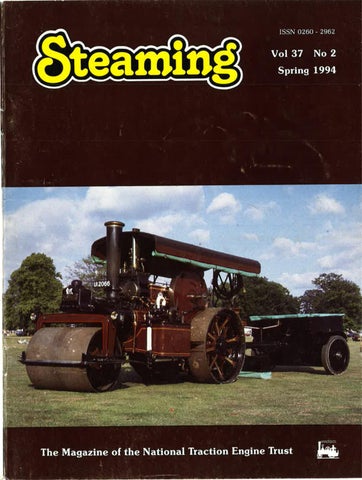
Cover Fowler DNB compound roller 17492 of 1928, photographed by Derek Rayner at the 1991 Hare wood House rally. The roller is fitted with tar spraying attachments — note the lagged hot tar pipe passing from the front tank and under the ashpan to the spreader across the rear of the tender — and at the rear is a Fowler gritter. The engine's livery is Fowler purple brown, a colour which it is not necessary to debate, like some other maker's shades, for it is still available from Williamsons of Ripon, who were suppliers of paint to the Fowler company in the 1920s. 59
Trust News From the Chairman (continued from previous page) A display vehicle is going on the road this year to show the public the Trust's work and more about our hobby; it cost money. We hope to appoint a publicity officer to widen our appeal and tell the world about us. We hope to have a voice in the wider preservation, and even national press. If we become well known and respected we will have a greater chance to influence the law makers, the insurance companies and other bodies who could curtail our activities both on the road and the rally field. If that happens the enthusiast will lose out as much as the engine owner. Your subscription contributes to all this work and you get a super (Richard Sandercock, magazine. Chairman)
Rally Organisers Column Rally sub-Committee At the time of writing we are just about to hold the Spring Conference. This event has become well established as a forum for the exchange of ideas and sharing of problems which arise in operating rallies. At the 1993 Autumn Conference we had a most interesting afternoon address from Phil Read, organiser of the Parham event, who gave us an insight into how he operates this well known rally. We are due to hear from John Carter at the Spring gathering and he will put the 'fairgrounds' point of view to rally organisers; this will produce an interesting debate I am sure. Event organisers should all by now
From Alan Martin's Collection
64
have received your invitations to the Safety Seminars. These one day events are conducted by Tim Holt and Mike Garstang. Not only are they highly qualified in their subject professionally, but also organise the Cumbria Rally. Rally organisers and engine owners will note that we can offer plentiful supplies of best Welsh coal at the same price as last year. Please contact John Watkiss at Smallshaws (see Coal Supplies advertisement); he will organise any quantity, and can also give prices for bulk deliveries, rather than bagged supplies, which show considerable reduction in prices. Please do consider using quality coal if you do not do so at present — generally speaking not so much is consumed and it greatly reduces smoke and potential complaints about pollution of the atmosphere. I hope you all have a successful and safe season. (Andrew Semple, chairman, Rally sub-Committee)
Engine Owners Column Engine Owners sub-Committee
The crews engaged on heavy haulage 60 or more years ago must have got used to hanging around on occasion whilst preparations were made for the passage of their 'extraordinary traffic'. Here we see Road Engines & Kerr Ltd's McLaren 10hp road locomotive 1650 of 1919 double heading Pickfords Ltd's Fowler 86 class 17105 of 1928, standing at the roadside and awaiting the shoring up of the bridge ahead that passed over the Glasgow & South Western Railway line. They are in charge of a 98 ton stamping press, made in Cleveland, Ohio, USA, which they were taking from Finnieston Quay at Glasgow to the Neptune Stamping Works at Ayr. The total weight of trailers and load was 130 tons. 60
We are looking forward to an enjoyable and instructive weekend at this year's Driving Course which is being held at Amberley, West Sussex, on April 23rd/24th. Work on the Traction Engine Code is progressing well and we are confident that the remaining sections will be completed in time for the relevant organisations to approve them well before the July deadline. I have recently had good reports of the boiler inspection service provided by SGS (United Kingdom) Ltd. This company is not well known in the restoration world but apparently operates on a large scale worldwide and is offering a discount to our members. Anybody interested can contact me for further details. Bob Back continues to deal with a number of enquiries related to spares and repairs. I believe that a couple of letters that I forwarded to him went Spring 1.994
STEAMING
astray in the post, so if you have not had a reply please contact me again. Weather permitting, all is set for a good rally season and we hope you will have an enjoyable year. (Michael Davies, chairman, Engine Owners subCommittee) Technical Board During the development of the NTET Code of Practice and Written Scheme of Examination, we have enjoyed an atmosphere of courtesy and co-operation with the Health & Safety Executive and most of the major insurance companies. I say most, because the opposite has been the case in one or two instances; in one instance the response was 'I do not think that we would be interested in any scheme cobbled together by some pip-squeak amateur organisation' and in another the Chief Engineer said that he would be prepared to talk to us but his time cost money! Some members have recently reported that their boiler inspectors have flatly refused to carry out their boiler examinations under the NTET Scheme and have insisted that they will only use their own company's scheme — for which they intend to charge the owner a great deal of money. Setting aside the arguments as to whether the Pressure Systems Regulations apply to preserved engines, the legal position under those regulations is that it is the respon sibility of the user to draw-up land update as necessary) the written scheme of examination. He or she does not have to do this personally; they can adopt an appropriate ready made scheme if they wish. The only proviso is that the scheme must be approved by a competent person (which can be a company as well as an individual) and in the case of the NTET Scheme, the Trust is the 'competent person' for that purpose. The Trust cannot force an insurance company to carry out boiler examinations under the NTET Scheme, any more than it can (or would wish to) force an engine owner to adopt it. Any insurance company is free to insist that its policy holders use its own scheme of examination — that is their prerogative. Similarly, no engine owner is tied to a particular insurance company; there are other inspecting organisations and independent boiler inspectors who do not insist in using (and charging a lot of money for) their own schemes, and insurance is available from other companies or through the NTET/John Scott insurance arrangements. STEAMING
Spring 1994
NTET Coal Supplies The Trust has again arranged low priced coal for use by rally organisers, clubs or individual owners In association with Arscott Collieries, Coal Factors and Merchants, Gateway Chambers, 26 Castle Street, Shrewsbury SY' 2BJ. • • •
pre-packed 25kg plastic bags, or bulk supplies available haulage can be arranged to any rally site ring John Watkiss on 0743 362482 to discuss your requirements and haulage cost, anywhere in Britain
DRY STEAM COAL
ter STEAjg coa 25kg
CWM BARGOED COBBLES
120 per tonne E 1 23 per tonne
ex Tyn-y-Wern ex Newtown, Powys (prices include £3 pallet charge but exclude VAT) Cash on collection or pre-payment Please order early to obtain supply of steam coal; bituminous also available
It was perhaps almost inevitable that one or two of the insurance companies might adopt a dog-in-themanger attitude towards our Code of Practice and Scheme of Examination. This is very regrettable and it is to be hoped that they can be persuaded to reconsider. There may be some companies which don't really want our business at all but continue reluctantly to provide it — at a price. We all want to continue long established relationships but, when it comes to the crunch, if we don't like the way they want to do things, we can go elsewhere. (Jim Newnham, chairman, Technical Board) Boiler Inspection and The Law From time to time members ask the question 'Am I required by law to have my traction engine boiler inspected at regular intervals?' The short answer to this is 'No, but ...' Both branches of the law, civil and criminal, come into the picture so, as they follow different lines and operate in different courts, it is best to look at them separately. Firstly the Criminal or Statute law. Until very recently boiler inspection was a requirement of the Factories Act and had been around for about a hundred years. During the working days of traction engines this generally applied to them and was more or less happily accepted by everybody. Once engines began to be taken into preservation and were used for pleasure rather than work, the Factories Act ceased to apply to them but as the procedure was fairly straight forward and very well established, most engine
owners continued to go along with it. Since the coming of the Health & Safety at Work, etc Act 1974, Regulations made under it have superseded many parts of the Factories Act and boiler inspection now comes under the cumbersomely titled 'Pressure Systems and Transportable Gas Containers Regulations 1989'. These Regulations replaced the old requirement for a 'thorough examination by a competent person' and Introduced the requirement to have a thorough examination 'carried out in accordance with a written scheme of examination'. Because the Regulations were made under the Health & Safety at Work Act, they only apply where the Act applies. In very general terms this means that boilers which are used to
For engine owning members ... The Trust's
CODE OF PRACTICE for Traction Engines and similar vehicles is now available. Price £17.50 each including postage from — Mrs Sylvia Dudley 12 Hillway Woburn Sands Milton Keynes Buckinghamshire MK17 8UL
61
work are subject to the Regulations but those used solely for recreational purposes are not. There are, as always, borderline cases. For example, a traction engine driving a rack bench for a timber sawing demonstration at a rally would probably be held to be 'at work'. Similarly steam ploughing, threshing or stone crushing, etc demonstrations would probably make the engine subject to the regulations as well. There does not necessarily have to he any monetary profit at the end of the day — simply that the boiler is being operated in a work situation. An engine which is simply taken to a rally and driven around the ring a couple of times a day would almost certainly not be 'at work' and therefore not subject to the Regulations. Although it would appear that probably the majority of engines are not subject to statutory examination, before an owner shouts 'whoopee' and reaches for pen or telephone to tell the boiler inspector never to darken his engine shed again, he would be very wise to carefully consider the possible consequences of such an action. If there is a catastrophic failure of an unexamined boiler in some public place, as a consequence of which one or more persons were killed, the owner
62
could well find him or herself facing charges of manslaughter. A bit farfetched? Then consider the recent case in which a lorry with defective brakes ran away on a hill, crashed into a British Telecom van, which it then shunted into a row of shops, killing the lorry driver and five other people. The inquest returned a verdict of unlawful killing and, at the time of writing, it looks as if the directors of the company which owned the lorry may face manslaughter charges and could go to prison. Turning to the Civil implications, people in this country are tending more and more to follow the American example and sue one another for practically anything. If somebody gets injured as the result of the failure of somebody else's machinery or equipment, they are usually more than ready to sue, and probably with some justification. Suppose, for example, that a feed check valve blew off a boiler because the securing studs had corroded away to virtually nothing; anyone standing nearby could be very severely scalded.
Depending upon how serious the victim's injuries were and their effect on their long term future, the damages awarded could run into thousands of pounds. Provided the owner had paid the insurance premium and the policy was valid, the insurance company would pay up bur. only so long as the conditions of the policy had been observed. These conditions invariably include a requirement that the boiler and its attachments shall he maintained in good condition. There is usually also a requirement that the pressure system must be regularly and thoroughly examined in accordance with current legislation, or words to that effect. If these conditions had not been fulfilled, the insurance company would refuse to pay, with the result that the Courts would turn to the owner for the money. This could mean that the owner could lose his engine, car, house — everything he possessed — to meet the damages awarded, not to mention the costs of both sides! Lastly, on a less dramatic but purely practical level, if you do not
With yesterday's dust cleaned off and the tarnished brass freshly repolished, Fowler BB ploughing engines 15451/15452 stand, with fires just lit, waiting for another day's excitement. (Dick Blenkinsop)
Spring 1994
STEAMING
have the boiler examined, you will not get a Safety Certificate. No Safety Certificate, no NTET disc. No NTET disc, no entry to approved rallies. To summarise then, if you never take your engine off you own land and never put anyone else but yourself at risk when steaming it, there appears to be no legal requirement to have the boiler examined or to have insurance cover. In practical terms, however, if you want to take your engines to rallies, on the road or to any other public place, there is really no alternative but to have the statutory thorough examinations carried out at the appropriate intervals and to have adequate insurance cover. The risk that you would be taking if you do not 'do it by the book' is just too horrible to contemplate and, besides that, no rally organiser in his right mind would allow you within 10 miles of his event if he could possibly avoid it. (Jim Newnham, Hon Safety Adviser)
The NTET Disc Scheme for Engine Owners There still seems considerable doubt in some quarters on the efficacy and value of the Trust's Disc scheme for engines, with reasons for resisting having a disc on one's engine ranging from 'too much trouble to get one' through to the accusation of the Big Brother syndrome. Although a rapidly increasing number of owners are availing themselves of the benefits of the discs, it may be helpful to set down here further details of the scheme. The following paragraphs are extracted from the Trust's Rally Code and, as such, may not have been seen by a good number of engine owners. The description was, of course, written for rally organisers but it surely illustrates to doubters that the discs are easily obtained, readily accepted by those running rallies and of considerable convenience to the owner or crew of the engine concerned. 'The National Traction Engine Trust promotes and administers the use of a small circular notice (disc) which effectively announces to the rally organiser and the general public that the vehicle bearing the disc is properly inspected and comprehensively insured for use in a public place. 'The main aims of the Disc Scheme are to: • Eliminate the need to carry detailed paperwork relating to insurance of engines on the rallyfield (eliminating the risk of loss or cost of duplicates). • Assist rally organisers by simplify-
STEAMING
Spring 1994
ing the process of insurance verification — the disc is proof of cover and liability. • Ensure that owners are adequately and consistently covered (for their own protection as well as that of the general public) by inspection (free of charge) of the owners insurance documents by the NTET Insurance Officer or by John Scott & Partners (Insurance Brokers operating the scheme on behalf of the NTET(. • Encourage owners to visibly demonstrate to the general public by display of the disc that protection is afforded. 'The NTET insurance disc is a coloured circular paper disc carrying the make and number of the engine/exhibit to which it relates and providing details of: • date of expiry of Boiler Insurance • date of expiry of Boiler Inspection • date of expiry of Public Liability Insurance The colour of the disc is changed each year. 'A disc is issued automatically by the Trust's Insurance Brokers, John Scott & Partners to all engine owners insuring boilers under the NTET Insurance Scheme. For owners who have their boilers insured elsewhere, similar discs are issued by the Trust's insurance officer for each engine/ exhibit on production of evidence of boiler inspections (hot and cold) and Boiler Insurance and Public Liability Insurance policies and premium receipts. The Code of Practice for the Organisation of Rallies (Section 2.3 Insurance) recognises the NTET disc as proof of compliance with the insurance requirements. The service is conducted free of charge to members of the Trust; all that is required is that the applicant encloses a stamped addressed envelope in order to keep costs to a minimum.' I urge those who are presently unconvinced on the Disc Scheme to ponder on its all-round convenience and to ask the opinion of those who already have discs on their engines. In the 1992/93 period a total of 485 discs were issued; for 1993/94 the figure is 786 — surely these numbers speak for themselves. (Dave Smith, Insurance Officer)
Be wise before the event... The Trusts
CODE OF PRACTICE for the better organisation of Steam Traction Engine Events Is essential reading for all rally organisers and safety officers
Price £3.00 each plus £1.50 postage from — Mrs Sylvia Dudley 12 Hlliway
Woburn Sands Milton Keynes Buckinghamshire MK17 8UL
with information on grades of coal they can supply which are recommended as suitable for steam raising. During the next 12 months the following will be available. South Wales Opencast Royal Arms Opencast Cobbles from Cwmbargoed Disposal Point (17% volatile content) Midlands Group Deep Mines Large cobbles from Daw Mill Colliery; Large cobbles from Notts Central Washery (both 35-37% volatile content). Orders can be placed through recognised distributors but staff at British Coal, Marketing Department Headquarters, Eastwood Hall, Nottinghamshire will be pleased to help — contact D. Brown (' 0773 5323197) or Mrs L. Harris (Tr 0773 532502).
RALLY SAFETY SIGNS DANGER — beware of moving vehicles etc —
yellow with black lettering Unauthorised persons prohibited etc —
red with white lettering FIRE POINT — red with white lettering
Printed on rigid plastic boards
DANGER les
Steam Coal With the rationalisation of coal mining capacity in the country and the forthcoming privatisation of British Coal, engine owning members (and rally organisers) may be concerned about future supplies of suitable coals. British Coal have recently supplied us
I mechinery
£2.20 each sign Inc VAT, postage £5 per order From: A.J. Semple INTET) Unit 6, Mynd Industrial Estate Church Stretton, Shropshire SY6 6EA
63
WORLD'S
subsidy of £2 per ton. Upon receipt of their cheque I can then distribute £1.50 per ton to the participating members and the Trust retains 50p. Hence both Trust and members benefit. Please write to me for application forms; my address is inside the front cover of each issue. (John T.G. Harris, Hon. Treasurer)
The outdoor entertainment weekly incorporating
Preservation World Place a regular order now with your newsagent for your weekly copy of the World's Fair and keep up to date with news, rally reports, club events and much more within the world of steam preservation. And if you have something to sell or an event to promote, advertise it where it will be noticed in Preservation World. For advertising and subscription details contact: The World's Fair Ltd., P.O. Box 57, Daltry Street, Oldham OL1 4BB. Telephone: 061-624 3687. Fax: 061-665 1260
DVLA The lost registrations scheme continues to fui ietion and the relationship built up between the staff at Swansea and the various authenticating organisations is now very good. A steady trickle of applications is being processed and the success rate is very high. Any member wishing to reclaim a lost index number for a road steam engine is welcome to discuss the procedure with ms (Peter Rrnart, Longdene, Slea ford, Bordon, Hampshire GU35 OQP.) Engine Records Many members will have had occasion to consult the late Alan Duke about details of the history of either their own engine or perhaps the identification of a photograph. The Road Locomotive Society has now appointed Robin Harding as its Records Officer and Robin will be pleased to continue Alan's tradition of helping NTET members with engine queries of that nature. Enquiries should be sent through the Editor please, as before. As noted elsewhere in this issue of Steaming, the RLS has launched an appeal to create a memorial for Alan; it was felt that there could be no more fitting place for 64
a memorial than at The Rural History Centre at Reading University, where many traction engine makers surviving records are now held. (Peter Smart, Road Locomotive Society)
1994 Coal Rebate Scheme I have recently approached the Transport Trust concerning the operation of the 1994 rebate scheme. Unfortunately due to the imminent privatisation of British Coal it is not possible to obtain confirmation that the scheme will definitely operate this year. However, members and rally organisers may like to apply to me for application forms pending a decision in the early summer. How the Scheme works: an individual member or rally organiser purchasing British produced steaming coal sends his/her purchase invoice from an approved coal dealer to me as Trust treasurer, together with the necessary application form. I will then collate the entries at the end of the season and submit them to the Transport Trust, who pays us a
Trust Exhibition Unit The plans for the Trust's new exhibition unit were set out in the last issue (page 7) and I am now able to list the events it is hoped to attend in the first half of the season. Members are strongly encouraged to make a point of visiting the unit and take the opportunity of discussing the working of the Trust with the staff who are in attendance. May — 30th April-2nd Rushden, Northants; 7th Stoke Goldington, Bucks; 8th Birmingham New Street; 14/15th Borde Hill, W. Sussex; 21/22nd Anglesey; 29/30th Carrington, Lincs. June — 4/5th East of England Spectacular, Peterborough; 11/12th Great Amwell, Herts; 18/19th Morecambe Bay; 25/26th Bon Accord, Aberdeen. July — 4th to 7th Royal Show, Stoneleigh; 9/10th Rempstone, Notts; 16/17th Lambeth Show, London. (Robert Herring)
NTET Sales We are pleased to draw attention to resumption of the Mail Ordei service for traction engine honks, videos etc by the new Sales Officers Colin and Val Rrown. Just inside the rear cover will be found the order form which can be removed without spoiling the rest of the contents of the magazine, though photocopies of the completed order form will be just as welcome. Thanks are offered to Maurice Poole for undertaking the task in recent times of handling the sales of back numbers of Steaming. With effect from this issue, that service will be available from the NTET Sales Office — full details of availability are included inside the front cover from time to time. (Colin and Val Brown, NTET Sales)
Spring 1994
STEAMING
Steaming binders Cordex binders for the three different sizes of Steaming are now available in quantity. Despite the smaller sized magazines being over twelve years old, a surprising number of members ask for binders for them; there is always much to refer back to in older issues and they are a lot easier to find on the bookshelf than packed away in boxes or cupboards. When ordering for the earlier volumes please check your requirements carefully and tell us which size you need: Vol 15 and earlier 834in high page Vol 16 to 23 inc 8%in high page Vol 24 to date 9 Yzin high page All are priced at £5.25 each including postage and available from NTET Sales — address inside front cover. To enable members to more readily identify their Steaming binders, we can now offer clear plastic, gold embossed strips which can be applied to the spines and show the required years. Strip No 1 includes each of the years (they can be applied separately) 1988 to 1994; No 2 covers the earlier years 1981 to 1987. They are available now from the Sales Office at 15p per strip — please forward orders with an SAE plus postage stamps to cover the number of strips required. (Colin and Val Brown, NTET Sales)
circumstances which have variously replying should not take offence at caused annoyance, disappointment polite enquiries of their whereabouts and unrewarded work or wasted time. and circumstances. If in doubt, a As successive occurrences became request for a phone number to call apparent the Editor attempted to back to should establish good forestall further repetition and he now relations. draws members attention to the Pertinent to the above problem, a conditions for acceptance of Small meeting of the Trust's Executive Adverts, as published under that Committee was called in January heading in each issue, which will now 1994 to consider expulsion of a be more rigorously applied than in the member under Clause 10 of the past. In particular, no advert will be Articles of Association, but was accepted without a quoted membercancelled when in the meantime the ship number to enable a check to be member had tendered his resignation. made, however well known an advertiser may feel he or she is to the Editor. Small Adverts being free of charge to members, we ►egret that no correspondence or discussion can be entered into if these conditions are not Obituaries met. Readers may like to be aware that Henry Marshall the problem of spurious adverts and Major Henry Dickenson Marshall, responses, which appear to come MBE, TD, DL, the last of the family to from one source, is not confined to be directly associated with the famous Steaming and is known to exist with steam engine builders, Marshall of other weekly, monthly and club publiGainsborough, died on 17th December cations devoted to the traction engine 1993 in his 84th year. He was well interest. Accordingly, members are known in the traction engine world, advised to assure themselves of the and a regular participant at Lincolnbona fides of anyone responding to shire rallies driving his beloved 7hp their adverts and, conversely, those traction and threshing drum.
Public Relations Officer We are pleased to announce the recent appointment of Stephen Foster as the Trust's Public Relations Officer. He will be assisted in the task by Ian Dean and we hope they will both have considerable success in furthering the aims of the Trust by bringing its activities to the notice of the general public and outside bodies. Stephen Foster will be in attendance with the exhibition unit throughout the summer and can be contacted by post or telephone at 19a Westgate Lane, Lubenham, Market Harborough, Leicestershire LE16 9TS is 0858 432285).
Small Adverts A more than minor proportion of our membership is aware that the Small Adverts columns have in recent years been the target of a number of spurious entries and responses —
The last day of the 1.993 season at the Amberley Chalkpits Museum in Sussex was chilly and overcast, so unfor tunately few people were present to see Marshall 10hp portable 86161 of 1931 being moved from the wood yard to the museum workshops for some repair s to be completed during the winter. The portable drives a rack saw bench which provides much of the sawn timber used at Amberley. Motive power for the move was Marshall 5hp tractor 73900; six other engines are reside nt at the museum along with a wide selection of other vehicles and mach inery. (Ann Hatherilll
STEAMING Spring 1994 65
His father, Herman Dickenson Marshall was a grandson of the founder of the firm and chairman of the company when it was taken over by Thos. W. Ward Ltd of Sheffield in 1934. Henry was born at the family home Pilham Hall, near Gainsborough in 1910, and was educated at Uppingham School. He went straight into the works on leaving school at a most difficult time in the company's history, and became an expert in the manufacture and usage of tea machinery. In 1935 he was sent to India on the company's behalf and visited most of the tea gardens in Assam and elsewhere on the Indian sub-continent. In 1937 Henry became a member of the Territorial Army, joining the 5th Battalion, Lincolnshire Regiment. He was called up in 1939 and spent most of his active service in Iceland and with the BAOR. In 1945 the 4th/6th Battalion of the Regiment was reformed and Henry became its CO' with the rank of Major. He was awarded the Territorial Decoration for 12 years continuous service and in 1965 the MBE for services as Army County Welfare Officer. Later, he had the honour of being appointed a Deputy Lieutenant of the County of Lincoln, an honour accorded his father in earlier years. During one of the several post-war upheavals in the Marshall company's history, Henry was made redundant, but he was soon recalled when Charles Nickerson took control. He played a major part in building up the excellent little museum at the Britannia Iron Works and was largely instrumental in bringing back to this country the 1908 oil engine tractor from Australia. Henry was a well-known figure in Gainsborough, always popular with the workpeople, who regarded him as their last link with the family and the firm in its heyday, when the economy of the town largely revolved around the Britannia works. He became chairman of the Gainsborough Building Society, which was founded by his grandfather to provide housing for the firm's employees, an appointment he held until recently. For many years he was an enthusiastic bell-ringer at Pilham church. Until the last year or so Henry Marshall attended the works daily and devoted much of his time to dealing with a large volume of correspondence from enthusiasts and preservationists world wide. He was always very much in evidence at the Smithfield and Hoyal Shows and other similar events, where he made many friends. He will be long remembered for his keen sense
all 45415 of 190$, snmetime
Henry Marshall driving hls 7hp single Marsh about 1956. (collection Rob Walker) of humour and warm-heartedness, and will be greatly missed in the steam and tractor world. (Michael Lane)
Steve Neville It is almost unbelievable to me that Steve Neville is dead. I have never met a more unique, or perhaps disturbing, character than Steve! He was, certainly in his outlook on life, the most individual man, and his sense of humour one either loved or hated. Stephen ',i'v'oc.-,dharn Neville lived in Saffron Walden all his life, and was born in 1933 in one of the picturesque little cottages that nestle below the walls of the magnificent parish church. The very first sound that Steve would have remembered would have been the massive peal of bells that that church possesses. Later in life he went on to ring them. The sound of the great organ, too, must have drawn him up the path to the church, where he sang in the choir for a number of years. In later times he developed a very fine tenor voice, and if we were in church together, I used to stop singing to listen to him. Steve was educated at Newport Grammar School, where he learnt to play the violin in the school orchestra, and after leaving, went on to take a Batchelor of Science degree at London University. His first job as an engineer was with de Havilland. For a short time he
went to India from where he returned with not only a fund of hilarious stories retold in his inimitable style, but also a now invaluable film record of steam working on both road and rail. In 1964 he founded his own business, Eastern Boilerworks, which he ran until a few days before his death. In 1958 he bought his first engine. the famous McLaren road locomotive BOADICEA, out of a scrap yard at Ely. He would often recall how on first putting a fire in it, he and his crew hid some fifty yards away — in case it blew up! Once restored, he drove the machine all over the country, from Yorkshire to Dorset, with the cab boards proclaiming 'Double Diauiund Works Wonders'. He was always somewhat reticent as to what the deal was there! Being made redundant from the firm Hickeys of London in 1964, he was given, in settlement, the Burrell Scenic 3886 LORD LASCELLES. Again, after a lengthy and painstaking restoration, he drove this engine all over the country, and took it to Holland and Ireland. It is certain that Steve drove a steam engine on the road further than anyone involved in preservation. His final engine was the Burrell road locomotive DUKE OF KENT which he again made famous, and drove until a few months ago. The cab boards bore the legend 'Amalgamated Heavy Haulage' which he and Jim Sarney Spring 1994
66
STEAMING
founded as a display team for the Great Dorset Steam Fair. As a commercial steam engineer, many other engines passed through his hands, always the better for having done so, and there are many engine owners who have cause to be grateful for his expertise and his knowledge. Indeed, that knowledge of the steam engine in all its forms was simply vast, and it is a great sadness to me that a forthcoming book, with which I had agreed to help, will now never be written. However, perhaps it is as a son of Saffron Walden that Steve will, locally, be remembered. He rose to be Mayor of the town on two occasions, and served with distinction on the three tiers of Local Government. He was Chairman of the Town Council and the District Council and served for a time as an Essex County Councillor. Other duties saw him as a Traffic Commissioner and involved with Civil Defence. It is true that in anything Steve attempted, he went to the top. He was a founder member of the East Anglian Traction Engine Society and died as its highly respected President. For many years he was a committee member of the National Traction Engine Trust, and, with Peter Barber, was instrumental in forming the Rally
Organisers sub-Committee which set the guide lines for the conduct of rallies today. As an engine driver Steve was a hard man, sometimes driving an engine to the limit, and he expected his steersman to be as proficient as he was. The sight of Steve on the road could be highly impressive! Charity was always dear to his heart, and with the Burrell scenic and a lovely German Limonaire organ that he owned, he raised many hundreds of pounds for Newmarket General Hospital, an establishment to which he had cause to be grateful following an early motorcycle accident. To accurately describe Steve's character is difficult. I am obviously biased, as he was a great confidante and friend for over thirty years, and was indeed, best man at my wedding. He had a rapier-like wit which he could use with devastating effect to pop the balloon of humbug or hypocrisy, or to render hilarious dictates of some jumped up official. He never suffered fools gladly. However, in saying that, he was the life and soul of any party, and as a raconteur, be it as after dinner speaker, or informally in pub or beer tent, he could, and did, bring the house down. Many times in his
Due to Dircctors' Retirement
Wednesday, 25th MAY 1994 Important Sale of the Entire Collection of
PENRITH STEAM MUSEUM Penrith, Cumbria including Steam Vehicles: Traction Engines, Roller, Wagon, Portables and Models; Steam-related Spares; Contents of Blacksmith' Shop; and Vintage Farm-related Machinery Catalogues available end April from Auctioneers:
company I have cried, but they were always tears of sheer delight! May he rest in peace, and rise in glory. (Chris Edmonds)
Alan Duke Memorial Appeal Members will be aware of the untimely death of Alan Duke, Records Officer of the Road Locomotive Society, last September. Alan was a life long enthusiast for traction engines and, through his painstakingly assembled engine records, has undoubtedly contributed more to our knowledge of that aspect of our subject than any other individual. The RLS committee has decided that some lasting tribute to Alan's devotion to creating and maintaining records of ownership of steam road vehicles should be established. The forthcoming construction of a new building at Reading University seems to be a most fitting site at which a permanent memorial can be provided and the plan has received the blessing of the authorities at Reading. Alan spent many hours in research at the Institute of Agricultural History and Museum of English Rural Life (now the Rural History Centre) and it was a place in which he felt at one with the aims and aspirations of the institution; in short, it was a place dear to his heart. The new building will have a reading room to which, had Alan lived long enough, he would surely have been a regular visitor. The provision of furniture for the reading room will be costly and it is to that equipment that this appeal is aimed. The minimum aim is one carrel, or reading and study desk, but all money donated will be used entirely for the furnishing of the reading room. Please give as much or as little as you feel appropriate. All donations should be sent to Peter Smart, chairman Road Locomotive Society, Longdene, Sleaford, Bordon, Hampshire GU35 OQP. Cheques should be made payable to 'The Alan Duke Memorial Appeal'.
PENRITH FARMERS' & KIDD'S Devonshire Chambers, Devonshire Street, Penrith, Cumbria, CAll 7SS
The Rural History Centre
Tel: 0768 62135 — Ref AA I STEAMING Spring 1994
The appeal fund for the redevelopment of the Rural History Centre at Reading University, where so many 67
traction engine makers records are held, is making good progress. Centre's the Jonathan Brown, Business Records Officer tells us the sum raised has now reached £750,000, with a substantial single donation of £105,000 from the Duke of Westminster. Phase 1 of the project, which includes the reading and study room will, it is hoped, be commenced later this year, and the plans have been passed by the local authorities. Needless to say, the Appeal Fund is still open. The plans for the £3.5 million Centre were described in our Winter 1992/93 issue and contributors may like to contact Jonathan Brown, Rural History Centre, University of Reading, Whiteknights, Reading RG6 2AG (Tr 0734 318666).
New Transport Trust Awards This year the Transport Trust will introduce a new Heritage Award specifically designed to assist a worthwhile transport preservation project that is already underway but not yet
OUR MAGAZINE 25 YEARS AGO
If there are some ancients out there who seek this column immediately on opening their copies of the magazine, its non-appearance in the last issue might have been disappointing. In 1969, however, the distribution of Steaming got a little behind and the first issue only arrived in the spring. But most readers would have soon laid aside any misgivings
completed ... a field that the Trust considers has been somewhat overlooked in the past. The aim will be to provide positive encouragement to the pracoruntinn prnnace ).vhen it is most needed. The single Award will be in the form of a grant for £2,000 and will be open to road, rail, air or waterborne projects. Contestants will need to show that some progress has already
when they saw Vol 13 No 1 — a giant 128 page special (plus 20 pages of adverts), all devoted to the traction engine. It was what turned out to be the last of John Crawley's special issues and covered the products of no less than 13 manufacturers with a generous array of photographs, tables of dimensions and folding drawings, The first quarter of the volume was devoted to Tom Paisley's excellent paper on Fowells of St Ives — well worth a repeat read for those who have a copy. Rally events for the forthcoming season totalled 49 and included a gathering at Handford Park, Blandford, Dorset on 20/21st September, organised by one Michael Oliver.
been made, that there is a clear and costed future plan, and a realistic likelihood of completion. Application forms can be obtained fr,,m Bryan RInxall at the Tr...st Officeg Room 489, Hobart House, Grosvenor Place, London SW1X 7AE. The closing date will be 1st August 1994.
Traditional Machinery - Traditional Values These days it seems that maintaining traditional machinery means not-sotraditional prices or standards of service.
- Further discounts where more than one item of plant is to be inspected at the same time and place.
So, we are pleased to be appointed by the NTET as the official provider of inspection services to its members at specially discounted costs
And with Cornhill Insurance being BS 5750 Quality Assured and a member of the NCSIIB you can be sure of a service that is to the most exacting of traditional standards.
- Flat annual charge for statutory inspections - thorough (cold) and working (hot) - and including fragmentation cover. All at £150 per item
full CORN H I LL
11I' Insurance For further information contact Geoff Godwin at Cornhill Insurance PLC, Engineering Department, 57 Ladymead, Guildford, Surrey GU1 1DB
For Members of the National Traction Engine Trust
68
Spring 1994
STEAMING
Marshall 5Vacstgr 68754 Mike Jones of Ruthin, North Wales, brings us up to date with the story of his painstaking restoration of a steam tractor. The two earlier articles appeared in our Spring 1989 and Spring 1992 issues. Work continued during the first half of 1992 on renovating and refurbishing land renewing where necessary) the motion-work on our Marshall steam tractor. At the same time the boiler fittings were cleaned to bright condition, one at a time. Each fitting took an average time of three weeks to sort out. During this time I tried to have three items from the engine in the process of overhaul, ie one nearly finished, one halfway and one just commencing. I wouldn't start renovating a new item until one of the three on the go was completed. A great deal of the brasswork was sent off to a professional polisher. For the cost involved I felt my time was better spent doing other more difficult items. Though a polisher does not get to all the difficult parts on fittings, an ordinary mortal just cannot get the same 'sheen' on an item as a polisher can. During the early part of June the crankshaft main bearings were cleaned up, together with their housings. They were then refitted to the cleaned and primed, where necessary, crankshaft. On 7th June, using a forklift truck, the whole assembly was fitted to the engine hornplates. During the refurbishment of the crankshaft it was apparent that a major crankshaft failure had occurred during the engine's working life. A conversation with its former owner revealed that the malfunction had occurred during 1937. The crank had been repaired using gas welding by someone in the Wrexham area. The quality of the welding is excellent, for it stood the test of time for a further 30 years with its owners R. Bridson & Son, tar sprayers of Neston on the Wirral. The crank webs still had traces of red paint on them so for this reason the webs have now been finished in red. The following few days were spent undercoating the crank box and boiler with black undercoat paint. A 1954 Fordson Major tractor, christened HILDA by my son, had been purchased during the past month. STEAMING Spring 1994
With the aid of an A frame attached to the front axle of the Marshall we could now attend a few rallies and also use the tractor to position the engine as required, for its bulk was now beginning to grow and as more items were added the gross weight was increasing beyond the safety of manhandling. On Friday 26th June the engine was attached to the tractor and prepared for the journey to the 1992 Wrexham Rally, held at the Plessey. One of the solid rubber tyres on the rear slave axle was held on with stainless steel bands, and I hoped that the road journey would not affect
them too greatly. However, this was not to be for after completing five miles or so of the 25 mile journey the bands broke and the majority of the solid rubber tyre became detached. With the judicious use of a hammer, Stanley knife and hacksaw the whole of the tyre was removed and the journey continued without the tyre. The noise and vibration from the iron wheel on the road was unbelievable. On the engine's return, a new tyre was welded onto the temporary wheel rim and since then has given no further problems. During July another event was attended and by then both connecting rods were refurbished and fitted. I have found on most restorations that it is the detail work that takes time and work to put right. Our Marshall tractor has not changed this view. A considerable amount of work has been expended thus far on putting right detail items on the
It is remarkable to see how much enjoyment Mike Jones and his family have had from taking their Marshall tractor to events in its part-restored state. The trouble they have gone to to do this has also enabled other enthusiasts and the public to study and appreciate the work involved in engine restoration. Here, bystanders at the 1992 Ruthin Flower Show are about to see the Marshall pass by with its tender shell newly affixed. (Mike Jones) 69
With a helping hand from Mann's tractor 1325, the Marshall parades at the 1993 Flower Show. By now many of the dark blue liveried parts — tender, front wheels and forecarriage — are in light blue undercoat. (Mike ✓ones)
engine, especially nut and bolt heads which have in the past had seemingly everything except a spanner used to tighten or loosen them! After the family holiday during the early part of August 1992 it was decided by myself and son that for the annual flower show parade later in August we would fit the back tank and bunker in place. The rear of the engine had been gathering dust and generally getting in the way in our garage since being sandblasted during the autumn of 1990. As the item was parked on a small four wheeled hand trailer it was quite easy to offer it up to the rear of the engine. Our biggest difficulty was fitting a spacer on the gear side between the back tank sides and the engine iiumpidies, but we succeeded. Another milestone had passed in the rebuilding of the engine. Though only a shell with no manstand, brakes or fittings attached the Marshall was starting to resemble a proper engine, though the uninitiated still thought it was some kind of portable. The engine attended Bishops Castle rally at August bank holiday 1992. This rally was one of the wettest ever, with our engine eventually marooned in a sea of mud; recovery was effected with a small Caterpillar. In late September the expanding Llangollen Railway held a new transport extravaganza event at Glyndyfrdwy Station. The Marshall was hauled there using the Fordson Major. As a result of this event we were asked to masquerade as 'Trevor the Traction Engine' in a Thomas the Tank weekend held at Llangollen a couple of weeks later. It certainly was a delight to see and hear the childrens 70
comments and antics upon seeing the engine. In the meantime more and more pieces were being finished and attached. In early October the four wooden roof uprights were delivered to a local furniture restorer for renovation. After nearly twelve months of waiting they were finally returned. Of the four uprights three were oak and one was ash; I can only wonder whether one was damaged when the crankshaft broke and was replaced in ash. Work continued throughout the winter on the water fittings, pipework etc. The engine's fore tank, which was a totally new item, proved on fitting to have been incorrectly manufactured, as the reach rod lever would not clear the top of the tank and allow the
reversing lever to operate the valve mechanism as it should. Hence it was taken down to Cardiff to be reduced in height on one side only. Further defects have since come to light and these are in the process of being put right. During the 1993 Easter holidays the blast pipe was fitted in place — after much cursing. Its fitting involved the purchase of a new electric drill and grinding away some half inch or so of one inch thick chimney base casting. With the blast pipe fitted centrally in the chimney base, and also the fitting of the engine's newly manufactured number plate CH2462, work on the front of the engine was virtually complete, the fitting of the canopy stays and painting to finish condition to come later. As it was dry during the Easter break the front wheels were cleaned and painted with two coats of the blue undercoat. The smokebox, chimney and chimney base were also painted black at the same time. Next I decided to tackle the eccentric straps. On dismantling each one proved to be made up of twenty pieces, including nuts, bolts and cotter pins! Hence, considerable work was needed to rejuvenate one strap. In all it took some six months to fit all four straps in between other work. Again the detail work, especially refurbishing the nuts, took time to put right. During June 1993 permission was obtained from an elderly lady a couple of doors away to use a lean-to she owned to the rear of my property for rebuilding the engine canopy. This was the last major item requiring renovation. Within a few weeks of placing the roof in the shed, she was murdered by her nephew! However, I was allowed to leave the roof in place
October 1993 and the flywheel is offered up to the crankshaft — solely suspended from a hydraulic fork lift truck. (Mike Jones)
A view down into the tender water space prior to fitting the new manstand. An additional manhole has been formed in the bottom plate of the tank to facilitate future cleaning. (Mike Jones)
until the estate sorted itself out. My son drew up a diagram of the timberwork with all additions to the roof measured and drawn in detail. The additions were then removed, followed by the weathered canvas and hundreds of tinned tacks. The longitudinal boards to the sides of the roof were replaced with new. The bolts holding the mouldings on top of and under the roof were renewed in stainless steel with brass nuts and washers. The local furniture restorer sewed up some marine canvas to suit
the roof and after a coat of white primer to the bare roof boards on the weather side, followed by a coat of white lead paint, the new canvas was attached using copper tacks. The canvas was then painted with a watery application of white undercoat. The various additions to the external part of the roof were then cleaned of tar, prepared as necessary, primed and re-attached to the roof. To date the roof still requires its underside refurbished. All the ironwork for attaching the roof to the engine has been shot blasted and primed. During the last two months of 1993 the flywheel and manstand were fitted, the former again using a forklift truck. The £10 spent on hiring the forklift saved hours of work manhandling the flywheel on to the crankshaft from ground level. The inner face of the flywheel had already been painted in red finish, whilst the outer face was in black undercoat. It was felt (and justified as circumstances unfolded) that some difficulty would be encountered in fitting in place a new gib-head key to the flywheel and crankshaft. The first attempt at fitting the key resulted in it being jammed in place with one and a half inches still protruding beyond the crankshaft end. The result of all this was a trip for the engine behind the Fordson Major to a local engineering works for removal of the key by
The first stage of the canopy restoration — fitting new boards to the sides. The total refurbishment of the roof took six months to complete. (Mike Jones) STEAMING Spring 1994
specialist methods. The same mistake was not made the second time, with the key being a tight but snug fit in the key way. The flywheel's boss was put in place with a correct, but new, stainless steel countersunk screw and yet another landmark has been reached in the engine's restoration. As yet the manstand has not been fitted in place but one can now imagine progress along the highway under steam. During 1993 the tractor had attended the Anglesey Rally at Plas Coch. On the Saturday evening it was attached to Will Dakin's Davey Paxman agricultural engine and taken down to the edge of the Menai Straits from the rally field. For the return journey the Millington's Garrett roller was attached to the front drawpin of the Davey Paxman using a push pole. The traction, in the capable hands of Will Dakin, then ascended the hill to the rally field with some considerable chimney music. After a further visit to the Llangollen Railway in the guise of 'Trevor the Traction Engine' the Marshall was roaded from Llangollen using the Fordson Major, to the 1993 Plassey Rally. The best bit of that rally for myself and children was the road journey home in beautiful weather. The highlight of 1993, however was our local flower show, where John Phillips brought his Mann's tractor 1325 and towed the Marshall from home to the start of the grand parade and then back through the town, where the gradients of the roads could give cause for concern. The last event for the engine was the Llangollen Railway Transport Extravaganza at Glyndyfrdwy. Again, the best part of the event was the road journey to and from the event! The end of 1993 saw a change in the fortunes of our family, healthwise. Work is still progressing though, as many of the engine's parts are all primed awaiting their turn for further attention, and many items have been taken indoors and painted to finish, prior to refitting. This has included a very large casting which is fitted through the water space and attached to each side of the water tank; it carries the castings for braking the engine, on a shaft which has also been renewed. Whether or not the tractor will be finished in time to celebrate her eightieth birthday on 19th July 1995 remains to be seen. However, I hope to be in a position to conclude the saga of Marshall 68754's restoration in a future issue. 71
An Hungarian Feast The plains of central Europe were the destination of a surprisingly large proportion of the output of British agricultural machinery makers, and some of these firms also had their own factories in the area, building distinctive local variations of the English traction engine. Derek Rayner recently travelled in search of some of them...
The starting point in our search was the exotically styled Castle Vajdahunyad (Vajdahunyad yam), a splendid edifice which would not have been out of place in a Transylvanian horror film. The structure, in the middle of a Budapest park (Varosliget park), was built as an exhibition hall, although perhaps palace would have been a more correct title. Armed with a copy of European Traction Engine Register and with other details courtesy of German NTET member Michael Giindling, my wife Dorothy and I soon found the first of the steam engines on display in Hungary. It was the first time we had ventured to a
former Soviet bloc country in search of road steam, the task being a little daunting because of the anticipated language difficulties — and we faced it with not a little trepidation. The language of Hungary is unlike anything else in Europe and our smatterings of French, Dutch and Italian were not to be help to us. However, German seemed to be the second language of the country and in consequence, we managed — just. Part of this fairytale castle in which we found ourselves now houses a splendid agricultural museum, the Magyar Mezogazdasagi Mtizeum. Here is preserved the first steam engine to
Clayton Shuttleworth & Co single cylinder portable number 310, a remarkable survivor from 1852, now displayed at Castle Vajdahunyard at Budapest. (Derek Rayner) 72
be brought into Hungary — a product of Clayton, Shuttleworth & Co of Lincoln in 1852. Build number 310, it was mentioned in Steaming Autumn 1990 and is perhaps the second oldest known surviving portable, preceded only by the 1850 Tuxford which is displayed in the Conservatoire des Arts et Métiers, Paris. There were, in addition, several cased displays of models — traction engines and portables of both English and continental pattern. Not surprisingly, in view of the many Fowler ploughing engines exported to this part of Europe, the Fowler system, both single engine with anchors and double engine with balance plough, featured prominently in the displays. We looked in vain, however, for the pair of Fowler engines listed at this location and were very disappointed to leave without seeing them. Not far away, across the other side of the park, the Budapest Transport Museum (Kozlekedesi Mtizeum) revealed little of major interest to us — but there wore photos on display, including the well known and relatively recent artist's impression of Aveling's 1865 fifth wheel chain drive traction engine towing a huge roller, incorrectly dated 1861/2, plus the unique Barford & Perkins 1875 vertical boilered steam roller also, incorrectly dated at 1862. These two were featured in a display of road making. The remainder of the exhibits were rail, bus, tram, car and boat related. The following day we took a rail trip of some 200km to the south end of Hungary's inland sea — Lake Balaton — where in the town of Keszthely, a taxi (the easiest way from the station to a destination you don't know!) took us to the Uyorgykonmajor MOzeum, on a road called Bercsenyi Miklos utca. This museum was also set in an old Schloss or castle. Our list indicated a couple of Fowler ploughing engines here — arid so it was that the first thing we saw as we entered the courtyard, squeezed in somewhat unceremoniously under an arched tower — but out of the weather — were a pair of Z7 engines and a four furrow anti-balance plough. Although, not surprisingly, the Fowler works plates were missing, it was disappointing to find the lower smokebox door brass plates were also gone. These, we presumed, would have read MAGDEBURG, indicating the engines' route to eastern Europe. Unfortunately, no numbers or plates could he found on either engines or olough. Our German list showed them as 14399/14400 of 1917, but a later check with the Fowler records at the Spring 1994
STEAMING
The maker's plate as fixed around the regulator quadrant on the 1852 Clayton portable. One might have expected the incised lettering to be less clear than it is after 140 years of polishing. (Derek Rayner)
Rural History Centre at Reading revealed these numbers were allocated to two TE1 class engines in the works register, but the following columns for customer, order number and so on were not completed, which suggests that the machines were not actually built. There were no Z7 ploughing engines built in the year 1917, and where the suggestion of the above numbers came from is not presently known. The elderly lady who took our entry fee and appeared to be in sole charge at the Museum (all the Hungarian museums seemed to be run by little old ladies!) spoke only a few words of German, but she was delighted when I presented her with the recent issue of Steaming which featured the restoration of the Australian Fowler ploughing engine. The article clearly showed our interest in her engines, which she could see were similar. Our new friend settled down on her seat in the sun to look at the pictures and left us to photograph the engines. After a while, she approached Dorothy and led her off across the courtyard to another building which she unlocked whilst I was still busy with the Fowlers. Fortunately she hadn't complained about my climbing on the engines or stepping behind the ropes to photograph them. Bribery can get you to a lot of places. The keeper had obviously recognised other pictures in our magazine and thought I would be interested in further items in her custody, for the particular barn, to which I was STEAMING Spring 1994
eventually summoned, contained a small display of vintage tractors, including a Fordson and a locally built HSCS (Hofherr-Schranz-ClaytonShuttleworth) diesel tractor, and a portable steam engine of 1912 belted to a threshing machine. Both of these were by the same maker as the diesel tractor. It was unfortunately a low roofed building, and somewhat dimly lit, which made photography difficult. However, I did what was necessary and also found a fifth scale model of a portable, the caption for which read 'SzOkelyhidy Laszlo, Szabadalma, 1900, Szolnok'. This town is 100km east of Budapest, but whether the details referred to the maker of the model or the constructor of the full size machine we did not ascertain. We had clearly made the old lady's day for the visitors' book showed but two entries for the previous month and we consequently could hardly refuse a conducted tour of the remainder of the museum, though not understanding a word of her explanations. So we nodded and mimed appreciatively at the appropriate places and it seemed to suffice. On our way back to Budapest, we stopped off at one of the many places named after the famous Balaton lake. There must be over thirty of them altogether. At this one, Balatonfenyves, we had spotted a narrow gauge (760mm) steam loco on the
outward trip. This was obviously in working order and had been used quite recently but how often it runs, we were unable to find out. Certainly the railway itself was very much alive, with a few diesel hauled trains each day, albeit infrequently, to a couple of destinations a little way inland from the lake. Our third and most interesting excursion took us to Goa116 by the inexpensive local HEV railway from one of the suburban stations. Ors vezer tere, in the east of Budapest. This town, some 30km distant, was reached in just under an hour and after a couple of false starts in the complex which forms the Gado116 University of Agricultural Sciences (Godolloi Agrartudomanyi Egyetem), very close to the station and near the theatre, we found the Department of Mechanics and Engineering Design which has within it, a magnificently appointed museum (Mezogazdasagi Eszkoz- Es Gepfejlodestorteneti Szakmtizeum). This houses their collection on the history of the development of agricultural machines, which forms part of the training syllabus for the students. The imposing building has only been open since 1988 and rather surprisingly, to we who had spent some time searching for it and had actually walked past twice, there were no appropriate signs whatsoever for the casual foreign visitor to indicate its
At the Gyorgykonmajor museum at Kesztheley, this 1912 portable by Hofherr-Schrantz-Clayton-Shuttleworth is displayed with a small threshing drum. HSCS's works were at Kispest, just east of Budapest. 73
purpose. After trying first in English, our efforts in German at the pay desk (with the inevitable pair of old ladies) and the showing of Steaming to one of the male staff who happened to be passing, afforded us the unexpected but gratefully accepted red carpet treatment. The staff brought the Museum's Technical Director, Dr Endre Gelencser to see us and with the common language again being German, after the obligatory cup of coffee we were again treated to a conducted tour of the remarkably well kept displayed history of steam and its application to agriculture. Another HSCS portable with no builders number visible (but stated to have been built in 1924) was displayed in well lit surroundings but this discovery was surpassed by another of the same maker's products, in an adjacent bay, this time a chain drive traction engine, in superb external condition, number 58125 of 1924. Our list also indicated a Fowler ploughing engine here, this being a conversion, for when the boiler was condemned some time ago, the top was cut off and replaced by a Skoda diesel engine, in the same way as some ploughing engine conversions in England. We discovered, however, that this machine was not at ado116 but at Vep, though whether it was away being prepared for display or merely for storage we did not ascertain. Another detail -of interest gleaned from Dr Gelencser was that the pair of Fowlers which we had sought in the Vajdahunyad Castle in Budapest were actually at R6bert Hada's premises at Szekesfehervar, although again, whether they were merely stored at this location or were under rootnrotinn net did wo understand. This pair of engines are 12507/12508 which have since been confirmed by Reading as being Z2 class compound ploughing engines, supplied from Leeds to Magdeburg in December 1910. Around the walls of the museum displays and working models of steam engines, governors and differentials also interested us. One unusual full size machine was a small vertical boilered portable which was normally fitted to a four-wheel carriage for transport purposes but in this instance was solid to the floor and belted to a threshing machine. This outfit was run on compressed air for demonstration purposes. There were several pictures of ploughing engines, steam diggers and portables plus, surprisingly, some of the products of Mann's of Leeds — in both flat-back wagon and conventional tractor form. Unfortunately they were captioned as of Fowler 74
Hofherr-Schrantz-Clayton-Shuttleworth chain drive traction engine 58125 of 1924. The single cylinder machine is exhibited in the collection of &Walla University, east of Budapest. (Derek Rayner)
manufacture. It is difficult to explain this sort of incorrect information, so I didn't bother to try. One of the working displays involved a pair of Fowler ploughing engines with a balance plough in between, modelled
in about one fifth scale and driven from below by hidden electric motors. They not only pulled the plough to and fro with the engine's motion and ploughing gear working but realistically, the plough's balance changed
An Hungarian designed and built single cylinder traction engine on open air display at a technical college at &Wolk) near Budapest. It was made in 1910 by Elso Magyar Gazdasegi Gepgyer. (Derek Rayner) Spring 1994
STEAMING
automatically and the shares drew furrows through the diorama's base material which appeared to be some kind of dried peat. A small rake was on hand to smooth over the furrows at the end of the plough's two metre run. After handing over some spare copies of Steaming which I had taken with me, we purchased souvenirs, including a tee-shirt which featured a Turner portable, and our new found friend offered to take us back the short distance to the station for the journey back to Budapest. We were somewhat surprised, therefore, when we passed the first station. Spying a retreating train in the distance, we thought he was going to try to race it in the car to the next stop. However, we turned off the main road away from the railway, adjacent to Erzsebet Park (Elizabeth Park) and our doubts were quickly dispelled when we arrived at another agricultural establishment. This collection of tractors and farming implements had been established as long ago as 1970. Unfortunately, as they were all outside, some had suffered from the weather, but here, in the grounds of what we believe was the local technical or agricultural college, were two more steam engines, these being of Hungarian manufacture — and the 'icing on the cake' for our trip. These were a traction engine made in Budapest in 1910 by Elso Magyar Gazdasagi Gepgyar Fleszvenytarsag (EMAG) and a portable built in 1903 by the Magyar Gepyara, Allamvasutak Kiralyi Budapest, the state railway company. Careful reference to the listings indicated that we had found two more engines in &Mond than had previously been known about. Certainly a worthwhile visit. Herr Direktor was very patient whilst we dashed hither and thither among the bushes taking photographs and complained about the sun's location in relation to the engines. He shared our relief when a cloud appeared at just the right moment and shielded the sun so a suitable forward facing the picture could be taken. The photography concluded and the relevant details taken, we again got in the car and returned to the local station where, for the first time, we noticed the make of the car — one perhaps befitting an official in this country which was otherwise full of Trabants, Wartburgs and Skodas. It seemed we not only had a common interest in things steam — bridged in a not too difficult manner, despite the language barrier — but we both drove a Lada as well! He was delighted with this news when I told him and we parted the best of friends — he back to STEAMING
Spring 1994
VALENTINE WELDING & ENGINEERING Co Enterprise Works, Enterprise Road, Raunds, Northamptonshire NN9 6JE zr 0933 460946 Fax 0933 625551
Boiler manufacture and restoration on full size and model engines Welder approval test certificate to BS4871 (EN287, 288) All welding certified and approved by Cornhill Insurance Group
TENDERS, BELLYTANKS, WATER CARTS WHEELS RETYRED and SPOKED WHEELS MANUFACTURED Big enough to cope
Small enough to care
Highland Steamboat Holidays Cruise the beautiful sealochs and canals of Scotland in an original coal-fired Clyde Puffer. Good food, comfortable accommodation.
•• Send. large SAE for free brochure to Rachel and Nick Walker, The Change House, Critum Ferry, Locfigilphead, Argyll PA31 8QH (Tel 054 65 232).
his office, his day perhaps brightened by our unexpected visit and us to start the 1500 mile journey back home by train, with many excellent memories of a feast of different engines to look back on. (An historical resume of Clayton & Shuttleworth & Co's business activities in Hungary was set down by Friedrich Busch in the Letters section of the Spring 1992 Steaming.) k,
'A Hauliers Tractor — A Burrell tractor is doing good work in the Woking district for Mr Harding, where in addition to general haulage, it is frequently in request by furniture removers. Apparently some heavy loads are carried, as it is stated that the van and load in such a case has been known to weigh just under 7 tons.' (from The Worlds Carriers, January 1907.) 75
STEAM at the MOP Jack Stephens Growing up during the 1930s at Tewkesbury in Gloucestershire, access to steam engines was in general limited to spotting the engines of the LMS working on the local branch line between Ashchurch Junction and Great Malvern. Thomas Walker's factory, once renowned for its fairground rides, together with Savory's Ironworks, had been closed for many years, and the local tiour mills had recently abandoned steam wagons in favour of motor trucks. Occasionally the steam rollers of the local council could be seen repairing the roads, or steaming out to jobs farther away. The rollers raised little interest, but each October the annual fair was held, and the showmans engines would appear in the town. Tewkesbury Mop Fair was a long established two day event held in the town's main streets, with the second day being a local school holiday. This gave us the opportunity to see everything, with the big red engines becoming a centre at interest. Now at many fairs the engines were tucked away at the back, almost out of sight, but at Tewkesbury they all stood foul square across the street beside their respective rides, enabling the fair goers to get a whiff of hot steam and hot electrics, and very often a dollop of hot oil for good measure. One engine became a firm favourite with myself and my mates. It stood close to the Cross, next to the Noah's Ark ride, and carried below the dynamo a large plate bearing the legend A. DEAKIN & SONS — AMUSEMENT CATERERS. NOW this caused some confusion in our young minds, for just along the road from our homes the Misses Best ran a tea room, and had outside a sign saying 'Caterers'. Fortunately, we were unable to pluck up enough courage to ask the driver where he put the tea; no doubt his reply would have been memorable! This engine had on its nameplate the 76
word SUPREME, which struck us as being most appropriate. But little did we realise that the 1938 Mop was to be the last time that we would see steam power at the fair, for the outbreak of war in 1939 prevented any more Mops being held until 1945, and by then the showmen had all changed to diesel power. This new era brought increased prosperity to the Mop and each year it seemed to increase in size, until today it covers approximately one third of the area of the town, and is the largest street fair in the west of England. This growth was not without its problems, and in 1989 the Tewkesbury Fair Society was formed to protect and develop the Mop. A feature for many years had been Benefit Night, when the showmen donated their first two hours takings to the local hospital and the mayor's charities. The Society continued this tradition, and introduced such features as fair organs, can-can dancers, and other attractions to entertain the passing crowds and to encourage them to fill the collecting tins. For the 1993 Mop it was decided that a showmans engine would be an appropriate attraction, and Jack Wharton was invited to bring the Fowler B6 showmans road loco 20223 SUPREME back to Tewkesbury, for this was the sole engine surviving from those that had worked at the fair. And so, 55 years to the day from its last appearance, the engine returned to the Mop, to be reunited with Deakin's amusements.
On arrival SUPREME was parked up overnight in the grounds of Tewkesbury Abbey, this church having a long history of involvement with the fair. Contained within its vaults are the remains of Sir Robert Fitzhammon, who in 1097 AD first granted the townspeople the rights to hold fairs, and of Hugh le Despencer the younger, the holder of the first Royal Charter permitting fairs to be held in the streets of the town. These early fairs were held at the Abbey gates in the area now known as The Crescent, and continued there until the reign of Henry VIII, when the fair was moved to the Cross. By the late 1800s the fair had expanded back along Church Street to The Crescent once again, and in the 1930s Mrs Deakin's celebrated Radio Cars were positioned there attended by the Burrell showmans 4092 SIMPLICITY. The next morning saw the build up of the fair taking place in dry conditions, but by the afternoon steady rain had set in. SUPREME was to move onto the fair at 4.00pm, and its appearance can only be described as dramatic. Under a darkening sky with headlights blazing, lightning flashing, and thunder rumbling, the engine steamed up Church Street to take up its position beside the dodgem track at the Cross. This proved all too much for one member of the Deakin family, who promptly burst into tears! Fortunately, the rain had ceased by 6.00pm, and the civic opening of the fair took place in dry conditions. Afterwards the civic dignitaries and the officials of the
Fowler showmans road loco 20223 of 1934 SUPREME in the grounds of Tewkesbury Abbey, October 1993. (Jack Stephens) Spring 1994
STEAMING
Showmen's Guild took a great delight in viewing SUPREME before setting off on their traditional tour of the fair. The Fowler was generating until 10 o'clock and was always surrounded by crowds of interested viewers, resulting in a generous collection for Tewkesbury Hospital. The following day, which was the Fair day proper, saw SUPREME generating from 10 in the morning until 10 at night and again proving to be a great attraction, with stories of the "I remember when ..." variety being exchanged. Many of the visitors 'commented on the way the exhaust steam hung around in the evening air creating a pleasant fuggy atmosphere. One could only imagine what it would have been like at the turn of the century, when there would have been four centre engines, as well as the showmens working in the same area. By Sunday morning all the amusements had been removed from the streets, but SUPREME was to be a star attraction when it hauled Deakins dodgem loads out of town on the way to their next fair at Stratford on Avon. Coupled up at the edge of town car park, the engine pulled the loads along the same roads that it had worked over when owned by Deakins. The conditions were ideal, being bright and sunny, with the route taking in Gloucester Road, Church Street, the Cross, Barton Street, and Ashchurch Road. A short stop was taken outside the King's Head in Barton Street, a favourite watering hole for generations of showmen, and the hundreds of
SUPREME generates besides Deakins dodgems at the 1993 Tewkesbury Mop Fair. (Steve Perry)
people present exposed their films and video tapes. Then the engine headed the convoy of Deakins transport for a couple of miles or so until the next stop was made near Ashchurch, where the engine was uncoupled and diesel power took over for the remainder of the journey to Stratford. Thus ended a memorable few days, when steam was again at the Mop.
'At Market Razen Police Court, Fredk. Martin, engine driver, Snarford, was summoned for allowing a locomotive to stand on the highway at Faldingworth on the 25th Nov. without there being any person to attend to its fire. Fined £1 and 6s 6d [321/2 p] costs.' (from The Agricultural Engineer, January 1900.)
Leaving Tewkesbury with Deakins dodgems loads, SUPREME heads through the traffic in Church Street. (Jack Stephens)
AVELING'S GREENS Our Autumn 1993 issue took up the subject of the colour in which one road steam engine manufacturer painted his products. The colour spread accompanying the article has enabled us to have a point of reference for further discussion but before we move on to the comment from members it may be as well for the Editor to explain more about the illustrations which appeared in the Autumn issue. The colour sample of Williamson's paint on page 199 was matched by our printers from an actual application of the paint provided by Mike Thompson to a Pantone reference (a standard method in the printing industry). Some readers will have been surprised, no doubt, at the differences between this sample and how the same paint has appeared on the photograph of Aveling tractor 9225, and the caveat printed in the final paragraphs of the article, warning of how the intensity of light falling on any object can greatly alter the colour we think we are seeing, proved quite timely. It is perhaps inevitable that photographers, when seeking the best conditions to make pictures, wait until sunlight falls on their subject, but whilst that might make for pleasant images and a good record of all the detail on or around an engine there can be a very noticeable difference in the apparent shade of colours between areas in full light and areas in shade. Note particularly the various shades of grey that are shown off by both gloss and matt black paint. However ... on to feedback from the original article.
Richard Willcox, Hon Engine Liveries Officer to the Road Locomotive Society writes: As a follow up to the splendid full colour centre spread on the controversial topic of Aveling green, I would like to make the followina observations. In the illustrations, both engines appear to be about the same colour, whereas actually they are not. Mr Williams tractor, whilst a superb job, and probably overall the most accurately presented Aveling available, is in my opinion a bit light in colour, though I have not seen the original sample to which this was matched. It is of course quite possible that after 20 years exposure to heat, light, oil, and the weather it will look right to me, for in common with 99.99% of people today, I have never seen an ex works new Aveling to use as a reference. The colour of the D type roller 10753 is indeed similar to several other Avelings that I have noted, but by no means typical of all of them. Perhaps this is the elusive 'Richards green'. Do the existing records note which engines were sold through Messrs Richards, of Newport — the firm were also Aveling agents. Many people will have recently seen the Aveling tractor 78
recovered from Loch Ness after many years therein, and exhibited at last year's event at Tarrant Hinton. This still shows considerable traces of original paint, which appeared to be different again, being more similar to the quoted Light Brunswick areen. I am very familiar with this colour, as I have a portable engine painted in the shade — Masons paint — and if I saw an Aveling in this colour I would not say it was wrong. I think whilst different batches of paint made in Aveling paintshop undoubtedly varied, it is a question of knowing the limits of variation acceptable. Mr Williams' tractor is probably at the extreme yellow end of the permitted variation, and Light Brunswick green is about the other end of the scale. I would expect the average to be somewhere between these two colours. Roller 10753, whilst a very presentable engine, suffers in the originality stakes from too much Deep India Red. The woodwork on the canopy should be green, as should the upright stays, I believe. The pump gear and eccentric should be matt black, as I would also say the scrapers should be.
I have in the past been under the impression that Avelings mixed yellow ochre and indigo themselves to get the shade of green required. Having recently tried this formula, I find it does not work and therefore must be mis-information. All I ended up with was various shades of khaki — maybe alright for an Army lorry, but not for a steam engine! A reasonable light olive green can be obtained by adding lemon chrome signwriters enamel to a dark green such as Masons Deep Royal Green. This is, I feel, right for middle period engines but too yellow for early engines, for which a better starting point might be Masons Light Brunswick Green — add lemon ochre to this. We are grateful to George Cushing, of Thursford, for joining in the discussion, especially as he is able to comment from personal experience at the tail end of the period we are covering. He writes: With reference to the article in the autumn edition of Steaming, regarding Aveling green, the colour sample on page 199 is as near as you can get to engines which were painted in the late twenties and early thirties. I spent two days at Rochester in the spring of 1933, and was conducted round the works during my stay there. Before I left I purchased two gallons of Aveling Green, some vermilion red and some yellow for lining out. I also purchased some maroon for the front forks of the rollers. As the paint at that time was bought in, I never knew the name of the makers of the paint and the name on the tins was hlarkarl nut Two Aveling engines in the Thursford Museum, namely Aveling AM type tractor 12186 and AC type roller 14163, are painted with that same paint. The colour on page 198 on the Aveling roller 10647 of 1923 could be correct for that time; later on, towards the end of the twenties the colour was a bit darker and also the yellow line was omitted on several rollers. When I asked the reason I was informed that it was to cut down on production costs. Sandy Ross, who also contributed to our initial notes, writes: The excellent feature in the Autumn 1993 Steaming on Aveling liveries takes the story a good step forward. However, I have forwarded a colour transparency of the original (hidden) 1911 paintwork and lining of Royalty 7385 to our entirely(?) impartial Editor with the hope that he will consider it favourably as depicting a significantly Spring 1994
STEAMING
This is Aveling & Porter 6232, built in 1907 for a customer in Rhodesia, Africa, and one of the maker's LC8 class. A fine specimen of a road engine, it deserves more detail setting down of its design and working life but here we use it as an example of Aveling's painting. Judging by the tone of the parts which would be black (gloss or matt) it seems to be in photographic grey, but the style of the lining out is generally as would have been applied to the colour in which the machine was repainted for delivery. Some items worthy of note are that, on this engine at least, the lining to the wheel spokes follows the edge of the palms at the rims but runs directly in a straight line to the hub; the casing at the overhang of the cylinder block under the valve chests is lined and therefore the body colour; the black edging to the gear casing lining is only on the vertical side surfaces — the top curves are plain body colour; the front (and presumably rear) panels to the metal canopy are body colour and lined out. (collection Roger West) different shade to that of the beautiful tractor 9225 CLEMENTINE, illustrated for us in the colour section.* Now that the grand debate on the colour shade has been opened I would like to put forward the following detail and lining issues in the hope that it will further the story: Aveling drawing No 7829 (does anyone know the date of this drawing?) gives some helpful advice in lining out of the tender sides and back, front forks, wheel spokes and boiler barrel. It also gives the base colour for the following which may clear up some (but not all) of the
" Sandy rather puts me on the spot here, as it is not possible for the transparency to be reproduced in colour so that you can all judge for yourselves! However, the surviving piece of 7385's original green has photographed as a clearly different shade to the new paint on 9225, and I would judge it as being a 'less yellow' green than the Williamson's paint. — Hon Editor. STEAMING Spring 1994
ambiguities: Wheels — boss and rim: black. These items are frequently green on restored engines, and just to complete the confusion, the front roller centres on Royalty 10596 were clearly painted black where visible externally, but green inside the roll itself! The only other part of the wheel that should therefore be green are the spokes; further there was no evidence that the black, red and yellow lining over the green base should taper at the spoke ends as is so often seen on restored engines. An oddity is that the tractor front axle is shown as black, but this has been carefully crossed through on the drawing. Front forks, steerage shoes and scrapers: brown. The brown referred to is generally considered as Deep India Red; many modern day restorers seem to paint the scrapers black. Bearing in mind that Royalty 10596 had never been repainted from new when purchased in 1967, I would like to throw in the following additional offerings as being original (at least for
a 1923 engine): Flywheel: black inside, green outside. The latter offering will be contentious. Hornplates: internally red, together with the crankshaft and eccentrics — but nothing else within the crankbox. Motion covers: internally black. Tender: internally black. The red and yellow of the lining should be approximately Vein wide and just over 'Ain apart, although the yellow line is marginally thinner than the red. With reference to the painting notes prepared by the late Tom Ellis of Aveling-Barford in the late 1960s, I remember him telling me that the paint specification given was based on that used when Grantham restored Royalty 1760 of 1882 (featured in A Century of Steam Rollers). Although Tom was an ex-Rochester employee, it was not clear how much research had actually gone into the restoration project and whether the notes merely reflected what had been applied to the roller. Finally, were the cast Y section wheels as used on the later steam tractors lined out or just plain green, and were the pressed steel piston valve cylinder block front covers polished or painted? From 7 Brechfa Close, Ponthir, Newport, Gwent NP6 1GY, David Hall comments : Having once been an Aveling owner and having a great regard for their excellent products I was pleased to read the article on Aveling's Green. I vividly remember, many years ago, talking of the livery to an old, old steam worthy who had spent his life on Avelings. He told me the colour of green was exactly the same as that used by Castro! on their oil cans and that one of their tins on a roller footboard would well match the boiler cladding and the motion guards. As to the livery applied to Rochester built rollers dispatched to H. Richards of Newport, I have yet to discover the exact cc 'our but believe it was very dark oilve green with a plain straw coloured lining. This livery in use soon wore to a black sheen, and I understand that later, on emergence from Richards works after overhaul, the machines were painted in gloss black. That company's large roller fleet was always kept in first class order and were a joy to see on the roads. I am slowly compiling a history of the firm and its machines and would welcome any input from other members. Final comment this time comes from Martin Fagg, of Farnborough, who since the discussion started has completed the repair and repainting of 79
Not giving us any evidence of livery but showing the fine condition in which they kept their fleet of rollers is Richards of Newport's No 12, surrounded by a dour group of roadmen. Aveling slide-valved single 9016 of 1919 is pictured at Aberdare Park, Glamorgan in 1923; it was cut up for scrap in 1951. (collection David Hall)
his E type Aveling roller built in 1921: The comments made by the contributors in the Autumn 1993 issue have, I hope, uncovered the tip of an iceberg — perhaps there may be more of it exposed in future issues of Steaming. I have put down some of my own observations and findings which I trust may be of interest. Williamson's Firstly, colour SP91289 is, I think, only correct for machines preceding the piston valve era, ie about 1920. My reasoning for the above maybe brash statement is that my own engine is one of the first piston valve rollers — 10048, dispatched from the works on 27th September 1921 to the Eddison Steam Rolling Co, Doncaster. It remained with them all its working life but when I purchased the machine in 1979 it had been in a school playground since 1961. As the roller was stripped for restoration, the majority of components were cleaned back to bare metal and the following items showed the original colours: front plate green with no lining flywheel — green outside, black inside crankshaft — red cylinder block saddle casting — black front roll hub — green rear roll hub — green When it came to the shade of green to be used, I was given a copy of Aveling-Barford drawing 7829 and, thus informed, I duly went to my local paint stockist and purchased a litre of 80
BS381C No 225 Light Brunswick Green, and this was tried out on some of the items of the roller. When matched to the original sample that was left, the new colour was obviously not quite right. Various transport paint suppliers shade cards were borrowed and matched until one was found to be a good match. This was from Sigma, in their Tornol Coach Finish range, the shade being Olive Green, No 4013. (This is numbered in the BS381C range as 220.) This paint was used on the initial restoration and again for the second restoration which has just been completed. Some years ago I had the opportunity to visit our Editor's Aveling roller 10641, and was able to compare a sample of my original paint to some of the original paint on 10647's tender — this was the colour illustrated on page 198. This proved most interesting as they were almost identical — does my 'almost' description maybe indicate that the paint was still mixed at the works at that time, not bought in? When Aveling & Porter introduced the piston valve range of engines they went to great lengths to point out the new improvements to their most upto-date model of the standard or 3-wheel type roller — 'The Belpaire boiler follows the latest locomotive practice and is constructed throughout of the finest quality mild steel plate, all flanging and riveting is done by hydraulic pressure'. (I wonder what their comments were when the throat
plates started cracking!) 'The cylinder is of close grained cast iron of the best quality and is fitted with piston valves resulting in a more efficient engine in both economy of fuel and maintenance charges.' With the vast 'improvements' to the standard type of steam roller, was there a change in shade of green and to the style of finish? There is a photograph of an ex-works compound piston valve roller on page 38 of 100 Years of Rollers (Aveling-Barford). It is very easy to distinguish between the parts painted black and those finished in green. The photograph on page 39 is a works photo in the photographic grey livery — quite a contrast. There is in my area an AD roller 14187 owned by Mike and Rosa Collier. When they purchased the roller it was mostly still in its original paint. Mike has recently repainted and lined the tender. The paint used was mixed to a sample of the original colour, the end result certainly looks most pleasing. He has also copied the lining that was found on the tender when preparing for painting — this differs to the style used on the piston valves and older slide valve engines. To return to the title of the initial article 'Aveling Green', in the singular; was it one colour? I think not. It would appear that the early engines were of a light green and that the shade used grew progressively darker, ending up at the 14000 series of rollers as mature shade of dark green. On that note I will rest my pen and wait to see how much of the iceberg will be uncovered in the future pages of Steaming.
We shall be pleased to continue the debate further, hut cost considerations preclude the frequent publishing of colour pictures and the next spread ought, perhaps, to centre on another maker's practices. In the meantime several of the examples of well painted Avelings that are quoted in the notes are available for inspection on the rally fields (the Hertfordshire/Chiltern/ Thames Valley area in particular) and their owners would doubtless be willing to carry on an engine-side discussion.
'For sale — 8hp Fowler compound road loco and two wagons, all in good condition, new fire box and tubes, no reasonable offer refused. — Apply Blakelock, Wolviston, Stockton.' /from Motor Transport, 17th June 1911.) Spring 1994
STEAMING
case of industrial espionage? This pair of pictures show Foster built machines. The single cylinder portable depicts the mobile steam engine at, perhaps, its simplest, although in this case one of some size, for this engine is probably of 10hp. It makes an interesting comparison with the Marshall export portable seen in our Spring 1992 issue and photographed from the same viewpoint. The Foster worksplate on the front of the firebox could be read as number 1297x, and if this is so the engine would date from about 1912. The second picture shows a rather sparse single cylinder traction engine which was probably built for export — it is a single speed machine. The makers plate on the hornplate is partly hidden but seems to bear the date 1917 and the word KILOS, perhaps the last bit of the machine's supposed weight, and further adding to the supposition the engine was destined for overseas. The lightweight hind wheels appear to have rims of welded construction rather than rolled T rings, with the tread made up of two unequal widths of metal — the original print We are grateful to Dave Davies of Robey works photographs, probably just shows a continuous welded joint between the outer pair of strake rivets. the Robey Trust for the loan of several from their drawing office, but the But surely 1917 is rather early for the prints for use in the magazine. These engines are not of that company's have surfaced among a quantity of manufacture — evidence of a mild use of welding?
TWO FOSTERS
TECHNICAL TOPICS Burrell springing Phil Ogden, of Hutton Sessay, Thirsk, writes: Regarding the letter on the subject of Burrell and McLaren spring gear from Steve Neville in the Autumn issue, I know of at least one Burrell engine with both indicators still in place, and fully working. This is 4032, which I bought in 1960 in totally original condition, complete with a full set of spuds and frost pins, and even some of its original spanners in their leather straps in the toolbox. A number of Burrells operated around here in working days, but the indicators were not fitted to all of those having the type of spring gear we have been discussing in the magazine, in which case the usual way of setting up the springs was to allow the thickness of a hacksaw blade between the bottom of the axle tube (I'm sure Steve means this measurement with his five-shilling piece, not above it) and the bottom of the hornbox, for rebound, thus leaving ahout 1/4 inch above the tube for springing. This awkward adjustment had to be made periodically, but when the indicators were fitted it could be done in a trice, with the special spanner provided, from the footplate. Although small, this amount of movement, when properly maintained, was sufficient to remove the jarring from the wheel strakes on a hard road, and give a comfortable ride. By comparison, I once had an unsprung Marshall engine, which has only worked tluee seasons from new, and yet the water pocket lid was noticeably worn on its edge through bouncing when travelling on the road.
Polyurethane tyres for engines and trailers Do your tyres wear out too quickly? Are replacements too expensive or difficult to find? If these problems are familiar, you may find the practical solution is to opt for solid polyurethane tyres, as one Sheffieldbased supplier suggests. Specialist moulder Hallam Polymer Engineering Ltd (HPE) has found that a growing number of enthusiasts are attracted by 82
the longer lifespan and easier availability of custom-made polyurethane tyres. Although purists may flinch at the mention of non-traditional materials, solid polyurethane is as genuine a rubber as its natural predecessor, Hevea Brasiliensis, to use the botanical name. Polyurethane rubber's main advantages lie in its superior mechanical strength and the ability to form shapes by casting from liquid. The first solid tyre to use rubber was produced as early as 1846, by Thomas Hancock in Manchester. But it was many years later, when chemists discovered the rubber-reinforcing properties of carbon black, that tyres could be made with adequate strength for the job. Consequently, it was not until the latter years of the steam engineering age that natural rubber found significant usage with heavy equipment. Solid rubber tyres allowed heavy plant to run more quietly, with better adhesion but causing less wear and tear to suspension and road surfaces. For the same reasons, polyurethane solid tyres are commonplace in industry today, although they often work under much higher loads and last roughly ten times longer than conventional rubber tyres. The longevity of the polyurethane tyre is probably the main reason why it has developed
a following among restorers of steam traction. For instance, enthusiast Dr John Middlemiss was brought up on steam, with a road roller in the family for over 40 years. He now owns Burrell showmans 3555 THE BUSY BEE, which works regularly on the road from its base at Godmanchester, Huntingdon, "Good tyres are essential", says John "She's a fast engine, which means her tyres have to cope with greater tractive effort, and I have found that polyurethane rubber is the best material to use." The Burrell's tyres are not single-piece mouldings. For each tyre, HPE cast the polyurethane directly onto two lengths of steel strip, which allowed them to be tack welded around the wheel. This procedure was also employed to produce a set of tyres for an engine on static display at the National Museum of Scotland, in Edinburgh. Dave Marris, who restored his 1907 Aveling & Porter road roller to running order two years ago, chose polyurethane tyres for a caravan trailer, which accompanies the roller to steam rallies. The trailer was re-tyred in preparation for a John O'GroatsLand's End trip, and although conventional solid rubber tyres were available with difficulty, they were too expensive. Polyurethane tyres and tyre fitting
Polyurethane Rubber Polyurethanes were introduced during the 1 930s, in the rush to produce new synthetic fibres. They have since become better known in the forms of flexible and rigid foams, adhesives and rubbers. Unfortunately, the polyurethane rubbers, which are now used to produce extra hard wearing tyres, arrived too late for the steam era. High strength, toughness and durability are the key advantages of polyurethane rubbers, and with oil and water resistance for good measure, it is hardly surprising that they have become important engineering materials. Toiay they are to be found on mining and quarrying machinery, marine craft, and mechanical handling equipment across industry. Unlike ordinary rubbers, they can also be made very hard, with good low-friction properties, which is a useful characteristic for tyres designed to carry high loads. Manufacturing costs are normally lower with polyurethanes, as they are produced by casting a pourable mixture into a heated mould at atmospheric pressure. This avoids the need for the heavy ma'''ting equipment and tooling used for plastics and rubber.
Spring 1994
STEAMING
services are available from: Hallam Polymer Engineering Ltd, Callywhite Lane, Dronfield, Sheffield S18 6XR. 12r 0246 415511; Fax 0246 414818) (Notes and information supplied by HPE)
McLaren's livery As a change from the subject of McLaren's springing we move to the maker's paintwork and finishing of its products. Richard Willcox, Engine Liveries Officer to the Road Locomotive Society, seeks to have a record of McLaren's transfer as applied to motion cover sheets etc. Can anyone provide a good colour photograph (or transparency) of the original transfer which is believed to exist on McLaren tractor 1663, preserved in central Scotland. Please contact Richard Willcox, Ravenna House, Stanley Downton, Stonehouse, Gloucestershire GL10 3QU if you can help.
and now... Garrett springing Ron Smith, of Cardiff, writes: Adding further to the subject of traction engine springing, readers may be interested in my photographs of the
STEAMING
Spring 1994
arrangement to the rear of Garrett 6hp road locomotive 27946 of 1909. The tender was removed for renewal in the 1980s, allowing me the opportunity to picture the interesting layout. The left hand illustration shows the axle removed, and beneath each axle box is a square casting which bolts up to the horn blocks. In each casting are two holes which accommodate the ends of the two springs and underneath is a recess which sits on a cantilever arm. The axle boxes are solid steel castings which slide in the horns. The slides and a lug underneath are drilled for a pin 11/2 in dia x 91/2 in long. The two cross pieces span the axle boxes and are secured with the pins. A very slight see-saw movement is allowed to take place. A square headed swivel pin goes through the centre of the two cross-pieces and also through a boss on the tension bolt. The worn swivel pin has featured before in Steaming (Autumn 1987) but it may be worth repeating it again in this issue. The tension bolt is roughly 2 3/Bin diameter. It goes down through the sprung assembly and is secured underneath by a capstan type nut. The bolt pulls down on the axle boxes and the nut pressurises the springs. I hope the photographs explain the system better than my description. Perhaps the relevant works drawings survive in the Garrett archive at the
The exceedingly well worn swivel pin from Garrett 27946.
Suffolk Record Office, Ipswich. The bearings to be seen in the second (right hand) picture are split phosphor-bronze brasses, tapped into place outwards from the centre. A metal shield covers the shaft to protect it from grit and coal dust. There is also a spring working indicator. To complement the above I also send an old photograph of Garrett 27946 when owned by Harkness in Belfast and in use on the docks. It is
83
manoeuvring its trailer with piggy-back load, but keeping well clear of the gas lamp. Perhaps it shows the limit of the rear axle springing. I guess the contraption on the engine's near side was to support a generator; a smaller later version was fitted on an adjustable bracket, and a rubber tyre on a pulley made contact with the flywheel.
Rubber strakes for traction engines Dave Davies of Tavistock writes: My article of this title in Steaming Autumn 1992 discussed the fitting of rubber moulded cross strakes to the rear wheels of traction engines (as opposed to the circumferential rubbers fitted to road locos etc), in order to improve the ride, eliminate damage and wear from vibration and still retain grip on wet and soft surfaces while preserving as far as possible the original appearance of the engine. The article generated a fair amount of response. After this small exercise in market research, and discussion with people in the rubber industry, I have received the first samples which fulfil the design brief as originally proposed. The first prototype, of 55° Shore hardness, proved too soft: jacking the engine up (Robey 6hp, 9 tons) and sitting a rear wheel on the sample resulted in a bulge, though it proved 84
impossible to damage the rubber by pressing hard objects into the surface. The second prototype, of 80-85° Shore hardness, seems to be the solution. The weight of the engine produces deformation in the rubber that is hardly visible on a flat floor. The material is the best compromise between longevity and improving the quality of ride. I am told by a rubber technologist that the additives to the rubber to achieve a higher hardness improved its qualities of resistance to UV/sunlight, oil degradation, etc. The test was not without inteiest. the engine was set down on a large castellated nut on top of the rubber strake The weight of the engine embedded the nut into the rubber, flush with the surface, and was left for 24 hours. Next day the engine was jacked up to see what damage the castellations had done to the rubber. There was none. The recovery of the rubber was over 99%; one could just feel where the nut had been, but no cuts, splits or even scratches in the surface. The strakes are now being produced to the dimensions in the sketch, which should satisfy the majority of engine owners. The length will allow users to cut the strakes to the precise width of their wheels and incorporate the same angle to the ends as that of the existing strakes with the minimum of wastage. The strakes, both rubber and steel backing, are readily cut on a metal bandsaw. For
those with overhanging shafts, etc. the height of rubber can be similarly reduced by using a knife blade, designed for cutting rubber, on a woodworking bandsaw. Experiments with 100mm x 10mm mild steel flat, confirm that this section is easily twisted to the profile of the original strakes, because they are set at an angle to the axis of the wheel. On the Robey, without cramping down, the steel backing sits on three corners with a %in to Vein gap under the fourth corner. The use of a G-cramp each end li use a couple of modified boiler cramps) puts In the required twist enabling the strake to be tack welded at each corner, using MIG, with no distress to the rubber whatsoever. Of course, the backing plate is substantial enough to be drilled and tapped, and bolted through from behind leg with high tensile set screws with round heads to resemble rivets) if preferred. The company of international standing which did much of the early design development, finally came up with a figure of £30 per strake. Eventually a small firm of specialist moulders was found who can do the same work in the same top quality compound Ito BS 1154 Z80, ie the civilian equivalent of military tank pad rubber), for half this price, but they take longer, typically up to two months per 76 or 80 strakes. This works out at £1,140 for a 76-strake engine, plus VAT. This price includes a Spring 1994
STEAMING
3%in production will begin. Every effort will be made to supply a product which will be as acceptable and pleasing to you as they are to me. For further details, do not hesitate to write or phone: David A. Davies, 9 Churchill Road, Tavistock, Devon PL 19 9BU (Tr 0822 615960).
supplement of approx £1 per strake to amortise the cost of the die, which cost over £1000 plus VAT to make. Once the die has been paid for, any profit (which will be nominal) will go to Robey Trust funds to assist in the preservation of road steam vehicles. Orders are now being accepted. For cash flow reasons orders must be accompanied by payment in full before
EDMONDS on Engines
Chris Edmonds
On the 12th April 1912, at around 11.45pm the lookout on board the liner TITANIC picked up the phone to the captain and shouted "Iceberg dead ahead". The captain simply replied "Thank you". After a moments thought, he did order the engine room "Full astern". As one of the lookouts of the steam engine world, I will now pick up the phone to our captain Richard Sandercock and shout "Legislation dead ahead!" No doubt he will reply "Thank you"; but unlike the captain of the TITANIC I hope he will not order "Full astern" but "Enginemen Full Ahead". I have it on impeccable authority that DVLA Swansea are now considering the position of old vehicles and 'locomotives' in particular. Apparently, it is proposed that all steam traction engines are classed as STEAMING Spring 1994
'The Foden Agency in Paris. The agent for the Foden steam wagon in Paris and district is M. Lajon, who is well known in engineering circles. His address is 280 Boulevard Raspail, Paris and we understand he has already sold a standard 5 ton type for the service of M. Chapillon, a well known miller of Provins. The wagon has been christened 'Le Premier'. (from The Worlds Carriers, May 1909.)
heavy goods vehicles, and as such are eligible for plating and testing. At first sight, of course, it is simply hilarious. You can just imagine Joe Bloggs trundling up to the Testing Station, belching out clouds of black smoke and failing the exhaust emission test before he even starts! Asked for a headlight test, he clambers down off the footplate and fumbles about lighting up the oil lamps. When asked to dip them, he climbs down again and blows them out. As for servo assisted brakes, whatever are the inspectors going to make of two rather ineffectual wooden blocks? The rigorous checks for oil leaks should prove interesting, with cylinder oil all over the show, and an inspector who hasn't ever met a steam engine in his life. I suppose you could try getting away with the tacograph by telling them that when the coal runs out, the engine will stop — it might work. Apparently, steamrollers will still be exempt from all this. So you can imagine the scenario in a few months time, when an Aveling & Porter roller suddenly becomes worth £150,000 because you can drive it on the road, and a Burrell scenic changes hands at £50 because you can't. Taking all of this to it's logical conclusion, the only engines allowed to move at rallies will be steamrollers, seeing that the Road Traffic Act applies at public events. Perhaps there really is an irony to all this. For so many years people have been condemned for converting steamrollers into pseudo-showmens engines — in the light of this I can hear them all busily converting them back again! Indeed I ought to buy an
From the bottom of the box ... The Sales Team have unearthed a limited number of copies of VINTAGE STEAM, 1967 Vol 1 — Nos 1, 2 and 3. Each is 32 pages of pure nostalgia for all steam enthusiasts. A steal at £1.75 each, post free. To reserve copies telephone 0582 33971 after 6.00pm
engineering business, marketing new front rolls in all sizes. Shall we all live to see the sight of a Burrell road loco with a huge headstock and front roller, purely to get round regulations? Of course, if it wasn't so damned serious, I could go on and on having fun with it. Our organ owning friends are no better off. An organ is now to be considered a load, and the exemptions there are to be scrapped. Thus, all organ lorries and trucks are now HGV. I have actually heard a recorded conversation between an engine owner and DVLA Swansea. It went as follows — engine owner: Are you considering legislating us off the road? DVLA: Yes, we are looking at all old vehicles and locomotives in particular. engine owner: You can't do that without an Act of Parliament. DVLA: Oh yes we can, we are the Department of Transport, and we can do what we like, and there is nothing you can do about it! This particular iceberg first came to my notice on 24th January and is currently being fully aired in the Worlds's Fair, which many of you subscribe to, but many do not. I suggest that you do, because it is down to all of us to actually do something about it. By the time you read this the iceberg may have slid harmlessly by, so that there is nothing to worry about. But if not, don't let our captain order "Hard a-starboard" or "Full Astern". Let us all tell him "Enginemen Full Ahead" and ram this stupid legislation into the ground! 85
Steaming Around Compiled from members notes and reports by Derek Rayner
To those of us denied the luxury of keeping our engines in heated buildings during the winter months, these notes contain a salutory lesson of what can happen if the boilers and fittings are left with water in them. How many times do we hear of repairs to items being necessary after a sharp unexpected frost? It is all too easy to think that it cannot happen, but often it does; sometimes, without thinking too much about it, one can drain the boiler but forget those most important extremities — the clacks and pump or even the pressure gauge and its connecting pipe — all of which can have water trapped in them. The inevitable then happens when the thaw begins; the ice is trapped, it expands and the force exerted either splits pipes, breaks castings or does other more serious damage. We perhaps do not hear of this very often, for it is usually all too embarrassing to admit being so caught out. I hope the account noted later will be an appropriate reminder to those whn like to attend hack end events or even festive parties late into the winter — beware of frost and don't forget to drain everything down at the first sight
AVON Two engines on a road run in early November, having been in steam the previous night for a bonfire party in Wickwar, were Marshall roller 82389 of 1927 (0U2835) owned by Vlnce and Louise Hawkins, and Fowler agricultural 18539 of 1929 (NM74) now owned by Andrew Cox and Bob and Michelle Franklin. These latter partners brought the engine in late 1992 from Mike Sonley. The same two engines also took part in the Chipping Sodbury Victorian Night in 86
at the address below. Sometimes, of course, owners prefer such information to remain private and not be published, and we will be pleased to respect such wishes, but in these cases a note would be appreciated of the engine's whereabouts (by note of the nearest town) in the style of Traction Engine Register entries to update non-published records. As this issue drops through your letterboxes, our 1994 season will just be beginning. I would like to wish you all, therefore, Good Steaming for 1994, wherever your front wheels/ rolls may take you. If any readers come across my Aveling roller WHITE ROSE on their rally rounds, please feel free to make yourselves known to me and tell what you think of the traction engine world in general and this column in particular. Only by getting feedback can things be improved for the future. For this issue I would like to thank those various correspondents, clubs and other organisations who have provided the information and details for this issue:
of bad weather, especially if the engine is outside. The wind chill factor we hear so much about now can cause temperatures much colder than forecast. There are many enthusiasts to whom Traction Engine Register is their 'number bible'. Although not enjoying (or flinching at) the same exposure as the anorak and duffle bag image with which train spotters have become associated, there are, nevertheless, those among us who use the pages of Steaming to keep their engine lists up to date. The now infrequent discovery of 'new' engines or parts of a hitherto unrecorded engine is greeted with some excitement in the ranks, but there are also problem engines — those which have gone to ground foi various reasons and have not been heard of for a number of years. It is thus opportune to ask members for assistance to bring records up to date for the benefit of aii. Commencing with this issue, we will have a 'where are they now' section at the end of these notes in tho hopo that if anyone knows the present whereabouts, the owner, or other details of the engines listed, they will please contact me
Please note the press date for the next issue is the last day of April. Information, news and letters by then please to D.A. Rayner, 'Invicta', 9 Beagle Ridge Drive, Auomb, York V02 3JH. Press dates for future issues are the last day of July and October.
early December, although neither of them really qualified by virtue of their ages! They were sponsored by local businesses to stand outside their premises. A carnival atmosphere enveloped all and a very good, but cold, time was had by everyone, especially the lucky crew of the Fowler — sponsored by the Squire public house. What could have been billed as a rally in a shed took place at the Stanton Drew premises of Kelston Sparkes over the festive period. In
steam, in the shed, were Kelston's splendid Burrell showmans 2072 of 1898 THE MASTERPIECE and Fowler BB ploughing engine 15222 (CT 42891; Colin Wait's K7 ploughing engine 14256 (KE3135); Marshall traction 43345 of 1905 (AF3520) owned by Tony Beeching and Kevin Gamlen's 1915 Burrell showmans tractor 3631 (OR2729) KATHLEEN. Visitors were also able to see other engines not in steam — Colin Wait's Foden wagon 11850 of 1925 (MB 9404) and Kelston Sparkes' 1923
Banbury Steam Society, Hollycombe Steam Collection, Lancashire TEC, Somerset TEC, Southern Counties HVPT, Steam Plough Club, Sussex SEC, Thames Valley TEC, West of England SES and Brian Allison, A.F. Cox, Gerry Doherty, Robert Douglas, Ian Duff, Mike Dyson, Michael Garrett, Peter Hoining, Andrew I lall, Petei Haywood, M. Jones, Nigel Keene, Long Shop Museum, Mervyn Mayes, Orry Mitchell, Gordon Newton, Chris Rhodes, Sandy Ross, Peter Short, Mick Smith, Nick Smith, R.D. Smith, Barry Thirlwall, Alan Thomas, Bernie Ward and Michael Watts — not forgetting Traction Engine Register for the detail references.
Spring 1994
STEAMING
September 3 and 4 — Dartmoor Vintage Vehicle and Machinery Show, Valance's Field, Bendix Bridge, Liverton, near Bovey Tracey, Newton Abbot, Devon (about 5 engines). G. Stapelton, 33 Halcon Rad, Newton Abbot, Devon TQ12 2LX (tt 0626 334941).
4 — Truckex, South Cerney Airfield, Gloucestershire (about 200 FIGV). A. Mundy, The Thatched Cottage, Village Green, Kingston Winslow, Ashbury, Swindon, Wiltshire SN6 8NQ. 10 and 11 — Haddenham Steam Rally, Haddenham, Cambridgeshire (about 50 engines). Mrs D.M. Young, Darkin, Meadow Lane, Earith, Huntingdon, Cambridgeshire PE17 3QE (it 0487 841893).
10 and 11 — Malpas Yesteryear Rally, Hampton Old Hall, Malpas, Cheshire (about 35 engines). Mrs P.J. Williams, Darland Cottage, Overton Road, Bangor on Dee, Wrexham, Clwyd LL13 ODA (.23' 0978 780749). 17 and 18 — Wallington Hall Working Weekend and Country Fair, Wallington Hall, near Downham Market, Norfolk (about 6 engines). Mr and Mrs B. Smith, 2 Greenhoe Place, Swaffham, Norfolk PE37 7EX (' 0706 722458). 24 and 25 — Astwood Bank Steam Party, Sandhills Farm, Edgioake Lane, Astwood Bank, Worcestershire (about 20 engines), K. Shakespeare, 138 Shaw Lane, Stoke Prior, Bromsgroue B60 4DZ (s. 0527 575003). 24 and 25 — Essex Steam Rally and Craft Fair, Barleylands Farm, Billericay, Essex (about 80 engines). Mrs P. Philpot, Barleylands Farm, Barleylands Road, Billericay, Essex CM11 2UD (Tir 0268 532253).
Rallies Authorised by the National Traction Engine Trust Authorised Rallies
The organisers of all these events have undertaken to conduct them in accordance with the recommendations contained in the National Traction Engine Trust's Code of Practice. This code is designed to promote the interests of rally organisers and the public by encouraging high standards of entertainment and organisation, and particularly, furthering all aspects of safety affecting visitors or exhibitors alike. The List
Further general details of the Trust, and membership application forms are available from: The Membership Secretary, John Cook, 'Dolfarni', Church Lane, Kirkby la Thorpe, Sleaford, Lincolnshire NG34 9NU.
Additional copies of this list can be obtained from Tony Fookes, Spent Penny Farm, Craigs Lane, Mount Bures, Colchester, Essex CO8 5AP on his receipt of your
SAE plus 25p in stamps per copy.
The title of each event is followed by a brief description of the location or venue and the organiser's address and telephone number. The number of engines expected to attend is offered for guidance, but must not be taken as a guarantee — rallying vintage steam engines can be fraught with problems. Most events feature other vintage vehicles as well as steam engines. The information is given in good faith and is correct at the time of publication and the NTET cannot be held responsible for subsequent variations. If you are in doubt, it is suggested you confirm arrangements with the organiser concerned. The Authorised Rally symbol
©This list is the property of the National Traction Engine Trust and shall not be reproduced whole or in part, without prior permission.
1st April 1994 Published by the National Traction Engine Trust
29 and 30 — ONCA Steam Rally, Sherwood Forest Farm Park, near Edwinstowe, Mansfield, Nottinghamshire (about 25 engines). J.K. Walker, 2 Cedar Close, Killamarsh, Sheffield S31 8GG (Ift 0742 488485).
June 4 and 5 — Lister Petter Tyndale Rally, Nibley House Farm, North Nibley, Dursley, Gloucestershire (about 19 engines). C. Wytchard, 14 The Street, North Nibley, Dursley, Gloucestershire GL11 6DW (is 0453 546024).
April 30 to 2 May — May Day Steam, Abbotsfield Park, Chassen Road, Flixton, Manchester (about 20 engines). G. Coles, 18 Braemar Avenue, Stretford, Manchester M32 9NA.
30 to 2 May — Cavalcade '94, Lancaster Farm, A45 east of Higham Ferrers, Northamptonshire (about 20 engines). R.H. Woodcock, 30 Griffith Street, Rushden, Northamptonshire NN10 ORL (21. 0933 50287).
May 7 and 8 — Stoke Goldington Steam Rally, West Side Farm, Stoke Goldington, Buckinghamshire (about 20 engines). D. Jones, 12 High Street, Stoke Goldington, Buckinghamshire MK16 8NR.
8 — Birmingham Museum of Science and Industry Traction Engine Rally, Newhall Street, Birmingham (about 25 engines). Miss J. Baldock, Assistant Keeper Science, Birmingham Museum of Science and Industry, Newhall Street, Birmingham B3 1RZ (12 021 235 1661).
14 and 15 — Borde Hill Steam Rally, Borde Hill Gardens, Haywards Heath, West Sussex (about 20 engines). Sidlesham Steam, 33 Chalk Lane, Sidlesham, Chichester, West Sussex P020 7LW (ss 0243 641 284). 21 and 22 — Isle of Anglesey Vintage Rally, Plascoch, Llaneowon, Llanfairpwll, Anglesey (about 30 engines) A. Glover, Porth Ewyn House, Lon Isallt, Trearddur Bay, Holyhead, Anglesey LL65 2UP (T.r 0407 861391; 0850 710526 mobile). 27 to 30 — Cuckoo Vintage Transport Fayre, Mill Farm, Pevensey, near Eastbourne (about 15 engines). D. Amstiss, Elmsfield, Saltmarsh Lane, Hailsham, Sussex BN27 2RG (Ts. 0323 845866).
28 and 29 — AEC Rally, Wollaton Park, Nottingham (commercial vehicle gathering). D. W. Hopkins. 220 Leicester Road, Loughborough, Leicestershire LE11 2AH (ix 0509 212672).
4 and 5 — Mid Shropshire Vintage Club Rally, Agricultural Show Ground, Berwick Road, Shrewsbury (about 11 engines). JA. pavies, Yew Tree Cottage, Mickleton Lane, Shawbury, Shropshire SY4 4HF. (is 093.9 2500861.
4 and 5 — East of England and Vintage Spectacular, East of England Showground, Peterborough (about 50 engines). D. Hoyles, 81 Westwick Road, Bilborough, Nottinghamshire NG8 4H13.
5 and 6 — Upton Steam and Vintage Rally, St Patrick's, Upton, Innishannon, Cork, Eire (about 15 engines). Upton Steam Organisers Ltd, St Patrick's, Upton, Innishannon, Cork, Eire (is 010 353 21 775202) 11 and 12 — Stoke Row Steam Rally, Nuffield, near Henley-on-Thames, Oxfordshire (about 25 engines). N.W. Greenaway, The Beeches, Stoke Row, Henley-onThames, Oxfordshire RG9 5RB. (v 0491 680585)
11 and 12 — Vintage Gathering, Margreen Farm, Burbage, Marlborough, Wiltshire (about 15 engines). Mrs J. Tilling, Springfield Cottage, Grafton Road, Burbage, Marlborough, Wiltshire SN8 3AP Or 0672 810534) 11 and 12 — Great Amwell Traction Rally, Hillside Farm, Great Amwell, near Ware, Hertfordshire (about 45 engines). G. Butler, Hoddesdon Plant, Brocket Road, Hoddesdon, Herts EN11 8PA (vs 0992 443161).
11 and 12 — South Tyne Traction Engine Society Steam and Vintage Rally, Tynedale Park, Corbridge, Hexham, (about 25 engines). Mrs A. Burns, Roachburn, Tyne View. Haltwhistle, Northumberland NE49 9JQ (Tr 0434 321029).
18 and 19 — ParhaM Steam Rally, Parham Park, Storrington, Pulborough, West Sussex (about 20 engines). Old Mill Steam Fair, 17 Old Mill Square, Storrington, West Sussex RH2O 4NQ (Tr 0903 743939). 18 and 19 — Bolnhurst Vintage Vehicle Rally, Elm Farm, Bushmead Road, Bolnhurst, Bedfordshire (about 3 engines). Mrs J. Browning, Newholm Farm, Keysoe Row East, Keysoe, Beds MK44 2JB (IT 0234 376577).
29 and 30 — Carrington Rally, White House Farm, Carrington, Boston (about 35 engines). Mrs M. Slyfield,
18 and 19 — Morecambe Bay Steam Rally and Country Show, Manor Cottage Field, St Michaels, near Preston, Lancashire (about 25 engines). Mrs F.M. Carr,
The Beeches, Beeches Lane, Carrington, Boston, Lincolnshire PE22 7JD (s. 0205 480312).
27 Norfolk Avenue, Morecambe, Lancashire LA3 1JG (Tir 0524 411956).
18 and 19 — Claybrooke Vintage Rally, Victoria Farm, High Cross, Claybrooke, Leicestershire (about 12 engines). D, Hiorns, 34 South Avenue, Ullesthorpe, Leicestershire LE17 5DG (72 0455 209676) 24 to 26 — Nottingham Steam and Country Show, Wollaton Park, Nottingham (about 25 engines). D. Hoyles, 81 Westwick Road, Bilborough, Notts NG8 4HB. 25 and 26 — Banbury Steam and Vintage Rally, Bloxham, near Banbury, Oxfordshire (about 40 engines), B.A. Wells, 129 Main Road, Middleton Cheney, Banbury, Oxfordshire 0X17 2PW (IT 0295 710076). 25 and 26 — Bon Accord Steam Engine Rally, Haze!head, Aberdeen (about 28 engines). G, Bentinck, 7-9 King Street, Aberdeen AB2 3AA (Tr 0224 626300). 25 and 26 — Sheffield Steam Extravaganza, Rother Valley Country Park (about 30 engines). Mrs P.M. Beard, 2 Westland Grove, Westfield, Sheffield, South Yorkshire S19 5EU (' 0742 481485).
9 and 10 — Downs Rally, Torberry Farm, Hurst, Petersfield (on Hants/Sussex border) (about 30 engines). I. Dean, Sidlesham Steam, 33 Chalk Lane, Sidlesham, Chichester, West Sussex P020 7LW (IT 0243 641284).
July
9 and 10 — Rempstone Steam and Country Show, Turn Post Farm, Wymeswold, Leicestershire (about • 34 engines). F. Dobson, 1 The Green, East Leake, Loughborough, Leicestershire LE12 6LD.
2 and 3 — Elvaston Castle Steam 'n Transport Festival, Elvaston Castle Country Park, Derby (about 40 engines). Mrs E. Renshaw, 21 Windsor Drive, Spondon, Derby DE21 7DR (' 0332 673303).
10 — Colton Steam Rally, Colton Village, Co. Louth, Eire (about 10 engines). A.G. Doherty, Artoney, Louth Village, Dundalk, Co. Louth, Eire.
2 and 3 — Takeley Centenary Steam and Rural Fair, near Takeley, Bishops Stortford, Hertfordshire (about 25 engines). K. Swann, 74 London Road, Sawston, Cambridgeshire CB2 4EE (TT 0223 565178).
15 and 16 — Cawoods Ulster Traction Engine Rally, The Showground, Ballymena, Co Antrim (about 25 engines). G. Little, 16 Lismore Road, Ballygawley, Co. Tyrone, Northern Ireland BT70 2ND (' 06625 68235).
2 and 3 — Southern Counties Vintage Show, Toovies Farm, Balcombe Road, Crawley, West Sussex (about 15 engines). J. Lemon, 41 Gadesden Road, West Ewell, Surrey KT19 9LA (Tr 081 394 2319).
15 to 17 — Weeting Steam Engine Rally, Fengate Farm, Weeting, Suffolk (about 90 engines). R.N. Parrott, Fengate Farm, Weeting, Brandon, Suffolk IP27 OQF (' 0842 810317).
2 and 3 — Bromyard Gala, Mintridge Farm, Stoke Lacy, Bromyard, Herefordshire (about 35 engines). J.R. Wilkins, Chactonbury, Pencombe Road, Bromyard, Herefordshire HR7 4SS (Tr 0885 483378).
16 and 17 — Lambeth Country Show, Brockwell Park, London SE24 (about 6 engines). C. Todd, Arts Officer, London Borough of Lambeth, International House, Canterbury Crescent, London SiA19 7QE (' 071 926 9337)
2 and 3 — Heddington and Stockley Steam Rally, Home Farm, Heddington, Caine, Wiltshire (about 25 engines). G, Hyde, 34 Goatacre, Caine, Wiltshire SN11 9JE (2T 0249 760299).
16 and 17 — Woodcote Rally, Crays Pond, near Reading, Berkshire (about 25 engines). R.J. Dorling, 41 Cleeve Down, Goring-on-Thames, Reading, Berkshire RG8 OHA.
2 and 3 — Chiltern Traction Engine Club Steam Rally, The Hangings, Prestwood, Great Missenden, Buckinghamshire (about 50 engines). M.D. Biggerstaff, 46 Dawes Lane, Sarratt, near Rickmansworth, Hertfordshire WD3 6BB (n' 0923 262845).
16 and 17 — Marcie Steam Rally, Rye Meadows, Much Marcle, Herefordshire (about 25 engines). A.C. Chester, 21 Glebe Orchard, Much Marcie, Ledbury, Herefordshire HR8 2PL. 16 and 17 — Masham Steam Engine and Fair Organ Rally, Low Burton Hall Farm, Masham, North Yorkshire
2 and 3 — Hollowell Steam and Heavy Horse Show, Hollowell Village, near Creaton (off A50), Northampton (about 30 engines). A. Eaton, Brickle House, Hollowell Road, Creaton, Northants NN6 8NU (Tr 0601 24422).
(about 35 engines). Mrs F. Grainger, The Bungalow, Station Yard, Masham, North Yorkshire HG4 4DF (Tr 0765 689569).
9 and 10 — Chester-le-Street Traction Engine Rally, Riverside Park, Chester-le-Street (about 36 engines). J.D. Bainbridge, 5 Lydford Way, Birtley, Chester-le-Street, Co Durham DH3 2LT (Tr 091 410 0225).
16 and 17 — Ardingly Vintage Vehicle Show, South of England Showground, Ardingly, West Sussex (about 20 engines). Mrs A. Frampton, 32 Brownleaf Road, Woodingdean, Brighton East Sussex BN2 6LB.
22 to 24 — Netley Marsh Steam Engine Rally, Meadow Mead Farm, Netley Marsh, Southampton (about 28 engines). B.S. Vokes, The Retreat, Pooks Green, March wood, Southampton, Hampshire SO4 4WQ (v. 0703 862930).
29 to 31 — Upton-on-Severn Steam Rally, Woodside Farm, Welland, Worcestershire (about 65 engines).
D.A. Prout, Old Forge Garage, Dymock, Gloucestershire GL18 2AF (Tr 0531 890762).
29 to 31 — Cumbria Steam Gathering, Cark Airfield, Flookburgh, Grange-over-Sands, Cumbria (about 30 engines). T.P. Holt, South View, Hutton Roof, via Carnforth, Lancashire LA6 2PF (T2 05242 71584). 30 and 31 — Rushmoor Steam and Vintage Show, Rushmoor Arena, Aldershot, Hampshire (about 50 engines). Three Counties Steam Preservation Society Ltd, PO Box 129, Guildford, Surrey GU4 7XL (ir 0252 517578).
30 and 31 — Milford Rally, Milford Farm, Lifton, Devon (about 10 engines). R. Dingle & Sons Ltd, Milford, Lifton,
13 and 14 — Rudgwick Steam and Country Show, Rudgwick Showground, Horsham, West Sussex (about 20 engines). T. Hand, Windacres Barn, Rudgwick, Horsham, West Sussex RI-112 3EG (iT 0403 822378).
13 and 14 — Knowl Hill Steam Rally, Bottle Meadow, Knowl Hill, Berkshire (about 56 engines). Mrs S. Baker, Bramble Cottage, Star Lane, Knowl Hill, Reading, Berkshire RG10 9XY (a 0628 822402).
19 to 21 — West of England Steam Engine Rally, Tywarnhayle Farm, near St Agnes, Cornwall (about 55 engines). Mrs K. Hicks, Trehane, Speech Lane, Ponsanooth, Truro, Cornwall TR3 7EN (a 0872 864053 home; 0831 624853 mobile),
20 and 21 — Fairford Steam Rally and Show, The Park, Fairford, Gloucestershire (about 40 engines). Mrs J.R. Yells, Ivy Villa, Cirencester Road, Fairford, Gloucestershire GL7 4BS (is 0285 712232).
27 to 29 -- Liskeard Steam and Vintage Club, Merrymeet, Liskeard, Cornwall (about 25 engines).
Devon PL16 OAT (Tr 0566 83425).
L.C. Baker, 15 Pengover Green, Pengover, Liskeard, Cornwall PL14 3NH (du 0579 343105).
31 and 1 August — Irish Steam Preservation Society, Stradbally, Co Laois, Eire (about 30 engines). Mrs E. Kennedy, Bunnacranagh, Trimahoe Road,
27 to 29 — Town and Country Festival, Royal Showground, Stoneleigh, Kenilworth, Warwickshire (about 8 engines). Town and Country Festival, The Royal
Stradbally, Co Laios, Eire (Tr 0502 25444).
Agricultural Society of England, Stoneleigh, Warkwickshire CV8 2LZ (tr 0203 696969).
August 6 and 7 — Thurlow Steam Rally and Country Show, Haverhill Showground (A143), Suffolk (about 20 engines). D.A. Loveday, 114A Little Thurlow, Haverhill, Suffolk CB9 7LA (Tr 0440 783457).
6 and 7 — Cornish Traction Preservation Club, Tredinnick Farm, St Issey (off A39), Wadebridge (about 30 engines). D. Cowling, Pentruce Cottage, St Ervan, Wadebridge, Cornwall PL27 7SG (Tr 0841 540693).
6 and 7 — Wellingborough Charity Transport Gala, Bassetts Park, Wellingborough (about 6 engines). C.G.T. Taylor, 38 Robin Lane, Wellingborough, Northamptonshire NN8 4TH (Tr 0933 224998).
6 and 7 — Great Bucks Steam Working, Worminghall, near Aylesbury, Buckinghamshire (about 25 engines). S.J. Parrott, Cherry Cottage, Crendon Road, Shabbington, Buckinghamshire HP18 9HE (Is 0488 201282),
13 and 14 — Driffield Steam and Vintage Rally, The Showground, Kellythorpe, Driffield, North Yorkshire (about 30 engines). Mrs A. Smith. 18 Driffield Road, Nafferton, Driffield, East Yorkshire Y025 OJL (Tr 0377 254384).
13 and 14 — Cadeby Steam and Country Fayre, Naneby Lane, Cadeby (A447 north of Hinckley), Leicestershire (about 15 engines). Mrs J.A. Boston, The Old Rectory, Cadeby, Nuneaton, Warwickshire CV13 OAS (v 0455 290462).
27 to 29 — Harewood Traction Engine Rally, Harewood House (between Leeds and Harrogate), Yorkshire (about 40 engines). N. Boyes, Islay, Lancaster Road, Knott-End-on-Sea, Poulton-le-Fylde, Lancashire FY6 ODU (17 0253 811876).
27 to 29 — Ecton Park Rally, Ecton Park, Ecton, Northamptonshire (about 12 engines). S.P. Higham, 18 Fir Tree Grove, Bozeat, Wellingborough, Northamptonshire NN9 7NQ (Tr 0933 665166).
28 and 29 — County of Salop Steam Engine Rally, Onslow Hall, Bicton Heath, Shrewsbury (about 50 engines). D.N. Whitefoot, Bronte Cottage, Lydbury Heath, Shropshire SY7 SBA (Tr 05888 640).
;:rr.A5,!or 0.. Foden tractor 10694 (PC9928). A considerable intereet was shown in the portable, newly acquired from the Williams' sale: Humphries 219 of about 1850. The venue turned out to be an ideal place to hold an event such as this in the depths of winter.
BEDFORDSHIRE Fowler compound convertible D2 roller, 13453 of 1912 (EP3138), which has been standing in a farm building for the last twelve years, has been purchased by Mark Bray. The fuller did riot have to wait long tor it's first outing, to Ted Saunders' 40th birthday party. Here there were quite a number of visiting engines, as well as the Saunders family's own collection, and they took part in a morning road run in very unsettled weather. A party was held in the yard in the evening. David Davenport was glad of his half length canopy newly provided on his 1909 Allchin traction 1458 (01)2006). John Gilgour of Silsoe, who built and runs the innovative Spider steam tractor, is now planning a steamer for the twenty-first century. He is having made a Foden type boiler and has designed a duplex engine to develop 75bhp, driving through a Landrover four wheel drive transmission. He hopes the vehicle will do 40mph at 700rpm. STEAMING Spring 1994
Fowler BB class ploughing engine 15165 of 1918 rests awhile from its labours at the 1992 I leathfielcl, Sussex tally. (John Muund) Ted Wootton from near Bedford has added to his collection by buying Fowler K7 ploughing engine 13831 of 1913 (FN5021) at the Linton auction. The engine was last seen in public at Weston Rally about fourteen years ago, in a complete but somewhat derelict state.
BERKSHIRE Amplification is needed on an item in the last issue. John Paul's 1912 Ruston Proctor 44180 was included under the description 'ploughing engine' which may infer the Fowler double-engine system with which we are all familiar. However, the Ruston was built as a direct traction ploughing engine, very much a colonial design and not to be confused with cable ploughing engines. John Paul has repatriated another engine of this latter type to accompany his 1908 Aveling ploughing engine 6547. This too is at the Smith's yard and is 12940, a Fowler Z2 class 16hp ploughing engine of about 1912. It is missing many parts including all the motion work, winding drum and tender; this engine too, has come from somewhere in the middle of Africa. The Aveling, meanwhile, has had the
firebox removed and a new one is being constructed. Jumbo Palmer's 1924 Wallis roller 7799 (H06354) is having an extensive overhaul at John Keeley's yard, which includes a new firebox, front thheplatp anri bankhpari_ bimbo has owned this roller for many years and has attended every Knowl Hill rally to date. Another correction: in the last issue, we wrongly reported Peter Whyatt's Wallis showmans tractor 7482 (AA5459) at Knowl Hill rally, but it was not, in fact, present. Following its extensive rebuild, Fowler agricultural 13140 of 1913 (Y9955), belonging to John Newton, was delivered by Bicknells direct to Eriglefield Estate yard at the end of October for the Thames Valley Club's annual steam up. It was appropriate and deliberately planned that this engine should be present in the Club's 21st anniversary year, for the Fowler's previous owner, Fred Simmons was a founder member of the Thames Valley club, and the man who 'discovered' Eriglefield and arranged to have use of social clubrooms there — where meetings continue to be held.
87
MANOR BRASS Cast brass rally plaques and non-ferrous castings. Pattern service available
Manor Brass Centre Edwinstone, Nottinghamshire NG21 9NJ Tel/Fax 0623 823767 evening 0623 824684 BUCKINGHAMSHIRE In the cold of winter and with, in this instance, a little snow, Penn Street near Amersham was the scene of a winter steam up organised by Steve Dean. Steve's 1917 Garrett showmans style tractor 32969 (BJ 3280) was undoubtedly the star performer, whilst Martin Fagg appeared with his 1921 Aveling roller 10048 (FX8307). He, at least, kept his feet warm whilst on the footplate! A range of tractors and miniatures complemented the engines and other exhibits included cars, motorcycles and stationary engines.
CAMBRIDGESHIRE Marshall portable 27649 of 1896 has recently changed hands and is now in the ownership of Ian and John Missen. It was previously with the
GAUGE FRAMES from (A) 95mm, £110 to (A) 310mm, £220 cocks (2 parts), £195 including post and packing write with cheque
FULLTON 43 Rue Voltaire, F92300 Levallois Perret (near Paris) shop open Tuesday-Friday 15h to 19h
88
Museum of East Anglian Life at Stowmarket and more recently, the Piggot family. The engine is in need of repairs and when these have been completed, it will be used for powering a threshing machine. The engine was on display at the old sewage pumping station in Cambridge during their final event of 1993. This location is now the Cambridge Museum of Technology and a regular volunteer at the museum, David Gates, brought along his new acquisition in the form of 1922 Aveling roller 10126 (FX8651). A unique occasion was staged by Jon Gorman when he took his 1904 Fowell traction back to its birthplace in the now quiet town of St Ives. The engine, 93 (CE7894), was accompanied by Richard Parrish's two similar engines, 91 of 1902 (CE7856) and 92 of 1903 ICE7857). They made an interesting line up outside the old Fowell works and were visited by several of the staff who used to work for the company. There are but seven examples of this small rural builder's engines still extant and Jon's next ambition is to bring all of these together at St Ives for what will surely be a uniquely nostalgic occasion. Early in November, at a sale at Chilford Hall, Linton, Fowler K7 ploughing engine 13831 of 1913 (FN5021) was sold for £8,800 to an owner near Bedford. The engine is in poor condition and will need extensive boiler repairs before it can be put back to use. An interesting 2-furrow balance plough was also offered for sale; the auctioneers described it as a steam plough but it was in fact a Ransomes Twinway — a plough which was designed to be pulled by a crawler tractor. Another item of steam plough interest was a Fowler living van, which reached a price of £600. Barry Peacock has removed the firebox from his 1920 Ransomes agricultural engine 31298 ISA42531. In the coming months he will be fitting a new box and will commence rebuilding the engine.
CHESHIRE A new engine to the area is Warner Bower's Fowler B4 class ploughing engine, a somewhat rare type, 11637 of 1909 (HK9843). This came from last year's sale in Leicestershire. Warner intends to join Mike Priestner in giving ploughing demonstrations. Mike plans to have the family Fowler ploughing engine back in action in 1994 along with a six furrow plough which he is restoring; this engine is BB1 class 15148 of 1918 ICT46631. Frank Lythgoe's 1909 Burrell showmans 3093 DREADNOUGHT is having a new firebox fitted by Bill
Goldstraw and it is hoped to be steaming again for the forthcoming season.
CORNWALL The county's engine ranks continue to be swelled with yet another new recent arrival in the shape of Foden C type tipping wagon 12116 of 1926 (TU1215). She was new to Kings of Bishops Lydeard and was laid up there in the 1930s, being purchased at the sale there in 1988 by A. Nott & Sons of Devon. The machine is now in the ownership of Mike James who intends to carry on the restoration work, now well advanced. Mount Hawke was the venue for an end of season steam up in October and was attended by George Hawkins' recently purchased Fowler road loco 11111 of 1910 03E7988) which pulled a delightful traction wagon, acquired as part of the lot, and quite looking the part. George also brought along Fowler showmans style tractor 14798 of 1919 (U5313), whilst another Fowler there was Ian and Wendy Beard's showmans style tractor 17290 of 1927 (AV1045). A roller not often seen in the area was Hedley and Tyrone James' 1923 built Aveling 10445 (FX9806), whilst another Rochester product, this one newly acquired by Graham Viant, was 10159 of 1921 (N038671. It had its former owner, Ken Brown, on the footplate as well. Other participants included John Sawle's nippy 1930 Foden Sun tractor 13630 and Glen Carter's 1907 Fowell agricultural 97 ICE7893). The following weekend, the Fowler road loco took part in the Wadebridge Torchlight Carnival along with a few others. During November, a number of engines, including Dave Goodwin's Burrell showmans 3159 THE GLADIATOR participated in an evening event in the streets of St Columb.
CUMBRIA Mention was made in the last issue of a visit to the Penrith Steam Museum on the last day of opening for 1993. It subsequently transpires that this was, in fact, the last day, as the owners, Tom Cragg and Don Cutriss, are retiring and the contents will be sold by auction in the spring. Foster showmans 14153 of 1916 ADMIRAL BEATTY has already been sold to Frank Lythgoe in Cheshire, thus adding a different marque of showmans engine to his already extensive stable. A small correction is necessary to the reference in the last issue to the Burns as brothers, who are in fact Spring 1994
STEAMING
main line locomotive 34027 TAW VALLEY. Prior to taking the train out on this historic journey, the loco was on display at Weymouth station and there to lend moral support was Doc Romanes and his 3 ton Wallis steam motor (number unknown) GOLIATH!
CO DURHAM An engine noted for sale is Mike Charlton's Ruston Proctor portable 52173 of 1918. This engine is quite a large machine, being rated at 12hp. Mike has recently bought Burrell traction engine 2093 of 1898 (N06881).
EIRE
Garrett 4CD tractor 33953 of 1920, mentioned in the Cumbria notes and pictured when owned by the late Syd Sutton. Note the immaculate grooming of the engine (complete with AA badge), though the dog seems less than impressed with the whole goings on. (collection Roger West)
Gerald (father) and Michael (son). They still own two engines, Ruston & Hornsby traction 113143 of 1920 (A06340) and Marshall agricultural 54492 ICT38591, new in 1910 and previously owned in North Yorkshire by John Ostle. Also in their yard is an Armstrong Whitworth roller, 10R11 of 1923 (PT1034) belonging to John Daysh. Last year showed a welcome upturn in steam activity in Cumbria, including engines which were fresh faces. Tom Nicholson's Burrell scenic .3909 WINS I UN CHURCHILL regularly attended many north of England events. An early season occasion at Carlisle saw the first outing foi Dei ek and Heather Bouch's Aveling 7857 of 1912 (SH4274); it had been purchased as a kit of parts in October 1992 and rebuilt during the winter. Last year saw the return to steam after nearly 20 years of the late Syd Sutton's Garrett 4CD tractor 33953 of 1920 (BJ5522) ANNE, following much work by Robert Douglas and his team at Penrith. The engine's first outing was to its former home ground at Workington, west Cumbria. There was an opportunity to renew old acquaintances, with David McKitten driving the tractor on the Saturday evening. Other steam exhibits were Bouch's Aveling roller; Gerald Burns' Huston & Hornsby traction 113143 and H. Cain's 1928 Aveling roller 12174 (KS4086). Later, at the Harewood House rally STEAMING Spring 1994
in Yorkshire, Garrett tractor ANNE was able to meet up with a Garrett roller it had worked with in Cumberland for many years, whilst also in Syd Sutton's ownership — Richard Hullah's 10 tonner 28408 of 1910 ELIZABETH.
DERBYSHIRE The Ilkeston Charter Fair — the 741st — had a touch of steam associated with it in October. The Erewash Museum was host to Reeder's Gavioli organ for the occasion and the power for this was provided by Swingler's showmans style Foster tractor 12509 of 1910 (UX6727). The latest piece of equipment to be re-fitted to Terry Gibson's 1911 piston-valved Garrett traction 29764 (AC9326) is the superheater — a device not often seen on engines in this country. An expected return to rallying was not achieved last summer but there are high hopes that the engine will emerge later in 1994. An engine not seen in public for a number of years is now in the ownership of David Eansworth. This is Burrell showmans 2894 of 1907 PRIDE OF WORCESTER. It is presently being fitted with a new barrel and firebox.
DORSET In mid-November, the first steam train to leave Weymouth for London Waterloo since 1967 was hauled by
John Dillon continues to work on his 1932 Fowler roller 19191 (IY2784). This 8 Lon roller is exDrogheda Corporation and John obtained it from Pat Maguire. He has fitted a new boiler barrel and new front tubeplate together with new tubes. Working mostly on his own, he is now in the process of building the engine back up and local enthusiasts are looking forward to seeing it in steam again. Gerry Doherty's 1920 Aveling convertible tractor 9317 (ID1345) exCavan Co Council is now with Rory Woolf in Ballymena, NI, and to date has had a new boiler barrel, firebox, tender and tubeplate. The cylinders have been bored out, the crankshaft ground and future work includes new bearings, smokebox etc. By the time it is finished, it will be good for another 60 years and certainly will be worth the effort being put in. Neither of the above two engines were on the long list recently submitted by one enthusiast who, with the considerable help of Gerry Doherty and his friends, managed to achieve seeing a total of over 70 engines during a short stay In Ireland — which took in a couple of rallies. Unfortunately, for other enthusiasts, there were no surprises on the list, all the entries already appearing in Traction Engine Register. Even so, it was a dedicated effort and thanks are extended to all who allowed access.
GLOUCESTERSHIRE Reading almost as a repeat of the news in the Autumn 1987 Gloucestershire notes, Aveling 5590 of 1904 (CH3282) has returned home to the county, having been purchased by Nigel Keene from David Taylor in Scotland. The roller is the one which Sid James drove in the railway comedy film The Titfield Thunderbolt. The purchase fulfils an ambition of Nigel's held as long as he can remember. The engine needs tidying 89
up in the long term but a good clean should see the 1994 season through.
HAMPSHIRE The 1994 Titchfield Bonfire Carnival, which attracts crowds four and five deep on the village streets, saw four local engines in the procession. There were Stuart Maggs' Garrett showman style tractor 32981 of 1917 (BJ3282), Aveling roller 14035 of 1930 (MW8224) belonging to Colin Hancock and two recent newcomers — Dave Freemantle's 1916 Aveling roller 8754 (VN2370) and the exEdinburgh Corporation Marshall roller 81119 of 1926 (SF5348) owned by Graham Fellows. This latter came south in early 1993. Steam again made an appearance in Wickham on Boxing Day, along with many elderly cars. The steamers were Dave Freemantle's Aveling and Graham Fellow's Marshall. These two rollers moved to the Boar's Head at Boarhunt for New Years Day. From the Marder's yard comes news that 1922 Aveling roller 10282 (FX9005) belonging to Ewen Davis now has its front rolls in place. This is another milestone in the long rebuild of the engine, carried out over a relatively long time — but it does signify that it will soon be out and about. Also in the yard, Heather Mitchell's 1944 Marshall roller 89549 (FRX129) has been retubed, whilst a newcomer to the premises is Tasker tractor 1592 of 1914 (AA5253), a B2 model that Malcolm Randell recently purchased at the Williams' auction at Cleobury Mortimer. Derek Marder's own tractor, Ruston Proctor 52453 of 1918 (0R8501) has had its cylinders rebored and new piston rods and bushes have been fitted.
I
Since the close of the season at the Hollycombe Steam Collection, much effort has gone into doing all those jobs found impossible when the collection is open to the public. Rides have been pulled down and packed away; repairs started on the Razzle Dazzle; railway rolling stock has been repaired and the standard gauge railway line has had some track attention and a new platform erected. Brown & May portable 6691 of 1901, which powered the steam swings, has failed its boiler inspection. At some stage in the past a couple of patches were put on the inside of the firebox; unfortunately the area between the patches has finally succumbed and a new firebox (at least) is being contemplated. For the Christmas opening period, Alex Bicknell very kindly loaned his Ransomes portable 8613 of 1891 to power the swings and visitors were not disappointed.
HERTFORDSHIRE An end of season event took place at the Old Chequers Inn at Gaddesden Row in late October. Attendees were John Crawley's 1926 Foden wagon 12364 (TW4207) with Albert Fensom in charge, Pat Burbury's Garrett tractor 33991 of 1921 (FK1300) and the Vickery family's 1907 Aveling convertible 6319 (BP7501), now in tractor form after many years of rallying as a roller. The quartet was completed by Foden tractor 12300/ 13484 of 1926 (LG8784) recently acquired by Doug Williamson and making its debut in new ownership. Another late season gathering took place in early November at Redbournbury Water Mill near St Albans. Coinciding with local steam engineman Sandy Ross's 50th birthday party, eight engines met in front of the
srael Newton & Sons Ltd
mill buildings. Sandy brought along his newly acquired Aveling tractor 12152 of 1928 (SC15771, which was new to Edinburgh Corporation, together with his trusty Aveling E type roller 10596 (YA5385) that Sandy has now owned for over 25 years. The Fensom family came in force with their Marshall traction 43560 of 1905 (BD5414), the Garrett tractor and John Crawley's Foden. The Vickery family contributed 1896 Wallis roller 2357 (H06139) whilst two tractors completed the line up, these being Ron Walker's 1927 Burrell 4072 (PH2900) and Aveling 9225 of 1920 (CJ4160) belonging to Peter Williams. The water mill stands on the River Ver and has been extensively restored by its current owners. In the early years of this century, a stationary steam engine was used to augment the power of the river (when it was running low) and at one time, the miller hired out a traction engine to local farmers. A good number of enthusiasts enjoyed a visit to the mill and the sight of the steam engines in their attractive setting in front of the mill buildings. Our Summer 1986 issue advised that Aveling piston valve tractor 11486 of 1926 (KM7100) had arrived in the county, but since then nothing has been reported. Confirmation has been received that the tractor is still present and it has since undergone major boiler repairs, and mechanical repairs are continuing. A new arrival in the county is R10 class Aveling roller 9370 of 1921 (YA1177). This was new to Clutton Rural District Council in Somerset and was eventually absorbed into that county's fleet — it still bears a fleet number 57. Stephen Ward is the new owner, having purchased it from Herefordshire. The roller has been
boilermakers established in 1803
manufacturers of:
* Locomotive type steam boilers of riveted or welded construction to BSS. Insurance company inspected. * Vertical cross tube boilers * Smokebox tubeplates, back heads, throat plates, new fireboxes, boiler retubing, welding repairs by coded welders. * Stockists of boiler tubes and rivets. * Industrial steam and hot water packaged boilers. * Hydraulic press work — dished and flanged ends.
Sununerley Iron Works, Idle, Bradford, West Yorkshire BD10 8TT telephone 0274 612059 90
One of two Fowler ploughing engine boilers recently completed.
Spring 1994
STEAMING
WAKEFIEL
IIOUGHIONIVSPRINti e RPM
stored foi many years, out of use but under cover, and it appeared basically sound when steamed immediately on arrival. Whether it will be seen on the rally fields later this year remains the discretion of the boiler inspector. As one of the last of the original series of Aveling slide valve rollers, it unusually carries the ill-fated Agricultural & General Engineers AGE hexagonal logo cast into the centre of the front forks. However, judging by the misaligned position of the letters, the pattern maker had an 'off day' when he prepared the mould — or maybe he disapproved of the new regime! The small village of Sarratt was the venue for a gathering at the CPacnn Three -"Jrned out among a large collection of other vintage equipment. These were Boughton's 1897 Fowler traction 7788 (BH6971), in the hands of Roy Latchford; Peter Williams' Aveling tractor and Foden tractor 13484/ 12300 owned by Doug Williamson.
KENT An engine noted for sale in the Maidstone area was Fowler BB ploughing engine 14213 of 1914 (HK9840), owned by Brian Hope.
LANCASHIRE John Heselwood has bought a local Sentinel wagon. This is the late Peter Froud's DG4 8714 of 1932 (KG1123), which was retained by his wife Shirley after Peter's death a few years ago. One of its last days in steam was when it conveyed Peter's coffin from Rose Bank to the Little Leigh Church. The boiler has been at Stuart Woodbine's premises for some STEAMING Spring 1994
•
STAFFORD & SO% 0 E SPRING ! 'Du
Comparisons in Fodens at the 1992 Pickering event — tractor 13536 of 1930 on the left and wagon 13476 of 1929 to the right. (Eric Sawford) time now, where both a new firebox and a new outer shell were to be constructed. The wagon has quite an interesting recent history in that it took part in a series of experiments in Ireland in the early 1950s, when it was converted to burn turf fuel. More recently, it had the distinction of being the first steam vehicle to complete the Isle of Man TT course — sponsored to raise money for a local charity in the early 1980s.
Alison and Steve Arrowsmith's venerable 1882 McLaren traction 127 (H05618), which is being boxed, barrelled and re-tubed. Fred's own Marshall roller is being fitted with a new front tubeplate, tubes and a new smokebox.
LEICESTERSHIRE The Leicester Museum of Technology held a special day of celebration at the end of October when their Aveling roller 1319 (HR60131 reached the grand old age of one hundred. Helping with these centenary celebrations were Mick Sansome with his 1923 Marshall roller 76913 (PU804); Fred Dockray's Marshall 76116 of 1923 (YA5040) and David Corbett's 1912 Aveling roller 7798 (R7497). A Victorian Fair in the centre of Leicester saw the rare but nevertheless welcome visit of David Hedgeman's Burrell showmans 3949 (N08287) PRINCESS MARY. Noted for sale in the north west of the county is 1901 Marshall convertible 35978 (TA2434) belonging to Steve and Linda Hayes. Fred Dockray and his team have now completed the work required on Dave Smith's 1925 Aveling roller 11115 (PU5894). This has now meant they can have an all out assault on
A
MES°Iiii OLD FORM
WHITWORTH NUTS BOLTS STAYS
LOCKNUTS WASHERS TAPER PLUGS '/ain
lYakIdia
Whitworth #011116-
rMndia
Tel 0403. 782868 Fax 0403. 786766 91
PRIDE OF THE MERSEY Thanks are due to member Will Bibby of Neston for loaning this superb view of a Wallis & Steevens Expansion agricultural engine engaged on timber haulage duties. The original mounted photograph was acquired by Mr Bibby in the Merseyside area but despite the fact that there is a fair amount of information to be gleaned from the print, A/an Duke was unable to identify the engine. It bears the name PRIDE OF THE MERSEY in painted script on the toolbox and its owners name Sutton, Hough & Co, timbe ► merchants, Liverpool on its boiler cladding, but the scene would seem to be a long way from that city, for the photographers imprint on the mount is Geo. Harris of Monmouth. Possibly the engine had been taken to the area for working on a timber clearing contract in the Forest of Dean or in mid Wales, and was hauling timber to a nearby railway station for onward transport to Sutton, Hough's yards on Merseyside — since the engine also carries their telegraphic code BALTIC Liverpool, the firm were presumably also timber importers. Further evidence of the Wallis' past work is the stamped copper registration plate on the hornplate: Hampshire County Council 232. The engine has been worked hard at its timber hauling task — witness the peeling paint on the smokebox and chimney. The driver strikes a true engineman's pose and some of our older and one-time professional members will approve of his ready-to-move-off stance with one hand on the regulator, the other on the reversing lever and the steering wheel being ignored for the moment.
At Rempstone, Michael Beeby had Marshall roller 82517 of 1927 (RR7519) in steam for an afternoon in mid-November, the first time the engine had been steamed for some eighteen months. In the same stable, companion Fowler ploughing engine 2479 of 1874 (N01213) is having a new set of tubes fitted and a number of stays replaced. 92
LINCOLNSHIRE The parish of Brigg has a new curate. Whilst this piece of news is perhaps more applicable to the Church Times, when the curate is Peter Green of Reading things are a little different. In fact, 1899 Fowler traction 7942 (TA626), which Peter now owns jointly with his father Roy, journeyed north at Christmas to be with Peter
during his stay at Brigg. Hopefully Peter's ecclesiastical duties will allow him to indulge in rally outings in the forthcoming summers. In the meantime, Peter's father has not been left engineless as they have recently purchased 1903 Foden road loco 664 from near neighbour Ed Bolton and this will remain in the south. With the recent unfortunate death of Henry Marshall, or as most people in the traction engine world knew him, Major Henry, it is understood links between the family and the firm of Marshalls of Gainsborough are now broken. Henry's traction engine, Marshall 45415 of 1906 (BE7798), has passed to his nephew, who lives in West Yorkshire.
LONDON Aveling-Barford roller AH162 of 1948 (JXH174) belonging to Alex Haywood noted as being for sale in the last issue, is now in the ownership of T. Baker, though the roller remains at Chatham Dockyard.
NORFOLK Although it is not unusual to find steam events featuring both road and rail engines, an autumn gathering at the Bure Valley Railway to the north of Norwich — a 15 inch gauge line — not only had a Foden steam tractor calling in but there were also visiting railway Spring 1994
STEAMING
locomotives. One of these was the well travelled RIVER MITE, built in 1966 by Clarkson's of York for the Ravenglass & Eskdale Railway, and which was no stranger to road steam engines, being delivered over the Pennines when new by Stafford's 1920 Fowler road loco 15649 (CT3940) PROVIDENCE. The Foden was 13444, a 1929 tractor (VX1440) belonging to the Bygone Heritage Village at Fleggburgh. At the Raveningham Threshing Fair held in September, David Dean's 1909 Marshall traction 52483 (E5114) was belted to Orry Mitchell's Ransomes threshing drum and Claes buncher. Another event later in the year, postponed from September, was 'The Tunstead Trosh'. This took place to llie north of Wroxham and the Marshall drum and Lorante buncher, both owned by Bill Bird, were driven by his 1922 Wallis traction 7690 (BJ8765). Work going on at Mervyn Mayes' premises at Yaxham has included a new firebox to the Norfolk Steam Engine Club's 1910 Marshall traction 54486 (AH7349). This is also to have a refurbished crankshaft and second shaft fitted and will then be repainted by its few devoted trustees. From the Long Shop Museum at Leiston, Garrett's former works, the late Billy Jeanes' 1916 Garrett tractor 32944 (BJ3206) has had a new firebox and a new tender fitted. Another Museum's work has involved fitting a new firebox to Armstrong Whitworth roller 10R22 of 1924 (DX4602), owned by the East Anglian Transport Museum. Sentinel Standard wagon 1960 of 1918 (AW4131), which at one time was in the custody of the National Railway Museum at York, has had most of the major items overhauled. The boiler is currently being prepared for inspection and will be well on the way to steaming later in 1994. The wagon is
Museum Steaming The Burrell Museum at Thetford, Norfolk opened its doors for the 1994 season at Easter. Ted Freeman's 6hp road loco 3395 is making a special two week appearance in the former St Nicholas Works' paint shop and will he in steam on Sunday 17th April, prior to departing. The engine was new to J. Hancock & Sons at Exeter and later went to J. Henton at Tamworth, who had it rebuilt by Burrells — but the work was carried out at Henton's yard. Brief details of opportunities to be involved in the work of the Museum can be found in the Small Adverts. STEAMING Spring 1994
now on long term loan to Mervyn and partner from owner John Richardson in Yorkshire. Marshall 69254, a single cylinder traction of 1915 (D01948), has returned to the workshops for relagging and painting. This engine belongs to Dick Joice.
NORTHAMPTONSHIRE A two-day event at the former Rushden Station, home of the Rushden Historical Transport Society included a host of veteran vehicles which, together with some traction engines, gathered to celebrate the centenary of the branch line trains which ran from Wellingborough to Higham Ferrers, calling at Rushden on the way. In conjunction with the event, a new book by the society on the railway was launched. Engines present were Peter Johnson's 1924 Fowler roller 16175 INW8198), Jim Rochester's 1914 Burrell Gold Medal tractor 3626 (AH0221) and Tasker tractor 1902 of 1923 (KL9885) owned by Colin Gilbert.
NORTHERN IRELAND The New Year was welcomed with a small gathering at Rory Woolf's yard. Five engines were present including three from Rory's collection: 1919 Wallis traction 7626 (RZ4773); 1918 Fowler BB1 class ploughing engine 15223 (CT4290) and Sentinel Super wagon 5471 of 1924 (H06314). The visitors were Trevor Wasson's 1922 Ransomes traction 33156 (IJ5747) and 1930 Aveling roller 14007 (SY4144) owned by Jimmy Doherty. After the Christmas hustle and bustle, it was pleasant for those present to have a relaxing day chatting among the smells and sounds of steam engines. Apart from the usual post Christmas chat of socks and aftershave, the main topic was the change in venue for this year's Ulster traction engine rally. After being held for 25 years in the grounds of Lord O'Neill's Shanes Castle Estate, the event is relocating to the nearby Ballymena showgrounds. Work on several engines in Rory Woolf's workshops has continued throughout the winter. New arrivals include the boiler of Bill Barrack's Foden wagon 9580 of 1920 (MA2645) which is in for major surgery, and an interesting Fowler traction belonging to Mr Crowley from the south of Ireland. When viewed, this was devoid of identification but the construction of the barrel, made as it was in three sections, suggests it to be a very old engine. However, Gerry owns Fowler 15716 of 1924 (F12085), an A9 traction, which this boiler may have been from.
Elsewhere, Paddy McKendry has completed his 1926 Aveling roller 11565 (TW39311, purchased from Gerald and Michael Burns in 1991. It has been successfully steamed following a thorough overhaul, including new firebox, barrel and tender. Paddy is currently retubing his 1907 Marshall traction 47576 11F6088) and during the winter, has sold his 1909 Foster traction 12438 (AH5496) which he purchased last year from Mike Muller in Scotland. The new owner of the Foster is William Carlisle from Ballynahinch, Co Down who also owns Ransomes portable 26653 of 1915. Paddy McKendry has recently bought Aveling road engine 8420 of 1914 (BT8884) from the Millington family in Shropshire. The engine was taken to Stranraer docks where It was handed over. Once in Ireland, the intention was to steam it to its new home. This engine spent most of its working life as a 15 ton roller in the fleet of Yorkshire's East Riding County Council. Other engines still being worked on at Rory Woolf's include Gilbert Armour's 1929 Wallis Advance roller 7991 (0U704) which has had a new
IIr J 75 minutes of 'magic' from MOONLIGHT PRODUCTIONS £,18.00 post free from 14 ARRAN AVE, SALE, CHESHIRE M33 3NQ 93
for RESTORATION of ALL MAKES of STEAM WAGGON and other early COMMERCIALS
Jim Hatfield's Sentinel DG6, restored 1993
from COACHPAINTING to COMPLETE RESTORATION contact Mick Tuxworth 0799 599555 evenings
firebox fitted. James and Ian Duff's Aveling tandem roller 11656 of 1927 (Y19040) is nearing completion — with some boiler fittings to be finished off. The Lord O'Neill's 1922 Burrell showmans 3938 QUO VADIS is receiving a new chimney following its long journey across the water to the Great Dorset Steam Fair last year. It is very pleasing to report that the steam movement remains healthy in Northern Ireland; much restoration work is being carried out in the Province and there is a good prospect of several new engines appearing for the first time on the rally field and roads later this year.
NOTTINGHAMSHIRE Radcliffe-on-Trent was the venue for the annual steam gathering at the Black Lion Pub. There was a road run and the engines subsequently gathered at the hostelry where they steamed gently with accompanying organ music to entertain visitors. Engines taking part included the venerable Aveling traction 1995 of 1884 (EIT3939) shown by Jim Crane; Geoff Lamb's 1896 Burrell agricultural 1941 (YA5799) and Fowler Tiger tractor 16365 of 1928 (YC3689) owned by Robert Tyler. It is with regret we record the death in November of Mrs Freda Swingler of West Bridgford. Freda had remained a Trust member since the death of her husband Jesse in the early eighties. She was always a popular figure on the rally fields and extensively rallied the two showmans style Fosters — 14564 of 1926 (FE8055) and 12509 of 1910 (UX6727) — not only in this country but also on the continent. Both of the engines graced Nottingham Market 94
square each Saturday prior to Christmas and they were joined by Terry Gibson's 1920 Fowler showmans 15652 REPULSE, much to the delight of Christmas shoppers.
OXFORDSHIRE Robin Greenaway has recently purchased a new engine in the shape of Fowler Tiger tractor 15293 of 1919 (BN2788). This is being checked over before the coming season. Son Noel is busy on his Garrett showmans tractor 33545 of 1919 (BJ4384), fitting a new firebox and boiler barrel.
SCOTLAND Later this year, the end of June sees the Bon Accord club's twentyfifth anniversary rally at Aberdeen — and also the return of Sentinel Super flat wagon 5665 (RS5540). The machine was delivered new in 1924 to the Aberdeen Coal & Shipping Co Ltd and was used on general haulage duties around the docks and city for over forty years, becoming one of the last steam wagons to work in Britain. Present owner Peter Clare has arranged for the Sentinel to make a nostalgic return journey to its former haunts.
SHROPSHIRE A large number of enthusiasts made the journey to the village of Neen Savage near Cleobury Mortimer early in November and the sale of a Fowler showmans and other engines. The auction of the collection of equipment collected by Dr A.H.E. Williams attracted a large crowd that braved very wet conditions. They witnessed 1904 Fowler 9386 (AX2857) MAID OF CEFN YDDFA being sold (in many pieces) with a lot of work required on
it. The selling price was £45,000. Also sold was 1914 TAsker tractor 1592 (AA5253), which found a buyer for £10,000, and an old Humphries portable, built in Pershore, which reached £3200 and went to a buyer in the Bristol area. An interesting accessory in the sale was the crane pole originally fitted to Mrs Deakin's legendary Fowler Big Lion showmans engine SUPREME. This was bought in order to re-unite it with the engine, and is now with Jack Wharton, our President. Steve Milns' Aveling roller 9264 of 1922 (EJ966) is having repairs to the roller saddle after a mishap last time out. Whilst the front end is stripped down, the opportunity is being taken to re-tube the engine. Peter Timmis' 1917 Garrett showmans style tractor 33074 (BJ3451) is being reassembled after its lightning quick boiler rebuild. A new firebox, boiler barrel, tube plate and tubes have been fitted in only two months at Bicknell's boiler works in Hampshire.
SOMERSET Aveling roller 9024 of 1919 INT20191 owned by Len Lewis is currently dismantled for boiler work. A roller back in action is Mike Warren's Marshall Universal 85060 of 1929 (VX2427) which has received the Finch-Lewis treatment. Dave Allen's 1910 Burrell crane engine 3197 (AB8904) appeared, still in its 'Improved Engine Maroon' paintwork, at the Dorset boys reunion in October, minus its crane and canopy. We are sorry to report the passing of Billy Cole, aged 75, at the end of November. Bill was the eldest son of the renowned Percy Cole, who travelled the famed Venetian Gondolas now
Westonzoyland Pumping Station near Bridgwater The earliest steam pumping station on the Somerset Levels Free Parking • Good picnic spot Shop • Refreshments In steam 1st Sunday in month April - Oct, 2pm - 5pm
Telephone: 0823 412713 Spring 1994
STEAMING
preserved at Thursford. For most of his life, Bill was a travelling showman and he drove both engines and rollers professionally for many years.
STAFFORDSHIRE A new event, the Shugborough Harvest Festival, took place in the grounds of Shugborough Farm adjacent to the County Museum. A good selection of engines turned out to the event and these included the Dale family's Burrell traction 2950 of 1907 (AF3532) and Burrell agricultural 3812 of 1919 (AW9198) owned by David Bennion. J. Clarke's 1916 Aveling roller 8788 (A06579) was also present as was his 1924 Sentinel Super 5558 (PD1854), whilst Denis Woodward exhibited Aveling showmans style tractor 6093 of 1906 (D2800). Klondyke Mill put on a splendid Bonfire Night celebration in November with a professional firework display, enjoyed by everyone present. An excellent profit was made to go towards engine restoration and upkeep of the premises. Three engines were in steam and added considerably to the wonderful atmosphere generated on the night. These were Andrew Hall's 1929 Aveling roller 12081 (RF5715); Fowler/Allen roller 8111 of 1898 (BW4798) belonging to Ian Harvey and Phil Jeff's 1931 Fowler roller 18507 ISM8832). Andrew's roller looked a bit like a paraffin powered showmans conversion, as it was bedecked with
storm lamps, tilley lamps and red road lamps! The following day, Andrew and Ian took their rollers down the road to the Roebuck Inn, at the invitation of landlord Steve Durance, himself the owner of sleeping Marshall roller 57168 of 1911 (NN950). The
Peter Love writes: Looking through my collection I came across this picture, taken by H.E. Simmons, of the Aveling & Porter convertible which was illustrated on page 62 of the Spring 1992 issue. It is 5800 of 1905 seen here at Lavington Park, Sussex in 1940; I believe it was used for sawing wood in its later years of service. Note the Aveling copper chimney top.
occasion was the Great Conker Championship Final, a sport fought with horse chestnuts threaded on pieces of string. Various repairs are now being carried out in the Klondyke Mill's premises on resident engines. Ian Harvey is having work done to gearing at Charles Leek's works at Leek whilst Ian himself is making a boiler feed pump for the roller. This was one of the few bits which were missing when the engine was purchased as a kit of
Return to Leiston
Committee and Miss Sandra Cook. Garrett 33180 was sold new lit
The Long Shop Museum, established some years ago in the former Richard Garrett & Sons workshops at Leiston in Suffolk, have purchased the Suffolk Punch steam tractor 33180, built at the works in 1919. It is the only survivor of eight examples of the
cost about £700) to John Goddard at Tunstall in Suffolk. Designed to draw by direct traction a 6 furrow plough, Goddard is alleged to have only ploughed 20 acres with the engine before relegating it to driving a thresh-
unique design built by Garretts to compete with the internal combustion engined tractors coming on to the market at that time. The machine has been recognised as being of national importance such that grants were
ing drum. At the end of World War 2 it passed to another member of the Goddard family at Kettleburgh and lay abandoned on the roadside verge, until acquired by Chris Lambert for the
made available from the National Heritage Memorial Fund and The
princely sum of £5. Other enthusiasts owning the machine were David Smith, Frank Upton and Giles Romanes; in these hands it appeared
Science Museum and other contributors were the Weeting Rally
at early Appleford rallies. In the late 1950s Jim Hutchens
STEAMING Spring 1994
parts. Phil Jeffs, with the assistance of Richard Buck, has removed the capacious belly tanks (former tar tanks) from his Fowler in order to remedy an awkward water leak at the
top of one of the seams of the tank. The North Staffs & Cheshire Club's Aveling roller 8316 of 1914 (E5335) has had its annual boiler inspection and should be out during the forthcoming summer. Andrew Hall's Aveling is having the finishing touches put to the lagging and some attention
bought the engine, later meticulously rebuilding it. During the 1970s the Suffolk Punch became a familiar sight at many working rallies and ploughing matches, doing the direct traction work it was designed for with a I !award three furrow steerage plough Following Jim's death the engine was placed on the market but the Long Shop Museum's bid was unsuccessful and the Garrett became the property of Pat Taylor and his son. However, on their moving to Australia in 1993, the Suffolk Punch was loaned to the Museum, who have now successfully completed the acquisition of the remarkable survivor. (courtesy Long
Shop Museum, Leiston)
95
EANs &PARTIDGE STOCKBRIDGE
ANNUAL SPRING AUCTION SALE Saturday, 7th May 1994 Thruxton Circuit, Nr Andover, Hampshire STEAM ENGINES - VINTAGE TRACTORS COMMERCIAL VEHICLES STATIONARY ENGINES HORSEDRAWN & BARN MACHINERY FARM, TRADE & DOMESTIC BYGONES MODELS - SPARES - MANUALS WORKSHOP TOOLS (catalogues L4 in due course) ENTRY FORMS Are you registered on our mailing list? If not, contact us today
Evans & Partridge, Agriculture House, High Street, Stockbridge, Hampshire 5020 6HF r 0264 810702
to paintwork. Repairs to the feed pump have become necessary to rectify frost damage caused during a short but extremely sharp cold snap earlier in the winter — the moral to that story for everyone is: be aware! Work has restarted, after a few months lapse, on the NS&C Club's other engine, Burrell traction 2706 of 1904 (TB2845). The new tubes have been fitted, the stay tubes required by the boiler inspector have been welded in and some of the top works and crankshaft bearings re-assembled. The boiler has been filled with water, temporarily only in view of the present cold weather, for rectifying minor leaks. The longitudinal stays have been re-threaded and have had new nuts fitted (courtesy of Phil Jeffs, who made them) and it is hoped the engine will be steamed for the first time following this extensive work in the late summer. Club nights are held at Klondyke in the club house on the first Friday of every month. Some enjoyable quizzes were held before Christmas and everyone is welcome to future gatherings — details from Andrew Hall izr 0538 308 391.
SUFFOLK Aveling roller 11648 of 1926 (RT2474), owned by Richard Gouldby 96
and kept at the East Anglian Transport Museum's Carlton Colville premises, had a successful 1993 season although a loose flywheel developed after the 12 mile trip back from Henham rally in September. A retube is about to commence, ready for this year's fixtures. An engine to come into the county as part of a part exchange deal is Robey showmans style tractor 40991 IDS7819), built as a roller in 1923. Martin Hunt is now the owner of the machine whilst Bill Munday now has Martin's Aveling roller 10784 of 1924 (PU3094) in Kent.
SUSSEX An unusual job, and one easily undertaken by Julie Dean's 1918 McLaren traction 1642 (6E8739), was the positioning of the recently acquired wreck of a Scammell Pioneer heavy recov:ery tractor into the workshops of Sidlesham Steam, where the engine is based, to commence restoration. The McLaren was specially steamed for the occasion by Marcus Jurgelewicz. The engine was active again later when Ian Dean drove down to a local pub on New Year's Day to meet Bob Smith's 1928 Marshall roller 83168 (0T7292). This was Bob's first run out on the road after a six year lay off; it is hoped the Marshall will attend a few events later in the year. Also on New Year's Day, two engines made the journey to a gathering at the Fireman's Arms, Five Ash Down. Mrs J. Jessett's 1913
Aveling showmans style tractor 7899 (D9079) was one of them; the other was Alan Stiller's 1902 Fowler road loco 9456 (KK3634). They both returned the following day, and it had been three steaming days in a row for the Aveling, for on New Years Eve it was generating outside the New Inn at Hadlow Down. Garrett road loco 27946 of 1909 (0168181 VERA is in the workshop again. Peter Haining is re-repairing the crankshaft and eight new stays are being fitted to the boiler. Following this, she will be retubed and should be back in action for the Sellindge rally at the end of May.
WALES One of the biggest collections of farming and household bygones in Wales has been sold to the National Heritage Trust and is to be housed near Aberayron. The items were from the collection of Mr and Mrs Geier Jones of Cardigan and include tractors, stationary engines, traps and a brougham as well as a 1923 Fowler roller 16003 (AF6190), a former Dingles machine. The location of the new collection will be a National Trust property, Llanerchaeron, in need of some restoration before the collection can be displayed.
WARWICKSHIRE Neville Melhuish has purchased Fowler roller 15688 of 1921 (AD9802). This roller was rescued in a very decrepit state from a playground in Danson Lane, Hull, and given con-
Adrian Booth kindly sends this illustration copied from the 1928 German book Funfzig Jahre Berliner Stadtentwasserung. The large volume is the 50 year history of Berlin's water supply and drainage and the heavily retouched picture is simply captioned 'Dreschsatz' (threshing set). Unable to read German, Adrian cannot say if the text gives any further information. The engine seems to have a piston valve compound cylinder block similar to the ones used on some steam rollers built in Germany; several of the country's manufacturers ventured into traction engine building including Kemna, who produced large numbers at the end of World War 1. Spring 1994
STEAMING
IMPORTANT INFORMATION FOR THOSE NEEDING ECONOMICAL REPAIRS ON THEIR TRACTION ENGINES
B. 8, C. Reconditioning (Gears) Ltd PINIONS All types and makes of bevel gears, spur pinions, spur wheels, helical gears etc rebuilt to standard
SPURS
BEVELS
.e7
I
Our address is:
B & C Reconditioning (Gears) Ltd, off London Road, Amesbury, Wiltshire SP4 7EQ Telephone Amesbury (0980) 623210
STEAMING
Spring 1994
97
The county of Warwick must have one of the lowest engine populations, so it is good news for local enthusiasts to know a newcomer has arrived from Yorkshire. Martin Shepherd is seen here taking Fowler tractor 19456 out for a run on 16th December 1993 — he has been looking for an engine over many years, since the days when he helped to restore an Aveling roller at Westwood Heath near Coventry. With Leamington Spa in the background the Fowler is starting the very steep hill up to the village of Harbury. (Dick Blenkinsop)
siderable attention by Pete Gull prior to him parting with it.
WILTSHIRE A Fowler tractor was noted for sale in the Swindon area. It is believed to have been Steve West's conversion 17470 of 1928 (PX9047), which is understood to have gone north again.
YORKSHIRE A cold evening in November saw three engines appearing at a venue just to the north of York, in aid of the BBC's Children in Need night. Making 98
the short journey locally was Chris Rockliff's 1930 Aveling roller 14071 (VN2095), whilst from further north, the well known brace of Fowlers from the Dalton stable put in an appearance. These were 9544 of 1903 (DS6584) owned by John Smith and Micky Jemison's 8424 of 1899 IDE2453). Although not all the TV programme was seen, your reporter did see a brief glimpse of the Aveling on the screen — a change to see a Yorkshire based machine rather than that better known Lancashire based one!
A roller not hitherto reported is Aveling compound 6378 of 1907 (P895811 owned by Rodney Lytton and Malcolm Scurrah in the north of the county. When some tidying up has been completed, we hope to see the engine out and about at rallies later in the year. An engine noted for sale has been Denis Bainbridge's Fowler conversion 19456 ISE3563), built as a roller in 1931. Following its appearance at the August bank holiday Harewood House event, where it caused a considerable amount of interest, Barry Wood's large 'Aveling' traction engine is now being dismantled. The front tubeplate is out, all the stays have been removed and the next job is to remove the foundation ring rivets. Discussions on the amount of work required to the boiler continue, but until the firebox is completely out there can be no decision. Although many letters have been sent from Leeds to Australia, from where the engine was brought back by Tom Varley some years ago, in the hope of tracing more of its history, only sparse details have so far emerged. The identity of the engine is by no means properly traced — the engine looks like an Aveling, has all the right Aveling features and is definitely a 10hp single cylinder traction engine with hornplates, but it appears from researches so far undertaken that it did not go to Australia direct from the builders. If it was sold, secondhand, to Australia, the chances of proving the original owners or the shipping agents are very slim. (If any Australian reader can help, Derek Rayner would be pleased to hear from them and pass on information to the present owner. The engine came out of Plumbs scrap yard at Benalla in the early 1980s, then going to Paddy Griffiths, and had previously been used at Rutherglen Gold Mine.) An engine not been seen in public for some twenty years has moved recently. Marshall roller 60207 of 1912 (CA4775), owned by Bernard Mettam and David Carr, had to be shifted due to a potentially collapsing shed but it is now housed in another just adjacent. Investigations by Chris Rhodes into the parts of the Sentinel wagon which he has recently purchased enable him to confirm that it was originally Sentinel S6 9101 of 1934 (BMG714). It was supplied new to Houlders Chemical Works, Southall, Middlesex. Chris has also established that more parts of the same wagon still exist and is currently attempting to locate them and bring the, whole Spring 1.994
STEAMING
machine together once more. Restoration work on Derek Rayner's 1915 Aveling roller 8506 (CT5012) continues. The first winter job was to put the canopy back on and then re-lag the boiler. Unfortunately, a detailed look at the canopy, which had been taken off years ago prior to the roller going for its new firebox etc, revealed some of the wood to be rotten. As a result, a complete srip down, a blast, prime and paint of the ironwork and renewal of all the wood is underway. The lagging wil be the next job! After its appearance at the Otley December Fair along with Leeds Club chairman Tony Hunt's Burrell 3849 of 1921 (TA905) MARSHAL FOCH, Robin Knox has taken his 1909 Fowler showmans 11108 DREADNOUGHT into Israel Newton's boiler works in Bradford for the renewal of its smokebox. Having looked at the Fowler drawings for this type of engine, Robin is having a new item made to the original design. At the same time, Robin is taking the opportunity to have other work carried out; this has involved the crankshaft and flywheel journeying to Cheshire and the crankshaft then going on to Lancashire for some attention. The Wallis Advance roller 7941 of 1927 (DN2005), belonging to Eric Robinson and John Knapton, is also at Newton's. A new barrel has now been fitted in and will be riveted up shortly. Other work being carried out there is a new flanged and welded firebox, smokebox tubeplate and smokebox for locomotive 29 of the North York Moors Railway at Grosmont. The Fowler compound traction 18155 of 1929 (AV9387) mentioned in the ,,oteb of the ;dbl. ISSUU, and which turned up at the Squinting Cat steam gathering at Harrogate, Is now owned by John Corcoran who has had a number of engines through his hands recently.
In Absentis The reason for this new column is explained in the introduction to Steaming Around and the engines that have become 'lost' and for which news is sought are: Fowler B6 class traction 11849 of 1909 — a repatriation from Australia; Marshall roller 78787 of 1925 and 1934 Aveling roller 14179 (BKX861) — the former of which is believed to be in the Sussex area — and finally Fowler roller 16485 of 1925 (WU2071), previously in Yorkshire with the Hampshire brothers and now thought to be in Wales. Any information on the present owners or, if confidential, the STEAMING
Spring 1994
approximate locations of these four engines will be appreciated by Derek Rayner, address at the beginning of this section.
ROAD ROLLER ASSOCIATION
I0 R.R.A.
The Association was recently presented with an exhibition standard scale model of one of Thomas Aveling's first rollers — the Aveling-
Batho roller, of the type built from 1867. The donor was Francis Pierre, President of L'Association Internationale pour La Promotion des Engines Techniques et Historiques comme Objets d'Art et de Culture (AIPETHOAC, translating as the International non-profit Organisation for Promotion of Technical and Historical Machines as Art arid Culture Objects.) The RRA was pleased to accept this model, which was given in recognition of the efforts being made
CEw
Ltd
BOILERMAKERS — BOILER REPAIR SPECIALISTS — BOILER PLANT ENGINEERS
Craftsman built flanged and butt welded fireboxes, complying with Boiler Code BSS2790 — made and fitted. All types of traditional high class boiler repairs.
.• • • • • • • • ° A flanged butt welded firebox recently completed for an Aueling & Porter 10 ton roller
• NEW BOILERS — welded or riveted • FIREBOXES — riveted construction • TUBEPLATES — BACKHEADS — THROATPLATES Please send for free brochures
Comprehensive overhaul of any boilers — full report and insurance certificates supplied. Established 1968
Farling Top, Cowling, Keighley, West Yorkshire BD22 ONW Tel:0535 34674 Fax: 0535 636802 ( , I 99
by the Association in the preservation of road rollers, both steam and motor, and its continuing activities in organising road making demonstrations and training sessions for members. The model roller has been duly furnished with a glass case and will be on display on the top table at future AGMs in recognition of the close ties between the French and English enthusiasts organisations.
THE ROBEY TRUST Despite one or two minor leakages on the Trust's tandem roller 42693 of 1925 (FE7490), it steamed to perfection on three consecutive weekends before her public debut at the Tavistock Dickensian Evening in early December — and stole the show.
Accompanying the roller was Robey tri-tandem 45655 of 1930 (VL2773), and the engines flanked the Trust's sales stand where the latest lines, just in time for Christmas, were a set of three mugs, depicting the tandem, tri-tandem and traction engine, each associated with the Trust. These enjoyed a brisk sale as people warmed themselves by the engines on a chilly evening. The Robey traction, 33348 of 1914 (Z200), has had both front wheels removed and despatched to a specialist welding firm to have cracks repaired. These have developed where the spokes (only the outer ones) fit into the cast iron hubs and have, in fact, been repaired previously. Assurances have been received that the latest advances in welding technology, using special rods, will enable the welding of the wrought iron
Around oci, the World The Editor gratefully acknowledges receipt of magazines, etc from Iron Men Album (USA); Stanley Museum (USA); The Heritage Eagle (USA); Dampfwalsen-Club Schweiz (Switzerland); the South Canterbury club (New Zealand); Steam Traction Society (New Zealand); The Lgke Goldsmith club (Australia); Echuca SHV rally (Australia) and reports from others as individually credited.
being contemplated. This should be available at the end of 1994, but in the meantime readers
spokes to the cast iron hub to be done cold without the pre-heating, which traditionally has been the case. It is intended that the wheels will then go for rubbering by bonding the rubber direct onto the 5 inch wheel tread, to give the neatest possible effect. Finally, the wheels will be shot blasted, painted and lined out. The success, or otherwise, of this operation will be reported on later. The Trust's temporary premises, used courtesy of West Devon Borough Council, are under threat of demolition. So far, three years of searching for alternative affordable accommodation has failed to come up with anything suitable, but the land to which the Trust's planning permission relates has not yet been able to be acquired due to delays in the arrival with the Council of a Rural Development Grant.
are invited to forward any sightings or information they have on road steam engines and portables in Europe — engines preserved in working order; as exhibits in museums or roadside plinths or examples tucked away in store or in a derelict state. Please write to John Toy, 41 Himley Green, Linslade, Leighton Buzzard, Bedfordshire LU7 7PY before the end of July 1994.
AUSTRALIA The annual Steam, Horse and Vintage Rally at Echuca, Victoria — styled as Australia's paddle steamer town from its collection of historic boats on the Murray River — regularly
The European Traction Engine Register In 1990 John Toy and Derek Rayner combined their efforts to produce a booklet listing engines, rollers, portables etc known to exist in Europe. It was very much a speculative venture to ascertain the extent of interest for steam road engines beyond British shores and the authors were pleasantly surprised at the enthusiasm shown for the publication. Considerable additional information is now available for the Register and an updated version is 100
Steam wagon line at Echuca rally 1993 — a Foden in the foreground, then two Ransomes, Sims & Jefferies and finally, two Sentinels. Spring 1994
STEAMING
For further details contact
We specialise in the construction and repair of locomotive type boilers. Firebox construction can be of the traditional flanged and rivetted design, or flanged and welded. Construction is to the appropriate British Standard Specification and all welding is by coded welders to BS 4870. Work being done is approved at all stages by an engineering surveyor from your boiler insurance company. Construction of tubeplates, smokeboxes, tenders etc, also undertaken.
Roger Pridham, Hollybank, Chilsworthy Beam, Gunnislake, Cornwall. Telephone Tavistock (0822) 615276
attracts crowds of around 12000. The 1993 event presented a wide variety of road steam engines including two Ransomes steam wagons — rare survivors of a group of half a dozen sent out to Ruston & Hornsby's Melbourne agency in the mid 1920s. Other interesting exhibits were a fairly locally built compound steam roller by Cowley of Ballarat; a 1929 Fowler convertible traction engine; R. Hornsby 8hp traction 6566 of 1887; an American built Case steam roller with tandem compound cylinders and Fowler 10927 of 1907 — a large wide-wheeled 8hp single cylinder
machine used for forest clearance and snagging. A large selection of portable engines featured examples built by Barrows, Buffalo Springfield, Case, Clayton & Shuttleworth, Garrett, Marshall and Ruston & Proctor. The 1994 event is to be held on 11/12th June.
INDIA It seems not long ago that any fairly lengthy road journey in India would produce sight of a steam roller along the way but it is some seven or eight years since a working one was last reported and anything seen nowa-
CHILE — This single cylinder Clayton & Shuttleworth portable engine of about 10hp stands in a scrap yard near San Felipe railway station, Chile. Photographed by John Williams in December 1993. STEAMING Spring 1994
days is abandoned and often well robbed of brass parts — and always the wooden canopies have gone for firewood! Two such examples were noted in January 1994 — one at Moradabad, north of Delhi by Hugh Ballantyne and another near Hathua in the northern state of Bihar by Tony Elias. Both were of the 1950s built Tata Marshall single cylinder type and devoid of identification.
NEW ZEALAND Marshall single-cylinder traction 38906 of 1903 has recently changed hands and started on a new lease of life in the traditional way of many preservationists. Having lain idle since 1979 in a hay barn at Ashley Clinton it has been purchased from Miles Bros Estate by Colin Grahame. Low loader transport was necessary to fetch the 6hp engine but the track to the hay shed was not very good and it was decided to steam the engine to the road. It was jacked up for shafts and bearings to be oiled; the motion work, lightly seized up, was freed and a blanked off tube re-plugged. Firebars were found amongst the hay and fitted along with ash pan, manhole door and mudlids. Then the engine was moved a safe distance from the shed by energetic turning of the flywheel. Once filled with water, a fire was lit in the boiler to raise enough steam to drive the Marshall to the road. The many locals who had arrived to see the engine before it left the district were given short rides before loading up for the machine's journey to Maewa and the yard o f the Steam Traction Society. The following weekend all smoke and stay tubes, boiler lagging, fittings and mountings were removed. (Colin Grahame/STSociety) 101
Marshall S type roller 79882 on display at the Railway Golf Club, Lahore in January 1994. (Roger West)
PAKISTAN During a visit to working railway steam locos in this country in January 1994 the Editor found road steam manufacturers names coming before him on several occasions. The Fowler D2 roller belonging to Pakistan Railways has been featured in our pages in the past (a picture in the Spring 1990 issue); it is now dismantled in different parts of the vast PR Moghalpura workshops at Lahore with the boiler said to be in the boiler shops. The works is still engaged on the heavy repair of British built passenger and freight locos dating from the 1920s. Marshall 6 ton single cylinder roller 79882 of 1925 is preserved, along with a narrow gauge railway loco, at the unlikely location of the Pakistan Railway's Golf Club at Moghalpura. The relics stand under large trees and being kept in a livery of sticky black oil, require constant sweeping by club staff to remove leaves and dust. At the Water & Power Department Authority's Sikhanwala quarry in the southern Punjab Ruston & Hornsby portable 158246 was found in the workshops yard. The size SLX class PX single cylinder engine is quite complete though rusty and dusty through standing in the open and was probably last used when temporarily belted to an electricity generator in an adjacent shed. The 1929 built machine was sold to agents Greaves, Cotton & Co Ltd according to Ruston records and, indeed, it still bears that firm's brass plates. A most pleasant afternoon was spent in the company of wood burning Fowler 17208, busily carrying out exactly the same work that it was built for at Leeds in 1927. The works 102
number may bring to mind for some readers a large road loco (from familiarity with a certain well rallied crane loco) but in fact this Fowler product is a 2ft 0in gauge railway loco at the Changa Manga Forest Railway, south west of Lahore. Its task is bringing in train loads of firewood the five or six miles from the cutting areas of the cultivated forest, which has been a sustainable source of timber for no less than 110 years! The loco is one of Fowlers six wheeled tank loco designs with the water stored in the well tank formed between and by the machine's main frames, although nowadays the engine works with separate tender. Also at Changa Manga is Fowler 21496, an identical machine delivered in 1936 and which turned out to be the last steam railway loco made at tha Steam Plough Works. This engine is at present completely dismantled for boiler inspection and repair with the tubeplate rivets being drilled out by hand rachet for replacement. After all the steam ploughing engines, agriculturals and rollers turned out by Fowlers over the years it is perhaps
ironic that small railway locos appear to be the remaining products that are still in everyday commercial use. Another slightly smaller Fowler loco, 15990 of 1923, was in steam and at work to and from the cane fields at Motipur,Sugar Factory in Bihar, India in January.
SOUTH AFRICA The Resteamers group, based at the John Hall Museum in Johannesburg, continue to steam Fowler roller 19543 at various functions in the area. Another similar Fowler; which might be 19538 and is preserved as a static exhibit by Randfontein Estates Gold Mines, has been used as a donor for 19543. It provided some parts deemed to be in better condition — crankshaft, some bearings and slide valves before being re-assembled, repainted and returned to its plinth. Another pair of Fowler rollers can be found preserved as static exhibits in Cape Province — DNA class 16401 of 1925 at Queenstown and T3SB class 21630 of 1937 at Middelburg.
Fowler 17208 at work on the Changa Manga Forestry Railway in January 1994. The six wheel well tank loco is depot-bound at the end of the day with a twelve bogie load of firewood, and running on temporary branch track laid at ground level in the cutting areas of the cultivated forest, which is cropped every seven years or so. Every piece of timber is felled and cut to length by hand saws and the wood burning Fowler is the most up to date technology used in the harvesting. The brass ring at the smokebox centre reads JOHN FOWLER & Co (INDIA), BOMBAY and CALCUTTA. (Roger West) Spring 1994
STEAMING
a member. Our work is advisory, and our committee are volunteers, who deserve members' thanks and not brickbats. Perhaps the National Committee should run the country, but it does not claim to yet. — Richard Sandercock, Chairman)
Steam Party memories
Letters Regulation and Responsibility Our newly appointed chairman, Richard Sandercock, is, I feel, correct in his observation in the last issue that the Trust must seem to many to be acquiring an increasingly regulatory role, especially in relation to its engine owning members. Indeed, it must by now be felt by some that the Trust is making rules and regulations concerning engines, boilers and rallies at a rate which would make even the most ardent EC bureaucrat green with envy! Yet the Trust is devoid of mechanisms to ensure its rules are applied fairly and even-handedly. In most instances that application will be in the hands of the respective rally safety officers (or, alas, the omnipotent director), who will in essence constitute judge and jury in a court of last resort. This cannot be right. If the NTET makes the odes it has a duty to ensure that the appliction of those rules is fair and consistent, It must not be allowed to avoid that duty. This all boils down to the old proposition, namely: justice must not only be done, but it must be seen to be done, — even on the rally field. Peter Clare
Heywood, Lancashire
(Peter is, as ever, seeking discussion of current issues, but his concern that the Trust has become part of the legislature is wrong. The Trust has to deal with the results of new laws and its various Codes of Practice do this very well. They are voluntary, but good, and easy to follow. The Trust has a technical board to advise it, drawn from current and retired boiler and safety experts, and who are not Trust members. They will deal with contention should it occur. The Rally inspection team has been trained by an H.S.E. officer, who is STEAMING
Spring 1994
Derek Rayner's comments, on the style of steam events, in his Steaming Around feature in the last issue were most welcome and I consider hit the nail right on the head. If any member didn't read it, or hasn't remembered it, I recommend getting the magazine out now! I was one of those engaged in the very commencement of the traction engine preservation business back in the late 1940s and very early 1950s. As such, I became a member of the working parties at the late Eric Middleton's home at Hartlebury, Worcestershire. There, he and Frank Holl were starting to build up a collection of engines; later the Birmingham Post presented it all to the Midlands with an article headed 'The man who keeps 25 engines at the bottom of his garden'. Eric, together with his sister Dorothy, became famous for the steam parties they hosted, receiving visits from the RLS, the City of Birmingham Model Engineering Society, the West of England Fair Organ Society and many others. As helpers we arrived early to clean off the grease (liberally applied after previous steamings) with paraffin, polish the brasses, fill the boilers and light the fires and oil up. The guests would Arrk,P, usually by coach, and spend several hours driving the engines around the orchard until the bell rang for tea: laid out on trestle tables on the lawn were sandwiches, scones, buns and tea. But the engines were often to be found, when they had all departed, just as they had been left before tea, with roaring fires and no water, or vice versa! In later years many of the working party acquired their own machines. My own 6hp Burrell was driven up from Wilders of Wallingford to Bewdley in early 1952 — though 35 years later the passing of my years caused me to do something I once swore that I never would and I sold the old engine. Names of friends and engines come back to me from those enjoyable days. Besides Eric and Frank, there was Cliff James with his Sentinel DG tractors; THE LARK and DUKE OF YORK crane engines; Fred and Les Lambe; the Millward brothers; John Daysh; Roger Barlow and Bill
Sparrow with his Foden wagon. Eric Middleton had rescued Burrell showmans WINSTON CHURCHILL from a quarry at Swadlincote, Leicestershire and a Garrett 4CD tractor abandoned at the roadside by Warwickshire County Council. As a reward for assisting Frank Holt used to take Eric, Bill Carey-Waller and myself down south to those early rallies at Andover and Appleford at every opportunity. We called in at Jack Wharton's place and wandered around his workshops and engines, seeing SUPREME (still to be restored) and Burrell KING GEORGE VI. So with many happy memories of those friendly times, I wholly endorse Derek's comments on the types of events we should savour. Joe Thomas
Rush wick, Worcestershire
Fodens at the gravel pits I can provide a little information to add to Ron Wilsden's memories of the gravel pits by the A423 in Oxfordshire (Letters, page 222, last issue). It was John Allen & Sons (Oxford) Ltd at Cowley who had a pit near Burcot and the entrance was on the main road. Aliens' steam wagon drivers who worked from the pit left their Fodens and Avelings at the workings over the weekend. There was also a small railway which brought the sand and ballast across the fields from the pits to the road and this was worked by a loco made from a cut down Foden wagon. Lar.t
Watlingto-a, Oxford
(By coincidence, the Foden wagonmade-into-locomotive mentioned by David Last features in an article by John Maddox in the Industrial Locomotive Society's recent magazine No 71. Foden 8972 was rebuilt in 1933 at Cowley into an unlikely chaindriven loco to run on the 2ft Oin gauge tramway at the Burcot pits. The Foden's boiler and topworks were mounted on a new four wheel chassis and a pair of water tanks were put either side of the smokebox — probably they were belly-tanks from an old toad lacy. The curved buffer beams appear to be sections of plate steel from the hind wheels of road rollers! Foden enthusiasts may like to obtain copies of the magazine (the article includes three illustrations and cover another Foden wagon conversion) from V.J. Bradley, 54 Wern, Llanfairpwll, Anglesey, Gwynedd LL61 5AQ, price f2.25 inc postage.) 103
George Finn In researching road transport history around Canterbury I am anxious to find information on George Felix Finn (1836-1909), steam traction engine proprietor. He owned a business at 1 Marlowe Terrace, Wincheap, Canterbury and it is thought when he passed on Robert Brett, also of Canterbury, took over the firm and carried on in his own name. I would be pleased to learn of the survival of any documents, family histories or photographs that would help me with the story of these businesses and their engines. Paul Tritton 2 Salts Avenue, Maidstone, Kent ME15 OAY
Steam Coals There have been letters concerning availability of steam coal. Penallta and Royal Arms both give good results with free steaming and little clinker as well as ease of lighting up. We have steamed about 600 miles with a Foden D type and have had no fire problems at all. If the blast pipe orifice and fire bar 104
Returning home from the 1993 Great Dorset Steam Fair, Wallis & Steevens 8 ton single cylinder roller 7745 crosses the link from boat to dry land at Yarmouth, Isle of Wight and catches the attention of crew and passengers alike on the ferry CAEDMON. (Dick Blenkinsop)
spacings are right, a fire bed of 6 to 8 inches will keep the needle on the red line. Mick Butler and David Last
Watlington, Oxfordshire
(With the virtual abandonment of coal mining as a proper industry in this country, owners thoughts will doubtless be disturbed by the possibility that the acquisition of any sort of coal will become a problem in many areas. We would be pleased to receive comments and details from readers who have found sources of suitable coals, whether from merchants or direct from private mines.)
Masqueraders Whilst checking the Garrett archives at Ipswich Record Office for details of the wagon supplied to the City of York in 1913, I idly turned the page to see the next entry. It showed
that Garrett roller 31801 went on 18th October 1913 to Henniger & Co, Germany. That name caused me to look closer. It was recorded that Henniger's name had to appear on the slide valve cover — the normal location on Garrett engines for their name. Further, the name on the hind roll centres had to read A. HENNIGER & Co DARMSTADT and it was specifically noted that Garrett's name was not to appear anywhere on the machine. Even the waterproof cover had to have the German firm's title on it. A plate sent by them was to be stamped by the Leiston works with the (Garrett) number, year and weight in kilogrammes and fixed to the roller. The reasons for this arrangement are not put down in the engine register, not surprisingly — but oh, that the everyday correspondence files of the engine makers also survived in the archives that are available to us! The practice seems to be similar to today's practice in the computer industry of 'badge engineerSpring 1994
STEAMING
ing' and it leads one to ponder how many other rollers were supplied in similar circumstances to Henniger or other foreign manufacturers or agents. I didn't have time to look further in the Garrett register. The pages of our magazine have in the past featured many examples of continental rollers that looked remarkably like the products of Aveling & Porter, Burrell, Wallis & Steevens etc. Perhaps the earlier examples that survive in Europe are really British built rather than pirated copies as we may have supposed. Derek Rayner
York
(Readers may like to refer to our Autumn 1993 issue (page 195) where a 1923 Henniger roller is mentioned and illustrated. There seems a distinct Garrett appearance.)
Marshalls afloat I own Marshall portable 26790, a twin cylinder 16hp machine of 8 1/2 in bore by 16in stroke and with Stephenson reversing gear. When I was in Australia in 1972 I came across an almost identical machine, though with a larger firebox. It was in the Murray River paddle boat MARION, then in dock at Mannum, South Australia. Another similar example was in a boat at Murray Bridge and this had outside valves whereas my engine and the one in MARION have inside valves. I believe these portables were made for paddle boats, with wheels to transport them to river or lake; twin cylinders so as to start in any position and reversing gear, of course, to proceed astern and, indeed, slow down arid slop! No doubt the MARION's engine has a larger firebox than my portable to suit it for wood burning. 26790 was, as far as I know, moved from Scarborough to Linstock, near Carlisle, in the 1930s and there it drove a sawmill until 1969, when I purchased it. Can any Australian members tell me the Marshall works number of the MARION engine and anything more about similarly used portables. I shall be interested and grateful to hear from them. W.P. Thompson Laburnum House, Bridge Street, War kworth, Northumberland NE65 OXD (An article by John Norris, entitled Portables Afloat, appeared in our March 1980 issue.) STEAMING Spring 1994
Capability
Lancashire Memories
Dennis Chappell's comments (page 49, last issue) include a strange saying from threshing contractor John Ball that Burrell engines were the only make capable of threshing and baling. All makes were roughly the same power, given an equal nominal horsepower, and a baler took very little extra power — nothing like a chaff cutter behind the drum.
Further to Dennis Chappell's letter in the last issue on engines at Forton, near Garstang, my late father and I paid a first visit to this yard in 1958. At that time the engines present were: Aveling compound roller 8727 (TC2173) Burrell single traction 2112 (TB2849) Burrell scc traction ?? EXCELSIOR Burrell scc Devonshire 2950 (AF3532) Burrell scc traction 3218 (TB3959) Burrell single roller 3482 (TB3782) Burrell converted tractor 3762 (0V2781) Burrell compound traction 3965 Burrell compound roller 4056 McLaren single traction 1100 LITTLE MAC The majority of the traction engines were in rough condition, especially the McLaren which was cut up shortly after our visit. In contrast, the rollers were in good working order and later in the same day we saw a further Burrell roller, 4052 (TD6990), working at nearby Glasson Dock. On a second visit two years later most of the traction engines and the converted tractor had been cut up. However Burrell 2112 was in steam and the Devonshire was being repainted and enthusiastically prepared for retubing, in fact my father knocked out the last remaining old tube. Also, 2950 had now inherited the LITTLE MAC nameplate, which it carries to this day. It would seem that there were only four survivors from those listed above: Aveling 8727, Burrells 2112, 2950 (which went to Dales of Congleton in 1961) and 3218. Steam was raised and after a satisfactory trundle up and down the country lanes, a deal was struck, 3218 subsequently travelling to the West Riding. The three day
Esmond Kimbell
Broughton, Northampton
Ransomes RCT traction engine Would it be possible for me to ask if a reader has knowledge of, or even worked with, a Ransomes RCT 18bhp Light Locomotive Traction Engine (Colonial Tractor). Since two years now, I am the owner of number 22122, which was described and pictured in your magazine for Winter 1987/88. A new boiler is being made for this engine at Bicknells at Liphook. I would like to contact with someone who owns an RCT or has worked on one. To complete the restoration I shall need all the fittings of the injector circuit: injector, Penberthy clackbox, Gresham & Craven No 6 water lifter, several 1/2 inch cocks and a Ransomes boiler feed pump overflow cock. I hope a reader knows something. Henk van der Wal
Schoterlandseweg 28, 8411, ZD Jubbega (FR), Netherlands
This picture shows a steam traction engine depicted in an unusual location — as decoration for an altar frontal at Holbeach All Saints church. It was first used at a Flower Festival in May 1993. The extremely well researched and executed illustration is a paper sculpture by Rob Hoy of Holbeach and shows a Burrell engine with threshing drum and the results of the corn harvest. 105
journey is another story that can be read in Steaming, Vol 3 No 3). Frank kept 3218 until 1983, when it passed to E. Wood of Beverley. We were all involved in the trip home along with another helper, the late Sam Bentley of Silsden. Sam was active early in the preservation era buying a Foden traction engine (2312) in 1955. This came from W.D. Hollings of Bradford, who in turn then bought Burrell tractor 3618 from Isaac Ball of Wharles. I understood at the time that J. Ball of Forton was brother of the better known Isaac. Therefore, if the proposed gathering of Ball engines does eventually take place, it would be fitting if the remaining Forton engines could be included. David Mitchell
Guiseley, Leeds
The NTET Engine Code The following letter has been received by the Chairman of the Engine Owners Committee. I have recently received the Code of Practice and am writing to say that I am very impressed with it — both in content and layout etc. At last we have a 'reference manual' for our roller
with guidance on its operation and maintenance etc, and a proper place for records and reports. As we are now having a new firebox fitted it couldn't have come at a better time. We have adopted the Code being in agreement with an independent surveyor and shall insure with John Scott when the repairs are complete. I would like to thank you and the committee for all the time and trouble you must have taken to produce the Code. I look forward to the other parts arriving in due course. Bernie Ward East Anglia Transport Museum, Lowestoft, Suffolk
North Country Threshing I was very interested in the article featuring Jim White and to read about his experiences with the Burrell traction engine SPANKER in the Summer 1993 issue of Steaming, especially of the times when they had their own gang all through the season and provided all their own meals. This brought home to me how practices varied in different areas of the country. I had twenty or so years threshing experience in Co Durham
The threshing area at the 1992 Great Dorset Steam Fair provides an apt location for Wallis & Steevens 7 hp Expansion agricultural engine 7626 of 1919. The engine had been brought across the Irish Sea for the event. (Dave Bagley) 106
and North Yorkshire, apart from a short spell at timber hauling in Kent and Sussex for the firm of Brown's of Leyburn. My work in the north was invariably threshing followed by tar spraying. Our gang usually comprised of three or four men and these followed us around from place to place. The rest were borrowed hands, whereby the farmers round and about helped each other by loaning a man to go with the machine for a time. In that way, one could always be sure of a few good men. In the Durham areas of Spennymoor, Ferryhill, Bishop Middleham, Fishburn and Sedgefield, we got a few men who were obviously on the dole, because when it was their day, they would nip away for a short while on their bike, sign on and soon be back again. No one usually noticed their short absence and the job continued without them for a short time. The food in our area was provided by the farmer, so the lady of the house would have a couple of busy days looking after our needs whilst we were at their farm. They liked to see you come in and also liked to see you go out. The three men (if you were lucky enough to have a tyerman) were provided with breakfast at the farm. We would generally leave home around 5 to 5.30 so that we could get all opened out, oiled up and ready for an 8 o'clock start. There was usually a call for us to go in for breakfast between 7 and 7.15. One place we went to, the farm was run by a son and daughter as the father had passed away. It was rather old fashioned but none the worse for that. The mother appeared to be bedridden and on the first morning, there were only the two of us and when we went in for breakfast, we wondered where we were going to sit. The table seemed to be piled up high with pots and pans. A goose sat on a nest of eggs in one corner of the room and the old lady was in bed in another corner. However, the daughter soon cleared the table and we sat down to breakfast. This turned out to be perfect. There was an egg and a good helping of home fed ham — what better could one wish for? Apart from the appearance of the table when we went in, everything was very good and clean, so in the end we were well satisfied. When the 10 o'clocks came out, everything was lovely. You would have said it might have come from some very posh farmhouse instead of the place we found when we went in for breakfast earlier in the day! Another place we went to, the farmer was a county councillor. When we went in for our lunch on this Spring 1994
STEAMING
occasion and he cut through the big pudding, the dough ran out with the knife. His wife had been a school
teacher and had apparently not adapted to catering on a large scale. Those two instances were just two I remember from the 120 days or so that we spent threshing in that particular season. On another occasion, at one farm we were at, we were having breakfast and the farmer's wife had a very large bowl of dough ready mixed to bake some bread. This was standing in its
usual place at the side of the fire, to help it rise, before she put it into the oven to bake. They also had a young
goat running around which I suppose had lost its mother and was being hand reared in consequence. Whilst we happened to be watching it, it came over and cocked its leg up over this bowl of dough and the farmer's
wife was not best pleased when we told her about its activities, as she had to start all over again.
The only places where we took our own food was to the colliery farms and those owned by the hospitals. These latter were between Sedgefield and Fishburn. There were three farms there at that time and since this meant three or four days threshing at each place, we thought it was very good. Here, there was always a full gang of men available for us, and usually some to spare. There were also several attendants in charge of a gang — tliey arranged to keep you supplied with plenty of coal and water. The engine driver had very little to do at these places apart from seeing that the engine was satisfactory. Some of the men we had here were quite reliable: the two band cutters, for example,
also the men forking the sheaves (shavvas a:, we used to say) They
were very crafty, though. There would be several men carrying battens from the machine. They were not allowed
to use a fork, and they would not go out of their own turn. It was surprising how they would hang about to keep to their allotted turn. There was one man
hanging bags on the thresher, one man taking them off at the corn end. There were also usually three or four men carrying away. They did not fill the sacks by any means, as that would have meant they would have been rather heavy for them to carry. I happened to be watching them on one particular day when one man ran out of bags to fill before the next man got back with the next supply. He said nothing about the whole situation and just closed up the slides which allowed the corn to fill the bags. Had I not been watching, there could have been a back-up of corn in the slides and the
•
114
16111
111WA 44.
ry
4561, pictured at the Black Count Aveling & Porter type LC6 road locomotive Museum in May 1993. (Richard Bate) whole lot could have blocked solid, causing considerable problems later which would probably have meant we would have had to stop the machine to empty it all out and start again. It taught me a lesson that sometimes there were people who could not be trusted and where possihle after that, I kept an eye on our helpers to make sure there were no problems which were going to occur and stop the job. Percy Dabbs
Newton-le-Willuws, North Yorkshire
(Congratulations are due to Percy Dabbs, who celebrated his 90th
birthday last November. Percy is still able to be active with engines, being frequently found in charge of Richard Preston's Foster &lac tik lighting engine.)
Aveling 4561 May I set the record straight for my Aveling & Porter engine 4561, which I am pleased to see mentioned in Derek Rayner's excellent notes (West Midlands) from time to time. Although referred to as a traction engine it is in fact a road locomotive, one of Avelings type LC6. The overhead valved compound cylinders are 6 inch and 9% Inch diameter by 12 inch stroke and the 6hp engine was sent out on 28th January 1900 to Clark. Maylam of Lanham. Kent. I
think it is the oldest Aveling road locomotive to survive and certainly it is by now a 'one-off'. Richard Bate
Fordhouses, Wolverhampton
Steaming on the road As one of those lucky enough to have been involved in the trip from Gloucestershire to Dorset last August, I feel I should reassure you in response
to the Editorial footnote to the Gloucestershire notes (page 34) in the lest issue. Of the six engines mentioned, three made their own way individually, and the other three (the engines of Mike Ward, Jeff Shackell and Derek Hitchman) undertook the journey in 'loose convoy', planning to coincide at lunch and overnight stops. The route followed was that planned by Colin Hatch and Richard Hurley, and was the best of several that I have used in the past. The notes prepared for us were superb, and to find near deserted roads on a bank holiday Saturday
showed the quality of forethought put into the planning. The only difficult stretch, from the traffic point of view, was after joining the A36 at Stapleford heading towards Salisbury, where that busy trunk road wends its way along the valley of the River Wylye, Here we found ourselves (Boz Orem and I were
crewing for Derek) some distance 107
STEAMING Spring 1,994
•
ahead of Jeff, but by sensible signalling we kept the traffic flowing past both engines. All three arrived in the space of half an hour at the Fox & Goose at Coombe Bissett for the overnight stop. Over the years I have been involved in many long distance road trips with a number of different engines, and this one was no different — if engine crews conduct themselves in a reasonable and considerate manner they will cause no trouble and find none. I urge every engine-owning member to take to the roads this summer, have respect and courtesy for others, and enjoy the delights of exercising their right to free passage along the highways of this country. Allan Lloyd
Malvern, Worcestershire
Attested Traction Engines
worked out in the following manner. make a correspondence entry in the An engine which has been restored (as Register. near as is practically possible) to the Such a Register would provide a way it was at some specific time in its valuable service in a number of ways. working life would be awarded 100%. Most importantly it would encourage An engine failing to reach this ideal all to strive for greater authenticity would have percentage points when restoring engines. It would deducted. The type of faults that enable an author to check his facts would cause loss of points are: about any engine he might be writing • incorrect colour scheme about. It would enable a perhaps not • chromium plated motion work very knowledgeable first time buyer to • incorrect name (or being given one check that he is buying the genuine when it should be nameless) article and not something that is not • showmans engine canopy what is appears to be. It could help festooned with light bulbs rally organisers choose the better • inappropriate whistles quality exhibits when deciding which • rubber tyres where none were fitted entries to accept. in commercial days As modern day conversions of any • loss of scarifier from roller sort (and particularly rollers which • loss (or addition) of cab now masquerade as showmans road • wrong name on cab, ie preservation locomotives) are so unauthentic it is instead of commercial owner difficult to see how any could find a • too much or inappropriate brass place on the Register. If owners of ornamentation on showmans such engines feel these proposals engines discriminate against them then they • the addition of an extra gear, as has must remember it was they who chose happened to some engines. to devalue their engines in the first As it is ❑bviously impossible to place. Hopefully, the existence of such be absolutely certain about all details a register might encourage some on all engines a certain amount of conversions to be returned to their flexibility would have to be allowed, In proper form. some cases it might be necessary to ask 'what is appropriate' rather David Dean Great Yarmouth, than 'what is absolutely correct' and Norfolk
I read with interest Derek Rayner's proposal (Letters, page 50, last issue) for the Trust to issue certificates to verify the authenticity of engines. I have been thinking along similar lines for some time, not with the intention of increasing the value of any engine, but in the hope that it might encourage owners to pay greater attention to restoring them to a historically correct appearance. My suggestion is for the Trust to compile a 'Register of Authentic Engines', and invite owners to nominate their engines for inclusion — that should forestall any cries of dictatorship which are bound to come from certain quarters. Each engine's entry would be in two sections; the first would give as detailed a history as possible of its commercial life and would be a valuable document in its own right. This section would pay particular attention to the appearance of the engine and note details of its colour scheme, any name lor names) it may STEAM AMONGST THE TRAFFIC. have had, any structural alterations, ie VHS/Pal, 75 minutes running time. road loco converted to showmans or Available from Moonlight Productions, vice versa, tractor converted to roller, price £18.00 inc postage from fitting of a cab, etc and note of the 14 Arran Avenue, Sale, Cheshire M33 dates when any such changes took 3N0. place. The emergence of a new interest in The second section would begin by the steam car in this country is marked stating the period claimed to be by Moonlight's latest video, which represented by the engine's present covers a 400 mile touring rally round appearance, give a detailed desNorth Wales that was held in 1993 — cription of the machine as it now is, the first British steam car tour. and point out any discrepancies. It Introductions are made by David would conclude by awarding what, for Goddard of Shrewsbury, who welwant of a better word, I will call an comes a group of American 'Authenticity Index'. participants led by Don Bourdon with I suggest this Index could be his 1911 Stanley 85 tourer.
Videos
A creditable entry of 15 cars — 13 of them American built Stanleys — assembled at Dolgellau for four days of motoring in superb scenery which, apart from a few hours of rain on the third and fourth days, took part in beautifully sunny weather. The cars themselves exhibited a surprising variety of outline, colour and style despite being built within a relatively short span of time between 1907 and 1922. Video watchers whose interest spreads to vehicles to one side of the traction engine will find this programme a worthwhile purchase (though some might wish for a more thorough description of the technicalities of the steam car). The camera work for the video is good with well chosen viewpoints and a nice mix of on the road shots and more detailed scenes with the vehicles at rest, taking water or being attended to at the beginning or end of the day, One delightful sequence shows David Goddard's Stanley 80 making a classic fuel stop when it called at a Dolgellau ironmongers shop to fill up with 30 gallons of paraffin, hand pumped by 80 year old Tom Roberts. (Roger West)
108 Spring 1994 STEAMING
New Members A sincere welcome is extended to the following new memhers who have joined the Trust during the last three months. We hope they will all gain much friendship, information and enjoyment from their membership over a period of many years.
R.T. Frampton, 32 Brownleaf Road, Woodingdean, Brighton, East Sussex. L.R. Wilbraham (family member: Wendy), 17 Lennard Avenue, West Wickham, Kent. A.W. Eatwell, 121 College Lane, Hurstpierpoint, West Sussex. Dr M. Hudson (family members: Diane, Catherine, Christopher and Ross), 4 The Oaks, Hussell Lane, Medstead, Alton, Hampshire. J. Robinson, 15 Sussex Court, Garfield Road, Addlestone, Surrey. J.R. White, The Grange, Bibstone, Cromhall, Gloucestershire. P. van Houten, (family members: Pia, Peter and Anneke), 24 The Lant, Shepshed, Leicestershire I. Sellars, 237 Sandy Lane, Worksop, Nottinghamshire. G. Thamasson (family member: Shelagh), 96 Manorcroft Road, Caddington, Luton, Bedfordshire. S.G. Townes, Lund House Green Farm, Lund House Green, Harrogate, Yorkshire. S.A. Ward, 25 The Meadow Way, Offley, Hitchin, Hertfordshire. J.E. Hearle, 27 Stratford Road, Honeybourne, Evesham, Worcestershire. S. Mair (family members: Heather and Sandie), 5 Burnhead, Redford, Carmyllie, Arbroath, Tayside. J. Holman (family member: Heather), Townsend House, High Street, Cranfield, Bedfordshire. T. Sinial, The Lodge, Flower Lane, Amesbury, Wiltshire. R. Cook, Wyken House, Worfield, Bridgnorth, Shropshire. P.N. Mellersh, School House Farm, London Road, Petworth, Sussex. J.D. Clifford, 28 Bindon Drive, Westbury-on-Trym, Bristol. B.D. Stannard (family member: June), 13 Nuts Cuurt, Sutton, Cambridgeshire. J. Rowbotham, 64 Morshead Road, Maida Vale, London. R.M.H. Parsons, 25 Peregrine Road, Littlehampton, West Sussex. P.J. Turvey (family member: Patricia), 17 Ivy House Road, Ickenham, Uxbridge, Middlesex.
Small Adverts Small advertisements for private SALES, WANTS and ANNOUNCEMENTS, and appertaining to road steam engines and their associated equipment (inc. items suitable for their maintenance and support), are free of charge to National Traction Engine Trust members, subject to a maximum of 75 words, excluding name, address and telephone number. Advertisements should be written clearly and concisely, and to ensure publication must be accompanied by the advertiser's NTET membership number. Non-members rates for small adverts are 10p per word, with a minimum charge of £1.50, payable in advance. Members wishing to use these columns for trade purposes may do so at 5p per word, minimum charge £1.50, payable in advance. The publishers retain the right to refuse or withdraw advertisements at their discretion and do not accept liability for clerical or printers' errors, although every care is taken to avoid mistakes. ALL SMALL ADVERTISEMENTS TO BE SENT TO THE EDITOR; SEE TITLE PAGE OF EACH ISSUE FOR PRESS DATE.
The Burrell Museum — Anyone who is interested in the Burrell company and would like to become a friend of the Museum, to receive a quarterly newsletter, help restore and eventually to assist in running a Burrell roller and maintain the Museum, please write and enclose SAE to — Membership Secretary, John Palmer, 17 Birch Close, Broom, near Biggleswade, Beds SG18 9NR. Steaming back issues — Vol 18/2, 4; Vol 19/1; Vol 20/1 to 23/4; Vol 26/4 to 28/4; Vol 29/2 to 36/4. Price £2.00 each ono — St 021 786 188. Wanted — Foden late type 2301hs pressure gauge and Fnden water lifter for Sun tractor. — John Sawle, Beacon Cottage Farm, St Agnes, Cornwall TR5 ONU lqr 0872 552347). For sale — flat belting, alligator belt fasteners, V-belts, chain sprockets, all types of bearings. — A.C. Belting, 58 Kingsholme Road. Gloucester la 0452 4109ARI
Terris Culverwell (INSURANCE BROKERS) LTD
36 ST. JOHN'S STREET DEVIZES WILTSHIRE SN10 1BL TEL. 0380 729369 FAX 0380 729379 Established 1882
If we can help, please telephone
STEAMING
Spring 1994
We are registered insurance brokers who pride ourselves on giving personal service to all our clients. We arrange insurance for motor vehicles, houses, life, medical cover, liability, etc. Traction Engine insurance inspection and/or comprehensive insurance 109
The Chatham Steam Restoration Company The Steam Centre, Slip 6, Historic Dockyard Chatham, Kent ME4 4TE Telephone 0634 826555 or 726377
BOILER MAKERS and STEAM RESTORATION ENGINEERS New boilers — welded or riveted Repairs to any type of boiler Welding to ASME 9 Full machining service Models built — model boilers in copper or steel Canopies built in wood or steel We can supply stays, rivets, bolts, nuts, etc Tenders, smokeboxes, fireboxes, tubeplates, chimneys, firebars and castings all made to order NEW — small works department for those silly little jobs you have Traditional flanged and riveted firebox recently completed for an Aveling & Porter 10 ton roller. (M. Staniforth)
Wanted — a set of Steam Power magazines — IT 0536 724598. Wanted — further information or photographs of Wallis 8 ton Advance 7992 (0lJ788), new 1929 to Elworthy of Tiverton; back to Wallis by 1934; by 1944 with A.. Glenn & Sons, Northampton; in 1954 to Hardwicks at Ewell; in 1966 to Gordon Durell, kept at Portland; in 1957 to Dorset Limestone Ltd; in 1959 to A.V. Stout, Parkstone and then W. Turner of Bournemouth_ All reasonable expenses met. — Jerry Hawkins, 2 Shire Terrace, Moorland, near Bridgwater, Somerset TA7 OAN (Tr 0278 691069).
For sale — pair ploughing engines complete with plough and cultivator; originally Fowlers demonstrators; Clayton & Shuttleworth showmans engine, very good condition. — is 0836 278372. Wanted — twelve old type festoon bulb holders to screw to canopy batten. — R. Hill (1:r 0777 818575 (Notts)). For sale — Steaming Vol 13/4 to Vol 35/4 — 88 copies plus Vol 12/1 (showmans engine special), £50 plus postage. — R. Hill (Tr 0777 818575 (Notts)). For sale — Old Glory from Premier issue No 1 to No 46, £50 plus postage. — R. Hill (*Er 0777 818575 (Notts)).
Wanted — any information on the firm of Wm Elworthy, quarry owner, hauling and rolling contractor of Crosslands, near Tiverton, Devon: Contact with any other present owners of Elworthy engines appreciated. — Jerry Hawkins, address as above advert.
For sale — Steam Preservation, Steam Up, Old Glory 1-35 three bound volume plus lots more — send SAE for list. — Coleman, 3 Hornbeam Close, Southill, Weymouth, Dorset DT4 9UJ.
Wanted — photos of Sentinel S6 9101 (BMG714), new to Houlders of Southam in 1934, then Hardwicks, Ewell; Boughtons; Woolley; Potter Bros and Milligan before being scrapped. Help appreciated and expenses met. — Tr 0977 518905.
For sale — new castings for Fowler D and BB1 chimney bases; cast iron tool boxes and exhaust nozzle for BB1; 1% and 2 inch wire bound suction hose; genuine wrought iron bar stock. — Dorothea Restorations, New Road, Whaley Bridge, via Stockport, Cheshire SK12 7JG.
For sale — Wallis & Steevens Advance SMOKEY, built 1928; rebuilt and reboxed ready to rally. Genuine reason for sale. — 17 0977 518905. Hollycombe Steam & Woodland Garden Society, Liphook, Hampshire GU30 7LP operates up to 35 engines, 2hp to nearly 2000, every Sunday and Bank Holiday throughout the season. Adults £4.50, OAPs £4.00, children £3.50. Please apply to Membership Secretary for membership details. Wanted — for Fowler 5hp D2: %in and %in gland packed taper cocks; 3 stud injector clackbox and seating; water lifter; strainer for 1%in bore hose; Klinger or Reflex water gauges; rear axle sand caps — a 0388 772578. For sale — McLaren 2nd shaft spur gear, 15 teeth, new: Fowler 3rd shaft brake drum, new; Premier injector, size J, 1% bsp; Garrett 200; Steam Engines at Bressingham; Traction Engines on Parade; Steaming Vol 9/3; 10/2, 4; 11/2, 3, 4; pair gauge glass protectors, 7%in long. — .27 0388 772578.
110
Wanted — Aveling tractor parts: steersmans seat assembly including bracket for tender, warning bell, cover to steering worm and wheel, — A.J. Ross, 2 Bassett Close, Redbourn, St Albans, Herts AL3 7JY (sr 0582 794453). For sale — Halls adjustable injector, original application unknown. — A.J. Ross, address as above advert. For sale — 110 volt Hunt generator, 1921, 40 amp; two steam lubricators; two solid rubber tyres, ready skimmed. — C.P. Timmis, IT 0939 260921. National Vintage Tractor and Engine Club — caters for all enthusiasts (3500 members nationwide). 28 local groups organise meetings with illustrated talks and help for members. Club magazine Vaporising with articles of interest and free ads to members. Basic membership £10. Details from Mrs P.E. Sims, 1 Hall Farm Cottages, Church Lane, Swarkestone, Derby DE7 1JB (sae please, sample magazine £1.00 stamps). Spring 1994
STEAMING
For sale - Savage Bhp single chain drive traction, recent retubing and excellent boiler report, in 1st class rally condition, offers/exchange/w.h.y. - ti:r 021 501 3190.
National Traction Engine Trust
For sale - 1% in injector; gauge frame fittings; shin plug cock; Foster compound 7hp valve rods; water lift hose connector; glass water gauge protector. - Tr 021 501 3190.
For sole - twelve boiler tubes, 57.1 5mm x 4mm wall x 5ft 11in ilerrig, swollen 3/(cin die one end for 21/2 in, brand new with test certificate. Offers - M. Squire, 28 Meadowstreet Road, Stratford-on-Avon, Warwicks.
Mail Order ki
For sale - Sentinel loco boiler feed pump, vertical, made by Weir, 2 V; in x 3 Vs in x bin stroke, L200; Victor No 2 steam oil pump, £50; small Dunbar & Slater oil pump, £45; steam oil pump, outside rachet with sight glass £50; nice water lifter, believed Aveling, £50; Penberthy injector, £115; heavy duty sack truck, £35; pipe thread rec.het plus 8 dies ('/sin to 1in), as new, £20. - P. Bowers, Station Lodge, Priory Road, Sunningdale, Berkshire SL5 OBN Imp 0344 212861.
Many books, videos and other items of interest to traction engine enthusiasts are available from the Sales section. Readers are urged to take advantage of this service (which also benefits Trust funds) for trnuhlefree and economical postal shopping. Just tick the box for items you require and fill in the address slip.
For sale - Aveling & Porter 6 ton roller, single, 11969 of 1927. Rebuilt 1992 with new firebox, barrel, tubeplate, tubes, etc. In excellent condition with full boiler certificate. a 0841 540693.
TRACTION ENGINE READING
For sale - Blackstone 41n centrifugal water pump, belt driven, with suction hose and delivery pipes etc, £75; pair rear rolls ex Ruston, 5ft 4in diameter x 1ft 4in face, £50. - H, Palmer, 10 Linby Lane, Papplewick, Nottingham NG15 8FB (Tr 0602 634154).
New The Story of the St Nicholas Works (Lane) New Steam Heritage Yearbook
£29.00 ❑
New Pulling Pints (Coates) Sentinel Works Photos No 1 (Thomas)
£18.95 £15.95 ❑
Thresher's Yard (Compton) Steam is the Essence (Whitehead)
£16.50
Wanted - for 7hp Ruston Proctor traction, 1907 - brass oiler caps, 5 off at 9% in dia anri not= at 1 s/ in riia Fatty type with rounded knurled edge complete or parts. - H. Palmer, address as above advert. For sale - Burrell Showmans Road Locomotives (Lane); A Hundred Years of Road Rollers (Aveling-Barford); A Traction Engine Miscellany (Clark); Modern Manual for Drivers of Steam Road Vehicles (Salmon). Offers - Mick Sansome 13. 0793 861758 (evenings). For sale - Foden 4 wheel drawbar trailer, 1920, on solid rubbers. Offers - n 0491 612781, For sale - DAF 2300 tractor unit (plated 32 tons), 1982, excellent condition, suit steam engine owner, £1750. - 2-2 0993 773088 evenings. Wanted - set of 4 cast iron wheels to suit early Eddison roller van; two at 30in dia, two at 36in, 2 inch axle. Also cast wheel-slipper and iron stove. - Murray Reid a 0535 636308 after 6pm. Wanted - Dampfromler and Lokomobiler I Danmark (Svend O.y•,.. The Pc, table Eriy;,,e (Wai isboi ough)7. 1=ddis.., Instructions to Drivers (RLS reprint); A Century of Engineering (Clark). - M.A. Poole, 89 Glebelands, Pulborough, West Sussex RH2O 2JH. Sussex Steam Engine Club - offers a programme of meetings, events, visits and a regular newsletter to members. Subscription £5.00. Contact - Richard Wade, 4 Rose Terrace, Sandy Cross Lane, Heathfield, East Sussex TN21 8QL (Tr 0435 866562). For sale - 48 inch inserted tooth rack saw bench. - Jones, Haulfryn, Tan-y-Groes, Liangurig, Powys SY18 6SQ la 05515 623).
LI
E15.95 ❑ £2.95
Britannia Iron Works (Lane) Wm. Allchin Ltd (Middlemiss)
[28.00 Li E13.95 ❑
Steam in my Family (Newton)
£4.95 0
E
Pat Collins, King of Showmen (Allen and Williams) Jesse Ellis and the Maidstone Wagons
£15.00
(Whitehead) Men, Mud and Machines (Sanders) Steam Engine Builders of Norfolk (C/ark)
E11. 50
Steam in my Veins (Boughton) More Muck Than Money (Nicholson) Traction Engine Register Triumphs of Transport (Boughton)
£13.95 £17.95 hard
2.U5
soft
£8.95 £7.50 [3.95
hard £13.95 soft £9.95
Characters of Wood, Wurlitzer and Wesley (Sanders) Hull Fair (Smith and Scrivens)
Wanted - Sentinel S model parts from wheels, chassis sections upwards. Items large and small to help build up a wagon from scratch. - H. Winterbottom, 484 Ripponden Road, Moorside, Oldham, Lancashire OL4 2LL err 061 678 0446).
Wagons of Yesteryear (Sawford)
Spring 1994
£2.75 ❑
Fairground People (Brown) Charles Burrell 1911 Catalogue reprint
Nottingham Goose Fair (Wilkes) Ploughing Engines in Focus (Crawley)
STEAMING
o 0
Fairfield Folk: History of the British
Wanted - Budenberg pressure gauge, 0-3001bs, worded FODEN for 6 ton C type wagon. - 11. 0272 534117 evenings,
For sale - two cast iron wheels, 6 spokes, 36in x 6%in with straight axle and brass caps, believed Foden trailer; four 28in steel Ruston baler wheels and axle; 2 pairs gauge glass fittings, 4 hole flanges; one Marshall injector feed pipe (steel). - E. Wood, 11 Main Street, South Dalton, Beverley, N. Yorks (IT 0430 810228). For sale - 4in scale Foster traction engine, built to high standard, current boiler certificate. Sensible offers 17 0234 343740.
£2.50
£13.95
D OEID EECIOE 111
Wanted - traction engine lamps, whistle, siren, makers plates and nameplates. a 021 501 3190.
0 E E
£5.95 £5.50 f9 gh ❑
£2.95 IL)
Review of Steam Tractors (Whitehead) Aveling & Porter Ltd (Preston)
[10.95
Stories of Round Timber Haulage (Sanders) Lincolnshire Built Engines (Brooks/Langdon)
0
[3.00 ❑ £12.95 ❑ £2.50 £5.95
E El Traction Engines of Rutland including Portables £6.00 0 Steam on the Road (Reeves) £5.25 0
Lincolnshire Engines Worldwide (Brooks)
continued overleaf
Vintage Steam Albums (Sawford) 1. Ploughing Engines
£4.25 ❑ £4,25 ❑ £4.25 ❑ £4.25 ❑ £4,25 ❑
2. Agricultural Engines 3. Showmens 4. Steam Tractors 5. Road Locomotives 6. Steam Rollers
£4,25 ❑
Reduced price reading A Zoo on Wheels (Middlemiss) A Wager for Ale (Edmonds) Memories of St Giles Fair (Kirk)
£1.00 ❑ £2.50 ❑ £0.50 ❑ £2,50 ❑
A Little and Often (Edmonds)
VIDEOS Farming with Steam (VHS 48 mins) Harnessed to the Plough (VHS 65 mins)
£14.95 ❑ £14.95 ❑
£14.95 ❑ (VHS 37 mins) Carters Steam Fair - The Pinkney's Green Fair £12.00 ❑ (VHS 30 mins)
CLUB ITEMS £1.50
Steam Apprentice Club Badge - members only £1.25 LJ Car Badge - members only £15,50 ❑❑❑❑❑❑❑❑
NTET Badges: all priced at £1.25 Showman SUPREME Showman QUO VADIS Showman LIGHTNING Showman EVENING STAR Showman VICTORY Tractor VILLAGE QUEEN Whites Gavioli Organ Crane Engine
Wanted - steam tractor: Aveling, Burrell, Fowler, Garrett, Foster or Marshall - would prefer one which has been re-boxed, immediate purchase for right engine. No conversions and sensible price please. - Tr 0530 271863. For sale - half full size Atkinson steam wagon; one Buffalo No 2 injector; one chime whistle. All good working order. - Tr 0203 413304. For sale - Steaming Volumes 5 to 36, a few early issues missing, Send SAE for list to Mrs Margaret Cook, Greenacres, 1 Bottle Lane, Littlewick, Maidenhead, Berkshire SL6 3RY.
Traction Engines: A technical insight
NTET Members Badge - members only
For sale - Asquith 4ft 6in portable radial drilling machine, ideal for boiler work as 4MT spindle can be positioned to any angle and the drill moves around the work, not vice versa; limited quantity new Pickering governor leaf spring sets available; 24no new solid rubber tyre sections amounting to 50ft, 9 inch wide x 3 inch thick on .375in backing plate, approx 2ft radius. - J. Blenkinsop, Harold Cottage, Church Road, Long Itchington, Rugby, Warks CV23, 8PR (Tr 0926 817824).
Wanted - for 1912 Clayton & Shuttleworth 7hp road loco/traction engine: locking ring, dies, levers and fulcrum pin to fit 3rd shaft differential locking gear. - P. Johnson, Tr 0488 683108). -
Wanted - safety valve by Crosby, 1in or larger. Tr 0371 830691 (evenings).
Wanted - for Aveling 10 ton E type roller: water lifter and tender attachment, believed part Nos H468/H478. Also urgently required boiler feed pump. Please contact - R. Gouldby, 25 Kirkley Street, Lowestoft, Suffolk NR33 OLU (Tr 0502 573930). For sale - full set of Steaming, January 1957 to Autumn 1983 in binders, £250; set RLS Journals, Feb 1957 to Dec 1984, offers: Steam Preservation, Spring 1962 to date, offers. - Ogden, Hutton Sessay, Thirsk YO7 3AX (Tr 0845 501440). For sale - pair Marshall threshing drum front wheels with axle; Yin and %in Penberthy injectors; bottom flange for chimney, 2in x 2in x 9in; %in and Yin steam gland packing; Merryweather fire hose nozzle; Whitworth spanners; Aveling roller axle boxes and 2nd shaft sliding gear; Morrisflex 6in grinder with 6ft flexible drive; small steam driven 12v 5 amp generator (not a toy); 6in machine vice; various steam pressure gauges; circular saw blades 18in x 1'/sin bore. - L.J. Lambe, 84 Redditch Road; Stoke Heath, Bromsgrove B60 4JR (Tr 0577 831398). Burrell single crank 10 ton roller 3244 with Rutty scarifier very rare (see Vol 32 No 3 p133 for picture). Circumstances regretably dictate I must give up - owned since 1966. In rally order. £15,000 ono. - Tr 0493 369242 evenings.
To claim post-free for UK members please enclose current membership card_ Non-members please enclose £2.50 postage per order. Overseas members please enclose £5.00 postage per order (European); £7.50 (rest of world). PO/Cheques (In sterling please) to be made payable to: National Traction Engine Trust. Visa, Access and Mastercard accepted; please state card number, expiry date and name on card, or phone 0582 33971 (evenings only). Orders to be sent to: NTET Sales, 90 Devon Road, Luton, Bedfordshire LU2 ORL. Please allow 28 days for delivery.
For sale - Aveling 6 ton roller 5636, can be seen in Steaming, Autumn 1991 page 171; believed unique, requires boiler work. Offers - IS 0524 791 587 (evenings). For sale - castings for model Wallis & Steevens Simplicity; drawings for 3 inch scale Marshall steam tractor; rubber tyres to fit rear wheels of steam engine; Aveling perch bracket; back axle 73in x 4%in. Offers for any of above. - IT 0524 791587 (evenings). Wanted - Klinger gauge frame for Wallis 10 ton Advance or similar; also Marshall Britannia badge (brass type), will buy or exchange. - L. Bouchier, 33 Oakhill Drive, Welwyn, Herts AL6 9NW (Tr 0438 714482). Wanted - alloy cover for safety valve for E or F type Aveling roller. Also, roller living van in need of restoration, but restored one considered. - Tr Andy 0746 764491.
Name Address
Membership No
Wanted - steel wheels for Ransomes baler or complete baler. Also steel wheels and axle (drawbar end) for Ransomes A54 heavy thresher. - IT 0733 241857.
Wanted - for educational purposes, clear drawings of the workings of threshing machines; also good clear period photos of all farming activities. Please ring to discuss with John Williams, Manor Farm Cottage, Astwith, near Pilsley, Chesterfield, Derbys S45 8AN (tr 0246 850585).
Amount Enclosed List 28, Spring 1994
Road Roller Association - for all who are interested in steam or motor rollers, road making machines, practices and history. Quarterly journal ROLLING. Subscription £10.00 per year. - Membership Secretary, Dave Crampton, 6 Norwood Close, Mackworth, Derby DE3 4GA.
Spring 1994
STEAMING
Steam Plough Club — for all interested in steam cultivation, offering regular newsletter, events, visits, history and technical advice. Subscription £8.00 per year, OAP's £2.00 — John Billard, Old Station House, Twyford, Berkshire RG10 9NA. For sale— pair of Aveling cylinder drain cocks. — Tr 0472 814210. New boiler water gauges, valves, cylinder drain cocks and other fittings manufactured if required. For further information please Tr 0472 814210. For sale — Garrett QL steam wagon, incomplete kit of parts for 1929 undertype; Stones turbo generator, Brown Bros belt driven lighting set for Foden; Turney turbine; Worthington, Haywood and Mumford pumps, various boilers and small engines. — Tr 0227 722502.
Water lifter hose — our sole suppliers of water lifter hose have informed us that they are ceasing production of the authentic rubberised canvas hose, popular with engine owners looking for the genuine article. The production machinery will be dismantled in early May; orders can be accepted only until 24th April. The hose is the traditional style, wire-bound inside and out, supplied to a maximum length of 30ft. Prices for the remaining stock: 2in nom. bore £5.26 per ft; 1 'A in nom. bore £4.24 per ft (plus delivery and VAT). — Dorothea Restorations Ltd, New Road, Whaley Bridge, via Stockport, Cheshire Is 0663 733544; Fax 734521). :1••••••••••••••••••
GODDARD BROS.
For sale — steam spares; Penberthy injectors, %-1 'A in; globe gate and check valves; gauge fittings and glasses; pressure gauges; mechanical and displacement lubricators; governors, whistles, lamps, tools, packings, hoses etc — Tr 0227 722502.
STEAM HAULAGE
Slide valve face planing machine for sale in good condition, in to 2in, £200; 46 no long boiler taps, various sizes from £100 the lot. — F.E. Hollis, Stroud Green, Chale Green, Ventnor, Isle of Wight P038 2JS (Tr 0983 5512181.
: CONTRACTORS :
For sale — Vol 16 to date of Steaming. — Patrick Mansfield, Barstobrick, Castle Douglas, Kirkcudbrightshire DG7 2AG.
FURNITURE REMOVALS or HAULAGE. Distance or Weight no object.
For sale — no VAT: boiler tubes, new, good condition, swelled one end, 30 no 2in dia x 5ft 6%in, £5 each sold as set; 6 no 1 3%in x 4ft 2%in, £4 each sold as set. Tractor front turntable, believed Garrett, £50; solid rubber tyred rims, 4 no 5in wide x 28%in inside dia, £100 the lot; 1920s Marshall 6/8 ton convertible tractor/roller front end, complete ie rolls, fork, smokebox, flange 26%in dia, £400; portable engine con rod with straps, cutters, brasses, 4ft Oin centres (Robey?), £80; piston valves (Aveling?) 3in dia x 9%in over pistons, £10 each. — J. Lyles 0361 82245.
GODDARD BROS. Removal Contractors.
Wanted — brake handwheel approx 12in dia. Also matching pair of front lamps for general purpose agricultural, 7hp. — 12 0582 713124.
Furniture or Other Goods Warehoused, Per Van Load, 8/- per month.
Wanted — 1%in tube expanders. — R. Gouldby, 25 Kirkley Street, Lowestoft, Suffolk NR33 OLU (Tr 0502 5739301.
SPECIAL QUOTATIONS FOR MONTHLY CON) RAC TS.
For sale — Fowler Hercules road engine, new rubbers, painted in Fowler colours, very attractive engines. Also Wallis & Steevens 5hp agricultural traction engine, new tubeplate, tubes, chimney, smokebox and tender. — is. 0782 517792.
158, PERCY ROAD, SHEPHERD'S BUSH,
For sale — steam car, twin cylinder double acting, Stephenson link reverser, vertical fire tube boiler, gas fired. Box section chassis, Escort steering and suspension, moulded plywood open body with trunk, licensed for road use. Many successful road runs and rallies. To view contact — R. Mitchell is. 0243 603653 evenings (West Sussex). For sale — A.H. Neil 6 ton mobile crane on rubbers, 25ft jib, good order and ropes, fitted Ruston 3 cyl. Ideal for 11181 heavy restoration job. Sell to best offer; may take interesting px. — :or 0455 220340. Wanted — for 12 ton Aveling single roller: scrapers; motion covers; cranked elbow to suit cylinder block mounted displacement lubricator; short length (3ft min) of thick walled copper pipe, threadable to %in bsp and (2ft min) threadable to %in bsp; bronze strainer up to 1in bsp max for fitting inside tender tank for water pump feed valve. — R. Mawdsley, 132 Norwood Rd, Southport, Merseyside PR8 6HQ (st 0704 5425691. Books wanted — Treatise on the Steam Engine (John Farey) reprint 1971; The Stationary Steam Engine (Watkins) 1968; The Textile Mill Engine (Buchanan/Watkins) 1976. — John Sawle, Beacon Cottage Farm, St Agnes TR5 ONU is 0872 5523471. For sale — firebars, cast to your requirements. Any number or size. Free patternmaking; we may have yours already in stock. — Richard or Andrew, cr 0694 723139 after 6pm. Wanted — chime whistle, anything considered. — Richard or Andrew, — sr 0694 723139 after 6pm. Wanted — any photographs of Ruston Proctor 4hp tractor 52607 of 1918 in its working life. Costs will be met. — Richard or Andrew, str 0694 723139 after 6pm. STEAMING
Spring 1994
••• •••-• .1......1.44-1.11.1.1.........1••••••••••••••••••••••••••••
LONDON, W. For Estimates ring up 462 HAMMERSMITH. SS
To show their up-to-date methods of business in the early years of this century many furniture removers and hauliers depicted steam wagons in their advertising. Here, Goddard Bros are putting their name to the fore in a full page insertion in the Kensington Directory for 1916. .4Ian Duke's lists only record one of the firm's wgons in detail — 1-oden b tonner 2692 (M3393) had been new to W.T. Butler of Hammersmith in September 1911 and sold to the Goddards in 1912. In 1917 it went on to Phillip, Mills & Co of Battersea. However, in 1916 Goddards had offered four Wallis & Steevens wagons for sale and at the end of May 1917 had held a sale which included two Thornycrofts and a Foden — the latter very probably 2692. The advertisement illustration shows a Foden-like steam wagon — no doubt an all-purpose printer's block which could have been inserted in the space on the lift-van body the type showing the appropriate advertisers name. 11 3
ATLAS at WORK The opportunity to acquire a redundant 1250kva transformer as an authentic load for heavy haulage displays with Fowler road locos ATLAS and TITAN gave James Hervey-Bathurst and friends a splendid 20 mile road run in June 1993 — the Moonlight Productions video of the run was reviewed in the Autumn 1993 issue. ATLAS, Fowler 17105 of 1928, had brought the empty 16 wheeled
114
Spring 1994 STEAMING
Dyson trailer (once owned by Walter Denton of Hyde, Cheshire) from Eastnor Castle to Bilton Trading Estate near Gloucester, and the return journey was watched by good crowds, especially in the later, hillier parts of the journey. In this series of pictures, photographer Jim Stevenson concentrates on close-ups of the engine and load and these vignettes surely give an excellent visual idea of what it must have been like to be working around such an outfit in the 1930s. The first (top, left) shows final preparations for departure from Ellton noto the `1;ely lettei&d signboard made up for the side of the transformer. The 1960 built Morris lorry (bottom, left) may belie the 1930s image but it deserves its place in the scene. New to Eastnor Castle Estate, the vehicle has completed just 34000 miles and is recently restored, acting on the day as coal supply transport. The two illustrations on the right offer further cameos of heavy haulage — the crew going about their chores; the engines shunting the trailer into position.
00VA TRANSFORMER FROM
ON LI° LEEDS SITE ERECTION BY tiLleGLOUCESTER
u1 i iii LJRANS1:0111 . tIGIA0#11101FW FOR SITE ERECTION BY
0,111(,IP GLOUCESTER
o 4.4 off/ e
4eic a/ "74/ 4.4 1)0e t?
04.0
Fry
FOR NEARLY 30 YEARS . . . COLLECTORS' CAR INSURANCE
P4' ?Po
FOR 'ENTHUSIASTS' & COLLECTORS: Over the past 28 years we have developed a range of schemes, all underwritten by leading insurers, to meet the special needs of club members and collectors. The team in Farnham will be glad to help you on 0252 72 5555.
FOR RESTORERS, DEALERS & MUSEUMS: One of our unique schemes is designed for specialist restorers and dealers and for museums and large private Collections. It too is underwritten by one of the UK's leading insurance companies. Rod Mitchell and his team in Kingston will be glad to help on 081 977 9121.
JOHN SCOTT & PARTNERS LTD THE FINANCIAL ADVISERS & SPECIALIST INSURANCE BROKERS ESTABLISHED 1963
MEMBER OF BABA
HERDER OF FAIBRA
KINGSTON OFFICE: IMPERIAL HOUSE, HAMPTON WICK, KT1 4EP TEL: 081 977 9121 FARNHAM OFFICE: THE OASTHOUSE, PARK ROW, GU9 7JH TEL: 0252 72 5555 OFFICES IN THE CITY & MARLOW, BUCKS.
CAR INSURANCE IS NOT REGULATED BY THE FINANCIAL SERVICES ACT 1996 AND THE RULES MADE FOR THE PROTECTION OF INVESTORS ST THE ACT WILT NOT APPLY TO 11
5•41