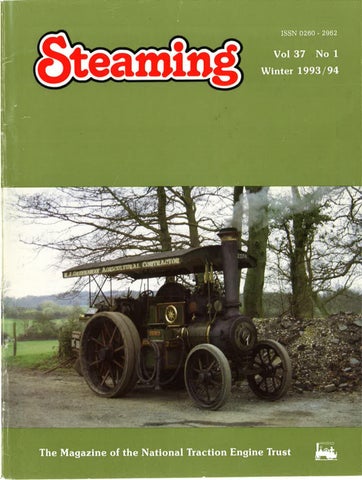
The Magazine of the National Traction Engine Trust
NATIONAL TRACTION ENGINE TRUST Membership of the National Traction Engine Trust is open to those who, whether engine owners or not, have a genuine interest in the preservation of self propelled steam road vehicles, portable engines etc.
President: S.J. Wharton Vice Presidents: Esmond E. Kimbell; Richard N. Parrott Chairman: R.J. Sandercock, Milford Farm, near Lifton, Devon PL16 OAT. Vice-Chairmen: Mrs Sylvia Dudley, 12 Hillway, Woburn Sands, Milton Keynes, Buckinghamshire MK17 8UL; A.J. Semple, Penyghent, 8 Chelwick Close, Church Stretton, Shropshire SY6 7BY.
The annual subscription is £12.00 for individuals, £14.00 for family membership and £7.50 for pensioners. The Trust's magazine Steaming is sent free to members during the early part of January, April, July and October, and other benefits of membership include advantageous terms for boiler insurance as well as access to advice on leulmical matte's. Membership of the Steam Apprentice Club is available to young people under 21; details available from that section's Chairman (see riahtl.
General Secretary: Mrs Susan Jackson, 153 Micklefield Road, High Wycombe, Buckinghamshire HP13 7HA. Membership Secretary: J.R. Cook, 'Dolfarni', Church Lane, Kirkby la Thorpe, Sleaford, Lincolnshire NG34 9NU. Treasurer: J.T.G. Harris, Oak Cottage, Cottesbrooke, Northampton NN6 8PH. Chairman, Rally Sub-Committee: A.J. Semple, Penyghent, 8 Chelwick Close, Church Stretton, Shropshire SY6 7BY. Chairman, Engine Owners Sub-Committee: M.O. Davies, Hill Farm, Avon Dassett, near Leamington Spa, Warwickshire CV33 OAA. Chairman, Steam Apprentice Club: Mrs Sylvia Dudley, 12 Hillway, Woburn Sands, Milton Keynes, Buckinghamshire MK17 8UL. Insurance Officer: D.S. Smith, 21 The Ridgeway, Astwood Bank, Redditch, Worcestershire B96 6LS. NTET Sales: Colin and Valerie Brown, 90 Devon Road, Luton, Bedfordshire LU2 ORL.
Steaming binder
Each binder can take up to twelve copies — that's three year's issues. Produced in royal blue with the magazine title and club motif nicely blocked in gold on the spine — a fine addition to your bookshelves and an excellent way of keeping your magazines in good condition whilst near at hand.
-444111k,
Aft,9101-e -TA7-raxt. reAvi Price £5.25
AP" )-1;1§°'
inc. posts Available by post from Colin and Val—Brown, 90 Devon Road, Luton, Bedfordshire LU2 ORL.
Back numbers Back numbers of this magazine are available, by post, as listed below. Newer members will be able to find a wealth of reading and pictures in these earlier issues — and members of longer standing may be able to find missing issues to fill gaps in their collections, made when someone hasn't returned a borrowed copy! per copy non members members
Vol 29, all issues (1986) Vol 30, all issues (1987) Vol 31, all issues (1988) Vol 32, all issues (1989) Vol 33, all issues (1990) Vol 34, all issues (1991) Vol 35, all issues (1992)
£2.00 £2.00 £2.00 £2.50 £2.50 £2.50 £2.50
£3.00 £3.00 £3.50 £4.00 £4.50 £4.50 £4.50
To claim post-free for UK, members please enclose current membership card. Overseas members please add £1.00 postage per order. Cheques/PO's should be made payable to NATIONAL TRACTION ENGINE CLUB (1984) LTD Orders to be sent to: M.A. Poole, 89 Glebelands, Pulborough, West Sussex RH2O 2JH
Winter 1993/94 STEAMING
The Magazine of the National Traction Engine Trust
Volume 37 Number 1
Winter 1993/1994 Editor: Roger West, 14 Charles Street, Market Harborough, Leicestershire LE16 9AB Assistant Editor: Derek Rayner, 'Invicta', 9 Beagle Ridge Drive, Acomb, York Y02 3JH Display Advertising: to the Editor Small Ads to the Editor Distribution and Change of Address: John Cook, 'Dolfernr, Church Lane, Kirkby la Thorpe, Sleaford, Lincolnshire NG34 9NU The Editor is pleased to consider contributions of suitable articles, shorter items or photographs for inclusion in future issues. All material submitted is voluntary and payment cannot be made for any material published, although expenses incurred may be met. The opinions expressed in the magazine, with the exception of those printed as Trust announcements, are those of the contributors and do not indicate the views of the Trust as a whole. All items are held copyright by the contributors and/or the NTET. Next issue: The press date for news items, recent photographs and small adverts is 25th February 1994. For the date for Steaming Around see that section. ISSN 0260 - 2962 Published by the National Traction Engine Club (1984) Ltd for the National Traction Engine Trust at 14 Charles St, Market Harborough, Leicestershire. Printed by AB Printers Ltd, Leicester. STEAMING Winter 1993/94
An Older Statesman's Reminiscence Our Editor has kindly offered me the opportunity to occupy this spot following my retirement as Chairman, and this I have been pleased to accept. I am however pondering over the title he has given: 'Older' I will admit to; 'Statesman' seems a little pompous — my Oxford English Dictionary defines statesman as 'A wise and far-sighted politician', so I leave others to comment. 'Reminiscence' is defined as 'recalling the past'; I feel I am on safer ground here. I suppose an easy way to reminisce is to browse through some of the past copies of Steaming. The earliest printed journal I possess is the January 1957 issue. Rallies have always been an important part of our activities and thirteen rallies were mentioned as taking place during that summer. Derek Marder wrote in the last issue of the 1953 Andover Rally and listed twelve full size steam entrants — by 1957 the entry was given as twenty engines. Both the number of rallies and engines attending have increased steadily over the years, for there were 91 authorised Rallies during 1993. and whilst 100 engine events may not be too frequent, 50 engine events are now quite commonplace, such is progress. But progress there must be. Organisations rarely stay static, progress or decline being the usual course of events. I feel, after many years nonnented with the Trust, that it is on the verge of considerable progress. Legislation is such that it is necessary for a strong co-ordinating body to be able to oversee the activities of our hobby and to bring together the various aspects encountered. The Trust is in a good position to do this; we have a strong and well balanced committee which I am sure will be able to cope with the next decade of the traction engine movement. Already there are signs of closer co-operation between the various organisations with steam interests, which is most welcome. May I take this opportunity of thanking the Trust for giving me the first 'honorary life membership' it has granted. Much of what has been achieved during my association with the Trust has only been achieved with the support And co-operation of my many colleagues. Thank you, all of you. (Eric Fillmore)
This issue 4 12 16 17 18 21 24 26 27 28 43 45 50
Trust News Steam on the Bridge Burrell 4061 A new Burrell history Technical Topics Hail to the Chief Sentinels for Quarry Owners A South London Showman A new home for JENNI-FER Steaming Around, compiled by Derek Rayner Around the World Letters Books, Videos, New Members, Small Adverts, etc
Cheslyn Mileham Liz Grimsay
Kevin Lockyer Joe Thomas Bill Ives
Cover The dull, tired colours of winter are briefly brightened by the presence of Burrell 5hp traction engine 3917 of 1921, a three speed compound machine on springs. Roger Newbery's picture was taken at an early spring steaming at John Keeley's yard in March 1993. 3
Trust News From the new Chairman It is 40 years since the NTET was formed, and I was then 10 years old. At that time my father (grandson of Richard Dingle, Stoke Climsland, Cornwall) was disposing of steam engines to raise funds to purchase modern diesel rollers so that the business could continue. Fortunately there were enough enthusiasts to buy these engines, with over 40 surviving from our fleet, although they had no rallies to go to and were thought eccentric by most. Our President alone remains in office from the governing body of the club formed then, with its aim of preserving this part of our heritage. They achieved everything they set out to do and have handed on to the next generation a large collection of engines and a thriving rally scene, where the exhibits carry out the work they were built for to the joy of the enthusiast and the vast numbers of the public who attend. However, there are now new tasks which the Trust is responsible for. Increasing legislation in all aspects of our society affects our activities on and off road, a situation which must be defended. It could even stop them, and this must be fought. Rules which deal with things in general leave little room for individuality, and individuals tend to resent rules. Steam people are particularly individual and committed to their hobby. To others the pleasure of so hard and dirty an activity is hard to understand but they do not get the great personal satisfaction that there is. None of us like to be told how to do something that we already understand by people from outside, and there seems to be an impression that the Trust's national committee are outsiders. They are not. Many are engine owners: I am one, Andrew Semple, vice chairman, another. All are volunteers who give of their time, when they could be out in the engine shed, because they believe that without a strong single voice to fight for it the movement will be restricted more and more. We are trying to satisfy the authorities that we can be self regulating before rules are 4
imposed upon us by people who really do not understand. Given our individuality there is bound to be some disagreement about the way forward, and comment from members is always welcome. There are committee members in most areas of the country who are happy to talk, or a letter to any of the officers listed in the magazine will be discussed. If you have comments please make them to us. If you don't we won't know. It is important that we all pull in roughly the same direction to do justice to the work that our founders have done. We wish to be in close contact with the members and affiliated clubs and present the Trust with a high
profile that will earn the respect of all. Tho committee cannot work without the support of the members; you elected us. To misquote 'Ask not what the Trust can do for you, but what you can do for the Trust'. (Richard Sandercock, chairman)
Engine Owners Column Engine Owners sub-Committoo It is the beginning of a new year, and time for us to look forward to a new season of rallying.
From Alan Martin's Collection
63
This fine view / have recently acquired shows two steam tractors at work
near Tetbury, Gloucestershire about 1919. To the right is a local engine — Burrell Gold Medal tractor 3458 of 1913, owned by Char/es Jones of Tetbury. The engine is, of course, a well known survivor, having been rallied for many years around the Thames Valley by the Barker family. The second engine, to the left, is S.W. Reynolds Garrett 4CD 32814 (BJ2917), coupled to a load of stone. Reynolds was from Minsterley, Shropshire and l wonder what the 1916 built engine was doing so far from its home — the distance must be at least 90 miles. Carting stone between the Cotswolds and Minsterley — both areas with extensive stone quarrying activities — seems quite unnecessary. Maybe the engine was on contract hire. Winter 1993/94
STEAMING
In response to a perceived demand, we are planning another Engine Driving Course at the Amberley Chalk Pits Museum on 23rd/24th April 1994. Unfortunately, we were not able to fix the date in time for the last issue of Steaming, so please apply as quickly as possible for numbers arc strictly limited and last year's course was fully subscribed. The course will be on similar lines to previous ones with participants divided into first and second year courses. The price will be £70 and application forms may be obtained from myself or Sylvia Dudley — both our addresses are to be found inside the front cover of this magazine. From July 1994 the requirement for a written code of practice for traction engine operation becomes law and those who have not yet got one will need to choose between those produced by the various insurance companies (the prices ranging between £70 and £200) and the Trust's own Code — presently priced at £15. We are working hard to complete the remaining sections as it appears that the main reason why the insurance companies have not accepted our Code is that it is not yet complete. Sections 1 and 3 are now available and anyone who has not yet done so should please apply to Sylvia Dudley for those parts, surrendering the appropriate vouchers which are already in your copy of the Code. I would like to commend this document to you, as it is full of commonsense and well worth the time it takes to read it. At the last meeting of my subCommittee, we were particularly pleased to welcome members of the Trust's Technical Board, and we feel that as independent experts they should be able to perform a very useful function, both as arbiters in technical disputes and in vetting the credentials of independent boiler inspectors. We are well aware that if we produce a list
ENGINE OWNERS...
Have you claimed Parts 1 and 3 for your
Code of Practice for Traction Engines See Engine Owners Column for details
STEAMING
Winter 1993/94
a
of approved inspectors, we shall need to be covered by public indemnity insurance and we are actively enaged in pursuing this matter in co-operation with the enthusiast bodies representing preserved steam railways and their locomotives and with the Steam Boat Association. I would remind members who are doing maintenance work during the winter that we do still maintain a comprehensive register of firms and people who supply spares and services for steam engines and we are always pleased to try to help where this is a problem. (Michael Davies, chairman, Engine Owners subCommittee)
Officers and Committee 1994 President
S.J. Wharton Vice Presidents
E.E. Kimbell R.N. Parrott Chairman
R.J. Sandercock Vice Chairmen
Mrs Sylvia Dudley A.J. Semple General Secretary
Mrs Susan Jackson" Treasurer
J.T.G. Harris " Hon Solicitor
T, Driver* Hon Safety Adviser
J.M. Newnham" Traction Engine Code of Practice
Part 3 'Transport and laying-up storage' to the Trust's Code of Practice for Traction Engines has now been completed and is ready for despatch to those owners who already possess copies of the Code. The availability of Part 1 'Operation and Maintenance' was announced in the Autumn issue of Steaming but quite a few existing holders of the Code have not yet claimed these documents. Please be aware that you need to claim these new Parts via the green vouchers which are to be found in the binder — there is no charge for them except for the postage. Members who have purchased the Code should therefore take the green paper 'Voucher Part 1' and/or 'Voucher Part 3' that are enclosed with their binder, and send, duly filled in and with a large stamped envelope, to Sylvia Dudley, 12 Hillway, Woburn Sands, Milton Keynes, Buckinghamshire MK17 8UL to claim the new section(s). There is no charge — all the Parts yet to be written and issued will be sent free to holders, when ready, through the voucher system — but the envelope for the return of Parts 1 /3 will need to be of 13in x 1 1 in minimum size, and bear postage stamps for 57p first class, or 43p second class. Copies of the Code are available (to members only) from Sylvia Dudley at a cost of £15 plus £2.50 postage; additional sheets for Part VIII to cater for other engines in the same ownership, are available at £2.50 per set, including postage.
FBHVC
Meetings of the Federation of British Historic Vehicle Clubs have continued at regular two-monthly
Membership Secretary
J.R. Cook Committee
J.R. Bosworth (Derbyshire) N. Boyes (W. Yorks) M.O. Davies A. Fookes (Essex) R.T. Herring (Oxfordshire) I.D. Howitt (W. Yorks) R.F. Oliver (Surrey) S.J, Parrott (Bucks) R.J. Pierce (Kent) K.D. Shakespeare 0. Slade (Devon) D.S. Smith (West Midlands) J.R. Smith (N. Yorks) M. Ward (Nottinghamshire) R.E. West Representatives
R. Mattless (NV Tractor & EC)* Auditors (and registered office)
Hamiltons, Forum House, 1-6 Millmead, Staines, Middlesex TW18 4UQ This column lists, for the information of members, all Officers and Committee of the Trust for 1994. The addresses of those with special duties are given inside the front cover of each issue of this magazine; others may be contacted via the General Secretary or sub-Committee Chairmen. Names marked with an asterisk" are appointments by the Committee and are nonvoting positions in Committee.
intervals but little of interest to steam engine owners has been discussed. Indeed the flow of legislation from the EC has slowed down, due no doubt in part to the preoccupation with Bosnia! One item of some relevance to engine owners has been the advice from the Federation legal adviser about providing valuations: 'Most club officials will have been approached at some stage or other to provide valuations, usually for insurance purposes, sometimes for probate and occasionally for use in litigation. They will also have been asked to provide opinions on the conditions of vehicles 5
The Engine Owners sub-Committee presents another
PRACTICAL ENGINE DRIVING COURSE to be held on the weekend of 23rd and 24th April, 1994 At the Amberley Chalk Pits Museum, near Arundel, West Sussex by invitation of the Trustees. The site has full facilities including caravans and camping. See Engine Owners Column for further particulars.
being bought or sold. Whilst a verbal comment that a Pewsey Willow mark 2 in good order should be worth between five and six hundred pounds is unlikely to lead to serious repercussions, more specific written valuations may need to be sub stantiated in a court of law. If the valuation or assessment is found to be wanting, the valuer and organisation on whose behalf the valuation was given, could find themselves on the wrong end of legal proceedings. 'Several clubs have been happy for officials to countersign insurance proposals for their members. This may be in order if the wording of the declaration being signed by the Club representative requires only that the official considers the value placed on the vehicle by its owner to be reasonable. However, more and more insurers are placing a greater burden on the Club and its Officials in the event of a dispute between the company and client following a claim. 'Different clubs have approached
this problem in different ways: the Bentley Drivers Club, for instance, carries indemnity insurance allowing a nominated expert to carry out valuations. These include a detailed vehicle inspection and the official ooncorned hoc a responsibility to keep abreast of current market trends. The Aston Martin Owners Club, on the other hand, will no longer discuss values: they have arranged an insurance scheme avoiding agreed values and any member who requires a valuation for participation in another scheme, or for any other purpose, is referred to professional specialists who are presumed to carry the appropriate traders insurance and who are willing to offer a valuation service. The fact that some specialists refuse to undertake this service is an indication of the potential problems involved. 'Clubs should ensure that their policy on valuations is clear: if they take the AMOC example and refuse to comment on value, this should be
Help needed! The Trust needs the help of a member willing and able to assist in the promotion of its activities and benefits to both the general public and to road steam enthusiasts who are not yet members. Tasks that need addressing are the production of advertisements and posters about the Trust, describing its aims and its work for the preservation of engines and services to members. Cost effective ideas for other methods to promote the Trust, such as articles in popular magazines, would be welcome. A fresh and energetic approach to the subject is sought. Readers interested in considering this post of Publicity Officer should write to the General Secretary, Sue Jackson, giving details of their ideas and their skills that can be applied to the future advancement of the Trust.
6
spell out to all officials, particularly those armed with a supply of club headed note paper. On the other hand, if the provision of a valuation or assessment service is deemed to be particularly important, it is essential to obtain specialist advice to ensure that the Club and the Officials entrusted with the task are properly indemnified against subsequent claims.' (Peter Smart, steam representative, FBHVC)
Rally Organisers Column From the Rally Approvals Officer Elsewhere in this section of the magazine you will find a first issue of the 1994 Rally List — appearing in it are those events that have requested authorisation under the NTET scheme to dote. The paperwork for these events is being prepared and should be with the Organiser by the time this winter edition is published. At the time of writing these notes there are nine events 'on hold' pending my receipt of their Safety Officer's Report for the 1993 season. Please may I remind Organisers and Safety Officers that thare is a requirement to submit a Safety Officer's Report within 14 days of the Event; Section 3 Para 3.3 of the 1992 Code of Practice sets this out quite clearly. (J.R. Smith, Rally Approvals Officer)
ti
Insurance Officer With the retirement of Dick Blenkinsop as the Trust's Insurance Officer, we are pleased to welcome to that post David Smith, an existing Committee member. David's address will appear inside the front cover of each issue of Steaming. Engine owning members and rally organisers are reminded that, by the wish of the Rally Organisers Conference some time ago, the Rally Code now calls for all engines to carry an NTET insurance disc when attending an NTET authorised rally. Engines will only be allowed to attend in steam if they have a valid insurance disc mounted on the engine. These can be obtained from John Scott & Partners or the Insurance Officer . (David S. Smith, Insurance Officer)
Winter 1993/94 STEAMING
A fine line-up of Burrell three speed road locomotives and their owners — from the left they are 3395 of 1912 THE DALESMAN with Ted Freeman; 3057 of 1908 LORD ROBERTS and Jim Sarney; 3593 of 1914 DUKE OF KENT with Steve Neville. Dick Blenkinsop's picture, taken at the 1993 Roxton rally, records a unique occasion for the trio have almost certainly never before appeared together on the rally field for elsewhere in working days for that matter11, despite being well known and much travelled engines in preservation. The outer couple, 3395 and 3593, are the only surviving 6hp Burrell road locos that have not been converted to showmans engines. Both have the maker's larger 6ft 6in diameter rear wheels and sport correct, but different, Burrell liveries — THE DALESMAN is olive green with chocolate wheels, whilst DUKE OF KENT is crimson lake with vermillion wheels and gold leaf lining — only some engines sported the latter feature. Between the pair, LORD ROBERTS illustrates the Thetford works' 7hp Contractors design which differed from the standard 7hp product in being of much heavier build with larger crankshaft bearings, thicker hornplates, heavier 6ft 6in wheels and double crank compound cylinder block bores of increased diameters.
NTET Exhibition Unit The 1994 rally season will see the introduction onto the rally fields of a mobile exhibition unit for the NTET. It has been felt for some time that the role and work done within the Trust has not been properly presented to either members, enthusiast nonmembers or the general public. Facilities will include that of recruiting new members; of renewing membership; the opportunity to view or discuss the Rally and Engine Codes of Practice; the necessary procedure for obtaining an engine insurance disc; to discover where the affiliated clubs are, and who are the steam apprenSTEAMING Winter 1993/94
tices. Also available will be a continuous show of rally scenes and engine activities on video screen and sales of club ties, badges, magazines and books. This unit will be staffed by Trust members who will be on hand to answer questions and discuss the Trust work. It is hoped to cover events across the whole of the country. Further information and itineraries will appear in future issues of Steaming but anyone wishing to receive further information now should please contact: Robert T. Herring 27 0869 277410.
Steam Apprentice Club I was pleased to be able to meet many of our SAC members at the Dorset Steam event. The now traditional 'breakfast on the shovel' on the Saturday morning, and the afternoon meeting, with some training and a chance to go on an engine, were as popular as ever. We are grateful for the support of engine owners that makes this possible. During the afternoon meeting the Dorset Shield for the best entries for the SAC photographic competition was awarded and this year we held a colouring competition for our younger members, which was well supported. Steph Gillett, editor of the SAC magazine Raising Steam is writing further notes for this issue on the section's activities but I know he is always in need of material for the magazine, which caters for a wide range of ages from the earliest readers up to 21. Do please consider whether you could write up something for our younger generation. (Sylvia Dudley, chairman, SAC)
Most members will have seen reference to the Steam Apprentice Club, or SAC, but may not be familiar 7
The Rally List 1994 The Rally List 1994, those rallies organised under the Trust's Rally Code of Practice, will be published as usual as a supplement to the Spring edition of this magazine, but many organisers have already decided their dates for 1994 and we publish now a list of rallies notified to and agreed by the Rally sub-Committee by 1st December 1993. Although only a brief title is used the rallies should be identifiable by readers, and we hope this advance information will enable notes to be made in diaries etc, earlier than usual. Further details and addresses of organisers will be in the next issue.
April 30/1 May — May Day Steam, Manchester May 7/8 — Stoke Goldington, Bucks 14/15 — Haywards Heath, W. Sussex 27 to 30 — Pevensey, East Sussex
June 4/5 — Mid Shropshire, Shrewsbury 4/5 — Lister Petter, Glos. 11/12 — Vintage Gathering, Wilts; Great Amwell, Harts; South Tyne, Northumberland 18/19 — Claybrooke, Leics; Parham, W. Sussex 25/26 — Sheffield July 2/3 — Bromyard, Herefordshire; Heddington and Stockley, Wilts; Elvaston Castle, Derby; Chiltern, Bucks; Hollowell, Northants 9/ 10 — Rempstone, Leics; Downs Steam, Hampshire 15 to 17 — Weeting, Norfolk 16/17 — Ardingly, West Sussex; Marcie, Salop; Woodcote, Berks; Masham, N. Yorks 22 to 24 — Netley Marsh, Southampton 29 to 31 — Cumbria Steam, Cumbria 30/31 — Milford, Devon August 6/7 — Thurlow, Suffolk; Cornish TPC; Wellingborough, Northants 13/14 — Rudgwick, Sussex; Cadeby, Warwickshire; 20/21 — Fairford, Gloucestershire 27 to 29 — Town and Country Festival, Warwicks; Liskeard, Cornwall; Harewood, Leeds September 10/11 — Malpas, Cheshire; Haddenham, Cambridgeshire 24/25 Barleylands, Essex
Cumbria to Cornwall and I would like to hear from anyone who might be willing to help out. The SAC holds its own engine driving course for Apprentices aged fourteen and over, when a number of traction engines and road rollers are brought along by sympathetic owners, enabling the youngsters to have a go at fire lighting, raising steam, steering and driving, as well as learning something of the technicalities of steam traction. We are grateful to those engine owners and crews who have made it possible for older apprentices to learn more about traction engines on a regular basis from people who actually run them. Unfortunately, matching the requests to be paired with an engine, and the offers from owners, is not always straightforward, as most Apprentices have no transport of their own. The Club is concerned to ensure in practical ways that the traction engine movement has a future with the next generation. (Steph Gillett, 93 Devon Road. Easton, Bristol BS5 6ED. Tr 0272 511399) (Some Trust members may be interested in seeing a copy of the SAC magazine. Steph Gillett would be pleased to forward one on receipt of a stamped addressed envelope (at least 6%2 x 8%) plus four first class stamps or the equivalent.)
Trust Trophies with its aims or activities. As the youth section of the Trust, the SAC aims to foster an interest in, and understanding of, traction engines and other steam road vehicles amongst young people. Membership is open to anyone who has not yet reached their twenty-first birthday. There are members as young as a few months, though most Apprentices are in their teens. We have nearly four hundred members throughout the UK, about half of whom are thought to have access to a traction engine. The Club is about to increase its annual subscription from £2 to £3 — for the first time since its formation in 1979. It will still rely heavily on funding from the NTET. Apprentices receive a range of benefits and activities, including a quarterly magazine, Raising Steam, which features articles by members of both the SAC and NTET, a story for younger members, photographs, letters and various competitions. Anthony Coulls was awarded the J.T. Beeby Cup for 8
Steam Apprentices at the recent NTET AGM for his regular contributions to the magazine. For many members the magazine is their only contact with the Club, so it is important to have plenty of interest for all age groups. This view has been borne out by the results of two questionnaire surveys, and this is in itself another way of keeping in touch with a widely dispersed membership. A penfriends scheme also exists so that all members, wherever they live, can keep in touch with each other all year round. Many of the rallies authorised by the NTET offer free admission to SAC members. Most of these events also invite the club to hold a training session where youngsters are paired with engines, giving them the opportunity for hands on experience, as well as adding to their parents' laundry bill! To take advantage of these otters the Club needs the assistance of adults to help organise and supervise the proceedings. Invitations are already being received to attend rallies from
In November, the 1993 Annual General Meeting at York provided the occasion for the presentation of some of the Trust's sizeable collection of trophies to deserving members in the north of England. With the citations being announced by Vice-chairman Sylvia Dudley, the presentations were most appropriately made by the retiring Chairman, Eric Fillmore. THE CHOISY & SIMPSON CUP was awarded to John Bainbridge for his efforts in rallying Fowler crane engine 8920 and the revival of the Chester-le-Street rally after 22 years. THE CURTIS CHALLENGE TROPHY went to Richard Mullah for his dedication in the pursuit of originality in the restoration of the venerable 1889 Aveling roller 2481 and his determination in the acquisition of Garrett roller 28408. THE ARTHUR NAPPER CUP FOR TRACTIONS was presented to Vic Makey in recognition of his efforts in the restoration of Clayton & Shuttleworth traction OLD GLORY, a participant in the 1953 Pickering Winter 1993/94
STEAMING
event, and his support given to this year's 40th aniversary celebrations of that event. THE JACK HOLLOWAY BOWL was chosen for Robin Knox for his enthusiasm for Fowler engines — the restoration of tar spraying roller 17492 (which he has owned since a tender age) and its attendant Fowler gritter and showmans engine 11108, and also his promotion of the excellent spirit of friendliness among engine owners in the Harrogate area. THE PERCY HIRONS BOWL was presented to Mike Middlewood for his restoration of Burrell traction 3048 and continuing the steam ploughing activities of Fowler BB1s 15154/ 15155, WARD and DALE. THE GOLDEN FILM SHIELD was awarded to Andrew Craske for his long term support of road-making demonstrations with his complete roller, tar sprayer and living van and water cart outfit, all of which carry out exceptionally long road journeys. THE CONNIE HUTCHENS BOWL was received by Irvin Barraclough in recognition of his unselfish assistance to others in long distance journeys with road locomotives and his own work on Fowler 14893; also his soon to be revealed, and perhaps controversial, creation of a new steam driven vehicle. THE EDNEY TROPHY was presented to Richard Marsh for his lengthy and most meticulous rebuilding of Burrell showmans road locomotive LORD LASCELLES. THE J.T. BEEBY CUP is usually awarded to a younger member and went this year to Anthony Coulls for his strong and continued support of the activities of the Steam Apprentice
Don't forget...
Spring Conference for Rally Organisers and Affiliated Clubs SATURDAY 12th MARCH 1994 The Harborough Leisure Centre, Northampton Road, Market Harborough, Leicestershire See Future Dates column for further details.
STEAMING Winter 1993/94
Club by entering competitions and writing for its magazine. THE DACRE LACY CUP was chosen for Dick Blenkinsop, retiring from office this year, for his services to running of the Trust over a great number of years and in particular his latter post of Insurance Officer. Lastly, THE ERIC MIDDLETON CUP was awarded to Eric Fillmore in grateful recognition of his unstinting contribution to the work of the Trust over a very long period of time. At the same time it was announced Eric had been granted Life Membership of the Trust. Mrs Joan Fillmore was presented with a floral bouquet by the newly elected Chairman, Richard Sandercock.
NTET Sales It is with much pleasure we welcome Colin and Val Brown of Luton to take over the Sales activities of the Trust. Members will be well aware there has been a very reduced function in recent times and I thank those who have shown patience with the limited service I attempted to keep going last year. The Browns will doubtless operate an efficient Mail Order service and also have fresh ideas for new items of interest for our traction engine enthusiasm. (Sylvia Dudley)
1993 Scania Transport Trust Awards The winners of the Scania Transport Trust Awards scheme were announced in October. Overall winner, with a cash prize of £2500, was the Kennet & Avon Canal Trust of Devizes, Wiltshire. Runners up included former British Railways 4-6-2 locomotive 71000 DUKE OF GLOUCESTER and the National Trust's steam yacht GONDOLA. Among the £250 awards for finalists was one road steam vehicle — 1924 Sentinel wagon rebuilt by Richard Straughan from the wrecked pieces retrieved from a Lake District ravine. The Scania Transport Trust Awards were created in 1988 by Scania in conjunction with the Transport Trust, the UK charity dedicated to preserving the nation's transport heritage. The scheme sets out to honour and reward transport preservation in the UK and embraces
A somewhat alarming kind of rally photograph, showing the effect of a rubberised mud ring which had blown out from its seating on a mudhole at the firebox front corner. It is best that here the picture is captioned as an unidentified engine by an anonymous photographer, but it can serve as a warning for all; later it could be seen that there had been far too much clearance all round the door. Further, the boiler had only just had its annual inspection.
the preservation of vehicles and transport infrastructure alike. Entry is open to museums, preservation groups and individual restorers. The scheme has channelled more than £50,000 into the transport preservation movement since its introduction. The Awards are presented annually to winners selected from the scheme's Interim Winners which are named during the year. Set to continue into 1994/5, new entries are welcome and details can be obtained from: The Transport Trust, c/o British Coal, Room 490, Hobart House, 40 Grosvenor Place, London SW1X 7AE, Tr 071 201 4244).
Obituaries Philip Carter Philip Carter joined the family firm of Richard Carter Ltd when he left school, and his first duty was to look after the boiler and engine that powered the works in Kirkburton, Huddersfield. He became managing director when his father died; the firm manufactured forks, shovels, axes and 9
hammers. Philip worked full time until he was 67, part time until the age of 74 and on retirement he wrote a history of the 250 year old firm. All his married life he was a member of the Society of Friends (the Quakers) and belonged to the Paddock Meeting Room, being primarily concerned with the fabric of the building. His first wife, Evelyn, died in 1981 but he met Joy in 1985 and they married in December that year, with the result that Joy was introduced to steam engines and industrial arrhaPnlogy in general. Philip was a generous man in a quiet way, and was a founder member of the Leeds & District club and supported every August rally from 1983, firstly with his Garrett 4CD tractor JOYCE, always driven the 38 miles by road to the rally, and later with his Clarke portable mounted on a trailer. This engine he acquired in a completely dilapidated state and rebuilt it on a brand new boiler with the help of many friends. Philip was elected President of the Leeds club in 1992 and carried out his duties conscientiously with a ready smile and a merry quip. His last duty was to present the section prizes at the end of this year's rally, when only a few members knew how ill he was. He died peacefully at home in October 1993, leaving Joy, his widow, and Philippa, his only daughter.
Alan Duke Alan Duke died on 20th September and so brought to an end a long and distinguished membership of the Road Locomotive Society. He was a founder member and a Committee member of very long standing, latterly a ViceChairman, but it was in the post of Records Officer, which he had occupied since the resumption of activities after World War 2, for which he will always be remembered. Alan was born in 1920 and brought up in Finchley, London. He went to Finchley Grammar School and then joined the Civil Service in HM Treasury where he achieved eminence, and was appointed a Commander of the Order of the British Empire (CBE) in recognition of his unbroken Crown Service of well over forty years. A man of contradictions, Alan was solemn in manner but had an endearing sense of the ridiculous and a piercing sense of humour. He was a most loyal friend and a very keen supporter of all his many interests. These included his local church, singing in several choirs, cricket, 10
buses and railways. He was a private man, but also gregarious, and was tireless in seeing that old friendships were maintained. Alan's memory was prodigious and it was the ability to recall details that made him such an outstanding Records Officer. I shall never forget his reply to "How do you remember so much information?". "I close my eyes and visualise the page", he replied; a truly photographic memory. The records which the RLS has inherited from Alan arc the definitive soul ce fur all matters pertaining to steam road engines. The Driver and Vehicle Licensing Agency at Swansea have acknowledged these records as the source of authentication for the re-issue of lost registrations. Alan was justifiably proud of his records and it was typical of his generous nature that he was pleased to share his knowledge with anyone who wanted to know. He was often critical of authors who made needless errors in published material because they did not seek his help. Those who sought his assistance were always rewarded with a swift and painstaking reply. When the Society was publishing reprints, Alan always produced a list of the engines illustrated, he once quipped, "The reprint is better than the original — it has one of my lists!" In 1959 Alan was the RLS President and as might be expected his address was centred around the collection of records. In that address he said "My interest in the steam road locomotive has largely been confined to the somewhat academic pursuit of as complete a record as possible of every steam road vehicle that has been worked and owned in Great Britain." That statement seems to me to encapsulate aims of the RLS and one can now see what a splendid job was done and how closely success was achieved. It may be trite to say "We shall miss him." There will never be anyone quite like Alan, either in his knowledge, his unassuming manner or his quiet good counsel. We must be thankful for his contribution and for
the manner in which it has been given. The memorial service held on the day of his funeral was very much a celebration of thanks for a highly special
profession, he had led a varied and interesting life, remaining actively engaged in engineering projects until the end. His interest in steam began as a small boy following the movements of the engines in his area. A native of Stony Stratford, Buckinghamshire, early on he became well known to drivers of the steam trams which ran from Stony Stratford to Wolverton, and was often privileged to ride on the engines. On leaving school he began an apprenticeship with the local tirm of Edward Hayes which at that time was building steam launches and tugs for inland waterway and harbour use. He subsequently moved to other engineering firms, but when re-armament began prior to World War 2 he joined the design team at BAC Bristol, eventually becoming responsible for the design of gun mountings and ammunition handling equipment for the aircraft built for the RAF. One of his favourites was the Blenheim bomber and he amassed considerable flying hours conducting trials, far surpassing some of the less fortunate aircrews. With the cessation of RAF orders after the war, new projects came to BAC and Spencer became involved in
the Bloodhound missile programme, being responsible for the design and manufacture of the missile transporting and launching equipment, and the satellite programme. During his time with BAC Spencer lived at Thornbury, north of Bristol. When house building resumed after the war he designed and built his own, using specialists as necessary. In the 1960s he purchased the former Dingles of Stoke Climsland, Fowler roller 21833, which he restored to a very high standard, later attending local rallies and functions He was always willing to help other engine owners with their problems, designing replacement parts and preparing drawings for boiler repairs and suchlike. Spencer's passing is mourned by his many friends throughout the road engine movement, and our condolences go to his wife, son and daughter and their families. (Jack Sommerfield)
man who contributed generously throughout to the many and varied facets of a full and complete life.
(Peter Smart) Spencer Green
Binding of Steaming volumes
Spencer Green died during August 1993, after a short illness, aged 89 years. A qualified engineer by
Arrangements have been made with our magazine's printers to again provide a service for readers who wish
Winter 1993/94 STEAMING
to have their individual copies of Steaming bound into volumes. The magazines are the 12 issues comprising Volumes 33, 34 and 35, and, as when we last went through the exercise several years ago, readers will find the magazines bind up into a splendid 600 page book. The covers are heavy dark blue cloth boards with the spine lettered in gilt with the Steaming logo, and also the volume numbers and dates. The magazine's colour covers are, of course, retained. The price of binding is El 5 and this includes the return postage and packing. The twelve issues of Volumes 24 to 26, 27 to 29 and 30 to 32, can also be bound up at the same rate per three year set, but please note it is only possible to bind the magazines together in the sequences as detailed above. Please note these arrangements do not cover the recently completed Volume 36 — that will be included in the next three year group in due course. Readers wishing to take advantage of the service should post or otherwise deliver their copies of the issues concerned (well packed to survive any attempted improper handling in transit!) to AB Printers Ltd, 33 Cannock Street, Leicester LE4 7HR, enclosing their remittance for £15 per binding, cheques made payable to AB Printers Ltd. Please ensure the package contains a clear note of your name and address. The magazines must be received at Leicester by 25th February 1994 and will be returned to their owners about eight weeks after that date. Magazine binders We draw attention to the present availability of Steaming binders to take the old smaller sized magazines issued before 1981. These are priced at £5.25 each including postage and hold 8 copies 12 years). They are available in limited numbers in two sizes — either to suit magazines from Vol 16 to 23 inclusive, or the slightly taller issues of Vol 15 and earlier; purchasers should check carefully their requirements before ordering from Colin and Val Brown, the new Sales Officers (address inside front cover).
Affiliated Clubs Old Steamers TEC, Oxford Winter social meetings of the Old Steamers club for the 1993/94 season STEAMING Winter 1993/94
are taking place on the third Thursday evening of each month at Cowley Community Centre. Trust members interested in further details should contact Neville Bricknell It 086 736 3387.
Future Dates Spring Conference for Rally Organisers and Affiliated Clubs The Spring 1994 Conference for Rally Organisers and Affiliated Clubs will take place at The Harborough Leisure Centre, Northampton Road, Market Harborough, Leicestershire on Saturday 12th March 1994 at 11.00am. Invitations and formal notices, together with details of the venue, will be sent out in the usual way, but newcomers are always welcome to these instructive and mutually beneficial gatherings. Coffee will be served from 10.30am; a buffet lunch will be available during the mid-day break (prior booking is essential) and tea will be served at the conclusion of the meeting at about 3.30pm. First time attenders are invited to contact General Secretary Sue Jackson for further details and bookings. The venue is located on the A508 road on the extreme southern edge of Market Harborough town and within 30 minutes car journey of the M1 and M6 motorways; suitable InterCity train services run from London St Pancras and from Leeds. The new A14 (A1-M1 link) may be open by March, if so, use the A508 junction and travel north to Market Harborough.
available from 7.30pm. It is hoped members will continue to support our speakers in the enthusiastic way they have in the past. TUESDAY, 11th JANUARY — Tony Marchington of the Buxworth Steam Group will present an illustrated talk 'Steam on the Fairground'. TUESDAY, 8th FEBRUARY — Bill Timmings will show slides of traction engines. TUESDAY, 8th MARCH — 'Traction engines and steam wagons' is the subject tonight of Peter Richardson. TUESDAY 12th APRIL — the speaker is still to be arranged and it is hoped the Spring issue will be distributed just in time for full details to be announced. (Bill Timmings, London meetings organiser).
Lost a camera? A camera and case were found in the members area of the Trust marquee at the Great Dorset Steam Fair. If you think it might be yours please write to Mrs Sylvia Dudley, describing the item, so that arrange. ments can be made for the return. A pair of spectacles was also found.
Bellhaven progress. The Bellhaven Motor Company have an excellent 2 to 3 ton steam vehicle working in Yorkshire. It is fitted with wooden wheels with rubber tyres, and we have seen it negotiating some severe hills in the Leeds district in a way that speaks well for the boiler efficiency and the design in general.' (from The World's Carriers, May 1909).
London Area Social Meetings The 1993/94 season of social meetings in London continues from January and all members, potential members and interested visitors will be welcome to attend one or all of the evening talks or slide shows which have been arranged for the Trust by Bill Timmings. The venue is the Yorkshire Grey public house, Langham Street, London W1. This location is off Langham Place and Portland Place and little more than five minutes walk north of Oxford Circus tube station. Meetings will be held on the second Tuesday of each month, at 8.00pm, with the room 11
Steam on the Bridge Cheslyn Mileham During the early years of this century, as the number of mechanically propelled road vehicles increased rapidly and their use bccumc widc spread throughout the country, it soon became apparent that many existing bridges were inadequate to carry the traffic that was developing. This applied particularly to bridges over rivers, streams and canals. Some were constructed entirely of timber, with trestle frames supporting longitudinal baulks and plank decks with wooden handrails; others were built with stone or brick had pointed or semi-circular arches of comparatively short span, and in most cases the roadways were nal row, uf Len only Len ur twelve feet between parapets, and with no separate footways for pedestrians. Where the waterways were used for navigation, to allow sufficient headroom for vessels, many bridges were hump-backed with steeply graded approaches on either side. Some bridges were 'manorial bridges' owned by the local Lord of the Manor, who was responsible for the upkeep and repair of these structures,
(illustrations from the author's collection, except where noted otherwise) but gradually they were taken over by the local authorities and a long drawn out programme of rebuiiiiiiiy ur replacement was commenced. Following the successful use of mass concrete for bridges and viaducts on the Fort William to Mallaig extension of the West Highland Railway, pioneered by Robert (later Sir Robert) McAlpine, who became known as Concrete Bob, and the introduction of reinforced concrete into this country during the closing years of the nineteenth century, many local authorities decided on reinforced concrete construction for bridge replacement. Thls material would require virtually no maintenance in the
future, compared with re-pointing brickwork or masonry and repainting Ull ur steelwork at frequent intervals. Prior to 1919 there were no hard and fast rules governing the design of reinforced concrete bridges and each authority specified its own requirements. These were usually for an evenly distributed load (in pounds or hundredweights per square foot and/or the concentrated load (in tons) of a heavy vehicle, the heaviest available being traction engines. After the formation of the Ministry of Transport in 1919, a standard code was drawn up for the design of highway bridges which included a diagram showing the loads to be allowed for in the
Broadmead Bridge, 15th January 1873, and Clayton & Shuttle worth traction engine (either 8263 or 8678 of 1868) and threshing machine owned by Thomas Miskin, farmer and threshing contractor of Hersham and Walton-onThames. The engine driver, George Reene, and the stoker, William Bird, fell into the River Wey, but although rescued from drowning, they were so badly injured and scalded that both died within a few hours. Another member of the threshing gang, William Darling, was drowned, being wedged underwater between the vehicles, as he had been riding on the drawbar.
Two views of the concrete covering forming a new roadway over River Roch in Rochdale on 8th July 1910. Fowler 5072 of 1885, a compound traction engine fitted with Booiron's Patent wheels to the rear, was owned by George Holt & Sons, general carrier of Rochdale. Engine weight 10 tons, plus trailers 32 tons and 18 tons — total 60 tons. The pig-iron in the foreground, to simulate pedestrian loading on pavement, weighed 29 tons.
calculations from a traction engine drawing three trailers. On completion of the new works it was customary to carry out a test using a load for greater than anything that was likely to occur under normal conditions, measuring the deflections of the spans as the loads crossed and noting the recovery after the loads were removed. If a plank is supported at its ends and a barrow is wheeled across it, it will deflect a maximum when the load is at the centre, and provided that it has not been overloaded, it will return to its original position when the load has passed. If on the other hand the plank has been overstressed, it will not recover completely, and on each subsequent loading it will sag further until it finally breaks. In the same way a concrete, or steel, bridge will deflect under load and should recover when the load has passed. In order to measure the deflections during tests, long pointers pivoted on fixed supports under the bridge were connected by wires to the underside of
Ministry -of Transport 'Standard Loading for Highway Bridges' (June 1922)
STEAMING
Winter 1993/94
13
Testing the new bridge at Minsterley, Shropshire, 14th January 1910. This was of 30 foot span, with a 16 foot roadway, and replaced a narrow three arch brick and stone bridge. The test load was 17 tons and 14 tons, total 31 tons. The engines were Aveling & Porter compound 3028 of 1892 and Burrell compound 2062 of 1898, both owned by Wotherton Barytes & Head Mining Co. The man in the centre of the group (by the Aveling's hind wheel in the bottom view) was probably Mr A. T. Davis, MlnstCE, the County Surveyor for Shropshire at that time. (collection Alan Martin)
Ibe Opening of tbe Pea) Bridge, Minsterley.
_ .; rr:44154: • " •41 t*".-1 4,1 4: • 1:144 0t
2-- .2' .4'1(
-
each span, the movement being magnified by the length of the pointer, so that an accurate measurement of very small deflections could be observed. Generally these tests were witnessed by various members of the authorities concerned; Chairmen of Councils, Borough Surveyors, etc together with representatives of the designers and the contractors who had carried out the works, and frequently large numbers of the general public appear to have turned out to watch these activities. Numerous reports of bridge tests, together with photographs, appeared in the monthly journal, Ferro-Concrete which was published from 1910 until the late 1930s. In most cases the test loads consisted of traction engines, steam rollers and steam wagons,
Testing a new concrete bridge at Sunder/and over the Lambton & Hetton Colliery railway line from Silksworth Colliery to the coal staithes in 1925. This bridge was on the then new ring road, now Queen Alexandra Road. Test loads were provided by Sunderland Corporation's Fowler roller 13345 of 1912, and a Highways Department Sentinel steam wagon, unfortunately so far unidentified. There was also 2cwt per square foot of stone blocks laid on the concrete deck.
sometimes drawing loaded trailers, and occasionally with other miscellaneous vehicles to make up the necessary test weight. In some cases it has been possible for latter day enthusiasts to identify the vehicles from the owner's name or the registration numbers. A typical case of a timber bridge and its replacement and subsequent testing is that of Broadmead Bridge, some 11/2 miles from the author's home, which carries the road (now classified A247) between Woking and Send over the River Wey at Old Woking. In the early 1820s a Mr Carman and his son constructed a timber bridge some 50 feet long, consisting of six spans of varying lengths, supported on groups of three timber piles, with a plank deck 11 feet wide. This was a manorial bridge owned and maintained by Lord Onslow, who lived at nearby Clandon Park (now a National Trust property). The bridge was thorough:y repaired in 1851 but little else seems to have been done in the way of maintenance except the addition of some short spurs to some of the piles some twenty years later. On 15th January 1873 the bridge was severely damaged when part of it collapsed under the weight of a traction engine and threshing machine, crossing from Woking to Send, resulting in the deaths of three men. However, it was repaired, costing the 4th Lord Onslow £120, and after this event, notices, in accordance with the Locomotive Act, were affixed to all his manorial bridges. The Broadmead bridge continued to carry all traffic across the river for a further forty-two years. About 1914 it was taken over by Guildford Rural District Council with a view to its replacement by a structure suitable to STEAMING Winter 1993/94
Testing Guyhirn Bridge, Cambridgeshire, over the River Nene in 1925. The test loads are being provided by two 20 ton ploughing engines, abreast; one 10 ton traction; two 8 ton lorries, abreast; followed by 'one 10 ton steam [sic] roller'. The 10 ton 'steam roller' was actually a Barford & Perkins type J 10/12 ton motor roller. The whole population of the village appears to have turned out for the occasion.
meet the modern traffic requirements, and the Surveyor and Engineer to the Council was instructed to call for a new bridge. The scheme submitted by Messrs L.G. Mouchel & Partners of Victoria Street, Westminster was selected, which provided for a reinforced concrete arch bridge with a clear span of 50 feet and a width of 22 feet between parapets. The new bridge, built by Messrs Garrett & Sons of London, was tested officially on 4th March 1915, in the presence of Lt Col W.H. Sykes, RE and Mr T.G. Lucas, members of Guildford Rural District Council; Mr S. Booreman, JP Chairman of Send and Ripley Parish Council; Mr S. Spooner, member of Send and Ripley Parish Council; Mr Alfred Dryland, MlnstCE, the County Surveyor; Mr Woolridge, Surveyor to the Woking Urban District Council; Mr John Anstee, CE, Surveyor and Engineer to the Guildford Rural District Council; Mr Alfred Robinson, representing Messrs L.G. Mouchel & Partners; Mr William Garrett of Messrs Garrett & Sons; and Mr B.E. Mallinson, Clerk of Works to the various Councils concerned. Three steam rollers, one of 10 tons and two of 12 tons, were used as test loads, and deflectometers were placed under the centre of the arch and 12 feet each side of the centre. The 10 ton and one of the 12 tonners were driven across the bridge, first abreast and then in tandem. This was followed by two rollers driven from opposite ends of the bridge, passing at the
centre. For the next test two rollers were driven across abreast with the third roller immediately behind, all stopping at the centre; finally, the three rollers were ranged in line on the roadway and left stationary. The deflections measured at the centre ranged between three sixty-fourths and five sixty-fourths of an inch, while those at the sides were between one sixty-fourth and four sixty-fourths of an inch. The report on these tests states 'The small amounts of deflection were considered by the engineers present to be eminently satisfactory as a practical demonstration of the large factor of safety provided by the designs of Messrs Mouchel & Partners, and of the excellence of the work done by the contractors'. Now, 78 years later, the same bridge still carries all the traffic between Woking and Send, although the present day loads are considerably greater than would have been envisaged at the time it was constructed. My thanks are due to Alan Duke and Alan Martin for providing details of the various engines which have been identified in the picture captions. yy
(Editor's note — photographs of other bridge tests have appeared in some previous issues of our magazine: Spring 1981, pages 61 and 95; Winter 1986/1987, page 45 and Autumn 1990, page 208.) 15
Burrell 4061 A Burrell roller returns to working order a stone's throw from its birthplace.
Liz Grimsay Works number 4061 was a 8 ton double crank compound steam roller built by Charles Burrell & Sons Ltd in January 1927, and registered as U0945. The roller had a swept up swan neck headstock over a large 4 foot diameter front roll, and when it left the works was already fitted with a threequarter length canopy and a Price 2-tine scarifier. During its commercial life the machine had three owners. The first was Edwin Harris & Son of Devon, who sold it to Kings Asphalt Ltd of Exeter In 1955; Kings only used the roller for three or four years and then laid it up. Tarmac Roadstone, when they purchased the Fenacre Quarry in
Devon from Kings, found the roller in a disused part of the quarry, and in 1984 transported it to Matlock, Derbyshire and started the major task of restoration. Unfortunately this proved to be a lot more expensive than first imagined and no further work was carried out on the engine after it had been dismantled. Following a chance remark by a visitor to the Charles Burrell Museum the Friends wrote to Tarmac Roadstone Ltd, who after some discussion kindly donated the rollor to the Museum. And so, at 5.30am on a dark February morning in 1992 three of us set off for Matlock, arriving about 8.15am, only to find everywhere still locked up. Eventually, just as our lorry arrived, we were able to gain
Burrell 8 ton roller 4061 under restoration at Thetford. The present custodians of the machine would be grateful to hear of photographs of it in working days or when laid up in the quarry. 16
access and see the roller looking very forlorn in a shed, with parts spread all around on the floor, in cupboards, on shelves, and all covered with other accumulated rubbish. At this point the task looked very daunting. Our first task was to clear the rubbish away from the boiler to make way for the forklift. The operation to move the boiler was in the event carried out by two forklifts, one at each end, and they moved the boiler into an adjoining larger building where with the aid of an overhead gantry crane it was lifted onto the lorry. Finally, five hours later and after many searches of the shed looking for all the parts, we headed for home. Twelve hours after we had left the transport finally pulled back into the yard at Weeting in Norfolk and just as it was getting dark we prepared to unload everything on to two waiting trailers, finally finishing about 6.15pm. As a start to the restoration the boiler was sent to the repair shop and all the boiler work was carried out (boiler certificate 2001133), returning just in time for exhibition at the Weeting Rally 1992. We stood the boiler outside the Museum's tent where it aroused a lot of interest and comment all weekend. From there it was taken to be sandblasted, before being returned to Thetford. In the meantime all the other parts were transferred from Weeting to Thetford, mostly by Landrover and trailer. Once at Thetford, we laid them out and started the job of identifying and labelling. This helped us be aware of all the missing and broken parts, the result of the years of neglect, and as with many other engines some parts had disappeared altogether — these included a cylinder side cover and some of the brass. During 1993 the Friends of the Museum have started the long process of putting the roller back together. Already the pistons and slide valves are back in the cylinder block; the smoke box has been fitted to the front of the boiler, enabling the saddle and front forks to be bolted on. A broken steering quadrant has been repaired and both quadrants have now been painted and are ready to be fitted once the front rolls have been put in. At the same time another Friend has been very busy getting the crankshaft ready to be put back in. It has been completely stripped down and cleaned and has also had its first coat of paint. The main crank bearing has been remetalled and is waiting to be fitted and hopefully it will not be too long before the motion work is completed. Another member is in charge of painting, and is kept busy trying to Winter 1993/94
STEAMING
paint all the parts before the rest of us either put them back together or cover them up. Unfortunately we had to move out of the building we were originally occupying into another one at the other end of Thetford. This involved making the roller mobile and also getting all the other parts packed up, creating extra work and further delays in reaching our final goal. The
move took place in May 1993; seven Friends with various vehicles and trailers, plus a low loader and mobile crane assembled at 9.00am and started to load up all the parts plus our workbenches etc. Amazingly, after only two trips we found that we had managed not only to move everything but we had also set up the workshop and had the roller in position in the middle of our new home, giving us
plenty of access all the way round to complete the restoration. Steady progress is now being made with 4061, and with the fitting of each part, however small, it is gradually becoming more and more recognisable as a Burrell roller — a once humble machine being brought back to life in the town in which it was created. iy,
A new Burrell history
traction engine; a famous scenic type showmans engine; a single crank compound general purpose; a 5 ton tractor and a Burrell road roller. An extremely popular VIP will perform the launch, subject to confirmation nearer the date, and members of the Burrell family will be in attendance. Over 40 years have passed since Ronald Clark published his now long out of print classic Chronicles of a Country Works. Michael Lane's new book is in no way intended to up-stage or diminish Clark's splendid work, but
rather to bring it up to date in the light of new information and place a new emphasis on the great achievements of the Burrell family. Michael will be autographing books from 2.00pm and all are welcome to visit this showpiece museum in the heart of rural England. Every effort will be made to re-enact the happy day enjoyed by many enthusiasts in Lincolnshire at the launch of his Story of the Britannia Iron Works at Robert Crawford's premises at Frithville in 1992. 14
The launch of Michael Lane's new book The Story of St Nicholas Works, 1803-1928, a history of Charles Burrell & Sons Ltd, will take place at the Museum of East Anglian Life, Stowmarket, Suffolk on Saturday 26th March 1994 at 2.00pm. This book has been researched over a period of many years and fulfills Michael's long cherished ambition to complete and publish a trilogy of histories — John Fowler of Leeds, Marshalls of Gainsborough and Charles Burrell of Thetford. On this occasion he is taking the bold step of publishing the book himself, thereby making possible a third larger A4 format book containing 320 pages and 300 black and white illustrations, whilst maintaining a cover price of £29.00. Orders received prior to 31st January 1994 will be supplied post paid. Thereafter £2.00 will be added as a part cost of postage and packing. Stowmarket has been chosen for the launch because of its easy road and rail access, excellent parking and refreshment facilities and the extensive range of exhibits on view that are of interest to the traction engine enthusiast. By the kindness of the Museum authorities, who are hosting the launch, the Museum will be open to the public free of charge on 26th March from 10.00am until 5.00pm, thereby offering an interesting and happy day out for the family. It is hoped to have a number of representative types of Burrell engines in steam at the Museum, including the only surviving pair of Burrell ploughing engines; the oldest surviving Burrell STEAMING
Winter 1993/94
A unique and little known Burrell engine, number 1415, was a 6nhp 4-shaft spring mounted experimental road locomotive built in 1889. It was the first Thetford built road locomotive having double crank compound cylinders and was fitted with a copper firebox, brass smoketubes and Holder's patent oil burning apparatus. A 60 gallon oil tank was mounted on the tender. The forecarriage was arranged to be hydraulically raised or lowered when descending or ascending hills. The 4-shaft transmission system was fitted with Jackson's cast steel gears and was complete with compensating gear and a winding drum. The brake operated on the second motion shaft spur wheel. The 3ft 9ins diameter flywheel was grooved for a rope drive to stationary plant. As supplied to Gebriider Adt of Enschum, it had a threequarter length canopy. In July 1891 the engine was fitted with Boulton's patent wood block hind wheels. 17
TECHNICAL TOPICS More on governors Chris Evans of Pickering, North Yorkshire (and International Stationery Rcacoich The Winter 1992/93 V issue of Steaming included an article on the rejuvenation of a Pickering governor; the following notes might prove of interest to members and answer a few of the questions that were raised. Most steam engine governors operate by the fact that the centrifugal force developed in weights (the balls) revolving around an axis outside of its centre of gravity, has to overcome a varying resistance force. The weight is so suspended that the centrifugal force developed by its rotation is opposed by a variable resistance. When the speed and centrifugal force increases, the weight moves outwards and the resistance to the force increases until it balances the increased centrifugal force. When the speed decreases, the weight falls towards the axis. As this happens, the resistance to the force decreases' until it is again balanced by the centrifugal force in its new position. This motion of the weight is transmitted via a suitable mechanism to a valve that controls the amount of steam admitted to the cylinder. If it is understood so far, we can go on! Over the years there have been many different types of governors for steam engines, designed for controlling the engine speed by different methods. Perhaps the most common of them is the Pickering governor, a device which controls the engine speed by throttling the admission of steam into the valve chest. It was an American invention, manufactured in this country under licence by many an engine builder. Pickerings also sold them here. The Pickering governor has three flyballs attached, one to each of three flat multi leaved spring steel strips. In this governor the resistance force is furnished almost entirely by the resistance of these springs, and is only slightly affected by the weight of the balls. A means is provided of varying the speed of the engine by 10%. The governor is provided with a coil spring wound around a spindle that carries a 18
fork. The spring tension presses this fork up against the governor valve spindle, increasing the resistance against the governor steam valve c losing.engnea TI.. nd governor speeds up, increasing the centrifugal force in the governor, which balances with the new increased resistance, but at higher speed. A double balanced valve (double beat) is provided to regulate the steam supply. That is, steam pressure is present on the top face of one valve and on the lower face of the other. This makes the resistance to their motion very small, making it possible for the governor to move it easily. The spring of a spring loaded governor, shares with the centre loaded pendulum governor leg Porter), the advantages of high speed variation. But with the spring loaded governor, the force (springs) which opposes the centrifugal effect of the flyballs can be made as great as required, without the need to introduce a heavy weight, whose inertia must be overcome by comparatively small forces before the governor can respond. Further, if a heavy weight like the centre weights of a loaded pendulum governor is used, its inertia tends to take the governor beyond the 'correct' position, so the steam valve is opened longer than is needed for the change in load. This results in a change of speed, which carries the governors in the opposite direction, then a series of speed fluctuations occur; this is called 'hunting'. The fitting of a dashpot obviates this problem, but then makes the governor sluggish to respond to speed changes, reducing the closeness of regulation that otherwise could be obtained, unless a heavy flywheel is fitted. With the light weights of the spring loaded governor, the momentum of the moving parts is small in proportion to the forces and resistances to be overcome; this type of governor therefore, responds more quickly to changes in speed, and is much less likely to 'hunt'. The 'flutes' on the valve bobbin, are for maintaining the valve centrally in its ports, as the bobbin is free to float on its spindle. When the governor is static the valve part of the bobbin is clear of its ports, thus allowing a full
valve travel adjustment inside here
leaf springs
balls
_6
drive pulley
.11,11t • 11.
fine speed adjustment — approx ±10%
valve rod gland
tension spring
inlet
double beat valve valve seat housing '/;!...A.1
'AV.Xf5
to engine
Pickering centrifugal governor flow of steam into the valve chest on start up. The 'flutes' will keep the bobbin central in this situation. Wear in the ports and on the bobbin will result in poor control in a no load state, that is the engine starts to race. Poor response to a sudden load being placed upon the engine is probably no more than a bent or sticking valve spindle, or quite simply, the gland around the valve spindle is too tight. When setting the governor via the valve spindle nut in the top dome, the steam valve should be fully closed before the flyball safety hoops are rubbing on the centre spindle. If the governor is running with these hoops rubbing, the leaf springs are too stressed, and the valve rod should be lengthened till an approximate 1/4 inch clearance is seen between them and the spindle at working speed. If a speed is required that needs a new pulley to be made, then the following calculations will be of use; Winter 1993/94
STEAMING
Knowing how fast an engine runs with a given diameter of governor pulley, then to find the diameter of a pulley for a new speed, multiply the given diameter by the required speed, and divide the product by the known speed — let S1 = known speed S2 = speed of engine with new pulley D1 = diameter of old governor pulley D2 = diameter of new governor pulley D1 x S2 then D2 — Si Example: if an engine with a 6 inch diameter governor pulley runs at a speed of 175rpm, what is the required diameter of pulley to let the engine run at 190rpm — x 190 — 6.514 ins D2 — 175 We find the new governor pulley would need to be 6'/2 inches diameter. It is always better to change pulley sizes to alter engine speed, rather than alter the designed spring tension, as this may spoil the sensitivity of the governor, and could make it somewhat unstable.
The reboring of the cylinder of Marshall 73901 in the summer of 1991. (H. Orr-Ewing)
unaffected! The gland was slackened off to leaking point also without affecting the noise. A thorough check for witness marks on cylinder, piston and rings provided no clues and the piston/crosshead assembly could be moved smoothly from one end of the bore to the other without tight spots. After thinking long and hard I have an opinion about what may be happening. During the reboring of the cylinder A grunting cylinder 0.50in oversize to remove a .020in deep trench at the bottom of the bore, Hamish Orr-Ewing comments there was an ominous vibration. This that almost every time he restores an was caused by a hard spot in the old machine something turns up that cylinder liner, which blunted the wasn't expected, and he's sure he is radiused cutter bit. It was vital to bore not alone: The need for a total boiler through the hard spot otherwise the overhaul provided an opportunity to only solution would have been restore the mechanical side of removal of the cylinder and grinding Marshall single cylinder traction engine 73901. Major items included the bore. The solution was an unradiused ceramic tool bit which the gear train, perch bracket, axle boxes, transmission bearings, cylinder successfully cut through the hard spot. However, the boring bar had bore, piston and piston rod, crosshead and guide and many minor items. only one rate of feed, so whilst the machining was accurate (at right When the engine was first steamed after the rebuild, and ever since to a angles to the bolting face of the cylinder to within .005in over the bore decreasing degree, a squeak or grunt length) the finish was in the form of a could be heard around both dead very fine helix which could be felt with centres when turning over slowly with one's fingers. no load. The slightest loading stops the noise as does speeding up the Since the two piston rings were 0.5in wide, no problem from bore engine or linking up beyond the finish was expected and indeed the working position. The obvious possibilities have engine runs quietly and freely except been eliminated; a lack of oil, or the for the grunt! piston and piston rod running out of Because the grunt occurs when line with the cylinder bore. Grease , the engine is running very slowly and nipples were tapped into the indicator 4? the slightest load or linking up stops it, plugs at either end of the cylinder and could a frequency be set up in the piston rings by the bore finish? Even a a graphite and cylinder oil mixture slight load on the flywheel raises pumped in. The grunt was completely STEAMING
Winter 1993/94
cylinder pressure and presses the rings against their grooves. Linking up, by increasing compression at the end of the stroke, has the same effect. Higher speed will alter the frequency. The grunt is very gradually decreasing with use; perhaps because the peaks of the helix are becoming smoother. What do others think about all this?
Gurney's Steam Jets Dr Barry Job poses a question: Steam exhausted from the cylinders to atmosphere, is utilised in the smokebox to create induced draught by ejector action when it issues from a contracted orifice as a jet through the chimney... So says Kempe' when talking about railway locomotives. Undoubtedly the same could be said of a traction engine and it seems entirely logical that the ejected jet of steam would have a mechanical effect in assisting the smoke and hot gases up the chimney. Yet I am reminded of Goldsworthy Gurney (1793-1875) who was described as a pioneer of steam road carriages.' He strongly promoted his steam from nozzles through a group of large zinc tubes, fixed at the bottom of a mine shaft; it was claimed to induce an airflow up the shaft by mechanical means and hence draw fresh air into the mine and through the mine passages. Certainly it did produce an air flow and he persuaded the members of 19
II
upcast shaft
zinc cylinders, 6 foot long x 1 foot diameter
plan of jets and cylinders
furnace flue
the 1850 Select Committee and again the 1852 Select Committee of its efficiency. The latter Committee decided that the main opponents of the steam jet, Nicholas Wood, colliery viewer, and the Mines Inspectors Matthias Dunn and Joseph Dickinson,
did not understand its method of operation. This prompted them to carry out practical tests on the steam jets at Seaton Delaval Colliery. Here they conclusively proved that the airflow in the shaft was largely produced by the heat from the underground boiler generating the steam for the jets (it was sited close to the shaft bottom), the heat from the pipework and the jets and generally the total heat in the system. Dunn said that the jets were 'comparatively ineffective without the borrowed heat from the underground fires'. Indeed, it is significant that the collieries with steam jets soon replaced them with furnace ventilation which relied entirely on heat to produce an airflow. There are of course differences between Gurney's steam jets at the bottom of a mine shaft and the exhaust blast in a traction engine or locomotive chimney; the resistance to airflow in a mine is presumably higher, and the jets utilised a continuous steam flow rather than a pulsating flow and they worked at a lower pressure (25 to 50Ibs) but an analogy can, I hope, be drawn between the two. Therefore the question remains: why were Gurney's steam jets a dismal failure and the exhaust blast a success? And how does the exhaust
blast work; is it really entirely mechanical impulse or does the temperature increase play an important part? Or was Gurney right after all? References 1, Kempe's Engineers Year Book 1982 (London, 1982), page J2/6 2, Newcomen Society Bulletin No. 153 August 1992, page 11 3. M. Dunn, District Inspector's Report for half year ended December 1852 (London, 18531, page 24
McLaren and Burrell springing Graeme Thirkell writes: with reference to the recent notes on McLaren and Burrell rear axle springing, this system was patented by J. & H. McLaren in 1881 after experiments with sprung rear wheels proved unsuccussful. As Mr I ane states, Burrell probably used the system under licence from 1902. The McLaren sprung traction engine wheel was the suhjent of Patent Nn 763, taken out in 1880. Various designs were tried but all were soon dropped, due, no doubt, to the expensive cost of manufacture compared with the simpler system soon adopted and which was used to the end of the traction engine building period. fit
The Chatham Steam Restoration Company The Steam Centre, Slip 6, Historic Dockyard Chatham, Kent ME4 4TE Telephone 0634 826555 or 726377
BOILER MAKERS and STEAM RESTORATION ENGINEERS New boilers — welded or riveted Repairs to any type of boiler Welding to ASME 9 Full machining service Models built — model boilers in copper or steel Canopies built in wood or steel We can supply stays, rivets, bolts, nuts, etc Tenders, smokeboxes, fireboxes, tubeplates, chimneys, firebars and castings all made to order NEW — small works department for those silly little jobs you have Traditional flanged and riveted firebox recently completed for an Aveling & Porter 10 ton roller. (M. Staniforth)
20
Winter 1993/94 STEAMING
Kevin Lockyer All of us in the preservation movement expect to have numerous small jobs to attend to over the winter period — things that have cropped up during the previous season's running and indeed, for many of us, it is as enjoyable as the rallying itself. But when those run of the mill minor adjustments turn into major overhauls and involve boilerwork, some of the enjoyment evaporates and occasionally turns into despair! This is as it happened to us and the ISLAND CHIEF. As always, the problem started with symptoms that no one thought too much about — the odd leaking tube — but it progressed into another major rebuild! Burrell 3878 is a 6hp showmans road locomotive, built in 1921 to the order of Robert Payne, a showman of Hull, East Yorkshire. It carried the name EXCELSIOR. The machine is pretty much a straight forward six horse, with nothing particularly special about it, but anyone who has been involved with the engine seems to have nothing but praise and admiration for it. Payne sold the Burrell in 1931 to Arnold Brothers, showmen from Hampshire, who had winter quarters on the Isle of Wight, with them the engine spent the rest of its working life on the fairs. Arnolds renamed 3878 ISLAND CHIEF, the name still carried, as their custom was in engines their name to a similar fashion — ISLAND QUEEN,
Hail to the Chief winter work on Burrell 3878
Burrell 3878, now named ISLAND CHIEF and owned by Arnold Brothers who travelled the south and the Isle of Wight. It is thought this picture was taken quite soon after they bought the engine as the name plate is mounted on the cab front and the canopy sides are unwritten. Note also the hexagonally marked AGE hub caps on the rear wheels. (collection Adrian Tarrant)
ISLAND PRINCE, etc. It is said that for a long time Albert Arnold would not let anyone but himself drive the engine either on the road or when generating, such was the affection he had for the machine. Arnolds sold their entire business at Salisbury Fair in 1949, and 3878 passed to a farmer in Fareham, Hampshire. He used the engine for general agricultural duties for several years, and the last time it was steamed was for the Coronation in 1953. Eventually 'The Chief' was saved for preservation and after being rallied by several owners was bought by Adrian Tarrant of Partridge Green in Sussex in a
Burrell 3878 EXCELSIOR, when in the ownership of Robert Payne of Hull, to whom the engine was supplied new in 1921. She is still on straked wheels, and carried a 130 amp Mather & Platt dynamo as fitted by Burrells. This would seem a small dynamo for a 6hp engine and would suggest that Payne used the engine mainly for haulage, it's job on the fairground being only to supply power for lights on the machine. (collection Adrian Tarrant) Winter 1993/94
STEAMING
dismantled state. Adrian, with the invaluable help of his brother Bob, painstakingly rebuilt 3878 from the pile of bits he had bought and the engine returned for its second tour of the rally fields in 1986. Numerous problems manifested themselves in the first year or so, but they were soon rectified and the engine was rallied extensively. On moving to his present home in Horndean, Hampshire in 1989 the 'Chief' went too, now to travel the rally fields of another county. It was at one such event that the trouble started. 1992 was to be the first year that steam exhibits were to attend the annual Portsmouth and Southsea show, held on Southsea common, and Adrian was approached by John Crawley to attend with the 'Chief'. As Portsmouth is only eight or ten miles away from Horndean, and local events are always favoured, Adrian, of course, said yes. So, in early August 21
ISLAND CHIEF when laid up at the yard of W. Hill & Son, who were farmers at Fareham, Hampshire. They bought the engine from Arnolds at Salisbury Fair in 1949 and used it mainly for haulage work, including timber. Last steamed for the Coronation celebrations in Fareham in June 1953, the Burrell here looks very sad, though somehow manages to retain dignity. The chimney and motion covers are missing, as is the dynamo, but the Arnold Brothers decorative initial 'A' is still visible on the belly tank. (collection Adrian Tarrant)
ISLAND CHIEF at Andover in 1944, still being used regularly by Arnolds. The nameplate is now on the motion cover and the engine looks as though it has recently seen some hard work, for it is well oil-stained and has most of the paint burned off of the smokehnx . (collection Adrian Tarrant)
we set off to steam down to Portsmouth. The show was to be a three day event, Friday, Saturday and Sunday, so we decided to travel on the Thursday. Everything went pretty well as planned; we duly arrived and set up temporary home, exhibited Friday and Saturday with no problems, then on Saturday evening were invited to a local pub to do a bit of generating, which we were glad to do. Whilst generating, the engine seemed to struggle and was far from her normal free steaming self — the pressure gauge was extremely reluctant to go beyond 1 501bs and no one could get any sense out of the fire. We thought no more about it and blamed the fact that she had been standing around doing nothing all day and the fire was probably clinkered up. But the following morning, on cleaning out the ashpan, the ash was found to be saturated and we discovered at least half a dozen tubes were leaking, some quite badly. We had no option but to carry on, for we had to try to drive home later that day, so steam was raised slowly and a close watch was kept on the offending tubes. Things got no worse and we decided to attempt the drive home, the start of which involved a steep climb uul of Portsmouth up Portsdown Hill. Amazingly all went went well and we made good progress until a mile or so
ourselves to hours of removing the old tubes and replacing them with new ones that had to be expanded, a process which always involves the loss of great lumps of skin from both knuckles and fingers! We set about cutting out the old tubes and it was than that we discovered just how bad they were. They were in terrible
22
from home when the Burrell flatly refused to steam, but with careful coaxing, we made the yard and it was a grateful crew that put 'the Chief' to bed that night. The following weekend we attempted to expand the tubes — unsuccessfully. It now looked like a retubing job. We therefore resigned
Boiler work under way at Peter Williams premises at Wymondham, Norfolk with the front tubeplate and smokebox removed. (Peter Williams) Winter 1993/94
STEAMING
The new tubeplate, freshly riveted in place, with tubes also rolled in. Note Burrell's distinctive cambered arrangement of the tubes within the tubeplate. (Peter Williams)
condition, most had pin holes and some, when the blisters had been knocked off, had quite large holes in them. It was amazing that they had held steam. Worse was yet to come. We now discovered that the front tubeplate was very thin and we knew that it would not pass inspection. Tony Reen, the boiler inspector, confirmed our fears. Morale now hit rock bottom. There was no alternative, the work had to be done if the engine was to return to steam, but replacing the tubeplate in a showmans engine is not as straightforward as in others because the equipment at the front has to be removed — the dynamo, dynamo bracket etc all has to come off then be re-riveted into position, not a job for us. Someone had to be found. Adrian was given the name of Peter Williams by Ken Frost, a friend of his, who recommended his workmanship and professionalism. Adrian therefore contacted him and Peter was keen to do the work, so much so that he said he would come down to Hampshire from Norfolk with his low loader to collect 'the Chief'. It had been decided that while the engine was stripped, several other things would be attended to, including fitting new rubber tyres to all wheels and replacing the front wheel bearings which, on inspection, revealed a quarter inch gap between bearing and axle! We removed the old tyres that had been fitted back in the 1930s by Arnolds ready for Peter to fit the new ones that we had obtained from Dave Hirst of Andover. As promised, Peter and his crew came down to Horndean one Saturday morning in September and collected 'the Chief', taking her back to Wymondham, and promising to have the work completed by Christmas. In November, Adrian, Bob and I went up to see how work was progressing and we were all impressed by the team. Their enthusiasm was contagious and the quality of work was excellent, certainly living up to Ken Frost's recommendation. Peter was as good as his word and he took the engine to a Victorian evening in Wymondham at the beginning of December, both to support the event and to steam test the engine. All was well and the Burrell was pronounced finished. After all the stripping and reassembling Adrian thought that a repaint would finish the project properly, and then the engine would STEAMING
Winter 1993/94
be ready for another long life of rallying. It was therefore arranged that Peter would deliver 3878 to the workshops of Gerald Whittaker at Hollycombe, Liphook, for a complete face lift. A slightly darker shade of maroon was chosen for the engine, but the yellow for the wheels and lining details remained unchanged and as original as possible. Gerald is well known for his high standards and 'the Chief' is no exception. The quality of both lining and general finish is excellent and it is certain that ISLAND CHIEF will be much admired on all the rally fields that it attends in the future. 3878 made its debut at Parham Park in June. We can be sure the engine is now ready for a long life and many years of steaming, though honestly
there was a time when we doubted that it would see any shows in 1993. I am sure you will all agree that one quality essential for anyone in the preservation movement is the ability to turn despair into enthusiasm. lie,
The finished product. ISLAND CHIEF photographed after being pulled out of the paint shop on 22nd May 1993 and about to be test steamed. The engine is being officially handed over to Adrian Tarrant by Gerald Whittaker, the painter, standing on the right. (Kevin Lockyer)
'Messrs Petters, now known for their oil engines, turned out a number of 5hp single cylinder three shaft engines at their works at Yeovil, Somerset.' (from Engineering 4th and
11th June 1948, in an article by Ronald H. Clark, 'Some lesser known traction engines'.)
'5ton Straker steam tipping wagon and trailer, splendid condition, perfect working order, can be seen at work by appointment, price £260 complete, exceptional bargain. Apply Lancaster & Co, contractors, Railway Bridge, Mitcham, Surrey.' (from Commercial Motor, 4th July 1907.) 23
Sentinels for....
QUARRY OWNERS Joe Thomas My subject this time is some Sentinel wagons delivered to the proprietors of quarries and of brick and tile works. The names of two of the owners selected will be familiar to present day enthusiasts through the survival of examples from their fleets; in recent years the mention of W.J. King of Bishops Lydeard, Somerset has brought to mind their Burrell steam rollers, or of the Foden wagons which were stored in a derelict state for so many years, but in earlier times King used several Shrewsbury built wagons in his business. Similarly, survivors from the engines or rollers worked by William Eiworthy of Tiverton, Devon grace our rally fields, but over the years he ran nearly thirty Sentinels! The Sentinel tipping wagon in my first picture is an early Glasgow built example of the marque. Built in 1909, its works number would have been about 421, being registered in Lanarkshire V1115. It has the 'patent Sentinel composite wheels'; smooth tyred on the front and straked on the rear, on which the cast steel centres and the outer oak felloes and steel tyres were firmly brought together by a sliding tapered felloe ring — it was claimed the wheels overcame the defects of the all-wooden artillery wheel and also of the all steel wheel. 24
o ucHESS
1 EIWO RrH JUIP OW I:: MK
coma
MIE,1111,TIVERTON.
,All G11S.4es ar Mitiz 141101.0 Ocirrato
N°26
t.)
Winter 1993/94
STEAMING
Both of these were popular at the time. Solid rubber tyres became available from about 1914/15. The wagon shown here was new to Barker & Jones Ltd of Wallasey Brickworks in the Wirral. One of the maker's colour illustrations survives to let us know the livery was dark green with white or yellow lining and the sides of the timber to the wheels painted red. In 1923 the Super model replaced the Sentinel Standard after 17 years of the latter's availability to customers. The tipper for W.J. King, 'quarry proprietors' of Bishops Lydeard, had the three-way unloading action for the body, rear or either side, that was so useful for those operators who needed to tip roadstone at the sides of the highway. The 1926 built machine was works number 6443 (Y135536). Another 3-way tipper was W. Elworthy's DG4 number 8107 (DV 4131), pictured outside the maker's works when new in March 1930. The DG was, as the initials imply, a double geared version of the Super, introduced in response to the suggestions and recommendations of the users of the earlier products. Several of Elworthy's fleet had the striking nameboard around the front of the cab roof — "DUCHESS" in this case, and others included "THE EMPEROR" and "THE MARCHIONESS". The twin wheel rear bogie distinguished the DG6 from the DG4 and the example in my fourth picture shows 3-way tipper 7438 (UX2860), new in June 1928 to Johnston Brothers of Dawley, Shropshire. It is seen here under the massive timber built storage bunkers for stone at their Doseley Quarries, its body well filled with maybe 12 or 15 tons of chippings for road surfacing. The picture was taken after 1933 when the wagon had been converted to pneumatic tyres. Last, but not least, we come to the largest of the Sentinel models, the S8. Shrewsbury had worldwide patents for their four wheel steering, first fitted to the DG8. A.C. Hutt, Sentinel's chief designer, put his name to Patent 306733 (dated 22nd March 1928) and later a slightly altered version was drawn up for the S shaft drive models (Patent 393219, 4th January 1933). Unlike the other wagons illustrated this time, which were all tippers, the Barnstaple Brick & Tile Co Ltd chose to have drop sides to the fixed flat bed — three boards to each side — and this was doubtless the easiest way of managing the hand loading and unloading of the company's bricks and tiles, a time honoured method in the trade until pallets and hydraulic cranes arrived in the 1960s. The S8 is number 9212 STEAMING
Winter 1993/94
■
BAISTUE 1110( AND TIE (0. Lill
11it TELEPI1011V BARNSTAPLE, 651 . TELEGRAMS', 1106 1.1.4111APIL
intItI11,14
co. LTD. 7
wI
(A0U804), despatched to Devon in August 1935 — but what was the livery? The wheels and chassis, mudguards and cab beading and roof were almost certainly gloss black (with the additional thin white line to the mudguards) and the body colour is clearly of very light tone: buff, chrome
yellow, who knows? Later, the wagon left the delights of rural Devon for a wartime London, being with British Oil & Cake Mills Ltd at Silverton E16, and then the Gas, Light & Coke Co and its nationalised successor, the North yy Thames Gas Board.
'At Horncastle [Lincolnshire] Police Court, Mr Tom Cooling, threshing machine owner, of Wildmore Fen, was charged with not having two lights affixed to his locomotive standing on the highway at Wildmore on the 16th Dec. Mr Calcraft asked Supt Rippin if the notices published in the newspapers concerning lighting-up time were wrong? Supt Rippin replied that the notices ... were for cyclists; those
for locomotives were different. For six months, commencing October, locomotives had to carry a light at sunset, and not half an hour afterwards as was the case with cyclists. Defendant admitted not having lights. He added he had been going by the newspaper and had never seen a copy of the rules governing lights on locomotives. ...fined 5s [25p] and costs.' (from The Agricultural Engineer, January 1900). 25
A South London showman We are grateful to member Joe Seaton for allowing us to reproduce this family photograph — a fine study of a 1930s showman engine in south London. The engine is Aveling & Porter single cylinder traction 40/6, an unlikely machine for show/and use but one which no doubt came economically enough to the south London showman Joe Pelham in 1908. The 8hp Aveling had been delivered new, as a convertible, in November 1897 to Sir Henry A. Hoare of Stourton, Wiltshire (near Wincanton). In April 1904 it was being offered for sale by T.F. Tracey of Dorking, Surrey and by December 1908 was with Joe Pelham at Merton, Surrey. Presumably at that stage the machine was equipped for its new tasks — with a dynamo bracket (the original picture seems to show, still in position, the circular flange around the front of the smokebox for the attachment of the roller headstock), a canopy supported on twisted brassclad supports and some sheeting fixed 26
over the six spoke flywheel. The picture is thought to have been taken in the early or mid 1930s. At that time Joe Seaton's older brother Frank was working for Pelhams from their Penge yard — Frank is leaning on the rear wheel of the Aveling and his mate Matt or Mac Hardin is on the right. The location is in South Norwood at the junction of Thirsk Road and what is now Oban Road. The trees in the background are Grange Park Woods and the fence is the line of Ross Road, now replaced by houses. The engine's canopy lettering reads LEAPING HORSES G. PELHAM FLYING COCKERELS. Whilst the lettering and lining might seem dowdy on the photograph it is probably the fault of the old type film failing to properly pick up the vermillion colour on the broad band on the flywheel and on the wheel spoke edges against the maroon livery. Joe Seaton, who lives only a few minutes walk from the scene, has schoolboy reminiscences of Pelhams fairs in the area — they had a small one in South Norwood on what is now the car park for the Crystal Palace football ground and the local Sainsbury supermarket. Once his brother was working up in the canopy supports of the steam roundabout which he drove, and young Joe was on the footplate of the engine quite piububly A veliny 4016. Other kids from school were standing around and he felt he was the 'Big I am'. He dared to open the regulator and the motion started to
rotate, luckily the engine was out of gear and the wheels were well chocked, for there was a living van just in front. "My brother was off the roundabout in a flash and stopped the engine and clouted me round the head in front of my pals. I suppose I asked for it!" Joe recalls being taken in the centre of the ride whilst Frank was driving the centre engine — "I was of course standing still, but there was nowhere to look without seeing the ride going up and down and round past your eyes. I started to get all symptoms of travel sickness and had to come out."
'ARMY CONTRACTS. Sale of Traction Engines, Motor Cars etc. The Secretary of State for War is prepared to receive Tenders for the purchase of the following vehicles: — 2 Thornycroft 20hp steam lorries, lying at Devonport; 2 Thornycroft 20hp steam lorries, lying at Woolwich; 1 Fowler 'Doll' 35hp Traction engine, Aldershot; 1 Fowler 'Lion' 10hp Traction engine, Curragh Camp; 1 Aveling & Porter Traction engine, Dover... 1 sleeping van Aldershot. Various parts for Traction Engines, etc, Aldershot. Forms of Tender and Conditions of Contract...may be obtained...War Office, London SW.' (from Motor Transport, 3rd June 1911. Tenders had to be returned by 12 noon on 26th June.) Winter 1993/94
STEAMING
A new home for JENNI-FER Bill Ives On 6th December 1992 the Australian Army handed over JENNIFER, the former mascot of the 2nd-3rd Field Engineer Regiment, to the Queensland Steam and Vintage Machinery Society Inc. JENNI-FER is Marshall 6hp compound traction engine 33881 of 1900, and was in the ownership of Mr N. Morris before being acquired by the Army for restoration. The 2nd-3rd Field Regiment was disbanded on 9th December 1991, so the engine became surplus to their needs. After twelve months of negotiations with the Army, JENNIFER arrived on 3rd December 1992 on a very large tank transporter at our shed at North Pine Country Park, Petrie, near Brisbane, Queensland. It had been arranged to hold a full Army passing-out parade to hand over custodianship to our Society on the following Sunday.
That same weekend we had our Christmas Party on the Saturday night, so arranged a members' steaming afternoon. We had a number of engines running as well as other vintage machines. Engines were steaming all round the park including JENNI-FER. I saw the engine head off into the distance and waited for her return to take some photographs; time marched on and I waited, and waited, but no JENNI-FER. I thought I should go for a drive so I jumped onto my Marshall roller to see what was going on. There she was sitting at the front gate with a broken low pressure valve rod, so back I went and grabbed Tony Buchanan and his Linn half track to tow her back. With our ancient but trusty Lincoln arc welder, Chris Wilson made temporary repairs to the offending part — then we all crossed our fingers for the morrow. Sunday arrived with a large crowd
Immaculately presented, JENNI-FER is escorted to her passing out parade at the Queensland Steam and Vintage Machinery Society's premises. Works number 33881 of 1900, she is one of the earliest of Marshall's compounds to survive. (Cindy Stewart)
gathering to see the handing over ceremony. Early in the morning we pushed JENNI-FER up to the designated spot with the Linn — we were not taking any chances! The appointed time arrived; the Army brass band struck up, and here she comes down the road — nearly all downhill, we were lucky. JENNI-FER arrived safely at the spot, and the handing over began with an Army Officer giving the history of the engine. Then Lieutenant Colonel Ian Stewart handed the custodianship to myself on behalf of the Society. The Army driver, Steve Nesterowich, handed over the controls to Neil McCorkindale for the Society. The Army then continued the ceremony with a three volley salute which made the crowd jump. Then off we marched to JENNI-FER's new home. Our Society's members led the parade, then a guard of soldiers (marching considerably better than us► , then the engine and last but not least, the brass band playing Auld Lang Syne. Quite a stirring moment for all concerned. With a lot of luck, the valve rod held out for the whole ceremony. On arrival at the shed the Marshall was welcomed to her new home with two very large whistle blasts by the Buffalo Pitts traction and my Marshall roller. You may like to know why the engine is called JENNI-FER. Well, it is my understanding that JENNI was a relative of the Officer-in-Charge at the time of acquisition, and FER stands for Field Engineer Regiment. So after much effort by our Treasurer, Mrs Marion Ives, our Society has achieved a great honour with pride. With the engine now in our care, we will be very pleased to display it at our museum and at future events.
'For sale! — Four-ton Yorkshire motor wagon, only worked 16 months, carrying space 12ft x 6ft, had new wheels and parts recently, also set of Mann's patent winter wheels for use with wagon, total costing over £580, will accept £250 or near offer. — Beardsley, The Tower, Springburn, Glasgow.' (from Commercial Motor, 17th October 1907. A similarly worded advert continued to appear until the end of the year, by which time the expression 'dirt cheap' was being used, the price was down to £200 and the address was Scottish Farmers Dairy Co, 31 Cana/ St, Glasgow.) 27
Steaming Around 6
Compiled from members notes and reports by Derek Rayner
'Traditional values' is a phrase which has seen increasing use in euent times, along with 'back to basics', especially on the political scene. Autumn in the traction engine world is the traditional time for small end of season informal gatherings events and drain out parties which, in terms of our interest, hark back to the early days of rallies. Most of these events comprise of half a dozen or so enaines, perhaps some other items of vintage transport interest but no market stalls,fairground rides or huge crowds. The programme is informal and there is much swapping of footplates by owners which gives the opportunity of driving other engines and the consequential widening of experience. Non-engine owners are also welcomed to the footplate and sometimes get the opportunity to have a go and so further their interest. Many people have commented how pleasant these events are; how nice it is to please oneself and how good it must have been back at the rallies of thirty or so years ago which these back end gatherings now tend to mirror. Whilst looking forward, we must not forget the past and being in the preservation world, our main
objectives tend to be focussed on the hardware — the engines and wagons of which we currently have custody. Today's circumstances are only transitional and it is incumbent on all of us who have the fortune to own an engine to look after our charges and ensure they are passed on to those who follow in the same, or preferably better, condition. Nothing is surer than that the machines will outlast us all, such was the strength of the British engineering industry which created them. However, in continuing to maintain the engines, we must not forget the style of events at which we display them. Today's multi-thousand pound shows with their numerically similar crowds have their place in the mass entertainment market and they may, for some, be a useful source of revenue. But we must also savour those other events which we hold dear — the traditional style steam party — even perhaps to the extent of meticulously planning such an event so the informality remains paramount. It is hoped that many affiliated clubs and individuals will continue to include such informal events as part of their yearly programme of activities for
BEDFORDSHIRE
been in Stuart Woodbine's possession during this time. Allen has made a start on the engine's rehabilitation, having cut out the old firebox. A new barrel is also required and this work is being undertaken at the Saunders' yard. The other engine has also come to that same location, and is now in the Saunders' family collection. Purchased from Bobby King of Kent, Burrell road loco 3633 of 1914 (HR7754) LORD KITCHENER was new
Two engines are new to the county; the first is a Fowler, recently acquired by Allen Howard, who for several years has driven Reg Saunders' Fowler roller. Allen has bought conversion 15732 of 1923 (PT832) which was built as a TS roller and made into a tractor more than thirty years ago in a previous ownership in Lincolnshire. It has not been used for about twelve years and has 28
years to come. The Winter issue of our magazine has always been the one in which the Steaming Around section features the largest amount of notes, generally because of the autumn steam ups and road runs. Without the support of the members and affiliated clubs noted below, who have kindly submitted news and information for this issue, this would not continue to be so. If you feel your county, area or club is poorly reported, please do something about it — don't blame me! Incidentally, should any reader feel changes are necessary in the style or scope of these notes, please feel free to comment, in writing please, to the address below. My thanks are extended to all those correspondents and clubs who have provided the information for this issue and immediate past issues. Since this is the first magazine of 1994, may I wish you all Good Steaming and Best Wishes for the New Year. Banbury Steam Society, Hollycombe Steam Collection, Lancashire TEC, Leeds & District TEC, North Staffs & Cheshire TEC, Road Roller Association, Scottish TES, Somerset TEC, Southern Counties HVPT, Steam Apprentice Club, Steam Plough Club, Sussex Steam Engine Society, Thames Valley TEC, West of England SES and Mike Armer, John Bainbridge, Reg Bosley, Martin Brown, Percy Dabbs, Gerry Doherty, Mike Dyson, Mrs E. Finch, Martin Fletcher, Keith (Tiny) Flinton, Pat Freeman, Steph Gillett, Andrew Hall, S.M. Harris, D.R. Hart, Colin Hatch, Peter Haywood, Nigel Keene, Vic Makey, John Morley, Chris Rhodes, Sandy Ross, Brian Shaw, Lyndon Shearman, Mike Smith, Alan Thomas, Peter Thompson, 'Tomo from the Living Van', and Michael Watts — not forgetting Traction Engine Register for the detail references. Please note the press date for the next issue is the last day of January. Information, news and letters by then please to D.A. Rayner, 'Invicta', 9 Beagle Ridge Drive, Acomb, York YO2 3JH. Press dates for future issues are the last day of April and July.
to Chivers of Devizes, Wiltshire. The final Roxton rally took place in September — not without regrets for the exhibitors and public alike. After 25 years at the Roxton venue, the Bedfordshire Club's rally is to move to a new site near Shefford this year. However, huge crowds poured through the gates on both days last year and there were over 90 steam engines to look at. Current organiser Paul Worbey, together with John Winter 1993/94
STEAMING
Saunders, on the Sunday afternoon held a presentation of Roxton rally personalities past and present — an occasion of both pleasure and sadness that brought a lump to the throat of some of those present. Engines at Roxton included Ted Freeman with his 1912 Burrell road loco 3395 (FJ1536), the pair of Burrell ploughing engines from the Museum of East Anglian Life at Stowmarket which were engaged in cultivating, together with some heavy horses as an interesting comparison, and the Vickery family's 1896 Wallis roller 2357 (H06139). Also there were the pair of Fowell tractions owned by Richard Parrish, 91 and 92 of 1902 and 1903 respectively and Barry Two's 1934 Sentinel S4 wagon 9074 (BEV466). Thirteen engines which were at the first Roxton Park event attended this last one, and a special mention must be made of David Scott who made it to the event on the Sunday only with his 1920 Fowler traction 15466 (PF7364), being its first time out after a major rebuild.
BERKSHIRE The 24th Knowl Hill rally took place in mid August and 59 engines attended. Newcomers to the event included David and Jean Hirst's 1929 Foden timber tractor 13454 (KX 3340), Dave Knott's Aveling traction 9096 of 1920 (AF6001) and another Rochester product, the unique Shay engined roller 7411 of 1912 (XP291 5) owned by Dave Spooner. The event is becoming something of a ploughing engine rally, with five examples being featured in this year's display. These were John Paul's 1912 Ruston Proctor 44180, which had featured in the 1990 Rot and Rust display, John and May Keeley's trio and Mick Smith's Fowler 15164 of 1918 (WR7185) which had also been displayed previously in the R and R show. In 1993, this much appreciated display had the fresh title of Yurusty Park. Included was another of John Paul's finds, Aveling ploughing engine 6547 of 1908, together with the same owner's 1908 Fowler roller 11095 from Scotland. Engines on display at the rally included Noel Greenaway's 1921 Burrell traction 3917 (TA2374), powering brother Robin's Tasker racksaw bench; Fred Cooper's 1915 Aveling roller 8489 (0K58); David Wren Davis' 1904 Burrell showmans 2668 BRITANNIA and Peter Whyatt's Wallis showmans tractor 7482 of I914 (AA5459) ROYAL STAR. The following weekend after the rally, Bob Hyett, Reg Dore and crew drove Bob's 1914 Aveling road loco STEAMING
Winter 1993/94
8471 (AF4478) down to the GDSF, making it as far as Coombe Bissett on the first day, a distance of 63 miles — a noteable effort by any standards. Some ten years ago, end of season events at the New Leathern Bottle at Jeallotts Hill were regularly reported but for various reasons gatherings have not been held there recently. So it was good, in the latter part of 1993, for local engines to return after the recent re-opening of the pub. Engines attending what might turn out to be the first of another series included Alan Garvvtall and nay. Pond's 1930 Fowler roller 18659 (3969DG), Mark Wingfield's 1912 Burrell tractor 3355 (AH5240) and Wallis roller 7779 of 1923 (H06260) owned by Eric Best. Road locos LORD ROBERTS and BOADICFA were joined by Martin Fagg's Aveling roller 10048 of 1921 (FX8307) and another Aveling was Dave Spooner's unique Shay engined machine.
BUCKINGHAMSHIRE The Great Bucks Steam Working at Worminghall had several engines attending, including some of the regular Chiltern ones. These included Jim Sarney's Burrell road loco LORD ROBERIS, crewed by Colin Slade and Trevor Petty, Boughton's 1916 Tasker tractor 1697 (SRI 516) driven by
Malcolm Biggerstaff and Aveling Colonial tractor 9225 of 1920 (CJ4160) owned by Peter Williams. Noel Greenaway's 1921 Burrell agricultural 3917 drove a rack saw bench whilst Mick Cherry's 1920 Foster traction 14418 (LVN891) also powered one of these machines. It was a first time at this show for Michael Davies' 1913 Fowler road loco 13141 (H05677). The weather was not too bad, despite a dismal forecast, and the rally went well on its new, slightly smaller, site. In conjunction with this event, a road run towards Ickford took place on the Saturday evening. The slower vehicles turned round there whilst the more fleet of wheel continued along the road to Shabbington. Trevor Petty has taken on the grisly remains of his father's Aveling piston valve roller 11347 of 1925 (PP4996). They currently reside in Honour's yard covered up by what looks like a large bin bag, whilst Trevor accumulates the required mountain of cash to tackle the job. A couple of Avelings which had gracefully retired from the scene some time ago are now back in working order again. Martin Fagg's 1921 roller 10048 Eddison former (FX8307), out of action for 4 'Y2 years, appeared at Egham in a slightly
WORLD'S
iFAIRr The outdoor entertainment weekly incorporating
Preservation World Place a regular order now with your newsagent for your weekly copy of the World's Fair and keep up to date with news, rally reports, club events and much more within the world of steam preservation. And if you have something to sell or an event to promote, advertise it where it will be noticed in Preservation World. For advertising and subscription details contact: The World's Fair Ltd., P.O. Box 57, Daltry Street, Oldham OL1 4BB. Telephone: 061-624 3687. Fax: 061-665 1260 29
unfinished condition, but nevertheless went on to win the event's Best Engine prize. The other Aveling machine is Paul Nicholson's traction 2766 of 1891 (KE3098), which is now well, apart from a leaky regulator and a reluctant injector. Paul expects to spend another year on the cosmetics and is not intending to rally the engine until this is done. This latter engine was originally worked by the Holman Brothers, threshing contractors from Canterbury, Kent. It lay derelict by the 1950s and Paul has owned it for some ten years during which time a steady restoration has taken place, including a new firebox. Steve Parrott has recently gone up market, at least in the speed stakes, with the acquisition of Sentinel S4 wagon 9307 of 1937 (DYY134) from George Hawkins of Cornwall. Steve's Marshall, on which he has travelled many miles, has subsequently been acquired by Alex Hayward of Croydon. Another engine which has been up for sale is the former New Zealand Foden road loco 664 of 1903 owned by Ed Bolton — this has gone locally to Roy and Peter Green who also have the veteran Fowler tracton 7942 of 1899 (TA 626).
CAMBRIDGESHIRE The annual Wood Green Rally at
EMS &PARTRIDGE STOCKBRIDGE Auctioneers and Valuers of all Vintage Equipment NEXT COLLECTIVE
AUCTION SALE on
Saturday, 7th May 1994 at
Thruxton Circuit, Hampshire Are you registered on our mailing list? If not, contact us today
Evans & Partridge, Agriculture House, High Street, Stockbridge, Hampshire S020 6HF 1r 0264 810702
30
Godmanchester opened with some damp weather on the Saturday. Newcomers to the event were Mike Beales with 10 ton Armstrong Whitworth roller 10R35 of 1925 (NE22711, Stan Burgess with Burrell showmans 3979 EARL HAIGH and the Middleton family with their 6hp compound Marshall traction 34151 of 1900 (TB2649). The Marshall has recently been restored, having stood in the open for many years. It tried to take a turn at driving the rack-saw bench but unfortunately problems with the governors made it difficult to do any work. The Sunday afternoon parade of engines started with a minute silence in memory of Gordon Hudson who was tragically killed in a road accident last year. Gordon was for many years a most hard working and energetic rally chairman. The East Anglian Traction Engine Society's annual rally at Haddenham was a great success. It was advertised as the 20th rally but some people with long memories recall a Haddenham rally in the early 1960s, making this event, perhaps, the 21st! 7hp Allchin 1527 of 1911 (CF3650) owned by the Downham Steam Collection was coupled to a Marshall threshing drum owned by Peter Hatton which made easy work of two trailer loads of wheat. Two engines had travelled from the Cleveland area. These were Fowler showmans style 16236 of 1924 (EC5521), owned by Maurice Jackson, and Fowler tractor conversion 19456 of 1931 (SE3563) owned by Dennis Bainbridge. After a long gap in time it was nice to see Burrell showmans tractor 3453 of 1913 THE MAY (AH0117), now in the ownership of J.W. Downs, once again parked in front of the family's Savage powered set of gallopers but sadly only generating canopy lights. In all, over 60 engines attended Haddenham. The weather was favourable over most of the weekend but a shower late on Sunday afternoon cleared the field a little earlier than planned.
CHESHIRE The Malpas rally in September was graced by the appearance of two well travelled visitors in the shape of Allen Eaton's Allchin traction 1546 of 1912 (AP9079) and 1917 Fowler road loco 14888 (HO 6420) which had travelled under steam from their home base in Northamptonshire, via Bishops Castle to the event. After the rally they were roaded home — a long and somewhat difficult round trip, but all credit to Allen and his crew for making it. Another engine here was Andy Rathbone's 1903 Aveling roller 5199 (NX369), which he purchased after
Peter Walton's recent death. A problem beset Herman White with his 1912 Wallis traction 7269 (N033431 whilst on the road around this time. The pinion on the third shaft became loose and moved along the shaft so that it fouled the gear guard. This problem had obviously happened in the past for the pinion had been welded to the shaft, but had now cracked off. The design of the gear guard is such that it cannot be removed without first removing the rear wheel — not a good thing to have to do at the side of the road! Consequently, a makeshift repair was effected, but this lasted only half a mile and the engine completed its journey home by low loader. New keys have now been fitted and a stud fitted to the end of the shaft so that a plate can be bolted onto prevent the keys moving.
CORNWALL There have been several engine changes in the county of late. Coming in has been Fowler 'all the ones' 11111 of 1910 (13E7988) CITY OF HULL, a road loco, resplendent in Fowler black livery. It is now owned by George Hawkins, who has sold 1937 Sentinel wagon 9307 (DYY134) to Buckinghamshire. From Devon has come a Foster 'Wellington' tractor 13088 of 1913 (FE1125) into the ownership of the Garratt family. This one is the first Foster to be preserved in Cornwall. Two rollers have changed hands within the county. Aveling roller 8585 of 1915 (FH2253) has been purchased by Stephen Sanders from Nick and Jim May. It is believed it requires major restoration work before being rallied again. The other roller on the move is Ken Brown's 1921 Aveling 10159 (NO 3867), which is now owned by Graham Viant. An event with a difference happened during July when at the opening of the Wadebridge bypass, no fewer than seven engines traversed the new road. These included Dave Goodwin's 1909 Burrell showmans 3159 THE GLADIATOR, Alan and Mary Henwood's 1932 Fowler roller 19205 (AAF130) and Doug Knight's Marshall roller 89543 of 1943 (FJB990). A one-day rally at St Just featured John Nicholls' 1927 Fowler roller 16979 (WW1442), Burrell traction 3902 of 1921 (MA7503) belonging to Len Hosking and Dennis Warren's 1924 Foden wagon 11208 (YA7952). Also in the same month Roy Richard's 1912 Aveling roller 7641 (FX6996) appeared at the St Buryan event. The Cornish TPC were fortunate with the weather for their annual rally Winter 1993/94
STEAMING
held in August. Appearing for the first time were Ian Locke's 1923 Aveling roller 10545 (HR7772); David Cowling's Aveling showmans style tractor 9179 of 1920 (CJ4158) and Burrell showmans 3509 RAJAH owned by Clive and Marion Gibbard. The Robey Tri-Tandem Group's roller 45655 of 1930 (VL2773) also put in a first time appearance. The West of England club's rally at St Agnes in August was a huge success in 1993. It featured the Foden marque, having no less than fourteen on display, many of which had not appeared in Cornwall previously. There were over fifty engines in total, the oldest, and its first time at the show, being David Nicholson's 1895 Burrell traction 1861 (OF3302). Other newcomers were Charlie Russell's 1926 Foden timber tractor 12370 (TT8659) and the ex-King's C-type Foden 3-way tipper 12388 of 1926 (TU31131, owned by Gerry Stoneman and William Alford. There were two partially complete Fodens on exhibition which caused considerable interest. Colin Knight brought along 12788 of 1927 (TU7084) which he showed in rolling chassis form, whilst Valentine Welding & Engineering came from Northamptonshire with the boiler unit of another ex-King Foden, 13456 of 1929 ILG23471, which they had just completed for owner Russell Bulluy. Other engines al the event were David Cowling's Aveling showmans style tractor 9179, Clive and Marion Gibbard's Burrell RAJAH and Roger Pridham's Aveling roller 11220 STEAMING Winter 1993/94
Pictures of recent work on road engine boilers at the workshops of N.A. McEwen, near Keighley, West Yorkshire. The boiler of Foster 65 bhp showmans 14632 of 1932, was placed vertically to facilitate the jacking out of the front strake of the barrel, which had suffered extensive wastaoe, and needed renewal together with front tubeplate etc. The line up shows, from the left, the truncated boiler of the Foster; a railway locomotive boiler from Beamish Museum; the Foster's smokebox and dynamo platform brackets and, still to be coated up in primer, the butler of Aveling 10 tun roller 7673 (see page 160 of the last issue). This is to receive repairs to the barrel, a new flanged welded firebox and smokebox tubeplate, smokebox etc. (McEwen Boilermakers)
of 1925 (RL1085). Several engines travelled on from the St Agnes rally to appear at Merrymeet, Liskeard which also welcomed visitors from Devon including Bert Camp's Burrell traction 3034 of 1908 (AF35801, Sid Hosking's Marshall 1909 agricultural 52540 (13E75811 and Sentinel Super 1465 of 1916 (AW3321), owned by John Woodley. In September, the Lanlivery rally met with mixed fortunes weather wise. Four engines participated, these being Burrell roller 4041 of 1926 (007931 owned by Steve Buscombe; 1926 Aveling roller 11448 (NP7791) belonging to Don Hussey; Burrell showmans THE GLADIATOR and Phil Williams' Aveling roller 5697 of 1905 (DD60641. Steve Buscombe's Burrell roller and THE GLADIATOR went on to the CTPC's end of season event near St Columb later In the month where they were joined by the Aveling showmans style tractor 9179, the Daniel brothers' 1919 McLaren ploughing engine 1552 (BD5504) and George
Hawkins' 1919 Fowler showmans style tractor 14798 (05313).
CUMBRIA A visitor to the Penrith Steam Museum on the last day of opening for 1993 at the end of September found much to interest him. Along with the stationary engines, marine and mill engines and a firepump were a number of engines of the traction variety including Fowler roller 1 5748 of 1920 (EC3388), Mann's tractor 1425 of 1920 (07075) and 1916 Foster showmans 14153 ADMIRAL BEATTY, the latter in a dismantled condition, having had a new firebox etc. Others included 1934 Marshall traction 87005 (BN0519) and Garrett 4CD tractor 33953 of 1920 (BJ5522). An engine which has left the county is 1903 Foster traction 2728 (V7917) which the Burns brothers bought trom Scotland in '1988. Il is now with David Eves of Hampshire who is in need of some parts to complete its restoration.
31
DERBYSHIRE
Stourpaine to many for years to come, despite now being well established
engine movements in the county in the past few months. Firstly, Marshall
A good selection of engines was on view at the Cromford rally held in early August at Brackenfield and the event was well supported by the
several miles distant from that village. Last year's event however did prove to be something special, as befits a special anniversary show. The official
public. There were several engines present from outside the immediate area, these including Brian Smith's 1915 Burrell conversion 3655 (FU822) from Kent; Richard Hullah's
engines 209 listed catalogue although, not surprisingly, not all of these were present, but additionally sixteen further engines were noted. A
roller 81119 of 1926 (SF5348), as noted in the last issue, has departed to the south coast. George Vardy has acquired 1909 Aveling traction 6890 )1W3565) from the Falkirk area; this
1889 Aveling roller 2481 (CE9187) recent Dunford's Brian and acquisition, 1911 Burrell showmans 3285 (AH5304) KING GEORGE V from Yorkshire. Also there was Fred Dockray's 1923 Marshall roller 76116 (YA5040); Colin Brothwell's 1922 Ruston & Hornsby traction 115100 (D02953) and I. Strange's 1919
Garrett 33632 (TB3740) which is not often seen out nowadays. At the end of the month, at the Bank Holiday, the Buxworth Steam Group's Hartington Moor event took place. There was the usual wide range of attractions including the home based Fowler showmans IRON MAIDEN, Colin Brothwell's Ruston
traction, the large Aveling roller 6340 of 1907 (E5333) formerly in the Wolverhampton area and now with Dave Maris of South Yorkshire, and David Lomas' Aveling 10753 of 1924 (NU3041), the New Mills UDC roller. Lyndon Shearman's 1860s Brown & May portable drove a stonecrusher at one time and then a threshing machine together with an elevator. Lyndon is perhaps aspiring to greater things in
the future, for he was also observed at the controls of the centre engine in the gallopers — Savage 607 of 1894.
DEVON Churston was the venue for the Torbay Steam Rally Group's annual show in August. About a dozen engines attended the event and these 1916 included John Woodley's
Sentinel Super wagon 1465 (AW 3321) which spent a considerable time in preservation in Yorkshire before going down south. Engines noted for sale in the county included Wallis & Steevens oil bath tractor 7289 of 1912 (AA5014) owned by R. Michell, and Burrell com3739 of 1916 pound traction
(AF3839), a 6hp engine owned by Peter Barnes.
DORSET The much heralded Silver Jubilee Dorset event took place in early September, over a sensible five day period. Whatever its correct title — one time the Great Working of Steam
Engines and now the Great Dorset Steam Fair — the event will still be 32
verified list of the total number actually present has not been received but it is likely to be in the order of 200 including steam cars and other peripheral steam exhibits. The special attraction feature in 1993 was a display featuring the products of Aveling & Porter and successors Aveling-Barford. Although not generally judged as being of the same standard as the previous one-
make displays, it nevertheless featured several notable items, especially of unrestored machines. In this category were the remains of the 1 860s chain engine in the care of D. & J. Viewing, featured recently in these pages; Mike Eddy's 'Loch Ness Monster' Aveling tractor 8328 of 1914, which has spent some sixty
engine was formerly in Ireland and is an impressive and rare machine. Marshall traction 60137 of 1912 from Australia is now with Stuart Ritchie, who has subsequently offered his
1923 Fowler roller 16008 (SG8149) for sale. John Bainbridge has acquired the recently advertised Foden C type wagon 11340 of 1923 (M6359) from the Bygone Village collection in Norfolk. The machine is perhaps better known as the replica Foden Works Brass Band bus. Vince Allen has
exchanged his 1920 Aveling tractor 9183 (KE18) for another Foden C type wagon, this being Russell Kingain's 13156 of 1928 (UR1328) from Scotland, There is now a remarkable collection of five of these C type wagons within a five mile radius of Chester-le-Street. The rally scene in the county
years in the Scottish water, and ploughing engine 6547 of 1908 belonging to John Paul, recently retrieved from North Africa.
during the summer has seen a number of new events appear. The Meadowfield Vintage Extravaganza was blessed with excellent weather and
Showmans engines made up a great proportion of the engines, both in the full size versions and their smaller tractor relatives. The Saturday night line up in front of the fair was a sight to behold and one which is
this popular local event attracted a good public response. Engines attending included M. Sutherland's 1923 Wallis traction 7769 (PD71721, Bob Baker's similarly dated Aveling
GDSF's own — it cannot be matched anywhere else in the world. The names of the engines read like a roll of honour of our national heroes or a reading of our Royal family's history, but to list them all here is not possible. As is usual, there were engines present from all points of the compass: from Northern Ireland came
Burrell showmans 3938 QUO VADIS owned by The Lord O'Neill, from Cornwall John Dyke's newly restored Burrell showmans 3423 STAR; Fowler 9177 DAWN OF THE CENTURY belonging to Sandy Steele journeyed from Scotland and David Birch's McLaren 1713 THE BANSHEE came from Kent. Two other large engines
roller 10575 (PR280) and Foden C type wagon 13476 of 1929 (KX5003) belonging to B.M. Stafford. Later in the same month, a new event was the Lanchester rally, although the site was in fact closer to the village of Satley. Again good weather prevailed and good crowds attended on the Sunday. M. included Engines present
Charlton's Burrell traction 2093 of 1898 (N06881), Mickey Glenn's Aveling showmans style tractor 12115 of 1928 (VW5172) and the Walker School Project's 1947 AvelingBarford roller AH363 (CTL225). In mid July, the Chester-le-Street rally was re-incarnated by John Bainbridge and helpers after a gap of more than 22 years. The event was successful and attracted an excellent steam entry and good public support
caught the eye, these being John Bainbridge's Fowler crane engine 8920 of 1901 ISG4713), making only her second trip south of Leeds since
on both days. Most of the above mentioned engines were on display at
new, and newly restored Fowler 14925 of 1917, a hauling and winding engine complete with drum, owned by Jan and Gretha Brinksma from the Netherlands.
the show and others included John Bainbridge's Fowler road loco 9279 of 1902 (SY1125), which is still in the process of being restored; P. Sendall's 1910 McLaren traction 1105 (AO
DURHAM
6266), which he acquired in 1992; Marshall road engine 78312 of 1924 (SW1686) owned by A.D. Scott,
There have been quite a number of
Winter 1993/94
STEAMING
D
11 For further details contact
We specialise in the construction and repair of locomotive type boilers. Firebox construction can be of the traditional flanged and rivetted design, or flanged and welded. Construction is to the appropriate British Standard Specification and all welding is by coded welders to BS 4870. Work being done is approved at all stages by an engineering surveyor from your boiler insurance company. Construction of tubeplates, smokeboxes, tenders etc, also undertaken.
Roger Pridham, Hollybank, Chilsworthy Beam, Gunnislake, Cornwall. Telephone Tavistock (0822) 615276
down from Scotland, and George Byerley's 1913 Marshall conversion 61307 (6E7805) — this laner being owned as a roller by Tom Paisley at one time. Another Marshall among the 31 engines which attended the event was Graeme Thirkell's 1929 traction 84921 (UP3325), a local engine all its life.
EIRE The Cooley Vintage Day was held on the first Sunday in August on a good day and attracted large crowds. The event was once again organised by John Hanlon and all surplus monies were directed to Hospice Home Care in the north east of Co Louth. Engines attending were Rory Woolf's 1918 Fowler ploughing engine 15223 (CT4290); Richard Metcalfe's Fowlei ploughing engine 15139 of 1918 (1-1R3399) — over from England — and John Dillon's 1913 Aveling roller 8036 (XNI4688) and 1904 Burrell traction 2644 (IY36). First time attenders were Aveling roller 14007 of 1930 (SY4144), belonging to Jimmy Doherty, and Paddy McKendry's Foster traction 13111/ 12438 of 1913 (AH54961. Gerry King's 1915 Clayton traction 47134 was also present along with McLaren traction 1447 of 1917 (AI 3164) belonging to Harry Rowntree and the Ruston showmans tractor 52656 of 1919 (Y12853) of Gerry Doherty. The following weekend, Moynalty steam threshing day took place in Co Meath, again in good weather and with large crowds. Both threshing and stone crushing took place; the engines used were Gerry King's Clayton, John Dillon's Burrell, Harry Rowntree's McLaren and a couple of Ransomes tractions — 11412 of 1897 (F11407) STEAMING
Winter 1993/94
owned by James Glynn, and Benny O'Gorman's 31100 of 1920 (1P71 1).
ESSEX Seventy-two engines were present at the seventh Essex Steam Rally and Craft Fair held at Barleylands Farm Museum at the end of September. Among those making a first appearance at this event was Aveling tractor 10722 of 1923 (FL3446) owned by Neal Herridge and illustrated when newly restored in last year's Winter issue of Steaming. This is a recent rebuild from a roller to its original form. Also in the first category was Ron Walker's 1927 Burrell tractor 4072 (PH29001; C. Iveson's Fowler roller 17483 of 1930 (CV1454) and Fowler traction 11814 of 1909 (M02909) owned by Brian Downey. Others present included Garth Holman's 1929 Foster showmans style tractor 14605 (YC7165) and Les Wright's Aveling roller 8672 of 1915 (I-1_11732) from Staffordshire — this being a roller which at one time worked at nearby Southend. Of the eight Fowler ploughing engines working, the only ones built as a pair were the museum's own, 14728 and 14729. Although the remarkable Kentish pair owned by Richard Pierce and Peter Stanier, 3195 of 1877 (AD9452) and newly rebuilt 2861 of 1876 (A09451), were present, the latter was not able to work with 3195 as its cable drum etc had not then been fitted. The only Foden tractor present was Ted Gale's which somewhat confusingly carries two works plates, 12300 of 1926, the date when it was built as a wagon and 13484, dating from its rebuild as a tractor in 1930. Many working demonstrations took
place around the event, including sawing by the Retman brothers using Foden road engine 1294 of 1909 (110JLB), ably assisted by their 1920 Aveling convertible 9181 (EP16491 on stone crushing and threshing. There were several other smaller steam ups in the county, including gatherings at Hornchurch, Highwood and Great [sighs. Trevor Ellis's Fowler roller 19546 of 1935 (SR9484) and Arthur Bullman's 1917 Sentinel Standard 1716 (AW3833) were at all these events whilst Mick Kettle's Burrell traction 3882 of 1921 (AH7306) was at the first two and 1922 Burrell traction 3935 INK44501, owned by D. Foreman and driven by D. Spearman, was at the latter two. An engine noted for sale in the county by Edna Driscoll is Marshall convertible roller 65650 of 1914 (6E2227) said to be complete with parts to make it into a tractor; it has now been sold to Scotland
GLOUCESTERSHIRE The annual Northleach Steam Show in August is now a small event in comparison with the rallies organised there in the 1950s. Nevertheless it has no less a friendly atmosphere, something often missing in larger rallies today. Five engines were welcomed by Rita Nichols, herself from the third generation of this family to run the show. Paul Ante!! brought 1910 Robey traction 29333 (AD9899) back to the area where it worked for the Blackwell family 50 or more years ago. Two more visitors, working their way down to Dorset, were Mike Ward's 1911 Burrell road loco 3257 (AH5317) and Fowler road loco 8712 of 1900 (DE2439) owned by Jim Smith. The line up was 33
Toddington Station in mid-October and as well the four working railway locomotives, including FLYING SCOTSMAN, a sizeable gathering of the road steam variety was also present in the station yard. These ranged from the dimunitive AvelingBarford roller AC624 of 1938 (CVC 979) belonging to Dick Blenkinsop through to the rather large 1923 Fowler roller 15902 (KR8728) owned by Steve Hill. Others included Ted Freeman's Burrell road loco 3395 and Pete Best's 1910 Garrett traction 28410 (N01186). The watering point for the engines was about half a mile from the station yard, involving a fairly steep climb out onto the road — which added interest to the day's proceedings.
HAMPSHIRE Although they were not a popular buy among users of the day, the Mann's compound steam tractor had a purposeful appearance. Makers number 1325 of 1918, one of the rare survivors, was photographed by Peter Love at the Wincanton event in August 1992.
completed by Hatch and Hurley's 1901 Burrell traction 2426 (BL4843) driving their rack saw bench and Mike Woodruff's 1881 Marshall portable 8839. This latter has recently been noted for sale. Towards the end of August, the Silver Jubilee rally at Fairford fielded nearly fifty engines, a credit to the hard work of Tim Yells. Engines of note included Carl Brown's 1923 Burrell roller 3956 (HT8219), fitted with the unusual Rutty scarifier and the first time out with its canopy refitted; seldom seen Burrell traction 3121 of 1909 (N013101 owned by Tim Tomlin and Ted Freeman's immaculate Burrell road loco 3395 of 1912 IFJ1536). Late night revellers celebrating the 25 years sang and danced to 78 rpm gramophone records until 2.30am on Sunday morning (Chris Edmonds, please note!). The two north country road locos mentioned above also made an appearance here and then, in loose accompaniment with four others, continued their journey to Dorset. The others were Jeff Shackell's Burrell tractor 3497 of 1913 (H05993), David Cope's 1920 Fowler Tiger tractor 14805 (UG1496) and Hatch and Hurley's Burrell agricultural, and Derek Hitchman's 1926 Aveling tractor 11705 (PP7142), towing the 'Loch Ness Monster' — the remains of Aveling tractor 8328 of 1914, now owned by Mike Eddy. To their collective credit, most of the crews had covered 63 miles by Saturday 34
evening — the Burrell traction managed a respectable 51 miles in the day, towing two trailers and a Land Rover. Several new friendships were forged as a result of the convoy — to the continued good of keeping steam on the road. (But we hope with sensible regard to other road users Hon Ed). The 18th Stonehouse rally was an exact copy, from the point of view of the weather, of the 1992 show in that it was fine on the Saturday and ended with a show-stopping deluge on Sunday. Engine numbers were down in types and makes present. A long way from home was Frank Lythgoe's Burrell showmans 4030 DOLPHIN: others present included Richard Wilcox's 1925 Foster traction 14568 (NT7184) and the Hawkins family's two rollers — Vince's Marshall 82389 of 1927 (U02835) and Colin's Aveling 14089 of 1930 (YD973). The latter was attending its last rally in Colin's ownership (it was purchased by him 27 years ago for preservation, direct from Buncombe's of Highbridge) as it has been sold to another owner in the same area whence it will undoubtedly be seen at local rallies. The road run on the Sunday morning of the Stonehouse event was supported by virtually all the participants. It was a three mile round trip and Speedy Gonzales — the Goold brothers' 1934 Sentinel S4 wagon 9032 (US5430) — did the circuit twice! The Gloucestershire & Warwickshire Railway held its steam gala at
After extensive work on the Walker centre engine at the Hollycombe Steam Collection, it was used to power the chairoplanes during the collection's first 'Fairground at Night' event in August. The necessary restoration, by Eric Purvor, involved the manufacture of a new water tank, a new exhaust and blast pipe along with various other items which had been removed during its second excursion into electric drive. The unusual ride proved very popular with the public at the event. Also at the gathering, the resident showmans engines, EMPEROR and LEISTON TOWN, generated power and were assisted by Chris Hooker's 1922 Aveling conversion 10143 (FX9683), which was belted to a small dynamo to generate power for the big wheel lights; it coped admirably with the 40 amp load. Work has continued on the Collection's Aveling roller 10050 of 1921 (XM4037) on which restoration is almost completed. Some painting has been carried out by Reg Bosley but delays in the machining of minor items have resulted in it not being possible to steam the roller during the 1993 season. During the summer and as part of the Basingstoke Carnival Week, a number of engines were on display in the town on the Sunday. The event was staged by Hampshire County Museums Service and included the locally built Wallis & Steevens Advance roller 7867 of 1926 (OT 3078), it being accompanied by a couple of Tasker products from nearby Andover in the shape of steam wagon 1915 of 1924 (YB183) and 1917 tractor 1726 I5R1294). There was a good attendance at the 16th Rushmoor Steam and Vintage Show held at Aldershot in the Winter 1993/94
STEAMING
summer. Six engines belonging to the
County Museums Service were on display — illustrating the very creditable policy of taking items in their care out to those who pay to keep them. Other engines present included the unique 1913 John Allen built ploughing engine 67 (BW4613) from Hollycombe and Mick Smith's 1918 Fowler BB1 ploughing engine 15164
(WR7185) — neither of these had been seen at this event previously — together with Neal Herridge's 1923 Aveling tractor 10722 (FL3446), Gerald Whittaker's Wallis convertible 2149 of 1890 (BP9469) and Burrell crane engine 3197 of 1910 (AB8904) owned by Dave Allen. What is believed to be a unique engine has come to Bicknell's
premises at Liphook for restoration. Phillipe Abit who lives near Paris has sent his 1924 Societe Francaise traction engine 129, believed to be the only one still remaining, for a full restoration. The firebox has a corrugated crown arid lire boiler is fitted with only 24 tubes. The restoration will be on a like for like basis and the completed boiler is intended to run at
1801bs. The French firm was founded in 1847 and are now part of the American-owned Case International Harvester group. ft is a remarkable coincidence that a traction engine by Case is also in Bicknells at the same time. This engine, owned by J.K. Smith of Somerset, is a 1905 built 12hp (36bhp) machine. The original
design and construction methods employed in America are not deemed satisfactory to meet current British regulations, and the engine has had to have a solid foundation ring fitted and a flanged backhead made. The interesting engine was at the GDSF and later returned to Bicknells for motion overhaul and cylinder
attention. Alec Bicknell has purchased Fowler BB1 ploughing engine 15347 of 1919 (13E7542) from the Eastwood collection. The engine made its rally
although the smaller 6hp engine did suffer from leaking tubes en route. The ride was welcomed to its new home by John Baldock who commented that he had always hoped the ride would
Jenny Hillary's 1912 McLaren traction 1160 )H055701 and Gary Olverson's Burrell agricultural 2250 of 1899 (NM94)• A very enjoyable time was had by all and it included an old-
Steaming has recently reported on the progress of repairs to Dave Howarth's 1919 Fowler ploughing engine 15336 (D01927). Although not completed in time for the Herts Steam rally at Wymondley in 1993, Dave did get the engine back on the road for some of the later events and continued with his peripatetic wanderings around and beyond the county, complete with his former Patten's Fowler living van and water cart. Although a visitor to the county in the past in the ownership of John Crawley, 1928 Aveling tractor 12152 (SC1577) has now taken up permanent residence in Hertfordshire in the ownership of Sandy Ross. The engine was new to Edinburgh Corporation, working with them until
fashioned harvest lunch provided by resident cook, Mrs Earwicker — the entire meal being prepared on a Victorian range. Later in the same month, Aveling
1960, hauling roadstone. Since then it has gone through several changes of owner, latterly being located in Manchester. Detail attention is now required and re-painting in the correct
roller 14035 of 1930 (MW8224), owned by Colin Hancock, Look part in a carnival procession in Titchfield.
Aveling livery before setting off on the rally rounds in its new habitat. Another engine returning to the area after an absence of over twenty years is the attractive Foden tractor
come to the Collection and a space had even been reserved for it for the last 20 years. He paid tribute to Switchback Ventures who had saved the ride and brought it back from the USA and hoped that the new owners
would maintain the enthusiasm. October saw a steam threshing display taking place at Manor Farm, Botley. This was attended by Mike and
HEREFORD and WORCESTER Twenty engines attended the September Astwood Bank event when, after two years of poor weather, luck came good and gave the persistent organisers the rewards they were looking for. Engines present included Dave Harding's 1930 Foster tractor 14608 (PN5629), Trevor Daw's 1921 Ruston & Hornsby roller 114059 (CJ4853) and the Davis family's 1902
Garrett traction 23992 (CF3473). This latter drove the stone crusher which was loaded very efficiently by their 40 year old Ruston Bucyrus crane. Others there were John Collins' 1918 Fowler BB1 ploughing engine 15142 (BP6125) and Aveling-Barford roller AC624 of 1938 (CVC979) owned by Dick Blenkinsop.
HERTFORDSHIRE
debut with him at the Woodlarks event near Guildford. The arrival at Hollycombe of the loads comprising the famous fairground ride, the Rodeo Switchback,
There seems to be confusion on the number of the recently restored Garrett 4CD tractor now in the ownership of the Saunders family. Our correspondent's note of the number of the engine submitted for the last issue
for a year's exhibition was achieved in the most appropriate and spectacular way. Two Burrell showmans engines towed the ride in its packing trucks from Salisbury to the Steam
was changed after reference to the late Alan Duke's records but that may not have been proof positive. One item of evidence relates to the width of the rear wheels supplied for Garrett
Collection's premises one weekend in mid September. The engines used were Arthur Thompson's 3847 PRINCESS MARINA and Dave
33488 — these were 14 inches against those detailed in the Garrett records at Ipswich for the other 4CD engine at 12 Inches. This Information points to the engine being 33488 and
Hedgeman's 3949 PRINCESS MARY. The latter 8hp engine handled the heavy trailers quite comfortably STEAMING Winter 1993/94
not as stated in the last issue — but the truth may be lost in the past.
13484 of 1930 ILG8784), which has been acquired by Doug Williamson in exchange for his Garrett 4CD tractor 33782 of 1920 (BL5337). At one time, the Foden belonged to Tommy Halls of Hatfield and was regularly seen out and about in Hertfordshire. This is perhaps an opportunity to
report on the state of the three remaining ex-Luton Borough Council steam rollers. In chronological order, the now unique tandem Aveling 6530 of 1908 (NM291) was purchased many years ago from the local authority by John Crawley, and after passing through several ownerships is now happily restored and in caring hands in Yorkshire. The younger Aveling 10 ton E type single cylinder
piston valve roller 10471 of 1922 (NM2570) languished for many years in a playground in Luton. Eventually it was removed with restoration in mind by a local group, in co-operation with I uton Council, who retain ownership. However, apart from a rather negative dismantling programme, no progress has been made in rebuilding it from the decayed state into which it had fallen. The youngest engine, Marshall S type single cylinder piston valve roller 83901 of 1928 (TM3589) has been dormant for many years in the ownership of Charlie Smith until recently being sold to Ted Wootten in Bedfordshire. Two other engines resident near Luton have not been seen in action for several years. At one time David Harrower's 1908 Foster traction 35
engine 3682 (CT3896) was a familiar sight at local events, but the pressing need to construct an engine shed and workshop has resulted in the Foster being temporarily retired. Some time ago David purchased the late Derek Petty's Aveling C type 8 ton roller 10677 of 1923 (PD6410) which had been out of steam for many years awaiting a new firebox, and this remains the current status of the engine.
KENT Brian Hope organised the steam section of the Detling Steam & Vintage Vehicle Show in mid August and assembled a field of 16 engines and over 25 models. Tony Slingsby presented his 1898 Marshall traction 30164 (MA7510) driving a Marshall threshing drum. Tony purchased this engine in 1988 as a kit of parts and it has re-assembled into a very nice engine. Others present included John Easterbrook's 1927 Fowler roller 17234 (PP9257), John Bailey's Burrell traction 2819 of 1906 (BP5913) and the two Fowler ploughing engines, 14213 of 1914 (HK9840) and 14712 of 1917 (N04630), owned by Brian Hope and Bill Best respectively. In September, a Steam Festival was organised in Strood — the first event of this nature held there since the Road Roller Association's wonderful road run staged to mark the centenary in 1982 of Thomas Aveling's death. Among engines present at the 1993 event were Jonathan Vartan's 1936 Fowler roller 21833 (CRL110) and the now unique Shay engined Aveling roller 7411 of 1912 (XP2915), owned by David Spooner. The show also featured the debut of Alan Jones' 1913 Fowler K7
ploughing engine 13830 (FN5020) after extensive work; the engine, painted green, has a differential now fitted, a canopy and Watt governors.
LANCASHIRE Some two dozen engines attended the Morecambe Bay rally in June. They included Peter Wareing's 1934 Sentinel S4 wagon 9003 (VE9963), the Waterworth's Burrell roller 3305 of 1911 (TB3722) and 1911 Foden traction 2654(E5684) owned by Greg Barlow. One unusual engine was the conventional Mann's tractor 1325 of 1918 (U47481 belonging to John Phillips, whilst showmans engines included the five from the Lythgoe collection. Other rollers present were Alan Atkinson's 1925 Wallis Advance 7851 (H06459) and Garrett 28408 of 1910 (A06201) owned by Richard Hullah — back in the area where it spent some considerable time in preservation before being acquired more recently by Richard. Fowler road loco 17105 ATLAS called in on the Saturday and stayed overnight, whilst en route for the Isle of Man. This is owned by James Hervey Bathurst. Sadly the rally failed to realise a profit, which it had done in the previous year, due mainly to the costs of re-establishing on a new site. Consequently, the planned Isaac Ball reunion, intended to be a feature of the 1994 event, has had to be postponed to the future; regrettable, as there has been much interest shown in the proposal. During the rally season, Granville Oldroyd had the misfortune of breaking the piston rod on his piston valve Aveling roller 10915 of 1924 (WT6640) during the road trip to Flookburgh rally. Luckily, it happened
just outside Leven's Hall where, with the assistance of the staff and a grey Ferguson tractor, the engine was assisted off the road, the rod removed and welded up and the journey restarted — the crew still arriving at the rally site before dark. Mike Armer has made a very difficult decision — to part with his 1906 Aveling roller 5636 (CWB285), which has been in the family since the mid 1960s when his father bought it for the princely sum of £50. He is intending to concentrate on his other engine, Marshall roller 76831 of 1923 (SW1404), to return it to working order and get it back on the rally fields. A visitor to the Clitheroe Vintage Rally in late August found two steamers along with many internal combustion machines, including, unusually, two motor rollers. The steam engines, also rollers were 1923 Wallis 7773 (X04975) — the prototype of the Advance model — owned by Rufus Carr and Dave Riley's 191 5 Aveling 8601 (0T4239) sporting a new cast nameplate, ST ANTHONY and handwritten L plates and registration plates, on paper, front and rear.
LEICESTERSHIRE Despite being only a couple of weeks after the nearby big rally at Rempstone, Wymeswold holds its own steam show at which the steam exhibits in 1993 totalled a dozen. Amongst these were John Blagg's 1913 McLaren road loco 1421 (BE 7518), attending only its fourth event after a thirteen year absence from the rally scene for a complete rebuild. Fowler ploughing engine 2479 of 1874 (NR1213) owned by Beeby Bros was the oldest engine on display. Returning to the rally scene at a
H® cfMceE en Ltd
ESTABLISHED 1968
BOILERMAKERS — BOILER REPAIR SPECIALISTS — BOILER PLANT ENGINEERS Craftsman built flanged and butt welded fireboxes complying with The Boiler Code BSS 2790' — made and fitted. All types of traditional high class boiler repairs
Farling Top, Cowling, Keighley, West Yorkshire BD22 ONW Tel: 0535 634674
36
Fax: 0535 636802 Winter 1993/94
STEAMING
couple of back end events has been Arthur Henton's 1948 Aveling-Barford roller AH392 (CTL227). The only steam engine at the County of Leicester Show in August was Robert and Jacqui Tyler's Fowler tractor 16365 of 1928 (YC3689). A Thomas the Tank Engine weekend on the Great Central Railway saw Aveling traction 1995 of 1884 (BT3939) owned by the Best, Crane and Hodgkinson triumvirate exhibited in the guise of Trevor the Traction Engine, much to the delight of the children •vv.ho attended the event. Slack & Parr of Kegworth have had two more cylinder blocks in for a rebore. The first one was from the Museum of Lincolnshire Life's Hornsby traction 7297 of 1892 which was repatriated from Tasmania some time ago. The second was from Foden wagon 2722 of 1911 (not in Traction Engine Register) owned by Arthur and Richard Bridge. Frank Knight has sold his 1929 Fowler traction 18155 (AV9387) to a new home in Yorkshire. The only engine now owned by Frank is Foden wagon 13138 of 1928 (AN95681.
LINCOLNSHIRE In August a huge attendance of both exhibitors and public was a feature of the biggest steam rally that the county has ever seen. There were almost 90 engines at the event, including one recently repatriated to the country and now owned by Martin Robinson from Yorkshire — Marshall traction 47592 of 1907 from Australia. Fred Dockray's 1920 Foster showmans style tractor 14431 (FE3217) and Colin Brothwell's 1922 Ruston & Hornsby traction 115100 (D02953) were just two of the many other engines at the show whilst Clayton & Shuttleworth roller 48971 of 1925 (EP2966) owned by C.R. Beard and D.M. Stone's Sentinel Super wagon 8381 of 1930 (KF21 10) were also present. Back end events included a vintage vehicle rally at Wragby which was attended by the much travelled Aveling 15 ton convertible roller 8679 of 1916 (BT8812) owned by Steve Corston, whilst out for the first time at Fred Coupland's Carrington gathering was Glyn Macdonald's 1893 Ruston Proctor portable 17589 which he has recently purchased from Bill Hambleton. A new arrival at the Bicker event was David Ragsdale with his Foster Wellington tractor 14514 of 1925 (CA8534). Amongst other exhibits here was Brown & May portable 8677 of 1912 owned by Alan Rundle.
Burrell 6hp agricultural 1840 of 1895 DUKE OF WINDSOR is another of the inevitably growing number of engines approaching their 100th birthday. (Robin Walker)
LONDON Trent Country Park at Cockfosters provided an excellent venue for the annual steam and country show at which the Saunders family engines were well to the fore. The seven were joined by about a dozen other engines for the duration and these included Garth Holman's 1920 Ransomes tractor 36220 (UE2496); another tractor, Aveling 9181, also of 1920 (EP1649), owned by the Retman brothers and George Fensom's Burrell traction 4055 of 1927 (VF1273). Among rollers present were Andy Caldow's 1931 Aveling 14113 (TM8871) and John Saunders' newly restored Aveling 10916 of 1924 (MB5721). The Egham Royal Show at the end of August had its usual steam engine line up to entertain visitors. C.R. Gilbert presented his 1923 Tasker tractor 1902 (KL9885); Robin Cakebread showed his 1931 Aveling tractor 12766 (SM9983), whilst others present included the Museum of London's 1921 Aveling roller 10175 (N02142), Doug Williamson's Garrett 4CD tractor 33782 of 1920 (BJ5337) and the newly restored Aveling roller 10048 of 1921 (FX8307) belonging to Martin Fagg. A roller noted for sale was 1948 Aveling-Barford AH 162 (JXH 174) belonging to Alex Hayward, presumably as a consequence of his purchase of Marshall traction 51025 of 1908 (D02056) from Buckinghamshire.
NORFOLK An event held at Hemsby, on the
STEAMING
Winter 1993/94
Norfolk coast, attracted one or two engines which are little seen around the county. It was sufficiently successful to perhaps warrant a repeat in the future, even though it was only intended to be a one off affair. Among engines present were John Green's 1913 Fowell traction 103 (AH5456), J. & A. Bunn's Burrell traction 1563 of 1891 (AH7350), David Dean's Marshall traction 52483 of 1909 )E51 14) and Garrett traction 34045 of 1922 (BJ6628), a unique piston valve survivor, owned by the Strumpshaw Steam Museum.
NORTHUMBERLAND Corbridge rally in June was the victim of a somewhat over zealous Health & Safety official, so much so that engines — or any vehicles, including private cars — were only allowed to move if they were accompanied by a steward, unless they were in the roped arena. The situation was so ridiculous that the visiting milkman on the Saturday morning was refused entry at 9.00am, as he could nut produce his public liability insurance — and this a time when the site was not even open to the public. These highly annoying circumstances marred the rally for the organisers and exhibitors alike, especially as it was perhaps the biggest and best event the South Tyne club had ever staged. There are some who feel the Trust's actions, in seeking to mitigate official interference via its Codes of Practice and Rally Authorisation Schemes, are unnecessary and dictatorial; they may like to consider the Corbridge event's 37
experiences represent the thin end of a very big wedge of Official Dictums. Engines present at Corbridge included H. Cain's 1928 Aveling roller 12174 IKS40861, George Byerley's 1913 Marshall conversion 61307 (6E7805) and Clayton convertible 38742 of 1906 (NL1216) owned by Digger Lister, whilst others there from further south were John Smith's 1903 Fowler traction 9544 (DS6584) and Stuart Ritchie's Fowler roller 16008 of 1923 (SG8149). An event held in conjunction with Gosforth Park Racecourse, celebrating the centenary of the Northumberland Plate, was held on the racecourse and attracted a dozen engines. These included Henry Thompson's 1928 Foden tractor 13218 (BUP71); Micky Jemison's Fowler traction 8424 of 1899 (DE2453) and Fowler crane engine 8920 of 1901 (SG4713) owned by John Bainbridge. There was a poor attendance at this event, due mainly to inadequate publicity by the organisers. Other engine news from our most northerly and infrequently mentioned English county concerns 1908 Garrett traction 27341 (BL8322) which is owned by Bob Arthur. This engine is presently out of commission. George Byerley's Marshall mentioned above is now in tractor form and complete with brass hub caps. It was previously a roller. Peter Thompson's Clayton & tractor 49008 Shuttleworth (VJ5861), the only tractor of this make known to survive, has visited various local rallies and events. It was built in 1924 but not sold until ten years later; in the last few years it has had much repair work undertaken. New to the county in 1992 was Burrell traction 2093 of 1898 (NO 6881). Owned by Michael Charlton, various items of repair work are being carried out on the machine. Another newcomer further north is Marshall 65650 of 1914 (6E2227), recently purchased by James Lyle of Berwickshire. This was built as a convertible but worked as a roller from 1921. Its future form remains to be seen. Another engine owned by Peter Thompson is 1895 Marshall portable 26790 — a 16hp twin high pressure machine with Stephenson reversing gear. This has not been steamed for several years but is in good order and is a fine old engine. Two Aveling rollers are also to be found in the county — one, Andrew Black's prize winning piston valve 10014 of 1922 (NL3701) was out and about in 1993 whilst the other, 12 ton single 4307 of 1899 (NL2561) is owned by David Walker and is undergoing extensive restoration. This 38
engine lay at the Beamish Museum in Co Durham for several years after having been acquired from Northumberland County Council. It was badly damaged and abused whilst south of the Tyne and it is pleasing to note that it is now back in its rightful county and that restoration work has commenced. Coincidentally, both these Avelings started life with Rothbury Rural District Council. The final engine to mention is another Aveling, this being the Davidson family's tractor, 8910 of 1918 (KN1140), which has been with them since 1935. It is periodically steamed but rarely in public.
NOTTINGHAMSHIRE The newly formed North Notts Preservation Club held their first event at their headquarters, the Clumber Inn, Ordsall near Retford in mid September. This took the form of a steam evening and villagers were brought to their doors with the arrival of Fowler B6 road loco 17106 of 1928 (KD2826), owned by Paul Scholey, and the Baines family's 1900 Wallis roller 2524 (BP8585). John Blagg's 1902 Marshall agricultural 36575 (BT3667) came by lowloader. The evening's musical entertainment was from Peter and Janet Waite's small organ. Another engine set off to the event but didn't quite make it. Wallis Advance roller 7869 of 1926 (0T1498), owned by the Anderson family, was being driven by Ian, but some two miles from the event, he noticed water falling onto the fire from the top of the firebox. The roller was consequently loaded back to its base where, on cooling down, it was found that the fusible plug had backed off a couple of threads, causing it to leak. The club is planning to hold a similar mid-September event in 1994 — any interested parties should contact Tiny Flinton I$' 0777 708676). Appearing at Sutton-on-Trent Steam Threshing Festival was an engine which had not seen the rally fields for a good number of years. Robey agricultural 35548 of 1916 (D02046) is owned by Kevin Gray who also has Aveling 4232 of 1898 (CA4520), a RC10 overhead compound slide valve roller. The Robey was not in steam at this event but was complete and in the final throes of restoration. One or two minor adjustments were required before the engine could steam again. This example is one of only two compound Robey tractions to survive — the other belongs to F.B. Gibbons in Lincolnshire, 29330 of 1910 (CT4101). The Robey compound made a nice comparison with Richard Booty's
single cylinder engine of the same make — 42675 of 1927 (JU8198) — which was powering the threshing drum at the event.
OXFORDSHIRE The Woodcote event, at Crays Pond not far from Reading, was another pleasant show which attracted about two dozen engines of all kinds. It was the first time out for ten years or so for Bill Faulkener's 1918 Garrett showmans tractor 33091 (BP6077) MARGARET, whilst another engine not seen in action locally for some time was John and May Keeley's 1873 Fowler ploughing engine 2013 (AL8463), which has been laid up for a number of years. Others present included Ralph Fear's 1928 Fowler roller 17506 (UA3582), complete with tar spraying gear, and Ran Hawthorne's Fowler roller 14674 of 1922 (BW9937). Anthony Heal's 1919 McLaren road loco 1652 BOADICEA put in an appearance whilst David Wren Davis showed 1904 Burrell showmans 2668 BRITANNIA. Another Burrell was showmans tractor 3497 of 1913 (H05993) MAY QUEEN, acquired in 1992 by Jeff Shackell, who has carried out extensive restoration work since then. The 27th Banbury Rally was attended by a good selection of exhibits. Held at Bloxham, engines present included Richard Hurley and Colin Hatch with their 1901 Burrell traction 2426 (BL4843); Richard Hesbrook's unique 1891 Gibbons & Robinson traction 959 (AY9874) and Richard Pierce's 1877 Fowler ploughing engine 3195 (AD9452). Rollers included Aveling 10981 of 1924 (AF9604) owned by Dave Smith and Aveling 11583 of 1926 (RP 2948), belonging to Andrew Furness.
SCOTLAND Archie Rennie is progressing well with his 1938 Fowler roller 21636 (C57859), which should be out and about in the coming season. There was a distinct lack of local interest in Archie's other engine when it was available for sale. Consequently, Aveling convertible 5917 of 1906 (ST3083) has left Scotland and is now with Pat Jenkins in South Wales. Two engines which changed hands after the Forrest sale at Bonnybridge were the impressively large 8hp Aveling single agricultural 6890 of 1909 (IW3565). This also went south, although only as far as George Vardy in Co Durham. The second engine did stay local. The Robey portable is of unknown number but although it looks a machine of old design it may Winter 1993/94
STEAMING
Allan Lloyd of Malvern kindly submits this lovely study of a portable engine sent to him by a friend. It was photographed at a farm at Newton St Margarets near Abergavenny in Monmouthshire about 1910. It is clearly an autumn or winter scene as the trees look to be losing their leaves and the ground is quite wet. The engine, a Brown & May single cylinder (?5hp), is driving a woodframed threshing drum which is standing on the threshing floor of the tythe born, with the corn stocked in bays either side. Interestingly the barn is roofed in corrugated iron sheets. Both members of the threshing gang in the picture are wearing puttees, a common precaution against rats and barley awns. The sheepdog (unfortunately half out of shot on the right) is no doubt on self-appointed rat duty. The engine's works number is tantalisingly unreadable, and apart from the face of the pressure gauge, the machine is in commendably clean condition and showing signs of recent polishing — even the handle of the clinker shovel appears to be gleaming. Notable fittings include a feedwater heater integrat with the pump (it provides a useful stand upon which to prop a can of oil to keep it warm) and a Salter safety valve. The wooden wheelbarrow for coal stands in the left foreground, no longer full.
have been one of the 1940s built models used to power road making equipment. An engine noted for sale north of the border was Jimmie MacFarlane's 1925 Fowler conversion 16276 (NW9212). This engine was active during the 1993 season, venturing as far afield as Glasgow and Corbridge. The Summerlee steam fleet has been very active, with Fowler roller 17251 of 1928 (DS7206) being regularly steamed for Driving Licence Group G training. Sentinel Super wagon 5676 of 1924 (EC5927) has also been out and about, visiting two Glasgow events at Victoria Park and Pollock House, as well as being a regular performer within the museum site at Coatbridge. The museum's Foster portable 14657 of 1940 was steamed from time to time as was Geoff Hayes' 1924 Robey tandem roller 41593 (FE6255), also resident on site. The museum's annual steam weekend held in August saw all the above residents performing as well as the previously mentioned Aveling tractor and Fowler traction. Other STEAMING
Winter 1993/94
visitors were G. Kerr's 1935 AvelingBarford conversion 14181 (TL4427), and Eric Lipski's Burrell traction 1694 of 1893, now with its original registration number MS3089.
SHROPSHIRE There were two new faces at the 'Bishops Castle rally' at the end of August, now held at Walcot Park. These were Allen Eaton's Fowler road loco 14888 of 1917 (H06420) and 1912 Allchin traction 1546 (AP9079), both of which had steamed from Allen's base in Northamptonshire. Local and regular engines present included Alan Mountford's 1904 Marshall traction 41151 (BH7607); John Millington's 1922 Garrett roller 34084 (BJ7045); the line up of five showmans engines from the Lythgoe stable; D. Gleave's 1918 Foden wagon 8304 (BY7646) and the Standard Sentinel (V513) built up from parts of three wagons by the late Dan Doncaster. The wagon is retained and rallied by Dan's widow, Sue.
STAFFORDSHIRE In September, a new event was held at the Home Farm, Shugborough Hall. Billed as a Harvest Steam Fair, three of the engines normally resident at the North Staffs & Cheshire Club's premises at Klondyke Steam Museum attended, these being Phil Jeffs' Fowler roller 18507 of 1931 ISM 8832), Andrew Hall's Aveling roller 12081 of 1929 (RF5715) and the club's own 1914 Aveling roller 8316 (E5335). The following weekend Andrew Hall's Aveling attended a family 50th birthday celebration and Tony Wilson and Andrew drove the lady in question around Leek town centre on the roller which was decorated with banners and balloons for the occasion. It took some two or more days to get the roller back the thirty or so miles to Klondyke, part of the journey being along the A523 out of Waterhouses, which is a long slow climb but achieved with a constant feather at the safety valves; who says piston valved Avelings don't steam? A steam party was held at Klondyke in October where, including 39
Terris Culverwell (INSURANCE BROKERS) LTD 36 ST. JOHN'S STREET DEVIZES WILTSHIRE SN 10 1BL TEL. 0380 729369 FAX 0380 729379 Established 1882 If we can help, please telephone
visitors, no fewer than fifteen engines were in attendance. The non-residents included Alan Williamson's 1933 Sentinel S4 wagon 8884 (TJ3319), Marshall traction 53176 of 1909 (KE 4681) belonging to Michael Priestner, David Cope's 1920 Fowler tractor 14805 (UG1496), the Buxworth Steam Group's Fowler showmans 15657 and the Bass Museum's 1917 Sentinel Standard wagon 1488 (AW 3407). A further exhibit was a Shand Mason horse drawn steam fire pump owned by Burton Fire Station Historical Society. Assisting with this latter machine was Ian Harvey, owner of Klondyke's resident (and unique) Fowler/Allen roller 8111 of 1898 (BW4798). During the season, Ian took his roller to the fire station's open day, among other events. The roller is due in the museum's workshop during the winter season for more mechanical work to be carried out. At the conclusion of the October event, the Marshall of Michael Priestner was used, to the delight of its owner, to push Des Hutton's newly acquired Marshall roller 81427 of 1926 (PY6079) into the workshops for exploratory inspections of the boiler, needed before it can steam again.
SUSSEX A couple of engines attended the Horsham Town Centre Festival at the end of October — Les Searle's Burrell showmans 3887 PRINCE OF WALES and Fowler conversion 19050 of 1931 (CV5630). There was no parade at the event but the two engines, one behind the other, stood in the Carfax for three days and after dark made a fine sight with their canopy lights ablaze. An engine noted as being for sale in the area was Fowler 6 ton roller 40
We are registered insurance brokers who pride ourselves on giving personal service to all our clients. We arrange insurance for motor vehicles, houses, life, medical cover, liability, etc. Traction Engine insurance inspection and/or comprehensive insurance
19032 of 1931 (FLR257) belonging to Barry Metcalfe.
WEST MIDLANDS The Severn Valley Railway's Gala Weekend at the end of September had a couple of road steamers attending at Arley Station (which is actually on the Salop side of the River Severn). On the railway, steam locomotives continued to run right through the night with no fewer than fourteen in steam over the weekend. The road engines present were John Wootton's 1920 Garrett showmans tractor 33987 (BJ5597) and the 1860s Brown & May portable owned by Lyndon Shearman. An informal steam up was held at Northycote Farm, Wolverhampton in early October. Organised by Robert Bate, Lyndon Shearman's Brown & May portable attended, along with Robert's 1900 Aveling traction 4561 (KE3775), driving a threshing machine, and Ray Preece's 1918 27524 Ransome's agricultural )E5123) powering his Lawley Bros sawbench. John Wootton's Garrett also attended along with Peter Hough's Aveling roller 14062 of 1930 (HV861), Marshall roller 79087 of 1925 (NR6120) owned by Len Crane and Steve and Linda Hayes' Marshall convertible 35978 of 1901 (TA2434). The engines, having got to the farm in an informal convoy from Robert Bates' home, were in position for a council organised steam fair the following day. This was held in some splendid Indian summer weather with the crowds still coming in at 4pm. The success of this has prompted the organisers to talk in terms of a two day event in 1994. The portable owned by the Shearman family is getting a reputation for being well travelled. In
1993, it attended fourteen events, perhaps making it the most lively of all portables in the country.
WILTSHIRE An event at the Science Museum's store collection at Wroughton near Swindon in September saw a good turn out of engines from local owners but sadly there was little evidence of efforts being made to put into working order any of the eight engines present that are part of the national collection. These include McLaren traction 112 of 1881 (KL2176) — the roundabout ploughing tackle engine purchased at auction from Hollycombe some years ago and Foden road loco 1174 of 1906 (SN1609), which is completely dismantled land has been for years), plus the Croydon Council 15 ton Aveling roller 2185 of 1886 (BY2185) which was restored by Brighton Engineerium at Hove in recent years. Visiting engines at Wroughton included Marshall agricultural 65908 of 1914 (BD5609), owned by Derek West; Marshall 73901 of 1920 (N01213) belonging to Hamish OrrEwing; Pete Best's 1910 Garrett traction 28410 (N01186) and Bob Bicknell's unique Ransomes crane engine 31066 of 1920 (PV4943). Norman Goddard's steam party at Bromham in October again proved a popular venue with five engines attending. A feature of this event, which raises useful funds for charity, is the engine crews swopping footplates for the one mile circular trip road run. As well as the Goddard family's 1914 Garrett showmans tractor 32122 (BH8900), visitors included David Hirst's 1929 Foden tractor 13454 (KX3340); Fowler conversion 21221 of 1937 (CV0734) owned by the Lucas family; Vince Hawkins' Winter 1993/94 STEAMING
1927 Marshall roller 82389 (U02835) and Hatch and Hurley's Burrell agricultural 2426 of 1901 (BL4843). Some day, our correspondent remarks, all rallies will be like this. The latter duo of engine owners have recently purchased a rather old Marshall threshing drum, number 8316, complete with wooden wheels. It will complement their rack saw bench and give the Burrell alternative tasks in the future.
YORKSHIRE There were over thirty engines at the early August Driffield Rally organised by the East Riding Engine Club. These included some visitors from quite long distances away such as Bill Barrack's splendid Burrell showmans 3871 TERESA, all the way from Scotland; Digger Lister's 1906 Clayton convertible 38742 (NL12161 from Northumberland and Steve Corston's big Aveling roller 8679 of 1916 (BT8812) from Lincolnshire. This latter engine was on its way back to base from the North Yorkshire rallies but was on its old home territory at Driffield, for it was supplied new to the East Riding and worked for a time from the Beverley depot of the East Riding CC. Local owners included Eric Wood with his 1910 Burrell traction 3218 (TB3959), Andrew Hawkeswell with Garrett tractor 35225 of 1929 IOU 3239), now fitted with a canopy, and Steve Hardy and Burrell showmans tractor 3191 (VLJ346) FURIOUS. The week before Bank Holiday saw much engine activity in the Leeds area associated with publicity for the Harewood rally at the end of the month. The Ow!cotes Centre, Pudsey was the venue for the appearance of Stuart Harrison's 1912 Fowler road loco 12899 (BX1937) and B. Douglas's Garrett tractor 33953 of 1920 (BJ5522), along with other preserved equipment, in a leaflet distribution to passers by. The following Monday, the star exhibit of the rally appeared in steam for a photo call at Harewood House, the home of Lord Harewood, Viscount Lascelles. This was Richard Marsh's 1921 Burrell scenic showmans 3886 LORD LASCELLES, superbly restored, and one of its first appearances since completion. The connection for the press and publicity was obvious and well appreciated. At the rally, with a change in club policy, no fewer than 12 fresh engines appeared. The site was at a different and somewhat hilly location, but still within the estate grounds. Fortunately, the weather was dry — but it did turn somewhat dusty. Burrell showmans STEAMING
Winter 1993/94
3909 WINSTON CHURCHILL appeared again, now in the ownership of Tom Nicholson, and it was a first time visit for 1920 Garrett tractor 33953, this being owned by the Sutton family and B. Douglas. Peter Claxton's partfinished conversion of former Dingles roller Fowler 19570 of 1934 (AAF 704) presented a strange sight, the owner apparently debating whether to continue the debasement to a showmans tractor or to make it into a crane engine! The Rochdale Electric Welding Company's strange looking Davey Paxman 14766 of 1908 (N036451 was also a first time exhibit, as was Dave Dale's 1907 Burrell traction 2950 (AF3532) and Marshall agricultural 48341 of 1907 (TA1488) owned by S.C. Cameage. New rollers appearing were Richard Hullah's 1910 Garrett 28408 (A06201) and Steve Denton's little former Portuguese Fowler 19190 (MSV854), whilst it was nice to welcome hack Derek Rayner's 1915 Aveling roller 8506 (CT5012), now re-united with the brass plate it carried in previous ownership in 1964, JOSHUA RODGERS, SOUTH CROSLAND, No 4, Thanks are due to Harry Rodgers, son of the late Josh, for arranging this addition. Some of the engines for this event went on to a gathering held at Elsecar, South Yorkshire, the weekend after. Amongst those involved were Peter Claxton's conversion and Graham Hayton's freshly acquired Fowler conversion 16854 (UA1684), new as a roller to the West Riding County Council in 1927. Another event was held at Hunton, in North Yorkshire in mid September. Agricultural engines abounded, with the rarest on show being Harry Lyon's
1900 Robinson & Auden 1376 (AD8889). Organiser Dave Robinson fielded his Marshall 38024 of 1902 (TA629) whilst George Vardy had his 1899 Foster 2373 (D02050) on display. A Wallis and a local Fowler conversion were others at the event whilst Tom Colledge's Burrell tractor 4062 (YB9360) was also present. In early October, the Welwick Heritage Weekend took place at Bernard Blashill's yard to the east of Hull. Four engines were present, Bernard's own 1924 Aveling roller 10991 (BC9483), Fred and Lynda Dockray's Foster showmans style tractor 14431 of 1920 (FE3217), Steve Tracy's 1915 Aveling roller 8688 (AT1218) and Vic Makey's Clayton & Shuttleworth agricultural 36731 of 1904 (AJ5890) OLD GLORY, its restoration now well on the way to completion. Also on site foi the weekend were two Fowler living vans: one a roller/ surveyor's van of World War 1, the other, a ploughing van of 1920, was used extensively iu the lueality Ul I the Crown Estate land of Sunk Island during its commercial life. Also there was a former ERCC traction trailer by Fosters of Lincoln which was used by the council for roadstone haulage behind their steam tractor. A friendly gathering took place at the Squinting Cat Inn near Harrogate in late October in very pleasant weather for the time of year. A road run of about two miles to another pub in Beckwithshaw was a highlight of the Saturday afternoon but on the Sunday, after the alteration to the clocks overnight, several of the eleven engines present left earls to get home before dark. Those present were predominantly Fowlers, with Robin
Highland Steamboat Horidays Cruise the beautiful seafochs and canals of Scotland in an original coal-fired Clyde Puffer. Good food, comfortable accommodation.
•
Send large SAE for free brochure to Rachel and Nick Walker, The Change House, Crinan Ferry, Lochgdphead, Argyll PA31 8QH (Tel 054 65 232).
41
IMPORTANT INFORMATION FOR THOSE NEEDING ECONOMICAL REPAIRS ON THEIR TRACTION ENGINES
B. g C. Reconditioning (Gears) Ltd PINIONS
SPURS
BEVELS
All types and makes of bevel gears, spur pinions, spur wheels, helical gears etc rebuilt to standard
Our address is:
B & C Reconditioning (Gears) Ltd, off London Road, Amesbury, Wiltshire SP4 7EQ Telephone Amesbury (0980) 623210
42
Winter 1993/94
STEAMING
Knox's 1909 showmans DREADNOUGHT being the most spectacular. Three very different Fowler rollers were also there in the shape of Steve Denton's 6 tonner, ex Portugal; Robin's 1928 tarsprayer 17492 (U12066), and 10 ton single 15851 of 1923 (NX3974) the latter owned by John Bolton and Ian Jackson. This latter vied with DREADNOUGHT on the Saturday evening in producing power for its canopy lights from a dynamo mounted temporarily on the forecarriage head. A rose among these thorns was Derek Rayner's 1915 Aveling roller WHITE ROSE, recently returned to steam after a long lay off. Ian Fearnley drove over on Sunday with his newly restored and repainted Mann's wagon 881 of 1914 (TF2598), assisted by Tony Hunt. The pair of them had brought Tony's Burrell the previous day. Almost a complete
surprise was the appearance, for the first time in the area, of Fowler 7hp compound traction 18155 of 1929 (AV9387), from Leicestershire. This had Martin Robinson among others on the footplate. It is a big engine and although it has the appearance of a road locomotive its spoked flywheel belies this. The engine was built with an under boiler cable drum for vineyard cultivation in France, but was stripped of this before being sold in this country. Chris Rhodes has acquired some Sentinel spares from Norfolk. These are believed to be from an S6 wagon but he is unsure of their actual origins. Chris has high hopes of turning them into an operable wagon at some stage in the future, but will require many more parts yet. As a consequence of these intentions, his 1928 Wallis Advance roller 7962 (0T8117) is still for sale.
Around olciSOP the World
ROAD ROLLER ASSOCIATION
I0 R.R.A.
The Association had a presence a the Great Dorset Steam Fair in 1993 and organised training sessions and educational talks on road making in and around their marquee. Arrangements are now well advanced for the Association's AGM to be held on the first weekend in March at Tavistock, Devon. A visit to the Robey Trust's headquarters is being planned as well as a talk by the Chairman of the Trust, Dave Davies. Other local attractions will be visited on the Sunday before participants disperse. For further details, contact Alison Arrowsmith at the address/ phone number to be found in the Small Adverts section.
BARBADOS The island of Barbados in the West Indies harbours an Aveling & Porter slide valve compound roller in rather sad straits. It is dumped at Sudbury Plantation with the front rolls, forks and all steering gear removed and the front end of the poor engine sitting down on its smokebox. A painted notice board attached to the canopy seems to show the machine had once been considered a relic worthy of preservation and more seemly exhibition — 'found under a tree in a sugar factory yard this steam or rock roller ...' it reads. But the present circumstances of the slide valve 12 tonner are distinctly unfortunate and although it seems to retain most of its fittings the local atmosphere has endowed all surfaces with heavy rusting.
BELGIUM An additional exhibit at the Bakkersmolen Museum to those listed on page 49 of Steaming for Winter 1991/92, was seen in July 1993. This was another American built engine, but of recent construction, being a Don Redlin Special two cylinder simple tractor named LISETTE. It is on display alongside the Vierzon portable, a Buffalo Pitts self moving portable of 1893, and a Gaar Scot traction
The Aveling roller languishing on the West Indies isle of Barbados in July 1992. (O.A. Gomersal) STEAMING
Winter 1993/94
43
engine. The Floether portable is now dismantled for restoration. Another steam exhibit in the museum is a horse drawn vertical boilered steam fire engine built by Usines Beduwe S.A. of Liege, Belgium. (John Morley)
CANADA The Autumn 1986 issue of our magazine mentioned the existence of a Mann's steam wagon in British Columbia, Canada. Ken Grover confirms its continued display, in September 1993, at the British Columbia Forest Museum, Duncan, Vancouver Island. The wagon is number 751 of 1910, and although parts of it, including a one cubic yard dump body which it originally carried at the rear, are missing, it is quite smartly painted in green and displayed in the open at the steam logging display. Local information states it was one of six Mann's machines imported in 1911 for road building on the island; the surviving example worked for the Municipality of Cowichan. Also on display at Duncan was LITTLE JACKY, a Waterloo traction engine of 1897, and other logging industry and railway exhibits.
GERMANY Our German member Fredrich Hennecke reports engines exhibited in the open at an agricultural museum at Schloss Blankenhain near Mannichswalde, a dozen miles east of Gera. A rather skeletal compound ploughing engine on show is Heucke 656 of 1921, formerly owned by ploughing
contractor E, Horn & Co, of Waldegk, Mecklenburg. Its more recent duties are said to have been heating barracks (in the former East Germany), which no doubt explains the engine being little more than a boiler on wheels. Also present is a single cylinder portable by Theodor Floether (8703 of
Traditional Machinery - Traditional Values These days it seems that maintaining traditional machinery means not-sotraditional prices or standards of service.
- Further discounts where more than one item of plant is to be inspected at the same time and place.
So, we are pleased to be appointed by the NTET as the official provider of inspection services to its members at specially discounted costs
And with Cornhill Insurance being BS 5750 Quality Assured and a member of the NCSIIB you can be sure of a service that is to the most exacting of traditional standards.
- Flat annual charge for statutory inspections - thorough (cold) and working (hot) - and including fragmentation cover. All at £150 per item
f
VII CORN H I LL IP Insurance For further information contact Geoff Godwin at Cornhill Insurance PLC, Engineering Department, 57 Ladymead, Guildford, Surrey GUI 1DB
For Members of the National Traction Engine Trust 44
Winter 1993/94
STEAMING
1921), built in Gassen i Lausitz — a fomer Prussian town now in Poland.
SWITZERLAND Derek Rayner visited Switzerland in October 1993, and from information provided by Swiss enthusiasts managed to see over two dozen steam rollers. In the Basel area, at Therwil, a few miles south west of the city, Aveling & Porter 4851, a compound 10 tonner of 1906, is in contractor WaloBertschinger's yard. The workshops of Ziegler AG at Liestal, 10km south east of Basel, contained Aveling-Barford compound AC607, one of the rollers which took part in the event mentioned in the last issue. Moving towards Zurich, at Aarau the firm of A. & K. Valli has no less than eight Zettelmeyer rollers stored in its yard — numbers 374 and 407 of 1928; 479 of 1929; 514, 515 and 576 of 1930 and 600 and 603 of 1934. Twenty-five kms west of Zurich at the town of Wohlen the contracting company A. Kappelli's Sohne has at its premises: Aveling 10845 of 1924 displayed on a plinth and stored in the yard are Fowler DNB compound 18662 of 1930; Henniger 233 of 2929; Zettelmeyer 280 of 1926 and Seitz 33 of 1914, the latter the only known example of a roller by J. Seitz Mascheinenfabrik of StuttgartCannstadt in Germany. At Meilen on the north side of the Zurichsee, Toiler AG had their distictive SLM roller 4074 — this too was featured in the last issue. In the south of Switzerland in and around Lugano can be found four rollers — Spalu SA of Lugano has Wallis Advance 8092 of 1934 on a
plinth, and Novastrada SA display Aveling 6738 of 1909 at Parco Tassino. The latter firm also has Aveling 10748 in its yard at Taverne a little north of Lugano where another roller can also be seen — Zettelmeyer 624 of 1936 at the yard of Cogesa SA. In the Berne area of the country — 30km to the south east of that city at Thun — the workshops of Vaporama contain Henniger 165 of 1923. At Schupfen, between Berne and Biel, E. Heller have three rollers: Aveling 7386 of 1911 in the workshop; Henniger 164 of 1923, kept at a local school and on display in the village, Wallis Advance 8054 of 1930. Finally, at Zollikofen, a few miles north of Berne, Stuag AG's Wallis Advance 8113 can be seen by the side of the railway line, and Marti AG's Zettelmeyer 575 of 1930 is displayed in grounds to the north of the station.
STEAMING Winter 1993/94
Zettelmeyer rollers stored, just as in working days, under an open fronted timber-built shelter at Arrau, Switzerland. (Derek Rayner)
Letters Fowlers in Thanet Since the article and the subsequent letters on the above subject have appeared in the last few Steamings, I have been able to find another picture of Fowler 7490 and I'm sure members won't object to yet another sight of this fine single cylinder road engine, for it shows a lot of detail lacking from the more distant views we have seen up to date. I gather the photograph was taken on 5th August 1905, on the day of the Broadoak Sunday School outing, probably just before they all set off — note the good supply of coal in the tender. My thanks are due to John Baldock for identifying the members of his family who are posed with the engine — Mr Albert Baldock was his father.
Tim Keenan
Margate, Kent
Further to my notes on the Baldock family's engines in the last issue (the subject has featured in the last three magazines), I would like to write further on the matter, for I now have to hand from The Rural History Centre
at Reading the shop specification for Fowler B4 class 8289 and it makes very interesting reading. It was issued to the erecting shop on 21st March 1899, and lists both the requirements for the compound road locomotive's order, and the drawings required for the building. (Incidentally, readers may like to refer back to the picture of the engine on page 69 of the Spring 1993 issue.) The engine was built up with 7ft 0in diameter driving wheels and 6%in and 11'/tin diameter by 12in stroke cylinders and with those dimensions would have been a very powerful tool for the contractor of the day. Such power in the rough and tumble of contract haulage work soon took its toll on 8289 as the repairs noted up by Fowlers on the spec sheets bear witness. During December 1903 one right hand driving wheel was supplied. In May 1905 the flywheel has fitted with a cast steel boss. This latter repair was quite common on the early 3 speed Fowlers, due in part to bad design. The third speed gear slid and drove on splines cut into the cast iron of the flywheel boss. Due to the soft iron, wear was very rapid or the splines 45
The Baldock family pose with their Fowler 7490 in August 1905. It is thought to be Walter Baldock standing on the belly tank and then from left to right are Lewis Baldock; unknown, Albert Baldock. We are grateful to Graeme Thirkell for further detailed observation on the scene — 'What a superb picture the B4 single and crew make. The engine is commendably clean — probably done specially for the occasion, Points of interest can be picked out — the driving wheel rim brake operating gear has been removed. The flywheel brake does look to be of Fowler make, certainly the handwheel is Fowler and is just the same as fitted to the third shaft brake on number 8244 which is presently in my own workshop. The brake shoe also looks a Leeds product — a neat casting which seems too good to be a local blacksmith job. 'Flywheel brakes were an optional fitting on Fowler engines, most owners preferring the third shaft drum brake or the makers standard rim brakes, which were very powerful. Note that on these earlier Fowlers the brake rings were bolted tight down into the tee ring; later engines have the ring clamped 46
to the palm ends of the spokes. 'Walter Baldock is standing in front of the lovely oval cast brass Fowler works plate, which at this period was not curved to the diameter of the boiler cleading sheets but flat and mounted on a wooden block screwed to the sheets. The brass plate just seen between Walter's jacket and the flywheel rim would have read FOWLER'S PATENT SPRING ENGINE. Note that the govenor has been removed from the cylinder leaving only the valve spindle protruding from its gland. 'The flywheel is of the early extra fast or 3 speed gear type. Note that it has only a gentle outward dishing. Inside this, on the hub, slid the third speed pinion. This was a weak point due to the drive being taken through the soft iron of the hub. On very hard worked engines the splines broke or wore away rapidly and Fowler's solution was to bolt in a cast steel centre for the pinion to slide on. An engine repaired in this way is easily recognised by the ring of bolts closely spaced around the hub cap. 'On the tender is a county licence plate — No 14, though the wording around the perimeter is not legible on
the prints. These plates were quite vulnerable to being swapped about by some owners in an effort to save money and can sometimes lead to wrong identification of engines on photographs today, a point worth remembering. 'See how the driver has left the reversing lever in the forward gear position, a bad habit but one often done by professional drivers. Over the years the habit led to many accidents, some fatal. If steam leaked past the regulator valve it could build up in the cylinder and cause the engine to start up suddenly. Further, anyone climbing to the footplate and moving the regulator could start the engine moving. The correct position for the lever when leaving an engine unattended is, of course, in the centre notch. One final point — as in Baldock's compound B4 (which I commented on in the last issue) note the bare end of the boiler feed pump barrel. The clack box and pipes have all been removed. '7490 was altogether a fine looking engine and its a great pity it did not survive into preservation — but perhaps it didn't have much of a chance!'
Winter 1993/94
STEAMING
sheared off with poor or rough handling. Another problem was the loosening of the flywheel and its key on the crankshaft, due to its extra loading. This, however, was not as serious as broken splines. Fowlers cured the problem in the short term by fitting a separate flywheel boss made of cast steel and bolted into place. In February 1909 the makers supplied one third motion gear wheel, one road spur pinion and one new driving frame. Two years later, in March 1911, the hind water tank drag bar was altered and fitted up with the latest design of wedge adjustment. One new pair of driving wheels was also supplied, complete with brake rings and with the left hand wheel fitted up for two driving pins, not one as on the original wheel. During February 1913 the road spur wheel and differential boss wheel were altered to the latest design; a new smokebox was also fitted at this time, the specification calling for it to be 1ft 9in long. In January 1914 the speed change clutch gear was altered to a different pattern. Unusually, when the engine was built the specification called for no locking rod on the clutch gear.
The final entry in the lists for parts — dated 17th December 1915 — was for one new pair of rear wheel brake rings, complete with clamps and bolts. Among the remarks noted on the specification is 'one old Aveling road locomotive No 2205 to be taken in as part payment'.
firebox, and was supplied as a full convertible, carrying the nome THE TYKE when new and sold to Lewis Baldock. The three photographs reproduced on pages 70/71 in the Spring issue certainly fit the build of 12905 but the registration number later given to that engine was KE2838 whereas the roller on page 71 is said to be KE2840, and we still don't know how Gaskin comes into the story. Graeme Thirkell
Bishop Auckland, Co. Durham
The photograph of 8289 in the Spring issue clearly shows the boiler feed pump clack box and pipes to be missing. It could be presumed that no pump was fitted: this however is not the case as the specification calls for a feed pump and one Schaffer &
Budcnburg No 4 re-starting injector. As can be seen from the repairs and alterations this engine must have led a very hard life in and around the Thanet quarries, some of the repairs point to quite rough handling. It has been suggested in the earlier notes and letters that William Baldock's sons were not considered to be the best of engine drivers and the surviving Fowler records seem to bear out some lack of enginemanship. Referring to the identity of the Fowler pictured on page 68 of the Spring issue (which was discussed on page 220/221 of our last magazine), I would point out that although I feel it is a D class engine, it is definitely not D2 class 12905, as could be construed from reading the Editorial footnote. The mystery engine has the standard length firebox and no front tank, whereas 12905 had a long STEAMING Winter 1993/94
An unidentified engine To my surprise, there never was an answer from members to the unidentified engine with the compaction type
wheel treads pictured on page // of the Spring 1993 issue. By closely examining the picture you can see the letters HL on the hind wheel hubcap. This stands for Heinrich Lanz, a German firm of, mostly, portable engine manufacturing. I enclose some photocopies of pages of a German book about Lanz by Kurt Hefner, and they show some different types of Lanz traction engines. I think the Czech example must be of the Petro or Petroha type, I hope my letter has resolved something of the mystery. Hank van der Wal
Jubbega, Neclerlancfs
(The photocopies kindly sent by Henk give tabular details of the various single cylinder Petro and Petroha types built by Lanz in the 1922-1925 period.
The latter were superheated piston volved models rather than having the slide valves of the former saturated steam class. The Lanz company called them Zuglokomotiven — hauling engines — and the Petroha came in three sizes, PEH22 (6hp), PEH30 (8hp) and PEH43 (12hp). The illustration reproduced here probably shows the 6hp version which had smaller hind wheels (1650mm diameter x 360mm tread) than the larger sizes (1800 x 500). The machines had two speeds of 3.3km per hour (just over 2mph) in low speed and 5. 9kph (about 3%mph ) in fast, perhaps not overmuch for a road engine. An interesting column in the dimensions is the one noted in German as 'woodlength for firebox'. This presumably indicates the engines were suitable for woodburning, in the case of the PEH22 the pieces needed to be cut to 600mm length. Visitors to Germany and further east who are familiar with the neatly cut and stored wood fuel stores in rural areas may be able to visualise the appearance of a yard where a Lanz engine worked from. Note the volute spring to the drawbar pin mounting at the rear of the tender. — Hon. Editor).
Progressive Boiler Works It came as a surprise to me to read in the Steaming Past column in the last issue (page 2111 that it was 25 years ago that J. & W. Gower of Bedford closed down. I have many happy memories of the Progressive Works and of Mr Gower, Wally to his friends. He was a real gentleman, deaf as a post due to 47
Thetford. The Burrell works closed in April 1928, no production was carried out after that, and all spares and work uncompleted was transported to Leiston. This included what there was of 4088. Geoff Gilbert is correct about the boiler. The engine was finally completed in 1930, the flywheel was cast and fitted at Garretts, the chimney and other parts including all the pipework were made and fitted there, and after being painted it left the Garrett works in September 1930, a full two years and five months after all production ceased at Thetford. I hope that all the above will be of interest as additional information. George T. Cushing
Thursford, Norfolk
(Burrell 4081, FEARLESS, a 7hp single cylinder traction engine, is part of the Thursford Collection.)
Built in Kent
Wally Gower with a Burrell compound boiler at his Bedford Works, about 1964, the barrel having been replaced. (Dave Hal()
years and years of working at riveting. He was a prominent churchman in Bedford and his works were a Victorian time capsule. One could look in vain for any 'modern' machinery or equipment. Any job, no matter how time consuming or labour intensive it may have been, was done by hand, only using bending rolls, a large radial drill and a few other antique machines such as shears. His workmanship was superb and couldn't be faulted. The coming of the preservation era in the late 1950s and early 1960s gave the works a new lease of life in what had been a dying trade. Wally Gower's name is still mentioned with fondness in steam circles today, and many engines still carry his fine workmanship not only in the boiler work but in smokeboxes, chimneys, spud pans, ashpans and tenders — all crafted by his skilled hands. Dave Hall
Newport, Gwent
(The tools and machines and the skills of the Progressive Boiler Works continue in use today in Bedfordshire at the VVilstead boiler works of H. Maskell & Son, and are often noted in the columns of Steaming Around.) 48
Thetford's final engine With reference to the letter from Geoff Gilbert in the Autumn edition, I would inform you that 4081 FEARLESS was the last engine completed at Thetford. I was told of this fact by the late Sidney Harrison, the late Harry Foulger and also by the late Alfred Simpson, who was Burrell's driver at that time. He drove FEARLESS to the Smithfield Show at London in the winter of 1927/28. The engine was sold by Sidney Harrison, who was at the time Burrell's salesman, to a threshing contractor by the name of Parish in Essex; this was the same Essex firm that bought the last Burrell of all 4094 KING GEORGE V, which was built at Leiston. I knew Sidney Harrison personally and bought a second roller from him in early 1930, at that time he was a salesman for Fowlers of Leeds, and I kept in touch with him throughout the years. FEARLESS was eventually bought by the late Doctor John Green of Bexhill-on-Sea, near Eastbourne at the Chris Lambert sale at Horsmonden. He made exhaustive enquiries which included two visits to Garretts at Leiston for the sole reason to find out if it was the last engine completed at
I was interested to see the photo of the miniature traction engines at Eynsford in the last issue (page 178). Some readers may like to know the other vehicle in the picture is also Kent-built. It is a Hallford lorry, made by J. & H. Hall of Dartford. They were better known as refrigeration and lift engineers. Michael Worthington-Williams Newcastle Emlyn, Dyfed
Early Hampshire rallies The notes by Derek Marder in the last issue on the 40th anniversary of the erstwhile Andover rally (which I too consider the first actual traction engine rally) encourage me to write about another event which followed in the same year, 1953. On the August Bank Holiday Monday the annual carnival again took place in the village of Downton, just south of Salisbury. It is only a small village — possibly the only things in the 1950s that made it important were its tannery and its bacon factory, where my late father happened to be a butcher. It was through his influence with the carnival committee that they introduced to the event a steam engine or two. At this time my father was involved with the Fowler Super Lion owned by Ernie Lucas. This engine had steamed up to the Andover gathering early in the year and also made a welcome return to Salisbury Market Place for Coronation Winter 1993/94
STEAMING
Fowler Super Lion 19782 of 1932 pictured at the Downton rally in 1954. It was the only time the canopy was lettered at a rally; note also the nameplate LION — it was rendered as THE LION whilst in use by Anderton & Rowland. The lad at the rear of the engine is a young Clifford Dibbens, son of Bert Dibbens of Martin. (collection Peter Parrish)
Another engine at Downton to 19b4 was Wallis Oilbath tractor 7641 of 1920 ANTON BELLE. Driving is Albert Kanes, and the late Archie Parrish is on the tender with young Brian Lucas. (collection Peter Parrish) week, There it generated lights for the week's evening activities. This was a commemoration of the engine's last visit to the same location in 1946 — then in the ownership of Anderton & Rowland. At Downton it was agreed the engines would go along to the sports field in Barford Lane after the carnival procession. I can remember Fowler showmans 19782 LION; Fowler traction engine 7786 ALFRED; Foden tractor 14078 MIGHTY ATOM and Foden tractor 13444 LITTLE LADY. The first event set the scene for nine years and the gathering grew, being one of the first to include fairground rides: one year it even had STEAMING Winter 1993/94
Alf Whitelegg's steam gallopers. John Figgins' report of the 1961 event in Steaming listed nine engines. The next year was the last carnival and thus ended a small rally, now almost forgotten.
Peter Parrish
Salisbury, Wiltshire
Lancashire Memories I note from the Steaming Around notes that the Morecambe Bay club is to arrange a gathering of Isaac Ball's engines at its rally this year. This has set me wondering if this is to also include the engines of John Ball of
Forton, Garstang, Lancashire. Towards the end of the last war I knew the Lancaster area quite well, and can remember visiting John Hall at his yard at that time. It contained many of his engines, still at work on agricultural and other duties; all kept in fine condition. Stripping down of engines for overhaul and repainting was also in progress. Present were two or three Marshalls, a McLaren, but mostly Burrells. Many of the latter were single crank compounds without springs, but all were on rubber tyres with full length canopies and the characteristic large type of tool box mounted above the rear of the bunker. I believe that the engines of Isaac Ball were similarly equipped with the latter feature, in fact it appears that the two owners were related, perhaps being brothers. I am happy to set this down in print as a record of the one time flourishing business of a steam contractor. In conversation, John Ball told me that lie lied first been given the task of driving an engine when a lad who had not attained his full height and needed to stand on a box to be able to gain enough vision to drive correctly. I also remember him saying that Burrell engines were the only make that, in his experience, were capable of driving both a threshing machine and a baler (the old stationary type) without burning out their fireboxes. One remembers being allowed by one of his drivers to ride on an engine whilst on the road which was, for me, at the time a great experience. This was a 3 speed Burrell road engine drawing a heavily laden four wheeled tar tank for road spraying. This had been filled from a rail tanker and the Burrell was heating the tar whilst travelling. A further memory is of seeing in the yard a Burrell with the well known 'Devonshire Engine' smokebox door ring. This was then new to me, and on enquiring concerning this was told that they had bought the engine from Cornwall. There was also a Burrell roller that had been converted from a tractor, quite the reverse of what we hear today. A subsequent visit about ten years later disclosed a depressing sight. All the engines were lined up out of use closely packed together at one side of the yard. They appeared to have been there for some time, and their sheets were becoming ripped and useless. There was a general air of dereliction in the yard and the only sign of activity was a younger man who appeared to have assumed control. He was driving a modern tractor and the engines seemed to be of little interest to him. I wonder how many have been saved. A 49
Burrell which I believe was one of those attends rallies regularly, but of the others I know nothing. With the benefit of hindsight I wish I had noted down the makers numbers and registration particulars. This was before I became really interested in preservation. No doubt these engines could then have been bought quite cheaply. Dennis Chappell
Wellington, Somerset
(Unfortunately, the proposed gathering of former Ball engines at the 1994 Morecambe Bay rally has had to abandoned. — Hon Editor)
other members and any pertinent views on the subject, prior to possibly making a formal proposition on the matter to the Committee in the future. Derek Rayner
'Invicta', 9 Beagle Ridge Drive, Acomb, York YO2 3JH
How is it done? I read with interest the remarks by Chris Edmonds in the last issue of our magazine about the seemingly enormous fortunes to be made from rallies in the Thames Valley. I realise those of us in the north have obviously got a lot
to learn and perhaps we should visit some of them to see how it is all done. In spite of most of our well scattered rallies having from forty to eighty engines attending we have difficulty in a good year to make enough money to see us through a bad one. Yet we usually manage to pay a reasonable appearance rate for the engines, and as for bankrupting the showmen ... really! With tax avoidance, and laughing all the way to the bank with £50,000 from one rally, how on earth do they do it? Can Chris please tell us how? Phil Ogden
Thirsk, North Yorkshire
The Attested Traction Engine In the strange world of the Arts — where the most ordinary objects, displayed in a particular way, can be worth considerably more than many of the engines we own — truly historical artefacts have a greater value if they are accompanied by provenance; a certificate of originality. It is of little benefit, for example, in having a nail from the lid of Oliver Cromwell's coffin or even the bullet which killed JFK, if no accompanying documentation is available to prove the item is what it is claimed to be. Paintings, sculptures and other works of art are thus worth so much more if they are authenticated as original and genuine. Similarly, a vintage or classic car which was once owned or used by a famous personality — and which can be proved to be so — will fetch a far higher value at auction than one which led an undistinguished life. So it could be in the traction engine world. However, there can be few engines which have been owned by the famous — possibly even fewer which have had royal personages grace their footplates — and this type of notoriety is perhaps worth little in monetary terms in our field anyway. Nevertheless, there is, I feel, scope within the movement for a respected body such as the Trust to initiate a scheme for the verification or authentication of the originality of engines by the issue of a suitable certificate, which could have nationwide recognition, the possession of which by an owner of an engine would have the effect of enhancing the machine's value on the open market. In using the letters column of the magazine to suggest this potentially valuable service to members which could be initiated by the Trust at little cost, I seek potential support from 50
Books THRESHERS YARD, A Story of Oxfordshire Steam Threshing Contractors, Lainchburys of Kingham, by 'John L. Compton'. 48 pages, card cover, 8% in x 5%in, 45 photographic pictures or illustrations. Published 1993 by East Anglian Traction Engine Club and available from O.J. Young, 55 Grenfell Avenue, Hornchurch, Essex RM12 4DN, price £2.75 inc postage (cheques to EATEC). To the side of the numerous well-known names associated with steam engines — Fowlers, Eddison, Norman Box — there is another list of regional players, no less well recognised within their own area. Across north Oxfordshire and into of Lainchburys Warwickshire, Kingham and Lampitts of Banbury come into that category and are the subject of this small local history book. John Lainchbury came to the steam threshing world when, in 1862, he purchased a Lampitt single cylinder portable and drum to bring his business right up to date. The firm prospered and by the time of the heyday of their threshing activities before World War 1, when they had many sets at work across Gloucestershire, Oxfordshire, Worcestershire and Warwickshire, Lainchburys had also built themselves up as agents for much agricultural equipment and emerged as manufacturers of threshing drums, elevators and boilers and sterilizers. Although the threshing side
of their work ceased after 1950, the works continued until the mid 1980s, when the fourth generation of Lainchbury closed down the business. Fortunately quite a bit survives to remind us of a century of endeavour. Their original Lampitt portable and a succeeding Lampitt 6hp engine of 1887 are still around and will eventually grace the rally fields, whilst the Kingham premises are to become a mixed office and workspace development, with the old buildings being restored and converted. John Compton's history makes the most of local reminiscences and anecdotes, for although written records of the firm have not survived, later generations of the Lainchburys and other local families have been able to provide enough to make up a worthwhile story of a country firm of agricultural engineers and agents. (Roger West)
THE LIVING VAN, Book of County Recipes, Hints and Tips, compiled by Alwyn Rogers. 70 pages, paperback, 8V4 x 6in, a few small illustrations. Published 1993 by 'Worlds End' and available from 3 Kirkstall Drive, Barnoldswick, Lancashire BB8 6EZ, price £3.20 plus 60p postage. A Steaming book review with a difference! Something to stimulate the jaded palate and give a boost to the culinary skills of those in charge of Winter 1993/94
STEAMING
providing food on the rally field, or merely a good read whilst relaxing in front of the fire. This collection of country recipes, hints and tips put together by member Alwyn Rogers makes entertaining reading and will entice you to visit your nearest hedgerows (or Sainsbury's), don your pinny and start experimenting. He does point out, however, that many entries have been included for their interest and curiosity value, rather than to be attempted — the various methods of cooking hedgehog or squirrel for instance, and lambs tail pie 'which can only be made at lambing time as the tails must be fresh'. The book is split into various sections, as ill a conventional cookery book, but the more 'unusual' recipes are mixed in with familiar ones that are adaptable and workable in a high tech kitchen or on a living-van range. The Stock and Soups section includes a range of vegetables and meat soups and instructs on using up old bones. I he Fish section tells how to make baked stuffed cod and such delicacies as eel pie; whilst the Poultry and Game
gives recipes for roast guinea fowl, casseroled pheasant etc, but goes on to describe stewed starling, rook pie and roast sparrow — dishes long departed from our diet. Meat Dishes includes Irish stew, roast squirrel and boiled knuckle of veal with parsley sauce. Other chapters cover bread, cakes, buns and biscuits (the Old Fashioned Parkin has a very high sugar and treacle content, and proved too sweet for my taste, but nicely chewy). Beverages covers such items as cammomile tea and dandelion coffee. Handicrafts tells you how to prevent lamps from smoking and stop up mouse holes; Natural Beauty suggests marshmallows for the complexion, whilst Nature Remedies for Ailments recommends cures for melancholy and a sad heart, earache and corns. I've had fun reading this little book and testing some of the recipes. Rabbit casserole, cooked in my fan oven, and a delicious steamed Half Pay pudding from the Puddings and Sweets chapter, were unhesitatingly devoured by your Editor, who pronounced them very edible. Perhaps
Upton Rally, held in Co Cork in Eire each June, last year celebrated its 24th anniversary. The rally invariably puts on a good show of working demonstrations which in 1993 comprised two threshing sets, two sawbenches and a stone crusher. As is often the case at Irish gatherings, Ransomes Sims & Jefferies and Marshall products predominated with Fowlers close behind, but in marked contrast to English events only one Aveling & Porter machine, a F type roller, made an appearance. Geoff Hayes' picture shows 6hp Wallis & Steevens single cylinder traction engine 7008 of 1908, which received a new firebox, front tubeplate and tubes in 1990. STEAMING Winter 1993/94
when his roller and living van are once again in operation I can try some of the recipes on the latter's stove! It has to be said that a cook in a living van on a rally field would stand a better chance of gathering many of the more unusual ingredients than I did shopping at Sainsbury's, but the more conventional recipes can be adapted to suit modern ingredients and cooking methods and are well worth trying. It is good to know that Mr Rogers has gathered and put into print many old and long forgotten traditions, Its a book which provides interesting, amusing reading, whether or not cooking is part of your life. (Celia West)
THE END OF THE BEGINNING, Maurice Sanders Reflects. 48 pages plus card cover, 8 1/1 in x 6in, 39 illustrations. Published 1993 by the author and available from M. Richmond, 5-15 Weyhill, Haslemere, Surrey GU27 18Y. Price £5.00 plus £1.00 postage. Many readers with an interest in timber hauling will have been captivated by Maurice Sanders' earlier hooks — three since 1984 — which have consisted of a series of essays on various individuals and families involved in round timber haulage. Many of the write-ups have featured steam road engines and been illustrated with superb pictures. All of the books have enabled the author to support the charity CORDA (Coronary Artery Disease Research Association) from his self-imposed target of £10000 and he is grateful for the past support of Keith Shakespeare and the NTEC Sales team for the large number of books they sold on the rally fields. Now, with his target almost reached, Maurice Sanders r•.nmpletes his timber hauling writing with a small book of odds and ends and thoughts left over from previous books. It matches the higgledy piggledy mixture (his own words) of earlier works and strongly features his chosen charity. Steam this time appears only briefly in eight of the pictures, but these are mostly a fine selection of scenes of Burrell road engines and loads of E.J. Barnes of Swindon. Unfortunately the captions are rather brief and reveal little identification. A good view of a Burrell undertype stationary engine shows an example of that makers' transfer on its boiler cladding — surely a rarity? Maurice Sanders needs but £1800 to reach his five-figure sum and it is hoped the sales of this very limited print run booklet will complete his laudable mission. (Roger West) 51
The magic of the Dorset slopes in September captured by Dick Blenkinsop's camera. John Smith's Fowler A4 class road loco 8712 and Anthony Heal's 10hp McLaren 1652 — plus hidden assistance in the rear — charge the final few yards of the incline with, arguably, the best looking heavy load yet seen at the GDSF. The standard gauge Hunslet shunting locomotive weighs about 22 tons.
Videos TRACTION ENGINES — A Technical Insight. VHS, 37 minutes running time. Available from Farming Press Videos, Wharfedale Road, Ipswich IP1 4LG. Price £17.45 inc postage. This video covers the development of the traction engine from the early days of steam power and concentrates only on the agricultural side such as threshing and ploughing. 52
With some interesting commentary on the early atmospheric pumping engines we are led through to the requirements of the farmer for power to drive all the rotative farm machinery in the early part of the last century. There are some good scenes where our member Gary Wragg from the Hampshire County Council Museum Services explains the workings of a traction engine. Also he uses a sectioned boiler to explain the construction and identify all the parts of which many of us are familiar. There are some nice sequences on hot riveting of boiler plates; explaining how the Burrell single crank compound engine works, and cable ploughing is also covered. This video is ideal for the person with a passing or newly acquired interest in the traction engine world but for the enthusiast there is not much he will learn. Oh, and they forget to mention how the water gets into the
boiler — these pumps and injectors are always a source of wonder! (Dick Blenkinsop)
FARMING WITH STEAM, VHS, 48 minutes running time. Available from Farming Press Videos, Wharfedale Road, Ipswich IPI 4L G. Price £17.45 inc postage. Following a brief account of what power was available to the farmer before the coming of the steam engine — it amounted to the muscle power of the horse or oxen, or his own body — this video takes us through the application of steam to threshing, ploughing, timber hauling and sawbench work, with the first two subjects being covered at length. The social background of farming by steam is adequately set out by Lesley Colsell of the Museum of English Rural Life at Stowmarket, whilst the principal stories are given more detail by interviews with two old enginemen. Jack Thompson, who drove for threshing contractor W.J. Ford is heard describing his job over specially filmed sequences of threshing — a Burrell arriving with the drum and elevator, being set to them, Winter 1993/94
STEAMING
working down to the bottom of the stack and then departing to the next job. A few archival stills are included but are not held on the screen for long enough for proper appreciation. The steam ploughing section is described by 80 year old Joe Challis — in this case he is involved in the filmed sequence, being at the regulator of a
Fowler BB engine, This part ends with a brief visit to the living van, so much a part of steam ploughing life. This video has been competently filmed and edited, and the specially arranged workings give an authentic feel to the proceedings by not being encumbered with rally crowds or modern vehicles parked in the back-
New Members A sincere welcome Is extended to the following new members who have joined the Trust during the last three months We hope they will all gain much friendship, information and enjoyment from their membership nver a period of many years.
D. Ragsdale, 18 Strawberry Road, Retford, Nottinghamshire. G. Cartmell (family member: Claire), Clough Cottage, Kiln Lane, Hambleton, Lancashire. R. Kowalski (family member: Patricia Brown), 2 Newcross Park, Kingsteignton, Newton Abbott, Devon. J. Entwhistle, 10 Andrew Road, Nelson, Lancashire, P. Ray, Craigmuir, Madderty, Perthshire. F.A. Dixon; 12 Milne Park West, Addington. Surrey. J.A. Lyle, 5 Currie Place, Duns, Berwickshire. P. Robbins (family members: Caroline, Laureen and Tom), 30 Gill Crescent, Newbarn Park, Taunton, Somerset. K.P. Edwards, 19 Farleigh Avenue, Melksham, Wiltshire. S.G. Parker, West Farm, West Mudford, Yeo, Somerset. P.G. Wilcox, 216 Elison Road, Gosport, Hampshire. J.L. Hobbs, Highlights, Down Road, Tavistock, Devon. J. Cooper, 211 Osward, Courtwood Lane, Croydon. A.L. Smith, 30 Heron Way, Maryland, Essex. M. Dove, Lynmoor, School Lane, Old Somerby, Grantham, Lincolnshire. P. Webb (family members: Clare and Samuel), The Shires, Anchor Road, Coleford, Bath, Somerset. K.F. Ward, c/o McMullen & Sons, 26 Old Cross, Hertford. C. Clark, Fellowes Farmhouse, Debden Green, Saffron Walden, Essex. Strik by, Zanddijk 40-42, 2691 PH, s-Gravenzande, Netherlands. I. Youngson, (family member: Hazel), Redhouse, Crudie-by-Turriff, Abeideenshire. Las G. Kutas (family members: Sarah and Jozsef), 5 Sutton Lane, Chiswick, London. L. Austin-Bowley (family member: Pamela), 46 Guild Road, Charlton, London. Robert Geyer (family member: Eva Truemper), Adelheidstrasse 2, D-65549 Limburg/L, Germany. A. Yelland, Headway Farm, Dawlish Road, Alphington, Exeter, Devon. J.E. Fletcher, Burys Place, Clifton on Teme, Worcester, N.L. Glanfield, 2 Dover Road, Estover, Plymouth, Devon. A.J. Onions (family members: Valorie and Nicholas), Mytton Oak Farm, 4 Crowmeole Lane, Shrewsbury. Shropshire. D. Metcalfe (family members: Pamela, Andrew and Keith), 7 Ryelands. Shrewsbury, Shropshire. C.J. Hand, 19 The Green, Oaksey, Malmesbury, Wiltshire. D.J. Stoneman, 15 Thetford Road, Brandon, Suffolk.
STEAMING
Winter 1993/94
ground; the threshing even features horse drawn harvest carts. Although the tape will not teach the more avid enthusiast a great deal more than he or she might presently know of the subject, it is a worthwhile purchase and certainly portrays working days more suitably than many videos shot on the rally field. (Roger West)
Small Adverts Small advertisements for private SALES, WANTS and ANNOUNCEMENTS, and appertaining to road steam engines and their associated equipment (inc. items suitable for their maintenance and support), are free of charge to National Traction Cueine Tiust members, subject to a maximum of 75 words, excluding name, address and telephone number. Advertisements should be written clearly and concisely, and to ensure publication must be accompanied by the advertiser's NTET membership number. Non-members rates for small adverts are 10p per word, with a minimum charge of £1.50, payable in advance. Members wishing to use these columns for trade purposes may do so at 5p per word, minimum charge £1.50, payable in advance. The publishers retain the right to refuse or withdraw advertisements at their discretion and do not accept liability for clerical or printers' errors, although every care is taken to avoid mistakes. ALL SMALL ADVERTISEMENTS TO BE SENT TO THE EDITOR; SEE TITLE PAGE OF EACH ISSUE FOR PRESS DATE. For sale — Stones steam generator, 24v, £300. — IT 0306 712424. Showmans Engines — photographs wanted in their working lives !or private collection. — P. Doggett, 27 Kensington Drive, Bury, Lancashire BLS 2DE (' 081 764 2327). For sale — boiler tubes, 30 off, 48in long, 1%in expanded to 1Y, in. — a Robert 0203 456007. Wanted — for Aveling AC type roller 14084 of 1930 (KX5922): any photos/information on life with Bucks County Council to Hardwicks for scrap in 1960s. Parts wanted: link motion lifting arm, part H60; lifting links, clack valve, ashpan, makers plate, water spraying equipment, drain cocks etc. — M, Kearsley, 5 Park Close, Didcot, Oxon OX11 OAA (e 0235 817146). Wanted — copies of Steaming Vol 5 Nos 1-4; Vol 3 Nos 1, 2 and 4; Cash paid or can offer Vol 4 No 2 and/or Vol 7 No 3. — Williams, tr 071 373 7366. Just published — The Living Van Book of Country Recipes, Hints and Tips. An interesting collection of some very unusual. as well as wholesome, recipes as used years ago by farmers wives, cookboys and romanies. Guaranteed to suggest dishes with a difference) .64 page soft back edition available at £3.20 plus 60p postage/packing. Cheques/POs payable to Worlds End, 3 Kirkatall Drive, Barnoldswick, Culne, Lancashire BBB GEZ. For sale — 1917 Fowler ploughing engine, AA, extensively renovated, boiler certificate valid to Oct 94. — W. Colebrook, 38 Sowerby Ave, Luton, Beds (v 0582 26866 evenings). For sale — air tap for Aveling pump. — Andrew Black v 0670 511113. 53
National Traction Engine Trust
Mail Order
RI
Many books and other items of interest to traction engine enthusiasts are available from the Sales section. Readers are urged to take advantage of this service (which also benefits Trust funds) for trouble free and economical postal shopping.
Road Roller Association — for all who are interested in steam or motor rollers, road making machines, practices and history. Quarterly journal ROLLING. Subscription £10.00 per year. — Membership Secretary, Dave Crampton, 6 Norwood. Close, Mackworth, Derby DE3 4GA. Wanted — red lead paint and white lead paint — or information on the source of same — R. Willcox, Ravenna House, Stanley Downton, Stonehouse, Gins GL10 3QU, Wanted — 5 inch solid rubbers, or information on source. — R. Willcox, address as above advert. For sale — Wallis Advance 10 ton roller, 1927, rebuilt 1992, new box, back axle, spur wheels, bunkers. Rally condition, fully tested, £11500 ono. — t3 0258 861170 evenings (Dorset). Wanted — four rear wheel rim castings, 13in o.d. for 2in scale Fowler (Lion Eng.) — tr 0980 610346. For sale — cylinder and wheel castings for 2 inch scale Burrell scenic showmans engine. Also Model Engineer, incomplete years 1970-1988. — D. Stevens, lr 0525 403087. For sale — Old Time Steam Cars (John Bentley), 1953; Tar Roads (Hughes Adam and China), 1938. Tr 0742 550788 after 6pm (Sheffield). Wanted — Development of the English Traction Engine (Clark), 1960; Ransomes Steam Engines (Beaumont) 1972. — Tr 0742
NATIONAL SALES OFFICERS APPOINTED 00 At the November meeting of the National Committee, two enthusiasts from Bedfordshire were appointed as the Trust's Sales Officers. Colin and Val Brown will be working with other officers of the Trust to resume the Mail Order listing in the Spring issue of Steaming.
550788 after 6pm (Sheffield). For sale — McLaren 2nd shaft spur gear, 15 teeth, new; Fowler 3rd shaft brake drum, new; Premier injector, size J, 1%in bap; Steam on the Road; A Century of Traction Engines;
Gen atts to Leiston; Garrett 200• Steam Engines at Bressinghom; is Bishop Auckland 772578. Traction Engines on Parade. Wanted — Fowler parts, 5hp class 02: %in and %in gland packed taper cocks; three stud Injector clackbox and seating; water lifter; strainer for 1%in bore hose; Klinger or Reflex water gauges; rear axle sand caps. — is Bishop Auckland 772578. Wanted — front and rear wheels, gears and water tender for 6hp Burrell double crank compound traction 3772. — David Glynn, Huntsmans Cross, Fenagh, Co. Carlow, Eire. Information required on Aveling U type roller 12462 (V873011, new to Stanley North, Selhurst. 1829: by 1955 with H. Smith & Son, West Thurrock, then to Trevor Stockdale, 1973. More information, photos desperately wanted by present owner. All help greatly appreciated and expenses met. — Richard Hemington, 16 Winsley Road, Colchester, Essex CO I 2DG (er 0206 792380). For sale — '/sin and %in Penberthy or Premier injectors; unused slide valve, not bored, 7%in x 7in; unused piston ring 8in x'/,in x %in; tube brush and rod; various clack valves; ex Bomtord & Evershed steam and vacuum gauges; reversible roller weight plate. 10/12 tons, ex Bomford roller; starting valve bridle, new; Marshall S type weigh bar; various old type: fusible plugs, steering worm and sector; various safety valves and springs; Aveling second shaft sliding gear wheel; crankshaft big end bearing (Fow)er7); chimney base flange. — L.J. Lambe, 84 Redditch Road, Stoke Heath, Bromsgrove 1360 4JR. (Tr 0527 831398). For sale — Vol 29 No 3 to Vol 36 No 4 of Steaming in mint condition; offers. ALSO rein gas fired Allchin traction in kit form, partly completed; £400 ono. — D.G. Crosby, 14 Brookfield Close, Armthorpe, near Doncaster, South Yorkshire DN3 3LW ea 0302 8323251.
For sale — Marshall Duplicate Parts, Traction Engines, Road Rollers and Traction Wagons; Fowler Duplicate Parts, Cultivating (Engines and Ploughs). Excellent Illustrations. f30 each plus postage. Some production engineering drawings of steam engines, Fowlers etc. Please enquire. — A.C. Mole, Spa Farm Cottage. Dorton, Aylesbury, Bucks HP18 9NE (ir 0844 238305). Wanted — governor (Pickering type) or info, drawings about same; any parts for Van Putten water spray equipment; displacement lubricator; parts for scrapers. All to be suitable for 0705 324896 (Portsmouth). Aveling & Porter steam roller. —
Watch this space!
Wanted — John Allen scantier, 2 tine. Also angled Fowler nameplate to fit headstock. — a 0608 641747 evenings. Wanted — copy of Steaming, Vol 11 No 1, Winter 1967, Portable Steam Engine issue. Good price paid for a good clean copy. — Hatherill, 74 Shirley Avenue, Croydon, Surrey (tr 081 654 7288). Winter 1993/94
STEAMING
Steam Plough Club — for all interested in steam cultivation, offering regular newsletter, events, visits, history and technical advice. Subscription £8.00 per year, OAP's £2.00 — John Billard, Old Station House, Twyford, Berkshire RG10 9NA, Wanted — 1 pair front steam tractor size lamps, tinplate type with brass or nickel bezels. — Tr 0209 713169. For sale — Howard traction engine, built 1872, restored, believed unique. Offers over £35000 considered, — S. Varley, tr 0200 445007 (Lancashire). For sale — Foster steam wagon, built 1921, restored, believed unique. Offers over £40000 considered. — S. Varley, Tr 0200 445007 (Lancashire). For sale — 53 issues of Steaming, March 1978-Autumn 1993, would split. — S. Downes, Rose Cottage, Lees Lane, Dean Row, Wilmslow, Cheshire SK9 2LR. Wanted — The Steam Machine No 1, Steam in Industry and Agriculture (South Pacific Electric Rly); The A/bum of American Steam Traction Engines, 1900-1930 (Smith); Canadian Steam Engine A/bum (Smith); Days of Steam and Glory (D. Close Jennings); The Greatest Steam Show on Earth (D. Close Jennings); A Treatise on the Steam Engine, Historical Practical and Descriptive Vol 3 (Farley, D&C reprint). — M.A. Poole, 89 Glebelands, Pullborough, West Sussex RH2O 2JH. Hollycombe Steam & Woodland Garden Society, Liphook, Hampshire GU30 7LP operates up to 35 steam engines, 2hp to nearly 2000 every Sunday and Bank Holiday throughout the season. Adults £4.00, OAPs C3,50, children £3.00. Please apply to Membership Secretary for membership details. Video wanted — of the Lord Mayor of London's Procession 13th November 1993 showing my old LADY BURRELL pulling St Bartholomew's Hospital float. Please quote me your price and length of tape. — J.L. Thomas, 5 Minett Ave, Rushwick, Worcester WR2 5TQ iv 0905 421252); Wanted — %in bsp asbestos packed cylinder drain cocks; Dewrance steam valves, %in and %in bsp; any parts for Garrett undertype steam wagon. — Tr 0924 405107. For sale — or exchange for Garrett parts: solid rubber tyre 160 for 720mm; tube brushes 1%, 1%, 1% and 2 inches dia; trunk guides for Sentinel DG engine; Sentinel ashpan lifting lever and release valve foot lever; bracket for Sentinel three way tipping body. — Tr 0924 405107. Wanted — steam roller, would consider engine requiring restoration, — N. Keene, 48 Partridge Way, Beeches Park, Cirencester, Glos GL7 1BQ iv 0285 656907/0793 763787). For sale — flat belting, alligator belt fasteners, V-belts, chain sprockets, all types of bearings. — A.C. Belting, 58 Kingsholme Road, Gloucester (Tr 0452 410968). For sale — Mollycroft roof showmans wagon, approx 20ft, end stable door engraved 'E. Farrar's Private Carriage', 2 rooms, bedroom needs fitting as it is empty. Cut glass mirrored doors to cabinets, mirrored roof with roses painted into glace, Mahogany interior, leather seats along one side, reconditioned chrome Aga stove in beautiful condition, One side of body needs some restoration. Offers — w 0623 658870. Sale of 25 year collection of sundry steam spares including tubes, tube expanders, gauge glasses, valves etc, compressed air drills, riveting hammers, etc, plus many other items offered at an all cash auction starting at 1pm (gates open 10am) on Sunday 10th April 1994 at Le Paradoxe, 44 Beaumaris Road, Newport, Shropshire TF10 7BN. Room for four steam booters, 11. 0952 825118. The Burrell Museum — Anyone who is interested in Burrells and would like to become a friend of the Burrell Museum, to receive a quarterly newsletter, help restore and eventually to assist in running a Burrell roller or help run and maintain the museum, please write and enclose a SAE to — Membership Secretary, Mrs K, Barrett, 8 Crown Way, Benham, Norfolk. National Vintage Tractor and Engine Club — caters for all enthusiasts (3500 members nationwide). 28 local groups organise meetings with illustrated talks and help for members. Club magazine Vaporising with articles of interest and free ads to members. Basic membership £10. Details from Mrs P.E. Sims, 1 Hall Farm Cottages, Church Lane, Swarkestone, Derby DE7 1JB (sae please, sample magazine £1.00 stamps). STEAMING
Winter 1993/94
For sale — British Fairgrounds — A Photographic History by S, Thackray, 1993. 224 pages, A4 hardback. Usual £30.00: NTET members qualify for a 10% discount, ie £27.00 and postage and packing free. Over 190 pages of just photographs covering all facets of the fairground scene including showmans engines, centre engines, organs and living vans. Orders with payments to: Encompass Press, 45 The Street, Aylmerton, Norwich NR11 8AA (•zr 0263 838278). Access, Visa, Amex accepted. For sale — Steaming,, Volume 27 No 1 to Vol 36 No 3 inclusive; four binders included in price of £40 or near offer. — 13. 0264 (Andover) 354374. Wanted— for Marshall 7hp single cylinder traction, 1908: pair of front wheels 3ft 9%in dia x 9in wide; brass relief valve for feed pump check valve; Marshall traction engine pressure gauge to 280Ibs; blower valve and fittings; iron toolbox_ — Alex Hayward, 27 Theresa's Walk, South Croydon CR2 OAU (•zr 081 651 1040 evenings). For sale — 33 unused boiler tubes, perfect condition, 1 %in x 51 in long, £120. — Richard Mawdsley, 132 Norwood Road, Southport, Merseyside PR8 6HQ (Tr 0704 542569(. Wanted — to suit 10/12 ton Aveling roller: basket type spark arrestor for 11in dia chimney, also roll scrapers and motion covers. — Richard Mawdsley, address as above advert. For sale — Stenner rack saw bench, complete with 60in replaceable tip blade. — Mike Beeby IT 0509 880343. For sale — large steam siren, well polished, 18in high, 6%in dia outlet, 1in bsp inlet; steam whistle, perfect condition, 16in high inc 2in dia valve; original Foster tractor front name ring with tank; gauge frame fillings; %in plug cock with oval flange; pressure gauge testing apparatus with master gauge, as new in original box; tow bar for 4 wheel trailer; lubricator check valve; quantity coloured electric lamps, 110 volts, 25w suitable for showmans engine. — Tr 021 501 3190. Wanted — traction engine lamps. — Tr 021 501 3190, For sale — 1916 Burrell dcc 6hp traction, complete rebuild, final painting and lagging to finish; 40 galls SAE50 steam bearing oil; 40 galls steam oil; three engine screw jacks.. Offers invited. — •zr 0822 810575 evenings only. Steam engine goods — Avon traction tyre segments; steam and gear lubricants; steam (graphited) and pump (greasy white) gland packing; asbestos or glass braid; gauge glasses, gauge glass rubbers (rectangular section), graphited asbestos (or Torog El inspection and mud ring gaskets; graphited and pink jointing; Boss white and graphited jointing compounds; bolts, nuts and washers, — John Wharton IT 0993 779630 (day or evenings). For sale — Wallis & Steevens 8 ton Advance roller; new firebox, tubeplate and smokebox etc, fully restored. Offers — •zr 0782 517792. For sale — Fowler showmans conversion, just completed, gold leafed, new vulcanised rubber tyres, never rallied. Offers — a 0782 517792, Wanted — Marshall traction engine front coupling (or loan of one as a pattern). — Richard Willcox, Ravenna House, Stanley Downton, Stonehouse, Glos GL10 3QU (Tr 0453 8241331. For sale — Garrett 4CD showmans tractor 31193, current boiler certificate, rally condition. — IT 0279 816895 (evenings).
'DK-Vaerlose: traction engines for aeroplanes (93/5 164-42919/DA) Awarding authority: Flyvematerielkommandoen, Postboks 130, DK-3500 Vlose.... Goods: 1 traction engine for aeroplanes (14-20 tons), with option of 2 more traction engines. The traction engines should be able to function under any weather conditions in Denmark or Greenland ...' (Member Peter Wells alerts us to potentially strange goings on in Denmark, as revealed in the Supplement to the Official Journal of the European Communities. The NTET committee is believed to be lobbying the EC to ensure the completed machines, whatever they be, are mandatorily required to carry Trust boiler insurance discs.) 55
°
of
e A.. pi ire rio _ to* gel
4/4 eetiocte SPi oe
FOR NEARLY 3 0 YEARS . . . COLLECTORS' CAR INSURANCE
FOR 'ENTHUSIASTS' & COLLECTOR:-,: Over the past 28 years we have developed a range of schemes, all underwrihen by leading insurers, tameet the special needs of club members and collectors. The team in Farnham will be glad to help you on 0252 72 5555.
FOR RESTORERS, DEALERS & MUSEUMS: One of our unique schemes rs designed for specialist restorers and dealers and for museums and large private collections it too is underwritten by one of the UK s leading insurance companies. Rod Mitchell and his learn in Kingston will be glad to help on 081 977 9121
JOHN SCOTT & PARTNERS LTD THE FINANCIAL ADVISERS & SPECIALIST INSURANCE BROKERS mine
V.Z1/..6i.I0lv: 0.010
41:4/1E,ROr
KINGSTON OFFICE: IMPERIAL. HOUSE, HAMPTON WICK. KTI 4EP TEL OFFI .3714121 FARNHAM OFFICE: THE OAST HOUSE. PARK ROW. OW 7.P1 TEL. 0252 72 5555 OFFICES IN THE CITY & MARLOW. SUCKS.
• •IIVANNECI PI NO! IIEWl41tf 11. 'It 06141[...M. fatnrW.E.6.
414
11)11 11a MA-ttCUtth. U .4V,11104 , in i1µ At.1
.
44.4,