!PP
Steaming
N..611.V.VHAXITON Fpti MEW HANIA.L.sc ELLEI,C'FO R=Al. EirgiPintifiE'l.:41 Gif,i ; ; A 1, ii, A A A A A A is t, A i. P. ,! h 6 is A A A A I # jr, A A A 4 A
i! 4 '0 +4 • k" :, .1k'1 t•t ,•I'l.,.,
.
0 y!
.. V
4 • .........., , ! r• . .
•;L .
•
--•-- --
A ti
.11 .. ' iii:
,
0- 1
-7-. -1
-
7 1 ' ! -.J .
.' -`c!oz...vg.
t :- , ;! - " • 1,' ' ' - T- 2,1
L. il j . i „ smear,;...— __.. _Jo i 1
Pill i
t AV
1::.
The Magazine of the National Traction Engine Trust
. 17,-
i
NATIONAL TRACTION ENGINE TRUST Membership of the National Traction Engine Trust is open to those who, whether engine owners or not, have a genuine interest in the preservation of self propelled steam road vehicles, portable engines etc.
President: S.J. Wharton Vice Presidents: Esmond E. Kimbell; Richard N. Parrott Chairman: E.A. Fillmore, 2 Farlaine Road, Eastbourne, East Sussex BN21 1XJ. Vice-Chairmen: Mrs Sylvia Dudley, 12 Hillway, Woburn Sands, Milton Keynes, Buckinghamshire MK17 8UL; A.J. Semple, Penyghent, 8 Chelwick Close, Church Stretton, Shropshire SY6 7BY
The annual subscription is £20.00 for individuals and family membership and £10.00 for pensioners. The Trust's magazine Steaming is sent free to members during the early part of January, April, July and October, and other benefits of membership include advantageous terms for boiler insurance as well as access to advice on technical matters. Membership of the Steam Apprentice Club is available to young people under 21; details available from that section's Chairman (see right).
General Secretary: Mrs Susan Jackson, 153 Micklefield Road, High Wycombe, Buckinghamshire HP13 7HA. Membership Secretary: J.R. Cook, 25 Ripon Drive, Sleaford, Lincolnshire NG34 8UF. Treasurer: J.T.G. Harris, Oak Cottage, Cottesbrooke, Northampton NN6 8PH. Chairman, Rally Sub-Committee: A.J. Semple, Penyghent, 8 Chelwick Close, Church Stretton, Shropshire SY6 7BY. Chairman, Engine Owners Sub-Committee: M.O. Davies, Hill Farm, Avon Dassett, near Leamington Spa, Warwickshire CV33 OAA. Chairman, Steam Apprentice Club: Mrs Sylvia Dudley, 12 Hillway, Woburn Sands, Milton Keynes, Buckinghamshire MK17 8UL. Insurance Officer: R.J. Blenkinsop, Cornerstones, Church Lane, Claydon, Banbury, Oxfordshire OX17 1EW. Publicity Officer: S.J. Parrott, Cherry Cottage, Crendon Road, Shabbington, Buckinghamshire HP18 9HE.
ear=
binder
Each binder can take up to twelve copies — that's three year's issues Produced in royal blue with the magazine title and club motif nicely blocked in gold on the spine — a fine addition to your bookshelves and an excellent way of keeping your magazines in good condition whilst near at hand.
-44411111k .
Price £4.95 poste, Available by ppst from Mrs S. Dudley, 12 Hillway, Woburn Sands, Milton Keynes, Buckinghamshire MK17 8UL.
Back numbers Back numbers of this magazine are available, by post, as listed below. Newer members will be able to find a wealth of reading and pictures in these earlier issues — and members of longer standing may be able to find missing issues to fill gaps in their collections, made when someone hasn't returned a borrowed copy! per copy non members members
Vol 29, all issues (1986) Vol 30, all issues (1987) Vol 31, all issues (1988) Vol 32, all issues (1989) Vol 33, all issues (1990) Vol 34, all issues (1991) Vol 35, all issues (1992) Vol 36, to date (1993)
£2.00 £2.00 £2.00 £2.50 £2.50 £2.50 £2.50 £2.50
£3.00 £3.00 £3.50 £4.00 £4.50 £4.50 £4.50 £4.50
To claim post-free for UK, members please enclose current membership card. Overseas members please add £1.00 postage per order. Cheques/PO's should be made payable to NATIONAL TRACTION ENGINE CLUB (1984) LTD Orders to be sent to: M.A. Poole, 89 Glebelands, Pulborough, West Sussex RH2O 2JH
Summer 1993
STEAMING
The Magazine of the National Traction Engine Trust
Volume 36 Number 3
Summer 1993 Editor: Roger West, 14 Charles Street, Market Harborough, Leicestershire LE16 9AB Assistant Editor: Derek Rayner, 'Invicta', 9 Beagle Ridge Drive, Acomb, York YO2 3JH Display Advertising: to the Editor Small Ads to the Editor Distribution and Change of Address: John Cook, 25 Ripon Drive, Sleaford, Lincolnshire NG34 8UF The Editor is pleased to consider contributions of suitable articles, shorter items or photographs for inclusion in future issues. All material submitted is voluntary and payment cannot be made for any material published, although expenses incurred may be met. The opinions expressed in the magazine, with the exception of those printed as Trust announcements, are those of the contributors and do not indicate the views of the Trust as a whole. All items are held copyright by the contributors and/or the NTET. Next issue: The press date for news items, recent photographs and small adverts is 27th August 1993. For the date for Steaming Around see that section.
Editorial It is perhaps mere co-incidence that this issue features two stories on engines that have been retrieved from places which, a few years back, would have been most definitely considered their final resting places. But the ever more daunting restoration tasks that are taken on does encourage minds to wonder how many more engines there might be secreted away, unknown to enthusiasts and awaiting discovery and entry into the limelight. The ever useful Traction Engine Register must, by now, be an almost 100% record of road steam engines surviving in Britain — doubtless there's the odd portable tucked away in some corner, but it's tempting to muse on the likelihood of a rarer, more mouth-watering example hidden away in a deeply rural barn or even in a decrepit long-locked city workshed. Many of us have been teased with the rumours of the famous 12hp Burrell CLYDE, still extant somewhere in south west Scotland. Surely somewhere in our little island there is room for a really interesting unusual engine that we don't know of, stored away under cover since it last worked — granted, the owner will probably be a recluse, or feel that values haven't topped out yet, and will have kept his business from his neighbours for an awful long time. Perhaps a better place to search would be one of the few un-reclaimed flooded brick pits — that's another hoary old tale, for it seems most brick or stone quarry owners who ran steam wagons ended up leaving them at the bottom of the pit when their time came for replacement — well, that's the tale that's often handed down! Fanciful thoughts maybe, but turn to pages 134 and 144 and see what has come to pass.
This issue 116 126 133 134 137 140 142 144 146 159 163 165
Trust News Pat Freeman Jim White and SPANKER Ignominious Ending David Viewing Iron Dinosaur Stephen Carter and Ray Hulock Steam on Man, part 4 To Magdeburg and beyond John Middlemiss The Water Dandy David Crapper Loch Ness Salvation Steaming Around compiled by Derek Rayner Letters Books Small Adverts
ISSN 0260 - 2962 Published by the National Traction Engine Club (1984) Ltd for the National Traction Engine Trust at 14 Charles St, Market Harborough, Leicestershire. Printed by AB Printers Ltd, Leicester. STEAMING Summer 1993
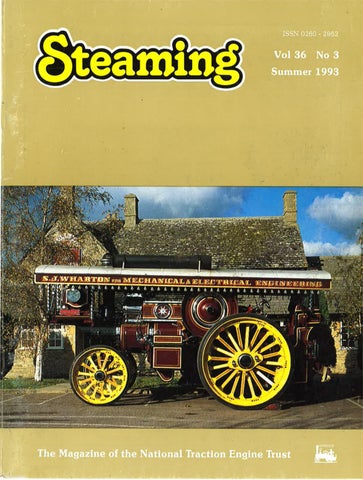
Cover Contrast in colours. The bright, vibrant hues of the fairground vie with the mellow tones of the local buildings as Fowler showmans 20223 of 1934 SUPREME visits The Chequers Inn at Brize Norton, near Witney, Oxfordshire during an autumn gathering in 1991. (Bob Payne) 115
Trust News From the Chairman Only rarely does an occasion arise when your committee consider it necessary to call an Extraordinary General Meeting. As all members will know, such a meeting was held on 15th May at which an immediate increase in the annual subscription was proposed; this motion was carried and the current annual subscription is as stated elsewhere in Steaming. Our membership secretary, John Cook, is dealing with the new subscription insofar as our administration is concerned and I would ask all members to be as co-operative as possible with him in this considerable task. I was pleased that many of the members attending spoke during the course of the meeting; many views were expressed, some for and some against. In all cases I appreciated the clear and often concise way in which members spoke. I congratulate them on this and cannot help but feel that such interest in our affairs bodes well for the future of the Trust. As I mentioned earlier the motion was passed. Members who were present had a full set of un-audited accounts for the year ended 31st March 1993, which gave full details of the financial position of the Trust at the time of the meeting in order to help them assess the situation. John Harris, our treasurer, is to be congratulated on preparing the accounts so quickly, the findings of which formed the basis of the motion to increase our subscriptions. All members entitled to, will receive a
copy of the audited accounts with the notice of the next Annual General Meeting. A committee meeting held directly after the extraordinary meeting decided that the new subscription would be as passed by motion earlier the same day and would be £20 per annum. This is in accordance with our Articles of Association. The committee however has re-introduced the concessionary annual subscription for members over 65 years of age, which will be £10 per annum. The family rate which had hitherto been in operation is now withdrawn, but the new £20 subscription will include members of the family living at the same address. This year's rally season is now well under way and most members will be involved with this in whichever way they choose. Members will notice a reduced presence on the rally field by the Trust this season and this will he confined mainly to our Hospitality tent. In future years we are hoping to increase our activities in this direction when out future plans are formulated. In the meantime may I wish all members a happy rally season. (Eric Fillmore, Chairman)
From the Treasurer I am sure many of you will by now be aware that subscriptions were increased by a majority vote at the
Would you like to have a constructive role within the National Traction Engine Trust? We are looking for a person to organise the Trust's sales activities. We envisage the role will include purchasing and stock control together with mail order, but beyond that the level of commitment can be discussed with the individual, who we hope will have ideas to contribute to this vital Trust service. Let us have your application and ideas in writing for consideration as soon as possible to: General Secretary, Sue Jackson, 153 Micklefield Road, High Wycombe, Buckinghamshire HP13 7HA.
116
Extracrdinary Meeting of the National Traction Engine Trust on Saturday 15th May 1993. As those readers attending the meeting will know, I proposed the motion on behalf of the Trust and therefore feel I should justify my actions to those members who did not attend the meeting. and may only read about the subject through illinformed comments and letters in other magazines. The decision to raise subscriptions was not lightly taken and was the subject of a lengthy debate in the committee meeting prior to the Extraordinary Meeting in May. A financial sub-committee had been formed earlier in the year to look at the overall financial position of the Trust and its subsidiary the National Traction Engine Club (1984) Limited, and the raising of subscriptions is only a part of the re-organisation which is currently being undertaken. Briefly, the reasons for the subscription increase were:1. From financial necessity. This has been brought upon by ,firstly, holding subscription levels too low for too long and secondly from the Trust's failure to find a replacement for Keith Shakespeare who had been running the sales organisation for the previous ten years. The sales organisation had been effectively subsidising the Trust by way of dividend each year though with Keith's departure this subsidy has not been forthcoming and consequently the overall income of the Trust had fallen to the extent that a trading loss has been incurred during the year ending 31st March 1993. Part of the subscription increase will go to remedying this situation. 2. Out of a need to provide a better service. As with all commercial organisations costs have risen. Steaming, our excellent magazine is now costing £9.00 per year when delivered to each paying member. More importantly however, the range of services offered by the Trust to its members have dramatically increased over the past couple of years. I make no apologies for listing below the services now offered by the Trust to the members. • Production and distribution of Summer 1993
STEAMING
Steaming, the foremost magazine of its type in this country and possibly in the world. • The instigation and implementation of a British rally authorisation system, thus helping to safeguard the continuation of the engine rally movement, and the production and ongoing upgrading of the Rally Code of Practice. printing and • The drafting, distribution of a Traction Engine Code of Practice. • The regular committee meetings held to provide a forum and to provide a vocal point for the engine owner and the movement as a whole. • The running of engine drivers courses. • Organising and running safety seminars and autumn and spring conferences for rally organisers and affiliated clubs. • The operation of the Steam Apprentice Club. lost operation of the • The registration numbers scheme. • The operation of the pattern retention numbers scheme. • The operation and administration of the coal rebate scheme. • The instigation of a technical board to assist all engine owners. • Continued legislation monitoring and compliance. • Insurance assistance and schemes for engine owners. All of these activities require financial resources and it is vital that adequate funding is maintained so that their scope and efficiency can be further improved. Without adequate funding then priorities would have to be established and there would, in my
STEAMING Summer 1993
view, be only one loser in the long run, namely the traction engine owner. The sales organisation is not going to cease and it has never been the committee's intention that it should. The trading company however will be wound up in due course as the current level of activity cannot support the overheads associated with running a private limited company. The sales operation will therefore be transferred to its parent, the National Traction Engine Trust, which is also a limited company. In conclusion I would repeat my initial statement that this decision was not lightly taken and obviously if the Trust could have continued its work at a £12.00 subscription level then there would have been no reason to have made an increase. Unfortunately this is simply not the case. To say however that the decision was merely about money would again be wrong. In my view it is about what the Trust is doing
for the individual members both now, and more importantly what it can do in the future if properly financed. The inference from certain letters in the press is that we are merely asking for more money so that we can waste it. If that was the case then I would not have proposed the motion in the first place I can assure you. The increase will enable us as a committee to properly perform our objectives in a cost effective and efficient manner. I
From Alan Martin's Collection
61
My picture this time shows Aveling & Porter tandem roller 5162, a 4 ton single cylinder machine which had a brief innings with the Marylebone Cricket Club at their Lords ground in north west London, being delivered new in March 1903. It is not entirely unknown for steam rollers to have been used to help get cricket 'tables' as smooth and level as possible, though I should have thought a compound roller might have been smoother in its change from travelling forward to moving in reverse. It may be, therefore, that was the reason the MCC dispensed with its one and only venture with steam after a few seasons. The very short chimney was necessary to enable the roller to get into its shed, a permanent building which to this day houses the mowers, rollers and other machines employed by the ground staff. Mr Hearn, the then head groundsman, stands in front of the shafts of the trailed heavy roller — previously horse drawn — in the picture, which was posed shortly after the Aveling's delivery.
117
hope these notes have explained the rationale behind the increased subscription and anticipate that the Trust will now go from strength to strength. (John Harris, Hon Treasurer)
Membership Subscription At the recent EGM held in London the meeting agreed to the subscription rates being raised in accordance with the proposal. The annual subscription rates of the Trust are therefore as follows : Individual £20.00 Pensioners £10.00 (note: individual membership now includes immediate family at the same address). The new rates will become applicable on all payments received after 1st August 1993. Should any member only send £12 / £7.50 after that date then they will only receive 6 months membership. If members wish to include immediate family together with their own membership, would they please send the appropriate details when renewing their membership. Similarily, if when renewing you have recently become a pensioner (60/65 years or over) will you please let me know so
that you can take advantage of the reduced rate. Finally, should any members be having doubts about paying the increased subscription rate please remember it is not just a subscription to a quarterly magazine. It is in fact in support of a club which requires capital to operate and achieve its extensive aims. (John Cook, Membership Secretary.) Payments by Bankers Order All members who pay their subscriptions by bankers order will find a new bankers order form enclosed with this issue of the magazine. I would be grateful if they would enter the appropriate details and return the form to the Membership Secretary and not to their bank. Please note that payments are now due on either the 1st January, 1st April, 1st July or 1st October and not staggered through the year as at present. (John Cook, Membership Secretary)
Engine Owners Column Engine Owners Sub-Committee This year's driving course, held at Amberley Chalk Pits Museum in West
Seeing the picture of Clayton wagon T1180 on page 62 of the last issue, Ran Hawthorne kindly went to his photo collection to let us use another picture of the same machine. It must have been taken about 1930 but the wagon is in much the same condition as when new, but with a different darker coloured livery and the name of its second owners Smith, Wright on the side sheets. The steel dust plates to the rear wheels show up better on this photograph but the somewhat flimsy canvas and perspex weather screen at the driving position has, not surprisingly, gone. (Ran Hawthorne, F.H. Gafford collection) 118
Sussex, was again a success, with 50 participants — around one third of whom were on their second course. The greater space available proved invaluable and we were most grateful to our hosts at the Museum, to the engine owners, and to the instructors who all put so much into the weekend. The support for the event grows each year so hopefully we will endeavour to make improvements to run the event on a break-even basis but we do depend very heavily on the commitment of our committee and other helpers who give their time and experience for very little reward. We continue to work on the Traction Engine Code and have had considerable interest from other preservation groups as well as the major inspection and insurance organisations whose involvement is, of course, vital. The Trust has set up a small Technical Board to act as arbitors in disputes and also to decide on the suitability of independent boiler inspectors. As a result of the favourable inspection agreement arranged with the Cornhill insurance company for boiler inspection, a number of engine owners have now joined the Trust. I feel that despite the subscription increase, the Trust still offers excellent value to engine owners and enthusiasts alike. Without a body of this kind to co-ordinate the activities of preservationists, the continued existence of steam rallies and the use of preserved vehicles in general would be subject to grave threats. The committee are ordinary members who are doing their best to look after the interests of the Trust. As well as paying their own subscription, most of them cover all of their travelling expenses on Trust business. (Michael Davies, Chairman, Engine Owners sub-Committee).
From the Insurance Officer The number of engine owners requiring insurance discs this year has increased again. Unfortunately, the majority do not send in the correct papers and I spend much time typing letters to try yet again to explain what is required. Please consult the notes in the Trust News sections of the Spring issues of Steaming for 1991 and 1992, both on page 61. If you have a problem then a telephone call to me on 0295 89696 should provide the help you need. By the time you read this issue I shall have available a fact sheet to enable you to check that you have covered all the paperwork needed to obtain a disc. This can be obtained Summer 1993
STEAMING
from me at my address shown inside the front cover of each issue — provided an SAE is enclosed! One final thought — I go away on business and have a holiday from time to time so there can be a delay in getting an answer to you if you require a disc just before your next rally. Why not change the dates when your insurances and inspections expire so that they do not give you the problem in the middle of the season? (Dick Blenkinsop, Insurance Officer)
Driving Licences For Rollers Through the Honorary Solicitor of the Federation of Britsh Historic Vehicle Clubs I have now received an authoritative statement on the licencing requirements for driving a steam roller. Confusion has arisen due to recent changes in licence categories for HGVs (now LGVs) and it is worth quoting the relevant paragraphs of a letter from DVLA in full : 'Under Section 87 of the Road Traffic Act 1988, as amended, a large goods vehicle (LGV) driver's licence is normally required, in addition to the appropriate ordinary licence, to drive a LGV on a road to which the public has access, unless the vehicle falls within a category specifically exempted from those requirements by Regulations. 'For the purpose of LGV driver licensing, a LGV is defined in Section 121 of the same Act as amended, to include 'a motor vehicle...which is constructed or adapted to carry or to haul goods and the maximum authorised mass of which exceeds 7.5 tonnes'. The term 'goods' is defined to include 'burden of any description' in section 192 (1) of the Road Traffic Act 1988. 'However, certain vehicles fall within categories specifically exempted licensing LGV driver from requirement by regulations. The Motor Vehicles (Driving Licences) (Large Goods and Passengercarrying Vehicles) Regulations 1990 (SI 2612, 1990) at Regulation 27(1)b and 27(1)c — exempt both 'Vehicles propelled by steam' and 'road rollers'. Road rollers fall within the driving licence category G (old group G) and full entitlement can only be obtained by passing the appropriate driving test. 'Drivers who hold full category B (old groups A or B) entitlement are automatically given provisional entitlement for category G (old group GI. Drivers therefore wishing to drive road rollers with only provisional STEAMING Summer 1993
1930 Aveling & Porter roller 14035 has returned to the rally fields in the ownership of Colin Hancock — here seen at Parham, West Sussex in June 1992. (Robin Walker)
entitlement will be subject to the provisional licence conditions which are shown on the back of the driving licence, i.e. must display 'L' plates which are clearly visible from the front and back of the vehicle. However, regulation 9)2)b of the Motor Vehicle (Driving Licences) Regulations 1987 provides an exemption for a provisional licence holder from being supervised by a qualified driver when driving a 'vehicle (not being a motorcar) constructed to carry only one person and not adapted to carry more than one person'. 'In general the minimum age for driving a goods vehicle, including road rollers over 7.5 tonnes maximum authorised mass, is normally 21 years. However, an exemption exists by virtue of Regulation 4111(d) of the Motor Vehicle (Driving Licences) Regulation 1987 (SI 1378,1987), that enables 17 year olds to drive road rollers that can comply with all the specifications listed below :-
temporarily increase its weight • is fitted with hard (metal) rollers I' As can be seen from these paragraphs from the DVLA nothing has changed with regard to the licence required to drive a steam roller. As always, interpretation of the law is a matter for the Courts and any individual is free to take legal advice. However, the law, and the regulations supporting it, seems quite clear on this subject. (Peter Smart, Trust Representative, FBHVC)
RALLY SAFETY SIGNS DANGER — beware of moving vehicles etc — ye//ow with black lettering Unauthorised persons prohibited etc — red with white lettering FIRE POINT — red with white lettering Printed on rigid plastic boards
• is propelled otherwise than by steam ■ has an unladen weight not exceeding 11.68 tonnes and is not constructed or adapted to carry a load other than water, fuel, accumulators and other equipment to drive it, loose tools, loose equipment and any other object which is specially constructed for attachment to the vehicle so as to
each sign inc VAT, postage E5 per order From: A.J. Semple INTET) Unit 6, Mynd Industrial Estate Church Stratton, Shropshire SY6 6EA
119
Rally Organisers Column
Wellingborough, NN8 4TH.
Northamptonshire
SEPTEMBER
Rally Safety Officers May I remind all Rally Organisers and Safety Officers that the Safety Officers Report should be submitted within 14 days of the event. This will save time and expense for all concerned and help to expedite your next year's request for authorisation. (Smudge Smith, Rally Approvals Officer)
The Rally List 1993 The following events have heen added to the Trust's 1993 List of Authorised Rallies. JUNE 19 and 20 — Bolnhurst Vintage Vehicle Rally, Bushmead Road, Bolnhurst, Bedfordshire (2 engines expected). P. Browning, Newholme Farm, Keysoe Row East, Keysoe, Bedfordshire MK44 2JB. JULY 10 and 11 — Collon Steam Rally, Collon, Co. Louth, Eire (about 10 engines expected). P. McGillick, 71 Georgian Close, Drogheda, Co. Louth, Eire. 24 and 25 — Milford Rally, Milford Farm, Lifton, Devon. (about 20 engines expected). R. Dingle & Sons Ltd, Milford, Lifton, Devon PL 16 OAT. AUGUST 7 and 8 — Wellingborough Charity Transport Gala, Bassetts Park, Wellingborough. (4 engines expected). C.G.J. Taylor, 38 Robin Lane,
4 and 5 — Dartmoor Vintage Vehicle and Machinery Club Rally, Vallance's Field, Liverton, near Newton Abbot. (4 engines expected). G. Stapleton, 33 Halcyon Road, Newton Abbot, Devon T012 2LX. 18 and 19 — Grand Henham Steam Henham Park, Henham, Rally, Beccles, Suffolk. (about 40 engines expected). Mr & Mrs Scriven, The Old Rectory, Frostenden, Beccles, Suffolk NR34 7HX. 18 and 19 — Cockley Cley Working Weekend and Country Show, Cockley Cley, near Swaffham, Norfolk (Ploughing rally). Mr & Mrs B. Smith. 2 Greenhoe Place, Swaffham, Norfolk PE37 7EX.
Steam Apprentice Club The SAC driving course took place at the Klondyke Steam Centre in Staffordshire in April, and judging by the grubby smiling — though weary — faces at the end of the weekend it was enjoyed by the participants. During Saturday we arranged a relay system to enable those who were not involved on site to take part in the roading home to Klondyke from a previous event of three rollers which were then available for practical tuition on the Sunday. My thanks go to the engine drivers and other helpers who made the
Terris Culverwell (INSURANCE BROKERS) LTD
36 ST. JOHN'S STREET DEVIZES WILTSHIRE SN10 1BL TEL. 0380 729369 FAX 0380 729379 Established 1882
If we can help, please telephone
120
weekend so enjoyable. Thanks are also due to the parents who provided the transport for the participants. (Sylvia Dudley, Chairman SAC).
Members of the Steam Apprentice Club continue to benefit from the support given by the parent NTET. The section's magazine, now called Raising Steam, is the main point of contact for many of the 360 plus young members, who have welcomed recent improvements funded by the NTET. Advertisers and sponsors are now to be sought to subsidise the cost of the magazine and SAC activities. Recent initiatives include a penfriends scheme, a photographic competition for the Dorset Trophy, and for younger members a colouring competition. Donations of suitable prizes for these and other competitions are always welcomed, as are articles for the magazine. As well as the now annual driver training event, (see items on Klondyke weekend elsewhere) and more informal activities at a number of rallies, the SAC is preparing a training book and hoping to promote aspects of traction engine preservation and operation through the Duke of Edinburgh's Award scheme. The club also tries to put those members that wish in touch with a traction engine owner, so that they can learn more about engines from people who actually run them. This depends on willing owners near where the Apprentice lives. The activity is, of course, more suitable for older members, but we do our best to place all those that ask. We currently have requests for 'Apprenticeships' in Ripley (Derbyshire), Gillingham
We are registered insurance brokers who pride ourselves on giving personal service to all our clients. We arrange insurance for motor vehicles, houses, life, medical cover, liability, etc. Traction Engine insurance inspection and/or comprehensive insurance Summer 1993
STEAMING
(Dorset), Salisbury (Wiltshire), Cranleigh (Surrey), Abingdon (Oxfordshire), Barnsley (South Yorkshire), Newton Abbot (Devon), Gillingham (Kent), and Sheffield — from members aged between seven and twenty. Any sympathetic engine owners in these areas are asked to contact the SAC. The Club wishes to thank those who have already helped to ensure future interest and understanding of steam traction engines by encouraging young people to participate with their engines. (Steve Gillett, Hon Editor, Raising Steam)
NTEC Sales There will be a limited range of sales items available at the Trust stand at Banbury, Weeting, Cumbria, Pickering and West of England (St Agnes) rallies (see The Rally List 1993 supplement in the last issue for more details). This will be in conjunction with the Trust members hospitality area and we look forward to seeing you at these events. It will be possible STEAMING Summer 1993
Fowler T3 class Tiger tractor 14805 of 1920 is prepared for the day's tuition activities at Klondyke Mill. (Barry Job)
to renew your membership and see and purchase the items we offer, including both the Rally and Engine Codes of Practice. There is also a chance at these meetings to talk to us about the work of the Trust which caters for all aspects of our hobby, whether it be from the owners point of view, or that of the non engine owning enthusiast. Without the engine owners dedication and the work of the rally organisers there would be little for the enthusiast to see except cold engines in museums and barns! binders are still Steaming available (address as in front cover) in sizes to suit Volumes 16 — 23 (to hold 8 copies) and Volume 23 onwards (12 copies), all at £4.95 each. Cheques should be made payable to the National Traction Engine Trust. There is an advertisement elsewhere in this issue for a Sales Officer to take over the Mail Order sales activities of the Trust. If you can help us do please let us know as I, as temporary and emergency incumbent of that post, am finding it increasingly
difficult to give the time needed to this important aspect of our service to (Sylvia Dudley, Vice members. Chairman).
Affiliated Clubs North Staffordshire and Cheshire TEC The recent Engine Drivers Course at Klondyke Mill was a great success. The event was fully subscribed and, although not the first course held at this Staffordshire venue, it was the first to be solely organised by the host society — The North Staffordshire and Cheshire Traction Engine Club. The two day event concentrated on safety and the practical skills needed to control an engine on the road. The enthusiasts had a variety of steam rollers to practice on and in addition to the products from Fowler and Aveling an unusual roller from the John Allen 121
Plough Works, at Oxford was present. Other attractions included a Fowler Tiger tractor and a Sentinel steam lorry. The event was deemed to be both educational and enjoyable and it is intended to hold another either later in the year or early next year. (Barry Job)
Sussex Steam Engine Club The fledgling Sussex Steam Engine Club held its inaugural meeting on 1st April at the Cross in Hand pub near Heathfield, East Sussex. An enthusiastic crowd of about fifty people were present to hear the committee, ably chaired by Peter Love, put forward their plans for the club. These include visits to local and not-so-local events during the summer, and an excellent programme of talks and social meetings for the winter months. It is hoped to have a variety of notable speakers at these winter meetings — some fascinating talks are in prospect! The meetings will be held on the second Wednesday of each month, starting in October, at the Cross in Hand. As an added bonus fur members, arrangements can be made for full boiler inspections, including hydraulic and steam testing and visual inspection, at very favourable rates. Members of the committee include the well known president Roland Burgess, chairman Peter Love, treasurer Peter Haining, secretary Richard Wade and membership secretary Brian Tompsett. Anyone, whether or not an engine owner, who wishes to join the new Club should contact secretary: Richard Wade, 4 Rose Terrace, Sandy Cross Lane, Heath field, East Sussex TN21 80L.
Obituaries Dan Doncaster It is with great regret we record the death of Dan Doncaster of Ardleigh, Essex early in May. Dan was known throughout the country as one of the foremost Sentinel enthusiasts and experts. He died in a tragic accident at work. The funeral at Colchester Crematorium was attended by a very large number of friends, including one who flew from America. Dan — an appreciation by Mick Tux worth Dan Doncaster was born in London in November 1944; his father was at 122
sea and received a telegram from the War Office bringing the news. Soon afterwards the family moved to East Bergholt (near Colchester). From there Dan was sent to a succession of schools, starting with Littlegarth preprep school, Dedham, Colchester and then to a 'crammer' in Bungay to enable him to pass the common entrance exam for Leighton Park School near Reading. This could be described as a minor public school. Dan's early educational life could be described as having mixed results, for although obviously intelligent he had little interest in conventional schooling and was somewhat rebellious. His school friends knew him as a permanent joker with frequent visits to the Master's office for corrective advice. Life apparently, was never dull. At one time Dan and some of his friends obtained a moped engine of the sort that strapped to the back of a bicycle and drove the back wheel, and this was driven, against the rules, in the woods near the school. However its performance was mundane to say the least so the decision was made to hot it up a bit. The engine was stripped down by Dan and all the parts were thrown into a box in a most cavalier fashion. The other co-owners were horrified and asked Dan if he should label the parts; Dan replied that it was quite obvious what went where and they then let him get on with it. Obviously, an early indication of his instinctive engineering skills. At 13 he injured his knee and then contracted TB in it, and as a consequence he spent a year in Black Notley Hospital — mainly in a ward of geriatrics because of the nature of the illness. It was not an ideal place for a highly spirited teenager, and he led the doctors and nurses a merry dance. Dan left school at 17; it is
debatable who was more relieved, Dan or the school. He then enrolled at Chelsea Aeronautical and Engineering College and at the same time started his first love affair with vintage vehicles — albeit Austin Sevens. For very many years these great little cars were his sole means of transport. He owned more than twenty different Sevens over the years ranging from early Chummys to Top Hat Saloons, Tonneus and vans. Dan's first trip to the Brighton HCVS run was in an A7 van. He drove to Spain on one memorable occasion. At 23 he attended Auchinleck Agricultural College in Ayr and took the ND Agric. Eng., thinking nothing of driving down to Colchester from Ayr, 400 miles each way, for the weekend. Tripe were known to include stopping and removing the engine on the side of the road for major maintenance. Back at Colchester he worked for Candors (the local Ford dealers), winning the Ford Truck Technician of the Year (East Anglia) and coming second in the national competition in 1972-73. In 1970 Dan bought his first Sentinel, a Standard model from the Brown Bayley fleet at Sheffield. The old Standard joined the various other vehicles in his parents' immaculate garden at Layer de la Haye. By this time he had enlarged his interests to include Landrovers. To earn a living he worked for Fisons (Land Drainage Division) and Hoveringham as a plant fitter. In 1975 he met Edgar Shone who, as is well known, owned a large fleet of Sentinels including the legendary S8. The upshot of the meeting was that Dan went to work for Mr Shone. In 1976 Tom Varley wrote a letter to The World's Fair proposing a run of steam wagons from John 0' Groats to Lands End. This was right up Dan's street so he convinced Mr Shone it was a good idea; conned Dave Teesdale into accompanying him; loaded seven tons of coal onto the S8 and set off for John O'Groats. He joined up with Tom Varley (along with his Foden), Dave Webster (S4), Bert Winkfield (Super) and Arnold Brooks (S4). The stories of what became to be known as 'The End to End Run' are legendary and I do not intend to repeat them here — enough to say all completed the course. Dan and Dave were the only ones on the run to drive their wagon all the way to the start, the run itself and back home from Cornwall, a prodigious feat. In 1977 the DG6 came back to Cricklewood after a spell in Yorkshire, and Dan immediately fell in love with it and for a while both the S8 and the DG6 attended rallies far and wide, Summer 1993
STEAMING
crewed by a variety of crews (of which the writer and his wife Wumf count themselves privileged to be just two). Bishops Castle, the HCVS Brighton and Pennine runs, Long Melford, Know! Hill, Mannekin Pis Rally in Geraardsbergen (Belgium), and many more were visited. The Belgium rallies were particular highlights, first with the S8, which towed the Foden timber to Zeebrugge from tractor Geraardsbergen (over 70 miles) and back. We were always found accommodation although the standard was a bit variable. The first year Dan stayed in an unfinished hotel; it was being rebuilt around them. The next two visits were made with the DG6 and once we stayed in what could be called a house of ill repute but finally in a Chateau largely occupied by elderly residents. In 1979 Dan met Sue and the next year they were married. Dan became stepfather to Sue's two children, Evan and Meg. His marriage was vital to him, with a fantastic relationship with Sue and the kids and it is true to say he was devoted to them. He was also attended by his dogs. First Rex and Cass (inherited from Cricklewood) and then the famous three legged one (Bill) who was the result of an illicit relationship between Cass and Lizzie (Sue's mongrel). By 1981 life in London had begun to pall and he and Sue decided to move back to Colchester. This was a big step, because there was great understanding between Dan and the 'Old Man' (Mr Shone). They had a mutual respect for their various skills, and I know that Dan found the move difficult. The couple bought a house in Ardleigh and moved in 1981, Dan taking a job as a plant fitter at a sand and gravel pit. Mr Shone gave up the Crown public house at Cricklewood soon after and his Standard Sentinel was moved to a farm at Great Chishall to complete the restoration aided by a team of friends. Mr Shone's greatest wish was to see the Standard finished and this was completed in 1989 in accordance with his wishes. In 1986 the Sentinel Drivers Club was reformed and Dan played a pivotal role in uniting the club as Newsletter editor. His writing was prodigious as well as unique to Dan. He managed to convey his enthusiasm and love of fun in print. He also established the Pattern Register as his own project. As mentioned earlier, Dan had a serious injury to his knee which culminated in contracting TB in his knee. In later years he suffered with an arthritic hip and I think it is true to say that he was in pain for a very long STEAMING Summer 1993
Two scenes from the life of Sentinel DG4 8381. The 1930 built wagon, along with other Liverpool owned examples, managed a rather lengthier working career than many, and is seen (top, Jim Peden) in May 1959 in Great Howard Street with a goodly payload of barrels of some commodity or other. It was at that time still, as when delivered new, in the ownership of Geo. Davies & Son Ltd, haulage contractors, Liverpool, their No 10, but was bought for preservation a couple of years later by Tom Paisley. On his death the wagon was kept by family connection in Glasgow, but following sale to a North Yorkshire owner in 1988 it has now returned to the rally fields, after a couple of years of rebuilding. Sentinel 8381 is pictured (bottom, Eric Sawford) at the 1992 Pickering event, most appropriately accompanied, as in its working days, by a four wheel flat trailer.
time, particularly recently. It is the nature of the man that this did not affect his attitude to life one bit. His sense of humour was highly cultivated. His dislike of pomposity well known and I don't think there will ever be a 'mickey taker' his equal. After Dan's funeral everywhere I went there were people telling stories about Dan. From his school days, his Austin Seven days, Sentineling all over the country and Europe of course, and also Morgan racing stories. I suppose his schools would have labelled him an
underachiever, but if they had seen and heard his friends on that sad day in May they would have had to contradict their view. We are all going (Mick to miss him dreadfully. Tux worth, Chairman, Sentinel Drivers Club and friend). Fred Field The steam fraternity in Cheshire have been saddened to learn of the passing in April of Fred Field of Little Budworth, near Winsford. He was 76 123
years of age and laid to rest at St. Peters Church, Little Budworth. Fred had a lifelong passion for wanting to know how things worked, particularly things mechanical like light aircraft and steam engines. Lasting memories of Fred will be of the times during the late 1960s and early 70s when he owned and steamed Aveling & Porter 10 ton roller 5199, an engine renowned in the area for its bark when tackling any incline. Sadly, ill health forced the sale of the roller in 1976 but it is still in Cheshire in the good hands of a dedicated young enthusiast. An industrial chemist by profession, Fred was also a brilliant engineer and would readily give advice and practical help on how to cure mechanical problems on engines owned by young, inexperienced enthusiasts. Many is the time he came to the rescue of a certain Burrell owner! This practical help and his overall kindness, together with his vast engineering knowledge and jovial character, will be sadly missed, but never forgotten, for Fred was a true gentleman and a man of steam. To his wife, brother, son John and his family we send our sincere condolences. (Alan Porter)
Future Dates Annual General Meeting Advance notice is given to all members that this year's Annual General Meeting will be held on Saturday 20th November 1993 at York. Formal notice, together with all relevant information, proxy forms and audited accounts for the year ended 31st March 1993 will be sent to all paid-up members of the Trust with the Autumn issue of Steaming. Any member may submit a motion for discussion at the Annual General Meeting. All motions must be in writing, signed by the proposer and by a seconder. Such items for discussion, in order to be published as required by Article 16 of the Trust's Constitution in the Agenda for the Annual General Meeting, must reach the company secretary Sylvia Dudley not later than Saturday 25th September 1993 (address inside the front cover). Details of the arrangements for the weekend will be published in the Autumn issue of Steaming. A list of overnight accommodation will also be prepared for those wishing to make a weekend break around the planned activities.
This Sentinel, Super No 5104, was changing hands within preservation at the time many engines were still awaiting their eventual fate, or even in the twilight of their working years. It was new in February 1924 to Bellis Bros of Holt, near Wrexham, later being owned by Henry Challand of Collingham near Newark in Nottinghamshire. Henry was an early supporter of East Midlands rallies but had probably acquired the Sentinel in the 1930s, the wagon being put on pneumatics by or for him. It was sold to Frank Rivers of Aldermaston in 1953 and since then has had a variety of owners. The picture shows the Sentinel outside the owner's garage premises at Collingham; perhaps some of our older members can say who it is posed in front of the vehicle. (collection Mike Jones) 124
OUR MAGAZINE 25 YEARS AGO
More working steam featured in the area notes — by this time few rollers could be at work without local members being aware. W.J. King in Somerset still used one or two of their Burrell rollers, 'though the rest of their fleet remains — like the Chinese — inscrutable'. Few people were totally aware of just what survived in odd corners of Kings various properties for another twenty years, but nowadays we can freely visit the Chinese, and see some of the wagons on the rally fields. The main article of the issue was a lengthy and hilarious account by Steve Neville of an invasion of Stradbally rally, south of Dublin in Eire, by some Very Well-known Names in English traction engine circles. Most of these names have now matured somewhat and their escapades are worthy of rereading. The Rally Organisers and Affiliated Clubs Conference in London in October 1968 covered some heavy topics: the probability of prohibition by local authorities of straked wheels on their roads; engines on motorways (steam wagons?1; the rights of engine owners towing living vans and fuel trailers if ordered off the road by police for obstruction, and the legality of stopping to attend to the fire whilst running on a clearway. Barristers for the Club's solicitors had given 'favourable opinions' in support of the engine owners in such cases.Rally organisers were seemingly much better than now at sorting out their following year's dates — about sixty events were expected for the 1969 season and already over 40 had put in their applications.
'7hp Traction Engine, by Lampitt of Banbury, in capital condition, 2 speeds, waterlifters, winding drum and 50 yards steel rope, the fire box is good, no patches, all travelling wheels have recently been reshod. Having been replaced by Burrells Compound, will accept low price £105. — Apply P, Agricultural Engineer Office, 115 Fleet Street E.C.' (from that magazine's For Sale columns, January 1899.) Summer 1993
STEAMING
STEAM, HISTORIC COMMERCIAL VEHICLES, MILITARY TRANSPORT, HORSE-DRAWN VEHICLES & CARRIAGES SATURDAY16TH OCTOBER ROYAL AIR FORCE MUSEUM, HENDON
Following the success of Sotheby's 1992 specialist sale of Steam, Historic Commercial Vehicles, Military Transport, Horse-drawn Vehicles and Carriages we are pleased to announce that we will be holding another sale devoted to these specialist forms of transport on 16th October. The sale promises to offer exciting opportunities for the collector and enthusiast. Selected entries are now being accepted. Our Autumn sales calendar at the Royal Air Force Museum Hendon also includes the following sale dates: Saturday 4th September IMPORTANT EARLY, HISTORIC & CLASSIC MOTOR VEHICLES & AUTOMOBILIA Saturday 4th December MOTORCYCLES & RELATED MATERIAL Monday 6th December IMPORTANT EARLY, HISTORIC & CLASSIC MOTOR VEHICLES & AUTOMOBILIA
STEAMING
Summer 1993
1927 Fowler Steam Roller "Heather", No.16961. Sold by Sotheby's in October 1992.
For further information on buying or selling your vehicle please contact: Malcolm Barber, Stewart Skilbeck, Peter Blond, Toby Wilson on (071) 408 5268 or Mike Worthington-Williams on (0559) 370928. 34 - 35 NEW BOND STREET, LONDON W1A 2AA
SOTHEBY'S FOUNDED 171.1
125
Jim White and SPANKER Pat Freeman Just over a hundred years ago, in 1892, Burrell single crank compound traction engine number 1606 left the Thetford factory; sixteen years later a certain Jim White entered this world. These two superficially unrelated events were, nevertheless, the basis of a close association of man and machine which has lasted over the past 70 years. Jim was born, at Rettendon, a few miles south of Chelmsford, Essex, into a family of threshing contractors. John, his grandfather had started the business in the 1870s with a Ransomes portable and drum. John
126
White had seven sons, all but one being interested in steam engines and the eldest was William John, Jim's father. As the sons were growing up and could take an active part in the business, Jim's grandad acquired several sets of tackle, Burrell engines and Clayton & Shuttleworth drums, and business was conducted from Rettendon over a wide area in Essex. Eventually Jim's Dad started out on his own, working from Latchingdon, a village between the Stour and the Crouch rivers, and in 1900 he
married a lass with a farming background. Children began to arrive at regular intervals until there were thirteen in all, seven boys and six girls. Jim slotted exactly into the middle of this tribe of Whites, with three boys and three girls either side of him. He grew up in a close family and one of his boyhood recollections was that he angelically pumped the organ bellows on Sundays in Latchingdon Church. He also worked part time at the local Red Lion as an 'ostler boy', feeding the horses and chickens, chopping wood and also being responsible for the disagreeable task of emptying, then cleaning, the old iron spitoons which were a feature of the spit and sawdust public houses of those days. On leaving school at the age of 14. it was only natural that Jim should take his place in his father's threshing business and at that age in only one position: a cavy boy — the lowest of the low but nevertheless an important cog in the operation of the threshing gang. A complete gang would consist of an engine driver, drum feeder, band cutter, two men working on the corn stack, one man sacking up the threshed corn, one lad or man doing
SPANKER on threshing demonstration work in rally days with Jim White in conversation with a friend by the tender (collection ✓im White)
Summer 1993
STEAMING
Jim White
the chaff and cavings and another two men stacking the straw or working the baler. The ideal team was therefore nine but when chaff cutting was being carried out an extra two men were needed to take the chaff into the farm building, using strong cloth bags holding eight bushels. These two men would be borrowed from the farmer for whom the work was being carried out. In general each threshing contractor had his own gang of men for the whole season which began at harvest time and went on to the following April or May. As these were the 'good old days' work started at around 6.30am, and carried on until dusk, which could be quite late. Jim's dad would have been on the job since before 6.30am cleaning out the tubes then reviving the banked-up fire so as to get up enough steam to commence work when the gang arrived at 6.30am. Breakfast was taken at 9.30am with the mid-day meal at about 1.00pm and, when working long summer harvest hours, there would be a tea break at about 5.00pm. At these meal times a communal brew up of tea took place using a modified six pint saucepan which was made of Ye in aluminium, to stand up to the bashing it received when travelling from farm to farm. The modification consisted of removing the normal round handle and replacing it with a square, tapered, handle. Onto this a long square-ended pipe could easily be pushed to enable the full saucepan to be placed in the engine firebox. The handle was then removed the firebox door was closed, and in a couple of minutes six pints of water was merrily boiling away. The pipe was then pushed back onto the modified handle, the saucepan removed, and the water was poured into a pail containing tea, sugar and condensed milk. Two saucepans full made enough tea to keep everyone satisfied until the next break. The gang brought with them their own rations, mainly bread, cheese and pickles, but often these were supplemented by a fry up. The engine driver would toss a shovel full of hot coals onto the ground and on these were placed bacon and sausages — what an appetizing smell they must have given off. Jim remembers that a one-armed fishmonger, Sid Howard, seemed to have an unerring instinct for locating the threshing gangs and would often arrive on his pony and trap, in which case herrings would add their glorious STEAMING Summer 1993
L aroma to that of the sausages and bacon. When Jim started work in 1922 the men in the gang were paid two pence (1p) for every quarter threshed, a quarter being two full four bushel sacks weighing 18 stones, and when doing work such as straw or hay baling or seed threshing they received nine pence (31/2 p) per hour. As is sometimes the case in a family business the sons did not do as well financially as the hired hands and eventually, in 1930 at the age of 22, when a young man's thoughts often turn to romance and marriage, Jim decided that he would have to leave his father and go elsewhere to earn money to save for the future. However, there was one big drawback. His father had never let him drive an engine on his own — or any of the other sons. This was as a result of an accident to Jim's elder brother Billy whilst he was engaged on single engine ploughing, which almost led to his death. Obviously Jim, with his close contact with the engines, was
quite familiar with the technique of driving but he lacked the practical experience needed to be taken on as a driver. Therefore, his first job away from his family was with the Midlands firm of Glossops at shingling and tarring roadwork, mainly on contracts for the Chelmsford District Council. It was piece work — if it rained: no work, no money. Jim therefore looked around for something which would give him a more stable income and decided to apply, together with his brother Fred, for an advertised job for two steam roller drivers. The positions were with A.J. Ward & Sons of Egham, Surrey, who could claim to have had the first roller that Clayton & Shuttleworth built — a 15 ton single cylinder convertible 32081, which came out of their Lincoln factory in 1899. Jim, of course, kept quiet about the extent of his practical driving experience and he and Fred were taken on and for the first few days worked in and around the yard. The moment of truth arrived when the 127
foreman asked Jim to steam up a 7hp single cylinder Wallis & Steevens and line it up to a Ruston threshing drum. With fingers and toes crossed and with a silent prayer to Him above Jim set about the task under the beady eyes of the foreman and several drivers and yard men. All went well and soon after he was asked to take the Wallis, the Ruston drum and a straw pitcher to carry out threshing in the Wokingham area of Berkshire. Whilst in that area Jim had his first brush with the law, which resulted in a 10 shilling (50p) fine — about a quarter of a week's wages. One dark evening as he was bowling the engine and equipment down a country lane he was stopped by a man in blue who demanded to know where his communication cord was. Somewhat nonplussed Jim replied that he came from Essex and had no idea what he was talking about. "Hard luck" replied the Bobby "but you are in Berkshire now — your name and who you work for, please!". Jim subsequently found out that when towing there should have been a crew of three, one of them being at the rear. From there, a cord (communication) went forward to the engine and attached to it was a spud, or something of that nature, which when the line was tugged by the man at the rear, clanged against the engine tender. This was a warning to the steersman and driver that someone wished to overtake and that the engine should be pulled over or stopped to allow that to happen. After several months of threshing Jim was given the job for which he had applied, that of steam roller driver. He remembers that the first engine was a 10 ton Aveling, followed by a Wallis & Steevens, then another Aveling, somewhat older that the first, whose flywheel seemed to go round nearly three times before the whole machine became tight in the gears. After a few months road rolling Jim was persuaded by a colleague, much against his better judgement as it turned out, to get a job with the Middlesex County Council kerb spraying on the Great West Road extension. After a short time he realised the mistake that he had made, so he handed in his notice and returned to the family threshing business at Great Leighs. When Jim started work in 1922 he was living with his Mum and Dad at Cold Norton and the business was based there, but in July 1926 his father bought part of a threshing business, at an auction, at Great Leighs, fifteen miles away to the north east. It meant that Jim and the rest of 128
Engines owned by Wm. John White & Sons, Cold Norton and Great Leighs, Essex • Ransomes Sims & Jeffries 7hp traction 8708 of 1891 (NO 1787) acquired from White Bros, Rettendon, Essex 12/1891 to J. Thompson, Stoke Ferry, Norfolk by 1929 • Burrell 8hp traction 1606 of 1892 (N02533) acquired from C. & E. Bartrupt, Ford End, Essex, 1920 still with the White family • Burrell traction ? (PW1035) acquired from H. Heffer, Farnham, Suffolk, 1933 to A. Clarke, Felstead, Essex for scrap, 1953 • Burrell 7hp traction 2236 of 1899 (N02577) acquired from G. Nice, Stanway, Essex, to A. Harvis, Abbess Roding, Essex. • Burrell 8hp traction 1602 of 1892 (AH5875) acquired from E. Deamer, Hardwick, Cambridgeshire to A. Clarke, Felstead, Essex for scrap. • Burrell 8hp traction 2051 of 1897 (CF3638) acquired from E.H. Johnson, Ingham, Suffolk or H. Hammond, Fundenhall, Norfolk to R. Duce, scrap merchant, Cambridge but later preserved • Burrell 8hp traction 3882 of 1921 (AH7306) acquired from R. Shingles, Ling wood, Norfolk to W. Keeling, Crays Hill, Essex, 1955; now preserved • Burrell 7hp traction 2361 of 1901 (AH7269) acquired from P. Myhill, Ash welthorpe, Norfolk, 1942, to ? • Fowler 8hp traction 13600 of 1914 (N01449) acquired from J. Smith, Fairstead, Essex, 1926 to L. Smith, Rawreth, Essex, 1950, now preserved • Fowler 7hp traction 14935 of 1917 (YR1848) acquired from E.R. Cole, London, 1927 to A.M. Cole, Sleaford, 1940
• Aveling & Porter 8 ton roller 10784 of 1924 (PU3094) acquired from Essex Road Rolling Association, 1961 to M.P. Hunt, Bredfield, Suffolk, 1984
the gang worked and slept away from home except for the weekends and for Jim this meant a cycle ride over the 15 miles each way until, after about two years, a bungalow was built at Great Leighs. During those two years Jim usually slept rough and he particularly remembers the cold winter nights when he used an 8-bushel chaff sack as a sleeping bag. He reckoned that if he could then partially bury this, with him in it, in a heap of chaff he was as snug as a bug in a rug. At the auction, Jim's dad had bought 8hp Fowler 13600 of 1914 (N01449) together with a 4ft 6in Marshall drum and a Marshall elevator. In Jim's Dad's opinion the single cylinder Fowler did not govern at all well when driving the threshing drum so he obtained an almost new set of Ransome governors from his brothers at Rettendon. After a good deal of scheming — and he did all his own repairs and maintenance — these were
fixed to the Fowler such that they could be adjusted for any kind of work and all his drivers were adamant that there was not a better governed engine anywhere. He also replaced the worn out bronze slide valve with a new cast iron one and fitted a new piston rod with a new Burrell piston and rings. This engine is now preserved in the Chatham area of Kent, and when Jim last saw it, about three years ago, it still had the Ransomes governor and a Burrell piston which his dad had fitted all those years ago. On moving his threshing activities to Great Leighs, Jim's Dad brought over from Cold Newton his Burrell traction SPANKER 1606, mentioned in the opening paragraph, which he had bought from his Uncle George Bartrupt, of Ford End, in 1921. This 8hp engine had been built in 1892 as a showmans engine. After an initial brief but hectic career on the fairgrounds it was returned to the St Summer 1993
STEAMING
Nicholas works, Thetford, to be rebuilt to agricultural form, but still retaining the spring mounting from its earlier days. It might be appropriate here to mention that the White family was Burrell orientated — well, starting from 1900 or so, for until then their engines were Ransomes. Burrells proved themselves to be very reliable for the threshing business as all parts were readily accessible which made servicing and maintenance very easy and for this aspect the single cylinder machines were preferred and seemingly worked as well as compounds. After retiring from A.J. Wards in 1931 Jim was still not allowed to drive and was one of the threshing gang, although not the cavy boy, operating all around the mid-Essex area. By the end of the 1933-34 threshing season the urge to move on again became strong and Jim applied for an advertised position of Steam Tractor Driver with J. Brace & Sons, Timber Merchants, of High Ongar, Essex. Again it was a case of taking his courage in both hands as he had never driven a Garrett or had any experience of timber haulage. Jim's guiding star was still with him and he obtained the post which involved driving Garrett tractor 34714 (TW1636) and being involved in loading and hauling felled trees. The Garrett was the newest engine that Jim had ever driven, being built in 1926 and he found it did not steam as quickly as others he had been involved
with. Incidentally, around 1936 J. Brace acquired from the flour millers Vitovis Ltd of Haverhill for the sum of £75, a Garrett stationary engine of about 100hp. This was a CCS IV (compound condensing superheated) unit number 34471 built in 1925. The engine was installed at Brace's without the condensing equipment. It was wood waste fired and was used until 1976 to drive the main sawmill machinery. In 1983 it was donated to the Leiston Long Shop Museum in Suffolk and has thus returned to the place where over 230 of that type were built. Jim had worked for J. Brace for the summer of 1934 when he spotted an advertisement for a steam roller driver and as this was the type of job that he preferred he applied and again was successful in getting the post. It was with W.G. Smoothy & Sons of Rochford, Essex. The firm had been founded in 1879 and carried on the business of engineers, boilermakers, steam plough and road rolling contractors and steam tractor haulage and also owned the Rochford Coal & Coke Co. When Jim started work at Rochford he was struck by the number of the Smoothy family that were also working there. They were Harry, the
founder's son, and Harry's sons; Oswald, Norman, Cyril and Frank (his other son Raymond was in the RAF). Also during school holidays Derrick, Oswald's son, helped around the yard. Truly a family firm. Whilst researching for this article I had the pleasure of meeting Derrick, who was able to show me documents and photographs relating to the firm over number of years. Derrick also brought out a real treasure trove — the engine record book. This detailed the purchase, and descriptions and repairs of forty engines including 29 steam rollers, 10 steam ploughs and a steam tractor (a photograph of the latter showed it towing a complete fabricated church). The engine book was obviously not comprehensive as other machines were listed in the auction catalogue of 23rd May 1946 when 500 lots of stock were on offer after the Smoothy firm had gone into liquidation. Included in this auction were four internal combustion rollers, 16 steam rollers (of which 13 were in the record book), the Burrell tractor and a Clayton & Shuttleworth portable. It is interesting to note that four of those engines are still listed in Traction Engine Register: Aveling steam rollers 5423, 5853 and 8672 and Wallis & Steevens 7284. They
A fine winter stackyard scene of about 1910. Burrell 1606 at work when some eighteen years old, and owned by G. Bartrupt of Ford End. The driver is Jack Bright. (collection Jim White)
The Garrett 4CD tractor that ✓im White drove for ✓. Brace & Sons at High Ongar, 34714 of 1926. The picture was made at the maker's works, with the sparkling engine standing in front of a white sheet hung from the roof trusses, to enable the image to be more easily prepared for such uses as catalogue illustration. (collection Pat Freeman)
were knocked down respectively for £150, £260 (a spare set of hind and front rolls was included), £95 and £150. Jim told me that in his opinion Smoothys were pre-eminent in the road rolling contracting business as all engines were kept in tip top condition by their own work force. This included boiler makers, blacksmiths, fitters, turners, painters and carpenters. Several living vans were built by them which were fitted out with coal burning stoves, ovens, cupboards, bunks, mattresses, pillows, blankets and cooking utensils — all in all, a home from home. A lot of road roller contracting work was carried out in the Chelmsford area for the Rural District Council and over a period Jim drove a variety of rollers — by Thomas Green (one of which was unusual as it had its cylinder on the fly-wheel side), Fowler and Aveing & Porter. Two of the latter were 3221 and 5013. He also remembers driving a 6 ton Aveling petrol/ paraffin tandem roller. Drivers of the steamers were responsible for ordering their own coal and coke, and were expected to burn no more than half a ton of each per fortnight. Jim said that this required quite a bit of skill at juggling the mix to keep up a good head of steam without 130
using up the coal too quickly. A momentous event occurred on 12th September 1936 — Jim got married! He had been courting his sweetheart, Elsie, for three years and after they tied the knot they moved into one of his father's bungalows at Great Leighs and have remained there to the present day. Shortly after the marriage, Jim persuaded Elsie to spend the night in his living van which at that time was at Danbury about a 10 mile drive on his 2 3/4 hp AJS motorcycle. In his own words Jim said "she only slept in the van that one night, and never craved another kipping in the van"! Jim thoroughly enjoyed his time with Smoothys but in the summer of 1940 he returned to work at Great Leighs as his father suffered a stroke, which somewhat incapacitated him. Jim reckoned the stroke was caused by the worry of looking after the business in wartime. His father was asked to do a lot more work and was also responsible for the food rations for the gang. He had to overcome various shortages of equipment and permits were required for almost everything, from baling wire to extra rations for the workmen. It was at this juncture that Jim's association with Burrell 1606 SPANKER became even closer, as it
was now his job to drive and maintain it. This he continued to do throughout the war and after up to 1948-9, when Field Marshalls came into their own and the use of steam power was on the way out. During the war years the driving and manoeuvring skills of the threshing engine driver were often tested to the limit as Government had advised placing stacks well away from farm buildings to minimise the fire risks from incendiary bombs. They were therefore often in awkward and out of the way places with difficult access for the threshing engine, drums, elevators etc. It did not take Jim long to find out how to handle SPANKER in these awkward situations and he soon became adept at coupling and uncoupling drums, elevators etc and using brace chains and wire ropes to get them through narrow gateways. Of course getting out was worse than going in as by then the ground was all churned up, making manoeuvring doubly difficult. Indeed, Jim reckoned that driving a 100 ton steam railway engine was like going to a tea party on the vicarage lawn compared with driving a threshing engine and tackle. Jim, SPANKER and the tackle dealt with barley, wheat, oats, beans, peas, sugar beet and kale and grass seeds as well as red and white clover seed, the latter regarded as a killer due to the fine seed created by the clover seed huller. SPANKER was once pressed into service as a roller when a local farmer wanted to build a large cattle shed and asked for Jim's help with the base. Using his former road rolling skills, Jim half-wheeled the foundation sufficiently well for the job to be carried out. With the influx of Field Marshalls, the use of steam engines began to decline and to enable him to keep going in the threshing business Jim bought a Massey Harris combine in 1956. Gradually, however, farmers acquired their own machines to the detriment of the independent threshing contractors and at the beginning of the 1960s Jim bought a steam roller to go into the business of a rolling contractor. The engine he acquired was Aveling & Porter 8 tonner 10784 (PU3094). This 1924 built piston valved machine he bought for £100 from the Essex Steam Rolling Association, which had been formed in the early part of this century with offices at Southend and works at Kelvedon. At its peak the Association owned nearly forty rollers but closed in the late 1950s on the death of its Managing Director, who was the principal shareholder. Summer 1993
STEAMING
Jim's new business was, initially, very successful and car park rolling figured prominently. It may have been coincidental that many of these car parks were for Ridleys Brewery; after all every roller driver knows rolling can be very thirsty work! Jim was also involved in preparing several private roads and the foundations for large cattle sheds amongst many and varied contracts. Incidentally, just before acquiring the roller, Jim had taken on a somewhat unusual job — that of steaming potatoes. It was in May 1960 that he was asked if he could do the work as there was a glut of potatoes and three big local landowners wished to have the surplus cooked to keep for winter animal feed. Jim, always one to face a challenge, thought it feasible and long one inch diameter pipes, with small holes spaced at intervals of three inches were laid into a silage pit. These pipes were then connected up to the engine to allow steam to be pumped through them. To get at the steam Jim drilled, tapped and fitted a one inch wheel valve high up on the cylinder block of SPANKER and from this he took a flexible pipe to couple up to those in the silage pit. Into this pit about 10 tons of potatoes were tipped at a time and straw and sisal cloth were used to make the whole lot reasonably steam tight. A day's steaming was sufficient cooking time. In just over two months, steaming twelve hours a day, 500 tons were cooked, a figure which must run the efforts of the Army Catering Corps pretty close. In mid January 1963, Jim was asked if he could bring SPANKER out of retirement to do another unusual job and again the wheel valved steam outlet on the cylinder block was to prove useful. Some of you will remember the winter of 1963 was noted for its cold, frosty and snowy weather and this had an unusual impact on the operations of a local chicken processing firm. One of the stages was to submerge the killed chickens into very hot water to facilitate the removal of their feathers. However due to the very cold weather, the electric power level was not sufficient to heat the water to the required temperature. Jim was therefore asked if he could steam heat it and again he jumped at the challenge, not only to supply the steam but to actually get SPANKER to the factory. As the roads were rather snowed up Jim decided that the usual seven mile route via side roads would present problems so he went by the main roads which almost doubled the distance. Fortunately there was a pond halfway along the route but it STEAMING Summer 1993
Still among Jim's possessions of days gone by is the old six pint saucepan that went in the firebox on the end of square ended tube. (Pat Freeman)
took a 141b hammer and a crowbar to break through the five or six inch thick ice to allow water to be taken. The steam heating of the water proved successful and the ten days that Jim spent doing this work were, in his own words, "the cushiest days I had ever had with SPANKER. The roller was not, however, to be left out of these unusual jobs! A photographer asked Jim if he could roll a carpet for advertising purposes to show the resilience of the surface of a
commercial type of floor covering made by an Austrian firm. The product was laid out in a field and Jim had to pose the roller on the edge of the carpet and make it look as if he was travelling over it at high speed. To this end he put a lot of black dust in the middle of the firebox and at the appropriate time lifted the damper, put the blower on and poked the fire. Jim said the resulting black smoke had to be seen to be believed. Available work gradually slackened
Threshing at Stonage Farm, Chatham Grove, near Chelmsford with SPANKER in April 1961. (John K. Williams) 131
After a hard spell of carpet rolling, Jim poses for the camera beside Aveling 10784. The date is 1972. (Mike Hughes)
Still on the footplate of an engine — and a proper working engine — Jim White remakes his own driveway at Great Leighs with Fowler roller 19546 in 1990. (Pat Freeman) 132
off and late in 1963 Jim decided that working for himself was not all that it was cracked up to be, so he got a job in industry. This was with the engineering firm of Lake & Elliot, at Braintree, on shift work in the boiler house and he stopped there until he retired in 1973. During the years working for Lake & Elliot, Jim still had an active association with SPANKER, together with Alan, one of his sons. I have a rally programme of the East Anglian Engine Club's event at Prested Hall, Feering in September 1961 and SPANKER is listed as one of five Burrells taking part. Jim, a founder member of the Club, was on that rally committee and also on the general committee. For the last fifteen years he has been a Vice President of the Club and still takes an active part in the running of it. Since 1961 SPANKER has been regularly rallied all over East Anglia, almost always with Jim and Alan at the controls. In 1984 Jim decided to sell the Aveling roller and it went to Martin Hunt of Bredfield, Suffolk, who bought it for a 21st birthday present to himself. Jim is now a sprightly 85 year old who, despite suffering from asthma for the last few years, still digs and plants his garden, gives Alan a hand to maintain SPANKER and drives and looks after his 23 year old Triumph Herald. In some ways he regrets having sold the Aveling but his steam roller skills have not deserted him, for a couple of years ago he relaid his long driveway. This involved the laying and distribution of 14 tons of reject stones, much of which he did himself, before he rolled them with Trevor Ellis's 10 ton Fowler 19546 ISP9484), which is kept in Jim's yard. Hoggin was then spread over the stones and watered, then Jim re-rolled them. He pronounced himself well satisfied with the finished driveway and, with a gleam in his eye, suggested that it might not be too long before he would have to tar and shingle it. This shows the spirit of a dyed-in-the-wool steam engine man and it is heartening to know that there are still such people as Jim around who can carry on old traditions and who can recall and relate the past glories of the steam age.
I have written at some length about the man, Jim White, so here is a little about the machine SPANKER, Burrell 1606. It was one of three machines made in one batch, works numbers 1556, 1574 and 1606. They were all single cylinder spring mounted 8hp traction engines with patent Summer 1993
STEAMING
compensating gear and winding drum. 1606 was completed on 26th August 1892 and according to a Burrell record sheet No 190, it was sold to Nephi Ashton, Steam Circus Proprietor of Hull, in March 1896 and then to G. Bartrupt of Ford End, Essex in October 1898. There is, however, an item on the sheet dated February 1895 that
'two volute springs No 29 and stamped steel washers and a straight way plug cock' were sent but with no indication of where or to whom. The record sheets have the following later annotations: Oct 1898 supplied new brass pump May 1900 supplied new clack box with brass ball valve
An Ignominious Ending
We thank member R. Holmes for this interesting snapshot of the final days of a McLaren showmans engine. Back in the summer of 1951 Mr Holmes was asked by his teacher to do a holiday project on his pet subject — steam. Through going with his father to Tottenham Hotspur's games on Saturday afternoons he knew of a scrap yard at the back of the ground which had a couple of portable engines tucked away. So, armed with the family folding Kodak and precariously standing on the crossbar of his bike, leaning against the eight foot high corrugated iron fence, the above picture was gained. But what was the oddity? Alan Duke's unique records come to our aid as usual. In the High Road at Tottenham was a scrap yard belonging to one Goodman. About 1948/1949 he had taken in from showman J. Watts of Tottenham Hale the former Pat Collins McLaren engine 1599 and this machine would seem to be our subject. Alan records Goodman's site as being cleared out by the local Council about 1950 but our picture shows that the McLaren, before its final demise, had been used to make up a portable. With front and rear wheels and axles, gears and tender removed the remainder has been mounted on old steam wagon wheels — wooden Tangent Wheel Co type ones at the front. Note the MacLaren front end springing device and the remains of the dynamo bracket, also the deliberate sheeting up of the top works. The existing belly tanks provided water capacity for the conversion, but it must have been quite a lump to move about. McLaren 1599 started life in 1917, one of several groups of 10hp engines for service in World War 1 with the War Department. It was purchased by Pat Collins, along with two others (1438 and 1623, the latter now preserved in Lancashire) at surplus auctions at Avonmouth in 1919, and after being fitted out for showland use spent the next twenty years or so on the Collins fairgrounds of the midlands and the north west. It had been sold to Watts in Middlesex in 1943; can anyone say more about the circumstances of its ignominious appearance in 1951? STEAMING Summer 1993
July 1906 Piston rings 5/8 inch wide and block turned to suit April 1915 Countershaft turned down to 3% inch bearing and 31/4 inch where pinion fits on. Front tank taken off July 1931 Smokebox supplied 21/4 inches longer than standard. New tube plate supplied and set back in boiler 21/4 inches. SPANKER was acquired from G. Bartrupt by Jim's Dad in 1921 and the work of fitting the new smoke box tube plate in 1931 was carried out whilst in his ownership. The reason for the barrel shortening was that it had wasted away at the end. The new front tube plate was set back 2% inches and the old front tube plate fixing holes were used for the rivets for the new smoke box. Also in 1931 a new firebox made by Gowers of Bedford was fitted. At the same stage the cylinder was again re-bored land it now wants doing again) and a new back axle fitted, with the wheels being bored out by the local engineering firm of Christy & Norris. Another new smokebox was fitted in 1976 and a new tender in 1983. A spur wheel and pinion has also been replaced. During the period 1898 to the present day SPANKER has been re-tubed three times, it has been re-lagged three times and three times it has been repainted, firstly maroon, then green, then green again. The majority of the above work has been carried out by three generations of the White family — Jim's Dad, Jim himself and his son Alan, who is now the owner of SPANKER. It is a tribute to their engineering skills and inate knowledge of steam engines that the hundred year old engine is, if you will pardon the pun, in the spanking condition it is today.
I would like to thank Jim, Alan Duke, and Derrick Smoothy for the help they have given me in the preparation of this article. I have not attempted to go into great depth or detail but I am pleased to have had the opportunity to record some of the history of a typical steam family and its interelated steam engines.
'The Chester Corporation has arranged a water supply for steam wagons in Grosvenor St, Chester on the main route between Manchester and Liverpool and North Wales. The charge is fourpence for any quantity of water up to 25 gallons'. (from Commercial Motor, 21st March 1918.) 133
IRON DINOSAUR David Viewing The remains of an early steam engine discovered in January this year at an opencast mine in Staffordshire have been positively identified by a young enthusiast, Paul Viewing, as an Aveling & Porter chain engine. The discovery consists of a boiler barrel carrying the cylinder, flywheel and complete motion. Although the top works are complete, there is no firebox, frames, wheels or running gear. The engine's original application is not known at present, but it is of the type thought to have been used in chain drive railway locomotives and in the very tirst road rollers. The engine, which is now owned by the Chatterley Whitfield Mining Museum Trust, has been loaned on an indefinite basis to a group formed by Paul with his father David Viewing and uncle, Jeremy Viewing, both members of the Trust. Following display of the engine in 'as found' condition, and thorough research into its history, the group intend to restore it to working order. It is, of course, unusual for a completely unknown steam engine to come to light these days, when so much is known and documented. For such a discovery to be of an engine of great historical significance is even more remarkable. Thomas Aveling is known as the 'father of the traction engine' and the newly discovered engine is almost certainly his earliest surviving product. It dates back to a time between Aveling's pivotal inventions of the steam jacketed cylinder, which it has, and hornplates, which it lacks. The most likely date for this fantastic survivor is 1865-67, a time when the first road rollers were being built. This extraordinary relic has lain unseen and untouched for more than 100 years in an underground tomb from which it could never reasonably have been expected to emerge. Yet, by the greatest of good fortune, this is exactly what has happened. The engine was discovered when British Coal's Opencast Mining Executive were working out the site of the former Brindley Ford Colliery, Stokeon-Trent, Staffordshire. They had reached the bottom of what they knew to be one of the colliery's vertical shafts about 180ft below 134
ground level when a hole appeared in the base of the shaft itself. Peering in, they saw an underground room, and inside, ancient machinery. Set on brick piers were a single cylinder steam engine and a cable winding drum. The process of removal, which had to be done quickly in order not to hold up production, resulted in the destruction of the winding drum. Happily, the steam engine escaped with only light damage despite being weakened by the savage corrosion that it had suffered during its century underground. It is now clear that it was used as a haulage engine, working an incline tramway which ran down to lower levels in the pit. Mining records suggest that these levels may not, in fact, have been developed. It would certainly be plausible that the Aveling had never been used in the mine, in view of the excellent condition of its bearing surfaces. It appears that the chain engine was used initially on the surface,
because the Colliery Guardian of July 1886 carries the following advertisement: 'Dismantling of Turnhurst Colliery, Goldenhill railway station, Stoke-on-Trent. Sale includes tank loco, 4 wheels coupled, also Aveling & Porter locomotive engine with drum gear.' It is known that Turnhurst Colliery had closed in 1879, but that the plant was not auctioned, and presumably laid idle until the 1886 sale. There can be little doubt that the strangely described Aveling is our survivor, since Turnhurst and Brindley Ford collieries were within sight of one another. The workings where the engine was found are believed to have opened in 1881 and are shown as abandoned on maps revised in 1898. In view of this, it is reasonable to suppose that the Aveling had already been converted for surface work prior to the 1879 closure of the Turnhurst colliery. It is possible that the engine was
The relic from the mineshaft — Paul Viewing stands with the remains of the Aveling chain engine at the Chatterley Whitfield Mining Museum in Staffordshire. It has been temporarily mounted on a steel framework to give support to the boiler shell and to facilitate transport. It has already appeared in public at the Old Glory event at Tallington, Lincolnshire and will be at the Great Dorset Steam Fair in September. (David Viewing) Summer 1993
STEAMING
used on the surface with its original boiler. However, when it was sent underground, the boiler was reduced to a shell. The entire firebox and all fittings and projections that might have impeded its movement when being lowered down the shaft were removed. The motion was then re-assembled once the boiler shell was in place, mounted on substantial brickwork supports. Traces of this brickwork still cling to sides of the boiler. There is no question of the boiler having been steamed once underground. Instead, steam or, more likely, compressed air would have been piped down from the surface. The winding drum was placed beside the engine and was driven by gear reduction directly from the crankshaft pinion. The original second shaft, carrying the chain sprocket, was discarded although the bearings are still in place, showing considerable wear. This was definitely a self-moving engine at one time in its history! Engines of this type are called 'chain engines' because drive to the wheels was by chain rather than by gears. The same basic design was used in early Aveling & Porter traction engines, in road rollers and in chain drive tramway locomotives, built during the 1860s. The design was quickly abandoned as technology advanced (in the same way that computer technology does today), but not before several hundred of the various types were built, and sent all over the world. Two of them became the first steam rollers in the United States. Of all of these chain engines, only one was known to still exist before Paul's realisation. This is London Transport's Aveling 4-wheel tram engine number 807, built in 1872, and now kept in the Covent Garden Museum (sadly closed to the pi ihlir. at present). There are many similarities between 807 and the new discovery, although the latter appears much older. (There are no cylinder drain cocks, for instance.) The old engine is very similar to the 10hp tram engine illustrated in The Engineer and Engineering in 1866, although the rows of studs lining the boiler sides and rivets in the smokebox sides cannot be seen in the engravings or contemporary photographs of the tram engine. Since the first 10hp tram engines date from 1865, our survivor could only have been 14 years old at most 'cannibalised'. when Notwithstanding the harsh treatment of locomotives by contractors like Thomas Brassey, who bought several 10hp Avelings, this is a very short life for such a useful engine. Many of the STEAMING Summer 1993
Aveling & Porter's tramway locomotive of about 1866, as depicted in The Engineer for 3rd August 1866. The distinctive shape of the castings around the second shaft can clearly be seen and compared with the recent discovery. Engineering also featured the product in their issue of 3rd August and in the course of a lengthy description noted 'from the crankshaft the motion is communicated by spur gearing to a countershaft carrying at its end the wheel for the pitch chain, the bearings of this shaft being placed in curved slots formed in the supporting brackets so that the shaft can be raised and the chain tightened when necessary.'
The Aveling-Batho rollers are fascinating machines and the various drawings and photographs that survive show that the machines were built up with many detail variations. However, the remains from the Staffordshire colliery again make for interesting study alongside this engraving of the Batho roller delivered to Sheffield Local Board of Health in April 1868 — at a price of f900.
Aveling chain drive engines survived well into the present century, with even the 1865/66 10hp engines surviving until about 1905 in several cases. (London Transport's 807, a later machine, was used until before World War 2.)
When they first saw the engine at Chatterley Whitfield, David and Paul found the broken-off reversing lever resting on top of the boiler. Although terribly corroded, this 3 foot long lever is clearly of early Aveling pattern with its characteristically pointed handle. 135
What is unique is that it is made for side operation of the engine, as in the Aveling-Batho rollers. Comparison with drawings of the Batho roller show it to be of the correct size, with a large keyed boss bearing directly on the weightshaft. Such an elegant lever seems inconsistent with colliery improvisation. The best known picture of the Batho roller is that of Aveling & Porter number 1, the famous 'Liverpool Roller', the first production road roller in the world, built in 1867. The wonderfully clear print, from a glass negative, shows an engine superficially very similar to the one now discovered. Number 1 was quite different in appearance to later steam rollers, a massive machine weighing 30 tons with 7ft diameter leading roils. It must have been amongst the most impressive vehicles ever to move on the public highway. Interestingly, research by Jeremy Viewing at the Lincoln Museum archives shows that number 1 was not the first steam roller to be delivered as has always been supposed. In fact, there was a second 30 ton roller, number 2, which was delivered a month earlier to a French customer, according to Aveling's own despatch book. It is known that the early rollers proved too heavy for the roads of the time and were quickly abandoned in favour of lighter machines. Aveling's despatch book shows only two 30 ton and several 20 ton rollers actually sold, and nothing is known of their fate at present. All later Batho rollers were of 15 tons, with 6hp engines, much smaller than the new discovery. Number 1 was of 12hp and had its flywheel on the right, not left, side. However, Aveling himself referred to having built a slightly smaller 25 ton roller in the famous paper that he and Batho presented to the Institution of Mechanical Engineers in 1 870. * (Reputedly, the paper was presented on (wu separate days because die two men, who had by then fallen out, would not be seen together!) A 25 ton roller would likely have used the 10hp engine size, and the flywheel was moved to the left in later rollers. Unfortunately, study of the surviving Aveling records at Lincoln museum
* This paper was reprinted in booklet form by the Road Roller Association in 1982 on the occasion of the centenary of Thomas Aveling's death. Copies of 'On a Steam Road Roller' are still available from the RRA Sales Officer, Gordon Agnew, 28 Heathlands Close, Chandlers Ford, Hampshire S05 1G Y, price £2.25 including postage. 136
shows no sign of the 25 ton roller that Aveling claims to have built. An even more striking possibility is the idea that the engine might actually be from an Aveling's first prototype, known as the 'Hyde Park Roller' from contemporary press accounts of the first steam rolling in Britain. An evocative paragraph in A Hundred Years of Steam Rollers, published for AvelingBarford in 1965, refers to the disappearance of this machine; Aveling himself seeming to disown it. Had commercial expediency caused him to consign it to a coal owner on condition it would never be seen again, lest it affect the sales of his later products? Again, there are problems; the Hyde Park roller is said to have been 12hp, not 10, and was not side driven. Of course, there may be other explanations, of which nothing is known at present. Whatever the final outcome, this chain engine is likely to prove the oldest Aveling in existence and possibly even the oldest traction engine in the world.
The process of restoration will be taken slowly and with great care. One horn bracket is cracked at its base, as is the corner of the cylinder flange. However, the bore and valve chest appear to be in remarkable condition, with no serious corrosion or damage. Similarly, the crankshaft, connecting rod and massive flywheel appear capable of further use. Restoration of the lighter wrought iron components will be more difficult and the custodians would be delighted to hear from anyone with experience of building up this type of material. An initial phase of restoration as a light engine, using a strengthened original boiler shell as a bed plate, is planned. Beyond this, a new boiler will be needed. It is possible that a discarded portable boiler of suitable size (3 foot dia by 10 foot long) might be found. More likely, an entirely new boiler will have to be fabricated, with all of the financial implications that that entails. Finally, there is the question of the engine's final form. The custodians are acutely aware of the need to preserve the old engine's historical identity, especially bearing in mind that the last hands to work on it were firmly in the Victorian age. There are bolts in the chain brackets that have clearly not moved since they were last used in anger, perhaps 120 years ago! However, because of Aveling's modular design, none of this precludes the use of the engine to drive a replica vehicle. There is no question that the re-appearance of an Aveling-Batho roller, a design almost beyond living
memory (the last was broken up in the 1920s1, would be an impressive and stirring sight on any rally field. As the only representative of the very first production road roller design, such a replica would be of great historical importance as well. The steam road roller quite literally paved the way to the modern world, and it is Thomas Aveling's name that can still be seen on road rollers almost everywhere. Such a replica would provide an ideal home for the old engine, where it could not only be seen, but be seen to work, a lasting tribute to its creator, the Father of the Traction Engine. The custodians would like to hear from anyone interested in helping with the turning of this dream to reality. For those who would like to see the relic prior to the start of restoration, the old engine will be displayed as found at the Great Dorset Steam Fair at Tarrant Hinton, Dorset from 1st to 5th September, together with an exhibition display about its history so far. For further information, please contact: David Viewing, 'Verulamium' 3 The Ridgeway, Welton, Daventry NN11 5LQ Telephone: (home) 0327 78853, (office) 0604 589200, (fax) 0604 589505. (The Aveling & Porter chain engine is owned by the Chatterley Whitfield Mining Museum Trust and is permanently loaned to the chain engine preservation group. They gratefully acknowledge the provision of transport for the chain engine to the Old Glory Steam Festival '93 by successors to the original manufacturers, Aveling Barford Ltd, who still produce the finest road rollers in the world, 130 years on!) rrjj
'Wm. Foster & Co Ltd — This firm made an excellent exhibition [at the Royal Show at Lincoln in July] of agricultural machines, traction engines and light tractors. They also build an 8 ton spring mounted trailer fitted with hinged sides and removable ends. We noticed that several machines on view were ticketed with the names of purchasers of interest to our readers. More particularly in regard to their compound tractor, we notice that Pickfords Ltd have added some of the 'Wellington' type to their existing fleet of light tractors.' (from The Worlds Carriers, July 1907.) Summer 1993
STEAMING
Steam on Man
Andreas • S, by
-WA MSEY
• Kirk Michael • Snaef ell PEEL
SI ,Johns
•Baldwin Onchan
Crosby UWAS
St Marks
PQ(t Brut Balla.salla latot,
'wen
Stephen Carter and Ray Hulock
LargIMI
Part 4
Threshing reminiscences — and the final years
The 8hp Marshall that overturned at Mull-ny-Quinney in Santon, by now repaired and back in action in 1912. Here it is in Seafield hacket, set to the mill, during a break in threshing for Major Bacon. John Fargher, who stayed on the footplate until it reached the ditch, is again driver and sitting on the bunker. The men are largely from the Seadown farm, Jack Steele, the steward being sixth from left; Jimmy Kennish, feeder on the mill, is ninth. (collection Harold Fargher) Summer 1993
STEAMING
Much of the information on the owners and the working life of the engines I have been able to write about in this series of articles has come from people contacted through mentions in our local newspaper the Isle of Man Examiner. Several times the paper has kindly published unidentified photographs or appeals for information on a vaguely told of accident, and I have been much encouraged by the responses from those who could tell me more of traction engines in the Island. One example of the help received concerns W. & J. Moore's Marshall engine. Two Castletown men provided me with a rather dim picture (too dim, I regret, to have it copied for future use) of an overturned engine. Although I thought it was a Marshall, little else could be gleaned until it was illustrated in the Examiner. Despite the poor image several readers could help; indeed a score came forward. Concensus was that it was an engine that overturned at Mull-ny-Quinney on the Old Castletown Road below the Blackboards at Santon, south west of Douglas in 1910 or 1911. Harold Fargher of Ballamaddrell Estate, Port Erin said that the engine was hauling a threshing mill, but in the days before balers were added to the outfit and was being driven by his father, John Moore Fargher. The engine was the only 8hp single cylinder Marshall to come to the Island and was bought new together with a Marshall threshing box by brothers Willie and John Moore of Ballafurt in Santon. The engine had been built especially to order with extra power for the Manx hills and the mill was larger than usual, too, but with the standard 54 inch threshing drum. Mr Fargher said that the outfit was on its way from Ballafurt to thresh at Ronaldsway Farm, now the site of the airport. The feeder to the outfit, George Clarke, was off the engine preparing to chock the wheels before the driver changed gear. But the outfit began to gather speed on the slope and Clarke was unable to get a wedge to the wheel in time to stop the runaway. It seems the driver got on with shifting the gears before he should have done — an old, sad, story. John Fargher, realising the outfit was out of control, steered for the hedge. He stayed on the footplate until the engine came to a halt on its offside in a ditch. Neither he nor Clarke suffered any injuries. Main damage to the engine was the shearing off of the chimney, and the mill had a badly bent drawbar. 137
Shimmin's unidentified 6hp Wallis & Steevens engine (also illustrated in Part 3 of this series), seen here pressing hay or straw in the south of the Island during World War 1. The picture was used as a business postcard by Shimmin. (collection Stephen Carter)
Another engine righted the Marshall and soon repairs were effected and the outfit was back at work. Harry Fargher was able to provide a nice picture of the engine with its crew and farmhands taken in 1912, but I have yet to properly identify the 8hp single cylindered Marshall and discover its later history. Many other reminiscences of traction engines around the Island
were offered by readers. Mrs Nancy Cubbon, of Castletown, told of her late husband's career with threshing mills at Ballaclague, Ballabeg, near Castletown. He was John Robert Cubbon who, with Philip Cringle, of The Friary, bought the Southern Farmers Combine threshing outfit in 1937 and operated it around farms until 1942. Mrs Cubbon said that among the
Wallis & Steevens 6hp Expansion engine 2724 of 1905 hard at work with a Ruston Proctor drum and high density baler. The date and location are unrecorded; the engine was delivered new to Robert Bruce at Ramsey. (collection Stephen Carter)
books she has relating to her husband's threshing business, was a reference to a serious accident on 11th November 1936, when the outfit was still owned by the Combine. Again, Harold Fargher is of considerable assistance with the information that the accident occurred at Sulby when the engine was being driven by Harry Kinrade with another John Fargher (not Harold's father) as feeder. The engine was Clayton & Shuttleworth 7hp compound agricultural 48579 of 1920 first owned by W.H. Costain, Ballachrink, Colby, and disposed of in 1942 to William Cannel! of Berk Farm, Michael, by John Robert Cubbon and his father, John Thomas Cubbon, when they gave up threshing. In 1947 Arty Quayle of St John's bought the engine which carried the registration number MN9034. Whatever the nature of the accident in 1936, the engine survived for a long working life and like so many no longer needed was broken up for scrap in the early 1950s. Several readers, seeing the picture of the Moores' overturned Marshall, wrongly thought it was of an engine which came to grief in Cranstall, Bride in October 1946. A first hand description of that occasion came from Mrs Joan Kaighin of Bride. She was nearby picking potatoes in her father's field at Ballafayle and saw the engine, mill and baler in the distance and a few minutes later heard a crash. No one was hurt and it is believed that the engine was a Ruston Proctor then, or previously, owned by Arthur Cottier of Ballaradcliffe, Andreas, and driven by Laurie Harrison. The engine, Ruston 7hp single traction 45310 of 1912 (MN9068), was later bought by Jim Cretney, the transport manager of the Isle of Man Steam Packet and grandfather of the present manager, Eric Cretney. Jim Cretney operated a threshing business with Jim Quayle Ian engine driver) from Cronk-nyMona, Onchan with Jim Cretney Jnr, and Billy 'Alec' Corlett as feeders. The outfit was bought by the Board of Agriculture in 1943 and used for threshing at the Manx Government's two farms, Knockaloe and Ballamona Hospital farm. Another question posed about steam engines in the Examiner was regarding the last time they were used commercially rather than on display at exhibitions. The last threshing engine could well have driven a mill around 1954 when Tommy Corlett, who lived in Allen Street, Douglas and used his threshing outfit on farms around St Mark's and Santon, was still on the road. By then most mills and balers STEAMING Summer 1993
were being pulled and driven by Field Marshall, Nuffield, Fordson Major and David Brown tractors — some diesel, some paraffin fuelled — but Mr Corlett kept his Marshall 6hp single engine chugging away to the end of his threshing career. Eddie Kelly of Ballashamrock, Port Soderick, says that the mill was still used at Oatlands Farm in the mid 1950s driven by a Fordson Major tractor but the engine had fallen into disuse and was not on the farm. The Marshall, incidentally, had an
Threshing at Regaby Veg Pictured just before the start of World War 2 is Clayton & Shuttle worth 6hp single cylindered traction engine 41601, owned by William Crennel of Ramsey. It is threshing at Regaby Veg, Andreas, in the north of the Island. The farm was at that time worked by Arthur Radcliffe of Kella, Sulby, who is standing by the front wheel of the engine. Willie Crennel is driving the Clayton, which was built in 1909 and supplied new to T. Callister of Kirk Michael. Unlike most of the engines featured in these old Isle of Man pictures, this one is still in existence. It was first preserved on the island at the Kirk Michael by John Walton, and is now in Devon. The lorry at the left is an American built Chevrolet. Summer 1993
STEAMING
interesting and tragic history. It is remarkable that it was the last threshing engine to be used on the Island because it was the machine featured in one of the earlier articles in this series, which recorded its fatal crash on Crogga Hill in January 1916 when the driver, 45-year-old Paul Mandrel!, and 25-year-old feeder Jerry Kermode were killed. Eddie Brew, son of Eddie Brew senior who drove threshing engines, told that he used an Aveling & Porter haulage engine (not a steam roller) for
the Highway and Transport department as recently as 1956-57. It was used to haul heavy equipment to Peel Power Station and was also remembered by several readers who were kind enough to phone the Examiner with reminiscences. So Eddie, who now helps Billy Kneale of Ramsey with his two preserved engines, was probably the last engine driver on the road, though steam rollers, as on the mainland, served a little longer.
'Summons Dismissed. — A driver in the employ of Messrs Bateman and Son, timber merchants, of New Road, Stourbridge, who own a 'Wellington' tractor, supplied by William Foster and Company, Limited, of Lincoln, was summoned recently at Stourbridge for allowing smoke to escape 'in large quantities from the funnel, for a distance of some 250 yards.' Evidence having been called on behalf of the makers, to prove that the engine was designed so as not to emit smoke except from a temporary or accidental cause, in accordance with the exemption definition clause of the Motor Car Acts, the Bench dismissed the case. It is very seldom that a case is proved against the driver of a modern tractor, which machines enjoy practical exemption, as they should do.' (from Commercial Motor, 12th September 1907. Simeon Bateman
had two Wellington tractors — 3399 (FE307) new in March 1907 and then, presumably impressed by its performance, he took 1905 built 3043 secondhand from Fosters in July 1907.) 'At Spittlegate (Grantham) Police Court, Thomas H. Sharman, locomotive owner, of Woodthorpe-byColsterworth, was summoned for obstructing the highway at Old Somerby ... for four days in such a manner as to obstruct traffic. Defendant said the pump of his engine had broke down, and after the repairs had been done he removed ... as quick as possible. A fine of 10s [50p] and costs was imposed. Wouldn't you like to try the 'Penberthy' injector, friend Sharman.' (The Agricultural Engineer adding comment and supporting its advertisers in the August 1900 issue.) 139
To Magdeburg and beyond The article in the last issue on engines preserved in the Czech Republic and in Slovakia has created much interest but there is an editorial tailpiece, excluded last quarter so as to be able to include all of the pictures which the authors had submitted. In an attempt to resolve the quoted works number of 1182 for the Fowler K5 class ploughing engine (a number which could not be its works number), reference was made to the makers records at the Rural History Centre, Reading University. The most appropriate identity might seem to be the pair 11081/ 11082, and if the survivor is indeed one of these then it is quite extraordinary, for this is the very set that Fowlers chose to photograph at the Steam Plough Works whilst in their final stages of assembly. Fowlers' K5 class was introduced in 1894 and between then and about 1911 some 170 pairs were built — about 100 sets of compounds and 70 of singles. The sets were generally built up in batches of three and later six (that is 6 and 12 engines) and the output largely went for export. The same remark can be made for other sizes of Fowlers' ploughing engines of this period, with the majority being
sold through their Magdeburg agency in Germany. The ultimate customer of these hundreds — maybe thousands — of engines is unknown, for the Leeds ledgers merely entered them up as 'for John Fowler Magdeburg'. Of the K5 class, no fewer than 50 of the single cylindered sets and perhaps 30 of the compound variant went to Magdeburg and then, probably, proceeded further east into Europe — almost half the total production of the type. One example of a K5 survives in Britain — single 12366 of 1910. The first of these three illustrations (courtesy Rural History Centre) shows Fowlers' official picture of the class when first introduced — it is 7225. 7222 to 7225 were two sets of singles built in 1894 and one of the pairs went to Magdeburg. The two pictures of 11081 under construction were taken in 1907 when a batch of twelve, 11081 to 11092, were turned out — four sets as compounds and two as singles. All went to Magdeburg. The scene at Leeds appears to have been quite deliberately and strategically set our fnr the cameraman — items are arranged on the timbered floor to pictorial advantage. On both sides of the
engines the works number is clearly painted on all parts, though sometimes abbreviated to L81 or H81 — left or right 81. With assembly in its final stages everything has its top coat of paintwork and the front wheels, lagging and tender are lined out; if the latter's broad band is in amber, as was standard for Fowlers' black livery, it doesn't show up very brightly but perhaps the glossy paint wasn't black. Note how some of the component parts have been rearranged or introduced between the photographer's two exposures, and indeed how the tender has been brought into position and fixed in the meantime. The background of the view of the right hand side shows more interesting detail and another engine — probably the other of the pair, 11082 — to the left. On the wall behind the workbench hangs a signwritten board FITTINGS FOR 11081 ONLY and to the right of that and below the gas lamp is a group of stencils fur packing cases. The only readable one shows QUETTA — a most unlikely destination for any road engine as the Editor can personally testify; the town is remotely located on the border between Pakistan lit was India in 1907) and Afghanistan. The stencil may be the name of a ship but in any case it is not necessarily relevant to 11081. This pair of Fowler pictures shows an interesting glimpse of workshop practice and is perhaps only slightly staged from what would have been an everyday scene at the Steam Plough Works in the early years of the century. And if it does show the pair of a product which has survived the vicissitudes of 85 years, it is even more remarkable.
STEAMING
Summer 1993
141
The Water Dandy John Middlemiss A first aid source of water was evolved in the early days of road steam engines — even when water was plentiful at the roadside, unlike the situation today. Older readers will recall an appendage at the back of the showmans road train that was called a water dandy. It was typical of the fairground, and had two functions — for emergency use to enable the engine to replenish and then get to the next suitable water source, and for getting water to the showmans engine whilst it was engaged at generating,
142
probably deep in the built-up fairground and surrounded by large crowds of people. It was not, of course, practical to move the engine to top up the water tanks during the time the fair was open. Dandies were also used to supply water to the centre engines in the gallopers etc. The water dandy comprised a variety of wood rainwater tub or barrel, holding some 40 or 50 gallons, and mounted on a two-wheeled frame or trailer. The wooden wheels were of the light cart type. Though the item was fairly well balanced, I can remember the 'parney man' having to struggle through the crowds to the engine. Savages of Kings Lynn made several of these useful pieces of equipment, and the drawings depict those made for E. Morley; Farrars of Doncaster and Walter Murphy of Newcastle in 1909-1910. It is sur-
prising that Burrells did not make any, knowing the number of engines they sold to showland. Bostock & Wombwells menagerie used them with the Burrell engines NERO and RAJAH. Emerson & Hazard had one for use with LIGHTING II — theirs was painted in primrose yellow, nicely lined out with red and green. It is believed that a larger version was made, with two tubs, one on each side of the axle. As a fairground devotee of long standing I would be very interested to know if a water dandy still survives, even in derelict condition. Does anyone know of the existence of one? A restored example would make an historically valuable addition to the scene around the showmans engines at our steam fairs. My appreciation is recorded to Geoff Gilbert for redrawing the original Savage drawing and allowing its reproduction to accompany these notes.
a
This rear view of Bostock & Wombwells loads, moving on the Great North Road near Morpeth, Northumberland on 15th March 1924, shows a water dandy bringing up the rear. Note the sensibly low centre of gravity. The train is headed by Burrell 3509 RAJAH, and the next two vehicles are the elephant wagons. (collection ✓.L. Middlemiss)
Summer 1993
STEAMING
Water dandies built by Savages of Kings Lynn drawing by Geoff Gilbert, 1977 Tyres 11/2 " x 1/2 "
1/2 " wing-nut
—2 no Y:" bolts 1 Y." square Springs 3 plates 13/4 " x 'As"
X-6" dla
wheels bought out
3/4 ' cha
March 1909 E. Morley
1 off
tyres 1'/z" x 1/2 "
2 no 1S" bolts 11/4 " dia f 1" dla
11/4 " square Springs 3 plates 11/2 " x 'As"
6"--!
3'.6" die
— 11
2" x %" 1 1/4 " square
1/2 " dia
Ring 2" X 1/2 "
January 1910 Walter Murphy E. Farrar
1 off 1 off
o/n 9354
2/" x 21/2 " x 1/2 " angle
feet
'Singular Accident on the Midland Railway — On Monday afternoon a portable engine was being taken across the Burton branch at a private crossing about half a mile beyond Desford Station, and when it was foul of the railway it could not be moved. A STEAMING Summer 1993
0 I
2
heavy coal train soon after came down the incline, and as the train could not be stopped, the engine of the coal train ran into the portable engine with great force. Fortunately the train was not thrown off the line. The circumstances are being officially inquired into.' (from
4
6
8
Leicester Mercury, 9th September 1884. It takes little imagination to visualise the desperate haste there would have been to release the harnesses of the horse or horses, when the sound of the oncoming train was heard.) 143
Loch Ness salvation For many years half-believed stories have circulated of engines lying in a watery grave off the shores of Loch Ness in Invernessshire, Scotland. Now, with the diligence of two groups of enthusiasts, the remains of two Aveling & Porter GND tractors have proved to be not quite beyond being retrievable. David Crapper of Huddersfield sends these pictures of the remarkable rescue of Aveling 9453 of 1923 in October 1992. The tractor was owned by A.M. Carmichael of Dunblane, Perthshire, and whilst working on making a new road along Loch Ness about 1931 was involved in an accident which ended up with the engine down in the lake in a position that defied its rescue. Another Aveling, believed to be 8328, suffered the same fate. The dismantled remains of 9453 lay undisturbed until 1992, when David Crapper obtained permission to try to remove what was left. He and his friends constructed from plastic barrells, scaffolding and planking a large makeshift raft to get the parts away from the spot which was, sixty years after the accident, just as inaccessible for any removal. The loaded pieces were taken seven miles along and across the Loch to a point where they could be lifted onto a lorry. The other tractor, 8328, which is virtually complete, has also been recovered and is now in Oxfordshire. It should appear as an 'as found' exhibit at some rallies this year and David's 9453 will, hopefully, be at the Emley Agricultural Show in West Yorkshire in August. The pictures show (top) the dismantled parts of 9453 on the edge of Loch Ness in October 1992 with the tender and boiler on the shore (the slide valve cylinder block is in the foreground), and a badly buckled hind wheel and the belly tank still just in the water. Mike Goggs and Richard and Mick Netherwood are seen working confidently with pulley blocks as the boiler is raised to raft level for its precarious cross-lake journey and the final picture shows the boiler back at Huddersfield, West Yorkshire. Both new owners have an immense task ahead of them in the restoration of the tractors. They appeal for help in locating any suitable parts — David Crapper thanks those 144
Summer 1993
STEAMING
who responded to his advert in the winter issue of Steaming (page 55) with advice and offers of manufacture, help, etc. He now seeks the loan of makers plates, and Invicta and horse brass castings of the small type for tractors that can be used for casting replicas — perhaps on a one for me, another one for you basis. Both owners are anxious to borrow, hire or buy a pattern for the turntable castings under the front end. And to leaven their dedication to the mechanical work on the engine all involved would like to know more about the circumstances of the accident in 1931 — does any reader have the exact date or knowledge of any press reports or eye witnesses? David can be contacted on Ts 021 821 1309 or by writing to him at 5 Old Bank Place, Sutton Coldfield, West Midlands B72 1UU.
Road Run, Australian style.
David Mickle sends pictures of a road run undertaken in October 1991 from Pakenham, Victoria to an old time festival organised by the Puffing Hy Ralln.^:y Society at their 2ft 6in gauge line at Menzies Creek in the Dandenong ranges. The cavalcade is headed by the two compound rollers built by Cowley al Their Eureka Iron Works in Ballarat, Victoria with Ransomes Sims & Jefferies 6 ton wagon 34036 of 1923 and Yorkshire wagon 2049 bringing up the rear. The latter is also seen in close up at Menzies Creek after the four hour run, keeping company with the three shaft Cowley roller. 'Lord Wantage has purchased the Vale of White Horse Ironworks, which have been carried on for many years in Wantage. The works form the staple industry of the town, and turn out a large quantity of steam threshing agricultural and machinery implements.' 'Mr J.B. Turner is the secretary of the new company formed to take over the business of Robinson & Auden Ltd, Wantage, and which years ago was known as P. & H.P. Gibbons. Lord Wantage, who is the purchaser, inaugurated the new regime by a banquet to the whole of the employees.' (two paragraphs from the September 1900 issue of The Agricultural Engineer.) STEAMING
Summer 1993
145
Steaming Around Compiled from members notes and reports by Derek Rayner
It is a considerable coincidence that even as I wrote my short editorial for the last issue, there were enthusiasts elsewhere in the country thinking along the same lines. I suggested there was scope within our hobby for more one make clubs or even interested parties swapping notes on an informal basis about the engines, rollers or wagons once owned by one particular firm or even a council. It was therefore with pleasure that I read in the same issue of the founding of The Foden Society — just the sort of thing I was talking about. Further, I understand that a gathering is being arranged, as part of the 25th
anniversary of Morecambe Bay Traction Engine Club (at the 1994 event), of engines from the firm of Isaac Ball of Wharles, Lancashire. There are some two dozen still extant — a very high proportion. It is good to know that minds are active on such collaborations, and one wonders whether others will take the lead in other or similar variations on the same theme. There could be several very exclusive clubs — for example Brown & May owners could have their own group and all those who have Thomas Green rollers in their custody could share their experiences. Much good could be served by a closer association of like
minds and it would be to everyone's benefit if more such associations were formed. I should like to express my thanks to all those members and clubs who have contributed letters and notes, together with magazines, newsletters etc for this issue's Steaming Around. Next time, to assist in the compilation of rally reports, copies of marked up programmes would be appreciated. Details have come from the following: Banbury Steam Society, Hollycombe Steam Collection, Leeds & District TEC, North Staffs & Cheshire TEC, The Robey Trust, Scottish TES, Somerset TEC, Southern Counties HVPT, Steam Apprentice Club, Steam Plough Club, Thames Valley TEC, Traction Engine Club of Ulster, West of England SES and Brian Allison, Michael Armer, Len Ball, Reg Bosley, Dave Davies, Ian Dean, Ian Duff, Mike Dyson, Pat Freeman, Dave Freemantle, Steph Gillett, Peter Green, Peter Haywood, David Hodgson, P. Jackson, Nigel Keene, Karen and David Lockyer, Gordon Newton, Alan Porter, Trevor Rees, Sandy Ross, Lyndon Shearman jnr, Alan Thomas, 'Tomo from the Living Van', and Michael Watts — not forgetting Traction Engine Register for the detail references. Apologies to anyone not mentioned. Please note the press date for the next issue is the last day of July. Information, news and letters by then please to D.A. Rayner, 'Invicta', 9 Beagle Ridge Drive, Acomb, York YO2 3JH. Press dates for future issues are the last day of October and January 1994.
BEDFORDSHIRE
Marshall 7hp traction engine 49725 at the Tallington, Lincolnshire event in May 1992. (Roger Newberyl 146
Unlike the situation with the last area notes, there have been quite a few things happening in the past month or two in the county. Barry Two, who for the last ten years has widely reified Wellls & Steevens 3hp roller 2660 of 1903 (CJ4816), has moved to the other end of the steam scene with the acquisition of Sentinel S4 wagon 9074 of 1934 (BEV466). The wagon is being sponsored by the Charles Wells brewery and is being painted in the brewery's colours of blue with gold wheels. The roller is going to an Industrial Museum in the West Midlands, and it is rumoured that it is to be converted back to a tractor — the form in which it was prior to 1912. John Forshaw's 1930 Foden wagon 13764 (TF3106) has had to have firebox repairs carried out. The inspector found a thin area covering eight stays on the water side of the firebox and a patch has now been welded in. The repair is now ready for hydraulicing. Summer 1993
STEAMING
Marshall S type roller 83901 of 1928 (TM3589) has now, as previously forecast, joined the Wootten Collection at Ravensden. The roller appears in pretty good order, despite standing idle for 19 years. Richard Parrish has been making a new smokebox door flange for Fowell traction 91 of 1902 (0E7856), machining it out of a lump of solid metal weighing about 6 cwt! Teddy Davenport is re-machining the cylinder bores of his Allchin compound traction engine 1458 of 1909 (DD2006). These were found to be worn, with the engine lacking in power. Alec Ibbott and Pete Kent have been working on 1914 Clayton traction 47015 (BD5483). It is now finished and has been painted and lined out at Ravensden, a credit to their efforts. Michael Watts has had two new gears made by Jim Rochester for his 1902 Marshall conversion 36258 (FU92). The gears on the second and third shafts were badly worn and causing a lot of vibration and the new ones have improved this — even if they don't make the engine go any faster! John Saunders is still beavering away at his 1915 Garrett 4CD tractor 32682 (NM179(. He was hoping to have it ready for Little Wymondley rally in June. Like his recently restored Aveling & Porter roller 10916 of 1924 (MB5721), this engine has never been rallied, so if he makes it, it will be a double first!
BERKSHIRE Several engines were in steam for the Steam Plough Club visit to John and May Keeley's yard at Knowl Hill and to Mick Smith's premises at Hurst. They included John's three Fowler ploughing engines, ancient single 2013 of 1873 (AL8463(, class DD 13910 of 1914 (AB9987), and class T1 14253 of 1916 (AC9589). Meanwhile, in the workshop, restoration of John's 1921 Burrell showmans 3906 (0R5830) EARL BEATTY is continuing apace with a lot of progress being made in the last year. Burrell traction 3297 of 1911 (TB2848) is still awaiting restoration. Visitors were able to see the cylinder block and patterns for John's Wallis traction 7588 of 1920 (BL8303). This newly cast 8hp block had just been machined and is now ready for fitting. In the yard was John Paul's 1908 Fowler roller 11095 which sports Aveling front forks and spent its working life in the Aberdeen area. This derelict roller has only been 'discovered' in the last two or three years. STEAMING
Summer 1993
Highfami Steamboat Horidays Cruise the beautiful seafocks and canals of Scotland in an original coal-fired Cfyrfe Puffer. Good food, comfortable accommodation.
Send fanie SAE for free brochure to Rachel and Nick Walker, The Change House, Crinan Ferry, Lochgdphead, Argyll PA31 8QH (Tel 054 65 232).
At Hurst, visitors were able to see, in steam for the first time, Mick Smith's immaculately restored Fowler ploughing engine 15164 of 1918 (WR7185). The speed of restoration of this machine is most commendable, for at a similar event a year ago, the engine did not even have the cylinder block on it. To follow is a suitable implement or two to accompany it and also a Fowler steam plough living van to complete the outfit. Other engines in attendance included Mick's 1918 Ransomes traction 27277 (DS7473) and Mark Wingfield's 1912 Burrell tractor 3355 (AH5240); a second Burrell was Noel Greenaway's traction 3917 of 1921 (TA2374). Over Easter, some new engines were brought into the country. These came to Mick Smith's yard and are owned by the John Paul Trust for Children. One of these is Aveling & Porter ploughing engine 6547 of 1908, one of a batch of four delivered to France and now brought back to England from somewhere south of the Mediterranean. Accompanying this somewhat rare survivor was an Albaret portable, built in France. Both of these are now awaiting restoration and any parts or information about either of the engines would be gratefully received. Ted Gale's Foden tractor 13484 of 1930 (originally built as 12300 in 1926) will be returning to the rally fields after a couple of years absence. It is now in the care of Derek and Marion Farrow. On Easter Monday, Fred Cooper had his annual yard steam up and this featured not only his own Aveling roller, 8489 of 1915 (0K58) but also Bob Staunton's 1913 10 ton model 8116 (TA 2435). The other engine
present was Steve Parrott's 1908 Marshall traction 51025 (D02056). Sadly, the wet conditions made movement of the engines impractical. An engine noted for sale in the vicinity is 1907 Aveling tractor 6298 (D3313), said to be some 95% restored. The owners are Robin and Nigel Greenaway.
BUCKINGHAMSHIRE Engines on the move in the county include the ex-Boughton's 1928 Fowler showmans conversion 17502 (AV1632), which has gone to Ed Bolton. Another engine from the same stable, Fowler DNB roller 17483 of 1930 (CV1454) has returned to its old stamping ground; the former Dingle roller has been snapped up by Richard Sandercock in Cornwall but its welcome home party may only be a brief affair as the roller has already been entered for auction. A steam wedding took place recently when the Chiltern club treasurer Barry Steevens arranged a day off with Phil Honour and married Tracey Sarney. Congratulations to Barry and Tracey. Finally, to end nn a sad note, Bill Clarke, a very talented engineer, passed away at the end of April. After a long life in steam he had recently been elected President of the Burnham club. He will be sadly missed in the area.
CAMBRIDGESHIRE A roller which has changed ownership is A.R. Jackson's 1946 Aveling Barford AG760 (BTL810). It has not been steamed for some years and has now gone to the Winsford area of Cheshire. The boiler for Garrett showmans 147
White has acquired 8hp Wallis & Steevens agricultural 7269 of 1912 (N034431 from North Yorkshire. His Fowler conversion 21222 of 1937 (CS5409) has made the journey back across the Pennines as part of this deal. Further north, farmer John Pennington has purchased 1912 Burrell traction 3385 (SG6600) from J. King of Essex. After being retubed in May, this engine was passed fit for the rally scene. Alan Wilkinson is nearing completion of his marathon single handed rebuild of 1923 Aveling roller 10486 (FX9966). It has recently been filled with water after having major boiler barrel surgery. Only a few minor leaks required attention. By the time of reading, it will have been steamed for the first time since the 1960s when it was presented by Eddison's to a playground in the Southall (London) area.
CORNWALL
Much work has recently been undertaken on the boiler of Wallis & Steevens 4hp Oilbath tractor 7479 at Dorothea Restorations at Whaley Bridge, Derbyshire, for owners Wigan Leisure Services. Seen here is the 1914 engine's new flanged and riveted firebox; the rest of the boiler is behind with the new flanged tubeplate, new throatplate backhead and barrel. Other repairs to be done include new final gears and extensive work on the cast rear wheel centres. The oilbath has suffered severe damage to the rear plate and this has been made good along with an overhaul of the motion. (Dorothea Restorations)
27160 of 1908 (AD1891) CRIMSON LADY, belonging to Charles Saunders and Bruce Whatley, is now nearing completion at Stan Burgess's premises at Haddenham. Charles and Bruce are getting on with other restoration work on this 6hp, 2-speed showmans engine whilst the boiler is being repaired. The standard of work is very high. The engine's final livery will be green, which was usual for Garrett's showmans engines. Barry Peacock has discovered that his 1920 Ransomes traction 31298 (SA4253) has a boiler problem. Barry is now stripping the engine and hoping to have a new firebox towards the end of the year. 148
The opening event of the rally season was, once again, Tony Warwick's gathering of engines at the Black Bull hostelry in Godmanchester. In addition to Tony's McLaren 1332 of 1912 (DS7128) were the Coulson's 1936 McLaren tractor 1837 (AAM 801) and Garrett tractor 33380 (CT45651; Allchin traction 1458 of 1909 (DD2006) belonging to Ted Davenport and Charles Saunders' 1918 Garrett tractor 33295 (NH5567).
CHESHIRE Two engines have arrived in the area during the early part of the year. In the south of the county, Herman
An engine to change hands in the county is Foden Sun tractor 13630 of 1930. It was previously owned by Ian Moore, and had only recently come to Cornwall having spent its working days in South Africa. The new owner is John Sawle and restoration has already commenced. Much of the pipework suffered frost damage and some welding has been carried out on the boiler. Another engine to move is the kitform Marshall traction 46478 of 1907 (YA3242), which has lain in pieces in a field near St Austell since the early 1960s. It has now gone to the Bude area — further information will be given when known. A steamy evening was organised by Richard Sandercock at his Milford Steam Centre near Launceston. Engines present included Burrell showmans 3159 THE GLADIATOR and 3423 STAR, owned by David Goodwin and John Dyke respectively; Richard's own 1915 Marshall traction 69303 (NM340) and Burrell road loco 3996 of 1924 (E9597) CONQUEROR; and Roger Pridham's 1925 Aveling roller 11220 IRL10851. Around the New Year, there was the annual Steam Up at Tredinnick, near St Issey where nine engines participated on a pleasant sunny afternoon. Kevin Bragg gave his recently acquired 1938 Aveling-Barford roller 14186 (ENN 1731 its first local airing in public and others of the Aveling breed were the rollers of Don Hussey and David Cowling, 11448 of 1926 and 11969 of 1927 respectively. The rebuilt boiler of Fowler tractor 14798 of 1919 (U5313) FIREFLY was to be seen in a shed, in steam, and this has Summer 1993
STEAMING
more recently been put back on its wheels and successfully road tested in the locality. Others present included Mark and Steve Syms' 1919 Burrell traction 3816 (AF3518) and the Hawkins family's 1937 Sentinel S4 wagon 9307 (DYY134). Work has been proceeding in the principality on various engines. Mort Betty has now removed the old firebox from his 1935 Wallis Advance roller 8095 (GOU537), whilst nearby Jed Cox has retubed his Aveling roller 8581 of 1915 (DW2166). Jed has also fitted a new smokebox and had some welding carried out on the front end. Another engine is receiving a new set of tubes, this being 1938 Marshall roller 88360 (DR0890), owned by Ron Gregory. This engine has yet to be rallied in the county. John Dyke is retubing the family's 1921 Foden wagon 10530 (TA1216). Ray Hosken has commissioned a new firebox for his Fowler roller of 17481 of 1929 (YC7438) from Bicknells of Hollycombe, whilst the latest engine to succumb to firebox moth in the county is Paul Wills' 1925 Aveling roller 11216 (TT4018). Another Aveling receiving attention is Don Hussey's. He is replacing further stays in 11448, an 8ton piston valve of 1926 (NP7791). Lastly, it has been reported that Clive Gibbard has successfully steamed his 1913 Burrell showmans 3509 (G6469) RAJAH following heavy boiler repairs. It is hoped to see this engine out at local events during the summer.
DERBYSHIRE David Boswoith has Garrelt tractor 33986 of 1920 (BJ5601) dismantled for the fitting of a new boiler barrel. Wallis & Steevens Advance roller 7943 of 1927 (0T6007), owned by Nigel Else, is being fitted with a new firebox. This work is in the capable hands of Ian Howard and Jack Meaker.
DEVON An auction sale in the county in early May included a couple of rollers. One of these, Fowler 17483 of 1930 (CV1454), was Richard Sandercock's former Dingles machine, lately with Boughtons of Amersham. The other was Aveling 11969 of 1927 (VB 1107) owned by David Cowling. The former sold for £7000, but the latter did not find a new buyer.
DORSET Engines recently for sale in the area have included Clayton & Shuttleworth showmans style 48656 of 1920 (AF3573) and Burrell scenic 3888 of STEAMING Summer 1993
LORD LASCELLES, Burrell scenic showmans road loco 3886, is back in running order after a thorough rebuild by owner Richard Marsh of Romiley, Cheshire. The picture shows the engine on the day it emerged to run under its own power for the first time after its long restoration — on the 13th April, and the engine's 72nd birthday, for it was first registered on 13th April 1921. Assisting Richard Marsh in the restoration task have been Steam Apprentice Matthew Healey (right) and steersman Joe Jones. (C.R. Marsh)
1921 (N02379) GENERAL GOUGH. These are owned by Dave Corbin.
ESSEX Clayton & Shuttleworth traction 32900 of 1899 (HK9836) owned by the late Cyril Philp and looked after by John Garwood has undergone quite a lot of refurbishing recently. This has included retubing and it should be ready for rallying later in the year. John has also been involved with work on another of Cyril's engines, Aveling roller 9146 of 1920 (N012241, which is now standing with the front rolls removed. The smokebox has been cut off and the boiler inspection is awaited. Charlie Dore is having to do some extensive work on his 1927 Aveling roller 11956 (UP327), which he acquired from North Yorkshire. He intended to have a new smokebox, front tubeplate and a re-tube but when the tube plate was removed, the barrel showed a lot of pitting, even down to half thickness at the front end. Unfortunately there was worse to come: severe wastage was found between the cylinder block and the headstock — so much that the barrel has been condemned. A new one is being made and Charlie is making every effort to have the roller back in one piece for the Barleylands Rally in September. Under the auspices of the East Anglian Traction Engine Society, three events took place during April. The
first of these was at the John Barleycorn public house near Harlow, where an Easter Saturday steam up and evening barbecue was followed on the Sunday by an eight mile road run. Seven engines took part including Peter Richardson's 1928 Foden timber tractor 13068 (EU3764), the rollers of Jim Stanley — Aveling 8837 of 1917 (N01221) — and Trevor Ellis — Fowler 19546 of 1935 (SR9484) — whilst Brian Nevard was also present with his 1924 Garrett traction 34539 (CF5488). Also there was Barry Two with his Sentinel S4 wagon 9074 of 1934 (BEV466), Dave Dale and 1908 Fowler traction 11554 ICJ53661 and Fowell agricultural 93 of 1904 (CE7894), belonging to John Gorman. A small event took place at Easter at the Barleylands Museum where, naturally, H.R. Philpott's pair of 1918 Fowler ploughing engines 14728/ 14729 were on view. Also in steam was his portable, Ransomes 42019 of 1931, recently acquired from Edna Driscoll. Other engines included Fowler roller 15813 of 1921 (WR 89651, belonging to Fred Titmarsh, Burrell traction 4063 of 1927 (VW 742) owned by Jack Keeling and Burrell 3935 of 1922 (NK4450) owned by David Foreman. The latter was last year repainted in its original colours. The second event organised by the EATES was a vintage road run around Saffron Walden. The weather was not too good but eleven engines t6ok part 149
including several already mentioned above. In addition, David Nourse was there with his 1916 Garrett traction 32936 (ER603) as was David Gowlett with his Fowler traction 10373 of 1905 (CE7922). This latter engine was purchased in 1947 by David's grandfather, the late '011ie' Taylor of Wimbish. Martin Hunt also took part with his 1924 Aveling roller 10784 (PU3094). On a Sunday morning in early May, a coach party of members and friends of the Thames Valley TEC visited the Philp collection of engines. Peter Philp, John Garwood and Robin Harding acted as guides and firstly showed the party those engines under cover. These comprised Fowler road loco 15467 of 1920 (AD9200) and 1920 Aveling roller 9146 (N01224), both undergoing complete restoration, together with 1899 Clayton traction 32900, being retubed. The remainder of the engines in the collection were lying around the yard. A full list of these appeared in the magazine about five years ago. After an enjoyable scramble around the undergrowth studying the engines and various agricultural implements, the party headed off for Richard Webb's yard — reported in the Suffolk notes.
GLOUCESTERSHIRE Work continues on John Plaister's 1919 Marshall traction 71837 (DD2007). It has now been mounted on a purpose built cradle that allows the engine to be turned through 360° to enable the repairs to be carried out with greater ease. The firebox has now been removed prior to its
replacement. John is trying to preserve the existing very nicely weathered paintwork during this restoration. It is hoped to have the Marshall finished in time for the 25th annual rally at Fairford in August, as it is a true Fairford engine, having worked for local contractors Briggs & Rickards prior to being purchased and restored by John over 25 years ago. A cold and somewhat misty winters day was brightened up by a sight of Steve West, out for a road run on his newly acquired engine, Fowler conversion 17470 (PX9047), built as a roller in 1928. This came from North Yorkshire.
HAMPSHIRE At Hollycombe, more of the original fairground rides are to return to the Collection. These are the steam swings and the steam driven Flying Chairs together with the Savage organ engine 900, which was originally fitted to the engine of the Collection's previous set of Gallopers. Both rides are apparently in good condition although the Brown & May portable 6691 of 1901 for the swings requires boiler work. It is hoped to borrow a small portable engine to deputise during the early 1993 season. The other ride, however, may not be used this year as a total reorganisation of the fairground will be necessary to fit it in. Ruston Proctor portable 30656 of 1906 on loan to the Collection from Janet Rowland has gone to Gerald Whittaker's for a paint job. It was expected back before Easter.
An engine to come into the area is 1916 Aveling roller 8754 (VN2370) which has recently been purchased by Dave Freemantle. This is a former North Riding County Council roller and was once owned by Philip Ogden in North Yorkshire. Another roller in the news is 1926 Aveling 11640 (TW5338). Originally supplied to W.C. French of Buckhurst Hill, Essex, this C type piston valve machine worked with them until sold for scrap to Hardwick's of Ewell in 1956. It was subsequently bought by Dicky Bird in poor condition in 1973 at which time it had many parts missing. It is scheduled to have the restoration work finished in time for the roller to appear, for the first time on a rally field, at the Downs Steam Rally in early July. It is intended to steam the roller up to Petersfield from the Portsmouth area where it is based. A visitor to the Naval Yard at Portsmouth around Easter was surprised to see 1930 Sentinel Super wagon 8393 (DX9048) HMS SULTAN giving rides up and down the dockyard. Further information from Hollycombe indicates that the Brown & May portable for the swings passed its hydraulic test. It was hoped to have it back driving the Steam Swings before Spring Bank Holiday. The chairoplanes engine — a Walker centre engine of unknown date — also turns out to be in fair condition. Despite attempts to keep it all together, some parts have actually gone missing during earlier storage and will have to be replaced before the engine can be used. However, it is hoped to get it driving the Steam Chairs again before the end of the 1993 season.
HERTFORDSHIRE
The boiler of Burrell 7hp compound road locomotive 2824 of 1906, awaiting the start of major boiler works at Bicknells, Liphook. (Peter Love) 150
The winter months have seen a number of repairs completed in the area. The Marshall traction owned by the Fensoms, 43560 of 1905 (BD 54141, has been successfully fitted with a new rear axle, the old one having become bent at some time. More problematic was the fitting of a new rear axle to Sandy and David Ross's small 4 ton Aveling roller 7385 of 1911 (FC4016). This is unusual in that the nearside rear wheel is keyed to the axle with the brake drum being cast integrally with the wheel. During the working life of the roller, the wheel had clearly become loose on the axle, to the extent that part of the inner wheel casting had broken away, resulting in a rather bodged repair. This included the fitting of an additional taper key driven into a blind slot to keep the wheel tightly on the axle. The wheel had never been removed since the repair and the Summer 1993
STEAMING
Traditional Machinery - Traditional Values These days it seems that maintaining traditional machinery means not-sotraditional prices or standards of service.
- Further discounts where more than one item of plant is to be inspected at the same time and place.
So, we are pleased to be appointed by the NTET as the official provider of inspection services to its members at specially discounted costs
And with Cornhill Insurance being BS 5750 Quality Assured and a member of the NCSIIB you can be sure of a service that is to the most exacting of traditional standards.
- Flat annual charge for statutory inspections - thorough (cold) and working (hot) - and including fragmentation cover. All at k150 per item
IIII CORNHILL 41111° Insurance For further information contact Geoff Godwin at Cornhill Insurance PLC, Engineering Department, 57 Ladymead, Guildford, Surrey GU1 1DB
For Members of the National Traction Engine Trust
recent removal unfortunately resulted in several existing cracks extending further through the hub. Plans to resolve these problems, together with the correction of misalignment of the axle itself, are currently in hand. After many years as a roller, Aveling convertible 6319 of 1907 (BP7501), belonging to the Vickery family, has emerged this year as a tractor. A new front axle assembly has been fabricated and a set of Aveling tractor front wheels acquired. The smokehox flange for the convertible headstock has been retained, as is proper for the model. The last issue of Steaming noted Aveling roller 11347 of 1925 (PP4996) as for sale. It is nice to record the roller has been purchased by Trevor Petty, son of the late Derek Petty, who owned 11347 for a short time back in the 1960s. A most heroic Aveling & Porter repair job has been quietly progressing at Friars Wash — on an Aveling sixman living van. It was originally supplied to S.R. Starsmore & Sons of Wicken, ploughing and threshing contractors in Northamptonshire. The van was in a very advanced state of decay when purchased several years ago by Bernie Emmerton, and since then has continued to deteriorate until Allan STEAMING
Summer 1993
Burbury purchased the remains and set about a complete rebuild. With his family's help, the van was stripped of its corrugated iron sheeting and then down to the chassis and has been completely rebuilt, salvaging what timbers were still sound but using most of the original body timbers only as patterns. Elsewhere in the county, Dave Howarth has made progress in replacing the boiler barrel of his 1919 Fowler BB1 ploughing engine 15336 (D01927); a new firebox had been fitted some years ago. By April, the new work had been passed by the boiler inspector and Dave was confident that the engine would be ready for its hydraulic test arid then be back in steam by the summer.
ISLE OF WIGHT An encouraging start to the season saw over a thousand people turn up for the Isle of Wight annual Easter Steam Up at Compton Farm, Brook. This was hosted by Club Chairman, Den Phillips. Engines in attendance were the chairman's 1902 Burrell agricultural 2507 (AH7105) driving his rack saw bench; Aveling traction 4157 of 1898 (MA5525) owned by John Attrill, which was driving the chairman's early Burrell threshing box,
and the Winter family's 1907 Allchin general purpose 1415 (AP9077). Rollers present were Peter Taylor's 1927 Wallis Advance 7935 (0T5327) and Michael Reed's Aveling single 8394 of 1914 (FX7034).
KENT An engine noted for sale is Wallis & Steevens Oilbath tractor conversion 7802 of 1924 (H06352) owned by Bill Best.
LANCASHIRE Granville Oldroyd's 1924 Aveling roller 10915 (WT6640) has had two new back wheel bearings fitted. Michael Armer's Marshall traction 76831 of 1923 (SW14041 makes steady progress; the boiler unit is now ready for shot blasting. The inner firebox needs some of the wrapper rivets removing. Having previously experienced difficulties in removing foundation ring rivets because they were badly mishaped in the holes, Michael is not looking forward to tackling these wrapper ones. The original front rolls for the engine have been purchased after lying outside for about fifteen years. As a result of this exposure, they will need a bit of attention to make them usable again. The next major job is to remove the 151
rubbers from the back rolls. Among the 21 engine line up at the May Day Steam Event at Flixton near Manchester were four Burrell rollers — and all were different. Representing the single crank compound variety was 3305 of 1911 (TB3722), a 12 ton machine new to Isaac Ball and now owned by J.T. Waterworth; the single cylinder model was Mark Walker's 10 ton 4069 of 1929 (RL9960), whilst compounds were Alan Porter's 1913 10 tonner 3535 (TB2710) and finally, without a canopy, 4004, an 8 tonner of 1925 (YB2010) owned by Arthur Bridge. A new engine to the county attended this event, being Sentinel DG4 timber tractor 9097 of 1933 (ARE195), now owned by Keith Shorrock. An engine noted for sale is the now unique Howard traction engine 201 of 1872 which was repatriated from Australia by the late Tom Varley. This is certainly a most unusual engine, with the engine located within the tender — and presently the only operable example in the world from the Bedford maker.
ready for a return to its North Humberside base. The only outstanding item was a new chimney base and Vic was hoping to take the Clayton to Hemsby Rally as a static exhibit. Inside Fred's workshop at an advanced stage was Dave Smith's 1925 Aveling roller 11115 (PU5894), which has had a new barrel and firebox. Another Aveling roller there for firebox repairs is 9027 of 1919 (BD5641). Readers who have visited the railway centre at Shackerstone, Leicestershire, will recall seeing the roller in the station yard. Mark Jinks has gone into the co-ownership of this roller which was last rallied in the early 1 970s by Dennis Labram of Nuneaton. When our correspondent visited Fred's yard recently, he was able to witness the first steaming since its return from painting of Foster showmans tractor 14431 of 1920 IFE32171. Despite one or two minor problems, the early May deadline for completion still seemed feasible. A new driving belt for the Foster has been made by Richardson's of Derby.
LEICESTERSHIRE
The farm of J.C. Harris at Epworth was the location of the annual threshing day in February. The equipment was provided by John Selby, who used his 1925 Marshall traction 79441 (FU4677) and Foster drum. Complementing this display were a large number of vintage farming items in and around the farm together with a wheel tyring demonstration by a local blacksmith. Stamford Mid Lent Fair had the presence of Fowler showmans engine 15653 of 1920 RENOWN owned by Ian and Gary Howard together with all the usual fairground attractions.
In the south of the county Richard Vernon is to hold a sale at the end of June. Under the hammer will be his 1919 pair of Fowler ploughing engines 1 5334/ 15335 IN 02045/2044). Richard purchased these from Morbourne, Cambridgeshire in an unrestored state some years ago and undertook their rebuild; both have been rallied. Another pair of Fowler ploughing engines will also be offered at the same sale. By the middle of April, Fred Dockray had Vic Makey's 1904 Clayton traction 36731 (AJ5890)
For further details contact
LINCOLNSHIRE
NORTHERN IRELAND For many years, the movement of road steam engines in Northern Ireland was all too often out of the country, with little or no inward traffic. In recent years, however, due to the commitment and enthusiasm of a small number of people, this trend has been well and truly reversed. As many as eight engines have come into the province in as many years, several of these being in an unrestored condition. The ranks have recently swelled with the purchase by Paddy McKendry from Michael Muller of Aberdeen of Foster traction 12438 of 1909 (AH 5496). It is in full working order. The engine actually carries makers plate 13111, and will make its first public appearance with its new owner at the steam working to be held at Shanes Castle in early May. Work on Paddy's 1926 Aveling roller 11565 (TW3931), purchased in 1992 from Gerald and Michael Burns, has continued throughout the winter. The final rebuild has commenced after a satisfactory steam test and manufacture of a new tender. The roller should be ready for the big event at Shanes Castle in July. Recently completed a steam test in Rory Woolf's workshops is 1924 Sentinel Super wagon 5471 (HO 6314). This machine has been off the rally circuit for the last three years whilst major boilerwork was carried out. A new outer shell has been made and fitted by the owner. It was expected that the wagon would also make its reappearance at the steam working in early May. Work on 1927 Aveling tandem roller 11656 (Y19040) owned by James and Ian Duff has been delayed due to problems in obtaining some of the boiler fittings; however, it should
We specialise in the construction and repair of locomotive type boilers. Firebox construction can be of the traditional flanged and rivetted design, or flanged and welded. Construction is to the appropriate British Standard Specification and all welding is by coded welders to BS 4870. Work being done is approved at all stages by an engineering surveyor from your boiler insurance company. Construction of tubeplates, smokeboxes, tenders etc, also undertaken.
Roger Pridham, Hollybank, Chilsworthy Beam, Gunnislake, Cornwall. Telephone Tavistock (0822) 615276
152
Summer 1993
STEAMING
the ownership of Alan Lloyd — previously a staunch Aveling roller man!
SCOTLAND
The Wallis & Steevens Advance roller design was available in 6, 8 and 10 ton weights and it is not always easy to determine the size at first glance, even if the 6 tonner was definitely smaller in stature. The Londonderry County Council's example, 7834 of 1925 (H06399), their No 1, is pictured here at the roadside, quite dwarfed by its accompanying living van. The roller survives in preservation in Ireland. (collection Gerry Doherty)
still make an appearance in the early part of the season. Meanwhile, the inspector's report on Gilbert Armour's 1929 Wallis Advance roller 7991 (0U704) was more or less as expected; some repair work to the boiler barrel is required as well as a new box and tube plate. The work has commenced with the completion date still some time away. Lord O'Neill's Burrell showmans 3938 QUO VADIS will, by the time of reading, have left Rory Woolf's workshops after crankshaft repairs. It will be in good time for the early rally season and also for its appearance at the Great Dorset Steam Fair later in the year. Restoration work has not been limited to engines as there are currently no less than four living vans in various stages of repair around the province. These will no doubt make an appropriate addition to their owner's engines when completed — as well as giving them somewhere to harmlessly sleep off the excesses of the beer tent. An exciting discovery in the shape of two portable engines has recently been made in Northern Ireland. Discovered in a disused flax mill, they had apparently been purchased new to drive the mill machinery in the early part of the century. They are Ransomes 26653 of 1915, a single cylinder machine and a large Marshall STEAMING
Summer 1993
single, 71728 of 1919, neither of which are listed in Traction Engine Register. They are both in their original under cover working positions and had been drained out when they ceased work, apparently in the late 1940s. As a result of this, they are in remarkably good condition. The Ransomes is quite complete and even has the original pressure gauge and gauge glasses intact. The Marshall is missing a few boiler fittings but unfortunately the wheels had been removed at some stage in the past and the engine mounted on concrete foundations. The engines have been purchased for preservation by William Carlisle and this will ensure they remain in Co Down where they spent their working life. It was a marvellous sight to witness these engines in their working environment, untouched for decades and a scene which your correspondent could hardly have imagined possible in the 1990s.
OXFORDSHIRE Two engines have recently been sold out of the county. Bill Faulkener's 1914 Wallis traction 7370 (BL4707) has moved to a new home in Warwickshire; the new owner is Dave Paxton. In addition, 1920 Burrell showmans 3836 STARLIGHT, owned for the last 22 years by Dan Shorey, has gone to the Hereford and Worcester area into
Several engines have changed hands in recent times in the Grampian region. The oldest Robey traction engine still extant, 19435 of 1899 (A081221, previously owned by the late George Strathdee, has gone to J. Connor, a contractor. In so doing, it joins Fowler roller 16783 of 1926 (SA 9876). The other engine previously owned by George, 1907 Aveling compound roller 6269 (V8321), has been sold to A.G. Cheyne. Jock Mackay has sold his 1925 Fowler roller 16437 lES75471, formerly Perth County Council, to Andrew Cook and it thus joins 1925 Marshall roller 79420 (BW9028). Andrew has owned this latter engine for a considerable time, but it is some years since it was out and about. Aveling roller 7857 of 1912 (SH4274), which was reported as having gone to North Yorkshire from Mark Helsel!, is now owned by Derek Bouch near Carlisle. This engine has not steamed for several years but should be back in action later this year after the replacement of firebox roof stays. Douglas Buchan's 1910 Marshall roller 53755 (SD5453) acquired from Freddie Forrest over a year ago has arrived home to enable restoration to commence. Considerable boilerwork is required on this engine, which was a roller in the Farrells of Warrenpoint
25 years at Stradbally This year the Irish Steam Preservation Society is celebrating the Silver Jubilee of its steam train, and their rally at Stradbally, Co Laois is now in its 29th year. The 1993 event on 1st and 2nd August — the Irish Bank Holiday — will attract an entry of thirty traction engines, and some 20000 spectactors are expected. The stone crushing, threshing and timber hauling demonstrations will be of prime interest to our readers. The three foot gauge train has been running since 1968 and its prime attraction is an Andrew Barclay built four wheel well tank locomotive — one of three built for duties on the Irish Turf Board's peat railway at Clonsast Bog, Portarlington. There is a specially warm welcome for Trust members who travel to any of the Society's open days — contact Mrs Ette Kennedy, rally secretary, Timshoe Road, Stradbally, Portlaoise, Laois, Eire, for further details. 153
fleet in Northern Ireland. Freddie had commenced converting this engine to tractor form and it is in this guise that it will be kept. The machine is thought to have started its working life in Scotland. The Marshall traction engine owned by the National Museum of Scotland, 47731 of 1907 (M53081), has had its tender removed and taken to Jimmie MacFarlane's premises for essential repairs. The opportunity was also taken to rivet up the tube plate of Archie Rennie's 1938 Fowler roller 21636 (CS7859) COVENANTER, an ex-Ayr County Council roller. This engine is now ready for retubing and the fitting of boiler mountings and should be back on the rally circuit before too long.
SHROPSHIRE Spotted not far from the Severn Valley Railway was an unrestored Clayton & Shuttleworth agricultural, 43194 of 1910 (D06794). Mr Stacey has been the owner for 38 years — at one time it was with the late Eric Middleton of Hartlebury — and although not totally under cover, a full length canopy is fitted and on the occasion of the visit, there were some 154
A welcome newcomer to the rally fields this summer is Marshall 34151 of 1900, pictured here at its debut event at Lamport Hall, Northampton in June. The 7 hp machine is the oldest compound traction Marshall to survive in Britain — the Gainsborough factory started their compound design in 1895. 34151 was used by threshing contractors Perkins of Old, Northants and had stood in their yard since it finished work, probably in the early 1950s, until a couple of years ago, when aquired by the Middleton family at nearby Holcot. Many older Northamptonshire and Bedfordshire members will have fond memories recalled of a good friend by the engine's new name — JIMMIE B. (Roger West)
sheets over the motion work. David Goddard is having major boiler work carried out on his Stanley steam car after it failed at last year's Malpas rally.
SOMERSET It was cold and it was foggy on New Years Day in Taunton but the Somerset TE Club's road run went ahead notwithstanding the gloom. There were plenty of internal combustion engined machines — tractors, cars and commercials but unfortunately, this year, not much steam. What there was, however, and quite a surprise to several people, was the Garrett Suffolk Punch tractor, 33180 of 1919 (BJ4483) now owned in the locality by Ian Taylor. The
engine was previously with the late Jim Hutchens and the parade was led by another of his former engines, as a small tribute to him and the fact that Margaret Cook was visiting for the day. This was Aveling showmans style tractor 7612 of 1912 (F52181 AMELIA. An engine to change hands is Dave Allen's 1923 Clayton & Shuttleworth roller 48751 (YA6182); he has sold it to Barry Humphrys. It was seen on the A38 near Taunton on a lowloader at the turn of the year and is hence now back in the same area where it started its life, not far from Buncombes of Highbridge. Another new roller owner is Richard Newman who has bought the former Buncombe/ Abbey Hill Aveling 5623 of 1905 (HR3510). Summer 1993
STEAMING
Work has been proceeding on Jerry Hawkins' 1929 Wallis Advance roller 7992 (0U788). The motion work has been stripped and the rolls removed. Jerry was aware that a new box was required but on cutting out the tubes, he found the barrel was down to 6mm thickness in places, so has decided to renew it whilst the engine is stripped down. Early in the new year after several sessions with a big hammer, most of the barrel rivets had been removed and a start was being made on the foundation ring rivets. Brother Martin and Nick Dicker have become expert exponents of swinging a sledge. Later in the year, the first event of the season took place at Yeovil with the assembly of a thousand exhibits at the Abbey Hill Steam Rally. Just thirteen of these were steam engines and of these, over half had been or were road rollers at some stage in their life — five bore the rampant horse of Kent! Steve Gunn's 1929 Wallis roller 8030 (0U3787) was present along with Reg Hawkesworth's Aveling 12400 of 1929 (TK2922). Another Aveling was 5124 of 1902 (N0754) owned by Ford B rothers whilst wagons included the Goold family's Sentinel 9032 of 1934 (US5430). Still looking very smart a year after its restoration debut was the only Burrell traction present, this being 1840 (YA2481) built in 1895 and owned by Stuart Barnes. Another agricultural engine was David Maidment's Allchin 1173 of 1901 (KE1984) AQUARIUS.
STAFFORDSHIRE Easter at the Bass Museum at Burton on Trent saw several steam
Ho
exhibits on show. These included the Museum's own Sentinel Standard wagon 1488 of 1917 (AW3407), Peter Jacob's Aveling roller 12342 of 1929 (UT4405) and Fowler T3 tractor 14805 of 1920 (UG1496) owned by David Cope. Peter Knight has finally sold his Marshall S type roller 81427 of 1926 (PY6079) to Des Hutton, custodian of the North Staffs & Cheshire club's Burrell agricultural THE ADMIRAL. Des has been interested in the roller for some time — it is understood it requires reboxing etc.
SUFFOLK Winter threshing took place near Market Weston at the vintage promises of Pat Murray when Geoff Wheeler's 1920 Ruston & Hornsby traction 113043 (CE7977) was used to power Pat's Ransomes threshing machine for a most enjoyable day's work. After their visit to the Philp collection in Essex in early May, members of the Thames Valley club descended on Richard Webb's workshop and yard for the afternoon. The workshops were open for inspection. Here could be found his 1932 Foden tractor 14078 (MJ369) MIGHTY ATOM still in dismantled form, whilst in a similar stripped down state was Fowler ploughing engine 15420 of 1920 (HR4261). Outside In the yard, sister engine 15421 (HR4262), Tuxford portable 1434, Simon Webb's 1898 Foster traction 2127 (D02003) and Kath Barrett's 1912 Burrell showmans tractor 3433 PETER PAN were all in steam. A 5ft Oin gauge railway locomotive of Finnish origin was giving footplate rides on a short
length of track. In an open sided shed were to be found Richard Webb's Marshall traction 40101 of 1903 (BJ6356) minus chimney and awaiting the fitting of a new one, Charlie Dore's 1927 Aveling roller 11956 (UP327), awaiting repairs to the boiler barrel, a new tube plate and smokebox and John Laws' 1915 Marshall traction 69269 (D096), sheeted up outside and waiting for Richard and his team to do work on it. Also here is the ex-Southend Aveling convertible roller 5646 of 1904 (HJ16571. Owners Arthur Bullman and son Steve are working on it, attempting dismantling to enable restoration to commence, but finding considerable difficulty with the task. The roller has stood in a playground for forty years or so and everything which should be moveable, isn't! The Thames Valley visitors were very appreciative of the efforts of Richard and his team land the local Womens Institute who provided a refreshment stall) for making their visit most enjoyable.
SURREY David Wallis has decided to put one of his two Aveling rollers up for sale. 10269 of 1922 (PC9203) has been owned by David for some time and normally kept at Chatham Dockyard. It has recently had a lot of work carried out on it including new boiler, inner firebox and tubeplate. The asking price is £16,000.
SUSSEX Neil Herridge has sold his 1928 Wallis 6 ton Advance 7979 (0U2851 to John Hammore who is looking forward to rallying the roller this year.
AVE en Ltd
ESTABLISI IED 1968
BOILERMAKERS — BOILER REPAIR SPECIALISTS — BOILER PLANT ENGINEERS Craftsman built flanged and butt welded fireboxes complying with The Boiler Code BSS 2790' — made and fitted. All types of traditional high class boiler repairs
Farling Top, Cowling, Keighley, West Yorkshire BD22 ONW Tel: 0535 634674
STEAMING
Summer 1993
Fax: 0535 636802
155
WEST MIDLANDS The engine season started with Barbara's steam party on Easter Saturday. Held at the Shearman's home, it featured the family's 1860s Brown & May portable, now carrying the name LITTLE DRAGON to commemorate its Welsh history, along with a selection of models. At the end of the month, the Oldbury Show was held near Bridgnorth. This is usually attended by Geoff Minshall's Clayton roller but this is currently 'shopped' in railway parlance, while some firebox stays are replaced. Lyndon's portable appeared instead and spent a pleasant day driving Phil Wilson's cornmill. The whistles of locos on the nearby Severn Valley Railway could be heard, including that of visiting A4 Pacific SIR NIGEL GRESLEY. The following day, Joe Davies' event at the Compton Boys Club took place where Lyndon's portable was joined by Robert Bate's 1900 Aveling road loco 4561 (KE3775) JIMMY. The portable drove the Dania thresher which now belongs to Phil Wilson and for about two hours was fired quite satisfactorily on straw.
The May Bank Holiday weekend saw a gathering of engines at Dudley's Black Country Museum. These were Robert Bate's Aveling JIMMY; Ransomes traction 27524 of 1918 1E5123) owned by Ray Preece; Peter Hough's 1930 Aveling roller 14062 (HV861) and Len Crane's Fowler crane engine 17212 and Marshall roller 79087 of 1925 (NR6120). The same weekend at Blists Hill Museum, Marshall traction 41151 of 1904 (BH7607) owned by the Morrell brothers drove the Museum's stone crusher, being handled for the occasion by Alan Mountford. Also there was Lyndon Shearman's Brown & May portable belted to Phil Wilson's cornmill — performing the useful task of grinding food for the Museum's chickens and ducks. Birmingham Science Museum's Rally early in May had many local engines taking part, plus some visitors. These included 1909 Burrell traction 3068 (AH5978) owned by Doug Smith from Hampshire; Nick Baker's Burrell agricultural 3368 of 1912 (TA1849) from Dorset and from the same area, Burrell crane engine 3197 of 1910 (AB8904) owned by
Burrell single cylinder traction engine 4088 at work on a sawbench at the 1992 Weeting event. The 7hp machine was the last to be constructed at Burrells' St Nicholas works at Thetford, in September 1930, just a few months before the contents of the works were auctioned off. Agricultural & General Engineers Ltd, which had acquired a controlling interest in Burrells in 1919, had in 1929 made the decision to transfer the remaining business at Thetford to the Leiston works of Richard Garrett & Sons and a few further Burrells were assembled there. (Roger Newbery) 1 56
Dave Allen, but once locally with Len Crane. This engine was, indeed, back on its old patch, for it used to work for Screen Bros of Oldbury. Ron Walker showed his Burrell Gold Medal tractor 4072 of 1927 (PH2900) sporting its new cylinder block. The successful completion of the new casting benefited from considerable help from the Museum, who have a similar tractor. A couple of non road exhibits also caught the eye: the first was a small Hunslet of Leeds quarry loco VELINHELI, built for the Dinorwic Quarries in North Wales in 1886 and on the nearby canal there was a steam launch, LADY DISDAIN. The Birmingham rally was bigger than in previous years, and it now spreads along a neighbouring street for the display of organs, Scammells and stationary engines.
YORKSHIRE Steam came early again to West Yorkshire this year with the appearance of Tony Hunt's 1921 Burrell 3849 (TA905) MARSHALL FOCH at the Leeds St Valentine's Fair, held in the centre of Leeds. Later, at Easter, a small steam up was held at Harry Denton's yard near Otley which featured the first public appearance of Steve Denton's former Portuguese Fowler roller 19190 of 1933, now registered MSV854. It was a real Fowler occasion because Harry's conversion 16854 of 1927 (UA16841 was also in steam and spent time out on the roads, making excursions to and fro. Further, John Bolton turned up with his 1923 roller 15851 (NX3974) — proudly advising he had obtained coloured bulbs for his canopy lights, powered from the temporary dynamo on the front. Someone unkindly remarked they were probably cast offs from Robin Knox's Fowler showmans 11108 DREADNOUGHT. Also in the yard, being worked on but not in steam, was David Mitchell's 1920 Fowler Tiger tractor 15625 (U7148); this has recently had a new firebox and barrel. One slight leak still remained to be caulked and David was busy on Easter Monday putting the rear springing into place. Ian Fearnley's Mann's wagon 881 of 1914 (TF2598), which has had a variety of guises in previous lives, remained sheeted up but has since left the premises to be painted and have other incidentals, such as bunkers, fitted in place. The proceedings came to a somewhat premature conclusion when a ferocious thunderstorm came along Wharfedale and drenched everybody and everything. Wallis roller 7962 of 1928 (0T81171, owned by Chris and Ann Summer 1993
STEAMING
Rhodes is up for sale with a view to obtaining something a little faster or even a Sentinel. Another Wallis Advance, 7861 of 1926 (H06496) which is located in York, is seemingly destined to be on the move before much longer. The engine requires serious boilerwork — more than the Training Centre at which it has been located for the past three or four years could undertake. A roller to move in South Yorkshire is Jim Grattan's little ex Eddison 6 ton Aveling 10662 of 1924 (PR2045), which was sold from Brian Dunford's premises to pastures new. Brian has meanwhile purchased Burrell showmans 3285 of 1911 (AH5304) KING GEORGE V from Don Eastwood, Kent. Another road loco to change hands is Fowler 14115 of 1914 (XC9653), which is now owned by John Corcoran. John lately owned Fowler conversion 14948 of 1918 (EB4999) PRINCE OF WALES, and this recently departed to the other side of the Pennines. A recent visitor passing though Dalton in North Yorkshire was surprised to see Burrell showmans 3909 (NR965) WINSTON CHURCHILL proceeding slowly down the main street. Now owned by Tom Nicholson, it made a fine sight under steam. At John Smith's yard, various other engines were having attention by their owners. A recent newcomer to the area is Wayne Ellis's 1924 Aveling roller 10905 INX6366) the former Leamington Spa playground engine. It has already had a considerable amount of work carried out since arriving. Treloar's ungainly looking 'Anglo Australian' Fowler is taking shape — many new parts have been made and it is hoped to be mobile later on this season. Despite appearing in Traction Engine Register as 10776 of 1907, it transpires that several similar numbers appear on different components, all the numbers apparently being from the same batch of engines. However, beneath the broken regulator bracket casting was found 10773, stamped on the boiler backhead — thus it would appear that this is the correct identity of this strange looking engine. It will certainly catch the eye when it is exhibited (see Steaming Spring 1982, for the history of the type). Also at Dalton the two Fowler rollers 17585 of 1929 (UA81781 and 15589 of 1920 (U87091, belonging to Malcolm Stirk and Andrew Craske respectively, had their owners crawling about underneath the sheets, looking very dirty but no doubt up to great good. Perhaps the piece de resistance was a relatively new arrival, owned by John Smith. It is an import from New STEAMING Summer 1993
Many readers will recall the extensive use of Sentinel wagons inside the Brown Bayleys steelworks at Sheffield until the mid 1960s, far beyond the working lifespan of their contemporaries. But the nearby steelworks of Hadfields Ltd at Tinsley also used steam wagons for internal transport until a relatively late date of 1948 and here we see a Yorkshire wagon, not surprisingly in somewhat battered condition through harsh and rough work. Hadfields had three 3 ton tippers new in 1913 — works numbers 609 to 611. (collection Gerry Doherty)
Zealand, Burrell 8hp three speed traction 2696 of 1904. The engine lies a spoked flywheel and belly tanks. An error in the last issue necessitates apologies to John Knapton and Eric Robinson who, together with John's wife Dorothy, own Wallis Advance roller 7941 of 1927 (DN2005). Despite having been read through several times, a mention of the roller incorporated the name of a previous part owner, also John. The Wallis roller been to Newtons boiler works where it was scheduled to have a new firebox and smokebox tubeplate fitted. However, further scrutiny revealed apparent cracks elsewhere and thinning of the barrel. A new barrel and possibly further work is therefore required. In consequence the boiler has returned to John's workshop for the partners to undertake further dismantling work. A fresh machine to grace Newtons works is the boiler from Bagnall 0-4-0 railway loco PIXIE from the Cadeby Light Railway in Leicestershire. Once operated by the late Teddy Boston, the well known steam vicar, this little engine is having extensive repairs including a new backhead.
ROAD ROLLER ASSOCIATION R.R.A. The Association's AGM and weekend convention was held at Ironbridge in early March, Several members visited Blists Hill Museum during the Saturday morning and were rewarded with the sight of member Bob Bailey bringing his 1903 Burrell roller 2623 (MA8207) onto the site. The news was given to the meeting in the afternoon that the Chiltern Open Air Museum has offered the RRA a site where roadmaking displays and roller driving courses could be held. The intention is to establish a 'between the wars' contractors yard on the site and the Association has been asked to participate. It is hoped to mount a permanent display of road making equipment and also rollers. The address from which to obtain further details (and offer assistance by anyone in the vicinity of Chalfont St Giles) can be found in the Small Adverts section at the end of the magazine. The meeting also discussed the question of driving licences for road 157
IMPORTANT INFORMATION FOR THOSE NEEDING ECONOMICAL REPAIRS ON THEIR TRACTION ENGINES
B. & C. Reconditioning (Gears) Ltd PINIONS
SPURS
BEVELS
All types and makes of bevel gears, spur pinions, spur wheels, helical gears etc rebuilt to standard
Our address is: B & C Reconditioning (Gears) Ltd, off London Road, Amesbury, Wiltshire SP4 7EQ Telephone Amesbury (0980) 623210
158
Summer 1993
STEAMING
rollers and the apparently erroneous information which has been circulating recently on the subject. An authoritative statement on the matter can be found elsewhere in this magazine. A Group G licence is required to drive a road roller and a test must be taken to obtain that licence.
THE ROBEY TRUST Robey traction 33348 of 1914 (2200) owned by Dave Davies had an 'intermediate overhaul' over the winter months. The rear wheels and the gear guard were shot blasted and then given professional painting treatment: red oxide; two undercoats of Mebon (a paint formulated for steel structures like bridges and lamp posts which contains micaceous iron oxide); two coats of Tekaloid and finally lining and varnish. Whilst the wheels were off, the
bevel pinions were sent away for repair and new stub axles were made. The whole of the hornplates etc exposed during the work were steamcleaned, degreased and repainted. The Robey tandem roller owned by the Trust, 42693 of 1925 (FE7490), is now finished — at last — after a late run of bad luck. Firstly, a new valve casting recently supplied turned out to be porous, and then the docu mentation for the new boiler supplied by Robeys could not be found. (The firm closed in 1988 and this was one of the last jobs they did prior to closure.) A considerable amount of correspondence ensued between boiler inspectors in Devon, in Lincoln and at the head office before the matter was cleared up. Finally, on 2nd May 1993, STUMBLES took to the streets under its own steam for the first time in many a year and performed faultlessly. Just before the above happened, the Trust were delighted to announce
Letters A Trust crisis? So a crisis has hit the Trust, and an Extraordinary General Meeting attended by just a few members has decided to put up the subscription by a massive 66 per cent in a time of low inflation. As an ordinary member without owning an engine at present I would like to comment. The world has changed greatly, particularly over the last twenty years that I have been in the NTET. Yet we in this country still retain very wide freedoms to use our engines as we wish including access to most roads at day or night with original lighting and possibly unshod wheels. Almost certainly, unwittingly, these freedoms are under attack and the NTET has to respond. So far it has done that, and well. It has changed from an organisation representing families polishing the brass to a pressure group having to fight to retain the sight of engines on the farm, at rallies and on the road. When I started working on engines not too long ago there was always STEAMING
Summer 1993
someone with a lifetime of steam to learn from and listen to. Sadly this is not so easy these days. Some new owners hardly know the smokebox from the firebox. Through the Steam Apprentices and driving courses the Trust has to educate. The government has this week announced a wide ranging review of health and safety legislation. Experts with a working knowledge of running road steam engines will have to be on hand to advise civil servants and ministers. The NTET is uniquely fitted to provide this advice. You won't find it in the High Street! The insurance world is in turmoil following huge claims for incidents caused naturally or by other causes. Very few companies are interested in such a tiny market as providing road traffic cover for steam engines. If this disappears altogether, all engines will be on loaders. We will have to look to our NTET colleagues to undertake negotiations with companies to ensure that enough competition remains to give affordable premiums.
the successful acquisition of Robey tri-tandem roller 45655 of 1930 (VL2773), the purchase pi ice of which was raised by a Partnership Share Issue. This ended up consisting of 23 subscribers who bought the £100 shares singly or in multiple, but shares in this unusual roller are still available and readers are invited to write for a partnership deed if they are interested. An inspection of the roller took place within 48 hours of arrival at the Trust's premises, closely followed by a steam test. Because the machine had recently been fitted with a new firebox, smokebox, front tubeplate and tubes, the inspector found no problems with it. Indeed he commented that both rollers should see out the lifetimes of those Trust members who were present! With three road-going engines, a busy season for Trust members is anticipated. (Contact Dave Davies, 9 Churchill Road, Tavistock, Devon a 0822 615960).
Steam locomotive boilers, despite an almost 100 per cent safety record, are largely misunderstood by the public and legislators. Owners are likely to need increasing advice on maintenance and repair. Some collective organisation is essential. The NTET has now taken on crucial responsibilities for engine rallies in line with the 1991 Road Traffic Act. Can we trust anyone else with this role? Hard pressed town halls? The RAC? Trust Treasurer John Harris explained to the EGM that having taken out the cost of the admirable Steaming members are paying £3.00 a year each to keep these vital activities going. The subsidy provided by the sales organisation has ended with the retirement of Keith Shakespeare. (I am told no one else wants to take this on.) Unless firm action is taken the NTET will fold. This is the crisis faced by members. I am sorry that action was not taken earlier at an ordinary AGM. I am sorry that many members will question the large increase. I am sorry that the committee has not allowed a longer debate. But I want to attend rallies and I want to see engines in steam and on the road. I want my friends who own and restore engines to be able to get on with the job. No organisation other than the NTET will make this happen at an economical rate. We have no choice. John Billard
Twyford, Berkshire
159
Aveling 10 roller 7673 I wonder if any reader can help me with part of the history of my Aveling roller? I am grateful to Alan Duke for much of my knowledge of the engine's early years, but thirty or so years are a virtual blank. Aveling 7673, a 10 ton single cylinder roller, was delivered new in 1912 to the Burgh of Grangemouth, Scotland. It was purchased in 1920 by Ware UDC in Hertfordshire from the Disposals Commission, so must have been requisitioned for war use from Grangemouth after only a few years in their possession. In April 1940 the roller passed to A.E. Bridger & Sons of Waltham Abbey, Essex but its exact movements are not known from then until 1972 when Alex Stewart of near Preston bought the Aveling. Bridger could have owned it until then — they were latterly known as Lea Road Construction Co, and Charles Lloyd of Liverpool's photograph shows it at Nazeing, Essex in 1952, engaged on farm road work. I have had the engine since 1988. It has a set of proper Aveling goverilui s and installation of these necessitated the relocation of the mechanical lubricator. Although a 10 ton machine it has 12 ton forks, a fact which I presume must have prompted the incorrect entry in Traction Engine
Register. Note also on the picture the swept elbow type injector clack valve and evidence of the van Putten sprayers which were fitted from new. When I bought the engine it had odd rear rolls — one was nearly two inches smaller than the other. Fortunately I was able, through advertising in Steaming, to locate a matching pair. I have also been lucky in finding an unused original Aveling final drive and 3rd shaft gears. After long hours I removed the scrap firebox and tubeplate and the boiler is now at McEwens at Keighley for renewal, with the rest of the 'kit of parts' at Southport Railway Centre. I would be grateful if any reader can fill in details between 1940 and 1972 for me. 132 Norwood Road, Southport, Merseyside PR8 6HQ
Richard Mawdsley
Charles Price rollers I was most interested in the report of the Charles Price Aveling roller at Faldingworth, Lincolnshire — page 79 of the Spring issue. I remember a similar single cylinder roller which had been rebuilt by them; this also had a Price plate in place of
the Aveling royalty plate. It was registered MA7868 and worked for Yarwoods of Moss Lane Bridge, Altrincham in the 1940s and 1950s until it was cut up in June 1955. Charles Price himself was a very public spirited man, being chairman of the local magistrates. A ward in Altrincham General Hospital, soon to be demolished, is named the Charles Price Ward. John Wykes
Altrincham, Cheshire
The reference to Price's rollers in the Spring 1993 issue nudged my memory to recall a roller which I used to see quite regularly in the 1940s, and perhaps very early 1950s in Lancashire. This roller was an Aveling & Porter single cylinder slide valve 10 ton machine owned by T.C. Potts of Great Harwood, Lancs. Although rebuilt by Price it still carried its Aveling & Porter plate which had been further stamped 'Rebuilt, Broadheath, 1930'. The roller escaped my camera and I do not have a record of the maker's number, although if memory serves me correctly it was a fairly elderly example. I would be very interested to have more details of this roller and also of the firm T.C. Potts. If anyone can provide a photograph I would be most grateful. I am sure 'Cyclist' must have recorded this roller sometime on his travels. Its livery was brown, and the roller was always quite well kept. G. Hayes
Auchtermuchty, Fife
(Alan Duke kindly identifies the Aveling as 2147, new to the Blackpool Local Board in Lancashire, in March 1896, their No 1. It passed back to Avelings in part exchange in 1931 and was resold in the May to Lancashire Road Roller Co, their No 76. The latter company was part of Prices of Broadheath and indeed Aveling 2147 could well have travelled direct from Blackpool to Broadheath without being taken south to Rochester, in another deal with Avelings. The roller was sold to Potts in 1946 and was still with them in 1958.)
Avelings abroad
Aveling 10 ton roller 7673 at Nazeing Pond, Essex in 1952. (courtesy Charles Lloyd) 160
On page 104, of the Spring issue Sandy Ross questions the plate he found on Aveling & Porter 4711. My explanation would be the following. Under Dutch law each pressure vessel should have affixed to its shell a brass plate of 80 x 140mm on which are engraved the maximum permissible (working) pressure, the name of the builder and place built, the year Summer 1993
STEAMING
of construction and the construction number. In the case of any road engine this number should coincide with the engine number. This plate is normally riveted to the boiler by copper studs and directly after the boiler has been passed fit for use the Netherlands lion motif is stamped on the head of each of the copper rivets. On my engine, Aveling 11848, a similar plate has been fixed. And in my case the number on the plate coincides las it should) with the royalty number, as on 4711. My assumption is that the plate found on Aveling 5153 has a similar reason, although I have no explanation for the profusion of numbers mentioned in Derek Rayner's article in the Winter issue. A.C. van der Giessen
Krimpen aan den lJssel, Netherlands
(Derek Rayner has extracted information on Aveling 4711 from the maker's records at Lincolnshire Archives. The 10 ton 6hp roller was entered in the Despatch Book on 6th February 1901 as sent to Valcke Freres of Ostend, Belgium. The Royalty Book offers more information: 'Test No 3529, steam gauge and test plates as per Belgium law. Scarifier No 260. Manufactured weight 12 tons 5cwt 2 quarters. Erector [Mr] Silver.' There was a later added note that one pair of driving roller wheels, centres only and without removable rims, were supplied in March 1905 ('going to make and fit rims locally'). STEAMING Summer 1993
Fowler 7490, ENTERPRISE, was the single cylinder heavy haulage engine which returned to Leeds when just a year old to be fitted with a third speed. It is seen here by the north Kent coast, the background being numerous seasonal dining rooms and oyster and ice cream huts. Several score people must have taken part in the outing — two dozen of assorted ages crowd the first wagon. (Alan Martin)
The Sarre Hill Fowler I have found the article and pictures in the last edition of Steaming, regarding William Baldock's engines in Thanet, most interesting. Lest no other members have meantime sent you pictures of Fowler 7490 of 1896, I submit a photo of this engine when engaged in hauling the members of Broadoak Sunday School outing in August 1905. It shows the engine and traction wagons on arrival at Whitstable or Herne Bay. It is to he hoped that there were nn serious hills en route for otherwise the best clothes worn by most of the passengers might well have been spoilt by ashes and smuts discharged by the engine! Alan Martin
Ruislip, Middlesex
(Tim Keenan has also forwarded pictures of the Broadoak Sunday School outings which hitherto have been said locally to feature the engine DUCHESS OF YORK, Fowler class B4 compound 8289 of 1899. However, the seaside picture, probably taken at Herne Bay, shows the engine to be a single cylinder machine and, indeed, close inspection reveals the nameplate ENTERPRISE and the old, flat, type
Fowler worksplate mounted on a wooden backing, as used in 1896. Other photos of the Broadoak outing seem to show the same three traction wagons but decorated with different drapes and flags and maybe, therefore, taken in other years. Although it was only a five or six mile journey to the sea, the single cylinder 3 speed Fowler would have no doubt given a noisy and exciting ride! And it is perhaps best the excursionists were unaware the engine would come to grief at Sarre Hill three years later with such tragic results )
From the last issue One or two points occurred to me when reading the Spring issue of Steaming. On page 69, in the article about Baldock's engines, a secondhand example lent to Towers of Tipton is mentioned. This would undoubtedly have been Fowler 4957 a Class A 6hp traction engine, new to the Cannock Agricultural Co Ltd in 1885. They had a new A4, 6hp Fowler 7461, in December 1895 and the older engine would have been traded in at the time. The article on Davey Paxman 14766 contains the interesting theory 161
that this engine was in an unfinished state when it left Davey Paxmans in 1917. However there is, I am afraid, some information in the Essex CC licensing records which tells against this. There is no doubt that the registration number NO3645 was issued to Bishop on 17th September 1921 for a Davey Paxman engine. A later index card for this number definitely quotes the chassis (maker's) number as 14766. This suggests to me that the engine was in a state to be
moved under its own steam. The date of first registration is five days after Bishop's auction sale. He may have taken out a licence to move it to the station for despatch to the new owner; the engine was never licensed again. Incidentally, the original order 8774 was issued on 7th April 1908 not in 1905. It seems more likely that steering and any other gear associated with road work were removed before the engine embarked on its career as a stationary engine.
The letter from Patrick Mansfield on page 103 mentions a pair of Goode compound ploughing engines illustrated in Haining and Tyler's book. They were Fowler 2538 and 2539 which were converted from 16hp engines in 1898. They were sold at Goode's auction on 18th February 1918 to Charles Cornell of Cavendish, Suffolk. In 1921 they received registration numbers CF3761 and 3762, and were later with H.S. Orbell of Clare, who scrapped them in about 1936. This was of course the village of Clare in Suffolk. There seems to have been confusion with Co. Clare. London
Alan Duke
Sentinels for Millers The line up of Sentinel wagons belonging to Richard Simmonds (page 72, last issue) was indeed photographed in Aldershot — outside the firm's 'Steam Flour Mills' in Albert Street. The mills remained steam powered until they closed about 1963; the engine room can be seen above the third Sentinel. By the time of the photo it housed a horizontal cross compound drop valve engine by Scott & Hodgson, installed in 1923. Of 270 to 320 ihp the engine had cylinders 14in and 28in by 36in stroke, ran at 90 rpm, and had replaced an earlier Garrett 'Locomobile' type engine. Simmonds ran Garrett steam wagons from 1911 and seemed to like prototypes for they had the first Garrett 3 tonner and later on they were to have the first Sentinel DG6. Most of the buildings shown in the picture survive in modern use, including the steam wagon garage, still with the smoke ventilator along the ridge of the roof. Les Burberry Aldershot, Hampshire
Sentinel 7954
A springtime task for Ruston & Hornsby 'Lincoln Imp' tractor 52453 was to retrieve a fellow engine from its resting place of recent times, in preparation for a journey to a new owner. Burrell double crank compound engine 3798 of 1919 RED GAUNTLET in April moved from the Andover area to Cornwall. (Roger Newbery) 162
I am writing in connection with the photograph on page 108 in the last issue of the late Edgar Shone's United Africa Co. Sentinel. It is captioned as being a DG4. As much as I would like to own a DG, 7954 is in fact a Super model. The wagon is still garaged in greater London, though now south of the river, where I am undertaking a rebuild. If there are any would-be Sentinel enthusiasts in South London, they can give me a call on 071 737 3025. Malcolm Rogers
Dulwich, London
Summer 1993
STEAMING
WORLD'S FAIR The outdoor entertainment weekly incorporating
7113"n
4"' imair , At lit t _.,.1 -'1' TNIF-1 ATI - 4-4c. Fr-SR,SER7R,Viioici
A
Rallies, News, Reports and Advertising
Place a regular order NOW with your newsagent. Something to sell? An event to promote? For all your advertising requirements there is no better publication.
For advertising and subscription details contact: The World's Fair Ltd., P.O. Box 57, Oldham OL1 4BB. IN 061-624 3687
Books STEAM IS THE ESSENCE — A Reverie of Steam in the Landscape, by R.A. Whitehead, 140 pages, hardbound, 12in by 81/2 in, 154 illustrations. Published May 1993 by R.A. Whitehead & Partners, 42 Hadlow Road, Tonbridge, Kent TN9 1NZ. Price £16.50 from booksellers (ISBN 0-9508298-2-X) or from the publishers, post free. Bob Whitehead's name will be quite familiar to many members through his previous books on road steam engines and they now total twelve, published at intervals over the last 29 years. His forte — and the main thrust of several of the books — has been the position of traction engines and the like within the rural and urban scene and the life and times of those who worked them. The age of steam on the road was of relatively short span; it effectively finished over half a century ago and already understanding of the subject has gone from general knowledge. Even the many of us who profess enthusiasm for the species are perhaps less than properly conversant with the true impact of the traction engine. We usually overestimate its influence. But neither the agricultural engine, the steam wagon, the ploughing engine, the steam STEAMING Summer 1993
tractor or the road loco succeeded in becoming all-pervading in their respective fields, for there were always pockets of earlier or later technology running side by side. Perhaps the steam roller was the only variant of road steam that for a short time came close to having no challenger in its sphere of operation. This book then, is not a technical or constructional history of the traction engine. The author starts with the ideals that spawned the eailiesl use of steam on the roads or in agriculture and follows on to the days when the early inventors needed to break into the established methods of transport or power on the road. Chapters follow on the various trades which road steam became part of. At times the narrative seems to dodge about both chronologically and by subject but the overall effect is to judge and explain the subjects in their environment and against alternative ways of doing the job. In this the book succeeds well. It is clearly the result of many years of talking and listening to those who earnt their living from or with engines — chances, of course, that have almost gone for ever. In days when surviving engines are treated with sentimentality and
veneration, many will wince at the stories of everyday treatment of some machines but as the author points out, they were tools with which to do a job and earn a living for owner or employee — indeed, at times in the 1930s for some tasks the engines were purchased as dispensables at the end of a contract. Incidentally, in covering the work of Mornement & Ray in reclaiming areas of The Wash, there is the implication that McLaren 1652 (now BOADICEA) was used on that work — a similar error appeared in this magazine last year and the story was set to rights in the Letters page of the Spring 1992 issue. Illustrations form an important part of Bob Whitehead's book and they are a splendid and well reproduced selection, carefully chosen from several sources, with a large amount from the collection of the Road Locomotive Society. The majority are working scenes — many of them of great ambience. A favourite of the reviewer is one small snapshot of a furniture bumping Foden — a little 3 tonner with an overful head of steam and a thick coating of snow all around, ready to set off from hilly Buxton of all places. What determination the greatcoated driver would have had to display. As with other recent books from Bob Whitehead this is a good example of self publication, being typeset by his wife, printed and bound by a high quality printer and published by the author. The book's sub-title — A Reverie on Steam in the Landscape — is a most accurate description of its contents and the volume is to be strongly recommended to all members. (Roger West) 163
BRITISH FAIRGROUNDS. A Photographic History, by Susanne Thackray. 220 pages, casebound plus dust jacket, 81/2 in x 12in landscape, 217 illustrations. Published May 1993 by Encompass Press, 45 The Street, A ylmerton, Norwich, NR11 8AA. Price £30. It is some while now since we have had the opportunity to review a fresh book on the history of the fairgrounds, and this photographic interpretation by Susanne Thackray treats the subject in a luxurious manner. The pictures selected for the book come from the author's collection (assembled by the late Monty Thackray of Yorkshire) and other well known sources but the large majority were new to your reviewer. Although essentially a picture album, the book starts with a useful historical overview of the fairgrounds of Great Britain, starting with the Charter Fairs of the middle ages and from that point discussing both the fairs and traditions and the many varieties of rides and shows, ending up with the present day. The album's main impact is its full page pictures. The horizontal
landscape format of the book enables full advantage to be taken of the fine selection of turn of the century views of fairgrounds — many are superb examples of the heyday of plate camera photography. The chapter 'Come to the Fair' has many long distance views of city and rural fairs which repay lengthy study; other, closer, illustrations in 'Whirligigs and Rides' show the gorgeous carved decoration and flamboyant paintwork of the Edwardian scenic rides. Traction engine enthusiasts will, of course, find their main interest in the pictures of the showmans road locomotives. Such images form a good proportion of those within the chapter 'The Nuts and Bolts' and 'The Show Must Go On' — some close-up portraits of engines and other views of trains on the road or engines working on the fairgrounds. The work-day appearance of most of the engines is striking: clean and nicely kept, well painted and brassed, but without the extravagant display lighting that seems, in preservation days, to have become the accepted norm. Of the total number of pictures, road locos or centre engines feature as the principal
New Members A sincere welcome is extended w the following new members who have joined the Trust during the last three months. We hope they will all gain much friendship, information and enjoyment from their membership over a period of many years.
C.K. Lee, Nutwell Court, Lympstone, Exmouth, Devon. P. Braithwaite, 25 Suellewdam Street, Brentwood, Benoni, Transvaal, South Africa. A. Goldthorpe, 4 Birks Cottage, Millhouse Green, Penistone, Sheffield. L.B. Donn, 4 Leech Row, Huthwaite Lane, Thurgoland, Sheffield, D,J. Shambrook, 56 Woolbarn Lawn, Whiddon Valley, Barnstaple, Devon. N.S. Whittaker (family members: Deborah and Natalie), 7 Rilshaw Lane, Winsford, Cheshire. P. Wright, Sheringham, Woodtown, Fairycross, Bideford, Devon. G.L. Robins, 2769 Springland Drive, Ottawa, Ontario, Canada. I.A. Stone, 23 Radley Close, Nuthe, Swindon, Wiltshire. P. Denton, Old School House, Norwood, Harrogate, Yorkshire. D, Cooper, 65 Farmers Close, Witney, Oxfordshire. D.C. Whitehorn, 54 Noebreck Avenue, Liverpool, R.D. Brown, 44 Holmewood Ridge, Langton Green, Tunbridge Wells, Kent. E. Lipski, 23 Polmont Road, Laurieston, Falkirk, Scotland.
164
subject in some two dozen cases, whilst they appear as part of the scene in a further, similar number. This is an expensive book, but it is elegantly designed on heavy good quality paper and is well printed with the illustrations reproduced to a high standard. Most of the vintage pictures demand lengthy study and reward the viewer with much contemporary detail. It is a disappointment to find some of the captions are so brief — clearly eighty or ninety year old pictures are often somewhat anonymous as to precise locations or occasions, but informed comment on the scenes is usually possible and would probably be welcomed by some readers. However, for those of our members who enjoy the wider scene around our engines, this album is a feast for the eyes. (Roger West) (The author kindly offers NTET members a 5% discount on orders and payments for the book received before 30th July 1993; that is £28.50. Postage and packing is also free until the same date, and thereafter £3.00 per copy. Payment with order only.)
E. Choake, Billington, Leighton Buzzard, Bedfordshire, S.R. Fisher, Warren Farm, Ightham, Sevenoaks, Kent. E.F. Cole, 10 York Way, Thetford, Norfolk. J.G. Lindley, 126 Bowland Drive, Ford, Liverpool, Merseyside. G.M. Fellows, 13 Bryanston Road, Bitterne, Southampton. Kurt Hurlimann, Oberzelgstrasse 1, 8618 Oetwilamsee, Switzerland. G. Hayton, Lund House Green, Harrogate, North Yorkshire, J.M. lngoe, Dingle Farm, Hollin Lane, Middleton, Manchester, Lancashire, M. Wingfield, 372 Reading Road, Winnersh, Wokingham, Berkshire. N. Wood, Broomebank, Church Road, Colaton Raleigh, Sidmouth, Devon S.C. Doe, 11 Brooklands Road, Stock, Ingatestone, Essex. T. Osborne, 9 Lighthouse Close, Happisburgh, Norfolk. D.F. Knight, Loddington Coppice Farm, Old, Northampton. B. Littlewood, Station House, 2 Scropton Old Road, Hatton, Derbyshire. W.A. Turner, PO Box 525, Echuca, Victoria 3564, Australia. B. Mehaffey, 7 Clantilew Road, Portadown, Northern Ireland. P. Hartland, Squirrels, Shute Lane, Long Sutton, Langport, Somerset. J. Noack, Humboldtstrasse 11, D1 Berlin 49, Germany. C. Forsyth, 10 Hereford Road, Ravenshead, Nottingham. A. Theobald (family member: Margaret), 50 Hossack Road, Ipswich, Suffolk. J. Mason (family members: William, Teresa, Susanahan and Charlotte), 7 Stirling Drive, Sutton Heights, Telford, Shropshire. W.G. Hawkins, Tredinnick House, St Issey, Wadebridge, Cornwall. J. Gray, 12 Jasmes Presly Court, Huntly, Aberdeenshire. R. Poole, Manor Farm Place, Welton, Daventry, Northamptonshire. P. Jenkins, Dillon, Porteynon, Swansea. S.S. Houseman, Manor House, Melbourne, York. F. Strange, 7 Kennedy Close, Brigg, South Humberside R.J, Heugh, Field View, Boardsides, Wyberton, Boston, Lincolnshire. Summer 1993
STEAMING
Small Adverts Small advertisements for private SALES, WANTS and ANNOUNCEMENTS, and appertaining to road steam engines and their associated equipment (inc. items suitable for their maintenance and support), are free of charge to National Traction Engine Trust members, subject to a maximum of 75 words, excluding name, address and telephone number. Advertisements should be written clearly and concisely, and to ensure publication must be accompanied by the advertiser's NTET membership number. Non-members rates for small adverts are 10p per word, with a minimum charge of £1.50, payable in advance. Members wishing to use these columns for trade purposes may do so at 5p per word, minimum charge E1.50, payable in advance. The publishers retain the right to refuse or withdraw advertisements at their discretion and do not accept liability for clerical or printers' errors, although every care is taken to avoid mistakes. ALL SMALL ADVERTISEMENTS TO BE SENT TO THE EDITOR; SEE TITLE PAGE OF EACH ISSUE FOR PRESS DATE.
For sale — Robey transfers, authentic and accurate reproductions of the originals. Large 19in x 1 2in, small 9in x 6in, available loose or mounted and varnished for display. — Robey Trust Sales, 1 Churchill Road, Tavistock, Devon PL19 9BU ler 0822 614405).
ARIES nameplate — any help appreciated in tracing this plate removed from Marshall roller 74648 whilst in ownership of late Jack Wakefield of Hetton-le-Hole. Also required, pre S-type Britannia for 10 ton headstock (or pattern) and organ pipe whistle 111/4 in long with valve, 11/2 in dia, — Neil Smith, a 0724 720155 (Scunthorpe) or 0742 560804 (Sheffield). Wanted to buy or copy, any photos of Aveling 6116; R&H 113976; Garrett 33232; Marshalls 52751, 54481, 71928/9, 73185/6, 55959, 59347, 66345 (SP5458), 71277/8 (5P5455/6), (SP5457), 74647/8 (SP6217, SP6292), 76331 (SP7741), 76601 (SP8144), 76701 (SP8893), 77214/5 (5P8633/4), 79092/3 (FG37/81, 79260/1 (FG224/5), 80608 (FG1191), 80908/9 (FG1444/5), 68680 (6E3156) tractor, I know its a long list, but please have a look at your collections! — Neil Smith, as above advert. The Burrell Museum — Anyone who is interested in Burrells and would like to become a friend of the Burrell Museum, to receive a quarterly newsletter, help restore and eventually to assist in running a Burrell roller or help run and maintain the museum, please write and enclose a SAE to — Membership Secretary, Mrs K. Barrett, 8 Crown Way, Banham, Norfolk. Wanted — Fowlor 12 ton stoam rollor, DNB or D5, mu.st have good report. — D. Wood, Bradwood, Bagley Lane, Audlem, near Crewe, Cheshire. New Book by R.A. Whitehead — Steam is the Essence, 144 pages, 150 illustrations, A4 hardback, £16.50 and a successor to Steam in the Village. Also still available — Jesse Ellis and the Maidstone Wagons, £11.50. — R.A. Whitehead, 42 Hadlow Road, Tonbridge, Kent TN9 1NZ. Desperately seeking photographs/records relating to my Aveling & Porter 10 ton compound roller 3430 of 1894 (P89801). Supplied new to Stephen Kavanagh & Co of Tolworth, Surrey; sold to W. & C. French of Buckhurst Hill, Essex in 1932 and J.W. Hardwick for scrap in 1957. Unable to trace any photos pre 1969 so far — please help. All photos returned and reasonable expenses met — P.K. Smith, 6 Lenborough Close, Buckingham MK18 1SE (1:c 0280 814819),
The Chatham Steam Restoration Company The Steam Centre, Slip 6, Historic Dockyard Chatham, Kent ME4 4TE Telephone 0634 826555 or 726377
BOILER MAKERS and STEAM RESTORATION ENGINEERS New boilers — welded or riveted Repairs to any type of boiler Welding to ASME 9 Full machining service Models built — model boilers in copper or steel Canopies built in wood or steel We can supply stays, rivets, bolts, nuts, etc Tenders, smokeboxes, fireboxes, tubeplates, chimneys, firebars and castings all made to order NEW — small works department for those silly little jobs you have Traditional flanged and riveted firebox recently completed for an Aveling & Porter 10 ton roller. (M. Staniforth )
STEAMING
Summer 1993
165
Steam Plough Club — for all interested in steam cultivation, offering regular newsletter, events, visits, history and technical advice. Subscription £8.00 per year, OAP's £2.00 — John Billard, Old Station House, Twyford. Berkshire RG10 9NA. For sale — McLaren traction engine 1233, 10hp. Imported to Australia 1912, restored 1976. Regularly seen at fairs and field days. Write or fax for complete history and profile of engine including price. — Cliff Kearney, Clay River Hill Heritage Machinery, Mid Western Highway, PO Box 113, Blayney 2799, New South Wales, Australia (Tr Australia 063 682708, fax 063 682395). Wallis & Steevens oil bath tractor conversion 7802. Careful restoration with good Wallis front wheels and new rubbers. Almost identical to GUNNER (see Vol 36, Not, page 41). Offers to — Bill Best, The Warren, Bredgar, Sittingbourne, Kent ME9 8AT (Tr 062784 254), For sale — Garrett boiler and tender, complete with steam chest and boiler fittings. Offers — IT Galway, Eire, 091 56898. Wanted — front covers for Fowler compound roller, 10 ton: chimney base. Also door to suit 1892 Fowler single, 33in dia smokebox. — Tim Crowley, Cork IT 010 353 21 396666 (office). Wanted — Mather & Platt dynamo, 110 volt dc, 100-130 amp, 700-900 revs. Please Tr Jeffrey Shackell 0993 703375 or 773088. Steaming back numbers — Vol 6 No 2, Vol 7 No 4, Vol 14 No 3 and many from Vol 17 No 1 onwards. Special issues £2.50, others £2.00. — Ran Hawthorne, 69 West Chiltern, Woodcote, Reading RG8 OSG (Tr 0491 680484). Blue prints — TE9 Foster 7hp S.E. by W.J, Hughes, £2.00 posted — Ran Hawthorne, as above advert. Reprint catalogues — Clyde-Fowler road making machinery, road locos, rollers etc, 32pp, £3.00; Instructions for portable engines etc, by Davey Paxman, 1913, 2Opp, £3.00; Wearing parts for portable engines by Davey Paxman, 1913, 27pp, £3,00; Buffalo-Pitts Engines, 24pp, £3.00; — Ran Hawthorne, as above advert_ Garrett advertising leaflet R195, colour illustration of showmans engine 'specially designed for Riding Masters and Cinematograph Proprietors', £5; Burrell works photo no. 1921, showmans engine 4092 for Mrs Deakin & Sons, £5. — Ran Hawthorne, as above advert. National Vintage Tractor and Engine Club — caters for all enthusiasts (3500 members nationwide). 28 local groups organise meetings with illustrated talks and help for members. Club magazine Vaporising with articles of interest and free ads to members. Basic membership £10. Details from Mrs P.E. Sims, 1 Hall Farm Cottages, Church Lane, Swarkestone, Derby DE7 1JB (sae please, sample magazine £1.00 stamps).
Israel
Newton & Sons Ltd
For sale — Wallis & Steevens 10 ton Advance roller 7962, reboxed, rebuilt and repainted to original livery, or exchange for Sentinel to rebuild. — Tr 0977 518905 after 6.30pm. For sale — 4 inch scale Foster traction engine. Four years old, in excellent condition on new rubber tyres. Road legal 10 585 RAE) and with current boiler certificate. Passenger and goods trailer included. £12,500. For colour photo see front of Model Engineer 19th October 1990. — Tr 0761 434208 (Bath). Hollycombe Steam & Woodland Garden Society, Liphook, Hampshire GU30 7LP operates up to 35 steam engines, 2hp to nearly 2000 every Sunday and Bank Holiday throughout the season. Adults £4.00, OAPs £3.50, children £3.00. Please apply to Membership Secretary for membership details. For sale — W.J. KING, CONTRACTOR, BISHOPS LYDEARD cast name plates, £15 inc p and p; Allen of Oxford roller living van, good condition, complete with stove, cooker, sink, move straight in, offers. — Phil Cherry, Tower Lodge, Boarstall, near Brill, Aylesbury, Buckinghamshire HP18 9UX. (Tr 0844 2380731_ For sale — Garrett thresher, first sold 1902, part restored, some work done but circumstances have changed. Too good to throw away, lots of information and original bill of sale. Any reasonable offer. Could be made into a nice machine. — Tr John Reed 0392 876829. For sale — Stanley steam car, 1919, open tourer, MOT to January 1994. Good tyres, paintwork, leather and hood, runs well. Sell or possibly part exchange vintage car, motorcycle or w.h.y. — Tr 0963 40362 Wanted — for Aveling & Porter compound roller, 1925: scrapers (I know there must be some out there following roller conversionsl); cast aluminium cylinder cover, displacement lubricator; drain cocks and water lift. Any information or photos concerning Aveling roller 11215 (IY2326) would be much appreciated — IT Portsmouth 324896. For sale — %in left hand Penberthy injectors; small globe type lubricator 'A in bsp male thread; Aveling steam roller axle boxes, bush dia. 4%in i.d.; polished brass Sentinel knight figure; brass Invicta door knocker; brass 1in non-return valves; Penberthy injector spares; tube brushes; water gauge fittings; wire rope slings; water pump ram 12in x 1 %in gland, 4Nin centre holes; big end bearing 3/in dia x 2'/ in wide; 29 no. firebox stays, 41/2 in x %in; two new split brass bearings 4'/in x 2 1/2 in i.d.; Aveling roller sliding gear for 2nd shaft, 30-tooth: — L.J. Lambe, 84 Redditch Road, Stoke Heath, Bromsgrove, B60 4JR (Tr 0527 31398). Road Roller Association — for all who are interested in steam or motor rollers, road making machines, practices and history. Quarterly journal ROLLING. Subscription £10.00 per year. — Membership Secretary, Dave Crampton, 6 Norwood Close, Mackworth, Derby DE3 4GA.
boilermakers established in 1803
manufacturers of:
* Locomotive type steam boilers of riveted or welded construction to BSS. Insurance company inspected. * Vertical cross tube boilers * Smokebox tubeplates, back heads, throat plates, new fireboxes, boiler retubing, welding repairs by coded welders. * Stockists of boiler tubes and rivets. * Industrial steam and hot water packaged boilers. * Hydraulic press work — dished and flanged ends. Sunnnerley Iron Works, Idle, Bradford, West Yorkshire BD10 8TT
telephone 0274 612059 166
Summer 1993
STEAMING
Road Locomotive Society Sales - Fowler Steam Cultivating Machinery (Gilbert) E11.95; Review of Steam Tractors (Whitehead] F10.95; Traction Engine Locomotives (Hutchinson) £3.50 paperback. Available post paid from - RLS Sales, Foxgrove, Burnt Common Lane, Ripley, Surrey GU23 6HT. Wanted - copper boiler for 2 inch scale Burrell Thetford Town, complete or in parts. - a 0980 610346. Wanted - Gresham & Craven injector suitable for Wallis & Steevens Advance roller with working pressure up to 150Ibs. Mike Dyson, 43 Fen End, Over, Cambridge CB4 5NE (a 0954 30659). For sale - Aveling & Porter F type front forks damaged but repairable. Offers - D. Corbett `V 0455 618643. For sale - autographed copies of The Story of the Britannia Iron Works (Marshalls) and The Story of the Steam Plough Works (Fowlers), available from the author Michael R. Lane, Street House, Boxted, Bury St Edmunds, Suffolk IP29 4JY, Marshall £31 and Fowler £29, both post paid. For sale - Steaming Vol 26 No 2 to Vol 36 No 2; any offer. - M. Smith, Tr 0277 222213. Would anyone interested in model traction engines in illy area please contact me with a view to starting a local club. M. Manarin, 48 High Street, Watton-at-Stone, Hertfordshire SG14 3SY. Wanted - for restoration of 6hp Foster traction engine 2728 of 1903: brake gear, boiler manhole door (double bridge) and bridges, also any working photos of the above engine. - David Eves w 0420 475253. For sale - Steaming Vol 4 No 3 to Vol 36 No 1 complete, £300; Vol 6 to Vol 32 complete £250; Vol 16 to Vol 23 complete £55; Vol 18 to Vol 36 No 1 complete £125; Steam Preservation Nos 36 to 89 complete except 49, 59, £50; Nos 27 to 44 complete, £30; Spring 1962 to Summer 1966, 17 copies, £40; Old Glory Nos 1 to 35 in four binders complete, £125; Steam Scene Vol 4 (Blenkinsop), £9; Age of the Traction Engine (Whitehead), mint £12; Saga of the Steam Plough (Bonnett) 2nd ed, mint £10. Please phone 0420 472018 or 0483 223571 or contact RLS Sales Stall at Weeting Rally. For sale showmans living van, 22ft, ready to rally, brand new interior, refitted throughout; new fridge, cooker, fire and shower cubicle. £3750 for quick sale. - w 0484 863432 evenings. Threshers Yard. A story of North Oxfordshire steam threshing contractors Lainchburys of Kingham. Over 40 illustrations including Lampitt portable and Lampitt chain drive traction c1868. Published by and available from East Anglian Traction Society, 55 Grenfell Avenue, Hornchurch, Essex RM12 40N. Price £2.75 post free.
For your machining requirements - castings in bronze, gunmetal or cast twit machined and components made to your specification. Boiler water gauges, cylinder drain cocks, valves etc, can either be refurbished .or new ones manufactured. a 0472 814210. For sale - brass stove pipe whistle 25'hin high, 3in dia, best offer; Burrell crane engine jack, ex 3829 HIS MAJESTY, offers; set of 50 photos of 156 restoration, most KING CARNIVAL, some SUPREME, very detailed. offers; two axles with solid rubber tyres. £30: copy of Alf Pepper's 50 Years with Fowlers. SAE for details. - S. Veal, Wheal Rose, Downgate, Callington, Cornwall PL17 8LA (Tr 0579 370665). Wanted - Fowler chimney base for roller, 28in dia smokebox; Fowler roller bottom gear pinion, 11 tooth (outside hornplate type). - S. Veal, address etc as above advert. For sale - 36 copies of Steaming 1970.1980; 60 copies of Old Motor (lots of steam articles) between 1963 and 1979, offers; eighteen HSS MT twist drills 9'iain. to 1 23 64in., new or as new, £25.00: sixty new assorted imperial gib head keys, £115; large quantity of all types of Whit spanners, taps and die nuts up to 214in 85W; BSP taps up to 234in, many new: several Fntrn train tilnaks tip to 2 tons. - a 0484 662491 (West Yorkshire) Wanted - Garrett Klinger gauge frame (water gauge) for 4CD tractor. - Tr 0939 260921. Wanted - for Fodon 13456 MAJESTIC 6 ton wagon -brass Klinger type (08?) boiler gauge frame complete with valves (understood to be same as standard Sentinel). Loan of pattern for big end bearing. Nameplate. Photos ul wagon whilst owned by Kings of Bishops Lydeard. - Russell Bulley a 0536 724598. Wanted - for an old portable engine of unknown make: one replacement road wheel. 31t 4in dia, 51hin wide rim, 12 round spokes, old type with iron rim and centre. - Richard Willcox, Ravenna House, Stanley Downton, Stonehouse, Gloucestershire GL10 3QU. (tir 0453 82 4133). Wanted - Wallis & Steevens Simplicity roller or other make of small, conventional roller. Any condition considered. Cash waiting. - la 0622 814055; Foden Sun tractor information and photos wanted by owner commencing research into thcso machines. Also The Foden Story (Kennett) 1978 and Implement & Machinery Review for 1st February 1931. - J. Sawle. Beacon Cottage Farm, St Agnes, Cornwall TR5 ONU (sir 0872 552347).
Annual Steam Threshing Show and Vintage Ploughing Match, Sunday 26th September. Sixth annual event includes a wide range of attractions at Osby, near Grantham, commencing 11.00am. Admission £1.50 adults, £1.00 OAPs and children. For sale - Planet steam car engine (as Light Steam Power, Oct-Dec 1950), four cylinder radial, 140bhp at 1000rpm, weight 110Ibs, £1000. Jowett light steam car engine (as Light Steam Power March 1940), four cylinder radial, £750. - a 021 311 3626 daytime; 0283 791713 (evenings) or 0939 270668 (evenings only). For sale - 200 gallon two wheeled water cart on new rubbered tyres, £35. - w Mick 0844 238671 (Brill, Buckinghamshire). Apprenticeships Wanted - for members of the Steam Apprentices Club, In most areas of the UK. Engine owners willing to involve young people and teach them the principles of traction engines please contact - Steph Gillett, SAC Magazine Editor, 93 Devon Road, Easton, Bristol BS5 6ED. a 0272 511399. Gauge glasses - many sizes available, Send for list. - Ray Hooley, 16 Alexandre Avenue, North Hykeham, Lincoln LN6 8NR Os 0522 6824061. Ruston & Hornsby transfers - full range of designs and sizes; send for list. Engines dated gratis. Full sets of publications available for most models. - Ray Hooley, 16 Alexandre Avenue, North Hykeham, Lincoln LN6 8NR (1r 0522 682406). STEAMING
Summer 1993
A popular addition to the list of working demonstrations at the Waddesdon event in Buckinghamshire last year was the chairman of the Trust's Engine Owners Committee showing a version of direct traction mole draining by Fowler Z7. However, the appearance of Claire Sarney, with camera, caused the crew to hide behind the distant hedges. 167
to 0, ,he Heti ei
N, 'top
eike
011/0/)
:Po4. ge
FOR NEARLY 30 YEARS . . . COLLECTORS' CAR INSURANCE
FOR 'ENTHUSIASTS' & COLLECTORS: Over the past 28 years we have developed a range of schemes, all underwritten by leading insurers, to meet the special needs of club members and collectors. The team in Farnham will be glad to help you on 0252 72 5555.
FOR RESTORERS, DEALERS & MUSEUMS: One of our unique schemes is designed for specialist restorers and dealers and for museums and large private collections. It too is underwritten by one of the UK's leading Insurance companies. Rod Mitchell and his team in Kingston will be glad to help on 081 977 9121.
JOHN SCOTT & PARTNERS LTD THE FINANCIAL ADVISERS & SPECIALIST INSURANCE BROKERS ESTABLISHED 1963
HEWER OF BOE19
MEMBER OF T PARRA
KINGSTON OFFICE: IMPERIAL HOUSE, HAMPTON WICK. KT1 4EP TEL: 061 977 9121 FARNHAM OFFICE: THE OASTHOUSE, PARK ROW, GU9 7JH TEL: 0252 72 5555 OFFICES IN THE CITY & MARLOW, BUCKS.
DAP INSURANCE IS NOT AEOULATED ON THE FINANCIAL SERVICES ACT MEE ANL, THE RULES MADE FOR THE PROTECTION
OE INVESTORS BY THE ACT WILI NOT APPLY If) '1