ISSN 0260 - 2962
Vol 36 No 2 Spring 1993
LEWESIIAS ~YAEtljS BEArtil - -
_
The Magazine of the National Traction Engine Trust
NATIONAL TRACTION ENGINE TRUST Membership of the National Traction Engine Trust is open to those who, whether engine owners or not, have a genuine interest in the preservation of self propelled steam road vehicles, portable engines etc.
President: S.J. Wharton Vice Presidents: Esmond E. Kimbell; Richard N. Parrott Chairman: E.A. Fillmore, 2 Farlaine Road, Eastbourne, East Sussex BN21 1XJ. Vice-Chairmen: Mrs Sylvia Dudley, 12 Hillway, Woburn Sands, Milton Keynes, Buckinghamshire MK17 BUL; A.J. Semple, Penyghent, 8 Chelwick Close, Church Stretton, Shropshire SY6 7BY.
The annual suhscriptinn is f12.00 for individuals, £14.00 for family membership and £7.50 for pensioners. The Trust's magazine Steaming is sent free to members during the early part of January, April, July and October, and other benefits of membership include advantageous terms for boiler insurance as well as access to advice on technical matters. Membership of the Steam Apprentice Club is available to young people under 21; details available from that section's Chairman (see right).
General Secretary: Mrs Susan Jackson, 163 Micklcficld Road, High Wycombe, Buckinghamshire HP13 7HA. Membership Secretary: J.R. Cook, 25 Ripon Drive, Sleaford, Lincolnshire NG34 8UF. Treasurer: J.T.G. Harris, Oak Cottage, Cottesbrooke, Northampton NN6 8PH. Chairman, Rally Sub-Committee: A.J. Semple, Penyghent, 8 Chelwick Close, Church Stretton, Shropshire SY6 7BY. Chairman, Engine Owners Sub-Committee: M.O. Davies, Hill Farm, Avon Dassett, near Leamington Spa, Warwickshire CV33 OAA. Chairman, Steam Apprentice Club: Mrs Sylvia Dudley, 12 Hillway, Woburn Sands, Milton Keynes, Buckinghamshire MK17 8UL. Insurance Officer: R.J. Blenkinsop, Cornerstones, Church Lane, Claydon, Banbury, Oxfordshire OX17 1EW. Publicity Officer: S.J. Parrott, Cherry Cottage, Crendon Road, Shabbington, Buckinghamshire HP18 9HE.
Steaming binder Each binder can take up to twelve copies that's three year's issues. Produced in royal blue with the magazine title and club motif nicely blocked in gold on the spine - a fine addition to your bookshelves and an excellent way of keeping yuui magazines in good condition whilst near at hand.
-4441016b.
#14421 155111.11Ppe
fafailiTANS
Price £4.95
IF- , `i+
inc. post Available by post from Mrs S. Dudley, 12 Hillway, Woburn Sands, Milton Keynes, Buckinghamshire MK17 8UL.
Back numbers Back numbers of this magazine are available, by post, as listed below. Newer members will be able to find a wealth of reading and pictures in these earlier issues - and members of longer standing may be able to find missing issues to fill gaps in their collections, made when someone hasn't returned a borrowed copy!
Vol 29, al issues (1986) Vol 30, al issues (1987) Vol 31, al issues (1988) Vol 32, al issues (1989) Vol 33, al issues (1990) Vol 34, al issues (1991) Vol 35, al issues (1992) Vol 36, to date (1993)
per copy
non
£2.00 £2.00 £2.00 £2.50 £2.50 £2.50 £2.50 £2.50
£3,00 £3.00 £3.50 £4.00 £4.50 £4.50 £4.50 £4.50
To claim post-free for UK, members please enclose current membership card. Overseas members please add £1.00 postage per order. Cheques/PO's should be made payable to NATIONAL TRACTION ENGINE CLUB 11984) LTD Orders to be sent to: M.A. Poole, 89 Glebelands, Pulborough, West Sussex RH2O 2JH
Spring 1993
STEAMING
The Magazine of the National Traction Engine Trust
Volume 36 Number 2
Spring 1993 Editor: Roger West, 14 Charles Street, Market Harborough, Leicestershire LE16 9AB Assistant Editor: Derek Rayner, 'Invicta', 9 Beagle Ridge Drive, Acomb, York Y02 3JH Display Advertising: to the Editor Small Ads to the Editor Distribution and Change of Address: John Cook, 25 Ripon Drive, Sleaford, Lincolnshire NG34 8UF The Editor is pleased to consider contributions of suitable articles, shorter items or photographs for inclusion in future issues. All material submitted is voluntary and payment cannot be made for any material published, although expenses incurred may be met. The opinions expressed in the magazine, with the exception of those printed as Trust announcements, are those of the contributors and do not indicate the views of the Trust as a whole. All items are held copyright by the contributors and/or the NTET.
Editorial Many readers will by now have noticed the late appearance of this issue of the magazine and we apologise for the delay, hoping that the rarity of such occasions over a good number of years will enable members to overlook this lapse. The quarterly publication of our magazine — the only cost effective method of contact with Trust members — is sometimes a hindrance when it is necessary to address problems of administration. It was deemed sensible therefore to hold the printing of this Spring issue of the magazine for a few days in order to notify members of a Committee decision of early April to seek an increase to the Trust's membership subscription rate and to distribute the necessary notice of an EGM in London in May. This Editorial then is being written some time after the other Trust News items in the following pages. A few words on the costings of the magazine may be appropriate at this time. Whilst printing production and distribution of Steaming nave only increased within inflation in recent years the overall charge on Trust's income has increased through the enhanced size of the magazine. In the last four years the number of pages per year has grown by some 10% — a reflection on the greater amount of material fed to the Editor and surely an indication of an enthusiastic and vigorous membership. The expansion has covered all sections of the magazine and shows no signs of waning, but, of course, the increased costs of
the enlarged magazine that members have been receiving has only added to the
calls on the Trust's fixed income. The correspondence columns of Steaming frequently act as a platform for members' convictions and suggestions — maybe some discussion in these pages is in order before the AGM in the autumn.
This issue 60 66 72 74
Trust News Hard, Rough Work in Thanet Sentinels for Millers Steam in the Czech Republic and Slovakia
Next issue: The press date for news items, recent photographs and small adverts is 27th May 1993. For the date for Steaming Around see that section.
79 80 82 84 87 88 101 103 106 109
Edmonds on Engines Strange Survivor Marshalls of Gainsborough Technical Topics Chaff Cutting at Penn Steaming Around compiled by Derek Rayner Around the World Letters Books New Members, Small Adverts
ISSN 0260 - 2962
Cover
Published by the National Traction Engine Club (1984) Ltd for the National Traction Engine Trust at 14 Charles St, Market Harborough, Leicestershire. Printed by AB Printers Ltd, Leicester. STEAMING Spring 1993
✓oe Thomas Zdenek Bayer and Ladislav Konoped Chris Edwards Peter Clare
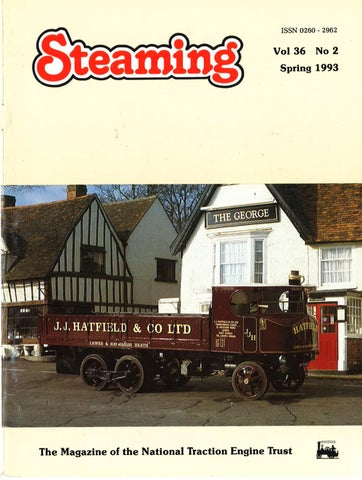
A bright crisp February day this year saw Sentinel wagon 8213 making a forty mile test run for its new owner James Hatfield of West Sussex, following a very thorough nine month full time rebuilding by Mick Turworth at Wimbish, Cambridgeshire. The 1930 DG6 model was once part of the late Edgar Shone's Crown Steam Haulage preservation fleet of Shrewsbury products. It is seen here after its outward journey through attractive villages along the valley of the River Stour and during its lunchtime rest at The George at Cavendish, Suffolk. (Roger West)
59
Trust News From the Chairman These notes will appear in the Spring issue of Steaming; we are on the threshold of a new rally season with most members looking forward to visiting the various events of their choice and of renewing acquaintance with owners and engines after the winter. May I wish all members a pleasant and successful rally season in 1993 be they engine owners, organising officials or attending an event as a spectator. But the success of the Trust has only been achieved by the hard work and constant attention of our many officials. This year sees the introduction of 'Authorised' rallies for the first time. I trust this new intrusion from officialdom can be smoothly introduced; I would ask for co-operation and understanding from all in our efforts to cope with this. Briefly 'Authorisation' is a procedure in which the Trust is involved and is a means of preventing the driver of a vehicle at a s ally from being prosecuted for the offences in the Act. There is, as yet, precious little information from officialdom as to how all this is going to work; benefits, such as they may be, will be to the exhibitor/driver. Members of the public attending will not notice any apparent changes. This year also sees the first operative season of our Code of Practice for Traction Engines. I hope many owners will take advantage of this Code and also of the new Engine Insurance arrangements offered. Much work by your officials has gone into their preparation and production. To conclude on a sadder note I have to advise of the death of Ron Copp, one of our longest serving officials. I have been connected with the committees of this Trust for very many years and I cannot immediately recall any other case of a committee member passing away whilst a serving committee member. Elsewhere in this issue is an obituary to Run whose contribution to the Trust and its predecessors was considerable. (Eric Fillmore, chairman)
60
Rally Organisers Column Rally sub-Committee As I write these notes we have just held the Spring Conference at Market Harborough. The format of the conference has changed over the years to a forum for the exchange of ideas and problems involved with the running of a rally. I think most of the people who attended the recent gathering would agree that the discussions under any other business give them more help than most other aspects of the day's events. Having said that I must thank Michael Chamberlain of John Scott & Partners
for his excellent presentation of rally insurance recommendations. The question and answer session which followed was notable for the concise and unambigious answers which Michael provided. Michael was accompanied by James Campbell who handles the engine insurance side of their services; he was able to deal with queries relating to the insurance disc scheme. Engine owners who are reading this II presume you have now read the small ads, the articles, Steaming Around and have now come back to the boring left overs), may remember that this year rallies are asking engine owners to display an NTET disc to
From Alan Martin's Collection
60
The domestic use of solid fuel in inner London is nowadays a past practice, but circular cast iron coal hole lids, lettered with coal merchants' names of a hundred years ago, can still be seen set in London's York stone pavements. The chutes beneath the lids took the coal and coke to cellars of the better houses, where, doubtless, servants did the rest. Here we see Charringtons — a name still to the fore as fuel merchants — engaged in a bulk delivery to an elegant address, probably somewhere near the West End, about 1929. The high-sided tip wagon is Robey 5 tonner 44085 of February 1929 (0L8833), one of a number supplied to Charringtons around that time.
Spring 1993
STEAMING
provide evidence of valid insurance and current inspection, as this makes life much easier for the rally safety officer. If you insure With- John Scott you receive one automatically; if not all you have to do is send your documents to Dick Blenkinsop at the address inside the front cover, who will send you a disc free (but please help by sending an SAE). Please tell other engine owners who may not be members of the Trust about the scheme as they can also have a disc — and join us too, if they wish! The new Authorisation Scheme paperwork appears to be working well. This is due to the considerable hard work done by Smudge Smith, and my thanks are due to him for his efforts. My thanks alio to the other members of the sub-Committee who are especially active during the winter organising training seminars etc. In closing I would like to pay my tribute to Ron Copp, whose obituary appears elsewhere in this issue. Ron was involved with the work of the Rally sub-Committee from its inception, I believe. His determination to get on with his life despite not enjoying good health was something I much admired. I hope you all have a good rally season — even just a dry one will satisfy many of us, I feel! (Andrew Semple, chairman, Rally subCommittee) Coal Supplies This year we are no longer at the mercy of British Coal for the supply of Welsh coal. A washery has been installed at Tyn-y-Wern Colliery, a private enterprise mine, and everyone who has used their coal speaks highly of it. Coal will be available from there, or from Newtown in Powys, as before. The Newtown stock is Cwm Bargoed which is good, but was in very short supply last year. This year, prices include a £3 pallet charge. Please do consider using these coals as it improves rallies enormously not to have a thick smoke drifting across the field. Buying from our merchants also benefits the Trust, which helps our running costs. (Andrew Semple)
Engine Owners Column Engine Owners sub-Committee We still have a lot of work to do on the uncompleted sections of the Traction Engine Code, but they are gradually taking shape. I feel that the Code must be considered value for STEAMING
Spring 1993
NTET Coal Supplies The Trust has again arranged low priced coal for use by rally organisers, clubs or individual owners In association with Arscott Collieries, Coal Factors and Merchants, Gateway Chambers, 26 Castle Street, Shrewsbury SYI 2BJ: • • •
pre-packed 25kg plastic bags haulage can be arranged to any rally site ring John Watkiss on 0743 362482 to discuss your requirements and haulage cost, anywhere in Britain
DRY STEAM COAL
CWM BARGOED COBBLES
120 per tonne f 123 per tonne ex Newtown, Powys ex Tyn-y-Wern (prices include f3 pallet charge but exclude VAT) Cash on collection or pre-payment Please order early to obtain supply of steam coal; bituminous also available
money and I urge all members to read it carefully — it is your Code. We have nearly sixty participants booked for this year's Driving Course, to be held at Amberley on 17th/18th April and we are looking forward to an enjoyable and constructive weekend. I sincerely hope that these courses make a worthwhile contribution to safety and enjoyment on the rally fields as well as enabling new friendships and contacts. We are most grateful to everyone at the Amberley Chalk Pits museum for their cooperation. I end by wishing all members a successful rally season. (Michael Davies, chairman, Engine Owners subCommittee) New Legislation — windscreens As from January 1st this year, MOT testing of motor vehicles includes windscreens, the regulations being explicit. The interest from the Trust's point of view is limited to the implications for rally organisers and the now common practice of insistence that passes are stuck to the windscreens of exhibitors' vehicles. In essence, it is not permissible to obstruct the driver's view of the road; windscreen stickers or passes will infringe this requirement if they intrude into the area swept by the windscreen wipers. Although the MOT test requirement has no direct effect on vehicles attending rallies, it is possible that Police Officers may stop any vehicle that does not conform to the general requirements of the test. It would therefore be prudent to advise all exhibitors that vehicle passes should be affixed in such a way
as to avoid intrusion-into the 'swept area' of the windscreen, whether or not the vehicle is subject to MOT testing. (Peter Smart) Licences for driving steam rollers Although the advice set out in a letter on this subject in the last issue seemed authoritative enough, being based on information from DVLA Swansea, other advice from that source may be in conflict and, accordingly, it is still not clear exactly what is required to enable legal driving of steam rollers. Until such time as a definitive statement can be obtained for publication, it would be wise for steam roller drivers to continue to display L plates unless the driver holds a valid Group G licence. Boiler door joints Further to my notes in the last edition of Steaming, I have now been able to study the report of the Marine Accident Investigation Branch of the Department of Transport on the accident in which Dick Martino and his nephew were killed. This report confirms that the joint which blew out was of the conventional rubber impregnated woven asbestos type. It also confirms that it was a new joint which had been fitted a few days previously, shortly after a boiler inspector had carried out a thorough examination of the boiler when cold. The joint blew out during the first time that steam was raised and whilst the boiler inspector was adjusting the safety valves. The report states that it was found 61
Clayton & Shuttleworth of Lincoln built large numbers of overtype wagons, many being constructed for use in World War 1. In 1926 the design was considerably revised to include a pistol type boiler with patent stayless firebox crown; by then the company styled itself Clayton Wagons Ltd. This picture shows their number T1180 (FE9771), a 6/7 tanner, new in November 1927 for Claypole Rural District Council, an area east of Retford with the engineers and surveyors address at Brant Broughton, from where the wagon was presumably worked. It would be interesting to know in what colour the machine was painted — clearly quite a light tone, and probably a buff or stone hue if the 3 way tipper was to be used for roads tone haulage. The making of this particular wagon's boiler was contracted out to fellow Lincoln engine builders Fosters. The Clayton had a short life — it was sold to Smith, Wright & Co (Asfordby) Ltd of near Melton Mowbray, Leicestershire and last licensed in December 1933, being scrapped in 1938 at G.E. Dixon's yard at Melton. (collection The Robey Trust) that for nearly a quarter of its correct clearance had been maincircumference, only the outer 'A inch tained. of the joint's 1/2 inch width had been Photographs supplied with the compressed by contact with the boiler MIAB report show very severe corshell. rosion of both the door and the lower Although the report places all the part of the boiler shell, which probably blame for the accident upon Dick accounts for the excessive clearance. Martino for failing to centre the door The vessel is said to have lain semicorrectly, it also reveals that the derelict for some time before 1970 clearance between the door and the and what appear to be horizontal lines boiler shell was at least three times as of deeper corrosion across the boiler much as it should have been. Stanend plate, at and just below the dards which have been in existence bottom of the door, suggest that the since the turn of the century at least, engine/boiler room was partially and are still valid, require a maximum flooded during that time. 1/16 inch clearance between the boiler The MIAB's published report (the shell and the door spigot, and there one that I have seen) does not go into seems to be no room for doubt that the the question as to why the boiler accident could not have occurred if the inspector 'passed' the boiler with such 62
grossly excessive clearance between one of its doors and the shell. This may be because legal action is pending, but I have no information about that. If any lesson is to be learned from this tragic accident, it is the importance of maintaining correct clearances. Although the potential for injury or worse is much less if the boiler is our in the open when a joint blows out, rather than in the confined space of a ship's engine room, there is still the potential for serious injury and/or serious damage to the boiler if it is not possible to get onto the footplate to draw the fire. If any owner feels aggrieved when his boiler inspector insists on remedial work to correct excessive door clearance, he would do well to think of Dick Martino and his nephew before complaining about it. (Jim Newnham, Hon Safety
Advisor)
Steam Apprentice Club The training weekend for Steam Apprentices planned for 24/25th April is at Klondyke Mill Centre, Derbyshire and details have appeared in the SAC
Magazine. Spring 1993
STEAMING
Members Hospitality Tents
Obituaries
As there are not likely to be any NTEC Sales stands in the format we have become used to at rallies this year, it is hoped a few more Hospitality areas can be arranged for members. In this way we can supply information, renew subscriptions, sell traction engine books etc (albeit from a limited range) and, most importantly, meet Trust members who are at the events. Arrangements are being made to attend the events at Tallington, Lincs: Weeting; Cumbria; Pickering and St Agnes, Cornwall (Sylvia Dudley); Little Wymondley and Barleylands (Sue and Peter Jackson), and Banbury (Sue and John Cook). There may be others added to the list as the season progresses and we hope to meet many members at the events we are attending — especially those we don't see too often at the more northerly venues! (Sylvia Dudley)
Ronald Arthur Copp BEM, died suddenly on 12th February, aged 77 years, after a most varied and active life. A qualified engineer by profession, having served his apprenticeship and training at AEC and rising to an inspector at their Southall Works, he subsequently moved to Watneys Brewery at Mortlake where he was a transport manager. He also had a distinguished career in the Army, where he served with REME for six years, experiencing Dunkirk, then the North African landings, and latterly service in Italy. Ron had many interests and hobbies which ranged from vintage cars and lorries to traction engines. His hobbies also took in dog obedience training, which was very much an activity of his. He was also a member of the Royal British Legion, serving on their committees, and was a local Welfare Officer for many years. In spite of his engineering knowledge and ability it was in an administrative capacity that he served the traction engine movement for so long. As a member of our Rally subCommittee he was responsible for running our 'rally approval' scheme with conspicious success for over twenty years. The Rally Lists we have all become used to were of his compilation, where his meticulous attention to detail was of great value. This attribute was also apparent in his office as Membership Secretary of the Road Locomotive Society. He served the Trust (and its predecessors) for 27 years continuously, a truly remarkable record of service for which
Magazine binders We draw attention to the present availability of Steaming binders to take the old smaller sized magazines issued before 1981. These are priced at £4.95 each including postage and hold 8 copies (2 years). They are available in limited numbers in two sizes — either to suit magazines from Vol 16 to 23 inclusive, or the slightly taller issues of Vol 15 and earlier; purchasers should check carefully their requirements before ordering from Sylvia Dudley.
Ron Copp
Israel Newton & Sons Ltd
we must all be grateful. Ron's passing is mourned by his many friends and colleagues throughout the traction engine movement and we all send to his widow Joan, daughter Linda and son Richard and to his many grand-children, our deepest sympathy and condolences on their sad and sudden loss. (Eric Fillmore)
Bill Griffiths William Griffiths passed away in December 1992, aged 74. He was a well known steam enthusiast and will be sadly missed by his son and daughter. Bill was a very strong supporter and member of the Ross-onWye Steam Engine Society for many years. He was also a founder member of Bishops Castle rally, his engine being one of the original six to attend the first event there. Bill's Ruston Hornsby 4hp tractor was a well known visitor to many steam events and he will be greatly missed for his quiet manner and wealth of information on all steam matters. When asked he was always ready to pass on his knowledge to other steam enthusiasts, young or old. Our condolences go to his brothers and their families. (D.A. Prout)
Jim Hutchens As the anniversary of his death approaches, I would like to remember Jim Hutchens. Jim was, to me, a gentle gentleman — someone to look up to, someone whose life warranted a book. He told me, and I have no reason to doubt his word, that amongst his many exploits, he sang in the church choir, played the violin, rode in the Isle
boilermakers established in 1803
manufacturers of:
* Locomotive type steam boilers of riveted or welded construction to BSS. Insurance company inspected. * Vertical cross tube boilers * Smokebox tubeplates, back heads, throat plates, new fireboxes, boiler retubing, welding repairs by coded welders. * Stockists of boiler tubes and rivets. * Industrial steam and hot water packaged boilers. * Hydraulic press work — dished and flanged ends.
Sununerley Iron Works, Idle, Bradford, West Yorkshire BD10 8TT telephone 0274 612059 STEAMING Spring 1993
63
IMPORTANT INFORMATION FOR THOSE NEEDING ECONOMICAL REPAIRS ON THEIR TRACTION ENGINES
B. 8, C. Reconditioning (Gears) Ltd PINIONS
SPURS
BEVELS
All types and makes of bevel gears, spur pinions, spur wheels, helical gears etc rebuilt to standard
Our address is:
B & C Reconditioning (Gears) Ltd, off London Road, Amesbury, Wiltshire SP4 7EQ Telephone Amesbury (0980) 623210
64
Spring 1993
STEAMING
of Man TT race, performed on the Wall of Death and rode in the Globe of Death. "You never knew where you were," he said "until you slowed down!" He drove steam engines with his father and collected so many engines that at steam rallies he could say, "I once owned that" of a number of those presented. A truly extraordinary man, Jim was larger than life and a fine man to be associated with. His exploits with his low loaders are legion. His ability to remain calm under pressure was something to behold. Peter Cox recalls the time a front wheel sheared off the tractor unit when in full song on the motorway en route to a rally. Jim's reaction was to steer the stricken unit to the hard shoulder and bring it safely to rest with the cool remark, 'We've lost a wheel!' (A. G. Bean)
Notice of thanks Mrs Joan Copp writes to our General Secretary: I would like to say thank you for the flowers which came from the committee and members of the Trust following Ron's death. I have had many letters and cards from members and find it impossible to answer them all and I hope this acknowledgement will be adequate. The support of so many of Ron's friends at this sad time has helped both my family and myself.
The Foden Society In February a group of vehicle enthusiasts announced the formation of The Foden Society. Formed with the blessing of the Sandbach truck manufacturer, this independent society aims to cater for enthusiasts and owners of all Foden products from 1856 to the present day. These include not only the famous lorries from the great heyday of British road transport, but also steam traction engines and wagons, industrial and marine diesel engines (the famous 2-strokes), World War 2 Crusader tanks, buses and of course, the current production vehicles, both civilian and military. A vehicle register is being set up and it is intended to hold an annual Foden rally and to publish a quarterly news magazine. Family membership costs £10 for the year to 31st December. For more information, contact the STEAMING Spring 1993
Membership Secretary, Gary Grysa on 0525-290121 (evenings) or send sae for membership form to: Gary Grysa, Membership Secretary, The Foden Society, 21 Sheeplane, Woburn, Bedfordshire MK17 9HD.
London Area Social Meetings It is hoped this issue will reach members in time for them to know of the last of the 1992/93 season of London social meetings. The final gathering takes place, as usual, at the Yorkshire Grey public house in Langham St, London W1 — see previous issues for a more detailed description of the location. TUESDAY, 13th APRIL — Arthur Bullman, from Essex, will show a miscellanea of cine films, including footage taken of one of the HCVS Brighton Runs for commerical vehicles. The Social Meetings will recommence in the autumn, the same venue having been booked. (Bill Timmings, London meetings organiser).
Heavy Haulage Event On 22nd May 1993, the ex Norman Box and Pickford's Fowler road locomotive 17105 ATLAS is scheduled to move a transformer from Gloucester to Eastnor Castle in Herefordshire, a distance of about 20 miles. The load will be moved on a heavy haulage, 16 wheel low load trailer, formerly owned by Walter Denton of Hyde, Manchester. The transformer, which is second-hand and obsolete, has been provided by ERMEC Limited. Load including trailer will weigh about 20 tons. The run will start on the Bilton Trading Estate, Stonehouse Road, Haresfield, which is south of Gloucester, off the A38 Bristol Road, The aim is to move off about 10.30am and the route will be up the A38 through Gloucester and then via the A417, B4208 and A438 to Eastnor. The road is undulating with a notable climb over the Malvern Hills at the end. Any changes in the schedule will be announced in the World's Fair in the preceding week. (We are grateful to ATLAS's owner, James Hervey-Bathurst, for letting members know of this good opportunity to enjoy the sight and sound of a heavy load on the highway.)
OUR MAGAZINE 25 YEARS AGO
The second issue of the year consisted of area notes sent in by members. Working steam rollers were still to be found, Devon being noted as having twelve left, though nine had recently been offered for sale. Surprise was expressed at the high prices the latter had fetched — the best well over £300. Other working steam in north Devon could be seen at the Chappelton Sawmills where Marshall S type semi-portable 88105 (the subject of one of our covers some years ago) steamed daily and had Robey 37871 as a working companion. The mill was the last to be steam powered in the west country. From Cornwall there was news of the retrieval for preservation of Burrell showmans 3288 NANCY. The engine was something of a local institution, having stood at Indian Queens crossroads for over forty years and become seriously derelict from the keen salt laden breezes that swept the area. In Hertfordshire a certain engine owner had acquired his second engine, an Aveling roller to keep company with Fowler roller 17560 — Reg Saunders had started the family collection! Bridsons in the Wirral had disposed of two of their working fleet for further use — Sentinel DG4 tarsprayer 8122 and Fowler roller 17500 had passed to Lloyd Jones Bros at Ruthin, North Wales and the Sentinel, particularly, did indeed see seasonal use on road dressing until quite recent times.
RALLY SAFETY SIGNS DANGER — beware of moving vehicles etc — yellow with black lettering Unauthorised persons prohibited etc — red with white lettering FIRE POINT — red with white lettering Printed on rigid plastic boards
DAI4GESt. Berme o' mow% vehicles machinery
£2.20 each sign inc VAT, postage ES per order From: A.J. Semple INTET) Unit 6, Mynd Industrial Estate Church Stretton, Shropshire SY6 6EA
65
HARD, ROUGH WORK IN THANET Living in the closing years of the twentieth century we may find it difficult to imagine the conditions under which contractors' road engines worked at the beginning of those ten decades. However, the frantic activities of the Baldock family of Canterbury, related here, might illustrate that despite the huge difference between yesterday's steam engines and hand-filled trailers, and today's eight wheel tippers and Komatsu loaders, the usage and necessary abusage of contractors plant and equipment does bear some similarity.
1. A Tragic Day on Sarre Hill 'The facts in this case lie in a comparatively small compass, but it must not, on that account, be assumed that they are of little, or no, importance.' Thus did the Board of Trade Commissioners begin their statement on the evidence they had heard of the fatal explosion on 2nd November 1908 of the boiler of a Fowler engine at Sarre Hill, on the Isle of Thanet in Kent. The facts, indeed, were simple: the boiler's condition had suffered a lamentable lack of concern by its owner. William Amos Re!dock., who bore the grief of losing his son, the engine's driver, as a result of the accident. But despite this, the commissioners, perhaps understandably in the circumstances, were less than eager lu itorrpliastse the blame they put on Baldock. The engine concerned was B4 class single cylinder Fowler road locomotive 7490, built in 1896. It was supplied new to a John Towers of Tipton, Staffordshire, who apparently only used it fo► a very short time before returning it to Fowlers. The makers overhauled it, fitted an extra third speed gear and chimney and sold it for £550 to William Amos Baldock, steam traction and threshing proprietor of Tyler Hill, some two miles north of Canterbury. The Report acknowledges Fowlers as 'a firm whose name stands as high as any in the United Kingdom or abroad, for the excellence of the machinery they manufacture.' Further interesting general contemporary comment from 66
the Commissioners, referring to the type of machinery they were investigating, was their note that 'it is impossible to travel in any part of England without seeing the very extensive use to which these engines are put, and, so far as one can tell, the use of them seems likely to increase.' Once in Baldock's ownership, from March 1897, the engine was put in charge of his son, Walter George Baldock. As we shall see the engine led a busy and hard existence from then on. On Monday 2nd November 1908 Wafter was using it for hauling three trailers loaded with sand from a pit at Broad Oak, near Canterbury, to Birchington, a journey of about ten miles. About noon, whilst ascending Sarre Hill, and having covered over half the distance to Birchington, the boiler exploded. Walter Baldock was so severely scalded by the escape of steam and water that he died two days later. A report of the inquest on 42 year old Baldock appeared in the Canterbury Journal & Farmer's Gazette, revealing he had worked for his father for 26 years. Amos George Baldock — Walter's son — was walking with a block by the side of the second of the two trailers and escaped injury. The victim was quickly taken to Sarre Mill, where his scalds were dressed with flour and oil, and later Canterbury Hospital, where he died, leaving a widow and ten children. As can be seen from the diagram that accompanied the Board of Trade Report, the inner plate on the right hand side of the firebox bulged over almost its whole extent. Five of the stays were judged to have been broken for some while before the
event; many of the remainder fractured at the time of the explosion, and the inner sheet pulled away from another nine, thus forming the openings through which the contents of the boiler escaped into the furnace and atmosphere. In enquiring into the management of the engine and boiler, the Commissioners found that that task was entrusted to a competent person only so far as the driving, cleaning and execution of small external repairs were concerned. The enquiry had to establish if the boiler was 'periodically examined by a competent person' and if Mr Baldock senior ensured it was worked under safe conditions. The Commissioners were probably reflecting contemporary thoughts when they stated traction engines were 'upon the whole, extremely well and efficiently manufactured, and the materials used in their manufacture are thoroughly sound. But it must not be forgotten that the work to which these things are put is heavy and rough work: and consequent upon that arises. in our judgement, the necessity for a very much more frequent examination of them than apparently is the case'. The evidence was that Baldock entrusted the examination to his son, whose experience was only that which could be gained by watching, fium time to time, boiler makers employed in repairing one or other of the seven other engines kept by the family for contract work. The Fowler's boiler was not insured. Baldock senior did not know much about the likely condition of the Fowler's boiler — whether any of the stays had been renewed or if the plates showed any signs of bulging. He was taken to task for this lack of care towards the engines, an omission which was further exhibited by his admission that he had not caused any of his other engines to be further examined in consequence of the unfortunate explosion. These machines, he told the investigators, had been looked at sometime before the accident to his Spring 1993 STEAMING
00 0 0 0 0 0 0 0 000000 0 0 0 0 0 0 0 0 o 0 o 0 0 o 0 0 0 0 0 0 0 0 00
STAYS PULLED TM INNER SHEET
The drawing which appeared in Report 1838 showing the stays which broke or pulled out on the right hand side of the inner firebox. Those marked A were judged to have broken before the explosion; the ones marked B to have been partly fractured and then broken by the explosion and those at C were not broken but had pulled through the plate. The unmarked stays were inaccessible for diagnosis, but were known to be broken.
Fowler, but they had subsequently found, nevertheless, that one of the seven had in fact got some broken stays. Baldock's reasoning for the lack of inspection was that it was impossible to examine the engines whilst they were out on contract, a plea dismissed by the Commissioners as no valid excuse — engines were widely conceded to be potentially dangerous 'and the necessity for having them examined is no doubt constantly present to the minds of the owners'. It was futile to suggest the mischief caused, if trouble arose, could be excused by there being no time to examine and ascertain if repairs were necessary. Boilers must be examined before being sent out to work. Baldock had generally arranged for the tubes to be drawn once every two years and this should have been a suitable opportunity for any skilled engineer or boilermaker to gain a good idea of the condition of the stays. But his son was not possessed of the necessary skills. In answering the Board of Trade's question as to whether he bear the costs of the formal investigation, the commissioners were clearly sympathetic to the man's loss of his son. They felt that although he was blameworthy, no penalty they could order STEAMING Spring 1993
could bear any relation to the grief he must have suffered by feeling that had he acted otherwise his son might still have been spared him; no order was made as to costs. The details of the circumstances surrounding the accident have been taken from the Board of Trade Boiler Explosion Report No 1838, dated 21st April 1909, and the aforementioned local newspaper.
2. An Edwardian Haulier To augment the above account we are grateful to Tim Keenan for allowing us to use information on the Baldock business and equipment from his extensive collection of notes on Kentish road engines. Much of the background information on the Baldocks comes, in turn, from Mr D. Ashenden, a member of the family firm of land agents whose activities date back to the time when the Baldock business commenced. About 1880 William Amos Baldock, after a short spell in partnership with a Mr Fill in the Whitstable road, Canterbury, set up a steam
engine repair yard in the garden of his own house, Stonaway, in Tyler Hill, a couple of miles north of the county town. He worked alone until joined there in 1900 by his son Albert and young family, moved from the village of Littlebourne. For the next 30 years the Baldocks and their steam engines were to be a feature of Tyler Hill. The firm's work consisted, in part, in repairing engines of all kinds and also in transporting flints, gravel and sand from pits at Sturry, for mending and extending road surfaces around Canterbury and Thanet. Ashendens employed Baldocks on a contract basis to haul material from their Sturry quarries, mostly towards the Isle of Thanet. The engines were locally regarded as powerful, called 'three truckers' from their ability to take three large traction wagons on each journey, though as we have seen from the evidence in the Report the crew were ready with blocks at the trailer wheels when travelling uphill, a sure sign they knew the engine was near its limit. The total loads were probably over 25 tons, each of the great wooden bodied wagons holding 7 cubic yards of aggregates. The engines had a crew of three — one of the Baldock family as driver, and two mates. The trailers were loaded by hand from the 'stone lumps' run out by barrow from Ashenden's pit men, or from the crushing plant when the load was crushed grit. Baldock's men cycled the four miles or so to Sturry from Tyler Hill in time to load two wagons before breakfast time and then be on the road by 8.30 or 9. They would though, if possible, have loaded 67
one wagon the previous afternoon before leaving for home. The engines took water from Ashenden's well on the Island Road and that would take them to Sarre Hill where another fill was taken from a roadside stream. The work was undoubtedly rough on man and machine. The fatal accident would have made a great impression on locals as the news got around — after all, Baldocks haulage activities took place on the highway and being both noisy and cumbersome it would have been well known to the public and the accident have become a talking point. Tales have been handed down that the engine involved in the accident was at the time having a race with another belonging to Robert Brett & Sons from Windcheap, Canterbury. This was said to happen often for the two firms were great rivals — not that the engines were running neck and neck, but it is quite likely the crews may have had the odd wager to return to such and such a point by a certain time. Bill Love once spoke with one of Avelings old salesmen who gave what is perhaps a more reliable aside coming from within the trade: he reckoned the accident was a lot to do with the manner in which Walter Baldock drove — like the engine, it was rather rough. Further, instead of being blown off the engine by the blast through the firehole door, Baldock got caught by the canopy supports and so suffered more than he might have done. The Coroner
at the inquest on Baldock's death made a similar point, that he had been unable to quickly jump clear because of the roof of the machine. Baldock's fleet of engines was a varied lot, having been built up for several purposes — as well as road haulage his business also covered threshing and road rolling. Two elderly Aveling 8hp single cylinder traction engines probably came from Baldock's association with Mr Fill. The wherewithal! for the purchase of one of them came from the Ashendens, for in 1888 grandfather Ashenden financed, to the sum of £240, the acquisition of an 8hp traction engine with tools, gearing etc and also a Marshall threshing machine to go with it. This outfit did the threshing work on the three Ashenden farms. Later, in 1891, a similar financial arrangement resulted in the arrival of a new 10 ton single cylinder roller
by Thos. Green of Leeds, number 1400 of 1891. In 1895 Fowler 7448, a D1 class 10 ton convertible single roller arrived, and a couple of years later, in 1897, two secondhand road engines: Aveling 8hp single 2205 of 1887 and Fowler 7490, the subject of the Sarre Hill accident. One further known Fowler road engine came new to Tyler Hill in the years up to the 1908 explosion — B4 class compound 8289 of 1899 DUCHESS OF KENT. These road engines, and one later one, were the engines locally known as tr 'three truckers' and it is said tha when Baldock took on a smaller 5hp machine it was judged a complete failure and had to be sent back — as Baldock remarked: "It couldn't pull the skin off a rice pudding." The story of his later engines, and steam wagons, are perhaps best left for another time
Showing the typical muddy state many engines got into in the days of soft roads at the turn of the century is this Fowler compound traction engine owned by Albert Baldock. It is thought to be 7055, an A3 class engine, new in August 1893 to Frederick Cobb of Sandwich, just south of Faversham, Kent. It was provided three months later with roller parts to enable it to be used as a convertible. Later, William Baldock acquired 7055 from the East Kent Brewing Co at Sandwich and after his death in March 1913 it presumably passed to his son Albert; certainly the latter's nameplate is on the side sheets in this picture. Albert's son, Stanley Baldock, stands to the right of the front wheel (he started work in 1908 at the age of thirteen — "I was born in the smokebox, so my father said.") and the young man at the rear wheel was from the quarry at Broad Oak. (collection Tim Keenan)
but further detail can be set down here on the Sarre Hill unfortunate. Reference to Fowlers' surviving records, held at the Rural History Centre at Reading University, enable us to comment further on Fowler 7490. As we have seen from the Explosion Report, the engine had only a brief career before being acquired secondhand by Baldock. In January 1896 Fowlers had entered it up in the Engine Book as one of their 'Heavy Haulage Traction Engines', with a single 9 inch diameter (by 12 inch stroke) cylinder and mounted on springs rear and fore. Hind wheels were 6ft 6in diameter by 18 inches wide and the coal bunker was 'carried up in plate'. Other dimensional information, as supplied by Fowlers to Staffordshire County Council in January 1896 for their licensing procedure, included: width 7ft 6in; shod with diagonal crossbars 3in x %in thickness with 27/Bin between; weight 9 tons. An owners nameplate (a legal necessity) was to be put on and the machine was guaranteed for 12 months. It was one of a batch of twelve engines built up on B4 class boilers — others in the group were constructed as compound showmans engines or road locomotives and as single cylinder traction engines. John Towers of Tipton, Staffordshire, was entered up as the customer for 7490 STEAMING Spring 1993
There was no doubt a certain amount of pride behind the commissioning of this photograph of Fowler road loco 8289 DUCHESS OF KENT. The engine is in pristine order and very probably only just delivered brand new in 1899 — an appropriate time for William Amos Baldock to strike a proprietorial pose for the photographer at the rear wheel, accompanied by two of his sons. Albert is on the footplate and Lewis stands by the front wheel and the location is the Fingerpost Yard, Tyler Hill. The engine was a sprung B4 class compound road locomotive, despatched from Leeds on 15th June 1899. The livery is Fowlers usual black, with amber edging and red and yellow lines. The plate on the rear of the tender seems to read W.A. BALDOCK & SONS and if the engine has been acquired on Fowlers terms, their owners plate was probably discreetly within the tender space. Various makers must have affixed many of these plates over the years but they are rare artefacts nowadays — understandably, for few owners wished to retain them after the machine was all theirs/ Fowler had taken Baldocks' 8hp Aveling single in part exchange for 8289. William Baldock died in March 1913 and DUCHESS OF KENT probably continued in use in son Albert's name, but by 1921 it was owned in Denbighshire. (collection Tim Keenan)
with delivery promised 'by the end of February 1896' and the note added 'the secondhand traction from Cannock Agricultural Co to be lent him till his engine is ready'. But the new machine seems to have been well to time, 18th February being entered as despatch date. The records, unfortunately, are silent on why 7490 failed to please at Tipton, and just when it returned to Leeds, but in February 1897 Fowler's clerk wrote up work to be done to the engine under order X1426, for W.A. Baldock of Blean, near Canterbury — 'returned from J. Towers, No 7490, to be fitted with
3rd speed road gear and thoroughly overhauled and painted and to have complete outfit as per catalogue: spring drawbar; owners nameplate to be put on'. It was promised for the first week in March and also needed a new chimney with brass top, though in the end the engine was booked out on 6th April 1897 and the chimney seemingly followed as an extra. Oval transfers were put on the right hand side of the boiler barrel (has anyone pictorial evidence of such a Fowler transfer?) and the colours were the usual Fowler black 'picked out amber, lined red/ yellow'. On the tender tank partition 69
plate was mounted a 'JF & Co' owners nameplate, so Baldock was clearly taking the engine on some sort of deferred terms, a not unknown arrangement for acquiring fresh plant, then as now. We might wonder what sort of machine Fowler 7490 had been turned into with its large cylinder, high wheels and, now, a third speed. Baldock didn't take long in finding one shortcoming, though it was a fault plainly of Fowlers' making. In June 1897 the latter recorded 'a flywheel was sent to Mr Baldock to replace one which had broken away at the boss owing to the outside of the wheel being recessed wrongly in the shops...' — presumably when adding the third speed. This note is written in pencil on flimsy paper and unfortunately the rest of the note has by now faded into illegibility but clearly something was not quite right with the workmanship at the Steam Plough Works on this occasion. Further, it seems the problem continued later on, for in May 1911 the records were endorsed 'this engine has a steel boss, per Mr Cowe, one cover for flywheel boss'. A later entry, in June 1912, covered the supply by Fowlers of a fast speed pinion for the third gear. However, whatever these last two entries may suggest about 7490's added third speed, they offer evidence that the engine was repaired after the 1908 explosion and that this interesting if unfortunate machine worked for at
least another four years or so — though not necessarily in Baldock's ownership. Regrettably, no photograph has yet come to light of Fowler 7490 but to give at least the flavour of what must have been a somewhat hectic period in road steam haulage in the Thanet district, with engines extensively and harshly used on hard tasks. Tim Keenan has kindly provided pictures of 7490's contemporaries — one of which poses its own problem of identity.
3. Enigmatic Variations These three photographs, from Tim Keenan's collection, are something of a mystery and one which A/an Duke's extensive records do not, for once, immediately resolve. The subjects of the pictures are Fowler class D2 engines and close scrutiny seems to suggest them to be one and same machine at different stages of its life; certainly lengthy study of the originals doesn't
show anything to preclude the theory, The first picture shows a Fowler D2 class road engine of about 1910 engaged on haulage work with traction wagons. A nice scene, locally obtained by Tim in Kent and said to be one of Ba/dock's engines. But the only item to offer us any identity is the owners nameplate on the motion side sheets and this reads GASKIN & Co, CANTERBURY. Alan Duke's lists show an owner of that name with such a Fowler compound but its precise identity is not known, and as Gaskins name does not appear in the makers records it probably went to them secondhand. The second picture, remarkably, is taken from precisely the same angle as the first but shows, as the photographer's caption puts it, One of Life's Little Problems. The scene may be at Manston, near Ramsgate and the little problem was the fracture of the Fowler's rear axle. This time the engine is demonstrably in Baldock's ownership, the figure standing under the crankshaft is known to be Stanley Baldock and the owners nameplate reads A. BALDOCK, CANTERBURY. However, a letter has been chipped off the casting before the initial A. — presumably a W. removed after William Amos had died and the engine passed to Arthur. An economical way of keeping the plates up to date! At this stage we can start noting the features which point to the pictured Fowlers being one and the same. The timber built canopy is not of Fowlers design and is probably locally constructed. As such one might expect the shape of the cross timbers and arrangement of the supporting irons to be distinctive and the two pictures show no discernible difference one from another. Two further details of the sort which engines acquire after working awhile for their owners also appear in both photos — firstly a small pierced supporting plate fixed atop the frontplate in front of the manstand, which was to steady something already removed. Secondly, two of the round-headed bolts on the offside of the chimney base have been replaced by longer bolts with two nuts on the outside — this can only just be seen behind the large lamp on the original of the second picture. And so to the third illustration. Fowler's D class engines were readily provided with parts to turn them into rollers, the headstock/ smokebox casting bolting directly to STEAMING
Spring 1993
the boiler flange to which the engine smokebox was affixed. Here, this standard Fowler fitting, plus, of course, the necessary rear rolls and front rolls, have been provided, but studying the rest of the engine we see the same distinctive canopy and altered BALDOCK plate; even the shadowy bracket up on the footplate. Comparing it with the accident picture the canopy can also be seen to bear the same faint lettering CONTRACTORS, TYLER HILL. Finally, the machine carries an almost handwritten registration plate on top of the headstock, probably KE2840, a number known by Alan Duke to be allocated to Baldock in 1921 for an unknown engine in his fleet. /f our three pictures do show the same engine, it is one with a hectic history in a short span of years. The first illustration shows a machine of about 1910 vintage in good tidy order and probably only a couple of
years old but already secondhand. The second depicts the engine still in crisp condition (albeit in distress) and maybe only a short time later, with an attributable date of after 1913. The roller must have been pictured after registration numbers became required for them in 1921. We would be pleased to have readers comments and perhaps even a suggestion of which Fowler the pictures portray.
'Acton Urban District Council. — Sale of Thornycroft steam motor wagon. The Council are prepared to receive offers for a steam motor wagon supplied by the Thornycroft Steam Wagon Co Ltd, including spare pair of back wheels. 700 gallons watering body, slop body, and special hoisting tackle and sling, for which they have no further use. The wagon etc may be seen and examined at the Petersfield Road Depot, Acton any day between 9am and 5pm. Tenders in
sealed envelopes endorsed 'Steam Motor Wagon' to be delivered to the undersigned not later than 3pm on Tuesday, the 16th day of May 1911. The Council do not bind themselves to accept the highest or any tender... Wm. Hudson, Clerk to the Council...' (from Motor Traction, 6th May 1911. The wagon was Thornycroft 116. It had been new in April 1902, so was well past its youth; the successful tenderer was T. Borham of West Kensington.)
(Editors note: This article started off merely as a precis of the Boiler Explosion Report of the Sarre Hill accident, but has become considerably extended following an approach to Tim Keenan of Margate for a few local details. Thanks are therefore due for additional information to Tim Keenan; John Baldock; D. Ashenden; Bill Love; Alan Duke and the Rural History Centre, Reading University.)
71
Sentinels for.... A SlitION 5. Al Utak D.
Millers There are few who have a longer record of providing our magazine with articles, notes and photographs than Joe Thomas. Most readers will readily associate ✓oe with the products of the Sentinel Waggon Works Ltd at Shrewsbury and elsewhere in this issue we review his latest book — An Album of Sentinel Works Photographs. This album is the first of a series which will eventually cover all types of Shrewsbury vehicles. To continue his contributions to our own pages however, we are pleased to present the first of an occasional series of illustrated articles by Joe showing the wide range of industrie.q and trades that found the Sentinel marque so useful for their transport needs. We start with ... Sentinels for Millers.
At the turn of the twentieth century when the steam motor wagon became sufficiently reliable to appeal to traders needing transport services, millers were among the first to appreciate the advantages: the heavy, bulky nature of their product must have made a hard task for the carter and his horse-drawn heavy miller's cart. My first picture shows one of the early Sentinel Standard 6 ton wagons, built in Glasgow in June 1911, number 461. It had been sold to William Simmons of Leighton Buzzard in 72
Spring 1993
STEAMING
Bedfordshire and was fitted with high, fixed sides, supported by iron uprights, for millers work. The paintwork seems to be of a light colour which would presumably not show too much the inevitable dust from road or load. The wheels are of Sentinel's patent composite type — a cast steel centre and sliding ring formed a double cone which gripped the oak felloe carrying the steel tyre. Not all steamers for the trade were open-backed as the picture of the covered bodied Kingov Trading Company's vehicle shows. The 3/4 ton model Sentinel was probably used for town deliveries to bakers and grocers in the Swansea and Cardiff areas. The machine is unidentified but probably dates from around 1914; by then Shrewsbury were offering rubber tyres. The street scene (presumably Aldershot — can anyone recognise the location?) shows a line-up of four covered bodied Sentinels owned by R. Simmonds & Sons, millers of Aldershot. Nearest the camera is Super 6086, which was new in November 1925. The other two Supers are 5184 of 1923 and 5672 of 1924, with Standard 6 tonner 4045 of 1921 and a Leyland petrol wagon partially blocking the street. The fourth picture shows a beautifully painted example of a DG4 model (7950 of 1929) which was delivered to the order of Spillers Ltd for their subsidiary company W. Vernon & Son of Liverpool. The glossy machine is posed outside the frontage of the Shrewsbury works; it worked until 1945, having been put on pneumatics in 1933. My final picture is another Shrewsbury scene — the distinctive Sentinel company houses form the background but the subject of the photograph is S6 model 9084, a 12 tonner new in 1934 to millers Priday, Metford & Co of Gloucester. The vehicle is under restoration in Lincolnshire, so perhaps one day we may see this scene recreated, complete with fine period lettering and the interesting tubular illuminated 'Hercules' sign on the cab roof.
'Steam Waggon's Reliability. — A Sentinel steam motor waggon running between Brixton and Woolwich and making two return journeys a day, recently completed its sixteenhundredth journey without an involuntary stop.' (from Motor Traction, 26th August 1911.) STEAMING Spring 1993
Hi9fifand Steamboat Holidays Cruise the beautiful seatochs and canals of Scotland in an original coal-fired Clyde Puffer. Good food, comfortable accommodation. •
•• •
,f1 •••••• -'1.7--
Send large SAE for free brochure to Rachel and Nick Walker, The Change House, Crinan Ferry, Lodu3ifphead, Argyll PA31 8QH (Tel 054 65 232).
73
Steam in the Czech Republic and Slovakia • Ceske BUdilpvIcor
,
• Most PRAHA Beroun •
100 miles
• Osti eve Czech Republic • Sobeelev
Nov9 JleIn • • Brno
Ceske Lipe • Slovakia • Nitra
• Benska ElvSinco
Vienna • Austria
BRATISLAVA • 2alia.tovco Hungary
74
,
Zdenok Bauer and Ladislav Konopire
.tilddlti KrAlovA • KoIln • Kutne Hora
Plzen •
The past few years have seen many changes to the map of Europe and even as this article from Czechoslovakia was in editorial preparation the division of that country on 1st January 1993 into the separate states of the Czech Republic and Slovakia has created Europe's two newest nations. Here, enthusiasts from the Prague area give us an insight into road steam preservation in their country and reveal to us that a larger number of engines than might have been expected are in working order. We wish the new nations future prosperity and, especially, peace in which to enjoy the Innocent pastime of preserving engineering history.
In Czechoslovakia in past years were used many steam rollers, steam road engines and steam ploughs of different origins. Before all, the first machines were nineteenth century road engines from England and Germany. During this century also Czech factories began the production of road rollers at first with CKD Praha, then by Kralovopolska machinery works in Brno, and gkoda in the
Spring 1993
STEAMING
The Kralovopolske Brno roller of 1924, now in preservation, photographed when in service in winter conditions in Mnichovo Hracli&to in 1982. Note the Fowlerlike headstock. (L. Konopael
factory in Hradec Kralove. Many other machinery works built great numbers of non-traction steam engines (portables) for agricultural and building purposes. We have prepared a list of steam engines existing in our country in 1992, with a small amount of their history and with some pf them we can send black and white photographs. Also we are sending some historical photographs of Czech machines. The survey may not be complete but it may be possible to later add other machines.
1. Steam Ploughs • At Kaoina (near Kolin or Kutna Hora) an agricultural museum shows a plough set — that is two Fowler engines of about 1909, compound two cylinders without superheater, also a four share plough. They were in service to 1971 and are named PrIEMYSL and LIBUSE. • At 2eliezovce (Slovakia), a state farm, now privatised, has two steam ploughs of Fowler-Budapest in 1929, works numbers 13294/13295. These are compound, two cylinder with superheater and in service to 1972. • At Tursko (north east of Praha) is owned privately a Fowler engine works number 1182 named JAROSLAVA. It is in practical working order but without machinery parts for the cable drum. The owner is the private firm of J. Mach, which repairs steam locomotives and other engines.
2. Steam rollers • At Beroun-Kraluv Dv& is a Fowler compound two cylinder machine constructed at the beginning of this century.
Opposite page: Fowler ploughing engine JAROSLAVA on exhibition at Hofelice in September 1988. It seems likely the engine is works number 11082 (not 1182), one of a pair 1108 1/ 1 1082 which were part of a group of twelve K5 class ploughing engines built in 1907 and despatched to Fowlers Magdeburg agency. (Z. Bauer) STEAMING Spring 1993
The CKD (Ceskomorayska-Kolben-Danekl type Praga Mamut twin cylinder piston valve steam roller. This example is pictured in the 1930s, when in use by the firm of NejedlY, Rehak & Co. Note the wheel weights to all rolls; the towbar for a trailed scarifier; fuel bunker across the rear of the footplate. (collection Z. Bauer) More CKD rollers at work in the ownership of Nejediri-fiehdk, two of the Praga-Mamut type and one fright) of a smaller type. (collection Z. Bauer)
A second picture of the Nejedlyi Reh6k trio with the smaller roller in the centre. (collection Z. Bauer)
CKD roller 512 of 1951 — a late built example of the Praga Mamut type, now preserved at Sob&lay. (Z. Bauer)
• At Banska Bystrica (Slovakia) in a local museum is a machine of Aveling & Porter, further details unknown. • At Nov'e Jitin, the firm of Silnice (state establishment) own a roller of Ruthemeyer, a single cylinder engine of the 1920s which was in service to the end of the 1960s. • The state establishment Silnice Sosnova at Ceske Lipa has a CMK (later CKD) roller of the Praga Mamut type, probably of the 1920s, with balance safety valves. • At Plzen - Litice is a roller of 1924, built by Kralovopolska Brno, compound two cylinder. it is named RICHARD and was in service to 19831 • Near to the locomotive shed at Kolin is a CKD type Praga Mamut roller of 1928, in service until 1972 in Praha. It is placed on display. • At Sobeslav (beside the road Praha to Ceske Budejovice) is CKD type Praga Mamut constructed in 1951, works number 512. It has a road digger of Reinhold Bobe attached and is of the most recent construction of its type.
The author's own roller — CKD 220 of 1930, pictured when it was at work in Praha (Prague) in May 1970. (Z. Bauer) 76
We hasten to add that this is not, unfortunately, a survivor. Nevertheless it is a most interesting machine and the picture, from Zdenek Bauer's collection, will repay close study. It was taken on 20th June 1941 during the building of the central workshop of the mining establishment at Komofany near Most (north west Bohemia). The smokebox bears the name KOPPISCH NURNBERG, presumably the engine's maker, and if the style of these nameplates reminds us of Fowlers' products, so perhaps does the general proportion of the single cylinder machine beneath its outward unorthodoxy. Compare the shoe wheels with the several published references to Boydells early type and to Fowlers later Botrail wheels, and then refer to figure 342 in Michael Lane's History of the Steam Plough Works for a more similar design to our present example. Whilst Boydell's and Bottrill's ideas were to allow the engine to cross less than sound surfaces, the wheels of this Koppisch engine seem intended for compaction. It would be most interesting to know more of the history of this engine, and if its design owes anything to Fowlers Magdeburg works — Nurnberg and the latter city are 150 miles apart. STEAMING Spring 1993
at Nitra Budapest single cylinder traction engine 3120 of 1914 at work (Slovakia) agricultural exhibition in August 1988. (Z. Bauer) 77
The exhibition grounds at Nitre (Slovakia) in 1988, with the traction engine by Hofherr-Schrantz vying for attention with a narrow gauge steam train. The single cylinder slide valved engine seems to he most popular by a small margin. (Z. Bauer)
1930, works number 220. It is kept in the area of the old waste water pumping station at Praha Bubened, near to the railway station of the same name, and here also are two great stationary steam engines (serviceable) and two narrow gauge steam locomotives.
3. Agricultural self moving engines
1914 by Elso Magyar Gazd. Gepgyar, Budapest, works number 3120, pressure proved in March 1992.
4. Steam wagons There are existing still three machines of the Skoda Sentinel type, built in the 1930s. • At Hradec Kralove, in private ownership, being set to working order. • At Ostrava, also private, and serviceable. • At Banska Bystrica (Slovakia), of a museum, but at this present time at Hradec Kralove for overhaul and setting to working order when possible, for exhibition.
• At Polanka n. Odrou in the establishment of Silnice is a steam roller of Skoda construction, probably of the 1 930s. It has a water tank below the boiler. • Lastly our own private roller which is CKD type Frage Mamut, built in
• There is an agricultural museum at Nitra (Slovakia) and at the end of each August there are exhibitions at the grounds. Here is traction engine Hofherr-Schrantz/Clayton & Shuttleworth 54420, built in 1914. It is in working order. Also another engine of
Footplate details of the HofherrSchrantz engine. (Z. Bauer)
CKD roller number 220 steams through Republic Square in city centre of Praha in July 1992, whilst engaged in an advertising action. (Petr Bauer)
78
Spring 1993 STEAMING
EDMONDS on Engines
Chris Edmonds
A bit of a mystery tour this quarter, as I haven't really decided what I'm going to say. Let's start with copper tops. They are beautiful looking things when they are clean — but how long do they stay clean? I find it soul destroying to spend up to half an hour beavering away to get a real shine, and then long before the engine even comes into steam to realise all one's
efforts have been wasted. I have tried putting a steel liner in the chimney, packing the copper top out with asbestos, and rubbing a thin layer of oil over it immediately after cleaning. This latter ploy does seem to keep it acceptable for a bit longer, but not for much longer. I may well do the locomotive department of the Ffestiniog Railway a disservice when I think the copper tops of their locos have been painted black; it may well be that they are cast iron chimneys, but I am not sure. In any event shiny black paint looks better than dirty copper. The old Bucks' County Council Aveling rollers were all painted black as the drivers got fed up with cleaning them, and it certainly made them look slightly austere and businesslike. Incidentally when I ordered the new copper top for my small steam locomotive (in the Burrell style) I was informed by Levicks of Birmingham that it was the first order for a Burrell style copper top for a steam locomotive since 1929, when they made four for the Southwold railway. I am not a fan of the inverted 'dustbin lid' style of chimney top as
fitted to Foster showmans engines. I know it stops the rain running down the outside of the chimney, but cleaning-wise they seem the worst of all. Try — as I used to when cleaning the one on the Foster VICTORIOUS — but it simply turned black as soon as your back was turned. Perhaps one or two readers have a remedy that I haven't thought of. Brass tops, on the other hand, seem to fare better, as does brass on an engine generally, and it doesn't seem so affected by heat. Marshalls for a time fitted aluminium boiler bands to some of their engines, and I wonder if it was to overcome the cleaning problem, but they stopped short of aluminium chimney tops! A nice cold wind blowing does wonders for brass and copper. At one of the rallies we went to with the railway it was noticeable that the copper top was perfect one side and black the other — it was the wind that was doing it. The only problem was the drivers nearly froze to death! So come on you old enginemen, that's the problem for you to solve — how do we keep our copper tops clean?
reconditioned, the cylinder block had been stitch repaired (with guarantee) and a new chimney and new tender made. The machine should steam during this season. Alan Duke kindly adds historical details — the roller was Lancashire Road Roller Co No 27, acquired by Prices before 1921 and rebuilt by them in 1923. When they finished such work it was their practice to put on
their own plate, either over or in place of the Aveling royalty plate. As the rollers were usually reboilered the Aveling boiler test number can n6 longer be found stamped on the boiler plates. MA7892 was sold in 1946 to George Roberts of Caistor. It had five other owners in the same area of Lincolnshire in the next few years before ending up with Nicholsons, where it has been since at least 1959.
Yet Another New Life A dull September Sunday morning last year saw the beginning of a new chapter of life for an old Aveling roller writes Jack Aldrich of Louth, Lincolnshire. The much rebuilt roller has stood, head down and without front rolls or forks, for many, many years at Nicholson's premises at Faldingworth, Lincs, and hawthorn bushes had grown up to such an extent that only ornithologists were likely to have found it. Last year its time came for yet another rebirth, and it was plucked from the bushes by a suitably large mobile crane and, once clear, dragged on its hind wheels to a waiting low trailer for transport to new owner Bill Hambleton's premises at Caistor, Lincs. The single cylinder roller, which also lacks its flywheel, is one of a number of elderly Rochester products that lost their identity when they were heavily rebuilt on new boilers by Charles Price & Son, of Broadheath, Altrincham, Cheshire in the 1920s. It was registered MA7892. By this February much work had already been accomplished: the boiler was away for welding repairs, the new firebox was ready to fit, crankshaft bearings and gears were all being STEAMING Spring 1993
79
Strange Survivor Davey, Paxman 10nhp traction engine works number 14766; order number 8774.
Peter Clare This year should see the completion of a single speed, single cylinder, colonial type straw burning traction engine which left Davey Paxman's Colchester works in 1917, with many important parts missing — and twelve years after its construction has begun! Since its departure from Standard Iron Works, Colchester, number 14766 has been something of an engine enigma. It has problably had eight owners, and its considerable accumulated documentation bears witness to the fact that many more have sought to answer the questions: why was it incomplete? Why has it survived? And how would it be possible to restore it in its originally intended form, especially as no design drawings or works photographs have come to light? In the compilation of this article I wish, first of all, to acknowledge all those who have, over "the years, pursued these questions and to the staff of Davey, Paxman's who have sought to answer many enquiries concerning the engine, as well as those who have more recently assisted me in respect of this article. The original order and cancellation Entered in the order book of Davey, Paxman's nn 1st May 1905 was the requirement for 'One 10 NHP Single Cylinder Traction Engine with Colonial Firebox and Straw Burning Apparatus'. The order was in the name of Messrs Allardyce & Drinalow, the engine was meant for South America, and though no particular country is mentioned, Argentina seems likely. Order 8774 continues as follows: 'The engine to be of the new type, that is with flywheel and steering gear arranged on the opposite hand to our last design ... Engine to include all the latest improvements, so as to be in every way equal to the best English practice'. The engine was to be shipped 'as early as possible, and in any case it must not arrive later than September 1908'. Perhaps here it 80
Improved straw-burning traction engines The above illustration represents Paxman's Straw Burning Traction Engine, with single cylinder, as supplied to the Argentine and other foreign countries. These strew-burning traction engines are built both in the single cylinder and compound types. They are fitted with patented appliances rendering them extremely efficient for driving heavy threshing machines, and for hauling the machines across country where bad roads or no roads whatever exist. The boiler is suitable for a working pressure of 150 lbs, and is tested by hydraulic pressure to 240Ibs per square inch. It is of ample dimensions: and the gratebars are arranged suitably for burning straw, but by varying the position of these slightly wood can also be used as fuel.' (from Davey, Paxman's catalogue)
should be noted that the design contained numerous features which were certainly not 'English practice', for example, a flywheel clutch. Construction to a design by William Fletcher was well advanced, if not nearing completion, when the order was cancelled. Though no date for the cancellation can bo found, 1907 would seem likely. Indeed the records indicate that Paxman's were having more than their fair share of engine order cancellations at this time with almost all counter orders relating to the home market. (It must be said here however that traction engine manufacture was only a small part of Paxman business). Thus the firm was left with an unfinished product of limited application which was to remain 'on the shelf' until 1917 and this during a period when the general demand for steam traction engines was at its height. Finished or unfinished? Perhaps the most intriguing questions relating to 14766 are: was
the engine ever finished, and what state was it in when it left Standard Iron Works in 1917 to go to its first owner? One suggestion is that the engine had at one point been complete but that it had been robbed for porta during World War I. However, a recent very close examination of the horn plates and of the original palntwork thereon would seem to indicate that the engine may never previously have been fitted with intermediate gear shafts and their associated bearings. Similar evidence would also enable one to conclude that a normal traction engine steering cross shaft assembly together with steering wheel shaft had never been fitted. A claim that the colonial rear wheels had gone to military use between 1914 and 1918 is entirely credible. The conclusion must be that when the engine left the Colchester works in December 1917, it was hardly more than a portable with makeshift rear wheels and as such would either have been despatched behind horses or, more likely, a traction engine. Spring 1993
STEAMING
Ownership, activity and survival The engine's first destination was to the yard of Frederick G. Bishop at Sible Hedingham, twelve or miles from Colchester. Here it remained until September 1921 when it was sold by auction. There is some doubt as to its location over the next four years though there is one reference to Lord Camoy's estate at Stones Park, Oxford. (A later owner, Fred Simmons, had tried to contact Mr Bishop in search of this and other information, only to discover that he had passed away in 1955). By 1925 however, 14766 had arrived at Swallowfield Park, Berkshire, the estate of Sir Arthur Russell, and fqund a use in the woodyard. Remarkably, a surviving log book details the day to day activity of the engine between November 1925 and January 1928. It makes fascinating reading. 14th November 1925. Steam pressure 991bs. Hours worked 1%. Number of men 5 . Steamed for sawing for the first time. Lubricator trouble cured; still trouble in small and big ends; also in main bearing. Saw 15th November 1925. running hot; knock still going on in big end.
Two views of the re-incarnated Davey, Paxman engine 14766.
16th November 1925. Big end still running hot, also saw. Trouble getting log on bench; Pyles men help. New tin of cylinder oil. 17 November 1925. Big ends running nice and cool, also saw. Steam reached just over 1301bs for first time. This record continues until 8th January 1928 when the entry reads simply 'Good going'. Though there is only one other reference to its activity at Swallowfield, in 1935, the engine was to remain there until the late 1950s when it was acquired by Fred Simmons of Mortimer, Berkshire. Mr Simmons decided to try to put the engine back to a practical traction engine form and began a search for parts. In this connection, he wrote to Jack Trounson (vice chairman of the West of England Steam Engine Society) of Redruth. In his reply of 5th November 1963, Mr Trounson replied that suitable parts might be found in Edwards' yard, Swindon. Mr Simmons subsequent visit to the Swindon yard had an unexpected outcome: he drew a blank over the wanted parts but decided to exchange the Paxman for a more conventional and complete machine, namely a Fowler general purpose engine. The Paxman was to languish in Edwards' yard until the late 1960s when it passed to the Treloar brothers in Northumberland. In 1972 the engine
arrived, still on makeshift rear wheels, at Banks near Southport, where it was to remain for the next twenty years, in the hands of Jack Johnson and his friend, J.R. Cooper. During this time it acquired a pair of Fowler road loco rear wheels, a set of governors and boiler work was successfully completed. As a result of the work at Banks, 14766 was able to return to the Davey Paxman Centenary celebrations in steamable form. Upon the death of Mr Cooper, the engine was sold early in 1992 to Rochdale Electric Welding Company, where work to return the engine to something like its originally intended condition will shortly be completed. So it is that a straw burning traction engine, the construction of which began six or seven years after the start of this century will, for the first time, take to the road as a self propelled vehicle, within six or seven years of the end of the century — complete, impressive and unique. Inevitably its appearance will prompt the question: was it meant to be like yrj that?
'At Retford County Police Court John Thomas Brear was summoned for using a locomotive without a name-plate attached. To pay 10s 6d (from The Agricultural [52%0Z Engineer, August 1900.1
MARSHALLS of GAINSBOROUGH
The recently published Story of the Britannia Iron Works fills a gap in the now extensive literature available on the subject of the traction engine and its derivatives. Marshalls of Gainsborough, about whom comparatively little has been previously written, produced portable steam engines from 1857, and by 1876, when they produced their first traction engine, had established a worldwide market for portable engines and threshing machines. They produced also an extensive range of stationary steam engines and boilers. Their output was second only to that of Clayton & Shuttleworth's nearby Stamp End Works In Lincoln, who had a ten year start. 82
Portables for agricultural use made up the vast majority of Gainsborough produced engines. This example shows an export model fitted with Elworthys straw burning apparatus. Laid out on exhibition in front of the machine are its firing tools, oil feeder, folded waterproof sheet and over two dozen assorted spanners, keys and grips. Most interesting is the large ash box, constructed in sections with quick-assembly fixings. It is suspended from the foundation ring to ground level, with the trap-doored tunnel on the corner enabling the ash to be removed — no doubt very frequently! Marshalls were late corners into the traction engine field, producing their first undertype self-moving engine the same year as J. & H. McLaren established their works in Leeds. The undertype engine was not popular with farmers and three 6hp conventional engines with cylinders on top of the boiler were produced in
1877 and exhibited at the Smithfield Club Show. 7hp and 8hp versions followed and by 1880 sales reached forty engines a year. Henry Marshall, the founder's second son, kept a diary and at the end of the century he listed the output of the twenty-two major engine producers in the United Kingdom. The leading six in terms of
Spring 1993 STEAMING
numbers of engines produced were given as Clayton & Shuttleworth; Marshalls; Garretts of Leiston; Rustons of Lincoln; Robey of Lincoln and Ransomes of Ipswich. In the years before World War 1, 25 per cent of Marshalls' traction engines produced were exported. Seventy-three went to New Zealand, thirty-six to Australia; and forty-eight to the Riva Agency in Italy, where they were used for direct traction ploughing. They never built Fowler type ploughing engines, although 8hp engine number 7457 was fitted with Perkins ploughing gear in 1880, and in 1882 a big 10hp engine, 9323, was fitted with a Barford & Perkins rear mounted ploughing drum. In 1894 Marshalls introduced a low cost self-moving straw-burning engine mainly for use in South America, and between 1894 and 1917 no less than 142 of these engines were built. In 1906 an entirely new design appeared and became known as the 'Gainsborough Light Traction Engine'. Six
variations, having either single cylinder, double crank compound or tandem compound cylinders, and 'Continental' or 'Colonial' type fireboxes were produced. Between 1906 and 1914 a total of 350 of these engines were exported to twenty-five different countries. The Britannia Iron Works built only eighteen road locomotives, most of which were exported. In 1911 they introduced a smart little one-man operation 5 ton tractor and a total of 67 were built between 1911 and 1920. In 1894, following the Act which established our Urban and Rural District Councils, Marshalls built their first steam road roller, and during the next forty years the output was second only to that of Aveling & Porter. Their production culminated in an order for 1000 rollers for the Indian Government. Thus for over 100 years the small Lincolnshire town of Gainsborough successfully carried the flag to the four corners of the world.
Marshal/s' 7hp cylinder general purpose engine, as offered to customers in the 1920s.
STEAMING Spring 1993
a
'A Useful Tip. The following is a tip which may be useful to steam waggon drivers. When on long journeys one occasionally has to pick up very bad water. I have had a great deal of trouble at times from this source, and in order, as far as possible, to obviate this, I have cut and tapped a 2in hole right on the bottom of the water tank. Now, whenever I have to take up muddy water, as soon as I come to good water again I simply unscrew this plug in the bottom of the tank and rinse the tank out, and then I have a thoroughly clear tank. On the large type of traction engine the water trouble is not so prominent, but with the engine I am running, which is a very old one, I find it a source of considerable annoyance. Even if for no other purpose than for rinsing out the tank, the provision of a plug in the bottom is very useful, as a dirty tank will cause no end of trouble owing to the mud which accumulates in the bottom choking the injector, getting into the check valves and causing them to blow back and also making the engine prime. — C.G.' (from Practical Notes in Motor Transport, 20th May 1911.1
83
TECHNICAL TOPICS McLaren and Burrell Springing The query in the autumn 1992 issue from David Gower in New Zealand on the cast iron 'working position/down' plate in the tender of McLaren 919, a 6hp convertible, found Jack Aldrich kindly offering his guess as to its function in the last issue. Although it was off the mark it has, consequently, brought forth detailed explanations from three readers, which we hope will be of interest to members. Giles Corkran of Bramley, Guildford, writes: I am surprised to see in
my current edition of the magazine that the plate question that puzzled David Gower is still alive; I would have thought that a plethora of explanations would have arrived through the Editor's letterbox. These plates were common on engines employing the McLaren principle of springing on the rear axle . The variations in the distance between the rear axle and the 3rd and 2nd shafts had to be absorbed in the meshing of the gears between these shafts, and if the spring weakened, the mesh between the gears became too deep and the cast iron plates were to show the correct setting. I have always thought the McLaren springing to be very good. The permitted movement of the back axle was very small — about %in, quite enough — and the whole layout was simple and straightforward, easy to service and clean, in fact, just right for a traction engine! Burrell double geared engines used the McLaren springing on the rear axle and my own double geared Burrell rides like a limousine! Brian Bourn, of Chelmsford, Essex advises: I think David Gower
can safely assume the plates are part of the springing gear. My own threespeed Burrell has a pair of them, and I'm sure that I've seen them on several other engines. Whilst the plates on the Burrell appear at first sight to be identical to McLaren's, it is possible to detect very slight differences in the letters. The mechanism appears to have used a pivotal lever (my engine still has one of the pivots screwed in the hornplatel, one end of the lever being attached to the yokes of the springing gear, and the other end indicating whether the springs were in their working position or released so as to allow the engine 'down' for working 84
stationary, belt driven, machines. The strange thing is the apparent range of spring movement that was expected. The distance from the plate to the pivot is about 5 1/2 in, and the distance from the pivot to the axle centreline about 4in. Since the dimension between the 'working position' line and the 'down' line is about 3in, this would suggest a springing movement of 1 %in, whereas in practice it is about %in. Perhaps some kind reader of the magazine has a more complete assembly on his engine, and could supply details of what the gadget really looked like when it was new. I've always assumed that the vibration on the road soon shook the arrangement to pieces. Finally, I recall Steve Neville suggesting to me years ago that Burrells stole this type of springing from McLarens and presumably they took the idea of the indicators too! But at that time Steve owned a McLaren: perhaps now he has a Burrell he may be able to prove for us that it was McLarens who took advantage of Burrell's designs. Richard Marsh, of Romiley, Cheshire writes: Though I am not
familiar with McLaren engines there are identical cast plates on the inside faces of the footplate tender on Burrell showmans road locos. In this case the purpose is to indicate any change in each hind wheel spring setting by means of a pointer (missing from the illustration in the Autumn 1992 issue► . The spring axle movement on a Burrell is limited to %in and this is so marginal that the hind springs need careful setting up and regular checking if springing is to be effective. This is the purpose of the missing mechanism and it works as follows. The hind springs are adjusted by means of the large bolts and nuts protruding through the footplate. Initial setting should be to tighten the
nuts (evenly) until the springs are just on the point of taking up some of the %in movement, with the engine at rest. On the top surface of a short beam, spanning each pair of spring bolts, is a %in Whitworth tapped hole and into this is screwed a vertical rod with an eye bolt end. The pointer casting referred to above has a clevis end (to fit over the eye bolt), a pivot hole some distance along and at the other end is formed into a pointer inclined towards the cast plate. David Gower may well be able to locate the holes in the tender sides into which the pivot pins were secured. However, the pivot positions can be re-established bearing in mind the principle for the pointer is to amplify the limited spring movement into the distance between the two lines on the cast plate. The theory is that with the springs correctly set, each pointer should line up with the 'working position' line, with the engine level and at rest. When moving along the pointers will oscilate between the 'working' line and the 'down' line as the axle moves against the springs. At intervals, with the engine at rest, the spring settings should be checked by careful reference to the pointers and if either of them have moved towards the 'down' line, this indicates that the spring has weakened or settled and should he readjusted so that the limited springing remains as effective as possible. The clevis holes and pins should be a good fit or the pointer assemblies will rattle when travelling along. The word 'down' on the cast plate refers to the engine being down, having used some or all of the uplift normally provided by the springs, but it depends on being accurately set in the first instance. Finally, we include an illustration and extract from the 7909 sales catalogue of J.& H. McLaren. Under the heading 'Springs' the makers extol the virtues of mounting traction engines in a resilient manner and describe their hind axle arrangement:
'When Traction Engines are to be used exclusively, or mainly, for road haulage, they should be mounted on springs at both ends. By this means the Engine is relieved of excessive shocks and vibration, the wear and tear is greatly reduced, and the life of Spring 1993
STEAMING
September 11 and 12 — Haddenham Steam Rally, Haddenham, Cambridgeshire (about 40 engines expected). Mrs D.M. Young, 'Durkin', Meadow Lane. Earith, Huntingdon, Cambs PE17 3QE. 11 and 12 — Malpas Yesteryear Rally. Hampton Old Hall, Hampton, Malpas (about 35 engines expected). Mrs P.J. Williams, Lees Form, Witrington, Moines, Cheshire SY14 7LD. City, 18 and 19 — End of Season Gathering, Frontier near St Columb, Cornwall, Mrs N.J. Daniel, Cottonwood, NanstalIon, Bodmin, Cornwall PL30 5LQ. 18 and 19 — Country Life Steam Party Weekend, Tenon Park, Knutsford. Cheshire (about 6 engines expected). Mr F. Wood, 23 Hampson Road, Ashton-U-Lyne, Lancashire OL6 9EY. 25 and 26 — Essex Steam Rally and Craft Fair, Barleylands Farm, Billericay, Essex (about 70 engines expected). Mrs J. Phiipot, Barleylands Farm, Barleylands Road. Billericay, Essex CM11 2UD.
October 23 and 24 — Newark and Nottingham Grand Steam and Organ Festival, Showground, Winthorpe, Newark, Nottinghamshire. Mr D. Hoyles. 81 Westwick Road, Bithorough, Nottingham NG8 4HB.
Rallies Authorised by the National Traction Engine Trust Authorised Rallies
The organisers of all these events have undertaken to conduct them in accordance with the recommendations contained in the National Traction Engine Trust's Code of Practice. This code is designed to promote the interests of rally organisers and the public by encouraging high standards of entertainment and organisation, and particularly, furthering all aspects of safety affecting visitors or exhibitors alike.
The List
Further general details of the Trust, and membership application forms are available from: The Membership Secretary, John Cook, 25 Ripon Drive, Sleaford, Lincolnshire NG34 8UF
Additional copies of this list can be obtained from Tony Fookes, Spent Penny Farm, Craigs Lane, Mount Bures, Colchester, Essex CO8 5AP on his receipt of your
The title of each event is followed by a brief description of the location or venue and the organiser's address. The number of engines expected to attend is offered for guidance, but must not be taken as a guarantee — rallying vintage steam engines can be fraught with problems. Most events feature other vintage vehicles as well as steam engines. The information is given in good faith and is correct at the time of publication and the NTET cannot be held responsible for subsequent variations. If you are in doubt, it is suggested you confirm arrangements with the organiser concerned. The Authorised Rally symbol 1st April 1993
SAE plus 24p in stamps per copy.
©This list is the property of the National Traction Engine Trust and shall not be reproduced whole or in part, without prior permission . 8
Published by the National Traction Engine Trust
30 and 31 — Carrington Rally, White House Farm, Carrington, Boston (about 35 engines expected). Mr H. Epton, Medlam Avenue, Carrington, Boston, Lincolnshire PE22 7HX. 30 and 31 — Cheltenham Steam & Vintage Show, Cox's Meadow, Bath Road, Cheltenham, Gloucestershire (about 10 engines expected). Messrs D.A. Jones and C.L. Dowd, 6 Withybridge Gardens, Boddington, near Cheltenham, Gloucestershire GL51 9TL. 30 and 31 — O.N.C.A. Steam Rally, Sherwood Forest Farm Park, near Edwinstowe, Nottinghamshire (about 25 engines expected). Mr K. Walker, 2 Cedar Close, Killamarsh, Sheffield S31 RGG
April 4 — Spring Steam Up, Fair Field, Summercourt, Cornwall. Mrs N.J. Daniel, Cottonwood, Nanstallon, Bodmin, Cornwall PL30 5LQ. 10 to 12 — Easter Steam Spectacular, Wolseley Garden Park, near Rugeley, Stafford (about 15 engines expected). Mr F. Wood, 23 Hampson Road, Ashton-U-Lyne, Lancashire OL6 9EY.
May
31 — Market Drayton Town Carnival and Steam Parade, Car parks and town streets (about 7 engines expected). Mr C. Smith, 4Z Walkmill Road, Market Drayton, Shropshire TF9 1JZ.
June 5 and 6 — Mid Shropshire Vintage Club Rally, Agricultural Show Ground, Berwick Road, Shrewsbury (about 10 engines expected). Mr B. Smith, Laburnum Cottage, Withington, near Shrewsbury, Shropshire SY4 4P7'.
1 to 3 — Rushden Cavalcade & Country Show, Lancaster Farm. A45 east of Higham Ferrers. (about 25 engines expected). Mr R.H. Woodcock, 30 Griffith Street, Rushden, Northants NN10 ORL.
6 and 7 — Upton Steam and Vintage Rally. St Patrick's, Upton, Eire (about 20 engines expected). Father Pollock, Upton Steam Organisers Ltd. St Patrick's, Upton, Innishannon, Co Cork, Eire.
1 to 3 — May Day Steam, Abbotsfield Park, Chassen Road, Flixton, Manchester (about 15 engines expected). Mr G. Coles, 18 Braemar Avenue, Stretford, Manchester M32 9NA.
11 to 13 — The Witney Steam Fair, Witney, Oxfordshire (about 30 engines expected). Mr J. Crawley, Bunkers Hill House, Badby, Northamptonshire NN11 6AW.
8 and 9 — Stoke Goldington and Gayhurst Steam Rally, West Side Farm, Stoke Goldington, Buckinghamshire (about 25 engines expected), Mr D. Jones, 12 High Street, Stoke Goldington. Buckinghamshire MKI6 8NR. 9 — Birmingham Museum of Science & Industry Tra.."'Sn Pnght, . nirrntr,ghom .74.1E.-1.111-, of
Ncwhalt Street,
ex.
20 engines
expected). Miss J. Baldock. Assistant Keeper-Science, Birmingham Museum of Science & Industry. Newhall Street, Birmingham B3 1RZ. 22 and 23 — Old Glory Steam Festival. Barholm Road, Tallington, near Stamford (about 50 engines expected). Mr P. Appleton, 30 Scotgate, Stamford, Lincolnshire PE9 2YQ. 28 to 31 — Cuckoo Vintage Transport Fayre, Milt Farm, Pevensey, near Eastbourne (about 15 engines expected). Mr D. Amstiss, Elmsfield, Saltmarsh Lane. Hailsham, Sussex BN27 2RG. 29 and 30 — AEC Society Rally, Wollaton Park, Nottingham (commercial vehicle gathering). Mr W.G. Edge, 8 Tothill Road, Swaffharn Prior, Cambridge CB.5 OJX.
12 and 13 — Stoke Row Steam Rally and Fayre, Nuffield, near Henley-on-Thames, Oxfordshire (about 24 engines expected). Mr R. Lobley, High Meadow, Hook End, Checkendon, Reading, Berkshire. 11 to 13 — Parham Steam Rally, Parham Park. Storrington, West Sussex (about 20 engines expected). Mr P. Read, Old MlIlSte.,,, rule Lid, 17 Oki Miii Square, SIIJI iligivri, Vv"esi Sussex RH2O 4IVQ. 12 and 13 — Little Wymondley Steam Rally, Little Wymondley, junction 8, A1(M) (about 70 engines expected). Mr J. Saunders, Hillcrest, Hare Street, near Buntingford, Hertfordshire SG9 OAR 12 and 13 — South Tyne Traction Engine Society Steam and Vintage Rally, Tyneclale Park, Corbridge, Hexham, Northumberland, (about 25 engines expected). Mrs A Burns. Roachburn, Tyne View, Haltwhistie. Northumberland NE49 9JQ. 19 and 20 — Great Amwell Traction Rally, Hillside Farm, Great Amwell, near Ware, Hertfordshire (about 45 engines expected). Rotarian G. Butler, 23 Burleigh Road, Hertford, Hertfordshire SG13 7HA.
29 to 31 — Leeds Steam Spectacular, Temple Newsham, Leeds (about 30 engines expected). Mr S. Boak, 21 Market Place, Pickering, North Yorkshire Y018 7AE.
19 and 20 — Claybrooke Vintage Rally, Victoria Farm, High Cross, Claybrooke, Leicestershire (about 15 engines expected). Mr D. Morns, 34 South Avenue, Ullesthorpe, Leicestershire t E17 5DG.
30 and 31 — Swindon Vintage Show (formerly Nostalgia Weekend), Lydiard Country Park, Swindon (about 10 engines expected). Mr J. Bond, 56 Pavenhill, Purton, Swindon, Wiltshire SN5 9BZ.
19 and 20 — Country Fair and Vintage Gathering, Pewsey, Wiltshire (about 15 engines expected). Mrs J. Tilling, Springfield Cottage, Grafton Road, Burbage, Marlborough, Wiltshire SN8 3AP.
2
3
NATIONAL TRACTION ENGINE TRUST Registered in England No 1302197. Registered Charity No 291578. Registered Office: Forum House, 1-6 Millmead, Staines, Middlesex TW18 4UQ.
Extraordinary General Meeting In accordance with Article 15 of the Memorandum and Articles of Association of the National Traction Engine Trust, the Chairman has convened an Extraordinary General Meeting as set out in Article 17 and I hereby give notice that the Meeting will be held at: The Civil Service Club, Great Scotland Yard, London SW1A 2HJ, on Saturday, 15th May 1993 at 11.00am
Susan Jackson, General Secretary, 153 Micklefield Road, High Wycombe, Buckinghamshire HP13 7PA
AGENDA 1. Apologies for absence. 2. To consider the recommendation of the Committee that the annual subscription to the National Traction Engine Trust be raised from the date of the meeting to £20 for individuals, and to £10 for pensioners. Members are reminded that in accordance with the Constitution, only matters for which the Meeting has been called may be dealt with thereat.
Members should note that for understandable reasons of security, they will be required to sign the visitors register at the Civil Service Club's reception desk on entry. Great Scotland Yard lies between Northumberland Avenue and Whitehall and is three or four minutes walk from Trafalgar Square or from Charing Cross or Embankment tube stations.
NATIONAL TRACTION ENGINE TRUST
STATEMENT FROM THE CHAIRMAN OF THE TRUST Ladies and Gentlemen, The last few years have seen a considerable development of the Trust's activities in its pursuit of maintaining its commitment to an interest in the steam traction engine as outlined in its Constitution. All of this has, of course, been attended by increased expenditure. At the same time the income previously enjoyed from the dividends paid to the Trust by its trading subsidiary has been much reduced. The inflation we have all experienced, although less serious than some years ago, has eroded the Trust's subscription revenue to such an extent that it is now imperative that the annual income be increased as soon as possible. The Hon. Treasurer explains that the Trust's subsidiary trading company, the National Traction Engine Club (1984) Ltd, which was set up to protect the tax-free status of the Trust, has in the past provided annual surpluses which were paid by way of dividend to the Trust — in effect, a subsidy. However, during the last financial year the circumstances changed with the retirement of Sales Officer Keith Shakespeare, after many years hard work. The consequent lower level of sales activity is now budgeted to produce a loss for the trading company, a situation which cannot be allowed to continue. Our Treasurer does not consider the former level of sales will be achieved in the future and has accordingly suggested a re-appraisal of the existing legal structure of the Trust and its subsidiary. His proposal, approved at a recent Committee meeting, was that the trading company should be closed down and the operation in future be streamlined. This will have the effect of reducing the on-going overheads of the old trading company. The National Traction Engine Trust is the country's principal organisation acting on behalf of traction engine owners and enthusiasts, and indeed its guidance is sought worldwide. As more and more legislation comes from National and European sources, the effect on the use and enjoyment of steam road vehicles needs to be vigilantly examined, and challenged where necessary, to protect the future activities of engines in public and on the highway. The Trust's Codes of Practice — the long established but recently revised document centring on safe and good quality Rally Organisation, and the newer one on Traction Engine Maintenance — are central to the Trust's functions. The setting up and ongoing revision of the Codes is costly and not completely self financing, but without them there is the strong possibility of those with little or no knowledge of our sphere of interest imposing their unrealistic ideas on us with all the problems that would involve. The Rally Code, together with Authorisation of rallies by the Trust, allows participating event organisers to benefit from the minimum of concern and interference from local authorities, environmental and health and safety officers and the police. This is also, of course, in the interests of exhibitors and the public attending the events. Alongside these advantages are the Trust sponsored Rally Organisers' Conferences, held twice yearly; training seminars for rally safety officers; the Insurance Disc scheme; advantageous insurance arrangements and, not least, The Rally List, which is published and used well beyond Trust circles. The Traction Engine Code is offered to owners and users in response to requirements of the Pressure Systems Regulations 1990 and as an alternative to expensive insurance company packages; its general adoption should lead to more consistent inspection services in the future. Allied activities include reduced inspection charges; practical driving and training weekends and spares and service advice. The Trust also contributes financially to the Federation of British Historic Vehicle Clubs, subsidises its own offshoot, the Steam Apprentice Club for the practical encouragement of younger enthusiasts and offers a supportive presence to members through hospitality tents on various rally fields. Last, but by no means least, for the general enthusiast and committed engine owner alike, the Trust's journal Steaming still provides the only magazine solely devoted to all aspects of traction engines — past, present and future.
2
NATIONAL TRACTION ENGINE TRUST
All of the above activities are proving to be ever more costly to administer, and to run as smoothly and effectively as they all should do in a foremost organisation. In order for your Committee to continue with and to expand the expected services an increase in funds is now vital and the cost of membership must be raised to provide this. The Committee accept the proposed increase to £20 will be considered by some to be substantial, hence their desire to explain the Trust's work in this statement. The members' individual subscription rate has been at £12 for the past 3 1/2 years and even at the time of the last rise was increased only in line with the then high inflation. The current level of basic expenditure per member — the cost of the delivered magazine plus general club administration — is already above the annual subscription amount and, of course, that allows nothing for the long term aims of the Trust in protecting the interests of all members and of road steam engines generally. However, the Committee feel the sum is realistic for this day and age and necessary to carry out the tasks the Trust undertakes. It is their view that the premier traction engine organisation, possibly in the world, cannot and should not be run on the proverbial shoe-string. If this did continue then standards and services would inevitably decline. The subscription increase will not make the Trust a wealthy organisation, far from it, but it should generate sufficient funds to ensure that the Trust can meet its members' needs and expectations. Eric A. Fillmore Chairman
3
NATIONAL TRACTION ENGINE TRUST
APPOINTMENT OF A PROXY
OF BEING A MEMBER OF THE ABOVE NAMED TRUST HEREBY APPOINT THE CHAIRMAN OF THE MEETING OR
(delete as applicable)
OF
OF TO VOTE FOR ME AND ON MY BEHALF AT THE EXTRAORDINARY GENERAL MEETING THE TRUST TO BE HELD ON 15th MAY 1993 AND AT EVERY ADJOURNMENT THEREOF. AS WITNESS MY HAND THIS
DAY OF
19
SIGNATURE TRUST MEMBERSHIP No. This form or a facsimile must be returned to reach the General Secretary, Mrs S. Jackson, 153 Micklefield Road, High Wycombe, Buckinghamshire HP13 7PA by 10th May 1993. IT WILL NOT BE ACCEPTED AFTER THIS DATE. may Note: A proxy need not be a member of the Trust; a proxy may not take part in any discussion and
only vote; appointment of a proxy does not preclude a member attending in person but in this proxy is invalid. PRINTED BY AB PRINTERS LIMITED, 33 CANNOCK STREET, LEICESTER LE4 71-IR
case the
19 and 20 — TerrIngton St. John Vintage Country Show, Stud Park Farm, Terrington St John, near Kings Lynn, Norfolk (about 12 engines expected) Mr R. Hanslip, 'Rossue', Hungate Road, Emneth Hungate, Wlsbech, Cambridgeshire PEI4 8E1-1. 19 and 20 — Morecambe Bay Traction Engine Rally, Manor Cottage Field, St Michaels, Morecambe (about 25 engines expected). Mrs F.M. Carr, 27 Norfolk Avenue, Morecambe, Lancashire LA3 1JG. 19 and 20 — British Leisure and Motor Show, Durdham Down, Bristol (about 10 engines expected). Mr N.I. Baker, 22 St Aidans Road, St George, Bristol BS5 8RT. 25 to 27 — Nottingham Steam and Country Show, Wollaton Park, Nottingham (about 20 engines expected). Mr D. Hoyles, 81 Westwick Road. Bilborough, Nottingham NG8 4HB. 26 and 27 — Sheffield and District Steam Society Steam Extravaganza, Bother Valley Country Park (about 30 engines expected). Mrs P.M. Beard, 2 Westland Grove, Westfield, Sheffield, South Yorkshire S19 5EU. 26 and 27 — Banbury Steam Society Steam and Vintage Rally. Bloxham, near Banbury, Oxfordshire (about 50 engines expected). Mr B.A. Wells, 129 Main Road, Middleton Cheney. Banbury, Oxfordshire OX17 2PW. 26 and 27 — Bon Accord Steam Engine Club Festival, Hazlehead, Aberdeen (about 25 engines expected). Mr G. Bentinck, Burgh House, 7.9 King Street, Aberdeen AI32 3AA. 26 to 28 — Manx Electric Railway Centenary Traction Engine and Vintage Vehicle Rally, Nobles Park, Isle of
Man. Isle of Man Railways, Strathallan Crescent, Douglas, Isle of Man. (Tr 0624 6633661.
July 3 and 4 — Hollowell Steam & Heavy Horse Show, Hollowell NorihrimntrInchiro (.4,r,,,t 30 engines Mr A Fetm Rrick!e. !-.1.ollowct!! R3Cd, Northampton NN6 8NU.
10 and 11 — Cheshire Steam Fair. The Showfielci, Broad Lane, Grappenhall, Warrington (about 50 engines expected). Mr S. Boak, 21 Market Place, Pickering, North Yorkshire Y018 'ME. 10 and 11 — Bristol Steam Festival, Princess Wapping Wharves, City Docks, Bristol (about 15 engines expected). Mr N.!. Baker, 22 St Aidans Road, St George. Bristol BS5 8RT. 10 and 11 — Chester-le-Street Traction Engine Rally, Riverside Park, Chester-le-Street, Co. Durham (about 20 engines expected). Mr J. Bainbridge, 5 Lydford Way, Springs Estate, Birtley, Chester-le-Street, Co Durham DH3 2LT. 10 and 11 — Downs Steam Rally, Torberry Farm, Hurst, Petersfield (on Hants/Sussex border) (about 30 engines expected). Mr I. Dean, Sidlesham Steam, 33 Chalk Lane. Sidlesham, Chichester, West Sussex P020 7LW. 10 and 11 — Rempstone Steam and Country Show, Turn Post Farm, Wymeswold, Leicestershire (about 34 engines expected). Mr C.A. Fox, Beacon Corner, Beacon Road, Woodhouse Eaves, Loughborough, Leicestershire LE12 8RW. 10 and 11 — Wincanton Steam and Country Fair, Brains t-arm, Moor Lane, Wincanton, Somerset (about 15 engines expected). Mrs E. Ayers, Brains Farm, Moor Lane, Wincanton, Somerset BA9 9RA.
3 and 4 — Gatwick '93, Toovies Farm, Balcombe Road, Crawley, West Sussex (about 15 engines expected). Mr A. Urben, 2 Dower Walk. Gossops Green, Crawley. West Sussex RH11 8EN.
16 to 18 — Weeting Steam Engine Rally, Fengate Farm, Weeting (about 80 engines expected). Mr R.N. Parrott, Fengate Farm, Weeting, Brandon, Suffolk IP27 OQF.
3 and 4 — The Chiltern Traction Engine Club Rally, The Hangings, Prestwood, Great Missenden, Buckinghamshire (about 50 engines expected). Mr M.D. Biggerstaff, 46 Dawes Lane, &until, near Rickmunsworth, Hertfordshire WD3 6BB.
17 and 18 — Masham Steam Engine and Fair Organ Rally, Low Burton Hall Farm, (Burton-on-Yore), Masham, near Ripon, North Yorkshire (about 35 engines expected). Mrs F. Grainger. The Bungalow, Station Yard, (Burton-onYore), Masham, near Ripon, North Yorkshire HG4 4DF.
3 and 4 — Elvaston Castle Steam 'n Transport Festival, Elvaston Castle Country Park (about 45 engines expected). Mrs E. Renshaw, 21 Windsor Drive, Spondon, Derby DE21 7DR. 3 and 4 — Bromyard Gala, Mintridge Farm, Stoke Lacy, Bromyard (about 35 engines expected). Mr J.R. Wilkins, Chactonbury, Pencombe Road, Bromyard, Herefordshire HR7 4SS. 3 and 4 — Heddington and Stockley Steam Rally, Home Farm, Heddington, Caine (about 27 engines expected). Mr G. Hyde, 34 Gootacre, Caine, Wiltshire SN11 9JE.
17 and 18 — Ardingly Vintage Vehicle Show, South of England Showground, Ardingly, East Sussex (about 20 engines expected). Mrs A.J. Frampton, 32 Brownleaf Road, Woodingdean, Brighton, East Sussex BN2 6LB. 17 and 18 — Marcie Steam Rally, Much Marcie, Herefordshire (about 25 engines expected). Mr T. Chester, 21 Glebe Orchard, Much Marcie, Ledbury, Herefordshire HR8 2PL. 17 and 18 — Woodcote Veteran Transport Rally, Crays Pond, near Reading, Berkshire (about 25 engines expected). Mr G.H. Noble, 32 The Bridle Path, Woodcote, near Reading, Berkshire RG8 OSE. 5
17 and 18 — Lambeth Country Show, Brockwell Park, Herne Hill, London SE24 (about 10 engines expected). Mr C. Todd, Arts Officer, Directorate of Environmental Services, International House, Canterbury Crescent, London SW9 7QE. 23 to 25 — Cumbria Steam Gathering, Cark Airfield, Flookburgh, Grange-over-Sands, Cumbria (about 30 engines expected). Mr T.P. Holt, South View, Hutton Roof, via Cornforth, Lancashire LA6 2PF. 23 to 25 — Netley Marsh Steam Engine Rally, Meadow Mead Farm, Netley Marsh, Southampton (about 28 engines expected). Mr B.S. Vokes, The Retreat, Pooks Green, Marchwood, Southampton, Hampshire SO4 4WQ. 24 and 25 — Upton-on-Severn Steam Engine Rally, Fish Meadow, Upton-on-Severn, Worcestershire (about 60 engines expected). Mr D.A. Prout, Ross-on-Wye Steam Engine Society, Old Forge Garage, Dymock, Gloucestershire GL18 2AF. 24 and 25 — Rushmoor Steam and Vintage Show, Rushmoor Arena, Aldershot, Hampshire (about 50 engines expected). TCPS Ltd, PO Box 129, Guildford, Surrey GU14 7XL 30 to 1 August — Pickering Traction Engine Rally, Pickering Showfield (about 100 engines expected). Mr S. Book, 21 Market Place, Pickering, North Yorkshire Y018 7AE. 30 to 1 August — Redhill Steam Rally, Redhill Park, Robins Cook Farm, Kingsmill Lane, Redhill (about 35 engines expected). Mr K. Robinson, 2 The Ridgeway, Honley, Surrey RH6 7NN. 30 to 1 August — Great Bucks Steam Working, Oakley Road. Worminghall. near Thame (about 23 engines expected). Mr S.J. Parrott, Cherry Cottage, Crendon Road, Shabbington, Buckinghamshire HPIS 9HE. 31 and 1 August — Vintage Steam Gathering, Wetherlggs Potteries, Penrith (off A6), Cumbria (about 25 engines expected). Mr F. Wood, Bygone Times, 23 Hampson Road, Ashton-u-Lyne, Lancashire OL6 9EY.
August 7 and 8 — Driffield Steam and Vintage Rally, Driffield Showground, Driffield, East Yorkshire (about 35 engines expected). Mr H. Bell, 24 Gooseneck Lane, Leven, Beverley, East Yorkshire HU17 5LL. 7 and 8 — Thurlow Steam Rally and Country Show, Haverhill Showground, A143 1 mile from town centre (about 25 engines expected). Mr D.A. Loveday, 114A Little Thurlow, Haverhill, Suffolk CB9 7LA. 7 and 8 — Cornish Traction Preservation Club, Tredinnick Farm, St Issey, Wadebridge (off A39) (about 30 engines expected). Mr P. Cowling, Pentruce Cottage, St Eruan, Wadebridge, Cornwall PL27 7SG. 14 and 15 — Astle Park Traction Engine Rally, Astle Park, Chelford, Cheshire (about 65 engines expected). Mr S. Boak, 21 Market Place, Pickering, North Yorkshire Y018 7AE.
14 and 15 — Cadeby Steam and Country Fayre, Naneby Lane. Cadeby (A447 north of Hinckley). Leicestershire (about 15 engines expected). Mrs J.A. Boston, The Old Rectory, Cadeby, Nuneaton, Warwickshire CV13 OAS. 14 and 15 — Knowl Hill Steam Rally, Bottle Meadow, Knowl Hill, Berkshire (about 56 engines expected). Mrs S. Baker, Bramble Cottage, Star Lane, Knowl Hill, Berkshire RG10 9XY. 14 and 15 — Rudgwick Steam and Country Show, Rudgwick Showground (about 22 engines expected). Mr T. Hand, Windacres Barn, Rudgwick, near Horsham, West Sussex RH12 3EG. 20 to 22 — West of England Steam Engine Society Rally, Tywarnhayle Farm, near St Agnes, Cornwall (about 55 engines expected). Mrs K. Hicks, Trehane, Speech Lane, Ponsanooth, Truro, Cornwall TR3 7E11. 21 and 22 — Fairford Steam Rally and Show, The Park, Fairford, Gloucestershire (about 40 engines expected). Mrs J.R. Yells, Ivy Villa, Cirencester Road, Fairford, Gloucestershire GL7 4BS. 27 to 30 — Island Steam Extravaganza, Havenstreet Station, Isle of Wight (about 15 engines expected). Mr T. Spencer-Peet, 56 Granada Rood, Hedge End, Southampton, Hampshire SO3 4AN. 28 and 29 — Egham and Thorpe Royal Show, Runnymede, Egham (about 15 engines expected). Mr I.H. Fear, 1 Rowan Avenue, Egham, Surrey TW20 BAN. 28 to 30 — Liskeard Steam and Vintage Rally, Merrymeet, Liskeard, Cornwall (about 25 engines expected). Mr L.C. Baker, 15 Pengover Green, Pengover, Liskeard, Cornwall PL14 3NH. 28 to 30 — Town and Country Festival, Royal Showground, Stoneleigh, Warwickshire (about 10 engines expected). Town & Country Festival, The Royal Agricultural Society of England, Stoneleigh, Works CV8 212. 28 to 30 — Harewood Traction Engine Rally, Harewood House, Leeds (between Leeds and Harrogate) (about 32 engines expected). Mr N. Boyes, 'Islay', Lancaster Road, Knott-End-on-Sea, Poulton-le-Fylde, Lancashire FY6 ODU. 29 and 30 — Bishop's Castle Traction Engine Rally, Walcot Park, Lydbury North, Shropshire (about 40 engines expected). Mr D.N. Whitefoot, Bronze Cottage, Lydbury North, Shropshire SY7 8BA. 29 and 30 — Houghton Park Vintage Rally and Local History Fair, The Park, Little Houghton, Northampton (about 15 engines expected). Mr S.P. Higham, 18 Fir Tree Grove, Bozeat, Wellingborough, Northamptonshire NN9 (continued page 8)
Steaming. Although of Burrell design and having a different governor linkage to that on a Marshall, working in the opposite direction, the principle is the same. On the question of the radius on the valve seat, this would allow for smoother control when the governor cuts into idle. (I have heard that Marshalls were very smooth on the belt and gave relatively constant speeds under intermittent loads.) The phenomena of hunting under load may be due to the springs becoming weakened due to age, wear, corrosion, or in the case of the leaf spring type, being encumbered by paint. Other reasons could be the condition of the bearings on the centre spindle or a slipping belt.
Bent Crankshaft
the engine proportionately prolonged. The problem of mounting road Engines upon springs bristles with difficulties. We claim that we were the first to seriously tackle it in a commercial spirit. Our Patent Spring Wheels, introduced in 1881, held the field until they were superseded by our present Spring arrangement, which is certainly the simplest, most effective and most durable hitherto put before the public. 'The accompanying illustration shows out arrangement of hind axle springs. A strong laminated locomotive spring is fixed underneath each main axle box; by means of stirrups and bolts bearing upon a crosshead, the action of the spring is communicated to the axle pipe In which the axle revolves. the tension can be varied at will by tightening or slackening the nuts on the cross-head. The length of the teeth of the main driving wheel and pinion is so proportioned as to allow a sufficient "in-and-out" motion, corresponding with the movement of the axle. There is, therefore, no complicated mechanism for keeping the different shafts any special distance apart, which is one of the main advantages of our arrangement. Experience shows that by this means ample movement or range of spring can be provided, and some hundreds of engines have been fitted with these springs, the results in every case being perfectly satisfactory. 'These arrangements are so simple that they can be easily understood by STEAMING Spring 1993
any ordinary workman. The extra cost of springs is very slight in proportion to the advantages secured. The cost of maintenance is practically nil, as it has been found that after many years' work the wear and tear is very slight. Users of Traction Engines having once had experience of spring-mounted engines are rarely known to purchase one without springs. They can be applied to any of the Standard Engines manufactured by us during the last ten or twelve years.' Now, who can tell us more on how Burrells came to use such a similar arrangement as that, seemingly, first offered by McLarens? Perhaps it was simply that McLarens were not avid users of patent rights, and that the Thetford firm recognised the springing as an idea that appealed to them and needed no costly licence payments.
Governor problems Following Hamish Orr Ewing's notes in the last issue, Alun BerthJones of Milton Keynes comments: ... the notes were of great interest. I would draw the attention of those members who may not be too familiar with the inside of a steam cylinder on a traction engine to the excellent cross sectional drawing shown on page 174 of the Autumn 1989 issue of
James Armstrong Evans writes: I see in the Suffolk notes in the last issue a report that Aveling 11648 was out of action for the prolonged job of crankshaft straightening. A previous owner of Aveling roller 11216, which we owned for many years, bent its crank while driving backwards out of a quarry; he even managed to record the event on tine film! Fortunately the water was trapped at the back end, and the cylinder cover was not broken. However, the crosshead to piston rod taper cotter was sheared off. We used to drive our roller at a very steady pace on the road, as I was worried about the stress (due to the wonder of the flywheel) on the crankshaft at the flywheel end. I had heard that the old-time engineers at Dingles of Stokesclimsland in Cornwall used to straighten cranks by jacking with a large bolt between the boiler and crankpin, but without having seen it done I could not quite work out how to set about that. One day I was talking to an engineer who said that he could do the job. He served his time with Ransomes. Using only a flypress and some roller V blocks, he succeeded in a couple of hours to get the shaft straight within 0.003 inch. He thought that if he had spent another two or three hours he could have got it perfect, but the dimension was within the sort of tolerance that would be acceptable. As our local firm did not have a machine to grind the crankshaft large enough to clear the crank webs (by IA inch), I decided to have a go by measurement and fine file. I think ovality was about 0.028in and barrel shaped by about 0.018in, as far as I 85
recall. Having thought about it with dread for months, the actual job only took a couple of hours and the result was ±0.001 in and polished with emery tape. I hope my solution to crankshaft problems with Avelings may be of interest to members.
Corrosion and erosion The restoration of Wallis Advance roller 7941 was mentioned in the Yorkshire notes in the last issue and having removed the firebox for renewal the owners were able to make a section of one of the riveted joints and have it etched to show some interesting features. John Knapton writes: The photo-
graph (actual size► , whilst not showing the grain structure of the steel as clearly as I would have liked, does show the amount of corrosion, on the water side, and erosion, on the fire side, of a section through a 3/4 inch diameter rivet and the associated 7/113 inch platework from what remains of our firebox. I find particularly interesting the amount of plate edge distortion caused by caulking of the joint on the
water side; the depression made by the caulking tool being clearly visible. The misalignment of the holes, while not uncommon in many riveted joints, is fairly obvious, as is the way the hot rivet tried to compensate for the error. The broken lines on the photo are my estimate of the position of the
original surfaces of the platework and the rivet head. This is quite sobering when one realises that this firebox did not fail an annual boiler inspection or hydraulic test in its final years of commercial use, and was allowed to continue working on the public highway at its full working pressure!
The Chatham Steam Restoration Company The Steam Centre, Slip 6, Historic Dockyard Telephone 0634 826555 or 726377 Chatham, Kent ME4 4TE
BOILER MAKERS and STEAM RESTORATION ENGINEERS New boilers — welded or riveted Repairs to any type of boiler Welding to ASME 9 Full machining service Models built — model boilers in copper or steel Canopies built in wood or steel We can supply stays, rivets, bolts, nuts, etc Tenders, smokeboxes, fireboxes, tubeplates, chimneys, firebars and castings all made to order NEW — small works department for those silly little jobs you have Traditional flanged and riveted firebox recently completed for an Aveling & Porter 10 ton roller. (M. Staniforth)
86
Spring 1993 STEAMING
Chaff cutting at Penn These two views show a Barrows & Stewart portable at work about 1900-1902 at Penn Bottom Farm, near Arnersham, Buckinghamshire. The farm was part of Earl Howe's estate and the engine, probably built 20 or more years earlier, was no doubt owned by the estate. The top picture depicts chaff cutting and, even allowing for hangers on who appeared when the photographer arrived, shows the large amount of labour required for the task. The picture, incidentally, was taken by the Photographic Touring Co of Beaconsfield, a concern which presumably specialised in visiting various workplaces to record the scene, and then to offer copies for sale to the posed assembly; our pictorial heritage of the turn of the century is much enhanced by the efforts of such enterprises, the prints handed down through families over the years. The Banbury-built Barrows & Stewart design of this example has the cylinder placed on the forward part of the barrel and the crankshaft over the firebox, the antithesis of common practice with STEAMING Spring 1993
portahle.s. Note also the large curved brass nameplate around the periphery of the firebox backplate. The smaller picture enables us to see the engine's layout more clearly, whilst in the foreground is Crispin Winter (Earl Howe's bailiff) and his son, with to the right 'Free' Fryer, an
old farmhand. We thank .lnnathen Wheeler for loaning the pictures from his collection — his grandfather Oliver Wheeler of Penn used to recall the portable being used at a rack bench.
'A Winter Wheel Trick. Messrs R. Chambers & Co, flour carriers of Battersea, who own two Yorkshire and three Foden lorries have a unique and handy way in some instances of fitting the Bauly winter wheels which they stock for wet or frosty weather. The system simply consists in keeping the pair of wheels complete with a rear axle; the units, after the first axle and wheels have been withdrawn, are simply run under the rear of the lorry and fixed.' (from Motor Traction, 17th June 1911.) 87
AVON
Steaming Around Compiled from members notes and reports by Derek Rayner
Some of the many queries I receive, not only in my position as Assistant Editor of Steaming but also as Archivist to the Road Roller Association, concern engines and owners in their working days. This information is held by Alan Duke, the Records Officer of the Road Locomotive Society who also provides such details to Trust members on request — accompanied by a stamped envelope. Often these requests to me are not just seeking details and owners of an individual engine or roller but also what other companion machines were in the fleet run by the road contractor, haulage company or council concerned. This is undoubtedly of great interest to many present day owners of rallying engines. The huge number of rollers and other engines owned by the Eddison Steam Rolling Company, and their predecessors and successors are well chronicled, but it occurs to us that, as with such affinity groups as the Robey Trust and Sentinel Drivers Club, there may be scope within the traction engine movement for further one make or even one owner 'clubs' — maybe on an informal basis — with the aims of sharing information on the vehicles owned by specific fleet owners or contractors in days gone by. More importantly, perhaps, could be the requirement to restore them to an authentic working condition instead of an overpainted showpiece. Cases in point are the steam wagon fleets of the Hovis and Glossop firms, and also of the well known roller and engine fleets of Barnes Bros of Trowbridge; Isaac Ball of Wharles, Lancashire and Jackson's of Wistaston, Cheshire. Although in many instances the remaining such fleets are well scattered, there could be sufficient interest to arrange a one-off 88
meet, as part of another event, of the many survivors of these fleet owners. Devon County Council, for example, are taking a very active interest in the history of the remains of their former steam roller fleet. Food for thought for the future... My grateful thanks are extended to those members and clubs who have sent information and magazines for this issue's Steaming Around notes. It is pleasing to note several fresh names and more participating clubs — there is always room for more, though! Information has been received from the following: Banbury Steam Society, South Devon Steam Club, Hollycombe Steam Collection, Isle of Wight TEC, Leeds & District TEC, Road Roller Association, Steam Plough Club, Somerset TEC, Southern Counties HVPT, Thames Valley TEC, Traction Engine Club of Ulster, West of England SES and John Bainbridge, Nick Baker, Ian Duff, Pat Freeman, Mick Gaines-Burrill, Steph Gillett, Bill Gocher, Peter Green, Peter Haining, Peter Haywood, Richard Hemington, Roger Hickman, Tim Keenan, John Knapton, Bruce Knights, Ian Locke, David and Karen Lockyer, K. Lockyer, Richard Marsh, Gordon Newton, Alan Porter, John Rhead, Chris Rhodes, Lyndon Shearman, R.D. Smith, Ian Stone, Ernest Summerhayes, Tomo from the Living Van, Alan Thomas, Michael Watts and Barry Wood — and not forgetting Traction Engine Register for the detail references. Apologies to anyone not mentioned — and there have been some late notes held over. Please note the press date for the next issue is the last day of April. Information, news and letters by then please to D.A. Rayner, 'Invicta', 9 Beagle Ridge Drive, Acomb, York YO2 3JH. Press dates for future issues are the last day of July and October.
A steam party at the Ring O'Bells pub at Priston at the end of October had grown in stature from the previous event, spreading into the village hall. People of all ages crowded into the bar or took advantage of reasonable weather conditions to inspect the various exhibits outside. The steam section comprised all the local engines, as one would expect, and made a spectacular floodlit scene on descending the hill from the temporary car park. Star of the show was Kelston Sparkes' 1898 Burrell showmans THE MASTERPIECE, whilst others in attendance included 1905 Marshall traction 43345 (AF3520) owned by Tony Beeching; Marshall conversion 76301 of 1923 (EC4680) belonging to Hamish Orr-Ewing and Fowler showmans style tractor 21221 of 1937 (CV0734) now owned by Mrs C. Lucas. Also there was one of the Goold's Sentinels, S4 wagon 9032 of 1934 (US5430). A new event was held later in the year at Stanton Drew near Bristol at Kelston Sparkes' premises, and in addition to his own exhibits, also included were one or two of the above engines together with Colin Wait's 1925 Foden wagon 11850 (MB9404), Gerald Peacock's Aveling roller 14125 of 1931 (KJ1871) and, a long way from home, 1900 Marshall traction 34022 (TA2876) owned by Hedley and Tyrone James from Cornwall. A total of fourteen engines made this a very successful first event, which will probably be repeated.
BEDFORDSHIRE The former Hertfordshire Aveling roller 8842 of 1917 (R02590), which used to belong to David Trainer has been bought by Peter Lidgitt. The roller, currently in the Astwick area, is in need of some major boiler repairs. Les King has made a start on the renewal of the rubber tyres on his 1924 Robey showmans tractor 41492 (FE5736) and has acquired a two-man living van which is in need of some restoration.
BERKSHIRE The end of season steam-up at Englefield estate sawmill yard near Reading saw a good turn up of engines to support the occasion. Attendees included Fred Cooper's 1915 Aveling roller 8489 (0K58) which thought for the moment it was agricultural and spent some time driving Fred's Ruston & Hornsby threshing drum. Arthur Aldridge brought along his 1914 Aveling roller 8240 (EE3119), and a third example of the prancing horse brigade was Bob Staunton's big Spring 1993
STEAMING
PENRITH
( 44 TEL
STEAM MUSEUM
ENCINEWORKS ! NGINEENSMIL L irRH;11 IH.ONSBRA3SIOON!illw
111111
HUH_ ErldINPL EMENTMOH NEVIFIHLBONESSMOKENWH TUI3ES&ELECTRICVEL.ANt
tSpEcoi IT ,PHDNE 0154 IRO
The inn sign near the Penrith Steam Museum was mentioned in the last issue and Alwyn Rogers of Colne kindly provides a picture — if the representation shows an uncanny likeness to Foden 13042, it could be because that machine lives next door. The front entrance to the museum still bears the lettering from earlier times — an interesting survival to go with lineshaft driven machinery which saw use until the late 1960s and early 1970s.
single, 8116 of 1913 (TA2435). Allan Cox steamed there on Ralph Fear's 1928 Fowler tar spraying roller 17506 (UA3582). Others present included two engines which spent their working life in Devon, these being Peter and Roy Green's 1899 Fowler traction
7942 (TA626) and Burrell traction 3917 of 1921 (TA2374) owned by Noel Greenaway. Arthur Napper came as a visitor but found himself driving Steve Parrott's Marshall agricultural 51025 of 1908 (D020561. The first two Sundays in November saw the return of steam on Network SouthEast's Twyford to Henley-on-Thames branch line. To mark the occasion, several engines gathered at Twyford station to give the railway loco — LMS type 2-6-0 46521, built at Swindon in 1953 — an appropriate send off. These included Mark Wingfield's 1912 Burrell tractor 3355 (AH5240), now sporting a canopy, Mick Smith's Ransomes traction 27277 of 1918 (D57473) and Bob Hyett's 1914 Aveling road loco 8471 (AF4478) in the hands of Reg Dore. Dave Spooner was also present
with his now unique Aveling Shay type roller 7411 of 1912 (XP2915), whilst Steve Dean's 1917 Garrett showmans tractor 32969 (BJ3280) also put in an appearance. Repairs undertaken recently have included crankshaft and motion work on Peter Wyatt's 1914 Wallis showmans tractor 7482 (AA5459) ROYAL STAR — this, having been done by Goold's of Camerton, and boiler work to John Newton's 1913 Fowler traction 13140 (Y9955); this is expected to be completed end the engine out again later in the year. The Garrett Suffolk Punch tractor 33180 of 1919 (BJ4483), for many years owned by the late Jim Hutchens, is now with Ian Taylor in the Bristol area. The Long Shop Museum at Leiston had earlier expressed an interest in this now unique engine for
t
e
BOILERMAKERS — BOILER REPAIR SPECIALISTS — BOILER PLANT ENGINEERS Craftsman built flanged and butt welded fireboxes complying with The Boiler Code BSS 2790' — made and fitted. All types of traditional high class boiler repairs
Farling Top, Cowling, Keighley, West Yorkshire BD22 ONW Tel: 0535 634674
STEAMING Spring 1993
Fax: 0535 636802
89
display at the original Garrett works.
BUCKINGHAMSHIRE The Beaconsfield Chamber of Commerce organised a Festival of Lights around Christmas time and for the first time, an engine visited the show. Members of the public and enthusiasts alike were very pleased to see Steve Dean's new charge — Garrett tractor 32969, back on the road again after a fifteen year sleep at Turner's Musical Merry-go-round exhibition at Northampton. Roy Latchford took Boughton's Fowler traction 7788 of 1897 (BH6971) BLACK JACK to the Sarratt gathering on Boxing Day. This small event was very well attended. Also well attended — by everyone except the organiser — was the Squirrell Inn get together at Penn Street. The unfortunate Steve Dean has been inconvenienced with faulty plumbing and was carted off to hospital. In consequence, his Garrett did not appear at the event either. Steve has since made a full recovery. The former Linlithgow Council 15 ton Aveling roller 8717 of 1916 (SX923) has passed both its hydraulic and steam tests and, although still static, now has a boiler ticket. It awaits replacement of its front end after which its owners and custodian Mike Thompson hope it can venture out onto some nice dry rally fields later on in the year. The last event the engine attended was Camerton in 1968.
of steam tackle. There were nine engines present, three of which were rollers. The two 'resident' Burrells — Alan Porter's 1913 3535 (TB2710), and 4004 of 1925 (YB2010) belonging to Arthur and Richard Bridge — had their limelight stolen by the first public appearance of a very rare machine — Paul Kohut's 1953 French built Albaret 10 ton single 1953. It has yet to acquire a British registration, having come to this country from Thailand some years ago. It was not in steam and still needs some tidying up but before long the interesting machine will be out and about for the first time in this country. An engine which many enthusiasts have been waiting to see for several years is almost ready for its long awaited debut in the ownership of Richard Marsh. This is Burrell showmans 3886 of 1921 (XF8162) LORD LASCELLES which Richard purchased from Steve Neville in 1980. It has been restored to an extremely high standard and its reappearance is thus eagerly awaited. Thousands of hours have been spent on the engine's restoration by Richard and his helpers, including Matthew Healy and Alan Brindle. Two engines which have recently appeared in the county are Aveling-
Barford roller AH425 of 1948 (JRM966) and Foster showmans style tractor 14044 of 1914 IFE1469). These were latterly at the Hall House Farm Museum, Kendal, Cumbria but are now on display at the Stapeley Water Gardens, Nantwich where their pristine condition is much admired by visitors.
CORNWALL In recent months two fresh engines have arrived in the county, balanced by two which have departed. Kevin Bragg has acquired AvelingBarford roller 14186 of 1935 (ENN 173). Although built in 1935, it was not sold until 1938. 14186 was the last of its type built before the firm switched to the new Ruston-based piston valve design. The 8 tonner spent its entire working life in the Nottinghamshire area and was acquired by Kevin from the family of the late Ted Eansworth. Other engines from this same extensive stable which are now in Cornwall are George Hawkins' 1919 Fowler showmans style tractor 14798 (U5313), currently being fitted with a new boiler barrel, and David Cowling's recently acquired Aveling showmans tractor 9179 of 1920 (CJ4158). This latter engine is currently having various jobs
CHESHIRE Andrew Rathbone's purchase of Aveling roller 5199 of 1903 (NX369) was reported in the last issue — but Andrew's means of getting it home merit a second mention. In no hurry and not shy of hard work, he decided to forget low-loaders and arranged with Will Dakin to push the Aveling home with Will's 1911 Davey Paxman traction engine 16849 (AF3373). The journey was completed in three stages, over two weekends. The first fifteen miles from Stretton to Sandbach was on a glorious Saturday at the end of October; Sandbach to Gawsworth followed the next day, a further fifteen miles, and then it was home to the roller's new base the following weekend. A few minor repairs and a complete repaint are required and the roller should soon be out and about on rally fields in the area. The Hollybush steam party was held again in October, clocking up the significant twenty-fifth in the series. The new landlord of the pub was amazed and delighted at the turn out 90
Aveling 5199 being assisted to a new home at Sandbach in October 1992. Davey Paxman 7hp traction 1684.9 pushes the 10 ton roller up Marston Hill on the A599 with Great Budworth's church dominating the background. (Alan Porter) Spring 1993
STEAMING
finished off following extensive boiler work undertaken by its previous owner. David's other engine, Aveling roller 11969 of 1927 (VB1107) is still awaiting a new owner. Also during December David and Kay Hicks bade farewell to their Burrell single crank traction 3918 of 1923 (PU578), which has gone to a new owner in Lancashire. They were to remain engineless for only a very short time, almost Immediately taking delivery of another Burrell compound, this time a double crank 3798 of 1919 (TA369). This engine has had numerous engine owners in preservation, and it started its days working in Devon. I he engine is currently in a dismantled state, requiring some boiler work, but will make an attractive member of her marque when completed. The other newcomer is Aveling roller 10545 (HR7772), new in 1923, which has been purchased by Ian Locke from Nick Meadowcroft in Yorkshire. This engine was originally a Barnes Brothers machine and previously belonged to a vicar whilst in Yorkshire. Ian is looking for any history of the roller and would like to borrow for copying an original Barnes Brothers plate for the motion covers. He would also like to get in touch with other ex Barnes Brothers roller owners (letters to DAR will be passed on). An engine noted recently for sale is the Garratt family's 1924 Burrell showmans 3950 PROGRESS. Another vehicle which had not changed hands at the time of going to press was 10 ton Aveling compound roller 8585, new in 1915 (FH2253) owned by Nick and Jim May. It is in nccd of boiler repairs at present. Engine activity was noted around Bonfire Night when the steam up at Mawla Well included the Aveling rollers of Jed Cox, 8581 of 1915 (DW2166), and Ken Rrnwn, 1921 piston valve 10169 (N03867). Len Hosking's 1921 Burrell traction 3902 (MA75031 and Fowler showmans style engine 17290 (AV10451, belonging to Ian and Wendy Beard, were also present, the latter built as a roller in 1927. The Cornish TP Club also held an end of season gathering at the American theme park near St Columb. Participating engines included Dave Goodwin's 1909 Burrell showmans 3159 THE GLADIATOR, David and Judith Walker's Burrell traction 3919 of 1922 (BW6030); another Burrell traction, 3816 of 1919 (AF3518) owned by Mark Syms, and three rollers. These were Doug Knight's 1943 Marshall 89543 (FJB990), Alan and Mary Henwood's Fowler 19205 STEAMING Spring 1993
Fowler R class 7hp traction engine 9225 of 1901, painted its makers original livery of black with amber, red and yellow lining. Photographed by Dave Bagley at the 1992 Banbury event.
(AAF130) new in 1932 and Steve Buscombe's 1926 Burrell 4041 (U0793). It was unusual not to see an Aveling at an event. They normally get everywhere! Work being carried out on engines includes a full strip down of Burrell traction 3676 of 1915 (HR3736) owned by Michael Pearse. The engine was restored and briefly rallied in the 1950s and has been laid up for a good number of years. It is pleasing to hear llle news that the Burrell is to be now afforded a new lease of life. Dick Wood now has the new boiler barrel fitted and riveted in place on his Burrell showmons 2651 of 1904 (AY9840) CHAL I PW=ER, whilst a little further up the road, John Buyling Iles the new firebox drilled and ready for fitting to his Fowler K7 ploughing engine 14695 of 1918 (MA5129). The sister engine to this, 14694 (MA5128), owned by Geoff Westlake, is also coming along well although the owner's skills are in much demand by other engine owners in the vicinity — which tends to limit progress. Terry Morcomb has completed the restaying of the new firebox to his Aveling roller 6165 of 1907 (MD4411) and is currently busy putting the new front tubeplate in place. Graham Vincent has completed the boiler work on Burrell showmans 2351 of 1901 (AL9309) EPHRAIM and may well have carried out a trial steaming by the time this appears in print. Another engine which has been
successfully steam tested is David Solomon's 1919 Clayton traction 48279 (TA4561), David having overcome the problem of resenting the cylinder block which had delayed progress for some weeks. Mort Betty has been attacking AMY, his 1935 Wallis roller 8095 (GOU537) — having been one of the most active 'young ladies' in the county, she has recently succumbed to firebox moth and Mort has already dismantled the roller and burnt out the old stays, ready for dropping the firebox. Next door is Jed Cox's 1915 Aveling 8581 which has had the tubes removed plus boiler lagging, in readiness for its ten year test. Another roller being similarly prepared is Steve Buscombe's Burrell 4041. This one will be joined shortly by Don Hussey's 1926 Aveling roller 11448 (NP7791) which is to have further stays renewed. Two showmens engines receiving attention are John Dyke's new to the rally fields Burrell 3423 of 1912 (CJ4152) STAR, which has had its dynamo successfully repaired following problems generating at the West of England SES rally last year, and Denis Warren's Burrell 3103 of 1909 (TA945) QUEEN ALEXANDRA, on which he has the arduous task of building up the strakes on the rear wheels in order that the new rubber tyres will seat properly. An engine which has seen quite a considerable amount of use recently is 91
Burrell traction 3816 of 1919 (AF 3518) owned by Mark and Steve Syms. They steamed it just about every weekend up to around Christmas time to power a saw bench in their yard.
DEVON A cold grey Boxing Day morning saw three owners with their engines at the Carpenters Arms, Ilsington, on Dartmoor for their dinner time pint. These were Alan Wheelhouse with 1930 Wallis 10 ton Advance roller 8065 (0U5979), David Nicholson with Burrell traction 1861 of 1895 (CF3302) and Sentinel Super wagon 1465 of 1916 (AW3321) owned by John Woodley and which now sports his own name on the front apron and a new Sentinel badge.
DORSET Space limitations did not permit reference to the Great Dorset Steam Fair in the last issue. Our correspondent did not cohsider the event gained anything by being extended over two weekends and perhaps did not turn out to be as great a success as Michael Oliver had hoped. True, typical 'Stourpaine' weather of yore had returned and did not help but a considerable number of exhibitors and visitors were annoyed about the length of the show and it may have been this, amongst other reasons, which reduced the overall engine attendance in 1992. With many of the engines not featuring in ring events, such a huge site and the weather making some owners reluctant even to unsheet their
engines, it is doubtful whether a definitive list of entrants actually exists. Paying punters could not have been impressed with the seeming lack of engines or not being able to see those which were there as they were sheeted up. A total of 134 engines was recorded and 1992 featured a special display of Hampshire built products by the firms of Wallis & Steevens and Taskers. Consequently there were twenty nine Wallis engines present, of which fifteen were rollers. A long distance traveller in this display from Northern Ireland was Rory Woolf's 1919 traction 7626 (RZ4773) whilst two Advance rollers from Nottinghamshire were Mike Farmer's 1930 8 ton 8058 (0U4737) and the Anderson family's 7869, a 6 ton (0T1498) new in 1926. A further roller to complete a trio from this county was Baines' 10 tonner 2524 of 1900 (BP8585). From the east of the country, Bill Bird showed his 1922 Expansion engine 7690 (BJ8765), down from Norfolk. The Tasker engines comprised many from the Hampshire County Museums Service collection together with another Norfolk visitor, showmans style tractor 1822 of 1920 (H02930) owned by Harry Reed and son. Many of the Taskers and some of the Wallis engines were displayed in a marquee. In an adjacent tent was a 1907 American built Case traction engine, a 12hp machine owned by A.M. and J.K. Smith, Yeovil. It made an interesting comparison with the traditional English style engine and was not included in the programme.
Other visitors to the event included S. Ritchie's 1930 Foden wagon 13536 (RY9259) from Co Durham and Fowler showmans conversion 9177 of 1901 (AD8930) DAWN OF THE CENTURY owned by Sandy Steele from Fife, Scotland. A round up of the engines listed revealed, by type, 31 showmans; 13 road or crane locos; 13 agriculturals; 2 portables; 10 rollers; 8 ploughing engines; 6 tractors and 10 steam wagons, but these totals exclude the Wallis and Tasker engines already mentioned. Nick Baker has decided to sell his 1912 Burrell traction 3368 (TA1849) JELLICOE, having purchased the Pilgrim Steam Railway from Chris and Sally Edmonds in Buckinghamshire. He is intending to travel the railway in much the same way as the previous owners did. It has to be pointed out that the engine which Nick exhibited at the Great Dorset Steam Fair, Burrell agricultural 4049 of 1926 (TW5228), is definitely not for sale.
CO. DURHAM The county has seen the arrival of a new engine in the shape of Wallis traction 7769 of 1923 (PD7172). Mr Sutherland, the new owner, is a new enthusiast. Little activity is to be found around the county at the moment so a resume of the engines in the county might be opportune and of interest to readers. Some 46 are known in all; of this total only twelve or so are rallied on a regular basis, the remainder being somewhat shy. The breakdown of the total is as follows: sixteen rollers; eight agriculturals; six wagons; three tractors; three road locos; three portables; two showmans tractors; one showmans engine; one fire engine and one organ engine. Our correspondent wonders how this total and breakdown compares with other similar size counties in the south of England — adding a rider that Co Durham can probably boast one of the purest stocks of engines in the country since there is only one converted roller plus one tractor converted to a showmans style machine in the total. (Would any reader care to comment? — DAR.)
EIRE
Fowler class D2 compound road loco 12255 of 1910 pictured by Peter Love at the 1992 Bishops Lydeard event. 92
A roller new to the scene appeared at Stradbally Rally last summer, not included in Traction Engine Register. This is James Glynn's 1929 6 ton Wallis Advance 8046; the registration number is believed to be OU5346 and the roller was originally supplied new to Londonderry County Council.
Spring 1993
STEAMING
fs-Th
1
For further details contact
We specialise in the construction and repair of locomotive type boilers. Firebox construction can be of the traditional flanged and rivetted design, or flanged and welded. Construction is to the appropriate British Standard Specification and all welding is by coded welders to BS 4870. Work being done is approved at all stages by an engineering surveyor from your boiler insurance company. Construction of tubeplates, smokeboxes, tenders etc, also undertaken.
Roger Pridham, Hollybank, Chilsworthy Beam, Gunnislake, Cornwall. Telephone Tavistock (0822) 615276
ESSEX Bruce Knights has started renovation work on his 1920 Avelino roller 9114 (HJ1658) which he recently acquired from a Southend Borough Council children's play area. Outside surfaces have been shot blasted and the boiler tubes have been removed — at least those which were still there have. The top nine were already missing! The manhole door which was thought to be missing was found inside the boiler complete with bridge and nut and so is one item less on Bruce's somewhat extensive shopping list of parts required. He was pleasantly surprised to find that after many years in the playground, the inside of the cylinder was still bright and shiny. He has located a brake bracket and is having some other parts fabricated. Some progress is being made with the other ex-Sniithend playground roller, Aveling 5646 of 1904 (HJ 1657. ,_ and not AJ as set down in tho caption on page 36 of the last issue), which is jointly owned by Arthur Bullman and Richard Webb. They have managed to free the top gear which had been welded up but so far have had no success with the bottom gear. This welding, which was to prevent the motion turning and injuring children, caused a problem when retrieving the machine from site, for the wheels would not turn and the roller had to be skidded away rather than moving gently onto the low loader. The roller's front fork is also solidly stuck in one position and loosening this otf may take much effort. Just before Christmas, Terry Swann participated in Maldon's Victorian Evening and had the honour STEAMING Spring 1993
of a police escort through the town for his 1931 Ransomes traction 42013 (TL1874) as it had no lights. Terry is currently engaged in carrying out an almost complete renovation on another Ransomes, 1916 agricultural 26995 (EW2320), which is owned by his friend Tony Talkowski who lives in Somerset. The work includes a new box, backhead, tube plate, smokebox and building up the foundation ring. It is hoped to complete the work by the spring. Jim Stanley has now moved his 1917 Aveling roller 8837 (N01221) from Barleylands to a permanent undercover accommodation nearer his home. On Boxing Day, he steamed the roller about 25-30 miles through various local villages before proceeding down Brentwood High Street. He has been using the roller to make a complete new farm road as well as other smaller private jobs. Marshall traction 57375 of 1911 (H06681), owned by C.J. Pryor, has been stripped down ready for the fitting of a new firebox. In a similar condition is Mrs Downs' 1913 Burrell showmans tractor 3453 (AN 0177) THE MAY and another engine currently receiving boiler attention is Fowler roller 19546 of 1935 ISP9484) which owner Trevor Ellis is currently retubing. Aveling roller 12462 of 1929 (VB7301), at one time owned by a triumvirate, is now in the sole ownership of Richard Hemington. He bought out his partners in July of last year, one of whom was Charlie Dore who now owns Aveling roller 11956 of 1927 (UP327) which came from North Yorkshire. Good progress is now being made with the restoration of 12462 and the boiler was steamed on New
Years Day.
GLOUCESTERSHIRE An end of season event provided a little whiff of road steam in the area at the Dean Forest Railway's Autumn Transport Extravaganza at Norchard, Lydney in mid October. Just one engine was there, this being the now unique Gibbons & Robinson traction 959 of 1891 (AY9874) owned by Richard Hesbrook. The other programmed entry, an Aveling roller, was not present but a good selection of other preserved vehicles and of course the railway itself provided much of interest for the public. Perhaps the most enduring memory of steam for our correspondent in 1992 was in mid summer and not on a rally field but on the A417 road not far from the M50 junction. Heading north towards Ledbury in pouring rain (yes — it was mid summer) lie elicountered Aveling roller 10981 of 1924 (AF 9G04) owned by Dave and Julie Smith, Fowler traction 12761 of 1911 (BH8166) belonging to Stuart Tomlinson and another unidentified roller in loose convoy. Each was towing an assortment of living vans and water carts and not one of the engines had a canopy. It was truly a glorious sight and made our reader's very damp holiday journey to North Wales somewhat more bearable.
HAMPSHIRE We are happy to correct an oversight in last issue's Surrey notes regarding Burrell tractor 3545 of 1914 (AH0173), which in fact is jointly owned by Arthur Mills and Ernest Summerhayes. Ernest is no longer able to take an active part in rallying the engine since hip replacements make it 93
difficult to jump on and off the engine but come spring, he will be helping to get the engine ready for the new season. Regarding the same engine, Ernest draws attention to the possible confusion over the letters and digits in the AH0173 registration, the third one being a zero and not, as may appear at first glance, the letter 0. The unusual arrangement comes from Norfolk County Council's then habit of registering steam vehicles in a separate series to other road motors. Thus, steam engines required to be registered under the 1904 Heavy Motor Car Act — mainly steam tractors and steam wagons sent out new from the Burrell works at Thetford — had a zero prefix in front of the figures, whilst cars, vans, etc were in a list which carried three and four digit numbers following the AH mark in the manner with which we all are familiar. Norfolk's distinctive separate series seems to have ceased in 1921 when all steam road vehicles had to be registered. Over the winter period, Burrell showmans 3878 ISLAND CHIEF, owned by Adrian Tarrant, has had a great deal of work done on it following discovery that the front tube plate had become very thin and needed replacing. The engine was despatched from its Hampshire home to Peter
94
Williams' workshop in Norfolk to have a new tubeplate fitted along with numerous other jobs which included new rubber tyres, new front wheel bearings and servicing all the steam fittings. Peter and his crew completed all these tasks with ease and steamed the engine to a local event not long before Christmas. The owner is well pleased with the first class workmanship and the newly fitted tyres make a surprising amount of difference to the overall appearance. The final job is to be a repaint by Gerald Whittaker which should be well under way by the time these notes go into print. The late Jack Hampshire's Foden wagon 13716 of 1930 (RP9208) is now with Bob Tarrant and also has had some winter time attention. In the last issue of Steaming, there was a photograph of it receiving a new tube plate and since then, new piston rings and a water tank have been added. Another Burrell showmans in the area, 2625 (B05257) LADY PRIDE OF ENGLAND, is still residing in the Liss area and it is understood that the bulk of the restoration work is finished. The only major task remaining is the paintwork.
The owner of this engine is Keith Leadbeater who previously owned Tasker tractor 1625 DRUMMER. An engine to leave the area is Burrell traction 3798 of 1919 (TA369) which belonged to the late Alistair Mitchell and has now been sold to Cornwall. Steam was to be seen around Wickham on Boxing Day and New Year's Day. On the former, Douglas White drove out from Portsmouth with his 1934 Sentinel S4 9075 (BEV467) to join members of the local vintage vehicle club who had their charges on show in Wickham Square. At the start of the year, there was an informal gathering at the nearby Boar's Head public house, but this time with a more definite steamy flavour. Present were Colin Hancock's 1930 Aveling roller 14035 (MW82241, Stuart Maggs' 1917 Garrett showmans style tractor 32981 (BJ32821, Bob Tarrant's Foden wagon 13716, the half size traction of David Price plus a couple of smaller miniatures and not forgetting Paul Restall's Aveling-Barford motor roller. Engines have visited this pub in the past and hopefully this event will
One of the severely derelict W.J. King steam wagons restored to health and showing off at the 1991 Great Dorset Steam Fair. Foden 6 tanner 12388 of 1926 was photographed by Eric Sawford.
Spring 1993
STEAMING
For engine owning members ... The Trust's newly produced
CODE OF PRACTICE for Traction Engines and similar vehicles is now available. Please refer to the Engine Owners Column in the Summer 1992 issue for the introductory description of this new Code. Price f15.00 each plus f1.50 postage from — Mrs Sylvia Dudley 12 Hillway Woburn Sands Milton Keynes Buckinghamshire MK17 8UL
its workaday appearance, including Morrison scarifier and an interesting mileage recorder mounted on the hind wheel spokes. Better news concerns Wallis Advance roller 7863 of 1926 (HO 6495). This 8 ton version remained on the inactive list for many years whilst located near Harpenden but following boiler repairs at Bicknell's in Hampshire, the roller has been relocated to a new home near Berkhamsted. It is owned by Peter Bland and Roger Morley. Another Hampshire built engine, Colin Gilbert's 1923 Tasker tractor 1902 (KL9885), has been undergoing routine retubing ready for the summer season. Unusually, the boilers used in this class of engine have a top row of large diameter flue tubes above the normal smoketubes.
Be wise before the event... The Trust's revised
CODE OF PRACTICE for the better organisation of Steam Traction Engine Events is essential reading for all rally organisers and safety officers
Price £3.00 each plus £1.50 postage from — Mrs Sylvia Dudley 12 Hlllway Woburn Sands Milton Keynes Buckinghamshire MK17 BUL
ISLE OF WIGHT mark the revival of those pleasant occasions.
HERTFORDSHIRE Members in the Hertfordshire area were saddened to hear of the death of Alan Vickery from Redbourn in December. He and his wife Betty were well known for their steam rolling activities in the district. Both had come from backgrounds in steam which led to the gift of Aveling convertible 6319 of 1907 IBP75011to Betty back in 1968; her subsequent exploits with the engine and a roller driving test were nationally reported at the time. Alan later acquired Aveling 8 ton roller 11493 of 1926 (MK4299) but this was iater sold — it is now in Sweden — to allow their 1896 Wallis roller 2357 (H06139) to play centre stage and to give time to the rebuild of tho convertible. Alan is survived by Betty and their fivr.. children — Simon and Jonathan continue steam activities — and will be much missed on the local rally scene. A roller missing from events for some ten years is Ken Drew's 1925 Aveling piston valve single, 11347 (PP4996). Ken purchased this roller from the late Derek Petty in the late 1960s and successfully rallied her in the area for many years. A leak from the boiler barrel led to the engine being dismantled, but rebuilding never commenced and the engine is now available for sale. Another Aveling roller and one which will not be seen out this year is Nick Allen's slide-valve 10 ton machine 9246 (CE9188), dating from 1920. This has succumbed to firebox wastage and will require repairs. This ex-City of Cambridge roller still retains STEAMING Spring 1993
The loW Traction Engine Club held their popular bonfire steam up at Shorwell Chalk Pit in early November. This event was well attended by members and friends, the younger generation (and several of the older ones too) enjoying hot dogs and the firework display. Two engines were present, John Attrill's 1898 Aveling traction 4157 (MA5525) and the Winter family's 1907 Allchin traction 1415 (AP9077). A fairground organ also owned by the Winter family provided music for the member's entertainment. The Allchin was in steam again on Christmas Eve collecting money for charity in Newport. The engine was joined by Bob Stay's Marshall agricultural 52121 of 1909 (DL2108), which also steamed to Newport — a trip this well known Island engine makes every year. Attention to engines on the Island in the winter months hau aeon Shane Arnold's 1923 Waffle 8 ton conventional type roller 7745 (ME8584) having a new smokebox and tubes fitted whilst Club Secretary Peter Taylor has fitted new rings to the cylinders and new piston valves and rings to his 1927 Wallis Advance roller 7935 (0T5327). Several mainland engines are now visiting Mark Filer's workshops at Arreton for attention to boiler work etc. At the moment, 1903 Ransomes traction 15012 (N04034), owned by Jack Marshall in Warwickshire, is receiving attention, whilst Mike Doherty's Babcock & Wilcox roller 95/4014 of 1926 (YB5088) is having a new firebox and tube plate fitted. A recent arrival is Dave Parker's 1924 Robey 4hp tractor 41493 (MF3946). Outside the works and waiting to be
finished is Mark Filer and Ru Giles' 1907 Aveling roller 6323 (PG372). A new firebox, tube plate and tubes have been fitted together with a new tender. Ru has recently bought an incomplete and presently unidentified 6 ton compound Aveling roller to the Island.
KENT An engine change to record is that of Sentinel Super 6887 of 1927 (DL 5478) which has been purchased by Mai and Bill Gocher from Bill and Joy Rivett of Sussex. This wagon is of special interest as it has been kept as built, on solid tyres, and the apron bears the name, in its original style, of WESTMORE LIMITED, NEWPORT IW, the haulage contractors on the Isle of Wight to whom she was new 66 years ago. It is reported that Dover Demolition's big 15 ton Aveling roller 2754 of 1890 (KE1999) is having work done on it. Hetubing is under way, perhaps in readiness for a reappearance on the rally fields during the forthcoming season. Her present owner is John Ullmann. It is thought the roller has not been rallied since the Elham valley events in the early 1960s. A number of engines from the John Eastwood stable have been noted for sale. These were 1902 Fowler road loco 9456 (KK3634); Aveling traction 6601 of 1908 (KE2501) — an unusual engine this as it is fitted with a left handed cylinder block; 1919 Fowler ploughing engine 15347 (BE7542) and Wallis Advance roller 8016 of 1929 (OU 3532).
LEICESTERSHIRE A fresh roller to come to the west 95
of the county is Burrell 4044 of 1926 (Y137730). Previously in Norfolk, the new owner is Ian Morris of Leire but although a newcomer to steam, Ian and his wife competently journeyed to Market Harborough for one or two autumn runs with the Harborough group. In the north of the county, work is continuing at a swift pace on Vic Makey's 1904 Clayton traction 36731 (AJ5890). The cylinder block has been at Slack & Parr Ltd of Kegworth for a rebore. The major boilerwork is now complete and a new tender has also been made. As we go to press, Fred
Dockray and his team are commencing work on a new smokebox for the engine. Fred's own engine, Foster showmans tractor 14431 of 1920 (FE3217) is now back home after being away in Lincolnshire for repainting. Fred and his helpers are working like fury with a deadline of early May for a reappearance on the 1993 rally scene for the tractor. The late John Beeby's Clayton traction 44103 of 1911 (AL9348) is away at Stuart Woodbine's having a new firebox fitted. Michael and Reg Beeby were hoping for a quick turnround which hopefully will enable
The original of this print must have been a fine example of the plate photographer's art and despite the loss of quality through, apparently, several copyings it is still well worthwhile seeing and we thank member P.R. Dark for letting us use a copy from his collection. The subject is a Fowler A5 class road locomotive, surrounded by draymen and brewery personnel, standing outside the buildings of the Cannon Brewery in the High Street, Newport Pagnell, Buckinghamshire. The brewery was owned by Warman & Co Ltd, but they didn't possess an engine and indeed, sold out to the Aylesbury Brewery Co in September 1909. The latter owned Fowler A5 class 10298, new to them in 1907 but sold on by July 1912. So the picture almost certainly shows that engine in the 1909/1912 period, perhaps delivering ABC beer to the old Cannon brewery tap. The premises still survive as The Cannon pub.
96
them to put the bits and pieces back together in time for a possible return to the rally fields at this year's Rempstone. The now annual event at Thringstone realised half a dozen engines, amongst which was Peter Jacobs' 1929 Aveling roller 12342 (UT4405). The New Year started with a Wheels show at the Donington Park Exhibition Centre, but the only steam vehicle present, on static display, was Mrs Freda Swingler's 1910 Foster showmans style tractor 12509 (UX6727).
LINCOLNSHIRE Don Robinson gave his two showmans engines, Burrell 3334 THE BAILIE and Foster 14502 VICTORY outings during the Christmas period. The renowned International Christmas Market at Lincoln attracted a vast number of visitors and they were rewarded by the sight and sounds of Ayers' gallopers and organ with VICTORY standing nearby, generating. Other organs were also present at the event. The Burrell performed well in five degrees of frost on a very cold Christmas Eve.
Spring 1993
STEAMING
Traditional Machinery - Traditional Values These days it seems that maintaining traditional machinery means not-sotraditional prices or standards of service.
- Further discounts where more than one item of plant is to be inspected at the same time and place.
So, we are pleased to be appointed by the NTET as the official provider of inspection services to its members at specially discounted costs
And with Cornhill Insurance being BS 5750 Quality Assured and a member of the NCSIIR you can be sure of a service that is to the most exacting of traditional standards.
- Flat annual charge for statutory inspections - thorough (cold) and working (hot) - and including fragmentation cover. All at £150 per item
f
111 CORN HILL 11P Insurance For further information contact Geoff Godwin at Cornhill Insurance PLC, Engineering Department, 57 Ladymead, Guildford, Surrey G111 1DB
For Members of the National Traction Engine Trust NORFOLK A small event was held at the Bure Valley Railway's premises when, in addition to the visiting railway locomotives on the 15 inch gauge line, a couple of road engines were also present. These were Bill Bird's 1916 Aveling tulle 8766 (iviNG259V) and Brian Nevard's Garrett 4CD tractor 34539 of 1924 (CF5488).
NORTHERN IRELAND It was fitting that in the year the Traction Engine Club of Ulster held its 25th anniversary rally at Shanes Castle, one of the participating engines should be Trevor Wasson's 1922 Ransomes traction 33156 (1J5747), which also attended the first event back in 1968. This engine was steamed to Shanes Castle and various other events throughout the province in 1992, covering 250 miles during the season with threshing mill and living van in tow. It is to be hoped that bureaucrats at Brussels and elsewhere don't spoil this freedom of the road and that we can still see steam in this way for another 25 years. With the rally season over, members of the club have turned their attention hack to their workshops. Activity to report includes work by Paddy M'Kendry on his 1926 Aveling STEAMING Spring 1993
roller 11565 (TW3931). A new barrel and firebox have been fitted and by the time of reading these notes, a steam test should have been satisfactorily completed. Other work on this roller, relatively_ recently purchased from Gerald and Michael Burns in Cumbria, has included the fabrication of a new tender. An engine which has recently surfaced in the province is 10 ton Wallis Advance idle' 7991 of 1929 (OU 704). It was supplied new to George Wimpey, Hampshire, and is not included in traction Engine Register. It was bought for preservation in the 1960s and lay forgotten in a shed until a chance remark at a party led to its rediscovery by a local enthusiast. A visit by Gilbert Armour revealed the roller was virtually complete, a deal was struck and it was soon residing in Gilbert's workshop. To date, the firebox and front tubeplate have been removed and the inspector's report is awaited. A rare beast is now nearing the end of its long restoration. This is 1927 Aveling tandem roller 11656 (Y19040), owned by James and Ian Duff. The roller has been back and forth across the Irish Sea several times in its life, being first delivered to the Dublin firm of T.J. Moran & Co. It then
went to a firm in Northern Ireland before ending up out of use in a quarry, having worked to 1952. The late Freddie Forest then bought the machine and it went to Scotland until 1988 when it returned to Belfast on purchase by the present owners. The restoration has included the manufacture of a new boiler and steam is intended to be raised, after many years, early in 1993. A recent visit to Rory Woolt's engineering works rovaaicd (with n selection of engines. Still warm after having been driven there, but minus canopy, was Lord O'Neill's Burrell showmans 3938 QUO VADIS which was to have the crankshaft built up, reground, and main bearings renewed. At the other end of the shop was the 4hp Aveling tractor owned by Gerry Doherty, 9317 of 1920 (ID1345). Another Aveling tractor, or at least parts of it, was nearby, that too waiting to receive a new firebox. This was 8288 of 1914 (KT2192), owned by Tom Middlemass in Scotland. Not content with his own already large collection of engines, Rory had just taken delivery of a quantity of crates of assorted parts which he confidently describes as a Yorkshire steam wagon. It is understood that these are the remainder of the 97
collection of the late Tom Varley — a collection of odd bits — and cannot be identified as being any particular wagon. It will at least give Rory some satisfaction piecing them together to see what he can make. Rumour has it that this little task is for his retirement — but more (or less) of that later. The first event of the new year was held on the first Saturday in January to mark the closure of the Witham Street Transport Museum in Belfast. Attending the event was Rory Woolf's 1919 Wallis traction 7626 (RZ4773), also a number of vintage commercials and several miniature traction engines. This location was opened as a temporary home for the collection of various items of rail, road and horse drawn transport until purpose built premises were completed at the Ulster Folk and Transport Museum in Cultra, a few miles away. That, however, was in the 1960s and the new building has only just been completed. Of special interest to readers are the collection's 1925 Foster tractor 14438 (NR7262) and Fowler road loco 15662 of 1929 (AZ2450). The Foster is in good mechanical order, having been stored inside, and has just gone to Rory Woolf's workshops to have a new firebox fitted. The Fowler, unfortunately, is another story. Having been 98
Evocative of an early morning roadside scene of the 1930s, Aveling & Porter F type roller 10669 is prepared for duty on a road making demonstration at the Claybrooke rally in Leicestershire in June 1992. (John Mound)
driven under its own power to the museum in 1969, it was left in the open until a few years ago and has suffered quite badly as a result of this unnecessary exposure. Whilst it is good to see the efforts being made to have the Foster restored and returned to steam, it is a great shame the way the Fowler was neglected. The museum even declined an offer a few years ago by a local enthusiast to restore the engine for them. Recent events, however, seem to indicate a welcome change in attitude.
NORTHUMBERLAND An engine to come north, from the Essex area, is Burrell traction 2093 of 1898 (N06881), which has been purchased by Michael Charlton. It was previously with David Lunnon of Chelmsford.
NOTTINGHAMSHIRE A rally with a difference was a good way to describe the late October event at Newark Showground. Innovatively, on the Saturday the event commenced at 4pm and floodlit
parades in the main ring went on until after 9pm. However, despite the willing nocturnal attendance by exhibitors the public were somewhat thin on the ground, but this has not deterred organiser David Hoyles from planning to stage a similar show later this year. Engines present included two road locos — Burrell 3257 of 1911 (AH5317) owned by Michael Ward, and Jim Smith's 1900 Fowler 8712 (DE2439). Sentinel Super wagon 8381 of 1930 (KF2110) owned by D.H. Stone & Co was also in attendance together with Fred Dockray's 1923 Marshall roller 76116 (YA5040) and Clayton roller 48971 of 1925 (EP2966) owned by Bob Beard. An honour for the county was the appearance in the Lord Mayor of Westminster's New Years Day parade in London of Robert Tyler's two Fowler T3 class tractors, 15970 of 1924 (NW 6092) and 16365 of 1928 (YC3689). Robert and his wife Jacquie were assisted by Geoff Lamb at this prestigious event. Blidworth was the venue for an end of season public house gathering. Spring 1993
STEAMING
Amongst the engines present were John Blagg's workmanlike 1902 Marshall traction 36575 (BT3667) and Wallis roller 7539 of 1917 (6E9360), belonging to Brian Wright. One engine to change hands is Tasker tractor 1625 of 1914 (BP5833) which Dave Ragsdale has bought from Roy Tideswell in Cheshire.
SHROPSHIRE The county lost one of its most respected engine men when Bill Griffiths, owner of 1919 Ruston tractor 52766 (AW4996) died. His funeral at Bourton Parish Church, Wenlock, was attended by a group of engine owners, including Len Crane, Landy Lawley, Jonathon Garman, Peter Timmis and Maurice Jones, who paid tribute by forming an archway of firing shovels outside the church.
SUSSEX Two engines took part in the Chailey Bonfire Night celebrations. These were Fowler traction 7459 of 1895 (BW4506) belonging to the Langley family, whilst Peter Haining's 1909 Garrett road loco 27946 (016818) steamed over to the event from Hadlow Down. This latter location's own Bonfire Night celebrations included John Beale's 1906 Fowler roller 10714 (WR7737). The Southern Counties Club organised a New Year's Day gathering at The Fireman's Arms, Five Ash Down. Participating engines were Peter Haining's Garrett road loco and Mrs Jessett's Aveling tractor 7899 of 1913 (D09079), both of which had been in steam at the New inn, Hadiow Down on New Years Eve, and 1936 Fowler roller 21833 (CRL110) owned by Jonathon Vartan.
WEST MIDLANDS A visitor to Birmingham in early January was surprised to see the Birmingham Museum of Science and Industry's 1927 Burrell tractor 4084 (FK3564) BUSY BEE steaming around the local streets. Later enquiry to the museum revealed it was part of a new event 'Steaming into the New Year', which ran from 4th to 6th January when various engines at the Museum were in steam. In addition to the above tractor, the collection comprises beam and stationary engines, four railway locomotives, an early Aveling roller, the earliest surviving Foden wagon and a large Ruston duplex portable engine.
WILTSHIRE Aveling roller 10448 of 1922 (HR7446), owned by Jeff Bond and Ian Stone, is currently undergoing re-boxing and front tubeplate replacement together with a new smokebox and general restoration. This is a former Barnes Brothers roller which later worked for Gravesend Council in Kent. The owners are anxious to find any information about the machine's days with the two owners mentioned above and in later preservation times with Chris Lambert at Horsmonden and the New Beach Holiday Camp, Earnly, Chichester (letters to DAR will be passed on).
Another roller in the vicinity, previously in Yorkshire with Aireborough Council, is Fowler 8 ton 15964 of 1923 (WY7912). It was owned by the late Malcolm Howard and now in the care of his family; this is also to undergo boiler repairs including a new firebox. A December steam up was held at
Dave Plant's premises, where several engines were on display. Included in these were Carl Brown's Burrell roller 3956 of 1923 (HT821 9), impressively fitted with a Burrell-Rutty scarifier and Dave's own Aveling roller 14002 of 1929 (KR479) and 1886 Humphries portable. Another portable of interest was a small 2hp Barrows & Stewart, built in 1870, whilst a further engine in the workshops was his 1918 Robey tractor 37657 (AP9341). A visitor was Richard Wilcox with his 1925 Foster traction 14568 (NT7184).
YORKSHIRE A new acquisition to the county, from that part of Lancashire which is really Yorkshire anyway, is the aged Aveling traction engine the late Tom Varley brought back from Australia ten or more years ago. Despite the fact that it has been steamed whilst at Gisburn (in a very gentle manner) and is largely complete, most items are very badly worn, and new owner Barry Wood of Leeds has a big task on his hands in restoring the engine. Barry has for some time owned and rallied Aveling overhead valve compound roller 5308 of 1903 (HD1573). He estimates the date of the old traction engine to be about 1873 and is currently searching for clues which will give him an indication of its engine number. So far, its known that it came from a scrapyard in the Victoria town of Benalla, where there were also a couple of ancient Marshall oil engined tractors — at least one of which has been returned to this country and featured in the Marshall display at Tarrant Hinton in 1991. In addition, a past owner was alleged to be connected to the great Australian folk hero Ned Kelly. If anyone can help
WALES Coming up for sale shortly is the entire Geier Jones collection, including tractors, stationary engines, tools etc — and Fowler DH class roller 16003 of 1923 (AF6190), a former Dingles machine. Mair and Geier in the past opened the collection to the public to raise monies for local charities but illhealth has precluded this in more recent times.
WARWICKSHIRE Disposal of the playground roller from Leamington Spa, Aveling 10905 of 1924 (NX6366), mentioned in the last issue, has subsequently been completed. The new owner is a North Yorkshire enthusiast who will have quite a task on his hands with the restoration work and the replacement of missing parts. STEAMING Spring 1993
Steam injectors, vacuum/air brake valves, boiler fittings All types and makes supplied, serviced and repaired Ring, write or fax to: David Scott-Moncrief Limited I init 2/8, Leekbrook Trading Estate, Leekbrook, Leek, Staffordshire ST13 7AP Tel: 0538 384300 Fax: 0538 399930 99
further on the machine's history, letters to DAR will be passed on. Barry will certainly need the services of a boiler repairer and coincidentally, work currently being carried out not far away by Newton's at Bradford includes a couple of Aveling rollers which are having new fireboxes and other associated work carried out. Peter Thompson's E type 10707 of 1923 (PT1585) is, in addition, receiving a new barrel and smokebox tubeplate. This engine hails from the Warwickshire area whilst the other, from Dorset, is Ian Paterson's 10 ton 4505 of 1900 (A08101), which is receiving a new portion to the barrel and a front tubeplate. David Mitchell's 1920 Fowler tractor 15625 (U7148) has had the necessary work carried out and the boiler has now returned home, as has David Vaughan's 1910 Burrell Devonshire traction 3262 (AH5278), back to Northamptonshire. John Day and Eric Robinson's 1927 Wallis Advance roller 7941 (DN 2005), mentioned in the last notes, has been further surprised by having other essential but by now useless boiler parts removed. These included both the fire hole and foundation rings and fire box, side and crown stays. Six of the stays on the box sides were found to have been corroded through
for many years, presumably having been like that at boiler inspections in the roller's working days twenty or more years ago. Work is Advancing slowly but surely and movement to the not too Idle boiler works of Israel Newton is imminent. Elsewhere in Yorkshire, Richard Hullah is retubing his recently acquired Garrett roller 28408 of 1910 (A06201) and plans to rally it later this year. In the north of the county, a new arrival is Wallis traction 7269 of 1912 (N03343). This movement is linked to the departure of Graham Whitwell's recently completed Fowler conversion 17470 (PX9047), new as a roller in 1928. Also just arrived with Graham Whitwell, and said to be in a poor state having stood around in various places on the other side of the Pennines, is Fowler B6 class road loco 14115 of 1914 (XC9653). This engine shared a yard in Hyde, to the east of Manchester for a considerable number of years with the legendary Fowler showmans 10318 (WR6790) SUNNY BOY No 2. Graham Whitwell has also
recently sold the parts of Fowler showmans conversion 14948 of 1918 (EB4999) PRINCE OF WALES. This was, earlier, the late Ted Meadowcroft's engine and has gone to Willy Woodward in Cheshire. Another engine available for sale is the late John Tennant's Garrett showmans tractor conversion 33459 of 1919 (TC64), which had been dormant in the very north of the county for a good number of years. Aveling roller 10905 mentioned in the Warwickshire notes in the last issue as in the Leamington Spa playground has now come to North Yorkshire. The owner, Wayne Ellis, is a helper of several years at the engine repairing premises of John Smith in the north of Yorkshire. There was engine activity in Otley just before Christmas when two engines attended a Victorian Evening in the town. Robin Knox's latest acquisition, Fowler showmans 11108 of 1909 DREADNOUGHT, accompanied Tony Hunt's 1921 Burrell 3849 (TA905) MARSHAL FOCH at this annual event.
Fowler R class 7hp compound 9836 of 1903, owned by John Norris, passes the replica of a finely sign written foundry premises of early settlers days at the Sovereign Hill Historical Park at Ballarat, Victoria, Australia in May 1991. (Harold Conde')
_, A ..4_,Np P... RIST L 11.114.11= OCOILDSNI
a -r tirdep-
': ' 1 s . ----
i....
100
Spring 1993
STEAMING
Around Pic4, the World
The Editor gratefully acknowledges receipt of magazines, etc from Iron Men Album (USA); Stanley Museum (USA); The Heritage Eagle (USA); Stoomwalsenclub Neder/ands; the Lake Goldsmith Club (New Zealand); Steam Traction Society (New Zealand); the South Canterbury club (New Zealand); the Lake Goldsmith club (Australia) and reports from other correspondents as individually credited.
of Hagen, their number 9. At Hagen, south of Dortmund, is the No 5 roller operated by the same firm, Ruthemeyer single crank compound 679 of 1930, whilst another of the same make (neither have strayed very far from their birthplace of Soest, only 20km or so away) can be seen at Mohensee/Wippringhansen. This survivor, however, is of the Wallis Advance copy design, number 852 and built as late as 1953; it sports a light tan coloured livery.
INDIA
Heilbronn roller 368 at Speyer, Germany. (R.A. Verhoeven)
GERMANY Robert Verhoeven reports steam rollers at a new museum at Speyer. between Mannheim and Karlsruhe. Technik-Museum Speyer is a branch of the well known Sinsheim museum, some 36km away, and encompasses exhibits from road, rail and air transport, as is the case with many similar continental enterprises. I he rollers are displayed in the open air behind low wire barriers. In bright green livery with its cast disc type wheels painted red is Heilbronn single cylinder piston valve roller 368, said to be of 1898 vintage and 16 tons weight, but appearing more like a 8 tonner of perhaps thirty years later. The other machine is one of the German built copies of Wallis & Steevens Advance 10 ton design by Ruthemeyer, their number 762 of 1934; it is in a striking colour scheme of glossy light beige with brown lining, and brown wheels lined beige. Two more steam rollers are inside the museum Busso Hennecke writes of three steam rollers on open air display in STEAMING Spring 1993
1992 in the area around Dortmund, Germany. About 30kms to the east, at Arnsberg, the Heitmatmuseum shows Zettelmeyer 415, a piston valve single of about 10 tons, built in 1929. It was previously worked by Willhelm Koster
During a visit to the eastern Indian state of Orissa at the 1992 New Year, the Editor passed through the fertile areas around the mouth of the Godavari River, where there are numerous rice 'and sugar mills, processing the local crops. At many of them can be glimpsed boilers for steam supply, located in open sided parts of the factories or under
Ruthemeyer roller 852 of 1953 at Mohensee, Germany. (B. Hennecke)
101
must suffer from leaks, judging by the amount of clay pressed around the door joints. Steam is taker. from the back of the cylinder via an overhead pipe to the factory for process purposes. Dimensions of the end covers on the compound block suggest cylinder bores of about Thin and 121/2 in: a large engine. Alan Duke advises that Goymers of Barking, Essex took in quite a number of Fowler ploughing engines for conversion to stationary boilers for export to India around 1948-1949 — he saw at least half a dozen; there may have been more and other firms no doubt did similar work. The 1992 survivor was not the boiler from a ploughing engine but it seems more likely to have got to India in these same circumstances than to be a remnant of an engine which spent its working life in India. A Fowler boiler in use providing steam at the rice mill of S. Muppavaram near Nidadavolu, Orissa. Its history is probably now unfathomable, but it was from a large engine. A liberal coating of tar paint covered the likelihood of any works number being found on the cylinder block. (Roger West)
canopies in the yards. They range from old Lancashire boilers and secondhand boilers from board gauge railway locos down to portable engine boilers deprived of their top fittings. One particular example, near Nidadavolu, however, demanded further investigation, for it was unmistakably of Fowler origin, even from a fleeting glance. A return visit on New Years Day unfortunately found the factory not at work and, with the few available workers not able to speak English, the circumstances of the relic being there remained undiscovered. The boiler
seems to be from a road engine of about 1910. From the rear of the cylinder block all topworks have been removed, with the hornplates, steering brackets etc neatly cut off where superfluous to the boiler's stationary duties. It is perched atop brick and cement walls, the rear one forming a huge ash pan, whilst to the rear of the firebox is a large 6 foot diameter combustion chamber, 3ft high, in which the rice husks, waste products of the mill, are burnt. The heat and gases then pass through the Fowler's firebox and tubes and so to its 20ft chimney. The extended smokebox
The Aveling roller abandoned in Nepal behind a rudimentary roadside tea stall.
NEPAL A discovery by a friend of member Tony Bodle is worth recording and illustrating in our magazine, even though it was seen six years or so ago. At Mahendranagar in Kanchanpur district, Mahkali zone, Nepal, an Aveling & Porter 10 ton compound roller lay abandoned by the roadside. The amount of lush vegetation hides the front end such that it is unclear if the front rolls have been deliberately taken for other use or if the sides of the forks have broken off in an accident. Many of the slide valve cylinder block's fittings have been removed. The chimney bears the painted impression of a fish — one of the symbols for voting in elections. The roller would date from around 1910.
NEW ZEALAND At the South Canterbury club's premises at Seadown, repairs continue to the Kuriheka traction now in their custody — Marshall 58069 of 1912. Work has lately been concentrated on removing parts of the platework to the tender. The club's Fowler 13597 of 1912 continues in use for steamings at Seadown and in local parades. In December a field day was held by the Butterick family of Ashburton, and in steam were Burrell 8hp traction 3522 of 1913; McLaren 8hp traction 1240 of 1913 and McLaren compound roller 1834 of 1926, all owned by the hosts. Visitors were Burrell 8hp compound 3165 of 1909, Burrell 8hp singles 3259 of 1910 and 3558 of 1914 and Marshall traction 59534 of 1912. Spring 1993
STEAMING
Terris Culverwell (INSURANCE BROKERS) LTD
36 ST. JOHN'S STREET DEVIZES WILTSHIRE SN10 1BL TEL. 0380 729369 FAX 0380 729379 Established 1882
If we can help, please telephone
We are registered insurance brokers who pride ourselves on giving personal service to all our clients. We arrange insurance for motor vehicles, houses, life, medical cover, liability, etc. Traction Engine insurance inspection and/or comprehensive insurance
Letters Ploughing in Ireland? would like to make some comments and corrections to the notes which appeared on this subject in the last issue's Letters page. I lived near the town of Naas, apart from periods away at school and then in the Army, from 1921 to 1984. It was whilst on leave from the Army that I saw one of the Aveling ploughing engines working a circular saw, but the circumstances are rather different from those set down in Mr Doherty's letter and, certainly, these engines never ploughed in Ireland. I believe the story of the engines in [whilst] is as follows, though some of the detail is hearsay. In the early part of World War 2 the firm of O'Dearest found it could not acquire imported timber for making beds and other furniture etc and decided to buy woods and timber near Dublin and fell and convert it themselves. No petrol or diesel fuel (or mains electricity) was available either, so they had to use steam power. It seems McCarthy, who was the O'Dearest firm's owner, sent his son Denis, then in his 20s, off to England to buy a suitable steam engine. Denis may have been accompanied by J.J. Parkinson and, thus, the latter's name may have got put down I
as purchaser. Fither way, when Denis McCarthy found what he considered a suitable machine, he was told they
STEAMING Spring 1993
were only sold in pairs — so he bought both the Aveling ploughing engines. They were shipped to the North Wall in the port of Dublin and unloaded by the 100 ton crane on the quayside, but then McCarthy senior blew his top, as his son had been told to buy one engine. The whole episode was locally considered to be a huge joke. One engine sat in Summerhill in Dublin in an auctioneer's yard and, a buyer not being found in Ireland, I gather it was eventually shipped back to England. At this point I find myself puzzled by the Summerhill location. Summerhill is a village in Co. Meath, north of Dublin, and certainly the picture in the last issue looks as if it was taken in a rural area, with no background of distinction. But I have always been of the opinion one of the engines was parked at the Summerhill area more or less in the centre of Dublin — a rather rough district and not one where an engine would stay complete for long unless fenced in. Further, I have never heard of 'Naas Saw Mills' as such, but a sawmill by the old jail there had a Ransomes semi-portable and there was another mill at Two Mile House. Either could be considered as being at Naas, but I very much doubt either had the ploughing engine. My personal knowledge comes from my visit home on leave during the War. Whichever of the two Avelings it
was, was working a pair of circular saws on my father's estate at Morristown Lattin, near Naas. I could, even now, point out the hole in the ground in the Jennet Field which was dug to take the sawdust. O'Dearest had bought the timber on my father's land; it was all cut down by 1944/45 and the furniture firm then moved its operation to other sites until foreign timber became available again after the war. When I saw it the ploughing engine had its front wheel removed as it got in the way of the drive belt The photograph clearly shows the engine had been equipped with a set of governors for its sawbench duties. When working at Morristown Lattin, the winding drum had been taken off, and maybe the drive shaft as well. I went to the auction when O'Dearest sold the sawing tackle, that was probably in August 1945 — and although the Aveling engine was not there I recall seeing the drive shaft lying in the wood, but not the drum. I hope the above account is of some interest to readers but I'm sorry I can't say exactly what happened to each engine. This subject was started off by the question whether steam ploughing ever happened in Ireland. Those readers who have Haining and Tyler's Ploughing by Steam will find on page 243 a picture of a pair of Fowler ploughing engines converted to tandem compounds by Goode of Essex — they are standing idle in a yard — and captioned as being 'in Ireland' but with no elaboration in the text. I know nothing further of these engines but about 20 years ago I saw a balance plough by the side of the road in Co. Wexford, not of the familiar heavy Fowler type but a much fighter version. It was near Rosegarden and on an arable farm which could have been suitable for steam ploughing. 103
Avelings abroad Apropos Derek Rayner's mention in the last issue (page 20) of the number plate fixed to Aveling 5153 in Germany, some years ago I saw Aveling 4711 of 1911, a 10 tons single machine which is preserved in Holland and has, indeed, been the motif of Stoomwalsenclub Nederlands for many years. This has a similar plate mounted on the outside of the hornplates with identical text to that on 5153, but in this case the stamped number is the same as the Royalty plate, i.e. 4711. The machine also has the usual makers instruction plate 'CLEAN OUT THE BOILER AFTER WORKING 100 HOURS' rendered in the German language. It would seem these plates were not uncommon — can our Dutch or German members offer an explanation? More evidence of Burrell 3829's pampered life is shown in L. Holmes' photograph taken at the Cheshunt yard during a school project visit in August 1951. Then, in Harold Bonnett's Saga of the Steam Plough (page 146) there is a brief reference to John Allen's boyhood memories of steam cultivating in Northern Ireland. Patrick Mansfield
Castle Douglas, Kirkcudbrightshire
Also at that time the various component parts of the Burrell LORD LASCELLES were laid out awaiting treatment, but I believe Hickey's never completed this and the engine was sold to Steve Neville in the state in which I saw it. Ernest Summerhayes Farnborough, Hampshire.
Sandy Ross
St. Albans, Hertfordshire
From the last issue Perhaps I might comment on one or two points mentioned in the Winter issue of Steaming. It seems very likely that the photo on page 7 shows an engine belonging to Albert Havis of Abbess Roding. This man had two engines in January 1921 which were in that month registered
HIS MAJESTY The picture of Burrell road engine 3829 on page 45 of the last issue was taken at Garrett's works at Leiston, Suffolk in mid July 1951, where the crane locomotive had undergone an overhaul and been repainted. Hence its 'commendably smart condition'i It was low loaded to and from Garretts from its base at Cheshunt, Hertfordshire. A/an Martin
Ruislip, Middlesex.
The pictures of Burrell 6hp crane locomotive 3829 HIS MAJESTY in the last issue brought back memories of a visit to Hickey's premises at Cheshunt on 27th September 1958 at the invitation of Mr J.J. Hickey, the managing director. The visit was made in order that I might see and photograph the newly overhauled crane engine. The painting has not long been finished and the empty tins were still around. Valspar 2 to 4 hour lacquer had been used throughout. I should imagine the picture in Steaming was taken about that time. 104
Bill Briggs kindly forwards a photograph of Marshall 66160 (see Alan Duke's letter) whilst standing in the station yard at Bude, Cornwall, about 1955. It is a copy from an original loaned to him by the late Joe Warren. Spring 1993
STEAMING
WORLD'S FAIR The outdoor entertainment weekly incorporating
Wel33.7 l gt;.03'15, 7 . ,4
,140 PI.
Rallies, News, Reports and Advertising
41441 '72 EAiotTi Place a regular order NOW with your newsagent.
Something to sell? An event to promote? For all your advertising requirements there is no better publicationFor advertising and subscription details contact: The World's Fair Ltd., P.O. Box 57, Oldham OL1 4BB. e 061-624 3687
N0563 and N0564. N0563 was Burrell 1658, an 8hp single-cylinder traction; N0564 was a Tasker 8hp traction engine. Unfortunately a wrong number was quoted for the latter engine in the licence documents, so it is unidentified. However, if the illustration is one of Nevis's engines, it seems likely it was Burrell 1658. This was new in December 1892 to Henry Taylor of Sawtry, Hunts. It went in August 1896, probably via Burrells, to John Yeomans of Fyfield, Essex. Havis kept it until about 1950, whereafter it was cut up by Claydon of Stevenage. On page 38 under the Hereford and Worcester heading there is mention of an unidentified tractor convertible near Pershore. I was aware of the existence of this and understood that it came from Hardwicks. There were half a dozen or so of this type of Aveling tractor at West Ewell up to the 19GON at least. It might well be r"..';h1P to identify this if a boiler test number can be found stamped on the boiler. On page 47 there is a letter from Tony Coombes asking about a Marshall traction seen at Bude station. From what he says it seems certain that this was Marshall 66160, for this had a Cheshire registration number. There is a substantial gap in my knowledge of the owners of this engine because the Cheshire licence records contained only a note of the first and last registered owners. Although completed in 1914, 66160 (7hp) went new in February 1915 to Robert Bridson & Son of Neston, Cheshire. He had it registered MA5658 in 1921. It was last licensed in 1950 by W.J. & F. Jeffery of Kilkhampton, Cornwall. It is possible that A.P. Goddard & Sons had this for a number of years but I have no
STEAMING Spring 1993
evidence for it. Incidentally, I think they must have got rid of their engines some years before 1950. The other engine, Marshall 74489, was owned by W.J. Ivey of Beaminster, Devon by August 1942. Alan Duke
London
The aims of restoration Derek Rayner's comments on steam engine restoration in the introduction to the Steaming Around notes in the last issue made interesting reading. He suggested the phrase 'turned out in a way it may have looked at some time in its working life' as an acceptable definition of the restorer's aims. This is an excellent choice of words and surely it could be refined into a motto to give us a common endeavour In the field of restoration, May I offer a eiight addition such that the maxim reads 'restored as it may have looked and performed at some time in the engine's working life' — comprehensive in meaning and covering desirable aims. These words may be analysed as follows. Looked defines the visual importance of seeing historically correct details, and the whole concept. May goes some way to dilute categoric historical correctness, but only slightly, by permitting variations typical of the period. These, I suggest, are sensible concessions overcoming lack of early information on such things as accessories, livery etc. Performed — the introduction of this word emphasises the endeavour to restore the mechanism to a standard at which it is capable of
efficiently performing the tasks for which it was intended, and therefore aims beyond cosmetic restorations. Some time in its working life: this covers any period from the day the makers completed the machine to its last working day. Restoration is therefore covered to a grade ranging anywhere between that of in good working order to a full rebuild attaining an as new state. The words 'working life' exclude the conversion of engines into something they never were, but permits transformation into a form in which they appeared at some time in their commercial existence. On the subject of the use of old standard Whitworth bolts or otherwise, I feel every endeavour should be made to use Whitworth fastenings with their original large size hexagons, that is for a 34in Whit thread (on a nut or a bolt), the correct hexagon would fit a spanner marked %VV. Smaller hexagons for the same size of thread were introduced later to save steel, and were generally one hexagon size smaller. From that time a %in nut had a dimension that would fit an 11/16W spanner. This size then became known as %BS (British Standard) and spanners would often be dual marked, 3/4 BS 11/1 eW. The same principle applied throughout the range of Whitworth hexagons. To the practiced eye the smaller sized nuts and bolts do not look correct, especially on heavily constructed machinery such as traction engines. Though increasingly difficult to find, original Whitworth standard examples can still be found on old British machinery and in scrap yards. I suggest it is prudent to remove and store such treasures for future use, 105
whenever they are found. The use of metric sizes is, in my opinion, even less desirable. I do not see metric plate thicknesses as a serious problem. Rolled plate often varies in thickness from the nominal, that's why it is sold by weight, not size. Nominal Imperial sizes, after taking into account manufacturing tolerances, can sometimes be matched to metric nominal sizes by a physical search and in any case engineering processes exist to adjust thicknesses, if essential. Concerning wheels fitted with old tractor tyre treads, this surely is only carried out as an economy measure, for to clad wheels with solid, steel backed tyres is very expensive. If the above mentioned motto was our guide then the use of tractor treads would lose 'brownie points'. However, the reasons for their use can be understood. Commenting on paint application methods, I think I detect the inference that to apply paint by spray gun cheats in some way, because it avoids the need to rub down between coats in the manner adopted years ago. This is not so. The final surface finish quality, whether applied by brush or spray, depends mainly on the preparation beforehand, for neither method will cover up surface imperfections. Preparation is by far the longest part of the painting process and especially so when dealing with typically rust pitted traction engine surfaces. Coat after coat of primers, undercoats, fillers and stopping is necessary, with repeated rubbing down between applications, until a satisfactory and smooth surface finish is achieved. That is, if we are to aim at a quality final finish. Top coats too need flatting down with fine abrasive paper, for neither conspicuous brush marks nor orange peel sprayed surfaces represent the standard of finish turned out by craftsmen, on the best examples, years ago. Final flatting and polishing removes all such surface flaws as well as flies and dust that always seem to get on wet paint, however it has been applied. I contend that both spraying and brush applications have their merits for different areas, and that the same preparation and hand work are as necessary today as they were seventy years ago. The skilful use of either process will produce almost identical end results, matching the best of finishes produced years ago — if that is our aim. Commendable though it may be to restore objects using process methods identical to those used in initial manufacture, I think this is a separate 106
objective and remote from the practicalities facing most restorers. Our assignments are often difficult enough, even with the advantages of using facilities available to us today. Obviously, it is at times essential to use old craft skills to produce an identical original part such as heavy riveting or wire rope splicing. When, however, modern methods can be used to produce or repair a part which when complete is identical in appearance to the originals, then it makes no sense to add time and costs by using other methods to make or repair it. Electric welding for example is a useful method of repairing and building up worn parts but in my view no evidence of weld should be visible after repair, if that process was not used originally. Similarly, I believe that especially where safety is involved and it is possible to strengthen a component with a history of breakages by using stronger steel than was available to the original manufacturer, then if the end result is physically identical to the original, but stronger, that too is sensible and a legitimate repair. C. Richard Marsh Romiley, Cheshire
British coal production It is with dismay that I see the number of coal mines in this country is being reduced yet again. The Government in their search for alternative fuels is not prepared to support an industry that for many years has been vital to the energy needs of this country; the projected production from British coal mines by the year 2020 is just 1%.
One of the major requirements to operate a steam engine is its fuel and in the majority of cases you need coal. The quality and choice of this product has suffered greatly over the past few years. One of the criticisms we face as we use public roads or steam at rallies is the amount of smoke emitted from our engines' chimneys, but the availability and choice of high grade coal in this country is decreasing at an ever spiralling rate. Even when available one needs to travel almost prohibitive distances to reach such a supplier; this in turn reflects in the costs — unless you are prepared to accept 20 tonnes dumped on your doorstep by bulk haulage, ex pit. I believe that not too far in the future we will be faced with little or no choice of fuel available and what is available will be of dubious quality — and probably being imported from overseas. It is ironical that in recent years a considerable amount of time and effort has been put into the restoration of steam equipment to give pleasure to their owners and the public alike. But most of all, today's preservationists are contributing to a vital piece of this country's history which would not now be there but for their foresight. The question is — will the products of Rochester, Andover, Leeds, Thetford etc be left with no alternative but to consume imported coal? I can only urge the Trust committee and our membership in general to make representation to the Government whenever possible to stop the policy that they are now pursuing. Roger Page
Didcot, Oxfordshire.
Books THE STORY OF THE BRITANNIA IRON WORKS, William Marshall Sons & Co, Gainsborough, by Michael R. Lane, 194 plus x pages, hardbound, 12in x 81/2 in, 306 illustrations or plans. Published February 1993 by Quiller Press Ltd, London. Price £28.
It is very pleasing to be able to review an important new publication on one of the better known British traction engine manufacturers. Although there are, or rather were, less than twenty major makers of road steam engines, perhaps only half of that number have, after thirty or forty years of engine preservation, been Spring 1993
STEAMING
accorded adequate full scale written histories of their activities. This is a pity, for our understanding of the origins of a firm, the development of its business over the years and a knowledge of the range of products and their respective markets should enable us to much better appreciate the value of the surviving machines around which we base our hobby. Michael Lane's history of the Rritannia Iron Works at Gainsborough very adequately fills a gap in engine literature 36 far as the firm of Marshall Sons & Co is concerned. Despite the founding of the company being over 150 years ago, the early struggles and successes of the founder William Marshall are able to be quite well chronicled, and certainly more so than is the case with some makers. Within years William's sons James and Henry were making strong contributions to the ever expanding business and the initial chapters of the book offer evidence of what today would be labelled a dynamic thriving enterprise. A fascinating aspect of Marshal's was the sheer volume of their export business to parts of the world which even now, well over 100 years later, are considered remote; indeed, the STEAMING Spring 1993
A pair of centenarian 6hp Marshall agricu/turals outside the display marquee at the gathering of Gainsborough products at the 1991 Great Dorset Steam Fair. In the foreground is 17287 of 1889 — over from Eire specially for the occasion — with 15391 of 1887 to the left, and behind them a boldly lettered advertising board nicely reminiscent of agricultural shows of eighty years ago. (Roger West)
author remarks that the firm's name was often better known in distant overseas territories than in the United Kingdom. Unfortunately official company records and minute books are necessarily formal things, so the trials and tribulations of selling portable engines in undeveloped southern Russia or installing tea machinery and boilers on the lower slopes of the Himalayas have to be left for the reader to conjure up in his own imagination, but this can be a pleasnt exercise, for the production facts and figures within the book make for thought-provoking study. Your reviewer has had the good fortune to come across Marshall stationary steam engines in places in Nepal that surprised him with their remoteness in the 1980s — what must the villages have appeared like to the Lincolnshire salesmen and fitters at the turn of the century? Whilst we are nowadays used to
bringing to mind, when we hear the name Marshall, a traction engine and threshing drum, or a steam road roller, these were by nn means the mainstay of the Britannia works' production. Portables, thousands of them, were the bread and butter manufacture and at one time a staggering 72% were exported. The book illustrates them in a bewildering array of detail variations. Other important lines were vertical and horizontal stationary engines, industrial boilers of many types and after the turn of the century, the oil engine. Unusual items also filled out the order books of course — one particularly delightful machine was the steam powered sheep shearer, complete with horizontal boiler, line shafting and pulleys and a canopy shelter over the working positions. There can be few countries or regions of the world in the early twentieth century that are not mentioned in this book and one can only marvel at the sheer stamina of the 107
Marshall brothers and their staff as they sold the Gainsborough product to peoples of all creeds around the globe. Small wonder that the works needed to employ one fifth of the town's population! Marshalls did not enter the traction engine field until 1876 — and interestingly, by that time William Fletcher, later to make his mark as chief designer with several traction engine companies, had served his apprenticeship at Gainsborough and moved on. Fletcher returned to Marshall in 1880 for eight years and although he wrote books on road steam engines about the turn of the century, the full story of his own mportant contribution to the design of agricultural engines is less than adequately set down in traction engine literature and deserves to be put on record sometime in the future. Despite Marshall's late start with self moving engines they quickly developed a good product, but even so sample statistics show us that out of the 119 steam engines built in 1893 only four were tractions. Enigmas abound in traction engine history and the long destroyed correspondence files may not have given answers, but why did Marshall choose not to enter the steam wagon market, indulge in building ploughing engines or selling road locos to showman? Reasons there doubtless were — it would be interesting to know the why and wherefore. The continuous success of the firm largely came to an end with World War 1. Those disturbing times also affected many of Marshall's contemporaries, of course, but their own particular niche of the Russian market was a savage loss. Although steam road rollers made a useful and increasing contribution to the firm's business in the 1920s, steam became less central to the story and with the development of the lightweight diesel tractor in the mid 1930s the story of the Britannia Iron Works changes direction. The latter part of the book details that part of the 150 year tale in no less detail than earlier times and although it may be beyond the remit of a review in this magazine, many of our members will find that narrative just as much of interest. The final chapters depict a firm still very much in being despite the vagaries of modern business, offering innovative rubbertracked crawler tractors for British and European markets. The name of Marshall in agricultural circles has a distinguished history and a promising future. This book is another well-structured account of the business and products of a British engineering 108
Pictured in the engine line-up at Know/ Hill in August 1972 is Sentinel DG4 7954 of 1929, painted in the bright red livery of its last working owners on Merseyside. (Dave Bagley)
company from Michael Lane's pen. It is an accomplished history, with as much detail as one might except of a company's story. The production is good, the imprint dignified and precise and the half tone and line illustrations are of fine quality — and generous in number. Many will be surprised at the price of the volume, but it is within the range to be expected of a minority interest publication of quality in these times and not much more than similar histories of, say, railway subjects, which have a far greater following and potential sale. The author has further histories in preparation and much depends on the reception of this present volume before they can be presented. If the purchase price seems high, those who act with caution should consider present lack of Value Added Tax on books, a situation which it unfortunately seems will not last indefinitely. Serious, studied writing such as this volume appears destined to suffer further tribulation before long in Government's quest for indirect taxation. (Roger West) As mentioned in Trust News, members will unfortunately find limited opportunity to purchase books from NTEC Sales this year. Copies of the Marshall history are available (autographed copies if requested) direct from Michael Lane, Street House, Boxted, Bury St Edmunds, Suffolk IP29 4JY. The cost is £28 plus £3.00 part cost of suitable packing and postage.
AN ALBUM OF SENTINEL WORKS PHOTOGRAPHS — No 1, STANDARDS and SUPERS, by Anthony R. and Joseph L. Thomas. 155 pages, hard covers, 297 x 216mm (A4 size), 202 illustrations. Published December 1992 by Woodpecker Publications, Woodpecker Lodge, Barneshall Avenue, Worcester WR5 3EU. Price £15.95 post free. Its nearly a matter of 101 Sentinels, after the title of the well known Walt Disney Dalmatian dog film, for what a wonderful selection and variety of Shrewsbury products are illustrated in this new book from Joe Thomas and his son Anthony. Your reviewer was not aware that there were so many variations on the theme. For Sentinel aficionados, this is a book not to be missed, and for those who were unable to obtain the now out of print two volume history of Sentinels, this book and its promised follow on volumes are just as good, if not better. Although this is basically a picture book, it also includes a considerable amount of historical text by way of captions. It shows not only works photographs as its title describes, but also several other later pictures of both Standard and Super type wagons and their tractor derivatives. One surprise for many will be the inclusion of a couple of pictures of overtype wagons. Yes — Sentinels did offer such a machine and turned out no less than 17 of them, just to prove they could do. They sold them at the same Spring 1993 STEAMING
price as their current undertype wagon in 1911. In the book are pictured some 225 wagons in total and this number includes several fleet line ups. There is also a section on the pre-Alley & MacLellan (Glasgow) produced steam vehicles — including the SimpsonBodman steam lurry, which was one of the forerunners of the long lived Sentinel marque. Not only are there photos of wagons and tractors but also trailers, of which Sentinel's were a plentiful builder, together with their own version of the humble portable engine. The standard of reproduction of the photographs in the book is superb. One suggestion concerning the captions is that it may have been helpful to have some sort of simple indication in these to show those wagons which are still in existence, since they are in the minority of those pictured and deserve to be highlighted. Of great interest and potential use is the vast list of Sentinel wagons given as Appendix — amounting to some 50 closely set pages, with
details of all known Standards and Supers, together with some DGs, from works number 96 up to number 8995. This list is courtesy of the Road Locomotive Society's Record Officer, Alan Duke and is well worth a good browse since it includes not only the original owner, but also subsequent ones together with the registration number, weight and build date, plus subsequent transfer dates, where known. One criticism can be levelled at the authors and that is the relatively low standard of proof checking — of captions in particular. There are many typographical errors and also spelling mistakes. It really grates when the place name mentioned in a photograph's caption does not correspond with the spelling on the wagon's apron plate — and there are several examples of this situation. Joe Thomas's lifetime interest in things Sentinel is well-known. He and son Anthony are to be commended for giving enthusiasts the benefit of their knowledge and the chance to share in the many photographs which Joe has
New Members A sincere welcome is extended to the following new members who have joined the Trust during the last three months. We hope they will all gain much friendship, information and enjoyment from their membership over a period of many years.
P.D. Robinson, 49 Lancaster Gardens, Southend on Sea, Essex. M. Sutherland, 154 Clifton Road, Darlington, Co Durham, A. Crow, 21 Geeston, Ketton, Stamford, Lincolnshire. J.A. Killeen (family members: Michael and Peter), Hollymount, Co Mayo, Eire. B.C. Street, 91 Victoria Street, Rugby, Warwickshire. J. Whelan, Fleet Vale, Station Road, Bere Ferrers, Yelverton, Devon. J. Kilgour, 56 High Street, Silsoe, Bedford. A. Tarrant, Blenheim House, 50 Highcroft Lane, Horndean, Portsmouth, Hampshire. M. Compton, 10 Russells Water, Henley on Thames, Oxfordshire. J.R. Thomas, Meadow Drive, Camrose, Haverfordwest, Glamorgan. G. Lamb, Westdene, Stoney Lane. Trowel!, Nottingham. M. Manarin (family naailrers Anne and Elliott), 48 High Street, Watton-at-Stone. Hertfordshire. Frans Kamman, 5 van der Heistlean, Naarden, Netherlands. J.R. James, 9 Loteward Road, Brentford, Middlesex. A.A. Seeley, Court Farm, Nyland, Cheddar, Somerset. P.A. Johnson, 1 Butts Road, Bakewell, Derbyshire. STEAMING
Spring 1993
collected over some 46 years. This book, as with The Sentinel, 19301980 (Volume 2), is privately published by the co-authors, for they could not persuade a recognised publisher to do it. The book deserves to succeed and success will prove to Joe and Anthony that their actions are appreciated by the many enthusiasts of that finest of steam wagons — the Sentinel. We look forward to the follow-on volumes, on the DG and the S4 wagons and others, and on rail products and diesel lorries, when they are available. In order the product reaches customers in pristine condition, it is sent out in bubble wrap in an exceptionally strong cardboard sleeve. At £15.95 including postage it is extremely good value for money and would-be purchasers are advised to note that there is a limited print run and to place an order direct with Woodpecker Publications rather than wait until the rally season starts, so that they can be sure of obtaining a copy quickly and in excellent condition. (Derek Rayner)
J. Humby, Clown Cottage. 51 Olivers Meadow. Westorgate, Chichester, Sussex. T. Lewis, 43 Pretoria Road, Romford, Essex. H.W.A. Spiller. 15 Leyswood Drive. Newbury Park, Ilford, Essex.
R.R. Woct, 2 Station View, Frimloy Road. Ash Vale, Aldershot. Hampshire. A.R. Langford, 5 Marryat House, Churchill Gardens, London, C. Weaver, 11 Thirlmere, South Dorcan, Swindon, Wiltshire. D. Green, 9 Norfolk Road, Feltham, Middlesex. K. Munn (family members: Sandra, Kathryn and Nicola). 56 Blacklends Drive, Hayes End, Hayes, Middlesex. M H Tweedy, 13 Aster Close, Weston Coyney, Stoke-on•Trent, Staffordshire. T.L. Baxter (family member: Lindsay), 68 Chatsworth Drive, Bush Hill Park, Enfield, Middlesex. M. Webber. G &mall Buildings, Chas twell Ruad, Lancing, West Sussex. H. Walker, 3 Darnford Close, Walmiey, Birmingham. G.E. Weston, Brentwood, Wcacoc Hill, Weeton, Leeds. D. Nichols, 29 Columbia Way, Grove. Wantage, Oxfordshire.
R.G. Buck. 3 Radcliffe Drive, Derby. R.A. Culver. Hallam Polymer Eng Ltd. Callywhite Lane, Dronfield, Sheffield.
D.A. Wilson, 95 Worlds End Lane, Weston Turville, Aylesbury. Buckinghamshire. J. Johnson (family member: Cynthia), 38 Albert Road, Portishead, Bristol. P.R. Salmon. 47 Tetney Road. Humberston, Grimsby. South Humberside. S.M. Hart, 30 Palmcroft Road, Ipswich, Suffolk. R. Loader, 7 Kingsway Close, Christchurch, Dorset. R. Hammond, 56 Stourcliffe Avenue, Southborne, Bournemouth, Dorset. R.J. Hemington, 16 Winsley Road, Colchester, Essex. C, Morton, 352 Halifax Road. Sheffield. U. Morton. 35 Falstaff Road, Sheffield. C. Buck, 18 Stonebridge Drive, Frome, Somerset. D. Cope (family members: Susan, Helen and Victoria), 6 Mount Pleasant, Scarthin, Cromford, Derbyshire. C. Rose, Old Grammar School, 31 Station Road, Stoke Golding,
Warwickshire. 109
K. Stokes, 23 Manley-James Close, Odiham, Hampshire. J.A. Birks (family member: Margaret), 26 Healey Close, Abingdon, Oxfordshire. M. Beales, Mereford Grange, River Lane, Alfriston, Sussex. Miss R. Thomas, The Cottage, Village Farm, Runcorn Road, Moore, Warrington, Cheshire. B.B. Allen (family member: Margaret), 8 The Priories, Hullbridge, Essex.
Apprenticeships Wanted — for members of the Steam Apprentices Club, in most areas of the UK. Engine owners willing to involve young people and teach them the principles of traction engines please contact — Steph Gillett, SAC Magazine Editor, 93 Devon Road, Easton, Bristol 8S5 6ED. if 0272 511399. Class patent straw baling press wanted, heavy type with 3 knotters, c1934, or information on these machines — a John Sawle 0872 552347 (Cornwall). Wanted — Garret 'clasp' transfers for portable engine. Please write, including prices, to Corrado Aramino, Via Vercelli 38, 10019 Strambino (To), Italy (a0125 711398/7135751.
Wanted — reversing lever for Garrett 4CD tractor. — John Saunders if 0462 733097. For sale — 41/tin scale Burrell traction engine, £9500. —
Small Adverts Small advertisements for private SALES, WANTS and ANNOUNCEMENTS, and appertaining to road steam engines and their associated equipment (inc. items suitable for their maintenance and support), are free of charge to National Traction Engine Trust members, subject to a maximum of 75 words, excluding name, address and telephone number. Advertisements should be written clearly and concisely, and to ensure publication must be accompanied by the advertiser's NTET membership number. Non-members rates for small adverts are 10p per word, with a minimum charge of £1.50, payable in advance. Members wishing to use these columns for trade purposes may do so at 5p per word, minimum charge £1.50, payable in advance. The publishers retain the right to refuse or withdraw advertisements at their discretion and do not accept liability for clerical or printers' errors, although every care is taken to avoid mistakes.
ALL SMALL ADVERTISEMENTS TO BE SENT TO THE EDITOR; SEE TITLE PAGE OF EACH ISSUE FOR PRESS DATE.
For sale — tube brushes, various sizes available, suitable for engines, rollers, models etc; wire bristles. £5 each +post/packing. — Brian Allison, Rose Cottage, Cadney Lane, Bettisfield, near Whitchurch, Shropshire SY13 2LN.
Wanted — to Speed the rebuild of my Foden Speed Six wagon: Foden 0 type double clack valve assembly; three way cock; Klinger pattern gauge glass, smallest size (as also used on 6 tonners). Also any photos of Foden 13750 at work or anything Speed Six. — R. Parkinson, 6 Okefield Ridge, Crediton, Devon EX17 2EG (a 0363 7756111. For sale — 22 foot showmans wagon ready to use, £4000 ono; Yale pull lifts, £40; sylvester, £10; tube expanders, £10; Vulcan boiler test pump in case, offers; 5 ton wooden jib ex LNWR crane, good condition, offers. — a 0827 717820. Wanted — any information on Harmon E. Visgar, of Chiseldon, Wiltshire, circa 1873, owner of Fowler ploughing engines 1908 and 2299. Where were his premises. When did he cease business? Any other information also welcome. Also wanted photos of 1908 and 2299 to purchase or loan for copying. — A. Rogers, 3 Kirkstall Drive, Barnoldswick, Colne, Lancs BB8 6EZ (a 0282 816649 — if answer machine please leave name and number).
a 0803 872116.
Wanted — BBC record, ref REB 107M Traction Engines. — M.A. Poole, 89 Glebelands, Pulborough, West Sussex RH2O 2JH. Fo► sale — Aveling belly tank filler; Aveling water pump air tap; McLaren 2nd shaft spur gear, new; Fowler 3rd shaft brake drum, new; Premier injector, 1)4bsp; Penberthy injector for water sprinklers; Garrefts of Leiston (Whitehead); Garrett 200 (Whitehead); Mechanical Traction in War; Saga of the Steam Plough; Steam at Bressingham. — a Bishop Auckland 772578. Wanted — Fowler D2 parts: waterlifter; 1%in hose strainer; injector check valve; two rear axle sand caps; % or 1/2 bsp gland packed taper cocks; lubricator mounting elbow; Klinger or Reflex
water gauges. — tr Bishop Auckland 772578. Wanted — copy of The Sentinel, Volume 1 1895-1930 (Hughes and Thomas). — Bill Gocher, Lodge Farm Cottage, Padbrook Lane, Elmstone, Wingham, Canterbury, Kent CT3 1HF (a 0227 7225691.
Road Locomotive Society Sales — Fowler Steam Cultivating Machinery (Gilbert) £11.95; Review of Steam Tractors (Whitehead) £10.95; Traction Engine Locomotives (Hutchinson) £3.50 paperback. Available post paid from — RLS Sales, Foxgrove, Burnt Common Lane, Ripley, Surrey GU23 6HT. Wanted — Burrell Showmans Road Locomotives (Lane) 1971; Chronicles of a Country Works (Clark). — Tom Nicholson a 06974 73358 evenings after 5.30pm. Wanted — copies of Steaming: Vol 24 Nos 3 and 4; Vol 25 and 26 all issues; Vol 27, No 2. — John C. Sproule, 547 Barrett Avenue, Haverford, PA19041 - 1401, USA (a (2151 525 83991. For sale — set of gauge frame fittings, £50; V towbar, 6 foot long, suitable for four wheel traction trailer, £25; safety valve brass tube, 30in x 2 1/2 in, £15; model traction engine passenger truck, £45; dynamo pulley (flanged), Bin dia, 6in wide, 11/2 in bore, £30. — a 021 501 3190 (Birmingham). Wanted — set or pair of traction engine lamps; chime whistle. — a 021 501 3190 (Birmingham). Wanted — any photos/information on Wallis 8 ton Advance 7992 (0U788(, new 4.2.29 to W. Elworthy, Tiverton. In 1934 returned to W&S and sold to A. Glenn, Northampton; 1954 to J.W. Hardwick, Ewell; 1956 to E.D.K. Coombe, Portland; 1959 to A. Stout, Parkstone then W. Turner Parkstone and by 1982 with Sampson of Ringwood. All photos can be returned and reasonable expenses met. — Jerry Hawkins, 2 Shire Terrace, Moorland, near Bridgewater, Somerset TA7 OAN 1a 0278 691069). Wanted — a copy of The Portable Steam Engine, its construction and management (Wansborough), Crosby Lockwood 1912, good price paid. — Hatherill, 74 Shirley Ave, Shirley, Croydon, Surrey If 081 654 7288). For sale — 1906 Aveling steam tractor, 95% restored, fully sprung, new firebox fitted, never rallied. — N.W. Greenaway, The Beeches, Stoke Row, Henley-on-Thames, Oxfordshire RG9 5RB (a 0491 680585).
For sale — back issues of Steaming, 1959 to 1991, complete volumes, all issues are mint or excellent condition. Offers invited for individual volumes (4 issues). For further details Is 048 525 208.
many sizes available. Send for list. — Ray Gauge gi Hooley, 16 Alexandre Avenue, North Hykeham, Lincoln LN6 8NR (sr 0522 682406).
Steam Plough Club — for all interested in steam cultivation; offering regular newsletter, events, visits, history and technical advice. Subscription £8.00 per year, OAP's £2.00 — John Billard, Old Station House, Twyford, Berkshire RG10 9NA.
Ruston & Hornsby transfers — full range of designs and sizes; send for list. Engines dated gratis. Full sets of publications available for most models. — Ray Hooley, 16 Alexandre Avenue, North Hykeham, Lincoln LN6 8NR la 0522 682406).
110
Spring 1993
STEAMING
For sale - eight double firebars, 28%in long, almost new, ex 6hp Burrell SCC, £100; four new unused side bars 28%in long, E25 each; two single bar patterns, vgc £20; new copper chimney top for 7hp Burrell, 21in overall 14%in id top, 13%in base, Bin deep, £100; three quarter canopy off 7hp Burrell g.p. engine, good condition, offers. - a 0747 822745 evenings (Dorset). Burrell Shp - dcc, 3 speed Devonshire engine, 1912, number 3368, on rubbers, springs front and rear, belly tanks, % canopy, good condition, current boiler certificate, 2001bs, £45,000 ono. Further details - 12 0747 822745 evenings (Dorset) For sale - 4 inch scale Fowler A9 traction engine, one year old in first class condition. Current boiler certificate, best offer secures. - Stuart Howick, Toscaig, Heathview Road, Milford, Godalming, Surrey GU8 5DF 0483 417300). For sale - Clayton & Shuttleworth showmans engine, 7hp, very good condition. Offers - sr 0725 552354 after 6pm. Fnr stale - The Sentinel, Volumes 1 and 2, in very good condition. Offers 0527 71775. Wanted - all parts necessary to convert 1923 Aveling & Porter 12 ton roller back from steam to diesel. - Tim Crowley, Upper Glanmire Bridge, Co Cork, Eire (sr 010 353 21 821869 or fax 010 353 21 396665). For sale - Sentinel DG4 number 8666 of 1932, rag OD1572 Glossop tar sprayer. Totally restored rally condition, working order throughout. Tar heaters, superheaters and sprayers in perfect order. £45,000. - B. Richmond-Dodd, a 071 581 8422 (9-5.30). For sale - Aveling roller spares: piston valve single aluminium cylinder cover; 8in diameter piston; 6in od crosshead; connecting rod for 4hp engine; eccentric rod, lft 11in long; big end and strap plus cotter to suit 3%in crank pin; two valve spindles for outside slide valve engine. Also two Fowler manhole door bridges and large quantity of %in x 234in long engineers studs. - a 0532 572127. Desperately seeking boiler feed pump for 7hp Burrell dcc, casting number C2502. I have pump number C2025 to exchange if required, thought to be for 8hp. - Michael Ward a 0623 882856 home; 0636 812146 business. For sale - 26 no firebars, 2ft 7 3 in long; 14 no Klinger type gauge glasses, 6%in long x %in thick, 1'Ain wide, 16 no ditto 3%in long; Garrett Klinger gauge frame and glass; cylinder oil displacement lubricator and various steam fittings; Aveling spares for 8/9 tonner. - J. White, The Willows, Banters Lane, Great Leighs, Chelmsford, Essex CM3 1NT (tr 0245 361308). Wanted - Fowler agricultural traction engine reversing lever about 40in long, with latch and quadrant if possible. a 0622 814055. Wanted - photos, information on Aveling 8 ton C type 11956 (UP327), up to mid 1980s. New to Tanfield UDC, Co Durham. Any reasonable cost reimbursed. - C. Dore, 17A Romford Close, Colchester Essex C04 4AP la 0206 870307). For sale in near future, private or by auction, Fowles 10 lull steam roller, 1923, ex Dingles. For details a 0239 612573. For sale - 4 no heavy duty Squire padlocks, keyed alike with eight keys, in original box, used once only. Ideal for use on living vans or tender trailers, £32, buyer collects. 0926 484670. Wanted - a good video of the Iron Maiden to purchase. D.P. Barker, 106 Cramlington Road, Great Barr, Birmingham B42 2EG (tr 021 357 9315). For sale - 1925 Aveling roller, new box, barrel, back axle, bearings, 12 ton, never rallied, partly painted, offers. a 0623 658870 (Notts). For sale - low loader, knock out to back axle, hydraulic rams, 16ft well, completely refurbished, used to carry 10 ton agricultural engine to rallies, also carried 12 ton Aveling roller. a 0623 658870 (Notts). Road Roller Association - for all who are interested in steam or motor rollers, road making machines, practices and history. Quarterly journal ROLLING. Subscription £10.00 per year. - Membership Secretary, Dave Crampton, 6 Norwood Close, Mackworth, Derby DE3 4GA. STEAMING
Spring 1993
National Vintage Tractor and Engine Club - caters for all enthusiasts (3500 members nationwide). 28 Iccal groups organise meetings with illustrated talks and help for members. Club magazine Vaporising with articles of interest and free ads to members. Basic membership £10. Details from Mrs P.E. Sims, 1 Hall Farm Cottages, Church Lane, Swarkestone, Derby DE7 1JB (sae please, sample magazine £1.00 stamps). For sale - firehole door for Wallis & Steevens engine, £10; assorted bag of rivets, £25; box of steam gauges, valves etc, £75. - sr 0303 813394. For sale - Dyson trailer chassis no. A309 on solid rubber tyres, needs restoration but would suit steam tractor etc; pair of tyres to suit. Offers. Also Morgan low loader trailer, 18ft well, tandem axle, 900 x 20 tyres, removable neck, tested to Dec 93, ideal for traction engine, ready for use, surplus to requirements, £1950 ono. Pair of solid rubber tyres 771 x 160mm, in good condition, would suit Foden 5 ton wagon. - 0202 518498 working hours. Maynard - 5 knife chaff cutter for sale in good original condition; Roberts straw elevator; both machines complete and need minimum restoration before showing; genuine Foden motor wagon gauge 200lbs working pressure, cast iron flanged body, excellent condition, will exchange for later type, 2301bs. J. Sowle, Beacon Cottage Farm, St Agnes, Cornwall TR5 ONU (tt 0872 552347). Wanted - The Foden Story (Kennett), Patrick Stephens 1978; Implement & Machinery Review for 1st February 1931 or would take year's issues or why. Information, photos or whereabouts of same on Foden Sun tractors. John Sawle, address etc as above advert. For sale - 1932 Sentinel DG4 steam wagon, with new firebox and outer shell pressings. a 0606 783627. For sale - for 1926 Wallis 10 ton Advance: left hand trunk guide, connecting rods, gears for first motion shaft, eccentric straps and sheaves, crank discs, water gauge, water lifter plus any other fittings for water tanks, also front plate casting and hubcaps for rear rolls. - as. 0579 62623 (Cornwall). For sale - The Development of the English Steam Wagon (Clark), 1963. Offers - IT 0733 236867. Wanted - injector, f4(n left hand, Penberthy type BB21. - Stephen Wing, if 0858 434562. For sale - showmans living van, 30ft with Mollycroft roof, cut glass, original living room and bedroom, kitchen requires re-fitting, air/vacuum brakes, new wood and canvas to roof. Also 3ft radial arm drill, rise and fall table, 3 Morse taper, good condition. Sell or exchange either to best offer or see Wanted advert below. - sr 0203 305564 (Coventry) or 0831 571227. Wanted - small to medium stone crusher and rack saw bench or large pit type band saw for static use. Anything considered. - if as above advert. Wanted - Vol 9 No 1 of Steaming; anything apertaining to Naylors of Hereford; Herefordshire photos; RLS Journals Vols. 1 to 12. - R.G. Hodges, No 1 Slade Gate, Bullinghope, Hereford HR2 7SA (e 0432 264945). For sale - vertical injector, %in bsp, new, £150. a 0209 213291. Patterns and castings made to order in cast iron, bronze and aluminium etc; machining from your drawings or examples, one-offs or batches. Also press tools made to order, can also supply at competitive prices, boiler tubes, copper pipe. Stays and stay taps to your specifications etc. - a 0752 779580. For sale - Aveling & Porter 5 ton tractor 5917 of 1906, rag no ST3083, compound slide valve, current boiler certificate. Offers - a 0389 63246 (Dumbarton). For sale - new single crank Burrell crankshaft, with new 18 and 29 cog wheels; 80no new tubes; firebars, suction hoses; hub caps; hundreds of round head rivets; valve facing machinetool and water carriers on rubbers; new Fowler chimney; secondhand Garrett chimney with top, etc. - e 095 3789-440. Wanted - water gauge glass frame for Garrett 4CD firebox. - a 0939 260921. For sale Marshall S type roller, 12 tons, built 1926. In good condition with boiler certificate, with 1 ton trailer and 100 gallon tank. Offers - a 0325 354633 or 467134 (early). 111
'0
0firri e
o ,v tle". ee,
NotitInceO ol, tt.*
4'09 e j.,v i~i 44, 44,
FOR NEARLY 30 YEARS . . . COLLECTORS' CAR INSURANCE
FOR 'ENTHUSIASTS' & COLLECTORS: Over the past 28 years we have developed a range of schemes, all underwritten by leading insurers, to meet the special needs of club members and collectors. The team in Farnham will be glad to help you On 0252 72 5555.
FOR RESTORERS, DEALERS & MUSEUMS: One of our unique schemes is designed far specialist restorers and dealers and for museums and large private collections, It too is underwritten by one of the UK's leading insurance companies. Rod Mitchell and his team in Kingston will be glad to help on 081 977 9121.
JOHN SCOTT & PARTNERS LTD THE FINANCIAL ADVISERS & SPECIALIST INSURANCE BROKERS csui.e.1.01ED
lamifelifW
FINEHIA
KINGSTON OFFICE: IMPERIAL HOUSE, HAMPTON WICK, KTI 4.EP TEL: 081 8778121 FARNHAM OFFICE: THE OASTHOUGE. PARK ROW. GUS NH TEL: 0252 72 5555 OFFICES IN THE CITY A MARLOW, sucks.
cut sitkonmpta n 401 .£1:iinAttO or na MANc-A.
*Ca
xot, ttir mA E6 wai• Ft)in 5*- WYISF.41Wi Of. WEPITICG
TM 4C1 %gm, MIT WO mi